WO2011105362A1 - 共役ジエン系ゴム、ゴム組成物、ゴム架橋物、およびタイヤ、ならびに共役ジエン系ゴムの製造方法 - Google Patents
共役ジエン系ゴム、ゴム組成物、ゴム架橋物、およびタイヤ、ならびに共役ジエン系ゴムの製造方法 Download PDFInfo
- Publication number
- WO2011105362A1 WO2011105362A1 PCT/JP2011/053824 JP2011053824W WO2011105362A1 WO 2011105362 A1 WO2011105362 A1 WO 2011105362A1 JP 2011053824 W JP2011053824 W JP 2011053824W WO 2011105362 A1 WO2011105362 A1 WO 2011105362A1
- Authority
- WO
- WIPO (PCT)
- Prior art keywords
- conjugated diene
- rubber
- group
- monomer
- weight
- Prior art date
- Legal status (The legal status is an assumption and is not a legal conclusion. Google has not performed a legal analysis and makes no representation as to the accuracy of the status listed.)
- Ceased
Links
- 0 CCC(C)(N(*(C)C)OC)OC Chemical compound CCC(C)(N(*(C)C)OC)OC 0.000 description 1
Classifications
-
- C—CHEMISTRY; METALLURGY
- C08—ORGANIC MACROMOLECULAR COMPOUNDS; THEIR PREPARATION OR CHEMICAL WORKING-UP; COMPOSITIONS BASED THEREON
- C08C—TREATMENT OR CHEMICAL MODIFICATION OF RUBBERS
- C08C19/00—Chemical modification of rubber
-
- B—PERFORMING OPERATIONS; TRANSPORTING
- B60—VEHICLES IN GENERAL
- B60C—VEHICLE TYRES; TYRE INFLATION; TYRE CHANGING; CONNECTING VALVES TO INFLATABLE ELASTIC BODIES IN GENERAL; DEVICES OR ARRANGEMENTS RELATED TO TYRES
- B60C1/00—Tyres characterised by the chemical composition or the physical arrangement or mixture of the composition
-
- C—CHEMISTRY; METALLURGY
- C08—ORGANIC MACROMOLECULAR COMPOUNDS; THEIR PREPARATION OR CHEMICAL WORKING-UP; COMPOSITIONS BASED THEREON
- C08C—TREATMENT OR CHEMICAL MODIFICATION OF RUBBERS
- C08C19/00—Chemical modification of rubber
- C08C19/30—Addition of a reagent which reacts with a hetero atom or a group containing hetero atoms of the macromolecule
- C08C19/34—Addition of a reagent which reacts with a hetero atom or a group containing hetero atoms of the macromolecule reacting with oxygen or oxygen-containing groups
- C08C19/40—Addition of a reagent which reacts with a hetero atom or a group containing hetero atoms of the macromolecule reacting with oxygen or oxygen-containing groups with epoxy radicals
-
- C—CHEMISTRY; METALLURGY
- C08—ORGANIC MACROMOLECULAR COMPOUNDS; THEIR PREPARATION OR CHEMICAL WORKING-UP; COMPOSITIONS BASED THEREON
- C08C—TREATMENT OR CHEMICAL MODIFICATION OF RUBBERS
- C08C19/00—Chemical modification of rubber
- C08C19/30—Addition of a reagent which reacts with a hetero atom or a group containing hetero atoms of the macromolecule
- C08C19/42—Addition of a reagent which reacts with a hetero atom or a group containing hetero atoms of the macromolecule reacting with metals or metal-containing groups
- C08C19/44—Addition of a reagent which reacts with a hetero atom or a group containing hetero atoms of the macromolecule reacting with metals or metal-containing groups of polymers containing metal atoms exclusively at one or both ends of the skeleton
-
- C—CHEMISTRY; METALLURGY
- C08—ORGANIC MACROMOLECULAR COMPOUNDS; THEIR PREPARATION OR CHEMICAL WORKING-UP; COMPOSITIONS BASED THEREON
- C08F—MACROMOLECULAR COMPOUNDS OBTAINED BY REACTIONS ONLY INVOLVING CARBON-TO-CARBON UNSATURATED BONDS
- C08F297/00—Macromolecular compounds obtained by successively polymerising different monomer systems using a catalyst of the ionic or coordination type without deactivating the intermediate polymer
- C08F297/02—Macromolecular compounds obtained by successively polymerising different monomer systems using a catalyst of the ionic or coordination type without deactivating the intermediate polymer using a catalyst of the anionic type
-
- C—CHEMISTRY; METALLURGY
- C08—ORGANIC MACROMOLECULAR COMPOUNDS; THEIR PREPARATION OR CHEMICAL WORKING-UP; COMPOSITIONS BASED THEREON
- C08L—COMPOSITIONS OF MACROMOLECULAR COMPOUNDS
- C08L15/00—Compositions of rubber derivatives
Definitions
- the present invention relates to a conjugated diene rubber, a rubber composition, a rubber cross-linked product, and a tire, and a method for producing a conjugated diene rubber, and more particularly, a conjugated diene rubber and a rubber composition containing the conjugated diene rubber.
- a rubber cross-linked product obtained by molding and cross-linking the rubber composition, a tire including the rubber cross-linked product, and a method for producing a conjugated diene rubber.
- the rubber composition blended with silica as a filler improves the low heat buildup of the tire using the rubber composition blended with the commonly used carbon black, and thus gives a lower fuel consumption tire. be able to.
- silane coupling agent used in combination with silica may have insufficient wear resistance compared to a rubber composition containing carbon black, and the silane coupling agent is expensive. If the amount of the silane coupling agent is increased, the production cost increases.
- Patent Document 1 discloses a conjugated diene rubber obtained by reacting a specific compound excellent in affinity with silica with a polymer active terminal.
- Patent Document 2 and Patent Document 3 a rubber obtained by compounding silica with a conjugated diene rubber obtained by reacting a conjugated diene polymer having an active terminal with a polyorganosiloxane having a specific functional group.
- a composition is disclosed.
- Patent Document 4 discloses a conjugated diene rubber having an isoprene block at one end of a molecular chain and a specific tin halide compound reacted with a polymer active end which is the other end. Yes.
- the present invention has been made in view of the above problems, and an object thereof is to obtain a conjugated diene rubber that provides a rubber composition that gives a tire having excellent strength, low heat build-up, wet grip properties, and steering stability. It is in.
- the present inventors have reacted a conjugated diene polymer chain having an isoprene block at one end and an active end at the other end with a specific modifier.
- a conjugated diene polymer chain having an isoprene block at one end and an active end at the other end with a specific modifier.
- the resulting tire is excellent in strength, low heat build-up, wet grip properties, and steering stability.
- the present inventors have found that a conjugated diene rubber that can be suitably used in a rubber composition that gives a high molecular weight can be obtained.
- the conjugated diene rubber of the present invention is an isoprene block having at least one end of an isoprene monomer unit at 70% by weight and a conjugated diene polymer chain having the other end as an active end;
- the total of the number of epoxy groups in one molecule and the number of hydrocarbyloxysilyl groups contained in the hydrocarbyloxysilyl group having at least one of at least one of an epoxy group and a hydrocarbyloxysilyl group is 3
- a modifier that is It is characterized by containing 5% by weight or more of a structure obtained by reacting 3 or more of the conjugated diene polymer chains bonded via the modifier.
- a rubber composition comprising 100 parts by weight of a rubber component containing the conjugated diene rubber and 10 to 200 parts by weight of silica.
- an isoprene block having an active end is formed by living polymerizing an isoprene monomer or a monomer mixture containing an isoprene monomer in an inert solvent using a polymerization initiator.
- a conjugated diene monomer or a monomer mixture containing a conjugated diene monomer is bonded to the isoprene block and subsequently living polymerized, so that at least one end has 70 isoprene monomer units.
- a process for producing a conjugated diene rubber is provided in which the reaction is carried out so that the ratio of
- the conjugated diene rubber of the present invention contains 5% by weight or more of a structure in which three or more specific conjugated diene polymer chains are bonded via a specific modifier. Therefore, according to the present invention, it is possible to provide a conjugated diene rubber suitably used for obtaining a rubber composition that gives a tire excellent in strength, low heat generation property, wet grip property, and steering stability.
- conjugated diene rubber of the present invention will be described.
- “to” means a range including the numerical values described before and after the minimum and maximum values, respectively.
- the conjugated diene rubber of the present invention is an isoprene block having at least one end of an isoprene monomer unit at 70% by weight and a conjugated diene polymer chain having the other end as an active end, and a specific modifier. Containing 5% by weight or more of a structure obtained by reacting 3 or more of the above conjugated diene polymer chains bonded via the modifier.
- the conjugated diene polymer chain used to form the structure contained in the conjugated diene rubber of the present invention is a polymer chain comprising a conjugated diene monomer unit, and at least one end is If it is an isoprene block and the other end is an active terminal, it will not specifically limit.
- This conjugated diene polymer chain is activated by living polymerizing an isoprene monomer or a mixture of isoprene monomers containing a predetermined amount of isoprene monomer in an inert solvent using a polymerization initiator. Forming an isoprene block having a terminal end, and then obtaining a conjugated diene monomer or a monomer mixture comprising a conjugated diene monomer by binding to an isoprene block having an active terminal and subsequent living polymerization. Can do.
- the monomer mixture comprising the conjugated diene monomer further comprises an aromatic vinyl monomer.
- the isoprene block refers to a portion formed with an isoprene monomer unit as a main constituent unit in a conjugated diene polymer chain.
- the isoprene monomer unit content in the isoprene block is 70% by weight or more, preferably 80% by weight or more, more preferably 90% by weight or more, Those consisting only of body units are particularly preferred.
- the isoprene monomer unit content in the isoprene block is 70% by weight or more
- silica is compounded with the conjugated diene rubber
- the affinity between the conjugated diene rubber and silica is improved, and the rubber composition
- the tire using the tire has excellent low heat buildup.
- an isoprene block having 70% by weight or more of isoprene monomer units is formed at least at the terminal that is not the active terminal.
- the structure which has the isoprene block further in the part may be sufficient.
- a configuration in which an isoprene block is also formed at the end having an active end may be used, but a conjugated diene polymer chain in which an isoprene block is formed only at the end that is not the active end is It is preferable from the viewpoint of productivity.
- At least the end that is not the active terminal side of the conjugated diene polymer chain is composed of an isoprene block, so when silica is compounded with the conjugated diene rubber, the affinity between the conjugated diene rubber and silica is good Thus, a tire using the rubber composition is excellent in low heat buildup.
- the weight average molecular weight of the isoprene block (hereinafter sometimes referred to as “isoprene block (A)”) present at the terminal other than the active terminal of the conjugated diene polymer chain is not particularly limited, preferably 500 ⁇ 25,000, more preferably 1,000 to 5,500, and particularly preferably 1,500 to 4,000. If the weight average molecular weight of the isoprene block (A) is 500 or more, the finally obtained tire is superior in strength, and if it is 25,000 or less, the finally obtained tire is excellent in low heat buildup. Become.
- the molecular weight distribution represented by the ratio (Mw / Mn) of the weight average molecular weight (Mw) to the number average molecular weight (Mn) of the isoprene block (A) is preferably 1.0 to 1.5, more preferably 1.0. To 1.4, particularly preferably 1.0 to 1.3.
- Mw / Mn molecular weight distribution value
- the other monomer that can be copolymerized with the isoprene monomer used for obtaining the isoprene block is not particularly limited as long as it is copolymerizable with the isoprene monomer.
- 1,3-butadiene, Styrene, ⁇ -methylstyrene and the like can be used. Among these, styrene is preferable.
- the content of other monomer units is 30% by weight or less, preferably 20% by weight or less, more preferably 10% by weight or less, except for the isoprene monomer unit. It is particularly preferable not to contain it.
- any solvent that is usually used in solution polymerization and does not inhibit the polymerization reaction can be used without particular limitation.
- Specific examples thereof include, for example, chain aliphatic hydrocarbons such as butane, pentane, hexane, heptane, and 2-butene; alicyclic hydrocarbons such as cyclopentane, cyclohexane, and cyclohexene; benzene, toluene, and xylene Aromatic hydrocarbons such as; and the like.
- the amount of the inert solvent used is such that the monomer concentration is usually 1 to 50% by weight, preferably 10 to 40% by weight.
- the polymerization initiator for preparing the isoprene block is not particularly limited as long as it can give a polymer chain having an active end by living polymerization of an isoprene monomer (mixture).
- a polymerization initiator mainly comprising an organic alkali metal compound, an organic alkaline earth metal compound, or a lanthanum series metal compound is preferably used.
- organic alkali metal compound examples include, for example, organic monolithium compounds such as n-butyllithium, sec-butyllithium, t-butyllithium, hexyllithium, phenyllithium, and stilbenelithium; dilithiomethane, 1,4-dilithiobutane Organic polyvalent lithium compounds such as 1,4-dilithio-2-ethylcyclohexane, 1,3,5-trilithiobenzene, and 1,3,5-tris (lithiomethyl) benzene; organic sodium compounds such as sodium naphthalene; Organic potassium compounds such as potassium naphthalene; and the like.
- organic monolithium compounds such as n-butyllithium, sec-butyllithium, t-butyllithium, hexyllithium, phenyllithium, and stilbenelithium
- dilithiomethane 1,4-dilithiobutane
- Organic polyvalent lithium compounds such
- organic alkaline earth metal compounds include di-n-butylmagnesium, di-n-hexylmagnesium, diethoxycalcium, calcium distearate, di-t-butoxystrontium, diethoxybarium, diisopropoxybarium, diethyl Examples include mercaptobarium, di-t-butoxybarium, diphenoxybarium, diethylaminobarium, barium distearate, and diketylbarium.
- a polymerization initiator having a lanthanum series metal compound as a main catalyst a lanthanum series metal salt comprising a lanthanum series metal such as lanthanum, cerium, praseodymium, neodymium, samarium and gadolinium, a carboxylic acid, and a phosphorus-containing organic acid
- a polymerization initiator comprising this and a co-catalyst such as an alkylaluminum compound, an organoaluminum hydride compound, and an organoaluminum halide compound.
- organic monolithium compounds and organic polyvalent lithium compounds are preferably used, organic monolithium compounds are more preferably used, and n-butyllithium is particularly preferably used.
- the organic alkali metal compound is a secondary compound such as dibutylamine, dihexylamine, dibenzylamine, pyrrolidine, hexamethyleneimine, and heptamethyleneimine (preferably pyrrolidine, hexamethyleneimine, and heptamethyleneimine). You may make it react with an amine and use it as an organic alkali metal amide compound.
- These polymerization initiators can be used alone or in combination of two or more.
- the amount of the polymerization initiator used may be determined according to the target molecular weight, but is preferably 4 to 250 mmol, more preferably 30 to 200 mmol, and particularly preferably 40 to 100 mmol per 100 g of isoprene monomer (mixture). Range.
- the polymerization temperature is usually in the range of ⁇ 80 to + 150 ° C., preferably 0 to 100 ° C., more preferably 20 to 90 ° C.
- a polar compound to the inert organic solvent during the polymerization.
- polar compounds include ether compounds such as dibutyl ether, tetrahydrofuran, and 2,2-di (tetrahydrofuryl) propane; tertiary amines such as tetramethylethylenediamine; alkali metal alkoxides; phosphine compounds; Among these, ether compounds and tertiary amines are preferable, and among them, those capable of forming a chelate structure with the metal of the polymerization initiator are more preferable, 2,2-di (tetrahydrofuryl) propane, and tetramethylethylenediamine Is particularly preferred.
- the amount of the polar compound used may be determined according to the target vinyl bond content, and is preferably adjusted in the range of 0.1 to 30 mol, more preferably 0.5 to 10 mol with respect to 1 mol of the polymerization initiator. do it.
- the amount of the polar compound used is within this range, the vinyl bond content in the isoprene monomer unit can be easily adjusted, and problems due to deactivation of the polymerization initiator hardly occur.
- the vinyl bond content in the isoprene monomer unit in the isoprene block (A) is preferably 21 to 85% by weight, more preferably 50 to 80% by weight.
- the vinyl bond content in the isoprene monomer unit in the isoprene block (A) is within the above range, the tire obtained finally has excellent low heat build-up and wet grip properties.
- the vinyl bond content in the isoprene monomer unit means the total amount of isoprene monomer units having a 1,2-structure and a 3,4-structure in the isoprene monomer unit. The percentage of In particular, when the vinyl bond content in the isoprene monomer unit in the isoprene block (A) is 50 to 80% by weight, the resulting tire has particularly excellent wet grip properties.
- the weight average molecular weight, molecular weight distribution, and vinyl bond content in the isoprene monomer unit existing at the end other than the active end of the conjugated diene polymer chain are not particularly limited.
- the portion other than the isoprene block in the conjugated diene polymer chain is preferably a homopolymer chain of a conjugated diene monomer or a copolymer chain of a conjugated diene monomer and an aromatic vinyl monomer.
- the weight ratio of the conjugated diene monomer unit to the aromatic vinyl monomer unit is preferably 100: 0 to 50:50, and 90:10 to 60:40 is more preferable, and 85:15 to 70:30 is particularly preferable.
- the weight ratio of the conjugated diene monomer unit to the aromatic vinyl monomer unit is within the above range, the production of the conjugated diene rubber of the present invention is facilitated.
- Examples of the conjugated diene monomer contained in the monomer (mixture) used to obtain a portion other than the isoprene block in the conjugated diene polymer chain include 1,3-butadiene, isoprene (2-methyl-1), and the like. , 3-butadiene), 2,3-dimethyl-1,3-butadiene, 2-chloro-1,3-butadiene, 1,3-pentadiene, 1,3-hexadiene, and the like. Among these, 1,3-butadiene or isoprene is preferably used, and 1,3-butadiene is more preferably used. These conjugated diene monomers can be used alone or in combination of two or more. In addition, when using isoprene, in order to distinguish from an isoprene block, it is preferable to make isoprene monomer unit content of parts other than an isoprene block less than 70 weight%.
- the aromatic vinyl monomer contained in the monomer (mixture) used for obtaining the conjugated diene polymer chain is not particularly limited, and examples thereof include styrene, ⁇ -methylstyrene, 2-methylstyrene. 3-methylstyrene, 4-methylstyrene, 2-ethylstyrene, 3-ethylstyrene, 4-ethylstyrene, 2,4-diisopropylstyrene, 2,4-dimethylstyrene, 4-t-butylstyrene, 5-t -Butyl-2-methylstyrene, vinylnaphthalene, dimethylaminomethylstyrene, dimethylaminoethylstyrene and the like. Among these, styrene, ⁇ -methylstyrene, and 4-methylstyrene are preferable, and styrene is more preferable. These aromatic vinyl monomers
- the monomer (mixture) may contain other monomers other than the conjugated diene monomer and the aromatic vinyl monomer as desired, as long as the essential characteristics of the present invention are not impaired.
- Other monomers include, for example, ⁇ , ⁇ -unsaturated nitriles such as acrylonitrile and methacrylonitrile; unsaturated carboxylic acids or acid anhydrides such as acrylic acid, methacrylic acid, and maleic anhydride; methyl methacrylate Unsaturated carboxylic acid esters such as ethyl acrylate and butyl acrylate; non-such as 1,5-hexadiene, 1,6-heptadiene, 1,7-octadiene, dicyclopentadiene, and 5-ethylidene-2-norbornene Examples thereof include conjugated dienes.
- the amount of these monomers used is preferably 10% by weight or less, more preferably 5% by weight or less in the monomer (mixture).
- the inert solvent used for the polymerization of the monomer (mixture) is the same as the inert solvent used for the preparation of the above isoprene block.
- the above-described isoprene block having an active terminal (hereinafter also simply referred to as “isoprenyl-M”) is used as it is.
- the amount of the polymerization initiator used may be determined according to the target molecular weight, but is usually 0.1 to 5 mmol, preferably 0.2 to 2 mmol, more preferably 0 per 100 g of the monomer (mixture). The range is from 3 to 1.5 mmol.
- the polymerization temperature is usually in the range of ⁇ 80 to + 150 ° C., preferably 0 to 100 ° C., more preferably 20 to 90 ° C.
- the polymerization mode any mode such as batch mode or continuous mode can be adopted.
- the portion other than the isoprene block in the conjugated diene polymer chain is a copolymer chain of a conjugated diene monomer and an aromatic vinyl monomer, or a copolymer comprising two or more conjugated diene monomers
- a batch system is preferable because the randomness of the bond can be easily controlled.
- the portion other than the isoprene block in the conjugated diene polymer chain is a copolymer chain of a conjugated diene monomer and an aromatic vinyl monomer, or a copolymer comprising two or more conjugated diene monomers
- the bonding mode of each monomer in the case of a polymer chain can be various bonding modes such as a block shape, a taper shape, or a random shape. Among these, a random shape is preferable.
- the aromatic vinyl monomer amount relative to the total amount of the conjugated diene monomer and the aromatic vinyl monomer It is preferable to polymerize by supplying the conjugated diene monomer or the conjugated diene monomer and the aromatic vinyl monomer continuously or intermittently into the polymerization system so that the ratio of the body does not become too high. .
- the vinyl bond content in the isoprene monomer unit in the isoprene block is adjusted.
- a polar compound in an amount sufficient to adjust the vinyl bond content in the conjugated diene monomer unit in the portion other than the isoprene block of the conjugated diene polymer chain in the inert organic solvent Is added, a new polar compound may not be added.
- the specific example about the polar compound used in order to adjust vinyl bond content is the same as the polar compound used for preparation of the above-mentioned isoprene block.
- the amount of the polar compound used may be determined according to the target vinyl bond content, and is preferably adjusted in the range of 0.01 to 100 mol, more preferably 0.1 to 30 mol with respect to 1 mol of the polymerization initiator. do it. When the amount of the polar compound used is within this range, the vinyl bond content in the conjugated diene monomer unit can be easily adjusted, and problems due to deactivation of the polymerization initiator hardly occur.
- the vinyl bond content in the conjugated diene monomer unit in the portion other than the isoprene block of the conjugated diene polymer chain is preferably 10 to 90% by weight, more preferably 30 to 80% by weight, and particularly preferably 40 to 70%. % By weight.
- the vinyl bond content in the conjugated diene monomer unit in the portion other than the isoprene block of the conjugated diene polymer chain is in the above range, the low heat buildup of the finally obtained tire is excellent.
- conjugated diene polymer chain A conjugated diene polymer chain (hereinafter simply referred to as “conjugated diene polymer chain (hereinafter referred to as“ conjugated diene polymer chain ”), which is used to obtain the conjugated diene rubber of the present invention, is at least one end is an isoprene block and the other end is an active terminal.
- the weight average molecular weight of B) is not particularly limited, but the weight average molecular weight is preferably 1,000 to 2,000,000, more preferably 10,000 to 1,500,000, 000 to 1,000,000 is particularly preferred. When the weight average molecular weight of the conjugated diene polymer chain (B) is within the above range, the balance between the strength of the tire obtained using this conjugated diene polymer chain (B) and low heat build-up becomes good. .
- the molecular weight distribution represented by the ratio (Mw / Mn) of the weight average molecular weight (Mw) to the number average molecular weight (Mn) of the conjugated diene polymer chain (B) is preferably 1.0 to 3.0, more preferably Is 1.0 to 2.5, particularly preferably 1.0 to 2.2.
- Mw / Mn molecular weight distribution value
- the conjugated diene polymer chain (B) is obtained by first subjecting an isoprene monomer (mixture) to living polymerization in an inert solvent using a polymerization initiator, thereby providing an isoprene block (isoprenyl) having an active end. -M) and then living polymerizing the monomers (mixtures) using this isoprenyl-M as a new polymerization initiator.
- isoprenyl-M may be added to the monomer (mixture) solution, or the monomer (mixture) may be added to the isoprenyl-M solution. It is preferred to add isoprenyl-M into the solution.
- an active end of the conjugated diene polymer chain (B) is added by newly adding an isoprene monomer (mixture).
- An isoprene block can also be formed on the side.
- the amount of the isoprene monomer (mixture) used is preferably 10 to 100 mol, more preferably 15 to 70 mol, and particularly preferably 20 to 35 mol with respect to 1 mol of the polymerization initiator used in the initial polymerization reaction.
- the conjugated diene polymer chain (B) does not need to contain an aromatic vinyl monomer unit, but preferably contains it.
- the preferred range of the weight ratio of the conjugated diene monomer unit to the aromatic vinyl monomer unit (conjugated diene monomer unit: aromatic vinyl monomer unit) in the conjugated diene polymer chain (B) is as described above. This is the same as the portion other than the isoprene block.
- the preferable range of the vinyl bond content in the conjugated diene monomer unit in the conjugated diene polymer chain (B) is the same as the portion other than the above-described isoprene block.
- the conjugated diene rubber of the present invention has at least one of the active terminal of the conjugated diene polymer chain (B) obtained as described above and at least one of an epoxy group and a hydrocarbyloxysilyl group in one molecule.
- the number of epoxy groups in one molecule, and the total of the number of hydrocarbyloxy groups contained in the hydrocarbyloxysilyl group in one molecule are 3 or more.
- the “modifier” is a compound having a functional group that reacts with the active end of a conjugated diene polymer chain in one molecule.
- the functional group to be contained is limited to those having an affinity for silica.
- the functional group is an epoxy group or a hydrocarbyloxy group contained in a hydrocarbyloxysilyl group.
- the modifier used to form the structure contained in the conjugated diene rubber of the present invention has at least one of an epoxy group and a hydrocarbyloxysilyl group in one molecule, and one molecule of the epoxy group And the total number of hydrocarbyloxy groups contained in the hydrocarbyloxysilyl group in a molecule is 3 or more (hereinafter, also simply referred to as “modifier (C)”). Not.
- those having 3 or more epoxy groups in the molecule, and hydrocarbyloxy groups having a hydrocarbyloxysilyl group in the molecule and bonded to a silicon atom in the hydrocarbyloxysilyl group include Those having three or more molecules in the molecule can be used, and in addition, both the epoxy group and the hydrocarbyloxysilyl group are included in the molecule, and the number of epoxy groups and hydrocarbyloxysilyl in one molecule A group in which the total number of hydrocarbyloxy groups bonded to silicon atoms in the group is 3 or more can also be used.
- the silicon atom having one hydrocarbyloxy group Includes two or more, those having two or more hydrocarbyloxy groups on the same silicon atom, and combinations thereof.
- the organic group is not particularly limited.
- the conjugated diene polymer chain (B) reacts with the modifier (C) having an epoxy group
- at least a part of the epoxy group in the modifier (C) is ring-opened, so that the epoxy group becomes It is considered that a bond is formed between the carbon atom of the ring-opened portion and the active end of the conjugated diene polymer chain (B).
- the conjugated diene polymer chain (B) reacts with the modifier (C) having a hydrocarbyloxysilyl group, at least a part of the hydrocarbyloxysilyl group in the hydrocarbyloxysilyl group of the modifier (C) is removed. By separating, it is considered that a bond between the silicon atom contained in the modifier (C) and the active end of the conjugated diene polymer chain (B) is formed.
- the modifier (C) in which the sum of the number of epoxy groups in one molecule and the number of hydrocarbyloxy groups contained in the hydrocarbyloxysilyl group in one molecule is 3 or more, 3 or more of the above conjugated diene system
- a conjugated diene rubber having a structure in which the polymer chain (B) is bonded via the modifier (C) can be obtained.
- the tire obtained from the rubber composition containing the conjugated diene rubber has excellent strength, low heat build-up, wet grip properties, and steering stability.
- hydrocarbyloxysilyl group examples include alkoxysilyl groups such as methoxysilyl group, ethoxysilyl group, propoxysilyl group and butoxysilyl group, and aryloxysilyl groups such as phenoxysilyl group. Can be mentioned. Among these, an alkoxysilyl group is preferable and an ethoxysilyl group is more preferable.
- hydrocarbyloxy group contained in the hydrocarbyloxysilyl group that can be contained in the modifier (C) include, for example, an alkoxy group such as a methoxy group, an ethoxy group, a propoxy group, and a butoxy group, and an aryloxy group such as a phenoxy group. Is mentioned. Among these, an alkoxy group is preferable and an ethoxy group is more preferable.
- the modifier (C) Particularly preferred as the modifier (C) are polyorganosiloxanes represented by the following general formula (I), polyorganosiloxanes represented by the following general formula (II), and the following general formula (III). And polycarbyloxysilane represented by the following general formula (IV).
- a polyorganosiloxane in order to obtain a tire excellent in strength, low heat build-up, wet grip properties, and steering stability, it is preferable to use a polyorganosiloxane, and a polyorganosiloxane represented by the following general formula (I) is used. More preferably, it is used.
- R 1 to R 8 are an alkyl group having 1 to 6 carbon atoms or an aryl group having 6 to 12 carbon atoms, which may be the same as or different from each other.
- X 1 and X 4 is an alkoxy group having 1 to 5 carbon atoms, an aryloxy group having 6 to 14 carbon atoms, a group having 4 to 12 carbon atoms containing an epoxy group, an alkyl group having 1 to 6 carbon atoms, or a carbon number
- An aryl group having 6 to 12 and X 1 and X 4 may be the same or different
- X 2 is an alkoxy group having 1 to 5 carbon atoms, an aryloxy group having 6 to 14 carbon atoms, Or an epoxy group-containing group having 4 to 12 carbon atoms
- X 3 is a group containing a repeating unit of alkylene glycol having 2 to 20, m is an integer of 3 to 200, and n is 0 to 200. Integer, k is an integer from 0
- R 9 to R 16 are each an alkyl group having 1 to 6 carbon atoms or an aryl group having 6 to 12 carbon atoms, which may be the same as or different from each other.
- X 5 to X 8 is an alkoxy group having 1 to 5 carbon atoms, an aryloxy group having 6 to 14 carbon atoms, or a group having 4 to 12 carbon atoms containing an epoxy group.
- R 17 to R 19 are an alkyl group having 1 to 6 carbon atoms or an aryl group having 6 to 12 carbon atoms, and these may be the same or different from each other.
- X 9 to X 11 is an alkoxy group having 1 to 5 carbon atoms, an aryloxy group having 6 to 14 carbon atoms, or a group having 4 to 12 carbon atoms including an epoxy group, and s is an integer of 1 to 18.
- R 20 is an alkylene group having 1 to 12 carbon atoms.
- R 21 to R 29 are an alkyl group having 1 to 6 carbon atoms or an aryl group having 6 to 12 carbon atoms. (It may be the same or different.
- R is an integer of 1 to 10.
- examples of the alkyl group having 1 to 6 carbon atoms that can constitute R 1 to R 8 , X 1 and X 4 of the general formula (I) include, for example, a methyl group Ethyl group, n-propyl group, isopropyl group, butyl group, pentyl group, hexyl group, cyclohexyl group and the like.
- Examples of the aryl group having 6 to 12 carbon atoms include a phenyl group and a methylphenyl group. Among these, a methyl group and an ethyl group are preferable from the viewpoint of production of the polyorganosiloxane itself.
- examples of the alkoxy group having 1 to 5 carbon atoms that can constitute X 1 , X 2 , and X 4 include a methoxy group, an ethoxy group, a propoxy group, an iso group, and the like.
- a propoxy group, a butoxy group, etc. are mentioned.
- a methoxy group and an ethoxy group are preferable from a reactive viewpoint with the active terminal of a conjugated diene type polymer chain (B).
- examples of the aryloxy group having 6 to 14 carbon atoms that can constitute X 1 , X 2 , and X 4 include a phenoxy group and a tolyloxy group. It is done.
- the group having 4 to 12 carbon atoms containing an epoxy group that can constitute X 1 , X 2 , and X 4 includes the following general formula (V): The group represented by these is mentioned.
- Z 1 is an alkylene group or alkylarylene group having 1 to 10 carbon atoms
- Z 2 is a methylene group, a sulfur atom, or an oxygen atom
- E is a carbon number 2 having an epoxy group. ⁇ 10 hydrocarbyl groups.
- Z 2 is an oxygen atom
- Z 2 is an oxygen atom
- E is a glycidyl group
- Z 1 is 3 carbon atoms
- Z 2 is an oxygen atom
- E is a glycidyl group
- X 1 and X 4 are preferably a group having 4 to 12 carbon atoms containing an epoxy group or an alkyl group having 1 to 6 carbon atoms.
- X 2 is preferably a group having 4 to 12 carbon atoms containing an epoxy group, X 1 and X 4 are alkyl groups having 1 to 6 carbon atoms, and X 2 is an epoxy group. It is more preferably a group having 4 to 12 carbon atoms containing a group.
- the group containing a repeating unit of X 3 that is, an alkylene glycol of 2 to 20, is preferably a group represented by the following general formula (VI).
- t is an integer of 2 to 20
- P is an alkylene group or alkylarylene group having 2 to 10 carbon atoms
- R is a hydrogen atom or a methyl group
- Q is 1 to carbon atoms.
- 10 alkoxy groups or aryloxy groups those in which t is an integer of 2 to 8, P is an alkylene group having 3 carbon atoms, R is a hydrogen atom, and Q is a methoxy group are preferable.
- m is an integer of 3 to 200, preferably 20 to 150, more preferably 30 to 120.
- m is 3 or more, the processability of a rubber composition containing a conjugated diene rubber obtained by reacting a modifier (C) with a conjugated diene polymer chain (B), and the conjugated diene rubber The low heat build-up of the tire obtained by using this will be more excellent.
- m is 200 or less, the production of the polyorganosiloxane itself becomes easier, the viscosity does not become too high, and handling becomes easier.
- n is an integer of 0 to 200, preferably an integer of 0 to 150, more preferably an integer of 0 to 120.
- k is an integer of 0 to 200, preferably an integer of 0 to 150, more preferably an integer of 0 to 120.
- the total number of m, n, and k is preferably 400 or less, more preferably 300 or less, and particularly preferably 250 or less. When the total number of m, n, and k is 400 or less, the production of the polyorganosiloxane itself is facilitated, the viscosity is not excessively increased, and the handling is facilitated.
- an alkyl group having 1 to 6 carbon atoms an alkyl group having 1 to 6 carbon atoms, an aryl group having 6 to 12 carbon atoms, an alkoxy group having 1 to 5 carbon atoms, and 6 carbon atoms.
- the aryloxy group of ⁇ 14 and the group of 4 to 12 carbon atoms containing an epoxy group are the same as those described for the polyorganosiloxane of the general formula (I).
- the alkyl group having 1 to 6 carbon atoms and the aryl group having 6 to 12 carbon atoms are the same as those described for the polyorganosiloxane of the general formula (I). is there.
- examples of the alkylene group having 1 to 12 carbon atoms include a methylene group, an ethylene group, and a propylene group. Among these, a propylene group is preferable.
- hydrocarbyloxysilane represented by the general formula (IV) include N, N-bis (trimethylsilyl) -3-aminopropyltrimethoxysilane and N, N-bis (trimethylsilyl) -3-aminopropyltriethoxy.
- examples include silane, N, N-bis (trimethylsilyl) aminoethyltrimethoxysilane, and N, N-bis (trimethylsilyl) aminoethyltriethoxysilane.
- N, N-bis (trimethylsilyl) -3-aminopropyltrimethoxysilane and N, N-bis (trimethylsilyl) -3-aminopropyltriethoxysilane are preferably used.
- modifier (C) examples include tetraalkoxysilane compounds such as tetramethoxysilane; hexaalkoxysilane compounds such as bis (trimethoxysilyl) methane; alkylalkoxysilane compounds such as methyltriethoxysilane; vinyltrimethoxy Alkenyl alkoxysilane compounds such as Silane; arylalkoxysilane compounds such as phenyltrimethoxysilane; halogenoalkoxysilane compounds such as triethoxychlorosilane; 3-glycidoxyethyltrimethoxysilane, 3-glycidoxybutylpropyltri Epoxy group-containing alkoxysilane compounds such as methoxysilane and bis (3-glycidoxypropyl) dimethoxysilane; sulfur-containing compounds such as bis (3- (triethoxysilyl) propyl) disulfide Coxisilane compounds; amino group
- one type may be used alone, or two or more types may be used in combination.
- denaturant (C) which reacts with the active terminal of a conjugated diene type polymer chain (B) with respect to 1 mol of polymerization initiators used for polymerization reaction.
- the ratio of the total number of moles of the epoxy group and the hydrocarbyloxy group contained in the hydrocarbyloxysilyl group is usually from 0.1 to 5, and preferably from 0.5 to 3. Processing of the rubber composition containing the conjugated diene rubber obtained by reacting the modifier (C) with the conjugated diene polymer chain (B) when the amount of the modifier (C) used is within the above range. And the low heat build-up of a tire obtained using the conjugated diene rubber is more excellent.
- the conjugated diene polymer chain (B) is a polymerization terminator other than the polymerization terminator and the modifier (C), as long as the effect of the present invention is not impaired before the above modifier (C) is reacted.
- a coupling agent or the like may be added to the polymerization system to inactivate a part of the active ends of the conjugated diene polymer chain (B).
- polymerization terminal modifier and coupling agent used at this time examples include N-methyl-2-pyrrolidone, N-vinyl-2-pyrrolidone, N-phenyl-2-pyrrolidone, and N-methyl- ⁇ -caprolactam.
- N-substituted cyclic amides N-substituted cyclic ureas such as 1,3-dimethylethyleneurea and 1,3-diethyl-2-imidazolidinone; 4,4′-bis (dimethylamino) benzophenone, and N-substituted aminoketones such as 4,4′-bis (diethylamino) benzophenone; aromatic isocyanates such as diphenylmethane diisocyanate and 2,4-tolylene diisocyanate; N, N such as N, N-dimethylaminopropylmethacrylamide -Disubstituted aminoalkylmethacrylamides; 4-N, N- N-substituted aminoaldehydes such as methylaminobenzaldehyde; N-substituted carbodiimides such as dicyclohexylcarbodiimide; Schiff bases such as N-ethylethylideneimine
- the conjugated diene rubber of the present invention is preferably obtained by using a metal halide compound as a coupling agent, and is preferably a halogenated compound having 5 or more silicon-halogen atom bonds in one molecule. It is more preferable to use a silicon compound in combination as a coupling agent, and it is particularly preferable to use 1,6-bis (trichlorosilyl) hexane.
- a tire obtained using a hyperbranched conjugated diene rubber obtained by using a halogenated silicon compound having 5 or more silicon-halogen atom bonds in one molecule as a coupling agent is more excellent in driving stability.
- the amount of coupling agent used is not particularly limited as long as it does not impair the effects of the present invention.
- the amount used is as follows.
- the ratio of the number of moles of silicon-halogen atom bonds in the silicon halide compound to 1 mol of the polymerization initiator used in the polymerization reaction is preferably 0.001 to 0.25, preferably 0.01 to 0 .2 is more preferable.
- These coupling agents may be used alone or in combination of two or more.
- the modifier (C) and the coupling agent When adding the modifier (C) and the coupling agent to the solution containing the conjugated diene polymer chain (B), they are dissolved in an inert solvent from the viewpoint of controlling the reaction well. It is preferable to add to the polymerization system.
- the concentration of the solution is preferably in the range of 1 to 50% by weight.
- the conjugated diene rubber of the present invention is a conjugated diene rubber obtained by reacting a conjugated diene polymer chain (B) with a modifier (C), specifically, three or more conjugated diene. It contains 5% by weight or more of a structure formed by bonding the polymer chain (B) via the modifier (C).
- the reaction between the conjugated diene polymer chain (B) and the modifier (C) is performed by adding the modifier (C) to a solution containing the conjugated diene polymer chain (B), for example. Can do.
- the timing of adding the modifier (C), the coupling agent, etc. is not particularly limited, but the polymerization reaction in the conjugated diene polymer chain (B) is not completed, and the conjugated diene polymer chain (B) is added.
- the solution containing the monomer also contains a monomer, more specifically, the solution containing the conjugated diene polymer chain (B) is preferably 100 ppm or more, more preferably 300 to 50,000 ppm. It is desirable to add a modifier (C), a coupling agent, etc.
- the order of adding them to the polymerization system is not particularly limited. Even when the modifier (C) and a silicon halide compound as a coupling agent having 5 or more silicon-halogen atom bonds in one molecule are used in combination, the order of addition is not particularly limited. It is preferable to add the agent prior to the addition of the modifier (C). By adding in this order, it becomes easy to obtain a highly branched conjugated diene rubber obtained via a coupling agent, and a tire obtained using the highly branched conjugated diene rubber has a steering stability. Better.
- the temperature is usually in the range of 0 to 100 ° C., preferably 30 to 90 ° C., and each reaction time is usually 1 The range is from minutes to 120 minutes, preferably from 2 minutes to 60 minutes.
- an anti-aging agent such as a phenol-based stabilizer, a phosphorus-based stabilizer, and a sulfur-based stabilizer, a crumbizing agent, and a scale inhibitor are added to the polymerization solution, and then the polymerization solvent is separated from the polymerization solution by direct drying and steam stripping to recover the conjugated diene rubber of the present invention.
- an extending oil may be mixed into the polymerization solution, and the conjugated diene rubber of the present invention may be recovered as an oil-extended rubber.
- Examples of the extending oil used when the conjugated diene rubber of the present invention is recovered as an oil-extended rubber include paraffinic, aromatic and naphthenic petroleum softeners, plant softeners, and fatty acids. .
- the polycyclic aromatic content is preferably less than 3%. This content is measured by the method of IP346 (the inspection method of THE INSTITUTE PETROLEUM, UK).
- the amount used is usually 5 to 100 parts by weight, preferably 10 to 60 parts by weight, more preferably 20 to 50 parts by weight with respect to 100 parts by weight of the conjugated diene rubber.
- the conjugated diene rubber of the present invention contains 5% by weight or more of a structure in which three or more conjugated diene polymer chains (B) are bonded via a modifier (C), more preferably 5 to It is 40% by weight, particularly preferably 10 to 30% by weight.
- a modifier C
- the coagulation property and the drying property at the time of production are improved, and further, when a silica is compounded, a rubber composition having a better processability and a low heat generation Gives tires with excellent performance.
- the ratio of the structure in which three or more conjugated diene polymer chains (B) are bonded via a modifier (C) or a coupling agent to the total amount of the conjugated diene polymer finally obtained is expressed as a coupling ratio of 3 or more branches.
- This can be measured by gel permeation chromatography (polystyrene conversion). From the chart obtained by gel permeation chromatography measurement, the area ratio of the peak portion having a peak top molecular weight of 2.8 times or more of the peak top molecular weight indicated by the peak with the smallest molecular weight relative to the total elution area is calculated as the conjugated diene weight
- the coupling rate is 3 or more branches of the combined chain (B).
- the weight average molecular weight of the conjugated diene rubber of the present invention is not particularly limited, but is usually 1,000 to 3,000,000, preferably 100,000 to as a value measured by gel permeation chromatography in terms of polystyrene. It is in the range of 2,000,000, more preferably 300,000 to 1,500,000. When the weight average molecular weight is 3,000,000 or less, silica can be easily blended into the conjugated diene rubber, and the processability of the rubber composition becomes excellent. Further, when the weight average molecular weight is 1,000 or more, the low heat buildup of the resulting tire is excellent.
- the molecular weight distribution represented by the ratio (Mw / Mn) of the weight average molecular weight (Mw) to the number average molecular weight (Mn) of the conjugated diene rubber of the present invention is not particularly limited, but is preferably 1.1 to 3.0. More preferably, it is 1.2 to 2.5, and particularly preferably 1.3 to 2.2. When the molecular weight distribution value (Mw / Mn) is 3.0 or less, the resulting tire has excellent low heat build-up.
- the Mooney viscosity (ML 1 + 4 , 100 ° C.) of the conjugated diene rubber of the present invention is not particularly limited, but is usually in the range of 20 to 100, preferably 30 to 90, more preferably 40 to 80.
- the conjugated diene rubber is an oil-extended rubber
- the Mooney viscosity of the oil-extended rubber is preferably in the above range.
- the conjugated diene rubber of the present invention can be suitably used for various applications after adding compounding agents such as a crosslinking agent and a filler.
- compounding agents such as a crosslinking agent and a filler.
- silica when blended as a filler, a rubber composition that is suitably used for obtaining a tire excellent in strength, low heat build-up, wet grip properties, and steering stability is provided.
- the rubber composition of the present invention comprises 100 parts by weight of the rubber component containing the above-described conjugated diene rubber of the present invention and 10 to 200 parts by weight of silica.
- the rubber composition of the present invention may contain other rubbers other than the conjugated diene rubber of the present invention.
- Other rubbers are not particularly limited.
- natural rubber polyisoprene rubber, emulsion polymerized styrene-butadiene copolymer rubber, solution polymerized styrene-butadiene copolymer rubber, polybutadiene rubber (consisting of 1,2-polybutadiene polymer).
- Polybutadiene rubber containing crystal fibers Polybutadiene rubber containing crystal fibers
- styrene-isoprene copolymer rubber butadiene-isoprene copolymer rubber
- styrene-isoprene-butadiene copolymer rubber acrylonitrile-butadiene copolymer rubber
- acrylonitrile-styrene-butadiene copolymer acrylonitrile-styrene-butadiene copolymer.
- polymerized rubber and the like it refers to those other than the conjugated diene rubber of the present invention.
- natural rubber, polyisoprene rubber, polybutadiene rubber, and solution-polymerized styrene-butadiene copolymer rubber are preferable. These rubbers can be used alone or in combination of two or more.
- the conjugated diene rubber of the present invention preferably occupies 10 to 100% by weight of the rubber component, more preferably 20 to 100% by weight, and 50 to 100% by weight. It is particularly preferred to occupy.
- the conjugated diene rubber of the present invention in the rubber component at such a ratio it is possible to obtain a rubber composition that gives a tire that is particularly excellent in strength, low heat build-up, wet grip properties, and steering stability.
- the rubber composition of the present invention contains 10 to 200 parts by weight, preferably 20 to 150 parts by weight, more preferably 30 to 120 parts by weight of silica with respect to 100 parts by weight of the rubber component.
- silica is not particularly limited, and examples thereof include dry method white carbon, wet method white carbon, colloidal silica, and precipitated silica.
- wet method white carbon mainly containing hydrous silicic acid is preferable.
- a carbon-silica dual phase filler in which silica is supported on the carbon black surface may be used. These silicas can be used alone or in combination of two or more.
- nitrogen adsorption specific surface area of silica used is preferably 50 ⁇ 300m 2 / g, more preferably 80 ⁇ 220m 2 / g, particularly preferably 100 ⁇ 170m 2 / g.
- the pH of silica is preferably less than pH 7, more preferably pH 5 to 6.9.
- a silane coupling agent is further added to the rubber composition of the present invention.
- the silane coupling agent is not particularly limited.
- silane coupling agents can be used alone or in combination of two or more.
- the amount of the silane coupling agent is preferably 0.1 to 30 parts by weight, more preferably 1 to 15 parts by weight with respect to 100 parts by weight of silica.
- the rubber composition of the present invention may further contain carbon black such as furnace black, acetylene black, thermal black, channel black, and graphite.
- carbon black When carbon black is used, it is preferable to use furnace black. Specific examples thereof include SAF, ISAF, ISAF-HS, ISAF-LS, IISAF-HS, HAF, HAF-HS, HAF-LS, T-HS, Examples include T-NS, MAF, N234, and FEF.
- These carbon blacks can be used alone or in combination of two or more.
- the compounding amount of carbon black is usually 120 parts by weight or less with respect to 100 parts by weight of the rubber component, and the total amount of silica and carbon black is preferably 25 to 120 parts by weight with respect to 100 parts by weight of the rubber component. 30 to 100 parts by weight is more preferable, and 35 to 90 parts by weight is particularly preferable.
- the nitrogen adsorption specific surface area (N 2 SA) of carbon black is preferably 5 to 200 m 2 / g, more preferably 20 to 150 m 2 / g, particularly preferably 40 to 130 m 2 / g, and dibutyl phthalate (DBP)
- the adsorption amount is preferably 5 to 200 ml / 100 g, more preferably 50 to 160 ml / 100 g, and particularly preferably 70 to 130 ml / 100 g.
- the method of adding a filler such as silica and carbon black to the rubber composition is not particularly limited, and a method of adding and kneading the solid rubber (dry kneading method), and a method of adding and solidifying the rubber solution. Or the like (wet kneading method) can be applied.
- the rubber composition of the present invention preferably further contains a crosslinking agent.
- the crosslinking agent is not particularly limited, and examples thereof include sulfur, halogenated sulfur, organic peroxides, quinonedioximes, organic polyvalent amine compounds, and alkylphenol resins having a methylol group. Among these, sulfur is preferably used.
- the amount of the crosslinking agent is preferably 0.1 to 15 parts by weight, more preferably 0.5 to 5 parts by weight, and particularly preferably 1 to 4 parts by weight with respect to 100 parts by weight of the rubber component of the rubber composition. is there. When the blending amount of the crosslinking agent is within the above range, crosslinking is sufficiently performed, and mechanical properties of the resulting rubber crosslinked product are excellent.
- each crosslinking accelerator such as sulfenamide type
- the crosslinking activator is not particularly limited, and examples thereof include zinc oxide; higher fatty acids such as stearic acid;
- the crosslinking accelerator and the crosslinking activator may be used alone or in combination of two or more.
- the amount of the crosslinking accelerator and the crosslinking activator is preferably 0.05 to 15 parts by weight, more preferably 0.5 to 10 parts by weight, particularly preferably 100 parts by weight of the rubber component of the rubber composition. Is 1 to 5 parts by weight.
- the blending amount of the crosslinking accelerator and the crosslinking activator is within the above range, crosslinking is sufficiently performed and the mechanical properties of the resulting rubber crosslinked product are excellent.
- the rubber composition of the present invention includes an anti-aging agent, an anti-scorch agent, an activator, a process oil, a plasticizer, a lubricant, a filler (excluding silica and carbon black described above), and tackifying.
- a compounding agent usually used in the field of rubber processing, such as an agent, can be appropriately blended depending on the compounding purpose.
- each component may be kneaded according to a conventional method.
- the compounding agent excluding the crosslinking agent and the crosslinking accelerator and the rubber component are kneaded, and then the kneaded product is mixed with the crosslinking agent and the crosslinking accelerator to obtain a desired rubber composition.
- the kneading temperature of the compounding agent excluding the crosslinking agent and crosslinking accelerator and the rubber component is preferably 80 to 200 ° C., more preferably 100 to 180 ° C., and the kneading time is preferably 30 seconds to 30 minutes. .
- Mixing of the kneaded material, the crosslinking agent and the crosslinking accelerator is usually performed after cooling to 100 ° C. or lower, preferably 80 ° C. or lower.
- the rubber composition of the present invention can be used, for example, as a tire after being crosslinked, or as a rubber for reinforcing a resin such as impact-resistant polystyrene or ABS resin.
- the rubber cross-linked product of the present invention is formed by molding and cross-linking the rubber composition of the present invention.
- the crosslinking and molding method in the case of constituting a rubber product (rubber crosslinked product) such as a tire using the rubber composition of the present invention is not particularly limited, and may be selected according to the shape, size, etc. of the crosslinked product. Good.
- the mold may be filled with a rubber composition containing a crosslinking agent and heated to be crosslinked at the same time as the molding.
- the rubber composition containing the crosslinking agent may be preliminarily molded and then heated to be crosslinked. May be.
- the temperature during molding is preferably 20 to 140 ° C, more preferably 40 to 130 ° C.
- the crosslinking temperature is preferably 120 to 200 ° C., more preferably 140 to 180 ° C., and the crosslinking time is usually 1 to 120 minutes.
- the rubber cross-linked product of the present invention is used for rubber products such as tires, hoses, window frames, belts, shoe soles, anti-vibration rubbers, automobile parts, and seismic isolation rubbers.
- the rubber cross-linked product of the present invention is particularly excellent in strength, low heat build-up, wet grip properties, and steering stability, and thus is suitably used for tire applications.
- the rubber cross-linked product of the present invention can be used in various parts of a tire such as a tread, a carcass, a sidewall, and a bead part in various tires such as an all-season tire, a high-performance tire, and a studless tire. Particularly, since it is excellent in low heat generation property, it is particularly suitably used as a tread for a low fuel consumption tire.
- the conjugated diene rubber of the present invention has a conjugated diene polymer chain in which at least one end is an isoprene block having 70% by weight or more of isoprene monomer units, and the other end is an active end.
- the total of the number of epoxy groups in one molecule and the number of hydrocarbyloxysilyl groups contained in the hydrocarbyloxysilyl group having at least one of at least one of an epoxy group and a hydrocarbyloxysilyl group is 3
- a modifier that is It is characterized by containing 5% by weight or more of a structure obtained by reacting 3 or more of the conjugated diene polymer chains bonded via the modifier.
- the vinyl bond content in the isoprene monomer unit in the isoprene block is more preferably 21 to 85% by weight.
- the portion other than the isoprene block in the conjugated diene polymer chain is a homopolymer chain of a conjugated diene monomer, or a conjugated diene monomer and an aromatic vinyl monomer.
- the weight ratio of the conjugated diene monomer unit to the aromatic vinyl monomer unit is 100: 0 to 50. : 50 is more preferable.
- a rubber composition comprising 100 parts by weight of a rubber component containing the conjugated diene rubber and 10 to 200 parts by weight of silica.
- the rubber composition of the present invention further contains a crosslinking agent.
- an isoprene block having an active end is formed by living polymerizing an isoprene monomer or a monomer mixture containing an isoprene monomer in an inert solvent using a polymerization initiator.
- a conjugated diene monomer or a monomer mixture containing a conjugated diene monomer is bonded to the isoprene block and subsequently living polymerized, so that at least one end has 70 isoprene monomer units.
- a process for producing a conjugated diene rubber is provided in which the reaction is carried out so that the ratio of
- Measuring instrument HLC-8020 (manufactured by Tosoh Corporation) Column: Two GMH-HR-H (manufactured by Tosoh Corporation) connected in series Detector: Differential refractometer RI-8020 (manufactured by Tosoh Corporation) Eluent: Tetrahydrofuran Column temperature: 40 ° C
- the area ratio of the peak part having a peak top molecular weight of 2.8 times or more of the peak top molecular weight indicated by the peak with the smallest molecular weight with respect to the total elution area is defined as three or more branches of the conjugated diene polymer chain. It shows as a coupling rate.
- Mooney viscosity (ML 1 + 4 , 100 ° C)
- the Mooney viscosity was measured according to JIS K6300 using a Mooney viscometer (manufactured by Shimadzu Corporation).
- Example 1 Preparation of Conjugated Diene Rubber I
- cyclohexane and 8.6 mmol of tetramethylethylenediamine were added, and 6.1 mmol of n-butyllithium was further added.
- 8.0 g of isoprene was slowly added and reacted in an ampoule bottle at 60 ° C. for 120 minutes to obtain initiator 1.
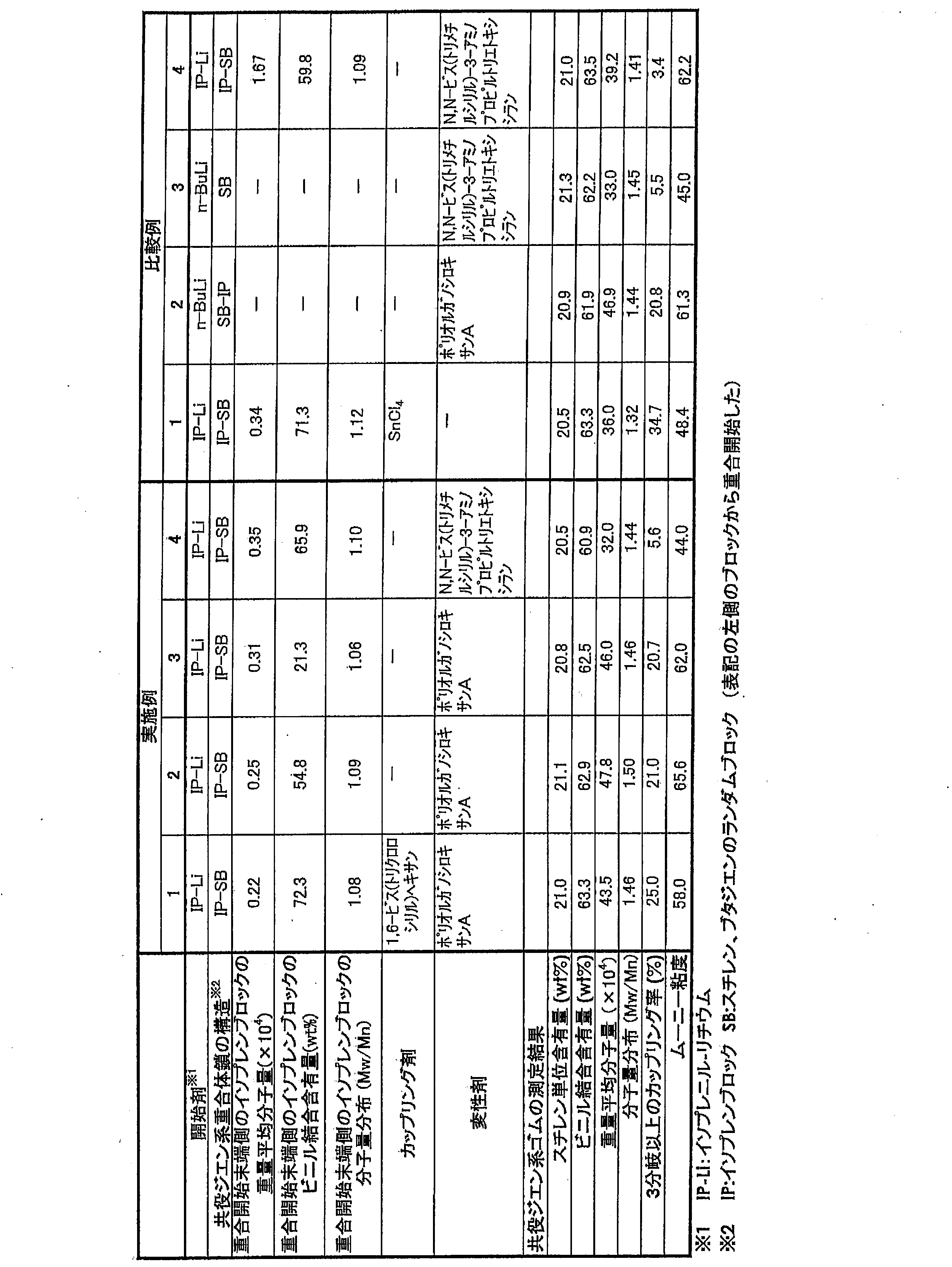
- the weight average molecular weight, molecular weight distribution, and vinyl bond content were measured. These measurement results are shown in Table 1.
- the rubber was measured for weight average molecular weight, molecular weight distribution, coupling rate, styrene unit content, vinyl bond content, and Mooney viscosity. These measurement results are shown in Table 1.
- Example 2 Preparation of conjugated diene rubber II
- cyclohexane and 7.5 mmol of tetramethylethylenediamine were added, and 5.4 mmol of n-butyllithium was further added.
- 7.0 g of isoprene was slowly added and reacted in an ampoule bottle at 70 ° C. for 120 minutes to obtain initiator 2.
- this initiator 2 isoprene block
- the weight average molecular weight, the molecular weight distribution, and the vinyl bond content were measured. These measurement results are shown in Table 1.
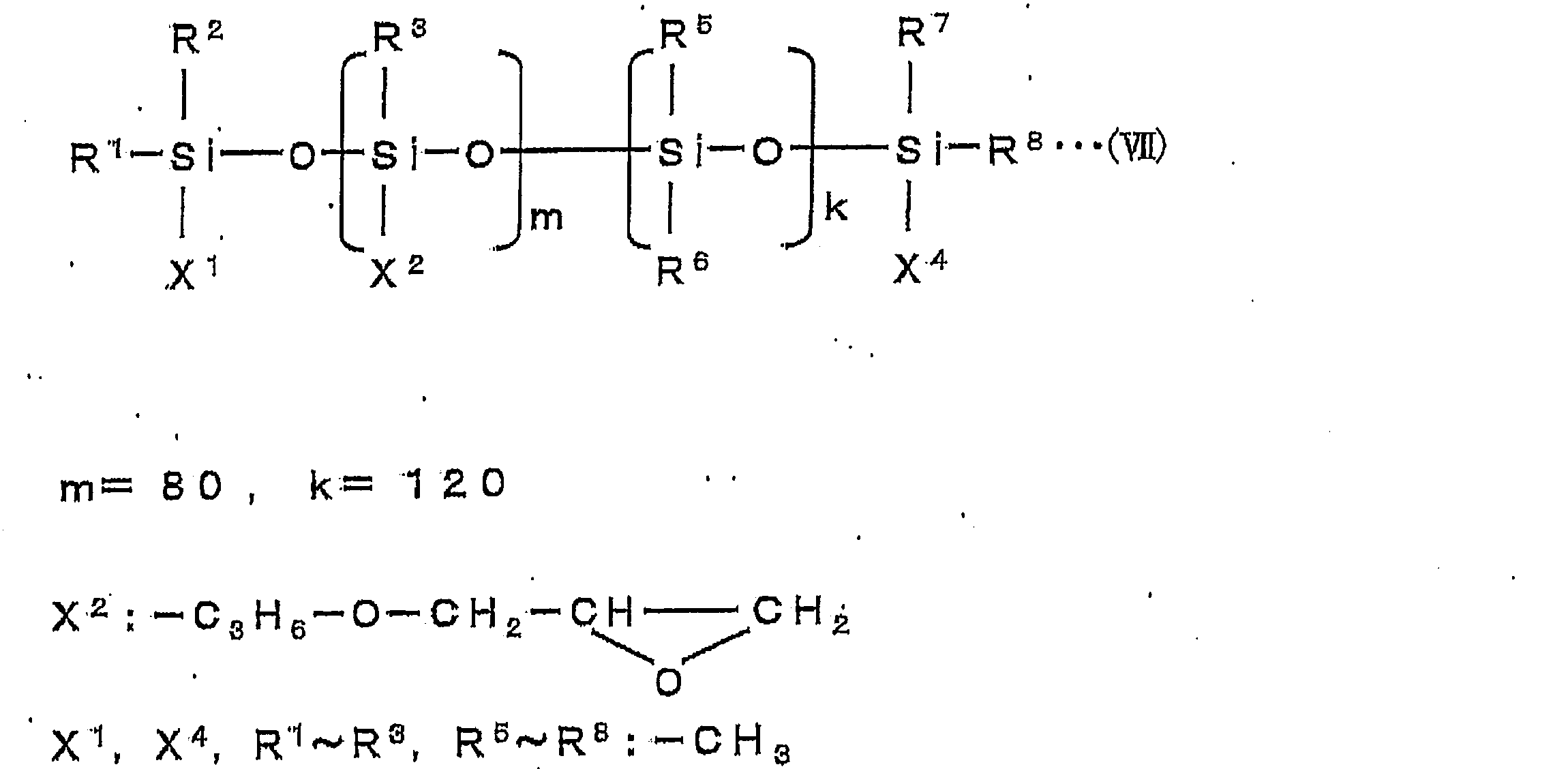
- the polyorganosiloxane A0 represented by the above formula (VII) was then used. 0.023 mmol was added in the form of a 20 weight percent xylene solution and allowed to react for 30 minutes. Thereafter, as a polymerization terminator, an amount of methanol corresponding to twice the mole of n-butyllithium used was added to obtain a solution containing the conjugated diene rubber II. Irganox 1520L (manufactured by Ciba Specialty Chemicals) as an anti-aging agent was added to this solution in an amount of 0.15 part per 100 parts of conjugated diene rubber II, and the solvent was removed by steam stripping. The solid conjugated diene rubber II was obtained by vacuum drying at 24 ° C. for 24 hours.
- the rubber was measured for weight average molecular weight, molecular weight distribution, coupling rate, styrene unit content, vinyl bond content, and Mooney viscosity. These measurement results are shown in Table 1.
- Example 3 Preparation of conjugated diene rubber III
- cyclohexane and 0.9 mmol of tetramethylethylenediamine were added, and 5.4 mmol of n-butyllithium was further added.
- 9.0 g of isoprene was slowly added and reacted in an ampoule bottle at 70 ° C. for 120 minutes to obtain initiator 3.
- this initiator 3 isoprene block
- the weight average molecular weight, molecular weight distribution, and vinyl bond content were measured.
- the polyorganosiloxane A0 represented by the above formula (VII) was then used. 0.023 mmol was added in the form of a 20 weight percent xylene solution and allowed to react for 30 minutes. Thereafter, as a polymerization terminator, an amount of methanol corresponding to twice the mole of n-butyllithium used was added to obtain a solution containing the conjugated diene rubber III. Irganox 1520L (manufactured by Ciba Specialty Chemicals) as an anti-aging agent was added to this solution in an amount of 0.15 parts per 100 parts of conjugated diene rubber III, and the solvent was removed by steam stripping. It was vacuum-dried at 24 ° C. for 24 hours to obtain a solid conjugated diene rubber III.
- Irganox 1520L manufactured by Ciba Specialty Chemicals
- the rubber was measured for weight average molecular weight, molecular weight distribution, coupling rate, styrene unit content, vinyl bond content, and Mooney viscosity. These measurement results are shown in Table 1.
- Example 4 Preparation of conjugated diene rubber IV
- 50 g of cyclohexane and 7.0 mmol of tetramethylethylenediamine were added, and 5.1 mmol of n-butyllithium was further added.
- 10.4 g of isoprene was slowly added and reacted in an ampoule bottle at 60 ° C. for 120 minutes to obtain initiator 4.
- this initiator 4 isoprene block
- the weight average molecular weight, the molecular weight distribution, and the vinyl bond content were measured. These measurement results are shown in Table 1.
- N, N-bis (trimethylsilyl) -3-aminopropyl was then obtained. 0.55 mmol of triethoxysilane was added in the form of a 20 weight percent concentration xylene solution and allowed to react for 10 minutes. Next, 2.5 mmol of N, N-bis (trimethylsilyl) -3-aminopropyltriethoxysilane was added in the form of a 20 weight percent concentration xylene solution and allowed to react for 30 minutes.
- the rubber was measured for weight average molecular weight, molecular weight distribution, coupling rate, styrene unit content, vinyl bond content, and Mooney viscosity. These measurement results are shown in Table 1.
- the rubber was measured for weight average molecular weight, molecular weight distribution, coupling rate, styrene unit content, vinyl bond content, and Mooney viscosity. These measurement results are shown in Table 1.
- Irganox 1520L manufactured by Ciba Specialty Chemicals
- an anti-aging agent was added to this solution in an amount of 0.15 parts per 100 parts of conjugated diene rubber ii, and the solvent was removed by steam stripping. Vacuum-dried at 24 ° C. for 24 hours to obtain a solid conjugated diene rubber ii.
- the rubber was measured for weight average molecular weight, molecular weight distribution, coupling rate, styrene unit content, vinyl bond content, and Mooney viscosity. These measurement results are shown in Table 1.
- N, N-bis (trimethylsilyl) -3-aminopropyl was then obtained. 0.55 mmol of triethoxysilane was added in the form of a 20 weight percent concentration xylene solution and allowed to react for 10 minutes. Next, 2.5 mmol of N, N-bis (trimethylsilyl) -3-aminopropyltriethoxysilane was added in the form of a 20 weight percent concentration xylene solution and allowed to react for 30 minutes.
- the rubber was measured for weight average molecular weight, molecular weight distribution, coupling rate, styrene unit content, vinyl bond content, and Mooney viscosity. These measurement results are shown in Table 1.
- N, N-bis (trimethylsilyl) -3-aminopropyl was then obtained. 0.49 mmol of triethoxysilane was added in the form of a 20 weight percent concentration xylene solution and allowed to react for 10 minutes. Next, 2.5 mmol of N, N-bis (trimethylsilyl) -3-aminopropyltriethoxysilane was added in the form of a 20 weight percent concentration xylene solution and allowed to react for 30 minutes.
- the rubber was measured for weight average molecular weight, molecular weight distribution, coupling rate, styrene unit content, vinyl bond content, and Mooney viscosity. These measurement results are shown in Table 1.
- Example 5 Evaluation of characteristics of rubber composition containing conjugated diene rubber I
- silica trade name “Zeosil 1165MP”, manufactured by Rhodia, nitrogen adsorption specific surface area (BET method) : 163 m 2 / g) 40 parts
- silane coupling agent bis (3- (triethoxysilyl) propyl) tetrasulfide, trade name “Si69”, manufactured by Degussa
- process oil trade name “ 10 parts of “FUKKOR ERAMIC 30” (manufactured by Nippon Oil Corporation) were added and kneaded for 1.5 minutes at 110 ° C.
- the temperature of the rubber composition at the end of kneading was 150 ° C.
- the rubber composition was cooled to room temperature, kneaded again in a Banbury mixer for 3 minutes, and then the rubber composition was discharged from the Banbury mixer.
- the obtained rubber composition was mixed with 1.6 parts of sulfur and a crosslinking accelerator (Nt-butyl-2-benzothiazole sulfenamide (trade name “Noxeller NS”, After kneading 1.4 parts of Ouchi Shinsei Chemical Co., Ltd. and 1.4 parts of diphenylguanidine (trade name “Noxeller D”, produced by Ouchi Shinsei Chemical Co., Ltd.), sheet rubber The composition was removed.
- a crosslinking accelerator Nt-butyl-2-benzothiazole sulfenamide
- diphenylguanidine trade name “Noxeller D”, produced by Ouchi Shinsei Chemical Co., Ltd.
- This rubber composition was press-crosslinked at 160 ° C. for 20 minutes to prepare each test piece, and each test piece was evaluated for tensile strength, wet grip property, low heat build-up, and steering stability. Table 2 shows the results.
- the rubber compositions (Examples 5 to 8) of the present invention comprising the conjugated diene rubbers of Examples 1 to 4 corresponding to the conjugated diene rubber of the present invention have isoprene blocks.
- the conjugated diene rubber of Comparative Example 1 in which the terminal different from the terminal is not modified with a modifier, the conjugated diene rubber in Comparative Examples 2 and 3 having no isoprene block at the terminal different from the modified terminal, or three or more branches Tensile strength of the crosslinked product (corresponding to a tire) as compared with a rubber composition (Comparative Examples 5 to 8) containing a conjugated diene rubber of Comparative Example 4 having a coupling rate of less than 5% by weight, It was excellent in all of low exothermic property, wet grip property, and steering stability.
- the present invention can be used in any industrial field that uses rubber, resin, and the like, and is particularly suitable for rubber products such as tires.
Landscapes
- Chemical & Material Sciences (AREA)
- Organic Chemistry (AREA)
- Health & Medical Sciences (AREA)
- Chemical Kinetics & Catalysis (AREA)
- Medicinal Chemistry (AREA)
- Polymers & Plastics (AREA)
- General Chemical & Material Sciences (AREA)
- Engineering & Computer Science (AREA)
- Mechanical Engineering (AREA)
- Compositions Of Macromolecular Compounds (AREA)
- Inorganic Chemistry (AREA)
- Tires In General (AREA)
- Graft Or Block Polymers (AREA)
- Addition Polymer Or Copolymer, Post-Treatments, Or Chemical Modifications (AREA)
Abstract
Description
エポキシ基およびヒドロカルビルオキシシリル基の少なくとも何れかを1分子中に1以上有し、エポキシ基の1分子中の数およびヒドロカルビルオキシシリル基に含まれるヒドロカルビルオキシ基の1分子中の数の合計が3以上である変性剤と、
が反応することにより得られる、3以上の上記共役ジエン系重合体鎖が上記変性剤を介して結合してなる構造体を、5重量%以上含有する、ことを特徴としている。
上記共役ジエン系重合体鎖の活性末端と、エポキシ基およびヒドロカルビルオキシシリル基の少なくとも何れかを1分子中に1以上有し、エポキシ基の1分子中の数およびヒドロカルビルオキシシリル基に含まれるヒドロカルビルオキシ基の1分子中の数の合計が3以上である変性剤とを、
重合反応に使用した重合開始剤1molに対して、上記共役ジエン系重合体鎖の活性末端と反応する変性剤中の、エポキシ基と、ヒドロカルビルオキシシリル基に含まれるヒドロカルビルオキシ基との合計mol数の比が、0.1~5になるように反応させる、共役ジエン系ゴムの製造方法が提供される。
本発明の共役ジエン系ゴムに含有される構造体を形成するのに用いられる共役ジエン系重合体鎖は、共役ジエン単量体単位を含んでなる重合体鎖であって、少なくとも一方の端がイソプレンブロックであり、他方の端が活性末端であれば、特に限定されない。
本明細書においてイソプレンブロックとは、共役ジエン系重合体鎖においてイソプレン単量体単位を主たる構成単位として形成されている部分をいう。ここで、イソプレンブロックは、イソプレンブロック中のイソプレン単量体単位含有量が70重量%以上であり、80重量%以上であることが好ましく、90重量%以上であることがより好ましく、イソプレン単量体単位のみからなるものが特に好ましい。イソプレンブロック中のイソプレン単量体単位含有量が70重量%以上であると、共役ジエン系ゴムにシリカを配合した場合に、共役ジエン系ゴムとシリカとの親和性が良好となり、そのゴム組成物を用いたタイヤは、低発熱性が優れる。
共役ジエン系重合体鎖におけるイソプレンブロック以外の部分は、共役ジエン単量体の単独重合体鎖または共役ジエン単量体と芳香族ビニル単量体との共重合体鎖であることが好ましい。共役ジエン単量体単位と芳香族ビニル単量体単位との重量比(共役ジエン単量体単位:芳香族ビニル単量体単位)は、100:0~50:50が好ましく、90:10~60:40がより好ましく、85:15~70:30が特に好ましい。共役ジエン単量体単位と芳香族ビニル単量体単位との重量比が上記範囲内にあると、本発明の共役ジエン系ゴムの製造が容易となる。
本発明の共役ジエン系ゴムを得るために用いる、少なくとも一方の端がイソプレンブロックであり、他方の端が活性末端である共役ジエン系重合体鎖(以下、単に、「共役ジエン系重合体鎖(B)」ともいう)の重量平均分子量は、特に限定されないが、その重量平均分子量は、1,000~2,000,000が好ましく、10,000~1,500,000がより好ましく、100,000~1,000,000が特に好ましい。共役ジエン系重合体鎖(B)の重量平均分子量が上記範囲内にあるとき、この共役ジエン系重合体鎖(B)を用いて得られるタイヤの強度と低発熱性とのバランスが良好となる。
本発明の共役ジエン系ゴムは、以上のようにして得られる共役ジエン系重合体鎖(B)の活性末端と、エポキシ基およびヒドロカルビルオキシシリル基の少なくとも何れかを1分子中に1以上有し、エポキシ基の1分子中の数、およびヒドロカルビルオキシシリル基に含まれるヒドロカルビルオキシ基の1分子中の数の合計が3以上である変性剤と、が反応してなるものである。

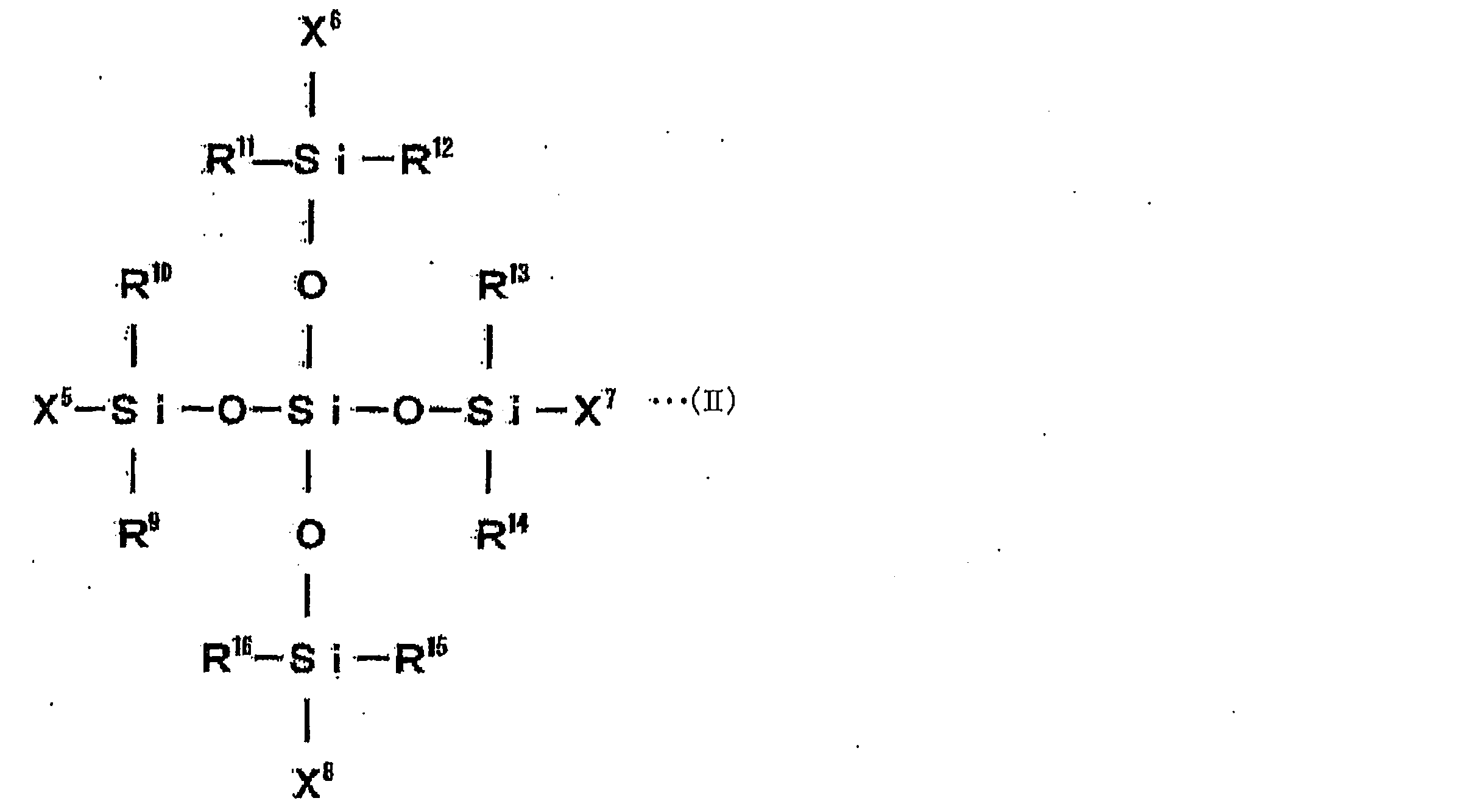


一般式(I)で表されるポリオルガノシロキサンにおいて、一般式(I)のR1~R8、X1およびX4を構成し得る炭素数1~6のアルキル基としては、例えば、メチル基、エチル基、n-プロピル基、イソプロピル基、ブチル基、ペンチル基、ヘキシル基、およびシクロヘキシル基などが挙げられる。炭素数6~12のアリール基としては、例えば、フェニル基、およびメチルフェニル基などが挙げられる。これらのなかでも、ポリオルガノシロキサン自体の製造の観点から、メチル基、およびエチル基が好ましい。
一般式(V)中、Z1は、炭素数1~10のアルキレン基またはアルキルアリーレン基であり、Z2はメチレン基、硫黄原子、または酸素原子であり、Eはエポキシ基を有する炭素数2~10のヒドロカルビル基である。

本発明の共役ジエン系ゴムは、共役ジエン系重合体鎖(B)と、変性剤(C)とが反応することにより得られる共役ジエン系ゴムであり、具体的には、3以上の共役ジエン系重合体鎖(B)が変性剤(C)を介して結合してなる構造体を5重量%以上含有するものである。
本発明のゴム組成物は、上述した本発明の共役ジエン系ゴムを含有するゴム成分100重量部と、シリカ10~200重量部とを含有してなるものである。
本発明のゴム架橋物は、本発明のゴム組成物を成形および架橋してなる。本発明のゴム組成物を用いて、タイヤなどのゴム製品(ゴム架橋物)を構成する場合の架橋および成形方法は、特に限定されず、架橋物の形状、大きさなどに応じて選択すればよい。金型中に、架橋剤を配合したゴム組成物を充填して加熱することにより成形と同時に架橋してもよく、架橋剤を配合したゴム組成物を予め成形した後、それを加熱して架橋してもよい。成形時の温度は、好ましくは20~140℃、より好ましくは40~130℃である。架橋温度は、好ましくは120~200℃、より好ましくは140~180℃であり、架橋時間は、通常、1~120分である。
エポキシ基およびヒドロカルビルオキシシリル基の少なくとも何れかを1分子中に1以上有し、エポキシ基の1分子中の数およびヒドロカルビルオキシシリル基に含まれるヒドロカルビルオキシ基の1分子中の数の合計が3以上である変性剤と、
が反応することにより得られる、3以上の上記共役ジエン系重合体鎖が上記変性剤を介して結合してなる構造体を、5重量%以上含有する、ことを特徴としている。
上記共役ジエン系重合体鎖の活性末端と、エポキシ基およびヒドロカルビルオキシシリル基の少なくとも何れかを1分子中に1以上有し、エポキシ基の1分子中の数およびヒドロカルビルオキシシリル基に含まれるヒドロカルビルオキシ基の1分子中の数の合計が3以上である変性剤とを、
重合反応に使用した重合開始剤1molに対して、上記共役ジエン系重合体鎖の活性末端と反応する変性剤中の、エポキシ基と、ヒドロカルビルオキシシリル基に含まれるヒドロカルビルオキシ基との合計mol数の比が、0.1~5になるように反応させる、共役ジエン系ゴムの製造方法が提供される。
各種の物性については、以下の方法に従って評価した。
重量平均分子量、分子量分布、およびカップリング率については、ゲルパーミエーションクロマトグラフィにより、ポリスチレン換算の分子量に基づくチャートを得て、そのチャートに基づいて求めた。なお、ゲルパーミエーションクロマトグラフィの具体的な測定条件は、以下の通りである。
カラム :GMH-HR-H(東ソー社製)2本を直列に連結した
検出器 :示差屈折計RI-8020(東ソー社製)
溶離液 :テトラヒドロフラン
カラム温度:40℃
カップリング率については、全溶出面積に対する、分子量の最も小さいピークが示すピークトップ分子量の2.8倍以上のピークトップ分子量を有するピーク部分の面積比を、共役ジエン系重合体鎖の3分岐以上のカップリング率として示す。
スチレン単位含有量、およびビニル結合含有量については、1H-NMRにより測定した。
ムーニー粘度については、JIS K6300に従い、ムーニー粘度計(島津製作所社製)を用いて測定した。
引張強度については、JIS K6301に従って、引張試験を行ない、300%伸張時の応力を測定した。この特性については、基準サンプルとして後述する比較例5の測定値を100とする指数で示した。この指数が大きいものほど、ゴム架橋物の引張強度に優れる。
ウエットグリップ性については、長さ50mm、幅12.7mm、厚さ2mmの試験片を、レオメトリックス社製ARESを用い、動的歪み0.5%、10Hzの条件で0℃におけるtanδを測定した。この特性については、基準サンプルとして後述する比較例5の測定値を100とする指数で示した。この指数が大きいものほど、ゴム架橋物をタイヤに用いた際のウエットグリップ性に優れる。
低発熱性については、長さ50mm、幅12.7mm、厚さ2mmの試験片を、レオメトリックス社製ARESを用い、動的歪み2.5%、10Hzの条件で60℃におけるtanδを測定した。この特性については、基準サンプルとして後述する比較例5の測定値を100とする指数で示した。この指数が小さいものほど、ゴム架橋物をタイヤに用いた際の低発熱性に優れる。
操縦安定性については、JIS K6301に従って、引張試験を行ない、(300%伸張時の応力)/(100%伸長時の応力)の値を測定・計算した。この数値が大きいものほど、ゴム架橋物をタイヤに用いた際の操縦安定性に優れる。
窒素置換された100mlアンプル瓶に、シクロヘキサン28g、およびテトラメチルエチレンジアミン8.6mmolを添加し、さらに、n-ブチルリチウム6.1mmolを添加した。次いで、イソプレン8.0gをゆっくりと添加し、60℃のアンプル瓶内で120分反応させることにより、開始剤1を得た。この開始剤1(イソプレンブロック)について、重量平均分子量、分子量分布、およびビニル結合含有量を測定した。これらの測定結果を表1に示す。
窒素置換された100mlアンプル瓶に、シクロヘキサン28g、およびテトラメチルエチレンジアミン7.5mmolを添加し、さらに、n-ブチルリチウム5.4mmolを添加した。次いで、イソプレン7.0gをゆっくりと添加し、70℃のアンプル瓶内で120分反応させることにより、開始剤2を得た。この開始剤2(イソプレンブロック)について、重量平均分子量、分子量分布、およびビニル結合含有量を測定した。これらの測定結果を表1に示す。
窒素置換された100mlアンプル瓶に、シクロヘキサン50g、およびテトラメチルエチレンジアミン0.9mmolを添加し、さらに、n-ブチルリチウム5.4mmolを添加した。次いで、イソプレン9.0gをゆっくりと添加し、70℃のアンプル瓶内で120分反応させることにより、開始剤3を得た。この開始剤3(イソプレンブロック)について、重量平均分子量、分子量分布、およびビニル結合含有量を測定した。これらの測定結果を表1に示す。
窒素置換された100mlアンプル瓶に、シクロヘキサン50g、およびテトラメチルエチレンジアミン7.0mmolを添加し、さらに、n-ブチルリチウム5.1mmolを添加した。次いで、イソプレン10.2gをゆっくりと添加し、60℃のアンプル瓶内で120分反応させることにより、開始剤4を得た。この開始剤4(イソプレンブロック)について、重量平均分子量、分子量分布、およびビニル結合含有量を測定した。これらの測定結果を表1に示す。
窒素置換された100mlアンプル瓶に、シクロヘキサン50g、およびテトラメチルエチレンジアミン7.0mmolを添加し、さらに、n-ブチルリチウム5.1mmolを添加した。次いで、イソプレン9.8gをゆっくりと添加し、60℃のアンプル瓶内で120分反応させることにより、開始剤5を得た。この開始剤5(イソプレンブロック)について、重量平均分子量、分子量分布、およびビニル結合含有量を測定した。これらの測定結果を表1に示す。
攪拌機付きオートクレーブに、窒素雰囲気下、シクロヘキサン4000g、1,3-ブタジエン357.7g、およびスチレン132.3gを仕込んだ後、テトラエチレンジアミン7.5mmolを加え、さらに、n-ブチルリチウム5.4mmolを加え、40℃で重合を開始した。重合を開始してから10分経過後、1,3-ブタジエン195.3g、およびスチレン14.7gを60分間かけて連続的に添加した。重合反応中の最高温度は60℃であった。連続添加終了後、さらに20分間重合反応を継続し、重合転化率が95%から100%の範囲になったことを確認してから、次いで、イソプレン7.0gを添加し、10分間反応させた。次いで、上記式(VII)で表されるポリオルガノシロキサンA0.023mmolを20重量パーセント濃度のキシレン溶液の状態で添加し、30分間反応させた。その後、重合停止剤として、使用したn-ブチルリチウムの2倍モルに相当する量のメタノールを添加して、共役ジエン系ゴムiiを含有する溶液を得た。この溶液に、老化防止剤として、イルガノックス1520L(チバスペシャリティーケミカルズ社製)を、共役ジエン系ゴムii 100部に対して0.15部添加した後、スチームストリッピングにより溶媒を除去し、60℃で24時間真空乾燥して、固形状の共役ジエン系ゴムiiを得た。
攪拌機付きオートクレーブに、窒素雰囲気下、シクロヘキサン4000g、1,3-ブタジエン357.7g、およびスチレン132.3gを仕込んだ後、テトラエチレンジアミン6.7mmolを加え、さらに、n-ブチルリチウム4.9mmolを加え、40℃で重合を開始した。重合を開始してから10分経過後、1,3-ブタジエン195.3g、およびスチレン14.7gを60分間かけて連続的に添加した。重合反応中の最高温度は60℃であった。連続添加終了後、さらに20分間重合反応を継続し、重合転化率が95%から100%の範囲になったことを確認してから、次いで、N,N-ビス(トリメチルシリル)-3-アミノプロピルトリエトキシシラン0.55mmolを20重量パーセント濃度のキシレン溶液の状態で添加し、10分間反応させた。次いで、N,N-ビス(トリメチルシリル)-3-アミノプロピルトリエトキシシラン2.5mmolを20重量パーセント濃度のキシレン溶液の状態で添加し、30分間反応させた。その後、重合停止剤として、使用したn-ブチルリチウムの2倍モルに相当する量のメタノールを添加して、共役ジエン系ゴムiiiを含有する溶液を得た。この溶液に、老化防止剤として、イルガノックス1520L(チバスペシャリティーケミカルズ社製)を共役ジエン系ゴムiii 100部に対して0.15部添加した後、スチームストリッピングにより溶媒を除去し、60℃で24時間真空乾燥して、固形状の共役ジエン系ゴムiiiを得た。
窒素置換された800mlガラスボトルに、シクロヘキサン200g、およびテトラメチルエチレンジアミン7.0mmolを添加し、さらに、n-ブチルリチウム5.0mmolを添加した。次いで、イソプレン50gをゆっくりと添加し、60℃のガラスボトル内で120分反応させることにより、開始剤6を得た。この開始剤6(イソプレンブロック)について、重量平均分子量、分子量分布、およびビニル結合含有量を測定した。これらの測定結果を表1に示す。
容積250mlのバンバリーミキサーを用いて、実施例1で得た共役ジエン系ゴムI 100部を素練りし、それに、シリカ(商品名「Zeosil 1165MP」、ローディア社製、窒素吸着比表面積(BET法):163m2/g)40部、シランカップリング剤(ビス(3-(トリエトキシシリル)プロピル)テトラスルフィド、商品名「Si69」、デグッサ社製)4.3部、およびプロセスオイル(商品名「フッコール エラミック30」、新日本石油社製)10部を添加して、110℃を開始温度として1.5分間混練した。この混練物に、シリカ(商品名「Zeosil 1165MP」、ローディア社製)14部、カーボンブラック(商品名「シースト7HM」、東海カーボン社製)6部、酸化亜鉛(亜鉛華1号)3部、ステアリン酸(商品名「SA-300」、旭電化工業社製)2部、および老化防止剤(N-フェニル-N’-(1,3-ジメチルブチル)-p-フェニレンジアミン、商品名「ノクラック6C」、大内新興化学工業社製)2部を添加し、2.5分間混練して、バンバリーミキサーからゴム組成物を排出させた。混練終了時のゴム組成物の温度は150℃であった。このゴム組成物を、室温まで冷却した後、再度バンバリーミキサー中で、3分間混練した後、バンバリーミキサーからゴム組成物を排出させた。次いで、50℃のオープンロールを用いて、得られたゴム組成物と、硫黄1.6部および架橋促進剤(N-t-ブチル-2-ベンゾチアゾールスルフェンアミド(商品名「ノクセラーNS」、大内新興化学工業社製)1.4部と、ジフェニルグアニジン(商品名「ノクセラーD」、大内新興化学工業社製)1.4部との混合物)とを混練した後、シート状のゴム組成物を取り出した。
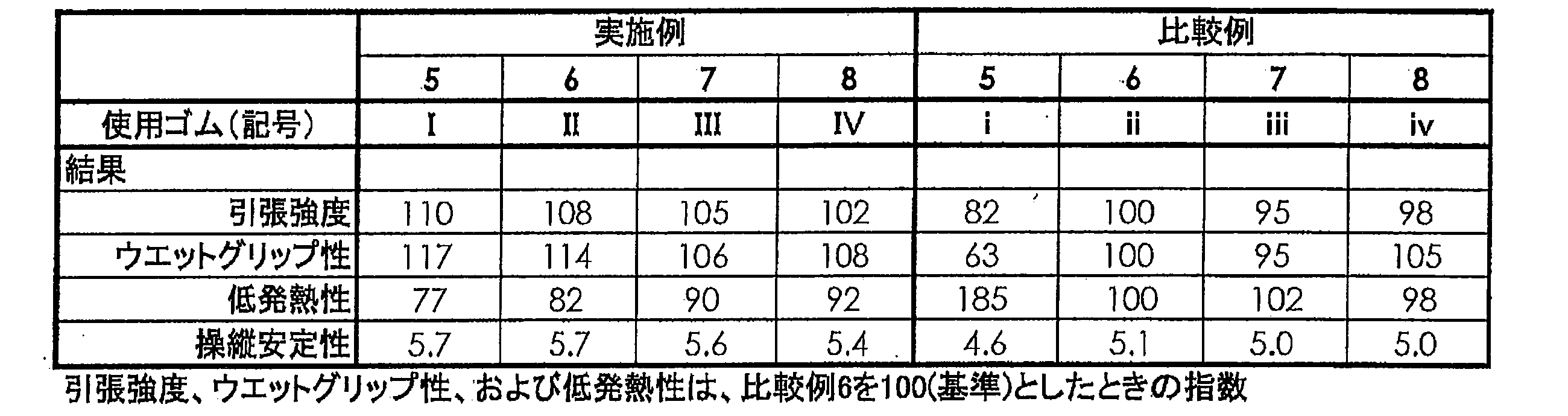
共役ジエン系ゴムIに代えて、実施例2で得た共役ジエン系ゴムII(実施例6)、実施例3で得た共役ジエン系ゴムIII(実施例7)、実施例4で得た共役ジエン系ゴムIV(実施例8)、比較例1で得た共役ジエン系ゴムi(比較例5)、比較例2で得た共役ジエン系ゴムii(比較例6)、比較例3で得た共役ジエン系ゴムiii(比較例7)、比較例4で得た共役ジエン系ゴムiv(比較例8)をそれぞれ同量用いたこと以外は、実施例5と同様の方法でゴム組成物を得て、試験片の評価を行った。表2にその結果を示す。
Claims (8)
- 少なくとも一方の端がイソプレン単量体単位を70重量%以上有するイソプレンブロックであり、他方の端が活性末端である共役ジエン系重合体鎖と、
エポキシ基およびヒドロカルビルオキシシリル基の少なくとも何れかを1分子中に1以上有し、エポキシ基の1分子中の数およびヒドロカルビルオキシシリル基に含まれるヒドロカルビルオキシ基の1分子中の数の合計が3以上である変性剤と、
が反応することにより得られる、3以上の上記共役ジエン系重合体鎖が上記変性剤を介して結合してなる構造体を、5重量%以上含有する、共役ジエン系ゴム。 - 上記イソプレンブロックにおけるイソプレン単量体単位中のビニル結合含有量が21~85重量%である、請求項1に記載の共役ジエン系ゴム。
- 上記共役ジエン系重合体鎖におけるイソプレンブロック以外の部分が、共役ジエン単量体の単独重合体鎖、または共役ジエン単量体と芳香族ビニル単量体との共重合体鎖であり、共役ジエン単量体単位と芳香族ビニル単量体単位との重量比(共役ジエン単量体単位:芳香族ビニル単量体単位)が、100:0~50:50である、請求項1または2に記載の共役ジエン系ゴム。
- 請求項1~3のいずれか1項に記載の共役ジエン系ゴムを含有するゴム成分100重量部と、シリカ10~200重量部とを含有してなる、ゴム組成物。
- 架橋剤をさらに含有してなる、請求項4に記載のゴム組成物。
- 請求項5に記載のゴム組成物を成形および架橋してなる、ゴム架橋物。
- 請求項6に記載のゴム架橋物を用いてなる、タイヤ。
- 不活性溶媒中、イソプレン単量体またはイソプレン単量体を含有する単量体混合物を、重合開始剤を用いてリビング重合することにより、活性末端を有するイソプレンブロックを形成させ、次いで、共役ジエン単量体または共役ジエン単量体を含有する単量体混合物を、前記イソプレンブロックに結合させ、引き続きリビング重合することにより、少なくとも一方の端がイソプレン単量体単位を70重量%以上有するイソプレンブロックであり、他方の端が活性末端である共役ジエン系重合体鎖を得て、
上記共役ジエン系重合体鎖の活性末端と、エポキシ基およびヒドロカルビルオキシシリル基の少なくとも何れかを1分子中に1以上有し、エポキシ基の1分子中の数およびヒドロカルビルオキシシリル基に含まれるヒドロカルビルオキシ基の1分子中の数の合計が3以上である変性剤とを、
重合反応に使用した重合開始剤1molに対して、上記共役ジエン系重合体鎖の活性末端と反応する変性剤中の、エポキシ基と、ヒドロカルビルオキシシリル基に含まれるヒドロカルビルオキシ基との合計mol数の比が、0.1~5になるように反応させる、共役ジエン系ゴムの製造方法。
Priority Applications (5)
| Application Number | Priority Date | Filing Date | Title |
|---|---|---|---|
| JP2012501781A JP5716736B2 (ja) | 2010-02-26 | 2011-02-22 | 共役ジエン系ゴム、ゴム組成物、ゴム架橋物、およびタイヤ、ならびに共役ジエン系ゴムの製造方法 |
| KR1020127021997A KR101702697B1 (ko) | 2010-02-26 | 2011-02-22 | 공액 디엔계 고무, 고무 조성물, 고무 가교물, 및 타이어, 그리고 공액 디엔계 고무의 제조 방법 |
| CN201180010745.0A CN102762598B (zh) | 2010-02-26 | 2011-02-22 | 共轭二烯类橡胶、橡胶组合物、橡胶交联物及轮胎、以及共轭二烯类橡胶的制造方法 |
| EP11747323.1A EP2540747B1 (en) | 2010-02-26 | 2011-02-22 | Conjugated diene rubber, rubber composition, crosslinked rubber, tire, and process for production of conjugated diene rubber |
| US13/580,765 US8952101B2 (en) | 2010-02-26 | 2011-02-22 | Conjugated diene rubber, rubber composition, crosslinked rubber, tire, and process for production of conjugated diene rubber |
Applications Claiming Priority (2)
| Application Number | Priority Date | Filing Date | Title |
|---|---|---|---|
| JP2010042244 | 2010-02-26 | ||
| JP2010-042244 | 2010-02-26 |
Publications (1)
| Publication Number | Publication Date |
|---|---|
| WO2011105362A1 true WO2011105362A1 (ja) | 2011-09-01 |
Family
ID=44506768
Family Applications (1)
| Application Number | Title | Priority Date | Filing Date |
|---|---|---|---|
| PCT/JP2011/053824 Ceased WO2011105362A1 (ja) | 2010-02-26 | 2011-02-22 | 共役ジエン系ゴム、ゴム組成物、ゴム架橋物、およびタイヤ、ならびに共役ジエン系ゴムの製造方法 |
Country Status (6)
| Country | Link |
|---|---|
| US (1) | US8952101B2 (ja) |
| EP (1) | EP2540747B1 (ja) |
| JP (1) | JP5716736B2 (ja) |
| KR (1) | KR101702697B1 (ja) |
| CN (1) | CN102762598B (ja) |
| WO (1) | WO2011105362A1 (ja) |
Cited By (26)
| Publication number | Priority date | Publication date | Assignee | Title |
|---|---|---|---|---|
| WO2012086496A1 (ja) * | 2010-12-24 | 2012-06-28 | 日本ゼオン株式会社 | 共役ジエン系ゴム、ゴム組成物、ゴム架橋物、およびタイヤ |
| JP2013139504A (ja) * | 2011-12-29 | 2013-07-18 | Nippon Zeon Co Ltd | タイヤトレッド用共役ジエン系ゴム組成物の製造方法 |
| JP2013249423A (ja) * | 2012-06-01 | 2013-12-12 | Sumitomo Rubber Ind Ltd | スタッドレスタイヤ用ゴム組成物及びスタッドレスタイヤ |
| WO2014050341A1 (ja) * | 2012-09-28 | 2014-04-03 | 日本ゼオン株式会社 | 共役ジエン系ゴムの製造方法 |
| JP2014129514A (ja) * | 2012-12-28 | 2014-07-10 | Chi Mei Corp | ポリシロキサン化合物、変性共役ジエン‐ビニル芳香族炭化水素共重合体およびその製造方法 |
| JP2014162809A (ja) * | 2013-02-21 | 2014-09-08 | Yokohama Rubber Co Ltd:The | ゴム組成物および空気入りタイヤ |
| JP2014185341A (ja) * | 2013-02-25 | 2014-10-02 | Yokohama Rubber Co Ltd:The | タイヤトレッド用ゴム組成物および空気入りタイヤ |
| WO2014185495A1 (ja) * | 2013-05-17 | 2014-11-20 | 横浜ゴム株式会社 | タイヤトレッド用ゴム組成物および空気入りタイヤ |
| JP2014231550A (ja) * | 2013-05-28 | 2014-12-11 | 横浜ゴム株式会社 | タイヤ用ゴム組成物および空気入りタイヤ |
| JP2014231575A (ja) * | 2013-05-30 | 2014-12-11 | 横浜ゴム株式会社 | タイヤ用ゴム組成物および空気入りタイヤ |
| WO2015046392A1 (ja) * | 2013-09-30 | 2015-04-02 | 日本ゼオン株式会社 | 共役ジエン系ゴムの製造方法 |
| WO2015152039A1 (ja) * | 2014-03-31 | 2015-10-08 | 日本ゼオン株式会社 | 共役ジエン系ゴムの製造方法 |
| KR20150137065A (ko) * | 2013-03-29 | 2015-12-08 | 제온 코포레이션 | 방사상 공액 디엔계 고무의 제조 방법 |
| JP2016003280A (ja) * | 2014-06-17 | 2016-01-12 | 横浜ゴム株式会社 | タイヤ用ゴム組成物および空気入りタイヤ |
| JP2016011334A (ja) * | 2014-06-27 | 2016-01-21 | 日本ゼオン株式会社 | 変性共役ジエン系ゴムの組成物 |
| JP2016030795A (ja) * | 2014-07-29 | 2016-03-07 | 日本ゼオン株式会社 | 共役ジエン系ゴムの製造方法 |
| JP2016037543A (ja) * | 2014-08-07 | 2016-03-22 | 日本ゼオン株式会社 | 共役ジエン系ゴムの製造方法 |
| JP2016047885A (ja) * | 2014-08-27 | 2016-04-07 | 横浜ゴム株式会社 | スタッドレスタイヤ用ゴム組成物およびスタッドレスタイヤ |
| KR20170023860A (ko) | 2014-06-27 | 2017-03-06 | 니폰 제온 가부시키가이샤 | 공액 디엔계 고무의 제조 방법 |
| JP2017082084A (ja) * | 2015-10-28 | 2017-05-18 | 横浜ゴム株式会社 | タイヤ用ゴム組成物 |
| WO2018092843A1 (ja) * | 2016-11-16 | 2018-05-24 | Jsr株式会社 | 変性共役ジエン系重合体の製造方法、変性共役ジエン系重合体、重合体組成物、架橋物及びタイヤ |
| JP2018172593A (ja) * | 2017-03-31 | 2018-11-08 | 日本ゼオン株式会社 | 油展変性共役ジエン系ゴムおよびその製造方法 |
| US10442917B2 (en) | 2014-06-04 | 2019-10-15 | The Yokohama Rubber Co., Ltd. | Rubber composition for tire tread |
| WO2022080236A1 (ja) * | 2020-10-15 | 2022-04-21 | Zsエラストマー株式会社 | 共役ジエン系重合体、ゴム組成物、ゴム架橋物、およびタイヤ |
| WO2023234055A1 (ja) | 2022-05-31 | 2023-12-07 | Zsエラストマー株式会社 | ゴム組成物、ゴム架橋物、タイヤおよびゴム架橋物の製造方法 |
| DE112023000654T5 (de) | 2022-03-31 | 2024-11-28 | The Yokohama Rubber Co., Ltd. | Kautschukzusammensetzung für reifen |
Families Citing this family (11)
| Publication number | Priority date | Publication date | Assignee | Title |
|---|---|---|---|---|
| US7895573B1 (en) | 2006-03-27 | 2011-02-22 | Mcafee, Inc. | Execution environment file inventory |
| EP2540747B1 (en) * | 2010-02-26 | 2014-10-08 | Zeon Corporation | Conjugated diene rubber, rubber composition, crosslinked rubber, tire, and process for production of conjugated diene rubber |
| JP2013163749A (ja) * | 2012-02-10 | 2013-08-22 | Sumitomo Chemical Co Ltd | 共役ジエン系重合体の製造方法、共役ジエン系重合体、及び共役ジエン系重合体組成物 |
| EP2914654B1 (en) * | 2012-11-02 | 2017-05-31 | Bridgestone Corporation | Rubber compositions comprising metal carboxylates and processes for making the same |
| EP2960288B1 (en) * | 2013-02-25 | 2019-10-30 | The Yokohama Rubber Co., Ltd. | Rubber composition for tire tread, and pneumatic tire |
| EP3088423B1 (en) * | 2013-12-27 | 2019-01-16 | Zeon Corporation | Conjugated diene based polymer and process for manufacturing conjugated diene based polymer |
| US9109073B1 (en) * | 2014-08-19 | 2015-08-18 | The Goodyear Tire & Rubber Company | Bifunctionalized polymer |
| US9090730B1 (en) * | 2014-08-19 | 2015-07-28 | The Goodyear Tire & Rubber Company | Rubber composition and pneumatic tire |
| KR101645278B1 (ko) * | 2014-09-15 | 2016-08-03 | 금호석유화학 주식회사 | 말단 변성 공액 디엔계 중합체 및 그 제조 방법 |
| EP3463929B1 (en) | 2016-06-07 | 2020-05-13 | Pirelli Tyre S.p.A. | Tire for vehicle wheels |
| CN109627359B (zh) | 2017-10-06 | 2021-11-19 | 台橡股份有限公司 | 含硅及磷的改质橡胶及其组合物与制造方法 |
Citations (9)
| Publication number | Priority date | Publication date | Assignee | Title |
|---|---|---|---|---|
| JPH09110904A (ja) | 1995-10-19 | 1997-04-28 | Sumitomo Chem Co Ltd | 変性ジエン系重合体ゴムの製造方法 |
| JP2002284814A (ja) * | 2001-03-26 | 2002-10-03 | Asahi Kasei Corp | 変性共役ジエン系重合体の製造方法 |
| JP2003171418A (ja) | 2001-09-27 | 2003-06-20 | Jsr Corp | 共役ジオレフィン(共)重合ゴム、該(共)重合ゴムの製造方法、ゴム組成物およびタイヤ |
| JP2003531257A (ja) | 2000-04-25 | 2003-10-21 | ソシエテ ド テクノロジー ミシュラン | タイヤに使用できるゴム組成物用ブロックコポリマー |
| WO2003102053A1 (en) | 2002-05-31 | 2003-12-11 | Zeon Corporation | Conjugated diene rubber, process for producing the same, and rubber composition |
| JP2004231905A (ja) * | 2003-01-31 | 2004-08-19 | Nippon Zeon Co Ltd | 共役ジエン系ゴムの製造方法 |
| JP2009091498A (ja) * | 2007-10-10 | 2009-04-30 | Nippon Zeon Co Ltd | 共役ジエン重合体組成物の製造方法 |
| WO2010131646A1 (ja) * | 2009-05-11 | 2010-11-18 | 日本ゼオン株式会社 | 放射状共役ジエン重合体の製造方法 |
| JP2011079913A (ja) * | 2009-10-05 | 2011-04-21 | Sumitomo Rubber Ind Ltd | 重合体、タイヤ用ゴム組成物及び空気入りタイヤ |
Family Cites Families (12)
| Publication number | Priority date | Publication date | Assignee | Title |
|---|---|---|---|---|
| EP1433816A1 (en) * | 1996-06-26 | 2004-06-30 | The Yokohama Rubber Co., Ltd. | Block copolymer and rubber composition and pneumatic tire containing the same |
| WO2003020825A1 (en) * | 2001-08-29 | 2003-03-13 | Zeon Corporation | Elastomer composition and pressure-sensitive adhesives made by using the same |
| CN100347208C (zh) | 2001-09-27 | 2007-11-07 | Jsr株式会社 | 共轭二烯均聚或共聚橡胶、均聚或共聚橡胶的制造方法、橡胶组合物、复合体以及轮胎 |
| JP4117250B2 (ja) * | 2001-11-27 | 2008-07-16 | 株式会社ブリヂストン | 共役ジエン系重合体、その製法及びそれを用いたゴム組成物 |
| US7339005B2 (en) | 2003-01-31 | 2008-03-04 | Sumitomo Chemical Company, Limited | Process for producing modified diene polymer rubber |
| CN1330678C (zh) * | 2003-02-27 | 2007-08-08 | 住友化学工业株式会社 | 制备改性二烯聚合物橡胶的方法 |
| WO2005021637A1 (ja) * | 2003-09-01 | 2005-03-10 | Zeon Corporation | 共役ジエン系ゴム組成物、その製造方法およびゴム架橋物 |
| JP4944376B2 (ja) * | 2004-12-22 | 2012-05-30 | 株式会社ブリヂストン | ゴム組成物、その製造方法及びタイヤ |
| JP5194846B2 (ja) * | 2008-01-31 | 2013-05-08 | 日本ゼオン株式会社 | ベーストレッド用ゴム組成物 |
| US8809440B2 (en) * | 2009-10-21 | 2014-08-19 | Jsr Corporation | Method of producing modified conjugated diene rubber, modified conjugated diene rubber, and rubber composition |
| EP2540747B1 (en) * | 2010-02-26 | 2014-10-08 | Zeon Corporation | Conjugated diene rubber, rubber composition, crosslinked rubber, tire, and process for production of conjugated diene rubber |
| US8937130B2 (en) * | 2010-12-24 | 2015-01-20 | Zeon Corporation | Conjugated diene rubber, rubber composition, cross-linked rubber, and tire |
-
2011
- 2011-02-22 EP EP11747323.1A patent/EP2540747B1/en active Active
- 2011-02-22 JP JP2012501781A patent/JP5716736B2/ja active Active
- 2011-02-22 CN CN201180010745.0A patent/CN102762598B/zh active Active
- 2011-02-22 US US13/580,765 patent/US8952101B2/en active Active
- 2011-02-22 WO PCT/JP2011/053824 patent/WO2011105362A1/ja not_active Ceased
- 2011-02-22 KR KR1020127021997A patent/KR101702697B1/ko active Active
Patent Citations (9)
| Publication number | Priority date | Publication date | Assignee | Title |
|---|---|---|---|---|
| JPH09110904A (ja) | 1995-10-19 | 1997-04-28 | Sumitomo Chem Co Ltd | 変性ジエン系重合体ゴムの製造方法 |
| JP2003531257A (ja) | 2000-04-25 | 2003-10-21 | ソシエテ ド テクノロジー ミシュラン | タイヤに使用できるゴム組成物用ブロックコポリマー |
| JP2002284814A (ja) * | 2001-03-26 | 2002-10-03 | Asahi Kasei Corp | 変性共役ジエン系重合体の製造方法 |
| JP2003171418A (ja) | 2001-09-27 | 2003-06-20 | Jsr Corp | 共役ジオレフィン(共)重合ゴム、該(共)重合ゴムの製造方法、ゴム組成物およびタイヤ |
| WO2003102053A1 (en) | 2002-05-31 | 2003-12-11 | Zeon Corporation | Conjugated diene rubber, process for producing the same, and rubber composition |
| JP2004231905A (ja) * | 2003-01-31 | 2004-08-19 | Nippon Zeon Co Ltd | 共役ジエン系ゴムの製造方法 |
| JP2009091498A (ja) * | 2007-10-10 | 2009-04-30 | Nippon Zeon Co Ltd | 共役ジエン重合体組成物の製造方法 |
| WO2010131646A1 (ja) * | 2009-05-11 | 2010-11-18 | 日本ゼオン株式会社 | 放射状共役ジエン重合体の製造方法 |
| JP2011079913A (ja) * | 2009-10-05 | 2011-04-21 | Sumitomo Rubber Ind Ltd | 重合体、タイヤ用ゴム組成物及び空気入りタイヤ |
Non-Patent Citations (1)
| Title |
|---|
| See also references of EP2540747A4 * |
Cited By (50)
| Publication number | Priority date | Publication date | Assignee | Title |
|---|---|---|---|---|
| US8937130B2 (en) | 2010-12-24 | 2015-01-20 | Zeon Corporation | Conjugated diene rubber, rubber composition, cross-linked rubber, and tire |
| WO2012086496A1 (ja) * | 2010-12-24 | 2012-06-28 | 日本ゼオン株式会社 | 共役ジエン系ゴム、ゴム組成物、ゴム架橋物、およびタイヤ |
| JP2013139504A (ja) * | 2011-12-29 | 2013-07-18 | Nippon Zeon Co Ltd | タイヤトレッド用共役ジエン系ゴム組成物の製造方法 |
| JP2013249423A (ja) * | 2012-06-01 | 2013-12-12 | Sumitomo Rubber Ind Ltd | スタッドレスタイヤ用ゴム組成物及びスタッドレスタイヤ |
| CN104302676B (zh) * | 2012-09-28 | 2017-02-22 | 日本瑞翁株式会社 | 共轭二烯系橡胶的制造方法 |
| KR102036153B1 (ko) * | 2012-09-28 | 2019-10-24 | 제온 코포레이션 | 공액 디엔계 고무의 제조 방법 |
| US9868794B2 (en) | 2012-09-28 | 2018-01-16 | Zeon Corporation | Method for producing conjugated diene rubber |
| CN104302676A (zh) * | 2012-09-28 | 2015-01-21 | 日本瑞翁株式会社 | 共轭二烯系橡胶的制造方法 |
| KR20150065618A (ko) | 2012-09-28 | 2015-06-15 | 제온 코포레이션 | 공액 디엔계 고무의 제조 방법 |
| JPWO2014050341A1 (ja) * | 2012-09-28 | 2016-08-22 | 日本ゼオン株式会社 | 共役ジエン系ゴムの製造方法 |
| WO2014050341A1 (ja) * | 2012-09-28 | 2014-04-03 | 日本ゼオン株式会社 | 共役ジエン系ゴムの製造方法 |
| JP2014129514A (ja) * | 2012-12-28 | 2014-07-10 | Chi Mei Corp | ポリシロキサン化合物、変性共役ジエン‐ビニル芳香族炭化水素共重合体およびその製造方法 |
| JP2014162809A (ja) * | 2013-02-21 | 2014-09-08 | Yokohama Rubber Co Ltd:The | ゴム組成物および空気入りタイヤ |
| JP2014185341A (ja) * | 2013-02-25 | 2014-10-02 | Yokohama Rubber Co Ltd:The | タイヤトレッド用ゴム組成物および空気入りタイヤ |
| KR102121881B1 (ko) * | 2013-03-29 | 2020-06-11 | 제온 코포레이션 | 방사상 공액 디엔계 고무의 제조 방법 |
| US20160053033A1 (en) * | 2013-03-29 | 2016-02-25 | Zeon Corporation | Method of production of radial conjugated diene rubber |
| KR20150137065A (ko) * | 2013-03-29 | 2015-12-08 | 제온 코포레이션 | 방사상 공액 디엔계 고무의 제조 방법 |
| KR101624551B1 (ko) | 2013-05-17 | 2016-05-26 | 요코하마 고무 가부시키가이샤 | 타이어 트레드용 고무 조성물 및 공기입 타이어 |
| JP5796688B2 (ja) * | 2013-05-17 | 2015-10-21 | 横浜ゴム株式会社 | タイヤトレッド用ゴム組成物および空気入りタイヤ |
| KR20160002886A (ko) | 2013-05-17 | 2016-01-08 | 요코하마 고무 가부시키가이샤 | 타이어 트레드용 고무 조성물 및 공기입 타이어 |
| US9834661B2 (en) | 2013-05-17 | 2017-12-05 | The Yokohama Rubber Co., Ltd. | Rubber composition for tire tread and pneumatic tire |
| WO2014185495A1 (ja) * | 2013-05-17 | 2014-11-20 | 横浜ゴム株式会社 | タイヤトレッド用ゴム組成物および空気入りタイヤ |
| JP2014231550A (ja) * | 2013-05-28 | 2014-12-11 | 横浜ゴム株式会社 | タイヤ用ゴム組成物および空気入りタイヤ |
| JP2014231575A (ja) * | 2013-05-30 | 2014-12-11 | 横浜ゴム株式会社 | タイヤ用ゴム組成物および空気入りタイヤ |
| WO2015046392A1 (ja) * | 2013-09-30 | 2015-04-02 | 日本ゼオン株式会社 | 共役ジエン系ゴムの製造方法 |
| JPWO2015046392A1 (ja) * | 2013-09-30 | 2017-03-09 | 日本ゼオン株式会社 | 共役ジエン系ゴムの製造方法 |
| WO2015152039A1 (ja) * | 2014-03-31 | 2015-10-08 | 日本ゼオン株式会社 | 共役ジエン系ゴムの製造方法 |
| JPWO2015152039A1 (ja) * | 2014-03-31 | 2017-04-13 | 日本ゼオン株式会社 | 共役ジエン系ゴムの製造方法 |
| US10442917B2 (en) | 2014-06-04 | 2019-10-15 | The Yokohama Rubber Co., Ltd. | Rubber composition for tire tread |
| DE112015002657B4 (de) | 2014-06-04 | 2020-06-25 | The Yokohama Rubber Co., Ltd. | Kautschukzusammensetzung für Reifenlauffläche und Verwendung der Kautschukzusammensetzung zur Herstellung einer Reifenlauffläche eines Luftreifens |
| US11041066B2 (en) | 2014-06-04 | 2021-06-22 | The Yokohama Rubber Co., Ltd. | Rubber composition for tire tread |
| KR20170012556A (ko) | 2014-06-17 | 2017-02-02 | 요코하마 고무 가부시키가이샤 | 타이어용 고무 조성물 및 공기입 타이어 |
| DE112015002895B4 (de) | 2014-06-17 | 2022-03-03 | The Yokohama Rubber Co., Ltd. | Kautschukzusammensetzung für Reifen, vulkanisiertes Produkt und Verwendung des vulkanisierten Produkts in einem Luftreifen |
| US10040927B2 (en) | 2014-06-17 | 2018-08-07 | The Yokohama Rubber Co., Ltd. | Rubber composition for tires and pneumatic tire |
| JP2016003280A (ja) * | 2014-06-17 | 2016-01-12 | 横浜ゴム株式会社 | タイヤ用ゴム組成物および空気入りタイヤ |
| KR20170023860A (ko) | 2014-06-27 | 2017-03-06 | 니폰 제온 가부시키가이샤 | 공액 디엔계 고무의 제조 방법 |
| US9982065B2 (en) | 2014-06-27 | 2018-05-29 | Zeon Corporation | Method of production of conjugated diene rubber |
| JP2016011334A (ja) * | 2014-06-27 | 2016-01-21 | 日本ゼオン株式会社 | 変性共役ジエン系ゴムの組成物 |
| JP2016030795A (ja) * | 2014-07-29 | 2016-03-07 | 日本ゼオン株式会社 | 共役ジエン系ゴムの製造方法 |
| JP2016037543A (ja) * | 2014-08-07 | 2016-03-22 | 日本ゼオン株式会社 | 共役ジエン系ゴムの製造方法 |
| JP2016047885A (ja) * | 2014-08-27 | 2016-04-07 | 横浜ゴム株式会社 | スタッドレスタイヤ用ゴム組成物およびスタッドレスタイヤ |
| JP2017082084A (ja) * | 2015-10-28 | 2017-05-18 | 横浜ゴム株式会社 | タイヤ用ゴム組成物 |
| WO2018092843A1 (ja) * | 2016-11-16 | 2018-05-24 | Jsr株式会社 | 変性共役ジエン系重合体の製造方法、変性共役ジエン系重合体、重合体組成物、架橋物及びタイヤ |
| JP2018172593A (ja) * | 2017-03-31 | 2018-11-08 | 日本ゼオン株式会社 | 油展変性共役ジエン系ゴムおよびその製造方法 |
| WO2022080236A1 (ja) * | 2020-10-15 | 2022-04-21 | Zsエラストマー株式会社 | 共役ジエン系重合体、ゴム組成物、ゴム架橋物、およびタイヤ |
| JPWO2022080236A1 (ja) * | 2020-10-15 | 2022-04-21 | ||
| JP7823579B2 (ja) | 2020-10-15 | 2026-03-04 | 日本ゼオン株式会社 | 共役ジエン系重合体、ゴム組成物、ゴム架橋物、およびタイヤ |
| DE112023000654T5 (de) | 2022-03-31 | 2024-11-28 | The Yokohama Rubber Co., Ltd. | Kautschukzusammensetzung für reifen |
| WO2023234055A1 (ja) | 2022-05-31 | 2023-12-07 | Zsエラストマー株式会社 | ゴム組成物、ゴム架橋物、タイヤおよびゴム架橋物の製造方法 |
| KR20250016130A (ko) | 2022-05-31 | 2025-02-03 | 니폰 제온 가부시키가이샤 | 고무 조성물, 고무 가교물, 타이어 및 고무 가교물의 제조 방법 |
Also Published As
| Publication number | Publication date |
|---|---|
| CN102762598B (zh) | 2014-01-15 |
| US8952101B2 (en) | 2015-02-10 |
| EP2540747B1 (en) | 2014-10-08 |
| CN102762598A (zh) | 2012-10-31 |
| KR101702697B1 (ko) | 2017-02-06 |
| US20130012651A1 (en) | 2013-01-10 |
| JP5716736B2 (ja) | 2015-05-13 |
| EP2540747A4 (en) | 2013-09-25 |
| EP2540747A1 (en) | 2013-01-02 |
| KR20120138752A (ko) | 2012-12-26 |
| JPWO2011105362A1 (ja) | 2013-06-20 |
Similar Documents
| Publication | Publication Date | Title |
|---|---|---|
| JP5716736B2 (ja) | 共役ジエン系ゴム、ゴム組成物、ゴム架橋物、およびタイヤ、ならびに共役ジエン系ゴムの製造方法 | |
| JP6156385B2 (ja) | 共役ジエン系ゴムの製造方法 | |
| JP5845883B2 (ja) | 変性共役ジエン系ゴム組成物の製造方法、ゴム組成物の製造方法、ゴム架橋物の製造方法及びタイヤの製造方法 | |
| JP6331267B2 (ja) | タイヤ用ゴム組成物および空気入りタイヤ | |
| JP5831461B2 (ja) | 共役ジエン系ゴム、ゴム組成物、ゴム架橋物、およびタイヤ | |
| WO2018092716A1 (ja) | 共役ジエン系ゴムの製造方法 | |
| JP5796688B2 (ja) | タイヤトレッド用ゴム組成物および空気入りタイヤ | |
| JP5987865B2 (ja) | タイヤ用ゴム組成物および空気入りタイヤ | |
| JP6597600B2 (ja) | 共役ジエン系ゴムの製造方法 | |
| JP6421521B2 (ja) | 共役ジエン系重合体およびゴム組成物 | |
| JP6332279B2 (ja) | 共役ジエン系ゴムの製造方法 | |
| JP6432319B2 (ja) | 共役ジエン系重合体およびゴム組成物 | |
| JP2016011334A (ja) | 変性共役ジエン系ゴムの組成物 | |
| JP6155667B2 (ja) | ゴム組成物 | |
| JP6205788B2 (ja) | 変性共役ジエン系ゴムの製造方法 | |
| JP6511872B2 (ja) | 共役ジエン系重合体 | |
| JP2018172593A (ja) | 油展変性共役ジエン系ゴムおよびその製造方法 | |
| WO2018088483A1 (ja) | 変性共役ジエン系ゴムの製造方法 |
Legal Events
| Date | Code | Title | Description |
|---|---|---|---|
| WWE | Wipo information: entry into national phase |
Ref document number: 201180010745.0 Country of ref document: CN |
|
| 121 | Ep: the epo has been informed by wipo that ep was designated in this application |
Ref document number: 11747323 Country of ref document: EP Kind code of ref document: A1 |
|
| WWE | Wipo information: entry into national phase |
Ref document number: 2012501781 Country of ref document: JP |
|
| ENP | Entry into the national phase |
Ref document number: 20127021997 Country of ref document: KR Kind code of ref document: A |
|
| WWE | Wipo information: entry into national phase |
Ref document number: 2011747323 Country of ref document: EP |
|
| WWE | Wipo information: entry into national phase |
Ref document number: 13580765 Country of ref document: US |
|
| NENP | Non-entry into the national phase |
Ref country code: DE |