EP3733308B1 - Verfahren und vorrichtung zur oberflächenbearbeitung - Google Patents
Verfahren und vorrichtung zur oberflächenbearbeitung Download PDFInfo
- Publication number
- EP3733308B1 EP3733308B1 EP19208741.9A EP19208741A EP3733308B1 EP 3733308 B1 EP3733308 B1 EP 3733308B1 EP 19208741 A EP19208741 A EP 19208741A EP 3733308 B1 EP3733308 B1 EP 3733308B1
- Authority
- EP
- European Patent Office
- Prior art keywords
- layer
- parts
- workpiece
- contact element
- brush
- Prior art date
- Legal status (The legal status is an assumption and is not a legal conclusion. Google has not performed a legal analysis and makes no representation as to the accuracy of the status listed.)
- Active
Links
Images






Classifications
-
- B—PERFORMING OPERATIONS; TRANSPORTING
- B05—SPRAYING OR ATOMISING IN GENERAL; APPLYING FLUENT MATERIALS TO SURFACES, IN GENERAL
- B05D—PROCESSES FOR APPLYING FLUENT MATERIALS TO SURFACES, IN GENERAL
- B05D1/00—Processes for applying liquids or other fluent materials
- B05D1/02—Processes for applying liquids or other fluent materials performed by spraying
-
- B—PERFORMING OPERATIONS; TRANSPORTING
- B05—SPRAYING OR ATOMISING IN GENERAL; APPLYING FLUENT MATERIALS TO SURFACES, IN GENERAL
- B05D—PROCESSES FOR APPLYING FLUENT MATERIALS TO SURFACES, IN GENERAL
- B05D3/00—Pretreatment of surfaces to which liquids or other fluent materials are to be applied; After-treatment of applied coatings, e.g. intermediate treating of an applied coating preparatory to subsequent applications of liquids or other fluent materials
- B05D3/12—Pretreatment of surfaces to which liquids or other fluent materials are to be applied; After-treatment of applied coatings, e.g. intermediate treating of an applied coating preparatory to subsequent applications of liquids or other fluent materials by mechanical means
-
- B—PERFORMING OPERATIONS; TRANSPORTING
- B44—DECORATIVE ARTS
- B44D—PAINTING OR ARTISTIC DRAWING, NOT OTHERWISE PROVIDED FOR; PRESERVING PAINTINGS; SURFACE TREATMENT TO OBTAIN SPECIAL ARTISTIC SURFACE EFFECTS OR FINISHES
- B44D5/00—Surface treatment to obtain special artistic surface effects or finishes
-
- A—HUMAN NECESSITIES
- A46—BRUSHWARE
- A46B—BRUSHES
- A46B13/00—Brushes with driven brush bodies or carriers
- A46B13/001—Cylindrical or annular brush bodies
-
- A—HUMAN NECESSITIES
- A46—BRUSHWARE
- A46B—BRUSHES
- A46B5/00—Brush bodies; Handles integral with brushware
- A46B5/06—Brush bodies; Handles integral with brushware in the form of tapes, chains, flexible shafts, springs, mats or the like
-
- B—PERFORMING OPERATIONS; TRANSPORTING
- B05—SPRAYING OR ATOMISING IN GENERAL; APPLYING FLUENT MATERIALS TO SURFACES, IN GENERAL
- B05B—SPRAYING APPARATUS; ATOMISING APPARATUS; NOZZLES
- B05B1/00—Nozzles, spray heads or other outlets, with or without auxiliary devices such as valves, heating means
- B05B1/02—Nozzles, spray heads or other outlets, with or without auxiliary devices such as valves, heating means designed to produce a jet, spray, or other discharge of particular shape or nature, e.g. in single drops, or having an outlet of particular shape
-
- B—PERFORMING OPERATIONS; TRANSPORTING
- B05—SPRAYING OR ATOMISING IN GENERAL; APPLYING FLUENT MATERIALS TO SURFACES, IN GENERAL
- B05D—PROCESSES FOR APPLYING FLUENT MATERIALS TO SURFACES, IN GENERAL
- B05D1/00—Processes for applying liquids or other fluent materials
- B05D1/32—Processes for applying liquids or other fluent materials using means for protecting parts of a surface not to be coated, e.g. using stencils, resists
-
- B—PERFORMING OPERATIONS; TRANSPORTING
- B05—SPRAYING OR ATOMISING IN GENERAL; APPLYING FLUENT MATERIALS TO SURFACES, IN GENERAL
- B05D—PROCESSES FOR APPLYING FLUENT MATERIALS TO SURFACES, IN GENERAL
- B05D1/00—Processes for applying liquids or other fluent materials
- B05D1/40—Distributing applied liquids or other fluent materials by members moving relatively to surface
- B05D1/42—Distributing applied liquids or other fluent materials by members moving relatively to surface by non-rotary members
-
- B—PERFORMING OPERATIONS; TRANSPORTING
- B05—SPRAYING OR ATOMISING IN GENERAL; APPLYING FLUENT MATERIALS TO SURFACES, IN GENERAL
- B05D—PROCESSES FOR APPLYING FLUENT MATERIALS TO SURFACES, IN GENERAL
- B05D3/00—Pretreatment of surfaces to which liquids or other fluent materials are to be applied; After-treatment of applied coatings, e.g. intermediate treating of an applied coating preparatory to subsequent applications of liquids or other fluent materials
- B05D3/007—After-treatment
-
- B—PERFORMING OPERATIONS; TRANSPORTING
- B05—SPRAYING OR ATOMISING IN GENERAL; APPLYING FLUENT MATERIALS TO SURFACES, IN GENERAL
- B05D—PROCESSES FOR APPLYING FLUENT MATERIALS TO SURFACES, IN GENERAL
- B05D3/00—Pretreatment of surfaces to which liquids or other fluent materials are to be applied; After-treatment of applied coatings, e.g. intermediate treating of an applied coating preparatory to subsequent applications of liquids or other fluent materials
- B05D3/04—Pretreatment of surfaces to which liquids or other fluent materials are to be applied; After-treatment of applied coatings, e.g. intermediate treating of an applied coating preparatory to subsequent applications of liquids or other fluent materials by exposure to gases
-
- B—PERFORMING OPERATIONS; TRANSPORTING
- B05—SPRAYING OR ATOMISING IN GENERAL; APPLYING FLUENT MATERIALS TO SURFACES, IN GENERAL
- B05D—PROCESSES FOR APPLYING FLUENT MATERIALS TO SURFACES, IN GENERAL
- B05D5/00—Processes for applying liquids or other fluent materials to surfaces to obtain special surface effects, finishes or structures
- B05D5/02—Processes for applying liquids or other fluent materials to surfaces to obtain special surface effects, finishes or structures to obtain a matt or rough surface
-
- B—PERFORMING OPERATIONS; TRANSPORTING
- B08—CLEANING
- B08B—CLEANING IN GENERAL; PREVENTION OF FOULING IN GENERAL
- B08B3/00—Cleaning by methods involving the use or presence of liquid or steam
- B08B3/02—Cleaning by the force of jets or sprays
- B08B3/022—Cleaning travelling work
-
- B—PERFORMING OPERATIONS; TRANSPORTING
- B08—CLEANING
- B08B—CLEANING IN GENERAL; PREVENTION OF FOULING IN GENERAL
- B08B5/00—Cleaning by methods involving the use of air flow or gas flow
- B08B5/02—Cleaning by the force of jets, e.g. blowing-out cavities
- B08B5/023—Cleaning travelling work
-
- B—PERFORMING OPERATIONS; TRANSPORTING
- B24—GRINDING; POLISHING
- B24B—MACHINES, DEVICES, OR PROCESSES FOR GRINDING OR POLISHING; DRESSING OR CONDITIONING OF ABRADING SURFACES; FEEDING OF GRINDING, POLISHING, OR LAPPING AGENTS
- B24B21/00—Machines or devices using grinding or polishing belts; Accessories therefor
- B24B21/04—Machines or devices using grinding or polishing belts; Accessories therefor for grinding plane surfaces
-
- B—PERFORMING OPERATIONS; TRANSPORTING
- B24—GRINDING; POLISHING
- B24B—MACHINES, DEVICES, OR PROCESSES FOR GRINDING OR POLISHING; DRESSING OR CONDITIONING OF ABRADING SURFACES; FEEDING OF GRINDING, POLISHING, OR LAPPING AGENTS
- B24B29/00—Machines or devices for polishing surfaces on work by means of tools made of soft or flexible material with or without the application of solid or liquid polishing agents
- B24B29/005—Machines or devices for polishing surfaces on work by means of tools made of soft or flexible material with or without the application of solid or liquid polishing agents using brushes
-
- B—PERFORMING OPERATIONS; TRANSPORTING
- B24—GRINDING; POLISHING
- B24B—MACHINES, DEVICES, OR PROCESSES FOR GRINDING OR POLISHING; DRESSING OR CONDITIONING OF ABRADING SURFACES; FEEDING OF GRINDING, POLISHING, OR LAPPING AGENTS
- B24B53/00—Devices or means for dressing or conditioning abrasive surfaces
- B24B53/003—Devices or means for dressing or conditioning abrasive surfaces using at least two conditioning tools
-
- B—PERFORMING OPERATIONS; TRANSPORTING
- B24—GRINDING; POLISHING
- B24B—MACHINES, DEVICES, OR PROCESSES FOR GRINDING OR POLISHING; DRESSING OR CONDITIONING OF ABRADING SURFACES; FEEDING OF GRINDING, POLISHING, OR LAPPING AGENTS
- B24B7/00—Machines or devices designed for grinding plane surfaces on work, including polishing plane glass surfaces; Accessories therefor
- B24B7/10—Single-purpose machines or devices
- B24B7/18—Single-purpose machines or devices for grinding floorings, walls, ceilings or the like
-
- B—PERFORMING OPERATIONS; TRANSPORTING
- B24—GRINDING; POLISHING
- B24B—MACHINES, DEVICES, OR PROCESSES FOR GRINDING OR POLISHING; DRESSING OR CONDITIONING OF ABRADING SURFACES; FEEDING OF GRINDING, POLISHING, OR LAPPING AGENTS
- B24B7/00—Machines or devices designed for grinding plane surfaces on work, including polishing plane glass surfaces; Accessories therefor
- B24B7/10—Single-purpose machines or devices
- B24B7/19—Single-purpose machines or devices for grinding plane decorative patterns
-
- B—PERFORMING OPERATIONS; TRANSPORTING
- B27—WORKING OR PRESERVING WOOD OR SIMILAR MATERIAL; NAILING OR STAPLING MACHINES IN GENERAL
- B27D—WORKING VENEER OR PLYWOOD
- B27D1/00—Joining wood veneer with any material; Forming articles thereby; Preparatory processing of surfaces to be joined, e.g. scoring
- B27D1/04—Joining wood veneer with any material; Forming articles thereby; Preparatory processing of surfaces to be joined, e.g. scoring to produce plywood or articles made therefrom; Plywood sheets
-
- B—PERFORMING OPERATIONS; TRANSPORTING
- B29—WORKING OF PLASTICS; WORKING OF SUBSTANCES IN A PLASTIC STATE IN GENERAL
- B29C—SHAPING OR JOINING OF PLASTICS; SHAPING OF MATERIAL IN A PLASTIC STATE, NOT OTHERWISE PROVIDED FOR; AFTER-TREATMENT OF THE SHAPED PRODUCTS, e.g. REPAIRING
- B29C59/00—Surface shaping of articles, e.g. embossing; Apparatus therefor
- B29C59/02—Surface shaping of articles, e.g. embossing; Apparatus therefor by mechanical means, e.g. pressing
-
- B—PERFORMING OPERATIONS; TRANSPORTING
- B29—WORKING OF PLASTICS; WORKING OF SUBSTANCES IN A PLASTIC STATE IN GENERAL
- B29C—SHAPING OR JOINING OF PLASTICS; SHAPING OF MATERIAL IN A PLASTIC STATE, NOT OTHERWISE PROVIDED FOR; AFTER-TREATMENT OF THE SHAPED PRODUCTS, e.g. REPAIRING
- B29C59/00—Surface shaping of articles, e.g. embossing; Apparatus therefor
- B29C59/16—Surface shaping of articles, e.g. embossing; Apparatus therefor by wave energy or particle radiation, e.g. infrared heating
-
- B—PERFORMING OPERATIONS; TRANSPORTING
- B41—PRINTING; LINING MACHINES; TYPEWRITERS; STAMPS
- B41M—PRINTING, DUPLICATING, MARKING, OR COPYING PROCESSES; COLOUR PRINTING
- B41M5/00—Duplicating or marking methods; Sheet materials for use therein
- B41M5/0041—Digital printing on surfaces other than ordinary paper
-
- B—PERFORMING OPERATIONS; TRANSPORTING
- B44—DECORATIVE ARTS
- B44C—PRODUCING DECORATIVE EFFECTS; MOSAICS; TARSIA WORK; PAPERHANGING
- B44C1/00—Processes, not specifically provided for elsewhere, for producing decorative surface effects
- B44C1/22—Removing surface-material, e.g. by engraving, by etching
-
- B—PERFORMING OPERATIONS; TRANSPORTING
- B44—DECORATIVE ARTS
- B44C—PRODUCING DECORATIVE EFFECTS; MOSAICS; TARSIA WORK; PAPERHANGING
- B44C1/00—Processes, not specifically provided for elsewhere, for producing decorative surface effects
- B44C1/22—Removing surface-material, e.g. by engraving, by etching
- B44C1/222—Removing surface-material, e.g. by engraving, by etching using machine-driven mechanical means
-
- B—PERFORMING OPERATIONS; TRANSPORTING
- B44—DECORATIVE ARTS
- B44C—PRODUCING DECORATIVE EFFECTS; MOSAICS; TARSIA WORK; PAPERHANGING
- B44C3/00—Processes, not specifically provided for elsewhere, for producing ornamental structures
- B44C3/005—Removing selectively parts of at least the upper layer of a multi-layer article
-
- B—PERFORMING OPERATIONS; TRANSPORTING
- B44—DECORATIVE ARTS
- B44C—PRODUCING DECORATIVE EFFECTS; MOSAICS; TARSIA WORK; PAPERHANGING
- B44C3/00—Processes, not specifically provided for elsewhere, for producing ornamental structures
- B44C3/02—Superimposing layers
- B44C3/025—Superimposing layers to produce ornamental relief structures
-
- B—PERFORMING OPERATIONS; TRANSPORTING
- B05—SPRAYING OR ATOMISING IN GENERAL; APPLYING FLUENT MATERIALS TO SURFACES, IN GENERAL
- B05D—PROCESSES FOR APPLYING FLUENT MATERIALS TO SURFACES, IN GENERAL
- B05D3/00—Pretreatment of surfaces to which liquids or other fluent materials are to be applied; After-treatment of applied coatings, e.g. intermediate treating of an applied coating preparatory to subsequent applications of liquids or other fluent materials
- B05D3/06—Pretreatment of surfaces to which liquids or other fluent materials are to be applied; After-treatment of applied coatings, e.g. intermediate treating of an applied coating preparatory to subsequent applications of liquids or other fluent materials by exposure to radiation
- B05D3/061—Pretreatment of surfaces to which liquids or other fluent materials are to be applied; After-treatment of applied coatings, e.g. intermediate treating of an applied coating preparatory to subsequent applications of liquids or other fluent materials by exposure to radiation using U.V.
- B05D3/065—After-treatment
- B05D3/067—Curing or cross-linking the coating
-
- B—PERFORMING OPERATIONS; TRANSPORTING
- B08—CLEANING
- B08B—CLEANING IN GENERAL; PREVENTION OF FOULING IN GENERAL
- B08B1/00—Cleaning by methods involving the use of tools
- B08B1/20—Cleaning of moving articles, e.g. of moving webs or of objects on a conveyor
-
- B—PERFORMING OPERATIONS; TRANSPORTING
- B08—CLEANING
- B08B—CLEANING IN GENERAL; PREVENTION OF FOULING IN GENERAL
- B08B1/00—Cleaning by methods involving the use of tools
- B08B1/30—Cleaning by methods involving the use of tools by movement of cleaning members over a surface
-
- B—PERFORMING OPERATIONS; TRANSPORTING
- B08—CLEANING
- B08B—CLEANING IN GENERAL; PREVENTION OF FOULING IN GENERAL
- B08B15/00—Preventing escape of dirt or fumes from the area where they are produced; Collecting or removing dirt or fumes from that area
- B08B15/04—Preventing escape of dirt or fumes from the area where they are produced; Collecting or removing dirt or fumes from that area from a small area, e.g. a tool
-
- B—PERFORMING OPERATIONS; TRANSPORTING
- B08—CLEANING
- B08B—CLEANING IN GENERAL; PREVENTION OF FOULING IN GENERAL
- B08B7/00—Cleaning by methods not provided for in a single other subclass or a single group in this subclass
- B08B7/0035—Cleaning by methods not provided for in a single other subclass or a single group in this subclass by radiant energy, e.g. UV, laser, light beam or the like
- B08B7/0057—Cleaning by methods not provided for in a single other subclass or a single group in this subclass by radiant energy, e.g. UV, laser, light beam or the like by ultraviolet radiation
-
- B—PERFORMING OPERATIONS; TRANSPORTING
- B24—GRINDING; POLISHING
- B24C—ABRASIVE OR RELATED BLASTING WITH PARTICULATE MATERIAL
- B24C1/00—Methods for use of abrasive blasting for producing particular effects; Use of auxiliary equipment in connection with such methods
- B24C1/04—Methods for use of abrasive blasting for producing particular effects; Use of auxiliary equipment in connection with such methods for treating only selected parts of a surface, e.g. for carving stone or glass
-
- B—PERFORMING OPERATIONS; TRANSPORTING
- B24—GRINDING; POLISHING
- B24C—ABRASIVE OR RELATED BLASTING WITH PARTICULATE MATERIAL
- B24C3/00—Abrasive blasting machines or devices; Plants
- B24C3/08—Abrasive blasting machines or devices; Plants essentially adapted for abrasive blasting of travelling stock or travelling workpieces
-
- B—PERFORMING OPERATIONS; TRANSPORTING
- B24—GRINDING; POLISHING
- B24C—ABRASIVE OR RELATED BLASTING WITH PARTICULATE MATERIAL
- B24C9/00—Appurtenances of abrasive blasting machines or devices, e.g. working chambers, arrangements for handling used abrasive material
-
- B—PERFORMING OPERATIONS; TRANSPORTING
- B29—WORKING OF PLASTICS; WORKING OF SUBSTANCES IN A PLASTIC STATE IN GENERAL
- B29C—SHAPING OR JOINING OF PLASTICS; SHAPING OF MATERIAL IN A PLASTIC STATE, NOT OTHERWISE PROVIDED FOR; AFTER-TREATMENT OF THE SHAPED PRODUCTS, e.g. REPAIRING
- B29C59/00—Surface shaping of articles, e.g. embossing; Apparatus therefor
- B29C59/02—Surface shaping of articles, e.g. embossing; Apparatus therefor by mechanical means, e.g. pressing
- B29C2059/027—Grinding; Polishing
Definitions
- the present invention relates to a method and a device for processing a surface of a workpiece, in particular for producing a decorative surface.
- the EP 3 109 056 A1 For example, describes a method for producing a structure on a surface. To do this, a liquid layer is applied to a workpiece. A manipulation agent is then sprayed onto the liquid layer in the form of droplets, with the droplets displacing the liquid layer so that depressions are formed in it, which together form a structure in the liquid layer. This layer is then fixed. In this way, a surface can be created on the layer that has, for example, a wood or tile look.
- the EP 3 415 316 A1 discloses a method in which a manipulation agent is applied to the liquid layer in the form of droplets or fine droplets, the manipulation agent having the property of at least partially absorbing electromagnetic radiation.
- a manipulation agent When the liquid layer is irradiated, for example with an excimer laser, polymerization occurs on the surface of the liquid layer, which causes a micro-folding there, which later results in a matt surface.
- the manipulation agent on the surface of the The liquid layer at least partially absorbs the radiation, so that polymerization takes place less strongly here. As a result, these areas are shinier than the areas where there was no manipulation agent.
- part of the layer must be removed again in order to achieve the final desired surface design. This must be done quickly, especially when manufacturing on a production line, so that a high production throughput can be achieved.
- the device used to remove parts of the layer and the method used must also be industrially suitable, i.e. it must be possible to produce with a high level of availability without too much manual cleaning effort.
- the US 2016 / 114 619 A1 shows methods and devices for producing coated panels that have depressions and projections.
- the US 2017 / 333 936 A1 shows a possibility of producing selectively coated workpieces.
- the DE 33 31 391 A1 shows a process for producing metallic-looking coatings on polystyrene surfaces.
- the DE 10 2010 052 518 A1 shows a coating composition with a sparkle effect comprising a binder and a granular effect agent.
- the JP S59 169 575 A shows a way to accurately and quickly remove paint by spraying fine particles onto a paint-coated lens body to peel the paint from a predetermined part.
- the DE 691 19 743 T2 shows a system for reducing contamination of carrier rollers and/or carrier belts.
- JP 2017 200 740 A discloses curing UV ink mist contained in a stream of suction air generated by a fan.
- JP 2008 246 993 A finally shows a way to reduce ink mist that occurs when using an inkjet head.
- the fluid flow preferably hits the layer at an angle between 1° and 90°.
- a combination of the two previous methods is provided to form an entire method, with each of the steps of the method being carried out at least once.
- the layer on the surface of the workpiece has hardness differences of at least a factor of 1.5, preferably at least a factor of 2, between harder areas and the less hard areas.
- the hardness of the layer is to be understood here in particular as the scratch hardness or the scratch resistance of the layer. As long as this cannot be measured or can only be measured poorly in a possible embodiment due to the low viscosity of the layer or parts of the layer, the hardness described here can alternatively also be understood as the percentage of chemical bonds converted by polymerization.
- the layer on the surface of the workpiece has viscosity differences of at least a factor of 1.5, preferably at least a factor of 2, between more viscous areas and the less viscous areas.
- the physical separation of the detached parts of the layer from the parts of the layer remaining on the surface of the workpiece is preferably carried out by suction, wiping, blowing off, or by a combination of these steps.
- the layer located on the surface of the workpiece and the contact element move relative to one another when parts of the layer are removed.
- the contact element preferably has a stationary and/or a moving brush and/or a grinding and/or a planing element, the brush preferably being at least a moving brush, a plate brush and/or a roller brush and/or a brush belt and/or a stationary one Brush has a bar with brush trim, and / or wherein the contact element, in particular the brush, has textile and / or plastic fibers, in particular nylon fibers, Anderlon, and / or metal, in particular steel, brass or copper as bristles.
- the layer and/or the contact element and/or the surroundings of the contact element in the separated area are irradiated Parts of the layer are located.
- the irradiation is preferably carried out with electromagnetic radiation.
- the contact element is continuously cleaned during the physical separation, the cleaning preferably being carried out by using a combination of an electromagnetic radiation source and/or a suction device and/or a mechanical knock-off edge.
- a nozzle that is designed to generate the fluid flow is continuously cleaned during the physical separation, the cleaning preferably being carried out by a combination of an electromagnetic radiation source and/or a suction device and/or one or more further drying devices or radiation sources.
- the one or more drying devices and/or radiation sources can also be positioned within the one or more suction device.
- the surface of the layer is cleaned before establishing the mechanical contact between the contact element and the layer.
- the remaining layer remaining on the surface of the workpiece is cleaned.
- the surface is cleaned before the fluid flow is generated onto the layer.
- the remaining layer remaining on the surface of the workpiece is cleaned.
- the continuous cleaning of the contact element, in particular the brush is preferably carried out by irradiation with UV radiation, preferably with a wavelength between 180 and 400 nm, in combination with stripping off hardened residual components from the separated parts of the layer on a knock-off edge and a suction device these remaining components using a suction device.
- the continuous cleaning of the nozzle is preferably carried out by irradiation with UV radiation, preferably with a wavelength between 180 and 400 nm, in combination with suctioning off residual components from the separated parts of the layer using a suction device.
- a cleaning agent is preferably applied to the layer, which is then preferably removed again, particularly preferably with the aid of a scraper and/or a suction device.
- the cleaning agent is preferably liquid to pasty. It is designed to trap residues and dirt on the surface of layer 2, whereby the cleaning agent with the trapped residues and dirt can then be removed.
- a manipulation agent is thus applied to and/or into an at least partially liquid layer which is located on a workpiece.
- the manipulation agent can alternatively or additionally also be applied to the workpiece itself.
- the manipulation agent is preferably applied to partial areas or partial areas of the liquid layer and/or the workpiece.
- parts of the layer are removed. The removal is preferably carried out mechanically and/or without contact, in particular fluidly.
- the liquid layer is preferably subsequently applied, as described further below.
- the layer is dried and/or at least partially cured together with the manipulation agent, so that in particular the viscosity of the layer increases.
- process steps can be provided in a process for producing a decorative surface on a workpiece.
- the parts of the layer that are removed also include parts of the manipulation agent located on or in the layer.
- this is exclusively the manipulation means. If the manipulation agent is removed from the layer, this can be done partially, so that a residue of the manipulation agent remains on and/or in the layer.
- the removal can also take place completely, so that the manipulation agent is completely removed.
- removing parts of the layer may mean removing material from the layer itself.
- only the manipulation agent can be removed from the layer.
- both material of the layer itself and material of the manipulation means can also be removed.
- the mechanical removal of parts of the layer is preferably carried out with a removal device which has a contact element which is in contact with the surface of the layer, the surface of the layer and the contact element moving relative to one another during removal.
- a movement in opposite directions a movement in the same direction or a different relative movement can also take place.
- the contact element has a stationary and/or a moving brush and/or a grinding and/or a planing element, wherein the contact element is provided in a moving or stationary manner relative to the workpiece.
- the brush has at least as a moving brush a plate brush and/or a roller brush and/or a brush belt and/or as a standing brush a bar with brush trim.
- the grinding and/or planing element is preferably designed to remove parts of the layer again in order to expose manipulation means enclosed therein.
- the manipulation means can then be removed using the grinding and/or planing element or using other methods described here.
- the grinding element can preferably comprise a belt sander.
- the contact element can have a stationary and/or a moving element.
- the contact element is further preferably designed as a cyclically operating contact element, which has, for example, a grinding belt or a roller brush.
- the contact element advantageously has sections which are not in cyclical contact with the layer during removal stand. These sections can be cleaned at this time, as described below.
- the contact element in particular the brush, has textile and/or plastic fibers, in particular nylon fibers, and/or metal, in particular steel, brass or copper.
- fibers that contain an abrasive can also be used. These are preferably fibers with Anderlon. These fibers or materials are preferably contained in the bristles of the brush. This means that the brush can in particular be designed with metal or plastic bristles.
- the brush preferably has bristles which have a diameter of 0.05 to 2 mm, preferably 0.1 to 1.2 mm, more preferably 0.2 to 0.7 mm, particularly preferably 0.2 to 0.3 mm, exhibit.
- the removal of parts of the layer includes suctioning off the parts using negative pressure, preferably by means of a suction device, and/or heating the layer and/or the manipulation means, preferably by supplying heat, particularly preferably for at least partially liquefying the parts of the layer, especially the means of manipulation.
- the heat can preferably be supplied by a heater or an IR radiator.
- a controlled and/or regulated movement of the contact element is a controlled and/or regulated movement of the contact element.
- This can be, for example, the positioning of the contact element relative to the layer, or an adjustment of the rotational speed or the rotational speed of the plate brushes or the brush belt.
- the contact element removes parts of the layer
- the contact element can become clogged due to the removed material of the layer and/or the manipulation means. With a brush, this means that the material removed gets stuck in the bristles.
- a grinding and/or planing element can also be affected by clogging under certain circumstances.
- a further step can therefore be provided in which the contact element is cleaned. The entire procedure for cleaning the contact element described below can also be operated independently of the method described in this application.
- the cleaning can preferably be carried out by mechanically stripping off the material on a stripping edge, and/or also by means of suction using negative pressure, for example using the above-mentioned or another suction device.
- heat can also be supplied to the contact element here.
- the heat can preferably be supplied by a heater or an IR radiator.
- the heater can be provided, for example, in the contact element.
- the cleaning of the contact element can include irradiating the contact element with radiation, in particular electromagnetic radiation and/or electron beams, during the removal of the manipulation agent and/or parts of the previously applied layer.
- radiation in particular electromagnetic radiation and/or electron beams
- the hardening of the material ensures that it detaches easily from the contact element, in particular from the bristles if a brush is provided. This material can be removed from the contact element again by mechanical stripping and/or suction.
- a stripping edge can be provided, past which the added contact element can be guided, whereby the manipulation means and/or the removed part of the layer can be stripped off. If the contact element has a brush, for example, the bristles of the brush can come into contact with the scraper edge.
- the material and/or the manipulation agent has a proportion of more than 70% of acrylates, which cross-link through the formation of chemical bonds through irradiation with electromagnetic radiation, and thus the viscosity and thus also the stickiness of the material and/or or the manipulation agent, and increase brittleness. Therefore, the above-described embodiment of the cleaning of the contact element is well suited to ensuring long-term and less-susceptible operation of an industrial system producing according to the method according to the invention.
- the material and/or the manipulation agent may also have or be formed from other components, such as an aqueous mixture with binders, pigments and other additives.
- the removal of parts of the layer includes flowing a fluid stream, in particular an air stream, onto the surface of the layer and/or the manipulation means.
- the manipulation agent in particular can be removed without contact, which is advantageously gentle on the surface of the layer.
- workpieces can also be processed that have elements that are processed using non-contact methods, for example contact with a brush described above can be damaged.
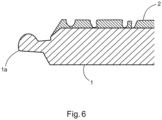
- Fig. 6 an embodiment of such a workpiece is shown.
- a workpiece 1 is shown in the form of a pre-milled plank with a layer 2 applied to the workpiece surface.
- the workpiece 1 has a connecting element 1a, which here can engage as a tongue in the sense of a tongue-and-groove connection in a groove of another workpiece in order to join several workpieces together, for example as a floor covering.
- a connecting element 1a can engage as a tongue in the sense of a tongue-and-groove connection in a groove of another workpiece in order to join several workpieces together, for example as a floor covering.
- the method can preferably also be used for surfaces outside the floor covering, e.g. for furniture, wall, ceiling surfaces or for external facade elements or other applications.
- the fluid flow hits the surface of the layer and/or the manipulation means in a correspondingly shaped manner, so that it extends over the entire width of the layer.
- the length of the extension of the impact surface of the fluid stream in the direction of movement of the workpiece is preferably 1% to 20%, particularly preferably 5% to 15%, in particular 10% to 12%, of the length of the extension of the fluid stream transverse to the direction of movement.
- the thinnest possible fluid flow is therefore preferably used, particularly in the sense of an “air blade” or an “air knife”.
- a liquid stream, in particular containing water can also be used as the fluid stream.
- the fluid flow hits the layer and/or the manipulation means at an angle that is less than 45°, preferably less than 30°, particularly preferably less than 15°.
- a shallow flow makes sense in order to achieve detachment from the layer, for example only that should be used as a means of manipulation.
- a steeper adjustment of the fluid flow may also make sense, for example in order to blow out manipulation agent contained in depressions in the layer.
- the angle is preferably changed while the method is being carried out, particularly preferably changed periodically. The change can preferably also take place depending on the currently detected amount of the removed manipulation agent. This quantity is preferably recorded by a detection device which, for example, detects the weight of the manipulation device that has been removed.
- the fluid stream can also impinge on the surface of the layer through so-called rotation nozzles.
- the rotating nozzles which direct the fluid flow onto the surface, rotate about a central axis, with a total diameter of the rotating nozzles of preferably 2-120 mm, particularly preferably 5-50 mm. This directs a time-variable fluid flow onto the surface.
- the fluid stream preferably also contains solids which improve the removal of parts of the layer.
- solids which improve the removal of parts of the layer.
- sand or a comparable substance can be contained here, which additionally acts on the surface of the layer and/or the manipulation agent in addition to the fluid flow.
- the fluid flow can also be used to remove material from the layer in addition to the manipulation means.
- the solids preferably have a diameter of 0.0001 to 1 mm, preferably 0.001 to 0.5 mm, particularly preferably 0.005 to 0.3 mm.
- the solid bodies are designed to liquefy or evaporate after hitting the layer and/or the manipulation agent.
- This can be achieved, for example, by the solids having the property of evaporating at the ambient temperature to which the workpiece with the layer is exposed.
- this can be achieved using solids made from dry ice.
- These can be applied in particular to the surface of the layer and/or the surface using a dry ice blaster Manipulation means can be applied. This advantageously ensures that the solids do not remain on and/or in the layer. This means that there is no need to subsequently remove the solids from the layer.
- the solid bodies are exposed to a liquid, in particular water, during the generation of the fluid flow. This ensures that the mass of the solids increases, so that the effect on the surface of the layer and/or the manipulation agent is increased.
- the application can take place, for example, by moving the solid bodies with the fluid flow through a mist of the liquid. As a result, the solids act as condensation nuclei to which components of the mist adhere, which ultimately results in the liquid being applied to the solid.
- the solids can specifically include sand grains, dry ice (solid CO2), water ice (frozen water), sodium bicarbonate, or mixtures of these solids.
- the layer and/or the manipulation means are preferably designed to be polymerizable using electromagnetic radiation.
- the applied manipulation agent can also be completely or partially removed together with the last step (removing parts of the layer).
- the manipulation agent preferably comprises water.
- the manipulation agent consists exclusively of water.
- the layer and/or the manipulation agent preferably has acrylate-containing material.
- the workpiece When carrying out the method, the workpiece is preferably moved in a direction of movement and is thus fed one after the other to elements of a device which are designed to carry out the individual method steps. Alternatively or additionally, it can also be provided that the elements of the device move in relation to the workpiece.
- the method can, for example, be carried out in such a way that the layer is applied in liquid form to the surface of the workpiece.
- the manipulation agent is then applied onto and/or into the layer.
- the method can also be designed in such a way that the manipulation agent is first applied to the surface of the workpiece.
- the layer is then applied.
- the manipulation means here preferably acts as a placeholder so that areas of the surface of the workpiece do not come into contact with the layer. If the manipulation agent is removed after the layer has hardened, these points remain as depressions or recesses in the layer.
- the manipulation agent is applied both before and after the layer is applied. It is also possible to repeat the application of the layer and/or the manipulation agent several times. If the manipulation agent is used as a placeholder, the manipulation agent is preferably hardened before the liquid layer is applied.
- the liquid layer Before the manipulation agent is applied, the liquid layer can be dried or hardened, preferably with electromagnetic radiation with a wavelength of 200 to 400 nm, in order in particular to influence the viscosity of the liquid layer.
- the manipulation agent is preferably applied to parts of the liquid layer.
- the manipulation agent and the at least partially liquid layer are irradiated with electromagnetic radiation, preferably with a wavelength of 180 to 400 nm.
- Curing can also be carried out several times. For example, an initial hardening of the layer can be carried out at least until it is partially hardened before the manipulation agent is applied. In this way, a desired viscosity of the layer can be specifically set so that, for example, a structure that is created by the application of the manipulation agent lasts for a desired time before the structure melts again.
- the curing includes irradiation of the layer and/or the manipulation means with electromagnetic radiation, preferably with UV radiation, and/or irradiation with electron beams.
- Hardening can preferably take place at the same time as parts of the layer are removed.
- the location of the layer that is currently in contact with the contact element can be simultaneously irradiated with UV radiation, which causes the curing. The same applies to all mechanical or non-contact removal options, as described above.
- the manipulation means that covers portions of the layer may cause the covered portion of the layer to not cure to the same extent as exposed portions upon curing. This can in particular involve the curing methods described here. After parts of the layer have been removed, a final hardening of the remaining layer and/or the remaining manipulation agent is then preferably carried out.
- curing includes active and/or passive drying.
- Active drying is understood to mean any type of drying in which the liquid layer is dried by creating special conditions.
- the liquid layer and/or the manipulation means can be dried in particular by flowing with a fluid, in particular with air, and/or by supplying heat, in particular by means of IR radiation or by using a heater.
- Passive drying is preferably characterized in that the liquid layer and/or the manipulation agent alone and hardens without further processing. This can be done, for example, by transporting the workpiece on a free section of a belt transport and/or by placing the workpiece down.
- Hardening is preferably carried out by means of reaction hardening, for example by a two-component system, which hardens within less than 30 minutes, preferably less than 5 minutes, by chemical reaction between the components of the layer and/or the manipulation agent.
- the layer is cured in such a way that the viscosity of the locations of the layer where the manipulation agent was applied differs from the viscosity of the locations where the manipulation agent was not applied.
- the difference preferably corresponds to at least a factor of 1.5, particularly preferably at least a factor of 2.
- the viscosity is preferably lower at points where the manipulation agent was applied than at points where the manipulation agent was not applied. In the case of radiation curing, this is due to the fact that the layer below the manipulation agent was at least partially shielded from the radiation, as a result of which the layer was exposed to a lower level of radiation and therefore cured less strongly.
- the hardening of the layer is carried out after parts of the layer have been removed until the layer has finally hardened.
- the layer is at least partially cured before the manipulation agent is applied.
- the manipulation agent can also be at least partially hardened, with electromagnetic radiation, in particular UV radiation, preferably being used for this purpose.
- the curing is preferably carried out as described above.
- the liquid layer is preferably applied to the workpiece using a digital and/or analogue method.
- the liquid layer is particularly preferably applied to the entire surface of the workpiece.
- the application can be carried out using an applicator roller or a casting machine, which creates a liquid curtain of the material of the layer through which the workpiece is moved.
- An applicator roller and a casting machine have the advantage that the layer can be applied to the widest possible area of the workpiece with relatively little effort.
- the application is carried out using digital printing technology, for example with a digital print head or digital nozzle bar. This means that the layer can only be applied to partial areas of the workpiece.
- the manipulation agent is preferably applied to the workpiece and/or to the liquid layer using a digital method.
- Digital printing technology is used for this, for example with a digital print head or digital nozzle bar. This means that the manipulation agent to be applied can be used particularly economically and precisely.
- analog technology such as a casting device, is also conceivable.
- the application of the manipulation agent comprises applying the manipulation agent in the form of droplets and/or in the form of fine droplets.
- the application of the manipulation agent in the form of droplets to the layer is preferably carried out in such a way that the droplet speed and/or the droplet volume are controlled in such a way that depressions are introduced into the layer by the droplets, the depressions preferably having a depth of preferably 2 ⁇ m to 100 ⁇ m, particularly preferably from 3 ⁇ m to 50 ⁇ m.
- the release of the fine droplets is preferably controlled in such a way that their momentum when striking the surface of the liquid layer is not sufficient to at least partially overcome the surface tension and/or the viscosity forces of the liquid layer, so that the fine droplets preferably rest on the surface of the liquid layer come to rest in a liquid layer.
- the manipulation agent is particularly preferred in the form of fine droplets as a mist on the surface of the Layer applied so that it forms in particular closed areas that cover the surface of the layer.
- the fine droplets in particular have a volume of 0.1 ⁇ l to 1 ⁇ l, preferably from 0.3 ⁇ l to 0.8 ⁇ l, particularly preferably from 0.5 to 0.6 ⁇ l.
- the droplets in particular have a volume of 1 ⁇ l to 80 ⁇ l, preferably from 3 ⁇ l to 12 ⁇ l, particularly preferably from 5 ⁇ l to 10 ⁇ l.
- the speed of the droplets and/or the fine droplets is in particular between 0.5 m/s and 12 m/s, preferably between 3 m/s and 7 m/s, particularly preferably between 5 m/s and 6 m/s.
- the speed and/or the volume of the droplets and/or the fine droplets can be varied.
- the release of the droplets is preferably controlled in such a way that their impulse when striking the surface of the liquid layer is sufficient to at least partially overcome the surface tension and/or the viscosity forces of the liquid layer, so that the droplets displace the liquid layer, whereby depressions and in particular a structure with a height difference of 10 to 50 ⁇ m can be introduced into the liquid layer.
- the manipulation means is designed to at least partially absorb incident electromagnetic radiation, with preferably at least 10%, particularly preferably at least 30%, in particular at least 50% of the incident electromagnetic radiation being absorbed. In this way, it is possible to at least partially shield the surface of the layer from electromagnetic radiation, so that, particularly when the liquid layer hardens, the electromagnetic radiation has different effects on the surface of the layer. At the locations of the layer that are covered with the manipulation agent, the electromagnetic radiation has a weaker effect compared to exposed locations.
- So can, for example, a wavelength of less than 300 nm, preferably less than 250 nm, particularly preferably less than 200 nm is used, a microfold is generated on the surface of the layer, which is weaker at the locations of the layer that are covered with the manipulation agent than at the exposed locations. As a result, the areas that were not covered will appear optically duller than the areas that were covered with the manipulation agent during this irradiation.
- a wavelength of 185 nm is specifically used here.
- the irradiation preferably takes place in a protective gas atmosphere, in particular in an N 2 atmosphere.
- the manipulation means and the layer are designed not to bond to one another during curing. This makes it much easier to remove the manipulation agent, particularly without leaving any residue.
- a device according to claim 15 is provided.
- the device can in particular have device features or designs that were described above in the explanation of the method.
- the transport device preferably has a belt transport on which the workpiece can be transported to the other elements of the device. Alternatively or additionally, it can also be provided that at least one of the elements of the device is moved to the workpiece.
- the curing device preferably has a radiation source for electromagnetic radiation, the wavelength of the emitted radiation preferably being changeable.
- the radiation emitted is particularly preferably UV radiation.
- the curing device preferably has a blower which is designed to blow a fluid stream, in particular an air stream, onto the layer and/or onto the manipulation agent in order to dry the layer and/or manipulation agent.
- a blower which is designed to blow a fluid stream, in particular an air stream, onto the layer and/or onto the manipulation agent in order to dry the layer and/or manipulation agent.
- the removal device for mechanical removal has a contact element which is designed to come into contact with the surface of the layer and/or the manipulation means in order to remove parts of the layer.
- the removal device has a nozzle which is designed to allow a fluid stream, preferably an air stream, to flow onto the surface of the layer in order to remove the part of the layer, in particular the manipulation agent.
- the fluid flow is preferably designed as described above.
- the nozzle is preferably designed to be movable in order to be able to vary the angle at which the fluid flow hits the surface of the layer.
- the removal device preferably has a suction device which is designed to suck the manipulation agent from the layer by means of negative pressure and/or to suck up parts of the layer that have already been loosened, in particular the manipulation agent.
- the suction device preferably has a suction nozzle, which is particularly preferably designed to be movable and can be approached to the surface of the layer in order to suck up the manipulation agent.
- the device preferably has a chamber in which at least the nozzle and/or the suction nozzle are provided in order to collect loosened parts of the manipulation agent.
- the removal device has a heating device which is designed to heat the surface of the layer and/or the manipulation means.
- the heating device can alternatively or additionally be designed to transfer heat to the contact element in order to prevent or reduce clogging of the contact element, as described above. It can also be provided that the contact element has the heating device.
- the heating device preferably has an IR radiator.
- the contact element preferably has a stationary and/or moving brush and/or a grinding and/or a planing element.
- the contact element in particular the brush, has textile and/or plastic fibers, in particular nylon fibers, and/or metal, in particular steel, brass or copper. Otherwise, the contact element can be designed as described above.
- the contact element can also have fibers that contain an abrasive.
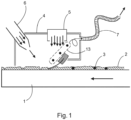
- Fig. 1 shows an embodiment of the invention in which parts of the layer, here specifically the manipulation means, are removed fluidly.
- a flat workpiece 1 is shown, which is moved from right to left in the drawing.
- the workpiece 1 is coated with a liquid layer 2, which forms the surface of the workpiece 1 after it has completely hardened.
- a manipulation agent 3 has been introduced into the liquid layer 2 at some points in order to displace the liquid layer 2.
- the workpiece 1 is moved into a chamber 4, for example by a transport device of a device according to the invention.
- the chamber 4 initially has a curing device 5 in the direction of movement, which comprises a UV radiation source which emits UV radiation onto the liquid layer 2 in order to harden it, so that the viscosity of the layer 2 changes.
- the UV radiation has a wavelength of 200 to 400 nm.
- the workpiece 1 is then fed to a nozzle 6, which emits a fluid flow at an angle to the surface of the layer 2 against the direction of movement of the workpiece 1.
- the angle is a maximum of 45° or less.
- the angle is preferably adjusted between 0° and 45°. This adjustment can take place, for example, depending on the manipulation means that has been removed.
- the fluid flow is designed through the nozzle 6 in such a way that it exerts a flow pressure on the manipulation means 3 which is so high that the manipulation means 3 separates from the layer 2 as part 13 of the layer 2.
- the loosened parts 13 of the manipulation means 3 (framed in dashed lines) are then driven to the right, where they are collected by a suction device 7 using negative pressure and removed from the chamber 4.
- the fluid flow is designed such that it extends over the entire width of the workpiece 1, ie in an extension direction of the workpiece 1 perpendicular to the plane of the drawing. This way is ensures that all parts of the manipulation means 3 are captured by the fluid flow, which makes the targeted flow on individual areas of the surface of the layer 2 unnecessary, especially when the manipulation means 3 is introduced chaotically or irregularly.
- the fluid used here is a liquid or a gaseous substance.
- water and/or air can also be used as fluid.
- Fig. 2 shows an embodiment of the invention in which parts of the layer are removed mechanically.
- a flat workpiece 1 is shown, which is moved from left to right in the drawing.
- the workpiece 1 is coated with a liquid layer 2, which forms the surface of the workpiece 1 after it has completely hardened.
- a manipulation agent 3 has been introduced into the liquid layer 2 at some points in order to displace the liquid layer 2.
- the workpiece 1 is moved, for example, by a transport device of a device according to the invention.
- a suction device 7 is initially arranged, which is designed to suck up loosened parts 13 of the layer 2, in particular the loosened manipulation agent 3, by means of negative pressure.
- the suction nozzle of the suction device 7 is aligned near the surface of the layer 2.
- a brush 8, which is designed as a roller brush, is arranged downstream of the suction device 7. This extends perpendicular to the drawing plane transversely to the direction of movement of the workpiece 1. In this embodiment, the roller brush is rotated in the opposite direction to the direction of movement of the workpiece 1.
- the suction device 7 also has a radiation source 12. This is designed to emit electromagnetic radiation, such as UV radiation, to harden the sucked-up parts 13 of layer 2, whereby the parts 13 are hardened within the suction device 7, so that they do not run the risk of sticking within the suction device 7 and this to add.
- parts 13 of the layer 2, in particular the manipulation means 3, are brushed out of the layer 2 and transported in the direction of the suction device 7. This picks up the loosened parts 13 (framed in dashed lines).
- a further radiation source 12a is shown, since it is designed to emit electromagnetic radiation, in particular UV radiation, onto the brush 8 in order to harden and/or embrittle material adhering to parts of the layer 2 in order to clean the brush 8, as described above.
- Fig. 3 shows an embodiment of brushes for mechanically removing parts of the layer.
- a workpiece 1 and several brushes 8 are shown in plan view.
- the workpiece 1 is moved from left to right under the brushes 8.
- the brushes 8 are designed here as plate brushes which rotate about a respective axis in the rotation directions 9 shown. If the workpiece 1, on which there is a layer with or without a manipulation means (both not shown), is moved under the brushes 8, parts of the layer, in particular the manipulation means, are mechanically affected by contact with the brushes moving relative to the workpiece 1 8 removed.
- the rotational movement of the brushes 8 adds a further relative movement component to the relative movement between the workpiece 1 and the brushes 8, so that the force with which the bristles of the brushes 8 act on the layer or on the manipulation means is increased.
- Fig. 4 shows a further embodiment of brushes for mechanically removing parts of the layer, in particular the manipulation agent.
- a workpiece 1 with a layer with or without a manipulation agent (both not shown) and a brush band are shown in a side view.
- the Workpiece 1 is moved from left to right.
- the brush belt is filled with several brushes 8.
- the brush belt rotates cyclically in the rotation direction 10 shown, so that the brushes 8, which are currently located on the underside of the brush belt, move from right to left against the movement of the workpiece 1.
- a further relative movement component is added here, so that the force with which the bristles of brushes 8 act on the layer or on the Manipulation means act, is increased.
- Fig. 5 shows a further embodiment of brushes for mechanically removing parts of the layer, in particular the manipulation agent.
- a workpiece 1 is shown in plan view, which is moved from left to right under a beam 11, which has brushes on its side facing the workpiece 1, which are connected to the workpiece 1 or with the layer and/or the manipulation means on it (both not shown) can come into contact.
- the beam 11 extends at least over the entire extent of the workpiece 1, i.e. from top to bottom in the drawing.
- Fig. 7 shows a way to clean the contact element.
- a flat workpiece 1 is shown, which is moved from left to right in the drawing.
- the workpiece 1 is coated with a liquid layer 2, which forms the surface of the workpiece 1 after it has completely hardened.
- a manipulation agent 3 has been introduced into the liquid layer 2 at some points in order to displace the liquid layer 2.
- the workpiece 1 is moved, for example, by a transport device of a device according to the invention.
- a suction device 7 is initially arranged, which is designed to remove parts 13 of layer 2, in particular that, by means of negative pressure dissolved manipulation agents 3 to absorb.
- the suction nozzle of the suction device 7 is aligned near the surface of the layer 2.
- a brush 8, which is designed as a roller brush, is arranged downstream of the suction device 7. This extends perpendicular to the drawing plane transversely to the direction of movement of the workpiece 1. In this embodiment, the roller brush is rotated in the opposite direction to the direction of movement of the workpiece 1.
- the suction device 7 also has a radiation source 12. This is designed to emit electromagnetic radiation, such as UV radiation, to harden the sucked-up parts 13 of layer 2, whereby the parts 13 are hardened within the suction device 7, so that they do not run the risk of sticking within the suction device 7 and this to add.
- the functionality of the brush 8 and the suction device 7 for removing parts 13 of the layer 2, in particular the manipulation means 3, is also the same as the functionality of the embodiment in Fig. 2 identical.
- a radiation source 12a which directs UV radiation onto the brush 8 and thus onto the parts 13 of layer 2 adhering to the bristles of the brush 8, the material of layer 2 and material of the manipulation agent 3 can have, radiates.
- the bristles of the brush 8 hit a scraper edge 14 after they have been irradiated by the radiation source 12a.
- the scraper edge 14 extends to the bottom right in the drawing and has a surface that is shaped in such a way that parts 13 of layer 2 , which have been released from the bristles, are directed towards a suction device 7a, which is located on this surface.
- the suction device 7a is designed to pick up the loosened parts 13 of the layer 2 and suck them off using negative pressure.
- the way in which the cleaning of the brush 8 works is as follows: Within one cycle, ie within one revolution of the brush 8, the bristles of the brush 8 first hit the surface of the layer 2, whereby parts 13 of the layer 2 are removed. Parts 13 that are detached and do not fit into the Bristles of the brush 8 get stuck, are transported by the brush in the direction of the suction device 7, which sucks them up using negative pressure. Parts 13 that have become stuck in the bristles of the brush 8 are irradiated by the radiation source 12a as the brush 8 continues to rotate, causing them to harden. The irradiation of the radiation source 12a can also be so strong that the parts 13 that are stuck in the bristles of the brush 8 become brittle.
- Fig. 8 shows a device in the form of a production line.
- Two workpieces 1 are shown, which are moved one after the other in the direction of movement from left to right.
- a transport device (not shown) is provided for this purpose.
- the workpiece 1 has a liquid layer 2 on its surface.
- a manipulation agent 3 is contained in and/or on the layer 2.
- the following elements are arranged one after the other from left to right in the direction of movement.
- a standing contact element in the form of a brush 15 is arranged, which is designed to come into contact with the surface of the layer 2 in order to mechanically remove parts of the layer 2. What is achieved here in particular is that the manipulation means 3 enclosed in the layer 2 is exposed.
- Downstream of the brush 15 is a radiation source 12, which is designed to emit UV radiation in the direction of the workpiece 1 or the layer 2 in order to at least partially harden the layer 2.
- the chamber 4 initially has a nozzle 6 in the direction of movement, which flows a fluid flow at an angle to the surface of the layer 2 against the direction of movement of the workpiece 1 gives away.
- the angle is a maximum of 90° or less.
- the angle is preferably adjusted between 0° and 30°. This adaptation can take place, for example, depending on the removed material of the manipulation means and/or depending on the removed material of layer 2.
- the fluid stream comprises solids as described above to remove portions 13 of layer 2.
- the chamber also has a suction device 7, which is designed to suck up loosened parts 13 of the layer 2.
- the radiation source 12 behind the nozzle 6 in the direction of movement, which is designed to irradiate the layer 2 with radiation in order to partially harden it, so that the viscosity of the layer 2 changes.
- the radiation can be, for example, UV radiation with a wavelength of 200 to 400 nm.
- the fluid flow is designed such that it extends over the entire width of the workpiece 1, i.e. in an extension direction of the workpiece 1 perpendicular to the plane of the drawing. In this way it is ensured that all areas of layer 2 are covered by the fluid flow.
- the fluid used here is a liquid or a gaseous substance.
- water and/or air can also be used as fluid.
- a contact element with a brush 8 in the form of a roller brush is arranged downstream of the chamber 4.
- the brush 8 is designed to mechanically remove parts of the layer 2.
- material of the parts of the layer 2 that adheres to the bristles can be hardened, for example in order to remove it from the bristles at a scraper edge (not shown), a radiation source 12a is arranged above the brush, which emits, for example, UV radiation onto the brush 8.
- the brush 8 can be cleaned essentially as described Fig. 7 take place.
- a further radiation source 12b is arranged downstream of the brush 8 in the direction of movement. This emits, for example, UV radiation onto the layer 2 and possibly desired manipulation agent 3 in order to carry out final curing.
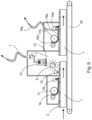
- Fig. 9 shows the removal of parts of layer 2 with preceding and subsequent cleaning of layer 2 with a device in the form of a production line.
- Two workpieces 1 are shown, which are moved from left to right by a transport device with a belt transport 20.
- a layer 2 is applied to the workpieces 1.
- a cleaning agent 16 is first applied to layer 2 using an application device 17, which here has an application roller. This cleaning agent 16 is then at least partially removed again using a scraper 18. Parts of the layer 2 are then removed using a standing contact element 15 and a brush 8, with a UV radiation source 12 being provided to irradiate the brush 8 and the contact element 15 in order to harden material adhering thereto from removed parts of the layer 2 or too brittle. With the help of a suction device 7, these parts 13 are continuously sucked off as described above. In addition, as in Fig. 7 described, a scraper edge (not shown) may be provided.
- the remaining surface 2 remaining on the workpiece 1 is then further cleaned using a cleaning agent 16a, an application device 17a and a device for removing the cleaning agent 16a.
- the device for re-removing the cleaning agent 16a has a scraper 18a, which is in contact with the surface of the layer 2, and a suction device 19a.
- the suction device 19a is designed to suck and remove the cleaning agent 16a, which is retained on the scraper 18a.
- Such a suction device for removing the cleaning agent 16 can also be provided on the first scraper 18.
- Fig. 10 shows a workpiece 1 with a layer 2 on the surface of the workpiece 1, the layer 2 being at least partially hardened and now having areas 2a with a higher degree of hardness and areas 2b with a lower degree of hardness, these areas increasing in hardness by a factor of at least 1.5, preferably of at least 2.
- the workpiece 1 shown here with the layer 2 is further processed, for example, in a surface processing method described above.
- Fig. 11 shows an exemplary flowchart of a procedure.
- a layer is applied to a workpiece, for example as in Fig. 10 shown, generated, with the layer having different degrees of hardness.
- step S12 the workpiece with the layer is moved to a removal device.
- step S14 contact is established between the surface of the layer and a contact element of the removal device.
- a fluid stream with optional solid content is generated, which acts on the surface of the layer, whereby parts of the layer are removed or detached.
- step S16 after contact has been established between the surface of the layer and a contact element according to step S14, a relative movement between the contact element and the surface is carried out, whereby parts of the layer are removed or detached.
- step S18 the detached parts of the surface of the layer are separated from the remaining layer. This can be done, for example, by vacuuming, wiping or blowing off or by another suitable measure.
- step S20 the surface of the layer is cleaned by contact or contactless and/or by using a cleaning agent.
- the process can be further developed by swapping, omitting and/or repeating individual steps and by adding further steps.
- the configuration can be from Fig. 7 into the production line Fig. 8 be integrated in addition, or provided instead of the chamber 4 and/or the brush 8 shown here.
- All nozzles 6 that are in the Figures 1 and 8th shown can be designed to deliver a fluid stream with or without solids, as described above.
- the fluid stream may contain a gas and/or a liquid, specifically including air and/or water.
- the radiation sources shown in all figures can be designed to emit other radiation, such as electron radiation, as an alternative or in addition to electromagnetic radiation, in particular UV radiation.
- the type of radiation and/or the corresponding wavelength are selected depending on the material composition of the layer 2 and/or the manipulation means 3 and/or depending on the desired effect of the radiation on layer 2 and/or the manipulation means 3.
- a different wavelength and/or radiation can be used than in one In the preceding step, only the viscosity of the layer 2 should be changed, for example to prevent the depressions introduced by the manipulation means 3 from running.
- All of the embodiments of the invention shown here, which have at least one brush 8, can also be designed in such a way that the at least one brush 8 is designed to be movable. This means that the at least one brush 8 can be actively moved through a predetermined movement pattern.
- a disc brush can be provided on a pivotable suspension.
Landscapes
- Engineering & Computer Science (AREA)
- Mechanical Engineering (AREA)
- Life Sciences & Earth Sciences (AREA)
- Toxicology (AREA)
- Health & Medical Sciences (AREA)
- Wood Science & Technology (AREA)
- Manufacturing & Machinery (AREA)
- Forests & Forestry (AREA)
- Physics & Mathematics (AREA)
- Plasma & Fusion (AREA)
- Application Of Or Painting With Fluid Materials (AREA)
- Chemically Coating (AREA)
- Turning (AREA)
- Physical Or Chemical Processes And Apparatus (AREA)
- Grinding Of Cylindrical And Plane Surfaces (AREA)
Priority Applications (4)
| Application Number | Priority Date | Filing Date | Title |
|---|---|---|---|
| EP23159373.2A EP4212254A1 (de) | 2019-05-03 | 2019-11-12 | Verfahren und vorrichtung zur oberflächenbearbeitung |
| US16/865,358 US20200346484A1 (en) | 2019-05-03 | 2020-05-03 | Method and device for surface processing |
| CN202080002843.9A CN114174076A (zh) | 2019-05-03 | 2020-05-04 | 用于加工表面的方法和装置 |
| PCT/EP2020/062322 WO2020225215A2 (de) | 2019-05-03 | 2020-05-04 | Verfahren und vorrichtung zur oberflächenbearbeitung |
Applications Claiming Priority (1)
| Application Number | Priority Date | Filing Date | Title |
|---|---|---|---|
| DE102019206431.0A DE102019206431A1 (de) | 2019-05-03 | 2019-05-03 | Verfahren zum Herstellen einer Struktur auf einer Oberfläche |
Related Child Applications (2)
| Application Number | Title | Priority Date | Filing Date |
|---|---|---|---|
| EP23159373.2A Division EP4212254A1 (de) | 2019-05-03 | 2019-11-12 | Verfahren und vorrichtung zur oberflächenbearbeitung |
| EP23159373.2A Division-Into EP4212254A1 (de) | 2019-05-03 | 2019-11-12 | Verfahren und vorrichtung zur oberflächenbearbeitung |
Publications (4)
| Publication Number | Publication Date |
|---|---|
| EP3733308A2 EP3733308A2 (de) | 2020-11-04 |
| EP3733308A3 EP3733308A3 (de) | 2020-12-09 |
| EP3733308B1 true EP3733308B1 (de) | 2023-09-13 |
| EP3733308C0 EP3733308C0 (de) | 2023-09-13 |
Family
ID=68581334
Family Applications (5)
| Application Number | Title | Priority Date | Filing Date |
|---|---|---|---|
| EP19208741.9A Active EP3733308B1 (de) | 2019-05-03 | 2019-11-12 | Verfahren und vorrichtung zur oberflächenbearbeitung |
| EP19208738.5A Active EP3733307B1 (de) | 2019-05-03 | 2019-11-12 | Verfahren und vorrichtung zur erzeugung einer dekorativen oberfläche |
| EP23159373.2A Pending EP4212254A1 (de) | 2019-05-03 | 2019-11-12 | Verfahren und vorrichtung zur oberflächenbearbeitung |
| EP20724447.6A Pending EP3752296A2 (de) | 2019-05-03 | 2020-05-04 | Verfahren zum herstellen einer struktur auf einer oberfläche |
| EP23160613.8A Pending EP4215282A1 (de) | 2019-05-03 | 2020-05-04 | Verfahren zum herstellen einer struktur auf einer oberfläche |
Family Applications After (4)
| Application Number | Title | Priority Date | Filing Date |
|---|---|---|---|
| EP19208738.5A Active EP3733307B1 (de) | 2019-05-03 | 2019-11-12 | Verfahren und vorrichtung zur erzeugung einer dekorativen oberfläche |
| EP23159373.2A Pending EP4212254A1 (de) | 2019-05-03 | 2019-11-12 | Verfahren und vorrichtung zur oberflächenbearbeitung |
| EP20724447.6A Pending EP3752296A2 (de) | 2019-05-03 | 2020-05-04 | Verfahren zum herstellen einer struktur auf einer oberfläche |
| EP23160613.8A Pending EP4215282A1 (de) | 2019-05-03 | 2020-05-04 | Verfahren zum herstellen einer struktur auf einer oberfläche |
Country Status (8)
| Country | Link |
|---|---|
| US (4) | US20200346484A1 (pl) |
| EP (5) | EP3733308B1 (pl) |
| KR (1) | KR102798285B1 (pl) |
| CN (3) | CN114174076A (pl) |
| DE (1) | DE102019206431A1 (pl) |
| ES (2) | ES2964229T3 (pl) |
| PL (2) | PL3733308T3 (pl) |
| WO (3) | WO2020225214A1 (pl) |
Cited By (1)
| Publication number | Priority date | Publication date | Assignee | Title |
|---|---|---|---|---|
| US12565060B2 (en) | 2022-01-24 | 2026-03-03 | Unilin, Bv | Method of manufacturing a panel |
Families Citing this family (15)
| Publication number | Priority date | Publication date | Assignee | Title |
|---|---|---|---|---|
| PL3415316T3 (pl) | 2017-06-13 | 2020-10-05 | Hymmen GmbH Maschinen- und Anlagenbau | Sposób i urządzenie do wytwarzania strukturyzowanej powierzchni |
| WO2019226885A1 (en) * | 2018-05-25 | 2019-11-28 | Corning Incorporated | Methods of modifying a substrate by elastocapillary deformation |
| AU2019333292B2 (en) | 2018-08-30 | 2023-11-23 | Interface, Inc. | Digital printing for flooring and decorative structures |
| DE102019206431A1 (de) | 2019-05-03 | 2020-11-05 | Hymmen GmbH Maschinen- und Anlagenbau | Verfahren zum Herstellen einer Struktur auf einer Oberfläche |
| ES2992587T3 (en) * | 2021-02-26 | 2024-12-16 | Barberan Latorre Jesus Francisco | Method and system for producing a relief on a substrate |
| CN113021192A (zh) * | 2021-03-02 | 2021-06-25 | 超安(广州)五金有限公司 | 一种控制金属原子活动性的节能环保硅片处理设备 |
| DE102021113681A1 (de) | 2021-05-27 | 2022-12-01 | Homag Gmbh | Vorrichtung und Verfahren zum Veredeln eines Werkstücks |
| EP4359168A1 (de) * | 2021-06-25 | 2024-05-01 | Kündig Ag | Reinigung des schleifbandes durch abblasung mittels luftschwert |
| EP4129711A1 (en) | 2021-08-05 | 2023-02-08 | Flooring Industries Limited, SARL | Method for manufacturing a product comprising a decorative surface layer |
| EP4201696A1 (en) | 2021-12-22 | 2023-06-28 | Flooring Industries Limited, SARL | A method of creating a textured layer on a decorative panel |
| IT202200008756A1 (it) | 2022-05-02 | 2023-11-02 | Cefla Soc Cooperativa | Metodo e apparato per formare una struttura superficiale |
| CN120202085A (zh) * | 2022-09-15 | 2025-06-24 | 阿莱恩技术有限公司 | 用于对增材制造对象的表面进行改性的系统和方法 |
| LU504519B1 (en) | 2023-06-15 | 2024-12-16 | Tarkett Gdl Sa | Surface covering panel with transitional edge |
| LU504655B1 (en) | 2023-07-03 | 2025-01-03 | Tarkett Gdl Sa | Decorative surface coverings digitally embossed |
| LU506092B1 (en) | 2024-01-12 | 2025-07-14 | Tarkett Gdl Sa | Three-Dimensional Surface Texturing |
Citations (3)
| Publication number | Priority date | Publication date | Assignee | Title |
|---|---|---|---|---|
| EP1101542A2 (de) * | 1999-11-15 | 2001-05-23 | WANDRES GmbH MICRO-CLEANING | Verfahren und Vorrichtung zum Entfernen von Verunreinigungen von mit Flüssigkeit kontaminierten Oberflächen |
| JP2008246993A (ja) * | 2007-03-30 | 2008-10-16 | Fujifilm Corp | インクジェット記録装置及びインクジェット記録方法 |
| JP2017200740A (ja) * | 2016-05-06 | 2017-11-09 | 株式会社リコー | 液体吐出ユニット及び液体吐出装置 |
Family Cites Families (184)
| Publication number | Priority date | Publication date | Assignee | Title |
|---|---|---|---|---|
| US692701A (en) | 1901-01-15 | 1902-02-04 | Bradley & Hubbard Mfg Co | Lamp-burner. |
| US3308227A (en) | 1964-04-20 | 1967-03-07 | Formica Corp | Process for making embossed laminates |
| US3580768A (en) * | 1967-11-29 | 1971-05-25 | Stanley Kukla | Method of forming decorative three dimensional effect designs and coatings |
| FR2017059A1 (en) | 1968-08-28 | 1970-05-15 | Cartiere Ambrogio Binda Spa | Impregnated paper coatings for wooden surface |
| US3676963A (en) | 1971-03-08 | 1972-07-18 | Chemotronics International Inc | Method for the removal of unwanted portions of an article |
| GB1405643A (en) | 1972-10-26 | 1975-09-10 | Formica Int | Decorative sheet material and process for producing same |
| DE2919847B1 (de) | 1979-05-16 | 1980-10-16 | Lissmann Alkor Werk | Flaechengebilde mit Holzmaserung und Verfahren zu dessen Herstellung |
| US4439480A (en) | 1980-10-01 | 1984-03-27 | Tarkett Ab | Radiation cured coating and process therefor |
| DE3107798A1 (de) | 1981-02-28 | 1982-09-16 | wf rational Anbauküchen GmbH + Co, 4520 Melle | Gedruckte nachbildung von naturholzstreifen und verfahren zur herstellung von eindruecken |
| DE3247146C1 (de) | 1982-12-21 | 1984-03-22 | Held, Kurt, 7218 Trossingen | Verfahren und Vorrichtung zur kontinuierlichen Herstellung von Schichtpress-Stoffen |
| JPS59169575A (ja) * | 1983-03-16 | 1984-09-25 | Kyushu Hitachi Maxell Ltd | 塗料の剥離方法 |
| DE3331391A1 (de) * | 1983-08-31 | 1985-03-07 | Dieter 6636 Berus Schmitt | Verfahren zum herstellen von metallisch wirkenden ueberzuegen auf oberflaechen aus polystyrol |
| US4513299A (en) | 1983-12-16 | 1985-04-23 | International Business Machines Corporation | Spot size modulation using multiple pulse resonance drop ejection |
| DE3510415A1 (de) | 1985-03-22 | 1986-09-25 | Schering AG, 1000 Berlin und 4709 Bergkamen | Verwendung von polyamidharzen fuer den reliefdruck |
| DE3527404C1 (de) | 1985-07-31 | 1987-01-02 | Kurz Leonhard Fa | Verfahren zur Herstellung einer eine texturierte Lackschicht aufweisenden Folie |
| AT387621B (de) | 1987-03-10 | 1989-02-27 | Dana Tuerenindustrie | Verfahren zur herstellung eines tuerblattes mit insbesondere linienartigen verzierungen |
| US5178928A (en) | 1988-09-22 | 1993-01-12 | Dai Nippon Insatsu Kabushiki Kaisha | Decorative materials |
| EP0372097A1 (de) | 1988-11-30 | 1990-06-13 | Siemens Aktiengesellschaft | Anordnung zum Erzeugen von Tintentröpfchen unterschiedlicher Grösse in einer Tintendruckeinrichtung |
| JPH03503138A (ja) | 1989-06-12 | 1991-07-18 | ゼネラル・エレクトリック・カンパニイ | 平担な基体にコーティングを施すためのラミナインプレッサ |
| DE69119743T2 (de) * | 1991-02-20 | 1997-01-23 | Agfa Gevaert Nv | System zur Herabsetzung der Verschmutzung von Trägerwalzen und/oder Trägerbändern |
| ES1018178Y (es) | 1991-05-03 | 1992-08-01 | Barberan, S.A. | Equipo de recuperacion y limpieza para el transportador de una instalacion de proyeccion de tintes o barnices. |
| DE4139961A1 (de) | 1991-12-04 | 1993-06-09 | Basf Ag, 6700 Ludwigshafen, De | Traenkharzloesung zum impraegnieren von papierbahnen |
| JPH0767800B2 (ja) * | 1991-12-16 | 1995-07-26 | ニッカ株式会社 | 印刷シリンダの洗浄装置 |
| JP3133476B2 (ja) * | 1992-04-03 | 2001-02-05 | 大日本印刷株式会社 | エンボス版、該エンボス版を用いて製造した化粧材及び該エンボス版の製造方法 |
| JPH0775889B2 (ja) * | 1992-10-06 | 1995-08-16 | 日本ボールドウィン株式会社 | シリンダ洗浄装置 |
| US5621022A (en) * | 1992-11-25 | 1997-04-15 | Tektronix, Inc. | Use of polymeric dyes in hot melt ink jet inks |
| JPH06270372A (ja) | 1993-03-17 | 1994-09-27 | Dainippon Printing Co Ltd | 凹凸模様を有する化粧材 |
| US5498460A (en) * | 1993-03-24 | 1996-03-12 | Tingley; Daniel A. | Surface treated synthetic reinforcement for structural wood members |
| DE4421559C2 (de) | 1994-06-20 | 1998-05-20 | Osmetric Entwicklungs Und Prod | Verfahren zum Herstellen einer Beschichtung, die eine Struktur aufweist, auf einem Substrat sowie Beschichtung |
| DE69535997D1 (de) | 1994-12-29 | 2009-10-08 | Canon Kk | Tintenstrahlkopf mit verschiedenen Heizelementen pro Düse und Tintenstrahldrucker unter Verwendung desselben |
| DE19532819A1 (de) | 1995-09-06 | 1997-03-13 | Hofa Homann Verwaltungsgesells | Verfahren zur Herstellung einer Holzwerkstoffplatte |
| JPH09323434A (ja) | 1996-04-02 | 1997-12-16 | Toray Ind Inc | 建材のプリント装置及びプリントずみ建材の製造方法 |
| JP3122370B2 (ja) * | 1996-05-29 | 2001-01-09 | 株式会社伸興 | 除塵装置 |
| AU4155097A (en) | 1996-08-27 | 1998-03-19 | Topaz Technologies, Inc. | Inkjet print head for producing variable volume droplets of ink |
| DE69735512T8 (de) | 1996-09-09 | 2007-02-15 | Seiko Epson Corp. | Tintenstrahldrucker und Tintenstrahldruckverfahren |
| US5779779A (en) | 1996-09-27 | 1998-07-14 | Dataproducts Corporation | UV-blocking hot melt inks |
| SE9703281L (sv) | 1997-09-11 | 1999-03-12 | Perstorp Ab | Förfarande för framställning av härdplastlaminat |
| DE19810455C2 (de) | 1998-03-11 | 2000-02-24 | Michael Bisges | Kaltlicht-UV-Bestrahlungsvorrichtung |
| DE69924490T2 (de) | 1998-06-22 | 2006-01-19 | Ciba Speciality Chemicals Holding Inc. | Poly-trisaryl-1,3,5-triazin-carbamate als uv-lichtabsorber |
| US6150009A (en) | 1998-08-07 | 2000-11-21 | Surface Technologies, Inc. | Decorative structural panel |
| GB9825359D0 (en) | 1998-11-20 | 1999-01-13 | Xaar Technology Ltd | Methods of inkjet printing |
| US6120845A (en) | 1999-01-20 | 2000-09-19 | Pease; Scott Norton | Method for applying a decorative finish to the surface of an object |
| JP3223901B2 (ja) | 1999-01-25 | 2001-10-29 | 日本電気株式会社 | インクジェット記録ヘッドの駆動方法及びその回路 |
| US6193361B1 (en) | 1999-06-03 | 2001-02-27 | Eastman Kodak Company | Apparatus for forming textured layers over images |
| IL130458A (en) | 1999-06-14 | 2006-07-05 | Kodak Il Ltd | Digital imaging method for creating the web for use in web printing |
| JP3446686B2 (ja) | 1999-10-21 | 2003-09-16 | セイコーエプソン株式会社 | インクジェット式記録装置 |
| US8209928B2 (en) | 1999-12-13 | 2012-07-03 | Faus Group | Embossed-in-registration flooring system |
| SE516696C2 (sv) | 1999-12-23 | 2002-02-12 | Perstorp Flooring Ab | Förfarande för framställning av ytelement vilka innefattar ett övre dekorativt skikt samt ytelement framställda enlit förfarandet |
| US6431676B2 (en) | 2000-01-28 | 2002-08-13 | Seiko Epson Corporation | Generation of driving waveforms to actuate driving elements of print head |
| EP1149712A1 (fr) | 2000-04-25 | 2001-10-31 | Tarkett Sommer S.A. | Procédé de production de revêtements de sols et de murs à effet de décor de brillance différentiel et produits obtenus |
| DE06075877T1 (de) | 2000-06-13 | 2007-02-08 | Flooring Industries Ltd. | Fußbodenbelag |
| DE10031030B4 (de) | 2000-06-26 | 2005-08-04 | Bauer, Jörg R. | Verfahren und Vorrichtung zum Herstellen flächiger Bauteile mit vorbestimmtem Oberflächenaussehen und flächiges Bauteil, insbesondere Frontplatte eines Küchenelements |
| DE10035961A1 (de) | 2000-07-24 | 2002-02-07 | Basf Ag | Verfahren zum Beschichten von Substraten |
| GB2367788A (en) | 2000-10-16 | 2002-04-17 | Seiko Epson Corp | Etching using an ink jet print head |
| WO2002042087A2 (en) * | 2000-11-13 | 2002-05-30 | Imaging Alternatives, Inc. | Wood surface inkjet receptor medium and method of making and using same |
| ITPS20010006A1 (it) | 2001-02-23 | 2002-08-23 | Canti & Figli Srl | Procedimento e macchina atti ad ottenere goffrature su superfici verniciate di pannelli o di pellicole di rivestimento ed elementi ottenuti |
| DE10134188A1 (de) | 2001-07-13 | 2003-01-23 | Heidelberger Druckmasch Ag | Tintenstrahl-Drucksystem |
| JP3996418B2 (ja) | 2002-03-28 | 2007-10-24 | アトミクス株式会社 | 塗膜層の作製方法 |
| KR20100013351A (ko) | 2002-04-03 | 2010-02-09 | 메이소나이트 코오포레이션 | 물품에 상을 만드는 방법 및 장치 그리고 인쇄된 물품 |
| KR100455546B1 (ko) | 2002-04-19 | 2004-11-06 | 신현덕 | 인쇄 나무 마루판 |
| US7067241B2 (en) | 2002-05-08 | 2006-06-27 | Unaxis Balzers Aktiengesellschaft | Method for producing a unit having a three-dimensional surface patterning, and use of this method |
| DE10224128A1 (de) | 2002-05-29 | 2003-12-18 | Schmid Rhyner Ag Adliswil | Verfahren zum Auftrag von Beschichtungen auf Oberflächen |
| JP4157336B2 (ja) | 2002-07-15 | 2008-10-01 | 東芝テック株式会社 | インクジェット記録装置 |
| DE60200552T3 (de) | 2002-07-26 | 2012-02-09 | Banque Nationale De Belgique S.A. | Verfahren um latente Bilder zu drucken |
| JP4689155B2 (ja) | 2002-08-29 | 2011-05-25 | 株式会社半導体エネルギー研究所 | 半導体装置の作製方法 |
| US20040086678A1 (en) | 2002-11-01 | 2004-05-06 | Chen Hao A. | Surface covering panel |
| EP1449667A1 (en) | 2003-02-21 | 2004-08-25 | Agfa-Gevaert | Method and device for printing grey scale images |
| DE10310199B4 (de) | 2003-03-06 | 2007-09-20 | Kronotec Ag | Holzfaserplatte und Verfahren zu deren Herstellung |
| DE10316695B4 (de) | 2003-04-10 | 2006-12-28 | Theodor Hymmen Holding Gmbh | Verfahren und Vorrichtung zur Herstellung eines Laminats |
| US7419716B2 (en) | 2003-05-30 | 2008-09-02 | Awi Licensing Company | Multiple gloss level surface coverings and method of making |
| US7470455B2 (en) | 2003-11-18 | 2008-12-30 | Art Guitar, Llc | Decorating guitars |
| CA2568440C (en) | 2004-05-28 | 2015-05-05 | Kronotec Ag | Panel made of a wooden material with a surface coating |
| KR20060004828A (ko) | 2004-07-10 | 2006-01-16 | (주)아도니스마루 | 마루판 및 그 제조방법 |
| ES2545665T3 (es) | 2004-10-05 | 2015-09-14 | Fritz Egger Gmbh & Co. Og | Procedimiento para producir una superficie estructurada y una placa con una superficie estructurada |
| US20060075917A1 (en) | 2004-10-08 | 2006-04-13 | Edwards Paul A | Smooth finish UV ink system and method |
| DE602005007675D1 (de) | 2004-10-29 | 2008-08-07 | Agfa Graphics Nv | Druck der strahlungshärtbaren Tinten in eine flüssige strahlungshärtbare Schicht |
| CA2586744A1 (en) | 2004-12-16 | 2006-06-22 | Flooring Industries Ltd. | Floor panel imitating a wood pattern on its surface and method for manufacturing |
| DE102005003839A1 (de) | 2005-01-27 | 2006-08-03 | Koenig & Bauer Ag | Sicherheitsmarkierung |
| WO2006080362A1 (ja) | 2005-01-27 | 2006-08-03 | National University Corporation Hokkaido University | ハニカム構造体の製造方法 |
| BE1016464A3 (nl) * | 2005-02-23 | 2006-11-07 | Flooring Ind Ltd | Werkwijze voor het vervaardigen van vloerpanelen, alsmede vloerpaneel dat door middel van zulke werkwijze is verkregen. |
| JP4720226B2 (ja) | 2005-03-15 | 2011-07-13 | 富士ゼロックス株式会社 | 液滴吐出記録ヘッドの駆動方法及び液滴吐出記録装置 |
| JP4631506B2 (ja) | 2005-03-30 | 2011-02-16 | セイコーエプソン株式会社 | 液体噴射装置 |
| US7575293B2 (en) | 2005-05-31 | 2009-08-18 | Xerox Corporation | Dual drop printing mode using full length waveforms to achieve head drop mass differences |
| GB0517931D0 (en) | 2005-09-02 | 2005-10-12 | Xaar Technology Ltd | Method of printing |
| RU2306228C2 (ru) | 2005-10-19 | 2007-09-20 | Производственное общество с ограниченной ответственностью "ФОКС" | Способ получения декоративного изображения |
| JP2007175962A (ja) | 2005-12-27 | 2007-07-12 | Fujifilm Corp | 撥液性構造体およびその製造方法、液体吐出ヘッドならびに保護フィルム |
| DE102006003798A1 (de) | 2006-01-25 | 2007-07-26 | Man Roland Druckmaschinen Ag | Verfahren und Einrichtung zum Erzeugen von betrachtungswinkelabhängig veränderbaren Bildeffekten auf einen Bedruckstoff |
| FI20065083A0 (fi) | 2006-02-03 | 2006-02-03 | Upm Kymmene Wood Oy | Menetelmä puulevyn pinnoittamiseksi ja puulevy |
| US7384568B2 (en) * | 2006-03-31 | 2008-06-10 | Palo Alto Research Center Incorporated | Method of forming a darkfield etch mask |
| US7918062B2 (en) | 2006-06-08 | 2011-04-05 | Mannington Mills, Inc. | Methods and systems for decorating bevel and other surfaces of laminated floorings |
| JP4907419B2 (ja) | 2006-06-21 | 2012-03-28 | 富士フイルム株式会社 | インクジェット記録方法及びインクジェット記録装置 |
| ITMI20061227A1 (it) | 2006-06-26 | 2007-12-27 | Dante Frati | Procedimento per stampare superfici di elementi piani a base di legno |
| CN100548602C (zh) | 2006-08-17 | 2009-10-14 | 宁波大榭开发区达因圣马克家俱有限公司 | 一种装饰板的加工方法 |
| DE102006042063B4 (de) | 2006-09-05 | 2022-04-07 | Wilhelm Taubert GmbH | Verfahren zur Einstellung des Glanzgrades und der Haptik von dekorativen und funktionellen Oberflächen |
| JP4903618B2 (ja) | 2006-09-25 | 2012-03-28 | 富士フイルム株式会社 | インクジェット記録方法及びインクジェット記録装置 |
| JP4813413B2 (ja) | 2006-09-28 | 2011-11-09 | 富士フイルム株式会社 | インクジェット記録方法及びインクジェット記録装置 |
| JP4907414B2 (ja) | 2006-09-29 | 2012-03-28 | 富士フイルム株式会社 | インクジェット記録方法及びインクジェット記録装置 |
| JP2008093910A (ja) | 2006-10-10 | 2008-04-24 | Hokusan Kk | インクジェット印刷されてなる化粧材 |
| PL1911594T3 (pl) | 2006-10-12 | 2013-10-31 | Agfa Graphics Nv | Sposób działania głowicy drukującej do drukowania atramentowego |
| US7988247B2 (en) | 2007-01-11 | 2011-08-02 | Fujifilm Dimatix, Inc. | Ejection of drops having variable drop size from an ink jet printer |
| EP1952998B1 (en) | 2007-02-01 | 2011-04-06 | FUJIFILM Corporation | Ink-jet recording device |
| EP1955858B1 (en) | 2007-02-06 | 2014-06-18 | FUJIFILM Corporation | Ink-jet recording method and device |
| BE1018432A5 (nl) | 2007-03-14 | 2010-11-09 | Flooring Ind Ltd | Werkwijzen voor het vervaardigen van laminaat, inrichting hierbij aangewend, laminaat hierbij verkregen, werkwijze voor het ommantelen van substraten en ommanteld substraat hierbij verkregen. |
| JP2008254237A (ja) | 2007-04-02 | 2008-10-23 | Toppan Cosmo Inc | 化粧材 |
| DE102007019871A1 (de) * | 2007-04-25 | 2008-10-09 | Theodor Hymmen Holding Gmbh | Verfahren und Vorrichtung zur Erzeugung einer dünnen dreidimensional strukturierten Oberfläche auf plattenförmigen Werkstoffen |
| ES2564242T3 (es) | 2007-05-10 | 2016-03-21 | Homag Holzbearbeitungssysteme Ag | Procedimiento y dispositivo para el revestimiento de una superficie |
| CN101314981A (zh) | 2007-05-29 | 2008-12-03 | 汪宏伟 | Uv饰面装饰板及其制作工艺 |
| CN101342844B (zh) | 2007-07-10 | 2013-06-19 | 豪迈木材加工系统公司 | 工件表面装饰装置 |
| JP4898618B2 (ja) | 2007-09-28 | 2012-03-21 | 富士フイルム株式会社 | インクジェット記録方法 |
| CA2641119C (en) * | 2007-10-16 | 2015-12-22 | Dallaire Industries Ltd. | Method of texturing synthetic material extrusions |
| DE202007014736U1 (de) | 2007-10-19 | 2007-12-20 | Robert Bürkle GmbH | Vorrichtung zum Herstellen einer strukturierten Oberfläche einer lackierten Werkstoffplatte |
| DE102007055053A1 (de) | 2007-11-16 | 2009-05-20 | Hueck Engraving Gmbh & Co. Kg | Verfahren zur Bearbeitung einer strukturierten Oberfläche |
| KR101064427B1 (ko) | 2007-12-20 | 2011-09-14 | (주)엘지하우시스 | 모자이크 인쇄층을 갖는 마루바닥재 |
| JP2009208348A (ja) | 2008-03-04 | 2009-09-17 | Fujifilm Corp | 画像形成装置及び画像形成方法 |
| ES2340456B1 (es) | 2008-03-18 | 2011-02-02 | Jesus Fco. Barberan Latorre | Procedimiento de impresion por inyeccion de tinta sobre substrato humedo. |
| JP4990207B2 (ja) | 2008-03-31 | 2012-08-01 | 富士フイルム株式会社 | 多孔フィルムの製造方法 |
| DE102008024149B4 (de) | 2008-05-19 | 2011-06-22 | Institut für Oberflächenmodifizierung e.V., 04318 | Vorrichtung zur Ermittlung der Faltungskinetik und der Faltungsgeschwindigkeit strahlenhärtbarer Farben und Lacke während des Prozesses der photochemische Mikrofaltung initiiert durch kurzwellige monochromatische Excimer-UV-Strahlung |
| JP4758497B2 (ja) | 2008-07-10 | 2011-08-31 | 株式会社リコー | 洗浄装置及び洗浄方法 |
| JP5016716B2 (ja) | 2008-08-21 | 2012-09-05 | ローランドディー.ジー.株式会社 | インクジェット式記録装置およびコンピュータプログラム |
| JP5294770B2 (ja) | 2008-09-17 | 2013-09-18 | 株式会社秀峰 | 立体感のある色彩被覆の作成方法およびそれによる立体的色彩印刷体 |
| FR2936965A1 (fr) | 2008-10-10 | 2010-04-16 | Commissariat Energie Atomique | Formation de via traversant des couches minces par ejection localisee de liquide immiscible. |
| FR2937181B1 (fr) * | 2008-10-10 | 2011-01-14 | Commissariat Energie Atomique | Structuration en surface de couches minces par ejection localisee de liquide immiscible. |
| PL2181860T3 (pl) | 2008-10-22 | 2013-10-31 | Fritz Egger Gmbh & Co Og | Element konstrukcyjny z materiału drewnianego ze szczególnymi właściwościami haptycznymi oraz sposób wytwarzania takiego elementu konstrukcyjnego |
| KR101679171B1 (ko) | 2008-12-19 | 2016-11-23 | 플로어링 인더스트리즈 리미티드 에스에이알엘 | 코팅 패널 및 이러한 패널의 제조 방법 |
| KR101616593B1 (ko) | 2008-12-19 | 2016-05-12 | 플로어링 인더스트리즈 리미티드 에스에이알엘 | 코팅 패널 및 이러한 패널의 제조 방법 |
| DE102009004482B4 (de) | 2009-01-09 | 2012-03-29 | Fritz Egger Gmbh & Co. | Bauelement aus Holzwerkstoff mit aufgedrucktem Dekor und unterschiedlichem Glanzgrad |
| ES2349527B1 (es) | 2009-03-31 | 2011-10-27 | Tecser Print. S.L.L. | Procedimiento para la impresion con efecto brillante. |
| KR20100120434A (ko) | 2009-05-06 | 2010-11-16 | 엘지이노텍 주식회사 | 다중 금속 증착을 이용한 장식재 및 그 제조 방법 |
| ES2350546B1 (es) | 2009-05-14 | 2011-09-22 | Jesus Francisco Barberan Latorre | Sistema para aplicar barnizados con relieve. |
| FR2946959B1 (fr) | 2009-06-19 | 2014-02-07 | Oreal | Procede de fabrication d'un recipient presentant partiellement un effet de surface |
| US20170333936A1 (en) * | 2009-08-07 | 2017-11-23 | Fas Holdings Group, Llc | Segmented or selected-area coating |
| DE102009043812B4 (de) | 2009-08-19 | 2021-11-25 | Hymmen GmbH Maschinen- und Anlagenbau | Verfahren zum Herstellen einer bedruckten Oberfläche auf einem flächigen Werkstück |
| DE102009040359A1 (de) | 2009-09-07 | 2011-03-10 | Heidelberger Druckmaschinen Ag | Verfahren zum Erzeugen eines drucktechnischen Merkmals auf einem Substrat eines Druckprodukts |
| DE102009044802B4 (de) * | 2009-11-30 | 2017-11-23 | Hymmen GmbH Maschinen- und Anlagenbau | Verfahren und Vorrichtung zur Erzeugung einer dreidimensionalen Oberflächenstruktur auf einem Werkstück |
| JP5097787B2 (ja) * | 2010-02-25 | 2012-12-12 | 東京エレクトロン株式会社 | 塗布装置及びノズル洗浄方法 |
| EP2301762B9 (de) | 2010-03-11 | 2013-12-25 | Flooring Technologies Ltd. | Verfahren und eine Vorrichtung zum Aufbringen einer Struktur auf eine Holzwerkstoffplatte |
| JP5990868B2 (ja) | 2010-04-09 | 2016-09-14 | 株式会社リコー | インクジェット法による膜の作製方法及び膜 |
| DE102010026490A1 (de) | 2010-07-07 | 2012-01-12 | Basf Se | Verfahren zur Herstellung von feinstrukturierten Oberflächen |
| AT510217B1 (de) | 2010-08-13 | 2013-12-15 | Hueck Folien Gmbh | Verfahren zur partiellen mattierung von uv-lackschichten |
| CZ302636B6 (cs) * | 2010-09-10 | 2011-08-10 | Capka@Vlastimil | Zpusob úpravy povrchu plochého skla a zarízení k provádení tohoto zpusobu |
| DE102010052518A1 (de) * | 2010-11-26 | 2012-05-31 | Brillux Gmbh & Co. Kg | Beschichtungsmasse mit Funkeleffekt |
| KR101083320B1 (ko) | 2011-03-11 | 2011-11-14 | 한국기계연구원 | 경화 시스템 및 그 방법 |
| AU2012350466B2 (en) | 2011-12-16 | 2015-11-26 | Herbert Jennissen | Substrate with a structured surface and methods for the production thereof, and methods for determining the wetting properties thereof |
| US8662649B2 (en) * | 2012-01-18 | 2014-03-04 | Xerox Corporation | Method and system for printing recycled ink with process black neutralization |
| JP6127380B2 (ja) | 2012-04-27 | 2017-05-17 | セイコーエプソン株式会社 | 印刷装置及び印刷方法 |
| US10369837B2 (en) | 2012-04-30 | 2019-08-06 | Valinge Innovation Ab | Method for forming a decorative design on an element of a wood-based material |
| US20140017452A1 (en) | 2012-07-13 | 2014-01-16 | Floor Iptech Ab | Digital coating and printing |
| CN103035983B (zh) | 2013-01-06 | 2014-12-03 | 电子科技大学 | 一种太赫兹辐射吸收层及其制备方法 |
| CN105263531B (zh) * | 2013-03-18 | 2018-11-13 | 传感器电子技术股份有限公司 | 紫外线消毒盒 |
| CN103192656A (zh) | 2013-03-29 | 2013-07-10 | 苏州国昊壁纸有限公司 | 一种角度式图案变化仿真装饰膜 |
| DE102013005741B3 (de) | 2013-04-05 | 2014-05-22 | IOT - Innovative Oberflächentechnologien GmbH | Vorrichtung zur Inertisierung bei UV-Bestrahlung in offenen Durchlaufanlagen |
| CN105377521B (zh) | 2013-05-14 | 2018-06-29 | 芬欧汇川集团 | 具有表面粗糙度的复合结构 |
| JP2015046328A (ja) * | 2013-08-28 | 2015-03-12 | 富士フイルム株式会社 | 導光板、これを含むバックライトユニットおよび液晶表示装置、ならびに光学シート |
| EP3038471A1 (en) | 2013-08-30 | 2016-07-06 | Intercontinental Great Brands LLC | Online printing in gum manufacture and products thereof |
| JP6080813B2 (ja) * | 2013-08-30 | 2017-02-15 | キヤノン株式会社 | 光インプリント用組成物、これを用いた、膜の製造方法、光学部品の製造方法、回路基板の製造方法、電子部品の製造方法 |
| PL2857221T3 (pl) | 2013-10-07 | 2018-12-31 | Flooring Technologies Ltd. | Panel z super matową powierzchnią |
| EP2873536B1 (en) | 2013-11-15 | 2020-04-22 | Franco Lastrego | Particular compact small-size emergency tire, for quick mounting to a car wheel having a punctured or possibly irreparably damaged tire |
| EP2873535A1 (de) | 2013-11-15 | 2015-05-20 | Flooring Technologies Ltd. | Werkstücke mit oberflächenstrukturierter Dekoroberfläche |
| US20160297223A1 (en) | 2013-11-29 | 2016-10-13 | Tritron Gmbh | Liquid ink-receiving layers or films for direct ink jet printing or ink printing |
| BE1021743B1 (nl) | 2013-12-10 | 2016-01-14 | Unilin Bvba | Vloerkleding en werkwijze voor het vervaardigen |
| CN103737464A (zh) * | 2013-12-13 | 2014-04-23 | 宋芬 | 毛刷打磨机 |
| DE102013227186B4 (de) | 2013-12-27 | 2016-08-18 | Federal-Mogul Wiesbaden Gmbh | Gleitlackbeschichtung und Gleitlager-Schichtverbundwerkstoff mit einer solchen |
| EP2894047B1 (en) | 2014-01-10 | 2019-08-14 | Unilin, BVBA | Method for manufacturing panels having a decorative surface |
| KR101592735B1 (ko) | 2014-07-14 | 2016-02-12 | 현대자동차주식회사 | 잉크 조성물 및 이를 이용한 엠보 무늬 형성방법 |
| AU2015292702B2 (en) | 2014-07-22 | 2020-03-05 | Sun Chemical Corporation | Digitally printed color swatches with textured effect |
| FR3033506B1 (fr) | 2015-03-11 | 2020-02-21 | Reydel Automotive B.V. | Procede et installation de revetement d'un corps avec formation d'une surface structuree |
| ES2586981B1 (es) | 2015-04-15 | 2017-06-14 | Jesús Francisco Barberán Latorre | Procedimiento de impresión para conseguir un efecto óptico de relieve e instalación para llevar a cabo dicho procedimiento |
| DE102015107259A1 (de) | 2015-05-08 | 2016-11-10 | Robert Bürkle GmbH | Plattenförmiges Werkstück mit einer Oberfläche mit Glanzgradunterschieden, Verfahren zum Erzeugen einer solchen Oberfläche und Anlage zur Durchführung des Verfahrens |
| NO2750604T3 (pl) | 2015-06-25 | 2018-03-03 | ||
| DE102015110268A1 (de) | 2015-06-25 | 2016-12-29 | Hymmen GmbH Maschinen- und Anlagenbau | Verfahren zur Herstellung eines Strukturgebermaterials sowie Strukturgebermaterial |
| US10174205B2 (en) * | 2015-10-19 | 2019-01-08 | Xerox Corporation | Printing process |
| DE102016120878A1 (de) | 2015-11-02 | 2017-05-04 | Schmid Rhyner Ag | Verfahren zum Erzeugen von Oberflächeneffekten, insbesondere in UV-härtbaren Schichten, Vorrichtung zur Herstellung derselben sowie erfindungsgemäß erhaltener Artikel |
| EP3466677A4 (en) | 2016-05-26 | 2019-12-11 | Toppan Printing Co., Ltd. | DECORATIVE MATERIAL |
| ES2939883T3 (es) * | 2016-10-13 | 2023-04-27 | Giorgio Macor | Método para generar una estructura superficial |
| KR101874493B1 (ko) | 2017-03-17 | 2018-07-05 | 명화공업주식회사 | 워터펌프 |
| EP3415318B1 (de) * | 2017-06-13 | 2020-02-26 | Hymmen GmbH Maschinen- und Anlagenbau | Verfahren und vorrichtung zur herstellung eines dekorativen werkstückes und werkstück |
| PL3415317T5 (pl) | 2017-06-13 | 2023-11-27 | Hymmen GmbH Maschinen- und Anlagenbau | Sposób i urządzenie do wytwarzania powierzchni dekoracyjnej |
| PL3415316T3 (pl) | 2017-06-13 | 2020-10-05 | Hymmen GmbH Maschinen- und Anlagenbau | Sposób i urządzenie do wytwarzania strukturyzowanej powierzchni |
| DE102017113035B4 (de) | 2017-06-13 | 2019-10-31 | Hymmen GmbH Maschinen- und Anlagenbau | Verfahren und Vorrichtung zur Herstellung einer dekorativen Oberfläche |
| CN207211033U (zh) * | 2017-08-16 | 2018-04-10 | 湖南通高环保设备有限公司 | 垃圾清扫车的吸嘴装置 |
| EP3840893A1 (en) | 2018-08-22 | 2021-06-30 | Giorgio Macor | Method and apparatus for generating a superficial structure |
| CN109395925A (zh) * | 2018-10-22 | 2019-03-01 | 陈金贵 | 新型环保数控玻璃喷漆机 |
| CN112996649B (zh) | 2018-10-31 | 2023-07-28 | J·F·巴伯兰拉托雷 | 在平坦基底的表面上制造三维结构的方法、所产生的基底及根据该方法生产基底的装置 |
| DE102019206431A1 (de) * | 2019-05-03 | 2020-11-05 | Hymmen GmbH Maschinen- und Anlagenbau | Verfahren zum Herstellen einer Struktur auf einer Oberfläche |
-
2019
- 2019-05-03 DE DE102019206431.0A patent/DE102019206431A1/de active Pending
- 2019-11-12 PL PL19208741.9T patent/PL3733308T3/pl unknown
- 2019-11-12 PL PL19208738.5T patent/PL3733307T3/pl unknown
- 2019-11-12 EP EP19208741.9A patent/EP3733308B1/de active Active
- 2019-11-12 ES ES19208741T patent/ES2964229T3/es active Active
- 2019-11-12 ES ES19208738T patent/ES2986175T3/es active Active
- 2019-11-12 EP EP19208738.5A patent/EP3733307B1/de active Active
- 2019-11-12 EP EP23159373.2A patent/EP4212254A1/de active Pending
-
2020
- 2020-05-03 US US16/865,358 patent/US20200346484A1/en active Pending
- 2020-05-03 US US16/865,355 patent/US11559824B2/en active Active
- 2020-05-03 US US16/865,356 patent/US20200346395A1/en active Pending
- 2020-05-04 EP EP20724447.6A patent/EP3752296A2/de active Pending
- 2020-05-04 CN CN202080002843.9A patent/CN114174076A/zh active Pending
- 2020-05-04 CN CN202080002842.4A patent/CN112188936B/zh active Active
- 2020-05-04 CN CN202080002829.9A patent/CN112399922B/zh active Active
- 2020-05-04 EP EP23160613.8A patent/EP4215282A1/de active Pending
- 2020-05-04 WO PCT/EP2020/062321 patent/WO2020225214A1/de not_active Ceased
- 2020-05-04 WO PCT/EP2020/062322 patent/WO2020225215A2/de not_active Ceased
- 2020-05-04 KR KR1020217036059A patent/KR102798285B1/ko active Active
- 2020-05-04 WO PCT/EP2020/062316 patent/WO2020225210A2/de not_active Ceased
-
2023
- 2023-01-02 US US18/092,347 patent/US20230144445A1/en active Pending
Patent Citations (3)
| Publication number | Priority date | Publication date | Assignee | Title |
|---|---|---|---|---|
| EP1101542A2 (de) * | 1999-11-15 | 2001-05-23 | WANDRES GmbH MICRO-CLEANING | Verfahren und Vorrichtung zum Entfernen von Verunreinigungen von mit Flüssigkeit kontaminierten Oberflächen |
| JP2008246993A (ja) * | 2007-03-30 | 2008-10-16 | Fujifilm Corp | インクジェット記録装置及びインクジェット記録方法 |
| JP2017200740A (ja) * | 2016-05-06 | 2017-11-09 | 株式会社リコー | 液体吐出ユニット及び液体吐出装置 |
Cited By (1)
| Publication number | Priority date | Publication date | Assignee | Title |
|---|---|---|---|---|
| US12565060B2 (en) | 2022-01-24 | 2026-03-03 | Unilin, Bv | Method of manufacturing a panel |
Also Published As
| Publication number | Publication date |
|---|---|
| CN114174076A (zh) | 2022-03-11 |
| ES2964229T3 (es) | 2024-04-04 |
| CN112188936B (zh) | 2024-01-09 |
| CN112188936A (zh) | 2021-01-05 |
| CN112399922A (zh) | 2021-02-23 |
| KR102798285B1 (ko) | 2025-04-21 |
| US20230144445A1 (en) | 2023-05-11 |
| CN112399922B (zh) | 2023-05-26 |
| EP3733307B1 (de) | 2024-07-31 |
| KR20210149794A (ko) | 2021-12-09 |
| EP4212254A1 (de) | 2023-07-19 |
| EP3752296A2 (de) | 2020-12-23 |
| US20200346395A1 (en) | 2020-11-05 |
| PL3733308T3 (pl) | 2024-03-18 |
| US20200346484A1 (en) | 2020-11-05 |
| WO2020225214A1 (de) | 2020-11-12 |
| EP3733308A3 (de) | 2020-12-09 |
| EP3733307C0 (de) | 2024-07-31 |
| EP3733308A2 (de) | 2020-11-04 |
| EP3733308C0 (de) | 2023-09-13 |
| ES2986175T3 (es) | 2024-11-08 |
| WO2020225215A2 (de) | 2020-11-12 |
| WO2020225210A2 (de) | 2020-11-12 |
| US11559824B2 (en) | 2023-01-24 |
| EP4215282A1 (de) | 2023-07-26 |
| DE102019206431A1 (de) | 2020-11-05 |
| US20200346246A1 (en) | 2020-11-05 |
| EP3733307A1 (de) | 2020-11-04 |
| PL3733307T3 (pl) | 2024-10-14 |
| WO2020225215A3 (de) | 2021-01-28 |
| WO2020225210A3 (de) | 2021-02-04 |
Similar Documents
| Publication | Publication Date | Title |
|---|---|---|
| EP3733308B1 (de) | Verfahren und vorrichtung zur oberflächenbearbeitung | |
| WO2012076418A1 (de) | Schleifvorrichtung zum maschinellen schleifen von rotorblättern für windkraftanlagen | |
| WO2008102010A2 (de) | Verfahren und vorrichtung zum schleifen und polieren von holzwerkstoffen sowie entsprechende holzbauteile | |
| WO2020239774A1 (de) | Druckkopfreinigungsvorrichtung für einen 3d-drucker und 3d-drucker mit einer druckkopfreinigungsvorrichtung sowie verwendung der druckkopfreinigungsvorrichtung und verfahren zur reinigung eines druckkopfes eines 3d-druckers | |
| EP1208945B1 (de) | Verfahren zum Herstellen von abrasiven Werkzeugen | |
| WO2020151949A1 (de) | Verfahren zur herstellung einer abriebfesten holzwerkstoffplatte | |
| EP3707007B1 (de) | Verfahren zur herstellung einer abriebfesten holzwerkstoffplatte und produktionslinie hierfür | |
| DE2823958A1 (de) | Verfahren und vorrichtung zur spritzbehandlung, insbesondere zum spritzlackieren von gegenstaenden | |
| DE102015204254A1 (de) | Entfernung von gehärteter Tinte, Farbe oder Lack mit Klebstreifen | |
| DE102018104734A1 (de) | Verfahren und Vorrichtung zum Behandeln eines Fahrzeugs | |
| DE2037644C3 (de) | Einrichtung zum kontinuierlichen Spritzen von Kunststoffpulver- oder Faserstoffen | |
| DE19934399A1 (de) | Vorrichtung zur Reinigung der Oberfläche von rotationssymmetrischen Körpern, insbesondere von Druckzylindern für das Tiefdruckverfahren | |
| DE102004014387B4 (de) | Reinigungsverfahren für Magnetische Fremdkörper auf der Oberfläche von Gegenständen | |
| WO2023180332A1 (de) | Verfahren und vorrichtung zur vorbehandlung eines bauteils vor einem beschichtungsprozess | |
| EP0656514A1 (de) | Verfahren und Einrichtung zum Trocknen von Lack- und Grundmaterialschichten | |
| EP4094848B1 (de) | Verfahren zur herstellung eines abriebfesten laminats | |
| AT411233B (de) | Vorrichtung mit zumindest einem endlosen band aus stahl und verfahren zum thermischen beaufschlagen von plastischen massen | |
| DE202017006758U1 (de) | Vorrichtung zur Reinigung einer umlaufenden Bespannung einer Maschine zur Herstellung oder Behandlung einer Faserstoffbahn | |
| DE102023108180A1 (de) | Vorrichtung zur additiven Herstellung eines Formkörpers durch sukzessive schichtweise selektive Bestrahlung | |
| EP0070914A1 (de) | Verfahren und Vorrichtung zum Sandstrahlen eines Gegenstandes | |
| DE102009049730A1 (de) | Verfahren und Vorrichtung zum Auftragen von Puder | |
| DE2155021A1 (de) | Verfahren zum beschichten von oberflaechen mit elektrostatischer aufspruehung eines pulvers | |
| DE202005008667U1 (de) | Vorrichtung zur Beschichtung eines Werkstückes aus Holz oder einem Holzwerkstoff | |
| DE2217686A1 (de) | Verfahren und vorrichtung zum erzeugen einer mantelschicht auf langgestreckten gegenstaenden, wie rohren oder stangen |
Legal Events
| Date | Code | Title | Description |
|---|---|---|---|
| PUAI | Public reference made under article 153(3) epc to a published international application that has entered the european phase |
Free format text: ORIGINAL CODE: 0009012 |
|
| STAA | Information on the status of an ep patent application or granted ep patent |
Free format text: STATUS: THE APPLICATION HAS BEEN PUBLISHED |
|
| AK | Designated contracting states |
Kind code of ref document: A2 Designated state(s): AL AT BE BG CH CY CZ DE DK EE ES FI FR GB GR HR HU IE IS IT LI LT LU LV MC MK MT NL NO PL PT RO RS SE SI SK SM TR |
|
| AX | Request for extension of the european patent |
Extension state: BA ME |
|
| PUAL | Search report despatched |
Free format text: ORIGINAL CODE: 0009013 |
|
| AK | Designated contracting states |
Kind code of ref document: A3 Designated state(s): AL AT BE BG CH CY CZ DE DK EE ES FI FR GB GR HR HU IE IS IT LI LT LU LV MC MK MT NL NO PL PT RO RS SE SI SK SM TR |
|
| AX | Request for extension of the european patent |
Extension state: BA ME |
|
| RIC1 | Information provided on ipc code assigned before grant |
Ipc: B24C 9/00 20060101ALN20201102BHEP Ipc: B05D 3/00 20060101ALN20201102BHEP Ipc: B05D 3/04 20060101ALI20201102BHEP Ipc: B05D 3/06 20060101ALN20201102BHEP Ipc: B05D 3/12 20060101AFI20201102BHEP Ipc: B24C 3/08 20060101ALN20201102BHEP Ipc: B05D 1/42 20060101ALI20201102BHEP Ipc: B24C 1/04 20060101ALN20201102BHEP Ipc: B05D 5/02 20060101ALI20201102BHEP |
|
| STAA | Information on the status of an ep patent application or granted ep patent |
Free format text: STATUS: REQUEST FOR EXAMINATION WAS MADE |
|
| 17P | Request for examination filed |
Effective date: 20210609 |
|
| RBV | Designated contracting states (corrected) |
Designated state(s): AL AT BE BG CH CY CZ DE DK EE ES FI FR GB GR HR HU IE IS IT LI LT LU LV MC MK MT NL NO PL PT RO RS SE SI SK SM TR |
|
| GRAP | Despatch of communication of intention to grant a patent |
Free format text: ORIGINAL CODE: EPIDOSNIGR1 |
|
| STAA | Information on the status of an ep patent application or granted ep patent |
Free format text: STATUS: GRANT OF PATENT IS INTENDED |
|
| GRAJ | Information related to disapproval of communication of intention to grant by the applicant or resumption of examination proceedings by the epo deleted |
Free format text: ORIGINAL CODE: EPIDOSDIGR1 |
|
| RIC1 | Information provided on ipc code assigned before grant |
Ipc: B08B 1/02 20060101ALN20210930BHEP Ipc: B08B 1/00 20060101ALN20210930BHEP Ipc: B24C 9/00 20060101ALN20210930BHEP Ipc: B24C 3/08 20060101ALN20210930BHEP Ipc: B24C 1/04 20060101ALN20210930BHEP Ipc: B05D 3/06 20060101ALN20210930BHEP Ipc: B05D 1/32 20060101ALI20210930BHEP Ipc: B24B 29/00 20060101ALI20210930BHEP Ipc: B24B 7/18 20060101ALI20210930BHEP Ipc: B44D 5/00 20060101ALI20210930BHEP Ipc: B44C 1/22 20060101ALI20210930BHEP Ipc: A46B 5/06 20060101ALI20210930BHEP Ipc: B05D 1/42 20060101ALI20210930BHEP Ipc: B05D 5/02 20060101ALI20210930BHEP Ipc: B05D 3/04 20060101ALI20210930BHEP Ipc: B05D 3/00 20060101ALI20210930BHEP Ipc: B05D 3/12 20060101AFI20210930BHEP |
|
| STAA | Information on the status of an ep patent application or granted ep patent |
Free format text: STATUS: REQUEST FOR EXAMINATION WAS MADE |
|
| TPAC | Observations filed by third parties |
Free format text: ORIGINAL CODE: EPIDOSNTIPA |
|
| INTG | Intention to grant announced |
Effective date: 20211018 |
|
| STAA | Information on the status of an ep patent application or granted ep patent |
Free format text: STATUS: EXAMINATION IS IN PROGRESS |
|
| INTC | Intention to grant announced (deleted) | ||
| 17Q | First examination report despatched |
Effective date: 20211207 |
|
| GRAP | Despatch of communication of intention to grant a patent |
Free format text: ORIGINAL CODE: EPIDOSNIGR1 |
|
| STAA | Information on the status of an ep patent application or granted ep patent |
Free format text: STATUS: GRANT OF PATENT IS INTENDED |
|
| RIC1 | Information provided on ipc code assigned before grant |
Ipc: B08B 1/02 20060101ALN20220613BHEP Ipc: B08B 1/00 20060101ALN20220613BHEP Ipc: B24C 9/00 20060101ALN20220613BHEP Ipc: B24C 3/08 20060101ALN20220613BHEP Ipc: B24C 1/04 20060101ALN20220613BHEP Ipc: B05D 3/06 20060101ALN20220613BHEP Ipc: B05D 1/32 20060101ALI20220613BHEP Ipc: B24B 29/00 20060101ALI20220613BHEP Ipc: B24B 7/18 20060101ALI20220613BHEP Ipc: B44D 5/00 20060101ALI20220613BHEP Ipc: B44C 1/22 20060101ALI20220613BHEP Ipc: A46B 5/06 20060101ALI20220613BHEP Ipc: B05D 1/42 20060101ALI20220613BHEP Ipc: B05D 5/02 20060101ALI20220613BHEP Ipc: B05D 3/04 20060101ALI20220613BHEP Ipc: B05D 3/00 20060101ALI20220613BHEP Ipc: B05D 3/12 20060101AFI20220613BHEP |
|
| RIC1 | Information provided on ipc code assigned before grant |
Ipc: B08B 1/02 20060101ALN20220622BHEP Ipc: B08B 1/00 20060101ALN20220622BHEP Ipc: B24C 9/00 20060101ALN20220622BHEP Ipc: B24C 3/08 20060101ALN20220622BHEP Ipc: B24C 1/04 20060101ALN20220622BHEP Ipc: B05D 3/06 20060101ALN20220622BHEP Ipc: B05D 1/32 20060101ALI20220622BHEP Ipc: B24B 29/00 20060101ALI20220622BHEP Ipc: B24B 7/18 20060101ALI20220622BHEP Ipc: B44D 5/00 20060101ALI20220622BHEP Ipc: B44C 1/22 20060101ALI20220622BHEP Ipc: A46B 5/06 20060101ALI20220622BHEP Ipc: B05D 1/42 20060101ALI20220622BHEP Ipc: B05D 5/02 20060101ALI20220622BHEP Ipc: B05D 3/04 20060101ALI20220622BHEP Ipc: B05D 3/00 20060101ALI20220622BHEP Ipc: B05D 3/12 20060101AFI20220622BHEP |
|
| INTG | Intention to grant announced |
Effective date: 20220713 |
|
| GRAJ | Information related to disapproval of communication of intention to grant by the applicant or resumption of examination proceedings by the epo deleted |
Free format text: ORIGINAL CODE: EPIDOSDIGR1 |
|
| STAA | Information on the status of an ep patent application or granted ep patent |
Free format text: STATUS: EXAMINATION IS IN PROGRESS |
|
| TPAC | Observations filed by third parties |
Free format text: ORIGINAL CODE: EPIDOSNTIPA |
|
| INTC | Intention to grant announced (deleted) | ||
| REG | Reference to a national code |
Ref country code: DE Ref legal event code: R079 Free format text: PREVIOUS MAIN CLASS: B05D0003120000 Ipc: A46B0013000000 Ref country code: DE Ref legal event code: R079 Ref document number: 502019009327 Country of ref document: DE Free format text: PREVIOUS MAIN CLASS: B05D0003120000 Ipc: A46B0013000000 |
|
| GRAP | Despatch of communication of intention to grant a patent |
Free format text: ORIGINAL CODE: EPIDOSNIGR1 |
|
| STAA | Information on the status of an ep patent application or granted ep patent |
Free format text: STATUS: GRANT OF PATENT IS INTENDED |
|
| RIC1 | Information provided on ipc code assigned before grant |
Ipc: B08B 1/02 20060101ALN20230126BHEP Ipc: B08B 1/00 20060101ALN20230126BHEP Ipc: B24C 9/00 20060101ALN20230126BHEP Ipc: B24C 3/08 20060101ALN20230126BHEP Ipc: B24C 1/04 20060101ALN20230126BHEP Ipc: B05D 3/06 20060101ALN20230126BHEP Ipc: B05D 1/32 20060101ALI20230126BHEP Ipc: B24B 29/00 20060101ALI20230126BHEP Ipc: B24B 7/18 20060101ALI20230126BHEP Ipc: B44D 5/00 20060101ALI20230126BHEP Ipc: B44C 1/22 20060101ALI20230126BHEP Ipc: A46B 5/06 20060101ALI20230126BHEP Ipc: B05D 1/42 20060101ALI20230126BHEP Ipc: B05D 5/02 20060101ALI20230126BHEP Ipc: B05D 3/04 20060101ALI20230126BHEP Ipc: B05D 3/00 20060101ALI20230126BHEP Ipc: B05D 3/12 20060101ALI20230126BHEP Ipc: A46B 13/00 20060101AFI20230126BHEP |
|
| RIC1 | Information provided on ipc code assigned before grant |
Ipc: B08B 1/02 20060101ALN20230201BHEP Ipc: B08B 1/00 20060101ALN20230201BHEP Ipc: B24C 9/00 20060101ALN20230201BHEP Ipc: B24C 3/08 20060101ALN20230201BHEP Ipc: B24C 1/04 20060101ALN20230201BHEP Ipc: B05D 3/06 20060101ALN20230201BHEP Ipc: B05D 1/32 20060101ALI20230201BHEP Ipc: B24B 29/00 20060101ALI20230201BHEP Ipc: B24B 7/18 20060101ALI20230201BHEP Ipc: B44D 5/00 20060101ALI20230201BHEP Ipc: B44C 1/22 20060101ALI20230201BHEP Ipc: A46B 5/06 20060101ALI20230201BHEP Ipc: B05D 1/42 20060101ALI20230201BHEP Ipc: B05D 5/02 20060101ALI20230201BHEP Ipc: B05D 3/04 20060101ALI20230201BHEP Ipc: B05D 3/00 20060101ALI20230201BHEP Ipc: B05D 3/12 20060101ALI20230201BHEP Ipc: A46B 13/00 20060101AFI20230201BHEP |
|
| INTG | Intention to grant announced |
Effective date: 20230217 |
|
| GRAJ | Information related to disapproval of communication of intention to grant by the applicant or resumption of examination proceedings by the epo deleted |
Free format text: ORIGINAL CODE: EPIDOSDIGR1 |
|
| STAA | Information on the status of an ep patent application or granted ep patent |
Free format text: STATUS: EXAMINATION IS IN PROGRESS |
|
| P01 | Opt-out of the competence of the unified patent court (upc) registered |
Effective date: 20230512 |
|
| REG | Reference to a national code |
Ref country code: DE Ref legal event code: R079 Free format text: PREVIOUS MAIN CLASS: A46B0013000000 Ref country code: DE Ref legal event code: R079 Ref document number: 502019009327 Country of ref document: DE Free format text: PREVIOUS MAIN CLASS: A46B0013000000 Ipc: B05D0003120000 |
|
| GRAS | Grant fee paid |
Free format text: ORIGINAL CODE: EPIDOSNIGR3 |
|
| STAA | Information on the status of an ep patent application or granted ep patent |
Free format text: STATUS: GRANT OF PATENT IS INTENDED |
|
| GRAS | Grant fee paid |
Free format text: ORIGINAL CODE: EPIDOSNIGR3 |
|
| GRAP | Despatch of communication of intention to grant a patent |
Free format text: ORIGINAL CODE: EPIDOSNIGR1 |
|
| INTC | Intention to grant announced (deleted) | ||
| RIC1 | Information provided on ipc code assigned before grant |
Ipc: B08B 15/04 20060101ALN20230627BHEP Ipc: B08B 7/00 20060101ALN20230627BHEP Ipc: B08B 1/02 20060101ALN20230627BHEP Ipc: B08B 1/00 20060101ALN20230627BHEP Ipc: B24C 9/00 20060101ALN20230627BHEP Ipc: B24C 3/08 20060101ALN20230627BHEP Ipc: B24C 1/04 20060101ALN20230627BHEP Ipc: B08B 3/02 20060101ALI20230627BHEP Ipc: B05D 3/06 20060101ALI20230627BHEP Ipc: B24B 29/00 20060101ALI20230627BHEP Ipc: B08B 5/02 20060101ALI20230627BHEP Ipc: B24B 7/18 20060101ALI20230627BHEP Ipc: B44D 5/00 20060101ALI20230627BHEP Ipc: B44C 1/22 20060101ALI20230627BHEP Ipc: A46B 5/06 20060101ALI20230627BHEP Ipc: A46B 13/00 20060101ALI20230627BHEP Ipc: B05D 5/02 20060101ALI20230627BHEP Ipc: B05D 3/04 20060101ALI20230627BHEP Ipc: B05D 3/00 20060101ALI20230627BHEP Ipc: B05D 3/12 20060101AFI20230627BHEP |
|
| INTG | Intention to grant announced |
Effective date: 20230710 |
|
| GRAA | (expected) grant |
Free format text: ORIGINAL CODE: 0009210 |
|
| STAA | Information on the status of an ep patent application or granted ep patent |
Free format text: STATUS: THE PATENT HAS BEEN GRANTED |
|
| AK | Designated contracting states |
Kind code of ref document: B1 Designated state(s): AL AT BE BG CH CY CZ DE DK EE ES FI FR GB GR HR HU IE IS IT LI LT LU LV MC MK MT NL NO PL PT RO RS SE SI SK SM TR |
|
| REG | Reference to a national code |
Ref country code: CH Ref legal event code: EP |
|
| REG | Reference to a national code |
Ref country code: DE Ref legal event code: R096 Ref document number: 502019009327 Country of ref document: DE |
|
| REG | Reference to a national code |
Ref country code: IE Ref legal event code: FG4D Free format text: LANGUAGE OF EP DOCUMENT: GERMAN |
|
| P04 | Withdrawal of opt-out of the competence of the unified patent court (upc) registered |
Effective date: 20230926 |
|
| U01 | Request for unitary effect filed |
Effective date: 20231012 |
|
| U07 | Unitary effect registered |
Designated state(s): AT BE BG DE DK EE FI FR IT LT LU LV MT NL PT SE SI Effective date: 20231020 |
|
| U20 | Renewal fee for the european patent with unitary effect paid |
Year of fee payment: 5 Effective date: 20231128 |
|
| PG25 | Lapsed in a contracting state [announced via postgrant information from national office to epo] |
Ref country code: RS Free format text: LAPSE BECAUSE OF FAILURE TO SUBMIT A TRANSLATION OF THE DESCRIPTION OR TO PAY THE FEE WITHIN THE PRESCRIBED TIME-LIMIT Effective date: 20230913 Ref country code: NO Free format text: LAPSE BECAUSE OF FAILURE TO SUBMIT A TRANSLATION OF THE DESCRIPTION OR TO PAY THE FEE WITHIN THE PRESCRIBED TIME-LIMIT Effective date: 20231213 Ref country code: HR Free format text: LAPSE BECAUSE OF FAILURE TO SUBMIT A TRANSLATION OF THE DESCRIPTION OR TO PAY THE FEE WITHIN THE PRESCRIBED TIME-LIMIT Effective date: 20230913 |
|
| REG | Reference to a national code |
Ref country code: ES Ref legal event code: FG2A Ref document number: 2964229 Country of ref document: ES Kind code of ref document: T3 Effective date: 20240404 |
|
| PG25 | Lapsed in a contracting state [announced via postgrant information from national office to epo] |
Ref country code: IS Free format text: LAPSE BECAUSE OF FAILURE TO SUBMIT A TRANSLATION OF THE DESCRIPTION OR TO PAY THE FEE WITHIN THE PRESCRIBED TIME-LIMIT Effective date: 20240113 |
|
| PG25 | Lapsed in a contracting state [announced via postgrant information from national office to epo] |
Ref country code: SM Free format text: LAPSE BECAUSE OF FAILURE TO SUBMIT A TRANSLATION OF THE DESCRIPTION OR TO PAY THE FEE WITHIN THE PRESCRIBED TIME-LIMIT Effective date: 20230913 Ref country code: RO Free format text: LAPSE BECAUSE OF FAILURE TO SUBMIT A TRANSLATION OF THE DESCRIPTION OR TO PAY THE FEE WITHIN THE PRESCRIBED TIME-LIMIT Effective date: 20230913 Ref country code: IS Free format text: LAPSE BECAUSE OF FAILURE TO SUBMIT A TRANSLATION OF THE DESCRIPTION OR TO PAY THE FEE WITHIN THE PRESCRIBED TIME-LIMIT Effective date: 20240113 Ref country code: CZ Free format text: LAPSE BECAUSE OF FAILURE TO SUBMIT A TRANSLATION OF THE DESCRIPTION OR TO PAY THE FEE WITHIN THE PRESCRIBED TIME-LIMIT Effective date: 20230913 Ref country code: SK Free format text: LAPSE BECAUSE OF FAILURE TO SUBMIT A TRANSLATION OF THE DESCRIPTION OR TO PAY THE FEE WITHIN THE PRESCRIBED TIME-LIMIT Effective date: 20230913 |
|
| REG | Reference to a national code |
Ref country code: DE Ref legal event code: R097 Ref document number: 502019009327 Country of ref document: DE |
|
| REG | Reference to a national code |
Ref country code: CH Ref legal event code: PL |
|
| PG25 | Lapsed in a contracting state [announced via postgrant information from national office to epo] |
Ref country code: MC Free format text: LAPSE BECAUSE OF FAILURE TO SUBMIT A TRANSLATION OF THE DESCRIPTION OR TO PAY THE FEE WITHIN THE PRESCRIBED TIME-LIMIT Effective date: 20230913 |
|
| PG25 | Lapsed in a contracting state [announced via postgrant information from national office to epo] |
Ref country code: CH Free format text: LAPSE BECAUSE OF NON-PAYMENT OF DUE FEES Effective date: 20231130 |
|
| PLBE | No opposition filed within time limit |
Free format text: ORIGINAL CODE: 0009261 |
|
| STAA | Information on the status of an ep patent application or granted ep patent |
Free format text: STATUS: NO OPPOSITION FILED WITHIN TIME LIMIT |
|
| PG25 | Lapsed in a contracting state [announced via postgrant information from national office to epo] |
Ref country code: MC Free format text: LAPSE BECAUSE OF FAILURE TO SUBMIT A TRANSLATION OF THE DESCRIPTION OR TO PAY THE FEE WITHIN THE PRESCRIBED TIME-LIMIT Effective date: 20230913 Ref country code: CH Free format text: LAPSE BECAUSE OF NON-PAYMENT OF DUE FEES Effective date: 20231130 |
|
| 26N | No opposition filed |
Effective date: 20240614 |
|
| GBPC | Gb: european patent ceased through non-payment of renewal fee |
Effective date: 20231213 |
|
| REG | Reference to a national code |
Ref country code: IE Ref legal event code: MM4A |
|
| PG25 | Lapsed in a contracting state [announced via postgrant information from national office to epo] |
Ref country code: IE Free format text: LAPSE BECAUSE OF NON-PAYMENT OF DUE FEES Effective date: 20231112 |
|
| PG25 | Lapsed in a contracting state [announced via postgrant information from national office to epo] |
Ref country code: GB Free format text: LAPSE BECAUSE OF NON-PAYMENT OF DUE FEES Effective date: 20231213 |
|
| PG25 | Lapsed in a contracting state [announced via postgrant information from national office to epo] |
Ref country code: IE Free format text: LAPSE BECAUSE OF NON-PAYMENT OF DUE FEES Effective date: 20231112 Ref country code: GB Free format text: LAPSE BECAUSE OF NON-PAYMENT OF DUE FEES Effective date: 20231213 |
|
| U20 | Renewal fee for the european patent with unitary effect paid |
Year of fee payment: 6 Effective date: 20241126 |
|
| PG25 | Lapsed in a contracting state [announced via postgrant information from national office to epo] |
Ref country code: CY Free format text: LAPSE BECAUSE OF FAILURE TO SUBMIT A TRANSLATION OF THE DESCRIPTION OR TO PAY THE FEE WITHIN THE PRESCRIBED TIME-LIMIT; INVALID AB INITIO Effective date: 20191112 |
|
| PG25 | Lapsed in a contracting state [announced via postgrant information from national office to epo] |
Ref country code: HU Free format text: LAPSE BECAUSE OF FAILURE TO SUBMIT A TRANSLATION OF THE DESCRIPTION OR TO PAY THE FEE WITHIN THE PRESCRIBED TIME-LIMIT; INVALID AB INITIO Effective date: 20191112 |
|
| PG25 | Lapsed in a contracting state [announced via postgrant information from national office to epo] |
Ref country code: GR Free format text: LAPSE BECAUSE OF FAILURE TO SUBMIT A TRANSLATION OF THE DESCRIPTION OR TO PAY THE FEE WITHIN THE PRESCRIBED TIME-LIMIT; INVALID AB INITIO Effective date: 20191112 |
|
| U20 | Renewal fee for the european patent with unitary effect paid |
Year of fee payment: 7 Effective date: 20251125 |
|
| PGFP | Annual fee paid to national office [announced via postgrant information from national office to epo] |
Ref country code: TR Payment date: 20251106 Year of fee payment: 7 |
|
| PGFP | Annual fee paid to national office [announced via postgrant information from national office to epo] |
Ref country code: PL Payment date: 20251029 Year of fee payment: 7 |
|
| PGFP | Annual fee paid to national office [announced via postgrant information from national office to epo] |
Ref country code: ES Payment date: 20251212 Year of fee payment: 7 |