EP2740591B1 - Color Shifting Film - Google Patents
Color Shifting Film Download PDFInfo
- Publication number
- EP2740591B1 EP2740591B1 EP13180705.9A EP13180705A EP2740591B1 EP 2740591 B1 EP2740591 B1 EP 2740591B1 EP 13180705 A EP13180705 A EP 13180705A EP 2740591 B1 EP2740591 B1 EP 2740591B1
- Authority
- EP
- European Patent Office
- Prior art keywords
- film
- color
- optical
- films
- layers
- Prior art date
- Legal status (The legal status is an assumption and is not a legal conclusion. Google has not performed a legal analysis and makes no representation as to the accuracy of the status listed.)
- Expired - Lifetime
Links
- 239000000463 material Substances 0.000 claims description 106
- 230000005540 biological transmission Effects 0.000 claims description 96
- 238000001228 spectrum Methods 0.000 claims description 56
- 239000010408 film Substances 0.000 description 344
- 239000010410 layer Substances 0.000 description 280
- 230000003287 optical effect Effects 0.000 description 127
- 238000000034 method Methods 0.000 description 82
- 239000011112 polyethylene naphthalate Substances 0.000 description 58
- 229920003207 poly(ethylene-2,6-naphthalate) Polymers 0.000 description 54
- 238000013461 design Methods 0.000 description 52
- 230000003595 spectral effect Effects 0.000 description 47
- 230000008569 process Effects 0.000 description 46
- 238000005266 casting Methods 0.000 description 44
- 239000004926 polymethyl methacrylate Substances 0.000 description 40
- 229920003229 poly(methyl methacrylate) Polymers 0.000 description 38
- 230000000694 effects Effects 0.000 description 37
- 239000012788 optical film Substances 0.000 description 34
- 238000000411 transmission spectrum Methods 0.000 description 28
- 229920000642 polymer Polymers 0.000 description 27
- 239000003086 colorant Substances 0.000 description 22
- 230000008859 change Effects 0.000 description 20
- 238000002310 reflectometry Methods 0.000 description 19
- 239000010409 thin film Substances 0.000 description 17
- 230000007423 decrease Effects 0.000 description 16
- 238000009826 distribution Methods 0.000 description 15
- 230000001965 increasing effect Effects 0.000 description 14
- 238000004519 manufacturing process Methods 0.000 description 13
- 230000010287 polarization Effects 0.000 description 13
- 238000001125 extrusion Methods 0.000 description 12
- 239000011347 resin Substances 0.000 description 11
- 229920005989 resin Polymers 0.000 description 11
- 230000007704 transition Effects 0.000 description 10
- 230000009467 reduction Effects 0.000 description 9
- 238000005482 strain hardening Methods 0.000 description 9
- 239000011521 glass Substances 0.000 description 8
- 239000000155 melt Substances 0.000 description 8
- 230000002829 reductive effect Effects 0.000 description 8
- 230000008033 biological extinction Effects 0.000 description 7
- 230000003247 decreasing effect Effects 0.000 description 7
- 238000010791 quenching Methods 0.000 description 7
- 239000000976 ink Substances 0.000 description 6
- 229920006254 polymer film Polymers 0.000 description 6
- 238000000985 reflectance spectrum Methods 0.000 description 6
- 230000009897 systematic effect Effects 0.000 description 6
- XLYOFNOQVPJJNP-UHFFFAOYSA-N water Substances O XLYOFNOQVPJJNP-UHFFFAOYSA-N 0.000 description 6
- 230000015556 catabolic process Effects 0.000 description 5
- 238000006731 degradation reaction Methods 0.000 description 5
- 239000011229 interlayer Substances 0.000 description 5
- 238000003754 machining Methods 0.000 description 5
- 239000000203 mixture Substances 0.000 description 5
- 239000000049 pigment Substances 0.000 description 5
- 229920006395 saturated elastomer Polymers 0.000 description 5
- 238000000926 separation method Methods 0.000 description 5
- 230000007480 spreading Effects 0.000 description 5
- 238000003892 spreading Methods 0.000 description 5
- 238000010521 absorption reaction Methods 0.000 description 4
- 238000000576 coating method Methods 0.000 description 4
- 238000007906 compression Methods 0.000 description 4
- 230000006835 compression Effects 0.000 description 4
- WOZVHXUHUFLZGK-UHFFFAOYSA-N dimethyl terephthalate Chemical compound COC(=O)C1=CC=C(C(=O)OC)C=C1 WOZVHXUHUFLZGK-UHFFFAOYSA-N 0.000 description 4
- 239000000975 dye Substances 0.000 description 4
- 230000001747 exhibiting effect Effects 0.000 description 4
- 230000033001 locomotion Effects 0.000 description 4
- 238000010128 melt processing Methods 0.000 description 4
- 230000001681 protective effect Effects 0.000 description 4
- 230000000171 quenching effect Effects 0.000 description 4
- 230000002441 reversible effect Effects 0.000 description 4
- 229920001634 Copolyester Polymers 0.000 description 3
- 238000004364 calculation method Methods 0.000 description 3
- 239000013078 crystal Substances 0.000 description 3
- 239000006185 dispersion Substances 0.000 description 3
- 230000009977 dual effect Effects 0.000 description 3
- 238000004049 embossing Methods 0.000 description 3
- 238000010438 heat treatment Methods 0.000 description 3
- 230000007246 mechanism Effects 0.000 description 3
- 230000000737 periodic effect Effects 0.000 description 3
- 229920006267 polyester film Polymers 0.000 description 3
- 238000012545 processing Methods 0.000 description 3
- 230000003746 surface roughness Effects 0.000 description 3
- 238000001429 visible spectrum Methods 0.000 description 3
- BQCADISMDOOEFD-UHFFFAOYSA-N Silver Chemical compound [Ag] BQCADISMDOOEFD-UHFFFAOYSA-N 0.000 description 2
- GWEVSGVZZGPLCZ-UHFFFAOYSA-N Titan oxide Chemical compound O=[Ti]=O GWEVSGVZZGPLCZ-UHFFFAOYSA-N 0.000 description 2
- 230000001154 acute effect Effects 0.000 description 2
- 239000000654 additive Substances 0.000 description 2
- 230000000996 additive effect Effects 0.000 description 2
- 238000004458 analytical method Methods 0.000 description 2
- 239000005395 beveled glass Substances 0.000 description 2
- 238000006243 chemical reaction Methods 0.000 description 2
- 239000011248 coating agent Substances 0.000 description 2
- 238000010276 construction Methods 0.000 description 2
- 238000001816 cooling Methods 0.000 description 2
- 238000007334 copolymerization reaction Methods 0.000 description 2
- 238000002425 crystallisation Methods 0.000 description 2
- 230000008025 crystallization Effects 0.000 description 2
- 230000002939 deleterious effect Effects 0.000 description 2
- 238000010586 diagram Methods 0.000 description 2
- VNGOYPQMJFJDLV-UHFFFAOYSA-N dimethyl benzene-1,3-dicarboxylate Chemical compound COC(=O)C1=CC=CC(C(=O)OC)=C1 VNGOYPQMJFJDLV-UHFFFAOYSA-N 0.000 description 2
- 238000002474 experimental method Methods 0.000 description 2
- 238000001914 filtration Methods 0.000 description 2
- 238000009499 grossing Methods 0.000 description 2
- 238000005286 illumination Methods 0.000 description 2
- 238000007654 immersion Methods 0.000 description 2
- 230000006872 improvement Effects 0.000 description 2
- 238000005495 investment casting Methods 0.000 description 2
- 238000002955 isolation Methods 0.000 description 2
- 229910052751 metal Inorganic materials 0.000 description 2
- 239000002184 metal Substances 0.000 description 2
- 238000002156 mixing Methods 0.000 description 2
- 229920006255 plastic film Polymers 0.000 description 2
- 239000002985 plastic film Substances 0.000 description 2
- 229920000728 polyester Polymers 0.000 description 2
- 229920005644 polyethylene terephthalate glycol copolymer Polymers 0.000 description 2
- 238000004886 process control Methods 0.000 description 2
- 238000005086 pumping Methods 0.000 description 2
- 229910052709 silver Inorganic materials 0.000 description 2
- 239000004332 silver Substances 0.000 description 2
- 239000012748 slip agent Substances 0.000 description 2
- 239000011734 sodium Substances 0.000 description 2
- 239000000758 substrate Substances 0.000 description 2
- 230000001629 suppression Effects 0.000 description 2
- 238000009736 wetting Methods 0.000 description 2
- 238000004804 winding Methods 0.000 description 2
- PXGZQGDTEZPERC-UHFFFAOYSA-N 1,4-cyclohexanedicarboxylic acid Chemical compound OC(=O)C1CCC(C(O)=O)CC1 PXGZQGDTEZPERC-UHFFFAOYSA-N 0.000 description 1
- OCJBOOLMMGQPQU-UHFFFAOYSA-N 1,4-dichlorobenzene Chemical compound ClC1=CC=C(Cl)C=C1 OCJBOOLMMGQPQU-UHFFFAOYSA-N 0.000 description 1
- MCSXGCZMEPXKIW-UHFFFAOYSA-N 3-hydroxy-4-[(4-methyl-2-nitrophenyl)diazenyl]-N-(3-nitrophenyl)naphthalene-2-carboxamide Chemical compound Cc1ccc(N=Nc2c(O)c(cc3ccccc23)C(=O)Nc2cccc(c2)[N+]([O-])=O)c(c1)[N+]([O-])=O MCSXGCZMEPXKIW-UHFFFAOYSA-N 0.000 description 1
- 229910000968 Chilled casting Inorganic materials 0.000 description 1
- RYGMFSIKBFXOCR-UHFFFAOYSA-N Copper Chemical compound [Cu] RYGMFSIKBFXOCR-UHFFFAOYSA-N 0.000 description 1
- DGAQECJNVWCQMB-PUAWFVPOSA-M Ilexoside XXIX Chemical compound C[C@@H]1CC[C@@]2(CC[C@@]3(C(=CC[C@H]4[C@]3(CC[C@@H]5[C@@]4(CC[C@@H](C5(C)C)OS(=O)(=O)[O-])C)C)[C@@H]2[C@]1(C)O)C)C(=O)O[C@H]6[C@@H]([C@H]([C@@H]([C@H](O6)CO)O)O)O.[Na+] DGAQECJNVWCQMB-PUAWFVPOSA-M 0.000 description 1
- 241000692870 Inachis io Species 0.000 description 1
- 241000145324 Paracheirodon innesi Species 0.000 description 1
- ISWSIDIOOBJBQZ-UHFFFAOYSA-N Phenol Chemical compound OC1=CC=CC=C1 ISWSIDIOOBJBQZ-UHFFFAOYSA-N 0.000 description 1
- -1 Polyethylene naphthalate Polymers 0.000 description 1
- 206010037867 Rash macular Diseases 0.000 description 1
- 229920010524 Syndiotactic polystyrene Polymers 0.000 description 1
- YIMQCDZDWXUDCA-UHFFFAOYSA-N [4-(hydroxymethyl)cyclohexyl]methanol Chemical compound OCC1CCC(CO)CC1 YIMQCDZDWXUDCA-UHFFFAOYSA-N 0.000 description 1
- 238000005299 abrasion Methods 0.000 description 1
- 238000002835 absorbance Methods 0.000 description 1
- 238000000137 annealing Methods 0.000 description 1
- 238000013459 approach Methods 0.000 description 1
- 230000004888 barrier function Effects 0.000 description 1
- 230000008901 benefit Effects 0.000 description 1
- 230000000740 bleeding effect Effects 0.000 description 1
- 230000003749 cleanliness Effects 0.000 description 1
- 230000000295 complement effect Effects 0.000 description 1
- 239000002131 composite material Substances 0.000 description 1
- 230000001010 compromised effect Effects 0.000 description 1
- 239000000470 constituent Substances 0.000 description 1
- 238000011109 contamination Methods 0.000 description 1
- 229910052802 copper Inorganic materials 0.000 description 1
- 239000010949 copper Substances 0.000 description 1
- 239000002537 cosmetic Substances 0.000 description 1
- 230000008878 coupling Effects 0.000 description 1
- 238000010168 coupling process Methods 0.000 description 1
- 238000005859 coupling reaction Methods 0.000 description 1
- 238000004132 cross linking Methods 0.000 description 1
- 238000013016 damping Methods 0.000 description 1
- 230000032798 delamination Effects 0.000 description 1
- 230000001419 dependent effect Effects 0.000 description 1
- 239000002274 desiccant Substances 0.000 description 1
- 238000011161 development Methods 0.000 description 1
- 229940117389 dichlorobenzene Drugs 0.000 description 1
- 150000005690 diesters Chemical class 0.000 description 1
- 238000009792 diffusion process Methods 0.000 description 1
- 230000003292 diminished effect Effects 0.000 description 1
- 150000002009 diols Chemical class 0.000 description 1
- 238000001035 drying Methods 0.000 description 1
- 230000005670 electromagnetic radiation Effects 0.000 description 1
- 238000000572 ellipsometry Methods 0.000 description 1
- 150000002148 esters Chemical class 0.000 description 1
- 210000003746 feather Anatomy 0.000 description 1
- 238000009472 formulation Methods 0.000 description 1
- 230000008014 freezing Effects 0.000 description 1
- 238000007710 freezing Methods 0.000 description 1
- 239000000499 gel Substances 0.000 description 1
- 229910000078 germane Inorganic materials 0.000 description 1
- 230000009477 glass transition Effects 0.000 description 1
- 238000009998 heat setting Methods 0.000 description 1
- 229920001519 homopolymer Polymers 0.000 description 1
- 239000012535 impurity Substances 0.000 description 1
- 230000001939 inductive effect Effects 0.000 description 1
- 229910010272 inorganic material Inorganic materials 0.000 description 1
- 239000011147 inorganic material Substances 0.000 description 1
- 238000009434 installation Methods 0.000 description 1
- 238000012886 linear function Methods 0.000 description 1
- 239000011159 matrix material Substances 0.000 description 1
- 238000002844 melting Methods 0.000 description 1
- 230000008018 melting Effects 0.000 description 1
- 150000002739 metals Chemical class 0.000 description 1
- 230000004048 modification Effects 0.000 description 1
- 238000012986 modification Methods 0.000 description 1
- 239000000178 monomer Substances 0.000 description 1
- 230000006911 nucleation Effects 0.000 description 1
- 238000010899 nucleation Methods 0.000 description 1
- 238000005457 optimization Methods 0.000 description 1
- 230000010355 oscillation Effects 0.000 description 1
- 230000003534 oscillatory effect Effects 0.000 description 1
- 238000000643 oven drying Methods 0.000 description 1
- 239000005022 packaging material Substances 0.000 description 1
- 239000003973 paint Substances 0.000 description 1
- 230000036961 partial effect Effects 0.000 description 1
- 239000002245 particle Substances 0.000 description 1
- 239000011236 particulate material Substances 0.000 description 1
- 238000009304 pastoral farming Methods 0.000 description 1
- 230000000704 physical effect Effects 0.000 description 1
- 229920000515 polycarbonate Polymers 0.000 description 1
- 239000004417 polycarbonate Substances 0.000 description 1
- 239000002952 polymeric resin Substances 0.000 description 1
- 229920000909 polytetrahydrofuran Polymers 0.000 description 1
- 238000004321 preservation Methods 0.000 description 1
- 239000011241 protective layer Substances 0.000 description 1
- 230000004044 response Effects 0.000 description 1
- 238000000518 rheometry Methods 0.000 description 1
- 150000003839 salts Chemical class 0.000 description 1
- 239000004576 sand Substances 0.000 description 1
- 238000002791 soaking Methods 0.000 description 1
- 229910052708 sodium Inorganic materials 0.000 description 1
- 230000003068 static effect Effects 0.000 description 1
- 239000000126 substance Substances 0.000 description 1
- 229920003002 synthetic resin Polymers 0.000 description 1
- 239000004408 titanium dioxide Substances 0.000 description 1
- 238000005809 transesterification reaction Methods 0.000 description 1
- 125000000391 vinyl group Chemical group [H]C([*])=C([H])[H] 0.000 description 1
- 229920002554 vinyl polymer Polymers 0.000 description 1
- 230000000007 visual effect Effects 0.000 description 1
- 238000010792 warming Methods 0.000 description 1
- 239000002023 wood Substances 0.000 description 1
- 238000013316 zoning Methods 0.000 description 1
Images






Classifications
-
- B—PERFORMING OPERATIONS; TRANSPORTING
- B32—LAYERED PRODUCTS
- B32B—LAYERED PRODUCTS, i.e. PRODUCTS BUILT-UP OF STRATA OF FLAT OR NON-FLAT, e.g. CELLULAR OR HONEYCOMB, FORM
- B32B7/00—Layered products characterised by the relation between layers; Layered products characterised by the relative orientation of features between layers, or by the relative values of a measurable parameter between layers, i.e. products comprising layers having different physical, chemical or physicochemical properties; Layered products characterised by the interconnection of layers
- B32B7/02—Physical, chemical or physicochemical properties
- B32B7/023—Optical properties
-
- B—PERFORMING OPERATIONS; TRANSPORTING
- B29—WORKING OF PLASTICS; WORKING OF SUBSTANCES IN A PLASTIC STATE IN GENERAL
- B29C—SHAPING OR JOINING OF PLASTICS; SHAPING OF MATERIAL IN A PLASTIC STATE, NOT OTHERWISE PROVIDED FOR; AFTER-TREATMENT OF THE SHAPED PRODUCTS, e.g. REPAIRING
- B29C48/00—Extrusion moulding, i.e. expressing the moulding material through a die or nozzle which imparts the desired form; Apparatus therefor
- B29C48/03—Extrusion moulding, i.e. expressing the moulding material through a die or nozzle which imparts the desired form; Apparatus therefor characterised by the shape of the extruded material at extrusion
- B29C48/07—Flat, e.g. panels
- B29C48/08—Flat, e.g. panels flexible, e.g. films
-
- B—PERFORMING OPERATIONS; TRANSPORTING
- B32—LAYERED PRODUCTS
- B32B—LAYERED PRODUCTS, i.e. PRODUCTS BUILT-UP OF STRATA OF FLAT OR NON-FLAT, e.g. CELLULAR OR HONEYCOMB, FORM
- B32B27/00—Layered products comprising a layer of synthetic resin
- B32B27/06—Layered products comprising a layer of synthetic resin as the main or only constituent of a layer, which is next to another layer of the same or of a different material
- B32B27/08—Layered products comprising a layer of synthetic resin as the main or only constituent of a layer, which is next to another layer of the same or of a different material of synthetic resin
-
- B—PERFORMING OPERATIONS; TRANSPORTING
- B32—LAYERED PRODUCTS
- B32B—LAYERED PRODUCTS, i.e. PRODUCTS BUILT-UP OF STRATA OF FLAT OR NON-FLAT, e.g. CELLULAR OR HONEYCOMB, FORM
- B32B7/00—Layered products characterised by the relation between layers; Layered products characterised by the relative orientation of features between layers, or by the relative values of a measurable parameter between layers, i.e. products comprising layers having different physical, chemical or physicochemical properties; Layered products characterised by the interconnection of layers
- B32B7/04—Interconnection of layers
- B32B7/12—Interconnection of layers using interposed adhesives or interposed materials with bonding properties
-
- B—PERFORMING OPERATIONS; TRANSPORTING
- B44—DECORATIVE ARTS
- B44F—SPECIAL DESIGNS OR PICTURES
- B44F1/00—Designs or pictures characterised by special or unusual light effects
- B44F1/08—Designs or pictures characterised by special or unusual light effects characterised by colour effects
- B44F1/14—Iridescent effects
-
- G—PHYSICS
- G02—OPTICS
- G02B—OPTICAL ELEMENTS, SYSTEMS OR APPARATUS
- G02B5/00—Optical elements other than lenses
- G02B5/08—Mirrors
- G02B5/0816—Multilayer mirrors, i.e. having two or more reflecting layers
- G02B5/0825—Multilayer mirrors, i.e. having two or more reflecting layers the reflecting layers comprising dielectric materials only
- G02B5/0841—Multilayer mirrors, i.e. having two or more reflecting layers the reflecting layers comprising dielectric materials only comprising organic materials, e.g. polymers
-
- G—PHYSICS
- G02—OPTICS
- G02B—OPTICAL ELEMENTS, SYSTEMS OR APPARATUS
- G02B5/00—Optical elements other than lenses
- G02B5/20—Filters
- G02B5/28—Interference filters
- G02B5/281—Interference filters designed for the infrared light
-
- G—PHYSICS
- G02—OPTICS
- G02B—OPTICAL ELEMENTS, SYSTEMS OR APPARATUS
- G02B5/00—Optical elements other than lenses
- G02B5/20—Filters
- G02B5/28—Interference filters
- G02B5/285—Interference filters comprising deposited thin solid films
- G02B5/287—Interference filters comprising deposited thin solid films comprising at least one layer of organic material
-
- G—PHYSICS
- G02—OPTICS
- G02B—OPTICAL ELEMENTS, SYSTEMS OR APPARATUS
- G02B5/00—Optical elements other than lenses
- G02B5/30—Polarising elements
- G02B5/3025—Polarisers, i.e. arrangements capable of producing a definite output polarisation state from an unpolarised input state
- G02B5/3033—Polarisers, i.e. arrangements capable of producing a definite output polarisation state from an unpolarised input state in the form of a thin sheet or foil, e.g. Polaroid
-
- G—PHYSICS
- G02—OPTICS
- G02B—OPTICAL ELEMENTS, SYSTEMS OR APPARATUS
- G02B5/00—Optical elements other than lenses
- G02B5/30—Polarising elements
- G02B5/3025—Polarisers, i.e. arrangements capable of producing a definite output polarisation state from an unpolarised input state
- G02B5/3033—Polarisers, i.e. arrangements capable of producing a definite output polarisation state from an unpolarised input state in the form of a thin sheet or foil, e.g. Polaroid
- G02B5/3041—Polarisers, i.e. arrangements capable of producing a definite output polarisation state from an unpolarised input state in the form of a thin sheet or foil, e.g. Polaroid comprising multiple thin layers, e.g. multilayer stacks
- G02B5/305—Polarisers, i.e. arrangements capable of producing a definite output polarisation state from an unpolarised input state in the form of a thin sheet or foil, e.g. Polaroid comprising multiple thin layers, e.g. multilayer stacks including organic materials, e.g. polymeric layers
-
- B—PERFORMING OPERATIONS; TRANSPORTING
- B29—WORKING OF PLASTICS; WORKING OF SUBSTANCES IN A PLASTIC STATE IN GENERAL
- B29C—SHAPING OR JOINING OF PLASTICS; SHAPING OF MATERIAL IN A PLASTIC STATE, NOT OTHERWISE PROVIDED FOR; AFTER-TREATMENT OF THE SHAPED PRODUCTS, e.g. REPAIRING
- B29C48/00—Extrusion moulding, i.e. expressing the moulding material through a die or nozzle which imparts the desired form; Apparatus therefor
- B29C48/25—Component parts, details or accessories; Auxiliary operations
- B29C48/88—Thermal treatment of the stream of extruded material, e.g. cooling
- B29C48/911—Cooling
- B29C48/9135—Cooling of flat articles, e.g. using specially adapted supporting means
- B29C48/914—Cooling drums
-
- B—PERFORMING OPERATIONS; TRANSPORTING
- B29—WORKING OF PLASTICS; WORKING OF SUBSTANCES IN A PLASTIC STATE IN GENERAL
- B29C—SHAPING OR JOINING OF PLASTICS; SHAPING OF MATERIAL IN A PLASTIC STATE, NOT OTHERWISE PROVIDED FOR; AFTER-TREATMENT OF THE SHAPED PRODUCTS, e.g. REPAIRING
- B29C48/00—Extrusion moulding, i.e. expressing the moulding material through a die or nozzle which imparts the desired form; Apparatus therefor
- B29C48/25—Component parts, details or accessories; Auxiliary operations
- B29C48/88—Thermal treatment of the stream of extruded material, e.g. cooling
- B29C48/911—Cooling
- B29C48/9135—Cooling of flat articles, e.g. using specially adapted supporting means
- B29C48/915—Cooling of flat articles, e.g. using specially adapted supporting means with means for improving the adhesion to the supporting means
- B29C48/9165—Electrostatic pinning
-
- B—PERFORMING OPERATIONS; TRANSPORTING
- B32—LAYERED PRODUCTS
- B32B—LAYERED PRODUCTS, i.e. PRODUCTS BUILT-UP OF STRATA OF FLAT OR NON-FLAT, e.g. CELLULAR OR HONEYCOMB, FORM
- B32B2307/00—Properties of the layers or laminate
- B32B2307/40—Properties of the layers or laminate having particular optical properties
- B32B2307/416—Reflective
-
- Y—GENERAL TAGGING OF NEW TECHNOLOGICAL DEVELOPMENTS; GENERAL TAGGING OF CROSS-SECTIONAL TECHNOLOGIES SPANNING OVER SEVERAL SECTIONS OF THE IPC; TECHNICAL SUBJECTS COVERED BY FORMER USPC CROSS-REFERENCE ART COLLECTIONS [XRACs] AND DIGESTS
- Y10—TECHNICAL SUBJECTS COVERED BY FORMER USPC
- Y10S—TECHNICAL SUBJECTS COVERED BY FORMER USPC CROSS-REFERENCE ART COLLECTIONS [XRACs] AND DIGESTS
- Y10S428/00—Stock material or miscellaneous articles
- Y10S428/916—Fraud or tamper detecting
-
- Y—GENERAL TAGGING OF NEW TECHNOLOGICAL DEVELOPMENTS; GENERAL TAGGING OF CROSS-SECTIONAL TECHNOLOGIES SPANNING OVER SEVERAL SECTIONS OF THE IPC; TECHNICAL SUBJECTS COVERED BY FORMER USPC CROSS-REFERENCE ART COLLECTIONS [XRACs] AND DIGESTS
- Y10—TECHNICAL SUBJECTS COVERED BY FORMER USPC
- Y10T—TECHNICAL SUBJECTS COVERED BY FORMER US CLASSIFICATION
- Y10T428/00—Stock material or miscellaneous articles
- Y10T428/12—All metal or with adjacent metals
- Y10T428/12229—Intermediate article [e.g., blank, etc.]
-
- Y—GENERAL TAGGING OF NEW TECHNOLOGICAL DEVELOPMENTS; GENERAL TAGGING OF CROSS-SECTIONAL TECHNOLOGIES SPANNING OVER SEVERAL SECTIONS OF THE IPC; TECHNICAL SUBJECTS COVERED BY FORMER USPC CROSS-REFERENCE ART COLLECTIONS [XRACs] AND DIGESTS
- Y10—TECHNICAL SUBJECTS COVERED BY FORMER USPC
- Y10T—TECHNICAL SUBJECTS COVERED BY FORMER US CLASSIFICATION
- Y10T428/00—Stock material or miscellaneous articles
- Y10T428/12—All metal or with adjacent metals
- Y10T428/12229—Intermediate article [e.g., blank, etc.]
- Y10T428/12236—Panel having nonrectangular perimeter
- Y10T428/1225—Symmetrical
-
- Y—GENERAL TAGGING OF NEW TECHNOLOGICAL DEVELOPMENTS; GENERAL TAGGING OF CROSS-SECTIONAL TECHNOLOGIES SPANNING OVER SEVERAL SECTIONS OF THE IPC; TECHNICAL SUBJECTS COVERED BY FORMER USPC CROSS-REFERENCE ART COLLECTIONS [XRACs] AND DIGESTS
- Y10—TECHNICAL SUBJECTS COVERED BY FORMER USPC
- Y10T—TECHNICAL SUBJECTS COVERED BY FORMER US CLASSIFICATION
- Y10T428/00—Stock material or miscellaneous articles
- Y10T428/12—All metal or with adjacent metals
- Y10T428/12229—Intermediate article [e.g., blank, etc.]
- Y10T428/12271—Intermediate article [e.g., blank, etc.] having discrete fastener, marginal fastening, taper, or end structure
- Y10T428/12278—Same structure at both ends of plural taper
-
- Y—GENERAL TAGGING OF NEW TECHNOLOGICAL DEVELOPMENTS; GENERAL TAGGING OF CROSS-SECTIONAL TECHNOLOGIES SPANNING OVER SEVERAL SECTIONS OF THE IPC; TECHNICAL SUBJECTS COVERED BY FORMER USPC CROSS-REFERENCE ART COLLECTIONS [XRACs] AND DIGESTS
- Y10—TECHNICAL SUBJECTS COVERED BY FORMER USPC
- Y10T—TECHNICAL SUBJECTS COVERED BY FORMER US CLASSIFICATION
- Y10T428/00—Stock material or miscellaneous articles
- Y10T428/12—All metal or with adjacent metals
- Y10T428/12306—Workpiece of parallel, nonfastened components [e.g., fagot, pile, etc.]
- Y10T428/12313—Arranged to avoid lateral displacement
-
- Y—GENERAL TAGGING OF NEW TECHNOLOGICAL DEVELOPMENTS; GENERAL TAGGING OF CROSS-SECTIONAL TECHNOLOGIES SPANNING OVER SEVERAL SECTIONS OF THE IPC; TECHNICAL SUBJECTS COVERED BY FORMER USPC CROSS-REFERENCE ART COLLECTIONS [XRACs] AND DIGESTS
- Y10—TECHNICAL SUBJECTS COVERED BY FORMER USPC
- Y10T—TECHNICAL SUBJECTS COVERED BY FORMER US CLASSIFICATION
- Y10T428/00—Stock material or miscellaneous articles
- Y10T428/24—Structurally defined web or sheet [e.g., overall dimension, etc.]
- Y10T428/24802—Discontinuous or differential coating, impregnation or bond [e.g., artwork, printing, retouched photograph, etc.]
- Y10T428/24851—Intermediate layer is discontinuous or differential
-
- Y—GENERAL TAGGING OF NEW TECHNOLOGICAL DEVELOPMENTS; GENERAL TAGGING OF CROSS-SECTIONAL TECHNOLOGIES SPANNING OVER SEVERAL SECTIONS OF THE IPC; TECHNICAL SUBJECTS COVERED BY FORMER USPC CROSS-REFERENCE ART COLLECTIONS [XRACs] AND DIGESTS
- Y10—TECHNICAL SUBJECTS COVERED BY FORMER USPC
- Y10T—TECHNICAL SUBJECTS COVERED BY FORMER US CLASSIFICATION
- Y10T428/00—Stock material or miscellaneous articles
- Y10T428/24—Structurally defined web or sheet [e.g., overall dimension, etc.]
- Y10T428/24802—Discontinuous or differential coating, impregnation or bond [e.g., artwork, printing, retouched photograph, etc.]
- Y10T428/24851—Intermediate layer is discontinuous or differential
- Y10T428/24868—Translucent outer layer
-
- Y—GENERAL TAGGING OF NEW TECHNOLOGICAL DEVELOPMENTS; GENERAL TAGGING OF CROSS-SECTIONAL TECHNOLOGIES SPANNING OVER SEVERAL SECTIONS OF THE IPC; TECHNICAL SUBJECTS COVERED BY FORMER USPC CROSS-REFERENCE ART COLLECTIONS [XRACs] AND DIGESTS
- Y10—TECHNICAL SUBJECTS COVERED BY FORMER USPC
- Y10T—TECHNICAL SUBJECTS COVERED BY FORMER US CLASSIFICATION
- Y10T428/00—Stock material or miscellaneous articles
- Y10T428/24—Structurally defined web or sheet [e.g., overall dimension, etc.]
- Y10T428/24942—Structurally defined web or sheet [e.g., overall dimension, etc.] including components having same physical characteristic in differing degree
-
- Y—GENERAL TAGGING OF NEW TECHNOLOGICAL DEVELOPMENTS; GENERAL TAGGING OF CROSS-SECTIONAL TECHNOLOGIES SPANNING OVER SEVERAL SECTIONS OF THE IPC; TECHNICAL SUBJECTS COVERED BY FORMER USPC CROSS-REFERENCE ART COLLECTIONS [XRACs] AND DIGESTS
- Y10—TECHNICAL SUBJECTS COVERED BY FORMER USPC
- Y10T—TECHNICAL SUBJECTS COVERED BY FORMER US CLASSIFICATION
- Y10T428/00—Stock material or miscellaneous articles
- Y10T428/25—Web or sheet containing structurally defined element or component and including a second component containing structurally defined particles
-
- Y—GENERAL TAGGING OF NEW TECHNOLOGICAL DEVELOPMENTS; GENERAL TAGGING OF CROSS-SECTIONAL TECHNOLOGIES SPANNING OVER SEVERAL SECTIONS OF THE IPC; TECHNICAL SUBJECTS COVERED BY FORMER USPC CROSS-REFERENCE ART COLLECTIONS [XRACs] AND DIGESTS
- Y10—TECHNICAL SUBJECTS COVERED BY FORMER USPC
- Y10T—TECHNICAL SUBJECTS COVERED BY FORMER US CLASSIFICATION
- Y10T428/00—Stock material or miscellaneous articles
- Y10T428/28—Web or sheet containing structurally defined element or component and having an adhesive outermost layer
-
- Y—GENERAL TAGGING OF NEW TECHNOLOGICAL DEVELOPMENTS; GENERAL TAGGING OF CROSS-SECTIONAL TECHNOLOGIES SPANNING OVER SEVERAL SECTIONS OF THE IPC; TECHNICAL SUBJECTS COVERED BY FORMER USPC CROSS-REFERENCE ART COLLECTIONS [XRACs] AND DIGESTS
- Y10—TECHNICAL SUBJECTS COVERED BY FORMER USPC
- Y10T—TECHNICAL SUBJECTS COVERED BY FORMER US CLASSIFICATION
- Y10T428/00—Stock material or miscellaneous articles
- Y10T428/28—Web or sheet containing structurally defined element or component and having an adhesive outermost layer
- Y10T428/2848—Three or more layers
-
- Y—GENERAL TAGGING OF NEW TECHNOLOGICAL DEVELOPMENTS; GENERAL TAGGING OF CROSS-SECTIONAL TECHNOLOGIES SPANNING OVER SEVERAL SECTIONS OF THE IPC; TECHNICAL SUBJECTS COVERED BY FORMER USPC CROSS-REFERENCE ART COLLECTIONS [XRACs] AND DIGESTS
- Y10—TECHNICAL SUBJECTS COVERED BY FORMER USPC
- Y10T—TECHNICAL SUBJECTS COVERED BY FORMER US CLASSIFICATION
- Y10T428/00—Stock material or miscellaneous articles
- Y10T428/29—Coated or structually defined flake, particle, cell, strand, strand portion, rod, filament, macroscopic fiber or mass thereof
-
- Y—GENERAL TAGGING OF NEW TECHNOLOGICAL DEVELOPMENTS; GENERAL TAGGING OF CROSS-SECTIONAL TECHNOLOGIES SPANNING OVER SEVERAL SECTIONS OF THE IPC; TECHNICAL SUBJECTS COVERED BY FORMER USPC CROSS-REFERENCE ART COLLECTIONS [XRACs] AND DIGESTS
- Y10—TECHNICAL SUBJECTS COVERED BY FORMER USPC
- Y10T—TECHNICAL SUBJECTS COVERED BY FORMER US CLASSIFICATION
- Y10T428/00—Stock material or miscellaneous articles
- Y10T428/31504—Composite [nonstructural laminate]
-
- Y—GENERAL TAGGING OF NEW TECHNOLOGICAL DEVELOPMENTS; GENERAL TAGGING OF CROSS-SECTIONAL TECHNOLOGIES SPANNING OVER SEVERAL SECTIONS OF THE IPC; TECHNICAL SUBJECTS COVERED BY FORMER USPC CROSS-REFERENCE ART COLLECTIONS [XRACs] AND DIGESTS
- Y10—TECHNICAL SUBJECTS COVERED BY FORMER USPC
- Y10T—TECHNICAL SUBJECTS COVERED BY FORMER US CLASSIFICATION
- Y10T428/00—Stock material or miscellaneous articles
- Y10T428/31504—Composite [nonstructural laminate]
- Y10T428/31786—Of polyester [e.g., alkyd, etc.]
Definitions
- the present invention relates generally to optical films, and more specifically to optical films that change color as a function of viewing angle.
- the present invention pertains to optical films that are useful in colored displays. Such displays are frequently used as a means to display information in an eye-catching manner, or to draw attention to a specific article on display or for sale. These displays are often used in signage (e.g., outdoor billboards and street signs), in kiosks, and on a wide variety of packaging materials.
- signage e.g., outdoor billboards and street signs
- a display can be made to change color as a function of viewing angle.
- Such displays known as “color shifting displays”, are noticeable even when viewed peripherally, and serve to direct the viewer's attention to the object on display.
- inks which are printed onto card stock or onto a transparent or translucent substrate.
- inks are typically not color shifting (i.e., the colors of such inks do not normally change as a function of viewing angle).
- Some color shifting inks have also been developed, chiefly for use in security applications. However, in addition to their considerable expense, some inks of this type are opaque and are therefore not suitable for backlit applications. Furthermore, such inks are typically based on multilayer stacks of isotropic materials, and hence lose color saturation as viewing angle increases.
- Color shifting pigments are also known.
- a family of light interference pigments are commercially available from Flex Products, Inc. under the trade designation CHROMAFLAIR, and these pigments have been used to make decals.
- the product literature accompanying these decals describes them as consisting of color shifting pigments in a commercial paint formulation, which is then applied to a vinyl substrate.
- the color shifting effect provided by these materials is only observable at fairly large oblique angles, and is limited to a shift between two colors.
- these materials which are apparently described in U.S. Patent No. 5,084,351 (Phillips et al. ), U.S. Patent No. 5,569,535 (Phillips et al. ), and U.S. Patent No.
- An iridescent plastic film is currently sold under the trade designation BLACK MAGIC by the Engelhard Corporation.
- the film has been advertised in Cosmetics & Personal Care Magazine (Sept.-Oct. 1997) as a black tinted, translucent film 0.7 mil thick but containing more than 100 layers which provides an effect similar to that seen with neon tetra fish, peacock feathers and oil films.
- the plastic film is a multilayer stack of optically thin films. Thickness variations in the films results in color variations across the area of the film. Although the deviations of the thickness caliper from its average value are not large, they are significant in terms of the color differences in adjacent areas.
- the various versions of the film are not labeled as a single reflectance color, but instead as dual colored films. For example, the film is commercially available in blue/green and red/green color combinations, among others.
- Multilayer films made from extruded polymeric materials have been found to be highly susceptible to distortions in layer thickness and optical caliper, which result in color variations and impurities across the width of the film. This problem was commented on in Optical Document Security, 251-252 (Ed. R. van Renesse, 1994 ). In describing the multilayer polymeric films produced to date by Dow Chemical Company and their licensee, Mearl Corporation, the reference notes that control of thickness variations of the individual layers in these films is very difficult and that, as a result, the films exhibit "countless narrow streaks of varying color, few of which are wider than 2-3 mm.” Id, At 251.
- the present invention pertains to multilayer birefringent color shifting films and other optical bodies having particular relationships between the refractive indices of successive layers for light polarized along mutually orthogonal in-plane axes (the x-axis and the y-axis) and along an axis perpendicular to the in-plane axes (the z-axis).
- the differences in refractive indices along the x-, y-, and z-axes are such that the absolute value of ⁇ z is less than about one half the larger of the absolute value of ⁇ x and the absolute value of ⁇ y (e.g., (
- ⁇ 0.5k, k max ⁇
- Films having this property can be made to exhibit transmission spectra in which the widths and intensities of the transmission or reflection peaks (when plotted as a function of frequency, or 1/ ⁇ ) for p-polarized light remain substantially constant over a wide range of viewing angles.
- the spectral features shift toward the blue region of the spectrum at a higher rate with angle change than the spectral features of isotropic thin film stacks.
- the present invention pertains to color shifting films having at least one reflection band.
- the numeric signs of the layer birefringences, the z-index mismatch, and the stack f-ratio either the short or long wavelength bandedges of the reflection bands for s- and p-polarized light are substantially coincident at all angles of incidence.
- Films of this type when designed using the bandedge sharpening techniques described herein, exhibit the maximum color purity possible with a thin film stack designed for use over large angle and wavelength ranges. In addition to sharp color transitions and high color purity, such films are advantageous in applications requiring non-polarizing color beamsplitters.
- the present invention pertains to a multilayer color shifting film made from strain hardening materials which exhibits a high degree of color uniformity at a given angle of incidence, and to a method for making the same, wherein at least some of the primary reflection bands in the film arise from an optical stack within the film having optically thin layers (i.e., layers whose optical thickness is within the range 0.01 to 0.45 micrometers).
- the layers within the optical stack have a high degree of physical and optical caliper uniformity.
- the distortions in layer thickness and optical caliper encountered in prior art non-strain hardening films is avoided by biaxially stretching the cast web by a factor of 2x2 to 6x6, and preferably, about 4x4, which tends to make the lateral layer thickness variations, and therefore the color variations, much less abrupt.
- a narrower die can be used in making stretched film compared to making cast film of the same width, and this allows for the possibility of fewer distortions of the layer thickness distribution in the extrusion die because of the significantly less melt flow spreading occurring in the narrower die. Additional control over layer thickness and optical caliper is achieved through the use of a precision casting wheel drive mechanism having a constant rotation speed.
- the casting wheel is designed and operated such that it is free of vibrations that would otherwise cause web thickness chatter and subsequent layer thickness variations in the down-web direction. It has been found that, absent these controls, the normal vibrations encountered in the extrusion process are sufficient to noticeably affect color uniformity, due in part to the low tensile strength in the molten state of the strain hardening materials that are employed in making the optical films of the present invention.
- the method of the invention has allowed the production, for the first time, of color shifting films made from polymeric materials which have a high degree of color uniformity at a particular viewing angle (e.g., films in which the wavelength values of the bandedges of the spectral bands of light which are transmitted or reflected at a particular angle of incidence vary by less than about 2% over an area of at least 10 cm 2 .
- the films resulting from the method exhibit essentially uniform layer thickness and optical caliper within the optical stack, thereby resulting in color shifts that are sharper and more rapid as a function of viewing angle as compared to films having a lower degree of physical and optical caliper uniformity.
- the present invention pertains to color shifting films that are made with strain hardening materials (e.g., strain hardening polyesters).
- strain hardening materials e.g., strain hardening polyesters.
- the reflectivity, or extinction, of a reflectance band increases as a function of both the number of layers tuned to that wavelength band and the index differential of the layer pairs.
- strain hardening materials which exhibit high indices of refraction after stretching, creates large index differentials when paired with selected low index polymers.
- the required number of layers decreases in direct proportion with an increase in the index differential.
- the layer thickness uniformity can be improved as the number of layers is decreased, since a lower number of layers lessens the dependence on layer multipliers and large feedblock sizes to produce the required number of layers As a result, polymeric film stacks can be made with more precise control of layer thickness for improved spectral characteristics.
- the present invention relates to color shifting films that behave as-polarizers over one or more regions of the spectrum. Such films exhibit color shifts when viewed in transmission, or when viewed in reflection after being laminated to (or coated with) a white, diffusely reflective background such as cardstock.
- the color shifting polarizers may also be combined with other polarizers or mirrors to produce a variety of interesting optical effects.
- the color shifting films of the present invention may be used advantageously as low absorbence materials in displays, providing bright display colors with high luminous efficiency.
- the display colors may be readily derived by coupling a source of broadband light to the optical film in such a way that various colors of the source light can be viewed in either transmission or reflection.
- the film may also be combined with a broadband mirror.
- a broadband mirror such that the film and the mirror are approximately parallel but are separated by a small distance, an article is obtained which exhibits 3-D "depth”.
- the film may be formed into several different geometries and combined with different light sources to advantageously utilize the high spectral reflectivity and angular selectivity of the film.
- the color shifting films of the present invention are optically anisotropic multilayer polymer films that change color as a function of viewing angle. These films, which may be designed to reflect one or both polarizations of light over at least one bandwidth, can be tailored to exhibit a sharp bandedge at one or both sides of at least one reflective bandwidth, thereby giving a high degree of color saturation at acute angles.
- the layer thicknesses and indices of refraction of the optical stacks within the color shifting films of the present invention are controlled to reflect at least one polarization of specific wavelengths of light (at a particular angle of incidence) while being transparent over other wavelengths.
- the films of the present invention may be made to behave as mirrors or polarizers over one or more regions of the spectrum.
- the films of the present invention may be tuned to reflect both polarizations of light in the IR region of the spectrum while being transparent over other portions of the spectrum, thereby making them ideal for use in low-E type fenestrations.
- the films of the present invention have two features that make them ideal for certain types of color displays.
- the shape e.g., the bandwidth and reflectivity values
- the optical transmission/reflection spectrum of the multilayer film for p-polarized light can be made to remain essentially unchanged over a wide range of angles of incidence.
- a broadband mirror film having a narrow transmission band at, for example, 650 nm will appear deep red in transmission at normal incidence, then red, yellow, green, and blue at successively higher angles of incidence.
- Such behavior is analogous to moving a color dispersed beam of light across a slit in a spectrophotometer.
- the films of the present invention may be used to make a simple spectrophotometer.
- the color shift with angle is typically greater than that of conventional isotropic multilayer films.
- the color shifting films of the present invention may be designed with a wide variety of reflective spectral features to produce varying optical effects.
- bandedge sharpening may be used to render a more dramatic change in color with angle, or this feature may be combined with light sources that have one or more narrow emission bands.
- softer color changes may be achieved by increasing the bandedge slope, or by the use of films that do not reflect light of a given polarization state equally along orthogonal film planes. This is the case, for example, with asymmetrically biaxially stretched films, which have weaker reflectivity for light with the E-field along the minor stretch axis than for light with the E-field along the major stretch axis. In such films, the color purity of both transmitted and reflected light will be lessened.
- the material layer with high in-plane indices has a thickness axis (z-axis) index that is equal to the z-axis index of the low index material, and if index dispersion is neglected, then the shape of the transmission spectrum will not change with angle for p-polarized light when plotted in frequency space, i.e., when plotted as a function of reciprocal wavelength.
- This effect derives from the functional form of the Fresnel reflection coefficient for p-polarized light incident at the interface between uniaxially birefringent materials, and the functional form of the f-ratio for a quarterwave stack of birefringent films.
- the optical axes x, y, and z are assumed to be mutually orthogonal, with x and y being in the plane of the film stack and z being orthogonal to the film plane.
- x and y are typically the orthogonal stretch directions of the film, and the z axis is normal to the plane of the film.
- the Fresnel coefficients for sand p-polarized light are given by EQUATIONS B1-1 and B1-2.
- EQUATIONS B1-1 and B1-2 also are valid along the orthogonal stretch and nonstretch axes of uniaxially stretched films used to make biaxially birefringent reflective polarizers.
- EQUATION B1-1 is also valid along the in-plane optical axes of films in which these axes are not orthogonal, or are not coincident with the stretch directions of the film. Performance at azimuthal angles between such axes require more extensive mathematical descriptions, but the required mathematical modeling techniques are known in the art.
- a particularly useful optical stack is one in which the two z-indices of refraction are equal, or nearly equal, compared to the in-plane index differential.
- the above equations for the Fresnel reflection coefficient are independent of layer thicknesses, and predict only interfacial effects.
- the magnitude of the achievable reflectance and bandwidth of a multilayer thin film stack depends greatly on the thickness of all the layers as the optical thickness of the layers determines the phasing required for constructive interference.
- a two component quarterwave stack is used, having equal optical thickness for each layer in the half wave unit cell.
- An f-ratio of 0.5 offers maximum bandwidth and reflectivity for a thin film optical stack. If the stack is designed to have an f-ratio of 0.5 at normal incidence, the f-ratio will increase at oblique angles for isotropic materials assuming the first material has the higher index.
- the f-ratio can increase, decrease, or remain constant as a function of angle of incidence, depending on the relationship of the z-indices to the in-plane indices of the two material components.
- each material can be calculated by multiplying its physical thickness by the effective phase index given by EQUATIONS B1-5 and B 1-6.
- multilayer interference filters made with alternating layers of materials which satisfy the matched z-index relationship exhibit spectral features such as reflectivity and fractional bandwidth for p-polarized light which are independent of angle of incidence.
- the constant spectral shape as a function of angle for p-polarized light is an important effect at work in many of the color shifting displays described herein, and can be utilized to produce colored multilayer interference films having high color purity at all angles of incidence.
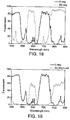
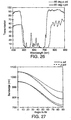
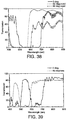
- An example of a multilayer film exhibiting a constant reflectance spectrum for p-polarized light is shown in FIG. 18 .
- a film was made in accordance with EXAMPLE E1-2, but with about a 30% slower casting wheel speed.
- the transmission spectrum at normal incidence and at 60° for p-polarized light is shown in FIG. 18 .
- the transmission spectrum at normal incidence and at 60° for s-polarized light is shown in FIG. 19 .
- the stop band near 600 nm at normal incidence has a bandwidth of 103 nm (543 to 646 nm) and an average transmission of 5.5% within that stopband.
- the blue bandedge has a slope of 0.66% per nm, while the red edge has a slope of 2.1 % per nm.
- the passband at 700 nm at normal incidence has a bandwidth of 100 nm and a maximum transmission of 85%.
- the slopes of the passband bandedges are: 2.3 percent per nm on the blue side, and 1.9 percent per nm on the red side.
- the shape of the entire spectral curve is substantially the same at a 60° angle of incidence as compared to normal incidence.
- the spectra of FIG. 18 and FIG. 19 were obtained with light polarized parallel to the TD (crossweb direction).
- the indices of refraction of the quarter wave thick PET layers cannot be measured directly, it is thought that they will be approximately the same as the indices of the PET skin layers.
- the latter indices were measured for this example using a Metricon Prism coupler manufactured by Metricon Corporation of Pennington, NJ.
- the indices were measured for the crossweb (tentered or TD) direction, the downweb (Machine or MD) direction, also referred to as the Length Oriented or LO direction, and thickness or z axis direction.
- the isotropic index of the Ecdel is about 1.52.
- the average of the spectra for s- and p-polarized light will be observed in typical ambient lighting conditions.
- the differing behavior of s- and p-polarized light can be advantageously utilized in various applications.
- the f-ratios of the optical films and devices of the present invention can be manipulated to produce band pass color filters or multiple reflectance bands tuned to particular regions of the spectrum using the extrusion equipment designed only to produce a graded stack of unit cells having a single reflectance band.
- the F-ratios can be controlled to produce a narrow pass green filter with a highly saturated transmission color, while using only a simple thickness graded stack of layers.
- Quarter-wave unit cells suppress the 2 nd order reflection harmonics, while maximizing the intrinsic bandwidth (reflection potential) of the 1 st harmonic.
- a unit cell design which has a relatively high intrinsic bandwidth for both the 1 st and 2 nd order harmonic reflection bands can be obtained by changing the F-ratio to a particular range of values, well away from the QxQ design point.
- the adjacent 1 st and 2 nd order reflectance bandedges will form a passband filter. If the layer pair thickness is adjusted so that the short wavelength bandedge of the 1 st order band is about 600 nm, a pass band in the middle of the visible spectrum will result, as shown in FIG. 20 .
- the PMMA has an isotropic index of about 1.50. Beginning with the thinnest layer pair, each successive layer pair in the stack was designed to be 0.46% thicker than the previous pair. If a larger gradient is used, such as 0.63%, the red bandedge of the 1 st order band is extended further into the IR, the red bandedge of the 2 nd order peak will also increase, resulting in a narrower pass band near 550 nm, as illustrated in FIG. 21 .
- bandedge sharpening techniques can be used to sharpen the edges of the pass band (linear profiles were used in these calculation examples). Suitable bandedge sharpening techniques are described in U.S. Serial No. 09-006,085 entitled "Optical Film with Sharpened Bandedge".
- the cross web uniformity for such a film design will be significantly better than for a two-packet multiplier design such as in example E1-2, as no cross-web multiplier errors will be present. See EXAMPLE B7-1 for comparison to E1-2 as an example of the crossweb variation in multiplier performance.
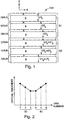
- FIG. 1 shows a cross-sectional view of a film structure which is not to scale but which is helpful in describing such desirable profiles.
- multilayer film 120 comprises 12 individual layers arranged in an alternating sequence of two optical materials: "A" and "B" material. Three or more distinct optical materials can be used in other embodiments.
- Each pair of adjacent "A” and “B” layers make up an ORU, beginning at the top of the film with ORU1 and ending with ORU6, with the ORUs having optical thicknesses OT 1 , OT 2 , ... OT 6 .
- These optical thicknesses are the same as the term "D r " identified in equation I above.
- each of the ORUs should have a 50% f-ratio with respect to either the A or B layer.
- the A layers can be considered to have a higher X- (in-plane) refractive index than the B layers, since the former are shown thinner than the latter.
- ORUs 1-3 are shown grouped into a multilayer stack S1 in which the optical thickness of the ORUs decrease monotonically in the minus-Z direction.
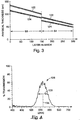
- ORUs 4-6 are shown grouped into another multilayer stack S2 in which the optical thickness of the ORUs increase monotonically. This ORU optical thickness profile is depicted in FIG. 2 . Thickness profiles such as this are helpful in producing sharpened spectral transitions. Before proceeding with examples of such preferred profiles, however, an example of a bandpass filter without band edge sharpening will be described.
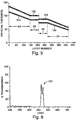
- FIG. 3 illustrates the design of a bandpass multilayer film made up of 300 individual layers. The physical thickness of each individual layer in the film is shown, beginning at the top or front of the film and proceeding toward the bottom or back of the film.
- Data points 122 represent a material having an in-plane refractive index of 1.5 (e.g., PMMA) and points 124 represent a material having an in-plane refractive index of 1.75 (e.g. PEN).
- Layer numbers 1 and 2 constitute the "first" ORU, layers 3 and 4 constitute the second ORU, and so on.
- the optical thickness of a given ORU equals the sum of the optical thickness of the high and low index layer.
- Layers 1 to 150 constitute a first multilayer stack S3 and layers 151 to 300 constitute a second multilayer stack S4. Both such component stacks have a monotonically decreasing ORU optical thicknesses.
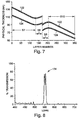
- the discontinuity in optical thickness between the two stacks gives rise to a simple notch transmission band 126, shown in FIG. 4.
- FIG. 4 was calculated from the multilayer film of FIG. 1 using the 4x4 matrix methods of Berreman as outlined in Azzam & Bashara, Ellipsometry And Polarized Light , assuming normally incident light and constant refractive index as a function of wavelength (no dispersion).
- Band 126 has a peak transmission of about 60%, a full width at half maximum 128 of about 50 nm, and a center wavelength as shown by line 130 of about 565 nm. The fractional bandwidth of band 126 is slightly below 10%. Reflectance is at least 80% over about 75% of the visible spectrum.
- a film having a much smaller fractional bandwidth can be made by providing additional layers (ORUs) having a particular optical thickness profile which have the effect of sharpening the spectral cut-on and cut-off transitions.
- FIG. 5 illustrates the design of such a film.
- Data points 122,124 stand for the same materials as in FIG. 3 , having refractive indices 1.5 and 1.75 respectively, and the series of 150 layers in multilayer stacks S3 and S4 have the same graded linear thickness distribution as in FIG. 3 .
- the film of FIG. 5 simply adds stacks S5, S6 having substantially constant (non-graded) optical thickness ORUs between stacks S3,S4.
- the ORUs of stack S5 have an optical thickness substantially equal to the minimum optical thickness of stack S3, and the ORUs of stack S6 have an optical thickness substantially equal to the maximum optical thickness of stack S4.
- the same relationship also applies to each constituent of the ORUs.
- the calculated on-axis spectrum for the illustrated stack is given in FIG. 6 , showing a much sharper transmission band 132.
- the percent bandwidth of band 132 is on the order of 3% or less.
- Another multilayer film whose design is shown in FIG. 7 , was created to improve peak transmission and to make even steeper band edges (narrower transmission band). This was achieved with the same materials used for data points 122,124, by arranging the individual layers into component multilayer stacks S7-S10 as shown, where the stacks S8 and S9 have oppositely curved thickness profiles and the adjacent portions of stacks S7 and S10 have a slightly curved profile to match the curvature of stacks S8 and S9, respectively.
- the curved profile can follow any number of functional forms; the main purpose of the form is to break the exact repetition of thickness present in a quarter wave stack with layers tuned to only single wavelength.
- the particular a function used here is an additive function of a linear profile (the same as used on the short wavelength side of S7 and the long wavelength side of S10) and a sinusoidal function to curve the profile with an appropriate negative or positive first derivative.
- the second derivative of the ORU thickness profile be positive for the red (long wavelength) band edge of a reflectance stack and negative for the blue (short wavelength) band edge of a reflectance stack. Note that the opposite sense is required if one refers to the band edges of the notched transmission band.
- Other embodiments of the same principle include layer profiles that have multiple points with a zero value of the first derivative. In all cases here, the derivatives refer to those of a best fit curve fitted through the actual ORU optical thickness profile, which can contain small statistical errors of less than 10% sigma one standard deviation in optical thickness values.
- FIG. 8 shows the calculated on-axis transmission of the film of FIG. 7 .
- Peak transmission of the band 134 is above 75%, and fractional bandwidth is on the order of 2% or less.
- Off-axis transmission spectra, for both p- and s- polarizations were also calculated and are shown as curves 136, 138 respectively in FIG. 9 .
- the calculation was done for an entrance angle of 60 degrees and assumed that the out-of-plane refractive indices of the two types of layers were matched, at an index of 1.5. Note the preservation of the high peak transmission and the small fractional bandwidth for p-polarization. Note also that the transmission peak for s-polarization has disappeared.
- broader transmission bands which were disposed in the near infrared region on-axis are now visible for both s- and p-polarization in the red end of the spectrum in FIG. 9 .
- transition-sharpening techniques can be used for multilayer films having broader transmission features, such as high- or low-pass filters.
- the physical thickness of each layer constituting an ORU is varied at the same pace across the thickness of the film, for example according to the same linear function, while in others the thickness of the layers constituting an ORU are varied differently.
- the high and low index layers have an index of 1.75 and 1.5, respectively, and are dispersionless.
- the component multilayer stack S11 serves as a baseline film design.
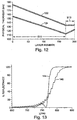
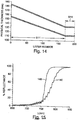
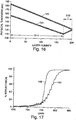
- An on-axis reflectance spectrum 140 was calculated for stack S11 alone, and then for the film combinations: S11+S12 (see FIG. 10 for physical thickness profile and FIG. 11 for reflectance curve 142); S11+S13 (see FIG. 12 for physical thickness profile and FIG. 13 for reflectance curve 144); S11+S14 (see FIG. 14 for physical thickness profile and FIG. 15 for reflectance curve 146); and S11+S15 (see FIG. 16 for physical thickness profile and FIG. 17 for reflectance curve 148).
- stack S11 of a stack with a reverse thickness gradient stack S 12
- a stack with a reverse thickness gradient with f-ratio deviation stack S13
- a stack with a substantially zero thickness gradient stack S14
- a stack with a reverse thickness gradient using only one component of the ORUs stack S15
- higher harmonics can be utilized to produce multiple reflection bands in the visible region of the spectrum without the need for two or more groups of layers.
- Various harmonic suppression designs can be used to create various spectral spacings and colors.
- the second order has maxima.
- the first and fourth orders have equal peak heights, as do the second and third orders.
- the first and fourth orders have equal peak heights, as do the second and third orders.
- the preferred f-ratio will depend on the application and the selected higher order peaks which one desires to suppress or enhance.
- the intrinsic reflection bandwidth for a QxQ stack of a given material layer pair is approximately equal to the Fresnel reflection coefficient of their interface, which at normal incidence depends only on the in-plane index differential.
- Materials selection can also be utilized to produce films and other optical bodies which exhibit a decrease in reflectivity as a function of angle.
- certain combinations of isotropic and birefringent layers can be used in which the spectral contribution of the isotropic layers decreases oblique angle.
- stack designs can also be used to produce a film or other optical body which exhibits color shifts in reflectance with respect to angle of incidence other than those created by the usual monotonic shift of a given spectrum towards shorter wavelengths.
- a 3-material combination can be used to suppress higher order harmonics of p-polarized light at one angle but not at other angles.
- a similar effect for s-polarized light can be achieved with a two-layer design.
- a large or small F-ratio can be used to limit the intrinsic bandwidth. Additional layers are then required to obtain the same reflectivity achievable with a QxQ stack. (A QxQ stack by definition has an f-ratio of 0.5.)
- a QxQ stack by definition has an f-ratio of 0.5.
- a large or small f-ratio can be used and the reflective envelop can be filled out by using a large number of layers (e.g., a thousand or more) with the appropriate thickness gradient and/or materials which exhibit large refractive index mismatches. Alternatively a smaller in-plane refractive index difference to limit the intrinsic bandwidth, and the number of layers increased to compensate for the intensity loss.
- a UV-reflective film can be made which has little or no reflection in the visible region of the spectrum at any angle, but which maintains a broad reflection band in the UV region close to 400 nm across a wide range of angles.
- This is achieved by arranging the layers into two film stacks or packets, a UV and an IR reflecting stack with the UV packet being first order in the UV, and the IR packet designed so it exhibits a higher order reflection peak in the UV region of the spectrum that exhibit a maximum in reflectivity at oblique angles.
- the angle of incidence is varied from normality, and the first order UV peak shifts to shorter wavelengths, the unsuppressed higher order peak from the IR packet moves into the UV.
- the films and optical devices of the present invention may incorporate one or more dyes such that the reflectance band of the film coincides with the absorbance band of the dye for at least one angle of incidence. Since the absorption band(s) of the dye, unlike the reflect bands of the film, will not typically shift with angle of incidence, the film will then exhibit one color at the angle for which the bands coincide, but one or more different colors at other angles after the bands separate. Conversely, the absorption bands could be made to coincide with certain transmission bands in the optical stack at a given angle of incidence. In this way, the film could be made black for example at normal incidence, but at oblique angles, the pass band will move to shorter wavelengths where it will not be covered by the dye spectrum, and the film will become colored. Copper pthalocyanine pigment has rather sharp spectral features in the visible and is particularly suited for this embodiment.
- the films and optical devices of the present invention may be combined with one or more beveled glass prisms.
- a beveled glass prism strip is combined with a film to allow viewing of the colored mirror film at angles other than the spectral angle.
- a microprism material available from 3M Company, St. Paul, MN, under the trade designation such as Optical Lighting Film can be placed adjacent or optically coupled to the multilayer film. The layered film transmits different colors at different angles, and since prisms redirect light, the two can be combined so that one can see a color at a given angle that would normally not be seen had the prism not redirected it toward the viewer.
- the prism can change the angle which light is transmitted into the film, thus altering the color at that point.
- the film exhibits a 3-dimensional effect in which the colored mirror is visible at non-spectral angles. It also produced a variation in color between areas with and without the prisms.
- a film or optical body having a spiky spectral distribution is used as a first element in combination with a second element comprising a broadband colored mirror film.
- the first element has the effect of converting a broadband light source used to illuminate the film to a spiky light source, thereby producing more vivid colors in the colored mirror film. Color changes made by illuminating interference films with spiky light sources have been found to produce color changes which are extraordinarily angularly sensitive.
- iridescent color cancellation may be used to impart a decorative effect to the resulting device.
- two films made in accordance with the present invention may be positioned such that the films are parallel at some points but not at others, or else a colored mirror film made in accordance with the invention may be combined with a broadband mirror film. If the films have complimentary colors, or if one of the films is a broadband mirror film and the other is a colored mirror film, the resulting combination will alter or neutralize the color of the top film in some places, but not in others.
- Certain optical stack designs can be used to produce color shifts with angle of incidence differing from those created by the usual monotonic shift of a given spectrum with angle towards shorter wavelengths.
- the multilayer stacks of the present invention can be combined with multilayer stacks of the prior art to create some unusual angularity effects.
- a birefringent colored film of the present invention having one or more transmission peaks centered at given wavelengths at normal incidence, could be coated, coextruded, or laminated with a stack of isotropic layers which reflect at those given wavelengths at normal incidence. The combined article will then appear as a silvered mirror at normal incidence.
- the isotropic films will leak p-polarized light, allowing the transmission peaks of the birefringent film to be visible, changing to a colored mirror at high angles of incidence.
- This assumes that the reflectance bandwidth of the birefringent stack extends far enough into the IR to block all red light at oblique angles.
- the greatest effect will appear for isotropic film stacks which have a Brewster angle at or near an oblique viewing angle.
- the birefringent stack could also be designed to transmit red at oblique angles if desired.
- a variation of the above design technique includes a birefringent stack with more than one spectral passband in which not all of the passbands are blocked by isotropic reflectance stacks.
- the article will not be silver colored at normal incidence, and will change from one color to another from normal to oblique angles.
- the materials can be selected so that some layers have a z-index mismatch, wherein the z-index of the material having the higher in-plane indices of refraction is the lowest.
- One such combination is PEN/PETG.
- PETG if stretched at temperatures above 120° Celsius has an isotropic index of about 1.57.
- PEN if stretched as described in example E1-1, has nx ⁇ 1.75, ny ⁇ 1.75, and nz ⁇ 1.50.
- These layers will exhibit increased reflectivity at oblique angles for both polarizations so that, if used alone or in combination with z-index matched layers, the resulting film can be designed to appear colored at normal incidence and silver at oblique angles.
- copolyesters and polycarbonates with indices above 1.55 are suitable materials to use in combination with PEN to achieve this effect. While the above examples deal with making a composite film which is colorless for at least one angle of view, these same design techniques can be used to make unusual color shifts (desirable for decorative, security, etc.) which are not colorless at practically any angle of view.
- Certain of the films made in accordance with the present invention can be made to exhibit a blue shift (i.e., a shift of spectral peaks toward the blue end of the spectrum as angle of incidence is varied) that is noticeably larger than that observed with conventional color shifting films. Furthermore, since, for a given (non-normal) angle of incidence, the magnitude of the blue shift will be larger than that observed with conventional films for p-polarized light, the differential of the color shift with respect to the angle of incidence will be greater for the films of the present invention than for conventional films. This latter feature has the effect of making the color shifts in the films of the present invention more noticeable, which in turn makes them more suitable for color shifting displays.
- L the wavelength tuned to the given layer
- ⁇ the angle of incidence measured from normality in that layer
- n the effective index of refraction for the material layer for the given direction and polarization of the light traveling through the layer
- d is the physical thickness of the layer.
- n and Cos ⁇ decrease for p-polarized light as 9 increases.
- the unit cell includes one or more layers of a uniaxially negative birefringent material or biaxially birefringent layers composed of, for example, PEN or PET, wherein the p-polarized light senses a z-index value instead of only the higher in-plane values of the index, the result is a decreasing effective index of refraction for higher angles of incidence.
- the effective low z-index caused by the presence of negatively birefringent layers in the unit cell creates a secondary blue shift in addition to the blue shift present in an isotropic thin stack.
- the compounded effects result in a greater blue shift of the spectrum compared to film stacks composed entirely of isotropic materials.
- the magnitude of the blue shift will be determined by the thickness weighted average change in L with angle of incidence for all material layers in the unit cell.
- the blue shift can be enhanced or lessened by adjusting the relative thickness of the birefringent layer(s) to the isotropic layer(s) in the unit cell. This will result in f-ratio changes that must first be considered in the product design.
- the maximum blue shift in mirrors is attained by using negatively uniaxially birefringent materials in all layers of the stack.
- the extinction bands for p-polarized light move to the blue at a slightly lower rate with angular change than do the same bands for s-polarized light.
- the minimum blue shift is attained by using only uniaxially positive birefringent materials in the optical stack.
- biaxially birefringent materials are used, but for the simple case of light incident along one of the major axes of a birefringent thin film polarizer, the analysis is the same for both uniaxial and biaxial birefringent films.
- the effect is still observable but the analysis is more complex.
- the blue shift of the transmission spectrum for light incident at azimuthal angles between the major axes will have a value intermediate that for light incident along either of the optic axes of the film.
- the optics axes are either aligned with or orthogonal to the stretch axes of the film.
- the in-plane/z-axis index differential of the PEN layers is about 0.25 (1.75 - 1.50). This index differential is less for PET-based films (i.e., about 1.66 - 1.50).
- the effect is even more pronounced because the difference in the PEN in-plane index compared to the PEN z-axis index can be much greater (i.e., about 1.85 - 1.50), resulting in an even greater blue shift for p-polarized light than that observed in biaxially stretched multilayer film stacks.
- the z-index differential of the two materials must be substantially smaller than the in-plane index differentials if high reflectivity is desired for p-polarized light at all angles of incidence.
- An example would be a uniaxially positive birefringent material such as biaxially oriented syndiotactic polystyrene which has a z-index of about 1.63 and in-plane indices of about 1.57.
- the other material could be an isotropic coPEN with an index of about 1.63.
- the birefringent color shifting films of the present invention exhibit improved color saturation, especially as compared to prior art isotropic multilayer films.
- Multilayer color shifting films with isotropic refractive indices suffer from a degradation in their color purity (in either transmission or reflection) as viewing angle through the films is increased from normal-angle to oblique angles (e.g., grazing angles). This is due in part to the fact that the fraction of randomly polarized light that is p-polarized is less efficiently reflected as the propagation angle through the film is increased. Accordingly, the reflection band, while shifting to shorter wavelengths at off-normal angles, also becomes weaker, allowing unwanted spectral components to contaminate the overall transmission spectrum. The problem is especially serious when the films are immersed in glass via cemented prisms or other media with indices substantially higher than 1.0.
- the multilayer birefringent color shifting films of the present invention can maintain their color saturation with increasing viewing angle so long as the refractive indices of the optical layers are appropriately matched along the z-axis (the axis normal to the plane of the film).
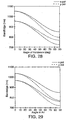
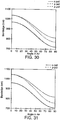
- a calculational example of the way color and color saturation changes with increasing viewing angle, for both an isotropic multilayer film and a birefringent multilayer film, is shown below.
- Color purity will increase as the bandwidth narrows toward that of a spike.
- the color purity of the reflected light from a polymeric multilayer stack may be reduced by the broadband reflection from the air/polymer skin layer interface. In this case it may be desirable to provide the polymer film with an anti-reflection coating.
- the index of refraction and the absorption coefficient change.
- the principles of index match and mismatch still apply at each wavelength of interest, and may be utilized in the selection of materials for an optical device that will operate over a specific region of the spectrum.
- proper scaling of dimensions will allow operation in the infrared, near-ultraviolet, and ultra-violet regions of the spectrum.
- the indices of refraction refer to the values at these wavelengths of operation, and the optical thicknesses of the optical layers should also be approximately scaled with wavelength.
- Even more of the electromagnetic spectrum can be used, including very high, ultrahigh, microwave and millimeter wave frequencies.
- Polarizing effects will be present with proper scaling to wavelength and the indices of refraction can be obtained from the square root of the dielectric function (including real and imaginary parts).
- Useful products in these longer wavelength bands can be specularly reflective polarizers and partial polarizers.
- a reflectance band is defined in general as a spectral band of reflection bounded on either side by wavelength regions of low reflection. With dielectric stacks, the absorption is typically low enough to be ignored for many applications, and the definition is given in terms of transmission. In those terms, a reflectance band, or stop band is defined in general as a region of low transmission bounded on both sides by regions of high transmission.
- a single reflectance band or stop band for p-polarized light has a continuous spectrum between any two successive wavelengths at which the transmission is greater than 50 percent, and including such successive wavelengths as endpoints, and where the average transmission from one endpoint to the other is less than 20 percent.
- Such preferred reflectance band or stop band is described in the same way for unpolarized light and light of normal incidence.
- the transmission values in the preceding description are calculated in a way that excludes the portion of light reflected by an air interface with the stack or the stack's skin layers or coatings.
- the bandwidth is defined to be the distance, in nm, between the two wavelengths within the band which are nearest each 50 percent transmission point, at which the transmission is 10 percent. In commonly used terms, the bandwidths are defined by the 10 percent transmission points.
- the respective blue and red (i.e., short and long wavelength) bandedges are then taken to be the wavelength at the above defined 10% transmission points.
- the transmission of the preferred stop band is taken to be the average transmission between the 10 percent transmission points.
- the slope of a bandedge of a stop band as described in the preceding paragraph is taken from the 50 percent and 10 percent transmission/wavelength points, and is given in units of % transmission per nm. If a reflectance band does not have high enough reflectivity to satisfy the definitions of bandwidth and bandedge slopes of the preferred embodiment, then the bandwidth is taken to mean the Full Width at Half Maximum reflectivity.
- a pass band is defined in general as a spectral transmitting band bounded by spectral regions of relatively low transmission. With the multilayer color shifting film, the passband is bounded by reflective stopbands. The width of the pass band is the Full Width at Half Maximum (FWHM) value. Bandedge slopes are calculated from the two points on a given bandedge nearest the peak transmission point, the transmission values of which are 50 and 10 percent of the peak transmission value.
- FWHM Full Width at Half Maximum
- the passband has a transmission band having low transmission regions on both sides of the transmission peak with transmission minima of 10 percent or less of the transmission value of the peak transmission point.
- a pass band having a 50 percent transmission maximum would be bounded on both sides by reflectance bands having 5 percent or lower transmission minima. More preferably, the transmission minima on both sides of the passband are less than 5 percent of the peak transmission value of the passband.
- the bandedge slopes for a pass band be greater than about 0.5 percent transmission per nm. More preferably, the bandedge slopes are greater than about 1 percent per nm, and even more preferably, the slopes are greater than about 2 percent per nm.
- the bandwidth and reflectivity of the birefringent thin film stacks described herein both increase with angle of incidence in the same manner as for conventional isotropic materials.
- the same effects can be produced for p-polarized light if materials of the proper indices are chosen.
- the spectra for s- and p-polarized light can be made to behave similarly or even identically as a function of the angle of incidence.
- U.S. Patent No. 5,808,798 See U.S. Patent No. 5,808,798 .
- the multilayer films described therein have a relatively large z-index mismatch, of the opposite sign as the in-plane index mismatch.
- the phenomenon therein is independent of filter bandwidth and reflectivity.
- birefringent multilayer stacks which have a relatively small z-index mismatch can function as non polarizing color filters in certain special cases.
- bandedges short or long wavelength edge
- Certain color filters such as, e.g., blue or cyan transmitting filters, can have their red bandedges sufficiently far into the IR portions of the spectrum that the polarizing effects there are of no consequence to the intended application.
- bandedges of a thin film stack having an approximate z-index match at the interfaces of two or more materials could be made nonpolarizing to a degree superior to that of an isotropic thin film stack.
- Two examples are given below of birefringent stacks which display an essentially nonpolarizing effect at their blue bandedges, and have simple layer thickness profiles.
- Such thin film stacks would provide a significant improvement over the art for nonpolarizing color beamsplitters, an example of which is given by L. Songer, Photonics Spectra, November 1994, page 88 .
- the five layer ABCBA optical repeating unit stacks of Songer were designed to work at 37.5 degrees in BK-7 glass, which has an index of about 1.52.
- the transmission spectra for s and p-polarized light of a 417 layer coextruded PET/Ecdel film are shown in FIG. 26 . Both spectra were taken at 60 degrees angle of incidence in air, which is equivalent to about 35 degrees in glass having an index of 1.52 such as e.g., BK-7 glass.
- This multilayer film was made as described in EXAMPLE E1-2. As described in that example, the process used to make this multilayer sample utilized an asymmetric two times layer multiplier which doubles the number of layers produced in the feedblock. The multiplier was designed so that the two sets of layers are tuned to reflect separate wavelength bands, centered at wavelengths separated by the multiplier ratio. However, the multipliers do not produce the exact same multiplication ratio at all points across the meltstream.
- the transmission values below 500 nm and above 700nm for the s-polarization are determined primarily by the polymer/air interfaces of the film, and can be improved with anti-reflection coatings, or by immersion in a high index medium such as cementing between glass prisms.
- the average transmission of the stopband for p-polarized light (500 nm to 710 nm) is about 6 percent.
- the slopes of the all the bandedges in this example are about 2.5 percent per nm.
- the reflection band of EXAMPLE B7-1 for p-polarized light has several significant spectral leaks, the average transmission from 500 nm to 710 nm being 6 percent, this example is presented only to illustrate the nonpolarizing bandedges of this optical stack.
- One skilled in the art could easily produce a wide reflectance band filter composed of PET and Ecdel which transmits an average of less than 5 percent or even less than 2percent across over the bandwidth of the stop band.
- the spectra for FIG. 26 were obtained with light polarized parallel to the TD direction, which is also referred to as the x direction in this example.
- the low index material is Ecdel and the index of Ecdel is about 1.52.
- EXAMPLE E1-1 is a multilayer stack of PEN and PMMA.
- the bandedges of the transmission spectra for s and p-polarized light are essentially coincident near 410 nm, while the red bandedges near 600 nm are separated by almost 40 nm.
- the z-index of the PEN in this example is fairly well matched to that of the PMMA, both being about 1.49 at 700 nm.
- PEN has a higher dispersion than PMMA, and near 400 nm nzPEN ⁇ 1.53 while nPMMA ⁇ 1.51.
- the average transmission within the stop band for p-polarized light is 1.23 percent.
- the red bandedge slope is about 4.2 percent per nm and the blue bandedge slope is about 2.2 percent per nm.
- the slope of the red bandedge at normal incidence is about 5.5 percent per nm.
- the optical stack must also provide for high reflectance so that only several percent or less of the p-polarized light of the undesired wavelengths is transmitted. This is necessary as the s-polarization will be more highly reflected than the p-polarization since the Fresnel reflection coefficients will be greatly different at high angles of incidence for the two polarizations.
- the average transmission of p-polarized light within the reflectance band of a nonpolarizing color filter, at the nominal design angle is less than 10 percent, more preferably less than 5 percent, and even more preferably, less than 2 percent.
- the bandedges exhibit a high slope.
- Sharp bandedges also are desirable in obtaining saturated colors of high purity.
- the slopes are at least about 1 percent per nm, more preferably greater than about 2 percent per nm, and even more preferably greater than about 4 percent per nm.
- a computer optimized layer thickness distribution may be utilized, or a band sharpening thickness profile may be applied to the layer thickness distribution design.
- the coincidence of the blue bandedges in the two examples given above is due to a combination of differing bandwidths for s and p-polarized light, and the different rate of spectral shift with angle of the spectra for those polarizations.
- the fractional bandwidth increases for s-polarized light as the incidence angle is increased from zero.
- the fractional bandwidth for p-polarized light does not change with angle because matching the z-indices produces an angle independent Fresnel reflection coefficient for each interface, but the entire band moves slightly faster to the blue, as described above, than does the same band for s-polarized light.
- the two effects nearly cancel on the blue side of the band, with the result that the blue bandedges for both s and p-polarized light remaining nearly coincident at all angles of incidence.
- the two effects add on the red side, with the bandedges for s- and p-polarized light becoming separated.
- the resulting red bandedge becomes an average of the two plots, resulting in slightly lower color purity on the red side in this case for unpolarized light.
- the extinction bands for p-polarized light move to the blue at a slightly lower rate with angular change than do the same bands for s-polanzed light.
- Such an film stack can be used to maintain a sharp bandedge on the red side of an extinction band for unpolarized light, such as, for example, non polarizing yellow and red transmitting filters. Alignment of the blue or red bandedges for s and p-polarized light can be fined tuned by adjustments to the f-ratio of the material layers, or by adjusting the z-index mismatch.
- the f-ratio of a thin film stack can be adjusted to aid in aligning the s and p-polarization bandedges of a reflectance band of the present invention.
- the bandedge positions can be calculated as a function of the angle of incidence.
- the hi and low bandedges are at 953 nm and 1052 nm at normal incidence.
- the p-pol bandedges shift more than the s-pol ones, particularly for the hi bandedge.
- the p-pol band narrows from 99 nm to 73 nm while the s-pol band widens to 124 nm.
- the chart shows a decreasing width for the p-pol reflection band, but if the bandedge values were plotted in terms of reciprocal wavelength, the bandwidth of p-pol band would remain constant. Also note that, while the bandedges on the low wavelength side do not exactly match for the s and p-polarizations, at 60 degrees in air, the difference is only about 10 nm, which is sufficient for many nonpolarizing color filter applications. The p-pol bandedge does shift further to the blue than the corresponding bandedge for the s-polarization which contrasts greatly with the behavior of isotropic quarter wave stacks.
- the p-pol band narrows from 99 nm to 29 nm while the s-pol band widens to 124 nm.
- the center of the isotropic band is the same for s-pol and p-pol, while for anisotropic material, the center of the p-pol band decreases more than the center of the s-pol band.
- the separation of the s-pol and p-pol bandedges at 60° in air is greater than 30 nm. As the index differential of the isotropic materials is increased, the separation of the s and p-pol bandedges also increases. Separations of 50 nm are typical. See, for example, L. Songer, Photonics Spectra, November 1994, page 88 .
- the relative shift of the p-pol bandedges compared to the shift of the s-pol bandedges is substantially affected by the amount of birefringent materials in the stack as well as their absolute birefringence values. For example, increasing the f-ratio of a PEN/PMMA stack will increase the relative amount of material having an in-plane index of 1.75, and will promote a small blue shift in the s-pol reflection band.
- Pushing the f-ratio in the opposite direction for a stack of the same materials will bring the blue bandedge of the p-pol spectrum into alignment with the s-pol spectrum.
- the two are nearly coincident.
- the low wavelength bandedge shifts the same for s-pol and p-pol.
- the p-pol band narrows from 70 nm to 52 nm while the s-pol band widens to 91 nm.
- a large reduction in the f-ratio to provide a match in the s and p-pol bandedges has the drawback of lowering the overall reflective power of the stack, as illustrated in FIG. 22 .
- Another way to provide a match of the s and p blue bandedges at all angles of incidence is to introduce a mismatch in the z-indices. If PET with an in-plane index of 1.66 and a z-index of 1.50 is assumed in an alternating stack with a second material having an isotropic index of 1.45, we see from Fig. 31 that the s and p low wavelength bandedges are substantially coincident at all angles of incidence.
- the coincidence of the blue bandedges for the s- and p-polarization spectra is an important feature of the color shifting films disclosed herein, and has a utility beyond that of a nonpolarizing color filter.
- the coincidence of the s and p bandedges allows the fabrication of color shifting films having an abrupt change of color with viewing angle, and also the fabrication of certain color filters having a high degree of color purity.
- the separation of bandedges for the s- and p-polarizations is preferably less than about 30 about degrees, and more preferably less than about 20 nm. Even more preferably, the separation is less than about 10 nm.
- nonpolarizing color filters described above are useful as color beamsplitters in applications requiring equal bandwidth and reflectivity for s and p-polarizations of colored light.
- such films may find application as the color filters in a three prism color separator of the type described by Doany in U.S. Patent No. 5,644,432 for LCD projection systems.
- a particularly preferred configuration for these films in that type of color separator is to have the light sequentially strike a red reflecting film (cyan transmitter) first, then a film which reflects both green and red (blue transmitter). The blue light traverses both films and strikes the blue LCD light modulator.
- the preferred angle of incidence in the glass prisms described by Doany was 30 degrees, and this angle is easily accomodated by the present invention.
- Typical angles of incidence in glass for a variety of applications are 30 degrees, 35 degrees, 37.5 degrees, and 45 degrees. These angles refer to the center ray of a cone of light.
- the half cone angle may be 5, 10, 15, or even 20 degrees, depending on the f number of the optical system.
- a beamsplitter positioned for a 35 degrees angle of incidence would encounter a range of angles from 20 degrees to 50 degrees angle of incidence on the thin film stack.
- the process used for making the coextruded polymeric multilayer optical films of the present invention will vary depending on the resin materials selected and the optical properties desired in the finished film product.
- Moisture sensitive resins should be dried before or during extrusion to prevent degradation. This can be done by any means known in the art.
- One well-known means employs ovens or more sophisticated heated vacuum and/or desiccant hopper-dryers to dry resin prior to its being fed to an extruder.
- Another means employs a vacuum-vented twinscrew extruder to remove moisture from the resin while it is being extruded. Drying time and temperature should be limited to prevent thermal degradation or sticking during hopper-dryer or oven drying.
- resins coextruded with moisture sensitive resins should be dried to prevent damage to the moisture sensitive coextruded resin from moisture carried by the other resin.
- Extrusion conditions are chosen to adequately feed, melt, mix and pump the polymer resin feed streams in a continuous and stable manner.
- Final melt stream temperatures are chosen within a range which avoids freezing, crystallization or unduly high pressure drops at the low end of the temperature range and which avoids degradation at the high end of the temperature range.
- polyethylene naphthalate (PEN) is dried for 8 hours at 135°C and then vacuum fed to an extruder with a final zone temperature, or melt temperature, ranging preferably between 270°C and 300°C and more preferably between 275°C and 290°C.
- the PEN processing temperature may be reduced so as to match it to the typical melt processing temperatures for PMMA.
- the melting point, and hence, the processing temperature, of PEN may be reduced by the addition of comonomers into the PEN polymer with only a very slight accompanying reduction of the ability of the PEN to develop birefringence upon drawing.
- a PEN copolymer made using DiMethyl Isophthalate (DM1) in place of 3 mol% of the 2,6-DiMethyl Naphthalate (DMN) monomer has been found to have a reduction in birefringence of only 0.02 units, and a reduction of glass transition temperature of only about 4 or 5° C while the melt processing temperature is reduced by 15°C.
- Small amounts of DiMethyl Terephthalate (DMT) or other diacid or diol comonomers may also be useful in this regard. Esters or diesters of the diacid comonomers may also be used.
- melt streams are then filtered to remove undesirable particles and gels.
- Primary and secondary filters known in the art of polyester film manufacture may be used, with mesh sizes in the 1-30 micrometer range. While the prior art indicates the importance of such filtration to film cleanliness and surface properties, its significance in the present invention extends to layer uniformity as well.
- Each melt stream is then conveyed through a neck tube into a gear pump used to regulate the continuous and uniform rate of polymer flow.
- a static mixing unit may be placed at the end of the neck tube carrying the melt from the gear pump into the multilayer feedblock, in order to ensure uniform melt stream temperature. The entire melt stream is heated as uniformly as possible to ensure both uniform flow and minimal degradation during melt processing.
- Multilayer feedblocks are designed to divide two or more polymer melt streams into many layers each, interleave these layers, and merge the many layers of two or more polymers into a single multilayer stream.
- the layers from any given melt stream are created by sequentially bleeding off part of the stream from a main flow channel into side channel tubes that feed layer slots for the individual layers in the feed block manifold.
- Many designs are possible, including those disclosed in U.S. Patent Nos. 3,737,882 ; 3,884,606 ; and 3,687,589 to Schrenk et al. Methods have also been described to introduce a layer thickness gradient by controlling layer flow as described in U.S. Patent Nos.
- layer flow is generally controlled by choices made in machining the shape and physical dimensions of the individual side channel tubes and layer slots.
- the side channel tubes and layer slots of the two or more melt streams are interleaved as desired to form alternating layers.
- the feed block's downstream-side manifold for the combined multilayer stack is shaped to compress and uniformly spread the layers transversely.
- Special thick layers known as protective boundary layers (PBLs) may be fed nearest to the manifold walls from any of the melt streams used for the optical multilayer stack, or by a separate feed stream, in order to protect the thinner optical layers from the effects of wall stress and possible resulting flow instabilities.
- Control of layer thickness is especially useful in producing films having specific layer thicknesses or thickness gradient profiles that are modified in a prescribed way throughout the thickness of the multilayer film.
- layer thickness designs have been described for infrared films which minimize higher order harmonics which result in color in the visible region of the spectrum. Examples of such film include those described in U.S. Patent No. RE 3,034,605 .
- Another suitable film includes the film described in U.S. Patent No. 5,360,659 , which describes a two component film having a six layer alternating repeating unit suppresses the unwanted second, third, and fourth order reflections in the visible wavelength region of between about 380 - 770 nm while reflecting light in the infrared wavelength region of between about 770 - 2000 nm.
- a hybrid design can also be used wherein a first portion of the multilayer stack is designed to reflect at wavelengths above about 1200 nm.and a second portion of alternating layers having an AB repeat unit and substantially equal optical thicknesses which reflect infrared light of wavelengths between about 770-1200 nm. Such a combination of alternating layers results in reflection of light across the infrared wavelength region through 2000 nm.
- the film or optical body By designing the film or optical body within these constraints, at least some combination of second, third and forth higher-order reflections can be suppressed without a substantial decrease of the first harmonic reflection with angle of incidence, particularly when the first reflection band is in the infrared region of the spectrum.
- Such films and optical bodies are particularly useful as IR mirrors, and may be used advantageously as window films and in similar applications where IR protection is desired but good transparency and low color are important.
- the various layers in the film preferably have different thicknesses across the film. This is commonly referred to as the layer thickness gradient.
- a layer thickness gradient is selected to achieve the desired band width of reflection.
- One common layer thickness gradient is a linear one, in which the thickness of the thickest layer pairs is a certain percent thicker than the thickness of the thinnest layer pairs.
- a 1.055:1 layer thickness gradient means that the thickest layer pair (adjacent to one major surface) is 5.5% thicker than the thinnest layer pair (adjacent to the opposite surface of the film).
- the layer thickness could decrease, then increase, then decrease again from one major surface of the film to the other. This is believed to provide sharper bandedges, and thus a sharper or more abrupt transition from reflective to transmissive regions of the spectrum.
- each pair of adjacent "A" and “B” layers make up an optical repeating unit (ORU), beginning at the top of the film with ORU1 and ending with ORU6, with the ORUs having optical thicknesses OT 1 , OT 2 , ... OT 6 .
- ORU optical repeating unit
- These optical thicknesses are the same as the term "D r " identified previously.
- each of the ORUs should have a 50% f-ratio with respect to either the A or B layer.
- the A layers can be considered to have a higher X- (in-plane) refractive index than the B layers, since the former are shown thinner than the latter.
- ORUs 1-3 may be grouped into a multilayer stack S1 in which the optical thickness of the ORUs decrease monotonically in the minus-Z direction, while ORUs 4-6 may be grouped into another multilayer stack S2 in which the optical thickness of the ORUs increase monotonically. Thickness profiles such as this are helpful in producing sharpened spectral transitions. In contrast, thickness profiles of previously known films typically increase or decrease monotonically in only one direction. If desired for some applications, a discontinuity in optical thickness can be incorporated between the two stacks to give rise to a simple notch transmission band spectrum.
- thickness gradients may be designed which improve peak transmission and to make even steeper band edges (narrower transmission band). This can be achieved by arranging the individual layers into component multilayer stacks where one portion of the stacks has oppositely curved thickness profiles and the adjacent portions of the stacks have a slightly curved profile to match the curvature of the first portion of the stacks.
- the curved profile can follow any number of functional forms; the main purpose of the form is to break the exact repetition of thickness present in a quarter wave stack with layers tuned to only a single wavelength.
- the particular function used here is an additive function of a linear profile and a sinusoidal function to curve the profile with an appropriate negative or positive first derivative.
- the second derivative of the ORU thickness profile be positive for the red (long wavelength) band edge of a reflectance stack and negative for the blue (short wavelength) band edge of a reflectance stack. Note that the opposite sense is required if one refers to the band edges of the notched transmission band.
- Other embodiments of the same principle include layer profiles that have multiple points with a zero value of the first derivative. In all cases here, the derivatives refer to those of a best fit curve fitted through the actual ORU optical thickness profile, which can contain small statistical errors of less than 10% sigma one standard deviation in optical thickness values.
- each original portion of the multilayer stack that exits the feedblock manifold, excluding PBLs, is known as a packet.
- each packet is designed to reflect, transmit, or polarize over a given band of wavelengths. More than one packet may be present as the multilayer stack leaves the feedblock.
- the film may be designed to provide optical performance over dual or multiple bands. These bands may be separate and distinct, or may be overlapping. Multiple packets may be made of the same or of different combinations of two or more polymers.
- each packet is made of the same two or more polymers
- each packet may be made by constructing the feedblock and its gradient plate in such a way that one melt train for each polymer feeds all packets, or each packet may be fed by a separate set of melt trains.
- Packets designed to confer on the film other non-optical properties, such as physical properties, may also be combined with optical packets in a single multilayer feedblock stack.
- An alternative to creating dual or multiple packets in the feedblock is to create them from one feedblock packet via the use of a multiplier with multiplier ratio greater than unity. Depending on the bandwidth of the original packet and the multiplier ratio, the resulting packets can be made to overlap in bandwidth or to leave between them a bandwidth gap. It will be evident to one skilled in the art that the best combination of feedblock and multiplier strategies for any given optical film objective will depend on many factors, and must be determined on an individual basis.
- additional layers can be added to the multilayer stack. These outer layers again perform as PBLs, this time within the multiplier. After multiplication and stacking, part of the PBL streams will form internal boundary layers between optical layers, while the rest will form skin layers. Thus the packets are separated by PBLs in this case. Additional PBLs may be added and additional multiplication steps may be accomplished prior to final feed into a forming unit such as a die. Prior to such feed, final additional layers may be added to the outside of the multilayer stack, whether or not multiplication has been performed, and whether or not PBLs have been added prior to said multiplication, if any. These will form final skin layers and the external portions of the earlier-applied PBLs will form sub-skins under these final skin layers.
- the die performs the additional compression and width spreading of the melt stream. Again, the die (including its internal manifold, pressure zones, etc.) is designed to create uniformity of the layer distribution across the web when the web exits the die.
- Temperature control is extremely important in the feedblock and subsequent flow leading to casting at the die lip. While temperature uniformity is often desired, in some cases deliberate temperature gradients in the feedblock or temperature differences of up to about 40°C in the feed streams can be used to narrow or widen the stack layer thickness distribution. Feedstreams into the PBL or skin blocks can also be set at different temperatures than the feedblock average temperature. Often, these PBL or skin streams are set to be up to about 40°C hotter to reduce viscosity or elasticity in these protective streams and thus enhance their effectiveness as protective layers. Sometimes, these streams may be decreased in temperature up to about 40°C to improve the rheology matching between them and the rest of the flow stream. For example, decreasing the temperature of a low viscosity skin may enhance viscosity matching and enhance flow stability. Other times, elastic effects need to be matched.
- Shear rate is observed to affect viscosity and other rheological properties, such as elasticity.
- Flow stability sometimes appears to improve by matching the relative shape of the viscosity (or other rheological function) versus shear rate curves of the coextruded polymers. In other words, minimization of maximal mismatch between such curves may be an appropriate objective for flow stability.
- temperature differences at various stages in the flow can help to balance shear or other flow rate differences over the course of that flow.
- the web is cast onto a chill roll, sometimes also referred to as a casting wheel or casting drum.
- a chill roll sometimes also referred to as a casting wheel or casting drum.
- this casting is assisted by electrostatic pinning, the details of which are well-known in the art of polyester film manufacture.
- electrostatic pinning the details of which are well-known in the art of polyester film manufacture.
- great care should be exercised in setting the parameters of the electrostatic pinning apparatus.
- Periodic cast web thickness variations along the extrusion direction of the film frequently referred to as "pinning chatter" must be avoided to the extent possible.
- Adjustments to the current, voltage, pinning wire thickness, and pinning wire location with respect to the die and the casting chill roll are all known to have an affect, and must be set on a case-by case basis by one skilled in the art.
- the web may attain a sidedness in surface texture, degree of crystallinity, or other properties due to wheel contact on one side and merely air contact on the other. This can be desirable in some applications and undesirable in others.
- a nip roll may be used in combination with the chill roll to enhance quenching or to provide smoothing onto what would otherwise be the air side of the cast web.
- one side of the multilayer stack be the side chosen for the superior quench that is attained on the chill roll side.
- the multilayer stack consists of a a distribution of layer thicknesses, it is frequently desired to place the thinnest layers nearest the chill roll.
- the film In some cases, it is desired to provide the film with a surface roughness or surface texture to improve handling in winding and/or subsequent conversion and use. Many such instances will be known to one skilled in the art of film manufacture.
- a specific example germane to optical films of the present invention arises when such films are intended for use in intimate contact with a glass plate or a second film.
- selective "wetting out" of the optical film onto the plate or second film can result in the phenomenon known as "Newton's Rings", which damages the uniformity of the optics over large areas.
- a textured or rough surface prevents the intimacy of contact required for wetting out and the appearance of Newton's Rings.
- the polyester film art It is well-known in the polyester film art to include small amounts of fine particulate materials, often referred to as "slip agents", to provide such surface roughness or texture. This can be done in the optical films of the present invention. However, the inclusion of slip agent particulates introduces a small amount of haze and decreases the optical transmission of the film somewhat.
- Newton's Rings can be as or even more effectively prevented, without the introduction of haze, if surface roughness or texture is provided by contact with a micro-embossing roll during film casting.
- the micro-embossing roll will serve as a nip roll to the casting wheel.
- the casting wheel itself may be micro-textured to provide a similar effect. Further, both a micro-textured casting wheel and a micro-textured nip roll may be used together to provide micro-embossed two-sided roughness or texture.
- the web may be cast to a uniform thickness across the web or a deliberate profiling of the web thickness may be induced using die lip controls. Such profiles may improve uniformity by the end of the film process. In other cases, a uniform cast thickness provides best uniformity at the end of the film process. Controlling vibrations in the process equipment is also important to reduce "chatter" in the cast multilayer web.
- Interdiffusion between layers can be altered and controlled by adjusting residence times.
- Interdiffusion here refers to all mingling and reactive processes between materials of the individual layers including, for example, various molecular motions such as normal diffusion, cross-linking reactions, or transesterification reactions.
- Sufficient interdiffusion is desirable to ensure good interlayer adhesion and prevent delamination.
- too much interdiffusion can lead to deleterious effects, such as the substantial loss of compositional distinctness between layers.
- Interdiffusion can also result in copolymerization or mixing between layers, which may reduce the ability of a layer to be oriented when drawn.
- the scale of residence time on which such deleterious interdiffusion occurs is often much larger (e.g., by an order of magnitude) than that required to achieve good interlayer adhesion, thus the residence time can be optimized.
- some large scale interdiffusion may be useful in profiling the interlayer compositions, for example to make rugate structures.
- interdiffusion can also be altered by further layer compression.
- the effect at a given residence time is also a function of the state of layer compression during that interval relative to the final layer compression ratio.
- thinner layers are more susceptible to interdiffusion, they are typically placed closest to the casting wheel for maximal quenching.
- Conditions at the casting wheel are set according to the desired result. Quenching temperatures must be cold enough to limit haze when optical clarity is desired. For polyesters, typical casting temperatures range between 10°C and 60°C. The higher portion of the range may be used in conjunction with smoothing or embossing rolls while the lower portion leads to more effective quenching of thick webs.
- the speed of the casting wheel may also be used to control quench and layer thickness. For example, extruder pumping rates may be slowed to reduce shear rates or increase interdiffusion while the casting wheel is increased in speed to maintain the desired cast web thickness.
- the cast web thickness is chosen so that the final layer thickness distribution covers the desired spectral band at the end of all drawing with concomitant thickness reductions.
- the multilayer web is drawn to produce the final multilayer optical film.
- a principal reason for drawing is to increase the optical power of the final optical stack by inducing birefringence in one or more of the material layers.
- at least one material becomes birefringent under draw.
- This birefringence results from the molecular orientation of the material under the chosen draw process.
- this birefringence greatly increases with the nucleation and growth of crystals induced by the stress or strain of the draw process (e.g. stress-induced crystallization). Crystallinity suppresses the molecular relaxation which would inhibit the development of birefringence, and crystals may themselves also orient with the draw.
- some or all of the crystals may be pre-existing or induced by casting or preheating prior to draw.
- Other reasons to draw the optical film may include, but are not limited to, increasing throughput and improving the mechanical properties in the film.
- a single drawing step is used. This process may be performed in a tenter or a length orienter. Typical tenters draw transversely (TD) to the web path, although certain tenters are equipped with mechanisms to draw or relax (shrink) the film dimensionally in the web path or machine direction (MD).
- TD transversely
- MD machine direction
- a film is drawn in one in-plane direction.
- the second in-plane dimension is either held constant as in a conventional tenter, or is allowed to neck in to a smaller width as in a length orienter. Such necking in may be substantial and increases with draw ratio.
- the final width may be estimated theoretically as the reciprocal of the square root of the lengthwise draw ratio times the initial width. In this theoretical case, the thickness also decreases by this same proportion. In practice, such necking may produce somewhat wider than theoretical widths, in which case the thickness of the web may decrease to maintain approximate volume conservation. However, since volume is not necessarily conserved, deviations from this description are possible.
- a two step drawing process is used to orient the birefringent material in both in-plane directions.
- the draw processes may be any combination of the single step processes described that allow drawing in two in-plane directions.
- a tenter that allows drawing along MD e.g. a biaxial tenter which can draw in two directions sequentially or simultaneously, may be used. In this latter case, a single biaxial draw process may be used.
- a multiple drawing process is used that exploits the different behavior of the various materials to the individual drawing steps to make the different layers comprising the different materials within a single coextruded multilayer film possess different degrees and types of orientation relative to each other.
- Mirrors can also be formed in this manner.
- Such optical films and processes are described further in U.S. Serial No. 09/006,455 entitled "An Optical Film and Process for Manufacture Thereof".
- polarizers may be made via a biaxial process.
- balanced mirrors may be made by a process that creates two or more materials of significant in-plane birefringence and thus in-plane asymmetry such that the asymmetries match to form a balanced result, e.g. nearly equal refractive index differences in both principal in-plane directions.
- drawing film transverse to the machine direction in a tenter is non-uniform, with thickness, orientation, or both changing as one approaches the gripped edges of the web.
- these changes are consistent with the assumption of a cooler web temperature near the gripped edges than in the web center.
- the result of such non-uniformity can be a serious reduction in usable width of the finished film.
- This restriction can be even more severe for the optical films of the present invention, as very small differences in film thickness can result in non-uniformity of optical properties across the web.
- Drawing, thickness, and color uniformity as recognized by the present inventors, can be improved by the use of infrared heaters to additionally heat the edges of the film web near the tenter grippers.
- Such infrared heaters can be used before the tenter's preheat zone, in the preheat zone, in the stretch zone, or in a combination of locations.
- One skilled in the art will appreciate the many options for zoning and controlling the addition of infrared heat. Further, the possibilities for combining infrared edge heating with changes in the cast web crossweb thickness profile will also be apparent.
- Machine- and transverse-direction balance may be achieved by selecting process conditions via techniques well-known in the art of biaxially-oriented film-making.
- process parameters explored include machine-direction orientation preheat temperature, stretch temperature, and draw ratio, tenter preheat temperature, stretch temperature, and draw ratio, and, sometimes, parameters related to the post-stretching zones of the tenter. Other parameters may also be significant.
- designed experiments are performed and analyzed to arrive at appropriate combinations of conditions. Those skilled in the art will appreciate the need to perform such an assessment individually for each film construction and each film line on which it is to be made.
- parameters of dimensional stability such as shrinkage at elevated temperature and reversible coefficient of thermal expansion
- process conditions similarly to the case for conventional films known in the art.
- parameters include, but are not limited to, heat set temperature, heat set duration, transverse direction dimensional relaxation ("toe-in") during heat set, web cooling, web tension, and heat "soaking” (or annealing) after winding into rolls.
- toe-in transverse direction dimensional relaxation
- heat-in transverse direction dimensional relaxation
- web cooling web tension
- heat "soaking” or annealing
- multilayer films and other optical devices made in accordance with the present invention can be made so as to exhibit a degree of physical and optical uniformity over a large area that far exceeds that accessible with prior art films.
- the distortions of layer thickness and optical caliper encountered in prior art cast (not drawn) films is avoided by biaxially stretching the cast web by a factor of between about 2x2 and about 6x6, and preferably about 4x4, which tends to make the lateral layer thickness variations, and therefore the color variations, much less abrupt.
- the narrower cast web thus required allows for the possibility of fewer distortions of the layer thickness distribution in the extrusion die because of significantly less layer spreading occurring in the narrower die.
- Systematic errors are repeatable deviations from the design thickness for any or all layers in the stack. They can occur because of design approximations inherent in the polymer flow model used to design the multipliers and feedblock, or because of machining errors in the feedblock and die. These errors can be eliminated by redesign and re-machining until the errors are reduced to design criteria. These errors can also be reduced by machining a feedblock that will produce the required number of layers in the optical film without resort to a multiplier.
- Random errors can be caused by fluctuations in feedblock and die zone temperatures, resin inhomogeneity, improper control of melt temperatures through the melt train which selectively degrade parts of the melt stream, contamination of the feedblock or die due to degraded or burnt resin, process control errors such as melt pressure, temperature and pumping rate variations, and hydrodynamic flow instabilities.
- the flow modeling should provide input to the feedblock and die designs in order to avoid conditions that could cause such flow instabilities.
- brush servo motor such as part number TT -10051A, available commercially from Kollmorgan. Higher speed motors with gear reduction can be used, but a high quality system with proper electrical tuning and a smooth gearbox is essential. System vibrations, particularly of the die relative to the casting wheel, can be minimized by placing the casting station on concrete pads on the ground floor of the casting installation. Other means of dampening or isolation will be apparent to one skilled in the mechanical arts.
- the sources of vibrations can be identified with the help of a web thickness variation scanning device. If the period of an oscillation can be identified from the output of such a device, a search may be made for process elements, or even extraneous sources, which exhibit oscillatory behavior of identical period. These units can then be made more rigid, vibration-damped, or vibration-isolated from the die and casting wheel by methods known in the art, or may simply be turned off or relocated if not essential to the process.
- a vibration identified by periodicity as being due to the rotation of the extruder screw could be isolated, for example, by the use of a damping material between the extruder gate and the neck tube, while a vibration identified by periodicity as being due to a room fan could be removed by turning off or relocating the fan.
- a vibration of the die or casting station which cannot be totally eliminated can be prevented from resulting in vibratory relative motion between the die and casting station by mechanically linking the die to the casting station via some form of rigid superstructure. Many designs for such a vibration-communicating mechanical linkage will be apparent.
- strain hardening materials are employed in the film, stretching should be performed at sufficiently low temperatures to produce a uniform stretch across the web, and the pinning wire should be rigidly mounted.
- Additional control over layer thickness and optical caliper is achieved through the use of a precision casting wheel drive mechanism having a constant rotation speed.
- the casting wheel is designed and operated such that it is free of vibrations that would otherwise cause web thickness "chatter" and subsequent layer thickness variations in the down-web direction.
- Applicants have found that those vibrations which produce a relative motion between the die and casting wheel result in effective speed variations in the casting wheel as it draws out the extrudate coming from the die.
- These speed variations cause modulations in film caliper and optical layer thickness that are particularly pronounced in the strain-hardening materials advantageously employed in making the optical films of the present invention, resulting in color variations across the surface of the film.
- films may be made in accordance with the method of the present invention in which the desired bandwidth of light transmitted or reflected at a particular angle of incidence varies by less than about 1 or 2 nm over an area of at least 10 cm 2 , and more preferably, at least 100 cm 2 , and in which the wavelength values of the bandedges of the spectral reflectance peaks vary in wavelength by less than about +/- 4 nm over the same area.
- the following example illustrates the color uniformity of some popular commercially available color films.
- a sample of commercially available optical film (8631 red/green) was obtained from the Mearl Corporation.
- the film was iridescent in appearance (e.g., randomly shaped, adjacent areas on the film change to dissimilar colors as viewing angle is changed, giving the film an "oil on water” appearance).
- the color contours within the film gave it a wood grain appearance similar to a color coded topographical map of a hilly terrain.
- a transmission spectrum of the film was taken over visible wavelengths using an Oriel "Instaspec" diode array.
- the spectra were each taken at normal incidence, although similar spectra are observed at other angles of incidence.
- the spectra were taken at 0.5 inch intervals in the cross-web direction, starting at 0.5 inches from one end of the film sample. Given its small size, it is likely that the sample itself was likely cut from a much larger web of material. Since each of these spectra would be identical for a film exhibiting perfect color uniformity, the spectral variations are an indication of variations in color uniformity.
- the spectra for the Mearl film at these various points is shown in FIGS. 32 and 33 , for the cross web and down web directions respectively.
- the Mearl films exhibit substantial variance in color uniformity in the cross-web direction, amounting to +/-13 nm over a distance of 3 inches.
- the spectral variations in the down web direction are somewhat less, but still notable.
- the green transmitting film of EXAMPLE E1-2 was examined for down web and cross web spectral variations.
- the crossweb spectra taken one inch apart for several inches show only a +/- 4 nm shift in the blue bandedge of the pass band centered at 550 nm.
- the cross web spectra are shown in FIG. 34 and the down web spectra are shown in FIG. 35 .
- the blue transmitting film of EXAMPLE E1-1 was also analyzed for uniformity. A series of spectral curves were obtained 0.5 inches apart in the downweb and crossweb directions. The local uniformity was substantially the same for both over the scale show in FIG. 36 which is for the down web direction.
- the spectral variances of the film were echoed in the color appearance of the films.
- the Mearl film contained areas on the order of about 0.5 inches in diameter where the color was fairly uniform (though still somewhat blotchy due to differences in spectral shape from point to point), but the color uniformity in the film became worse over larger areas, exhibiting a downweb variation in bandedge of about +/- 7 nm over an area of about a square inch.
- the blue film of EXAMPLE C2-3 exhibited a +/- 3 nm variation on the blue bandedge over a 2.5 inch downweb length
- the green film of EXAMPLE C2-2 exhibited a +/- 4 nm variation on the green bandedge over a 3.5 inch downweb distance.
- the films made in accordance with the method of the present invention exhibit essentially uniform optical caliper over a relatively large area of the film, thereby resulting in color shifts that are sharper and more rapid as a function of viewing angle when compared to films having a lower degree of physical and optical caliper uniformity.
- the principles of the present invention may be used to construct colored mirrors.
- these mirrors will exhibit a transmission band in the visible region of the spectrum for both polarizations of light, but will reflect both polarizations of light over the rest of the visible spectrum.
- Such mirrors are often referred to herein as "pass filters".
- the transmission bands shift color as a function of angle of incidence.
- a coextruded film containing 209 layers was made on a sequential flat-film making line via a coextrusion process.
- This multilayer polymer film was made from polyethylene naphthalate (PEN) and polymethyl methacrylate (PMMA CP82).
- a feedblock method (such as that described by U.S. Patent No. 3,801,429 ) was used to generate about 209 layers which were coextruded onto a water chilled casting wheel and continuously oriented by conventional sequential length orienter (LO) and tenter equipment.
- LO sequential length orienter
- PEN Polyethylene naphthalate
- PEN 60 wt. % phenol/40 wt.
- % dichlorobenzene with an intrinsic viscosity (IV) of 0.56 dl/g was delivered to the feedblock by one extruder at a rate of 60.5 Kg/hr and the PMMA was delivered by another extruder at a rate of 63.2 Kg/hr.
- IV intrinsic viscosity
- the feedblock created 209 alternating layers of PEN and PMMA with the two outside layers of PEN serving as the protective boundary layers (PBL's) through the feedblock.
- the PMMA melt process equipment was maintained at about 249° C; the PEN melt process equipment was maintained at about 290° C; and the feedblock, skin-layer modules, and die were also maintained at about 290° C.
- the portion of the feedblock making the thinnest layers was heated to 304 °C, while the portion making the thickest layers was heated to 274 °C. Portions intermediate were heated between these temperature extremes. The overall effect is a much narrower layer thickness distribution which results in a narrower reflectance spectrum.
- a third extruder delivered a 50/50 blend of 0.56 IV and 0.48 IV PEN as skin layers (same thickness on both sides of the optical layer stream) at about 37.3 kg/hr.
- the skin layers were of a lower viscosity than the optics layers, resulting in a stable laminar melt flow of the coextruded layers.
- the material stream passed through a film die and onto a water cooled casting wheel using an inlet water temperature of about 7 °C.
- a high voltage pinning system was used to pin the extrudate to the casting wheel.
- the pinning wire was about 0.17 mm thick and a voltage of about 5.5 kV was applied.
- the pinning wire was positioned manually by an operator about 3 to 5 mm from the web at the point of contact to the casting wheel to obtain a smooth appearance to the cast web.
- the cast web was length oriented with a draw ratio of about 3.8:1 at about 130 °C.
- the film was preheated before drawing to about 138 °C in about 9 seconds and then drawn in the transverse direction at about 140 °C to a draw ratio of about 5:1, at a rate of about 60% per second.
- the finished film had a final thickness of about 0.02 mm.
- the optical spectra are shown in FIG. 38 .
- the average transmission within the stop band for p-polarized light is 1.23%.
- the bandwidth at normal incidence is about 200 nm.
- the slopes of the red bandedge at normal incidence is about 5.5% per nm.
- the red bandedge slope for p-polarized light is about 4.2% per nm and the blue bandedge slope for p-polarized light is about 2.2% per nm.
- the spectrum of FIG. 38 was obtained with light polarized parallel to the tenter direction (crossweb direction). Although the indices of refraction of the quarter wave thick PEN layers cannot be measured directly, they are believed to be approximately the same as the indices of the PEN skin layers.
- the later indices were measured for this example using a Metricon Prism coupler manufactured by Metricon Corp. of Pennington, NJ.
- the indices were measured for the crossweb (tentered or TD) direction, the downweb (machine or MD) direction, also referred to as the Length Oriented or LO direction, and the thickness or z-axis direction.
- a better balance of equality between the TD and MD directions can be obtained by adjusting the relative stretch ratios in those two directions.
- a multilayer film containing about 418 layers was made on a sequential flat-film making line via a coextrusion process.
- This multilayer polymer film was made from PET and ECDEL 9967.
- ECDEL 9967 believed to be a copolyester based on 1,4-cyclohexane dicarboxylic acid, 1,4-cyclohexane dimethanol, and polytetramethylene ether glycol, is commercially available from Eastman Chemicals Co., Rochester, N.Y.
- a feedblock method (such as that described by U.S. Patent No. 3,801,429 ) was used to generate about 209 layers with an approximately linear layer thickness gradient from layer to layer through the extrudate.
- the PET with an Intrinsic Viscosity (IV) of 0.6 dl/g was delivered to the feedblock by an extruder at a rate of about 34.5 kg/hr and the ECDEL at about 41 kg/hr.
- IV Intrinsic Viscosity
- the same PET extruder delivered PET as protective boundary layers (PBL's), to both sides of the extrudate at about 6.8 kg/hr total flow.
- PBL's protective boundary layers
- the material stream then passed though an asymmetric two times multiplier ( U.S. Patent Nos. 5,094,788 and 5,094,793 ) with a multiplier design ratio of about 1.40.
- the multiplier ratio is defined as the average layer thickness of layers produced in the major conduit divided by the average layer thickness of layers in the minor conduit.
- This multiplier ratio was chosen so as to leave a spectral gap between the two reflectance bands created by the two sets of 209 layers.
- Each set of 209 layers has the approximate layer thickness profile created by the feedblock, with overall thickness scale factors determined by the multiplier and film extrusion rates.
- the spectrum for normal incidence ( FIG. 39 ) has two extinction bands with layer thickness weighted centers of approximately 450 and 635 nm. The ratio of 635 to 450 is 1.41 which is close to the intended multiplier design of 1.40.
- the ECDEL melt process equipment was maintained at about 250 °C
- the PET (optical layers) melt process equipment was maintained at about 265 °C
- the feedblock, multiplier, skin-layer meltstream, and die were maintained at about 274 °C.
- the feedblock used to make the film for this example was designed to give a linear layer thickness distribution with a 1.3:1 ratio of thickest to thinnest layers under isothermal conditions.
- a thermal profile was applied to the feedblock.
- the portion of the feedblock making the thinnest layers was heated to 285 °C, while the portion making the thickest layers was heated to 265 °C.
- the thinnest layers are made thicker than with isothermal feedblock operation, and the thickest layers are made thinner than under isothermal operation.
- Portions intermediate were set to follow a linear temperature profile between these two extremes.
- the overall effect is a narrower layer thickness distribution which results in a narrower reflectance spectrum.
- thick symmetric PBL's skin layers
- thick symmetric PBL's skin layers
- the material stream passed through a film die and onto a water cooled casting wheel.
- the inlet water temperature on the casting wheel was about 7° C.
- a high voltage pinning system was used to pin the extrudate to the casting wheel.
- the pinning wire was about 0.17 mm thick and a voltage of about 5.5 kV was applied.
- the pinning wire was positioned manually by an operator about 3 to 5 mm from the web at the point of contact to the casting wheel to obtain a smooth appearance to the cast web.
- the cast web was continuously oriented by conventional sequential length orienter (LO) and tenter equipment.
- LO sequential length orienter
- the web was length oriented to a draw ratio of about 3.3 at about 100 °C.
- the film was preheated to about 100 °C in about 22 seconds in the tenter and drawn in the transverse direction to a draw ratio of about 3.5 at a rate of about 20% per second.
- the finished film had a final thickness of about 0.05 mm.
- the transmission spectrum for unpolarized light at zero and 60° angle of incidence is shown in Figure 39 .
- the transmission for p-polarized light of a similar film with thicker caliper (slower casting wheel speed) was shown above in FIGS. 18 and Fig 20 .
- the indices of refraction of the quarter wave thick PET layers cannot be measured directly, they are believed to be approximately the same as the indices of the PET skin layers.
- the stretch ratios may be adjusted to obtain a balanced film.
- the isotropic index of Ecdel is near 1.52. With the process conditions listed in this example, Ecdel is believed to remain substantially isotropic compared to the PET.
- the stop band near 650 nm has a bandwidth of 90 nm, and has an average in-band transmission of 5.6 percent.
- the slopes of the blue and red bandedges are 3.0 and 1.9 percent per nm, respectively.
- the band width of the same stop band at 60° angle of incidence is 86 nm, and has an average in band transmission of 2.6%.
- the slopes of the bandedges do not change substantially between 0 and 60° angle of incidence.
- the pass band near 460 nm has a bandwidth of about 52 nm and a maximum transmission of 72%, and the blue and red bandedges have slopes of 2.4 and 2.9% per nm, respectively.
- the optical stack must provide for high reflectance so that only several percent or less of the light within a stop band is transmitted.
- the average transmission within the reflectance bands of a color shifting film, at the nominal design angle is less than about 10%, more preferably less than about 5%, and even more preferably, less than about 2%.
- the bandedges exhibit a high slope.
- the slopes are at least about 1 per nm, more preferably greater than about 2% per nm, and even more preferably greater than about 4% per nm.
- the average transmission in the stop band is less than about 10% and to have no passbands within said stopband whose peak transmission values are greater than about 20%. More preferably, the average transmission in the stop band is less than about 5% and the maximum transmission of a passband peak within a stopband is about 10%.
- the restriction on leaks is important, even as applied to narrow spectral leaks that may occur in a stop band. When combined with certain narrow band emission sources such as low pressure sodium lamps or certain fluorescent lamps, a large percentage of the light source energy can be transmitted through a narrow band leak in a stopband.
- a reflection band must be relatively narrow, and the out-of-band reflection must be small. Acceptable red, green or blue reflectance colors can be achieved with bandwidths of about 100 nm. High purity colors can be obtained with reflectance bands of 50 nm. Reflectance bands of 25 nm or smaller will produce very high purity colors, with color coordinates near the perimeter of the CIE color space. To obtain these high purity colors in reflection, the out of band reflections from the air polymer interface must be suppressed by an anti-reflection coating, or by immersion in an index matching medium.
- a computer optimized layer thickness distribution may be utilized, or a band sharpening thickness profile as described in U.S. Serial No. 09/006,085 entitled "Optical Film with Sharpened Bandedge", may be applied to the layer thickness distribution design.
- a pass band should have sharp bandedges.
- the slopes of the bandedges of a pass band are at least about 1 % per nm, more preferably greater than about 2% per nm, and even more preferably greater than about 5% per nm.
- the peak transmission within a pass band for many applications is desirably close to that of a clear film, on the order of 90%.
Landscapes
- Physics & Mathematics (AREA)
- General Physics & Mathematics (AREA)
- Optics & Photonics (AREA)
- Engineering & Computer Science (AREA)
- Mechanical Engineering (AREA)
- Thermal Sciences (AREA)
- Optical Filters (AREA)
- Laminated Bodies (AREA)
- Optical Elements Other Than Lenses (AREA)
- Polarising Elements (AREA)
Applications Claiming Priority (2)
| Application Number | Priority Date | Filing Date | Title |
|---|---|---|---|
| US09/006,591 US6531230B1 (en) | 1998-01-13 | 1998-01-13 | Color shifting film |
| EP99900819.6A EP1047550B1 (en) | 1998-01-13 | 1999-01-13 | Color shifting film |
Related Parent Applications (2)
| Application Number | Title | Priority Date | Filing Date |
|---|---|---|---|
| EP99900819.6A Division-Into EP1047550B1 (en) | 1998-01-13 | 1999-01-13 | Color shifting film |
| EP99900819.6A Division EP1047550B1 (en) | 1998-01-13 | 1999-01-13 | Color shifting film |
Publications (2)
| Publication Number | Publication Date |
|---|---|
| EP2740591A1 EP2740591A1 (en) | 2014-06-11 |
| EP2740591B1 true EP2740591B1 (en) | 2017-07-19 |
Family
ID=21721628
Family Applications (4)
| Application Number | Title | Priority Date | Filing Date |
|---|---|---|---|
| EP13180705.9A Expired - Lifetime EP2740591B1 (en) | 1998-01-13 | 1999-01-13 | Color Shifting Film |
| EP10185441.2A Expired - Lifetime EP2292423B1 (en) | 1998-01-13 | 1999-01-13 | Color shifting film |
| EP99900819.6A Expired - Lifetime EP1047550B1 (en) | 1998-01-13 | 1999-01-13 | Color shifting film |
| EP10185425.5A Expired - Lifetime EP2292422B1 (en) | 1998-01-13 | 1999-01-13 | Color shifting film |
Family Applications After (3)
| Application Number | Title | Priority Date | Filing Date |
|---|---|---|---|
| EP10185441.2A Expired - Lifetime EP2292423B1 (en) | 1998-01-13 | 1999-01-13 | Color shifting film |
| EP99900819.6A Expired - Lifetime EP1047550B1 (en) | 1998-01-13 | 1999-01-13 | Color shifting film |
| EP10185425.5A Expired - Lifetime EP2292422B1 (en) | 1998-01-13 | 1999-01-13 | Color shifting film |
Country Status (9)
| Country | Link |
|---|---|
| US (5) | US6531230B1 (enExample) |
| EP (4) | EP2740591B1 (enExample) |
| JP (3) | JP2002509271A (enExample) |
| KR (2) | KR100597925B1 (enExample) |
| CN (1) | CN1301853C (enExample) |
| AU (1) | AU756404B2 (enExample) |
| BR (1) | BR9906901A (enExample) |
| CA (1) | CA2316163A1 (enExample) |
| WO (1) | WO1999036258A1 (enExample) |
Families Citing this family (523)
| Publication number | Priority date | Publication date | Assignee | Title |
|---|---|---|---|---|
| US6498683B2 (en) | 1999-11-22 | 2002-12-24 | 3M Innovative Properties Company | Multilayer optical bodies |
| US5882774A (en) * | 1993-12-21 | 1999-03-16 | Minnesota Mining And Manufacturing Company | Optical film |
| JP3971455B2 (ja) | 1993-12-21 | 2007-09-05 | スリーエム カンパニー | 多層光学フィルム |
| US6080467A (en) * | 1995-06-26 | 2000-06-27 | 3M Innovative Properties Company | High efficiency optical devices |
| US6737154B2 (en) * | 1995-06-26 | 2004-05-18 | 3M Innovative Properties Company | Multilayer polymer film with additional coatings or layers |
| EP0832392B1 (en) * | 1995-06-26 | 2003-08-13 | Minnesota Mining And Manufacturing Company | Backlight system with multilayer optical film reflector |
| US5943772A (en) | 1997-08-19 | 1999-08-31 | Brazeway, Inc. | Method of cladding tubing and manufacturing condensor cores |
| US6486997B1 (en) | 1997-10-28 | 2002-11-26 | 3M Innovative Properties Company | Reflective LCD projection system using wide-angle Cartesian polarizing beam splitter |
| US7023602B2 (en) * | 1999-05-17 | 2006-04-04 | 3M Innovative Properties Company | Reflective LCD projection system using wide-angle Cartesian polarizing beam splitter and color separation and recombination prisms |
| US6531230B1 (en) * | 1998-01-13 | 2003-03-11 | 3M Innovative Properties Company | Color shifting film |
| US6808658B2 (en) * | 1998-01-13 | 2004-10-26 | 3M Innovative Properties Company | Method for making texture multilayer optical films |
| US6788463B2 (en) | 1998-01-13 | 2004-09-07 | 3M Innovative Properties Company | Post-formable multilayer optical films and methods of forming |
| US6753056B1 (en) * | 1999-03-10 | 2004-06-22 | 3M Innovative Properties Company | Decorative films for glass-paned window |
| JP2000321431A (ja) * | 1999-05-17 | 2000-11-24 | Nitto Denko Corp | 偏光素子、光学素子、偏光光源装置及び液晶表示装置 |
| EP1189079B1 (en) * | 1999-05-24 | 2010-10-06 | Toppan Printing Co., Ltd. | Laminated composite body, information recording medium, and member for imparting counterfeit preventive function |
| EP1214613A1 (en) * | 1999-09-20 | 2002-06-19 | 3M Innovative Properties Company | Optical films having at least one particle-containing layer |
| WO2001022129A1 (en) * | 1999-09-20 | 2001-03-29 | 3M Innovative Properties Company | Optical films having at least one particle-containing layer |
| US6419483B1 (en) | 2000-03-01 | 2002-07-16 | 3M Innovative Properties Company | Method and apparatus for curling light-curable dental materials |
| US6590707B1 (en) * | 2000-03-31 | 2003-07-08 | 3M Innovative Properties Company | Birefringent reflectors using isotropic materials and form birefringence |
| US7162035B1 (en) * | 2000-05-24 | 2007-01-09 | Tracer Detection Technology Corp. | Authentication method and system |
| US6797396B1 (en) | 2000-06-09 | 2004-09-28 | 3M Innovative Properties Company | Wrinkle resistant infrared reflecting film and non-planar laminate articles made therefrom |
| GB0015873D0 (en) * | 2000-06-28 | 2000-08-23 | Rue De Int Ltd | Optically variable security device |
| EP2295141B1 (en) | 2000-06-28 | 2014-10-29 | 3M Innovative Properties Co. | Enhanced sample processing methods |
| US7740925B2 (en) * | 2000-08-14 | 2010-06-22 | Blrp, Llc | Composite laminate and method of producing a composite laminate |
| AU3486401A (en) | 2000-08-21 | 2002-03-04 | 3M Innovative Properties Co | Loss enhanced reflective optical filters |
| US6767609B2 (en) | 2000-09-15 | 2004-07-27 | 3M Innovative Properties Company | Perforated film constructions for backlit signs |
| US6534158B2 (en) * | 2001-02-16 | 2003-03-18 | 3M Innovative Properties Company | Color shifting film with patterned fluorescent and non-fluorescent colorants |
| US6506480B2 (en) * | 2001-02-16 | 2003-01-14 | 3M Innovative Properties Company | Color shifting film with a plurality of fluorescent colorants |
| US7052762B2 (en) | 2001-05-24 | 2006-05-30 | 3M Innovative Properties Company | Low Tg multilayer optical films |
| US6916440B2 (en) * | 2001-05-31 | 2005-07-12 | 3M Innovative Properties Company | Processes and apparatus for making transversely drawn films with substantially uniaxial character |
| JP2003075206A (ja) * | 2001-09-04 | 2003-03-12 | Denso Corp | 車両用計器 |
| GB0123815D0 (en) | 2001-10-03 | 2001-11-21 | 3M Innovative Properties Co | Light-guide lights providing a substantially monochromatic beam |
| US20060035692A1 (en) * | 2002-02-08 | 2006-02-16 | Keith Kirby | Collectible item and code for interactive games |
| JP2003315532A (ja) * | 2002-04-22 | 2003-11-06 | Sony Corp | 極短紫外光の反射体およびその製造方法、位相シフトマスク、並びに露光装置 |
| US7396493B2 (en) | 2002-05-21 | 2008-07-08 | 3M Innovative Properties Company | Multilayer optical film with melt zone to control delamination |
| US7095009B2 (en) | 2002-05-21 | 2006-08-22 | 3M Innovative Properties Company | Photopic detector system and filter therefor |
| US6991695B2 (en) * | 2002-05-21 | 2006-01-31 | 3M Innovative Properties Company | Method for subdividing multilayer optical film cleanly and rapidly |
| JP3923867B2 (ja) * | 2002-07-26 | 2007-06-06 | 株式会社アドバンスト・ディスプレイ | 面状光源装置及びそれを用いた液晶表示装置 |
| GB0218202D0 (en) * | 2002-08-06 | 2002-09-11 | Avecia Ltd | Organic light emitting diodes |
| US8171567B1 (en) * | 2002-09-04 | 2012-05-01 | Tracer Detection Technology Corp. | Authentication method and system |
| EP1620479B1 (en) | 2002-10-15 | 2013-07-24 | ExxonMobil Chemical Patents Inc. | Polyolefin adhesive compositions and articles made therefrom |
| US7700707B2 (en) | 2002-10-15 | 2010-04-20 | Exxonmobil Chemical Patents Inc. | Polyolefin adhesive compositions and articles made therefrom |
| US7541402B2 (en) | 2002-10-15 | 2009-06-02 | Exxonmobil Chemical Patents Inc. | Blend functionalized polyolefin adhesive |
| US7550528B2 (en) | 2002-10-15 | 2009-06-23 | Exxonmobil Chemical Patents Inc. | Functionalized olefin polymers |
| US7064897B2 (en) | 2002-12-31 | 2006-06-20 | 3M Innovative Properties Company | Optical polarizing films with designed color shifts |
| US7245072B2 (en) * | 2003-01-27 | 2007-07-17 | 3M Innovative Properties Company | Phosphor based light sources having a polymeric long pass reflector |
| US7118438B2 (en) * | 2003-01-27 | 2006-10-10 | 3M Innovative Properties Company | Methods of making phosphor based light sources having an interference reflector |
| US20040145312A1 (en) * | 2003-01-27 | 2004-07-29 | 3M Innovative Properties Company | Phosphor based light source having a flexible short pass reflector |
| US7091661B2 (en) * | 2003-01-27 | 2006-08-15 | 3M Innovative Properties Company | Phosphor based light sources having a reflective polarizer |
| US7157839B2 (en) | 2003-01-27 | 2007-01-02 | 3M Innovative Properties Company | Phosphor based light sources utilizing total internal reflection |
| WO2004068603A2 (en) * | 2003-01-27 | 2004-08-12 | 3M Innovative Properties Company | Phosphor based light source component and method of making |
| US7312560B2 (en) * | 2003-01-27 | 2007-12-25 | 3M Innovative Properties | Phosphor based light sources having a non-planar long pass reflector and method of making |
| US7091653B2 (en) | 2003-01-27 | 2006-08-15 | 3M Innovative Properties Company | Phosphor based light sources having a non-planar long pass reflector |
| US7210977B2 (en) | 2003-01-27 | 2007-05-01 | 3M Innovative Properties Comapny | Phosphor based light source component and method of making |
| KR100764761B1 (ko) * | 2003-02-12 | 2007-10-11 | 엘지전자 주식회사 | 전면필터 |
| US7314647B1 (en) * | 2003-03-20 | 2008-01-01 | Imation Corp. | Heat curing and subsequent calendering to produce magnetic recording media |
| US7620220B2 (en) * | 2003-03-21 | 2009-11-17 | Boston Scientific Scimed, Inc. | Scan conversion of medical imaging data from polar format to cartesian format |
| US6956702B2 (en) | 2003-04-23 | 2005-10-18 | Hewlett-Packard Development Company, L.P. | Projector with spectral filter |
| US7011425B2 (en) | 2003-08-01 | 2006-03-14 | S.C. Johnson & Son, Inc. | Luminary product |
| US20050031820A1 (en) * | 2003-08-04 | 2005-02-10 | Gorman Gregory Winfield | Information-bearing pavement tape |
| US8486208B2 (en) * | 2003-08-04 | 2013-07-16 | Parkmarx Advertising, Llc | Cold crack additive on paving advertising and related methods |
| JP2005099417A (ja) * | 2003-09-25 | 2005-04-14 | Fuji Xerox Co Ltd | 光スイッチングデバイス及び光学デバイス |
| US7241500B2 (en) | 2003-10-06 | 2007-07-10 | Certainteed Corporation | Colored roofing granules with increased solar heat reflectance, solar heat-reflective shingles, and process for producing same |
| US7452598B2 (en) * | 2003-10-06 | 2008-11-18 | Certainteed Corporation | Mineral-surfaced roofing shingles with increased solar heat reflectance, and process for producing same |
| US7455899B2 (en) * | 2003-10-07 | 2008-11-25 | 3M Innovative Properties Company | Non-white construction surface |
| JP4730098B2 (ja) * | 2003-10-14 | 2011-07-20 | 東レ株式会社 | 積層フィルム |
| JP4310312B2 (ja) * | 2003-10-27 | 2009-08-05 | 帝人デュポンフィルム株式会社 | 近赤外線遮蔽フィルム |
| US20050091905A1 (en) * | 2003-10-31 | 2005-05-05 | Larson Robert A. | Lighted fish landing net |
| US20050094037A1 (en) * | 2003-10-31 | 2005-05-05 | Toshiyuki Kawashima | Color uniformity shading element for cathode ray tube-based image display device |
| US6859323B1 (en) | 2003-12-11 | 2005-02-22 | Optical Coating Laboratory, Inc. | Dichroic neutral density optical filter |
| US20050142329A1 (en) * | 2003-12-24 | 2005-06-30 | Anderson Mark T. | Energy efficient construction surfaces |
| US20050250416A1 (en) * | 2004-04-23 | 2005-11-10 | Barthold Mark J | Toy and card package |
| US20050250415A1 (en) * | 2004-04-23 | 2005-11-10 | Barthold Mark J | Toy and card package |
| ES2397640T3 (es) * | 2004-05-22 | 2013-03-08 | 3M Innovative Properties Company | Tarjetas y laminados que incorporan películas ópticas de multi-capa |
| US20050277729A1 (en) * | 2004-05-26 | 2005-12-15 | Nippon Shokubai Co., Ltd. | Pressure-sensitive adhesive composition |
| US7997771B2 (en) | 2004-06-01 | 2011-08-16 | 3M Innovative Properties Company | LED array systems |
| US20080032118A1 (en) * | 2004-06-21 | 2008-02-07 | Lintec Corporation | Pressure-Sensitive Adhesive Sheet |
| US20060002108A1 (en) * | 2004-06-30 | 2006-01-05 | Ouderkirk Andrew J | Phosphor based illumination system having a short pass reflector and method of making same |
| US7213958B2 (en) * | 2004-06-30 | 2007-05-08 | 3M Innovative Properties Company | Phosphor based illumination system having light guide and an interference reflector |
| US7204631B2 (en) * | 2004-06-30 | 2007-04-17 | 3M Innovative Properties Company | Phosphor based illumination system having a plurality of light guides and an interference reflector |
| US7204630B2 (en) * | 2004-06-30 | 2007-04-17 | 3M Innovative Properties Company | Phosphor based illumination system having a plurality of light guides and an interference reflector |
| US7182498B2 (en) * | 2004-06-30 | 2007-02-27 | 3M Innovative Properties Company | Phosphor based illumination system having a plurality of light guides and an interference reflector |
| US20060003239A1 (en) * | 2004-06-30 | 2006-01-05 | Cooper Terence A | Multilayer optical display device |
| US7255469B2 (en) * | 2004-06-30 | 2007-08-14 | 3M Innovative Properties Company | Phosphor based illumination system having a light guide and an interference reflector |
| US20060024491A1 (en) * | 2004-07-27 | 2006-02-02 | Engelhard Corporation | Optical effect films with customized central layer |
| US7766493B2 (en) * | 2004-07-29 | 2010-08-03 | Luminoz, Inc. | Optical display device with asymmetric viewing area |
| DE102004041866A1 (de) * | 2004-08-27 | 2006-03-02 | Schott Ag | Nachtsicht-Scheinwerfer |
| US7256057B2 (en) * | 2004-09-11 | 2007-08-14 | 3M Innovative Properties Company | Methods for producing phosphor based light sources |
| US7369294B2 (en) * | 2004-09-27 | 2008-05-06 | Idc, Llc | Ornamental display device |
| US7583429B2 (en) * | 2004-09-27 | 2009-09-01 | Idc, Llc | Ornamental display device |
| US20060078684A1 (en) * | 2004-10-08 | 2006-04-13 | Neo Tian B | Paint process for toys |
| US20060076735A1 (en) * | 2004-10-08 | 2006-04-13 | Nathan Proch | Wheel having a translucent aspect |
| US20060079150A1 (en) * | 2004-10-08 | 2006-04-13 | Miva Filoseta | Toy for collecting and dispersing toy vehicles |
| US20060079149A1 (en) * | 2004-10-08 | 2006-04-13 | Nathan Proch | Cut-out logo display |
| US7345137B2 (en) * | 2004-10-18 | 2008-03-18 | 3M Innovative Properties Company | Modified copolyesters and optical films including modified copolyesters |
| US7616332B2 (en) | 2004-12-02 | 2009-11-10 | 3M Innovative Properties Company | System for reading and authenticating a composite image in a sheeting |
| US7296916B2 (en) * | 2004-12-21 | 2007-11-20 | 3M Innovative Properties Company | Illumination assembly and method of making same |
| US7285802B2 (en) * | 2004-12-21 | 2007-10-23 | 3M Innovative Properties Company | Illumination assembly and method of making same |
| US20060131601A1 (en) * | 2004-12-21 | 2006-06-22 | Ouderkirk Andrew J | Illumination assembly and method of making same |
| US7632568B2 (en) * | 2005-01-07 | 2009-12-15 | 3M Innovative Properties Company | Solar control multilayer film |
| EP2279909B1 (de) * | 2005-02-02 | 2012-06-06 | Flabeg GmbH & Co. KG | Rückblickspiegel für Kraftfahrzeuge |
| US7270929B2 (en) * | 2005-02-24 | 2007-09-18 | Hewlett-Packard Development Company, L.P. | Media for laser imaging |
| US7356229B2 (en) * | 2005-02-28 | 2008-04-08 | 3M Innovative Properties Company | Reflective polarizers containing polymer fibers |
| US7362943B2 (en) * | 2005-02-28 | 2008-04-22 | 3M Innovative Properties Company | Polymeric photonic crystals with co-continuous phases |
| US7356231B2 (en) * | 2005-02-28 | 2008-04-08 | 3M Innovative Properties Company | Composite polymer fibers |
| US7406239B2 (en) * | 2005-02-28 | 2008-07-29 | 3M Innovative Properties Company | Optical elements containing a polymer fiber weave |
| US20060193578A1 (en) * | 2005-02-28 | 2006-08-31 | Ouderkirk Andrew J | Composite polymeric optical films with co-continuous phases |
| US7386212B2 (en) * | 2005-02-28 | 2008-06-10 | 3M Innovative Properties Company | Polymer photonic crystal fibers |
| US20060196948A1 (en) * | 2005-03-04 | 2006-09-07 | Weber Michael F | Light transmissive cards with suppression of UV-induced fluorescence |
| US20090027774A1 (en) * | 2005-03-08 | 2009-01-29 | Mitsubishi Chemical Corporation | Composition for anisotropic dyestuff film, anisotropic dyestuff film and polarizing element |
| GB2424647B (en) * | 2005-03-30 | 2009-11-04 | Univ Sheffield | Self-assembling block copolymer film |
| US7733310B2 (en) * | 2005-04-01 | 2010-06-08 | Prysm, Inc. | Display screens having optical fluorescent materials |
| US7474286B2 (en) * | 2005-04-01 | 2009-01-06 | Spudnik, Inc. | Laser displays using UV-excitable phosphors emitting visible colored light |
| US7791561B2 (en) * | 2005-04-01 | 2010-09-07 | Prysm, Inc. | Display systems having screens with optical fluorescent materials |
| US20060221022A1 (en) * | 2005-04-01 | 2006-10-05 | Roger Hajjar | Laser vector scanner systems with display screens having optical fluorescent materials |
| FR2884111B1 (fr) | 2005-04-07 | 2007-05-18 | Saint Gobain Mat Constr Sas | Granule biocide, notamment pour la fabrication de bardeau d'asphalte |
| KR101287740B1 (ko) * | 2005-04-08 | 2013-07-18 | 쓰리엠 이노베이티브 프로퍼티즈 컴파니 | 광학 필름의 열 경화법 |
| US20060234040A1 (en) * | 2005-04-14 | 2006-10-19 | Liu Yaoqi J | Patterned adhesives for color shifting effect |
| US20060234014A1 (en) * | 2005-04-14 | 2006-10-19 | Liu Yaoqi J | Patterned adhesives for tamper evident feature |
| US7385763B2 (en) * | 2005-04-18 | 2008-06-10 | 3M Innovative Properties Company | Thick film multilayer reflector with tailored layer thickness profile |
| CN101180566A (zh) * | 2005-04-18 | 2008-05-14 | 3M创新有限公司 | 用于显示器的多功能厚膜反射偏振片 |
| US7994702B2 (en) * | 2005-04-27 | 2011-08-09 | Prysm, Inc. | Scanning beams displays based on light-emitting screens having phosphors |
| US8000005B2 (en) | 2006-03-31 | 2011-08-16 | Prysm, Inc. | Multilayered fluorescent screens for scanning beam display systems |
| US8089425B2 (en) * | 2006-03-03 | 2012-01-03 | Prysm, Inc. | Optical designs for scanning beam display systems using fluorescent screens |
| US7265370B2 (en) * | 2005-04-28 | 2007-09-04 | Hewlett-Packard Development Company, L.P. | Sensing light |
| US7557989B2 (en) * | 2005-06-03 | 2009-07-07 | 3M Innovative Properties Company | Reflective polarizer and display device having the same |
| TWI351550B (en) * | 2005-06-09 | 2011-11-01 | Ubright Optronics Corp | Optical substrate |
| US7322731B2 (en) * | 2005-06-24 | 2008-01-29 | 3M Innovative Properties Company | Color mixing illumination light unit and system using same |
| US8023065B2 (en) * | 2005-06-24 | 2011-09-20 | 3M Innovative Properties Company | Optical element for lateral light spreading in edge-lit displays and system using same |
| US7903194B2 (en) * | 2005-06-24 | 2011-03-08 | 3M Innovative Properties Company | Optical element for lateral light spreading in back-lit displays and system using same |
| US7180779B2 (en) * | 2005-07-11 | 2007-02-20 | Atmel Corporation | Memory architecture with enhanced over-erase tolerant control gate scheme |
| US7296902B2 (en) * | 2005-07-27 | 2007-11-20 | Christie Digital Systems Canada, Inc. | Opto-mechanical filter for blending of images from a digital projector |
| CA2617682A1 (en) * | 2005-08-01 | 2007-02-08 | Lintec Corporation | Adhesive sheet |
| US9044921B2 (en) | 2005-09-07 | 2015-06-02 | Certainteed Corporation | Solar heat reflective roofing membrane and process for making the same |
| US7981499B2 (en) * | 2005-10-11 | 2011-07-19 | 3M Innovative Properties Company | Methods of forming sheeting with a composite image that floats and sheeting with a composite image that floats |
| US7652736B2 (en) * | 2005-10-25 | 2010-01-26 | 3M Innovative Properties Company | Infrared light reflecting film |
| US20070097509A1 (en) * | 2005-10-31 | 2007-05-03 | Nevitt Timothy J | Optical elements for high contrast applications |
| US7641350B2 (en) * | 2005-11-28 | 2010-01-05 | Jds Uniphase Corporation | Front surface mirror for providing white color uniformity for polarized systems with a large range of incidence angles |
| WO2007064511A1 (en) * | 2005-11-30 | 2007-06-07 | 3M Innovative Properties Company | Energy efficient construction materials |
| WO2007067692A1 (en) * | 2005-12-06 | 2007-06-14 | Ubright Optronics Corporation | Luminance enhancement optical substrates with anti-chatter structures |
| KR101309394B1 (ko) * | 2005-12-23 | 2013-09-17 | 쓰리엠 이노베이티브 프로퍼티즈 컴파니 | 열가소성 실리콘 블록 공중합체를 포함하는 다층 필름 |
| CN101346649B (zh) | 2005-12-23 | 2010-09-01 | 3M创新有限公司 | 包含热塑性有机硅嵌段共聚物的膜 |
| US20070154654A1 (en) * | 2005-12-29 | 2007-07-05 | Eastman Kodak Company | Optical compensator film with controlled birefringence dispersion |
| US7884816B2 (en) * | 2006-02-15 | 2011-02-08 | Prysm, Inc. | Correcting pyramidal error of polygon scanner in scanning beam display systems |
| US8451195B2 (en) * | 2006-02-15 | 2013-05-28 | Prysm, Inc. | Servo-assisted scanning beam display systems using fluorescent screens |
| EP1986024A4 (en) * | 2006-02-17 | 2011-01-26 | Nat Univ Corp Toyohashi Univ | Method for forming functional spectrum filter |
| CN101389982A (zh) * | 2006-02-27 | 2009-03-18 | 株式会社尼康 | 分色镜 |
| US20080037127A1 (en) * | 2006-03-31 | 2008-02-14 | 3M Innovative Properties Company | Wide angle mirror system |
| US20070236628A1 (en) * | 2006-03-31 | 2007-10-11 | 3M Innovative Properties Company | Illumination Light Unit and Optical System Using Same |
| US20070237918A1 (en) * | 2006-04-06 | 2007-10-11 | 3M Innovative Properties Company | Wrapping material comprising a multilayer film as tear strip |
| US20070242197A1 (en) * | 2006-04-12 | 2007-10-18 | 3M Innovative Properties Company | Transflective LC Display Having Backlight With Spatial Color Separation |
| US7508586B2 (en) * | 2006-04-14 | 2009-03-24 | Southwall Technologies, Inc. | Zinc-based film manipulation for an optical filter |
| US20070247573A1 (en) * | 2006-04-19 | 2007-10-25 | 3M Innovative Properties Company | Transflective LC Display Having Narrow Band Backlight and Spectrally Notched Transflector |
| US8064632B2 (en) * | 2006-04-22 | 2011-11-22 | Corporation de l'Ecole Polytechnique de Montf | Interference security image structure |
| US7636193B2 (en) * | 2006-05-02 | 2009-12-22 | 3M Innovative Properties Company | Visible light-transmissive IR filter with distorted portions |
| WO2007134329A2 (en) * | 2006-05-15 | 2007-11-22 | Spudnik, Inc. | Multilayered fluorescent screens for scanning beam display systems |
| US7523862B2 (en) * | 2006-05-18 | 2009-04-28 | Motorola, Inc. | Multi-function keypad using colored light sources and optical films |
| US7655306B2 (en) * | 2006-05-23 | 2010-02-02 | Cheil Industries, Inc. | Optical film, optical filter and display device including the same |
| US20070281170A1 (en) * | 2006-06-06 | 2007-12-06 | 3M Innovative Properties Company | Infrared radiation reflecting insulated glazing unit |
| US7564628B2 (en) * | 2006-06-06 | 2009-07-21 | Cpfilms, Inc. | Multiple band reflector with metal and dielectric layers |
| US9186593B2 (en) | 2006-06-07 | 2015-11-17 | Toray Plastics (America), Inc. | Stretchable and formable lighter than air balloons made from a biaxially oriented polyester film |
| US7863634B2 (en) * | 2006-06-12 | 2011-01-04 | 3M Innovative Properties Company | LED device with re-emitting semiconductor construction and reflector |
| TWI384260B (zh) * | 2006-06-30 | 2013-02-01 | Ubright Optronics Corp | 具有瑕疵遮蔽結構之增亮光學基板 |
| US7749593B2 (en) * | 2006-07-07 | 2010-07-06 | Certainteed Corporation | Solar heat responsive exterior surface covering |
| EP2040910A4 (en) * | 2006-07-18 | 2012-03-07 | 3M Innovative Properties Co | CALING METHOD FOR PRODUCING AN OPTICAL FILM |
| US7842374B2 (en) | 2006-07-28 | 2010-11-30 | 3M Innovative Properties Company | Retroreflective article comprising a copolyester ether composition layer and method of making same |
| US7727633B2 (en) | 2006-08-22 | 2010-06-01 | 3M Innovative Properties Company | Solar control glazing laminates |
| US7952805B2 (en) | 2006-08-22 | 2011-05-31 | 3M Innovative Properties Company | Solar control film |
| US7773834B2 (en) | 2006-08-30 | 2010-08-10 | 3M Innovative Properties Company | Multilayer polarizing fibers and polarizers using same |
| US7599592B2 (en) * | 2006-08-30 | 2009-10-06 | 3M Innovative Properties Company | Polymer fiber polarizers with aligned fibers |
| US20080068295A1 (en) * | 2006-09-19 | 2008-03-20 | Hajjar Roger A | Compensation for Spatial Variation in Displayed Image in Scanning Beam Display Systems Using Light-Emitting Screens |
| US7481563B2 (en) * | 2006-09-21 | 2009-01-27 | 3M Innovative Properties Company | LED backlight |
| US8012550B2 (en) * | 2006-10-04 | 2011-09-06 | 3M Innovative Properties Company | Ink receptive article |
| US8003176B2 (en) * | 2006-10-04 | 2011-08-23 | 3M Innovative Properties Company | Ink receptive article |
| US7846548B2 (en) * | 2006-10-27 | 2010-12-07 | Certainteed Corporation | Fence or decking materials with enhanced solar reflectance |
| WO2008058115A2 (en) * | 2006-11-08 | 2008-05-15 | Basf Corporation | Iridescent films with multiple reflection peaks |
| US7800825B2 (en) * | 2006-12-04 | 2010-09-21 | 3M Innovative Properties Company | User interface including composite images that float |
| US8013506B2 (en) * | 2006-12-12 | 2011-09-06 | Prysm, Inc. | Organic compounds for adjusting phosphor chromaticity |
| US20080160321A1 (en) * | 2007-01-03 | 2008-07-03 | 3M Innovative Properties Company | Single pane glazing laminates |
| US7709092B2 (en) * | 2007-01-19 | 2010-05-04 | 3M Innovative Properties Company | Solar control multilayer film |
| JP2008180936A (ja) * | 2007-01-25 | 2008-08-07 | Nitto Denko Corp | 色純度向上シート、光学装置、画像表示装置および液晶表示装置 |
| CN101682709B (zh) | 2007-03-20 | 2013-11-06 | Prysm公司 | 将广告或其它应用数据传送到显示系统并进行显示 |
| US9624008B2 (en) | 2007-03-23 | 2017-04-18 | Selig Sealing Products, Inc. | Container seal with removal tab and security ring seal |
| US8522990B2 (en) * | 2007-03-23 | 2013-09-03 | Selig Sealing Products, Inc. | Container seal with removal tab and holographic security ring seal |
| US8703265B2 (en) * | 2007-03-23 | 2014-04-22 | Selig Sealing Products, Inc. | Container seal with removal tab and piercable holographic security seal |
| US8361597B2 (en) | 2007-04-02 | 2013-01-29 | Certainteed Corporation | Solar heat-reflective roofing granules, solar heat-reflective shingles, and process for producing same |
| US7697183B2 (en) * | 2007-04-06 | 2010-04-13 | Prysm, Inc. | Post-objective scanning beam systems |
| US8169454B1 (en) | 2007-04-06 | 2012-05-01 | Prysm, Inc. | Patterning a surface using pre-objective and post-objective raster scanning systems |
| US20080266651A1 (en) * | 2007-04-24 | 2008-10-30 | Katsuhiko Murakami | Optical apparatus, multilayer-film reflective mirror, exposure apparatus, and device |
| US20080271739A1 (en) | 2007-05-03 | 2008-11-06 | 3M Innovative Properties Company | Maintenance-free respirator that has concave portions on opposing sides of mask top section |
| US9770611B2 (en) | 2007-05-03 | 2017-09-26 | 3M Innovative Properties Company | Maintenance-free anti-fog respirator |
| US20080274340A1 (en) * | 2007-05-04 | 2008-11-06 | Giammatteo Marc W | Non-specular iridescent films |
| CA2687190C (en) * | 2007-05-08 | 2015-12-08 | 3Form, Inc. | Multivariate color system with texture application |
| JP2010527464A (ja) | 2007-05-17 | 2010-08-12 | プリズム インコーポレイテッド | ビームディスプレイシステム走査用の発光ストライプを有する多層スクリーン |
| EP2160645A2 (en) | 2007-05-20 | 2010-03-10 | 3M Innovative Properties Company | Light recycling hollow cavity type display backlight |
| JP2010528432A (ja) * | 2007-05-20 | 2010-08-19 | スリーエム イノベイティブ プロパティズ カンパニー | カラーled光源を効率的に利用した白色光バックライト及び類似製品 |
| WO2008144644A2 (en) | 2007-05-20 | 2008-11-27 | 3M Innovative Properties Company | Semi-specular components in hollow cavity light recycling backlights |
| TWI439641B (zh) * | 2007-05-20 | 2014-06-01 | 3M Innovative Properties Co | 用於側面發光型背光之準直光注入器 |
| WO2008144636A2 (en) | 2007-05-20 | 2008-11-27 | 3M Innovative Properties Company | Design parameters for thin hollow cavity backlights of the light-recycling type |
| US20080291541A1 (en) * | 2007-05-23 | 2008-11-27 | 3M Innovative Properties Company | Light redirecting solar control film |
| US20080292820A1 (en) * | 2007-05-23 | 2008-11-27 | 3M Innovative Properties Company | Light diffusing solar control film |
| WO2008147972A2 (en) * | 2007-05-24 | 2008-12-04 | Certainteed Corporation | Roofing granules with high solar reflectance, roofing products with high solar reflectance, and processes for preparing same |
| US7878657B2 (en) * | 2007-06-27 | 2011-02-01 | Prysm, Inc. | Servo feedback control based on invisible scanning servo beam in scanning beam display systems with light-emitting screens |
| US8556430B2 (en) * | 2007-06-27 | 2013-10-15 | Prysm, Inc. | Servo feedback control based on designated scanning servo beam in scanning beam display systems with light-emitting screens |
| US20110043719A1 (en) * | 2007-07-03 | 2011-02-24 | Thunhorst Kristin L | Optically transmissive composite film frame |
| US8186113B2 (en) * | 2007-07-09 | 2012-05-29 | Raytheon Canada Limited | Building window having a visible-light-reflective optical interference coating thereon |
| JP5543341B2 (ja) | 2007-07-11 | 2014-07-09 | スリーエム イノベイティブ プロパティズ カンパニー | 浮かび上がる合成画像を有するシート |
| CN101801174B (zh) * | 2007-07-15 | 2012-02-15 | 格林百奥生态材料科技(上海)有限公司 | 可干燥木产品的太阳能温室 |
| EP2183623A1 (en) | 2007-07-31 | 2010-05-12 | Qualcomm Mems Technologies, Inc. | Devices for enhancing colour shift of interferometric modulators |
| EP2020339B1 (de) * | 2007-07-31 | 2012-03-28 | Micronas GmbH | Auslösevorrichtung für eine Sicherheitseinrichtung in einem Kraftfahrzeug |
| US10690823B2 (en) | 2007-08-12 | 2020-06-23 | Toyota Motor Corporation | Omnidirectional structural color made from metal and dielectric layers |
| US10788608B2 (en) | 2007-08-12 | 2020-09-29 | Toyota Jidosha Kabushiki Kaisha | Non-color shifting multilayer structures |
| US10870740B2 (en) | 2007-08-12 | 2020-12-22 | Toyota Jidosha Kabushiki Kaisha | Non-color shifting multilayer structures and protective coatings thereon |
| US20090045544A1 (en) * | 2007-08-14 | 2009-02-19 | General Electric Company | Method for manufacturing ultra-thin polymeric films |
| WO2009029247A2 (en) * | 2007-08-24 | 2009-03-05 | Selig Sealing Products, Inc. | Multi-purpose covering and method of hygienically covering a container top |
| US20090056209A1 (en) * | 2007-08-28 | 2009-03-05 | Epi Environmental Technologies (Nevada) Inc. | Biodegradable agricultural film |
| US8477413B2 (en) * | 2007-11-02 | 2013-07-02 | Konica Minolta Opto, Inc. | Optical element |
| WO2009062106A1 (en) | 2007-11-07 | 2009-05-14 | Ming-Liang Shiao | Photovoltaic roofing elements and roofs using them |
| US8586285B2 (en) * | 2007-11-27 | 2013-11-19 | 3M Innovative Properties Company | Methods for forming sheeting with a composite image that floats and a master tooling |
| US7736723B2 (en) * | 2007-12-03 | 2010-06-15 | Applied Extrusion Technologies, Inc. | Holographic films employing cycloolefin copolymers |
| KR100995514B1 (ko) * | 2007-12-21 | 2010-11-19 | (주)엘지하우시스 | 기록용 원단 및 그 제조방법 |
| JP4636079B2 (ja) * | 2007-12-25 | 2011-02-23 | セイコーエプソン株式会社 | 発色構造体とその製造方法 |
| BRPI0906704A2 (pt) * | 2008-01-08 | 2015-06-30 | 3M Innovative Properties Co | Dispersão da nanopartículas, composições contendo a mesma, e artigos feitos da mesma. |
| US7946056B2 (en) * | 2008-01-23 | 2011-05-24 | Kroll Family Trust | Ambulatory hairdryer |
| JP5486771B2 (ja) * | 2008-02-04 | 2014-05-07 | 三光合成株式会社 | 装飾用パネル |
| CN101939815A (zh) * | 2008-02-05 | 2011-01-05 | 奥斯兰姆有限公司 | 具有热改善的灯 |
| EP2255231A1 (en) * | 2008-02-07 | 2010-12-01 | 3M Innovative Properties Company | Hollow backlight with structured films |
| JP5792464B2 (ja) * | 2008-02-22 | 2015-10-14 | スリーエム イノベイティブ プロパティズ カンパニー | 選択的出力光束分布を有するバックライト及びそれを使用した表示システム並びにバックライトの形成方法 |
| US8307580B2 (en) * | 2008-03-24 | 2012-11-13 | Plantra, Inc. | Spectrally selective grow tube |
| WO2009120704A2 (en) * | 2008-03-24 | 2009-10-01 | Plantra, Inc. | A spectrally selective grow tube |
| US7824777B2 (en) * | 2008-03-26 | 2010-11-02 | Southwall Technologies, Inc. | Robust optical filter utilizing pairs of dielectric and metallic layers |
| US8491985B2 (en) * | 2008-03-31 | 2013-07-23 | Certainteed Corporation | Coating compositions for roofing granules, dark colored roofing granules with increased solar heat reflectance, solar heat-reflective shingles, and process for producing the same |
| EP2263111B1 (en) | 2008-03-31 | 2019-05-29 | 3M Innovative Properties Company | Low layer count reflective polarizer with optimized gain |
| US9664834B2 (en) * | 2008-03-31 | 2017-05-30 | 3M Innovative Properties Company | Optical film |
| CN102016400A (zh) | 2008-04-30 | 2011-04-13 | 3M创新有限公司 | 照明系统及其光注入耦合器 |
| US8012571B2 (en) * | 2008-05-02 | 2011-09-06 | 3M Innovative Properties Company | Optical film comprising birefringent naphthalate copolyester having branched or cyclic C4-C10 alkyl units |
| KR20110031296A (ko) * | 2008-05-30 | 2011-03-25 | 쓰리엠 이노베이티브 프로퍼티즈 컴파니 | 현수식 광학 필름 |
| JP5351440B2 (ja) * | 2008-06-03 | 2013-11-27 | 三光合成株式会社 | 装飾用パネル |
| EP2297607B1 (en) * | 2008-06-04 | 2014-04-23 | 3M Innovative Properties Company | Hollow backlight with tilted light source |
| US8410504B2 (en) * | 2008-06-10 | 2013-04-02 | Koninklijke Philips Electronics N.V. | LED module |
| US7869112B2 (en) * | 2008-07-25 | 2011-01-11 | Prysm, Inc. | Beam scanning based on two-dimensional polygon scanner for display and other applications |
| KR100886206B1 (ko) * | 2008-09-01 | 2009-02-27 | 바이엘쉬트코리아 주식회사 | 광학 시트 및 광학 시트 제조방법 |
| EP3236299B1 (en) | 2008-09-05 | 2024-07-03 | Viavi Solutions Inc. | An optical device exhibiting color shift upon rotation |
| EP2179857A1 (de) * | 2008-10-23 | 2010-04-28 | Bayer MaterialScience AG | ID-Karten mit blockierter Lasergravurbeschreibbarkeit |
| US7995278B2 (en) | 2008-10-23 | 2011-08-09 | 3M Innovative Properties Company | Methods of forming sheeting with composite images that float and sheeting with composite images that float |
| US8111463B2 (en) | 2008-10-23 | 2012-02-07 | 3M Innovative Properties Company | Methods of forming sheeting with composite images that float and sheeting with composite images that float |
| CN102282014B (zh) | 2008-11-19 | 2015-01-21 | 3M创新有限公司 | 在极角和方位角方向均具有输出限制的反射膜组合及相关构造 |
| US8662687B2 (en) * | 2008-11-19 | 2014-03-04 | 3M Innovative Properties Company | Brewster angle film for light management in luminaires and other lighting systems |
| CN102265195B (zh) | 2008-11-19 | 2014-05-28 | 3M创新有限公司 | 在极角和方位角方向均具有输出限制的多层光学膜及相关构造 |
| US20110222263A1 (en) * | 2008-11-19 | 2011-09-15 | Weber Michael F | High transmission flux leveling multilayer optical film and related constructions |
| TWI391261B (zh) * | 2008-12-05 | 2013-04-01 | Hon Hai Prec Ind Co Ltd | 彩色塗層及採用其之電子產品 |
| US8394498B2 (en) * | 2008-12-16 | 2013-03-12 | Certainteed Corporation | Roofing granules with high solar reflectance, roofing materials with high solar reflectance, and the process of making the same |
| US8879151B2 (en) * | 2008-12-22 | 2014-11-04 | 3M Innovative Properties Company | Internally patterned multilayer optical films using spatially selective birefringence reduction |
| WO2010078105A1 (en) | 2008-12-30 | 2010-07-08 | 3M Innovative Properties Company | Broadband reflectors, concentrated solar power systems, and methods of using the same |
| WO2010078308A1 (en) | 2008-12-30 | 2010-07-08 | 3M Innovative Properties Company | Lighting assembly |
| WO2010078424A1 (en) | 2008-12-30 | 2010-07-08 | 3M Innovative Properties Company | Lighting assembly |
| WO2010078316A1 (en) | 2008-12-30 | 2010-07-08 | 3M Innovative Properties Company | Lighting assembly |
| WO2010078418A1 (en) | 2008-12-30 | 2010-07-08 | 3M Innovative Properties Company | Lighting assembly |
| CN102307724B (zh) * | 2009-02-06 | 2015-05-13 | 3M创新有限公司 | 光控膜和多层光学膜叠堆 |
| WO2010102004A1 (en) * | 2009-03-04 | 2010-09-10 | American Polarizers Inc. | Acrylic circular polarization lens for 3d vision and method of producing same |
| CN202661719U (zh) | 2009-03-10 | 2013-01-09 | 3M创新有限公司 | 具有浮现的合成图像的用户接口 |
| US8206628B2 (en) | 2009-03-13 | 2012-06-26 | The Procter & Gamble Company | Process for making an embossed web |
| ES2401232T3 (es) | 2009-03-13 | 2013-04-17 | The Procter & Gamble Company | Procedimiento para fabricar una banda estampada |
| US9271879B2 (en) | 2009-03-13 | 2016-03-01 | The Procter & Gamble Company | Article having a seal and process for forming the same |
| CN102460000B (zh) | 2009-04-24 | 2016-08-10 | 3M创新有限公司 | 灯组件 |
| JP5655060B2 (ja) | 2009-05-01 | 2015-01-14 | エフピーイノベイションズ | ナノ結晶のセルロースフィルムの虹色の波長の制御 |
| WO2011002661A1 (en) | 2009-06-29 | 2011-01-06 | 3M Innovative Properties Company | Lighting assembly |
| BR112012001292A2 (pt) | 2009-07-21 | 2019-09-24 | 3M Innovantive Properties Company | conjunto de luz |
| CA2768058A1 (en) * | 2009-08-10 | 2011-02-17 | Chroma Technology Corporation | Microscope cube |
| US8637116B2 (en) * | 2009-08-20 | 2014-01-28 | Certainteed Corporation | Process for preparing roofing granules comprising organic colorant, with improved luster, and roofing products including such granules |
| US8722140B2 (en) | 2009-09-22 | 2014-05-13 | Certainteed Corporation | Solar heat-reflective roofing granules, solar heat-reflective shingles, and process for producing the same |
| JP2011100111A (ja) * | 2009-10-09 | 2011-05-19 | Seiko Epson Corp | 光学物品、光学物品の製造方法、電子機器 |
| CN102039770B (zh) * | 2009-10-09 | 2012-12-12 | 颖台科技股份有限公司 | 装饰膜片及模内装饰成型工艺 |
| KR101775077B1 (ko) * | 2009-10-09 | 2017-09-06 | 에스케이씨 주식회사 | 다층 광학 필름 및 이의 제조방법 |
| JPWO2011049108A1 (ja) * | 2009-10-21 | 2013-03-14 | 三菱瓦斯化学株式会社 | 機能性シートおよびそれを用いたレンズ |
| CN102576114B (zh) | 2009-10-24 | 2016-10-26 | 3M创新有限公司 | 在选定入射平面内具有角度限制的浸入型反射偏振片 |
| CN102576113B (zh) * | 2009-10-24 | 2014-12-17 | 3M创新有限公司 | 具有减少色彩的浸没式不对称反射器 |
| US8296994B2 (en) * | 2009-12-15 | 2012-10-30 | Korea Institute Of Science And Technology | Film sheet for area focusing of sun light and greenhouse provided with the same |
| DE102009054653A1 (de) * | 2009-12-15 | 2011-06-16 | Carl Zeiss Smt Gmbh | Spiegel für den EUV-Wellenlängenbereich, Substrat für einen solchen Spiegel, Verwendung einer Quarzschicht für ein solches Substrat, Projektionsobjektiv für die Mikrolithographie mit einem solchen Spiegel oder einem solchen Substrat und Projetktionsbelichtungsanlage für die Mikrolithographie mit einem solchen Projektionsobjektiv |
| CN102725663B (zh) | 2009-12-17 | 2015-06-17 | 苹果公司 | 电子设备中的外观装饰性双色玻璃 |
| BR112012015602A2 (pt) | 2009-12-21 | 2016-03-22 | 3M Innovative Properties Co | artigos transflectivos e conjuntos de luz |
| KR101073845B1 (ko) * | 2009-12-22 | 2011-10-17 | 에스케이씨 주식회사 | 2파장 반사 다층필름 |
| US8384851B2 (en) * | 2010-01-11 | 2013-02-26 | 3M Innovative Properties Company | Reflective display system with enhanced color gamut |
| EP3764080A1 (en) * | 2010-02-04 | 2021-01-13 | Spectra Systems Corporation | Gas activated changes to light absorption and emission characteristics for security articles |
| TR201809814T4 (tr) * | 2010-02-05 | 2018-07-23 | Svensson Ludvig Ab | Sera perdesi. |
| JP5490560B2 (ja) * | 2010-02-16 | 2014-05-14 | 富士フイルム株式会社 | 導光フィルム及び該導光フィルムを用いた植物育成方法 |
| US9079324B2 (en) * | 2010-03-11 | 2015-07-14 | The Procter & Gamble Company | Process for making a film/nonwoven laminate |
| US20110223385A1 (en) * | 2010-03-15 | 2011-09-15 | Ming Liang Shiao | Roofing granules with high solar reflectance, roofing products with high solar reflectance, and process for preparing same |
| DE102010014783A1 (de) * | 2010-04-13 | 2011-10-13 | Leuze Electronic Gmbh & Co. Kg | Optoelektronische Vorrichtung |
| MY166721A (en) | 2010-05-21 | 2018-07-18 | 3M Innovative Properties Co | Partially reflecting multilayer optical films with reduced color |
| WO2011156183A1 (en) | 2010-06-10 | 2011-12-15 | 3M Innovative Properties Company | Display device and method of lc panel protection |
| JP5651382B2 (ja) * | 2010-06-17 | 2015-01-14 | 矢崎総業株式会社 | 車両用表示装置 |
| US9279559B2 (en) | 2010-06-30 | 2016-03-08 | 3M Innovative Properties Company | Light directing film |
| EP2588902B1 (en) | 2010-06-30 | 2017-10-25 | 3M Innovative Properties Company | Diffuse reflective optical films with spatially selective birefringence reduction |
| US9097858B2 (en) | 2010-06-30 | 2015-08-04 | 3M Innovative Properties Company | Retarder film combinations with spatially selective birefringence reduction |
| EP2588903B1 (en) | 2010-06-30 | 2021-01-20 | 3M Innovative Properties Company | Mask processing using films with spatially selective birefringence reduction |
| BR112012033429A2 (pt) | 2010-06-30 | 2016-11-22 | 3M Innovative Properties Co | artigo multicamadas e método de geração de uma imagem |
| AU2011271445B2 (en) | 2010-06-30 | 2014-10-02 | 3M Innovative Properties Company | Multi-layer articles capable of forming color images and methods of forming color images |
| SG187145A1 (en) | 2010-08-05 | 2013-02-28 | 3M Innovative Properties Co | Multilayer film comprising matte surface layer and articles |
| GB2482552A (en) | 2010-08-06 | 2012-02-08 | Univ Sheffield | Multilayer light reflective block copolymer |
| US8936152B2 (en) * | 2010-09-21 | 2015-01-20 | Signode Industrial Group Llc | Condensation control film |
| CN103168259B (zh) * | 2010-10-20 | 2015-11-25 | 3M创新有限公司 | 包含纳米空隙聚合物层的宽带半镜面反射镜膜 |
| US20140083001A1 (en) * | 2010-10-25 | 2014-03-27 | Nicholas Alcov | Plant protector |
| ES2498928T3 (es) | 2010-10-25 | 2014-09-26 | Bayer Intellectual Property Gmbh | Estructura multicapa de plástico con baja transmisión de energía |
| PH12013500563A1 (en) * | 2010-11-25 | 2013-05-06 | Hagen Monique Lehky | Extraction of water from air |
| US8455849B2 (en) * | 2010-11-30 | 2013-06-04 | Applied Materials, Inc. | Method and apparatus for modulating wafer treatment profile in UV chamber |
| US9325860B2 (en) | 2010-12-01 | 2016-04-26 | Quadtech, Inc. | Line color monitoring system |
| WO2012075352A1 (en) | 2010-12-04 | 2012-06-07 | 3M Innovative Properties Company | Illumination assembly and method of forming same |
| KR20130137656A (ko) | 2010-12-04 | 2013-12-17 | 쓰리엠 이노베이티브 프로퍼티즈 컴파니 | 조명 조립체 및 이를 형성하는 방법 |
| US8854730B2 (en) | 2010-12-30 | 2014-10-07 | 3M Innovative Properties Company | Negatively birefringent polyesters and optical films |
| JP2014508961A (ja) * | 2010-12-31 | 2014-04-10 | コーロン インダストリーズ インク | 輝度増強フィルム及びそれを含むバックライトユニット |
| JP6096755B2 (ja) | 2011-03-30 | 2017-03-15 | スリーエム イノベイティブ プロパティズ カンパニー | ハイブリッド光方向転換及び光拡散構成体 |
| US9499436B2 (en) * | 2011-04-01 | 2016-11-22 | Guardian Industries Corp. | Light scattering coating for greenhouse applications, and/or coated article including the same |
| CN103477147B (zh) | 2011-04-08 | 2015-01-14 | 3M创新有限公司 | 光管道t形提取器 |
| GB201106677D0 (en) * | 2011-04-20 | 2011-06-01 | Kritis Plastika | Multilayer plastic film with separable layers for covering of inflated greenhouse |
| EP2707764A2 (en) * | 2011-05-09 | 2014-03-19 | 3M Innovative Properties Company | Architectural article with photovoltaic cell and visible light-transmitting reflector |
| US20120287117A1 (en) * | 2011-05-13 | 2012-11-15 | 3M Innovative Properties Company | Four-color 3d lcd device |
| EP2715415B1 (en) * | 2011-05-31 | 2024-03-20 | 3M Innovative Properties Company | Retroreflective articles having composite cube-corners and methods of making |
| US9452590B2 (en) | 2011-06-27 | 2016-09-27 | Toray Industries, Inc. | Laminate film and automotive window glass using same |
| CN103688199B (zh) * | 2011-07-01 | 2016-12-14 | 特罗皮格拉斯科技有限公司 | 光谱选择性面板 |
| US9561676B2 (en) | 2011-07-08 | 2017-02-07 | Toray Plastics (America), Inc. | Biaxially oriented bio-based polyester thin films and laminates for thermal transfer printing |
| US20130344345A1 (en) * | 2011-07-08 | 2013-12-26 | Toray Plastics (America), Inc. | Biaxially oriented bio-based polyester window films and laminates |
| US10137625B2 (en) | 2011-07-08 | 2018-11-27 | Toray Plastics (America), Inc. | Biaxially oriented bio-based polyester films and laminates |
| US8673427B2 (en) | 2011-08-18 | 2014-03-18 | Certainteed Corporation | System, method and apparatus for increasing average reflectance of a roofing product for sloped roof |
| FR2981461B1 (fr) * | 2011-10-12 | 2014-10-10 | Saint Gobain | Miroir comprenant une couche modificatrice de tain |
| WO2013057097A1 (de) * | 2011-10-19 | 2013-04-25 | Bayer Intellectual Property Gmbh | Walzenvorrichtung zur behandlung flächigen materials, insbesondere zur glättung von folien oder platten, glättvorrichtung und verfahren zur herstellung von flächigem material, insbesondere von folien oder platten |
| CN103890620B (zh) * | 2011-10-20 | 2017-05-17 | 3M创新有限公司 | 具有不同光学分组的变迹宽带局部反射器 |
| JP5787736B2 (ja) * | 2011-12-10 | 2015-09-30 | 三菱樹脂株式会社 | ガラス貼り合わせ用半透明二軸延伸ポリエステルフィルム |
| US10259258B2 (en) * | 2011-12-15 | 2019-04-16 | 3M Innovative Properties Company | Adhesive film and method of making a graphic |
| CN102529208A (zh) * | 2011-12-19 | 2012-07-04 | 吴志民 | 一种镜片及其镀膜制造方法 |
| WO2013105527A1 (ja) * | 2012-01-11 | 2013-07-18 | コニカミノルタアドバンストレイヤー株式会社 | 赤外遮蔽フィルム |
| JPWO2013105374A1 (ja) * | 2012-01-13 | 2015-05-11 | コニカミノルタ株式会社 | 狭帯域バンドパスフィルター |
| BR112014019208A8 (pt) | 2012-02-03 | 2017-07-11 | 3M Innovative Properties Company | Composições de revestimento preparatório para filmes ópticos |
| US9128307B2 (en) | 2012-02-20 | 2015-09-08 | Pleotint, L.L.C. | Enhanced thermochromic window which incorporates a film with multiple layers of alternating refractive index |
| KR102129135B1 (ko) * | 2012-02-28 | 2020-07-01 | 스미또모 가가꾸 가부시키가이샤 | 편광막, 원편광판 및 이들의 제조 방법 |
| GB201204129D0 (en) * | 2012-03-08 | 2012-04-25 | Supponor Oy | Apparatus and method for image content detection and image content replacement system |
| US10259626B2 (en) | 2012-03-08 | 2019-04-16 | Selig Sealing Products, Inc. | Container sealing member with protected security component and removal tab |
| US9527266B2 (en) | 2012-03-16 | 2016-12-27 | Toray Industries, Inc. | Multi-layer laminated film |
| WO2013148124A1 (en) * | 2012-03-26 | 2013-10-03 | 3M Innovative Properties Company | Light control film and p-polarization multi-layer film optical film stack |
| CN103583084B (zh) * | 2012-05-31 | 2016-08-10 | 株式会社日本有机雷特显示器 | 发光元件以及晶体管 |
| CN104349893B (zh) | 2012-06-01 | 2017-07-18 | 科思创德国股份有限公司 | 作为反射器的多层结构 |
| KR101376881B1 (ko) * | 2012-06-22 | 2014-03-20 | 엘지전자 주식회사 | 미러 효과를 갖는 외장 필름 |
| WO2014008416A2 (en) | 2012-07-03 | 2014-01-09 | 3M Innovative Properties Company | Optical body with fresnel-rendering of complex topographical surface |
| TWI572884B (zh) * | 2012-07-11 | 2017-03-01 | zhi-min Wu | A method for manufacturing a lens and a pattern coating thereof |
| WO2014009865A1 (en) * | 2012-07-11 | 2014-01-16 | Koninklijke Philips N.V. | Lighting device capable of providing horticulture light and method of illuminating horticulture |
| TWI648561B (zh) | 2012-07-16 | 2019-01-21 | 美商唯亞威方案公司 | 光學濾波器及感測器系統 |
| US8809811B2 (en) | 2012-09-13 | 2014-08-19 | Prysm, Inc. | Reduction of intensity ringing in fluorescent displays |
| TW201418821A (zh) * | 2012-10-02 | 2014-05-16 | High Performance Optics Inc | 選擇性藍光過濾之光學器件 |
| JP2014081526A (ja) * | 2012-10-17 | 2014-05-08 | Teijin Ltd | 光線選択反射フィルムおよびディスプレイ用光線選択反射フィルム |
| TWI609334B (zh) * | 2012-11-02 | 2017-12-21 | 金佶科技股份有限公司 | 指紋取像系統 |
| CN103869540A (zh) * | 2012-12-10 | 2014-06-18 | 京东方科技集团股份有限公司 | 一种取向层形成方法 |
| TW201435830A (zh) | 2012-12-11 | 2014-09-16 | 3M Innovative Properties Co | 不顯眼之光學標籤及其方法 |
| US10054803B2 (en) | 2013-01-14 | 2018-08-21 | 3M Innovative Properties Company | Filters to enhance color discrimination for color vision deficient individuals |
| US9279921B2 (en) | 2013-04-19 | 2016-03-08 | 3M Innovative Properties Company | Multilayer stack with overlapping harmonics for wide visible-infrared coverage |
| KR20160016894A (ko) | 2013-05-31 | 2016-02-15 | 쓰리엠 이노베이티브 프로퍼티즈 컴파니 | 일광 방향변경 글레이징 라미네이트 |
| KR20160027103A (ko) | 2013-07-01 | 2016-03-09 | 쓰리엠 이노베이티브 프로퍼티즈 캄파니 | 태양 에너지 장치 |
| US8922895B1 (en) | 2013-07-03 | 2014-12-30 | 3M Innovative Properties Company | Optical body with fresnel-rendering of complex topographical surface |
| DE102013011066A1 (de) * | 2013-07-03 | 2015-01-08 | Oerlikon Trading Ag, Trübbach | Wärme-Lichttrennung für eine UV-Strahlungsquelle |
| AU2014290207B2 (en) | 2013-07-15 | 2017-05-11 | 3M Innovative Properties Company | Respirator having optically active exhalation valve |
| USD746974S1 (en) | 2013-07-15 | 2016-01-05 | 3M Innovative Properties Company | Exhalation valve flap |
| US9864120B2 (en) | 2013-09-05 | 2018-01-09 | 3M Innovative Properties Company | Patterned marking of multilayer optical film by thermal conduction |
| EP3042226A1 (en) | 2013-09-06 | 2016-07-13 | 3M Innovative Properties Company | Multilayer reflective polarizer |
| JP2015083117A (ja) | 2013-09-19 | 2015-04-30 | 株式会社ユニバーサルエンターテインメント | リール帯、及び、ゲーミングマシン |
| MX2016004079A (es) | 2013-09-30 | 2016-06-06 | 3M Innovative Properties Co | Pelicula optica polimerica de multiples capas. |
| EP3052857A4 (en) * | 2013-10-03 | 2017-05-24 | 3M Innovative Properties Company | Remote illumination light duct |
| CN105452911B (zh) * | 2013-10-17 | 2017-06-09 | Jsr株式会社 | 光学滤波器、固体摄像装置及照相机模块 |
| FR3012255B1 (fr) * | 2013-10-17 | 2017-03-10 | Commissariat Energie Atomique | Procede de formation de rides par fusion d'une fondation sur laquelle repose une couche contrainte |
| WO2015112223A2 (en) * | 2013-11-04 | 2015-07-30 | Massachusetts Institute Of Technology | Optical filters with engineered birefringence |
| EP3072000B1 (en) | 2013-11-19 | 2024-05-22 | 3M Innovative Properties Company | Multilayer polymeric reflector |
| US9885885B2 (en) | 2013-11-27 | 2018-02-06 | 3M Innovative Properties Company | Blue edge filter optical lens |
| JP6411736B2 (ja) * | 2013-12-17 | 2018-10-24 | 帝人フィルムソリューション株式会社 | 光線選択反射フィルムおよびディスプレイ用光線選択反射フィルム |
| US9320201B2 (en) * | 2013-12-20 | 2016-04-26 | Elwha Llc | Reflective articles and methods for increasing photosynthesis |
| US11156756B2 (en) | 2013-12-30 | 2021-10-26 | 3M Innovative Properties Company | Optical film including collimating reflective polarizer |
| AU2014379451B2 (en) | 2013-12-30 | 2019-05-02 | Avery Dennison Corporation | High reflectivity open bead method and material |
| US9841598B2 (en) | 2013-12-31 | 2017-12-12 | 3M Innovative Properties Company | Lens with embedded multilayer optical film for near-eye display systems |
| US9726913B2 (en) * | 2014-01-30 | 2017-08-08 | Awenyx Inc. | Semiconductor interferometric device |
| US10161593B2 (en) | 2014-02-25 | 2018-12-25 | 3M Innovative Properties Company | Solid state lighting device with virtual filament(s) |
| US20160362824A1 (en) * | 2014-02-28 | 2016-12-15 | 3M Innovative Properties Company | Nettings, dies, and methods of making the same |
| US9739916B2 (en) * | 2014-03-20 | 2017-08-22 | 3M Innovative Properties Company | Circadian rhythm optical film |
| DE112015001639B4 (de) | 2014-04-01 | 2023-12-14 | Toyota Jidosha Kabushiki Kaisha | Nicht-farbverschiebende mehrschichtige strukturen |
| WO2015157482A1 (en) | 2014-04-09 | 2015-10-15 | 3M Innovative Properties Company | Near-eye display system having a pellicle as a combiner |
| WO2015155356A1 (en) * | 2014-04-10 | 2015-10-15 | CSEM Centre Suisse d'Electronique et de Microtechnique SA - Recherche et Développement | Solar photovoltaic module |
| WO2015155357A1 (en) * | 2014-04-10 | 2015-10-15 | CSEM Centre Suisse d'Electronique et de Microtechnique SA - Recherche et Développement | Infrared transmitting cover sheet |
| FR3021247B1 (fr) | 2014-05-21 | 2017-01-27 | Essilor Int | Procede de fabrication d'une lentille ophtalmique et cette lentille |
| FR3021248B1 (fr) | 2014-05-21 | 2016-06-03 | Essilor Int | Procede de fabrication d'une lentille ophtalmique |
| CN106471397A (zh) * | 2014-06-30 | 2017-03-01 | 夏普株式会社 | 采光部件、采光装置、卷屏和百叶窗 |
| EP3180650A4 (en) | 2014-08-13 | 2018-08-08 | 3M Innovative Properties Company | Head-mounted display system and components |
| TWI526505B (zh) | 2014-09-11 | 2016-03-21 | 財團法人工業技術研究院 | 硬塗層組成物及應用其之偏光膜和顯示器 |
| US9823395B2 (en) | 2014-10-17 | 2017-11-21 | 3M Innovative Properties Company | Multilayer optical film having overlapping harmonics |
| KR101674559B1 (ko) | 2014-12-05 | 2016-11-09 | 부경대학교 산학협력단 | 에너지 절약형 자동 변색도료 및 이를 이용한 도료층 |
| EP3241044B1 (en) | 2014-12-30 | 2019-02-13 | 3M Innovative Properties Company | Optical stack including reflective polarizer and compensation film |
| EP3262447A4 (en) | 2015-02-27 | 2018-10-24 | 3M Innovative Properties Company | Optical film including collimating reflective polarizer and structured layer |
| EP3075803A1 (de) * | 2015-03-31 | 2016-10-05 | Evonik Röhm GmbH | Abzugssichere sicherheitsfolie mit hoher transparenz und ohne sollbruchstellen |
| US20180105017A1 (en) * | 2015-04-07 | 2018-04-19 | Denso Corporation | Heater device |
| GB201508114D0 (en) | 2015-05-12 | 2015-06-24 | 3M Innovative Properties Co | Respirator tab |
| US10466398B2 (en) | 2015-06-15 | 2019-11-05 | 3M Innovative Properties Company | Optical stack including reflecting-absorbing polarizer |
| US9880445B1 (en) * | 2015-06-19 | 2018-01-30 | Stc.Unm | Harmonic generation using optimized stack of thin films |
| CN107850703B (zh) | 2015-07-24 | 2021-07-27 | 3M创新有限公司 | 带散热层的反射叠堆 |
| JP6829969B2 (ja) | 2015-09-28 | 2021-02-17 | 日東電工株式会社 | 光学部材、ならびに、該光学部材を用いた偏光板のセットおよび液晶表示装置 |
| US10444546B2 (en) | 2015-10-02 | 2019-10-15 | 3M Innovative Properties Company | Optical filter |
| US11347098B2 (en) * | 2015-11-18 | 2022-05-31 | Everix, Inc. | Interference filter film for display applications |
| WO2017106096A1 (en) | 2015-12-18 | 2017-06-22 | 3M Innovative Properties Company | Broadband visible reflector |
| GB2547717B (en) * | 2016-02-29 | 2020-09-16 | De La Rue Int Ltd | Security elements and security documents |
| DE102016109519A1 (de) * | 2016-05-24 | 2017-11-30 | Osram Gmbh | Eindeckungsteil für ein Gewächshaus, Gewächshaus und Verwendung einer Schicht für ein Eindeckungsteil |
| CA3025819A1 (en) | 2016-05-30 | 2017-12-07 | Ab Ludvig Svensson | Energy saving greenhouse screen |
| CN105842877B (zh) * | 2016-05-31 | 2018-12-11 | 杭州灯之塔科技有限公司 | 一种色觉矫正镜片、色觉矫正装备及其制造方法 |
| US20170368807A1 (en) | 2016-06-28 | 2017-12-28 | Toray Plastics (America), Inc. | Formable polyester films |
| US11009637B2 (en) * | 2016-07-12 | 2021-05-18 | 3M Innovative Properties Company | Optical stack |
| KR102447243B1 (ko) * | 2016-07-13 | 2022-09-23 | 쓰리엠 이노베이티브 프로퍼티즈 컴파니 | 광학 필름 |
| FR3054682B1 (fr) * | 2016-07-26 | 2019-06-21 | Bnl Eurolens | Lentille ophtalmique en particulier pour lunettes de soleil |
| CN106248113B (zh) * | 2016-08-26 | 2018-07-27 | 中国电子科技集团公司第四十九研究所 | 一种光纤传感探头 |
| JP2018036585A (ja) | 2016-09-02 | 2018-03-08 | 日東電工株式会社 | 光学部材 |
| JP2018036586A (ja) | 2016-09-02 | 2018-03-08 | 日東電工株式会社 | 光学部材 |
| JP6687811B2 (ja) | 2016-09-13 | 2020-04-28 | スリーエム イノベイティブ プロパティズ カンパニー | 斜角における色抑制のために調整された厚さプロファイルを有する単一パケット反射型偏光子 |
| TW201819964A (zh) * | 2016-10-18 | 2018-06-01 | 美商3M新設資產公司 | 具有互補角屏蔽區域之濾光器 |
| KR101831899B1 (ko) * | 2016-11-02 | 2018-02-26 | 에스케이씨 주식회사 | 다층 광학 필름 및 이를 포함하는 표시장치 |
| KR20160130961A (ko) | 2016-11-02 | 2016-11-15 | 부경대학교 산학협력단 | 에너지 절약형 자동 변색도료 및 이를 이용한 도료층 |
| US10730799B2 (en) | 2016-12-31 | 2020-08-04 | Certainteed Corporation | Solar reflective composite granules and method of making solar reflective composite granules |
| US11531150B2 (en) | 2017-01-04 | 2022-12-20 | Korea Research Institute Of Chemical Technology | Photonic crystal structure and anti-forgery color conversion film comprising same |
| KR101873233B1 (ko) * | 2017-02-14 | 2018-07-05 | 인탑스 주식회사 | 명판 및 그 제조방법 |
| DE102017203105B4 (de) * | 2017-02-27 | 2019-05-16 | Fraunhofer-Gesellschaft zur Förderung der angewandten Forschung e.V. | Verglasungseinheit, Verfahren zu deren Herstellung und deren Verwendung |
| JP7237006B2 (ja) * | 2017-03-02 | 2023-03-10 | スリーエム イノベイティブ プロパティズ カンパニー | 光学式キャリパ感度の低い動的反射カラーフィルム |
| US11022840B2 (en) * | 2017-03-03 | 2021-06-01 | Apple Inc. | Displays with direct-lit backlight units |
| KR20190117597A (ko) | 2017-03-06 | 2019-10-16 | 쓰리엠 이노베이티브 프로퍼티즈 컴파니 | 차량 투영 조립체 |
| CN106996797B (zh) * | 2017-05-02 | 2018-07-27 | 中国电子科技集团公司第四十九研究所 | 一种光纤传感探头 |
| EP3651887A4 (en) | 2017-07-14 | 2021-04-14 | 3M Innovative Properties Company | ADAPTER FOR TRANSPORTING MULTIPLE FLOWS OF LIQUID |
| US20190044034A1 (en) * | 2017-08-07 | 2019-02-07 | Sabic Global Technologies B.V. | Stable quantum dot extrusion film |
| BR112020002425A2 (pt) * | 2017-08-07 | 2020-07-28 | Everix, Inc. | filtros de interferência óptica de película delgada ultradelgados |
| JP7386165B2 (ja) * | 2017-10-02 | 2023-11-24 | スリーエム イノベイティブ プロパティズ カンパニー | 色シフトを補正するための部分反射体 |
| JP6273063B1 (ja) * | 2017-10-03 | 2018-01-31 | 日本板硝子株式会社 | 光学フィルタ及び撮像装置 |
| KR102637931B1 (ko) * | 2017-10-03 | 2024-02-20 | 도레이 카부시키가이샤 | 적층 필름 |
| JP6259155B1 (ja) * | 2017-10-03 | 2018-01-10 | 日本板硝子株式会社 | 光学フィルタ及び撮像装置 |
| US10838218B2 (en) | 2017-10-05 | 2020-11-17 | Wavefront Technology, Inc. | Optical structures providing dichroic effects |
| CN111344613B (zh) * | 2017-10-09 | 2022-09-27 | 3M创新有限公司 | 光学部件和光学系统 |
| CN107766849A (zh) * | 2017-11-28 | 2018-03-06 | 京东方科技集团股份有限公司 | 一种指纹识别显示面板及指纹识别显示装置 |
| EP3724719B1 (en) | 2017-12-13 | 2025-11-19 | 3M Innovative Properties Company | A method of making a high transmission film |
| JP7358356B2 (ja) | 2017-12-13 | 2023-10-10 | スリーエム イノベイティブ プロパティズ カンパニー | 高透過率の光制御フィルム |
| KR102201575B1 (ko) | 2017-12-15 | 2021-01-12 | 주식회사 엘지화학 | 장식 부재 |
| WO2019123141A1 (en) * | 2017-12-20 | 2019-06-27 | 3M Innovative Properties Company | Optical stack and polarizing beam splitter |
| EP3743751A1 (en) | 2018-01-26 | 2020-12-02 | 3M Innovative Properties Company | Multilayer reflective polarizer with crystalline low index layers |
| JP6821084B2 (ja) * | 2018-02-22 | 2021-01-27 | 大阪瓦斯株式会社 | 放射冷却装置 |
| US11919574B2 (en) * | 2018-03-29 | 2024-03-05 | The Board Of Trustees Of The Leland Stanford Junior University | Apparatuses and methods involving thermally tuned composite material |
| KR102594844B1 (ko) * | 2018-04-10 | 2023-10-27 | 주식회사 엘지화학 | 장식 부재 |
| KR102164772B1 (ko) * | 2018-04-10 | 2020-10-14 | 주식회사 엘지화학 | 장식 부재 |
| TWI732197B (zh) * | 2018-04-25 | 2021-07-01 | 台達電子工業股份有限公司 | 投影系統及其調整方法 |
| TWI656337B (zh) * | 2018-05-07 | 2019-04-11 | 和碩聯合科技股份有限公司 | 電子裝置 |
| US12053945B2 (en) | 2018-06-04 | 2024-08-06 | 3M Innovative Properties Company | Thermoformed abrasion-resistant multilayer optical film and method of making the same |
| US11932001B2 (en) | 2018-06-15 | 2024-03-19 | Lg Chem, Ltd. | Decoration member |
| CN111683563B (zh) | 2018-06-15 | 2023-05-12 | 株式会社Lg化学 | 装饰构件 |
| JP7386225B2 (ja) | 2018-07-17 | 2023-11-24 | スリーエム イノベイティブ プロパティズ カンパニー | 結晶性低屈折率層を有する赤外線反射体及び多層反射偏光子を含む光学フィルム |
| CN112424650B (zh) | 2018-07-20 | 2022-10-11 | 3M创新有限公司 | 包括聚合物光学反射器和不连续透明涂层的光学膜 |
| KR20210035771A (ko) | 2018-07-23 | 2021-04-01 | 오사까 가스 가부시키가이샤 | 방사 냉각 장치 |
| WO2020026139A1 (en) | 2018-08-01 | 2020-02-06 | 3M Innovative Properties Company | High transmission light control film |
| WO2020031932A1 (ja) * | 2018-08-07 | 2020-02-13 | 三菱ケミカル株式会社 | 光学フィルム、フィルム積層体、ディスプレイユニット |
| JP7338306B2 (ja) * | 2018-08-07 | 2023-09-05 | 三菱ケミカル株式会社 | 光学フィルム |
| JP7338307B2 (ja) * | 2018-08-07 | 2023-09-05 | 三菱ケミカル株式会社 | フィルム積層体 |
| KR20210055045A (ko) | 2018-09-06 | 2021-05-14 | 쓰리엠 이노베이티브 프로퍼티즈 컴파니 | 결정질 저 굴절률 층을 갖는 다층 반사 편광기 |
| EP3851884A4 (en) * | 2018-09-12 | 2022-06-08 | Toray Industries, Inc. | LAMINATE FILM |
| US12332466B2 (en) | 2018-09-14 | 2025-06-17 | 3M Innovative Properties Company | Optical film |
| US20200127152A1 (en) | 2018-09-14 | 2020-04-23 | 3M Innovative Properties Company | Bifacial solar panel |
| KR102730456B1 (ko) | 2018-09-28 | 2024-11-14 | 코닝 인코포레이티드 | 광학층을 포함하는 고경도 물품 및 이를 제조하는 방법 |
| CN109546005B (zh) * | 2018-12-07 | 2022-01-14 | 京东方科技集团股份有限公司 | 显示模组及其制备方法 |
| EP3894911A4 (en) | 2018-12-11 | 2022-08-24 | 3M Innovative Properties Company | LIGHT CONTROL FILM |
| EP3899610B1 (en) | 2018-12-18 | 2024-05-15 | 3M Innovative Properties Company | Optical stack |
| TWI853005B (zh) | 2019-03-11 | 2024-08-21 | 美商3M新設資產公司 | 具有減少色彩之高效率紅外線反射膜及含其之層壓體或窗 |
| WO2020196090A1 (ja) | 2019-03-26 | 2020-10-01 | 東レ株式会社 | 積層体およびその製造方法、導光板ユニット、光源ユニット、表示装置、投影画像表示部材、投影画像表示装置ならびに表示画面用フィルター |
| TWI705269B (zh) * | 2019-03-27 | 2020-09-21 | 群光電子股份有限公司 | 影像擷取裝置、濾光膜及濾光膜的製作方法 |
| EP3946929A4 (en) | 2019-04-03 | 2022-12-28 | 3M Innovative Properties Company | OPTICAL FILM AND GLASS LAMINATE |
| WO2020205053A1 (en) | 2019-04-04 | 2020-10-08 | Wavefront Technology, Inc. | Optical structures providing dichroic effects |
| CN113767716B (zh) | 2019-05-06 | 2024-07-30 | 3M创新有限公司 | 图案化导电制品 |
| US12271015B2 (en) * | 2019-05-23 | 2025-04-08 | 3M Innovative Properties Company | Optical film and optical stack |
| US12339471B2 (en) | 2019-05-31 | 2025-06-24 | 3M Innovative Properties Company | Composite cooling film and article including the same |
| WO2020240447A1 (en) | 2019-05-31 | 2020-12-03 | 3M Innovative Properties Company | Composite cooling film and article including the same |
| WO2020250090A1 (en) | 2019-06-12 | 2020-12-17 | 3M Innovative Properties Company | Coated substrate comprising electrically conductive particles and dried aqueous dispersion of organic polymer |
| EP3983836A4 (en) | 2019-06-12 | 2023-06-28 | 3M Innovative Properties Company | High transmission light control films with asymmetric light output |
| JP6972071B2 (ja) * | 2019-08-29 | 2021-11-24 | 王子ホールディングス株式会社 | 自動車用防眩性シートおよび自動車用防眩性合わせガラス |
| CN110698811B (zh) * | 2019-09-04 | 2022-08-05 | 深圳嘉会生物科技有限公司 | 一种能促进植物生长的光转化膜及其制备方法和应用 |
| CN114761215B (zh) | 2019-12-06 | 2024-04-16 | 3M创新有限公司 | 具有封装的多层光学膜的光学组件及其制备方法 |
| KR20220113707A (ko) * | 2019-12-09 | 2022-08-16 | 쓰리엠 이노베이티브 프로퍼티즈 컴파니 | 광학 필터 및 광학 시스템 |
| KR20220119075A (ko) * | 2019-12-20 | 2022-08-26 | 도요보 가부시키가이샤 | 레이저 인자 가능한 필름 및 그것을 사용한 포장체 |
| EP4081842A4 (en) | 2019-12-23 | 2024-01-24 | 3M Innovative Properties Company | HIGH TRANSMISSION LIGHT REGULATING FILM |
| US11654664B2 (en) | 2020-01-16 | 2023-05-23 | 3M Innovative Properties Company | Composite cooling film comprising a reflective nonporous organic polymeric layer and a UV-protective layer |
| CN111218197B (zh) * | 2020-03-05 | 2022-01-28 | 四川智溢实业有限公司 | 一种高光谱隐身涂料及其制备方法和高光谱隐身涂层 |
| US20210318476A1 (en) * | 2020-04-10 | 2021-10-14 | Viavi Solutions Inc. | Optical filter |
| CN116018534A (zh) * | 2020-07-16 | 2023-04-25 | Lg电子株式会社 | 可变颜色结构和电子装置 |
| WO2022027589A1 (en) | 2020-08-07 | 2022-02-10 | 3M Innovative Properties Company | Optical stack and housing for electronic device |
| US11862083B2 (en) | 2020-08-13 | 2024-01-02 | Apple Inc. | Electronic devices with curved display surfaces |
| EP4217792A4 (en) | 2020-10-07 | 2024-10-30 | Wavefront Technology, Inc. | OPTICAL PRODUCTS, MATRICES FOR THE MANUFACTURE OF OPTICAL PRODUCTS AND METHODS FOR THE MANUFACTURE OF MATRICES AND OPTICAL PRODUCTS |
| US12253691B2 (en) | 2020-10-07 | 2025-03-18 | Wavefront Technology, Inc. | Optical products, masters for fabricating optical products, and methods for manufacturing masters and optical products |
| CN116348281A (zh) * | 2020-10-09 | 2023-06-27 | Agc株式会社 | 滤光片 |
| US20230355821A1 (en) | 2020-10-14 | 2023-11-09 | 3M Innovative Properties Company | Multilayer articles including an absorbent layer and an ultraviolet mirror, systems, devices, and methods of disinfecting |
| CN116348792A (zh) * | 2020-10-15 | 2023-06-27 | 3M创新有限公司 | 含有具有红外吸收粘合层的多层光学制品的光学装置 |
| CN116368035A (zh) * | 2020-10-15 | 2023-06-30 | 3M创新有限公司 | 用于车辆的侧/后视镜的光学系统 |
| TWI747575B (zh) * | 2020-10-26 | 2021-11-21 | 南亞塑膠工業股份有限公司 | 具有疊層結構的高分子薄膜 |
| US20230366642A1 (en) | 2020-11-24 | 2023-11-16 | 3M Innovative Properties Company | Radiative cooling articles including a white diffusely reflective layer and a non-white color reflective mirror |
| US20240036235A1 (en) * | 2020-12-21 | 2024-02-01 | 3M Innovative Properties Company | Two-factor authentication film |
| KR102215023B1 (ko) * | 2021-01-04 | 2021-02-15 | 전북대학교산학협력단 | 코팅형 편광필름 제조용 화합물 및 산화 환원을 이용하여 제조되는 선택적 편광이 가능한 코팅형 편광필름 제조방법 |
| WO2022144633A1 (en) | 2021-01-04 | 2022-07-07 | 3M Innovative Properties Company | Devices and systems including an electronic display, recycling light cavity, and uvc light source, and methods of disinfecting |
| CN112858048B (zh) * | 2021-01-19 | 2022-10-28 | 昆明理工大学 | 一种炮孔填塞物动态力学性能测试装置及其使用方法 |
| US20220279728A1 (en) * | 2021-03-05 | 2022-09-08 | Matthew Ryan Hankla | Methods, systems, and apparatuses for producing, generating and utilizing power and energy |
| CN116981971A (zh) * | 2021-03-15 | 2023-10-31 | 3M创新有限公司 | 多层光学膜 |
| WO2022204814A1 (en) * | 2021-03-31 | 2022-10-06 | Les Instruments Scientifiques Affinités Inc. | Lensless surface plasmon resonance instrument |
| DE112021007440T5 (de) * | 2021-03-31 | 2024-01-25 | Ncc Nano, Llc | Verfahren zum anbringen und ablösen von substraten bei der herstellung integrierter schaltungen |
| JP2024518398A (ja) * | 2021-05-07 | 2024-05-01 | スリーエム イノベイティブ プロパティズ カンパニー | 多層光学フィルム |
| CN113359220B (zh) * | 2021-06-10 | 2022-04-19 | 浙江大学 | 一种基于三维环状结构的光谱滤光片及应用 |
| CN113345619B (zh) * | 2021-06-16 | 2022-07-12 | 中国工程物理研究院激光聚变研究中心 | 一维x射线折射闪耀波带片 |
| WO2023281357A1 (en) | 2021-07-07 | 2023-01-12 | 3M Innovative Properties Company | Multilayer partial mirror, backlight, and display system |
| KR102645172B1 (ko) * | 2021-07-12 | 2024-03-07 | 도레이첨단소재 주식회사 | 광제어 배리어 필름, 이를 포함하는 파장변환필름, 및 디스플레이 패널 |
| US20250130352A1 (en) | 2021-09-24 | 2025-04-24 | 3M Innovative Properties Company | Coated microstructured films, methods of making same, and methods of making light control films |
| WO2023105314A1 (en) | 2021-12-09 | 2023-06-15 | 3M Innovative Properties Company | Coated microstructured films and methods of making same |
| WO2023190778A1 (ja) * | 2022-03-30 | 2023-10-05 | 住友ベークライト株式会社 | 光学シートおよび光学部品 |
| WO2023203390A1 (en) | 2022-04-19 | 2023-10-26 | 3M Innovative Properties Company | Broadband reflectors including polymeric layers, and composite cooling systems |
| FR3135081A1 (fr) | 2022-04-28 | 2023-11-03 | Saint-Gobain Glass France | Article verrier, son procédé d’obtention et vitrage automobile comprenant un tel article verrier |
| WO2023223114A1 (en) | 2022-05-19 | 2023-11-23 | 3M Innovative Properties Company | Light shielding articles and electromagnetic receivers and/or emitters including the same |
| CN115020465A (zh) * | 2022-07-14 | 2022-09-06 | 京东方科技集团股份有限公司 | 显示基板和显示装置 |
| US20240033393A1 (en) * | 2022-07-29 | 2024-02-01 | Alex King | Far-uvc emitter |
| US20240142677A1 (en) * | 2022-10-28 | 2024-05-02 | Meta Platforms Technologies, Llc | Wavelength band selective filters for ar/vr systems |
| WO2024236377A1 (en) | 2023-05-12 | 2024-11-21 | 3M Innovative Properties Company | Wavelength-selective multilayer articles and solar arrays including the same |
| WO2024249687A1 (en) * | 2023-05-31 | 2024-12-05 | Auto Konnect Llc | Multilayer stack for protecting a screen |
| WO2025083491A1 (en) | 2023-10-19 | 2025-04-24 | 3M Innovative Properties Company | Synergistic passive cooling fins |
| WO2025104562A1 (en) * | 2023-11-17 | 2025-05-22 | 3M Innovative Properties Company | Optical film |
| CN118288551B (zh) * | 2024-04-02 | 2025-06-13 | 浙江铁凝汽车用品有限公司 | 一种方向盘的渐变色皮革包覆方法 |
| WO2025248504A1 (en) | 2024-05-31 | 2025-12-04 | 3M Innovative Properties Company | Articles including a multilayer optical film and a nanostructured layer and methods of making the same |
Family Cites Families (149)
| Publication number | Priority date | Publication date | Assignee | Title |
|---|---|---|---|---|
| US599317A (en) * | 1898-02-22 | Composition for stopping leaks in cycle-tires | ||
| US3124639A (en) | 1964-03-10 | figure | ||
| US540768A (en) | 1895-06-11 | Richard walsingham western | ||
| US611898A (en) | 1898-10-04 | George eastman | ||
| US608598A (en) | 1898-08-09 | Domenico guarino | ||
| US645598A (en) | 1899-03-17 | 1900-03-20 | Otto Kneusel | Knee-brace for bicycles, &c. |
| US646898A (en) | 1900-01-17 | 1900-04-03 | Edward L Bill | Nut-lock. |
| US660198A (en) | 1900-06-28 | 1900-10-23 | Nat Tube Co | Tool for charging plates into furnaces. |
| US929699A (en) | 1908-06-09 | 1909-08-03 | Robert Guy Osten | Road-scraper. |
| US2803552A (en) | 1953-06-23 | 1957-08-20 | Ca Nat Research Council | Antifog materials and method of producing the same |
| US3051452A (en) | 1957-11-29 | 1962-08-28 | American Enka Corp | Process and apparatus for mixing |
| US3075228A (en) | 1958-02-24 | 1963-01-29 | Nathaniel M Elias | Anti-fogging article |
| NL109918C (enExample) | 1959-10-13 | |||
| US3022178A (en) | 1960-01-11 | 1962-02-20 | Dow Chemical Co | Anti-fogging composition for polystyrene film and coated product |
| US3195865A (en) | 1960-09-09 | 1965-07-20 | Dow Chemical Co | Interfacial surface generator |
| US3212909A (en) | 1960-10-07 | 1965-10-19 | Arthur B Leigh | Antifogging composition |
| US3034605A (en) * | 1961-03-14 | 1962-05-15 | Henry M Pernini | Hydraulic buffer |
| US3565985A (en) | 1969-04-10 | 1971-02-23 | Dow Chemical Co | Method of preparing multilayer plastic articles |
| US3759647A (en) | 1969-04-10 | 1973-09-18 | Turner Alfrey Us | Apparatus for the preparation of multilayer plastic articles |
| US3801429A (en) | 1969-06-06 | 1974-04-02 | Dow Chemical Co | Multilayer plastic articles |
| US3610729A (en) | 1969-06-18 | 1971-10-05 | Polaroid Corp | Multilayered light polarizer |
| US3687589A (en) | 1970-07-20 | 1972-08-29 | Dow Chemical Co | Apparatus for the controlled extrusion of multi-component synthetic resinous bodies |
| US3860036A (en) | 1970-11-02 | 1975-01-14 | Dow Chemical Co | Variable geometry feed block for multilayer extrusion |
| US3711176A (en) | 1971-01-14 | 1973-01-16 | Dow Chemical Co | Highly reflective thermoplastic bodies for infrared, visible or ultraviolet light |
| JPS511535B1 (enExample) | 1971-02-06 | 1976-01-19 | ||
| BE787234A (fr) * | 1971-09-09 | 1973-02-05 | Kalle Ag | Procede et dispositif pour faire varier, de facon continue, l'epaisseurdes bandes de film au cours de leur fabrication |
| US3884606A (en) | 1971-10-01 | 1975-05-20 | Dow Chemical Co | Apparatus for multilayer coextrusion of sheet or film |
| US3819522A (en) | 1972-09-25 | 1974-06-25 | Colgate Palmolive Co | Anti-fogging window cleaner surfactant mixture |
| GB1446596A (en) * | 1973-02-07 | 1976-08-18 | Ici Ltd | Casting of polymeric film |
| US3897356A (en) | 1973-02-28 | 1975-07-29 | Scott Paper Co | Windshield wipers containing nonionic surfactant |
| US4249011A (en) | 1979-06-25 | 1981-02-03 | Minnesota Mining And Manufacturing Company | Poly(ethylenically unsaturated alkoxy) heterocyclic compounds |
| US5569535A (en) | 1979-12-28 | 1996-10-29 | Flex Products, Inc. | High chroma multilayer interference platelets |
| US5084351A (en) | 1979-12-28 | 1992-01-28 | Flex Products, Inc. | Optically variable multilayer thin film interference stack on flexible insoluble web |
| US4478909A (en) | 1980-10-24 | 1984-10-23 | Toray Industries, Inc. | Anti-fogging coating film |
| US4446305A (en) | 1981-03-02 | 1984-05-01 | Polaroid Corporation | Optical device including birefringent polymer |
| US4521588A (en) | 1981-03-02 | 1985-06-04 | Polaroid Corporation | Optical device including birefringent polyhydrazide polymer |
| US4525413A (en) | 1981-03-02 | 1985-06-25 | Polaroid Corporation | Optical device including birefringent polymer |
| US4520189A (en) | 1981-03-02 | 1985-05-28 | Polaroid Corporation | Optical device including birefringent aromatic amino carboxylic acid polymer |
| JPS60162207A (ja) | 1984-02-01 | 1985-08-24 | Hitachi Ltd | 光導波路およびその製造方法 |
| US4705356A (en) * | 1984-07-13 | 1987-11-10 | Optical Coating Laboratory, Inc. | Thin film optical variable article having substantial color shift with angle and method |
| JPS61166501A (ja) | 1985-01-18 | 1986-07-28 | Yoshio Morita | 水溶液反応による二酸化チタン光学薄膜の形成方法 |
| US4720426A (en) | 1986-06-30 | 1988-01-19 | General Electric Company | Reflective coating for solid-state scintillator bar |
| US5008143A (en) * | 1987-07-06 | 1991-04-16 | The Mearl Corporation | Decorative objects with multi-color effects |
| US5211878A (en) | 1988-03-10 | 1993-05-18 | Merck Patent Gesellschaft Mit Beschrankter Haftung | Difluorobenzonitrile derivatives |
| JPH02242202A (ja) * | 1989-03-15 | 1990-09-26 | Toppan Printing Co Ltd | 多層干渉フィルターおよびその製造方法 |
| US4937134A (en) | 1989-04-17 | 1990-06-26 | The Dow Chemical Company | Elastomeric optical interference films |
| FR2646634B1 (fr) * | 1989-05-05 | 1991-08-30 | Solvay | Structures a couches polymeriques multiples comprenant une couche en polymere du fluorure de vinylidene liee a une couche en polymere polaire |
| US5122905A (en) * | 1989-06-20 | 1992-06-16 | The Dow Chemical Company | Relective polymeric body |
| US5486949A (en) | 1989-06-20 | 1996-01-23 | The Dow Chemical Company | Birefringent interference polarizer |
| US5235443A (en) | 1989-07-10 | 1993-08-10 | Hoffmann-La Roche Inc. | Polarizer device |
| US5089318A (en) | 1989-10-31 | 1992-02-18 | The Mearl Corporation | Iridescent film with thermoplastic elastomeric components |
| KR100203549B1 (ko) | 1989-11-01 | 1999-06-15 | 샤트 마르틴, 부헥커 리하르트 | 액정 파라미터의 온도 보정 |
| JP2977595B2 (ja) * | 1989-11-20 | 1999-11-15 | 三井化学株式会社 | シンジオタクチックポリプロピレン成形体およびその製造方法 |
| US5380479A (en) | 1989-12-26 | 1995-01-10 | The Dow Chemical Company | Method and apparatus for producing multilayer plastic articles |
| US5278694A (en) * | 1990-01-11 | 1994-01-11 | The Dow Chemical Company | Optically dissimilar composition for polymeric reflective bodies |
| NL9000808A (nl) | 1990-04-06 | 1991-11-01 | Koninkl Philips Electronics Nv | Vloeibaar kristallijn materiaal en beeldweergeefcel die dit materiaal bevat. |
| US5103337A (en) | 1990-07-24 | 1992-04-07 | The Dow Chemical Company | Infrared reflective optical interference film |
| GB9017024D0 (en) * | 1990-08-03 | 1990-09-19 | Erba Carlo Spa | New linker for bioactive agents |
| US5154765A (en) * | 1990-12-11 | 1992-10-13 | The Mearl Corporation | Decorative objects with multicolor effects |
| US5126880A (en) * | 1990-12-18 | 1992-06-30 | The Dow Chemical Company | Polymeric reflective bodies with multiple layer types |
| US5094788A (en) | 1990-12-21 | 1992-03-10 | The Dow Chemical Company | Interfacial surface generator |
| US5094793A (en) | 1990-12-21 | 1992-03-10 | The Dow Chemical Company | Methods and apparatus for generating interfacial surfaces |
| US5217794A (en) | 1991-01-22 | 1993-06-08 | The Dow Chemical Company | Lamellar polymeric body |
| JPH05164918A (ja) * | 1991-12-11 | 1993-06-29 | Dow Chem Co:The | 物品の完全性又は真正性を決定する多層フイルム指示体及びその使用方法 |
| CA2130810A1 (en) | 1992-02-25 | 1993-09-02 | Walter J. Schrenk | All-polymeric ultraviolet reflecting film |
| KR950013819B1 (ko) | 1992-03-05 | 1995-11-16 | 주식회사에스·케이·씨 | 코팅 조성물 및 이를 이용하여 제조되는 폴리에스테르 필름 |
| JPH06300697A (ja) | 1992-04-28 | 1994-10-28 | Texas Instr Inc <Ti> | 非改質性検査プラテン |
| US5294657A (en) | 1992-05-15 | 1994-03-15 | Melendy Peter S | Adhesive composition with decorative glitter |
| DE4326521B4 (de) | 1992-08-10 | 2005-12-22 | Bridgestone Corp. | Lichtstreuendes Material und Verfahren zu seiner Herstellung |
| KR970003593B1 (en) * | 1992-09-03 | 1997-03-20 | Samsung Electronics Co Ltd | Projection exposure method and device using mask |
| US6040061A (en) | 1992-10-01 | 2000-03-21 | 3M Innovative Properties Company | Tear resistant multilayer films based on sebacic acid copolyesters and articles incorporating such films |
| CA2106262C (en) | 1992-10-01 | 2003-11-18 | Ralph H. Bland | Tear resistant multilayer films and articles incorporating such films |
| US5269995A (en) | 1992-10-02 | 1993-12-14 | The Dow Chemical Company | Coextrusion of multilayer articles using protective boundary layers and apparatus therefor |
| DE69325283T2 (de) | 1992-10-29 | 1999-11-04 | Minnesota Mining & Mfg | Formbarer reflektierender multischichtenkörper |
| TW289095B (enExample) | 1993-01-11 | 1996-10-21 | ||
| DE69409977T2 (de) | 1993-01-11 | 1998-10-22 | Koninkl Philips Electronics Nv | Beleuchtungssystem und ein solches System umfassendes Anzeigegerät |
| CN1079543C (zh) * | 1993-03-30 | 2002-02-20 | 卡西欧计算机公司 | 聚合物和液晶组合膜和由其制得的显示装置及其生产方法 |
| US5360659A (en) | 1993-05-24 | 1994-11-01 | The Dow Chemical Company | Two component infrared reflecting film |
| US5389324A (en) | 1993-06-07 | 1995-02-14 | The Dow Chemical Company | Layer thickness gradient control in multilayer polymeric bodies |
| US5486935A (en) | 1993-06-29 | 1996-01-23 | Kaiser Aerospace And Electronics Corporation | High efficiency chiral nematic liquid crystal rear polarizer for liquid crystal displays having a notch polarization bandwidth of 100 nm to 250 nm |
| GB2282145A (en) * | 1993-09-22 | 1995-03-29 | Central Research Lab Ltd | Coloured material comprising aligned liquid crystal laminae |
| US5437931A (en) | 1993-10-20 | 1995-08-01 | Industrial Technology Research Institute | Optically variable multilayer film and optically variable pigment obtained therefrom |
| JP3971455B2 (ja) | 1993-12-21 | 2007-09-05 | スリーエム カンパニー | 多層光学フィルム |
| AU1443595A (en) | 1993-12-21 | 1995-07-10 | Minnesota Mining And Manufacturing Company | Reflective polarizer with brightness enhancement |
| DE69430323T2 (de) | 1993-12-21 | 2003-02-20 | Minnesota Mining And Mfg. Co., Saint Paul | Optischer polarisator |
| US5882774A (en) | 1993-12-21 | 1999-03-16 | Minnesota Mining And Manufacturing Company | Optical film |
| WO1995017699A1 (en) | 1993-12-21 | 1995-06-29 | Minnesota Mining And Manufacturing Company | Reflective polarizer display |
| US5629055A (en) | 1994-02-14 | 1997-05-13 | Pulp And Paper Research Institute Of Canada | Solidified liquid crystals of cellulose with optically variable properties |
| EP0754311B1 (en) | 1994-04-06 | 2002-07-24 | Minnesota Mining And Manufacturing Company | Polarized light sources |
| JPH07296620A (ja) * | 1994-04-25 | 1995-11-10 | Matsushita Electric Works Ltd | フィルタ |
| GB9409128D0 (en) * | 1994-05-09 | 1994-10-26 | Secr Defence | Anticounterfeit apparatus |
| US5451449A (en) | 1994-05-11 | 1995-09-19 | The Mearl Corporation | Colored iridescent film |
| JP3329070B2 (ja) * | 1994-05-31 | 2002-09-30 | 松下電器産業株式会社 | 投写型表示装置 |
| US6573961B2 (en) * | 1994-06-27 | 2003-06-03 | Reveo, Inc. | High-brightness color liquid crystal display panel employing light recycling therein |
| MX9703929A (es) | 1994-12-12 | 1998-05-31 | Minnesota Mining & Mfg | Composicion de reverstimiento que tiene propiedades antirreflejantes y antiempañantes. |
| US5644432A (en) | 1995-01-17 | 1997-07-01 | Ibm Corporation | Three prism color separator |
| JP4034365B2 (ja) | 1995-03-09 | 2008-01-16 | 大日本印刷株式会社 | 超微粒子含有反射防止フィルム、偏光板及び液晶表示装置 |
| US5751388A (en) | 1995-04-07 | 1998-05-12 | Honeywell Inc. | High efficiency polarized display |
| EP0871923A1 (en) * | 1995-06-26 | 1998-10-21 | Minnesota Mining And Manufacturing Company | Transflective displays with reflective polarizing transflector |
| DE69617016T2 (de) * | 1995-06-26 | 2002-07-18 | Minnesota Mining And Mfg. Co., Saint Paul | Durchsichtiges Mehrschichtgerät |
| US5699188A (en) | 1995-06-26 | 1997-12-16 | Minnesota Mining And Manufacturing Co. | Metal-coated multilayer mirror |
| US6080467A (en) | 1995-06-26 | 2000-06-27 | 3M Innovative Properties Company | High efficiency optical devices |
| US5686979A (en) | 1995-06-26 | 1997-11-11 | Minnesota Mining And Manufacturing Company | Optical panel capable of switching between reflective and transmissive states |
| CN1106937C (zh) * | 1995-06-26 | 2003-04-30 | 美国3M公司 | 带有附加涂层或附加层的多层聚合物薄膜 |
| EP0832392B1 (en) | 1995-06-26 | 2003-08-13 | Minnesota Mining And Manufacturing Company | Backlight system with multilayer optical film reflector |
| US6088067A (en) | 1995-06-26 | 2000-07-11 | 3M Innovative Properties Company | Liquid crystal display projection system using multilayer optical film polarizers |
| CN1097080C (zh) * | 1995-06-26 | 2002-12-25 | 美国3M公司 | 光漫射粘合剂 |
| JPH11508376A (ja) | 1995-06-26 | 1999-07-21 | ミネソタ マイニング アンド マニュファクチャリング カンパニー | 拡散反射多層偏光子および拡散反射多層反射鏡 |
| US5767935A (en) | 1995-08-31 | 1998-06-16 | Sumitomo Chemical Company, Limited | Light control sheet and liquid crystal display device comprising the same |
| US6590705B1 (en) | 1996-02-29 | 2003-07-08 | 3M Innovative Properties Company | Optical film with co-continuous phases |
| US5867316A (en) * | 1996-02-29 | 1999-02-02 | Minnesota Mining And Manufacturing Company | Multilayer film having a continuous and disperse phase |
| US5783120A (en) | 1996-02-29 | 1998-07-21 | Minnesota Mining And Manufacturing Company | Method for making an optical film |
| US5825543A (en) | 1996-02-29 | 1998-10-20 | Minnesota Mining And Manufacturing Company | Diffusely reflecting polarizing element including a first birefringent phase and a second phase |
| DE69721505T2 (de) | 1996-02-29 | 2003-11-20 | Minnesota Mining And Manufacturing Company, St. Paul | Film zur helligkeitserhoehung |
| US5759467A (en) | 1996-03-08 | 1998-06-02 | Minnesota Mining And Manufacturing Company | Method for making multilayer polyester film |
| US5783283A (en) | 1996-03-08 | 1998-07-21 | Minnesota Mining And Manufacturing Company | Multilayer polyester film with a low coefficient of friction |
| US5808798A (en) | 1996-03-27 | 1998-09-15 | Minnesota Mining And Manufacturing Co. | Nonpolarizing beamsplitter |
| JP2928789B2 (ja) | 1996-04-20 | 1999-08-03 | 前田建設工業株式会社 | 層状材料の製造方法 |
| US5808794A (en) | 1996-07-31 | 1998-09-15 | Weber; Michael F. | Reflective polarizers having extended red band edge for controlled off axis color |
| US5976424A (en) | 1996-07-31 | 1999-11-02 | Minnesota Mining And Manufacturing Company | Method for making multilayer optical films having thin optical layers |
| US5976686A (en) * | 1997-10-24 | 1999-11-02 | 3M Innovative Properties Company | Diffuse reflective articles |
| FR2771741B1 (fr) * | 1997-11-28 | 2001-07-13 | Inst Nat Sante Rech Med | Variants d'epissage du recepteur serotoninergique 5-ht4 humain et leurs applications, notamment pour le criblage |
| US5999316A (en) | 1997-12-06 | 1999-12-07 | 3M Innovative Properties Company | Light valve with rotating polarizing element |
| US5940149A (en) | 1997-12-11 | 1999-08-17 | Minnesota Mining And Manufacturing Company | Planar polarizer for LCD projectors |
| US6179948B1 (en) | 1998-01-13 | 2001-01-30 | 3M Innovative Properties Company | Optical film and process for manufacture thereof |
| US6569515B2 (en) * | 1998-01-13 | 2003-05-27 | 3M Innovative Properties Company | Multilayered polymer films with recyclable or recycled layers |
| US6207260B1 (en) | 1998-01-13 | 2001-03-27 | 3M Innovative Properties Company | Multicomponent optical body |
| US6157490A (en) | 1998-01-13 | 2000-12-05 | 3M Innovative Properties Company | Optical film with sharpened bandedge |
| DE69924354T2 (de) | 1998-01-13 | 2006-03-09 | Minnesota Mining & Manufacturing Company, St. Paul | Modifizierte copolyester und verbesserte reflektierende mehrschichtfolie |
| US6926952B1 (en) | 1998-01-13 | 2005-08-09 | 3M Innovative Properties Company | Anti-reflective polymer constructions and method for producing same |
| JP4394831B2 (ja) | 1998-01-13 | 2010-01-06 | スリーエム カンパニー | 多層光学フィルム製造方法 |
| US6120026A (en) * | 1998-01-13 | 2000-09-19 | 3M Innovative Properties Co. | Game with privacy material |
| US6012820A (en) * | 1998-01-13 | 2000-01-11 | 3M Innovative Properties Compnay | Lighted hand-holdable novelty article |
| US6082876A (en) * | 1998-01-13 | 2000-07-04 | 3M Innovative Properties Company | Hand-holdable toy light tube with color changing film |
| US6045894A (en) * | 1998-01-13 | 2000-04-04 | 3M Innovative Properties Company | Clear to colored security film |
| US6157486A (en) | 1998-01-13 | 2000-12-05 | 3M Innovative Properties Company | Retroreflective dichroic reflector |
| US6111697A (en) | 1998-01-13 | 2000-08-29 | 3M Innovative Properties Company | Optical device with a dichroic polarizer and a multilayer optical film |
| US6113811A (en) * | 1998-01-13 | 2000-09-05 | 3M Innovative Properties Company | Dichroic polarizing film and optical polarizer containing the film |
| US6475609B1 (en) | 1998-01-13 | 2002-11-05 | 3M Innovative Properties Company | Color shifting film glitter |
| US6024455A (en) * | 1998-01-13 | 2000-02-15 | 3M Innovative Properties Company | Reflective article with concealed retroreflective pattern |
| US6053795A (en) * | 1998-01-13 | 2000-04-25 | 3M Innovative Properties Company | Toy having image mode and changed image mode |
| US5999317A (en) | 1998-01-13 | 1999-12-07 | 3M Innovative Properties Company | Toy mirror with transmissive image mode |
| US6531230B1 (en) * | 1998-01-13 | 2003-03-11 | 3M Innovative Properties Company | Color shifting film |
| US6549514B1 (en) * | 1998-07-07 | 2003-04-15 | Nokia Corporation | Method and apparatus for shaping traffice for a SIMA network |
| US6455140B1 (en) * | 1999-01-13 | 2002-09-24 | 3M Innovative Properties Company | Visible mirror film glitter |
| US6506480B2 (en) * | 2001-02-16 | 2003-01-14 | 3M Innovative Properties Company | Color shifting film with a plurality of fluorescent colorants |
| US6534158B2 (en) * | 2001-02-16 | 2003-03-18 | 3M Innovative Properties Company | Color shifting film with patterned fluorescent and non-fluorescent colorants |
| JP2003075920A (ja) * | 2001-06-19 | 2003-03-12 | Teijin Ltd | 画像表示スクリーンおよび表示装置 |
| US6952312B2 (en) * | 2002-12-31 | 2005-10-04 | 3M Innovative Properties Company | Head-up display with polarized light source and wide-angle p-polarization reflective polarizer |
-
1998
- 1998-01-13 US US09/006,591 patent/US6531230B1/en not_active Expired - Lifetime
-
1999
- 1999-01-13 EP EP13180705.9A patent/EP2740591B1/en not_active Expired - Lifetime
- 1999-01-13 CA CA002316163A patent/CA2316163A1/en not_active Abandoned
- 1999-01-13 BR BR9906901-6A patent/BR9906901A/pt not_active IP Right Cessation
- 1999-01-13 EP EP10185441.2A patent/EP2292423B1/en not_active Expired - Lifetime
- 1999-01-13 CN CNB998039551A patent/CN1301853C/zh not_active Expired - Lifetime
- 1999-01-13 JP JP2000539996A patent/JP2002509271A/ja active Pending
- 1999-01-13 KR KR1020007007695A patent/KR100597925B1/ko not_active Expired - Lifetime
- 1999-01-13 EP EP99900819.6A patent/EP1047550B1/en not_active Expired - Lifetime
- 1999-01-13 KR KR1020067005071A patent/KR100653287B1/ko not_active Expired - Fee Related
- 1999-01-13 AU AU20315/99A patent/AU756404B2/en not_active Ceased
- 1999-01-13 WO PCT/US1999/000713 patent/WO1999036258A1/en not_active Ceased
- 1999-01-13 EP EP10185425.5A patent/EP2292422B1/en not_active Expired - Lifetime
-
2002
- 2002-07-01 US US10/188,175 patent/US6797366B2/en not_active Expired - Lifetime
-
2004
- 2004-09-27 US US10/952,335 patent/US7138173B2/en not_active Expired - Fee Related
-
2006
- 2006-11-20 US US11/561,822 patent/US20070184274A1/en not_active Abandoned
-
2009
- 2009-04-30 US US12/433,364 patent/US7851054B2/en not_active Expired - Fee Related
-
2011
- 2011-01-21 JP JP2011010484A patent/JP5980478B2/ja not_active Expired - Lifetime
-
2015
- 2015-03-31 JP JP2015073773A patent/JP6218772B2/ja not_active Expired - Lifetime
Non-Patent Citations (1)
| Title |
|---|
| None * |
Also Published As
| Publication number | Publication date |
|---|---|
| US20090323180A1 (en) | 2009-12-31 |
| US6531230B1 (en) | 2003-03-11 |
| EP1047550A1 (en) | 2000-11-02 |
| JP2002509271A (ja) | 2002-03-26 |
| KR100597925B1 (ko) | 2006-07-13 |
| AU2031599A (en) | 1999-08-02 |
| US20050079333A1 (en) | 2005-04-14 |
| JP6218772B2 (ja) | 2017-10-25 |
| WO1999036258A1 (en) | 1999-07-22 |
| US20070184274A1 (en) | 2007-08-09 |
| US7851054B2 (en) | 2010-12-14 |
| EP2292422A1 (en) | 2011-03-09 |
| EP2292423B1 (en) | 2018-08-08 |
| CN1301853C (zh) | 2007-02-28 |
| KR20010034085A (ko) | 2001-04-25 |
| JP2015148813A (ja) | 2015-08-20 |
| CN1293613A (zh) | 2001-05-02 |
| EP1047550B1 (en) | 2015-04-15 |
| EP2292423A1 (en) | 2011-03-09 |
| AU756404B2 (en) | 2003-01-09 |
| BR9906901A (pt) | 2000-10-17 |
| EP2740591A1 (en) | 2014-06-11 |
| EP2292422B1 (en) | 2016-10-12 |
| KR100653287B1 (ko) | 2006-12-05 |
| JP2011085959A (ja) | 2011-04-28 |
| US20030035972A1 (en) | 2003-02-20 |
| CA2316163A1 (en) | 1999-07-22 |
| US6797366B2 (en) | 2004-09-28 |
| US7138173B2 (en) | 2006-11-21 |
| JP5980478B2 (ja) | 2016-08-31 |
| KR20060029295A (ko) | 2006-04-05 |
Similar Documents
| Publication | Publication Date | Title |
|---|---|---|
| EP2740591B1 (en) | Color Shifting Film | |
| JP4394831B2 (ja) | 多層光学フィルム製造方法 | |
| US5962114A (en) | Polarizing beam-splitting optical component | |
| KR100582973B1 (ko) | 반사 필름 체 및 그를 사용하는 빛의 반사 방법 | |
| JP3971455B2 (ja) | 多層光学フィルム | |
| US6808658B2 (en) | Method for making texture multilayer optical films | |
| US6967778B1 (en) | Optical film with sharpened bandedge |
Legal Events
| Date | Code | Title | Description |
|---|---|---|---|
| PUAI | Public reference made under article 153(3) epc to a published international application that has entered the european phase |
Free format text: ORIGINAL CODE: 0009012 |
|
| 17P | Request for examination filed |
Effective date: 20130917 |
|
| AC | Divisional application: reference to earlier application |
Ref document number: 1047550 Country of ref document: EP Kind code of ref document: P |
|
| AK | Designated contracting states |
Kind code of ref document: A1 Designated state(s): DE FR GB |
|
| 17Q | First examination report despatched |
Effective date: 20140722 |
|
| GRAP | Despatch of communication of intention to grant a patent |
Free format text: ORIGINAL CODE: EPIDOSNIGR1 |
|
| INTG | Intention to grant announced |
Effective date: 20161019 |
|
| RIN1 | Information on inventor provided before grant (corrected) |
Inventor name: WEBER, MICHAEL F. Inventor name: BOETTCHER, JEFFREY A. Inventor name: OUDERKIRK, ANDREW J. Inventor name: LIU, YAOQI J. Inventor name: NEAVIN, TERENCE D. Inventor name: MERRILL, WILLIAM W. Inventor name: JONZA, JAMES M. Inventor name: ROSCOE, KELLY M. Inventor name: NEVITT, TIMOTHY J. Inventor name: HANSON, GARY B. Inventor name: WHEATLEY, JOHN A. |
|
| GRAJ | Information related to disapproval of communication of intention to grant by the applicant or resumption of examination proceedings by the epo deleted |
Free format text: ORIGINAL CODE: EPIDOSDIGR1 |
|
| GRAP | Despatch of communication of intention to grant a patent |
Free format text: ORIGINAL CODE: EPIDOSNIGR1 |
|
| INTC | Intention to grant announced (deleted) | ||
| INTG | Intention to grant announced |
Effective date: 20170330 |
|
| GRAS | Grant fee paid |
Free format text: ORIGINAL CODE: EPIDOSNIGR3 |
|
| GRAA | (expected) grant |
Free format text: ORIGINAL CODE: 0009210 |
|
| AC | Divisional application: reference to earlier application |
Ref document number: 1047550 Country of ref document: EP Kind code of ref document: P |
|
| AK | Designated contracting states |
Kind code of ref document: B1 Designated state(s): DE FR GB |
|
| REG | Reference to a national code |
Ref country code: GB Ref legal event code: FG4D |
|
| REG | Reference to a national code |
Ref country code: DE Ref legal event code: R096 Ref document number: 69945773 Country of ref document: DE |
|
| REG | Reference to a national code |
Ref country code: FR Ref legal event code: PLFP Year of fee payment: 20 |
|
| PGFP | Annual fee paid to national office [announced via postgrant information from national office to epo] |
Ref country code: FR Payment date: 20171211 Year of fee payment: 20 |
|
| REG | Reference to a national code |
Ref country code: DE Ref legal event code: R097 Ref document number: 69945773 Country of ref document: DE |
|
| PGFP | Annual fee paid to national office [announced via postgrant information from national office to epo] |
Ref country code: GB Payment date: 20180110 Year of fee payment: 20 Ref country code: DE Payment date: 20180103 Year of fee payment: 20 |
|
| PLBE | No opposition filed within time limit |
Free format text: ORIGINAL CODE: 0009261 |
|
| STAA | Information on the status of an ep patent application or granted ep patent |
Free format text: STATUS: NO OPPOSITION FILED WITHIN TIME LIMIT |
|
| 26N | No opposition filed |
Effective date: 20180420 |
|
| REG | Reference to a national code |
Ref country code: DE Ref legal event code: R071 Ref document number: 69945773 Country of ref document: DE |
|
| REG | Reference to a national code |
Ref country code: GB Ref legal event code: PE20 Expiry date: 20190112 |
|
| PG25 | Lapsed in a contracting state [announced via postgrant information from national office to epo] |
Ref country code: GB Free format text: LAPSE BECAUSE OF EXPIRATION OF PROTECTION Effective date: 20190112 |