EP2664595B1 - Process for preparing a plasticizer-containing hardening accelerator composition - Google Patents
Process for preparing a plasticizer-containing hardening accelerator composition Download PDFInfo
- Publication number
- EP2664595B1 EP2664595B1 EP13179257.4A EP13179257A EP2664595B1 EP 2664595 B1 EP2664595 B1 EP 2664595B1 EP 13179257 A EP13179257 A EP 13179257A EP 2664595 B1 EP2664595 B1 EP 2664595B1
- Authority
- EP
- European Patent Office
- Prior art keywords
- branched
- calcium
- group
- alkyl group
- process according
- Prior art date
- Legal status (The legal status is an assumption and is not a legal conclusion. Google has not performed a legal analysis and makes no representation as to the accuracy of the status listed.)
- Active
Links
- 0 C*C(C(*)(*)C(*1)=O)C1=O Chemical compound C*C(C(*)(*)C(*1)=O)C1=O 0.000 description 1
Images


Classifications
-
- C—CHEMISTRY; METALLURGY
- C04—CEMENTS; CONCRETE; ARTIFICIAL STONE; CERAMICS; REFRACTORIES
- C04B—LIME, MAGNESIA; SLAG; CEMENTS; COMPOSITIONS THEREOF, e.g. MORTARS, CONCRETE OR LIKE BUILDING MATERIALS; ARTIFICIAL STONE; CERAMICS; REFRACTORIES; TREATMENT OF NATURAL STONE
- C04B40/00—Processes, in general, for influencing or modifying the properties of mortars, concrete or artificial stone compositions, e.g. their setting or hardening ability
- C04B40/0028—Aspects relating to the mixing step of the mortar preparation
- C04B40/0039—Premixtures of ingredients
- C04B40/0042—Powdery mixtures
-
- C—CHEMISTRY; METALLURGY
- C04—CEMENTS; CONCRETE; ARTIFICIAL STONE; CERAMICS; REFRACTORIES
- C04B—LIME, MAGNESIA; SLAG; CEMENTS; COMPOSITIONS THEREOF, e.g. MORTARS, CONCRETE OR LIKE BUILDING MATERIALS; ARTIFICIAL STONE; CERAMICS; REFRACTORIES; TREATMENT OF NATURAL STONE
- C04B28/00—Compositions of mortars, concrete or artificial stone, containing inorganic binders or the reaction product of an inorganic and an organic binder, e.g. polycarboxylate cements
- C04B28/02—Compositions of mortars, concrete or artificial stone, containing inorganic binders or the reaction product of an inorganic and an organic binder, e.g. polycarboxylate cements containing hydraulic cements other than calcium sulfates
-
- C—CHEMISTRY; METALLURGY
- C04—CEMENTS; CONCRETE; ARTIFICIAL STONE; CERAMICS; REFRACTORIES
- C04B—LIME, MAGNESIA; SLAG; CEMENTS; COMPOSITIONS THEREOF, e.g. MORTARS, CONCRETE OR LIKE BUILDING MATERIALS; ARTIFICIAL STONE; CERAMICS; REFRACTORIES; TREATMENT OF NATURAL STONE
- C04B2103/00—Function or property of ingredients for mortars, concrete or artificial stone
- C04B2103/10—Accelerators; Activators
- C04B2103/14—Hardening accelerators
-
- Y—GENERAL TAGGING OF NEW TECHNOLOGICAL DEVELOPMENTS; GENERAL TAGGING OF CROSS-SECTIONAL TECHNOLOGIES SPANNING OVER SEVERAL SECTIONS OF THE IPC; TECHNICAL SUBJECTS COVERED BY FORMER USPC CROSS-REFERENCE ART COLLECTIONS [XRACs] AND DIGESTS
- Y02—TECHNOLOGIES OR APPLICATIONS FOR MITIGATION OR ADAPTATION AGAINST CLIMATE CHANGE
- Y02W—CLIMATE CHANGE MITIGATION TECHNOLOGIES RELATED TO WASTEWATER TREATMENT OR WASTE MANAGEMENT
- Y02W30/00—Technologies for solid waste management
- Y02W30/50—Reuse, recycling or recovery technologies
- Y02W30/91—Use of waste materials as fillers for mortars or concrete
Definitions
- the present invention relates to a process for the preparation of a hardening accelerator composition, the hardening accelerator composition and the use of the hardening accelerator composition.
- admixtures in the form of dispersants are often added to aqueous slurries of pulverulent inorganic or organic substances, such as clays, silicate powders, chalks, carbon blacks, powdered rocks and hydraulic binders, for improving their workability, i.e. kneadability, spreadability, sprayability, pumpability or flowability.
- Such admixtures are capable of breaking up solid agglomerates, dispersing the particles formed and in this way improving the fluidity.
- This effect is also utilised in a targeted manner in particular in the preparation of building material mixtures which contain hydraulic binders, such as cement, lime, gypsum, calcium sulphate hemihydrate (bassanite), anhydrous calcium sulphate (anhydrite), or latent hydraulic binders, such as fly ash, blast furnace slag or pozzolans.
- hydraulic binders such as cement, lime, gypsum, calcium sulphate hemihydrate (bassanite), anhydrous calcium sulphate (anhydrite), or latent hydraulic binders, such as fly ash, blast furnace slag or pozzolans.
- admixtures which are generally referred to as water-reducer compositions or plasticizers are used.
- copolymers which are prepared by free radical copolymerization of acid monomers with polyether macromonomers are used in practice as such compositions.
- admixtures for building material mixtures comprising hydraulic binders typically also contain hardening accelerators which shorten the setting time of the hydraulic binder.
- hardening accelerators which shorten the setting time of the hydraulic binder.
- calcium silicate hydrate in particular present in dispersed (finely or particularly finely dispersed) form can be used as such a hardening accelerator.
- commercially available calcium silicate hydrate or corresponding calcium silicate hydrate dispersions may be regarded only as hardening accelerators which have little effect.
- JP 2002187758 A describes the production of a cement plate which involves preparing an aqueous slurry by mixing a powdery cement material, reinforcing fibers and fumed silica and forming the plate.
- JP 200158863 A describes a kneaded cement mixture which is prepared by kneading a material which releases calcium ions in water, a polycarboxylate polymer and fine silica. The cement mixture gives rise to a reduced kneading load and ultrahigh strength concrete and mortar.
- JP 200095554 A describes an ultrahigh early-strength cement composition which is obtained by adding silica sol to the cence.
- WO 2005/077857 A2 describes an ultra-high performance, self-compacting concrete which comprises cement, a mixture of calcined bauxite sands of various particle sizes, silica fume and ultrafine calcium carbonate particles as well as other additives.
- the cement is obtained by mixing the constituents until a concrete of the desired fluidity is obtained.
- the Ph.D. thesis of Markus Arnold, 1 January 2004 relates to the polymer controlled preparation of calcium silicate hydrate by adding a calcium chloride solution to a sodium silicate solution or by a hydrothermal reaction between calcium oxide and pyrogenic silica.
- US 5,709,743 describes the use of an aqueous suspension of a siliceous hydraulic binder as an accelerator for the setting and hardening of said binder.
- the object of the present invention is to provide a composition which acts in particular as a hardening accelerator and moreover performs as a plasticizer.
- This object is achieved by a process for the preparation of a hardening accelerator composition by reaction of a calcium compound, preferably a calcium salt, most preferably a water-soluble calcium salt, with a silicon dioxide containing component under alkaline conditions at a temperature not exceeding 80 °C and by applying milling, the reaction being carried out in the presence of an aqueous solution of a water-soluble comb polymer suitable as a plasticizer for hydraulic binders.
- a calcium compound preferably a calcium salt, most preferably a water-soluble calcium salt
- the calcium compounds are calcium salts (e.g. calcium salts of carboxylic acids).
- the calcium salt can be for example calcium chloride, calcium nitrate, calcium formate, calcium acetate, calcium bicarbonate, calcium bromide, calcium carbonate, calcium citrate, calcium chlorate, calcium fluoride, calcium gluconate, calcium hydroxide, calcium oxide, calcium hypochlorite, calcium iodate, calcium iodide, calcium lactate, calcium nitrite, calcium oxalate, calcium phosphate, calcium propionate, calcium silicate, calcium stearate, calcium sulphate, calcium sulphate hemihydrate, calcium sulphate dihydrate, calcium sulphide, calcium tartrate, calcium aluminate, tricalcium silicate and/or dicalcium silicate.
- the water-soluble calcium compound is not a calcium silicate.
- the silicates calcium silicate, dicalcium silicate and/or tricalcium silicate are less preferred because of low solubility (especially in the case of calcium silicate) and for economic reasons (price) (especially in case of dicalcium silicate and tricalcium silicate).
- Less preferable are also not so good soluble calcium salts like for example calcium carbonate and also calcium salts with retarding anions (e.g. citrate, gluconate, tartrate can retard the hardening of hydraulic binders).
- neutral or acid calcium salts e.g.
- a suitable base to adjust the pH-value to alkaline conditions (e.g. lithium hydroxide, sodium hydroxide, potassium hydroxide, ammonia, magnesium hydroxide or any other earth alkali hydroxide).
- a pH-value higher than 8 more preferable higher than 9 and most preferable higher than 11.
- the pH-value is measured preferably at 25 °C and with a solid content of the suspension of 1 weight %.
- any material which contains silicon dioxide for example microsilica, pyrogenic silica, precipitated silica, blast furnace slag, and/or quartz sand. Small particle sizes of the silicon dioxide containing material are preferable, especially particle sizes below 1 ⁇ m. Further it is possible to use compounds which are able to react in an aqueous alkaline environment to silicon dioxide like for example tetraalkoxy silicon compounds of the general formula Si(OR) 4 .
- R can be the same or different and can be for example selected from a branched or non-branched C1 to C10 alkyl group. Preferably R is methyl, especially preferably ethyl.
- the silicon dioxide containing compound is selected from the group of microsilica, pyrogenic silica, precipitated silica, blast furnace slag and/or quartz sand.
- microsilica, pyrogenic silica and/or precipitated silica especially precipitated and/or pyrogenic silica.
- the types of silica, which are listed above are defined in Ullmann's Encyclopedia of Industrial Chemistry, Wiley-VCH, Release 2009, 7th Edition, DOI 10.1002/14356007.a23_583.pub3 .
- milling means herein any process in which high shear forces are exerted on the reaction mixture in order to accelerate the reaction and to obtain a suitable particle size.
- milling can be carried out in a planet ball mill in a continuous or batch operation mode.
- an ultradisperser preferably with a number of revolutions higher than 5.000 r.p.m. can be used.
- shaker equipment in which small grinding bodies, preferably smaller than 1 mm in diameter are put together with the reaction mixture into a receptacle and are shaken.
- the respective shaker equipment is for example available from the company Skandex.
- pH-value of the process for the preparation of a hardening accelerator is higher than 9.
- the molar ratio of calcium from the calcium compound to silicon from the silicon dioxide containing component is from 0.6 to 2, preferably 1.1 to 1.8.
- the weight ratio of water to the sum of calcium compound and silicon dioxide containing component is from 0.2 to 50, preferably 2 to 10, most preferably 4 to 6.
- water means the water in the reaction mixture, in which the process is carried out. It is preferable to carry out the process at relatively low water contents in order to increase the output of the process. Also it is possible to obtain relatively conveniently dry products from the wet products because not so much water has to be removed. A ratio of 2 to 10, respectively 4 to 6 is especially preferred because a paste like consistency of the products can be obtained, which is preferable for the milling process.
- the water-soluble comb polymer suitable as a plasticizer for hydraulic binders is present as a copolymer which contains, on the main chain, side chains having ether functions and acid functions.
- the water-soluble comb polymer suitable as a plasticizer for hydraulic binders is present as a copolymer which is produced by free radical polymerization in the presence of acid monomer, preferably carboxylic acid monomer, and polyether macromonomer, so that altogether at least 45 mol %, preferably at least 80 mol %, of all structural units of the copolymer are produced by incorporation of acid monomer, preferably carboxylic acid monomer, and polyether macromonomer in the form of polymerized units.
- Acid monomer is to be understood as meaning monomers which are capable of free radical copolymerization, have at least one carbon double bond, contain at least one acid function, preferably a carboxylic acid function, and react as an acid in an aqueous medium.
- acid monomer is also to be understood as meaning monomers which are capable of free radical copolymerization, have at least one carbon double bond, form at least one acid function, preferably a carboxylic acid function, in an aqueous medium as a result of a hydrolysis reaction and react as an acid in an aqueous medium (example: maleic anhydride or hydrolysable esters of (meth)acrylic acid).
- polyether macromonomers are compounds which are capable of free radical copolymerization, have at least one carbon double bond, and have at least two ether oxygen atoms, with the proviso that the polyether macromonomer structural units present in the copolymer have side chains which contain at least two ether oxygen atoms, preferably at least 4 ether oxygen atoms, more preferably at least 8 ether oxygen atoms, most preferably at least 15 ether oxygen atoms.
- Structural units which do not constitute an acid monomer or a polyether macromonomer can be for example styrene and derivatives of styrene (for example methyl substituted derivatives), vinyl acetate, vinyl pyrrolidon, butadiene, vinyl proprionate, unsaturated hydrocarbons like for example ethylene, propylene and/or (iso)butylene.
- styrene and derivatives of styrene for example methyl substituted derivatives
- vinyl acetate vinyl pyrrolidon
- butadiene vinyl proprionate
- unsaturated hydrocarbons like for example ethylene, propylene and/or (iso)butylene.
- This listing is a non-exhaustive enumeration.
- Preferable are monomers with not more than one carbon double bond.
- the water-soluble comb-polymer suitable as plasticizer for hydraulic binders is a copolymer of styrene and a half ester of maleic acid with a monofunctional polyalkylene glycol.
- a copolymer can be produced by free radical polymerization of the monomers styrene and maleic anhydride (or maleic acid) in a first step.
- polyalkylene glycols preferably alkyl polyalkylene glycols (preferably alkyl polyethylene glycols, most preferably methyl polyethyleneglycol) are reacted with the copolymer of styrene and maleic anhydride in order to to achieve an esterification of the acid groups.
- Styrene can be completely or partially replaced by styrene derivatives, for example methyl substituted derivatives.
- Copolymers of this preferred embodiment are described in US 5,158,996 .
- a structural unit is produced in the copolymer by incorporation of the acid monomer in the form of polymerized units, which structural unit is in accordance with the general formulae (Ia), (Ib), (Ic) and/or (Id) where
- a structural unit is produced in the copolymer by incorporation of the polyether macromonomer in the form of polymerized units, which structural unit is in accordance with the general formulae (IIa), (IIb) and/or (IIc) where
- a structural unit is produced in the copolymer by incorporation of the polyether macromonomer in the form of polymerized units, which structural unit is in accordance with the general formula (IId) where
- Alkoxylated isoprenol and/or alkoxylated hydroxybutyl vinyl ether and/or alkoxylated (meth)allyl alcohol and/or vinylated methylpolyalkylene glycol having preferably in each case an arithmetic mean number of 4 to 340 oxyalkylene groups is preferably used as the polyether macromonomer.
- Methacrylic acid, acrylic acid, maleic acid, maleic anhydride, a monoester of maleic acid or a mixture of a plurality of these components is preferably used as the acid monomer.
- the process according to this invention is carried out at a site of concrete production (for example a ready-mix concrete, precast concrete plant or any other plant where mortar, concrete or any other cementitious products are produced), whereby the obtained hardening accelerator composition is used as the batching water.
- the obtained hardening accelerator composition is an aqueous system and can be used directly as the batching water, especially when designing the hardening accelerators according to the specific needs of a job-site.
- Batching water in this context is the water, which is used in concrete production or production of similar cementitious materials.
- the batching water is mixed with cement and for example, aggregates at a ready mix concrete plant or precast concrete plant, at a construction site or any other place where concrete or other cementitious materials are produced.
- the batching water can contain a wide range of additives like for example plasticizers, hardening accelerators, retarders, shrinkage reducing additives, air entrainers and/or defoamers. It is advantageous to produce the hardening accelerators according to this invention in the batching water intended for production of concrete or similar materials, because there is no need to transport the respective admixtures.
- the aqueous solution in which the reaction is carried out contains besides the comb polymer a second polymer.
- the second polymer is a polycondensate as described in the previous text of this embodiment and following embodiments.
- the comb polymer used together with the polycondensate is obtainable by a radical polymerization.
- polycondensates according to this embodiment are known in the prior art ( US 20080108732 A1 ) to be effective as a superplasticiser in cementitious compositions.
- US 20080108732 A1 describes polycondensates based on an aromatic or heteroaromatic compound (A) having 5 to 10 C atoms or heteroatoms, having at least one oxyethylene or oxypropylene radical, and an aldehyde (C) selected from the group consisting of formaldehyde, glyoxylic acid and benzaldehyde or mixtures thereof, which result in an improved plasticizing effect of inorganic binder suspensions compared with the conventionally used polycondensates and maintain this effect over a longer period ("slump retention").
- these may also be phosphated polycondensates.
- the polycondensate contains (I) at least one structural unit consisting of an aromatic or heteroaromatic moiety bearing a polyether side chain, preferably a polyalkylene glycol side chain, more preferably a polyethylene glycol side chain.
- the structural unit consisting of an aromatic or heteroaromatic moiety bearing a polyether side chain, preferably a polyethylene glycol side chain is selected preferably from the group of alkoxylated, preferably ethoxylated, hydroxy-functionalized aromates or heteroaromates (for example the aromates can be selected from phenoxyethanol, phenoxypropanol, 2-alkoxyphenoxyethanols, 4-alkoxyphenoxyethanols, 2-alkylphenoxyethanols, 4-alkylphenoxyethanols) and/or alkoxylated, preferably ethoxylated, amino-functionalized aromates or heteroaromates (for example the aromates can be selected from N,N-(Dihydroxyethyl)aniline, N,-(Hydroxye
- alkoxylated phenol derivatives for example phenoxyethanol or phenoxypropanol
- alkoxylated, especially ethoxylated phenol derivatives featuring weight average molecular weights between 300 g/mol and 10,000 g/mol for example polyethylenglycol monophenylethers.
- the polycondensate contains (II) at least one phosphated structural unit consisting of an aromatic or heteroaromatic moiety bearing at least one phosphoric acid ester group and/or a salt of the phosphoric acid ester group, which is selected preferably from the group of alkoxylated hydroxy-functionalized aromates or heteroaromates (for example phenoxyethanol phosphate, polyethylenglycol monophenylether phosphates) and/or alkoxylated amino-functionalized aromates or heteroaromates (for example N,N-(Dihydroxyethyl)aniline diphosphate, N,N-(Dihydroxyethyl)aniline phosphate, N,-(Hydroxypropyl)aniline phosphate), which bear at least one phosphoric acid ester group and/or a salt of the phosphoric acid ester group (e.g.
- alkoxylated phenols bearing at least one phosphoric acid ester group and/or a salt of the phosphoric acid ester group for example polyethylenglycol monophenylether phosphates with less than 25 ethylene glycol units
- alkoxylated phenols featuring weight average molecular weights between 200 g/mol and 600 g/mol for example phenoxyethanol phosphate, polyethylenglycol monophenylether phosphates with 2 to 10 ethyleneglycol units
- the alkoxylated phenols bearing at least one phosphoric acid ester group and/or a salt of the phosphoric acid ester group e.g. by esterification with phosphoric acid and optional addition of bases.
- the groups A and D in the general formulae (I) and (II) of the polycondensate are preferably represented by phenyl, 2-hydroxyphenyl, 3-hydroxyphenyl, 4-hydroxyphenyl, 2-methoxyphenyl, 3-methoxyphenyl, 4-methoxyphenyl, naphthyl, 2-hydroxynaphthyl, 4-hydroxynaphthyl, 2-methoxynaphthyl, 4-methoxynaphthyl, preferably phenyl, it being possible for A and D to be chosen independently of one another and also in each case to consist of a mixture of said compounds.
- the groups B and E, independently of one another are preferably represented by O.
- the radicals R 1 , R 2 , R 3 and R 4 can be chosen independently of one another and are preferably represented by H, methyl, ethyl or phenyl, particularly preferably by H or methyl and especially preferably by H.
- a is preferably represented by an integer from 1 to 300, in particular 3 to 200 and particularly preferably 5 to 150 and b in general formula (II) by an integer from 1 to 300, preferably 1 to 50 and particularly preferably 1 to 10.
- the respective radicals the length of which is defined by a and b, respectively, may consist here of uniform building blocks, but a mixture of different building blocks may also be expedient.
- the radicals of the general formulae (I) or (II), independently of one another, may each have the same chain length, a and b each being represented by a number. As a rule, however, it will be expedient if mixtures having different chain lengths are present in each case so that the radicals of the structural units in the polycondensate have different numerical values for a and independently for b.
- the phosphated polycondensate according to the invention has a weight average molecular weight of 5.000 g/mol to 200.000 g/mol, preferably 10.000 to 100.000 g/mol and particularly preferably 15.000 to 55.000 g/mol.
- the phosphated polycondensate can be present also in form of its salts, as for example the sodium, potassium, organic ammonium, ammonium and/or calcium salt, preferably as the sodium and/or calcium salt.
- the molar ratio of the structural units (I):(II) is 1:10 to 10:1, preferably 1:8 to 1:1. It is advantageous to have a relatively high proportion of structural units (II) in the polycondensate because a relatively high negative charge of the polymers has a good influence on the stability of the suspensions.
- the polycondensate contains a further structural unit (III) which is represented by the following formula where
- the polycondensates are typically prepared by a process in which (I) at least one structural unit consisting of an aromatic or heteroaromatic moiety bearing a polyether side chain (for example poly(ethyleneglycol)monophenyl ether) and (II) at least one structural unit consisting of an aromatic or heteroaromatic moiety bearing at least one phosphoric acid ester group and/or a salt of the phosphoric acid ester group (for example phenoxyethanol phosphoric acid ester) are reacted with (IIIa) a monomer having a keto group.
- the monomer having a keto group is represented by the general formula (IIIa), where
- the monomer having a keto group is selected from the group of ketones, preferably being an aldehyde, most preferably formaldehyde.
- ketones preferably being an aldehyde, most preferably formaldehyde.
- Examples for chemicals according to general structure (IIIa) are formaldehyde, acetaldehyde, acetone, glyoxylic acid and/or benzaldehyde. Formaldehyde is preferable.
- R 5 and R 6 in structural unit (III), independently of one another, are H, COOH or methyl. Most preferably H.
- the molar ratio of the structural units [(I) + (II)] : (III) is 1: 0.8 to 3 in the polycondensate.
- the polycondensation is carried out in the presence of an acidic catalyst, this catalyst preferably being sulphuric acid, methanesulphonic acid, para-toluenesulphonic acid or mixtures thereof.
- an acidic catalyst preferably being sulphuric acid, methanesulphonic acid, para-toluenesulphonic acid or mixtures thereof.
- the polycondensation and the phosphation are advantageously carried out at a temperature between 20 and 150 °C and a pressure between 1 and 10 bar. In particular, a temperature range between 80 and 130°C has proved to be expedient.
- the duration of the reaction may be between 0.1 and 24 hours, depending on temperature, the chemical nature of the monomers used and the desired degree of crosslinking.
- Crosslinking can preferably occur if monosubstituted monomers of structural unit I and/or II are used because the condensation reaction can occur in the two ortho positions and the para position. Once the desired degree of polycondensation has been reached, which can also be determined, for example, by measurement of the viscosity of the reaction mixture, the reaction mixture is cooled.
- the reaction mixture might be subjected to a thermal after treatment at a pH between 8 and 13 and a temperature between 60 and 130°C after the end of the condensation and phosphation reaction.
- a thermal after treatment which advantageously lasts for between 5 minutes and 5 hours, it is possible substantially to reduce the aldehyde content, in particular the formaldehyde content, in the reaction solution.
- the reaction mixture can be subjected to a vacuum treatment or other methods known in the prior art to reduce the content of (form)aldehyde.
- reaction solutions In order to obtain a better shelf life and better product properties, it is advantageous to treat the reaction solutions with basic compounds. It is therefore to be regarded as being preferred to react the reaction mixture after the end of the reaction with a basic sodium, potassium, ammonium or calcium compound. Sodium hydroxide, potassium hydroxide, ammonium hydroxide or calcium hydroxide has proved to be particularly expedient here, it being regarded as being preferred to neutralize the reaction mixture.
- Sodium hydroxide, potassium hydroxide, ammonium hydroxide or calcium hydroxide has proved to be particularly expedient here, it being regarded as being preferred to neutralize the reaction mixture.
- other alkali metal and alkaline earth metal salts and salts of organic amine are suitable as salts of the phosphated polycondensates as well.
- Mixed salts of the phosphated polycondensates can also be prepared by reaction of the polycondensates with at least two basic compounds.
- the catalyst used can also be separated off. This can conveniently be done via the salt formed during the neutralization. If sulphuric acid is used as a catalyst and the reaction solution is treated with calcium hydroxide, the calcium sulphate formed can be separated off, for example, in a simple manner by filtration.
- the phosphated polycondensate can be separated from the aqueous salt solution by phase separation and can be isolated.
- the phosphated polycondensate can then be taken up in the desired amount of water.
- other methods known to the person skilled in the art such as dialysis, ultrafiltration or the use of an ion exchanger, are also suitable for separating off the catalyst.
- the reaction is carried out completely or partially in the presence of an aqueous solution containing a viscosity enhancer polymer, selected from the group of polysaccharide derivatives and/or (co)polymers with an average molecular weight M w higher than 500.000 g/mol, more preferably higher than 1.000.000 g/mol, the (co)polymers containing structural units derived (preferably by free radical polymerization) from non-ionic (meth)acrylamide monomer derivatives and/or sulphonic acid monomer derivatives. It is possible that the viscosity enhancer polymer is added at the beginning, during the process or at the end of the process.
- a viscosity enhancer polymer selected from the group of polysaccharide derivatives and/or (co)polymers with an average molecular weight M w higher than 500.000 g/mol, more preferably higher than 1.000.000 g/mol, the (co)polymers containing structural units derived (preferably by free radical polymerization) from
- the viscosity enhancer polymer can also be used during the process of preparing a hardening accelerator composition by reaction of a calcium compound, preferably a calcium salt, most preferably a water-soluble calcium salt with a silicon dioxide containing component.
- a calcium compound preferably a calcium salt, most preferably a water-soluble calcium salt with a silicon dioxide containing component.
- the viscosity enhancer polymer is added at the end of the reaction (at the end of the reactants addition) in order to prevent any particles to be destabilized and to keep the best stability.
- the viscosity enhancer has a stabilizing function in that segregation (aggregation and sedimentation) of for example calcium silicate hydrate) can be prevented.
- the viscosity enhancers are used at a dosage from 0.001 to 10 weight %, more preferably 0.001 to 1 weight % with respect to the weight of the hardening accelerator suspension.
- the viscosity enhancer polymer preferably should be dosed in a way that a plastic viscosity of the hardening accelerator suspensions higher than 80 mPa ⁇ s is obtained.
- cellulose ethers for example alkylcelluloses such as methylcellulose, ethylcellulose, propylcellulose and methylethylcellulose, hydroxyalkylcelluloses such as hydroxyethylcellulose (HEC), hydroxypropylcellulose (HPC) and hydroxyethylhydroxypropylcellulose, alkylhydroxyalkylcelluloses such as methylhydroxyethylcelluose (MHEC), methylhydroxypropylcelluose (MHPC) and propylhydroxypropylcellulose.
- alkylcelluloses such as methylcellulose, ethylcellulose, propylcellulose and methylethylcellulose
- HEC hydroxyethylcellulose
- HPC hydroxypropylcellulose
- MHEC methylhydroxyethylcelluose
- MHPC methylhydroxypropylcelluose
- cellulose ether derivatives methylcellulose (MC), hydroxypropylcellulose (HPC), hydroxyethylcellulose (HEC) and ethylhydroxyethylcellulose (EHEC), and particular preference is given to methylhydroxyethylcelluose (MHEC) and methylhydroxypropylcelluose (MHPC).
- MC methylcellulose
- HPC hydroxypropylcellulose
- HEC hydroxyethylcellulose
- EHEC ethylhydroxyethylcellulose
- MHEC methylhydroxyethylcelluose
- MHPC methylhydroxypropylcelluose
- CMC carboxymethylcellulose
- non ionic starch ether derivatives such as hydroxypropylstarch, hydroxyethylstarch and methylhydroxypropylstarch.
- the viscosity enhancer (co)polymers with a weight average molecular weight M w higher than 500.000 g/mol, more preferably higher than 1.000.000 g/mol can be produced (preferably by free radical polymerization) from non-ionic (meth)acrylamide monomer derivatives and/or sulphonic acid monomer derivatives.
- the respective monomers can be selected for example from the group of acrylamide, preferably acrylamide, methacrylamide, N-methylacrylamide, N-methylmethacrylamide, N,N-dimethylacrylamide, N-ethylacrylamide, N,N-diethylacrylamide, N-cyclohexylacrylamide, N-benzylacrylamide, N,N-dimethylaminopropylacrylamide, N,N-dimethylaminoethylacrylamide and/or N-tert-butylacrylamide and/or sulphonic acid monomer derivatives selected from the group of styrene sulphonic acid, 2-acrylamido-2-methylpropanesulphonic acid, 2-methacrylamido-2-methylpropanesulphonic acid, 2-acrylamidobutanesulphonic acid, and/or 2-acrylamido-2,4,4-trimethylpentanesulphonic acid or the salts of the acids mentioned.
- acrylamide preferably acrylamide, methacryl
- the viscosity enhancer contains more than 50 mol %, more preferably more than 70 mol % of structural units derived from non-ionic (meth)acrylamide monomer derivatives and/or sulphonic acid monomer derivatives.
- Other structural units preferably being contained in the copolymers can be derived from for example the monomers (meth)acrylic acid, esters of (meth)acrylic acid with branched or non-branched C1 to C10 alcohols, vinyl acetate, vinyl proprionate and/or styrene.
- the viscosity enhancer polymer is a polysaccharide derivative selected from the group of methylcellulose, hydroxyethylcellulose (HEC), hydroxypropylcellulose (HPC), methylhydroxyethylcellulose (MHEC), methylhydroxypropylcellulose (MHPC) and/or (co)polymers with an average molecular weight M w higher than 500.000 g/mol, more preferably higher than 1.000.000 g/mol, the (co)polymers containing structural units derived (preferably by free radical polymerization) from non-ionic (meth)acrylamide monomer derivatives selected from the group of acrylamide, preferably acrylamide, methacrylamide, N-methylacrylamide, N-methylmethacrylamide, N,N-dimethylacrylamide, N-ethylacrylamide, N,N-diethylacrylamide, N-cyclohexylacrylamide, N-benzylacrylamide, N,N-dimethylaminopropylacryl
- non-ionic (meth)acrylamide monomer derivatives preference is given to methylacrylamide, N,N-dimethylacrylamide and/or methacrylamide, and particular preference is given to acrylamide.
- sulphonic acid monomers 2-acrylamido-2-methylpropanesulphonic acid (AMPS) and its salts are preferable.
- AMPS 2-acrylamido-2-methylpropanesulphonic acid
- the viscosity enhancer polymers can be added at the beginning of the process or at any other time.
- the reaction is carried out completely or partially in the presence of an aqueous solution containing hardening accelerators selected from the group of alkanolamines, preferably triisopropanolamine and/or tetrahydroxyethyl ethylene diamine (THEED).
- hardening accelerators selected from the group of alkanolamines, preferably triisopropanolamine and/or tetrahydroxyethyl ethylene diamine (THEED).
- the alkanolamines are used at a dosage from 0.01 to 2.5 weight % with respect to the weight of hydraulic binder, preferably cement. Synergistic effects could be found when using amines, especially triisopropanolamine and tetrahydroxyethyl ethylene diamine, with respect to the early strength development of hydraulic binder systems, especially cementitious systems.
- the amine is added at the end of the reaction.
- the reaction is carried out completely or partially in the presence of an aqueous solution containing setting retarders selected from the group of citric acid, tartaric acid, gluconic acid, phosphonic acid, amino-trimethylenphosphonic acid, ethylendiaminotetra(methylenphosphonic) acid, diethylentriaminopenta(methylenephosphonic) acid, in each case including the respective salts of the acids, pyrophosphates, pentaborates, metaborates and/or sugars (e.g. glucose, molasses).
- setting retarders selected from the group of citric acid, tartaric acid, gluconic acid, phosphonic acid, amino-trimethylenphosphonic acid, ethylendiaminotetra(methylenphosphonic) acid, diethylentriaminopenta(methylenephosphonic) acid, in each case including the respective salts of the acids, pyrophosphates, pentaborates, metaborates and/or sugars (e.g. glucose,
- open-time is understood by the person skilled in the art as the time interval after preparing the hydraulic binder mixture until the point of time at which the fluidity is considered as not sufficient anymore to allow a proper workability and the placement of the hydraulic binder mixture.
- the open-time depends on the specific requirements at the job site and on the type of application. As a rule the precast industry requires between 30 and 45 minutes and the ready-mix concrete industry requires about 90 minutes of open-time.
- the setting retarders are used at a dosage from 0.01 to 0.5 weight % with respect to the weight of hydraulic binder, preferably cement. The retarders can be added at the beginning of the process or at any other time.
- the hardening accelerator composition obtained according to any of the above mentioned embodiments is dried, preferably by a spray drying process.
- the drying method is not especially limited, another possible drying method is for example the use of a fluid bed dryer. It is generally known that water, also if only in low quantities, is detrimental to many binders, especially cement, because of undesired premature hydration processes.
- Powder products with their typically very low content of water are advantageous compared to aqueous systems because it is possible to mix them into cement and/or other binders like gypsum, calcium sulphate hemihydrate (bassanite), anhydrous calcium sulphate, slags, preferably ground granulated blast furnace slag, fly ash, silica dust, metakaolin, natural pozzolan, calcined oil shale, calcium sulphoaluminate cement and/or calcium aluminate cement.
- binders like gypsum, calcium sulphate hemihydrate (bassanite), anhydrous calcium sulphate, slags, preferably ground granulated blast furnace slag, fly ash, silica dust, metakaolin, natural pozzolan, calcined oil shale, calcium sulphoaluminate cement and/or calcium aluminate cement.
- the process described above provides a hardening accelerator composition .
- the composition preferably aqueous hardening accelerator suspension, contains a water-soluble comb polymer suitable as plasticizer for hydraulic binders and calcium silicate hydrate particles with a particle diameter smaller than 500 nm, preferably smaller than 300 nm, more preferably smaller than 200 nm, the particle size of the calcium silicate hydrate being measured by analytical ultracentrifugation, is concerned.
- Typical reflexes are at d-values of 11-14 ⁇ , 5.0-5.6 ⁇ , 3.0 - 3.1 ⁇ , and 2.76-2.83 ⁇ according to a mixture of different calcium silicate hydrate phases like tobermorite and xonotlite with a crystallite size smaller than 20 nm (please compare with the example in figure 1 ).
- Figure 1 shows the x-ray diffraction pattern (XRD) of a sample of calcium silicate hydrate according to this invention, synthesized from Ca(OH) 2 and microsilica in liquid suspension with the comb polymer Melflux® 267L and the phosphated polycondensate P1 (please compare with table 1 for the structure of P1) by milling in a planetary ball mill for 80 minutes (Acc. M3 of table 3).
- the measured curve (2)) is compared with a calculated curve (1)) from the structure of tobermorite (ICSD: 100405) and shows the similarity between tobermorite and the synthesized calcium silicate hydrate sample.
- the calculation was done by Rietveld refinement with the software Topas 4.2 (Bruker).
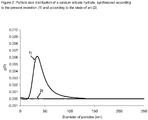
- Figure 2 shows the size distribution (mass weighted signal (g(D)) of calcium silicate hydrate particles as a function of the diameter of the particles (under the assumption that the particles are spherical) .
- the integral in the region from 0 to 150 nm equals to 100 %.
- the state-of-art calcium silicate hydrate particles (Acc. 29 in table 2) show no detectable particles in this region. The detected particles were larger than 1.000 nm.
- composition contains
- the calcium silicate hydrate in the composition is foshagite, hillebrandite, xonotlite, nekoite, clinotobermorite , 9 ⁇ -tobermorite (riversiderite), 11 ⁇ -tobermorite, 14 ⁇ -tobermorite (plombierite), jennite, metajennite, calcium chondrodite, afwillite, ⁇ - C 2 SH, dellaite, jaffeite, rosenhahnite, killalaite and/or suolunite.
- the calcium silicate hydrate in the composition is xonotlite, 9 ⁇ - tobermorite (riversiderite), 11 ⁇ -tobermorite, 14 ⁇ - tobermorite (plombierite), jennite, metajennite, afwillite and/or jaffeite.
- the molar ratio of calcium to silicon in the calcium silicate hydrate in the composition is from 0.6 to 2, preferably 1.1 to 1.8.
- the molar ratio of calcium to water in the calcium silicate hydrate is from 0.6 to 6, preferably 0.6 to 2, more preferably 0.8 to 2. Said ranges are similar to those found for example in calcium silicate hydrate phases, which are formed during the hydration of cement. Advantage is a good acceleration effect for hydraulic binders.
- the hardening accelerators according to this invention in combination with cements containing a relatively high content of soluble sulphates (from 0.1 to 5 weight % with respect to the cement).
- soluble sulphates from 0.1 to 5 weight % with respect to the cement.
- Such cements are commercially available or the water-soluble sulphate salt can be added to the cement.
- Said cement is preferably rich in anhydrous aluminate phases.
- the water-soluble sulphate is selected from sodium and/or potassium sulphate.
- the composition preferably aqueous hardening accelerator suspension, contains preferably hardening accelerators selected from the group of alkanolamines, preferably triisopropanolamine and / or tetrahydroxyethyl ethylene diamine (THEED).
- the alkanolamines are used at a dosage from 0.01 to 2.5 weight % with respect to the weight of hydraulic binder, preferably cement. Synergistic effects could be found when using amines, especially triisopropanolamine and tetrahydroxyethyl ethylene diamine, with respect to the early strength development of hydraulic binder systems, especially cementitious systems.
- the composition preferably aqueous hardening accelerator suspension, contains preferably setting retarders selected from the group of citric acid, tartaric acid, gluconic acid, phosphonic acid, amino-trimethylenphosphonic acid, ethylendiaminotetra(methylenephosphonic) acid, diethylentriaminopenta(methylenphosphonic) acid, in each case including the respective salts of the acids, pyrophosphates, pentaborates, metaborates and/or sugars (e.g. glucose, molasses).
- the advantage of the addition of setting retarders is that the open-time can be controlled and in particular if necessary can be prolonged.
- the setting retarders are used at a dosage from 0.01 to 0.5 weight % with respect to the weight of hydraulic binder, preferably cement.
- compositions preferably aqueous hardening accelerator suspensions can also contain any formulation component typically used in the field of construction chemicals, preferably defoamers, air entrainers, retarders, shrinkage reducers, redispersible powders, other hardening accelerators, anti-freezing agents and/or anti-efflorescence agents.
- formulation component typically used in the field of construction chemicals preferably defoamers, air entrainers, retarders, shrinkage reducers, redispersible powders, other hardening accelerators, anti-freezing agents and/or anti-efflorescence agents.
- the invention concerns also a composition, preferably a hardening accelerator composition, which is in powder form.
- the powder product can be obtained from the aqueous product by for example spray drying or drying in a fluid bed dryer.
- the hardening accelerator composition is used in building material mixtures containing cement, gypsum, anhydrite, slag, preferably ground granulated blast furnace slag, fly ash, silica dust, metakaolin, natural pozzolans, calcined oil shale, calcium sulphoaluminate cement and/or calcium aluminate cement, preferably in building material mixtures which contain substantially cement as a hydraulic binder.
- Gypsum comprises in this context all possible calcium sulphate carriers with different amounts of crystal water molecules, like for example also calcium sulphate hemihydrate.
- the hardening accelerator composition can also be used for reducing the permeability, preferably the water penetration depth according to DIN EN 12390-8.
- the building material mixtures containing cement, gypsum, anhydrite, slag, preferably ground granulated blast furnace slag, fly ash, silica dust, metakaolin, natural pozzolans, calcined oil shale, calcium sulpho aluminate cement and/or calcium aluminate cement, preferably the building material mixtures contain substantially cement as a hydraulic binder.
- aqueous liquids means in this context water, which might contain aggressive substances like salts (e.g. chloride ions, sulphate ions). For building material mixtures it is decisive that the permeation of water can be reduced in order to obtain a higher durability.
- the measurement of the water penetration depth is a good indicator how a cementitious material can resist to damages from the environment, for example leaching, weathering or sulphate attack.
- the test shows in how far a material can be impermeable to the penetration of aggressive aqueous agents.
- a decrease of the water penetration depth is consequently information about the durability of the concrete.
- a long durability is a very important property required by concrete producers and contractors.
- the reduced water penetration depth found in the experimental tests using the accelerator compositions of this invention were very surprising. It is believed that the positive effect of the accelerators on this material property is due to different structures of the hydration products in the concrete, which reduce the porosity of the concrete.
- the building material mixtures which contain a composition, preferably an aqueous hardening accelerator suspension, according to this invention and cement, gypsum, anhydrite, slag, preferably ground granulated blast furnace slag, fly ash, silica dust, metakaolin, natural pozzolans, calcined oil shale, calcium sulpho aluminate cement and/or calcium aluminate cement.
- a composition preferably an aqueous hardening accelerator suspension, according to this invention and cement, gypsum, anhydrite, slag, preferably ground granulated blast furnace slag, fly ash, silica dust, metakaolin, natural pozzolans, calcined oil shale, calcium sulpho aluminate cement and/or calcium aluminate cement.
- the building material mixtures contain substantially cement as a hydraulic binder.
- the hardening accelerator composition is contained in the building material mixture preferably at a dosage of
- building material mixtures can mean mixtures in dry or aqueous form and in the hardened or plastic state.
- Dry building material mixtures could be for example mixtures of said binders, preferably cement and the hardening accelerator compositions (preferably in powder form) according to this invention.
- Mixtures in aqueous form usually in the form of slurries, pastes, fresh mortar or fresh concrete are produced by the addition of water to the binder component(s) and the hardening accelerator composition, they transform then from the plastic to the hardened state.
- a reactor, equipped with heating and stirrer is charged with a compound according to structural unit (I), for example polyethylenglycol monophenylether (in the following called PhPEG), a compound according to structural unit (II), for example polyethylenglycol monophenylether phosphate or phenoxyethanol phosphate (in the following called "phosphate”) and a keton compound (IIIa), for example formaldehyde (paraformaladehyde can be used as well as aqueous formaldehyde or trioxane).
- the reaction mixture is heated to temperatures typically between 90 °C and 120 °C and the polycondensation is started by the addition of the acid catalyst (typically sulfuric acid or methansulfonic acid).
- the acid catalyst typically sulfuric acid or methansulfonic acid
- the formaldehyde source F is a 30.5 % aqueous solution of formaldehyde, P is paraformaldehyde and T is trioxane.
- the Acid type S is sulphuric acid and M is methane sulfonic acid.
- Table 1 Polymer composition of phosphated polycondensates Example PhPEG Mn [g/mol] " Phosphate type CH 2 O source Acid type Reaction Temp. Reaction Time Solid Content Mol.
- Ca(OH) 2 powder and fumed silica were used as starting materials for synthesis. 14.83 g of Ca(OH) 2 was mixed with 153 g CO 2 free water in which 5.37 g of the used polymer was dissolved. 12.01 g of fumed SiO 2 (Sigma Aldrich) was mixed with the Ca(OH) 2 slurry. The resulting slurry was put into a planetary ball mill (Fritsch Pulverisette 4) equipped with ZrO 2 grinding tools of 250 ml in volume. 100 grinding bodies with 10 mm in diameter were used. The relative ratio of the rotations during the grinding process was - 2.18. The total grinding time was 80 minutes, stopped after each 20 minutes for holding temperature in the paste below 70 °C. Grinding bodies were separated after the milling process by sieving the paste and rinsing with CO 2 free water. The resulting suspension has a solid content of 13.5 weight-% determined after heating the suspension for 14 hours at 45 °C and reaching a constant weight.
- Table 3 are summarized the different accelerator types synthesized by the procedure described above.
- the weight of polymers is according to the solid content of the polymer suspensions.
- Table 2 composition of hardening accelerators ID Polymer Weight polymer [g] Solid content of suspension (%) Acc. M1 - - 5.5 Acc. M2 Melflux®267L/40 % 5.16 10.1 Acc. M3 Melflux®267L/40 % P1 0.51 4.65 26.9
- Accelerator M1 is the reference accelerator which was synthesized without polymer according the process described above.
- the influence of the hardening accelerators was tested on the cement Karlstadt 42.5 R by the measurement of the heat release by heat flow calorimetry.
- the accelerator suspension was mixed with the batching water and the resulting suspension mixed with 20 g of the cement.
- the water to cement (w/c) ratio was set to 0.32.
- the dosage of the accelerators to be tested is expressed as weight percentage of solid content with respect to the cement weight.
- the heat flow curves are presented by Figure 3 .
- the addition of the hardening accelerator described in the invention accelerates the acceleration period (defined in H. F. W. Taylor (1997): Cement Chemistry, 2nd edition, p. 212ff ). The effect is summarized in Table 11.
- Heat flow curve 1 represents the blank (Karlstadt cement only), curves 2 to 4 show the results for Karlstadt cement with addition of 0.6 weight % of the respective accelerator (curve 2: Acc. M1 not according to this invention, curve 3: Acc. M2 and curve 4: Acc. M3).
- Table 3 Time of minimal heat flow and 1 st heat flow maximum in the main period of hydration according to figure 3.
- Sample Min [h] 1. Max [h] ⁇ [h] Acceleration [%] Karlstadt without Acc. 1.7 9.4 7.7 ⁇ 0 + 0.6 wt.-% Acc. M1 1.2 8.3 7.1 -8 + 0.6 wt.-% Acc. M2 1.1 6.7 5.6 - 27 + 0.6 wt.-% Acc. M3 1.1 6.7 5.6 - 27
- the accelerator according to the invention was mixed with the batching water before addition to the cement. Water from the accelerator suspension is included in the total water content. The addition of the accelerator is given in active solid content (calcium silicate hydrate) in the acceleration suspension with respect to the cement content of the mortar.
Landscapes
- Chemical & Material Sciences (AREA)
- Engineering & Computer Science (AREA)
- Ceramic Engineering (AREA)
- Structural Engineering (AREA)
- Materials Engineering (AREA)
- Organic Chemistry (AREA)
- Inorganic Chemistry (AREA)
- Chemical Kinetics & Catalysis (AREA)
- Curing Cements, Concrete, And Artificial Stone (AREA)
- Compositions Of Macromolecular Compounds (AREA)
- Macromonomer-Based Addition Polymer (AREA)
- Phenolic Resins Or Amino Resins (AREA)
- Adhesives Or Adhesive Processes (AREA)
- Polyethers (AREA)
- Organic Low-Molecular-Weight Compounds And Preparation Thereof (AREA)
Priority Applications (1)
| Application Number | Priority Date | Filing Date | Title |
|---|---|---|---|
| PL13179257T PL2664595T3 (pl) | 2008-09-02 | 2009-09-02 | Sposób wytwarzania kompozycji środka przyspieszającego utwardzanie zawierającej plastyfikator |
Applications Claiming Priority (3)
| Application Number | Priority Date | Filing Date | Title |
|---|---|---|---|
| EP08163468 | 2008-09-02 | ||
| PCT/EP2009/061334 WO2010026155A1 (en) | 2008-09-02 | 2009-09-02 | Plasticizer-containing hardening accelerator composition |
| EP09782505.3A EP2321235B1 (en) | 2008-09-02 | 2009-09-02 | Use of a plasticizer-containing hardening accelerator composition |
Related Parent Applications (2)
| Application Number | Title | Priority Date | Filing Date |
|---|---|---|---|
| EP09782505.3A Division EP2321235B1 (en) | 2008-09-02 | 2009-09-02 | Use of a plasticizer-containing hardening accelerator composition |
| EP09782505.3A Division-Into EP2321235B1 (en) | 2008-09-02 | 2009-09-02 | Use of a plasticizer-containing hardening accelerator composition |
Publications (3)
| Publication Number | Publication Date |
|---|---|
| EP2664595A2 EP2664595A2 (en) | 2013-11-20 |
| EP2664595A3 EP2664595A3 (en) | 2014-10-01 |
| EP2664595B1 true EP2664595B1 (en) | 2018-11-21 |
Family
ID=41404379
Family Applications (4)
| Application Number | Title | Priority Date | Filing Date |
|---|---|---|---|
| EP13179257.4A Active EP2664595B1 (en) | 2008-09-02 | 2009-09-02 | Process for preparing a plasticizer-containing hardening accelerator composition |
| EP13179258.2A Active EP2664596B1 (en) | 2008-09-02 | 2009-09-02 | Process for preparing a plasticizer-containing hardening accelerator composition |
| EP09782505.3A Active EP2321235B1 (en) | 2008-09-02 | 2009-09-02 | Use of a plasticizer-containing hardening accelerator composition |
| EP16195850.9A Active EP3153482B1 (en) | 2008-09-02 | 2009-09-02 | Plasticizer-containing hardening accelerator composition |
Family Applications After (3)
| Application Number | Title | Priority Date | Filing Date |
|---|---|---|---|
| EP13179258.2A Active EP2664596B1 (en) | 2008-09-02 | 2009-09-02 | Process for preparing a plasticizer-containing hardening accelerator composition |
| EP09782505.3A Active EP2321235B1 (en) | 2008-09-02 | 2009-09-02 | Use of a plasticizer-containing hardening accelerator composition |
| EP16195850.9A Active EP3153482B1 (en) | 2008-09-02 | 2009-09-02 | Plasticizer-containing hardening accelerator composition |
Country Status (21)
| Country | Link |
|---|---|
| US (1) | US8653186B2 (enExample) |
| EP (4) | EP2664595B1 (enExample) |
| JP (4) | JP6071199B2 (enExample) |
| CN (2) | CN108947375B (enExample) |
| AU (1) | AU2009289267B2 (enExample) |
| BR (1) | BRPI0918283A2 (enExample) |
| CA (1) | CA2735705C (enExample) |
| DE (1) | DE202009017741U1 (enExample) |
| DK (3) | DK2321235T3 (enExample) |
| ES (4) | ES2711314T3 (enExample) |
| HR (1) | HRP20191076T1 (enExample) |
| HU (4) | HUE042656T2 (enExample) |
| LT (3) | LT2321235T (enExample) |
| MX (1) | MX2011002357A (enExample) |
| PL (4) | PL3153482T3 (enExample) |
| PT (1) | PT2321235T (enExample) |
| RU (1) | RU2520105C2 (enExample) |
| SI (1) | SI2321235T1 (enExample) |
| TR (3) | TR201908413T4 (enExample) |
| TW (1) | TW201016629A (enExample) |
| WO (1) | WO2010026155A1 (enExample) |
Families Citing this family (155)
| Publication number | Priority date | Publication date | Assignee | Title |
|---|---|---|---|---|
| ES2711314T3 (es) | 2008-09-02 | 2019-05-03 | Construction Research & Technology Gmbh | Procedimiento de preparación de una composición de acelerador de endurecimiento que contiene plastificante |
| CN102471476B (zh) | 2009-06-30 | 2014-05-21 | 巴斯夫欧洲公司 | 膦引发的制备超支化多元醇的方法 |
| CA2771256C (en) | 2009-09-02 | 2017-02-28 | Construction Research & Technology Gmbh | Sprayable hydraulic binder composition and method of use |
| AU2010294400B2 (en) * | 2009-09-02 | 2014-03-20 | Basf Construction Solutions Gmbh | Formulation and its use |
| CN102596855B (zh) * | 2009-09-02 | 2014-04-02 | 建筑研究和技术有限公司 | 含有磷酸化缩聚物的硬化促进剂组合物 |
| ES2743684T3 (es) * | 2010-02-25 | 2020-02-20 | Construction Research & Technology Gmbh | Composición aceleradora de endurecimiento que contiene dispersantes |
| FR2958931B1 (fr) * | 2010-04-20 | 2012-05-18 | Lafarge Sa | Liant hydraulique rapide pour pieces et ouvrages en beton |
| US9409820B2 (en) | 2010-04-21 | 2016-08-09 | Basf Se | Use of CSH suspensions in well cementing |
| BR112012026716A2 (pt) * | 2010-04-21 | 2016-07-12 | Basf Se | uso de suspensões csh na cimentação de poços de perfuração |
| CA2746034C (en) | 2010-07-15 | 2018-09-04 | Lafarge | Low density cementitious compositions using limestone |
| US8435930B2 (en) | 2010-07-15 | 2013-05-07 | Lafarge | Low density cementitious compositions using lime kiln dust |
| EP2423175A1 (de) | 2010-08-24 | 2012-02-29 | Sika Technology AG | Beschleuniger |
| CN107082618A (zh) * | 2010-10-11 | 2017-08-22 | 巴斯夫聚合建材有限公司 | 含分散剂的石膏浆料 |
| WO2012072466A1 (de) | 2010-11-29 | 2012-06-07 | Construction Research & Technology Gmbh | Pulverförmiger beschleuniger |
| EP2465835B1 (de) | 2010-12-17 | 2013-09-18 | BASF Construction Polymers GmbH | Verfahren zur kontinuierlichen herstellung von mörtelmassen |
| US8561701B2 (en) | 2010-12-21 | 2013-10-22 | Halliburton Energy Services, Inc. | Methods for cementing in a subterranean formation using a cement composition containing calcium silicate hydrate seeds |
| US9434648B2 (en) * | 2011-04-21 | 2016-09-06 | Construction Research & Technology Gmbh | Accelerator composition |
| JP6066117B2 (ja) * | 2011-04-21 | 2017-01-25 | コンストラクション リサーチ アンド テクノロジー ゲーエムベーハーConstruction Research & Technology GmbH | 促進剤組成物 |
| EP2699527B1 (en) * | 2011-04-21 | 2021-05-12 | Construction Research & Technology GmbH | Process for producing accelerator compositions |
| ES2745743T3 (es) | 2011-05-26 | 2020-03-03 | Saint Gobain Weber | Aglutinante hidráulico que comprende un acelerador, su utilización y procedimiento de preparación de un material de construcción |
| EP2763847A4 (en) | 2011-10-07 | 2015-08-19 | Boral Ip Holdings Australia Pty Ltd | INORGANIC POLYMER / ORGANIC POLYMER COMPOSITES AND METHODS FOR PREPARING THE SAME |
| US8864901B2 (en) | 2011-11-30 | 2014-10-21 | Boral Ip Holdings (Australia) Pty Limited | Calcium sulfoaluminate cement-containing inorganic polymer compositions and methods of making same |
| RU2617852C9 (ru) * | 2011-12-05 | 2017-08-30 | Сикэ Текнолоджи Аг | Способ получения ускорителей затвердевания минеральных вяжущих композиций |
| EP2607329A1 (de) * | 2011-12-23 | 2013-06-26 | Sika Technology AG | Beschleuniger |
| EP2615073B1 (de) | 2012-01-13 | 2018-04-04 | Construction Research & Technology GmbH | Dispergiermittel für anorganische Partikel |
| JP6092257B2 (ja) | 2012-02-08 | 2017-03-08 | ビーエーエスエフ ソシエタス・ヨーロピアBasf Se | 水性分散液 |
| US8883907B2 (en) | 2012-02-08 | 2014-11-11 | Basf Se | Aqueous dispersion |
| FR2989082B1 (fr) * | 2012-04-05 | 2015-03-13 | Chryso | Adjuvant pour compositions hydrauliques |
| JP6290176B2 (ja) * | 2012-04-11 | 2018-03-07 | コンストラクション リサーチ アンド テクノロジー ゲーエムベーハーConstruction Research & Technology GmbH | 芳香族化合物系重縮合物、その製造法及びその使用 |
| WO2013178417A1 (en) * | 2012-05-29 | 2013-12-05 | Construction Research & Technology Gmbh | Pulverulent accelerator |
| US20150148456A1 (en) * | 2012-05-29 | 2015-05-28 | Construction Research & Technology Gmbh | Method for the production of solid accelerators for construction material mixtures |
| FR2992961B1 (fr) * | 2012-07-04 | 2014-08-29 | Chryso | Procede de creation de motifs sur une surface en beton |
| EP2687498A1 (de) | 2012-07-20 | 2014-01-22 | Construction Research & Technology GmbH | Additiv für hydraulisch abbindende Massen |
| EP2687496A1 (de) * | 2012-07-20 | 2014-01-22 | BASF Construction Polymers GmbH | Synthese und Anwendung von Gips-Seeding-Material |
| DE102012106658B3 (de) | 2012-07-23 | 2013-09-26 | ThyssenKrupp Resource Technologies AG | Verwendung hydratationsbeschleunigender Keime als Zusatzstoff für Zement und/oder Beton |
| CN102757213B (zh) * | 2012-07-26 | 2013-11-06 | 石家庄铁道大学 | 用于粉细砂路堤加宽的边坡注浆浆液的制备方法 |
| EP2882696B1 (en) * | 2012-08-13 | 2019-04-10 | Construction Research & Technology GmbH | Process for preparing a hardening accelerator composition |
| JP6265993B2 (ja) * | 2012-08-13 | 2018-01-24 | コンストラクション リサーチ アンド テクノロジー ゲーエムベーハーConstruction Research & Technology GmbH | セメント組成物用の硬化促進剤組成物 |
| NO20121086A1 (no) * | 2012-09-25 | 2014-03-26 | Yara Int Asa | Antifrysesammensetning for produksjon av bestandig betong under kalde temperaturforhold |
| EP2917161A1 (en) * | 2012-11-09 | 2015-09-16 | Verdant Cement LLC | Molten salt synthesis for manufacture of cement precursors |
| CN102964077B (zh) * | 2012-11-20 | 2015-01-21 | 中山市东峻混凝土有限公司 | 一种聚羧酸系超塑化剂复配用稳定增强剂及制备方法和应用 |
| CN102976654B (zh) * | 2012-12-04 | 2014-12-10 | 江苏苏博特新材料股份有限公司 | 一种聚羧酸超塑化剂及其应用 |
| KR101617067B1 (ko) | 2013-01-18 | 2016-05-02 | (주)엘지하우시스 | 혹한기용 외단열 몰탈 및 이를 이용한 외단열 시스템 시공 방법 |
| EP2759337A1 (de) * | 2013-01-25 | 2014-07-30 | Basf Se | Additiv für hydraulisch abbindende Massen |
| CA2894829C (en) | 2013-01-25 | 2021-06-15 | Basf Se | Hardening accelerator composition |
| EP2769964A1 (de) | 2013-02-26 | 2014-08-27 | Construction Research & Technology GmbH | Additiv für hydraulisch abbindende Massen |
| EP2695866B1 (de) | 2013-05-24 | 2019-04-24 | Basf Se | Modifiziertes rheologieadditiv |
| EP3553025B1 (de) | 2013-05-30 | 2020-11-18 | Sika Technology Ag | Beschleuniger für mineralische bindemittel |
| EP3019455B1 (de) * | 2013-07-12 | 2019-07-03 | Sika Technology AG | Zusatzmittelkombination aus einem mahlhilfsmittel und einem betonzusatzmittel zur beschleunigung der hydratation von zementösen bindemitteln |
| EP2826827B1 (en) * | 2013-07-18 | 2019-06-12 | Basf Se | CMP composition comprising abrasive particles containing ceria |
| KR101385237B1 (ko) * | 2013-08-27 | 2014-04-16 | 이코넥스 주식회사 | 실리카퓸을 이용한 나노크기의 규산칼슘 수화물 제조방법 |
| EP2842921A1 (en) | 2013-08-27 | 2015-03-04 | Construction Research & Technology GmbH | Novel fibers, methods for their preparation and use in the manufacture of reinforced elements |
| EP2842927A1 (en) | 2013-08-29 | 2015-03-04 | BASF Construction Polymers GmbH | Hardening accelerator containing ettringite and calcium silicate hydrate |
| US9796622B2 (en) * | 2013-09-09 | 2017-10-24 | Saudi Arabian Oil Company | Development of high temperature low density cement |
| NO20131392A1 (enExample) * | 2013-10-21 | 2015-04-22 | Yara Int Asa | |
| SI2878585T1 (sl) | 2013-11-27 | 2017-10-30 | Fundacion Tecnalia Research & Innovation Parque Cientifico y Tecnologico de Bizkaia | Metoda za proizvodnjo cementirajočih C-S-H semen |
| ITMI20132059A1 (it) | 2013-12-10 | 2015-06-11 | Mapei Spa | Additivo accelerante per composizioni cementizie |
| EP2886580A1 (en) | 2013-12-20 | 2015-06-24 | Construction Research & Technology GmbH | Additive for rheology improvement of inorganic binders |
| EP2896603A1 (de) * | 2014-01-21 | 2015-07-22 | Basf Se | Calciumsulfat-Zusammensetzung umfassend ein Additiv |
| EP2899162A1 (de) * | 2014-01-22 | 2015-07-29 | Basf Se | Synthese und Anwendung von auf CaSO4 basierten Erhärtungsbeschleunigern |
| EP2899171A1 (de) | 2014-01-22 | 2015-07-29 | Construction Research & Technology GmbH | Additiv für hydraulisch abbindende Massen |
| EP2876094A1 (en) * | 2014-04-03 | 2015-05-27 | Basf Se | Cement and calcium sulphate based binder composition |
| CN103951308B (zh) * | 2014-04-17 | 2015-08-19 | 山东卓星化工有限公司 | 磺酸基改性聚氧乙烯醚超塑化剂及其制备方法 |
| EP2952492A1 (de) * | 2014-06-06 | 2015-12-09 | Basf Se | Zusammensetzung auf Basis von Calciumsilikat-Hydrat |
| CN104402288A (zh) * | 2014-10-29 | 2015-03-11 | 上海建工集团股份有限公司 | 一种水化硅酸钙凝胶溶液早强剂及其制备方法 |
| KR101713828B1 (ko) * | 2014-11-04 | 2017-03-10 | (주)에스엠테크 | 무시멘트 촉진형 혼화제 및 이를 포함하는 무시멘트 조성물 |
| EP3233751B1 (en) * | 2014-12-18 | 2019-03-13 | Basf Se | Construction chemical composition for tile mortar |
| US10377674B2 (en) * | 2015-02-02 | 2019-08-13 | Carolyn Dry | Concrete coatings and compositions that absorb carbon dioxide |
| US10214676B2 (en) | 2015-02-27 | 2019-02-26 | Basf Se | Use of CSH-seed modified fibers in oil field applications |
| CN107531568B (zh) * | 2015-04-21 | 2020-08-04 | 巴斯夫欧洲公司 | 制备粉末形式的包含硅酸钙水合物的硬化促进剂的方法 |
| CN107735381B (zh) * | 2015-04-30 | 2020-08-28 | 建筑研究和技术有限公司 | 促进剂组合物 |
| AT517291A1 (de) | 2015-05-26 | 2016-12-15 | Holcim Technology Ltd | Betonzusammensetzung |
| CN107848816B (zh) | 2015-05-29 | 2021-02-09 | 研究与创新基金会 | 用作混凝土或水泥类材料中的促硬剂的硅酸钙水合物的制造方法及用该方法制造的硅酸钙水合物 |
| BR112017027976B1 (pt) * | 2015-06-26 | 2022-11-16 | Construction Research & Technology Gmbh | Aditivo, processo para produção de um aditivo, uso de um aditivo, e, mistura |
| JP7277139B2 (ja) * | 2015-08-21 | 2023-05-18 | ビーエーエスエフ ソシエタス・ヨーロピア | 促進剤組成物 |
| MX2018004881A (es) * | 2015-10-21 | 2018-08-01 | Sika Tech Ag | Aditivo para tratamiento posterior interno de composiciones aglutinantes minerales. |
| WO2017081119A2 (en) * | 2015-11-10 | 2017-05-18 | Yara International Asa | Calcium nitrate for reducing the pore size distribution of a hardened cementitious composition and steel reinforced concrete having an elevated resistance towards carbonation |
| FR3043675B1 (fr) | 2015-11-17 | 2022-11-11 | Lafarge Sa | Mousse minerale ultra-legere et son procede de fabrication |
| JP6905795B2 (ja) * | 2015-12-16 | 2021-07-21 | コンストラクション リサーチ アンド テクノロジー ゲーエムベーハーConstruction Research & Technology GmbH | 吹付コンクリート組成物およびその製造方法 |
| WO2017103215A1 (en) | 2015-12-17 | 2017-06-22 | Construction Research & Technology Gmbh | Polycondensate based water-reducer |
| RU2616964C1 (ru) * | 2016-03-09 | 2017-04-18 | Федеральное государственное бюджетное образовательное учреждение высшего профессионального образования "Петербургский государственный университет путей сообщения Императора Александра I" | Высокопрочный бетон |
| DE102016207858A1 (de) | 2016-05-06 | 2017-11-09 | Baustoffwerke Löbnitz GmbH & Co. KG | Dämmstoff |
| RU2739978C2 (ru) | 2016-05-09 | 2020-12-30 | Констракш Рисерч Энд Текнолоджи Гмбх | Способ обработки шлака |
| CN109415262B (zh) | 2016-06-09 | 2022-08-05 | 巴斯夫欧洲公司 | 用于砂浆和水泥组合物的水合控制混合物 |
| WO2017212045A1 (en) | 2016-06-09 | 2017-12-14 | Basf Se | Construction chemical compositions comprising a bisulfite adduct of glyoxylic acid |
| US11008262B2 (en) | 2016-07-18 | 2021-05-18 | Ecole polytechnique fédérale de Lausanne (EPFL) | Hardening acceleration/hardening retardation composition for building materials |
| JP6831508B2 (ja) * | 2016-07-25 | 2021-02-17 | 学校法人福岡大学 | コンクリートの補修方法 |
| KR102492543B1 (ko) * | 2016-10-31 | 2023-01-27 | 바스프 에스이 | 건설 화학 조성물용 첨가제 |
| WO2018087099A1 (de) | 2016-11-09 | 2018-05-17 | Sika Technology Ag | Erhärtungsbeschleuniger |
| CN107311504B (zh) * | 2016-12-26 | 2020-10-23 | 江苏苏博特新材料股份有限公司 | 一种提升水泥基材料强度的外加剂、其制备方法及其应用 |
| CA3047382A1 (en) * | 2016-12-27 | 2018-07-05 | Construction Research & Technology Gmbh | Strength enhancing admixture for cementitious compositions |
| WO2018154012A1 (de) | 2017-02-22 | 2018-08-30 | Basf Se | Semigeordnetes calciumsilikathydrat enthaltende zusammensetzung |
| MY196346A (en) * | 2017-02-22 | 2023-03-24 | Denka Company Ltd | Hardening agent for ready-mix shipped rapid-hardening concrete, ready-mix shipped rapid-hardening concrete material, ready-mix shipped rapid-hardening concrete composition, and method for preparing same |
| EP3585752A1 (de) | 2017-02-22 | 2020-01-01 | Cirkel GmbH & Co. KG | Oxidische Zusammensetzung mit einem Gehalt an semigeordnetem Calcium-Silikat-Hydrat |
| DE102017205822A1 (de) | 2017-04-05 | 2018-10-11 | Baustoffwerke Löbnitz GmbH & Co. KG | Verfahren und Vorrichtung zur Herstellung von porösem mineralischen Baumaterial |
| RU2659432C1 (ru) * | 2017-04-10 | 2018-07-02 | Общество с ограниченной ответственностью "Экспонента" | Регулятор реологических свойств дисперсных систем на основе неорганических вяжущих веществ |
| CN106986572B (zh) * | 2017-04-25 | 2020-08-14 | 北京工业大学 | 一种用超支化聚合物制备混凝土增强剂的方法 |
| WO2018200563A1 (en) * | 2017-04-25 | 2018-11-01 | GCP Applied Technologies, Inc. | Agents for enhancing cement strength |
| CN107235650B (zh) * | 2017-07-03 | 2020-05-05 | 中建西部建设西南有限公司 | 一种水性纳米复合型早强外加剂及其制备方法 |
| US11926715B2 (en) | 2017-10-27 | 2024-03-12 | Basf Se | Spray drying method |
| FR3073220B1 (fr) * | 2017-11-07 | 2022-11-11 | Hoffmann Jb Tech | Procede de preparation d'un liant ettringitique pour la fabrication de materiaux de construction |
| JP7342044B2 (ja) | 2018-03-09 | 2023-09-11 | ダスティン エイ ハートマン | コンクリート性能を改善するための新規組成物 |
| EP3543220A1 (de) * | 2018-03-22 | 2019-09-25 | Sika Technology Ag | Herstellung von calciumhydroxid nanopartikeln und ihre verwendung als beschleuniger in mineralischen bindemittelzusammensetzungen |
| US12157706B2 (en) | 2018-03-22 | 2024-12-03 | E5 Incorporated | Compositions for improved concrete performance |
| WO2019182672A1 (en) | 2018-03-22 | 2019-09-26 | Hartman Dustin A | Method for preparing an improved finished concrete product |
| EP3802461A1 (de) * | 2018-05-31 | 2021-04-14 | Sika Technology Ag | Verfahren zur verflüssigung von belit-calciumsulfoaluminat-ferrit-haltigen zementen |
| CN108585559A (zh) * | 2018-06-06 | 2018-09-28 | 上海美澎材料科技有限公司 | 一种水泥基结晶母料材料及制备方法 |
| JP7315595B2 (ja) * | 2018-07-06 | 2023-07-26 | ビーエーエスエフ ソシエタス・ヨーロピア | 流動性耐火材料のための組成物 |
| DE102018212322A1 (de) | 2018-07-24 | 2020-01-30 | Baustoffwerke Löbnitz GmbH & Co. KG | Verfahren zur Herstellung von porösem mineralischem Baumaterial mit verbesserter Festigkeit |
| US20210261460A1 (en) | 2018-08-13 | 2021-08-26 | Basf Se | Efficient wetting agent by using a support material |
| CN117585968A (zh) * | 2018-10-02 | 2024-02-23 | Sika技术股份公司 | 研磨的粒状高炉炉渣的活化 |
| CN109020423A (zh) * | 2018-10-19 | 2018-12-18 | 济南大学 | 一种用于海洋工程的高抗蚀自密实混凝土 |
| WO2020244981A1 (en) | 2019-06-03 | 2020-12-10 | Basf Se | Use of an additive kit in 3D printing of a construction material composition |
| CN110395939B (zh) * | 2019-06-19 | 2022-04-22 | 科之杰新材料集团有限公司 | 一种防水增强型无碱液体速凝剂及其制备方法 |
| RU2717021C1 (ru) * | 2019-07-17 | 2020-03-17 | Федеральное государственное бюджетное образовательное учреждение высшего образования "Петербургский государственный университет путей сообщения Императора Александра I" | Высокопрочный бетон |
| US11866366B2 (en) | 2019-09-03 | 2024-01-09 | Specification Products, Inc. | Wear-resistant concrete formulations and methods for their preparation |
| CN110759654A (zh) * | 2019-12-05 | 2020-02-07 | 长江师范学院 | 一种高温条件下具有高性能的铝酸盐基水泥及其制备方法 |
| CN110981269A (zh) * | 2019-12-31 | 2020-04-10 | 上海三瑞高分子材料股份有限公司 | 一种水泥早强剂组合物及其制备方法 |
| KR102181656B1 (ko) * | 2020-01-03 | 2020-11-23 | 주식회사 삼표산업 | 조강 첨가제 제조 방법 및 조강성 콘크리트 조성물 |
| RU2729547C1 (ru) * | 2020-02-07 | 2020-08-07 | Федеральное государственное бюджетное образовательное учреждение высшего образования "Петербургский государственный университет путей сообщения Императора Александра I" | Теплоизоляционный бетон |
| EP4110744A1 (en) | 2020-02-27 | 2023-01-04 | Basf Se | Uncharged clay blocking agent |
| CN111470794B (zh) * | 2020-03-05 | 2021-05-28 | 武汉理工大学 | 一种水化铝硅酸钙纳米晶核早强剂及其制备方法 |
| TWI717228B (zh) | 2020-03-11 | 2021-01-21 | 彩興股份有限公司 | 混凝土硬化劑組成物 |
| JP7731364B2 (ja) | 2020-03-20 | 2025-08-29 | ビーエーエスエフ ソシエタス・ヨーロピア | 改善された初期強度を有する環境配慮型建設用材料組成物 |
| EP3916067B1 (de) | 2020-05-27 | 2023-07-12 | Bind-X GmbH | Biozementierungsmischung zur staubkontrolle |
| WO2021254802A1 (en) | 2020-06-18 | 2021-12-23 | Basf Se | Hydration control mixture for mortar and cement compositions |
| JP2022011743A (ja) * | 2020-06-30 | 2022-01-17 | 株式会社日本触媒 | アルミノシリケート含有組成物及びその製造方法 |
| CN113913167B (zh) * | 2020-07-08 | 2023-05-30 | 中国石油化工股份有限公司 | 一种固井水泥浆用自由液控制剂及其制备方法与应用 |
| CN112062494A (zh) * | 2020-09-16 | 2020-12-11 | 天津炬实科技发展股份有限公司 | 一种无机矿物增强剂 |
| WO2022071281A1 (ja) * | 2020-09-30 | 2022-04-07 | 株式会社大阪ソーダ | ゴム組成物 |
| EP4225716A1 (en) | 2020-10-09 | 2023-08-16 | Basf Se | Process for producing calcium silicate hydrate |
| RU2754844C1 (ru) * | 2020-10-22 | 2021-09-08 | Общество с ограниченной ответственностью «Оренбургский пропант» | Акриловый полимер на водной основе для цементной композиции и способ его получения |
| CN112405734B (zh) * | 2020-11-10 | 2022-05-10 | 漳州市德根工贸有限公司 | 一种胶合板生产工艺及其设备 |
| CA3198470A1 (en) * | 2020-11-18 | 2022-05-27 | Socpra Sciences Et Genie S.E.C. | Use of carrageenan as a viscosity-modifying admixture in a flowable cementitious suspensions |
| WO2022248630A1 (en) | 2021-05-27 | 2022-12-01 | Basf Se | Dispersion composition comprising a cement-based sealing slurry and an additive mixture |
| CN113354315B (zh) * | 2021-07-09 | 2022-11-22 | 贵州大学 | 利用磷矿酸不溶渣生产高硅硫铝酸盐水泥的方法 |
| EP4119519A1 (en) | 2021-07-12 | 2023-01-18 | Mapei S.p.A. | Strength enhancing admixture for low-carbon cementitious compositions |
| CA3229659A1 (en) | 2021-08-27 | 2023-03-02 | Construction Research & Technology Gmbh | Use of a colloidal polymer inorganic hybrid material as a construction composition additive |
| EP4194419A1 (en) | 2021-12-08 | 2023-06-14 | Holcim Technology Ltd | Method for increasing the strength of a hydraulic binder and a mineral accelerator therefore |
| CN114736565B (zh) * | 2022-03-29 | 2023-11-28 | 上海保立佳新材料有限公司 | 一种硬化剂及其原料组合物、制备方法和应用 |
| CA3255910A1 (en) | 2022-04-21 | 2023-10-26 | Construction Research & Technology Gmbh | PROCESS FOR PREPARING A COMPOSITION OF HYDRATED CALCIUM SILICATE GERMS USEFUL AS A HARDENING ACCELERATOR FOR CEMENT-BASED COMPOSITIONS |
| WO2023209082A1 (en) | 2022-04-29 | 2023-11-02 | Basf Se | Combinations of an organic polymer and calcium silicate hydrate for producing mineral water-proofing membranes |
| KR102447563B1 (ko) * | 2022-05-11 | 2022-09-26 | 주식회사 다온코리아 | 콘크리트 구조물의 균열보수재 및 이를 이용한 균열보수공법 |
| CN114804709B (zh) * | 2022-05-23 | 2023-03-28 | 广西科达新材料集团有限公司 | 一种纳米水化硅酸钙聚羧酸早强剂及其制备方法 |
| CA3258324A1 (en) | 2022-06-22 | 2023-12-28 | Construction Research & Technology Gmbh | Hardening accelerator composition for cementitious compositions, cementitious composition and method for accelerating the hardening of a cementitious composition |
| EP4353699A1 (en) | 2022-10-12 | 2024-04-17 | Mapei S.p.A. | Low carbon concrete admixture |
| EP4378909A1 (en) | 2022-11-29 | 2024-06-05 | Sika Technology AG | Accelerators for mineral binder compositions |
| WO2024180241A1 (en) | 2023-03-01 | 2024-09-06 | Construction Research & Technology Gmbh | Improved shotcrete compositions |
| EP4516759A1 (en) | 2023-09-01 | 2025-03-05 | Construction Research & Technology GmbH | Low carbon footprint construction material with improved early and late strengths |
| EP4534499A1 (en) | 2023-10-06 | 2025-04-09 | Sika Technology AG | Producing hardenig accelerators for mineral binders |
| EP4574797A1 (en) * | 2023-12-18 | 2025-06-25 | Hilti Aktiengesellschaft | An expediting composition for accelerating the hardening of calcium aluminate cements |
| EP4574798A1 (en) * | 2023-12-18 | 2025-06-25 | Hilti Aktiengesellschaft | An expediting composition for accelerating the hardening of calcium aluminate cements |
| WO2025132259A1 (en) | 2023-12-18 | 2025-06-26 | Holcim Technology Ltd | Method for producing a composition suitable as a setting and/or hardening accelerator for a hydraulic binder |
| EP4574796A1 (en) * | 2023-12-18 | 2025-06-25 | Hilti Aktiengesellschaft | A process for the preparation of an expediting composition suitable for accelerating the hardening of calcium aluminate cements |
| EP4574792A1 (en) | 2023-12-22 | 2025-06-25 | A2A Ambiente SpA | Method for simultaneous production of artificial aggregates and salt from solid waste incinerator plants |
Family Cites Families (32)
| Publication number | Priority date | Publication date | Assignee | Title |
|---|---|---|---|---|
| US2204113A (en) | 1937-09-30 | 1940-06-11 | Goodrich Co B F | Calcium silicate and method of preparing the same |
| RO94695B1 (ro) * | 1986-04-14 | 1988-08-16 | Institutul Politehnic "Traian Vuia" | Procedeu de obtinere a silicatului de calciu sub forma de xonotlit si wollastonit sintetic |
| DE3800091A1 (de) | 1987-08-28 | 1989-07-13 | Sandoz Ag | Copolymere verbindungen, deren herstellung und verwendung |
| US5295184A (en) * | 1991-05-30 | 1994-03-15 | Davox Corporation | Dynamically adjustable call pacing system |
| US5332041A (en) | 1992-12-30 | 1994-07-26 | Halliburton Company | Set-activated cementitious compositions and methods |
| FR2708592B1 (fr) * | 1993-07-29 | 1995-09-29 | Lafarge Coppee | Agent accélérateur de prise et du durcissement des liants hydrauliques siliciques. |
| US5355954A (en) | 1993-11-02 | 1994-10-18 | Halliburton Company | Utilizing drilling fluid in well cementing operations |
| DE4411797A1 (de) | 1994-04-06 | 1995-10-12 | Sueddeutsche Kalkstickstoff | Verfahren zur Herstellung von Sulfanilsäure enthaltenden Kondensationsprodukten auf Basis von Amino-s-triazinen |
| DE19609614A1 (de) | 1995-03-17 | 1996-09-19 | Sueddeutsche Kalkstickstoff | Wasserlösliche Polykondensationsprodukte auf Basis von Amino-s-triazinen und deren Verwendung |
| JPH08286645A (ja) * | 1995-04-14 | 1996-11-01 | Toshiba Syst Technol Kk | プラント監視装置 |
| WO1997006176A2 (en) * | 1995-08-03 | 1997-02-20 | Board Of Regents Of The University Of Oklahoma | Peptide and o-glycan inhibitors of selectin mediated inflammation |
| JP3423853B2 (ja) * | 1996-02-22 | 2003-07-07 | 株式会社日本触媒 | セメント混和剤およびセメント組成物 |
| TW419447B (en) * | 1996-02-22 | 2001-01-21 | Nippon Catalytic Chem Ind | Cement composition |
| RU2095327C1 (ru) * | 1996-03-21 | 1997-11-10 | Общество С Ограниченной Ответственностью "Предприятие Мастер Бетон" | Способ приготовления бетонной смеси |
| DK1044175T3 (da) * | 1998-08-14 | 2003-03-17 | Mbt Holding Ag | Cementblandinger med højt pozzolanindhold |
| JP2000095554A (ja) | 1998-09-18 | 2000-04-04 | Taiheiyo Cement Corp | 超早強性セメント組成物 |
| US6170574B1 (en) | 1999-01-14 | 2001-01-09 | Downhole Solutions, Inc. | Method of forming cement seals in downhole pipes |
| JP4323016B2 (ja) * | 1999-08-23 | 2009-09-02 | 太平洋セメント株式会社 | セメント添加剤及びセメント混練物 |
| EP1138696A1 (en) * | 2000-03-29 | 2001-10-04 | Sika AG, vorm. Kaspar Winkler & Co. | Polymers for cement dispersing admixtures |
| JP2002187758A (ja) * | 2000-12-19 | 2002-07-05 | Matsushita Electric Works Ltd | 無機質セメント板の製造方法 |
| NZ528311A (en) * | 2001-03-05 | 2006-12-22 | James Hardie Int Finance Bv | Low bulk density calcium silicate hydrate strength accelerant additive for curing cementitious products |
| US6733583B2 (en) | 2001-03-14 | 2004-05-11 | Capitol Aggregates, Ltd. | Process for producing a blended cement having enhanced cementitious properties capable of combination with class C fly ash |
| US6832652B1 (en) | 2003-08-22 | 2004-12-21 | Bj Services Company | Ultra low density cementitious slurries for use in cementing of oil and gas wells |
| FR2866330B1 (fr) * | 2004-02-13 | 2006-08-18 | Eiffage Tp | Beton ultra haute performance et autoplacant, son procede de preparation et son utilisation. |
| DE102004050395A1 (de) * | 2004-10-15 | 2006-04-27 | Construction Research & Technology Gmbh | Polykondensationsprodukt auf Basis von aromatischen oder heteroaromatischen Verbindungen, Verfahren zu seiner Herstellung und dessen Verwendung |
| EP1896376A4 (en) * | 2005-06-14 | 2013-01-02 | United States Gypsum Co | MODIFIERS FOR PLASTER BLEEDING AND METHOD OF USE THEREOF |
| US7273949B2 (en) | 2005-08-05 | 2007-09-25 | Halliburton Energy Services, Inc. | Salts and methods for their preparation |
| DE102005060947A1 (de) | 2005-12-20 | 2007-06-28 | Construction Research & Technology Gmbh | Pulverförmige Polykondensationsprodukte |
| PL2066595T3 (pl) * | 2006-09-20 | 2015-05-29 | Heidelbergcement Ag | Spoiwo zawierające cement portlandzki i wodorotlenek wapnia |
| ES2711314T3 (es) | 2008-09-02 | 2019-05-03 | Construction Research & Technology Gmbh | Procedimiento de preparación de una composición de acelerador de endurecimiento que contiene plastificante |
| US9434648B2 (en) * | 2011-04-21 | 2016-09-06 | Construction Research & Technology Gmbh | Accelerator composition |
| US20120270969A1 (en) * | 2011-04-21 | 2012-10-25 | Manfred Bichler | Accelerator Composition |
-
2009
- 2009-09-02 ES ES13179257T patent/ES2711314T3/es active Active
- 2009-09-02 TR TR2019/08413T patent/TR201908413T4/tr unknown
- 2009-09-02 HU HUE13179257A patent/HUE042656T2/hu unknown
- 2009-09-02 TR TR2019/01059T patent/TR201901059T4/tr unknown
- 2009-09-02 JP JP2011525533A patent/JP6071199B2/ja active Active
- 2009-09-02 DE DE200920017741 patent/DE202009017741U1/de not_active Expired - Lifetime
- 2009-09-02 BR BRPI0918283A patent/BRPI0918283A2/pt not_active IP Right Cessation
- 2009-09-02 DK DK09782505.3T patent/DK2321235T3/da active
- 2009-09-02 HU HUE16195850A patent/HUE069967T2/hu unknown
- 2009-09-02 MX MX2011002357A patent/MX2011002357A/es active IP Right Grant
- 2009-09-02 HU HUE09782505A patent/HUE044019T2/hu unknown
- 2009-09-02 CA CA2735705A patent/CA2735705C/en active Active
- 2009-09-02 LT LTEP09782505.3T patent/LT2321235T/lt unknown
- 2009-09-02 EP EP13179257.4A patent/EP2664595B1/en active Active
- 2009-09-02 WO PCT/EP2009/061334 patent/WO2010026155A1/en not_active Ceased
- 2009-09-02 CN CN201810933412.9A patent/CN108947375B/zh active Active
- 2009-09-02 ES ES13179258T patent/ES2711343T3/es active Active
- 2009-09-02 ES ES16195850T patent/ES3001632T3/es active Active
- 2009-09-02 EP EP13179258.2A patent/EP2664596B1/en active Active
- 2009-09-02 SI SI200931979T patent/SI2321235T1/sl unknown
- 2009-09-02 CN CN200980143821.8A patent/CN102216234B/zh active Active
- 2009-09-02 PT PT09782505T patent/PT2321235T/pt unknown
- 2009-09-02 LT LTEP13179257.4T patent/LT2664595T/lt unknown
- 2009-09-02 DK DK13179258.2T patent/DK2664596T3/da active
- 2009-09-02 PL PL16195850.9T patent/PL3153482T3/pl unknown
- 2009-09-02 US US13/061,063 patent/US8653186B2/en active Active
- 2009-09-02 PL PL09782505T patent/PL2321235T3/pl unknown
- 2009-09-02 RU RU2011112305/03A patent/RU2520105C2/ru active
- 2009-09-02 PL PL13179257T patent/PL2664595T3/pl unknown
- 2009-09-02 ES ES09782505T patent/ES2730882T3/es active Active
- 2009-09-02 EP EP09782505.3A patent/EP2321235B1/en active Active
- 2009-09-02 DK DK13179257.4T patent/DK2664595T3/da active
- 2009-09-02 TR TR2019/01118T patent/TR201901118T4/tr unknown
- 2009-09-02 AU AU2009289267A patent/AU2009289267B2/en active Active
- 2009-09-02 HU HUE13179258A patent/HUE042657T2/hu unknown
- 2009-09-02 HR HRP20191076 patent/HRP20191076T1/hr unknown
- 2009-09-02 PL PL13179258T patent/PL2664596T3/pl unknown
- 2009-09-02 TW TW98129620A patent/TW201016629A/zh unknown
- 2009-09-02 LT LTEP13179258.2T patent/LT2664596T/lt unknown
- 2009-09-02 EP EP16195850.9A patent/EP3153482B1/en active Active
-
2015
- 2015-05-07 JP JP2015095104A patent/JP6133355B2/ja active Active
- 2015-09-28 JP JP2015189841A patent/JP2016000695A/ja active Pending
-
2018
- 2018-02-23 JP JP2018030451A patent/JP6622335B2/ja active Active
Non-Patent Citations (2)
| Title |
|---|
| H. MATSUYAMA ET AL: "The formation of C-S-H/polymer complexes with superplasticizing polymers", CONCRETE SCIENCE AND ENGINEERING, vol. 1, 1 September 1999 (1999-09-01), pages 148 - 156, XP055255307 * |
| MARKUS ARNOLD: "Polymergesteuerte Kristallisation von Calciumhydroxid und Calciumsilicathydrat", DISSERTATION ZUR ERLANGUNG DES GARDES EINES DOKTORS DER NATUURWISSENSCHAFT, 1 January 2004 (2004-01-01), pages 3pp, I-VII, 1 - 180, XP055255314 * |
Also Published As
Similar Documents
| Publication | Publication Date | Title |
|---|---|---|
| EP2664595B1 (en) | Process for preparing a plasticizer-containing hardening accelerator composition | |
| US9045377B2 (en) | Hardening accelerator composition containing phosphated polycondensates | |
| JP6381551B2 (ja) | 硬化促進剤組成物 | |
| US20120216724A1 (en) | Sulphonic Acid And Aromatic Groups Containing Hardening Accelerator Compositions | |
| US9650298B2 (en) | Hardening accelerator composition for cementitious compositions | |
| HK1163051A (en) | Plasticizer-containing hardening accelerator composition |
Legal Events
| Date | Code | Title | Description |
|---|---|---|---|
| PUAI | Public reference made under article 153(3) epc to a published international application that has entered the european phase |
Free format text: ORIGINAL CODE: 0009012 |
|
| AC | Divisional application: reference to earlier application |
Ref document number: 2321235 Country of ref document: EP Kind code of ref document: P |
|
| AK | Designated contracting states |
Kind code of ref document: A2 Designated state(s): AT BE BG CH CY CZ DE DK EE ES FI FR GB GR HR HU IE IS IT LI LT LU LV MC MK MT NL NO PL PT RO SE SI SK SM TR |
|
| PUAL | Search report despatched |
Free format text: ORIGINAL CODE: 0009013 |
|
| AK | Designated contracting states |
Kind code of ref document: A3 Designated state(s): AT BE BG CH CY CZ DE DK EE ES FI FR GB GR HR HU IE IS IT LI LT LU LV MC MK MT NL NO PL PT RO SE SI SK SM TR |
|
| RIC1 | Information provided on ipc code assigned before grant |
Ipc: C04B 40/00 20060101ALI20140826BHEP Ipc: C04B 28/02 20060101AFI20140826BHEP |
|
| 17P | Request for examination filed |
Effective date: 20150401 |
|
| RBV | Designated contracting states (corrected) |
Designated state(s): AT BE BG CH CY CZ DE DK EE ES FI FR GB GR HR HU IE IS IT LI LT LU LV MC MK MT NL NO PL PT RO SE SI SK SM TR |
|
| TPAC | Observations filed by third parties |
Free format text: ORIGINAL CODE: EPIDOSNTIPA |
|
| 17Q | First examination report despatched |
Effective date: 20160502 |
|
| STAA | Information on the status of an ep patent application or granted ep patent |
Free format text: STATUS: EXAMINATION IS IN PROGRESS |
|
| RIC1 | Information provided on ipc code assigned before grant |
Ipc: C04B 103/14 20060101ALN20171013BHEP Ipc: C04B 40/00 20060101AFI20171013BHEP Ipc: C04B 28/02 20060101ALI20171013BHEP |
|
| REG | Reference to a national code |
Ref country code: DE Ref legal event code: R079 Ref document number: 602009055854 Country of ref document: DE Free format text: PREVIOUS MAIN CLASS: C04B0028020000 Ipc: C04B0040000000 |
|
| RIC1 | Information provided on ipc code assigned before grant |
Ipc: C04B 103/14 20060101ALN20180528BHEP Ipc: C04B 40/00 20060101AFI20180528BHEP Ipc: C04B 28/02 20060101ALI20180528BHEP |
|
| GRAP | Despatch of communication of intention to grant a patent |
Free format text: ORIGINAL CODE: EPIDOSNIGR1 |
|
| STAA | Information on the status of an ep patent application or granted ep patent |
Free format text: STATUS: GRANT OF PATENT IS INTENDED |
|
| INTG | Intention to grant announced |
Effective date: 20180718 |
|
| GRAS | Grant fee paid |
Free format text: ORIGINAL CODE: EPIDOSNIGR3 |
|
| GRAA | (expected) grant |
Free format text: ORIGINAL CODE: 0009210 |
|
| STAA | Information on the status of an ep patent application or granted ep patent |
Free format text: STATUS: THE PATENT HAS BEEN GRANTED |
|
| AC | Divisional application: reference to earlier application |
Ref document number: 2321235 Country of ref document: EP Kind code of ref document: P |
|
| AK | Designated contracting states |
Kind code of ref document: B1 Designated state(s): AT BE BG CH CY CZ DE DK EE ES FI FR GB GR HR HU IE IS IT LI LT LU LV MC MK MT NL NO PL PT RO SE SI SK SM TR |
|
| REG | Reference to a national code |
Ref country code: CH Ref legal event code: EP |
|
| REG | Reference to a national code |
Ref country code: IE Ref legal event code: FG4D |
|
| REG | Reference to a national code |
Ref country code: DE Ref legal event code: R096 Ref document number: 602009055854 Country of ref document: DE |
|
| REG | Reference to a national code |
Ref country code: AT Ref legal event code: REF Ref document number: 1067338 Country of ref document: AT Kind code of ref document: T Effective date: 20181215 |
|
| REG | Reference to a national code |
Ref country code: RO Ref legal event code: EPE |
|
| REG | Reference to a national code |
Ref country code: SE Ref legal event code: TRGR |
|
| REG | Reference to a national code |
Ref country code: NO Ref legal event code: T2 Effective date: 20181121 |
|
| REG | Reference to a national code |
Ref country code: NL Ref legal event code: FP |
|
| PG25 | Lapsed in a contracting state [announced via postgrant information from national office to epo] |
Ref country code: IS Free format text: LAPSE BECAUSE OF FAILURE TO SUBMIT A TRANSLATION OF THE DESCRIPTION OR TO PAY THE FEE WITHIN THE PRESCRIBED TIME-LIMIT Effective date: 20190321 Ref country code: BG Free format text: LAPSE BECAUSE OF FAILURE TO SUBMIT A TRANSLATION OF THE DESCRIPTION OR TO PAY THE FEE WITHIN THE PRESCRIBED TIME-LIMIT Effective date: 20190221 Ref country code: HR Free format text: LAPSE BECAUSE OF FAILURE TO SUBMIT A TRANSLATION OF THE DESCRIPTION OR TO PAY THE FEE WITHIN THE PRESCRIBED TIME-LIMIT Effective date: 20181121 |
|
| REG | Reference to a national code |
Ref country code: ES Ref legal event code: FG2A Ref document number: 2711314 Country of ref document: ES Kind code of ref document: T3 Effective date: 20190503 |
|
| PG25 | Lapsed in a contracting state [announced via postgrant information from national office to epo] |
Ref country code: PT Free format text: LAPSE BECAUSE OF FAILURE TO SUBMIT A TRANSLATION OF THE DESCRIPTION OR TO PAY THE FEE WITHIN THE PRESCRIBED TIME-LIMIT Effective date: 20190321 Ref country code: GR Free format text: LAPSE BECAUSE OF FAILURE TO SUBMIT A TRANSLATION OF THE DESCRIPTION OR TO PAY THE FEE WITHIN THE PRESCRIBED TIME-LIMIT Effective date: 20190222 |
|
| REG | Reference to a national code |
Ref country code: HU Ref legal event code: AG4A Ref document number: E042656 Country of ref document: HU |
|
| PG25 | Lapsed in a contracting state [announced via postgrant information from national office to epo] |
Ref country code: DK Free format text: LAPSE BECAUSE OF FAILURE TO SUBMIT A TRANSLATION OF THE DESCRIPTION OR TO PAY THE FEE WITHIN THE PRESCRIBED TIME-LIMIT Effective date: 20181121 |
|
| REG | Reference to a national code |
Ref country code: DE Ref legal event code: R097 Ref document number: 602009055854 Country of ref document: DE |
|
| REG | Reference to a national code |
Ref country code: DK Ref legal event code: T3 Effective date: 20190822 Ref country code: DK Ref legal event code: EGE Effective date: 20190822 |
|
| PG25 | Lapsed in a contracting state [announced via postgrant information from national office to epo] |
Ref country code: SK Free format text: LAPSE BECAUSE OF FAILURE TO SUBMIT A TRANSLATION OF THE DESCRIPTION OR TO PAY THE FEE WITHIN THE PRESCRIBED TIME-LIMIT Effective date: 20181121 Ref country code: EE Free format text: LAPSE BECAUSE OF FAILURE TO SUBMIT A TRANSLATION OF THE DESCRIPTION OR TO PAY THE FEE WITHIN THE PRESCRIBED TIME-LIMIT Effective date: 20181121 Ref country code: SM Free format text: LAPSE BECAUSE OF FAILURE TO SUBMIT A TRANSLATION OF THE DESCRIPTION OR TO PAY THE FEE WITHIN THE PRESCRIBED TIME-LIMIT Effective date: 20181121 |
|
| PLBE | No opposition filed within time limit |
Free format text: ORIGINAL CODE: 0009261 |
|
| STAA | Information on the status of an ep patent application or granted ep patent |
Free format text: STATUS: NO OPPOSITION FILED WITHIN TIME LIMIT |
|
| 26N | No opposition filed |
Effective date: 20190822 |
|
| PG25 | Lapsed in a contracting state [announced via postgrant information from national office to epo] |
Ref country code: SI Free format text: LAPSE BECAUSE OF FAILURE TO SUBMIT A TRANSLATION OF THE DESCRIPTION OR TO PAY THE FEE WITHIN THE PRESCRIBED TIME-LIMIT Effective date: 20181121 |
|
| PG25 | Lapsed in a contracting state [announced via postgrant information from national office to epo] |
Ref country code: SE Free format text: LAPSE BECAUSE OF NON-PAYMENT OF DUE FEES Effective date: 20190903 |
|
| REG | Reference to a national code |
Ref country code: SE Ref legal event code: EUG |
|
| PG25 | Lapsed in a contracting state [announced via postgrant information from national office to epo] |
Ref country code: MC Free format text: LAPSE BECAUSE OF FAILURE TO SUBMIT A TRANSLATION OF THE DESCRIPTION OR TO PAY THE FEE WITHIN THE PRESCRIBED TIME-LIMIT Effective date: 20181121 |
|
| PG25 | Lapsed in a contracting state [announced via postgrant information from national office to epo] |
Ref country code: IE Free format text: LAPSE BECAUSE OF NON-PAYMENT OF DUE FEES Effective date: 20190902 |
|
| REG | Reference to a national code |
Ref country code: BE Ref legal event code: MM Effective date: 20190930 |
|
| PG25 | Lapsed in a contracting state [announced via postgrant information from national office to epo] |
Ref country code: BE Free format text: LAPSE BECAUSE OF NON-PAYMENT OF DUE FEES Effective date: 20190930 |
|
| PG25 | Lapsed in a contracting state [announced via postgrant information from national office to epo] |
Ref country code: CY Free format text: LAPSE BECAUSE OF FAILURE TO SUBMIT A TRANSLATION OF THE DESCRIPTION OR TO PAY THE FEE WITHIN THE PRESCRIBED TIME-LIMIT Effective date: 20181121 |
|
| PG25 | Lapsed in a contracting state [announced via postgrant information from national office to epo] |
Ref country code: MT Free format text: LAPSE BECAUSE OF FAILURE TO SUBMIT A TRANSLATION OF THE DESCRIPTION OR TO PAY THE FEE WITHIN THE PRESCRIBED TIME-LIMIT Effective date: 20181121 |
|
| REG | Reference to a national code |
Ref country code: AT Ref legal event code: UEP Ref document number: 1067338 Country of ref document: AT Kind code of ref document: T Effective date: 20181121 |
|
| PG25 | Lapsed in a contracting state [announced via postgrant information from national office to epo] |
Ref country code: MK Free format text: LAPSE BECAUSE OF FAILURE TO SUBMIT A TRANSLATION OF THE DESCRIPTION OR TO PAY THE FEE WITHIN THE PRESCRIBED TIME-LIMIT Effective date: 20181121 |
|
| P01 | Opt-out of the competence of the unified patent court (upc) registered |
Effective date: 20230524 |
|
| PGFP | Annual fee paid to national office [announced via postgrant information from national office to epo] |
Ref country code: ES Payment date: 20241003 Year of fee payment: 16 |
|
| PGFP | Annual fee paid to national office [announced via postgrant information from national office to epo] |
Ref country code: CH Payment date: 20241001 Year of fee payment: 16 |
|
| PGFP | Annual fee paid to national office [announced via postgrant information from national office to epo] |
Ref country code: NL Payment date: 20250724 Year of fee payment: 17 |
|
| PGFP | Annual fee paid to national office [announced via postgrant information from national office to epo] |
Ref country code: LU Payment date: 20250829 Year of fee payment: 17 |
|
| REG | Reference to a national code |
Ref country code: CH Ref legal event code: U11 Free format text: ST27 STATUS EVENT CODE: U-0-0-U10-U11 (AS PROVIDED BY THE NATIONAL OFFICE) Effective date: 20251001 |
|
| PGFP | Annual fee paid to national office [announced via postgrant information from national office to epo] |
Ref country code: FI Payment date: 20250912 Year of fee payment: 17 |
|
| PGFP | Annual fee paid to national office [announced via postgrant information from national office to epo] |
Ref country code: LT Payment date: 20250724 Year of fee payment: 17 Ref country code: DK Payment date: 20250911 Year of fee payment: 17 Ref country code: DE Payment date: 20250722 Year of fee payment: 17 |
|
| PGFP | Annual fee paid to national office [announced via postgrant information from national office to epo] |
Ref country code: NO Payment date: 20250909 Year of fee payment: 17 |
|
| PGFP | Annual fee paid to national office [announced via postgrant information from national office to epo] |
Ref country code: TR Payment date: 20250901 Year of fee payment: 17 Ref country code: PL Payment date: 20250729 Year of fee payment: 17 Ref country code: IT Payment date: 20250825 Year of fee payment: 17 |
|
| PGFP | Annual fee paid to national office [announced via postgrant information from national office to epo] |
Ref country code: HU Payment date: 20250813 Year of fee payment: 17 Ref country code: GB Payment date: 20250717 Year of fee payment: 17 |
|
| PGFP | Annual fee paid to national office [announced via postgrant information from national office to epo] |
Ref country code: FR Payment date: 20250721 Year of fee payment: 17 Ref country code: AT Payment date: 20250827 Year of fee payment: 17 |
|
| PGFP | Annual fee paid to national office [announced via postgrant information from national office to epo] |
Ref country code: CZ Payment date: 20250820 Year of fee payment: 17 |
|
| PGFP | Annual fee paid to national office [announced via postgrant information from national office to epo] |
Ref country code: RO Payment date: 20250807 Year of fee payment: 17 |
|
| PGFP | Annual fee paid to national office [announced via postgrant information from national office to epo] |
Ref country code: LV Payment date: 20250721 Year of fee payment: 17 |