WO2012160698A1 - 被覆活物質およびリチウム固体電池 - Google Patents
被覆活物質およびリチウム固体電池 Download PDFInfo
- Publication number
- WO2012160698A1 WO2012160698A1 PCT/JP2011/062121 JP2011062121W WO2012160698A1 WO 2012160698 A1 WO2012160698 A1 WO 2012160698A1 JP 2011062121 W JP2011062121 W JP 2011062121W WO 2012160698 A1 WO2012160698 A1 WO 2012160698A1
- Authority
- WO
- WIPO (PCT)
- Prior art keywords
- active material
- electrode active
- positive electrode
- solid electrolyte
- layer
- Prior art date
- Legal status (The legal status is an assumption and is not a legal conclusion. Google has not performed a legal analysis and makes no representation as to the accuracy of the status listed.)
- Ceased
Links
Images

Classifications
-
- H—ELECTRICITY
- H01—ELECTRIC ELEMENTS
- H01M—PROCESSES OR MEANS, e.g. BATTERIES, FOR THE DIRECT CONVERSION OF CHEMICAL ENERGY INTO ELECTRICAL ENERGY
- H01M4/00—Electrodes
- H01M4/02—Electrodes composed of, or comprising, active material
- H01M4/13—Electrodes for accumulators with non-aqueous electrolyte, e.g. for lithium-accumulators; Processes of manufacture thereof
-
- H—ELECTRICITY
- H01—ELECTRIC ELEMENTS
- H01M—PROCESSES OR MEANS, e.g. BATTERIES, FOR THE DIRECT CONVERSION OF CHEMICAL ENERGY INTO ELECTRICAL ENERGY
- H01M4/00—Electrodes
- H01M4/02—Electrodes composed of, or comprising, active material
- H01M4/36—Selection of substances as active materials, active masses, active liquids
- H01M4/38—Selection of substances as active materials, active masses, active liquids of elements or alloys
-
- H—ELECTRICITY
- H01—ELECTRIC ELEMENTS
- H01M—PROCESSES OR MEANS, e.g. BATTERIES, FOR THE DIRECT CONVERSION OF CHEMICAL ENERGY INTO ELECTRICAL ENERGY
- H01M4/00—Electrodes
- H01M4/02—Electrodes composed of, or comprising, active material
- H01M4/13—Electrodes for accumulators with non-aqueous electrolyte, e.g. for lithium-accumulators; Processes of manufacture thereof
- H01M4/131—Electrodes based on mixed oxides or hydroxides, or on mixtures of oxides or hydroxides, e.g. LiCoOx
-
- H—ELECTRICITY
- H01—ELECTRIC ELEMENTS
- H01M—PROCESSES OR MEANS, e.g. BATTERIES, FOR THE DIRECT CONVERSION OF CHEMICAL ENERGY INTO ELECTRICAL ENERGY
- H01M10/00—Secondary cells; Manufacture thereof
- H01M10/05—Accumulators with non-aqueous electrolyte
- H01M10/052—Li-accumulators
-
- H—ELECTRICITY
- H01—ELECTRIC ELEMENTS
- H01M—PROCESSES OR MEANS, e.g. BATTERIES, FOR THE DIRECT CONVERSION OF CHEMICAL ENERGY INTO ELECTRICAL ENERGY
- H01M10/00—Secondary cells; Manufacture thereof
- H01M10/05—Accumulators with non-aqueous electrolyte
- H01M10/056—Accumulators with non-aqueous electrolyte characterised by the materials used as electrolytes, e.g. mixed inorganic/organic electrolytes
- H01M10/0561—Accumulators with non-aqueous electrolyte characterised by the materials used as electrolytes, e.g. mixed inorganic/organic electrolytes the electrolyte being constituted of inorganic materials only
- H01M10/0562—Solid materials
-
- H—ELECTRICITY
- H01—ELECTRIC ELEMENTS
- H01M—PROCESSES OR MEANS, e.g. BATTERIES, FOR THE DIRECT CONVERSION OF CHEMICAL ENERGY INTO ELECTRICAL ENERGY
- H01M4/00—Electrodes
- H01M4/02—Electrodes composed of, or comprising, active material
- H01M4/36—Selection of substances as active materials, active masses, active liquids
- H01M4/362—Composites
- H01M4/366—Composites as layered products
-
- H—ELECTRICITY
- H01—ELECTRIC ELEMENTS
- H01M—PROCESSES OR MEANS, e.g. BATTERIES, FOR THE DIRECT CONVERSION OF CHEMICAL ENERGY INTO ELECTRICAL ENERGY
- H01M4/00—Electrodes
- H01M4/02—Electrodes composed of, or comprising, active material
- H01M4/36—Selection of substances as active materials, active masses, active liquids
- H01M4/48—Selection of substances as active materials, active masses, active liquids of inorganic oxides or hydroxides
- H01M4/485—Selection of substances as active materials, active masses, active liquids of inorganic oxides or hydroxides of mixed oxides or hydroxides for inserting or intercalating light metals, e.g. LiTi2O4 or LiTi2OxFy
-
- H—ELECTRICITY
- H01—ELECTRIC ELEMENTS
- H01M—PROCESSES OR MEANS, e.g. BATTERIES, FOR THE DIRECT CONVERSION OF CHEMICAL ENERGY INTO ELECTRICAL ENERGY
- H01M4/00—Electrodes
- H01M4/02—Electrodes composed of, or comprising, active material
- H01M4/62—Selection of inactive substances as ingredients for active masses, e.g. binders, fillers
-
- H—ELECTRICITY
- H01—ELECTRIC ELEMENTS
- H01M—PROCESSES OR MEANS, e.g. BATTERIES, FOR THE DIRECT CONVERSION OF CHEMICAL ENERGY INTO ELECTRICAL ENERGY
- H01M4/00—Electrodes
- H01M4/02—Electrodes composed of, or comprising, active material
- H01M4/36—Selection of substances as active materials, active masses, active liquids
- H01M4/48—Selection of substances as active materials, active masses, active liquids of inorganic oxides or hydroxides
- H01M4/50—Selection of substances as active materials, active masses, active liquids of inorganic oxides or hydroxides of manganese
- H01M4/505—Selection of substances as active materials, active masses, active liquids of inorganic oxides or hydroxides of manganese of mixed oxides or hydroxides containing manganese for inserting or intercalating light metals, e.g. LiMn2O4 or LiMn2OxFy
-
- H—ELECTRICITY
- H01—ELECTRIC ELEMENTS
- H01M—PROCESSES OR MEANS, e.g. BATTERIES, FOR THE DIRECT CONVERSION OF CHEMICAL ENERGY INTO ELECTRICAL ENERGY
- H01M4/00—Electrodes
- H01M4/02—Electrodes composed of, or comprising, active material
- H01M4/36—Selection of substances as active materials, active masses, active liquids
- H01M4/48—Selection of substances as active materials, active masses, active liquids of inorganic oxides or hydroxides
- H01M4/52—Selection of substances as active materials, active masses, active liquids of inorganic oxides or hydroxides of nickel, cobalt or iron
- H01M4/525—Selection of substances as active materials, active masses, active liquids of inorganic oxides or hydroxides of nickel, cobalt or iron of mixed oxides or hydroxides containing iron, cobalt or nickel for inserting or intercalating light metals, e.g. LiNiO2, LiCoO2 or LiCoOxFy
-
- H—ELECTRICITY
- H01—ELECTRIC ELEMENTS
- H01M—PROCESSES OR MEANS, e.g. BATTERIES, FOR THE DIRECT CONVERSION OF CHEMICAL ENERGY INTO ELECTRICAL ENERGY
- H01M4/00—Electrodes
- H01M4/02—Electrodes composed of, or comprising, active material
- H01M4/36—Selection of substances as active materials, active masses, active liquids
- H01M4/58—Selection of substances as active materials, active masses, active liquids of inorganic compounds other than oxides or hydroxides, e.g. sulfides, selenides, tellurides, halogenides or LiCoFy; of polyanionic structures, e.g. phosphates, silicates or borates
- H01M4/5825—Oxygenated metallic salts or polyanionic structures, e.g. borates, phosphates, silicates, olivines
-
- Y—GENERAL TAGGING OF NEW TECHNOLOGICAL DEVELOPMENTS; GENERAL TAGGING OF CROSS-SECTIONAL TECHNOLOGIES SPANNING OVER SEVERAL SECTIONS OF THE IPC; TECHNICAL SUBJECTS COVERED BY FORMER USPC CROSS-REFERENCE ART COLLECTIONS [XRACs] AND DIGESTS
- Y02—TECHNOLOGIES OR APPLICATIONS FOR MITIGATION OR ADAPTATION AGAINST CLIMATE CHANGE
- Y02E—REDUCTION OF GREENHOUSE GAS [GHG] EMISSIONS, RELATED TO ENERGY GENERATION, TRANSMISSION OR DISTRIBUTION
- Y02E60/00—Enabling technologies; Technologies with a potential or indirect contribution to GHG emissions mitigation
- Y02E60/10—Energy storage using batteries
-
- Y—GENERAL TAGGING OF NEW TECHNOLOGICAL DEVELOPMENTS; GENERAL TAGGING OF CROSS-SECTIONAL TECHNOLOGIES SPANNING OVER SEVERAL SECTIONS OF THE IPC; TECHNICAL SUBJECTS COVERED BY FORMER USPC CROSS-REFERENCE ART COLLECTIONS [XRACs] AND DIGESTS
- Y02—TECHNOLOGIES OR APPLICATIONS FOR MITIGATION OR ADAPTATION AGAINST CLIMATE CHANGE
- Y02T—CLIMATE CHANGE MITIGATION TECHNOLOGIES RELATED TO TRANSPORTATION
- Y02T10/00—Road transport of goods or passengers
- Y02T10/60—Other road transportation technologies with climate change mitigation effect
- Y02T10/70—Energy storage systems for electromobility, e.g. batteries
Definitions
- the present invention relates to a coated active material having a soft coating layer and capable of improving the contact area.
- lithium batteries currently on the market use an electrolyte containing a flammable organic solvent, it is possible to install safety devices that suppress the temperature rise during short circuits and to improve the structure and materials to prevent short circuits. Necessary.
- a lithium battery in which the electrolyte is changed to a solid electrolyte layer to make the battery completely solid does not use a flammable organic solvent in the battery, so the safety device can be simplified, and manufacturing costs and productivity can be reduced. It is considered excellent.
- the interface between the positive electrode active material and the solid electrolyte material is composed of a central element (for example, B, Si, etc.) having an electronegativity of 1.74 or more covalently bonded to a plurality of oxygen elements.
- a reaction suppressing portion having a polyanion structure for example, borate, silicate, etc.
- Patent Document 2 the surface of the positive electrode active material of an all-solid lithium battery is covered with a lithium ion conductive oxide to suppress the formation of a high resistance layer at the interface between the positive electrode active material and the sulfide solid electrolyte. It is disclosed.
- JP 2010-135090 A International Publication No. 2007/004590 Pamphlet
- the increase in the interface resistance between the positive electrode active material and the solid electrolyte material occurs when both react to form a high resistance layer at the interface.
- the reaction between the positive electrode active material and the solid electrolyte material can be suppressed by interposing borate or silicate between the positive electrode active material and the solid electrolyte material.
- the coating layer becomes hard.
- the contact points between the coating active materials or between the coating active material and the solid electrolyte material are decreased, and the reaction resistance may be increased.
- the present invention has been made in view of the above problems, and has as its main object to provide a coated active material having a soft coating layer and capable of improving the contact area.
- a coated active material having a positive electrode active material and a coating layer that covers the positive electrode active material and contains a Li ion conductive oxide, the coating layer Provides a coated active material further comprising lithium carbonate.
- the coating layer contains lithium carbonate, the coating layer can be softened. As a result, the contact area between the coated active materials or between the coated active material and the solid electrolyte material is increased, and the reaction resistance can be suppressed.
- the lithium carbonate content is preferably in the range of 0.02 wt% to 1 wt% with respect to the coated active material. It is because reaction resistance can be suppressed more.
- the Li ion conductive oxide is preferably at least one of Li 4 SiO 4 —Li 3 BO 3 and LiNbO 3 . This is because an increase in the interface resistance between the positive electrode active material and the solid electrolyte material can be effectively suppressed.
- the positive electrode active material is preferably an oxide positive electrode active material. This is because a high-capacity positive electrode active material can be obtained.
- a positive electrode active material layer containing a positive electrode active material, a negative electrode active material layer containing a negative electrode active material, and a solid electrolyte formed between the positive electrode active material layer and the negative electrode active material layer A lithium solid state battery having a layer, wherein the positive electrode active material is the above-described coated active material.
- the coated active material is preferably in contact with the sulfide solid electrolyte material.
- the sulfide solid electrolyte material has high reactivity with the positive electrode active material, but the increase in the interface resistance between the positive electrode active material and the sulfide solid electrolyte material can be effectively suppressed by using the coating active material. is there.
- coated active material and the lithium solid battery of the present invention will be described in detail.
- the coated active material of the present invention is a coated active material having a positive electrode active material and a coating layer that coats the positive electrode active material and contains a Li ion conductive oxide, and the coating layer further includes lithium carbonate. It is characterized by containing.
- the coating layer contains lithium carbonate
- a coated active material having a soft coating layer can be obtained.
- the contact area between the coated active materials or between the coated active material and the solid electrolyte material is increased, and the reaction resistance can be suppressed.
- Li ion conductive oxides such as phosphates, borates, and lithium niobate have been used as the material for the coating layer, but the coating layer becomes hard, so the above contact area is reduced. The reaction resistance was high.
- a coating layer can be made soft by using lithium carbonate which is carbonate softer than Li ion conductive oxide.
- the coated active material of the present invention covers the positive electrode active material with a coating layer containing a Li ion conductive oxide, the reaction between the positive electrode active material and the solid electrolyte material can be suppressed, and the interface resistance is increased. Can be suppressed.
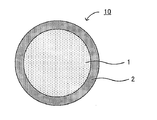
- FIG. 1 is a schematic cross-sectional view showing an example of the coated active material of the present invention.
- a coated active material 10 shown in FIG. 1 includes a positive electrode active material 1 and a coating layer 2 that covers the positive electrode active material 1 and contains a Li ion conductive oxide.
- the present invention is characterized in that the coating layer 2 further contains lithium carbonate.
- the coated active material of the present invention will be described for each configuration.
- the positive electrode active material in the present invention has a function of occluding and releasing Li ions.
- an oxide positive electrode active material can be mentioned. This is because a high-capacity positive electrode active material can be obtained.
- M is preferably at least one selected from the group consisting of Co, Mn, Ni, V and Fe, and preferably at least one selected from the group consisting of Co, Ni and Mn. More preferred.
- oxide positive electrode active material specifically, a rock salt layered positive electrode active material such as LiCoO 2 , LiMnO 2 , LiNiO 2 , LiVO 2 , LiNi 1/3 Co 1/3 Mn 1/3 O 2, etc. , LiMn 2 O 4 , Li (Ni 0.5 Mn 1.5 ) O 4 and other spinel type positive electrode active materials.
- oxide positive electrode active materials other than the above-mentioned general formula Li x M y O z, LiFePO 4, olivine-type positive electrode active material LiMnPO 4 such, Li 2 FeSiO 4, Li 2 MnSiO 4 Si containing positive electrode active material such Etc.
- the shape of the positive electrode active material examples include a particle shape, and among them, a true spherical shape or an elliptical spherical shape is preferable.
- the average particle diameter (D 50 ) is preferably in the range of 0.1 ⁇ m to 50 ⁇ m, for example.
- the coating layer in this invention coat
- the coating layer further contains lithium carbonate.
- the coating layer containing lithium carbonate (Li 2 CO 3), it may be a soft coating. This is presumably because lithium carbonate is a carbonate and is softer than Li ion conductive oxide.
- the content of lithium carbonate in the present invention is not particularly limited as long as the coating layer can be softened, but is preferably 0.02% by weight or more, for example, with respect to the coating active material. It is more preferably 1% by weight or more, and further preferably 0.3% by weight or more. This is because if the proportion of lithium carbonate is too small, the coating layer may not be sufficiently soft.
- the content of lithium carbonate in the present invention is, for example, preferably 3% by weight or less, more preferably 1.5% by weight or less, and more preferably 1% by weight or less with respect to the coated active material. More preferably. This is because if the proportion of lithium carbonate is too large, the coating layer can be softened, but the Li ion conductivity and electronic conductivity of the coating layer are lowered, and the reaction resistance may be increased.
- the lithium carbonate content can be determined, for example, by quantifying CO 3 2 ⁇ in the coated active material using ion chromatography.
- the Li ion conductive oxide in the present invention is not particularly limited as long as it can constitute a coating layer.
- the general formula Li x AO y (where A is B, C, At least one selected from the group consisting of Al, Si, P, S, Ti, Zr, Nb, Mo, Ta, and W, and x and y are positive numbers.
- oxides specifically, Li 3 BO 3, LiBO 2 , Li 2 CO 3, LiAlO 2, Li 4 SiO 4, Li 2 SiO 3, Li 3 PO 4, Li 2 SO 4, Li 2 TiO 3, Li 4 Ti 5 O 12, Li 2 Ti 2 O 5, Li 2 ZrO 3, LiNbO 3, Li 2 MoO 4, Li 2 WO 4 , and the like.
- the Li ion conductive oxide may be a composite compound of Li ion conductive oxide.
- Such composite compounds include Li 4 SiO 4 —Li 3 BO 3 , Li 4 SiO 4 —Li 3 PO 4, and the like.
- the Li ion conductive oxide is preferably at least one of Li 4 SiO 4 —Li 3 BO 3 and LiNbO 3 . This is because an increase in the interface resistance between the positive electrode active material and the solid electrolyte material can be effectively suppressed.
- the thickness of the coating layer may be any thickness that can suppress the reaction between the positive electrode active material and the solid electrolyte material, and is preferably in the range of 0.1 nm to 100 nm, for example, in the range of 1 nm to 20 nm. More preferably. This is because if the coating layer is too thin, the positive electrode active material and the solid electrolyte material may react, and if the coating layer is too thick, Li ion conductivity and electronic conductivity may be reduced. is there. In addition, as a measuring method of the thickness of a coating layer, a transmission electron microscope (TEM) etc. can be mentioned, for example.
- TEM transmission electron microscope
- the coverage of the coating layer on the surface of the positive electrode active material is preferably high from the viewpoint of suppressing increase in interface resistance, specifically 50% or more, more preferably 80% or more. .
- the coating layer may cover the entire surface of the positive electrode active material.
- TEM transmission electron microscope
- XPS X-ray photoelectron spectroscopy
- Coating active material The coating active material of this invention is normally used for a lithium solid state battery.
- the lithium solid battery will be described in detail in “B. Lithium solid battery” described later.
- the manufacturing method of a coating active material will not be specifically limited if the coating active material mentioned above can be obtained, For example, a rolling fluidized coating method (sol-gel method), a mechano-fusion method, CVD method, PVD method, etc. Can be mentioned.
- the Li ion conductive oxide constituting the coating layer is Li 4 SiO 4 —Li 3 BO 3
- the Li source, B A coating solution for forming a coating layer is prepared by stirring and hydrolyzing a mixed solution in which a source and a Si source are dissolved in a solvent.
- a coating liquid for forming a coating layer is coated on the positive electrode active material by a rolling fluidized coating method.
- the positive electrode active material whose surface is coated with the coating layer forming coating solution is baked to form a coating layer that covers the positive electrode active material, thereby obtaining a coated active material.
- examples of the Li source include Li salt or Li alkoxide, and specifically, lithium acetate (CH 3 COOLi) or the like can be used.
- examples of the B source and the Si source include those having an OH group at the terminal, or those hydrolyzed to become a hydroxide. Specifically, boric acid (H 3 BO 3 ) and Tetraethoxysilane (Si (C 2 H 5 O) 4 ) or the like can be used.
- the solvent is not particularly limited as long as it is an organic solvent capable of dissolving a Li source, a B source, and a Si source, and examples thereof include ethanol.
- the said solvent is an anhydrous solvent.
- the hydrolysis temperature is preferably in the range of 5 ° C. to 40 ° C., for example.
- the hydrolysis time (stirring time) is preferably in the range of 1 hour to 72 hours, for example.
- the firing temperature is preferably in the range of 250 ° C. to 500 ° C., for example.
- the firing time is preferably in the range of 0.5 to 12 hours, for example.
- the firing atmosphere is preferably in the presence of oxygen, and specific examples include an air atmosphere and a pure oxygen atmosphere. Examples of the firing method include a method using a firing furnace such as a muffle furnace.
- the coating layer contains lithium carbonate.
- Li source for example, lithium acetate, ethoxylithium
- Lithium carbonate can be synthesized by oxidizing the Li source remaining in the reaction with the Si source.
- lithium carbonate can be contained by a reaction between the coating liquid for forming a coating layer, moisture in the atmosphere, and carbon dioxide.
- the lithium solid state battery of the present invention includes a positive electrode active material layer containing a positive electrode active material, a negative electrode active material layer containing a negative electrode active material, and a solid formed between the positive electrode active material layer and the negative electrode active material layer.
- FIG. 2 is a schematic cross-sectional view showing an example of the power generation element of the lithium solid state battery of the present invention.
- a power generation element 20 of the lithium solid state battery shown in FIG. 2 includes a positive electrode active material layer 11, a negative electrode active material layer 12, and a solid electrolyte layer 13 formed between the positive electrode active material layer 11 and the negative electrode active material layer 12.
- the positive electrode active material layer 11 includes a coated active material 10 including the positive electrode active material 1 and the coating layer 2, and a solid electrolyte material 3.
- the lithium solid state battery of the present invention will be described for each configuration.
- the positive electrode active material layer in the present invention is a layer containing at least a positive electrode active material, and may further contain at least one of a solid electrolyte material, a conductive material and a binder as necessary.
- the positive electrode active material in the present invention is the coated active material described in the above “A. Coated active material”.
- the content of the positive electrode active material in the positive electrode active material layer is, for example, preferably within the range of 10% by weight to 99% by weight, and more preferably within the range of 20% by weight to 90% by weight.
- a positive electrode active material layer contains a solid electrolyte material. This is because the Li ion conductivity in the positive electrode active material layer can be improved.
- the solid electrolyte material contained in the positive electrode active material layer is the same as the solid electrolyte material described in “3. Solid electrolyte layer” described later.
- the content of the solid electrolyte material in the positive electrode active material layer is, for example, preferably in the range of 1% by weight to 90% by weight, and more preferably in the range of 10% by weight to 80% by weight.
- the coated active material is in contact with the sulfide solid electrolyte material.
- the sulfide solid electrolyte material has high reactivity with the positive electrode active material, but the increase in the interface resistance between the positive electrode active material and the sulfide solid electrolyte material can be effectively suppressed by using the coating active material. is there.
- the positive electrode active material that supports the coating layer is preferably an oxide positive electrode active material. This is because the sulfide solid electrolyte material and the oxide positive electrode active material easily react, and this reaction can be suppressed by the coating layer.
- Examples of a mode in which the coating active material and the sulfide solid electrolyte material are in contact include a mode in which the positive electrode active material layer contains both the coating active material and the sulfide solid electrolyte material, and both are in contact in the positive electrode active material layer. be able to. Further, as another example of the above embodiment, the positive electrode active material layer contains a coating active material, the solid electrolyte layer contains a sulfide solid electrolyte material, and both are present at the interface between the positive electrode active material layer and the solid electrolyte layer.
- the aspect which touches can be mentioned.
- the positive electrode active material layer in the present invention may further contain a conductive material.
- a conductive material By adding a conductive material, the conductivity of the positive electrode active material layer can be improved.
- the conductive material include acetylene black, ketjen black, and carbon fiber.
- the positive electrode active material layer may further contain a binder. Examples of the binder include fluorine-containing binders such as PTFE and PVDF.
- the thickness of the positive electrode active material layer varies depending on the configuration of the target lithium solid state battery, but is preferably in the range of 0.1 ⁇ m to 1000 ⁇ m, for example.
- the negative electrode active material layer in the present invention is a layer containing at least a negative electrode active material, and may further contain at least one of a solid electrolyte material, a conductive material, and a binder as necessary.
- Examples of the negative electrode active material include a metal active material and a carbon active material.
- Examples of the metal active material include Li alloy, In, Al, Si, and Sn.
- examples of the carbon active material include graphite such as mesocarbon microbeads (MCMB) and highly oriented graphite (HOPG), and amorphous carbon such as hard carbon and soft carbon. Note that SiC or the like can also be used as the negative electrode active material.
- the content of the negative electrode active material in the negative electrode active material layer is, for example, preferably in the range of 10% by weight to 99% by weight, and more preferably in the range of 20% by weight to 90% by weight.
- the negative electrode active material layer preferably contains a solid electrolyte material. This is because the Li ion conductivity in the negative electrode active material layer can be improved.
- the solid electrolyte material contained in a negative electrode active material layer it is the same as that of the solid electrolyte material described in "3. Solid electrolyte layer" mentioned later.
- the content of the solid electrolyte material in the negative electrode active material layer is, for example, preferably in the range of 1% by weight to 90% by weight, and more preferably in the range of 10% by weight to 80% by weight.
- the conductive material and the binder used for the negative electrode active material layer are the same as those in the positive electrode active material layer described above. Further, the thickness of the negative electrode active material layer varies depending on the structure of the target lithium solid state battery, but is preferably in the range of 0.1 ⁇ m to 1000 ⁇ m, for example.
- the solid electrolyte layer in the present invention is a layer formed between the positive electrode active material layer and the negative electrode active material layer, and is a layer containing at least a solid electrolyte material.
- the solid electrolyte material is not particularly limited as long as it has Li ion conductivity, and examples thereof include a sulfide solid electrolyte material and an oxide solid electrolyte material. Among them, a sulfide solid electrolyte Material is preferred. This is because the Li ion conductivity is higher than that of the oxide solid electrolyte material.
- the sulfide solid electrolyte material has higher reactivity than the oxide solid electrolyte material, it easily reacts with the positive electrode active material, and easily forms a high resistance layer between the positive electrode active material.
- the increase in the interface resistance of a positive electrode active material and a sulfide solid electrolyte material can be effectively suppressed by using a coating active material.
- Examples of the sulfide solid electrolyte material include Li 2 S—P 2 S 5 , Li 2 S—P 2 S 5 —LiI, Li 2 S—P 2 S 5 —Li 2 O, and Li 2 S—P 2 S. 5 -Li 2 O—LiI, Li 2 S—SiS 2 , Li 2 S—SiS 2 —LiI, Li 2 S—SiS 2 —LiBr, Li 2 S—SiS 2 —LiCl, Li 2 S—SiS 2 —B 2 S 3 -LiI, Li 2 S -SiS 2 -P 2 S 5 -LiI, Li 2 S-B 2 S 3, Li 2 S-P 2 S 5 -Z m S n ( however, m, n are positive Z is one of Ge, Zn, and Ga.), Li 2 S—GeS 2 , Li 2 S—SiS 2 —Li 3 PO 4 , Li 2 S—SiS 2 —
- the sulfide solid electrolyte material if it is made by using the raw material composition containing Li 2 S and P 2 S 5, the proportion of Li 2 S to the total of Li 2 S and P 2 S 5 is For example, it is preferably in the range of 70 mol% to 80 mol%, more preferably in the range of 72 mol% to 78 mol%, and still more preferably in the range of 74 mol% to 76 mol%. This is because a sulfide solid electrolyte material having an ortho composition or a composition in the vicinity thereof can be obtained, and a sulfide solid electrolyte material having high chemical stability can be obtained.
- ortho generally refers to one having the highest degree of hydration among oxo acids obtained by hydrating the same oxide.
- the crystal composition in which Li 2 S is added most in the sulfide is called the ortho composition.
- Li 2 S—P 2 S 5 system Li 3 PS 4 corresponds to the ortho composition.
- P 2 S 5 in the raw material composition, even when using the Al 2 S 3, or B 2 S 3, a preferred range is the same.
- Li 3 AlS 3 corresponds to the ortho composition
- Li 3 BS 3 corresponds to the ortho composition.
- the sulfide solid electrolyte material if it is made by using the raw material composition containing Li 2 S and SiS 2, the ratio of Li 2 S to the total of Li 2 S and SiS 2, for example, 60 mol% It is preferably in the range of ⁇ 72 mol%, more preferably in the range of 62 mol% to 70 mol%, and still more preferably in the range of 64 mol% to 68 mol%. This is because a sulfide solid electrolyte material having an ortho composition or a composition in the vicinity thereof can be obtained, and a sulfide solid electrolyte material having high chemical stability can be obtained. In the Li 2 S—SiS 2 system, Li 4 SiS 4 corresponds to the ortho composition.
- the preferred range is the same when GeS 2 is used instead of SiS 2 in the raw material composition.
- Li 4 GeS 4 corresponds to the ortho composition.
- the ratio of LiX is within a range of 1 mol% to 60 mol%, for example. It is preferably within a range of 5 mol% to 50 mol%, more preferably within a range of 10 mol% to 40 mol%.
- the sulfide solid electrolyte material may be sulfide glass, crystallized sulfide glass, or a crystalline material (material obtained by a solid phase method).
- the shape of the sulfide solid electrolyte material in the present invention examples include a particle shape, and among them, a true spherical shape or an elliptical spherical shape is preferable.
- the average particle size (D 50) is preferably 40 ⁇ m or less, more preferably 20 ⁇ m or less More preferably, it is 10 ⁇ m or less. This is because it becomes easy to improve the filling rate of the solid electrolyte layer.
- the average particle diameter is preferably 0.01 ⁇ m or more, and more preferably 0.1 ⁇ m or more.
- the said average particle diameter can be determined with a particle size distribution meter, for example.
- the Li ion conductivity at normal temperature of the sulfide solid electrolyte material is, for example, preferably 1 ⁇ 10 ⁇ 4 S / cm or more, and more preferably 1 ⁇ 10 ⁇ 3 S / cm or more.
- the content of the solid electrolyte material in the solid electrolyte layer is preferably in the range of 10% by weight to 100% by weight, for example, and more preferably in the range of 50% by weight to 100% by weight.
- the solid electrolyte layer may contain a binder. Examples of the binder include fluorine-containing binders such as PTFE and PVDF.
- the thickness of the solid electrolyte layer is not particularly limited, but is preferably in the range of 0.1 ⁇ m to 1000 ⁇ m, for example, and more preferably in the range of 0.1 ⁇ m to 300 ⁇ m.
- the lithium solid state battery of the present invention has at least the positive electrode active material layer, the negative electrode active material layer, and the solid electrolyte layer described above. Furthermore, it usually has a positive electrode current collector for collecting current of the positive electrode active material layer and a negative electrode current collector for collecting current of the negative electrode active material layer.
- the material for the positive electrode current collector include SUS, aluminum, nickel, iron, titanium, and carbon.
- examples of the material for the negative electrode current collector include SUS, copper, nickel, and carbon.
- the thickness and shape of the positive electrode current collector and the negative electrode current collector are preferably appropriately selected according to the use of the lithium solid state battery.
- the battery case of a general lithium solid battery can be used for the battery case used for this invention. Examples of the battery case include a SUS battery case.
- the lithium solid battery of the present invention may be a primary battery or a secondary battery, and among these, a secondary battery is preferable. This is because it can be repeatedly charged and discharged and is useful, for example, as a vehicle-mounted battery.
- Examples of the shape of the lithium solid state battery of the present invention include a coin type, a laminate type, a cylindrical type, and a square type.
- the manufacturing method of the lithium solid state battery of the present invention is not particularly limited as long as it is a method capable of obtaining the above-described lithium solid state battery, and the same method as a general lithium solid state battery manufacturing method is used. be able to.
- the present invention is not limited to the above embodiment.
- the above-described embodiment is an exemplification, and the present invention has substantially the same configuration as the technical idea described in the claims of the present invention, and any device that exhibits the same function and effect is the present invention. It is included in the technical scope of the invention.
- Example 1 (Preparation of coating solution for coating layer formation) Anhydrous ethanol so that boric acid (H 3 BO 3 , manufactured by Wako Pure Chemical Industries, Ltd.) and tetraethoxysilane (Si (C 2 H 5 O) 4 , manufactured by High-Purity Chemical Laboratory) are each 0.066 mol / L. Dissolved in 1800 mL (C 2 H 5 OH, manufactured by Wako Pure Chemical Industries, Ltd.), and further dissolved 10.8 g of lithium acetate (CH 3 COOLi, manufactured by Wako Pure Chemical Industries, Ltd.) and mixed. By stirring this mixed solution at 19 ° C. for 24 hours, a coating layer forming coating solution was obtained.
- boric acid H 3 BO 3 , manufactured by Wako Pure Chemical Industries, Ltd.
- Si (C 2 H 5 O) 4 tetraethoxysilane
- Li 2 S lithium sulfide
- P 2 S 5 phosphorus pentasulfide
- This pot was attached to a planetary ball mill (P7 made by Fritsch), and mechanical milling was performed at 370 rpm for 40 hours to obtain a solid electrolyte material (75Li 2 S-25P 2 S 5 , sulfide glass).
- Example 2 to 5 A lithium solid state battery was produced in the same manner as in Example 1 except that the amount of lithium acetate was 32.3 g, 53.9 g, 75.5 g, and 97.0 g in the preparation of the coating layer forming coating solution, respectively. did.
- Example 6 In the preparation of the coating liquid for forming the coating layer, the amount of lithium acetate was 97.0 g, and in the production of the coating active material, lithium solid extraction was performed in the same manner as in Example 1 except that the lithium carbonate extraction treatment was performed after firing. A battery was produced. In addition, the lithium carbonate extraction treatment was performed by putting 1 g of the coated active material in 100 mL of pure water substituted with an inert gas, filtering after stirring for 5 minutes, and vacuum drying at 80 ° C.
- Example 7 A lithium solid state battery was prepared in the same manner as in Example 1 except that the coating layer forming coating solution was prepared and the coating active material was prepared as follows.
- Pentaethoxyniobium (Nb (C 2 H 5 O) 5 , manufactured by High Purity Chemical Laboratory) and ethoxy lithium (Li (C 2 H 5 O), manufactured by Wako Pure Chemical Industries, Ltd.) are each adjusted to 0.6 mol / L.
- a positive electrode active material LiNi 1/3 Co 1/3 Mn 1/3 O 2
- a rolling fluidized bed coater manufactured by POWREC
- the coating layer forming coating solution is added to the positive electrode in a nitrogen atmosphere. It applied to the active material surface.
- covers a positive electrode active material was formed by baking at 350 degreeC by air
- Example 8 A lithium solid state battery was produced in the same manner as in Example 7 except that in the preparation of the coating layer forming coating solution, 69.0 g of lithium acetate was further dissolved and mixed.
- Example 1 A lithium solid state battery was prepared in the same manner as in Example 7, except that 69.0 g of lithium acetate was further mixed in the preparation of the coating layer forming coating solution, and lithium carbonate extraction treatment was performed in the preparation of the coating active material. Was made. In addition, about the lithium carbonate extraction process, it is the same as that of the content mentioned above.
- reaction resistance measurement Using the lithium solid state batteries obtained in Examples 1 to 8 and Comparative Example 1, reaction resistance was measured. After adjusting the potential of the lithium solid state battery to 3.7 V, the reaction resistance of the battery was calculated by performing complex impedance measurement. In addition, reaction resistance was calculated
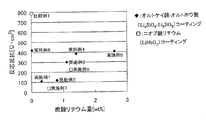
- Example 1 As shown in Table 1 and FIG. 3, in Examples 1 to 8, it was confirmed that the coating layer of the coated active material contained lithium carbonate, and the coating layer of the coated active material contained lithium carbonate. It was confirmed that the reaction resistance was lower than that of Comparative Example 1 which was not. In particular, in Examples 1, 2, and 7, the reduction in reaction resistance was remarkable. This is presumably because a soft coating layer was obtained because lithium carbonate was contained in the coating layer. In Examples 4 and 5, there was little decrease in reaction resistance, but this was because the coating layer was softened by lithium carbonate, but the lithium ion content and the lithium ion conduction and electron conduction were hindered. It is thought. Moreover, in Example 6, although the lithium carbonate extraction process was performed, lithium carbonate remained in a trace amount, and it is thought that reaction resistance fell.
Landscapes
- Chemical & Material Sciences (AREA)
- General Chemical & Material Sciences (AREA)
- Chemical Kinetics & Catalysis (AREA)
- Electrochemistry (AREA)
- Engineering & Computer Science (AREA)
- Manufacturing & Machinery (AREA)
- Composite Materials (AREA)
- Inorganic Chemistry (AREA)
- Materials Engineering (AREA)
- Physics & Mathematics (AREA)
- Condensed Matter Physics & Semiconductors (AREA)
- General Physics & Mathematics (AREA)
- Battery Electrode And Active Subsutance (AREA)
- Secondary Cells (AREA)
Abstract
Description
まず、本発明の被覆活物質について説明する。本発明の被覆活物質は、正極活物質と、上記正極活物質を被覆し、Liイオン伝導性酸化物を含有する被覆層とを有する被覆活物質であって、上記被覆層が、さらに炭酸リチウムを含有することを特徴とするものである。
以下、本発明の被覆活物質について、構成ごとに説明する。
まず、本発明における正極活物質について説明する。本発明における正極活物質は、Liイオンを吸蔵・放出する機能を有するものである。
次に、本発明における被覆層について説明する。本発明における被覆層は、上記活物質を被覆し、Liイオン伝導性酸化物を含有するものである。また、上記被覆層は、さらに炭酸リチウムを含有する。
本発明の被覆活物質は、通常、リチウム固体電池に用いられるものである。リチウム固体電池については、後述する「B.リチウム固体電池」で詳細に説明する。また、被覆活物質の製造方法は、上述した被覆活物質を得ることができれば特に限定されるものではなく、例えば、転動流動コーティング法(ゾルゲル法)、メカノフュージョン法、CVD法およびPVD法等を挙げることができる。
次に、本発明のリチウム固体電池について説明する。本発明のリチウム固体電池は、正極活物質を含有する正極活物質層と、負極活物質を含有する負極活物質層と、上記正極活物質層および上記負極活物質層の間に形成された固体電解質層とを有するリチウム固体電池であって、上記正極活物質が、上述した被覆活物質であることを特徴とするものである。
以下、本発明のリチウム固体電池について、構成ごとに説明する。
まず、本発明における正極活物質層について説明する。本発明における正極活物質層は、少なくとも正極活物質を含有する層であり、必要に応じて、固体電解質材料、導電化材および結着材の少なくとも一つをさらに含有していても良い。
次に、本発明における負極活物質層について説明する。本発明における負極活物質層は、少なくとも負極活物質を含有する層であり、必要に応じて、固体電解質材料、導電化材および結着材の少なくとも一つをさらに含有していても良い。
次に、本発明における固体電解質層について説明する。本発明における固体電解質層は、正極活物質層および負極活物質層の間に形成される層であり、少なくとも固体電解質材料を含有する層である。固体電解質材料としては、Liイオン伝導性を有するものであれば特に限定されるものではないが、例えば、硫化物固体電解質材料および酸化物固体電解質材料を挙げることができ、中でも、硫化物固体電解質材料が好ましい。酸化物固体電解質材料に比べて、Liイオン伝導性が高いからである。また、硫化物固体電解質材料は、酸化物固体電解質材料よりも反応性が高いため、正極活物質と反応しやすく、正極活物質との間に高抵抗層を形成しやすい。これに対して、本発明においては、被覆活物質を用いることで、正極活物質および硫化物固体電解質材料の界面抵抗の増加を効果的に抑制することができる。
本発明のリチウム固体電池は、上述した正極活物質層、負極活物質層および固体電解質層を少なくとも有するものである。さらに通常は、正極活物質層の集電を行う正極集電体、および負極活物質層の集電を行う負極集電体を有する。正極集電体の材料としては、例えば、SUS、アルミニウム、ニッケル、鉄、チタンおよびカーボン等を挙げることができる。一方、負極集電体の材料としては、例えば、SUS、銅、ニッケルおよびカーボン等を挙げることができる。また、正極集電体および負極集電体の厚さや形状等については、リチウム固体電池の用途等に応じて適宜選択することが好ましい。また、本発明に用いられる電池ケースには、一般的なリチウム固体電池の電池ケースを用いることができる。電池ケースとしては、例えば、SUS製電池ケース等を挙げることができる。
本発明のリチウム固体電池は、一次電池であっても良く、二次電池であっても良いが、中でも、二次電池であることが好ましい。繰り返し充放電でき、例えば、車載用電池として有用だからである。本発明のリチウム固体電池の形状としては、例えば、コイン型、ラミネート型、円筒型および角型等を挙げることができる。また、本発明のリチウム固体電池の製造方法は、上述したリチウム固体電池を得ることができる方法であれば特に限定されるものではなく、一般的なリチウム固体電池の製造方法と同様の方法を用いることができる。
(被覆層形成用塗工液の調製)
ホウ酸(H3BO3、和光純薬工業製)およびテトラエトキシシラン(Si(C2H5O)4、高純度化学研究所製)をそれぞれ0.066mol/Lとなるように、無水エタノール(C2H5OH、和光純薬工業製)1800mLに溶解し、さらに酢酸リチウム(CH3COOLi、和光純薬工業製)10.8gを溶解し、混合した。この混合溶液を19℃で24時間撹拌することにより、被覆層形成用塗工液を得た。
正極活物質(LiNi1/3Co1/3Mn1/3O2)1.25kgを転動流動層コート装置(パウレック製)内で流動させ、窒素雰囲気下で上記被覆層形成用塗工液を正極活物質表面に塗布した。その後、マッフル炉を用いて、大気下にて400℃で1時間焼成することにより、正極活物質を被覆する被覆層を形成し、被覆活物質を得た。
まず、出発原料として、硫化リチウム(Li2S)および五硫化リン(P2S5)を用いた。これらの粉末をAr雰囲気下(露点-70℃)のグローブボックス内で、Li2S:P2S5=75:25のモル比となるように秤量し、メノウ乳鉢で混合し、原料組成物を得た。次に、得られた原料組成物1gを45mlのジルコニアポットに投入し、さらにジルコニアボール(Φ10mm、10個)を投入し、ポットを完全に密閉した(Ar雰囲気)。このポットを遊星型ボールミル機(フリッチュ製P7)に取り付け、台盤回転数370rpmで40時間メカニカルミリングを行い、固体電解質材料(75Li2S-25P2S5、硫化物ガラス)を得た。
まず、上記の被覆活物質と、75Li2S-25P2S5とを、7:3の重量比で混合し、正極合材を得た。次に、プレス機を用いて、上述した図2に示すようなリチウム固体電池の発電要素20を作製した。正極活物質層11を構成する材料として上記の正極合材を用い、負極活物質層12を構成する材料としてグラファイト(三菱化学製 MF-6)を用い、固体電解質層13を構成する材料として75Li2S-25P2S5を用いた。この発電要素を用いて、リチウム固体電池を作製した。
被覆層形成用塗工液の調製において、酢酸リチウム量をそれぞれ32.3g、53.9g、75.5g、97.0gとしたこと以外は、実施例1と同様にして、リチウム固体電池を作製した。
被覆層形成用塗工液の調製において、酢酸リチウム量を97.0gとし、被覆活物質の作製において、焼成後に炭酸リチウム抽出処理を行ったこと以外は、実施例1と同様にして、リチウム固体電池を作製した。なお、炭酸リチウム抽出処理は、不活性ガス置換した純水100mLに被覆活物質1gを入れ、5分間撹拌後にろ過し、80℃で真空乾燥することにより行った。
被覆層形成用塗工液の調製および被覆活物質の作製を以下のように行ったこと以外は、実施例1と同様にして、リチウム固体電池を作製した。
ペンタエトキシニオブ(Nb(C2H5O)5、高純度化学研究所製)およびエトキシリチウム(Li(C2H5O)、和光純薬工業製)をそれぞれ0.6mol/Lとなるように、無水エタノール(C2H5OH、和光純薬工業製)500mLに溶解し、混合した。この混合溶液を25℃で3時間撹拌することにより、被覆層形成用塗工液を得た。
正極活物質(LiNi1/3Co1/3Mn1/3O2)1kgを転動流動層コート装置(パウレック製)内で流動させ、窒素雰囲気下で上記被覆層形成用塗工液を正極活物質表面に塗布した。その後、マッフル炉を用いて、大気下にて350℃で5時間焼成することにより、正極活物質を被覆する被覆層を形成し、被覆活物質を得た。
被覆層形成用塗工液の調製において、さらに酢酸リチウム69.0gを溶解し、混合したこと以外は、実施例7と同様にして、リチウム固体電池を作製した。
被覆層形成用塗工液の調製において、さらに酢酸リチウム69.0gを混合し、被覆活物質の作製において、炭酸リチウム抽出処理を行ったこと以外は、実施例7と同様にして、リチウム固体電池を作製した。なお、炭酸リチウム抽出処理については、上述した内容と同様である。
(炭酸リチウムの定量)
実施例1~8および比較例1で作製された被覆活物質を用いて、イオンクロマトグラフィー測定を行い、CO3 2-を定量することで、炭酸リチウム量を求めた。なお、測定装置には、日本ダイオネクス社製 DX500を用い、測定条件は、カラムにICE-AS1、キャリア液(溶離液)にオクタンスルホン酸を用い、室温で行った。その結果を表1および図3に示す。
実施例1~8および比較例1で得られたリチウム固体電池を用いて、反応抵抗測定を行った。リチウム固体電池の電位を3.7Vに調整した後、複素インピーダンス測定を行うことにより、電池の反応抵抗を算出した。なお、反応抵抗は、インピーダンス曲線の円弧の直径から求めた。その結果を表1および図3に示す。

2 … 被覆層
3 … 固体電解質材料
10 … 被覆活物質
11 … 正極活物質層
12 … 負極活物質層
13 … 固体電解質層
20 … リチウム固体電池の発電要素
Claims (6)
- 正極活物質と、前記正極活物質を被覆し、Liイオン伝導性酸化物を含有する被覆層とを有する被覆活物質であって、
前記被覆層が、さらに炭酸リチウムを含有することを特徴とする被覆活物質。 - 前記炭酸リチウムの含有量が、前記被覆活物質に対して、0.02重量%~1重量%の範囲内であることを特徴とする請求項1に記載の被覆活物質。
- 前記Liイオン伝導性酸化物が、Li4SiO4-Li3BO3およびLiNbO3の少なくとも一方であることを特徴とする請求項1または請求項2に記載の被覆活物質。
- 前記正極活物質が、酸化物正極活物質であることを特徴とする請求項1から請求項3までのいずれかの請求項に記載の被覆活物質。
- 正極活物質を含有する正極活物質層と、負極活物質を含有する負極活物質層と、前記正極活物質層および前記負極活物質層の間に形成された固体電解質層とを有するリチウム固体電池であって、
前記正極活物質が、請求項1から請求項4までのいずれかの請求項に記載の被覆活物質であることを特徴とするリチウム固体電池。 - 前記被覆活物質が、硫化物固体電解質材料と接することを特徴とする請求項5に記載のリチウム固体電池。
Priority Applications (4)
| Application Number | Priority Date | Filing Date | Title |
|---|---|---|---|
| US14/114,837 US9214674B2 (en) | 2011-05-26 | 2011-05-26 | Coated active material and lithium solid state battery |
| PCT/JP2011/062121 WO2012160698A1 (ja) | 2011-05-26 | 2011-05-26 | 被覆活物質およびリチウム固体電池 |
| JP2013516150A JP5578280B2 (ja) | 2011-05-26 | 2011-05-26 | 被覆活物質およびリチウム固体電池 |
| CN201180070602.9A CN103534845B (zh) | 2011-05-26 | 2011-05-26 | 被覆活性物质及锂固体电池 |
Applications Claiming Priority (1)
| Application Number | Priority Date | Filing Date | Title |
|---|---|---|---|
| PCT/JP2011/062121 WO2012160698A1 (ja) | 2011-05-26 | 2011-05-26 | 被覆活物質およびリチウム固体電池 |
Publications (1)
| Publication Number | Publication Date |
|---|---|
| WO2012160698A1 true WO2012160698A1 (ja) | 2012-11-29 |
Family
ID=47216800
Family Applications (1)
| Application Number | Title | Priority Date | Filing Date |
|---|---|---|---|
| PCT/JP2011/062121 Ceased WO2012160698A1 (ja) | 2011-05-26 | 2011-05-26 | 被覆活物質およびリチウム固体電池 |
Country Status (4)
| Country | Link |
|---|---|
| US (1) | US9214674B2 (ja) |
| JP (1) | JP5578280B2 (ja) |
| CN (1) | CN103534845B (ja) |
| WO (1) | WO2012160698A1 (ja) |
Cited By (26)
| Publication number | Priority date | Publication date | Assignee | Title |
|---|---|---|---|---|
| WO2015050031A1 (ja) * | 2013-10-03 | 2015-04-09 | トヨタ自動車株式会社 | 被覆正極活物質およびリチウム固体電池 |
| JP2015088383A (ja) * | 2013-10-31 | 2015-05-07 | 三星電子株式会社Samsung Electronics Co.,Ltd. | リチウムイオン二次電池の正極およびリチウムイオン二次電池 |
| US20150147651A1 (en) * | 2013-11-27 | 2015-05-28 | Samsung Sdi Co., Ltd. | Positive active material for rechargeable lithium battery, method of preparing same, and rechargeable lithium battery including the same |
| WO2015080502A1 (ko) * | 2013-11-29 | 2015-06-04 | 한양대학교 산학협력단 | 전고체 리튬 이차전지용 활물질, 그 제조방법 및 이를 포함하는 전고체 리튬 이차전지 |
| US20150171424A1 (en) * | 2013-12-13 | 2015-06-18 | Nichia Corporation | Positive electrode active material for nonaqueous electrolyte secondary battery and method of producing the same |
| WO2016031335A1 (ja) * | 2014-08-29 | 2016-03-03 | 日東電工株式会社 | リチウム金属二次電池 |
| JP2016103418A (ja) * | 2014-11-28 | 2016-06-02 | パナソニックIpマネジメント株式会社 | 全固体リチウム二次電池用正極活物質及び全固体リチウム二次電池の製造方法 |
| US20160240838A1 (en) * | 2013-10-03 | 2016-08-18 | Japan Science And Technology Agency | Solution for Forming Layer That Contains Solid Electrolyte for All-Solid-State Alkali Metal Secondary Batteries, Coated Active Material Particles, Electrode, All-Solid-State Alkali Metal Secondary Battery and Method for Manufacturing Same |
| JP2016201342A (ja) * | 2015-04-14 | 2016-12-01 | トヨタ自動車株式会社 | 複合活物質の製造方法 |
| JP2018026393A (ja) * | 2016-08-08 | 2018-02-15 | 旭化成株式会社 | 非水系リチウム型蓄電素子 |
| WO2018043515A1 (ja) * | 2016-08-29 | 2018-03-08 | 住友金属鉱山株式会社 | 非水系電解質二次電池用正極活物質とその製造方法、非水系電解質二次電池用正極合材ペーストおよび非水系電解質二次電池 |
| JP2018056400A (ja) * | 2016-09-30 | 2018-04-05 | 旭化成株式会社 | 非水系リチウム型蓄電素子 |
| JP2018056439A (ja) * | 2016-09-30 | 2018-04-05 | 旭化成株式会社 | 非水系リチウム型蓄電素子 |
| JP2018056414A (ja) * | 2016-09-30 | 2018-04-05 | 旭化成株式会社 | 非水系リチウム型蓄電素子 |
| JP2018061021A (ja) * | 2016-09-30 | 2018-04-12 | 旭化成株式会社 | 非水系アルカリ金属型蓄電素子 |
| KR20200047960A (ko) * | 2018-10-29 | 2020-05-08 | 현대자동차주식회사 | 코팅층이 형성된 양극 활물질 및 이의 제조방법 |
| US10763499B2 (en) | 2016-07-14 | 2020-09-01 | Mitsui Mining & Smelting Co., Ltd. | Cathode active material for all-solid-state lithium secondary battery |
| JPWO2021200084A1 (ja) * | 2020-04-02 | 2021-10-07 | ||
| JPWO2021200085A1 (ja) * | 2020-04-02 | 2021-10-07 | ||
| JP2022099698A (ja) * | 2020-12-23 | 2022-07-05 | パナソニックIpマネジメント株式会社 | 全固体電池およびその製造方法 |
| WO2023032473A1 (ja) * | 2021-09-01 | 2023-03-09 | パナソニックIpマネジメント株式会社 | 正極材料および電池 |
| JP2023154498A (ja) * | 2022-04-07 | 2023-10-20 | トヨタ自動車株式会社 | 複合粒子、正極および全固体電池 |
| CN117977044A (zh) * | 2024-04-01 | 2024-05-03 | 四川新能源汽车创新中心有限公司 | 一种硫化物基全固态电池物料的回收方法 |
| JP2024124057A (ja) * | 2023-03-02 | 2024-09-12 | トヨタ自動車株式会社 | 正極活物質、正極、全固体電池、および、正極活物質の製造方法 |
| EP4350801A4 (en) * | 2021-05-31 | 2025-04-02 | Panasonic Intellectual Property Management Co., Ltd. | ACTIVE COATING MATERIAL, POSITIVE ELECTRODE MATERIAL, POSITIVE ELECTRODE, BATTERY |
| JP2025511503A (ja) * | 2022-12-02 | 2025-04-16 | エルジー エナジー ソリューション リミテッド | 全固体電池用正極活物質、全固体電池用正極及びこれを含む全固体電池 |
Families Citing this family (35)
| Publication number | Priority date | Publication date | Assignee | Title |
|---|---|---|---|---|
| CN104781960B (zh) * | 2013-10-29 | 2018-03-06 | 株式会社Lg 化学 | 正极活性物质的制备方法及由该方法制备的锂二次电池用正极活性物质 |
| JP6508562B2 (ja) | 2013-11-28 | 2019-05-08 | 株式会社Gsユアサ | 蓄電素子 |
| US10439212B2 (en) * | 2015-07-10 | 2019-10-08 | California Institute Of Technology | Aluminum borate coated lithium ion cathode materials |
| CN105680025B (zh) * | 2016-04-21 | 2018-10-12 | 宁德新能源科技有限公司 | 一种锂电池正极材料及其制备方法、以及锂电池 |
| CN107768612B (zh) * | 2016-08-23 | 2022-10-14 | 松下知识产权经营株式会社 | 电极材料和电池 |
| CN107785578B (zh) * | 2016-08-25 | 2019-06-11 | 宁德时代新能源科技股份有限公司 | 正极添加剂及其制备方法、正极片及锂离子二次电池 |
| JP6952467B2 (ja) | 2017-01-24 | 2021-10-20 | 三星電子株式会社Samsung Electronics Co.,Ltd. | 全固体二次電池用正極活物質、全固体二次電池用正極活物質層、および全固体二次電池 |
| US11217785B2 (en) | 2017-01-24 | 2022-01-04 | Samsung Electronics Co., Ltd. | Composite cathode active material and secondary battery including the same |
| DE102017204852A1 (de) * | 2017-03-22 | 2018-09-27 | Robert Bosch Gmbh | Lithium-Zellen-Kathode mit unterschiedlichen sulfidischen Lithiumionenleitern |
| KR102177798B1 (ko) * | 2017-11-16 | 2020-11-12 | 주식회사 엘지화학 | 이차전지용 양극 활물질, 그 제조방법 및 이를 포함하는 리튬 이차전지 |
| WO2019135316A1 (ja) * | 2018-01-05 | 2019-07-11 | パナソニックIpマネジメント株式会社 | 固体電解質材料、および、電池 |
| CN111492442A (zh) * | 2018-01-05 | 2020-08-04 | 松下知识产权经营株式会社 | 固体电解质材料和电池 |
| CN111557057B (zh) * | 2018-01-26 | 2024-04-19 | 松下知识产权经营株式会社 | 正极材料和使用它的电池 |
| CN111566756B (zh) | 2018-01-26 | 2022-03-08 | 松下知识产权经营株式会社 | 固体电解质材料和电池 |
| EP3745499A4 (en) * | 2018-01-26 | 2021-03-24 | Panasonic Intellectual Property Management Co., Ltd. | POSITIVE ELECTRODE MATERIAL AND BATTERY |
| US11296313B2 (en) | 2018-04-23 | 2022-04-05 | Uchicago Argonne, Llc | Carbon dioxide treatment of cathodes |
| KR102728661B1 (ko) | 2018-09-06 | 2024-11-11 | 삼성전자주식회사 | 고체 전해질, 그 제조방법 및 이를 포함하는 이차전지 |
| KR102650658B1 (ko) | 2018-11-15 | 2024-03-25 | 삼성전자주식회사 | 헤테로고리 방향족 구조의 음이온을 포함하는 금속염 및 그 제조방법, 그리고 상기 금속염을 포함하는 전해질 및 전기화학소자 |
| US11411246B2 (en) | 2018-12-06 | 2022-08-09 | Samsung Electronics Co., Ltd. | All-solid secondary battery and method of manufacturing all-solid secondary battery |
| CN109742377B (zh) * | 2019-01-17 | 2021-01-05 | 浙江工业大学 | 一种高镍三元正极材料表面改性的方法 |
| JP7198413B2 (ja) * | 2019-01-30 | 2023-01-04 | トヨタ自動車株式会社 | 正極活物質および該正極活物質を備える非水電解液二次電池 |
| US20220149354A1 (en) * | 2019-02-27 | 2022-05-12 | Mitsui Mining & Smelting Co., Ltd. | Active material, positive electrode mixture using same, and solid-state battery |
| DE102019119791A1 (de) * | 2019-07-22 | 2021-01-28 | Bayerische Motoren Werke Aktiengesellschaft | Kathoden-Aktivmaterial, Kathode für eine Lithiumionen-Batterie, Lithiumionen-Batterie und Verwendung von Lithiumcarbonat in einer Lithiumionen-Batterie |
| JP7207265B2 (ja) * | 2019-11-01 | 2023-01-18 | トヨタ自動車株式会社 | 全固体電池の製造方法 |
| KR102832251B1 (ko) | 2019-11-06 | 2025-07-08 | 삼성에스디아이 주식회사 | 고체 전해질, 이를 포함하는 전기화학전지 및 고체 전해질의 제조방법 |
| EP3819964A1 (en) | 2019-11-07 | 2021-05-12 | Samsung SDI Co., Ltd. | Solid electrolyte, electrochemical cell including solid electrolyte, and method of preparing solid electrolyte |
| WO2021131716A1 (ja) | 2019-12-27 | 2021-07-01 | パナソニックIpマネジメント株式会社 | 固体電解質組成物、固体電解質組成物の製造方法、および固体電解質部材の製造方法 |
| US11923502B2 (en) | 2020-01-31 | 2024-03-05 | Samsung Sdi Co., Ltd. | All-solid secondary battery and method of preparing same |
| US11532813B2 (en) | 2020-02-20 | 2022-12-20 | Samsung Electronics Co., Ltd. | Composite cathode active material, preparation method thereof, cathode layer including the same, and all-solid secondary battery including the cathode layer |
| JP7256150B2 (ja) * | 2020-07-30 | 2023-04-11 | トヨタ自動車株式会社 | 全固体電池 |
| CN112467108B (zh) * | 2020-11-26 | 2022-04-12 | 东莞理工学院 | 一种多孔硅氧复合材料及其制备方法和应用 |
| EP4040522A1 (en) * | 2021-02-03 | 2022-08-10 | Samsung SDI Co., Ltd. | All-solid-state rechargeable battery |
| CN113517424A (zh) * | 2021-04-27 | 2021-10-19 | 湖南杉杉能源科技股份有限公司 | 一种高电压锂离子电池无钴正极材料及其制备方法 |
| US12580182B2 (en) | 2021-07-07 | 2026-03-17 | Samsung Electronics Co., Ltd. | Coated cathode active material, method of preparing the same, and cathode and non-aqueous electrolyte secondary battery each including the same |
| CN119786510A (zh) * | 2024-09-24 | 2025-04-08 | 比亚迪股份有限公司 | 一种正极片及其制备方法、电池、电池组、用电设备 |
Citations (8)
| Publication number | Priority date | Publication date | Assignee | Title |
|---|---|---|---|---|
| JPH11167919A (ja) * | 1997-12-05 | 1999-06-22 | Nikki Chemcal Co Ltd | 高安定性リチウムイオン二次電池用正極材、製造方法およびその用途 |
| JP2004119110A (ja) * | 2002-09-25 | 2004-04-15 | Toyota Motor Corp | リチウムイオン二次電池用正極活物質及びその製造方法 |
| WO2007004590A1 (ja) * | 2005-07-01 | 2007-01-11 | National Institute For Materials Science | 全固体リチウム電池 |
| JP2010129471A (ja) * | 2008-11-28 | 2010-06-10 | Sony Corp | 正極活物質および非水電解質電池 |
| JP2010177042A (ja) * | 2009-01-29 | 2010-08-12 | Sumitomo Electric Ind Ltd | 非水電解質電池用正極とその製造方法および非水電解質電池 |
| JP2010245038A (ja) * | 2009-03-18 | 2010-10-28 | Idemitsu Kosan Co Ltd | 正極合材及びリチウム電池 |
| JP2010267400A (ja) * | 2009-05-12 | 2010-11-25 | Toyota Motor Corp | 正極活物質材料の製造方法 |
| JP2011113792A (ja) * | 2009-11-26 | 2011-06-09 | Nippon Chem Ind Co Ltd | リチウム二次電池用正極活物質、その製造方法及びリチウム二次電池 |
Family Cites Families (9)
| Publication number | Priority date | Publication date | Assignee | Title |
|---|---|---|---|---|
| US5733685A (en) * | 1996-07-12 | 1998-03-31 | Duracell Inc. | Method of treating lithium manganese oxide spinel |
| US6558844B2 (en) * | 2001-01-31 | 2003-05-06 | Wilmont F. Howard, Jr. | Stabilized spinel battery cathode material and methods |
| US20050053834A1 (en) * | 2003-09-04 | 2005-03-10 | Advanced Battery Technology, Ltd. | Positive electrode material and method |
| JP5135664B2 (ja) | 2003-12-05 | 2013-02-06 | 日産自動車株式会社 | 非水電解質リチウムイオン電池用正極材料およびこれを用いた電池 |
| JP4404928B2 (ja) | 2007-10-18 | 2010-01-27 | トヨタ自動車株式会社 | 被覆正極活物質の製造方法、非水系二次電池用正極の製造方法、及び、非水系二次電池の製造方法 |
| JP2009152077A (ja) * | 2007-12-20 | 2009-07-09 | Sumitomo Electric Ind Ltd | リチウム電池 |
| JP4948510B2 (ja) * | 2008-12-02 | 2012-06-06 | トヨタ自動車株式会社 | 全固体電池 |
| WO2010107084A1 (ja) * | 2009-03-18 | 2010-09-23 | 株式会社三徳 | 全固体リチウム電池 |
| JP2011090877A (ja) * | 2009-10-22 | 2011-05-06 | Sumitomo Electric Ind Ltd | 固体電解質電池 |
-
2011
- 2011-05-26 US US14/114,837 patent/US9214674B2/en active Active
- 2011-05-26 CN CN201180070602.9A patent/CN103534845B/zh active Active
- 2011-05-26 WO PCT/JP2011/062121 patent/WO2012160698A1/ja not_active Ceased
- 2011-05-26 JP JP2013516150A patent/JP5578280B2/ja active Active
Patent Citations (8)
| Publication number | Priority date | Publication date | Assignee | Title |
|---|---|---|---|---|
| JPH11167919A (ja) * | 1997-12-05 | 1999-06-22 | Nikki Chemcal Co Ltd | 高安定性リチウムイオン二次電池用正極材、製造方法およびその用途 |
| JP2004119110A (ja) * | 2002-09-25 | 2004-04-15 | Toyota Motor Corp | リチウムイオン二次電池用正極活物質及びその製造方法 |
| WO2007004590A1 (ja) * | 2005-07-01 | 2007-01-11 | National Institute For Materials Science | 全固体リチウム電池 |
| JP2010129471A (ja) * | 2008-11-28 | 2010-06-10 | Sony Corp | 正極活物質および非水電解質電池 |
| JP2010177042A (ja) * | 2009-01-29 | 2010-08-12 | Sumitomo Electric Ind Ltd | 非水電解質電池用正極とその製造方法および非水電解質電池 |
| JP2010245038A (ja) * | 2009-03-18 | 2010-10-28 | Idemitsu Kosan Co Ltd | 正極合材及びリチウム電池 |
| JP2010267400A (ja) * | 2009-05-12 | 2010-11-25 | Toyota Motor Corp | 正極活物質材料の製造方法 |
| JP2011113792A (ja) * | 2009-11-26 | 2011-06-09 | Nippon Chem Ind Co Ltd | リチウム二次電池用正極活物質、その製造方法及びリチウム二次電池 |
Cited By (53)
| Publication number | Priority date | Publication date | Assignee | Title |
|---|---|---|---|---|
| JP2015072818A (ja) * | 2013-10-03 | 2015-04-16 | トヨタ自動車株式会社 | 被覆正極活物質およびリチウム固体電池 |
| WO2015050031A1 (ja) * | 2013-10-03 | 2015-04-09 | トヨタ自動車株式会社 | 被覆正極活物質およびリチウム固体電池 |
| US20160240838A1 (en) * | 2013-10-03 | 2016-08-18 | Japan Science And Technology Agency | Solution for Forming Layer That Contains Solid Electrolyte for All-Solid-State Alkali Metal Secondary Batteries, Coated Active Material Particles, Electrode, All-Solid-State Alkali Metal Secondary Battery and Method for Manufacturing Same |
| US10439198B2 (en) * | 2013-10-03 | 2019-10-08 | Japan Science And Technology Agency | Solution for forming layer that contains solid electrolyte for all-solid-state alkali metal secondary batteries, coated active material particles, electrode, all-solid-state alkali metal secondary battery and method for manufacturing same |
| KR102245296B1 (ko) | 2013-10-31 | 2021-04-27 | 삼성전자주식회사 | 리튬 이온 이차 전지의 양극 및 리튬 이온 이차 전지 |
| JP2015088383A (ja) * | 2013-10-31 | 2015-05-07 | 三星電子株式会社Samsung Electronics Co.,Ltd. | リチウムイオン二次電池の正極およびリチウムイオン二次電池 |
| KR20150050321A (ko) * | 2013-10-31 | 2015-05-08 | 삼성전자주식회사 | 리튬 이온 이차 전지의 양극 및 리튬 이온 이차 전지 |
| US20150147651A1 (en) * | 2013-11-27 | 2015-05-28 | Samsung Sdi Co., Ltd. | Positive active material for rechargeable lithium battery, method of preparing same, and rechargeable lithium battery including the same |
| US10868300B2 (en) * | 2013-11-27 | 2020-12-15 | Samsung Sdi Co., Ltd. | Positive active material for rechargeable lithium battery, method of preparing same, and rechargeable lithium battery including the same |
| CN104681818B (zh) * | 2013-11-27 | 2020-03-17 | 三星Sdi株式会社 | 正极活性物质、制备其的方法和包括其的可再充电锂电池 |
| CN104681818A (zh) * | 2013-11-27 | 2015-06-03 | 三星Sdi株式会社 | 正极活性物质、制备其的方法和包括其的可再充电锂电池 |
| WO2015080502A1 (ko) * | 2013-11-29 | 2015-06-04 | 한양대학교 산학협력단 | 전고체 리튬 이차전지용 활물질, 그 제조방법 및 이를 포함하는 전고체 리튬 이차전지 |
| CN105830260A (zh) * | 2013-11-29 | 2016-08-03 | 汉阳大学校产学协力团 | 用于全固态锂二次电池的活性材料,其制造方法和包含其的全固态锂二次电池 |
| CN105830260B (zh) * | 2013-11-29 | 2018-10-26 | 汉阳大学校产学协力团 | 用于全固态锂二次电池的活性材料,其制造方法和包含其的全固态锂二次电池 |
| US10050258B2 (en) | 2013-11-29 | 2018-08-14 | Iucf-Hyu (Industry-University Cooperation Foundation Hanyang University) | Active material for all-solid lithium secondary battery, method for manufacturing same, and all-solid lithium secondary battery comprising same |
| KR101792316B1 (ko) * | 2013-11-29 | 2017-10-31 | 한양대학교 산학협력단 | 전고체 리튬 이차전지용 활물질, 그 제조방법 및 이를 포함하는 전고체 리튬 이차전지 |
| US9793540B2 (en) * | 2013-12-13 | 2017-10-17 | Nichia Corporation | Positive electrode active material for nonaqueous electrolyte secondary battery and method of producing the same |
| US20150171424A1 (en) * | 2013-12-13 | 2015-06-18 | Nichia Corporation | Positive electrode active material for nonaqueous electrolyte secondary battery and method of producing the same |
| US10490810B2 (en) | 2013-12-13 | 2019-11-26 | Nichia Corporation | Positive electrode active material for nonaqueous electrolyte secondary battery and method of producing the same |
| WO2016031335A1 (ja) * | 2014-08-29 | 2016-03-03 | 日東電工株式会社 | リチウム金属二次電池 |
| JP2016051614A (ja) * | 2014-08-29 | 2016-04-11 | 日東電工株式会社 | リチウム金属二次電池 |
| JP2016103418A (ja) * | 2014-11-28 | 2016-06-02 | パナソニックIpマネジメント株式会社 | 全固体リチウム二次電池用正極活物質及び全固体リチウム二次電池の製造方法 |
| JP2016201342A (ja) * | 2015-04-14 | 2016-12-01 | トヨタ自動車株式会社 | 複合活物質の製造方法 |
| US10763499B2 (en) | 2016-07-14 | 2020-09-01 | Mitsui Mining & Smelting Co., Ltd. | Cathode active material for all-solid-state lithium secondary battery |
| JP2018026393A (ja) * | 2016-08-08 | 2018-02-15 | 旭化成株式会社 | 非水系リチウム型蓄電素子 |
| JPWO2018043515A1 (ja) * | 2016-08-29 | 2019-06-24 | 住友金属鉱山株式会社 | 非水系電解質二次電池用正極活物質とその製造方法、非水系電解質二次電池用正極合材ペーストおよび非水系電解質二次電池 |
| US10978711B2 (en) | 2016-08-29 | 2021-04-13 | Sumitomo Metal Mining Co., Ltd. | Positive electrode active material for nonaqueous electrolyte secondary battery, method for producing the same, positive electrode mixture paste for nonaqueous electrolyte secondary battery, and nonaqueous electrolyte secondary battery |
| JP7103222B2 (ja) | 2016-08-29 | 2022-07-20 | 住友金属鉱山株式会社 | 非水系電解質二次電池用正極活物質とその製造方法、非水系電解質二次電池用正極合材ペーストおよび非水系電解質二次電池 |
| WO2018043515A1 (ja) * | 2016-08-29 | 2018-03-08 | 住友金属鉱山株式会社 | 非水系電解質二次電池用正極活物質とその製造方法、非水系電解質二次電池用正極合材ペーストおよび非水系電解質二次電池 |
| JP2018061021A (ja) * | 2016-09-30 | 2018-04-12 | 旭化成株式会社 | 非水系アルカリ金属型蓄電素子 |
| JP2018056414A (ja) * | 2016-09-30 | 2018-04-05 | 旭化成株式会社 | 非水系リチウム型蓄電素子 |
| JP7057085B2 (ja) | 2016-09-30 | 2022-04-19 | 旭化成株式会社 | 非水系アルカリ金属型蓄電素子 |
| JP2018056439A (ja) * | 2016-09-30 | 2018-04-05 | 旭化成株式会社 | 非水系リチウム型蓄電素子 |
| JP2018056400A (ja) * | 2016-09-30 | 2018-04-05 | 旭化成株式会社 | 非水系リチウム型蓄電素子 |
| KR20200047960A (ko) * | 2018-10-29 | 2020-05-08 | 현대자동차주식회사 | 코팅층이 형성된 양극 활물질 및 이의 제조방법 |
| KR102805082B1 (ko) * | 2018-10-29 | 2025-05-08 | 현대자동차주식회사 | 코팅층이 형성된 양극 활물질 및 이의 제조방법 |
| WO2021200084A1 (ja) * | 2020-04-02 | 2021-10-07 | パナソニックIpマネジメント株式会社 | 正極材料および電池 |
| WO2021200085A1 (ja) * | 2020-04-02 | 2021-10-07 | パナソニックIpマネジメント株式会社 | 正極材料および電池 |
| JPWO2021200085A1 (ja) * | 2020-04-02 | 2021-10-07 | ||
| JP7788640B2 (ja) | 2020-04-02 | 2025-12-19 | パナソニックIpマネジメント株式会社 | 正極材料および電池 |
| JP7727941B2 (ja) | 2020-04-02 | 2025-08-22 | パナソニックIpマネジメント株式会社 | 正極材料および電池 |
| JPWO2021200084A1 (ja) * | 2020-04-02 | 2021-10-07 | ||
| JP2022099698A (ja) * | 2020-12-23 | 2022-07-05 | パナソニックIpマネジメント株式会社 | 全固体電池およびその製造方法 |
| EP4350801A4 (en) * | 2021-05-31 | 2025-04-02 | Panasonic Intellectual Property Management Co., Ltd. | ACTIVE COATING MATERIAL, POSITIVE ELECTRODE MATERIAL, POSITIVE ELECTRODE, BATTERY |
| JPWO2023032473A1 (ja) * | 2021-09-01 | 2023-03-09 | ||
| WO2023032473A1 (ja) * | 2021-09-01 | 2023-03-09 | パナソニックIpマネジメント株式会社 | 正極材料および電池 |
| JP2023154498A (ja) * | 2022-04-07 | 2023-10-20 | トヨタ自動車株式会社 | 複合粒子、正極および全固体電池 |
| JP7750165B2 (ja) | 2022-04-07 | 2025-10-07 | トヨタ自動車株式会社 | 複合粒子、正極および全固体電池 |
| JP2025511503A (ja) * | 2022-12-02 | 2025-04-16 | エルジー エナジー ソリューション リミテッド | 全固体電池用正極活物質、全固体電池用正極及びこれを含む全固体電池 |
| JP7832356B2 (ja) | 2022-12-02 | 2026-03-17 | エルジー エナジー ソリューション リミテッド | 全固体電池用正極活物質、全固体電池用正極及びこれを含む全固体電池 |
| JP2024124057A (ja) * | 2023-03-02 | 2024-09-12 | トヨタ自動車株式会社 | 正極活物質、正極、全固体電池、および、正極活物質の製造方法 |
| JP7711724B2 (ja) | 2023-03-02 | 2025-07-23 | トヨタ自動車株式会社 | 正極活物質、正極、全固体電池、および、正極活物質の製造方法 |
| CN117977044A (zh) * | 2024-04-01 | 2024-05-03 | 四川新能源汽车创新中心有限公司 | 一种硫化物基全固态电池物料的回收方法 |
Also Published As
| Publication number | Publication date |
|---|---|
| CN103534845A (zh) | 2014-01-22 |
| US20140087270A1 (en) | 2014-03-27 |
| JP5578280B2 (ja) | 2014-08-27 |
| JPWO2012160698A1 (ja) | 2014-07-31 |
| CN103534845B (zh) | 2015-09-09 |
| US9214674B2 (en) | 2015-12-15 |
Similar Documents
| Publication | Publication Date | Title |
|---|---|---|
| JP5578280B2 (ja) | 被覆活物質およびリチウム固体電池 | |
| JP5664773B2 (ja) | リチウム固体電池 | |
| US8968939B2 (en) | Solid electrolyte material, electrode element that includes solid electrolyte material, all-solid battery that includes solid electrolyte material, and manufacturing method for solid electrolyte material | |
| JP5360159B2 (ja) | 複合正極活物質、全固体電池、および複合正極活物質の製造方法 | |
| JP5516755B2 (ja) | 電極体および全固体電池 | |
| JP5195975B2 (ja) | 全固体電池およびその製造方法 | |
| JP5737415B2 (ja) | 全固体電池およびその製造方法 | |
| JP4948510B2 (ja) | 全固体電池 | |
| JP5310835B2 (ja) | 複合活物質の製造方法 | |
| WO2015050031A1 (ja) | 被覆正極活物質およびリチウム固体電池 | |
| JP5928252B2 (ja) | 全固体電池用負極体および全固体電池 | |
| JP2011165467A (ja) | 固体電池 | |
| JP2016143614A (ja) | 全固体電池 | |
| JP2012099323A (ja) | 正極活物質材料、正極活物質層、全固体電池および正極活物質材料の製造方法 | |
| WO2013084352A1 (ja) | 正極活物質材料、正極活物質層、全固体電池および正極活物質材料の製造方法 | |
| WO2013084302A1 (ja) | 全固体電池 | |
| JP2011159534A (ja) | リチウム電池 | |
| JP5141805B1 (ja) | 固体二次電池、および電池システム | |
| JP2010146936A (ja) | 全固体電池 | |
| JP2009301749A (ja) | 正極活物質、リチウム二次電池、および正極活物質の製造方法 | |
| JPWO2013084302A1 (ja) | 全固体電池 |
Legal Events
| Date | Code | Title | Description |
|---|---|---|---|
| 121 | Ep: the epo has been informed by wipo that ep was designated in this application |
Ref document number: 11866191 Country of ref document: EP Kind code of ref document: A1 |
|
| ENP | Entry into the national phase |
Ref document number: 2013516150 Country of ref document: JP Kind code of ref document: A |
|
| WWE | Wipo information: entry into national phase |
Ref document number: 14114837 Country of ref document: US |
|
| NENP | Non-entry into the national phase |
Ref country code: DE |
|
| 122 | Ep: pct application non-entry in european phase |
Ref document number: 11866191 Country of ref document: EP Kind code of ref document: A1 |