EP3532864B1 - Detector for an optical detection of at least one object - Google Patents
Detector for an optical detection of at least one object Download PDFInfo
- Publication number
- EP3532864B1 EP3532864B1 EP17787441.9A EP17787441A EP3532864B1 EP 3532864 B1 EP3532864 B1 EP 3532864B1 EP 17787441 A EP17787441 A EP 17787441A EP 3532864 B1 EP3532864 B1 EP 3532864B1
- Authority
- EP
- European Patent Office
- Prior art keywords
- application
- detector
- optical
- sensor
- optical sensor
- Prior art date
- Legal status (The legal status is an assumption and is not a legal conclusion. Google has not performed a legal analysis and makes no representation as to the accuracy of the status listed.)
- Active
Links
Images

Classifications
-
- G—PHYSICS
- G01—MEASURING; TESTING
- G01S—RADIO DIRECTION-FINDING; RADIO NAVIGATION; DETERMINING DISTANCE OR VELOCITY BY USE OF RADIO WAVES; LOCATING OR PRESENCE-DETECTING BY USE OF THE REFLECTION OR RERADIATION OF RADIO WAVES; ANALOGOUS ARRANGEMENTS USING OTHER WAVES
- G01S7/00—Details of systems according to groups G01S13/00, G01S15/00, G01S17/00
- G01S7/48—Details of systems according to groups G01S13/00, G01S15/00, G01S17/00 of systems according to group G01S17/00
- G01S7/481—Constructional features, e.g. arrangements of optical elements
- G01S7/4816—Constructional features, e.g. arrangements of optical elements of receivers alone
-
- G—PHYSICS
- G01—MEASURING; TESTING
- G01S—RADIO DIRECTION-FINDING; RADIO NAVIGATION; DETERMINING DISTANCE OR VELOCITY BY USE OF RADIO WAVES; LOCATING OR PRESENCE-DETECTING BY USE OF THE REFLECTION OR RERADIATION OF RADIO WAVES; ANALOGOUS ARRANGEMENTS USING OTHER WAVES
- G01S17/00—Systems using the reflection or reradiation of electromagnetic waves other than radio waves, e.g. lidar systems
- G01S17/02—Systems using the reflection of electromagnetic waves other than radio waves
- G01S17/06—Systems determining position data of a target
- G01S17/46—Indirect determination of position data
-
- H—ELECTRICITY
- H10—SEMICONDUCTOR DEVICES; ELECTRIC SOLID-STATE DEVICES NOT OTHERWISE PROVIDED FOR
- H10F—INORGANIC SEMICONDUCTOR DEVICES SENSITIVE TO INFRARED RADIATION, LIGHT, ELECTROMAGNETIC RADIATION OF SHORTER WAVELENGTH OR CORPUSCULAR RADIATION
- H10F77/00—Constructional details of devices covered by this subclass
- H10F77/95—Circuit arrangements
- H10F77/953—Circuit arrangements for devices having potential barriers
- H10F77/957—Circuit arrangements for devices having potential barriers for position-sensitive photodetectors, e.g. lateral-effect photodiodes or quadrant photodiodes
Definitions
- the invention relates to a detector for an optical detection of at least one object, in particular, for determining a position of at least one object, specifically with regard to a depth, a width, or both to the depth and the width of the at least one object.
- the invention relates to a method for optical detection of at least one object and to various uses of the detector.
- Such devices, methods and uses can be employed for example in various areas of daily life, gaming, traffic technology, mapping of spaces, production technology, security technology, medical technology or in the sciences. However, further applications are possible.
- WO 2012/110924 A1 discloses a detector comprising at least one optical sensor, wherein the optical sensor exhibits at least one sensor region.
- the optical sensor is designed to generate at least one sensor signal in a manner dependent on an illumination of the sensor region.
- the sensor signal given the same total power of the illumination, is hereby dependent on a geometry of the illumination, in particular on a beam cross-section of the illumination on the sensor region.
- the FiP effect is described in an exemplary manner for dye solar cells, preferably for solid dye solar cells (solid dye sensitized solar cells, sDSC), i.e.
- the detector furthermore has at least one evaluation device designated to generate at least one item of geometrical information from the sensor signal, in particular at least one item of geometrical information about the illumination and/or the object.
- WO 2014/097181 A1 discloses a method and a detector for determining a position of at least one object, by using at least one transversal optical sensor and at least one longitudinal optical sensor.
- a stack of longitudinal optical sensors is employed, in particular to determine a longitudinal position of the object with a high degree of accuracy and without ambiguity.
- the transversal optical sensor and the longitudinal optical sensor are thin film devices, having an arrangement of layers including electrodes and a photovoltaic material.
- the sensor region of the optical sensors is formed by the respective device facing towards or away from the object.
- substrates which are used for the plurality of the optical sensors in the stack can differ by having a different shape, in particular selected from the group comprising a planar, a planar-convex, a planar-concave, a biconvex, or a biconcave form, such as lenses or prisms.
- WO 2014/097181 A1 discloses a human-machine interface, an entertainment device, a tracking system, and a camera, each comprising at least one such detector for determining a position of at least one object.
- WO 2016/120392 A1 discloses a further kind of optical sensors which may exhibit the FiP effect.
- the sensor region of the optical sensor comprises a photoconductive material, preferably selected from lead sulfide (PbS), lead selenide (PbSe), lead telluride (PbTe), cadmium telluride (CdTe), indium phosphide (InP), cadmium sulfide (CdS), cadmium selenide (CdSe), indium antimonide (InSb), mercury cadmium telluride (HgCdTe; MCT), copper indium sulfide (CIS), copper indium gallium selenide (CIGS), zinc sulfide (ZnS), zinc selenide (ZnSe), copper zinc tin sulfide (CZTS), solid solutions and/or doped variants thereof.
- PbS lead sulfide
- PbSe lead selenide
- PbTe lead
- the photoconductive material is deposited on an insulating substrate, in particular a ceramic substrate or a transparent or a translucent substrate, such as glass or quartz.
- an insulating substrate in particular a ceramic substrate or a transparent or a translucent substrate, such as glass or quartz.
- the FiP effect could be observed in hydrogenated amorphous semiconducting materials, in particular in hydrogenated amorphous silicon (a-Si:H), located in the sensor region.
- a problem addressed by the present invention is that of specifying a device and a method for optically detecting at least one object which at least substantially avoid the disadvantages of known devices and methods of this type.
- an improved simple, cost-efficient and, still, reliable spatial detector for determining the position of an object in space would be desirable.
- the expressions “have”, “comprise” and “contain” as well as grammatical variations thereof are used in a non-exclusive way.
- the expression “A has B” as well as the expression “A comprises B” or “A contains B” may both refer to the fact that, besides B, A contains one or more further components and/or constituents, and to the case in which, besides B, no other components, constituents or elements are present in A.
- a detector for optical detection in particular, for determining a position of at least one object, specifically with regard to a depth or to both the depth and a width of the at least one object is disclosed.
- the "object” generally may be an arbitrary object, chosen from a living object and a non-living object.
- the at least one object may comprise one or more articles and/or one or more parts of an article.
- the object may be or may comprise one or more living beings and/or one or more parts thereof, such as one or more body parts of a human being, e.g. a user, and/or an animal.
- a "position” generally refers to an arbitrary item of information on a location and/or orientation of the object in space.
- one or more coordinate systems may be used, and the position of the object may be determined by using one, two, three or more coordinates.
- one or more Cartesian coordinate systems and/or other types of coordinate systems may be used.
- the coordinate system may be a coordinate system of the detector in which the detector has a predetermined position and/or orientation.
- the detector may have an optical axis, which may constitute a main direction of view of the detector.
- the optical axis may form an axis of the coordinate system, such as a z-axis.
- one or more additional axes may be provided, preferably perpendicular to the z-axis.
- the detector may constitute a coordinate system in which the optical axis forms the z-axis and in which, additionally, an x-axis and a y-axis may be provided which are perpendicular to the z-axis and which are perpendicular to each other.
- the detector and/or a part of the detector may rest at a specific point in this coordinate system, such as at the origin of this coordinate system.
- a direction parallel or antiparallel to the z-axis may be regarded as a longitudinal direction, and a coordinate along the z-axis may be considered a longitudinal coordinate.
- An arbitrary direction perpendicular to the longitudinal direction may be considered a transversal direction, and an x- and/or y-coordinate may be considered a transversal coordinate.
- a polar coordinate system may be used in which the optical axis forms a z-axis and in which a distance from the z-axis and a polar angle may be used as additional coordinates.
- a direction parallel or antiparallel to the z-axis may be considered a longitudinal direction
- a coordinate along the z-axis may be considered a longitudinal coordinate.
- Any direction perpendicular to the z-axis may be considered a transversal direction, and the polar coordinate and/or the polar angle may be considered a transversal coordinate.
- the detector for optical detection generally is a device which is adapted for providing at least one item of information on the position of the at least one object.
- the detector may be a stationary device or a mobile device. Further, the detector may be a stand-alone device or may form part of another device, such as a computer, a vehicle or any other device. Further, the detector may be a hand-held device. Other embodiments of the detector are feasible.
- the detector may be adapted to provide the at least one item of information on the position of the at least one object in any feasible way.
- the information may e.g. be provided electronically, visually, acoustically or in any arbitrary combination thereof.
- the information may further be stored in a data storage of the detector or a separate device and/or may be provided via at least one interface, such as a wireless interface and/or a wire-bound interface.
- the detector for an optical detection of at least one object according to the present invention comprises:
- the components listed above may be separate components. Alternatively, two or more of the components as listed above may be integrated into one component.
- the at least one evaluation device may be formed as a separate evaluation device independent from the transfer device and the at least one optical sensor, but may preferably be connected to the at least one optical sensor in order to receive the sensor signal. Alternatively, the at least one evaluation device may fully or partially be integrated into the at least one optical sensor.
- the optical sensor is, in general, a device which is designed to generate at least one sensor signal in a manner dependent on an illumination of the sensor region by the light beam.
- the optical sensor may be a "longitudinal optical sensor", which is, generally, a device being designed to generate at least one longitudinal sensor signal in a manner dependent on an illumination of the sensor region by the light beam, wherein the longitudinal sensor signal, given the same total power of the illumination, is dependent, according to the so-called “FiP effect" on a beam cross-section of the light beam in the sensor region.
- the longitudinal sensor signal may generally be an arbitrary signal indicative of the longitudinal position, which may also be denoted as a depth.
- the longitudinal sensor signal may be or may comprise a digital and/or an analog signal.
- the longitudinal sensor signal may be or may comprise a voltage signal and/or a current signal.
- the longitudinal sensor signal may be or may comprise digital data.
- the longitudinal sensor signal may comprise a single signal value and/or a series of signal values.
- the longitudinal sensor signal may further comprise an arbitrary signal which is derived by combining two or more individual signals, such as by averaging two or more signals and/or by forming a quotient of two or more signals.
- the sensor region of the longitudinal optical sensor is illuminated by at the least one light beam.
- the electrical conductivity of the sensor region therefore, depends on the beam cross-section of the light beam in the sensor region, be denominated as a "spot size" generated by the incident beam within the sensor region.
- spot size generated by the incident beam within the sensor region.
- the longitudinal sensor signal is determined by applying an electrical signal, such as a voltage signal and/or a current signal, the electrical conductivity of the material which is traversed by the electrical signal is, therefore, taken into account when determining the longitudinal sensor signal.
- an electrical signal such as a voltage signal and/or a current signal
- an application of a bias voltage source and of a load resistor employed in series with the longitudinal optical sensor may preferably be used here.
- the longitudinal optical sensor which comprises a photoconductive material within the sensor region, thus, principally allows determining the beam cross-section of the light beam in the sensor region from a recording of the longitudinal sensor signal, such as by comparing at least two longitudinal sensor signals, at least one item of information on the beam cross-section, specifically on the beam diameter.
- the longitudinal optical sensor may, therefore, be applied to determining a longitudinal position of the respective object.
- the longitudinal optical sensor and the longitudinal sensor signal reference may be made to the optical sensor as disclosed in WO 2012/110924 A1 or in WO 2014/097181 A1 .
- the optical sensor may be a transversal optical sensor, which, in general, refers to a device which may be adapted to determine a transversal position of at least one light beam traveling from the object to the detector.
- the transversal optical sensor is described below in more detail.
- the at least one optical sensor exhibits at least one sensor region, wherein the sensor region comprises at least one photoconductive material.
- photoconductive material refers, based on WO 2016/120392 A1 , to a material which is capable of sustaining an electrical current and, therefore, exhibits a specific electrical conductivity, wherein, specifically, the electrical conductivity is dependent on the illumination of the material. Since an electrical resistivity is defined as the reciprocal value of the electrical conductivity, alternatively, the term “photoresistive material” may also be used to denominate the same kind of material.
- the electrical current may be guided via at least one first electrical contact through the material to at least one second electrical contact, wherein the first electrical contact is isolated from the second electrical contact while both the first electrical contact and the second electrical contact are in direct connection with the material.
- the direct connection may be provided by any known measure known from the state of the art, such as plating, welding, soldering, or depositing electrically highly conductive substances, in particular metals like gold, silver, platinum or palladium as well as alloys comprising at least one of the mentioned metals, at the contact zones.
- the photoconductive material as used in the sensor region of the optical sensor may, preferably, comprise an inorganic photoconductive material, an organic photoconductive material, a combination, a solid solution, and/or a doped variant thereof.
- the inorganic photoconductive material may, in particular, comprise one or more of selenium, tellurium, a selenium-tellurium alloy, a metal oxide, a group IV element or compound, i.e. an element from group IV or a chemical compound with at least one group IV element, a group III-V compound, i.e. a chemical compound with at least one group III element and at least one group V element, a group II-VI compound, i.e.
- the chalcogenide preferably selected from a group comprising sulfide chalcogenides, selenide chalcogenides, telluride chalcogenides, ternary chalcogenides, quaternary and higher chalcogenides, may preferably be appropriate to be used as the photoconductive material in the sensor region of the optical sensor.
- the term "chalcogenide” refers to a compound which may comprise a group 16 element of the periodic table apart from an oxide, i.e. a sulfide, a selenide, and a telluride.
- the photoconductive material may be or comprise a sulfide chalcogenide, preferably lead sulfide (PbS), a selenide chalcogenide, preferably lead selenide (PbSe), a telluride chalcogenide, preferably, cadmium telluride (CdTe), or a ternary chalcogenide is, preferably mercury zinc telluride (HgZnTe; MZT).
- the optical sensor having the layer which comprises the mentioned preferred photoconductive material may, preferably, be used as an infrared sensor.
- the photoconductive materials as described below may also be feasible.
- the sulfide chalcogenide may be selected from a group comprising lead sulfide (PbS), cadmium sulfide (CdS), zinc sulfide (ZnS), mercury sulfide (HgS), silver sulfide (Ag 2 S), manganese sulfide (MnS), bismuth trisulfide (Bi 2 S 3 ), antimony trisulfide (Sb 2 S 3 ), arsenic trisulfide (As 2 S 3 ), tin (II) sulfide (SnS), tin (IV) disulfide (SnS 2 ), indium sulfide (In 2 S 3 ), copper sulfide (CuS or Cu 2 S), cobalt sulfide (CoS), nickel sulfide (NiS), molybdenum disulfide (MoS 2 ), iron disulfide (FeS 2 ), iron
- the selenide chalcogenide may be selected from a group comprising lead selenide (PbSe), cadmium selenide (CdSe), zinc selenide (ZnSe), bismuth triselenide (Bi 2 Se 3 ), mercury selenide (HgSe), antimony triselenide (Sb 2 Se 3 ), arsenic triselenide (As 2 Se 3 ), nickel selenide (NiSe), thallium selenide (TISe), copper selenide (CuSe or Cu 2 Se), molybdenum diselenide (MoSe 2 ), tin selenide (SnSe), and cobalt selenide (CoSe), and indium selenide (In 2 Se 3 ).
- PbSe lead selenide
- CdSe cadmium selenide
- ZnSe zinc selenide
- Bi 2 Se 3 bismuth triselenide
- HgSe antimony
- the telluride chalcogenide may be selected from a group comprising lead telluride (PbTe), cadmium telluride (CdTe), zinc telluride (ZnTe), mercury telluride (HgTe), bismuth tritelluride (Bi 2 Te 3 ), arsenic tritelluride (As 2 Te 3 ), antimony tritelluride (Sb 2 Te 3 ), nickel telluride (NiTe), thallium telluride (TITe), copper telluride (CuTe), molybdenum ditelluride (MoTe 2 ), tin telluride (SnTe), and cobalt telluride (CoTe), silver telluride (Ag 2 Te), and indium telluride (In 2 Te 3 ).
- PbTe lead telluride
- CdTe cadmium telluride
- ZnTe zinc telluride
- HgTe mercury telluride
- Bi 2 Te 3 bismuth tri
- the ternary chalcogenide may be selected from a group comprising mercury cadmium telluride (HgCdTe; MCT), mercury zinc telluride (HgZnTe), mercury cadmium sulfide (HgCdS), lead cadmium sulfide (PbCdS), lead mercury sulfide (PbHgS), copper indium disulfide (CuInS 2 ; CIS), cadmium sulfoselenide (CdSSe), zinc sulfoselenide (ZnSSe), thallous sulfoselenide (TISSe), cadmium zinc sulfide (CdZnS), cadmium chromium sulfide (CdCr 2 S 4 ), mercury chromium sulfide (HgCr 2 S 4 ), copper chromium sulfide (CuCr 2 S 4 ), cadmium lead
- this kind of material may be selected from a quaternary and higher chalcogenide which may be known to exhibit suitable photoconductive properties.
- a compound having a composition of Cu(ln, Ga)S/Se 2 or of Cu 2 ZnSn(S/Se) 4 may be feasible for this purpose.
- this kind of semiconducting material may be selected from a group comprising indium antimonide (InSb), boron nitride (BN), boron phosphide (BP), boron arsenide (BAs), aluminum nitride (AIN), aluminum phosphide (AIP), aluminum arsenide (AlAs), aluminum antimonide (AlSb), indium nitride (InN), indium phosphide (InP), indium arsenide (InAs), indium antimonide (InSb), gallium nitride (GaN), gallium phosphide (GaP), gallium arsenide (GaAs), and gallium antimonide (GaSb).
- solid solutions and/or doped variants of the mentioned compounds or of other compounds of this kind may also be feasible.
- this kind of semiconducting material may be selected from a group comprising cadmium sulfide (CdS), cadmium selenide (CdSe), cadmium telluride (CdTe), zinc sulfide (ZnS), zinc selenide (ZnSe), zinc telluride (ZnTe), mercury sulfide (HgS), mercury selenide (HgSe), mercury telluride (HgTe),cadmium zinc telluride (CdZnTe), mercury cadmium telluride (HgCdTe), mercury zinc telluride (HgZnTe), and mercury zinc selenide (CdZnSe).
- CdS cadmium sulfide
- CdSe cadmium selenide
- CdTe cadmium telluride
- ZnS zinc selenide
- ZnTe zinc telluride
- HgS mercury selenide
- HgTe mercury telluri
- this kind of semiconducting material may be selected from a known metal oxide which may exhibit photoconductive properties, particularly from the group comprising copper (II) oxide (CuO), copper (I) oxide (CuOz), nickel oxide (NiO), zinc oxide (ZnO), silver oxide (Ag 2 O), manganese oxide (MnO), titanium dioxide (TiOz), barium oxide (BaO), lead oxide (PbO), cerium oxide (CeO 2 ), bismuth oxide (Bi 2 O 3 ), cadmium oxide (CdO), ferrite (Fe 3 O 4 ), and perovskite oxides (ABO 3 , wherein A is a divalent cation, and B a tetravalent cation).
- metal oxides may also be applicable.
- solid solutions and/or doped variants of the mentioned compounds or of other compounds of this kind which could be stoichiometric compounds or off-stoichiometric compounds, may also be feasible.
- this kind of semiconducting material may be selected from a group comprising doped diamond (C), doped silicon (Si), silicon carbide (SiC), and silicon germanium (SiGe), wherein the semiconducting material may be selected from a crystalline material, a microcrystalline material, or, preferably, from an amorphous material.
- the term "amorphous" refers to a non-crystalline allotropic phase of the semiconducting material.
- the photoconductive material may comprise at least one hydrogenated amorphous semiconducting material, wherein the amorphous material has, in addition, been passivated by applying hydrogen to the material, whereby, without wishing to be bound by theory, a number of dangling bonds within the material appear to have been reduced by several orders of magnitude.
- the hydrogenated amorphous semiconducting material may be selected from a group consisting of hydrogenated amorphous silicon (a-Si:H), a hydrogenated amorphous silicon carbon alloy (a-SiC:H), or a hydrogenated amorphous germanium silicon alloy (a-GeSi:H).
- a-Si:H hydrogenated amorphous silicon
- a-SiC:H hydrogenated amorphous silicon carbon alloy
- a-GeSi:H hydrogenated amorphous germanium silicon alloy
- other kinds of materials such as hydrogenated microcrystalline silicon ( ⁇ c-Si:H) may also be used for these purposes.
- the organic photoconductive material may, in particular, be or comprise an organic compound, in particular an organic compound which may be known to comprise appropriate photoconductive properties, preferably polyvinylcarbazole, a compound which is generally used in xerography.
- an organic compound which may be known to comprise appropriate photoconductive properties preferably polyvinylcarbazole, a compound which is generally used in xerography.
- polyvinylcarbazole a compound which is generally used in xerography.
- WO 2016/120392 A1 a large number of other organic molecules which are described in WO 2016/120392 A1 in more detail may also be feasible.
- the photoconductive material may be provided in form of a colloidal film which may comprise quantum dots.
- This particular state of the photoconductive material which may exhibit slightly or significantly modified chemical and/or physical properties with respect to a homogeneous layer of the same material may, thus, also be denoted as colloidal quantum dots (CQD).
- CQD colloidal quantum dots
- quantum dots refers to a state of the photoconductive material in which the photoconductive material may comprise electrically conducting particles, such as electrons or holes, which are confined in all three spatial dimensions to a small volume that is usually denominated as a "dot".
- the quantum dots may exhibit a size which can, for simplicity, be considered as diameter of a sphere that might approximate the mentioned volume of the particles.
- the quantum dots of the photoconductive material may, in particular, exhibit a size from 1 nm to 100 nm, preferably from 2 nm to 100 nm, more preferred from 2 nm to 15 nm, provided that the quantum dots actually comprised in a specific thin film may exhibit a size being below the thickness of the specific thin film.
- the quantum dots may comprise nanometer-scale semiconductor crystals which might be capped with surfactant molecules and dispersed in a solution in order to form the colloidal film.
- the surfactant molecules may be selected to allow determining an average distance between the individual quantum dots within the colloidal film, in particular, as a result from approximate spatial extensions of the selected surfactant molecules.
- quantum dots may exhibit hydrophilic or hydrophobic properties.
- the CQD can be produced by applying a gas-phase, a liquid-phase, or a solid-phase approach.
- various ways for a synthesis of the CQD are possible, in particular by employing known processes such as thermal spraying, colloidal synthesis, or plasma synthesis.
- other production processes may also be feasible.
- the photoconductive material is placed on at least one surface of a curved substrate.
- the photoconductive material in particular one or more of the photoconductive materials as described above, may, preferentially, be obtained by using a deposition process which may allow generating a film having a thickness from 1 nm to 100 ⁇ m, preferably from 10 nm to 10 ⁇ m, more preferred from 100 nm to 1 ⁇ m.
- the film comprising the photoconductive material may, preferably, be obtained by using a deposition process in which a distance between the substrate and a deposition unit providing the photoconductive material can be considered as negligible.
- This purpose may, in particular, be achieved by applying a bath deposition process as the particularly preferred deposition process.
- a metastable complex in a homogeneous solution may, preferably, be employed which may, especially by being adapted to provide sufficient mixing, lead to a practically constant thickness of the film within the desired range.
- PVD physical vapor deposition
- ALD atomic layer deposition
- CVD chemical vapor deposition
- dip-coating process may, although potentially more sophisticated to handle in order to achieve the desired constant thickness of the film, also be applicable.
- further deposition processes including but not limited to sputtering, spin coating, slot coating, or ink-jet printing, may be less preferred to be used for the present purposes.
- the film of the photoconductive material is placed on at least one surface of the curved substrate.
- the term "curved substrate" may relate to an extended object in space, which may comprise one or more surfaces, wherein at least the surface being designed in order to receive the film of the photoconductive material, may deviate from being a flat plane.
- the object may be a cube, wherein, the surface on which the film of the photoconductive material is designated to be deposited is not flat but rather exhibits a convex or a concave curvature.
- the curved substrate constitutes or comprises an optical element, wherein the optical element is at least partially optically transparent with respect to at least a partition of a wavelength range of the light beam.
- the curved substrate used for the optical element may comprise an at least partially optically transparent material, in particular selected from glass, quartz, silicon, germanium, ZnSe, ZnS, CaF 2 , MgF, NaCl, KBr, sapphire, fused silica, a transparent conducting oxide (TCO), or a transparent organic polymer.
- the transparent conducting oxide may, preferably, be selected from indium tin oxide (ITO), fluorine doped tin oxide (SnO2:F; FTO), aluminum doped zinc oxide (AZO), magnesium oxide (MgO), or a perovskite transparent conducting oxide.
- ITO indium tin oxide
- FTO fluorine doped tin oxide
- AZO aluminum doped zinc oxide
- MgO magnesium oxide
- perovskite transparent conducting oxide preferably, be selected from indium tin oxide (ITO), fluorine doped tin oxide (SnO2:F; FTO), aluminum doped zinc oxide (AZO), magnesium oxide (MgO), or a perovskite transparent conducting oxide.
- other materials which may be at least partially transparent in a desired part of the spectrum in particular the infrared spectral range, may also be used.
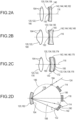
- the optical element is a biconcave lens.
- the surface of the curved substrate may be selected from a spheric surface or an aspheric surface.
- the term "spheric surface” may refer to a surface of an extended object in space, wherein the surface comprises a section of a sphere.
- the term "spheric section” refers, as generally used, to a partition of a sphere which can be obtained by intersection of the sphere by an extended plane which may not intersect the center of the sphere.
- the curved substrate comprising the spheric surface may behave in the manner similar to a sphere reacting to an incident light beam.
- the simple biconvex optical lens which may be approximated by two opposing partial spheric surfaces may, close to the optical axis, exhibit similar optical properties as the sphere.
- the light beams impinging the simple optical lens far from the optical axis, in particular, at an edge of the lens, may, however, cause a deviation from this behavior resulting in a number of deviating effects, including spherical aberration and/or astigmatism.
- the surface of the curved substrate may be or comprise an aspheric surface.
- the aspheric surface may comprise a deviation from the spheric section as described above.
- the at least one optical element comprising an aspheric surface which may, therefore, also denominated as an "asphere"
- the at least one optical element comprising an aspheric surface may be a combination of at least two optical elements, such as a multi-lens system, or, preferably, be a single optical element comprising an individually formed shape which may, especially, be designed for this purpose.
- the curved substrate may be arranged in a manner that it may follow a section of a Petzval surface or, at least, an approximation of the Petzval surface.
- the term “Petzval surface” may refer to a two-dimensional image curvature on which an extended linear object may be focused by using the simple optical lens as described above.
- the term “Petzval surface” may be used in order to describe the optical aberration which may cause an effect that a flat object normal to the optical axis cannot be brought properly into the focus on a flat image plane.
- the focus of the flat object normal to the optical axis may be located on the two-dimensional image curvature which may, generally, be curved towards the edges of the convex lens and away from the edges of the concave lens. Consequently, using the curved substrate in accordance with the present invention which may, preferably, follow, at least approximately, the section of the Petzval surface may result in the contrary effect that the flat object normal to the optical axis can now be brought properly into the focus on any location of the Petzval surface.
- the film of the photoconductive material may, preferably, deposited on the curved substrate following approximately the Petzval surface, by which arrangement it may be possible to allow the focus of the impinging light beam, independent of its angle of incidence, to be located within the film.
- the film of the photoconductive material placed on the curved substrate located in the sensor region of the optical sensor may, thus allow the optical sensor to generate the at least one sensor signal depending on an illumination of the sensor region by a light beam which may be in focus within the film, which is not possible by using a flat substrate located in the sensor region of the optical sensor, such as described in WO 2012/110924 A1 , WO 2014/097181 A1 , or WO 2016/120392 A1 .
- the detector comprises at least one transfer device, which may further be arranged along the common optical axis.
- the light beam which emerges from the object travels first through the at least one transfer device and thereafter at or through the at least one optical sensor until it may, finally, impinge on an imaging device.
- the term "transfer device” refers to an optical component which may be configured to transfer the at least one light beam emerging from the object to the at least one optical sensor within the detector.
- the transfer device is designed to feed or guide light propagating from the object to the detector to the at least one optical sensor, wherein this feeding can, optionally, be effected by means of imaging or else by means of non-imaging properties of the transfer device.
- the transfer device can also be designed to collect the electromagnetic radiation before the latter is fed or guided to the at least one optical sensor.
- the at least one transfer device may have imaging properties. Consequently, the transfer device comprises a single aspheric lens as at least one imaging element, since, in the case of such imaging elements, a geometry of the illumination on the sensor region can be dependent on a relative positioning, e.g., a distance, between the transfer device and the object.
- the transfer device is designed in such a way that the electromagnetic radiation emerging from the object may be transferred completely to the sensor region, e.g., is focused completely on the sensor region, in particular, if the object is arranged in a visual range of the detector.
- the at least one optical element as employed for the transfer device is at least partially optically transparent with respect to at least a partition of the wavelength range of the light beam.
- the transfer device comprises an at least partially optically transparent material selected from a group consisting of glass, quartz, silicon, germanium, ZnSe, ZnS, CaF 2 , MgF, NaCl, KBr, sapphire, fused silica, a transparent conducting oxide (TCO), and a transparent organic polymer.
- an at least partially optically transparent material selected from a group consisting of glass, quartz, silicon, germanium, ZnSe, ZnS, CaF 2 , MgF, NaCl, KBr, sapphire, fused silica, a transparent conducting oxide (TCO), and a transparent organic polymer.
- the at least one transfer device thus, constitutes or comprises a single aspheric lens as a converging optical element, which may further be arranged along the common optical axis.
- the transfer device has at least one focal point, wherein the curved substrate and the transfer device are placed with respect to each other in a manner that one or more of the focal points are located within a volume of the film placed on the curved substrate.
- the curvature of the curved substrate on which the film can be deposited may, in a preferred embodiment, follow at least approximately the Petzval surface, by which arrangement the focus of the impinging light beam may, thus, be located, independent of its angle of incidence, within the film.
- the optical element is a biconcave lens that comprises at least two individually curved surfaces, in particular two individually curved surfaces, which may, thus, as denoted as a "two-sided curved optical element".
- the two individually curved surfaces may, preferably, be placed with respect to each other in a manner that the focal point may be located within the volume of the film being placed on both of the curved substrates.
- the same film or an individual film for each of the two individually curved substrates may be used.
- the transfer device may have at least two focal points, in particular, two focal points which may be located at different positions with respect to each other.
- the two or more individually curved surfaces of the two-sided curved optical element may be placed with respect to each other in a manner that each of the different focal points may be located within the volume of one of the individual films.
- the curved substrate may comprise two individual optical sensors.
- one of the two optical sensors may be a longitudinal optical sensor while the other of the two optical sensors may function as a transversal optical sensor. Consequently, by using this kind of optical detector having the two-sided curved optical element both the depth and the width of the object may be determined concurrently. In other words, a location in space made be determined here by using a particular simple arrangement for the optical detector which may comprise only two individual optical components, i.e. a single transfer element and the single two-sided curved optical element.
- the present invention may allow providing a detector designed for generating one or more items of information on a three-dimensional position of the object, wherein the detector may only comprise two individual optical components.
- both optical sensors may be longitudinal optical sensors, such that the detector may comprise a first longitudinal optical sensor and a second longitudinal optical sensor.
- the transfer device is an aspheric lens. Consequently, this kind of arrangement which uses the two-sided curved optical element having a single longitudinal optical sensor on each curved surface may in accordance with the FiP effect, as described above in more detail, be designated to determine the longitudinal position of the object with a high degree of accuracy and without ambiguity.
- both optical sensors may be selected from the same kind of optical sensors, such as two longitudinal optical sensors or two transversal optical sensors, wherein the two optical sensors of the same kind may differ with respect to each in a further optical property, such as an optical sensitivity, e.g., for a specific wavelength or a spectral range.
- a further optical property such as an optical sensitivity, e.g., for a specific wavelength or a spectral range.
- the transfer device may further comprise a diffractive optical element, wherein the diffractive optical element may be a dispersive optical element being adapted to split the incident light beam into at least two split beams.
- the diffractive optical element may, preferably, be selected from a group consisting of a diffractive optical lens, a prism, a diffractive curved mirror, a beam-splitter, an engineered diffuser TM , and an optical grating.
- a diffractive optical lens preferably, be selected from a group consisting of a diffractive optical lens, a prism, a diffractive curved mirror, a beam-splitter, an engineered diffuser TM , and an optical grating.
- other kinds of diffractive optical elements which may be suited here can also be conceived.
- the optical sensor and the transfer device may be placed with respect to each other in a manner that the at least two of the two split beams may be fed or guided to the film comprising the photoconductive material.
- at least two of the split beams may, preferably, be guided to at least one of:
- each of the at least one optical sensors may, thus, be arranged within the detector of the present invention in a manner that the light beam impinges only a single optical sensor.
- This embodiment may comprise a first arrangement in which a single incident light beam may impinge the single optical sensor as comprised by detector, wherein the single optical sensor has at least two individually curved surfaces, such as a two-sided curved optical element.
- this embodiment may comprise a second arrangement in which the incident light beam may be split into at least two split beams, such as by using a dispersive optical element being which may be adapted for his purpose, wherein, however, each of the single split beams may impinge only a single optical sensor, wherein the detector may, thus, comprise a single optical sensor for each of the split beams.
- the optical grating as used for the diffractive optical element may have an equally spaced ruling that may be placed on a concave surface, in particular, on a spherical grating mount.
- This kind of optical grating may, in general, easier being manufactured compared to optical gratings which exhibit a non-equal spacing of the grating lines, irrespective whether placed on a flat mount or on the spherical mount.
- the optical grating placed on the spherical grating mount may split an incident light beam, preferably, being provided through an entrance slit into spectrally resolved reflected beams of all diffraction orders which are spectrally resolved between a first wavelength ⁇ 1 and a second wavelength ⁇ 2 .
- the light beams being reflected by this kind of optical grating may have their focus at a position on a the Rowland circle for any wavelength between the first wavelength ⁇ 1 and the second wavelength ⁇ 2 .
- the term "Rowland circle” refers to a circle having tangent to the center of the grating surface provided on the spherical grating mount and having half the radius of the spherical grating. Consequently, in order to provide a spectrometer, it may, particularly, be advantageous to locate the one or more optical sensors at a location on the Rowland circle.
- the sensor region of the at least one optical sensor may, preferably, be or comprise an array of sensor areas, such as a linear array of sensor areas, particularly, being arranged in an adjacent manner within a plane defined by the spectrally resolved beam as reflected by the optical grating.
- this kind of optical sensor may, in particular, allow detecting an intensity of the incident light beam being resolved as a function of the wavelength.
- the term "evaluation device” generally refers to an arbitrary device designed to generate the items of information, i.e. the at least one item of information on the position of the object.
- the evaluation device may be or may comprise one or more integrated circuits, such as one or more application-specific integrated circuits (ASICs), and/or one or more data processing devices, such as one or more computers, preferably one or more microcomputers and/or microcontrollers. Additional components may be comprised, such as one or more preprocessing devices and/or data acquisition devices, such as one or more devices for receiving and/or preprocessing of the sensor signals, such as one or more AD-converters and/or one or more filters.
- ASICs application-specific integrated circuits
- data processing devices such as one or more computers, preferably one or more microcomputers and/or microcontrollers.
- Additional components may be comprised, such as one or more preprocessing devices and/or data acquisition devices, such as one or more devices for receiving and/or preprocessing of the sensor signals, such as
- the sensor signal may generally refer to one of the longitudinal sensor signal and, if applicable, to the transversal sensor signal.
- the evaluation device may comprise one or more data storage devices. Further, as outlined above, the evaluation device may comprise one or more interfaces, such as one or more wireless interfaces and/or one or more wire-bound interfaces.
- the at least one evaluation device may be adapted to perform at least one computer program, such as at least one computer program performing or supporting the step of generating the items of information.
- at least one computer program such as at least one computer program performing or supporting the step of generating the items of information.
- one or more algorithms may be implemented which, by using the sensor signals as input variables, may perform a predetermined transformation into the position of the object.
- the evaluation device may particularly comprise at least one data processing device, in particular an electronic data processing device, which can be designed to generate the items of information by evaluating the sensor signals.
- the evaluation device is designed to use the sensor signals as input variables and to generate the items of information on the transversal position and the longitudinal position of the object by processing these input variables. The processing can be done in parallel, subsequently or even in a combined manner.
- the evaluation device may use an arbitrary process for generating these items of information, such as by calculation and/or using at least one stored and/or known relationship.
- one or a plurality of further parameters and/or items of information can influence said relationship, for example at least one item of information about a modulation frequency.
- the relationship can be determined or determinable empirically, analytically or else semi-empirically. Particularly preferably, the relationship comprises at least one calibration curve, at least one set of calibration curves, at least one function or a combination of the possibilities mentioned.
- One or a plurality of calibration curves can be stored for example in the form of a set of values and the associated function values thereof, for example in a data storage device and/or a table. Alternatively or additionally, however, the at least one calibration curve can also be stored for example in parameterized form and/or as a functional equation.
- Separate relationships for processing the sensor signals into the items of information may be used. Alternatively, at least one combined relationship for processing the sensor signals is feasible. Various possibilities are conceivable and can also be combined.
- the evaluation device can be designed in terms of programming for the purpose of determining the items of information.
- the evaluation device can comprise in particular at least one computer, for example at least one microcomputer.
- the evaluation device can comprise one or a plurality of volatile or nonvolatile data memories.
- the evaluation device can comprise one or a plurality of further electronic components which are designed for determining the items of information, for example an electronic table and in particular at least one look-up table and/or at least one application-specific integrated circuit (ASIC).
- ASIC application-specific integrated circuit
- the detector has, as described above, at least one evaluation device.
- the at least one evaluation device can also be designed to completely or partly control or drive the detector, for example by the evaluation device being designed to control at least one illumination source and/or to control at least one modulation device of the detector.
- the evaluation device can be designed, in particular, to carry out at least one measurement cycle in which one or a plurality of sensor signals, such as a plurality of sensor signals, are picked up, for example a plurality of sensor signals of successively at different modulation frequencies of the illumination.
- the evaluation device is designed, as described above, to generate at least one item of information on the position of the object by evaluating the at least one sensor signal.
- Said position of the object can be static or may even comprise at least one movement of the object, for example a relative movement between the detector or parts thereof and the object or parts thereof.
- a relative movement can generally comprise at least one linear movement and/or at least one rotational movement.
- Items of movement information can for example also be obtained by comparison of at least two items of information picked up at different times, such that for example at least one item of location information can also comprise at least one item of velocity information and/or at least one item of acceleration information, for example at least one item of information about at least one relative velocity between the object or parts thereof and the detector or parts thereof.
- the at least one item of location information can generally be selected from: an item of information about a distance between the object or parts thereof and the detector or parts thereof, in particular an optical path length; an item of information about a distance or an optical distance between the object or parts thereof and the optional transfer device or parts thereof; an item of information about a positioning of the object or parts thereof relative to the detector or parts thereof; an item of information about an orientation of the object and/or parts thereof relative to the detector or parts thereof; an item of information about a relative movement between the object or parts thereof and the detector or parts thereof; an item of information about a two-dimensional or three-dimensional spatial configuration of the object or of parts thereof, in particular a geometry or form of the object.
- the at least one item of location information can therefore be selected for example from the group consisting of: an item of information about at least one location of the object or at least one part thereof; information about at least one orientation of the object or a part thereof; an item of information about a geometry or form of the object or of a part thereof, an item of information about a velocity of the object or of a part thereof, an item of information about an acceleration of the object or of a part thereof, an item of information about a presence or absence of the object or of a part thereof in a visual range of the detector.
- the at least one item of location information can be specified for example in at least one coordinate system, for example a coordinate system in which the detector or parts thereof rest.
- the location information can also simply comprise for example a distance between the detector or parts thereof and the object or parts thereof. Combinations of the possibilities mentioned are also conceivable.
- the term "transversal optical sensor” generally refers to a device which is adapted to determine a transversal position of at least one light beam traveling from the object to the detector.
- position reference may be made to the definition above.
- the transversal position may be or may comprise at least one coordinate in at least one dimension perpendicular to an optical axis of the detector.
- the transversal position may be a position of a light spot generated by the light beam in a plane perpendicular to the optical axis, such as on a light-sensitive sensor surface of the transversal optical sensor.
- the position in the plane may be given in Cartesian coordinates and/or polar coordinates.
- Other embodiments are feasible.
- other embodiments are feasible and will be outlined in further detail below.
- the transversal optical sensor may provide at least one transversal sensor signal.
- the transversal sensor signal may generally be an arbitrary signal indicative of the transversal position.
- the transversal sensor signal may be or may comprise a digital and/or an analog signal.
- the transversal sensor signal may be or may comprise a voltage signal and/or a current signal. Additionally or alternatively, the transversal sensor signal may be or may comprise digital data.
- the transversal sensor signal may comprise a single signal value and/or a series of signal values.
- the transversal sensor signal may further comprise an arbitrary signal which may be derived by combining two or more individual signals, such as by averaging two or more signals and/or by forming a quotient of two or more signals.
- the transversal optical sensor may be a photo detector having at least one first electrode, at least one second electrode and at least one photovoltaic material, wherein the photovoltaic material may be embedded in between the first electrode and the second electrode.
- the transversal optical sensor may be or may comprise one or more photo detectors, such as one or more organic photodetectors and, most preferably, one or more dye-sensitized organic solar cells (DSCs, also referred to as dye solar cells), such as one or more solid dye-sensitized organic solar cells (s-DSCs).
- DSCs dye-sensitized organic solar cells
- s-DSCs solid dye-sensitized organic solar cells
- the detector may comprise one or more DSCs (such as one or more sDSCs) acting as the at least one transversal optical sensor and one or more DSCs (such as one or more sDSCs) acting as the at least one longitudinal optical sensor.
- the transversal optical sensor may comprise a layer of the photoconductive material, preferably an inorganic photoconductive material, such as one of the photoconductive materials as mentioned above and/or below.
- the layer of the photoconductive material may comprise a composition selected from a homogeneous, a crystalline, a polycrystalline, a microcrystalline, a nanocrystalline and/or an amorphous phase.
- the photoconductive material may be provided in the form of quantum dots as described above.
- the layer of the photoconductive material may be embedded in between two layers of a transparent conducting oxide (TCO), preferably indium tin oxide (ITO), fluorine doped tin oxide (SnO2:F; FTO), aluminum doped zinc oxide (AZO), magnesium oxide (MgO), or a perovskite transparent conducting oxide, wherein one of the two layers may be replaced by metal nanowires, in particular by Ag nanowires.
- TCO transparent conducting oxide
- ITO indium tin oxide
- FTO fluorine doped tin oxide
- AZO aluminum doped zinc oxide
- MgO magnesium oxide
- perovskite transparent conducting oxide preferably indium tin oxide (ITO), fluorine doped tin oxide (SnO2:F; FTO), aluminum doped zinc oxide (AZO), magnesium oxide (MgO), or a perovskite transparent conducting oxide, wherein one of the two layers may be replaced by metal nanowires, in particular by Ag nanowires.
- other material
- At least two electrodes may be present for recording the transversal optical signal.
- the at least two electrodes may actually be arranged in the form of at least two physical electrodes, wherein each physical electrode may comprise an electrically conducting material, preferably a metallically conducting material, more preferred a highly metallically conducting material such as copper, silver, gold, an alloy or a composition comprising these kinds of materials, or graphene.
- each of the at least two physical electrodes may, preferably, be arranged in a manner that a direct electrical contact between the respective electrode and the photoconductive layer in the optical sensor may be achieved, particularly in order to acquire the longitudinal sensor signal with as little loss as possible, such as due to additional resistances in a transport path between the optical sensor and the evaluation device.
- At least one of the electrodes of the transversal optical sensor may be a split electrode having at least two partial electrodes, wherein the transversal optical sensor may have a sensor region, wherein the at least one transversal sensor signal may indicate an x- and/or a y-position of the incident light beam within the sensor region.
- the sensor region may be a surface of the photo detector facing towards the object.
- the sensor region preferably may be oriented perpendicular to the optical axis.
- the transversal sensor signal may indicate a position of a light spot generated by the light beam in a plane of the sensor region of the transversal optical sensor.
- partial electrode refers to an electrode out of a plurality of electrodes, adapted for measuring at least one current and/or voltage signal, preferably independent from other partial electrodes.
- the respective electrode is adapted to provide a plurality of electric potentials and/or electric currents and/or voltages via the at least two partial electrodes, which may be measured and/or used independently.
- the transversal optical sensor may further be adapted to generate the transversal sensor signal in accordance with the electrical currents through the partial electrodes.
- a ratio of electric currents through two horizontal partial electrodes may be formed, thereby generating an x-coordinate
- a ratio of electric currents through to vertical partial electrodes may be formed, thereby generating a y-coordinate.
- the detector preferably the transversal optical sensor and/or the evaluation device, may be adapted to derive the information on the transversal position of the object from at least one ratio of the currents through the partial electrodes. Other ways of generating position coordinates by comparing currents through the partial electrodes are feasible.
- the partial electrodes may generally be defined in various ways, in order to determine a position of the light beam in the sensor region.
- two or more horizontal partial electrodes may be provided in order to determine a horizontal coordinate or x-coordinate
- two or more vertical partial electrodes may be provided in order to determine a vertical coordinate or y-coordinate.
- the partial electrodes may be provided at a rim of the sensor region, wherein an interior space of the sensor region remains free and may be covered by one or more additional electrode materials.
- the additional electrode material preferably may be a transparent additional electrode material, such as a transparent metal and/or a transparent conductive oxide and/or, most preferably, a transparent conductive polymer.
- the transversal optical sensor wherein one of the electrodes is a split electrode with three or more partial electrodes
- currents through the partial electrodes may be dependent on a position of the light beam in the sensor region. This may generally be due to the fact that Ohmic losses or resistive losses may occur on the way from a location of generation of electrical charges due to the impinging light onto the partial electrodes.
- the split electrode may comprise one or more additional electrode materials connected to the partial electrodes, wherein the one or more additional electrode materials provide an electrical resistance.
- the currents through the partial electrodes depend on the location of the generation of the electric charges and, thus, to the position of the light beam in the sensor region.
- this principle of determining the position of the light beam in the sensor region reference may be made to the preferred embodiments below and/or to the physical principles and device options as disclosed in WO 2014/097181 A1 and the respective references therein.
- the transversal optical sensor may comprise the sensor region, which, preferably, may be transparent to the light beam travelling from the object to the detector.
- the transversal optical sensor may, therefore, be adapted to determine a transversal position of the light beam in one or more transversal directions, such as in the x- and/or in the y-direction.
- the at least one transversal optical sensor may further be adapted to generate at least one transversal sensor signal.
- the evaluation device may be designed to generate at least one item of information on a transversal position of the object by evaluating the transversal sensor signal of the longitudinal optical sensor.
- the term “light” generally refers to electromagnetic radiation in one or more of the visible spectral range, the ultraviolet spectral range and the infrared spectral range.
- the term “ultraviolet spectral range” generally refers to electromagnetic radiation in the range of 1 nm to 380 nm, preferably in the range of 100 nm to 380 nm.
- visible spectral range generally refers to a spectral range of 380 nm to 760 nm.
- IR infrared spectral range
- NIR near infrared spectral range
- MidIR mid infrared spectral range
- FIR far infrared spectral range
- light as used within the present invention is light in the infrared spectral range, more preferred in the mid infrared spectral range.
- the term "light beam” generally refers to an amount of light emitted into a specific direction.
- the light beam may be a bundle of the light rays having a predetermined extension in a direction perpendicular to a direction of propagation of the light beam.
- the light beam may be or may comprise one or more Gaussian light beams which may be characterized by one or more Gaussian beam parameters, such as one or more of a beam waist, a Rayleigh-length or any other beam parameter or combination of beam parameters suited to characterize a development of a beam diameter and/or a beam propagation in space.
- the light beam might be admitted by the object itself, i.e. might originate from the object. Additionally or alternatively, another origin of the light beam is feasible.
- one or more illumination sources might be provided which illuminate the object, such as by using one or more primary rays or beams, such as one or more primary rays or beams having a predetermined characteristic.
- the light beam propagating from the object to the detector might be a light beam which is reflected by the object and/or a reflection device connected to the object.
- the at least one longitudinal sensor signal is, according to the FiP effect, dependent on a beam cross-section of the light beam in the sensor region of the at least one longitudinal optical sensor.
- the term beam cross-section generally refers to a lateral extension of the light beam or a light spot generated by the light beam at a specific location. In case a circular light spot is generated, a radius, a diameter or a Gaussian beam waist or twice the Gaussian beam waist may function as a measure of the beam cross-section.
- the cross-section may be determined in any other feasible way, such as by determining the cross-section of a circle having the same area as the non-circular light spot, which is also referred to as the equivalent beam cross-section.
- an extremum i.e. a maximum or a minimum
- the longitudinal sensor signal in particular a global extremum
- the corresponding material such as a photovoltaic material
- the smallest possible cross-section such as when the material may be located at or near a focal point as affected by an optical lens.
- the extremum is a maximum
- this observation may be denominated as the positive FiP-effect
- the extremum is a minimum
- this observation may be denominated as the negative FiP-effect.
- a light beam having a first beam diameter or beam cross-section may generate a first longitudinal sensor signal
- a light beam having a second beam diameter or beam-cross section being different from the first beam diameter or beam cross-section generates a second longitudinal sensor signal being different from the first longitudinal sensor signal.
- the longitudinal sensor signals generated by the longitudinal optical sensors may be compared, in order to gain information on the total power and/or intensity of the light beam and/or in order to normalize the longitudinal sensor signals and/or the at least one item of information on the longitudinal position of the object for the total power and/or total intensity of the light beam.
- a maximum value of the longitudinal optical sensor signals may be detected, and all longitudinal sensor signals may be divided by this maximum value, thereby generating normalized longitudinal optical sensor signals, which, then, may be transformed by using the above-mentioned known relationship, into the at least one item of longitudinal information on the object.
- Other ways of normalization are feasible, such as a normalization using a mean value of the longitudinal sensor signals and dividing all longitudinal sensor signals by the mean value.
- Other options are possible. Each of these options may be appropriate to render the transformation independent from the total power and/or intensity of the light beam.
- information on the total power and/or intensity of the light beam might, thus, be generated.
- the at least one item of information on the longitudinal position of the object may thus be derived from a known relationship between the at least one longitudinal sensor signal and a longitudinal position of the object.
- the known relationship may be stored in the evaluation device as an algorithm and/or as one or more calibration curves.
- a relationship between a beam diameter or beam waist and a position of the object may easily be derived by using the Gaussian relationship between the beam waist and a longitudinal coordinate.
- This embodiment may, particularly, be used by the evaluation device in order to resolve an ambiguity in the known relationship between a beam cross-section of the light beam and the longitudinal position of the object.
- the beam properties of the light beam propagating from the object to the detector are known fully or partially, it is known that, in many beams, the beam cross-section narrows before reaching a focal point and, afterwards, widens again.
- positions along the axis of propagation of the light beam occur in which the light beam has the same cross-section.
- the cross-section of the light beam is identical.
- a specific cross-section of the light beam might be determined, in case the overall power or intensity of the light beam is known.
- the distance z0 of the respective longitudinal optical sensor from the focal point might be determined.
- additional information is required, such as a history of movement of the object and/or the detector and/or information on whether the detector is located before or behind the focal point. In typical situations, this additional information may not be provided. Therefore, additional information may be gained in order to resolve the above-mentioned ambiguity.
- the evaluation device by evaluating the longitudinal sensor signals, recognizes that the beam cross-section of the light beam on a first longitudinal optical sensor is larger than the beam cross-section of the light beam on a second longitudinal optical sensor, wherein the second longitudinal optical sensor is located behind the first longitudinal optical sensor, the evaluation device may determine that the light beam is still narrowing and that the location of the first longitudinal optical sensor is situated before the focal point of the light beam. Contrarily, in case the beam cross-section of the light beam on the first longitudinal optical sensor is smaller than the beam cross-section of the light beam on the second longitudinal optical sensor, the evaluation device may determine that the light beam is widening and that the location of the second longitudinal optical sensor is situated behind the focal point. Thus, generally, the evaluation device may be adapted to recognize whether the light beam widens or narrows, by comparing the longitudinal sensor signals of different longitudinal sensors.
- the evaluation device may be adapted to compare the beam cross-section and/or the diameter of the light beam with known beam properties of the light beam in order to determine the at least one item of information on the longitudinal position of the object, preferably from a known dependency of a beam diameter of the light beam on at least one propagation coordinate in a direction of propagation of the light beam and/or from a known Gaussian profile of the light beam.
- the evaluation device may further be adapted to determine at least one transversal coordinate of the object by determining a position of the light beam on the at least one transversal optical sensor, which may be a pixelated, a segmented or a large-area transversal optical sensor, as further outlined also in WO 2014/097181 A1 .
- the detector may further comprise at least one imaging device, i.e. a device capable of acquiring at least one image.
- the imaging device can be embodied in various ways.
- the imaging device can be for example part of the detector in a detector housing.
- the imaging device can also be arranged outside the detector housing, for example as a separate imaging device.
- the imaging device can also be connected to the detector or even be part of the detector.
- the optical sensor and the imaging device are aligned along a common optical axis along which the light beam travels.
- other arrangements are possible.
- an "imaging device” is generally understood as a device which can generate a one-dimensional, a two-dimensional, or a three-dimensional image of the object or of a part thereof.
- the detector with or without the at least one optional imaging device, can be completely or partly used as a camera, such as an IR camera, or an RGB camera, i.e. a camera which is designed to deliver three basic colors which are designated as red, green, and blue, on three separate connections.
- the at least one imaging device may be or may comprise at least one imaging device selected from the group consisting of: a pixelated organic camera element, preferably a pixelated organic camera chip; a pixelated inorganic camera element, preferably a pixelated inorganic camera chip, more preferably a CCD- or CMOS-chip; a monochrome camera element, preferably a monochrome camera chip; a multicolor camera element, preferably a multicolor camera chip; a full-color camera element, preferably a full-color camera chip.
- the imaging device may be or may comprise at least one device selected from the group consisting of a monochrome imaging device, a multi-chrome imaging device and at least one full color imaging device.
- a multi-chrome imaging device and/or a full color imaging device may be generated by using filter techniques and/or by using intrinsic color sensitivity or other techniques, as the skilled person will recognize. Other embodiments of the imaging device are also possible.
- the imaging device may be designed to image a plurality of partial regions of the object successively and/or simultaneously.
- a partial region of the object can be a one-dimensional, a two-dimensional, or a three-dimensional region of the object which is delimited for example by a resolution limit of the imaging device and from which electromagnetic radiation emerges.
- imaging should be understood to mean that the electromagnetic radiation which emerges from the respective partial region of the object is fed into the imaging device, for example by means of the at least one optional transfer device of the detector.
- the electromagnetic rays can be generated by the object itself, for example in the form of a luminescent radiation.
- the at least one detector may comprise at least one illumination source for illuminating the object.
- the imaging device can be designed to image sequentially, for example by means of a scanning method, in particular using at least one row scan and/or line scan, the plurality of partial regions sequentially.
- a scanning method in particular using at least one row scan and/or line scan
- the imaging device is designed to generate, during this imaging of the partial regions of the object, signals, preferably electronic signals, associated with the partial regions.
- the signal may be an analogue and/or a digital signal.
- an electronic signal can be associated with each partial region.
- the electronic signals can accordingly be generated simultaneously or else in a temporally staggered manner.
- the imaging device may comprise one or more signal processing devices, such as one or more filters and/or analogue-digital-converters for processing and/or preprocessing the electronic signals.
- Light emerging from the object can originate in the object itself, but can also optionally have a different origin and propagate from this origin to the object and subsequently toward the optical sensors.
- the latter case can be affected for example by at least one illumination source being used.
- the illumination source can be embodied in various ways.
- the illumination source can be for example part of the detector in a detector housing.
- the at least one illumination source can also be arranged outside a detector housing, for example as a separate light source.
- the illumination source can be arranged separately from the object and illuminate the object from a distance.
- the illumination source can also be connected to the object or even be part of the object, such that, by way of example, the electromagnetic radiation emerging from the object can also be generated directly by the illumination source.
- At least one illumination source can be arranged on and/or in the object and directly generate the electromagnetic radiation by means of which the sensor region is illuminated.
- This illumination source can for example be or comprise an ambient light source and/or may be or may comprise an artificial illumination source.
- at least one infrared emitter and/or at least one emitter for visible light and/or at least one emitter for ultraviolet light can be arranged on the object.
- at least one light emitting diode and/or at least one laser diode can be arranged on and/or in the object.
- the illumination source can comprise in particular one or a plurality of the following illumination sources: a laser, in particular a laser diode, although in principle, alternatively or additionally, other types of lasers can also be used; a light emitting diode; an incandescent lamp; a neon light; a flame source; a heat source; an organic light source, in particular an organic light emitting diode; a structured light source. Alternatively or additionally, other illumination sources can also be used. It is particularly preferred if the illumination source is designed to generate one or more light beams having a Gaussian beam profile, as is at least approximately the case for example in many lasers. For further potential embodiments of the optional illumination source, reference may be made to one of WO 2012/110924 A1 and WO 2014/097181 A1 . Still, other embodiments are feasible.
- the at least one optional illumination source generally may emit light in at least one of the ultraviolet spectral range (preferably 200 nm to 380 nm), the visible spectral range (380 nm to 780 nm); the infrared spectral range (780 nm to 1000 ⁇ ), preferably in the range of 780 nm to 15 micrometers.
- the at least one illumination source is adapted to emit light in at least one of the mentioned spectral ranges, i.e. the ultraviolet spectral range, the visible spectral range, and/or the infrared spectral range.
- the illumination source may exhibit a spectral range which may be related to the spectral sensitivities of the longitudinal sensors, particularly in a manner to ensure that the longitudinal sensor which may be illuminated by the respective illumination source may provide a sensor signal with a high intensity which may, thus, enable a high-resolution evaluation with a sufficient signal-to-noise-ratio.
- a comparatively simple and cost-efficient setup for the optical sensor may be obtained by using the detector according to the present invention.
- This advantage may particularly become obvious when compared to the optical sensor as, for example, depicted in WO 2012/110924 A1 or WO 2014/097181 A1 , wherein more individual optical components may be required for the setup of the optical detector. Nevertheless, the lower number of individual optical components which may be used here may still provide a working embodiment for the optical sensor. However, other embodiments may also be appropriate as the setup for the optical sensor according to the present invention.
- the detector can have at least one modulation device for modulating the illumination, in particular for a periodic modulation, in particular a periodic beam interrupting device.
- a modulation of the illumination should be understood to mean a process in which a total power of the illumination is varied, preferably periodically, in particular with one or a plurality of modulation frequencies.
- a periodic modulation can be effected between a maximum value and a minimum value of the total power of the illumination. The minimum value can be 0, but can also be > 0, such that, by way of example, complete modulation does not have to be effected.
- the modulation can be effected for example in a beam path between the object and the optical sensor, for example by the at least one modulation device being arranged in said beam path.
- the modulation can also be effected in a beam path between an optional illumination source - described in even greater detail below - for illuminating the object and the object, for example by the at least one modulation device being arranged in said beam path.
- the at least one modulation device can comprise for example a beam chopper or some other type of periodic beam interrupting device, for example comprising at least one interrupter blade or interrupter wheel, which preferably rotates at constant speed and which can thus periodically interrupt the illumination.
- the at least one optional illumination source itself can also be designed to generate a modulated illumination, for example by said illumination source itself having a modulated intensity and/or total power, for example a periodically modulated total power, and/or by said illumination source being embodied as a pulsed illumination source, for example as a pulsed laser.
- the at least one modulation device can also be wholly or partly integrated into the illumination source.
- the detector can be designed in particular to detect at least two longitudinal sensor signals in the case of different modulations, in particular at least two longitudinal sensor signals at respectively different modulation frequencies.
- the evaluation device can be designed to generate the geometrical information from the at least two longitudinal sensor signals. As described in WO 2012/110924 A1 and WO 2014/097181 A1 , it is possible to resolve ambiguities and/or it is possible to take account of the fact that, for example, a total power of the illumination is generally unknown.
- the detector can be designed to bring about a modulation of the illumination of the object and/or at least one sensor region of the detector, such as at least one sensor region of the at least one longitudinal optical sensor, with a frequency of 0.05 Hz to 1 MHz, such as 0.1 Hz to 10 kHz.
- the detector may comprise at least one modulation device, which may be integrated into the at least one optional illumination source and/or may be independent from the illumination source.
- At least one illumination source might, by itself, be adapted to generate the above-mentioned modulation of the illumination, and/or at least one independent modulation device may be present, such as at least one chopper and/or at least one device having a modulated transmissibility, such as at least one electro-optical device and/or at least one acousto-optical device.
- at least one independent modulation device may be present, such as at least one chopper and/or at least one device having a modulated transmissibility, such as at least one electro-optical device and/or at least one acousto-optical device.
- the optical detector may, thus, not be required to comprise a modulation device which may further contribute to the simple and cost-effective setup of the spatial detector.
- a spatial light modulator may be used in a time-multiplexing mode rather than a frequency-multiplexing mode or in a combination thereof.
- an arrangement comprising at least two individual detectors according to any of the preceding embodiments, preferably two or three individual optical sensors, which may be placed at two distinct locations.
- the at least two detectors preferably may have identical optical properties but might also be different with respect from each other.
- the arrangement may further comprise at least one illumination source.
- the at least one object might be illuminated by using at least one illumination source which generates primary light, wherein the at least one object elastically or inelastically reflects the primary light, thereby generating a plurality of light beams which propagate to one of the at least two detectors.
- the at least one illumination source may form or may not form a constituent part of each of the at least two detectors.
- the at least one illumination source itself may be or may comprise an ambient light source and/or may be or may comprise an artificial illumination source.
- This embodiment is preferably suited for an application in which at least two detectors, preferentially two identical detectors, are employed for acquiring depth information, in particular, for the purpose to providing a measurement volume which extends the inherent measurement volume of a single detector.
- the individual optical sensor may, preferably, be spaced apart from the other individual optical sensors comprised by the detector in order to allow acquiring an individual image which may differ from the images taken by the other individual optical sensors.
- the individual optical sensors may be arranged in separate beam paths in a collimated arrangement in order to generate a single circular, three-dimensional image.
- the individual optical sensors may be aligned in a manner that they are located parallel to the optical axis and may, in addition, exhibit an individual displacement in an orientation perpendicular to the optical axis of the detector.
- an alignment may be achieved by adequate measures, such as by adjusting a location and orientation of the individual optical sensor and/or the corresponding transfer element.
- the two individual optical sensors may, preferably, be spaced apart in a manner that they may be able to generate or increase a perception of depth information, especially in a fashion that the depth information may be obtained by combining visual information as derived from the two individual optical sensors having overlapping fields of view, such as the visual information as obtained by binocular vision.
- the individual optical sensors may, preferably be spaced apart from each other by a distance from 1 cm to 100 cm, preferably from 10 cm to 25 cm, as determined in the direction perpendicular to the optical axis.
- the detector as provided in this embodiment may, in particular, be part of a "stereoscopic system" which will be described below in more detail. Besides allowing stereoscopic vision, further particular advantages of the stereoscopic system which are primarily based on a use of more than one optical sensor may, in particular, include an increase of the total intensity and/or a lower detection threshold.
- a human-machine interface for exchanging at least one item of information between a user and a machine.
- the human-machine interface as proposed may make use of the fact that the above-mentioned detector in one or more of the embodiments mentioned above or as mentioned in further detail below may be used by one or more users for providing information and/or commands to a machine.
- the human-machine interface may be used for inputting control commands.
- the human-machine interface comprises at least one detector according to the present invention, such as according to one or more of the embodiments disclosed above and/or according to one or more of the embodiments as disclosed in further detail below, wherein the human-machine interface is designed to generate at least one item of geometrical information of the user by means of the detector wherein the human-machine interface is designed to assign the geometrical information to at least one item of information, in particular to at least one control command.
- an entertainment device for carrying out at least one entertainment function.
- an entertainment device is a device which may serve the purpose of leisure and/or entertainment of one or more users, in the following also referred to as one or more players.
- the entertainment device may serve the purpose of gaming, preferably computer gaming. Additionally or alternatively, the entertainment device may also be used for other purposes, such as for exercising, sports, physical therapy or motion tracking in general.
- the entertainment device may be implemented into a computer, a computer network or a computer system or may comprise a computer, a computer network or a computer system which runs one or more gaming software programs.
- the entertainment device comprises at least one human-machine interface, such as according to one or more of the embodiments disclosed above and/or according to one or more of the embodiments disclosed below.
- the entertainment device is designed to enable at least one item of information to be input by a player by means of the human-machine interface.
- the at least one item of information may be transmitted to and/or may be used by a controller and/or a computer of the entertainment device.
- a tracking system for tracking the position of at least one movable object.
- a tracking system is a device which is adapted to gather information on a series of past positions of the at least one object or at least one part of an object. Additionally, the tracking system may be adapted to provide information on at least one predicted future position of the at least one object or the at least one part of the object.
- the tracking system may have at least one track controller, which may fully or partially be embodied as an electronic device, preferably as at least one data processing device, more preferably as at least one computer or microcontroller.
- the at least one track controller may comprise the at least one evaluation device and/or may be part of the at least one evaluation device and/or might fully or partially be identical to the at least one evaluation device.
- the tracking system comprises at least one detector, such as at least one detector as disclosed in one or more of the embodiments listed above and/or as disclosed in one or more of the embodiments below.
- the tracking system further comprises at least one track controller.
- the tracking system may comprise one, two or more detectors, particularly two or more identical detectors, which allow for a reliable acquisition of depth information about the at least one object in an overlapping volume between the two or more detectors.
- the track controller is adapted to track a series of positions of the object, each position comprising at least one item of information on a position of the object at a specific point in time.
- the tracking system may further comprise at least one beacon device connectable to the object.
- the tracking system preferably is adapted such that the detector may generate an information on the position of the object of the at least one beacon device, in particular to generate the information on the position of the object which comprises a specific beacon device exhibiting a specific spectral sensitivity.
- the beacon device may fully or partially be embodied as an active beacon device and/or as a passive beacon device.
- the beacon device may comprise at least one illumination source adapted to generate at least one light beam to be transmitted to the detector.
- the beacon device may comprise at least one reflector adapted to reflect light generated by an illumination source, thereby generating a reflected light beam to be transmitted to the detector.
- a scanning system for determining at least one position of at least one object.
- the scanning system is a device which is adapted to emit at least one light beam being configured for an illumination of at least one dot located at at least one surface of the at least one object and for generating at least one item of information about the distance between the at least one dot and the scanning system.
- the scanning system comprises at least one of the detectors according to the present invention, such as at least one of the detectors as disclosed in one or more of the embodiments listed above and/or as disclosed in one or more of the embodiments below.
- the scanning system comprises at least one illumination source which is adapted to emit the at least one light beam being configured for the illumination of the at least one dot located at the at least one surface of the at least one object.
- the term "dot" refers to a small area on a part of the surface of the object which may be selected, for example by a user of the scanning system, to be illuminated by the illumination source.
- the dot may exhibit a size which may, on one hand, be as small as possible in order to allow the scanning system determining a value for the distance between the illumination source comprised by the scanning system and the part of the surface of the object on which the dot may be located as exactly as possible and which, on the other hand, may be as large as possible in order to allow the user of the scanning system or the scanning system itself, in particular by an automatic procedure, to detect a presence of the dot on the related part of the surface of the object.
- the illumination source may comprise an artificial illumination source, in particular at least one laser source and/or at least one incandescent lamp and/or at least one semiconductor light source, for example, at least one light-emitting diode, in particular an organic and/or inorganic light-emitting diode.
- an artificial illumination source in particular at least one laser source and/or at least one incandescent lamp and/or at least one semiconductor light source, for example, at least one light-emitting diode, in particular an organic and/or inorganic light-emitting diode.
- the use of at least one laser source as the illumination source is particularly preferred.
- the use of a single laser source may be preferred, in particular in a case in which it may be important to provide a compact scanning system that might be easily storable and transportable by the user.
- the illumination source may thus, preferably be a constituent part of the detector and may, therefore, in particular be integrated into the detector, such as into the housing of the detector.
- the housing of the scanning system may comprise at least one display configured for providing distance-related information to the user, such as in an easy-to-read manner.
- particularly the housing of the scanning system may, in addition, comprise at least one button which may be configured for operating at least one function related to the scanning system, such as for setting one or more operation modes.
- the housing of the scanning system may, in addition, comprise at least one fastening unit which may be configured for fastening the scanning system to a further surface, such as a rubber foot, a base plate or a wall holder, such comprising as magnetic material, in particular for increasing the accuracy of the distance measurement and/or the handleability of the scanning system by the user.
- a fastening unit which may be configured for fastening the scanning system to a further surface, such as a rubber foot, a base plate or a wall holder, such comprising as magnetic material, in particular for increasing the accuracy of the distance measurement and/or the handleability of the scanning system by the user.
- the illumination source of the scanning system may, thus, emit a single laser beam which may be configured for the illumination of a single dot located at the surface of the object.
- at least one item of information about the distance between the at least one dot and the scanning system may, thus, be generated.
- the distance between the illumination system as comprised by the scanning system and the single dot as generated by the illumination source may be determined, such as by employing the evaluation device as comprised by the at least one detector.
- the scanning system may, further, comprise an additional evaluation system which may, particularly, be adapted for this purpose.
- a size of the scanning system in particular of the housing of the scanning system, may be taken into account and, thus, the distance between a specific point on the housing of the scanning system, such as a front edge or a back edge of the housing, and the single dot may, alternatively, be determined.
- the illumination source of the scanning system may emit two individual laser beams which may be configured for providing a respective angle, such as a right angle, between the directions of an emission of the beams, whereby two respective dots located at the surface of the same object or at two different surfaces at two separate objects may be illuminated.
- a respective angle such as a right angle
- other values for the respective angle between the two individual laser beams may also be feasible.
- This feature may, in particular, be employed for indirect measuring functions, such as for deriving an indirect distance which may not be directly accessible, such as due to a presence of one or more obstacles between the scanning system and the dot or which may otherwise be hard to reach.
- the scanning system may, further, comprise at least one leveling unit, in particular an integrated bubble vial, which may be used for keeping the predefined level by the user.
- the illumination source of the scanning system may emit a plurality of individual laser beams, such as an array of laser beams which may exhibit a respective pitch, in particular a regular pitch, with respect to each other and which may be arranged in a manner in order to generate an array of dots located on the at least one surface of the at least one object.
- a respective pitch in particular a regular pitch
- specially adapted optical elements such as beam-splitting devices and mirrors, may be provided which may allow a generation of the described array of the laser beams.
- the scanning system may provide a static arrangement of the one or more dots placed on the one or more surfaces of the one or more objects.
- illumination source of the scanning system in particular the one or more laser beams, such as the above described array of the laser beams, may be configured for providing one or more light beams which may exhibit a varying intensity over time and/or which may be subject to an alternating direction of emission in a passage of time.
- the illumination source may be configured for scanning a part of the at least one surface of the at least one object as an image by using one or more light beams with alternating features as generated by the at least one illumination source of the scanning device.
- the scanning system may, thus, use at least one row scan and/or line scan, such as to scan the one or more surfaces of the one or more objects sequentially or simultaneously.
- the scanning system may be adapted to measure angles by measuring three or more dots, or the scanning system may be adapted to measure corners or narrow regions such as a gable of a roof, which may be hardly accessible using a conventional measuring stick.
- the scanning system may be attached to a tripod and point towards an object or region with a several corners and surfaces.
- One or more flexibly movable laser sources are attached to the scanning system.
- the one or more laser sources are moved as such that they illuminate points of interest.
- the position of the illuminated points with respect to the scanning system is measured when pressing a designated button on the scanning system and the position information is transmitted via a wireless interface to a mobile phone.
- the position information is stored in a mobile phone application.
- the laser sources are moved to illuminate further points of interest the position of which are measured and transmitted to the mobile phone application.
- the mobile phone application may transform the set of points into a 3d model by connecting adjacent points with planar surfaces.
- the 3d model may be stored and processed further.
- the distances and or angles between the measured points or surfaces may be displayed directly on a display attached to a scanning system or on the mobile phone to which the position information is transmitted.
- a scanning system may comprise two or more flexible movable laser sources to project points and further one movable laser source projecting a line.
- the line may be used to arrange the two or more laser spots along a line and the display of the scanning device may display the distance between the two or more laser spots that may be arranged along the line, such as at equal distance.
- a single laser source may be used whereas the distance of the projected points is modified using one or more beam-splitters or prisms, where a beam-splitter or prism can be moved as such that the projected laser spots move apart or closer together.
- the scanning system may be adapted to project further patterns such as a right angle, a circle, a square, a triangle, or the like, along which a measurement can be done by projecting laser spots and measuring their position.
- the scanning system may be adapted to support the work with tools, such as wood or metal processing tools, such as a saw, a driller, or the like.
- the scanning system may be adapted to measure the distance in two opposite directions and display the two measured distances or the sum of the distances in a display.
- the scanning system may be adapted to measure the distance to the edge of a surface as such that when the scanning system is placed on the surface, a laser point is moved automatically away from the scanning system along the surface, until the distance measurement shows a sudden change due to a corner or the edge of a surface. This makes it possible to measure the distance of the end of a wood plank while the scanning device is placed on the plank but remote from its end.
- the scanning system may measure the distance of the end of a plank in one direction and project a line or circle or point in a designated distance in the opposite direction.
- the scanning system may be adapted to project the line or circle or point in a distance depending on the distance measured in the opposite direction such as depending on a predetermined sum distance. This allows working with a tool such as a saw or driller at the projected position while placing the scanning system in a safe distance from the tool and simultaneously performing a process using the tool in a predetermined distance to the edge of the plank.
- the scanning system may be adapted to project points or lines or the like in two opposite directions in a predetermined distance. When the sum of the distances is changed, only one of the projected distances changes.
- the scanning system may be adapted to be placed onto a surface, such as a surface on which a task is performed, such as cutting, sawing, drilling, or the like, and to project a line onto the surface in a predetermined distance that can be adjusted such as with buttons on the scanning device.
- a stereoscopic system for generating at least one single circular, three-dimensional image of at least one object.
- the stereoscopic system as disclosed above and/or below may comprise at least two of the FiP sensors as the optical sensors, wherein a first FiP sensor may be comprised in a tracking system, in particular in a tracking system, while a second FiP sensor may be comprised in a scanning system.
- the FiP sensors may, preferably, be arranged in separate beam paths in a collimated arrangement, such as by aligning the FiP sensors parallel to the optical axis and individually displaced perpendicular to the optical axis of the stereoscopic system.
- the FiP sensors may be able to generate or increase a perception of depth information, especially, by obtaining the depth information by a combination of the visual information derived from the individual FiP sensors which have overlapping fields of view and are, preferably, sensitive to an individual modulation frequency.
- the individual FiP sensors may, preferably, be spaced apart from each other by a distance from 1 cm to 100 cm, preferably from 10 cm to 25 cm, as determined in the direction perpendicular to the optical axis.
- the tracking system may, thus, be employed for determining a position of a modulated active target while the scanning system which is adapted to project one or more dots onto the one or more surfaces of the one or more objects may be used for generating at least one item of information about the distance between the at least one dot and the scanning system.
- the stereoscopic system may further comprise a separate position sensitive device being adapted for generating the item of information on the transversal position of the at least one object within the image as described elsewhere in this application.
- the stereoscopic system which are primarily based on a use of more than one optical sensor may, in particular, include an increase of the total intensity and/or a lower detection threshold.
- a conventional stereoscopic system which comprises at least two conventional position sensitive devices corresponding pixels in the respective images have to be determined by applying considerable computational effort
- the stereoscopic system according to the present invention which comprises at least two FiP sensors the corresponding pixels in the respective images being recorded by using the FiP sensors, wherein each of the FiP sensors may be operated with a different modulation frequency, may apparently be assigned with respect to each other.
- the stereoscopic system according to the present invention may allow generating the at least one item of information on the longitudinal position of the object as well as on the transversal position of the object with reduced effort.
- a camera for imaging at least one object comprises at least one detector according to the present invention, such as disclosed in one or more of the embodiments given above or given in further detail below.
- the detector may be part of a photographic device, specifically of a digital camera.
- the detector may be used for 3D photography, specifically for digital 3D photography.
- the detector may form a digital 3D camera or may be part of a digital 3D camera.
- the term "photography” generally refers to the technology of acquiring image information of at least one object.
- a "camera” generally is a device adapted for performing photography.
- the term "digital photography” generally refers to the technology of acquiring image information of at least one object by using a plurality of light-sensitive elements adapted to generate electrical signals indicating an intensity of illumination, preferably digital electrical signals.
- the term “3D photography” generally refers to the technology of acquiring image information of at least one object in three spatial dimensions.
- a 3D camera is a device adapted for performing 3D photography.
- the camera generally may be adapted for acquiring a single image, such as a single 3D image, or may be adapted for acquiring a plurality of images, such as a sequence of images.
- the camera may also be a video camera adapted for video applications, such as for acquiring digital video sequences.
- the present invention can be used in a camera, specifically a digital camera, more specifically a 3D camera or digital 3D camera, for imaging at least one object.
- imaging generally refers to acquiring image information of at least one object.
- the camera comprises at least one detector according to the present invention.
- the camera as outlined above, may be adapted for acquiring a single image or for acquiring a plurality of images, such as image sequence, preferably for acquiring digital video sequences.
- the camera may be or may comprise a video camera. In the latter case, the camera preferably comprises a data memory for storing the image sequence.
- a method for determining a position of at least one object is disclosed.
- the method preferably may make use of at least one detector according to the present invention, such as of at least one detector according to one or more of the embodiments disclosed above or disclosed in further detail below.
- at least one detector according to the present invention such as of at least one detector according to one or more of the embodiments disclosed above or disclosed in further detail below.
- the method comprises the following steps, which may be performed in the given order or in a different order. Further, additional method steps might be provided which are not listed. Further, two or more or even all of the method steps might be performed simultaneously, at least partially. Further, two or more or even all of the method steps might be performed twice or even more than twice, repeatedly.
- the method according to the present invention comprises the following steps:
- a use of a detector according to the present invention is disclosed.
- a use of the detector for a purpose of determining a position of an object, in particular a lateral position of an object is proposed, wherein the detector may, preferably, be used concurrently as at least one longitudinal optical sensor or combined with at least one additional longitudinal optical sensor, in particular, for a purpose of use selected from the group consisting of: a position measurement, in particular in traffic technology; an entertainment application; a security application; a human-machine interface application; a tracking application; a scanning application; a stereoscopic vision application; a photography application; an imaging application or camera application; a mapping application for generating maps of at least one space; a homing or tracking beacon detector for vehicles; a position measurement of objects with a thermal signature (hotter or colder than background); a machine vision application; a robotic application.
- optical detector may also refer to combinations with applications already been known, such as determining the presence or absence of an object; extending optical applications, e.g. camera exposure control, auto slide focus, automated rear view mirrors, electronic scales, automatic gain control, particularly in modulated light sources, automatic headlight dimmers, night (street) light controls, oil burner flame outs, or smoke detectors; or other applications, such as in densitometers, e.g. determining the density of toner in photocopy machines; or in colorimetric measurements.
- applications already been known such as determining the presence or absence of an object
- optical applications e.g. camera exposure control, auto slide focus, automated rear view mirrors, electronic scales, automatic gain control, particularly in modulated light sources, automatic headlight dimmers, night (street) light controls, oil burner flame outs, or smoke detectors
- densitometers e.g. determining the density of toner in photocopy machines; or in colorimetric measurements.
- the devices according to the present invention may be applied in various fields of uses.
- the detector may be applied for a purpose of use, selected from the group consisting of: a position measurement in traffic technology; an entertainment application; a security application; a human-machine interface application; a tracking application; a photography application; a cartography application; a mapping application for generating maps of at least one space; a homing or tracking beacon detector for vehicles; a mobile application; a webcam; an audio device; a Dolby surround audio system; a computer peripheral device; a gaming application; a camera or video application; a surveillance application; an automotive application; a transport application; a logistics application; a vehicle application; an airplane application; a ship application; a spacecraft application; a robotic application; a medical application; a sports' application; a building application; a construction application; a manufacturing application; a machine vision application; a use in combination with at least one sensing technology selected from time-of-flight detector
- applications in local and/or global positioning systems may be named, especially landmark-based positioning and/or navigation, specifically for use in cars or other vehicles (such as trains, motorcycles, bicycles, trucks for cargo transportation), robots or for use by pedestrians.
- indoor positioning systems may be named as potential applications, such as for household applications and/or for robots used in manufacturing, logistics, surveillance, or maintenance technology.
- the devices according to the present invention may be used in mobile phones, tablet computers, laptops, smart panels or other stationary or mobile or wearable computer or communication applications.
- the devices according to the present invention may be combined with at least one active light source, such as a light source emitting light in the visible range or infrared spectral range, in order to enhance performance.
- the devices according to the present invention may be used as cameras and/or sensors, such as in combination with mobile software for scanning and/or detecting environment, objects and living beings.
- the devices according to the present invention may even be combined with 2D cameras, such as conventional cameras, in order to increase imaging effects.
- the devices according to the present invention may further be used for surveillance and/or for recording purposes or as input devices to control mobile devices, especially in combination with voice and/or gesture recognition.
- the devices according to the present invention acting as human-machine interfaces also referred to as input devices, may be used in mobile applications, such as for controlling other electronic devices or components via the mobile device, such as the mobile phone.
- the mobile application including at least one device according to the present invention may be used for controlling a television set, a game console, a music player or music device or other entertainment devices.
- the devices according to the present invention may be used in webcams or other peripheral devices for computing applications.
- the devices according to the present invention may be used in combination with software for imaging, recording, surveillance, scanning, or motion detection.
- the devices according to the present invention are particularly useful for giving commands by facial expressions and/or body expressions.
- the devices according to the present invention can be combined with other input generating devices like e.g. mouse, keyboard, touchpad, microphone etc.
- the devices according to the present invention may be used in applications for gaming, such as by using a webcam.
- the devices according to the present invention may be used in virtual training applications and/or video conferences.
- devices according to the present invention may be used to recognize or track hands, arms, or objects used in a virtual or augmented reality application, especially when wearing head mounted displays.
- the devices according to the present invention may be used in mobile audio devices, television devices and gaming devices, as partially explained above.
- the devices according to the present invention may be used as controls or control devices for electronic devices, entertainment devices or the like.
- the devices according to the present invention may be used for eye detection or eye tracking, such as in 2D- and 3D-display techniques, especially with transparent displays for augmented reality applications and/or for recognizing whether a display is being looked at and/or from which perspective a display is being looked at.
- devices according to the present invention may be used to explore a room, boundaries, obstacles, in connection with a virtual or augmented reality application, especially when wearing a head-mounted display.
- the devices according to the present invention may be used in or as digital cameras such as DSC cameras and/or in or as reflex cameras such as SLR cameras.
- digital cameras such as DSC cameras
- reflex cameras such as SLR cameras
- the devices according to the present invention may be used for security or surveillance applications.
- at least one device according to the present invention can be combined with one or more digital and/or analogue electronics that will give a signal if an object is within or outside a predetermined area (e.g. for surveillance applications in banks or museums).
- the devices according to the present invention may be used for optical encryption. Detection by using at least one device according to the present invention can be combined with other detection devices to complement wavelengths, such as with IR, x-ray, UV-VIS, radar or ultrasound detectors.
- the devices according to the present invention may further be combined with an active infrared light source to allow detection in low light surroundings.
- the devices according to the present invention are generally advantageous as compared to active detector systems, specifically since the devices according to the present invention avoid actively sending signals which may be detected by third parties, as is the case e.g. in radar applications, ultrasound applications, LIDAR or similar active detector devices.
- the devices according to the present invention may be used for an unrecognized and undetectable tracking of moving objects. Additionally, the devices according to the present invention generally are less prone to manipulations and irritations as compared to conventional devices.
- the devices according to the present invention generally may be used for facial, body and person recognition and identification.
- the devices according to the present invention may be combined with other detection means for identification or personalization purposes such as passwords, finger prints, iris detection, voice recognition or other means.
- the devices according to the present invention may be used in security devices and other personalized applications.
- the devices according to the present invention may be used as 3D barcode readers for product identification.
- the devices according to the present invention generally can be used for surveillance and monitoring of spaces and areas.
- the devices according to the present invention may be used for surveying and monitoring spaces and areas and, as an example, for triggering or executing alarms in case prohibited areas are violated.
- the devices according to the present invention may be used for surveillance purposes in building surveillance or museums, optionally in combination with other types of sensors, such as in combination with motion or heat sensors, in combination with image intensifiers or image enhancement devices and/or photomultipliers.
- the devices according to the present invention may be used in public spaces or crowded spaces to detect potentially hazardous activities such as commitment of crimes such as theft in a parking lot or of unattended objects such as unattended baggage in an airport.
- the devices according to the present invention may advantageously be applied in camera applications such as video and camcorder applications.
- the devices according to the present invention may be used for motion capture and 3D-movie recording.
- the devices according to the present invention generally provide a large number of advantages over conventional optical devices.
- the devices according to the present invention generally require a lower complexity with regard to optical components.
- the number of lenses may be reduced as compared to conventional optical devices, such as by providing the devices according to the present invention having one lens only. Due to the reduced complexity, very compact devices are possible, such as for mobile use.
- Conventional optical systems having two or more lenses with high quality generally are voluminous, such as due to the general need for voluminous beam-splitters.
- the devices according to the present invention generally may be used for focus/autofocus devices, such as autofocus cameras.
- the devices according to the present invention may also be used in optical microscopy, especially in confocal microscopy.
- the devices according to the present invention generally are applicable in the technical field of automotive technology and transport technology.
- the devices according to the present invention may be used as distance and surveillance sensors, such as for adaptive cruise control, emergency brake assist, lane departure warning, surround view, blind spot detection, traffic sign detection, traffic sign recognition, lane recognition, rear cross traffic alert, light source recognition for adapting the head light intensity and range depending on approaching traffic or vehicles driving ahead, adaptive front-lighting systems, automatic control of high beam head lights, adaptive cut-off lights in front light systems, glare-free high beam front lighting systems, marking animals, obstacles, or the like by headlight illumination, rear cross traffic alert, and other driver assistance systems, such as advanced driver assistance systems, or other automotive and traffic applications.
- driver assistance systems such as advanced driver assistance systems, or other automotive and traffic applications.
- devices according to the present invention may be used in driver assistance systems which may, particularly, be adapted for anticipating maneuvers of the driver beforehand for collision avoidance. Further, the devices according to the present invention can also be used for velocity and/or acceleration measurements, such as by analyzing a first and second time-derivative of position information gained by using the detector according to the present invention. This feature generally may be applicable in automotive technology, transportation technology or general traffic technology. Applications in other fields of technology are feasible. A specific application in an indoor positioning system may be the detection of positioning of passengers in transportation, more specifically to electronically control the use of safety systems such as airbags.
- an airbag may, especially, be prevented in a case in which the passenger may be located within the vehicle in a manner that a use of the airbag might cause an injury, in particular a severe injury, with the passenger.
- devices according to the present invention may be used to determine whether a driver pays attention to the traffic or is distracted, or asleep, or tired, or incapable of driving, such as due to the consumption of alcohol or other drugs.
- the devices according to the present invention may be used as standalone devices or in combination with other sensor devices, such as in combination with radar and/or ultrasonic devices.
- the devices according to the present invention may be used for autonomous driving and safety issues.
- the devices according to the present invention may be used in combination with infrared sensors, radar sensors, which are sonic sensors, two-dimensional cameras or other types of sensors.
- the generally passive nature of the devices according to the present invention is advantageous.
- the devices according to the present invention specifically may be used in combination with recognition software, such as standard image recognition software.
- signals and data as provided by the devices according to the present invention typically are readily processable and, therefore, generally require lower calculation power than established stereovision systems such as LIDAR.
- the devices according to the present invention such as cameras may be placed at virtually any place in a vehicle, such as on or behind a window screen, on a front hood, on bumpers, on lights, on mirrors or other places and the like.
- Various detectors according to the present invention such as one or more detectors based on the effect disclosed within the present invention can be combined, such as in order to allow autonomously driving vehicles or in order to increase the performance of active safety concepts.
- various devices according to the present invention may be combined with one or more other devices according to the present invention and/or conventional sensors, such as in the windows like rear window, side window or front window, on the bumpers or on the lights.
- a combination of at least one device according to the present invention such as at least one detector according to the present invention with one or more rain detection sensors is also possible. This is due to the fact that the devices according to the present invention generally are advantageous over conventional sensor techniques such as radar, specifically during heavy rain.
- a combination of at least one device according to the present invention with at least one conventional sensing technique such as radar may allow for a software to pick the right combination of signals according to the weather conditions.
- the devices according to the present invention may generally be used as brake assist and/or parking assist and/or for speed measurements.
- Speed measurements can be integrated in the vehicle or may be used outside the vehicle, such as in order to measure the speed of other cars in traffic control. Further, the devices according to the present invention may be used for detecting free parking spaces in parking lots.
- the devices according to the present invention may generally be used for vision, in particular for vision under difficult visibility conditions, such as in night vision, fog vision, or fume vision.
- the optical detector may comprise a specifically selected colloidal quantum dots which may be sensitive at least within a wavelength range in which small particles, such as particles being present in smoke or fume, or small droplets, such as droplets being present in fog, mist or haze, may not reflect an incident light beam or only a small partition thereof.
- the reflection of the incident light beam may be small or negligent in a case in which the wavelength of the incident beam exceeds the size of the particles or of the droplets, respectively.
- vision may be enabled by detecting thermal radiation being emitted by a bodies and objects.
- the optical detector which comprises the specifically selected colloidal quantum dots which may particularly be sensitive within the infrared (IR) spectral range, preferably within the near infrared (NIR) spectral range, may, thus, allow good visibility even at night, in fume, smoke, fog, mist, or haze.
- IR infrared
- NIR near infrared
- the devices according to the present invention may be used in the fields of medical systems and sports.
- surgery robotics e.g. for use in endoscopes
- the devices according to the present invention may require a low volume only and may be integrated into other devices.
- the devices according to the present invention having one lens, at most, may be used for capturing 3D information in medical devices such as in endoscopes.
- the devices according to the present invention may be combined with an appropriate monitoring software, in order to enable tracking and analysis of movements.
- the devices according to the present invention may be used in 3D-body scanning.
- Body scanning may be applied in a medical context, such as in dental surgery, plastic surgery, bariatric surgery, or cosmetic plastic surgery, or it may be applied in the context of medical diagnosis such as in the diagnosis of myofascial pain syndrome, cancer, body dysmorphic disorder, or further diseases. Body scanning may further be applied in the field of sports to assess ergonomic use or fit of sports equipment.
- Body scanning may further be used in the context of clothing, such as to determine a suitable size and fitting of clothes.
- This technology may be used in the context of tailor-made clothes or in the context of ordering clothes or shoes from the internet or at a self-service shopping device such as a micro kiosk device or customer concierge device.
- Body scanning in the context of clothing is especially important for scanning fully dressed customers.
- the devices according to the present invention may be used in the context of people counting systems, such as to count the number of people in an elevator, a train, a bus, a car, or a plane, or to count the number of people passing a hallway, a door, an aisle, a retail store, a stadium, an entertainment venue, a museum, a library, a public location, a cinema, a theater, or the like.
- the 3D-function in the people counting system may be used to obtain or estimate further information about the people that are counted such as height, weight, age, physical fitness, or the like. This information may be used for business intelligence metrics, and/or for further optimizing the locality where people may be counted to make it more attractive or safe.
- the devices according to the present invention in the context of people counting may be used to recognize returning customers or cross shoppers, to assess shopping behavior, to assess the percentage of visitors that make purchases, to optimize staff shifts, or to monitor the costs of a shopping mall per visitor.
- people counting systems may be used for anthropometric surveys.
- the devices according to the present invention may be used in public transportation systems for automatically charging passengers depending on the length of transport.
- the devices according to the present invention may be used in playgrounds for children, to recognize injured children or children engaged in dangerous activities, to allow additional interaction with playground toys, to ensure safe use of playground toys or the like.
- the devices according to the present invention may be used in construction tools, such as a range meter that determines the distance to an object or to a wall, to assess whether a surface is planar, to align or objects or place objects in an ordered manner, or in inspection cameras for use in construction environments or the like.
- construction tools such as a range meter that determines the distance to an object or to a wall, to assess whether a surface is planar, to align or objects or place objects in an ordered manner, or in inspection cameras for use in construction environments or the like.
- the devices according to the present invention may be applied in the field of sports and exercising, such as for training, remote instructions or competition purposes.
- the devices according to the present invention may be applied in the fields of dancing, aerobic, football, soccer, basketball, baseball, cricket, hockey, track and field, swimming, polo, handball, volleyball, rugby, sumo, judo, fencing, boxing, golf, car racing, laser tag, battlefield simulation etc.
- the devices according to the present invention can be used to detect the position of a ball, a bat, a sword, motions, etc., both in sports and in games, such as to monitor the game, support the referee or for judgment, specifically automatic judgment, of specific situations in sports, such as for judging whether a point or a goal actually was made.
- the devices according to the present invention may be used in the field of auto racing or car driver training or car safety training or the like to determine the position of a car or the track of a car, or the deviation from a previous track or an ideal track or the like.
- the devices according to the present invention may further be used to support a practice of musical instruments, in particular remote lessons, for example lessons of string instruments, such as fiddles, violins, violas, celli, basses, harps, guitars, banjos, or ukuleles, keyboard instruments, such as pianos, organs, keyboards, harpsichords, harmoniums, or accordions, and/or percussion instruments, such as drums, timpani, marimbas, xylophones, vibraphones, bongos, congas, timbales, djembes or tablas.
- string instruments such as fiddles, violins, violas, celli, basses, harps, guitars, banjos, or ukuleles
- keyboard instruments such as pianos, organs, keyboards, harpsichords, harmoniums, or accordions
- percussion instruments such as drums, timpani, marimbas, xylo
- the devices according to the present invention further may be used in rehabilitation and physiotherapy, in order to encourage training and/or in order to survey and correct movements. Therein, the devices according to the present invention may also be applied for distance diagnostics.
- the devices according to the present invention may be applied in the field of machine vision.
- one or more of the devices according to the present invention may be used e.g. as a passive controlling unit for autonomous driving and or working of robots.
- the devices according to the present invention may allow for autonomous movement and/or autonomous detection of failures in parts.
- the devices according to the present invention may also be used for manufacturing and safety surveillance, such as in order to avoid accidents including but not limited to collisions between robots, production parts and living beings.
- robotics the safe and direct interaction of humans and robots is often an issue, as robots may severely injure humans when they are not recognized.
- Devices according to the present invention may help robots to position objects and humans better and faster and allow a safe interaction.
- the devices according to the present invention may be advantageous over active devices and/or may be used complementary to existing solutions like radar, ultrasound, 2D cameras, IR detection etc.
- One particular advantage of the devices according to the present invention is the low likelihood of signal interference. Therefore multiple sensors can work at the same time in the same environment, without the risk of signal interference.
- the devices according to the present invention generally may be useful in highly automated production environments like e.g. but not limited to automotive, mining, steel, etc.
- the devices according to the present invention can also be used for quality control in production, e.g. in combination with other sensors like 2-D imaging, radar, ultrasound, IR etc., such as for quality control or other purposes.
- the devices according to the present invention may be used for assessment of surface quality, such as for surveying the surface evenness of a product or the adherence to specified dimensions, from the range of micrometers to the range of meters. Other quality control applications are feasible.
- the devices according to the present invention are especially useful for processing natural products such as food or wood, with a complex 3-dimensional structure to avoid large amounts of waste material. Further, devices according to the present invention may be used to monitor the filling level of tanks, silos etc.
- devices according to the present invention may be used to inspect complex products for missing parts, incomplete parts, loose parts, low quality parts, or the like, such as in automatic optical inspection, such as of printed circuit boards, inspection of assemblies or sub-assemblies, verification of engineered components, engine part inspections, wood quality inspection, label inspections, inspection of medical devices, inspection of product orientations, packaging inspections, food pack inspections, or the like.
- automatic optical inspection such as of printed circuit boards, inspection of assemblies or sub-assemblies, verification of engineered components, engine part inspections, wood quality inspection, label inspections, inspection of medical devices, inspection of product orientations, packaging inspections, food pack inspections, or the like.
- the devices according to the present invention may be used in vehicles, trains, airplanes, ships, spacecraft and other traffic applications.
- passive tracking systems for aircraft, vehicles and the like may be named.
- the use of at least one device according to the present invention, such as at least one detector according to the present invention, for monitoring the speed and/or the direction of moving objects is feasible.
- the tracking of fast moving objects on land, sea and in the air including space may be named.
- the at least one device according to the present invention such as the at least one detector according to the present invention, specifically may be mounted on a still-standing and/or on a moving device.
- An output signal of the at least one device according to the present invention can be combined e.g.
- the devices according to the present invention generally are useful and advantageous due to the low calculation power required, the instant response and due to the passive nature of the detection system which generally is more difficult to detect and to disturb as compared to active systems, like e.g. radar.
- the devices according to the present invention are particularly useful but not limited to e.g. speed control and air traffic control devices. Further, the devices according to the present invention may be used in automated tolling systems for road charges.
- the devices according to the present invention may, generally, be used in passive applications. Passive applications include guidance for ships in harbors or in dangerous areas, and for aircraft when landing or starting. Wherein, fixed, known active targets may be used for precise guidance. The same can be used for vehicles driving on dangerous but well defined routes, such as mining vehicles. Further, the devices according to the present invention may be used to detect rapidly approaching objects, such as cars, trains, flying objects, animals, or the like. Further, the devices according to the present invention can be used for detecting velocities or accelerations of objects, or to predict the movement of an object by tracking one or more of its position, speed, and/or acceleration depending on time.
- the devices according to the present invention may be used in the field of gaming.
- the devices according to the present invention can be passive for use with multiple objects of the same or of different size, color, shape, etc., such as for movement detection in combination with software that incorporates the movement into its content.
- applications are feasible in implementing movements into graphical output.
- applications of the devices according to the present invention for giving commands are feasible, such as by using one or more of the devices according to the present invention for gesture or facial recognition.
- the devices according to the present invention may be combined with an active system in order to work under e.g. low light conditions or in other situations in which enhancement of the surrounding conditions is required.
- a combination of one or more devices according to the present invention with one or more IR or VIS light sources is possible.
- a combination of a detector according to the present invention with special devices is also possible, which can be distinguished easily by the system and its software, e.g. and not limited to, a special color, shape, relative position to other devices, speed of movement, light, frequency used to modulate light sources on the device, surface properties, material used, reflection properties, transparency degree, absorption characteristics, etc.
- the device can, amongst other possibilities, resemble a stick, a racquet, a club, a gun, a knife, a wheel, a ring, a steering wheel, a bottle, a ball, a glass, a vase, a spoon, a fork, a cube, a dice, a figure, a puppet, a teddy, a beaker, a pedal, a switch, a glove, jewelry, a musical instrument or an auxiliary device for playing a musical instrument, such as a plectrum, a drumstick or the like.
- Other options are feasible.
- the devices according to the present invention may be used to detect and or track objects that emit light by themselves, such as due to high temperature or further light emission processes.
- the light emitting part may be an exhaust stream or the like.
- the devices according to the present invention may be used to track reflecting objects and analyze the rotation or orientation of these objects.
- the devices according to the present invention may generally be used in the field of building, construction and cartography.
- one or more devices according to the present invention may be used in order to measure and/or monitor environmental areas, e.g. countryside or buildings.
- one or more devices according to the present invention may be combined with other methods and devices or can be used solely in order to monitor progress and accuracy of building projects, changing objects, houses, etc.
- the devices according to the present invention can be used for generating three-dimensional models of scanned environments, in order to construct maps of rooms, streets, houses, communities or landscapes, both from ground or air. Potential fields of application may be construction, cartography, real estate management, land surveying or the like.
- the devices according to the present invention may be used in vehicles capable of flight, such as drones or multicopters, in order to monitor buildings, chimneys, production sites, agricultural production environments such as fields, production plants, or landscapes, to support rescue operations, to support work in dangerous environments, to support fire brigades in a burning location indoors or outdoors, to find or monitor one or more persons, animals, or moving objects, or for entertainment purposes, such as a drone following and recording one or more persons doing sports such as skiing or cycling or the like, which could be realized by following a helmet, a mark, a beacon device, or the like.
- vehicles capable of flight such as drones or multicopters, in order to monitor buildings, chimneys, production sites, agricultural production environments such as fields, production plants, or landscapes, to support rescue operations, to support work in dangerous environments, to support fire brigades in a burning location indoors or outdoors, to find or monitor one or more persons, animals, or moving objects, or for entertainment purposes, such as a drone following and recording one or more persons doing sports such as skiing or cycling or
- Devices according to the present invention could be used recognize obstacles, follow a predefined route, follow an edge, a pipe, a building, or the like, or to record a global or local map of the environment. Further, devices according to the present invention could be used for indoor or outdoor localization and positioning of drones, for stabilizing the height of a drone indoors where barometric pressure sensors are not accurate enough, or for the interaction of multiple drones such as concertized movements of several drones or recharging or refueling in the air or the like.
- the devices according to the present invention may be used within an interconnecting network of home appliances such as CHAIN (Cedec Home Appliances Interoperating Network) to interconnect, automate, and control basic appliance-related services in a home, e.g. energy or load management, remote diagnostics, pet related appliances, child related appliances, child surveillance, appliances related surveillance, support or service to elderly or ill persons, home security and/or surveillance, remote control of appliance operation, and automatic maintenance support.
- the devices according to the present invention may be used in heating or cooling systems such as an air-conditioning system, to locate which part of the room should be brought to a certain temperature or humidity, especially depending on the location of one or more persons.
- the devices according to the present invention may be used in domestic robots, such as service or autonomous robots which may be used for household chores.
- the devices according to the present invention may be used for a number of different purposes, such as to avoid collisions or to map the environment, but also to identify a user, to personalize the robot's performance for a given user, for security purposes, or for gesture or facial recognition.
- the devices according to the present invention may be used in robotic vacuum cleaners, floor-washing robots, dry-sweeping robots, ironing robots for ironing clothes, animal litter robots, such as cat litter robots, security robots that detect intruders, robotic lawn mowers, automated pool cleaners, rain gutter cleaning robots, window washing robots, toy robots, telepresence robots, social robots providing company to less mobile people, or robots translating and speech to sign language or sign language to speech.
- household robots with the devices according to the present invention may be used for picking up objects, transporting objects, and interacting with the objects and the user in a safe way.
- the devices according to the present invention may be used in robots operating with hazardous materials or objects or in dangerous environments.
- the devices according to the present invention may be used in robots or unmanned remote-controlled vehicles to operate with hazardous materials such as chemicals or radioactive materials especially after disasters, or with other hazardous or potentially hazardous objects such as mines, unexploded arms, or the like, or to operate in or to investigate insecure environments such as near burning objects or post disaster areas, or for manned or unmanned rescue operations in the air, in the sea, underground, or the like.
- the devices according to the present invention may be used in household, mobile or entertainment devices, such as a refrigerator, a microwave, a washing machine, a window blind or shutter, a household alarm, an air condition devices, a heating device, a television, an audio device, a smart watch, a mobile phone, a phone, a dishwasher, a stove or the like, to detect the presence of a person, to monitor the contents or function of the device, or to interact with the person and/or share information about the person with further household, mobile or entertainment devices.
- household, mobile or entertainment devices such as a refrigerator, a microwave, a washing machine, a window blind or shutter, a household alarm, an air condition devices, a heating device, a television, an audio device, a smart watch, a mobile phone, a phone, a dishwasher, a stove or the like, to detect the presence of a person, to monitor the contents or function of the device, or to interact with the person and/or share information about the person with further household, mobile or entertainment devices.
- the devices according to the present invention may be used to support elderly or disabled persons, blind persons, or persons with limited vision abilities, such as in household chores or at work such as in devices for holding, carrying, or picking objects, or in a safety system with optical and/or acoustical signals adapted for signaling obstacles in the environment.
- the devices according to the present invention may further be used in agriculture, for example to detect and sort out vermin, weeds, and/or infected crop plants, fully or in parts, wherein crop plants may be infected by fungus or insects. Further, for harvesting crops, the devices according to the present invention may be used to detect animals, such as deer, which may otherwise be harmed by harvesting devices. Further, the devices according to the present invention may be used to monitor the growth of plants in a field or greenhouse, in particular to adjust the amount of water or fertilizer or crop protection products for a given region in the field or greenhouse or even for a given plant. Further, in agricultural biotechnology, the devices according to the present invention may be used to monitor the size and shape of plants.
- devices according to the present invention may be used to guide users during a shaving, hair cutting, or cosmetics procedure, or the like. Further, devices according to the present invention may be used to record or monitor what is played on an instrument, such as a violin. Further, devices according to the present invention may be used in smart household appliances such as a smart refrigerator, such as to monitor the contents of the refrigerator and transmit notifications depending on the contents. Further, devices according to the present invention may be used for monitoring or tracking populations of humans, animals, or plants, such as dear or tree populations in forests.
- devices according to the present invention may be used in harvesting machines, such as for harvesting crops, flowers or fruits, such as grapes, corn, hops, apples, grains, rice, strawberries, asparagus, tulips, roses, soy beans, or the like. Further, devices according to the present invention may be used to monitor the growth of plants, animals, algae, fish, or the like, such as in breeding, food production, agriculture or research applications, to control irrigation, fertilization, humidity, temperature, use of herbicides, insecticides, fungicides, rodenticides, or the like. Further, devices according to the present invention may be used in feeding machines for animals or pets, such as for cows, pigs, cats, dogs, birds, fish, or the like.
- devices according to the present invention may be used in animal product production processes, such as for collecting milk, eggs, fur, meat, or the like, such as in automated milking or butchering processes. Further, devices according to the present invention may be used for automated seeding machines, or sowing machines, or planting machines such as for planting corn, garlic, trees, salad or the like. Further, devices according to the present invention may be used to assess or monitor weather phenomena, such as clouds, fog, or the like, or to warn from danger of avalanches, tsunamis, gales, earthquakes, thunder storms, or the like. Further, devices according to the present invention may be used to measure motions, shocks, concussions, or the like such as to monitor earthquake risk.
- devices according to the present invention may be used in traffic technology to monitor dangerous crossings, to control traffic lights depending on traffic, to monitor public spaces, to monitor roads, gyms, stadiums, ski resorts, public events, or the like.
- devices according to the present invention may be used in medical applications such as to monitor or analyze tissues, medical or biological assays, changes in tissues such as in moles or melanoma or the like, to count bacteria, blood cells, cells, algae, or the like, for retina scans, breath or pulse measurements, gastroscopy, patient surveillance, or the like.
- devices according to the present invention may be used to monitor the shape, size, or circumference of drops, streams, jets, or the like or to analyze, assess, or monitor profiles or gas or liquid currents such as in a wind channel, or the like. Further, devices according to the present invention may be used to warn drivers such as car or train drivers when they are getting sick or tired or the like. Further, devices according to the present invention may be used in material testing to recognize strains or tensions or fissures, or the like. Further, devices according to the present invention may be used in sailing to monitor and optimize sail positions such as automatically. Further, devices according to the present invention may be used for fuel level gauges.
- the devices according to the present invention may be combined with sensors to detect chemicals or pollutants, electronic nose chips, microbe sensor chips to detect bacteria or viruses or the like, Geiger counters, tactile sensors, heat sensors, or the like.
- This may for example be used in constructing smart robots which are configured for handling dangerous or difficult tasks, such as in treating highly infectious patients, handling or removing highly dangerous substances, cleaning highly polluted areas, such as highly radioactive areas or chemical spills, or for pest control in agriculture.
- One or more devices according to the present invention can further be used for scanning of objects, such as in combination with CAD or similar software, such as for additive manufacturing and/or 3D printing.
- CAD CAD
- use may be made of the high dimensional accuracy of the devices according to the present invention, e.g. in x-, y- or z- direction or in any arbitrary combination of these directions, such as simultaneously.
- determining a distance of an illuminated spot on a surface which may provide reflected or diffusely scattered light from the detector may be performed virtually independent of the distance of the light source from the illuminated spot.
- This property of the present invention is in direct contrast to known methods, such as triangulation or such as time-of-flight (TOF) methods, wherein the distance between the light source and the illuminated spot must be known a priori or calculated a posteriori in order to be able to determine the distance between the detector and the illuminated spot.
- TOF time-of-flight
- the detector according to the present invention is may be sufficient that the spot is adequately illuminated.
- the devices according to the present invention may be used for scanning reflective surfaces, such of metal surfaces, independent whether they may comprise a solid or a liquid surface. Further, the devices according to the present invention may be used in inspections and maintenance, such as pipeline inspection gauges.
- the devices according to the present invention may be used to work with objects of a badly defined shape such as naturally grown objects, such as sorting vegetables or other natural products by shape or size or cutting products such as meat or objects that are manufactured with a precision that is lower than the precision needed for a processing step.
- objects of a badly defined shape such as naturally grown objects, such as sorting vegetables or other natural products by shape or size or cutting products such as meat or objects that are manufactured with a precision that is lower than the precision needed for a processing step.
- the devices according to the present invention may be used in local navigation systems to allow autonomously or partially autonomously moving vehicles or multicopters or the like through an indoor or outdoor space.
- a non-limiting example may comprise vehicles moving through an automated storage for picking up objects and placing them at a different location.
- Indoor navigation may further be used in shopping malls, retail stores, museums, airports, or train stations, to track the location of mobile goods, mobile devices, baggage, customers or employees, or to supply users with a location specific information, such as the current position on a map, or information on goods sold, or the like.
- the devices according to the present invention may be used to ensure safe driving of motorcycles, such as driving assistance for motorcycles by monitoring speed, inclination, upcoming obstacles, unevenness of the road, or curves or the like. Further, the devices according to the present invention may be used in trains or trams to avoid collisions.
- the devices according to the present invention may be used in handheld devices, such as for scanning packaging or parcels to optimize a logistics process. Further, the devices according to the present invention may be used in further handheld devices such as personal shopping devices, RFID-readers, handheld devices for use in hospitals or health environments such as for medical use or to obtain, exchange or record patient or patient health related information, smart badges for retail or health environments, or the like.
- the devices according to the present invention may further be used in manufacturing, quality control or identification applications, such as in product identification or size identification (such as for finding an optimal place or package, for reducing waste etc.). Further, the devices according to the present invention may be used in logistics applications. Thus, the devices according to the present invention may be used for optimized loading or packing containers or vehicles. Further, the devices according to the present invention may be used for monitoring or controlling of surface damages in the field of manufacturing, for monitoring or controlling rental objects such as rental vehicles, and/or for insurance applications, such as for assessment of damages. Further, the devices according to the present invention may be used for identifying a size of material, object or tools, such as for optimal material handling, especially in combination with robots.
- the devices according to the present invention may be used for process control in production, e.g. for observing filling level of tanks. Further, the devices according to the present invention may be used for maintenance of production assets like, but not limited to, tanks, pipes, reactors, tools etc. Further, the devices according to the present invention may be used for analyzing 3D-quality marks. Further, the devices according to the present invention may be used in manufacturing tailor-made goods such as tooth inlays, dental braces, prosthesis, clothes or the like. The devices according to the present invention may also be combined with one or more 3D-printers for rapid prototyping, 3D-copying or the like. Further, the devices according to the present invention may be used for detecting the shape of one or more articles, such as for anti-product piracy and for anti-counterfeiting purposes.
- the devices according to the present invention may be used in the context of gesture recognition.
- gesture recognition in combination with devices according to the present invention may, in particular, be used as a human-machine interface for transmitting information via motion of a body, of body parts or of objects to a machine.
- the information may, preferably, be transmitted via a motion of hands or hand parts, such as fingers, in particular, by pointing at objects, applying sign language, such as for deaf people, making signs for numbers, approval, disapproval, or the like, by waving the hand, such as when asking someone to approach, to leave, or to greet a person, to press an object, to take an object, or, in the field of sports or music, in a hand or finger exercise, such as a warm-up exercise.
- sign language such as for deaf people, making signs for numbers, approval, disapproval, or the like
- the information may be transmitted by motion of arms or legs, such as rotating, kicking, grabbing, twisting, rotating, scrolling, browsing, pushing, bending, punching, shaking, arms, legs, both arms, or both legs, or a combination of arms and legs, such as for a purpose of sports or music, such as for entertainment, exercise, or training function of a machine.
- arms or legs such as rotating, kicking, grabbing, twisting, rotating, scrolling, browsing, pushing, bending, punching, shaking, arms, legs, both arms, or both legs, or a combination of arms and legs, such as for a purpose of sports or music, such as for entertainment, exercise, or training function of a machine.
- the information may be transmitted by motion of the whole body or major parts thereof, such as jumping, rotating, or making complex signs, such as sign language used at airports or by traffic police in order to transmit information, such as "turn right”, “turn left”, “proceed”, “slow down”, “stop”, or “stop engines”, or by pretending to swim, to dive, to run, to shoot, or the like, or by making complex motions or body positions such as in yoga, pilates, judo, karate, dancing, or ballet.
- complex signs such as sign language used at airports or by traffic police in order to transmit information, such as "turn right”, “turn left”, “proceed”, “slow down”, “stop”, or “stop engines”, or by pretending to swim, to dive, to run, to shoot, or the like, or by making complex motions or body positions such as in yoga, pilates, judo, karate, dancing, or ballet.
- the information may be transmitted by using a real or mock-up device for controlling a virtual device corresponding to the mock-up device, such as using a mock-up guitar for controlling a virtual guitar function in a computer program, using a real guitar for controlling a virtual guitar function in a computer program, using a real or a mock-up book for reading an e-book or moving pages or browsing through in a virtual document, using a real or mock-up pen for drawing in a computer program, or the like.
- the transmission of the information may be coupled to a feedback to the user, such as a sound, a vibration, or a motion.
- devices according to the present invention in combination with gesture recognition may be used for exercising purposes, control of instruments, recording of instruments, playing or recording of music via use of a mock-up instrument or by only pretending to have a instrument present such as playing air guitar, such as to avoid noise or make recordings, or, for conducting of a virtual orchestra, ensemble, band, big band, choir, or the like, for practicing, exercising, recording or entertainment purposes or the like.
- devices according to the present invention in combination with gesture recognition may be used to recognize motion profiles of persons, such as recognizing a person by the way of walking or moving the body, or to use hand signs or movements or signs or movements of body parts or the whole body as access or identification control such as a personal identification sign or a personal identification movement.
- devices according to the present invention in combination with gesture recognition may be used for central or non-central control of household devices which may be part of an interconnecting network of home appliances and/or household devices, such as refrigerators, central heating, air condition, microwave ovens, ice cube makers, or water boilers, or entertainment devices, such as television sets, smart phones, game consoles, video recorders, DVD players, personal computers, laptops, tablets, or combinations thereof, or a combination of household devices and entertainment devices.
- household devices such as refrigerators, central heating, air condition, microwave ovens, ice cube makers, or water boilers
- entertainment devices such as television sets, smart phones, game consoles, video recorders, DVD players, personal computers, laptops, tablets, or combinations thereof, or a combination of household devices and entertainment devices.
- devices according to the present invention in combination with gesture recognition may be used to control movements or function of the virtual reality application or of the augmented reality application, such as playing or controlling a game using signs, gestures, body movements or body part movements or the like, moving through a virtual world, manipulating virtual objects, practicing, exercising or playing sports, arts, crafts, music or games using virtual objects such as a ball, chess figures, go stones, instruments, tools, brushes.
- devices according to the present invention in combination with gesture recognition may be used to support rehabilitation training, remote diagnostics, or to monitor or survey surgery or treatment, to overlay and display medical images with positions of medical devices, or to overlay display prerecorded medical images such as from magnetic resonance tomography or x-ray or the like with images from endoscopes or ultra sound or the like that are recorded during an surgery or treatment.
- devices according to the present invention in combination with gesture recognition may be used to control, teach, or program robots, drones, unmanned autonomous vehicles, service robots, movable objects, or the like, such as for programming, controlling, manufacturing, manipulating, repairing, or teaching purposes, or for remote manipulating of objects or areas, such as for safety reasons, or for maintenance purposes.
- devices according to the present invention in combination with gesture recognition may be used for people counting, surveying customer movements, areas where customers spend time, objects, customers test, take, probe, or the like.
- devices according to the present invention may be used in the context of do-it-yourself or professional tools, especially electric or motor driven tools or power tools, such as drilling machines, saws, chisels, hammers, wrenches, staple guns, disc cutters, metals shears and nibblers, angle grinders, die grinders, drills, hammer drills, heat guns, wrenches, sanders, engraivers, nailers, jig saws, buiscuit joiners, wood routers, planers, polishers, tile cutters, washers, rollers, wall chasers, lathes, impact drivers, jointers, paint rollers, spray guns, morticers, or welders, in particular, to support precision in manufacturing, keeping a minimum or maximum distance, or for safety measures.
- tools such as drilling machines, saws, chisels, hammers, wrenches, staple guns, disc cutters, metals shears and nibblers, angle grinders, die grinders, drills, hammer drill
- devices according to the present invention may be used to aid visually impaired persons.
- devices according to the present invention may be used in touch screen such as to avoid direct context such as for hygienic reasons, which may be used in retail environments, in medical applications, in production environments, or the like.
- devices according to the present invention may be used in agricultural production environments such as in stable cleaning robots, egg collecting machines, milking machines, harvesting machines, farm machinery, harvesters, forwarders, combine harvesters, tractors, cultivators, ploughs, destoners, harrows, strip tills, broadcast seeders, planters such as potato planters, manure spreaders, sprayers, sprinkler systems, swathers, balers, loaders, forklifts, mowers, or the like.
- devices according to the present invention may be used for selection and/or adaption of clothing, shoes, glasses, hats, prosthesis, dental braces, for persons or animals with limited communication skills or possibilities, such as children or impaired persons, or the like. Further, devices according to the present invention may be used in the context of warehouses, logistics, distribution, shipping, loading, unloading, smart manufacturing, industry 4.0, or the like. Further, in a manufacturing context, devices according to the present invention may be used in the context of processing, dispensing, bending, material handling, or the like.
- the devices according to the present invention may be combined with one or more other types of measurement devices.
- the devices according to the present invention may be combined with one or more other types of sensors or detectors, such as a time of flight (TOF) detector, a stereo camera, a lightfield camera, a lidar, a radar, a sonar, an ultrasonic detector, or interferometry.
- TOF time of flight
- the devices according to the present invention and the at least one further sensor or detector may be designed as independent devices, with the devices according to the present invention being separate from the at least one further sensor or detector.
- the devices according to the present invention and the at least one further sensor or detector may fully or partially be integrated or designed as a single device.
- the devices according to the present invention may further comprise a stereo camera.
- a stereo camera is a camera which is designed for capturing images of a scene or an object from at least two different perspectives.
- the devices according to the present invention may be combined with at least one stereo camera.
- the stereo camera's functionality is generally known in the art, since stereo cameras generally are known to the skilled person.
- the combination with the devices according to the present invention may provide additional distance information.
- the devices according to the present invention may be adapted, in addition to the stereo camera's information, to provide at least one item of information on a longitudinal position of at least one object within a scene captured by the stereo camera.
- Information provided by the stereo camera such as distance information obtained by evaluating triangulation measurements performed by using the stereo camera, may be calibrated and/or validated by using the devices according to the present invention.
- the stereo camera may be used to provide at least one first item of information on the longitudinal position of the at least one object, such as by using triangulation measurements, and the devices according to the present invention may be used to provide at least one second item of information on the longitudinal position of the at least one object.
- the first item of information and the second item of information may be used to improve accuracy of the measurements.
- the first item of information may be used for calibrating the second item of information or vice a versa.
- the devices according to the present invention may form a stereo camera system, having the stereo camera and the devices according to the present invention, wherein the stereo camera system is adapted to calibrate the information provided by the stereo camera by using the information provided by devices according to the present invention.
- the devices according to the present invention may be adapted to use the second item of information, provided by the devices according to the present invention, for correcting the first item of information, provided by the stereo camera. Additionally or alternatively, the devices according to the present invention may be adapted to use the second item of information, provided by the devices according to the present invention, for correcting optical distortion of the stereo camera. Further, the devices according to the present invention may adapted to calculate stereo information provided by the stereo camera, and the second item of information provided by devices according to the present invention may be used for speeding up the calculation of the stereo information.
- the devices according to the present invention may be adapted to use at least one virtual or real object within a scene captured by the devices according to the present invention for calibrating the stereo camera.
- one or more objects and/or areas and/or spots may be used for calibration.
- the distance of at least one object or spot may be determined by using the devices according to the present invention, and distance information provided by the stereo camera may be calibrated by using this distance is determined by using the devices according to the present invention.
- at least one active light spot of the devices according to the present invention may be used as a calibration point for the stereo camera.
- the active light spot as an example, may move freely in the picture.
- the devices according to the present invention may be adapted to continuously or discontinuously calibrate the stereo camera by using information provided by the active distance sensor.
- the calibration may take place at regular intervals, continuously or occasionally.
- typical stereo cameras exhibit measurement errors or uncertainties which are dependent on the distance of the object. This measurement error may be reduced when combined with information provided by the devices according to the present invention.
- the laser range finder in these setups known in the art may simply be replaced or complemented by at least one device according to the present invention, without altering the methods and advantages disclosed by these prior art documents.
- potential setups of the stereo camera reference may be made to these prior art documents. Still, other setups and embodiments of the at least one optional stereo camera are feasible.
- the optical detector for further potential details of the optical detector, the method, the human-machine interface, the entertainment device, the tracking system, the camera and the various uses of the detector, in particular with regard to the transfer device, the transversal optical sensors, the evaluation device and, if applicable, to the longitudinal optical sensor, the modulation device, the illumination source and the imaging device, specifically with respect to the potential materials, setups and further details, reference may be made to one or more of WO 2012/ 110924 A1 , US 2012/206336 A1 , WO 2014/097181 A1 , US 2014/291480 A1 , and PCT patent application No. PCT/EP2016/051817, filed January 28, 2016 .
- the devices according to the present invention may be used for infra-red detection applications, heat-detection applications, thermometer applications, heat-seeking applications, flame-detection applications, fire-detection applications, smoke-detection applications, temperature sensing applications, spectroscopy applications, or the like. Further, devices according to the present invention may be used in photocopy or xerography applications. Further, devices according to the present invention may be used to monitor exhaust gas, to monitor combustion processes, to monitor pollution, to monitor industrial processes, to monitor chemical processes, to monitor food processing processes, to assess water quality, to assess air quality, or the like. Further, devices according to the present invention may be used for quality control, temperature control, motion control, exhaust control, gas sensing, gas analytics, motion sensing, chemical sensing, or the like.
- a simple and, still, efficient detector for an accurate determining a position of at least one object in space may be provided.
- three-dimensional coordinates of an object or a part thereof may be determined in a fast and efficient way.
- the detector as proposed here provides a high degree of simplicity, specifically with regard to an optical setup of the detector.
- the combination of the single aspheric lens provided as the transfer device and the biconcave lens carrying the film of a photoconductive material as the optical sensor is, particularly, advantageous since the single aspheric lens is already adapted to provide a good image, thus, allowing a simple, cost-efficient and, concurrently, reliable detector.
- the two-sided curved optical element adapted to carry two individual films of the photoconductive material is employed for arranging two individual optical sensors, such as two individual longitudinal optical sensors or, alternatively, one longitudinal optical sensor and one transversal optical sensor, within a comparatively small volume, by which the integration density of the optical sensors may be enhanced, thereby using a simple setup may.
- the curved optical sensors may also be useful for providing a spectrometer setup which may have an unprecedented simplicity in optical grating fabrication.
- the one or more films of the photoconductive material may easily be deposited on the respective curved surfaces of the optical element in the sensor region of the optical sensor since known simple deposition methods, in particular a bath deposition method, may be applied.
- This high degree of simplicity, in combination with the possibility of high precision measurements, is specifically suited for machine control, such as in human-machine interfaces and, more preferably, in gaming, tracking, scanning, and a stereoscopic vision.
- cost-efficient entertainment devices may be provided which may be used for a large number of gaming, entertaining, tracking, scanning, and stereoscopic vision purposes.
- Figure 1 illustrates, in a highly schematic fashion, an exemplary embodiment of an optical detector 110 according to the present invention, for determining a position of at least one object 112.
- the optical detector 110 comprises at least one optical sensor 114, which, in this particular embodiment, is arranged along an optical axis 116 of the detector 110.
- the optical axis 116 may be an axis of symmetry and/or rotation of the setup of the optical sensors 114.
- the optical sensors 114 may be located inside a housing 118 of the detector 110.
- at least one transfer device 120 is comprised, comprising a converging lens 122 as further depicted in Figure 2B , which is adapted to transfer a light beam 124 from the object 112 to the optical sensor 114.
- An opening 126 in the housing 118 which may, particularly, be located concentrically with regard to the optical axis 116, preferably defines a direction of view 128 of the detector 110.
- a coordinate system 130 may be defined, in which a direction parallel or antiparallel to the optical axis 116 is defined as a longitudinal direction, whereas directions perpendicular to the optical axis 116 may be defined as transversal directions.
- a longitudinal direction is denoted by z and transversal directions are denoted by x and y, respectively.
- other types of coordinate systems 130 are feasible.
- the optical sensor 114 is designed to generate at least one sensor signal in a manner dependent on an illumination of a sensor region 132 by the light beam 124.
- the sensor region 132 comprises at least one film 134 of a photoconductive material 136.
- the film 134 of the photoconductive material 136 may comprise at least one chalcogenide material 138, in particular selected from the group consisting of lead sulfide (PbS) lead selenide (PbSe), lead telluride (PbTe), cadmium telluride (CdTe), or indium phosphide (InP), cadmium sulfide (CdS), cadmium selenide (CdSe), indium antimonide (InSb), mercury cadmium telluride (HgCdTe; MCT), copper indium sulfide (CIS), copper indium gallium selenide (CIGS), zinc sulfide (ZnS), zinc selenide (ZnSe), and copper zinc tin sulfide (CZTS).
- PbS lead sulfide
- PbTe lead telluride
- CdTe cadmium telluride
- InP indium phosphide
- the film 134 of the photoconductive material 136 is placed on at least one surface 140 of a curved substrate 142.
- the photoconductive material 136 in particular, the photoconductive material 138, such as the preferred example indicated above, may, advantageously, be deposited by using a bath deposition process, which easily allows generating a thickness from 1 nm to 100 ⁇ m, preferably from 10 nm to 10 ⁇ m, more preferred from 100 nm to 1 ⁇ m, for the film 134. This thickness may allow easily generating the film 134 which has a high signal-to-noise ratio, a low absorption rate within the desired wavelength range, and, concurrently, a high mechanical stability.
- the achieved thickness of the film 134 may be comparative by employing a chemical vapor deposition (CVD) process, such as a plasma-enhanced chemical vapor deposition (PECVD) process.
- CVD chemical vapor deposition
- PECVD plasma-enhanced chemical vapor deposition
- the PECVD process may, particularly, be preferred in case the photoconductive material 136 may be selected from the hydrogenated amorphous semiconducting materials as described above.
- spin coating or ink-jet printing may also be applicable in order to provide the film 134.
- the curved substrate 142 thus, constitutes or comprises an optical element 144, wherein the optical element 144 is at least partially optically transparent with respect to at least one wavelength of the light beam 124.
- the optical element may comprise an at least partially optically transparent material, in particular selected from glass, quartz, or a transparent conducting oxide (TCO), such indium tin oxide (ITO), fluorine doped tin oxide (SnO2:F; FTO), aluminum doped zinc oxide (AZO), magnesium oxide (MgO), or a perovskite transparent conducting oxide.
- TCO transparent conducting oxide
- ITO indium tin oxide
- SnO2:F fluorine doped tin oxide
- AZO aluminum doped zinc oxide
- MgO magnesium oxide
- perovskite transparent conducting oxide a perovskite transparent conducting oxide.
- other at least partially optically transparent materials in particular a transparent organic polymer, may also be feasible.
- the optical element 144 selected for this exemplary embodiment is an optical lens 146 in a form of a biconcave lens 148.
- the curved surface 140 facing the converging lens 122 of the transfer device 120 carries the film 134 of the photoconductive material 136 as illustrated in Figure 2B .
- the transfer device 120 is adapted to transfer the light beam 124 from the object 112 to the optical sensor 114, thereby guiding the light beam 124 to the film 134 which is located on the surface 140 of the curved substrate 142.
- the transfer device 120 especially the converging lens 122, having at least one focal point 150, and the curved substrate 142 are placed with respect to each other in a fashion that at least one of the focal points 150 of the transfer device 120 is located within the film 134 as placed on the surface 140 of the curved substrate 142.
- the optical sensor 114 is, thus, adapted to determine at least one item of information on a position of the object 112.
- the resulting sensor signal as provided by the optical sensor 114 upon impingement of the sensor region 132 by the light beam 124 depends on properties of the photoconductive material 136 being located in the sensor region 132.
- the sensor signal may be transmitted to an evaluation device 154.
- the evaluation device 154 is, generally, designed to generate the at least one item of information on the position of the object 112 by evaluating the sensor signal as provided by the optical sensor 114.
- the evaluation device 154 may comprise one or more electronic devices and/or one or more software components, in order to evaluate the sensor signals, in particular longitudinal sensor signals, which are symbolically denoted here by a longitudinal evaluation unit 156 (denoted by "z").
- the evaluation device 154 may be adapted to determine the at least one item of information on the longitudinal position of the object 112 by comparing more than one longitudinal sensor signals of the optical sensor 114 which is, in this embodiment, arranged as a longitudinal optical sensor.
- the optical detector 110 may, particularly, be adapted to generate the longitudinal sensor signal by performing at least one current-voltage measurement and/or at least one voltage-current-measurement.
- the longitudinal sensor signal given the same total power of the illumination, may be dependent on a beam cross-section of the light beam 124 in the sensor region 132.
- the evaluation device 154 may, thus, be designed to employ at least one predefined relationship between the geometry of the illumination and a relative positioning of the object 112 with respect to the detector 110, hereby, preferably, taking account of a known power of the illumination.
- the evaluation device 154 may, thus, be designed to employ at least one predefined relationship between the geometry of the illumination and a relative positioning of the object 112 with respect to the detector 110, hereby, preferably, taking account of a known power of the illumination.
- application of other kinds of evaluation procedures may also be feasible.
- the evaluation device 154 may be adapted to determine at least one item of information on the transversal position of the object 112 by comparing more than one transversal sensor signals as provided by the optical sensor 114.
- the optical sensor 114 may, in particular, comprise at least one pair of electrodes, wherein the electrodes may contact the film 134 of the photoconductive material 136 in order to acquire the transversal sensor signals.
- any or all of the electrodes may be split electrodes, wherein each split electrode may comprise at least two partial electrodes.
- electrical currents through the partial electrodes may be dependent on a position of the light beam 124 in the sensor region 132 and the transversal sensor signal may, thus, be generated in accordance with the electrical currents through the partial electrodes.
- the evaluation device 154 may be part of a data processing device 158 and/or may comprise one or more data processing devices 158.
- the evaluation device 154 may be fully or partially integrated into the housing 118 and/or may fully or partially be embodied as a separate device which is electrically connected in a wireless or wire-bound fashion to the optical sensor 114.
- the evaluation device 154 may further comprise one or more additional components, such as one or more electronic hardware components and/or one or more software components, such as one or more measurement units and/or one or more evaluation units and/or one or more controlling units (not depicted here).
- the light beam 124 for illumining the sensor region 132 of the optical sensor 114 may be generated by a light-emitting object 112.
- the light beam 124 may be generated by a separate illumination source 160, which may include an ambient light source and/or an artificial light source, such as a light-emitting diode, being adapted to illuminate the object 112 that the object 112 may be able to reflect at least a part of the light generated by the illumination source 160 in a manner that the light beam 124 may be configured to reach the sensor region 132 of the optical sensor 114, preferably by entering the housing 118 of the optical detector 110 through the opening 126 along the optical axis 116.
- the illumination source 160 may be a modulated light source, wherein one or more modulation properties of the illumination source 160 may be controlled by at least one optional modulation device.
- the modulation may be effected in a beam path between the illumination source 160 and the object 112 and/or between the object 112 and the optical sensor 114. Further possibilities may be conceivable.
- it may be advantageous taking into account one or more of the modulation properties, in particular the modulation frequency, when evaluating the sensor signal of the optical sensor 114 for determining the at least one item of information on the position of the object 112.
- Figure 2A illustrates an exemplary combination of the optical element 144 and the transfer device 120 similar to embodiment as already depicted in Figure 1 , which is, however, not covered by the present invention.
- the film 134 is placed on the surface 140 of the curved substrate 142, wherein the surface 140 faces the converging lens 122 of the transfer device 120.
- a plano-concave lens 162 is used as the optical lens 146, thus, constituting the optical element 144.
- a surface 164 of the converging lens 122 is shaped as a spheric surface, wherein the spheric surface 164 is, as usually, defined by constituting a section out of a sphere.
- the single converging lens 122 which may, thus, be denominated as a spheric lens 166, is adapted for focusing a planar wave front at the focal point 150 at a distance from the converging lens 122.
- the focal point 150 of the transfer device 120 is located within the film 134 of the photoconductive material 136.
- the concave surface 140 of the optical lens 146 as used for the optical sensor 114 has been chosen as illustrated in Figures 1 and 2A .
- the surface 140 of the curved substrate 142 may, thus, assume a section of a so-called "Petzval" surface.
- the biconcave lens 148 as used in the embodiment of Figure 1 is employed here as the optical element 144 whereas the transfer device 120 comprises an aspheric lens 168, also denominated as "asphere".
- the aspheric lens 168 constitutes a type of the converging lens 122 in which the surface 164 may not constitute a spheric section.
- the aspheric lens 168 as illustrated Figure 2B exhibits a function in a manner that it is adapted, to at least diminish or to, preferably, completely eliminate a spherical aberration with respect to the incident light beam 124.
- the aspheric lens 168 may also be adapted to diminish other kinds of optical aberrations, in particular astigmatism.
- the combination of the single aspheric lens 168 as the transfer device 120 and the biconcave lens 148, on whose surface 140 facing the aspheric lens 166 the film 134 is placed, as the optical element 144 used for the optical sensor 114 already provides a simple and cost-efficient but, still, reliable basis for the detector 110.
- Figure 2C provides a schematic illustration of a further combination of the optical element 144 and the transfer device 120, which is, however, also not covered by the present invention.
- the optical element 144 in the optical sensor 114 may, preferably, exhibit a meniscus 170 having the first surface 140, being a concave surface, and a second surface 172, being a convex surface, wherein the first surface 140 of the meniscus 170 faces the converging lens 122 whereas the second surface 172 of the meniscus 170 may look away from the converging lens 122.
- the first surface 140 of the meniscus 170 facing the converging lens 122 may be equipped with the film 134 of the photoconductive material 136 and can, thus, be function in the same fashion as described with respect to Figures 1 , 2A and 2B , wherein the focal point 150 of the converging lens 122 may, preferentially, be located in the film 134.
- the film 134 of the photoconductive material 136 may individually be placed on both surfaces 140, 172 of the meniscus 170, thus, comprising a first portion 174 on the first surface 140 and a second portion 176 on the second surface 170 of the meniscus 170.
- the transfer device 120 may, again, comprise one or more of the converging lenses 122, which may constitute a bifocal lens 178 which can, especially, exhibit an additional focal point 180, wherein the additional focal point 180 may, preferentially, be located in the second portion 176 of the film 134 while the first focal point 150 may, as described above, be located in the first portion 174 of the film 134.
- the spheric lens 166 or the aspheric lens 168 may also be employed in a further preferred embodiment (not depicted here).
- the curved substrate 140 comprising the meniscus 170 as depicted in Figure 2C may be adapted to carry two individual optical sensors 114.
- one of the two optical sensors 114 may be chosen as a longitudinal optical sensor while the other of the two optical sensors 114 may be a transversal optical sensor. Consequently, by using the optical sensor 114 comprising the single optical element 144 both the depth and the width of object 112 may be determined concurrently.
- the corresponding optical detector 110 may exhibit a comparatively simple set-up which may only comprise two individual optical components, i.e. the transfer element 120 and the two-sided curved optical element 144.
- a fabrication of this kind of the optical detector 110 and a corresponding mounting of the only two individual optical components may be especially easy.
- both optical sensors 114 as comprised by the single optical element 144 may be longitudinal optical sensors, i.e. a first longitudinal optical sensor and a second longitudinal optical sensor. Consequently, this kind of arrangement may be adapted to resolve the above-described ambiguity which may otherwise occur by using a single longitudinal optical sensor.
- the evaluation device 154 by evaluating the longitudinal sensor signals, may recognize that the beam cross-section of the light beam 124 on the sensor region 132 of the first longitudinal optical sensor is larger than the beam cross-section of the light beam 124 on the sensor region 132 of the second longitudinal optical sensor, wherein the second longitudinal optical sensor is located behind the first longitudinal optical sensor, the evaluation device 154 may determine that the light beam 124 is still narrowing and that the location of the first longitudinal optical sensor may be situated before the focal point of the light beam 124.
- the evaluation device 154 may, accordingly, determine that the light beam 124 is widening and that the location of the second longitudinal optical sensor is situated behind the focal point.
- the evaluation device 154 may be adapted to recognize whether the light beam 154 widens or narrows, by comparing the longitudinal sensor signals of the two individual longitudinal sensors as comprised by the single optical element 144.
- Figure 2D illustrates a further combination of the transfer device 120 and the at least one optical element 144, which is, however, also not covered by the present invention.
- the transfer device 120 comprises an optical grating 182 which may, particularly, exhibit an equal spacing of the associated grating lines on a concave surface 164.
- the incident light beam 124 which can, as depicted here, provided through an entrance slit 184 located on a circle 186 usually denoted as "Rowland circle", the light beam 124 which may pass through the entrance slit 184 and strike the optical grating 182 having the concave surface 164 can be split into spectrally resolved reflected beams 188 of all diffraction orders, which are spectrally resolved between a first wavelength ⁇ 1 and a second wavelength ⁇ 2 .
- the reflected beams 188 may have their focus 190, for any wavelength between the first wavelength ⁇ 1 and the second wavelength ⁇ 2 , at a position on the Rowland circle 186. It may be emphasized here that, for sake of clarity, only a single spectrally resolved reflected beam 188 for a single diffraction order has schematically been depicted in Figure 2D .
- the at least one optical sensor 114 may, preferably, be or comprise an array of sensor areas, such as a linear array of sensor areas which may, in particular, be arranged in an adjacent manner within a plane defined by the spectrally resolved beam 188 as reflected by the optical grating 182.
- the optical sensor 114 may allow detecting an intensity of the incident light beam 124 resolved as a function of the wavelength.
- this arrangement may enable employing the above-described optical grating 182 having the equal spacing of the associated grating lines on the concave surface 164, which is, in general, easier to manufacture compared to optical gratings which have a non-equal spacing of the grating lines, in a spectrometer.
- Figure 3 shows an exemplary embodiment of a detector system 200, comprising at least one optical detector 110, such as the optical detector 110 as disclosed in the embodiments as shown in Figures 1 and 2B .
- the optical detector 110 may be employed as a camera 202, specifically for 3D imaging, which may be made for acquiring images and/or image sequences, such as digital video clips.
- Figure 3 shows an exemplary embodiment of a human-machine interface 204, which comprises the at least one detector 110 and/or the at least one detector system 200, and, further, an exemplary embodiment of an entertainment device 206 comprising the human-machine interface 204.
- Figure 3 further shows an embodiment of a tracking system 208 adapted for tracking a position of at least one object 112, which comprises the detector 110 and/or the detector system 200.
- the optical detector 110 and to the detector system 200, reference may be made to the full disclosure of this application. Basically, all potential embodiments of the detector 110 may also be embodied in the embodiment shown in Figure 3 .
- the evaluation device 154 may be connected to each of the two longitudinal optical sensors 114 as depicted here, in particular, by the signal leads 152.
- the detector 110 comprises two optical sensors 114, wherein, as described above, one of the two optical sensors 114 may be chosen as a longitudinal optical sensor while the other of the two optical sensors 114 may be a transversal optical sensor, thus, allowing the optical sensor 114 concurrently determining both the depth and the width of object 112.
- a use of two longitudinal optical sensors 114 may support the evaluation of the longitudinal sensor signals without any remaining ambiguity.
- the signal leads 152 may be provided and/or one or more interfaces, which may be wireless interfaces and/or wire-bound interfaces. Further, the signal leads 152 may comprise one or more drivers and/or one or more measurement devices for generating sensor signals and/or for modifying sensor signals.
- the at least one transfer device 120 is provided, as the converging lens 122 as schematically depicted in Figure 2B .
- the optical detector 110 may further comprise the at least one housing 118 which, as an example, may encase one or more of the optical sensors 114.
- the evaluation device 154 may fully or partially be integrated into the optical sensors 114 and/or into other components of the optical detector 110.
- the evaluation device 154 may also be enclosed into housing 118 and/or into a separate housing.
- the evaluation device 154 may comprise one or more electronic devices and/or one or more software components, in order to evaluate the sensor signals, which are symbolically denoted by the longitudinal evaluation unit 156 (denoted by "z") and a transversal evaluation unit 210 (denoted by "xy”).
- a position information 212 preferably a three-dimensional position information, may be generated (denoted by "x, y, z").
- the optical detector 110 and/or to the detector system 200 may comprise an imaging device 214 which may be configured in various ways.
- the imaging device 214 can for example be part of the detector 110 within the detector housing 118.
- the imaging device signal may be transmitted by one or more imaging device signal leads 152 to the evaluation device 154 of the detector 110.
- the imaging device 214 may be separately located outside the detector housing 118.
- the imaging device 214 may be fully or partially transparent or intransparent.
- the imaging device 214 may be or may comprise an organic imaging device or an inorganic imaging device.
- the imaging device 214 may comprise at least one matrix of pixels, wherein the matrix of pixels may particularly be selected from the group consisting of: an inorganic semiconductor sensor device such as a CCD chip and/or a CMOS chip; an organic semiconductor sensor device.
- an inorganic semiconductor sensor device such as a CCD chip and/or a CMOS chip
- an organic semiconductor sensor device such as a CCD chip and/or a CMOS chip
- the object 112 to be detected may be designed as an article of sports equipment and/or may form a control element 216, the position and/or orientation of which may be manipulated by a user 218.
- the object 112 itself may be part of the named devices and, specifically, may comprise the at least one control element 216, specifically, wherein the at least one control element 216 has one or more beacon devices 220, wherein a position and/or orientation of the control element 216 preferably may be manipulated by user 218.
- the object 112 may be or may comprise one or more of a bat, a racket, a club or any other article of sports equipment and/or fake sports equipment. Other types of objects 112 are possible.
- the user 218 may be considered as the object 112, the position of which shall be detected.
- the user 218 may carry one or more of the beacon devices 220 attached directly or indirectly to his or her body.
- the optical detector 110 may be adapted to determine at least one item on a longitudinal position of one or more of the beacon devices 220 and, optionally, at least one item of information regarding a transversal position thereof, and/or at least one other item of information regarding the longitudinal position of the object 112 and, optionally, at least one item of information regarding a transversal position of the object 112.
- the optical detector 110 may be adapted for identifying colors and/or for imaging the object 112, such as different colors of the object 112, more particularly, the color of the beacon devices 220 which might comprise different colors.
- the opening 126 in the housing 118 which, preferably, may be located concentrically with regard to the optical axis 116 of the detector 110, may preferably define a direction of a view 128 of the optical detector 110.
- the optical detector 110 may be adapted for determining the position of the at least one object 112. Additionally, the optical detector 110, specifically an embodiment including the camera 202, may be adapted for acquiring at least one image of the object 112, preferably a 3D-image. As outlined above, the determination of a position of the object 112 and/or a part thereof by using the optical detector 110 and/or the detector system 200 may be used for providing a human-machine interface 204, in order to provide at least one item of information to a machine 222. In the embodiments schematically depicted in Figure 3 , the machine 222 may be or may comprise at least one computer and/or a computer system comprising the data processing device 158. Other embodiments are feasible.
- the evaluation device 154 may be a computer and/or may comprise a computer and/or may fully or partially be embodied as a separate device and/or may fully or partially be integrated into the machine 222, particularly the computer. The same holds true for a track controller 224 of the tracking system 208, which may fully or partially form a part of the evaluation device 154 and/or the machine 222.
- the human-machine interface 204 may form part of the entertainment device 206.
- the user 218 may input at least one item of information, such as at least one control command, into the machine 222, particularly the computer, thereby varying the entertainment function, such as controlling the course of a computer game.
- the detector 110 may have a straight beam path or a tilted beam path, an angulated beam path, a branched beam path, a deflected or split beam path or other types of beam paths.
- the light beam 124 may propagate along each beam path or partial beam path once or repeatedly, unidirectionally or bidirectionally.
- the components listed above or the optional further components listed in further detail below may fully or partially be located in front of the optical sensors 114 and/or behind the optical sensors 114.
Landscapes
- Physics & Mathematics (AREA)
- Engineering & Computer Science (AREA)
- Electromagnetism (AREA)
- Computer Networks & Wireless Communication (AREA)
- General Physics & Mathematics (AREA)
- Radar, Positioning & Navigation (AREA)
- Remote Sensing (AREA)
- Light Receiving Elements (AREA)
- Length Measuring Devices By Optical Means (AREA)
- Photometry And Measurement Of Optical Pulse Characteristics (AREA)
- Optical Radar Systems And Details Thereof (AREA)
Applications Claiming Priority (2)
| Application Number | Priority Date | Filing Date | Title |
|---|---|---|---|
| EP16195457 | 2016-10-25 | ||
| PCT/EP2017/077148 WO2018077868A1 (en) | 2016-10-25 | 2017-10-24 | Detector for an optical detection of at least one object |
Publications (2)
| Publication Number | Publication Date |
|---|---|
| EP3532864A1 EP3532864A1 (en) | 2019-09-04 |
| EP3532864B1 true EP3532864B1 (en) | 2024-08-28 |
Family
ID=57286225
Family Applications (1)
| Application Number | Title | Priority Date | Filing Date |
|---|---|---|---|
| EP17787441.9A Active EP3532864B1 (en) | 2016-10-25 | 2017-10-24 | Detector for an optical detection of at least one object |
Country Status (6)
| Country | Link |
|---|---|
| US (1) | US11428787B2 (enExample) |
| EP (1) | EP3532864B1 (enExample) |
| JP (1) | JP7241684B2 (enExample) |
| KR (1) | KR102431355B1 (enExample) |
| CN (1) | CN109891265B (enExample) |
| WO (1) | WO2018077868A1 (enExample) |
Families Citing this family (31)
| Publication number | Priority date | Publication date | Assignee | Title |
|---|---|---|---|---|
| US11860292B2 (en) | 2016-11-17 | 2024-01-02 | Trinamix Gmbh | Detector and methods for authenticating at least one object |
| WO2018091640A2 (en) | 2016-11-17 | 2018-05-24 | Trinamix Gmbh | Detector for optically detecting at least one object |
| US11719818B2 (en) | 2017-03-16 | 2023-08-08 | Trinamix Gmbh | Detector for optically detecting at least one object |
| US11668828B2 (en) | 2017-08-28 | 2023-06-06 | Trinamix Gmbh | Detector for determining a position of at least one object |
| EP3676630B1 (en) | 2017-08-28 | 2022-11-30 | trinamiX GmbH | Range finder for determining at least one geometric information |
| KR102711559B1 (ko) | 2017-11-17 | 2024-09-30 | 트리나미엑스 게엠베하 | 적어도 하나의 대상체의 위치를 결정하는 검출기 |
| CN107861247B (zh) * | 2017-12-22 | 2020-08-25 | 联想(北京)有限公司 | 光学部件及增强现实设备 |
| JP7246948B2 (ja) * | 2018-06-15 | 2023-03-28 | ソニーセミコンダクタソリューションズ株式会社 | 固体撮像装置及び電子機器 |
| US11976979B2 (en) * | 2019-01-29 | 2024-05-07 | Trinamix Gmbh | Optical detector |
| KR20210126775A (ko) * | 2019-03-11 | 2021-10-20 | 메이디 로보존 테크놀러지 컴퍼니 리미티드 | 검출 어셈블리, 청소 로봇, 청소 로봇의 주행 도로 상황 검출 방법 및 제어 방법 |
| CN110097815B (zh) * | 2019-06-06 | 2021-07-20 | 中山大学附属第一医院 | 一种微创心脏外科手术模拟用训练操作台及其训练系统 |
| WO2021049740A1 (en) | 2019-09-12 | 2021-03-18 | Samsung Electronics Co., Ltd. | Eye accommodation distance measuring device and method, and head-mounted display |
| US10837795B1 (en) * | 2019-09-16 | 2020-11-17 | Tusimple, Inc. | Vehicle camera calibration system |
| TWI704500B (zh) * | 2019-11-14 | 2020-09-11 | 宏碁股份有限公司 | 指紋感測裝置以及指紋感測方法 |
| TWI724673B (zh) * | 2019-12-05 | 2021-04-11 | 致茂電子股份有限公司 | 光電元件特性測量裝置 |
| TWI726538B (zh) * | 2019-12-16 | 2021-05-01 | 宏碁股份有限公司 | 具有創作素材擷取功能的電子系統以及輸入裝置 |
| CN113066137B (zh) * | 2019-12-31 | 2023-06-30 | 宏碁股份有限公司 | 具有创作素材撷取功能的电子系统以及输入装置 |
| CN111225480B (zh) * | 2020-01-15 | 2021-10-29 | 深圳市施罗德工业集团有限公司 | 管道检测设备的调光方法、装置和计算机终端 |
| CN111337079A (zh) * | 2020-03-20 | 2020-06-26 | 深圳市同创鑫电子有限公司 | 一种印刷电路板生产用测试检查方法 |
| JP7006714B2 (ja) * | 2020-03-23 | 2022-01-24 | カシオ計算機株式会社 | 位置測定システム、位置測定装置、位置測定方法及びプログラム |
| CN111457840B (zh) * | 2020-05-26 | 2025-07-22 | 厦门迈斯维自动化设备有限公司 | Pcb板装过炉治具检测机 |
| DE102020123559B4 (de) * | 2020-09-09 | 2023-08-03 | OSRAM Opto Semiconductors Gesellschaft mit beschränkter Haftung | Optoelektronisches halbleiterbauelement, optoelektronische halbleitervorrichtung, verfahren zum betreiben eines optoelektronischen halbleiterbauelements und biosensor |
| CN217286148U (zh) * | 2021-04-20 | 2022-08-26 | 施瑞源 | 用于牙科的激光装置 |
| US12253628B2 (en) * | 2021-05-21 | 2025-03-18 | Beijing Voyager Technology Co., Ltd. | Methods and apparatuses for improved optical component retention and alignment in a LiDAR system |
| WO2023054883A1 (ko) * | 2021-09-29 | 2023-04-06 | 주식회사 에스오에스랩 | 라이다 장치에 대한 성능 평가 방법 및 라이다 장치에 대한 성능 평가 장치 |
| JP7316344B2 (ja) | 2021-11-30 | 2023-07-27 | 株式会社ドワンゴ | アラート表示システム、アラート表示方法、およびアラート表示プログラム |
| CN115127779B (zh) * | 2022-06-16 | 2025-04-15 | 中国科学院上海光学精密机械研究所 | 高功率激光系统的色散测量方法 |
| JP2024046266A (ja) * | 2022-09-22 | 2024-04-03 | 株式会社トプコン | 眼底撮影装置、眼底撮影装置の制御方法、及び、プログラム |
| US11879835B1 (en) * | 2023-08-11 | 2024-01-23 | King Faisal University | Device for detecting toxic elements in plastic products and determining potential health risks |
| DE102023133415B4 (de) * | 2023-11-29 | 2025-11-20 | Sick Ag | Optoelektronisches Sensorsystem |
| US20250244509A1 (en) * | 2024-01-28 | 2025-07-31 | National Central University | Multidirectional optical element |
Family Cites Families (396)
| Publication number | Priority date | Publication date | Assignee | Title |
|---|---|---|---|---|
| NL100993C (enExample) | 1956-06-27 | |||
| US3035176A (en) | 1959-11-23 | 1962-05-15 | Packard Bell Electronics Corp | Monoscopic range finder |
| CH388657A (fr) | 1963-04-17 | 1965-02-28 | Paillard Sa | Dispositif pour détecter le maximum de netteté d'une image |
| US3562785A (en) | 1968-11-20 | 1971-02-09 | Logetronics Inc | Image adjusting method |
| US3564268A (en) | 1969-06-27 | 1971-02-16 | Standard Change Makers Inc | Document verifier using photovoltaic cell with light sensitive bars |
| US3873823A (en) | 1972-12-06 | 1975-03-25 | Sanders Associates Inc | Alignment indicating beacon |
| SE407976B (sv) | 1973-03-13 | 1979-04-30 | Bofors Ab | Forfarande och anordning for malfoljning |
| JPS5625648B2 (enExample) | 1973-04-11 | 1981-06-13 | ||
| JPS5634842B2 (enExample) | 1973-10-26 | 1981-08-13 | ||
| FR2271590B1 (enExample) | 1974-01-15 | 1978-12-01 | Thomson Brandt | |
| US4079247A (en) | 1975-05-16 | 1978-03-14 | Claude Bricot | Optical focussing device |
| US4256513A (en) | 1978-10-19 | 1981-03-17 | Matsushita Electric Industrial Co., Ltd. | Photoelectric conversion device |
| JPS55159445A (en) | 1979-05-31 | 1980-12-11 | Ricoh Co Ltd | Electrophotographic receptor |
| EP0020879A1 (en) | 1979-06-06 | 1981-01-07 | Erwin Sick GmbH Optik-Elektronik | Optical electronic distance sensor |
| NL187374C (nl) | 1981-07-10 | 1991-09-02 | Philips Nv | Inrichting voor het detecteren van straling. |
| JPS58175091A (ja) | 1982-04-06 | 1983-10-14 | 株式会社東芝 | セキユリテイ・ストレツド検出装置 |
| US4548886A (en) | 1982-06-08 | 1985-10-22 | Canon Kabushiki Kaisha | Radiation sensitive organic thin film comprising an azulenium salt |
| US4508847A (en) | 1982-07-20 | 1985-04-02 | Exxon Research & Engineering Co. | Carbon-containing molybdenum and tungsten sulfide catalysts |
| JPS5950579A (ja) | 1982-09-16 | 1984-03-23 | Komatsu Ltd | 半導体光位置検出器 |
| JPS5979805A (ja) | 1982-10-29 | 1984-05-09 | Matsushita Electric Works Ltd | 距離センサ |
| US4593187A (en) | 1982-10-29 | 1986-06-03 | The Perkin-Elmer Corporation | Non-imaging illumination incidence angle detection system |
| AU2239683A (en) | 1982-12-16 | 1984-06-21 | Vickers Plc | Photoconductive compositions |
| JPS60160716A (ja) | 1984-02-01 | 1985-08-22 | Nec Corp | 電圧制御減衰器 |
| JPS61245579A (ja) | 1984-02-17 | 1986-10-31 | アメリカン サイアナミド カンパニ− | 半導体装置と製法 |
| US4584704A (en) | 1984-03-01 | 1986-04-22 | Bran Ferren | Spatial imaging system |
| US4773751A (en) | 1984-03-09 | 1988-09-27 | Minolta Camera Kabushiki Kaisha | Infinite level setting device for a distance measuring device |
| JPH0657912B2 (ja) | 1984-03-16 | 1994-08-03 | 東レ株式会社 | 難燃性繊維複合体 |
| JPS60199906A (ja) | 1984-03-19 | 1985-10-09 | Toray Ind Inc | 紡糸ブロツク |
| US4582839A (en) | 1984-03-21 | 1986-04-15 | Takeda Chemical Industries, Ltd. | 2,4-thiazolidinediones |
| DE3585044D1 (de) | 1984-03-29 | 1992-02-13 | Konishiroku Photo Ind | Photographisches silberhalogenidmaterial. |
| DE3421616A1 (de) | 1984-06-09 | 1985-12-12 | Hoechst Ag, 6230 Frankfurt | Behaelter mit auskleidung |
| JPS6182466A (ja) | 1984-09-29 | 1986-04-26 | Toshiba Corp | 光センサ |
| JPS6189501A (ja) | 1984-10-08 | 1986-05-07 | Hitachi Ltd | 境界面測定装置 |
| GB2165641B (en) | 1984-10-13 | 1988-01-13 | Graviner Ltd | Measuring distance to a fire |
| US4557916A (en) | 1984-10-22 | 1985-12-10 | J. M. Huber Corporation | Synthetic calcium silicates and methods of preparation |
| US4602158A (en) | 1984-10-26 | 1986-07-22 | Itek Corporation | PbS-PbSe IR detector arrays |
| AU4817385A (en) | 1984-10-29 | 1986-05-08 | Mobil Oil Corporation | Hydrotreating and dewaxing |
| US4603258A (en) | 1984-11-16 | 1986-07-29 | Sri International | Photocapacitive detector array |
| JPS61135280A (ja) | 1984-12-06 | 1986-06-23 | Toshiba Corp | 三次元撮像素子 |
| DE3585275D1 (de) | 1984-12-10 | 1992-03-05 | Monsanto Co | Einsetzung des bacillus thuringiensis kristallproteingens in pflanzen kolonisierende mikroorganismen und deren verwendung. |
| DE3582576D1 (de) | 1985-01-03 | 1991-05-23 | Ciba Geigy Ag | Dithioketo-pyrrolo-pyrrole, verfahren zu deren herstellung und verwendung. |
| FR2576694B1 (fr) | 1985-01-28 | 1987-05-29 | Gilles Karcher | Collimateur pour tomoscintigraphie |
| JPS61186804A (ja) | 1985-02-11 | 1986-08-20 | ゼロツクス コーポレーシヨン | 光検出装置 |
| FR2577732B1 (fr) | 1985-02-15 | 1987-03-20 | Thomson Csf | Dispositif precorrecteur du signal audiofrequence dans une chaine de modulation d'impulsions en largeur d'emetteur de signaux radioelectriques a modulation d'amplitude |
| GB8508670D0 (en) | 1985-04-03 | 1985-05-09 | Crop Control Products Ltd | Electrostatic spraying apparatus |
| US4647193A (en) | 1985-06-10 | 1987-03-03 | Rca Corporation | Optical target ranging apparatus |
| US4760004A (en) | 1986-11-10 | 1988-07-26 | Ciba-Geigy Corporation | Thioquinacridones and isothioquinacridones, preparation and use thereof |
| JPS6417485A (en) | 1987-07-10 | 1989-01-20 | Mitsubishi Electric Corp | Image sensing element |
| EP0309631B1 (en) | 1987-09-28 | 1994-03-30 | KABUSHIKI KAISHA KOBE SEIKO SHO also known as Kobe Steel Ltd. | Method and apparatus for detecting position/variance of input light |
| US5082363A (en) | 1988-02-12 | 1992-01-21 | Omron Tateisi Electronics Co. | Optical distance measuring apparatus and method using light projection pulses |
| CH674596A5 (enExample) | 1988-02-12 | 1990-06-15 | Sulzer Ag | |
| US5343291A (en) | 1988-02-16 | 1994-08-30 | Canon Kabushiki Kaisha | Method and apparatus for measuring an interval between two objects |
| US4952472A (en) | 1988-07-01 | 1990-08-28 | Xerox Corporation | Indigoid photoconductor imaging members |
| JP2687154B2 (ja) | 1988-12-23 | 1997-12-08 | 株式会社小松製作所 | 三次元位置計測装置 |
| JPH04240817A (ja) | 1991-01-25 | 1992-08-28 | Seiko Epson Corp | 光学素子 |
| DE69115688T2 (de) | 1990-04-17 | 1996-08-14 | Ecole Polytech | Photovoltaische zellen |
| DE4211875A1 (de) | 1990-10-09 | 1993-10-14 | Zeiss Carl Fa | Optischer Abstandssensor |
| JP3187897B2 (ja) | 1991-02-26 | 2001-07-16 | オリンパス光学工業株式会社 | 測距装置 |
| US5375008A (en) | 1991-07-17 | 1994-12-20 | Electronic Warfare Associates, Inc. | Systems for distinguishing between friendly ground targets and those of a foe |
| JPH0548833A (ja) | 1991-08-07 | 1993-02-26 | Asahi Optical Co Ltd | 色収差補正構造 |
| US5227985A (en) | 1991-08-19 | 1993-07-13 | University Of Maryland | Computer vision system for position monitoring in three dimensions using non-coplanar light sources attached to a monitored object |
| JP3110095B2 (ja) | 1991-09-20 | 2000-11-20 | 富士通株式会社 | 測距方法及び測距装置 |
| US5216476A (en) | 1991-10-15 | 1993-06-01 | Synectics Corporation | Photogrammetric laser system |
| US5291066A (en) | 1991-11-14 | 1994-03-01 | General Electric Company | Moisture-proof electrical circuit high density interconnect module and method for making same |
| US5355241A (en) | 1991-12-09 | 1994-10-11 | Kelley Clifford W | Identification friend or foe discriminator |
| AT401829B (de) | 1992-02-25 | 1996-12-27 | Oesterr Nationalbank | Verfahren zur zustands-, qualitäts- bzw. passerkontrolle von optischen sicherheitsmerkmalenauf wertpapieren, insbesondere banknoten, und vorrichtung zur durchführung des verfahrens |
| JPH05240640A (ja) | 1992-02-26 | 1993-09-17 | Omron Corp | 光学式距離測定装置 |
| JPH06133321A (ja) | 1992-10-15 | 1994-05-13 | Sony Corp | Ccd撮像装置 |
| JP3406656B2 (ja) | 1992-12-19 | 2003-05-12 | ペンタックス株式会社 | 測距装置 |
| JPH07142761A (ja) | 1993-11-18 | 1995-06-02 | Mitsubishi Electric Corp | 受光素子ならびに受光素子アレイおよび画像検出装置ならびに画像検出方法 |
| JPH07146113A (ja) | 1993-11-25 | 1995-06-06 | Hitachi Zosen Corp | レーザ変位計 |
| JP3143319B2 (ja) | 1994-05-26 | 2001-03-07 | 防衛庁技術研究本部長 | 電子光学機器 |
| FR2720515B1 (fr) * | 1994-05-27 | 1996-08-23 | Aerospatiale | Instrument spatial d'observation laser, et véhicule spatial le comportant. |
| US5589928A (en) | 1994-09-01 | 1996-12-31 | The Boeing Company | Method and apparatus for measuring distance to a target |
| US5596454A (en) * | 1994-10-28 | 1997-01-21 | The National Registry, Inc. | Uneven surface image transfer apparatus |
| JPH08159714A (ja) | 1994-11-30 | 1996-06-21 | Omron Corp | 位置検出センサ |
| JPH08292586A (ja) | 1995-04-21 | 1996-11-05 | Hodogaya Chem Co Ltd | 電子写真用感光体 |
| US6363164B1 (en) | 1996-05-13 | 2002-03-26 | Cummins-Allison Corp. | Automated document processing system using full image scanning |
| JP2004039248A (ja) * | 1995-05-30 | 2004-02-05 | Matsushita Electric Ind Co Ltd | 対物レンズ、光ヘッド装置および光ディスク装置 |
| US6229913B1 (en) | 1995-06-07 | 2001-05-08 | The Trustees Of Columbia University In The City Of New York | Apparatus and methods for determining the three-dimensional shape of an object using active illumination and relative blurring in two-images due to defocus |
| CA2196563A1 (en) | 1995-06-07 | 1996-12-19 | Shree K. Nayar | Apparatus and methods for determining the three-dimensional shape of an object using active illumination and relative blurring in two images due to defocus |
| DE19526526A1 (de) | 1995-07-20 | 1997-01-23 | Bayerische Motoren Werke Ag | Vorrichtung zum optischen Abtasten von Meßflächen |
| EP0852732A1 (en) | 1995-09-21 | 1998-07-15 | Omniplanar, Inc. | Method and apparatus for determining position and orientation |
| JP3364382B2 (ja) | 1996-07-12 | 2003-01-08 | 株式会社東芝 | 試料面位置測定装置及び測定方法 |
| JPH10221064A (ja) | 1997-02-07 | 1998-08-21 | Nippon Soken Inc | 光学式測距装置 |
| FR2761151B1 (fr) * | 1997-03-21 | 1999-07-16 | Samuel Bucourt | Systeme optronique de mesure de distance sans contact d'une source lumineuse par analyse de la courbure du point d'onde issu de celle-ci |
| EP0911758B1 (en) | 1997-07-29 | 2005-11-30 | Nhk Spring Co.Ltd. | Optical identification system using cholesteric liquid crystals |
| AU8783998A (en) | 1997-08-15 | 1999-03-08 | Uniax Corporation | Organic diodes with switchable photosensitivity |
| JPH11230860A (ja) | 1998-02-12 | 1999-08-27 | Fujitsu Ltd | 光学的薄膜計測方法及び装置並びにこの装置に用いられる光学的薄膜計測妨害光除去装置 |
| JPH11257917A (ja) | 1998-03-12 | 1999-09-24 | Omron Corp | 反射型光式センサ |
| JPH11325825A (ja) | 1998-05-13 | 1999-11-26 | Olympus Optical Co Ltd | 距離測定装置 |
| US6191881B1 (en) | 1998-06-22 | 2001-02-20 | Citizen Watch Co., Ltd. | Variable focal length lens panel and fabricating the same |
| US6266142B1 (en) | 1998-09-21 | 2001-07-24 | The Texas A&M University System | Noncontact position and orientation measurement system and method |
| JP3219387B2 (ja) | 1999-01-08 | 2001-10-15 | ミノルタ株式会社 | 撮像装置および該撮像装置を用いた測距装置 |
| US6359211B1 (en) | 1999-06-17 | 2002-03-19 | Chemmotif, Inc. | Spectral sensitization of nanocrystalline solar cells |
| US6417836B1 (en) | 1999-08-02 | 2002-07-09 | Lucent Technologies Inc. | Computer input device having six degrees of freedom for controlling movement of a three-dimensional object |
| WO2001029576A1 (en) | 1999-10-21 | 2001-04-26 | Psc Scanning, Inc. | Rangefinder using collected spot spread and insert shadowing |
| US6785028B1 (en) | 1999-11-24 | 2004-08-31 | Ricoh Company, Ltd. | Optical scanning device having a temperature compensation unit |
| KR100739242B1 (ko) | 2000-01-21 | 2007-07-12 | 플렉스 프로덕츠, 인코포레이티드 | 가변적 광학 특성의 보안 장치 |
| JP4547760B2 (ja) | 2000-02-28 | 2010-09-22 | 株式会社島津製作所 | 放射線検出器および放射線撮像装置 |
| JP4132546B2 (ja) | 2000-02-29 | 2008-08-13 | 富士フイルム株式会社 | 光拡散板、光拡散板の製造方法および表示装置 |
| US6590224B2 (en) | 2000-03-22 | 2003-07-08 | Fuji Photo Film Co., Ltd. | Image storage medium and method of manufacturing the same |
| JP3554929B2 (ja) | 2000-05-09 | 2004-08-18 | 韓国科学技術院 | 多方向反射体を用いたハードディスクドライブスライダーの6自由度運動の測定のためのスイングアーム光学系 |
| EP1176646A1 (en) | 2000-07-28 | 2002-01-30 | Ecole Polytechnique Féderale de Lausanne (EPFL) | Solid state heterojunction and solid state sensitized photovoltaic cell |
| US6699728B2 (en) | 2000-09-06 | 2004-03-02 | Osram Opto Semiconductors Gmbh | Patterning of electrodes in oled devices |
| JP2004508691A (ja) | 2000-09-06 | 2004-03-18 | オスラム オプト セミコンダクターズ ゲゼルシャフト ミット ベシュレンクテル ハフツング | Oledデバイスにおける電極のパターン化 |
| JP2002100469A (ja) | 2000-09-25 | 2002-04-05 | Pioneer Electronic Corp | 有機エレクトロルミネッセンス表示パネル |
| DE10146752B4 (de) | 2000-09-25 | 2006-03-23 | Leuze Electronic Gmbh & Co Kg | Optoelektronische Vorrichtung |
| JP4278080B2 (ja) | 2000-09-27 | 2009-06-10 | 富士フイルム株式会社 | 高感度受光素子及びイメージセンサー |
| CN1247587C (zh) | 2001-03-23 | 2006-03-29 | 巴斯福股份公司 | 叔烷基苯氧基取代的多环化合物 |
| WO2002101838A1 (en) | 2001-06-11 | 2002-12-19 | The Trustees Of Princeton University | Organic photovoltaic devices |
| DE10130763A1 (de) | 2001-06-26 | 2003-01-02 | Bosch Gmbh Robert | Vorrichtung zur optischen Distanzmessung über einen grossen Messbereich |
| DE10134132A1 (de) | 2001-07-13 | 2003-01-30 | Siemens Ag | Vorrichtung und Verfahren zum kontinuierlichen Drucken von organischen Leuchtdioden |
| US6656611B2 (en) | 2001-07-20 | 2003-12-02 | Osram Opto Semiconductors Gmbh | Structure-defining material for OLEDs |
| CA2454690A1 (en) | 2001-08-01 | 2003-02-13 | National Research Council Of Canada | System and method of light spot position and color detection |
| NO316632B1 (no) | 2001-11-16 | 2004-03-15 | Thin Film Electronics Asa | Matriseadresserbart optoelektronisk apparat og elektrodeanordning i samme |
| JP2003209665A (ja) | 2002-01-16 | 2003-07-25 | Fuji Photo Film Co Ltd | 画像読取方法および画像記録読取装置 |
| US20030147002A1 (en) | 2002-02-06 | 2003-08-07 | Eastman Kodak Company | Method and apparatus for a color sequential scannerless range imaging system |
| JP2003333757A (ja) | 2002-05-14 | 2003-11-21 | Sony Corp | 電源装置 |
| US20050250047A1 (en) | 2002-05-17 | 2005-11-10 | Colin Morton | Light-fast, high-capacity optical storage media |
| CH695914A5 (de) | 2002-05-17 | 2006-10-13 | Hera Rotterdam Bv | Vorrichtung und Verfahren zur optischen Erfassung von Gegenständen. |
| US20050122308A1 (en) | 2002-05-28 | 2005-06-09 | Matthew Bell | Self-contained interactive video display system |
| EP1376205A1 (fr) | 2002-06-21 | 2004-01-02 | Asulab S.A. | Moyens de connexion destinés à établir une liaison électrique entre une cellule, notamment à cristaux liquides, et un circuit d'alimentation ou de commande |
| US20040031519A1 (en) | 2002-08-13 | 2004-02-19 | Agfa-Gevaert | Nano-porous metal oxide semiconductor spectrally sensitized with metal oxide chalcogenide nano-particles |
| DE10238994A1 (de) | 2002-08-20 | 2004-02-26 | Basf Ag | Rylenfarbstoffe |
| GB2395261A (en) | 2002-11-11 | 2004-05-19 | Qinetiq Ltd | Ranging apparatus |
| US6947459B2 (en) | 2002-11-25 | 2005-09-20 | Eastman Kodak Company | Organic vertical cavity laser and imaging system |
| US9177387B2 (en) | 2003-02-11 | 2015-11-03 | Sony Computer Entertainment Inc. | Method and apparatus for real time motion capture |
| JP2006523869A (ja) | 2003-03-12 | 2006-10-19 | オー−プン・アンパルトセルスカブ | 放射線を放射する要素の位置を測定するシステム及び方法 |
| US6995445B2 (en) | 2003-03-14 | 2006-02-07 | The Trustees Of Princeton University | Thin film organic position sensitive detectors |
| EP1464990B8 (de) | 2003-03-31 | 2019-11-13 | RUAG Schweiz AG | Modulierbarer reflektor |
| SG115546A1 (en) | 2003-06-23 | 2005-10-28 | Affineon Technologies Pte Ltd | Computer input device tracking six degrees of freedom |
| US7132788B2 (en) | 2003-09-09 | 2006-11-07 | Osram Opto Semiconductors Gmbh | Optimal bank shapes for inkjet printing |
| JP2005091286A (ja) | 2003-09-19 | 2005-04-07 | Nec Corp | レーザ測距装置 |
| JP4262566B2 (ja) | 2003-10-16 | 2009-05-13 | 株式会社日立製作所 | 車載用撮像装置及びカメラ |
| JP4578797B2 (ja) | 2003-11-10 | 2010-11-10 | パナソニック株式会社 | 撮像装置 |
| DE10358967B4 (de) | 2003-12-15 | 2006-11-16 | Universität Kassel | Mikrospiegelarray |
| DE10359403B4 (de) | 2003-12-18 | 2005-12-15 | Seereal Technologies Gmbh | Autostereoskopisches Multi-User-Display |
| JP2005189087A (ja) | 2003-12-25 | 2005-07-14 | Casio Comput Co Ltd | 距離測定装置およびプログラム |
| JP2005241340A (ja) | 2004-02-25 | 2005-09-08 | Sharp Corp | マルチ測距装置 |
| DE112005000738T5 (de) | 2004-03-29 | 2007-04-26 | Evolution Robotics, Inc., Pasadena | Verfahren und Vorrichtung zur Positionsbestimmung unter Verwendung von reflektierten Lichtquellen |
| JP4360967B2 (ja) | 2004-04-09 | 2009-11-11 | サミー株式会社 | 操作スイッチ装置および遊技機 |
| US7419846B2 (en) | 2004-04-13 | 2008-09-02 | The Trustees Of Princeton University | Method of fabricating an optoelectronic device having a bulk heterojunction |
| WO2005101103A1 (en) * | 2004-04-16 | 2005-10-27 | D.K. And E.L. Mcphail Enterprises Pty Ltd | Optically active matrix with void structures |
| WO2005106965A1 (en) | 2004-05-04 | 2005-11-10 | The University Of Newcastle Research Associates Limited | Multicomponent organic solar cells |
| US7773070B2 (en) | 2004-05-21 | 2010-08-10 | Cypress Semiconductor Corporation | Optical positioning device using telecentric imaging |
| GB0415102D0 (en) | 2004-07-06 | 2004-08-11 | Koninkl Philips Electronics Nv | Display devices and driving method therefor |
| US7540978B2 (en) | 2004-08-05 | 2009-06-02 | Novaled Ag | Use of an organic matrix material for producing an organic semiconductor material, organic semiconductor material and electronic component |
| KR20070045335A (ko) | 2004-08-23 | 2007-05-02 | 코닌클리케 필립스 일렉트로닉스 엔.브이. | 광학 식별기에 대한 위치 및 방위 결정 검출 |
| US7180065B2 (en) | 2004-09-30 | 2007-02-20 | Battelle Memorial Institute | Infra-red detector and method of making and using same |
| US7626569B2 (en) | 2004-10-25 | 2009-12-01 | Graphics Properties Holdings, Inc. | Movable audio/video communication interface system |
| EP1667246A1 (en) | 2004-12-03 | 2006-06-07 | ETeCH AG | A multi-colour sensitive device for colour image sensing |
| US7301608B1 (en) | 2005-01-11 | 2007-11-27 | Itt Manufacturing Enterprises, Inc. | Photon-counting, non-imaging, direct-detect LADAR |
| US8228299B1 (en) | 2005-01-27 | 2012-07-24 | Singleton Technology, Llc | Transaction automation and archival system using electronic contract and disclosure units |
| DE102005010250B4 (de) | 2005-02-25 | 2007-02-01 | Seereal Technologies Gmbh | Verfahren und Einrichtung zum Nachführen von Sweet-Spots |
| EP1703300A1 (de) | 2005-03-17 | 2006-09-20 | Leica Geosystems AG | Verfahren und System zur Bestimmung von Position und Orientierung eines Objekts |
| US7196317B1 (en) | 2005-03-25 | 2007-03-27 | Virginia Tech Intellectual Properties, Inc. | System, device, and method for detecting perturbations |
| JP4872035B2 (ja) | 2005-06-03 | 2012-02-08 | 学校法人 中央大学 | 撮像装置、撮像画像距離測定方法、撮像画像距離測定プログラム、及び記録媒体 |
| GB0512743D0 (en) | 2005-06-17 | 2005-10-26 | Mbda Uk Ltd | Range detection |
| JP4977339B2 (ja) | 2005-07-11 | 2012-07-18 | 株式会社トプコン | 地理データ収集装置 |
| US7933001B2 (en) | 2005-07-11 | 2011-04-26 | Kabushiki Kaisha Topcon | Geographic data collecting system |
| DE102005032583A1 (de) | 2005-07-11 | 2007-01-25 | Basf Ag | Substituierte Rylenderivate |
| US7911444B2 (en) | 2005-08-31 | 2011-03-22 | Microsoft Corporation | Input method for surface of interactive display |
| DE102005043627B4 (de) | 2005-09-13 | 2012-06-14 | Fraunhofer-Gesellschaft zur Förderung der angewandten Forschung e.V. | Optischer Sensor und Verfahren zur optischen Abstands- und/oder Farbmessung |
| US20070080925A1 (en) | 2005-10-11 | 2007-04-12 | Nokia Corporation | Power generating display device |
| DE102005053995A1 (de) | 2005-11-10 | 2007-05-24 | Basf Ag | Verwendung von Rylenderivaten als Photosensibilisatoren in Solarzellen |
| JP2009516313A (ja) | 2005-11-11 | 2009-04-16 | コーニンクレッカ フィリップス エレクトロニクス エヌ ヴィ | 走査装置において情報キャリアを位置合わせするシステム及び方法 |
| US7489408B2 (en) | 2005-11-15 | 2009-02-10 | General Electric Company | Optical edge break gage |
| GB2432723B (en) | 2005-11-25 | 2010-12-08 | Seiko Epson Corp | Electrochemical cell and method of manufacture |
| JP2009526370A (ja) | 2006-02-09 | 2009-07-16 | キユーデイー・ビジヨン・インコーポレーテツド | 半導体ナノ結晶およびドープされた有機材料を含む層を含むデバイスおよび方法 |
| US7672527B2 (en) | 2006-03-06 | 2010-03-02 | Northrop Grumman Corporation | Method and apparatus for chromatic correction of Fresnel lenses |
| US7839547B2 (en) | 2006-03-08 | 2010-11-23 | Kabushiki Kaisha Toshiba | Optical fiber illumination device and inspection apparatus |
| DE102006013290A1 (de) | 2006-03-23 | 2007-09-27 | Robert Bosch Gmbh | Vorrichtung zur optischen Distanzmessung sowie Verfahren zum Betrieb einer solchen Vorrichtung |
| DE102006013292A1 (de) | 2006-03-23 | 2007-09-27 | Robert Bosch Gmbh | Vorrichtung zur optischen Distanzmessung |
| JP2007265559A (ja) * | 2006-03-29 | 2007-10-11 | Matsushita Electric Ind Co Ltd | 光ピックアップ装置及び光ディスク装置 |
| EP1860462A1 (de) | 2006-05-23 | 2007-11-28 | Leica Geosystems AG | Distanzmessverfahren und Distanzmesser zur Erfassung der räumlichen Abmessung eines Zieles |
| FR2903018B1 (fr) | 2006-07-03 | 2012-08-17 | Oreal | Procede cosmetique pour limiter le creusement du visage du a l'age |
| US8144271B2 (en) | 2006-08-03 | 2012-03-27 | Perceptive Pixel Inc. | Multi-touch sensing through frustrated total internal reflection |
| US8754852B2 (en) | 2006-08-10 | 2014-06-17 | Lg Chem, Ltd. | Light guide plate for system inputting coordinate contactlessly, a system comprising the same and a method for inputting coordinate contactlessly using the same |
| US8781151B2 (en) | 2006-09-28 | 2014-07-15 | Sony Computer Entertainment Inc. | Object detection using video input combined with tilt angle information |
| CN101154291B (zh) | 2006-09-29 | 2010-05-12 | 国际商业机器公司 | 图像数据压缩方法、图像显示方法及其相应装置 |
| US20080170750A1 (en) | 2006-11-01 | 2008-07-17 | Demian Gordon | Segment tracking in motion picture |
| CH699046B1 (de) * | 2006-11-16 | 2010-01-15 | Baumer Electric Ag | Optischer Sensor, Verfahren zum Herstellen eines optischen Sensors und Verfahren zum Erfassen eines Objekts mit einem optischen Sensor. |
| JP5270835B2 (ja) | 2006-12-29 | 2013-08-21 | パナソニック株式会社 | 光検出素子、空間情報の検出装置 |
| US7511615B2 (en) | 2007-01-01 | 2009-03-31 | Intelguard Ltd. | Self-operated perimeter intrusion detection system |
| US20080297487A1 (en) | 2007-01-03 | 2008-12-04 | Apple Inc. | Display integrated photodiode matrix |
| DE102007003024A1 (de) | 2007-01-20 | 2008-07-31 | Sick Ag | Triangulationssensor mit Entfernungsbestimmung aus Lichtfleckposition und -form |
| JP2010523751A (ja) | 2007-04-05 | 2010-07-15 | ビーエーエスエフ ソシエタス・ヨーロピア | シリコンおよびゲルマニウムフタロシアニンならびに関連物質の製造 |
| JP2008267898A (ja) | 2007-04-18 | 2008-11-06 | Sharp Corp | 光位置検出装置および電子機器 |
| WO2008145172A1 (en) | 2007-05-25 | 2008-12-04 | Universidad Autónoma de Madrid | Tri-tert-butylcarboxyphthalocyanines, uses thereof and a process for their preparation |
| US7939932B2 (en) | 2007-06-20 | 2011-05-10 | Analog Devices, Inc. | Packaged chip devices with atomic layer deposition protective films |
| WO2009013282A1 (de) | 2007-07-23 | 2009-01-29 | Basf Se | Photovoltaische tandem-zelle |
| DE102007037875A1 (de) | 2007-08-10 | 2009-02-12 | Osram Gesellschaft mit beschränkter Haftung | Strahlungsemittierende Vorrichtung |
| JP5460603B2 (ja) | 2007-10-25 | 2014-04-02 | ビーエーエスエフ ソシエタス・ヨーロピア | 有機半導体としてのケトピロール類 |
| US20100234478A1 (en) | 2007-10-29 | 2010-09-16 | Base Se | Process for preparation of conducting polymers |
| JP2009182095A (ja) | 2008-01-30 | 2009-08-13 | Fujifilm Corp | 光電変換素子及び固体撮像素子 |
| AT506617B1 (de) | 2008-02-27 | 2011-03-15 | Isiqiri Interface Tech Gmbh | Anzeigefläche und damit kombinierte steuervorrichtung |
| EP2250485A1 (en) | 2008-03-04 | 2010-11-17 | California Institute of Technology | Methods of using optofluidic microscope devices |
| JP5493287B2 (ja) | 2008-04-15 | 2014-05-14 | 株式会社リコー | 検出装置および位置情報管理システム |
| US20110284756A1 (en) | 2008-07-21 | 2011-11-24 | United States of America as repersented by the Administrator of the National Aeronautics and Spac | Detector for dual band ultraviolet detection |
| JP5178393B2 (ja) | 2008-08-20 | 2013-04-10 | シャープ株式会社 | 光学式測距センサおよび電子機器 |
| US8107056B1 (en) | 2008-09-17 | 2012-01-31 | University Of Central Florida Research Foundation, Inc. | Hybrid optical distance sensor |
| JP2010081002A (ja) | 2008-09-24 | 2010-04-08 | Sanyo Electric Co Ltd | 撮像装置 |
| KR101484111B1 (ko) | 2008-09-25 | 2015-01-19 | 삼성전자주식회사 | 입체 이미지 센서 |
| US8217261B2 (en) | 2008-09-30 | 2012-07-10 | Stion Corporation | Thin film sodium species barrier method and structure for cigs based thin film photovoltaic cell |
| JP5469843B2 (ja) | 2008-10-09 | 2014-04-16 | 株式会社トプコン | レーザ測量装置及び距離測定方法 |
| US9746544B2 (en) | 2008-12-03 | 2017-08-29 | Analog Devices, Inc. | Position measurement systems using position sensitive detectors |
| DE102008061218B3 (de) | 2008-12-09 | 2010-06-24 | Sick Ag | Optoelektronische Sensoreinrichtung |
| JP4818351B2 (ja) | 2008-12-25 | 2011-11-16 | 株式会社東芝 | 画像処理装置及び画像表示装置 |
| US8267781B2 (en) | 2009-01-30 | 2012-09-18 | Microsoft Corporation | Visual target tracking |
| JP4846811B2 (ja) | 2009-02-03 | 2011-12-28 | シャープ株式会社 | 光スポット位置検出装置およびそれを含む光デバイス、並びに、その光デバイスを含む電子機器 |
| JP5698155B2 (ja) | 2009-02-23 | 2015-04-08 | ビーエーエスエフ ソシエタス・ヨーロピアBasf Se | 有機太陽電池における正孔輸送材料としてのトリアリールアミン誘導体の使用、及び前記トリアリールアミン誘導体を含む有機太陽電池 |
| JP5658174B2 (ja) | 2009-03-04 | 2015-01-21 | ゼロックス コーポレイションXerox Corporation | 複合材構造化有機薄膜 |
| JP5406570B2 (ja) | 2009-03-13 | 2014-02-05 | アイシン精機株式会社 | 色素増感型太陽電池及びその製造方法 |
| US8497478B2 (en) | 2009-03-31 | 2013-07-30 | Osram Sylvania Inc. | High voltage supply to increase rise time of current through light source in an optical sensor system |
| CA2758298A1 (en) | 2009-04-10 | 2010-10-14 | Ls9, Inc. | Production of commercial biodiesel from genetically modified microorganisms |
| AT508438B1 (de) | 2009-04-16 | 2013-10-15 | Isiqiri Interface Tech Gmbh | Anzeigefläche und eine damit kombinierte steuervorrichtung für eine datenverarbeitungsanlage |
| US9071834B2 (en) | 2009-04-25 | 2015-06-30 | James Yett | Array of individually angled mirrors reflecting disparate color sources toward one or more viewing positions to construct images and visual effects |
| US20100279458A1 (en) | 2009-04-29 | 2010-11-04 | Du Pont Apollo Ltd. | Process for making partially transparent photovoltaic modules |
| JP2011027707A (ja) | 2009-06-25 | 2011-02-10 | Sharp Corp | 人物動作検出装置、遊具装置、人物動作検出方法、ゲーム方法、制御プログラムおよび可読記録媒体 |
| WO2011021477A1 (ja) | 2009-08-20 | 2011-02-24 | シャープ株式会社 | 光センサ、半導体装置、及び液晶パネル |
| US9141193B2 (en) | 2009-08-31 | 2015-09-22 | Microsoft Technology Licensing, Llc | Techniques for using human gestures to control gesture unaware programs |
| DE102009029372A1 (de) | 2009-09-11 | 2011-03-24 | Robert Bosch Gmbh | Messvorrichtung zur Messung einer Entfernung zwischen der Messvorrichtung und einem Zielobjekt mit Hilfe optischer Messstrahlung |
| DE102009029364A1 (de) | 2009-09-11 | 2011-03-24 | Robert Bosch Gmbh | Messvorrichtung zur Messung einer Entfernung zwischen der Messvorrichtung und einem Zielobjekt mit Hilfe optischer Messstrahlung |
| CN101650173A (zh) | 2009-09-11 | 2010-02-17 | 武汉理工大学 | 太阳位置光电传感器 |
| WO2011047359A2 (en) * | 2009-10-16 | 2011-04-21 | Cornell University | Method and apparatus including nanowire structure |
| JP2011096329A (ja) | 2009-10-30 | 2011-05-12 | Sanyo Electric Co Ltd | 光ピックアップ装置 |
| US8287195B2 (en) | 2009-11-10 | 2012-10-16 | Dezeeuw Paul | Motor controlled macro rail for close-up focus-stacking photography |
| JP5478215B2 (ja) | 2009-11-25 | 2014-04-23 | オリンパスイメージング株式会社 | 撮影装置および撮影装置の制御方法 |
| JP5549204B2 (ja) | 2009-12-01 | 2014-07-16 | セイコーエプソン株式会社 | 光学式位置検出装置、ハンド装置およびタッチパネル |
| KR101780083B1 (ko) | 2009-12-02 | 2017-10-10 | 바스프 에스이 | 디티에노벤조-티에노[3,2-b]티오펜 공중합체 및 고성능 용액 공정 가능한 반도체 중합체로서 이의 용도 |
| US8491135B2 (en) | 2010-01-04 | 2013-07-23 | Microvision, Inc. | Interactive projection with gesture recognition |
| JP5685898B2 (ja) | 2010-01-08 | 2015-03-18 | ソニー株式会社 | 半導体装置、固体撮像装置、およびカメラシステム |
| DE102010006314A1 (de) | 2010-01-29 | 2011-08-04 | EWE-Forschungszentrum für Energietechnologie e. V., 26129 | Photovoltaische Mehrfach-Dünnschichtsolarzelle |
| JP5079826B2 (ja) | 2010-02-09 | 2012-11-21 | シャープ株式会社 | 光学式測距センサおよび電子機器 |
| EP2537332A1 (en) | 2010-02-19 | 2012-12-26 | Dual Aperture, Inc. | Processing multi-aperture image data |
| KR101251020B1 (ko) | 2010-03-09 | 2013-04-03 | 국립대학법인 울산과학기술대학교 산학협력단 | 그라펜의 제조 방법, 이를 포함하는 투명 전극, 활성층, 이를 구비한 표시소자, 전자소자, 광전소자, 태양전지 및 염료감응 태양전지 |
| JP5343896B2 (ja) | 2010-03-10 | 2013-11-13 | セイコーエプソン株式会社 | 光学式位置検出装置 |
| US20100283868A1 (en) | 2010-03-27 | 2010-11-11 | Lloyd Douglas Clark | Apparatus and Method for Application of Selective Digital Photomontage to Motion Pictures |
| CN101859439A (zh) | 2010-05-12 | 2010-10-13 | 合肥寰景信息技术有限公司 | 一种用于人机交互的运动追踪装置及其追踪方法 |
| US9014848B2 (en) | 2010-05-20 | 2015-04-21 | Irobot Corporation | Mobile robot system |
| KR101665567B1 (ko) | 2010-05-20 | 2016-10-12 | 삼성전자주식회사 | 3차원 뎁스 영상 시간 보간 방법 및 장치 |
| GB2481366B (en) | 2010-06-03 | 2014-05-28 | Sony Comp Entertainment Europe | Entertainment device and entertainment methods |
| CN102959660B (zh) | 2010-06-29 | 2016-09-07 | 巴斯夫欧洲公司 | 包含异羟肟酸衍生物或其盐作为添加剂的光电转化器件及其制备方法 |
| TWI431252B (zh) | 2010-07-14 | 2014-03-21 | Pixart Imaging Inc | 測距裝置及測距方法 |
| CN102985788B (zh) | 2010-07-23 | 2015-02-11 | 丰田自动车株式会社 | 距离测定装置以及距离测定方法 |
| JP2013534319A (ja) * | 2010-08-19 | 2013-09-02 | エレスタ・リレイズ・ゲーエムベーハー | 位置測定デバイス |
| JP2012066062A (ja) * | 2010-08-24 | 2012-04-05 | Fujifilm Corp | 放射線撮影システム及び放射線撮影方法 |
| US8743348B2 (en) | 2010-09-03 | 2014-06-03 | Pixart Imaging Inc. | Optical distance detection system |
| WO2012033957A2 (en) | 2010-09-09 | 2012-03-15 | California Institute Of Technology | Delayed emission detection devices and methods |
| JP5541023B2 (ja) | 2010-09-13 | 2014-07-09 | ソニー株式会社 | 対物レンズ、光学ピックアップ、光学ドライブ装置 |
| TW201211860A (en) | 2010-09-13 | 2012-03-16 | Pixart Imaging Inc | Optical touch control apparatus and touch sensing method thereof |
| IL208568B (en) | 2010-10-07 | 2018-06-28 | Elbit Systems Ltd | Mapping, discovering and tracking objects in an external arena by using active vision |
| DE102010042278A1 (de) | 2010-10-11 | 2012-04-12 | Siemens Aktiengesellschaft | Operationsnavigationssystem mit strukturiertem Licht |
| US8542288B2 (en) | 2010-11-03 | 2013-09-24 | Sony Corporation | Camera system and imaging method using multiple lens and aperture units |
| CN201897828U (zh) | 2010-11-30 | 2011-07-13 | 深圳市中钞信达金融科技有限公司 | 一种票币光谱检测和安全线检测的集成装置 |
| WO2012085803A1 (de) | 2010-12-22 | 2012-06-28 | Basf Se | Napthalinmonoimidderivate und deren verwendung als photosensibilisatoren in solarzellen und photodetektoren |
| FR2969819A1 (fr) | 2010-12-22 | 2012-06-29 | St Microelectronics Grenoble 2 | Capteur d'image tridimensionnel |
| CN102096962A (zh) | 2010-12-23 | 2011-06-15 | 北京新岸线软件科技有限公司 | 一种纸币检测方法及装置 |
| JP5550624B2 (ja) | 2010-12-24 | 2014-07-16 | 三菱電機株式会社 | 光電変換装置とその製造方法、および光電変換モジュール |
| US8705805B2 (en) | 2011-01-10 | 2014-04-22 | Peter Alexander Forrest | Secure portable token and systems and methods for identification and authentication of the same |
| WO2012110924A1 (en) | 2011-02-15 | 2012-08-23 | Basf Se | Detector for optically detecting at least one object |
| US9001029B2 (en) | 2011-02-15 | 2015-04-07 | Basf Se | Detector for optically detecting at least one object |
| SG192884A1 (en) | 2011-02-21 | 2013-09-30 | Univ Singapore | Apparatus, system, and method for annotation of media files with sensor data |
| US9182602B2 (en) | 2011-03-07 | 2015-11-10 | Panasonic Intellectual Property Management Co., Ltd. | Image pickup device and rangefinder device |
| US8593565B2 (en) | 2011-03-25 | 2013-11-26 | Gary S. Shuster | Simulated large aperture lens |
| US8384984B2 (en) | 2011-03-28 | 2013-02-26 | Lighting Science Group Corporation | MEMS wavelength converting lighting device and associated methods |
| CN102737435A (zh) | 2011-04-11 | 2012-10-17 | 北京新岸线数字图像技术有限公司 | 一种纸币鉴伪方法和装置 |
| US8791901B2 (en) | 2011-04-12 | 2014-07-29 | Sony Computer Entertainment, Inc. | Object tracking with projected reference patterns |
| JP5445509B2 (ja) | 2011-04-26 | 2014-03-19 | パナソニック株式会社 | 画像形成装置および画像形成方法ならびに部品実装装置 |
| RU2013154471A (ru) | 2011-05-10 | 2015-06-20 | Басф Се | Новые преобразователи цвета |
| DE102011076493A1 (de) | 2011-05-26 | 2012-11-29 | Hilti Aktiengesellschaft | Messeinrichtung zur Distanzmessung |
| CN103619987B (zh) | 2011-06-10 | 2016-11-16 | 巴斯夫欧洲公司 | 颜色转换器 |
| EP2535681B1 (en) | 2011-06-17 | 2016-01-06 | Thomson Licensing | Device for estimating the depth of elements of a 3D scene |
| WO2012174751A1 (zh) | 2011-06-24 | 2012-12-27 | 博立码杰通讯(深圳)有限公司 | 一种混合多光谱感光象素组、感光器件、及感光系统 |
| US9170098B2 (en) | 2011-07-13 | 2015-10-27 | Faro Technologies, Inc. | Device and method using a spatial light modulator to find 3D coordinates of an object |
| CN104245575A (zh) | 2011-07-22 | 2014-12-24 | 国立大学法人蔚山科学技术大学校产学协力团 | 石墨烯片,包含该石墨烯片的透明电极、有源层、包含该电极或有源层的显示器、电子装置、光电子装置、电池、太阳能电池和染料敏化的太阳能电池 |
| JP5791571B2 (ja) | 2011-08-02 | 2015-10-07 | キヤノン株式会社 | 撮像素子及び撮像装置 |
| JP6296980B2 (ja) | 2011-09-02 | 2018-03-20 | ビーエーエスエフ ソシエタス・ヨーロピアBasf Se | ジケトピロロピロールオリゴマー、及びジケトピロロピロールオリゴマーを含む組成物 |
| CN102435136A (zh) | 2011-09-20 | 2012-05-02 | 浙江师范大学 | 空间相移装置及应用该装置的干涉测量装置、相位校正装置 |
| FR2980599B1 (fr) | 2011-09-27 | 2014-05-09 | Isorg | Surface imprimee interactive |
| CN102506754B (zh) | 2011-11-09 | 2013-11-06 | 西安工业大学 | 物体表面形貌与颜色同时测量的共聚焦测量装置及其使用方法 |
| CN103403494B (zh) | 2011-11-30 | 2016-08-24 | 松下知识产权经营株式会社 | 摄像装置 |
| AT512350B1 (de) | 2011-12-20 | 2017-06-15 | Isiqiri Interface Tech Gmbh | Computeranlage und steuerungsverfahren dafür |
| AU2011265572A1 (en) | 2011-12-23 | 2013-07-11 | Canon Kabushiki Kaisha | Structured light system for robust geometry acquisition |
| AT512461B1 (de) | 2012-02-10 | 2018-02-15 | Isiqiri Interface Tech Gmbh | Vorrichtung für die eingabe von informationen an eine datenverarbeitungsanlage |
| WO2013118037A1 (en) | 2012-02-10 | 2013-08-15 | Koninklijke Philips N.V. | A lighting assembly, a color conversion element, a lamp and a luminaire |
| US8804101B2 (en) | 2012-03-16 | 2014-08-12 | Advanced Scientific Concepts, Inc. | Personal LADAR sensor |
| DE102012204572A1 (de) | 2012-03-22 | 2013-09-26 | Dr. Johannes Heidenhain Gmbh | Positionsmesseinrichtung und Anordnung mit einer derartigen Positionsmesseinrichtung |
| JP6226949B2 (ja) | 2012-03-30 | 2017-11-08 | ビーエーエスエフ ソシエタス・ヨーロピアBasf Se | 色素増感型太陽電池用の、フッ素化された対アニオンを有するキノリニウム色素 |
| EP2834284B1 (en) | 2012-04-02 | 2017-05-10 | Basf Se | Phenanthro[9,10-b]furan polymers and small molecules for electronic applications |
| US9117277B2 (en) | 2012-04-04 | 2015-08-25 | Canon Kabushiki Kaisha | Determining a depth map from images of a scene |
| CN104169970B (zh) | 2012-04-18 | 2018-01-05 | 索尼公司 | 用于确定图像的景深图的方法和光学系统 |
| DE102012208308A1 (de) | 2012-05-18 | 2013-11-21 | Robert Bosch Gmbh | Optisches Entfernungsmessgerät mit Kalibriereinrichtung zum Berücksichtigen von Übersprechen |
| WO2013181215A1 (en) | 2012-05-30 | 2013-12-05 | Massachusetts Institute Of Technology | Devices comprising graphene and a conductive polymer and related systems and methods |
| JP6207606B2 (ja) | 2012-07-23 | 2017-10-04 | ビーエーエスエフ ソシエタス・ヨーロピアBasf Se | ジチエノベンゾフランポリマーおよび電子的な応用のための小分子 |
| US20140043610A1 (en) | 2012-08-07 | 2014-02-13 | Carl Zeiss Industrielle Messtechnik Gmbh | Apparatus for inspecting a measurement object with triangulation sensor |
| US20140066656A1 (en) | 2012-09-04 | 2014-03-06 | Basf Se | Spiro compounds and their use in organic electronics applications and devices |
| DE202012009070U1 (de) | 2012-09-21 | 2012-11-12 | Balluff Gmbh | Optoelektronischer Sensor und Empfangselement |
| GB201217538D0 (en) * | 2012-10-01 | 2012-11-14 | Optos Plc | Improvements in or relating to scanning laser ophthalmoscopes |
| JP2014071056A (ja) * | 2012-10-01 | 2014-04-21 | Sony Corp | 光学的測定装置及び光学的測定用マイクロチップ |
| KR20140058208A (ko) | 2012-11-06 | 2014-05-14 | 삼성전자주식회사 | 이미지 센서 |
| US9212948B2 (en) | 2012-11-07 | 2015-12-15 | The Trustees Of Columbia University In The City Of New York | Lossless hyperspectral imaging |
| KR101984701B1 (ko) | 2012-11-13 | 2019-05-31 | 삼성전자주식회사 | 전기습윤 렌즈 어레이를 포함하는 3차원 영상 디스플레이 장치 및 3차원 영상 획득 장치 |
| EP2928940B1 (en) | 2012-12-04 | 2021-03-03 | CLAP Co., Ltd. | Functionalized benzodithiophene polymers for electronic application |
| TWI456430B (zh) | 2012-12-07 | 2014-10-11 | Pixart Imaging Inc | 手勢判斷裝置、其操作方法與手勢判斷方法 |
| CN103106411A (zh) | 2012-12-13 | 2013-05-15 | 徐玉文 | 一种网球动作捕捉和解析方法 |
| KR102088685B1 (ko) * | 2012-12-19 | 2020-03-13 | 바스프 에스이 | 적어도 하나의 물체를 광학적으로 검출하기 위한 검출기 |
| WO2014097489A1 (ja) | 2012-12-21 | 2014-06-26 | グローリー株式会社 | スペクトルセンサ |
| WO2014111365A1 (en) | 2013-01-15 | 2014-07-24 | Basf Se | Triangulene oligomers and polymers and their use as hole conducting material |
| WO2014178923A2 (en) | 2013-01-25 | 2014-11-06 | University Of Florida Research Foundation, Inc. | A novel ir image sensor using a solution processed pbs photodetector |
| WO2014123522A1 (en) | 2013-02-06 | 2014-08-14 | Empire Technology Development Llc | Thermo-optic tunable spectrometer |
| US20140347442A1 (en) | 2013-05-23 | 2014-11-27 | Yibing M. WANG | Rgbz pixel arrays, imaging devices, controllers & methods |
| CN105143153A (zh) | 2013-03-18 | 2015-12-09 | 巴斯夫欧洲公司 | 苝单酰亚胺和萘单酰亚胺衍生物及其在染料敏化太阳能电池中的用途 |
| EP2813324B1 (en) | 2013-06-13 | 2016-04-06 | Stanley Works (Europe) GmbH | Hand tool having an electronic identification device |
| US9989623B2 (en) | 2013-06-13 | 2018-06-05 | Basf Se | Detector for determining a longitudinal coordinate of an object via an intensity distribution of illuminated pixels |
| WO2014198625A1 (en) | 2013-06-13 | 2014-12-18 | Basf Se | Optical detector and method for manufacturing the same |
| US9143674B2 (en) | 2013-06-13 | 2015-09-22 | Mitutoyo Corporation | Machine vision inspection system and method for performing high-speed focus height measurement operations |
| KR20160019067A (ko) | 2013-06-13 | 2016-02-18 | 바스프 에스이 | 적어도 하나의 물체의 배향을 광학적으로 검출하기 위한 검출기 |
| DE102014108353A1 (de) | 2013-06-13 | 2014-12-18 | Werth Messtechnik Gmbh | Verfahren und Vorrichtung zur Bestimmung von Geometrien an Messobjekten mittels eines kombinierten Sensorsystems |
| EP2818493A1 (en) | 2013-06-25 | 2014-12-31 | Basf Se | Near infrared absorbing polymers for electronic applications |
| US9830501B2 (en) | 2013-07-23 | 2017-11-28 | Northwestern University | High throughput partial wave spectroscopic microscopy and associated systems and methods |
| US20160155575A1 (en) | 2013-07-25 | 2016-06-02 | Basf Se | Methine dyes with large organic counter anion for dye sensitized solar cells |
| EP3239161A1 (en) | 2013-07-31 | 2017-11-01 | UDC Ireland Limited | Luminescent diazabenzimidazole carbene metal complexes |
| CN105452247B (zh) | 2013-08-05 | 2017-07-28 | 巴斯夫欧洲公司 | 氰化萘苯并咪唑化合物 |
| WO2015024870A1 (en) * | 2013-08-19 | 2015-02-26 | Basf Se | Detector for determining a position of at least one object |
| KR102191139B1 (ko) | 2013-08-19 | 2020-12-15 | 바스프 에스이 | 광학 검출기 |
| EP3036305B1 (en) | 2013-08-23 | 2019-04-17 | Basf Se | Compounds with terminal heteroarylcyanovinylene groups and their use in organic solar cells |
| JP6542217B2 (ja) | 2013-08-23 | 2019-07-10 | ビーエーエスエフ ソシエタス・ヨーロピアBasf Se | ヘテロ接合型有機太陽電池用の新規吸収体 |
| EP3041851B1 (en) | 2013-09-03 | 2017-12-20 | Basf Se | Amorphous material and the use thereof |
| FR3011952B1 (fr) | 2013-10-14 | 2017-01-27 | Suricog | Procede d'interaction par le regard et dispositif associe |
| AT515132A1 (de) | 2013-12-04 | 2015-06-15 | Isiqiri Interface Tech Gmbh | Optische Eingabefläche |
| JP6315964B2 (ja) | 2013-12-10 | 2018-04-25 | オプテックス株式会社 | 能動型物体検出センサ |
| US9087405B2 (en) | 2013-12-16 | 2015-07-21 | Google Inc. | Depth map generation using bokeh detection |
| US20160320489A1 (en) | 2013-12-18 | 2016-11-03 | Basf Se | Target device for use in optical detection of an object |
| WO2015150989A1 (en) | 2014-03-31 | 2015-10-08 | Basf Se | Data readout device for reading out data from a data carrier |
| WO2015159192A1 (en) | 2014-04-15 | 2015-10-22 | Basf Se | Process for the production of a solid dye-sensitized solar cell or a perovskite solar cell |
| WO2015159247A1 (en) | 2014-04-17 | 2015-10-22 | Basf Se | Verification device, verification system and method for verifying the identity of an article |
| EP3134709A4 (en) | 2014-04-22 | 2018-01-03 | BASF (China) Company Ltd. | Detector for optically detecting at least one object |
| EP2937399A1 (en) | 2014-04-22 | 2015-10-28 | Basf Se | Hole-transport materials for organic solar cells or organic optical sensors |
| KR102470798B1 (ko) | 2014-05-09 | 2022-11-28 | 바스프 에스이 | 시안화 페릴렌 화합물 |
| EP3146291A2 (en) | 2014-05-18 | 2017-03-29 | ADOM Advanced Optical Technologies Ltd. | System for tomography and/or topography measurements of a layered object |
| WO2015176981A1 (en) | 2014-05-19 | 2015-11-26 | Basf Se | Fluorescent organic light emitting elements having high efficiency |
| US9864470B2 (en) | 2014-05-30 | 2018-01-09 | Flatfrog Laboratories Ab | Enhanced interaction touch system |
| JP2017521770A (ja) | 2014-06-16 | 2017-08-03 | ビーエーエスエフ ソシエタス・ヨーロピアBasf Se | 少なくとも1個のオブジェクトの位置を決定するための検出器 |
| KR102397527B1 (ko) | 2014-07-08 | 2022-05-13 | 바스프 에스이 | 하나 이상의 물체의 위치를 결정하기 위한 검출기 |
| WO2016012274A1 (en) | 2014-07-21 | 2016-01-28 | Basf Se | Organic-inorganic tandem solar cell |
| US9646365B1 (en) | 2014-08-12 | 2017-05-09 | Amazon Technologies, Inc. | Variable temporal aperture |
| US9787899B1 (en) | 2014-08-12 | 2017-10-10 | Amazon Technologies, Inc. | Multiple captures with a variable aperture |
| WO2016042051A1 (en) | 2014-09-18 | 2016-03-24 | Basf Se | Thermo-compression bonding of thermoelectric materials |
| US10074805B2 (en) | 2014-09-22 | 2018-09-11 | Udc Ireland Limited | Fluorescent organic light emitting elements having high efficiency |
| US10333078B2 (en) | 2014-09-26 | 2019-06-25 | Udc Ireland Limited | Fluorescent organic light emitting elements having high efficiency |
| CN106716059B (zh) | 2014-09-29 | 2020-03-13 | 巴斯夫欧洲公司 | 用于光学确定至少一个对象的位置的检测器 |
| WO2016066494A1 (en) | 2014-10-31 | 2016-05-06 | Basf Se | Hole-transport materials for organic solar cells or organic optical sensors |
| CN105678123B (zh) | 2014-11-18 | 2019-03-08 | 联发科技(新加坡)私人有限公司 | 一种设备解锁方法及装置 |
| US10522767B2 (en) | 2014-11-26 | 2019-12-31 | Basf Se | 4-oxoquinoline compounds |
| CN107003117A (zh) | 2014-12-09 | 2017-08-01 | 巴斯夫欧洲公司 | 用于至少一个对象的光学检测的检测器 |
| JP2018507389A (ja) | 2014-12-09 | 2018-03-15 | ビーエーエスエフ ソシエタス・ヨーロピアBasf Se | 光学検出器 |
| KR102497704B1 (ko) | 2014-12-09 | 2023-02-09 | 바스프 에스이 | 광 검출기 |
| CN107003122A (zh) | 2014-12-09 | 2017-08-01 | 巴斯夫欧洲公司 | 光学检测器 |
| CN107003120A (zh) | 2014-12-09 | 2017-08-01 | 巴斯夫欧洲公司 | 光学检测器 |
| US10775505B2 (en) | 2015-01-30 | 2020-09-15 | Trinamix Gmbh | Detector for an optical detection of at least one object |
| US20160255323A1 (en) | 2015-02-26 | 2016-09-01 | Dual Aperture International Co. Ltd. | Multi-Aperture Depth Map Using Blur Kernels and Down-Sampling |
| WO2016137238A1 (en) | 2015-02-26 | 2016-09-01 | Dual Aperture International Co., Ltd. | Processing multi-aperture image data |
| US20180067213A1 (en) | 2015-03-05 | 2018-03-08 | Basf Se | Detector for an optical detection of at least one object |
| CN107406981A (zh) | 2015-03-12 | 2017-11-28 | 巴斯夫欧洲公司 | 产生薄无机膜的方法 |
| WO2016146725A1 (en) | 2015-03-17 | 2016-09-22 | Basf Se | Optical data reader |
| WO2016169871A1 (en) | 2015-04-22 | 2016-10-27 | Trinamix Gmbh | Detector for an optical detection of at least one object |
| KR102661925B1 (ko) | 2015-06-03 | 2024-05-02 | 유디씨 아일랜드 리미티드 | 매우 짧은 붕괴 시간을 갖는 고효율 oled 소자 |
| WO2017012986A1 (en) | 2015-07-17 | 2017-01-26 | Trinamix Gmbh | Detector for optically detecting at least one object |
| JP2018526636A (ja) | 2015-08-10 | 2018-09-13 | トリナミクス ゲゼルシャフト ミット ベシュレンクテル ハフツング | 少なくとも1個の物体を光学的に検出する検出器 |
| EP3350988B1 (en) | 2015-09-14 | 2019-08-07 | trinamiX GmbH | 3d camera |
| WO2017089553A1 (en) | 2015-11-25 | 2017-06-01 | Trinamix Gmbh | Detector for optically detecting at least one object |
| WO2017089540A1 (en) | 2015-11-25 | 2017-06-01 | Trinamix Gmbh | Detector for optically detecting at least one object |
| US20180356501A1 (en) | 2015-12-03 | 2018-12-13 | Trinamix Gmbh | Detector for optically detecting at least one object |
| WO2017144401A1 (en) | 2016-02-23 | 2017-08-31 | Basf Se | Luminescent particles |
| US20190140129A1 (en) | 2016-04-06 | 2019-05-09 | Trinamix Gmbh | Detector for an optical detection of at least one object |
| JP2019516097A (ja) | 2016-04-06 | 2019-06-13 | トリナミクス ゲゼルシャフト ミット ベシュレンクテル ハフツング | 少なくとも1個の対象物を光学的に検出するための検出器 |
| KR20180136952A (ko) | 2016-04-19 | 2018-12-26 | 트리나미엑스 게엠베하 | 적어도 하나의 물체를 광학적으로 검출하기 위한 검출기 |
| KR20190002488A (ko) | 2016-04-28 | 2019-01-08 | 트리나미엑스 게엠베하 | 적어도 하나의 물체를 광학적으로 검출하기 위한 검출기 |
| CN109564286A (zh) | 2016-07-29 | 2019-04-02 | 特里纳米克斯股份有限公司 | 用于光学检测至少一个对象的检测器 |
| US11211513B2 (en) | 2016-07-29 | 2021-12-28 | Trinamix Gmbh | Optical sensor and detector for an optical detection |
| KR20190042679A (ko) | 2016-08-31 | 2019-04-24 | 바스프 에스이 | 자기 열량 물질의 매개변수를 제어가능하게 변화시키는 방법 |
| EP3532796B1 (en) | 2016-10-25 | 2026-04-15 | trinamiX GmbH | Infrared optical detector with integrated filter |
| WO2018096083A1 (en) | 2016-11-25 | 2018-05-31 | Trinamix Gmbh | Optical detector comprising at least one optical waveguide |
| WO2018100414A1 (en) | 2016-12-01 | 2018-06-07 | Synaptive Medical (Barbados) Inc. | A camera system for providing images with simultaneous high resolution and large depth of field |
| WO2018115073A1 (en) | 2016-12-21 | 2018-06-28 | Trinamix Gmbh | Detector for an optical detection |
| WO2018146146A1 (en) | 2017-02-08 | 2018-08-16 | Trinamix Gmbh | Detector for an optical detection of at least one object |
| US20190386064A1 (en) | 2017-02-08 | 2019-12-19 | Trinamix Gmbh | Detector for an optical detection of at least one object |
| US11719818B2 (en) | 2017-03-16 | 2023-08-08 | Trinamix Gmbh | Detector for optically detecting at least one object |
| JP7204667B2 (ja) | 2017-04-20 | 2023-01-16 | トリナミクス ゲゼルシャフト ミット ベシュレンクテル ハフツング | 光検出器 |
| WO2019002199A1 (en) | 2017-06-26 | 2019-01-03 | Trinamix Gmbh | DETECTOR FOR DETERMINING A POSITION OF AT LEAST ONE OBJECT |
| WO2019011803A1 (en) | 2017-07-10 | 2019-01-17 | Trinamix Gmbh | DETECTOR FOR OPTICALLY DETECTING AT LEAST ONE OBJECT |
| CN111052634B (zh) | 2017-08-24 | 2023-06-06 | 巴斯夫欧洲公司 | 用于传送数据和用于发射可见光谱范围内的电磁辐射的发送器和数据传输系统 |
| US11668828B2 (en) | 2017-08-28 | 2023-06-06 | Trinamix Gmbh | Detector for determining a position of at least one object |
| EP3676630B1 (en) | 2017-08-28 | 2022-11-30 | trinamiX GmbH | Range finder for determining at least one geometric information |
-
2017
- 2017-10-24 JP JP2019522468A patent/JP7241684B2/ja active Active
- 2017-10-24 WO PCT/EP2017/077148 patent/WO2018077868A1/en not_active Ceased
- 2017-10-24 US US16/344,511 patent/US11428787B2/en active Active
- 2017-10-24 EP EP17787441.9A patent/EP3532864B1/en active Active
- 2017-10-24 KR KR1020197011880A patent/KR102431355B1/ko active Active
- 2017-10-24 CN CN201780066208.5A patent/CN109891265B/zh active Active
Also Published As
| Publication number | Publication date |
|---|---|
| US20200049800A1 (en) | 2020-02-13 |
| JP2020502491A (ja) | 2020-01-23 |
| CN109891265A (zh) | 2019-06-14 |
| KR20190067818A (ko) | 2019-06-17 |
| WO2018077868A1 (en) | 2018-05-03 |
| CN109891265B (zh) | 2023-12-01 |
| JP7241684B2 (ja) | 2023-03-17 |
| US11428787B2 (en) | 2022-08-30 |
| KR102431355B1 (ko) | 2022-08-10 |
| EP3532864A1 (en) | 2019-09-04 |
Similar Documents
| Publication | Publication Date | Title |
|---|---|---|
| US11428787B2 (en) | Detector for an optical detection of at least one object | |
| JP7387810B2 (ja) | 光学的に検出するための光検出器 | |
| US10412283B2 (en) | Dual aperture 3D camera and method using differing aperture areas | |
| US20190170849A1 (en) | Detector for an optical detection of at least one object | |
| US20180136319A1 (en) | Detector for an optical detection of at least one object | |
| EP3491675B1 (en) | Optical sensor and detector for optical detection | |
| US20190129036A1 (en) | Detector for an optical detection of at least one object | |
| WO2018115073A1 (en) | Detector for an optical detection | |
| EP3908852A1 (en) | Detector for determining a position of at least one object | |
| EP3312576A1 (en) | A photodetector compensating circuit |
Legal Events
| Date | Code | Title | Description |
|---|---|---|---|
| STAA | Information on the status of an ep patent application or granted ep patent |
Free format text: STATUS: UNKNOWN |
|
| STAA | Information on the status of an ep patent application or granted ep patent |
Free format text: STATUS: THE INTERNATIONAL PUBLICATION HAS BEEN MADE |
|
| PUAI | Public reference made under article 153(3) epc to a published international application that has entered the european phase |
Free format text: ORIGINAL CODE: 0009012 |
|
| STAA | Information on the status of an ep patent application or granted ep patent |
Free format text: STATUS: REQUEST FOR EXAMINATION WAS MADE |
|
| 17P | Request for examination filed |
Effective date: 20190527 |
|
| AK | Designated contracting states |
Kind code of ref document: A1 Designated state(s): AL AT BE BG CH CY CZ DE DK EE ES FI FR GB GR HR HU IE IS IT LI LT LU LV MC MK MT NL NO PL PT RO RS SE SI SK SM TR |
|
| AX | Request for extension of the european patent |
Extension state: BA ME |
|
| DAV | Request for validation of the european patent (deleted) | ||
| DAX | Request for extension of the european patent (deleted) | ||
| STAA | Information on the status of an ep patent application or granted ep patent |
Free format text: STATUS: EXAMINATION IS IN PROGRESS |
|
| 17Q | First examination report despatched |
Effective date: 20210517 |
|
| GRAP | Despatch of communication of intention to grant a patent |
Free format text: ORIGINAL CODE: EPIDOSNIGR1 |
|
| STAA | Information on the status of an ep patent application or granted ep patent |
Free format text: STATUS: GRANT OF PATENT IS INTENDED |
|
| INTG | Intention to grant announced |
Effective date: 20240320 |
|
| GRAS | Grant fee paid |
Free format text: ORIGINAL CODE: EPIDOSNIGR3 |
|
| GRAA | (expected) grant |
Free format text: ORIGINAL CODE: 0009210 |
|
| STAA | Information on the status of an ep patent application or granted ep patent |
Free format text: STATUS: THE PATENT HAS BEEN GRANTED |
|
| AK | Designated contracting states |
Kind code of ref document: B1 Designated state(s): AL AT BE BG CH CY CZ DE DK EE ES FI FR GB GR HR HU IE IS IT LI LT LU LV MC MK MT NL NO PL PT RO RS SE SI SK SM TR |
|
| REG | Reference to a national code |
Ref country code: GB Ref legal event code: FG4D |
|
| REG | Reference to a national code |
Ref country code: CH Ref legal event code: EP |
|
| REG | Reference to a national code |
Ref country code: DE Ref legal event code: R096 Ref document number: 602017084479 Country of ref document: DE |
|
| REG | Reference to a national code |
Ref country code: IE Ref legal event code: FG4D |
|
| REG | Reference to a national code |
Ref country code: LT Ref legal event code: MG9D |
|
| PG25 | Lapsed in a contracting state [announced via postgrant information from national office to epo] |
Ref country code: NO Free format text: LAPSE BECAUSE OF FAILURE TO SUBMIT A TRANSLATION OF THE DESCRIPTION OR TO PAY THE FEE WITHIN THE PRESCRIBED TIME-LIMIT Effective date: 20241128 |
|
| REG | Reference to a national code |
Ref country code: AT Ref legal event code: MK05 Ref document number: 1718554 Country of ref document: AT Kind code of ref document: T Effective date: 20240828 |
|
| PG25 | Lapsed in a contracting state [announced via postgrant information from national office to epo] |
Ref country code: NL Free format text: LAPSE BECAUSE OF FAILURE TO SUBMIT A TRANSLATION OF THE DESCRIPTION OR TO PAY THE FEE WITHIN THE PRESCRIBED TIME-LIMIT Effective date: 20240828 Ref country code: GR Free format text: LAPSE BECAUSE OF FAILURE TO SUBMIT A TRANSLATION OF THE DESCRIPTION OR TO PAY THE FEE WITHIN THE PRESCRIBED TIME-LIMIT Effective date: 20241129 Ref country code: PT Free format text: LAPSE BECAUSE OF FAILURE TO SUBMIT A TRANSLATION OF THE DESCRIPTION OR TO PAY THE FEE WITHIN THE PRESCRIBED TIME-LIMIT Effective date: 20241230 Ref country code: FI Free format text: LAPSE BECAUSE OF FAILURE TO SUBMIT A TRANSLATION OF THE DESCRIPTION OR TO PAY THE FEE WITHIN THE PRESCRIBED TIME-LIMIT Effective date: 20240828 Ref country code: PL Free format text: LAPSE BECAUSE OF FAILURE TO SUBMIT A TRANSLATION OF THE DESCRIPTION OR TO PAY THE FEE WITHIN THE PRESCRIBED TIME-LIMIT Effective date: 20240828 |
|
| PG25 | Lapsed in a contracting state [announced via postgrant information from national office to epo] |
Ref country code: BG Free format text: LAPSE BECAUSE OF FAILURE TO SUBMIT A TRANSLATION OF THE DESCRIPTION OR TO PAY THE FEE WITHIN THE PRESCRIBED TIME-LIMIT Effective date: 20240828 |
|
| PG25 | Lapsed in a contracting state [announced via postgrant information from national office to epo] |
Ref country code: LV Free format text: LAPSE BECAUSE OF FAILURE TO SUBMIT A TRANSLATION OF THE DESCRIPTION OR TO PAY THE FEE WITHIN THE PRESCRIBED TIME-LIMIT Effective date: 20240828 |
|
| REG | Reference to a national code |
Ref country code: NL Ref legal event code: MP Effective date: 20240828 |
|
| PG25 | Lapsed in a contracting state [announced via postgrant information from national office to epo] |
Ref country code: AT Free format text: LAPSE BECAUSE OF FAILURE TO SUBMIT A TRANSLATION OF THE DESCRIPTION OR TO PAY THE FEE WITHIN THE PRESCRIBED TIME-LIMIT Effective date: 20240828 Ref country code: IS Free format text: LAPSE BECAUSE OF FAILURE TO SUBMIT A TRANSLATION OF THE DESCRIPTION OR TO PAY THE FEE WITHIN THE PRESCRIBED TIME-LIMIT Effective date: 20241228 |
|
| PG25 | Lapsed in a contracting state [announced via postgrant information from national office to epo] |
Ref country code: HR Free format text: LAPSE BECAUSE OF FAILURE TO SUBMIT A TRANSLATION OF THE DESCRIPTION OR TO PAY THE FEE WITHIN THE PRESCRIBED TIME-LIMIT Effective date: 20240828 |
|
| PG25 | Lapsed in a contracting state [announced via postgrant information from national office to epo] |
Ref country code: ES Free format text: LAPSE BECAUSE OF FAILURE TO SUBMIT A TRANSLATION OF THE DESCRIPTION OR TO PAY THE FEE WITHIN THE PRESCRIBED TIME-LIMIT Effective date: 20240828 Ref country code: RS Free format text: LAPSE BECAUSE OF FAILURE TO SUBMIT A TRANSLATION OF THE DESCRIPTION OR TO PAY THE FEE WITHIN THE PRESCRIBED TIME-LIMIT Effective date: 20241128 |
|
| PG25 | Lapsed in a contracting state [announced via postgrant information from national office to epo] |
Ref country code: RS Free format text: LAPSE BECAUSE OF FAILURE TO SUBMIT A TRANSLATION OF THE DESCRIPTION OR TO PAY THE FEE WITHIN THE PRESCRIBED TIME-LIMIT Effective date: 20241128 Ref country code: PT Free format text: LAPSE BECAUSE OF FAILURE TO SUBMIT A TRANSLATION OF THE DESCRIPTION OR TO PAY THE FEE WITHIN THE PRESCRIBED TIME-LIMIT Effective date: 20241230 Ref country code: PL Free format text: LAPSE BECAUSE OF FAILURE TO SUBMIT A TRANSLATION OF THE DESCRIPTION OR TO PAY THE FEE WITHIN THE PRESCRIBED TIME-LIMIT Effective date: 20240828 Ref country code: NO Free format text: LAPSE BECAUSE OF FAILURE TO SUBMIT A TRANSLATION OF THE DESCRIPTION OR TO PAY THE FEE WITHIN THE PRESCRIBED TIME-LIMIT Effective date: 20241128 Ref country code: NL Free format text: LAPSE BECAUSE OF FAILURE TO SUBMIT A TRANSLATION OF THE DESCRIPTION OR TO PAY THE FEE WITHIN THE PRESCRIBED TIME-LIMIT Effective date: 20240828 Ref country code: LV Free format text: LAPSE BECAUSE OF FAILURE TO SUBMIT A TRANSLATION OF THE DESCRIPTION OR TO PAY THE FEE WITHIN THE PRESCRIBED TIME-LIMIT Effective date: 20240828 Ref country code: IS Free format text: LAPSE BECAUSE OF FAILURE TO SUBMIT A TRANSLATION OF THE DESCRIPTION OR TO PAY THE FEE WITHIN THE PRESCRIBED TIME-LIMIT Effective date: 20241228 Ref country code: HR Free format text: LAPSE BECAUSE OF FAILURE TO SUBMIT A TRANSLATION OF THE DESCRIPTION OR TO PAY THE FEE WITHIN THE PRESCRIBED TIME-LIMIT Effective date: 20240828 Ref country code: GR Free format text: LAPSE BECAUSE OF FAILURE TO SUBMIT A TRANSLATION OF THE DESCRIPTION OR TO PAY THE FEE WITHIN THE PRESCRIBED TIME-LIMIT Effective date: 20241129 Ref country code: FI Free format text: LAPSE BECAUSE OF FAILURE TO SUBMIT A TRANSLATION OF THE DESCRIPTION OR TO PAY THE FEE WITHIN THE PRESCRIBED TIME-LIMIT Effective date: 20240828 Ref country code: ES Free format text: LAPSE BECAUSE OF FAILURE TO SUBMIT A TRANSLATION OF THE DESCRIPTION OR TO PAY THE FEE WITHIN THE PRESCRIBED TIME-LIMIT Effective date: 20240828 Ref country code: BG Free format text: LAPSE BECAUSE OF FAILURE TO SUBMIT A TRANSLATION OF THE DESCRIPTION OR TO PAY THE FEE WITHIN THE PRESCRIBED TIME-LIMIT Effective date: 20240828 Ref country code: AT Free format text: LAPSE BECAUSE OF FAILURE TO SUBMIT A TRANSLATION OF THE DESCRIPTION OR TO PAY THE FEE WITHIN THE PRESCRIBED TIME-LIMIT Effective date: 20240828 |
|
| PG25 | Lapsed in a contracting state [announced via postgrant information from national office to epo] |
Ref country code: SM Free format text: LAPSE BECAUSE OF FAILURE TO SUBMIT A TRANSLATION OF THE DESCRIPTION OR TO PAY THE FEE WITHIN THE PRESCRIBED TIME-LIMIT Effective date: 20240828 Ref country code: RO Free format text: LAPSE BECAUSE OF FAILURE TO SUBMIT A TRANSLATION OF THE DESCRIPTION OR TO PAY THE FEE WITHIN THE PRESCRIBED TIME-LIMIT Effective date: 20240828 Ref country code: DK Free format text: LAPSE BECAUSE OF FAILURE TO SUBMIT A TRANSLATION OF THE DESCRIPTION OR TO PAY THE FEE WITHIN THE PRESCRIBED TIME-LIMIT Effective date: 20240828 |
|
| PG25 | Lapsed in a contracting state [announced via postgrant information from national office to epo] |
Ref country code: EE Free format text: LAPSE BECAUSE OF FAILURE TO SUBMIT A TRANSLATION OF THE DESCRIPTION OR TO PAY THE FEE WITHIN THE PRESCRIBED TIME-LIMIT Effective date: 20240828 |
|
| PG25 | Lapsed in a contracting state [announced via postgrant information from national office to epo] |
Ref country code: CZ Free format text: LAPSE BECAUSE OF FAILURE TO SUBMIT A TRANSLATION OF THE DESCRIPTION OR TO PAY THE FEE WITHIN THE PRESCRIBED TIME-LIMIT Effective date: 20240828 |
|
| PG25 | Lapsed in a contracting state [announced via postgrant information from national office to epo] |
Ref country code: IT Free format text: LAPSE BECAUSE OF FAILURE TO SUBMIT A TRANSLATION OF THE DESCRIPTION OR TO PAY THE FEE WITHIN THE PRESCRIBED TIME-LIMIT Effective date: 20240828 Ref country code: SK Free format text: LAPSE BECAUSE OF FAILURE TO SUBMIT A TRANSLATION OF THE DESCRIPTION OR TO PAY THE FEE WITHIN THE PRESCRIBED TIME-LIMIT Effective date: 20240828 |
|
| REG | Reference to a national code |
Ref country code: DE Ref legal event code: R097 Ref document number: 602017084479 Country of ref document: DE |
|
| PLBE | No opposition filed within time limit |
Free format text: ORIGINAL CODE: 0009261 |
|
| STAA | Information on the status of an ep patent application or granted ep patent |
Free format text: STATUS: NO OPPOSITION FILED WITHIN TIME LIMIT |
|
| PG25 | Lapsed in a contracting state [announced via postgrant information from national office to epo] |
Ref country code: MC Free format text: LAPSE BECAUSE OF FAILURE TO SUBMIT A TRANSLATION OF THE DESCRIPTION OR TO PAY THE FEE WITHIN THE PRESCRIBED TIME-LIMIT Effective date: 20240828 |
|
| PG25 | Lapsed in a contracting state [announced via postgrant information from national office to epo] |
Ref country code: BE Free format text: LAPSE BECAUSE OF NON-PAYMENT OF DUE FEES Effective date: 20241031 Ref country code: LU Free format text: LAPSE BECAUSE OF NON-PAYMENT OF DUE FEES Effective date: 20241024 |
|
| 26N | No opposition filed |
Effective date: 20250530 |
|
| REG | Reference to a national code |
Ref country code: BE Ref legal event code: MM Effective date: 20241031 |
|
| PG25 | Lapsed in a contracting state [announced via postgrant information from national office to epo] |
Ref country code: SE Free format text: LAPSE BECAUSE OF FAILURE TO SUBMIT A TRANSLATION OF THE DESCRIPTION OR TO PAY THE FEE WITHIN THE PRESCRIBED TIME-LIMIT Effective date: 20240828 |
|
| PG25 | Lapsed in a contracting state [announced via postgrant information from national office to epo] |
Ref country code: IE Free format text: LAPSE BECAUSE OF NON-PAYMENT OF DUE FEES Effective date: 20241024 |
|
| REG | Reference to a national code |
Ref country code: CH Ref legal event code: U11 Free format text: ST27 STATUS EVENT CODE: U-0-0-U10-U11 (AS PROVIDED BY THE NATIONAL OFFICE) Effective date: 20251101 |
|
| PGFP | Annual fee paid to national office [announced via postgrant information from national office to epo] |
Ref country code: DE Payment date: 20251028 Year of fee payment: 9 |
|
| PGFP | Annual fee paid to national office [announced via postgrant information from national office to epo] |
Ref country code: GB Payment date: 20251023 Year of fee payment: 9 |
|
| PGFP | Annual fee paid to national office [announced via postgrant information from national office to epo] |
Ref country code: FR Payment date: 20251027 Year of fee payment: 9 |
|
| PGFP | Annual fee paid to national office [announced via postgrant information from national office to epo] |
Ref country code: CH Payment date: 20251101 Year of fee payment: 9 |
|
| PG25 | Lapsed in a contracting state [announced via postgrant information from national office to epo] |
Ref country code: CY Free format text: LAPSE BECAUSE OF FAILURE TO SUBMIT A TRANSLATION OF THE DESCRIPTION OR TO PAY THE FEE WITHIN THE PRESCRIBED TIME-LIMIT; INVALID AB INITIO Effective date: 20171024 |
|
| PG25 | Lapsed in a contracting state [announced via postgrant information from national office to epo] |
Ref country code: HU Free format text: LAPSE BECAUSE OF FAILURE TO SUBMIT A TRANSLATION OF THE DESCRIPTION OR TO PAY THE FEE WITHIN THE PRESCRIBED TIME-LIMIT; INVALID AB INITIO Effective date: 20171024 |
|
| PG25 | Lapsed in a contracting state [announced via postgrant information from national office to epo] |
Ref country code: TR Free format text: LAPSE BECAUSE OF FAILURE TO SUBMIT A TRANSLATION OF THE DESCRIPTION OR TO PAY THE FEE WITHIN THE PRESCRIBED TIME-LIMIT Effective date: 20240828 |
|
| PG25 | Lapsed in a contracting state [announced via postgrant information from national office to epo] |
Ref country code: SI Free format text: LAPSE BECAUSE OF FAILURE TO SUBMIT A TRANSLATION OF THE DESCRIPTION OR TO PAY THE FEE WITHIN THE PRESCRIBED TIME-LIMIT Effective date: 20240828 |
|
| PG25 | Lapsed in a contracting state [announced via postgrant information from national office to epo] |
Ref country code: LT Free format text: LAPSE BECAUSE OF FAILURE TO SUBMIT A TRANSLATION OF THE DESCRIPTION OR TO PAY THE FEE WITHIN THE PRESCRIBED TIME-LIMIT Effective date: 20240828 |