EP3236972B1 - Antivirale n4-hydroxycytidin derivate - Google Patents
Antivirale n4-hydroxycytidin derivate Download PDFInfo
- Publication number
- EP3236972B1 EP3236972B1 EP15874145.4A EP15874145A EP3236972B1 EP 3236972 B1 EP3236972 B1 EP 3236972B1 EP 15874145 A EP15874145 A EP 15874145A EP 3236972 B1 EP3236972 B1 EP 3236972B1
- Authority
- EP
- European Patent Office
- Prior art keywords
- alkyl
- amino
- hydroxy
- alkoxy
- aryl
- Prior art date
- Legal status (The legal status is an assumption and is not a legal conclusion. Google has not performed a legal analysis and makes no representation as to the accuracy of the status listed.)
- Active
Links
- 0 C[C@@]1[C@](N(C=C(C(N)=N2)F)C2=O)O[C@](CO)[C@]1* Chemical compound C[C@@]1[C@](N(C=C(C(N)=N2)F)C2=O)O[C@](CO)[C@]1* 0.000 description 10
- MSBDKEBAIOJXBQ-SYAUCNOPSA-N CCCCCCCOC(ONC(C=CN1[C@@H]([C@H]2O)O[C@H](CO)[C@@H]2OC)=NC1=O)=O Chemical compound CCCCCCCOC(ONC(C=CN1[C@@H]([C@H]2O)O[C@H](CO)[C@@H]2OC)=NC1=O)=O MSBDKEBAIOJXBQ-SYAUCNOPSA-N 0.000 description 1
- DLJHXQBIEZJLRK-UHFFFAOYSA-N CP1(Oc(cccc2)c2OC1)=O Chemical compound CP1(Oc(cccc2)c2OC1)=O DLJHXQBIEZJLRK-UHFFFAOYSA-N 0.000 description 1
Images





Classifications
-
- A—HUMAN NECESSITIES
- A61—MEDICAL OR VETERINARY SCIENCE; HYGIENE
- A61K—PREPARATIONS FOR MEDICAL, DENTAL OR TOILETRY PURPOSES
- A61K31/00—Medicinal preparations containing organic active ingredients
- A61K31/70—Carbohydrates; Sugars; Derivatives thereof
- A61K31/7042—Compounds having saccharide radicals and heterocyclic rings
- A61K31/7052—Compounds having saccharide radicals and heterocyclic rings having nitrogen as a ring hetero atom, e.g. nucleosides, nucleotides
- A61K31/706—Compounds having saccharide radicals and heterocyclic rings having nitrogen as a ring hetero atom, e.g. nucleosides, nucleotides containing six-membered rings with nitrogen as a ring hetero atom
- A61K31/7064—Compounds having saccharide radicals and heterocyclic rings having nitrogen as a ring hetero atom, e.g. nucleosides, nucleotides containing six-membered rings with nitrogen as a ring hetero atom containing condensed or non-condensed pyrimidines
- A61K31/7068—Compounds having saccharide radicals and heterocyclic rings having nitrogen as a ring hetero atom, e.g. nucleosides, nucleotides containing six-membered rings with nitrogen as a ring hetero atom containing condensed or non-condensed pyrimidines having oxo groups directly attached to the pyrimidine ring, e.g. cytidine, cytidylic acid
-
- A—HUMAN NECESSITIES
- A61—MEDICAL OR VETERINARY SCIENCE; HYGIENE
- A61K—PREPARATIONS FOR MEDICAL, DENTAL OR TOILETRY PURPOSES
- A61K45/00—Medicinal preparations containing active ingredients not provided for in groups A61K31/00 - A61K41/00
- A61K45/06—Mixtures of active ingredients without chemical characterisation, e.g. antiphlogistics and cardiaca
-
- A—HUMAN NECESSITIES
- A61—MEDICAL OR VETERINARY SCIENCE; HYGIENE
- A61K—PREPARATIONS FOR MEDICAL, DENTAL OR TOILETRY PURPOSES
- A61K9/00—Medicinal preparations characterised by special physical form
- A61K9/0012—Galenical forms characterised by the site of application
- A61K9/007—Pulmonary tract; Aromatherapy
- A61K9/0073—Sprays or powders for inhalation; Aerolised or nebulised preparations generated by other means than thermal energy
-
- A—HUMAN NECESSITIES
- A61—MEDICAL OR VETERINARY SCIENCE; HYGIENE
- A61P—SPECIFIC THERAPEUTIC ACTIVITY OF CHEMICAL COMPOUNDS OR MEDICINAL PREPARATIONS
- A61P31/00—Antiinfectives, i.e. antibiotics, antiseptics, chemotherapeutics
- A61P31/12—Antivirals
-
- A—HUMAN NECESSITIES
- A61—MEDICAL OR VETERINARY SCIENCE; HYGIENE
- A61P—SPECIFIC THERAPEUTIC ACTIVITY OF CHEMICAL COMPOUNDS OR MEDICINAL PREPARATIONS
- A61P31/00—Antiinfectives, i.e. antibiotics, antiseptics, chemotherapeutics
- A61P31/12—Antivirals
- A61P31/14—Antivirals for RNA viruses
-
- A—HUMAN NECESSITIES
- A61—MEDICAL OR VETERINARY SCIENCE; HYGIENE
- A61P—SPECIFIC THERAPEUTIC ACTIVITY OF CHEMICAL COMPOUNDS OR MEDICINAL PREPARATIONS
- A61P31/00—Antiinfectives, i.e. antibiotics, antiseptics, chemotherapeutics
- A61P31/12—Antivirals
- A61P31/14—Antivirals for RNA viruses
- A61P31/16—Antivirals for RNA viruses for influenza or rhinoviruses
-
- A—HUMAN NECESSITIES
- A61—MEDICAL OR VETERINARY SCIENCE; HYGIENE
- A61P—SPECIFIC THERAPEUTIC ACTIVITY OF CHEMICAL COMPOUNDS OR MEDICINAL PREPARATIONS
- A61P31/00—Antiinfectives, i.e. antibiotics, antiseptics, chemotherapeutics
- A61P31/12—Antivirals
- A61P31/14—Antivirals for RNA viruses
- A61P31/18—Antivirals for RNA viruses for HIV
-
- A—HUMAN NECESSITIES
- A61—MEDICAL OR VETERINARY SCIENCE; HYGIENE
- A61P—SPECIFIC THERAPEUTIC ACTIVITY OF CHEMICAL COMPOUNDS OR MEDICINAL PREPARATIONS
- A61P35/00—Antineoplastic agents
-
- C—CHEMISTRY; METALLURGY
- C07—ORGANIC CHEMISTRY
- C07H—SUGARS; DERIVATIVES THEREOF; NUCLEOSIDES; NUCLEOTIDES; NUCLEIC ACIDS
- C07H19/00—Compounds containing a hetero ring sharing one ring hetero atom with a saccharide radical; Nucleosides; Mononucleotides; Anhydro-derivatives thereof
- C07H19/02—Compounds containing a hetero ring sharing one ring hetero atom with a saccharide radical; Nucleosides; Mononucleotides; Anhydro-derivatives thereof sharing nitrogen
- C07H19/04—Heterocyclic radicals containing only nitrogen atoms as ring hetero atom
- C07H19/06—Pyrimidine radicals
- C07H19/067—Pyrimidine radicals with ribosyl as the saccharide radical
-
- C—CHEMISTRY; METALLURGY
- C07—ORGANIC CHEMISTRY
- C07H—SUGARS; DERIVATIVES THEREOF; NUCLEOSIDES; NUCLEOTIDES; NUCLEIC ACIDS
- C07H19/00—Compounds containing a hetero ring sharing one ring hetero atom with a saccharide radical; Nucleosides; Mononucleotides; Anhydro-derivatives thereof
- C07H19/02—Compounds containing a hetero ring sharing one ring hetero atom with a saccharide radical; Nucleosides; Mononucleotides; Anhydro-derivatives thereof sharing nitrogen
- C07H19/04—Heterocyclic radicals containing only nitrogen atoms as ring hetero atom
- C07H19/06—Pyrimidine radicals
- C07H19/073—Pyrimidine radicals with 2-deoxyribosyl as the saccharide radical
-
- C—CHEMISTRY; METALLURGY
- C07—ORGANIC CHEMISTRY
- C07H—SUGARS; DERIVATIVES THEREOF; NUCLEOSIDES; NUCLEOTIDES; NUCLEIC ACIDS
- C07H19/00—Compounds containing a hetero ring sharing one ring hetero atom with a saccharide radical; Nucleosides; Mononucleotides; Anhydro-derivatives thereof
- C07H19/02—Compounds containing a hetero ring sharing one ring hetero atom with a saccharide radical; Nucleosides; Mononucleotides; Anhydro-derivatives thereof sharing nitrogen
- C07H19/04—Heterocyclic radicals containing only nitrogen atoms as ring hetero atom
- C07H19/06—Pyrimidine radicals
- C07H19/10—Pyrimidine radicals with the saccharide radical esterified by phosphoric or polyphosphoric acids
-
- C—CHEMISTRY; METALLURGY
- C07—ORGANIC CHEMISTRY
- C07H—SUGARS; DERIVATIVES THEREOF; NUCLEOSIDES; NUCLEOTIDES; NUCLEIC ACIDS
- C07H19/00—Compounds containing a hetero ring sharing one ring hetero atom with a saccharide radical; Nucleosides; Mononucleotides; Anhydro-derivatives thereof
- C07H19/02—Compounds containing a hetero ring sharing one ring hetero atom with a saccharide radical; Nucleosides; Mononucleotides; Anhydro-derivatives thereof sharing nitrogen
- C07H19/04—Heterocyclic radicals containing only nitrogen atoms as ring hetero atom
- C07H19/06—Pyrimidine radicals
- C07H19/10—Pyrimidine radicals with the saccharide radical esterified by phosphoric or polyphosphoric acids
- C07H19/11—Pyrimidine radicals with the saccharide radical esterified by phosphoric or polyphosphoric acids containing cyclic phosphate
-
- Y—GENERAL TAGGING OF NEW TECHNOLOGICAL DEVELOPMENTS; GENERAL TAGGING OF CROSS-SECTIONAL TECHNOLOGIES SPANNING OVER SEVERAL SECTIONS OF THE IPC; TECHNICAL SUBJECTS COVERED BY FORMER USPC CROSS-REFERENCE ART COLLECTIONS [XRACs] AND DIGESTS
- Y02—TECHNOLOGIES OR APPLICATIONS FOR MITIGATION OR ADAPTATION AGAINST CLIMATE CHANGE
- Y02A—TECHNOLOGIES FOR ADAPTATION TO CLIMATE CHANGE
- Y02A50/00—TECHNOLOGIES FOR ADAPTATION TO CLIMATE CHANGE in human health protection, e.g. against extreme weather
- Y02A50/30—Against vector-borne diseases, e.g. mosquito-borne, fly-borne, tick-borne or waterborne diseases whose impact is exacerbated by climate change
Definitions
- This disclosure relates to N4-hydroxycytidine nucleoside derivatives, compositions, and methods related thereto. In certain embodiments, the disclosure relates to the treatment and prophylaxis of viral infections.
- the causative agents for Eastern, Western, and Venezuelan Equine Encephalitis (EEE, WEE and VEE, respectively) and Chikungunya fever (CHIK) are vector-borne viruses (family Togaviridae, genus Alphavirus ) that can be transmitted to humans through mosquito bites.
- the equine encephalitis viruses are CDC Category B pathogens, and the CHIK virus is Category C.
- CHIK virus is Category C.
- compositions relate to N4-hydroxycytidine and derivatives, pharmaceutical compositions, and uses related thereto.
- the disclosure relates to a pharmaceutical composition comprising a compound having formula I, or a pharmaceutically acceptable salt thereof, as defined herein.
- the disclosure contemplates derivatives of compounds disclosed herein such as those containing one or more, the same or different, substituents.
- the disclosure contemplates pharmaceutical compositions comprising a pharmaceutically acceptable excipient and a compound disclosed herein.
- the pharmaceutical composition is in the form of a tablet, capsule, pill, or aqueous buffer, such as a saline or phosphate buffer.
- the pharmaceutical composition comprises a compound disclosed herein and a propellant.
- the propellant is an aerosolizing propellant is compressed air, ethanol, nitrogen, carbon dioxide, nitrous oxide, hydrofluoroalkanes (HFAs), 1,1,1,2,-tetrafluoroethane, 1,1,1,2,3,3,3-heptafluoropropane or combinations thereof.
- the disclosure contemplates a pressurized container comprising a compound or pharmaceutical composition as described herein.
- the container is a manual pump spray, inhaler, meter-dosed inhaler, dry powder inhaler, nebulizer, vibrating mesh nebulizer, jet nebulizer, or ultrasonic wave nebulizer.
- the disclosure relates to methods of treating or preventing a viral infection comprising administering an effective amount of a compound or pharmaceutical composition disclosed herein to a subject in need thereof.
- the viral infection is an alphavirus or coronaviruses and flavivirus. In certain embodiments, the viral infection is an orthomyxoviridae or paramyxoviridae. In certain embodiments, the viral infection is selected from MERS coronavirus, Eastern equine encephalitis virus, Western equine encephalitis virus, Venezuelan equine encephalitis virus, Ross River virus, Powassan virus, Barmah Forest virus and Chikungunya virus.
- the compound or pharmaceutical composition is administered orally, intravenously, or through the lungs.
- a pharmaceutical agent which may be in the form of a salt is administered in methods disclosed herein that is specified by a weight. This refers to the weight of the recited compound. If in the form of a salt then the weight is the molar equivalent of the corresponding salt.
- Subject refers any animal, preferably a human patient, livestock, or domestic pet.
- the terms “prevent” and “preventing” include the prevention of the recurrence, spread or onset. It is not intended that the present disclosure be limited to complete prevention. In some embodiments, the onset is delayed, or the severity of the disease is reduced.
- the terms “treat” and “treating” are not limited to the case where the subject (e.g. patient) is cured and the disease is eradicated. Rather, embodiments, of the present disclosure also contemplate treatment that merely reduces symptoms, and/or delays disease progression.
- the term "combination with” when used to describe administration with an additional treatment means that the agent may be administered prior to, together with, or after the additional treatment, or a combination thereof.
- alkyl means a noncyclic straight chain or branched, unsaturated or saturated hydrocarbon such as those containing from 1 to 10 carbon atoms.
- a “higher alkyl” refers to unsaturated or saturated hydrocarbon having 6 or more carbon atoms.
- a “C 6 -C 16 " refers to an alkyl containing 6 to 16 carbon atoms.
- a “C 6 -C 22” refers to an alkyl containing 6 to 22 carbon atoms.
- saturated straight chain alkyls include methyl, ethyl, n-propyl, n-butyl, n-pentyl, n-hexyl, n-septyl, n-octyl and n-nonyl; while saturated branched alkyls include isopropyl, sec-butyl, isobutyl, tert-butyl and isopentyl.
- Unsaturated alkyls contain at least one double or triple bond between adjacent carbon atoms (referred to as an "alkenyl" or "alkynyl", respectively).
- Representative straight chain and branched alkenyls include ethylenyl, propylenyl, 1-butenyl, 2-butenyl, isobutylenyl, 1-pentenyl, 2-pentenyl, 3 - methyl- 1-butenyl, 2-methyl-2-butenyl and 2,3- dimethyl-2-butenyl; while representative straight chain and branched alkynyls include acetylenyl, propynyl, 1-butynyl, 2-butynyl, 1-pentynyl, 2-pentynyl and 3- methyl-1-butynyl.
- Non-aromatic mono or polycyclic alkyls are referred to herein as "carbocycles" or “carbocyclyl” groups.
- Representative saturated carbocycles include cyclopropyl, cyclobutyl, cyclopentyl and cyclohexyl; while unsaturated carbocycles include cyclopentenyl and cyclohexenyl.
- Heterocarbocycles or heterocarbocyclyl groups are carbocycles which contain from 1 to 4 heteroatoms independently selected from nitrogen, oxygen and sulfur which may be saturated or unsaturated (but not aromatic), monocyclic or polycyclic, and wherein the nitrogen and sulfur heteroatoms may be optionally oxidized, and the nitrogen heteroatom may be optionally quaternized.
- Heterocarbocycles include morpholinyl, pyrrolidinonyl, pyrrolidinyl, piperidinyl, hydantoinyl, valerolactamyl, oxiranyl, oxetanyl, tetrahydrofuranyl, tetrahydropyranyl, tetrahydropyridinyl, tetrahydroprimidinyl, tetrahydrothiophenyl, tetrahydrothiopyranyl, tetrahydropyrimidinyl, tetrahydrothiophenyl and tetrahydrothiopyranyl.
- aryl refers to aromatic homocyclic (i.e., hydrocarbon) mono-, bi- or tricyclic ring-containing groups preferably having 6 to 12 members such as phenyl, naphthyl and biphenyl. Phenyl is a preferred aryl group.
- substituted aryl refers to aryl groups substituted with one or more groups, preferably selected from alkyl, substituted alkyl, alkenyl (optionally substituted), aryl (optionally substituted), heterocyclo (optionally substituted), halo, hydroxy, alkoxy (optionally substituted), aryloxy (optionally substituted), alkanoyl (optionally substituted), aroyl, (optionally substituted), alkylester (optionally substituted), arylester (optionally substituted), cyano, nitro, amino, substituted amino, amido, lactam, urea, urethane, sulfonyl, where optionally one or more pair of substituents together with the atoms to which they are bonded form a 3 to 7 member ring.
- heteroaryl or “heteroaromatic” refers an aromatic heterocarbocycle having 1 to 4 heteroatoms selected from nitrogen, oxygen and sulfur, and containing at least 1 carbon atom, including both mono- and polycyclic ring systems.
- Polycyclic ring systems may, but are not required to, contain one or more non-aromatic rings, as long as one of the rings is aromatic.
- heteroaryls are furyl, benzofuranyl, thiophenyl, benzothiophenyl, pyrrolyl, indolyl, isoindolyl, azaindolyl, pyridyl, quinolinyl, isoquinolinyl, oxazolyl, isooxazolyl, benzoxazolyl, pyrazolyl, imidazolyl, benzimidazolyl, thiazolyl, benzothiazolyl, isothiazolyl, pyridazinyl, pyrimidinyl, pyrazinyl, triazinyl, cinnolinyl, phthalazinyl, and quinazolinyl. It is contemplated that the use of the term "heteroaryl” includes N-alkylated derivatives such as a 1-methylimidazol- 5-yl substituent.
- heterocycle or “heterocyclyl” refers to mono- and polycyclic ring systems having 1 to 4 heteroatoms selected from nitrogen, oxygen and sulfur, and containing at least 1 carbon atom.
- the mono- and polycyclic ring systems may be aromatic, non-aromatic or mixtures of aromatic and non-aromatic rings.
- Heterocycle includes heterocarbocycles and heteroaryls.
- Alkylthio refers to an alkyl group as defined above with the indicated number of carbon atoms attached through a sulfur bridge.
- An example of an alkylthio is methylthio, (i.e., - S-CH 3 ).
- Alkoxy refers to an alkyl group as defined above with the indicated number of carbon atoms attached through an oxygen bridge.
- alkoxy include, methoxy, ethoxy, n-propoxy, i-propoxy, n-butoxy, s-butoxy, t-butoxy, n- pentoxy, and s-pentoxy.
- Preferred alkoxy groups are methoxy, ethoxy, n-propoxy, i- propoxy, n-butoxy, s-butoxy, t-butoxy.
- Alkylamino refers an alkyl group as defined above with the indicated number of carbon atoms attached through an amino bridge.
- An example of an alkylamino is methylamino, (i.e., -NH-CH 3 ).
- cycloalkyl and cycloalkenyl refer to mono-, bi-, or tri homocyclic ring groups of 3 to 15 carbon atoms which are, respectively, fully saturated and partially unsaturated.
- cycloalkenyl includes bi- and tricyclic ring systems that are not aromatic as a whole, but contain aromatic portions (e.g., fluorene, tetrahydronapthalene, anddihydroindene).
- the rings of multi-ring cycloalkyl groups may be either fused, bridged and/or joined through one or more spiro unions.
- substituted cycloalkyl and “substituted cycloalkenyl” refer, respectively, to cycloalkyl and cycloalkenyl groups substituted with one or more groups, preferably selected from aryl, substituted aryl, heterocyclo, substituted heterocyclo, carbocyclo, substituted carbocyclo, halo, hydroxy, alkoxy (optionally substituted), aryloxy (optionally substituted), alkylester (optionally substituted), arylester (optionally substituted), alkanoyl (optionally substituted), aryol (optionally substituted), cyano, nitro, amino, substituted amino, amido, lactam, urea, urethane and sulfonyl.
- halogen and halo refer to fluorine, chlorine, bromine, and iodine.
- Ra and Rb in this context may be the same or different and independently hydrogen, halogen hydroxyl, alkyl, alkoxy, alkyl, amino, alkylamino, dialkylamino, carbocyclyl, carbocycloalkyl, heterocarbocyclyl, heterocarbocycloalkyl, aryl, arylalkyl, heteroaryl, heteroarylalkyl.
- the disclosure relates to a compound of Formula I, or salt thereof, wherein
- the lipid is a fatty alcohol, fatty amine, or fatty thiol derived from essential and/or non-essential fatty acids.
- the lipid is an unsaturated, polyunsaturated, omega unsaturated, or omega polyunsaturated fatty alcohol, fatty amine, or fatty thiol derived from essential and/or non-essential fatty acids.
- the lipid is a fatty alcohol, fatty amine, or fatty thiol derived from essential and non-essential fatty acids that have one or more of its carbon units substituted with an oxygen, nitrogen, or sulfur.
- the lipid is an unsaturated, polyunsaturated, omega unsaturated, or omega polyunsaturated fatty alcohol, fatty amine, or fatty thiol derived from essential and/or non-essential fatty acids that have one or more of its carbon units substituted with an oxygen, nitrogen, or sulfur.
- the lipid is a fatty alcohol, fatty amine, or fatty thiol derived from essential and/or non-essential fatty acids that is optionally substituted.
- the lipid is an unsaturated, polyunsaturated, omega unsaturated, or omega polyunsaturated fatty alcohol, fatty amine, or fatty thiol derived from essential and/or non-essential fatty acids that is optionally substituted.
- the lipid is a fatty alcohol, fatty amine, or fatty thiol derived from essential and/or non-essential fatty acids that have one or more of its carbon units substituted with an oxygen, nitrogen, or sulfur that is optionally substituted.
- the lipid is an unsaturated, polyunsaturated, omega unsaturated, or omega polyunsaturated fatty alcohol, fatty amine, or fatty thiol derived from essential and/or non-essential fatty acids that have one or more of its carbon units substituted with an oxygen, nitrogen, or sulfur that is also optionally substituted.
- the lipid is hexadecyloxypropyl.
- the lipid is 2-aminohexadecyloxypropyl.
- the lipid is 2-aminoarachidyl.
- the lipid is 2-benzyloxyhexadecyloxypropyl.
- the lipid is lauryl, myristyl, palmityl, stearyl, arachidyl, behenyl, or lignoceryl.
- the lipid is a sphingolipid having the formula: wherein,
- R 12 of the sphingolipid is H, alkyl, methyl, ethyl, propyl, n-butyl, branched alkyl, isopropyl, 2-butyl, 1-ethylpropyl,1-propylbutyl, cycloalkyl, cyclopropyl, cyclobutyl, cyclopentyl, cyclohexyl, benzyl, phenyl, monosubstituted phenyl, disubstituted phenyl, trisubstituted phenyl, or saturated or unsaturated C12-C19 long chain alkyl.
- the sphingolipid has the formula: wherein,
- R 12 of the sphingolipid is H, alkyl, methyl, ethyl, propyl, n-butyl, branched alkyl, isopropyl, 2-butyl, 1-ethylpropyl,1-propylbutyl, cycloalkyl, cyclopropyl, cyclobutyl, cyclopentyl, cyclohexyl, benzyl, phenyl, monosubstituted phenyl, disubstituted phenyl, trisubstituted phenyl, or saturated or unsaturated C 12 -C 19 long chain alkyl.
- Suitable sphingolipids include, sphingosine, ceramide, or sphingomyelin, or 2-aminoalkyl optionally substituted with one or more substituents.
- Suitable sphingolipids include, 2-aminooctadecane-3,5-diol; (2S,3S,5S)-2-aminooctadecane-3,5-diol; (2S,3R,5S)-2-aminooctadecane-3,5-diol; 2-(methylamino)octadecane-3,5-diol; (2S,3R,5S)-2-(methylamino)octadecane-3,5-diol; 2-(dimethylamino)octadecane-3,5-diol; (2R,3S,5S)-2-(dimethylamino)octadecane-3,5-diol; 1-(pyrrolidin-2-yl)hexadecane-1,3-diol; (1S,3S)-1-((S)-pyrrolidin-2-yl)
- R 7 is hydrogen
- R 1 is N-(2-aminoethyl)-2-aminoethyl-N-(2-aminoethyl)-2-aminoethyl-N-(2-aminoethyl)-2-aminoethyl-N-(2-aminoethyl)-2-aminoethyl-N-(2-aminoethyl)-2-aminoethyl
- R 8 is hydrogen, hydroxy, or benzyloxy.
- R 9 is (C 6 -C 16 )alkyl or (C 6 -C 22 )alkyl.
- R 9 is tert-butyl or isobutyl.
- W is O
- R 1 is N-(2-aminoethyl)-2-aminoethyl-N-(2-aminoethyl)-2-aminoethyl-N-(2-aminoethyl)-2-aminoethyl-N-(2-aminoethyl)-2-aminoethyl-N-(2-aminoethyl)-2-aminoethyl
- R 8 is hydrogen, hydroxy, or benzyloxy.
- R 9 is (C 6 -C 16 )alkyl or (C 6 -C 22 )alkyl.
- R 10 is isopropyl.
- R 11 is methyl
- R 12 is phenyl
- R 13 is hydrogen
- R 14 is hydrogen
- R 2 is hydrogen
- R 3 is hydroxy
- R 4 is hydrogen, hydroxy, alkyl, halogen, or fluoro.
- R 5 is hydrogen, hydroxy, alkoxy, alkyl, methyl, ethynyl, or allenyl.
- R 6 is hydrogen
- the disclosure relates to a compound of formula I having formula IA, or salts thereof,
- the disclosure relates to a compound of formula I having formula IE, or salt thereof, wherein
- the disclosure relates to a compound of Formula II, or salt thereof, wherein
- any citation of higher alkyl, (C 6 -C 16 )alkyl or (C 6 -C 22 )alkyl may be substituted with polyethylene glycol or -CH 2 (CH 2 OCH 2 ) n CH 3 , wherein n is 2, 3, 4, 5, 6, 7, 8, 9, 10, 11-20, or 30-100.
- the disclosure relates to methods of treating or preventing a viral infection comprising administering in effective amount of a compound disclosed herein to a subject in need thereof.
- the viral infection is, or is caused by, an alphavirus, flavivirus or coronaviruses orthomyxoviridae or paramyxoviridae, or RSV, influenza, Powassan virus or filoviridae or ebola.
- the viral infection is, or is caused by, a virus selected from MERS coronavirus, Eastern equine encephalitis virus, Western equine encephalitis virus, Venezuelan equine encephalitis virus, Ross River virus, Barmah Forest virus, Powassan virus and Chikungunya virus.
- a virus selected from MERS coronavirus, Eastern equine encephalitis virus, Western equine encephalitis virus, Venezuelan equine encephalitis virus, Ross River virus, Barmah Forest virus, Powassan virus and Chikungunya virus.
- the compound is administered by inhalation through the lungs.
- the subject is at risk of, exhibiting symptoms of, or diagnosed with influenza A virus including subtype H1N1, H3N2, H7N9, or H5N1, influenza B virus, influenza C virus, rotavirus A, rotavirus B, rotavirus C, rotavirus D, rotavirus E, human coronavirus, SARS coronavirus, MERS coronavirus, human adenovirus types (HAdV-1 to 55), human papillomavirus (HPV) Types 16, 18, 31, 33, 35, 39, 45, 51, 52, 56, 58, and 59, parvovirus B19, molluscum contagiosum virus, JC virus (JCV), BK virus, Merkel cell polyomavirus, coxsackie A virus, norovirus, Rubella virus, lymphocytic choriomeningitis virus (LCMV), Dengue virus, chikungunya, Eastern equine encephalitis virus (EEEV), Western equine
- influenza A virus including subtypes H1N1, H3N2, H7N9, H5N1 (low path), and H5N1 (high path) influenza B virus, influenza C virus, rotavirus A, rotavirus B, rotavirus C, rotavirus D, rotavirus E, SARS coronavirus, MERS-CoV, human adenovirus types (HAdV-1 to 55), human papillomavirus (HPV) Types 16, 18, 31, 33, 35, 39, 45, 51, 52, 56, 58, and 59, parvovirus B19, molluscum contagiosum virus, JC virus (JCV), BK virus, Merkel cell polyomavirus, coxsackie A virus, norovirus, Rubella virus, lymphocytic choriomeningitis virus (LCMV), yellow fever virus, measles virus, mumps virus, respiratory syncytial virus, parainfluenza viruses 1 and 3, rinder
- the subject is diagnosed with gastroenteritis, acute respiratory disease, severe acute respiratory syndrome, post-viral fatigue syndrome, viral hemorrhagic fevers, acquired immunodeficiency syndrome or hepatitis.
- the compounds and pharmaceutical compositions disclosed herein are contemplated to be administered in combination with other the antiviral agent(s) such as abacavir, acyclovir, acyclovir, adefovir, amantadine, amprenavir, ampligen, arbidol, atazanavir, atripla, boceprevir, cidofovir, combivir, daclatasvir, darunavir, dasabuvir, delavirdine, didanosine, docosanol, edoxudine, efavirenz, emtricitabine, enfuvirtide, entecavir, famciclovir, fomivirsen, fosamprenavir, foscarnet, fosfonet, ganciclovir, ibacitabine, imunovir, idoxuridine, imiquimod, indinavir, inosine, interferon type III, interferon type II, interferon
- compositions disclosed herein may be in the form of pharmaceutically acceptable salts, as generally described below.
- suitable pharmaceutically acceptable organic and/or inorganic acids are hydrochloric acid, hydrobromic acid, sulfuric acid, nitric acid, acetic acid and citric acid, as well as other pharmaceutically acceptable acids known per se (for which reference is made to the references referred to below).
- the compounds of the disclosure may also form internal salts, and such compounds are within the scope of the disclosure.
- a compound contains a hydrogen-donating heteroatom (e.g. NH)
- salts are contemplated to covers isomers formed by transfer of said hydrogen atom to a basic group or atom within the molecule.
- Pharmaceutically acceptable salts of the compounds include the acid addition and base salts thereof. Suitable acid addition salts are formed from acids which form non-toxic salts. Examples include the acetate, adipate, aspartate, benzoate, besylate, bicarbonate/carbonate, bisulphate/sulphate, borate, camsylate, citrate, cyclamate, edisylate, esylate, formate, fumarate, gluceptate, gluconate, glucuronate, hexafluorophosphate, hibenzate, hydrochloride/chloride, hydrobromide/bromide, hydroiodide/iodide, isethionate, lactate, malate, maleate, malonate, mesylate, methylsulphate, naphthylate, 2-napsylate, nicotinate, nitrate, orotate, oxalate, palmitate, pamoate, phosphate/hydrogen phosphate/dihydr
- Suitable base salts are formed from bases which form non-toxic salts. Examples include the aluminium, arginine, benzathine, calcium, choline, diethylamine, diolamine, glycine, lysine, magnesium, meglumine, olamine, potassium, sodium, tromethamine and zinc salts. Hemisalts of acids and bases may also be formed, for example, hemisulphate and hemicalcium salts.
- suitable salts see Handbook of Pharmaceutical Salts: Properties, Selection, and Use by Stahl and Wermuth (Wiley-VCH, 2002 ).
- a prodrug can include a covalently bonded carrier which releases the active parent drug when administered to a mammalian subject.
- Prodrugs can be prepared by modifying functional groups present in the compounds in such a way that the modifications are cleaved, either in routine manipulation or in vivo, to the parent compounds.
- Prodrugs include, for example, compounds wherein a hydroxyl group is bonded to any group that, when administered to a mammalian subject, cleaves to form a free hydroxyl group.
- Examples of prodrugs include, acetate, formate and benzoate derivatives of alcohol functional groups in the compounds.
- prodrugs form the active metabolite by transformation of the prodrug by hydrolytic enzymes, the hydrolysis of amide, lactams, peptides, carboxylic acid esters, epoxides or the cleavage of esters of inorganic acids.
- compositions for use in the present disclosure typically comprise an effective amount of a compound and a suitable pharmaceutical acceptable carrier.
- the preparations may be prepared in a manner known per se, which usually involves mixing the at least one compound according to the disclosure with the one or more pharmaceutically acceptable carriers, and, if desired, in combination with other pharmaceutical active compounds, when necessary under aseptic conditions.
- the compounds may be formulated as a pharmaceutical preparation comprising at least one compound and at least one pharmaceutically acceptable carrier, diluent or excipient and/or adjuvant, and optionally one or more further pharmaceutically active compounds.
- the pharmaceutical preparations of the disclosure are preferably in a unit dosage form, and may be suitably packaged, for example in a box, blister, vial, bottle, sachet, ampoule or in any other suitable single-dose or multi-dose holder or container (which may be properly labeled); optionally with one or more leaflets containing product information and/or instructions for use.
- unit dosages will contain between 1 and 1000 mg, and usually between 5 and 500 mg, of the at least one compound of the disclosure, e.g. about 10, 25, 50, 100, 200, 300 or 400 mg per unit dosage.
- the compounds can be administered by a variety of routes including the oral, ocular, rectal, transdermal, subcutaneous, intravenous, intramuscular or intranasal routes, depending mainly on the specific preparation used.
- the compound will generally be administered in an "effective amount", by which is meant any amount of a compound that, upon suitable administration, is sufficient to achieve the desired therapeutic or prophylactic effect in the subject to which it is administered.
- such an effective amount will usually be between 0.01 to 1000 mg per kilogram body weight of the patient per day, more often between 0.1 and 500 mg, such as between 1 and 250 mg, for example about 5, 10, 20, 50, 100, 150, 200 or 250 mg, per kilogram body weight of the patient per day, which may be administered as a single daily dose, divided over one or more daily doses.
- the amount(s) to be administered, the route of administration and the further treatment regimen may be determined by the treating clinician, depending on factors such as the age, gender and general condition of the patient and the nature and severity of the disease/symptoms to be treated. Reference is again made to U.S. Pat. No. 6,372,778 , U.S. Pat. No.
- Formulations containing one or more compounds can be prepared in various pharmaceutical forms, such as granules, tablets, capsules, suppositories, powders, controlled release formulations, suspensions, emulsions, creams, gels, ointments, salves, lotions, or aerosols.
- these formulations are employed in solid dosage forms suitable for simple, and preferably oral, administration of precise dosages.
- Solid dosage forms for oral administration include, tablets, soft or hard gelatin or non-gelatin capsules, and caplets.
- liquid dosage forms such as solutions, syrups, suspension, shakes, etc. can also be utilized.
- the formulation is administered topically.
- Suitable topical formulations include, lotions, ointments, creams, and gels.
- the topical formulation is a gel.
- the formulation is administered intranasally.
- Formulations containing one or more of the compounds described herein may be prepared using a pharmaceutically acceptable carrier composed of materials that are considered safe and effective and may be administered to an individual without causing undesirable biological side effects or unwanted interactions.
- the carrier is all components present in the pharmaceutical formulation other than the active ingredient or ingredients.
- carrier includes, but is not limited to, diluents, binders, lubricants, disintegrators, fillers, pH modifying agents, preservatives, antioxidants, solubility enhancers, and coating compositions.
- Carrier also includes all components of the coating composition which may include plasticizers, pigments, colorants, stabilizing agents, and glidants. Delayed release, extended release, and/or pulsatile release dosage formulations may be prepared as described in standard references such as " Pharmaceutical dosage form tablets”, eds. Liberman et. al. (New York, Marcel Dekker, Inc., 1989 ), “ Remington - The science and practice of pharmacy", 20th ed., Lippincott Williams & Wilkins, Baltimore, MD, 2000 , and “ Pharmaceutical dosage forms and drug delivery systems", 6th Edition, Ansel et al., (Media, PA: Williams and Wilkins, 1995 ). These references provide information on carriers, materials, equipment and process for preparing tablets and capsules and delayed release dosage forms of tablets, capsules, and granules.
- suitable coating materials include, cellulose polymers such as cellulose acetate phthalate, hydroxypropyl cellulose, hydroxypropyl methylcellulose, hydroxypropyl methylcellulose phthalate and hydroxypropyl methylcellulose acetate succinate; polyvinyl acetate phthalate, acrylic acid polymers and copolymers, and methacrylic resins that are commercially available under the trade name EUDRAGIT® (Roth Pharma, Westerstadt, Germany), zein, shellac, and polysaccharides.
- cellulose polymers such as cellulose acetate phthalate, hydroxypropyl cellulose, hydroxypropyl methylcellulose, hydroxypropyl methylcellulose phthalate and hydroxypropyl methylcellulose acetate succinate
- polyvinyl acetate phthalate acrylic acid polymers and copolymers
- methacrylic resins that are commercially available under the trade name EUDRAGIT® (Roth Pharma, Westerstadt, Germany), zein, shellac,
- the coating material may contain conventional carriers such as plasticizers, pigments, colorants, glidants, stabilization agents, pore formers and surfactants.
- Optional pharmaceutically acceptable excipients present in the drug-containing tablets, beads, granules or particles include, , diluents, binders, lubricants, disintegrants, colorants, stabilizers, and surfactants.
- Diluents also referred to as "fillers,” are typically necessary to increase the bulk of a solid dosage form so that a practical size is provided for compression of tablets or formation of beads and granules.
- Suitable diluents include, dicalcium phosphate dihydrate, calcium sulfate, lactose, sucrose, mannitol, sorbitol, cellulose, microcrystalline cellulose, kaolin, sodium chloride, dry starch, hydrolyzed starches, pregelatinized starch, silicone dioxide, titanium oxide, magnesium aluminum silicate and powdered sugar.
- Binders are used to impart cohesive qualities to a solid dosage formulation, and thus ensure that a tablet or bead or granule remains intact after the formation of the dosage forms.
- Suitable binder materials include, starch, pregelatinized starch, gelatin, sugars (including sucrose, glucose, dextrose, lactose and sorbitol), polyethylene glycol, waxes, natural and synthetic gums such as acacia, tragacanth, sodium alginate, cellulose, including hydroxypropylmethylcellulose, hydroxypropylcellulose, ethylcellulose, and veegum, and synthetic polymers such as acrylic acid and methacrylic acid copolymers, methacrylic acid copolymers, methyl methacrylate copolymers, aminoalkyl methacrylate copolymers, polyacrylic acid/polymethacrylic acid and polyvinylpyrrolidone.
- Lubricants are used to facilitate tablet manufacture.
- suitable lubricants include, magnesium stearate, calcium stearate, stearic acid, glycerol behenate, polyethylene glycol, talc, and mineral oil.
- Disintegrants are used to facilitate dosage form disintegration or "breakup" after administration, and generally include, starch, sodium starch glycolate, sodium carboxymethyl starch, sodium carboxymethylcellulose, hydroxypropyl cellulose, pregelatinized starch, clays, cellulose, alginine, gums or cross linked polymers, such as cross-linked PVP (Polyplasdone XL from GAF Chemical Corp).
- starch sodium starch glycolate, sodium carboxymethyl starch, sodium carboxymethylcellulose, hydroxypropyl cellulose, pregelatinized starch, clays, cellulose, alginine, gums or cross linked polymers, such as cross-linked PVP (Polyplasdone XL from GAF Chemical Corp).
- Stabilizers are used to inhibit or retard drug decomposition reactions which include, by way of example, oxidative reactions.
- Surfactants may be anionic, cationic, amphoteric or nonionic surface active agents.
- Suitable anionic surfactants include, those containing carboxylate, sulfonate and sulfate ions.
- anionic surfactants include sodium, potassium, ammonium of long chain alkyl sulfonates and alkyl aryl sulfonates such as sodium dodecylbenzene sulfonate; dialkyl sodium sulfosuccinates, such as sodium dodecylbenzene sulfonate; dialkyl sodium sulfosuccinates, such as sodium bis-(2-ethylthioxyl)-sulfosuccinate; and alkyl sulfates such as sodium lauryl sulfate.
- Cationic surfactants include, quaternary ammonium compounds such as benzalkonium chloride, benzethonium chloride, cetrimonium bromide, stearyl dimethylbenzyl ammonium chloride, polyoxyethylene and coconut amine.
- nonionic surfactants include ethylene glycol monostearate, propylene glycol myristate, glyceryl monostearate, glyceryl stearate, polyglyceryl-4-oleate, sorbitan acylate, sucrose acylate, PEG-150 laurate, PEG-400 monolaurate, polyoxyethylene monolaurate, polysorbates, polyoxyethylene octylphenylether, PEG-1000 cetyl ether, polyoxyethylene tridecyl ether, polypropylene glycol butyl ether, Poloxamer® 401, stearoyl monoisopropanolamide, and polyoxyethylene hydrogenated tallow amide.
- amphoteric surfactants include sodium N-dodecyl-.beta.-alanine, sodium N-lauryl-.beta.-iminodipropionate, myristoamphoacetate, lauryl betaine and lauryl sulfobetaine.
- the tablets, beads, granules, or particles may also contain minor amount of nontoxic auxiliary substances such as wetting or emulsifying agents, dyes, pH buffering agents, or preservatives.
- the concentration of the compound to carrier and/or other substances may vary from about 0.5 to about 100 wt.% (weight percent).
- the pharmaceutical formulation will generally contain from about 5 to about 100% by weight of the active material.
- the pharmaceutical formulation will generally have from about 0.5 to about 50 wt. % of the active material.
- compositions described herein can be formulation for modified or controlled release.
- controlled release dosage forms include extended release dosage forms, delayed release dosage forms, pulsatile release dosage forms, and combinations thereof.
- the extended release formulations are generally prepared as diffusion or osmotic systems, for example, as described in " Remington - The science and practice of pharmacy” (20th ed., Lippincott Williams & Wilkins, Baltimore, MD, 2000 ).
- a diffusion system typically consists of two types of devices, a reservoir and a matrix, and is well known and described in the art.
- the matrix devices are generally prepared by compressing the drug with a slowly dissolving polymer carrier into a tablet form.
- the three major types of materials used in the preparation of matrix devices are insoluble plastics, hydrophilic polymers, and fatty compounds.
- Plastic matrices include, methyl acrylate-methyl methacrylate, polyvinyl chloride, and polyethylene.
- Hydrophilic polymers include, cellulosic polymers such as methyl and ethyl cellulose, hydroxyalkylcelluloses such as hydroxypropyl-cellulose, hydroxypropylmethylcellulose, sodium carboxymethylcellulose, and Carbopol® 934, polyethylene oxides and mixtures thereof.
- Fatty compounds include, various waxes such as carnauba wax and glyceryl tristearate and wax-type substances including hydrogenated castor oil or hydrogenated vegetable oil, or mixtures thereof.
- the plastic material is a pharmaceutically acceptable acrylic polymer, including acrylic acid and methacrylic acid copolymers, methyl methacrylate, methyl methacrylate copolymers, ethoxyethyl methacrylates, cyanoethyl methacrylate, aminoalkyl methacrylate copolymer, poly(acrylic acid), poly(methacrylic acid), methacrylic acid alkylamine copolymer poly(methyl methacrylate), poly(methacrylic acid)(anhydride), polymethacrylate, polyacrylamide, poly(methacrylic acid anhydride), and glycidyl methacrylate copolymers.
- acrylic acid and methacrylic acid copolymers including acrylic acid and methacrylic acid copolymers, methyl methacrylate, methyl methacrylate copolymers, ethoxyethyl methacrylates, cyanoethyl methacrylate, aminoalkyl methacrylate copolymer, poly(
- the acrylic polymer is comprised of one or more ammonio methacrylate copolymers.
- Ammonio methacrylate copolymers are well known in the art, and are described in NF XVII as fully polymerized copolymers of acrylic and methacrylic acid esters with a low content of quaternary ammonium groups.
- the acrylic polymer is an acrylic resin lacquer such as that which is commercially available from Rohm Pharma under the tradename Eudragit®.
- the acrylic polymer comprises a mixture of two acrylic resin lacquers commercially available from Rohm Pharma under the tradenames Eudragit® RL30D and Eudragit ® RS30D, respectively.
- Eudragit® RL30D and Eudragit® RS30D are copolymers of acrylic and methacrylic esters with a low content of quaternary ammonium groups, the molar ratio of ammonium groups to the remaining neutral (meth)acrylic esters being 1:20 in Eudragit® RL30D and 1:40 in Eudragit® RS30D.
- the mean molecular weight is about 150,000.
- Edragit® S-100 and Eudragit® L-100 are also preferred.
- the code designations RL (high permeability) and RS (low permeability) refer to the permeability properties of these agents.
- Eudragit® RL/RS mixtures are insoluble in water and in digestive fluids. However, multiparticulate systems formed to include the same are swellable and permeable in aqueous solutions and digestive fluids.
- the polymers described above such as Eudragit® RL/RS may be mixed together in any desired ratio in order to ultimately obtain a sustained-release formulation having a desirable dissolution profile. Desirable sustained-release multiparticulate systems may be obtained, for instance, from 100% Eudragit® RL, 50% Eudragit® RL and 50% Eudragit® RS, and 10% Eudragit® RL and 90% Eudragit® RS.
- Desirable sustained-release multiparticulate systems may be obtained, for instance, from 100% Eudragit® RL, 50% Eudragit® RL and 50% Eudragit® RS, and 10% Eudragit® RL and 90% Eudragit® RS.
- acrylic polymers may also be used, such as, for example, Eudragit® L.
- extended release formulations can be prepared using osmotic systems or by applying a semi-permeable coating to the dosage form.
- the desired drug release profile can be achieved by combining low permeable and high permeable coating materials in suitable proportion.
- the devices with different drug release mechanisms described above can be combined in a final dosage form comprising single or multiple units.
- multiple units include, multilayer tablets and capsules containing tablets, beads, or granules.
- An immediate release portion can be added to the extended release system by means of either applying an immediate release layer on top of the extended release core using a coating or compression process or in a multiple unit system such as a capsule containing extended and immediate release beads.
- Extended release tablets containing hydrophilic polymers are prepared by techniques commonly known in the art such as direct compression, wet granulation, or dry granulation. Their formulations usually incorporate polymers, diluents, binders, and lubricants as well as the active pharmaceutical ingredient.
- the usual diluents include inert powdered substances such as starches, powdered cellulose, especially crystalline and microcrystalline cellulose, sugars such as fructose, mannitol and sucrose, grain flours and similar edible powders.
- Typical diluents include, for example, various types of starch, lactose, mannitol, kaolin, calcium phosphate or sulfate, inorganic salts such as sodium chloride and powdered sugar.
- Powdered cellulose derivatives are also useful.
- Typical tablet binders include substances such as starch, gelatin and sugars such as lactose, fructose, and glucose.
- Natural and synthetic gums including acacia, alginates, methylcellulose, and polyvinylpyrrolidone can also be used.
- Polyethylene glycol, hydrophilic polymers, ethylcellulose and waxes can also serve as binders.
- a lubricant is necessary in a tablet formulation to prevent the tablet and punches from sticking in the die.
- the lubricant is chosen from such slippery solids as talc, magnesium and calcium stearate, stearic acid and hydrogenated vegetable oils.
- Extended release tablets containing wax materials are generally prepared using methods known in the art such as a direct blend method, a congealing method, and an aqueous dispersion method.
- the congealing method the drug is mixed with a wax material and either spray- congealed or congealed and screened and processed.
- Delayed release formulations are created by coating a solid dosage form with a polymer film, which is insoluble in the acidic environment of the stomach, and soluble in the neutral environment of the small intestine.
- the delayed release dosage units can be prepared, for example, by coating a drug or a drug-containing composition with a selected coating material.
- the drug-containing composition may be, e.g., a tablet for incorporation into a capsule, a tablet for use as an inner core in a "coated core” dosage form, or a plurality of drug-containing beads, particles or granules, for incorporation into either a tablet or capsule.
- Preferred coating materials include bioerodible, gradually hydrolyzable, gradually water-soluble, and/or enzymatically degradable polymers, and may be conventional "enteric" polymers.
- Enteric polymers become soluble in the higher pH environment of the lower gastrointestinal tract or slowly erode as the dosage form passes through the gastrointestinal tract, while enzymatically degradable polymers are degraded by bacterial enzymes present in the lower gastrointestinal tract, particularly in the colon.
- Suitable coating materials for effecting delayed release include, cellulosic polymers such as hydroxypropyl cellulose, hydroxyethyl cellulose, hydroxymethyl cellulose, hydroxypropyl methyl cellulose, hydroxypropyl methyl cellulose acetate succinate, hydroxypropylmethyl cellulose phthalate, methylcellulose, ethyl cellulose, cellulose acetate, cellulose acetate phthalate, cellulose acetate trimellitate and carboxymethylcellulose sodium; acrylic acid polymers and copolymers, preferably formed from acrylic acid, methacrylic acid, methyl acrylate, ethyl acrylate, methyl methacrylate and/or ethyl methacrylate, and other methacrylic resins that are commercially available under the tradename Eudragit® (Rohm Pharma; Westerstadt, Germany), including Eudragit® L30D-55 and L100-55 (soluble at pH 5.5 and above), Eudragit® L-100 (soluble at pH 6.0 and above), Eu
- the preferred coating weights for particular coating materials may be readily determined by those skilled in the art by evaluating individual release profiles for tablets, beads and granules prepared with different quantities of various coating materials. It is the combination of materials, method and form of application that produce the desired release characteristics, which one can determine only from the clinical studies.
- the coating composition may include conventional additives, such as plasticizers, pigments, colorants, stabilizing agents, glidants, etc.
- a plasticizer is normally present to reduce the fragility of the coating, and will generally represent about 10 wt. % to 50 wt. % relative to the dry weight of the polymer.
- typical plasticizers include polyethylene glycol, propylene glycol, triacetin, dimethyl phthalate, diethyl phthalate, dibutyl phthalate, dibutyl sebacate, triethyl citrate, tributyl citrate, triethyl acetyl citrate, castor oil and acetylated monoglycerides.
- a stabilizing agent is preferably used to stabilize particles in the dispersion.
- Typical stabilizing agents are nonionic emulsifiers such as sorbitan esters, polysorbates and polyvinylpyrrolidone. Glidants are recommended to reduce sticking effects during film formation and drying, and will generally represent approximately 25 wt. % to 100 wt. % of the polymer weight in the coating solution.
- One effective glidant is talc.
- Other glidants such as magnesium stearate and glycerol monostearates may also be used.
- Pigments such as titanium dioxide may also be used.
- Small quantities of an anti-foaming agent such as a silicone (e.g., simethicone), may also be added to the coating composition.
- the formulation can provide pulsatile delivery of the one or more compounds.
- pulsatile is meant that a plurality of drug doses are released at spaced apart intervals of time.
- release of the initial dose is substantially immediate, i.e., the first drug release "pulse” occurs within about one hour of ingestion.
- This initial pulse is followed by a first time interval (lag time) during which very little or no drug is released from the dosage form, after which a second dose is then released.
- a second nearly drug release-free interval between the second and third drug release pulses may be designed.
- the duration of the nearly drug release-free time interval will vary depending upon the dosage form design e.g., a twice daily dosing profile, a three times daily dosing profile, etc.
- the nearly drug release-free interval has a duration of approximately 3 hours to 14 hours between the first and second dose.
- the nearly drug release-free interval has a duration of approximately 2 hours to 8 hours between each of the three doses.
- the pulsatile release profile is achieved with dosage forms that are closed and preferably sealed capsules housing at least two drug-containing "dosage units" wherein each dosage unit within the capsule provides a different drug release profile.
- Control of the delayed release dosage unit(s) is accomplished by a controlled release polymer coating on the dosage unit, or by incorporation of the active agent in a controlled release polymer matrix.
- Each dosage unit may comprise a compressed or molded tablet, wherein each tablet within the capsule provides a different drug release profile. For dosage forms mimicking a twice a day dosing profile, a first tablet releases drug substantially immediately following ingestion of the dosage form, while a second tablet releases drug approximately 3 hours to less than 14 hours following ingestion of the dosage form.
- a first tablet releases drug substantially immediately following ingestion of the dosage form
- a second tablet releases drug approximately 3 hours to less than 10 hours following ingestion of the dosage form
- the third tablet releases drug at least 5 hours to approximately 18 hours following ingestion of the dosage form. It is possible that the dosage form includes more than three tablets. While the dosage form will not generally include more than a third tablet, dosage forms housing more than three tablets can be utilized.
- each dosage unit in the capsule may comprise a plurality of drug-containing beads, granules or particles.
- drug-containing beads refer to beads made with drug and one or more excipients or polymers.
- Drug-containing beads can be produced by applying drug to an inert support, e.g., inert sugar beads coated with drug or by creating a "core” comprising both drug and one or more excipients.
- drug-containing "granules” and “particles” comprise drug particles that may or may not include one or more additional excipients or polymers. In contrast to drug-containing beads, granules and particles do not contain an inert support.
- Granules generally comprise drug particles and require further processing. Generally, particles are smaller than granules, and are not further processed. Although beads, granules and particles may be formulated to provide immediate release, beads and granules are generally employed to provide delayed release.
- the compound is formulated for topical administration.
- suitable topical dosage forms include lotions, creams, ointments, and gels.
- a "gel” is a semisolid system containing a dispersion of the active agent, i.e., compound, in a liquid vehicle that is rendered semisolid by the action of a thickening agent or polymeric material dissolved or suspended in the liquid vehicle.
- the liquid may include a lipophilic component, an aqueous component or both.
- Some emulsions may be gels or otherwise include a gel component.
- Some gels, however, are not emulsions because they do not contain a homogenized blend of immiscible components.
- the compound described herein can be administered adjunctively with other active compounds.
- active compounds include analgesics, anti-inflammatory drugs, antipyretics, antidepressants, antiepileptics, antihistamines, antimigraine drugs, antimuscarinics, anxioltyics, sedatives, hypnotics, antipsychotics, bronchodilators, anti-asthma drugs, cardiovascular drugs, corticosteroids, dopaminergics, electrolytes, gastro-intestinal drugs, muscle relaxants, nutritional agents, vitamins, parasympathomimetics, stimulants, anorectics and anti-narcoleptics.
- Adjunctive administration means the compound can be administered in the same dosage form or in separate dosage forms with one or more other active agents.
- compounds that can be adjunctively administered with the compounds include, aceclofenac, acetaminophen, adomexetine, almotriptan, alprazolam, amantadine, amcinonide, aminocyclopropane, amitriptyline, amolodipine, amoxapine, amphetamine, aripiprazole, aspirin, atomoxetine, azasetron, azatadine, beclomethasone, benactyzine, benoxaprofen, bermoprofen, betamethasone, bicifadine, bromocriptine, budesonide, buprenorphine, bupropion, buspirone, butorphanol, butriptyline, caffeine, carbamazepine, carbidopa, carisoprodol, celecoxib, chlordiazepoxide, chlorpromazine, choline salicylate, citalopram
- the additional active agent(s) can be formulated for immediate release, controlled release, or combinations thereof.
- Example 1 The synthesis of N4-hydroxycytidine or 1-(3,4-dihydroxy-5-(hydroxymethyl) tetrahydrofuran-2-yl)-4-(hydroxyamino)pyrimidin-2-one (EIDD-01931)
- the compound can be made in one step from cytidine by heating in a pH-adjusted solution of hydroxylamine. Despite being shorter, this route tends to give lower yields and requires purification by reverse phase flash column chromatography, limiting its use to producing smaller quantities.
- Example 2. General Methods: All chemical reactions were performed in oven-dried glassware under a nitrogen atmosphere, except where noted. Chemicals and solvents were reagent-grade and purchased from commercial suppliers (typically Aldrich, Fisher, Acros, Carbosynth Limited, and Oakwood Chemical) and used as received, excepting where noted. In particular, EIDD-1910, EIDD-1993, and EIDD-2003 were purchased from Carbosynth Limited.
- Nominal (low resolution) liquid chromatography / mass spectrometry was performed using an Agilent 1200 series LC (UV absorption detector at 254 nm), using a Zorbax Eclipse XDB C 18 4.6x50 mm, 3.5 micron column, eluting with a MeOH/water mixture (typically 95/5 isocratic) and an Agilent 6120 LCMS quadrupole instrument.
- High resolution mass spectrometry was performed by the Emory University Mass Spectrometry Center with a Thermo LTQ-FTMS using either APCI or ESI.
- EIDD-1931 A 50 mL round bottom flask was charged with S2 (23.3 g, 38.7 mmol) and THF (50 mL). Triethylamine trihydrofluoride (6.30 mL, 38.7 mmol) was added all at once, and the mixture was stirred at ambient temperature for 18 hours. The mixture was concentrated under reduced pressure, and the residue was dissolved in a minimal amount of MeOH, and this solution was slowly added to a Erlenmeyer flask containing rapidly stirred dichloromethane (500 mL) to precipitate the product; the mixture was stirred at rt for 15 minutes. The triturated solid was collected by vacuum filtration and washed with dichloromethane, then ether.
- EIDD-2050 A solution of EIDD-1931 (124 mg, 0.478 mmol) in anhydrous pyridine (5 mL) was cooled to -20°C and treated dropwise with nonanoyl chloride (95 ⁇ L, 0.528 mmol) over a 5 min period. The mixture was stirred at 0°C for 15 h and then quenched with methanol (2 mL). After 20 min at rt the mixture was concentrated to dryness, and then purified by flash chromatography (1 to 5% gradient of MeOH in DCM).
- EIDD-2051 To a stirred solution of EIDD-1931 (0.194 g, 0.75 mmol) in pyridine (4.8 mL) at 0°C under nitrogen, was added heptyl chloroformate (0.15 mL, 0.825 mmol) dropwise via syringe. The mixture was stirred at 0°C for 4 h and then concentrated by rotary evaporation. The mixture was taken up in DCM with a drop of MeOH, and automated flash chromatography (40 g column, 0 to 15% gradient of MeOH in DCM) gave the title compound (0.126 g, 42%) as a powdery white solid.
- EIDD-2052 To a stirred solution of S3 (0.300 g, 0.487 mmol) in MeOH (5 mL) at 0°C under nitrogen, was added a 1.25 M HCl solution in MeOH (2.3 mL, 2.92 mmol) dropwise via syringe. The mixture was stirred at rt for 24 h. Triethylamine (0.70 mL, 5.05 mmol) was added, and the mixture was stirred for 2 h.
- EIDD-2054 A round bottom flask was charged with S5 (0.510 g, 1.01 mmol) and a stir bar under nitrogen at rt. A solution of conc. HCl, 1% v/v in MeOH (10 mL, 1.20 mmol HCl) was added via syringe and the mixture was stirred at rt for 30 min. Solid Na 2 CO 3 (1 g) was added all at once, and the mixture was stirred at rt 30 min. Celite was added, and the mixture was concentrated by rotary evaporation to give the crude immobilized on the solid.
- EIDD-2053 A round bottom flask was charged with S6 (0.200 g, 0.408 mmol) and a stir bar under nitrogen at rt. A solution of conc. HCl, 1% v/v in MeOH (6 mL, 0.72 mmol HCl) was added via syringe and the mixture was stirred at rt for 30 min. Solid Na 2 CO 3 (0.75 g) was added all at once, and the mixture was stirred at rt 30 min. Celite was added, and the mixture was concentrated by rotary evaporation to give the crude immobilized on the solid.
- EIDD-2088 To a solution of S10 (0.257 g, 0.502 mmol) in THF (5 mL) was added a 2 N hydroxylamine at pH 6 (6.27 ml, 12.54 mmol), and the resulted mixture was stirred at 37°C for 1.5 days. The reaction mixture was concentrated by rotary evaporation. The obtained yellow solid was redissolved in MeOH and immobilized onto silica gel, which was loaded onto a silica plug. Elution with 10% MeOH in CH 2 Cl 2 through the silica plug, gave a light brown liquid after rotary evaporation of fractions containing product.
- EIDD-2107 To a stirred solution of S11 (0.910 g, 1.22 mmol) in a mixture of THF (18 mL) and DMF (6 mL) at 0°C under nitrogen, was added acetic acid (0.350 mL, 6.12 mmol) followed by solid tetraethylammonium fluoride (0.877 g, 5.88 mmol) all at once. The mixture was warmed to rt and stirred for 20 h. The mixture was then concentrated by rotary evaporation to give crude as an oil.
- EIDD-2108 A solution of S15 (62 mg, 0.087 mmol) in methanol (4 mL) was treated with a catalytic amount of para -toluenesulfonic acid (3.3 mg, 0.017 mmol). After 16 h stirring at rt, the mixture was treated with saturated aqueous ammonium hydroxide solution (1.5 mL) and allowed to stir for an additional 4 h at rt. The mixture was concentrated by rotary evaporation, and the resulting residue was triturated with 5% acetonitrile in methanol (2 x 15 mL).
- EIDD-2091 To a suspension of S18 (0.266 g, 0.500 mmol) in THF (5 mL) was added a 2 N aq. Hydroxylamine solution at pH 6 (6.3 ml, 12.49 mmol), and the resulting mixture was stirred at 37°C for 1.5 days. The reaction (incomplete by TLC) was partitioned between EtOAc and H 2 O. The aqueous layer was extracted with EtOAc (2 x 15 mL). The combined organic layers were washed with H 2 O and brine, dried over Na 2 SO 4 , filtered, and concentrated by rotary evaporation.
- EIDD-02200 To a stirred solution of S23 (0.602 g, 1.00 mmol) in THF (8 mL) at room temperature under nitrogen, was added triethylamine trihydrofluoride (0.163 mL, 1.00 mmol) dropwise via syringe. The mixture was stirred at ambient temperature for 4 days. Celite was added to the reaction mixture, and rotary evaporation immobilized the crude onto Celite. Automated flash chromatography (24 g column, 5 to 25% gradient of MeOH in dichloromethane) gave 600 mg of semipure product.
- EIDD-2261 A round bottom flask was charged with S30 (0.332 g, 0.551 mmol), tetramethylammonium fluoride (0.196 g, 2.64 mmol), THF (8.25 mL), and DMF (2.75 mL) under nitrogen at 0°C. Acetic acid (0.157 mL, 2.75 mmol) was added all at once via syringe. The mixture was warmed to 45°C and heated with stirring for 4 days, then concentrated by rotary evaporation. Automated flash chromatography (40 g column, 0 to 20% gradient of MeOH in DCM) gave the title compound (0.106 g, 74%) as a white solid.
- EIDD-2345 To a stirred solution of S35 (0.140 g, 0.465 mmol) in methanol (8.4 mL) and water (0.93 mL) at room temperature, was added Dowex 50WX8 hydrogen form (0.30 g), and the mixture was stirred at room temperature for 24 hours. The reaction mixture was filtered, and the filtrate was concentrated by rotary evaporation.
- EIDD-2356 To a stirred solution of S36 (0.120 g, 0.138 mmol) in THF (2.75 mL) under nitrogen at 0°C, was added a 1M solution of TBAF in THF (0.483 mL, 0.483 mmol). The solution was stirred at 0°C for 5 hours, then concentrated by rotary evaporation.
- EIDD-2357 To a stirred solution of S37 (0.128 g, 0.143 mmol) in THF (2.85 mL) under nitrogen at 0°C, was added a 1M solution of TBAF in THF (0.499 mL, 0.499 mmol). The solution was stirred at 0°C for 5 hours, then concentrated by rotary evaporation.
- EIDD-2422 To a stirred solution of S38 (0.330 g, 0.500 mmol) in THF (3.75 mL) and DMF (1.25 mL) at 0°C, was added acetic acid (0.143 mL, 2.50 mmol) followed by tetraethylammonium fluoride (0.359 g, 2.40 mmol) all at once. The mixture was warmed to ambient temperature and stirred 24 hours. The mixture was concentrated by rotary evaporation, and the crude was taken up in dichloromethane. Automated flash chromatography (12 g column, 1 to 25% gradient of MeOH in dichloromethane) gave 80 mg of semipure material.
- EIDD-2423 To a stirred solution of S39 (1.16 g, 1.72 mmol) in THF (12.9 mL) and DMF (4.3 mL) at 0°C, was added acetic acid (0.493 mL, 8.62 mmol) followed by tetraethylammonium fluoride (1.24 g, 8.27 mmol) all at once. The mixture was warmed to ambient temperature and stirred 16 hours. The mixture was concentrated by rotary evaporation, and the crude was taken up in dichloromethane. Automated flash chromatography (80 g column, 1 to 15% gradient of MeOH in dichloromethane) gave 400 mg of semipure material.
- reaction mixture was diluted with dichloromethane (25 mL) and washed with 5% aqueous hydrochloric acid (25 mL) and aqueous sodium bicarbonate (25 mL). The organic layer was dried over Na 2 SO 4 and concentrated by rotary evaporation to give S40. The crude product was taken directly to the next step without further purification.
- reaction mixture was diluted with dichloromethane (25 mL) and washed with 5% aqueous hydrochloric acid (25 mL) and aqueous sodium bicarbonate (25 mL). The organic layer was dried over Na 2 SO 4 and concentrated by rotary evaporation to give crude S41. The crude product was taken directly to the next step without further purification.
- CPE Primary cytopathic effect reduction assay.
- Four-concentration CPE inhibition assays are performed. Confluent or near-confluent cell culture monolayers in 96-well disposable microplates are prepared. Cells are maintained in MEM or DMEM supplemented with FBS as required for each cell line. For antiviral assays the same medium is used but with FBS reduced to 2% or less and supplemented with 50 ⁇ g/ml gentamicin. The test compound is prepared at four log 10 final concentrations, usually 0.1, 1.0, 10, and 100 ⁇ g/ml or ⁇ M. The virus control and cell control wells are on every microplate.
- a known active drug is tested as a positive control drug using the same method as is applied for test compounds.
- the positive control is tested with each test run.
- the assay is set up by first removing growth media from the 96-well plates of cells. Then the test compound is applied in 0.1 ml volume to wells at 2X concentration.
- Virus normally at ⁇ 100 50% cell culture infectious doses (CCID 50 ) in 0.1 ml volume, is placed in those wells designated for virus infection. Medium devoid of virus is placed in toxicity control wells and cell control wells. Virus control wells are treated similarly with virus. Plates are incubated at 37°C with 5% CO 2 until maximum CPE is observed in virus control wells.
- the plates are then stained with 0.011% neutral red for approximately two hours at 37°C in a 5% CO 2 incubator.
- the neutral red medium is removed by complete aspiration, and the cells may be rinsed 1X with phosphate buffered solution (PBS) to remove residual dye.
- PBS phosphate buffered solution
- the PBS is completely removed and the incorporated neutral red is eluted with 50% Sorensen's citrate buffer/50% ethanol (pH 4.2) for at least 30 minutes.
- Neutral red dye penetrates into living cells, thus, the more intense the red color, the larger the number of viable cells present in the wells.
- the dye content in each well is quantified using a 96-well spectrophotometer at 540 nm wavelength.
- the dye content in each set of wells is converted to a percentage of dye present in untreated control wells using a Microsoft Excel computer-based spreadsheet.
- the 50% effective (EC 50 , virus-inhibitory) concentrations and 50% cytotoxic (CC 50 , cell-inhibitory) concentrations are then calculated by linear regression analysis.
- the quotient of CC 50 divided by EC 50 gives the selectivity index (SI) value.
- VYR Secondary CPE / Virus yield reduction
- VYR test is a direct determination of how much the test compound inhibits virus replication. Virus that was replicated in the presence of test compound is titrated and compared to virus from untreated, infected controls. Titration of pooled viral samples (collected as described above) is performed by endpoint dilution. This is accomplished by titrating log 10 dilutions of virus using 3 or 4 microwells per dilution on fresh monolayers of cells by endpoint dilution.
- the assay is set up by first removing growth media from the 12-well plates of cells, and infecting cells with 0.01 MOI of LASV strain Josiah. Cells will be incubated for 90 min: 500 ⁇ l inoculum/M12 well, at 37°C, 5% CO2 with constant gentle rocking. The inoculums will be removed and cells will be washed 2X with medium. Then the test compound is applied in 1 ml of total volume of media. Tissue culture supernatant (TCS) will be collected at appropriate time points. TCS will then be used to determine the compounds inhibitory effect on virus replication. Virus that was replicated in the presence of test compound is titrated and compared to virus from untreated, infected controls.
- serial ten-fold dilutions will be prepared and used to infect fresh monolayers of cells.
- Cells will be overlaid with 1% agarose mixed 1:1 with 2X MEM supplemented with 10%FBS and 1%penecillin, and the number of plaques determined. Plotting the log 10 of the inhibitor concentration versus log 10 of virus produced at each concentration allows calculation of the 90% (one log 10 ) effective concentration by linear regression.
- Secondary Lassa fever virus assay involves similar methodology to what is described in the previous paragraphs using 12-well plates of cells. The differences are noted in this section. Cells are being infected as described above but this time overlaid with 1% agarose diluted 1:1 with 2X MEM and supplemented with 2% FBS and 1% penicillin/streptomycin and supplemented with the corresponding drug concentration. Cells will be incubated at 37oC with 5% CO2 for 6 days. The overlay is then removed and plates stained with 0.05% crystal violet in 10% buffered formalin for approximately twenty minutes at room temperature. The plates are then washed, dried and the number of plaques counted. The number of plaques is in each set of compound dilution is converted to a percentage relative to the untreated virus control. The 50% effective (EC50, virus-inhibitory) concentrations are then calculated by linear regression analysis.
- Ebola / Nipah virus assay Primary Ebola / Nipah virus assay.
- Four-concentration plaque reduction assays are performed. Confluent or near-confluent cell culture monolayers in 12-well disposable cell culture plates are prepared. Cells are maintained in DMEM supplemented with 10% FBS. For antiviral assays the same medium is used but with FBS reduced to 2% or less and supplemented with 1% penicillin/streptomycin.
- the test compound is prepared at four log 10 final concentrations, usually 0.1, 1.0, 10, and 100 ⁇ g/ml or ⁇ M.
- the virus control and cell control will be run in parallel with each tested compound. Further, a known active drug is tested as a positive control drug using the same experimental set-up as described for the virus and cell control.
- the positive control is tested with each test run.
- the assay is set up by first removing growth media from the 12-well plates of cells. Then the test compound is applied in 0.1 ml volume to wells at 2X concentration. Virus, normally at approximately 200 plaque-forming units in 0.1 ml volume, is placed in those wells designated for virus infection. Medium devoid of virus is placed in toxicity control wells and cell control wells. Virus control wells are treated similarly with virus. Plates are incubated at 37°C with 5% CO 2 for one hour.
- Virus-compound inoculums will be removed, cells washed and overlaid with 1.6% tragacanth diluted 1:1 with 2X MEM and supplemented with 2% FBS and 1% penicillin/streptomycin and supplemented with the corresponding drug concentration. Cells will be incubated at 37°C with 5% CO 2 for 10 days. The overlay is then removed and plates stained with 0.05% crystal violet in 10% buffered formalin for approximately twenty minutes at room temperature. The plates are then washed, dried and the number of plaques counted. The number of plaques is in each set of compound dilution is converted to a percentage relative to the untreated virus control. The 50% effective (EC 50 , virus-inhibitory) concentrations are then calculated by linear regression analysis.
- the secondary assay involves similar methodology to what is described in the previous paragraphs using 12-well plates of cells. The differences are noted in this section. Eight half-logio concentrations of inhibitor are tested for antiviral activity. One positive control drug is tested per batch of compounds evaluated.
- cells are infected with virus. Cells are being infected as described above but this time incubated with DMEM supplemented with 2% FBS and 1% penicillin/streptomycin and supplemented with the corresponding drug concentration. Cells will be incubated for 10 days at 37°C with 5% CO 2 , daily observed under microscope for the number of green fluorescent cells.
- Cell viability was greater than 95% for the cells to be utilized in the assay.
- the cells were resuspended at 3 x 10 3 (5 x 10 5 for Vero cells and Huh-7 cells) cells per well in tissue culture medium and added to flat bottom microtiter plates in a volume of 100 ⁇ L. The plates were incubated at 37°C/5%C0 2 overnight to allow for cell adherence. Monolayers were observed to be approximately 70% confluent.
- Virus Preparation-The Dengue virus type 2 New Guinea C strain was obtained from ATCC (catalog# VR-1584) and was grown in LLC-MK2 (Rhesus monkey kidney cells; catalog #CCL-7.1) cells for the production of stock virus pools. An aliquot of virus pretitered in BHK21 cells was removed from the freezer (-80°C) and allowed to thaw slowly to room temperature in a biological safety cabinet.
- Virus was resuspended and diluted into assay medium (DMEM supplemented with 2% heat-inactivated FBS, 2 mM L-glutamine, 100 U/mL penicillin, and 100 ⁇ g/mL streptomycin) such that the amount of virus added to each well in a volume of 100 ⁇ L was the amount determined to yield 85 to 95% cell killing at 6 days post-infection.
- assay medium DMEM supplemented with 2% heat-inactivated FBS, 2 mM L-glutamine, 100 U/mL penicillin, and 100 ⁇ g/mL streptomycin
- Plate Format Each plate contains cell control wells (cells only), virus control wells (cells plus virus), triplicate drug toxicity wells per compound (cells plus drug only), as well as triplicate experimental wells (drug plus cells plus virus).
- XTT-tetrazolium was metabolized by the mitochondrial enzymes of metabolically active cells to a soluble formazan product, allowing rapid quantitative analysis of the inhibition of virus-induced cell killing by antiviral test substances.
- XTT solution was prepared daily as a stock of 1 mg/mL in RPMI 1640.
- Phenazine methosulfate (PMS) solution was prepared at 0.15mg/mL in PBS and stored in the dark at -20°C.
- XTT/PMS stock was prepared immediately before use by adding 40 ⁇ L of PMS per ml of XTT solution. Fifty microliters ofXTT/PMS was added to each well of the plate and the plate was reincubated for 4 hours at 37°C. Plates were sealed with adhesive plate sealers and shaken gently or inverted several times to mix the soluble formazan product and the plate was read spectrophotometrically at 450/650 nm with a Molecular Devices Vmax plate reader.
- Cell Preparation-HEp2 cells (human epithelial cells, A TCC catalog# CCL-23) were passaged in DMEM supplemented with 10% FBS, 2 mM L-glutamine, 100 U/mL penicillin, 100 ⁇ g/mL streptomycin 1 mM sodium pyruvate, and 0.1 mM NEAA, T-75 flasks prior to use in the antiviral assay. On the day preceding the assay, the cells were split 1:2 to assure they were in an exponential growth phase at the time of infection. Total cell and viability quantification was performed using a hemocytometer and Trypan Blue dye exclusion. Cell viability was greater than 95% for the cells to be utilized in the assay.
- the cells were resuspended at 1 x 10 4 cells per well in tissue culture medium and added to flat bottom microtiter plates in a volume of 100 ⁇ L. The plates were incubated at 37°C/5% CO 2 overnight to allow for cell adherence.
- Virus Preparation The RSV strain Long and RSV strain 9320 were obtained from ATCC (catalog# VR-26 and catalog #VR-955, respectively) and were grown in HEp2 cells for the production of stock virus pools. A pretitered aliquot of virus was removed from the freezer (-80°C) and allowed to thaw slowly to room temperature in a biological safety cabinet.
- Virus was resuspended and diluted into assay medium (DMEMsupplemented with 2% heat-inactivated FBS, 2 mM L-glutamine, 100 U/mL penicillin, 100 ⁇ g/mL streptomycin, 1 mM sodium pyruvate, and 0.1 mM NEAA) such that the amount of virus added to each well in a volume of 100 ⁇ L was the amount determined to yield 85 to 95% cell killing at 6 days post-infection. Efficacy and Toxicity XTT-Plates were stained and analyzed as previously described for the Dengue cytoprotection assay.
- assay medium DMEMsupplemented with 2% heat-inactivated FBS, 2 mM L-glutamine, 100 U/mL penicillin, 100 ⁇ g/mL streptomycin, 1 mM sodium pyruvate, and 0.1 mM NEAA
- Cell Preparation-MOCK cells (canine kidney cells, ATCC catalog# CCL-34) were passaged in DMEM supplemented with 10% FBS, 2 mM L-glutamine, 100 U/mL penicillin, 100 ⁇ g/mL streptomycin 1 mM sodium pyruvate, and 0.1 mM NEAA, T-75 flasks prior to use in the antiviral assay. On the day preceding the assay, the cells were split 1:2 to assure they were in an exponential growth phase at the time of infection. Total cell and viability quantification was performed using a hemocytometer and Trypan Blue dye exclusion. Cell viability was greater than 95% for the cells to be utilized in the assay.
- the cells were resuspended at 1 x 10 4 cells per well in tissue culture medium and added to flat bottom microtiter plates in a volume of 100 ⁇ L. The plates were incubated at 37°C/5% CO 2 overnight to allow for cell adherence.
- Virus Preparation-The influenza A/PR/8/34 (A TCC #VR-95), A/CA/201709 (CDC),A/NY/18/09 (CDC) and A/NWS/33 (ATCC #VR-219) strains were obtained from ATCC or from the Center of Disease Control and were grown in MDCK cells for the production of stock virus pools. A pretitered aliquot of virus was removed from the freezer (-80°C)and allowed to thaw slowly to room temperature in a biological safety cabinet.
- Virus was resuspended and diluted into assay medium (DMEM supplemented with 0.5%BSA, 2 mM L-glutamine, 100 U/mL penicillin, 100 ⁇ g/mL streptomycin, 1 mM sodium pyruvate, 0.1 mM NEAA, and 1 ⁇ g/ml TPCK-treated trypsin) such that the amount of virus added to each well in a volume of 100 ⁇ L was the amount determined to yield 85 to 95% cell killing at 4 days post-infection. Efficacy and Toxicity XTT-Plates were stained and analyzed as previously described for the Dengue cytoprotection assay.
- assay medium DMEM supplemented with 0.5%BSA, 2 mM L-glutamine, 100 U/mL penicillin, 100 ⁇ g/mL streptomycin, 1 mM sodium pyruvate, 0.1 mM NEAA, and 1 ⁇ g/ml TPCK-treated trypsin
- the reporter cell line Huh-luc/neo-ET was obtained from Dr. Ralf Bartenschlager (Department of Molecular Virology, Hygiene Institute, University of Heidelberg, Germany) by ImQuest BioSciences through a specific licensing agreement.
- This cell line harbors the persistently replicating I 389 luc-ubi-neo/NS3-3'/ET replicon containing the firefly luciferase gene-ubiquitin-neomycin phosphotransferase fusion protein and EMCV IRES driven NS3-5B HCV coding sequences containing the ET tissue culture adaptive mutations (E1202G, Tl2081, and K1846T).
- a stock culture of the Huh-luc/neo-ET was expanded by culture in DMEM supplemented with I 0% FCS, 2mM glutamine, penicillin (100 ⁇ U/mL)/streptomycin (100 ⁇ g/mL) and I X nonessential amino acids plus 1 mg/mL G418.
- the cells were split 1:4 and cultured for two passages in the same media plus 250 ⁇ g/mL G418.
- the cells were treated with trypsin and enumerated by staining with trypan blue and seeded into 96-well tissue culture plates at a cell culture density 7.5 x 10 3 cells per well and incubated at 37°C 5% CO 2 for 24 hours.
- Virus Replication-HCV replication from the replicon assay system was measured by luciferase activity using the britelite plus luminescence reporter gene kit according to the manufacturer's instructions (Perkin Elmer, Shelton, CT). Briefly, one vial of britelite plus lyophilized substrate was solubilized in 10 mL of britelite reconstitution buffer and mixed gently by inversion. After a 5 minute incubation at room temperature, the britelite plus reagent was added to the 96 well plates at 100 ⁇ L per well. The plates were sealed with adhesive film and incubated at room temperature for approximately 10 minutes to lyse the cells.
- the well contents were transferred to a white 96-well plate and luminescence was measured within 15 minutes using the Wallac 1450Microbeta Trilux liquid scintillation counter.
- the data were imported into a customized Microsoft Excel 2007 spreadsheet for determination of the 50% virus inhibition concentration (EC 50 ).
- HEp2 cells human epithelial cells, ATCC catalog# CCL-273 were passaged in DMEM supplemented with 10% FBS, 2 mM L-glutamine, 100 U/mL penicillin, 100 ⁇ g/mL streptomycin 1 mM sodium pyruvate, and 0.1 mM NEAA, T-75 flasks prior to use in the antiviral assay. On the day preceding the assay, the cells were split 1:2 to assure they were in an exponential growth phase at the time of infection. Total cell and viability quantification was performed using a hemocytometer and Trypan Blue dye exclusion. Cell viability was greater than 95% for the cells to be utilized in the assay.
- the cells were resuspended at 1 x 10 4 cells per well in tissue culture medium and added to flat bottom microtiter plates in a volume of 100 ⁇ L. The plates were incubated at 37°C/5% CO 2 overnight to allow for cell adherence.
- Virus Preparation The Parainfluenza virus type 3 SF4 strain was obtained from ATCC (catalog# VR-281) and was grown in HEp2 cells for the production of stock virus pools. A pretitered aliquot of virus was removed from the freezer (-80°C) and allowed to thaw slowly to room temperature in a biological safety cabinet. Virus was resuspended and diluted into assay medium (DMEM supplemented with 2% heat-inactivated FBS, 2 mM L-glutamine, 100 U/mL penicillin, and 100 ⁇ g/mL streptomycin) such that the amount of virus added to each well in a volume of 100 ⁇ L was the amount determined to yield 85 to 95% cell killing at 6 days post-infection.
- assay medium DMEM supplemented with 2% heat-inactivated FBS, 2 mM L-glutamine, 100 U/mL penicillin, and 100 ⁇ g/mL streptomycin
- Each plate contains cell control wells (cells only), virus control wells (cells plus virus), triplicate drug toxicity wells per compound (cells plus drug only), as well a triplicate experimental wells (drug plus cells plus virus).
- XTT-tetrazolium was metabolized by the mitochondrial enzymes of metabolically active cells to a soluble formazan product, allowing rapid quantitative analysis of the inhibition of virus-induced cell killing by antiviral test substances.
- XTT solution was prepared daily as a stock of 1mg/mL in RPMI1640.
- Phenazine methosulfate (PMS) solution was prepared at 0.15mg/mL in PBS and stored in the dark at - 20°C.
- XTT/PMS stock was prepared immediately before use by adding 40 ⁇ L of PMS per ml of XTT solution.
- Fifty microliters of XTT/PMS was added to each well of the plate and the plate was reincubated for 4 hours at 3 7°C. Plates were sealed with adhesive plate sealers and shaken gently or inverted several times to mix the soluble fomlazan product and the plate was read spectrophotometrically at 450/650 nm with a Molecular Devices Vmax plate reader
- Virus Preparation - Purified influenza virus A/PR/8/34 (1 ml) was obtained from Advanced Biotechnologies, Inc. (Columbia, MD), thawed and dispensed into five aliquots for storage at -80°C until use.
- 20 ⁇ L of 2.5% Triton N-101 was added to 180 ⁇ L of purified virus.
- the disrupted virus was diluted 1:2 in a solution containing 0.25% Triton and PBS.
- Disruption provided the source of influenza ribonucleoprotein (RNP) containing the influenza RNA-dependent RNA polymerase and template RNA. Samples were stored on ice until use in the assay.
- RNP influenza ribonucleoprotein
- Polymerase reaction Each 50 ⁇ L polymerase reaction contained the following: 5 ⁇ L of the disrupted RNP, 100 mM Tris-HCl (pH 8.0), 100 mM KCl, 5 mM MgCl 2 . 1 mM dithiothreitol, 0.25% Triton N-101, 5 ⁇ Ci of [ ⁇ - 32 P] GTP, 100 ⁇ M ATP, 50 ⁇ M each (CTP, UTP), 1 ⁇ M GTP, and 200 ⁇ M adenyl (3'-5') guanosine.
- the reactions contained the inhibitor and the same was done for reactions containing the positive control (2'-Deoxy-2'-fluoroguanosine-5'-triphosphate).
- Other controls included RNP +reaction mixture, and RNP + I% DMSO.
- the reaction mixture without the ApG primer and NTPs was incubated at 30°C for 20 minutes. Once the ApG and NTPs were added to the reaction mixture, the samples were incubated at 30°C for 1 hour then immediately followed by the transfer of the reaction onto glass-fiber filter plates and subsequent precipitation with 10% trichloroacetic acid (TCA). The plate was then washed five times with 5% TCA followed by one wash with 95% ethanol. Once the filter had dried, incorporation of [ ⁇ - 32 P] GTP was measured using a liquid scintillation counter (Micro beta).
- Each test plate contained triplicate samples of the three compounds (6 concentrations) in addition to triplicate samples of RNP + reaction mixture (RNP alone), RNP + 1% DMSO, and reaction mixture alone (no RNP).
- HCV NS5B polymerase assays were performed in 20 ⁇ L volumes in 96 well reaction plates.
- Each reaction contained 40 ng/ ⁇ L purified recombinant NS5B ⁇ 22 genotype-lb polymerase, 20 ng/ ⁇ L of HCV genotype-lb complimentary IRES template, 1 ⁇ M of each of the four natural ribonucleotides, 1 U/mL Optizyme RNAse inhibitor (Promega, Madison, WI), 1 mM MgCl 2 , 0.75 mM MnCl 2 , and 2 mM dithiothreitol (DTT) in 50 mM HEPES buffer (pH 7.5). Reaction mixtures were assembled on ice in two steps.
- Step 1 consisted of combining all reaction components except the natural nucleotides and labeled UTP in a polymerase reaction mixture.
- Ten microliters (10 ⁇ L) of the polymerase mixture was dispensed into individual wells of the 96 well reaction plate on ice.
- Polymerase reaction mixtures without NS5B polymerase were included as no enzyme controls.
- Serial half-logarithmic dilutions of test and control compounds, 2'-O-Methyl-CTP and 2'-O-Methyl-GTP (Trilink, San Diego, CA) were prepared in water and 5 ⁇ L of the serial diluted compounds or water alone (no compound control) were added to the wells containing the polymerase mixture.
- RNA products were applied to a Hybond-N+ membrane (GE Healthcare, Piscataway, N.J) under vacuum pressure using a dot blot apparatus.
- the membrane was removed from the dot blot apparatus and washed four times with 4X SSC (0.6 M NaCl, and 60 mM sodium citrate), and then rinsed one time with water and once with 100% ethanol.
- the membrane was air dried and exposed to a phosphoimaging screen and the image captured using a Typhoon 8600 Phospho imager. Following capture of the image, the membrane was placed into a Micro beta cassette along with scintillation fluid and the CPM in each reaction was counted on a Micro beta 1450. CPM data were imported into a custom Excel spreadsheet for determination of compound IC 50 s.
- the human DNA polymerase alpha (catalog# 1075), beta (catalog# 1077), and gamma (catalog# 1076) were purchased from CHIMERx (Madison, WI). Inhibition of beta and gamma DNA polymerase activity was assayed in microtiter plates in a 50 uL reaction mixture containing 50 mM Tris-HCl (pH 8.7), KCl (10 mM for beta and 100mM for gamma), 10 mM MgCl 2 , 0.4 mg/mL BSA, 1 mM DTT, 15% glycerol, 0.05 mM of dCTP, dTTP, and dATP, 10 uCi [ 32 P]-alpha-dGTP (800 Ci/mmol), 20 ug activated calf thymus DNA and the test compound at indicated concentrations.
- Tris-HCl pH 8.7
- KCl 10 mM for beta and 100mM for gam
- the alpha DNA polymerase reaction mixture was as follows in a 50 uL volume per sample: 20mM Tris-HCl (pH 8), 5 mM magnesium acetate, 0.3 mg/mL BSA, 1 mM DTT, 0.1 mM spermine, 0.05 mM of dCTP, dTTP, and dATP, 10 uCi [ 32 P]-alpha-dGTP (800 Ci/mmol), 20 ug activated calf thymus DNA and the test compound at the indicated concentrations.
- the enzyme reactions were allowed to proceed for 30 minutes at 37°C followed by the transfer onto glass-fiber filter plates and subsequent precipitation with 10% trichloroacetic acid (TCA). The plate was then washed with 5% TCA followed by one wash with 95% ethanol. Once the filter had dried, incorporation of radioactivity was measured using a liquid scintillation counter (Microbeta).
- HIV infected PBMC assay
- PBMCs peripheral blood mononuclear cells
- cell number was determined by Trypan Blue dye exclusion and cells were re-suspended at 1 x 10 ⁇ 6 cells/mL in RPMI 1640 with 15% Fetal Bovine Serum (FBS), 2 mmol/L L-glutamine, 2 ug/mL PHA-P, 100 U/mL penicillin and 100 ug/mL streptomycin and allowed to incubate for 48-72 hours at 37°C.
- FBS Fetal Bovine Serum
- PBMCs were centrifuged and resuspended in tissue culture medium. The cultures were maintained until use by half-volume culture changes with fresh IL-2 containing tissue culture medium every 3 days. Assays were initiated with PBMCs at 72 hours post PHA-P stimulation.
- PBMCs employed in the assay were a mixture of cells derived from 3 donors. Immediately prior to use, target cells were resuspended in fresh tissue culture medium at 1 x 10 ⁇ 6 cells/mL and plated in the interior wells of a 96-well round bottom microtiter plate at 50 uL/well. Then, 100 uL of 2X concentrations of compound-containing medium was transferred to the 96-well plate containing cells in 50 uL of the medium. AZT was employed as an internal assay standard.
- PBMCs were exposed in triplicate to virus and cultured in the presence or absence of the test material at varying concentrations as described above in the 96-well microtiter plates. After 7 days in culture, HIV-1 replication was quantified in the tissue culture supernatant by measurement of reverse transcriptase (RT) activity. Wells with cells and virus only served as virus controls. Separate plates were identically prepared without virus for drug cytotoxicity studies.
- Reverse Transcriptase Activity Assay Reverse Transcriptase Activity was measured in cell-free supernatants using a standard radioactive incorporation polymerization assay. Tritiated thymidine triphosphate (TTP; New England Nuclear) was purchased at 1 Ci/mL and 1 uL was used per enzyme reaction. A rAdT stock solution was prepared by mixing 0.5mg/mL poly rAand 1.7 U/mL oligo dT in distilled water and was stored at -20°C.
- the RT reaction buffer was prepared fresh daily and consists of 125 uL of 1 mol/L EGTA, 125 uL of dH 2 O, 125 uL of 20% Triton X-100, 50 uL of 1 mol/L Tris (pH 7.4), 50 uL of 1 mol/L DTT, and 40 uL of 1 mol/L MgCl 2 .
- 1 uL of TTP, 4 uL of dH 2 O, 2.5 uL of rAdT, and 2.5 uL of reaction buffer were mixed.
- Ten microliters of this reaction mixture was placed in a round bottom microtiter plate and 15 uL of virus-containing supernatant was added and mixed.
- the plate was incubated at 37°C in a humidified incubator for 90 minutes. Following incubation, 10 uL of the reaction volume was spotted onto a DEAE filter mat in the appropriate plate format, washed 5 times (5 minutes each) in a 5% sodium phosphate buffer, 2 times (1 minute each) in distilled water, 2 times (1 minute each) in 70% ethanol, and then air dried. The dried filtermat was placed in a plastic sleeve and 4 mL of Opti-Fluor O was added to the sleeve. Incorporated radioactivity was quantified utilizing a Wallac 1450 Microbeta Trilux liquid scintillation counter.
- HepG2.2.15 cells (100 ⁇ L) in RPMI1640 medium with 10% fetal bovine serum was added to all wells of a 96-well plate at a density of 1 x 10 4 cells per well and the plate was incubated at 37°C in an environment of 5% CO 2 for 24 hours. Following incubation, six ten-fold serial dilutions of test compound prepared in RPMI1640 medium with 10% fetal bovine serum were added to individual wells of the plate in triplicate. Six wells in the plate received medium alone as a virus only control. The plate was incubated for 6 days at 37°C in an environment of 5% CO 2 . The culture medium was changed on day 3 with medium containing the indicated concentration of each compound. One hundred microliters of supernatant was collected from each well for analysis of viral DNA by qPCR and cytotoxicity was evaluated by XTT staining of the cell culture monolayer on the sixth day.
- qPCR dilution buffer 40 ⁇ g/mL sheared salmon sperm DNA
- SDS 2.4 software Ten microliters of cell culture supernatant collected on the sixth day was diluted in qPCR dilution buffer (40 ⁇ g/mL sheared salmon sperm DNA) and boiled for 15 minutes. Quantitative real time PCR was performed in 386 well plates using an Applied Biosystems 7900HT Sequence Detection System and the supporting SDS 2.4 software.
- HBV-AD38-qF1 (5'-CCGTCT GTGCCT TCT CAT CTG-3')
- HBV-AD38-qR1 5'-AGT CCA AGA GTY CTC TTA TRY AAG ACC TT-3'
- HBV-AD38-qP1 5'-FAM CCG TGT GCA /ZEN/CTT CGC TTC ACC TCT GC-3'BHQ1) at a final concentration of 0.2 ⁇ M for each primer in a total reaction volume of 15 ⁇ L.
- the HBV DNA copy number in each sample was interpolated from the standard curve by the SDS.24 software and the data were imported into an Excel spreadsheet for analysis.
- the 50% cytotoxic concentration for the test materials are derived by measuring the reduction of the tetrazolium dye XTT in the treated tissue culture plates.
- XTT is metabolized by the mitochondrial enzyme NADPH oxidase to a soluble formazan product in metabolically active cells.
- XTT solution was prepared daily as a stock of 1 mg/mL in PBS.
- Phenazine methosulfate (PMS) stock solution was prepared at 0.15 mg/mL in PBS and stored in the dark at -20°C.
- XTT/PMS solution was prepared immediately before use by adding 40 ⁇ L of PMS per 1 mL of XTT solution.
- XTT/PMS Fifty microliters of XTT/PMS was added to each well of the plate and the plate incubated for 2-4 hours at 37°C. The 2-4 hour incubation has been empirically determined to be within linear response range for XTT dye reduction with the indicated numbers of cells for each assay.
- Adhesive plate sealers were used in place of the lids, the sealed plate was inverted several times to mix the soluble formazan product and the plate was read at 450 nm (650 nm reference wavelength) with a Molecular Devices SpectraMax Plus 384 spectrophotometer. Data were collected by Softmax 4.6 software and imported into an Excel spreadsheet for analysis.
- RNA polymerase assay was performed at 30 °C using 100 ⁇ l reaction mix in 1.5ml tube. Final reaction conditions were 50mM Hepes (pH 7.0), 2mM DTT, ImM MnCl 2 , 10mM KCl, 100nM UTR-Poly A (self-annealing primer), 10 ⁇ M UTP, 26nM RdRp enzyme. The reaction mix with different compounds (inhibitors) was incubated at 30 °C for 1 hour. To assess amount of pyrophosphate generated during polymerase reaction, 30 ⁇ l of polymerase reaction mix was mixed with a luciferase coupled-enzyme reaction mix (70 ⁇ l).
- Huh-7 cells were seeded at 0.5x10 ⁇ 6 cells/well in 1 mL of complete media in 12 well tissue culture treated plates. The cells were allowed to adhere overnight at 37°/5% CO 2 .
- a 40 ⁇ M stock solution of test article was prepared in 100% DMSO. From the 40 ⁇ M stock solution, a 20 ⁇ M solution of test article in 25 ml of complete DMEM media was prepared. For compound treatment, the media was aspirated from the wells and 1 mL of the 20 ⁇ M solution was added in complete DMEM media to the appropriate wells. A separate plate of cells with "no" addition of the compound was also prepared. The plates were incubated at 37°/5% CO 2 for the following time points: 1, 3, 6 and 24 hours.
- the cells were washed 2X with 1 mL of DPBS.
- the cells were extracted by adding 500 ⁇ l of 70% methanol/30% water spiked with the internal standard to each well treated with test article.
- the non-treated blank plate was extracted with 500 ul of 70% methanol/30% water per well. Samples were centrifuged at 16,000 rpm for 10 minutes at 4°C. Samples were analyzed by LC-MS/MS using an ABSCIEX 5500 QTRAP LC-MS/MS system with a Hypercarb (PGC) column.
- PPC Hypercarb
- mice (6-8 weeks old, female) were acclimated for ⁇ 2 days after receipt. Mice were weighed the day before dosing to calculate dosing volumes. Mice were dosed by oral gavage with drug at 30 mg/kg, 100 mg/kg & 300 mg/kg. The mice were sampled at 8 time points: 0.5, 1, 2, 3, 4, 8 and 24 hrs (3 mice per time point for test drug). The mice were euthanized and their organs were collected (see below). In order to collected blood, mice with euthanized by CO 2 at the appropriate time point listed above. Blood was obtained by cardiac puncture (0.3 ml) at each time point. Following blood collection, the organs were removed from the mice (see below).
- the blood was processed by inverting Li-Heparin tube with blood gently 2 or 3 times to mix well. The tubes were then placed in a rack in ice water until able to centrifuge ( ⁇ 1 hour). As soon as practical, the blood was centrifuged at ⁇ 2000 x g for 10 min in a refrigerated centrifuge to obtain plasma. Then, using a 200 ⁇ L pipette, the plasma was transferred to a labeled 1.5 ml Eppendorf tube in ice water. The plasma was then frozen in freezer or on dry ice. The samples were stored at -80 °C prior to analysis. Organs were collected from euthanized mice.
- the organs (lungs, liver, kidney, spleen and heart) were removed, placed in a tube, and immediately frozen in liquid nitrogen. The tubes were then transferred to dry ice. The samples were saved in cryogenic tissue vials. Samples were analyzed by LC-MS/MS using an ABSCIEX 5500 QTRAP LC-MS/MS system with a Hypercarb (PGC) column.
- PPC Hypercarb
- C57BL-6J mice were injected with 100 pfus CHIK virus in the footpad.
- the test groups consisted of an unifected and untreated group, an infected and untreated group, an infected group receiving a high dose of 35 mg/kg i.p. of EIDD-01931, and an infected group receiving a low dose of 25 mg/kg i.p. of EIDD-01931.
- the two test groups receiving EIDD-01931 received compound 12 hours before challenge and then daily for 7 days. Footpads were evaluated for inflammation (paw thickness) daily for 7 days. CHIK virus induced arthritis (histology) was assessed in ankle joints using PCR after 7 days.
- EIDD-01931 is orally available and dose-proportional with a calculated bioavailability (%F) of 28%.
- Organ samples (brain, lung, spleen, kidney and liver) were collected at 2.5 and 24 hours post-dose from the 50 mg/kg dose group.
- EIDD-01931 was well distributed into all tissues tested; of particular note, it was readily distributed into brain tissue at therapeutic levels of drug, based on estimates from cellular data. Once in the brain, EIDD-01931 was rapidly metabolized to its active 5'-triphosphate form to give brain levels of 526 and 135 ng/g at 2.5 and 24 hours, respectively. Even after 24 hours levels of EIDD-01931 and its 5'-triphosphate in the brain are considerable, suggesting that once-daily oral dosing may be adequate for treatment.
- EIDD-01931 has an acceptable toxicology profile after 6 day q.d. intraperitoneal (IP) injections in mice, with the NOEL (NO Effect Level) to be 33 mg/kg; weight loss was observed at the highest dose tested (100 mg/kg), which reversed on cessation of dosing.
- IP intraperitoneal
- EIDD-01931 Several derivatives of EIDD-01931 have shown antiviral activity in screening against various viruses. Activity data is shown in the tables below.
Landscapes
- Health & Medical Sciences (AREA)
- Chemical & Material Sciences (AREA)
- Life Sciences & Earth Sciences (AREA)
- Organic Chemistry (AREA)
- General Health & Medical Sciences (AREA)
- Molecular Biology (AREA)
- Virology (AREA)
- Medicinal Chemistry (AREA)
- Veterinary Medicine (AREA)
- Public Health (AREA)
- Pharmacology & Pharmacy (AREA)
- Animal Behavior & Ethology (AREA)
- Engineering & Computer Science (AREA)
- Biotechnology (AREA)
- Biochemistry (AREA)
- Genetics & Genomics (AREA)
- Chemical Kinetics & Catalysis (AREA)
- Nuclear Medicine, Radiotherapy & Molecular Imaging (AREA)
- General Chemical & Material Sciences (AREA)
- Oncology (AREA)
- Communicable Diseases (AREA)
- Epidemiology (AREA)
- Pulmonology (AREA)
- Bioinformatics & Cheminformatics (AREA)
- Otolaryngology (AREA)
- Tropical Medicine & Parasitology (AREA)
- AIDS & HIV (AREA)
- Pharmaceuticals Containing Other Organic And Inorganic Compounds (AREA)
- Saccharide Compounds (AREA)
- Medicinal Preparation (AREA)
- Acyclic And Carbocyclic Compounds In Medicinal Compositions (AREA)
- Heterocyclic Carbon Compounds Containing A Hetero Ring Having Nitrogen And Oxygen As The Only Ring Hetero Atoms (AREA)
Claims (15)
- Pharmazeutische Zusammensetzung, umfassend einen pharmazeutisch akzeptablen Exzipienten und eine Verbindung der Formel I
 Q-R7 OH ist,W O ist;X CH2, CHMe, CMe2, CHF, CF2 oder CD2 ist;Y N oder CR" ist;Z N oder CR" ist;jedes R" unabhängig aus H, D, F, Cl, Br, I, CH3, CD3, CF3, Alkyl, Acyl, Alkenyl, Alkynyl, Hydroxyl, Formyl oder SCH3 ausgewählt ist;


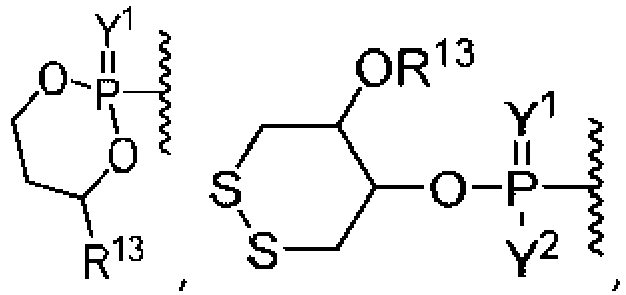 Y1 O oder S ist;Y2 OH, OR12, OAlkyl oder BH3 -M+ ist;R2 Wasserstoff, Alkyl, Alkenyl, Alkynyl, Ethynyl, Fluormethyl, Difluormethyl, Trifluormethyl, Chlormethyl, Hydroxymethyl, Halogen, Nitro, Cyano, Hydroxy, Amino, Mercapto, Formyl, Carboxy, Carbamoyl, Alkoxy, Alkylthio, Alkylamino, (Alkyl)2amino, Alkylsulfinyl, Alkylsulfonyl, Arylsulfonyl, Carbocyclyl, Aryl, Azido oder Heterocyclyl ist, wobei R2 optional mit einem oder mehreren, dem gleichen oder unterschiedlichen R20 substituiert ist;R3 Wasserstoff, Hydroxy, Alkyl, Halogen, Nitro, Cyano, Hydroxy, Amino, Mercapto, Formyl, Carboxy, Carbamoyl, Alkoxy, Alkylthio, Alkylamino, (Alkyl)2amino, Alkylsulfinyl, Alkylsulfonyl, Arylsulfonyl, Carbocyclyl, Aryl oder Heterocyclyl ist, wobei R3 optional mit einem oder mehreren, dem gleichen oder unterschiedlichen R20 substituiert ist;R4 Wasserstoff, Hydroxy, Alkyl, Fluormethyl, Difluormethyl, Trifluormethyl, Hydroxymethyl, Halogen, Nitro, Cyano, Hydroxy, Amino, Mercapto, Formyl, Carboxy, Carbamoyl, Alkoxy, Alkylthio, Alkylamino, (Alkyl)2amino, Alkylsulfinyl, Alkylsulfonyl, Arylsulfonyl, Carbocyclyl, Aryl oder Heterocyclyl ist, wobei R4 optional mit einem oder mehreren, dem gleichen oder unterschiedlichen R20 substituiert ist;R5 Wasserstoff, Hydroxy, Alkoxy, Alkyl, Alkenyl, Alkynyl, Ethynyl, Fluormethyl, Difluormethyl, Trifluormethyl, Hydroxymethyl, Allenyl, Halogen, Nitro, Cyano, Amino, Mercapto, Formyl, Carboxy, Carbamoyl, Alkoxy, Alkylthio, Alkylamino, (Alkyl)2amino, Alkylsulfinyl, Alkylsulfonyl, Arylsulfonyl, Carbocyclyl, Aryl oder Heterocyclyl ist, wobei R5 optional mit einem oder mehreren, dem gleichen oder unterschiedlichen R20 substituiert ist;R6 Wasserstoff, Hydroxy, Alkoxy, Alkyl, Ethynyl, Allenyl, Halogen, Nitro, Cyano, Amino, Mercapto, Formyl, Carboxy, Carbamoyl, Alkoxy, Alkylthio, Alkylamino, (Alkyl)2amino, Alkylsulfinyl, Alkylsulfonyl, Arylsulfonyl, Carbocyclyl, Aryl oder Heterocyclyl ist, wobei R6 optional mit einem oder mehreren, dem gleichen oder unterschiedlichen R20 substituiert ist;R8 Wasserstoff, Deuterium, Alkyl, Alkenyl, Alkynyl, Halogen, Nitro, Cyano, Hydroxy, Benzyloxy, Amino, Amido, Mercapto, Formyl, Carboxy, Carbamoyl, Azido, Alkoxy, Alkylthio, Alkylamino, (Alkyl)2amino, Alkylsulfinyl, Alkylsulfonyl, Arylsulfonyl, Carbocyclyl, Aryl oder Heterocyclyl ist, wobei R8 optional mit einem oder mehreren, dem gleichen oder unterschiedlichen R20 substituiert ist;R9 Wasserstoff, Methyl, Ethyl, tert-Butyl, Alkyl, (C6-C16)-Alkyl, (C6-C22)-Alkyl, Halogen, Nitro, Cyano, Hydroxy, Amino, Mercapto, Formyl, Carboxy, Carbamoyl, Cycloalkyl, Alkoxy, Alkylthio, Alkylamino, (Alkyl)2amino, Alkylsulfinyl, Alkylsulfonyl, Arylsulfonyl, Carbocyclyl, Aryl oder Heterocyclyl ist, wobei R9 optional mit einem oder mehreren, dem gleichen oder unterschiedlichen R20 substituiert ist;R10 Wasserstoff, Alkyl, verzweigtes Alkyl, Cycloalkyl, Lipid, Methyl, Ethyl, Isopropyl, Cyclopentyl, Cyclohexyl, Butyl, Pentyl, Hexyl, Neopentyl, Benzyl, Halogen, Nitro, Cyano, Hydroxy, Amino, Mercapto, Formyl, Carboxy, Carbamoyl, Alkoxy, Alkylthio, Alkylamino, (Alkyl)2amino, Alkylsulfinyl, Alkylsulfonyl, Arylsulfonyl, Carbocyclyl, Aryl oder Heterocyclyl ist, wobei R10 optional mit einem oder mehreren, dem gleichen oder unterschiedlichen R20 substituiert ist;R11 Wasserstoff, Deuterium, Alkyl, Methyl, Halogen, Nitro, Cyano, Hydroxy, Amino, Mercapto, Formyl, Carboxy, Carbamoyl, Alkoxy, Alkylthio, Alkylamino, (Alkyl)2amino, Alkylsulfinyl, Alkylsulfonyl, Arylsulfonyl, Carbocyclyl, Aryl oder Heterocyclyl ist, wobei R11 optional mit einem oder mehreren, dem gleichen oder unterschiedlichen R20 substituiert ist;R12 Wasserstoff, Alkyl, Aryl, Phenyl, 1-Naphthyl, 2-Naphthyl, aromatisches, heteroaromatisches, 4-substituiertes Phenyl, 4-Fluorphenyl, 4-Chlorphenyl, 4-Bromphenyl, Naphthyl oder Heterocyclyl ist, wobei R12 optional mit einem oder mehreren, dem gleichen oder unterschiedlichen R20 substituiert ist;R13 Wasserstoff, Deuterium, Alkyl, Alkenyl, Alkynyl, Halogen, Nitro, Cyano, Hydroxy, Amino, Amido, Mercapto, Formyl, Carboxy, Carbamoyl, Lipid, Azido, Alkoxy, Alkylthio, Alkylamino, (Alkyl)2amino, Alkylsulfinyl, Alkylsulfonyl, Arylsulfonyl, Carbocyclyl, Aryl oder Heterocyclyl ist, wobei R13 optional mit einem oder mehreren, dem gleichen oder unterschiedlichen R20 substituiert ist;R14 Wasserstoff, Deuterium, Alkyl, Alkenyl, Alkynyl, Halogen, Nitro, Cyano, Hydroxy, Amino, Amido, Mercapto, Formyl, Carboxy, Carbamoyl, Lipid, Azido, Alkoxy, Alkylthio, Alkylamino, (Alkyl)2amino, Alkylsulfinyl, Alkylsulfonyl, Arylsulfonyl, Carbocyclyl, Aryl oder Heterocyclyl ist, wobei R14 optional mit einem oder mehreren, dem gleichen oder unterschiedlichen R20 substituiert ist;R20 Deuterium, Alkyl, Alkenyl, Alkynyl, Halogen, Nitro, Cyano, Hydroxy, Amino, Amido, Mercapto, Formyl, Carboxy, Carbamoyl, Azido, Alkoxy, Alkylthio, Alkylamino, (Alkyl)2amino, Alkylsulfinyl, Alkylsulfonyl, Arylsulfonyl, Carbocyclyl, Aryl oder Heterocyclyl ist, wobei R20 optional mit einem oder mehreren, dem gleichen oder unterschiedlichen R21 substituiert ist;R21 Halogen, Nitro, Cyano, Hydroxy, Trifluormethoxy, Trifluormethyl, Amino, Formyl, Carboxy, Carbamoyl, Mercapto, Sulfamoyl, Methyl, Ethyl, Methoxy, Ethoxy, Acetyl, Acetoxy, Methylamino, Ethylamino, Dimethylamino, Diethylamino, N-Methyl-N-ethylamino, Acetylamino, N-Methylcarbamoyl, N-Ethylcarbamoyl, N,N-Dimethylcarbamoyl, N,N-Diethylcarbamoyl, N-Methyl-N-ethylcarbamoyl, Methylthio, Ethylthio, Methylsulfinyl, Ethylsulfinyl, Mesyl, Ethylsulfonyl, Methoxycarbonyl, Ethoxycarbonyl, N-Methylsulfamoyl, N-Ethylsulfamoyl, N,N-Dimethylsulfamoyl, N,N-Diethylsulfamoyl, N-Methyl-N-ethylsulfamoyl, Carbocyclyl, Aryl oder Heterocyclyl ist.
 - Pharmazeutische Zusammensetzung nach Anspruch 1, wobei R1
 R8 Wasserstoff, Hydroxy oder Benzyloxy ist undR9 (C6-C22)-Alkyl ist.
 - Pharmazeutische Zusammensetzung nach Anspruch 1, wobei die Verbindung Isopropyl(((3,4-dihydroxy-5-(4-(hydroxyamino)-2-oxopyrimidin-1(2H)yl)tetrahydrofuran-2-yl) methoxy)(phenoxy)phosphoryl)-Alaninat ist.
- Pharmazeutische Zusammensetzung nach Anspruch 1, wobei die Verbindung der Formel I Formel IE aufweist,
 Q-R7 OH ist;W O ist;X CH2, CHMe, CMe2, CHF, CF2 oder CD2 ist;Y N oder CR" ist;Z N oder CR" ist;jedes R" unabhängig aus H, D, F, Cl, Br, I, CH3, CD3, CF3, Alkyl, Acyl, Alkenyl, Alkynyl, Hydroxyl, Formyl oder SCH3 ausgewählt ist;R2 Wasserstoff, Alkyl, Alkenyl, Alkynyl, Ethynyl, Fluormethyl, Difluormethyl, Trifluormethyl, Chlormethyl, Hydroxymethyl, Halogen, Nitro, Cyano, Hydroxy, Amino, Mercapto, Formyl, Carboxy, Carbamoyl, Alkoxy, Alkylthio, Alkylamino, (Alkyl)2amino, Alkylsulfinyl, Alkylsulfonyl, Arylsulfonyl, Carbocyclyl, Aryl, Azido oder Heterocyclyl ist, wobei R2 optional mit einem oder mehreren, dem gleichen oder unterschiedlichen R20 substituiert ist;R3 Wasserstoff, Hydroxy, Alkyl, Halogen, Nitro, Cyano, Hydroxy, Amino, Mercapto, Formyl, Carboxy, Carbamoyl, Alkoxy, Alkylthio, Alkylamino, (Alkyl)2amino, Alkylsulfinyl, Alkylsulfonyl, Arylsulfonyl, Carbocyclyl, Aryl oder Heterocyclyl ist, wobei R3 optional mit einem oder mehreren, dem gleichen oder unterschiedlichen R20 substituiert ist;R4 Wasserstoff, Hydroxy, Alkyl, Fluormethyl, Difluormethyl, Trifluormethyl, Hydroxymethyl, Halogen, Nitro, Cyano, Hydroxy, Amino, Mercapto, Formyl, Carboxy, Carbamoyl, Alkoxy, Alkylthio, Alkylamino, (Alkyl)2amino, Alkylsulfinyl, Alkylsulfonyl, Arylsulfonyl, Carbocyclyl, Aryl oder Heterocyclyl ist, wobei R4 optional mit einem oder mehreren, dem gleichen oder unterschiedlichen R20 substituiert ist;R5 Wasserstoff, Hydroxy, Alkoxy, Alkyl, Alkenyl, Alkynyl, Ethynyl, Fluormethyl, Difluormethyl, Trifluormethyl, Hydroxymethyl, Allenyl, Halogen, Nitro, Cyano, Amino, Mercapto, Formyl, Carboxy, Carbamoyl, Alkoxy, Alkylthio, Alkylamino, (Alkyl)2amino, Alkylsulfinyl, Alkylsulfonyl, Arylsulfonyl, Carbocyclyl, Aryl oder Heterocyclyl ist, wobei R5 optional mit einem oder mehreren, dem gleichen oder unterschiedlichen R20 substituiert ist;R6 Wasserstoff, Hydroxy, Alkoxy, Alkyl, Ethynyl, Allenyl, Halogen, Nitro, Cyano, Amino, Mercapto, Formyl, Carboxy, Carbamoyl, Alkoxy, Alkylthio, Alkylamino, (Alkyl)2amino, Alkylsulfinyl, Alkylsulfonyl, Arylsulfonyl, Carbocyclyl, Aryl oder Heterocyclyl ist, wobei R6 optional mit einem oder mehreren, dem gleichen oder unterschiedlichen R20 substituiert ist;R15 Wasserstoff, -(C=O)-Oalkyl, -(C=O)-Alkyl, -(C=O)-NHalkyl, -(C=O)-N-dialkyl, -(C=O)-Salkyl, Hydroxy, Alkoxy, Alkyl, (C6-C16)-Alkyl, (C6-C22)-Alkyl, Halogen, Nitro, Cyano, Amino, Mercapto, Formyl, Carboxy, Carbamoyl, Alkoxy, Alkylthio, Alkylamino, (Alkyl)2amino, Alkylsulfinyl, Alkylsulfonyl, Arylsulfonyl, Carbocyclyl, Aryl oder Heterocyclyl ist, wobei R15 optional mit einem oder mehreren, dem gleichen oder unterschiedlichen R20 substituiert ist;R15' Wasserstoff, -(C=O)-Oalkyl, -(C=O)-Alkyl, -(C=O)-NHalkyl, -(C=O)-N-dialkyl, -(C=O)-Salkyl, Hydroxy, Alkoxy, Alkyl, (C6-C16)-Alkyl, (C6-C22)-Alkyl, Halogen, Nitro, Cyano, Amino, Mercapto, Formyl, Carboxy, Carbamoyl, Alkoxy, Alkylthio, Alkylamino, (Alkyl)2amino, Alkylsulfinyl, Alkylsulfonyl, Arylsulfonyl, Carbocyclyl, Aryl oder Heterocyclyl ist, wobei jedes R15' optional mit einem oder mehreren, dem gleichen oder unterschiedlichen R20 substituiert ist;R15 und R15' einen Ring bilden können, der optional mit einem oder mehreren, den gleichen oder unterschiedlichen R20 substituiert ist;R20 Deuterium, Alkyl, Alkenyl, Alkynyl, Halogen, Nitro, Cyano, Hydroxy, Amino, Amido, Mercapto, Formyl, Carboxy, Carbamoyl, Azido, Alkoxy, Alkylthio, Alkylamino, (Alkyl)2amino, Alkylsulfinyl, Alkylsulfonyl, Arylsulfonyl, Carbocyclyl, Aryl oder Heterocyclyl ist, wobei R20 optional mit einem oder mehreren, dem gleichen oder unterschiedlichen R21 substituiert ist;R21 Halogen, Nitro, Cyano, Hydroxy, Trifluormethoxy, Trifluormethyl, Amino, Formyl, Carboxy, Carbamoyl, Mercapto, Sulfamoyl, Methyl, Ethyl, Methoxy, Ethoxy, Acetyl, Acetoxy, Methylamino, Ethylamino, Dimethylamino, Diethylamino, N-Methyl-N-ethylamino, Acetylamino, N-Methylcarbamoyl, N-Ethylcarbamoyl, N,N-Dimethylcarbamoyl, N,N-Diethylcarbamoyl, N-Methyl-N-ethylcarbamoyl, Methylthio, Ethylthio, Methylsulfinyl, Ethylsulfinyl, Mesyl, Ethylsulfonyl, Methoxycarbonyl, Ethoxycarbonyl, N-Methylsulfamoyl, N-Ethylsulfamoyl, N,N-Dimethylsulfamoyl, N,N-Diethylsulfamoyl, N-Methyl-N-ethylsulfamoyl, Carbocyclyl, Aryl oder Heterocyclyl ist.
 - Pharmazeutische Zusammensetzung, umfassend einen pharmazeutisch akzeptablen Exzipienten und eine Verbindung der Formel II,
 Q-R7 OH ist;W O ist;X CH2 oder O ist;Y N oder CR" ist;Z N oder CR" ist;jedes R" unabhängig aus H, D, F, Cl, Br, I, CH3, CD3, CF3, Alkyl, Acyl, Alkenyl, Alkynyl, Hydroxyl, Formyl oder SCH3 ausgewählt ist;R1 Monophosphat, Diphosphat, Triphosphat,
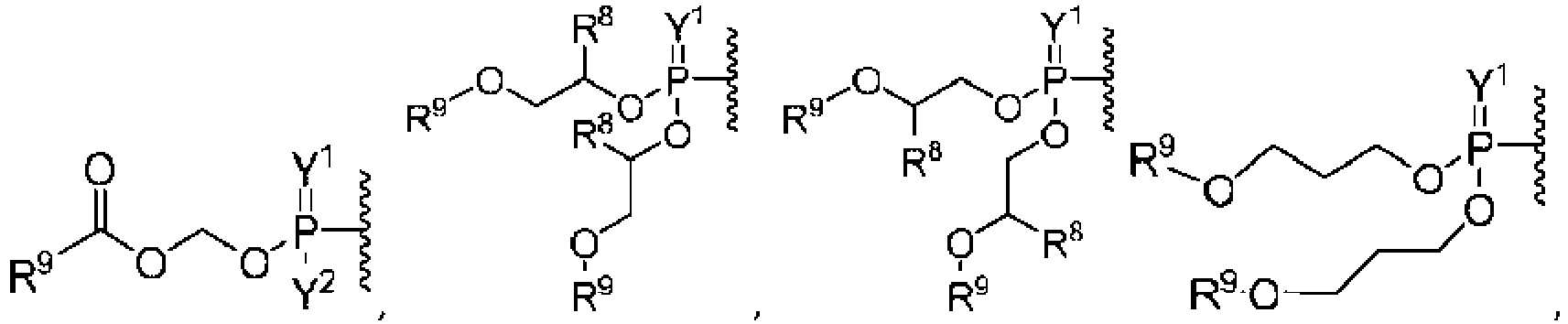


 Y1 O oder S ist;Y2 OH, OR12, OAlkyl oder BH3 -M+ ist;Y3 OH ist oder BH3 -M+ ist;R2 Wasserstoff, Alkyl, Alkenyl, Alkynyl, Ethynyl, Fluormethyl, Difluormethyl, Trifluormethyl, Chlormethyl, Hydroxymethyl, Halogen, Nitro, Cyano, Hydroxy, Amino, Mercapto, Formyl, Carboxy, Carbamoyl, Alkoxy, Alkylthio, Alkylamino, (Alkyl)2amino, Alkylsulfinyl, Alkylsulfonyl, Arylsulfonyl, Carbocyclyl, Aryl, Azido oder Heterocyclyl ist, wobei R2 optional mit einem oder mehreren, dem gleichen oder unterschiedlichen R20 substituiert ist;R3 Wasserstoff, Hydroxy, Alkyl, Halogen, Nitro, Cyano, Hydroxy, Amino, Mercapto, Formyl, Carboxy, Carbamoyl, Alkoxy, Alkylthio, Alkylamino, (Alkyl)2amino, Alkylsulfinyl, Alkylsulfonyl, Arylsulfonyl, Carbocyclyl, Aryl oder Heterocyclyl ist, wobei R3 optional mit einem oder mehreren, dem gleichen oder unterschiedlichen R20 substituiert ist;R4 Wasserstoff, Hydroxy, Alkyl, Fluormethyl, Difluormethyl, Trifluormethyl, Hydroxymethyl, Halogen, Nitro, Cyano, Hydroxy, Amino, Mercapto, Formyl, Carboxy, Carbamoyl, Alkoxy, Alkylthio, Alkylamino, (Alkyl)2amino, Alkylsulfinyl, Alkylsulfonyl, Arylsulfonyl, Carbocyclyl, Aryl oder Heterocyclyl ist, wobei R4 optional mit einem oder mehreren, dem gleichen oder unterschiedlichen R20 substituiert ist;R5 Wasserstoff, Hydroxy, Alkoxy, Alkyl, Alkenyl, Alkynyl, Ethynyl, Fluormethyl, Difluormethyl, Trifluormethyl, Hydroxymethyl, Allenyl, Halogen, Nitro, Cyano, Amino, Mercapto, Formyl, Carboxy, Carbamoyl, Alkoxy, Alkylthio, Alkylamino, (Alkyl)2amino, Alkylsulfinyl, Alkylsulfonyl, Arylsulfonyl, Carbocyclyl, Aryl oder Heterocyclyl ist, wobei R5 optional mit einem oder mehreren, dem gleichen oder unterschiedlichen R20 substituiert ist;R6 Wasserstoff, Hydroxy, Alkoxy, Alkyl, Ethynyl, Allenyl, Halogen, Nitro, Cyano, Amino, Mercapto, Formyl, Carboxy, Carbamoyl, Alkoxy, Alkylthio, Alkylamino, (Alkyl)2amino, Alkylsulfinyl, Alkylsulfonyl, Arylsulfonyl, Carbocyclyl, Aryl oder Heterocyclyl ist, wobei R6 optional mit einem oder mehreren, dem gleichen oder unterschiedlichen R20 substituiert ist;R8 Wasserstoff, Deuterium, Alkyl, Alkenyl, Alkynyl, Halogen, Nitro, Cyano, Hydroxy, Benzyloxy, Amino, Amido, Mercapto, Formyl, Carboxy, Carbamoyl, Azido, Alkoxy, Alkylthio, Alkylamino, (Alkyl)2amino, Alkylsulfinyl, Alkylsulfonyl, Arylsulfonyl, Carbocyclyl, Aryl oder Heterocyclyl ist, wobei R8 optional mit einem oder mehreren, dem gleichen oder unterschiedlichen R20 substituiert ist;R9 Wasserstoff, Methyl, Ethyl, tert-Butyl, Alkyl, (C6-C16)-Alkyl, (C6-C22)-Alkyl, Halogen, Nitro, Cyano, Hydroxy, Amino, Mercapto, Formyl, Carboxy, Carbamoyl, Cycloalkyl, Alkoxy, Alkylthio, Alkylamino, (Alkyl)2amino, Alkylsulfinyl, Alkylsulfonyl, Arylsulfonyl, Carbocyclyl, Aryl oder Heterocyclyl ist, wobei R9 optional mit einem oder mehreren, dem gleichen oder unterschiedlichen R20 substituiert ist;R10 Wasserstoff, Alkyl, verzweigtes Alkyl, Cycloalkyl, Lipid, Methyl, Ethyl, Isopropyl, Cyclopentyl, Cyclohexyl, Butyl, Pentyl, Hexyl, Neopentyl, Benzyl, Halogen, Nitro, Cyano, Hydroxy, Amino, Mercapto, Formyl, Carboxy, Carbamoyl, Alkoxy, Alkylthio, Alkylamino, (Alkyl)2amino, Alkylsulfinyl, Alkylsulfonyl, Arylsulfonyl, Carbocyclyl, Aryl oder Heterocyclyl ist, wobei R10 optional mit einem oder mehreren, dem gleichen oder unterschiedlichen R20 substituiert ist;R11 Wasserstoff, Deuterium, Alkyl, Methyl, Halogen, Nitro, Cyano, Hydroxy, Amino, Mercapto, Formyl, Carboxy, Carbamoyl, Alkoxy, Alkylthio, Alkylamino, (Alkyl)2amino, Alkylsulfinyl, Alkylsulfonyl, Arylsulfonyl, Carbocyclyl, Aryl oder Heterocyclyl ist, wobei R11 optional mit einem oder mehreren, dem gleichen oder unterschiedlichen R20 substituiert ist;R12 Wasserstoff, Alkyl, Aryl, Phenyl, 1-Naphthyl, 2-Naphthyl, aromatisches, heteroaromatisches, 4-substituiertes Phenyl, 4-Fluorphenyl, 4-Chlorphenyl, 4-Bromphenyl, Naphthyl oder Heterocyclyl ist, wobei R12 optional mit einem oder mehreren, dem gleichen oder unterschiedlichen R20 substituiert ist;R13 Wasserstoff, Deuterium, Alkyl, Alkenyl, Alkynyl, Halogen, Nitro, Cyano, Hydroxy, Amino, Amido, Mercapto, Formyl, Carboxy, Carbamoyl, Lipid, Azido, Alkoxy, Alkylthio, Alkylamino, (Alkyl)2amino, Alkylsulfinyl, Alkylsulfonyl, Arylsulfonyl, Carbocyclyl, Aryl oder Heterocyclyl ist, wobei R13 optional mit einem oder mehreren, dem gleichen oder unterschiedlichen R20 substituiert ist;R14 Wasserstoff, Deuterium, Alkyl, Alkenyl, Alkynyl, Halogen, Nitro, Cyano, Hydroxy, Amino, Amido, Mercapto, Formyl, Carboxy, Carbamoyl, Lipid, Azido, Alkoxy, Alkylthio, Alkylamino, (Alkyl)2amino, Alkylsulfinyl, Alkylsulfonyl, Arylsulfonyl, Carbocyclyl, Aryl oder Heterocyclyl ist, wobei R14 optional mit einem oder mehreren, dem gleichen oder unterschiedlichen R20 substituiert ist;R20 Deuterium, Alkyl, Alkenyl, Alkynyl, Halogen, Nitro, Cyano, Hydroxy, Amino, Amido, Mercapto, Formyl, Carboxy, Carbamoyl, Azido, Alkoxy, Alkylthio, Alkylamino, (Alkyl)2amino, Alkylsulfinyl, Alkylsulfonyl, Arylsulfonyl, Carbocyclyl, Aryl oder Heterocyclyl ist, wobei R20 optional mit einem oder mehreren, dem gleichen oder unterschiedlichen R21 substituiert ist;R21 Halogen, Nitro, Cyano, Hydroxy, Trifluormethoxy, Trifluormethyl, Amino, Formyl, Carboxy, Carbamoyl, Mercapto, Sulfamoyl, Methyl, Ethyl, Methoxy, Ethoxy, Acetyl, Acetoxy, Methylamino, Ethylamino, Dimethylamino, Diethylamino, N-Methyl-N-ethylamino, Acetylamino, N-Methylcarbamoyl, N-Ethylcarbamoyl, N,N-Dimethylcarbamoyl, N,N-Diethylcarbamoyl, N-Methyl-N-ethylcarbamoyl, Methylthio, Ethylthio, Methylsulfinyl, Ethylsulfinyl, Mesyl, Ethylsulfonyl, Methoxycarbonyl, Ethoxycarbonyl, N-Methylsulfamoyl, N-Ethylsulfamoyl, N,N-Dimethylsulfamoyl, N,N-Diethylsulfamoyl, N-Methyl-N-ethylsulfamoyl, Carbocyclyl, Aryl oder Heterocyclyl ist;Lipid ein C6-C22-Alkyl, Alkoxy, Polyethylenglycol oder Aryl mit einer Alkylgruppe substituiert ist.
 - Pharmazeutische Zusammensetzung nach Anspruch 1 oder 5, die ferner ein Treibmittel umfasst.
- Pharmazeutische Zusammensetzung nach Anspruch 6, wobei das Treibmittel Druckluft, Ethanol, Stickstoff, Kohlenstoffdioxid, Distickstoffoxid, Hydrofluoralkane (HFA), 1,1,1,2,-Tetrafluorethan, 1,1,1,2,3,3,3-Heptafluorpropan oder Kombinationen davon ist.
- Druckbehälter, der eine pharmazeutische Verbindung nach Anspruch 1 oder 5 umfasst.
- Behälter nach Anspruch 8, der ein manuelles Pumpspray, Inhalator, zählerdosierter Inhalator, Trockenpulverinhalator, Vernebler, Vibrations-Mesh-Vernebler, Düsenvernebler oder Ultraschallwellen-Vernebler ist.
- Pharmazeutische Zusammensetzung gemäß Anspruch 1 oder 5 zur Verwendung bei der Behandlung oder Prävention einer viralen Infektion, wobei zum Beispiel die virale Infektion ein Alphavirus oder MERS-Coronaviren ist, oder wobei das Virus aus MERS-Coronavirus, östliches Pferdeenzephalitis-Virus, westliches Pferdeenzephalitis-Virus, venezolanisches Pferdeenzephalitis-Virus, Chikungunya-Virus und Ross-River-Virus ausgewählt ist.
- Pharmazeutische Zusammensetzung zur Verwendung gemäß Anspruch 10, wobei die Zusammensetzung über die Lunge verabreicht wird.
- Verbindung mit der Struktur:

- Zusammensetzung nach Anspruch 1, wobei die Verbindung eine Struktur gemäß Formel IA aufweist
 R7 H ist,X CH2, CHMe, CMe2, CHF, CF2 oder CD2 ist;Y unabhängig aus H, D, F, Cl, Br, I, CH3, CD3, CF3, Alkyl, Acyl, Alkenyl, Alkynyl, Hydroxyl, Formyl oder SCH3 ausgewählt ist;R1


 Amino, Mercapto, Formyl, Esteryl, Alkoxy, Alkylthio, Alkylamino, (Alkyl)2amino, Alkylsulfinyl, Alkylsulfonyl, Arylsulfonyl, Carbocyclyl, Aryl oder Heterocyclyl, Phosphoramidyl ist, wobei R1 optional mit einem oder mehreren, dem gleichen oder unterschiedlichen R20 substituiert ist;Y1 O oder S ist;Y2 OH, OR12, OAlkyl oder BH3 -M+ ist;Y3 OH ist oder BH3 -M+ ist;R4 Wasserstoff, Hydroxy, Alkyl, Fluormethyl, Difluormethyl, Trifluormethyl, Hydroxymethyl, Halogen, Nitro, Cyano, Hydroxy, Amino, Mercapto, Formyl, Carboxy, Carbamoyl, Alkoxy, Alkylthio, Alkylamino, (Alkyl)2amino, Alkylsulfinyl, Alkylsulfonyl, Arylsulfonyl, Carbocyclyl, Aryl oder Heterocyclyl ist, wobei R4 optional mit einem oder mehreren, dem gleichen oder unterschiedlichen R20 substituiert ist;R5 Wasserstoff, Hydroxy, Alkoxy, Alkyl, Alkenyl, Alkynyl, Ethynyl, Fluormethyl, Difluormethyl, Trifluormethyl, Hydroxymethyl, Allenyl, Halogen, Nitro, Cyano, Amino, Mercapto, Formyl, Carboxy, Carbamoyl, Alkoxy, Alkylthio, Alkylamino, (Alkyl)2amino, Alkylsulfinyl, Alkylsulfonyl, Arylsulfonyl, Carbocyclyl, Aryl oder Heterocyclyl ist, wobei R5 optional mit einem oder mehreren, dem gleichen oder unterschiedlichen R20 substituiert ist;R8 Wasserstoff, Deuterium, Alkyl, Alkenyl, Alkynyl, Halogen, Nitro, Cyano, Hydroxy, Benzyloxy, Amino, Amido, Mercapto, Formyl, Carboxy, Carbamoyl, Azido, Alkoxy, Alkylthio, Alkylamino, (Alkyl)2amino, Alkylsulfinyl, Alkylsulfonyl, Arylsulfonyl, Carbocyclyl, Aryl oder Heterocyclyl ist, wobei R8 optional mit einem oder mehreren, dem gleichen oder unterschiedlichen R20 substituiert ist;R9 Wasserstoff, Methyl, Ethyl, tert-Butyl, Alkyl, (C6-C16)-Alkyl, (C6-C22)-Alkyl, Halogen, Nitro, Cyano, Hydroxy, Amino, Mercapto, Formyl, Carboxy, Carbamoyl, Cycloalkyl, Alkoxy, Alkylthio, Alkylamino, (Alkyl)2amino, Alkylsulfinyl, Alkylsulfonyl, Arylsulfonyl, Carbocyclyl, Aryl oder Heterocyclyl ist, wobei R9 optional mit einem oder mehreren, dem gleichen oder unterschiedlichen R20 substituiert ist;R10 Wasserstoff, Alkyl, verzweigtes Alkyl, Cycloalkyl, Lipid, Methyl, Ethyl, Isopropyl, Cyclopentyl, Cyclohexyl, Butyl, Pentyl, Hexyl, Neopentyl, Benzyl, Halogen, Nitro, Cyano, Hydroxy, Amino, Mercapto, Formyl, Carboxy, Carbamoyl, Alkoxy, Alkylthio, Alkylamino, (Alkyl)2amino, Alkylsulfinyl, Alkylsulfonyl, Arylsulfonyl, Carbocyclyl, Aryl oder Heterocyclyl ist, wobei R10 optional mit einem oder mehreren, dem gleichen oder unterschiedlichen R20 substituiert ist;R11 Wasserstoff, Deuterium, Alkyl, Methyl, Halogen, Nitro, Cyano, Hydroxy, Amino, Mercapto, Formyl, Carboxy, Carbamoyl, Alkoxy, Alkylthio, Alkylamino, (Alkyl)2amino, Alkylsulfinyl, Alkylsulfonyl, Arylsulfonyl, Carbocyclyl, Aryl oder Heterocyclyl ist, wobei R11 optional mit einem oder mehreren, dem gleichen oder unterschiedlichen R20 substituiert ist;R12 Wasserstoff, Alkyl, Aryl, Phenyl, 1-Naphthyl, 2-Naphthyl, aromatisches, heteroaromatisches, 4-substituiertes Phenyl, 4-Fluorphenyl, 4-Chlorphenyl, 4-Bromphenyl, Naphthyl oder Heterocyclyl ist, wobei R12 optional mit einem oder mehreren, dem gleichen oder unterschiedlichen R20 substituiert ist;R13 Wasserstoff, Deuterium, Alkyl, Alkenyl, Alkynyl, Halogen, Nitro, Cyano, Hydroxy, Amino, Amido, Mercapto, Formyl, Carboxy, Carbamoyl, Lipid, Azido, Alkoxy, Alkylthio, Alkylamino, (Alkyl)2amino, Alkylsulfinyl, Alkylsulfonyl, Arylsulfonyl, Carbocyclyl, Aryl oder Heterocyclyl ist, wobei R13 optional mit einem oder mehreren, dem gleichen oder unterschiedlichen R20 substituiert ist;R14 Wasserstoff, Deuterium, Alkyl, Alkenyl, Alkynyl, Halogen, Nitro, Cyano, Hydroxy, Amino, Amido, Mercapto, Formyl, Carboxy, Carbamoyl, Lipid, Azido, Alkoxy, Alkylthio, Alkylamino, (Alkyl)2amino, Alkylsulfinyl, Alkylsulfonyl, Arylsulfonyl, Carbocyclyl, Aryl oder Heterocyclyl ist, wobei R14 optional mit einem oder mehreren, dem gleichen oder unterschiedlichen R20 substituiert ist;R20 Deuterium, Alkyl, Alkenyl, Alkynyl, Halogen, Nitro, Cyano, Hydroxy, Amino, Amido, Mercapto, Formyl, Carboxy, Carbamoyl, Azido, Alkoxy, Alkylthio, Alkylamino, (Alkyl)2amino, Alkylsulfinyl, Alkylsulfonyl, Arylsulfonyl, Carbocyclyl, Aryl oder Heterocyclyl ist, wobei R20 optional mit einem oder mehreren, dem gleichen oder unterschiedlichen R21 substituiert ist;R21 Halogen, Nitro, Cyano, Hydroxy, Trifluormethoxy, Trifluormethyl, Amino, Formyl, Carboxy, Carbamoyl, Mercapto, Sulfamoyl, Methyl, Ethyl, Methoxy, Ethoxy, Acetyl, Acetoxy, Methylamino, Ethylamino, Dimethylamino, Diethylamino, N-Methyl-N-ethylamino, Acetylamino, N-Methylcarbamoyl, N-Ethylcarbamoyl, N,N-Dimethylcarbamoyl, N,N-Diethylcarbamoyl, N-Methyl-N-ethylcarbamoyl, Methylthio, Ethylthio, Methylsulfinyl, Ethylsulfinyl, Mesyl, Ethylsulfonyl, Methoxycarbonyl, Ethoxycarbonyl, N-Methylsulfamoyl, N-Ethylsulfamoyl, N,N-Dimethylsulfamoyl, N,N-Diethylsulfamoyl, N-Methyl-N-ethylsulfamoyl, Carbocyclyl, Aryl oder Heterocyclyl ist.
 - Zusammensetzung nach Anspruch 1, wobei R4 Wasserstoff, Hydroxy, Alkyl, Halogen oder Fluor ist.
- Zusammensetzung nach Anspruch 1, wobei R5 Wasserstoff, Hydroxy, Alkoxy, Alkyl, Methyl, Ethynyl oder Allenyl ist.
Priority Applications (6)
| Application Number | Priority Date | Filing Date | Title |
|---|---|---|---|
| SM20210592T SMT202100592T1 (it) | 2014-12-26 | 2015-12-16 | Derivati antivirali della n4-idrossicitidina |
| EP21178364.2A EP3939985B1 (de) | 2014-12-26 | 2015-12-16 | Pharmazeutische zusammensetzungen umfassend n4-hydroxycytidin derivate zur behandlung oder vorbeugung von influenza- oder coronavirusinfektionen |
| RS20211195A RS62434B1 (sr) | 2014-12-26 | 2015-12-16 | Antivirusni n4-hidroksicitidin derivati |
| SI201531707T SI3236972T1 (sl) | 2014-12-26 | 2015-12-16 | Protivirusni derivati N4-hidroksicitidina |
| HRP20211456TT HRP20211456T1 (hr) | 2014-12-26 | 2015-12-16 | Protuvirusni derivati n4-hidroksicitidina |
| PL15874145T PL3236972T3 (pl) | 2014-12-26 | 2015-12-16 | Przeciwwirusowe pochodne n4-hydroksycytydyny |
Applications Claiming Priority (3)
| Application Number | Priority Date | Filing Date | Title |
|---|---|---|---|
| US201462096915P | 2014-12-26 | 2014-12-26 | |
| US201562201140P | 2015-08-05 | 2015-08-05 | |
| PCT/US2015/066144 WO2016106050A1 (en) | 2014-12-26 | 2015-12-16 | N4-hydroxycytidine and derivatives and anti-viral uses related thereto |
Related Child Applications (2)
| Application Number | Title | Priority Date | Filing Date |
|---|---|---|---|
| EP21178364.2A Division-Into EP3939985B1 (de) | 2014-12-26 | 2015-12-16 | Pharmazeutische zusammensetzungen umfassend n4-hydroxycytidin derivate zur behandlung oder vorbeugung von influenza- oder coronavirusinfektionen |
| EP21178364.2A Division EP3939985B1 (de) | 2014-12-26 | 2015-12-16 | Pharmazeutische zusammensetzungen umfassend n4-hydroxycytidin derivate zur behandlung oder vorbeugung von influenza- oder coronavirusinfektionen |
Publications (3)
| Publication Number | Publication Date |
|---|---|
| EP3236972A1 EP3236972A1 (de) | 2017-11-01 |
| EP3236972A4 EP3236972A4 (de) | 2019-01-23 |
| EP3236972B1 true EP3236972B1 (de) | 2021-07-28 |
Family
ID=56151433
Family Applications (2)
| Application Number | Title | Priority Date | Filing Date |
|---|---|---|---|
| EP21178364.2A Active EP3939985B1 (de) | 2014-12-26 | 2015-12-16 | Pharmazeutische zusammensetzungen umfassend n4-hydroxycytidin derivate zur behandlung oder vorbeugung von influenza- oder coronavirusinfektionen |
| EP15874145.4A Active EP3236972B1 (de) | 2014-12-26 | 2015-12-16 | Antivirale n4-hydroxycytidin derivate |
Family Applications Before (1)
| Application Number | Title | Priority Date | Filing Date |
|---|---|---|---|
| EP21178364.2A Active EP3939985B1 (de) | 2014-12-26 | 2015-12-16 | Pharmazeutische zusammensetzungen umfassend n4-hydroxycytidin derivate zur behandlung oder vorbeugung von influenza- oder coronavirusinfektionen |
Country Status (23)
| Country | Link |
|---|---|
| US (3) | US20190022116A1 (de) |
| EP (2) | EP3939985B1 (de) |
| JP (4) | JP7381190B2 (de) |
| KR (2) | KR20230130175A (de) |
| CN (2) | CN118286245A (de) |
| AU (3) | AU2015370004B2 (de) |
| BR (1) | BR112017013858A2 (de) |
| CA (1) | CA2972259A1 (de) |
| CY (1) | CY1124663T1 (de) |
| DK (1) | DK3236972T3 (de) |
| EA (1) | EA201791460A1 (de) |
| ES (1) | ES2892123T3 (de) |
| HR (1) | HRP20211456T1 (de) |
| HU (1) | HUE056470T2 (de) |
| IL (3) | IL296496B2 (de) |
| LT (1) | LT3236972T (de) |
| PL (1) | PL3236972T3 (de) |
| PT (1) | PT3236972T (de) |
| RS (1) | RS62434B1 (de) |
| SG (2) | SG11201705069YA (de) |
| SI (1) | SI3236972T1 (de) |
| SM (1) | SMT202100592T1 (de) |
| WO (1) | WO2016106050A1 (de) |
Families Citing this family (50)
| Publication number | Priority date | Publication date | Assignee | Title |
|---|---|---|---|---|
| IL296496B2 (en) | 2014-12-26 | 2024-10-01 | Univ Emory | N4-hydroxycytidine and derivatives and anti-viral uses related thereto |
| WO2018045317A1 (en) | 2016-09-02 | 2018-03-08 | Dicerna Pharmaceuticals, Inc. | 4'-phosphate analogs and oligonucleotides comprising the same |
| CA3047373A1 (en) * | 2016-12-16 | 2018-06-21 | Gifu University | Nucleoside derivative and use thereof |
| WO2019088179A1 (ja) | 2017-10-31 | 2019-05-09 | ヤマサ醤油株式会社 | ヌクレオシド誘導体及びその利用 |
| GB201720279D0 (en) | 2017-12-05 | 2018-01-17 | Nucana Biomed Ltd | Anticancer compounds |
| KR102626210B1 (ko) | 2017-12-07 | 2024-01-18 | 에모리 유니버시티 | N4-하이드록시사이티딘 및 유도체 및 이와 관련된 항-바이러스 용도 |
| CN108586294A (zh) * | 2018-05-29 | 2018-09-28 | 王若锴 | 一种脲类衍生物及其在防治炎症中的应用 |
| KR102783030B1 (ko) * | 2019-02-01 | 2025-03-18 | 재단법인 경기도경제과학진흥원 | 중동호흡기증후군 치료 또는 예방용 약학 조성물 |
| CN112390838A (zh) * | 2019-08-14 | 2021-02-23 | 斯微(上海)生物科技有限公司 | 一种改性核苷及其合成方法 |
| PH12022550438A1 (en) * | 2020-02-07 | 2022-12-19 | Univ Emory | N4-hydroxycytidine and derivatives and anti-viral uses related thereto |
| CN111548384B (zh) * | 2020-03-29 | 2021-04-27 | 常州安蒂卫生物科技有限公司 | 用于抗病毒治疗的被取代的n4-羟基胞苷衍生物及其前药 |
| JP2023521038A (ja) * | 2020-04-03 | 2023-05-23 | セルヴァ・セラピューティクス・インコーポレイティド | ウイルス侵入阻害剤およびrnaポリメラーゼ阻害剤 |
| US12042514B2 (en) | 2020-05-01 | 2024-07-23 | Tygrus, LLC | Therapeutic material with low pH and low toxicity active against at least one pathogen for addressing patients with respiratory illnesses |
| US11826382B2 (en) | 2020-05-01 | 2023-11-28 | Tygrus, LLC | Therapeutic material with low pH and low toxicity active against at least one pathogen for addressing patients with respiratory illnesses |
| US11642372B2 (en) | 2020-05-01 | 2023-05-09 | Tygrus, LLC | Therapeutic material with low pH and low toxicity active against at least one pathogen for addressing patients with respiratory illnesses |
| AU2021312946A1 (en) * | 2020-07-24 | 2023-03-09 | The Regents Of The University Of California | Antiviral prodrugs, pharmaceutical formulations, and methods |
| US11702440B2 (en) * | 2020-12-10 | 2023-07-18 | Optimus Drugs Private Limited | Pharmaceutical polymorphs of Molnupiravir |
| CN114621229B (zh) * | 2020-12-11 | 2024-07-02 | 嘉兴金派特生物科技有限公司 | 治疗或预防猫传染性腹膜炎的化合物或组合物 |
| CN112279877B (zh) * | 2020-12-15 | 2021-08-06 | 南京颐媛生物医学研究院有限公司 | 一种核苷磷酸酯及其合成方法 |
| US20240092818A1 (en) * | 2020-12-18 | 2024-03-21 | Merck Sharp & Dohme Llc | Synthesis of antiviral nucleosides |
| CN112608357B (zh) * | 2020-12-21 | 2022-12-09 | 杭州科巢生物科技有限公司 | 一种抗病毒药物Molnupiravir的制备方法 |
| CN112939981B (zh) * | 2021-01-19 | 2022-08-26 | 嘉兴金派特生物科技有限公司 | 核苷化合物、药学上可接受的盐、组合物及其应用 |
| WO2022159787A1 (en) * | 2021-01-22 | 2022-07-28 | University Of Pittsburgh-Of The Commonwealth System Of Higher Education | Compounds for the treatment of a disease or disorder, methods for identifying said compounds |
| KR20240006536A (ko) * | 2021-04-09 | 2024-01-15 | 에모리 유니버시티 | 항바이러스제로서의 티오뉴클레오시드 |
| US11407779B1 (en) | 2021-04-23 | 2022-08-09 | Divi's Laboratories Ltd. | Process for the preparation of molnupiravir |
| US20240239832A1 (en) * | 2021-05-06 | 2024-07-18 | Council Of Scientific And Industrial Research | A process for the preparation of n4-hydroxycytidine and its derivatives |
| US20240262857A1 (en) * | 2021-05-27 | 2024-08-08 | Emory University | Novel universal anti-rna virus agents |
| WO2022262845A1 (en) * | 2021-06-18 | 2022-12-22 | Suzhou Spring-Sea Bio-Pharmaceuticals Co., Ltd. | Ester derivatives of n4-hydroxycytidine and use thereof |
| CN113321694A (zh) * | 2021-06-22 | 2021-08-31 | 药康众拓(江苏)医药科技有限公司 | N4-羟基胞苷衍生物及其制备方法和用途 |
| CN113735929A (zh) * | 2021-07-21 | 2021-12-03 | 海化生命(厦门)科技有限公司 | 一种抗冠状病毒的化合物及其制备方法与应用 |
| WO2023012329A1 (en) | 2021-08-06 | 2023-02-09 | Intervet International B.V. | Method of treating veterinary viral diseases |
| CN117886870A (zh) * | 2021-08-27 | 2024-04-16 | 南京知和医药科技有限公司 | 一种新型的胞苷衍生物及其药物组合物和用途 |
| CN113980074A (zh) * | 2021-10-21 | 2022-01-28 | 苏州立新制药有限公司 | N4-羟基胞苷的晶型a与制备方法和用途 |
| EP4426315A1 (de) | 2021-11-01 | 2024-09-11 | Immunic AG | Medizinische verwendung von n4-hydroxyciticolinverbindungen |
| AR127653A1 (es) * | 2021-11-12 | 2024-02-14 | Suzhou Spring Sea Bio Pharmaceuticals Co Ltd | Derivados de ésteres de n⁴-hidroxicitidina y su uso |
| US11541071B1 (en) | 2021-12-16 | 2023-01-03 | Ascletis BioScience Co., Ltd | Nucleoside derivatives and methods of use thereof |
| CN116496334A (zh) * | 2022-01-25 | 2023-07-28 | 上海和誉生物医药科技有限公司 | 一种抗病毒抑制剂及其在药学上的应用 |
| CN116554249B (zh) * | 2022-01-28 | 2025-03-18 | 北京恩泰伟医药科技有限公司 | 抗病毒化合物及其用途 |
| TW202348228A (zh) | 2022-02-24 | 2023-12-16 | 德商艾斯巴赫生物有限公司 | 病毒組合療法 |
| WO2023167488A1 (ko) * | 2022-03-02 | 2023-09-07 | 유재혁 | 몰누피라비르의 국소 투여용 수의학적 조성물 및 그 이용 |
| KR102917091B1 (ko) * | 2022-03-02 | 2026-01-23 | 유재혁 | 몰누피라비르의 국소 투여용 수의학적 조성물 및 그 이용 |
| CN116731087A (zh) * | 2022-03-03 | 2023-09-12 | 上海科胜药物研发有限公司 | 一种莫那比拉韦及其中间体的制备方法 |
| KR20230130898A (ko) * | 2022-03-04 | 2023-09-12 | 동아대학교 산학협력단 | N4-이소부티릴옥시시티딘 모방체 합성과 이의 항바이러스 용도를 포함하는 바이러스 감염 치료용 조성물 |
| CN114573651A (zh) * | 2022-03-11 | 2022-06-03 | 山东大学 | 一种n4-羟基胞苷脂质前药及其制备方法与应用 |
| EP4493573A1 (de) | 2022-03-15 | 2025-01-22 | Rome Therapeutics, Inc. | Verbindungen und verfahren zur behandlung von krankheiten |
| CN114805458B (zh) * | 2022-03-31 | 2023-09-08 | 中国人民解放军军事科学院军事医学研究院 | 类核苷广谱抗病毒药物的脂肪酸前药及其制备方法和用途 |
| CN116589518B (zh) * | 2022-06-10 | 2026-04-28 | 南京知和医药科技有限公司 | 一种新型的胞苷衍生物及其药物组合物和用途 |
| CN117586330A (zh) * | 2022-08-12 | 2024-02-23 | 南京知和医药科技有限公司 | 一种新型核苷衍生物及其药物组合物和用途 |
| WO2024123207A1 (ru) * | 2022-12-08 | 2024-06-13 | федеральное государственное бюджетное учреждение "Национальный исследовательский центр эпидемиологии и микробиологии имени почетного академика Н.Ф. Гамалеи" Министерства здравоохранения Российской Федерации | 5'-о-(3-фенилпропионил)-n4-гидроксицитидин и его применение |
| WO2024123206A1 (ru) * | 2022-12-08 | 2024-06-13 | федеральное государственное бюджетное учреждение "Национальный исследовательский центр эпидемиологии и микробиологии имени почетного академика Н.Ф. Гамалеи" Министерства здравоохранения Российской Федерации | Способ получения 5',-о-(3-фенилпропионил)-n4-гидроксицитидина |
Family Cites Families (284)
| Publication number | Priority date | Publication date | Assignee | Title |
|---|---|---|---|---|
| GB1325797A (en) | 1970-09-24 | 1973-08-08 | Upjohn Co | Medicines comprising cytidine derivatives |
| GB1386334A (en) | 1972-09-22 | 1975-03-05 | Kohjin Co | 2,2-cyclocytidine derivatives |
| FR2252851B1 (de) | 1973-11-29 | 1978-07-21 | Kohjin Co | |
| US4096324A (en) | 1975-07-07 | 1978-06-20 | The Upjohn Company | Cytidine nucleoside compound |
| US5968914A (en) | 1987-10-28 | 1999-10-19 | Pro-Neuron, Inc. | Treatment of chemotherapeutic agent and antiviral agent toxicity with acylated pyrimidine nucleosides |
| US5736531A (en) | 1987-10-28 | 1998-04-07 | Pro-Neuron, Inc. | Compositions of chemotherapeutic agent or antiviral agent with acylated pyrimidine nucleosides |
| US5470838A (en) | 1987-10-28 | 1995-11-28 | Pro-Neuron, Inc. | Method of delivering exogenous uridine or cytidine using acylated uridine or cytidine |
| KR920701230A (ko) | 1989-06-05 | 1992-08-11 | 원본미기재 | 엑소뉴클레아제-내성 올리고뉴클레오티드 및 그 제조방법 |
| WO1992009705A1 (en) | 1990-11-23 | 1992-06-11 | Gilead Sciences, Inc. | Triplex-forming oligomers containing modified bases |
| RU2085557C1 (ru) * | 1991-09-30 | 1997-07-27 | Санкио Компани Лимитед | Производные нуклеозидов пиримидина или их фармацевтически приемлемые соли и способ их получения |
| EP1256589A3 (de) | 1991-11-26 | 2003-09-17 | Isis Pharmaceuticals, Inc. | Oligomere, die modifizierte PyrimIdine enthalten |
| US6057305A (en) | 1992-08-05 | 2000-05-02 | Institute Of Organic Chemistry And Biochemistry Of The Academy Of Sciences Of The Czech Republic | Antiretroviral enantiomeric nucleotide analogs |
| IS2334B (is) | 1992-09-08 | 2008-02-15 | Vertex Pharmaceuticals Inc., (A Massachusetts Corporation) | Aspartyl próteasi hemjari af nýjum flokki súlfonamíða |
| EP0695306A1 (de) | 1993-04-19 | 1996-02-07 | Gilead Sciences, Inc. | Erhoehte bildung von tripel-und doppel-helix mit modifizierte purine enthaltenden oligomeren |
| US5349947A (en) * | 1993-07-15 | 1994-09-27 | Newhouse Michael T | Dry powder inhaler and process that explosively discharges a dose of powder and gas from a soft plastic pillow |
| WO1995007919A1 (en) | 1993-09-17 | 1995-03-23 | Gilead Sciences, Inc. | Method for dosing therapeutic compounds |
| EP0719273B1 (de) | 1993-09-17 | 2010-11-03 | Gilead Sciences, Inc. | Nukleotidanaloge |
| US5952375A (en) | 1995-02-27 | 1999-09-14 | Gilead Sciences, Inc. | Compounds and methods for synthesis and therapy |
| US6043358A (en) | 1995-11-01 | 2000-03-28 | Merck & Co., Inc. | Hexahydro-5-imino-1,4-heteroazepine derivatives as inhibitors of nitric oxide synthases |
| CN1238762A (zh) | 1996-10-21 | 1999-12-15 | 吉里德科学公司 | 哌啶化合物 |
| GB9718913D0 (en) | 1997-09-05 | 1997-11-12 | Glaxo Group Ltd | Substituted oxindole derivatives |
| US6086376A (en) * | 1998-01-30 | 2000-07-11 | Rtp Pharma Inc. | Dry aerosol suspension of phospholipid-stabilized drug microparticles in a hydrofluoroalkane propellant |
| FR2776289B1 (fr) | 1998-03-20 | 2001-02-02 | Oreal | Composition de teinture d'oxydation contenant un coupleur cationique, procedes de teinture, nouveaux coupleurs cationiques |
| US6369087B1 (en) | 1999-08-26 | 2002-04-09 | Robert R. Whittle | Alkoxy substituted benzimidazole compounds, pharmaceutical preparations containing the same, and methods of using the same |
| AP2006003708A0 (en) | 2000-05-26 | 2006-08-31 | Idenix Cayman Ltd | Methods and compositions for treating flavivirusesand pestiviruses |
| US20030008841A1 (en) | 2000-08-30 | 2003-01-09 | Rene Devos | Anti-HCV nucleoside derivatives |
| JP2004533406A (ja) | 2000-10-18 | 2004-11-04 | フアーマセツト・リミテツド | ウイルス感染症および異常細胞増殖を治療するための修飾ヌクレオシド |
| WO2002033128A2 (en) | 2000-10-18 | 2002-04-25 | Pharmasset Limited | Multiplex quantification of nucleic acids in diseased cells |
| CA2743451A1 (en) | 2000-10-18 | 2002-04-25 | Pharmasset, Inc. | Modified nucleosides for the treatment of viral infections and abnormal cellular proliferation |
| IL158006A0 (en) | 2001-04-30 | 2004-03-28 | Trommsdorff Arzneimittel | Pharmaceutically active uridine esters |
| GB0114286D0 (en) | 2001-06-12 | 2001-08-01 | Hoffmann La Roche | Nucleoside Derivatives |
| US7049303B2 (en) | 2001-11-07 | 2006-05-23 | Medical Research Council | Inhibition of viruses |
| US20050239054A1 (en) | 2002-04-26 | 2005-10-27 | Arimilli Murty N | Method and compositions for identifying anti-HIV therapeutic compounds |
| AU2003231765B9 (en) | 2002-04-26 | 2010-01-28 | Gilead Sciences, Inc. | Cellular accumulation of phosphonate analogs of HIV protease inhibitor compounds and the compounds as such |
| GB0215293D0 (en) | 2002-07-03 | 2002-08-14 | Rega Foundation | Viral inhibitors |
| JP4806187B2 (ja) | 2002-07-15 | 2011-11-02 | ギリード・サイエンシズ・インコーポレーテッド | B型肝炎ウイルスの治療のためのl−fmauとの併用療法 |
| JPWO2004024185A1 (ja) | 2002-09-11 | 2006-01-26 | 道男 石橋 | 医薬または化粧料 |
| MXPA05003434A (es) | 2002-10-01 | 2005-07-05 | Gilead Sciences Inc | Mutaciones de virus de hepatitis b asociadas con susceptibilidad reducida a adefovir. |
| WO2004035577A2 (en) | 2002-10-16 | 2004-04-29 | Gilead Sciences, Inc. | Pre-organized tricyclic integrase inhibitor compounds |
| AU2003287606A1 (en) * | 2002-11-12 | 2004-06-03 | Enzon Pharmaceuticals, Inc. | Novel acylating reagents |
| TWI332507B (en) | 2002-11-19 | 2010-11-01 | Hoffmann La Roche | Antiviral nucleoside derivatives |
| EP1581496A4 (de) | 2002-12-02 | 2008-04-23 | Gilead Sciences Inc | 2-substituierte 3-propenamidderivate und verfahren zu deren herstellung |
| EA015145B1 (ru) | 2003-01-14 | 2011-06-30 | Джилид Сайэнс, Инк. | Фармацевтическая композиция и пероральная фармацевтическая дозированная форма (варианты), проявляющие активность в отношении вич-инфекций, лечебный набор и таблетка и способ лечения или предотвращения симптомов или эффектов вич-инфекции |
| CN101410120A (zh) | 2003-04-25 | 2009-04-15 | 吉里德科学公司 | 抗炎的膦酸酯化合物 |
| PL1628685T3 (pl) | 2003-04-25 | 2011-05-31 | Gilead Sciences Inc | Przeciwwirusowe analogi fosfonianowe |
| WO2005002626A2 (en) | 2003-04-25 | 2005-01-13 | Gilead Sciences, Inc. | Therapeutic phosphonate compounds |
| KR20060028632A (ko) | 2003-04-25 | 2006-03-30 | 길리애드 사이언시즈, 인코포레이티드 | 항염증 포스포네이트 화합물 |
| WO2004096287A2 (en) | 2003-04-25 | 2004-11-11 | Gilead Sciences, Inc. | Inosine monophosphate dehydrogenase inhibitory phosphonate compounds |
| EP1656387A2 (de) | 2003-07-30 | 2006-05-17 | Gilead Sciences, Inc. | Nukleobase phosphonatanaloga für die antivirale behandlung |
| WO2005028478A1 (en) | 2003-09-19 | 2005-03-31 | Gilead Sciences, Inc. | Aza-quinolinol phosphonate integrase inhibitor compounds |
| RU2264409C2 (ru) * | 2003-10-01 | 2005-11-20 | Государственный научный центр вирусологии и биотехнологии "Вектор" (ГНЦ ВБ "Вектор") | 2`-амино-2`-дезоксинуклеозиды - ингибиторы репродукции вирусов кори и марбург |
| AU2004286239A1 (en) | 2003-10-24 | 2005-05-12 | Gilead Sciences, Inc. | Methods and compositions for identifying therapeutic compounds |
| WO2005049633A1 (en) | 2003-11-03 | 2005-06-02 | Cognis Ip Management Gmbh | Acyl ribonucleosides and acyl deoxyribonucleosides |
| DE602004019815D1 (de) | 2003-12-22 | 2009-04-16 | Gilead Sciences Inc | 4'-substituierte carbovir- und abacavir-derivate sowie verwandte verbindungen mit hiv- und hcv-antiviraler wirkung |
| ATE544765T1 (de) | 2003-12-22 | 2012-02-15 | Leuven K U Res & Dev | Imidazoä4,5-cüpyridinverbindungen und verfahren zur antiviralen behandlung |
| HRP20100626T1 (hr) | 2003-12-30 | 2011-03-31 | Gilead Sciences | Fosfonati, monofosfonamidati, bisfosfonamidati za liječenje virusnih bolesti |
| CN1934093A (zh) | 2004-01-12 | 2007-03-21 | 吉里德科学公司 | 嘧啶基膦酸酯抗病毒化合物和使用方法 |
| US20050239753A1 (en) | 2004-01-21 | 2005-10-27 | Gilead Sciences, Inc. | Methods of inhibition of MMTV-like viruses |
| ATE411030T1 (de) | 2004-04-14 | 2008-10-15 | Gilead Sciences Inc | Phosphonatanaloga von hiv- integrasehemmerverbindungen |
| UA93354C2 (ru) | 2004-07-09 | 2011-02-10 | Гилиад Сайенсиз, Инк. | Местный противовирусный препарат |
| DK1778702T3 (da) | 2004-07-16 | 2011-10-17 | Gilead Sciences Inc | Antivirale forbindelser |
| BRPI0513811A (pt) | 2004-07-27 | 2008-07-15 | Gilead Sciences Inc | imidazo [4,5-d] pirimidinas, seus usos e processos de preparação |
| EP1778251B1 (de) | 2004-07-27 | 2011-04-13 | Gilead Sciences, Inc. | Nukleosid phosphonat konjugate als anti hiv mittel |
| DE102004051804A1 (de) | 2004-10-21 | 2006-04-27 | Max-Delbrück-Centrum Für Molekulare Medizin (Mdc) | Beta-L-N4-Hydroxycytosin-Desoxynucleoside und ihre Verwendung als pharmazeutische Mittel zur Prophylaxe oder Therapie von viralen Erkrankungen |
| AU2005299284A1 (en) | 2004-10-26 | 2006-05-04 | Gilead Sciences, Inc. | Phosphonate derivatives of mycophenolic acid |
| NZ556624A (en) | 2004-12-21 | 2010-06-25 | Gilead Sciences Inc | 5-((3-(2,4-trifluoromethyphenyl)isoxazol-5-yl)methyl)-2-(2-fluorophenyl)-5H-imidazo[4,5-c]pyridine and method of antiviral treatment |
| WO2006091905A1 (en) | 2005-02-25 | 2006-08-31 | Gilead Sciences, Inc. | Bicyclo (3.1.0) hexane derivatives as antiviral compounds |
| EP1888581A2 (de) | 2005-05-16 | 2008-02-20 | Gilead Sciences, Inc. | Hiv-integrasehemmerverbindungen |
| ES2569881T3 (es) | 2005-06-08 | 2016-05-12 | The University Of North Carolina At Chapel Hill | Procedimientos para facilitar la supervivencia de células neuronales usando miméticos de neurotrofina BDNF peptídicos y no peptídicos |
| TWI389908B (zh) | 2005-07-14 | 2013-03-21 | Gilead Sciences Inc | 抗病毒化合物類 |
| TW200738742A (en) | 2005-07-14 | 2007-10-16 | Gilead Sciences Inc | Antiviral compounds |
| WO2007014174A2 (en) | 2005-07-25 | 2007-02-01 | Gilead Sciences, Inc. | Drug-resistant mutants of hepatitis c virus |
| US20080076740A1 (en) | 2005-07-27 | 2008-03-27 | Gilead Sciences, Inc. | Antiviral compounds |
| MX2008002165A (es) | 2005-08-16 | 2008-04-29 | Irm Llc | Compuestos y composiciones como inhibidores de la proteina cinasa. |
| BRPI0616385A2 (pt) | 2005-09-22 | 2011-06-21 | Hoffmann La Roche | o-acilação seletiva de nucleosìdeos |
| BRPI0620865A2 (pt) | 2005-12-30 | 2011-11-29 | Gilead Sciences Inc | métodos para melhorar a farmacocinética de inibidores das integrases do hiv |
| AP2013006690A0 (en) | 2006-03-29 | 2013-01-31 | Gilead Sciences Inc | Process for preparation of HIV protease inhibitors |
| WO2008003149A2 (en) | 2006-07-06 | 2008-01-10 | Gilead Sciences , Inc. | Substituted pteridines for the treatment and prevention of viral infections |
| SI2049506T2 (sl) | 2006-07-07 | 2024-07-31 | Gilead Sciences, Inc. | Modulatorji farmakokinetičnih lastnosti terapevtikov |
| SG175604A1 (en) | 2006-07-07 | 2011-11-28 | Gilead Sciences Inc | Novel pyridazine compound and use thereof |
| PT2038290E (pt) | 2006-07-07 | 2013-12-10 | Gilead Sciences Inc | Moduladores de receptor do tipo toll 7 |
| WO2008005542A2 (en) | 2006-07-07 | 2008-01-10 | Gilead Sciences, Inc., | Antiviral phosphinate compounds |
| JP5225991B2 (ja) * | 2006-07-18 | 2013-07-03 | アナディス ファーマシューティカルズ インク | チアゾロ[4,5−d]ピリミジンのカーボネート及びカルバメートプロドラッグ |
| US8338435B2 (en) | 2006-07-20 | 2012-12-25 | Gilead Sciences, Inc. | Substituted pyrido(3,2-D) pyrimidines and pharmaceutical compositions for treating viral infections |
| US8673929B2 (en) | 2006-07-20 | 2014-03-18 | Gilead Sciences, Inc. | 4,6-di- and 2,4,6-trisubstituted quinazoline derivatives and pharmaceutical compositions useful for treating viral infections |
| WO2008009078A2 (en) | 2006-07-20 | 2008-01-24 | Gilead Sciences, Inc. | 4,6-dl- and 2,4,6-trisubstituted quinazoline derivatives useful for treating viral infections |
| US10144736B2 (en) | 2006-07-20 | 2018-12-04 | Gilead Sciences, Inc. | Substituted pteridines useful for the treatment and prevention of viral infections |
| AU2007275690B2 (en) | 2006-07-21 | 2013-01-17 | Gilead Sciences, Inc. | Antiviral protease inhibitors |
| AU2007275689A1 (en) | 2006-07-21 | 2008-01-24 | Gilead Sciences, Inc. | AZA-peptide protease inhibitors |
| SG174016A1 (en) | 2006-07-24 | 2011-09-29 | Korea Res Inst Chem Tech | Hiv reverse transcriptase inhibitors |
| EP2069356A1 (de) | 2006-07-24 | 2009-06-17 | Gilead Sciences, Inc. | Bisfuranylproteasehemmer |
| CA2664156A1 (en) | 2006-09-27 | 2008-04-03 | Coley Pharmaceutical Group, Inc. | Compositions of tlr ligands and antivirals |
| SI2094702T1 (sl) | 2006-12-14 | 2016-03-31 | Gilead Sciences, Inc. | Virusni inhibitorji |
| TW200840584A (en) | 2006-12-26 | 2008-10-16 | Gilead Sciences Inc | Pyrido(3,2-d)pyrimidines useful for treating viral infections |
| WO2008077650A1 (en) | 2006-12-26 | 2008-07-03 | Gilead Sciences, Inc. | Pyrido(3,2-d)pyrimidines useful for treating viral infections |
| WO2008077649A1 (en) | 2006-12-26 | 2008-07-03 | Gilead Sciences, Inc. | Pyrido(3,2-d)pyrimidines useful for treating viral infectons |
| WO2008100447A2 (en) | 2007-02-09 | 2008-08-21 | Gilead Sciences, Inc. | Nucleoside analogs for antiviral treatment |
| EP4403221A3 (de) | 2007-02-23 | 2024-10-09 | Gilead Sciences, Inc. | Modulatoren der pharmakokinetischen eigenschaften von therapeutika |
| WO2008119659A2 (en) | 2007-03-29 | 2008-10-09 | F. Hoffmann-La Roche Ag | Pharmaceutical composition and process |
| NZ582086A (en) | 2007-06-29 | 2012-07-27 | Gilead Sciences Inc | Therapeutic compositions and the use thereof |
| BRPI0813955A2 (pt) | 2007-06-29 | 2017-05-09 | Gilead Sciences Inc | composições terapêuticas e o uso das mesmas |
| KR20100041798A (ko) | 2007-06-29 | 2010-04-22 | 한국화학연구원 | 신규 hiv 역전사효소 억제제 |
| MX2009013830A (es) | 2007-06-29 | 2010-03-01 | Gilead Sciences Inc | Compuestos antivirales. |
| AR067180A1 (es) | 2007-06-29 | 2009-09-30 | Gilead Sciences Inc | Compuestos antivirales |
| SI2170888T1 (sl) | 2007-06-29 | 2015-10-30 | Gilead Sciences, Inc. | Purinski derivati in njihova uporaba kot modulatorjev receptorja tipa toll-7 |
| MX2009013827A (es) | 2007-06-29 | 2010-03-01 | Gilead Sciences Inc | Compuestos antivirales. |
| CN101784532B (zh) | 2007-06-29 | 2014-10-22 | 韩国化学研究院 | Hiv逆转录酶抑制剂 |
| UA99466C2 (en) | 2007-07-06 | 2012-08-27 | Гилиад Сайенсиз, Инк. | Crystalline pyridazine compound |
| BRPI0817234A2 (pt) | 2007-09-26 | 2014-09-30 | Sinai School Medicine | Análogos de azacitidina e seus usos |
| WO2009058800A2 (en) | 2007-10-29 | 2009-05-07 | President And Fellows Of Harvard College | Synthesis of nucleosides |
| EP2234623A4 (de) * | 2007-12-27 | 2012-03-28 | Epiphany Biosciences | Antivirale verbindungen |
| PT2231628E (pt) | 2008-01-04 | 2015-12-29 | Gilead Sciences Inc | Inibidores de citocromo p450 |
| TWI444384B (zh) | 2008-02-20 | 2014-07-11 | Gilead Sciences Inc | 核苷酸類似物及其在治療惡性腫瘤上的用途 |
| HRP20130048T1 (hr) | 2008-04-23 | 2013-02-28 | Gilead Sciences, Inc. | Karba-nukleozidni analozi za antivirusnu terapiju |
| WO2009143011A1 (en) * | 2008-05-20 | 2009-11-26 | Novartis Ag | Antiviral compositions, methods of making and using such compositions, and systems for pulmonary delivery of such compositions |
| WO2010002998A1 (en) | 2008-07-03 | 2010-01-07 | Gilead Sciences, Inc. | 2,4,6-TRISUBSTITUTED PYRIDO (3,2-d) PYRIMIDINES USEFUL FOR TREATING VIRAL INFECTIONS |
| AU2009268681B2 (en) | 2008-07-08 | 2014-10-02 | Gilead Sciences, Inc. | Salts of HIV inhibitor compounds |
| WO2010011959A1 (en) | 2008-07-25 | 2010-01-28 | Gilead Sciences, Inc. | Antiviral compounds |
| AU2009333559B2 (en) | 2008-12-09 | 2015-03-12 | Gilead Sciences, Inc. | Modulators of toll-like receptors |
| TW201034663A (en) | 2008-12-19 | 2010-10-01 | Gilead Sciences Inc | HCV NS3 protease inhibitors |
| AR074758A1 (es) | 2008-12-22 | 2011-02-09 | Gilead Sciences Inc | Compuestos macrociclicos antivirales |
| CA2751277C (en) | 2009-02-10 | 2018-10-30 | Gilead Sciences, Inc. | Carba-nucleoside analogs for antiviral treatment |
| RS56654B8 (sr) | 2009-05-13 | 2021-06-30 | Gilead Pharmasset Llc | Antiviralna jedinjenja |
| TWI583692B (zh) | 2009-05-20 | 2017-05-21 | 基利法瑪席特有限責任公司 | 核苷磷醯胺 |
| AR077138A1 (es) | 2009-06-23 | 2011-08-03 | Gilead Sciences Inc | Composiciones farmaceuticas utiles para tratar el vhc |
| UY32715A (es) | 2009-06-23 | 2011-01-31 | Gilead Sciences Inc | Combinaciones farmacéuticas útiles para el tratamiento del virus de la hepatitis c (vhc), usos y métodos relacionados |
| WO2010151488A1 (en) | 2009-06-23 | 2010-12-29 | Gilead Sciences, Inc. | Combination of boceprevir with 5- ( { 6- [2, 4- bis (trifluoromethyl) phenyl] pyridazin-3 -yl } methyl) -2- (2 -fluorophenyl) -5h- imidazo [4, 5-c] pyridine for the treatment of hcv |
| WO2011005842A1 (en) | 2009-07-09 | 2011-01-13 | Gilead Sciences, Inc. | Anti-rsv compounds |
| TW201116525A (en) | 2009-07-21 | 2011-05-16 | Gilead Sciences Inc | Inhibitors of flaviviridae viruses |
| KR20120081123A (ko) | 2009-09-09 | 2012-07-18 | 길리애드 사이언시즈, 인코포레이티드 | 플라비비리대 바이러스의 억제제 |
| ES2661850T3 (es) | 2009-09-14 | 2018-04-04 | Gilead Sciences, Inc. | Moduladores de receptores del tipo toll |
| US7973013B2 (en) | 2009-09-21 | 2011-07-05 | Gilead Sciences, Inc. | 2'-fluoro substituted carba-nucleoside analogs for antiviral treatment |
| AU2010295373B2 (en) | 2009-09-21 | 2016-09-29 | Gilead Sciences, Inc. | 2' -fluoro substituted carba-nucleoside analogs for antiviral treatment |
| MX2012004706A (es) | 2009-10-22 | 2012-06-08 | Gilead Sciences Inc | Derivados de purina o deazapurina utiles para el tratamiento de (inter alia) infecciones virales. |
| US20110150836A1 (en) | 2009-12-22 | 2011-06-23 | Gilead Sciences, Inc. | Methods of treating hbv and hcv infection |
| PE20130281A1 (es) | 2010-01-15 | 2013-03-08 | Gilead Sciences Inc | Derivados de acido 5-alquinil-3-amida-2-tiofeno-carboxilico como inhibidores del virus flaviviridae |
| KR20120123678A (ko) | 2010-01-15 | 2012-11-09 | 길리애드 사이언시즈, 인코포레이티드 | 플라비비리다에 바이러스의 억제제 |
| KR101384389B1 (ko) | 2010-01-28 | 2014-04-10 | 에프. 호프만-라 로슈 아게 | 항-hcv 화합물로서의 4''-아지도-뉴클레오시드 |
| US20110223131A1 (en) | 2010-02-24 | 2011-09-15 | Gilead Sciences, Inc. | Antiviral compounds |
| EP2552453A2 (de) * | 2010-03-30 | 2013-02-06 | Clavis Pharma ASA | Verfahren und zusammensetzungen zur behandlung oder linderung von krebs mithilfe von gemcitabin-5'-elaidat |
| NZ603136A (en) | 2010-05-10 | 2014-11-28 | Gilead Sciences Inc | Bifunctional quinoline derivatives |
| WO2011143106A1 (en) | 2010-05-10 | 2011-11-17 | Gilead Sciences, Inc. | Bi - functional pyrazolopyridine compounds |
| EP2571882A1 (de) | 2010-05-21 | 2013-03-27 | Gilead Sciences, Inc. | Hetercyclische flaviviridae-virenhemmer |
| TW201201815A (en) | 2010-05-28 | 2012-01-16 | Gilead Sciences Inc | 1'-substituted-carba-nucleoside prodrugs for antiviral treatment |
| TW201210597A (en) | 2010-06-09 | 2012-03-16 | Gilead Sciences Inc | Inhibitors of hepatitis C virus |
| UY33445A (es) | 2010-06-10 | 2012-01-31 | Gilead Sciences Inc | Un régimen de dosificación, métodos para tratar el virus de la hepatitis c, composición farmacéutica, compuesta, compuestos anti-hcv y kit |
| EP2579871B1 (de) | 2010-06-11 | 2015-08-26 | Gilead Sciences, Inc. | Topische antivirale zubereitungen zur prävention von hsv-2 übertragung |
| US8722041B2 (en) * | 2010-06-16 | 2014-05-13 | Governors Of The University Of Alberta | Anti-human equilibrative nucleoside transporter 1 (hENT1) antibodies and methods of use thereof |
| MX2012015292A (es) | 2010-06-24 | 2013-05-30 | Gilead Sciences Inc | Pirazolo[1, 5]pirimidinas en la forma de agentes antivirales. |
| PH12013500015A1 (en) | 2010-07-02 | 2013-02-18 | Gilead Sciences Inc | 2 -quinolinyl- acetic acid derivatives as hiv antiviral compounds |
| AP2013006706A0 (en) | 2010-07-02 | 2013-02-28 | Gilead Sciences Inc | Napht-2-ylacetic acid derivatives to treat AIDS |
| EA025311B1 (ru) | 2010-07-19 | 2016-12-30 | Гайлид Сайэнсиз, Инк. | Способы получения диастереомерно чистых фосфорамидатных пролекарств |
| ES2524356T3 (es) | 2010-07-22 | 2014-12-05 | Gilead Sciences, Inc. | Métodos y compuestos para tratar infecciones provocadas por virus Paramyxoviridae |
| CN102351931B (zh) * | 2010-09-07 | 2014-01-22 | 河南省科学院高新技术研究中心 | 嘧啶核苷衍生物、合成方法及其在制备抗肿瘤、抗病毒药物中的应用 |
| TW201305185A (zh) | 2010-09-13 | 2013-02-01 | 吉李德科學股份有限公司 | 用於抗病毒治療之2’-氟取代之碳-核苷類似物 |
| PE20131165A1 (es) | 2010-09-20 | 2013-10-14 | Gilead Sciences Inc | Analogos de carba-nucleosidos sustituidos con 2'-fluoro para tratamiento antiviral |
| WO2012068234A2 (en) | 2010-11-17 | 2012-05-24 | Gilead Sciences, Inc. | Antiviral compounds |
| TWI556840B (zh) | 2010-11-19 | 2016-11-11 | 吉李德科學股份有限公司 | 治療用組成物 |
| PY1153144A (es) | 2010-12-10 | 2015-01-01 | Gilead Sciences Inc | Inhibidores macrocíclicos de virus flaviviridae |
| AU2011349844B2 (en) | 2010-12-20 | 2017-06-01 | Gilead Sciences, Inc. | Combinations for treating HCV |
| WO2012088156A1 (en) | 2010-12-21 | 2012-06-28 | Gilead Sciences, Inc. | Inhibitors of cytochrome p450 |
| US20130280212A1 (en) | 2010-12-21 | 2013-10-24 | Gilead Sciences, Inc | Inhibitors of cytochrome p450 |
| US20130274254A1 (en) | 2010-12-21 | 2013-10-17 | Gilead Sciences, Inc. | Inhibitors of cytochrome p450 (cyp3a4) |
| JP2014511859A (ja) | 2011-04-04 | 2014-05-19 | ギリアード サイエンシーズ, インコーポレイテッド | Hivインテグラーゼ阻害剤の調製のためのプロセス |
| JP2014510139A (ja) | 2011-04-04 | 2014-04-24 | ギリアード サイエンシーズ, インコーポレイテッド | 固体形態のhiv阻害剤 |
| ES2744587T3 (es) | 2011-04-13 | 2020-02-25 | Gilead Sciences Inc | Análogos de N-nucleósido de pirimidina 1-sustituidos para un tratamiento antiviral |
| UA111841C2 (uk) | 2011-04-21 | 2016-06-24 | Гіліад Сайєнсіз, Інк. | Сполуки бензотіазолу та їх фармацевтичне застосування |
| EP2705027B1 (de) | 2011-05-02 | 2015-06-03 | Gilead Sciences, Inc. | Amorphe feste Salze von Cobicistat (GS-9350) |
| ES2553449T3 (es) | 2011-07-06 | 2015-12-09 | Gilead Sciences, Inc. | Compuestos para el tratamiento de VIH |
| US8889848B2 (en) | 2011-07-06 | 2014-11-18 | Gilead Sciences, Inc. | HCV genotype 3 replicons |
| MX2014000123A (es) | 2011-07-06 | 2014-02-17 | Gilead Sciences Inc | Replicones de genotipo 4 de hcv. |
| EP2734515B1 (de) | 2011-07-13 | 2015-11-04 | Gilead Sciences, Inc. | Thiophen-2-carbonsäure derivate als inhibitoren von flaviviridae-viren |
| CN110343135A (zh) | 2011-08-16 | 2019-10-18 | 吉利德科学公司 | 替诺福韦艾拉酚胺(tenofovir alafenamide)半反丁烯二酸盐 |
| SI2709613T2 (sl) | 2011-09-16 | 2020-12-31 | Gilead Pharmasset LLC c/o Gilead Sciences, Inc. | Postopki za zdravljenje HCV |
| BR112014010295A2 (pt) | 2011-10-31 | 2017-04-18 | Gilead Pharmassett Llc | métodos e composições para o tratamento de vírus de hepatite c |
| PT2907816T (pt) | 2011-11-16 | 2018-10-18 | Gilead Pharmasset Llc | Imidazolilimidazóis condensados como compostos antivirais |
| BR112014012739A8 (pt) | 2011-11-29 | 2017-06-20 | Gilead Pharmasset Llc | composições e métodos para o tratamento do vírus da hepatite c |
| WO2013090929A1 (en) | 2011-12-15 | 2013-06-20 | Gilead Sciences, Inc. | Amino quinoline derivatives inhibitors of hcv |
| WO2013090840A1 (en) | 2011-12-15 | 2013-06-20 | Gilead Sciences, Inc. | 2 -amino- pyrido [3, 2 -d] pyrimidine derivatives as hcv inhibitors |
| AU2012358994A1 (en) | 2011-12-20 | 2014-08-07 | Gilead Sciences, Inc. | Pharmaceutical compositions and methods for treating gastrointestinal infections and disorders |
| SG10201610936RA (en) | 2011-12-22 | 2017-02-27 | Alios Biopharma Inc | Substituted nucleosides, nucleotides and analogs thereof |
| JP6122868B2 (ja) | 2011-12-22 | 2017-04-26 | ギリアード サイエンシーズ, インコーポレイテッド | 抗ウイルス剤としてのピラゾロ[1,5−a]ピリミジン |
| US9376392B2 (en) | 2012-01-04 | 2016-06-28 | Gilead Sciences, Inc. | 2-(tert-butoxy)-2-(7-methylquinolin-6-yl) acetic acid derivatives for treating AIDS |
| WO2013103738A1 (en) | 2012-01-04 | 2013-07-11 | Gilead Sciences, Inc. | Napthalene acetic acid derivatives against hiv infection |
| AU2013207825A1 (en) | 2012-01-12 | 2014-08-28 | Gilead Sciences, Inc. | Pharmaceutical compositions and methods for their preparation |
| WO2013115916A1 (en) | 2012-02-03 | 2013-08-08 | Gilead Sciences, Inc. | Combination therapy comprising gs-7340 and cobicistat for use in the treatment of viral infections |
| MD20140091A2 (ro) | 2012-02-03 | 2015-01-31 | Gilead Sciences, Inc. | Terapie combinată cuprinzând hemifumarat tenofovir alafenamidă şi cobicistat pentru utilizare în tratamentul infecţiilor virale |
| KR102068856B1 (ko) | 2012-03-13 | 2020-01-21 | 길리애드 사이언시즈, 인코포레이티드 | 항바이러스 치료를 위한 2'-치환된 카바-뉴클레오시드 유사체 |
| RS58437B1 (sr) * | 2012-03-21 | 2019-04-30 | Alios Biopharma Inc | Supstituisani nukleozidi, nukleotidi i njihovi analozi |
| KR102181318B1 (ko) | 2012-04-17 | 2020-11-20 | 길리애드 사이언시즈, 인코포레이티드 | 항바이러스 치료를 위한 화합물 및 방법 |
| US9096586B2 (en) | 2012-04-20 | 2015-08-04 | Gilead Sciences, Inc. | Therapeutic compounds |
| US9079887B2 (en) | 2012-05-16 | 2015-07-14 | Gilead Sciences, Inc. | Antiviral compounds |
| US20130309196A1 (en) | 2012-05-16 | 2013-11-21 | Gilead Sciences, Inc. | Antiviral compounds |
| WO2013185090A1 (en) | 2012-06-08 | 2013-12-12 | Gilead Sciences, Inc. | Macrocyclic inhibitors of flaviviridae viruses |
| AR091279A1 (es) | 2012-06-08 | 2015-01-21 | Gilead Sciences Inc | Inhibidores macrociclicos de virus flaviviridae |
| WO2013185103A1 (en) | 2012-06-08 | 2013-12-12 | Gilead Sciences, Inc. | Macrocyclic inhibitors of flaviviridae viruses |
| UA119315C2 (uk) | 2012-07-03 | 2019-06-10 | Гіліад Фармассет Елелсі | Інгібітори вірусу гепатиту с |
| US8841340B2 (en) | 2012-08-17 | 2014-09-23 | Gilead Sciences, Inc. | Solid forms of an antiviral compound |
| WO2014055618A1 (en) | 2012-10-03 | 2014-04-10 | Gilead Sciences, Inc. | Solid state forms of hiv inhibitor: hemi-succinate of (2s)-2-tert-butoxy-2-(4-(2,3-dihydropyrano[4,3,2-de]quinolin-7-yl)-2-methylquinolin-3-yl)acetic acid) |
| WO2014064588A2 (en) | 2012-10-26 | 2014-05-01 | Koninklijke Philips N.V. | Autostereoscopic display device having a see-through mode of operation. |
| MX2015005500A (es) * | 2012-10-29 | 2016-02-09 | Cocrystal Pharma Inc | Nucleotidos de pirimidina y sus profarmacos de monofosfato para el tratamiento de infecciones virales y cancer. |
| JP2016500700A (ja) | 2012-10-30 | 2016-01-14 | ギリアード サイエンシーズ, インコーポレイテッド | リシルオキシダーゼ様2(loxl2)に関する治療および診断方法 |
| CA2890277A1 (en) | 2012-11-07 | 2014-05-15 | Gilead Sciences, Inc. | Hcv genotype 6 replicons |
| EP2935304A1 (de) | 2012-12-19 | 2015-10-28 | IDENIX Pharmaceuticals, Inc. | 4'-fluor-nukleoside zur behandlung von hcv |
| CA2893843C (en) | 2012-12-21 | 2018-09-04 | Gilead Sciences, Inc. | Polycyclic-carbamoylpyridone compounds and their pharmaceutical use |
| GEP201706757B (en) | 2012-12-21 | 2017-10-25 | Alios Biopharma Inc | Substituted nucleosides, nucleotides and analogs thereof |
| US9233974B2 (en) | 2012-12-21 | 2016-01-12 | Gilead Sciences, Inc. | Antiviral compounds |
| CA2896244C (en) | 2013-01-09 | 2017-07-04 | Gilead Sciences, Inc. | 5-membered heteroaryls and their use as antiviral agents |
| US9012441B2 (en) | 2013-01-09 | 2015-04-21 | Gilead Sciences, Inc. | Therapeutic compounds |
| TW201443037A (zh) | 2013-01-09 | 2014-11-16 | Gilead Sciences Inc | 治療用化合物 |
| WO2014124430A1 (en) * | 2013-02-11 | 2014-08-14 | Emory University | Nucleotide and nucleoside therapeutic compositions and uses related thereto |
| TWI694071B (zh) | 2013-03-01 | 2020-05-21 | 美商基利科學股份有限公司 | 治療反轉錄病毒科(Retroviridae)病毒感染之治療性化合物 |
| US20140273023A1 (en) * | 2013-03-15 | 2014-09-18 | Saladax Biomedical Inc. | Gemcitabine immunoassay |
| SG11201507223TA (en) | 2013-03-15 | 2015-10-29 | Gilead Sciences Inc | Macrocyclic and bicyclic inhibitors of hepatitis c virus |
| EP2981542B1 (de) | 2013-04-01 | 2021-09-15 | Idenix Pharmaceuticals LLC | 2',4'-fluor-nukleoside zur behandlung von hcv |
| BR112015025766A2 (pt) * | 2013-04-12 | 2017-10-17 | Achillion Pharmaceuticals Inc | derivado de nucleosídeo altamente ativo para o tratamento de hcv |
| MA46490A1 (fr) | 2013-05-16 | 2021-04-30 | Riboscience Llc | Dérivés de nucléosides 4'- fluoro-2' - méthyle substitués |
| HK1224229A1 (zh) | 2013-06-26 | 2017-08-18 | Alios Biopharma, Inc. | 取代的核苷,核苷酸及其类似物 |
| US20150072418A1 (en) | 2013-08-16 | 2015-03-12 | Gilead Sciences, Inc. | Hcv genotype 4d replicons |
| DK3043803T3 (da) | 2013-09-11 | 2022-08-01 | Univ Emory | Nukleotid- og nucleosidsammensætninger og deres anvendelse |
| JP6562908B2 (ja) | 2013-10-11 | 2019-08-21 | ヤンセン バイオファーマ インク. | 置換ヌクレオシド、置換ヌクレオチドおよびその類似体 |
| UA119050C2 (uk) | 2013-11-11 | 2019-04-25 | Ґілеад Саєнсиз, Інк. | ПІРОЛО[1.2-f][1.2.4]ТРИАЗИНИ, ЯКІ ВИКОРИСТОВУЮТЬСЯ ДЛЯ ЛІКУВАННЯ РЕСПІРАТОРНО-СИНЦИТІАЛЬНИХ ВІРУСНИХ ІНФЕКЦІЙ |
| WO2015084741A2 (en) | 2013-12-02 | 2015-06-11 | Gilead Pharmasset Llc | Methods of treating hepatitis c virus infection in subjects with cirrhosis |
| NZ720887A (en) | 2013-12-23 | 2018-01-26 | Gilead Sciences Inc | Crystalline forms of a macrocyclic hcv ns3 inhibiting tripeptide |
| TW201609785A (zh) | 2013-12-23 | 2016-03-16 | 吉李德製藥公司 | 固體型之抗病毒化合物 |
| TWI660965B (zh) | 2014-01-15 | 2019-06-01 | 美商基利科學股份有限公司 | 泰諾福韋之固體形式 |
| WO2015108988A2 (en) | 2014-01-17 | 2015-07-23 | Ligand Pharmaceuticals, Inc. | Methods and compositions for modulating hormone levels |
| WO2015120057A1 (en) | 2014-02-05 | 2015-08-13 | Gilead Sciences, Inc. | Pharmaceutical combinations against co-infection with hiv and tuberculosis |
| WO2015130966A1 (en) | 2014-02-28 | 2015-09-03 | Gilead Sciences, Inc. | Antiviral agents |
| US10202353B2 (en) | 2014-02-28 | 2019-02-12 | Gilead Sciences, Inc. | Therapeutic compounds |
| WO2015179448A1 (en) | 2014-05-21 | 2015-11-26 | Gilead Sciences, Inc. | Therapeutic compounds |
| CA2951147A1 (en) | 2014-06-12 | 2015-12-17 | Gilead Sciences, Inc. | Antiviral compounds |
| JP6455995B2 (ja) | 2014-06-13 | 2019-01-23 | ギリアード サイエンシーズ, インコーポレイテッド | ホスファチジルイノシトール3−キナーゼ阻害剤 |
| CA2952044C (en) | 2014-06-13 | 2019-01-29 | Gilead Sciences, Inc. | Phosphatidylinositol 3-kinase inhibitors |
| NZ726052A (en) | 2014-06-13 | 2018-04-27 | Gilead Sciences Inc | Phosphatidylinositol 3-kinase inhibitors |
| US10308639B2 (en) | 2014-06-13 | 2019-06-04 | Gilead Sciences, Inc. | Phosphatidylinositol 3-kinase inhibitors |
| AU2015274635B2 (en) | 2014-06-13 | 2018-04-19 | Gilead Sciences, Inc. | Phosphatidylinositol 3-kinase inhibitors |
| TW201613936A (en) | 2014-06-20 | 2016-04-16 | Gilead Sciences Inc | Crystalline forms of(2R,5S,13aR)-8-hydroxy-7,9-dioxo-n-(2,4,6-trifluorobenzyl)-2,3,4,5,7,9,13,13a-octahydro-2,5-methanopyrido[1',2':4,5]pyrazino[2,1-b][1,3]oxazepine-10-carboxamide |
| TN2016000566A1 (en) | 2014-06-24 | 2018-04-04 | Alios Biopharma Inc | Substituted nucleosides, nucleotides and analogs thereof |
| HUE051986T2 (hu) | 2014-06-24 | 2021-04-28 | Janssen Biopharma Inc | Helyettesített nukleozidok, nukleotidek és analógjaik virális fertõzés kezelésére való alkalmazásra |
| CN105288635A (zh) | 2014-06-26 | 2016-02-03 | 昆明积大制药股份有限公司 | 一种含有阿糖胞苷5’-0-氨基酸酯的药物组合物 |
| TWI733652B (zh) | 2014-07-11 | 2021-07-21 | 美商基利科學股份有限公司 | 用於治療HIV之toll樣受體調節劑 |
| TWI678369B (zh) | 2014-07-28 | 2019-12-01 | 美商基利科學股份有限公司 | 用於治療呼吸道合胞病毒感染之噻吩並[3,2-d]嘧啶、呋喃並[3,2-d]嘧啶及吡咯並[3,2-d]嘧啶化合物類 |
| TWI673283B (zh) | 2014-08-21 | 2019-10-01 | 美商基利科學股份有限公司 | 2’-氯胺基嘧啶酮及嘧啶二酮核苷類 |
| US9873680B2 (en) | 2014-08-29 | 2018-01-23 | Gilead Sciences, Inc. | Therapeutic compounds |
| US20160067255A1 (en) | 2014-09-04 | 2016-03-10 | Gilead Sciences, Inc. | Methods of treating or preventing hiv in patients using a combination of tenofovir alafenamide and dolutegravir |
| EP3034499A1 (de) | 2014-12-17 | 2016-06-22 | Gilead Sciences, Inc. | Neuartige FXR (NR1H4) modulierende Verbindungen |
| TWI738321B (zh) | 2014-12-23 | 2021-09-01 | 美商基利科學股份有限公司 | 多環胺甲醯基吡啶酮化合物及其醫藥用途 |
| ES2735087T3 (es) | 2014-12-24 | 2019-12-16 | Gilead Sciences Inc | Compuestos de pirimidina fusionados para el tratamiento de VIH |
| TW202237569A (zh) | 2014-12-24 | 2022-10-01 | 美商基利科學股份有限公司 | 喹唑啉化合物 |
| EP3237397B1 (de) | 2014-12-24 | 2018-11-21 | Gilead Sciences, Inc. | Isochinolinverbindungen zur behandlung von hiv |
| IL296496B2 (en) | 2014-12-26 | 2024-10-01 | Univ Emory | N4-hydroxycytidine and derivatives and anti-viral uses related thereto |
| WO2016134054A1 (en) | 2015-02-18 | 2016-08-25 | Abbvie Inc. | Anti-viral compounds |
| DK3097102T3 (en) | 2015-03-04 | 2018-01-22 | Gilead Sciences Inc | TOLL-LIKE RECEPTOR MODULATING 4,6-DIAMINO-PYRIDO [3,2-D] PYRIMIDINE COMPOUNDS |
| TR201905009T4 (tr) | 2015-04-02 | 2019-05-21 | Gilead Sciences Inc | Polisiklik-karbamoilpiridon bileşikleri ve bunların farmasötik kullanımları. |
| AU2016250099A1 (en) | 2015-04-14 | 2017-10-12 | Gilead Sciences, Inc. | Methods of treating hepatitis B virus |
| HK1248235A1 (zh) | 2015-05-15 | 2018-10-12 | 吉利德科学公司 | 具有作为吲哚胺2,3-二加氧酶抑制剂活性的苯并咪唑和咪唑并吡啶亚氨代甲酰胺化合物 |
| AU2016277859B2 (en) | 2015-06-17 | 2019-08-01 | Gilead Sciences, Inc. | Co-crystals, salts and solid forms of tenofovir alafenamide |
| EA201792592A1 (ru) | 2015-06-30 | 2018-06-29 | Джилид Сайэнс, Инк. | Фармацевтические препараты, содержащие тенофовир и эмтрицитабин |
| CA2921336A1 (en) | 2015-06-30 | 2016-12-30 | Gilead Sciences, Inc. | Pharmaceutical formulations |
| WO2017024310A1 (en) | 2015-08-06 | 2017-02-09 | Chimerix, Inc. | Pyrrolopyrimidine nucleosides and analogs thereof useful as antiviral agents |
| JP2018525412A (ja) | 2015-08-26 | 2018-09-06 | ギリアード サイエンシーズ, インコーポレイテッド | 重水素化トール様受容体調節因子 |
| WO2017040895A1 (en) | 2015-09-02 | 2017-03-09 | Abbvie Inc. | Anti-viral compounds |
| WO2017040896A1 (en) | 2015-09-02 | 2017-03-09 | Abbvie Inc. | Anti-viral compounds |
| JP2018527366A (ja) | 2015-09-15 | 2018-09-20 | ギリアード サイエンシーズ, インコーポレイテッド | HIVを処置するためのtoll様レセプターのモジュレーター |
| HRP20220355T1 (hr) | 2015-09-16 | 2022-05-13 | Gilead Sciences, Inc. | Postupci za liječenje infekcija coronaviridae |
| JP2018529714A (ja) | 2015-09-30 | 2018-10-11 | ギリアード サイエンシーズ, インコーポレイテッド | Hivの処置のための化合物および組合せ物 |
| EP3355875B1 (de) | 2015-10-01 | 2021-09-29 | Gilead Sciences, Inc. | Kombination aus einem btk-inhibitor und einem checkpoint-inhibitor zur behandlung von krebs |
| SI3346995T1 (sl) | 2015-11-09 | 2019-11-29 | Gilead Sciences Inc | Terapevtski sestavek za zdravljenje virusa človeške imunske pomanjkljivosti |
| PL3390441T3 (pl) | 2015-12-15 | 2022-01-10 | Gilead Sciences, Inc. | Przeciwciała neutralizujące ludzki wirus niedoboru odporności |
| EP3394044A1 (de) | 2015-12-17 | 2018-10-31 | Gilead Sciences, Inc. | Tank-bindende kinasehemmerverbindungen |
| WO2017106710A1 (en) | 2015-12-17 | 2017-06-22 | Emory University | Nucleotide and nucleoside therapeutic compositions and uses related thereto |
| US10874683B2 (en) * | 2016-03-10 | 2020-12-29 | Emory University | N4-hydroxycytidine and derivatives and anti-viral uses related thereto |
| US11963972B2 (en) | 2016-03-23 | 2024-04-23 | Emory University | Antiviral agents and nucleoside analogs for treatment of Zika virus |
| SI3377637T1 (sl) | 2016-04-08 | 2020-08-31 | Krystal Biotech, Inc. | Sestavki za uporabo pri postopkih za zdravljenje ran, motenj in bolezni kože |
| WO2017184668A1 (en) | 2016-04-20 | 2017-10-26 | Gilead Sciences, Inc. | Methods for treating flaviviridae virus infections |
| WO2017184670A2 (en) | 2016-04-22 | 2017-10-26 | Gilead Sciences, Inc. | Methods for treating zika virus infections |
| MX2018014377A (es) | 2016-05-27 | 2019-03-14 | Gilead Sciences Inc | Metodos para tratar infecciones por virus de hepatitis b usando inhibidores de proteina no estructural 5a (ns5a), proteina no estructural 5b (ns5b) o proteina no estructural 3 (ns3). |
| BR102017010009A2 (pt) | 2016-05-27 | 2017-12-12 | Gilead Sciences, Inc. | Compounds for the treatment of hepatitis b virus infection |
| EP3471738A4 (de) | 2016-06-20 | 2020-01-01 | Merck Sharp & Dohme Corp. | Cyclische phosphonatsubstituierte nukleosidderivate und verfahren zur verwendung davon zur behandlung von viruserkrankungen |
| WO2017223268A1 (en) | 2016-06-22 | 2017-12-28 | Yale University | COMPOSITIONS AND METHODS OF RESENSITIZING CELLS TO BROMODOMAIN AND EXTRATERMINAL DOMAIN PROTEIN INHIBITORS (BETi) |
| KR102626210B1 (ko) | 2017-12-07 | 2024-01-18 | 에모리 유니버시티 | N4-하이드록시사이티딘 및 유도체 및 이와 관련된 항-바이러스 용도 |
| IL277160B2 (en) | 2018-03-07 | 2024-10-01 | Univ Emory | 4'-halogen containing nucleotide and nucleoside therapeutic compositions and uses related thereto |
| PH12022550438A1 (en) * | 2020-02-07 | 2022-12-19 | Univ Emory | N4-hydroxycytidine and derivatives and anti-viral uses related thereto |
-
2015
- 2015-12-16 IL IL296496A patent/IL296496B2/en unknown
- 2015-12-16 PL PL15874145T patent/PL3236972T3/pl unknown
- 2015-12-16 WO PCT/US2015/066144 patent/WO2016106050A1/en not_active Ceased
- 2015-12-16 US US15/537,087 patent/US20190022116A1/en not_active Abandoned
- 2015-12-16 RS RS20211195A patent/RS62434B1/sr unknown
- 2015-12-16 CN CN202311849948.XA patent/CN118286245A/zh active Pending
- 2015-12-16 HU HUE15874145A patent/HUE056470T2/hu unknown
- 2015-12-16 IL IL279663A patent/IL279663B2/en unknown
- 2015-12-16 CA CA2972259A patent/CA2972259A1/en active Pending
- 2015-12-16 EP EP21178364.2A patent/EP3939985B1/de active Active
- 2015-12-16 SI SI201531707T patent/SI3236972T1/sl unknown
- 2015-12-16 EA EA201791460A patent/EA201791460A1/ru unknown
- 2015-12-16 CN CN201580076718.1A patent/CN107427529A/zh active Pending
- 2015-12-16 KR KR1020237030070A patent/KR20230130175A/ko active Pending
- 2015-12-16 SG SG11201705069YA patent/SG11201705069YA/en unknown
- 2015-12-16 HR HRP20211456TT patent/HRP20211456T1/hr unknown
- 2015-12-16 ES ES15874145T patent/ES2892123T3/es active Active
- 2015-12-16 PT PT158741454T patent/PT3236972T/pt unknown
- 2015-12-16 KR KR1020177020692A patent/KR20170123308A/ko not_active Ceased
- 2015-12-16 AU AU2015370004A patent/AU2015370004B2/en active Active
- 2015-12-16 BR BR112017013858A patent/BR112017013858A2/pt not_active Application Discontinuation
- 2015-12-16 DK DK15874145.4T patent/DK3236972T3/da active
- 2015-12-16 LT LTEPPCT/US2015/066144T patent/LT3236972T/lt unknown
- 2015-12-16 SM SM20210592T patent/SMT202100592T1/it unknown
- 2015-12-16 EP EP15874145.4A patent/EP3236972B1/de active Active
- 2015-12-16 SG SG10202105371YA patent/SG10202105371YA/en unknown
- 2015-12-16 JP JP2017534192A patent/JP7381190B2/ja active Active
-
2017
- 2017-06-19 IL IL252997A patent/IL252997B/en active IP Right Grant
-
2020
- 2020-07-06 US US16/921,359 patent/US11628181B2/en active Active
-
2021
- 2021-06-10 AU AU2021203840A patent/AU2021203840C1/en active Active
- 2021-09-23 CY CY20211100835T patent/CY1124663T1/el unknown
- 2021-12-16 JP JP2021204082A patent/JP2022058363A/ja active Pending
-
2023
- 2023-03-15 US US18/184,288 patent/US12551497B2/en active Active
- 2023-07-21 JP JP2023118848A patent/JP2023153865A/ja not_active Withdrawn
- 2023-11-24 AU AU2023270335A patent/AU2023270335B2/en active Active
-
2025
- 2025-02-27 JP JP2025030269A patent/JP2025098020A/ja active Pending
Non-Patent Citations (1)
| Title |
|---|
| None * |
Also Published As
Similar Documents
| Publication | Publication Date | Title |
|---|---|---|
| US12551497B2 (en) | N4-hydroxycytidine and derivatives and anti-viral uses related thereto | |
| US10874683B2 (en) | N4-hydroxycytidine and derivatives and anti-viral uses related thereto | |
| EP3706762B1 (de) | N4-hydroxycytidinderivat sowie antivirale verwendungen im zusammenhang damit | |
| HK40062633A (en) | Pharmaceutical compositions comprising n4-hydroxycytidine derivatives for the treatment or prevention of influenza or coronavirus infections | |
| HK40062633B (en) | Pharmaceutical compositions comprising n4-hydroxycytidine derivatives for the treatment or prevention of influenza or coronavirus infections | |
| HK40038030B (en) | N4-hydroxycytidine derivative and anti-viral uses related thereto | |
| HK40038030A (en) | N4-hydroxycytidine derivative and anti-viral uses related thereto | |
| BR122022008542B1 (pt) | Uso de um composto e composição farmacêutica o compreendendo | |
| EA045500B1 (ru) | Противовирусное применение производных n4-гидроксицитидина |
Legal Events
| Date | Code | Title | Description |
|---|---|---|---|
| REG | Reference to a national code |
Ref country code: HR Ref legal event code: TUEP Ref document number: P20211456T Country of ref document: HR |
|
| STAA | Information on the status of an ep patent application or granted ep patent |
Free format text: STATUS: THE INTERNATIONAL PUBLICATION HAS BEEN MADE |
|
| PUAI | Public reference made under article 153(3) epc to a published international application that has entered the european phase |
Free format text: ORIGINAL CODE: 0009012 |
|
| STAA | Information on the status of an ep patent application or granted ep patent |
Free format text: STATUS: REQUEST FOR EXAMINATION WAS MADE |
|
| 17P | Request for examination filed |
Effective date: 20170725 |
|
| AK | Designated contracting states |
Kind code of ref document: A1 Designated state(s): AL AT BE BG CH CY CZ DE DK EE ES FI FR GB GR HR HU IE IS IT LI LT LU LV MC MK MT NL NO PL PT RO RS SE SI SK SM TR |
|
| AX | Request for extension of the european patent |
Extension state: BA ME |
|
| DAV | Request for validation of the european patent (deleted) | ||
| DAX | Request for extension of the european patent (deleted) | ||
| RIC1 | Information provided on ipc code assigned before grant |
Ipc: A61P 35/00 20060101ALI20180904BHEP Ipc: C07H 19/10 20060101ALI20180904BHEP Ipc: C07H 19/067 20060101AFI20180904BHEP Ipc: A61P 31/18 20060101ALI20180904BHEP Ipc: A61K 31/7068 20060101ALI20180904BHEP Ipc: C07H 19/11 20060101ALI20180904BHEP |
|
| A4 | Supplementary search report drawn up and despatched |
Effective date: 20190102 |
|
| RIC1 | Information provided on ipc code assigned before grant |
Ipc: A61P 35/00 20060101ALI20181218BHEP Ipc: C07H 19/10 20060101ALI20181218BHEP Ipc: C07H 19/067 20060101AFI20181218BHEP Ipc: C07H 19/11 20060101ALI20181218BHEP Ipc: A61K 31/7068 20060101ALI20181218BHEP Ipc: A61P 31/18 20060101ALI20181218BHEP |
|
| STAA | Information on the status of an ep patent application or granted ep patent |
Free format text: STATUS: EXAMINATION IS IN PROGRESS |
|
| 17Q | First examination report despatched |
Effective date: 20200506 |
|
| REG | Reference to a national code |
Ref country code: DE Ref legal event code: R079 Ref document number: 602015071804 Country of ref document: DE Free format text: PREVIOUS MAIN CLASS: A61K0031706800 Ipc: C07H0019067000 |
|
| RIC1 | Information provided on ipc code assigned before grant |
Ipc: C07H 19/10 20060101ALI20201126BHEP Ipc: A61P 31/16 20060101ALI20201126BHEP Ipc: A61P 31/18 20060101ALI20201126BHEP Ipc: A61P 31/12 20060101ALI20201126BHEP Ipc: A61P 35/00 20060101ALI20201126BHEP Ipc: C07H 19/11 20060101ALI20201126BHEP Ipc: A61P 31/14 20060101ALI20201126BHEP Ipc: C07H 19/073 20060101ALI20201126BHEP Ipc: C07H 19/067 20060101AFI20201126BHEP Ipc: A61K 31/7068 20060101ALI20201126BHEP |
|
| GRAP | Despatch of communication of intention to grant a patent |
Free format text: ORIGINAL CODE: EPIDOSNIGR1 |
|
| STAA | Information on the status of an ep patent application or granted ep patent |
Free format text: STATUS: GRANT OF PATENT IS INTENDED |
|
| INTG | Intention to grant announced |
Effective date: 20210208 |
|
| GRAS | Grant fee paid |
Free format text: ORIGINAL CODE: EPIDOSNIGR3 |
|
| GRAA | (expected) grant |
Free format text: ORIGINAL CODE: 0009210 |
|
| STAA | Information on the status of an ep patent application or granted ep patent |
Free format text: STATUS: THE PATENT HAS BEEN GRANTED |
|
| AK | Designated contracting states |
Kind code of ref document: B1 Designated state(s): AL AT BE BG CH CY CZ DE DK EE ES FI FR GB GR HR HU IE IS IT LI LT LU LV MC MK MT NL NO PL PT RO RS SE SI SK SM TR |
|
| REG | Reference to a national code |
Ref country code: GB Ref legal event code: FG4D |
|
| REG | Reference to a national code |
Ref country code: CH Ref legal event code: EP |
|
| REG | Reference to a national code |
Ref country code: DE Ref legal event code: R096 Ref document number: 602015071804 Country of ref document: DE |
|
| REG | Reference to a national code |
Ref country code: AT Ref legal event code: REF Ref document number: 1414666 Country of ref document: AT Kind code of ref document: T Effective date: 20210815 |
|
| REG | Reference to a national code |
Ref country code: IE Ref legal event code: FG4D |
|
| REG | Reference to a national code |
Ref country code: RO Ref legal event code: EPE Ref country code: NL Ref legal event code: FP |
|
| REG | Reference to a national code |
Ref country code: PT Ref legal event code: SC4A Ref document number: 3236972 Country of ref document: PT Date of ref document: 20210924 Kind code of ref document: T Free format text: AVAILABILITY OF NATIONAL TRANSLATION Effective date: 20210920 |
|
| REG | Reference to a national code |
Ref country code: FI Ref legal event code: FGE |
|
| REG | Reference to a national code |
Ref country code: DK Ref legal event code: T3 Effective date: 20210930 |
|
| REG | Reference to a national code |
Ref country code: SE Ref legal event code: TRGR |
|
| REG | Reference to a national code |
Ref country code: NO Ref legal event code: T2 Effective date: 20210728 |
|
| REG | Reference to a national code |
Ref country code: EE Ref legal event code: FG4A Ref document number: E021396 Country of ref document: EE Effective date: 20210927 |
|
| REG | Reference to a national code |
Ref country code: GR Ref legal event code: EP Ref document number: 20210402573 Country of ref document: GR Effective date: 20211111 |
|
| REG | Reference to a national code |
Ref country code: HR Ref legal event code: ODRP Ref document number: P20211456T Country of ref document: HR Payment date: 20211105 Year of fee payment: 7 |
|
| REG | Reference to a national code |
Ref country code: SK Ref legal event code: T3 Ref document number: E 38418 Country of ref document: SK |
|
| REG | Reference to a national code |
Ref country code: HR Ref legal event code: T1PR Ref document number: P20211456 Country of ref document: HR |
|
| REG | Reference to a national code |
Ref country code: ES Ref legal event code: FG2A Ref document number: 2892123 Country of ref document: ES Kind code of ref document: T3 Effective date: 20220202 |
|
| REG | Reference to a national code |
Ref country code: HU Ref legal event code: AG4A Ref document number: E056470 Country of ref document: HU |
|
| REG | Reference to a national code |
Ref country code: DE Ref legal event code: R097 Ref document number: 602015071804 Country of ref document: DE |
|
| REG | Reference to a national code |
Ref country code: GB Ref legal event code: CTFF Free format text: PRODUCT NAME: MOLNUPIRAVIR OR A SALT THEREOF; REGISTERED: UK PLGB 53095/0089 20211104 Spc suppl protection certif: SPC/GB22/016 Filing date: 20220503 |
|
| PLBE | No opposition filed within time limit |
Free format text: ORIGINAL CODE: 0009261 |
|
| STAA | Information on the status of an ep patent application or granted ep patent |
Free format text: STATUS: NO OPPOSITION FILED WITHIN TIME LIMIT |
|
| 26N | No opposition filed |
Effective date: 20220429 |
|
| REG | Reference to a national code |
Ref country code: HU Ref legal event code: HC9C Owner name: EMORY UNIVERSITY, US |
|
| REG | Reference to a national code |
Ref country code: AT Ref legal event code: UEP Ref document number: 1414666 Country of ref document: AT Kind code of ref document: T Effective date: 20210728 |
|
| REG | Reference to a national code |
Ref country code: HR Ref legal event code: ODRP Ref document number: P20211456 Country of ref document: HR Payment date: 20221213 Year of fee payment: 8 |
|
| P01 | Opt-out of the competence of the unified patent court (upc) registered |
Effective date: 20230518 |
|
| REG | Reference to a national code |
Ref country code: HR Ref legal event code: ODRP Ref document number: P20211456 Country of ref document: HR Payment date: 20231102 Year of fee payment: 9 |
|
| REG | Reference to a national code |
Ref country code: DE Ref legal event code: R082 Ref document number: 602015071804 Country of ref document: DE Representative=s name: KRAUS & LEDERER PARTGMBB, DE |
|
| REG | Reference to a national code |
Ref country code: HR Ref legal event code: ODRP Ref document number: P20211456 Country of ref document: HR Payment date: 20241106 Year of fee payment: 10 |
|
| REG | Reference to a national code |
Ref country code: GB Ref legal event code: CTFG Free format text: PRODUCT NAME: MOLNUPIRAVIR OR A SALT THEREOF; REGISTERED: UK PLGB 53095/0089 20211104 Spc suppl protection certif: SPC/GB22/016 Filing date: 20220503 Extension date: 20361103 Effective date: 20250324 |
|
| PGFP | Annual fee paid to national office [announced via postgrant information from national office to epo] |
Ref country code: NL Payment date: 20251126 Year of fee payment: 11 |
|
| REG | Reference to a national code |
Ref country code: HR Ref legal event code: ODRP Ref document number: P20211456 Country of ref document: HR Payment date: 20251120 Year of fee payment: 11 |
|
| REG | Reference to a national code |
Ref country code: CH Ref legal event code: U11 Free format text: ST27 STATUS EVENT CODE: U-0-0-U10-U11 (AS PROVIDED BY THE NATIONAL OFFICE) Effective date: 20260101 |
|
| PGFP | Annual fee paid to national office [announced via postgrant information from national office to epo] |
Ref country code: IS Payment date: 20251219 Year of fee payment: 11 Ref country code: DE Payment date: 20251119 Year of fee payment: 11 |
|
| PGFP | Annual fee paid to national office [announced via postgrant information from national office to epo] |
Ref country code: LT Payment date: 20251118 Year of fee payment: 11 Ref country code: GB Payment date: 20251113 Year of fee payment: 11 |
|
| PGFP | Annual fee paid to national office [announced via postgrant information from national office to epo] |
Ref country code: MC Payment date: 20251127 Year of fee payment: 11 Ref country code: NO Payment date: 20251210 Year of fee payment: 11 |
|
| PGFP | Annual fee paid to national office [announced via postgrant information from national office to epo] |
Ref country code: SM Payment date: 20251127 Year of fee payment: 11 Ref country code: MK Payment date: 20251119 Year of fee payment: 11 Ref country code: PT Payment date: 20251216 Year of fee payment: 11 Ref country code: AT Payment date: 20251126 Year of fee payment: 11 |
|
| PGFP | Annual fee paid to national office [announced via postgrant information from national office to epo] |
Ref country code: IT Payment date: 20251126 Year of fee payment: 11 Ref country code: FI Payment date: 20251211 Year of fee payment: 11 Ref country code: DK Payment date: 20251212 Year of fee payment: 11 |
|
| PGFP | Annual fee paid to national office [announced via postgrant information from national office to epo] |
Ref country code: LU Payment date: 20251215 Year of fee payment: 11 Ref country code: HR Payment date: 20251120 Year of fee payment: 11 Ref country code: HU Payment date: 20251212 Year of fee payment: 11 Ref country code: FR Payment date: 20251124 Year of fee payment: 11 |
|
| PGFP | Annual fee paid to national office [announced via postgrant information from national office to epo] |
Ref country code: TR Payment date: 20251210 Year of fee payment: 11 Ref country code: AL Payment date: 20251218 Year of fee payment: 11 Ref country code: GR Payment date: 20251128 Year of fee payment: 11 Ref country code: BE Payment date: 20251117 Year of fee payment: 11 |
|
| PGFP | Annual fee paid to national office [announced via postgrant information from national office to epo] |
Ref country code: SE Payment date: 20251126 Year of fee payment: 11 |
|
| PGFP | Annual fee paid to national office [announced via postgrant information from national office to epo] |
Ref country code: IE Payment date: 20251126 Year of fee payment: 11 Ref country code: CZ Payment date: 20251203 Year of fee payment: 11 Ref country code: CY Payment date: 20251120 Year of fee payment: 11 |
|
| PGFP | Annual fee paid to national office [announced via postgrant information from national office to epo] |
Ref country code: MT Payment date: 20251223 Year of fee payment: 11 Ref country code: LV Payment date: 20251119 Year of fee payment: 11 |
|
| PGFP | Annual fee paid to national office [announced via postgrant information from national office to epo] |
Ref country code: PL Payment date: 20251128 Year of fee payment: 11 Ref country code: BG Payment date: 20251127 Year of fee payment: 11 |
|
| PGFP | Annual fee paid to national office [announced via postgrant information from national office to epo] |
Ref country code: EE Payment date: 20251125 Year of fee payment: 11 |
|
| PGFP | Annual fee paid to national office [announced via postgrant information from national office to epo] |
Ref country code: RO Payment date: 20251210 Year of fee payment: 11 Ref country code: SK Payment date: 20251112 Year of fee payment: 11 |
|
| PGFP | Annual fee paid to national office [announced via postgrant information from national office to epo] |
Ref country code: RS Payment date: 20251203 Year of fee payment: 11 |
|
| PGFP | Annual fee paid to national office [announced via postgrant information from national office to epo] |
Ref country code: SI Payment date: 20251113 Year of fee payment: 11 |
|
| PGFP | Annual fee paid to national office [announced via postgrant information from national office to epo] |
Ref country code: ES Payment date: 20260114 Year of fee payment: 11 |
|
| PGFP | Annual fee paid to national office [announced via postgrant information from national office to epo] |
Ref country code: CH Payment date: 20260101 Year of fee payment: 11 |