EP2791105B1 - Verbindungen für elektronische vorrichtungen - Google Patents
Verbindungen für elektronische vorrichtungen Download PDFInfo
- Publication number
- EP2791105B1 EP2791105B1 EP12788444.3A EP12788444A EP2791105B1 EP 2791105 B1 EP2791105 B1 EP 2791105B1 EP 12788444 A EP12788444 A EP 12788444A EP 2791105 B1 EP2791105 B1 EP 2791105B1
- Authority
- EP
- European Patent Office
- Prior art keywords
- group
- atoms
- organic
- aromatic ring
- groups
- Prior art date
- Legal status (The legal status is an assumption and is not a legal conclusion. Google has not performed a legal analysis and makes no representation as to the accuracy of the status listed.)
- Active
Links
- 0 CCC(*)N=NC([*@@](c1c(C2=NN=C(*)C(C)(*)N=N2)nnn*1C)C1=NN=CIN=N1)=NN* Chemical compound CCC(*)N=NC([*@@](c1c(C2=NN=C(*)C(C)(*)N=N2)nnn*1C)C1=NN=CIN=N1)=NN* 0.000 description 3
Classifications
-
- H—ELECTRICITY
- H10—SEMICONDUCTOR DEVICES; ELECTRIC SOLID-STATE DEVICES NOT OTHERWISE PROVIDED FOR
- H10K—ORGANIC ELECTRIC SOLID-STATE DEVICES
- H10K85/00—Organic materials used in the body or electrodes of devices covered by this subclass
- H10K85/60—Organic compounds having low molecular weight
- H10K85/631—Amine compounds having at least two aryl rest on at least one amine-nitrogen atom, e.g. triphenylamine
-
- C—CHEMISTRY; METALLURGY
- C07—ORGANIC CHEMISTRY
- C07C—ACYCLIC OR CARBOCYCLIC COMPOUNDS
- C07C209/00—Preparation of compounds containing amino groups bound to a carbon skeleton
- C07C209/04—Preparation of compounds containing amino groups bound to a carbon skeleton by substitution of functional groups by amino groups
- C07C209/06—Preparation of compounds containing amino groups bound to a carbon skeleton by substitution of functional groups by amino groups by substitution of halogen atoms
- C07C209/10—Preparation of compounds containing amino groups bound to a carbon skeleton by substitution of functional groups by amino groups by substitution of halogen atoms with formation of amino groups bound to carbon atoms of six-membered aromatic rings or from amines having nitrogen atoms bound to carbon atoms of six-membered aromatic rings
-
- C—CHEMISTRY; METALLURGY
- C07—ORGANIC CHEMISTRY
- C07C—ACYCLIC OR CARBOCYCLIC COMPOUNDS
- C07C209/00—Preparation of compounds containing amino groups bound to a carbon skeleton
- C07C209/82—Purification; Separation; Stabilisation; Use of additives
- C07C209/90—Stabilisation; Use of additives
-
- C—CHEMISTRY; METALLURGY
- C07—ORGANIC CHEMISTRY
- C07C—ACYCLIC OR CARBOCYCLIC COMPOUNDS
- C07C211/00—Compounds containing amino groups bound to a carbon skeleton
- C07C211/43—Compounds containing amino groups bound to a carbon skeleton having amino groups bound to carbon atoms of six-membered aromatic rings of the carbon skeleton
- C07C211/54—Compounds containing amino groups bound to a carbon skeleton having amino groups bound to carbon atoms of six-membered aromatic rings of the carbon skeleton having amino groups bound to two or three six-membered aromatic rings
-
- C—CHEMISTRY; METALLURGY
- C09—DYES; PAINTS; POLISHES; NATURAL RESINS; ADHESIVES; COMPOSITIONS NOT OTHERWISE PROVIDED FOR; APPLICATIONS OF MATERIALS NOT OTHERWISE PROVIDED FOR
- C09K—MATERIALS FOR MISCELLANEOUS APPLICATIONS, NOT PROVIDED FOR ELSEWHERE
- C09K11/00—Luminescent materials, e.g. electroluminescent or chemiluminescent
- C09K11/06—Luminescent materials, e.g. electroluminescent or chemiluminescent containing organic luminescent materials
-
- H—ELECTRICITY
- H10—SEMICONDUCTOR DEVICES; ELECTRIC SOLID-STATE DEVICES NOT OTHERWISE PROVIDED FOR
- H10K—ORGANIC ELECTRIC SOLID-STATE DEVICES
- H10K50/00—Organic light-emitting devices
-
- H—ELECTRICITY
- H10—SEMICONDUCTOR DEVICES; ELECTRIC SOLID-STATE DEVICES NOT OTHERWISE PROVIDED FOR
- H10K—ORGANIC ELECTRIC SOLID-STATE DEVICES
- H10K85/00—Organic materials used in the body or electrodes of devices covered by this subclass
- H10K85/30—Coordination compounds
- H10K85/341—Transition metal complexes, e.g. Ru(II)polypyridine complexes
- H10K85/342—Transition metal complexes, e.g. Ru(II)polypyridine complexes comprising iridium
-
- H—ELECTRICITY
- H10—SEMICONDUCTOR DEVICES; ELECTRIC SOLID-STATE DEVICES NOT OTHERWISE PROVIDED FOR
- H10K—ORGANIC ELECTRIC SOLID-STATE DEVICES
- H10K85/00—Organic materials used in the body or electrodes of devices covered by this subclass
- H10K85/30—Coordination compounds
- H10K85/341—Transition metal complexes, e.g. Ru(II)polypyridine complexes
- H10K85/346—Transition metal complexes, e.g. Ru(II)polypyridine complexes comprising platinum
-
- C—CHEMISTRY; METALLURGY
- C07—ORGANIC CHEMISTRY
- C07C—ACYCLIC OR CARBOCYCLIC COMPOUNDS
- C07C2603/00—Systems containing at least three condensed rings
- C07C2603/02—Ortho- or ortho- and peri-condensed systems
- C07C2603/04—Ortho- or ortho- and peri-condensed systems containing three rings
- C07C2603/06—Ortho- or ortho- and peri-condensed systems containing three rings containing at least one ring with less than six ring members
- C07C2603/10—Ortho- or ortho- and peri-condensed systems containing three rings containing at least one ring with less than six ring members containing five-membered rings
- C07C2603/12—Ortho- or ortho- and peri-condensed systems containing three rings containing at least one ring with less than six ring members containing five-membered rings only one five-membered ring
- C07C2603/18—Fluorenes; Hydrogenated fluorenes
-
- H—ELECTRICITY
- H10—SEMICONDUCTOR DEVICES; ELECTRIC SOLID-STATE DEVICES NOT OTHERWISE PROVIDED FOR
- H10K—ORGANIC ELECTRIC SOLID-STATE DEVICES
- H10K50/00—Organic light-emitting devices
- H10K50/10—OLEDs or polymer light-emitting diodes [PLED]
- H10K50/14—Carrier transporting layers
- H10K50/15—Hole transporting layers
-
- H—ELECTRICITY
- H10—SEMICONDUCTOR DEVICES; ELECTRIC SOLID-STATE DEVICES NOT OTHERWISE PROVIDED FOR
- H10K—ORGANIC ELECTRIC SOLID-STATE DEVICES
- H10K85/00—Organic materials used in the body or electrodes of devices covered by this subclass
- H10K85/60—Organic compounds having low molecular weight
- H10K85/649—Aromatic compounds comprising a hetero atom
- H10K85/654—Aromatic compounds comprising a hetero atom comprising only nitrogen as heteroatom
-
- Y—GENERAL TAGGING OF NEW TECHNOLOGICAL DEVELOPMENTS; GENERAL TAGGING OF CROSS-SECTIONAL TECHNOLOGIES SPANNING OVER SEVERAL SECTIONS OF THE IPC; TECHNICAL SUBJECTS COVERED BY FORMER USPC CROSS-REFERENCE ART COLLECTIONS [XRACs] AND DIGESTS
- Y02—TECHNOLOGIES OR APPLICATIONS FOR MITIGATION OR ADAPTATION AGAINST CLIMATE CHANGE
- Y02E—REDUCTION OF GREENHOUSE GAS [GHG] EMISSIONS, RELATED TO ENERGY GENERATION, TRANSMISSION OR DISTRIBUTION
- Y02E10/00—Energy generation through renewable energy sources
- Y02E10/50—Photovoltaic [PV] energy
- Y02E10/549—Organic PV cells
Definitions
- the invention relates to arylamino compounds and their use in electronic devices, for example organic electroluminescent devices.
- the invention further relates to electronic devices containing one or more of the connections mentioned, for example as hole transport materials in a corresponding functional layer of the device.
- the invention further relates to a process for the preparation of the compounds mentioned and a formulation comprising one or more of the compounds mentioned.
- connection for use in electronic devices is of great interest.
- the aim here is in particular the development of connections with which improved properties of the electronic devices can be achieved in one or more relevant points, such as, for example, power efficiency, service life or color coordinates of the emitted light.
- the term electronic device includes organic integrated circuits (OICs), organic field-effect transistors (OFETs), organic thin-film transistors (OTFTs), organic light-emitting transistors (OLETs), organic solar cells (OSCs) and organic optical devices Detectors, organic photoreceptors, organic field quench devices (OFQDs), organic light-emitting electrochemical cells (OLECs), organic laser diodes (O-lasers) and organic electroluminescent devices (OLEDs) are understood.
- OICs organic integrated circuits
- OFETs organic field-effect transistors
- OFTs organic thin-film transistors
- OLETs organic light-emitting transistors
- OSCs organic solar cells
- ODFQDs organic field quench devices
- OLEDs organic light-emitting electrochemical cells
- OLEDs Of particular interest is the provision of connections for use in the latter electronic devices referred to as OLEDs.
- the general structure and the principle of operation of OLEDs are known to the person skilled in the art and, inter alia, in US 4539507 , US 5151629 , EP 0676461 and WO 1998/27136 described.
- EP376311 discloses compounds that differ in the position of the second phenyl ring.
- JP 1995/053955 A is the use of triarylamino compounds such as tris (para-biphenyl) amine or tris (para-triphenyl) amine in OLEDs.
- JP 2007/91719 A discloses the use of triarylamino compounds which have a 1,3,5-triphenyl-substituted phenyl group as aryl group in OLEDs.
- connections which are suitable as functional materials in OLEDs, in particular as hole transport materials.
- the compounds according to the invention or the organic electroluminescent devices according to the invention are distinguished by the following surprising advantages over the prior art:
- the compounds according to the invention are very suitable for use in a hole transport layer or a hole injection layer of an organic electroluminescent device, in particular because of their high hole mobility.
- the compounds are easily accessible synthetically and can be produced inexpensively.
- the compounds When used in OLEDs, the compounds bring about a long service life of the devices, preferably in combination with high efficiency.
- the compounds are distinguished by a low tendency to crystallize, in particular compared to symmetrical compounds.
- two of the three complete chemical groups which bind to the central nitrogen atom are the same. According to an alternative preferred embodiment, all three groups are different.
- the compound of the formula (I) preferably contains no threefold axis of symmetry through the nitrogen atom.
- Substitution with - (Ar 1 ) n is understood to mean that n identical or different groups Ar 1 bind to the corresponding six-membered ring, in each case in different positions of the six-membered ring. The same applies to a substitution with - (Ar 2 ) m .
- An aryl group in the sense of this invention contains 6 to 60 aromatic ring atoms; a heteroaryl group in the sense of this invention contains 5 to 60 aromatic ring atoms, at least one of which represents a hetero atom.
- the heteroatoms are preferably selected from N, O and S. This is the basic definition. If other preferences are given in the description of the present invention, for example with regard to the number of aromatic ring atoms or the heteroatoms contained, these apply.
- aryl group or heteroaryl group either a simple aromatic cycle, i.e. benzene, or a simple heteroaromatic cycle, for example pyridine, pyrimidine or thiophene, or a condensed (fused) aromatic or heteroaromatic polycycle, for example naphthalene, phenanthrene, quinoline or Understood carbazole.
- a condensed (fused) aromatic or heteroaromatic polycycle consists of two or more simple aromatic or heteroaromatic cycles which are condensed with one another.
- An aryl or heteroaryl group which can in each case be substituted with the abovementioned radicals and which can be linked via any positions on the aromatic or heteroaromatic is understood in particular to be groups which are derived from benzene, naphthalene, anthracene, phenanthrene, pyrene, Dihydropyrene, chrysene, Perylene, fluoranthene, benzanthracene, benzphenanthrene, tetracene, pentacene, benzpyrene, furan, benzofuran, isobenzofuran, dibenzofuran, thiophene, benzothiophene, isobenzothiophene, dibenzothiophene, pyrrole, indole, isoindole, carbazole, pyridine, quinoline, isoquinoline, isoquinoline, isoquinoline 5,6-quinoline, benzo-6,7-quinoline, benzo-7,
- An aromatic ring system in the sense of this invention contains 6 to 60 carbon atoms in the ring system.
- a heteroaromatic ring system in the sense of this invention contains 5 to 60 aromatic ring atoms, at least one of which represents a heteroatom.
- the heteroatoms are preferably selected from N, O and / or S.
- An aromatic or heteroaromatic ring system in the sense of this invention is to be understood as a system which does not necessarily contain only aryl or heteroaryl groups, but also in which a plurality of aryl or heteroaryl groups a non-aromatic unit (preferably less than 10% of the atoms other than H), such as. B.
- systems such as 9,9'-spirobifluorene, 9,9'-diarylfluorene, triarylamine, diaryl ether, stilbene, etc. are also to be understood as aromatic ring systems in the sense of this invention, and also systems in which two or more aryl groups, for example, by a linear or cyclic alkyl, alkenyl or alkynyl group or connected by a silyl group.
- Systems are also used in which two or more aryl or heteroaryl groups are bonded to one another linked are understood as aromatic or heteroaromatic ring systems in the sense of this invention, such as systems such as biphenyl, terphenyl or diphenyltriazine.
- An aromatic or heteroaromatic ring system with 5 to 60 aromatic ring atoms, which can in each case still be substituted with radicals as defined above and which can be linked via any positions on the aromatic or heteroaromatic, are understood in particular to be groups derived from benzene, naphthalene , Anthracene, benzanthracene, phenanthrene, benzphenanthrene, pyrene, chrysene, perylene, fluoranthene, naphthacene, pentacene, benzpyrene, biphenyl, biphenylene, terphenyl, terphenylene, quaterphenyl, fluorene, spirobifluorene, dihydrophenanthrene, dihydropropene, transdenofluorene, tetrahydropyrene, Truxen, isotruxes, spirotruxes, spiroisotruxes, furan, benzo
- a straight-chain alkyl group having 1 to 40 C atoms or a branched or cyclic alkyl group having 3 to 40 C atoms or an alkenyl or alkynyl group with 2 to 40 carbon atoms in which individual H atoms or CH 2 groups can also be substituted by the groups mentioned above in the definition of the radicals, preferably the radicals methyl, ethyl, n-propyl, i-propyl, n -Butyl, i-butyl, s-butyl, t-butyl, 2-methylbutyl, n-pentyl, s-pentyl, cyclopentyl, neoPentyl, n-hexyl, cyclohexyl, neo-hexyl, n-heptyl, cycloheptyl, n-octyl , Cyclooctyl, 2-e
- An alkoxy or thioalkyl group having 1 to 40 carbon atoms is preferably methoxy, trifluoromethoxy, ethoxy, n-propoxy, i-propoxy, n-butoxy, i-butoxy, s-butoxy, t-butoxy, n-pentoxy, s -Pentoxy, 2-methylbutoxy, n-hexoxy, cyclohexyloxy, n-heptoxy, cycloheptyloxy, n-octyloxy, cyclooctyloxy, 2-ethylhexyloxy, pentafluoroethoxy, 2,2,2-trifluoroethoxy, methylthio, ethylthio, n-propylthio, i-propylthio , n-butylthio, i-butylthio, s-butylthio, t-butylthio, n-pentyl
- the compounds according to the invention preferably comprise no arylamino group other than the triarylamino group explicitly depicted in formula (I).
- the compound according to the invention further preferably does not comprise a carbazole, indole, pyrrole or fluorenyl group.
- carbazole derivatives are also understood to mean carbazole derivatives with fused-on groups, such as, for example, indenocarbazoles or indolocarbazoles, and carbazole derivatives in which one or more carbon atoms in the aromatic six-membered rings are replaced by nitrogen.
- fused-on groups such as, for example, indenocarbazoles or indolocarbazoles
- carbazole derivatives in which one or more carbon atoms in the aromatic six-membered rings are replaced by nitrogen.
- the compound according to the invention particularly preferably comprises no heteroaryl group and no heteroaromatic ring system.
- the group W is preferably CH.
- the group Z is preferably equal to CR 1 , being equal to C if an Ar 1 or Ar 2 group is bonded to it.
- no more than two adjacent groups Z are N.
- Further preferred are 0, 1, 2 or 3 groups Z in a ring equal to N, particularly preferably 0, 1 or 2, very particularly preferably 0 or 1.
- Ar 1 is preferably the same or different in each occurrence an aromatic ring system with 6 to 18 aromatic ring atoms, preferably with 6 to 12 aromatic ring atoms, where Ar 1 can be substituted with one or more radicals R 1 .
- An aromatic ring system with the above-mentioned number of aromatic ring atoms is particularly preferred. Phenyl or biphenyl substituted with one or more radicals R 1 is even more preferred.
- Very particularly preferred embodiments of the group Ar 1 correspond to the following formulas (Ar 1 -a) to (Ar 1 -d) where in each case a radical R 1 can be bonded and the group is bonded to the base body of the formula (I) via the dashed bond.
- At least one of the groups Ar 1 in the compound of the formula (I) is preferably bonded to the six-membered ring in the meta position for binding to the central nitrogen atom.
- no group Ar 1 is bonded to the six-membered ring in the ortho position for binding to the central nitrogen atom.
- Ar 2 is preferably the same or different in each occurrence an aromatic ring system with 6 to 12 aromatic ring atoms, preferably with 6 aromatic ring atoms, where Ar 2 can be substituted with one or more radicals R 1 .
- An aromatic ring system with the above-mentioned number of aromatic ring atoms is particularly preferred.
- Phenyl substituted with one or more radicals R 1 is even more preferred.
- Very particularly preferred embodiments of the group Ar 2 correspond to the following formulas (Ar 2 -a) to (Ar 2 -b) where in each case a radical R 1 can be bonded and the group is bonded to the base body of the formula (I) via the dashed bond.
- R 1 radicals which are bonded to different aromatic rings are preferably not linked to one another to form a ring.
- Each occurrence is preferably the same or different 0, 1, 2 or 3, particularly preferably 1 or 2.
- the sum of the indices n is at least. It is very particularly preferably at least 3.
- M is preferably 0 or 1, particularly preferably 0.
- Preferred embodiments of the compound according to the invention correspond to one of the formulas (I-1) to (I-12) where the symbols appearing are as defined above and Ar 1A , Ar 1B , Ar 1C and Ar 1D are defined as Ar 1 and Ar 2A and Ar 26 are defined as Ar 2 .
- Ar 1A , Ar 1B , Ar 1C and Ar 1D can be the same or different.
- Ar 2A and Ar 26 can be the same or different.
- Z in the formulas (I-1) to (I-12) is preferably CR 1 or C if a group Ar 1 or Ar 2 is bonded.
- W in the formulas (I-1) to (I-12) is preferably CH.
- Ar 1A and Ar 1B can be the same or different.
- Ar 1A and Ar 1B are preferably groups of the formulas (Ar 1 -a) to (Ar 1 -d).
- Ar 2A is preferably a group of the formula (Ar 2 -a) or (Ar 2 -b).
- Z in the above formulas is preferably CR 1 or C if a group Ar 1 or Ar 2 is bonded.
- W in the above formulas is preferably CH.
- the compounds according to the invention can be synthesized in accordance with methods of organic preparative chemistry which are known to the person skilled in the art.
- Examples of reactions which are preferably used are halogenations and transition-metal-catalyzed coupling reactions, preferably Suzuki couplings and Buchwald couplings.
- Ar stands for an aromatic or heteroaromatic ring system
- Ar ' stands for an aromatic or heteroaromatic ring system
- X stands for any leaving group, preferably a halide such as Cl, Br or I, an alkyl or aryl sulfonate or diazonium.
- the coupling reaction is preferably a transition metal-catalyzed coupling reaction, for example a Hartwig-Buchwald coupling.
- a Ullmann reaction can also be used.
- the present invention thus furthermore relates to a process for the preparation of a compound of the formula (I), characterized in that an aryl compound containing an amino group and an aryl compound containing a leaving group are linked to one another in a transition-metal-catalyzed coupling reaction.
- the leaving group is preferably selected from Cl, Br, I, methyl sulfonate, trifluoromethyl sulfonate, phenyl sulfonate, tolyl sulfonate and diazonium.
- Suitable reactive leaving groups are, for example, bromine, iodine, chlorine, boronic acids, boronic acid esters, amines, alkenyl or alkynyl groups with a terminal CC double bond or CC triple bond, oxiranes, oxetanes, groups which have a cycloaddition, for example a 1,3-dipolar cycloaddition , such as dienes or azides, carboxylic acid derivatives, alcohols and silanes.
- the invention therefore furthermore relates to oligomers, polymers or dendrimers containing one or more compounds of the formula (I), it being possible for the bond (s) to the polymer, oligomer or dendrimer to be located at any positions which are substituted by R 1 in formula (I) .
- the compound is part of a side chain of the oligomer or polymer or part of the main chain.
- an oligomer is understood to mean a compound which is composed of at least three monomer units.
- a polymer is understood to mean a compound which is composed of at least ten monomer units.
- the polymers, oligomers or dendrimers according to the invention can be conjugated, partially conjugated or non-conjugated.
- the oligomers or polymers according to the invention can be linear, branched or dendritic.
- the units of the formula (I) can be linked directly to one another or they can be linked to one another via a bivalent group, for example via a substituted or unsubstituted alkylene group, via a hetero atom or via a bivalent aromatic or heteroaromatic group.
- branched and dendritic structures for example, three or more units of the formula (I) can be linked via a trivalent or higher-valent group, for example via a trivalent or higher-valent aromatic or heteroaromatic group, to form a branched or dendritic oligomer or polymer.
- the monomers according to the invention are homopolymerized or copolymerized with other monomers.
- Suitable and preferred comonomers are selected from fluorenes (e.g. according to EP 842208 or WO 2000/22026 ), Spirobifluorenes (e.g. according to EP 707020 , EP 894107 or WO 2006/061181 ), Paraphenylenes (e.g. according to WO 1992/18552 ), Carbazoles (e.g. according to WO 2004/070772 or WO 2004/113468 ), Thiophenes (e.g. according to EP 1028136 ), Dihydrophenanthrenes (e.g.
- cis- and trans-indenofluorenes e.g. according to WO 2004/041901 or WO 2004/113412
- Ketones e.g. according to WO 2005/040302
- Phenanthrenes e.g. according to WO 2005/104264 or WO 2007/017066
- the polymers, oligomers and dendrimers usually contain further units, for example emitting (fluorescent or phosphorescent) units, such as.
- B. vinyl triarylamines e.g. according to WO 2007/068325
- phosphorescent metal complexes e.g. according to WO 2006/003000
- charge transport units especially those based on triarylamines.
- the polymers, oligomers and dendrimers according to the invention have advantageous properties, in particular long lifetimes, high efficiencies and good color coordinates.
- the present invention thus also relates to a process for the preparation of the polymers, oligomers and dendrimers according to the invention, which is characterized in that they are prepared by polymerization in accordance with SUZUKI, polymerization in accordance with YAMAMOTO, polymerization in accordance with STILLE or polymerization in accordance with HARTWIG-BUCHWALD.
- the dendrimers according to the invention can be prepared according to methods known to the person skilled in the art or in analogy thereto. Suitable methods are described in the literature, such as. B.
- Formulations of the compounds according to the invention are required for processing the compounds according to the invention from the liquid phase, for example by spin coating or by printing processes. These formulations can be, for example, solutions, dispersions or mini-emulsions. It may be preferred to use mixtures of two or more solvents for this. Suitable and preferred solvents are, for example, toluene, anisole, o-, m- or p-xylene, methylbenzoate, dimethylanisole, mesitylene, tetralin, veratrol, THF, methyl-THF, THP, chlorobenzene, dioxane or mixtures of these solvents.
- the formulation containing the mixture according to the invention contains one or more polymers, oligomers or dendrimers.
- the polymers, oligomers or dendrimers are preferably present in the formulation in a concentration of 1-80% by weight, particularly preferably 5-65% by weight and very particularly preferably 10-50% by weight. They are used in particular to adjust the properties of the formulation, for example the viscosity.
- Preferred is the use of polyarylamines, polystyrenes, polyacrylates and polyesters, in particular the use of the WO 2011/076325 disclosed polymers.
- the invention therefore furthermore relates to a formulation, in particular a solution, dispersion or miniemulsion, comprising at least one compound of the formula (I) or at least one polymer, oligomer or dendrimer containing at least one unit of the formula (I) and at least one solvent, preferably one organic solvent.
- a formulation in particular a solution, dispersion or miniemulsion, comprising at least one compound of the formula (I) or at least one polymer, oligomer or dendrimer containing at least one unit of the formula (I) and at least one solvent, preferably one organic solvent.
- the compounds of the formula (I) according to the invention are suitable for use in electronic devices, in particular in organic devices Electroluminescent devices (OLEDs). Depending on the substitution, the compounds are used in different functions and layers.
- OLEDs Electroluminescent devices
- the invention therefore also relates to the use of the compounds of the formula (I) in electronic devices and to electronic devices themselves which contain one or more compounds of the formula (I).
- the electronic devices are preferably selected from the group consisting of organic integrated circuits (OICs), organic field-effect transistors (OFETs), organic thin-film transistors (OTFTs), organic light-emitting transistors (OLETs), organic solar cells (OSCs), organic optical Detectors, organic photoreceptors, organic field quench devices (OFQDs), organic light-emitting electrochemical cells (OLECs), organic laser diodes (O-lasers) and particularly preferably organic electroluminescent devices (OLEDs).
- OICs organic integrated circuits
- OFETs organic field-effect transistors
- OTFTs organic thin-film transistors
- OLETs organic light-emitting transistors
- OSCs organic solar cells
- OFDs organic optical Detectors
- organic photoreceptors organic photoreceptors
- the invention relates to electronic devices containing at least one compound of the formula (I).
- the electronic devices are preferably selected from the devices mentioned above.
- Organic electroluminescent devices containing anode, cathode and at least one emitting layer are particularly preferred, characterized in that at least one organic layer, which can be an emitting layer, a hole transport layer or another layer, contains at least one compound of the formula (I).
- the organic electroluminescent device can also contain further layers. These are selected, for example, from one or more hole injection layers, hole transport layers, hole blocking layers, electron transport layers, electron injection layers, electron blocking layers, exciton blocking layers, intermediate layers (interlayers), charge generation layers (charge generation layers) (IDMC 2003, Taiwan; Session 21 OLED (5), T. Matsumoto, T. Nakada, J. Endo, K. Mori, N. Kawamura, A. Yokoi, J. Kido, Multiphoton Organic EL Device Having Charge Generation Layer ) and / or organic or inorganic p / n transitions.
- each of these layers does not necessarily have to be present and the choice of the layers always depends on the compounds used and in particular also on the fact whether it is a fluorescent or phosphorescent electroluminescent device.
- the organic electroluminescent device according to the invention can contain several emitting layers.
- these emission layers particularly preferably have a total of a plurality of emission maxima between 380 nm and 750 nm, so that overall white emission results, ie different emitting compounds are used in the emitting layers which can fluoresce or phosphoresce and which are blue or yellow or orange or emit red light.
- Three-layer systems that is to say systems with three emitting layers, are particularly preferred, the three layers showing blue, green and orange or red emission (for the basic structure see, for example, WO 2005/011013 ).
- the compounds according to the invention can be present in such devices in a hole transport layer, an emitting layer and / or in another layer. It should be noted that an individually used emitter connection, which emits in a wide wavelength range, may also be suitable for the generation of white light instead of several color-emitting emitter connections.
- the compound of the formula (I) is used in an electronic device containing one or more phosphorescent dopants.
- the connection can be used in different layers, preferably in a hole transport layer, a hole injection layer or in an emitting layer.
- the compound of the formula (I) can also be used according to the invention in an electronic device containing one or more fluorescent dopants.
- phosphorescent dopants typically includes compounds in which the light is emitted by a spin-prohibited transition, for example a transition from an excited triplet state or a state with a higher spin quantum number, for example a quintet state.
- Particularly suitable phosphorescent dopants are compounds which, when suitably excited, emit light, preferably in the visible range, and also contain at least one atom of atomic number greater than 20, preferably greater than 38 and less than 84, particularly preferably greater than 56 and less than 80.
- Compounds which contain copper, molybdenum, tungsten, rhenium, ruthenium, osmium, rhodium, iridium, palladium, platinum, silver, gold or europium are preferably used as phosphorescence emitters, in particular compounds which contain iridium, platinum or copper.
- luminescent iridium, platinum or copper complexes are regarded as phosphorescent compounds.
- Examples of the emitters described above can be found in the applications WO 00/70655 , WO 01/41512 , WO 02/02714 , WO 02/15645 , EP 1191613 , EP 1191612 , EP 1191614 , WO 05/033244 , WO 05/019373 and US 2005/0258742 be removed.
- all phosphorescent complexes such as are used according to the prior art for phosphorescent OLEDs and as are known to the person skilled in the art in the field of organic electroluminescent devices are suitable.
- the person skilled in the art can also use further phosphorescent complexes in combination with the compounds of the formula (I) in organic electroluminescent devices without inventive step.
- the compounds of the formula (I) are used as hole transport material. Accordingly, the connections are preferably used in a hole transport layer, a hole injection layer and / or an electron blocking layer.
- a hole injection layer in the sense of this invention is a layer which is directly adjacent to the anode.
- a hole transport layer in the sense of this invention is a layer that lies between the hole injection layer and the emission layer.
- the hole transport layer can directly adjoin the emission layer.
- An electron blocking layer in the sense of this invention is a layer which directly adjoins the emission layer on the anode side.
- an electron blocking layer is understood to be a layer which directly adjoins the emission layer on the anode side, one or more hole transport layers additionally being present on the anode side of the electron blocking layer.
- the hole injection layer, hole transport layer and electron blocking layer preferably each contain materials with hole-transporting properties. For use in the It is particularly preferred for the electron blocking layer that the connection has a high-lying LUMO.
- the compounds of the formula (I) are used as matrix material in combination with one or more fluorescent or phosphorescent dopants.
- a dopant is understood to mean that component whose proportion in the mixture is the smaller one. Accordingly, a matrix material in a system containing a matrix material and a dopant is understood to mean that component whose proportion in the mixture is the larger.
- the proportion of the matrix material in the emitting layer in this case is between 50.0 and 99.9% by volume, preferably between 80.0 and 99.5% by volume and particularly preferably for fluorescent emitting layers between 92.0 and 99.5% by volume and for phosphorescent emitting layers between 85.0 and 97.0% by volume.
- the proportion of the dopant is between 0.1 and 50.0 vol.%, Preferably between 0.5 and 20.0 vol.% And particularly preferably for fluorescent emitting layers between 0.5 and 8.0 vol.% And for phosphorescent emitting layers between 3.0 and 15.0 vol. -%.
- Preferred fluorescent dopants are selected from the class of arylamines.
- An arylamine or an aromatic amine in the sense of this invention is taken to mean a compound which contains three substituted or unsubstituted aromatic or heteroaromatic ring systems bonded directly to the nitrogen. At least one of these aromatic or heteroaromatic ring systems is preferably a condensed ring system, particularly preferably with at least 14 aromatic ring systems Ring atoms.
- Preferred examples of this are aromatic anthracenamines, aromatic anthracene diamines, aromatic pyrenamines, aromatic pyrendiamines, aromatic chrysenamines or aromatic chrysediamines.
- An aromatic anthracenamine is understood to mean a compound in which a diarylamino group is bonded directly to an anthracene group, preferably in the 9-position.
- An aromatic anthracene diamine is understood to mean a compound in which two diarylamino groups are bonded directly to an anthracene group, preferably in the 9,10 position.
- Aromatic pyrenamines, pyrendiamines, chrysenamines and chrysendiamines are defined analogously, the diarylamino groups being preferably attached to the pyrene in the 1-position or in the 1,6-position.
- materials of different classes of material can be used as matrix materials, preferably for fluorescent dopants.
- Preferred matrix materials are selected from the classes of oligoarylenes (for example 2,2 ', 7,7'-tetraphenylspirobifluorene according to EP 676461 or dinaphthylanthracene), in particular of the oligoarylenes containing condensed aromatic groups, of the oligoarylenevinylenes (for example DPVBi or Spiro-DPVBi according to EP 676461 ), the polypodal metal complexes (e.g. according to WO 2004/081017 ), the hole-conducting connections (e.g.
- the electron-conducting compounds in particular ketones, phosphine oxides, sulfoxides, etc. (e.g. according to WO 2005/084081 and WO 2005/084082 ), the atropisomers (e.g. according to WO 2006/048268 ), the boronic acid derivatives (e.g. according to WO 2006/117052 ) or the benzanthracenes (e.g. according to WO 2008/145239 ).
- Particularly preferred matrix materials are selected from the classes of oligoarylenes containing naphthalene, anthracene, benzanthracene and / or pyrene or atropisomers of these compounds, oligoarylenevinylenes, ketones, phosphine oxides and sulfoxides.
- Very particularly preferred matrix materials are selected from the classes of oligoarylenes containing anthracene, benzanthracene, benzphenanthrene and / or pyrene or atropisomers of these compounds.
- An oligoarylene in the sense of this invention is to be understood as a compound in which at least three aryl or arylene groups are bonded to one another.
- preferred matrix materials for phosphorescent dopants are aromatic amines, in particular triarylamines, e.g. B. according US 2005/0069729 , Carbazole derivatives (e.g. CBP, N, N-biscarbazolylbiphenyl) or compounds according to WO 2005/039246 , US 2005/0069729 , JP 2004/288381 , EP 1205527 or WO 2008/086851 , bridged carbazole derivatives, e.g. B. according WO 2011/088877 and WO 2011/128017 , Indenocarbazole derivatives, e.g. B.
- Azacarbazole derivatives e.g. B. according EP 1617710 , EP 1617711 , EP 1731584 , JP 2005/347160 , Indolocarbazole derivatives, e.g. B. according WO 2007/063754 or WO 2008/056746 , Ketones, e.g. B. according WO 2004/093207 or WO 2010/006680 , Phosphine oxides, sulfoxides and sulfones, e.g. B. according WO 2005/003253 , Oligophenylenes, bipolar matrix materials, e.g. B.
- Silanes e.g. B. according WO 2005/111172 , Azaborole or Boronester, z. B. according WO 2006/117052 , Triazine derivatives, e.g. B. according WO 2010/015306 , WO 2007/063754 or WO 2008/056746 , Zinc complexes, e.g. B. according EP 652273 or WO 2009/062578 , Aluminum complexes, e.g. B. BAIq, diazasilol and tetraazasilol derivatives, e.g. B. according WO 2010/054729 , Diazaphosphole derivatives, e.g. B. according WO 2010/054730 and aluminum complexes, e.g. B. BAIQ.
- Silanes e.g. B. according WO 2005/111172 , Azaborole or Boronester, z. B. according WO 2006/117052 , Triazine derivatives, e
- Suitable charge transport materials such as can be used in the hole injection or hole transport layer or in the electron transport layer of the organic electroluminescent device according to the invention, are, in addition to the compounds according to the invention, for example those in Y. Shirota et al., Chem. Rev. 2007, 107 (4), 953-1010 disclosed compounds or other materials as are used in these layers according to the prior art.
- metals with a low work function metal alloys or multi-layer structures made of different metals are preferred, such as, for example, alkaline earth metals, alkali metals, main group metals or lanthanides (e.g. Ca, Ba, Mg, Al, In, Mg, Yb, Sm, Etc.).
- alkaline earth metals alkali metals
- main group metals or lanthanides e.g. Ca, Ba, Mg, Al, In, Mg, Yb, Sm, Etc.
- Alloys of an alkali or alkaline earth metal and silver for example an alloy of magnesium and silver.
- other metals can also be used in addition to the metals mentioned, which have a relatively high work function, such as, for example, B.
- a thin intermediate layer of a material with a high dielectric constant between a metallic cathode and the organic semiconductor for example, alkali metal or alkaline earth metal fluorides, but also the corresponding oxides or carbonates (e.g. LiF, Li 2 O, BaF 2 , MgO, NaF, CsF, Cs 2 CO 3 , etc.) are suitable. Lithium quinolinate (LiQ) can also be used. The layer thickness of this layer is preferably between 0.5 and 5 nm.
- the anode preferably has a work function greater than 4.5 eV vs. Vacuum on. Metals with a high redox potential, such as Ag, Pt or Au, are suitable for this.
- metal / metal oxide electrodes e.g. Al / Ni / NiO x , Al / PtO x
- at least one of the electrodes must be transparent or partially transparent in order to enable either the irradiation of the organic material (organic solar cell) or the coupling out of light (OLED, O-LASER).
- Preferred anode materials here are conductive mixed metal oxides. Indium-tin oxide (ITO) or indium-zinc oxide (IZO) are particularly preferred.
- conductive, doped organic materials in particular conductive doped polymers, are preferred.
- the device is structured accordingly (depending on the application), contacted and finally sealed, since the life of the devices according to the invention is shortened in the presence of water and / or air.
- the organic electroluminescent device according to the invention is characterized in that one or more layers are coated with a sublimation process.
- the materials are evaporated in vacuum sublimation systems at an initial pressure of less than 10 -5 mbar, preferably less than 10 -6 mbar. However, it is also possible for the initial pressure to be even lower, for example less than 10 -7 mbar.
- An organic electroluminescent device is also preferred, characterized in that one or more layers are coated with the OVPD (Organic Vapor Phase Deposition) process or with the aid of a carrier gas sublimation.
- the materials are applied at a pressure between 10 -5 mbar and 1 bar.
- OVJP Organic Vapor Jet Printing
- the materials are applied directly through a nozzle and thus structured (e.g. MS Arnold et al., Appl. Phys. Lett. 2008, 92, 053301 ).
- an organic electroluminescent device characterized in that one or more layers of solution, such as. B. by spin coating, or with any printing method, such as. B. screen printing, flexographic printing, nozzle printing or offset printing, but particularly preferably LITI (Light Induced Thermal Imaging, thermal transfer printing) or ink-jet printing (ink jet printing). Soluble compounds according to formula (I) are necessary for this. High solubility can be achieved by suitable substitution of the compounds.
- one or more layers of solution and one or more layers are applied by a sublimation process to produce an organic electroluminescent device according to the invention.
- the electronic devices containing one or more compounds of the formula (I) can be used in displays, as light sources in lighting applications and as light sources in medical and / or cosmetic applications (for example light therapy).
- the starting materials can e.g. can be obtained from ALDRICH or ABCR. Information in square brackets relates to the CAS numbers.
- the gray solid thus obtained is subjected to a hot extraction over Alox, basic, activity level 1, then recrystallized five times from DMF (approx. 2 ml / g) and then sublimed twice (p approx. 10 -5 mbar, T approx. 260-270 ° C). Yield: 53.5 g (113 mmol), 28%; Purity> 99.9% by HPLC.
- the gray solid thus obtained is subjected to a hot extraction over Alox, basic, activity level 1, then recrystallized five times from DMF (approx. 2 ml / g) and then sublimed twice (p approx. 10 -5 mbar, T approx. 300 - 310 ° C). Yield: 48.0 g (77 mmol), 38.3%; Purity> 99.9% by HPLC.
- OLEDs and OLEDs according to the prior art are produced by a general process according to WO 04/058911 , which is adapted to the conditions described here (layer thickness variation, materials).
- the OLEDs basically have the following layer structure: substrate / hole injection layer (HIL) / hole transport layers (HTL) / intermediate layer (IL) / optional hole transport layer (HTL2), electron blocker layer (EBL) / emission layer (EML) / electron transport layer (ETL) and finally a cathode.
- HIL hole injection layer
- HTL hole transport layers
- IL intermediate layer
- HTL2 optional hole transport layer
- EBL electron blocker layer
- ETL emission layer
- ETL electron transport layer
- ETL electron transport layer
- the emission layer always consists of at least one matrix material (Host material, host material) and an emitting dopant (dopant, emitter), which is admixed to the matrix material or the matrix materials by cover vaporization in a certain volume fraction.
- H1 a matrix material
- dopant emitter
- An indication like H1: SEB1 (95%: 5%) means that the material H1 is in a volume fraction of 95% and SEB1 in a fraction of 5% in the layer.
- the electron transport layer can also consist of a mixture of two materials.
- the OLEDs are characterized by default.
- the electroluminescence spectra are determined at a luminance of 1000 cd / m 2 and the CIE 1931 x and y color coordinates are calculated therefrom.
- the information U @ 1000 cd / m 2 in Tables 2 and 4 denotes the voltage required for a luminance of 1000 cd / m 2 .
- EQE @ 1000 cd / m 2 describes the external quantum efficiency at an operating luminance of 1000 cd / m 2 .
- LD80 @ 6000 cd / m2 is the lifespan until the OLED has dropped to 80% of the initial intensity, i.e. to 4800 cd / m 2, at a brightness of 6000 cd / m 2 .
- the compounds according to the invention are particularly suitable as hole transport material, for example in a hole transport layer or in an electron blocking layer, in OLEDs. They are suitable as a single layer, but also as a mixed component as HTM, EBM (electron blocking material) or within the emitting layer.
- the compounds according to the invention Compared to the reference material HTMV1 (V2 and V5), the compounds according to the invention have similar efficiencies and significantly better lifetimes in blue and better lifetimes in green-emitting devices.
- the compounds according to the invention Compared to the reference material HTMV2 (V3 and V6), the compounds according to the invention have similar efficiencies and significantly better lifetimes in green-emitting devices and better lifetimes in blue-emitting devices.
- Table 1 Structure of the OLEDs E.g.
- HTL IL HTL2 EBL EML ETL Thickness / nm Thickness / nm Thickness / nm Thickness / nm Thickness / nm Thickness / nm V4 HIL2 HIL1 NPB H2 (88%): Irpy (12%) ETM1 (50%): LiQ (50%) 70 nm 5 nm 90 nm 30 nm 40 nm V5 HIL2 HIL1 NPB HTMV1 H2 (88%): Irpy (12%): LiQ (50%) 70 nm 5 nm 10 nm 80 nm 30 nm 40 nm V6 HIL2 HIL1 NPB HTMV2 H2 (88%): Irpy (12%) ETM1 (50%): LiQ (50%) 70 nm 5 nm 10 nm 80 nm 30 nm 40 nm E7 HIL2 HIL1 NPB HTM1 H2 (
Landscapes
- Chemical & Material Sciences (AREA)
- Organic Chemistry (AREA)
- Engineering & Computer Science (AREA)
- Materials Engineering (AREA)
- Crystallography & Structural Chemistry (AREA)
- Inorganic Chemistry (AREA)
- Physics & Mathematics (AREA)
- Spectroscopy & Molecular Physics (AREA)
- Optics & Photonics (AREA)
- Electroluminescent Light Sources (AREA)
- Low-Molecular Organic Synthesis Reactions Using Catalysts (AREA)
- Organic Low-Molecular-Weight Compounds And Preparation Thereof (AREA)
- Chemical Kinetics & Catalysis (AREA)
- Compositions Of Macromolecular Compounds (AREA)
Description
- Gegenstand der Erfindung sind Arylaminoverbindungen sowie ihre Verwendung in elektronischen Vorrichtungen, beispielsweise organischen Elektrolumineszenzvorrichtungen. Weiterer Gegenstand der Erfindung sind elektronische Vorrichtungen enthaltend eine oder mehrere der genannten Verbindungen, beispielsweise als Lochtransportmaterialien in einer entsprechenden Funktionsschicht der Vorrichtung. Weiterhin Gegenstand der Erfindung ist ein Verfahren zur Herstellung der genannten Verbindungen, sowie eine Formulierung enthaltend eine oder mehrere der genannten Verbindungen.
- Die Entwicklung von funktionellen Verbindungen zur Verwendung in elektronischen Vorrichtungen ist von hohem Interesse. Ziel ist hierbei insbesondere die Entwicklung von Verbindungen, mit denen verbesserte Eigenschaften der elektronischen Vorrichtungen in einem oder mehreren relevanten Punkten erzielt werden können, wie beispielsweise Leistungseffizienz, Lebensdauer oder Farbkoordinaten des emittierten Lichts.
- Unter dem Begriff elektronische Vorrichtung werden gemäß der vorliegenden Erfindung unter anderem organische integrierte Schaltungen (OICs), organische Feld-Effekt-Transistoren (OFETs), organische Dünnfilmtransistoren (OTFTs), organische lichtemittierende Transistoren (OLETs), organische Solarzellen (OSCs), organische optische Detektoren, organische Photorezeptoren, organische Feld-Quench-Devices (OFQDs), organische lichtemittierende elektrochemische Zellen (OLECs), organische Laserdioden (O-Laser) und organische Elektrolumineszenzvorrichtungen (OLEDs) verstanden.
- Von besonderem Interesse ist die Bereitstellung von Verbindungen zur Verwendung in den zuletzt genannten, als OLEDs bezeichneten elektronischen Vorrichtungen. Der allgemeine Aufbau sowie das Funktionsprinzip von OLEDs ist dem Fachmann bekannt und unter anderem in
US 4539507 ,US 5151629 ,EP 0676461 undWO 1998/27136 EP376311 - Betreffend die Leistungsdaten von OLEDs sind noch weitere Verbesserungen erforderlich, insbesondere in Hinblick auf eine breite kommerzielle Verwendung, beispielsweise in Anzeigevorrichtungen oder als Lichtquellen. Von besonderer Bedeutung sind in diesem Zusammenhang die Lebensdauer, die Effizienz und die Betriebsspannung der OLEDs sowie die realisierten Farbwerte. Insbesondere bei blau emittierenden OLEDs besteht Verbesserungspotential bezüglich der Lebensdauer der Vorrichtungen. Zudem ist es wünschenswert, dass die Verbindungen zur Verwendung als Funktionsmaterialien in elektronischen Vorrichtungen eine hohe thermische Stabilität und eine hohe Glasübergangstemperatur aufweisen und sich unzersetzt sublimieren lassen.
- In diesem Zusammenhang besteht insbesondere Bedarf an alternativen Lochtransportmaterialien. Bei Lochtransportmaterialien gemäß dem Stand der Technik steigt im Allgemeinen die Spannung mit der Schichtdicke der Lochtransportschicht an. In der Praxis wäre häufig eine höhere Schichtdicke der Lochtransportschicht wünschenswert, dies hat jedoch oftmals eine höhere Betriebsspannung und schlechtere Leistungsdaten zur Folge. In diesem Zusammenhang besteht Bedarf an neuen Lochtransportmaterialien, die eine hohe Ladungsträgerbeweglichkeit aufweisen, so dass dickere Lochtransportschichten mit lediglich geringem Anstieg der Betriebsspannung realisiert werden können.
- Weiterhin besteht Bedarf an Lochtransportmaterialien, welche sich einfach und kostengünstig herstellen lassen. Nochmals weiterhin besteht Bedarf an Lochtransportmaterialien, welche in hochreiner Form hergestellt werden können.
- Im Stand der Technik bekannt (
JP 1995/053955 A - Weiterhin im Stand der Technik bekannt (
WO 2006/123667 A1 undJP 2010/222268 A - Nochmals weiterhin wird in
JP 2007/91719 A - Es besteht jedoch weiterhin Bedarf an Verbindungen, welche sich als Funktionsmaterialien in OLEDs, insbesondere als Lochtransportmaterialien eignen.
- Es wurde nun gefunden, dass sich Verbindungen der unten gezeigten Formel (I) hervorragend als Funktionsmaterialien in OLEDs verwenden lassen.
- Gegenstand der Erfindung ist somit eine Verbindung der Formel (I)

- Z
- ist bei jedem Auftreten gleich oder verschieden CR1 oder N, wobei Z gleich C ist, wenn eine Gruppe Ar1 oder Ar2 gebunden ist;
- W
- ist gleich CH oder N;
- Ar1
- ist bei jedem Auftreten gleich oder verschieden ein aromatisches Ringsystem mit 6 bis 30 aromatischen Ringatomen, welches mit einem oder mehreren Resten R1 substituiert sein kann;
- Ar2
- ist bei jedem Auftreten gleich oder verschieden ein aromatisches Ringsystem mit 6 bis 24 aromatischen Ringatomen, welches mit einem oder mehreren Resten R1 substituiert sein kann;
- R1
- ist bei jedem Auftreten gleich oder verschieden H, D, F, Cl, Br, I, C(=O)R2, CN, Si(R2)3, NO2, P(=O)(R2)2, S(=O)R2, S(=O)2R2, eine geradkettige Alkyl-, Alkoxy- oder Thioalkylgruppe mit 1 bis 20 C-Atomen oder eine verzweigte oder cyclische Alkyl-, Alkoxy- oder Thioalkylgruppe mit 3 bis 20 C-Atomen oder eine Alkenyl- oder Alkinylgruppe mit 2 bis 20 C-Atomen, wobei die oben genannten Gruppen jeweils mit einem oder mehreren Resten R2 substituiert sein können und wobei eine oder mehrere CH2-Gruppen in den oben genannten Gruppen durch -R2C=CR2-, -C≡C-, Si(R2)2, C=O, C=S, C=NR2, -C(=O)O-, -C(=O)NR2-, NR2, P(=O)(R2), -O-, -S-, SO oder SO2 ersetzt sein können und wobei ein oder mehrere H-Atome in den oben genannten Gruppen durch D, F, Cl, Br, I, CN oder NO2 ersetzt sein können, oder ein aromatisches Ringsystem mit 6 bis 30 aromatischen Ringatomen, das jeweils durch einen oder mehrere Reste R2 substituiert sein kann, wobei zwei oder mehr Reste R1 miteinander verknüpft sein können und einen Ring bilden können;
- R2
- ist bei jedem Auftreten gleich oder verschieden H, D, F, Cl, Br, I, C(=O)R3, CN, Si(R3)3, NO2, P(=O)(R3)2, S(=O)R3, S(=O)2R3, eine geradkettige Alkyl-, Alkoxy- oder Thioalkylgruppe mit 1 bis 20 C-Atomen oder eine verzweigte oder cyclische Alkyl-, Alkoxy- oder Thioalkylgruppe mit 3 bis 20 C-Atomen oder eine Alkenyl- oder Alkinylgruppe mit 2 bis 20 C-Atomen, wobei die oben genannten Gruppen jeweils mit einem oder mehreren Resten R3 substituiert sein können und wobei eine oder mehrere CH2-Gruppen in den oben genannten Gruppen durch -R3C=CR3-, -C≡C-, Si(R3)2, C=O, C=S, C=NR3, -C(=O)O-, -C(=O)NR3-, NR3, P(=O)(R3), -O-, -S-, SO oder SO2 ersetzt sein können und wobei ein oder mehrere H-Atome in den oben genannten Gruppen durch D, F, Cl, Br, I, CN oder NO2 ersetzt sein können, oder ein aromatisches Ringsystem mit 6 bis 30 aromatischen Ringatomen, das jeweils durch einen oder mehrere Reste R3 substituiert sein kann, wobei zwei oder mehr Reste R2 miteinander verknüpft sein können und einen Ring bilden können;
- R3
- ist bei jedem Auftreten gleich oder verschieden H, D, F oder ein aliphatischer oder, aromatischer organischer Rest mit 1 bis 20 C-Atomen, in dem auch ein oder mehrere H-Atome durch D oder F ersetzt sein können; dabei können zwei oder mehr Substituenten R3 miteinander verknüpft sein und einen Ring bilden;
- n
- ist bei jedem Auftreten gleich oder verschieden 0, 1, 2, 3, 4 oder 5;
- m
- ist bei jedem Auftreten gleich oder verschieden 0, 1, 2 oder 3;
- Die erfindungsgemäßen Verbindungen bzw. die erfindungsgemäßen organischen Elektrolumineszenzvorrichtungen zeichnen sich durch folgende überraschende Vorteile gegenüber dem Stand der Technik aus:
Die erfindungsgemäßen Verbindungen eignen sich sehr gut für den Einsatz in einer Lochtransportschicht oder einer Lochinjektionsschicht einer organischen Elektrolumineszenzvorrichtung, insbesondere aufgrund ihrer hohen Lochbeweglichkeit. - Die Verbindungen sind synthetisch einfach zugänglich und lassen sich kostengünstig herstellen.
- Die Verbindungen bewirken bei Verwendung in OLEDs eine hohe Lebensdauer der Vorrichtungen, bevorzugt in Kombination mit einer hohen Effizienz.
- Weiterhin zeichnen sich die Verbindungen durch eine geringe Kristallisationsneigung aus, insbesondere verglichen mit symmetrischen Verbindungen.
- Im Folgenden sind allgemeine Begriffsdefinitionen aufgeführt, die im Rahmen der vorliegenden Anmeldung gelten.
- Unter der Formulierung, dass die drei an das zentrale Stickstoffatom bindenden Gruppen, als ganze gesehen, nicht alle identisch sind, wird verstanden, dass die drei kompletten chemischen Gruppen, welche an das zentrale Stickstoffatom binden, nicht alle identisch sind. Dabei werden auch Substituenten berücksichtigt. Es wird nicht darauf abgestellt, ob der unmittelbar an das Stickstoffatom bindende Teil der Gruppe, beispielsweise die erste Phenylgruppe einer Terphenylgruppe gleich oder verschieden verglichen mit einem entsprechenden Teil der anderen Gruppen ist.
- Bevorzugt sind zwei der drei kompletten chemischen Gruppen, welche an das zentrale Stickstoffatom binden, gleich. Gemäß einer alternativen bevorzugten Ausführungsform sind alle drei Gruppen verschieden.
- Bevorzugt enthält die Verbindung der Formel (I) keine dreizählige Symmetrieachse durch das Stickstoffatom.
- Unter einer Substitution mit -(Ar1)n wird verstanden, dass n gleiche oder verschiedene Gruppen Ar1 an den entsprechenden Sechsring binden, jeweils in unterschiedlichen Positionen des Sechsrings. Entsprechendes gilt für eine Substitution mit -(Ar2)m.
- Eine Arylgruppe im Sinne dieser Erfindung enthält 6 bis 60 aromatische Ringatome; eine Heteroarylgruppe im Sinne dieser Erfindung enthält 5 bis 60 aromatische Ringatome, von denen mindestens eines ein Heteroatom darstellt. Die Heteroatome sind bevorzugt ausgewählt aus N, O und S. Dies stellt die grundlegende Definition dar. Werden in der Beschreibung der vorliegenden Erfindung andere Bevorzugungen angegeben, beispielsweise bezüglich der Zahl der aromatischen Ringatome oder der enthaltenen Heteroatome, so gelten diese.
- Dabei wird unter einer Arylgruppe bzw. Heteroarylgruppe entweder ein einfacher aromatischer Cyclus, also Benzol, bzw. ein einfacher heteroaromatischer Cyclus, beispielsweise Pyridin, Pyrimidin oder Thiophen, oder ein kondensierter (annellierter) aromatischer bzw. heteroaromatischer Polycyclus, beispielsweise Naphthalin, Phenanthren, Chinolin oder Carbazol verstanden. Ein kondensierter (annellierter) aromatischer bzw. heteroaromatischer Polycyclus besteht im Sinne der vorliegenden Anmeldung aus zwei oder mehr miteinander kondensierten einfachen aromatischen bzw. heteroaromatischen Cyclen.
- Unter einer Aryl- oder Heteroarylgruppe, die jeweils mit den oben genannten Resten substituiert sein kann und die über beliebige Positionen am Aromaten bzw. Heteroaromaten verknüpft sein kann, werden insbesondere Gruppen verstanden, welche abgeleitet sind von Benzol, Naphthalin, Anthracen, Phenanthren, Pyren, Dihydropyren, Chrysen, Perylen, Fluoranthen, Benzanthracen, Benzphenanthren, Tetracen, Pentacen, Benzpyren, Furan, Benzofuran, Isobenzofuran, Dibenzofuran, Thiophen, Benzothiophen, Isobenzothiophen, Dibenzothiophen, Pyrrol, Indol, Isoindol, Carbazol, Pyridin, Chinolin, Isochinolin, Acridin, Phenanthridin, Benzo-5,6-chinolin, Benzo-6,7-chinolin, Benzo-7,8-chinolin, Phenothiazin, Phenoxazin, Pyrazol, Indazol, Imidazol, Benzimidazol, Naphthimidazol, Phenanthrimidazol, Pyridimidazol, Pyrazinimidazol, Chinoxalinimidazol, Oxazol, Benzoxazol, Naphthoxazol, Anthroxazol, Phenanthroxazol, Isoxazol, 1,2-Thiazol, 1,3-Thiazol, Benzothiazol, Pyridazin, Benzopyridazin, Pyrimidin, Benzpyrimidin, Chinoxalin, Pyrazin, Phenazin, Naphthyridin, Azacarbazol, Benzocarbolin, Phenanthrolin, 1,2,3-Triazol, 1,2,4-Triazol, Benzotriazol, 1,2,3-Oxadiazol, 1,2,4-Oxadiazol, 1,2,5-Oxadiazol, 1,3,4-Oxadiazol, 1,2,3-Thiadiazol, 1,2,4-Thiadiazol, 1,2,5-Thiadiazol, 1,3,4-Thiadiazol, 1,3,5-Triazin, 1,2,4-Triazin, 1,2,3-Triazin, Tetrazol, 1,2,4,5-Tetrazin, 1,2,3,4-Tetrazin, 1,2,3,5-Tetrazin, Purin, Pteridin, Indolizin und Benzothiadiazol.
- Ein aromatisches Ringsystem im Sinne dieser Erfindung enthält 6 bis 60 C-Atome im Ringsystem. Ein heteroaromatisches Ringsystem im Sinne dieser Erfindung enthält 5 bis 60 aromatische Ringatome, von denen mindestens eines ein Heteroatom darstellt. Die Heteroatome sind bevorzugt ausgewählt aus N, O und/oder S. Unter einem aromatischen oder heteroaromatischen Ringsystem im Sinne dieser Erfindung soll ein System verstanden werden, das nicht notwendigerweise nur Aryl- oder Heteroarylgruppen enthält, sondern in dem auch mehrere Aryl- oder Heteroarylgruppen durch eine nicht-aromatische Einheit (bevorzugt weniger als 10 % der von H verschiedenen Atome), wie z. B. ein sp3-hybridisiertes C-, Si-, N- oder O-Atom, ein sp2-hybridisiertes C- oder N-Atom oder ein sp-hybridisiertes C-Atom, verbunden sein können. So sollen beispielsweise auch Systeme wie 9,9'-Spirobifluoren, 9,9'-Diarylfluoren, Triarylamin, Diarylether, Stilben, etc. als aromatische Ringsysteme im Sinne dieser Erfindung verstanden werden, und ebenso Systeme, in denen zwei oder mehrere Arylgruppen beispielsweise durch eine lineare oder cyclische Alkyl-, Alkenyl- oder Alkinylgruppe oder durch eine Silylgruppe verbunden sind. Weiterhin werden auch Systeme, in denen zwei oder mehr Aryl- oder Heteroarylgruppen über Einfachbindungen miteinander verknüpft sind, als aromatische oder heteroaromatische Ringsysteme im Sinne dieser Erfindung verstanden, wie beispielsweise Systeme wie Biphenyl, Terphenyl oder Diphenyltriazin.
- Unter einem aromatischen oder heteroaromatischen Ringsystem mit 5 - 60 aromatischen Ringatomen, welches noch jeweils mit Resten wie oben definiert substituiert sein kann und welches über beliebige Positionen am Aromaten bzw. Heteroaromaten verknüpft sein kann, werden insbesondere Gruppen verstanden, die abgeleitet sind von Benzol, Naphthalin, Anthracen, Benzanthracen, Phenanthren, Benzphenanthren, Pyren, Chrysen, Perylen, Fluoranthen, Naphthacen, Pentacen, Benzpyren, Biphenyl, Biphenylen, Terphenyl, Terphenylen, Quaterphenyl, Fluoren, Spirobifluoren, Dihydrophenanthren, Dihydropyren, Tetrahydropyren, cis-oder trans-Indenofluoren, Truxen, Isotruxen, Spirotruxen, Spiroisotruxen, Furan, Benzofuran, Isobenzofuran, Dibenzofuran, Thiophen, Benzothiophen, Isobenzothiophen, Dibenzothiophen, Pyrrol, Indol, Isoindol, Carbazol, Indolocarbazol, Indenocarbazol, Pyridin, Chinolin, Isochinolin, Acridin, Phenanthridin, Benzo-5,6-chinolin, Benzo-6,7-chinolin, Benzo-7,8-chinolin, Phenothiazin, Phenoxazin, Pyrazol, Indazol, Imidazol, Benzimidazol, Naphthimidazol, Phenanthrimidazol, Pyridimidazol, Pyrazinimidazol, Chinoxalinimidazol, Oxazol, Benzoxazol, Naphthoxazol, Anthroxazol, Phenanthroxazol, Isoxazol, 1,2-Thiazol, 1,3-Thiazol, Benzothiazol, Pyridazin, Benzopyridazin, Pyrimidin, Benzpyrimidin, Chinoxalin, 1,5-Diazaanthracen, 2,7-Diazapyren, 2,3-Diazapyren, 1,6-Diazapyren, 1,8-Diazapyren, 4,5-Diazapyren, 4,5,9,10-Tetraazaperylen, Pyrazin, Phenazin, Phenoxazin, Phenothiazin, Fluorubin, Naphthyridin, Azacarbazol, Benzocarbolin, Phenanthrolin, 1,2,3-Triazol, 1,2,4-Triazol, Benzotriazol, 1,2,3-Oxadiazol, 1,2,4-Oxadiazol, 1,2,5-Oxadiazol, 1,3,4-Oxadiazol, 1,2,3-Thiadiazol, 1,2,4-Thiadiazol, 1,2,5-Thiadiazol, 1,3,4-Thiadiazol, 1,3,5-Triazin, 1,2,4-Triazin, 1,2,3-Triazin, Tetrazol, 1,2,4,5-Tetrazin, 1,2,3,4-Tetrazin, 1,2,3,5-Tetrazin, Purin, Pteridin, Indolizin und Benzothiadiazol oder Kombinationen dieser Gruppen.
- Im Rahmen der vorliegenden Erfindung werden unter einer geradkettigen Alkylgruppe mit 1 bis 40 C-Atomen bzw. einer verzweigten oder cyclischen Alkylgruppe mit 3 bis 40 C-Atomen bzw. einer Alkenyl- oder Alkinylgruppe mit 2 bis 40 C-Atomen, in der auch einzelne H-Atome oder CH2-Gruppen durch die oben bei der Definition der Reste genannten Gruppen substituiert sein können, bevorzugt die Reste Methyl, Ethyl, n-Propyl, i-Propyl, n-Butyl, i-Butyl, s-Butyl, t-Butyl, 2-Methylbutyl, n-Pentyl, s-Pentyl, Cyclopentyl, neoPentyl, n-Hexyl, Cyclohexyl, neo-Hexyl, n-Heptyl, Cycloheptyl, n-Octyl, Cyclooctyl, 2-Ethylhexyl, Trifluormethyl, Pentafluorethyl, 2,2,2-Trifluorethyl, Ethenyl, Propenyl, Butenyl, Pentenyl, Cyclopentenyl, Hexenyl, Cyclohexenyl, Heptenyl, Cycloheptenyl, Octenyl, Cyclooctenyl, Ethinyl, Propinyl, Butinyl, Pentinyl, Hexinyl oder Octinyl verstanden. Unter einer Alkoxy- oder Thioalkylgruppe mit 1 bis 40 C-Atomen werden bevorzugt Methoxy, Trifluormethoxy, Ethoxy, n-Propoxy, i-Propoxy, n-Butoxy, i-Butoxy, s-Butoxy, t-Butoxy, n-Pentoxy, s-Pentoxy, 2-Methylbutoxy, n-Hexoxy, Cyclohexyloxy, n-Heptoxy, Cycloheptyloxy, n-Octyloxy, Cyclooctyloxy, 2-Ethylhexyloxy, Pentafluorethoxy, 2,2,2-Trifluorethoxy, Methylthio, Ethylthio, n-Propylthio, i-Propylthio, n-Butylthio, i-Butylthio, s-Butylthio, t-Butylthio, n-Pentylthio, s-Pentylthio, n-Hexylthio, Cyclohexylthio, n-Heptylthio, Cycloheptylthio, n-Octylthio, Cyclooctylthio, 2-Ethylhexylthio, Trifluormethylthio, Pentafluorethylthio, 2,2,2-Trifluorethylthio, Ethenylthio, Propenylthio, Butenylthio, Pentenylthio, Cyclopentenylthio, Hexenylthio, Cyclohexenylthio, Heptenylthio, Cycloheptenylthio, Octenylthio, Cyclooctenylthio, Ethinylthio, Propinylthio, Butinylthio, Pentinylthio, Hexinylthio, Heptinylthio oder Octinylthio verstanden.
- Unter der Formulierung, dass zwei oder mehr Reste miteinander einen Ring bilden können, soll im Rahmen der vorliegenden Anmeldung unter anderem verstanden werden, dass die beiden Reste miteinander durch eine chemische Bindung verknüpft sind. Dies wird durch das folgende Schema verdeutlicht:

- Weiterhin soll unter der oben genannten Formulierung aber auch verstanden werden, dass für den Fall, dass einer der beiden Reste Wasserstoff darstellt, der zweite Rest unter Bildung eines Rings an die Position, an die das Wasserstoffatom gebunden war, bindet. Dies soll durch das folgende Schema verdeutlicht werden:

- Für die erfindungsgemäßen Verbindungen sind die im Folgenden beschriebenen Ausführungsformen bevorzugt. Sie können unabhängig voneinander auftreten, bevorzugt treten sie jedoch kombiniert auf.
- Bevorzugt umfasst die erfindungsgemäße Verbindungen keine Arylaminogruppe außer der in Formel (I) explizit abgebildeten Triarylaminogruppe.
- Weiterhin bevorzugt umfasst die erfindungsgemäße Verbindung keine Carbazol-, Indol-, Pyrrol- oder Fluorenylgruppe.
- Unter Carbazolderivaten werden im Sinne der vorliegenden Erfindung auch Carbazolderivate mit ankondensierten Gruppen, wie beispielsweise Indenocarbazole oder Indolocarbazole, sowie Carbazolderivate, in denen ein oder mehrere Kohlenstoffatome in den aromatischen Sechsringen durch Stickstoff ersetzt sind, verstanden. Analoges gilt für die oben genannten Pyrrol-, Indol- und Fluorenylgruppen.
- Besonders bevorzugt umfasst die erfindungsgemäße Verbindung keine Heteroarylgruppe und kein heteroaromatisches Ringsystem.
- Die Gruppe W ist bevorzugt gleich CH.
- Die Gruppe Z ist bevorzugt gleich CR1, wobei sie gleich C ist, wenn eine Gruppe Ar1 oder Ar2 an sie gebunden ist.
- Bevorzugt sind nicht mehr als zwei benachbarte Gruppen Z gleich N. Weiterhin bevorzugt sind 0, 1, 2 oder 3 Gruppen Z in einem Ring gleich N, besonders bevorzugt 0, 1, oder 2, ganz besonders bevorzugt 0 oder 1.
- Bevorzugt ist weiterhin Ar1 bei jedem Auftreten gleich oder verschieden ein aromatisches Ringsystem mit 6 bis 18 aromatischen Ringatomen, bevorzugt mit 6 bis 12 aromatischen Ringatomen, wobei Ar1 mit einem oder mehreren Resten R1 substituiert sein kann. Besonders bevorzugt ist ein aromatisches Ringsystem mit der oben genannten Zahl an aromatischen Ringatomen. Noch stärker bevorzugt ist mit einem oder mehreren Resten R1 substituiertes Phenyl oder Biphenyl.
- Besonders bevorzugt ist Ar1 eine Gruppe der Formel (Ar1-1)
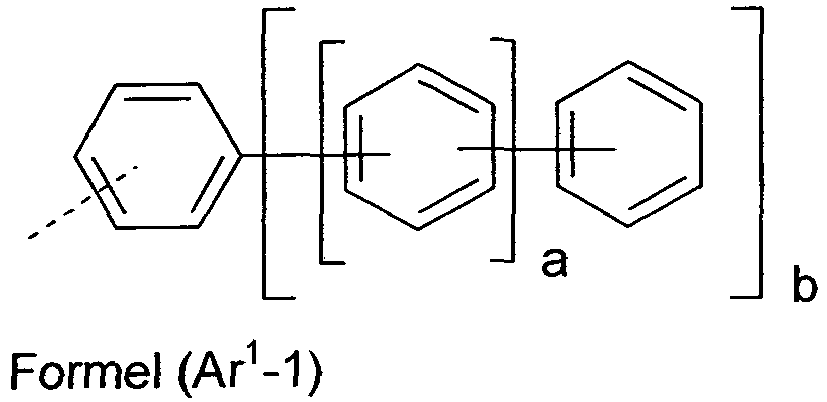
- wobei an den freien Positionen jeweils eine Gruppe R1 gebunden sein kann,und
- wobei a und b jeweils gleich oder verschieden 0 oder 1 sein können, und
- wobei die Gruppe über die gestrichelte Bindung an den Grundkörper der Formel (I) gebunden ist,
- wobei an den freien Positionen jeweils eine Gruppe R1 gebunden sein kann, und
- wobei c und d jeweils gleich oder verschieden 0 oder 1 sein können, und
- wobei die Gruppe über die gestrichelte Bindung an den Grundkörper der Formel (I) gebunden ist.
- Ganz besonders bevorzugte Ausführungsformen der Gruppe Ar1 entsprechen den folgenden Formeln (Ar1-a) bis (Ar1-d)


- Bevorzugt ist weiterhin mindestens eine der Gruppen Ar1 in der Verbindung gemäß Formel (I) an den Sechsring in meta-Position zur Bindung an das zentrale Stickstoffatom gebunden.
- Bevorzugt ist weiterhin keine Gruppe Ar1 am Sechsring in ortho-Position zur Bindung an das zentrale Stickstoffatom gebunden.
- Bevorzugt ist weiterhin Ar2 bei jedem Auftreten gleich oder verschieden ein aromatisches Ringsystem mit 6 bis 12 aromatischen Ringatomen, bevorzugt mit 6 aromatischen Ringatomen, wobei Ar2 mit einem oder mehreren Resten R1 substituiert sein kann. Besonders bevorzugt ist ein aromatisches Ringsystem mit der oben genannten Zahl an aromatischen Ringatomen. Noch stärker bevorzugt ist mit einem oder mehreren Resten R1 substituiertes Phenyl.
- Besonders bevorzugt ist Ar2 eine Gruppe der Formel (A-3)

- wobei an den freien Positionen jeweils eine Gruppe R1 gebunden sein kann, und
- wobei e jeweils gleich oder verschieden 0 oder 1 sein kann, und
- wobei die Gruppe über die gestrichelte Bindung an den Grundkörper der Formel (I) gebunden ist.
- Ganz besonders bevorzugte Ausführungsformen der Gruppe Ar2 entsprechen den folgenden Formeln (Ar2-a) bis (Ar2-b)

- Bevorzugt ist weiterhin R1 bei jedem Auftreten gleich oder verschieden H, D, F, CN, Si(R2)3, eine geradkettige Alkyl- oder Alkoxygruppe mit 1 bis 10 C-Atomen oder eine verzweigte oder cyclische Alkyl- oder Alkoxygruppe mit 3 bis 10 C-Atomen, wobei die oben genannten Gruppen jeweils mit einem oder mehreren Resten R2 substituiert sein können und wobei in den oben genannten Gruppen eine oder mehrere CH2-Gruppen durch -C=C-, -R2C=CR2-, Si(R2)2, C=O, C=NR2, -NR2-, -O-, -S-, -C(=O)O- oder -C(=O)NR2- ersetzt sein können, oder ein aromatisches Ringsystem mit 6 bis 20 aromatischen Ringatomen, das jeweils mit einem oder mehreren Resten R2 substituiert sein kann, wobei zwei oder mehr Reste R1 jeweils miteinander verknüpft sein können und einen Ring bilden können.
- Bevorzugt sind Reste R1, welche an unterschiedliche aromatische Ringe gebunden sind, nicht miteinander unter Ringbildung verknüpft.
- Bevorzugt ist weiterhin R2 bei jedem Auftreten gleich oder verschieden H, D, F, CN, Si(R3)3, eine geradkettige Alkyl- oder Alkoxygruppe mit 1 bis 10 C-Atomen oder eine verzweigte oder cyclische Alkyl- oder Alkoxygruppe mit 3 bis 10 C-Atomen, wobei die oben genannten Gruppen jeweils mit einem oder mehreren Resten R3 substituiert sein können und wobei in den oben genannten Gruppen eine oder mehrere CH2-Gruppen durch -C=C-, -R3C=CR3-, Si(R3)2, C=O, C=NR3, -NR3-, -O-, -S-, -C(=O)O- oder -C(=O)NR3- ersetzt sein können, oder ein aromatisches Ringsystem mit 6 bis 20 aromatischen Ringatomen, das jeweils mit einem oder mehreren Resten R3 substituiert sein kann, wobei zwei oder mehr Reste R2 miteinander verknüpft sein können und einen Ring bilden können.
- Bevorzugt ist n bei jedem Auftreten gleich oder verschieden 0, 1, 2 oder 3, besonders bevorzugt gleich 1 oder 2.
- Weiterhin ist es bevorzugt, dass die Summe der Indices n mindestens ist. Ganz besonders bevorzugt ist sie mindestens 3.
- Bevorzugt ist m gleich 0 oder 1, besonders bevorzugt gleich 0.
- Bevorzugte Ausführungsformen der erfindungsgemäßen Verbindung entsprechen einer der Formeln (I-1) bis (I-12)


- Ar1A, Ar1B, Ar1C und Ar1D können gleich oder verschieden sein. Ar2A und Ar26 können gleich oder verschieden sein.
- Bevorzugt ist Z in den Formeln (I-1) bis (I-12) gleich CR1 bzw. gleich C, wenn eine Gruppe Ar1 oder Ar2 gebunden ist.
- Weiterhin ist W in den Formeln (I-1) bis (I-12) bevorzugt gleich CH.
- Weiterhin gelten für die Gruppen Ar1, Ar2 und R1 bevorzugt die oben angegebenen bevorzugten Ausführungsformen.
Bevorzugt sind weiterhin Verbindungen gemäß den folgenden, von Formel (I-1), (I-2), (I-5) und (I-6) abgeleiteten Formeln:
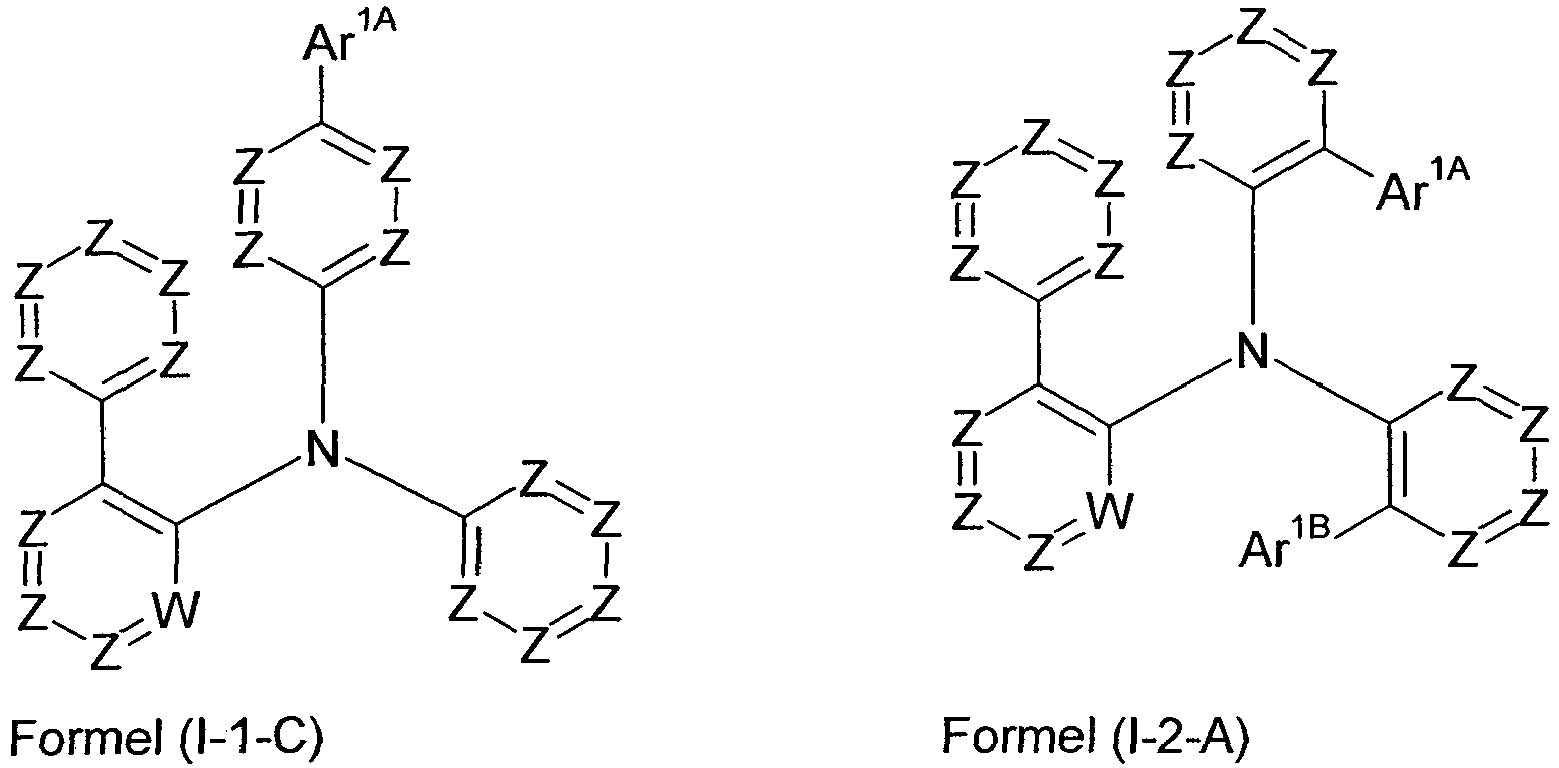


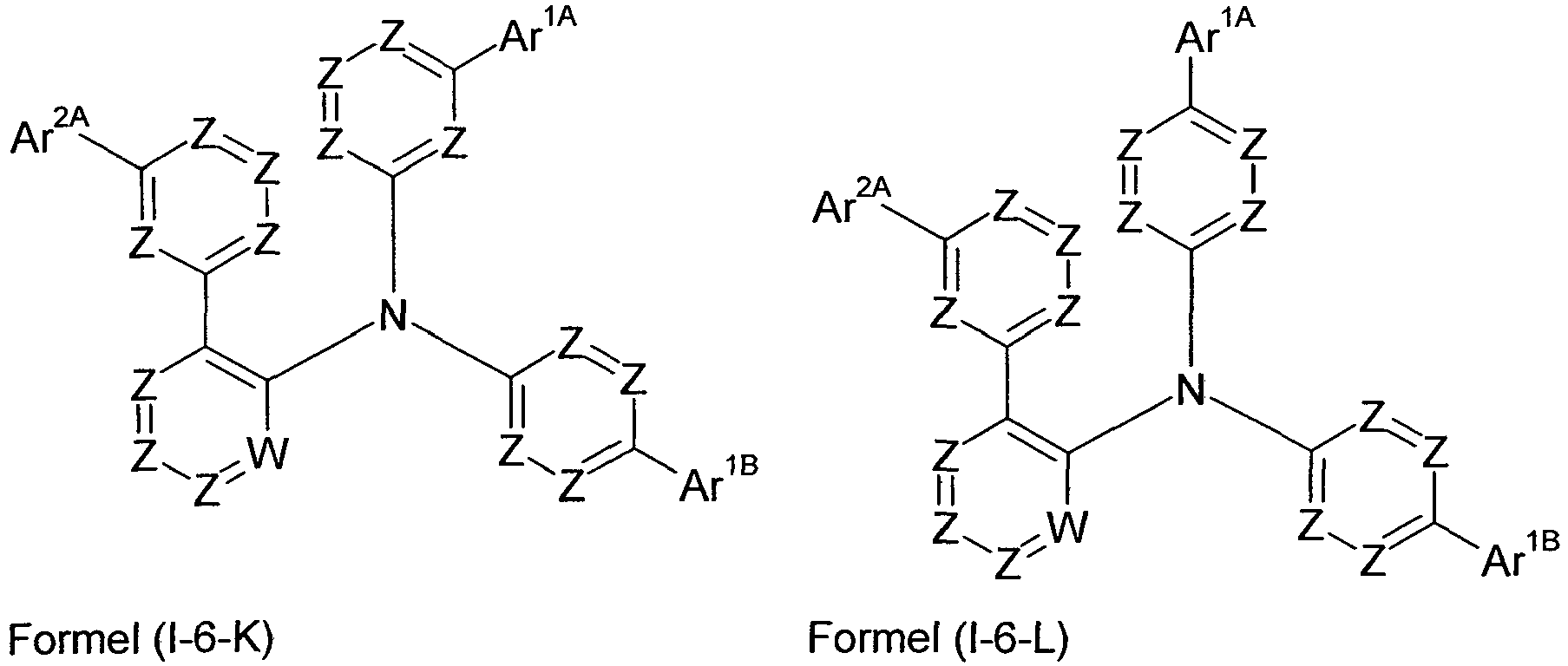


- Ar1A und Ar1B können gleich oder verschieden sein.
- Bevorzugt sind Ar1A und Ar1B Gruppen der Formeln (Ar1-a) bis (Ar1-d). Bevorzugt ist Ar2A eine Gruppe der Formel (Ar2-a) oder (Ar2-b).
- Bevorzugt ist Z in obenstehenden Formeln gleich CR1 bzw. gleich C, wenn eine Gruppe Ar1 oder Ar2 gebunden ist.
- Weiterhin ist W in den obenstehenden Formeln bevorzugt gleich CH.
- Weiterhin gelten für die Gruppen Ar1, Ar2 und R1 bevorzugt die oben angegebenen bevorzugten Ausführungsformen.
- Ganz besonders bevorzugt sind die in der folgenden Tabelle wiedergegebenen Strukturen, wobei Z gleich CR1 bzw. C ist und W gleich CH ist.
Grundstruktur Ar1A Ar1B Ar1C Ar1D Ar2A Ar2B (I-1-1) (I-1) (Ar1-a) - - - - - (I-1-2) (I-1) (Ar1-b) - - - - - (I-1-3) (I-1) (Ar1-c) - - - - - (I-1-4) (I-1) (Ar1-d) - - - - - (I-2-1) (I-2) (Ar1-a) (Ar1-a) - - - - (I-2-2) (I-2) (Ar1-a) (Ar1-b) - - - - (I-2-3) (I-2) (Ar1-a) (Ar1-c) - - - - (I-2-4) (I-2) (Ar1-a) (Ar1-d) - - - - (I-2-5) (I-2) (Ar1-b) (Ar1-b) - - - - (I-2-6) (I-2) (Ar1-b) (Ar1-c) - - - - (I-2-7) (I-2) (Ar1-b) (Ar1-d) - - - - (I-2-8) (I-2) (Ar1-c) (Ar1-c) - - - - (I-2-9) (I-2) (Ar1-c) (Ar1-d) - - - - (I-2-10) (I-2) (Ar1-d) (Ar1-d) - - - - (I-3-1) (I-3) (Ar1-a) (Ar1-a) (Ar1-a) - - - (I-3-2) (I-3) (Ar1-a) (Ar1-b) (Ar1-a) - - - (I-3-3) (I-3) (Ar1-a) (Ar1-c) (Ar1-a) - - - (I-3-4) (I-3) (Ar1-a) (Ar1-d) (Ar1-a) - - - (I-3-5) (I-3) (Ar1-b) (Ar1-b) (Ar1-a) - - - (I-3-6) (I-3) (Ar1-b) (Ar1-c) (Ar1-a) - - - (I-3-7) (I-3) (Ar1-b) (Ar1-d) (Ar1-a) - - - (I-3-8) (I-3) (Ar1-c) (Ar1-c) (Ar1-a) - - - (I-3-9) (I-3) (Ar1-c) (Ar1-d) (Ar1-a) - - - (I-3-10) (I-3) (Ar1-d) (Ar1-d) (Ar1-a) - - - (I-3-11) (I-3) (Ar1-a) (Ar1-a) (Ar1-b) - - - (I-3-12) (I-3) (Ar1-a) (Ar1-b) (Ar1-b) - - - (I-3-13) (I-3) (Ar1-a) (Ar1-c) (Ar1-b) - - - (I-3-14) (I-3) (Ar1-a) (Ar1-d) (Ar1-b) - - - (I-3-15) (I-3) (Ar1-b) (Ar1-b) (Ar1-b) - - - (I-3-16) (I-3) (Ar1-b) (Ar1-c) (Ar1-b) - - - (I-3-17) (I-3) (Ar1-b) (Ar1-d) (Ar1-b) - - - (I-3-18) (I-3) (Ar1-c) (Ar1-c) (Ar1-b) - - - (I-3-19) (I-3) (Ar1-c) (Ar1-d) (Ar1-b) - - - (I-3-20) (I-3) (Ar1-d) (Ar1-d) (Ar1-b) - - - (I-3-21) (I-3) (Ar1-a) (Ar1-a) (Ar1-c) - - (I-3-22) (I-3) (Ar1-a) (Ar1-b) (Ar1-c) - - - (I-3-23) (I-3) (Ar1-a) (Ar1-c) (Ar1-c) - - - (I-3-24) (I-3) (Ar1-a) (Ar1-d) (Ar1-c) - - - (I-3-25) (I-3) (Ar1-b) (Ar1-b) (Ar1-c) - - - (I-3-26) (I-3) (Ar1-b) (Ar1-c) (Ar1-c) - - - (I-3-27) (I-3) (Ar1-b) (Ar1-d) (Ar1-c) - - - (I-3-28) (I-3) (Ar1-c) (Ar1-c) (Ar1-c) - - - (I-3-29) (I-3) (Ar1-c) (Ar1-d) (Ar1-c) - - - (I-3-30) (I-3) (Ar1-d) (Ar1-d) (Ar1-c) - - - (I-3-31) (I-3) (Ar1-a) (Ar1-a) (Ar1-d) - - - (I-3-32) (I-3) (Ar1-a) (Ar1-b) (Ar1-d) - - - (I-3-33) (I-3) (Ar1-a) (Ar1-c) (Ar1-d) - - - (I-3-34) (I-3) (Ar1-a) (Ar1-d) (Ar1-d) - - - (I-3-35) (I-3) (Ar1-b) (Ar1-b) (Ar1-d) - - - (I-3-36) (I-3) (Ar1-b) (Ar1-c) (Ar1-d) - - - (I-3-37) (I-3) (Ar1-b) (Ar1-d) (Ar1-d) - - - (I-3-38) (I-3) (Ar1-c) (Ar1-c) (Ar1-d) - - - (I-3-39) (I-3) (Ar1-c) (Ar1-d) (Ar1-d) - - - (I-3-40) (I-3) (Ar1-d) (Ar1-d) (Ar1-d) - - - (I-5-1) (I-5) (Ar1-a) - - - (Ar2-a) - (I-5-2) (I-5) (Ar1-a) - - - (Ar2-b) - (I-5-3) (I-5) (Ar1-b) - - - (Ar2-a) - (I-5-4) (I-5) (Ar1-b) - - - (Ar2-b) - (I-5-5) (I-5) (Ar1-c) - - - (Ar2-a) - (I-5-6) (I-5) (Ar1-c) - - - (Ar2-b) - (I-5-7) (I-5) (Ar1-d) - - - (Ar2-a) - (I-5-8) (I-5) (Ar1-d) - - - (Ar2-b) - (I-6-1) (I-6) (Ar1-a) (Ar1-a) - - (Ar2-a) - (I-6-2) (I-6) (Ar1-a) (Ar1-b) - - (Ar2-a) - (I-6-3) (I-6) (Ar1-a) (Ar1-c) - - (Ar2-a) - (I-6-4) (I-6) (Ar1-a) (Ar1-d) - - (Ar2-a) - (I-6-5) (I-6) (Ar1-b) (Ar1-b) - - (Ar2-a) - (I-6-6) (I-6) (Ar1-b) (Ar1-c) - - (Ar2-a) - (I-6-7) (I-6) (Ar1-b) (Ar1-d) - - (Ar2-a) - (I-6-8) (I-6) (Ar1-c) (Ar1-c) - - (Ar2-a) - (I-6-9) (I-6) (Ar1-c) (Ar1-d) - - (Ar2-a) - (I-6-10) (I-6) (Ar1-d) (Ar1-d) - - (Ar2-a) - (I-6-11) (I-6) (Ar1-a) (Ar1-a) - - (Ar2-b) - (I-6-12) (I-6) (Ar1-a) (Ar1-b) - - (Ar2-b) - (I-6-13) (I-6) (Ar1-a) (Ar1-c) - - (Ar2-b) - (I-6-14) (I-6) (Ar1-a) (Ar1-d) - - (Ar2-b) - (I-6-15) (I-6) (Ar1-b) (Ar1-b) - - (Ar2-b) - (I-6-16) (I-6) (Ar1-b) (Ar1-c) - - (Ar2-b) - (I-6-17) (I-6) (Ar1-b) (Ar1-d) - - (Ar2-b) - (I-6-18) (I-6) (Ar1-c) (Ar1-c) - - (Ar2-b) - (I-6-19) (I-6) (Ar1-c) (Ar1-d) - - (Ar2-b) - (I-6-20) (I-6) (Ar1-d) (Ar1-d) - - (Ar2-b) - (I-7-1) (I-7) (Ar1-a) (Ar1-a) (Ar1-a) - (Ar2-a) - (I-7-2) (I-7) (Ar1-a) (Ar1-b) (Ar1-a) - (Ar2-a) - (I-7-3) (I-7) (Ar1-a) (Ar1-c) (Ar1-a) - (Ar2-a) - (I-7-4) (I-7) (Ar1-a) (Ar1-d) (Ar1-a) - (Ar2-a) - (I-7-5) (I-7) (Ar1-b) (Ar1-b) (Ar1-a) - (Ar2-a) - (I-7-6) (I-7) (Ar1-b) (Ar1-c) (Ar1-a) - (Ar2-a) - (I-7-7) (I-7) (Ar1-b) (Ar1-d) (Ar1-a) - (Ar2-a) - (I-7-8) (I-7) (Ar1-c) (Ar1-c) (Ar1-a) - (Ar2-a) - (I-7-9) (I-7) (Ar1-c) (Ar1-d) (Ar1-a) - (Ar2-a) - (I-7-10) (I-7) (Ar1-d) (Ar1-d) (Ar1-a) - (Ar2-a) - (I-7-11) (I-7) (Ar1-a) (Ar1-a) (Ar1-b) - (Ar2-a) - (I-7-12) (I-7) (Ar1-a) (Ar1-b) (Ar1-b) - (Ar2-a) - (I-7-13) (I-7) (Ar1-a) (Ar1-c) (Ar1-b) - (Ar2-a) - (I-7-14) (I-7) (Ar1-a) (Ar1-d) (Ar1-b) - (Ar2-a) - (I-7-15) (I-7) (Ar1-b) (Ar1-b) (Ar1-b) - (Ar2-a) - (I-7-16) (I-7) (Ar1-b) (Ar1-c) (Ar1-b) - (Ar2-a) - (I-7-17) (I-7) (Ar1-b) (Ar1-d) (Ar1-b) - (Ar2-a) - (I-7-18) (I-7) (Ar1-c) (Ar1-c) (Ar1-b) - (Ar2-a) - (I-7-19) (I-7) (Ar1-c) (Ar1-d) (Ar1-b) - (Ar2-a) - (I-7-20) (I-7) (Ar1-d) (Ar1-d) (Ar1-b) - (Ar2-a) - (I-7-21) (I-7) (Ar1-a) (Ar1-a) (Ar1-c) - (Ar2-a) - (I-7-22) (I-7) (Ar1-a) (Ar1-b) (Ar1-c) - (Ar2-a) - (I-7-23) (I-7) (Ar1-a) (Ar1-c) (Ar1-c) - (Ar2-a) - (I-7-24) (I-7) (Ar1-a) (Ar1-d) (Ar1-c) - (Ar2-a) - (I-7-25) (I-7) (Ar1-b) (Ar1-b) (Ar1-c) - (Ar2-a) - (I-7-26) (I-7) (Ar1-b) (Ar1-c) (Ar1-c) - (Ar2-a) - (I-7-27) (I-7) (Ar1-b) (Ar1-d) (Ar1-c) - (Ar2-a) - (I-7-28) (I-7) (Ar1-c) (Ar1-c) (Ar1-c) - (Ar2-a) - (I-7-29) (I-7) (Ar1-c) (Ar1-d) (Ar1-c) - (Ar2-a) - (I-7-30) (I-7) (Ar1-d) (Ar1-d) (Ar1-c) - (Ar2-a) - (I-7-31) (I-7) (Ar1-a) (Ar1-a) (Ar1-d) - (Ar2-a) - (I-7-32) (I-7) (Ar1-a) (Ar1-b) (Ar1-d) - (Ar2-a) - (I-7-33) (I-7) (Ar1-a) (Ar1-c) (Ar1-d) - (Ar2-a) - (I-7-34) (I-7) (Ar1-a) (Ar1-d) (Ar1-d) - (Ar2-a) - (I-7-35) (I-7) (Ar1-b) (Ar1-b) (Ar1-d) - (Ar2-a) - (I-7-36) (I-7) (Ar1-b) (Ar1-c) (Ar1-d) - (Ar2-a) - (I-7-37) (I-7) (Ar1-b) (Ar1-d) (Ar1-d) - (Ar2-a) - (I-7-38) (I-7) (Ar1-c) (Ar1-c) (Ar1-d) - (Ar2-a) - (I-7-39) (I-7) (Ar1-c) (Ar1-d) (Ar1-d) - (Ar2-a) - (I-7-40) (I-7) (Ar1-d) (Ar1-d) (Ar1-d) - (Ar2-a) - (I-7-41) (I-7) (Ar1-a) (Ar1-a) (Ar1-a) - (Ar2-b) - (I-7-42) (I-7) (Ar1-a) (Ar1-b) (Ar1-a) - (Ar2-b) (I-7-43 (I-7) (Ar1-a) (Ar1-c) (Ar1-a) - (Ar2-b) - (I-7-44) (I-7) (Ar1-a) (Ar1-d) (Ar1-a) - (Ar2-b) - (I-7-45) (I-7) (Ar1-b) (Ar1-b) (Ar1-a) - Ar2-b) - (I-7-46) (I-7) (Ar1-b) (Ar1-c) (Ar1-a) - (Ar2-b) - (I-7-47) (I-7) (Ar1-b) (Ar1-d) (Ar1-a) - (Ar2-b) - (I-7-48) (I-7) (Ar1-c) (Ar1-c) (Ar1-a) - (Ar2-b) - (I-7-49) (I-7) (Ar1-c) (Ar1-d) (Ar1-a) - (Ar2-b) - (I-7-50) (I-7) (Ar1-d) (Ar1-d) (Ar1-a) - (Ar2-b) - (I-7-51) (I-7) (Ar1-a) (Ar1-a) (Ar1-b) - (Ar2-b) - (I-7-52) (I-7) (Ar1-a) (Ar1-b) (Ar1-b) - (Ar2-b) - (I-7-53) (I-7) (Ar1-a) (Ar1-c) (Ar1-b) - (Ar2-b) - (I-7-54) (I-7) (Ar1-a) (Ar1-d) (Ar1-b) - (Ar2-b) - (I-7-55) (I-7) (Ar1-b) (Ar1-b) (Ar1-b) - (Ar2-b) - (I-7-56) (I-7) (Ar1-b) (Ar1-c) (Ar1-b) - (Ar2-b) - (I-7-57) (I-7) (Ar1-b) (Ar1-d) (Ar1-b) - (Ar2-b) - (I-7-58) (I-7) (Ar1-c) (Ar1-c) (Ar1-b) - (Ar2-b) - (I-7-59) (I-7) (Ar1-c) (Ar1-d) (Ar1-b) - (Ar2-b) - (I-7-60) (I-7) (Ar1-d) (Ar1-d) (Ar1-b) - (Ar2-b) - (I-7-61) (I-7) (Ar1-a) (Ar1-a) (Ar1-c) - (Ar2-b) - (I-7-62) (I-7) (Ar1-a) (Ar1-b) (Ar1-c) - (Ar2-b) - (I-7-63) (I-7) (Ar1-a) (Ar1-c) (Ar1-c) - (Ar2-b) - (I-7-64) (I-7) (Ar1-a) (Ar1-d) (Ar1-c) - (Ar2-b) - (I-7-65) (I-7) (Ar1-b) (Ar1-b) (Ar1-c) - (Ar2-b) - (I-7-66) (I-7) (Ar1-b) (Ar1-c) (Ar1-c) - (Ar2-b) - (I-7-67) (I-7) (Ar1-b) (Ar1-d) (Ar1-c) - (Ar2-b) - (I-7-68) (I-7) (Ar1-c) (Ar1-c) (Ar1-c) - (Ar2-b) - (I-7-69) (I-7) (Ar1-c) (Ar1-d) (Ar1-c) - (Ar2-b) - (I-7-70) (I-7) (Ar1-d) (Ar1-d) (Ar1-c) - (Ar2-b) - (I-7-71) (I-7) (Ar1-a) (Ar1-a) (Ar1-d) - (Ar2-b) - (I-7-72) (I-7) (Ar1-a) (Ar1-b) (Ar1-d) - (Ar2-b) - (I-7-73) (I-7) (Ar1-a) (Ar1-c) (Ar1-d) - (Ar2-b) - (I-7-74) (I-7) (Ar1-a) (Ar1-d) (Ar1-d) - (Ar2-b - (I-7-75) (I-7) (Ar1-b) (Ar1-b) (Ar1-d) - (Ar2-b) - (I-7-76) (I-7) (Ar1-b) (Ar1-c) (Ar1-d) - (Ar2-b) - (I-7-77) (I-7) (Ar1-b) (Ar1-d) (Ar1-d) - (Ar2-b) - (I-7-78) (I-7) (Ar1-c) (Ar1-c) (Ar1-d) - (Ar2-b) - (I-7-79) (I-7) (Ar1-c) (Ar1-d) (Ar1-d) - (Ar2-b) - (I-7-80) (I-7) (Ar1-d) (Ar1-d) (Ar1-d) - (Ar2-b) - - Die in der Tabelle aufgelisteten Strukturen können mit beliebigen Substituenten, wie oben definiert, substituiert sein. Bevorzugt sind sie unsubstituiert.
- Beispiele für erfindungsgemäße Verbindungen sind in der untenstehenden Tabelle abgebildet. Nicht anspruchsgemäße Verbindungen sind mit # gekennzeichnet.


1 2 

3 4 
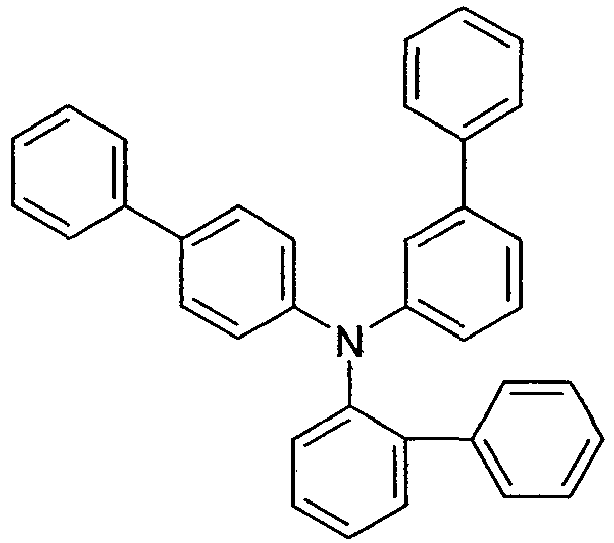
5 6 

7 8 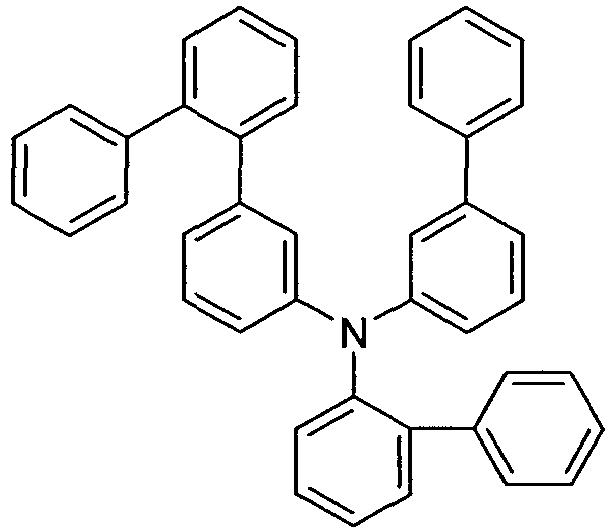

9 10 

11 12 

13 14 

14 16 

17 18 

19 20 # 

21 # 22 

23 # 24 # 

25 26 

27 # 28 # 

29 30 # 

31 # 32 # - Die Synthese der erfindungsgemäßen Verbindungen kann gemäß dem Fachmann allgemein bekannten Verfahren der organischen präparativen Chemie erfolgen. Beispiele für bevorzugt eingesetzte Reaktionen sind Halogenierungen sowie übergangsmetallkatalysierte Kupplungsreaktionen, bevorzugt Suzuki-Kupplungen und Buchwald-Kupplungen.
- Zwei bevorzugte Wege zur Herstellung der erfindungsgemäßen Verbindungen sind im Folgenden dargestellt.
- Zum Einen ist es möglich, zur Herstellung der erfindungsgemäßen Verbindungen von einem primären aromatischen Amin auszugehen, welches mit zwei Arylgruppen in einer Kupplungsreaktion verknüpft wird (Schema 1).


- Ar steht hierbei für ein aromatisches oder heteroaromatisches Ringsystem, Ar' steht für ein aromatisches oder heteroaromatisches Ringsystem und X steht für eine beliebige Abgangsgruppe, bevorzugt ein Halogenid wie Cl, Br oder I, ein Alkyl- oder Arylsulfonat oder Diazonium.
- Die Kupplungsreaktion ist dabei bevorzugt eine übergangsmetallkatalysierte Kupplungsreaktion, beispielsweise eine Hartwig-Buchwald-Kupplung. Es kann auch eine Ullmann-Reaktion verwendet werden.
- Alternativ ist es möglich, zur Herstellung der erfindungsgemäßen Verbindungen von einem sekundären aromatischen Amin auszugehen, welches zwei Arylgruppen trägt und welches in einer Kupplungsreaktion mit einer Arylgruppe verknüpft wird (Schema 2).

- Die auftretenden Symbole sind dabei wie in Schema 1 definiert, wobei Ar" ein aromatisches oder heteroaromatisches Ringsystem darstellt. Es wird bevorzugt eine Kupplungsreaktion wie für Schema 1 angegeben verwendet.
- An die gezeigten Reaktionsschritte können sich weitere Synthesestufen, beispielsweise zur Einführung von Substituenten oder zur Modifikation des Grundgerüsts, anschließen.
- Der Fachmann kann im Rahmen seines allgemeinen Fachwissens, unter anderem auch in Abhängigkeit von der kommerziellen oder synthetischen Verfügbarkeit der Ausgangsverbindungen, das für den jeweils vorliegenden Fall geeignete Verfahren aus den beiden oben beschriebenen Verfahren auswählen.
- Gegenstand der vorliegenden Erfindung ist somit weiterhin ein Verfahren zur Herstellung einer Verbindung gemäß Formel (I), dadurch gekennzeichnet, dass eine Arylverbindung enthaltend eine Aminogruppe und eine Arylverbindung enthaltend eine Abgangsgruppe in einer übergangsmetallkatalysierten Kupplungsreaktion miteinander verknüpft werden.
- Die Abgangsgruppe ist dabei bevorzugt gewählt aus Cl, Br, I, Methylsulfonat, Trifluormethylsulfonat, Phenylsulfonat, Tolylsulfonat und Diazonium.
- Die oben beschriebenen erfindungsgemäßen Verbindungen, insbesondere Verbindungen, welche mit reaktiven Abgangsgruppen, wie Brom, Iod, Chlor, Boronsäure oder Boronsäureester, substituiert sind, können als Monomere zur Erzeugung entsprechender Oligomere, Dendrimere oder Polymere Verwendung finden. Geeignete reaktive Abgangsgruppen sind beispielsweise Brom, Iod, Chlor, Boronsäuren, Boronsäureester, Amine, Alkenyl- oder Alkinylgruppen mit endständiger C-C-Doppelbindung bzw. C-C-Dreifachbindung, Oxirane, Oxetane, Gruppen, die eine Cycloaddition, beispielsweise eine 1,3-dipolare Cycloaddition, eingehen, wie beispielsweise Diene oder Azide, Carbonsäurederivate, Alkohole und Silane.
- Weiterer Gegenstand der Erfindung sind daher Oligomere, Polymere oder Dendrimere enthaltend eine oder mehrere Verbindungen gemäß Formel (I), wobei die Bindung(en) zum Polymer, Oligomer oder Dendrimer an beliebigen, in Formel (I) mit R1 substituierten Positionen lokalisiert sein können. Je nach Verknüpfung der Verbindung gemäß Formel (I) ist die Verbindung Bestandteil einer Seitenkette des Oligomers oder Polymers oder Bestandteil der Hauptkette. Unter einem Oligomer im Sinne dieser Erfindung wird eine Verbindung verstanden, welche aus mindestens drei Monomereinheiten aufgebaut ist. Unter einem Polymer im Sinne der Erfindung wird eine Verbindung verstanden, die aus mindestens zehn Monomereinheiten aufgebaut ist. Die erfindungsgemäßen Polymere, Oligomere oder Dendrimere können konjugiert, teilkonjugiert oder nichtkonjugiert sein. Die erfindungsgemäßen Oligomere oder Polymere können linear, verzweigt oder dendritisch sein. In den linear verknüpften Strukturen können die Einheiten gemäß Formel (I) direkt miteinander verknüpft sein oder sie können über eine bivalente Gruppe, beispielsweise über eine substituierte oder unsubstituierte Alkylengruppe, über ein Heteroatom oder über eine bivalente aromatische oder heteroaromatische Gruppe miteinander verknüpft sein. In verzweigten und dendritischen Strukturen können beispielsweise drei oder mehrere Einheiten gemäß Formel (I) über eine trivalente oder höhervalente Gruppe, beispielsweise über eine trivalente oder höhervalente aromatische oder heteroaromatische Gruppe, zu einem verzweigten bzw. dendritischen Oligomer oder Polymer verknüpft sein.
- Für die Wiederholeinheiten gemäß Formel (I) in Oligomeren, Dendrimeren und Polymeren gelten dieselben Bevorzugungen wie oben für Verbindungen gemäß Formel (I) beschrieben.
- Zur Herstellung der Oligomere oder Polymere werden die erfindungsgemäßen Monomere homopolymerisiert oder mit weiteren Monomeren copolymerisiert. Geeignete und bevorzugte Comonomere sind gewählt aus Fluorenen (z. B. gemäß
EP 842208 WO 2000/22026 EP 707020 EP 894107 WO 2006/061181 ), Paraphenylenen (z. B. gemäßWO 1992/18552 WO 2004/070772 oderWO 2004/113468 ), Thiophenen (z. B. gemäßEP 1028136 ), Dihydrophenanthrenen (z. B. gemäßWO 2005/014689 oderWO 2007/006383 ), cis- und trans-Indenofluorenen (z. B. gemäßWO 2004/041901 oderWO 2004/113412 ), Ketonen (z. B. gemäßWO 2005/040302 ), Phenanthrenen (z. B. gemäßWO 2005/104264 oderWO 2007/017066 ) oder auch mehreren dieser Einheiten. Die Polymere, Oligomere und Dendrimere enthalten üblicherweise noch weitere Einheiten, beispielsweise emittierende (fluoreszierende oder phosphoreszierende) Einheiten, wie z. B. Vinyltriarylamine (z. B. gemäßWO 2007/068325 ) oder phosphoreszierende Metallkomplexe (z. B. gemäßWO 2006/003000 ), und/oder Ladungstransporteinheiten, insbesondere solche basierend auf Triarylaminen. - Die erfindungsgemäßen Polymere, Oligomere und Dendrimere weisen vorteilhafte Eigenschaften, insbesondere hohe Lebensdauern, hohe Effizienzen und gute Farbkoordinaten auf.
- Die erfindungsgemäßen Polymere und Oligomere werden in der Regel durch Polymerisation von einer oder mehreren Monomersorten hergestellt, von denen mindestens ein Monomer im Polymer zu Wiederholungseinheiten der Formel (I) führt. Geeignete Polymerisationsreaktionen sind dem Fachmann bekannt und in der Literatur beschrieben. Besonders geeignete und bevorzugte Polymerisationsreaktionen, die zu C-C- bzw. C-N-Verknüpfungen führen, sind folgende:
- (A) SUZUKI-Polymerisation;
- (B) YAMAMOTO-Polymerisation;
- (C) STILLE-Polymerisation; und
- (D) HARTWIG-BUCHWALD-Polymerisation.
- Wie die Polymerisation nach diesen Methoden durchgeführt werden kann und wie die Polymere dann vom Reaktionsmedium abgetrennt und aufgereinigt werden können, ist dem Fachmann bekannt und in der Literatur, beispielsweise in
WO 2003/048225 ,WO 2004/037887 undWO 2004/037887 , im Detail beschrieben. - Gegenstand der vorliegenden Erfindung ist somit auch ein Verfahren zur Herstellung der erfindungsgemäßen Polymere, Oligomere und Dendrimere, das dadurch gekennzeichnet ist, dass sie durch Polymerisation gemäß SUZUKI, Polymerisation gemäß YAMAMOTO, Polymerisation gemäß STILLE oder Polymerisation gemäß HARTWIG-BUCHWALD hergestellt werden. Die erfindungsgemäßen Dendrimere können gemäß dem Fachmann bekannten Verfahren oder in Analogie dazu hergestellt werden. Geeignete Verfahren sind in der Literatur beschrieben, wie z. B. in Frechet, Jean M. J.; Hawker, Craig J., "Hyperbranched polyphenylene and hyperbranched polyesters: new soluble, three-dimensional, reactive polymers", Reactive & Functional Polymers (1995), 26(1-3), 127-36; Janssen, H. M.; Meijer, E. W., "The synthesis and characterization of dendritic molecules", Materials Science and Technology (1999), 20 (Synthesis of Polymers), 403-458; Tomalia, Donald A., "Dendrimer molecules", Scientific American (1995), 272(5), 62-6;
WO 2002/067343 A1 undWO 2005/026144 A1 . - Für die Verarbeitung der erfindungsgemäßen Verbindungen aus flüssiger Phase, beispielsweise durch Spin-Coating oder durch Druckverfahren, sind Formulierungen der erfindungsgemäßen Verbindungen erforderlich. Diese Formulierungen können beispielsweise Lösungen, Dispersionen oder Miniemulsionen sein. Es kann bevorzugt sein, hierfür Mischungen aus zwei oder mehr Lösemitteln zu verwenden. Geeignete und bevorzugte Lösemittel sind beispielsweise Toluol, Anisol, o-, m- oder p-Xylol, Methylbenzoat, Dimethylanisol, Mesitylen, Tetralin, Veratrol, THF, Methyl-THF, THP, Chlorbenzol, Dioxan oder Mischungen dieser Lösemittel. Es ist bevorzugt, dass die Formulierung enthaltend die erfindungsgemäße Mischung ein oder mehrere Polymere, Oligomere oder Dendrimere enthält. Die Polymere, Oligomere oder Dendrimere sind bevorzugt in einer Konzentration von 1-80 Gew.-%, besonders bevorzugt 5-65 Gew.-% und ganz besonders bevorzugt 10-50 Gew.-% in der Formulierung enthalten. Sie dienen insbesondere zum Einstellen der Eigenschaften der Formulierung, beispielsweise der Viskosität. Bevorzugt ist die Verwendung von Polyarylaminen, Polystyrolen, Polyacrylaten und Polyestern, insbesondere die Verwendung der in der
WO 2011/076325 offenbarten Polymere. - Gegenstand der Erfindung ist daher weiterhin eine Formulierung, insbesondere eine Lösung, Dispersion oder Miniemulsion, enthaltend mindestens eine Verbindung gemäß Formel (I) oder mindestens ein Polymer, Oligomer oder Dendrimer enthaltend mindestens eine Einheit gemäß Formel (I) sowie mindestens ein Lösungsmittel, bevorzugt ein organisches Lösungsmittel. Wie solche Lösungen hergestellt werden können, ist dem Fachmann bekannt und beispielsweise in
WO 2002/072714 ,WO 2003/019694 und der darin zitierten Literatur beschrieben. - Die erfindungsgemäßen Verbindungen gemäß Formel (I) eignen sich für den Einsatz in elektronischen Vorrichtungen, insbesondere in organischen Elektrolumineszenzvorrichtungen (OLEDs). Abhängig von der Substitution werden die Verbindungen in unterschiedlichen Funktionen und Schichten eingesetzt.
- Weitere Gegenstände der Erfindung sind daher die Verwendung der Verbindungen gemäß Formel (I) in elektronischen Vorrichtungen sowie elektronische Vorrichtungen selbst, welche eine oder mehrere Verbindungen gemäß Formel (I) enthalten. Dabei sind die elektronischen Vorrichtungen bevorzugt ausgewählt aus der Gruppe bestehend aus organischen integrierten Schaltungen (OICs), organischen Feld-Effekt-Transistoren (OFETs), organischen Dünnfilmtransistoren (OTFTs), organischen lichtemittierenden Transistoren (OLETs), organischen Solarzellen (OSCs), organischen optischen Detektoren, organischen Photorezeptoren, organischen Feld-Quench-Devices (OFQDs), organischen lichtemittierenden elektrochemischen Zellen (OLECs), organischen Laserdioden (O-Laser) und besonders bevorzugt organischen Elektrolumineszenzvorrichtungen (OLEDs).
- Gegenstand der Erfindung sind, wie bereits oben ausgeführt, elektronische Vorrichtungen, enthaltend mindestens eine Verbindung gemäß Formel (I). Dabei sind die elektronischen Vorrichtungen bevorzugt ausgewählt aus den oben genannten Vorrichtungen. Besonders bevorzugt sind organische Elektrolumineszenzvorrichtungen, enthaltend Anode, Kathode und mindestens eine emittierende Schicht, dadurch gekennzeichnet, dass mindestens eine organische Schicht, die eine emittierende Schicht, eine Lochtransportschicht oder eine andere Schicht sein kann, mindestens eine Verbindung gemäß Formel (I) enthält.
- Außer Kathode, Anode und der emittierenden Schicht kann die organische Elektrolumineszenzvorrichtung noch weitere Schichten enthalten. Diese sind beispielsweise gewählt aus jeweils einer oder mehreren Lochinjektionsschichten, Lochtransportschichten, Lochblockierschichten, Elektronentransportschichten, Elektroneninjektionsschichten, Elektronenblockierschichten, Excitonenblockierschichten, Zwischenschichten (Interlayers), Ladungserzeugungsschichten (Charge-Generation Layers) (IDMC 2003, Taiwan; Session 21 OLED (5), T. Matsumoto, T. Nakada, J. Endo, K. Mori, N. Kawamura, A. Yokoi, J. Kido, Multiphoton Organic EL Device Having Charge Generation Layer) und/oder organischen oder anorganischen p/n-Übergängen. Es sei aber darauf hingewiesen, dass nicht notwendigerweise jede dieser Schichten vorhanden sein muss und die Wahl der Schichten immer von den verwendeten Verbindungen abhängt und insbesondere auch von der Tatsache, ob es sich um eine fluoreszierende oder phosphoreszierende Elektrolumineszenzvorrichtung handelt.
- Die erfindungsgemäße organische Elektrolumineszenzvorrichtung kann mehrere emittierende Schichten enthalten. Besonders bevorzugt weisen diese Emissionsschichten in diesem Fall insgesamt mehrere Emissionsmaxima zwischen 380 nm und 750 nm auf, so dass insgesamt weiße Emission resultiert, d. h. in den emittierenden Schichten werden verschiedene emittierende Verbindungen verwendet, die fluoreszieren oder phosphoreszieren können und die blaues oder gelbes oder orangefarbenes oder rotes Licht emittieren. Insbesondere bevorzugt sind Dreischichtsysteme, also Systeme mit drei emittierenden Schichten, wobei die drei Schichten blaue, grüne und orange oder rote Emission zeigen (für den prinzipiellen Aufbau siehe z. B.
WO 2005/011013 ). Die erfindungsgemäßen Verbindungen können in solchen Vorrichtungen in einer Lochtransportschicht, einer emittierenden Schicht und/oder in einer anderen Schicht vorhanden sein. Es soll angemerkt werden, dass sich für die Erzeugung von weißem Licht anstelle mehrerer farbig emittierender Emitterverbindungen auch eine einzeln verwendete Emitterverbindung eignen kann, welche in einem breiten Wellenlängenbereich emittiert. - Es ist erfindungsgemäß bevorzugt, wenn die Verbindung gemäß Formel (I) in einer elektronischen Vorrichtung enthaltend einen oder mehrere phosphoreszierende Dotanden eingesetzt wird. Dabei kann die Verbindung in unterschiedlichen Schichten, bevorzugt in einer Lochtransportschicht, einer Lochinjektionsschicht oder in einer emittierenden Schicht, verwendet werden. Die Verbindung gemäß Formel (I) kann aber auch erfindungsgemäß in einer elektronischen Vorrichtung enthaltend einen oder mehrere fluoreszierende Dotanden eingesetzt werden.
- Vom Begriff phosphoreszierende Dotanden sind typischerweise Verbindungen umfasst, bei denen die Lichtemission durch einen spinverbotenen Übergang erfolgt, beispielsweise einen Übergang aus einem angeregten Triplettzustand oder einem Zustand mit einer höheren Spinquantenzahl, beispielsweise einem Quintett-Zustand.
- Als phosphoreszierende Dotanden (= Triplettemitter) eignen sich insbesondere Verbindungen, die bei geeigneter Anregung Licht, vorzugsweise im sichtbaren Bereich, emittieren und außerdem mindestens ein Atom der Ordnungszahl größer 20, bevorzugt größer 38 und kleiner 84, besonders bevorzugt größer 56 und kleiner 80 enthalten. Bevorzugt werden als Phosphoreszenzemitter Verbindungen, die Kupfer, Molybdän, Wolfram, Rhenium, Ruthenium, Osmium, Rhodium, Iridium, Palladium, Platin, Silber, Gold oder Europium enthalten, verwendet, insbesondere Verbindungen, die Iridium, Platin oder Kupfer enthalten.
- Dabei werden im Sinne der vorliegenden Erfindung alle lumineszierenden Iridium-, Platin- oder Kupferkomplexe als phosphoreszierende Verbindungen angesehen.
- Beispiele der oben beschriebenen Emitter können den Anmeldungen
WO 00/70655 WO 01/41512 WO 02/02714 WO 02/15645 EP 1191613 ,EP 1191612 ,EP 1191614 ,WO 05/033244 WO 05/019373 US 2005/0258742 entnommen werden. Generell eignen sich alle phosphoreszierenden Komplexe, wie sie gemäß dem Stand der Technik für phosphoreszierende OLEDs verwendet werden und wie sie dem Fachmann auf dem Gebiet der organischen Elektrolumineszenzvorrichtungen bekannt sind. Auch kann der Fachmann ohne erfinderisches Zutun weitere phosphoreszierende Komplexe in Kombination mit den Verbindungen gemäß Formel (I) in organischen Elektrolumineszenzvorrichtungen einsetzen. - Explizite Beispiele für geeignete phosphoreszierende Emitterverbindungen können weiterhin der folgenden Tabelle entnommen werden.


- In einer bevorzugten Ausführungsform der Erfindung werden die Verbindungen gemäß Formel (I) als Lochtransportmaterial eingesetzt. Die Verbindungen werden entsprechend bevorzugt in einer Lochtransportschicht, einer Lochinjektionsschicht und/oder einer Elektronenblockierschicht eingesetzt.
- Eine Lochinjektionsschicht im Sinne dieser Erfindung ist eine Schicht, die direkt an die Anode angrenzt. Eine Lochtransportschicht im Sinne dieser Erfindung ist eine Schicht, die zwischen der Lochinjektionsschicht und der Emissionsschicht liegt. Die Lochtransportschicht kann direkt an die Emissionschicht angrenzen. Eine Elektronenblockierschicht im Sinne dieser Erfindung ist eine Schicht, die anodenseitig direkt an die Emissionsschicht angrenzt. Insbesondere wird unter einer Elektronenblockierschicht eine Schicht verstanden, welche anodenseitig direkt an die Emissionsschicht angrenzt, wobei zusätzlich anodenseitig zur Elektronenblockierschicht eine oder mehrere Lochtransportschichten vorhanden sind. Bevorzugt enthalten die Lochinjektionsschicht, Lochtransportschicht und Elektronenblockierschicht jeweils Materialien mit lochtransportierenden Eigenschaften. Für die Verwendung in der Elektronenblockierschicht ist es insbesondere bevorzugt, dass die Verbindung ein hochliegendes LUMO aufweist.
- In einer weiteren Ausführungsform der vorliegenden Erfindung werden die Verbindungen der Formel (I) als Matrixmaterial in Kombination mit einem oder mehreren fluoreszierenden oder phosphoreszierenden Dotanden eingesetzt.
- Unter einem Dotanden wird in einem System enthaltend ein Matrixmaterial und einen Dotanden diejenige Komponente verstanden, deren Anteil in der Mischung der kleinere ist. Entsprechend wird unter einem Matrixmaterial in einem System enthaltend ein Matrixmaterial und einen Dotanden diejenige Komponente verstanden, deren Anteil in der Mischung der größere ist.
- Der Anteil des Matrixmaterials in der emittierenden Schicht beträgt in diesem Fall zwischen 50.0 und 99.9 Vol.-%, bevorzugt zwischen 80.0 und 99.5 Vol.-% und besonders bevorzugt für fluoreszierende emittierende Schichten zwischen 92.0 und 99.5 Vol.-% sowie für phosphoreszierende emittierende Schichten zwischen 85.0 und 97.0 Vol.-%.
- Entsprechend beträgt der Anteil des Dotanden zwischen 0.1 und 50.0 Vol.-%, bevorzugt zwischen 0.5 und 20.0 Vol.-% und besonders bevorzugt für fluoreszierende emittierende Schichten zwischen 0.5 und 8.0 Vol.-% sowie für phosphoreszierende emittierende Schichten zwischen 3.0 und 15.0 Vol.-%.
- Im Folgenden werden die in den erfindungsgemäßen Vorrichtungen in den betreffenden Funktionen bevorzugt eingesetzten Materialien aufgeführt.
- Bevorzugte fluoreszierende Dotanden sind ausgewählt aus der Klasse der Arylamine. Unter einem Arylamin bzw. einem aromatischen Amin im Sinne dieser Erfindung wird eine Verbindung verstanden, die drei substituierte oder unsubstituierte aromatische oder heteroaromatische Ringsysteme direkt an den Stickstoff gebunden enthält. Bevorzugt ist mindestens eines dieser aromatischen oder heteroaromatischen Ringsysteme ein kondensiertes Ringsystem, besonders bevorzugt mit mindestens 14 aromatischen Ringatomen. Bevorzugte Beispiele hierfür sind aromatische Anthracenamine, aromatische Anthracendiamine, aromatische Pyrenamine, aromatische Pyrendiamine, aromatische Chrysenamine oder aromatische Chrysendiamine. Unter einem aromatischen Anthracenamin wird eine Verbindung verstanden, in der eine Diarylaminogruppe direkt an eine Anthracengruppe gebunden ist, vorzugsweise in 9-Position. Unter einem aromatischen Anthracendiamin wird eine Verbindung verstanden, in der zwei Diarylaminogruppen direkt an eine Anthracengruppe gebunden sind, vorzugsweise in 9,10-Position. Aromatische Pyrenamine, Pyrendiamine, Chrysenamine und Chrysendiamine sind analog dazu definiert, wobei die Diarylaminogruppen am Pyren bevorzugt in 1-Position bzw. in 1,6-Position gebunden sind.
- Als Matrixmaterialien, bevorzugt für fluoreszierende Dotanden, kommen neben den erfindungsgemäßen Verbindungen Materialien verschiedener Stoffklassen in Frage. Bevorzugte Matrixmaterialien sind ausgewählt aus den Klassen der Oligoarylene (z. B. 2,2',7,7'-Tetraphenylspirobifluoren gemäß
EP 676461 EP 676461 WO 2004/081017 ), der lochleitenden Verbindungen (z. B. gemäßWO 2004/058911 ), der elektronenleitenden Verbindungen, insbesondere Ketone, Phosphinoxide, Sulfoxide, etc. (z. B. gemäßWO 2005/084081 undWO 2005/084082 ), der Atropisomere (z. B. gemäßWO 2006/048268 ), der Boronsäurederivate (z. B. gemäßWO 2006/117052 ) oder der Benzanthracene (z. B. gemäßWO 2008/145239 ). Besonders bevorzugte Matrixmaterialien sind ausgewählt aus den Klassen der Oligoarylene, enthaltend Naphthalin, Anthracen, Benzanthracen und/oder Pyren oder Atropisomere dieser Verbindungen, der Oligoarylenvinylene, der Ketone, der Phosphinoxide und der Sulfoxide. Ganz besonders bevorzugte Matrixmaterialien sind ausgewählt aus den Klassen der Oligoarylene, enthaltend Anthracen, Benzanthracen, Benzphenanthren und/oder Pyren oder Atropisomere dieser Verbindungen. Unter einem Oligoarylen im Sinne dieser Erfindung soll eine Verbindung verstanden werden, in der mindestens drei Aryl- bzw. Arylengruppen aneinander gebunden sind. - Bevorzugte Matrixmaterialien für phosphoreszierende Dotanden sind neben den erfindungsgemäßen Verbindungen aromatische Amine, insbesondere Triarylamine, z. B. gemäß
US 2005/0069729 , Carbazolderivate (z. B. CBP, N,N-Biscarbazolylbiphenyl) oder Verbindungen gemäßWO 2005/039246 ,US 2005/0069729 ,JP 2004/288381 EP 1205527 oderWO 2008/086851 , verbrückte Carbazolderivate, z. B. gemäßWO 2011/088877 undWO 2011/128017 , Indenocarbazolderivate, z. B. gemäßWO 2010/136109 undWO 2011/000455 , Azacarbazolderivate, z. B. gemäßEP 1617710 ,EP 1617711 ,EP 1731584 ,JP 2005/347160 WO 2007/063754 oderWO 2008/056746 , Ketone, z. B. gemäßWO 2004/093207 oderWO 2010/006680 , Phosphinoxide, Sulfoxide und Sulfone, z. B. gemäßWO 2005/003253 , Oligophenylene, bipolare Matrixmaterialien, z. B. gemäßWO 2007/137725 , Silane, z. B. gemäßWO 2005/111172 , Azaborole oder Boronester, z. B. gemäßWO 2006/117052 , Triazinderivate, z. B. gemäßWO 2010/015306 ,WO 2007/063754 oderWO 2008/056746 , Zinkkomplexe, z. B. gemäßEP 652273 WO 2009/062578 , Aluminiumkomplexe, z. B. BAIq, Diazasilol- und Tetraazasilol-Derivate, z. B. gemäßWO 2010/054729 , Diazaphosphol-Derivate, z. B. gemäßWO 2010/054730 und Aluminiumkomplexe, z. B. BAIQ. - Geeignete Ladungstransportmaterialien, wie sie in der Lochinjektions- bzw. Lochtransportschicht oder in der Elektronentransportschicht der erfindungsgemäßen organischen Elektrolumineszenzvorrichtung verwendet werden können, sind neben den erfindungsgemäßen Verbindungen beispielsweise die in Y. Shirota et al., Chem. Rev. 2007, 107(4), 953-1010 offenbarten Verbindungen oder andere Materialien, wie sie gemäß dem Stand der Technik in diesen Schichten eingesetzt werden.
- Als Kathode der organischen Elektrolumineszenzvorrichtung sind Metalle mit geringer Austrittsarbeit, Metalllegierungen oder mehrlagige Strukturen aus verschiedenen Metallen bevorzugt, wie beispielsweise Erdalkalimetalle, Alkalimetalle, Hauptgruppenmetalle oder Lanthanoide (z. B. Ca, Ba, Mg, Al, In, Mg, Yb, Sm, etc.). Weiterhin eignen sich Legierungen aus einem Alkali- oder Erdalkalimetall und Silber, beispielsweise eine Legierung aus Magnesium und Silber. Bei mehrlagigen Strukturen können auch zusätzlich zu den genannten Metallen weitere Metalle verwendet werden, die eine relativ hohe Austrittsarbeit aufweisen, wie z. B. Ag oder Al, wobei dann in der Regel Kombinationen der Metalle, wie beispielsweise Ca/Ag, Mg/Ag oder Ba/Ag verwendet werden. Es kann auch bevorzugt sein, zwischen einer metallischen Kathode und dem organischen Halbleiter eine dünne Zwischenschicht eines Materials mit einer hohen Dielektrizitätskonstante einzubringen. Hierfür kommen beispielsweise Alkalimetall- oder Erdalkalimetallfluoride, aber auch die entsprechenden Oxide oder Carbonate in Frage (z. B. LiF, Li2O, BaF2, MgO, NaF, CsF, Cs2CO3, etc.). Weiterhin kann dafür Lithiumchinolinat (LiQ) verwendet werden. Die Schichtdicke dieser Schicht beträgt bevorzugt zwischen 0.5 und 5 nm.
- Als Anode sind Materialien mit hoher Austrittsarbeit bevorzugt. Bevorzugt weist die Anode eine Austrittsarbeit größer 4.5 eV vs. Vakuum auf. Hierfür sind einerseits Metalle mit hohem Redoxpotential geeignet, wie beispielsweise Ag, Pt oder Au. Es können andererseits auch Metall/Metalloxid-Elektroden (z. B. Al/Ni/NiOx, Al/PtOx) bevorzugt sein. Für einige Anwendungen muss mindestens eine der Elektroden transparent oder teiltransparent sein, um entweder die Bestrahlung des organischen Materials (organische Solarzelle) oder die Auskopplung von Licht (OLED, O-LASER) zu ermöglichen. Bevorzugte Anodenmaterialien sind hier leitfähige gemischte Metalloxide. Besonders bevorzugt sind Indium-ZinnOxid (ITO) oder Indium-Zink Oxid (IZO). Bevorzugt sind weiterhin leitfähige, dotierte organische Materialien, insbesondere leitfähige dotierte Polymere.
- Die Vorrichtung wird entsprechend (je nach Anwendung) strukturiert, kontaktiert und schließlich versiegelt, da sich die Lebensdauer der erfindungsgemäßen Vorrichtungen bei Anwesenheit von Wasser und/oder Luft verkürzt.
- In einer bevorzugten Ausführungsform ist die erfindungsgemäße organische Elektrolumineszenzvorrichtung dadurch gekennzeichnet, dass eine oder mehrere Schichten mit einem Sublimationsverfahren beschichtet werden. Dabei werden die Materialien in Vakuum-Sublimationsanlagen bei einem Anfangsdruck kleiner 10-5 mbar, bevorzugt kleiner 10-6 mbar aufgedampft. Dabei ist es jedoch auch möglich, dass der Anfangsdruck noch geringer ist, beispielsweise kleiner 10-7 mbar.
- Bevorzugt ist ebenfalls eine organische Elektrolumineszenzvorrichtung, dadurch gekennzeichnet, dass eine oder mehrere Schichten mit dem OVPD (Organic Vapour Phase Deposition) Verfahren oder mit Hilfe einer Trägergassublimation beschichtet werden. Dabei werden die Materialien bei einem Druck zwischen 10-5 mbar und 1 bar aufgebracht. Ein Spezialfall dieses Verfahrens ist das OVJP (Organic Vapour Jet Printing) Verfahren, bei dem die Materialien direkt durch eine Düse aufgebracht und so strukturiert werden (z. B. M. S. Arnold et al., Appl. Phys. Lett. 2008, 92, 053301).
- Weiterhin bevorzugt ist eine organische Elektrolumineszenzvorrichtung, dadurch gekennzeichnet, dass eine oder mehrere Schichten aus Lösung, wie z. B. durch Spincoating, oder mit einem beliebigen Druckverfahren, wie z. B. Siebdruck, Flexodruck, Nozzle Printing oder Offsetdruck, besonders bevorzugt aber LITI (Light Induced Thermal Imaging, Thermotransferdruck) oder Ink-Jet Druck (Tintenstrahldruck), hergestellt werden. Hierfür sind lösliche Verbindungen gemäß Formel (I) nötig. Hohe Löslichkeit lässt sich durch geeignete Substitution der Verbindungen erreichen.
- Weiterhin bevorzugt ist es, dass zur Herstellung einer erfindungsgemäßen organischen Elektrolumineszenzvorrichtung eine oder mehrere Schichten aus Lösung und eine oder mehrere Schichten durch ein Sublimationsverfahren aufgetragen werden.
- Erfindungsgemäß können die elektronischen Vorrichtungen enthaltend eine oder mehrere Verbindungen gemäß Formel (I) in Displays, als Lichtquellen in Beleuchtungsanwendungen sowie als Lichtquellen in medizinischen und/oder kosmetischen Anwendungen (z.B. Lichttherapie) eingesetzt werden.
- Die Erfindung wird durch die nachfolgenden Anwendungsbeispiele näher erläutert, wobei die Erfindung nicht auf den Umfang der Beispiele beschränkt ist.
- Die nachfolgenden Synthesen wurden, sofern nicht anders angegeben, unter einer Schutzgasatmosphäre in getrockneten Lösungsmitteln durchgeführt. Die Edukte können z.B. von ALDRICH bzw. ABCR bezogen werden. Angaben in eckigen Klammern betreffen die CAS-Nummern.
-

- Ein Gemisch aus 94.3 g (404 mmol) 2-Brombiphenyl [2052-07-5], 130.9 g (404 mmol) Bis-biphenyl-4-ylamin [102113-98-4], 48.1 g (500 mmol) Natrium-tert-buylat, 6.7 g (12 mmol) DPPF, 1.8 g (8 mmol) Palladium(II)acetat und 1500 ml Mesitylen wird 55 h unter Rückfluss erhitzt. Nach Erkalten wird mit 1000 ml Wasser versetzt, 30 min. gerührt, die wässrige Phase wird abgetrennt, die org. Phase wird dreimal mit je 500 ml Wasser gewaschen und dann im Vakuum eingeengt. Der so erhaltene graue Feststoff wird einer Heißextraktion über Alox, basisch, Aktivitätsstufe 1 unterzogen, anschließend fünfmal aus DMF (ca. 2 ml/g) umkristallisiert und dann zweimal fraktioniert sublimiert (p ca. 10-5 mbar, T ca. 260 - 270 °C). Ausbeute: 53.5 g (113 mmol), 28 %; Reinheit > 99.9 % n. HPLC.
- Analog werden aus den entsprechenden sec.-Aminen und Bromiden folgende erfindungsgemäße Verbindungen hergestellt:
Bsp. sec.-Amin Bromid tert.-Amin Ausbeute 2 


34 % 3 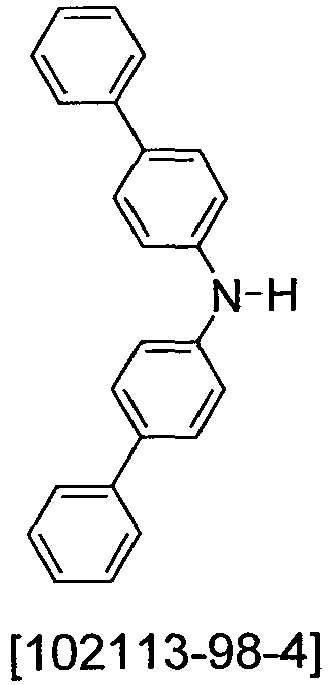


29 % 4 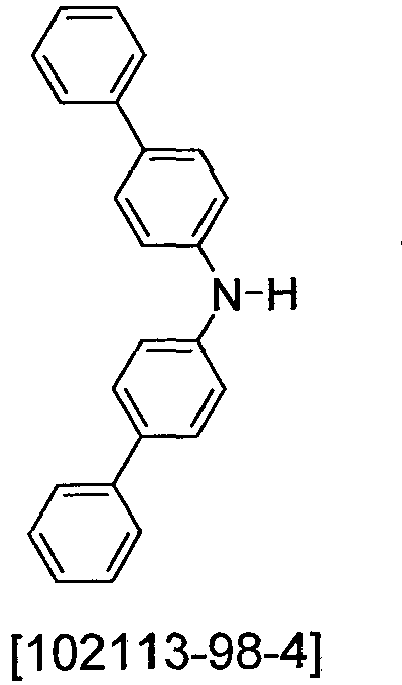


23 % 5 


26 % 6 

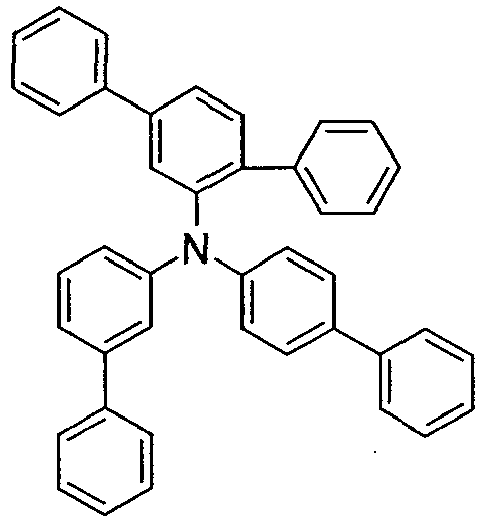
20 % 7 

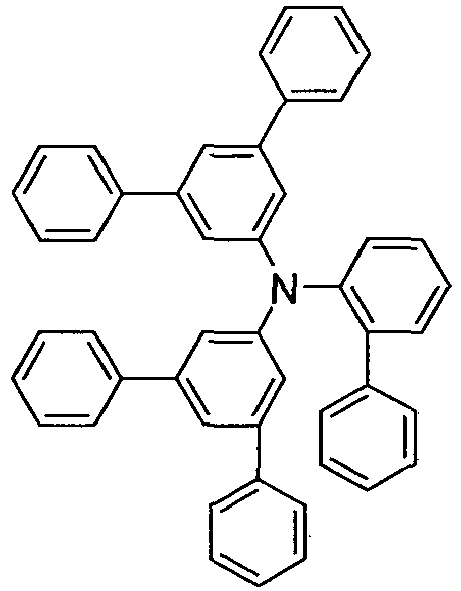
36 % 8 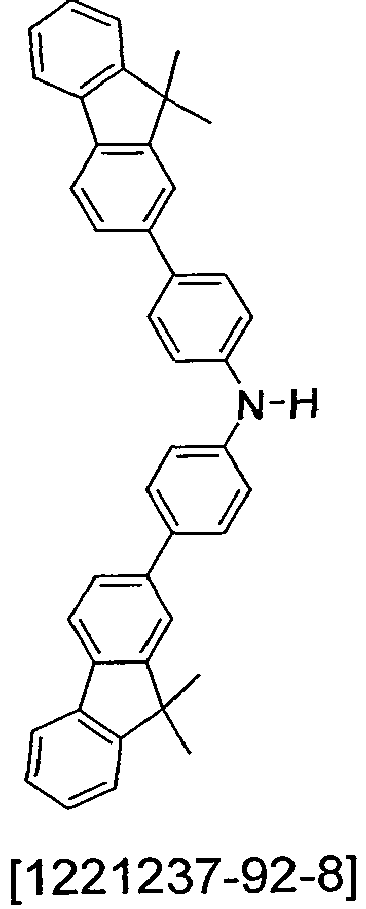


30 % 9 


27 % -

- Ein Gemisch aus 33.8 g (200 mmol) 2-Aminobiphenyl [2052-07-5], 129.9 g (420 mmol) 4-Brom-[1,1'3,3']terphenyl [54590-37-3], 48.1 g (500 mmol) Natrium-tert-butylat, 6.7 g (12 mmol) DPPF, 1.8 g (8 mmol) Palladium(II)acetat und 1500 ml Mesitylen wird 48 h unter Rückfluss erhitzt. Nach Erkalten wird mit 1000 ml Wasser versetzt, 30 min. gerührt, die wässrige Phase wird abgetrennt, die org. Phase wird dreimal mit je 500 ml Wasser gewaschen und dann im Vakuum eingeengt. Der so erhaltene graue Feststoff wird einer Heißextraktion über Alox, basisch, Aktivitätsstufe 1, unterzogen, anschließend fünfmal aus DMF (ca. 2 ml/g) umkristallisiert und dann zweimal fraktioniert sublimiert (p ca. 10-5 mbar, T ca. 300 - 310 °C). Ausbeute: 48.0 g (77 mmol), 38.3 %; Reinheit > 99.9 % n. HPLC.
- Die Herstellung von erfindungsgemäßen OLEDs sowie OLEDs nach dem Stand der Technik erfolgt nach einem allgemeinen Verfahren gemäß
WO 04/058911 - In den folgenden Beispielen V1 bis V6 und E1 bis E12 (siehe Tabellen 1 bis 4) werden die Daten verschiedener OLEDs vorgestellt (V: Beispiele gemäß dem Stand der Technik; E: erfindungsgemäße Beispiele).
- Glasplättchen, die mit strukturiertem ITO (Indium Zinn Oxid) der Dicke 150 nm beschichtet sind, werden zur verbesserten Prozessierung mit 20 nm PEDOT beschichtet (Poly(3,4-ethylendioxy-2,5-thiophen), aus Wasser aufgeschleudert; bezogen von H. C. Starck, Goslar, Deutschland). Diese beschichteten Glasplättchen bilden die Substrate, auf welche die OLEDs aufgebracht werden. Die OLEDs haben prinzipiell folgenden Schichtaufbau: Substrat / Lochinjektionsschicht (HIL) / Lochtransportschichten (HTL) / Zwischenschicht (IL)/optionale Lochtransportschicht (HTL2), Elektronenblockerschicht (EBL)/Emissionsschicht (EML) / Elektronentransportschicht (ETL) und abschließend eine Kathode. Die Kathode wird durch eine 100 nm dicke Aluminiumschicht gebildet. Der genaue Aufbau der OLEDs ist Tabelle 1 und 2 zu entnehmen. Die zur Herstellung der OLEDs benötigten Materialien sind in Tabelle 5 gezeigt.
- Alle Materialien werden in einer Vakuumkammer thermisch aufgedampft. Dabei besteht die Emissionsschicht immer aus mindestens einem Matrixmaterial (Hostmaterial, Wirtsmaterial) und einem emittierenden Dotierstoff (Dotand, Emitter), der dem Matrixmaterial bzw. den Matrixmaterialien durch Coverdampfung in einem bestimmten Volumenanteil beigemischt wird. Eine Angabe wie H1 :SEB1 (95%:5%) bedeutet hierbei, dass das Material H1 in einem Volumenanteil von 95% und SEB1 in einem Anteil von 5% in der Schicht vorliegt. Analog kann auch die Elektronentransportschicht aus einer Mischung von zwei Materialien bestehen.
- Die OLEDs werden standardmäßig charakterisiert. Hierfür werden die Elektrolumineszenzspektren, die Stromeffizienz (gemessen in cd/A), die Leistungseffizienz (gemessen in lm/W) und die externe Quanteneffizienz (EQE, gemessen in Prozent) in Abhängigkeit der Leuchtdichte, berechnet aus Strom-Spannungs-Leuchtdichte-Kennlinien (IUL-Kennlinien) unter Annahme einer lambertschen Abstrahlcharakteristik sowie die Lebensdauer bestimmt. Die Elektrolumineszenzspektren werden bei einer Leuchtdichte von 1000 cd/m2 bestimmt und daraus die CIE 1931 x und y Farbkoordinaten berechnet. Die Angabe U @ 1000 cd/m2 in Tabelle 2 und 4 bezeichnet die Spannung, die für eine Leuchtdichte von 1000 cd/m2 benötigt wird. EQE @ 1000 cd/m2 schließlich bezeichnet die externe Quanteneffizienz bei einer Betriebsleuchtdichte von 1000 cd/m2. LD80 @ 6000 cd/m2 ist die Lebensdauer bis das OLED bei einer Helligkeit von 6000 cd/m2 auf 80 % der Anfangsintensität, also auf 4800 cd/m2 abgefallen ist. Die Daten, die für die verschiedenen OLEDs erhalten wurden, sind in Tabelle 2 und 4 zusammengefasst angegeben.
- Insbesondere eignen sich die erfindungsgemäßen Verbindungen als Lochtransportmaterial, beispielsweise in einer Lochtransportschicht oder in einer Elektronenblockierschicht, in OLEDs. Sie eignen sich als Einzelschicht, aber auch als Mixed- Komponente als HTM, EBM (Elektronenblockiermaterial) oder innerhalb der emittierenden Schicht.
- Verglichen mit Vorrichtungen enthaltend NPB (V1 und V4) zeigen alle Proben mit den erfindungsgemäßen Verbindungen höhere Effizienzen kombiniert mit gleichen oder verbesserten Lebensdauern.
- Im Vergleich zum Referenzmaterial HTMV1 (V2 und V5) haben die erfindungsgemäßen Verbindungen ähnliche Effizienzen und deutlich bessere Lebensdauern im blauen und bessere Lebensdauern in grün emittierenden Vorrichtungen.
- Im Vergleich zum Referenzmaterial HTMV2 (V3 und V6) haben die erfindungsgemäßen Verbindungen ähnliche Effizienzen und deutlich bessere Lebensdauern in grün emittierenden Vorrichtungen und bessere Lebensdauern in blau emittierenden Vorrichtungen.
Tabelle 1: Aufbau der OLEDs Bsp. IL HTL IL HTL2 EBL EML ETL Dicke / nm Dicke / nm Dicke / nm Dicke / nm Dicke / nm Dicke / nm Dicke / nm V1 HIL1 HIL2 HIL1 NPB H1(95%):SEB1(5%) ETM1(50%):LiQ(50%) 5 nm 140 nm 5 nm 20 nm 20 nm 30 nm V2 HIL1 HIL2 HIL1 NPB HTMV1 H1(95%):SEB1(5%) ETM1(50%):LiQ(50%) 5 nm 130 nm 5 nm 10 nm 20 nm 20 nm 30 nm V3 HIL1 HIL2 HIL1 NPB HTMV2 H1(95%):SEB1(5%) ETM1(50%):LiQ(50%) 5 nm 130 nm 5 nm 10 nm 20 nm 20 nm 30 nm E1 HIL1 HIL2 HIL1 NPB HTM1 H1(95%):SEB1(5%) ETM1(50%):LiQ(50%) 5 nm 130 nm 5 nm 10 nm 20 nm 20 nm 30 nm E2 HIL1 HIL2 HIL1 NPB HTM2 H1(95%):SEB1(5%) ETM1(50%):LiQ(50%) 5 nm 130 nm 5nm 10 nm 20 nm 20 nm 30 nm E3 HIL1 HIL2 HIL1 NPB HTM3 H1(95%):SEB1(5%) ETM1(50%):LiQ(50%) 5 nm 130 nm 5 nm 10 nm 20 nm 20 nm 30 nm E4 HIL1 HIL2 HIL1 NPB HTM4 H1(95%):SEB1(5%) ETM1(50%):LiQ(50%) 5 nm 130 nm 5 nm 10 nm 20 nm 20 nm 30 nm E5 HIL1 HIL2 HIL1 NPB HTM5 H1(95%):SEB1(5%) ETM1(50%):LiQ(50%) 5 nm 130 nm 5 nm 10 nm 20 nm 20 nm 30 nm E6 HIL1 HIL2 HIL 1 NPB HTM6 H1(95%):SEB1(5%) ETM1(50%):LiQ(50%) 5 nm 130 nm 5 nm 10 nm 20 nm 20 nm 30 nm Tabelle 2: Daten der OLEDs Bsp. U@ 1000 cd/m2 EQE @ 1000 cd/m2 LD80 @ 6000 cd/m2 CIE V % [h] x y V1 4.7 4.8 70 0.14 0.17 V2 4.2 7.7 100 0.14 0.16 V3 4.6 7.6 115 0.14 0.16 E1 4.5 7.5 120 0.14 0.15 E2 4.6 7.6 125 0.14 0.16 E3 4.5 7.5 120 0.14 0.16 E4 4.6 7.6 130 0.14 0.15 E5 4.5 7.5 120 0.14 0.16 E6 4.4 7.4 120 0.14 0.16 Tabelle 3: Aufbau der OLEDs Bsp. HTL IL HTL2 EBL EML ETL Dicke/nm Dicke/nm Dicke/nm Dicke/nm Dicke/nm Dicke/nm V4 HIL2 HIL1 NPB H2(88%):Irpy(12%) ETM1(50%):LiQ(50%) 70 nm 5 nm 90 nm 30 nm 40 nm V5 HIL2 HIL1 NPB HTMV1 H2(88%):Irpy(12%) ETM1(50%):LiQ(50%) 70 nm 5 nm 10 nm 80 nm 30 nm 40 nm V6 HIL2 HIL1 NPB HTMV2 H2(88%):Irpy(12%) ETM1(50%):LiQ(50%) 70 nm 5 nm 10 nm 80 nm 30 nm 40 nm E7 HIL2 HIL1 NPB HTM1 H2(88%):Irpy(12%) ETM1(50%):LiQ(50%) 70 nm 5 nm 10 nm 80 nm 30 nm 40 nm E8 HIL2 HIL1 NPB HTM2 H2(88%):Irpy(12%) ETM1(50%):LiQ(50%) 70 nm 5 nm 10 nm 80 nm 30 nm 40 nm E9 HIL2 HIL1 NPB HTM3 H2(88%):Irpy(12%) ETM1(50%):LiQ(50%) 70 nm 5 nm 10 nm 80 nm 30 nm 40 nm E10 HIL2 HIL1 NPB HTM2 H2(88%):Irpy(12%) ETM1(50%):LiQ(50%) 70 nm 5 nm 10 nm 80 nm 30 nm 40 nm E11 HIL2 HIL1 NPB HTM3 H2(88%):Irpy(12%) ETM1(50%):LiQ(50%) 70 nm 5 nm 10 nm 80 nm 30 nm 40 nm E12 HIL2 HIL1 NPB HTM2 H2(88%):Irpy(12%) ETM1(50%):LiQ(50%) 70 nm 5 nm 10 nm 80 nm 30 nm 40 nm Tabelle 4: Daten der OLEDs Bsp. U @ 1000 cd/m2 EQE @ 1000 cd/m2 LD80 @ 8000 cd/m2 CIE V % [h] x y V4 3.6 14.4 85 0.32 0.63 V5 3.6 17.8 120 0.35 0.62 V6 3.6 17.8 115 0.34 0.62 E7 3.5 17.7 145 0.34 0.63 E8 3.5 17.3 150 0.36 0.62 E9 3.6 17.5 140 0.35 0.62 E10 3.6 17.8 125 0.34 0.63 E11 3.6 17.7 145 0.35 0.63 E12 3.5 17.3 145 0.35 0.62 Tabelle 5: Strukturen der verwendeten Materialien 


HIL1 HIL2 NPB 


ETM1 AlQ3 H1 


SEB1 LiQ H2 


Irpy HTMV1 HTMV2 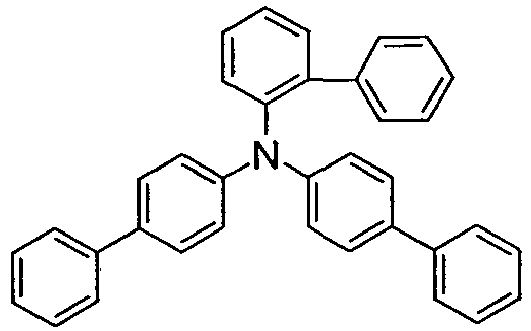


HTM1 HTM2 HTM3 


HTM4 HTM5 HTM6


Claims (16)
- Verbindung der Formel (I)
 Z ist bei jedem Auftreten gleich oder verschieden CR1 oder N, wobei Z gleich C ist, wenn eine Gruppe Ar1 oder Ar2 gebunden ist;W ist gleich CH oder N;Ar1 ist bei jedem Auftreten gleich oder verschieden ein aromatisches Ringsystem mit 6 bis 30 aromatischen Ringatomen, welches mit einem oder mehreren Resten R1 substituiert sein kann;Ar2 ist bei jedem Auftreten gleich oder verschieden ein aromatisches Ringsystem mit 6 bis 24 aromatischen Ringatomen, welches mit einem oder mehreren Resten R1 substituiert sein kann;R1 ist bei jedem Auftreten gleich oder verschieden H, D, F, Cl, Br, I, C(=O)R2, CN, Si(R2)3, NO2, P(=O)(R2)2, S(=O)R2, S(=O)2R2, eine geradkettige Alkyl-, Alkoxy- oder Thio-alkylgruppe mit 1 bis 20 C-Atomen oder eine verzweigte oder cyclische Alkyl-, Alkoxy- oder Thioalkylgruppe mit 3 bis 20 C-Atomen oder eine Alkenyl- oder Alkinylgruppe mit 2 bis 20 C-Atomen, wobei die oben genannten Gruppen jeweils mit einem oder mehreren Resten R2 substituiert sein können und wobei eine oder mehrere CH2-Gruppen in den oben genannten Gruppen durch -R2C=CR2-, -C≡C-, Si(R2)2, C=O, C=S, C=NR2, -C(=O)O-, -C(=O)NR2-, NR2, P(=O)(R2), -O-,-S-, SO oder SO2 ersetzt sein können und wobei ein oder mehrere H-Atome in den oben genannten Gruppen durch D, F, Cl, Br, I, CN oder NO2 ersetzt sein können, oder ein aromatisches Ringsystem mit 6 bis 30 aromatischen Ring-atomen, das jeweils durch einen oder mehrere Reste R2 substituiert sein kann;R2 ist bei jedem Auftreten gleich oder verschieden H, D, F, Cl, Br, I, C(=O)R3, CN, Si(R3)3, NO2, P(=O)(R3)2, S(=O)R3, S(=O)2R3, eine geradkettige Alkyl-, Alkoxy- oder Thio-alkylgruppe mit 1 bis 20 C-Atomen oder eine verzweigte oder cyclische Alkyl-, Alkoxy- oder Thioalkylgruppe mit 3 bis 20 C-Atomen oder eine Alkenyl- oder Alkinylgruppe mit 2 bis 20 C-Atomen, wobei die oben genannten Gruppen jeweils mit einem oder mehreren Resten R3 substituiert sein können und wobei eine oder mehrere CH2-Gruppen in den oben genannten Gruppen durch -R3C=CR3-, -C≡C-, Si(R3)2, C=O, C=S, C=NR3, -C(=O)O-, -C(=O)NR3-, NR3, P(=O)(R3), -O-, -S-, SO oder SO2 ersetzt sein können und wobei ein oder mehrere H-Atome in den oben genannten Gruppen durch D, F, Cl, Br, I, CN oder NO2 ersetzt sein können, oder ein aromatisches Ringsystem mit 6 bis 30 aromatischen Ring-atomen, das jeweils durch einen oder mehrere Reste R3 substituiert sein kann;R3 ist bei jedem Auftreten gleich oder verschieden H, D, F oder ein aliphatischer oder aromatischer organischer Rest mit 1 bis 20 C-Atomen, in dem auch ein oder mehrere H-Atome durch D oder F ersetzt sein können;n ist bei jedem Auftreten gleich oder verschieden 0, 1, 2, 3, 4 oder 5;m ist bei jedem Auftreten gleich oder verschieden 0, 1, 2 oder 3;wobei die drei Gruppen, welche an das zentrale Stickstoffatom binden, als ganze gesehen, nicht alle identisch sind,
wobei die Summe der Indices n mindestens gleich 2 ist, und
wobei die folgenden Verbindungen vom Anspruchsumfang ausgenommen sind:
- Verbindung nach Anspruch 1, dadurch gekennzeichnet, dass sie außer der in Formel (I) abgebildeten Triarylaminogruppe keine weitere Arylaminogruppe umfasst.
- Verbindung nach Anspruch 1 oder 2, dadurch gekennzeichnet, dass sie keine Heteroarylgruppe und kein heteroaromatisches Ringsystem umfasst.
- Verbindung nach einem oder mehreren der Ansprüche 1 bis 3, dadurch gekennzeichnet, dass die Gruppe W gleich CH ist.
- Verbindung nach einem oder mehreren der Ansprüche 1 bis 4, dadurch gekennzeichnet, dass 0, 1, 2 oder 3 Gruppen Z in einem Ring gleich N sind, wobei nicht mehr als zwei benachbarte Gruppen Z gleich N sind.
- Verbindung nach einem oder mehreren der Ansprüche 1 bis 5, dadurch gekennzeichnet, dass Ar1 bei jedem Auftreten gleich oder verschieden ein aromatisches Ringsystem mit 6 bis 18 aromatischen Ringatomen ist, das mit einem oder mehreren Resten R1 substituiert sein kann.
- Verbindung nach einem oder mehreren der Ansprüche 1 bis 6, dadurch gekennzeichnet, dass mindestens eine der Gruppen Ar1 in der Verbindung gemäß Formel (I) an den Sechsring in meta-Position zur Bindung an das zentrale Stickstoffatom gebunden ist.
- Verbindung nach nach einem oder mehreren der Ansprüche 1 bis 7, dadurch gekennzeichnet, dass Ar2 bei jedem Auftreten gleich oder verschieden ein aromatisches Ringsystem mit 6 bis 12 aromatischen Ringatomen ist, das mit einem oder mehreren Resten R1 substituiert sein kann.
- Verbindung nach nach einem oder mehreren der Ansprüche 1 bis 8, dadurch gekennzeichnet, dass n gleich 1 oder 2 ist.
- Verbindung nach nach einem oder mehreren der Ansprüche 1 bis 9, dadurch gekennzeichnet, dass m gleich 0 oder 1 ist, bevorzugt 0.
- Verbindung nach einem oder mehreren der Ansprüche 1 bis 10, dadurch gekennzeichnet, dass keine Gruppe Ar1 am Sechsring in ortho-Position zur Bindung an das zentrale Stickstoffatom gebunden ist.
- Verfahren zur Herstellung einer Verbindung nach einem oder mehreren der Ansprüche 1 bis 11, dadurch gekennzeichnet, dass eine Arylverbindung enthaltend eine Aminogruppe und eine Arylverbindung enthaltend eine Abgangsgruppe in einer übergangsmetallkatalysierten Kupplungsreaktion miteinander verknüpft werden.
- Oligomer, Polymer oder Dendrimer enthaltend eine oder mehrere Verbindungen nach einem oder mehreren der Ansprüche 1 bis 11, wobei die Bindungen zum Oligomer, Polymer oder Dendrimer an beliebigen, in Formel (I) mit R1 substituierten Positionen lokalisiert sein können.
- Formulierung enthaltend mindestens eine Verbindung nach einem oder mehreren der Ansprüche 1 bis 11 oder mindestens ein Polymer, Oligomer oder Dendrimer gemäß Anspruch 13 und mindestens ein Lösungsmittel.
- Elektronische Vorrichtung, ausgewählt aus organischen integrierten Schaltungen (O-ICs), organischen Feld-Effekt-Transistoren (O-FETs), organischen Dünnfilmtransistoren (O-TFTs), organischen lichtemittierenden Transistoren (O-LETs), organischen Solarzellen (O-SCs), organischen optischen Detektoren, organischen Photorezeptoren, organischen Feld-Quench-Devices (O-FQDs), lichtemittierenden elektrochemischen Zellen (LECs), organischen Laserdioden (O-Laser) und organischen Elektrolumineszenzvorrichtungen (OLEDs), dadurch gekennzeichnet, dass sie mindestens eine Verbindung nach einem oder mehreren der Ansprüche 1 bis 11 oder mindestens ein Polymer, Oligomer oder Dendrimer nach Anspruch 13 enthält.
- Elektronische Vorrichtung nach Anspruch 15, ausgewählt aus organischen Elektrolumineszenzvorrichtungen, dadurch gekennzeichnet, dass die Verbindung nach einem oder mehreren der Ansprüche 1 bis 11 in einer oder mehreren der folgenden Schichten eingesetzt wird:- in einer Lochtransportschicht, einer Lochinjektionsschicht oder einer Elektronenblockierschicht als Lochtransportmaterial,- in einer emittierenden Schicht als Matrixmaterial in Kombination mit einem oder mehreren fluoreszierenden oder phosphoreszierenden Dotanden.
Priority Applications (1)
| Application Number | Priority Date | Filing Date | Title |
|---|---|---|---|
| EP12788444.3A EP2791105B1 (de) | 2011-12-12 | 2012-11-15 | Verbindungen für elektronische vorrichtungen |
Applications Claiming Priority (3)
| Application Number | Priority Date | Filing Date | Title |
|---|---|---|---|
| EP11009779 | 2011-12-12 | ||
| PCT/EP2012/004744 WO2013087142A1 (de) | 2011-12-12 | 2012-11-15 | Verbindungen für elektronische vorrichtungen |
| EP12788444.3A EP2791105B1 (de) | 2011-12-12 | 2012-11-15 | Verbindungen für elektronische vorrichtungen |
Publications (2)
| Publication Number | Publication Date |
|---|---|
| EP2791105A1 EP2791105A1 (de) | 2014-10-22 |
| EP2791105B1 true EP2791105B1 (de) | 2020-03-18 |
Family
ID=47216194
Family Applications (1)
| Application Number | Title | Priority Date | Filing Date |
|---|---|---|---|
| EP12788444.3A Active EP2791105B1 (de) | 2011-12-12 | 2012-11-15 | Verbindungen für elektronische vorrichtungen |
Country Status (6)
| Country | Link |
|---|---|
| US (3) | US10008672B2 (de) |
| EP (1) | EP2791105B1 (de) |
| JP (2) | JP6570834B2 (de) |
| KR (3) | KR20180126629A (de) |
| CN (2) | CN105742499B (de) |
| WO (1) | WO2013087142A1 (de) |
Families Citing this family (106)
| Publication number | Priority date | Publication date | Assignee | Title |
|---|---|---|---|---|
| KR20180126629A (ko) * | 2011-12-12 | 2018-11-27 | 메르크 파텐트 게엠베하 | 전자 소자용 화합물 |
| CN107445930A (zh) | 2012-08-31 | 2017-12-08 | 出光兴产株式会社 | 芳香族胺衍生物和使用了其的有机电致发光元件 |
| JP6490685B2 (ja) * | 2013-07-29 | 2019-03-27 | メルク、パテント、ゲゼルシャフト、ミット、ベシュレンクテル、ハフツングMerck Patent GmbH | 電気光学素子およびその使用 |
| US20160163987A1 (en) * | 2013-07-29 | 2016-06-09 | Merck Patent Gmbh | Electro-optical device and the use thereof |
| EP4345089A3 (de) | 2013-10-11 | 2024-06-26 | Idemitsu Kosan Co.,Ltd. | Aromatische aminverbindung, organisches elektrolumineszenzelement und elektronische vorrichtung |
| JP6157718B2 (ja) | 2014-02-28 | 2017-07-05 | 出光興産株式会社 | 化合物、有機エレクトロルミネッセンス素子用材料、有機エレクトロルミネッセンス素子及び電子機器 |
| EP3168887B1 (de) * | 2014-07-09 | 2024-10-23 | Hodogaya Chemical Co., Ltd. | Organisches elektrolumineszentes element |
| US10756275B2 (en) | 2014-07-11 | 2020-08-25 | Idemitsu Kosan Co., Ltd. | Compound, material for organic electroluminescence devices, organic electroluminescence device, and electronic equipment |
| EP3018120B1 (de) | 2014-07-11 | 2020-04-15 | Idemitsu Kosan Co., Ltd | Verbindung, material für organische elektrolumineszierende vorrichtung, organische elektrolumineszierende vorrichtung und elektronische ausrüstung |
| JP6552802B2 (ja) | 2014-10-21 | 2019-07-31 | 三星ディスプレイ株式會社Samsung Display Co.,Ltd. | 有機エレクトロルミネッセンス素子用材料及びそれを用いた有機エレクトロルミネッセンス素子 |
| JP2016108290A (ja) | 2014-12-09 | 2016-06-20 | 三星ディスプレイ株式會社Samsung Display Co.,Ltd. | アミン誘導体、および有機エレクトロルミネッセンス素子 |
| WO2016104289A1 (ja) * | 2014-12-24 | 2016-06-30 | 保土谷化学工業株式会社 | 有機エレクトロルミネッセンス素子 |
| KR102433462B1 (ko) * | 2014-12-30 | 2022-08-17 | 메르크 파텐트 게엠베하 | 적어도 하나의 폴리머 및 적어도 하나의 염을 포함하는 조성물 및 이 조성물을 포함하는 전계발광 디바이스 |
| EP3244465B1 (de) * | 2015-01-08 | 2022-04-20 | Hodogaya Chemical Co., Ltd. | Organisches elektrolumineszentes element |
| JP6715781B2 (ja) * | 2015-02-03 | 2020-07-01 | 保土谷化学工業株式会社 | 有機エレクトロルミネッセンス素子 |
| US9929361B2 (en) | 2015-02-16 | 2018-03-27 | Universal Display Corporation | Organic electroluminescent materials and devices |
| US11056657B2 (en) | 2015-02-27 | 2021-07-06 | University Display Corporation | Organic electroluminescent materials and devices |
| US9859510B2 (en) | 2015-05-15 | 2018-01-02 | Universal Display Corporation | Organic electroluminescent materials and devices |
| US10418568B2 (en) | 2015-06-01 | 2019-09-17 | Universal Display Corporation | Organic electroluminescent materials and devices |
| US11127905B2 (en) | 2015-07-29 | 2021-09-21 | Universal Display Corporation | Organic electroluminescent materials and devices |
| US10361381B2 (en) | 2015-09-03 | 2019-07-23 | Universal Display Corporation | Organic electroluminescent materials and devices |
| EP3389106B1 (de) * | 2015-12-08 | 2021-12-01 | Hodogaya Chemical Co., Ltd. | Organisches elektrolumineszentes element |
| US20170229663A1 (en) | 2016-02-09 | 2017-08-10 | Universal Display Corporation | Organic electroluminescent materials and devices |
| US10236456B2 (en) | 2016-04-11 | 2019-03-19 | Universal Display Corporation | Organic electroluminescent materials and devices |
| US10672997B2 (en) | 2016-06-20 | 2020-06-02 | Universal Display Corporation | Organic electroluminescent materials and devices |
| US10862054B2 (en) | 2016-06-20 | 2020-12-08 | Universal Display Corporation | Organic electroluminescent materials and devices |
| US11482683B2 (en) | 2016-06-20 | 2022-10-25 | Universal Display Corporation | Organic electroluminescent materials and devices |
| US10608186B2 (en) | 2016-09-14 | 2020-03-31 | Universal Display Corporation | Organic electroluminescent materials and devices |
| KR102666512B1 (ko) | 2016-09-22 | 2024-05-20 | 삼성디스플레이 주식회사 | 아민 화합물 및 이를 포함하는 유기 전계 발광 소자 |
| US10680187B2 (en) | 2016-09-23 | 2020-06-09 | Universal Display Corporation | Organic electroluminescent materials and devices |
| US11196010B2 (en) | 2016-10-03 | 2021-12-07 | Universal Display Corporation | Organic electroluminescent materials and devices |
| US11011709B2 (en) | 2016-10-07 | 2021-05-18 | Universal Display Corporation | Organic electroluminescent materials and devices |
| US12317745B2 (en) | 2016-11-09 | 2025-05-27 | Universal Display Corporation | Organic electroluminescent materials and devices |
| US10680188B2 (en) | 2016-11-11 | 2020-06-09 | Universal Display Corporation | Organic electroluminescent materials and devices |
| KR102765129B1 (ko) | 2016-12-05 | 2025-02-12 | 삼성디스플레이 주식회사 | 아민 화합물 및 이를 포함하는 유기 전계 발광 소자 |
| US11780865B2 (en) | 2017-01-09 | 2023-10-10 | Universal Display Corporation | Organic electroluminescent materials and devices |
| US10844085B2 (en) | 2017-03-29 | 2020-11-24 | Universal Display Corporation | Organic electroluminescent materials and devices |
| US10944060B2 (en) | 2017-05-11 | 2021-03-09 | Universal Display Corporation | Organic electroluminescent materials and devices |
| US12098157B2 (en) | 2017-06-23 | 2024-09-24 | Universal Display Corporation | Organic electroluminescent materials and devices |
| US11228010B2 (en) | 2017-07-26 | 2022-01-18 | Universal Display Corporation | Organic electroluminescent materials and devices |
| US11744142B2 (en) | 2017-08-10 | 2023-08-29 | Universal Display Corporation | Organic electroluminescent materials and devices |
| US11605780B2 (en) | 2017-08-28 | 2023-03-14 | Toray Industries, Inc. | Compound, light-emitting element containing the same, display device, and lighting device |
| US12180230B2 (en) | 2017-11-28 | 2024-12-31 | University Of Southern California | Carbene compounds and organic electroluminescent devices |
| EP3492480B1 (de) | 2017-11-29 | 2021-10-20 | Universal Display Corporation | Organische elektrolumineszente materialien und vorrichtungen |
| US11937503B2 (en) | 2017-11-30 | 2024-03-19 | Universal Display Corporation | Organic electroluminescent materials and devices |
| JP6957371B2 (ja) * | 2018-01-25 | 2021-11-02 | エルジー・ケム・リミテッド | 2−(2’−ジアリールアミノフェニル)ボラベンゼン誘導体及び前記誘導体を含む有機電子デバイス |
| US11542289B2 (en) | 2018-01-26 | 2023-01-03 | Universal Display Corporation | Organic electroluminescent materials and devices |
| US11165028B2 (en) | 2018-03-12 | 2021-11-02 | Universal Display Corporation | Organic electroluminescent materials and devices |
| WO2019233429A1 (zh) * | 2018-06-07 | 2019-12-12 | 江苏三月光电科技有限公司 | 一种以三芳胺结构为核心的化合物及其制备方法 |
| US12453279B2 (en) | 2018-08-22 | 2025-10-21 | Universal Display Corporation | Organic electroluminescent materials and devices |
| US11737349B2 (en) | 2018-12-12 | 2023-08-22 | Universal Display Corporation | Organic electroluminescent materials and devices |
| US11780829B2 (en) | 2019-01-30 | 2023-10-10 | The University Of Southern California | Organic electroluminescent materials and devices |
| US12477890B2 (en) | 2019-02-01 | 2025-11-18 | Universal Display Corporation | Organic electroluminescent materials and devices |
| JP2020158491A (ja) | 2019-03-26 | 2020-10-01 | ユニバーサル ディスプレイ コーポレイション | 有機エレクトロルミネセンス材料及びデバイス |
| KR102839495B1 (ko) * | 2019-05-17 | 2025-07-28 | 삼성디스플레이 주식회사 | 아릴아민 화합물 및 이를 포함한 유기 발광 소자 |
| CN110156611B (zh) * | 2019-05-23 | 2022-11-11 | 武汉尚赛光电科技有限公司 | 一种苯基枝化发光材料及其有机电致发光器件 |
| US12281128B2 (en) | 2019-07-30 | 2025-04-22 | Universal Display Corporation | Organic electroluminescent materials and devices |
| US12139501B2 (en) | 2019-08-16 | 2024-11-12 | Universal Display Corporation | Organic electroluminescent materials and devices |
| US20210135130A1 (en) | 2019-11-04 | 2021-05-06 | Universal Display Corporation | Organic electroluminescent materials and devices |
| US12538698B2 (en) | 2020-01-06 | 2026-01-27 | Universal Display Corporation | Organic electroluminescent materials and devices |
| US12426495B2 (en) | 2020-01-28 | 2025-09-23 | Universal Display Corporation | Organic electroluminescent materials and devices |
| CN120398697A (zh) * | 2020-03-31 | 2025-08-01 | 出光兴产株式会社 | 化合物、有机电致发光元件用材料、有机电致发光元件和电子设备 |
| EP3937268B1 (de) | 2020-07-10 | 2025-05-07 | Universal Display Corporation | Plasmonische oleds und vertikale dipolstrahler |
| US12187748B2 (en) | 2020-11-02 | 2025-01-07 | Universal Display Corporation | Organic electroluminescent materials and devices |
| US20220158096A1 (en) | 2020-11-16 | 2022-05-19 | Universal Display Corporation | Organic electroluminescent materials and devices |
| US20220165967A1 (en) | 2020-11-24 | 2022-05-26 | Universal Display Corporation | Organic electroluminescent materials and devices |
| US12325717B2 (en) | 2020-11-24 | 2025-06-10 | Universal Display Corporation | Organic electroluminescent materials and devices |
| CN114597318A (zh) * | 2020-12-03 | 2022-06-07 | 固安鼎材科技有限公司 | 一种有机电致发光器件 |
| US12575316B2 (en) | 2021-02-03 | 2026-03-10 | Universal Display Corporation | Organic electroluminescent materials and devices |
| EP4059915B1 (de) | 2021-02-26 | 2025-12-24 | Universal Display Corporation | Organische elektrolumineszente materialien und vorrichtungen |
| EP4060758A3 (de) | 2021-02-26 | 2023-03-29 | Universal Display Corporation | Organische elektrolumineszente materialien und vorrichtungen |
| US12624055B2 (en) | 2021-03-01 | 2026-05-12 | Universal Display Corporation | Organic electroluminescent materials and devices |
| US12606582B2 (en) | 2021-03-05 | 2026-04-21 | Universal Display Corporation | Organic electroluminescent materials and devices |
| US12428599B2 (en) | 2021-03-09 | 2025-09-30 | Universal Display Corporation | Organic electroluminescent materials and devices |
| US20220298190A1 (en) | 2021-03-12 | 2022-09-22 | Universal Display Corporation | Organic electroluminescent materials and devices |
| US12421262B2 (en) | 2021-03-15 | 2025-09-23 | Universal Display Corporation | Organic electroluminescent materials and devices |
| US20220340607A1 (en) | 2021-04-05 | 2022-10-27 | Universal Display Corporation | Organic electroluminescent materials and devices |
| US12480042B2 (en) | 2021-04-09 | 2025-11-25 | Universal Display Corporation | Organic electroluminescent materials and devices |
| EP4075531A1 (de) | 2021-04-13 | 2022-10-19 | Universal Display Corporation | Plasmonische oleds und vertikale dipolstrahler |
| US20220352478A1 (en) | 2021-04-14 | 2022-11-03 | Universal Display Corporation | Organic eletroluminescent materials and devices |
| KR20220144032A (ko) * | 2021-04-16 | 2022-10-26 | 삼성디스플레이 주식회사 | 발광 소자 및 상기 발광 소자를 포함한 전자 장치 |
| US20220407020A1 (en) | 2021-04-23 | 2022-12-22 | Universal Display Corporation | Organic electroluminescent materials and devices |
| US20230006149A1 (en) | 2021-04-23 | 2023-01-05 | Universal Display Corporation | Organic electroluminescent materials and devices |
| WO2022243403A1 (de) | 2021-05-21 | 2022-11-24 | Merck Patent Gmbh | Verfahren zur kontinuierlichen aufreinigung von mindestens einem funktionalen material und vorrichtung zur kontinuierlichen aufreinigung von mindestens einem funktionalen material |
| US20230133787A1 (en) | 2021-06-08 | 2023-05-04 | University Of Southern California | Molecular Alignment of Homoleptic Iridium Phosphors |
| KR20240019764A (ko) | 2021-06-09 | 2024-02-14 | 이데미쓰 고산 가부시키가이샤 | 화합물, 유기 전기발광 소자용 재료, 유기 전기발광 소자 및 전자 기기 |
| US12550611B2 (en) | 2021-08-03 | 2026-02-10 | Universal Display Corporation | Organic electroluminescent materials and devices |
| EP4151699A1 (de) | 2021-09-17 | 2023-03-22 | Universal Display Corporation | Organische elektrolumineszente materialien und vorrichtungen |
| US12473318B2 (en) | 2021-10-08 | 2025-11-18 | Universal Display Corporation | Organic electroluminescent materials and devices |
| US12509628B2 (en) | 2021-12-16 | 2025-12-30 | Universal Display Corporation | Organic electroluminescent materials and devices |
| KR20240128838A (ko) | 2021-12-24 | 2024-08-27 | 이데미쓰 고산 가부시키가이샤 | 화합물, 유기 전기발광 소자용 재료, 유기 전기발광 소자 및 전자 기기 |
| EP4231804A3 (de) | 2022-02-16 | 2023-09-20 | Universal Display Corporation | Organische elektrolumineszente materialien und vorrichtungen |
| US20230292592A1 (en) | 2022-03-09 | 2023-09-14 | Universal Display Corporation | Organic electroluminescent materials and devices |
| US20230337516A1 (en) | 2022-04-18 | 2023-10-19 | Universal Display Corporation | Organic electroluminescent materials and devices |
| US20230389421A1 (en) | 2022-05-24 | 2023-11-30 | Universal Display Corporation | Organic electroluminescent materials and devices |
| EP4293001A1 (de) | 2022-06-08 | 2023-12-20 | Universal Display Corporation | Organische elektrolumineszente materialien und vorrichtungen |
| US20240016051A1 (en) | 2022-06-28 | 2024-01-11 | Universal Display Corporation | Organic electroluminescent materials and devices |
| US20240107880A1 (en) | 2022-08-17 | 2024-03-28 | Universal Display Corporation | Organic electroluminescent materials and devices |
| US20240180025A1 (en) | 2022-10-27 | 2024-05-30 | Universal Display Corporation | Organic electroluminescent materials and devices |
| US20240188316A1 (en) | 2022-10-27 | 2024-06-06 | Universal Display Corporation | Organic electroluminescent materials and devices |
| US20240188319A1 (en) | 2022-10-27 | 2024-06-06 | Universal Display Corporation | Organic electroluminescent materials and devices |
| US20240188419A1 (en) | 2022-10-27 | 2024-06-06 | Universal Display Corporation | Organic electroluminescent materials and devices |
| US20240196730A1 (en) | 2022-10-27 | 2024-06-13 | Universal Display Corporation | Organic electroluminescent materials and devices |
| US20240247017A1 (en) | 2022-12-14 | 2024-07-25 | Universal Display Corporation | Organic electroluminescent materials and devices |
| US20250204239A1 (en) | 2023-12-15 | 2025-06-19 | Universal Display Corporation | Organic electroluminescent materials and devices |
| US20250204238A1 (en) | 2023-12-15 | 2025-06-19 | Universal Display Corporation | Organic electroluminscent materials and devices |
Citations (8)
| Publication number | Priority date | Publication date | Assignee | Title |
|---|---|---|---|---|
| JPH1095972A (ja) * | 1996-08-02 | 1998-04-14 | Mitsui Petrochem Ind Ltd | 有機電界発光素子 |
| JP2003201472A (ja) * | 2001-10-26 | 2003-07-18 | Toyo Ink Mfg Co Ltd | 有機エレクトロルミネッセンス素子用材料およびそれを使用した有機エレクトロルミネッセンス素子 |
| EP1683804A2 (de) * | 2003-11-04 | 2006-07-26 | Takasago International Corporation | Platinkomplex und lumineszentes element |
| JP2009147276A (ja) * | 2007-12-18 | 2009-07-02 | Canon Inc | 有機発光素子 |
| US20100099890A1 (en) * | 2008-10-17 | 2010-04-22 | Semiconductor Energy Laboratory Co., Ltd. | Anthracene derivative and light-emitting devices, electronic devices, and lighting device using the anthracene derivative |
| US20100237339A1 (en) * | 2009-03-20 | 2010-09-23 | Semiconductor Energy Laboratory Co., Ltd. | Carbazole Derivative with Heteroaromatic Ring, and Light-Emitting Element, Light-Emitting Device, and Electronic Device Using Carbazole Derivative with Heteroaromatic Ring |
| JP2011084717A (ja) * | 2009-09-18 | 2011-04-28 | Toyo Ink Mfg Co Ltd | 有機エレクトロルミネッセンス素子用材料およびその用途 |
| US20110198581A1 (en) * | 2008-10-17 | 2011-08-18 | Mitsui Chemicals, Inc. | Aromatic amine derivative and organic electroluminescent device using the same |
Family Cites Families (101)
| Publication number | Priority date | Publication date | Assignee | Title |
|---|---|---|---|---|
| US4539507A (en) | 1983-03-25 | 1985-09-03 | Eastman Kodak Company | Organic electroluminescent devices having improved power conversion efficiencies |
| US4992350A (en) * | 1988-09-30 | 1991-02-12 | Ricoh Company, Ltd. | Biphenyl compounds and electrophotographic photoconductor comprising the same |
| EP0376311B1 (de) | 1988-12-29 | 1995-04-05 | Canon Kabushiki Kaisha | Lichtempfindliches Element für Elektrophotographie |
| JPH02178667A (ja) | 1988-12-29 | 1990-07-11 | Canon Inc | 電子写真感光体 |
| US5262261A (en) | 1988-12-29 | 1993-11-16 | Canon Kabushiki Kaisha | Photosensitive member for electrophotography |
| JP2881211B2 (ja) * | 1989-09-30 | 1999-04-12 | 株式会社リコー | 電子写真感光体の疲労回復方法 |
| DE4111878A1 (de) | 1991-04-11 | 1992-10-15 | Wacker Chemie Gmbh | Leiterpolymere mit konjugierten doppelbindungen |
| US5151629A (en) | 1991-08-01 | 1992-09-29 | Eastman Kodak Company | Blue emitting internal junction organic electroluminescent device (I) |
| JP3572649B2 (ja) | 1993-06-04 | 2004-10-06 | 大日本インキ化学工業株式会社 | ターフェニル誘導体及びそれを用いた電子写真感光体 |
| JP3278252B2 (ja) | 1993-08-12 | 2002-04-30 | 靖彦 城田 | 有機el素子 |
| JPH07133483A (ja) | 1993-11-09 | 1995-05-23 | Shinko Electric Ind Co Ltd | El素子用有機発光材料及びel素子 |
| EP0676461B1 (de) | 1994-04-07 | 2002-08-14 | Covion Organic Semiconductors GmbH | Spiroverbindungen und ihre Verwendung als Elektrolumineszenzmaterialien |
| JPH086267A (ja) * | 1994-06-23 | 1996-01-12 | Dainippon Ink & Chem Inc | 光導電層形成用樹脂組成物及び該組成物を用いた電子写真感光体 |
| DE4436773A1 (de) | 1994-10-14 | 1996-04-18 | Hoechst Ag | Konjugierte Polymere mit Spirozentren und ihre Verwendung als Elektrolumineszenzmaterialien |
| JP3865406B2 (ja) | 1995-07-28 | 2007-01-10 | 住友化学株式会社 | 2,7−アリール−9−置換フルオレン及び9−置換フルオレンオリゴマー及びポリマー |
| DE19614971A1 (de) | 1996-04-17 | 1997-10-23 | Hoechst Ag | Polymere mit Spiroatomen und ihre Verwendung als Elektrolumineszenzmaterialien |
| JPH09325508A (ja) | 1996-06-03 | 1997-12-16 | Dainippon Ink & Chem Inc | 電子写真感光体 |
| DE19652261A1 (de) | 1996-12-16 | 1998-06-18 | Hoechst Ag | Arylsubstituierte Poly(p-arylenvinylene), Verfahren zur Herstellung und deren Verwendung in Elektroluminszenzbauelementen |
| DE19846766A1 (de) | 1998-10-10 | 2000-04-20 | Aventis Res & Tech Gmbh & Co | Konjugierte Polymere, enthaltend spezielle Fluorenbausteine mit verbesserten Eigenschaften |
| JP3694606B2 (ja) | 1999-01-29 | 2005-09-14 | 京セラミタ株式会社 | スチルベン誘導体、その製造方法および電子写真感光体 |
| US6166172A (en) | 1999-02-10 | 2000-12-26 | Carnegie Mellon University | Method of forming poly-(3-substituted) thiophenes |
| KR100913568B1 (ko) | 1999-05-13 | 2009-08-26 | 더 트러스티즈 오브 프린스턴 유니버시티 | 전계인광에 기초한 고 효율의 유기 발광장치 |
| WO2001041512A1 (en) | 1999-12-01 | 2001-06-07 | The Trustees Of Princeton University | Complexes of form l2mx as phosphorescent dopants for organic leds |
| TW532048B (en) | 2000-03-27 | 2003-05-11 | Idemitsu Kosan Co | Organic electroluminescence element |
| US20020121638A1 (en) | 2000-06-30 | 2002-09-05 | Vladimir Grushin | Electroluminescent iridium compounds with fluorinated phenylpyridines, phenylpyrimidines, and phenylquinolines and devices made with such compounds |
| CN101924190B (zh) | 2000-08-11 | 2012-07-04 | 普林斯顿大学理事会 | 有机金属化合物和发射转换有机电致磷光 |
| JP4154140B2 (ja) | 2000-09-26 | 2008-09-24 | キヤノン株式会社 | 金属配位化合物 |
| JP4154139B2 (ja) | 2000-09-26 | 2008-09-24 | キヤノン株式会社 | 発光素子 |
| JP4154138B2 (ja) | 2000-09-26 | 2008-09-24 | キヤノン株式会社 | 発光素子、表示装置及び金属配位化合物 |
| GB0031634D0 (en) * | 2000-12-23 | 2001-02-07 | Johnson Matthey Plc | Organic materials |
| GB0104177D0 (en) | 2001-02-20 | 2001-04-11 | Isis Innovation | Aryl-aryl dendrimers |
| EP1370619B1 (de) | 2001-03-10 | 2006-06-21 | MERCK PATENT GmbH | Lösung und dispersionen organischer halbleiter |
| US6787063B2 (en) * | 2001-03-12 | 2004-09-07 | Seiko Epson Corporation | Compositions, methods for producing films, functional elements, methods for producing functional elements, methods for producing electro-optical devices and methods for producing electronic apparatus |
| US6723828B2 (en) | 2001-05-23 | 2004-04-20 | Sri International | Conjugated electroluminescent polymers and associated methods of preparation and use |
| DE10141624A1 (de) | 2001-08-24 | 2003-03-06 | Covion Organic Semiconductors | Lösungen polymerer Halbleiter |
| DE10159946A1 (de) | 2001-12-06 | 2003-06-18 | Covion Organic Semiconductors | Prozess zur Herstellung von Aryl-Aryl gekoppelten Verbindungen |
| DE10249723A1 (de) | 2002-10-25 | 2004-05-06 | Covion Organic Semiconductors Gmbh | Arylamin-Einheiten enthaltende konjugierte Polymere, deren Darstellung und Verwendung |
| GB0226010D0 (en) | 2002-11-08 | 2002-12-18 | Cambridge Display Tech Ltd | Polymers for use in organic electroluminescent devices |
| KR101030158B1 (ko) | 2002-12-23 | 2011-04-18 | 메르크 파텐트 게엠베하 | 유기 전자발광 부품 |
| DE10304819A1 (de) | 2003-02-06 | 2004-08-19 | Covion Organic Semiconductors Gmbh | Carbazol-enthaltende konjugierte Polymere und Blends, deren Darstellung und Verwendung |
| DE10310887A1 (de) | 2003-03-11 | 2004-09-30 | Covion Organic Semiconductors Gmbh | Matallkomplexe |
| JP4411851B2 (ja) | 2003-03-19 | 2010-02-10 | コニカミノルタホールディングス株式会社 | 有機エレクトロルミネッセンス素子 |
| US7345301B2 (en) | 2003-04-15 | 2008-03-18 | Merck Patent Gmbh | Mixtures of matrix materials and organic semiconductors capable of emission, use of the same and electronic components containing said mixtures |
| JP4635870B2 (ja) | 2003-04-23 | 2011-02-23 | コニカミノルタホールディングス株式会社 | 有機エレクトロルミネッセンス素子、照明装置及び表示装置 |
| EP1491568A1 (de) | 2003-06-23 | 2004-12-29 | Covion Organic Semiconductors GmbH | Halbleitende Polymere |
| DE10328627A1 (de) | 2003-06-26 | 2005-02-17 | Covion Organic Semiconductors Gmbh | Neue Materialien für die Elektrolumineszenz |
| JP4773346B2 (ja) | 2003-07-07 | 2011-09-14 | メルク パテント ゲーエムベーハー | 有機発光半導体とマトリックス材料との混合物、それらの使用および前記材料を含む電子部品。 |
| DE10333232A1 (de) | 2003-07-21 | 2007-10-11 | Merck Patent Gmbh | Organisches Elektrolumineszenzelement |
| DE10337346A1 (de) | 2003-08-12 | 2005-03-31 | Covion Organic Semiconductors Gmbh | Konjugierte Polymere enthaltend Dihydrophenanthren-Einheiten und deren Verwendung |
| DE10338550A1 (de) | 2003-08-19 | 2005-03-31 | Basf Ag | Übergangsmetallkomplexe mit Carbenliganden als Emitter für organische Licht-emittierende Dioden (OLEDs) |
| DE112004001675T5 (de) | 2003-09-12 | 2006-07-06 | Sumitomo Chemical Co., Ltd. | Dendrimerverbindung und diese verwendendes organisches lumineszierendes Element |
| DE10345572A1 (de) | 2003-09-29 | 2005-05-19 | Covion Organic Semiconductors Gmbh | Metallkomplexe |
| US7795801B2 (en) | 2003-09-30 | 2010-09-14 | Konica Minolta Holdings, Inc. | Organic electroluminescent element, illuminator, display and compound |
| JP4563015B2 (ja) | 2003-10-06 | 2010-10-13 | 三井化学株式会社 | 有機電界発光素子 |
| EP2366752B1 (de) | 2003-10-22 | 2016-07-20 | Merck Patent GmbH | Neue materialien für die elektrolumineszenz und deren verwendung |
| DE102004008304A1 (de) | 2004-02-20 | 2005-09-08 | Covion Organic Semiconductors Gmbh | Organische elektronische Vorrichtungen |
| US7790890B2 (en) | 2004-03-31 | 2010-09-07 | Konica Minolta Holdings, Inc. | Organic electroluminescence element material, organic electroluminescence element, display device and illumination device |
| DE102004020298A1 (de) | 2004-04-26 | 2005-11-10 | Covion Organic Semiconductors Gmbh | Elektrolumineszierende Polymere und deren Verwendung |
| DE102004023277A1 (de) | 2004-05-11 | 2005-12-01 | Covion Organic Semiconductors Gmbh | Neue Materialmischungen für die Elektrolumineszenz |
| US7598388B2 (en) | 2004-05-18 | 2009-10-06 | The University Of Southern California | Carbene containing metal complexes as OLEDs |
| JP4862248B2 (ja) | 2004-06-04 | 2012-01-25 | コニカミノルタホールディングス株式会社 | 有機エレクトロルミネッセンス素子、照明装置及び表示装置 |
| DE102004032527A1 (de) | 2004-07-06 | 2006-02-02 | Covion Organic Semiconductors Gmbh | Elektrolumineszierende Polymere |
| EP1655359A1 (de) | 2004-11-06 | 2006-05-10 | Covion Organic Semiconductors GmbH | Organische Elektrolumineszenzvorrichtung |
| EP1669386A1 (de) | 2004-12-06 | 2006-06-14 | Covion Organic Semiconductors GmbH | Teilkonjugierte Polymere, deren Darstellung und Verwendung |
| GB0427266D0 (en) | 2004-12-13 | 2005-01-12 | Cambridge Display Tech Ltd | Phosphorescent OLED |
| WO2006117052A1 (de) | 2005-05-03 | 2006-11-09 | Merck Patent Gmbh | Organische elektrolumineszenzvorrichtung und in deren herstellung verwendete boronsäure- und borinsäure-derivate |
| JP5261887B2 (ja) | 2005-05-17 | 2013-08-14 | 三菱化学株式会社 | モノアミン化合物、電荷輸送材料および有機電界発光素子 |
| BRPI0613785A2 (pt) | 2005-07-08 | 2011-02-01 | Unilever Nv | produto alimentìcio que contém amido, processo para a preparação de células vegetais intactas contendo amido e processo para a preparação do produto alimentìcio que contém amido |
| DE102005037734B4 (de) | 2005-08-10 | 2018-02-08 | Merck Patent Gmbh | Elektrolumineszierende Polymere, ihre Verwendung und bifunktionelle monomere Verbindungen |
| JP5040216B2 (ja) | 2005-08-30 | 2012-10-03 | 三菱化学株式会社 | 有機化合物、電荷輸送材料、有機電界発光素子用材料、電荷輸送材料組成物及び有機電界発光素子 |
| EP1956022B1 (de) | 2005-12-01 | 2012-07-25 | Nippon Steel Chemical Co., Ltd. | Verbindung für organisches elektrolumineszentes element und organisches elektrolumineszentes element |
| DE102005060473A1 (de) | 2005-12-17 | 2007-06-28 | Merck Patent Gmbh | Konjugierte Polymere, deren Darstellung und Verwendung |
| US20090066227A1 (en) | 2005-12-20 | 2009-03-12 | Canon Kabushiki Kaisha | Organic light-emitting device |
| JP4963248B2 (ja) | 2006-03-20 | 2012-06-27 | 株式会社半導体エネルギー研究所 | 芳香族アミン化合物 |
| US20070215889A1 (en) | 2006-03-20 | 2007-09-20 | Semiconductor Energy Laboratory Co., Ltd. | Aromatic amine compound, and light-emitting element, light-emitting device, and electronic appliance using the aromatic amine compound |
| DE102006025777A1 (de) | 2006-05-31 | 2007-12-06 | Merck Patent Gmbh | Neue Materialien für organische Elektrolumineszenzvorrichtungen |
| EP2080762B1 (de) | 2006-11-09 | 2016-09-14 | Nippon Steel & Sumikin Chemical Co., Ltd. | Verbindung für organische elektrolumineszenzvorrichtung und organische elektrolumineszenzvorrichtung |
| DE102007002714A1 (de) | 2007-01-18 | 2008-07-31 | Merck Patent Gmbh | Neue Materialien für organische Elektrolumineszenzvorrichtungen |
| US8178216B2 (en) * | 2007-02-28 | 2012-05-15 | Semiconductor Energy Laboratory Co., Ltd. | Quinoxaline derivative, and light-emitting element, light-emitting device, and electronic device including quinoxaline derivative |
| DE102007024850A1 (de) | 2007-05-29 | 2008-12-04 | Merck Patent Gmbh | Neue Materialien für organische Elektrolumineszenzvorrichtungen |
| JP2008300503A (ja) * | 2007-05-30 | 2008-12-11 | Sony Corp | 有機電界発光素子および表示装置 |
| JP2009010364A (ja) * | 2007-05-30 | 2009-01-15 | Sony Corp | 有機電界発光素子および表示装置 |
| CN102655223B (zh) * | 2007-10-19 | 2015-07-22 | 株式会社半导体能源研究所 | 发光元件、发光设备和电子设备 |
| DE102007053771A1 (de) | 2007-11-12 | 2009-05-14 | Merck Patent Gmbh | Organische Elektrolumineszenzvorrichtungen |
| KR100974562B1 (ko) | 2007-12-31 | 2010-08-06 | 다우어드밴스드디스플레이머티리얼 유한회사 | 신규한 유기 발광 화합물 및 이를 발광재료로서 채용하고있는 유기 발광 소자 |
| KR102301756B1 (ko) * | 2008-05-16 | 2021-09-15 | 가부시키가이샤 한도오따이 에네루기 켄큐쇼 | 트리아릴아민 유도체, 발광 물질, 발광 소자, 발광 장치 및 전자 기기 |
| DE102008033943A1 (de) | 2008-07-18 | 2010-01-21 | Merck Patent Gmbh | Neue Materialien für organische Elektrolumineszenzvorrichtungen |
| DE102008036982A1 (de) | 2008-08-08 | 2010-02-11 | Merck Patent Gmbh | Organische Elektrolumineszenzvorrichtung |
| CN101339977B (zh) * | 2008-08-19 | 2010-09-15 | 西安交通大学 | 一种有机小分子空穴注入层及其电致发光器件 |
| KR20100041043A (ko) | 2008-10-13 | 2010-04-22 | 다우어드밴스드디스플레이머티리얼 유한회사 | 신규한 유기 발광 화합물 및 이를 발광재료로서 채용하고 있는 유기 발광 소자 |
| JP5701766B2 (ja) | 2008-11-11 | 2015-04-15 | メルク パテント ゲーエムベーハー | 有機エレクトロルミネセント素子 |
| DE102008056688A1 (de) | 2008-11-11 | 2010-05-12 | Merck Patent Gmbh | Materialien für organische Elektrolumineszenzvorrichtungen |
| JP5552246B2 (ja) | 2009-03-19 | 2014-07-16 | 三井化学株式会社 | 芳香族アミン誘導体、及びそれらを用いた有機電界発光素子 |
| DE102009023155A1 (de) | 2009-05-29 | 2010-12-02 | Merck Patent Gmbh | Materialien für organische Elektrolumineszenzvorrichtungen |
| DE102009031021A1 (de) | 2009-06-30 | 2011-01-05 | Merck Patent Gmbh | Materialien für organische Elektrolumineszenzvorrichtungen |
| US9178156B2 (en) | 2009-12-23 | 2015-11-03 | Merck Patent Gmbh | Compositions comprising polymeric binders |
| DE102010005697A1 (de) | 2010-01-25 | 2011-07-28 | Merck Patent GmbH, 64293 | Verbindungen für elektronische Vorrichtungen |
| DE102010014933A1 (de) | 2010-04-14 | 2011-10-20 | Merck Patent Gmbh | Materialien für elektronische Vorrichtungen |
| DE102010045405A1 (de) | 2010-09-15 | 2012-03-15 | Merck Patent Gmbh | Materialien für organische Elektrolumineszenzvorrichtungen |
| KR101601679B1 (ko) * | 2011-08-08 | 2016-03-10 | 덕산네오룩스 주식회사 | 카바졸 골격에 헤테로 고리를 포함하는 화합물 및 이를 이용한 유기전기소자, 그 단말 |
| KR20180126629A (ko) * | 2011-12-12 | 2018-11-27 | 메르크 파텐트 게엠베하 | 전자 소자용 화합물 |
-
2012
- 2012-11-15 KR KR1020187033496A patent/KR20180126629A/ko not_active Ceased
- 2012-11-15 KR KR1020147019148A patent/KR101961613B1/ko active Active
- 2012-11-15 CN CN201610118269.9A patent/CN105742499B/zh active Active
- 2012-11-15 WO PCT/EP2012/004744 patent/WO2013087142A1/de not_active Ceased
- 2012-11-15 US US14/364,120 patent/US10008672B2/en active Active
- 2012-11-15 KR KR1020177018215A patent/KR101921896B1/ko active Active
- 2012-11-15 CN CN201280061364.XA patent/CN103998415B/zh active Active
- 2012-11-15 JP JP2014546340A patent/JP6570834B2/ja active Active
- 2012-11-15 EP EP12788444.3A patent/EP2791105B1/de active Active
-
2017
- 2017-09-14 JP JP2017176727A patent/JP2018035169A/ja active Pending
-
2018
- 2018-05-23 US US15/987,533 patent/US10424739B2/en active Active
- 2018-05-23 US US15/987,480 patent/US10665787B2/en active Active
Patent Citations (8)
| Publication number | Priority date | Publication date | Assignee | Title |
|---|---|---|---|---|
| JPH1095972A (ja) * | 1996-08-02 | 1998-04-14 | Mitsui Petrochem Ind Ltd | 有機電界発光素子 |
| JP2003201472A (ja) * | 2001-10-26 | 2003-07-18 | Toyo Ink Mfg Co Ltd | 有機エレクトロルミネッセンス素子用材料およびそれを使用した有機エレクトロルミネッセンス素子 |
| EP1683804A2 (de) * | 2003-11-04 | 2006-07-26 | Takasago International Corporation | Platinkomplex und lumineszentes element |
| JP2009147276A (ja) * | 2007-12-18 | 2009-07-02 | Canon Inc | 有機発光素子 |
| US20100099890A1 (en) * | 2008-10-17 | 2010-04-22 | Semiconductor Energy Laboratory Co., Ltd. | Anthracene derivative and light-emitting devices, electronic devices, and lighting device using the anthracene derivative |
| US20110198581A1 (en) * | 2008-10-17 | 2011-08-18 | Mitsui Chemicals, Inc. | Aromatic amine derivative and organic electroluminescent device using the same |
| US20100237339A1 (en) * | 2009-03-20 | 2010-09-23 | Semiconductor Energy Laboratory Co., Ltd. | Carbazole Derivative with Heteroaromatic Ring, and Light-Emitting Element, Light-Emitting Device, and Electronic Device Using Carbazole Derivative with Heteroaromatic Ring |
| JP2011084717A (ja) * | 2009-09-18 | 2011-04-28 | Toyo Ink Mfg Co Ltd | 有機エレクトロルミネッセンス素子用材料およびその用途 |
Also Published As
| Publication number | Publication date |
|---|---|
| EP2791105A1 (de) | 2014-10-22 |
| KR20170083154A (ko) | 2017-07-17 |
| US10665787B2 (en) | 2020-05-26 |
| US10008672B2 (en) | 2018-06-26 |
| US10424739B2 (en) | 2019-09-24 |
| KR20180126629A (ko) | 2018-11-27 |
| CN105742499A (zh) | 2016-07-06 |
| WO2013087142A1 (de) | 2013-06-20 |
| CN103998415A (zh) | 2014-08-20 |
| KR20140103146A (ko) | 2014-08-25 |
| KR101921896B1 (ko) | 2018-11-26 |
| US20180269398A1 (en) | 2018-09-20 |
| US20180269399A1 (en) | 2018-09-20 |
| JP6570834B2 (ja) | 2019-09-04 |
| JP2018035169A (ja) | 2018-03-08 |
| KR101961613B1 (ko) | 2019-03-25 |
| JP2015502960A (ja) | 2015-01-29 |
| US20140312287A1 (en) | 2014-10-23 |
| CN105742499B (zh) | 2018-02-13 |
| CN103998415B (zh) | 2016-10-12 |
Similar Documents
| Publication | Publication Date | Title |
|---|---|---|
| EP2705552B1 (de) | Verbindungen für elektronische vorrichtungen | |
| EP2917198B1 (de) | Materialien für elektronische vorrichtungen | |
| EP3131901B1 (de) | Materialien für elektronische vorrichtungen | |
| EP2875699B1 (de) | Derivate von 2-diarylaminofluoren und diese enthaltnde organische elektronische verbindungen | |
| EP2875004B1 (de) | Fluorene und elektronische vorrichtungen, die sie enthalten | |
| EP2737554B1 (de) | Verbindungen für elektronische vorrichtungen | |
| EP2705550B1 (de) | Verbindungen für elektronische vorrichtungen | |
| EP3439065B1 (de) | Materialien für elektronische vorrichtungen | |
| EP2875092B1 (de) | Verbindungen und organische elektrolumineszierende vorrichtungen | |
| EP3132476B1 (de) | Materialien für elektronische vorrichtungen | |
| EP3057947B1 (de) | Materialien für elektronische vorrichtungen | |
| EP3077477B1 (de) | Verbindungen und organische elektronische vorrichtungen | |
| DE112010004381B4 (de) | Materialien für elektronische Vorrichtungen | |
| EP2931698B1 (de) | Materialien für elektronische vorrichtungen | |
| EP3052477B1 (de) | Triarylamin-substituierte benzo[h]chinolin-derivate als materialien für elektronische vorrichtungen | |
| EP2883422B1 (de) | Materialien für organische elektrolumineszenzvorrichtungen | |
| EP2791105A1 (de) | Verbindungen für elektronische vorrichtungen | |
| DE102010048607A1 (de) | Verbindungen für elektronische Vorrichtungen | |
| EP2926385B1 (de) | Elektronische vorrichtung | |
| DE102012011335A1 (de) | Verbindungen für Organische Elekronische Vorrichtungen | |
| EP2922932A1 (de) | Materialien für elektronische vorrichtungen | |
| EP2941469A2 (de) | Materialien für elektronische vorrichtungen | |
| EP2984150B1 (de) | Materialien für elektronische vorrichtungen |
Legal Events
| Date | Code | Title | Description |
|---|---|---|---|
| PUAI | Public reference made under article 153(3) epc to a published international application that has entered the european phase |
Free format text: ORIGINAL CODE: 0009012 |
|
| 17P | Request for examination filed |
Effective date: 20140429 |
|
| AK | Designated contracting states |
Kind code of ref document: A1 Designated state(s): AL AT BE BG CH CY CZ DE DK EE ES FI FR GB GR HR HU IE IS IT LI LT LU LV MC MK MT NL NO PL PT RO RS SE SI SK SM TR |
|
| DAX | Request for extension of the european patent (deleted) | ||
| TPAC | Observations filed by third parties |
Free format text: ORIGINAL CODE: EPIDOSNTIPA |
|
| STAA | Information on the status of an ep patent application or granted ep patent |
Free format text: STATUS: EXAMINATION IS IN PROGRESS |
|
| 17Q | First examination report despatched |
Effective date: 20161028 |
|
| GRAP | Despatch of communication of intention to grant a patent |
Free format text: ORIGINAL CODE: EPIDOSNIGR1 |
|
| STAA | Information on the status of an ep patent application or granted ep patent |
Free format text: STATUS: GRANT OF PATENT IS INTENDED |
|
| INTG | Intention to grant announced |
Effective date: 20190513 |
|
| GRAJ | Information related to disapproval of communication of intention to grant by the applicant or resumption of examination proceedings by the epo deleted |
Free format text: ORIGINAL CODE: EPIDOSDIGR1 |
|
| STAA | Information on the status of an ep patent application or granted ep patent |
Free format text: STATUS: EXAMINATION IS IN PROGRESS |
|
| GRAP | Despatch of communication of intention to grant a patent |
Free format text: ORIGINAL CODE: EPIDOSNIGR1 |
|
| STAA | Information on the status of an ep patent application or granted ep patent |
Free format text: STATUS: GRANT OF PATENT IS INTENDED |
|
| INTC | Intention to grant announced (deleted) | ||
| INTG | Intention to grant announced |
Effective date: 20191004 |
|
| GRAS | Grant fee paid |
Free format text: ORIGINAL CODE: EPIDOSNIGR3 |
|
| GRAA | (expected) grant |
Free format text: ORIGINAL CODE: 0009210 |
|
| STAA | Information on the status of an ep patent application or granted ep patent |
Free format text: STATUS: THE PATENT HAS BEEN GRANTED |
|
| AK | Designated contracting states |
Kind code of ref document: B1 Designated state(s): AL AT BE BG CH CY CZ DE DK EE ES FI FR GB GR HR HU IE IS IT LI LT LU LV MC MK MT NL NO PL PT RO RS SE SI SK SM TR |
|
| REG | Reference to a national code |
Ref country code: GB Ref legal event code: FG4D Free format text: NOT ENGLISH |
|
| REG | Reference to a national code |
Ref country code: DE Ref legal event code: R096 Ref document number: 502012015882 Country of ref document: DE |
|
| REG | Reference to a national code |
Ref country code: AT Ref legal event code: REF Ref document number: 1245755 Country of ref document: AT Kind code of ref document: T Effective date: 20200415 Ref country code: IE Ref legal event code: FG4D Free format text: LANGUAGE OF EP DOCUMENT: GERMAN |
|
| PG25 | Lapsed in a contracting state [announced via postgrant information from national office to epo] |
Ref country code: RS Free format text: LAPSE BECAUSE OF FAILURE TO SUBMIT A TRANSLATION OF THE DESCRIPTION OR TO PAY THE FEE WITHIN THE PRESCRIBED TIME-LIMIT Effective date: 20200318 Ref country code: FI Free format text: LAPSE BECAUSE OF FAILURE TO SUBMIT A TRANSLATION OF THE DESCRIPTION OR TO PAY THE FEE WITHIN THE PRESCRIBED TIME-LIMIT Effective date: 20200318 Ref country code: NO Free format text: LAPSE BECAUSE OF FAILURE TO SUBMIT A TRANSLATION OF THE DESCRIPTION OR TO PAY THE FEE WITHIN THE PRESCRIBED TIME-LIMIT Effective date: 20200618 |
|
| REG | Reference to a national code |
Ref country code: NL Ref legal event code: MP Effective date: 20200318 |
|
| PG25 | Lapsed in a contracting state [announced via postgrant information from national office to epo] |
Ref country code: HR Free format text: LAPSE BECAUSE OF FAILURE TO SUBMIT A TRANSLATION OF THE DESCRIPTION OR TO PAY THE FEE WITHIN THE PRESCRIBED TIME-LIMIT Effective date: 20200318 Ref country code: GR Free format text: LAPSE BECAUSE OF FAILURE TO SUBMIT A TRANSLATION OF THE DESCRIPTION OR TO PAY THE FEE WITHIN THE PRESCRIBED TIME-LIMIT Effective date: 20200619 Ref country code: SE Free format text: LAPSE BECAUSE OF FAILURE TO SUBMIT A TRANSLATION OF THE DESCRIPTION OR TO PAY THE FEE WITHIN THE PRESCRIBED TIME-LIMIT Effective date: 20200318 Ref country code: LV Free format text: LAPSE BECAUSE OF FAILURE TO SUBMIT A TRANSLATION OF THE DESCRIPTION OR TO PAY THE FEE WITHIN THE PRESCRIBED TIME-LIMIT Effective date: 20200318 Ref country code: BG Free format text: LAPSE BECAUSE OF FAILURE TO SUBMIT A TRANSLATION OF THE DESCRIPTION OR TO PAY THE FEE WITHIN THE PRESCRIBED TIME-LIMIT Effective date: 20200618 |
|
| REG | Reference to a national code |
Ref country code: LT Ref legal event code: MG4D |
|
| PG25 | Lapsed in a contracting state [announced via postgrant information from national office to epo] |
Ref country code: NL Free format text: LAPSE BECAUSE OF FAILURE TO SUBMIT A TRANSLATION OF THE DESCRIPTION OR TO PAY THE FEE WITHIN THE PRESCRIBED TIME-LIMIT Effective date: 20200318 |
|
| PG25 | Lapsed in a contracting state [announced via postgrant information from national office to epo] |
Ref country code: IS Free format text: LAPSE BECAUSE OF FAILURE TO SUBMIT A TRANSLATION OF THE DESCRIPTION OR TO PAY THE FEE WITHIN THE PRESCRIBED TIME-LIMIT Effective date: 20200718 Ref country code: CZ Free format text: LAPSE BECAUSE OF FAILURE TO SUBMIT A TRANSLATION OF THE DESCRIPTION OR TO PAY THE FEE WITHIN THE PRESCRIBED TIME-LIMIT Effective date: 20200318 Ref country code: SK Free format text: LAPSE BECAUSE OF FAILURE TO SUBMIT A TRANSLATION OF THE DESCRIPTION OR TO PAY THE FEE WITHIN THE PRESCRIBED TIME-LIMIT Effective date: 20200318 Ref country code: RO Free format text: LAPSE BECAUSE OF FAILURE TO SUBMIT A TRANSLATION OF THE DESCRIPTION OR TO PAY THE FEE WITHIN THE PRESCRIBED TIME-LIMIT Effective date: 20200318 Ref country code: LT Free format text: LAPSE BECAUSE OF FAILURE TO SUBMIT A TRANSLATION OF THE DESCRIPTION OR TO PAY THE FEE WITHIN THE PRESCRIBED TIME-LIMIT Effective date: 20200318 Ref country code: EE Free format text: LAPSE BECAUSE OF FAILURE TO SUBMIT A TRANSLATION OF THE DESCRIPTION OR TO PAY THE FEE WITHIN THE PRESCRIBED TIME-LIMIT Effective date: 20200318 Ref country code: PT Free format text: LAPSE BECAUSE OF FAILURE TO SUBMIT A TRANSLATION OF THE DESCRIPTION OR TO PAY THE FEE WITHIN THE PRESCRIBED TIME-LIMIT Effective date: 20200812 Ref country code: SM Free format text: LAPSE BECAUSE OF FAILURE TO SUBMIT A TRANSLATION OF THE DESCRIPTION OR TO PAY THE FEE WITHIN THE PRESCRIBED TIME-LIMIT Effective date: 20200318 |
|
| REG | Reference to a national code |
Ref country code: DE Ref legal event code: R097 Ref document number: 502012015882 Country of ref document: DE |
|
| PLBE | No opposition filed within time limit |
Free format text: ORIGINAL CODE: 0009261 |
|
| STAA | Information on the status of an ep patent application or granted ep patent |
Free format text: STATUS: NO OPPOSITION FILED WITHIN TIME LIMIT |
|
| PG25 | Lapsed in a contracting state [announced via postgrant information from national office to epo] |
Ref country code: ES Free format text: LAPSE BECAUSE OF FAILURE TO SUBMIT A TRANSLATION OF THE DESCRIPTION OR TO PAY THE FEE WITHIN THE PRESCRIBED TIME-LIMIT Effective date: 20200318 Ref country code: DK Free format text: LAPSE BECAUSE OF FAILURE TO SUBMIT A TRANSLATION OF THE DESCRIPTION OR TO PAY THE FEE WITHIN THE PRESCRIBED TIME-LIMIT Effective date: 20200318 Ref country code: IT Free format text: LAPSE BECAUSE OF FAILURE TO SUBMIT A TRANSLATION OF THE DESCRIPTION OR TO PAY THE FEE WITHIN THE PRESCRIBED TIME-LIMIT Effective date: 20200318 |
|
| 26N | No opposition filed |
Effective date: 20201221 |
|
| PG25 | Lapsed in a contracting state [announced via postgrant information from national office to epo] |
Ref country code: PL Free format text: LAPSE BECAUSE OF FAILURE TO SUBMIT A TRANSLATION OF THE DESCRIPTION OR TO PAY THE FEE WITHIN THE PRESCRIBED TIME-LIMIT Effective date: 20200318 |
|
| PG25 | Lapsed in a contracting state [announced via postgrant information from national office to epo] |
Ref country code: SI Free format text: LAPSE BECAUSE OF FAILURE TO SUBMIT A TRANSLATION OF THE DESCRIPTION OR TO PAY THE FEE WITHIN THE PRESCRIBED TIME-LIMIT Effective date: 20200318 |
|
| PG25 | Lapsed in a contracting state [announced via postgrant information from national office to epo] |
Ref country code: MC Free format text: LAPSE BECAUSE OF FAILURE TO SUBMIT A TRANSLATION OF THE DESCRIPTION OR TO PAY THE FEE WITHIN THE PRESCRIBED TIME-LIMIT Effective date: 20200318 |
|
| REG | Reference to a national code |
Ref country code: CH Ref legal event code: PL |
|
| GBPC | Gb: european patent ceased through non-payment of renewal fee |
Effective date: 20201115 |
|
| PG25 | Lapsed in a contracting state [announced via postgrant information from national office to epo] |
Ref country code: LU Free format text: LAPSE BECAUSE OF NON-PAYMENT OF DUE FEES Effective date: 20201115 |
|
| REG | Reference to a national code |
Ref country code: BE Ref legal event code: MM Effective date: 20201130 |
|
| PG25 | Lapsed in a contracting state [announced via postgrant information from national office to epo] |
Ref country code: LI Free format text: LAPSE BECAUSE OF NON-PAYMENT OF DUE FEES Effective date: 20201130 Ref country code: CH Free format text: LAPSE BECAUSE OF NON-PAYMENT OF DUE FEES Effective date: 20201130 |
|
| PG25 | Lapsed in a contracting state [announced via postgrant information from national office to epo] |
Ref country code: FR Free format text: LAPSE BECAUSE OF NON-PAYMENT OF DUE FEES Effective date: 20201130 Ref country code: IE Free format text: LAPSE BECAUSE OF NON-PAYMENT OF DUE FEES Effective date: 20201115 |
|
| PG25 | Lapsed in a contracting state [announced via postgrant information from national office to epo] |
Ref country code: GB Free format text: LAPSE BECAUSE OF NON-PAYMENT OF DUE FEES Effective date: 20201115 |
|
| REG | Reference to a national code |
Ref country code: AT Ref legal event code: MM01 Ref document number: 1245755 Country of ref document: AT Kind code of ref document: T Effective date: 20201115 |
|
| PG25 | Lapsed in a contracting state [announced via postgrant information from national office to epo] |
Ref country code: AT Free format text: LAPSE BECAUSE OF NON-PAYMENT OF DUE FEES Effective date: 20201115 |
|
| PG25 | Lapsed in a contracting state [announced via postgrant information from national office to epo] |
Ref country code: TR Free format text: LAPSE BECAUSE OF FAILURE TO SUBMIT A TRANSLATION OF THE DESCRIPTION OR TO PAY THE FEE WITHIN THE PRESCRIBED TIME-LIMIT Effective date: 20200318 Ref country code: MT Free format text: LAPSE BECAUSE OF FAILURE TO SUBMIT A TRANSLATION OF THE DESCRIPTION OR TO PAY THE FEE WITHIN THE PRESCRIBED TIME-LIMIT Effective date: 20200318 Ref country code: CY Free format text: LAPSE BECAUSE OF FAILURE TO SUBMIT A TRANSLATION OF THE DESCRIPTION OR TO PAY THE FEE WITHIN THE PRESCRIBED TIME-LIMIT Effective date: 20200318 |
|
| PG25 | Lapsed in a contracting state [announced via postgrant information from national office to epo] |
Ref country code: MK Free format text: LAPSE BECAUSE OF FAILURE TO SUBMIT A TRANSLATION OF THE DESCRIPTION OR TO PAY THE FEE WITHIN THE PRESCRIBED TIME-LIMIT Effective date: 20200318 Ref country code: AL Free format text: LAPSE BECAUSE OF FAILURE TO SUBMIT A TRANSLATION OF THE DESCRIPTION OR TO PAY THE FEE WITHIN THE PRESCRIBED TIME-LIMIT Effective date: 20200318 |
|
| PG25 | Lapsed in a contracting state [announced via postgrant information from national office to epo] |
Ref country code: BE Free format text: LAPSE BECAUSE OF NON-PAYMENT OF DUE FEES Effective date: 20201130 |
|
| P01 | Opt-out of the competence of the unified patent court (upc) registered |
Effective date: 20230518 |
|
| PG25 | Lapsed in a contracting state [announced via postgrant information from national office to epo] |
Ref country code: IS Free format text: LAPSE BECAUSE OF NON-PAYMENT OF DUE FEES Effective date: 20200718 |
|
| PGFP | Annual fee paid to national office [announced via postgrant information from national office to epo] |
Ref country code: DE Payment date: 20251022 Year of fee payment: 14 |