EP2250700B1 - Redox shuttles for high voltage cathodes - Google Patents
Redox shuttles for high voltage cathodes Download PDFInfo
- Publication number
- EP2250700B1 EP2250700B1 EP09710217.2A EP09710217A EP2250700B1 EP 2250700 B1 EP2250700 B1 EP 2250700B1 EP 09710217 A EP09710217 A EP 09710217A EP 2250700 B1 EP2250700 B1 EP 2250700B1
- Authority
- EP
- European Patent Office
- Prior art keywords
- shuttle
- cell
- lithium
- charge
- positive electrode
- Prior art date
- Legal status (The legal status is an assumption and is not a legal conclusion. Google has not performed a legal analysis and makes no representation as to the accuracy of the status listed.)
- Not-in-force
Links
- 239000003792 electrolyte Substances 0.000 claims description 55
- 125000003545 alkoxy group Chemical group 0.000 claims description 41
- 230000003647 oxidation Effects 0.000 claims description 38
- 238000007254 oxidation reaction Methods 0.000 claims description 38
- 229910052744 lithium Inorganic materials 0.000 claims description 37
- 125000000217 alkyl group Chemical group 0.000 claims description 33
- WHXSMMKQMYFTQS-UHFFFAOYSA-N Lithium Chemical compound [Li] WHXSMMKQMYFTQS-UHFFFAOYSA-N 0.000 claims description 29
- 239000000126 substance Substances 0.000 claims description 28
- 125000003118 aryl group Chemical group 0.000 claims description 21
- 229910052493 LiFePO4 Inorganic materials 0.000 claims description 19
- 239000011263 electroactive material Substances 0.000 claims description 19
- 150000001875 compounds Chemical class 0.000 claims description 18
- 150000001491 aromatic compounds Chemical group 0.000 claims description 15
- NUJOXMJBOLGQSY-UHFFFAOYSA-N manganese dioxide Chemical compound O=[Mn]=O NUJOXMJBOLGQSY-UHFFFAOYSA-N 0.000 claims description 14
- 150000003839 salts Chemical class 0.000 claims description 13
- PXHVJJICTQNCMI-UHFFFAOYSA-N Nickel Chemical compound [Ni] PXHVJJICTQNCMI-UHFFFAOYSA-N 0.000 claims description 12
- KMTRUDSVKNLOMY-UHFFFAOYSA-N Ethylene carbonate Chemical compound O=C1OCCO1 KMTRUDSVKNLOMY-UHFFFAOYSA-N 0.000 claims description 11
- 229910052799 carbon Inorganic materials 0.000 claims description 11
- RUOJZAUFBMNUDX-UHFFFAOYSA-N propylene carbonate Chemical compound CC1COC(=O)O1 RUOJZAUFBMNUDX-UHFFFAOYSA-N 0.000 claims description 10
- IEJIGPNLZYLLBP-UHFFFAOYSA-N dimethyl carbonate Chemical compound COC(=O)OC IEJIGPNLZYLLBP-UHFFFAOYSA-N 0.000 claims description 9
- 125000004432 carbon atom Chemical group C* 0.000 claims description 7
- 229910003455 mixed metal oxide Inorganic materials 0.000 claims description 7
- OKTJSMMVPCPJKN-UHFFFAOYSA-N Carbon Chemical compound [C] OKTJSMMVPCPJKN-UHFFFAOYSA-N 0.000 claims description 6
- 229910000668 LiMnPO4 Inorganic materials 0.000 claims description 6
- 229910002097 Lithium manganese(III,IV) oxide Inorganic materials 0.000 claims description 6
- 229910017052 cobalt Inorganic materials 0.000 claims description 6
- 239000010941 cobalt Substances 0.000 claims description 6
- GUTLYIVDDKVIGB-UHFFFAOYSA-N cobalt atom Chemical compound [Co] GUTLYIVDDKVIGB-UHFFFAOYSA-N 0.000 claims description 6
- 229910052759 nickel Inorganic materials 0.000 claims description 6
- VAYTZRYEBVHVLE-UHFFFAOYSA-N 1,3-dioxol-2-one Chemical compound O=C1OC=CO1 VAYTZRYEBVHVLE-UHFFFAOYSA-N 0.000 claims description 5
- 229910000733 Li alloy Inorganic materials 0.000 claims description 5
- 229910009731 Li2FeSiO4 Inorganic materials 0.000 claims description 5
- 229910032387 LiCoO2 Inorganic materials 0.000 claims description 5
- 239000001989 lithium alloy Substances 0.000 claims description 5
- 229910003002 lithium salt Inorganic materials 0.000 claims description 5
- 159000000002 lithium salts Chemical class 0.000 claims description 5
- 125000004435 hydrogen atom Chemical group [H]* 0.000 claims description 4
- 238000004519 manufacturing process Methods 0.000 claims description 4
- OIFBSDVPJOWBCH-UHFFFAOYSA-N Diethyl carbonate Chemical compound CCOC(=O)OCC OIFBSDVPJOWBCH-UHFFFAOYSA-N 0.000 claims description 3
- 229910002099 LiNi0.5Mn1.5O4 Inorganic materials 0.000 claims description 3
- JBTWLSYIZRCDFO-UHFFFAOYSA-N ethyl methyl carbonate Chemical compound CCOC(=O)OC JBTWLSYIZRCDFO-UHFFFAOYSA-N 0.000 claims description 3
- WPBNNNQJVZRUHP-UHFFFAOYSA-L manganese(2+);methyl n-[[2-(methoxycarbonylcarbamothioylamino)phenyl]carbamothioyl]carbamate;n-[2-(sulfidocarbothioylamino)ethyl]carbamodithioate Chemical compound [Mn+2].[S-]C(=S)NCCNC([S-])=S.COC(=O)NC(=S)NC1=CC=CC=C1NC(=S)NC(=O)OC WPBNNNQJVZRUHP-UHFFFAOYSA-L 0.000 claims description 3
- RTAQQCXQSZGOHL-UHFFFAOYSA-N Titanium Chemical compound [Ti] RTAQQCXQSZGOHL-UHFFFAOYSA-N 0.000 claims description 2
- JFBZPFYRPYOZCQ-UHFFFAOYSA-N [Li].[Al] Chemical compound [Li].[Al] JFBZPFYRPYOZCQ-UHFFFAOYSA-N 0.000 claims 1
- 229910001416 lithium ion Inorganic materials 0.000 description 79
- 239000000463 material Substances 0.000 description 16
- 239000002931 mesocarbon microbead Substances 0.000 description 16
- 230000001351 cycling effect Effects 0.000 description 15
- WVKLDBVAQACGSR-UHFFFAOYSA-N 1,4-ditert-butyl-2,5-bis(2,2,2-trifluoroethoxy)benzene Chemical compound CC(C)(C)C1=CC(OCC(F)(F)F)=C(C(C)(C)C)C=C1OCC(F)(F)F WVKLDBVAQACGSR-UHFFFAOYSA-N 0.000 description 14
- 238000002484 cyclic voltammetry Methods 0.000 description 13
- -1 fluoronaphthalene compound Chemical class 0.000 description 13
- 238000000034 method Methods 0.000 description 13
- 239000000654 additive Substances 0.000 description 12
- 239000007774 positive electrode material Substances 0.000 description 12
- 239000000203 mixture Substances 0.000 description 11
- 239000000047 product Substances 0.000 description 11
- OKKJLVBELUTLKV-UHFFFAOYSA-N Methanol Chemical compound OC OKKJLVBELUTLKV-UHFFFAOYSA-N 0.000 description 9
- 238000006243 chemical reaction Methods 0.000 description 9
- 230000000996 additive effect Effects 0.000 description 8
- 229910052731 fluorine Inorganic materials 0.000 description 7
- 239000007788 liquid Substances 0.000 description 7
- XLYOFNOQVPJJNP-UHFFFAOYSA-N water Substances O XLYOFNOQVPJJNP-UHFFFAOYSA-N 0.000 description 7
- PYZDJVJBSLEAEI-UHFFFAOYSA-N 1,4-ditert-butyl-2,5-bis(2,2,3,3-tetrafluoropropoxy)benzene Chemical compound CC(C)(C)C1=CC(OCC(F)(F)C(F)F)=C(C(C)(C)C)C=C1OCC(F)(F)C(F)F PYZDJVJBSLEAEI-UHFFFAOYSA-N 0.000 description 6
- CSCPPACGZOOCGX-UHFFFAOYSA-N Acetone Chemical compound CC(C)=O CSCPPACGZOOCGX-UHFFFAOYSA-N 0.000 description 6
- UHOVQNZJYSORNB-UHFFFAOYSA-N Benzene Chemical group C1=CC=CC=C1 UHOVQNZJYSORNB-UHFFFAOYSA-N 0.000 description 6
- 229910001290 LiPF6 Inorganic materials 0.000 description 6
- HBBGRARXTFLTSG-UHFFFAOYSA-N Lithium ion Chemical compound [Li+] HBBGRARXTFLTSG-UHFFFAOYSA-N 0.000 description 6
- IMNFDUFMRHMDMM-UHFFFAOYSA-N N-Heptane Chemical compound CCCCCCC IMNFDUFMRHMDMM-UHFFFAOYSA-N 0.000 description 6
- 230000000694 effects Effects 0.000 description 6
- 230000006870 function Effects 0.000 description 6
- 238000010438 heat treatment Methods 0.000 description 6
- 229910052751 metal Inorganic materials 0.000 description 6
- 239000002184 metal Substances 0.000 description 6
- 230000009467 reduction Effects 0.000 description 6
- JDCMOHAFGDQQJX-UHFFFAOYSA-N 1,2,3,4,5,6,7,8-octafluoronaphthalene Chemical compound FC1=C(F)C(F)=C(F)C2=C(F)C(F)=C(F)C(F)=C21 JDCMOHAFGDQQJX-UHFFFAOYSA-N 0.000 description 5
- 239000002168 alkylating agent Substances 0.000 description 5
- 229940100198 alkylating agent Drugs 0.000 description 5
- 150000001721 carbon Chemical group 0.000 description 5
- 239000011737 fluorine Substances 0.000 description 5
- 239000011888 foil Substances 0.000 description 5
- 238000000769 gas chromatography-flame ionisation detection Methods 0.000 description 5
- 230000008569 process Effects 0.000 description 5
- 125000001424 substituent group Chemical group 0.000 description 5
- ATGCJUULFWEWPY-UHFFFAOYSA-N 1,4-ditert-butyl-2,5-dimethoxybenzene Chemical compound COC1=CC(C(C)(C)C)=C(OC)C=C1C(C)(C)C ATGCJUULFWEWPY-UHFFFAOYSA-N 0.000 description 4
- IJGRMHOSHXDMSA-UHFFFAOYSA-N Atomic nitrogen Chemical compound N#N IJGRMHOSHXDMSA-UHFFFAOYSA-N 0.000 description 4
- YCKRFDGAMUMZLT-UHFFFAOYSA-N Fluorine atom Chemical compound [F] YCKRFDGAMUMZLT-UHFFFAOYSA-N 0.000 description 4
- SECXISVLQFMRJM-UHFFFAOYSA-N N-Methylpyrrolidone Chemical compound CN1CCCC1=O SECXISVLQFMRJM-UHFFFAOYSA-N 0.000 description 4
- WQDUMFSSJAZKTM-UHFFFAOYSA-N Sodium methoxide Chemical compound [Na+].[O-]C WQDUMFSSJAZKTM-UHFFFAOYSA-N 0.000 description 4
- 229910052782 aluminium Inorganic materials 0.000 description 4
- XAGFODPZIPBFFR-UHFFFAOYSA-N aluminium Chemical compound [Al] XAGFODPZIPBFFR-UHFFFAOYSA-N 0.000 description 4
- 101150047356 dec-1 gene Proteins 0.000 description 4
- 230000002427 irreversible effect Effects 0.000 description 4
- XSXHWVKGUXMUQE-UHFFFAOYSA-N osmium dioxide Inorganic materials O=[Os]=O XSXHWVKGUXMUQE-UHFFFAOYSA-N 0.000 description 4
- BWHMMNNQKKPAPP-UHFFFAOYSA-L potassium carbonate Chemical compound [K+].[K+].[O-]C([O-])=O BWHMMNNQKKPAPP-UHFFFAOYSA-L 0.000 description 4
- 230000002441 reversible effect Effects 0.000 description 4
- OSTYUBBZEOIQGG-UHFFFAOYSA-N 1,2,3,4,5,6,8-heptafluoro-7-methoxynaphthalene Chemical compound FC1=C(F)C(F)=C(F)C2=C(F)C(OC)=C(F)C(F)=C21 OSTYUBBZEOIQGG-UHFFFAOYSA-N 0.000 description 3
- BJWMSGRKJIOCNR-UHFFFAOYSA-N 4-ethenyl-1,3-dioxolan-2-one Chemical compound C=CC1COC(=O)O1 BJWMSGRKJIOCNR-UHFFFAOYSA-N 0.000 description 3
- SBLRHMKNNHXPHG-UHFFFAOYSA-N 4-fluoro-1,3-dioxolan-2-one Chemical compound FC1COC(=O)O1 SBLRHMKNNHXPHG-UHFFFAOYSA-N 0.000 description 3
- 230000015556 catabolic process Effects 0.000 description 3
- 230000000052 comparative effect Effects 0.000 description 3
- 238000000354 decomposition reaction Methods 0.000 description 3
- 238000006731 degradation reaction Methods 0.000 description 3
- 238000007599 discharging Methods 0.000 description 3
- 125000001153 fluoro group Chemical group F* 0.000 description 3
- 238000002290 gas chromatography-mass spectrometry Methods 0.000 description 3
- 125000002887 hydroxy group Chemical group [H]O* 0.000 description 3
- 125000000956 methoxy group Chemical group [H]C([H])([H])O* 0.000 description 3
- VLKZOEOYAKHREP-UHFFFAOYSA-N n-Hexane Chemical compound CCCCCC VLKZOEOYAKHREP-UHFFFAOYSA-N 0.000 description 3
- 125000001624 naphthyl group Chemical group 0.000 description 3
- 230000007935 neutral effect Effects 0.000 description 3
- 239000000843 powder Substances 0.000 description 3
- 238000012360 testing method Methods 0.000 description 3
- WDXYVJKNSMILOQ-UHFFFAOYSA-N 1,3,2-dioxathiolane 2-oxide Chemical compound O=S1OCCO1 WDXYVJKNSMILOQ-UHFFFAOYSA-N 0.000 description 2
- CWLKTJOTWITYSI-UHFFFAOYSA-N 1-fluoronaphthalene Chemical class C1=CC=C2C(F)=CC=CC2=C1 CWLKTJOTWITYSI-UHFFFAOYSA-N 0.000 description 2
- ATMKLIOVAVUSDM-UHFFFAOYSA-N 2,2,3,3-tetrafluoropropyl 1,1,2,2,3,3,4,4,4-nonafluorobutane-1-sulfonate Chemical compound FC(F)C(F)(F)COS(=O)(=O)C(F)(F)C(F)(F)C(F)(F)C(F)(F)F ATMKLIOVAVUSDM-UHFFFAOYSA-N 0.000 description 2
- JZODKRWQWUWGCD-UHFFFAOYSA-N 2,5-di-tert-butylbenzene-1,4-diol Chemical compound CC(C)(C)C1=CC(O)=C(C(C)(C)C)C=C1O JZODKRWQWUWGCD-UHFFFAOYSA-N 0.000 description 2
- YEJRWHAVMIAJKC-UHFFFAOYSA-N 4-Butyrolactone Chemical compound O=C1CCCO1 YEJRWHAVMIAJKC-UHFFFAOYSA-N 0.000 description 2
- RYGMFSIKBFXOCR-UHFFFAOYSA-N Copper Chemical compound [Cu] RYGMFSIKBFXOCR-UHFFFAOYSA-N 0.000 description 2
- 239000002000 Electrolyte additive Substances 0.000 description 2
- DGAQECJNVWCQMB-PUAWFVPOSA-M Ilexoside XXIX Chemical compound C[C@@H]1CC[C@@]2(CC[C@@]3(C(=CC[C@H]4[C@]3(CC[C@@H]5[C@@]4(CC[C@@H](C5(C)C)OS(=O)(=O)[O-])C)C)[C@@H]2[C@]1(C)O)C)C(=O)O[C@H]6[C@@H]([C@H]([C@@H]([C@H](O6)CO)O)O)O.[Na+] DGAQECJNVWCQMB-PUAWFVPOSA-M 0.000 description 2
- 229910011279 LiCoPO4 Inorganic materials 0.000 description 2
- 229910013084 LiNiPO4 Inorganic materials 0.000 description 2
- 229910012999 LiVOPO4 Inorganic materials 0.000 description 2
- WMFOQBRAJBCJND-UHFFFAOYSA-M Lithium hydroxide Chemical compound [Li+].[OH-] WMFOQBRAJBCJND-UHFFFAOYSA-M 0.000 description 2
- 229910003007 LixMnO2 Inorganic materials 0.000 description 2
- UFWIBTONFRDIAS-UHFFFAOYSA-N Naphthalene Chemical compound C1=CC=CC2=CC=CC=C21 UFWIBTONFRDIAS-UHFFFAOYSA-N 0.000 description 2
- 239000002033 PVDF binder Substances 0.000 description 2
- VYPSYNLAJGMNEJ-UHFFFAOYSA-N Silicium dioxide Chemical compound O=[Si]=O VYPSYNLAJGMNEJ-UHFFFAOYSA-N 0.000 description 2
- DKGAVHZHDRPRBM-UHFFFAOYSA-N Tert-Butanol Chemical compound CC(C)(C)O DKGAVHZHDRPRBM-UHFFFAOYSA-N 0.000 description 2
- MCMNRKCIXSYSNV-UHFFFAOYSA-N Zirconium dioxide Chemical compound O=[Zr]=O MCMNRKCIXSYSNV-UHFFFAOYSA-N 0.000 description 2
- 150000001298 alcohols Chemical class 0.000 description 2
- 150000004703 alkoxides Chemical class 0.000 description 2
- MWPLVEDNUUSJAV-UHFFFAOYSA-N anthracene Chemical compound C1=CC=CC2=CC3=CC=CC=C3C=C21 MWPLVEDNUUSJAV-UHFFFAOYSA-N 0.000 description 2
- 230000015572 biosynthetic process Effects 0.000 description 2
- 239000003795 chemical substances by application Substances 0.000 description 2
- 239000011248 coating agent Substances 0.000 description 2
- 238000000576 coating method Methods 0.000 description 2
- 239000002131 composite material Substances 0.000 description 2
- 239000011530 conductive current collector Substances 0.000 description 2
- 238000010276 construction Methods 0.000 description 2
- 239000012043 crude product Substances 0.000 description 2
- 230000007423 decrease Effects 0.000 description 2
- SBZXBUIDTXKZTM-UHFFFAOYSA-N diglyme Chemical compound COCCOCCOC SBZXBUIDTXKZTM-UHFFFAOYSA-N 0.000 description 2
- ZUOUZKKEUPVFJK-UHFFFAOYSA-N diphenyl Chemical compound C1=CC=CC=C1C1=CC=CC=C1 ZUOUZKKEUPVFJK-UHFFFAOYSA-N 0.000 description 2
- 239000007772 electrode material Substances 0.000 description 2
- 238000006056 electrooxidation reaction Methods 0.000 description 2
- RTZKZFJDLAIYFH-UHFFFAOYSA-N ether Substances CCOCC RTZKZFJDLAIYFH-UHFFFAOYSA-N 0.000 description 2
- 238000002474 experimental method Methods 0.000 description 2
- 150000002222 fluorine compounds Chemical class 0.000 description 2
- 239000000499 gel Substances 0.000 description 2
- 229910052739 hydrogen Inorganic materials 0.000 description 2
- 238000006138 lithiation reaction Methods 0.000 description 2
- 150000002641 lithium Chemical class 0.000 description 2
- 229910052749 magnesium Inorganic materials 0.000 description 2
- 239000011777 magnesium Substances 0.000 description 2
- 150000002739 metals Chemical class 0.000 description 2
- 238000002156 mixing Methods 0.000 description 2
- 229910052757 nitrogen Inorganic materials 0.000 description 2
- YNPNZTXNASCQKK-UHFFFAOYSA-N phenanthrene Chemical compound C1=CC=C2C3=CC=CC=C3C=CC2=C1 YNPNZTXNASCQKK-UHFFFAOYSA-N 0.000 description 2
- BASFCYQUMIYNBI-UHFFFAOYSA-N platinum Chemical compound [Pt] BASFCYQUMIYNBI-UHFFFAOYSA-N 0.000 description 2
- 229920002981 polyvinylidene fluoride Polymers 0.000 description 2
- 229910000027 potassium carbonate Inorganic materials 0.000 description 2
- 238000002360 preparation method Methods 0.000 description 2
- 150000005839 radical cations Chemical group 0.000 description 2
- 239000011541 reaction mixture Substances 0.000 description 2
- 230000002829 reductive effect Effects 0.000 description 2
- 239000002002 slurry Substances 0.000 description 2
- 239000011734 sodium Substances 0.000 description 2
- 229910052708 sodium Inorganic materials 0.000 description 2
- 239000002904 solvent Substances 0.000 description 2
- 238000003756 stirring Methods 0.000 description 2
- KZNICNPSHKQLFF-UHFFFAOYSA-N succinimide Chemical compound O=C1CCC(=O)N1 KZNICNPSHKQLFF-UHFFFAOYSA-N 0.000 description 2
- 125000001273 sulfonato group Chemical class [O-]S(*)(=O)=O 0.000 description 2
- 238000003786 synthesis reaction Methods 0.000 description 2
- FPGGTKZVZWFYPV-UHFFFAOYSA-M tetrabutylammonium fluoride Chemical compound [F-].CCCC[N+](CCCC)(CCCC)CCCC FPGGTKZVZWFYPV-UHFFFAOYSA-M 0.000 description 2
- ZZXUZKXVROWEIF-UHFFFAOYSA-N 1,2-butylene carbonate Chemical compound CCC1COC(=O)O1 ZZXUZKXVROWEIF-UHFFFAOYSA-N 0.000 description 1
- NZPSDGIEKAQVEZ-UHFFFAOYSA-N 1,3-benzodioxol-2-one Chemical compound C1=CC=CC2=C1OC(=O)O2 NZPSDGIEKAQVEZ-UHFFFAOYSA-N 0.000 description 1
- XQQZRZQVBFHBHL-UHFFFAOYSA-N 12-crown-4 Chemical compound C1COCCOCCOCCO1 XQQZRZQVBFHBHL-UHFFFAOYSA-N 0.000 description 1
- XEZNGIUYQVAUSS-UHFFFAOYSA-N 18-crown-6 Chemical compound C1COCCOCCOCCOCCOCCO1 XEZNGIUYQVAUSS-UHFFFAOYSA-N 0.000 description 1
- KJGYBFLEIPDFNQ-UHFFFAOYSA-N 2,2,2-trifluoroethyl 1,1,2,2,3,3,4,4,4-nonafluorobutane-1-sulfonate Chemical compound FC(F)(F)COS(=O)(=O)C(F)(F)C(F)(F)C(F)(F)C(F)(F)F KJGYBFLEIPDFNQ-UHFFFAOYSA-N 0.000 description 1
- ICECLJDLAVVEOW-UHFFFAOYSA-N 2,2,2-trifluoroethyl methanesulfonate Chemical compound CS(=O)(=O)OCC(F)(F)F ICECLJDLAVVEOW-UHFFFAOYSA-N 0.000 description 1
- IFDLFCDWOFLKEB-UHFFFAOYSA-N 2-methylbutylbenzene Chemical compound CCC(C)CC1=CC=CC=C1 IFDLFCDWOFLKEB-UHFFFAOYSA-N 0.000 description 1
- LFJJGHGXHXXDFT-UHFFFAOYSA-N 3-bromooxolan-2-one Chemical compound BrC1CCOC1=O LFJJGHGXHXXDFT-UHFFFAOYSA-N 0.000 description 1
- 241000208140 Acer Species 0.000 description 1
- OMPJBNCRMGITSC-UHFFFAOYSA-N Benzoylperoxide Chemical compound C=1C=CC=CC=1C(=O)OOC(=O)C1=CC=CC=C1 OMPJBNCRMGITSC-UHFFFAOYSA-N 0.000 description 1
- BTBUEUYNUDRHOZ-UHFFFAOYSA-N Borate Chemical compound [O-]B([O-])[O-] BTBUEUYNUDRHOZ-UHFFFAOYSA-N 0.000 description 1
- CURLTUGMZLYLDI-UHFFFAOYSA-N Carbon dioxide Chemical compound O=C=O CURLTUGMZLYLDI-UHFFFAOYSA-N 0.000 description 1
- BVKZGUZCCUSVTD-UHFFFAOYSA-L Carbonate Chemical compound [O-]C([O-])=O BVKZGUZCCUSVTD-UHFFFAOYSA-L 0.000 description 1
- VEXZGXHMUGYJMC-UHFFFAOYSA-M Chloride anion Chemical compound [Cl-] VEXZGXHMUGYJMC-UHFFFAOYSA-M 0.000 description 1
- 229910021592 Copper(II) chloride Inorganic materials 0.000 description 1
- XTHFKEDIFFGKHM-UHFFFAOYSA-N Dimethoxyethane Chemical compound COCCOC XTHFKEDIFFGKHM-UHFFFAOYSA-N 0.000 description 1
- UFHFLCQGNIYNRP-UHFFFAOYSA-N Hydrogen Chemical compound [H][H] UFHFLCQGNIYNRP-UHFFFAOYSA-N 0.000 description 1
- VQTUBCCKSQIDNK-UHFFFAOYSA-N Isobutene Chemical group CC(C)=C VQTUBCCKSQIDNK-UHFFFAOYSA-N 0.000 description 1
- 229910009735 Li2FeS2 Inorganic materials 0.000 description 1
- 229910000707 Li2V2(PO4)3 Inorganic materials 0.000 description 1
- 229910001367 Li3V2(PO4)3 Inorganic materials 0.000 description 1
- 229910011469 Li4/3Ti5/3O4 Inorganic materials 0.000 description 1
- 229910013375 LiC Inorganic materials 0.000 description 1
- 229910013385 LiN(SO2C2F5)2 Inorganic materials 0.000 description 1
- 229910013406 LiN(SO2CF3)2 Inorganic materials 0.000 description 1
- 229910012970 LiV3O8 Inorganic materials 0.000 description 1
- 229910003009 LiV6O13 Inorganic materials 0.000 description 1
- 229910012998 LiVOPO4F Inorganic materials 0.000 description 1
- FYYHWMGAXLPEAU-UHFFFAOYSA-N Magnesium Chemical compound [Mg] FYYHWMGAXLPEAU-UHFFFAOYSA-N 0.000 description 1
- 229910016003 MoS3 Inorganic materials 0.000 description 1
- 239000004698 Polyethylene Substances 0.000 description 1
- 239000004743 Polypropylene Substances 0.000 description 1
- 241000203482 Polyscias Species 0.000 description 1
- 229910021607 Silver chloride Inorganic materials 0.000 description 1
- 229910020810 Sn-Co Inorganic materials 0.000 description 1
- 229910018757 Sn—Co Inorganic materials 0.000 description 1
- 241000862969 Stella Species 0.000 description 1
- NINIDFKCEFEMDL-UHFFFAOYSA-N Sulfur Chemical compound [S] NINIDFKCEFEMDL-UHFFFAOYSA-N 0.000 description 1
- RAHZWNYVWXNFOC-UHFFFAOYSA-N Sulphur dioxide Chemical compound O=S=O RAHZWNYVWXNFOC-UHFFFAOYSA-N 0.000 description 1
- 229910003092 TiS2 Inorganic materials 0.000 description 1
- 229910010322 TiS3 Inorganic materials 0.000 description 1
- 239000002253 acid Substances 0.000 description 1
- 239000011149 active material Substances 0.000 description 1
- 230000002411 adverse Effects 0.000 description 1
- 125000002947 alkylene group Chemical group 0.000 description 1
- 150000008064 anhydrides Chemical class 0.000 description 1
- RDOXTESZEPMUJZ-UHFFFAOYSA-N anisole Chemical class COC1=CC=CC=C1 RDOXTESZEPMUJZ-UHFFFAOYSA-N 0.000 description 1
- 235000019400 benzoyl peroxide Nutrition 0.000 description 1
- 239000011230 binding agent Substances 0.000 description 1
- 235000010290 biphenyl Nutrition 0.000 description 1
- 239000004305 biphenyl Substances 0.000 description 1
- 229910052797 bismuth Inorganic materials 0.000 description 1
- 238000009835 boiling Methods 0.000 description 1
- LHMHCLYDBQOYTO-UHFFFAOYSA-N bromofluoromethane Chemical compound FCBr LHMHCLYDBQOYTO-UHFFFAOYSA-N 0.000 description 1
- 229910052793 cadmium Inorganic materials 0.000 description 1
- 125000002837 carbocyclic group Chemical group 0.000 description 1
- 239000006229 carbon black Substances 0.000 description 1
- 125000002091 cationic group Chemical group 0.000 description 1
- 150000001768 cations Chemical class 0.000 description 1
- 230000005779 cell damage Effects 0.000 description 1
- 208000037887 cell injury Diseases 0.000 description 1
- 239000012320 chlorinating reagent Substances 0.000 description 1
- 239000000460 chlorine Substances 0.000 description 1
- 229910052801 chlorine Inorganic materials 0.000 description 1
- 125000001309 chloro group Chemical group Cl* 0.000 description 1
- CCRCUPLGCSFEDV-UHFFFAOYSA-N cinnamic acid methyl ester Natural products COC(=O)C=CC1=CC=CC=C1 CCRCUPLGCSFEDV-UHFFFAOYSA-N 0.000 description 1
- 238000004440 column chromatography Methods 0.000 description 1
- 229910052802 copper Inorganic materials 0.000 description 1
- 239000010949 copper Substances 0.000 description 1
- 239000011889 copper foil Substances 0.000 description 1
- ORTQZVOHEJQUHG-UHFFFAOYSA-L copper(II) chloride Chemical compound Cl[Cu]Cl ORTQZVOHEJQUHG-UHFFFAOYSA-L 0.000 description 1
- 238000002788 crimping Methods 0.000 description 1
- 150000003983 crown ethers Chemical class 0.000 description 1
- 230000003247 decreasing effect Effects 0.000 description 1
- DENRZWYUOJLTMF-UHFFFAOYSA-N diethyl sulfate Chemical compound CCOS(=O)(=O)OCC DENRZWYUOJLTMF-UHFFFAOYSA-N 0.000 description 1
- 229940008406 diethyl sulfate Drugs 0.000 description 1
- 238000009792 diffusion process Methods 0.000 description 1
- 239000003085 diluting agent Substances 0.000 description 1
- VAYGXNSJCAHWJZ-UHFFFAOYSA-N dimethyl sulfate Chemical compound COS(=O)(=O)OC VAYGXNSJCAHWJZ-UHFFFAOYSA-N 0.000 description 1
- 239000011262 electrochemically active material Substances 0.000 description 1
- 239000008151 electrolyte solution Substances 0.000 description 1
- 125000006575 electron-withdrawing group Chemical group 0.000 description 1
- 238000007345 electrophilic aromatic substitution reaction Methods 0.000 description 1
- 239000003480 eluent Substances 0.000 description 1
- 125000001301 ethoxy group Chemical group [H]C([H])([H])C([H])([H])O* 0.000 description 1
- GZKHDVAKKLTJPO-UHFFFAOYSA-N ethyl 2,2-difluoroacetate Chemical compound CCOC(=O)C(F)F GZKHDVAKKLTJPO-UHFFFAOYSA-N 0.000 description 1
- 239000000835 fiber Substances 0.000 description 1
- 239000010408 film Substances 0.000 description 1
- 239000012467 final product Substances 0.000 description 1
- 239000012847 fine chemical Substances 0.000 description 1
- 239000003063 flame retardant Substances 0.000 description 1
- 238000007710 freezing Methods 0.000 description 1
- 230000008014 freezing Effects 0.000 description 1
- 229910052733 gallium Inorganic materials 0.000 description 1
- 239000007789 gas Substances 0.000 description 1
- 229910052732 germanium Inorganic materials 0.000 description 1
- 229910021397 glassy carbon Inorganic materials 0.000 description 1
- 229910052737 gold Inorganic materials 0.000 description 1
- 229910002804 graphite Inorganic materials 0.000 description 1
- 239000010439 graphite Substances 0.000 description 1
- 229910052736 halogen Inorganic materials 0.000 description 1
- 150000002367 halogens Chemical class 0.000 description 1
- 239000001257 hydrogen Substances 0.000 description 1
- OUUQCZGPVNCOIJ-UHFFFAOYSA-N hydroperoxyl Chemical group O[O] OUUQCZGPVNCOIJ-UHFFFAOYSA-N 0.000 description 1
- 238000005286 illumination Methods 0.000 description 1
- 238000010348 incorporation Methods 0.000 description 1
- 229910052738 indium Inorganic materials 0.000 description 1
- 239000003999 initiator Substances 0.000 description 1
- 229910052745 lead Inorganic materials 0.000 description 1
- 229910001540 lithium hexafluoroarsenate(V) Inorganic materials 0.000 description 1
- MHCFAGZWMAWTNR-UHFFFAOYSA-M lithium perchlorate Chemical compound [Li+].[O-]Cl(=O)(=O)=O MHCFAGZWMAWTNR-UHFFFAOYSA-M 0.000 description 1
- 229910001486 lithium perchlorate Inorganic materials 0.000 description 1
- 229910001496 lithium tetrafluoroborate Inorganic materials 0.000 description 1
- QSZMZKBZAYQGRS-UHFFFAOYSA-N lithium;bis(trifluoromethylsulfonyl)azanide Chemical compound [Li+].FC(F)(F)S(=O)(=O)[N-]S(=O)(=O)C(F)(F)F QSZMZKBZAYQGRS-UHFFFAOYSA-N 0.000 description 1
- 230000014759 maintenance of location Effects 0.000 description 1
- 229910052960 marcasite Inorganic materials 0.000 description 1
- 230000007246 mechanism Effects 0.000 description 1
- 230000003446 memory effect Effects 0.000 description 1
- NBTOZLQBSIZIKS-UHFFFAOYSA-N methoxide Chemical compound [O-]C NBTOZLQBSIZIKS-UHFFFAOYSA-N 0.000 description 1
- CSSYKHYGURSRAZ-UHFFFAOYSA-N methyl 2,2-difluoroacetate Chemical compound COC(=O)C(F)F CSSYKHYGURSRAZ-UHFFFAOYSA-N 0.000 description 1
- XMJHPCRAQCTCFT-UHFFFAOYSA-N methyl chloroformate Chemical compound COC(Cl)=O XMJHPCRAQCTCFT-UHFFFAOYSA-N 0.000 description 1
- CCRCUPLGCSFEDV-BQYQJAHWSA-N methyl trans-cinnamate Chemical compound COC(=O)\C=C\C1=CC=CC=C1 CCRCUPLGCSFEDV-BQYQJAHWSA-N 0.000 description 1
- 239000002808 molecular sieve Substances 0.000 description 1
- TVWWSIKTCILRBF-UHFFFAOYSA-N molybdenum trisulfide Chemical compound S=[Mo](=S)=S TVWWSIKTCILRBF-UHFFFAOYSA-N 0.000 description 1
- 239000007773 negative electrode material Substances 0.000 description 1
- 239000011255 nonaqueous electrolyte Substances 0.000 description 1
- 239000012038 nucleophile Substances 0.000 description 1
- 238000010943 off-gassing Methods 0.000 description 1
- 125000000962 organic group Chemical group 0.000 description 1
- 238000013021 overheating Methods 0.000 description 1
- 125000004430 oxygen atom Chemical group O* 0.000 description 1
- 230000036961 partial effect Effects 0.000 description 1
- 230000037361 pathway Effects 0.000 description 1
- 125000005010 perfluoroalkyl group Chemical group 0.000 description 1
- 239000003444 phase transfer catalyst Substances 0.000 description 1
- 150000002989 phenols Chemical class 0.000 description 1
- UHZYTMXLRWXGPK-UHFFFAOYSA-N phosphorus pentachloride Chemical compound ClP(Cl)(Cl)(Cl)Cl UHZYTMXLRWXGPK-UHFFFAOYSA-N 0.000 description 1
- 238000007747 plating Methods 0.000 description 1
- 229910052697 platinum Inorganic materials 0.000 description 1
- 229920000573 polyethylene Polymers 0.000 description 1
- 229920000642 polymer Polymers 0.000 description 1
- 229920001155 polypropylene Polymers 0.000 description 1
- 239000011591 potassium Substances 0.000 description 1
- 229910052700 potassium Inorganic materials 0.000 description 1
- 239000012264 purified product Substances 0.000 description 1
- NIFIFKQPDTWWGU-UHFFFAOYSA-N pyrite Chemical compound [Fe+2].[S-][S-] NIFIFKQPDTWWGU-UHFFFAOYSA-N 0.000 description 1
- 229910052683 pyrite Inorganic materials 0.000 description 1
- 125000001453 quaternary ammonium group Chemical group 0.000 description 1
- 150000003242 quaternary ammonium salts Chemical class 0.000 description 1
- 150000003254 radicals Chemical class 0.000 description 1
- 230000035484 reaction time Effects 0.000 description 1
- 230000009257 reactivity Effects 0.000 description 1
- 238000010992 reflux Methods 0.000 description 1
- 125000006413 ring segment Chemical group 0.000 description 1
- 239000000377 silicon dioxide Substances 0.000 description 1
- 229910052709 silver Inorganic materials 0.000 description 1
- HKZLPVFGJNLROG-UHFFFAOYSA-M silver monochloride Chemical compound [Cl-].[Ag+] HKZLPVFGJNLROG-UHFFFAOYSA-M 0.000 description 1
- URGAHOPLAPQHLN-UHFFFAOYSA-N sodium aluminosilicate Chemical compound [Na+].[Al+3].[O-][Si]([O-])=O.[O-][Si]([O-])=O URGAHOPLAPQHLN-UHFFFAOYSA-N 0.000 description 1
- 239000007787 solid Substances 0.000 description 1
- 230000003381 solubilizing effect Effects 0.000 description 1
- 239000000243 solution Substances 0.000 description 1
- 241000894007 species Species 0.000 description 1
- 239000003381 stabilizer Substances 0.000 description 1
- 229960002317 succinimide Drugs 0.000 description 1
- 229910052717 sulfur Inorganic materials 0.000 description 1
- 239000011593 sulfur Substances 0.000 description 1
- 230000001629 suppression Effects 0.000 description 1
- 150000003509 tertiary alcohols Chemical class 0.000 description 1
- JRMUNVKIHCOMHV-UHFFFAOYSA-M tetrabutylammonium bromide Chemical compound [Br-].CCCC[N+](CCCC)(CCCC)CCCC JRMUNVKIHCOMHV-UHFFFAOYSA-M 0.000 description 1
- 229910052716 thallium Inorganic materials 0.000 description 1
- 239000010409 thin film Substances 0.000 description 1
- 229910052718 tin Inorganic materials 0.000 description 1
- IMFACGCPASFAPR-UHFFFAOYSA-N tributylamine Chemical compound CCCCN(CCCC)CCCC IMFACGCPASFAPR-UHFFFAOYSA-N 0.000 description 1
- 238000003828 vacuum filtration Methods 0.000 description 1
- 229910052725 zinc Inorganic materials 0.000 description 1
Images






Classifications
-
- H—ELECTRICITY
- H01—ELECTRIC ELEMENTS
- H01M—PROCESSES OR MEANS, e.g. BATTERIES, FOR THE DIRECT CONVERSION OF CHEMICAL ENERGY INTO ELECTRICAL ENERGY
- H01M10/00—Secondary cells; Manufacture thereof
- H01M10/05—Accumulators with non-aqueous electrolyte
- H01M10/052—Li-accumulators
- H01M10/0525—Rocking-chair batteries, i.e. batteries with lithium insertion or intercalation in both electrodes; Lithium-ion batteries
-
- H—ELECTRICITY
- H01—ELECTRIC ELEMENTS
- H01M—PROCESSES OR MEANS, e.g. BATTERIES, FOR THE DIRECT CONVERSION OF CHEMICAL ENERGY INTO ELECTRICAL ENERGY
- H01M10/00—Secondary cells; Manufacture thereof
- H01M10/05—Accumulators with non-aqueous electrolyte
- H01M10/056—Accumulators with non-aqueous electrolyte characterised by the materials used as electrolytes, e.g. mixed inorganic/organic electrolytes
- H01M10/0564—Accumulators with non-aqueous electrolyte characterised by the materials used as electrolytes, e.g. mixed inorganic/organic electrolytes the electrolyte being constituted of organic materials only
- H01M10/0566—Liquid materials
- H01M10/0567—Liquid materials characterised by the additives
-
- H—ELECTRICITY
- H01—ELECTRIC ELEMENTS
- H01M—PROCESSES OR MEANS, e.g. BATTERIES, FOR THE DIRECT CONVERSION OF CHEMICAL ENERGY INTO ELECTRICAL ENERGY
- H01M10/00—Secondary cells; Manufacture thereof
- H01M10/05—Accumulators with non-aqueous electrolyte
- H01M10/052—Li-accumulators
-
- H—ELECTRICITY
- H01—ELECTRIC ELEMENTS
- H01M—PROCESSES OR MEANS, e.g. BATTERIES, FOR THE DIRECT CONVERSION OF CHEMICAL ENERGY INTO ELECTRICAL ENERGY
- H01M4/00—Electrodes
- H01M4/02—Electrodes composed of, or comprising, active material
- H01M4/13—Electrodes for accumulators with non-aqueous electrolyte, e.g. for lithium-accumulators; Processes of manufacture thereof
- H01M4/139—Processes of manufacture
- H01M4/1391—Processes of manufacture of electrodes based on mixed oxides or hydroxides, or on mixtures of oxides or hydroxides, e.g. LiCoOx
-
- H—ELECTRICITY
- H01—ELECTRIC ELEMENTS
- H01M—PROCESSES OR MEANS, e.g. BATTERIES, FOR THE DIRECT CONVERSION OF CHEMICAL ENERGY INTO ELECTRICAL ENERGY
- H01M4/00—Electrodes
- H01M4/02—Electrodes composed of, or comprising, active material
- H01M4/36—Selection of substances as active materials, active masses, active liquids
- H01M4/48—Selection of substances as active materials, active masses, active liquids of inorganic oxides or hydroxides
- H01M4/52—Selection of substances as active materials, active masses, active liquids of inorganic oxides or hydroxides of nickel, cobalt or iron
- H01M4/525—Selection of substances as active materials, active masses, active liquids of inorganic oxides or hydroxides of nickel, cobalt or iron of mixed oxides or hydroxides containing iron, cobalt or nickel for inserting or intercalating light metals, e.g. LiNiO2, LiCoO2 or LiCoOxFy
-
- H—ELECTRICITY
- H01—ELECTRIC ELEMENTS
- H01M—PROCESSES OR MEANS, e.g. BATTERIES, FOR THE DIRECT CONVERSION OF CHEMICAL ENERGY INTO ELECTRICAL ENERGY
- H01M10/00—Secondary cells; Manufacture thereof
- H01M10/42—Methods or arrangements for servicing or maintenance of secondary cells or secondary half-cells
- H01M10/4235—Safety or regulating additives or arrangements in electrodes, separators or electrolyte
-
- H—ELECTRICITY
- H01—ELECTRIC ELEMENTS
- H01M—PROCESSES OR MEANS, e.g. BATTERIES, FOR THE DIRECT CONVERSION OF CHEMICAL ENERGY INTO ELECTRICAL ENERGY
- H01M2300/00—Electrolytes
- H01M2300/0017—Non-aqueous electrolytes
- H01M2300/0025—Organic electrolyte
-
- Y—GENERAL TAGGING OF NEW TECHNOLOGICAL DEVELOPMENTS; GENERAL TAGGING OF CROSS-SECTIONAL TECHNOLOGIES SPANNING OVER SEVERAL SECTIONS OF THE IPC; TECHNICAL SUBJECTS COVERED BY FORMER USPC CROSS-REFERENCE ART COLLECTIONS [XRACs] AND DIGESTS
- Y02—TECHNOLOGIES OR APPLICATIONS FOR MITIGATION OR ADAPTATION AGAINST CLIMATE CHANGE
- Y02E—REDUCTION OF GREENHOUSE GAS [GHG] EMISSIONS, RELATED TO ENERGY GENERATION, TRANSMISSION OR DISTRIBUTION
- Y02E60/00—Enabling technologies; Technologies with a potential or indirect contribution to GHG emissions mitigation
- Y02E60/10—Energy storage using batteries
-
- Y—GENERAL TAGGING OF NEW TECHNOLOGICAL DEVELOPMENTS; GENERAL TAGGING OF CROSS-SECTIONAL TECHNOLOGIES SPANNING OVER SEVERAL SECTIONS OF THE IPC; TECHNICAL SUBJECTS COVERED BY FORMER USPC CROSS-REFERENCE ART COLLECTIONS [XRACs] AND DIGESTS
- Y02—TECHNOLOGIES OR APPLICATIONS FOR MITIGATION OR ADAPTATION AGAINST CLIMATE CHANGE
- Y02T—CLIMATE CHANGE MITIGATION TECHNOLOGIES RELATED TO TRANSPORTATION
- Y02T10/00—Road transport of goods or passengers
- Y02T10/60—Other road transportation technologies with climate change mitigation effect
- Y02T10/70—Energy storage systems for electromobility, e.g. batteries
-
- Y—GENERAL TAGGING OF NEW TECHNOLOGICAL DEVELOPMENTS; GENERAL TAGGING OF CROSS-SECTIONAL TECHNOLOGIES SPANNING OVER SEVERAL SECTIONS OF THE IPC; TECHNICAL SUBJECTS COVERED BY FORMER USPC CROSS-REFERENCE ART COLLECTIONS [XRACs] AND DIGESTS
- Y10—TECHNICAL SUBJECTS COVERED BY FORMER USPC
- Y10T—TECHNICAL SUBJECTS COVERED BY FORMER US CLASSIFICATION
- Y10T29/00—Metal working
- Y10T29/49—Method of mechanical manufacture
- Y10T29/49002—Electrical device making
- Y10T29/49108—Electric battery cell making
Definitions
- Overcharge protection is provided for rechargeable electrochemical lithium-ion cells.
- lithium-ion cells When properly designed and constructed, rechargeable lithium-ion cells can exhibit excellent charge-discharge cycle life, little or no memory effect, and high specific and volumetric energy.
- lithium-ion cells do have some shortcomings, including an inability to tolerate recharging to potentials above the manufacturer's recommended end of charge potential without degradation in cycle life; the danger of overheating, or adverse thermal event for cells recharged to potentials above the recommended end of charge potential; and difficulties in making large cells having sufficient tolerance to electrical and mechanical abuse for consumer applications.
- Single and connected (e.g., series-connected) lithium-ion cells typically incorporate charge control electronics to prevent individual cells from exceeding the recommended end of charge potential and to maintain charge balance between the cells. This circuitry adds cost and complexity and has discouraged the use of lithium ion cells and batteries in low-cost mass market electrical and electronic devices such as flashlights, radios, CD players and the like.
- US 2007/178370 A1 discloses electrochemical devices containing a cathode comprising at least one primary positive material and at least one secondary positive material; an anode; and a non-aqueous electrolyte comprising a redox shuttle additive; wherein the redox potential of the redox shuttle additive is greater than the redox potential of the primary positive material; the redox potential of the redox shuttle additive is lower than the redox potential of the secondary positive material; and the redox shuttle additive is stable at least up to the redox potential of the secondary positive material.
- WO 2005/099024 A2 describes a redox chemical shuttle comprising an aromatic compound substituted with at least one tertiary carbon organic group and at least one alkoxy group (for example, 2,5-di-tert-butyl-1,4-dimethoxybenzene) for rechargeable lithium-ion cells.
- a rechargeable electrochemical cell in one aspect, includes a positive electrode having at least one electroactive material having a recharged potential, a negative electrode, a charge-carrying electrolyte comprising a charge carrying medium and an electrolyte salt, and a cyclable redox chemical shuttle comprising an aromatic compound substituted with at least one tertiary alkyl group and at least one halogenated alkoxy group dissolved in or dissolvable in the electrolyte and having an oxidation potential above the recharged potential of at least one of the electroactive materials of the positive electrode.
- the application discloses a rechargeable electrochemical cell that includes a positive electrode having at least one electroactive material having a recharged potential, a negative electrode, a charge-carrying electrolyte comprising a charge carrying medium and an electrolyte salt, and a cyclable redox chemical shuttle comprising an alkoxy-substituted fluoronaphthalene compound dissolved in or dissolvable in the electrolyte and having an oxidation potential above the recharged potential of at least one of the electroactive materials of the positive electrode.
- a rechargeable lithium-ion cell includes a positive electrode having at least one electroactive material having a recharged potential and comprising LiFePO 4 ; Li 2 FeSiO 4 ; MnO 2 ; LiMn 2 O 4 ; LiMnPO 4 ; LiCoO 2 ; LiNi 0.5 Mn 1.5 O 4 ; lithium mixed metal oxides of nickel, cobalt, and aluminum (NCA); lithium mixed metal oxides of manganese, nickel, and cobalt (MNC); combinations of the above; or doped versions thereof; a negative electrode comprising graphitic carbon, lithium metal, lithium titanate, or a lithium alloy; and a charge-carrying electrolyte that includes a charge-carrying media comprising ethylene carbonate, propylene carbonate, dimethyl carbonate, diethyl carbonate, vinylene carbonate, ethyl methyl carbonate, or combinations thereof, a lithium salt with high ionic conductivity, and a cyclable redox chemical
- a method of making a rechargeable electrochemical cell includes providing a cell containing a positive electrode having at least one electroactive material having a recharged potential, and a negative electrode and adding a charge-carrying electrolyte comprising a charge carrying medium and an electrolyte salt to the cell, and a cyclable redox chemical shuttle selected from an aromatic compound substituted with at least one tertiary alkyl group and at least one halogenated alkoxy group, wherein the shuttle is dissolved in or dissolvable in the electrolyte and wherein the shuttle has an oxidation potential above the recharged potential of at least one of the electroactive materials of the positive electrode.
- an electrolyte solution that includes a charge-carrying medium, an electrolyte salt, and a cyclable redox chemical shuttle selected from an aromatic compound substituted with at least one tertiary alkyl group and at least one halogenated alkoxy group, an alkoxy-substituted fluoronaphthalene compound, or a combination thereof, wherein the redox chemical shuttle has a reversible oxidation potential from about 3.7 V to about 4.8 V vs. Li/Li+.
- the provided electrochemical cells, and lithium-ion batteries incorporating these cells exhibit one or more desirable performance characteristics such as high initial capacities, high average voltages, and good capacity retention after repeated charge-discharge cycling.
- the provided cells do not evolve substantial amounts of heat during elevated temperature use, thereby improving battery safety since they are protected from overcharge.
- the disclosed compositions exhibit several, or even all, of these advantages.
- positive electrode refers to one of a pair of rechargeable cell electrodes that under normal circumstances and when the cell is fully charged will have the highest potential. We retain this terminology to refer to the same physical electrode under all cell operating conditions even if such electrode temporarily (e.g., due to cell overdischarge) is driven to or exhibits a potential below that of the other (the negative) electrode.
- negative electrode refers to one of a pair of rechargeable cell electrodes that under normal circumstances and when the cell is fully charged will have the lowest potential. This terminology herein refers to the same physical electrode under all cell operating conditions even if such electrode is temporarily (e.g., due to cell overdischarge) driven to or exhibits a potential above that of the other (the positive) electrode.
- Redox chemical shuttle refers to an electrochemically reversible moiety that during charging of an electrochemical cell can become oxidized at the positive electrode, migrate to the negative electrode, become reduced at the negative electrode to reform the unoxidized (or less-oxidized) shuttle species, and migrate back to the positive electrode.
- charged potential refers to a value E cp (in volts) measured relative to Li/Li + by constructing a cell containing the positive electrode, a lithium metal negative electrode and an electrolyte containing no redox chemical shuttle, carrying out a charge/discharge cycling test and observing the potential at which the positive electrode becomes delithiated during the first charge cycle to a lithium level corresponding to at least 90% of the available recharged cell capacity.
- this lithium level can correspond to approximately complete delithiation.
- this lithium level can correspond to partial delithiation.
- Cyclable when used in connection with a redox chemical shuttle refers to a material that when exposed to a charging voltage sufficient to oxidize the material (e.g., from a neutral to a cationic form, or from a less-oxidized state to a more oxidized state) and at an overcharge charge flow equivalent to 100% of the cell capacity will provide at least 2, at least 10, at least 15, at least 25, at least 40, at least 50, or even more cycles of overcharge protection for a cell containing the chosen positive electrode.
- overcharge protection it is meant that the specific capacity of a cell incorporating the shuttle preserves up to about 50%, up to about 60%, up to about 70%, up to 80%, or even up to about 90% of the initial capacity of the cell after repeated cycling.
- Phase refers to a homogeneous liquid portion that is present or that can form in a liquid system.
- phases refers to the presence of more than one phase in a heterogeneous liquid system.
- dissolved and dissolvable refer to a shuttle that when present in or added to the electrolyte forms or will form a solution containing a mobile charge-carrying moiety in an amount sufficient to provide overcharge protection at a charging current rate sufficient to charge fully in 20 hours or less a lithium-ion cell containing the chosen positive electrode, negative electrode, and electrolyte.
- the phrase "oxidation potential" refers to a value E cv (in volts).
- E cv can be measured by dissolving the shuttle in the chosen electrolyte, measuring current flow versus voltage using cyclic voltammetry (CV) and a platinum or glassy carbon working electrode, a lithium or copper counter electrode and a lithium or non-aqueous Ag/AgCl reference electrode that has been previously referenced to Li/Li + and determining the potentials V up (i.e., during a scan to more positive potentials) and V down (i.e., during a scan to more negative potentials), relative to Li/Li + , at which peak current flow is observed.
- CV cyclic voltammetry
- E cv will be the average of V up and V down .
- Shuttle oxidation potentials can be closely estimated (to provide a value "E obs ”) by constructing a cell containing the shuttle, carrying out a charge/discharge cycling test, and observing during a charging sequence the potential at which a voltage plateau indicative of shuttle oxidation and reduction occurs. The observed result can be corrected by the amount of the negative electrode potential versus Li/Li + to provide an E obs value relative to Li/Li + .
- Shuttle oxidation potentials can be approximated (to provide a value "E calc " ) using modeling software such as GAUSSIAN 03 from Gaussian, Inc. to predict oxidation potentials (e.g., for compounds whose E cv is not known) by correlating model ionization potentials to the oxidation and reduction potentials and lithium-ion cell behavior of measured compounds.
- a rechargeable electrochemical cell in one aspect of this invention, includes a positive electrode having at least one electroactive material having a recharged potential, a negative electrode, a charge-carrying electrolyte comprising a charge carrying medium and an electrolyte salt, and a cyclable redox chemical shuttle comprising an aromatic compound substituted with at least one tertiary alkyl group and at least one halogenated alkoxy group dissolved in or dissolvable in the electrolyte and having an oxidation potential above the recharged potential of at least one of the electroactive materials of the positive electrode.
- the tertiary alkyl group can have the formula -CR 3 where each R group independently has up to 10, up to 6, up to 4, up to 2, or 1 carbon atom(s).
- Exemplary tertiary alkyl groups can for example have up to 12, up to 10, up to 8, up to 6, 5, or 4 carbon atoms.
- the shuttle contains at least two tertiary alkyl groups, which can be the same or different. If located on the same aromatic ring (e.g., a benzene ring), the tertiary alkyl groups can for example be oriented ortho, meta or para to one another.
- the halogenated alkoxy group can have the formula -OR' where R' is a halogenated alkyl group having up to 10, up to 6, up to 4, up to 3, up to 2, or 1 carbon atom. R' can optionally contain catenary ether oxygen atoms in the alkyl chain. Exemplary halogenated alkoxy groups can, for example, have from 1 to 10, from 1 to 6, from 2 to 6, from 1 to 4, from 1 to 3, or 1 carbon atom.
- the shuttle preferably can contain at least two halogenated alkoxy groups which can be the same or different and can be linked to form a ring provided they are in close proximity. If located on the same aromatic ring the alkoxy groups can, for example, be oriented ortho, meta or para to one another.
- the halogen of the halogenated alkoxy group(s) can be fluorine.
- the halogenated alkoxy group can be partially fluorinated (i.e., it is halogenated with fluorine, but retains one or more C-H bonds, preferably alpha to the oxygen atom).
- Particularly preferred partially fluorinated alkoxy groups include : - OCH 2 F, -OCH 2 CF 3 , -OCH 2 CF 2 CF 3 , -OCH 2 CF 2 CF 2 CF 3 , -OCH 2 CF 2 CF 2 H and - OCH 2 CF 2 CFHCF 3 .
- Exemplary shuttles can, for example, contain from 1 to 3 aromatic rings that are fused or connected. Each aromatic ring can, for example, be carbocyclic. Examples of such aromatic rings include benzene, naphthalene, phenanthrene, anthracene, biphenyl, and the like. Shuttles containing just one aromatic ring are preferred and in such cases the aromatic ring preferably contains at least one hydrogen atom directly bonded to the aromatic ring.
- substituents can be present on the shuttle aromatic ring or rings or on the tertiary alkyl group(s) or halogenated alkoxy group(s), so long as such substituents do not unduly interfere with desired results.
- factors affected by substituents include the shuttle's charge-carrying capability, oxidation potential or stability. The presence or absence of such substituents, and the relative orientation of the tertiary alkyl group(s) and halogenated alkoxy group(s), can affect such factors. For example, electron withdrawing groups can raise the shuttle oxidation potential and electron donating groups can lower it.
- a tertiary alkyl group and a halogenated alkoxy group are oriented ortho to one another on an aromatic ring, then in some embodiments it can be desirable for the other ring atom ortho to the halogenated alkoxy group to be unsubstituted or substituted with a substituent that is less bulky than a tertiary alkyl group.
- the shuttle can also be in the form of a salt, but is preferably uncharged in the unoxidized state.
- provided electrochemical cells can comprise a shuttle compound having the formula: wherein R 1 and R 2 can each, independently, be H or a tertiary alkyl group with four to twelve carbon atoms, wherein at least one of R 1 or R 2 is a tertiary alkyl group, wherein each R f can, independently, be H or a halogenated alkoxy group having the formula -OR' where R' is a halogenated alkyl group having up to 10 carbon atoms, and wherein at least one R f is a halogenated alkoxy group.
- Preferred shuttles include:
- redox shuttles can be prepared by methods that are well known in the art.
- an aromatic compound containing at least one tertiary alkyl group and at least one hydroxyl group can be alkylated at the hydroxyl oxygen atom with a halogenated alkylating agent to convert the hydroxyl group to a halogenated alkoxy group.
- Useful halogenated alkylating agents include and are not limited to: FCH 2 I, FCH 2 Br, CF 3 CH 2 OSO 2 R f ', CF 3 CH 2 OSO 2 C 6 H 4 CH 3 , CF 3 CH 2 OSO 2 CH 3 , HCF 2 CF 2 CH 2 OSO 2 R f ', and CF 3 CFHCF 2 CH 2 OSO 2 R f ', where R f can be a perfluoroalkyl group.
- halogenated alkylating agents of the type, ROSO 2 R f ' (where R is a halogenated alkyl group and R f ' is a perfluorinated alkyl group) are preferred due to their superior reactivity as halogenated alkylating agents.
- These sulfonate esters can be prepared by the reaction of partially halogenated alcohols with perfluoroalkanesulfonyl chloride, fluorides and anhydrides as described in T. Briza, et. al., J. Fluorine Chem., 129(4),235-247 (2008 ); M. Hanack, et. al., J. Org.
- an aromatic compound containing at least one tertiary alkyl group and at least one methoxy group can be mono-chlorinated on the methoxy group by reaction with a free radical initiator, such as dibenzoyl peroxide, and a chlorinating agent, such as CuCl 2 or PCl 5 .
- a free radical initiator such as dibenzoyl peroxide
- a chlorinating agent such as CuCl 2 or PCl 5 .
- the resulting ClCH 2 O- group bound to the aromatic ring can subsequently be converted to a FCH 2 O- group using standard fluorine/chlorine exchange chemistry, such as by reaction with KF or tetrabutylammonium fluoride.
- standard fluorine/chlorine exchange chemistry such as by reaction with KF or tetrabutylammonium fluoride.
- Alternative methods of monofluoromethylation of O nucleophiles useful in preparing aromatic-O-CH 2 F compounds are described in G. K. Surya Prakash, et. al., Organic Letters, 10 (4), 557-560 (2008 ).
- Yet another method of synthesis is to start with an aromatic compound containing at least one halogenated alkoxy group (which can be prepared from phenols and anisoles and other hydroxylated or methoxylated aromatics by methods similar to those described above), and react the aromatic compound with a tertiary alcohol (such as t-butanol) or an isoolefin (such as isobutylene) in the presence of acid to add one or more tertiary alkyl groups to the aromatic ring via well known electrophilic aromatic substitution chemistry.
- a tertiary alcohol such as t-butanol
- an isoolefin such as isobutylene
- the applicatipon discloses a rechargeable electrochemical cell that includes a positive electrode having at least one electroactive material having a recharged potential, a negative electrode, a charge-carrying electrolyte comprising a charge carrying medium and an electrolyte salt, and a cyclable redox chemical shuttle comprising an alkoxy-substituted fluoronaphthalene compound dissolved in or dissolvable in the electrolyte and having an oxidation potential above the recharged potential of at least one electroactive material of the positive electrode.
- the alkoxy-substituted fluoronaphthalene compound can contain a total of 1 to about 4 alkoxy groups, typically 1 to 2 alkoxy groups, directly bound to the aromatic ring.
- the alkoxy group(s) can have the formula -OR' where R' can be an alkyl group having up to 10, up to 6, up to 4, up to 3, up to 2, or 1 carbon atom.
- Exemplary alkoxy groups can for example have from 1 to 10, from 1 to 6, from 2 to 6, from 1 to 4, from 1 to 3, or 1 carbon atom.
- Typical alkoxy groups are methoxy or ethoxy groups.
- R' can optionally be partially fluorinated and can further contain catenary ether oxygen atoms in the alkyl chain.
- Some shuttles can contain two or at least two alkoxy groups which can be the same or different.
- the alkoxy group(s) can occupy any of the available (non-bridgehead) positions on the naphthalene ring and any two alkoxy groups can be linked to from a ring, provided that they are in close proximity.
- Naphthalene ring positions that are not occupied by alkoxy groups can be occupied by H or F provided that there are no more than two hydrogens on the aromatic ring.
- the disclosed electrochemical cells can comprise a shuttle compound having the formula: Wherein R 3 - R 9 can be, independently, either F or O-R and where R is an alkyl group having from 1 to about 4 carbon atoms, and wherein each pair R 4 and R 5 ; R 7 and R 8 ; and/or R 3 and R 9 can, independently, form a ring of the structure -O-R-O- where R is an alkylene moiety having from 1 to about 4 carbon atoms.
- Preferred alkoxy-substituted fluoronaphthalene shuttles include:
- the alkoxy-substituted fluoronaphthalene compounds can be prepared by methods that are well known in the art. For example, one can react a fluorinated naphthalene compound containing one or more hydroxyl groups directly bound to the aromatic ring(s) with an appropriate alkylating agent, such as dimethylsulfate or diethylsulfate and the like, and a base to form the corresponding alkoxy-substituted fluoronaphthalene compound.
- an appropriate alkylating agent such as dimethylsulfate or diethylsulfate and the like
- naphthalene compound such as octafluoronaphthalene and the like
- metal alkoxide such as lithium, sodium, or potassium alkoxide and the like
- the latter reaction can be facilitated by the presence of a phase transfer catalyst, such as a crown ether or a quaternary ammonium salt and the like.
- a variety of positive electrodes materials can be employed in the disclosed lithium-ion cells.
- Representative positive electrode materials and their approximate recharged potentials can include LiCoO 2 (4.4 V versus (vs.) Li/Li + ), FeS 2 (3.0 V vs. Li/Li + ), LiCoPO 4 (4.8 V vs. Li/Li + ), LiFePO 4 (3.45 V vs. Li/Li + ), Li 2 FeS 2 (3.0 V vs. Li/Li + ), Li 2 FeSiO 4 (2.9 V vs. Li/Li + ), LiMn 2 O 4 (4.1 V vs. Li/Li + ), LiMnPO 4 (4.1 V vs.
- lithium mixed metal oxides of nickel, cobalt, and aluminum (NCA); or lithium mixed metal oxides of manganese, nickel, and cobalt (MNC); and doped versions thereof can be useful as positive electrodes in the provided cells.
- Other useful positive electrodes include lithium mixed metal oxide electrodes such as those described in U. S. Patent Nos.
- Powdered lithium e.g., LECTRO MAX stabilized lithium metal powder, from FMC Corp., Gastonia, NC
- Lithium can also be incorporated into the negative electrode so that extractible lithium will be available for incorporation into the positive electrode during initial discharging.
- Some positive electrode materials can, depending upon their structure or composition, be charged at a number of voltages, and thus can be used as a positive electrode if an appropriate form and appropriate cell operating conditions are chosen.
- Electrodes made from, for example, LiFePO 4 , Li 2 FeSiO 4 , Li x MnO 2 (where x is from about 0.3 to about 0.4, and made for example by heating a stoichiometric mixture of electrolytic manganese dioxide and LiOH to about 300°C to about 400°C), or MnO 2 (made, for example, by heat treatment of electrolytic manganese dioxide to about 350°C) can provide cells having desirable performance characteristics when used with provided redox shuttle compounds having oxidation potentials of greater than about 4.0 V relative to Li/Li + .
- Exemplary redox shuttles that can provide desirable performance characteristics with these electrodes include octafluoronaphthalene, alkoxy-substituted fluoronaphthalenes and shuttles comprising an aromatic compound substituted with at least one tertiary alkyl group and at least one halogenated alkoxy group, as described above.
- Electrodes made from LiMn 2 O 4 LiMnPO 4 , LiVOPO 4 , and Li 2 V 2 (PO 4 ) 3 can provide cells having desirable performance characteristics when used with provided redox shuttle compounds having oxidation potentials of about 4.2 V to about 4.6 V relative to Li/Li + . Electrodes made from LiCoO 2 , LiCoPO 4 , and LiNiPO 4 can provide cells having desirable performance characteristics when used with provided redox shuttle compounds having oxidation potentials of greater than 4.6 V, greater than 4.8 V, greater than 5.0 V, or even greater than 5.2 V.
- the positive electrode can contain additives as will be familiar to those skilled in the art, e.g., carbon black, flake graphite, and the like. As will be appreciated by those skilled in the art, the positive electrode can be in any convenient form including foils, plates, rods, pastes, or as a composite made by forming a coating of the positive electrode material on a conductive current collector or other suitable support.
- the provided redox shuttle can have an oxidation potential greater than the recharged voltage of at least one of the positive electrode materials of the mixture.
- the provided redox shuttle can have an oxidation potential greater than the recharged voltage of the principal positive electrode material (i.e., the positive electrode material that carries the greatest capacity within the fabricated positive electrode).
- negative electrodes can be employed in the disclosed lithium-ion cells.
- Representative negative electrodes include graphitic carbons e.g., those having a spacing between (002) crystallographic planes, d 002 , of 3.45 ⁇ > d 002 > 3.354 ⁇ and existing in forms such as powders, flakes, fibers, or spheres (e.g., mesocarbon microbeads); lithium metal; Li 4/3 Ti 5/3 O 4 ; the lithium alloy compounds described in U. S. Pat. Nos. 6,203,944 and 6,436,578 , 6,699,336 (all Turner et al.); U.S. Pat. No. 6,255,017 (Turner ); U. S. Pat. Publ.
- the lithium alloy compounds include combinations of lithium with active metals such as Ag, Au, Mg, Zn, Cd, Hg, Al, Ga, In, Tl, Ge, Sn, Pb, C, Si, Sb, and Bi. They can include amorphous mixtures or combinations of mixtures of lithium and active metals with other inactive materials and they can have more than one phase.
- a negative electrode containing extractable lithium e.g., a lithium metal electrode, extractable lithium alloy electrode, or electrode containing powdered lithium
- the negative electrode can contain additives as will be familiar to those skilled in the art, e.g., conductive diluents and binders.
- the negative electrode can be in any convenient form including foils, plates, rods, pastes or as a composite made by forming a coating of the negative electrode material on a conductive current collector or other suitable support.
- the electrolyte provides a charge-carrying pathway between the positive and negative electrodes, and initially contains at least the charge carrying media and the electrolyte salt.
- the electrolyte can include other additives that will be familiar to those skilled in the art.
- the electrolyte can be in any convenient form including liquids, gels and dry polymer.
- charge carrying media can be employed in the electrolyte.
- Exemplary media are liquids or gels capable of solubilizing sufficient quantities of lithium salt and redox chemical shuttle so that a suitable quantity of charge can be transported from the positive electrode to negative electrode.
- Exemplary charge carrying media can be used over a wide temperature range, e.g., from about -30°C to about 80°C without freezing or boiling, and are stable in the electrochemical window within which the cell electrodes and shuttle operate.
- Representative charge carrying media include ethylene carbonate, propylene carbonate, dimethyl carbonate, diethyl carbonate, ethylmethyl carbonate, butylene carbonate, vinylene carbonate, fluoroethylene carbonate, vinylethylene carbonate, fluoropropylene carbonate, ⁇ -butyrolactone, methyl difluoroacetate, ethyl difluoroacetate, dimethoxyethane, diglyme (bis(2-methoxyethyl) ether), and combinations thereof.
- lithium salts can be employed in the electrolyte of lithium or lithium-ion cells.
- Exemplary lithium salts are stable and soluble in the chosen charge-carrying media, provide high ionic conductivity, and perform well with the chosen lithium-ion cell chemistry. These include LiPF 6 , LiBF 4 , LiClO 4 , lithium bis(oxalato)borate (“LiBOB"), LiN(SO 2 CF 3 ) 2 , LiN(SO 2 C 2 F 5 ) 2 , LiAsF 6 , LiC(SO 2 CF 3 ) 3 , and combinations thereof.
- LiPF 6 LiBF 4
- LiClO 4 lithium bis(oxalato)borate
- LiN(SO 2 CF 3 ) 2 LiN(SO 2 C 2 F 5 ) 2
- LiAsF 6 LiC(SO 2 CF 3 ) 3
- combinations thereof LiPF 6 , LiBF 4 , LiClO 4 , lithium bis(oxalato)borate
- salts containing cations other than lithium can be employed, such as sodium, magnesium, aluminum, quaternary ammonium, dialkylimidazolium, alkylpyridinium, dialkylpyrrolidinium, and the like.
- electrolyte additives can also be employed to serve as passivating agents, gas suppression agents, stabilizers, or flame retardants, etc. These can typically be added to the formulated electrolyte in relatively low concentrations (less than 10 weight percent (wt%), less than 5 wt%, or less than 1 wt%) to improve the performance, stability and/or safety of the electrochemical cell or the stability of the redox shuttle.
- Common additives include but are not limited to VC (vinylene carbonate), ES (ethylene sulfite), FEC (fluoroethylene carbonate), 1,3-propenesultone, ethene sultone, 1,4-butene sultone, VEC (vinylethylene carbonate), CO 2 , SO 2 , 12-crown-4, 18-crown-6, catechol carbonate, ⁇ -bromo-y-butyrolactone, methylchloroformate, 2-acetoxy-4,4,-dimethyl-4-butanolide, succinimide, methyl cinnamate. Additional electrolyte additives are described in U. S. Pat. No. 7,026,074 (Chen et al. ) and U. S. Pat. Publ. No. 2007/0092802 (Ahn et al. ).
- the electrolyte can contain the dissolved redox chemical shuttle.
- the electrolyte also can be formulated without dissolved redox chemical shuttle, and incorporated into a cell whose positive or negative electrode or separator contains dissolvable redox chemical shuttle that can dissolve into the electrolyte after cell assembly or during the first charge-discharge cycle, so that the electrolyte will contain dissolved redox chemical shuttle once the cell has been put into use.
- the optimal concentration of dissolved shuttle in the formulated electrolyte can depend on many factors, including charging rate, discharge rate, shuttle solubility in the formulated electrolyte, ambient temperature of cell operation, the diffusion coefficient of the shuttle, the stability of the shuttle under overcharge conditions, and the required lifetime of the shuttle under normal use conditions.
- concentration of dissolved redox chemical shuttle in the formulated electrolyte is between from about 0.005 M to about 0.50 M, or from about 0.05 M to about 0.25 M.
- the provided redox shuttle compounds can be employed in the disclosed lithium-ion or electrochemical cells.
- the oxidized shuttle molecules carry a charge quantity corresponding to the applied charging current to the negative electrode, thus preventing cell overcharge.
- shuttle materials can be sufficiently cyclable to provide at least 10, at least 15, at least 25, at least 40, at least 50, or even more cycles of overcharge protection at C/10 rate and a charging voltage sufficient to oxidize the material and at an overcharge charge flow equivalent to 100% of the cell capacity during each cycle.
- shuttle materials can be sufficiently cyclable to provide at least 10, at least 15, at least 25, at least 40, at least 50, or even more cycles of overcharge protection at other cycling rates such as C/5, C/2, C, C2, and others.
- overcharge protection it is meant that the specific capacity of a cell incorporating the shuttle preserves up to about 50%, up to about 60%, up to about 70%, up to 80%, or even up to about 90% of the initial capacity of the cell after repeated cycling.
- the provided shuttle compounds can be different from the positive electrode and can have an oxidation potential different from and higher (i.e., more positive) than the principal positive electrode material recharged potential.
- the oxidation potential can be just slightly higher than the principal positive electrode material recharged potential, below the potential at which irreversible cell damage might occur, and desirably below the potential at which excessive cell heating or outgassing might occur.
- the redox shuttle compound can, for example, have an oxidation potential from about 0.1 V to about 2.0 V above the positive electrode recharged potential; from about 0.2 V to about 1.0 V above the positive electrode recharged potential; or from about 0.3 V to about 0.6 V above the positive electrode recharged potential.
- LiCoO 2 positive electrodes have a recharged potential of from about 4.4 V vs. Li/Li + .
- Exemplary redox shuttle compounds for use with such electrodes should have an oxidation potential of from about 4.6 V to about 5.4 V vs. Li/Li + .
- LiFePO 4 positive electrodes have a recharged potential of about 3.45 V vs. Li/Li +
- exemplary redox shuttle compounds for use with such electrodes desirably have an oxidation potential of from about 3.6 V to about 4.5 V vs. Li/Li + .
- Li 2 FeSiO 4 positive electrodes have a recharged potential of about 2.8 V vs. Li/Li +
- exemplary redox shuttle compounds for use with such electrodes desirably have an oxidation potential of from about 3.0 V to about 3.8 V vs.
- Li/Li + Li x MnO 2 (where x is from about 0.3 to about 0.4) and MnO 2 positive electrodes have a recharged potential of about 3.4 V vs. Li/Li + , and exemplary redox shuttle compounds for use with such electrodes desirably have an oxidation potential of from about 3.7 V to about 4.4 V vs. Li/Li + .
- the disclosed electrochemical cells can be used in a variety of devices, including portable computers, tablet displays, personal digital assistants, mobile telephones, motorized devices (e.g., personal or household appliances and vehicles), instruments, illumination devices (e.g., flashlights) and heating devices.
- One or more electrochemical cells of this invention can be combined to provide a battery pack. Further details as to the construction and use of the provided lithium-ion cells and battery packs are familiar to those skilled in the art.
- Octafluoronaphthalene was obtained from Aldrich Chemical and was used as received. 2-Methoxyheptafluoronaphthalene was synthesized as described in the Preparative Example below.
- Mesocarbon microbeads (MCMB) used in anode fabrication were obtained from E-One/Moli Energy Canada, Maple Ridge, B.C., Canada.
- LiFePO 4 used in cathode fabrication was available from Phostech Lithium, Quebec, Canada).
- Ethylene carbonate (EC), propylene carbonate (PC), and dimethyl carbonate (DMC) were obtained from Ferro Corp. Fine Chemicals Division, Zachary, LA, and LiPF 6 (available from Stella, Japan) was obtained from E-One/Moli Energy.
- Lithium bisoxalatoborate (LiBOB) was obtained from Chemetall (Germany). All solvents were high purity battery grade and were dried over 3A molecular sieves before use..
- Cyclic voltammograms were recorded in a standard 3-electrode cell using an electrolyte consisting of 0.1 M shuttle, 0.5 M LiPF 6 and 1:2:1:2 EC:DEC:PC:DMC by volume and a sweep rate of 100 mV/sec.
- Coin-type test cells were built in 2325 coin cell hardware as described in A. M. Wilson, J. R. Dahn, J. Electrochem. Soc., 142 (2), 326-332 (1995 ).
- Coin cells were fabricated with the resulting cathode electrode from above and a Li metal anode in 2325-size (23 mm diameter and 2.5 mm thickness) coin-cell hardware in a dry room.
- CELGARD #2400 microporous polypropylene film (Celgard Inc., Charlotte, NC) was used as a separator.
- the counter electrode was Li metal foil.
- the electrolyte was 0.75 M LiPF 6 in EC/DEC (1:2 by volume) with around 0.13 M of the redox shuttle added.
- the cells were sealed by crimping.
- Negative electrodes of MCMB were made using the following procedure. 10 parts by weight of active material, 1 part by weight polyvinylidene fluoride (PVDF) and 1 part by weight SUPER S carbon clack (MMM Carbon, Tertre, Belgium) were mixed with N-methylpyrrolidinone (NMP) to form a slurry. After extensive mixing in a polyethylene bottle containing several 7 mm diameter ZrO 2 mixing media, the slurry was coated in a thin film on a copper foil current collector. Electrodes were dried at 90°C in air overnight. Individual electrode discs 1.3 cm in diameter were cut from the electrode foil using a precision punch. Positive electrodes of LiFePO 4 were made in the same way, and were coated on aluminum foil.
- PVDF polyvinylidene fluoride
- SUPER S carbon clack MMM Carbon, Tertre, Belgium
- Battery charge-discharge cycling was performed using a computer controlled charger produced by E-One/Moli Energy. Cells were charged and discharged using constant currents that we measure in "C-rate" here. For LiFePO 4 , a 1C rate was taken to be 140 mA/g and for MCMB a 1C rate was taken to be 280 mA/g. MCMB/LiFePO 4 cells were discharged to 2.5 V and charged for a fixed capacity or until 4.9 V was reached. The charge discharge rates were selected to be C/10. All cells were assembled in an approximately "balanced" configuration, that is the negative electrode capacity equaled the positive electrode capacity.
- Octafluoronapthalene (12 g, 0.044 mol), sodium methoxide (2.4 g 0.0448 mol) and anhydrous methanol were combined in a 100 mL round bottom flask fitted with a reflux condenser and a dry nitrogen bubbler. The mixture was refluxed for six hours. A sample was taken and analyzed by GC-FID. Conversion to the 2-methoxy heptafluoronapthalene at six hours was 35%. An additional 2.0 g of sodium methoxide was added and the mixture was refluxed for another 6 hours. The additional methoxide and reaction time did not increase the conversion to product.
- 2,5-di-t-butylhydroquinone (3.23 g, 0.014 mol), potassium carbonate (powdered, 325 mesh, 4.4 g, 0.032 mol), tri-n-butylamine (0.2 g, 0.0011 mol) and 30 g of acetone solvent were combined in a 100 mL 3-neck round bottom flask.
- the flask was equipped with an overhead stirrer, thermocouple, addition funnel, cold water condenser, heating mantle and a dry nitrogen bubbler.
- 2,2,2-Trifluoroethylnonaflate (12.5 g, 0.032 mol, Aldrich) was added dropwise over a 2 hour period while heating the reaction mix at 58°C.
- Sulfonate esters such as 2,2,3,3-tetrafluoropropyl 1,1,2,2,3,3,4,4,4-nonafluorobutane-1-sulfonate, are prepared by the reaction of partially halogenated alcohols with perfluoroalkanesulfonyl fluorides as described in L. Z. Gandelsman, et al., J. Org. Chem. USSR, 14, 808 (1978 ).
- 2,5-Di-t-butylhydroquinone (30.0 g, 0.135 mol), potassium carbonate (Aldrich, 325 mesh powder, 49.6 g, 0.36 mol), 2,2,3,3-tetrafluoropropyl 1,1,2,2,3,3,4,4,4-nonafluorobutane-1-sulfonate (150 g, 0.36 mol), tetrabutylammonium bromide (1 g, 0.003 mol) and 150 mL of acetone were combined in a 600 mL Parr pressure reactor. The temperature was set to 75°C. Reaction progress was monitored by GC-FID over a 48 hour time period. The conversion to product reached 75% at which point no further progress was observed.
- reaction mix was then transferred to a 1 L round bottom flask where 200 mL of water was added and the mix was stirred to dissolve the salts.
- the crystalline product that formed was filtered from the liquid and was recrystallized from acetone which gave a purity by GC of 99.7%. Residual water was removed by dissolving the product in 500 mL of heptane and distilling the heptane/water azeotrope away from the product. The molecular weight of the desired product was confirmed by GC/MS and final product purity by GC-FID was 99.7%.
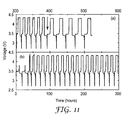
- Fig. 1 shows the charge-discharge cycling behavior of the cell of Reference Example 1.
- This cell uses a MCMB negative electrode, a LiFePO 4 positive electrode and electrolyte A as described in Table 1. The cell was cycled at C/10 at 30°C. Although the discharge capacity of the cell decreases slightly with charge-discharge cycle number, the shuttle continues to function properly, by providing a stable charge capacity for more than 40 cycles and a stable shuttle effect as indicated by the extended overcharge plateau at 4.6 V (approx. 4.7 V vs. Li/Li + ) in the lower and middle panels. Table 1. List of Cells tested.
- Electrolytes A, B, C and D are described in the Table footnote.
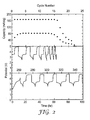
- Fig. 2 shows the charge-discharge cycling behavior of the cell of Reference Example 2.
- This cell uses a MCMB negative electrode, a LiFePO 4 positive electrode, and electrolyte B as described in Table 1.
- the cell was cycled at C/10 at 30°C.
- the shuttle functions properly, by providing a stable charge capacity (upper panel) for more than 16 cycles and a stable shuttle effect as indicated by the extended overcharge plateau at 4.6 V (approx. 4.7 V vs. Li/Li + ) in the lower and middle panels.
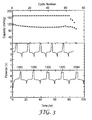
- Fig. 3 shows the charge-discharge cycling behavior of the cell of Reference example 3.
- This cell uses a MCMB negative electrode, a LiFePO 4 positive electrode and electrolyte A as described in Table 1.
- the cell was cycled at C/10 at 30°C.
- the shuttle functions properly, by providing a stable charge capacity (upper panel) for more than 65 cycles and a stable shuttle effect as indicated by the extended overcharge plateau at 4.6 V (approx. 4.7 V vs. Li/Li + ) in the lower and middle panels.
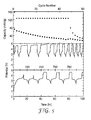
- Fig. 4 shows the charge-discharge cycling behavior of the cell of Reference Example 4.
- This cell uses a MCMB negative electrode, a LiFePO 4 positive electrode and electrolyte C as described in Table 1. The cell was cycled at C/10 at 30°C.
- the shuttle functions properly, by providing a stable charge capacity (upper panel) for more than 30 cycles and a stable shuttle effect as indicated by the extended overcharge plateau at 4.5 V (approx. 4.6 V vs. Li/Li + ) in the lower and middle panels.
- Fig. 5 shows the charge-discharge cycling behavior of the cell of Reference Example 5.
- This cell uses a MCMB negative electrode, a LiFePO 4 positive electrode and electrolyte D as described in Table 1. The cell was cycled at C/10 at 30°C. Even though the discharge capacity decreases slowly with cycle number, the shuttle functions properly, by providing a stable charge capacity (upper panel) for more than 50 cycles and a stable shuttle effect as indicated by the extended overcharge plateau at 4.5 V (approx. 4.6 V vs. Li/Li + ) in the lower and middle panels.
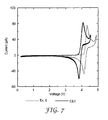
- the shape of the CVs is strikingly similar in the two cases, except that the CV of 1,4-bis(2,2,2-trifluoroethoxy)-2,5-di-tert-butylbenzene is shifted about 0.33 V to higher voltage, due to the effect of the electron withdrawing fluorine substituents on the two alkoxy groups.
- the higher oxidation potential of 1,4-bis(2,2,2-trifluoroethoxy)-2,5-di-tert-butylbenzene is expected to make it suitable for use with higher voltage cathodes, like LiMn 2 O 4 or LiMnPO 4 .
- LiMn 2 O 4 LiMnPO 4
- the relatively high oxidation potential of 1,4-bis(2,2,3,3-tetrafluoropropoxy)-2,5-di-tert-butylbenzene is expected to make it suitable for use with high voltage cathodes, like LiMn 2 O 4 or LiMnPO 4 .
- high voltage cathodes like LiMn 2 O 4 or LiMnPO 4 .
- 1 ,4-bis(2,2,3,3-tetrafluoropropoxy)-2,5-di-tert-butylbenzene is stable to reduction down to around 0.50 V vs. Li/Li + .
- Fig. 10 shows cell potential (V) versus time in the first 5 cycles for a LiFePO 4 /Li metal coin cell containing the shuttle additive, 1,4-bis(2,2,2-trifluoroethoxy)-2,5-di-tert-butylbenzene.
- the coin cell was cycled from 2.4 to 3.8 V at C/5 rate for the first two cycles.
- the cell was charged to a cutoff voltage of 4.4 V or until the overall charging time reached 10 hours.
- the cell was then switched to discharge process when one of the two above conditions occurred. For example, in the third cycle the cell charge voltage reach a plateau at around 4.35 V vs. Li.
- the shuttling plateau lasted around 2 hours and then the cell voltage increased to the cutoff voltage of 4.4 V.
- the cell was charged for a total 10 hours and the cell shuttling plateau stayed flat at around 4.35 V vs. Li.
- the flat voltage plateau can be due to the efficient shuttling of excess charge through the electrolyte by the redox shuttle and is a measure of its effectiveness and stability in the cell under overcharge conditions.
- the stable voltage plateau showed that the shuttle additive was continuously being oxidized on LiFePO 4 electrode surface and reduced on Li anode surface without significant decomposition.
- Fig. 11 shows the cell voltage versus time for the LiFePO 4 /Li cell containing the same shuttle additive, 1,4-bis(2,2,2-trifluoroethoxy)-2,5-di-tert-butylbenzene.
- the cycling data are from the same cell in Fig. 10 , but are recorded over a longer time frame and many more overcharge cycles.
- the charge/discharge rate was decreased from C/5 to C/10 rate after 390 hours (cycle 28) as indicated in the graph by the arrow.
- the cell shows a stable shuttling voltage plateau around 4.35 V at C/5 rate and approximately 4.30 V at C/10 rate during each cycle.
- the shuttle has survived for over 31 cycles to date without significant degradation in performance.
- Fig. 12 shows the cell charge and discharge capacity during cycling for 2 separate cells containing the shuttle additive, 1,4-bis(2,2,2-trifluoroethoxy)-2,5-di-tert-butylbenzene. Both cells delivered very stable discharge capacity at around 130 mAh/g. The charge capacity stabilized at around 300 mAh/g. The overcharge capacity at around 4.3 V for each cycle was calculated to be 170 mAh/g, which is around 130% of the cell discharge capacity. The data indicate that the cells were charged to about 130% of actual cell capacity on each cycle. Over the course of 30 cycles the cells have been overcharged by a total of almost 4,000% of the actual cell capacity without significant degradation in shuttle or cell performance.
Landscapes
- Chemical & Material Sciences (AREA)
- Engineering & Computer Science (AREA)
- Chemical Kinetics & Catalysis (AREA)
- Electrochemistry (AREA)
- General Chemical & Material Sciences (AREA)
- Manufacturing & Machinery (AREA)
- Inorganic Chemistry (AREA)
- Condensed Matter Physics & Semiconductors (AREA)
- General Physics & Mathematics (AREA)
- Physics & Mathematics (AREA)
- Materials Engineering (AREA)
- Secondary Cells (AREA)
- Battery Electrode And Active Subsutance (AREA)
Applications Claiming Priority (2)
| Application Number | Priority Date | Filing Date | Title |
|---|---|---|---|
| US2796308P | 2008-02-12 | 2008-02-12 | |
| PCT/US2009/033152 WO2009102604A1 (en) | 2008-02-12 | 2009-02-05 | Redox shuttles for high voltage cathodes |
Publications (2)
| Publication Number | Publication Date |
|---|---|
| EP2250700A1 EP2250700A1 (en) | 2010-11-17 |
| EP2250700B1 true EP2250700B1 (en) | 2014-09-17 |
Family
ID=40561846
Family Applications (1)
| Application Number | Title | Priority Date | Filing Date |
|---|---|---|---|
| EP09710217.2A Not-in-force EP2250700B1 (en) | 2008-02-12 | 2009-02-05 | Redox shuttles for high voltage cathodes |
Country Status (7)
| Country | Link |
|---|---|
| US (1) | US8101302B2 (enExample) |
| EP (1) | EP2250700B1 (enExample) |
| JP (1) | JP5932220B2 (enExample) |
| KR (1) | KR20100137447A (enExample) |
| CN (1) | CN101990721B (enExample) |
| TW (1) | TWI462367B (enExample) |
| WO (1) | WO2009102604A1 (enExample) |
Families Citing this family (34)
| Publication number | Priority date | Publication date | Assignee | Title |
|---|---|---|---|---|
| JP2008140711A (ja) * | 2006-12-04 | 2008-06-19 | Sanyo Electric Co Ltd | パック電池 |
| US20100028784A1 (en) * | 2008-07-29 | 2010-02-04 | 3M Innovative Properties Company | Electrolyte composition, lithium-containing electrochemical cell, battery pack, and device including the same |
| JP4934704B2 (ja) * | 2009-07-27 | 2012-05-16 | 株式会社日立製作所 | リチウムイオン二次電池及びリチウムイオン二次電池用過充電抑制剤 |
| US8137841B2 (en) * | 2009-08-31 | 2012-03-20 | 3M Innovative Properties Company | Cathode compositions for lithium-ion electrochemical cells |
| KR101041127B1 (ko) * | 2009-10-01 | 2011-06-13 | 삼성에스디아이 주식회사 | 리튬 이차 전지 |
| KR20110056150A (ko) * | 2009-11-20 | 2011-05-26 | 삼성에스디아이 주식회사 | 리튬 이차 전지용 난연성 전해액 및 이를 포함하는 리튬 이차 전지 |
| US8877390B2 (en) | 2010-05-25 | 2014-11-04 | Uchicago Argonne, Llc | Redox shuttles for lithium ion batteries |
| US8968940B2 (en) | 2010-05-25 | 2015-03-03 | Uchicago Argonne, Llc | Redox shuttles for high voltage cathodes |
| WO2011149970A2 (en) | 2010-05-25 | 2011-12-01 | Uchicago Argonne, Llc | Polyether-functionalized redox shuttle additives for lithium ion batteries |
| CN102005619A (zh) * | 2010-10-09 | 2011-04-06 | 合肥锂鑫能源材料有限公司 | 用于锂离子电池抗过充混合添加剂中的氧化还原对 |
| WO2012170240A1 (en) | 2011-06-07 | 2012-12-13 | 3M Innovative Properties Company | Lithium- ion electrochemical cells including fluorocarbon electrolyte additives |
| WO2013070298A2 (en) | 2011-08-31 | 2013-05-16 | 3M Innovative Properties Company | High capacity positive electrodes for use in lithium-ion electrochemical cells and methods of making same |
| WO2013051636A1 (ja) * | 2011-10-03 | 2013-04-11 | ダイキン工業株式会社 | 過充電防止剤、非水電解液、及び、リチウムイオン二次電池 |
| JP5309233B2 (ja) * | 2012-02-13 | 2013-10-09 | 株式会社日立製作所 | リチウムイオン二次電池及びリチウムイオン二次電池用過充電抑制剤 |
| WO2013157862A1 (ko) * | 2012-04-18 | 2013-10-24 | 주식회사 엘지화학 | 전극조립체 및 이를 포함하는 리튬 이차전지 |
| US9203112B2 (en) | 2012-04-26 | 2015-12-01 | Uchicago Argonne, Llc | Redox shuttles having an aromatic ring fused to a 1,1,4,4-tetrasubstituted cyclohexane ring |
| JP5977573B2 (ja) * | 2012-04-27 | 2016-08-24 | 旭化成株式会社 | 非水系二次電池 |
| CN103427125B (zh) * | 2012-05-15 | 2016-04-13 | 清华大学 | 硫基聚合物锂离子电池的循环方法 |
| US20140063219A1 (en) | 2012-08-28 | 2014-03-06 | General Electric Company | System and method including a portable user profile for medical imaging systems |
| US9005822B2 (en) | 2013-03-06 | 2015-04-14 | Uchicago Argonne, Llc | Functional electrolyte for lithium-ion batteries |
| CN103337659B (zh) * | 2013-06-27 | 2015-11-11 | 湖南有色郴州氟化学有限公司 | 添加剂组合物、电解液 |
| JP6270036B2 (ja) * | 2014-03-14 | 2018-01-31 | トヨタ自動車株式会社 | 非水電解液二次電池とその製造方法および非水電解液 |
| US10249910B2 (en) | 2014-07-18 | 2019-04-02 | Board Of Trustees Of Michigan State University | Rechargeable lithium-ion cell |
| JP6723752B2 (ja) * | 2015-02-10 | 2020-07-15 | 公益財団法人相模中央化学研究所 | 二次電池用電解液 |
| CN104810564B (zh) * | 2015-04-28 | 2017-03-15 | 中国科学院广州能源研究所 | 一种用作锂离子电池过充保护剂的氧化还原梭 |
| US10892525B2 (en) | 2016-06-29 | 2021-01-12 | University Of Kentucky Research Foundation | Rechargeable batteries including high-voltage cathode and redox shuttle conferring overcharge protection |
| EP3545580A4 (en) | 2016-11-22 | 2020-12-30 | Board of Trustees of Michigan State University | RECHARGEABLE ELECTROCHEMICAL CELL |
| US10950893B2 (en) | 2016-12-19 | 2021-03-16 | Honda Motor Co., Ltd. | Liquid electrolyte for battery |
| JP6985763B2 (ja) | 2017-07-20 | 2021-12-22 | ボード オブ トラスティーズ オブ ミシガン ステイト ユニバーシティBoard Of Trustees Of Michigan State University | レドックスフロー電池のための活物質 |
| DE102018206383A1 (de) | 2018-04-25 | 2019-10-31 | Bayerische Motoren Werke Aktiengesellschaft | Verfahren zum Betreiben einer Lithiumionenbatterie, Lithiumionenbatterie und Kraftfahrzeug |
| US10727545B1 (en) * | 2019-04-12 | 2020-07-28 | Ses Holdings Pte. Ltd. | Methods of charging secondary lithium metal batteries to reactive dead lithium with redox shuttling additives and battery control systems incorporating the same |
| US20210013545A1 (en) * | 2019-07-12 | 2021-01-14 | Honeywell International Inc. | Electrolyte solution for a lithium ion cell |
| WO2021241762A1 (ja) * | 2020-05-29 | 2021-12-02 | 旭化成株式会社 | 非水系電解液、セルパック、及びセルパックの製造方法 |
| CN114171782A (zh) * | 2021-12-07 | 2022-03-11 | 河南省法恩莱特新能源科技有限公司 | 防过充钠离子电池电解液及其制备方法 |
Family Cites Families (71)
| Publication number | Priority date | Publication date | Assignee | Title |
|---|---|---|---|---|
| GB1066928A (en) | 1964-07-13 | 1967-04-26 | American Cyanamid Co | Electroluminescence |
| JPS61279061A (ja) | 1985-06-04 | 1986-12-09 | Showa Denko Kk | 二次電池 |
| JPS6282649A (ja) | 1985-10-04 | 1987-04-16 | Showa Denko Kk | 二次電池 |
| JPS6355861A (ja) | 1986-08-26 | 1988-03-10 | Showa Denko Kk | 二次電池 |
| JPS6355868A (ja) | 1986-08-27 | 1988-03-10 | Showa Denko Kk | 二次電池の運転方法 |
| US4670363A (en) | 1986-09-22 | 1987-06-02 | Duracell Inc. | Non-aqueous electrochemical cell |
| US4869977A (en) | 1988-04-25 | 1989-09-26 | Amoco Corporation | Electrolyte additive for lithium-sulfur dioxide electrochemical cell |
| JP2734822B2 (ja) | 1991-07-31 | 1998-04-02 | 日本電池株式会社 | 非水電解質二次電池 |
| JPH0536439A (ja) | 1991-07-31 | 1993-02-12 | Sony Corp | 非水電解液二次電池 |
| JPH05295058A (ja) | 1992-04-17 | 1993-11-09 | Yuasa Corp | イオン伝導性高分子化合物及びその製造方法 |
| EP0614239A3 (en) | 1993-03-01 | 1996-10-16 | Tadiran Ltd | Non-aqueous secondary battery with safety device. |
| JP3259436B2 (ja) | 1993-05-31 | 2002-02-25 | ソニー株式会社 | 非水電解液二次電池 |
| JP3809657B2 (ja) | 1994-03-07 | 2006-08-16 | ソニー株式会社 | 非水電解液二次電池 |
| JPH08236155A (ja) | 1995-02-27 | 1996-09-13 | Sanyo Electric Co Ltd | リチウム二次電池 |
| JP3493873B2 (ja) * | 1995-04-28 | 2004-02-03 | ソニー株式会社 | 非水電解液二次電池 |
| JP3669024B2 (ja) * | 1995-05-26 | 2005-07-06 | ソニー株式会社 | 非水電解液二次電池 |
| CA2156800C (en) | 1995-08-23 | 2003-04-29 | Huanyu Mao | Polymerizable aromatic additives for overcharge protection in non-aqueous rechargeable lithium batteries |
| JP3756232B2 (ja) | 1996-01-17 | 2006-03-15 | 宇部興産株式会社 | 非水電解質二次電池 |
| US5858573A (en) | 1996-08-23 | 1999-01-12 | Eic Laboratories, Inc. | Chemical overcharge protection of lithium and lithium-ion secondary batteries |
| DE69736970T2 (de) | 1996-09-03 | 2007-09-13 | Ube Industries, Ltd., Ube | Nichtwässrige Lithium-Ion Sekundärbatterie |
| US6203946B1 (en) | 1998-12-03 | 2001-03-20 | Valence Technology, Inc. | Lithium-containing phosphates, method of preparation, and uses thereof |
| JP4150087B2 (ja) * | 1997-05-08 | 2008-09-17 | ソニー株式会社 | 非水電解液二次電池 |
| US6004698A (en) | 1997-08-21 | 1999-12-21 | The United States Of America As Represented By The United States Department Of Energy | Solid polymer electrolyte electrochemical storage cell containing a redox shuttle additive for overcharge protection |
| CA2216898C (en) | 1997-09-26 | 2005-03-22 | Moli Energy (1990) Limited | Improved additives for overcharge protection in non-aqueous rechargeable lithium batteries |
| US6203944B1 (en) | 1998-03-26 | 2001-03-20 | 3M Innovative Properties Company | Electrode for a lithium battery |
| US6255017B1 (en) | 1998-07-10 | 2001-07-03 | 3M Innovative Properties Co. | Electrode material and compositions including same |
| US20010004507A1 (en) | 1998-10-22 | 2001-06-21 | Hong Gan | Organic carbonate additives for nonaqueous electrolyte rechargeable electrochemical cells |
| JP4296620B2 (ja) * | 1998-11-18 | 2009-07-15 | ソニー株式会社 | 非水電解液電池 |
| JP4229510B2 (ja) | 1999-02-15 | 2009-02-25 | 株式会社Adeka | 難燃性電解液および非水電解液二次電池 |
| JP4020528B2 (ja) | 1999-03-19 | 2007-12-12 | 三洋電機株式会社 | 非水系電解液二次電池 |
| JP2000277147A (ja) * | 1999-03-25 | 2000-10-06 | Sony Corp | 非水電解質二次電池 |
| JP2000348725A (ja) | 1999-06-08 | 2000-12-15 | Toyota Motor Corp | リチウムイオン2次電池 |
| JP3113652B1 (ja) * | 1999-06-30 | 2000-12-04 | 三洋電機株式会社 | リチウム二次電池 |
| JP2001015156A (ja) | 1999-06-30 | 2001-01-19 | Sony Corp | 非水電解質電池 |
| JP2001023687A (ja) | 1999-07-09 | 2001-01-26 | Sony Corp | 非水電解質電池 |
| JP4284779B2 (ja) * | 1999-09-17 | 2009-06-24 | ソニー株式会社 | 非水電解質電池 |
| JP4432397B2 (ja) | 1999-09-30 | 2010-03-17 | 宇部興産株式会社 | 非水電解液およびそれを用いたリチウム二次電池 |
| WO2001029920A1 (en) | 1999-10-18 | 2001-04-26 | The Regents Of The University Of California | Shutdown and redox shuttle additives for batteries |
| JP4296580B2 (ja) | 2000-01-11 | 2009-07-15 | 株式会社ジーエス・ユアサコーポレーション | 非水電解質リチウム二次電池 |
| JP2001283920A (ja) | 2000-03-28 | 2001-10-12 | Ngk Insulators Ltd | リチウム二次電池 |
| JP4843832B2 (ja) | 2000-05-26 | 2011-12-21 | 三菱化学株式会社 | 非水系電解液及びこれを用いた二次電池 |
| TW531924B (en) | 2000-05-26 | 2003-05-11 | Sony Corp | Nonaqueous electrolyte secondary battery |
| CA2424735C (en) | 2000-10-03 | 2009-11-24 | Ube Industries, Ltd. | Lithium secondary battery and non-aqueous electrolytic solution |
| JP2002110324A (ja) * | 2000-10-03 | 2002-04-12 | Nok Corp | 面状発熱体およびその製造方法 |
| DE60226951D1 (de) | 2001-01-24 | 2008-07-17 | Ube Industries | Wasserfreie elektrolytische lösung und lithium-sekundärbatterien |
| JP3512021B2 (ja) | 2001-05-15 | 2004-03-29 | 株式会社日立製作所 | リチウム二次電池 |
| JP2003022809A (ja) | 2001-07-09 | 2003-01-24 | Nec Corp | 電池および電池用電極 |
| JP3714205B2 (ja) | 2001-07-10 | 2005-11-09 | ソニー株式会社 | 非水電解液二次電池 |
| KR100509968B1 (ko) * | 2001-12-28 | 2005-08-24 | 미쓰이 가가쿠 가부시키가이샤 | 비수전해액 및 그것을 사용한 리튬 2차전지 |
| JP4067824B2 (ja) * | 2001-12-28 | 2008-03-26 | 三井化学株式会社 | 非水電解液およびそれを含むリチウム二次電池 |
| JP4281895B2 (ja) * | 2001-12-28 | 2009-06-17 | 三井化学株式会社 | 非水電解液およびそれを用いたリチウム二次電池 |
| JP4127355B2 (ja) * | 2002-01-18 | 2008-07-30 | 三菱化学株式会社 | 非水系電解液及びそれを用いたリチウム二次電池 |
| JP4465944B2 (ja) * | 2002-01-23 | 2010-05-26 | 三菱化学株式会社 | 非水系電解液及びそれを用いたリチウム二次電池 |
| JP4075416B2 (ja) * | 2002-03-14 | 2008-04-16 | 宇部興産株式会社 | 非水電解液およびそれを用いたリチウム二次電池 |
| US6942949B2 (en) | 2002-08-12 | 2005-09-13 | Lg Chem, Ltd. | Rechargeable lithium electrochemical cell |
| JP3748843B2 (ja) | 2002-08-20 | 2006-02-22 | 日立マクセル株式会社 | 有機電解液二次電池 |
| KR100558847B1 (ko) | 2003-08-19 | 2006-03-10 | 에스케이씨 주식회사 | 전해질 조성물 및 이를 채용한 리튬 전지와 그의 제조방법 |
| EP1528616B1 (en) | 2003-10-31 | 2017-03-08 | Samsung SDI Co., Ltd. | Electrolyte for rechargeable lithium battery and rechargeable lithium battery comprising same |
| US7019494B2 (en) | 2004-01-06 | 2006-03-28 | Moltech Corporation | Methods of charging lithium sulfur cells |
| JP4710228B2 (ja) * | 2004-01-16 | 2011-06-29 | 三菱化学株式会社 | 非水系電解液二次電池用電解液及び非水系電解液二次電池 |
| JP5053834B2 (ja) | 2004-04-01 | 2012-10-24 | スリーエム イノベイティブ プロパティズ カンパニー | 再充電可能なリチウム−イオンバッテリーの過放電保護のためのレドックスシャトル |
| CN100481586C (zh) | 2004-04-01 | 2009-04-22 | 3M创新有限公司 | 用于可再充电锂离子电池的氧化还原对 |
| JP4737365B2 (ja) | 2004-08-31 | 2011-07-27 | 日本電気株式会社 | 電極活物質、電池および重合体 |
| JP5082198B2 (ja) | 2005-03-10 | 2012-11-28 | 日本電気株式会社 | リチウムイオン二次電池 |
| US7615312B2 (en) * | 2005-05-17 | 2009-11-10 | 3M Innovative Properties Company | Substituted phenothiazine redox shuttles for rechargeable lithium-ion cell |
| US7615317B2 (en) | 2005-05-17 | 2009-11-10 | 3M Innovative Properties Company | N-oxide redox shuttles for rechargeable lithium-ion cell |
| US7767349B2 (en) | 2005-07-25 | 2010-08-03 | 3M Innovative Properties Company | Alloy compositions for lithium ion batteries |
| US7871727B2 (en) | 2005-07-25 | 2011-01-18 | 3M Innovative Properties Company | Alloy composition for lithium ion batteries |
| KR100812056B1 (ko) * | 2005-10-24 | 2008-03-07 | 주식회사 엘지화학 | 레독스 셔틀제의 수명 감소 억제제, 이를 포함하는 비수전해액 및 이차전지 |
| US8367253B2 (en) | 2006-02-02 | 2013-02-05 | U Chicago Argonne Llc | Lithium-ion batteries with intrinsic pulse overcharge protection |
| US7585590B2 (en) * | 2006-02-17 | 2009-09-08 | 3M Innovative Properties Company | Rechargeable lithium-ion cell with triphenylamine redox shuttle |
-
2009
- 2009-02-05 WO PCT/US2009/033152 patent/WO2009102604A1/en not_active Ceased
- 2009-02-05 KR KR1020107019914A patent/KR20100137447A/ko not_active Ceased
- 2009-02-05 CN CN2009801047214A patent/CN101990721B/zh not_active Expired - Fee Related
- 2009-02-05 EP EP09710217.2A patent/EP2250700B1/en not_active Not-in-force
- 2009-02-05 US US12/366,002 patent/US8101302B2/en not_active Expired - Fee Related
- 2009-02-05 JP JP2010546829A patent/JP5932220B2/ja not_active Expired - Fee Related
- 2009-02-11 TW TW098104332A patent/TWI462367B/zh not_active IP Right Cessation
Also Published As
| Publication number | Publication date |
|---|---|
| EP2250700A1 (en) | 2010-11-17 |
| TWI462367B (zh) | 2014-11-21 |
| WO2009102604A1 (en) | 2009-08-20 |
| TW200952236A (en) | 2009-12-16 |
| US8101302B2 (en) | 2012-01-24 |
| KR20100137447A (ko) | 2010-12-30 |
| JP5932220B2 (ja) | 2016-06-08 |
| US20090286162A1 (en) | 2009-11-19 |
| JP2011512014A (ja) | 2011-04-14 |
| CN101990721B (zh) | 2013-06-19 |
| CN101990721A (zh) | 2011-03-23 |
Similar Documents
| Publication | Publication Date | Title |
|---|---|---|
| US8101302B2 (en) | Redox shuttles for high voltage cathodes | |
| US7585590B2 (en) | Rechargeable lithium-ion cell with triphenylamine redox shuttle | |
| US7648801B2 (en) | Redox shuttle for overdischarge protection in rechargeable lithium-ion batteries | |
| EP1890357B1 (en) | Nonaqueous electrolyte solution, nonaqueous electrolyte secondary battery and carbonate compound | |
| KR100814826B1 (ko) | 리튬 이차 전지 | |
| EP1733450B1 (en) | Redox shuttle for rechargeable lithium-ion cell | |
| EP3187487B1 (en) | Ionic liquid and plastic crystal | |
| JP4092757B2 (ja) | 非水電解液二次電池 | |
| CN111082138A (zh) | 用于锂二次电池的电解液和包括其的锂二次电池 | |
| KR102152304B1 (ko) | 리튬 이차 전지용 전해액 및 이를 포함하는 리튬 이차 전지 | |
| WO2020036222A1 (ja) | 非水系電解液、及び非水系電解液二次電池 | |
| JP7610126B2 (ja) | 非水電解液及び非水電解液電池 | |
| EP3656014B1 (en) | Heterocyclic additives bearing sulfonyl fluoride groups for electrolyte compositions of lithium batteries | |
| JP2022551173A (ja) | 組成物 | |
| KR102467447B1 (ko) | 리튬이차전지용 전해질 첨가제 및 이를 포함하는 리튬이차전지 | |
| KR102940856B1 (ko) | 리튬 이차 전지용 전해액 및 이를 포함하는 리튬 이차 전지 | |
| EP3667802A1 (en) | Additive for non-aqueous electrolyte, non-aqueous electrolyte, and power storage device | |
| KR20190021099A (ko) | 유기 전해액, 및 이를 포함하는 리튬 전지 | |
| EP4260397A1 (en) | Composition | |
| JP2022552351A (ja) | 組成物 | |
| EP4503226B1 (en) | Electrolyte for lithium secondary battery and lithium secondary battery including the same | |
| EP3170221B1 (en) | Liquid formulations, processes for their manufacture, and use of such liquid formulations | |
| KR20190053576A (ko) | 리튬 이차 전지용 양극 활물질 및 이를 포함하는 리튬 이차 전지 | |
| KR20240086920A (ko) | 전해액 첨가제, 이를 포함하는 리튬 이차 전지용 전해액, 및 리튬 이차 전지 |
Legal Events
| Date | Code | Title | Description |
|---|---|---|---|
| PUAI | Public reference made under article 153(3) epc to a published international application that has entered the european phase |
Free format text: ORIGINAL CODE: 0009012 |
|
| 17P | Request for examination filed |
Effective date: 20100910 |
|
| AK | Designated contracting states |
Kind code of ref document: A1 Designated state(s): AT BE BG CH CY CZ DE DK EE ES FI FR GB GR HR HU IE IS IT LI LT LU LV MC MK MT NL NO PL PT RO SE SI SK TR |
|
| AX | Request for extension of the european patent |
Extension state: AL BA RS |
|
| DAX | Request for extension of the european patent (deleted) | ||
| 17Q | First examination report despatched |
Effective date: 20120509 |
|
| REG | Reference to a national code |
Ref country code: DE Ref legal event code: R079 Ref document number: 602009026705 Country of ref document: DE Free format text: PREVIOUS MAIN CLASS: H01M0010400000 Ipc: H01M0010052000 |
|
| GRAP | Despatch of communication of intention to grant a patent |
Free format text: ORIGINAL CODE: EPIDOSNIGR1 |
|
| RIC1 | Information provided on ipc code assigned before grant |
Ipc: H01M 10/0567 20100101ALI20140221BHEP Ipc: H01M 10/42 20060101ALN20140221BHEP Ipc: H01M 10/052 20100101AFI20140221BHEP |
|
| INTG | Intention to grant announced |
Effective date: 20140327 |
|
| GRAS | Grant fee paid |
Free format text: ORIGINAL CODE: EPIDOSNIGR3 |
|
| GRAA | (expected) grant |
Free format text: ORIGINAL CODE: 0009210 |
|
| AK | Designated contracting states |
Kind code of ref document: B1 Designated state(s): AT BE BG CH CY CZ DE DK EE ES FI FR GB GR HR HU IE IS IT LI LT LU LV MC MK MT NL NO PL PT RO SE SI SK TR |
|
| REG | Reference to a national code |
Ref country code: GB Ref legal event code: FG4D |
|
| REG | Reference to a national code |
Ref country code: CH Ref legal event code: EP |
|
| REG | Reference to a national code |
Ref country code: IE Ref legal event code: FG4D |
|
| REG | Reference to a national code |
Ref country code: AT Ref legal event code: REF Ref document number: 688057 Country of ref document: AT Kind code of ref document: T Effective date: 20141015 |
|
| REG | Reference to a national code |
Ref country code: DE Ref legal event code: R096 Ref document number: 602009026705 Country of ref document: DE Effective date: 20141030 |
|
| PG25 | Lapsed in a contracting state [announced via postgrant information from national office to epo] |
Ref country code: NO Free format text: LAPSE BECAUSE OF FAILURE TO SUBMIT A TRANSLATION OF THE DESCRIPTION OR TO PAY THE FEE WITHIN THE PRESCRIBED TIME-LIMIT Effective date: 20141217 Ref country code: LT Free format text: LAPSE BECAUSE OF FAILURE TO SUBMIT A TRANSLATION OF THE DESCRIPTION OR TO PAY THE FEE WITHIN THE PRESCRIBED TIME-LIMIT Effective date: 20140917 Ref country code: SE Free format text: LAPSE BECAUSE OF FAILURE TO SUBMIT A TRANSLATION OF THE DESCRIPTION OR TO PAY THE FEE WITHIN THE PRESCRIBED TIME-LIMIT Effective date: 20140917 Ref country code: GR Free format text: LAPSE BECAUSE OF FAILURE TO SUBMIT A TRANSLATION OF THE DESCRIPTION OR TO PAY THE FEE WITHIN THE PRESCRIBED TIME-LIMIT Effective date: 20141218 Ref country code: FI Free format text: LAPSE BECAUSE OF FAILURE TO SUBMIT A TRANSLATION OF THE DESCRIPTION OR TO PAY THE FEE WITHIN THE PRESCRIBED TIME-LIMIT Effective date: 20140917 |
|
| REG | Reference to a national code |
Ref country code: NL Ref legal event code: VDEP Effective date: 20140917 |
|
| REG | Reference to a national code |
Ref country code: LT Ref legal event code: MG4D |
|
| PG25 | Lapsed in a contracting state [announced via postgrant information from national office to epo] |
Ref country code: HR Free format text: LAPSE BECAUSE OF FAILURE TO SUBMIT A TRANSLATION OF THE DESCRIPTION OR TO PAY THE FEE WITHIN THE PRESCRIBED TIME-LIMIT Effective date: 20140917 Ref country code: CY Free format text: LAPSE BECAUSE OF FAILURE TO SUBMIT A TRANSLATION OF THE DESCRIPTION OR TO PAY THE FEE WITHIN THE PRESCRIBED TIME-LIMIT Effective date: 20140917 Ref country code: LV Free format text: LAPSE BECAUSE OF FAILURE TO SUBMIT A TRANSLATION OF THE DESCRIPTION OR TO PAY THE FEE WITHIN THE PRESCRIBED TIME-LIMIT Effective date: 20140917 |
|
| REG | Reference to a national code |
Ref country code: AT Ref legal event code: MK05 Ref document number: 688057 Country of ref document: AT Kind code of ref document: T Effective date: 20140917 |
|
| PG25 | Lapsed in a contracting state [announced via postgrant information from national office to epo] |
Ref country code: NL Free format text: LAPSE BECAUSE OF FAILURE TO SUBMIT A TRANSLATION OF THE DESCRIPTION OR TO PAY THE FEE WITHIN THE PRESCRIBED TIME-LIMIT Effective date: 20140917 |
|
| PG25 | Lapsed in a contracting state [announced via postgrant information from national office to epo] |
Ref country code: SK Free format text: LAPSE BECAUSE OF FAILURE TO SUBMIT A TRANSLATION OF THE DESCRIPTION OR TO PAY THE FEE WITHIN THE PRESCRIBED TIME-LIMIT Effective date: 20140917 Ref country code: RO Free format text: LAPSE BECAUSE OF FAILURE TO SUBMIT A TRANSLATION OF THE DESCRIPTION OR TO PAY THE FEE WITHIN THE PRESCRIBED TIME-LIMIT Effective date: 20140917 Ref country code: EE Free format text: LAPSE BECAUSE OF FAILURE TO SUBMIT A TRANSLATION OF THE DESCRIPTION OR TO PAY THE FEE WITHIN THE PRESCRIBED TIME-LIMIT Effective date: 20140917 Ref country code: CZ Free format text: LAPSE BECAUSE OF FAILURE TO SUBMIT A TRANSLATION OF THE DESCRIPTION OR TO PAY THE FEE WITHIN THE PRESCRIBED TIME-LIMIT Effective date: 20140917 Ref country code: PT Free format text: LAPSE BECAUSE OF FAILURE TO SUBMIT A TRANSLATION OF THE DESCRIPTION OR TO PAY THE FEE WITHIN THE PRESCRIBED TIME-LIMIT Effective date: 20150119 Ref country code: IS Free format text: LAPSE BECAUSE OF FAILURE TO SUBMIT A TRANSLATION OF THE DESCRIPTION OR TO PAY THE FEE WITHIN THE PRESCRIBED TIME-LIMIT Effective date: 20150117 Ref country code: ES Free format text: LAPSE BECAUSE OF FAILURE TO SUBMIT A TRANSLATION OF THE DESCRIPTION OR TO PAY THE FEE WITHIN THE PRESCRIBED TIME-LIMIT Effective date: 20140917 |
|
| PG25 | Lapsed in a contracting state [announced via postgrant information from national office to epo] |
Ref country code: PL Free format text: LAPSE BECAUSE OF FAILURE TO SUBMIT A TRANSLATION OF THE DESCRIPTION OR TO PAY THE FEE WITHIN THE PRESCRIBED TIME-LIMIT Effective date: 20140917 Ref country code: AT Free format text: LAPSE BECAUSE OF FAILURE TO SUBMIT A TRANSLATION OF THE DESCRIPTION OR TO PAY THE FEE WITHIN THE PRESCRIBED TIME-LIMIT Effective date: 20140917 |
|
| REG | Reference to a national code |
Ref country code: DE Ref legal event code: R097 Ref document number: 602009026705 Country of ref document: DE |
|
| PG25 | Lapsed in a contracting state [announced via postgrant information from national office to epo] |
Ref country code: BE Free format text: LAPSE BECAUSE OF NON-PAYMENT OF DUE FEES Effective date: 20150228 |
|
| PLBE | No opposition filed within time limit |
Free format text: ORIGINAL CODE: 0009261 |
|
| STAA | Information on the status of an ep patent application or granted ep patent |
Free format text: STATUS: NO OPPOSITION FILED WITHIN TIME LIMIT |
|
| PG25 | Lapsed in a contracting state [announced via postgrant information from national office to epo] |
Ref country code: DK Free format text: LAPSE BECAUSE OF FAILURE TO SUBMIT A TRANSLATION OF THE DESCRIPTION OR TO PAY THE FEE WITHIN THE PRESCRIBED TIME-LIMIT Effective date: 20140917 |
|
| 26N | No opposition filed |
Effective date: 20150618 |
|
| PG25 | Lapsed in a contracting state [announced via postgrant information from national office to epo] |
Ref country code: IT Free format text: LAPSE BECAUSE OF FAILURE TO SUBMIT A TRANSLATION OF THE DESCRIPTION OR TO PAY THE FEE WITHIN THE PRESCRIBED TIME-LIMIT Effective date: 20140917 |
|
| PG25 | Lapsed in a contracting state [announced via postgrant information from national office to epo] |
Ref country code: LU Free format text: LAPSE BECAUSE OF FAILURE TO SUBMIT A TRANSLATION OF THE DESCRIPTION OR TO PAY THE FEE WITHIN THE PRESCRIBED TIME-LIMIT Effective date: 20150205 |
|
| REG | Reference to a national code |
Ref country code: CH Ref legal event code: PL |
|
| GBPC | Gb: european patent ceased through non-payment of renewal fee |
Effective date: 20150205 |
|
| PG25 | Lapsed in a contracting state [announced via postgrant information from national office to epo] |
Ref country code: CH Free format text: LAPSE BECAUSE OF NON-PAYMENT OF DUE FEES Effective date: 20150228 Ref country code: LI Free format text: LAPSE BECAUSE OF NON-PAYMENT OF DUE FEES Effective date: 20150228 Ref country code: MC Free format text: LAPSE BECAUSE OF FAILURE TO SUBMIT A TRANSLATION OF THE DESCRIPTION OR TO PAY THE FEE WITHIN THE PRESCRIBED TIME-LIMIT Effective date: 20140917 |
|
| REG | Reference to a national code |
Ref country code: IE Ref legal event code: MM4A |
|
| PG25 | Lapsed in a contracting state [announced via postgrant information from national office to epo] |
Ref country code: SI Free format text: LAPSE BECAUSE OF FAILURE TO SUBMIT A TRANSLATION OF THE DESCRIPTION OR TO PAY THE FEE WITHIN THE PRESCRIBED TIME-LIMIT Effective date: 20140917 |
|
| REG | Reference to a national code |
Ref country code: FR Ref legal event code: PLFP Year of fee payment: 8 |
|
| PG25 | Lapsed in a contracting state [announced via postgrant information from national office to epo] |
Ref country code: IE Free format text: LAPSE BECAUSE OF NON-PAYMENT OF DUE FEES Effective date: 20150205 Ref country code: GB Free format text: LAPSE BECAUSE OF NON-PAYMENT OF DUE FEES Effective date: 20150205 |
|
| PGFP | Annual fee paid to national office [announced via postgrant information from national office to epo] |
Ref country code: DE Payment date: 20160202 Year of fee payment: 8 |
|
| PGFP | Annual fee paid to national office [announced via postgrant information from national office to epo] |
Ref country code: FR Payment date: 20160108 Year of fee payment: 8 |
|
| PG25 | Lapsed in a contracting state [announced via postgrant information from national office to epo] |
Ref country code: MT Free format text: LAPSE BECAUSE OF FAILURE TO SUBMIT A TRANSLATION OF THE DESCRIPTION OR TO PAY THE FEE WITHIN THE PRESCRIBED TIME-LIMIT Effective date: 20140917 |
|
| PG25 | Lapsed in a contracting state [announced via postgrant information from national office to epo] |
Ref country code: HU Free format text: LAPSE BECAUSE OF FAILURE TO SUBMIT A TRANSLATION OF THE DESCRIPTION OR TO PAY THE FEE WITHIN THE PRESCRIBED TIME-LIMIT; INVALID AB INITIO Effective date: 20090205 Ref country code: BG Free format text: LAPSE BECAUSE OF FAILURE TO SUBMIT A TRANSLATION OF THE DESCRIPTION OR TO PAY THE FEE WITHIN THE PRESCRIBED TIME-LIMIT Effective date: 20140917 |
|
| PG25 | Lapsed in a contracting state [announced via postgrant information from national office to epo] |
Ref country code: TR Free format text: LAPSE BECAUSE OF FAILURE TO SUBMIT A TRANSLATION OF THE DESCRIPTION OR TO PAY THE FEE WITHIN THE PRESCRIBED TIME-LIMIT Effective date: 20140917 |
|
| REG | Reference to a national code |
Ref country code: DE Ref legal event code: R119 Ref document number: 602009026705 Country of ref document: DE |
|
| REG | Reference to a national code |
Ref country code: FR Ref legal event code: ST Effective date: 20171031 |
|
| PG25 | Lapsed in a contracting state [announced via postgrant information from national office to epo] |
Ref country code: FR Free format text: LAPSE BECAUSE OF NON-PAYMENT OF DUE FEES Effective date: 20170228 Ref country code: DE Free format text: LAPSE BECAUSE OF NON-PAYMENT OF DUE FEES Effective date: 20170901 |
|
| PG25 | Lapsed in a contracting state [announced via postgrant information from national office to epo] |
Ref country code: MK Free format text: LAPSE BECAUSE OF FAILURE TO SUBMIT A TRANSLATION OF THE DESCRIPTION OR TO PAY THE FEE WITHIN THE PRESCRIBED TIME-LIMIT Effective date: 20140917 |