EP2240975B1 - Gel polymer electrolytes for batteries - Google Patents
Gel polymer electrolytes for batteries Download PDFInfo
- Publication number
- EP2240975B1 EP2240975B1 EP09702285.9A EP09702285A EP2240975B1 EP 2240975 B1 EP2240975 B1 EP 2240975B1 EP 09702285 A EP09702285 A EP 09702285A EP 2240975 B1 EP2240975 B1 EP 2240975B1
- Authority
- EP
- European Patent Office
- Prior art keywords
- electrolyte
- polymer
- domain
- electrolyte material
- phase
- Prior art date
- Legal status (The legal status is an assumption and is not a legal conclusion. Google has not performed a legal analysis and makes no representation as to the accuracy of the status listed.)
- Active
Links
Images





Classifications
-
- H—ELECTRICITY
- H01—ELECTRIC ELEMENTS
- H01M—PROCESSES OR MEANS, e.g. BATTERIES, FOR THE DIRECT CONVERSION OF CHEMICAL ENERGY INTO ELECTRICAL ENERGY
- H01M10/00—Secondary cells; Manufacture thereof
- H01M10/05—Accumulators with non-aqueous electrolyte
- H01M10/056—Accumulators with non-aqueous electrolyte characterised by the materials used as electrolytes, e.g. mixed inorganic/organic electrolytes
- H01M10/0564—Accumulators with non-aqueous electrolyte characterised by the materials used as electrolytes, e.g. mixed inorganic/organic electrolytes the electrolyte being constituted of organic materials only
- H01M10/0565—Polymeric materials, e.g. gel-type or solid-type
-
- H—ELECTRICITY
- H01—ELECTRIC ELEMENTS
- H01M—PROCESSES OR MEANS, e.g. BATTERIES, FOR THE DIRECT CONVERSION OF CHEMICAL ENERGY INTO ELECTRICAL ENERGY
- H01M10/00—Secondary cells; Manufacture thereof
- H01M10/05—Accumulators with non-aqueous electrolyte
- H01M10/052—Li-accumulators
- H01M10/0525—Rocking-chair batteries, i.e. batteries with lithium insertion or intercalation in both electrodes; Lithium-ion batteries
-
- H—ELECTRICITY
- H01—ELECTRIC ELEMENTS
- H01M—PROCESSES OR MEANS, e.g. BATTERIES, FOR THE DIRECT CONVERSION OF CHEMICAL ENERGY INTO ELECTRICAL ENERGY
- H01M2300/00—Electrolytes
- H01M2300/0085—Immobilising or gelification of electrolyte
-
- Y—GENERAL TAGGING OF NEW TECHNOLOGICAL DEVELOPMENTS; GENERAL TAGGING OF CROSS-SECTIONAL TECHNOLOGIES SPANNING OVER SEVERAL SECTIONS OF THE IPC; TECHNICAL SUBJECTS COVERED BY FORMER USPC CROSS-REFERENCE ART COLLECTIONS [XRACs] AND DIGESTS
- Y02—TECHNOLOGIES OR APPLICATIONS FOR MITIGATION OR ADAPTATION AGAINST CLIMATE CHANGE
- Y02E—REDUCTION OF GREENHOUSE GAS [GHG] EMISSIONS, RELATED TO ENERGY GENERATION, TRANSMISSION OR DISTRIBUTION
- Y02E60/00—Enabling technologies; Technologies with a potential or indirect contribution to GHG emissions mitigation
- Y02E60/10—Energy storage using batteries
Definitions
- This invention relates generally to electrolyte materials, and, more specifically, to gel polymer electrolytes that have both high conductivity and high mechanical strength and are easily and affordably processed.
- Li-ion batteries represent one of the most popular types of rechargeable batteries for portable electronics. Li-ion batteries offer high energy and power densities, slow loss of charge when not in use, and they do not suffer from memory effects. Because their many benefits, including their high energy density, Li-ion batteries have also been used increasingly in defense, aerospace, back-up storage, and transportation applications.
- the electrolyte is an important part of a Li-ion rechargeable battery. During discharging, the electrolyte is a medium for ion flow between the electrodes, as a negative electrode material is oxidized, producing electrons, and a positive electrode material is reduced, consuming electrons. The electrons flow as current through an external circuit.
- Traditional Li-ion rechargeable batteries have used non-polymer liquid electrolytes. Exemplary liquid electrolytes in Li-ion batteries are composed of lithium-salts such as LiPF 6 , LiBF 4 , or LiClO 4 in organic solvents such as alkyl carbonates. While non-polymer liquid electrolytes dominate current Li-based technologies, polymer electrolytes may constitute the next wave of advances for Li-based batteries.
- the gel polymer electrolyte rechargeable battery is especially attractive for Li-ion battery technology because, among other benefits, polymer electrolytes may have high thermal stability, low rates of self-discharge, stable operation over a wide range of environmental conditions, enhanced safety, flexibility in battery configuration, minimal environmental impacts, and low materials and processing costs. Gel polymer electrolytes have been of exceptional interest partly due to their amenability to novel form factors and packaging methods as seen in the thin, vacuum-sealed pouch cell designs of recent batteries for portable electronics.
- Cross-linking or thermosetting of the polymer matrix has been used to achieve the mechanical robustness needed for commercial application of gel electrolytes.
- the electrolyte no longer flows and is insoluble, thereby severely limiting subsequent processibility as well as integration of the electrolyte with other battery components and packaging.
- optimization of cross-linking is very costly. Volume changes that result from cross-linking present difficulties in controlled processing and manufacturing of conventional gel electrolytes, and cross-linking tends to reduce ionic conductivity.
- cross-linked materials are generally non-recyclable.
- Prototypical gel polymer electrolytes have been based on materials such as poly(ethylene oxide) (PEO), poly(acrylo-nitrile) (PAN), poly(methyl methacrylate) (PMMA) and poly(vinylidene fluoride) (PVdF).
- PEO poly(ethylene oxide)
- PAN poly(acrylo-nitrile)
- PMMA poly(methyl methacrylate)
- PVdF poly(vinylidene fluoride)
- Polymer electrolytes may enable the use of lithium metal anodes, which offer higher energy densities than do traditional lithium ion anodes, but fluorinated polymers are not chemically stable when used with lithium metal due to an interfacial reaction between lithium and fluorine that results in the formation of LiF, an undesirable outcome.
- LiF increases cell impedance, and the lithium that is used to form the LiF can no longer participate in the charging and discharging of the cell. Consequently, PVdF-based electrolytes are unsuitable for batteries with lithium metal anodes.
- vaporization of solvents, especially at high temperatures leads to degradation in performance of these systems over time and the need for hermetic packaging.
- JP07109321A describes a composite solid electrolyte containing an inorganic salt and a specific organic solvent in a copolymer containing a block of polystyrenes having a polyoxyalkylene group grafted thereto.
- EP1215244A2 describes a solidifying material for cell electrolyte solution wherein the solidifying material is characterized by the graft copolymer of which it is comprised.
- One aspect of the invention as defined in claim 1 relates to a nanostructured electrolyte material comprising a first domain comprising an ionically-conductive polymer gel phase, wherein said ionically-conductive polymer gel phase comprises a liquid electrolyte, and wherein the liquid electrolyte comprises an electrolyte salt, the first domain forming a conductive portion of the electrolyte material; and a second domain adjacent the first domain, the second domain comprising a structural polymer phase, the structural polymer phase having a bulk modulus greater than 1x10 6 Pa at 25°C, the second domain forming a structural portion of the electrolyte material; wherein the nanostructured gel polymer electrolyte comprises a plurality of linear block copolymers, the first domain comprises a plurality of first polymer blocks selected from the group consisting of linear polyethers, linear polyacrylonitriles, and linear polyvinylalcohols, and the second domain comprises a plurality of second polymer blocks, wherein the electrolyte
- Another aspect of the invention as defined in claim 14 relates to a battery cell employing the nanostructured electrolyte material of the invention.
- a nanostructured polymer electrolyte material is a block copolymer that has both gelled regions for ion flow and rigid regions that give the overall electrolyte good mechanical strength.
- the gelled regions are formed by providing a block polymer matrix that may or may not be ionically conductive itself before a liquid electrolyte is added to it.
- the rigid regions are formed by phase-separated domains of a hard polymer block.
- the liquid electrolyte contains both solvent(s) and salt(s), providing ionic conductivity and electronic insulation.
- the nanostructured gel polymer electrolyte material can be used to improve performance of Li-based batteries by increasing energy density, improving thermal and environmental stability, reducing self-discharge rates, enhancing safety, reducing manufacturing costs, and enabling novel form factors.
- a nanostructured gel polymer electrolyte material contains no fluorinated molecules and has an ionic conductivity of at least 1x10 -4 Scm -1 at 25 °C.
- a nanostructured gel polymer electrolyte material is non-crosslinked, contains no fluorinated molecules and has an ionic conductivity of at least 1x10 -4 Scm -1 at 25 °C.
- a nanostructured gel polymer electrolyte is used in an electrochemical cell in a separator region between a positive electrode and a negative electrode.
- the negative electrode is lithium metal or some alloy thereof which is highly reactive with fluorinated species.
- the nanostructured gel polymer electrolyte contains a liquid electrolyte [solvent(s) and salt(s)] that promotes conduction of ions through the nanostructured gel polymer electrolyte separator.
- Figure 1A is a schematic illustration of a two-phase nanostructured material 100.
- the material 100 has several regions that contain conductive phase 110 and several regions that contain a structural phase 120.
- the conductive phase 110 contains a polymer that provides a matrix into which an ionically-conductive liquid electrolyte can be absorbed.
- the conductive phase 110 may or may not be ionically conductive by itself before the liquid electrolyte is introduced.
- the structural phase 120 is interspersed with the conductive phase 110.
- an electrolyte material 130 has been formed by adding a liquid electrolyte 115 (shown as grey coloring) to the conductive phase 110 to achieve a higher ionic conductivity that was possible for the structure in Figure 1A .
- the structural phase 120 is essentially unaffected by the addition of the liquid electrolyte 115.
- the structure shown in Figure 1B is not intended to convey any particular meaning other than to indicate that the electrolyte 130 has a two-phase structure.
- the morphology in Figure 1B is approximately lamellar, other morphologies as are known for two-domain nanostructures are possible.
- FIG. 2A is a schematic illustration of a plurality 201 of linear polymer diblocks that make up a two-phase nanostructured gel polymer electrolyte, according to an embodiment of the invention.
- Each linear polymer diblock is made by self-assembly of a first polymer block 202 and a second polymer block 203, which are different from each other.
- the polymer blocks 202 are covalently bonded to the polymer blocks 203 at one end.
- the polymer blocks 202 are made of a polymer that provides a matrix into which a liquid electrolyte can be absorbed.
- the polymer in polymer blocks 202 may or may not be ionically conductive itself before the liquid electrolyte is added.
- the polymer blocks 203 are made of a polymer that has high mechanical strength. It is especially useful if polymer blocks 203 are made of a polymer that, in its homopolymer state, swells less than 5% in the presence of the liquid electrolyte that is added to the conductive blocks 202.
- Figure 2B is a schematic illustration of a portion of two-phase nanostructured gel polymer electrolyte with alternating regions of a first domain 210-x and a second domain 220-x, according to an embodiment of the invention.
- the first domain 210-1 (and 210-2) contains polymer blocks 212-1, 212-2 of a first phase. Within any first domain 210-x, the polymer blocks 212-1 212-2 are not covalently bonded to one another, but can slide relative to each other in the region where their ends meet.
- the second domain 220-1 contains polymer blocks 222-1, 222-2 of a second phase. Within any second domain 220-x, the polymer blocks 222-1 222-2 are not covalently bonded to one another, but can slide relative to each other in the region where their ends meet.
- the first domain 210-1 is adjacent one side of the second domain 220-1.
- the first domain 210-2 is adjacent the other side of the second domain 220-1.
- the two phase structure continues with alternating first domains 210-x and second domains 220-x.
- the first domain 210-x is a conductive domain; polymer blocks 212-x contain a polymer that is ionically conductive by itself and/or that provides a matrix into which an ionically-conductive liquid electrolyte can be absorbed.
- the second domain 220-x is a structural domain; polymer blocks 222-x contain a polymer that has high mechanical strength.
- the first domain 210-x is a structural domain; polymer blocks 212-x contain a polymer that has high mechanical strength.
- the second domain 220-x is a conductive domain; polymer blocks 222-x contain a polymer that is ionically conductive by itself and/or that provides a matrix into which an ionically-conductive liquid electrolyte can be absorbed.
- Diblocks can arrange themselves into a variety of morphologies, as is well known in the art.
- the diblocks may arrange themselves into any geometrically possible morphology without limitation. Examples of possible morphologies include, but are not limited to lamellar, branched, cylindrical, and gyroid.
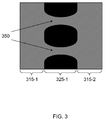
- FIG 3 is a schematic illustration of a portion a of two-domain perforated lamellar morphology, according to an embodiment of the invention.
- the perforated lamellar structure has alternating layers of a first domain 315-x and a second domain 325-x. There are extensions 350 of the first domains 315-1, 315-2 into the second domain 325-1.
- the first domains 315-x extend into perforations in the second domains 325-x when the volume fraction of first domain phase 315-x is larger than the volume fraction of the second domain phase 325-x.
- the first domains 315-x contain a conductive phase and the second domains 325-x contain a structural phase. Such an arrangement can result in a nanostructured gel polymer electrolyte with higher conductivity than for morphologies with no perforations/extensions.
- the first domains 315-x contain a structural phase and the second domains 325-x contain a conductive phase. Such an arrangement can result in a nanostructured gel polymer electrolyte with greater mechanical strength than for morphologies with no perforations/extensions.
- FIG 4 is a schematic illustration of a plurality 410 of linear polymer triblocks made by self-assembly of two types of polymer blocks arranged in an A-B-A configuration.
- Each triblock has a first polymer block 412-1 of a first type, a polymer block 422 of a second type, and a second polymer block 421-2 of the first type.
- the polymer block 412-1 is covalently bonded to the polymer block 422.
- the polymer block 412-2 is also covalently bonded to the polymer block 422.
- the polymer blocks 412-1, 412-2 of the first type contain a polymer that is ionically conductive by itself and/or that provides a matrix into which an ionically-conductive liquid electrolyte can be absorbed
- the polymer block 422 of the second type contains a polymer that has high mechanical strength
- the polymer block 412-1, 412-2 of the first type contains a polymer that has high mechanical strength
- the polymer block 422 of the second type contains a polymer that is ionically conductive by itself and/or that provides a matrix into which an ionically-conductive liquid electrolyte can be absorbed.
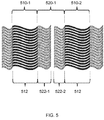
- Figure 5 is a schematic illustration of a portion of a two-phase nanostructured gel polymer electrolyte with alternating regions of a first domain 510-x and a second domain 520-x, according to an embodiment of the invention.
- the two-phase structure is made up from a plurality of triblock copolymers, such as those shown in Figure 4 .
- the first domains 510-1, 510-2 contain polymer blocks 512 of a first phase.
- the second domain 520-1 contains polymer blocks 522-1, 522-2 of a second phase. Within any second domain 520-x, the polymer blocks 522-1 522-2 are not covalently bonded to one another, but can slide relative to each other in the region where their ends meet.
- the first domain 510-1 is adjacent one side of the second domain 520-1.
- the first domain 510-2 is adjacent the other side of the second domain 520-1.
- the two phase structure continues with alternating regions of the first domains 510-x and the second domains 520-x.
- the first domains 510-x are conductive domains; the polymer blocks 512 contain a polymer that is ionically conductive by itself and/or that provides a matrix into which an ionically-conductive liquid electrolyte can be absorbed.
- the second domains 520-x are structural domains; the polymer blocks 522-x contain a polymer that has high mechanical strength.
- the first domains 510-x are structural domains; the polymer blocks 512 contain a polymer that that has high mechanical strength.
- the second domains 520-x are conductive domains; the polymer blocks 522-x contain a polymer is ionically conductive by itself and/or that provides a matrix into which an ionically-conductive liquid electrolyte can be absorbed.
- a two-phase nanostructured gel polymer electrolyte made from triblock copolymers may be easier to handle during processing than one made from diblock copolymers.
- diblock structures each block copolymer chain is part of two domains.
- triblock structures each block copolymer chain is part of three domains.
- the number of possible physical entanglements per chain increases with the number of domains of which the chain is a part.
- the toughness of the overall structure increases with the number of physical entanglements. Increases toughness can be very important in making the block copolymer material easy to process.
- FIG. 6 is a schematic illustration of a plurality 610 of linear polymer triblocks made by self-assembly of three types of polymer blocks arranged in an A-B-C configuration.
- Each triblock has a polymer block 612 of a first type, a polymer block 622 of a second type, and a polymer block 632 of a third type.
- the polymer block 612 is covalently bonded to the polymer block 622.
- the polymer block 632 is also covalently bonded to the polymer block 622.
- the polymer block 612 of the first type contains a polymer that is ionically conductive by itself and/or that provides a matrix into which an ionically-conductive liquid electrolyte can be absorbed.
- the polymer block 622 of the second type contains a polymer that has high mechanical strength.
- the polymer block 632 of the third type contains a polymer that enhances or adds a desirable property to an electrolyte made from the plurality 610 of the linear polymer triblocks.
- the roles of the polymer blocks 612, 622, 632 can be changed as long as one of the blocks is ionically conductive, one of the blocks has high mechanical strength, and one of the blocks enhances or adds a desirable property to an electrolyte made from the plurality 610 of the linear polymer triblocks.
- Figure 7 is a schematic illustration of a portion of a three-phase nanostructured gel polymer electrolyte with alternating regions of a first domain 710-x, a second domain 720-x, and a third domain 730-x, according to an embodiment of the invention.
- the three-phase structure is made from a plurality of A-B-C triblock copolymers, such as those shown in Figure 6 .
- the triblock copolymers are arranged end to end in an (A-B-C)(C-B-A)(A-B-C) arrangement.
- a first domain 710-1 contains polymer blocks 712-1, 712-2 of a first phase.
- any first domain 710-x the polymer blocks 712-1 712-2 are not covalently bonded to one another, but can slide relative to each other in the region where their ends meet.
- a second domain 720-1 contains polymer blocks 722 of a second phase. The first domain 710-1 is adjacent one side of the second domain 720-1.
- a third domain 730-1 that contains polymer blocks 732-1, 732-2 of a third phase is adjacent the other side of the second domain 720-1.
- the polymer blocks 732-1 732-2 are not covalently bonded to one another, but can slide relative to each other in the region where their ends meet.
- the first domains 710-x are conductive domains; the polymer blocks 712-x contain a polymer that is ionically conductive by itself and/or that provides a matrix into which an ionically-conductive liquid electrolyte can be absorbed.
- the second domains 720-x are structural domains; the polymer blocks 722 contain a polymer that has high mechanical strength.
- the third domains 730-x add other desirable properties; the polymer blocks 732-x contain a polymer that enhances or adds a desirable property to an electrolyte.
- the third domains 730-x can be chosen to increase the overall toughness of the nanostructured gel polymer electrolyte, making it easier to process.
- the roles of the second domains 720-x and the third domains 730-x are reversed.
- the second domains 720-x are conductive domains; the polymer blocks 722 contain a polymer that is ionically conductive by itself and/or that provides a matrix into which an ionically-conductive liquid electrolyte can be absorbed.
- the first domains 710-x are structural domains; the polymer blocks 712-x contain a polymer that has high mechanical strength.
- the third domains 730-x add other desirable properties; the polymer blocks 732-x contain a polymer that enhances or adds a desirable property to an electrolyte.
- the third domains 730-x can be chosen to increase the overall toughness of the nanostructured gel polymer electrolyte, making it easier to process.
- the roles of the first domains 710-x and the third domains 730-x are reversed.
- the third domains 730-x are conductive domains; the polymer blocks 732-x contain a polymer that is ionically conductive by itself and/or that provides a matrix into which an ionically-conductive liquid electrolyte can be absorbed.
- the first domains 710-x are structural domains; the polymer blocks 712 contain a polymer that has high mechanical strength.
- the second domains 720-x add other desirable properties; the polymer blocks 722 contain a polymer that enhances or adds a desirable property to an electrolyte.
- the third domains 730-x can be chosen to increase the overall toughness of the nanostructured gel polymer electrolyte, making it easier to process.
- the roles of the first domains 710-x and the second domains 720-x are reversed.
- Triblocks can arrange themselves into a variety of morphologies, as is well known in the art.
- the triblocks may arrange themselves into any geometrically possible morphology without limitation. Examples of possible morphologies for a three-phase triblock structure include, but are not limited to those shown in Figures 8A-8C .
- the morphologies include two primary domains as indicated by the patterned domains and the white domains in the figures.
- the morphology further includes a third domain as indicated by black domain in the figure.
- one of the primary domains is a structural domain and the other primary domain is a conductive domain.
- the third domain need not be conductive or structural but can add other desirable properties to the nanostructured gel polymer electrolyte, as has been discussed above.
- the block copolymers of the nanostructured gel polymer electrolyte are linear copolymers. In another arrangement, the block copolymers of the nanostructured gel polymer electrolyte are branched copolymers. In another arrangement, the block copolymers of the nanostructured gel polymer electrolyte are diblock copolymers. In another arrangement, the block copolymers of the nanostructured gel polymer electrolyte are triblock copolymers
- the microstructure of the nanostructured gel polymer electrolyte includes aligned or otherwise anisotropic domains, as well as defects and locally non-continuous regions.
- the macrostructure has isolated grains with unique compositions or orientations.
- polymers for use in nanostructured gel polymer electrolytes can be chosen using the following guidelines.
- the conductive polymer has an ionic conductivity of at least 10 -4 Scm -1 at 25 °C when combined with a liquid electrolyte, as described above, and is thermally stable at electrochemical cell operating temperatures of interest (e.g. , between about 0 and 90 °C). It is useful if the conductive polymer is chemically stable against lithium salts.
- the structural polymer has a modulus in excess of 1 x 10 6 Pa at electrochemical cell operating temperatures of interest. In other arrangements, it is useful if the structural polymer has a modulus in excess of 1x10 7 Pa at electrochemical cell operating temperatures of interest.
- the third phase polymer may be rubbery or have a glass transition temperature lower than the electrochemical cell operating and processing temperatures of interest. It is useful if all materials in the nanostructured gel polymer electrolyte are mutually immiscible.
- polymers that can be used in the conductive phase of the nanostructured gel polymer electrolyte include, but are not limited to, polyethers, linear copolymers, and polyamines. In one arrangement, polyethylene oxide is used. In another arrangement, a linear copolymer containing an ether is used. According to the invention, the conductive domain of the nanostructured gel polymer electrolyte contains linear polyether, linear polyacrylonitriles, and linear polyvinylalcohols.
- polymers that have comb structures with a backbone that has a low glass-transition temperature such as polysiloxane, polyphosphazene, polyether, polyethylene, polyacrylate, and pendants that are substituted polyethylene glycols, such as PEG-dimethyl ether, PEG-EC, and PEG-CN can be used.
- a liquid electrolyte that is added to the conductive phase contains an electrolyte salt.
- the liquid electrolyte contains a solvent.
- suitable solvents include, but are not limited to polar additives such as substituted ethers, substituted amines, substituted amides, substituted phosphazenes, substituted PEGs (see paragraph above), alkyl carbonates, nitriles, boranes, and lactones.
- the solvent has a molecular weight of no more than 5,000 Daltons. In another arrangement, the solvent has a molecular weight of no more than 1000 Daltons.
- An exemplary liquid electrolyte may be characterized by an ionic conductivity of at least 1x10 -4 Scm -1 at 25°C. According to another embodiment, an exemplary liquid electrolyte may be characterized by an ionic conductivity of at least 1x10 -3 Scm -1 at 25°C. It is especially useful if, in its homopolymer state, the polymer used for the structural phase swells less than 5% in the presence of the solvent that is used in the liquid electrolyte.
- the solvent can be a room temperature ionic liquid, such as N-butyl-N31 methylpyrrolidinium bis(3 trifluromethanesulfonyl)imide [PYR14+TFSI-] or 1-butyl-3-methylimidazolium bis(trifluromethanesulfonyl)imide [BMITFSI].
- the solvent can be a Lewis acid, such as polyethylene glycol borate ester or polyethylene glycol aluminate ester.
- the solvent can be a high dielectric organic plasticizer, such as ethylene carbonate or propylene carbonate.
- less than 20% of the solvent in the first domain vaporizes after the electrolyte material has been heated to temperatures as high as 100 °C for 60 minutes. In another embodiment of the invention, less than 10% of the solvent in the first domain vaporizes after the electrolyte material has been heated to temperatures as high as 100 °C for 60 minutes.
- electrolyte salt used in the embodiments of the present invention; any electrolyte salt that includes an ion identified as a desirable charge carrier can be used. It is especially useful to use electrolyte salts that have a large dissociation constant within the solvent.
- Suitable examples include alkali metal salts, quaternary ammonium salts such as (CH 3 ) 4 NBF 6 , quaternary phosphonium salts such as (CH 3 ) 4 PBF 6 , transition metal salts such as AgClO 4 , or protonic acids such as hydrochloric acid, perchloric acid, and fluoroboric acid, and of these, alkali metal salts, quaternary ammonium salts, quaternary phosphonium salts, and transition metal salts are preferred.
- suitable electrolyte salts include conventional alkali metal salts such as metal salts selected from the group consisting of chlorides, bromides, sulfates, nitrates, sulfides, hydrides, nitrides, phosphides, sulfonamides, triflates, thiocynates, perchlorates, borates, or selenides of lithium, sodium, potassium, silver, barium, lead, calcium, ruthenium, tantalum, rhodium, iridium, cobalt, nickel, molybdenum, tungsten or vanadium.
- the electrolyte salts may be used either singularly, or in mixtures of two or more different salts.
- lithium salts are used.
- specific lithium salts include LiSCN, LiN(CN) 2 , LiClO 4 , LiBF 4 , LiAsF 6 , LiPF 6 , LiCF 3 SO 3 , Li(CF 3 SO 2 ) 2 N, Li(CF 3 SO 2 ) 3 C, LiN(SO 2 C 2 F 5 ) 2 , LiN(SO 2 CF 3 ) 2 , LiN(SO 2 CF 2 CF 3 ) 2 , lithium alkyl fluorophosphates, lithium oxalatoborate, as well as other lithium bis(chelato)borates having five to seven membered rings, lithium bis(trifluoromethane sulfone imide) (LiTFSI), LiPF 3 (C 2 F 5 ) 3 , LiPF 3 (CF 3 ) 3 , LiB(C 2 O 4 ) 2 , and mixtures thereof.
- LiTFSI lithium bis(trifluoromethane sulfone imide)
- electrolytes are made by combining the polymers with various kinds of salts. Examples include, but are not limited to AgSO 3 CF 3 , NaSCN, NaSO 3 CF 3 , KTFSI, NaTFSI, Ba(TFSI) 2 , Pb(TFSI) 2 , and Ca(TFSI) 2 .
- the conductive phase also contains a plurality of ceramic particles, such as Al 2 O 3 particles, TiO 2 particles, and/or SiO 2 particles.
- the ceramic particles have a smallest dimension of no more than 5 nanometers.
- polymers for use in the structural phase of the nanostructured gel polymer electrolyte include, but are not limited to, polystyrene, polymethacrylate, polyvinylpyridine, polyvinylcyclohexane, polyimide, polyamide, and polypropylene.
- Other materials that can be used for the structural phase include, but are not limited to copolymers that contain styrene, methacrylate, and vinylpyridine.
- the structural phase is made of polymer blocks that have a bulk modulus greater than 10 6 Pa at 90 °C. It is especially useful if, in its homopolymer state, the polymer used for the structural phase swells less than 5% in the presence of the solvent that is used in the liquid electrolyte.
- Examples of polymers for use in the third phase of the nanostructured gel polymer electrolyte include, but are not limited to rubbery polymers made of polysiloxanes, polyacrylates, or polydienes.
- An exemplary polysiloxane is polydimethylsiloxane.
- An exemplary polyacrylate is poly(2-ethylhexyl acrylate), polydecyl methacrylate or polylauryl methacrylate.
- An exemplary polydiene is polyisoprene or polybutadiene.
- the third phase is made of one of several types of linear polymer blocks. The third phase may be a minor phase and may increase the overall toughness of the nanostructured gel polymer electrolyte.
- the nanostructured gel diblock copolymer electrolyte can be made of any of several materials.
- the nanostructured gel polymer electrolyte is made of poly(styrene-block-ethylene oxide) (SEO) diblock copolymers containing a first conductive phase of polyethylene oxide and a second structural phase of polystyrene.
- SEO poly(styrene-block-ethylene oxide)
- a SEO diblock copolymer electrolyte can have a molecular weight between about 100,000 and 1,000,000 Daltons.
- a SEO diblock copolymer electrolyte has a molecular weight between about 100,000 and 500,000 Daltons.
- a SEO diblock copolymer electrolyte has molecular weight of about 400,000 Daltons.
- the SEO diblock copolymer electrolyte is brittle, and can break apart easily when attempts are made to form a free-standing thin film.
- the toughness of the nanostructured gel polymer electrolyte increases with molecular weight.
- the two-phase nanostructured gel triblock copolymer electrolyte can be made of any of several materials.
- the nanostructured gel polymer electrolyte is made of poly(styrene-block-ethylene oxide-block-styrene) (SEOS) triblock copolymers containing a first structural phase and a second conductive phase.
- SEOS poly(styrene-block-ethylene oxide-block-styrene) triblock copolymers containing a first structural phase and a second conductive phase.
- SEOS poly(styrene-block-ethylene oxide-block-styrene)
- SEOS poly(styrene-block-ethylene oxide-block-styrene) triblock copolymers containing a first structural phase and a second conductive phase.
- a SEO triblock copolymer electrolyte can have a molecular weight between about 100,000 and 1,000,000 Daltons.
- a SEO triblock copolymer electrolyte has
- the nanostructured gel polymer electrolyte is made of poly(ethylene oxide-block-styrene-block-ethylene oxide) (EOSEO) triblock copolymers.
- EOSEO triblock copolymer electrolyte can have a molecular weight between about 100,000 and 1,000,000 Daltons. In one arrangement, an EOSEO triblock copolymer electrolyte has a molecular weight between about 100,000 and 500,000 Daltons. In another arrangement, an EOSEO triblock copolymer electrolyte has molecular weight of about 400,000 Daltons.
- the three-phase nanostructured gel triblock copolymer electrolyte can be made of any of several materials.
- the nanostructured gel polymer electrolyte is made of poly(isoprene-block-styrene-block-ethylene oxide) (ISEO) triblock copolymers.
- An ISEO triblock copolymer electrolyte can have a molecular weight between about 100,000 and 1,000,000 Daltons.
- an ISEO triblock copolymer electrolyte has a molecular weight between about 100,000 and 500,000 Daltons.
- an ISEO triblock copolymer electrolyte has molecular weight of about 400,000 Daltons.
- Figure 9 is a plot of ionic conductivity as a function of inverse temperature for two nanostructured gel polymer electrolytes, according to embodiments of the invention.
- Both Copolymer 1 and Copolymer 2 are two-phase nanostructured gel polymer electrolytes with 60 weight% conductive domain and 40 wt% structural domain.
- Copolymer 1 contains 79 wt% polyethylene oxide (PEO) and 21 wt% ethylene carbonate (EC), a liquid electrolyte.
- Copolymer 2 contains 28 wt% PEO and 72 wt% EC.
- the graph shows a higher ionic conductivity for Copolymer 2, which has more ethylene carbide than Copolymer 1, indicating that the highly-gelled conductive phase has increased conductivity as compared to the "drier" conductive phase.
- the domain structure of the separator is formed and maintained through kinetic control of the various phases, and in particular kinetic restriction of an otherwise thermodynamically favored phase separation.
- Disparate homopolymers blended in solution may form the desired domain structures through fast removal of solvent, and in some cases slight activation by then heating the dry polymer.
- the material may then either be kept at low temperatures to prevent phase separation, or with variations of these homopolymers, covalent cross linking may be used to effectively freeze the morphological state.
- An exemplary method for synthesizing poly(styreneblock- ethylene oxide) (SEO) diblock copolymer includes synthesizing polystyrene (PS) as a first block and synthesizing ethylene oxide (EO) as a second block.
- the method includes distilling purified benzene into a reactor on a vacuum line and taking the reactor from the vacuum line into a glove box where an initiator such as s-butyllithium may be added.
- the method includes returning the reactor to the vacuum line to be degassed and distilling styrene monomers into the reactor.
- the method includes heating the reactor to room temperature, stirring for at least six hours, and isolating an aliquot of living polystyrene precursors in the glove box for molecular weight determination.
- the method includes returning the reactor to the vacuum line to be thoroughly degassed and distilling a few milliliters of ethylene oxide into the degassed reactor.
- the method includes heating the reactor to a room temperature, stirring for two hours, taking the reactor back to the glove box, and adding a strong base in 1:1 molar ratio to an initiator.
- the method includes adding t-butyl phosphazene base (t-BuP4) as the strong base.
- the method includes returning the reactor to the vacuum line to be thoroughly degassed, stirring at room temperature for 12 hours to allow the t-BuP4 to react with the ethylene oxide-terminated PS chains, and distilling a desired amount of ethylene oxide into the reactor using dry ice/isopropanol.
- the method includes heating the reactor to 50 °C and stirring for five days in a hot water bath.
- the method includes returning the reactor to the glove box, terminating the living SEO diblock copolymer using methanol, and isolating the SEO diblock copolymer by precipitation in hexane and vacuum freeze drying from benzene.
- An exemplary method for making a poly(styrene-block-ethylene oxide-blockstyrene) (SEOS) triblock copolymers is similar to the method of making SEO as described above. However, instead of terminating the final polymer with methanol, dichlorodimethylsilane is preferably used as a bifunctional terminator. According to the embodiment, the bifunctional terminator couples two SEO chains together to form SEOS chains.
- the method includes, after the addition of the bifunctional terminator, allowing the reaction mixture to stir for 5 days to enable the slow reaction to proceed to completion.
- the method includes adding methanol to terminate any remaining living chains and isolating SEOS triblock copolymers by precipitation in hexane and vacuum freeze drying from benzene.
- An exemplary method for synthesizing poly(ethylene oxide-block-styrene-blockethylene oxide) (EOSEO) triblock copolymers is similar to the method for making SEO as described above.
- a bifunctional initiator is preferably used instead of initiating the styrene with s-butyllithium.
- the initiator allows the PS chain to grow from both chain ends.
- potassium naphthalene in THF can be used as the bifunctional initiator.
- an exemplary method further includes isolating an aliquot of the living polystyrene precursor in the glove box for molecular weight determination and returning the reactor to the vacuum line to be thoroughly degassed.
- the method includes distilling a few milliliters of ethylene oxide into the degassed reactor.
- the method includes heating the reactor to a room temperature, stirring for two hours, taking the reactor back to the glove box, and adding a strong base in 1:1 molar ratio to an initiator.
- the method includes adding t-butyl phosphazene base (t-BuP4) as the strong base.
- the method includes returning the reactor to the vacuum line to be thoroughly degassed, stirring at room temperature for 12 hours to allow the t-BuP4 to react with the ethylene oxide-terminated PS chains, and distilling a desired amount of ethylene oxide into the reactor using dry ice/isopropanol.
- the method includes heating the reactor to 50 °C, stirring for five days in a hot water bath, and returning the reactor to the glove box.
- the method includes terminating the living EOSEO triblock copolymer using methanol and isolating the EOSEO triblock copolymer by precipitation in hexane and by vacuum freeze drying from benzene.
- An exemplary method for synthesizing poly(isoprene-block-styrene-block-ethylene oxide) (ISEO) triblock copolymers includes synthesizing a polyisoprene block in benzene.
- the method includes distilling purified benzene into a reactor on a vacuum line, taking the reactor from the vacuum line into the glove box where an initiator such as s-butyllithium is added.
- the method includes returning the reactor to the vacuum line to be degassed, distilling the isoprene monomer into the reactor, stirring the mixture for at least six hours, and isolating an aliquot of the living polyisoprene precursor in the glove box for molecular weight determination.
- the method includes returning the reactor to the vacuum line to be thoroughly degassed, distilling the styrene into the living polyisoprene solution and allowing the reaction to proceed for at least six hours to form polyisoprene-block-polystyrene living polymers.
- the method includes cooling the reactor with dry ice/isopropanol, distilling a few milliliters of ethylene oxide into the reactor, heating the reactor to room temperature, and stirring for two hours.
- the method includes taking the reactor to the glove box and adding a strong base in a 1:1 molar ratio to the initiator.
- the method includes adding t-butyl phosphazene base (t- BuP4) as the strong base.
- the method includes returning the reactor to the vacuum line to be thoroughly degassed, stirring at room temperature for 12 hours to allow the t-BuP4 to react with the ethylene oxide-terminated PI-PS chains, and distilling a desired amount of ethylene oxide into the reactor using dry ice/isopropanol.
- the method includes heating the reactor to 50 °C and stirring for five days in a hot water bath.
- the method includes returning the reactor to the glove box, terminating the living ISEO triblock copolymers using methanol, and isolating the ISEO diblock copolymer by precipitation in hexane and vacuum freeze drying from benzene.
- starting material benzene may be purchased from Aldrich.
- An exemplary method for purifying benzene includes stirring on freshly ground calcium hydride for at least eight hours in a long neck flask attached to a vacuum line. The method includes freezing the mixture of calcium hydride using liquid nitrogen and degassing the mixture under vacuum. The method includes distilling benzene out of the calcium hydride mixture onto a sbutyllithium purification stage, stirring the benzene on the s-butyllithium for at least eight hours, and degassing.
- starting material styrene may be purchased from Aldrich.
- An exemplary purified styrene may be stored in a freezer prior to use.
- the method includes pouring styrene into a flask attached to the vacuum line, freezing and degassing.
- the method includes pipetting dibutylmagnesium (1.0 M in heptane) into a second flask in a glove box, adding ten mL of dibutylmagnesium for every 100 mL of styrene to purify.
- the method includes attaching the flask to the vacuum line, distilling the heptane out of the dibutylmagnesium flask, distilling the styrene onto the dibutylmagnesium, stirring the styrene on the dibutylmagnesium for at least eight hours, and thoroughly degassing.
- starting material isoprene may be purchased from Aldrich.
- An exemplary purified isoprene may be stored in a freezer prior to use.
- the method includes pouring isoprene into a long neck flask containing freshly ground calcium hydride, attaching the flaks to a vacuum line, and freezing and degassing.
- the method includes pipetting s-butyllithium (1.4 M in cyclohexane) into a second long neck flask, adding ten mL of s-butyllithium for every 100 mL of isoprene to purify, distilling the cyclohexane of the sbutyllithium flask, and distilling the isoprene into the dried s-butyllithium using dry ice/isopropanol as the coolant.
- the method includes removing the mixture from the dry ice and stirring without coolant for three minutes, ensuring that the flask is not left out of the cooling bath for longer than three minutes.
- the method includes freezing the mixture in liquid nitrogen, degassing, repeating the stirring/degassing procedure twice more to enhance purity, and distilling isoprene into a measuring ampoule to get the isoprene to be ready to use.
- starting material ethylene oxide may be purchased from Aldrich.
- An exemplary method includes condensing ethylene oxide into a long neck flask containing freshly ground calcium hydride using dry ice/isopropanol as the coolant and freezing and degassing ethylene oxide, which may be stored in a gas cylinder in a refrigerator prior to use.
- the method includes stirring ethylene oxide for a minimum of eight hours on the calcium hydride while packed in dry ice/isopropanol, pipetting n-butyllithium into a second long neck flask, attaching the flask to the vacuum line and degassing.
- the method includes adding ten mL of n-butyllithium in hexane for every 100 mL of ethylene oxide to purify, distilling hexane out of the n-butyllithium flask, and distilling ethylene oxide into the dried n-butyllithium using dry ice/isopropanol as coolant.
- the method includes removing and replacing a dry ice/isopropanol bath, stirring the mixture for 30 minutes at 0 °C, and ensuring the mixture does not warm above 0 °C in order to prevent unsafe runaway reactions.
- the method includes distilling ethylene oxide out of the nbutyllithium into a measuring ampoule using dry ice/isopropanol as the coolant and keeping the ampoule at 0 °C to get the ethylene oxide to be ready to use.
- starting material dichlorodimethylsilane may be purchased from Aldrich.
- the method includes stirring on freshly ground calcium hydride for at least eight hours in a long neck flask attached to a vacuum line. The method includes freezing the dichlorodimethylsilane and degassing thoroughly prior to use.
- the specific steps include drying a polymer separator.
- the method for drying a polymer separator includes synthesizing the diblock and triblock copolymers as described previously. To ensure that the blends were free of water, the method includes drying each component prior to mixing. The method includes heating the polymers to 150 °C under vacuum in the glovebox antechamber and keeping in the chamber for 12 hours to remove any moisture. The method includes keeping the polymers in the argon filled glovebox until the gels were prepared.
- the specific steps include preparing salt components of an exemplary electrolyte.
- the method for preparing salt components includes drying Lithium bis(trifluoromethane)sulfonimide (Li TFSI) purchased from Aldrich prior to use.
- the method includes, due to the high hygroscopic nature of Li TFSI, handling the Li TFSI only in the argon glovebox.
- the method includes heating Li TFSI in the glovebox antechamber at 150 °C under vacuum for 12 hours.
- the method includes keeping Li TFSI in the argon filled glovebox until the gels were prepared.
- the specific steps includes purifying ethylene carbonate.
- the method for purifying EC includes a two step procedure involving ethylene carbonate (EC) purchased from Aldrich. EC is used as the solvent in the gel electrolyte contemplated under the current invention. Because EC is a solid at room temperature, the method includes first heating to 60 °C and stirring over molecular sieves (4A) to remove water contamination. The method includes distilling EC to remove heavy impurities. The method includes after purification storing the EC in the glovebox until the gels are prepared.
- EC ethylene carbonate
- the specific steps includes preparing polymer gels.
- the method for preparing polymer gels includes filling argon in the glovebox and keeping the material air-free throughout the processing steps.
- the method includes preparing a compatiblizing solvent mixture of benzene and acetonitrile in the ratio of 20 to 1 by volume.
- the method includes weighting the polymer, Li TFSI, and EC is into jars in the desired quantities.
- the method includes adding the compatiblizing solvent mixture to the jars to prepare approximate 2 wt% polymer/Li TFSI/EC solutions.
- the method includes stirring solutions for at least 12 hours to ensure complete dissolution and mixing of the polymer.
- the method includes freezing the TFSI/EC solutions using dry ice and freeze drying the frozen solutions under vacuum.
- the method includes applying vacuum for 2 days to ensure removal of the benzene and acetonitrile from the mixture.
- the method includes returning the dried samples to the glovebox making sure not to expose them to air.
- the method includes compression molding the samples and using the sample to make battery electrolytes.
- the specific steps include selecting certain polymers as additives.
- addition of the EC as a solvent to the polymersalt electrolytes resulted in increased conductivity as compared to the "neat" polymer-salt electrolyte.
- the polymers swell too much in the EC solvent. This results in a loss of mechanical properties of the electrolyte.
- EC swells the conductive phase of the copolymers and does not swell the mechanically rigid phase, it is possible to add a small enough amount of EC to the copolymers to increase conductivity while maintaining mechanical integrity.
- the method includes adding a small amount of EC as additives to the gel electrolyte system such that the mechanically rigid phase occupies a sufficient volume fraction of the gel to maintain and further promote structural integrity.
- the method includes balancing the increasing amount of EC in the conductive phase with the need to keep the swollen conductive phase below a sufficient volume fraction to maintain mechanical integrity. According to an embodiment, this tradeoff can be maximized if the original copolymer contains the conductive phase as a minor component, specifically in the range of 10 to 30%.
- the method includes providing a minor component in the range of 10 to 30% volume fraction to create an architecture allowing the conductive phase to be highly swollen with EC while maintaining the total conductive phase volume below the sufficient fraction to maintain mechanical integrity.
- a battery cell in another embodiment, has a positive electrode, a negative electrode, and a nanostructured electrolyte material as described in any embodiment above positioned to provide ionic communication between the positive electrode and the negative electrode.
- the first domain comprises polyethylene oxide.
- the second domain comprises polystyrene.
- the battery cell further comprises a third domain comprising a third phase.
- the third phase comprises polyisoprene.
- the above disclosure provides for an electrolyte material exhibiting both high mechanical stability and high conductivity, that provide controlled nanostructured pathways for ionic flow and that is adaptable to be manufactured using conventional polymer processing methods. While the current invention has been described in the context of the above specific embodiments, modifications and variations are possible. For example, the concept of using a multi-phase polymer system can be extended to other gel electrolyte systems, both aqueous and non-aqueous, to improve the mechanical strength and conductivity of battery electrolytes. Accordingly, the scope and breadth of the present invention should not be limited by the specific embodiments described above and should instead be determined by the following claims.
Landscapes
- Chemical & Material Sciences (AREA)
- Engineering & Computer Science (AREA)
- Condensed Matter Physics & Semiconductors (AREA)
- Dispersion Chemistry (AREA)
- General Physics & Mathematics (AREA)
- Inorganic Chemistry (AREA)
- Physics & Mathematics (AREA)
- Manufacturing & Machinery (AREA)
- Chemical Kinetics & Catalysis (AREA)
- Electrochemistry (AREA)
- General Chemical & Material Sciences (AREA)
- Secondary Cells (AREA)
- Conductive Materials (AREA)
- Compositions Of Macromolecular Compounds (AREA)
Applications Claiming Priority (2)
| Application Number | Priority Date | Filing Date | Title |
|---|---|---|---|
| US2161308P | 2008-01-16 | 2008-01-16 | |
| PCT/US2009/031356 WO2009092058A1 (en) | 2008-01-16 | 2009-01-16 | Gel polymer electrolytes for batteries |
Publications (3)
| Publication Number | Publication Date |
|---|---|
| EP2240975A1 EP2240975A1 (en) | 2010-10-20 |
| EP2240975A4 EP2240975A4 (en) | 2012-02-15 |
| EP2240975B1 true EP2240975B1 (en) | 2016-11-16 |
Family
ID=40885675
Family Applications (1)
| Application Number | Title | Priority Date | Filing Date |
|---|---|---|---|
| EP09702285.9A Active EP2240975B1 (en) | 2008-01-16 | 2009-01-16 | Gel polymer electrolytes for batteries |
Country Status (5)
| Country | Link |
|---|---|
| US (1) | US8889301B2 (https=) |
| EP (1) | EP2240975B1 (https=) |
| JP (1) | JP5694780B2 (https=) |
| CN (1) | CN101939869B (https=) |
| WO (1) | WO2009092058A1 (https=) |
Families Citing this family (65)
| Publication number | Priority date | Publication date | Assignee | Title |
|---|---|---|---|---|
| US9893337B2 (en) | 2008-02-13 | 2018-02-13 | Seeo, Inc. | Multi-phase electrolyte lithium batteries |
| US9054372B2 (en) * | 2008-08-01 | 2015-06-09 | Seeo, Inc. | High capacity anodes |
| US9882241B2 (en) | 2008-08-01 | 2018-01-30 | Seeo, Inc. | High capacity cathode |
| EP2396848B1 (en) * | 2009-02-11 | 2014-11-19 | Dow Global Technologies LLC | Highly conductive polymer electrolytes and secondary batteries including the same |
| WO2011132717A1 (ja) * | 2010-04-22 | 2011-10-27 | 日油株式会社 | 電気デバイス用非水電解液及びそれを用いた二次電池 |
| KR101367217B1 (ko) * | 2011-03-28 | 2014-03-12 | 포항공과대학교 산학협력단 | 고분자로 치환된 실리콘 나노 입자와 자기 조립성 블록 공중합체를 포함하는 고성능 리튬-폴리머 전지 |
| CN102212239B (zh) * | 2011-04-29 | 2013-03-27 | 嘉兴恒威电池有限公司 | 用于碱性电池的胶凝剂、胶质阳极混合物及碱性电池 |
| CN102324303B (zh) * | 2011-06-20 | 2012-11-21 | 华东师范大学 | 一种杂化聚合物凝胶电解质及其制备方法 |
| US10128534B2 (en) | 2011-09-02 | 2018-11-13 | Seeo, Inc. | Microsphere composite electrolyte |
| KR101356393B1 (ko) | 2012-02-14 | 2014-02-03 | 한밭대학교 산학협력단 | 리튬-황 전지용 양극 및 이를 포함하는 리튬-황 전지 |
| CN103840206A (zh) * | 2012-11-27 | 2014-06-04 | 海洋王照明科技股份有限公司 | 凝胶聚合物电解质及其制备方法 |
| US9923234B2 (en) | 2013-04-29 | 2018-03-20 | Seeo, Inc. | Long cycle life lithium sulfur electrochemical cells |
| KR102163733B1 (ko) | 2013-11-29 | 2020-10-12 | 삼성전자주식회사 | 리튬 전지용 고분자 전해질 및 이를 포함하는 리튬 전지 |
| WO2015140298A1 (en) * | 2014-03-21 | 2015-09-24 | Basf Se | Solid electrolyte |
| US9774058B2 (en) * | 2014-04-18 | 2017-09-26 | Seeo, Inc. | Polymer composition with electrophilic groups for stabilization of lithium sulfur batteries |
| EP3132482B1 (en) * | 2014-04-18 | 2018-10-10 | Seeo, Inc | Long cycle-life lithium sulfur solid state electrochemical cell |
| US10044064B2 (en) | 2014-04-18 | 2018-08-07 | Seeo, Inc. | Long cycle-life lithium sulfur solid state electrochemical cell |
| KR102207927B1 (ko) | 2014-07-14 | 2021-01-26 | 삼성전자주식회사 | 전해질, 상기 전해질을 포함하는 리튬전지 및 리튬금속전지, 및 상기 전해질의 제조방법 |
| HUE064081T2 (hu) | 2014-08-28 | 2024-02-28 | Samsung Electronics Co Ltd | Kompozit elektrolit és az ezt tartalmazó lítium akkumulátor |
| EP3001495B1 (en) * | 2014-08-29 | 2018-06-06 | Samsung Electronics Co., Ltd. | Composite, method of preparing the composite, electrolyte comprising the composite, and lithium secondary battery comprising the electrolyte |
| KR20160026644A (ko) * | 2014-08-29 | 2016-03-09 | 삼성전자주식회사 | 복합체, 그 제조방법, 이를 포함하는 전해질 및 리튬이차전지 |
| EP3001494B1 (en) | 2014-09-19 | 2018-08-15 | Samsung Electronics Co., Ltd. | Electrolyte, method of preparing the electrolyte, and lithium secondary battery comprising the electrolyte |
| US10361456B2 (en) | 2014-09-26 | 2019-07-23 | Samsung Electronics Co., Ltd. | Electrolyte, method of preparing the electrolyte, and secondary battery including the electrolyte |
| EP3353844B1 (en) | 2015-03-27 | 2022-05-11 | Mason K. Harrup | All-inorganic solvents for electrolytes |
| KR102592691B1 (ko) * | 2015-04-03 | 2023-10-24 | 삼성전자주식회사 | 리튬이차전지용 전해질 및 이를 포함하는 리튬이차전지 |
| EP3076470B1 (en) | 2015-04-03 | 2019-10-16 | Samsung Electronics Co., Ltd. | Lithium secondary battery |
| KR20180005173A (ko) * | 2015-05-12 | 2018-01-15 | 시오 인코퍼레이티드 | 리튬 배터리를 위한 전해질로서의 peo 및 플루오르화 중합체의 공중합체 |
| KR102452944B1 (ko) * | 2015-05-12 | 2022-10-11 | 삼성전자주식회사 | 전해질 복합체, 및 이를 포함하는 음극과 리튬 이차 전지 |
| KR102466670B1 (ko) * | 2015-05-29 | 2022-11-14 | 삼성전자주식회사 | 리튬 전지용 전해질, 및 이를 포함하는 음극 및 리튬 전지 |
| KR20160149103A (ko) | 2015-06-17 | 2016-12-27 | 삼성전자주식회사 | 양극, 이를 포함하는 금속-공기 전지 및 양극 제조 방법 |
| US10158146B2 (en) | 2015-09-30 | 2018-12-18 | Seeo, Inc. | Block copolymer electrolytes containing polymeric additives |
| EP3357070A4 (en) * | 2015-09-30 | 2019-05-15 | Seeo, Inc | BLOCK COPOLYMER ELECTROLYTE WITH POLYMER ADDITIVES |
| KR20170062095A (ko) | 2015-11-27 | 2017-06-07 | 삼성전자주식회사 | 리튬 공기 전지용 양극, 이를 포함하는 리튬 공기 전지, 및 상기 리튬 공기 전지용 양극의 제조방법 |
| CN105552437B (zh) * | 2015-12-16 | 2018-10-02 | 中山大学 | 一种聚醚/聚丙烯酸酯聚合物电解质及其制备方法和应用 |
| JP6757797B2 (ja) | 2015-12-28 | 2020-09-23 | シーオ インコーポレーテッドSeeo, Inc. | リチウムポリマー電池用セラミック‐ポリマー複合電解質 |
| EP3424054A4 (en) | 2016-03-05 | 2019-11-13 | Seeo, Inc | Crosslinked-interpenetrating networked block copolymer electrolytes for lithium batteries |
| CN107305950B (zh) | 2016-04-19 | 2019-11-05 | 宁德新能源科技有限公司 | 聚合物保护膜、金属锂负极片、锂二次电池 |
| CN107394115B (zh) | 2016-04-29 | 2022-03-29 | 三星电子株式会社 | 用于锂金属电池的负极和包括其的锂金属电池 |
| US10741846B2 (en) | 2016-05-09 | 2020-08-11 | Samsung Electronics Co., Ltd. | Negative electrode for lithium metal battery and lithium metal battery comprising the same |
| EP3464425A4 (en) * | 2016-06-07 | 2019-11-20 | Seeo, Inc | POLYALKOXYSILOXANATE ATHOLYTES FOR HIGH VOLTAGE LITHIUM BATTERIES |
| US10707531B1 (en) | 2016-09-27 | 2020-07-07 | New Dominion Enterprises Inc. | All-inorganic solvents for electrolytes |
| EP3316361B1 (en) | 2016-10-25 | 2020-04-29 | Samsung Electronics Co., Ltd. | Polymer electrolyte, method of preparing the polymer electrolyte, and lithium metal battery including the same |
| US10361457B2 (en) | 2017-03-24 | 2019-07-23 | Seeo, Inc. | Polar polysiloxane electrolytes for lithium batteries |
| US10367228B2 (en) | 2017-04-07 | 2019-07-30 | Seeo, Inc. | Diester-based polymer electrolytes for high voltage lithium ion batteries |
| EP3637523A4 (en) | 2017-05-26 | 2021-03-03 | Beijing Normal University | GELATINIZED SYSTEM CONTAINING ETHER COMPOUNDS, ITS PREPARATION PROCESS AND ITS APPLICATIONS |
| CN108933286B (zh) * | 2017-05-26 | 2020-11-06 | 北京师范大学 | 一种含有环状醚类化合物的可凝胶化体系及其制备方法和应用 |
| CN110710049B (zh) | 2017-06-07 | 2023-06-20 | 罗伯特·博世有限公司 | 具有低反离子渗透率层的电池 |
| KR102682126B1 (ko) | 2017-08-04 | 2024-07-08 | 삼성전자주식회사 | 고체 전해질, 그 제조방법 및 이를 포함한 리튬전지 |
| KR102466675B1 (ko) | 2017-08-25 | 2022-11-14 | 삼성전자주식회사 | 탄소 복합체, 이를 포함하는 전극 및 리튬-공기 전지, 및 탄소 복합체 제조방법 |
| KR102229457B1 (ko) | 2017-09-21 | 2021-03-18 | 주식회사 엘지화학 | 고분자 전해질 및 이의 제조방법 |
| KR102131766B1 (ko) * | 2018-04-24 | 2020-07-08 | 인천대학교 산학협력단 | 겔형 고분자 전해질 막 및 이의 제조방법 |
| JP7193251B2 (ja) * | 2018-04-25 | 2022-12-20 | ロベルト・ボッシュ・ゲゼルシャフト・ミト・ベシュレンクテル・ハフツング | 固体電解質膜の製造方法 |
| CN108598564A (zh) * | 2018-04-28 | 2018-09-28 | 南开大学 | 一种固态聚合物电解质及其制备方法和应用 |
| DE112019002209T5 (de) | 2018-05-31 | 2021-01-07 | Robert Bosch Gmbh | Elektrodenkonfiguration mit einem Protrusioninhibitions-Trennelement |
| KR102346844B1 (ko) * | 2018-07-25 | 2022-01-03 | 주식회사 엘지에너지솔루션 | 고분자 전해질 및 이의 제조방법 |
| CN111039333A (zh) | 2018-10-11 | 2020-04-21 | 三星电子株式会社 | 钙钛矿材料、其制备方法以及包括钙钛矿材料的二次电池 |
| US20200259206A1 (en) | 2019-02-13 | 2020-08-13 | Seeo, Inc. | Reduced llto particles with electronically insulating coatings |
| US11258102B2 (en) | 2019-05-17 | 2022-02-22 | Robert Bosch Gmbh | Fluorinated ionic liquids for multi-layer Li ion battery applications |
| CN112542330B (zh) * | 2019-09-23 | 2022-01-28 | 天津大学 | 一种双网络物理交联离子凝胶电解质及其制备方法和应用 |
| KR102727973B1 (ko) | 2019-10-01 | 2024-11-07 | 현대자동차주식회사 | 이온 전도성 및 기계적 강도가 우수한 고분자 전해질 및 이의 제조방법 |
| KR102712563B1 (ko) | 2019-11-18 | 2024-10-02 | 삼성디스플레이 주식회사 | 양자점, 이를 포함하는 조성물 또는 복합체, 패턴화된 막, 및 이를 포함하는 표시 소자 |
| CN114512715A (zh) * | 2022-01-20 | 2022-05-17 | 贵阳学院 | 一种聚氧化乙烯基固态电解质及其制备方法和锂离子电池 |
| US20230327208A1 (en) * | 2022-04-11 | 2023-10-12 | Uchicago Argonne, Llc | Electrolytes for lithium batteries |
| CN115799627B (zh) * | 2022-12-29 | 2026-02-17 | 惠州锂威新能源科技有限公司 | 一种电芯及其制备方法与应用 |
| DE102023208207B4 (de) * | 2023-08-28 | 2025-05-28 | Fraunhofer-Gesellschaft zur Förderung der angewandten Forschung eingetragener Verein | Verfahren zur Herstellung eines Elektrodenschicht-Separatorschicht-Gegenelektrodenschicht-Stapels, Elektrodenschicht-Separatorschicht-Gegenelektrodenschicht-Stapel, sowie elektrochemische Zelle, elektrostatische Zelle oder Kombination hiervon, und Verwendung hiervon |
Family Cites Families (22)
| Publication number | Priority date | Publication date | Assignee | Title |
|---|---|---|---|---|
| US3637794A (en) * | 1967-04-13 | 1972-01-25 | Olin Mathieson | Borate esters prepared by successive reactions of boric acid with glycol monoethers and polyols |
| US4311566A (en) * | 1980-07-30 | 1982-01-19 | Ppg Industries, Inc. | Electrolyte permeable diaphragm |
| US4582876A (en) * | 1984-09-10 | 1986-04-15 | Eastman Kodak Company | High-impact polyester/styrene-maleic anhydride copolymer blends |
| GB8716559D0 (en) * | 1987-07-14 | 1987-08-19 | Secr Defence | Ion conductors |
| GB9121117D0 (en) * | 1991-10-03 | 1991-11-13 | Nat Res Dev | Ionically conductive polymer gels |
| JPH05120912A (ja) * | 1991-10-30 | 1993-05-18 | Matsushita Electric Ind Co Ltd | 高分子固体電解質 |
| CA2138372C (fr) * | 1992-06-16 | 2003-08-19 | Michel Armand | Materiau a conduction ionique, comportant comme solvant un copolymere bloc |
| JP3105137B2 (ja) * | 1993-08-18 | 2000-10-30 | 信越化学工業株式会社 | 複合固体電解質 |
| US5658685A (en) * | 1995-08-24 | 1997-08-19 | Motorola, Inc. | Blended polymer gel electrolytes |
| JP3407501B2 (ja) * | 1995-09-29 | 2003-05-19 | 松下電器産業株式会社 | ポリマ電解質およびそれを用いたリチウム・ポリマ電池 |
| JP2002511179A (ja) * | 1996-10-11 | 2002-04-09 | マサチューセッツ・インスティテュート・オブ・テクノロジー | 電池のための固体電解質、インターカレーション化合物及び電極 |
| JP4823401B2 (ja) * | 1996-12-30 | 2011-11-24 | イドロ―ケベック | 過フッ化アミド塩及びイオン伝導物質としてのその使用方法 |
| JPH1167274A (ja) * | 1997-08-22 | 1999-03-09 | Daikin Ind Ltd | リチウム二次電池及び高分子ゲル電解質並びにリチウム二次電池用結着剤 |
| JP4092669B2 (ja) * | 1998-04-27 | 2008-05-28 | ソニー株式会社 | 固体電解質二次電池 |
| JP5081345B2 (ja) * | 2000-06-13 | 2012-11-28 | 富士フイルム株式会社 | 光電変換素子の製造方法 |
| JP3993424B2 (ja) * | 2000-11-21 | 2007-10-17 | 大日精化工業株式会社 | 電池用電解質溶液の固形化材および電池 |
| TW527745B (en) * | 2000-11-21 | 2003-04-11 | Dainichiseika Color Chem | Solidifying material for cell electrolyte solution, and cell comprising the solidifying material |
| JP4038685B2 (ja) * | 2003-12-08 | 2008-01-30 | 独立行政法人科学技術振興機構 | アクチュエータ素子 |
| WO2006116844A1 (en) * | 2005-05-02 | 2006-11-09 | National Research Council Of Canada | Method and apparatus for fine particle liquid suspension feed for thermal spray system and coatings formed therefrom |
| US8268197B2 (en) * | 2006-04-04 | 2012-09-18 | Seeo, Inc. | Solid electrolyte material manufacturable by polymer processing methods |
| WO2007142731A2 (en) * | 2006-04-04 | 2007-12-13 | The Regents Of The University Of California | High elastic modulus polymer electrolytes |
| WO2008097300A2 (en) * | 2007-02-08 | 2008-08-14 | Regents Of The University Of Minnesota | Ion gels and electronic devices utilizing ion gels |
-
2009
- 2009-01-16 WO PCT/US2009/031356 patent/WO2009092058A1/en not_active Ceased
- 2009-01-16 CN CN200980102326.2A patent/CN101939869B/zh active Active
- 2009-01-16 EP EP09702285.9A patent/EP2240975B1/en active Active
- 2009-01-16 US US12/812,214 patent/US8889301B2/en active Active
- 2009-01-16 JP JP2010543297A patent/JP5694780B2/ja active Active
Also Published As
| Publication number | Publication date |
|---|---|
| US20110206994A1 (en) | 2011-08-25 |
| EP2240975A1 (en) | 2010-10-20 |
| JP5694780B2 (ja) | 2015-04-01 |
| CN101939869B (zh) | 2015-09-23 |
| US8889301B2 (en) | 2014-11-18 |
| EP2240975A4 (en) | 2012-02-15 |
| JP2011510456A (ja) | 2011-03-31 |
| WO2009092058A1 (en) | 2009-07-23 |
| CN101939869A (zh) | 2011-01-05 |
Similar Documents
| Publication | Publication Date | Title |
|---|---|---|
| EP2240975B1 (en) | Gel polymer electrolytes for batteries | |
| US8268197B2 (en) | Solid electrolyte material manufacturable by polymer processing methods | |
| Voropaeva et al. | Polymer electrolytes for metal-ion batteries | |
| Nair et al. | Lithium metal polymer electrolyte batteries: opportunities and challenges | |
| KR102160592B1 (ko) | 고 에너지 밀도 리튬 금속 폴리머 배터리 | |
| Schaefer et al. | Electrolytes for high-energy lithium batteries | |
| KR101747864B1 (ko) | 복합전해질 및 이를 포함하는 리튬전지 | |
| CN108701506B (zh) | 用于锂电池的交联互穿网络嵌段共聚物电解质 | |
| JP2019511103A (ja) | リチウムイオンセルおよびそのためのアノード | |
| US10014554B2 (en) | Block copolymer electrolytes containing polymeric additives | |
| KR20090109570A (ko) | 신규한 결합제를 포함하는 전극과, 그의 제조 방법 및 사용 방법 | |
| WO2017030811A1 (en) | Hybrid electrolytes with controlled network structures for lithium metal batteries | |
| KR20190039949A (ko) | 전기화학 발전기를 위한 이온 도전성 재료 및 그 제조방법 | |
| JP2023523626A (ja) | リチウムイオンバッテリ用ソリッドステートポリマーセパレータ | |
| US20240174783A1 (en) | Polymer composition and methods for making same | |
| EP4338213A1 (en) | Rechargeable battery and electrolysis method of making the same | |
| WO2014200922A1 (en) | A gel electrolyte for an electrochemical cell | |
| Gowneni et al. | Swapping conventional salts with an entrapped lithiated anionic polymer: fast single-ion conduction and electrolyte feasibility in LiFePO 4/Li batteries | |
| Kwon et al. | Tuning phase structures of in situ polymerized elastomeric electrolytes via monomer structure engineering for achieving high stability in solid-state lithium metal batteries | |
| Dai et al. | Zwitterionic liquid-based gel electrolyte for high performance lithium metal battery at low temperatures | |
| US10158146B2 (en) | Block copolymer electrolytes containing polymeric additives | |
| CN112997347B (zh) | 固体电解质组合物 | |
| CN112599845A (zh) | 一种储能充电系统电池用复合固态电解质膜的制备方法 | |
| JP3902349B2 (ja) | 高分子電解質電池 | |
| JP3398051B2 (ja) | 高分子電解質二次電池 |
Legal Events
| Date | Code | Title | Description |
|---|---|---|---|
| PUAI | Public reference made under article 153(3) epc to a published international application that has entered the european phase |
Free format text: ORIGINAL CODE: 0009012 |
|
| 17P | Request for examination filed |
Effective date: 20100806 |
|
| AK | Designated contracting states |
Kind code of ref document: A1 Designated state(s): AT BE BG CH CY CZ DE DK EE ES FI FR GB GR HR HU IE IS IT LI LT LU LV MC MK MT NL NO PL PT RO SE SI SK TR |
|
| AX | Request for extension of the european patent |
Extension state: AL BA RS |
|
| DAX | Request for extension of the european patent (deleted) | ||
| A4 | Supplementary search report drawn up and despatched |
Effective date: 20120117 |
|
| RIC1 | Information provided on ipc code assigned before grant |
Ipc: H01M 6/16 20060101AFI20120111BHEP |
|
| 17Q | First examination report despatched |
Effective date: 20130118 |
|
| REG | Reference to a national code |
Ref country code: DE Ref legal event code: R079 Ref document number: 602009042413 Country of ref document: DE Free format text: PREVIOUS MAIN CLASS: H01M0006160000 Ipc: H01M0010056500 |
|
| GRAP | Despatch of communication of intention to grant a patent |
Free format text: ORIGINAL CODE: EPIDOSNIGR1 |
|
| RIC1 | Information provided on ipc code assigned before grant |
Ipc: H01M 10/0525 20100101ALN20160513BHEP Ipc: H01M 10/0565 20100101AFI20160513BHEP |
|
| INTG | Intention to grant announced |
Effective date: 20160608 |
|
| RAP1 | Party data changed (applicant data changed or rights of an application transferred) |
Owner name: SEEO, INC Owner name: THE REGENTS OF THE UNIVERSITY OF CALIFORNIA |
|
| GRAS | Grant fee paid |
Free format text: ORIGINAL CODE: EPIDOSNIGR3 |
|
| GRAA | (expected) grant |
Free format text: ORIGINAL CODE: 0009210 |
|
| AK | Designated contracting states |
Kind code of ref document: B1 Designated state(s): AT BE BG CH CY CZ DE DK EE ES FI FR GB GR HR HU IE IS IT LI LT LU LV MC MK MT NL NO PL PT RO SE SI SK TR |
|
| RAP1 | Party data changed (applicant data changed or rights of an application transferred) |
Owner name: THE REGENTS OF THE UNIVERSITY OF CALIFORNIA Owner name: SEEO, INC |
|
| REG | Reference to a national code |
Ref country code: GB Ref legal event code: FG4D |
|
| RIN1 | Information on inventor provided before grant (corrected) |
Inventor name: GUR, ILAN Inventor name: EITOUNI, HANY BASAM Inventor name: SINGH, MOHIT Inventor name: HUDSON, WILLIAM Inventor name: BALSARA, NITASH PERVEZ |
|
| REG | Reference to a national code |
Ref country code: CH Ref legal event code: EP |
|
| REG | Reference to a national code |
Ref country code: IE Ref legal event code: FG4D |
|
| REG | Reference to a national code |
Ref country code: AT Ref legal event code: REF Ref document number: 846685 Country of ref document: AT Kind code of ref document: T Effective date: 20161215 |
|
| REG | Reference to a national code |
Ref country code: DE Ref legal event code: R096 Ref document number: 602009042413 Country of ref document: DE |
|
| PG25 | Lapsed in a contracting state [announced via postgrant information from national office to epo] |
Ref country code: LV Free format text: LAPSE BECAUSE OF FAILURE TO SUBMIT A TRANSLATION OF THE DESCRIPTION OR TO PAY THE FEE WITHIN THE PRESCRIBED TIME-LIMIT Effective date: 20161116 |
|
| REG | Reference to a national code |
Ref country code: NL Ref legal event code: MP Effective date: 20161116 |
|
| REG | Reference to a national code |
Ref country code: LT Ref legal event code: MG4D |
|
| REG | Reference to a national code |
Ref country code: AT Ref legal event code: MK05 Ref document number: 846685 Country of ref document: AT Kind code of ref document: T Effective date: 20161116 |
|
| REG | Reference to a national code |
Ref country code: FR Ref legal event code: PLFP Year of fee payment: 9 |
|
| PG25 | Lapsed in a contracting state [announced via postgrant information from national office to epo] |
Ref country code: NL Free format text: LAPSE BECAUSE OF FAILURE TO SUBMIT A TRANSLATION OF THE DESCRIPTION OR TO PAY THE FEE WITHIN THE PRESCRIBED TIME-LIMIT Effective date: 20161116 Ref country code: LT Free format text: LAPSE BECAUSE OF FAILURE TO SUBMIT A TRANSLATION OF THE DESCRIPTION OR TO PAY THE FEE WITHIN THE PRESCRIBED TIME-LIMIT Effective date: 20161116 Ref country code: GR Free format text: LAPSE BECAUSE OF FAILURE TO SUBMIT A TRANSLATION OF THE DESCRIPTION OR TO PAY THE FEE WITHIN THE PRESCRIBED TIME-LIMIT Effective date: 20170217 Ref country code: NO Free format text: LAPSE BECAUSE OF FAILURE TO SUBMIT A TRANSLATION OF THE DESCRIPTION OR TO PAY THE FEE WITHIN THE PRESCRIBED TIME-LIMIT Effective date: 20170216 Ref country code: SE Free format text: LAPSE BECAUSE OF FAILURE TO SUBMIT A TRANSLATION OF THE DESCRIPTION OR TO PAY THE FEE WITHIN THE PRESCRIBED TIME-LIMIT Effective date: 20161116 |
|
| PG25 | Lapsed in a contracting state [announced via postgrant information from national office to epo] |
Ref country code: BE Free format text: LAPSE BECAUSE OF NON-PAYMENT OF DUE FEES Effective date: 20170131 Ref country code: FI Free format text: LAPSE BECAUSE OF FAILURE TO SUBMIT A TRANSLATION OF THE DESCRIPTION OR TO PAY THE FEE WITHIN THE PRESCRIBED TIME-LIMIT Effective date: 20161116 Ref country code: ES Free format text: LAPSE BECAUSE OF FAILURE TO SUBMIT A TRANSLATION OF THE DESCRIPTION OR TO PAY THE FEE WITHIN THE PRESCRIBED TIME-LIMIT Effective date: 20161116 Ref country code: HR Free format text: LAPSE BECAUSE OF FAILURE TO SUBMIT A TRANSLATION OF THE DESCRIPTION OR TO PAY THE FEE WITHIN THE PRESCRIBED TIME-LIMIT Effective date: 20161116 Ref country code: PL Free format text: LAPSE BECAUSE OF FAILURE TO SUBMIT A TRANSLATION OF THE DESCRIPTION OR TO PAY THE FEE WITHIN THE PRESCRIBED TIME-LIMIT Effective date: 20161116 Ref country code: PT Free format text: LAPSE BECAUSE OF FAILURE TO SUBMIT A TRANSLATION OF THE DESCRIPTION OR TO PAY THE FEE WITHIN THE PRESCRIBED TIME-LIMIT Effective date: 20170316 Ref country code: AT Free format text: LAPSE BECAUSE OF FAILURE TO SUBMIT A TRANSLATION OF THE DESCRIPTION OR TO PAY THE FEE WITHIN THE PRESCRIBED TIME-LIMIT Effective date: 20161116 |
|
| PG25 | Lapsed in a contracting state [announced via postgrant information from national office to epo] |
Ref country code: CZ Free format text: LAPSE BECAUSE OF FAILURE TO SUBMIT A TRANSLATION OF THE DESCRIPTION OR TO PAY THE FEE WITHIN THE PRESCRIBED TIME-LIMIT Effective date: 20161116 Ref country code: SK Free format text: LAPSE BECAUSE OF FAILURE TO SUBMIT A TRANSLATION OF THE DESCRIPTION OR TO PAY THE FEE WITHIN THE PRESCRIBED TIME-LIMIT Effective date: 20161116 Ref country code: DK Free format text: LAPSE BECAUSE OF FAILURE TO SUBMIT A TRANSLATION OF THE DESCRIPTION OR TO PAY THE FEE WITHIN THE PRESCRIBED TIME-LIMIT Effective date: 20161116 Ref country code: EE Free format text: LAPSE BECAUSE OF FAILURE TO SUBMIT A TRANSLATION OF THE DESCRIPTION OR TO PAY THE FEE WITHIN THE PRESCRIBED TIME-LIMIT Effective date: 20161116 Ref country code: RO Free format text: LAPSE BECAUSE OF FAILURE TO SUBMIT A TRANSLATION OF THE DESCRIPTION OR TO PAY THE FEE WITHIN THE PRESCRIBED TIME-LIMIT Effective date: 20161116 |
|
| REG | Reference to a national code |
Ref country code: DE Ref legal event code: R097 Ref document number: 602009042413 Country of ref document: DE |
|
| PG25 | Lapsed in a contracting state [announced via postgrant information from national office to epo] |
Ref country code: BE Free format text: LAPSE BECAUSE OF FAILURE TO SUBMIT A TRANSLATION OF THE DESCRIPTION OR TO PAY THE FEE WITHIN THE PRESCRIBED TIME-LIMIT Effective date: 20161116 Ref country code: BG Free format text: LAPSE BECAUSE OF FAILURE TO SUBMIT A TRANSLATION OF THE DESCRIPTION OR TO PAY THE FEE WITHIN THE PRESCRIBED TIME-LIMIT Effective date: 20170216 |
|
| REG | Reference to a national code |
Ref country code: CH Ref legal event code: PL |
|
| PLBE | No opposition filed within time limit |
Free format text: ORIGINAL CODE: 0009261 |
|
| STAA | Information on the status of an ep patent application or granted ep patent |
Free format text: STATUS: NO OPPOSITION FILED WITHIN TIME LIMIT |
|
| PG25 | Lapsed in a contracting state [announced via postgrant information from national office to epo] |
Ref country code: MC Free format text: LAPSE BECAUSE OF FAILURE TO SUBMIT A TRANSLATION OF THE DESCRIPTION OR TO PAY THE FEE WITHIN THE PRESCRIBED TIME-LIMIT Effective date: 20161116 |
|
| 26N | No opposition filed |
Effective date: 20170817 |
|
| PG25 | Lapsed in a contracting state [announced via postgrant information from national office to epo] |
Ref country code: CH Free format text: LAPSE BECAUSE OF NON-PAYMENT OF DUE FEES Effective date: 20170131 Ref country code: LI Free format text: LAPSE BECAUSE OF NON-PAYMENT OF DUE FEES Effective date: 20170131 |
|
| REG | Reference to a national code |
Ref country code: IE Ref legal event code: MM4A |
|
| PG25 | Lapsed in a contracting state [announced via postgrant information from national office to epo] |
Ref country code: LU Free format text: LAPSE BECAUSE OF NON-PAYMENT OF DUE FEES Effective date: 20170116 Ref country code: SI Free format text: LAPSE BECAUSE OF FAILURE TO SUBMIT A TRANSLATION OF THE DESCRIPTION OR TO PAY THE FEE WITHIN THE PRESCRIBED TIME-LIMIT Effective date: 20161116 |
|
| REG | Reference to a national code |
Ref country code: FR Ref legal event code: PLFP Year of fee payment: 10 |
|
| PG25 | Lapsed in a contracting state [announced via postgrant information from national office to epo] |
Ref country code: IE Free format text: LAPSE BECAUSE OF NON-PAYMENT OF DUE FEES Effective date: 20170116 |
|
| PG25 | Lapsed in a contracting state [announced via postgrant information from national office to epo] |
Ref country code: MT Free format text: LAPSE BECAUSE OF NON-PAYMENT OF DUE FEES Effective date: 20170116 |
|
| PG25 | Lapsed in a contracting state [announced via postgrant information from national office to epo] |
Ref country code: HU Free format text: LAPSE BECAUSE OF FAILURE TO SUBMIT A TRANSLATION OF THE DESCRIPTION OR TO PAY THE FEE WITHIN THE PRESCRIBED TIME-LIMIT; INVALID AB INITIO Effective date: 20090116 |
|
| PG25 | Lapsed in a contracting state [announced via postgrant information from national office to epo] |
Ref country code: CY Free format text: LAPSE BECAUSE OF NON-PAYMENT OF DUE FEES Effective date: 20161116 |
|
| PG25 | Lapsed in a contracting state [announced via postgrant information from national office to epo] |
Ref country code: MK Free format text: LAPSE BECAUSE OF FAILURE TO SUBMIT A TRANSLATION OF THE DESCRIPTION OR TO PAY THE FEE WITHIN THE PRESCRIBED TIME-LIMIT Effective date: 20161116 |
|
| PG25 | Lapsed in a contracting state [announced via postgrant information from national office to epo] |
Ref country code: TR Free format text: LAPSE BECAUSE OF FAILURE TO SUBMIT A TRANSLATION OF THE DESCRIPTION OR TO PAY THE FEE WITHIN THE PRESCRIBED TIME-LIMIT Effective date: 20161116 |
|
| PG25 | Lapsed in a contracting state [announced via postgrant information from national office to epo] |
Ref country code: IS Free format text: LAPSE BECAUSE OF FAILURE TO SUBMIT A TRANSLATION OF THE DESCRIPTION OR TO PAY THE FEE WITHIN THE PRESCRIBED TIME-LIMIT Effective date: 20170316 |
|
| REG | Reference to a national code |
Ref country code: DE Ref legal event code: R082 Ref document number: 602009042413 Country of ref document: DE Representative=s name: D YOUNG & CO LLP, DE |
|
| PGFP | Annual fee paid to national office [announced via postgrant information from national office to epo] |
Ref country code: GB Payment date: 20260122 Year of fee payment: 18 |
|
| PGFP | Annual fee paid to national office [announced via postgrant information from national office to epo] |
Ref country code: DE Payment date: 20260319 Year of fee payment: 18 |
|
| PGFP | Annual fee paid to national office [announced via postgrant information from national office to epo] |
Ref country code: IT Payment date: 20260130 Year of fee payment: 18 |
|
| PGFP | Annual fee paid to national office [announced via postgrant information from national office to epo] |
Ref country code: FR Payment date: 20260128 Year of fee payment: 18 |