EP1887845A1 - Leiterplatte - Google Patents
Leiterplatte Download PDFInfo
- Publication number
- EP1887845A1 EP1887845A1 EP06780769A EP06780769A EP1887845A1 EP 1887845 A1 EP1887845 A1 EP 1887845A1 EP 06780769 A EP06780769 A EP 06780769A EP 06780769 A EP06780769 A EP 06780769A EP 1887845 A1 EP1887845 A1 EP 1887845A1
- Authority
- EP
- European Patent Office
- Prior art keywords
- solder
- printed wiring
- wiring board
- resist layer
- solder resist
- Prior art date
- Legal status (The legal status is an assumption and is not a legal conclusion. Google has not performed a legal analysis and makes no representation as to the accuracy of the status listed.)
- Withdrawn
Links
Images




Classifications
-
- H—ELECTRICITY
- H05—ELECTRIC TECHNIQUES NOT OTHERWISE PROVIDED FOR
- H05K—PRINTED CIRCUITS; CASINGS OR CONSTRUCTIONAL DETAILS OF ELECTRIC APPARATUS; MANUFACTURE OF ASSEMBLAGES OF ELECTRICAL COMPONENTS
- H05K3/00—Apparatus or processes for manufacturing printed circuits
- H05K3/30—Assembling printed circuits with electric components, e.g. with resistors
- H05K3/32—Assembling printed circuits with electric components, e.g. with resistors electrically connecting electric components or wires to printed circuits
- H05K3/34—Assembling printed circuits with electric components, e.g. with resistors electrically connecting electric components or wires to printed circuits by soldering
-
- H—ELECTRICITY
- H05—ELECTRIC TECHNIQUES NOT OTHERWISE PROVIDED FOR
- H05K—PRINTED CIRCUITS; CASINGS OR CONSTRUCTIONAL DETAILS OF ELECTRIC APPARATUS; MANUFACTURE OF ASSEMBLAGES OF ELECTRICAL COMPONENTS
- H05K3/00—Apparatus or processes for manufacturing printed circuits
- H05K3/30—Assembling printed circuits with electric components, e.g. with resistors
- H05K3/32—Assembling printed circuits with electric components, e.g. with resistors electrically connecting electric components or wires to printed circuits
- H05K3/34—Assembling printed circuits with electric components, e.g. with resistors electrically connecting electric components or wires to printed circuits by soldering
- H05K3/3465—Application of solder
- H05K3/3478—Application of solder preforms; Transferring prefabricated solder patterns
-
- H—ELECTRICITY
- H05—ELECTRIC TECHNIQUES NOT OTHERWISE PROVIDED FOR
- H05K—PRINTED CIRCUITS; CASINGS OR CONSTRUCTIONAL DETAILS OF ELECTRIC APPARATUS; MANUFACTURE OF ASSEMBLAGES OF ELECTRICAL COMPONENTS
- H05K3/00—Apparatus or processes for manufacturing printed circuits
- H05K3/22—Secondary treatment of printed circuits
- H05K3/28—Applying non-metallic protective coatings
-
- H—ELECTRICITY
- H05—ELECTRIC TECHNIQUES NOT OTHERWISE PROVIDED FOR
- H05K—PRINTED CIRCUITS; CASINGS OR CONSTRUCTIONAL DETAILS OF ELECTRIC APPARATUS; MANUFACTURE OF ASSEMBLAGES OF ELECTRICAL COMPONENTS
- H05K3/00—Apparatus or processes for manufacturing printed circuits
- H05K3/30—Assembling printed circuits with electric components, e.g. with resistors
- H05K3/32—Assembling printed circuits with electric components, e.g. with resistors electrically connecting electric components or wires to printed circuits
- H05K3/34—Assembling printed circuits with electric components, e.g. with resistors electrically connecting electric components or wires to printed circuits by soldering
- H05K3/3452—Solder masks
-
- H—ELECTRICITY
- H10—SEMICONDUCTOR DEVICES; ELECTRIC SOLID-STATE DEVICES NOT OTHERWISE PROVIDED FOR
- H10W—GENERIC PACKAGES, INTERCONNECTIONS, CONNECTORS OR OTHER CONSTRUCTIONAL DETAILS OF DEVICES COVERED BY CLASS H10
- H10W70/00—Package substrates; Interposers; Redistribution layers [RDL]
- H10W70/01—Manufacture or treatment
- H10W70/05—Manufacture or treatment of insulating or insulated package substrates, or of interposers, or of redistribution layers
- H10W70/093—Connecting or disconnecting other interconnections thereto or therefrom, e.g. connecting bond wires or bumps
-
- H—ELECTRICITY
- H10—SEMICONDUCTOR DEVICES; ELECTRIC SOLID-STATE DEVICES NOT OTHERWISE PROVIDED FOR
- H10W—GENERIC PACKAGES, INTERCONNECTIONS, CONNECTORS OR OTHER CONSTRUCTIONAL DETAILS OF DEVICES COVERED BY CLASS H10
- H10W70/00—Package substrates; Interposers; Redistribution layers [RDL]
- H10W70/60—Insulating or insulated package substrates; Interposers; Redistribution layers
- H10W70/67—Insulating or insulated package substrates; Interposers; Redistribution layers characterised by their insulating layers or insulating parts
- H10W70/68—Shapes or dispositions thereof
- H10W70/685—Shapes or dispositions thereof comprising multiple insulating layers
-
- H—ELECTRICITY
- H10—SEMICONDUCTOR DEVICES; ELECTRIC SOLID-STATE DEVICES NOT OTHERWISE PROVIDED FOR
- H10W—GENERIC PACKAGES, INTERCONNECTIONS, CONNECTORS OR OTHER CONSTRUCTIONAL DETAILS OF DEVICES COVERED BY CLASS H10
- H10W90/00—Package configurations
- H10W90/701—Package configurations characterised by the relative positions of pads or connectors relative to package parts
-
- H—ELECTRICITY
- H05—ELECTRIC TECHNIQUES NOT OTHERWISE PROVIDED FOR
- H05K—PRINTED CIRCUITS; CASINGS OR CONSTRUCTIONAL DETAILS OF ELECTRIC APPARATUS; MANUFACTURE OF ASSEMBLAGES OF ELECTRICAL COMPONENTS
- H05K2201/00—Indexing scheme relating to printed circuits covered by H05K1/00
- H05K2201/01—Dielectrics
- H05K2201/0183—Dielectric layers
- H05K2201/0191—Dielectric layers wherein the thickness of the dielectric plays an important role
-
- H—ELECTRICITY
- H05—ELECTRIC TECHNIQUES NOT OTHERWISE PROVIDED FOR
- H05K—PRINTED CIRCUITS; CASINGS OR CONSTRUCTIONAL DETAILS OF ELECTRIC APPARATUS; MANUFACTURE OF ASSEMBLAGES OF ELECTRICAL COMPONENTS
- H05K2201/00—Indexing scheme relating to printed circuits covered by H05K1/00
- H05K2201/09—Shape and layout
- H05K2201/09818—Shape or layout details not covered by a single group of H05K2201/09009 - H05K2201/09809
- H05K2201/099—Coating over pads, e.g. solder resist partly over pads
-
- H—ELECTRICITY
- H05—ELECTRIC TECHNIQUES NOT OTHERWISE PROVIDED FOR
- H05K—PRINTED CIRCUITS; CASINGS OR CONSTRUCTIONAL DETAILS OF ELECTRIC APPARATUS; MANUFACTURE OF ASSEMBLAGES OF ELECTRICAL COMPONENTS
- H05K2203/00—Indexing scheme relating to apparatus or processes for manufacturing printed circuits covered by H05K3/00
- H05K2203/04—Soldering or other types of metallurgic bonding
- H05K2203/041—Solder preforms in the shape of solder balls
-
- H—ELECTRICITY
- H05—ELECTRIC TECHNIQUES NOT OTHERWISE PROVIDED FOR
- H05K—PRINTED CIRCUITS; CASINGS OR CONSTRUCTIONAL DETAILS OF ELECTRIC APPARATUS; MANUFACTURE OF ASSEMBLAGES OF ELECTRICAL COMPONENTS
- H05K2203/00—Indexing scheme relating to apparatus or processes for manufacturing printed circuits covered by H05K3/00
- H05K2203/05—Patterning and lithography; Masks; Details of resist
- H05K2203/0548—Masks
- H05K2203/0557—Non-printed masks
-
- H—ELECTRICITY
- H10—SEMICONDUCTOR DEVICES; ELECTRIC SOLID-STATE DEVICES NOT OTHERWISE PROVIDED FOR
- H10W—GENERIC PACKAGES, INTERCONNECTIONS, CONNECTORS OR OTHER CONSTRUCTIONAL DETAILS OF DEVICES COVERED BY CLASS H10
- H10W72/00—Interconnections or connectors in packages
- H10W72/01—Manufacture or treatment
- H10W72/012—Manufacture or treatment of bump connectors, dummy bumps or thermal bumps
- H10W72/01221—Manufacture or treatment of bump connectors, dummy bumps or thermal bumps using local deposition
- H10W72/01225—Manufacture or treatment of bump connectors, dummy bumps or thermal bumps using local deposition in solid form, e.g. by using a powder or by stud bumping
-
- H—ELECTRICITY
- H10—SEMICONDUCTOR DEVICES; ELECTRIC SOLID-STATE DEVICES NOT OTHERWISE PROVIDED FOR
- H10W—GENERIC PACKAGES, INTERCONNECTIONS, CONNECTORS OR OTHER CONSTRUCTIONAL DETAILS OF DEVICES COVERED BY CLASS H10
- H10W72/00—Interconnections or connectors in packages
- H10W72/071—Connecting or disconnecting
- H10W72/072—Connecting or disconnecting of bump connectors
-
- H—ELECTRICITY
- H10—SEMICONDUCTOR DEVICES; ELECTRIC SOLID-STATE DEVICES NOT OTHERWISE PROVIDED FOR
- H10W—GENERIC PACKAGES, INTERCONNECTIONS, CONNECTORS OR OTHER CONSTRUCTIONAL DETAILS OF DEVICES COVERED BY CLASS H10
- H10W72/00—Interconnections or connectors in packages
- H10W72/071—Connecting or disconnecting
- H10W72/072—Connecting or disconnecting of bump connectors
- H10W72/07251—Connecting or disconnecting of bump connectors characterised by changes in properties of the bump connectors during connecting
-
- H—ELECTRICITY
- H10—SEMICONDUCTOR DEVICES; ELECTRIC SOLID-STATE DEVICES NOT OTHERWISE PROVIDED FOR
- H10W—GENERIC PACKAGES, INTERCONNECTIONS, CONNECTORS OR OTHER CONSTRUCTIONAL DETAILS OF DEVICES COVERED BY CLASS H10
- H10W72/00—Interconnections or connectors in packages
- H10W72/20—Bump connectors, e.g. solder bumps or copper pillars; Dummy bumps; Thermal bumps
-
- H—ELECTRICITY
- H10—SEMICONDUCTOR DEVICES; ELECTRIC SOLID-STATE DEVICES NOT OTHERWISE PROVIDED FOR
- H10W—GENERIC PACKAGES, INTERCONNECTIONS, CONNECTORS OR OTHER CONSTRUCTIONAL DETAILS OF DEVICES COVERED BY CLASS H10
- H10W72/00—Interconnections or connectors in packages
- H10W72/20—Bump connectors, e.g. solder bumps or copper pillars; Dummy bumps; Thermal bumps
- H10W72/241—Dispositions, e.g. layouts
-
- H—ELECTRICITY
- H10—SEMICONDUCTOR DEVICES; ELECTRIC SOLID-STATE DEVICES NOT OTHERWISE PROVIDED FOR
- H10W—GENERIC PACKAGES, INTERCONNECTIONS, CONNECTORS OR OTHER CONSTRUCTIONAL DETAILS OF DEVICES COVERED BY CLASS H10
- H10W72/00—Interconnections or connectors in packages
- H10W72/20—Bump connectors, e.g. solder bumps or copper pillars; Dummy bumps; Thermal bumps
- H10W72/251—Materials
-
- H—ELECTRICITY
- H10—SEMICONDUCTOR DEVICES; ELECTRIC SOLID-STATE DEVICES NOT OTHERWISE PROVIDED FOR
- H10W—GENERIC PACKAGES, INTERCONNECTIONS, CONNECTORS OR OTHER CONSTRUCTIONAL DETAILS OF DEVICES COVERED BY CLASS H10
- H10W72/00—Interconnections or connectors in packages
- H10W72/90—Bond pads, in general
-
- H—ELECTRICITY
- H10—SEMICONDUCTOR DEVICES; ELECTRIC SOLID-STATE DEVICES NOT OTHERWISE PROVIDED FOR
- H10W—GENERIC PACKAGES, INTERCONNECTIONS, CONNECTORS OR OTHER CONSTRUCTIONAL DETAILS OF DEVICES COVERED BY CLASS H10
- H10W72/00—Interconnections or connectors in packages
- H10W72/90—Bond pads, in general
- H10W72/941—Dispositions of bond pads
- H10W72/9415—Dispositions of bond pads relative to the surface, e.g. recessed, protruding
-
- H—ELECTRICITY
- H10—SEMICONDUCTOR DEVICES; ELECTRIC SOLID-STATE DEVICES NOT OTHERWISE PROVIDED FOR
- H10W—GENERIC PACKAGES, INTERCONNECTIONS, CONNECTORS OR OTHER CONSTRUCTIONAL DETAILS OF DEVICES COVERED BY CLASS H10
- H10W74/00—Encapsulations, e.g. protective coatings
-
- H—ELECTRICITY
- H10—SEMICONDUCTOR DEVICES; ELECTRIC SOLID-STATE DEVICES NOT OTHERWISE PROVIDED FOR
- H10W—GENERIC PACKAGES, INTERCONNECTIONS, CONNECTORS OR OTHER CONSTRUCTIONAL DETAILS OF DEVICES COVERED BY CLASS H10
- H10W90/00—Package configurations
- H10W90/701—Package configurations characterised by the relative positions of pads or connectors relative to package parts
- H10W90/721—Package configurations characterised by the relative positions of pads or connectors relative to package parts of bump connectors
- H10W90/724—Package configurations characterised by the relative positions of pads or connectors relative to package parts of bump connectors between a chip and a stacked insulating package substrate, interposer or RDL
-
- Y—GENERAL TAGGING OF NEW TECHNOLOGICAL DEVELOPMENTS; GENERAL TAGGING OF CROSS-SECTIONAL TECHNOLOGIES SPANNING OVER SEVERAL SECTIONS OF THE IPC; TECHNICAL SUBJECTS COVERED BY FORMER USPC CROSS-REFERENCE ART COLLECTIONS [XRACs] AND DIGESTS
- Y10—TECHNICAL SUBJECTS COVERED BY FORMER USPC
- Y10T—TECHNICAL SUBJECTS COVERED BY FORMER US CLASSIFICATION
- Y10T29/00—Metal working
- Y10T29/49—Method of mechanical manufacture
- Y10T29/49002—Electrical device making
- Y10T29/49117—Conductor or circuit manufacturing
-
- Y—GENERAL TAGGING OF NEW TECHNOLOGICAL DEVELOPMENTS; GENERAL TAGGING OF CROSS-SECTIONAL TECHNOLOGIES SPANNING OVER SEVERAL SECTIONS OF THE IPC; TECHNICAL SUBJECTS COVERED BY FORMER USPC CROSS-REFERENCE ART COLLECTIONS [XRACs] AND DIGESTS
- Y10—TECHNICAL SUBJECTS COVERED BY FORMER USPC
- Y10T—TECHNICAL SUBJECTS COVERED BY FORMER US CLASSIFICATION
- Y10T29/00—Metal working
- Y10T29/49—Method of mechanical manufacture
- Y10T29/49002—Electrical device making
- Y10T29/49117—Conductor or circuit manufacturing
- Y10T29/49124—On flat or curved insulated base, e.g., printed circuit, etc.
-
- Y—GENERAL TAGGING OF NEW TECHNOLOGICAL DEVELOPMENTS; GENERAL TAGGING OF CROSS-SECTIONAL TECHNOLOGIES SPANNING OVER SEVERAL SECTIONS OF THE IPC; TECHNICAL SUBJECTS COVERED BY FORMER USPC CROSS-REFERENCE ART COLLECTIONS [XRACs] AND DIGESTS
- Y10—TECHNICAL SUBJECTS COVERED BY FORMER USPC
- Y10T—TECHNICAL SUBJECTS COVERED BY FORMER US CLASSIFICATION
- Y10T29/00—Metal working
- Y10T29/49—Method of mechanical manufacture
- Y10T29/49002—Electrical device making
- Y10T29/49117—Conductor or circuit manufacturing
- Y10T29/49124—On flat or curved insulated base, e.g., printed circuit, etc.
- Y10T29/49126—Assembling bases
-
- Y—GENERAL TAGGING OF NEW TECHNOLOGICAL DEVELOPMENTS; GENERAL TAGGING OF CROSS-SECTIONAL TECHNOLOGIES SPANNING OVER SEVERAL SECTIONS OF THE IPC; TECHNICAL SUBJECTS COVERED BY FORMER USPC CROSS-REFERENCE ART COLLECTIONS [XRACs] AND DIGESTS
- Y10—TECHNICAL SUBJECTS COVERED BY FORMER USPC
- Y10T—TECHNICAL SUBJECTS COVERED BY FORMER US CLASSIFICATION
- Y10T29/00—Metal working
- Y10T29/49—Method of mechanical manufacture
- Y10T29/49002—Electrical device making
- Y10T29/49117—Conductor or circuit manufacturing
- Y10T29/49124—On flat or curved insulated base, e.g., printed circuit, etc.
- Y10T29/4913—Assembling to base an electrical component, e.g., capacitor, etc.
-
- Y—GENERAL TAGGING OF NEW TECHNOLOGICAL DEVELOPMENTS; GENERAL TAGGING OF CROSS-SECTIONAL TECHNOLOGIES SPANNING OVER SEVERAL SECTIONS OF THE IPC; TECHNICAL SUBJECTS COVERED BY FORMER USPC CROSS-REFERENCE ART COLLECTIONS [XRACs] AND DIGESTS
- Y10—TECHNICAL SUBJECTS COVERED BY FORMER USPC
- Y10T—TECHNICAL SUBJECTS COVERED BY FORMER US CLASSIFICATION
- Y10T29/00—Metal working
- Y10T29/49—Method of mechanical manufacture
- Y10T29/49002—Electrical device making
- Y10T29/49117—Conductor or circuit manufacturing
- Y10T29/49124—On flat or curved insulated base, e.g., printed circuit, etc.
- Y10T29/4913—Assembling to base an electrical component, e.g., capacitor, etc.
- Y10T29/49144—Assembling to base an electrical component, e.g., capacitor, etc. by metal fusion
-
- Y—GENERAL TAGGING OF NEW TECHNOLOGICAL DEVELOPMENTS; GENERAL TAGGING OF CROSS-SECTIONAL TECHNOLOGIES SPANNING OVER SEVERAL SECTIONS OF THE IPC; TECHNICAL SUBJECTS COVERED BY FORMER USPC CROSS-REFERENCE ART COLLECTIONS [XRACs] AND DIGESTS
- Y10—TECHNICAL SUBJECTS COVERED BY FORMER USPC
- Y10T—TECHNICAL SUBJECTS COVERED BY FORMER US CLASSIFICATION
- Y10T29/00—Metal working
- Y10T29/49—Method of mechanical manufacture
- Y10T29/49002—Electrical device making
- Y10T29/49117—Conductor or circuit manufacturing
- Y10T29/49124—On flat or curved insulated base, e.g., printed circuit, etc.
- Y10T29/49155—Manufacturing circuit on or in base
- Y10T29/49165—Manufacturing circuit on or in base by forming conductive walled aperture in base
Definitions
- the present invention relates to a printed wiring board for mounting electronic parts such as capacitors, IC and the like on the outer layer, more particularly, a printed wiring board adaptable to narrow pitching of solder bump for mounting electronic parts.
- a printed wiring board having IC chips mounted thereon.
- IC chips mounted thereon.
- a flip chip type of directly mounting an IC chip on the surface of a printed wiring board is widely employed.
- a printed wiring board there has been known the one comprising a core substrate, a build-up layer formed on the core substrate and connecting pads for mounting an IC chip through a solder bump on the surface of the build-up layer.
- a printed wiring board is made of epoxy resin, BT (bismaleimide triazine) resin phenol resin and the like formed with reinforcement such as glass fiber or the like.
- the thermal expansion coefficient of these core substrates is about 12-20 ppm/°C (30 - 200°C) and about 4 times larger than that (about 3.5 ppm/°C) of silicon of the IC chip.
- the flip-chip type has, in case of repeating temperature change with heat generation, the possibility of destroying the solder bump due to differences in thermal expansion and heat contraction between the IC chip and the core substrate.
- a method of interposing an interposer having a thermal expansion coefficient between the printed wiring board and the IC (refer to Japanese unexamined patent application No. 59-996 ).
- an object of the present invention is to solve the above problem of prior art by providing a printed wiring board having excellent connection reliability and insulation reliability which can make downsizing and low cost possible even with narrow pitch structure having conductor pads (connecting pads) provided for mounting solder bumps thereon with a pitch of 200 ⁇ m or less.
- connection reliability and insulation reliability between the solder bump and electronic parts such as IC chips and the like are improved by limiting the ratio of height of the solder bump provided on the connecting pad exposed from an opening provided in a solder resist layer to diameter of the opening to a predetermined range so as to contribute to the downsizing and low cost.
- the present invention provides
- the surface of the solder resist layer can be flattened at least in an electronic part mounting region, and it is desirable that maximum surface roughness (uneven amount) of the flattened surface (1st uneven face) is made 0.8 to 3.0 ⁇ m.
- the surface of the flattened solder resist layer can be further roughened, and it is desirable that surface roughness of the surface (2nd uneven face) of the roughened solder resist layer is smaller than the maximum surface roughness of the flattened surface and 0.2 to 0.5 ⁇ m at an arithmetic mean roughness (Ra).
- the conductor pad defined as a part of the conductor circuit exposed from the opening provided in the solder resist layer is formed in the form of a filled via which is defined by a plated conductor completely filled within an opening provided in an interlaminar insulative resin layer positioned at the outermost layer, and an uneven amount of the filled via surface exposed from the interlaminar insulative resin layer surface is -5 ⁇ m to +5 ⁇ m in relation to the thickness of the conductor circuit formed on the interlaminar insulative resin layer.
- conductor pad is defined as a part of the conductor circuit exposed from the opening provided in the solder resist layer.
- the conductor circuit can be, for instance, formed in the form (connecting pad) of utilizing a part of the conductor circuit, the form of a viahole (including the filled via in which plated conductor is completely filled within the opening provided in the resin insulating layer) or the form consisting of the viahole and the conductor circuit, so that in a broad sense, it indicates a part of the conductor circuit including the connecting pads and the viaholes.
- opening diameter (D) of the opening provided in the solder resist layer means a “diameter” of the opening when the opening side wall is not tapered, and means a diameter (of the opening upper part) of the opening exposed on the solder resist layer surface when the opening side wall is tapered.
- maximum surface roughness means, as schematically shown in Fig. 8 , in the electronic part mounting region, the maximum value in differences X1, X2, X3, X4, X5, ... between the height of the solder resist layer on the conductor pad or the conductor circuit and that of the solder resist layer on an adjacent conductor pad non-forming portion or a conductor circuit non-forming portion.
- arithmetic mean roughness means arithmetic mean roughness (Ra) prescribed in JIS B0601.
- a height of the solder bump can be made comparatively large by making a ratio (H/D) of the height H of the solder bump from the solder resist layer surface to the opening diameter D of the opening 0.55 or more, thereby easily deforming the solder bump itself and enlarging volume (amount) of the solder.
- H/D ratio of the height H of the solder bump from the solder resist layer surface to the opening diameter D of the opening 0.55 or more
- the solder fused between the adjacent solder bumps is hard to move by making a ratio (H/D) of the height H of the solder bump from the solder resist layer surface to the opening diameter D of the opening 1.0 or less, thereby hardly moving the solder molten between adjacent solder bumps to control irregular solder bump height and to prevent short-circuit of adjacent solder bumps. As a result, connection reliability and insulation reliability are improved.
- the flattened surface (1st uneven face) in at least the electronic part mounting region of the solder resist layer surface can decrease generation of void in the under fill material filled between the solder resist layer surface and the mounted electronic parts by making the maximum surface roughness (uneven amount) 0.8 to 3.0 ⁇ m. As a result, connection reliability is improved.
- the conductor pad is formed into a filled via and the uneven amount of the filled via surface exposed from the outermost interlaminar insulative resin layer surface is made from -5 ⁇ m to +5 ⁇ m in relation to the thickness of a conductor circuit formed on the interlaminar insulative resin layer, thereby increasing contact points between the filled via and the solder ball so as to improve wettability in case of forming a solder bump, to lessen catching up or involvement of void within the solder bump and missing bump and to obtain fine adaptability.
- the board can be thinned and the cost can be lowered at the same time.
- a solder resist layer (SR layer) formed on the outermost layer of a wiring board, a part of the conductor circuit exposed from the at least one opening is formed as connecting pads, the connecting pads are arranged with a pitch of 200 ⁇ m or less, and solder bumps are formed on the respective connecting pads, a ratio (H/D) of a height H from the solder resist layer surface of the solder bump formed on the connecting pad to the opening diameter D is within a range of 0.55 to 1.0.
- SR layer solder resist layer
- solder bumps in the corresponding openings provided in the solder resist layer it is desirable to use a novel method and a device for dropping solder balls having very fine particle diameter on the connecting pads through the corresponding openings of a ball aligning mask as described below, without employing a printing method with the use of a conventional mask.
- a novel solder ball mounting method and a device thereof are used for manufacturing.
- the construction of one embodiment is explained by referring to Fig. 1 and Fig. 2 .
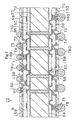
- Fig. 1 shows a sectional view of a printed wiring board 10
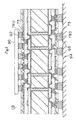
- Fig. 2 shows a state in which an IC chip 90 is mounted on the printed wiring board 10 and the printed wiring board 10 is mounted on a daughter board 94.
- the printed wiring board 10 has a conductor circuit 34 formed on both surfaces of a core substrate 30, and the respective conductor circuits are electrically connected through a plated through hole 36.
- a conductor circuit 58 forming a conductor circuit layer through an interlaminar insulative resin layer 50.
- the conductor circuit 58 is connected to the conductor circuit 34 through via hole 60.
- a conductor circuit 158 is formed through an interlaminar insulative resin layer 150.
- the conductor circuit 158 is connected to the conductor circuit 58 through a via hole 160 formed in an interlaminar insulative resin layer 150.
- a solder resist layer 70 is formed by covering the conductor circuit 158 and the via hole 160, and a connecting pad 75 is formed by forming a nickel plated layer 72 and a gold plated layer 74 on an opening 70 provided in the solder resist layer 71.
- a solder bump 78U On the connecting pad 75 of the top face is formed a solder bump 78U and on the connecting pad 75 of the bottom face is formed a BGA (ball grid array) 78D.
- the solder bump 78U on the top face side of the printed wiring board 10 is connected to an electrode 92 of the IC chip 90 to form an IC mounted printed wiring board, and the IC mounted printed wiring board is connected to a land 96 of a daughter board 94 through the BGA 78D.
- the surface of the solder resist layer corresponding to at least electronic parts mounting region is flattened.
- the solder resist layer and the solder bump are different in thermal expansion coefficient, so that there are produced repeatedly contraction and expansion at the boundary vicinity between the solder bump and the solder resist layer.
- the volume of the solder resist layer in the bump vicinity is small to be easily broken. Therefore, by making flatness of the solder resist layer surface small to some extent, the volume of the solder resist layer where large stress is applied to is increased, bending portion where stress tends to concentrate is lessened, and heat cycle resistance can easily be improved.
- the flattened surface of the solder resist layer is desirably 0.8 to 3.0 ⁇ m in maximum surface roughness. The reason is if the maximum surface roughness is within a range of 0.8 to 3.0 ⁇ m, crack is hardly generated in the solder resist in the vicinity of the conductor pad, and air (void) is hard to enter into the under fill resin. As a result, insulation reliability and connection reliability are improved.
- Wettability of the under fill resin is easily improved by applying the roughening treatment to the surface of the solder resist layer flattened to some extent, so that under fill resin can be filled in a narrow gap portion in the boundary vicinity between the solder resist layer and the solder bump so as to improve connection reliability.
- the roughened surface of the solder resist layer is smaller than the maximum surface roughness of the flattened surface and 0. 2 to 0.5 ⁇ m at an arithmetic mean roughness (Ra).
- the reason is that when the arithmetic mean roughness Ra is made within a range of 0.2 to 0.5 ⁇ m, adhesion to the under fill resin can be increased, and flux residue and cleaning residue are hardly remained on the solder resist surface. As a result, insulation reliability and connection reliability are easily improved.
- two connecting pads positioned at the center are formed in the form of a land right above the viahole 160, two connecting pads adjacent thereto are formed in the form of pads adjacent to the land of the viahole 160, and further two connecting pads positioned at both ends are formed in the form of a pad consisting of a part of a wiring pattern of the conductor circuit 158.
- connecting pads 75 of the bottom face two connecting pads positioned at both ends are formed in the form of a land right above the viahole 160, and four connecting pads positioned at the center are formed in the form of a pad adjacent to a land of the viahole 160.
- the viahole 160 as a connecting pad formed by the solder bump 78U is preferably a filled via, and the uneven amount of the filled via surface exposed from the surface of the interlaminar insulative resin layer 150 is, as shown in Figs. 10A to 10B , desirably within a range of -5 ⁇ m to +5 ⁇ m in relation to the surface thickness of the conductor circuit 158.
- the reason why the depressed or protruded amount of the filled via surface is restricted to a mentioned above is due to the fact that when the depressed amount is more than 5 ⁇ m (-5 ⁇ m), the number of contact point defined by the solder ball and the connecting pad consisting of the filled via is reduced, wettability becomes poor in case of forming the solder bump, and entanglement of voids within the bump and missing bump are not controlled, while when the protruded amount of the filled via surface is more than 5 ⁇ m(+ 5 ⁇ m), the thickness of the conductor circuit 158 becomes too large to be adaptable for fine pitched patterning.
- the "electronic parts mounting region” in the embodiment of the invention substantially corresponds to a region (hereinafter, simply called as "connecting pad region") where conductor pads such as filled via and the like for mounting electronic parts are provided.
- Fig. 11A shows a state of aligning all of the outermost peripheral connecting pads along each side of a rectangle among grid-like aligned connecting pads
- Fig. 11B shows a state of not aligning some of the outermost peripheral connecting pads along each side of the rectangle, however, in either case, when the connecting pad region is made rectangle, a rectangle region determined to minimize an area of the region enclosing all connecting pads is called as "connecting pad region”.
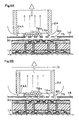
- Figs. 3A to 3C are views explaining the steps for forming the solder bumps on the printed wiring board 10 according to the present invention.
- a flux layer 80 is formed for covering conductor pads formed in the openings 71 provided in the solder resist layer 70 on the top face side of the printed wiring board, i.e. the connecting pads 75 by a printing method (see Fig. 3A ).
- solder ball for example, made by Hitachi Metals or Tamura
- solder ball loader described later on (see Fig. 3B ).
- solder ball is desirable 40 ⁇ m or more and less than 200 ⁇ m in diameter.
- each solder ball does not easily drop on the corresponding connecting pad because it is light in weight, while when the diameter is 200 ⁇ m or more, solder balls are not assembled in a cylinder member, causing the presence of connecting pads with no solder balls mounted thereon.
- the solder ball having a diameter of 80 ⁇ m or less is desirable.
- solder balls 78L of a usual diameter (250 ⁇ m) are adsorbed and placed on the connecting pads 75 on the bottom face side of the printed wiring board with the use of an adsorption head as described in Japanese Patent No. 1975429 , for instance (see Fig. 3C ).
- the pitch of the solder bumps corresponds to a pitch of the connecting pads, and when the pitch of the connecting pads is less than 60 ⁇ m, manufacture of solder balls suitable for the pitch becomes difficult. When the pitch of the connecting pads is more than 200 ⁇ m, it becomes impossible to obtain a printed wiring board adaptable for fine patterning or narrow pitching.
- an IC mounted printed wiring board 10 is formed by mounting the IC chip 90 through the solder bumps 78U by reflowing, and this IC mounted printed wiring board 10 is mounted on the daughter board 94 through BGA 78D.
- solder ball loader for mounting the very small solder balls 78s on the corresponding connecting pads of the above-described printed wiring board is explained by referring to Figs. 4A to 4B .
- Fig. 4A is a block diagram showing the structure of the solder ball loader
- Fig. 4B is a view taken from an arrow B of the solder ball loader of Fig 4A .
- the solder ball loader 20 comprises an XY ⁇ suction table 14 for positioning and holding the printed wiring board 10, a vertical moving shaft 12 for moving the XY ⁇ suction table 14 up and down, a ball aligning mask 16 with an opening corresponding to the connecting pad 75 of the printed wiring board, a mounting cylinder (cylinder member) 24 for guiding the solder balls moving on the ball aligning mask 16, a suction box 26 for giving negative pressure to the mounting cylinder 24, a solder ball removing cylinder 61 for recovering excessive solder balls, a suction box 66 for giving negative pressure to the solder ball removing cylinder 61, an adsorbed ball removing and adsorbing device 68 for holding the collected solder balls, a mask clamp 44 for clamping the ball aligning mask 16, an X-axis direction moving shaft 40 for sending the mounting cylinder 24 and the solder ball removing cylinder 61 to the X-axis direction, a moving shaft supporting guide 42 for supporting the X-axis direction moving shaft 40, an alignment camera 46 for taking an
- a plurality of the mounting cylinders 24 and the solder ball removing cylinder 61 are arranged in the Y-axis direction by corresponding to size of the connecting pad regions. Further, the size may correspond to a plurality of the connecting pad areas.
- the Y-axis direction is expedient and may be aligned in the X-axis direction.
- the XY ⁇ suction table 14 functions as positioning, adsorption, maintenance and correction of the solder ball mounted printed wiring board 10.
- the alignment camera 46 detects an alignment mark of the printed wiring board 10 on the XY ⁇ suction table 14 to regulate a position between the printed wiring board 10 and the ball aligning mask 16 based on the detected position.
- the residue detecting sensor 18 detects the residue of the solder balls by an optical method.
- an alignment mark 34M of the printed wiring board 10 is recognized by the alignment camera 46, and the position of the printed wiring board 10 in relation to the ball aligning mask 16 is corrected by the suction table 14. That is, openings 16a of the ball aligning mask 16 are adjusted for corresponding to the connecting pads 75 of the printed wiring board 10 in position, respectively.
- solder balls are mounted to a printed wiring board of worksheet size for constructing a plurality of printed wiring boards, and after forming solder bumps, the worksheet size board is cut into respective multilayer printed wiring boards.
- solder balls 78s are supplied from a solder ball supplying device 22 to the side of the mounting cylinder 24.
- solder ball any commercial item (a product of Hitachi Metals, for example) may be used or, solder balls may be manufactured according to the manufacturing device and method described in Japanese unexamined patent application No. 2001-226705 .
- solder balls are placed on a metal plate (e.g. nickel plate of 25 ⁇ m thick) having a square slit (opening) of which length and breadth are smaller than a designated diameter of the solder ball by 1 ⁇ m, and the solder balls are rolled thereon and dropped from the slit. Then, small balls having smaller diameters than designated are removed. Thereafter, the solder balls remained on the metal plate are classified by a metal plate having a square slit of which length and breadth are larger than the desired diameter of the solder ball by 1 ⁇ m, and solder balls dropped from the slit are collected so as to obtain the solder balls having a substantially equal diameter to the desired diameter.
- a metal plate e.g. nickel plate of 25 ⁇ m thick
- solder balls are rolled thereon and dropped from the slit.
- small balls having smaller diameters than designated are removed.
- solder balls remained on the metal plate are classified by a metal plate having a square slit of which length and bread
- solder balls 78s are assembled on the ball aligning mask 16 right under the opening 24A of the mounting cylinder 24 by adsorbing air from the suction portion 24B at a running speed of 5 m/sec to 35 m/sec in a gap between the mounting cylinder and the printed wiring board.
- the mounting cylinders 24 aligned along the Y-axis of the printed wiring board 10 are sent to the horizontal direction along the X-axis by means of the X-axis direction moving shaft 40.
- the solder balls 78s assembled on the ball aligning mask 16 are moved with the movement of the mounting cylinder 24, dropped to the corresponding connecting pads 75 of the printed wiring board 10 through the openings 16a of the ball aligning mask 16 and loaded.
- the solder balls 78s are successively aligned on the whole connecting pads on the side of the printed wiring board 10.
- the excessive solder balls 78s are guided to a place having no opening 16a on the ball aligning mask 16, then adsorbed and removed by the solder ball removing cylinder 61.
- the solder balls 78s are assembled by positioning the mounting cylinder 24 on the upper part of the ball aligning mask 16 and adsorbing air from the suction portion 24B on the top of the mounting cylinder 24, the assembled solder balls 78s are moved on the ball aligning mask 16 by moving the mounting cylinder 24 in the horizontal direction, and the solder balls 78s can be dropped to the respective connecting pads 75 of the printed wiring board 10 through the respective openings 16a of the ball aligning mask 16.
- solder balls 78s can certainly be mounted on the whole of the connecting pads 75 of the printed wiring board 10. Further, since the solder balls 78s can be moved with no contact, the solder balls can be mounted on the connecting pads 75 without damage, which is different from a printing method with the use of a conventional squeeze, and the solder bumps 78U can be equalized in height.
- the fine solder balls could certainly be placed on the connecting pads, even in the printed wiring board having such a narrow pitch alignment that the connecting pad pitch is 60 to 200 ⁇ m and the solder resist opening diameter is 40 to 150 ⁇ m, in the whole of bumps, stable bumps having substantially uniform heights can be formed.
- solder balls are guided by suction force so as to prevent aggregation and adhesion of solder balls. Further, adjusting number of the mounting cylinder 24 so as to be applied to many forms and small production enables the applicability to various sizes of the works (multilayer printed wiring board of work sheet size).
- the mounting cylinders 24 are aligned in the Y direction by corresponding to width of the work (printed wiring board of work sheet size), so that the solder balls can positively be mounted on the whole of connecting pads 75 of the printed wiring boards by simply sending a plurality of mounting cylinders 24 to the vertical direction (X direction) in relation to the row direction.
- solder balls 78s remained on the ball aligning mask 16 can be collected by the solder ball removing cylinder 61, so that there are no problem such that excessive solder ball are remained to cause any trouble and the like.
- solder balls mounted on the connecting pads of the wiring substrate become solder bumps having predetermined height by means of a reflow treatment, IC chips are mounted on the substrate through such solder bumps, and the printed wiring board according to the present invention is manufactured.
- a double sided copper-clad laminate e.g. "MCL-E-67” made by Hitachi Chemical
- a through-hole conductor and a conductor circuit by a known method.
- insulating layers and conductor circuit layers are alternately laminated by a known method (e.g.
- connecting pads are formed by a method similar to that described in Japanese unexamined patent application No. 2000-357762 .
- the pattern (opening diameter, pitch, arrangement, etc.) of a plated resist is changed.
- Formation of a solder resist layer is that screen printing is carried out under the following printing condition with the use of a commercial solder resist to form a solder resist layer having a thickness of 15 to 25 ⁇ m (on the connecting pad) for covering the connecting pad.
- Solder resist ink "RPZ-1" made by Hitachi Kogyo Ink viscosity : 45 ⁇ 15 Pa ⁇ s Screen : polyester fiber (130 to 300 mesh) Squeeze speed : 100 to 200 mm/sec
- thickness of the solder resist layer is 25 ⁇ m.
- a photo mask having a pattern (mask pattern) of opening of solder resist thereon is exposed to ultraviolet ray of 100 to 1000 mJ under the state of adhering to the solder resist layer, and developed with a sodium carbonate solution (Na 2 CO 3 ) of 10 g/L, thereby forming an opening of 120 ⁇ m in diameter on the connecting pad.
- a sodium carbonate solution Na 2 CO 3
- solder balls are loaded on the suction table of a solder ball loader, alignment marks of the printed wiring board and the ball aligning mask are recognized by using a CCD camera, and alignment of the printed wiring board and the ball aligning mask is carried out.
- a metal mask made of Ni is used having openings of 175 ⁇ m in diameter at the position corresponding to the connecting pads of the printed wiring board.
- an opening diameter formed in the ball aligning mask is preferably 1.1 to 1.5 times the ball diameter used, and a thickness of the ball aligning mask is preferably 1/2 to 3/4 of the diameter of the solder ball used.
- Sn/Pb is used for the solder ball
- Pb free solder consisting of at least one metal and Sn selected from the group of Ag, Co, In, Bi, Zn and the like.
- air is adsorbed from the top of the mounting cylinder, and the gap running speed between the mounting cylinder and the printed wiring board is regulated to 5 to 35 m/sec for assembling the solder balls within the mounting cylinder.
- the mounting cylinder is moved at 10 to 40 mm/sec of the moving speed to roll the solder balls, and the solder balls are dropped from the respective openings of the ball aligning mask and mounted on the corresponding connection pads.
- solder ball aligning mask and the printed wiring board are separately taken out of the solder ball loader, and finally, the printed wiring board is put in the reflowing apparatus set at 230°C to form a solder bump.
- a height of the solder bump protruded from the solder resist surface is measured by a laser microscope ("VX-8500” made by KEYENCE or "WYKO NT-2000” made by Veeco).
- measurement points are four corners and a center of a rectangle, i.e. four solder bumps located at the four corners of a rectangle defined by the connecting pad group and a solder bump substantially positioned at the center of the rectangle are measured at this time, and five solder balls in total are measured.
- the minimum value of the solder bump height is 66 ⁇ m and the maximum value thereof is 70 ⁇ m.
- an IC chip is mounted through the solder bumps, and an IC chip mounted printed wiring board is manufactured by filling a commercial under fill resin between the IC chip and the solder resist.
- the mask pattern of a photo mask in case of forming a solder resist opening is changed to change the solder resist opening diameter to 90 ⁇ m
- the printing condition (mesh of screen and printing speed) of the solder resist is regulated
- film thickness of the solder resist is made 10 ⁇ m
- the solder ball having a diameter of 90 ⁇ m is mounted with the use of the ball aligning mask having an opening diameter of 110 ⁇ m
- a printed wiring board is manufactured in the same manner as in Example 1.
- the minimum value of the solder bump height becomes 46 ⁇ m and the maximum value thereof becomes 49 ⁇ m.
- the mask pattern of the photo mask in case of forming a solder resist opening is set to change the solder resist opening diameter to 60 ⁇ m
- the printing condition (mesh of screen and printing speed) of the solder resist is regulated
- film thickness of the solder resist is made 10 ⁇ m
- the solder ball having a diameter of 50 ⁇ m is mounted with the use of the ball aligning mask having an opening diameter of 60 ⁇ m
- a printed wiring board is manufactured in the same manner as in Example 1.
- the minimum value of the solder bump height becomes 31 ⁇ m and the maximum value thereof becomes 34 ⁇ m.
- solder ball having a diameter of 160 ⁇ m is mounted with the use of the ball aligning mask having an opening diameter of 190 ⁇ m
- a printed wiring board is manufactured in the same manner as in Example 1.
- the minimum value of the solder bump height becomes 84 ⁇ m and the maximum value thereof becomes 87 ⁇ m.
- solder ball having a diameter of 215 ⁇ m is mounted with the use of the ball aligning mask having an opening diameter of 260 ⁇ m, a printed wiring board is manufactured in the same manner as in Example 2.
- the minimum value of the solder bump height becomes 100 ⁇ m and the maximum value thereof becomes 180 ⁇ m.
- solder ball having a diameter of 170 ⁇ m is mounted with the use of the ball aligning mask having an opening diameter of 200 ⁇ m, a printed wiring board is manufactured in the same manner as in Example 8. As a result, the minimum value of the solder bump height becomes 75 ⁇ m and the maximum value thereof becomes 160 ⁇ m.
- solder ball having a diameter of 120 ⁇ m is mounted with the use of the ball aligning mask having an opening diameter of 150 ⁇ m, a printed wiring board is manufactured in the same manner as in Example 12. As a result, the minimum value of the solder bump height becomes 75 ⁇ m and the maximum value thereof becomes 90 ⁇ m.
- Example 1 Examples Diameter of Connecting Pad ( ⁇ m) Pitch of Connecting Pad ( ⁇ m) Thickness of Solder Resist Layer ( ⁇ m) Opening Diameter of Solder Resist Layer ( ⁇ m) Diameter of Solder Ball ( ⁇ m) Opening Diameter of Mask ( ⁇ m) Height of Bamp (minimum) ( ⁇ m) Height of Bamp(Maximum) ( ⁇ m) Height of Bamp/ Opening Diameter of SR Heat Cycle Test 500 cycles 1000 cycles
- Example 6 120 150 15 90 95 115 45 49 0.50 ⁇ ⁇
- Example 7 120 150 20 90 100 120 47 49 0.52 ⁇ ⁇
- Example 8 120 150 25 90 105 130 47 49 0.
- Examples 37 to 45 printed wiring boards made by applying the following flattening treatment to the solder resist layer surface are manufactured, and these are denoted as Examples 37 to 45.
- a connecting pad region for mounting IC chip (region area: 1200 mm 2 , connecting pad number: 30000) is measured by means of a surface roughness measuring instrument (e.g. "SURFCOM 480A” made by Tokyo Seimitsu or “WYKO N-2500” by Veeco) to examine uneven amount (see Fig, 8 ) due to the presence or absence of conductor pads. As a result, the uneven amount of the solder resist layer surface becomes 7.2 to 9.8 ⁇ m.
- a surface roughness measuring instrument e.g. "SURFCOM 480A” made by Tokyo Seimitsu or "WYKO N-2500” by Veeco
- PET polyethylene terephthalate
- maximum uneven amount and “minimum uneven amount” mentioned herein mean, as shown in Fig. 8 , maximum value and minimum value of differences X1, X2, X3, X4, X5 ⁇ ⁇ ⁇ ⁇ between height of the solder resist layer on the conductor pad or conductor circuit and that of the solder resist layer of adjacent conductor pad non-forming part or conductor circuit non-forming part in the electronic part mounting region.
- An uneven amount of the surface before flattening the solder resist layer obtained in this example is comparatively as large as about 6.6 to 10.2 ⁇ m, but the amount of the flattened surface is as small as about 0.7 to 3.0 ⁇ m.
- An uneven amount of the surface before flattening the solder resist layer obtained in this example is comparatively as large as about 8.4 to 9.3 ⁇ m, but that of the flattened surface is as small as about 0.8 to 3.1 ⁇ m.
- An uneven amount of the surface before flattening the solder resist layer obtained in this example is large such as about 8.2 to 9.6 ⁇ m, but that of the flattened surface is small such as about 0.7 to 3.2 ⁇ m.
- An uneven amount of the surface before flattening the solder resist layer obtained in this example is comparatively as large as about 9.9 to 10.2 ⁇ m, but that of the flattened surface is as small as about 0.8 to 3.3 ⁇ m.
- An uneven amount of the surface before flattening the solder resist layer obtained in this example is comparatively large such as about 8.3 to 10.3 ⁇ m, but that of the flattened surface is small such as about 0.7 to 3.0 ⁇ m.
- An uneven amount of the surface before flattening the solder resist layer obtained in this example is comparatively large such as about 9.1 to 9.8 ⁇ m. but that of the flattened surface is small such as about 0.5 to 3.1 ⁇ m.
- An uneven amount of the surface before flattening the solder resist layer obtained in this example is comparatively large such as about 8.1 to 10.2 ⁇ m, but that of the flattened surface is small such as about 0.8 to 3.0 ⁇ m.
- An uneven amount of the surface before flattening the solder resist layer obtained in this example is comparatively large such as about 9.6 to 10.3 ⁇ m, but that of the flattened surface is small such as about 0.7 to 3.0 ⁇ m.
- Example 40 (14) 0.7 3.2 ⁇ ( ⁇ ) ⁇ (X) Example 41 (19) 0.8 3.3 ⁇ ( ⁇ ) ⁇ (X) Example 42 (23) 0.7 3.0 ⁇ ( ⁇ ) ⁇ (X) Example 43 (26) 0.5 3.1 ⁇ ( ⁇ ) ⁇ (X) Example 44 (31) 0.8 3.0 ⁇ ( ⁇ ) ⁇ (X) Example 45 (35) 0.7 3.0 ⁇ ( ⁇ ) ⁇ (X)
- Roughening solution potassium permanganate solution Concentration: 60 to 80 g/l Temperature: 60 to 80°C Immersion time: 1 to 5 minutes
- surface roughness of the solder resist surface is randomly measured at 10 spots by surface roughness measuring instrument (for example, "SURFCOM 480A” made by Tokyo Seimitsu or "WYKO N-2500” made by Veeco).
- surface roughness measuring instrument for example, "SURFCOM 480A” made by Tokyo Seimitsu or "WYKO N-2500” made by Veeco.
- surface roughness (Ra) mentioned here means “arithmetic mean roughness (Ra)” prescribed by JIS B0601, but Ra within a range of the above measuring result is mentioned that the smallest Ra is Ra(min) and the largest one is Ra(max) in measured 10 spots.
- surface roughness is measured at random 10 spots in the solder resist layer surface corresponding to the conductor circuit (pad) forming region and the solder resist layer surface corresponding to the conductor circuit non-forming region, but not measured in the boundary vicinity of the conductor circuit forming region and the conductor circuit non-forming region.
- Roughening solution potassium permanganate solution Concentration: 60 to 80 g/l Temperature: 60 to 80°C Immersion time: 1 to 5 minutes
- Example 39 Except that roughening treatment is further applied to the solder resist layer surface with the following condition after flattening treatment, a printed wiring board is manufactured in the same manner as in Example 39.
- Roughening solution potassium permanganate solution Concentration: 60 to 80 g/l Temperature: 60 to 80°C Immersion time: 1 to 5 minutes
- Example 40 Except that roughening treatment is further applied to the solder resist layer surface with the following condition after flattening treatment, a printed wiring board is manufactured in the same manner as in Example 40.
- Roughening solution potassium permanganate solution Concentration: 60 to 80 g/l Temperature: 60 to 80°C Immersion time: 1 to 5 minutes
- Roughening solution potassium permanganate solution Concentration: 60 to 80 g/l Temperature: 60 to 80°C Immersion time: 1 to 5 minutes
- Roughening solution potassium permanganate solution Concentration: 60 to 80 g/l Temperature: 60 to 80°C Immersion time: 1 to 5 minutes
- Roughening solution potassium permanganate solution Concentration: 60 to 80 g/l Temperature: 60 to 80°C Immersion time: 1 to 5 minutes
- Example 44 Except that roughening treatment is further applied to the solder resist layer surface with the following condition after flattening treatment, a printed wiring board is manufactured in the same manner as in Example 44.
- Roughening solution potassium permanganate solution Concentration: 60 to 80 g/l Temperature: 60 to 80°C Immersion time: 1 to 5 minutes
- Example 45 Except that roughening treatment is further applied to the solder resist layer surface with the following condition after flattening treatment, a printed wiring board is manufactured in the same manner as in Example 45.
- Roughening solution potassium permanganate solution Concentration: 60 to 80 g/l Temperature: 60 to 80°C Immersion time: 1 to 5 minutes
- connection reliability is improved.
- unevenness of the solder resist layer surface due to the presence or absence of the connecting pad positioned beneath the solder resist is flattened, and when roughness of the flattened surface is 0.8 to 3 ⁇ m of maximum surface roughness (uneven amount), connection reliability is improved.
- connection reliability is further improved. It is assumed that adhesion between the under fill resin and the solder resist layer surface is easily improved, or flux and flux cleaning solvent are hard to remain within a recess of the surface.
- the printed wiring boards manufactured according to Examples 1 to 54 and Comparative Examples 1 to 24 are left in atmosphere of temperature: 85°C and humidity: 85% by applying voltage of 3.3V between adjacent and not shorted solder bumps for 50 hours. Thereafter, insulation resistance between the voltage-applied solder bumps is measured.
- insulation performance is "good (O) "and when insulation resistance is less than 10 7 ⁇ , insulation performance is "no good (x)" for evaluation.
- voids within solder bumps are observed by using an X-ray television system ("SMX-100" made by Shimazu Corporation) and number of voids is measured. 100 solder bumps are randomly selected, but no void is observed.
- SMX-100 X-ray television system
- Examples 1 to 54 As to the printed wiring boards manufactured according to Examples 1 to 54, except that number of connection pad is changed from 2000 (connecting pad region: about 150 mm 2 ) to 30000 (connecting pad region: 1200 mm 2 ), an IC mounted printed wiring board is manufactured in the same manner as in Examples 1 to 54, each of these examples is conducted to heat cycle test, HAST test and observation of voids in solder bump in the same manner as in Examples 1 to 54, and the same results as Examples 1 to 54 can be obtained.
- the printed wiring board of the invention easily improves connection reliability and insulation reliability, even narrow pitch structure such as 200 ⁇ m or less pitch of solder bump, by making a ratio (H/D) of height H from the solder resist layer surface to opening diameter D of the opening 0.55 to 1.0.
Landscapes
- Engineering & Computer Science (AREA)
- Manufacturing & Machinery (AREA)
- Microelectronics & Electronic Packaging (AREA)
- Electric Connection Of Electric Components To Printed Circuits (AREA)
Applications Claiming Priority (2)
| Application Number | Priority Date | Filing Date | Title |
|---|---|---|---|
| JP2005192862 | 2005-06-30 | ||
| PCT/JP2006/313342 WO2007004657A1 (ja) | 2005-06-30 | 2006-06-28 | プリント配線板 |
Publications (2)
| Publication Number | Publication Date |
|---|---|
| EP1887845A1 true EP1887845A1 (de) | 2008-02-13 |
| EP1887845A4 EP1887845A4 (de) | 2010-08-11 |
Family
ID=37604518
Family Applications (1)
| Application Number | Title | Priority Date | Filing Date |
|---|---|---|---|
| EP06780769A Withdrawn EP1887845A4 (de) | 2005-06-30 | 2006-06-28 | Leiterplatte |
Country Status (7)
| Country | Link |
|---|---|
| US (3) | US7714233B2 (de) |
| EP (1) | EP1887845A4 (de) |
| JP (1) | JP5021472B2 (de) |
| KR (1) | KR100905686B1 (de) |
| CN (2) | CN101868120A (de) |
| TW (1) | TW200738090A (de) |
| WO (1) | WO2007004657A1 (de) |
Families Citing this family (52)
| Publication number | Priority date | Publication date | Assignee | Title |
|---|---|---|---|---|
| JP4997105B2 (ja) * | 2005-05-23 | 2012-08-08 | イビデン株式会社 | プリント配線板およびその製造方法 |
| EP1887845A4 (de) * | 2005-06-30 | 2010-08-11 | Ibiden Co Ltd | Leiterplatte |
| JP5021473B2 (ja) * | 2005-06-30 | 2012-09-05 | イビデン株式会社 | プリント配線板の製造方法 |
| CN101888747B (zh) | 2006-01-27 | 2012-09-05 | 揖斐电株式会社 | 印刷线路板的制造方法 |
| TW200746964A (en) * | 2006-01-27 | 2007-12-16 | Ibiden Co Ltd | Method of manufacturing printed wiring board |
| US7969005B2 (en) * | 2007-04-27 | 2011-06-28 | Sanyo Electric Co., Ltd. | Packaging board, rewiring, roughened conductor for semiconductor module of a portable device, and manufacturing method therefor |
| JP5101169B2 (ja) * | 2007-05-30 | 2012-12-19 | 新光電気工業株式会社 | 配線基板とその製造方法 |
| US7982137B2 (en) * | 2007-06-27 | 2011-07-19 | Hamilton Sundstrand Corporation | Circuit board with an attached die and intermediate interposer |
| US9941245B2 (en) * | 2007-09-25 | 2018-04-10 | Intel Corporation | Integrated circuit packages including high density bump-less build up layers and a lesser density core or coreless substrate |
| TWI463582B (zh) * | 2007-09-25 | 2014-12-01 | 日本特殊陶業股份有限公司 | 具有焊接凸塊之配線基板的製造方法 |
| KR101551898B1 (ko) * | 2007-10-05 | 2015-09-09 | 신꼬오덴기 고교 가부시키가이샤 | 배선 기판, 반도체 장치 및 이들의 제조 방법 |
| KR100965341B1 (ko) * | 2007-12-20 | 2010-06-22 | 삼성전기주식회사 | 인쇄회로기판의 제조방법 |
| KR100992181B1 (ko) | 2007-12-26 | 2010-11-04 | 삼성전기주식회사 | 패키지용 기판 및 그 제조방법 |
| US7759137B2 (en) * | 2008-03-25 | 2010-07-20 | Stats Chippac, Ltd. | Flip chip interconnection structure with bump on partial pad and method thereof |
| US9345148B2 (en) | 2008-03-25 | 2016-05-17 | Stats Chippac, Ltd. | Semiconductor device and method of forming flipchip interconnection structure with bump on partial pad |
| TWI363585B (en) * | 2008-04-02 | 2012-05-01 | Advanced Semiconductor Eng | Method for manufacturing a substrate having embedded component therein |
| JPWO2009144846A1 (ja) * | 2008-05-30 | 2011-10-06 | イビデン株式会社 | 半田ボール搭載方法 |
| US8471154B1 (en) * | 2009-08-06 | 2013-06-25 | Amkor Technology, Inc. | Stackable variable height via package and method |
| US20110195223A1 (en) * | 2010-02-11 | 2011-08-11 | Qualcomm Incorporated | Asymmetric Front/Back Solder Mask |
| JP5290215B2 (ja) * | 2010-02-15 | 2013-09-18 | ルネサスエレクトロニクス株式会社 | 半導体装置、半導体パッケージ、インタポーザ、及びインタポーザの製造方法 |
| JP5623308B2 (ja) * | 2010-02-26 | 2014-11-12 | 日本特殊陶業株式会社 | 多層配線基板及びその製造方法 |
| US20120160542A1 (en) * | 2010-12-22 | 2012-06-28 | Oluwafemi Olufemi B | Crosstalk reduction on microstrip routing |
| JP2012169591A (ja) * | 2011-01-24 | 2012-09-06 | Ngk Spark Plug Co Ltd | 多層配線基板 |
| US8643154B2 (en) * | 2011-01-31 | 2014-02-04 | Ibiden Co., Ltd. | Semiconductor mounting device having multiple substrates connected via bumps |
| US8692129B2 (en) * | 2011-03-31 | 2014-04-08 | Ibiden Co., Ltd. | Package-substrate-mounting printed wiring board and method for manufacturing the same |
| JP6030639B2 (ja) * | 2011-05-09 | 2016-11-24 | インテグリス・インコーポレーテッド | 微多孔質膜層およびナノ繊維層を含む多孔質複合膜 |
| US8653658B2 (en) * | 2011-11-30 | 2014-02-18 | Taiwan Semiconductor Manufacturing Company, Ltd. | Planarized bumps for underfill control |
| CN102543930A (zh) * | 2012-02-03 | 2012-07-04 | 昆山美微电子科技有限公司 | 电铸晶圆凸块 |
| JP5502139B2 (ja) * | 2012-05-16 | 2014-05-28 | 日本特殊陶業株式会社 | 配線基板 |
| TWI536508B (zh) * | 2012-08-24 | 2016-06-01 | 日本特殊陶業股份有限公司 | Wiring board |
| US8970035B2 (en) | 2012-08-31 | 2015-03-03 | Taiwan Semiconductor Manufacturing Company, Ltd. | Bump structures for semiconductor package |
| US9673131B2 (en) | 2013-04-09 | 2017-06-06 | Intel Corporation | Integrated circuit package assemblies including a glass solder mask layer |
| KR101734425B1 (ko) * | 2013-09-24 | 2017-05-11 | 주식회사 엘지화학 | 드라이 필름 솔더 레지스트의 제조 방법과, 이에 사용되는 필름 적층체 |
| JP6320066B2 (ja) * | 2014-02-13 | 2018-05-09 | イビデン株式会社 | ボール搭載用マスクおよびボール搭載装置 |
| JP2016012002A (ja) * | 2014-06-27 | 2016-01-21 | 日立化成株式会社 | 感光性樹脂組成物の硬化物、それに用いる感光性樹脂組成物及び半導体装置搭載用基板の製造方法、半導体装置の製造方法 |
| JP5882510B2 (ja) * | 2014-06-30 | 2016-03-09 | 太陽インキ製造株式会社 | 感光性ドライフィルムおよびそれを用いたプリント配線板の製造方法 |
| JP6329027B2 (ja) * | 2014-08-04 | 2018-05-23 | ミネベアミツミ株式会社 | フレキシブルプリント基板 |
| CN104185360B (zh) * | 2014-08-18 | 2017-05-24 | 深圳市华星光电技术有限公司 | 一种印刷电路板及其设计方法 |
| JP2016076533A (ja) * | 2014-10-03 | 2016-05-12 | イビデン株式会社 | バンプ付きプリント配線板およびその製造方法 |
| JP6230520B2 (ja) * | 2014-10-29 | 2017-11-15 | キヤノン株式会社 | プリント回路板及び電子機器 |
| US10269758B2 (en) * | 2015-12-24 | 2019-04-23 | Intel Corporation | Systems and processes for measuring thickness values of semiconductor substrates |
| JP6175205B1 (ja) * | 2017-02-01 | 2017-08-02 | 太陽インキ製造株式会社 | 感光性フィルム、感光性フィルム積層体およびそれらを用いて形成された硬化物 |
| JP6949550B2 (ja) | 2017-05-17 | 2021-10-13 | 日本発條株式会社 | ディスク装置用サスペンションの配線部材 |
| JP6199524B1 (ja) * | 2017-07-03 | 2017-09-20 | 太陽インキ製造株式会社 | 感光性フィルム、感光性フィルム積層体およびそれらを用いて形成された硬化物 |
| JP6199525B1 (ja) * | 2017-07-03 | 2017-09-20 | 太陽インキ製造株式会社 | 感光性フィルム、感光性フィルム積層体およびそれらを用いて形成された硬化物 |
| JP2019140174A (ja) * | 2018-02-07 | 2019-08-22 | イビデン株式会社 | プリント配線板およびプリント配線板の製造方法 |
| CN109688720B (zh) * | 2018-12-30 | 2020-09-01 | 北京康普锡威科技有限公司 | 预制焊料的pcb板的制备方法及pcb板 |
| US11004819B2 (en) * | 2019-09-27 | 2021-05-11 | International Business Machines Corporation | Prevention of bridging between solder joints |
| CN116801482B (zh) * | 2022-03-18 | 2024-05-10 | 华为技术有限公司 | 电路板组件及其加工方法、电子设备 |
| CN114585175B (zh) * | 2022-04-29 | 2022-07-15 | 广东科翔电子科技股份有限公司 | 一种Mini-LED焊盘加高方法 |
| US20240372051A1 (en) * | 2022-05-31 | 2024-11-07 | Hefei BOE Ruisheng Technology Co., Ltd. | Wiring substrate and method of manufacturing the same, backboard and display apparatus |
| US12538828B2 (en) * | 2022-07-26 | 2026-01-27 | SanDisk Technologies, Inc. | System and method for depositing underfill material |
Family Cites Families (46)
| Publication number | Priority date | Publication date | Assignee | Title |
|---|---|---|---|---|
| JPS59996A (ja) | 1982-06-25 | 1984-01-06 | 株式会社日立製作所 | 基板の接続構造 |
| US5118027A (en) * | 1991-04-24 | 1992-06-02 | International Business Machines Corporation | Method of aligning and mounting solder balls to a substrate |
| JPH05121411A (ja) | 1991-10-25 | 1993-05-18 | Rohm Co Ltd | 電子部品における接続用バンプの形成方法 |
| US5329423A (en) | 1993-04-13 | 1994-07-12 | Scholz Kenneth D | Compressive bump-and-socket interconnection scheme for integrated circuits |
| JPH1140908A (ja) | 1997-07-22 | 1999-02-12 | Ibiden Co Ltd | プリント配線板 |
| JPH1174403A (ja) * | 1997-08-28 | 1999-03-16 | Mitsubishi Electric Corp | 半導体装置 |
| US6046910A (en) * | 1998-03-18 | 2000-04-04 | Motorola, Inc. | Microelectronic assembly having slidable contacts and method for manufacturing the assembly |
| JP2000022039A (ja) * | 1998-07-06 | 2000-01-21 | Shinko Electric Ind Co Ltd | 半導体装置及びその製造方法 |
| US6461953B1 (en) * | 1998-08-10 | 2002-10-08 | Fujitsu Limited | Solder bump forming method, electronic component mounting method, and electronic component mounting structure |
| JP3213292B2 (ja) * | 1999-07-12 | 2001-10-02 | ソニーケミカル株式会社 | 多層基板、及びモジュール |
| TW434856B (en) * | 2000-05-15 | 2001-05-16 | Siliconware Precision Industries Co Ltd | Manufacturing method for high coplanarity solder ball array of ball grid array integrated circuit package |
| TW533758B (en) * | 2000-07-31 | 2003-05-21 | Ngk Spark Plug Co | Printed wiring substrate and method for manufacturing the same |
| US6563210B2 (en) * | 2000-12-19 | 2003-05-13 | Intel Corporation | Parallel plane substrate |
| TWI293315B (en) * | 2000-12-26 | 2008-02-11 | Ngk Spark Plug Co | Wiring substrate |
| JP5004378B2 (ja) * | 2001-01-10 | 2012-08-22 | イビデン株式会社 | 多層プリント配線板 |
| JP4587571B2 (ja) | 2001-01-12 | 2010-11-24 | イビデン株式会社 | 多層プリント配線板の製造方法 |
| JP2002290030A (ja) * | 2001-03-23 | 2002-10-04 | Ngk Spark Plug Co Ltd | 配線基板 |
| JP3595283B2 (ja) * | 2001-06-27 | 2004-12-02 | 日本特殊陶業株式会社 | 配線基板及びその製造方法 |
| DE10138042A1 (de) | 2001-08-08 | 2002-11-21 | Infineon Technologies Ag | Elektronisches Bauteil und Verfahren zu seiner Herstellung |
| JP3910387B2 (ja) * | 2001-08-24 | 2007-04-25 | 新光電気工業株式会社 | 半導体パッケージ及びその製造方法並びに半導体装置 |
| US6753480B2 (en) * | 2001-10-12 | 2004-06-22 | Ultratera Corporation | Printed circuit board having permanent solder mask |
| TW557521B (en) * | 2002-01-16 | 2003-10-11 | Via Tech Inc | Integrated circuit package and its manufacturing process |
| JP2003218272A (ja) * | 2002-01-25 | 2003-07-31 | Sony Corp | 高周波モジュール及びその製造方法 |
| JP3819806B2 (ja) | 2002-05-17 | 2006-09-13 | 富士通株式会社 | バンプ電極付き電子部品およびその製造方法 |
| JP4209178B2 (ja) * | 2002-11-26 | 2009-01-14 | 新光電気工業株式会社 | 電子部品実装構造及びその製造方法 |
| JP2004179578A (ja) * | 2002-11-29 | 2004-06-24 | Ngk Spark Plug Co Ltd | 配線基板及びその製造方法 |
| JP2004207370A (ja) * | 2002-12-24 | 2004-07-22 | Cmk Corp | プリント配線板の製造方法 |
| JP4006699B2 (ja) * | 2003-04-22 | 2007-11-14 | 日立金属株式会社 | 微小ボール搭載用マスクおよび微小ボールの搭載方法 |
| JP4094982B2 (ja) * | 2003-04-15 | 2008-06-04 | ハリマ化成株式会社 | はんだ析出方法およびはんだバンプ形成方法 |
| WO2004103039A1 (ja) * | 2003-05-19 | 2004-11-25 | Dai Nippon Printing Co., Ltd. | 両面配線基板および両面配線基板の製造方法並びに多層配線基板 |
| KR100520961B1 (ko) * | 2003-05-30 | 2005-10-17 | 엘지전자 주식회사 | 인쇄회로기판의 제조방법 |
| TWI222687B (en) * | 2003-08-14 | 2004-10-21 | Advanced Semiconductor Eng | Semiconductor chip with bumps and method for manufacturing the same |
| TWI335195B (en) * | 2003-12-16 | 2010-12-21 | Ngk Spark Plug Co | Multilayer wiring board |
| JP4860113B2 (ja) * | 2003-12-26 | 2012-01-25 | ルネサスエレクトロニクス株式会社 | 半導体集積回路装置の製造方法 |
| JP4387231B2 (ja) | 2004-03-31 | 2009-12-16 | 新光電気工業株式会社 | キャパシタ実装配線基板及びその製造方法 |
| TWI240389B (en) | 2004-05-06 | 2005-09-21 | Advanced Semiconductor Eng | High-density layout substrate for flip-chip package |
| CN100367491C (zh) * | 2004-05-28 | 2008-02-06 | 日本特殊陶业株式会社 | 中间基板 |
| US7626829B2 (en) * | 2004-10-27 | 2009-12-01 | Ibiden Co., Ltd. | Multilayer printed wiring board and manufacturing method of the multilayer printed wiring board |
| JP2006216713A (ja) * | 2005-02-02 | 2006-08-17 | Ibiden Co Ltd | 多層プリント配線板 |
| TWI414218B (zh) * | 2005-02-09 | 2013-11-01 | 日本特殊陶業股份有限公司 | 配線基板及配線基板內建用之電容器 |
| US7183652B2 (en) * | 2005-04-27 | 2007-02-27 | Infineon Technologies Ag | Electronic component and electronic configuration |
| JP4997105B2 (ja) | 2005-05-23 | 2012-08-08 | イビデン株式会社 | プリント配線板およびその製造方法 |
| EP1887845A4 (de) * | 2005-06-30 | 2010-08-11 | Ibiden Co Ltd | Leiterplatte |
| JP5021473B2 (ja) | 2005-06-30 | 2012-09-05 | イビデン株式会社 | プリント配線板の製造方法 |
| JP4838068B2 (ja) * | 2005-09-01 | 2011-12-14 | 日本特殊陶業株式会社 | 配線基板 |
| KR100973949B1 (ko) * | 2005-12-20 | 2010-08-05 | 이비덴 가부시키가이샤 | 프린트 배선판의 제조 방법 |
-
2006
- 2006-06-28 EP EP06780769A patent/EP1887845A4/de not_active Withdrawn
- 2006-06-28 CN CN201010138568A patent/CN101868120A/zh active Pending
- 2006-06-28 WO PCT/JP2006/313342 patent/WO2007004657A1/ja not_active Ceased
- 2006-06-28 CN CN2006800148623A patent/CN101171894B/zh active Active
- 2006-06-28 JP JP2007524083A patent/JP5021472B2/ja active Active
- 2006-06-29 US US11/476,557 patent/US7714233B2/en active Active
- 2006-06-30 TW TW095123798A patent/TW200738090A/zh unknown
-
2007
- 2007-10-31 KR KR1020077025324A patent/KR100905686B1/ko active Active
-
2010
- 2010-02-26 US US12/713,274 patent/US8003897B2/en active Active
- 2010-11-23 US US12/952,537 patent/US8832935B2/en active Active
Also Published As
| Publication number | Publication date |
|---|---|
| EP1887845A4 (de) | 2010-08-11 |
| TW200738090A (en) | 2007-10-01 |
| US7714233B2 (en) | 2010-05-11 |
| TWI309543B (de) | 2009-05-01 |
| WO2007004657A1 (ja) | 2007-01-11 |
| JP5021472B2 (ja) | 2012-09-05 |
| JPWO2007004657A1 (ja) | 2009-01-29 |
| US20100155129A1 (en) | 2010-06-24 |
| US8832935B2 (en) | 2014-09-16 |
| KR20070116966A (ko) | 2007-12-11 |
| KR100905686B1 (ko) | 2009-07-03 |
| US20070096327A1 (en) | 2007-05-03 |
| US8003897B2 (en) | 2011-08-23 |
| CN101171894A (zh) | 2008-04-30 |
| US20110061232A1 (en) | 2011-03-17 |
| CN101171894B (zh) | 2010-05-19 |
| CN101868120A (zh) | 2010-10-20 |
Similar Documents
| Publication | Publication Date | Title |
|---|---|---|
| US8003897B2 (en) | Printed wiring board | |
| EP1887846A1 (de) | Leiterplatte | |
| JP4647007B2 (ja) | 半田ボール搭載装置 | |
| US20090188706A1 (en) | Interconnection element for electric circuits | |
| KR20070010003A (ko) | 땜납 볼 탑재 방법 및 땜납 볼 탑재 장치 | |
| US8371498B2 (en) | Method for manufacturing a printed wiring board | |
| CN101400216B (zh) | 具有焊料突起的布线基板的制造方法 | |
| US7845547B2 (en) | Method for manufacturing a printed wiring board | |
| US7880308B2 (en) | Semiconductor device | |
| JP4118286B2 (ja) | 半田ボール搭載方法 | |
| TWI524442B (zh) | 具有焊料凸塊的配線基板之製造方法、焊球搭載用遮罩 | |
| TW202327010A (zh) | 半導體封裝載板及其製法 |
Legal Events
| Date | Code | Title | Description |
|---|---|---|---|
| PUAI | Public reference made under article 153(3) epc to a published international application that has entered the european phase |
Free format text: ORIGINAL CODE: 0009012 |
|
| 17P | Request for examination filed |
Effective date: 20070925 |
|
| AK | Designated contracting states |
Kind code of ref document: A1 Designated state(s): AT BE BG CH CY CZ DE DK EE ES FI FR GB GR HU IE IS IT LI LT LU LV MC NL PL PT RO SE SI SK TR |
|
| DAX | Request for extension of the european patent (deleted) | ||
| RIN1 | Information on inventor provided before grant (corrected) |
Inventor name: FUJII, NAOAKI,IBIDEN CO., LTD. Inventor name: SAWA, SHIGEKI,IBIDEN CO., LTD. Inventor name: TANAKA, HIRONORI,IBIDEN CO., LTD. Inventor name: TANNO, KATSUHIKO,C/O IBIDEN CO., LTD. Inventor name: KAWAMURA, YOICHIRO,IBIDEN CO., LTD. |
|
| DAX | Request for extension of the european patent (deleted) | ||
| A4 | Supplementary search report drawn up and despatched |
Effective date: 20100713 |
|
| RIC1 | Information provided on ipc code assigned before grant |
Ipc: H01L 21/48 20060101ALI20100707BHEP Ipc: H01L 23/498 20060101ALI20100707BHEP Ipc: H05K 3/34 20060101AFI20070226BHEP |
|
| 17Q | First examination report despatched |
Effective date: 20110321 |
|
| STAA | Information on the status of an ep patent application or granted ep patent |
Free format text: STATUS: THE APPLICATION IS DEEMED TO BE WITHDRAWN |
|
| 18D | Application deemed to be withdrawn |
Effective date: 20140103 |