WO2019130994A1 - 非水系二次電池用セパレータ及び非水系二次電池 - Google Patents
非水系二次電池用セパレータ及び非水系二次電池 Download PDFInfo
- Publication number
- WO2019130994A1 WO2019130994A1 PCT/JP2018/044319 JP2018044319W WO2019130994A1 WO 2019130994 A1 WO2019130994 A1 WO 2019130994A1 JP 2018044319 W JP2018044319 W JP 2018044319W WO 2019130994 A1 WO2019130994 A1 WO 2019130994A1
- Authority
- WO
- WIPO (PCT)
- Prior art keywords
- separator
- heat resistant
- layer
- porous layer
- resistant porous
- Prior art date
- Legal status (The legal status is an assumption and is not a legal conclusion. Google has not performed a legal analysis and makes no representation as to the accuracy of the status listed.)
- Ceased
Links
Images





Classifications
-
- H—ELECTRICITY
- H01—ELECTRIC ELEMENTS
- H01M—PROCESSES OR MEANS, e.g. BATTERIES, FOR THE DIRECT CONVERSION OF CHEMICAL ENERGY INTO ELECTRICAL ENERGY
- H01M10/00—Secondary cells; Manufacture thereof
- H01M10/05—Accumulators with non-aqueous electrolyte
- H01M10/052—Li-accumulators
- H01M10/0525—Rocking-chair batteries, i.e. batteries with lithium insertion or intercalation in both electrodes; Lithium-ion batteries
-
- H—ELECTRICITY
- H01—ELECTRIC ELEMENTS
- H01M—PROCESSES OR MEANS, e.g. BATTERIES, FOR THE DIRECT CONVERSION OF CHEMICAL ENERGY INTO ELECTRICAL ENERGY
- H01M50/00—Constructional details or processes of manufacture of the non-active parts of electrochemical cells other than fuel cells, e.g. hybrid cells
- H01M50/40—Separators; Membranes; Diaphragms; Spacing elements inside cells
- H01M50/409—Separators, membranes or diaphragms characterised by the material
- H01M50/446—Composite material consisting of a mixture of organic and inorganic materials
-
- H—ELECTRICITY
- H01—ELECTRIC ELEMENTS
- H01M—PROCESSES OR MEANS, e.g. BATTERIES, FOR THE DIRECT CONVERSION OF CHEMICAL ENERGY INTO ELECTRICAL ENERGY
- H01M50/00—Constructional details or processes of manufacture of the non-active parts of electrochemical cells other than fuel cells, e.g. hybrid cells
- H01M50/40—Separators; Membranes; Diaphragms; Spacing elements inside cells
- H01M50/409—Separators, membranes or diaphragms characterised by the material
- H01M50/411—Organic material
- H01M50/414—Synthetic resins, e.g. thermoplastics or thermosetting resins
-
- H—ELECTRICITY
- H01—ELECTRIC ELEMENTS
- H01M—PROCESSES OR MEANS, e.g. BATTERIES, FOR THE DIRECT CONVERSION OF CHEMICAL ENERGY INTO ELECTRICAL ENERGY
- H01M10/00—Secondary cells; Manufacture thereof
- H01M10/05—Accumulators with non-aqueous electrolyte
- H01M10/052—Li-accumulators
-
- H—ELECTRICITY
- H01—ELECTRIC ELEMENTS
- H01M—PROCESSES OR MEANS, e.g. BATTERIES, FOR THE DIRECT CONVERSION OF CHEMICAL ENERGY INTO ELECTRICAL ENERGY
- H01M50/00—Constructional details or processes of manufacture of the non-active parts of electrochemical cells other than fuel cells, e.g. hybrid cells
- H01M50/40—Separators; Membranes; Diaphragms; Spacing elements inside cells
- H01M50/409—Separators, membranes or diaphragms characterised by the material
- H01M50/411—Organic material
- H01M50/414—Synthetic resins, e.g. thermoplastics or thermosetting resins
- H01M50/417—Polyolefins
-
- H—ELECTRICITY
- H01—ELECTRIC ELEMENTS
- H01M—PROCESSES OR MEANS, e.g. BATTERIES, FOR THE DIRECT CONVERSION OF CHEMICAL ENERGY INTO ELECTRICAL ENERGY
- H01M50/00—Constructional details or processes of manufacture of the non-active parts of electrochemical cells other than fuel cells, e.g. hybrid cells
- H01M50/40—Separators; Membranes; Diaphragms; Spacing elements inside cells
- H01M50/409—Separators, membranes or diaphragms characterised by the material
- H01M50/411—Organic material
- H01M50/414—Synthetic resins, e.g. thermoplastics or thermosetting resins
- H01M50/42—Acrylic resins
-
- H—ELECTRICITY
- H01—ELECTRIC ELEMENTS
- H01M—PROCESSES OR MEANS, e.g. BATTERIES, FOR THE DIRECT CONVERSION OF CHEMICAL ENERGY INTO ELECTRICAL ENERGY
- H01M50/00—Constructional details or processes of manufacture of the non-active parts of electrochemical cells other than fuel cells, e.g. hybrid cells
- H01M50/40—Separators; Membranes; Diaphragms; Spacing elements inside cells
- H01M50/409—Separators, membranes or diaphragms characterised by the material
- H01M50/411—Organic material
- H01M50/414—Synthetic resins, e.g. thermoplastics or thermosetting resins
- H01M50/423—Polyamide resins
-
- H—ELECTRICITY
- H01—ELECTRIC ELEMENTS
- H01M—PROCESSES OR MEANS, e.g. BATTERIES, FOR THE DIRECT CONVERSION OF CHEMICAL ENERGY INTO ELECTRICAL ENERGY
- H01M50/00—Constructional details or processes of manufacture of the non-active parts of electrochemical cells other than fuel cells, e.g. hybrid cells
- H01M50/40—Separators; Membranes; Diaphragms; Spacing elements inside cells
- H01M50/409—Separators, membranes or diaphragms characterised by the material
- H01M50/411—Organic material
- H01M50/414—Synthetic resins, e.g. thermoplastics or thermosetting resins
- H01M50/426—Fluorocarbon polymers
-
- H—ELECTRICITY
- H01—ELECTRIC ELEMENTS
- H01M—PROCESSES OR MEANS, e.g. BATTERIES, FOR THE DIRECT CONVERSION OF CHEMICAL ENERGY INTO ELECTRICAL ENERGY
- H01M50/00—Constructional details or processes of manufacture of the non-active parts of electrochemical cells other than fuel cells, e.g. hybrid cells
- H01M50/40—Separators; Membranes; Diaphragms; Spacing elements inside cells
- H01M50/409—Separators, membranes or diaphragms characterised by the material
- H01M50/443—Particulate material
-
- H—ELECTRICITY
- H01—ELECTRIC ELEMENTS
- H01M—PROCESSES OR MEANS, e.g. BATTERIES, FOR THE DIRECT CONVERSION OF CHEMICAL ENERGY INTO ELECTRICAL ENERGY
- H01M50/00—Constructional details or processes of manufacture of the non-active parts of electrochemical cells other than fuel cells, e.g. hybrid cells
- H01M50/40—Separators; Membranes; Diaphragms; Spacing elements inside cells
- H01M50/409—Separators, membranes or diaphragms characterised by the material
- H01M50/449—Separators, membranes or diaphragms characterised by the material having a layered structure
-
- H—ELECTRICITY
- H01—ELECTRIC ELEMENTS
- H01M—PROCESSES OR MEANS, e.g. BATTERIES, FOR THE DIRECT CONVERSION OF CHEMICAL ENERGY INTO ELECTRICAL ENERGY
- H01M50/00—Constructional details or processes of manufacture of the non-active parts of electrochemical cells other than fuel cells, e.g. hybrid cells
- H01M50/40—Separators; Membranes; Diaphragms; Spacing elements inside cells
- H01M50/409—Separators, membranes or diaphragms characterised by the material
- H01M50/449—Separators, membranes or diaphragms characterised by the material having a layered structure
- H01M50/451—Separators, membranes or diaphragms characterised by the material having a layered structure comprising layers of only organic material and layers containing inorganic material
-
- H—ELECTRICITY
- H01—ELECTRIC ELEMENTS
- H01M—PROCESSES OR MEANS, e.g. BATTERIES, FOR THE DIRECT CONVERSION OF CHEMICAL ENERGY INTO ELECTRICAL ENERGY
- H01M50/00—Constructional details or processes of manufacture of the non-active parts of electrochemical cells other than fuel cells, e.g. hybrid cells
- H01M50/40—Separators; Membranes; Diaphragms; Spacing elements inside cells
- H01M50/409—Separators, membranes or diaphragms characterised by the material
- H01M50/449—Separators, membranes or diaphragms characterised by the material having a layered structure
- H01M50/457—Separators, membranes or diaphragms characterised by the material having a layered structure comprising three or more layers
-
- H—ELECTRICITY
- H01—ELECTRIC ELEMENTS
- H01M—PROCESSES OR MEANS, e.g. BATTERIES, FOR THE DIRECT CONVERSION OF CHEMICAL ENERGY INTO ELECTRICAL ENERGY
- H01M50/00—Constructional details or processes of manufacture of the non-active parts of electrochemical cells other than fuel cells, e.g. hybrid cells
- H01M50/40—Separators; Membranes; Diaphragms; Spacing elements inside cells
- H01M50/46—Separators, membranes or diaphragms characterised by their combination with electrodes
-
- H—ELECTRICITY
- H01—ELECTRIC ELEMENTS
- H01M—PROCESSES OR MEANS, e.g. BATTERIES, FOR THE DIRECT CONVERSION OF CHEMICAL ENERGY INTO ELECTRICAL ENERGY
- H01M50/00—Constructional details or processes of manufacture of the non-active parts of electrochemical cells other than fuel cells, e.g. hybrid cells
- H01M50/40—Separators; Membranes; Diaphragms; Spacing elements inside cells
- H01M50/46—Separators, membranes or diaphragms characterised by their combination with electrodes
- H01M50/461—Separators, membranes or diaphragms characterised by their combination with electrodes with adhesive layers between electrodes and separators
-
- H—ELECTRICITY
- H01—ELECTRIC ELEMENTS
- H01M—PROCESSES OR MEANS, e.g. BATTERIES, FOR THE DIRECT CONVERSION OF CHEMICAL ENERGY INTO ELECTRICAL ENERGY
- H01M50/00—Constructional details or processes of manufacture of the non-active parts of electrochemical cells other than fuel cells, e.g. hybrid cells
- H01M50/40—Separators; Membranes; Diaphragms; Spacing elements inside cells
- H01M50/489—Separators, membranes, diaphragms or spacing elements inside the cells, characterised by their physical properties, e.g. swelling degree, hydrophilicity or shut down properties
- H01M50/494—Tensile strength
-
- H—ELECTRICITY
- H01—ELECTRIC ELEMENTS
- H01M—PROCESSES OR MEANS, e.g. BATTERIES, FOR THE DIRECT CONVERSION OF CHEMICAL ENERGY INTO ELECTRICAL ENERGY
- H01M50/00—Constructional details or processes of manufacture of the non-active parts of electrochemical cells other than fuel cells, e.g. hybrid cells
- H01M50/40—Separators; Membranes; Diaphragms; Spacing elements inside cells
- H01M50/409—Separators, membranes or diaphragms characterised by the material
- H01M50/431—Inorganic material
- H01M50/434—Ceramics
-
- H—ELECTRICITY
- H01—ELECTRIC ELEMENTS
- H01M—PROCESSES OR MEANS, e.g. BATTERIES, FOR THE DIRECT CONVERSION OF CHEMICAL ENERGY INTO ELECTRICAL ENERGY
- H01M50/00—Constructional details or processes of manufacture of the non-active parts of electrochemical cells other than fuel cells, e.g. hybrid cells
- H01M50/40—Separators; Membranes; Diaphragms; Spacing elements inside cells
- H01M50/489—Separators, membranes, diaphragms or spacing elements inside the cells, characterised by their physical properties, e.g. swelling degree, hydrophilicity or shut down properties
-
- H—ELECTRICITY
- H01—ELECTRIC ELEMENTS
- H01M—PROCESSES OR MEANS, e.g. BATTERIES, FOR THE DIRECT CONVERSION OF CHEMICAL ENERGY INTO ELECTRICAL ENERGY
- H01M50/00—Constructional details or processes of manufacture of the non-active parts of electrochemical cells other than fuel cells, e.g. hybrid cells
- H01M50/40—Separators; Membranes; Diaphragms; Spacing elements inside cells
- H01M50/489—Separators, membranes, diaphragms or spacing elements inside the cells, characterised by their physical properties, e.g. swelling degree, hydrophilicity or shut down properties
- H01M50/491—Porosity
-
- Y—GENERAL TAGGING OF NEW TECHNOLOGICAL DEVELOPMENTS; GENERAL TAGGING OF CROSS-SECTIONAL TECHNOLOGIES SPANNING OVER SEVERAL SECTIONS OF THE IPC; TECHNICAL SUBJECTS COVERED BY FORMER USPC CROSS-REFERENCE ART COLLECTIONS [XRACs] AND DIGESTS
- Y02—TECHNOLOGIES OR APPLICATIONS FOR MITIGATION OR ADAPTATION AGAINST CLIMATE CHANGE
- Y02E—REDUCTION OF GREENHOUSE GAS [GHG] EMISSIONS, RELATED TO ENERGY GENERATION, TRANSMISSION OR DISTRIBUTION
- Y02E60/00—Enabling technologies; Technologies with a potential or indirect contribution to GHG emissions mitigation
- Y02E60/10—Energy storage using batteries
Definitions
- the present invention relates to a non-aqueous secondary battery separator and a non-aqueous secondary battery.
- Non-aqueous secondary batteries represented by lithium ion secondary batteries are widely used as a power source for portable electronic devices such as notebook computers, mobile phones, digital cameras, camcorders and the like.
- non-aqueous secondary batteries represented by lithium ion secondary batteries are considered to be applied as batteries for electric power storage and electric vehicles, from the feature of high energy density.
- a separator provided with a heat-resistant porous layer containing at least one of inorganic particles and a heat-resistant resin is known as a separator with enhanced heat resistance.
- a separator provided with an adhesive layer containing a resin having an adhesive property to the electrode is known as a separator having an enhanced adhesive property to the electrode.
- the separators disclosed in Patent Documents 1 to 6 include both a heat resistant porous layer and an adhesive layer.
- the heat resistance of the separator is higher as the content of the inorganic particles in the heat resistant porous layer is higher, but as the content of the inorganic particles is higher, the heat resistant porous layer is more easily peeled off from the porous substrate or the adhesive layer. Also, the heat resistant porous layer becomes brittle. In that case, even if the adhesion between the adhesive layer and the electrode is maintained, the separator has an interfacial failure between the heat resistant porous layer and the porous substrate, and between the heat resistant porous layer and the adhesive layer. Interfacial failure between them or cohesive failure of the heat resistant porous layer occurs, and as a result, the adhesion between the separator and the electrode is not maintained.
- the heat resistant porous layer is required not only to be heat resistant, but also to be difficult to peel off from the porous substrate, difficult to peel off from the adhesive layer, and toughness.
- the adhesive layer is required to have not only adhesiveness to the electrode but also difficulty in peeling from the heat-resistant porous layer or porous substrate with which the adhesive layer is in contact, and toughness.
- An embodiment of the present disclosure is a separator for a non-aqueous secondary battery including a heat resistant porous layer and an adhesive layer, and it is an object of the present disclosure to provide a non-aqueous secondary battery separator having excellent adhesion with an electrode. Let's make it a task to solve this.
- Heat resistance having a porous substrate, and a porous film provided on one side or both sides of the porous substrate and containing at least one selected from the group consisting of wholly aromatic polyamide, polyamideimide and polyimide
- a non-woven fabric comprising: a porous layer; and an adhesive layer provided on one side or both sides of a laminate of the porous base and the heat resistant porous layer, wherein adhesive resin particles are attached to the laminate.
- Separator for aqueous secondary battery [2] The non-aqueous secondary battery separator according to [1], wherein the peel strength between the porous substrate and the heat resistant porous layer is 5 N / m to 75 N / m.
- a heat-resistant porous material comprising: a porous substrate; and a heat-resistant resin provided on one side or both sides of the porous substrate and having at least one of an amide bond and an imide bond in the molecule and inorganic particles.
- the adhesive resin particles include a mixture of a first adhesive resin particle containing a polyvinylidene fluoride resin and a second adhesive resin particle containing an acrylic resin.
- the difference between the Gurley value of the non-aqueous secondary battery separator and the Gurley value of the porous substrate is 20 seconds / 100 mL to 300 seconds / 100 mL.
- the separator for non-aqueous secondary batteries of description [7] In any one of [1] to [6], at least one of the tensile strength in the MD direction and the tensile strength in the TD direction of the non-aqueous secondary battery separator is 500 kgf / cm 2 to 3000 kgf / cm 2
- [8] by weight of the adhesive layer is a single-sided per 0.2g / m 2 ⁇ 2.0g / m 2 of the laminate, [1] ⁇ for a nonaqueous secondary battery according to any one of [7] Separator.
- non-aqueous secondary battery separator that is a non-aqueous secondary battery separator including a heat resistant porous layer and an adhesive layer, and that is excellent in adhesion to an electrode.
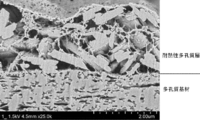
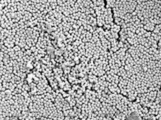
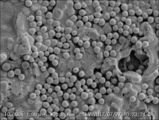
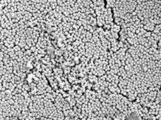
- the porous film which a heat resistant porous layer has contains wholly aromatic polyamide. It is an electron microscope image of the cross section of the embodiment which concerns on the heat resistant porous layer and porous base material with which the separator for 1st non-aqueous secondary batteries is provided. In the example of this embodiment, the porous film which a heat resistant porous layer has contains wholly aromatic polyamide. It is an electron microscope image of the surface of the example of an embodiment concerning the adhesion layer with which the first separator for nonaqueous secondary batteries is provided.
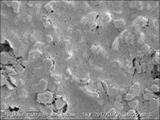
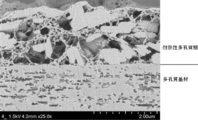
- the porous film which a heat resistant porous layer has contains wholly aromatic polyamide. It is an electron microscope image of the outer surface of embodiment of the heat-resistant porous layer with which the 1st separator for non-aqueous secondary batteries is provided. In the example of this embodiment, the porous film which a heat resistant porous layer has contains polyamidoimide. It is an electron microscope image of the cross section of the embodiment which concerns on the heat resistant porous layer and porous base material with which the separator for 1st non-aqueous secondary batteries is provided. In the example of this embodiment, the porous film which a heat resistant porous layer has contains polyamidoimide.
- the porous film which a heat resistant porous layer has contains polyamidoimide. It is an electron microscope image of the outer surface of embodiment of the heat-resistant porous layer with which the 1st separator for non-aqueous secondary batteries is provided. In the example of this embodiment, the porous film which a heat resistant porous layer has contains a polyimide. It is an electron microscope image of the cross section of the embodiment which concerns on the heat resistant porous layer and porous base material with which the separator for 1st non-aqueous secondary batteries is provided.
- the porous film which a heat resistant porous layer has contains a polyimide. It is an electron microscope image of the surface of the example of an embodiment concerning the adhesion layer with which the first separator for nonaqueous secondary batteries is provided. In the example of this embodiment, the porous film which a heat resistant porous layer has contains a polyimide. It is an electron microscope image of the surface of the example of an embodiment concerning the adhesion layer with which the second separator for nonaqueous secondary batteries is provided. It is an electron microscope image of the outer surface of embodiment of the heat resistant porous layer with which the 2nd separator for non-aqueous secondary batteries is provided.
- 1 is a schematic cross-sectional view of an embodiment of the non-aqueous secondary battery separator of the present disclosure.
- 1 is a schematic cross-sectional view of an embodiment of the non-aqueous secondary battery separator of the present disclosure.
- 1 is a schematic cross-sectional view of an embodiment of the non-aqueous secondary battery separator of the present disclosure.
- 1 is a schematic cross-sectional view of an embodiment of the non-aqueous secondary battery separator of the present disclosure.
- a numerical range indicated by using “to” indicates a range including numerical values described before and after “to” as the minimum value and the maximum value, respectively.
- step is included in the term if the intended purpose of the step is achieved, even if it can not be distinguished clearly from the other steps, as well as independent steps.
- the amount of each component in the composition in the present disclosure when there are multiple substances corresponding to each component in the composition, unless there is a particular mention, the plural types of those present in the composition Means the total amount of substance.
- MD direction means the long direction in porous substrates and separators manufactured in a long shape
- TD direction means the direction orthogonal to “MD direction”.
- MD direction is also referred to as “machine direction”
- TD direction is also referred to as “width direction”.
- (meth) acrylic means “acrylic” or “methacrylic”.
- the heat resistant resin refers to a resin having a melting point of 180 ° C. or more, or a resin having a melting point and a decomposition temperature of 180 ° C. or more. That is, the heat resistant resin in the present disclosure is a resin that does not melt and decompose in a temperature range of less than 180 ° C.
- the present disclosure discloses a first non-aqueous secondary battery separator and a second non-aqueous secondary battery separator.
- the first non-aqueous secondary battery separator does not always correspond to the second non-aqueous secondary battery separator, but may correspond to the second non-aqueous secondary battery separator.
- the second non-aqueous secondary battery separator does not always correspond to the first non-aqueous secondary battery separator, but may correspond to the first non-aqueous secondary battery separator.
- the first separator for a non-aqueous secondary battery (also referred to as "first separator") comprises a porous substrate, a heat resistant porous layer provided on one side or both sides of the porous substrate, and a porous material. And an adhesive layer provided on one side or both sides of a laminate of the substrate and the heat resistant porous layer.
- the heat-resistant porous layer in the first separator has a porous film containing at least one selected from the group consisting of wholly aromatic polyamide, polyamideimide and polyimide.
- the porous film may contain components other than wholly aromatic polyamide, polyamideimide and polyimide. Examples of the form of the heat resistant porous layer include the following forms (a) to (d).
- the heat-resistant porous layer is a porous film itself containing at least one selected from the group consisting of wholly aromatic polyamide, polyamideimide and polyimide.
- the heat-resistant porous layer is an inner layer formed on a porous substrate, and an inner layer containing at least one selected from the group consisting of wholly aromatic polyamide, polyamideimide and polyimide
- the inner layer is a porous structure that is larger in diameter than the porous coating.
- the heat resistant porous layer as a whole exhibits a so-called skin-core structure.
- the heat-resistant porous layer further contains inorganic particles, and the inorganic particles contain at least one selected from the group consisting of wholly aromatic polyamide, polyamideimide and polyimide It is a layer that is bound and covered.
- the heat-resistant porous layer is an inner layer formed on a porous substrate, and an inner layer containing at least one member selected from the group consisting of wholly aromatic polyamide, polyamideimide and polyimide, and inorganic particles And a porous film formed to cover the outer surface of the inner layer, the porous film containing at least one selected from the group consisting of wholly aromatic polyamides, polyamideimides and polyimides.
- the inner layer is a porous structure in which the inorganic particles are bound by at least one selected from the group consisting of wholly aromatic polyamide, polyamideimide and polyimide, and the diameter is larger than that of the porous film.
- the heat resistant porous layer as a whole exhibits a so-called skin-core structure.
- FIGS. 1A, 1 B, 2 A, 2 B, 3 A and 3 B show scanning electron microscope images (SEM images) of an embodiment of the heat resistant porous layer provided in the first separator.
- the heat resistant porous layer shown in FIGS. 1A, 1B, 2A, 2B, 3A and 3B is a form that also contains inorganic particles.
- the heat resistant porous layer shown in FIGS. 1A and 1B is a form in which the porous film contains a wholly aromatic polyamide.
- FIG. 1A is a SEM image of the outer surface of the heat resistant porous layer (the surface far from the porous substrate), and
- FIG. 1B is a SEM image of a cross section of the heat resistant porous layer and the porous substrate.
- the porous film is a film forming the outer surface of the heat resistant porous layer, and is a fine film having fine pores.
- the heat resistant porous layer shown in FIGS. 2A and 2B is a form in which the porous film contains polyamideimide.
- FIG. 2A is a SEM image of the outer surface (surface remote from the porous substrate) of the heat resistant porous layer
- FIG. 2B is a SEM image of a cross section of the heat resistant porous layer and the porous substrate.
- the porous film is a film forming the outer surface of the heat resistant porous layer, and is a fine film having fine pores.
- the heat resistant porous layer shown in FIGS. 3A and 3B is in a form in which the porous film contains a polyimide.
- FIG. 3A is a SEM image of the outer surface (surface remote from the porous substrate) of the heat resistant porous layer
- FIG. 3B is a SEM image of a cross section of the heat resistant porous layer and the porous substrate.
- the porous film is a film forming the outer surface of the heat resistant porous layer, and is a fine film having fine pores.
- the adhesive layer in the first separator is a layer formed by adhering adhesive resin particles on one side or both sides of a laminate of a porous substrate and a heat resistant porous layer.
- the adhesive resin particles are particulate resin having adhesiveness to the electrode.
- the adhesive layer may have a structure in which a large number of adhesive resin particles are arranged adjacent to each other on the surface of the laminate, and has a structure in which a large number of adhesive resin particles are distributed on the surface of the laminate. It may be In the adhesive layer, the adhesive resin particles may have a single layer structure in the thickness direction, or the adhesive resin particles may have a structure in which a plurality of adhesive resin particles are overlapped in the thickness direction.
- SEM image scanning electron microscope image
- the heat resistant porous layer provided in the first separator is heat resistant by having a porous film containing at least one selected from the group consisting of wholly aromatic polyamide, polyamideimide and polyimide, which is a heat resistant resin.
- the adhesive layer included in the first separator has a structure in which the adhesive resin particles are attached to the porous film or the porous substrate of the heat resistant porous layer, whereby the heat resistant porous layer or the porous substrate is obtained. Hard to peel off and excellent in toughness. Therefore, in the first separator, interface fracture between layers and cohesive failure of each layer are less likely to occur, and as a result, it is assumed that the adhesive strength with the electrode as a whole is strong.
- the second non-aqueous secondary battery separator (also referred to as "second separator”) is a porous substrate, a heat resistant porous layer provided on one side or both sides of the porous substrate, and a porous material. And an adhesive layer provided on one side or both sides of a laminate of the substrate and the heat resistant porous layer.
- the heat resistant porous layer in the second separator contains a heat resistant resin having at least one of an amide bond and an imide bond in the molecule, and / or inorganic particles. Thereby, the heat resistant porous layer has heat resistance.
- the peel strength between the porous substrate and the heat resistant porous layer in the second separator is 5 N / m to 75 N / m.
- the peel strength between the porous substrate and the heat resistant porous layer is within the above range on both sides of the porous substrate. is there.
- the adhesive layer in the second separator is a layer formed by adhering adhesive resin particles on one side or both sides of a laminate of a porous substrate and a heat resistant porous layer.
- the adhesive resin particles are particulate resin having adhesiveness to the electrode.
- the adhesive layer may have a structure in which a large number of adhesive resin particles are arranged adjacent to each other on the surface of the laminate, and has a structure in which a large number of adhesive resin particles are distributed on the surface of the laminate. It may be In the adhesive layer, the adhesive resin particles may have a single layer structure in the thickness direction, or the adhesive resin particles may have a structure in which a plurality of adhesive resin particles are overlapped in the thickness direction.
- FIG. 4A shows a scanning electron microscope image (SEM image) of an embodiment of the adhesive layer provided in the second separator.
- the second separator has a peel strength of 5 N / m to 75 N / m between the porous substrate and the heat resistant porous layer, and the heat resistant porous layer is less likely to be peeled off from the porous substrate.
- the adhesive layer provided in the second separator has a structure in which the adhesive resin particles adhere to the heat resistant porous layer or the porous substrate, so that the adhesive layer does not easily come off from the heat resistant porous layer or the porous substrate. Therefore, interface breakdown between the layers in the second separator is unlikely to occur, and as a result, it is assumed that the adhesive strength with the electrode as a whole is strong.
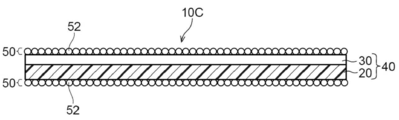
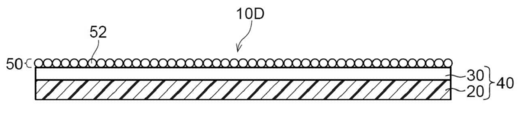
- FIGS. 5A-5D are each a schematic cross-sectional view of an example embodiment of a separator of the present disclosure.
- FIGS. 5A to 5D are schematic cross-sectional views mainly for explaining the stacking order of layers, and the structure of each layer is omitted or simplified.
- layers having similar functions are described with the same reference numerals.
- the heat resistant porous layer 30 is disposed on both sides of the porous substrate 20, and the adhesive layer is formed on both sides of the laminate 40 of the porous substrate 20 and the two heat resistant porous layers 30. 50 is a placed separator.
- the heat resistant porous layer 30 is disposed on both sides of the porous substrate 20, and the adhesive layer is formed on one side of the laminate 40 of the porous substrate 20 and the two heat resistant porous layers 30. 50 is a placed separator.
- the heat resistant porous layer 30 is disposed on one side of the porous substrate 20, and the adhesive layer is formed on both sides of the laminate 40 of the porous substrate 20 and one heat resistant porous layer 30. 50 is a placed separator.
- the heat resistant porous layer 30 is disposed on one side of the porous substrate 20, and the adhesive layer is formed on one side of the laminate 40 of the porous substrate 20 and one heat resistant porous layer 30.
- 50 is a placed separator. In the separator 10D, the adhesive layer 50 is disposed on the surface of the heat resistant porous layer 30.
- the heat resistant porous layer 30 is a layer disposed on the surface of the porous substrate 20.
- the heat resistant porous layer 30 may be on only one side of the porous substrate 20 or may be on both sides of the porous substrate 20.
- the heat resistance of the separator is more excellent, and the safety of the battery can be further enhanced.
- curling does not easily occur in the separator, and the handling property at the time of battery production is excellent.
- the heat resistant porous layer 30 is on only one side of the porous substrate 20, the ion permeability of the separator is more excellent.
- the thickness of the whole separator can be restrained and a battery with higher energy density can be manufactured.
- the adhesive layer 50 is a layer disposed on the surface of the porous substrate 20 or the heat resistant porous layer 30, and exists as the outermost layer of the separator.
- the adhesive layer 50 may be on only one side of the laminate 40 or may be on both sides of the laminate 40. When the adhesive layer 50 is present only on one side of the laminate 40, the adhesive layer 50 is preferably disposed on the surface of the heat resistant porous layer 30.
- the adhesion layer 50 may be disposed on one side or both sides of the laminate 40 in accordance with the composition or surface properties of the positive electrode or negative electrode of the battery. If the adhesive layer 50 is on only one side of the laminate 40, the thickness of the entire separator can be reduced, and a battery with higher energy density can be manufactured.
- the adhesive layer 50 is a layer in which the adhesive resin particles 52 adhere to the surface of the laminate 40.
- the adhesive layer 50 has a structure in which a large number of adhesive resin particles 52 are arranged adjacent to each other on the surface of the laminate 40, and the adhesive resin particles 52 are 1 in the thickness direction. It has a layer structure.
- the structure of the adhesive layer 50 is not limited to the above-described structure, and the adhesive resin particles 52 may have a structure in which a large number of the adhesive resin particles 52 are scattered on the surface of the laminate 40. It may have a structure in which a plurality of layers overlap in the direction.
- the adhesive layer 50 preferably has a structure in which a large number of adhesive resin particles 52 are arranged adjacent to each other on the surface of the laminate 40 from the viewpoint of being excellent in the adhesiveness to the electrode. From the viewpoint of enhancing, it is preferable that the adhesive resin particles 52 have a single layer structure in the thickness direction.
- a porous substrate means a substrate having pores or voids inside.
- a base material microporous membranes; porous sheets made of fibrous materials, such as nonwoven fabrics and paper; and the like can be mentioned.
- a microporous membrane is preferable from the viewpoint of thinning and strength of the separator.
- the microporous membrane means a membrane having a large number of micropores inside and connected to these micropores, and allowing gas or liquid to pass from one side to the other side. Do.
- the material of the porous substrate is preferably a material having electrical insulation, and may be either an organic material or an inorganic material.
- the porous substrate desirably contains a thermoplastic resin in order to provide the porous substrate with a shutdown function.
- the shutdown function is a function of blocking the movement of ions by blocking the pores of the porous substrate by dissolving the constituent material when the battery temperature rises, thereby preventing the thermal runaway of the battery.
- thermoplastic resin thermoplastic resins having a melting point of less than 200 ° C. are preferable.
- thermoplastic resin include polyesters such as polyethylene terephthalate; polyolefins such as polyethylene and polypropylene; and the like. Among them, polyolefins are preferable.
- a microporous membrane containing polyolefin As the porous substrate, a microporous membrane containing polyolefin (referred to as "polyolefin microporous membrane”) is preferable.
- polyolefin microporous membrane for example, a polyolefin microporous membrane applied to a conventional battery separator can be mentioned, and it is preferable to select one having sufficient mechanical properties and ion permeability from among them.
- the microporous polyolefin membrane is preferably a microporous membrane containing polyethylene from the viewpoint of exhibiting a shutdown function, and the content of polyethylene is preferably 95% by mass or more based on the total mass of the microporous polyolefin membrane.
- the microporous polyolefin film is preferably a microporous film containing polypropylene, from the viewpoint of providing heat resistance that does not easily rupture when exposed to high temperatures.
- the polyolefin microporous membrane is preferably a polyolefin microporous membrane containing polyethylene and polypropylene, from the viewpoint of providing a shutdown function and heat resistance that does not easily rupture when exposed to high temperature.
- a microporous polyolefin membrane a microporous membrane in which polyethylene and polypropylene are mixed in one layer can be mentioned.
- the microporous film preferably contains 95% by mass or more of polyethylene and 5% by mass or less of polypropylene from the viewpoint of achieving both a shutdown function and heat resistance.
- a polyolefin microporous film having a laminated structure of two or more layers, at least one layer containing polyethylene, and at least one layer containing polypropylene.
- the polyolefin contained in the microporous polyolefin membrane is preferably a polyolefin having a weight average molecular weight (Mw) of 100,000 to 5,000,000.
- Mw weight average molecular weight
- the Mw of the polyolefin is at least 100,000, sufficient mechanical properties can be imparted to the microporous membrane.
- the Mw of the polyolefin is 5,000,000 or less, the shutdown characteristics of the microporous membrane are good, and the microporous membrane can be easily formed.
- a method of producing a microporous polyolefin membrane a method of extruding a molten polyolefin resin from a T-die to form a sheet, crystallizing it, stretching it, and then heat treating it to form a microporous membrane: liquid paraffin etc.
- porous sheets made of fibrous materials include polyesters such as polyethylene terephthalate; polyolefins such as polyethylene and polypropylene; wholly aromatic polyamides, polyamideimides, polyimides, polyethersulfones, polysulfones, polyetherketones, polyetherimides, etc. And nonwoven sheets made of fibrous materials such as cellulose; and porous sheets such as paper.
- the properties of the porous base Various surface treatments may be applied as long as the As surface treatment, corona treatment, plasma treatment, flame treatment, ultraviolet irradiation treatment and the like can be mentioned.
- the thickness of the porous substrate is preferably 10.0 ⁇ m or less, more preferably 8.0 ⁇ m or less, from the viewpoint of enhancing the energy density of the battery, and 3.0 ⁇ m or more from the viewpoint of the production yield of the separator and the production yield of the battery. Is preferable, and 5.0 ⁇ m or more is more preferable.
- the Gurley value (JIS P8117: 2009) of the porous substrate is preferably 50 seconds / 100 mL to 400 seconds / 100 mL, and 50 seconds / 100 mL to 200 seconds from the viewpoint of suppressing short circuiting of the battery or obtaining sufficient ion permeability. / 100 mL is more preferable.
- the porosity of the porous substrate is preferably 20% to 60% from the viewpoint of obtaining an appropriate membrane resistance and a shutdown function.
- the piercing strength of the porous substrate is preferably 200 g or more from the viewpoint of the production yield of the separator and the production yield of the battery.
- the puncture strength of the porous base material is the maximum puncture load measured by performing a puncture test using a Kato Tech KES-G5 handy compression tester under a condition of a curvature of 0.5 mm at the tip of the needle and a puncture speed of 2 mm / sec. Point to (g).
- the heat-resistant porous layer in the first separator has a porous film containing at least one selected from the group consisting of wholly aromatic polyamide, polyamideimide and polyimide.
- the porous film is a film having a large number of micropores and gas or liquid can pass from one side to the other side.
- the porous film can be confirmed by a scanning electron microscope, and the outer surface of the heat resistant porous layer can be observed by observing the cross section of the separator or observing the outer surface of the heat resistant porous layer from the direction perpendicular to the surface. It can be observed that the resin part which has spread in the form of a film is formed, and that a large number of pores are formed in the resin part.
- a dense porous film having fine pores can be formed on a porous substrate by adjusting the composition of a coating liquid or a coagulating liquid in a wet coating method described later.
- the adhesive resin particles are attached to the porous film in a mode in which the adhesive layer is disposed on the surface of the heat resistant porous layer, Interfacial fracture between the heat resistant porous layer and the adhesive layer is unlikely to occur.
- the heat resistant porous layer has a porous film, the heat resistant porous layer is excellent in toughness, and cohesive failure of the heat resistant porous layer hardly occurs.
- the porous film is a fine film having fine pores, which forms the outer surface of the heat resistant porous layer.
- the average pore diameter of the micropores of the porous film is preferably 1000 nm or less, more preferably 800 nm or less, still more preferably 500 nm or less, from the viewpoint of the adhesive resin particles being difficult to peel off from the heat resistant porous layer Therefore, 1 nm or more is preferable, 5 nm or more is more preferable, and 10 nm or more is more preferable.
- the coverage of the porous film on the outer surface of the heat resistant porous layer is preferably 60% or more, more preferably 70% or more, and still more preferably 80% or more with respect to the area of the heat resistant porous layer in plan view.
- the wholly aromatic polyamide is suitable for the heat resistant porous layer from the viewpoint of durability.
- the wholly aromatic polyamide may be meta or para.
- meta-type wholly aromatic polyamides are preferable from the viewpoint of easily forming a porous layer and from the viewpoint of being excellent in redox resistance in electrode reaction.
- polymetaphenylene isophthalamide or polyparaphenylene terephthalamide is preferable as the wholly aromatic polyamide, and polymetaphenylene isophthalamide is more preferable.
- the weight average molecular weight of the wholly aromatic polyamide contained in the heat resistant porous layer is preferably 1 ⁇ 10 3 to 1 ⁇ 10 7, more preferably 5 ⁇ 10 3 to 5 ⁇ 10 6 , and 1 ⁇ 10 4 to 1 ⁇ 10 6 is more preferred.
- polyamideimide is suitable for the heat resistant porous layer from the viewpoint of heat resistance.
- the weight average molecular weight of the polyamideimide contained in the heat resistant porous layer is preferably 1 ⁇ 10 3 to 1 ⁇ 10 7, more preferably 5 ⁇ 10 3 to 5 ⁇ 10 6 , and 1 ⁇ 10 4 to 1 ⁇ 10 6 Is more preferred.
- polyimide is suitable for the heat resistant porous layer from the viewpoint of heat resistance.
- the polyimide may be an aliphatic polyimide or an aromatic polyimide.
- the weight average molecular weight of the polyimide contained in the heat resistant porous layer is preferably 1 ⁇ 10 3 to 1 ⁇ 10 7, more preferably 5 ⁇ 10 3 to 5 ⁇ 10 6 , and 1 ⁇ 10 4 to 1 ⁇ 10 6 More preferable.
- the heat resistant porous layer in the first separator may contain a heat resistant resin other than wholly aromatic polyamide, polyamide imide and polyimide.
- heat-resistant resins other than wholly aromatic polyamides, polyamideimides and polyimides include polysulfone, polyethersulfone, polyketone, polyetherketone, polyetherimide, cellulose, polyvinylidene fluoride resin and the like.
- One of these heat resistant resins may be used alone, or two or more thereof may be used in combination.
- the content of the heat resistant resin other than the wholly aromatic polyamide, the polyamideimide and the polyimide is to the total amount of all the resins contained in the heat resistant porous layer in order to maintain the effect of the wholly aromatic polyamide, the polyamideimide or the polyimide.
- 0% by mass to 50% by mass is preferable, 0% by mass to 40% by mass is more preferable, and 0% by mass to 30% by mass is more preferable.
- the total amount of the wholly aromatic polyamide, the polyamideimide and the polyimide contained in the heat resistant porous layer in the first separator is 50% by mass or more based on the total amount of all the resins contained in the heat resistant porous layer Is more preferably 70% by mass or more, and still more preferably 90% by mass or more.
- the heat resistant porous layer in the first separator preferably contains inorganic particles from the viewpoint of heat resistance.
- the inorganic particles are contained in the heat resistant porous layer, for example, in a state bound and covered by the porous film.
- the inorganic particles include particles of metal hydroxides such as aluminum hydroxide, magnesium hydroxide, calcium hydroxide, chromium hydroxide, zirconium hydroxide, cerium hydroxide, nickel hydroxide and boron hydroxide; silica, alumina And particles of metal oxides such as zirconia and magnesium oxide; particles of carbonate such as calcium carbonate and magnesium carbonate; particles of sulfate such as barium sulfate and calcium sulfate; and the like.
- metal hydroxide particles or metal oxide particles are preferable from the viewpoint of the stability to the electrolytic solution and the electrochemical stability.
- the inorganic particles may be surface-modified by a silane coupling agent or the like.
- the particle shape of the inorganic particles is not limited, and may be spherical, elliptical, plate-like, needle-like or amorphous.
- the inorganic particles contained in the heat resistant porous layer are preferably plate-like particles or primary particles which are not aggregated, from the viewpoint of suppressing a short circuit of the battery.
- the inorganic particles may be used alone or in combination of two or more.
- the volume average particle size of the inorganic particles is preferably 0.01 ⁇ m to 10 ⁇ m.
- the lower limit thereof is more preferably 0.1 ⁇ m or more, and the upper limit thereof is more preferably 5 ⁇ m or less.
- the particle size distribution of the inorganic particles is preferably 0.1 ⁇ m ⁇ d90 ⁇ d10 ⁇ 3 ⁇ m.
- d10 represents the 10% cumulative particle size ( ⁇ m) in the volume-based particle size distribution calculated from the small particle side
- d90 represents 90% cumulative particle size in the volume-based particle size distribution calculated from the small particle side It represents the diameter ( ⁇ m).
- the particle size distribution is measured, for example, using a laser diffraction type particle size distribution measuring apparatus (for example, Sysmex Corporation, Mastersizer 2000), using water as a dispersion medium and nonionic surfactant Triton X-100 as a dispersing agent. It is performed using a small amount.
- the mass ratio of the inorganic particles in the heat-resistant porous layer is preferably 50% by mass or more and 55% by mass or more from the viewpoint of heat resistance. 60 mass% or more is more preferable.
- the mass ratio of the inorganic particles in the heat resistant porous layer is preferably 90% by mass or less, more preferably 85% by mass or less, and further preferably 80% by mass or less from the viewpoint that the heat resistant porous material hardly peels off from the porous substrate. preferable.
- the heat resistant porous layer in the first separator may contain an organic filler.
- the organic filler is, for example, contained in the heat resistant porous layer in a state of being bound and covered by the porous film.
- organic filler for example, crosslinked poly (meth) acrylic acid, crosslinked poly (meth) acrylic acid ester, crosslinked polysilicone, crosslinked polystyrene, crosslinked polydivinylbenzene, styrene-divinylbenzene copolymer crosslinked product, melamine resin, phenol Particles made of crosslinked polymers such as resins and benzoguanamine-formaldehyde condensates; particles made of heat-resistant polymers such as polysulfones, polyacrylonitriles, aramids and polyacetals;
- One of these organic fillers may be used alone, or two or more of these organic fillers may be used in combination.
- the heat resistant porous layer in the first separator may contain an additive such as a dispersant such as a surfactant, a wetting agent, an antifoaming agent, and a pH adjuster.
- a dispersing agent is added to the coating liquid for forming a heat resistant porous layer in order to improve dispersibility, coating property, or storage stability.
- the wetting agent, the antifoaming agent, and the pH adjusting agent may be added to the coating liquid for forming the heat resistant porous layer, for example, for the purpose of improving the compatibility with the porous substrate, and the air biting to the coating liquid It is added for the purpose of suppressing, or for the purpose of pH adjustment.
- the heat resistant porous layer in the second separator contains a heat resistant resin having at least one of an amide bond and an imide bond in the molecule, and / or inorganic particles.
- the heat resistant porous layer has a large number of micropores, and gas or liquid can pass from one side to the other side.
- a heat resistant resin having at least one of an amide bond and an imide bond in a molecule is referred to as a "specified heat resistant resin”.
- the specific heat-resistant resin in the heat-resistant porous layer may form a fibril-like or porous film (details will be described later) to form a three-dimensional network structure, and is a binder resin for connecting inorganic particles May be included.
- the specific heat resistant resin in the heat resistant porous layer may be resin particles, and the resin particles of the specific heat resistant resin are connected to each other, or the resin particles of the specific heat resistant resin are connected to the inorganic particles, It may form a texture layer.
- heat resistant resin which has at least one of an amide bond and an imide bond in a molecule
- wholly aromatic polyamide, a polyamide imide, a polyimide, a polyether imide etc. are mentioned, for example.
- One of these resins may be used alone, or two or more thereof may be used in combination.
- the weight-average molecular weight of the specific heat-resistant resin contained in the heat-resistant porous layer is preferably 1 ⁇ 10 3 to 1 ⁇ 10 7, more preferably 5 ⁇ 10 3 to 5 ⁇ 10 6 , 1 ⁇ 10 4 to 1 ⁇ 10 6 is more preferred.
- wholly aromatic polyamides are preferable from the viewpoint of durability.
- the wholly aromatic polyamide may be meta or para.
- meta-type wholly aromatic polyamides are preferable from the viewpoint of easily forming a porous layer and from the viewpoint of being excellent in redox resistance in electrode reaction.
- polymetaphenylene isophthalamide or polyparaphenylene terephthalamide is preferable as the wholly aromatic polyamide, and polymetaphenylene isophthalamide is more preferable.
- the weight average molecular weight of the wholly aromatic polyamide contained in the heat resistant porous layer is preferably 1 ⁇ 10 3 to 1 ⁇ 10 7, more preferably 5 ⁇ 10 3 to 5 ⁇ 10 6 , and 1 ⁇ 10 4 to 1 ⁇ 10 6 is more preferred.
- the heat resistant porous layer in the second separator may contain a heat resistant resin other than the specific heat resistant resin.
- the heat resistant resin other than the specific heat resistant resin include polysulfone, polyether sulfone, polyketone, polyether ketone, cellulose, polyvinylidene fluoride resin and the like. One of these heat resistant resins may be used alone, or two or more thereof may be used in combination.
- the content of the heat resistant resin other than the specific heat resistant resin is preferably 0% by mass to 50% by mass with respect to the total amount of all the resins contained in the heat resistant porous layer in order to maintain the effect of the specific heat resistant resin. 0% by mass to 40% by mass is more preferable, and 0% by mass to 30% by mass is even more preferable.
- the total amount of the specific heat resistant resin contained in the heat resistant porous layer is the total amount of all the resins contained in the heat resistant porous layer.
- the content is preferably 50% by mass or more, more preferably 70% by mass or more, and still more preferably 90% by mass or more.
- the heat resistant porous layer in the second separator may not contain the specific heat resistant resin.
- the heat resistant porous layer contains inorganic particles and a binder resin (for example, an acrylic resin).
- the heat resistant porous layer in the second separator preferably contains inorganic particles from the viewpoint of heat resistance.
- the inorganic particles include particles of metal hydroxides such as aluminum hydroxide, magnesium hydroxide, calcium hydroxide, chromium hydroxide, zirconium hydroxide, cerium hydroxide, nickel hydroxide and boron hydroxide; silica, alumina And particles of metal oxides such as zirconia and magnesium oxide; particles of carbonate such as calcium carbonate and magnesium carbonate; particles of sulfate such as barium sulfate and calcium sulfate; and the like.
- metal hydroxide particles or metal oxide particles are preferable from the viewpoint of the stability to the electrolytic solution and the electrochemical stability.
- the inorganic particles may be surface-modified by a silane coupling agent or the like.
- the particle shape of the inorganic particles is not limited, and may be spherical, elliptical, plate-like, needle-like or amorphous.
- the inorganic particles contained in the heat resistant porous layer are preferably plate-like particles or primary particles which are not aggregated, from the viewpoint of suppressing a short circuit of the battery.
- the inorganic particles may be used alone or in combination of two or more.
- the volume average particle size of the inorganic particles is preferably 0.01 ⁇ m to 10 ⁇ m.
- the lower limit thereof is more preferably 0.1 ⁇ m or more, and the upper limit thereof is more preferably 5 ⁇ m or less.
- the particle size distribution of the inorganic particles is preferably 0.1 ⁇ m ⁇ d90 ⁇ d10 ⁇ 3 ⁇ m.
- d10 represents the 10% cumulative particle size ( ⁇ m) in the volume-based particle size distribution calculated from the small particle side
- d90 represents 90% cumulative particle size in the volume-based particle size distribution calculated from the small particle side It represents the diameter ( ⁇ m).
- the particle size distribution is measured, for example, using a laser diffraction type particle size distribution measuring apparatus (for example, Sysmex Corporation, Mastersizer 2000), using water as a dispersion medium and nonionic surfactant Triton X-100 as a dispersing agent. It is performed using a small amount.
- the mass ratio of the inorganic particles in the heat resistant porous layer is preferably 50% by mass or more and 55% by mass or more from the viewpoint of heat resistance. 60 mass% or more is more preferable.
- the mass ratio of the inorganic particles in the heat resistant porous layer is preferably 90% by mass or less, more preferably 85% by mass or less, and further preferably 80% by mass or less from the viewpoint that the heat resistant porous material hardly peels off from the porous substrate. preferable.
- the heat resistant porous layer in the second separator preferably contains at least a specific heat resistant resin, and preferably further contains inorganic particles.
- the heat resistant porous layer in the second separator preferably has a porous film containing a specific heat resistant resin.
- the porous film is a film having a large number of micropores and gas or liquid can pass from one side to the other side.
- the porous film can be confirmed by a scanning electron microscope, and the outer surface of the heat resistant porous layer can be observed by observing the cross section of the separator or observing the outer surface of the heat resistant porous layer from the direction perpendicular to the surface. It can be observed that the resin part which has spread in the form of a film is formed, and that a large number of pores are formed in the resin part.
- a dense porous film having fine pores can be formed on a porous substrate by adjusting the composition of a coating liquid or a coagulating liquid in a wet coating method described later.
- Examples of the form of the heat resistant porous layer having a porous coating include the following forms (a ') to (d'). Preferred embodiments (type, molecular weight, size, shape, etc.) of the specific heat-resistant resin and the inorganic particles in the forms (a ′) to (d ′) are as described above.
- the heat resistant porous layer is a porous film itself containing a specific heat resistant resin.
- the heat resistant porous layer contains an inner layer containing a specific heat resistant resin formed on a porous substrate, and a specific heat resistant resin formed so as to cover the outer surface of the inner layer And a porous coating.
- the inner layer is a porous structure that is larger in diameter than the porous coating.
- the heat resistant porous layer as a whole exhibits a so-called skin-core structure.
- a heat resistant porous layer is a layer further containing inorganic particles, wherein the inorganic particles are bound and covered with a porous film containing a specific heat resistant resin.
- the heat resistant porous layer as a whole exhibits a so-called skin-core structure.
- FIG. 4B is a SEM image of the outer surface (surface remote from the porous substrate) of the heat resistant porous layer
- FIG. 4C is a SEM image of a cross section of the heat resistant porous layer and the porous substrate.
- the porous film is a film forming the outer surface of the heat resistant porous layer, and is a fine film having fine pores.
- the adhesive resin particles adhere to the porous film in the form in which the adhesive layer is disposed on the surface of the heat resistant porous layer. As a result, interface failure between the heat resistant porous layer and the adhesive layer is less likely to occur.
- the heat resistant porous layer has a porous film, the heat resistant porous layer is excellent in toughness, and cohesive failure of the heat resistant porous layer hardly occurs.
- the heat resistant porous layer in the second separator may contain an organic filler.
- the organic filler is contained in the heat resistant porous layer, for example, in a state of being bound by a specific heat resistant resin, or in a state of being bound and covered by a porous film.
- organic filler for example, crosslinked poly (meth) acrylic acid, crosslinked poly (meth) acrylic acid ester, crosslinked polysilicone, crosslinked polystyrene, crosslinked polydivinylbenzene, styrene-divinylbenzene copolymer crosslinked product, melamine resin, phenol Particles made of crosslinked polymers such as resins and benzoguanamine-formaldehyde condensates; particles made of heat-resistant polymers such as polysulfones, polyacrylonitriles, aramids and polyacetals;
- One of these organic fillers may be used alone, or two or more of these organic fillers may be used in combination.
- the heat resistant porous layer in the second separator may contain an additive such as a dispersant such as a surfactant, a wetting agent, an antifoaming agent, and a pH adjuster.
- a dispersing agent is added to the coating liquid for forming a heat resistant porous layer in order to improve dispersibility, coating property, or storage stability.
- the wetting agent, the antifoaming agent, and the pH adjusting agent may be added to the coating liquid for forming the heat resistant porous layer, for example, for the purpose of improving the compatibility with the porous substrate, and the air biting to the coating liquid It is added for the purpose of suppressing, or for the purpose of pH adjustment.
- the thickness of the heat-resistant porous layer is preferably 0.5 ⁇ m or more on one side, more preferably 1.0 ⁇ m or more on one side, from the viewpoint of heat resistance or handling of the separator. From the viewpoint of energy density, one surface is preferably 5.0 ⁇ m or less, and more preferably 4.0 ⁇ m or less.
- the heat-resistant porous layer preferably has a thickness of 1.0 ⁇ m or more, 2.0 ⁇ m or more, as the total of both sides, whether the heat-resistant porous layer is on only one side or both sides of the porous substrate. More preferably, 10.0 ⁇ m or less is preferable, and 8.0 ⁇ m or less is more preferable.
- the weight of the heat-resistant porous layer is preferably 1.0 g / m 2 or more, more preferably 2.0 g / m 2 or more, as the sum of both surfaces, from the viewpoint of heat resistance or handling of the separator. From the viewpoint of the handling property of the separator or the energy density of the battery, 10.0 g / m 2 or less is preferable, and 8.0 g / m 2 or less is more preferable.
- the porosity of the heat resistant porous layer is preferably 40% or more, more preferably 50% or more, still more preferably 60% or more, from the viewpoint of ion permeability of the separator From the viewpoint of the properties, 90% or less is preferable, 80% or less is more preferable, and 70% or less is more preferable.
- the method of determining the porosity of the heat resistant porous layer is the same as the method of determining the porosity of the porous substrate.
- the peel strength between the porous substrate and the heat resistant porous layer is preferably 5 N / m or more, more preferably 10 N / m or more, and 15 N / m from the viewpoint of the adhesive strength of the separator to the electrode. m or more is further preferable, and 20 N / m or more is further preferable. From the viewpoint of ion permeability, the peel strength is preferably 75 N / m or less, more preferably 60 N / m or less, and still more preferably 50 N / m or less.
- the peel strength between the porous substrate and the heat resistant porous layer is in the above range on both sides of the porous substrate. Is preferred.
- the adhesive layer has a structure in which adhesive resin particles are attached to one side or both sides of a laminate of a porous substrate and a heat resistant porous layer.
- the adhesive layer allows gas or liquid to pass from one surface to the other surface by the gaps present between the adhesive resin particles.
- the structure in which the adhesive resin particles are attached means that in the completed separator, not only the aspect in which the resin retains the particle shape, but also the heat treatment or drying treatment in the completed separator using the resin particles as the material of the adhesive layer.
- the embodiment also includes an aspect in which the resin particles are partially melted and not retaining the particle shape.
- the adhesive layer has a structure in which the adhesive resin particles are attached to the heat resistant porous layer or the porous substrate, interfacial failure between the heat resistant porous layer or the porous substrate and the adhesive layer occurs. Hateful. Further, since the adhesive layer has a structure in which the adhesive resin particles adhere to and are connected to each other, the adhesive layer is excellent in toughness, and cohesive failure of the adhesive layer does not easily occur.
- the adhesive resin particles are particulate resin having adhesiveness to the electrode of the battery.
- the adhesive resin particles may be selected in accordance with the composition of the positive electrode or the negative electrode.
- the adhesive resin particles are preferably resin particles that are stable to the electrolytic solution and are also electrochemically stable.
- the adhesive resin particles for example, homopolymers or copolymers of polyvinylidene fluoride resin, fluorocarbon rubber, acrylic resin, styrene-butadiene copolymer, vinyl nitrile compound (acrylonitrile, methacrylonitrile, etc.),
- examples include particles containing carboxymethyl cellulose, hydroxyalkyl cellulose, polyvinyl alcohol, polyvinyl butyral, polyvinyl pyrrolidone, polyether (polyethylene oxide, polypropylene oxide, etc.), or a mixture of two or more of these.
- particles containing polyvinylidene fluoride resin and / or acrylic resin are preferable from the viewpoint of being excellent in oxidation resistance.
- polyvinylidene fluoride resins homopolymers of vinylidene fluoride (that is, polyvinylidene fluoride); copolymers of vinylidene fluoride and other monomers (polyvinylidene fluoride copolymers); polyvinylidene fluoride and polyvinylidene fluoride Mixtures of copolymers.
- a monomer copolymerizable with vinylidene fluoride for example, tetrafluoroethylene, hexafluoropropylene, trifluoroethylene, chlorotrifluoroethylene, trichloroethylene, vinyl fluoride, trifluoroperfluoropropyl ether, ethylene, (meth) acrylic Acids, methyl (meth) acrylate, (meth) acrylic esters, vinyl acetate, vinyl chloride, acrylonitrile and the like can be mentioned.
- One of these monomers may be used alone, or two or more thereof may be used in combination.
- the polyvinylidene fluoride copolymer contained in the adhesive resin particles is a copolymer having 50 mol% or more of a constituent unit derived from vinylidene fluoride from the viewpoint of obtaining mechanical strength that can withstand pressure and heating at the time of battery production. Is preferred.
- the polyvinylidene fluoride copolymer contained in the adhesive resin particles may be a copolymer of vinylidene fluoride and tetrafluoroethylene, a copolymer of vinylidene fluoride and hexafluoropropylene, or a copolymer of vinylidene fluoride and trifluoroethylene.
- a polymer is preferred, and a copolymer of vinylidene fluoride and hexafluoropropylene is more preferred.
- a copolymer containing 0.1 mol% to 10 mol% (preferably 0.5 mol% to 5 mol%) of a constituent unit derived from hexafluoropropylene is preferable .
- the weight-average molecular weight of the polyvinylidene fluoride or polyvinylidene fluoride copolymer contained in the adhesive resin particles is preferably 1,000 to 5,000,000, more preferably 10,000 to 3,000,000, and still more preferably 50,000 to 2,000,000.
- acrylic resin contained in adhesive resin particles for example, poly (meth) acrylic acid, poly (meth) acrylate, poly (meth) acrylic ester, crosslinked poly (meth) acrylic acid, crosslinked poly (meth) Acrylates, crosslinked poly (meth) acrylates, etc. may be mentioned, and modified acrylic resins may be used. One of these may be used alone, or two or more may be used in combination.
- the acrylic resin may be used as a mixture of polyvinylidene fluoride and acrylic resin or a mixture of polyvinylidene fluoride copolymer and acrylic resin.
- polyvinylidene fluoride particles polyvinylidene fluoride copolymer particles, particles of a mixture of polyvinylidene fluoride and a polyvinylidene fluoride copolymer, particles of a mixture of polyvinylidene fluoride and an acrylic resin, or polyfluoride Particles of a mixture of vinylidene copolymer and acrylic resin are preferred.
- polyvinylidene fluoride copolymer a copolymer of vinylidene fluoride and tetrafluoroethylene, a copolymer of vinylidene fluoride and hexafluoropropylene, or a copolymer of vinylidene fluoride and trifluoroethylene is preferable.
- the mixture of polyvinylidene fluoride and acrylic resin constituting the adhesive resin particles, or the mixture of polyvinylidene fluoride copolymer and acrylic resin is polyvinylidene fluoride or polyvinylidene fluoride copolymer from the viewpoint of oxidation resistance. It is preferable to contain 20 mass% or more.
- adhesive resin particles two or more types of adhesive resin particles may be used in combination. From the viewpoint of controlling the ion permeability of the adhesive layer, the adhesiveness of the adhesive layer to the electrode, the peel strength between the adhesive layer and the heat resistant porous layer, and the handling property of the adhesive layer in a balanced manner, polyvinylidene fluoride resin It is preferable to use a mixture of a first adhesive resin particle containing the above and a second adhesive resin particle containing the acrylic resin.
- the first adhesive resin particles (hereinafter also referred to as “resin particles F”) are particles containing a polyvinylidene fluoride resin in an amount of more than 50% by mass relative to the total solid content.
- the second adhesive resin particles (hereinafter also referred to as “resin particles A”) are particles containing an acrylic resin in an amount of more than 50% by mass relative to the total solid content.
- polyvinylidene fluoride-based resin contained in the resin particle F examples include polyvinylidene fluoride, polyvinylidene fluoride copolymer, and a mixture of polyvinylidene fluoride and polyvinylidene fluoride copolymer. Preferred embodiments of these polymers are as described above. It is.
- the resin particle F may contain another resin other than the polyvinylidene fluoride resin.
- the amount of the polyvinylidene fluoride resin contained in the resin particle F is more than 50% by mass, preferably 70% by mass or more, and more preferably 90% by mass or more with respect to the total solid content of the resin particle F It is more preferably 100% by mass.
- acrylic resin which resin particle A contains, poly (meta) acrylic acid, poly (meta) acrylic acid salt, poly (meta) acrylic acid ester, crosslinked poly (meta) acrylic acid, crosslinked poly (meta) acrylic, for example Acid salts, crosslinked poly (meth) acrylic acid esters, etc. may be mentioned, and modified acrylic resins may be used. One of these may be used alone, or two or more may be used in combination.
- the resin particle A may contain another resin other than the acrylic resin.
- the amount of the acrylic resin contained in the resin particle A is more than 50% by mass, preferably 70% by mass or more, and more preferably 90% by mass or more based on the total solid content of the resin particle A. More preferably, it is 100 mass%.
- the mass ratio of the resin particles F to the resin particles A contained in the adhesive layer may be adjusted according to the characteristics required for the adhesive layer.
- the mixture of the resin particles F and the resin particles A is preferably a dispersion liquid in which the resin particles F and the resin particles A are dispersed in a dispersion medium as a coating liquid used for producing the adhesive layer.
- the dispersion medium of the dispersion liquid is not particularly limited as long as it is a dispersion medium which does not dissolve polyvinylidene fluoride resin, acrylic resin and heat resistant porous layer, but water is preferable for safety in handling. That is, the dispersion liquid is preferably an aqueous dispersion liquid in which the resin particles F and the resin particles A are dispersed in water.
- the aqueous dispersion in which the resin particles F and the resin particles A are dispersed in water may be prepared by dispersing the resin particles F and the resin particles A in water, and the aqueous dispersion in which the resin particles F are dispersed in water may be prepared in water You may mix and prepare the aqueous dispersion in which the resin particle A disperse
- aqueous dispersion in which resin particles F are dispersed in water a known aqueous dispersion containing a commercial product can be used, or a known resin particle F containing a commercial product can be dispersed in water and used .
- Typical commercial products of the aqueous dispersion in which resin particles F are dispersed in water include, for example, LBG2200LX, LATEX32, KYNAR WATERBORNE RC series (RC-10246, RC-10278, RC-10280, etc.) manufactured by Arkema; Solvay Specific examples include XPH 838 series, XPH 882 series, XPH 883 series, XPH 884 series, XPH 859 series, XPH 918 series, etc. manufactured by Special Polymers, Inc .; PVDF aqueous dispersion manufactured by Kureha;
- aqueous dispersion in which the resin particles A are dispersed in water a known aqueous dispersion containing a commercial product can be used, or a known resin particle A containing a commercial product can be dispersed in water and used .
- a typical commercial item of the aqueous dispersion in which the resin particles A are dispersed in water for example, BM-120S or the like manufactured by Zeon Corporation; an acrylic particle aqueous dispersion manufactured by DIC; and the like can be mentioned.
- the volume average particle diameter of the adhesive resin particles is preferably 0.01 ⁇ m or more, more preferably 0.03 ⁇ m or more, still more preferably 0.05 ⁇ m or more, and the thickness of the adhesive layer from the viewpoint of forming a good porous structure. From the viewpoint of suppressing, 1.0 ⁇ m or less is preferable, 0.8 ⁇ m or less is more preferable, and 0.6 ⁇ m or less is more preferable.
- the adhesive layer may contain components other than the adhesive resin particles, as long as the effects of the present disclosure are not impaired.
- the component include additives added to a resin particle dispersion for forming an adhesive layer.
- the adhesive resin particles preferably occupy 90% by mass or more of the total amount of the layer, and more preferably the adhesive resin particles occupy 95% by mass or more. More preferably, the adhesive layer contains substantially only adhesive resin particles.
- the adhesive layer may contain an additive such as a dispersant such as a surfactant, a wetting agent, an antifoaming agent, and a pH adjuster.
- a dispersant such as a surfactant, a wetting agent, an antifoaming agent, and a pH adjuster.
- the dispersant is added to the resin particle dispersion for forming the adhesive layer for the purpose of improving the dispersibility, the coatability or the storage stability.
- the wetting agent, the antifoaming agent, and the pH adjusting agent are, for example, for the purpose of improving the compatibility with the heat resistant porous layer, the resin particle dispersion for forming the adhesive layer, and the air entrapment to the resin particle dispersion. It is added for the purpose of suppressing, or for the purpose of pH adjustment.
- Examples of the surfactant contained in the resin particle dispersion for forming the adhesive layer include non-reactive alkyl sulfates, polyoxyethylene alkyl ether sulfates, alkyl benzene sulfonates, alkyl naphthalene sulfonates.
- the anionic surfactant which is a reactive surfactant includes, for example, an ethylenically unsaturated monomer having a group selected from a sulfonic acid group, a sulfonate group, a sulfuric acid ester group and a salt thereof, and a sulfonic acid It is preferable that it is a compound which has group (namely, ammonium sulfonate group or alkali metal sulfonate group) which is group or its ammonium salt or alkali metal salt.
- Examples thereof include polyoxyethylene sulfuric acid ester salts, and sulfuric acid ester salts of polyoxyethylene polyoxybutylene (3-methyl-3-butenyl) ether.
- nonionic surfactant which is a reactive surfactant
- examples of the nonionic surfactant which is a reactive surfactant include ⁇ - [1-[(allyloxy) methyl] -2- (nonylphenoxy) ethyl] - ⁇ -hydroxypolyoxyethylene, polyoxyethylene alkylpropenyl And phenyl ether, ⁇ - [2-[(allyloxy) -1- (alkyloxymethyl) ethyl] - ⁇ -hydroxypolyoxyethylene, polyoxyethylene polyoxybutylene (3-methyl-3-butenyl) ether.
- the surfactant may be used alone or in combination of two or more.
- the adhesive layer further contains a surfactant.
- the surfactant contained in the adhesive layer comprises a non-reactive anionic surfactant, a non-reactive nonionic surfactant, a reactive anionic surfactant and a reactive nonionic surfactant. At least one selected from the group is preferred. Specific examples of the non-reactive anionic surfactant, the non-reactive nonionic surfactant, the reactive anionic surfactant, and the reactive nonionic surfactant include forming an adhesive layer.
- the mass ratio of the surfactant to the total mass of the adhesive layer is preferably 0.1% by mass to 10% by mass, and more preferably 1% by mass to 8% by mass.
- the weight of the adhesive layer is preferably 0.2 g / m 2 or more, more preferably 0.25 g / m 2 or more, still more preferably 0.3 g / m 2 or more, per one surface, from the viewpoint of adhesion to the electrode. From the viewpoint of permeability, handleability of the separator or energy density of the battery, per side, 2.0 g / m 2 or less is preferable, 1.8 g / m 2 or less is more preferable, and 1.6 g / m 2 or less is still more preferable .
- the coverage of the adhesive resin particles in the adhesive layer is obtained by imaging the surface of the separator from the direction perpendicular to the surface by a scanning electron microscope, randomly identifying 10 square areas, and determining the coverage of each area, and further 10 Calculated by calculating the average value of points.
- the thickness of the separator of the present disclosure is preferably 8.0 ⁇ m or more, more preferably 9.0 ⁇ m or more from the viewpoint of mechanical strength of the separator, and preferably 20.0 ⁇ m or less from the viewpoint of battery energy density; 0 ⁇ m or less is more preferable.
- the piercing strength of the separator of the present disclosure is preferably 150 g to 1000 g, more preferably 200 g to 600 g, from the viewpoint of mechanical strength of the separator or short circuit resistance of the battery.
- the method of measuring the puncture strength of the separator is the same as the method of measuring the puncture strength of the porous substrate.
- the porosity of the separator of the present disclosure is preferably 30% to 60% from the viewpoint of adhesion to the electrode, handleability of the separator, ion permeability or mechanical strength.
- the film resistance of the separator of the present disclosure in view of the load characteristics of the battery, preferably 0.5ohm ⁇ cm 2 ⁇ 10ohm ⁇ cm 2, more preferably 1ohm ⁇ cm 2 ⁇ 8ohm ⁇ cm 2.
- the Gurley value (JIS P8117: 2009) of the separator of the present disclosure is preferably 50 seconds / 100 mL to 800 seconds / 100 mL, and 80 seconds / 100 mL to 500 seconds / 100 mL. More preferably, 100 seconds / 100 mL to 400 seconds / 100 mL are more preferable.
- the separator of the present disclosure has a value obtained by subtracting the Gurley value of the porous substrate from the Gurley value of the separator (in the state where the heat resistant porous layer and the adhesive layer are formed on the porous substrate). 300 sec / 100 mL or less is preferable, 200 sec / 100 mL or less is more preferable, and 150 sec / 100 mL or less is still more preferable.
- the lower limit of the value obtained by subtracting the Gurley value of the porous substrate from the Gurley value of the separator is preferably 20 seconds / 100 mL or more from the viewpoint of providing adhesive resin particles in an amount sufficient for adhesion to the electrode.
- Tensile strength in the MD direction of the separator of the present disclosure in view of mechanical strength or handling properties of the separator (fixing of the adhesive layer) is preferably 500 kgf / cm 2 or more, 600 kgf / cm 2 or more, more preferably, 700 kgf / More preferably, cm 2 or more. From the above viewpoint, the tensile strength in the MD direction is preferably as high as possible, but is usually 3000 kgf / cm 2 or less.
- Tensile strength in the TD direction of the separator of the present disclosure in view of mechanical strength or handling properties of the separator (fixing of the adhesive layer) is preferably 500 kgf / cm 2 or more, 600 kgf / cm 2 or more, more preferably, 700 kgf / More preferably, cm 2 or more. From the above viewpoint, the tensile strength in the TD direction is preferably as high as possible, but is usually 3,000 kgf / cm 2 or less.
- the tensile strength of the separator of the present disclosure depends on, for example, the content of inorganic particles in the heat resistant porous layer, the thickness of the heat resistant porous layer, the porosity of the heat resistant porous layer, the thickness of the adhesive layer, etc. It can control.
- the first separator is produced, for example, by the following production method A or production method B.
- Production method B may be any of the following forms B-1 to B-4.
- the heat resistant porous layer is formed on the porous substrate by a wet coating method.
- the second separator is produced, for example, by the following production method A or production method B.
- the heat resistant porous layer may be formed by a wet coating method or a dry coating method.
- Production method B may be any of the following forms B-1 to B-7.
- Forms B-1 to B-4 are forms in which the heat resistant porous layer is formed by a wet coating method.
- the heat resistant porous layer is formed by a dry coating method.
- the wet coating method is a method of solidifying the coating layer in the coagulating liquid
- the dry coating method is a method of drying the coating layer to solidify the coating layer
- Production method A (discontinuous production method): A heat resistant porous layer was formed on a porous substrate drawn from a roll to obtain a laminate of the porous substrate and the heat resistant porous layer After that, once, the laminate is wound on another roll. Next, an adhesive layer is formed on the laminate drawn from the roll to obtain a separator, and the finished separator is wound on another roll.
- Production Method B Continuous Production Method: A heat resistant porous layer and an adhesive layer are formed continuously or simultaneously on a porous substrate drawn from a roll, and the finished separator is wound on another roll. take.
- Form B-1 A coating liquid for forming a heat resistant porous layer is coated on a porous base material, immersed in a coagulating liquid to solidify the coated layer, and removed from the coagulating liquid, washed with water and dried, and then The adhesive resin particle dispersion is applied and dried.
- Form B-2 A coating liquid for forming a heat resistant porous layer is coated on a porous base material, immersed in a coagulating liquid to solidify the coated layer, and removed from the coagulating liquid and washed with water, and then adhesion Of the water-soluble resin particle dispersion and drying.
- Form B-3 The heat resistant porous layer-forming coating solution and the adhesive resin particle dispersion are simultaneously coated in two layers on a porous substrate, and immersed in a coagulating solution to solidify the former coated layer , Lifting from the coagulating solution, washing with water and drying.
- Form B-4 A coating liquid for forming a heat resistant porous layer is coated on a porous base material, immersed in a coagulating liquid to solidify the coated layer, withdrawn from the coagulating liquid, and containing adhesive resin particles Washing with water and adhesion of adhesive resin particles are carried out by conveying the water bath, and it is pulled up and dried from the water bath.
- Form B-5 A coating liquid for forming a heat resistant porous layer is coated on a porous substrate and dried, and then an adhesive resin particle dispersion is coated and dried.
- Form B-6 A heat resistant porous layer-forming coating solution is applied on a porous substrate, and then an adhesive resin particle dispersion is applied and dried.
- Form B-7 The heat resistant porous layer-forming coating solution and the adhesive resin particle dispersion are simultaneously coated in two layers on a porous substrate and dried.
- a heat resistant porous layer is formed on at least one surface of the porous substrate by a wet coating method to obtain a laminate of the porous substrate and the heat resistant porous layer. Then, an adhesive layer is formed on at least one surface of the laminate by a dry coating method.
- the manufacturing method B of form B-1 includes the following steps (1) to (7), and the steps (1) to (7) are sequentially performed.
- Step (1) Preparation of Coating Liquid for Forming Heat-Resistant Porous Layer When Manufacturing a First Separator, Coating Liquid for Forming Heat-Resistant Porous Layer (hereinafter referred to as “coating liquid” in the description of the manufacturing method Is prepared by dissolving at least one selected from the group consisting of wholly aromatic polyamide, polyamideimide and polyimide in a solvent. In the coating liquid, inorganic particles or other components are dispersed or dissolved as necessary.
- the coating liquid for forming a heat resistant porous layer dissolves the specific heat resistant resin and / or the inorganic particles in a solvent Or make it disperse.
- coating liquid dissolves the specific heat resistant resin and / or the inorganic particles in a solvent Or make it disperse.
- a resin other than the specific heat resistant resin, or other components other than the resin is dissolved or dispersed.
- the solvent used to prepare the coating liquid is a solvent that dissolves at least one selected from the group consisting of wholly aromatic polyamide, polyamideimide, and polyimide (hereinafter also referred to as “good solvent” .)including.
- good solvent polar amide solvents such as N-methyl pyrrolidone, dimethyl acetamide, dimethylformamide, dimethylformamide and the like can be mentioned.
- the solvent used for preparation of a coating liquid contains the solvent (Hereinafter, it is also mentioned a "good solvent.") Which melt
- polar amide solvents such as N-methyl pyrrolidone, dimethyl acetamide, dimethylformamide, dimethylformamide and the like can be mentioned.
- the solvent used for preparation of a coating liquid contains the phase-separation agent which induces phase separation from a viewpoint of forming the porous layer which has a favorable porous structure. Therefore, it is preferable that the solvent used for preparation of a coating liquid is a mixed solvent of a good solvent and a phase separation agent.
- the phase separation agent is preferably mixed with the good solvent in an amount that can ensure an appropriate viscosity for coating. Examples of phase separation agents include water, methanol, ethanol, propyl alcohol, butyl alcohol, butanediol, ethylene glycol, propylene glycol, tripropylene glycol and the like.
- a solvent used for preparation of a coating liquid it is a mixed solvent of a good solvent and a phase-separating agent from a viewpoint of forming a favorable porous structure, Comprising: 60 mass% or more of a good solvent is contained, and a phase-separating agent is 40% Mixed solvents containing at most% are preferred.
- the resin concentration of the wholly aromatic polyamide, the polyamideimide and the polyimide in the coating liquid is 1% by mass to 20% by mass from the viewpoint of forming a good porous structure. preferable.
- the resin concentration of the coating liquid is preferably 1% by mass to 20% by mass from the viewpoint of forming a good porous structure.
- the adhesive resin particle dispersion is prepared by dispersing adhesive resin particles in water.
- a surfactant may be added to the adhesive resin particle dispersion in order to enhance the dispersibility of the adhesive resin particles in water.
- the adhesive resin particle dispersion may be a commercially available product or a diluted solution of a commercially available product.
- the concentration of the adhesive resin particles in the adhesive resin particle dispersion is preferably 1% by mass to 60% by mass from the viewpoint of coating suitability.
- the coating solution is coated on at least one surface of the porous substrate to form a coating layer on the porous substrate.
- a coating method of the coating liquid to a porous substrate the knife coating method, the Mayer bar coating method, the die coating method, the reverse roll coating method, the roll coating method, the gravure coating method, the screen printing method, the inkjet method, the spray method Etc.
- the heat resistant porous layer is formed on both sides of the porous substrate, it is preferable from the viewpoint of productivity to coat the coating liquid on both sides simultaneously on the porous substrate.
- the porous substrate on which the coating layer is formed is immersed in a coagulating liquid to induce phase separation in the coating layer, while being wholly aromatic polyamide
- At least one selected from the group consisting of polyamideimide and polyimide is solidified to form a porous film containing at least one selected from the group consisting of wholly aromatic polyamide, polyamideimide and polyimide.
- the porous substrate on which the coating layer is formed is immersed in a coagulating liquid to solidify the specific heat resistant resin and / or other resin while inducing phase separation in the coating layer, A heat resistant porous layer is formed.
- the laminated body which consists of a porous base material and a heat resistant porous layer is obtained.
- the coagulating liquid generally contains water and a good solvent and a phase separating agent used for preparing the coating liquid. It is preferable on production that the mixing ratio of the good solvent and the phase separating agent is adjusted to the mixing ratio of the mixed solvent used for the preparation of the coating liquid.
- the content of water in the coagulating solution is preferably 40% by mass to 90% by mass from the viewpoint of formation of a porous structure and productivity.
- the temperature of the coagulating liquid is, for example, 20 ° C to 50 ° C.
- Step (5) Washing and drying the coated layer
- the laminate is withdrawn from the coagulating solution and washed with water.
- the coagulated liquid is removed from the laminate by washing with water.
- the water is removed from the laminate by drying. Washing with water is performed, for example, by transporting the laminate into a washing bath. Drying is performed, for example, by conveying the laminate in a high temperature environment, blowing air on the laminate, bringing the laminate into contact with a heat roll, or the like.
- the drying temperature is preferably 40 ° C to 80 ° C.
- the adhesive resin particle dispersion is coated on at least one surface of the laminate.
- the adhesive resin particle dispersion on the laminate is dried to adhere the adhesive resin particles to the surface of the laminate. Drying is performed, for example, by transporting the laminate in a high temperature environment, blowing the laminate on the wind, or the like.
- the drying temperature is preferably 40.degree. C. to 100.degree.
- the above steps (1) to (7) are partially omitted or changed. It can be implemented.
- the non-aqueous secondary battery of the present disclosure is a non-aqueous secondary battery that obtains electromotive force by lithium doping and de-doping, and includes a positive electrode, a negative electrode, and the non-aqueous secondary battery separator of the present disclosure.
- Doping means occluding, supporting, adsorbing, or inserting, and means a phenomenon in which lithium ions enter an active material of an electrode such as a positive electrode.
- the non-aqueous secondary battery of the present disclosure has, for example, a structure in which a battery element in which a negative electrode and a positive electrode face each other via a separator is enclosed in an exterior material together with an electrolytic solution.
- the non-aqueous secondary battery of the present disclosure is suitable for non-aqueous electrolyte secondary batteries, particularly lithium ion secondary batteries.
- the non-aqueous secondary battery of the present disclosure is excellent in battery productivity and battery cycle characteristics (capacity maintenance rate) because the separator of the present disclosure is excellent in adhesion to the electrode.
- Examples of embodiments of the positive electrode include a structure in which an active material layer containing a positive electrode active material and a binder resin is formed on a current collector.
- the active material layer may further contain a conductive aid.
- the positive electrode active material for example, it includes lithium-containing transition metal oxide, specifically LiCoO 2, LiNiO 2, LiMn 1/2 Ni 1/2 O 2, LiCo 1/3 Mn 1/3 Ni 1 / 3 O 2 , LiMn 2 O 4 , LiFePO 4 , LiCo 1/2 Ni 1/2 O 2 , LiAl 1/4 Ni 3/4 O 2 and the like.
- the binder resin include polyvinylidene fluoride resins, styrene-butadiene copolymers, and the like.
- the conductive aid include carbon materials such as acetylene black, ketjen black, and graphite powder.
- the current collector include aluminum foil, titanium foil, stainless steel foil and the like having a thickness of 5 ⁇ m to 20 ⁇ m.
- the polyvinylidene fluoride-based resin when the polyvinylidene fluoride-based resin is contained in the adhesive layer of the separator of the present disclosure, the polyvinylidene fluoride-based resin is excellent in oxidation resistance.
- LiMn 1/2 Ni 1/2 O 2 LiCo 1/3 Mn 1/3 Ni 1/3 O which can operate at a high voltage of 4.2 V or higher as a positive electrode active material It is easy to apply 2nd grade.
- Examples of embodiments of the negative electrode include a structure in which an active material layer containing a negative electrode active material and a binder resin is formed on a current collector.
- the active material layer may further contain a conductive aid.
- Examples of the negative electrode active material include materials capable of electrochemically storing lithium, and specific examples thereof include carbon materials; alloys of silicon, tin, aluminum and the like and lithium; wood alloys; and the like.
- Examples of the binder resin include polyvinylidene fluoride resins, styrene-butadiene copolymers, and the like.
- Examples of the conductive aid include carbon materials such as acetylene black, ketjen black, and graphite powder.
- Examples of the current collector include copper foil, nickel foil, stainless steel foil and the like having a thickness of 5 ⁇ m to 20 ⁇ m. Moreover, it may replace with said negative electrode and may use metal lithium foil as a negative electrode.
- the electrolytic solution is a solution in which a lithium salt is dissolved in a non-aqueous solvent.
- lithium salts include LiPF 6 , LiBF 4 , LiClO 4 and the like.
- the non-aqueous solvent for example, cyclic carbonates such as ethylene carbonate, propylene carbonate, fluoroethylene carbonate, difluoroethylene carbonate, vinylene carbonate, etc .; linear carbonates such as dimethyl carbonate, diethyl carbonate, ethyl methyl carbonate and their fluorine-substituted products; and cyclic esters such as ⁇ -butyrolactone and ⁇ -valerolactone; and the like, and these may be used alone or in combination.
- a cyclic carbonate and a linear carbonate are mixed in a mass ratio (cyclic carbonate: linear carbonate) 20:80 to 40:60, and a lithium salt is in a range of 0.5 mol / L to 1.5 mol / L.
- the solution dissolved in is preferable.
- a metal can As an exterior material, a metal can, a pack made of an aluminum laminate film, etc. may be mentioned.
- the shape of the battery may be square, cylindrical, coin or the like, but the separator of the present disclosure is suitable for any shape.
- a method of manufacturing a non-aqueous secondary battery according to the present disclosure which includes impregnating a separator with an electrolytic solution, performing heat pressing (referred to as “wet heat press” in the present disclosure), and adhering to an electrode;
- the separator of the present disclosure is disposed between the positive electrode and the negative electrode, wound in the length direction to produce a wound body, and then using the wound body, for example, It can be produced by the production methods 1 to 3 of The same applies to the case of using an element manufactured by a system (so-called stack system) in which at least one layer of a positive electrode, a separator and a negative electrode is laminated in this order instead of the wound body.
- Production method 1 After dry heat pressing on the wound body to bond the electrode and the separator, the product is accommodated in an exterior material (for example, a pack made of an aluminum laminate film, hereinafter the same), and an electrolytic solution is injected therein. The wound body is further subjected to wet heat pressing from above to perform adhesion of the electrode and the separator and sealing of the exterior material.
- an exterior material for example, a pack made of an aluminum laminate film, hereinafter the same
- Production method 2 The wound body is accommodated in the exterior material, the electrolytic solution is injected into the exterior material, the wound body is wet heat pressed from above the exterior material, adhesion between the electrode and the separator, and sealing of the exterior material I do.
- Manufacturing method 3 After dry heat pressing on the wound body to bond the electrode and the separator, the electrode and the separator are accommodated, and then housed in an outer covering material, and an electrolytic solution is injected therein to seal the outer covering material.
- the hot press conditions in the above production methods 1 to 3 are preferably 60 ° C. to 120 ° C., more preferably 70 ° C. to 100 ° C., and the press pressure is 1 cm 2 for the dry heat press and the wet heat press, respectively.
- the weight per unit load is preferably 0.5 kg to 90 kg.
- the press time is preferably adjusted according to the press temperature and press pressure, for example, in the range of 0.1 minute to 60 minutes.
- the wound body may be temporarily adhered by applying a normal temperature press (pressure at normal temperature) to the wound body before the dry heat press.
- a normal temperature press pressure at normal temperature
- the wound body may be temporarily adhered by being cold-pressed before containing the wound body in the packaging material.
- separator and the non-aqueous secondary battery of the present disclosure will be more specifically described by way of examples. Materials, amounts used, proportions, treatment procedures and the like shown in the following examples can be appropriately changed without departing from the spirit of the present disclosure. Therefore, the scope of the separator and the non-aqueous secondary battery of the present disclosure should not be interpreted as being limited by the specific examples shown below.
- volume average particle size of inorganic particles The inorganic particles were dispersed in water containing Triton X-100, which is a nonionic surfactant, and the particle size distribution was measured using a laser diffraction type particle size distribution measuring apparatus (Sysmex Corporation, Mastersizer 2000). In the volume-based particle size distribution, the particle diameter (D50) at which the cumulative 50% is accumulated from the small diameter side is defined as the volume average particle diameter ( ⁇ m) of the inorganic particles.
- the thickness ( ⁇ m) of the porous substrate and the separator was determined by measuring 20 points with a contact-type thickness meter (Mitsutoyo, LITEMATIC VL-50) and averaging these.
- the measurement terminal was a cylindrical terminal having a diameter of 5 mm, and was adjusted so that a load of 0.01 N was applied during the measurement.
- Basis weight (1 m 2 per mass, g / m 2) they are cut out samples to 10 cm ⁇ 30 cm, and measuring the mass was determined by dividing the mass by the area.
- the coating amount (g / m 2 ) of each layer was determined by subtracting the fabric weight (g / m 2 ) before the layer formation from the fabric weight (g / m 2 ) after the layer formation.
- Gurley value The Gurley value (second / 100 mL) of the porous substrate and the separator was measured according to JIS P8117: 2009 using a Gurley-type densometer (G-B2C, manufactured by Toyo Seiki Co., Ltd.).
- the separator was cut out in the MD direction 180 mm ⁇ TD direction 60 mm and used as a test piece.
- One end of the test piece was gripped with a clip, the test piece was hung in an oven at 150 ° C. so that the MD direction was in the direction of gravity, and the test piece was left in a tensionless state for 30 minutes.
- the length in the MD direction before and after heat treatment was measured, the heat shrinkage was calculated from the following equation, and the heat shrinkage of three test pieces was averaged.
- Thermal shrinkage (%) ⁇ (length in the MD direction before heat treatment ⁇ length in the MD direction after heat treatment) ⁇ length in the MD direction before heat treatment ⁇ ⁇ 100
- the separator was subjected to a T-peel test. Specifically, an adhesive tape (3M (Korea), product number 550, width 12 mm) was attached to one surface of the separator (when attached, the length direction of the adhesive tape was made to coincide with the MD direction of the separator. The separator was cut out together with the adhesive tape in 12 mm in the TD direction and 70 mm in the MD direction. The adhesive tape was slightly peeled off together with the adhesive layer immediately below and the heat-resistant porous layer, and the two separated end portions were gripped by Tensilon (RTC-1210A) to conduct a T-peel test.
- TTC-1210A Tensilon
- the pressure-sensitive adhesive tape is used as a support for peeling the adhesive layer and the heat resistant porous layer from the porous substrate.
- the tensile speed of T-peel test is 20 mm / min, loads (N) from 10 mm to 40 mm after the start of measurement are taken at 0.4 mm intervals, the average is calculated, load per 10 mm width (N / 10 mm) Converted to Furthermore, the load of three test pieces was averaged, this average value (N / 10 mm) was multiplied by 100, and it was set as peeling strength (N / m).
- the positive electrode obtained above was cut into a width of 15 mm and a length of 70 mm, the separator was cut into a TD direction of 18 mm and an MD direction of 75 mm, and a 20 ⁇ m thick aluminum foil was cut into a width of 15 mm and a length of 70 mm.
- a positive electrode / separator / aluminum foil was stacked in this order to prepare a laminate, and this laminate was housed in an aluminum laminate film pack.
- the inside of the pack is vacuumed using a vacuum sealer, and the stack is heat pressed (temperature 85 ° C., load 1 MPa, pressing time 15 seconds) together with the pack using a heat press to bond the positive electrode to the separator Did. Thereafter, the pack was opened, the laminate was taken out, and the laminate from which the aluminum foil was removed was used as a test piece.
- the test piece separator was fixed to the lower chuck of Tensilon (A & D Company, STB-1225S). At this time, the separator was fixed to TENSILON so that the length direction of the test piece (that is, the MD direction of the separator) is the gravity direction.
- the positive electrode was peeled off the separator about 2 cm from the lower end, the end was fixed to the upper chuck, and the 180 ° peel test was performed.
- the tensile speed in the 180 ° peel test was 100 mm / min, loads (N) from 10 mm to 40 mm after the start of measurement were taken at 0.4 mm intervals, and the average was calculated.
- the load of three test pieces was averaged and it was set as the adhesive strength (N / 15 mm) of an electrode and a separator.
- adhesive strength of the separator of comparative example A1 is made into standard value 100, and adhesive strength of each separator of an example and a comparative example is shown by percentage.
- the adhesive strength of the separator of Comparative Example B1 is taken as a reference value 100, and the adhesive strength of each separator of Examples and Comparative Examples is shown as a percentage.
- adhesive strength of the separator of comparative example C1 is made into standard value 100, and adhesive strength of each separator of an example and a comparative example is shown by percentage.
- Table 8 shows the adhesive strength of the separator of Comparative Example D1 as a reference value 100, and shows the adhesive strength of each separator of the example and the comparative example as a percentage.
- a positive electrode (single-sided coating) was produced in the same manner as the production of a positive electrode in the above [adhesive strength of electrode and separator].
- Two separators (108 mm in width) were prepared and stacked, and one end in the MD direction was wound around a stainless steel core.
- a positive electrode (106.5 mm in width) with welded lead tabs is sandwiched between two separators, and a negative electrode (107 mm in width) with welded lead tabs is placed on one of the separators and wound to continue the wound body 50 pieces were produced.
- the obtained wound body was subjected to normal temperature pressing (load 1 MPa, pressing time 30 seconds), and then heat pressing (temperature 85 ° C., load 1 MPa, pressing time 30 seconds) to obtain a flat battery element.
- the thickness of the flat battery element was measured immediately after the heat press and after 1 hour from the heat press, and the case where the change in thickness was 3% or less was judged as pass, and the change in thickness was more than 3% The case was judged to be a failure.
- the number ratio (%) of the passed battery elements was calculated and classified as follows.
- A 100% of the number of products passed (0 failed).
- B 95% or more and less than 100% (one or two rejections) of the number of products passed.
- C 90% or more and less than 95% of the number of items passed (3 to 5 rejections).
- D Less than 90% of the number of items passed (6 or more rejections).
- the thickness of the test secondary battery is measured, and a change in thickness of 8% or less is judged as a pass, and a change in thickness of more than 8% was judged to be a failure.
- the number ratio (%) of the passed battery elements was calculated and classified as follows.
- A 100% of the number of products passed (0 failed).
- B 95% or more and less than 100% (one or two rejections) of the number of products passed.
- C Less than 95% of the number of items passed (3 or more rejections).
- DMAc dimethylacetamide
- TPG tripropylene glycol
- PVDF particle dispersion solid content concentration: 7% by mass in which polyvinylidene fluoride resin particles (melting point: 140 ° C., volume average particle diameter: 0.2 ⁇ m) were dispersed in water was prepared.
- Example A2 Example except that the PVDF particle dispersion liquid was changed to an acrylic resin particle dispersion liquid (solid content concentration 7 mass%) in which acrylic resin particles (glass transition temperature 59 ° C., volume average particle diameter 0.5 ⁇ m) were dispersed in water
- a separator was produced in the same manner as A1.
- Example A3 A separator was produced in the same manner as Example A1, except that the meta-aramid was changed to the following para-aramid (polyparaphenylene terephthalamide).
- NMP N-methyl-pyrrolidone
- 272.65 g of calcium chloride dried at 200 ° C. for 2 hours was added, and the temperature was raised to 100 ° C.
- the liquid temperature was returned to room temperature, and 132.91 g of p-phenylenediamine was added and completely dissolved. While this solution was kept at 20 ⁇ 2 ° C., 243.32 g of terephthalic acid dichloride was added in 10 portions at intervals of about 5 minutes.
- the solution was aged for 1 hour while keeping the temperature at 20 ⁇ 2 ° C., and stirred for 30 minutes under reduced pressure to remove bubbles.
- an NMP solution was gradually added to 100 g of this polymerization solution to adjust the concentration of polyparaphenylene terephthalamide to 2% by mass.
- Examples A4 to A10 A separator was produced in the same manner as Example A1, except that the coating amount of the heat resistant porous layer or the adhesive layer was changed as described in Table 1.
- Examples A11 to A14 A separator was produced in the same manner as Example A1, except that the content of magnesium hydroxide was changed as described in Table 1.
- Example A15 The same procedure as in Example A1 was conducted except that the coating liquid (A1) was changed to the following coating liquid (A15), the temperature of the coagulating liquid was changed to 20 ° C., and the water temperature of the washing tank was changed to 20 ° C. The separator was made.
- Example A16 The same as Example A1 except that the polyethylene microporous membrane was changed to a microporous membrane having a multilayer structure (polypropylene layer / polyethylene layer / polypropylene layer, thickness 12 ⁇ m, porosity 44%, Gurley value 242 seconds / 100 mL) To produce a separator.
- Example A17 In the PVDF particle dispersion, a mass ratio of polyvinylidene fluoride resin particles (melting point 140 ° C., volume average particle diameter 0.2 ⁇ m) and acrylic resin particles (glass transition temperature 59 ° C., volume average particle diameter 0.5 ⁇ m) 90: 10 A separator was produced in the same manner as Example A1, except that the aqueous dispersion (solid content concentration: 7% by mass) dispersed in water was changed.
- Example A18 In the PVDF particle dispersion, a mass ratio of polyvinylidene fluoride resin particles (melting point 140 ° C., volume average particle diameter 0.2 ⁇ m) and acrylic resin particles (glass transition temperature 59 ° C., volume average particle diameter 0.5 ⁇ m) 70:30 A separator was produced in the same manner as Example A1, except that the aqueous dispersion (solid content concentration: 7% by mass) dispersed in water was changed.
- Example A19 In the PVDF particle dispersion, the mass ratio of polyvinylidene fluoride resin particles (melting point 140 ° C., volume average particle diameter 0.2 ⁇ m) and acrylic resin particles (glass transition temperature 59 ° C., volume average particle diameter 0.5 ⁇ m) 50: 50 A separator was produced in the same manner as Example A1, except that the aqueous dispersion (solid content concentration: 7% by mass) dispersed in water was changed.
- the coating liquid (A1) is coated in equal amounts on both sides of the microporous polyethylene membrane (same as used in Example A1), and dipped in a coagulating liquid to solidify the coating layer , Washed and dried.
- a separator having a heat resistant porous layer and an adhesive layer formed on both sides of the polyethylene microporous membrane was obtained.
- Comparative Example A2 Alumina particles (Sumitomo Chemical Co., Ltd., AKP-3000, volume average particle diameter 0.45 ⁇ m, tetrapod-like particles), and carboxymethyl cellulose as a viscosity modifier (Daicel Finechem Co., D1200, degree of etherification 0.8 to 1.0 ), An acrylic resin (DIC, DICNAL LSE-16AD4) as a binder resin, and a nonionic surfactant (San Nopco, SN Wet 366) in a mass ratio of 94.6: 3.8: 1.4: It mixed by 0.2 and added and disperse
- An acrylic resin DIC, DICNAL LSE-16AD4
- a nonionic surfactant San Nopco, SN Wet 366
- Example A1 Apply a suitable amount of coating solution (AC2) to a pair of Meyer bars, pass a polyethylene microporous membrane (same as used in Example A1) between Meyer bars, apply an equal amount of coating solution (AC2) on both sides. It was worked and dried. This was then passed between a pair of bar coaters with an appropriate amount of PVDF particle dispersion (same as used in Example A1) to apply an equal amount of the PVDF particle dispersion on both sides and dried. Thus, a separator having a heat resistant porous layer and an adhesive layer formed on both sides of the polyethylene microporous membrane was obtained.
- Tables 1 and 2 The structures, physical properties and evaluation results of the separators of Examples A1 to A19 and Comparative Examples A1 to A3 are shown in Tables 1 and 2.
- PE means polyethylene
- PP means polypropylene
- aramid means wholly aromatic polyamide
- PVDF means polyvinylidene fluoride
- PVDF-HFP means vinylidene fluoride-hexafluoropropylene copolymer.
- Example A1 to A19 and Comparative Example A1 After forming the heat resistant porous layer, the surface was observed with a scanning electron microscope. In Examples A1 to A19 and Comparative Example A1, a porous film was formed. In Examples A1 to A13, A15 to A19 and Comparative Example A1, the inorganic particles were bound and covered by the porous film. In Comparative Examples A2 to A3, the inorganic particles were bound by the fibrillar resin, but the porous film was not formed.
- DMAc dimethylacetamide
- TPG tripropylene glycol
- PVDF particle dispersion solid content concentration: 7% by mass in which polyvinylidene fluoride resin particles (melting point: 140 ° C., volume average particle diameter: 0.2 ⁇ m) were dispersed in water was prepared.
- Example B2 Example except that the PVDF particle dispersion liquid was changed to an acrylic resin particle dispersion liquid (solid content concentration 7 mass%) in which acrylic resin particles (glass transition temperature 59 ° C., volume average particle diameter 0.5 ⁇ m) were dispersed in water A separator was produced in the same manner as B1.
- Example B3 A separator was produced in the same manner as in Example B1, except that polyamideimide (Solvay, Torlon 4000 TF) was changed to high molecular weight polyamideimide (Solvay, Torlon 4000 T HV).
- polyamideimide Solvay, Torlon 4000 TF
- high molecular weight polyamideimide Solvay, Torlon 4000 T HV
- Examples B4 to B10 A separator was produced in the same manner as Example B1, except that the coating amount of the heat resistant porous layer or the adhesive layer was changed as described in Table 3.
- Examples B11 to B14 A separator was produced in the same manner as Example B1, except that the content of magnesium hydroxide was changed as described in Table 3.
- Example B15 The same procedure as in Example B1 was conducted except that the coating liquid (B1) was changed to the following coating liquid (B15), the temperature of the coagulating liquid was changed to 20 ° C., and the water temperature of the water washing tank was changed to 20 ° C. The separator was made.
- Example B1 Polyamideimide (same as used in Example B1) and magnesium hydroxide (same as used in Example B1) in a mass ratio of both 20:80 and a polyamideimide concentration of 9% by mass The mixture was stirred and mixed with DMAc to obtain a coating solution (B15).
- Example B16 The same as Example B1 except that the microporous polyethylene membrane was changed to a microporous membrane having a multilayer structure (polypropylene layer / polyethylene layer / polypropylene layer, thickness 12 ⁇ m, porosity 44%, Gurley value 242 seconds / 100 mL) To produce a separator.
- Example B17 In the PVDF particle dispersion, a mass ratio of polyvinylidene fluoride resin particles (melting point 140 ° C., volume average particle diameter 0.2 ⁇ m) and acrylic resin particles (glass transition temperature 59 ° C., volume average particle diameter 0.5 ⁇ m) 90: 10 A separator was produced in the same manner as Example B1, except that the aqueous dispersion liquid (solid content concentration: 7% by mass) dispersed in water was changed.
- Example B18 In the PVDF particle dispersion, a mass ratio of polyvinylidene fluoride resin particles (melting point 140 ° C., volume average particle diameter 0.2 ⁇ m) and acrylic resin particles (glass transition temperature 59 ° C., volume average particle diameter 0.5 ⁇ m) 70:30 A separator was produced in the same manner as Example B1, except that the aqueous dispersion liquid (solid content concentration: 7% by mass) dispersed in water was changed.
- Example B19 In the PVDF particle dispersion, the mass ratio of polyvinylidene fluoride resin particles (melting point 140 ° C., volume average particle diameter 0.2 ⁇ m) and acrylic resin particles (glass transition temperature 59 ° C., volume average particle diameter 0.5 ⁇ m) 50: 50 A separator was produced in the same manner as Example B1, except that the aqueous dispersion liquid (solid content concentration: 7% by mass) dispersed in water was changed.
- Comparative Example B2 Alumina particles (Sumitomo Chemical Co., Ltd., AKP-3000, volume average particle diameter 0.45 ⁇ m, tetrapod-like particles), and carboxymethyl cellulose as a viscosity modifier (Daicel Finechem Co., D1200, degree of etherification 0.8 to 1.0 ), An acrylic resin (DIC, DICNAL LSE-16AD4) as a binder resin, and a nonionic surfactant (San Nopco, SN Wet 366) in a mass ratio of 94.6: 3.8: 1.4: It mixed by 0.2 and added and disperse
- An acrylic resin DIC, DICNAL LSE-16AD4
- a nonionic surfactant San Nopco, SN Wet 366
- Examples B1 to B19 and Comparative Examples B1 to B3 are shown in Tables 3 to 4.
- PE means polyethylene
- PP means polypropylene
- PAI means polyamideimide
- PVDF means polyvinylidene fluoride
- PVDF-HFP means vinylidene fluoride-hexafluoropropylene copolymer.
- Example B1 to B19 and Comparative Example B1 After forming the heat resistant porous layer, the surface was observed with a scanning electron microscope. In Examples B1 to B19 and Comparative Example B1, a porous film was formed. In Examples B1 to B13, B15 to B19 and Comparative Example B1, the inorganic particles were bound and covered by the porous film. In Comparative Examples B2 to B3, the inorganic particles were bound by the fibrillar resin, but no porous film was formed.
- PVDF particle dispersion solid content concentration: 7% by mass in which polyvinylidene fluoride resin particles (melting point: 140 ° C., volume average particle diameter: 0.2 ⁇ m) were dispersed in water was prepared.
- Example C2 Example except that the PVDF particle dispersion liquid was changed to an acrylic resin particle dispersion liquid (solid content concentration 7 mass%) in which acrylic resin particles (glass transition temperature 59 ° C., volume average particle diameter 0.5 ⁇ m) were dispersed in water A separator was produced in the same manner as C1.
- Examples C3 to C9 A separator was produced in the same manner as Example C1, except that the coating amount of the heat resistant porous layer or the adhesive layer was changed as described in Table 5.
- Examples C10 to C13 A separator was produced in the same manner as Example C1, except that the content of magnesium hydroxide was changed as described in Table 5.
- Example C14 A separator was prepared in the same manner as in Example C1, except that the polyimide concentration of the coating solution (C1) was changed to 8% by mass, the temperature of the coagulating solution was changed to 20 ° C., and the water temperature of the washing tank was changed to 20 ° C. Made.
- Example C15 is the same as Example C1, except that the microporous polyethylene membrane is changed to a microporous membrane having a multilayer structure (polypropylene layer / polyethylene layer / polypropylene layer, thickness 12 ⁇ m, porosity 44%, Gurley value 242 seconds / 100 mL). The separator was made.
- Example C16 In the PVDF particle dispersion, a mass ratio of polyvinylidene fluoride resin particles (melting point 140 ° C., volume average particle diameter 0.2 ⁇ m) and acrylic resin particles (glass transition temperature 59 ° C., volume average particle diameter 0.5 ⁇ m) 90: 10 A separator was produced in the same manner as Example C1, except that the aqueous dispersion liquid (solid content concentration: 7% by mass) dispersed in water was changed.
- Example C17 In the PVDF particle dispersion, a mass ratio of polyvinylidene fluoride resin particles (melting point 140 ° C., volume average particle diameter 0.2 ⁇ m) and acrylic resin particles (glass transition temperature 59 ° C., volume average particle diameter 0.5 ⁇ m) 70:30 A separator was produced in the same manner as Example C1, except that the aqueous dispersion liquid (solid content concentration: 7% by mass) dispersed in water was changed.
- Example C18 In the PVDF particle dispersion, the mass ratio of polyvinylidene fluoride resin particles (melting point 140 ° C., volume average particle diameter 0.2 ⁇ m) and acrylic resin particles (glass transition temperature 59 ° C., volume average particle diameter 0.5 ⁇ m) 50: 50 A separator was produced in the same manner as Example C1, except that the aqueous dispersion liquid (solid content concentration: 7% by mass) dispersed in water was changed.
- Comparative Example C1 Polyvinylidene fluoride resin (vinylidene fluoride-hexafluoropropylene copolymer, weight average molecular weight 1.13 thousand, hexafluoropropylene content 5.4 mass%), so that polyvinylidene fluoride resin concentration becomes 5 mass%
- the coating liquid (C1) is coated in equal amounts on both sides of the microporous polyethylene membrane (same as used in Example C1), and dipped in a coagulating liquid to solidify the coating layer , Washed and dried.
- a separator having a heat resistant porous layer and an adhesive layer formed on both sides of the polyethylene microporous membrane was obtained.
- Example C2 Apply an appropriate amount of the coating liquid (CC2) to a pair of Meyer bars, pass a polyethylene microporous membrane (same as used in Example C1) between the Meyer bars, apply an equal amount of the coating liquid (CC2) on both sides It was worked and dried. This was then passed between a pair of bar coaters with an appropriate amount of PVDF particle dispersion (same as used in Example C1) to apply an equal amount of the PVDF particle dispersion on both sides and dried. Thus, a separator having a heat resistant porous layer and an adhesive layer formed on both sides of the polyethylene microporous membrane was obtained.
- DMAc dimethylacetamide
- TPG tripropylene glycol
- PVDF particle dispersion solid content concentration: 7% by mass in which polyvinylidene fluoride resin particles (melting point: 140 ° C., volume average particle diameter: 0.2 ⁇ m) were dispersed in water was prepared.
- Example D2 Example except that the PVDF particle dispersion liquid was changed to an acrylic resin particle dispersion liquid (solid content concentration 7 mass%) in which acrylic resin particles (glass transition temperature 59 ° C., volume average particle diameter 0.5 ⁇ m) were dispersed in water A separator was produced in the same manner as D1.
- Example D3 A separator was produced in the same manner as Example D1, except that the meta-aramid was changed to the following para-aramid (polyparaphenylene terephthalamide).
- NMP N-methyl-pyrrolidone
- 272.65 g of calcium chloride dried at 200 ° C. for 2 hours was added, and the temperature was raised to 100 ° C.
- the liquid temperature was returned to room temperature, and 132.91 g of p-phenylenediamine was added and completely dissolved. While this solution was kept at 20 ⁇ 2 ° C., 243.32 g of terephthalic acid dichloride was added in 10 portions at intervals of about 5 minutes.
- the solution was aged for 1 hour while keeping the temperature at 20 ⁇ 2 ° C., and stirred for 30 minutes under reduced pressure to remove bubbles.
- an NMP solution was gradually added to 100 g of this polymerization solution to adjust the concentration of polyparaphenylene terephthalamide to 2% by mass.
- Example D4 A separator was produced in the same manner as in Example D1, except that the meta-aramid was changed to polyetherimide (SABIC, Urtem).
- Example D5 to D11 A separator was produced in the same manner as Example D1, except that the coating amount of the heat resistant porous layer or the adhesive layer was changed as described in Table 7.
- Examples D12 to D15 A separator was produced in the same manner as Example D1, except that the content of magnesium hydroxide was changed as described in Table 7.
- Example D16 The same procedure as in Example D1 was conducted except that the coating liquid (D1) was changed to the following coating liquid (D16), the temperature of the coagulating liquid was changed to 20 ° C., and the water temperature of the water washing tank was changed to 20 ° C. The separator was made.
- Example D17 Alumina particles (Sumitomo Chemical Co., Ltd., AKP-3000, volume average particle diameter 0.45 ⁇ m, tetrapod-like particles), and carboxymethyl cellulose as a viscosity modifier (Daicel Finechem Co., D1200, degree of etherification 0.8 to 1.0 ), An acrylic resin (DIC, DICNAL LSE-16AD4) as a binder resin, and a nonionic surfactant (San Nopco, SN Wet 366) in a mass ratio of 85: 3.8: 11: 0.2. The mixture was mixed, water was added and dispersed to prepare a coating liquid (D17) having a solid content concentration of 40% by mass.
- DIC Citomo Chemical Co., Ltd., AKP-3000, volume average particle diameter 0.45 ⁇ m, tetrapod-like particles
- carboxymethyl cellulose as a viscosity modifier
- An acrylic resin DIC, DICNAL LSE-16AD4
- Example D1 Apply a suitable amount of the coating solution (D17) to a pair of Meyer bars, pass a polyethylene microporous membrane (same as used in Example D1) between the Meyer bars, apply an equal amount of the coating solution (D17) on both sides It was worked and dried. This was then passed between a pair of bar coaters with an appropriate amount of PVDF particle dispersion (same as used in Example D1) to apply an equal amount of the PVDF particle dispersion on both sides and dried. Thus, a separator having a heat resistant porous layer and an adhesive layer formed on both sides of the polyethylene microporous membrane was obtained.
- Example D18 The same as Example D1 except that the microporous polyethylene membrane was changed to a microporous membrane having a multilayer structure (polypropylene layer / polyethylene layer / polypropylene layer, thickness 12 ⁇ m, porosity 44%, Gurley value 242 seconds / 100 mL) To produce a separator.
- Example D19 In the PVDF particle dispersion, a mass ratio of polyvinylidene fluoride resin particles (melting point 140 ° C., volume average particle diameter 0.2 ⁇ m) and acrylic resin particles (glass transition temperature 59 ° C., volume average particle diameter 0.5 ⁇ m) 90: 10 A separator was produced in the same manner as Example D1, except that the aqueous dispersion liquid (solid content concentration: 7% by mass) dispersed in water was changed.
- Example D20 In the PVDF particle dispersion, a mass ratio of polyvinylidene fluoride resin particles (melting point 140 ° C., volume average particle diameter 0.2 ⁇ m) and acrylic resin particles (glass transition temperature 59 ° C., volume average particle diameter 0.5 ⁇ m) 70:30 A separator was produced in the same manner as Example D1, except that the aqueous dispersion liquid (solid content concentration: 7% by mass) dispersed in water was changed.
- Example D21 In the PVDF particle dispersion, the mass ratio of polyvinylidene fluoride resin particles (melting point 140 ° C., volume average particle diameter 0.2 ⁇ m) and acrylic resin particles (glass transition temperature 59 ° C., volume average particle diameter 0.5 ⁇ m) 50: 50 A separator was produced in the same manner as Example D1, except that the aqueous dispersion liquid (solid content concentration: 7% by mass) dispersed in water was changed.
- Example D1 the coating liquid (D1) is coated in equal amounts on both sides of the microporous polyethylene membrane (same as used in Example D1), and dipped in a coagulating liquid to solidify the coating layer , Washed and dried.
- a separator having a heat resistant porous layer and an adhesive layer formed on both sides of the polyethylene microporous membrane was obtained.
- Comparative Example D2 A separator was produced in the same manner as in Comparative Example D1, except that the meta-aramid was changed to the polyetherimide used in Example D4.
- Comparative Example D3 The coating liquid (D17) produced in Example D17 and the coating liquid for forming an adhesive layer produced in Comparative Example D1 were prepared.
- Comparative Example D4 Alumina particles (Sumitomo Chemical Co., Ltd., AKP-3000, volume average particle diameter 0.45 ⁇ m, tetrapod-like particles), and carboxymethyl cellulose as a viscosity modifier (Daicel Finechem Co., D1200, degree of etherification 0.8 to 1.0 ), An acrylic resin (DIC, DICNAL LSE-16AD4) as a binder resin, and a nonionic surfactant (San Nopco, SN Wet 366) in a mass ratio of 94.6: 3.8: 1.4: It mixed by 0.2 and added and disperse
- An acrylic resin DIC, DICNAL LSE-16AD4
- a nonionic surfactant San Nopco, SN Wet 366
- Examples D1 to D21 and Comparative Examples D1 to D4 are shown in Tables 7 to 8.
- PE means polyethylene
- PP means polypropylene
- aramid means wholly aromatic polyamide
- PVDF means polyvinylidene fluoride
- PVDF-HFP means vinylidene fluoride-hexafluoropropylene copolymer.
- Example D1 to D16, D18 to D21 and Comparative Examples D1 to D2 porous films were formed.
- Examples D1-D14, D16, D18-D21 and Comparative Examples D1-D2 the inorganic particles were bound and covered by the porous coating.
- Example D17 and Comparative Examples D3 to D4 the inorganic particles were bound by the fibrillar resin, but the porous film was not formed.
Landscapes
- Chemical & Material Sciences (AREA)
- Chemical Kinetics & Catalysis (AREA)
- Electrochemistry (AREA)
- General Chemical & Material Sciences (AREA)
- Engineering & Computer Science (AREA)
- Materials Engineering (AREA)
- Inorganic Chemistry (AREA)
- Manufacturing & Machinery (AREA)
- Composite Materials (AREA)
- Cell Separators (AREA)
- Laminated Bodies (AREA)
Abstract
Description
[2] 前記多孔質基材と前記耐熱性多孔質層との間の剥離強度が5N/m~75N/mである、[1]に記載の非水系二次電池用セパレータ。
[3] 前記耐熱性多孔質層がさらに無機粒子を含有し、前記耐熱性多孔質層に占める前記無機粒子の質量割合が50質量%~90質量%である、[1]又は[2]に記載の非水系二次電池用セパレータ。
[4] 多孔質基材と、前記多孔質基材の片面又は両面に設けられ、分子中にアミド結合及びイミド結合の少なくとも一方を有する耐熱性樹脂及び無機粒子の少なくとも一方を含有する耐熱性多孔質層と、前記多孔質基材と前記耐熱性多孔質層との積層体の片面又は両面に設けられ、接着性樹脂粒子が前記積層体に付着してなる接着層と、を備え、前記多孔質基材と前記耐熱性多孔質層との間の剥離強度が5N/m~75N/mである、非水系二次電池用セパレータ。
[5] 前記接着性樹脂粒子が、ポリフッ化ビニリデン系樹脂を含む第一の接着性樹脂粒子とアクリル系樹脂を含む第二の接着性樹脂粒子との混合物を含む、[1]~[4]のいずれかに記載の非水系二次電池用セパレータ。
[6] 前記非水系二次電池用セパレータのガーレ値と前記多孔質基材のガーレ値との差が20秒/100mL~300秒/100mLである、[1]~[5]のいずれかに記載の非水系二次電池用セパレータ。
[7] 前記非水系二次電池用セパレータのMD方向の引張強度及びTD方向の引張強度の少なくとも一方が500kgf/cm2~3000kgf/cm2である、[1]~[6]のいずれかに記載の非水系二次電池用セパレータ。
[8] 前記接着層の重量が前記積層体の片面あたり0.2g/m2~2.0g/m2である、[1]~[7]のいずれかに記載の非水系二次電池用セパレータ。
[9] 前記多孔質基材がポリプロピレンを含有する微多孔膜である、[1]~[8]のいずれかに記載の非水系二次電池用セパレータ。
[10] 正極と、負極と、前記正極及び前記負極の間に配置された[1]~[9]のいずれかに記載の非水系二次電池用セパレータと、を備え、リチウムのドープ・脱ドープにより起電力を得る非水系二次電池。
第一の非水系二次電池用セパレータ(「第一のセパレータ」ともいう。)は、多孔質基材と、多孔質基材の片面又は両面に設けられた耐熱性多孔質層と、多孔質基材と耐熱性多孔質層との積層体の片面又は両面に設けられた接着層と、を備える。
また、第一のセパレータが備える接着層は、接着性樹脂粒子が耐熱性多孔質層の多孔性被膜又は多孔質基材に付着した構造を有することにより、耐熱性多孔質層又は多孔質基材から剥がれにくく且つ靱性に優れる。
したがって、第一のセパレータは、層間の界面破壊と各層の凝集破壊とが起りにくく、その結果、セパレータ全体として電極との接着強度が強いと推測される。
第二の非水系二次電池用セパレータ(「第二のセパレータ」ともいう。)は、多孔質基材と、多孔質基材の片面又は両面に設けられた耐熱性多孔質層と、多孔質基材と耐熱性多孔質層との積層体の片面又は両面に設けられた接着層と、を備える。
また、第二のセパレータが備える接着層は、接着性樹脂粒子が耐熱性多孔質層又は多孔質基材に付着した構造を有することにより、耐熱性多孔質層又は多孔質基材から剥がれにくい。
したがって、第二のセパレータは、層間の界面破壊が起りにくく、その結果、セパレータ全体として電極との接着強度が強いと推測される。
本開示において多孔質基材とは、内部に空孔ないし空隙を有する基材を意味する。このような基材としては、微多孔膜;繊維状物からなる、不織布、紙等の多孔性シート;などが挙げられる。本開示においては、セパレータの薄膜化及び強度の観点から、微多孔膜が好ましい。微多孔膜とは、内部に多数の微細孔を有し、これら微細孔が連結された構造となっており、一方の面から他方の面へと気体あるいは液体が通過可能となった膜を意味する。
多孔質基材の厚さは、電池のエネルギー密度を高める観点から、10.0μm以下が好ましく、8.0μm以下がより好ましく、セパレータの製造歩留り及び電池の製造歩留りの観点から、3.0μm以上が好ましく、5.0μm以上がより好ましい。
ε={1-(Wa/da+Wb/db+Wc/dc+…+Wn/dn)/t}×100
第一のセパレータにおける耐熱性多孔質層は、全芳香族ポリアミド、ポリアミドイミド及びポリイミドからなる群から選ばれる少なくとも1種を含有する多孔性被膜を有する。多孔性被膜は、多数の微細孔を有し、一方の面から他方の面へと気体あるいは液体が通過可能となった被膜である。多孔性被膜は、走査型電子顕微鏡により確認することができ、セパレータの断面を観察したり、耐熱性多孔質層の外面を面垂直方向から観察したりすれば、耐熱性多孔質層の外面を成す膜状に広がった樹脂部が観察され、当該樹脂部中に多数の空孔が形成されていることが観察できる。微細孔を有する緻密な多孔性被膜は、後述する湿式塗工法において、塗工液又は凝固液の組成を調整することにより多孔質基材上に形成できる。
第二のセパレータにおける耐熱性多孔質層は、分子中にアミド結合及びイミド結合の少なくとも一方を有する耐熱性樹脂、及び/又は、無機粒子を含有する。耐熱性多孔質層は、多数の微細孔を有し、一方の面から他方の面へと気体あるいは液体が通過可能となっている。
本開示のセパレータにおいて耐熱性多孔質層の厚さは、セパレータの耐熱性又はハンドリング性の観点から、片面0.5μm以上が好ましく、片面1.0μm以上がより好ましく、セパレータのハンドリング性又は電池のエネルギー密度の観点から、片面5.0μm以下が好ましく、片面4.0μm以下がより好ましい。耐熱性多孔質層の厚さは、耐熱性多孔質層が多孔質基材の片面のみにある場合でも両面にある場合でも、両面の合計として、1.0μm以上が好ましく、2.0μm以上がより好ましく、10.0μm以下が好ましく、8.0μm以下がより好ましい。
本開示のセパレータにおいて接着層は、多孔質基材と耐熱性多孔質層との積層体の片面又は両面に、接着性樹脂粒子が付着した構造を有する。接着層は、接着性樹脂粒子どうしに存在する隙間によって、一方の面から他方の面へと気体あるいは液体が通過可能となっている。接着性樹脂粒子が付着した構造とは、完成したセパレータにおいて、樹脂が粒子形状を保持している態様はもちろんのこと、接着層の材料として樹脂粒子を用いて完成したセパレータにおいて熱処理又は乾燥処理により樹脂粒子が一部溶融して粒子形状を保持していない態様も含む。
反応性界面活性剤であるアニオン性界面活性剤としては、例えば、スルホン酸基、スルホネート基、硫酸エステル基及びこれらの塩から選ばれる基を有するエチレン性不飽和単量体が挙げられ、スルホン酸基又はそのアンモニウム塩若しくはアルカリ金属塩である基(即ちアンモニウムスルホネート基若しくはアルカリ金属スルホネート基)を有する化合物であることが好ましい。具体的には、アルキルアリルスルホコハク酸塩、ポリオキシエチレンアルキルプロペニルフェニルエーテル硫酸エステル塩、α-〔1-〔(アリルオキシ)メチル〕-2-(ノニルフェノキシ)エチル〕-ω-ポリオキシエチレン硫酸エステル塩、アンモニウム=α-スルホナト-ω-1-(アリルオキシメチル)アルキルオキシポリオキシエチレン、スチレンスルホン酸塩、α-〔2-〔(アリルオキシ)-1-(アルキルオキシメチル)エチル〕-ω-ポリオキシエチレン硫酸エステル塩、ポリオキシエチレンポリオキシブチレン(3-メチル-3-ブテニル)エーテルの硫酸エステル塩が挙げられる。
反応性界面活性剤であるノニオン性界面活性剤としては、例えば、α-〔1-〔(アリルオキシ)メチル〕-2-(ノニルフェノキシ)エチル〕-ω-ヒドロキシポリオキシエチレン、ポリオキシエチレンアルキルプロペニルフェニルエーテル、α-〔2-〔(アリルオキシ)-1-(アルキルオキシメチル)エチル〕-ω-ヒドロキシポリオキシエチレン、ポリオキシエチレンポリオキシブチレン(3-メチル-3-ブテニル)エーテルが挙げられる。
界面活性剤は1種を単独で又は2種以上を組み合わせて用いられる。
本開示のセパレータの厚さは、セパレータの機械的強度の観点から、8.0μm以上が好ましく、9.0μm以上がより好ましく、電池のエネルギー密度の観点から、20.0μm以下が好ましく、15.0μm以下がより好ましい。
第一のセパレータは、例えば、下記の製造方法A又は製造方法Bによって製造される。製造方法Bは、下記の形態B-1~B-4のいずれでもよい。製造方法A及びBにおいて、耐熱性多孔質層は湿式塗工法により多孔質基材上に形成する。
第一のセパレータを製造する場合、耐熱性多孔質層形成用塗工液(以下、製造方法の説明において「塗工液」という。)は、全芳香族ポリアミド、ポリアミドイミド及びポリイミドからなる群から選ばれる少なくとも1種を溶媒に溶解させて作製する。塗工液には、必要に応じて、無機粒子又はその他の成分を分散又は溶解させる。
接着性樹脂粒子分散液は、接着性樹脂粒子を水に分散させて作製する。接着性樹脂粒子分散液には、水への接着性樹脂粒子の分散性を高めるために界面活性剤を添加してもよい。接着性樹脂粒子分散液は、市販品又は市販品の希釈液でもよい。
塗工液を多孔質基材の少なくとも一方の面に塗工し、多孔質基材上に塗工層を形成する。多孔質基材への塗工液の塗工方法としては、ナイフコート法、マイヤーバーコート法、ダイコート法、リバースロールコート法、ロールコート法、グラビアコート法、スクリーン印刷法、インクジェット法、スプレー法等が挙げられる。耐熱性多孔質層を多孔質基材の両面に形成する場合、塗工液を両面同時に多孔質基材へ塗工することが生産性の観点から好ましい。
第一のセパレータを製造する場合、塗工層を形成した多孔質基材を凝固液に浸漬し、塗工層において相分離を誘発しつつ全芳香族ポリアミド、ポリアミドイミド及びポリイミドからなる群から選ばれる少なくとも1種を固化させ、全芳香族ポリアミド、ポリアミドイミド及びポリイミドからなる群から選ばれる少なくとも1種を含有する多孔性被膜を形成する。これにより、多孔質基材と耐熱性多孔質層とからなる積層体を得る。
積層体を凝固液から引き揚げ、水洗する。水洗することによって、積層体から凝固液を除去する。さらに、乾燥することによって、積層体から水を除去する。水洗は、例えば、水洗浴中に積層体を搬送することによって行う。乾燥は、例えば、高温環境中に積層体を搬送すること、積層体に風をあてること、積層体をヒートロールに接触させること等によって行う。乾燥温度は40℃~80℃が好ましい。
積層体の少なくとも一方の面に、接着性樹脂粒子分散液を塗工する。接着性樹脂粒子分散液を塗工する方法としては、ナイフコート法、グラビアコート法、マイヤーバーコート法、ダイコート法、リバースロールコート法、ロールコート法、スクリーン印刷法、インクジェット法、スプレー法等が挙げられる。
積層体上の接着性樹脂粒子分散液を乾燥させ、接着性樹脂粒子を積層体の表面に付着させる。乾燥は、例えば、高温環境中に積層体を搬送すること、積層体に風をあてること等によって行う。乾燥温度は40℃~100℃が好ましい。
本開示の非水系二次電池は、リチウムのドープ・脱ドープにより起電力を得る非水系二次電池であり、正極と、負極と、本開示の非水系二次電池用セパレータとを備える。ドープとは、吸蔵、担持、吸着、又は挿入を意味し、正極等の電極の活物質にリチウムイオンが入る現象を意味する。
実施例及び比較例で適用した測定方法及び評価方法は、以下のとおりである。
無機粒子を、非イオン性界面活性剤であるTriton X-100を含有する水に分散し、レーザー回折式粒度分布測定装置(シスメックス社、マスターサイザー2000)を用いて粒度分布を測定した。体積基準の粒度分布において、小径側から累積50%となる粒径(D50)を無機粒子の体積平均粒径(μm)とした。
多孔質基材及びセパレータの厚さ(μm)は、接触式の厚み計(ミツトヨ社、LITEMATIC VL-50)にて20点を測定し、これを平均することで求めた。測定端子は直径5mmの円柱状の端子を用い、測定中に0.01Nの荷重が印加されるように調整した。
目付(1m2当たりの質量、g/m2)は、サンプルを10cm×30cmに切り出し、質量を測定し、質量を面積で除算して求めた。
各層の塗工量(g/m2)は、層形成後の目付(g/m2)から層形成前の目付(g/m2)を減算して求めた。
多孔質基材及びセパレータのガーレ値(秒/100mL)は、JIS P8117:2009に従い、ガーレ式デンソメータ(東洋精機社、G-B2C)を用いて測定した。
セパレータを10mm×100mmに切り出し、引張試験機(A&D社、RTC-1225A)を用い、ロードセル荷重5kgf、チャック間距離50mmの条件で測定した。
セパレータをMD方向180mm×TD方向60mmに切り出し、試験片とした。試験片の一端をクリップで把持し、150℃のオーブン中にMD方向が重力方向となるように試験片をつるし、無張力の状態で30分間放置した。熱処理前後のMD方向の長さを測定し、以下の式から熱収縮率を算出し、さらに試験片3枚の熱収縮率を平均した。
セパレータにT字剥離試験を行った。具体的には、セパレータの一方の表面に粘着テープ(3M社(韓国)、製品番号550、幅12mm)を貼り(貼る際に、粘着テープの長さ方向をセパレータのMD方向に一致させた。)、セパレータを粘着テープごと、TD方向12mm、MD方向70mmに切り出した。粘着テープを直下の接着層及び耐熱性多孔質層と共に少し剥がし、2つに分離した端部をテンシロン(オリエンテック社、RTC-1210A)に把持させてT字剥離試験を行った。なお、粘着テープは、接着層及び耐熱性多孔質層を多孔質基材から剥がすための支持体として用いたものである。T字剥離試験の引張速度は20mm/分とし、測定開始後10mmから40mmまでの荷重(N)を0.4mm間隔で採取し、その平均を算出し、幅10mmあたりの荷重(N/10mm)に換算した。さらに試験片3枚の荷重を平均し、この平均値(N/10mm)を100倍して、剥離強度(N/m)とした。
正極活物質であるコバルト酸リチウム97g、導電助剤であるアセチレンブラック1.5g、バインダであるポリフッ化ビニリデン1.5g、及び適量のN-メチル-ピロリドンを双腕式混合機にて攪拌混合し、正極用スラリーを作製した。この正極用スラリーを厚さ20μmのアルミ箔の片面に塗布し、乾燥後プレスして、正極活物質層を有する正極(片面塗工)を得た。
上記[電極とセパレータの接着強度]における正極作製と同様にして正極(片面塗工)を作製した。
B:合格した個数割合が95%以上、100%未満(不合格が1個又は2個)。
C:合格した個数割合が90%以上、95%未満(不合格が3個~5個)。
D:合格した個数割合が90%未満(不合格が6個以上)。
上記[製造歩留り]と同様にして電池素子を50個作製した。この電池素子をアルミラミネートフィルム製パック中に収容し電解液を浸み込ませ、真空シーラーを用いて封入した。電解液としては、1mol/L LiPF6-エチレンカーボネート:エチルメチルカーボネート(質量比3:7)を用いた。その後、電池素子及び電解液を収容したアルミラミネートフィルム製パックを熱プレス機により熱プレス(温度85℃、荷重1MPa、プレス時間10秒間)して、試験用の二次電池50個を得た。
B:合格した個数割合が95%以上、100%未満(不合格が1個又は2個)。
C:合格した個数割合が95%未満(不合格が3個以上)。
[実施例A1]
メタ型アラミド(ポリメタフェニレンイソフタルアミド、帝人、コーネックス)と、水酸化マグネシウム(協和化学社、キスマ5P、体積平均粒径0.8μm、BET比表面積6.8m2/g)とを、両者の質量比が20:80で、メタ型アラミド濃度が4質量%となるように、ジメチルアセトアミド(DMAc)とトリプロピレングリコール(TPG)の混合溶媒(DMAc:TPG=80:20[質量比])に攪拌混合し、塗工液(A1)を得た。
PVDF粒子分散液を、アクリル樹脂粒子(ガラス転移温度59℃、体積平均粒径0.5μm)が水に分散したアクリル樹脂粒子分散液(固形分濃度7質量%)に変更した以外は、実施例A1と同様にしてセパレータを作製した。
メタ型アラミドを、下記のパラ型アラミド(ポリパラフェニレンテレフタルアミド)に変更した以外は、実施例A1と同様にしてセパレータを作製した。
耐熱性多孔質層又は接着層の塗工量を表1に記載のとおりに変更した以外は、実施例A1と同様にしてセパレータを作製した。
水酸化マグネシウムの含有量を表1に記載のとおりに変更した以外は、実施例A1と同様にしてセパレータを作製した。
塗工液(A1)を、下記の塗工液(A15)に変更し、凝固液の温度を20℃に変更し、水洗槽の水温を20℃に変更した以外は、実施例A1と同様にしてセパレータを作製した。
ポリエチレン微多孔膜を、多層構造の微多孔膜(ポリプロピレン層/ポリエチレン層/ポリプロピレン層、厚さ12μm、空孔率44%、ガーレ値242秒/100mL)に変更した以外は、実施例A1と同様にしてセパレータを作製した。
PVDF粒子分散液を、ポリフッ化ビニリデン樹脂粒子(融点140℃、体積平均粒径0.2μm)とアクリル樹脂粒子(ガラス転移温度59℃、体積平均粒径0.5μm)とが質量比90:10にて水に分散した水性分散液(固形分濃度7質量%)に変更した以外は、実施例A1と同様にしてセパレータを作製した。
PVDF粒子分散液を、ポリフッ化ビニリデン樹脂粒子(融点140℃、体積平均粒径0.2μm)とアクリル樹脂粒子(ガラス転移温度59℃、体積平均粒径0.5μm)とが質量比70:30にて水に分散した水性分散液(固形分濃度7質量%)に変更した以外は、実施例A1と同様にしてセパレータを作製した。
PVDF粒子分散液を、ポリフッ化ビニリデン樹脂粒子(融点140℃、体積平均粒径0.2μm)とアクリル樹脂粒子(ガラス転移温度59℃、体積平均粒径0.5μm)とが質量比50:50にて水に分散した水性分散液(固形分濃度7質量%)に変更した以外は、実施例A1と同様にしてセパレータを作製した。
ポリフッ化ビニリデン系樹脂(フッ化ビニリデン-ヘキサフルオロプロピレン共重合体、重量平均分子量113万、ヘキサフルオロプロピレン含有量5.4質量%)を、ポリフッ化ビニリデン系樹脂濃度が5質量%となるように、DMAc:TPG=90:10[質量比]の混合溶媒に攪拌混合し、接着層形成用塗工液を得た。
アルミナ粒子(住友化学社、AKP-3000、体積平均粒径0.45μm、テトラポッド状粒子)と、粘度調整剤であるカルボキシメチルセルロース(ダイセルファインケム社、D1200、エーテル化度0.8~1.0)と、結着樹脂としてアクリル樹脂(DIC社、DICNAL LSE-16AD4)と、非イオン性界面活性剤(サンノプコ社、SNウェット366)とを質量比94.6:3.8:1.4:0.2にて混合し、水を添加して分散させ、固形分濃度40質量%の塗工液(AC2)を作製した。
塗工液を作製する溶媒を、DMAc:TPG=60:40[質量比]の混合溶媒に変更した以外は、実施例A1と同様にしてセパレータを作製した。
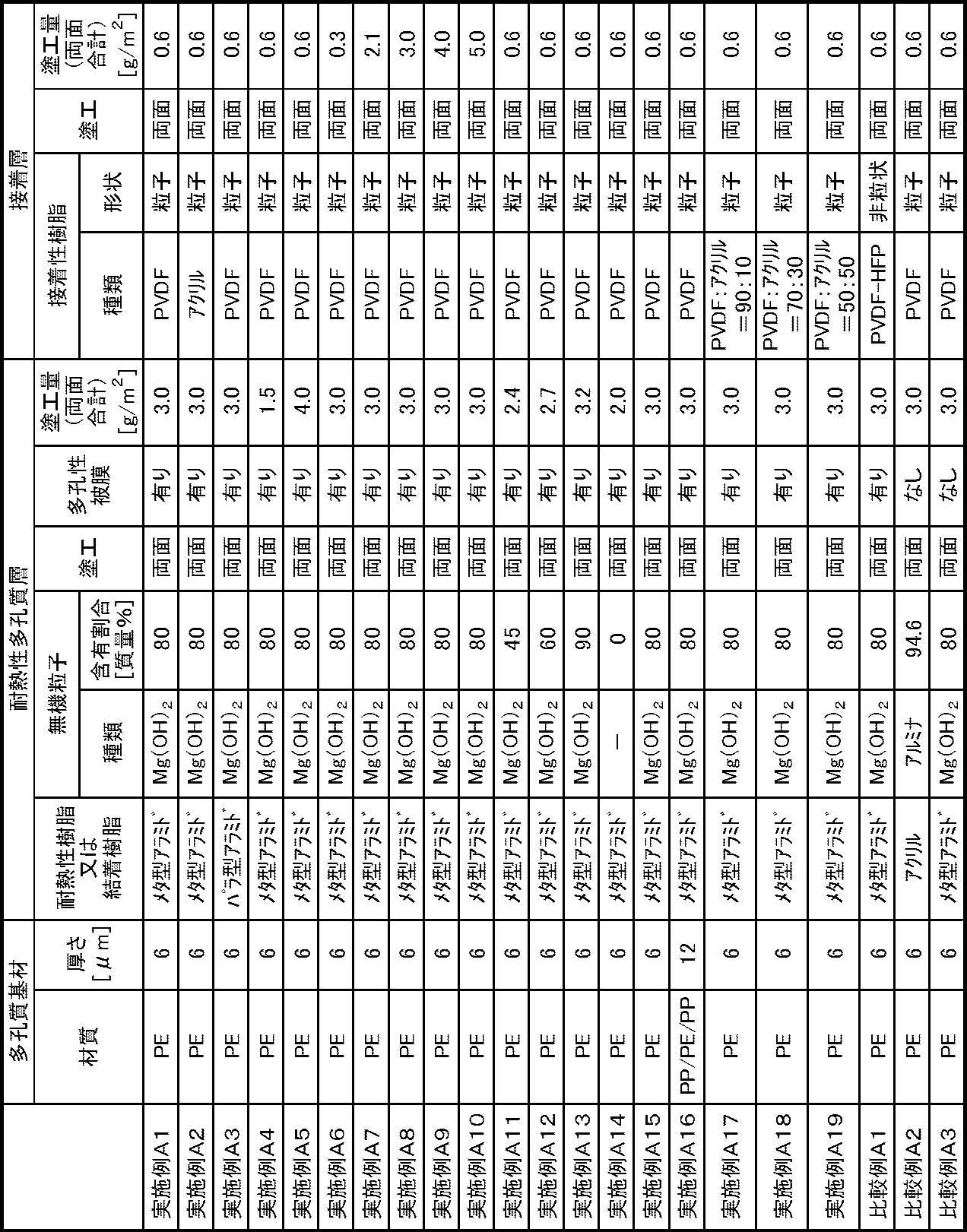

[実施例B1]
ポリアミドイミド(Solvay社、Torlon4000TF)と、水酸化マグネシウム(協和化学社、キスマ5P、体積平均粒径0.8μm、BET比表面積6.8m2/g)とを、両者の質量比が20:80で、ポリアミドイミド濃度が8質量%となるように、ジメチルアセトアミド(DMAc)とトリプロピレングリコール(TPG)の混合溶媒(DMAc:TPG=90:10[質量比])に攪拌混合し、塗工液(B1)を得た。
PVDF粒子分散液を、アクリル樹脂粒子(ガラス転移温度59℃、体積平均粒径0.5μm)が水に分散したアクリル樹脂粒子分散液(固形分濃度7質量%)に変更した以外は、実施例B1と同様にしてセパレータを作製した。
ポリアミドイミド(Solvay社、Torlon4000TF)を、高分子量ポリアミドイミド(Solvay社、Torlon4000T HV)に変更した以外は、実施例B1と同様にしてセパレータを作製した。
耐熱性多孔質層又は接着層の塗工量を表3に記載のとおりに変更した以外は、実施例B1と同様にしてセパレータを作製した。
水酸化マグネシウムの含有量を表3に記載のとおりに変更した以外は、実施例B1と同様にしてセパレータを作製した。
塗工液(B1)を、下記の塗工液(B15)に変更し、凝固液の温度を20℃に変更し、水洗槽の水温を20℃に変更した以外は、実施例B1と同様にしてセパレータを作製した。
ポリエチレン微多孔膜を、多層構造の微多孔膜(ポリプロピレン層/ポリエチレン層/ポリプロピレン層、厚さ12μm、空孔率44%、ガーレ値242秒/100mL)に変更した以外は、実施例B1と同様にしてセパレータを作製した。
PVDF粒子分散液を、ポリフッ化ビニリデン樹脂粒子(融点140℃、体積平均粒径0.2μm)とアクリル樹脂粒子(ガラス転移温度59℃、体積平均粒径0.5μm)とが質量比90:10にて水に分散した水性分散液(固形分濃度7質量%)に変更した以外は、実施例B1と同様にしてセパレータを作製した。
PVDF粒子分散液を、ポリフッ化ビニリデン樹脂粒子(融点140℃、体積平均粒径0.2μm)とアクリル樹脂粒子(ガラス転移温度59℃、体積平均粒径0.5μm)とが質量比70:30にて水に分散した水性分散液(固形分濃度7質量%)に変更した以外は、実施例B1と同様にしてセパレータを作製した。
PVDF粒子分散液を、ポリフッ化ビニリデン樹脂粒子(融点140℃、体積平均粒径0.2μm)とアクリル樹脂粒子(ガラス転移温度59℃、体積平均粒径0.5μm)とが質量比50:50にて水に分散した水性分散液(固形分濃度7質量%)に変更した以外は、実施例B1と同様にしてセパレータを作製した。
ポリフッ化ビニリデン系樹脂(フッ化ビニリデン-ヘキサフルオロプロピレン共重合体、重量平均分子量113万、ヘキサフルオロプロピレン含有量5.4質量%)を、ポリフッ化ビニリデン系樹脂濃度が5質量%となるように、DMAc:TPG=90:10[質量比]の混合溶媒に攪拌混合し、接着層形成用塗工液を得た。
アルミナ粒子(住友化学社、AKP-3000、体積平均粒径0.45μm、テトラポッド状粒子)と、粘度調整剤であるカルボキシメチルセルロース(ダイセルファインケム社、D1200、エーテル化度0.8~1.0)と、結着樹脂としてアクリル樹脂(DIC社、DICNAL LSE-16AD4)と、非イオン性界面活性剤(サンノプコ社、SNウェット366)とを質量比94.6:3.8:1.4:0.2にて混合し、水を添加して分散させ、固形分濃度40質量%の塗工液(BC2)を作製した。
塗工液を作製する溶媒を、DMAc:TPG=60:40[質量比]の混合溶媒に変更した以外は、実施例B1と同様にしてセパレータを作製した。
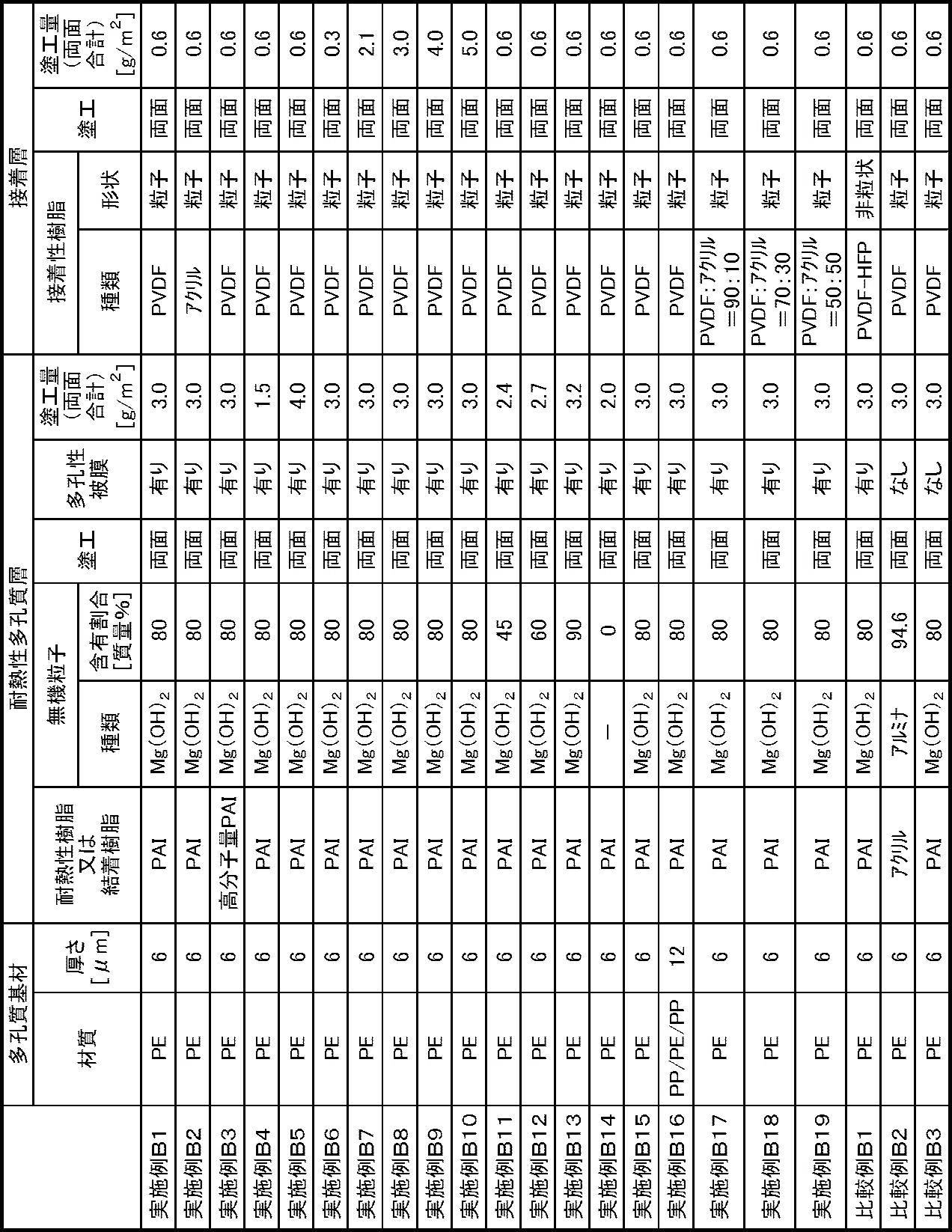
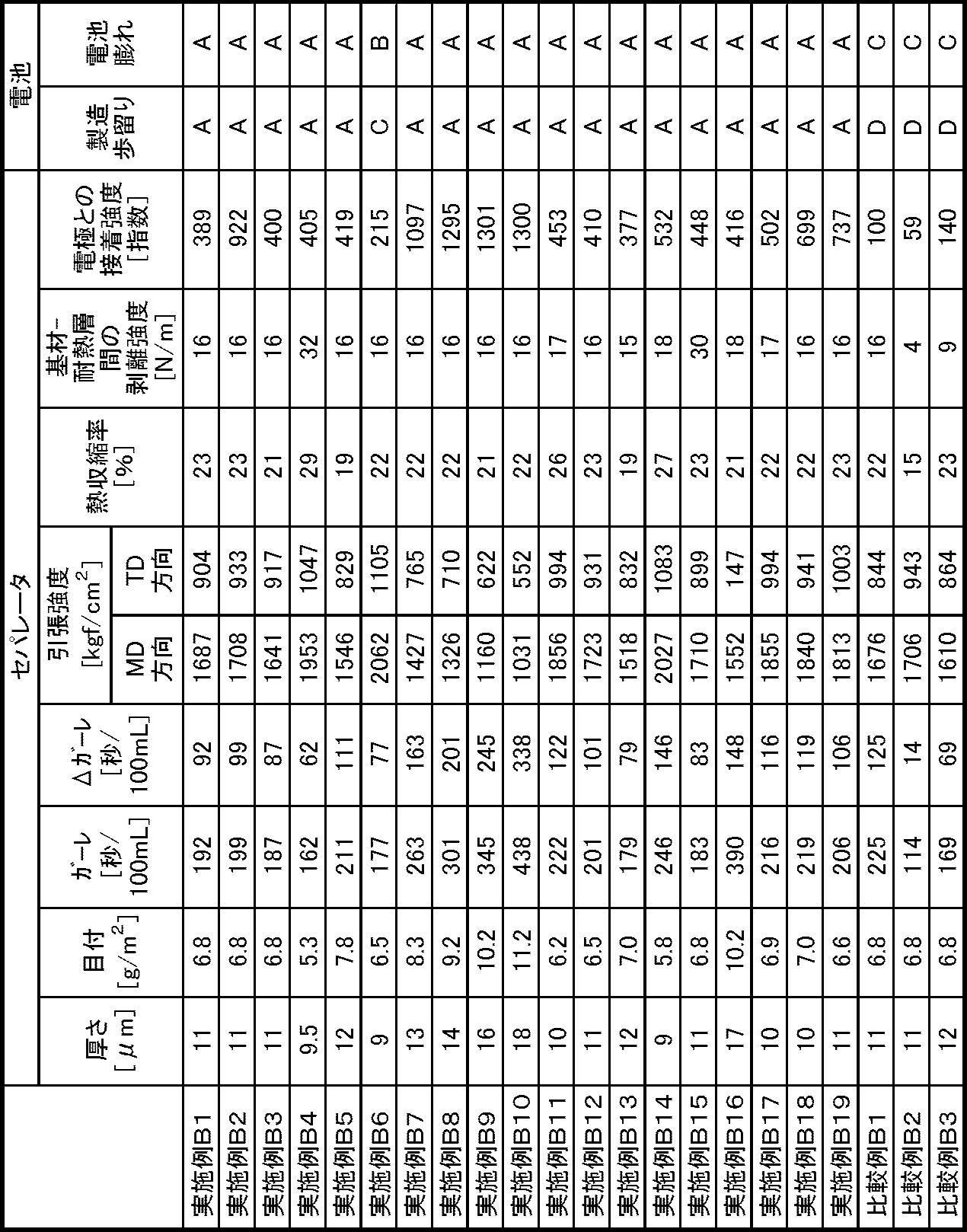
[実施例C1]
ポリイミド(PI技術研究所、Q-VR-X1444)と、水酸化マグネシウム(協和化学社、キスマ5P、体積平均粒径0.8μm、BET比表面積6.8m2/g)とを、両者の質量比が20:80で、ポリイミド濃度が6質量%となるように、ジメチルアセトアミド(DMAc)とトリプロピレングリコール(TPG)の混合溶媒(DMAc:TPG=90:10[質量比])に攪拌混合し、塗工液(C1)を得た。
PVDF粒子分散液を、アクリル樹脂粒子(ガラス転移温度59℃、体積平均粒径0.5μm)が水に分散したアクリル樹脂粒子分散液(固形分濃度7質量%)に変更した以外は、実施例C1と同様にしてセパレータを作製した。
耐熱性多孔質層又は接着層の塗工量を表5に記載のとおりに変更した以外は、実施例C1と同様にしてセパレータを作製した。
水酸化マグネシウムの含有量を表5に記載のとおりに変更した以外は、実施例C1と同様にしてセパレータを作製した。
塗工液(C1)のポリイミド濃度を8質量%に変更し、凝固液の温度を20℃に変更し、水洗槽の水温を20℃に変更した以外は、実施例C1と同様にしてセパレータを作製した。
ポリエチレン微多孔膜を多層構造の微多孔膜(ポリプロピレン層/ポリエチレン層/ポリプロピレン層、厚さ12μm、空孔率44%、ガーレ値242秒/100mL)に変更した以外は、実施例C1と同様にしてセパレータを作製した。
PVDF粒子分散液を、ポリフッ化ビニリデン樹脂粒子(融点140℃、体積平均粒径0.2μm)とアクリル樹脂粒子(ガラス転移温度59℃、体積平均粒径0.5μm)とが質量比90:10にて水に分散した水性分散液(固形分濃度7質量%)に変更した以外は、実施例C1と同様にしてセパレータを作製した。
PVDF粒子分散液を、ポリフッ化ビニリデン樹脂粒子(融点140℃、体積平均粒径0.2μm)とアクリル樹脂粒子(ガラス転移温度59℃、体積平均粒径0.5μm)とが質量比70:30にて水に分散した水性分散液(固形分濃度7質量%)に変更した以外は、実施例C1と同様にしてセパレータを作製した。
PVDF粒子分散液を、ポリフッ化ビニリデン樹脂粒子(融点140℃、体積平均粒径0.2μm)とアクリル樹脂粒子(ガラス転移温度59℃、体積平均粒径0.5μm)とが質量比50:50にて水に分散した水性分散液(固形分濃度7質量%)に変更した以外は、実施例C1と同様にしてセパレータを作製した。
ポリフッ化ビニリデン系樹脂(フッ化ビニリデン-ヘキサフルオロプロピレン共重合体、重量平均分子量113万、ヘキサフルオロプロピレン含有量5.4質量%)を、ポリフッ化ビニリデン系樹脂濃度が5質量%となるように、DMAc:TPG=90:10[質量比]の混合溶媒に攪拌混合し、接着層形成用塗工液を得た。
アルミナ粒子(住友化学社、AKP-3000、体積平均粒径0.45μm、テトラポッド状粒子)と、粘度調整剤であるカルボキシメチルセルロース(ダイセルファインケム社、D1200、エーテル化度0.8~1.0)と、結着樹脂としてアクリル樹脂(DIC社、DICNAL LSE-16AD4)と、非イオン性界面活性剤(サンノプコ社、SNウェット366)とを質量比94.6:3.8:1.4:0.2にて混合し、水を添加して分散させ、固形分濃度40質量%の塗工液(CC2)を作製した。
塗工液を作製する溶媒を、DMAc:TPG=60:40[質量比]の混合溶媒に変更した以外は、実施例C1と同様にしてセパレータを作製した。
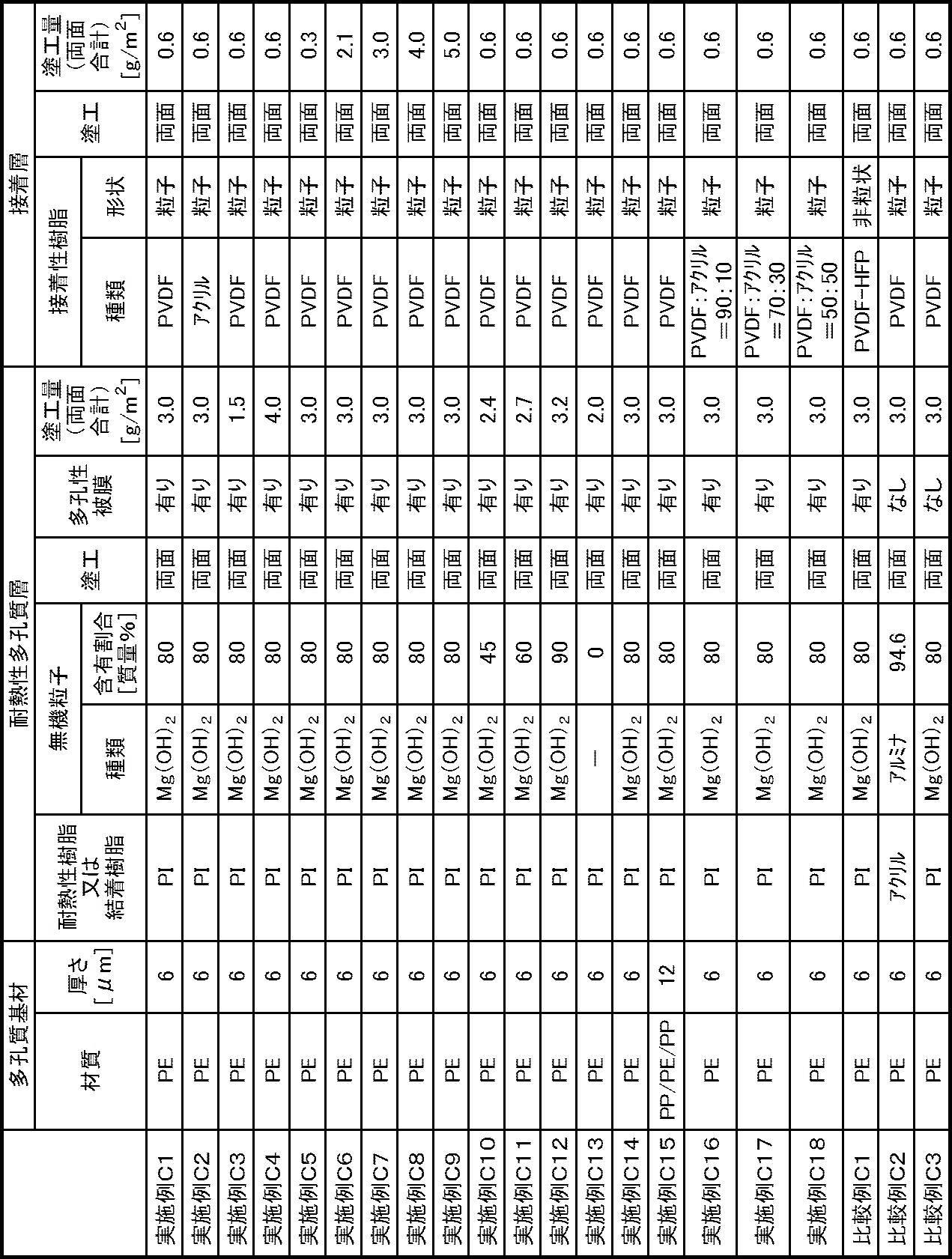
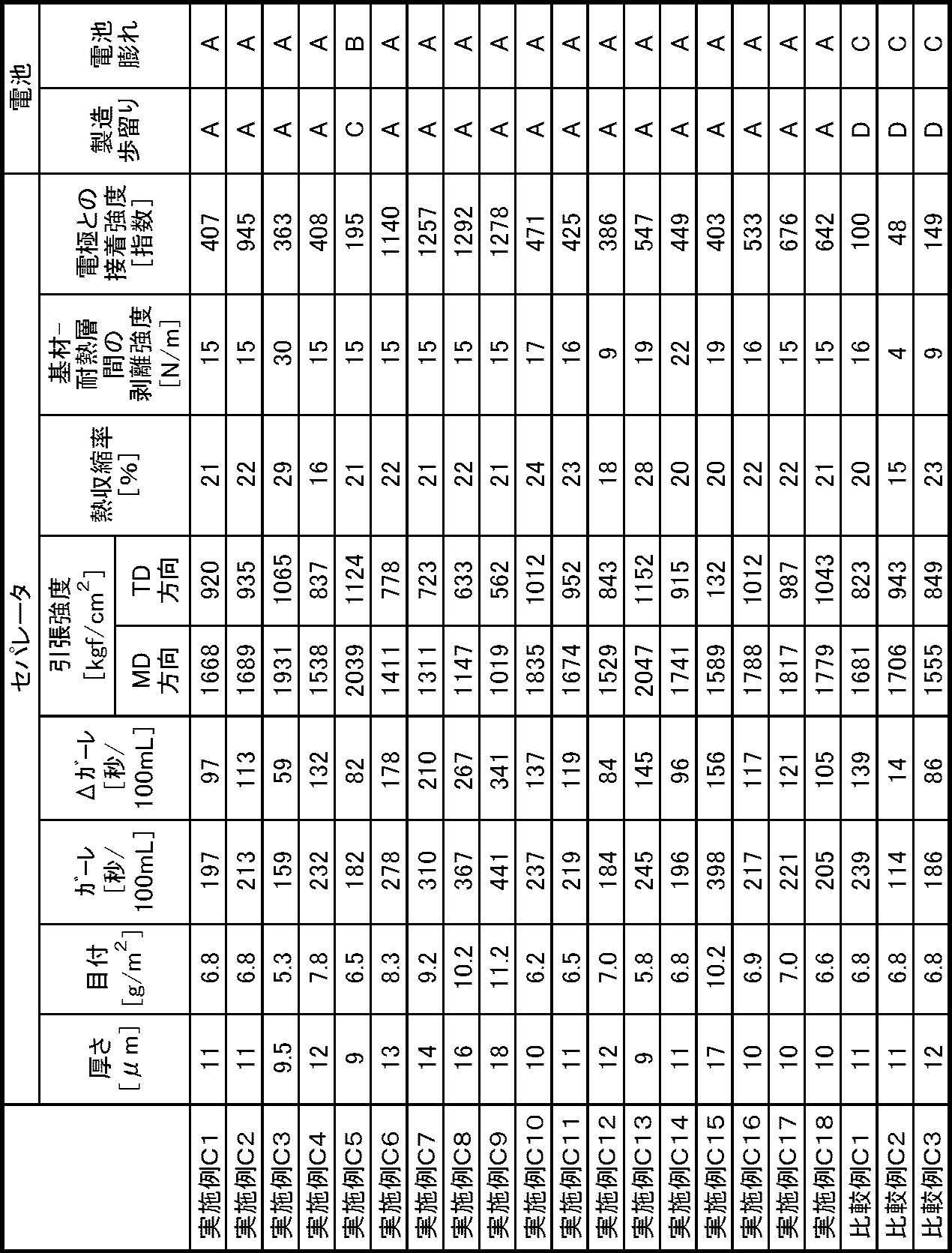
[実施例D1]
メタ型アラミド(ポリメタフェニレンイソフタルアミド、帝人、コーネックス)と、水酸化マグネシウム(協和化学社、キスマ5P、体積平均粒径0.8μm、BET比表面積6.8m2/g)とを、両者の質量比が20:80で、メタ型アラミド濃度が4質量%となるように、ジメチルアセトアミド(DMAc)とトリプロピレングリコール(TPG)の混合溶媒(DMAc:TPG=80:20[質量比])に攪拌混合し、塗工液(D1)を得た。
PVDF粒子分散液を、アクリル樹脂粒子(ガラス転移温度59℃、体積平均粒径0.5μm)が水に分散したアクリル樹脂粒子分散液(固形分濃度7質量%)に変更した以外は、実施例D1と同様にしてセパレータを作製した。
メタ型アラミドを、下記のパラ型アラミド(ポリパラフェニレンテレフタルアミド)に変更した以外は、実施例D1と同様にしてセパレータを作製した。
メタ型アラミドを、ポリエーテルイミド(SABIC社、ウルテム)に変更した以外は、実施例D1と同様にしてセパレータを作製した。
耐熱性多孔質層又は接着層の塗工量を表7に記載のとおりに変更した以外は、実施例D1と同様にしてセパレータを作製した。
水酸化マグネシウムの含有量を表7に記載のとおりに変更した以外は、実施例D1と同様にしてセパレータを作製した。
塗工液(D1)を、下記の塗工液(D16)に変更し、凝固液の温度を20℃に変更し、水洗槽の水温を20℃に変更した以外は、実施例D1と同様にしてセパレータを作製した。
アルミナ粒子(住友化学社、AKP-3000、体積平均粒径0.45μm、テトラポッド状粒子)と、粘度調整剤であるカルボキシメチルセルロース(ダイセルファインケム社、D1200、エーテル化度0.8~1.0)と、結着樹脂としてアクリル樹脂(DIC社、DICNAL LSE-16AD4)と、非イオン性界面活性剤(サンノプコ社、SNウェット366)とを質量比85:3.8:11:0.2にて混合し、水を添加して分散させ、固形分濃度40質量%の塗工液(D17)を作製した。
ポリエチレン微多孔膜を、多層構造の微多孔膜(ポリプロピレン層/ポリエチレン層/ポリプロピレン層、厚さ12μm、空孔率44%、ガーレ値242秒/100mL)に変更した以外は、実施例D1と同様にしてセパレータを作製した。
PVDF粒子分散液を、ポリフッ化ビニリデン樹脂粒子(融点140℃、体積平均粒径0.2μm)とアクリル樹脂粒子(ガラス転移温度59℃、体積平均粒径0.5μm)とが質量比90:10にて水に分散した水性分散液(固形分濃度7質量%)に変更した以外は、実施例D1と同様にしてセパレータを作製した。
PVDF粒子分散液を、ポリフッ化ビニリデン樹脂粒子(融点140℃、体積平均粒径0.2μm)とアクリル樹脂粒子(ガラス転移温度59℃、体積平均粒径0.5μm)とが質量比70:30にて水に分散した水性分散液(固形分濃度7質量%)に変更した以外は、実施例D1と同様にしてセパレータを作製した。
PVDF粒子分散液を、ポリフッ化ビニリデン樹脂粒子(融点140℃、体積平均粒径0.2μm)とアクリル樹脂粒子(ガラス転移温度59℃、体積平均粒径0.5μm)とが質量比50:50にて水に分散した水性分散液(固形分濃度7質量%)に変更した以外は、実施例D1と同様にしてセパレータを作製した。
ポリフッ化ビニリデン系樹脂(フッ化ビニリデン-ヘキサフルオロプロピレン共重合体、重量平均分子量113万、ヘキサフルオロプロピレン含有量5.4質量%)を、ポリフッ化ビニリデン系樹脂濃度が5質量%となるように、DMAc:TPG=90:10[質量比]の混合溶媒に攪拌混合し、接着層形成用塗工液を得た。
メタ型アラミドを、実施例D4で使用したポリエーテルイミドに変更した以外は、比較例D1と同様にしてセパレータを作製した。
実施例D17で作製した塗工液(D17)と、比較例D1で作製した接着層形成用塗工液を用意した。
アルミナ粒子(住友化学社、AKP-3000、体積平均粒径0.45μm、テトラポッド状粒子)と、粘度調整剤であるカルボキシメチルセルロース(ダイセルファインケム社、D1200、エーテル化度0.8~1.0)と、結着樹脂としてアクリル樹脂(DIC社、DICNAL LSE-16AD4)と、非イオン性界面活性剤(サンノプコ社、SNウェット366)とを質量比94.6:3.8:1.4:0.2にて混合し、水を添加して分散させ、固形分濃度40質量%の塗工液(DC4)を作製した。
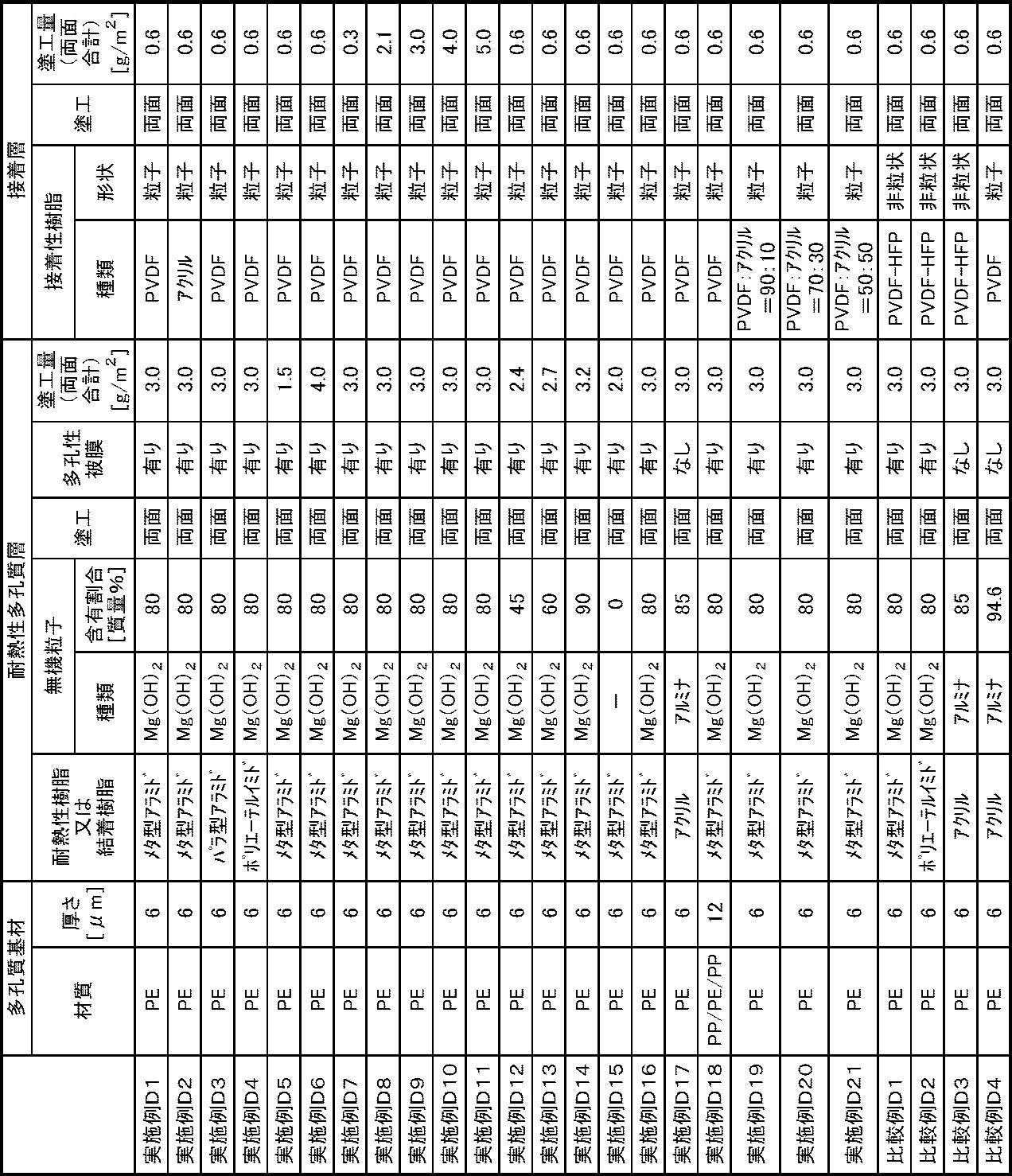
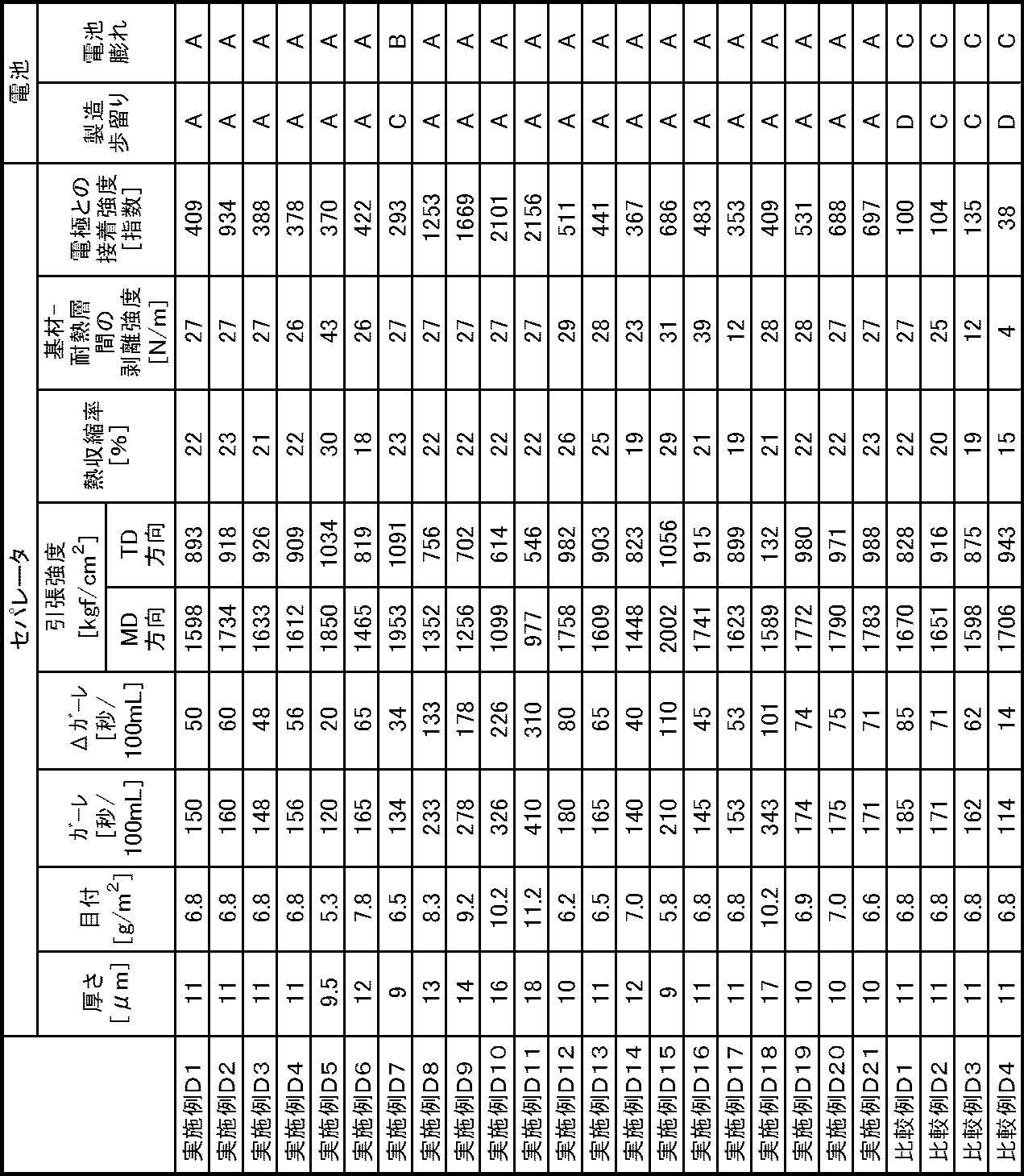
2017年12月27日に出願された日本国出願番号第2017-252242号の開示は、その全体が参照により本明細書に取り込まれる。
2017年12月27日に出願された日本国出願番号第2017-252243号の開示は、その全体が参照により本明細書に取り込まれる。
2017年12月27日に出願された日本国出願番号第2017-252244号の開示は、その全体が参照により本明細書に取り込まれる。
20 多孔質基材
30 耐熱性多孔質層
40 積層体
50 接着層
52 接着性樹脂粒子
Claims (10)
- 多孔質基材と、
前記多孔質基材の片面又は両面に設けられ、全芳香族ポリアミド、ポリアミドイミド及びポリイミドからなる群から選ばれる少なくとも1種を含有する多孔性被膜を有する耐熱性多孔質層と、
前記多孔質基材と前記耐熱性多孔質層との積層体の片面又は両面に設けられ、接着性樹脂粒子が前記積層体に付着してなる接着層と、
を備えた非水系二次電池用セパレータ。 - 前記多孔質基材と前記耐熱性多孔質層との間の剥離強度が5N/m~75N/mである、請求項1に記載の非水系二次電池用セパレータ。
- 前記耐熱性多孔質層がさらに無機粒子を含有し、前記耐熱性多孔質層に占める前記無機粒子の質量割合が50質量%~90質量%である、請求項1又は請求項2に記載の非水系二次電池用セパレータ。
- 多孔質基材と、
前記多孔質基材の片面又は両面に設けられ、分子中にアミド結合及びイミド結合の少なくとも一方を有する耐熱性樹脂及び無機粒子の少なくとも一方を含有する耐熱性多孔質層と、
前記多孔質基材と前記耐熱性多孔質層との積層体の片面又は両面に設けられ、接着性樹脂粒子が前記積層体に付着してなる接着層と、を備え、
前記多孔質基材と前記耐熱性多孔質層との間の剥離強度が5N/m~75N/mである、非水系二次電池用セパレータ。 - 前記接着性樹脂粒子が、ポリフッ化ビニリデン系樹脂を含む第一の接着性樹脂粒子とアクリル系樹脂を含む第二の接着性樹脂粒子との混合物を含む、請求項1~請求項4のいずれか1項に記載の非水系二次電池用セパレータ。
- 前記非水系二次電池用セパレータのガーレ値と前記多孔質基材のガーレ値との差が20秒/100mL~300秒/100mLである、請求項1~請求項5のいずれか1項に記載の非水系二次電池用セパレータ。
- 前記非水系二次電池用セパレータのMD方向の引張強度及びTD方向の引張強度の少なくとも一方が500kgf/cm2~3000kgf/cm2である、請求項1~請求項6のいずれか1項に記載の非水系二次電池用セパレータ。
- 前記接着層の重量が前記積層体の片面あたり0.2g/m2~2.0g/m2である、請求項1~請求項7のいずれか1項に記載の非水系二次電池用セパレータ。
- 前記多孔質基材がポリプロピレンを含有する微多孔膜である、請求項1~請求項8のいずれか1項に記載の非水系二次電池用セパレータ。
- 正極と、負極と、前記正極及び前記負極の間に配置された請求項1~請求項9のいずれか1項に記載の非水系二次電池用セパレータと、を備え、リチウムのドープ・脱ドープにより起電力を得る非水系二次電池。
Priority Applications (5)
| Application Number | Priority Date | Filing Date | Title |
|---|---|---|---|
| JP2019507959A JP6513893B1 (ja) | 2017-12-27 | 2018-11-30 | 非水系二次電池用セパレータ及び非水系二次電池 |
| EP18896369.8A EP3734698A4 (en) | 2017-12-27 | 2018-11-30 | ISOLATOR FOR SECONDARY BATTERIES WITH WATER-FREE ELECTROLYTE AND SECONDARY BATTERY WITH WATER-FREE ELECTROLYTE |
| US16/958,533 US12074339B2 (en) | 2017-12-27 | 2018-11-30 | Separator including porous substrate, heat resistant porous layer, and adhesive layer, and non-aqueous secondary battery including the same |
| KR1020207017458A KR102771572B1 (ko) | 2017-12-27 | 2018-11-30 | 비수계 이차 전지용 세퍼레이터 및 비수계 이차 전지 |
| CN201880081226.5A CN111492504B (zh) | 2017-12-27 | 2018-11-30 | 非水系二次电池用隔膜及非水系二次电池 |
Applications Claiming Priority (8)
| Application Number | Priority Date | Filing Date | Title |
|---|---|---|---|
| JP2017252244 | 2017-12-27 | ||
| JP2017-252243 | 2017-12-27 | ||
| JP2017-252244 | 2017-12-27 | ||
| JP2017-252241 | 2017-12-27 | ||
| JP2017252242 | 2017-12-27 | ||
| JP2017252241 | 2017-12-27 | ||
| JP2017-252242 | 2017-12-27 | ||
| JP2017252243 | 2017-12-27 |
Publications (1)
| Publication Number | Publication Date |
|---|---|
| WO2019130994A1 true WO2019130994A1 (ja) | 2019-07-04 |
Family
ID=67067096
Family Applications (1)
| Application Number | Title | Priority Date | Filing Date |
|---|---|---|---|
| PCT/JP2018/044319 Ceased WO2019130994A1 (ja) | 2017-12-27 | 2018-11-30 | 非水系二次電池用セパレータ及び非水系二次電池 |
Country Status (6)
| Country | Link |
|---|---|
| US (1) | US12074339B2 (ja) |
| EP (1) | EP3734698A4 (ja) |
| JP (1) | JP6513893B1 (ja) |
| KR (1) | KR102771572B1 (ja) |
| CN (1) | CN111492504B (ja) |
| WO (1) | WO2019130994A1 (ja) |
Cited By (23)
| Publication number | Priority date | Publication date | Assignee | Title |
|---|---|---|---|---|
| KR20210019305A (ko) * | 2019-08-12 | 2021-02-22 | 삼성에스디아이 주식회사 | 이차전지용 분리막, 그 제조방법 및 이를 포함하는 이차전지 |
| WO2021049403A1 (ja) * | 2019-09-10 | 2021-03-18 | 東レ株式会社 | 角缶型非水電解質二次電池用セパレータ、電極積層体、及び角缶型非水電解質二次電池 |
| WO2021172195A1 (ja) * | 2020-02-28 | 2021-09-02 | 帝人株式会社 | 非水系二次電池用セパレータ及び非水系二次電池 |
| WO2021230037A1 (ja) * | 2020-05-13 | 2021-11-18 | 株式会社ダイセル | 二次電池用セパレータ |
| US20220029243A1 (en) * | 2018-12-26 | 2022-01-27 | Panasonic Intellectual Property Management Co., Ltd. | Non-aqueous electrolyte secondary battery |
| WO2022035298A1 (ko) * | 2020-08-14 | 2022-02-17 | 주식회사 엘지에너지솔루션 | 세퍼레이터 및 이를 포함하는 전기화학소자 |
| JPWO2022054279A1 (ja) * | 2020-09-14 | 2022-03-17 | ||
| WO2023037990A1 (ja) | 2021-09-10 | 2023-03-16 | 帝人株式会社 | 非水系二次電池用セパレータ及び非水系二次電池 |
| WO2023037989A1 (ja) | 2021-09-10 | 2023-03-16 | 帝人株式会社 | 非水系二次電池用セパレータ及び非水系二次電池 |
| WO2023190521A1 (ja) * | 2022-03-31 | 2023-10-05 | 帝人株式会社 | 非水系二次電池用セパレータ及び非水系二次電池 |
| JP2023152386A (ja) * | 2022-04-04 | 2023-10-17 | トヨタ自動車株式会社 | 非水電解質二次電池 |
| US20230344081A1 (en) * | 2020-02-13 | 2023-10-26 | Celgard, Llc | Ceramic cross-linked coating on a porous membrane and methods for making the same |
| WO2023210786A1 (ja) | 2022-04-28 | 2023-11-02 | 帝人株式会社 | 非水系二次電池用セパレータ及び非水系二次電池 |
| WO2023210785A1 (ja) | 2022-04-28 | 2023-11-02 | 帝人株式会社 | 非水系二次電池用セパレータ及び非水系二次電池 |
| US20230361427A1 (en) * | 2021-05-17 | 2023-11-09 | Samsung Sdi Co., Ltd. | Separator for secondary battery and secondary battery comprising same |
| JP2024524335A (ja) * | 2021-10-25 | 2024-07-05 | 珠海冠宇電池股分有限公司 | セパレータ及び該セパレータを備える電池 |
| WO2024180953A1 (ja) | 2023-02-27 | 2024-09-06 | 帝人株式会社 | 非水系二次電池用セパレータ及び非水系二次電池 |
| JP2025504516A (ja) * | 2022-07-05 | 2025-02-12 | エルジー エナジー ソリューション リミテッド | 耐圧縮性が改善された電気化学素子用分離膜、それを含む電気化学素子及びそれを製造する方法 |
| WO2025095120A1 (ja) * | 2023-11-02 | 2025-05-08 | 帝人株式会社 | 非水系二次電池用セパレータ及び非水系二次電池 |
| WO2025095119A1 (ja) * | 2023-11-02 | 2025-05-08 | 帝人株式会社 | 非水系二次電池用セパレータ及び非水系二次電池 |
| JP2025526848A (ja) * | 2022-12-05 | 2025-08-15 | 香港時代新能源科技有限公司 | セパレータ、その製造方法及びそれに関連する二次電池と電力消費装置 |
| WO2025197990A1 (ja) * | 2024-03-21 | 2025-09-25 | 帝人株式会社 | 非水系二次電池用セパレータ及び非水系二次電池 |
| US12431588B2 (en) | 2020-04-13 | 2025-09-30 | Asahi Kasei Battery Separator Corporation | Composite-type stacked chemically-crosslinked separator |
Families Citing this family (22)
| Publication number | Priority date | Publication date | Assignee | Title |
|---|---|---|---|---|
| KR102592147B1 (ko) * | 2018-04-20 | 2023-10-23 | 삼성전자주식회사 | 복합분리막, 그 제조방법 및 이를 포함하는 리튬이차전지 |
| JP7416522B2 (ja) * | 2019-03-19 | 2024-01-17 | 帝人株式会社 | 非水系二次電池用セパレータ及び非水系二次電池 |
| TW202044646A (zh) * | 2019-04-04 | 2020-12-01 | 美商希爾格得有限公司 | 用於高能量可充電鋰電池之聚醯胺—醯亞胺塗覆分隔件 |
| KR102847059B1 (ko) * | 2019-05-17 | 2025-08-18 | 데이진 가부시키가이샤 | 비수계 이차전지용 세퍼레이터 및 그 제조 방법 그리고 비수계 이차전지 |
| JP7438673B2 (ja) * | 2019-05-20 | 2024-02-27 | 旭化成株式会社 | 蓄電デバイス向けセパレータコーティング用水分散スラリー、及びそれを用いた蓄電デバイス向けセパレータ |
| HUE063695T2 (hu) * | 2019-06-04 | 2024-01-28 | Teijin Ltd | Elválasztóelem nemvizes újratölthetõ telephez, valamint nemvizes újratölthetõ telep |
| CN112259901B (zh) * | 2019-07-03 | 2022-03-18 | 比亚迪股份有限公司 | 锂离子电池用涂胶隔膜及其制备方法和应用 |
| JP2022042818A (ja) * | 2020-09-03 | 2022-03-15 | 富士フイルムビジネスイノベーション株式会社 | 非水系二次電池用セパレータ、二次電池、及び二次電池の製造方法 |
| CN114361710B (zh) * | 2020-09-29 | 2025-02-07 | 宁德新能源科技有限公司 | 一种隔离膜、包含该隔离膜的电化学装置及电子装置 |
| JP7721937B2 (ja) * | 2021-03-24 | 2025-08-13 | 富士フイルムビジネスイノベーション株式会社 | ポリイミド多孔質膜、非水系二次電池用セパレータ、二次電池、及び二次電池の製造方法 |
| CN114006024B (zh) * | 2021-10-25 | 2024-07-16 | 珠海冠宇电池股份有限公司 | 一种隔膜及含有该隔膜的电池 |
| CN114267923A (zh) * | 2021-12-23 | 2022-04-01 | 中材锂膜有限公司 | 一种电池隔离膜及其制备方法、二次电池 |
| CN114335904B (zh) * | 2022-02-28 | 2022-07-12 | 湖南中锂新材料科技有限公司 | 一种锂电池复合隔膜及其制备方法和应用 |
| KR20230157182A (ko) * | 2022-05-09 | 2023-11-16 | 삼성에스디아이 주식회사 | 이차전지용 분리막 및 이를 포함하는 이차전지 |
| KR102799124B1 (ko) * | 2022-06-09 | 2025-04-23 | 에스케이이노베이션 주식회사 | 분리막, 이의 제조방법 및 상기 분리막을 포함하는 전기화학소자 |
| CN117410651A (zh) * | 2022-07-06 | 2024-01-16 | 华为技术有限公司 | 复合隔膜及其制备方法、二次电池和用电设备 |
| JPWO2024024506A1 (ja) * | 2022-07-27 | 2024-02-01 | ||
| CN116581481A (zh) * | 2023-06-26 | 2023-08-11 | 欣旺达动力科技股份有限公司 | 一种隔膜和二次电池 |
| CN119840264A (zh) * | 2023-10-18 | 2025-04-18 | 宁德时代新能源科技股份有限公司 | 绝缘膜及其制备方法和应用 |
| CN117954787A (zh) * | 2024-02-01 | 2024-04-30 | 上海恩捷新材料科技有限公司 | 一种电池隔膜及其所制备的锂电池 |
| EP4726841A1 (en) * | 2024-10-10 | 2026-04-15 | Samsung Sdi Co., Ltd. | Rechargeable battery and battery pack including the same |
| CN118943660B (zh) * | 2024-10-11 | 2025-01-14 | 中国科学院大连化学物理研究所 | 一种芳纶涂覆浆料、隔膜及其制备方法和应用 |
Citations (9)
| Publication number | Priority date | Publication date | Assignee | Title |
|---|---|---|---|---|
| JPS5946257B2 (ja) | 1976-11-01 | 1984-11-12 | 帝人株式会社 | ポリエステルの製造法 |
| JPS6112115B2 (ja) | 1980-06-11 | 1986-04-07 | Oki Denki Kogyo Kk | |
| JP2010092718A (ja) * | 2008-10-08 | 2010-04-22 | Teijin Ltd | 非水系二次電池用セパレータ及び非水系二次電池 |
| JP2013020769A (ja) | 2011-07-08 | 2013-01-31 | Teijin Ltd | 非水電解質電池用セパレータ及び非水電解質電池 |
| JP2013196839A (ja) * | 2012-03-16 | 2013-09-30 | Tdk Corp | 非水系二次電池用セパレータ |
| WO2013151144A1 (ja) | 2012-04-05 | 2013-10-10 | 日本ゼオン株式会社 | 二次電池用セパレータ |
| JP5971662B2 (ja) | 2012-09-24 | 2016-08-17 | エルジー・ケム・リミテッド | リチウム二次電池用セパレータの製造方法、その方法で製造されたセパレータ、及びそれを含むリチウム二次電池 |
| JP5976015B2 (ja) | 2011-02-15 | 2016-08-23 | エルジー・ケム・リミテッド | セパレータ、その製造方法、及びそれを備える電気化学素子 |
| JP2016207616A (ja) * | 2015-04-28 | 2016-12-08 | 日立マクセル株式会社 | 電気化学素子用セパレータ、および電気化学素子の製造方法 |
Family Cites Families (32)
| Publication number | Priority date | Publication date | Assignee | Title |
|---|---|---|---|---|
| JPS5946257U (ja) | 1982-09-18 | 1984-03-27 | 株式会社ピーエフユー | 張力付与装置の弾圧部材の取付構造 |
| JPS5971662U (ja) | 1982-11-05 | 1984-05-15 | 園田 清宣 | トレ−ニングカンプレス |
| JPS5976015U (ja) | 1982-11-15 | 1984-05-23 | 福沢 正一 | 電磁波シ−ルドテ−プ |
| JPS6112115U (ja) | 1984-06-25 | 1986-01-24 | 株式会社アドバンテスト | Ic試験装置の温度制御装置 |
| JP2001006744A (ja) | 1999-06-16 | 2001-01-12 | Furukawa Electric Co Ltd:The | 有機電解液を用いた電池 |
| CN102160211B (zh) * | 2008-08-19 | 2015-04-22 | 帝人株式会社 | 非水系二次电池用隔板 |
| JP2010146839A (ja) | 2008-12-18 | 2010-07-01 | Teijin Ltd | 非水系二次電池用セパレータ及び非水系二次電池 |
| JP5400508B2 (ja) * | 2009-07-14 | 2014-01-29 | 帝人株式会社 | 非水系二次電池用セパレータ |
| JP5509816B2 (ja) * | 2009-11-30 | 2014-06-04 | ソニー株式会社 | セパレータ、これを用いた電池および微多孔膜 |
| JP2011192529A (ja) * | 2010-03-15 | 2011-09-29 | Teijin Ltd | ポリオレフィン微多孔膜、非水系二次電池用セパレータ及び非水系二次電池 |
| JP2011204587A (ja) * | 2010-03-26 | 2011-10-13 | Teijin Ltd | 非水系二次電池用セパレータ、非水系二次電池、および非水系二次電池用セパレータの製造方法 |
| JP5648481B2 (ja) * | 2010-06-25 | 2015-01-07 | 東レバッテリーセパレータフィルム株式会社 | 複合多孔質膜、複合多孔質膜の製造方法並びにそれを用いた電池用セパレーター |
| JP5089831B2 (ja) | 2010-10-29 | 2012-12-05 | 帝人株式会社 | 非水電解質電池用セパレータ及び非水電解質二次電池 |
| JP2012099324A (ja) * | 2010-11-01 | 2012-05-24 | Teijin Ltd | 非水電解質二次電池用セパレータ及び非水電解質二次電池 |
| TWI467833B (zh) * | 2011-07-20 | 2015-01-01 | Lg Chemical Ltd | 隔離膜、其之製造方法及包含其之電化學裝置 |
| WO2013047856A1 (ja) | 2011-09-26 | 2013-04-04 | 住友化学株式会社 | 二次電池用接着樹脂組成物 |
| JP5946257B2 (ja) | 2011-09-29 | 2016-07-06 | デクセリアルズ株式会社 | 電池用セパレータシート、その製造方法及び電池 |
| CN202333016U (zh) * | 2011-11-25 | 2012-07-11 | 佛山市金辉高科光电材料有限公司 | 一种含有耐热树脂涂层的多孔多层电池复合膜 |
| PL2903055T3 (pl) | 2012-09-28 | 2018-04-30 | Zeon Corporation | Porowaty separator membranowy do baterii wtórnej, sposób jego wytwarzania oraz bateria wtórna |
| KR102137129B1 (ko) * | 2012-11-30 | 2020-07-24 | 데이진 가부시키가이샤 | 비수계 이차전지용 세퍼레이터 및 비수계 이차전지 |
| JP6186783B2 (ja) * | 2013-03-19 | 2017-08-30 | ソニー株式会社 | セパレータ、電池、電池パック、電子機器、電動車両、蓄電装置および電力システム |
| JP6255768B2 (ja) * | 2013-07-24 | 2018-01-10 | 日産自動車株式会社 | 非水電解質二次電池用セパレータおよびこれを含む非水電解質二次電池 |
| KR101963013B1 (ko) | 2014-09-26 | 2019-03-27 | 아사히 가세이 가부시키가이샤 | 축전 디바이스용 세퍼레이터 |
| KR20230107896A (ko) * | 2014-12-15 | 2023-07-18 | 데이진 가부시키가이샤 | 비수 전해질 전지용 세퍼레이터, 비수 전해질 전지,및 비수 전해질 전지의 제조 방법 |
| JP6430839B2 (ja) | 2015-01-26 | 2018-11-28 | 旭化成株式会社 | 電池用セパレータ、及び非水電解液電池 |
| KR20170019522A (ko) * | 2015-08-11 | 2017-02-22 | 더블유스코프코리아 주식회사 | 다공성 다층 분리막 및 그 제조방법 |
| JP6692619B2 (ja) * | 2015-09-02 | 2020-05-13 | 旭化成株式会社 | 二次電池用セパレータ |
| WO2017047576A1 (ja) * | 2015-09-16 | 2017-03-23 | 日立マクセル株式会社 | 電気化学素子用セパレータ、その製造方法および電気化学素子の製造方法 |
| KR20170045438A (ko) | 2015-10-16 | 2017-04-27 | 더블유스코프코리아 주식회사 | 이차전지용 전극 접착성 코팅 분리막 및 그 제조 방법 |
| EP3349270B1 (en) * | 2015-11-11 | 2025-06-04 | LG Energy Solution, Ltd. | Separator having electrode adhesive layer and electrochemical device including the same |
| CN105552284B (zh) * | 2015-12-22 | 2018-11-06 | 沧州明珠隔膜科技有限公司 | 一种复合涂层锂离子电池隔膜及其制备方法 |
| JP2017132925A (ja) | 2016-01-28 | 2017-08-03 | 積水化学工業株式会社 | 耐熱性合成樹脂微多孔フィルム |
-
2018
- 2018-11-30 WO PCT/JP2018/044319 patent/WO2019130994A1/ja not_active Ceased
- 2018-11-30 JP JP2019507959A patent/JP6513893B1/ja active Active
- 2018-11-30 EP EP18896369.8A patent/EP3734698A4/en active Pending
- 2018-11-30 US US16/958,533 patent/US12074339B2/en active Active
- 2018-11-30 CN CN201880081226.5A patent/CN111492504B/zh active Active
- 2018-11-30 KR KR1020207017458A patent/KR102771572B1/ko active Active
Patent Citations (9)
| Publication number | Priority date | Publication date | Assignee | Title |
|---|---|---|---|---|
| JPS5946257B2 (ja) | 1976-11-01 | 1984-11-12 | 帝人株式会社 | ポリエステルの製造法 |
| JPS6112115B2 (ja) | 1980-06-11 | 1986-04-07 | Oki Denki Kogyo Kk | |
| JP2010092718A (ja) * | 2008-10-08 | 2010-04-22 | Teijin Ltd | 非水系二次電池用セパレータ及び非水系二次電池 |
| JP5976015B2 (ja) | 2011-02-15 | 2016-08-23 | エルジー・ケム・リミテッド | セパレータ、その製造方法、及びそれを備える電気化学素子 |
| JP2013020769A (ja) | 2011-07-08 | 2013-01-31 | Teijin Ltd | 非水電解質電池用セパレータ及び非水電解質電池 |
| JP2013196839A (ja) * | 2012-03-16 | 2013-09-30 | Tdk Corp | 非水系二次電池用セパレータ |
| WO2013151144A1 (ja) | 2012-04-05 | 2013-10-10 | 日本ゼオン株式会社 | 二次電池用セパレータ |
| JP5971662B2 (ja) | 2012-09-24 | 2016-08-17 | エルジー・ケム・リミテッド | リチウム二次電池用セパレータの製造方法、その方法で製造されたセパレータ、及びそれを含むリチウム二次電池 |
| JP2016207616A (ja) * | 2015-04-28 | 2016-12-08 | 日立マクセル株式会社 | 電気化学素子用セパレータ、および電気化学素子の製造方法 |
Non-Patent Citations (1)
| Title |
|---|
| See also references of EP3734698A4 |
Cited By (41)
| Publication number | Priority date | Publication date | Assignee | Title |
|---|---|---|---|---|
| US20220029243A1 (en) * | 2018-12-26 | 2022-01-27 | Panasonic Intellectual Property Management Co., Ltd. | Non-aqueous electrolyte secondary battery |
| KR20210019305A (ko) * | 2019-08-12 | 2021-02-22 | 삼성에스디아이 주식회사 | 이차전지용 분리막, 그 제조방법 및 이를 포함하는 이차전지 |
| KR102472908B1 (ko) * | 2019-08-12 | 2022-12-01 | 삼성에스디아이 주식회사 | 이차전지용 분리막, 그 제조방법 및 이를 포함하는 이차전지 |
| WO2021049403A1 (ja) * | 2019-09-10 | 2021-03-18 | 東レ株式会社 | 角缶型非水電解質二次電池用セパレータ、電極積層体、及び角缶型非水電解質二次電池 |
| US12548852B2 (en) * | 2020-02-13 | 2026-02-10 | Celgard, Llc | Ceramic cross-linked coating on a porous membrane and methods for making the same |
| US20230344081A1 (en) * | 2020-02-13 | 2023-10-26 | Celgard, Llc | Ceramic cross-linked coating on a porous membrane and methods for making the same |
| WO2021172195A1 (ja) * | 2020-02-28 | 2021-09-02 | 帝人株式会社 | 非水系二次電池用セパレータ及び非水系二次電池 |
| JP2021136221A (ja) * | 2020-02-28 | 2021-09-13 | 帝人株式会社 | 非水系二次電池用セパレータ及び非水系二次電池 |
| JP7545216B2 (ja) | 2020-02-28 | 2024-09-04 | 帝人株式会社 | 非水系二次電池用セパレータ及び非水系二次電池 |
| US12431588B2 (en) | 2020-04-13 | 2025-09-30 | Asahi Kasei Battery Separator Corporation | Composite-type stacked chemically-crosslinked separator |
| WO2021230037A1 (ja) * | 2020-05-13 | 2021-11-18 | 株式会社ダイセル | 二次電池用セパレータ |
| JP2023524704A (ja) * | 2020-08-14 | 2023-06-13 | エルジー エナジー ソリューション リミテッド | セパレーター及びこれを含む電気化学素子 |
| WO2022035298A1 (ko) * | 2020-08-14 | 2022-02-17 | 주식회사 엘지에너지솔루션 | 세퍼레이터 및 이를 포함하는 전기화학소자 |
| JP7408224B2 (ja) | 2020-08-14 | 2024-01-05 | エルジー エナジー ソリューション リミテッド | セパレーター及びこれを含む電気化学素子 |
| JPWO2022054279A1 (ja) * | 2020-09-14 | 2022-03-17 | ||
| JP7565624B2 (ja) | 2020-09-14 | 2024-10-11 | TeraWatt Technology株式会社 | リチウム2次電池 |
| US20230361427A1 (en) * | 2021-05-17 | 2023-11-09 | Samsung Sdi Co., Ltd. | Separator for secondary battery and secondary battery comprising same |
| WO2023037989A1 (ja) | 2021-09-10 | 2023-03-16 | 帝人株式会社 | 非水系二次電池用セパレータ及び非水系二次電池 |
| WO2023037990A1 (ja) | 2021-09-10 | 2023-03-16 | 帝人株式会社 | 非水系二次電池用セパレータ及び非水系二次電池 |
| JP7720422B2 (ja) | 2021-10-25 | 2025-08-07 | 珠海冠宇電池股分有限公司 | セパレータ及び該セパレータを備える電池 |
| JP2024524335A (ja) * | 2021-10-25 | 2024-07-05 | 珠海冠宇電池股分有限公司 | セパレータ及び該セパレータを備える電池 |
| JP2023151013A (ja) * | 2022-03-31 | 2023-10-16 | 帝人株式会社 | 非水系二次電池用セパレータ及び非水系二次電池 |
| WO2023190521A1 (ja) * | 2022-03-31 | 2023-10-05 | 帝人株式会社 | 非水系二次電池用セパレータ及び非水系二次電池 |
| JP7683525B2 (ja) | 2022-04-04 | 2025-05-27 | トヨタ自動車株式会社 | 非水電解質二次電池 |
| JP2023152386A (ja) * | 2022-04-04 | 2023-10-17 | トヨタ自動車株式会社 | 非水電解質二次電池 |
| JP7482935B2 (ja) | 2022-04-28 | 2024-05-14 | 帝人株式会社 | 非水系二次電池用セパレータ及び非水系二次電池 |
| KR20250004300A (ko) | 2022-04-28 | 2025-01-07 | 데이진 가부시키가이샤 | 비수계 이차 전지용 세퍼레이터 및 비수계 이차 전지 |
| KR20250004827A (ko) | 2022-04-28 | 2025-01-08 | 데이진 가부시키가이샤 | 비수계 이차 전지용 세퍼레이터 및 비수계 이차 전지 |
| WO2023210785A1 (ja) | 2022-04-28 | 2023-11-02 | 帝人株式会社 | 非水系二次電池用セパレータ及び非水系二次電池 |
| WO2023210786A1 (ja) | 2022-04-28 | 2023-11-02 | 帝人株式会社 | 非水系二次電池用セパレータ及び非水系二次電池 |
| JP2023164114A (ja) * | 2022-04-28 | 2023-11-10 | 帝人株式会社 | 非水系二次電池用セパレータ及び非水系二次電池 |
| JP2025504516A (ja) * | 2022-07-05 | 2025-02-12 | エルジー エナジー ソリューション リミテッド | 耐圧縮性が改善された電気化学素子用分離膜、それを含む電気化学素子及びそれを製造する方法 |
| US12489176B2 (en) | 2022-07-05 | 2025-12-02 | Lg Energy Solution, Ltd. | Separator for electrochemical device having improved compression resistance, electrochemical device comprising same, and method for producing same |
| JP7801006B2 (ja) | 2022-07-05 | 2026-01-16 | エルジー エナジー ソリューション リミテッド | 耐圧縮性が改善された電気化学素子用分離膜、それを含む電気化学素子及びそれを製造する方法 |
| JP2025526848A (ja) * | 2022-12-05 | 2025-08-15 | 香港時代新能源科技有限公司 | セパレータ、その製造方法及びそれに関連する二次電池と電力消費装置 |
| KR20250136872A (ko) | 2023-02-27 | 2025-09-16 | 데이진 가부시키가이샤 | 비수계 이차 전지용 세퍼레이터 및 비수계 이차 전지 |
| EP4675822A1 (en) | 2023-02-27 | 2026-01-07 | Teijin Limited | Separator for nonaqueous secondary battery, and nonaqueous secondary battery |
| WO2024180953A1 (ja) | 2023-02-27 | 2024-09-06 | 帝人株式会社 | 非水系二次電池用セパレータ及び非水系二次電池 |
| WO2025095119A1 (ja) * | 2023-11-02 | 2025-05-08 | 帝人株式会社 | 非水系二次電池用セパレータ及び非水系二次電池 |
| WO2025095120A1 (ja) * | 2023-11-02 | 2025-05-08 | 帝人株式会社 | 非水系二次電池用セパレータ及び非水系二次電池 |
| WO2025197990A1 (ja) * | 2024-03-21 | 2025-09-25 | 帝人株式会社 | 非水系二次電池用セパレータ及び非水系二次電池 |
Also Published As
| Publication number | Publication date |
|---|---|
| EP3734698A4 (en) | 2021-10-13 |
| EP3734698A1 (en) | 2020-11-04 |
| KR102771572B1 (ko) | 2025-02-25 |
| CN111492504A (zh) | 2020-08-04 |
| CN111492504B (zh) | 2024-04-30 |
| US12074339B2 (en) | 2024-08-27 |
| JP6513893B1 (ja) | 2019-05-15 |
| JPWO2019130994A1 (ja) | 2019-12-26 |
| KR20200102437A (ko) | 2020-08-31 |
| US20210057703A1 (en) | 2021-02-25 |
Similar Documents
| Publication | Publication Date | Title |
|---|---|---|
| JP6513893B1 (ja) | 非水系二次電池用セパレータ及び非水系二次電池 | |
| JP6986640B2 (ja) | 非水系二次電池用セパレータ及び非水系二次電池 | |
| JP6526359B1 (ja) | 非水系二次電池用セパレータ及び非水系二次電池 | |
| JP6054001B2 (ja) | 非水電解質電池用セパレータ、非水電解質電池、および、非水電解質電池の製造方法 | |
| CN103890999B (zh) | 非水系二次电池用隔膜以及非水系二次电池 | |
| JP6078703B1 (ja) | 非水系二次電池用セパレータ、非水系二次電池及び非水系二次電池の製造方法 | |
| US12407066B2 (en) | Separator for non-aqueous secondary battery and non-aqueous secondary battery | |
| JP2022026936A (ja) | 非水系二次電池用セパレータ及び非水系二次電池 | |
| US20230275320A1 (en) | Separator for non-aqueous secondary battery and non-aqueous secondary battery | |
| JP7482935B2 (ja) | 非水系二次電池用セパレータ及び非水系二次電池 | |
| JP2021190269A (ja) | 非水系二次電池用セパレータ及び非水系二次電池 | |
| JP2021190268A (ja) | 非水系二次電池用セパレータ及び非水系二次電池 | |
| US20240372220A1 (en) | Separator for non-aqueous secondary battery and non-aqueous secondary battery | |
| JP7483154B2 (ja) | 非水系二次電池用セパレータ及び非水系二次電池 | |
| JP2014026947A (ja) | 非水電解質電池用セパレータ及び非水電解質電池 | |
| WO2025142596A1 (ja) | 非水系二次電池用セパレータ及び非水系二次電池 |
Legal Events
| Date | Code | Title | Description |
|---|---|---|---|
| ENP | Entry into the national phase |
Ref document number: 2019507959 Country of ref document: JP Kind code of ref document: A |
|
| 121 | Ep: the epo has been informed by wipo that ep was designated in this application |
Ref document number: 18896369 Country of ref document: EP Kind code of ref document: A1 |
|
| ENP | Entry into the national phase |
Ref document number: 20207017458 Country of ref document: KR Kind code of ref document: A |
|
| NENP | Non-entry into the national phase |
Ref country code: DE |
|
| ENP | Entry into the national phase |
Ref document number: 2018896369 Country of ref document: EP Effective date: 20200727 |