WO2012091083A1 - 黒色アゾ色素、製造方法、着色組成物、着色方法及び着色物品類 - Google Patents
黒色アゾ色素、製造方法、着色組成物、着色方法及び着色物品類 Download PDFInfo
- Publication number
- WO2012091083A1 WO2012091083A1 PCT/JP2011/080370 JP2011080370W WO2012091083A1 WO 2012091083 A1 WO2012091083 A1 WO 2012091083A1 JP 2011080370 W JP2011080370 W JP 2011080370W WO 2012091083 A1 WO2012091083 A1 WO 2012091083A1
- Authority
- WO
- WIPO (PCT)
- Prior art keywords
- pigment
- black
- hydroxy
- azo
- hbc
- Prior art date
- Legal status (The legal status is an assumption and is not a legal conclusion. Google has not performed a legal analysis and makes no representation as to the accuracy of the status listed.)
- Ceased
Links
Classifications
-
- C—CHEMISTRY; METALLURGY
- C09—DYES; PAINTS; POLISHES; NATURAL RESINS; ADHESIVES; COMPOSITIONS NOT OTHERWISE PROVIDED FOR; APPLICATIONS OF MATERIALS NOT OTHERWISE PROVIDED FOR
- C09B—ORGANIC DYES OR CLOSELY-RELATED COMPOUNDS FOR PRODUCING DYES, e.g. PIGMENTS; MORDANTS; LAKES
- C09B35/00—Disazo and polyazo dyes of the type A<-D->B prepared by diazotising and coupling
- C09B35/02—Disazo dyes
- C09B35/021—Disazo dyes characterised by two coupling components of the same type
- C09B35/033—Disazo dyes characterised by two coupling components of the same type in which the coupling component is an arylamide of an o-hydroxy-carboxylic acid or of a beta-keto-carboxylic acid
-
- C—CHEMISTRY; METALLURGY
- C09—DYES; PAINTS; POLISHES; NATURAL RESINS; ADHESIVES; COMPOSITIONS NOT OTHERWISE PROVIDED FOR; APPLICATIONS OF MATERIALS NOT OTHERWISE PROVIDED FOR
- C09B—ORGANIC DYES OR CLOSELY-RELATED COMPOUNDS FOR PRODUCING DYES, e.g. PIGMENTS; MORDANTS; LAKES
- C09B35/00—Disazo and polyazo dyes of the type A<-D->B prepared by diazotising and coupling
- C09B35/02—Disazo dyes
- C09B35/021—Disazo dyes characterised by two coupling components of the same type
- C09B35/03—Disazo dyes characterised by two coupling components of the same type in which the coupling component is a heterocyclic compound
-
- C—CHEMISTRY; METALLURGY
- C09—DYES; PAINTS; POLISHES; NATURAL RESINS; ADHESIVES; COMPOSITIONS NOT OTHERWISE PROVIDED FOR; APPLICATIONS OF MATERIALS NOT OTHERWISE PROVIDED FOR
- C09B—ORGANIC DYES OR CLOSELY-RELATED COMPOUNDS FOR PRODUCING DYES, e.g. PIGMENTS; MORDANTS; LAKES
- C09B35/00—Disazo and polyazo dyes of the type A<-D->B prepared by diazotising and coupling
- C09B35/02—Disazo dyes
- C09B35/037—Disazo dyes characterised by two coupling components of different types
-
- C—CHEMISTRY; METALLURGY
- C09—DYES; PAINTS; POLISHES; NATURAL RESINS; ADHESIVES; COMPOSITIONS NOT OTHERWISE PROVIDED FOR; APPLICATIONS OF MATERIALS NOT OTHERWISE PROVIDED FOR
- C09D—COATING COMPOSITIONS, e.g. PAINTS, VARNISHES OR LACQUERS; FILLING PASTES; CHEMICAL PAINT OR INK REMOVERS; INKS; CORRECTING FLUIDS; WOODSTAINS; PASTES OR SOLIDS FOR COLOURING OR PRINTING; USE OF MATERIALS THEREFOR
- C09D7/00—Features of coating compositions, not provided for in group C09D5/00; Processes for incorporating ingredients in coating compositions
- C09D7/40—Additives
- C09D7/41—Organic pigments; Organic dyes
Definitions
- the present invention relates to a black azo dye, a production method thereof, a coloring composition, a coloring method, and colored articles. More specifically, it has a specific structure that exhibits optical characteristics useful for applications that use absorption in the visible light region, and that is transparent in the infrared region and that uses infrared rays.
- the present invention relates to a black polyazo dye, and further relates to a production method, a colored composition, a coloring method using the same, and colored articles.
- Carbon black pigments and iron oxide black pigments are common as black pigments used in colorants for paints, printing inks and plastics. These black pigments exhibit black color by absorbing light in all wavelength regions of light.
- Sunlight is an electromagnetic wave, and light in the region of about 380 nm to 780 nm is regarded as visible light, and light in the region of 0.7 ⁇ m to 2.5 ⁇ m having a longer wavelength than the visible light is near infrared. Black can be shown by absorbing light in the visible light wavelength range, but as a result, the carbon black pigment absorbs not only visible light but also light in the near infrared region.
- an infrared remote control transmitter and its main receiver can be used for electric appliances, lighting fixtures, warm toilet seats, cameras, automobile door locks, engine starters, opening / closing garages, infrared security cameras and infrared surveillance around streets and buildings. Widely used in daily life, such as cameras.
- transmits infrared rays are equipped.
- a night vision device for vehicles is proposed.
- As a pigment used in these infrared transmitters, infrared filters of receivers, infrared filters of infrared cameras, etc. it shows optical properties that transmit light in the infrared region and completely block light in the visible region, There is a demand for a dye having a function with excellent durability such as heat resistance, light resistance, and solvent resistance.
- a photovoltaic power generation module constituting a photovoltaic power generation system is attached to a place that is directly irradiated with sunlight, particularly an outdoor open space, a rooftop of an outdoor building, a roof, and the like.
- irradiation with sunlight and absorption of light brings about a rise in temperature of the photovoltaic power generation module and a reduction in the output of the power generation cell.
- it is sometimes colored black, dark chromatic, or dark chromatic from the aesthetic point of view. In some cases, this causes a significant temperature increase. ing. Therefore, even if it is colored black in a solar power generation system, a coloring system that suppresses temperature rise as much as possible is expected.
- a solar cell backsheet comprising a perylene pigment has been proposed (Patent Document 2).
- thermal barrier coating by reflection of sunlight has been demanded from the viewpoint of improvement of living environment, comfort, and energy saving
- development of heat ray reflective materials for this purpose has been demanded in various applications.
- roofs and walls of houses and buildings such as houses, offices, warehouses, buildings, road paving, automobile exteriors and interiors, ships, etc. Materials and the like are demanded, and heat dissipation materials such as electronic parts are also demanded.
- LCD liquid crystal displays
- Information display devices such as information devices, monitors, car navigation systems, mobile phones, display screens for electronic computers and electronic dictionaries, information bulletin boards, information bulletin boards, function display boards, signboard displays, digital camera and video camera shooting screens, etc. It is used widely.
- improvement of display quality and cost reduction of display are demanded, and quality of color filters (hereinafter sometimes abbreviated as “CF”) are improved and costs are reduced.
- CFs mounted on LCDs are also required to have superior quality in terms of color characteristics and optical characteristics of image performance such as definition, color density, light transmission, and contrast.
- R (red), G (green), and B (blue) pixels are arranged in stripes, mosaics, triangles, etc., and illuminated from the back with a backlight. Colors are generated by additive color mixing of transmitted light to produce an image.
- a black matrix (hereinafter sometimes abbreviated as “BM”) is formed around each pixel in a lattice shape to shield unnecessary light and prevent color mixing.
- BM black matrix
- red pigments, green pigments, blue pigments, yellow pigments, purple pigments, and the like are used, but each has been improved.
- BM uses a black pigment from a metallic chromium film as a light-shielding material for completely shielding the visible light region of the backlight due to problems such as an increase in substrate size and the environmental impact of chromium compounds. It has shifted to resin BM.
- the backlight has been replaced with a light emitting diode (LED) instead of a cold cathode fluorescent tube, leading to an improvement in color purity and an expansion of the color reproduction range.
- the light emitted from the red region was sharp light of about 600 to 620 nm in the backlight of the cold cathode fluorescent tube, but in the LED backlight, the maximum emission wavelength is around 640 nm as the light from the red light emitting part. It has been proposed to use broad light having a range of approximately 540 nm to 800 nm (Patent Document 3). Therefore, it is a necessary condition for the BM to be able to sufficiently shield light on the long wavelength side of visible light.
- IPS, BOA, and COA methods described above are methods for forming a BM on an active element such as a TFT.
- the BM is not electrically insulating, the TFT malfunctions. There is a fear.
- Carbon black pigments generally used as light-shielding black pigments are inherently low in electrical resistance, are not suitable as light-shielding black pigments used in these systems, and are light-shielding materials with high electrical insulation. It is desirable.
- Patent Document 6 a proposal for a carbon black pigment in which a carbon black pigment defined by an oxygen amount is coated with a highly insulating resin film to improve electrical insulation
- Insulating BM is formed using an insulating carbon black pigment or a carbon black pigment that has been coated with a resin and improved in electrical insulation, and applied to a COA system (Patent Document 7).
- carbon black pigments are inherently conductive materials, and it is difficult to achieve complete insulation even with resin coating as in the prior art described above.
- the use of BM is proposed to prevent color mixing of adjacent light from the light emitting element and to improve the sharpness of the light emitting screen. (Patent Document 8).
- the object of the present invention is not only to exhibit excellent physical properties and fastness as a pigment, but also to optical properties of both visible light shielding properties and infrared transmittance properties applicable to various applications as described above.
- the present invention provides a black pigment, a method for producing the pigment, a coloring composition containing the pigment, a coloring method using the pigment, and colored articles.
- black polyazo pigments having a specific structure have a visible light wavelength range. Absorbs light with a wavelength of approximately 400 to 750 nm in almost the entire optical region at a high level, and further exhibits high transmittance on the long wavelength side of the infrared region of approximately 900 to 1500 nm, and further has an average particle diameter of 10 nm. It has been found that a black pigment that has been refined and pigmented to have a thickness of ⁇ 200 nm is suitable for the various uses mentioned above, and has solved the above-mentioned problems and completed the present invention.
- the present invention is a black azo pigment exhibiting both optical properties of both visible light shielding properties and infrared ray transparency, and at least one 2 introduced from a coupling component and two or more azo bonds in the molecule.
- a black polyazo pigment having a structure having a hydroxy-11H-benzo [a] -carbazole-3-carboxylic acid amide residue and having an average particle diameter of 10 nm to 200 nm
- An azo pigment is provided.
- the visible light shielding property is that a black colored film containing a black azo pigment on a transparent substrate exhibits a spectral transmittance of about 5% or less in a wavelength range of about 400 to 750 nm in the visible light range.
- the external transmittance is a black azo pigment in which the black colored film exhibits a transmittance of about 30% or more in the wavelength range of 900 to 1500 nm in the infrared region.
- a diazonium salt obtained by diazotizing a compound having two or more amino groups (representative formula: H 2 N—Ar—NH 2 ) is used as a diazo component, and 2-hydroxy as a coupling component is used as the coupling component.
- HBC-HBC 2-hydroxy-11H-benzo [a] -carbazole-3-carboxamide residues
- HBC- 2-hydroxy-11H-benzo [a] -carbazole-3-carboxamide residue
- Cp- other coupling component residues
- “Ar” typically represents a residue of an aromatic compound or a heterocyclic compound, and when there are two or more in the formula, they may be the same or different.
- “Ar—N ⁇ N—” and “—N ⁇ N—Ar—N ⁇ N—” in the formula mean an “arylazo residue” coupled with a diazonium salt of a diazo component. The same applies to the following.
- the present invention is a production method for obtaining the above-described black azo pigment of the present invention, comprising a step of synthesizing a black polyazo pigment and a step of refining the pigment as necessary.
- a method for producing (I) a method for synthesizing a black polyazo pigment is any one of the following four types, and the polyazo pigment synthesized by these methods is coarse, which will be described later.
- a method for producing a black azo pigment which comprises a step of refining the average particle size of the pigment to 10 nm to 200 nm by any known method.
- the present invention includes a pigment component containing the black azo pigment of the present invention described above or the black azo pigment obtained by the above production method in a liquid dispersion medium or a solid dispersion medium.
- a coloring composition is provided.
- a coloring method for an article wherein the coloring composition is used when the article is colored black or dark by coloring the surface of the article or coloring the article itself. I will provide a.
- the present invention provides, as another embodiment, a colored article characterized by being subjected to the above-described method for coloring an article.
- the present invention is a back sheet of a photovoltaic module in which a black or dark infrared transmissive layer is laminated on a light reflective sheet, and the infrared transmissive layer includes:
- the molecule has two or more azo bonds and at least one 2-hydroxy-11H-benzo [a] -carbazole-3-carboxylic acid amide residue (abbreviated as HBC-) introduced from a coupling component.
- HBC- 2-hydroxy-11H-benzo [a] -carbazole-3-carboxylic acid amide residue
- the present invention uses a light-reflective sheet that is light-reflective on the substrate itself, or a substrate provided with a pre-formed light-reflective substrate as a light-reflective sheet. And at least one 2-hydroxy-11H-benzo [a]-introduced from the coupling component and two or more azo bonds in the molecule on the surface of the substrate or the light-reflective substrate.
- HBC- carbazole-3-carboxylic acid amide residue
- Others provide a back sheet manufacturing method of the photovoltaic module, characterized in that the multilayer infrared permeable layer of dark color.
- a black matrix (BM) formed on a color filter (CF) substrate or an organic EL light-emitting substrate is introduced from two or more azo bonds and a coupling component in the molecule.
- Black polyazo pigment having a structure having at least one 2-hydroxy-11H-benzo [a] -carbazole-3-carboxylic acid amide residue (abbreviated as HBC-) and an average particle diameter of 10 nm to 200 nm
- HBC- 2-hydroxy-11H-benzo [a] -carbazole-3-carboxylic acid amide residue
- the present invention provides a color display panel characterized by containing.
- the black colored film containing the black azo pigment shows almost complete absorption in the wavelength range of about 400 to 750 nm covering the visible light range on the transparent substrate.
- the black azo pigment of the present invention is effectively used as an infrared filter for an infrared remote controller and a main body receiver.
- the black azo pigment of the present invention can be used as an infrared filter of an infrared sensing device that detects and identifies roadside obstacles such as automobiles that are being put into practical use.
- the black azo pigment of the present invention covers the visible light region and exhibits optical characteristics that absorb almost completely even on the long wavelength side, as a light-shielding black material for CF BM, for example, it supports red pixels.
- the wavelength range of the light from the red light emitting part of the LED backlight is sufficiently absorbed and can be blocked, and the color of the LCD is not only black but also other chromatic colors are vividly developed.
- various CF improvement methods for forming a BM on an active element such as a TFT for example, a BM that maintains the thickness of a liquid crystal layer in place of a spacer, a CF for an IPS method, a COA method, etc.
- a light-shielding black pigment for forming the BM It is also suitable as a light-shielding black pigment for forming the BM.
- a light-shielding black pigment for an IPS liquid crystal panel or the like employing an LED backlight and also in an organic EL display.
- the black azo pigment which characterizes the present invention, absorbs the entire visible light region as an optical property, exhibits almost complete absorption even in the wavelength range on the long wavelength side, and has a high transmittance in the near infrared region. Indicates. Specifically, the spectral transmittance of the black colored thin film on the transparent substrate is about 5% or less in the wavelength range of 400 to 750 nm in the visible light range, and in the infrared wavelength range of about 900 nm to 1500 nm. About 30% or more. Moreover, as an electrical property, very high electrical insulation is shown.
- the present inventors have found that particularly easy synthesis. Therefore, a black polyazo pigment having a specific chemical structure having two or more azo bonds in the molecule was developed. Furthermore, since high transmittance in the infrared region is particularly required, the black polyazo pigment is preferably a pigment having a fine particle size, and the average particle size of the pigment needs to be about 10 nm to 200 nm. .
- an ultrafine black polyazo pigment having an average particle diameter of about 10 nm to 50 nm, or a black azo pigment having a disperse dye-like property that causes molecular dispersion in a medium in a coloring process.
- the polyazo pigment means a disazo pigment or a trisazo pigment having two or more azo bonds in the molecule as described above.
- the present inventors have reported that at least one 2-hydroxy-11H-benzo [a] having two or more azo bonds in the molecule and introduced from the coupling component thereof.
- a chemical structure having a carbazole-3-carboxamide residue was found.
- an azo cup using a diazo component having two or more amino groups that change to a diazonium group as a diazo component is used.
- Examples thereof include a ring method and a azo coupling method using a coupling component having a coupling component having two or more coupling positions. This point will be described in detail.
- the black polyazo pigment of the present invention preferably has any of the following structures (1) to (4).
- black polyazo pigments having the structure (1) represented by the above [HBC-N ⁇ N—Ar—N ⁇ N—HBC] include benzidine or phenylenediamine having two or more amino groups in the diazo component as follows. An example of the structure when used is given.
- HBC-N A black polyazo pigment having a structure represented by N—Ar—N ⁇ N—Cp].
- black polyazo pigment having the structure (2) represented by the above [HBC-N ⁇ N—Ar—N ⁇ N—Cp] examples include benzidine or phenylenediamine having two or more amino groups in the diazo component as follows.
- An example of the structure when 2-hydroxy-3-naphthoic acid arylamide is used as another coupling component will be given.
- HBC-HBC 2-hydroxy-11H-benzo [a] -carbazole-3-carboxamide residues
- HBC- 2-hydroxy-11H-benzo [a] -carbazole-3-carboxamide residues
- Examples of the black polyazo pigment having the structure (3) represented by the above [Ar—N ⁇ N—HBC—HBC—N ⁇ N—Ar] are as follows: 2-hydroxy-11H-benzoate via phenylene or biphenylene Example of structure obtained by diazotization using aniline having one amino group as diazo component in HBC-HBC as a coupling component in which two [a] -carbazole-3-carboxamide residues are bonded Give up.
- black polyazo pigment having the structure (4) represented by [Ar—N ⁇ N—HBC—Cp—N ⁇ N—Ar], 2-hydroxy-11H-benzo [ a] -carbazole-3-carboxamide residue and HBC-Cp of the coupling component to which the residue of 2-hydroxy-3-naphthoic acid arylamide, which is another coupling component other than the compound, is bonded
- Examples of structures obtained by diazotization using aniline having one amino group as the diazo component will be given.
- the black azo pigment of the present invention is a black color of the present invention having a synthesis step of a polyazo pigment having the structure as described above, and a step of adjusting the particle size of pigment particles for refining the pigment as necessary. It can be easily obtained by a method for producing an azo pigment. Hereinafter, the manufacturing method of the black azo pigment of this invention is demonstrated.
- the method for synthesizing the black polyazo pigment constituting the method for producing the black azo pigment of the present invention is selected from the following methods (1) to (4).
- a diazonium salt formed by diazotizing a compound having two or more amino groups (representative formula: H 2 N—Ar—NH 2 ) is converted into 2-hydroxy-11H-benzo [a] -carbazole-
- 3-carboxylic acid arylamide (abbreviated as HBC) is azo-coupled.
- a diazonium salt obtained by diazotizing a compound having two or more amino groups (representative formula: H 2 N—Ar—NH 2 ) is converted to 2-hydroxy-11H-benzo [a] -carbazole-
- a diazonium salt obtained by diazotizing a compound (representative formula: H 2 N—Ar—NH 2 ) is azo-coupled with an equimolar or less coupling component (Cp), and if necessary, two or more The coupling component (Cp) of the polyazo pigment was separated and removed, and then the coupling component (HB) was added to the uncoupled diazonium group.
- the method (3) is the following method (3-1) or (3-2).
- the black polyazo pigments obtained by the synthesis methods (3-1) and (3-2) have the structure represented by [Ar—N ⁇ N—HBC—HBC—N ⁇ N—Ar] described above. It will have.
- a coupling component (denoted as HBC-HBC) having two or more 2-hydroxy-11H-benzo [a] -carbazole-3-carboxamide residues (abbreviated as HBC-) in the molecule
- HBC- 2-hydroxy-11H-benzo [a] -carbazole-3-carboxamide residues
- a diazonium salt obtained by diazotizing a 2-hydroxy-11H-benzo [a] -carbazole-3-carboxylic acid with a compound having one amino group (indicated as Ar—NH 2 ) is an azo cup.
- the carboxylic acid of the azo dye is condensed with an aryl polyamine to form a polycarboxamide.
- the method (4) is the following method (4-1) or (4-2).
- the black polyazo pigments obtained by the synthesis methods (4-1) and (4-2) have the structure represented by [Ar—N ⁇ N—HBC—Cp—N ⁇ N—Ar] described above. It will have.
- HBC-Cp 2-hydroxy-11H-benzo [a] -carbazole-3-carboxamide residue in one molecule and other coupling component residues (Cp- And a diazonium salt obtained by diazotizing a compound having one amino group (indicated as Ar—NH 2 ) to a coupling component (indicated as HBC-Cp).
- the diazo component and the coupling component that can be used in each of the synthesis methods listed above will be described.
- the coupling component is specifically exemplified.
- Examples of the coupling component (HBC) include 2-hydroxy-11H-benzo [a] -carbazole-3-anilide, 2-hydroxy-11H-benzo [a] -carbazole-3-naphthylamide, and the like. Their derivatives.
- substituent of the derivative examples include an alkyl (carbon number: 1 to 10) group, an alkoxy (carbon number: 1 to 10) group, a trifluoromethyl group, a halogen group, an alkyloxycarbonyl group, a cyclic iminodioxy group, and an alkylsulfonyl.
- a coupling component in which one or more groups, aminocarbonyl group, benzamide group, alkylaminocarbonyl group, anilinocarbonyl group, cyclic ureylene group, carboxyl group, alkylimino group and the like are introduced.
- Examples of the coupling component (HBC-HBC) include phenylene-bis (2-hydroxy-11H-benzo [a] -carbazole-3-carboxamide), biphenylene-bis (2-hydroxy-11H-benzo [ a] -carbazole-3-carboxamide), naphthalene-bis (2-hydroxy-11H-benzo [a] -carbazole-3-carboxamide) and the like and their derivatives.
- a substituent of the derivative a known substituent such as an alkyl (carbon number: 1 to 10) group, an alkoxy (carbon number: 1 to 10) group, a trifluoromethyl group, a halogen group, etc.
- Examples of the coupling component (Cp) include 2-hydroxy-3-naphthoic acid arylamide, 2-hydroxy-6-naphthoic acid arylamide, 2-hydroxy-3-anthracenecarboxylic acid arylamide, 2 -Hydroxy-3-dibenzofurancarboxylic acid arylamide, 2-hydroxy-1-carbazolecarboxylic acid arylamide and the like and their derivatives.
- the diazo component is specifically exemplified.
- Examples of the compound having two or more amino groups of the diazo component include, for example, phenylenediamine, diaminobiphenyl, diaminonaphthalene, diaminoanthraquinone, diamino-benzophenone, diamino Pyridine and the like and derivatives thereof.
- a substituent of the derivative a known substituent such as an alkyl (carbon number: 1 to 10) group, an alkoxy (carbon number: 1 to 10) group, a trifluoromethyl group, a halogen group, etc.
- Examples of the compound having one amino group of the diazo component include aniline, naphthylamine, aminoanthraquinone, phenoxyaniline, phenyliminoaniline, and derivatives thereof.
- a substituent of the derivative a known substituent for the aryl group, for example, an alkyl (carbon number: 1 to 10) group, an alkoxy (carbon number; 1 to 10) group, a halogen group, a nitro group, a phenyl ether group, A diazo component having one or more phenylimino group, benzoylamide group, anilinocarbonyl group, cyclic ureylene group, etc. introduced therein.
- C.I. I. Azoic diazo components 5, 8, 9, 10, 32, 33, 34, 35, 36, 37, 41, 42, 43, 47 and the like.
- the black azo pigment of the present invention is obtained by the following method (1) or (2) when the particle size of the polyazo pigment obtained by the synthesis method as described above is coarse. It can be obtained by reducing the average particle diameter of the pigment to about 10 nm to 200 nm. That is, in order to improve the infrared transmittance of the coating film using the polyazo pigment obtained by the synthesis method listed above, the particle diameter of the dispersed pigment is smaller than the wavelength of light, Specifically, the average particle size needs to be about 10 nm to 200 nm.
- the black azo pigment of the present invention is a known pigment as described below in order to adjust the average particle size of the pigment to the required particle size when the pigment synthesized by the above method is coarse. It is necessary to carry out a refinement process and produce a refined pigment.
- Pigment polishing selected from the group consisting of a ball mill, sand mill, attritor, horizontal continuous media disperser, kneader, continuous uniaxial kneader, continuous biaxial kneader, triple roll, open roll continuous kneader Miniaturization method using a crusher or pigment disperser,
- a pigment refining step selected from known methods such as a solvent salt milling method of kneading and grinding with a water-soluble salt and, if necessary, a water-soluble organic solvent in a kneader, and an average particle size of about 10 nm.
- a solvent salt milling method of kneading and grinding with a water-soluble salt and, if necessary, a water-soluble organic solvent in a kneader and an average particle size of about 10 nm.
- an ultrafine pigment having an average particle diameter of about 10 nm to 50 nm.
- the particle diameter of the pigment is adjusted according to the intended use.
- the adjustment of the particle size is controlled mainly by the ratio of the salt to the pigment and the kneading time.
- the pigment particles be smaller.
- the dispersion state of fine pigment particles of 10 nm to 50 nm, and further ultra fine pigment particles of 10 nm to 30 nm is preferable.
- a dissolved state in which molecules are finally dispersed in a carrier for dispersion for example, a plastic medium is desirable.
- the base is preferably reflective, but the pigment particles may be relatively large and may be used at 100 nm to 200 nm.
- water-soluble inorganic salts are added to the pigment as a grinding aid, several times the amount of the pigment to be ground depending on the desired pigment particle size, specifically 3 to 20 times the amount. Further, a viscous water-soluble organic solvent such as ethylene glycol, diethylene glycol, polyethylene glycol or the like is added and kneaded and ground.
- a viscous water-soluble organic solvent such as ethylene glycol, diethylene glycol, polyethylene glycol or the like is added and kneaded and ground.
- sodium chloride, sodium sulfate and the like are used. After grinding, it is added to dilute sulfuric acid, water, etc. to dissolve the grinding aid, filtered and washed with water to obtain a pigment filtration paste (press cake).
- the press cake is directly processed by a wet disperser, processed into an oily colorant by a flushing method, dried with hot air, and then pulverized into a powder pigment by a dry pulverizer.
- various colorants are processed, such as being dispersed by a wet disperser or a kneader. It is also preferable to treat the resin in water to make an easily dispersible processed pigment or processed pigment.
- an anionic or cationic pigment derivative to the black azo pigment, particularly in a liquid pigment dispersion.
- a method for adding these pigment derivatives a method of introducing an accessory coupling method using a diazo component or a coupling component having an ionic group at the time of synthesis of the above-mentioned pigment, or a separately synthesized ionic group is used. It is carried out by a known method such as a method in which the pigment derivative is added at the time of the fine particle production process or when preparing the pigment dispersion.
- chromatic pigment derivatives such as yellow, blue, and red, as well as black, are appropriately used including adjustment of color tone.
- the spectral transmittance of the coating film is slightly different in numerical values depending on the black pigment content and coating film thickness contained in the coating film, but in relation to the wavelength, it is Has also been shown to exhibit a tendency to absorb, and to exhibit a tendency to transmit at the transmitted wavelength.
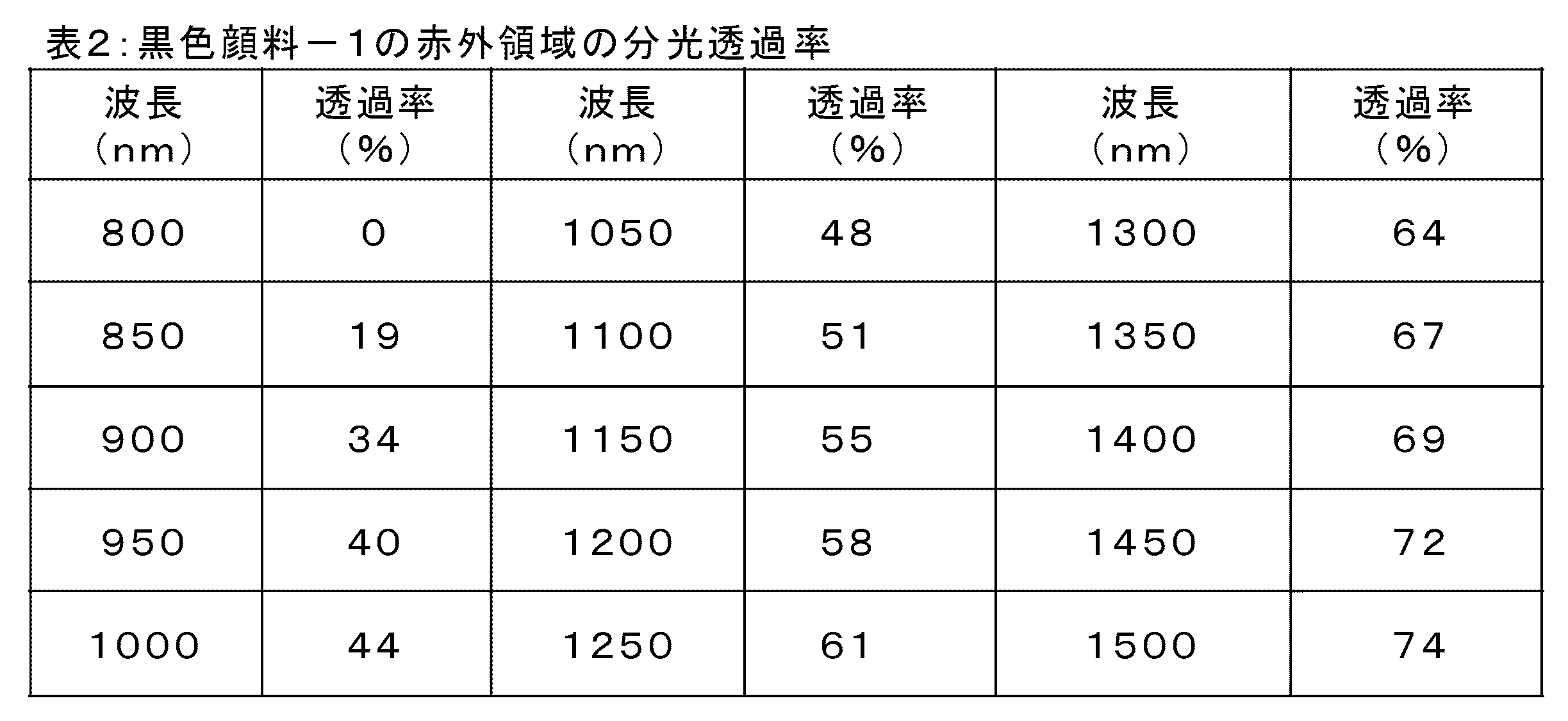
- Tables 1 and 2 the black disazo pigment ("Black Pigment-1") obtained in Production Example 1 of the present invention described later is used, and the coating film containing Black Pigment-1 prepared in Example 1 described later is used.
- the spectral transmittance (%) in the visible region and the infrared region is shown.
- the coating film containing Black Pigment-1 has a transmittance of 0% over the entire wavelength region of visible light of 400 to 750 nm, and does not exhibit transparency in the visible region. confirmed.
- Table 2 there is a 34% transmission at 900 nm in the infrared region, and the transmittance gradually increases on the longer wavelength side, and the transmittance is increased even at higher wavelengths. It is assumed that
- the volume resistivity value of the coating film containing the black pigment-1 is 10 14 as shown in Example 1 described later. It was ⁇ ⁇ cm, and it was confirmed that good electrical insulation was exhibited.
- the black pigment-1 which is the black azo pigment of the present invention is a dye having an optical function of transmitting light in the infrared region and completely shielding light in the visible light region as described above, It has been found that it is useful for applications of infrared filters for electronic devices that use BF and for CF BM. For example, when the black azo pigment of the present invention is applied to CF BM, light in the visible light region of the backlight can be completely shielded, and excellent electrical insulation is exhibited.
- the black azo pigment of the present invention is a coloring composition that, when used, has a dark chromatic color, an achromatic dark color, or a black color, and includes a black azo pigment depending on the purpose, application, usage, etc. It can be used in various forms as a liquid coloring composition containing the components in a liquid dispersion medium or a solid coloring composition containing the components in a solid dispersion medium.
- the black azo pigment of the present invention has a chromatic color pigment, a white pigment, another black pigment, and an extender pigment as a pigment component, as a pigment component, alone or as one of a plurality of pigment components. In combination, one type or two or more types can be selected and used in combination.
- the mixing ratio of the chromatic color pigment, white pigment, other black pigment or extender pigment used in combination with the black azo pigment of the present invention to correct the color of the black azo pigment is not particularly limited, but a computer color matching system is used. It is also a preferred form to be determined by the method to be used and optimized.
- a known pigment can be used and is not particularly limited.
- Organic pigments such as dioxazine pigments, quinophthalone pigments, nickel azo pigments, metal complex pigments, insoluble azo pigments, soluble azo pigments, high molecular weight azo pigments, azomethine azo black pigments, aniline black pigments, and carbon black pigments
- At least one pigment selected from inorganic pigments such as composite oxide pigments, iron oxide pigments, titanium oxide pigments, a mixture of two or more pigments, and mixed crystal pigments can be used.
- Organic pigments include, for example, yellow pigments and C.I. I. Pigment Yellow (abbreviated as PY) -74, 83, 93, 94, 95, 97, 109, 110, 120, 128, 138, 139, 147, 150, 151, 154, 155, 166, 175, 180, 181 , 185, 191 and the like are C.I. I. Pigment Orange (abbreviated as PO) -61, 64, 71, 73, etc. are red pigments such as C.I. I.
- Pigment Red (abbreviated as PR) -4, 5, 23, 48: 2, 48: 4, 57: 1, 112, 122, 144, 146, 147, 150, 166, 170, 177, 184, 185, 202 , 207, 214, 220, 221, 242, 254, 255, 264, 272, and the like.
- C.I. I. Pigment Blue (abbreviated as PB)-15: 1, 15: 2, 15: 3, 15: 4, 15: 5, 15: 6, 16, 17: 1, 60, 80, aluminum phthalocyanine blue, etc. are green
- C.I. I. Pigment Green (abbreviated as PG) -7, 36, 58, poly (13-16) bromophthalocyanine, etc.
- I. Pigment Violet (abbreviated as PV) -19, PV-23, PV-37, etc. are black pigments such as aniline black pigments, carbon black pigments, titanium oxide black pigments, and particularly for CF BM.
- a carbon black pigment, a titanium oxide black pigment or the like whose surface is treated to improve insulation is preferable.
- the black azo pigment of the present invention is used in combination with an infrared reflective pigment such as a white pigment
- the methods proposed in Japanese Patent No. 4097926 and Japanese Patent Application Laid-Open No. 2005-330466 can also be used. That is, it is also preferable to apply a method of substantially improving the infrared reflection efficiency by substantially covering the infrared reflective pigment such as a white pigment with the infrared transmissive black azo pigment of the present invention.
- the liquid coloring composition comprising the black azo pigment of the present invention is mainly used as a coloring agent for coating, impregnating, drawing, printing, etc. on the surface of an article, and it is used as a paint, coating agent, plastic coloring, fiber coloring. , Printing ink, stationery, image recording, and image display.
- a reactive polymer having a reactive group or a non-reactive polymer, an oligomer having a reactive group, or a non-reactive polymer is used as a film-forming material (or film-forming material).
- It may contain at least one selected from a reactive oligomer, a monomer having a reactive group, a non-reactive monomer having no reactive group, and the like, and may itself be a liquid, or further It may contain a solvent and / or water.
- the pigment to be used is prepared in advance as a high-concentration pigment processed product in which the pigment to be used is finely dispersed in a dispersion medium, it is used for coloring.
- the preparation of the agent can be facilitated.
- the liquid high-concentration pigment dispersion is called “base color” or “base ink” and is used.
- the above-described solid coloring composition containing the black azo pigment of the present invention is a colorant mainly used for internal coloring of plastics and synthetic fibers, and is, for example, a high-concentration pigment dispersion. It is used in known product shapes such as master powder, master batch, etc., and colored pellets colored throughout.
- the solid dispersion medium at least one selected from thermoplastic resins, thermosetting resins, waxes, fatty acid amides, fatty acid metal soaps, and the like can be used.
- the black azo pigment of the present invention when used, particularly in the wavelength range of about 400 to 750 nm in the visible light region, high absorptivity and visible light shielding properties are exhibited, and a high wavelength of about 900 nm to 1500 nm and further higher. In the infrared region, it can be colored highly transmissive.
- the material constituting the article itself is light-reflective or a pre-formed light-reflective substrate is used. Furthermore, it can achieve by apply
- the coloring method in this case is a known method, for example, painting, painting, undiluted solution printing, textile printing, dip dyeing, printing, writing, drawing, ink jet printing, electrophotographic printing, electrostatic printing, etc. Can exhibit high absorbency, and in the near-infrared region can be colored highly reflective.
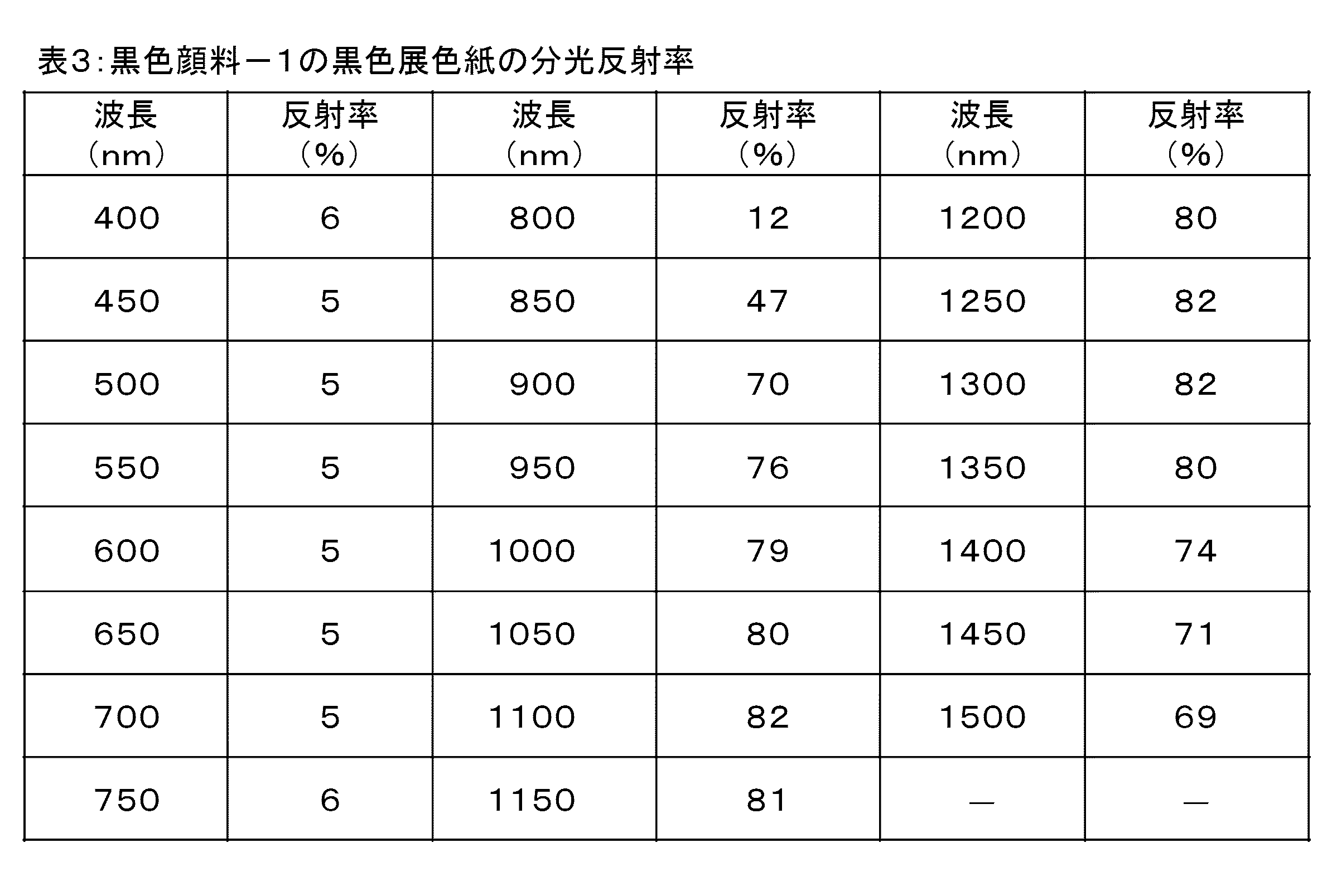
- the spectral reflectance of the black pigment-1 was measured, and the results are shown in Table 3.
- the measured sample is a coated paper (hereinafter referred to as black developed paper) coated on a white developed paper using an applicator.
- the coating film containing the above black pigment-1 absorbs from the visible region to about 750 nm and exhibits a reflectance of about 5%, but the reflectance rapidly increases from about 800 nm to 900 nm. It is assumed that the reflectance of about 80% is maintained in the near-infrared region on the longer wavelength side, and that the reflectance is also high in the infrared region of higher wavelength. . This indicates that the light that has passed through the black coating is reflected by the white paper of the base, and the surface of the black pigment can be obtained by using a highly reflective base or a reflective material such as a white pigment or extender. In addition to the above, the transmitted light is re-reflected to show an efficient high reflectance.
- Resin binder that functions as a film-forming material (film-forming material) used in the present invention is a non-reactive, room-temperature drying type or reaction that does not have a reactive group.
- a baking-type resin binder having a functional group and a photosensitive resin binder can be preferably used.
- the room temperature drying type or baking type resin binder include printing agents, paints, coating agents, or resin binders used for printing inks, stationery, inkjet printing, electrophotographic printing, electrostatic printing, and other image recording materials. Is mentioned.
- the photosensitive resin binder include photosensitive resin binders used in various ultraviolet curable or electron beam curable paints, coating agents, printing inks, inkjet inks, photolithography, and the like.
- room temperature drying type or baking type resin binders that can be used in the present invention include, for example, synthetic rubber resins, acrylic resins, styrene (co) polymers, vinyl resins such as polyvinyl butyral resins, and polyester resins.
- Amino resin-modified polyester resins polyurethane resins, acrylic polyol urethane resins, soluble polyamide resins, soluble polyimide resins, soluble polyamideimide resins, soluble polyesterimide resins, alkyd resins, aminoalkyd resins, epoxy resins Resin, chlorinated rubber resin, silicone resin, fluororesin, cellulose acetate resin, nitrocellulose resin, hydroxyethyl cellulose, water-soluble salt of styrene-maleic acid ester copolymer, (meth) acrylic acid ester (co) heavy Body water-soluble salts of water-soluble amino alkyd resin, and water-soluble amino polyester resin and a water-soluble polyamide resin and the like, which are used in combination or alone or in combination.
- Examples of the reactive group possessed by the reactive film forming material include a methylol group, an alkylmethylol group, an isocyanate group, a masked isocyanate group, and an epoxy group.
- oligomers and monomers are used depending on applications, and a cross-linking agent such as methylol melamine type, isocyanate type, and epoxy type cross-linking agent is also used in combination.
- energy ray curable coating film forming materials such as ultraviolet curable resin systems and electron beam curable resin systems
- energy ray curable coating film forming materials include, for example, photosensitive cyclized rubber resins, photosensitive phenol resins, Photosensitive polyacrylate resins, photosensitive polyamide resins, photosensitive polyimide resins, etc., and unsaturated polyester resins, polyester acrylate resins, polyepoxy acrylate resins, polyurethane acrylate resins, polyether acrylate resins, polyols
- binders such as acrylate resins, and binders in which monomers are further added as reactive diluents.
- plastic to be colored with the colorant for plastics which is the coloring composition of the present invention examples include conventionally known thermoplastics such as polyolefins such as polyethylene, ethylene copolymer, and polypropylene, polystyrene, ABS, AS, and styrene. Copolymers, vinyl chloride resins, methacrylic resins, polycarbonates, polyamides, polyacetals, thermoplastic polyesters, cellulosic plastics, phenylene oxide resins, fluororesins, thermoplastic elastomers, etc. Also, as thermosetting plastics, unsaturated polyester resins, Examples thereof include an epoxy resin, a silicone resin, a polyurethane resin, a melamine resin, and a phenol resin.
- thermoplastics such as polyolefins such as polyethylene, ethylene copolymer, and polypropylene, polystyrene, ABS, AS, and styrene. Copolymers, vinyl chloride resins, methacryl
- the content of the black azo pigment of the present invention contained in the black colorant which is the coloring composition of the present invention varies depending on the use and purpose of use, and is not generally determined.
- the content of black pigment contained in the colorant is as follows: It is about 3% to 80%, preferably about 5% to 60%.
- the pigment when used as a light-shielding black material for CF BM, since the film thickness is particularly thin and complete light-shielding properties are required, the pigment is stably dispersed, the viscosity suitable for coating is maintained, and uniform
- the limit pigment concentration to form a simple colored film is tried, and is preferably about 30% to 60%.
- the entire material to be colored is internally colored, such as plastic coloring or spinning stock solution coloring, it depends on the thickness of the colored product, but it is approximately 0.05% to 20%, preferably approximately 0%. About 1% to 10%.
- the coloring composition for image recording containing the black azo pigment of the present invention is used as a coloring composition for BM formation of CF
- the coloring composition is used to transfer directly or onto the CF substrate. It is formed by one or two or more forming methods selected from a photolithography method, a laser ablation method, an ink jet printing method, a printing method, a transfer method, a pasting method, etc. with a plastic film for pasting interposed.
- the film thickness of BM is 0.5 ⁇ m to 3 ⁇ m, and usually 1 ⁇ m to 2 ⁇ m.
- the optical density (OD) value is 2.0 or more, preferably 3.0 or more.
- OD optical density
- chromatic color pixels can be formed on the CF substrate on which the BM is formed by a known pixel forming method using a known chromatic color pixel forming colorant.
- a CF substrate or an organic EL light emitting substrate on which a BM that absorbs a wavelength range in the visible region is formed in particular, a BM is further substantially electrically insulating, and a CF substrate that is formed by overlapping the BM and an electrode.
- An organic EL light emitting substrate and a color display panel including them are exemplified.
- An organic EL color display device equipped with a light emitting substrate may be mentioned.
- seat formed by multilayering the dark-colored infrared rays transparent layer and a solar power generation module using the same are mentioned.
- the obtained ground product was stirred for 1 hour in 3,000 parts of warm water heated to 80 ° C. and then filtered, and the resulting filtrate was washed with water to remove sodium chloride and diethylene glycol. As a result, a miniaturized black azo pigment press cake was obtained.
- the particle diameter of the pigment obtained above was measured by the following method. A transmission electron micrograph (60,000 times) of the obtained black pigment was taken, and the particle size distribution was measured using “image analysis type particle size distribution software Mac-View” (manufactured by Mountec). As a result, the average particle size was 50 nm. Also in other production examples, the average particle diameter of the pigment was measured by the same method as described above.
- black pigment-1 A finely divided powder pigment of black pigment having the structure of (carbazole-3-carboxy-p-anisidide) was obtained. Hereinafter, it is referred to as “black pigment-1”.
- the obtained crude pigment was refined.
- the method was refined according to Production Example 1 (2) except that the amount of sodium chloride used in (2) described in Production Example 1 was 8 times the amount of the pigment. .
- dissolving salt etc. with acidic water it filtered, and the obtained filtrate was washed with water, and the press cake of the black azo pigment was obtained.
- the average particle diameter of the obtained pigment was 25 nm.
- miniaturization process was performed according to (2) described in manufacture example 1 except having used the usage-amount of sodium chloride used in (2) described in manufacture example 1 10 times with respect to a pigment. And after melt
- the press cake obtained above was dried and then pulverized to obtain a finely divided powder pigment of black pigment. Hereinafter, this is referred to as “black pigment-3”.
- the obtained crude pigment was refined.
- Refinement treatment was carried out according to (2) described in Production Example 1, and after salt and the like were dissolved in acidic water and filtered, the obtained filtrate was washed with water to obtain a black azo pigment press cake.
- the average particle diameter of the obtained pigment was 50 nm.
- the press cake obtained above was dried and then pulverized to obtain a finely divided powder pigment of black pigment.
- black pigment-4 this is referred to as “black pigment-4”.
- black azo pigment crude pigment obtained above was pulverized with a dry pulverizer to obtain a finely divided powder pigment of black pigment.
- the average particle diameter of the obtained pigment was 110 nm.
- black pigment-6 this is referred to as “black pigment-6”.
- Black Pigment-7 The black pigment-1 press cake obtained in (1) described in Production Example 1 and the black pigment derivative-1 press cake obtained in (1) above have a pigment solid content ratio of 10: 1. And mixed well so as to be uniform. And the crude pigment of the black pigment containing a pigment derivative was obtained by drying the said mixture. Next, the pigment was refined in accordance with (2) described in Production Example 1, and then the salt and the like were dissolved with acidic water, and this was filtered. A pigment presscake was obtained. The average particle diameter of the obtained pigment was 50 nm. The press cake was dried and pulverized to obtain a fine powder pigment of a black pigment containing an anionic pigment derivative. Hereinafter, this is referred to as “black pigment-7”.
- the press cake of the obtained cationic pigment derivative and the press cake of black pigment-1 obtained in Production Example 1 (1) were blended so that the solid content ratio was 85:15. These were mixed sufficiently to be uniform and then dried to obtain a black pigment crude pigment containing a cationic pigment derivative.
- the obtained crude pigment is subjected to a fine treatment according to the method of (2) described in Production Example 1, and then filtered by dissolving a salt and the like with water and washing the filtrate with water.
- An azo pigment presscake was obtained.
- the average particle diameter of the obtained pigment was 50 nm.
- the obtained press cake was dried and then pulverized to obtain a finely divided powder pigment of a black pigment containing a cationic yellow pigment derivative.
- black pigment-8 this is referred to as “black pigment-8”.
- Example 1 Evaluation of optical properties of coating film containing black pigment-1 of Production Example 1
- a black coating solution was prepared.
- a 50% xylene-butanol mixed solvent solution of an acrylic resin having a carboxyl group (acid value is 10 mg KOH / g) and a 50% xylene-butanol mixed solvent solution of a butylated methylol melamine resin are in a ratio of 80:20.
- a varnish As a varnish to be used, a 50% xylene-butanol mixed solvent solution of an acrylic resin having a carboxyl group (acid value is 10 mg KOH / g) and a 50% xylene-butanol mixed solvent solution of a butylated methylol melamine resin are in a ratio of 80:20.
- a diluting solvent a mixed solvent of xylene-butanol (4: 1) was used. (Hereinafter, this is referred to as “diluting solvent”.)
- the coating film containing Black Pigment-1 has a spectral transmittance of 0% over the entire wavelength region of 400 to 750 nm in the visible light region. It was confirmed that almost no transmission occurred (see Table 4). On the other hand, in the infrared region, the transmittance at 900 nm was approximately 34%, and it was confirmed that the transmittance gradually increased on the longer wavelength side (see Table 5).
- Example 2 Evaluation of light reflection characteristics of coating film containing black pigment-1 of Production Example 1
- the black coating solution prepared in (1) described in Example 1 was used with a 6 mil applicator. After coating on white color paper, it was dried and cured to obtain a black color paper (hereinafter referred to as black color paper) formed by forming a coating film.
- the measured value of the dry film thickness of the black coating film formed on the black color developed paper was approximately 35 to 40 nm on the color developed paper.
- the black color paper produced using the black pigment-1 shows only a reflectance of 5 to 6% up to about 750 nm, but the reflectance increases rapidly from 800 nm to 900 nm. Further, it was confirmed that the reflectance of approximately 70% to 80% or more was maintained in the near infrared region on the longer wavelength side. For these reasons, the light reflectance of the black color developed paper is high because the reflected light is reflected by the base white paper together with the reflection from the pigment surface, and the resulting light is added to become reflected light. It is considered a thing. Therefore, it is shown that near infrared rays can be efficiently reflected by increasing the light transmittance of the black pigment and using a highly reflective base. In Table 6 above, the reflectance is not 0% up to about 750 nm but a value of 5% because of the relationship with the measuring apparatus.
- Example 3 (1) In the same manner as in Example 1, black pigments 2 to 6 obtained in Production Examples 2 to 6 were respectively used to prepare black coating films. The spectral transmittance of the outer region was measured. Tables 7 and 8 show the results.
- Example 2 In the same manner as in Example 2, a black coating film was formed using each of the black pigments 2 to 6 obtained in Production Examples 2 to 6, and black colored paper was prepared. The dry film thickness of the black coating film was about 35 to 40 nm on the black color developed paper. The spectral reflectance was measured in the same manner as in Example 2. As a result, as shown in Table 9, the spectral reflectance showed the same tendency as that of the black coated color developed paper obtained using the black pigment-1.
- Example 4 Polycarbonate resin molded plate After 20 parts of black pigment-2 prepared in Production Example 2 and 80 parts of polycarbonate resin powder were sufficiently mixed with a Henschel mixer (powder high speed mixer), they were further mixed and kneaded with a twin screw extruder, A polycarbonate resin black masterbatch containing 20% of black pigment-2 was prepared. 2 parts of the obtained black masterbatch was mixed with 100 parts of polycarbonate resin pellets made of the same resin powder as described above, mixed with a Henschel mixer, then mixed and kneaded with a twin screw extruder to obtain black resin pellets. .
- the obtained black resin pellet was molded by an in-line screw injection molding machine to obtain a black polycarbonate resin plate excellent in pigment dispersibility. Since this black resin plate absorbs light in the visible light region and can sufficiently transmit near infrared rays, it can be used for applications such as an infrared transmission filter.
- Example 5 (Acrylic resin molding plate)
- 20 parts of the black pigment-3 prepared in Production Example 3 and 80 parts of acrylic resin (polymethyl methacrylate) powder were sufficiently mixed with a Henschel mixer, and then further biaxial extrusion kneading.
- an acrylic resin black masterbatch containing 20% of black pigment-3 was prepared.
- the mixture was further mixed with a Henschel mixer, and further mixed and kneaded with a twin-screw extrusion kneader. It was.
- the obtained black resin pellet was molded by an in-line screw injection molding machine to obtain a black acrylic resin plate excellent in pigment dispersibility. Since this black resin plate absorbs light in the visible light region and can sufficiently transmit near infrared rays, it can be used as an infrared transmission filter.
- Example 6 Polyurethane coating agent 15 parts of black pigment-4 prepared in Production Example 4, 10 parts of polycarbonate non-yellowing polyurethane resin, and 75 parts of dimethylformamide (hereinafter referred to as “DMF”) are mixed with black pigment and non-yellowing polycarbonate. A modified polyurethane resin solution, DMF, is prepared. This prepared liquid was sufficiently dispersed with a horizontal continuous medium disperser to obtain a black pigment high-concentration dispersion.
- DMF dimethylformamide
- the black coating solution prepared above was applied to a release paper DNTP-155T-FLAT (trade name, manufactured by Dai Nippon Printing Co., Ltd.) so as to have a film thickness of 50 ⁇ m, and then 100 ° C./10 minutes. It was dried under conditions to form a skin layer.
- DNTP-155T-FLAT trade name, manufactured by Dai Nippon Printing Co., Ltd.
- 10 parts of toluene as a diluting solvent 20 parts of MEK
- MEK methyl ethyl ketone
- a mixture of 20 parts of DMF, 10 parts of a modified polyisocyanate crosslinking agent (solid content 75%, ethyl acetate solvent) and 0.15 part of an amine crosslinking catalyst solid content 0.5% MEK solvent was prepared. .
- this adhesive agent in the sheet form so that it might become a film thickness of 75 micrometers on the surface of a skin layer (surface on the opposite side to the surface which is in contact with release paper), it was dried on condition of 80 degreeC / 5 minutes.
- the obtained sheet having the adhesive layer and the skin layer is laminated on the base material (woven fabric) on the adhesive layer side to obtain a laminate having a total thickness of 1,100 ⁇ m, and the obtained laminate is heated to 100 ° C.
- the laminate roll was pressed and adhered with a gap of 500 ⁇ m.
- the product was peeled from the release paper to obtain a synthetic artificial leather.
- the obtained synthetic artificial leather is excellent in durability such as heat deterioration resistance, hydrolysis deterioration resistance, light deterioration resistance, oleic acid resistance, etc. in addition to reduction (reduction) of heat storage, and is suitable for vehicle use etc. It was a thing.
- the adhesive used above is colored white by containing a white pigment, thereby giving the adhesive layer light reflectivity and exhibiting both visible light shielding properties and infrared transmittance optical properties.
- a polyurethane synthetic leather capable of reflecting heat rays was obtained. This synthetic leather is particularly suitable for applications such as automobile interiors.
- Example 7 (Stock solution colored spinning) 50 parts of black pigment-5 prepared in Production Example 5 and 50 parts of ethylenebisstearic acid amide powder as a pigment dispersant were mixed with a Henschel mixer to obtain a powder colorant (dry color) having a pigment content of 50%. Obtained. Next, 1.0 part of the obtained dry color was blended in 99.0 parts of polypropylene resin pellets, mixed with a Henschel mixer, and further kneaded with a vent type 40 m / m extruder, so that the pigment content was 0. A 5% black resin pellet was prepared.
- the obtained black resin pellets were spun by a melt spinning machine to obtain a clear black polypropylene stock solution colored yarn having a fineness of 10 denier and excellent pigment dispersibility. Since the woven fabric made using this colored yarn can reflect the heat rays of direct sunlight, the effect of avoiding the temperature rise is expected. Therefore, it is particularly suitable for uses such as parasols and curtains.
- Example 8 (Resin molding) 5 parts of black pigment-6 prepared in Production Example 6, 20 parts of titanium oxide white pigment, and 75 parts of polyethylene resin powder as a pigment dispersant were mixed with a Henschel mixer to obtain a powder colorant (dry color). It was. Next, 1.0 part of the obtained powder colorant was blended in 100 parts of polybutylene terephthalate (PBT) resin pellets, mixed with a Henschel mixer, and then kneaded with an extruder to obtain black resin pellets. The obtained black pellet was molded with an in-line screw injection molding machine to obtain a black PBT resin molded plate excellent in pigment dispersibility. The obtained resin molded board was able to reflect the heat rays of direct sunlight. For this reason, this resin is suitable for use as a molded resin product in which it is desirable to avoid an increase in temperature.
- PBT polybutylene terephthalate
- Example 9 Heat-shielding back sheet for photovoltaic module (1) 15 parts of black pigment-4 prepared in Production Example 5, 15 parts of an acrylic polyol (hydroxyl value: 100) butyl acetate solution (solid content 50%), and 50 parts of butyl acetate were sufficiently premixed and dispersed. A black pigment high-concentration dispersion was prepared by dispersing the pigment using a horizontal continuous medium disperser using glass beads as a medium. Acrylic polyol (hydroxyl value: 100) butyl acetate obtained by copolymerizing 22 parts of an acrylic polyol butyl acetate solution similar to the above, benzotriazole monomer and HALS monomer in 90 parts of the black pigment high-concentration dispersion obtained above.
- a white pigment high-concentration dispersion was prepared by dispersing the pigment with a medium disperser. To 140 parts of the white pigment high-concentration dispersion obtained above, 44 parts of an acrylic polyol butyl acetate solution was added to obtain a white ink. Then, 18 parts of the same hexamethylene diisocyanate trimer used previously as a curing agent was added to this white ink, and after mixing well, approximately 40 parts of butyl acetate was added to adjust the viscosity. A white coating solution was prepared.
- the black coating solution prepared in (1) above is applied to the surface of a polyethylene terephthalate (PET) substrate sheet (film thickness: 100 ⁇ m), dried, and a black coating film (dry film thickness: 5 ⁇ m) Formed. Furthermore, the white coating liquid obtained in the above (2) is applied to the back surface of the base material and dried to form a white coating film (dry film thickness: 5 ⁇ m). A black-white multilayer PET sheet obtained by applying a white coating film to the film was obtained.
- PET polyethylene terephthalate
- a silica / alumina-deposited polyester film (film) (Thickness: 12 ⁇ m) was laminated, and a PET substrate sheet (film thickness: 100 ⁇ m) was further laminated thereon to produce a PET back sheet for a photovoltaic power generation module.
- the following adhesives were used for the above lamination.
- an adhesive composed of 70 parts of the same acrylic polyol solution as used in the above (1), 15 parts of hexamethylene diisocyanate trimer and 15 parts of butyl acetate was used.
- the PET backsheet coated with the black coating film and the white coating film obtained as described above is excellent in aesthetics because of its black appearance, and the optical characteristics of the black pigment-4 used.
- the backsheet obtained above is used as a photovoltaic power generation module, it may be used as follows according to a conventional method. That is, the photovoltaic cell is sandwiched and sealed with a sealing material made of ethylene vinyl acetate resin, a surface sealing sheet is pasted on the surface on the light receiving surface side, and the above-described light shielding is used as a protective sheet on the non-light receiving surface side on the back surface.
- a solar power generation module can be produced by attaching a transparent glass substrate to the light receiving surface after bonding the black surface of the conductive back sheet toward the light receiving side.
- Example 10 Heat-shielding back sheet for photovoltaic module (1) 40 parts of the black pigment-6 obtained in Production Example 6 and 60 parts of polyester resin powder were mixed with a Henschel mixer to obtain a powdery colorant. Next, 12.5 parts of the obtained powdery colorant was blended in 87.5 parts of PET resin pellets, mixed with a Henschel mixer, then kneaded with a twin screw extruder, and made into black resin pellets with a pelletizer. Subsequently, it was molded by a T-die extruder to prepare a black PET film having a film thickness of 50 ⁇ m.
- a white PET sheet (film thickness: 180 ⁇ m) kneaded and colored with a titanium oxide pigment was prepared. And by sticking the black PET film obtained by said (1) on the surface using the same acrylic polyol hexamethylene diisocyanate adhesive as described in (9) of Example 9, black PET A white PET sheet laminated with a film was prepared.
- the back sheet for a photovoltaic power generation module using the sheet obtained by laminating the black film and the white PET sheet obtained above is black in appearance and excellent in aesthetics, and from the optical characteristics of the used black pigment-6, It has the following optical properties. That is, infrared light of sunlight passes through the black film layer on the surface, is reflected by the lower white PET sheet, passes through the black film again, and is emitted to the outside. Therefore, the black-white multi-layer PET sheet is a back sheet for a photovoltaic power generation module that absorbs less sunlight and exhibits excellent heat shielding properties. Particularly preferred.
- the backsheet obtained above is used as a photovoltaic power generation module, it may be used as follows according to a conventional method. That is, the photovoltaic cell is sandwiched and sealed with a sealing material made of ethylene vinyl acetate resin, a surface sealing sheet is pasted on the surface on the light receiving surface side, and the above-mentioned light shielding as a protective sheet on the non-light receiving surface side on the back surface.
- a solar power generation module can be produced by attaching a transparent glass substrate to the light receiving surface after bonding the black surface of the conductive back sheet toward the light receiving side.
- Example 11 Print paste for woven fabric
- a press cake containing 25 parts of the solid content of the black pigment-1 obtained in Production Example 1
- the pigment was dispersed with a horizontal continuous medium disperser using glass beads to prepare a black pigment high-concentration dispersion (black color base).
- Example 12 (gravure printing ink) 11 parts of the black pigment-10 obtained in Production Example 10 and 30 parts of a 40% methyl ethyl ketone-toluene (1: 3) mixed solvent solution of a polyurethane resin in which the isocyanate-terminated polyester was chain-extended with diamine were added.
- a mixed solvent of methyl ethyl ketone-toluene-isopropyl alcohol 50:30:20
- the above mixture was finely dispersed with a horizontal continuous medium disperser using glass beads as a dispersion medium to prepare a black gravure printing ink.
- the resulting black gravure printing ink is printed on a polyamide film, a polyester film, and a polypropylene film by using a gravure printing machine, respectively, and a black polypropylene film that exhibits optical characteristics of shielding visible light and transmitting infrared light.
- Example 13 (Formation of CF BM) (1) (Preparation of pigment dispersion for BM) (Preparation of black pigment dispersion) 25 parts of the black pigment-9 obtained in Production Example 9 and a 40% solution of benzyl methacrylate-methacrylic acid-2-hydroxyethyl methacrylate copolymer (molar ratio: 60:20:20, weight average molecular weight 30,000). 20 parts, 2 parts of a cationic polymer dispersant and 53 parts of propylene glycol monomethyl ether acetate (PGMA) were sufficiently premixed. Next, the pigment was finely dispersed using a continuous horizontal medium disperser to obtain a black pigment dispersion (hereinafter referred to as “black pigment dispersion-1”).
- black pigment dispersion-1 a black pigment dispersion
- photosensitive black resist ink-1 a black resist ink containing black pigment-9 (hereinafter referred to as “photosensitive black resist ink-1”). Called).
- the BM film forming the BM pattern obtained above exhibits high electrical insulation as described in (3) above, various CF improvement methods for forming a BM on an active element such as a TFT For example, it can be used for the construction of a BM, IPS system, COA system, etc. that retains the thickness of the liquid crystal layer instead of the spacer. Further, since the BM film can sufficiently absorb the visible region up to the long wavelength region, it can also be used as a BM of an LCD panel employing an LED backlight.
- a red resist ink was prepared by adding 9.2 parts% solution, 3 parts photopolymerizable monomer, 0.3 part photopolymerization initiator, and 54.5 parts solvent.
- a pigment dispersion containing PG36 and PY138 is blended at a ratio of 5: 5 to give a green resist ink, and 8 pigment dispersions containing PB15: 6 and PV23, respectively.
- Blue resist inks were prepared by blending at a ratio of 2.
- a photosensitive black resist ink was prepared in the same manner as described above except that the black pigment-7 obtained in Production Example 7 was used instead of the black pigment-9 used above, and the BM pattern described above was prepared. And RGB pixel pattern was formed, and CF with BM and RGB pixels was obtained.
- Example 14 (Formation of CF BM) (1) (Preparation of pigment dispersion for BM) (Preparation of black pigment dispersion) As in Example 13 (1), 25 parts of black pigment-8 instead of black pigment-9, 40% of the same benzyl methacrylate-methacrylic acid-2-hydroxyethyl methacrylate copolymer as used previously After sufficiently premixing 25 parts of the solution and 53 parts of propylene glycol monomethyl ether acetate (PGMA), the pigment was dispersed with a continuous horizontal medium disperser to obtain a black pigment dispersion. Hereinafter, this is referred to as “black pigment dispersion-2”.
- black pigment dispersion-2 this is referred to as “black pigment dispersion-2”.
Landscapes
- Chemical & Material Sciences (AREA)
- Organic Chemistry (AREA)
- Engineering & Computer Science (AREA)
- Materials Engineering (AREA)
- Wood Science & Technology (AREA)
- Life Sciences & Earth Sciences (AREA)
- Optical Filters (AREA)
- Paints Or Removers (AREA)
- Compositions Of Macromolecular Compounds (AREA)
- Pigments, Carbon Blacks, Or Wood Stains (AREA)
- Inks, Pencil-Leads, Or Crayons (AREA)
- Photovoltaic Devices (AREA)
- Ink Jet (AREA)
Abstract
Description
また、特許文献1では、自動車前照灯の可視光と、自動車の前方障害物の確認のための近赤外光を同時に発光する投光器、および可視光を遮断し赤外線を透過するフィルターを装備する車両用暗視装置を提案している。
これらの赤外線送信機、受信機の赤外線フィルター、及び赤外線カメラの赤外線フィルターなどに使用される色素として、赤外線領域の光を透過し、可視光領域の光を完全に遮蔽する光学的特性を示し、耐熱性、耐光性、耐溶剤性などの耐久性に優れた機能を有する色素が要望されている。
しかしながら、カーボンブラック顔料は本来導電性を有する材料であり、上記した従来技術のように樹脂被覆をしても絶縁性を完全なものにすることは困難である。
更に、最近開発が進められている有機EL素子を用いたディスプレーにおいても、発光素子からの隣接する光の混色を防止し、発光画面の鮮明性の向上のためにBMの使用が提案されている(特許文献8)。
前記可視光遮光性は、透明性基板上の黒色アゾ顔料を含む黒色着色膜が、可視光範囲の凡そ400~750nmの波長範囲で凡そ5%以下の分光透過率を示すことであり、前記赤外透過性は、上記黒色着色膜が、赤外領域の900~1500nmの波長範囲で凡そ30%以上の透過率を示すことである黒色アゾ顔料。
(1)ジアゾ成分としてアミノ基を2個以上有する化合物(代表式:H2N-Ar-NH2)をジアゾ化してなるジアゾニウム塩が使用され、該塩に、カップリング成分として2-ヒドロキシ-11H-ベンゾ[a]-カルバゾール-3-カルボン酸アリールアミド(HBCと略記)がアゾ・カップリングしてなる[HBC-N=N-Ar-N=N-HBC]で示される構造。
(2)ジアゾ成分としてアミノ基を2個以上有する化合物(代表式:H2N-Ar-NH2)をジアゾ化してなるジアゾニウム塩が使用され、該塩に、カップリング成分として、2-ヒドロキシ-11H-ベンゾ[a]-カルバゾール-3-カルボン酸アリールアミド(HBCと略記)及び該化合物以外の他のカップリング成分(Cpと表示)がアゾ・カップリングしてなる[HBC-N=N-Ar-N=N-Cp]で示される構造。
(3)その分子中に、2-ヒドロキシ-11H-ベンゾ[a]-カルバゾール-3-カルボアミド残基(HBC-と略記)を2個以上有するカップリング成分(HBC-HBCと表示)に、ジアゾ成分としてアミノ基を1個有する化合物(Ar-NH2と表示)を使用し、ジアゾ化してアゾ・カップリングさせてなる[Ar-N=N-HBC-HBC-N=N-Ar]で示される構造。
(4)その分子中に、2-ヒドロキシ-11H-ベンゾ[a]-カルバゾール-3-カルボアミド残基(HBC-と略記)と、該化合物以外の他のカップリング成分残基(Cp-と表示)とを有するカップリング成分(HBC-Cpと表示)に、ジアゾ成分としてアミノ基を1個有する化合物(Ar-NH2と表示)をジアゾ化して、アゾ・カップリングさせてなる[Ar-N=N-HBC-Cp-N=N-Ar]で示される構造。
尚、上記において、「Ar」は、代表的には、芳香族化合物及び複素環式化合物の残基を示し、式中2個以上ある場合は同一でも、また、異なってもよい。また、式中の「Ar-N=N-」や「-N=N-Ar-N=N-」はジアゾ成分のジアゾニウム塩がカップリングした「アリールアゾ残基」を意味する。以下も同様である。
本発明を特徴づける黒色アゾ顔料は、光学的特性として、可視光領域を網羅して吸収し、特に長波長側の波長範囲までもほぼ完全な吸収を示し、また近赤外領域では高い透過率を示す。具体的には、透明性基板上の黒色着色薄膜の分光透過率は、凡そ可視光範囲の400~750nmの波長範囲では凡そ5%以下を示し、凡そ900nm~1500nmの赤外領域の波長範囲では凡そ30%以上を示す。また、電気特性としては非常に高い電気絶縁性を示す。
本発明において、ポリアゾ顔料とは、上記したように分子中に2個以上のアゾ結合を有するジスアゾ顔料やトリスアゾ顔料などを意味する。

(1)ジアゾ成分としてアミノ基を2個以上有する化合物(代表式:H2N-Ar-NH2)をジアゾ化してなるジアゾニウム塩を使用し、該塩に、カップリング成分として2-ヒドロキシ-11H-ベンゾ[a]-カルバゾール-3-カルボン酸アリールアミド(HBCと略記)がアゾ・カップリングしてなる[HBC-N=N-Ar-N=N-HBC]で示される構造の黒色ポリアゾ顔料。

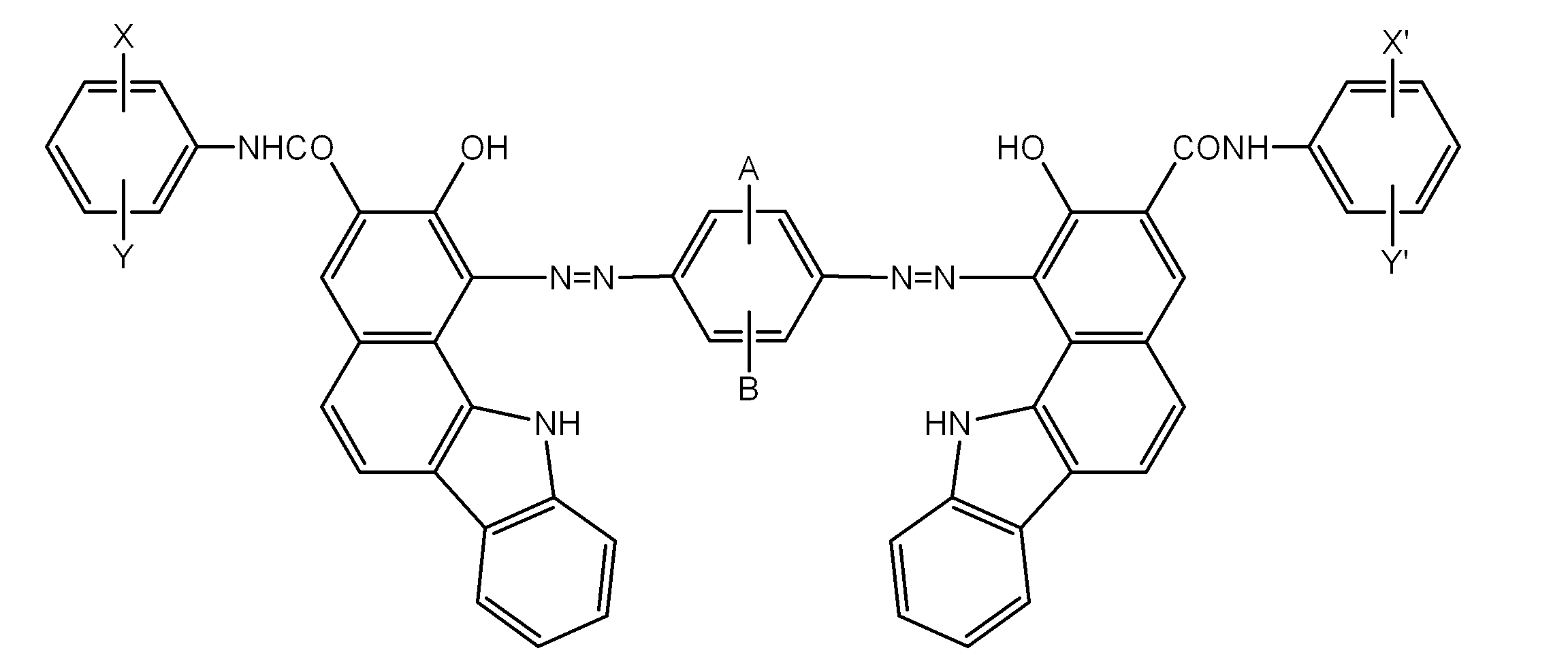
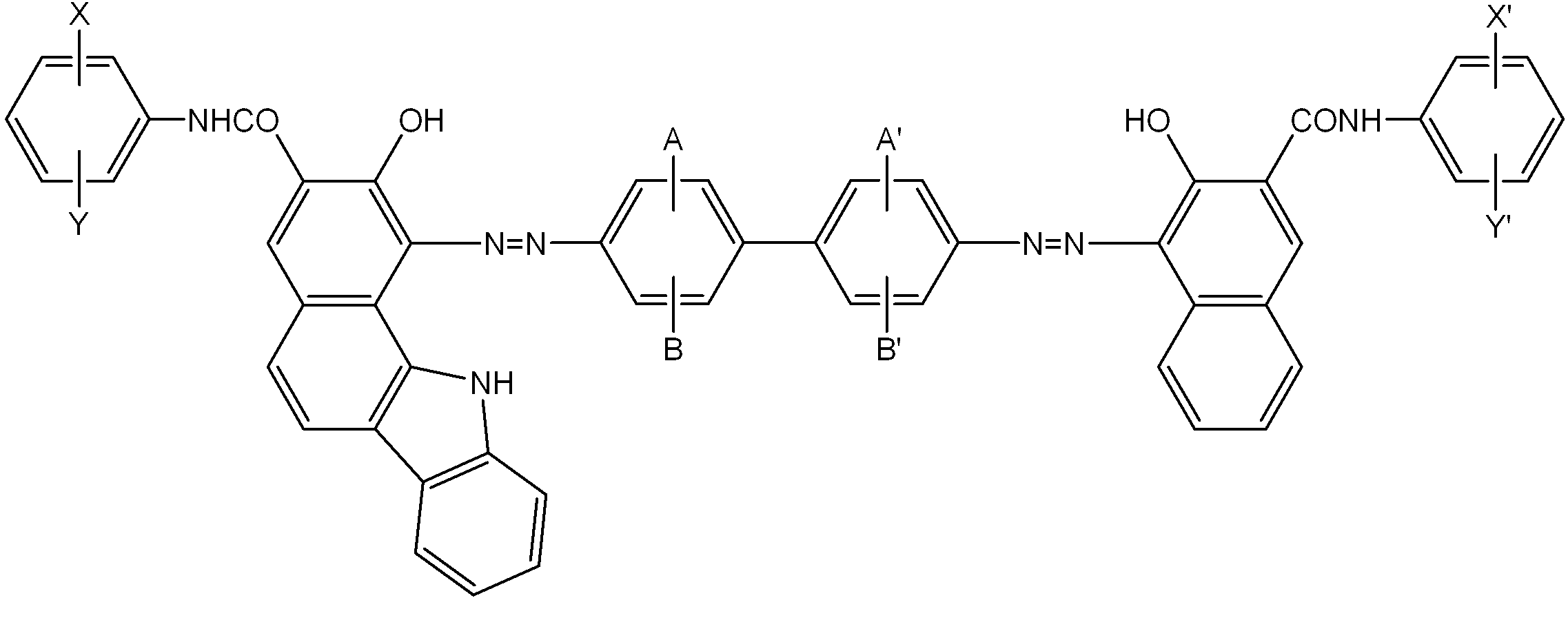
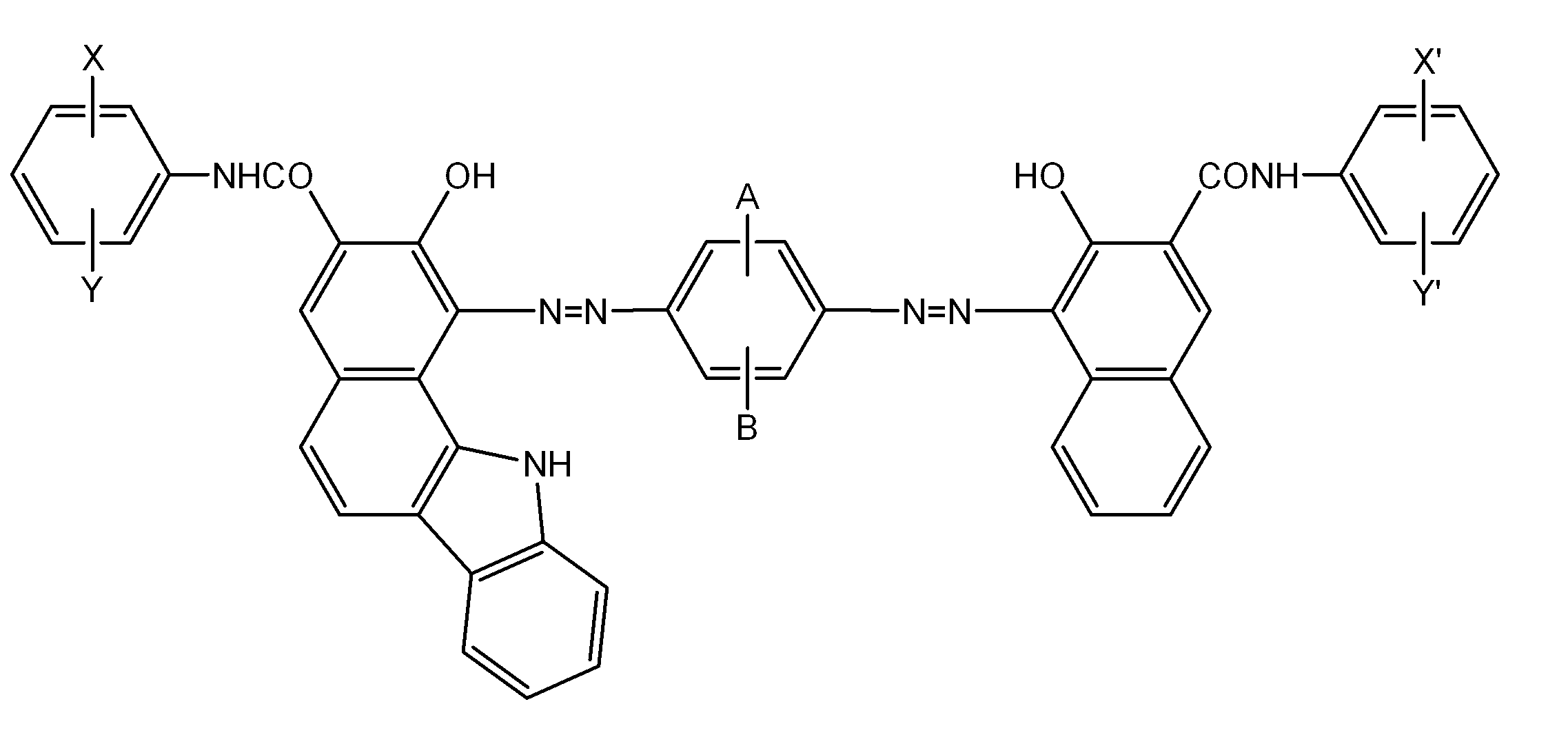


(1)の方法は、アミノ基を2個以上有する化合物(代表式:H2N-Ar-NH2)をジアゾ化してなるジアゾニウム塩に、2-ヒドロキシ-11H-ベンゾ[a]-カルバゾール-3-カルボン酸アリールアミド(HBCと略記)をアゾ・カップリングさせる合成方法である。該(1)の合成方法によって得られた黒色ポリアゾ顔料は、先に説明した[HBC-N=N-Ar-N=N-HBC]で示される構造を有するものとなる。
(A)カップリング成分について具体的に例示する。
(a)カップリング成分(HBC)としては、例えば、2-ヒドロキシ-11H-ベンゾ[a]-カルバゾール-3-アニライド、2-ヒドロキシ-11H-ベンゾ[a]-カルバゾール-3-ナフチルアミドなど及びそれらの誘導体である。誘導体の置換基としては、例えば、アルキル(炭素数;1~10)基、アルコキシ(炭素数;1~10)基、トリフルオロメチル基、ハロゲン基、アルキルオキシカルボニル基、環状イミノジオキシ基、アルキルスルホニル基、アミノカルボニル基、ベンズアミド基、アルキルアミノカルボニル基、アニリノカルボニル基、環状ウレイレン基、カルボキシル基、アルキルイミノ基などが1個またはそれ以上導入されたカップリング成分である。
(a)ジアゾ成分のアミノ基を2個以上有する化合物(代表式:H2N-Ar-NH2)としては、例えば、フェニレンジアミン、ジアミノビフェニル、ジアミノナフタレン、ジアミノアンスラキノン、ジアミノ-ベンゾフェノン、ジアミノピリジンなど及びそれらの誘導体である。誘導体の置換基としては、そのアリール基に公知の置換基、例えば、アルキル(炭素数;1~10)基、アルコキシ(炭素数;1~10)基、トリフルオロメチル基、ハロゲン基などが1個またはそれ以上導入されたジアゾ成分である。
(1)ボールミル、サンドミル、アトライター、横型連続媒体分散機、ニーダー、連続式一軸混練機、連続式二軸混練機、三本ロール、オープンロール連続混練機などからなる群から選ばれた顔料磨砕機あるいは顔料分散機を使用する微細化方法や、
(2)混練機中で水溶性塩類、必要に応じて水溶性有機溶剤と共に混練、摩砕するソルベントソルトミリング法など公知の方法
から選ばれた顔料微細化工程を行い、平均粒子径が凡そ10nm~200nmとなるように調製する。更に、より赤外線の高透過率を要望する場合には、平均粒子径が凡そ10nm~50nmの超微細顔料を調製することが好ましい。
この結果、表1に示した通り、黒色顔料-1を含む塗膜では、可視光の400~750nmの全波長領域に亘り透過率は0%であり、可視領域では透過性を示さないことを確認した。一方、表2に示した通り、赤外領域の900nmでは34%の透過があり、それより長波長側では透過率はなだらかに上昇することを示しており、更に高波長においても高透過率を示すことが想定される。

可視光領域を吸収させ、赤外領域を透過させる着色を行う場合には、物品の基材を透明なものにし、着色組成物を用いて該透明性基材を、塗装、塗付、染色、印刷、筆記、描画、インクジェット印刷、電子写真印刷、静電印刷あるいはフォトリソグラフィックプリントなどで表面着色するか、あるいは透明性基材に、着色組成物を混練または含浸させて内部着色する。この場合に本発明の黒色アゾ顔料を使用することで、得られる物品は、下記の優れた光学特性を示すものになる。すなわち、本発明の黒色アゾ顔料を使用すれば、特に可視光領域の凡そ400~750nmの波長範囲では高吸収性を示して可視光遮光性を示し、凡そ900nm~1500nm、更にそれ以上の高波長の赤外領域で高透過性を示す着色をすることができる。
また、プラスチックの着色や紡糸の原液着色のように着色される材料全体に内部着色するような場合には着色製品の厚さにもよるが、凡そ0.05%~20%、好ましくは凡そ0.1%~10%程度である。
また、前記BMの形成されたCF基板上に、更に公知の有彩色画素形成用着色剤を使用して公知の画素形成方法により有彩色画素を形成することができる。
また、太陽光発電システムに関連する物品としては、太陽光による温度上昇を抑制できる、反射性下地層等の光反射性シートの上に、本発明の黒色アゾ顔料を含む着色組成物で、黒色または暗彩色の赤外線透過性層を複層して形成させたバックシート及びそれを用いた太陽光発電モジュールが挙げられる。
(1)黒色ジスアゾ顔料の合成
常法により、3,3’-ジメトキシ-4,4’-ベンジジン2.44g(0.01モル)に濃塩酸を加えて塩酸塩とした後、過剰の亜硝酸ナトリウム水溶液を加えてジアゾ化した。次いで、これにホウフッ化水素酸を加えて、3,3’-ジメトキシ-ジフェニレン(4,4’-)テトラゾニウム・フッ化ホウ素複塩(ジアゾニウム塩)を調製した。これとは別に、カップリング成分として、2-ヒドロキシ-11H-ベンゾ[a]カルバゾール-3-カルボキシ-p-アニシダイド7.65g(0.02モル)を、水酸化ナトリウム0.8gが溶けたメタノール250g中に溶解して調製した。先に調製したテトラゾニウム・フッ化ホウ素複塩溶液を15℃以下に保ち、そこへ上記で調製したカップリング成分の溶液を徐々に添加した。そして、酢酸ナトリウムでpHを6.5~7.0に調整して1時間撹拌した後、25℃で2時間撹拌し、更に40℃に昇温して3時間撹拌してカップリング反応を完結させた。生成した顔料をろ過した後、ろ過物をメタノールで洗浄し、次いで水洗した後、乾燥することで黒色アゾ顔料の粗顔料を得た。得られた黒色アゾ顔料の収量は、9.78gであった。
上記の(1)の合成反応によって得られた黒色アゾ顔料の粗粒子顔料100部を、塩化ナトリウム粉末500部及びジエチレングリコール50部と共に、加圧蓋を装着したニーダーに仕込み、ニーダー内の粗粒子顔料および塩化ナトリウム粉末が均一に湿潤された塊になるまで予備混合した。次いで、加圧釜を閉じ、圧力6kg/cm2で内容物を押さえ込みながら混練及び摩砕を行った。具体的には、内容物が92~98℃になるように温度を管理しながら、2時間混練・摩砕処理を行った。得られた摩砕物を、80℃に加温した3,000部の温水中で1時間の攪拌処理を行った後、ろ過し、得られたろ過物を水洗することにより塩化ナトリウム及びジエチレングリコールを除去し、微細化した黒色アゾ顔料のプレスケーキを得た。
製造例1(1)と同様にして、3,3’-ジメトキシ-4,4’-ベンジジン2.44g(0.01モル)をジアゾ化した。そして、これを、2-ヒドロキシ-11H-ベンゾ[a]カルバゾール-3-カルボキシ-N-ベンズイミダゾロン-5-アミド8.17g(0.02モル)とカップリングさせることにより、黒色アゾ顔料の粗顔料を得た。得られた黒色アゾ顔料の収量は、10.07gであった。
製造例1(1)と同様にして、3,3’-ジクロロ-4,4’-ベンジジン2.53g(0.01モル)をジアゾ化した。そして、これを、2-ヒドロキシ-11H-ベンゾ[a]カルバゾール-3-カルボキシ-(2’-メチル)-p-アニシダイド7.93g(0.02モル)とカップリングさせることにより、黒色アゾ顔料の粗顔料を得た。得られた黒色アゾ顔料の収量は、10.26gであった。
製造例1(1)と同様にして、3,3’-ジメトキシ-4,4’-ベンジジン2.44g(0.01モル)をジアゾ化した。そして、これを、2-ヒドロキシ-11H-ベンゾ[a]カルバゾール-3-カルボキシ-(2’-メチル)-p-アニシダイド7.93g(0.02モル)とカップリングさせることにより、黒色アゾ顔料の粗顔料を得た。得られた黒色アゾ顔料の収量は、9.94gであった。
製造例1(1)と同様にして、3,3’-ジクロロ-4,4’-ベンジジン2.53g(0.01モル)をジアゾ化した。そして、これを、2-ヒドロキシ-11H-ベンゾ[a]カルバゾール-3-カルボキシ-p-アニシダイド7.65g(0.02モル)とカップリングさせることにより、黒色アゾ顔料の粗顔料を得た。得られた黒色アゾ顔料の収量は、9.86gであった。
製造例1(1)と同様にして、3,3’-ジメトキシ-4,4’-ベンジジン2.44g(0.01モル)をジアゾ化した。そして、これを、2-ヒドロキシ-11H-ベンゾ[a]カルバゾール-3-カルボキシ-(2’-メチル)-p-アニシダイド3.96g(0.01モル)及び5’-クロロ-3-ヒドロキシ-2’,3’-ジメトキシ-ナフタニライドアニライド3.58g(0.01モル)とカップリングさせることで、黒色アゾ顔料の粗顔料を得た。得られた黒色アゾ顔料の収量は、9.59gであった。続いて、上記で得た黒色アゾ顔料の粗顔料を、乾式粉砕機で粉砕することにより顔料化して、黒色顔料の微細化粉末顔料を得た。得られた顔料の平均粒子径は110nmであった。以下、これを「黒色顔料-6」と称する。
(1)黒色顔料誘導体-1の製造
スルファニル酸1.73g(0.01モル)をジアゾ化した。そして、これを、2-ヒドロキシ-11H-ベンゾ[a]カルバゾール-3-カルボキシ-p-アニシダイド3.82g(0.01モル)とカップリングさせた。そして、得られた生成物をろ過した後、水洗し、スルホン基を有する黒色顔料誘導体のプレスケーキを得た。以下、これを「黒色顔料誘導体-1のプレスケーキ」と称する。得られたプレスケーキの収量は、固形分換算で5.49gであった。また、上記プレスケーキを乾燥、粉砕して、スルホン基を有する顔料誘導体の微細粉末顔料を得た。以下、これを「黒色顔料誘導体-1」と称する。
製造例1に記載した(1)で得られた黒色顔料-1のプレスケーキと、上記(1)で得られた黒色顔料誘導体-1のプレスケーキを、顔料固形分比で10:1になるように配合し、均一になるように十分に混合した。そして、上記混合物を乾燥することによって、顔料誘導体を含む黒色顔料の粗顔料を得た。次いで、製造例1に記載した(2)に準じて顔料の微細化処理を行った後、酸性水で塩などの溶解し、これをろ過し、得られたろ過物を水洗することにより黒色アゾ顔料のプレスケーキを得た。得られた顔料の平均粒子径は50nmであった。上記プレスケーキを乾燥、粉砕して、アニオン性の顔料誘導体を含む黒色顔料の微細化粉末顔料を得た。以下、これを「黒色顔料-7」と称する。
特許3268748号に記載の方法を利用して、カチオン性顔料誘導体を合成した。具体的には、まず、1-アミノアンスラキノン、ビス(N,N-ジメチルアミノプロピル)アミン及び塩化シアヌルを、モル比で2:1:1となる割合で反応させ、カチオン性顔料誘導体として2,4-ビス(アンスラキノニルアミノ)-6-ビス(N,N-ジメチルアミノプロピル)アミノ-s-トリアジンを合成した。得られたカチオン性顔料誘導体のプレスケーキと、製造例1(1)で得られた黒色顔料-1のプレスケーキとを、固形分比で85:15になるように配合した。そして、これらを均一になるように十分に混合した後、乾燥して、カチオン性顔料誘導体を含む黒色顔料の粗顔料を得た。次いで、得られた粗顔料を、製造例1に記載した(2)の方法に準じて微細化処理を行った後、水で塩などを溶解させてろ過し、ろ過物を水洗することによって黒色アゾ顔料のプレスケーキを得た。得られた顔料の平均粒子径は50nmであった。得られたプレスケーキを乾燥した後、粉砕して、カチオン性黄色顔料誘導体を含む黒色顔料の微細化粉末顔料を得た。以下、これを「黒色顔料-8」と称する。
製造例1(1)と同様にして、3,3’-ジメトキシ-4,4’-ベンジジン1.95g(0.008モル)をジアゾ化した後、ホウフッ化水素酸を加え、テトラゾニウム・フッ化ホウ素複塩(ジアゾニウム塩)を調製した。これとは別に、スルファミン酸0.69g(0.004モル)をジアゾ化した。これら2種類のジアゾ液を、2-ヒドロキシ-11H-ベンゾ[a]カルバゾール-3-カルボキシ-p-アニシダイド7.65g(0.02モル)と同時カップリング方式で、上記2種類のジアゾ液の滴下が、ほぼ同時に終了するように調節しながらカップリングさせた。その後、ろ過し、水洗を行って、黒色アゾ顔料のプレスケーキを得た。得られたプレスケーキを乾燥し、スルホン基を有する黒色顔料誘導体を含む黒色顔料(粗顔料)を得た。得られた黒色顔料の収量は9.97gであった。続いて、得られた粗顔料の微細化処理を行った。具体的には、製造例1に記載した(2)の方法に準じて微細化処理を行った後、酸性水で塩などを溶解させてろ過し、得られたろ過物を水洗して黒色アゾ顔料のプレスケーキを得た。得られた顔料の平均粒子径は50nmであった。このプレスケーキを乾燥した後、粉砕して黒色顔料の微細化粉末顔料を得た。以下、これを「黒色顔料-9」と称する。
製造例1(1)と同様にして、2-メトキシ-5-N-フェニルカルバモイルアニリン4.85g(0.02モル)をジアゾ化し、1,4-フェニレン-ビス(2-ヒドロキシ-11H-ベンゾ[a]カルバゾール-3-カルボアミド)6.27g(0.01モル)とカップリングさせ、黒色アゾ顔料の粗顔料を得た。収量は10.35gである。続いて乾式粉砕機で粉砕して黒色顔料の微細化粉末顔料を得た。以下、「黒色顔料-10」と称する。得られた顔料の平均粒子径は80nmであった。
(1)黒色顔料-1を用いた黒色塗布PETフィルムの調製
製造例1で得られた黒色顔料-1の光学的特性を見るために、黒色塗布液を調製した。使用するワニスとして、カルボキシル基を有するアクリル樹脂の50%キシレン-ブタノール混合溶媒溶液(酸価は10mgKOH/g)とブチル化メチロールメラミン樹脂の50%キシレン-ブタノール混合溶媒溶液を、80:20の比率で配合し、ワニスを調製した。(以下、これを「ワニス」と称す。)希釈溶剤には、キシレン-ブタノールの混合溶媒(4:1)を使用した。(以下、これを「希釈溶剤」と称する。)
上記(1)で得られた黒色塗布PETフィルムを、日立分光光度計(U-4100型、日立製作所製)にて可視部及び近赤外部の透過率を測定した。表4及び表5に、それぞれの領域における測定結果を示した。

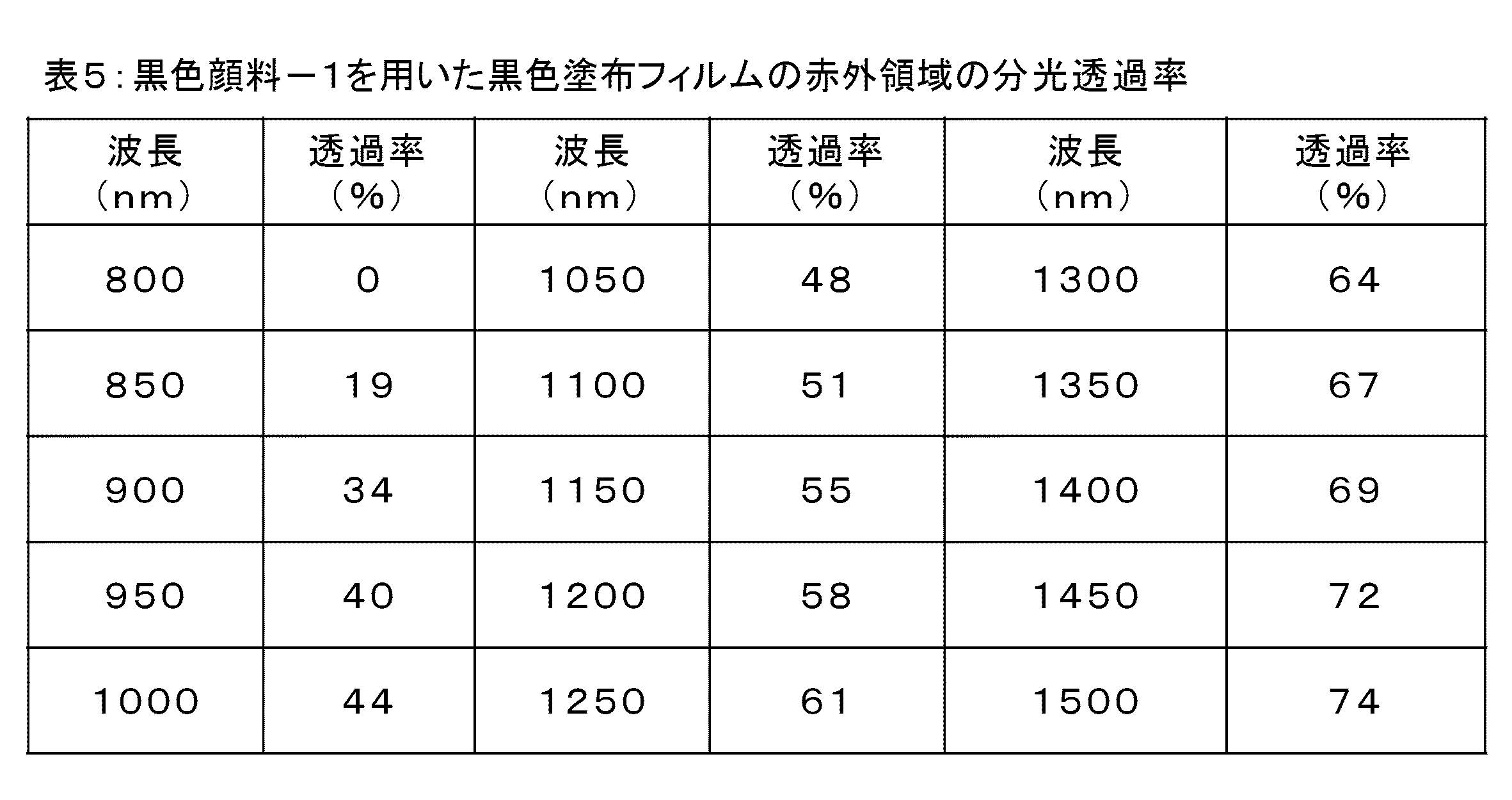
(1)黒色顔料-1を用いた黒色展色紙の調製
黒色顔料-1の反射特性を見るために、実施例1に記載した(1)で調製した黒色塗布液を6ミルのアプリケーターを用いて白色展色紙上に塗布した後、乾燥し、硬化させて塗膜を形成してなる黒色塗布展色紙(以下、黒色展色紙と呼ぶ)を得た。該黒色展色紙に形成されている黒色塗膜の乾燥膜厚の測定値は、展色紙上でおよそ35~40nmであった。
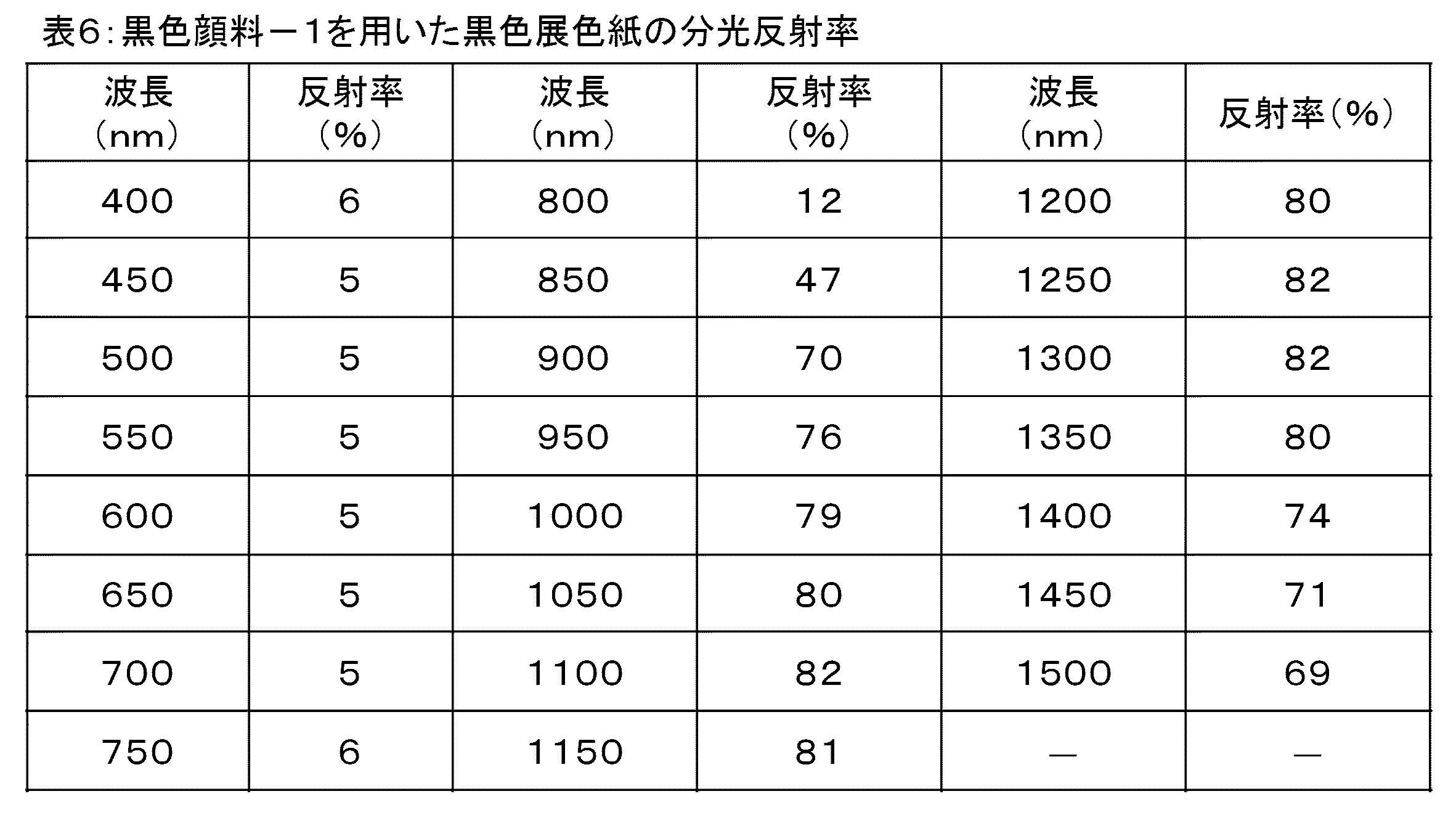
(1)実施例1と同様にして、製造例2~6で得られた黒色顔料-2~6をそれぞれに用いて、黒色塗膜を作成し、実施例1と同様にして可視領域及び赤外領域の分光透過率を測定した。表7と表8に結果を示した。

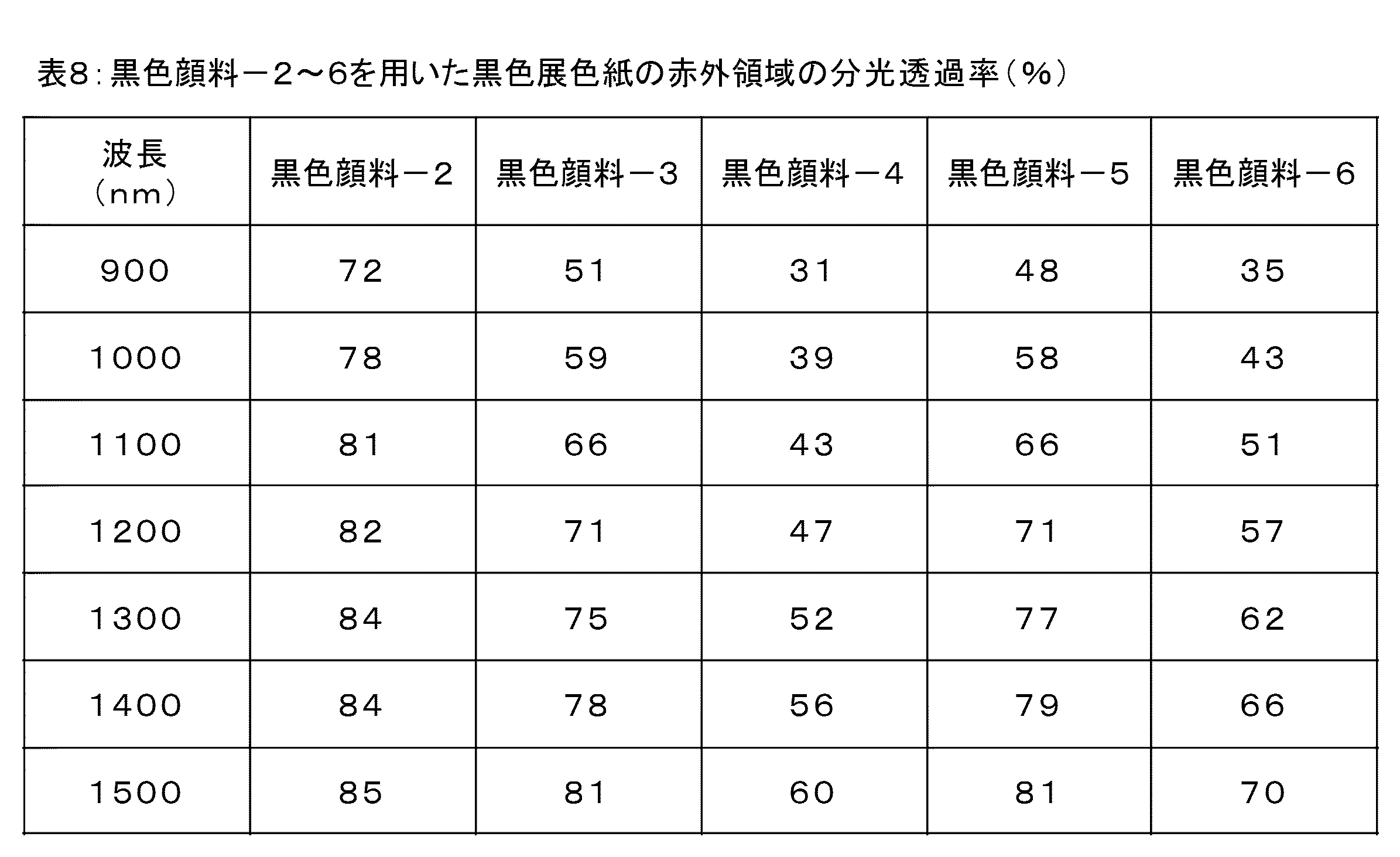
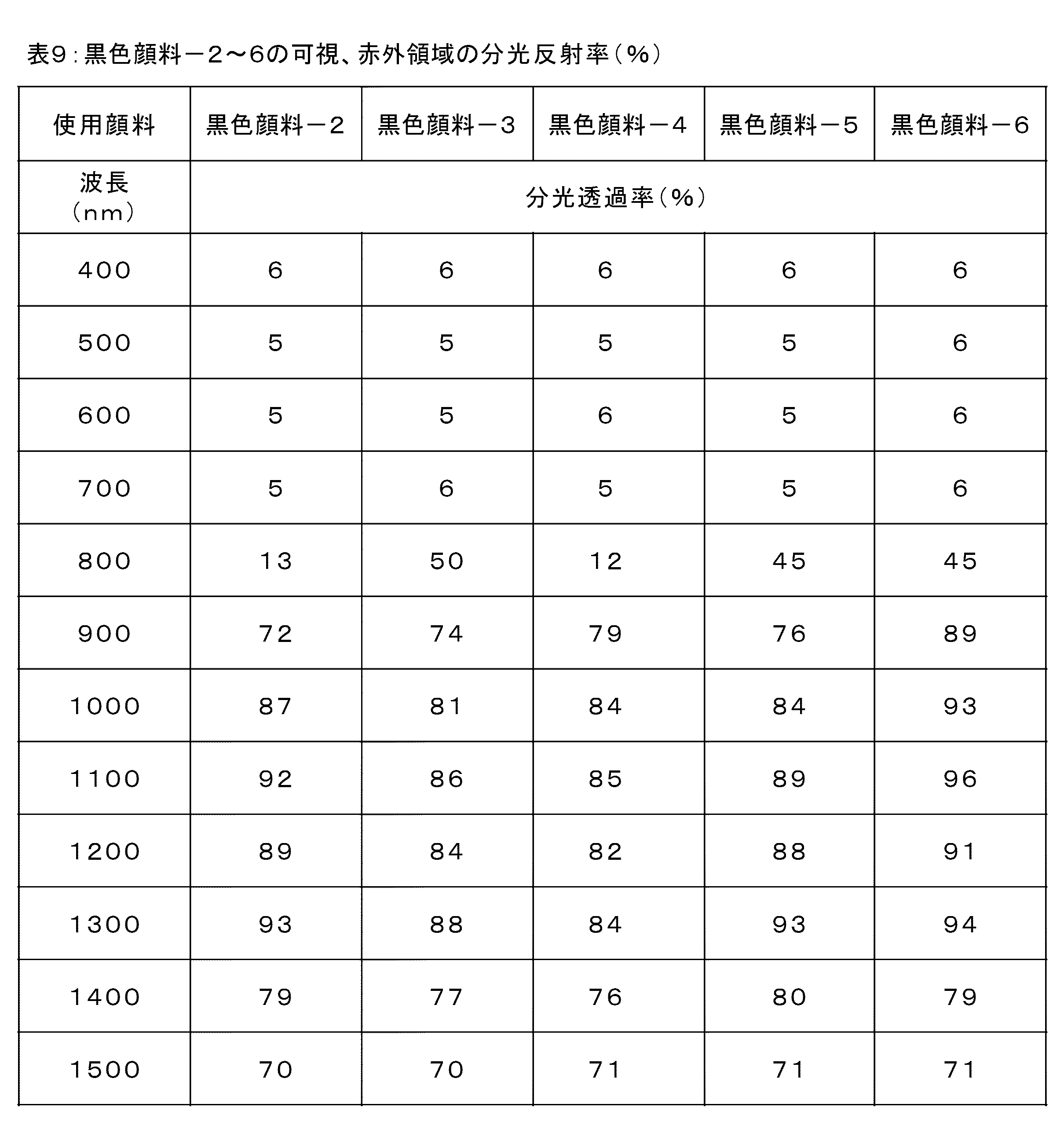
製造例2で調製した黒色顔料-2を20部と、ポリカーボネート樹脂粉末80部とを、ヘンシェルミキサー(粉体高速混合機)で充分混合した後、更に、二軸押出機で混合、混練し、黒色顔料-2を20%含有するポリカーボネート樹脂黒色マスターバッチを調製した。得られた黒色マスターバッチ2部を、上記と同様の樹脂粉末からなるポリカーボネート樹脂ペレット100部に配合し、ヘンシェルミキサーで混合した後、更に二軸押出機で混合、混練し、黒色樹脂ペレットとした。得られた黒色樹脂ペレットを、インラインスクリュー射出成型機にて成型し、顔料分散性に優れた黒色のポリカーボネート樹脂プレートを得た。この黒色の樹脂プレートは、可視光領域の光を吸収する一方、近赤外線を十分透過することができるため、赤外線透過フィルターなどの用途に使用することが可能である。
実施例4と同様にして、製造例3で調製した黒色顔料-3を20部と、アクリル樹脂(ポリメチルメタクリレート)粉末80部とを、ヘンシェルミキサーで充分混合した後、更に、二軸押出混練機で混合、混練し、黒色顔料-3を20%含有するアクリル樹脂黒色マスターバッチを調製した。
得られた黒色マスターバッチ2部を、上記と同様の樹脂からなるアクリル樹脂ペレット100部に配合した後、更にヘンシェルミキサーで混合した後、更に二軸押出混練機で混合、混練し、黒色樹脂ペレットとした。得られた黒色樹脂ペレットを、インラインスクリュー射出成型機にて成型し、顔料分散性に優れた黒色のアクリル樹脂プレートを得た。この黒色の樹脂プレートは、可視光領域の光を吸収する一方で、近赤外線を十分透過することができるため、赤外線透過フィルターとして使用することが可能である。
製造例4で調製した黒色顔料-4を15部とポリカーボネート系無黄変型ポリウレタン樹脂10部、ジメチルフォルムアミド(以下、「DMF」と称する)75部になるように、黒色顔料とポリカーボネート系無黄変型ポリウレタン樹脂溶液、DMFを調合する。この調合液を横型連続媒体分散機で充分に分散し、黒色顔料高濃度分散液を得た。次に、表皮層の形成用として、ポリカーボネート系無黄変型ポリウレタン樹脂溶液(固形分30%、DMF溶媒)100部に稀釈溶剤として酢酸プロピル10部、イソプロパノール10部と、先に調製した黒色顔料高濃度分散液20部とを加えて混合し、黒色のポリウレタンコーティング液を調製した。
製造例5で調製した黒色顔料-5を50部と、顔料分散剤としてエチレンビスステアリン酸アミド粉末50部とを、ヘンシェルミキサーで混合し、顔料分が50%の粉末着色剤(ドライカラー)を得た。次いで、得られたドライカラー1.0部を、ポリプロピレン樹脂ペレット99.0部に配合した後、ヘンシェルミキサーで混合し、更に、ベント式40m/m押出機で混練することにより、顔料分が0.5%の黒色樹脂ペレットを調製した。得られた黒色樹脂ペレットを、熔融紡糸機にて紡糸し、繊度10デニールの顔料分散性に優れた鮮明な黒色のポリプロピレン原液着色糸を得た。この着色糸を使用して作成した織布は、直射日光の熱線を反射することができるため、昇温を避ける効果が期待される。そのため、特に、日傘やカーテンなどの用途に好適である。
製造例6で調製した黒色顔料-6を5部と、酸化チタン白色顔料を20部と、顔料分散剤としてポリエチレン樹脂粉末75部を、ヘンシェルミキサーで混合し、粉末着色剤(ドライカラー)を得た。次いで、得られた粉末着色剤1.0部を、ポリブチレンテレフタレート(PBT)樹脂ペレット100部に配合し、ヘンシェルミキサーで混合した後、押出機で混練することにより、黒色樹脂ペレットとした。得られた黒色ペレットをインラインスクリュー射出成型機にて成型し、顔料分散性に優れた黒色のPBT樹脂成型板を得た。得られた樹脂成型板は、直射日光の熱線を反射することができた。そのため、この樹脂は、昇温を避けたい樹脂成型品としての使用が好適である。
(1)製造例5で調製した黒色顔料-4を15部、アクリルポリオール(水酸基価:100)酢酸ブチル溶液(固形分50%)25部、酢酸ブチル50部を十分に予備混合した後、分散媒体としてガラスビーズを使用した横型連続媒体分散機を用いて顔料を分散することにより、黒色顔料高濃度分散液を調製した。
上記で得られた黒色顔料高濃度分散液90部に、上記と同様のアクリルポリオール酢酸ブチル溶液22部、ベンゾトリアゾール系モノマー及びHALS系モノマーを共重合させたアクリルポリオール(水酸基価:100)酢酸ブチル溶液50部を加えて、黒インキ化した。そして、この黒インキ化したものに、硬化剤としてイソシアヌレート型ヘキサメチレンジイソシアネート3量体(固形分:100%、イソシアネート%:21.7%)24部を加え、充分混合した後、酢酸ブチルを凡そ20部を加えて粘度を調整して、黒色コーティング液を調製した。
上記で得られた白色顔料高濃度分散液140部に、アクリルポリオール酢酸ブチル溶液44部を加えて白インキ化した。そして、この白インキ化したものに、硬化剤として、先に使用したと同様のヘキサメチレンジイソシアネート3量体を18部加え、充分混合した後、酢酸ブチルを凡そ40部を加えて粘度を調整して、白色コーティング液を調製した。
(1)製造例6で得た黒色顔料-6を40部と、ポリエステル樹脂粉末60部とを、ヘンシェルミキサーで混合し、粉末状着色剤を得た。次いで、得られた粉末状着色剤12.5部を、PET樹脂ペレット87.5部に配合し、ヘンシェルミキサーで混合した後、更に二軸押出機で混練し、ペレタイザーで黒色樹脂ペレットとした。次いで、T-ダイ押出機により成型して膜厚50μmの黒色PETフィルムを作成した。
製造例1で得た黒色顔料-1を固形分で25部を含むプレスケーキ71部、ノニオン系顔料分散剤10部、消泡剤1部、水18部を十分予備混合した後、分散媒体としてガラスビーズを使用した横型連続媒体分散機にて顔料を分散し、黒色顔料高濃度分散液(黒色カラーベース)を調製した。得られた黒色カラーベース20部、反応性アクリル酸アルキルエステルラテックス(固形分40%)25部、消泡剤0.5部、分散剤1部、水中油滴型乳化用分散安定剤3部、ミネラルターペン38部、水12.5部を、ホモジナイザー(強力乳化分散機)にて乳化分散させ、水中油滴型黒色エマルジョンペーストを調製した。そして、調製した黒色エマルジョンペーストに、カルボジイミド系の架橋剤(固形分40%)を2部添加し、十分混合して黒色捺染糊を調製した。得られた黒色捺染糊を、ポリエステル-綿混紡布上に全面プリントし、120℃で15分間のキュアーを行うことにより、熱線が遮蔽される黒色の無地捺染布を得た。
製造例10で得た黒色顔料-10を11部、イソシアネート末端ポリエステルをジアミンで鎖長延長したポリウレタン樹脂の40%メチルエチルケトン-トルエン(1:3)混合溶媒溶液30部に加えた。次いで、カチオン性ポリマー分散剤2部と、トリレンジイソシアネートからのポリカルボジイミド化合物の40%トルエン溶液を2.5部と、メチルエチルケトン-トルエン-イソプロピルアルコール(50:30:20)混合溶媒54.5部とを加えて、高速撹拌機で充分混合した。そして、上記混合物を、分散媒体としてガラスビーズを使用した横型連続媒体分散機にて顔料を微分散し、黒色グラビア印刷インキを調製した。得られた黒色グラビア印刷インキを、グラビア印刷機を用いて、ポリアミドフィルム、ポリエステルフィルム、ポリプロピレンフィルムに、それぞれ印刷を行って、可視光を遮蔽し、赤外線を透過する光学特性を示す黒色のポリプロピレンフィルムを得た。
(1)(BM用顔料分散液の調製)
(黒色顔料分散液の調製)
製造例9で得た黒色顔料-9を25部と、ベンジルメタクリレート-メタクリル酸-2-ヒドロキシエチルメタクリレート共重合体(モル比:60:20:20、重量平均分子量30,000)40%溶液を20部と、カチオン性重合体系分散剤を2部及びプロピレングリコールモノメチルエーテルアセテート(PGMA)53部を十分予備混合した。次いで、連続式横型媒体分散機を用いて顔料を微分散して、黒色顔料分散液を得た(以下、これを「黒色顔料分散液-1」と称する)。
上記(1)で得られた黒色顔料分散液-1を40部、アクリル化アクリルポリオール感光性樹脂の50%PGMA溶液を6部、トリメチロールプロパントリアクリレートを1部、ジペンタエリスリトールヘキサアクリレートを1部、光重合開始剤としてエタノン,1-[9-エチル-6-(2-メチルベンゾイル)-9H-カルバゾール-3-イル]-,1-(O-アセチルオキシム)(「イルガキュアOXE02」、BASF社製)を1部、及び、PGMA51部を配合した。その後、高速撹拌機で均一なるように十分撹拌した後、孔径が3μmのフィルターでろ過をし、黒色顔料-9を含む黒色レジストインクを調製した(以下、「感光性黒色レジストインク-1」と称する)。
上記で得た感光性黒色レジストインク-1を用いて、スピンコーターにてガラス基板上に塗布した。そして、60℃にて予備乾燥した後、プリベークを行い、超高圧水銀灯を用いて400mJ/cm2の光量で露光を行なった後、230℃、30分でポストベークを行い、厚さ3μmの黒色塗膜(黒色レジストインク膜)を得た。
この塗膜の光学的特性は、表10に示したように、可視光領域の凡そ400~750nmの波長範囲では高吸収性を示し、900~1500nmの赤外領域では高透過性を示した。また、該塗膜の体積固有抵抗は、1014Ω・cm以上を示したことから、高絶縁性であることが確認された。

上記で得た感光性黒色レジストインク-1を用い、常法に従ってスピンコーターにてガラス基板上に塗布した後、80℃で10分間プリベークを行い、厚さ3μmの黒色塗膜を得た。この塗膜にBMパターンのネガのフォトマスクパターンを介して、超高圧水銀灯を用い、100mJ/cm2の光量で露光を行なった後、アルカリ現像液で現像し、水洗、乾燥してBMパターンを形成した。
上記で得たBMパターンを形成しているBM膜は、上記した(3)で述べたように高い電気絶縁性示すことから、TFTなどのアクティブ素子上にBMを形成する各種のCFの改良方法、例えば、スペーサーに代わり液晶層の厚みを保持するBM、IPS方式、COA方式などの構築に利用できる。また、該BM膜は、可視領域を長波長領域まで十分吸収することができることから、LEDバックライトを採用したLCDパネルのBMとしても使用できる。
先に述べた(1)と同様にして、PR254(ジケトピロロピロールレッド顔料)、PR177(アンスラキノン系レッド顔料)、PG36(銅フタロシアニングリーン顔料)、PB15:6(ε型銅フタロシアニンブルー顔料)、PY138(黄色顔料)及びPV23(ジオキサジンバイオレット顔料)の各顔料を用い、該顔料19部に、それぞれの顔料に対応する公知のスルホン基を有する顔料誘導体1部を添加して、各色の顔料組成物を得た。得られた顔料組成物を使用して、夫々顔料分が20%、樹脂分散剤6%の、赤色、緑色、青色、黄色、紫色の各色の顔料分散液を調製した。
上記(4)で作成したBMの形成されたガラス基板をスピンコーターにセットし、上記で用意した感光性赤色レジストインクをスピンコートした後、80℃で10分間プリベークを行った。そして、モザイク状のパターンを有するフォトマスクを、該ガラス基板の塗布面に、プロキシミティー露光機を使用して、超高圧水銀灯で100mJ/cm2の光量で露光を行なった。次いで、専用現像液及び専用リンスで現像した後、洗浄及び乾燥を行い、ガラス基板上に赤色のモザイク状のパターンを形成した。更に、上記したと同様にして、感光性緑色レジストインクを用いて緑色モザイク状のパターンを形成し、感光性青色レジストインクを用いて青色モザイク状のパターンを形成することで、BM及びRGB画素の形成されたCFを得た。
(1)(BM用顔料分散液の調製)
(黒色顔料分散液の調製)
実施例13(1)で行ったと同様に、黒色顔料-9に代えて黒色顔料-8を25部、先に使用したと同様のベンジルメタクリレート-メタクリル酸-2-ヒドロキシエチルメタクリレート共重合体40%溶液を25部、及びプロピレングリコールモノメチルエーテルアセテート(PGMA)53部を十分予備混合した後、連続式横型媒体分散機で顔料を分散することによって、黒色顔料分散液を得た。以下、これを「黒色顔料分散液-2」と称する。
実施例13で説明した(2)の黒色顔料分散液-1に代えて、上記(1)で得られた黒色顔料分散液-2を用いた以外は、実施例13(2)と同様にして、黒色レジストインクを調製した。以下、これを「感光性黒色レジストインク-2」と称する。
実施例13で説明した(4)と同様にして、感光性黒色レジストインク-2を、スピンコーターにてガラス基板上に塗布し、プリベークを行うことにより、厚さ3μmの黒色塗膜を得た。この塗膜に、BMパターンのネガのフォトマスクパターンを介して、超高圧水銀灯を用いて露光を行ない、アルカリ現像液で現像した後、水洗及び乾燥して、BMパターンを形成した。
このBMパターンを形成するBM膜は、高い電気絶縁性を有しているため、実施例13と同様、アクティブ素子上にBMを形成する各種のCFの改良方法、例えば、固定スペーサーとしてのBMの構築や、IPS方式、COA方式などの構築に利用できる。また、可視領域を長波長領域まで十分吸収することができることから、LEDバックライトを採用したLCDパネルのBMとして使用することもできる。
実施例13で説明した(6)と同様にして、上記(3)で得られた、BMが形成されたガラス基板をスピンコーターにセットし、実施例13で説明した(5)で得られた感光性赤色レジストインク、感光性緑色レジストインク、感光性青色レジストインクを用いて各色のモザイク状の画素パターンを形成し、BM及びRGB画素の形成されたCFを得た。
実施例13、実施例14で得たCFは、精細性、色濃度、光透過性、コントラスト性などの画像性能の色彩特性、光学特性の面で優れた品質を有するものであった。
Claims (20)
- 可視光遮光性および赤外線透過性の両方の光学特性を示す黒色アゾ顔料であって、分子中に2個以上のアゾ結合と、カップリング成分から導入された少なくとも一つの2-ヒドロキシ-11H-ベンゾ[a]-カルバゾール-3-カルボン酸アミド残基とを有する構造をもつ黒色のポリアゾ顔料であり、且つ、その平均粒子径が10nm~200nmであることを特徴とする黒色アゾ顔料。
- 前記可視光遮光性は、透明性基板上の黒色アゾ顔料を含む黒色着色膜が、可視光範囲の凡そ400~750nmの波長範囲で凡そ5%以下の分光透過率を示すことであり、前記赤外透過性は、上記黒色着色膜が、赤外領域の900~1500nmの波長範囲で凡そ30%以上の透過率を示すことである請求項1に記載の黒色アゾ顔料。
- 前記ポリアゾ顔料の構造が、少なくとも下記(1)ないし(4)の構造のいずれかを有する請求項1又は2に記載の黒色アゾ顔料。
(1)ジアゾ成分であるアミノ基を2個以上有する化合物(代表式:H2N-Ar-NH2)をジアゾ化してなるジアゾニウム塩が使用され、該塩に、カップリング成分として2-ヒドロキシ-11H-ベンゾ[a]-カルバゾール-3-カルボン酸アリールアミド(HBCと略記)がアゾ・カップリングしてなる[HBC-N=N-Ar-N=N-HBC]で示される構造
(2)ジアゾ成分であるアミノ基を2個以上有する化合物(代表式:H2N-Ar-NH2)をジアゾ化してなるジアゾニウム塩が使用され、該塩に、カップリング成分として、2-ヒドロキシ-11H-ベンゾ[a]-カルバゾール-3-カルボン酸アリールアミド(HBCと略記)及び該化合物以外の他のカップリング成分(Cpと表示)がアゾ・カップリングしてなる[HBC-N=N-Ar-N=N-Cp]で示される構造
(3)その分子中に、2-ヒドロキシ-11H-ベンゾ[a]-カルバゾール-3-カルボアミド残基(HBC-と略記)を2個以上有するカップリング成分(HBC-HBCと表示)に、ジアゾ成分としてアミノ基を1個有する化合物(Ar-NH2と表示)を使用し、ジアゾ化してアゾ・カップリングさせてなる[Ar-N=N-HBC-HBC-N=N-Ar]で示される構造
(4)その分子中に、2-ヒドロキシ-11H-ベンゾ[a]-カルバゾール-3-カルボアミド残基(HBC-と略記)と、該化合物以外の他のカップリング成分残基(Cp-と表示)とを有するカップリング成分(HBC-Cpと表示)に、ジアゾ成分としてアミノ基を1個有する化合物(Ar-NH2と表示)をジアゾ化して、アゾ・カップリングさせてなる[Ar-N=N-HBC-Cp-N=N-Ar]で示される構造 - 前記カップリング成分及び前記ジアゾ成分のいずれかが、下記のいずれかから選ばれる請求項3に記載の黒色アゾ顔料。
(A-a)前記カップリング成分(HBC)が、2-ヒドロキシ-11H-ベンゾ[a]-カルバゾール-3-アニライド、2-ヒドロキシ-11H-ベンゾ[a]-カルバゾール-3-ナフチルアミド及びそれらの誘導体
(A-b)前記カップリング成分(HBC-HBC)が、フェニレン-ビス(2-ヒドロキシ-11H-ベンゾ[a]-カルバゾール-3-カルボアミド)、ビフェニレン-ビス(2-ヒドロキシ-11H-ベンゾ[a]-カルバゾール-3-カルボアミド)、ナフタレン-ビス(2-ヒドロキシ-11H-ベンゾ[a]-カルバゾール-3-カルボアミド)及びそれらの誘導体
(A-c)前記カップリング成分(Cp)が、2-ヒドロキシ-3-ナフトエ酸アリールアミド、2-ヒドロキシ-6-ナフトエ酸アリールアミド、2-ヒドロキシ-3-アンスラセンカルボン酸アリールアミド、2-ヒドロキシ-3-ジベンゾフランカルボン酸アリールアミド、2-ヒドロキシ-1-カルバゾールカルボン酸アリールアミド及びそれらの誘導体
(A-d)前記カップリング成分(HBC-Cp)が、フェニレン(-1)-(2-ヒドロキシ-11H-ベンゾ[a]-カルバゾール-3-カルボアミド)(-4)-(2-ヒドロキシ-3-ナフトエ酸アミド)、ビフェニレン(-4)-(2-ヒドロキシ-11H-ベンゾ[a]-カルバゾール-3-カルボアミド)(-4’)-(2-ヒドロキシ-3-ナフトエ酸アミド)、(2-メチル-)フェニレン(-1)-(2-ヒドロキシ-11H-ベンゾ[a]-カルバゾール-3-カルボアミド)(-4)-(2-ヒドロキシ-3-ナフトエ酸アミド)及びそれらの誘導体
(B-a)前記ジアゾ成分として使用されるアミノ基を2個有する化合物(H2N-Ar-NH2)が、フェニレンジアミン、ジアミノビフェニル、ジアミノナフタレン、ジアミノアンスラキノン、ジアミノ-ベンゾフェノン、ジアミノピリジン及びそれらの誘導体
(B-b)前記ジアゾ成分として使用されるアミノ基を1個有する化合物(Ar-NH2)が、アニリン、ナフチルアミン、アミノアンスラキノン、フェノキシアニリン、フェニルイミノアニリン及びそれらの誘導体 - 請求項1ないし4のいずれか1項に記載の黒色アゾ顔料を得るための、黒色のポリアゾ顔料の合成工程と、必要に応じて該顔料を微細化する工程を有する製造方法であって、
(I)前記黒色のポリアゾ顔料の合成方法が、下記の(1)ないし(4)のいずれかであり、
(1)アミノ基を2個以上有する化合物(代表式:H2N-Ar-NH2)をジアゾ化してなるジアゾニウム塩に、2-ヒドロキシ-11H-ベンゾ[a]-カルバゾール-3-カルボン酸アリールアミド(HBCと略記)をアゾ・カップリングさせる合成方法
(2)アミノ基を2個以上有する化合物(代表式:H2N-Ar-NH2)をジアゾ化してなるジアゾニウム塩に、2-ヒドロキシ-11H-ベンゾ[a]-カルバゾール-3-カルボン酸アリールアミド(HBCと略記)及び該化合物以外の他のカップリング成分(Cpと表示)をアゾ・カップリングした構造を有するポリアゾ顔料の合成方法であり、アミノ基を2個以上有する化合物(代表式:H2N-Ar-NH2)をジアゾ化してなるジアゾニウム塩に、等モルあるいはそれ以下のカップリング成分(Cp)をアゾ・カップリングさせ、必要に応じて、2個以上のカップリング成分(Cp)がカップリングしたポリアゾ顔料を分離、除去し、次いでカップリングされていないジアゾニウム基に上記カップリング成分(HBC)をアゾ・カップリングさせる合成方法
(3-1)分子中に2-ヒドロキシ-11H-ベンゾ[a]-カルバゾール-3-カルボアミド残基(HBC-と略記)を2個以上有するカップリング成分(HBC-HBCと表示)に、アミノ基を1個有する化合物(Ar-NH2)をジアゾ化してなるジアゾ成分をアゾ・カップリングさせる合成方法
(3-2)2-ヒドロキシ-11H-ベンゾ[a]-カルバゾール-3-カルボン酸に、アミノ基を1個有する化合物(Ar-NH2と表示)をジアゾ化してなるジアゾニウム塩をアゾ・カップリングさせ、次いで、アゾ色素のカルボン酸をアリールポリアミンと縮合させてポリカルボアミドにする合成方法
(4-1)一分子中に2-ヒドロキシ-11H-ベンゾ[a]-カルバゾール-3-カルボアミド残基(HBC-と略記)と、該化合物以外の他のカップリング成分残基(Cp-と表示)とを有するカップリング成分(HBC-Cpと表示)に、アミノ基を1個有する化合物(Ar-NH2と表示)をジアゾ化してなるジアゾニウム塩をアゾ・カップリングさせる合成方法
(4-2)2-ヒドロキシ-11H-ベンゾ[a]-カルバゾール-3-カルボン酸及び他のカップリング成分のカルボン酸に、それぞれアミノ基を1個有する化合物(Ar-NH2と表示)をジアゾ化してなるジアゾニウム塩をアゾ・カップリングさせ、次いで得られた両アゾ色素のカルボン酸をアリールポリアミンと縮合させてポリカルボアミドにする合成方法
からなる群から選ばれる合成方法で合成され、
且つ、
(II)上記の方法で合成されたポリアゾ顔料が粗大である場合には、下記の(1)又は(2)のいずれかの方法で顔料の平均粒子径を10nm~200nmに微細化する工程を有することを特徴とする黒色アゾ顔料の製造方法。
(1)ボールミル、サンドミル、アトライター、横型連続媒体分散機、ニーダー、連続式一軸混練機、連続式二軸混練機、三本ロールおよびオープンロール連続混練機からなる群から選ばれたいずれかの顔料磨砕機あるいは顔料分散機を使用する微細化方法
(2)混練機中で水溶性塩、必要に応じて水溶性有機溶剤と共に混練、摩砕するソルトミリング法 - 請求項1ないし4に記載の黒色アゾ顔料あるいは請求項5に記載の製造方法によって得られた黒色アゾ顔料を含む顔料成分を、液体分散媒体中あるいは固体分散媒体中に含んでなることを特徴とする着色組成物。
- 前記黒色アゾ顔料を含む顔料成分が、前記黒色アゾ顔料単独、あるいは、該黒色アゾ顔料に、該黒色アゾ顔料を補正するための、有彩色顔料、白色顔料、他の黒色顔料及び体質顔料からなる群から選ばれた1種以上の顔料を併用してなる、暗色の有彩色の着色、ないし無彩色の暗色あるいは黒色の着色をするための請求項6に記載の着色組成物。
- 前記黒色アゾ顔料と、該黒色アゾ顔料を補正するための、有彩色顔料、白色顔料、他の黒色顔料あるいは体質顔料との配合比率が、コンピューター・カラーマッチングシステムを用いて最適化される方法で決定された請求項7に記載の着色組成物。
- 前記液体分散媒体が、反応性基を有してもよい重合体、反応性基を有してもよいオリゴマー及び反応性基を有してもよい単量体から選ばれる少なくとも1種の皮膜形成材料を含み、且つ、それ自体液体であるかあるいは更に溶剤及び/または水を含有する請求項6に記載の着色組成物。
- 前記固体分散媒体が、熱可塑性樹脂、熱硬化性樹脂、ワックス、脂肪酸アミド及び脂肪酸金属石鹸から選ばれる少なくとも1種の固体分散媒体を含有する請求項6に記載の着色組成物。
- 前記着色組成物が、塗料用、コーティング剤用、プラスチック用、繊維用、印刷インキ用、文房具用、画像記録用、及び画像表示用の少なくともいずれかに用いられる請求項6ないし10のいずれか1項に記載の着色組成物。
- 物品の表面の着色、あるいは物品自体の着色により、物品を黒色ないし暗色に着色する際に、請求項7に記載の着色組成物を用いることを特徴とする物品の着色方法。
- 前記物品が透明性基材からなり、該透明性基材を、塗装、塗付、染色、印刷、筆記、描画、インクジェット印刷、電子写真印刷、静電印刷あるいはフォトリソグラフィックプリントから選ばれたいずれかの方法により表面着色するか、あるいは混練方法または含浸方法により上記基材自体を内部着色する請求項12に記載の物品の着色方法。
- 前記表面着色あるいは内部着色が、着色された部分が、可視光領域の凡そ400~750nmの波長範囲では凡そ5%以下の分光透過率を示し、900~1500nmの赤外領域では凡そ30%以上の透過率を示すようにして行われ、透明性基材からなる物品が、可視光遮光性と赤外線透過性の両方の光学特性を併せ持つようにする請求項13に記載の物品の着色方法。
- 物品自体に光反射性を有するものを用いるか、あるいは予め形成させた光反射性下地が設けられている物品を用い、これらの物品の表面あるいは光反射性下地の上に、前記着色組成物を用いて、塗装、塗布、貼付、溶着、重積、原液着色、捺染、浸染、印刷、筆記、描画、インクジェット印刷、電子写真印刷あるいは静電印刷することにより、赤外領域では反射性を示す着色を施す請求項12に記載の物品の着色方法。
- 請求項12ないし15のいずれか1項に記載の物品の着色方法が施されていることを特徴とする着色物品。
- 光反射性シートの上に、黒色または暗彩色の赤外線透過性層が複層されている太陽光発電モジュールのバックシートであって、赤外線透過性層に、分子中に2個以上のアゾ結合と、カップリング成分から導入された少なくとも一つの2-ヒドロキシ-11H-ベンゾ[a]-カルバゾール-3-カルボン酸アミド残基(HBC-と略記)とを有する構造をもち、その平均粒子径が10nm~200nmである黒色のポリアゾ顔料が含有されていることを特徴とする太陽光発電モジュールのバックシート。
- 基材自体に光反射性を有するものを光反射性シートとして用いるか、あるいは予め形成させた光反射性下地が設けられている基材を光反射性シートとして用い、これらの基材の表面あるいは光反射性下地の上に、分子中に2個以上のアゾ結合と、カップリング成分から導入された少なくとも一つの2-ヒドロキシ-11H-ベンゾ[a]-カルバゾール-3-カルボン酸アミド残基(HBC-と略記)とを有する構造をもち、その平均粒子径が10nm~200nmである黒色のポリアゾ顔料が含有されている着色組成物を、塗装、塗布、貼付、溶着、重積、印刷、インクジェット印刷、電子写真印刷あるいは静電印刷することにより、赤外領域では反射性を示す着色を施して、光反射性シートの上に黒色または暗彩色の赤外線透過性層を複層したことを特徴とする太陽光発電モジュールのバックシートの製造方法。
- カラーフィルター(CF)基板あるいは有機EL発光基板に形成されるブラックマトリックス(BM)が、分子中に2個以上のアゾ結合と、カップリング成分から導入された少なくとも一つが2-ヒドロキシ-11H-ベンゾ[a]-カルバゾール-3-カルボン酸アミド残基(HBC-と略記)とを有する構造をもち、その平均粒子径が10nm~200nmである黒色のポリアゾ顔料を含有していることを特徴とするカラーディスプレーパネル。
- 実質的に電気絶縁性であるブラックマトリックスと電極が重積あるいは接触する状態で形成されたCF基板あるいは有機EL発光基板を有する請求項19に記載のカラーディスプレーパネル。
Priority Applications (3)
| Application Number | Priority Date | Filing Date | Title |
|---|---|---|---|
| KR1020137019523A KR101638669B1 (ko) | 2010-12-28 | 2011-12-28 | 흑색 아조 색소, 제조방법, 착색 조성물, 착색방법 및 착색 물품류 |
| CN201180063596.4A CN103282443B (zh) | 2010-12-28 | 2011-12-28 | 黑色偶氮色素、制造方法、着色组合物、着色方法及着色物品类 |
| JP2012551035A JP5866299B2 (ja) | 2010-12-28 | 2011-12-28 | 黒色アゾ色素、製造方法、着色組成物、着色方法及び着色物品類 |
Applications Claiming Priority (2)
| Application Number | Priority Date | Filing Date | Title |
|---|---|---|---|
| JP2010-293399 | 2010-12-28 | ||
| JP2010293399 | 2010-12-28 |
Publications (1)
| Publication Number | Publication Date |
|---|---|
| WO2012091083A1 true WO2012091083A1 (ja) | 2012-07-05 |
Family
ID=46383171
Family Applications (1)
| Application Number | Title | Priority Date | Filing Date |
|---|---|---|---|
| PCT/JP2011/080370 Ceased WO2012091083A1 (ja) | 2010-12-28 | 2011-12-28 | 黒色アゾ色素、製造方法、着色組成物、着色方法及び着色物品類 |
Country Status (5)
| Country | Link |
|---|---|
| JP (1) | JP5866299B2 (ja) |
| KR (1) | KR101638669B1 (ja) |
| CN (1) | CN103282443B (ja) |
| TW (1) | TWI478983B (ja) |
| WO (1) | WO2012091083A1 (ja) |
Cited By (17)
| Publication number | Priority date | Publication date | Assignee | Title |
|---|---|---|---|---|
| WO2012169506A1 (ja) * | 2011-06-08 | 2012-12-13 | 大日精化工業株式会社 | 高電気絶縁性アゾ系黒色顔料、製造方法、着色組成物、着色方法及び着色物品類 |
| WO2014103628A1 (ja) * | 2012-12-27 | 2014-07-03 | 富士フイルム株式会社 | カラーフィルタ用組成物、赤外線透過フィルタ及びその製造方法、並びに赤外線センサー |
| JP2014125588A (ja) * | 2012-12-27 | 2014-07-07 | Teijin Ltd | ポリエステル組成物およびポリエステル成形品 |
| JP2014130338A (ja) * | 2012-11-29 | 2014-07-10 | Fujifilm Corp | 組成物、赤外線透過フィルタ及びその製造方法、並びに赤外線センサー |
| JP2014160202A (ja) * | 2013-02-20 | 2014-09-04 | Jsr Corp | 硬化性組成物、着色画素及びその形成方法、並びにカラーフィルタ |
| JP2014534982A (ja) * | 2011-06-06 | 2014-12-25 | ピーピージー・インダストリーズ・オハイオ・インコーポレイテッドPPG Industries Ohio,Inc. | 赤外線放射を透過させ色安定性を示すコーティング組成物および関連のコーティング系 |
| WO2015166779A1 (ja) * | 2014-05-01 | 2015-11-05 | 富士フイルム株式会社 | 着色組成物、膜、カラーフィルタ、パターン形成方法、カラーフィルタの製造方法、固体撮像素子および赤外線センサ |
| WO2016098810A1 (ja) * | 2014-12-19 | 2016-06-23 | 旭硝子株式会社 | 光学フィルタ及びこれを用いた装置 |
| JP2016153471A (ja) * | 2015-01-20 | 2016-08-25 | 東洋紡株式会社 | 赤外光透過性ポリエステル樹脂組成物 |
| WO2016190162A1 (ja) * | 2015-05-22 | 2016-12-01 | 富士フイルム株式会社 | 着色組成物、膜、カラーフィルタ、パターン形成方法、カラーフィルタの製造方法、固体撮像素子および赤外線センサ |
| JP2017116955A (ja) * | 2017-03-03 | 2017-06-29 | 富士フイルム株式会社 | 赤外線透過フィルタ用組成物、赤外線透過フィルタ、赤外線透過フィルタの製造方法、及び、赤外線センサー |
| JP2018120248A (ja) * | 2018-04-19 | 2018-08-02 | 富士フイルム株式会社 | 赤外線透過フィルタ用組成物、赤外線透過フィルタ、赤外線透過フィルタの製造方法、及び、赤外線センサー |
| JP2019049759A (ja) * | 2018-12-26 | 2019-03-28 | 富士フイルム株式会社 | 赤外線透過フィルタ用組成物、赤外線透過組成物層、赤外線透過フィルタ、赤外線透過フィルタの製造方法、及び、赤外線センサー |
| JP2020138531A (ja) * | 2019-02-26 | 2020-09-03 | Dic株式会社 | 着色フィルム、着色粘着シート、及び着色フィルムの検出方法 |
| EP3848627A4 (en) * | 2018-09-07 | 2021-10-27 | FUJIFILM Corporation | VEHICLE HEADLIGHT UNIT, HEADLIGHT LIGHT PROTECTION FILM AND PROCESS FOR THE PRODUCTION OF HEADLIGHT LIGHT PROTECTION FILM |
| EP4086319A1 (en) * | 2014-09-30 | 2022-11-09 | Dai Nippon Printing Co., Ltd. | Infrared-light-transmitting ink of dark color, and infrared-light-reflecting sheet obtained using same |
| WO2024195787A1 (ja) * | 2023-03-20 | 2024-09-26 | 積水化学工業株式会社 | 近赤外線透過黒色粒子、インク及び成形体 |
Families Citing this family (9)
| Publication number | Priority date | Publication date | Assignee | Title |
|---|---|---|---|---|
| JP6645243B2 (ja) * | 2015-03-19 | 2020-02-14 | Jsr株式会社 | 硬化性組成物、硬化膜、赤外光透過フィルタ及び固体撮像装置 |
| CN104678642A (zh) * | 2015-03-23 | 2015-06-03 | 深圳市华星光电技术有限公司 | 黑色矩阵与其制作方法及具有该黑色矩阵的液晶面板 |
| CN111621045A (zh) * | 2019-02-26 | 2020-09-04 | Dic株式会社 | 着色膜、着色粘合片和着色膜的检测方法 |
| TWI707905B (zh) * | 2019-08-21 | 2020-10-21 | 南亞塑膠工業股份有限公司 | 一種未包含金屬成分的深色紅外線反射纖維、其製造方法、及深色紅外線反射纖維紡織品 |
| KR102622853B1 (ko) * | 2020-02-17 | 2024-01-11 | 동우 화인켐 주식회사 | 흑색 감광성 수지 조성물, 이를 사용하여 제조된 블랙 매트릭스를 포함하는 컬러필터 및 상기 컬러필터를 포함하는 표시장치 |
| KR102834243B1 (ko) * | 2021-02-26 | 2025-07-15 | 동우 화인켐 주식회사 | 격벽 형성용 감광성 수지 조성물, 이를 이용하여 제조된 격벽 구조물 및 상기 격벽 구조물을 포함하는 표시 장치 |
| CN118043408A (zh) * | 2021-08-18 | 2024-05-14 | 积水化学工业株式会社 | 近红外线透射黑色颗粒 |
| KR20240046713A (ko) * | 2021-08-18 | 2024-04-09 | 세키스이가가쿠 고교가부시키가이샤 | 근적외선 투과 흑색 입자 |
| CN115440723B (zh) * | 2022-08-26 | 2026-03-27 | 信利半导体有限公司 | 一种防伪用电子器件 |
Citations (11)
| Publication number | Priority date | Publication date | Assignee | Title |
|---|---|---|---|---|
| JPS54155227A (en) * | 1978-05-30 | 1979-12-07 | Ricoh Co Ltd | Preparation of dis-or trisazo pigment |
| JPS60247244A (ja) * | 1984-05-22 | 1985-12-06 | Mitsubishi Paper Mills Ltd | 電子写真感光体 |
| JPS616653A (ja) * | 1984-06-21 | 1986-01-13 | Dainichi Seika Kogyo Kk | 電子写真感光体 |
| JPS6156351A (ja) * | 1984-08-28 | 1986-03-22 | Konishiroku Photo Ind Co Ltd | 感光体 |
| JPS6184653A (ja) * | 1984-10-01 | 1986-04-30 | Mitsubishi Paper Mills Ltd | 電子写真感光体 |
| JPS61283665A (ja) * | 1985-06-11 | 1986-12-13 | Dainichi Color & Chem Mfg Co Ltd | ビスアゾ化合物 |
| JPS6230166A (ja) * | 1985-08-01 | 1987-02-09 | Dainichi Color & Chem Mfg Co Ltd | 迷彩用材料 |
| JPS6268856A (ja) * | 1985-09-20 | 1987-03-28 | Dainichi Color & Chem Mfg Co Ltd | 迷彩用材料 |
| JPS6268855A (ja) * | 1985-09-20 | 1987-03-28 | Dainichi Color & Chem Mfg Co Ltd | 赤外線反射性材料 |
| JPS6422969A (en) * | 1987-07-17 | 1989-01-25 | Ricoh Kk | Azo compound and production thereof |
| WO2011078163A1 (ja) * | 2009-12-22 | 2011-06-30 | 大日精化工業株式会社 | 非対称型ポリアゾ色素、その製造方法、着色剤および着色方法 |
Family Cites Families (22)
| Publication number | Priority date | Publication date | Assignee | Title |
|---|---|---|---|---|
| US4631242A (en) * | 1984-09-13 | 1986-12-23 | Mitsubishi Paper Mills, Ltd. | Bisazo electrophotographic sensitive materials with --CF3 group |
| JPS6230202A (ja) * | 1985-08-01 | 1987-02-09 | Dainichi Color & Chem Mfg Co Ltd | 赤外線反射性材料 |
| JPH0740135B2 (ja) * | 1986-08-01 | 1995-05-01 | ミノルタ株式会社 | 感光体 |
| JPH0611926B2 (ja) * | 1987-01-28 | 1994-02-16 | 大日精化工業株式会社 | 繊維の原液着色方法 |
| JPH064939B2 (ja) * | 1987-01-28 | 1994-01-19 | 大日精化工業株式会社 | 赤外線反射性織布の製造方法 |
| JPH01170601A (ja) * | 1987-12-26 | 1989-07-05 | Dainichiseika Color & Chem Mfg Co Ltd | 黒色硬化性樹脂組成物 |
| JPH0668080B2 (ja) * | 1988-07-22 | 1994-08-31 | 大日精化工業株式会社 | 黒色熱硬化性樹脂組成物 |
| JP2803514B2 (ja) * | 1993-02-25 | 1998-09-24 | 三菱自動車工業株式会社 | 車間距離警報装置 |
| JP3543501B2 (ja) | 1995-07-24 | 2004-07-14 | 三菱化学株式会社 | 絶縁性ブラックマトリックス用カーボンブラック |
| JP2000066018A (ja) | 1998-08-24 | 2000-03-03 | Toray Ind Inc | 高抵抗樹脂ブラックマトリクスからなるカラーフィルター、およびこれを用いた液晶表示装置 |
| JP2000242011A (ja) * | 1999-02-19 | 2000-09-08 | Ricoh Co Ltd | 光導電体、有機顔料分散液およびそれを用いた光導電体の製造方法、電子写真方法、および電子写真装置 |
| JP3949365B2 (ja) * | 1999-10-05 | 2007-07-25 | 株式会社リコー | 電子写真感光体及びそれを用いた電子写真装置 |
| JP2001154386A (ja) * | 1999-11-30 | 2001-06-08 | Ricoh Co Ltd | 電子写真感光体 |
| JP2001290296A (ja) * | 2000-04-06 | 2001-10-19 | Ricoh Co Ltd | 電子写真感光体 |
| JP2002341332A (ja) | 2001-05-15 | 2002-11-27 | Toray Ind Inc | カラーフィルター及びこれを用いた液晶表示装置 |
| JP3984831B2 (ja) * | 2001-12-21 | 2007-10-03 | キヤノン株式会社 | 電子写真感光体、プロセスカートリッジ及び電子写真装置 |
| JP2004045859A (ja) * | 2002-07-12 | 2004-02-12 | Canon Inc | 電子写真感光体、プロセスカートリッジ及び電子写真装置 |
| US6936960B2 (en) | 2003-01-10 | 2005-08-30 | Eastman Kodak Company | OLED displays having improved contrast |
| JP4120513B2 (ja) | 2003-07-09 | 2008-07-16 | 株式会社デンソー | 車両用暗視装置 |
| JP4338479B2 (ja) | 2003-09-04 | 2009-10-07 | 富士フイルム株式会社 | カラーフィルター及びその製造方法 |
| JP5320655B2 (ja) | 2004-06-30 | 2013-10-23 | 三菱化学株式会社 | 発光装置、照明、表示装置用バックライトユニット及び表示装置 |
| JP5140919B2 (ja) | 2005-11-01 | 2013-02-13 | 東レ株式会社 | 太陽電池用バックシートおよび太陽電池モジュール |
-
2011
- 2011-12-28 TW TW100149099A patent/TWI478983B/zh active
- 2011-12-28 WO PCT/JP2011/080370 patent/WO2012091083A1/ja not_active Ceased
- 2011-12-28 JP JP2012551035A patent/JP5866299B2/ja active Active
- 2011-12-28 KR KR1020137019523A patent/KR101638669B1/ko active Active
- 2011-12-28 CN CN201180063596.4A patent/CN103282443B/zh active Active
Patent Citations (11)
| Publication number | Priority date | Publication date | Assignee | Title |
|---|---|---|---|---|
| JPS54155227A (en) * | 1978-05-30 | 1979-12-07 | Ricoh Co Ltd | Preparation of dis-or trisazo pigment |
| JPS60247244A (ja) * | 1984-05-22 | 1985-12-06 | Mitsubishi Paper Mills Ltd | 電子写真感光体 |
| JPS616653A (ja) * | 1984-06-21 | 1986-01-13 | Dainichi Seika Kogyo Kk | 電子写真感光体 |
| JPS6156351A (ja) * | 1984-08-28 | 1986-03-22 | Konishiroku Photo Ind Co Ltd | 感光体 |
| JPS6184653A (ja) * | 1984-10-01 | 1986-04-30 | Mitsubishi Paper Mills Ltd | 電子写真感光体 |
| JPS61283665A (ja) * | 1985-06-11 | 1986-12-13 | Dainichi Color & Chem Mfg Co Ltd | ビスアゾ化合物 |
| JPS6230166A (ja) * | 1985-08-01 | 1987-02-09 | Dainichi Color & Chem Mfg Co Ltd | 迷彩用材料 |
| JPS6268856A (ja) * | 1985-09-20 | 1987-03-28 | Dainichi Color & Chem Mfg Co Ltd | 迷彩用材料 |
| JPS6268855A (ja) * | 1985-09-20 | 1987-03-28 | Dainichi Color & Chem Mfg Co Ltd | 赤外線反射性材料 |
| JPS6422969A (en) * | 1987-07-17 | 1989-01-25 | Ricoh Kk | Azo compound and production thereof |
| WO2011078163A1 (ja) * | 2009-12-22 | 2011-06-30 | 大日精化工業株式会社 | 非対称型ポリアゾ色素、その製造方法、着色剤および着色方法 |
Cited By (32)
| Publication number | Priority date | Publication date | Assignee | Title |
|---|---|---|---|---|
| JP2014534982A (ja) * | 2011-06-06 | 2014-12-25 | ピーピージー・インダストリーズ・オハイオ・インコーポレイテッドPPG Industries Ohio,Inc. | 赤外線放射を透過させ色安定性を示すコーティング組成物および関連のコーティング系 |
| WO2012169506A1 (ja) * | 2011-06-08 | 2012-12-13 | 大日精化工業株式会社 | 高電気絶縁性アゾ系黒色顔料、製造方法、着色組成物、着色方法及び着色物品類 |
| JPWO2012169506A1 (ja) * | 2011-06-08 | 2015-02-23 | 大日精化工業株式会社 | 高電気絶縁性アゾ系黒色顔料、製造方法、着色組成物、着色方法及び着色物品類 |
| CN104823082A (zh) * | 2012-11-29 | 2015-08-05 | 富士胶片株式会社 | 组合物、红外线透过滤光片及其制造方法、以及红外线传感器 |
| JP2014130338A (ja) * | 2012-11-29 | 2014-07-10 | Fujifilm Corp | 組成物、赤外線透過フィルタ及びその製造方法、並びに赤外線センサー |
| US10025011B2 (en) | 2012-11-29 | 2018-07-17 | Fujifilm Corporation | Composition, infrared transmission filter and method for manufacturing the same, and infrared sensor |
| JP2014130173A (ja) * | 2012-12-27 | 2014-07-10 | Fujifilm Corp | カラーフィルタ用組成物、赤外線透過フィルタ及びその製造方法、並びに赤外線センサー |
| JP2014125588A (ja) * | 2012-12-27 | 2014-07-07 | Teijin Ltd | ポリエステル組成物およびポリエステル成形品 |
| US9915765B2 (en) | 2012-12-27 | 2018-03-13 | Fujifilm Corporation | Composition for color filter, infrared transmission filter and production method thereof, and infrared sensor |
| WO2014103628A1 (ja) * | 2012-12-27 | 2014-07-03 | 富士フイルム株式会社 | カラーフィルタ用組成物、赤外線透過フィルタ及びその製造方法、並びに赤外線センサー |
| US10436959B2 (en) | 2012-12-27 | 2019-10-08 | Fujifilm Corporation | Composition for color filter, infrared transmission filter and production method thereof, and infrared sensor |
| JP2014160202A (ja) * | 2013-02-20 | 2014-09-04 | Jsr Corp | 硬化性組成物、着色画素及びその形成方法、並びにカラーフィルタ |
| JPWO2015166779A1 (ja) * | 2014-05-01 | 2017-04-20 | 富士フイルム株式会社 | 着色組成物、膜、カラーフィルタ、パターン形成方法、カラーフィルタの製造方法、固体撮像素子および赤外線センサ |
| US10578966B2 (en) | 2014-05-01 | 2020-03-03 | Fujifilm Corporation | Coloring composition, film, color filter, pattern forming method, method of manufacturing color filter, solid image pickup element, and infrared sensor |
| WO2015166779A1 (ja) * | 2014-05-01 | 2015-11-05 | 富士フイルム株式会社 | 着色組成物、膜、カラーフィルタ、パターン形成方法、カラーフィルタの製造方法、固体撮像素子および赤外線センサ |
| EP4086319A1 (en) * | 2014-09-30 | 2022-11-09 | Dai Nippon Printing Co., Ltd. | Infrared-light-transmitting ink of dark color, and infrared-light-reflecting sheet obtained using same |
| US12297359B2 (en) | 2014-09-30 | 2025-05-13 | Dai Nippon Printing Co., Ltd. | Infrared-light-transmitting ink of dark color, and infrared-light-reflecting sheet obtained using same |
| EP4729585A1 (en) * | 2014-09-30 | 2026-04-22 | Dai Nippon Printing Co., Ltd. | Infrared-light-transmitting ink of dark color, and infrared-light-reflecting sheet obtained using same |
| US20170276846A1 (en) * | 2014-12-19 | 2017-09-28 | Asahi Glass Company, Limited | Optical filter and device using the same |
| WO2016098810A1 (ja) * | 2014-12-19 | 2016-06-23 | 旭硝子株式会社 | 光学フィルタ及びこれを用いた装置 |
| JPWO2016098810A1 (ja) * | 2014-12-19 | 2017-09-28 | 旭硝子株式会社 | 光学フィルタ及びこれを用いた装置 |
| US10605969B2 (en) | 2014-12-19 | 2020-03-31 | AGC Inc. | Optical filter and device using the same |
| JP2016153471A (ja) * | 2015-01-20 | 2016-08-25 | 東洋紡株式会社 | 赤外光透過性ポリエステル樹脂組成物 |
| US10829641B2 (en) | 2015-05-22 | 2020-11-10 | Fujifilm Corporation | Coloring composition, film, color filter, pattern forming method, method for manufacturing color filter, solid image pickup element, and infrared sensor |
| WO2016190162A1 (ja) * | 2015-05-22 | 2016-12-01 | 富士フイルム株式会社 | 着色組成物、膜、カラーフィルタ、パターン形成方法、カラーフィルタの製造方法、固体撮像素子および赤外線センサ |
| JP2017116955A (ja) * | 2017-03-03 | 2017-06-29 | 富士フイルム株式会社 | 赤外線透過フィルタ用組成物、赤外線透過フィルタ、赤外線透過フィルタの製造方法、及び、赤外線センサー |
| JP2018120248A (ja) * | 2018-04-19 | 2018-08-02 | 富士フイルム株式会社 | 赤外線透過フィルタ用組成物、赤外線透過フィルタ、赤外線透過フィルタの製造方法、及び、赤外線センサー |
| EP3848627A4 (en) * | 2018-09-07 | 2021-10-27 | FUJIFILM Corporation | VEHICLE HEADLIGHT UNIT, HEADLIGHT LIGHT PROTECTION FILM AND PROCESS FOR THE PRODUCTION OF HEADLIGHT LIGHT PROTECTION FILM |
| JP2019049759A (ja) * | 2018-12-26 | 2019-03-28 | 富士フイルム株式会社 | 赤外線透過フィルタ用組成物、赤外線透過組成物層、赤外線透過フィルタ、赤外線透過フィルタの製造方法、及び、赤外線センサー |
| JP2020138531A (ja) * | 2019-02-26 | 2020-09-03 | Dic株式会社 | 着色フィルム、着色粘着シート、及び着色フィルムの検出方法 |
| JP7288178B2 (ja) | 2019-02-26 | 2023-06-07 | Dic株式会社 | 着色フィルム、着色粘着シート、及び着色フィルムの検出方法 |
| WO2024195787A1 (ja) * | 2023-03-20 | 2024-09-26 | 積水化学工業株式会社 | 近赤外線透過黒色粒子、インク及び成形体 |
Also Published As
| Publication number | Publication date |
|---|---|
| JP5866299B2 (ja) | 2016-02-17 |
| KR20130108650A (ko) | 2013-10-04 |
| TWI478983B (zh) | 2015-04-01 |
| JPWO2012091083A1 (ja) | 2014-06-05 |
| KR101638669B1 (ko) | 2016-07-11 |
| TW201241098A (en) | 2012-10-16 |
| CN103282443B (zh) | 2015-01-07 |
| CN103282443A (zh) | 2013-09-04 |
Similar Documents
| Publication | Publication Date | Title |
|---|---|---|
| JP5866299B2 (ja) | 黒色アゾ色素、製造方法、着色組成物、着色方法及び着色物品類 | |
| JP6059646B2 (ja) | 近赤外線透過性黒色アゾ顔料、近赤外線透過性黒色アゾ顔料の製造方法、これらの黒色アゾ顔料を用いた着色組成物、物品の着色方法およびカラーフィルター基板 | |
| JP5870102B2 (ja) | 高電気絶縁性アゾ系黒色顔料、製造方法、着色組成物、着色方法及び着色物品類 | |
| JP5324387B2 (ja) | アゾ顔料、着色組成物、着色方法および着色物品 | |
| CN106029787B (zh) | 近红外线反射‑透射性偶氮颜料、近红外线反射‑透射性偶氮颜料的制造方法、使用了这些偶氮颜料的着色剂组合物、物品的着色方法和着色物品 | |
| KR102165470B1 (ko) | 안료 분산제, 안료 조성물 및 안료 착색제 | |
| JP6723212B2 (ja) | 顔料分散剤、顔料組成物、及び顔料着色剤 | |
| JP6745777B2 (ja) | 顔料分散剤、顔料組成物、及び顔料着色剤 | |
| JP7488179B2 (ja) | 顔料分散剤、顔料組成物、及び顔料着色剤 | |
| JP7607526B2 (ja) | 顔料分散剤、顔料組成物、及び顔料着色剤 | |
| JP2025080019A (ja) | 黒色アゾ顔料及び着色剤 |
Legal Events
| Date | Code | Title | Description |
|---|---|---|---|
| 121 | Ep: the epo has been informed by wipo that ep was designated in this application |
Ref document number: 11854088 Country of ref document: EP Kind code of ref document: A1 |
|
| ENP | Entry into the national phase |
Ref document number: 2012551035 Country of ref document: JP Kind code of ref document: A |
|
| NENP | Non-entry into the national phase |
Ref country code: DE |
|
| ENP | Entry into the national phase |
Ref document number: 20137019523 Country of ref document: KR Kind code of ref document: A |
|
| 122 | Ep: pct application non-entry in european phase |
Ref document number: 11854088 Country of ref document: EP Kind code of ref document: A1 |