EP4233121B1 - Process for recycling lithium iron phosphate batteries - Google Patents
Process for recycling lithium iron phosphate batteries Download PDFInfo
- Publication number
- EP4233121B1 EP4233121B1 EP22893999.7A EP22893999A EP4233121B1 EP 4233121 B1 EP4233121 B1 EP 4233121B1 EP 22893999 A EP22893999 A EP 22893999A EP 4233121 B1 EP4233121 B1 EP 4233121B1
- Authority
- EP
- European Patent Office
- Prior art keywords
- solution
- eluate
- leachate
- acid
- iron
- Prior art date
- Legal status (The legal status is an assumption and is not a legal conclusion. Google has not performed a legal analysis and makes no representation as to the accuracy of the status listed.)
- Active
Links
Images

Classifications
-
- B—PERFORMING OPERATIONS; TRANSPORTING
- B01—PHYSICAL OR CHEMICAL PROCESSES OR APPARATUS IN GENERAL
- B01J—CHEMICAL OR PHYSICAL PROCESSES, e.g. CATALYSIS OR COLLOID CHEMISTRY; THEIR RELEVANT APPARATUS
- B01J39/00—Cation exchange; Use of material as cation exchangers; Treatment of material for improving the cation exchange properties
- B01J39/04—Processes using organic exchangers
- B01J39/05—Processes using organic exchangers in the strongly acidic form
-
- B—PERFORMING OPERATIONS; TRANSPORTING
- B01—PHYSICAL OR CHEMICAL PROCESSES OR APPARATUS IN GENERAL
- B01J—CHEMICAL OR PHYSICAL PROCESSES, e.g. CATALYSIS OR COLLOID CHEMISTRY; THEIR RELEVANT APPARATUS
- B01J47/00—Ion-exchange processes in general; Apparatus therefor
- B01J47/02—Column or bed processes
- B01J47/026—Column or bed processes using columns or beds of different ion exchange materials in series
-
- C—CHEMISTRY; METALLURGY
- C01—INORGANIC CHEMISTRY
- C01B—NON-METALLIC ELEMENTS; COMPOUNDS THEREOF; METALLOIDS OR COMPOUNDS THEREOF NOT COVERED BY SUBCLASS C01C
- C01B25/00—Phosphorus; Compounds thereof
- C01B25/16—Oxyacids of phosphorus; Salts thereof
- C01B25/26—Phosphates
- C01B25/37—Phosphates of heavy metals
- C01B25/375—Phosphates of heavy metals of iron
-
- C—CHEMISTRY; METALLURGY
- C01—INORGANIC CHEMISTRY
- C01F—COMPOUNDS OF THE METALS BERYLLIUM, MAGNESIUM, ALUMINIUM, CALCIUM, STRONTIUM, BARIUM, RADIUM, THORIUM, OR OF THE RARE-EARTH METALS
- C01F11/00—Compounds of calcium, strontium, or barium
- C01F11/20—Halides
- C01F11/22—Fluorides
-
- C—CHEMISTRY; METALLURGY
- C01—INORGANIC CHEMISTRY
- C01F—COMPOUNDS OF THE METALS BERYLLIUM, MAGNESIUM, ALUMINIUM, CALCIUM, STRONTIUM, BARIUM, RADIUM, THORIUM, OR OF THE RARE-EARTH METALS
- C01F7/00—Compounds of aluminium
- C01F7/02—Aluminium oxide; Aluminium hydroxide; Aluminates
- C01F7/34—Preparation of aluminium hydroxide by precipitation from solutions containing aluminium salts
-
- C—CHEMISTRY; METALLURGY
- C01—INORGANIC CHEMISTRY
- C01G—COMPOUNDS CONTAINING METALS NOT COVERED BY SUBCLASSES C01D OR C01F
- C01G3/00—Compounds of copper
- C01G3/02—Oxides; Hydroxides
-
- C—CHEMISTRY; METALLURGY
- C01—INORGANIC CHEMISTRY
- C01G—COMPOUNDS CONTAINING METALS NOT COVERED BY SUBCLASSES C01D OR C01F
- C01G49/00—Compounds of iron
- C01G49/02—Oxides; Hydroxides
-
- C—CHEMISTRY; METALLURGY
- C22—METALLURGY; FERROUS OR NON-FERROUS ALLOYS; TREATMENT OF ALLOYS OR NON-FERROUS METALS
- C22B—PRODUCTION AND REFINING OF METALS; PRETREATMENT OF RAW MATERIALS
- C22B15/00—Obtaining copper
- C22B15/0063—Hydrometallurgy
- C22B15/0084—Treating solutions
- C22B15/0089—Treating solutions by chemical methods
-
- C—CHEMISTRY; METALLURGY
- C22—METALLURGY; FERROUS OR NON-FERROUS ALLOYS; TREATMENT OF ALLOYS OR NON-FERROUS METALS
- C22B—PRODUCTION AND REFINING OF METALS; PRETREATMENT OF RAW MATERIALS
- C22B26/00—Obtaining alkali, alkaline earth metals or magnesium
- C22B26/10—Obtaining alkali metals
- C22B26/12—Obtaining lithium
-
- C—CHEMISTRY; METALLURGY
- C22—METALLURGY; FERROUS OR NON-FERROUS ALLOYS; TREATMENT OF ALLOYS OR NON-FERROUS METALS
- C22B—PRODUCTION AND REFINING OF METALS; PRETREATMENT OF RAW MATERIALS
- C22B3/00—Extraction of metal compounds from ores or concentrates by wet processes
- C22B3/04—Extraction of metal compounds from ores or concentrates by wet processes by leaching
- C22B3/06—Extraction of metal compounds from ores or concentrates by wet processes by leaching in inorganic acid solutions, e.g. with acids generated in situ; in inorganic salt solutions other than ammonium salt solutions
- C22B3/08—Sulfuric acid, other sulfurated acids or salts thereof
-
- C—CHEMISTRY; METALLURGY
- C22—METALLURGY; FERROUS OR NON-FERROUS ALLOYS; TREATMENT OF ALLOYS OR NON-FERROUS METALS
- C22B—PRODUCTION AND REFINING OF METALS; PRETREATMENT OF RAW MATERIALS
- C22B3/00—Extraction of metal compounds from ores or concentrates by wet processes
- C22B3/04—Extraction of metal compounds from ores or concentrates by wet processes by leaching
- C22B3/12—Extraction of metal compounds from ores or concentrates by wet processes by leaching in inorganic alkaline solutions
-
- C—CHEMISTRY; METALLURGY
- C22—METALLURGY; FERROUS OR NON-FERROUS ALLOYS; TREATMENT OF ALLOYS OR NON-FERROUS METALS
- C22B—PRODUCTION AND REFINING OF METALS; PRETREATMENT OF RAW MATERIALS
- C22B3/00—Extraction of metal compounds from ores or concentrates by wet processes
- C22B3/20—Treatment or purification of solutions, e.g. obtained by leaching
- C22B3/26—Treatment or purification of solutions, e.g. obtained by leaching by liquid-liquid extraction using organic compounds
- C22B3/38—Treatment or purification of solutions, e.g. obtained by leaching by liquid-liquid extraction using organic compounds containing phosphorus
- C22B3/384—Pentavalent phosphorus oxyacids, esters thereof
- C22B3/3846—Phosphoric acid, e.g. (O)P(OH)3
-
- C—CHEMISTRY; METALLURGY
- C22—METALLURGY; FERROUS OR NON-FERROUS ALLOYS; TREATMENT OF ALLOYS OR NON-FERROUS METALS
- C22B—PRODUCTION AND REFINING OF METALS; PRETREATMENT OF RAW MATERIALS
- C22B3/00—Extraction of metal compounds from ores or concentrates by wet processes
- C22B3/20—Treatment or purification of solutions, e.g. obtained by leaching
- C22B3/42—Treatment or purification of solutions, e.g. obtained by leaching by ion-exchange extraction
-
- C—CHEMISTRY; METALLURGY
- C22—METALLURGY; FERROUS OR NON-FERROUS ALLOYS; TREATMENT OF ALLOYS OR NON-FERROUS METALS
- C22B—PRODUCTION AND REFINING OF METALS; PRETREATMENT OF RAW MATERIALS
- C22B3/00—Extraction of metal compounds from ores or concentrates by wet processes
- C22B3/20—Treatment or purification of solutions, e.g. obtained by leaching
- C22B3/44—Treatment or purification of solutions, e.g. obtained by leaching by chemical processes
-
- C—CHEMISTRY; METALLURGY
- C22—METALLURGY; FERROUS OR NON-FERROUS ALLOYS; TREATMENT OF ALLOYS OR NON-FERROUS METALS
- C22B—PRODUCTION AND REFINING OF METALS; PRETREATMENT OF RAW MATERIALS
- C22B7/00—Working up raw materials other than ores, e.g. scrap, to produce non-ferrous metals and compounds thereof; Methods of a general interest or applied to the winning of more than two metals
- C22B7/006—Wet processes
- C22B7/007—Wet processes by acid leaching
-
- C—CHEMISTRY; METALLURGY
- C22—METALLURGY; FERROUS OR NON-FERROUS ALLOYS; TREATMENT OF ALLOYS OR NON-FERROUS METALS
- C22B—PRODUCTION AND REFINING OF METALS; PRETREATMENT OF RAW MATERIALS
- C22B7/00—Working up raw materials other than ores, e.g. scrap, to produce non-ferrous metals and compounds thereof; Methods of a general interest or applied to the winning of more than two metals
- C22B7/006—Wet processes
- C22B7/008—Wet processes by an alkaline or ammoniacal leaching
-
- H—ELECTRICITY
- H01—ELECTRIC ELEMENTS
- H01M—PROCESSES OR MEANS, e.g. BATTERIES, FOR THE DIRECT CONVERSION OF CHEMICAL ENERGY INTO ELECTRICAL ENERGY
- H01M10/00—Secondary cells; Manufacture thereof
- H01M10/54—Reclaiming serviceable parts of waste accumulators
-
- C—CHEMISTRY; METALLURGY
- C01—INORGANIC CHEMISTRY
- C01B—NON-METALLIC ELEMENTS; COMPOUNDS THEREOF; METALLOIDS OR COMPOUNDS THEREOF NOT COVERED BY SUBCLASS C01C
- C01B25/00—Phosphorus; Compounds thereof
- C01B25/16—Oxyacids of phosphorus; Salts thereof
- C01B25/26—Phosphates
- C01B25/45—Phosphates containing plural metal, or metal and ammonium
-
- C—CHEMISTRY; METALLURGY
- C01—INORGANIC CHEMISTRY
- C01P—INDEXING SCHEME RELATING TO STRUCTURAL AND PHYSICAL ASPECTS OF SOLID INORGANIC COMPOUNDS
- C01P2002/00—Crystal-structural characteristics
- C01P2002/70—Crystal-structural characteristics defined by measured X-ray, neutron or electron diffraction data
- C01P2002/72—Crystal-structural characteristics defined by measured X-ray, neutron or electron diffraction data by d-values or two theta-values, e.g. as X-ray diagram
-
- C—CHEMISTRY; METALLURGY
- C01—INORGANIC CHEMISTRY
- C01P—INDEXING SCHEME RELATING TO STRUCTURAL AND PHYSICAL ASPECTS OF SOLID INORGANIC COMPOUNDS
- C01P2006/00—Physical properties of inorganic compounds
- C01P2006/40—Electric properties
-
- C—CHEMISTRY; METALLURGY
- C01—INORGANIC CHEMISTRY
- C01P—INDEXING SCHEME RELATING TO STRUCTURAL AND PHYSICAL ASPECTS OF SOLID INORGANIC COMPOUNDS
- C01P2006/00—Physical properties of inorganic compounds
- C01P2006/80—Compositional purity
-
- H—ELECTRICITY
- H01—ELECTRIC ELEMENTS
- H01M—PROCESSES OR MEANS, e.g. BATTERIES, FOR THE DIRECT CONVERSION OF CHEMICAL ENERGY INTO ELECTRICAL ENERGY
- H01M4/00—Electrodes
- H01M4/02—Electrodes composed of, or comprising, active material
- H01M4/36—Selection of substances as active materials, active masses, active liquids
- H01M4/58—Selection of substances as active materials, active masses, active liquids of inorganic compounds other than oxides or hydroxides, e.g. sulfides, selenides, tellurides, halogenides or LiCoFy; of polyanionic structures, e.g. phosphates, silicates or borates
- H01M4/5825—Oxygenated metallic salts or polyanionic structures, e.g. borates, phosphates, silicates, olivines
-
- Y—GENERAL TAGGING OF NEW TECHNOLOGICAL DEVELOPMENTS; GENERAL TAGGING OF CROSS-SECTIONAL TECHNOLOGIES SPANNING OVER SEVERAL SECTIONS OF THE IPC; TECHNICAL SUBJECTS COVERED BY FORMER USPC CROSS-REFERENCE ART COLLECTIONS [XRACs] AND DIGESTS
- Y02—TECHNOLOGIES OR APPLICATIONS FOR MITIGATION OR ADAPTATION AGAINST CLIMATE CHANGE
- Y02P—CLIMATE CHANGE MITIGATION TECHNOLOGIES IN THE PRODUCTION OR PROCESSING OF GOODS
- Y02P10/00—Technologies related to metal processing
- Y02P10/20—Recycling
-
- Y—GENERAL TAGGING OF NEW TECHNOLOGICAL DEVELOPMENTS; GENERAL TAGGING OF CROSS-SECTIONAL TECHNOLOGIES SPANNING OVER SEVERAL SECTIONS OF THE IPC; TECHNICAL SUBJECTS COVERED BY FORMER USPC CROSS-REFERENCE ART COLLECTIONS [XRACs] AND DIGESTS
- Y02—TECHNOLOGIES OR APPLICATIONS FOR MITIGATION OR ADAPTATION AGAINST CLIMATE CHANGE
- Y02W—CLIMATE CHANGE MITIGATION TECHNOLOGIES RELATED TO WASTEWATER TREATMENT OR WASTE MANAGEMENT
- Y02W30/00—Technologies for solid waste management
- Y02W30/50—Reuse, recycling or recovery technologies
- Y02W30/84—Recycling of batteries or fuel cells
Definitions
- the present invention generally relates to a method for recycling spent lithium-ion batteries. More particularly, it relates to a method for recycling spent lithium iron phosphate batteries.
- Lithium-ion batteries contain valuable materials which would go to waste when the batteries are spent and discarded. With the rising use of lithium-ion batteries, the recovery of valuable materials from spent lithium-ion batteries have become an important industry.
- lithium iron phosphate (“LFP”) batteries are becoming a common type of lithium-ion batteries.
- the consumption of LFP batteries is increasing sharply in electric vehicles and power grids in preference to other types of lithium-ion batteries because they tend to be cheaper, safer and last longer. Therefore, the LFP presence in lithium-ion batteries' waste streams cannot be simply ignored, even though most processes focus solely on the recovery of nickel, cobalt and manganese.
- spent LFP batteries are first dismantled to separate out their cathodes.
- the cathodes are then crushed or shredded for recycling.
- the rest of the spent LFP batteries, for example, the anodes, are discarded as waste. Separating different parts of the batteries is very labour intensive and time consuming. Therefore, conventional recycling methods are not able to adequately handle the recycling of battery parts of LFP batteries, specifically from black mass which is obtained by shredding spent batteries and comprises both cathodes and anodes without first undergoing further pre-processing prior to recycling.
- CN 112441572 A discloses a recovery method of waste lithium iron phosphate positive electrode material.
- the method comprises step S1 of adding the waste lithium iron phosphate powder to a leaching agent A, slowly adding a leaching agent B, adjusting the pH and carrying out solid-liquid separation to obtain a lithium-containing leaching agent and a leaching residue.
- a precipitator is added to the lithium-containing leachate to obtain lithium carbonate.
- a first alkaline solution is added to the leaching residues, followed by a filtering step to obtain an aluminum-containing solution and filter residues.
- Step S4 comprises adjusting the pH of the aluminum-containing solution to obtain an aluminum hydroxide precipitate.
- the filter residue is added to a first acidic solution, filtering is performed and a second alkaline solution is added to the obtained filtrate.Therefter, the pH is adjusted to a value of 2.0 to 2.7 to obtain basic iron phosphate and, finally, phosphoric acid is added to obtain iron phosphate.
- LFP black mass contains many types of impurities that could adversely affect the purity of valuable materials recovered from recycling. This black mass needs to undergo further processing including chemical separation to remove impurities such as fluoride, aluminium, and copper.
- Conventional processes for recycling black mass obtained from other types of batteries typically remove aluminium by changing pH levels which is similar process for LFP results in iron being removed together with the aluminium.
- Conventional processes typically remove copper by cementation or by precipitation through addition of sodium hydroxide but utilizing this process for LFP black mass results in other elements such as iron phosphate being removed with the copper. These methods of removing such impurities do not allow for any isolated recovery of such elements as they are removed together with other elements.
- Aluminium plays a pivotal role as a cathodic current collector in lithium-ion batteries and LFP batteries are no exception. Failure to separate aluminium current conductor from the active material could decrease the capacity of regenerated cathodes by almost 40 percent if aluminium's molar ratio to the active material exceeds 3 percent. Additionally, in known LFP processes, removal of impurities is a necessary step to isolate and recover valuable materials (e.g., lithium) for reuse, but results in other usable materials being merely discarded as waste [2, 3].
- valuable materials e.g., lithium
- a method of recycling black mass obtained from lithium iron phosphate batteries comprising an alkaline leaching step, comprising adding an alkaline solution with a pH of 13-14 to the black mass to obtain a first leachate and a first solid residue, an acid leaching step, comprising adding a 4M-6M acid solution to the first solid residue for a first duration to obtain a second leachate, passing the second leachate through a first ion-exchange column wherein fluoride ions from the second leachate are retained in a first resin column to obtain a first eluate, passing the first eluate through a second ion-exchange column wherein copper ions from the first eluate are retained in the second resin column to obtain a second eluate, an iron precipitation step, comprising raising the pH of the second eluate to 2.5-5 and adding a quantity of phosphoric acid to the second eluate, to obtain a first solution and an iron (
- the acid solution is selected from a group consisting of sulphuric acid and hydrochloric acid.
- the first and second duration are each 30-60 minutes and run consecutively.
- the iron precipitation step further comprises adding a second oxidising agent to the second eluate.
- the first and/or second oxidising agent are selected from a group consisting of hydrogen peroxide, ozone, oxygen, chlorine and potassium permanganate.
- the first and/or second oxidising agent added is hydrogen peroxide and 500ml per kg of the black mass.
- the iron (III) phosphate precipitate has a purity of >99.5%.
- the residual precipitate comprises mainly aluminium hydroxide, copper (II) hydroxide, calcium fluoride and iron (III) hydroxide.
- Black mass is prepared by crushing/shredding at least the cathodic and anodic LFP battery materials all together.
- the black mass may collectively include all the key elements of spent LFP batteries, including both anodic and cathodic materials.
- a block diagram 100 depicting a lithium iron phosphate recycling process according to a primary embodiment of the present invention is depicted.
- the black mass obtained earlier is subjected to an alkaline leaching step.
- An alkaline solution of pH 13-14 is added to the black mass to obtain a first leachate and a first solid residue to leach aluminium present in the black mass into the first leachate 101.
- the alkaline solution is a 10% sodium hydroxide solution.
- alkali While a strong alkali i.e., one that fully ionises in water, is preferred, it would be readily apparent to a skilled person that any alkali can be used so long as the resultant pH is 13-14 and the alkali does not introduce unwanted contaminants such as aluminium hydroxide.
- suitable alkali include sodium hydroxide, lithium hydroxide, and potassium hydroxide.
- the amount of alkaline solution used should be proportionate to the quantity of black mass used and of a volume that is at least sufficient to allow full immersion of the black mass in the alkaline solution.
- 18-25l of sodium hydroxide solution for every 1kg of black mass may be used.
- 20l of sodium hydroxide solution for every 1kg of black mass is used.
- a reaction temperature of 60-80°C is attained.
- the reaction time is 30-60 minutes.
- mechanical agitation is provided throughout the reaction time to ensure high levels of aluminium enter solution and homogeneity of the first leachate.
- the first solid residue is subjected to an acid leaching step.
- 4M-6M of an acid solution is added to the first solid residue for a first duration to obtain a second leachate 102.
- the acid solution is diluted by 1 ⁇ 2 and a first oxidising agent is added to the acid solution for a second duration to obtain the second leachate.
- the oxidising agent is selected from a group consisting of hydrogen peroxide, ozone, oxygen, chlorine and potassium permanganate. More preferably the oxidising agent is hydrogen peroxide.
- the acid solution is preferably a strong acid i.e., one that that fully dissociates into its ions in an aqueous solution.
- the acid solution is a sulphuric acid solution. It would be readily apparent to a skilled person that any acid solution can be used so long as the acid solution does not introduce unwanted contaminants.
- the amount of acid solution used should be proportionate to the quantity of the black mass used and of a volume that is at least sufficient to allow full immersion of the first residue in the acid solution. Approximately 95% of the iron and copper and 70% of lithium are expected to enter the second leachate.
- the first and second duration are preferably each about 30-60 minutes and run consecutively.
- a reaction temperature of 60-80°C is maintained throughout the first and second duration.
- mechanical agitation is provided throughout the first and second duration.
- 8-10l of sulphuric acid is added to the first solid residue for every 1kg of starting quantity of black mass used for a first duration.
- 8-10l of deionised water is added to dilute the acid solution by 1/2 with a first oxidising agent being concurrently added for a second duration, the first and second duration being each about 30-60 minutes.
- the first oxidising agent is preferably selected from a group consisting of hydrogen peroxide, ozone, oxygen, chlorine and potassium permanganate.
- the first oxidising agent is more preferably hydrogen peroxide and added in quantity of 400-600ml per kg of black mass but most preferably 500ml per kg of black mass.
- the second leachate may optionally be put through a press filter to separate graphite residue from the second leachate.
- the filter membrane may be made of polypropylene, cellulose acetate, polyvinylidene fluoride.
- the filter membrane should preferably have pore size of 2-15 micron. A skilled person will readily appreciate that other filter membrane materials may be employed so long as it does not degrade when subject to the temperature and pH of the second leachate and is of the appropriate pore size. In this manner, the second leachate passes through the membrane whilst the graphite residue is retained by the filter.
- the second leachate is passed through a first ion exchange column where fluoride ions from the second leachate are retained in the first ion exchange column to obtain a first eluate 103.
- the first ion exchange column is a fixed bed column comprising a fluoride selective ion exchange resin, the resin being a chelating resin loaded with aluminium ions and comprises a polymer structure of gel polystyrene crosslinked with divinylbenzene and sulfonic acid functional group. It will be readily understood by a skilled person that any ion exchange column that is highly selective for fluoride ions in acidic conditions may be employed in this manner.
- the second leachate is cooled to a temperature of approximately 30-40 °C before being passed through the first ion exchange column with a retention time of about 10-40 minutes depending on the specific properties of the chelating resin.
- fluoride ions present in the second leachate come into contact with the functional group of the chelating resin resulting in an exchange of chloride for fluoride, with the fluoride being retained in the first ion exchange column while the first eluate is passed out of the first ion exchange column with only trace amounts of fluoride ions present in the first eluate.
- the first ion exchange column can be regenerated by running an aluminium solution, for example an aluminium chloride solution of ⁇ 35g/l concentration. In this manner, fluoride ions retained in the first ion exchange column and be subsequently eluted out and recovered for subsequent reuse.
- an aluminium solution for example an aluminium chloride solution of ⁇ 35g/l concentration.
- the first eluate is then passed through a second ion exchange column where copper ions present in the first eluate are retained in the first resin column to obtain a first eluate 104.
- the second ion exchange column is a fixed bed column comprising a cationic exchange resin.
- the cationic exchange resin preferably comprises a copolymer of styrene-divinylbenzene, gel matrix, and bis-picolylamine functional group.
- the functional group of the cationic exchange resin may optionally be polyethyleneimine, aminomethylphosphonic acid, iminodiacetic acid, carboxylic acid, or any other suitable functional group with a high affinity for copper ions.
- the gel matrix may optionally be epoxy, modified epoxy, polyester, or other suitable matrix systems.
- An example of a suitable cationic exchange resin is Dupont AMBERSEP TM M4195. It will be readily understood by a skilled person that any ion exchange column that is highly selective for copper in acidic conditions may be employed in this manner.
- the first eluate is passed through the second ion exchange column with a retention time of approximately 10-40 min, depending on the resin characteristics. Stoichiometric and efficient removal is possible due to higher Cu 2+ affinity than X + for cation exchange sites, i.e., the copper- X separation constant is greater than 1 ( ⁇ Cu/X > 1) (where X is a random cationic resin).
- the copper ions are thus selectively retained in the second ion exchange column while a second eluate is passed out.
- the copper ions may be recovered and reused.
- the cationic exchange resin used for copper extraction can be regenerated and reused for subsequent cycles of copper extraction. Resin regeneration is done by using a 4M-6M sulfuric acid (HCl or nitric acid can be used instead). Acidic solution passes through the resin column from top to bottom or vice versa to remove the copper ions from the resin.
- the second eluate is subjected to further processing where an iron (III) phosphate precipitate is obtained from the second eluate.
- the pH of the first eluate is also raised to about 2.5-5 to allow iron (III) phosphate to precipitate to obtain a first solution 105.
- the pH may be raised by adding an alkali such as sodium hydroxide till the desired pH of about 2.5-5 is obtained. It will be readily understood by a skilled person that any alkali can be added so long as it does not introduce contaminants.
- a quantity of phosphoric acid is subsequently added to the first solution until equivalent stoichiometric ratios of ferric iron and phosphate anions in the solution are achieved.
- the amount of ferric ions in the first solution and accordingly, the amount of phosphoric acid to add since the ratio will be skewed toward ferric ions can be derived from the expected quantity of ferric iron present in the starting quantity of black mass used.
- the iron (III) phosphate can then be separated from the first solution by physical means such as a press filter.
- a second oxidising agent is also added to the second eluate to facilitate the oxidation of ferrous ions present in the first solution to ferric ions.
- the second oxidising agent is preferably selected from a group consisting of hydrogen peroxide, ozone, oxygen, chlorine and potassium permanganate.
- the second oxidising agent is more preferably hydrogen peroxide and added in quantity of 400-600ml per kg of black mass but most preferably 500ml per kg of black mass.
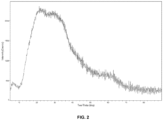
- the peak in the graph shows a high concentration of iron (III) phosphate without other obvious peak in the graph indicating high purity of the iron (III) phosphate.
- Subsequent analysis by inductively coupled plasma - optical emission spectrometry revealed a purity of at least 99.5% purity of the iron (III) phosphate product obtained from the precipitate.
- the first solution which now contains mainly sodium and lithium cations is subsequently combined with the first leachate obtained during the alkaline leaching step as described earlier to obtain a second solution.
- the pH of the second solution is then adjusted to about 6.5 by adding an alkaline or acidic solution as required to obtain a residual.
- the resultant second may have a pH that is higher or lower than about 6.5.
- the pH can be lowered to about 6.5 by adding sulphuric acid or can be raised by adding sodium hydroxide, potassium hydroxide or lithium hydroxide.
- the pH of the second solution may also be raised by adding deionised water. It will be readily understood by the skilled addressee that any acid or alkali can be used to adjust the pH of the second solution so long as it does not introduce contaminants for example aluminium hydroxide.
- lime also known as calcium hydroxide can also be added to the second solution to remove any fluoride ions present by way of precipitation as calcium fluoride that may be present in the first leachate.
- the amount of calcium hydroxide added to the second solution should be proportionate to the amount of fluoride present and is preferably about 1% w/v.
- the pH adjustment will allow the precipitation of a residual precipitate to be obtained along with a lithium solution 106.
- the residual precipitate comprises mainly aluminium hydroxide, copper (II) hydroxide, calcium fluoride and iron (III) hydroxide.
- the precipitation occurs over a duration of about 1 hour.
- a temperature of about 50-60°C is maintained throughout the precipitation.
- the second solution is subject to mechanical agitation during precipitation.
- the residual precipitate can then be physically separated by way of a press filter to obtain a lithium solution that is largely free of contaminants and can be subjected to further processing to recover the lithium present.
- Table 1 depicts the concentrations (g/l) of the elements of interest present in the respective solutions obtained throughout the process.
- Table 1 Concentration of different elements in solution (g/l) First leachate Second leachate First eluate Second eluate First solution Fe 0 11.6 11.6 11.6 0 Al 1.2 0 0 0 0 F 0.7 0.3 0 0 0 Cu 0 0.11 0.11 0 0 P 5 1.5 1.5 1.5 0
Landscapes
- Chemical & Material Sciences (AREA)
- Engineering & Computer Science (AREA)
- Organic Chemistry (AREA)
- Manufacturing & Machinery (AREA)
- Materials Engineering (AREA)
- Geology (AREA)
- Life Sciences & Earth Sciences (AREA)
- Mechanical Engineering (AREA)
- Metallurgy (AREA)
- General Life Sciences & Earth Sciences (AREA)
- Environmental & Geological Engineering (AREA)
- Inorganic Chemistry (AREA)
- Geochemistry & Mineralogy (AREA)
- Chemical Kinetics & Catalysis (AREA)
- General Chemical & Material Sciences (AREA)
- Electrochemistry (AREA)
- Secondary Cells (AREA)
- Primary Cells (AREA)
- Manufacture And Refinement Of Metals (AREA)
- Removal Of Specific Substances (AREA)
Priority Applications (1)
| Application Number | Priority Date | Filing Date | Title |
|---|---|---|---|
| HUE22893999A HUE072976T2 (hu) | 2022-01-17 | 2022-01-17 | Eljárás lítium vas-foszfát akkumulátorok reciklikálására |
Applications Claiming Priority (1)
| Application Number | Priority Date | Filing Date | Title |
|---|---|---|---|
| PCT/SG2022/050014 WO2023136773A1 (en) | 2022-01-17 | 2022-01-17 | Process for recycling lithium iron phosphate batteries |
Publications (3)
| Publication Number | Publication Date |
|---|---|
| EP4233121A1 EP4233121A1 (en) | 2023-08-30 |
| EP4233121A4 EP4233121A4 (en) | 2024-04-10 |
| EP4233121B1 true EP4233121B1 (en) | 2025-06-25 |
Family
ID=87143097
Family Applications (1)
| Application Number | Title | Priority Date | Filing Date |
|---|---|---|---|
| EP22893999.7A Active EP4233121B1 (en) | 2022-01-17 | 2022-01-17 | Process for recycling lithium iron phosphate batteries |
Country Status (11)
| Country | Link |
|---|---|
| US (2) | US12051788B2 (pl) |
| EP (1) | EP4233121B1 (pl) |
| JP (2) | JP7472406B2 (pl) |
| KR (1) | KR102775474B1 (pl) |
| CN (1) | CN116802886A (pl) |
| AU (1) | AU2022388904B2 (pl) |
| CA (1) | CA3199178A1 (pl) |
| HU (1) | HUE072976T2 (pl) |
| MX (2) | MX2024003067A (pl) |
| PL (1) | PL4233121T3 (pl) |
| WO (1) | WO2023136773A1 (pl) |
Families Citing this family (9)
| Publication number | Priority date | Publication date | Assignee | Title |
|---|---|---|---|---|
| EP4200927A4 (en) | 2020-08-24 | 2024-06-05 | Green Li-Ion Pte. Ltd. | METHOD FOR REMOVING IMPURITIES IN THE RECYCLING OF LITHIUM-ION BATTERIES |
| EP4233121B1 (en) | 2022-01-17 | 2025-06-25 | Green Li-Ion Pte. Ltd. | Process for recycling lithium iron phosphate batteries |
| JP7785918B2 (ja) | 2022-02-23 | 2025-12-15 | グリーン リチウム-イオン プライベート リミテッド | リチウムイオン電池廃棄物ストリームの精製およびリサイクルのための方法およびシステム |
| WO2023204761A1 (en) | 2022-04-18 | 2023-10-26 | Green Li-Ion Pte. Ltd | Process and system for recovering lithium from lithium-ion batteries |
| WO2025042333A1 (en) | 2023-08-23 | 2025-02-27 | Green Li-Ion Pte. Ltd | Adaptable processes and systems for purifying co‑precipitated or independent streams of manganese, nickel, and cobalt from lithium‑ion battery waste streams |
| KR20250129951A (ko) * | 2024-02-23 | 2025-09-01 | 주식회사 에이비알 | 블랙 파우더로부터 양극재를 회수하는 방법 |
| WO2025226431A1 (en) * | 2024-04-25 | 2025-10-30 | Albemarle Corporation | Method of alkaline leaching of useful metals from lithium-ion batteries |
| CN118637569B (zh) * | 2024-08-14 | 2024-11-01 | 中国恩菲工程技术有限公司 | 一种磷酸铁锂电池黑粉综合回收P、Fe、Li的方法 |
| KR102770463B1 (ko) * | 2024-11-06 | 2025-02-21 | 한국지질자원연구원 | 폐배터리로부터 얻은 블랙매스로부터 리튬을 회수하는 방법 |
Family Cites Families (92)
| Publication number | Priority date | Publication date | Assignee | Title |
|---|---|---|---|---|
| US3690844A (en) | 1969-10-17 | 1972-09-12 | Great Salt Lake Minerals | Recovery of sulfate-free hydrated magnesium chloride from sulfate-contaminated brines |
| US3852044A (en) | 1969-11-13 | 1974-12-03 | Great Salt Lake Minerals | Recovery of substantially potassium-free hydrated magnesium chloride from contaminated aqueous solutions |
| US4723962A (en) | 1985-02-04 | 1988-02-09 | Lithium Corporation Of America | Process for recovering lithium from salt brines |
| US5160631A (en) | 1991-08-05 | 1992-11-03 | Halliburton Company | Method for treating chelant solutions to remove metals in solution |
| JP4492223B2 (ja) * | 2004-06-21 | 2010-06-30 | トヨタ自動車株式会社 | リチウム電池処理方法 |
| US7892505B2 (en) | 2005-10-29 | 2011-02-22 | Royal Silver Company (Panama) S.A. | Hydrometallurgical process for the treatment of metal-bearing sulfide mineral concentrates |
| CN101450815A (zh) | 2008-10-07 | 2009-06-10 | 佛山市邦普镍钴技术有限公司 | 一种以废旧锂离子电池为原料制备镍钴锰酸锂的方法 |
| AU2010341402B2 (en) | 2010-01-07 | 2014-01-30 | Tianqi Lithium Corporation | Process for the production of lithium carbonate |
| JP2011184764A (ja) | 2010-03-10 | 2011-09-22 | Mitsubishi Materials Corp | 廃触媒の処理方法 |
| US8377757B2 (en) | 2010-04-30 | 2013-02-19 | Shanghai Sim-Bcd Semiconductor Manufacturing Limited | Device and method for transient voltage suppressor |
| JP5568414B2 (ja) | 2010-08-27 | 2014-08-06 | 株式会社日立製作所 | 金属回収方法及び金属回収装置 |
| IT1402160B1 (it) | 2010-10-18 | 2013-08-28 | Eco Recycling S R L | Impianto e processo per il trattamento di pile e accumulatori esausti |
| KR101220149B1 (ko) | 2011-02-17 | 2013-01-11 | 한국지질자원연구원 | 폐배터리로부터 유가금속 황산용액의 제조방법 및 양극활물질의 제조방법 |
| CN102157726B (zh) | 2011-03-16 | 2013-10-16 | 奇瑞汽车股份有限公司 | 一种制备高电压正极材料锂镍锰氧的方法 |
| AU2012250449B2 (en) | 2011-05-02 | 2017-04-13 | Trimetals Mining Inc. | A method for recovering indium, silver, gold and other rare, precious and base metals from complex oxide and sulfide ores |
| FR2976295B1 (fr) | 2011-06-07 | 2013-07-05 | Sarp Ind | Procede de separation de metaux a partir de batteries contenant du lithium |
| JP5161361B1 (ja) | 2011-12-28 | 2013-03-13 | Jx日鉱日石金属株式会社 | 金属混合溶液中の金属の分離方法 |
| US11955613B2 (en) | 2012-04-04 | 2024-04-09 | Worcester Polytechnic Institute | Charge material for recycled lithium-ion batteries |
| US11127992B2 (en) | 2012-04-04 | 2021-09-21 | Worcester Polytechnic Institute | Charge material for recycled lithium-ion batteries |
| US10741890B2 (en) | 2012-04-04 | 2020-08-11 | Worcester Polytechnic Institute | Method and apparatus for recycling lithium iron phosphate batteries |
| US9834827B2 (en) | 2012-04-04 | 2017-12-05 | Worcester Polytechnic Institute | Method and apparatus for recycling lithium-ion batteries |
| US10522884B2 (en) | 2012-04-04 | 2019-12-31 | Worcester Polytechnic Institute | Method and apparatus for recycling lithium-ion batteries |
| RU2604082C2 (ru) | 2012-04-27 | 2016-12-10 | Норведжиэн Юнивёрсити Оф Сайенс Энд Текнолоджи (Нтну) | Устройство и способ заливки фильтра для расплавленного металла |
| JP5847741B2 (ja) | 2013-02-18 | 2016-01-27 | Jx日鉱日石金属株式会社 | 廃正極材及び廃電池からの金属回収方法 |
| CN103280610B (zh) | 2013-03-29 | 2015-11-11 | 江西省电力科学研究院 | 一种磷酸铁锂电池正极废片回收方法 |
| FI125216B (en) | 2013-05-23 | 2015-07-15 | Outotec Finland Oy | Method for recovering metals |
| JP6146377B2 (ja) | 2014-06-19 | 2017-06-14 | 住友金属鉱山株式会社 | リン及び/又はフッ素の除去方法、並びに、有価金属の回収方法 |
| CN104953200B (zh) | 2015-06-30 | 2017-06-23 | 哈尔滨工业大学 | 磷酸铁锂电池中回收电池级磷酸铁及利用废旧磷酸铁锂电池制备磷酸铁锂正极材料的方法 |
| KR102754046B1 (ko) | 2015-11-24 | 2025-01-14 | 워세스터 폴리테크닉 인스티튜트 | 리튬이온 배터리를 재활용하기 위한 방법 및 장치 |
| CA3024198C (fr) | 2016-05-20 | 2025-07-08 | Hydro-Quebec | Procede pour le recyclage de materiaux d'electrode de batterie au lithium |
| CN106505225A (zh) | 2016-12-12 | 2017-03-15 | 江西赣锋锂业股份有限公司 | 一种从锂废旧电池中回收锂制备电池级碳酸锂的方法 |
| TWI746818B (zh) | 2017-04-07 | 2021-11-21 | 比利時商烏明克公司 | 回收鋰之程序 |
| WO2018209164A1 (en) | 2017-05-11 | 2018-11-15 | Worcester Polytechnic Institute | Method and apparatus for recycling lithium iron phosphate batteries |
| CN107240731B (zh) | 2017-05-25 | 2019-08-27 | 广州锂力新能源科技有限公司 | 一种废旧磷酸铁锂电池的回收方法 |
| KR102701451B1 (ko) * | 2017-05-30 | 2024-09-03 | 리-싸이클 코포레이션 | 배터리로부터 물질을 회수하기 위한 방법, 장치 및 시스템 |
| AU2018280351A1 (en) | 2017-06-08 | 2020-01-02 | Nmr 360 Inc | Process for the recovery of cobalt, lithium, and other metals from spent lithium-based batteries and other feeds |
| CN107190150A (zh) * | 2017-07-14 | 2017-09-22 | 湘潭大学 | 一种回收废旧磷酸铁锂电池正极材料中锂,铁,集流体‑铝箔的方法 |
| CN107653378A (zh) | 2017-08-25 | 2018-02-02 | 金川集团股份有限公司 | 一种废旧镍钴锰锂离子电池中有价金属的回收方法 |
| CN107871912B (zh) | 2017-09-25 | 2020-05-12 | 湖南邦普循环科技有限公司 | 一种从回收废锂离子电池中有价金属时产生的浸出液中除铁铝的方法 |
| EP3688834B1 (en) | 2017-09-28 | 2024-08-14 | Recyclage Lithion Inc. | Lithium-ion batteries recycling process |
| IT201800002175A1 (it) | 2018-01-30 | 2019-07-30 | Consiglio Nazionale Ricerche | Procedimento idrometallurgico per il trattamento di batterie al litio e recupero dei metalli in esse contenuti. |
| DE102018102026A1 (de) | 2018-01-30 | 2019-08-01 | Duesenfeld Gmbh | Verfahren zum Verwerten von Lithium-Batterien |
| EP3746577A4 (en) | 2018-02-02 | 2021-11-10 | Tianqi Lithium Kwinana Pty Ltd | PROCESS FOR EXTRACTION OF VALUES FROM LITHIUM SLAG |
| JP7040196B2 (ja) * | 2018-03-22 | 2022-03-23 | 三菱マテリアル株式会社 | コバルトとアルミニウムの分離方法 |
| ES3055117T3 (en) | 2018-07-10 | 2026-02-10 | Basf Se | Process for the recycling of spent lithium ion cells |
| PL3834247T3 (pl) * | 2018-08-09 | 2024-11-25 | Bromine Compounds Ltd. | Proces odzysku metali z recyklingowanych akumulatorów |
| JP7439087B2 (ja) | 2018-11-26 | 2024-02-27 | ビーエーエスエフ ソシエタス・ヨーロピア | 浸出液中の水素ガス注入による電池のリサイクル |
| KR102164661B1 (ko) | 2018-12-06 | 2020-10-12 | 주식회사 에코프로이노베이션 | 리튬 정광으로부터 황산나트튬 혼합 배소에 의한 수산화리튬 제조방법 |
| EP3670686A1 (en) | 2018-12-21 | 2020-06-24 | A.C.N. 630 589 507 Pty Ltd | Battery recycling process |
| CN110066925A (zh) | 2019-04-28 | 2019-07-30 | 浙江天能新材料有限公司 | 一种废旧镍钴锰三元锂电池中有价金属的回收方法 |
| TW202105823A (zh) | 2019-07-26 | 2021-02-01 | 德商巴斯夫歐洲公司 | 自廢鋰離子電池中回收鋰和其他金屬之方法 |
| TWI877188B (zh) | 2019-07-26 | 2025-03-21 | 德商巴斯夫歐洲公司 | 自廢鋰離子電池中回收鋰之方法 |
| TWI888394B (zh) | 2019-07-26 | 2025-07-01 | 德商巴斯夫歐洲公司 | 自廢鋰離子電池中回收鋰和其他金屬之方法 |
| CN112441572B (zh) * | 2019-08-27 | 2022-11-11 | 比亚迪股份有限公司 | 一种废旧磷酸铁锂正极材料的回收方法 |
| CN110527836A (zh) | 2019-09-12 | 2019-12-03 | 金川集团股份有限公司 | 一种离子交换法回收废旧镍钴锰锂离子电池中有价金属的方法 |
| JP7216945B2 (ja) | 2019-09-14 | 2023-02-02 | 湖南金源新材料股▲ふん▼有限公司 | 三元系電池廃棄物総合回収におけるマンガン-リチウム分離と抽出前溶液調製プロセス及び三元系電池廃棄物からコバルト-ニッケル-マンガン-リチウム元素を総合回収する方法 |
| US11430997B2 (en) | 2019-11-01 | 2022-08-30 | Battery Reclamation Research Associates Llc | Process for separating and recycling a spent alkaline battery |
| CN111003736B (zh) | 2019-11-08 | 2022-10-04 | 惠州亿纬锂能股份有限公司 | 锂离子电池电解液综合处理方法 |
| CN111304441A (zh) | 2019-11-27 | 2020-06-19 | 湖南邦普循环科技有限公司 | 一种废旧电池浸出液除杂的方法 |
| CA3169682A1 (en) | 2020-02-12 | 2021-08-19 | Bromine Compounds Ltd. | A process for recovering metals from recycled rechargeable batteries |
| KR102243820B1 (ko) | 2020-03-05 | 2021-04-23 | 동우 화인켐 주식회사 | 수산화리튬의 제조 방법 |
| JP7479883B2 (ja) * | 2020-03-17 | 2024-05-09 | 出光興産株式会社 | リチウム水溶液の製造方法及びリチウム水溶液の製造装置 |
| CN113924682A (zh) | 2020-05-01 | 2022-01-11 | XproEM有限公司 | 从废锂离子电池的废正极中回收锂和过渡金属的方法 |
| WO2021242831A2 (en) | 2020-05-27 | 2021-12-02 | Worcester Polytechnic Institute | Facile etching for single crystal cathode materials |
| CN115715435A (zh) | 2020-06-08 | 2023-02-24 | 升腾元素公司 | 再循环电池中的阳极回收 |
| CN111675203B (zh) * | 2020-06-17 | 2021-12-14 | 中国科学院宁波材料技术与工程研究所 | 一种从废旧磷酸铁锂电池中回收锂的方法、以及回收锂和磷酸铁的方法 |
| EP4200927A4 (en) | 2020-08-24 | 2024-06-05 | Green Li-Ion Pte. Ltd. | METHOD FOR REMOVING IMPURITIES IN THE RECYCLING OF LITHIUM-ION BATTERIES |
| CN112126783B (zh) | 2020-08-25 | 2022-06-14 | 湖南邦普循环科技有限公司 | 一种镍钴锰溶液中铁铝资源化的回收方法 |
| CN112158894A (zh) | 2020-09-24 | 2021-01-01 | 广东邦普循环科技有限公司 | 一种废旧锂电池正极材料的回收方法 |
| US11556738B2 (en) | 2020-10-01 | 2023-01-17 | Kla Corporation | System and method for determining target feature focus in image-based overlay metrology |
| CN112357899B (zh) * | 2020-11-23 | 2022-04-22 | 湖南金源新材料股份有限公司 | 一种废旧磷酸铁锂电池的综合回收利用方法 |
| CN112680598A (zh) | 2020-12-15 | 2021-04-20 | 中南大学 | 一种低成本清洁处理废旧锂离子电池正极材料的方法 |
| IL303927A (en) | 2020-12-31 | 2023-08-01 | Cytec Ind Inc | Recovering mixed-metal ions from aqueous solutions |
| CN113073194B (zh) | 2021-03-03 | 2022-09-09 | 安徽南都华铂新材料科技有限公司 | 一种废旧锂电池回收利用的除氟工艺 |
| CN113517484B (zh) | 2021-03-08 | 2022-08-05 | 清华大学 | 废钴酸锂电池的处理方法及其产物 |
| CA3215065A1 (en) | 2021-04-13 | 2022-10-20 | Yan Wang | Lithium recovery process |
| CA3214131A1 (en) | 2021-04-14 | 2022-10-20 | Metso Finland Oy | Extraction of metals from lithium-ion battery material |
| WO2022219221A1 (en) | 2021-04-14 | 2022-10-20 | Metso Outotec Finland Oy | Extraction of metals from lithium-ion battery material |
| AU2021441266A1 (en) | 2021-04-14 | 2023-10-05 | Metso Finland Oy | Extraction of metals from lithium-ion battery material |
| WO2022272162A1 (en) | 2021-06-25 | 2022-12-29 | Ascend Elements, Inc. | RECYCLING ALL SOLID-STATE BATTERIES (ASSBs) AND ANODE RECOVERY |
| KR20240070514A (ko) | 2021-08-02 | 2024-05-21 | 어센드 엘리먼츠 인코포레이티드 | 인산철리튬(lfp) 배터리의 재활용 |
| CN113801990A (zh) | 2021-08-03 | 2021-12-17 | 广东邦普循环科技有限公司 | 一种废旧锂离子电池的回收利用方法 |
| US20230059571A1 (en) | 2021-08-18 | 2023-02-23 | Ford Global Technologies, Llc | Cathode material stabilization |
| CN113802003A (zh) | 2021-08-23 | 2021-12-17 | 广东邦普循环科技有限公司 | 废旧锂电池的回收及制备三元前驱体的方法 |
| WO2023034556A1 (en) | 2021-09-05 | 2023-03-09 | Worcester Polytechnic Institute | Mixed cathode upcycling |
| DE102021123151A1 (de) | 2021-09-07 | 2023-03-09 | Aurubis Ag | Verfahren und Anlage zur Rückgewinnung von Metallen aus schwarzer Masse |
| GB2611158B (en) | 2021-09-21 | 2025-02-12 | Gelion Tech Pty Ltd | A recycling method for recovery of lithium from materials comprising lithium and one or more transition metals |
| CN113991205B (zh) * | 2021-10-26 | 2023-10-20 | 中南大学 | 一种电池正极废料除铝中降低碱耗的方法 |
| US20230147371A1 (en) | 2021-11-05 | 2023-05-11 | Battery Resourcers LLC | Charge material synthesized from recycled lithium-ion batteries |
| EP4233121B1 (en) | 2022-01-17 | 2025-06-25 | Green Li-Ion Pte. Ltd. | Process for recycling lithium iron phosphate batteries |
| JP7785918B2 (ja) | 2022-02-23 | 2025-12-15 | グリーン リチウム-イオン プライベート リミテッド | リチウムイオン電池廃棄物ストリームの精製およびリサイクルのための方法およびシステム |
| WO2023204761A1 (en) | 2022-04-18 | 2023-10-26 | Green Li-Ion Pte. Ltd | Process and system for recovering lithium from lithium-ion batteries |
-
2022
- 2022-01-17 EP EP22893999.7A patent/EP4233121B1/en active Active
- 2022-01-17 KR KR1020237017599A patent/KR102775474B1/ko active Active
- 2022-01-17 WO PCT/SG2022/050014 patent/WO2023136773A1/en not_active Ceased
- 2022-01-17 CN CN202280007732.6A patent/CN116802886A/zh active Pending
- 2022-01-17 MX MX2024003067A patent/MX2024003067A/es unknown
- 2022-01-17 PL PL22893999.7T patent/PL4233121T3/pl unknown
- 2022-01-17 US US18/039,395 patent/US12051788B2/en active Active
- 2022-01-17 JP JP2023533357A patent/JP7472406B2/ja active Active
- 2022-01-17 AU AU2022388904A patent/AU2022388904B2/en active Active
- 2022-01-17 HU HUE22893999A patent/HUE072976T2/hu unknown
- 2022-01-17 CA CA3199178A patent/CA3199178A1/en active Pending
-
2024
- 2024-03-11 MX MX2024011025A patent/MX2024011025A/es unknown
- 2024-04-10 JP JP2024063355A patent/JP7798950B2/ja active Active
- 2024-07-22 US US18/779,283 patent/US20240380016A1/en active Pending
Also Published As
| Publication number | Publication date |
|---|---|
| US12051788B2 (en) | 2024-07-30 |
| JP2024095782A (ja) | 2024-07-10 |
| HUE072976T2 (hu) | 2026-01-28 |
| EP4233121A4 (en) | 2024-04-10 |
| PL4233121T3 (pl) | 2026-02-09 |
| US20240380016A1 (en) | 2024-11-14 |
| WO2023136773A1 (en) | 2023-07-20 |
| AU2022388904B2 (en) | 2024-07-25 |
| JP7798950B2 (ja) | 2026-01-14 |
| CN116802886A (zh) | 2023-09-22 |
| EP4233121A1 (en) | 2023-08-30 |
| US20240120565A1 (en) | 2024-04-11 |
| MX2024003067A (es) | 2024-03-27 |
| JP2024507035A (ja) | 2024-02-16 |
| KR20230111606A (ko) | 2023-07-25 |
| AU2022388904A1 (en) | 2023-08-03 |
| JP7472406B2 (ja) | 2024-04-22 |
| MX2024011025A (es) | 2025-10-01 |
| CA3199178A1 (en) | 2023-07-17 |
| KR102775474B1 (ko) | 2025-02-28 |
Similar Documents
| Publication | Publication Date | Title |
|---|---|---|
| EP4233121B1 (en) | Process for recycling lithium iron phosphate batteries | |
| CN112331949B (zh) | 从废旧磷酸铁锂电池中回收磷、铁和锂的方法 | |
| CN113896211B (zh) | 一种废旧磷酸铁锂电池资源化的处理方法 | |
| KR102132120B1 (ko) | 이산화탄소를 이용한 폐 리튬이온 이차전지의 재활용 방법 | |
| US6514311B1 (en) | Clean process of recovering metals from waste lithium ion batteries | |
| KR101497921B1 (ko) | 폐리튬이온전지로부터 ncm계 양극활물질의 재생방법과 이 방법에 의해 제조된 ncm계 양극활물질 | |
| CN110669933B (zh) | 一种去除镍钴锰溶液中氟的方法 | |
| CN113737018A (zh) | 一种废旧电池正极原料的回收方法 | |
| CN115367776B (zh) | 一种磷酸铁锂电池的回收方法 | |
| EP3279342B1 (en) | Method for removing iron from iron-containing solution, and method for recovering valuable metals | |
| JP7271833B2 (ja) | リチウムの回収方法 | |
| CN119546789A (zh) | 废电池的处理方法 | |
| CN119256427A (zh) | 用于从锂离子电池中回收金属的改进的系统和方法 | |
| EP4245869A1 (en) | Method for processing black mass to battery chemicals | |
| HK40095504A (en) | Process for recycling lithium iron phosphate batteries | |
| HK40095504B (en) | Process for recycling lithium iron phosphate batteries | |
| KR102536541B1 (ko) | 니켈의 회수방법, 양극재 및 이를 포함하는 이차전지 | |
| CN117144379A (zh) | 一种磷酸铁锂废料的回收方法 | |
| EP4278020B1 (en) | Method for leaching metal and method for recovering metal | |
| KR102800032B1 (ko) | 음극 집전체를 이용한 폐배터리로부터 유가 금속을 회수하는 방법 | |
| US20250349922A1 (en) | Impurity management process for lithium-ion battery recycling | |
| WO2025220452A1 (en) | Method for removing impurities and method for recovering metals | |
| EP4434940A1 (en) | Method of recovering active metal of lithium secndary battery | |
| EP4197662A1 (en) | Method for treating sulfide | |
| KR20240096166A (ko) | 이산화망간의 회수방법, 이로부터 회수된 이산화망간 및 양극재 |
Legal Events
| Date | Code | Title | Description |
|---|---|---|---|
| STAA | Information on the status of an ep patent application or granted ep patent |
Free format text: STATUS: UNKNOWN |
|
| STAA | Information on the status of an ep patent application or granted ep patent |
Free format text: STATUS: THE INTERNATIONAL PUBLICATION HAS BEEN MADE |
|
| PUAI | Public reference made under article 153(3) epc to a published international application that has entered the european phase |
Free format text: ORIGINAL CODE: 0009012 |
|
| STAA | Information on the status of an ep patent application or granted ep patent |
Free format text: STATUS: REQUEST FOR EXAMINATION WAS MADE |
|
| 17P | Request for examination filed |
Effective date: 20230526 |
|
| AK | Designated contracting states |
Kind code of ref document: A1 Designated state(s): AL AT BE BG CH CY CZ DE DK EE ES FI FR GB GR HR HU IE IS IT LI LT LU LV MC MK MT NL NO PL PT RO RS SE SI SK SM TR |
|
| REG | Reference to a national code |
Ref country code: HK Ref legal event code: DE Ref document number: 40095504 Country of ref document: HK |
|
| REG | Reference to a national code |
Ref country code: DE Ipc: C22B0003080000 Ref legal event code: R079 Ref document number: 602022016628 Country of ref document: DE Free format text: PREVIOUS MAIN CLASS: H01M0010540000 |
|
| A4 | Supplementary search report drawn up and despatched |
Effective date: 20240311 |
|
| RIC1 | Information provided on ipc code assigned before grant |
Ipc: C22B 7/00 20060101ALI20240304BHEP Ipc: C22B 3/44 20060101ALI20240304BHEP Ipc: C22B 3/42 20060101ALI20240304BHEP Ipc: C22B 3/12 20060101ALI20240304BHEP Ipc: C22B 26/12 20060101ALI20240304BHEP Ipc: C22B 15/00 20060101ALI20240304BHEP Ipc: C01G 49/02 20060101ALI20240304BHEP Ipc: C01G 3/02 20060101ALI20240304BHEP Ipc: C01F 7/34 20060101ALI20240304BHEP Ipc: C01B 25/37 20060101ALI20240304BHEP Ipc: C01F 11/22 20060101ALI20240304BHEP Ipc: C01B 25/45 20060101ALI20240304BHEP Ipc: B01J 47/026 20170101ALI20240304BHEP Ipc: B01J 39/05 20170101ALI20240304BHEP Ipc: H01M 4/58 20100101ALI20240304BHEP Ipc: B01J 47/02 20170101ALI20240304BHEP Ipc: H01M 10/54 20060101ALI20240304BHEP Ipc: C22B 3/08 20060101AFI20240304BHEP |
|
| GRAP | Despatch of communication of intention to grant a patent |
Free format text: ORIGINAL CODE: EPIDOSNIGR1 |
|
| STAA | Information on the status of an ep patent application or granted ep patent |
Free format text: STATUS: GRANT OF PATENT IS INTENDED |
|
| INTG | Intention to grant announced |
Effective date: 20250122 |
|
| DAV | Request for validation of the european patent (deleted) | ||
| DAX | Request for extension of the european patent (deleted) | ||
| GRAS | Grant fee paid |
Free format text: ORIGINAL CODE: EPIDOSNIGR3 |
|
| GRAA | (expected) grant |
Free format text: ORIGINAL CODE: 0009210 |
|
| STAA | Information on the status of an ep patent application or granted ep patent |
Free format text: STATUS: THE PATENT HAS BEEN GRANTED |
|
| AK | Designated contracting states |
Kind code of ref document: B1 Designated state(s): AL AT BE BG CH CY CZ DE DK EE ES FI FR GB GR HR HU IE IS IT LI LT LU LV MC MK MT NL NO PL PT RO RS SE SI SK SM TR |
|
| REG | Reference to a national code |
Ref country code: GB Ref legal event code: FG4D |
|
| REG | Reference to a national code |
Ref country code: CH Ref legal event code: EP |
|
| REG | Reference to a national code |
Ref country code: DE Ref legal event code: R096 Ref document number: 602022016628 Country of ref document: DE |
|
| REG | Reference to a national code |
Ref country code: CH Ref legal event code: EP |
|
| REG | Reference to a national code |
Ref country code: IE Ref legal event code: FG4D |
|
| P01 | Opt-out of the competence of the unified patent court (upc) registered |
Free format text: CASE NUMBER: APP_29795/2025 Effective date: 20250623 |
|
| REG | Reference to a national code |
Ref country code: NL Ref legal event code: FP |
|
| PG25 | Lapsed in a contracting state [announced via postgrant information from national office to epo] |
Ref country code: FI Free format text: LAPSE BECAUSE OF FAILURE TO SUBMIT A TRANSLATION OF THE DESCRIPTION OR TO PAY THE FEE WITHIN THE PRESCRIBED TIME-LIMIT Effective date: 20250625 |
|
| REG | Reference to a national code |
Ref country code: LT Ref legal event code: MG9D |
|
| PG25 | Lapsed in a contracting state [announced via postgrant information from national office to epo] |
Ref country code: GR Free format text: LAPSE BECAUSE OF FAILURE TO SUBMIT A TRANSLATION OF THE DESCRIPTION OR TO PAY THE FEE WITHIN THE PRESCRIBED TIME-LIMIT Effective date: 20250926 |
|
| PG25 | Lapsed in a contracting state [announced via postgrant information from national office to epo] |
Ref country code: BG Free format text: LAPSE BECAUSE OF FAILURE TO SUBMIT A TRANSLATION OF THE DESCRIPTION OR TO PAY THE FEE WITHIN THE PRESCRIBED TIME-LIMIT Effective date: 20250625 |
|
| PG25 | Lapsed in a contracting state [announced via postgrant information from national office to epo] |
Ref country code: HR Free format text: LAPSE BECAUSE OF FAILURE TO SUBMIT A TRANSLATION OF THE DESCRIPTION OR TO PAY THE FEE WITHIN THE PRESCRIBED TIME-LIMIT Effective date: 20250625 |
|
| PG25 | Lapsed in a contracting state [announced via postgrant information from national office to epo] |
Ref country code: RS Free format text: LAPSE BECAUSE OF FAILURE TO SUBMIT A TRANSLATION OF THE DESCRIPTION OR TO PAY THE FEE WITHIN THE PRESCRIBED TIME-LIMIT Effective date: 20250925 |
|
| PG25 | Lapsed in a contracting state [announced via postgrant information from national office to epo] |
Ref country code: LV Free format text: LAPSE BECAUSE OF FAILURE TO SUBMIT A TRANSLATION OF THE DESCRIPTION OR TO PAY THE FEE WITHIN THE PRESCRIBED TIME-LIMIT Effective date: 20250625 |
|
| REG | Reference to a national code |
Ref country code: SK Ref legal event code: T3 Ref document number: E 47015 Country of ref document: SK |
|
| PG25 | Lapsed in a contracting state [announced via postgrant information from national office to epo] |
Ref country code: PT Free format text: LAPSE BECAUSE OF FAILURE TO SUBMIT A TRANSLATION OF THE DESCRIPTION OR TO PAY THE FEE WITHIN THE PRESCRIBED TIME-LIMIT Effective date: 20251027 |
|
| REG | Reference to a national code |
Ref country code: AT Ref legal event code: MK05 Ref document number: 1806496 Country of ref document: AT Kind code of ref document: T Effective date: 20250625 |
|
| PG25 | Lapsed in a contracting state [announced via postgrant information from national office to epo] |
Ref country code: IS Free format text: LAPSE BECAUSE OF FAILURE TO SUBMIT A TRANSLATION OF THE DESCRIPTION OR TO PAY THE FEE WITHIN THE PRESCRIBED TIME-LIMIT Effective date: 20251025 |
|
| PG25 | Lapsed in a contracting state [announced via postgrant information from national office to epo] |
Ref country code: AT Free format text: LAPSE BECAUSE OF FAILURE TO SUBMIT A TRANSLATION OF THE DESCRIPTION OR TO PAY THE FEE WITHIN THE PRESCRIBED TIME-LIMIT Effective date: 20250625 Ref country code: SM Free format text: LAPSE BECAUSE OF FAILURE TO SUBMIT A TRANSLATION OF THE DESCRIPTION OR TO PAY THE FEE WITHIN THE PRESCRIBED TIME-LIMIT Effective date: 20250625 |
|
| PG25 | Lapsed in a contracting state [announced via postgrant information from national office to epo] |
Ref country code: CZ Free format text: LAPSE BECAUSE OF FAILURE TO SUBMIT A TRANSLATION OF THE DESCRIPTION OR TO PAY THE FEE WITHIN THE PRESCRIBED TIME-LIMIT Effective date: 20250625 |
|
| PG25 | Lapsed in a contracting state [announced via postgrant information from national office to epo] |
Ref country code: EE Free format text: LAPSE BECAUSE OF FAILURE TO SUBMIT A TRANSLATION OF THE DESCRIPTION OR TO PAY THE FEE WITHIN THE PRESCRIBED TIME-LIMIT Effective date: 20250625 |
|
| REG | Reference to a national code |
Ref country code: HU Ref legal event code: AG4A Ref document number: E072976 Country of ref document: HU |
|
| PG25 | Lapsed in a contracting state [announced via postgrant information from national office to epo] |
Ref country code: ES Free format text: LAPSE BECAUSE OF FAILURE TO SUBMIT A TRANSLATION OF THE DESCRIPTION OR TO PAY THE FEE WITHIN THE PRESCRIBED TIME-LIMIT Effective date: 20250625 |