EP3674317B1 - Variante einer konstanten antikörperregion - Google Patents
Variante einer konstanten antikörperregion Download PDFInfo
- Publication number
- EP3674317B1 EP3674317B1 EP19180309.7A EP19180309A EP3674317B1 EP 3674317 B1 EP3674317 B1 EP 3674317B1 EP 19180309 A EP19180309 A EP 19180309A EP 3674317 B1 EP3674317 B1 EP 3674317B1
- Authority
- EP
- European Patent Office
- Prior art keywords
- amino acid
- cys
- chain constant
- constant region
- seq
- Prior art date
- Legal status (The legal status is an assumption and is not a legal conclusion. Google has not performed a legal analysis and makes no representation as to the accuracy of the status listed.)
- Active
Links
Images








Classifications
-
- C—CHEMISTRY; METALLURGY
- C07—ORGANIC CHEMISTRY
- C07K—PEPTIDES
- C07K16/00—Immunoglobulins [IG], e.g. monoclonal or polyclonal antibodies
-
- C—CHEMISTRY; METALLURGY
- C07—ORGANIC CHEMISTRY
- C07K—PEPTIDES
- C07K16/00—Immunoglobulins [IG], e.g. monoclonal or polyclonal antibodies
- C07K16/18—Immunoglobulins [IG], e.g. monoclonal or polyclonal antibodies against material from animals or humans
- C07K16/28—Immunoglobulins [IG], e.g. monoclonal or polyclonal antibodies against material from animals or humans against receptors, cell surface antigens or cell surface determinants
- C07K16/2866—Immunoglobulins [IG], e.g. monoclonal or polyclonal antibodies against material from animals or humans against receptors, cell surface antigens or cell surface determinants against receptors for cytokines, lymphokines, interferons
-
- C—CHEMISTRY; METALLURGY
- C07—ORGANIC CHEMISTRY
- C07K—PEPTIDES
- C07K16/00—Immunoglobulins [IG], e.g. monoclonal or polyclonal antibodies
- C07K16/18—Immunoglobulins [IG], e.g. monoclonal or polyclonal antibodies against material from animals or humans
- C07K16/28—Immunoglobulins [IG], e.g. monoclonal or polyclonal antibodies against material from animals or humans against receptors, cell surface antigens or cell surface determinants
- C07K16/2875—Immunoglobulins [IG], e.g. monoclonal or polyclonal antibodies against material from animals or humans against receptors, cell surface antigens or cell surface determinants against the NGF/TNF superfamily, e.g. CD70, CD95L, CD153, CD154
-
- C—CHEMISTRY; METALLURGY
- C07—ORGANIC CHEMISTRY
- C07K—PEPTIDES
- C07K16/00—Immunoglobulins [IG], e.g. monoclonal or polyclonal antibodies
- C07K16/18—Immunoglobulins [IG], e.g. monoclonal or polyclonal antibodies against material from animals or humans
- C07K16/28—Immunoglobulins [IG], e.g. monoclonal or polyclonal antibodies against material from animals or humans against receptors, cell surface antigens or cell surface determinants
- C07K16/2896—Immunoglobulins [IG], e.g. monoclonal or polyclonal antibodies against material from animals or humans against receptors, cell surface antigens or cell surface determinants against molecules with a "CD"-designation, not provided for elsewhere
-
- C—CHEMISTRY; METALLURGY
- C07—ORGANIC CHEMISTRY
- C07K—PEPTIDES
- C07K16/00—Immunoglobulins [IG], e.g. monoclonal or polyclonal antibodies
- C07K16/40—Immunoglobulins [IG], e.g. monoclonal or polyclonal antibodies against enzymes
-
- C—CHEMISTRY; METALLURGY
- C07—ORGANIC CHEMISTRY
- C07K—PEPTIDES
- C07K2317/00—Immunoglobulins specific features
- C07K2317/50—Immunoglobulins specific features characterized by immunoglobulin fragments
- C07K2317/515—Complete light chain, i.e. VL + CL
-
- C—CHEMISTRY; METALLURGY
- C07—ORGANIC CHEMISTRY
- C07K—PEPTIDES
- C07K2317/00—Immunoglobulins specific features
- C07K2317/50—Immunoglobulins specific features characterized by immunoglobulin fragments
- C07K2317/52—Constant or Fc region; Isotype
-
- C—CHEMISTRY; METALLURGY
- C07—ORGANIC CHEMISTRY
- C07K—PEPTIDES
- C07K2317/00—Immunoglobulins specific features
- C07K2317/50—Immunoglobulins specific features characterized by immunoglobulin fragments
- C07K2317/52—Constant or Fc region; Isotype
- C07K2317/522—CH1 domain
-
- C—CHEMISTRY; METALLURGY
- C07—ORGANIC CHEMISTRY
- C07K—PEPTIDES
- C07K2317/00—Immunoglobulins specific features
- C07K2317/50—Immunoglobulins specific features characterized by immunoglobulin fragments
- C07K2317/52—Constant or Fc region; Isotype
- C07K2317/524—CH2 domain
-
- C—CHEMISTRY; METALLURGY
- C07—ORGANIC CHEMISTRY
- C07K—PEPTIDES
- C07K2317/00—Immunoglobulins specific features
- C07K2317/50—Immunoglobulins specific features characterized by immunoglobulin fragments
- C07K2317/52—Constant or Fc region; Isotype
- C07K2317/526—CH3 domain
-
- C—CHEMISTRY; METALLURGY
- C07—ORGANIC CHEMISTRY
- C07K—PEPTIDES
- C07K2317/00—Immunoglobulins specific features
- C07K2317/50—Immunoglobulins specific features characterized by immunoglobulin fragments
- C07K2317/52—Constant or Fc region; Isotype
- C07K2317/528—CH4 domain
-
- C—CHEMISTRY; METALLURGY
- C07—ORGANIC CHEMISTRY
- C07K—PEPTIDES
- C07K2317/00—Immunoglobulins specific features
- C07K2317/50—Immunoglobulins specific features characterized by immunoglobulin fragments
- C07K2317/52—Constant or Fc region; Isotype
- C07K2317/53—Hinge
-
- C—CHEMISTRY; METALLURGY
- C07—ORGANIC CHEMISTRY
- C07K—PEPTIDES
- C07K2317/00—Immunoglobulins specific features
- C07K2317/70—Immunoglobulins specific features characterized by effect upon binding to a cell or to an antigen
- C07K2317/71—Decreased effector function due to an Fc-modification
-
- C—CHEMISTRY; METALLURGY
- C07—ORGANIC CHEMISTRY
- C07K—PEPTIDES
- C07K2317/00—Immunoglobulins specific features
- C07K2317/70—Immunoglobulins specific features characterized by effect upon binding to a cell or to an antigen
- C07K2317/72—Increased effector function due to an Fc-modification
-
- C—CHEMISTRY; METALLURGY
- C07—ORGANIC CHEMISTRY
- C07K—PEPTIDES
- C07K2317/00—Immunoglobulins specific features
- C07K2317/70—Immunoglobulins specific features characterized by effect upon binding to a cell or to an antigen
- C07K2317/76—Antagonist effect on antigen, e.g. neutralization or inhibition of binding
-
- C—CHEMISTRY; METALLURGY
- C07—ORGANIC CHEMISTRY
- C07K—PEPTIDES
- C07K2317/00—Immunoglobulins specific features
- C07K2317/90—Immunoglobulins specific features characterized by (pharmaco)kinetic aspects or by stability of the immunoglobulin
- C07K2317/92—Affinity (KD), association rate (Ka), dissociation rate (Kd) or EC50 value
-
- C—CHEMISTRY; METALLURGY
- C07—ORGANIC CHEMISTRY
- C07K—PEPTIDES
- C07K2317/00—Immunoglobulins specific features
- C07K2317/90—Immunoglobulins specific features characterized by (pharmaco)kinetic aspects or by stability of the immunoglobulin
- C07K2317/94—Stability, e.g. half-life, pH, temperature or enzyme-resistance
Definitions
- Non-patent Documents 1 and 2 are IgG-type antibody pharmaceuticals available on the market and many antibody pharmaceuticals are currently under development.
- IgG1 type antibodies are expected to be useful as anti-cancer antibody pharmaceuticals since they can bind to Fc ⁇ receptor and exert ADCC activity.
- the binding of the Fc domain to Fc ⁇ receptor which is important for effector functions such as ADCC, can cause unnecessary side effects, and thus it is preferable to eliminate such binding activity (Non-patent Document 3).
- Fe ⁇ receptor is expressed in antigen-presenting cells, molecules that bind to Fc ⁇ receptor tend to be presented as antigens.
- Non-patent Document 4 It has been reported that immunogenicity is and can be enhanced by linking a protein or peptide to the Fc domain of IgG1 (Non-patent Document 4 and Patent Document 1). Interaction between the antibody Fc domain and Fc ⁇ receptor is thought to be a cause of the serious side effects encountered in phase-I clinical trials of TGN1412 (Non-patent Document 5). Thus, binding to Fc ⁇ receptor is considered unfavorable in antibody pharmaceuticals intended for neutralizing the biological activity of an antigen from the perspective of side effects and immunogenicity.
- a method for impairing the binding to Fc ⁇ receptor is to alter the subtype of the IgG antibody from IgG1 to IgG2 or IgG4; however, this method cannot completely inhibit the binding (Non-patent Document 6).
- One of the methods reported for completely inhibiting the binding to Fc ⁇ receptor is to artificially alter the Fc domain.
- the effector functions of anti-CD3 antibodies and anti-CD4 antibodies cause side effects.
- Non-patent Documents 3 and 7 amino acids that are not present in the wild type sequence were introduced into the Fcy-receptor-binding domain of Fc (Non-patent Documents 3 and 7), and clinical trials are currently being conducted to assess anti-CD3 antibodies and anti-CD4 antibodies that have a mutated Fc domain and do not bind to Fc ⁇ receptor (Non-patent Documents 5 and 8).
- Fc ⁇ receptor-nonbinding antibodies can be prepared by altering the FcyR-binding domain of IgG1 (positions 233, 234, 235, 236, 327, 330, and 331 in the EU numbering; hereinafter abbreviated as position X (EU numbering)) to an IgG2 or IgG4 sequence (Non-patent Document 9 and Patent Document 2).
- position X EU numbering
- these molecules contain new non-native peptide sequences of nine to twelve amino acids, which may constitute a T-cell epitope peptide and thus pose an immunogenicity risk.
- Fc ⁇ receptor-nonbinding antibodies There is no previous report on Fc ⁇ receptor-nonbinding antibodies that have overcome these problems.
- Non-patent Document 12 For heterogeneity of the C-terminal sequence of an antibody, deletion of C-terminal amino acid lysine residue, and amidation of the C-terminal amino group due to deletion of both of the two C-terminal amino acids, glycine and lysine, have been reported (Non-patent Document 12). It is preferable to eliminate such heterogeneity when developing antibodies into pharmaceuticals.
- Non-patent Documents 14 and 15 A method for prolonging the antibody half-life in plasma has been reported and it substitutes amino acids in the constant region (Non-patent Documents 14 and 15); however, introduction of non-native sequences into the constant region is unpreferable from the perspective of immunogenicity risk.
- constant region sequences of antibody pharmaceuticals that are intended for neutralizing an antigen meet all the requirements in terms of the stability, C-terminal heterogeneity, immunogenicity (antigenicity), blood pharmacokinetics, and heterogeneity of hinge region.
- constant regions that do not have the heterogeneity of hinge region which are more superior in blood pharmacokinetics than the natural constant regions such as of IgG1, are expected to be very useful as a constant region of antibody pharmaceuticals.
- altered constant regions that meet all of the above requirements have not yet been reported.
- An objective of the present invention is to provide constant regions that can confer antibodies with properties preferable for pharmaceuticals by altering amino acids in the antibody constant regions, and antibodies comprising these constant regions and variable regions.
- the present inventors conducted dedicated studies to generate antibody constant regions that have been improved by altering their amino acid sequences, which have improved homogeneity (C-terminal and hinge region), immunogenicity, stability, and pharmacokinetics. As a result, the present inventors successfully produced antibody constant regions with improved heterogeneity, immunogenicity, and stability. The present inventors also successfully produced antibody constant regions with a reduced Fc ⁇ receptor-binding activity by further altering amino acids in the constant regions described above. The resulting antibody constant regions are excellent constant regions that are superior to the native IgG1 constant region in pharmacokinetics and have an improved heterogeneity of hinge region.
- the present disclosure provides constant regions that can confer to antibodies properties desirable for pharmaceutical agents.
- the constant regions of the present disclosure can improve the following antibody properties to conditions favorable for pharmaceutical agents.
- Polypeptides obtainable by expressing a DNA encoding a certain amino acid sequence should theoretically be homogeneous polypeptide molecules consisting of the same amino acid sequence.
- heterogeneous polypeptides with different structures may be formed due to various factors.
- an antibody population comprising many heterogeneous polypeptides can be referred to as having high heterogeneity.
- the constant regions of the present disclosure have the causes of heterogeneity removed by amino acid sequence alteration. Therefore, constructing antibodies using the constant regions of the present disclosure enables production of antibodies with low heterogeneity.
- the homogeneity of the antibodies can be maintained at a high level. Suppressing the antibody heterogeneity to a low level means ameliorating the heterogeneity and this is an important objective in maintaining the quality of pharmaceuticals. Therefore, the constant regions of the present disclosure contribute to the maintenance of the quality of antibody-containing pharmaceuticals.
- the present disclosure contributes to improvement of antibody pharmacokinetics. Specifically, when specific amino acid residues are altered in an antibody constant region of the present disclosure, blood concentration of the antibody composed of this constant region is maintained for a longer time than an antibody without amino acid sequence alterations. Maintaining blood concentration for as long a time as possible means that, when an antibody is administered as a pharmaceutical, its therapeutic effect can be maintained for a long time with a smaller amount of antibody. Alternatively, the antibody can be administered with wider intervals and smaller number of administrations.
- the present disclosure provides antibody constant regions with an altered amino acid sequence, antibodies comprising such constant regions, pharmaceutical compositions comprising such antibodies, and methods for producing them.
- the constant regions of antibody heavy chain include IgG1-, IgG2-, IgG3-, and IgG4-type constant regions.
- the heavy-chain constant region of the present disclosure is not particularly limited; however, it is preferably a human heavy-chain constant region.
- a human IgG2 constant region is particularly preferred.
- the amino acid sequence of human IgG2 constant region is known in the art (SEQ ID NO: 24).
- SEQ ID NO: 24 A number of allotype sequences of human IgG2 constant regions due to gene polymorphisms are described in " Sequences of proteins of immunological interest", NIH Publication No. 91-3242 . Any of such sequences may be used herein.
- antibody light-chain constant regions include ⁇ - and ⁇ -chain type constant regions.
- the light-chain constant region of the present disclosure is not particularly limited; however, it is preferably a human light-chain constant region.
- a human ⁇ chain constant region is preferred herein.
- the amino acid sequence of human ⁇ chain constant region is known (SEQ ID NO: 32).
- SEQ ID NO: 32 The amino acid sequence of human ⁇ chain constant region is known (SEQ ID NO: 32).
- the antibody constant regions of the present disclosure with an amino acid alteration may additionally contain other amino acid alterations and modifications, as long as they comprise amino acid alternations of the present disclosure.
- sugar chains when sugar chains bind to the constant regions, they may have any structure.
- the sugar chain bound at position 297 may have any sugar chain structure (fucosylated sugar chains are preferred).
- the constant regions it is acceptable that the constant regions have no sugar chain (for example, such constant regions can be produced in E. coli).
- the present disclosure provides heavy-chain constant regions with improved stability, heterogeneity, immunogenicity, and/or pharmacokinetics.
- the present disclosure also provides antibodies comprising the heavy-chain constant region.
- the present disclosure provides heavy chain constant regions that comprise an amino acid sequence in which Cys at position 14 (position 131 (EU numbering)), Arg at position 16 (position 133 (EU numbering)), Cys at position 103 (position 220 (EU numbering)), Glu at position 20 (position 137 (EU numbering)), Ser at position 21 (position 138 (EU numbering)), His at position 147 (position 268 (EU numbering)), Arg at position 234 (position 355 (EU numbering)), and Gln at position 298 (position 419 (EU numbering)) in a heavy-chain constant region (IgG2 constant region) having the amino acid sequence of SEQ ID NO: 24 has been substituted with other amino acids, and antibodies comprising the heavy-chain constant regions.
- a heavy-chain constant region IgG2 constant region
- Amino acids after substitution are not particularly limited; however, substitutions of Ser for Cys at position 14; Lys for Arg at position 16; Ser for Cys at position 103; Gly for Glu at position 20; Gly for Ser at position 21; Gln for His at position 147; Gln for Arg at position 234; and Glu for Gln at position 298 are preferred.
- substitutions can improve antibody stability, immunogenicity, and/or pharmacokinetics.
- substitutions enable one to provide excellent heavy-chain constant regions that are superior to IgG1 in pharmacokinetics, stability, and immunogenicity as well as to provide antibodies comprising such heavy-chain constant regions.
- heavy-chain constant regions of the present disclosure comprise at least the above-described amino acid substitution, they may comprise other amino acid alterations (substitutions, deletions, additions, insertions, and/or such) or modifications.
- the present disclosure provides heavy-chain constant regions whose Fc ⁇ receptor-binding activity has been reduced by additionally substituting amino acids in the above-described heavy-chain constant regions.
- the present disclosure also provides antibodies comprising the heavy-chain constant regions.
- the present disclosure provides heavy-chain constant regions having an amino acid sequence in which Cys at position 14 (position 131 (EU numbering)), Arg at position 16 (position 133 (EU numbering)), Cys at position 103 (position 220 (EU numbering)), Glu at position 20 (position 137 (EU numbering)), Ser at position 21 (position 138 (EU numbering)), His at position 147 (position 268 (EU numbering)), Arg at position 234 (position 355 (EU numbering)), Gln at position 298 (position 419 (EU numbering)), Ala at position 209 (position 330 (EU numbering)), Pro at position 210 (position 331 (EU numbering)), and Thr at position 218 (position 339 (EU numbering)) in a heavy-chain constant region (IgG2 constant region) comprising the amino acid sequence of SEQ ID NO: 24 have been substituted with other amino acids.
- the present disclosure also provides antibodies comprising such heavy-chain constant regions.
- Amino acids after substitution are not particularly limited; however, substitutions of Ser for Cys at position 14; Lys for Arg at position 16; Ser for Cys at position 103; Gly for Glu at position 20; Gly for Ser at position 21; Gln for His at position 147; Gln for Arg at position 234; and Glu for Gln at position 298; Ser for Ala at position 209; Ser for Pro at position 210; and Ala for Thr at position 218 are preferred.
- Such substitutions can improve antibody stability, heterogeneity, immunogenicity, safety, and/or pharmacokinetics.
- heavy-chain constant regions of the present disclosure comprise at least the above-described amino acid substitution, they may comprise other amino acid alterations (substitutions, deletions, additions, insertions, and/or such) or modifications.
- the present disclosure provides heavy-chain constant regions comprising an amino acid sequence additionally having deletion of Gly and Lys at positions 325 and 326 (positions 446 and 447 (EU numbering)), respectively, in the above-described heavy-chain constant regions.
- the present disclosure also provides antibodies comprising the heavy-chain constant regions. The C-terminal heterogeneity can be improved by deleting these amino acids.
- heavy-chain constant regions with altered amino acids include, for example, heavy-chain constant regions comprising the amino acid sequence of SEQ ID NO: 30 (M66) or 31 (M106).
- Those described above are optimized heavy-chain constant regions with reduced Fc ⁇ receptor-binding activity, reduced immunogenicity risk, reduced hinge-region heterogeneity, reduced C-terminal heterogeneity, and/or improved pharmacokinetics.
- the heavy-chain constant regions of the present disclosure may comprise amino acid alterations to improve the stability under acidic conditions, in addition to the above-described amino acid alterations.
- the amino acid alterations to improve stability under acidic conditions include, for example, substitution of Met at position 276 (position 397 (EU numbering)) in the IgG2 constant region having the amino acid sequence of SEQ ID NO: 24 with another amino acid.
- the other amino acid is not particularly limited; however, Val is preferred.
- the substitution of Met at position 276 (position 397 (EU numbering)) in the amino acid sequence of SEQ ID NO: 24 with another amino acid can improve antibody stability under acidic conditions.
- present disclosure provides light-chain constant regions that can be used to improve the heterogeneity of hinge region.
- present disclosure also provides antibodies comprising such light-chain constant regions.
- the present disclosure provides human ⁇ chain constant regions having at least one Cys at positions 102 to 106, and antibodies comprising the human ⁇ chain constant regions.
- a human ⁇ chain comprising the amino acid sequence of SEQ ID NO: 32 has at least one Cys at positions 102 to 106
- the number of Cys present in the region of positions 102 to 106 in the human ⁇ chain is not particularly limited; however, the number is five or less, preferably three or less, more preferably two or less, and still more preferably one.
- Cys is not particularly limited; however, Cys is preferably located at position 104, 105, or 106, more preferably at position 105 or 106, and particularly preferably at position 106.
- the number of amino acids in the human ⁇ chain constant region that has at least one Cys at positions 102 to 106 is not particularly limited; however, the number is preferably 102 to 107 amino acids, more preferably 105 or 106 amino acids, and still more preferably 106 amino acids.
- Methods for producing a human ⁇ chain constant region that has at least one Cys at positions 102 to 106 are not particularly limited, and include, for example, the methods described below. It is also possible to use a combination of the insertion, substitution, and deletion described below.
- a human ⁇ chain comprising the amino acid sequence of SEQ ID NO: 32 does not have Cys at position 107
- a human ⁇ chain comprising the amino acid sequence of SEQ ID NO: 32 does not have Cys at position 107 means deletion of Cys at position 107, substitution of another amino acid for Cys at position 107, insertion of other amino acids, relocation of Cys from position 107 to a different position, etc.
- Preferred human ⁇ chain constant regions include those having deletion of Cys at position 107, relocation of Cys from position 107 to a different position, or substitution of Cys at position 107 with another amino acid.
- human ⁇ chain constant regions of the present disclosure include those which have at least one Cys at positions 102 to 106 but do not have Cys at position 107.
- Preferred human ⁇ chain constant regions include, for example, those having deletion of at least one amino acid at positions 1 to 106.
- deletion of Glu at position 106 leads to relocation of Cys from position 107 to 106, resulting in a human ⁇ chain constant region having Cys at position 106 but not at position 107.
- the position of amino acid deletion is not particularly limited; however, a human ⁇ chain constant region preferably comprises deletion of at least one amino acid at positions 102 to 106, more preferably deletion of the amino acid at position 105 or 106.
- the number of deleted amino acids is not particularly limited; however, the number is typically one to five, preferably one to three, more preferably one or two, and still more preferably one.
- Such preferred human ⁇ chain constant regions include, for example, those having deletion of the amino acid at position 105 or 106.
- the above-described human ⁇ chain constant regions include those having substitution of Cys for at least one amino acid at positions 102 to 106 and additionally having deletion of Cys at position 107 or substitution of Cys at position 107 with another amino acid.
- the number of amino acids substituted with Cys is not particularly limited; however, the number is typically one to five, preferably one to three, more preferably one or two, and still more preferably one.
- the position of substitution by Cys is not particularly limited; however, such preferred substitution positions include positions 105 and 106.
- Such preferred human ⁇ chain constant regions include, for example, those having substitution of Cys for Gly at position 105, and deletion of Cys at position 107 or substitution of another amino acid for Cys at position 107, and those having substitution of Cys for Glu at position 106, and deletion of Cys at position 107 or substitution of Cys at position 107 with another amino acid.
- Specific examples of the human ⁇ chain constant regions of the present disclosure include those comprising the amino acid sequence of SEQ ID NO: 33 (k3) or 34 (k4).
- the human ⁇ chain constant regions of the present disclosure may comprise other amino acid alterations in addition to the above-described amino acid alterations.
- Such human ⁇ chain constant regions additionally comprising other amino acid alterations and modifications are also included in the human ⁇ chain constant regions of the present disclosure, as long as they comprise the above-described amino acid alteration.
- the heterogeneity of hinge region can be reduced by using the human ⁇ chain constant region of the present disclosure.
- the ⁇ chain constant region of the present disclosure is efficient when used in combination with a heavy-chain constant region having Cys either at position 219 or 220 in the EU numbering (for example, heavy-chain constant regions having Cys only at position 219 in the EU numbering) such as a heavy-chain constant region comprising the amino acid sequence of SEQ ID NO: 30 (M66) or 31 (M106).
- present disclosure provides light-chain constant regions that can be used to reduce the heterogeneity of hinge region.
- present disclosure also provides antibodies comprising the above-described light-chain constant regions.
- the present disclosure provides human ⁇ chain constant regions having at least one Cys at positions 99 to 103, and antibodies comprising such human ⁇ chain constant regions.
- a human ⁇ chain comprising the amino acid sequence of SEQ ID NO: 37 has at least one Cys at positions 99 to 103
- the number of Cys present in the region at positions 99 to 103 in the human ⁇ chains is not particularly limited; however, the number is five or less, preferably three or less, more preferably two or one, and still more preferably one.
- Cys is not particularly limited; however, Cys is preferably located at position 101, 102, or 103, more preferably at position 102 or 103, and particularly preferably at position 103.
- the number of amino acids in a human ⁇ chain that has at least one Cys at positions 99 to 103 is not particularly limited; however, the number is preferably 100 to 103 amino acids, more preferably 102 or 103 amino acids, and still more preferably 103 amino acids.
- Methods for producing a ⁇ chain constant region that has at least one Cys at positions 99 to 103 are not particularly limited, and include, for example, the methods described below. It is also possible to use a combination of the insertion, substitution, and deletion described below.
- a human ⁇ chain comprising the amino acid sequence of SEQ ID NO: 37 does not have Cys at position 104" means deletion of Cys at position 104, substitution of another amino acid for Cys at position 104, insertion of another amino acid, relocation of Cys from position 104 to another position; etc.
- Preferred human ⁇ chain constant regions include those having deletion of Cys at position 104, relocation of Cys from position 104 to a different position, or substitution of another amino acid for Cys at position 104.
- human ⁇ chain constant region of the present disclosure include those that have at least one Cys at positions 99 to 103 but do not have Cys at position 104.
- Such preferred human ⁇ chain constant regions include, for example, those having deletion of at least one amino acid at positions 1 to 103.
- the deletion of Glu at position 103 leads to relocation of Cys at position 104 to position 103, resulting in a human ⁇ chain constant region having Cys at position 103 but not at position 104.
- the position of amino acid deletion is not particularly limited; however, a human ⁇ chain constant region preferably comprises deletion of at least one amino acid at positions 99 to 103, more preferably deletion of the amino acid at position 102 or 103.
- the number of deleted amino acids is not particularly limited; however, the number is typically one to five, preferably one to three, more preferably one or two, and still more preferably one.
- Preferred examples of human ⁇ chain constant regions include those having an amino acid deletion at position 102 or 103.
- the above-described human ⁇ chain constant regions include those having substitution of Cys for at least one amino acid at positions 99 to 103, and additionally having deletion of Cys at position 104 or substitution of Cys at position 104 with another amino acid.
- the number of amino acids substituted with Cys is not particularly limited; however, the number is typically one to five, preferably one to three, more preferably one or two, and still more preferably one.
- the position of substitution with Cys is not particularly limited; however, such preferred substitution positions include 102 and 103.
- Such preferred human ⁇ chain constant regions include, for example, those having substitution of Cys for Thr at position 102, and deletion of Cys at position 104 or substitution of Cys at position 104 with another amino acid, and those having substitution of Cys for Glu at position 103, and deletion of Cys at position 104 or substitution of Cys at position 104 with another amino acid.
- the human ⁇ chain constant regions of the present disclosure include, for example, those comprising the amino acid sequence of SEQ ID NO: 38 or 39.
- the human ⁇ chain constant regions of the present disclosure may comprise other amino acid alterations in addition to the above-described amino acid alterations.
- the human ⁇ chain constant regions additionally comprising other amino acid alterations and modifications are also included in the human ⁇ chain constant regions of the present disclosure, as long as they comprise the above-described amino acid alteration.
- the heterogeneity of hinge region can be reduced by using the human ⁇ chain constant regions of the present disclosure.
- the human ⁇ chain constant region of the present disclosure is efficient when used in combination with a heavy-chain constant region comprising Cys either at position 219 or 220 in the EU numbering (for example, heavy-chain constant regions comprising Cys only at position 219 in the EU numbering) such as a heavy-chain constant region comprising the amino acid sequence of SEQ ID NO: 30 (M66) or 31 (M106).
- cysteine at position 107 in the human ⁇ chain constant region can form a disulfide bond with cysteine at position 219 (EU numbering) in both of the two H chains of an antibody. It is thought that the resulting two types of disulfide bonds cause heterogeneity in hinge region.
- the distance between this cysteine and cysteine at position 219 (EU numbering) in one H chain becomes greater, and as a result cysteine in the ⁇ chain constant region can only form a disulfide bond with cysteine at position 219 (EU numbering) in one of the two H chains.
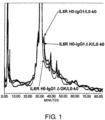
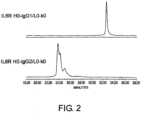
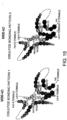
- This causes reduction of heterogeneity in hinge region see Fig. 16 ).
- the heterogeneity of hinge region can be reduced by increasing the distance between cysteine in the human ⁇ chain constant region and cysteine at position 219 (EU numbering) in one H chain.
- the heterogeneity of hinge region in a human ⁇ chain constant region can also be reduced by increasing the distance from cysteine at position 219 (EU numbering) in one H chain.
- the present disclosure can also be used to alter light-chain constant regions derived from nonhuman animals.
- light-chain constant regions derived from nonhuman animals include mouse antibody ⁇ chain constant region (SEQ ID NO: 40), rat antibody ⁇ chain constant region (SEQ ID NO: 41), and rabbit antibody ⁇ chain constant regions (SEQ ID NOs: 42 and 43), but are not limited thereto.
- the present disclosure provides mouse and rat antibody ⁇ chain constant regions having at least one Cys at positions 102 to 106, and antibodies comprising such light-chain constant regions.
- “there is at least one Cys at positions 102 to 106 in the mouse ⁇ chain constant region comprising the amino acid sequence of SEQ ID NO: 40 or the rat ⁇ chain constant region comprising the amino acid sequence of SEQ ID NO: 41” means that there is at least one Cys in the region between Phe at position 102 and Glu at position 106.
- the present disclosure provides rabbit ⁇ chain constant regions having at least one Cys at positions 99 to 103 in the rabbit antibody ⁇ chain constant region (SEQ ID NO: 42), and antibodies comprising such rabbit ⁇ chain constant regions.
- “there is at least one Cys at positions 99 to 103 in the rabbit ⁇ chain comprising the amino acid sequence of SEQ ID NO: 42” means that there is at least one Cys in the region between Phe at position 99 and Asp at position 103.
- the present disclosure also provides rabbit ⁇ chain constant regions having at least one Cys at positions 101 to 105 in the rabbit antibody ⁇ chain constant region (SEQ ID NO: 43), and antibodies comprising the rabbit ⁇ chain constant region.
- SEQ ID NO: 43 rabbit antibody ⁇ chain constant region
- “there is at least one Cys at positions 101 to 105 in the rabbit ⁇ chain comprising the amino acid sequence of SEQ ID NO: 43” means that there is at least one Cys in the region between Phe at position 101 and Asp at position 105.
- the number of Cys present in the region of positions 102 to 106 in a mouse ⁇ chain constant region, positions 102 to 106 in a rat ⁇ chain constant region, positions 99 to 103 in the rabbit ⁇ chain constant region (SEQ ID NO: 42), or positions 101 to 105 in the rabbit ⁇ chain constant region (SEQ ID NO: 43) is not particularly limited; however, the number is five or less, preferably three or less, more preferably two or less, and still more preferably one.
- the position of Cys is not particularly limited; however,
- the number of amino acids in such ⁇ chain constant region is not particularly limited; however,
- Methods for producing a mouse or rat ⁇ chain constant region that has at least one Cys at positions 102 to 106 are not particularly limited, and include, for example, the methods described below. It is also possible to use in combination the insertion, substitution, and deletion described below.
- methods for producing a mouse or rabbit ⁇ chain constant region that has at least one Cys at positions 99 to 103 are not particularly limited, and include, for example, the methods described below. It is also possible to use in combination the insertion, substitution, and deletion described below.
- Methods for producing a rabbit ⁇ chain constant region that has at least one Cys at positions 101 to 105 are not particularly limited, and include, for example, the methods described below. It is also possible to use in combination the insertion, substitution, and deletion described below.
- the present disclosure provides mouse and rat ⁇ chain constant regions that do not have Cys at position 107, and antibodies comprising such ⁇ chain constant regions.
- “there is no Cys at position 107 in a mouse ⁇ chain constant region comprising the amino acid sequence of SEQ ID NO: 40 or a rat ⁇ chain constant region comprising the amino acid sequence of SEQ ID NO: 41” means deletion of Cys at position 107, substitution of Cys at position 107 with another amino acid, insertion of other amino acids, relocation of Cys from position 107 to a different position; etc.
- Preferred ⁇ chain constant regions include those having deletion of Cys at position 107, relocation of Cys from position 107 to another position, or substitution of Cys at position 107 with another amino acid.
- ⁇ chain constant regions of the present disclosure include those which have at least one Cys at positions 102 to 106 but do not have Cys at position 107.
- Such preferred ⁇ chain constant regions include, for example, ⁇ chain constant regions having deletion of at least one amino acid at positions 1 to 106.
- ⁇ chain constant regions having deletion of at least one amino acid at positions 1 to 106.
- deletion of Glu at position 106 leads to relocation of Cys from position 107 to position 106, resulting in a ⁇ chain constant region having Cys at position 106 but not at position 107.
- the position of amino acid deletion is not particularly limited; however, the ⁇ chain constant region preferably comprises deletion of at least one amino acid at positions 102 to 106, more preferably deletion of the amino acid at position 105 or 106.
- the number of deleted amino acids is not particularly limited; however, the number is typically one to five, preferably one to three, more preferably one or two, and still more preferably one.
- Such preferred ⁇ chain constant regions include, for example, those having deletion of the amino acid at position 105 or 106.
- the above-described mouse and rat ⁇ chain constant regions which do not have Cys at position 107 include those having substitution of Cys for at least one amino acid at positions 102 to 106, and additionally having deletion of Cys at position 107 or substitution of Cys at position 107 with another amino acid.
- the number of amino acids substituted with Cys is not particularly limited; however, the number is typically one to five, preferably one to three, more preferably one or two, and still more preferably one.
- the position of Cys substitution is not particularly limited; however, such preferred substitution positions include positions 105 and 106.
- Such preferred ⁇ chain constant regions include, for example, those having substitution of Cys for Asn at position 105, and deletion of Cys at position 107 or substitution of Cys at position 107 with another amino acid, and those having substitution of Cys for Glu at position 106, and deletion of Cys at position 107 or substitution of Cys at position 107 with another amino acid.
- the mouse or rat ⁇ chain constant regions of the present disclosure may comprise other amino acid alterations in addition to the above-described amino acid alterations.
- Such ⁇ chain constant regions comprising other amino acid alterations and modifications are also included in the ⁇ chain constant regions of the present disclosure, as long as they comprise the above-described amino acid alteration.
- the present disclosure provides rabbit ⁇ chain constant regions which do not have Cys at position 104 in the rabbit ⁇ chain constant region (SEQ ID NO: 42) and antibodies comprising such ⁇ chain constant regions.
- “there is no Cys as position 104 in the rabbit ⁇ chain constant region comprising the amino acid sequence of SEQ ID NO: 42” means deletion of Cys at position 104, substitution of Cys at position 104 with another amino acid, insertion of other amino acids, relocation of Cys from position 104 to a different position; etc.
- Preferred ⁇ chain constant regions include those having deletion of Cys at position 104, relocation of Cys from position 104 to a different position, or substitution of Cys at position 104 with another amino acid.
- ⁇ chain constant regions include those which have at least one Cys at positions 99 to 103 but do not have Cys at position 104.
- Such preferred ⁇ chain constant regions include, for example, those having deletion of at least one amino acid at positions 1 to 103.
- deletion of Asp at position 103 leads to relocation of Cys from position 104 to position 103, resulting in a ⁇ chain constant region having Cys at position 103 but not at position 104.
- the position of amino acid deletion is not particularly limited; however, a ⁇ chain constant region preferably comprises deletion of at least one amino acid at positions 99 to 103, more preferably deletion of the amino acid at position 102 or 103.
- the number of deleted amino acids is not particularly limited; however, the number is typically one to five, preferably one to three, more preferably one or two, and still more preferably one.
- Such preferred ⁇ chain constant regions include, for example, those having deletion of the amino acid at position 102 or 103.
- the above-described rabbit ⁇ chain constant regions which do not have Cys at position 104 include those having substitution of Cys for at least one amino acid at positions 99 to 103 and additionally having deletion of Cys at position 104 or substitution of Cys at position 104 with another amino acid.
- the number of amino acids substituted with Cys is not particularly limited; however, the number is typically one to five, preferably one to three, more preferably one or two, and still more preferably one.
- the position of Cys substitution is not particularly limited; however, such preferred positions of substitution include positions 102 and 103.
- Such preferred ⁇ chain constant regions include, for example, those having substitution of Cys for Gly at position 102, and deletion of Cys at position 104 or substitution of Cys at position 104 with another amino acid, and those having substitution of Cys for Asp at position 103, and deletion of Cys at position 104 or substitution of Cys at position 104 with another amino acid.
- the rabbit ⁇ chain constant regions of the present disclosure may comprise other amino acid alterations in addition to the above-described amino acid alterations.
- ⁇ chain constant regions comprising other amino acid alterations and modifications are also included in the ⁇ chain constant regions of the present disclosure, as long as they comprise the above-described amino acid alterations.
- the present disclosure provides rabbit ⁇ chain constant regions which do not have Cys at position 106 in the rabbit ⁇ chain constant region (SEQ ID NO: 43) and antibodies comprising such ⁇ chain constant regions.
- “there is no Cys at position 106 in the rabbit ⁇ chain constant region comprising the amino acid sequence of SEQ ID NO: 43” means deletion of Cys at position 106, substitution of Cys at position 106 with another amino acid, insertion of other amino acids, relocation of Cys from position 106 to a different position; etc.
- Preferred ⁇ chain constant regions include those having deletion of Cys at position 106, relocation of Cys from position 106 to a different position, or substitution of Cys at position 106 with another amino acid.
- ⁇ chain constant regions of the present disclosure include those which have at least one Cys at positions 101 to 105 but do not have Cys at position 106.
- Such preferred ⁇ chain constant regions include, for example, those having deletion of at least one amino acid at positions 1 to 105.
- deletion of Asp at position 105 leads to relocation of Cys from position 106 to 105, resulting in a ⁇ chain constant region having Cys at position 105 but not at position 106.
- the position of amino acid deletion is not particularly limited; however, a human ⁇ chain constant region preferably comprises deletion of at least one amino acid at positions 101 to 105, more preferably deletion of the amino acid at position 104 or 105.
- the number of deleted amino acids is not particularly limited; however, the number is typically one to five, preferably one to three, more preferably one or two, and still more preferably one.
- Such preferred ⁇ chain constant regions include, for example, those having deletion of the amino acid at position 104 or 105.
- the above-described rabbit ⁇ chain constant regions which do not have Cys at position 106 include those which have substitution of Cys for at least one amino acid at positions 101 to 105, and additionally have deletion of Cys at position 106 or substitution of Cys at position 106 with another amino acid.
- the number of amino acids substituted with Cys is not particularly limited; however, the number is typically one to five, preferably one to three, more preferably one or two, and still more preferably one.
- the position of Cys substitution is not particularly limited; however, such preferred positions of substitution include positions 104 and 105.
- Such preferred ⁇ chain constant regions include, for example, those having substitution of Cys for Gly at position 104, and deletion of Cys at position 106 or substitution of Cys at position 106 with another amino acid, and those having substitution of Cys for Asp at position 105, and deletion of Cys at position 106 or substitution of Cys at position 106 with another amino acid.
- the rabbit ⁇ chain constant regions of the present disclosure may comprise other amino acid alterations in addition to the above-described amino acid alterations.
- ⁇ chain constant regions comprising other amino acid alterations and modifications are also included in the ⁇ chain constant regions of the present disclosure, as long as they comprise the above-described amino acid alterations.
- the present disclosure provides antibodies comprising heavy-chain constant regions having the above-described amino acid alterations.
- the present disclosure also provides antibodies comprising light chain constant regions having the above-described amino acid alterations.
- the present disclosure also provides antibodies comprising heavy chain constant regions having the above-described amino acid alterations and light chain constant regions having the above-described amino acid alterations.
- Amino acid alterations in the antibodies of the present disclosure include all possible alterations specified by the description herein and combinations thereof.
- the present disclosure also provides antibodies comprising light chains comprising light chain constant regions having the above-described amino acid alterations and heavy chain constant regions in which at least one Cys is substituted with another amino acid.
- heavy chain constant regions are not particularly limited; however, IgG2 heavy chain constant regions are preferred.
- His to be substituted is not particularly limited; however, the constant region includes, for example, those having substitution of another amino acid for at least one of: Cys at position 131 in the EU numbering (position 14 in SEQ ID NO: 24), Cys at position 219 in the EU numbering (position 102 in SEQ ID NO: 24), and Cys at position 220 in the EU numbering (position 103 in SEQ ID NO: 24).
- the combination is not particularly limited and includes the combination of substitutions at positions 131 and 219 (EU numbering) and the combination of substitutions at positions 131 and 220.
- the present disclosure provides antibodies comprising light chains comprising light chain constant regions having the above-described amino acid alterations, and heavy chains comprising heavy chain constant regions which have Cys at position 219 in the EU numbering (position 102 in SEQ ID NO: 24) but not at position 220 in the EU numbering (position 103 in SEQ ID NO: 24).
- heavy chain constant regions are not particularly limited; however, they are preferably IgG2 constant regions, more preferably M66 and M106.
- the antibody constant regions may have one or more amino acid substitutions, deletions, additions, and/or insertions (for example, 20 amino acids or less, or 10 amino acids or less).
- variable regions that constitute the antibodies of the present disclosure may recognize any antigen.
- Preferred variable regions of the present disclosure include antibody variable regions having an antigen-neutralizing activity.
- the variable regions that constitute the antibodies of the present disclosure include, for example, antibody variable regions having an activity of neutralizing IL6 receptor, IL31 receptor, or RANKL.
- the antibodies of the present disclosure are not particularly limited in type, origin, or such; any antibody may be used herein as long as it has the above-described antibody constant region.
- the origin of antibodies is not particularly limited.
- the antibodies include human, mouse, rat, and rabbit antibodies.
- the antibodies of the present disclosure may be chimeric, humanized, fully humanized antibodies, or such. In a preferred implementation, the antibodies of the present disclosure are humanized antibodies.
- Antibody molecules of the present disclosure usually include heavy chains and light chains.
- Heavy chains may include variable regions in addition to constant regions.
- Variable regions may include variable portions derived not only from humans but also from nonhuman animal species.
- CDRs from variable portions derived from non-human species such as mice can be transplanted to humanize the variable portions.
- Antibody molecules composed of heavy chains and light chains may be oligomers. Specifically, they may be monomers, dimers, or larger oligomers.
- antigen constant regions may be linked with various molecules such as bioactive peptides or antigen-binding peptides to be fusion proteins.
- the antibodies of the present disclosure also include modification products of an antibody comprising any one of the constant regions described above.
- Such antibody modification products include, for example, antibodies linked with various molecules such as polyethylene glycol (PEG) and cytotoxic substances.
- PEG polyethylene glycol
- Such antibody modification products can be obtained by chemically modifying antibodies of the present disclosure. Methods for modifying antibodies are already established in this field.
- the antibodies of the present disclosure may also be bispecific antibodies.
- Bispecific antibody refers to an antibody that has in a single molecule variable regions that recognize different epitopes.
- the epitopes may be present in a single molecule or in separate molecules.
- the antibody constant regions described above can be used as a constant region in an antibody against an arbitrary antigen.
- the antigen is not particularly limited.
- the antibodies of the present disclosure can also be obtained by methods known to one skilled in the art.
- Methods for substituting or deleting one or more amino acid residues with amino acids of interest include, for example, site-directed mutagenesis ( Hashimoto-Gotoh, T., Mizuno, T., Ogasahara, Y., and Nakagawa, M.
- site-directed mutagenesis Hashimoto-Gotoh, T., Mizuno, T., Ogasahara, Y., and Nakagawa, M.
- an antibody that binds to an antigen of interest is first prepared by methods known to those skilled in the art.
- the prepared antibody is derived from a nonhuman animal, it can be humanized.
- the binding activity of the antibody can be determined by known methods.
- one or more amino acid residues in the constant region of the antibody are deleted or substituted with amino acids of interest.
- the present disclosure relates to methods for producing antibodies with altered amino acid residues in the heavy chain and/or light chain constant regions, which comprise the steps of:
- Such alterations of amino acid residues in the heavy chain constant region include, but are not limited to, for example, those described below.
- amino acid alterations of light chain constant regions include, for example, those described below; but are not limited thereto.
- the alterations described below can reduce the heterogeneity of hinge region.
- the present disclosure provides methods for producing antibodies, which comprise the step of culturing host cells that comprise a vector introduced with a polynucleotide encoding an antibody heavy chain comprising the heavy chain constant region with the amino acid alterations of the present disclosure and/or a polynucleotide encoding an antibody light chain comprising the light chain constant region with the amino acid alterations of the present disclosure.
- the present disclosure provides methods for producing antibodies that comprise a heavy chain constant region with the amino acid alterations of the present disclosure and/or a light chain constant region with the amino acid alterations of the present disclosure, which comprise the steps of:
- Such amino acid alterations of the heavy chain constant region include the amino acid substitutions or deletions described above in (1) to (3), but are not limited thereto.
- Such amino acid alterations of the light chain constant region include the amino acid substitutions or deletions described above (1) to (27), but are not limited thereto.
- DNAs are expressed: a DNA encoding an antibody heavy chain in which one or more amino acid residues in the constant region have been deleted or substituted with amino acids of interest, and/or a DNA encoding an antibody light chain in which one or more amino acid residues in the constant region have been deleted or substituted with amino acids of interest.
- a DNA encoding a heavy chain in which one or more amino acid residues in the constant region are deleted or substituted with amino acids of interest and/or a DNA encoding a light chain in which one or more amino acid residues in the constant region are deleted or substituted with amino acids of interest can be prepared, for example, by obtaining a DNA encoding the constant region of a wild type heavy chain and/or light chain, and introducing an appropriate substitution so that a codon encoding a particular amino acid in the constant region encodes an amino acid of interest.
- a DNA encoding a heavy chain in which one or more amino acid residues in the constant region are deleted or substituted with amino acids of interest and/or a DNA encoding a light chain in which one or more amino acid residues in the constant region are deleted or substituted with amino acids of interest can also be prepared by designing and then chemically synthesizing a DNA encoding a protein in which one or more amino acid residues in the constant region of the wild type heavy chain are deleted or substituted with amino acids of interest.
- amino acid substitution and deletion include the substitutions and deletions described herein, but are not limited thereto.
- a DNA encoding a heavy chain in which one or more amino acid residues in the constant region are deleted or substituted with amino acids of interest and/or a DNA encoding a light chain in which one or more amino acid residues in the constant region are deleted or substituted with amino acids of interest can also be prepared as a combination of partial DNAs.
- Such combinations of partial DNAs include, for example, the combination of a DNA encoding a variable region and a DNA encoding a constant region, and the combination of a DNA encoding an Fab region and a DNA encoding an Fc region, but are not limited thereto.
- a heavy chain expression vector is constructed by inserting a DNA encoding a heavy chain variable region into an expression vector along with a DNA encoding a heavy chain constant region.
- a light chain expression vector is constructed by inserting a DNA encoding a light chain variable region into an expression vector along with a DNA encoding a light chain constant region.
- these heavy and light chain genes may be inserted into a single vector.
- Expression vectors include, for example, SV40 virus-based vectors, EB virus-based vectors, and BPV (papilloma virus)-based vectors, but are not limited thereto.
- Host cells are co-transformed with an antibody expression vector constructed by the methods described above.
- Such host cells include the above-described cells such as Chinese hamster ovary (CHO) cells as well as microorganisms such as E. coli, yeast, and Bacillus subtilis, and plants and animals ( Nature Biotechnology (2007) 25: 563-565 ; Nature Biotechnology (1998) 16: 773-777 ; Biochemical and Biophysical Research Communications (1999) 255: 444-450 ; Nature Biotechnology (2005) 23: 1159-1169 ; Journal of Virology (2001) 75: 2803-2809 ; Biochemical and Biophysical Research Communications (2003) 308: 94-100 ).
- Such host cells also include human embryonic kinder cancer cell-derived HEK298H cells.
- the transformation can be preferably achieved by using electroporation, the lipofectin method ( R. W. Malone et al., Proc. Natl. Acad. Sci. USA (1989) 86: 6077 ; P. L. Felgner et al., Proc. Natl. Acad. Sci. USA (1987) 84: 7413 ), calcium phosphate method ( F. L. Graham & A. J. van der Eb, Virology (1973) 52: 456-467 ), DEAE-Dextran method, and the like.
- the expression products are collected.
- the expression products can be collected, for example, by culturing the transformants and then separating and purifying the antibody from the transformed cells or culture media. Separation and purification of antibodies can be achieved by an appropriate combination of methods such as centrifugation, ammonium sulfate fractionation, salting out, ultrafiltration, columns of 1q, FcRn, Protein A, and Protein G, affinity chromatography, ion exchange chromatography, and gel filtration chromatography.
- the present disclosure provides antibodies produced as described above. More specifically, the present disclosure relates to antibodies that can be produced by the following steps:
- the amino acid sequences of the constant regions of heavy and light chains are the above-mentioned constant regions provided by the present disclosure.
- the heavy chain constant region consists of, for example, the amino acid sequence of SEQ ID NOs: 24 and 26 to 31. Linking a DNA consisting of the nucleotide sequence encoding this amino acid sequence with a DNA encoding the heavy chain variable region can produce a DNA encoding the antibody heavy chain.
- the light chain constant region consists of, for example, the amino acid sequence of SEQ ID NOs: 32 to 34 and 37 to 39. Linking a DNA consisting of the nucleotide sequence encoding this amino acid sequence with a DNA encoding the light chain variable region can produce a DNA encoding the antibody heavy chain.
- variable regions that constitute the antibodies of the present disclosure may recognize any antigen.
- the variable regions that constitute the antibodies of the present disclosure are not particularly limited, and include, for example, those described below.
- the heavy-chain variable region may be, for example, variable regions having the CDR1, CDR2, and CDR3 of the humanized antibody heavy chain comprising the amino acid sequence of SEQ ID NO: 5.
- the light-chain variable region may be variable regions having the CDR1, CDR2, and CDR3 of the humanized antibody light chain comprising the amino acid sequence of SEQ ID NO: 2.
- the heavy-chain variable region may be, for example, variable regions having the CDR1, CDR2, and CDR3 of the humanized antibody heavy chain comprising the amino acid sequence of SEQ ID NO: 13.
- the light-chain variable region may be variable regions having the CDR1, CDR2, and CDR3 of the humanized antibody light chain comprising the amino acid sequence of SEQ ID NO: 12.
- the heavy-chain variable region may be variable regions having the CDR1, CDR2, and CDR3 of the humanized antibody heavy chain comprising the amino acid sequence of SEQ ID NO: 17.
- the light-chain variable region may be variable regions having the CDR1, CDR2, and CDR3 of the humanized antibody light chain comprising the amino acid sequence of SEQ ID NO: 16.
- the amino acid sequences that constitute heavy chain and light chain variable regions may have one or more amino acid residue alterations and/or modifications, as long as they retain antigen-binding activity.
- altering antibody variable regions it is preferable to conserve the amino acid sequences of CDRs.
- the antigen-binding activity of the variable regions can be maintained by conserving the amino acid sequences of CDRs.
- the acceptable number of altered amino acid residues in a variable region is generally one to ten, for example, one to five, and preferably one or two amino acids.
- the modification of the N-terminal glutamine of a variable region into pyroglutamic acid by pyroglutamylation is a modification well known to those skilled in the art.
- the heavy-chain N terminus is glutamine
- the antibodies of the present disclosure comprise the variable regions in which the glutamine is modified to pyroglutamic acid.
- the alterations of the present disclosure include substitutions, deletions, additions, and/or insertions of the above-described amino acids, and combinations thereof.
- the present disclosure provides genes encoding antibody constant regions comprising the amino acid alterations of the present disclosure.
- Such genes encoding the antibody constant regions of the present disclosure may be any gene such as DNA or RNA.
- the present disclosure also provides vectors carrying the genes.
- the type of vector can be appropriately selected by those skilled in the art depending on the host cells to be introduced with the vector.
- the vectors include, for example, those described above.
- host cells transformed with the vectors can be selected by those skilled in the art.
- the host cells include, for example, those described above.
- the present disclosure also relates to methods for producing the constant regions of the present disclosure, which comprise the steps of culturing the host cells and collecting the expressed constant regions of the present disclosure.
- the present disclosure also relates to methods for improving antibody functions, which comprise the step of altering amino acids in the human IgG2 constant region of SEQ ID NO: 24.
- the present disclosure also relates to antibodies produced by methods comprising the above-described step.
- the improvement of antibody functions includes improvement of antibody stability, reduction of immunogenicity, and improvement of pharmacokinetics, but is not limited thereto.
- the methods of the present disclosure comprise the steps of:
- amino acids after substitution are not particularly limited; however,
- the methods of the present disclosure may additionally comprise the step of altering (substituting, deleting, adding, and/or inserting) other amino acids, modifying amino acids, and such, as long as they comprise the steps described above.
- the methods for altering or modifying amino acids are not particularly limited, and include, for example, the above-described site-specific mutagenesis and the methods described in the Examples herein.
- the methods of the present disclosure may also comprise, in addition to the above-described steps, the step of deleting Gly at position 325 (position 446 (EU numbering)) and Lys at position 326 (position 447 (EU numbering)) to reduce the C-terminal heterogeneity.
- the present disclosure relates to methods for improving antibody functions, which comprise the step of altering amino acids of the human IgG2 constant region of SEQ ID NO: 24.
- the present disclosure also relates to antibodies produced by methods comprising the step.
- improvement of antibody functions includes, but is not limited to, improvement of antibody stability, reduction of immunogenicity, improvement of safety, and improvement of pharmacokinetics.
- the methods of the present disclosure comprise the steps of:
- amino acids after substitution are not particularly limited; however,
- the methods of the present disclosure may additionally comprise the step of altering (substituting, deleting, adding, and/or inserting) other amino acids, modifying amino acids, and such, as long as they comprise the above-described steps.
- the methods for altering or modifying amino acids are not particularly limited, and include, for example, the above-described site-specific mutagenesis and the methods described in the Examples herein.
- the methods of the present disclosure may also comprise, in addition to the above-described steps, the step of deleting Gly at position 325 (position 446 (EU numbering)) and Lys at position 326 (position 447 (EU numbering)) to reduce the C-terminal heterogeneity.
- the present disclosure relates to methods for improving the blood kinetics (pharmacokinetics) of an antibody by controlling (or changing) the disulfide bond pattern in antibody constant regions.
- the antibody constant regions are not particularly limited; however, it is preferable to control the pattern of disulfide bonds between an antibody light chain constant region ( ⁇ chain constant region or ⁇ chain constant region) and IgG2 constant region.
- the present disclosure relates to methods for improving pharmacokinetics of an antibody, which comprise the step of allowing specific formation of a disulfide bond between Cys in the light chain C-terminal region and Cys at position 219 (EU numbering) in the heavy-chain constant region.
- every antibody forms a disulfide bond between Cys in the light chain C-terminal region and Cys at position 219 (EU numbering) in the heavy-chain constant region.
- the step of allowing formation of a disulfide bond between Cys in the light chain C-terminal region and Cys at position 219 (EU numbering) in the heavy-chain constant region may be achieved by any method, for example, by substituting another amino acid for Cys at position 220 (EU numbering) in the heavy chain (position 103 in SEQ ID NO: 24).
- Cys at position 220 may be substituted with another amino acid.
- the amino acids after substitution are not particularly limited, and include, for example, Ser.
- Cys in the light chain C-terminal region is typically Cys in the region of positions 102 to 106 (for example, positions 102 to 106 in the human ⁇ chain constant region of SEQ ID NO: 32), preferably Cys in the region of positions 104 to 106.
- the Cys is typically Cys in the region of positions 99 to 105 (for example, positions 99 to 105 in the human ⁇ chain constant region of SEQ ID NO: 37), preferably Cys in the region of positions 102 to 104.
- An IgG2 constant region used in the methods of the present disclosure may comprise one or more amino acid deletions, substitutions, additions, and/or insertions (for example, 20 amino acids or less, or 10 amino acids or less) in the amino acid sequence of SEQ ID NO: 24.
- An IgG2 constant region used in the methods of the present disclosure may comprise alterations specified by the description herein and combinations thereof.
- a human ⁇ chain constant region used in the methods of the present disclosure may comprise one or more amino acid deletions, substitutions, additions, and/or insertions (for example, 20 amino acids or less, or 10 amino acids or less) in the amino acid sequence of SEQ ID NO: 32.
- a human ⁇ chain constant region used in the methods of the present disclosure may comprise one or more amino acid deletions, substitutions, additions, and/or insertions (for example, 20 amino acids or less, or 10 amino acids or less) in the amino acid sequence of SEQ ID NO: 37.
- human ⁇ and ⁇ chain constant regions used in the methods of the present disclosure may comprise alterations specified by the description herein and combinations thereof.
- Antibodies in which a disulfide bond between Cys in the light chain C-terminal region and Cys at position 219 (EU numbering) in the heavy-chain constant region has been formed are demonstrated to be superior in pharmacokinetics as compared to antibodies having a disulfide bond between Cys in the light chain C-terminal region and Cys at position 220 (EU numbering) in the heavy-chain constant region.
- the present disclosure provides antibodies with improved pharmacokinetics by allowing formation of a disulfide bond between Cys in the light chain C-terminal region and Cys at position 219 (EU numbering) in the heavy-chain constant region.
- the methods of the present disclosure are useful in producing antibodies that are superior in pharmacokinetics and excellent as pharmaceuticals.
- the present disclosure relates to methods for reducing the heterogeneity of hinge region, which comprise the step of introducing at least one Cys at positions 102 to 106 into the human ⁇ constant region of SEQ ID NO: 32, the mouse ⁇ chain constant region of SEQ ID NO: 40, or the rat ⁇ chain constant region of SEQ ID NO: 41.
- the present disclosure also relates to antibodies produced by methods comprising the above-described step.
- introducing at least one Cys at positions 102 to 106 means achieving the state where there is at least one Cys at positions 102 to 106 in a human ⁇ chain constant region.
- the present disclosure relates to methods for reducing the heterogeneity of hinge region, which comprise the step of removing (deleting) Cys at position 107 from the human ⁇ constant region of SEQ ID NO: 32, the mouse ⁇ chain constant region of SEQ ID NO: 40, or the rat ⁇ chain constant region of SEQ ID NO: 41.
- the present disclosure also relates to antibodies produced by methods comprising the above-described step.
- removing Cys at position 107 means achieving the state where there is no Cys at position 107 in a human ⁇ chain constant region.
- the present disclosure relates to methods for reducing the heterogeneity of hinge region in the human ⁇ constant region of SEQ ID NO: 32, the mouse ⁇ chain constant region of SEQ ID NO: 40, or the rat ⁇ chain constant region of SEQ ID NO: 41, which comprise the steps of:
- the steps of introducing at least one Cys at positions 102 to 106 and the step of removing Cys at position 107 may be carried out in a single step.
- the number of Cys to be introduced in the step of introducing at least one Cys at positions 102 to 106 is not particularly limited; however, the number is five or less, preferably three or less, more preferably two or one, and still more preferably one.
- the position of Cys introduction is not particularly limited; however, the position is preferably 104, 105, or 106, more preferably 105 or 106, and particularly preferably 106.
- the step of introducing at least one Cys at positions 102 to 106 includes, for example, the steps described below. Such steps may be used in combination.
- the step of removing Cys at position 107 includes, for example, the following steps.
- the methods of the present disclosure i.e., methods for reducing the heterogeneity of hinge region and methods for enhancing FcRn binding, which comprise the steps of:
- the position of amino acid deletion is not particularly limited; however, the human ⁇ chain constant region preferably comprises deletion of at least one amino acid at positions 102 to 106, more preferably deletion of the amino acid at position 105 or 106.
- the number of deleted amino acids is not particularly limited; however, the number is typically one to five, preferably one to three, more preferably one or two, and still more preferably one.
- Such preferred steps include, but are not limited to, for example, the following steps.
- the methods of the present disclosure include methods comprising the steps of:
- such steps include, for example, the steps of:
- such steps include the steps of:
- the present disclosure relates to methods for reducing the heterogeneity of hinge region, which comprise the step of introducing at least one Cys at positions 99 to 103 in the human ⁇ constant region of SEQ ID NO: 37 or the rabbit ⁇ chain constant region of SEQ ID NO: 42.
- the present disclosure also relates to antibodies produced by methods comprising the above-described steps.
- introducing at least one Cys at positions 99 to 103 means achieving the state where there is at least one Cys at positions 99 to 103 in the human ⁇ chain constant region.
- the present disclosure relates to methods for reducing the heterogeneity of hinge region, which comprise the step of removing (deleting) Cys at position 104 in the human ⁇ constant region of SEQ ID NO: 37 or rabbit ⁇ chain constant region of SEQ ID NO: 42.
- the present disclosure also relates to antibodies produced by methods comprising the above-described steps.
- removing Cys at position 104" means achieving the state where there is no Cys at position 104 in the human ⁇ chain constant region.
- the present disclosure relates to methods for reducing the heterogeneity of hinge region, which comprise the steps of:
- the steps of introducing at least one Cys at positions 99 to 103 and removing Cys at position 104 may be achieved in a single step.
- the number of Cys introduced in the step of introducing at least one Cys at positions 99 to 103 is not particularly limited; however, the number is five or less, preferably three or less, more preferably two or one, and still more preferably one.
- the position of Cys introduction is not particularly limited; however, the position is preferably 101, 102, or 103, more preferably 102 or 103, and particularly preferably 103.
- the step of introducing at least one Cys at positions 99 to 103 includes, for example, those described below.
- the steps described below may be used in combination.
- the step of removing Cys at position 104 includes, but is not limited to, for example, those described below.
- the methods of the present disclosure i.e., methods for reducing the heterogeneity of hinge region, which comprise the steps of
- the position of amino acid deletion is not particularly limited; however, a human ⁇ chain constant region preferably comprises deletion of at least one amino acid at positions 99 to 103, more preferably deletion of the amino acid at position 102 or 103.
- the number of deleted amino acids is not particularly limited; however, the number is typically one to five, preferably one to three, more preferably one or two, and still more preferably one.
- Such preferred steps include, but are not limited to, for example, those described below.
- the methods of the present disclosure include methods comprising the steps of:
- the number of amino acids substituted with Cys is not particularly limited; however, the number is typically one to five, preferably one to three, more preferably one or two, and still more preferably one.
- the position of Cys substitution is not particularly limited; however, the position is preferably 102 or 103.
- the steps include, but are not limited to, for example, the steps of:
- the steps include, but are not limited to, the steps of:
- the present disclosure relates to methods for reducing the heterogeneity of hinge region, which comprise the step of introducing at least one Cys at positions 101 to 105 in the rabbit ⁇ chain constant region of SEQ ID NO: 43.
- the present disclosure also relates to antibodies produced by methods comprising the above-described steps.
- introducing at least one Cys at positions 101 to 105" means achieving the state where there is at least one Cys at positions 101 to 105 in the rat ⁇ chain constant region.
- the present disclosure relates to methods for reducing the heterogeneity of hinge region, which comprise the step of removing (deleting) Cys at position 106 in the rabbit ⁇ chain constant region of SEQ ID NO: 43.
- the present disclosure also relates to antibodies produced by methods comprising the above-described steps.
- removing Cys at position 106 means achieving the state where there is no Cys at position 106 in the rat ⁇ chain constant region.
- the present disclosure relates to methods for reducing the heterogeneity of hinge region, which comprise the steps of:
- the steps of introducing at least one Cys at positions 101 to 105 and removing Cys at position 106 may be achieved in a single step.
- the number of Cys introduced in the step of introducing at least one Cys at positions 101 to 105 is not particularly limited; however, the number is five or less, preferably three or less, more preferably two or one, and still more preferably one.
- the position of Cys introduction is not particularly limited; however, the position is preferably 103, 104, or 105, more preferably 104 or 105, and particularly preferably 105.
- the step of introducing at least one Cys at positions 101 to 105 includes, for example, those described below.
- the steps described below may be used in combination.
- the step of removing Cys at position 106 includes, but is not limited to, for example, those described below.
- the methods of the present disclosure i.e., methods for reducing the heterogeneity of hinge region, which comprise the steps of:
- the position of amino acid deletion is not particularly limited; however, a human ⁇ chain constant region preferably comprises deletion of at least one amino acid at positions 101 to 105, more preferably deletion of the amino acid at position 104 or 105.
- the number of deleted amino acids is not particularly limited; however, the number is typically one to five, preferably one to three, more preferably one or two, and still more preferably one.
- Such preferred steps include, but are not limited to, for example, those described below.
- the methods of the present disclosure include methods comprising the steps of:
- such steps include, but are not limited to, for example, the steps of
- the methods of the present disclosure comprise the above-described steps, they may additionally comprise other steps, for example, the step of altering (substituting, deleting, adding, and/or inserting) other amino acids or modifying amino acids.
- the present invention provides pharmaceutical compositions comprising the antibodies or constant regions of the present invention.
- the present disclosure also provides antibody pharmaceutical compositions in which the ratio of antibody having a disulfide bond between Cys in the light chain C-terminal region and Cys at position 219 (EU numbering) in the heavy chain constant region is 80% or more, preferably 90% or more, more preferably 95% or more, and still more preferably 99% or more.
- compositions of the present disclosure can be formulated, in addition to the antibodies or constant regions, with pharmaceutically acceptable carriers by known methods.
- the compositions can be used parenterally, when the antibodies are formulated in a sterile solution or suspension for injection using water or any other pharmaceutically acceptable liquid.
- the compositions can be formulated by appropriately combining the antibodies with pharmaceutically acceptable carriers or media, specifically, sterile water or physiological saline, vegetable oils, emulsifiers, suspending agents, surfactants, stabilizers, flavoring agents, excipients, vehicles, preservatives, binding agents, and such, by mixing them at a unit dose and form required by generally accepted pharmaceutical implementations.
- the content of the active ingredient in such a formulation is adjusted so that an appropriate dose within the required range can be obtained.
- Sterile compositions for injection can be formulated using vehicles such as distilled water for injection, according to standard protocols.
- Aqueous solutions used for injection include, for example, physiological saline and isotonic solutions containing glucose or other adjuvants such as D-sorbitol, D-mannose, D-mannitol, and sodium chloride. These can be used in conjunction with suitable solubilizers such as alcohol, specifically ethanol, polyalcohols such as propylene glycol and polyethylene glycol, and non-ionic surfactants such as Polysorbate 80 TM and HCO-50.
- suitable solubilizers such as alcohol, specifically ethanol, polyalcohols such as propylene glycol and polyethylene glycol, and non-ionic surfactants such as Polysorbate 80 TM and HCO-50.
- Oils include sesame oils and soybean oils, and can be combined with solubilizers such as benzyl benzoate or benzyl alcohol. These may also be formulated with buffers, for example, phosphate buffers or sodium acetate buffers; analgesics, for example, procaine hydrochloride; stabilizers, for example, benzyl alcohol or phenol; or antioxidants.
- buffers for example, phosphate buffers or sodium acetate buffers
- analgesics for example, procaine hydrochloride
- stabilizers for example, benzyl alcohol or phenol
- antioxidants antioxidants.
- the administration is preferably carried out parenterally, and specifically includes injection, intranasal administration, intrapulmonary administration, and percutaneous administration.
- injections can be administered systemically or locally by intravenous injection, intramuscular injection, intraperitoneal injection, or subcutaneous injection.
- the method of administration can be appropriately selected according to the age and symptoms of the patient.
- a single dose of the pharmaceutical composition containing an antibody or a polynucleotide encoding an antibody can be selected, for example, from the range of 0.0001 to 1,000 mg per kg of body weight.
- the dose may be, for example, in the range of 0.001 to 100,000 mg/patient.
- the dose is not limited to these values.
- the dose and method of administration vary depending on the patient's body weight, age, and symptoms, and can be appropriately selected by those skilled in the art.
- TOCILIZUMAB which is an anti-IL-6 receptor antibody
- the main component is a sequence in which the C-terminal amino acid lysine present on the nucleotide sequence is deleted by post-translational modification, but an accessory component with remnant lysine and an accessory component with an amidated C-terminal carboxyl group produced by deletion of both glycine and lysine are also present as heterogeneities.
- single substances are desirable as much as possible, and in developing antibodies as pharmaceuticals, such heterogeneities are desirably reduced. Therefore, in terms of development as pharmaceuticals, absence of heterogeneities of the H-chain C terminal is desirable.
- the C-tenninal amino acids were altered to reduce the C-terminal heterogeneity.
- the present inventors altered the nucleotide sequence of wild type IgG1 to delete the C-terminal lysine and glycine from the H-chain constant region of the IgG1, and assessed whether the amidation of the C-terminal amino group due to deletion of the two C-terminal amino acids glycine and lysine could be suppressed.
- TOCILIZUMAB (hereinafter abbreviated as IL6R H0/L0-IgG1) consisting of H0-IgG1 (amino acid SEQ ID NO: 1) as an H chain and L0-k0 (amino acid SEQ ID NO: 2) as an L chain was prepared. Furthermore, the nucleotide sequence of the H chain encoding Lys at position 447 and/or Gly at position 446 (EU numbering) was converted into a stop codon.
- expression vectors for antibody H chain H0-IgG1 ⁇ K (amino acid SEQ ID NO: 3) engineered to lack the C-terminal amino acid lysine (position 447 (EU numbering)) and antibody H chain H0-IgG1 ⁇ GK (amino acid SEQ ID NO: 4) engineered to lack the two C-terminal amino acids glycine and lysine (positions 446 and 447 (EU numbering), respectively) were constructed.
- IL6R H0-IgG1/L0-k0 consisting of H0-IgG1 (amino acid SEQ ID NO: 1) as the H chain and L0-k0 (amino acid SEQ ID NO: 2) as the L chain
- IL6R H0-IgG1 ⁇ K/L0-k0 consisting of H0-IgG1 ⁇ K (amino acid SEQ ID NO: 3) as the H chain and L0-k0 (amino acid SEQ ID NO: 2) as the L chain
- IL6R H0-IgG1 ⁇ GK/L0-k0 consisting of H0-IgG1 ⁇ GK-K0 (amino acid SEQ ID NO: 4) as the H chain and L0-k0 (amino acid SEQ ID NO: 2) as the L chain were expressed and purified by the method described in Reference Example 1.
- Heterogeneity of the purified antibodies was evaluated by performing cation exchange chromatography.
- ProPac WCX-10, 4 x 250 mm (Dionex) was used for the column, 25 mmol/L MES/NaOH, pH 6.1 was used as mobile phase A, 25 mmol/L MES/NaOH, 250 mmol/L NaCl, pH 6.1 was used as mobile phase B, and the chromatography was performed using appropriate flow and gradient.
- Fig. 1 The results of performing cation exchange chromatographic evaluations on the purified IL6R H0-IgG1/L0-k0, IL6R H0-IgG1 ⁇ K/L0-k0, and IL6R H0-IgG1 ⁇ GK/L0-k0 are shown in Fig. 1 .
- heterogeneity of the C-terminal amino acid can be decreased for the first time by deleting both the C-terminal lysine and glycine of the H-chain constant region, not only the C-terminal lysine of the H-chain constant region, from the nucleotide sequence.
- the C-terminal sequence is lysine at position 447 and glycine at position 446 in the EU numbering (see Sequences of proteins of immunological interest, NIH Publication No. 91-3242 ) in all cases; therefore, the method of reducing C-terminal amino acid heterogeneity discovered in the present examination was considered to be applicable to the IgG2 constant region and IgG4 constant region, or their modified forms.
- IgG1 constant region (isotype) having effector function is preferred.
- binding to Fc ⁇ receptors is not preferred.
- IgG2 As methods for decreasing the binding to Fc ⁇ receptors, the method of changing the IgG antibody isotype from IgG1 to IgG2 or IgG4 has been considered ( Ann Hematol. 1998 Jun; 76(6): 231-48 ), and from the viewpoint of binding to Fc ⁇ receptor I and pharmacokinetics of each isotype, IgG2 was considered to be more desirable than IgG4 ( Nat Biotechnol. 2007 Dec; 25(12): 1369-72 ).
- physicochemical properties of the proteins, particularly homogeneity and stability are extremely important.
- the IgG2 isotype has been reported to have a very large degree of heterogeneity caused by disulfide bond linkage differences in the hinge region ( J Biol Chem. 2008 Jun 6; 283(23): 16194-205 ; J Biol Chem. 2008 Jun 6; 283(23): 16206-15 ; Biochemistry 2008 Jul 15; 47(28): 7496-508 ).
- IL6R H0-IgG1/L0-k0 having the constant regions of natural IgG1 and IL6R H0-IgG2/L0-k0 having the constant regions of natural IgG2 were actually produced and heterogeneity evaluations were carried out for both of them.
- IL6R H0-IgG1/L0-k0 which was produced in Example 1 consisting of IL6R H0-IgG1 (amino acid SEQ ID NO: 1) as the H chain and IL6R L0-k0 (amino acid SEQ ID NO: 2) as the L chain and IL6R H0-IgG2/L0-k0 consisting of IL6R H0-IgG2 (amino acid SEQ ID NO: 5) as the H chain in which the H-chain constant region was converted into IgG2 and IL6R L0-k0 (amino acid SEQ ID NO: 2) as the L chain were expressed and purified by the method described in Reference Example 1.
- Evaluation by cation exchange chromatography was carried out as the method for evaluating the heterogeneity caused by disulfide bonds in IL6R H0-IgG1/L0-k0 having the constant regions of natural IgG1 and IL6R H0-IgG2/L0-k0 having the constant regions of natural IgG2.
- ProPac WCX-10 (Dionex) was used for the column, 20 mM sodium acetate, pH 5.0 was used as mobile phase A, 20 mM sodium acetate, 1M NaCl, pH 5.0 was used as mobile phase B, and the chromatography was performed using appropriate flow and gradient. As a result, as shown in Fig.
- IL6R H0-IgG2/L0-k0 having the constant regions of natural IgG2 showed multiple peaks and it was found to have markedly high heterogeneity compared to IL6R H0-IgG1/L0-k0 having the constant regions of natural IgG1 showing only almost single main peak.
- Fig. 3 The details of the structure around the hinge region of an IgG-type antibody are shown in Fig. 3 .
- H and L chains (or two H chains) form disulfide bonds around the hinge region. This pattern of disulfide bonds differ depending on the isotypes of the IgG-type antibodies as indicated below. It is considered that since disulfide bonds in the hinge region of natural IgG1 have a single pattern such as that shown in Fig. 4 , heterogeneity caused by disulfide bonds does not exist and it was eluted as a nearly single main peak in cation exchange chromatography. In contrast, as shown in Fig.
- natural IgG2 has two cysteines in the hinge region (positions 219 and 220 (EU numbering)), and cysteines exist adjacent to these two cysteines of the hinge region, which are cysteine at position 131 (EU numbering), present in the H-chain CH1 domain, cysteine at the L-chain C terminus, and two cysteines of the corresponding hinge region of the H chain of the dimerization partner. Therefore, around the hinge region of IgG2, there are a total of eight neighboring cysteines when an H2L2 assembly is formed. This leads to the presence of a variety of heterogeneity due to disulfide bond linkage differences in natural IgG2, and the heterogeneity is considered to be remarkably high.
- cysteine at position 220 (EU numbering) in the sequence of IgG1 H-chain constant region (amino acid SEQ ID NO: 23) bond to cysteine at position 214 (for the numbering system, see Sequences of proteins of immunological interest, NIH Publication No. 91-3242) in the L chain ( Nat Biotechnol. 2007 Dec; 25(12): 1369-72 ; Anal Chem. 2008 Mar. 15; 80(6): 2001-9 ) by a disulfide bond.
- cysteine at position 131 (EU numbering) in the sequence of IgG4 H-chain constant region (amino acid SEQ ID NO: 25) bond to cysteine at position 214 (for the numbering system, see Sequences of proteins of immunological interest, NIH Publication No. 91-3242 ) by a disulfide bond in the L chain ( Nat Biotechnol. 2007 Dec; 25(12): 1369-72 ; Protein Sci. 1997 Feb; 6(2): 407-15 ). It has been reported that as described above, the pattern of disulfide bonds between the H chain and L chain is different between natural IgG1 and IgG4. The disulfide bond patterns of the natural IgG1 and IgG4 are shown in Fig. 5 . However, to date, there has been no report on the effect of the pattern of disulfide bonds between H chain and L chain on stability.
- IL6R H0-IgG0/L0-k0 which consists of IL6R H0-IgG1 (amino acid SEQ ID NO: 1) as H chain and IL6R L0-k0 (amino acid SEQ ID NO: 2) as L chain
- IL6R H0-IgG4/L0-k0 which consists of IL6R H0-IgG4 (amino acid SEQ ID NO: 6) as an H-chain constant region resulting from IgG4 conversion and IL6R L0-k0 (amino acid SEQ ID NO: 2) as L chain
- Tm value the midpoint of thermal denaturation (Tm value) was determined by differential scanning calorimetry (DSC) (N-DSCII, Calorimetry Science Corporation).
- the midpoint temperature of thermal denaturation (Tm value) is a stability indicator.
- higher thermal denaturation midpoints (Tm values) are preferable for producing stable preparations as pharmaceuticals ( J Pharm Sci. 2008 Apr; 97(4): 1414-26 ).
- Purified IL6R H0-IgG1/L0-k0 and IL6R H0-IgG4/L0-k0 were dialyzed against a solution (pH 6.0) containing 20 mM sodium acetate and 150 mM NaCl (EasySEP, TOMY).
- Tm values of the Fab domains are calculated based on the denaturation curves obtained by DSC. These data demonstrate that the Tm value of the IgG1 Fab domain is higher than that of the IgG4 Fab domain. The difference in the Tm value is speculated to be due to difference in the pattern of disulfide bonds between H chain and L chain.
- H-chain constant regions include SC (SEQ ID NO: 26) and CS (SEQ ID NO: 27).
- SC is an H-chain constant region having substitution of serine for cysteine at position 219 (EU numbering) in the H-chain constant region sequence (amino acid SEQ ID NO: 24) of natural IgG2, while CS is an H-chain constant region having substitution of cysteine at position 220 (EU numbering).
- disulfide bonds pattern of these H-chain constant regions of SC and CS are not a single but plural like natural IgG2.
- Such disulfide bonds also include the disulfide bond pattern where cysteine at position 131 (EU numbering) in the H chain is linked to cysteine at position 214 in the L chain (for the numbering system, see Sequences of proteins of immunological interest, NIH Publication No. 91-3242 ). This bond is unfavorable because it reduces stability.
- H-chain constant region that consist of a single disulfide bond and do not reduce stability is an H-chain constant region SKSC (SEQ ID NO: 28), in which serine and lysine are substituted for cysteine at position 131 and arginine at position 133 (EU numbering) respectively, in the H chain SC (SEQ ID NO: 26).
- H-chain constant region is M58 (SEQ ID NO: 29) which has the following additional alterations: glycine was substituted for glutamic acid at position 137 (EU numbering) in the H chain; glycine was substituted for serine at position 138; glutamine was substituted for histidine at position 268; glutamine was substituted for arginine at position 355; and glutamic acid was substituted for glutamine at position 419 to reduce immunogenicity and improve pharmacokinetics, and the C-terminal lysine and glycine were removed in advance from the H-chain constant region by deletion from the nucleotide sequence to avoid C-terminal heterogeneity. As shown in Fig. 7 , the H-chain constant regions SKSC and M58 are thought to form a single disulfide bond and do not reduce stability.
- IL6R H0-SC amino acid SEQ ID NO: 7
- IL6R H0-CS amino acid SEQ ID NO: 8
- IL6R H0-SKSC amino acid SEQ ID NO: 9
- IL6R H0-M58 amino acid SEQ ID NO: 10.
- IL6R H0-IgG1/L0-k0 and IL6R H0-IgG2/L0-k0 each of which consists of the original H chain and IL6R L0-k0 (amino acid SEQ ID NO: 2) as L chain
- IL6R H0-SC/L0-k0, IL6R H0-CS/L0-k0, IL6R H0-SKSC/L0-k0, and IL6R H0-M58/L0-k0 which are variants derived from natural IgG2, were expressed and purified by the method described in Reference Example 1.
- IL6R H0-IgG1/L0-k0 and IL6R H0-IgG2/L0-k0, and IL6R H0-SC/L0-k0, IL6R H0-CS/L0-k0, IL6R H0-SKSC/L0-k0, and IL6R H0-M58/L0-k0 were assessed using cation exchange chromatography. The result is shown in Fig. 8 .
- Tm value was determined by differential scanning calorimetry (DSC) (VP-DSC, Microcal) in the same manner as described above.
- the purified antibodies were dialyzed against a solution (pH 6.0) containing 20 mM sodium acetate and 150 mM NaCl (EasySEP, TOMY). DSC measurements were carried out at a heating rate of 1°C/min in a range of 40 to 100°C, and at a protein concentration of about 0.1 mg/ml. The denaturation curves obtained by DSC are shown in Fig. 9 , while the Tm values for the Fab domains are listed in Table 2 below.
- Tm values of IL6R H0-SKSC/L0-k0 and IL6R H0-M58/L0-k0 were about 94°C which was comparable to those of IL6R H0-IgG0/L0-k0 and IL6R H0-IgG2/L0-k0.
- the denaturation peak is expected to be broader.
- the heterogeneity detected in natural IgG2 is not sufficiently reduced in SC and CS, therefore the H-chain constant regions IgG2, SC, and CS contained a plurality of components.
- SC and CS which are H-chain constant regions having substitution of serine for cysteine only in the hinge region to reduce heterogeneity derived from the hinge region of IgG2, are assumed to be insufficient from the standpoint of both heterogeneity and stability.
- the present inventors demonstrated that while retaining a comparable stability to that of IgG2, the heterogeneity could be greatly reduced only when serine is substituted for cysteine in the hinge region as well as for cysteine at position 131 (EU numbering) in the H chain in the CH1 domain.
- IL31R H0-IgG1/L0-k0 H-chain amino acid sequence/SEQ ID NO: 11; L-chain amino acid sequence/SEQ ID NO: 12), which is an anti-IL-31 receptor antibody
- RANKL H0-IgG1/L0-k0 H-chain amino acid sequence/SEQ ID NO: 15; L-chain amino acid sequence/SEQ ID NO: 16, which is an anti-RANKL antibody
- the H-chain constant region of each antibody was converted from the IgG1 subtype into IgG2 subtype.
- the resulting antibodies were IL31R H0-IgG2/L0-k0 (H-chain amino acid sequence/SEQ ID NO: 13; L-chain amino acid sequence/SEQ ID NO: 12) and RANKL H0-IgG2/L0-k0 (H-chain amino acid sequence/SEQ ID NO: 17; L-chain amino acid sequence/SEQ ID NO: 16).
- the H-chain constant region was also converted from the IgG1 subtype into M58.
- the resulting antibodies were IL31R H0-M58/L0-k0 (H-chain amino acid sequence/SEQ ID NO: 14; L-chain amino acid sequence/SEQ ID NO: 12) and RANKL H0-M58/L0-k0 (H-chain amino acid sequence/SEQ ID NO: 18; L-chain amino acid sequence/SEQ ID NO: 16).
- Expression vectors were constructed to express these antibodies. The antibodies were expressed and purified by the method described in Reference Example 1.
- Heterogeneity was assessed by cation exchange chromatography (IEC) using the same method as described above. The results are shown in Fig. 10 . As shown in Fig. 10 , it was confirmed that heterogeneity was increased not only in the anti-IL-6 receptor antibodies but also in the anti-IL-31 receptor antibody and anti-RANKL antibody when the H-chain constant region was converted from the IgG1 subtype into IgG2 subtype, and that heterogeneity could be reduced in every antibody by converting the H-chain constant region from the IgG2 subtype into M58.
- IEC cation exchange chromatography
- heterogeneity derived from natural IgG2 can be reduced by substituting serine for cysteine at position 131 (EU numbering) in the H-chain CH1 domain and serine for cysteine at position 219 (EU numbering) in the H-chain hinge region.
- IgG molecule The prolonged retention (slow elimination) of IgG molecule in plasma is known to be due to the function of FcRn which is known as a salvage receptor of IgG molecule ( Nat. Rev. Immunol. 2007 Sep; 7(9): 715-25 ).
- FcRn FcRn which is known as a salvage receptor of IgG molecule
- IgG molecules bind to FcRn expressed in endosomes under the acidic conditions within the endosomes (approx. pH 6.0). While IgG molecules that do not bind to FcRn are transferred and degraded in lysosomes, those bound to FcRn are translocated to the cell surface and then released from FcRn back into plasma again under the neutral conditions in the plasma (approx. pH 7.4).
- IgG-type antibodies include the IgG1, IgG2, IgG3, and IgG4 isotypes.
- the plasma half-lives of these isotypes in human are reported to be about 36 days for IgG1 and IgG2; about 29 days for IgG3; and 16 days for IgG4 ( Nat. Biotechnol. 2007 Dec; 25(12): 1369-72 ).
- the retention of IgG1 and IgG2 in plasma is believed to be the longest.
- the isotypes of antibodies used as pharmaceuticals are IgG1, IgG2, and IgG4.
- Methods reported for further improving the pharmacokinetics of these IgG antibodies include methods for improving the above-described binding to human FcRn, and this is achieved by altering the sequence of IgG constant region ( J. Biol. Chem. 2007 Jan 19; 282(3): 1709-17 ; J. Immunol. 2006 Jan 1; 176(1): 346-56 ).
- Human FcRn was prepared according to the method described in Reference Example 2. The binding to human FcRn was assessed using Biacore 3000. An antibody was bound to Protein L or rabbit anti-human IgG Kappa chain antibody immobilized onto a sensor chip, human FcRn was added as an analyte for interaction with the antibody, and the affinity (KD) was calculated from the amount of bound human FcRn. Specifically, Protein L or rabbit anti-human IgG Kappa chain antibody was immobilized onto sensor chip CM5 (BIACORE) by the amine coupling method using 50 mM Na-phosphate buffer (pH 6.0) containing 150 mM NaCl as the running buffer.
- IL6R H0-IgG1/L0-k0 and IL6R H0-M58/L0-k0 was each diluted with a running buffer containing 0.02% Tween20, and injected to be bound to the chip. Human FcRn was then injected and the binding of the human FcRn to antibody was assessed.
- the affinity was computed using BIAevaluation Software. The obtained sensorgram was used to calculate the amount of hFcRn bound to the antibody immediately before the end of human FcRn injection. The affinity of the antibody for human FcRn was calculated by fitting with the steady state affinity method.
- IL6R H0-IgG1/L0-k0 and IL6R H0-M58/L0-k0 was each intravenously administered once at a dose of 1 mg/kg to mice, and blood was collected at appropriate time points. The collected blood was immediately centrifuged at 15,000 rpm and 4°C for 15 minutes to obtain blood plasma. The separated plasma was stored in a freezer at -20°C or below until use. The plasma concentration was determined by ELISA (see Reference Example 3).
- IL6R H0-IgG1/L0-k0 and IL6R H0-M58/LO-k0 in human FcRn transgenic mice As a result of evaluating the plasma retention of IL6R H0-IgG1/L0-k0 and IL6R H0-M58/LO-k0 in human FcRn transgenic mice, as shown in Fig. 11 , pharmacokinetics of IL6R H0-M58/L0-k0 was confirmed to be improved compared to IL6R H0-IgG1/L0-k0. As indicated above, this was considered to be due to improvement in the binding of IL6R H0-M58/L0-k0 to human FcRn compared to IL6R H0-IgG1/L0-k0.
- IL31R H0-IgG1/L0-k0 H-chain amino acid sequence/SEQ ID NO: 11; L-chain amino acid sequence/SEQ ID NO: 12
- RANKL H0-IgG1/L0-k0 H-chain amino acid sequence/SEQ ID NO: 15; L-chain amino acid sequence/SEQ ID NO: 16
- the H-chain constant regions of the antibodies were converted from the IgG1 subtype into M58 to prepare antibodies IL31R H0-M58/L0-k0 (H-chain amino acid sequence/SEQ ID NO: 14; L-chain amino acid sequence/SEQ ID NO: 12) and RANKL H0-M58/L0-k0 (H-chain amino acid sequence/SEQ ID NO: 18; L-chain amino acid sequence/SEQ ID NO: 16).
- the resulting antibodies were assessed for their human FcRn-binding activity by the method described above. The results are shown in Table 4.
- the anti-IL-31 receptor antibody and anti-RANKL antibody were also demonstrated to be improved in terms of human FcRn-binding activity by converting the H-chain constant region from the IgG type into M58. This finding suggests the possibility that regardless of the sequences of antibody variable regions and antigen type, the pharmacokinetics in human was improved by converting the H-chain constant region from the IgG1 subtype into M58.
- Example 3 demonstrates that the H-chain constant region M58 is superior to IgG1 in pharmacokinetics. Then, the present inventors thought that a novel constant region superior to M58 in pharmacokinetics could be produced by optimizing the disulfide bond pattern in the hinge region, and assessed this possibility.
- cysteine at position 220 (EU numbering) in the H chain is assumed to form a disulfide bond with cysteine at position 214 in the L chain (for the numbering system, see Sequences of proteins of immunological interest, NIH Publication No. 91-3242 ).
- stability is greatly reduced when cysteine at position 131 (EU numbering) in the H chain is linked via a disulfide bond to cysteine at position 214 in the L chain (for the numbering system, see Sequences of proteins of immunological interest, NIH Publication No. 91-3242 ).
- an expression vector for IL6R H0-M66 (amino acid SEQ ID NO: 19) was constructed by the method described in Reference Example 1 to assess the novel H-chain constant region M66 (amino acid SEQ ID NO: 30), which has substitutions of serine for cysteine at positions 131 and 220 (EU numbering) in the H chain, so that cysteine at position 219 (EU numbering) in the H chain forms a disulfide bond with cysteine at position 214 in the L chain (for the numbering, see Sequences of proteins of immunological interest, NIH Publication No. 91-3242 ).
- IL6R H0-M66/L0-k0 which consists of IL6R HO-M66 (amino acid SEQ ID NO: 19) as H chain and IL6R LO-k0 (amino acid SEQ ID NO: 2) as L chain was expressed and purified by the method described in Reference Example 1.
- IL6R H0-IgG1/L0-k0, IL6R H0-M58/L0-k0, and IL6R H0-M66/L0-k0 were assessed for pharmacokinetics using human FcRn transgenic mice (B6.mFcRn-/-.hFcRn Tg line 276 +/+ mice; Jackson Laboratories) by the method described in Example 3.
- IL6R HO-IgGl/LO-kO, IL6R H0-M58/L0-k0, and IL6R H0-M66/L0-k0 were assessed for plasma retention in human FcRn transgenic mice. As shown in Fig. 13 , the result demonstrated that the pharmacokinetics of IL6R H0-M66/L0-k0 was improved as compared to that of IL6R H0-M58/L0-k0.
- IL6R H0-M58/L0-k0 and IL6R H0-M66/L0-k0 are different in that at positions 219 and 220 (EU numbering) in the H chain, IL6R H0-M58/L0-k0 has serine and cysteine, respectively, while IL6R H0-M66/L0-k0 has cysteine and serine, respectively.
- cysteine at position 214 in the L chain for the numbering, see Sequences of proteins of immunological interest, NIH Publication No.
- cysteine at position 220 (EU numbering) in the H chain of IL6R H0-M58/L0-k0
- cysteine at position 214 forms a disulfide bond with cysteine at position 219 (EU numbering) in the H chain of IL6R H0-M66/L0-k0.
- the two are different in the position of their disulfide bond.
- Tm value was determined by differential scanning calorimetry (DSC) (N-DSCII, Calorimetry Science Corporation) in a similar manner as described in Example 2.
- DSC differential scanning calorimetry
- the purified IL6R H0-IgG1/L0-k0, IL6R H0-M58/L0-k0, and IL6R H0-M66/L0-k0 were dialyzed against a solution (pH 6.0) containing 20 mM sodium acetate and 150 mM NaCl (EasySEP, TOMY). DSC measurements were carried out at a heating rate of 1°C/min in a range of 40 to 100°C, and at a protein concentration of about 0.1 mg/ml.
- Tm values for the Fab domains are calculated based on the denaturation curves obtained by DSC. [Table 5] Tm/°C OF Fab IL6R H0-IgG1/L0-k0 95°C IL6R H0-M58/L0-k0 94°C IL6R H0-M66/L0-k0 93°C
- the Tm value of IL6R H0-M66/L0-k0 was found to be comparable to that of H0-M58/L0-k0. This demonstrates that when M66 (amino acid SEQ ID NO: 30) is used as an H-chain constant region, the pharmacokinetics can be improved as compared to M58 (SEQ ID NO: 29) without decreasing the stability.
- IL6R H0-IgG1/L0-k0, IL6R H0-IgG2/L0-k0, IL6R H0-M58/L0-k0, and IL6R H0-M66/L0-k0 were assessed by cation exchange chromatography using the method described in Example 2. The result is shown in Fig. 14 .
- the result showed that the H-chain constant region M58 showed a single peak while the H-chain constant region M66 exhibited two major peaks.
- M58 showed a single peak while M66 showed two major peaks.
- M58 has serine and cysteine at positions 219 and 220 (EU numbering) in the H chain, respectively, while M66 has cysteine and serine at positions 219 and 220, respectively.
- This minor difference remarkably improved the pharmacokinetics of M66 compared to M58.
- the new peak in M66 which was not observed with M58, indicated heterogeneity.
- M66 was demonstrated to show heterogeneity (isoforms) because of the presence of two types of components.
- expression vectors for IL6R L0-k3 (amino acid SEQ ID NO: 21) having k3 as an L-chain constant region and IL6R L0-k4 (amino acid SEQ ID NO: 22) having k4 as an L-chain constant region were constructed by the method described in Reference Example 1.
- IL6R H0-M66/L0-k3 which consists of IL6R H0-M66 (amino acid SEQ ID NO: 19) as H chain and IL6R L0-k3 (amino acid SEQ ID NO: 21) as L chain
- IL6R H0-M66/L0-k4 which consists of IL6R HO-M66 (amino acid SEQ ID NO: 19) as H chain and IL6R L0-k4 (amino acid SEQ ID NO: 22) as L chain were expressed and purified by the method described in Reference Example 1.
- IL6R H0-IgG1/L0-k0, IL6R H0-IgG2/L0-k0, IL6R H0-M58/L0-k0, IL6R H0-M66/L0-k0, IL6R H0-M66/L0-k3, and IL6R H0-M66/L0-k4 were assessed by cation exchange chromatography using the method described in Example 2. The assessment result is shown in Fig. 17 .
- H0-M66/L0-k0 showed two single peaks
- H0-M66/L0-k3 and H0-M66/L0-k4 each showed a single peak like H0-M58/L0-k0.
- This finding suggests that heterogeneity can be reduced by relocating the L-chain C-terminal cysteine position toward the N-terminal side by shortening the peptide length of the L chain at the C terminus, so that the L chain cysteine can form a disulfide bond with cysteine only at position 219 (EU numbering) in one of the two H chains.
- methods for relocating the L-chain C-terminal cysteine toward a position on the N-terminal side include, for example, deletion of arginine at position 104 from the natural L-chain constant region k0 (amino acid SEQ ID NO: 32), deletion of asparagine at position 103 from the natural L-chain constant region k0 (amino acid SEQ ID NO: 32), and substitution of cysteine for glutamic acid at position 106 in the natural L-chain constant region k0 (amino acid SEQ ID NO: 32), in combination with substitution of an amino acid other than cysteine for cysteine at position 107.
- the human L-chain constant region used in this Example is a ⁇ chain (k0, amino acid SEQ ID NO: 32). The same method is expected to be applicable to the ⁇ chain constant region (amino acid SEQ ID NO: 37).
- the ⁇ chain constant region has cysteine at position 104 in amino acid SEQ ID NO: 37 (at position 214 in the numbering system described in " Sequences of proteins of immunological interest, NIH Publication No.91-3242 ").
- the method includes deletion of glutamic acid at position 103, deletion of threonine at position 102, deletion of proline at position 101, deletion of alanine at position 100, and substitution of cysteine for glutamic acid at position 103, in combination with substitution of an amino acid other than cysteine for cysteine at position 104 in the natural ⁇ chain constant region (amino acid SEQ ID NO: 37).
- IgG is known to bind to FcRn with divalent avidity ( Traffic. 2006 Sep; 7(9): 1127-42 ).
- IgG is immobilized onto a sensor chip and then FcRn is injected as an analyte.
- IgG binds to FcRn with monovalent affinity.
- the present inventors assessed in this Example the binding of IgG to FcRn with divalent avidity by immobilizing human FcRn onto a sensor chip and injecting IgG as an analyte to more closely mimic the in vivo case.
- H0-IgG1/L0-k0, H0-M58/L0-k0, H0-M66/L0-k0, and H0-M66/L0-k3 were each injected as an analyte into the sensor chip immobilized with the FcRn to analyze the affinity of the antibody variants for human FcRn at pH 6.0.
- the mobile phase was injected for five minutes to assess the dissociation of each antibody variants from FcRn. All measurements were carried out at 25°C.
- the mobile phase used was 10 mM Cit (pH 6.0)/150 mM NaCl/0.05% Tween20.
- H0-IgG1/L0-k0, H0-M58/L0-k0, and H0-M66/L0-k0 in human FcRn transgenic mice was correlated with binding of the antibodies with human FcRn in this assay system.
- the human FcRn binding activity of H0-M66/L0-k3 was comparable to or greater than that of H0-M66/L0-k0. This suggests that the pharmacokinetics of H0-M66/L0-k3 in human FcRn transgenic mice is comparable or superior to that of H0-M66/L0-k0.
- Tm value was determined by differential scanning calorimetry (DSC) (N-DSCII, Calorimetry Science Corporation) in a similar manner as described in Example 2.
- DSC differential scanning calorimetry
- the purified IL6R HO-IgGI/LO-kO, IL6R H0-M66/L0-k0, IL6R H0-M66/L0-k3, and IL6R H0-M66/L0-k4 were dialyzed against a solution (pH 6.0) containing 20 mM sodium acetate and 150 mM NaCl (EasySEP, TOMY).
- Tm values for the Fab portions are calculated based on the denaturation curves obtained by DSC, which are listed in Table 7. [Table 7] Tm/°C OF Fab IL6R H0-IgG1/L0-k0 95°C IL6R H0-M66/L0-k0 93°C IL6R H0-M66/L0-k3 94°C IL6R H0-M66/L0-k4 94°C
- H0-M66/L0-k0 which was designed to form a disulfide bond between position 219 (EU numbering) in the H chain and position 214 in the L chain (for the numbering system, see Sequences of proteins of immunological interest, NIH Publication No. 91-3242 ) was demonstrated to have two types of isoforms. These two components can be ascribed to the two disulfide bond patterns shown in Fig. 15 . Thus, it was found that the heterogeneity derived from natural IgG2 could not be completely eliminated by substitution of serine for only cysteine at positions 137 and 220 (EU numbering) in the H chain.
- H0-M66/L0-k3 retains the original stability and human FcRn-binding activity as compared to H0-M66/L0-k0.
- H0-M66/L0-k3 retains the original stability and human FcRn-binding activity as compared to H0-M66/L0-k0.
- H0-M66/L0-k3 the C-terminal heterogeneity of the H chain has been eliminated by alteration of the C-terminal ⁇ GK in the H chain described in Example 1.
- M66/k3 and M66/k4 were concluded to be very useful as antibody H chain/L chain constant regions.
- effector functions such as the ADCC of Fc domain are unnecessary and therefore the binding to Fc ⁇ receptor is unnecessary.
- the binding to Fc ⁇ receptor is assumed to be unfavorable from the perspectives of antigenicity and side effect ( Nat Rev Drug Discov. 2007 Jan; 6(1): 75-92 ; Ann Hematol. 1998 Jun; 76(6): 231-48 ).
- the humanized anti-IL-6 receptor IgG1 antibody TOCILIZUMAB does not need to bind to Fc ⁇ receptor, because it only needs to specifically bind to IL-6 receptor and neutralize its biological activity in order to be used as a therapeutic agent for diseases associated with IL-6, such as rheumatoid arthritis.
- a possible method for reducing the Fc ⁇ receptor binding is to convert the IgG antibody isotype from IgG1 into IgG2 or IgG4 ( Ann. Hematol. 1998 Jun; 76(6): 231-48 ).
- As a method for completely eliminating the binding to Fc ⁇ receptor a method of introducing an artificial modification into Fc domain has been reported. For example, since the effector functions of anti-CD3 antibody and anti-CD4 antibody cause side effects, amino acid mutations that are not present in the wild type sequence have been introduced into the Fc ⁇ receptor-binding region of Fc domain ( J Immunol. 2000 Feb 15; 164(4): 1925-33 ; J Immunol.
- Fc ⁇ receptor-nonbinding antibodies can be prepared by converting the FcyR-binding domain of IgG1 (at positions 233, 234, 235, 236, 327, 330, and 331 in the EU numbering) into the sequence of IgG2 (at positions 233, 234, 235, and 236 in the EU numbering) or IgG4 (at positions 327, 330, and 331 in the EU numbering).
- IgG1 at positions 233, 234, 235, 236, 327, 330, and 331 in the EU numbering
- IgG4 at positions 327, 330, and 331 in the EU numbering
- the amino acids at positions 233, 234, 235 and 236 are amino acids of nonbinding type; however, the amino acids at positions 330 and 331 (EU numbering) in the FcyR-binding domain are different from the nonbinding sequence of IgG4. Therefore, it is necessary to change the amino acids at positions 330 and 331 (EU numbering) to the sequence of IgG4 (G2 ⁇ a described in Eur J Immunol. 1999 Aug.; 29(8): 2613-24 ).
- IL6R HO-M106/LO-k0 which consists of IL6R HO-M106 (amino acid SEQ ID NO: 20) as H chain and IL6R L0-k0 (amino acid SEQ ID NO: 2) as L chain
- IL6R H0-M106/L0-k3 which consists of IL6R H0-M106 (amino acid SEQ ID NO: 20) as H chain and IL6R L0-k3 (amino acid SEQ ID NO: 21) as L chain
- IL6R HO-M106/LO-k4 which consists of IL6R H0-M106 (amino acid SEQ ID NO: 20) as H chain and IL6RLO-k4 (amino acid SEQ ID NO: 22) as L chain were expressed and purified by the method described in Reference Example 1.
- IL6R H0-IgG1/L0-k0, IL6R H0-IgG2/L0-k0, IL6R H0-M106/L0-k0, IL6R H0-M106/L0-k3, and IL6R H0-M106/L0-k4 were assessed by cation exchange chromatography using the method described in Example 2. The result is shown in Fig. 18 .
- H0-M106/L0-k0 showed two single peaks
- HO-M106/LO-k3 and H0-M106/L0-k4 each showed a single peak like H0-M66/L0-k3 and H0-M66/L0-k4.
- This finding suggests that heterogeneity can be reduced by relocating the L-chain C-terminal cysteine toward the N-terminal side by shortening the peptide length of the L chain at the C-terminus, so that the L chain cysteine can form a disulfide bond with cysteine only at position 219 (EU numbering) in one of the two H chains.
- heterogeneity has been reduced in the H-chain constant region variant M106 as well as in the H-chain constant region variant M66.
- H0-IgG1/L0-k0, H0-IgG2/L0-k0, and H0-M106/L0-k3 were assessed for the binding to Fc ⁇ receptor using the active Fc ⁇ receptors, FcyRI, FcyRIIa, and FcyRIIIa.
- the binding to Fc ⁇ receptor was assessed using Biacore T100 (GE Healthcare).
- the human Fc ⁇ receptors were allowed to interact with the antibodies captured by Protein L immobilized onto a sensor chip.
- the binding was assessed by comparing the amount of binding.
- Protein L ACTIgen
- CM5 Biacore
- H0-IgG1/L0-k0, H0-IgG2/L0-k0, and H0-M106/L0-k3 were captured by Protein L immobilized onto the sensor chip, and allowed to interact with the following analytes: running buffer, and FcyRI, FcyRIIa, and FcyRIIIa (R&D systems) diluted to 10 ⁇ g/ml with running buffer. Since it was difficult to keep the amounts of the respective antibodies captured by Protein L constant in this assay, the amounts were corrected to be constant. Specifically, the binding amount when running buffer alone was used in the interaction was subtracted from the binding amount of each human Fc ⁇ receptor, and the resulting value was divided by the amount of each antibody captured. The obtained value was multiplied by 100, and the resulting value was used as "Normalized response".
- Fig. 19 The result of comparison of binding intensities between various antibodies and human Fc ⁇ receptor using "Normalized response" is shown in Fig. 19 .
- the Fc ⁇ receptor-binding activity of the novel constant region M106-k3 was demonstrated to be lower than that of natural IgG2. This finding suggests that the immunogenicity risk due to Fc ⁇ receptor-mediated internalization into APC and side effects caused by the effector function such as ADCC can be reduced to less than those of natural IgG2 by using H0-M106/L0-k3.
- IL6R H0-IgG2/L0-k3 which consists of IL6R H0-IgG2 (amino acid SEQ ID NO: 5) as H chain and IL6R L0-k3 (amino acid SEQ ID NO: 21) as L chain was expressed and purified by the method described in Reference Example 1.
- IL6R H0-IgG1/L0-k0, IL6R H0-IgG2/L0-k0, and IL6R H0-IgG2/L0-k3 were assessed by cation exchange chromatography using the method described in Example 2. The result is shown in Fig. 20 .
- the result confirmed heterogeneity in IgG2-k0 and showed reduction of heterogeneity in IgG2-k3.
- IgG2-k0 which is a natural IgG2, exhibits heterogeneity as a result of different disulfide bond patterns. It was demonstrated that heterogeneity could be reduced by merely relocating the L-chain C-terminal cysteine toward a position on the N-terminal side by shortening the peptide length of the L chain at the C terminus (IgG2-k3).
- IL6R H0-IgG1/L0-k0, IL6R H0-M66/L0-k0, IL6R H0-M66/L0-k3, IL6R H0-M106/L0-k3, and IL6R H0-IgG2/L0-k3 were assessed for the pharmacokinetics using human FcRn transgenic mice (B6.mFcRn-/-.hFcRn Tg line 276 +/+ mice; Jackson Laboratories) by the method described in Example 3.
- IL6R H0-M66/L0-k0 IL6R H0-M66/L0-k0
- IL6R H0-M66/L0-k3 IL6R H0-M106/L0-k3
- IL6R H0-IgG2/L0-k3 were assessed for the plasma retention in human FcRn transgenic mice.
- Fig. 21 the result demonstrated that IL6R H0-M66/L0-k3 was improved in terms of the pharmacokinetics as compared to IL6R H0-M66/L0-k0. It is thought that this reflects the evaluation results of FcRn binding described in Example 5.
- L-chain constant region k3 (amino acid SEQ ID NO: 33) generated from deleting glutamic acid at position 106 from the natural L-chain constant region k0 (amino acid SEQ ID NO: 32).
- L-chain constant region k3 (amino acid SEQ ID NO: 33) generated from deleting glutamic acid at position 106 from the natural L-chain constant region k0 (amino acid SEQ ID NO: 32).
- IL6R H0-M106/L0-k3 exhibited improved plasma retention as compared to IL6R H0-M66/L0-k3.
- the constant regions M66-k3, M106-k3, and IgG2-k3 were each eluted as a single peak in the assay using cation exchange chromatography.
- the assay demonstrated that the binding of M66-k3, M106-k3, and IgG2-k3 to Fey receptor were significantly reduced relative to natural IgG1 and that the pharmacokinetics of constant regions M66-k3, M106-k3, and IgG2-k3 were greatly improved in human FcRn transgenic mice as compared to that of natural IgG1.
- Genes encoding the nucleotide sequences of the H chain and L chain of the antibody of interest were amplified using PCR and such by methods known to those skilled in the art. Introduction of amino acid substitutions were carried out by methods known to those skilled in the art using QuikChange Site-Directed Mutagenesis Kit (Stratagene), PCR, or such.
- the obtained plasmid fragment was inserted into an animal cell expression vector, and the H-chain expression vector and L-chain expression vector of interest were produced.
- the nucleotide sequence of the obtained expression vector was determined by a method known to those skilled in the art.
- the antibodies were expressed by the following method.
- Human embryonic kidney cancer-derived HEK293H cells were suspended in DMEM (Invitrogen) supplemented with 10% Fetal Bovine Serum (Invitrogen).
- the cells (10-ml/plate; cell density of 5 to 6 ⁇ 10 5 cells/ml) were plated on dishes for adherent cells (10 cm in diameter; CORNING) and cultured in a CO 2 incubator (37°C, 5% CO 2 ) for one whole day and night. Then, the medium was removed by aspiration, and 6.9 ml of CHO-S-SFM-II medium (Invitrogen) was added.
- the prepared plasmids were introduced into cells by lipofection method.
- the obtained culture supernatants were collected and centrifuged (approx. 2000 g, 5 min, room temperature) to remove the cells, and sterilized through 0.22- ⁇ m filter MILLEX (R) -GV (Millipore) to prepare culture supernatant.
- Antibodies were purified from the obtained culture supernatant by a method known to those skilled in the art using rProtein A Sepharose TM Fast Flow (Amersham Biosciences). Absorbance at 280 nm was measured using a spectrophotometer to know the purified antibody concentrations. Extinction coefficient calculated from the obtained value by the PACE method was used to calculate the antibody concentration ( Protein Science (1995) 4: 2411-2423 ).
- FcRn is a complex of FcRn and ⁇ 2-microglobulin.
- Oligo-DNA primers were prepared based on the human FcRn gene sequence disclosed ( J. Exp. Med. (1994) 180(6): 2377-2381 ).
- a DNA fragment encoding the whole gene was prepared by PCR using human cDNA (Human Placenta Marathon-Ready cDNA, Clontech) as a template and the prepared primers.
- a DNA fragment encoding the extracellular domain containing the signal region (Met1-Leu290) was amplified by PCR, and inserted into an animal cell expression vector (the amino acid sequence of human FcRn as set forth in SEQ ID NO: 35).
- oligo-DNA primers were prepared based on the human ⁇ 2-microglobulin gene sequence disclosed ( Proc. Natl. Acad. Sci. USA. (2002) 99(26): 16899-16903 ).
- a DNA fragment encoding the whole gene was prepared by PCR using human cDNA (Hu-Placenta Marathon-Ready cDNA, CLONTECH) as a template and the prepared primers.
- a DNA fragment encoding the whole ⁇ 2-microglobulin containing the signal region was amplified by PCR and inserted into an animal cell expression vector (the amino acid sequence of human ⁇ 2-microglobulin as set forth in SEQ ID NO: 36).
- Soluble human FcRn was expressed by the following procedure.
- the plasmids constructed for human FcRn and ⁇ 2-microglobulin were introduced into cells of the human embryonic kidney cancer-derived cell line HEK293H (Invitrogen) using 10% Fetal Bovine Serum (Invitrogen) by lipofection.
- the resulting culture supernatant was collected, and FcRn was purified using IgG Sepharose 6 Fast Flow (Amersham Biosciences) by the method described in J. Immunol. 2002 Nov 1; 169(9): 5171-80 , followed by further purification using HiTrap Q HP (GE Healthcare).
- Measurement of the mouse plasma antibody concentration was carried out by the ELISA method using anti-human IgG antibodies and using each of the antibodies as standards according to a method known to those skilled in the art.
- the present disclosure is useful in the production of antibodies which will be administered to living organisms as pharmaceuticals. More specifically, antibodies comprising the constant regions as described herein are advantageous in maintaining the quality of the pharmaceuticals since heterogeneity is low. In other words, by using an antibody comprising a constant region as described herein as a pharmaceutical, a steady supply of homogeneous antibodies will be possible.
- TOCILIZUMAB common name
- which is an antibody against the IL-6 receptor is a humanized antibody used for treatment of autoimmune diseases and such. Therefore, for example, quality can be kept stable by substituting a constant region provided by the present invention for the constant region of this antibody.
- the present disclosure provided antibodies with improved pharmacokinetics by altering the amino acid sequence of the constant regions.
- Antibodies subjected to improvement of pharmacokinetics by the present disclosure maintain activity for a longer time in a living body. Therefore, for example, by substituting a constant region provided herein for the constant region of TOCILIZUMAB (common name) which is an antibody against the IL-6 receptor, its pharmacokinetics is improved, and it can be an antibody that may maintain the active concentration in a living body for a long time.
Landscapes
- Chemical & Material Sciences (AREA)
- Health & Medical Sciences (AREA)
- Organic Chemistry (AREA)
- Immunology (AREA)
- General Health & Medical Sciences (AREA)
- Biophysics (AREA)
- Biochemistry (AREA)
- Genetics & Genomics (AREA)
- Medicinal Chemistry (AREA)
- Molecular Biology (AREA)
- Proteomics, Peptides & Aminoacids (AREA)
- Life Sciences & Earth Sciences (AREA)
- Peptides Or Proteins (AREA)
- Medicines Containing Antibodies Or Antigens For Use As Internal Diagnostic Agents (AREA)
- Preparation Of Compounds By Using Micro-Organisms (AREA)
Claims (2)
- Verfahren zur Herstellung von IgG2-Antikörpern(I) mit veränderten Aminosäureresten in konstanten Regionen der leichten Kette, das die Schritte umfasst(a) Exprimieren einer DNA, die eine leichte Kette kodiert, die eine konstante Region der menschlichen κ-Kette umfasst, die die Aminosäuresequenz der SEQ ID NO: 33 (k3) oder 34 (k4) umfasst; und(b) Sammeln des Expressionsprodukts aus (a), oder(II) die eine konstante Region der leichten Kette mit Aminosäureveränderung umfassen, das die Schritte umfasstwobei die konstanten Regionen der leichten Kette von (I) oder (II) mit den schweren konstanten Regionen von menschlichem IgG2 kombiniert werden.(a) Züchten von Wirtszellen, die einen Vektor umfassen, in den ein Polynukleotid eingeführt wurde, das für eine leichte Kette eines Antikörpers kodiert, die eine konstante Region der menschlichen κ-Kette umfasst, die die Aminosäuresequenz der SEQ ID NO: 33 (k3) oder 34 (k4) umfasst; und(b) Sammeln der durch das Polynukleotid kodierten leichten Kette des Antikörpers,
- Verfahren nach Anspruch 1, wobei die konstanten Regionen der schweren Kette die konstanten Regionen der schweren Kette von M66 mit der Aminosäure der SEQ ID NO: 30 oder M106 mit der Aminosäure der SEQ ID NO: 31 sind.
Applications Claiming Priority (5)
| Application Number | Priority Date | Filing Date | Title |
|---|---|---|---|
| JP2009068631 | 2009-03-19 | ||
| JP2009213901 | 2009-09-16 | ||
| EP14183761.7A EP2826789A1 (de) | 2009-03-19 | 2010-03-19 | Variante einer konstanten Region eines Antikörpers |
| EP10753600A EP2409990A4 (de) | 2009-03-19 | 2010-03-19 | Variante einer konstanten antikörperregion |
| PCT/JP2010/054767 WO2010107109A1 (ja) | 2009-03-19 | 2010-03-19 | 抗体定常領域改変体 |
Related Parent Applications (2)
| Application Number | Title | Priority Date | Filing Date |
|---|---|---|---|
| EP10753600A Division EP2409990A4 (de) | 2009-03-19 | 2010-03-19 | Variante einer konstanten antikörperregion |
| EP14183761.7A Division EP2826789A1 (de) | 2009-03-19 | 2010-03-19 | Variante einer konstanten Region eines Antikörpers |
Publications (2)
| Publication Number | Publication Date |
|---|---|
| EP3674317A1 EP3674317A1 (de) | 2020-07-01 |
| EP3674317B1 true EP3674317B1 (de) | 2024-12-11 |
Family
ID=42739765
Family Applications (3)
| Application Number | Title | Priority Date | Filing Date |
|---|---|---|---|
| EP14183761.7A Ceased EP2826789A1 (de) | 2009-03-19 | 2010-03-19 | Variante einer konstanten Region eines Antikörpers |
| EP10753600A Withdrawn EP2409990A4 (de) | 2009-03-19 | 2010-03-19 | Variante einer konstanten antikörperregion |
| EP19180309.7A Active EP3674317B1 (de) | 2009-03-19 | 2010-03-19 | Variante einer konstanten antikörperregion |
Family Applications Before (2)
| Application Number | Title | Priority Date | Filing Date |
|---|---|---|---|
| EP14183761.7A Ceased EP2826789A1 (de) | 2009-03-19 | 2010-03-19 | Variante einer konstanten Region eines Antikörpers |
| EP10753600A Withdrawn EP2409990A4 (de) | 2009-03-19 | 2010-03-19 | Variante einer konstanten antikörperregion |
Country Status (5)
| Country | Link |
|---|---|
| US (4) | US20120071634A1 (de) |
| EP (3) | EP2826789A1 (de) |
| JP (2) | JP5787446B2 (de) |
| TW (3) | TWI646193B (de) |
| WO (1) | WO2010107109A1 (de) |
Families Citing this family (72)
| Publication number | Priority date | Publication date | Assignee | Title |
|---|---|---|---|---|
| TWI671403B (zh) | 2005-03-31 | 2019-09-11 | 中外製藥股份有限公司 | 控制組裝之多肽的製造方法 |
| WO2007114325A1 (ja) | 2006-03-31 | 2007-10-11 | Chugai Seiyaku Kabushiki Kaisha | 二重特異性抗体を精製するための抗体改変方法 |
| IN2014DN10515A (de) | 2006-03-31 | 2015-08-21 | Chugai Pharmaceutical Co Ltd | |
| MX336725B (es) | 2007-09-26 | 2016-01-28 | Chugai Pharmaceutical Co Ltd | Metodo de modificacion del punto isoelectrico de anticuerpos medinate la sustitucion de aminoacidos en region de determinacion de complementariedad (cdr). |
| DK3059246T3 (en) | 2007-09-26 | 2018-10-01 | Chugai Pharmaceutical Co Ltd | Modified constant region of an antibody |
| BRPI0821110B8 (pt) | 2007-12-05 | 2021-05-25 | Chugai Pharmaceutical Co Ltd | anticorpo de neutralização de anti-nr10/il31ra, composição farmacêutica compreendendo o referido anticorpo e uso do mesmo |
| RU2454604C2 (ru) * | 2008-02-01 | 2012-06-27 | АйЭйчАй КОРПОРЕЙШН | Пламенный нагреватель |
| TWI700293B (zh) | 2008-04-11 | 2020-08-01 | 日商中外製藥股份有限公司 | 重複結合複數個抗原的抗體 |
| TWI440469B (zh) | 2008-09-26 | 2014-06-11 | Chugai Pharmaceutical Co Ltd | Improved antibody molecules |
| JP5787446B2 (ja) | 2009-03-19 | 2015-09-30 | 中外製薬株式会社 | 抗体定常領域改変体 |
| EP2409991B1 (de) | 2009-03-19 | 2017-05-03 | Chugai Seiyaku Kabushiki Kaisha | Variante einer konstanten antikörperregion |
| CN102459344A (zh) | 2009-05-15 | 2012-05-16 | 中外制药株式会社 | 抗axl抗体 |
| US10150808B2 (en) | 2009-09-24 | 2018-12-11 | Chugai Seiyaku Kabushiki Kaisha | Modified antibody constant regions |
| EP2543730B1 (de) | 2010-03-04 | 2018-10-31 | Chugai Seiyaku Kabushiki Kaisha | Variante einer konstanten antikörperregion |
| GB201014033D0 (en) | 2010-08-20 | 2010-10-06 | Ucb Pharma Sa | Biological products |
| JP6013915B2 (ja) | 2010-11-17 | 2016-10-25 | 中外製薬株式会社 | 血液凝固第viii因子の機能を代替する機能を有する多重特異性抗原結合分子 |
| KR102568454B1 (ko) | 2010-11-30 | 2023-08-18 | 추가이 세이야쿠 가부시키가이샤 | 복수 분자의 항원에 반복해서 결합하는 항원 결합 분자 |
| EP3604330A1 (de) | 2011-02-25 | 2020-02-05 | Chugai Seiyaku Kabushiki Kaisha | Fcgammariib-spezifischer fc-antikörper |
| US10654916B2 (en) | 2011-04-21 | 2020-05-19 | The Regents Of The University Of California, A California Corporation | Compositions and methods for the treatment of neuromyelitis optica |
| US9890218B2 (en) | 2011-06-30 | 2018-02-13 | Chugai Seiyaku Kabushiki Kaisha | Heterodimerized polypeptide |
| JP6322411B2 (ja) | 2011-09-30 | 2018-05-09 | 中外製薬株式会社 | 複数の生理活性を有する抗原の消失を促進する抗原結合分子 |
| TW201817745A (zh) | 2011-09-30 | 2018-05-16 | 日商中外製藥股份有限公司 | 具有促進抗原清除之FcRn結合域的治療性抗原結合分子 |
| KR20140076593A (ko) * | 2011-09-30 | 2014-06-20 | 추가이 세이야쿠 가부시키가이샤 | 항원의 소실을 촉진시키는 항원 결합 분자 |
| EP2787078B1 (de) | 2011-10-31 | 2019-05-22 | Chugai Seiyaku Kabushiki Kaisha | Antigenbindende moleküle mit geregelter konjugation zwischen schwer- und leichtkette |
| BR112014013081A2 (pt) | 2011-11-30 | 2020-10-20 | Chugai Seiyaku Kabushiki Kaisha | veículo contendo fármaco em célula para formação de um complexo imune |
| JP6226752B2 (ja) | 2012-02-09 | 2017-11-08 | 中外製薬株式会社 | 抗体のFc領域改変体 |
| GB201203051D0 (en) * | 2012-02-22 | 2012-04-04 | Ucb Pharma Sa | Biological products |
| GB201203071D0 (en) * | 2012-02-22 | 2012-04-04 | Ucb Pharma Sa | Biological products |
| TW202500756A (zh) * | 2012-02-24 | 2025-01-01 | 日商中外製藥股份有限公司 | 經FcγRIIB促進抗原消失之抗原結合分子 |
| SG10202006507XA (en) * | 2012-05-30 | 2020-08-28 | Chugai Pharmaceutical Co Ltd | Target-tissue-specific antigen-binding molecule |
| TWI855488B (zh) | 2012-08-24 | 2024-09-11 | 日商中外製藥股份有限公司 | FcγRIIb特異性Fc區域變異體 |
| ES2876009T3 (es) | 2012-12-27 | 2021-11-11 | Chugai Pharmaceutical Co Ltd | Polipéptido heterodimerizado |
| TWI635098B (zh) | 2013-02-01 | 2018-09-11 | 再生元醫藥公司 | 含嵌合恆定區之抗體 |
| AU2014250434B2 (en) | 2013-04-02 | 2019-08-08 | Chugai Seiyaku Kabushiki Kaisha | Fc region variant |
| WO2015031698A1 (en) | 2013-08-28 | 2015-03-05 | Stem Centrx, Inc. | Site-specific antibody conjugation methods and compositions |
| SG10201803449VA (en) | 2013-09-27 | 2018-05-30 | Chugai Pharmaceutical Co Ltd | Method for producing polypeptide heteromultimer |
| PE20160870A1 (es) | 2013-11-06 | 2016-09-09 | Abbvie Stemcentrx Llc | Anticuerpos anti-claudina novedosos y metodos de uso |
| KR102454360B1 (ko) | 2013-12-04 | 2022-10-12 | 추가이 세이야쿠 가부시키가이샤 | 화합물의 농도에 따라 항원 결합능이 변화되는 항원 결합 분자 및 그의 라이브러리 |
| KR20160097336A (ko) | 2013-12-12 | 2016-08-17 | 스템센트알엑스 인코포레이티드 | 신규 항-dpep3 항체 및 이의 사용 방법 |
| KR20170008202A (ko) | 2014-02-21 | 2017-01-23 | 애브비 스템센트알엑스 엘엘씨 | 흑색종에 사용하기 위한 항-dll3 항체 및 약물 접합체 |
| TWI701042B (zh) | 2014-03-19 | 2020-08-11 | 美商再生元醫藥公司 | 用於腫瘤治療之方法及抗體組成物 |
| TW201617368A (zh) | 2014-09-05 | 2016-05-16 | 史坦森特瑞斯公司 | 新穎抗mfi2抗體及使用方法 |
| MA40764A (fr) | 2014-09-26 | 2017-08-01 | Chugai Pharmaceutical Co Ltd | Agent thérapeutique induisant une cytotoxicité |
| AU2015350075B2 (en) | 2014-11-17 | 2021-06-03 | Regeneron Pharmaceuticals, Inc. | Methods for tumor treatment using CD3xCD20 bispecific antibody |
| LT3221346T (lt) | 2014-11-21 | 2020-11-10 | Bristol-Myers Squibb Company | Antikūnai, apimantys modifikuotas sunkiosios grandinės pastoviąsias sritis |
| HUE050596T2 (hu) | 2014-11-21 | 2020-12-28 | Bristol Myers Squibb Co | Antitestek CD73 ellen és azok felhasználásai |
| TWI656133B (zh) | 2014-12-19 | 2019-04-11 | 日商中外製藥股份有限公司 | 抗肌抑素之抗體、含變異Fc區域之多胜肽及使用方法 |
| WO2016125495A1 (en) | 2015-02-05 | 2016-08-11 | Chugai Seiyaku Kabushiki Kaisha | Antibodies comprising an ion concentration dependent antigen-binding domain, fc region variants, il-8-binding antibodies, and uses therof |
| EP3263132B1 (de) | 2015-02-27 | 2023-12-06 | Chugai Seiyaku Kabushiki Kaisha | Zusammensetzung zur behandlung von il-6-assoziierten erkrankungen |
| US10556952B2 (en) | 2015-03-30 | 2020-02-11 | Regeneron Pharmaceuticals, Inc. | Heavy chain constant regions with reduced binding to Fc gamma receptors |
| JP7082484B2 (ja) * | 2015-04-01 | 2022-06-08 | 中外製薬株式会社 | ポリペプチド異種多量体の製造方法 |
| TWI784917B (zh) | 2015-09-23 | 2022-11-21 | 美商再生元醫藥公司 | 最優化抗cd3雙特異性抗體及其用途 |
| US20180271998A1 (en) | 2015-12-04 | 2018-09-27 | Merrimack Pharmaceuticals, Inc. | Disulfide-stabilized fabs |
| WO2017110981A1 (en) | 2015-12-25 | 2017-06-29 | Chugai Seiyaku Kabushiki Kaisha | Anti-myostatin antibodies and methods of use |
| CA3004288C (en) | 2015-12-28 | 2025-05-27 | Chugai Seiyaku Kabushiki Kaisha | METHOD FOR PROMOTING THE CLEARANCE EFFICIENCY OF A POLYPEPTIDE CONTAINING THE FC REGION |
| TW202214700A (zh) | 2016-03-14 | 2022-04-16 | 日商中外製藥股份有限公司 | 用於癌之治療的細胞傷害誘導治療劑 |
| AU2017255077B2 (en) | 2016-04-28 | 2024-05-16 | Chugai Seiyaku Kabushiki Kaisha | Antibody-containing preparation |
| CN109689099B (zh) | 2016-08-05 | 2023-02-28 | 中外制药株式会社 | 用于预防或治疗il-8相关疾病的组合物 |
| SG10201607778XA (en) | 2016-09-16 | 2018-04-27 | Chugai Pharmaceutical Co Ltd | Anti-Dengue Virus Antibodies, Polypeptides Containing Variant Fc Regions, And Methods Of Use |
| US11129906B1 (en) | 2016-12-07 | 2021-09-28 | David Gordon Bermudes | Chimeric protein toxins for expression by therapeutic bacteria |
| EP3620531A4 (de) | 2017-05-02 | 2021-03-17 | National Center of Neurology and Psychiatry | Verfahren zur vorhersage und beurteilung der therapeutischen wirkung bei erkrankungen im zusammenhang mit il-6 und neutrophilen |
| BR112020008393A2 (pt) | 2017-11-01 | 2020-11-03 | Chugai Seiyaku Kabushiki Kaisha | variante e isoforma de anticorpos com atividade biológica reduzida |
| EP3710589A4 (de) | 2017-11-14 | 2021-11-10 | Chugai Seiyaku Kabushiki Kaisha | Anti-c1s-antikörper und verfahren zur verwendung |
| IL277375B2 (en) | 2018-03-15 | 2025-08-01 | Chugai Pharmaceutical Co Ltd | Anti-dengue virus antibodies having cross-reactivity to zika virus and methods of use |
| KR102697702B1 (ko) | 2018-08-10 | 2024-08-22 | 추가이 세이야쿠 가부시키가이샤 | 항cd137 항원 결합 분자 및 그의 사용 |
| IL280875B2 (en) | 2018-08-31 | 2024-12-01 | Regeneron Pharma | Dosing strategy that mitigates cytokine release syndrome for cd3/c20 bispecific antibodies |
| CA3137397A1 (en) * | 2019-04-19 | 2020-10-22 | Chugai Seiyaku Kabushiki Kaisha | Chimeric receptor that recognizes engineered site in antibody |
| BR112021021689A2 (pt) | 2019-05-15 | 2022-03-22 | Chugai Pharmaceutical Co Ltd | Molécula de ligação a antígeno, composição farmacêutica, e método |
| CN115697404A (zh) | 2020-05-29 | 2023-02-03 | 中外制药株式会社 | 含有抗体的制剂 |
| CA3197104A1 (en) * | 2020-11-11 | 2022-05-19 | Hq Han | Bifunctional antagonists of activin/tgf-beta and rankl and uses thereof |
| US12448451B2 (en) | 2021-06-25 | 2025-10-21 | Chugai Seiyaku Kabushiki Kaisha | Anti-CTLA-4 antibody and use thereof |
| CN115947830B (zh) * | 2022-12-27 | 2023-09-12 | 优洛生物(上海)有限公司 | 一种经改造的抗体、其制备方法及其用途 |
Family Cites Families (219)
| Publication number | Priority date | Publication date | Assignee | Title |
|---|---|---|---|---|
| EP0222839A4 (de) | 1985-05-17 | 1988-11-09 | Univ Australian | Antimalariaverbindungen. |
| US5260203A (en) | 1986-09-02 | 1993-11-09 | Enzon, Inc. | Single polypeptide chain binding molecules |
| US5004697A (en) | 1987-08-17 | 1991-04-02 | Univ. Of Ca | Cationized antibodies for delivery through the blood-brain barrier |
| US5670373A (en) | 1988-01-22 | 1997-09-23 | Kishimoto; Tadamitsu | Antibody to human interleukin-6 receptor |
| US5322678A (en) | 1988-02-17 | 1994-06-21 | Neorx Corporation | Alteration of pharmacokinetics of proteins by charge modification |
| US5126250A (en) | 1988-09-28 | 1992-06-30 | Eli Lilly And Company | Method for the reduction of heterogeneity of monoclonal antibodies |
| AR242986A1 (es) | 1988-09-28 | 1993-06-30 | Lilly Co Eli | Un metodo de reduccion de la heterogeneidad de anticuerpos secretados por celulas productoras de anticuerpo. |
| GB8916400D0 (en) | 1989-07-18 | 1989-09-06 | Dynal As | Modified igg3 |
| US5859205A (en) | 1989-12-21 | 1999-01-12 | Celltech Limited | Humanised antibodies |
| ES2134212T3 (es) | 1991-04-25 | 1999-10-01 | Chugai Pharmaceutical Co Ltd | Anticuerpo humano reconstituido contra el receptor de la interleuquina 6 humano. |
| US5468634A (en) | 1991-06-24 | 1995-11-21 | The University Of North Carolina At Chapel Hill | Axl oncogene |
| US6136310A (en) | 1991-07-25 | 2000-10-24 | Idec Pharmaceuticals Corporation | Recombinant anti-CD4 antibodies for human therapy |
| ZA936260B (en) | 1992-09-09 | 1994-03-18 | Smithkline Beecham Corp | Novel antibodies for conferring passive immunity against infection by a pathogen in man |
| US5639641A (en) | 1992-09-09 | 1997-06-17 | Immunogen Inc. | Resurfacing of rodent antibodies |
| BR9204244A (pt) | 1992-10-26 | 1994-05-03 | Cofap | Ferro fundido cinzento |
| KR100371784B1 (ko) | 1992-12-01 | 2003-07-22 | 프로테인 디자인랩스, 인코포레이티드 | L-셀렉틴과반응성인인체화된항체 |
| US5888510A (en) | 1993-07-21 | 1999-03-30 | Chugai Seiyaku Kabushiki Kaisha | Chronic rheumatoid arthritis therapy containing IL-6 antagonist as effective component |
| UA40577C2 (uk) | 1993-08-02 | 2001-08-15 | Мерк Патент Гмбх | Біспецифічна молекула, що використовується для лізису пухлинних клітин, спосіб її одержання, моноклональне антитіло (варіанти), фармацевтичний препарат, фармацевтичний набір (варіанти), спосіб видалення пухлинних клітин |
| IL107742A0 (en) | 1993-11-24 | 1994-02-27 | Yeda Res & Dev | Chemically-modified binding proteins |
| DE122009000068I2 (de) | 1994-06-03 | 2011-06-16 | Ascenion Gmbh | Verfahren zur Herstellung von heterologen bispezifischen Antikörpern |
| US5945311A (en) | 1994-06-03 | 1999-08-31 | GSF--Forschungszentrumfur Umweltund Gesundheit | Method for producing heterologous bi-specific antibodies |
| US8017121B2 (en) | 1994-06-30 | 2011-09-13 | Chugai Seiyaku Kabushika Kaisha | Chronic rheumatoid arthritis therapy containing IL-6 antagonist as effective component |
| US6309636B1 (en) | 1995-09-14 | 2001-10-30 | Cancer Research Institute Of Contra Costa | Recombinant peptides derived from the Mc3 anti-BA46 antibody, methods of use thereof, and methods of humanizing antibody peptides |
| EP0783893B1 (de) | 1994-10-07 | 2012-04-04 | Chugai Seiyaku Kabushiki Kaisha | Hemmung des abnormalen wachstums von synovialzellen durch il-6-antagonisten als wirkstoff |
| WO1996012503A1 (en) | 1994-10-21 | 1996-05-02 | Chugai Seiyaku Kabushiki Kaisha | Remedy for diseases caused by il-6 production |
| US6485943B2 (en) | 1995-01-17 | 2002-11-26 | The University Of Chicago | Method for altering antibody light chain interactions |
| US5876950A (en) | 1995-01-26 | 1999-03-02 | Bristol-Myers Squibb Company | Monoclonal antibodies specific for different epitopes of human GP39 and methods for their use in diagnosis and therapy |
| WO1996026648A1 (en) | 1995-02-28 | 1996-09-06 | The Procter & Gamble Company | Preparation of noncarbonated beverage products having superior microbial stability |
| US5731168A (en) | 1995-03-01 | 1998-03-24 | Genentech, Inc. | Method for making heteromultimeric polypeptides |
| WO1997010354A1 (fr) | 1995-09-11 | 1997-03-20 | Kyowa Hakko Kogyo Co., Ltd. | Anticorps de la chaine alpha du recepteur de l'interleukine 5 humaine |
| US20020147326A1 (en) | 1996-06-14 | 2002-10-10 | Smithkline Beecham Corporation | Hexameric fusion proteins and uses therefor |
| AU720232B2 (en) | 1996-07-19 | 2000-05-25 | Amgen, Inc. | Analogs of cationic proteins |
| US5990286A (en) | 1996-12-18 | 1999-11-23 | Techniclone, Inc. | Antibodies with reduced net positive charge |
| US20070059302A1 (en) | 1997-04-07 | 2007-03-15 | Genentech, Inc. | Anti-vegf antibodies |
| US6884879B1 (en) | 1997-04-07 | 2005-04-26 | Genentech, Inc. | Anti-VEGF antibodies |
| DK0979281T3 (da) | 1997-05-02 | 2005-11-21 | Genentech Inc | Fremgangsmåde til fremstilling af multispecifikke antistoffer med heteromultimere og fælles bestanddele |
| US5980893A (en) | 1997-07-17 | 1999-11-09 | Beth Israel Deaconess Medical Center, Inc. | Agonist murine monoclonal antibody as a stimulant for megakaryocytopoiesis |
| US20020187150A1 (en) | 1997-08-15 | 2002-12-12 | Chugai Seiyaku Kabushiki Kaisha | Preventive and/or therapeutic agent for systemic lupus erythematosus comprising anti-IL-6 receptor antibody as an active ingredient |
| AU750453B2 (en) | 1997-10-03 | 2002-07-18 | Chugai Seiyaku Kabushiki Kaisha | Natural human antibody |
| HU225539B1 (en) | 1998-03-17 | 2007-02-28 | Chugai Pharmaceutical Co Ltd | Preventives or remedies for inflammatory intestinal diseases containing as the active ingredient antibody against il-6 receptor |
| AU752730B2 (en) | 1998-04-03 | 2002-09-26 | Chugai Seiyaku Kabushiki Kaisha | Humanized antibody against human tissue factor (TF) and process for constructing humanized antibody |
| GB9809951D0 (en) | 1998-05-08 | 1998-07-08 | Univ Cambridge Tech | Binding molecules |
| US20020142374A1 (en) | 1998-08-17 | 2002-10-03 | Michael Gallo | Generation of modified molecules with increased serum half-lives |
| CA2352572C (en) | 1998-12-01 | 2010-04-20 | Abbvie Biotherapeutics Inc. | Humanized antibodies to gamma-interferon |
| AU776910B2 (en) | 1998-12-08 | 2004-09-23 | Merck Patent Gesellschaft Mit Beschrankter Haftung | Modifying protein immunogenicity |
| US6737056B1 (en) | 1999-01-15 | 2004-05-18 | Genentech, Inc. | Polypeptide variants with altered effector function |
| US6972125B2 (en) | 1999-02-12 | 2005-12-06 | Genetics Institute, Llc | Humanized immunoglobulin reactive with B7-2 and methods of treatment therewith |
| EP2325316B8 (de) | 1999-06-02 | 2017-04-19 | Chugai Seiyaku Kabushiki Kaisha | Neues Hämopoietin Receptorprotein, NR10 |
| SK782002A3 (en) | 1999-07-21 | 2003-08-05 | Lexigen Pharm Corp | FC fusion proteins for enhancing the immunogenicity of protein and peptide antigens |
| SE9903895D0 (sv) | 1999-10-28 | 1999-10-28 | Active Biotech Ab | Novel compounds |
| EP1325338A2 (de) | 2000-04-03 | 2003-07-09 | Oxford GlycoSciences (UK) Limited | Diagnose und behandlung der alzheimerschen krankheit |
| PL366025A1 (en) | 2000-05-03 | 2005-01-24 | Munich Biotech Ag | Cationic diagnostic, imaging and therapeutic agents associated with activated vascular sites |
| JP4889187B2 (ja) | 2000-10-27 | 2012-03-07 | 中外製薬株式会社 | Il−6アンタゴニストを有効成分として含有する血中mmp−3濃度低下剤 |
| PT1355919E (pt) | 2000-12-12 | 2011-03-02 | Medimmune Llc | Moléculas com semivida longa, composições que as contêm e suas utilizações |
| KR100900176B1 (ko) | 2001-03-07 | 2009-06-02 | 메르크 파텐트 게엠베하 | 하이브리드 이소타입 항체 부분구조를 포함하는 단백질을위한 발현 기술 |
| UA80091C2 (en) | 2001-04-02 | 2007-08-27 | Chugai Pharmaceutical Co Ltd | Remedies for infant chronic arthritis-relating diseases and still's disease which contain an interleukin-6 (il-6) antagonist |
| MXPA03009390A (es) | 2001-04-13 | 2004-01-29 | Biogen Inc | Anticuerpos para integrina vla-1. |
| ES2312586T3 (es) | 2001-06-22 | 2009-03-01 | Chugai Seiyaku Kabushiki Kaisha | Inhibidor del crecimiento celular que contenga un anticuerpo anti-clipicano 3. |
| US20030049203A1 (en) | 2001-08-31 | 2003-03-13 | Elmaleh David R. | Targeted nucleic acid constructs and uses related thereto |
| US20030190705A1 (en) | 2001-10-29 | 2003-10-09 | Sunol Molecular Corporation | Method of humanizing immune system molecules |
| EP3960855A1 (de) | 2001-12-28 | 2022-03-02 | Chugai Seiyaku Kabushiki Kaisha | Verfahren zur stabilisierung von proteinen |
| EP1576112B1 (de) | 2002-01-18 | 2012-02-29 | ZymoGenetics, Inc. | Multimere des cytokinrezeptors zcytor17 |
| ATE401390T1 (de) | 2002-01-18 | 2008-08-15 | Zymogenetics Inc | Zytokin (zcytor17-ligand) |
| WO2003068801A2 (en) | 2002-02-11 | 2003-08-21 | Genentech, Inc. | Antibody variants with faster antigen association rates |
| US8188231B2 (en) | 2002-09-27 | 2012-05-29 | Xencor, Inc. | Optimized FC variants |
| WO2005056606A2 (en) * | 2003-12-03 | 2005-06-23 | Xencor, Inc | Optimized antibodies that target the epidermal growth factor receptor |
| JP2004086862A (ja) | 2002-05-31 | 2004-03-18 | Celestar Lexico-Sciences Inc | タンパク質相互作用情報処理装置、タンパク質相互作用情報処理方法、プログラム、および、記録媒体 |
| US20050130224A1 (en) | 2002-05-31 | 2005-06-16 | Celestar Lexico- Sciences, Inc. | Interaction predicting device |
| EP1511861A4 (de) | 2002-06-12 | 2007-12-05 | Genencor Int | Verfahren und zusammensetzungen für die milieuabhängige bindung eines angezielten mittels an ein target |
| EP1382969A1 (de) | 2002-07-17 | 2004-01-21 | Max-Planck-Gesellschaft zur Förderung der Wissenschaften e.V. | Diagnose und Behandlung der Invasion von Krebszellen |
| TW200407335A (en) | 2002-07-22 | 2004-05-16 | Chugai Pharmaceutical Co Ltd | Non-neutralizing antibody to inhibit the inactivation of activated protein C |
| CA2492524A1 (en) | 2002-08-15 | 2004-02-26 | Epitomics, Inc. | Humanized rabbit antibodies |
| US7217797B2 (en) | 2002-10-15 | 2007-05-15 | Pdl Biopharma, Inc. | Alteration of FcRn binding affinities or serum half-lives of antibodies by mutagenesis |
| GB0224082D0 (en) | 2002-10-16 | 2002-11-27 | Celltech R&D Ltd | Biological products |
| US7223393B2 (en) | 2003-02-07 | 2007-05-29 | Pdl Biopharma, Inc | Amphiregulin antibodies and their use to treat cancer and psoriasis |
| US20040223970A1 (en) | 2003-02-28 | 2004-11-11 | Daniel Afar | Antibodies against SLC15A2 and uses thereof |
| NZ577166A (en) | 2003-03-04 | 2010-10-29 | Alexion Pharma Inc | Method of treating autoimmune disease by inducing antigen presentation by tolerance inducing antigen presenting cells |
| AU2004223837C1 (en) | 2003-03-24 | 2012-03-15 | Zymogenetics, Inc. | Anti-IL-22RA antibodies and binding partners and methods of using in inflammation |
| GB2401040A (en) | 2003-04-28 | 2004-11-03 | Chugai Pharmaceutical Co Ltd | Method for treating interleukin-6 related diseases |
| EP2395016A3 (de) | 2003-05-30 | 2012-12-19 | Merus B.V. | Entwurf und Verwendung von gepaarten unterschiedlichen Regionen von spezifisch bindenden Molekülen |
| AU2004256042A1 (en) | 2003-06-05 | 2005-01-20 | Genentech, Inc. | BlyS antagonists and uses thereof |
| EP1636264A2 (de) | 2003-06-24 | 2006-03-22 | MERCK PATENT GmbH | Tumornekrosefaktorrezeptormoleküle mit reduzierter immunogenität |
| WO2005005604A2 (en) | 2003-06-30 | 2005-01-20 | Centocor, Inc. | Engineered anti-target immunoglobulin derived proteins, compositions, methods and uses |
| JP2005101105A (ja) | 2003-09-22 | 2005-04-14 | Canon Inc | 位置決め装置、露光装置、デバイス製造方法 |
| WO2005035753A1 (ja) | 2003-10-10 | 2005-04-21 | Chugai Seiyaku Kabushiki Kaisha | 機能蛋白質を代替する二重特異性抗体 |
| WO2005035754A1 (ja) | 2003-10-14 | 2005-04-21 | Chugai Seiyaku Kabushiki Kaisha | 機能蛋白質を代替する二重特異性抗体 |
| CA2545603A1 (en) | 2003-11-12 | 2005-05-26 | Biogen Idec Ma Inc. | Neonatal fc receptor (fcrn)-binding polypeptide variants, dimeric fc binding proteins and methods related thereto |
| KR101151477B1 (ko) | 2003-12-10 | 2012-06-22 | 메다렉스, 인코포레이티드 | 인터페론 알파 항체 및 그의 용도 |
| KR101333449B1 (ko) | 2003-12-10 | 2013-11-26 | 메다렉스, 엘.엘.시. | Ip―10 항체 및 그의 용도 |
| AR048210A1 (es) | 2003-12-19 | 2006-04-12 | Chugai Pharmaceutical Co Ltd | Un agente preventivo para la vasculitis. |
| CA2550996A1 (en) | 2003-12-22 | 2005-07-14 | Centocor, Inc. | Methods for generating multimeric molecules |
| ES2397631T3 (es) | 2003-12-25 | 2013-03-08 | Kyowa Hakko Kirin Co., Ltd. | Mutante antagonista de anticuerpos ANTI-CD40 |
| SI2177537T1 (sl) | 2004-01-09 | 2012-01-31 | Pfizer | Protitielesa proti MAdCAM |
| WO2005080429A2 (en) | 2004-02-11 | 2005-09-01 | Warner-Lambert Company Llc | Methods of treating osteoarthritis with anti-il-6 or anti-il6 receptor antibodies |
| AR048335A1 (es) | 2004-03-24 | 2006-04-19 | Chugai Pharmaceutical Co Ltd | Agentes terapeuticos para trastornos del oido interno que contienen un antagonista de il- 6 como un ingrediente activo |
| KR20070035482A (ko) | 2004-03-24 | 2007-03-30 | 추가이 세이야쿠 가부시키가이샤 | 인터로킨-6 안타고니스트를 활성성분으로 함유하는내이장해 치료제 |
| US7276585B2 (en) | 2004-03-24 | 2007-10-02 | Xencor, Inc. | Immunoglobulin variants outside the Fc region |
| JPWO2005090405A1 (ja) | 2004-03-24 | 2008-04-17 | 中外製薬株式会社 | インターロイキン−6受容体に対するヒト型化抗体のサブタイプ |
| WO2005112564A2 (en) | 2004-04-15 | 2005-12-01 | The Government Of The United States Of America As Represented By The Secretary Of The Department Of Health And Human Services | Germline and sequence variants of humanized antibodies and methods of making and using them |
| AR049390A1 (es) | 2004-06-09 | 2006-07-26 | Wyeth Corp | Anticuerpos contra la interleuquina-13 humana y usos de los mismos |
| CA2572133A1 (en) | 2004-06-25 | 2006-01-12 | Medimmune, Inc. | Increasing the production of recombinant antibodies in mammalian cells by site-directed mutagenesis |
| ATE528396T1 (de) | 2004-07-06 | 2011-10-15 | Bioren Inc | Look-through-mutagenese zur entwicklung veränderter polypeptide mit verbesserten eigenschaften |
| CN103172731A (zh) | 2004-07-15 | 2013-06-26 | 赞科股份有限公司 | 优化的Fc变体 |
| AU2005282700A1 (en) | 2004-09-02 | 2006-03-16 | Genentech, Inc. | Heteromultimeric molecules |
| EP1799718A1 (de) | 2004-09-14 | 2007-06-27 | National Institute for Biological Standards and Control (NIBSC) | Impfstoff |
| WO2006031994A2 (en) | 2004-09-14 | 2006-03-23 | Xencor, Inc. | Monomeric immunoglobulin fc domains |
| US7563443B2 (en) | 2004-09-17 | 2009-07-21 | Domantis Limited | Monovalent anti-CD40L antibody polypeptides and compositions thereof |
| TWI309240B (en) | 2004-09-17 | 2009-05-01 | Hoffmann La Roche | Anti-ox40l antibodies |
| WO2006033386A1 (ja) | 2004-09-22 | 2006-03-30 | Kirin Beer Kabushiki Kaisha | 安定化されたヒトIgG4抗体 |
| WO2006047350A2 (en) | 2004-10-21 | 2006-05-04 | Xencor, Inc. | IgG IMMUNOGLOBULIN VARIANTS WITH OPTIMIZED EFFECTOR FUNCTION |
| NZ554520A (en) | 2004-10-22 | 2010-03-26 | Amgen Inc | Methods for refolding of recombinant antibodies |
| US7462697B2 (en) | 2004-11-08 | 2008-12-09 | Epitomics, Inc. | Methods for antibody engineering |
| US7632497B2 (en) | 2004-11-10 | 2009-12-15 | Macrogenics, Inc. | Engineering Fc Antibody regions to confer effector function |
| EP2208783A1 (de) | 2004-12-22 | 2010-07-21 | Chugai Seiyaku Kabushiki Kaisha | Verfahren zur Herstellung eines Antikörpers unter Verwendung einer Zelle mit gehemmter Fucosetransporterfunktion |
| US20090087478A1 (en) * | 2004-12-27 | 2009-04-02 | Progenics Pharmaceuticals (Nevada), Inc. | Orally Deliverable and Anti-Toxin Antibodies and Methods for Making and Using Them |
| MX2007007935A (es) | 2004-12-28 | 2007-12-06 | Innate Pharma Sa | Anticuerpos monoclonales contra nkg2a. |
| US20060275282A1 (en) | 2005-01-12 | 2006-12-07 | Xencor, Inc. | Antibodies and Fc fusion proteins with altered immunogenicity |
| JP4986633B2 (ja) | 2005-01-12 | 2012-07-25 | 協和発酵キリン株式会社 | 安定化されたヒトIgG2およびIgG3抗体 |
| CA2594490A1 (en) | 2005-02-14 | 2006-08-24 | Zymogenetics Inc. | Methods of treating skin disorders using an il-31ra antagonist |
| US20060263357A1 (en) | 2005-05-05 | 2006-11-23 | Tedder Thomas F | Anti-CD19 antibody therapy for autoimmune disease |
| TWI671403B (zh) | 2005-03-31 | 2019-09-11 | 中外製藥股份有限公司 | 控制組裝之多肽的製造方法 |
| EP1870458B1 (de) | 2005-03-31 | 2018-05-09 | Chugai Seiyaku Kabushiki Kaisha | sc(Fv)2-STRUKTURISOMERE |
| EP2824183B1 (de) | 2005-04-08 | 2020-07-29 | Chugai Seiyaku Kabushiki Kaisha | Verfahren zur Herstellung bispezifischer Antikörper |
| CA2605037C (en) | 2005-04-15 | 2015-02-24 | Genentech, Inc. | Hgf beta chain variants |
| WO2006116260A2 (en) | 2005-04-26 | 2006-11-02 | Medimmune, Inc. | Modulation of antibody effector function by hinge domain engineering |
| PE20061323A1 (es) | 2005-04-29 | 2007-02-09 | Rinat Neuroscience Corp | Anticuerpos dirigidos contra el peptido amiloide beta y metodos que utilizan los mismos |
| PA8672101A1 (es) | 2005-04-29 | 2006-12-07 | Centocor Inc | Anticuerpos anti-il-6, composiciones, métodos y usos |
| US8003108B2 (en) | 2005-05-03 | 2011-08-23 | Amgen Inc. | Sclerostin epitopes |
| US20090028854A1 (en) | 2005-06-10 | 2009-01-29 | Chugai Seiyaku Kabushiki Kaisha | sc(Fv)2 SITE-DIRECTED MUTANT |
| CA2610987C (en) | 2005-06-10 | 2013-09-10 | Chugai Seiyaku Kabushiki Kaisha | Stabilizer for protein preparation comprising meglumine and use thereof |
| AU2006261920A1 (en) | 2005-06-23 | 2007-01-04 | Medimmune, Llc | Antibody formulations having optimized aggregation and fragmentation profiles |
| CN101627054A (zh) | 2005-07-11 | 2010-01-13 | 马克罗基因公司 | 用人源化抗cd16a抗体治疗自身免疫疾病的方法 |
| CA2618681C (en) | 2005-08-10 | 2015-10-27 | Macrogenics, Inc. | Identification and engineering of antibodies with variant fc regions and methods of using same |
| EP1915397B1 (de) | 2005-08-19 | 2015-01-14 | Wyeth LLC | Antagonistische antikörper gegen gdf-8 und deren verwendungen bei der behandlung von als und anderen mit gdf-8 verbundenen erkrankungen |
| EP1789435B1 (de) | 2005-09-12 | 2010-02-24 | Industry Foundation of Chonnam National University | Verfahren zur herstellung einer voll entwickelten natürlichen killerzelle |
| AU2006297173A1 (en) | 2005-09-29 | 2007-04-12 | Viral Logic Systems Technology Corp. | Immunomodulatory compositions and uses therefor |
| RU2446826C2 (ru) | 2005-10-14 | 2012-04-10 | Фукуока Юниверсити | Агенты для подавления повреждения трансплантированных островков после трансплантации островков |
| JP5191235B2 (ja) | 2005-10-21 | 2013-05-08 | 中外製薬株式会社 | 心疾患治療剤 |
| WO2007060411A1 (en) | 2005-11-24 | 2007-05-31 | Ucb Pharma S.A. | Anti-tnf alpha antibodies which selectively inhibit tnf alpha signalling through the p55r |
| EP1977763A4 (de) | 2005-12-28 | 2010-06-02 | Chugai Pharmaceutical Co Ltd | Antikörper-enthaltende stabilisierende zubereitung |
| CA2636288C (en) | 2006-01-10 | 2015-02-24 | Zymogenetics, Inc. | Methods of treating pain and inflammation in neuronal tissue using il-31 antagonists |
| ES2586825T3 (es) | 2006-01-12 | 2016-10-19 | Alexion Pharmaceuticals, Inc. | Anticuerpos para OX-2/CD200 y usos de los mismos |
| AR059213A1 (es) | 2006-01-27 | 2008-03-19 | Univ Keio | Agentes terapeuticos para enfermedades que involucran neovascularizacion coroidal |
| AU2007227963A1 (en) * | 2006-03-23 | 2007-09-27 | Kyowa Hakko Kirin Co., Ltd. | Agonist antibody to human thrombopoietin receptor |
| PL2004688T5 (pl) | 2006-03-23 | 2014-09-30 | Bioarctic Neuroscience Ab | Ulepszone przeciwciała wobec protofibryli oraz ich zastosowania |
| IN2014DN10515A (de) | 2006-03-31 | 2015-08-21 | Chugai Pharmaceutical Co Ltd | |
| WO2007114325A1 (ja) | 2006-03-31 | 2007-10-11 | Chugai Seiyaku Kabushiki Kaisha | 二重特異性抗体を精製するための抗体改変方法 |
| CA2648644C (en) | 2006-04-07 | 2016-01-05 | Osaka University | Muscle regeneration promoter |
| EP2027157B1 (de) | 2006-05-25 | 2014-08-06 | Glaxo Group Limited | Modifizierte humanisierte anti-interleukin-18 antikörper |
| RS52176B (sr) | 2006-06-02 | 2012-08-31 | Regeneron Pharmaceuticals Inc. | Antitela visokog afiniteta prema humanom il-6 receptoru |
| US8080248B2 (en) | 2006-06-02 | 2011-12-20 | Regeneron Pharmaceuticals, Inc. | Method of treating rheumatoid arthritis with an IL-6R antibody |
| CL2007001665A1 (es) | 2006-06-08 | 2008-01-18 | Chugai Pharmaceutical Co Ltd | Anticuerpo o fragmento del mismo con actividad neutralizante de la proteina nr 10; agente que lo comprende; y su uso para prevenir o tratar una enfermedad inflamatoria. |
| US7858756B2 (en) | 2006-06-15 | 2010-12-28 | The Board Of Trustees Of The University Of Arkansas | Monoclonal antibodies that selectively recognize methamphetamine and methamphetamine like compounds |
| US20100034194A1 (en) | 2006-10-11 | 2010-02-11 | Siemens Communications Inc. | Eliminating unreachable subscribers in voice-over-ip networks |
| EP2107115A1 (de) | 2007-01-24 | 2009-10-07 | Kyowa Hakko Kirin Co., Ltd. | Genetisch rekombinante antikörperzusammensetzung zur anbindung insbesondere an gangliosid gm2 |
| WO2008092117A2 (en) | 2007-01-25 | 2008-07-31 | Xencor, Inc. | Immunoglobulins with modifications in the fcr binding region |
| DE602008004296D1 (de) | 2007-02-14 | 2011-02-17 | Vaccinex Inc | Humanisierte anti-cd100-antikörper |
| PL2059534T3 (pl) | 2007-02-23 | 2012-09-28 | Merck Sharp & Dohme | Przeciwciała Anty-IL-23p19 wytworzone metodą inżynierii genetycznej |
| EP2138576A4 (de) | 2007-03-16 | 2011-02-23 | Kyowa Hakko Kirin Co Ltd | Anti-claudin-4-antikörper |
| EP2139924B1 (de) | 2007-03-29 | 2016-07-06 | Genmab A/S | Bispezifische antikörper und verfahren zu deren herstellung |
| GB0708002D0 (en) | 2007-04-25 | 2007-06-06 | Univ Sheffield | Antibodies |
| US20100291023A1 (en) * | 2007-05-31 | 2010-11-18 | Genmab A/S | Method for extending the half-life of exogenous or endogenous soluble molecules |
| EP2031064A1 (de) | 2007-08-29 | 2009-03-04 | Boehringer Ingelheim Pharma GmbH & Co. KG | Verfahren zur Steigerung von Proteintitern |
| MX2010002683A (es) | 2007-09-14 | 2010-03-26 | Amgen Inc | Poblaciones de anticuerpos homogeneos. |
| WO2009041734A1 (ja) | 2007-09-26 | 2009-04-02 | Kyowa Hakko Kirin Co., Ltd. | ヒトトロンボポエチン受容体に対するアゴニスト抗体 |
| WO2009041621A1 (ja) | 2007-09-26 | 2009-04-02 | Chugai Seiyaku Kabushiki Kaisha | 抗il-6レセプター抗体 |
| DK3059246T3 (en) | 2007-09-26 | 2018-10-01 | Chugai Pharmaceutical Co Ltd | Modified constant region of an antibody |
| MX336725B (es) | 2007-09-26 | 2016-01-28 | Chugai Pharmaceutical Co Ltd | Metodo de modificacion del punto isoelectrico de anticuerpos medinate la sustitucion de aminoacidos en region de determinacion de complementariedad (cdr). |
| AR066172A1 (es) | 2007-09-28 | 2009-07-29 | Chugai Pharmaceutical Co Ltd | Metodo para la preparacion de un anticuerpo antiglipicano 3 con modulada cinetica plasmatica mediante variacion de la semivida plasmatica. |
| JO3076B1 (ar) | 2007-10-17 | 2017-03-15 | Janssen Alzheimer Immunotherap | نظم العلاج المناعي المعتمد على حالة apoe |
| JP5314033B2 (ja) | 2007-10-22 | 2013-10-16 | メルク セローノ ソシエテ アノニム | 突然変異IgGFcフラグメントと融合した単一IFN−ベータ |
| TW200936160A (en) | 2007-11-15 | 2009-09-01 | Chugai Pharmaceutical Co Ltd | Monoclonal antibodies that bind to anexelekto and uses thereof |
| MY185647A (en) | 2007-12-05 | 2021-05-27 | Chugai Pharmaceutical Co Ltd | Therapeutic agent for pruritus |
| BRPI0821110B8 (pt) | 2007-12-05 | 2021-05-25 | Chugai Pharmaceutical Co Ltd | anticorpo de neutralização de anti-nr10/il31ra, composição farmacêutica compreendendo o referido anticorpo e uso do mesmo |
| CN105732813A (zh) | 2007-12-18 | 2016-07-06 | 生物联合公司 | 识别癌细胞上表达的cd-43和cea的含糖表位的抗体及其使用方法 |
| SI2235064T1 (sl) | 2008-01-07 | 2016-04-29 | Amgen Inc. | Metoda za izdelavo heterodimernih molekul - protitelesa fc z uporabo elektrostatičnih usmerjevalnih učinkov |
| EP2250279B1 (de) | 2008-02-08 | 2016-04-13 | MedImmune, LLC | Anti-ifnar1-antikörper mit reduzierter fc-ligandenaffinität |
| TWI700293B (zh) | 2008-04-11 | 2020-08-01 | 日商中外製藥股份有限公司 | 重複結合複數個抗原的抗體 |
| US9315577B2 (en) | 2008-05-01 | 2016-04-19 | Amgen Inc. | Anti-hepcidin antibodies and methods of use |
| TWI440469B (zh) | 2008-09-26 | 2014-06-11 | Chugai Pharmaceutical Co Ltd | Improved antibody molecules |
| AR074438A1 (es) | 2008-12-02 | 2011-01-19 | Pf Medicament | Proceso para la modulacion de la actividad antagonista de un anticuerpo monoclonal |
| WO2010064090A1 (en) | 2008-12-02 | 2010-06-10 | Pierre Fabre Medicament | Process for the modulation of the antagonistic activity of a monoclonal antibody |
| KR20160062207A (ko) | 2008-12-05 | 2016-06-01 | 추가이 세이야쿠 가부시키가이샤 | 항nr10 항체 및 그의 이용 |
| JP2010210772A (ja) | 2009-03-13 | 2010-09-24 | Dainippon Screen Mfg Co Ltd | 液晶表示装置の製造方法 |
| JP5787446B2 (ja) * | 2009-03-19 | 2015-09-30 | 中外製薬株式会社 | 抗体定常領域改変体 |
| EP2409991B1 (de) | 2009-03-19 | 2017-05-03 | Chugai Seiyaku Kabushiki Kaisha | Variante einer konstanten antikörperregion |
| EP2233500A1 (de) | 2009-03-20 | 2010-09-29 | LFB Biotechnologies | Optimierte Fc Varianten |
| CN102369214B (zh) | 2009-04-07 | 2019-04-12 | 罗氏格黎卡特股份公司 | 三价、双特异性抗体 |
| CN102459344A (zh) | 2009-05-15 | 2012-05-16 | 中外制药株式会社 | 抗axl抗体 |
| KR101747103B1 (ko) | 2009-06-26 | 2017-06-14 | 리제너론 파마슈티칼스 인코포레이티드 | 천연 면역글로불린 포맷을 가지는 용이하게 분리된 이중특이성 항체 |
| US10150808B2 (en) | 2009-09-24 | 2018-12-11 | Chugai Seiyaku Kabushiki Kaisha | Modified antibody constant regions |
| RU2606264C2 (ru) | 2009-12-25 | 2017-01-10 | Чугаи Сеияку Кабушики Каиша | Способ полипептидной модификации для очистки полипептидных мультимеров |
| SG181952A1 (en) | 2009-12-29 | 2012-07-30 | Emergent Product Dev Seattle | Heterodimer binding proteins and uses thereof |
| WO2011091181A1 (en) | 2010-01-20 | 2011-07-28 | Tolerx, Inc. | Immunoregulation by anti-ilt5 antibodies and ilt5-binding antibody fragments |
| US9023997B2 (en) | 2010-01-20 | 2015-05-05 | Merck Sharp & Dohme Corp. | Anti-ILT5 antibodies and ILT5-binding antibody fragments |
| CA2791652C (en) | 2010-03-02 | 2018-06-12 | Kyowa Kirin Co., Ltd. | Modified antibody composition |
| EP2543730B1 (de) | 2010-03-04 | 2018-10-31 | Chugai Seiyaku Kabushiki Kaisha | Variante einer konstanten antikörperregion |
| EP2545079A2 (de) | 2010-03-11 | 2013-01-16 | Rinat Neuroscience Corporation | Antikörper mit ph-abhängiger antigenbindung |
| PL2560993T3 (pl) | 2010-04-20 | 2024-11-04 | Genmab A/S | Heterodimeryczne białka zawierające region FC przeciwciała i sposoby ich wytwarzania |
| US9637557B2 (en) | 2010-04-23 | 2017-05-02 | Genentech, Inc. | Production of heteromultimeric proteins |
| CA2797981C (en) | 2010-05-14 | 2019-04-23 | Rinat Neuroscience Corporation | Heterodimeric proteins and methods for producing and purifying them |
| EP3029066B1 (de) | 2010-07-29 | 2019-02-20 | Xencor, Inc. | Antikörper mit modifizierten isoelektrischen punkten |
| WO2012020096A1 (en) | 2010-08-13 | 2012-02-16 | Medimmune Limited | Monomeric polypeptides comprising variant fc regions and methods of use |
| AU2011325833C1 (en) | 2010-11-05 | 2017-07-13 | Zymeworks Bc Inc. | Stable heterodimeric antibody design with mutations in the Fc domain |
| EP2638067A2 (de) | 2010-11-08 | 2013-09-18 | Genentech, Inc. | Subkutan verabreichter anti-il-6-rezeptorantikörper |
| JP6013915B2 (ja) | 2010-11-17 | 2016-10-25 | 中外製薬株式会社 | 血液凝固第viii因子の機能を代替する機能を有する多重特異性抗原結合分子 |
| WO2012145238A2 (en) | 2011-04-20 | 2012-10-26 | Tolerx, Inc. | Methods for reducing an adverse immune response to a foreign antigen in a human subject with anti-cd4 antibodies or cd4-binding fragments thereof or cd4-binding molecules |
| HUE044633T2 (hu) | 2011-10-27 | 2019-11-28 | Genmab As | Heterodimer fehérjék elõállítása |
| AU2012332021B8 (en) | 2011-11-04 | 2017-10-12 | Zymeworks Bc Inc. | Stable heterodimeric antibody design with mutations in the Fc domain |
| WO2014067011A1 (en) | 2012-11-02 | 2014-05-08 | Zymeworks Inc. | Crystal structures of heterodimeric fc domains |
| EP2832856A4 (de) | 2012-03-29 | 2016-01-27 | Chugai Pharmaceutical Co Ltd | Anti-lamp5-antikörper und verwendung davon |
| DK2838917T3 (da) | 2012-04-20 | 2019-08-26 | Merus Nv | Fremgangsmåder og midler til frembringelse af heterodimere ig-lignende molekyler |
| TWI596115B (zh) | 2012-08-13 | 2017-08-21 | 再生元醫藥公司 | 具有pH-依賴性結合特性之抗-PCSK9抗體 |
| EP2905290B1 (de) | 2012-10-05 | 2019-12-04 | Kyowa Kirin Co., Ltd. | Heterodimere proteinzusammensetzung |
| CA2904528C (en) | 2013-03-15 | 2021-01-19 | Abbvie Biotherapeutics Inc. | Fc variants |
| SG10201803449VA (en) | 2013-09-27 | 2018-05-30 | Chugai Pharmaceutical Co Ltd | Method for producing polypeptide heteromultimer |
| EP3263132B1 (de) | 2015-02-27 | 2023-12-06 | Chugai Seiyaku Kabushiki Kaisha | Zusammensetzung zur behandlung von il-6-assoziierten erkrankungen |
| JP7082484B2 (ja) | 2015-04-01 | 2022-06-08 | 中外製薬株式会社 | ポリペプチド異種多量体の製造方法 |
| CA3004288C (en) | 2015-12-28 | 2025-05-27 | Chugai Seiyaku Kabushiki Kaisha | METHOD FOR PROMOTING THE CLEARANCE EFFICIENCY OF A POLYPEPTIDE CONTAINING THE FC REGION |
-
2010
- 2010-03-19 JP JP2011504892A patent/JP5787446B2/ja active Active
- 2010-03-19 TW TW104133158A patent/TWI646193B/zh active
- 2010-03-19 EP EP14183761.7A patent/EP2826789A1/de not_active Ceased
- 2010-03-19 EP EP10753600A patent/EP2409990A4/de not_active Withdrawn
- 2010-03-19 TW TW107136146A patent/TWI682995B/zh active
- 2010-03-19 TW TW099108119A patent/TWI544077B/zh active
- 2010-03-19 WO PCT/JP2010/054767 patent/WO2010107109A1/ja not_active Ceased
- 2010-03-19 US US13/257,145 patent/US20120071634A1/en not_active Abandoned
- 2010-03-19 EP EP19180309.7A patent/EP3674317B1/de active Active
-
2015
- 2015-04-07 US US14/680,250 patent/US10253091B2/en active Active
- 2015-04-16 JP JP2015084291A patent/JP6305371B2/ja active Active
-
2019
- 2019-03-11 US US16/298,032 patent/US20190211081A1/en not_active Abandoned
-
2021
- 2021-11-19 US US17/530,542 patent/US20220064264A1/en active Pending
Non-Patent Citations (2)
| Title |
|---|
| DILLON THOMAS M ET AL: "Structural and functional characterization of disulfide isoforms of the human IgG2 subclass", JOURNAL OF BIOLOGICAL CHEMISTRY, AMERICAN SOCIETY FOR BIOCHEMISTRY AND MOLECULAR BIOLOGY, US, vol. 283, no. 23, 6 June 2008 (2008-06-06), pages 16206 - 16215, XP002512405, ISSN: 0021-9258, DOI: 10.1074/JBC.M709988200 * |
| WYPYCH JETTE ET AL: "Human IgG2 antibodies display disulfide-mediated structural isoforms", JOURNAL OF BIOLOGICAL CHEMISTRY, AMERICAN SOCIETY FOR BIOCHEMISTRY AND MOLECULAR BIOLOGY, US, vol. 283, no. 23, 6 June 2008 (2008-06-06), pages 16194 - 16205, XP002512404, ISSN: 0021-9258, DOI: 10.1074/JBC.M709987200 * |
Also Published As
| Publication number | Publication date |
|---|---|
| TWI646193B (zh) | 2019-01-01 |
| TW201602344A (zh) | 2016-01-16 |
| EP2826789A1 (de) | 2015-01-21 |
| JP2015180627A (ja) | 2015-10-15 |
| US10253091B2 (en) | 2019-04-09 |
| TWI682995B (zh) | 2020-01-21 |
| JP5787446B2 (ja) | 2015-09-30 |
| TWI544077B (zh) | 2016-08-01 |
| EP3674317A1 (de) | 2020-07-01 |
| EP2409990A1 (de) | 2012-01-25 |
| US20150274809A1 (en) | 2015-10-01 |
| WO2010107109A1 (ja) | 2010-09-23 |
| US20190211081A1 (en) | 2019-07-11 |
| US20120071634A1 (en) | 2012-03-22 |
| EP2409990A4 (de) | 2013-01-23 |
| JPWO2010107109A1 (ja) | 2012-09-20 |
| TW201900878A (zh) | 2019-01-01 |
| TW201100542A (en) | 2011-01-01 |
| JP6305371B2 (ja) | 2018-04-04 |
| US20220064264A1 (en) | 2022-03-03 |
Similar Documents
| Publication | Publication Date | Title |
|---|---|---|
| US20220064264A1 (en) | Antibody constant region variant | |
| US20220251225A1 (en) | Modified antibody constant region | |
| EP2409991B1 (de) | Variante einer konstanten antikörperregion | |
| AU2020202383B2 (en) | Modified antibody constant region | |
| AU2018201080B2 (en) | Modified antibody constant region |
Legal Events
| Date | Code | Title | Description |
|---|---|---|---|
| PUAI | Public reference made under article 153(3) epc to a published international application that has entered the european phase |
Free format text: ORIGINAL CODE: 0009012 |
|
| STAA | Information on the status of an ep patent application or granted ep patent |
Free format text: STATUS: THE APPLICATION HAS BEEN PUBLISHED |
|
| AC | Divisional application: reference to earlier application |
Ref document number: 2826789 Country of ref document: EP Kind code of ref document: P Ref document number: 2409990 Country of ref document: EP Kind code of ref document: P |
|
| AK | Designated contracting states |
Kind code of ref document: A1 Designated state(s): AT BE BG CH CY CZ DE DK EE ES FI FR GB GR HR HU IE IS IT LI LT LU LV MC MK MT NL NO PL PT RO SE SI SK SM TR |
|
| STAA | Information on the status of an ep patent application or granted ep patent |
Free format text: STATUS: REQUEST FOR EXAMINATION WAS MADE |
|
| 17P | Request for examination filed |
Effective date: 20201229 |
|
| RBV | Designated contracting states (corrected) |
Designated state(s): AT BE BG CH CY CZ DE DK EE ES FI FR GB GR HR HU IE IS IT LI LT LU LV MC MK MT NL NO PL PT RO SE SI SK SM TR |
|
| STAA | Information on the status of an ep patent application or granted ep patent |
Free format text: STATUS: EXAMINATION IS IN PROGRESS |
|
| 17Q | First examination report despatched |
Effective date: 20210803 |
|
| GRAP | Despatch of communication of intention to grant a patent |
Free format text: ORIGINAL CODE: EPIDOSNIGR1 |
|
| STAA | Information on the status of an ep patent application or granted ep patent |
Free format text: STATUS: GRANT OF PATENT IS INTENDED |
|
| INTG | Intention to grant announced |
Effective date: 20240704 |
|
| GRAS | Grant fee paid |
Free format text: ORIGINAL CODE: EPIDOSNIGR3 |
|
| GRAA | (expected) grant |
Free format text: ORIGINAL CODE: 0009210 |
|
| STAA | Information on the status of an ep patent application or granted ep patent |
Free format text: STATUS: THE PATENT HAS BEEN GRANTED |
|
| P01 | Opt-out of the competence of the unified patent court (upc) registered |
Free format text: CASE NUMBER: APP_59201/2024 Effective date: 20241030 |
|
| AC | Divisional application: reference to earlier application |
Ref document number: 2409990 Country of ref document: EP Kind code of ref document: P Ref document number: 2826789 Country of ref document: EP Kind code of ref document: P |
|
| AK | Designated contracting states |
Kind code of ref document: B1 Designated state(s): AT BE BG CH CY CZ DE DK EE ES FI FR GB GR HR HU IE IS IT LI LT LU LV MC MK MT NL NO PL PT RO SE SI SK SM TR |
|
| REG | Reference to a national code |
Ref country code: GB Ref legal event code: FG4D |
|
| REG | Reference to a national code |
Ref country code: CH Ref legal event code: EP |
|
| REG | Reference to a national code |
Ref country code: DE Ref legal event code: R096 Ref document number: 602010069608 Country of ref document: DE |
|
| REG | Reference to a national code |
Ref country code: IE Ref legal event code: FG4D |
|
| REG | Reference to a national code |
Ref country code: LT Ref legal event code: MG9D |
|
| PG25 | Lapsed in a contracting state [announced via postgrant information from national office to epo] |
Ref country code: HR Free format text: LAPSE BECAUSE OF FAILURE TO SUBMIT A TRANSLATION OF THE DESCRIPTION OR TO PAY THE FEE WITHIN THE PRESCRIBED TIME-LIMIT Effective date: 20241211 |
|
| PGFP | Annual fee paid to national office [announced via postgrant information from national office to epo] |
Ref country code: DE Payment date: 20250319 Year of fee payment: 16 |
|
| PG25 | Lapsed in a contracting state [announced via postgrant information from national office to epo] |
Ref country code: FI Free format text: LAPSE BECAUSE OF FAILURE TO SUBMIT A TRANSLATION OF THE DESCRIPTION OR TO PAY THE FEE WITHIN THE PRESCRIBED TIME-LIMIT Effective date: 20241211 |
|
| PG25 | Lapsed in a contracting state [announced via postgrant information from national office to epo] |
Ref country code: BG Free format text: LAPSE BECAUSE OF FAILURE TO SUBMIT A TRANSLATION OF THE DESCRIPTION OR TO PAY THE FEE WITHIN THE PRESCRIBED TIME-LIMIT Effective date: 20241211 |
|
| REG | Reference to a national code |
Ref country code: NL Ref legal event code: MP Effective date: 20241211 |
|
| PG25 | Lapsed in a contracting state [announced via postgrant information from national office to epo] |
Ref country code: ES Free format text: LAPSE BECAUSE OF FAILURE TO SUBMIT A TRANSLATION OF THE DESCRIPTION OR TO PAY THE FEE WITHIN THE PRESCRIBED TIME-LIMIT Effective date: 20241211 |
|
| PG25 | Lapsed in a contracting state [announced via postgrant information from national office to epo] |
Ref country code: NO Free format text: LAPSE BECAUSE OF FAILURE TO SUBMIT A TRANSLATION OF THE DESCRIPTION OR TO PAY THE FEE WITHIN THE PRESCRIBED TIME-LIMIT Effective date: 20250311 |
|
| PG25 | Lapsed in a contracting state [announced via postgrant information from national office to epo] |
Ref country code: LV Free format text: LAPSE BECAUSE OF FAILURE TO SUBMIT A TRANSLATION OF THE DESCRIPTION OR TO PAY THE FEE WITHIN THE PRESCRIBED TIME-LIMIT Effective date: 20241211 Ref country code: GR Free format text: LAPSE BECAUSE OF FAILURE TO SUBMIT A TRANSLATION OF THE DESCRIPTION OR TO PAY THE FEE WITHIN THE PRESCRIBED TIME-LIMIT Effective date: 20250312 |
|
| PGFP | Annual fee paid to national office [announced via postgrant information from national office to epo] |
Ref country code: FR Payment date: 20250326 Year of fee payment: 16 |
|
| PGFP | Annual fee paid to national office [announced via postgrant information from national office to epo] |
Ref country code: GB Payment date: 20250324 Year of fee payment: 16 |
|
| PG25 | Lapsed in a contracting state [announced via postgrant information from national office to epo] |
Ref country code: NL Free format text: LAPSE BECAUSE OF FAILURE TO SUBMIT A TRANSLATION OF THE DESCRIPTION OR TO PAY THE FEE WITHIN THE PRESCRIBED TIME-LIMIT Effective date: 20241211 |
|
| REG | Reference to a national code |
Ref country code: AT Ref legal event code: MK05 Ref document number: 1750334 Country of ref document: AT Kind code of ref document: T Effective date: 20241211 |
|
| PG25 | Lapsed in a contracting state [announced via postgrant information from national office to epo] |
Ref country code: SM Free format text: LAPSE BECAUSE OF FAILURE TO SUBMIT A TRANSLATION OF THE DESCRIPTION OR TO PAY THE FEE WITHIN THE PRESCRIBED TIME-LIMIT Effective date: 20241211 |
|
| PG25 | Lapsed in a contracting state [announced via postgrant information from national office to epo] |
Ref country code: PL Free format text: LAPSE BECAUSE OF FAILURE TO SUBMIT A TRANSLATION OF THE DESCRIPTION OR TO PAY THE FEE WITHIN THE PRESCRIBED TIME-LIMIT Effective date: 20241211 |
|
| PG25 | Lapsed in a contracting state [announced via postgrant information from national office to epo] |
Ref country code: IS Free format text: LAPSE BECAUSE OF FAILURE TO SUBMIT A TRANSLATION OF THE DESCRIPTION OR TO PAY THE FEE WITHIN THE PRESCRIBED TIME-LIMIT Effective date: 20250411 |
|
| PG25 | Lapsed in a contracting state [announced via postgrant information from national office to epo] |
Ref country code: PT Free format text: LAPSE BECAUSE OF FAILURE TO SUBMIT A TRANSLATION OF THE DESCRIPTION OR TO PAY THE FEE WITHIN THE PRESCRIBED TIME-LIMIT Effective date: 20250411 |
|
| PG25 | Lapsed in a contracting state [announced via postgrant information from national office to epo] |
Ref country code: EE Free format text: LAPSE BECAUSE OF FAILURE TO SUBMIT A TRANSLATION OF THE DESCRIPTION OR TO PAY THE FEE WITHIN THE PRESCRIBED TIME-LIMIT Effective date: 20241211 |
|
| PGFP | Annual fee paid to national office [announced via postgrant information from national office to epo] |
Ref country code: CH Payment date: 20250401 Year of fee payment: 16 |
|
| PG25 | Lapsed in a contracting state [announced via postgrant information from national office to epo] |
Ref country code: AT Free format text: LAPSE BECAUSE OF FAILURE TO SUBMIT A TRANSLATION OF THE DESCRIPTION OR TO PAY THE FEE WITHIN THE PRESCRIBED TIME-LIMIT Effective date: 20241211 Ref country code: RO Free format text: LAPSE BECAUSE OF FAILURE TO SUBMIT A TRANSLATION OF THE DESCRIPTION OR TO PAY THE FEE WITHIN THE PRESCRIBED TIME-LIMIT Effective date: 20241211 |
|
| PG25 | Lapsed in a contracting state [announced via postgrant information from national office to epo] |
Ref country code: SK Free format text: LAPSE BECAUSE OF FAILURE TO SUBMIT A TRANSLATION OF THE DESCRIPTION OR TO PAY THE FEE WITHIN THE PRESCRIBED TIME-LIMIT Effective date: 20241211 |
|
| PG25 | Lapsed in a contracting state [announced via postgrant information from national office to epo] |
Ref country code: CZ Free format text: LAPSE BECAUSE OF FAILURE TO SUBMIT A TRANSLATION OF THE DESCRIPTION OR TO PAY THE FEE WITHIN THE PRESCRIBED TIME-LIMIT Effective date: 20241211 |
|
| PG25 | Lapsed in a contracting state [announced via postgrant information from national office to epo] |
Ref country code: IT Free format text: LAPSE BECAUSE OF FAILURE TO SUBMIT A TRANSLATION OF THE DESCRIPTION OR TO PAY THE FEE WITHIN THE PRESCRIBED TIME-LIMIT Effective date: 20241211 |
|
| PG25 | Lapsed in a contracting state [announced via postgrant information from national office to epo] |
Ref country code: SE Free format text: LAPSE BECAUSE OF FAILURE TO SUBMIT A TRANSLATION OF THE DESCRIPTION OR TO PAY THE FEE WITHIN THE PRESCRIBED TIME-LIMIT Effective date: 20241211 |
|
| REG | Reference to a national code |
Ref country code: DE Ref legal event code: R097 Ref document number: 602010069608 Country of ref document: DE |
|
| PG25 | Lapsed in a contracting state [announced via postgrant information from national office to epo] |
Ref country code: DK Free format text: LAPSE BECAUSE OF FAILURE TO SUBMIT A TRANSLATION OF THE DESCRIPTION OR TO PAY THE FEE WITHIN THE PRESCRIBED TIME-LIMIT Effective date: 20241211 |
|
| PG25 | Lapsed in a contracting state [announced via postgrant information from national office to epo] |
Ref country code: MC Free format text: LAPSE BECAUSE OF FAILURE TO SUBMIT A TRANSLATION OF THE DESCRIPTION OR TO PAY THE FEE WITHIN THE PRESCRIBED TIME-LIMIT Effective date: 20241211 |
|
| PLBE | No opposition filed within time limit |
Free format text: ORIGINAL CODE: 0009261 |
|
| STAA | Information on the status of an ep patent application or granted ep patent |
Free format text: STATUS: NO OPPOSITION FILED WITHIN TIME LIMIT |
|
| PG25 | Lapsed in a contracting state [announced via postgrant information from national office to epo] |
Ref country code: LU Free format text: LAPSE BECAUSE OF NON-PAYMENT OF DUE FEES Effective date: 20250319 |
|
| 26N | No opposition filed |
Effective date: 20250912 |
|
| REG | Reference to a national code |
Ref country code: BE Ref legal event code: MM Effective date: 20250331 |
|
| PG25 | Lapsed in a contracting state [announced via postgrant information from national office to epo] |
Ref country code: BE Free format text: LAPSE BECAUSE OF NON-PAYMENT OF DUE FEES Effective date: 20250331 |
|
| PG25 | Lapsed in a contracting state [announced via postgrant information from national office to epo] |
Ref country code: IE Free format text: LAPSE BECAUSE OF NON-PAYMENT OF DUE FEES Effective date: 20250319 |