EP3406634B1 - Antibodies comprising chimeric constant domains - Google Patents
Antibodies comprising chimeric constant domains Download PDFInfo
- Publication number
- EP3406634B1 EP3406634B1 EP18179622.8A EP18179622A EP3406634B1 EP 3406634 B1 EP3406634 B1 EP 3406634B1 EP 18179622 A EP18179622 A EP 18179622A EP 3406634 B1 EP3406634 B1 EP 3406634B1
- Authority
- EP
- European Patent Office
- Prior art keywords
- seq
- antibody
- amino acid
- cell
- acid sequence
- Prior art date
- Legal status (The legal status is an assumption and is not a legal conclusion. Google has not performed a legal analysis and makes no representation as to the accuracy of the status listed.)
- Active
Links
Images




Classifications
-
- C—CHEMISTRY; METALLURGY
- C07—ORGANIC CHEMISTRY
- C07K—PEPTIDES
- C07K16/00—Immunoglobulins [IG], e.g. monoclonal or polyclonal antibodies
- C07K16/18—Immunoglobulins [IG], e.g. monoclonal or polyclonal antibodies against material from animals or humans
- C07K16/28—Immunoglobulins [IG], e.g. monoclonal or polyclonal antibodies against material from animals or humans against receptors, cell surface antigens or cell surface determinants
- C07K16/2803—Immunoglobulins [IG], e.g. monoclonal or polyclonal antibodies against material from animals or humans against receptors, cell surface antigens or cell surface determinants against the immunoglobulin superfamily
- C07K16/2809—Immunoglobulins [IG], e.g. monoclonal or polyclonal antibodies against material from animals or humans against receptors, cell surface antigens or cell surface determinants against the immunoglobulin superfamily against the T-cell receptor (TcR)-CD3 complex
-
- A—HUMAN NECESSITIES
- A61—MEDICAL OR VETERINARY SCIENCE; HYGIENE
- A61P—SPECIFIC THERAPEUTIC ACTIVITY OF CHEMICAL COMPOUNDS OR MEDICINAL PREPARATIONS
- A61P43/00—Drugs for specific purposes, not provided for in groups A61P1/00-A61P41/00
-
- C—CHEMISTRY; METALLURGY
- C07—ORGANIC CHEMISTRY
- C07K—PEPTIDES
- C07K16/00—Immunoglobulins [IG], e.g. monoclonal or polyclonal antibodies
- C07K16/18—Immunoglobulins [IG], e.g. monoclonal or polyclonal antibodies against material from animals or humans
- C07K16/28—Immunoglobulins [IG], e.g. monoclonal or polyclonal antibodies against material from animals or humans against receptors, cell surface antigens or cell surface determinants
- C07K16/2887—Immunoglobulins [IG], e.g. monoclonal or polyclonal antibodies against material from animals or humans against receptors, cell surface antigens or cell surface determinants against CD20
-
- C—CHEMISTRY; METALLURGY
- C07—ORGANIC CHEMISTRY
- C07K—PEPTIDES
- C07K16/00—Immunoglobulins [IG], e.g. monoclonal or polyclonal antibodies
- C07K16/18—Immunoglobulins [IG], e.g. monoclonal or polyclonal antibodies against material from animals or humans
- C07K16/28—Immunoglobulins [IG], e.g. monoclonal or polyclonal antibodies against material from animals or humans against receptors, cell surface antigens or cell surface determinants
- C07K16/2896—Immunoglobulins [IG], e.g. monoclonal or polyclonal antibodies against material from animals or humans against receptors, cell surface antigens or cell surface determinants against molecules with a "CD"-designation, not provided for elsewhere
-
- C—CHEMISTRY; METALLURGY
- C07—ORGANIC CHEMISTRY
- C07K—PEPTIDES
- C07K16/00—Immunoglobulins [IG], e.g. monoclonal or polyclonal antibodies
- C07K16/46—Hybrid immunoglobulins
-
- C—CHEMISTRY; METALLURGY
- C12—BIOCHEMISTRY; BEER; SPIRITS; WINE; VINEGAR; MICROBIOLOGY; ENZYMOLOGY; MUTATION OR GENETIC ENGINEERING
- C12N—MICROORGANISMS OR ENZYMES; COMPOSITIONS THEREOF; PROPAGATING, PRESERVING, OR MAINTAINING MICROORGANISMS; MUTATION OR GENETIC ENGINEERING; CULTURE MEDIA
- C12N15/00—Mutation or genetic engineering; DNA or RNA concerning genetic engineering, vectors, e.g. plasmids, or their isolation, preparation or purification; Use of hosts therefor
- C12N15/09—Recombinant DNA-technology
- C12N15/63—Introduction of foreign genetic material using vectors; Vectors; Use of hosts therefor; Regulation of expression
- C12N15/79—Vectors or expression systems specially adapted for eukaryotic hosts
- C12N15/85—Vectors or expression systems specially adapted for eukaryotic hosts for animal cells
-
- C—CHEMISTRY; METALLURGY
- C07—ORGANIC CHEMISTRY
- C07K—PEPTIDES
- C07K2317/00—Immunoglobulins specific features
- C07K2317/20—Immunoglobulins specific features characterized by taxonomic origin
- C07K2317/21—Immunoglobulins specific features characterized by taxonomic origin from primates, e.g. man
-
- C—CHEMISTRY; METALLURGY
- C07—ORGANIC CHEMISTRY
- C07K—PEPTIDES
- C07K2317/00—Immunoglobulins specific features
- C07K2317/20—Immunoglobulins specific features characterized by taxonomic origin
- C07K2317/24—Immunoglobulins specific features characterized by taxonomic origin containing regions, domains or residues from different species, e.g. chimeric, humanized or veneered
-
- C—CHEMISTRY; METALLURGY
- C07—ORGANIC CHEMISTRY
- C07K—PEPTIDES
- C07K2317/00—Immunoglobulins specific features
- C07K2317/30—Immunoglobulins specific features characterized by aspects of specificity or valency
- C07K2317/31—Immunoglobulins specific features characterized by aspects of specificity or valency multispecific
-
- C—CHEMISTRY; METALLURGY
- C07—ORGANIC CHEMISTRY
- C07K—PEPTIDES
- C07K2317/00—Immunoglobulins specific features
- C07K2317/50—Immunoglobulins specific features characterized by immunoglobulin fragments
- C07K2317/52—Constant or Fc region; Isotype
-
- C—CHEMISTRY; METALLURGY
- C07—ORGANIC CHEMISTRY
- C07K—PEPTIDES
- C07K2317/00—Immunoglobulins specific features
- C07K2317/50—Immunoglobulins specific features characterized by immunoglobulin fragments
- C07K2317/52—Constant or Fc region; Isotype
- C07K2317/53—Hinge
-
- C—CHEMISTRY; METALLURGY
- C07—ORGANIC CHEMISTRY
- C07K—PEPTIDES
- C07K2317/00—Immunoglobulins specific features
- C07K2317/70—Immunoglobulins specific features characterized by effect upon binding to a cell or to an antigen
- C07K2317/71—Decreased effector function due to an Fc-modification
-
- C—CHEMISTRY; METALLURGY
- C07—ORGANIC CHEMISTRY
- C07K—PEPTIDES
- C07K2317/00—Immunoglobulins specific features
- C07K2317/70—Immunoglobulins specific features characterized by effect upon binding to a cell or to an antigen
- C07K2317/73—Inducing cell death, e.g. apoptosis, necrosis or inhibition of cell proliferation
- C07K2317/732—Antibody-dependent cellular cytotoxicity [ADCC]
-
- C—CHEMISTRY; METALLURGY
- C07—ORGANIC CHEMISTRY
- C07K—PEPTIDES
- C07K2317/00—Immunoglobulins specific features
- C07K2317/70—Immunoglobulins specific features characterized by effect upon binding to a cell or to an antigen
- C07K2317/73—Inducing cell death, e.g. apoptosis, necrosis or inhibition of cell proliferation
- C07K2317/734—Complement-dependent cytotoxicity [CDC]
-
- C—CHEMISTRY; METALLURGY
- C07—ORGANIC CHEMISTRY
- C07K—PEPTIDES
- C07K2317/00—Immunoglobulins specific features
- C07K2317/90—Immunoglobulins specific features characterized by (pharmaco)kinetic aspects or by stability of the immunoglobulin
- C07K2317/92—Affinity (KD), association rate (Ka), dissociation rate (Kd) or EC50 value
-
- C—CHEMISTRY; METALLURGY
- C07—ORGANIC CHEMISTRY
- C07K—PEPTIDES
- C07K2317/00—Immunoglobulins specific features
- C07K2317/90—Immunoglobulins specific features characterized by (pharmaco)kinetic aspects or by stability of the immunoglobulin
- C07K2317/94—Stability, e.g. half-life, pH, temperature or enzyme-resistance
Definitions
- the present invention concerns receptor Fc-fusion proteins engineered with recombinant polypeptides comprising a chimeric constant region, more specifically including a chimeric hinge region in the heavy chain constant region.
- the present invention relates to receptor Fc-fusion proteins comprising such recombinant polypeptides that reduce effector functions and provide an advantage for use in therapy.
- Immunoglobulins of the IgG class are attractive as therapeutic agents.
- IgGs exists as four subclasses in humans, IgG1, IgG2, IgG3, and IgG4.
- the heavy chain constant (C H ) region of IgG comprises three domains, C H 1, C H 2, C H 3, where C H 1 and C H 2 are linked by a hinge. Although the role of each subclass appears to vary between species, it is known that the heavy chain constant domain is responsible for various biological effector functions.
- the human IgG subclasses mediate a plethora of cellular immune responses through their interaction with Fc ⁇ receptors (Fc ⁇ Rs), such as cell killing, complement activation, phagocytosis and opsonization.
- Fc ⁇ Rs Fc ⁇ receptors
- Fc dependent cytotoxic activity of human IgG antibodies requires binding of the Fc region of the antibody (which consists of at least a functional CH2 and CH3 domain) to an FcyR on the surface of an effector cell, such as a natural killer cell, an activated macrophage or the like.
- an effector cell such as a natural killer cell, an activated macrophage or the like.
- Complement-mediated lysis can also be triggered by the interaction of the Fc region with various complement components.
- Fc ⁇ R binding it has been suggested that several amino acid residues in the hinge region and in the C H 2 domain of the antibody are important (see Sarmay, G, et al. Mol Immunol 29, 633-9 (1992 ); Greenwood, J et al., Eur. J. Immunol, 23(5), 1098 (1993 ), Morgan, A.
- the Fc receptor binding properties may be advantageous to engineer the Fc receptor binding properties so as to activate all, some, or none of the available effector mechanisms, without affecting the antibody's pharmacokinetic properties.
- the desired combination of therapeutic properties may not be available in the natural antibody repertoire.
- the design of antibodies with reduced effector function should be efficacious for example when the therapeutic objective is not to kill a target cell, but to block or activate a cell surface molecule on its surface without triggering cytotoxicity.
- Another setting in which reduced binding to Fc receptors could be desirable is when the antibody is bispecific, and its desired therapeutic properties arise from the different binding specificities.
- a common usage of bispecific antibodies is to combine a tumor targeting specificity with a T cell activating specificity in order to trigger tumor-specific T cell killing. In this case, if the Fc portion binds to an Fc receptor, then potentially that could trigger undesirable killing of cells bearing Fc receptors by T cells, or killing of T cells by Fc receptor-bearing cells such as natural killer cells or macrophages
- WO 2013/012733 discusses the production of heterodimeric Fc regions, binding molecules comprising same, and methods relating thereto.
- references in the description to methods of treatment refer to the compounds, pharmaceutical compositions and medicaments of the present invention for use in a method for treatment of the human (or animal) body by therapy (or diagnosis).
- the antibodies, antigen-binding proteins and Fc-fusion proteins that are disclosed herein are engineered to have reduced binding to Fc receptors.
- the invention is defined by the appended claims. Any reference to embodiments that do not fall under the scope of the claims are not encompassed by the invention.
- the present invention provides a receptor Fc-fusion protein comprising a receptor Fc-fusion protein comprising a receptor protein fused to an Fc region comprising a pair of polypeptides, wherein each polypeptide comprises:
- the present invention further provides a nucleic acid molecule encoding a receptor Fc-fusion protein of the present invention.
- the present invention also provides a vector comprising a nucleic acid molecule of the present invention.
- the present invention also provides a cell comprising a nucleic aid molecule of the present invention.
- the receptor Fc-fusion protein provided comprises a receptor protein fused to an Fc region comprises a pair of polypeptides, wherein each polypeptide comprises a hinge comprising the amino acid sequence of SEQ ID NO: 8, a CH2 domain comprising the amino acid sequence of SEQ ID NO: 10, and a CH3 domain comprising the amino acid sequence of SEQ ID NO: 11.
- receptor Fc-fusion protein provided comprises a receptor protein fused to an Fc region comprises a pair of polypeptides, wherein each polypeptide comprises the amino acid sequence of SEQ ID NO: 9, a CH2 domain comprising the amino acid sequence of SEQ ID NO: 10, and a CH3 domain comprising the amino acid sequence of SEQ ID NO: 12.
- the Fc-fusion protein of the present invention is capable of binding to an FcyR with lower affinity than a corresponding Fc-fusion protein comprising a wild-type IgG1 or wild-type IgG4 Fc region, the Fc-fusion protein is capable of binding FcyRIIA and optionally FcyRIIB, and the Fc-fusion protein is capable of binding FcyRIIA with higher affinity compared to its binding affinity to FcyRIIB.
- the recombinant polypeptide comprises a chimeric Fc region, wherein the Fc region binds to Fc ⁇ RIIA and Fc ⁇ RIIB.
- a recombinant polypeptide comprising a heavy chain constant (CH) region comprising, from N-terminus to C-terminus, a CH1 domain, a chimeric hinge, a CH2 domain, and a CH3 domain
- the CH1 domain comprises a human IgG1 CH1 or a human IgG4 CH1 having at least the amino acid sequence DKKV or DKRV from positions 212 to 215 (EU numbering)
- the chimeric hinge comprises a human IgG1 or a human IgG4 upper hinge amino acid sequence from positions 216 to 227 (EU numbering) and a human IgG2 lower hinge amino acid sequence PCPAPPVA (SEQ ID NO: 3) from positions 228 to 236 (EU numbering)
- the CH2 domain comprises a human IgG4 CH2 domain amino acid sequence from positions 237 to 340 (EU numbering)
- the CH3 domain comprises a human IgG1 or a human IgG4 CH3 domain sequence from positions 341 to 4
- a recombinant polypeptide wherein the CH1 domain comprises a human IgG1 CH1 amino acid sequence (SEQ ID NO: 43), and the chimeric hinge comprises the amino acid sequence EPKSCDKTHTCPPCPAPPVA (SEQ ID NO: 8).
- Still another embodiment of the invention provides a recombinant polypeptide wherein the CH1 domain comprises a human IgG4 CH1 amino acid sequence (SEQ ID NO: 44), and the chimeric hinge comprises the amino acid sequence ESKYGPPCPPCPAPPVA (SEQ ID NO: 9).
- CH1 domain comprises the amino acid sequence DKKV (SEQ ID NO: 4), and the chimeric hinge comprises the amino acid sequence EPKSCDKTHTCPPCPAPPVA (SEQ ID NO: 8).
- the CH1 domain comprises the amino acid sequence DKRV (SEQ ID NO: 5), and the chimeric hinge comprises the amino acid sequence ESKYGPPCPPCPAPPVA (SEQ ID NO: 9).
- the CH1 domain comprises a variant of SEQ ID NO: 43 or 44.
- CH2 domain comprises the amino acid sequence SEQ ID NO: 10.
- CH3 domain comprises the amino acid sequence SEQ ID NO: 11 or SEQ ID NO: 12.
- the CH3 domain comprises SEQ ID NO: 41 or 42.
- polypeptide comprises N'-VD1-X1 n -Y1-Y2-X2-X3-C', wherein:
- n 1.
- X1 comprises the amino acid sequence DKKV (SEQ ID NO: 4), and Y1-Y2 comprises a chimeric hinge consisting of the amino acid sequence EPKSCDKTHTCPPCPAPPVA (SEQ ID NO: 8).
- X1 comprises the amino acid sequence DKRV (SEQ ID NO: 5), and Y1-Y2 comprises a chimeric hinge consisting of the amino acid sequence ESKYGPPCPPCPAPPVA (SEQ ID NO: 9).
- X1 comprises SEQ ID NO 43 or SEQ ID NO: 44.
- X2 comprises SEQ ID NO: 10.
- X3 comprises SEQ ID NO: 11 or SEQ ID NO: 12.
- X3 comprises SEQ ID NO: 41 or SEQ ID NO: 42.
- the heavy chain constant region (CH) region comprises an amino acid sequence at least 99% identical to any one of SEQ ID NO: 1, SEQ ID NO: 2, SEQ ID NO: 30, SEQ ID NO: 31, SEQ ID NO: 37 or SEQ ID NO: 38.
- the protein of the present invention is a receptor Fc-fusion protein.
- the receptor Fc-fusion protein exhibits decreased effector functions when compared to a corresponding recombinant receptor Fc-fusion protein comprising the wild-type IgG1 or IgG4 heavy chain constant region, at a concentration of at least 10 nM.
- the receptor Fc-fusion protein provided may have decreased binding, cytotoxic activity, and cellular proliferation.
- the receptor Fc-fusion protein exhibits cytotoxic activity of less than about 50%, at a concentration of at least 10 nM or at least 100 nM.
- the Fc-fusion protein may exhibit cytotoxic activity of less than about 40%, or less than about 30%, or less than about 20%, or less than about 10%, or less than about 5%, or even undetectable, at a concentration of at least 10 nM or at least 100 nM.
- the receptor Fc-fusion protein exhibits CDC activity of less than about 50% cytotoxicity, or less than 40%, 30%, 20%, 10%, or 5%, 4%, 3%, 2%, or even 0% or undetectable cytotoxicity, as measured in an in vitro or ex vivo cell killing assay.
- CDC activity is less than 50%, 40%, 30%, 20%, 10%, or 5%, 4%, 3%, 2%, or even 0% or undetectable, at a concentration of 100 nM.
- the recombinant receptor Fc-fusion protein exhibits ADCC activity of less than about 50% cytotoxicity, or less than cytotoxicity 40%, 30%, 20%, 10%, or 5%, 4%, 3%, 2%, or even 0% or undetectable cytotoxicity, as measured in an in vitro or ex vivo cell killing assay.
- ADCC activity is less than 50%, 40%, 30%, 20%, 10%, or 5%, 4%, 3%, 2%, or even 0% or undetectable ADCC activity, at a concentration of 100 nM.
- the receptor Fc-fusion protein exhibits ADCP activity of less than about 50% ADCP activity, or less than 40%, 30%, 20%, 10%, or 5%, 4%, 3%, 2%, or even 0% or undetectable ADCP activity, as measured in an in vitro or ex vivo cellular phagocytosis assay.
- ADCP activity is less than 50%, 40%, 30%, 20%, 10%, or 5%, 4%, 3%, 2%, or even 0% or undetectable ADCP activity, at a concentration of 100 nM.
- a recombinant polypeptide wherein the cytotoxic activity is at least about 10-fold less than the cytotoxic activity of a corresponding polypeptide comprising a wild-type IgG1 or wild-type IgG4 heavy chain constant region. Also disclosed is a recombinant polypeptide wherein the cytotoxic activity is at least about 10-fold less, about 20-filed less, about 50-fold less, or about 100-fold less, or about 1000-fold less than the cytotoxic activity of a corresponding polypeptide comprising a wild-type IgG1 or wild-type IgG4 heavy chain constant region.
- An aspect of the invention provides a composition comprising the recombinant polypeptide.
- nucleic acid molecule encoding any one of the recombinant polypeptides of the invention. Also disclosed is a nucleic acid molecule encoding a recombinant polypeptide, wherein the recombinant polypeptide comprises an amino acid sequence selected from the group consisting of SEQ ID NO: 1, SEQ ID NO: 2, SEQ ID NO: 30, SEQ ID NO: 31, SEQ ID NO: 38 and SEQ ID NO: 37.
- nucleic acid molecule comprising a nucleotide sequence having greater than 99% sequence identity to SEQ ID NO: 28, SEQ ID NO: 29, SEQ ID NO: 32, or SEQ ID NO: 33. Also disclosed is a nucleic acid molecule comprising a nucleotide sequence having greater than 99% sequence identity to SEQ ID NO: 36 or SEQ ID NO: 35.
- nucleic acid molecule comprising a nucleotide sequence selected the group consisting of SEQ ID NO: 28, SEQ ID NO: 29, SEQ ID NO: 32, SEQ ID NO: 33, SEQ ID NO: 36 and SEQ ID NO: 35.
- An aspect of the invention provides a vector comprising any one of the nucleic acid molecules of the invention.
- the invention further provides a vector wherein the nucleic acid molecule of the invention is operatively linked to an expression control sequence suitable for expression in a host cell.
- the invention also provides a vector of the invention wherein the expression control sequence comprises a promoter selected from the group consisting of SV40, CMV, CMV-IE, CMV-MIE, UbC, RSV, SL3-3, MMTV, Ubi and HIV LTR.
- the invention further provides a vector of the invention wherein the promoter is a CMV-MIE/TetO or CMV-MIE/Arc hybrid promoter.
- the invention also provides a vector of the invention comprising one or more selectable marker genes selected from the group consisting of bla, bls, BSD, bsr, Sh ble, hpt, tetR, tetM, npt, kanR and pac.
- Another aspect of the invention provides a cell comprising a nucleic acid of the invention.
- the invention further provides a cell comprising a vector of the invention.
- the invention further provides a cell comprising a nucleic acid of the invention, wherein the nucleic acid is integrated into the genome of the cell.
- the invention also provides a cell comprising a nucleic acid encoding a protein expression enhancer.
- the invention still further provides a cell comprising a nucleic acid encoding an XBP polypeptide.
- the cell is a eukaryotic cell. In an embodiment of the invention, the cell is an animal cell. In an embodiment of the invention, the cell is a mammalian cell. In another embodiment of the invention, the cell is a CHO cell. In an embodiment of the invention, the cell is a CHO-K1 cell.
- the method of making an antibody further comprises the steps of culturing the host cell of step (b) hereinabove, wherein the antibody is secreted into a cell culture medium; and isolating the antibody from the cell culture media.
- a receptor-Fc fusion protein comprising a chimeric hinge region, said method comprising:
- the method of making a receptor-Fc fusion comprises the steps of culturing the host cell of step (b) hereinabove, wherein the receptor-Fc fusion protein is secreted into a cell culture medium; and isolating the receptor-Fc fusion protein from the cell culture media.
- a receptor-Fc fusion protein comprising a chimeric hinge region, said method comprising:
- the method of making an antibody comprises:
- Also disclosed is a method of making an antibody comprising a first single chain variable fragment-Fc (scFv-Fc) produced in a first cell culture, and a second scFv-Fc produced in a second cell culture, wherein the Fc of the first and second scFv-Fc each comprise an amino acid sequence selected from the group consisting of SEQ ID NO: 1, SEQ ID NO: 2, SEQ ID NO: 30, SEQ ID NO: 31, SEQ ID NO: 38 and SEQ ID NO: 37, combining the first and second cell cultures or the supernatants thereof, and recovering or isolating the first and second scFv-Fc in heterodimeric form.
- scFv-Fc single chain variable fragment-Fc
- the first and second scFv-Fc are secreted into the cell culture medium (e.g. supernatant), and the method comprises combining the first and second cell culture media, and recovering or isolating the heterodimeric protein.
- the Fc of the first and second scFv-Fc each comprises a chimeric hinge amino acid sequence selected from the group consisting of SEQ ID NO: 8 and SEQ ID NO: 9.
- the host cell is selected from the group consisting of CHO, COS, retinal cell, Vero, CV1, 293, MDCK, HaK, BHK, HeLa, HepG2, WI38, MRC 5, Colo25, HB 8065, HL-60, Jurkat, Daudi, A431 (epidermal), CV-1, U937, 3T3, L cell, C127 cell, SP2/0, NS-0, MMT cell, tumor cell, a cell line derived from any of the aforementioned cells, and a PER.C6 ® cell.
- bispecific antibody comprising:
- a bispecific antibody of the invention comprising:(a) a first heavy chain comprising a first heavy chain constant region comprising SEQ ID NO: 1, SEQ ID NO:2, SEQ ID NO: 30, or SEQ ID NO: 31, and (b) a second heavy chain comprising a second heavy chain constant region comprising SEQ ID NO: 38 or SEQ ID NO: 37.
- immunoglobulin refers to a class of structurally related glycoproteins consisting of two pairs of polypeptide chains, one pair of light (L) chains and one pair of heavy (H) chains, which may all four be inter-connected by disulfide bonds.
- L light
- H heavy
- each heavy chain typically comprises a heavy chain variable region (abbreviated herein as V H or VH) and a heavy chain constant region (C H or CH).
- the "heavy chain constant region”, as used herein, typically comprises three domains, C H 1, C H 2, and C H 3, whereas the C H 1 and C H 2 domains are linked by a hinge, or a functional fragment thereof.
- Each light chain typically comprises a light chain variable region (abbreviated herein as V L or VL) and a light chain constant region.
- V L or VL light chain variable region
- the light chain constant region typically comprises one domain (C L ).
- the V H and V L regions may be further subdivided into regions of hypervariability (or hypervariable regions which may be hypervariable in sequence and/or form of structurally defined loops), also termed complementarity determining regions (CDRs), interspersed with regions that are more conserved, termed framework regions (FRs).
- CDRs complementarity determining regions
- FRs framework regions
- Each V H and V L is typically composed of three CDRs and four FRs, arranged from amino-terminus (N-terminus) to carboxy-terminus (C-terminus) in the following order: FR1, CDR1, FR2, CDR2, FR3, CDR3, FR4 (see also Chothia and Lesk J. Mol. Biol. 196, 901-917 (1987 )).
- the numbering of amino acid residues in this region is according to IMGT, Sequences of Proteins of Immunological Interest, 5th Ed. Public Health Service, National Institutes of Health, Bethesda, MD. (1991 ), or by the EU numbering system of Kabat (also known as "EU numbering” or "EU index”), e.g., as in Kabat, E.A. et al. Sequences of Proteins of Immunological interest. 5th ed. US Department of Health and Human Services, NIH publication No. 91-3242 (1991 ).
- antibody refers to an immunoglobulin molecule, or a derivative thereof, which has the ability to specifically bind to an antigen.
- the variable regions of the heavy and light chains of the immunoglobulin molecule contain a binding domain that interacts with an antigen as outlined above under "immunoglobulin".
- An antibody may also be a bispecific antibody, diabody, or similar molecule (see for instance PNAS USA 90(14), 6444-8 (1993 ) for a description of diabodies). Further, it has been shown that the antigen-binding function of an antibody may be performed by fragments of a full-length antibody, i.e. "antigen-binding fragments" or "antigen-binding proteins”.
- antigen-binding proteins may be monospecific or multispecific (e.g., bispecific).
- binding molecules or fragments encompassed within the term "antibody” include, but are not limited to (i) a Fab' or Fab fragment, a monovalent fragment consisting of the V L , V H , C L and C H 1 domains, or a monovalent antibody as described in the international patent publication number WO2007059782 ; (ii) F(ab') 2 fragments, bivalent fragments comprising two Fab fragments linked by a disulfide bridge at the hinge region; (iii) a Fd fragment consisting essentially of the V H and C H 1 domains; (iv) a Fv fragment consisting essentially of a V L and V H domains, (v) a dAb fragment ( Ward et al., Nature 341, 544-546 (1989 )), which consists essentially of a V H domain and also called domain antibodies ( Holt et al; Trends
- human antibody is intended to include antibodies having variable and constant regions derived from human germline immunoglobulin sequences.
- the human antibodies of the invention may include amino acid residues not encoded by human germline immunoglobulin sequences (e.g., mutations introduced by random or site- specific mutagenesis in vitro or during gene rearrangement or by somatic mutation in vivo ).
- a multispecific antigen-binding fragment of an antibody (e.g., a bispecific antibody) will typically comprise at least two different variable domains, wherein each variable domain is capable of specifically binding to a separate antigen or to a different epitope on the same antigen.
- Any multispecific antibody format, including bispecific antibody formats disclosed herein, may be adapted for use in the context of an antigen-binding fragment of an antibody of the disclosure using routine techniques available in the art.
- the two domains of the Fv fragment, V L and V H are coded for by separate genes, they may be joined, using recombinant methods, by a synthetic linker that enables them to be made as a single protein chain in which the V L and V H regions pair to form monovalent molecules (known as single chain antibodies or single chain Fv (scFv), see for instance Bird et al., Science 242, 423-426 (1988 ) and Huston et al., PNAS USA 85, 5879-5883 (1988 )).
- single chain antibodies are encompassed within the term "antibody” unless otherwise noted or clearly indicated by context.
- antibody also includes polyclonal antibodies, monoclonal antibodies (mAbs), antibody-like polypeptides, such as chimeric antibodies and humanized antibodies, and any antibody fragments retaining the ability to specifically bind to the antigen (antigen-binding fragments or molecules) provided by any known technique, such as enzymatic cleavage, peptide synthesis, and recombinant techniques.
- mAbs monoclonal antibodies
- mAbs monoclonal antibodies
- antibody-like polypeptides such as chimeric antibodies and humanized antibodies
- An antibody as generated can possess any Ig isotype or combination thereof. Any scFv may be fused to the heavy chain constant regions of the invention by known techniques.
- bispecific formats include, without limitation, e.g., scFv-based bispecific formats, IgG-scFv fusions, dual variable domain (DVD)-lg, Quadroma, knobs-into-holes, common light chain (e.g., common light chain with knobs-into-holes, etc.), CrossMab, CrossFab, (SEED)body, dual acting Fab (DAF)-IgG, and Mab2 bispecific formats (see, e.g., Klein et al. 2012, mAbs 4:6, 1-11 , and references cited therein, for a review of the foregoing formats).
- Bispecific antibodies can also be constructed using peptide/nucleic acid conjugation, e.g., wherein unnatural amino acids with orthogonal chemical reactivity are used to generate site-specific antibody-oligonucleotide conjugates which then self-assemble into multimeric complexes with defined composition, valency and geometry.
- peptide/nucleic acid conjugation e.g., wherein unnatural amino acids with orthogonal chemical reactivity are used to generate site-specific antibody-oligonucleotide conjugates which then self-assemble into multimeric complexes with defined composition, valency and geometry.
- FIG. 1 For exemplary multispecific formats, exemplary multispecific formats can be used including, without limitation, e.g., involving a first antigen-binding domain that specifically binds a target molecule, and a second antigen-binding domain that specifically binds an internalizing effector protein, wherein such second antigen-binding domains are capable of activating and internalizing the effector protein, e.g. a receptor.
- a first antigen-binding domain that specifically binds a target molecule
- FIG. 1 For exemplary multispecific formats, involving a first antigen-binding domain that specifically binds a target molecule, and a second antigen-binding domain that specifically binds an internalizing effector protein, wherein such second antigen-binding domains are capable of activating and internalizing the effector protein, e.g. a receptor.
- Recombinant proteins may be produced by standard molecular biology techniques well known to the skilled artisan (see e.g., Sambrook, J., E. F. Fritsch And T. Maniatis. Molecular Cloning: A Laboratory Manual, Second Edition, Vols 1, 2, and 3, 1989 ; Current Protocols in Molecular Biology, Eds. Ausubel et al., Greene Publ. Assoc., Wiley Interscience, NY ).
- CDR complementarity determining regions
- Ig immunoglobulin
- CDRs are regions of hypervariability that are normally (i.e., in the context of a wild-type animal) interspersed within the more conserved framework regions (FRs) in a variable region of a light chain or a heavy chain of e.g., an antibody or a T cell receptor (TCR).
- a CDR can be encoded by, for example, a germline sequence or a rearranged or unrearranged sequence, and, for example, by a naive or a mature B cell or a T cell.
- CDRs can be encoded by two or more sequences (e.g., germline sequences) that are not contiguous (e.g., in an unrearranged nucleic acid sequence) but are contiguous in a B cell nucleic acid sequence, e.g., as the result of splicing or connecting the sequences (e.g., V-D-J recombination to form a heavy chain CDR3).
- sequences e.g., germline sequences
- a B cell nucleic acid sequence e.g., as the result of splicing or connecting the sequences (e.g., V-D-J recombination to form a heavy chain CDR3).
- antigen-binding domain is the amino acid sequence of a heavy chain or light chain capable of selectively recognizing and binding to antigen with a K D at least in the micromolar range.
- the antigen-binding domain includes at least one CDR.
- variable domain includes an amino acid sequence of an immunoglobulin light or heavy chain (modified as desired) that comprises the following amino acid regions, in sequence from N-terminal to C-terminal (unless otherwise indicated): FR1, CDR1, FR2, CDR2, FR3, CDR3, FR4.
- a "variable domain” includes an amino acid sequence capable of folding into a canonical domain (VH or VL) having a dual beta sheet structure wherein the beta sheets are connected by a disulfide bond between a residue of a first beta sheet and a second beta sheet.
- heavy chain or "immunoglobulin (Ig) heavy chain
- Ig heavy chain constant region sequence from any organism, and unless otherwise specified includes a heavy chain variable domain.
- Heavy chain variable domains include three heavy chain CDRs and four FR regions, unless otherwise specified. Fragments of heavy chain variable domains include CDRs, or both CDRs and FRs.
- a typical heavy chain constant region has, following the variable domain (from N-terminal to C-terminal), a CH1 domain, a hinge, a CH2 domain, and a CH3 domain.
- a functional fragment of a heavy chain in an antigen-binding protein includes a fragment that is capable of specifically recognizing an antigen (e.g., recognizing the antigen with a K D in the micromolar, nanomolar, or picomolar range), that is capable of being expressed in and secreted from a cell, and that comprises at least one CDR.
- a functional fragment of a heavy chain constant region includes at least an Fc domain or fragment thereof.
- Fc-containing protein includes antibodies, bispecific antibodies, antibody-binding fragments, trap molecules and other receptor-Fc fusion proteins, and other binding proteins that comprise at least a functional portion of an immunoglobulin CH2 and CH3 region, such as ligand-Fc fusion proteins.
- a "functional portion” refers to a CH2 and CH3 region that can bind an Fc receptor e.g., an FcyR, (namely Fc ⁇ Rl (CD64), Fc ⁇ Rlla (CD32a), Fc ⁇ Rllb (CD32b), Fc ⁇ Rllla (CD16a), or Fc ⁇ Rlllb (CD16b)) or FcRn, (the neonatal Fc receptor, which confers to antibodies their extended half-life).
- FcyR namely Fc ⁇ Rl (CD64), Fc ⁇ Rlla (CD32a), Fc ⁇ Rllb (CD32b), Fc ⁇ Rllla (CD16a), or Fc ⁇ Rlllb (CD16b)
- any Fc-containing protein may be engineered to comprise a chimeric heavy chain constant region or fragment as described herein.
- Fc-fusion proteins and specifically “receptor-Fc fusion proteins” includes recombinant proteins engineered to contain a functional Fc fragment as described herein.
- a "receptor-Fc fusion protein” includes a chimeric protein comprising an amino acid sequence of a receptor protein fused to an amino acid sequence of an Fc domain of Ig.
- receptor proteins used in fusion proteins are known in the art (see e.g. Klinkert, et al. J Neuroimmunol. 72(2):163-8 (1997 ); Milligan, G., et al. Curr Pharm Des. 10(17):1989-2001 (2004 ); and Schwache D, and Müller-Newen G, Eur J Cell Biol. 91(6-7):428-34 (2012), doi: 10.1016/j.ejcb.2011.07.008. Epub 2011 Sep 29 ).
- receptor-Fc fusion proteins are encoded by a nucleotide sequence encoding a receptor protein fused to a nucleotide sequence of a chimeric heavy chain constant region as described herein.
- the nucleotide sequence of the receptor protein encodes for the ligand-binding domain or the extracellular domain of the receptor.
- the nucleotide sequence of the receptor protein encodes for the extracellular domain of the receptor and the transmembrane domain of the receptor.
- Receptor-Fc fusion proteins are also exemplified in US20090137416 A1 .
- FASTR Flow cytometry-based autologous secretion trap
- Light chain includes an immunoglobulin light chain constant region sequence from any organism, and unless otherwise specified includes human kappa and lambda light chains.
- Light chain variable (VL) domains typically include three light chain CDRs and four framework (FR) regions.
- FR framework
- a full-length light chain includes, from amino terminus to carboxyl terminus, a VL domain that includes FR1-CDR1-FR2-CDR2-FR3-CDR3-FR4, and a light chain constant domain.
- polypeptides of the invention comprise amino acid sequences that are derived from an immunoglobulin domain.
- a polypeptide or amino acid sequence "derived from” a designated protein refers to the origin of the polypeptide.
- hinge is intended to include the region of consecutive amino acid residues that connect the C-terminus of the C H 1 to the N-terminus of the C H 2 domain of an immunoglobulin.
- Several amino acids of the N-terminus of the C H 2 domain, which are coded by the C H 2 exon, are also considered part of the "lower hinge”.
- amino acids of the hinge region of IgG1, IgG2 and IgG4 have been characterized as comprising 12-15 consecutive amino acids encoded by a distinct hinge exon, and several N-terminal amino acids of the C H 2 domain (encoded by the C H 2 exon) ( Brekke, O.H., et al.
- IgG3 comprises a hinge region consisting of four segments: one upper segment resembling the hinge region of IgG1, and 3 segments that are identical amino acid repeats unique to IgG3.
- amino acids of the hinge region for human IgG1, IgG2 and IgG4 have been identified herein by the EU numbering system of Kabat ( Kabat, E.A. et al., Sequences of Proteins of Immunological interest. 5th ed. US Department of Health and Human Services, NIH publication No.
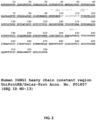
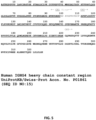
- an "upper hinge” region is intended to include amino acid residues from positions 216 to 227 according to EU numbering (amino acid residues from positions 226 to 240 according to Kabat numbering) (see also Figure 2 ).
- a “lower hinge” region is intended to include amino acid residues from positions 228 to 236 according to EU numbering (amino acid residues from positions 241 to 249 according to Kabat numbering) (see also Figure 2 ).
- chimeric means composed of parts of different origin.
- the phrase "chimeric protein" includes a first amino acid protein linked to a second amino acid protein that is not normally linked in nature.
- the amino acid sequences may normally exist as separate proteins or in a different arrangement on the same protein, and are brought together in a fusion polypeptide in a new arrangement.
- Chimeric proteins may be created by various methods known in the art, e.g. by chemical synthesis or by creating a polynucleotide that encodes for amino acids of the chimeric protein in the desired arrangement.
- Exemplary chimeric proteins include the chimeric hinge sequences connecting heavy chain domains of IgG, and the fusion proteins engineered to make the human antibodies, antigen-binding proteins and receptor-Fc fusion proteins.
- the chimeric proteins disclosed herein were designed to minimize the creation of immunogenic epitopes in the junctions, e.g. compared to a wild-type IgG Fc region or domain.
- the engineered proteins of the invention therefore have reduced immunogenicity, and display reduced binding to Fc receptors, as well as reduced to no effector functions.
- chimeric hinge is intended to include a chimeric protein comprising a first amino acid sequence derived from the hinge region of one Ig molecule and a second amino acid sequence derived from the hinge region of a different class or subclass of Ig molecule.
- exemplary chimeric hinges of the present invention comprise a first amino acid sequence, or an "upper hinge” sequence, derived from a human IgG1 or human IgG4 hinge region, and a second amino acid sequence, or a "lower hinge” sequence, derived from a human IgG2 hinge region.
- the first or "upper hinge” sequence comprises amino acid residues from positions 216 to 227 according to EU numbering.
- the second or “lower hinge” sequence comprises amino acid residues from positions 228 to 236 according to EU numbering.
- humanized antibody is intended to include antibodies in which CDR sequences are derived from the germline of another mammalian species, such as a mouse, and have been grafted onto human framework sequences.
- Humanized monoclonal antibodies may be generated by a hybridoma which includes a B lymphocyte cell obtained from a transgenic or transchromosomal nonhuman animal, such as a transgenic mouse, having a genome comprising a human heavy chain transgene and a light chain transgene, fused to an immortalized cell.
- variable regions can be "reshaped” or “humanized” by grafting CDRs derived from nonhuman antibody on the FRs present in the human antibody to be modified.
- humanized antibodies preserve all CDR sequences (for example, a humanized mouse antibody which contains all six CDRs from the mouse antibodies).
- humanized antibodies have one or more CDRs (one, two, three, four, five, or six) which are altered with respect to the original antibody, which are also termed one or more CDRs "derived from" one or more CDRs from the original antibody.
- Humanized antibodies may refer to chimeric molecules prepared using recombinant techniques.
- chimeric antibodies comprising human variable regions linked to murine constant regions, such as those produced by cell lines generated by a VELOCIMMUNE mouse, are humanized by replacing the murine constant region for a human constant region comprising SEQ ID NO: 1, SEQ ID NO:2, SEQ ID NO: 30, SEQ ID NO: 31, SEQ ID NO: 38 or SEQ ID NO:37.
- monoclonal antibody or “monoclonal antibody composition” as used herein refer to a preparation of antibody molecules of single molecular composition.
- a monoclonal antibody composition displays a single binding specificity and affinity for a particular epitope.
- murine monoclonal antibody refers to antibodies displaying a single binding specificity which have variable and constant regions derived from murine or mouse germline immunoglobulin sequences.
- binding in the context of the binding of an antibody, Ig, antibody-binding fragment, or Fc-containing protein to either, e.g., a predetermined antigen or to a FcR, typically refers to an interaction or association between a minimum of two entities, or molecular structures, such as an antibody-antigen interaction, or an Fc-containing protein to an Fc ⁇ R (wherein the Fc-containing protein is an antibody, Ig, antibody-binding fragment, or Fc-fusion protein, e.g. receptor-Fc fusion).
- binding affinity typically corresponds to a K D value of about 10 -7 M or less, such as about 10 -8 M or less, such as about 10 -9 M or less when determined by, for instance, surface plasmon resonance (SPR) technology in a BIAcore 3000 instrument using the antigen or FcR as the ligand and the antibody, Ig, antibody-binding fragment, or Fc-containing protein as the analyte (or antiligand).
- SPR surface plasmon resonance
- the antibody or other binding protein binds to the predetermined antigen or receptor with an affinity corresponding to a K D value that is at least ten-fold lower, such as at least 100 fold lower, for instance at least 1,000 fold lower, such as at least 10,000 fold lower, for instance at least 100,000 fold lower than its affinity for binding to a non-specific antigen (e.g., BSA, casein).
- a non-specific antigen e.g., BSA, casein
- K D refers to the dissociation equilibrium constant of a particular antibody-antigen interaction, or the dissociation equilibrium constant of an antibody, Ig, antibody-binding fragment, or Fc-containing protein to an Fc ⁇ R.
- K D binding affinity
- k d (sec -1 or 1/s), as used herein, refers to the dissociation rate constant of a particular antibody-antigen interaction, or the dissociation rate constant of an antibody, Ig, antibody-binding fragment, or Fc-containing protein to an FcyR. Said value is also referred to as the k off value.
- k a (M -1 ⁇ sec -1 or 1/M), as used herein, refers to the association rate constant of a particular antibody-antigen interaction, or the association rate constant of an antibody, Ig, antibody-binding fragment, or Fc-containing protein to an Fc ⁇ R.
- K A (M -1 or 1/M), as used herein, refers to the association equilibrium constant of a particular antibody-antigen interaction, or the association equilibrium constant of an antibody, Ig, antibody-binding fragment, or Fc-containing protein to an Fc ⁇ R.
- the association equilibrium constant is obtained by dividing the k a by the k d .
- EC 50 refers to the half maximal effective concentration, which includes the concentration of an antibody which induces a response halfway between the baseline and maximum after a specified exposure time.
- the EC 50 essentially represents the concentration of an antibody where 50% of its maximal effect is observed. Thus, reduced binding is observed with an increased EC 50 , or half maximal effective concentration value.
- decreased binding can be defined as an increased EC 50 antibody concentration which enables binding to the half-maximal amount of target cells.
- decreased cytotoxic activity can be defined as an increased EC 50 antibody concentration which enables lysis of the half-maximal amount of target cells.
- decreased proliferation can be defined as an increased EC 50 antibody concentration which enables proliferation of the half-maximal amount of target cells.
- bispecific antibody includes antibodies that are specific for different epitopes of one target polypeptide or may contain antigen-binding domains specific for more than one target polypeptide. See, e.g., Tutt et al. (1991) J. Immunol. 147:60-69 .
- the human antibodies can be linked to or co-expressed with another functional molecule, e.g., another peptide or protein.
- an antibody or fragment thereof can be functionally linked (e.g., by chemical coupling, genetic fusion, noncovalent association or otherwise) to one or more other molecular entities, such as another antibody or antibody fragment, to produce a bispecific or a multispecific antibody with a second binding specificity.
- bispecific antibody also includes two antibodies of different specificity.
- the heavy chain of at least one of the Ig heavy chains in a bispecific antibody is modified to comprise a chimeric heavy chain constant region comprising a recombinant polypeptide of the invention.
- at least one of the heavy chains is modified in the CH3 domain resulting in a differential affinity for the bispecific antibody for an affinity reagent, such as Protein A, for ease of isolation.
- At least one of the heavy chains in such bispecific antibody comprises an amino acid modification at i) 95R or ii) 95R and 96F in the IMGT numbering system (95R and 96F correspond to 435R and 436F in the EU numbering system), for example SEQ ID NO: 37 and SEQ ID NO: 38.
- a multispecific antigen-binding fragment of an antibody will typically comprise at least two different variable domains, wherein each variable domain is capable of specifically binding to a separate antigen or to a different epitope on the same antigen. Any multispecific antibody format may be adapted for use in the context of an antigen-binding protein or antibody disclosed using routine techniques available in the art.
- isotype refers to the immunoglobulin class (for instance, IgG1, IgG2, IgG3, IgG4, IgD, IgA, IgE, or IgM) that is encoded by heavy chain constant region genes.
- epitope means an antigenic determinant capable of specific binding to an antibody.
- Epitopes usually consist of surface groupings of molecules such as amino acids or sugar side chains and usually have specific three dimensional structural characteristics, as well as specific charge characteristics. Conformational and nonconformational epitopes are distinguished in that the binding to the former, but not the latter, is lost in the presence of denaturing solvents.
- the epitope may comprise amino acid residues directly involved in the binding (also called immunodominant component of the epitope) and other amino acid residues, which are not directly involved in the binding, such as amino acid residues which are effectively blocked by the specific antigen binding peptide (in other words, the amino acid residue is within the footprint of the specific antigen binding peptide).
- a humanized antibody is "derived from" a particular germline sequence if the antibody is obtained from a system using human immunoglobulin sequences, for instance by immunizing a transgenic mouse carrying human immunoglobulin genes or by screening a human immunoglobulin gene library, and wherein the selected human antibody V domain sequence is at least 90%, such as at least 95%, for instance at least 96%, such as at least 97%, for instance at least 98%, or such as at least 99% identical in amino acid V domain sequence to the amino acid sequence encoded by the germline immunoglobulin gene.
- a human antibody derived from a particular human germline sequence will display no more than 20 amino acid differences, e.g. no more than 10 amino acid differences, such as no more than 9, 8, 7, 6 or 5, for instance no more than 4, 3, 2, or 1 amino acid difference from the amino acid sequence encoded by the germline immunoglobulin gene.
- transgenic non-human animal refers to a non-human animal having a genome comprising one or more human heavy and/or light chain transgenes or transchromosomes (either integrated or non-integrated into the animal's natural genomic DNA) and which is capable of expressing fully human antibodies.
- Mice that express antibodies that are fully human, or partly human and partly mouse, have previously been reported.
- a transgenic mouse can have a human light chain transgene and either a human heavy chain transgene or human heavy chain transchromosome, such that the mouse produces human antibody when immunized with target antigen and/or cells expressing the target antigen.
- the human heavy chain transgene may be integrated into the chromosomal DNA of the mouse, as is the case for transgenic mice, for instance HuMAb mice, such as HCo7 or HCol2 mice, or the human heavy chain transgene may be maintained extrachromosomally, as is the case for transchromosomal KM mice as described in WO02/43478 .
- transgenic and transchromosomal mice are capable of producing multiple isotypes of human monoclonal antibodies to a given antigen (such as IgG, IgA, IgM, IgD and/or IgE) by undergoing V-D-J recombination and isotype switching.
- VELOCIMMUNE ® genetically engineered mice comprise a replacement of unrearranged V(D)J gene segments at endogenous mouse loci with human V(D)J gene segments.
- VELOCIMMUNE ® mice express chimeric antibodies having human variable domains and mouse constant domains (see, e.g., U.S. Pat. No. 7,605,237 ). Most other reports concern mice that express fully human antibodies from fully human transgenes in mice that have disabled endogenous immunoglobulin loci.
- the VELOCIMMUNE ® mouse includes, in part, having a genome comprising human variable regions operably linked to endogenous mouse constant region loci such that the mouse produces antibodies comprising a human heavy chain variable region and a mouse heavy chain constant region in response to antigenic stimulation.
- the DNA encoding the variable regions of the heavy chains of the antibodies can be isolated and operably linked to DNA encoding the human heavy chain constant regions of the invention. The DNA can then be expressed in a cell capable of expressing the fully human heavy chain of the antibody.
- a transgenic, nonhuman animal can also be used for production of antibodies against a specific antigen by introducing into the animal genes encoding such specific antibody, for example by operatively linking the genes to a gene which is expressed in the milk of the animal.
- effector functions is intended to include the functional capabilities imparted by an Fc-containing protein upon binding to an Fc ⁇ R. Without being bound to any one theory, formation of an Fc/FcyR complex recruits a variety of effector cells to sites of bound antigen, typically resulting in diverse signaling events within the cells and important subsequent immune responses.
- effectorless polypeptide refers to a recombinant polypeptide, antigen-binding protein or antibody which has altered or reduced effector function as compared to a corresponding recombinant polypeptide, antigen-binding protein or antibody comprising a wild-type heavy chain constant region of the IgG1 or IgG4 isotype.
- the effector function that is reduced or altered is a cytotoxic effector function, e.g., cytotoxicity, complement-dependent cytotoxicity (CDC), antibody-dependent cytotoxicity (ADCC), or antibody-dependent cellular phagocytosis (ADCP).
- the effector function that is reduced or altered is complement-dependent cytotoxicity.
- the effector function that is reduced or altered is antibody-dependent cytotoxicity.
- the effector function that is reduced or altered is cellular proliferation.
- Fc receptors which bind the Fc region of an antibody in the constant domain (specifically, the C H 2 and C H 3 domain) of a typical immunoglobulin.
- Fc receptors There are a number of Fc receptors which are specific for the different classes of immunoglobulins, i.e. IgG, IgE, IgA, IgM, and IgD.
- the human IgG Fc receptor family is divided into three groups: Fc ⁇ RI (CD64), which is capable of binding IgG with high affinity, Fc ⁇ RII (CD32) and Fc ⁇ RIII (CD16) both of which are low affinity receptors.
- Fc ⁇ R subclass is encoded by two or three genes, and alternative RNA splicing leads to multiple transcripts, hence, a broad diversity in Fc ⁇ R isoforms exists (e.g. Fc ⁇ RIA (CD64; FCGR1A), Fc ⁇ RIB (CD64; FCRG1B), Fc ⁇ RIIA (CD32; FCGR2A), FcyRIIB (CD32; FCGR2B), Fc ⁇ RIIC (CD32; FCGR2C), Fc ⁇ RIIIA (CD16a; FCGR3A), and Fc ⁇ RIIIB (CD16b; FCGR3B)).
- Fc ⁇ RIA CD64; FCGR1A
- Fc ⁇ RIB CD64; FCRG1B
- Fc ⁇ RIIA CD32; FCGR2A
- FcyRIIB CD32; FCGR2B
- Fc ⁇ RIIC CD32; FCGR2C
- Fc ⁇ RIIIA CD16a; FCGR3A
- Fc ⁇ RIIIB CD16b;
- FcRn or neonatal Fc receptor
- Fc receptor transporter alpha, or FCGRT
- Fc receptors are expressed on a variety of cells, including, e.g., B cells, monocytes, dendritic cells, neutrophils, and certain lymphocytes.
- B cells e.g., B cells
- monocytes e.g., monocytes
- dendritic cells e.g., neutrophils
- neutrophils e.g., neutrophils, and certain lymphocytes.
- U937 cells a human monocyte cell line
- Fc ⁇ Rl and Fc ⁇ RIIA see e.g., Jones, et al. J Immunol 135(5):3348-53 (1985 ); and Brooks, et al. J Exp Med 170:1369-85 (October 1989 )).
- Binding of an Ig Fc to its receptor brings these effector cells to sites of the bound antigen, resulting ultimately in a variety of signaling and immune responses, including B cell activation, inflammatory responses, cytotoxic responses, and phagocytic responses. As such, reduced or altered binding of an Ig Fc to its receptor may result in reduced effector functions.
- cytotoxicity cytotoxicity, complement-dependent cytotoxicity ("CDC”), antibody-dependent cytotoxicity (“ADCC”) and abnormal antibody production
- CDC complement-dependent cytotoxicity
- ADCC antibody-dependent cytotoxicity
- abnormal antibody production may be unwanted side effects associated with certain therapeutic antibodies.
- ADCC antibody-dependent cellular cytotoxicity
- Fc ⁇ receptor-bearing cell an immune cell or the like
- Fc ⁇ receptor an immune cell or the like
- ADCC is a mechanism by which Fc receptor-positive effector cells can lyse target cells that have adherent antigen-specific molecule.
- the ADCC activity can be evaluated by a number of well-known methods, including measuring the fluorescent intensity using a fluorescent dye such as calcein AM (Wako Pure Chemical Industries, Ltd., 349-07201).
- the cytotoxic activity (%) can be calculated, using the obtained values, according to the equation: (A-C)/(B-C)x100, wherein A is a fluorescent value in each sample, B is an average fluorescent value of the cells lysed and released into a medium with Nonidet P-40 having a final concentration of 1%, and C is an average fluorescent value when only the medium was added.
- ADCP antibody-dependent cellular phagocytosis
- ADCP may be an important in vivo mechanism for killing tumor cells.
- ADCP can be measured by two-color fluorescence flow cytometry methods, for example methods utilizing, e.g. PKH2 (green fluorescent dye) and phycoerythrin-conjugated (red) monoclonal antibodies against different cell surface proteins to differentiate the test cells, thus determining phagocytic activity and rate of phagocytosis.
- Therapeutic strategies that selectively activate Fc ⁇ RIIa relative to Fc ⁇ RIIb may enhance macrophage phagocytic activity ( Richards, JO, et al. 2008 Mol Cancer Ther 7(8):2517-27 ).
- CDC complement-directed cytotoxicity
- the CDC activity is measured by well-known methods, for example the target cells, antibody, and complement solution (such as baby rabbit complement (Cedarlane Technologies) are incubated and are allowed to react, according to standard protocols ( NIAID Manual of Tissue Typing Techniques 1979-1980, Edited by J.G. Ray, NIH Publication No. NIH-83-545 .)
- the cytotoxic activity can be calculated in the same manner as the measurement of the ADCC activity.
- the cytotoxic activity can also be measured using a fluorescent dye (such as calcein) or radioactive dyes similarly to the above with respect to ADCC.
- cytotoxicity or "direct cytotoxicity” includes any cytotoxic activity including that which is independent of NK cells. Cytotoxicity may be measured by techniques well known in the art, for example, determining cell lysis or cell death, i.e. apoptosis. Direct cell lysis, or cell killing, can be evaluated by a number of well-known methods, including measuring the fluorescent intensity using calcein and calculating an average fluorescent value in a similar fashion as described with respect to ADCC hereinabove. Alternatively, a cytotoxic molecule, such as an antibody, is effective in an apoptosis assay by activating a genetic program of controlled cell death.
- Apoptosis is characterized by well defined cytological and molecular events including a change in the refractive index of the cell, cytoplasmic shrinkage, nuclear condensation and cleavage of DNA into regularly sized fragments.
- the apoptotic activity is measured using standard methods of determining dying and/or dead cells. In order to measure apoptosis, cytotoxicity assays can be employed.
- These assays may be radioactive or non-radioactive assays that measure increases in plasma membrane permeability, since dying cells become leaky, colorimetric assays may be employed that measure reduction in the metabolic activity of mitochondria based on the knowledge that mitochondria in dead cells cannot metabolize dyes, while mitochondria in live cells can.
- Bioluminescent cytotoxicity assays e.g. CytoTox-Glo TM , Promega
- Protease activity is considered a robust enzymatic cell death marker, and may be used as a ratiometric measurement of viable and dead cells ( Niles, A.L., et al. Anal Biochem, 366(2): 197-206, 15 July 2007 ).
- TUNEL Terminal deoxynucleotidyl transferase dUTP nick end labeling
- the assay relies on the presence of nicks in the DNA which can be identified by terminal deoxynucleotidyl transferase, an enzyme that will catalyze the addition of bromolated dUTPs that are secondarily detected with a specific labelled antibody.
- Cytotoxicity may be complement-directed, or antibody-directed, or directly associated with the binding of a cytotoxic molecule or cell.
- antibodies exhibit cytotoxicity of less than 20% cytolysis (i.e. % cytotoxicity), or less than 10%, or 5%, 4%, 3%, 2%, or even 0% or undetectable cytolysis (cytotoxicity), as measured in an in vitro or ex vivo cell killing assay. In certain embodiments, antibodies of the invention exhibit less than 20%, 10%, or 5%, 4%, 3%, 2%, or even 0% or undetectable cytotoxicity, at an antibody concentration of 10 nM.
- antibodies exhibit apoptotic activity of less than 20% cytolysis (i.e. % cytotoxicity), or less than 10%, or 5%, 4%, 3%, 2%, or even 0% or undetectable cytolysis (cytotoxicity), as measured in an in vitro or ex vivo cell killing assay. In still other instances, antibodies exhibit less than 20%, 10%, or 5%, 4%, 3%, 2%, or even 0% or undetectable apoptotic activity, at an antibody concentration of 10 nM.
- antibodies exhibit CDC activity of less than about 50% cytotoxicity, or less than cytotoxicity 40%, 30%, 20%, 10%, or 5%, 4%, 3%, 2%, or even 0% or undetectable cytotoxicity, as measured in an in vitro or ex vivo cell killing assay. In still other embodiments, In certain instances, antibodies exhibit less than 50%, 40%, 30%, 20%, 10%, or 5%, 4%, 3%, 2%, or even 0% or undetectable CDC activity, at an antibody concentration of 100 nM.
- antibodies exhibit ADCC activity of less than about 50% cytotoxicity, or less than cytotoxicity 40%, 30%, 20%, 10%, or 5%, 4%, 3%, 2%, or even 0% or undetectable cytotoxicity, as measured in an in vitro or ex vivo cell killing assay. In still other instances, antibodies exhibit less than 50%, 40%, 30%, 20%, 10%, or 5%, 4%, 3%, 2%, or even 0% or undetectable ADCC activity, at an antibody concentration of 100 nM.
- antibodies, antigen-binding proteins and Fc-fusion proteins that comprise recombinant polypeptides comprising a chimeric hinge, and further provide reduced effector functions.
- the properties of such recombinant polypeptides may be compared to the properties of one or more reference proteins. See the examples below for reference, or control antibodies and antigen-binding proteins which have corresponding variable regions and constant regions (e.g. having a wild-type IgG1 C H region (SEQ ID NO:13) or a wild-type IgG4 C H region (SEQ ID NO:15)) compared to the chimeric antibodies, and may be used in certain testing methodologies for comparison of functional or pharmacokinetic properties to the antibodies and antigen-binding proteins.
- a corresponding wild-type IgG C H region differs from chimeric C H regions of the invention in that the "wild-type" IgG C H region is derived from the natural IgG amino acid sequence containing (from N-terminal to C-terminal) a CH1 domain, a hinge, a CH2 domain, and a CH3 domain.
- Wild-type IgG may include variants having one or more amino acid modifications while retaining essentially the same functional characteristics as natural IgG.
- a corresponding antibody or polypeptide may be assembled to have the same target binding domain (e.g. V H and/or V L ) as the antibody or polypeptide having the chimeric C H region, or otherwise has essentially the same functionality for the purpose of comparison in certain assays.
- isolated antibodies bind weakly to Fc ⁇ R expressing cells, e.g. effector cells, but however lack effector functions, such as cytotoxicity and proliferation, compared to the effector functions of a corresponding antibody comprising a wild-type IgG1 or IgG4 C H region.
- a recombinant polypeptide comprising a chimeric hinge region comprises a human IgG2 lower hinge amino acid sequence PCPAPPVA (SEQ ID NO: 3) from positions 228 to 236 (EU numbering).
- the chimeric hinge region comprises: a human IgG1 or a human IgG4 upper hinge amino acid sequence from positions 216 to 227 (EU numbering) and a human IgG2 lower hinge amino acid sequence PCPAPPVA (SEQ ID NO: 3) from positions 228 to 236 (EU numbering), from N-terminus to C-terminus.
- the chimeric hinge region comprises: an upper hinge amino acid sequence from positions 216 to 227 (EU numbering) selected from the group consisting of SEQ ID NO:4 and SEQ ID NO:5, and a lower hinge amino acid sequence PCPAPPVA (SEQ ID NO: 3) from positions 228 to 236 (EU numbering), from N-terminus to C-terminus.
- a recombinant polypeptide comprising, from N-terminus to C-terminus, a CH1 domain, a chimeric hinge, a CH2 domain, and a CH3 domain wherein: the CH1 domain comprises at least the amino acid sequence DKKV or DKRV from positions 212 to 215 (EU numbering), the chimeric hinge comprises a human IgG1 or a human IgG4 upper hinge amino acid sequence from positions 216 to 227 (EU numbering) and a human IgG2 lower hinge amino acid sequence PCPAPPVA (SEQ ID NO: 3) from positions 228 to 236 (EU numbering), the CH2 domain comprises a human IgG4 CH2 domain amino acid sequence from positions 237 to 340 (EU numbering), and the CH3 domain comprises a human IgG1 or a human IgG4 CH3 domain sequence from positions 341 to 447 (EU numbering), or a variant thereof.
- the CH1 domain comprises at least the amino acid sequence DKKV or DKRV from positions
- the present invention provides a monoclonal antibody comprising a heavy chain constant region comprising or consisting of SEQ NO: 1, SEQ ID NO: 2, SEQ ID NO: 30, or SEQ ID NO: 31.
- the present invention provides a monoclonal antibody comprising at least one heavy chain with a constant region comprising or consisting of SEQ ID NO: 38 or 37. Table 7.
- Representative chimeric C H constructs C H construct SEQ ID NO CH1 Upper Hinge Lower Hinge CH2 CH3 1 DKRV (SEQ ID NO:5) ESKYGPPCP (SEQ ID NO:7) PCPAPPVA (SEQ ID NO:3) SEQ ID NO:10 SEQ ID NO:12 2 DKKV (SEQ ID NO:4) EPKSCDKTHTCP (SEQ ID NO:6) PCPAPPVA (SEQ ID NO:3) SEQ ID NO:10 SEQ ID NO:11 30 SEQ ID NO: 43 EPKSCDKTHTCP (SEQ ID NO:6) PCPAPPVA (SEQ ID NO:3) SEQ ID NO:10 SEQ ID NO:11 31 SEQ ID NO: 44 ESKYGPPCP (SEQ ID NO:7) PCPAPPVA (SEQ ID NO:3) SEQ ID NO:10 SEQ ID NO:12 37 SEQ ID NO: 43 EPKSCDKTHTCP (SEQ ID NO:6) PCPAPPVA (SEQ ID NO:3) SEQ ID NO:10 SEQ ID NO:41 38
- a recombinant polypeptide of the present invention is a receptor-Fc fusion protein.
- a r receptor-Fc fusion protein that comprises a heavy chain construct comprising a CH region, from N-terminus to C-terminus, a CH1 domain, a chimeric hinge, a CH2 domain, and a CH3 domain, wherein the CH1 domain comprises the amino acid sequence DKKV or DKRV, the chimeric hinge comprises a human IgG1 or a human IgG4 upper hinge amino acid sequence from positions 216 to 227 (EU numbering), or a natural variant thereof, and a human IgG2 lower hinge amino acid sequence from positions 228 to 236 (EU numbering), the CH2 domain comprises a human IgG4 CH2 domain sequence from positions 237 to 340 (EU numbering), or a natural variant thereof, and the CH3 domain comprises a human IgG1 or a human IgG4 CH3 domain sequence from positions 341 to 447 (EU numbering), or a natural variant thereof, and the CH region has an amino acid sequence with at least about 95%, or about 96%,
- an isolated antibody, antigen-binding protein, or receptor-Fc fusion protein comprising a heavy chain construct comprising a CH region, from N-terminus to C-terminus, a CH1 domain, a chimeric hinge, a CH2 domain, and a CH3 domain, wherein the CH1 domain comprises the amino acid sequence DKKV or DKRV, the chimeric hinge comprises a human IgG1 or a human IgG4 upper hinge amino acid sequence from positions 216 to 227 (EU numbering), or a natural variant thereof, and a human IgG2 lower hinge amino acid sequence from positions 228 to 236 (EU numbering), the CH2 domain comprises a human IgG4 CH2 domain sequence from positions 237 to 340 (EU numbering), or a natural variant thereof, and the CH3 domain comprises a human IgG1 or a human IgG4 CH3 domain sequence from positions 341 to 447 (EU numbering), or a natural variant thereof, and the CH region has an amino acid sequence with
- Such “variant” or “natural variant” C H domains of the invention comprise one or more additions, deletions, or substitutions of amino acids when compared to the wild-type sequence that such C H domains of the invention are derived from, but essentially function as desired.
- the C H domain or Fc domain exhibits weak or no binding to certain Fc ⁇ R expressing cells, e.g. effector cells, resulting in altered effector functions, such as cytotoxicity and proliferation.
- such variants include modifications such as additions, deletions, or substitutions of amino acids in the CH3 domain engineered for the isolation of bispecific molecules.
- a monoclonal antibody comprising a heavy chain variable region and a heavy chain constant region comprising or consisting of SEQ ID NO:1, SEQ ID NO:2, SEQ ID NO: 30, SEQ ID NO: 31, SEQ ID NO: 38, or SEQ ID NO: 37, or a sequence with at least about 95%, or about 96%, or about 97%, or about 98%, or about 99% to such heavy chain constant region.
- a monoclonal antibody comprising a light chain variable region, a heavy chain variable region and a heavy chain constant region comprising or consisting of SEQ ID NO:1, SEQ ID NO:2, SEQ ID NO: 30, SEQ ID NO: 31, SEQ ID NO: 38, or SEQ ID NO: 37, or a sequence with at least about 95%, or about 96%, or about 97%, or about 98%, or about 99% to such heavy chain constant region.
- an isolated antibody, or antigen-binding fragment thereof comprising a heavy chain constant region (C H ) having (i) the amino acid sequence of SEQ NO: 1 or having the amino acid sequence encoded by SEQ ID NO: 33, or (ii) the amino acid sequence of SEQ NO: 31 or having the amino acid sequence encoded by SEQ ID NO: 29, or (iii) a sequence with at least about 95%, or about 96%, or about 97%, or about 98%, or about 99% identity to a sequence described in (i) or (ii).
- C H heavy chain constant region
- an isolated antibody, or antigen-binding fragment thereof comprising a heavy chain constant region (C H ) having (i) the amino acid sequence of SEQ NO: 2 or having the amino acid sequence encoded by SEQ ID NO: 32, or (ii) the amino acid sequence of SEQ NO: 30 or having the amino acid sequence encoded by SEQ ID NO: 28, or (iii) a sequence with at least about 95%, or about 96%, or about 97%, or about 98%, or about 99% identity to a sequence described in (i) or (ii).
- C H heavy chain constant region
- an isolated antibody, or antigen-binding fragment thereof comprising a heavy chain constant region (C H ) having (i) the amino acid sequence of SEQ NO: 38 or having the amino acid sequence encoded by SEQ ID NO: 36, or (ii) the amino acid sequence of SEQ NO: 37 or having the amino acid sequence encoded by SEQ ID NO: 35, or (iii) a sequence with at least about 95%, or about 96%, or about 97%, or about 98%, or about 99% identity to a sequence described in (i) or (ii).
- C H heavy chain constant region
- the isolated antibody is a monoclonal antibody. In other instances, the isolated antibody, or antigen binding fragment thereof, is a humanized, chimeric, single-chain antibody or bispecific antibody.
- an Fc-containing protein comprising (i) the amino acid sequence of SEQ NO: 1 or the amino acid sequence encoded by SEQ ID NO: 33, or (ii) the amino acid sequence of SEQ NO: 31 or the amino acid sequence encoded by SEQ ID NO: 29, or (iii) a sequence with at least about 95%, or about 96%, or about 97%, or about 98%, or about 99% identity to a sequence described in (i) or (ii).
- an Fc-containing protein comprising (i) the amino acid sequence of SEQ NO: 2 or the amino acid sequence encoded by SEQ ID NO: 32, or (ii) the amino acid sequence of SEQ NO: 30 or the amino acid sequence encoded by SEQ ID NO: 28, or (iii) a sequence with at least about 95%, or about 96%, or about 97%, or about 98%, or about 99% identity to a sequence described in (i) or (ii).
- an Fc-containing protein comprising (i) the amino acid sequence of SEQ NO: 38 or the amino acid sequence encoded by SEQ ID NO: 36, or (ii) the amino acid sequence of SEQ NO: 37 or the amino acid sequence encoded by SEQ ID NO: 35, or (iii) a sequence with at least about 95%, or about 96%, or about 97%, or about 98%, or about 99% identity to a sequence described in (i) or (ii).
- the present invention provides a composition comprising the receptor Fc fusion protein described.
- an antibody or antigen-binding protein that lacks cytotoxic or cytolytic effector function.
- the antibody or antigen-binding protein lacks cytotoxic or cytolytic effector function and comprises SEQ ID NO:1, SEQ ID NO:2, SEQ ID NO: 30, SEQ ID NO: 31, SEQ ID NO: 38, or SEQ ID NO: 37.
- an antibody or antigen-binding protein having cytotoxic activity that is at least 10-fold less, or at least 50-fold less, or at least 100-fold less, or at least 1000-fold less, or at least 10000-fold less than the cytotoxic activity of a corresponding antibody comprising a wild-type IgG1 or wild-type IgG4 CH region.
- an antibody capable of binding to an FcyR comprising a recombinant polypeptide comprising SEQ ID NO:1, SEQ ID NO:2, SEQ ID NO: 30, SEQ ID NO: 31, SEQ ID NO: 38, or SEQ ID NO: 37.
- the antibody is capable of binding to an Fc ⁇ R with lower affinity compared to the binding affinity of a corresponding antibody comprising a wild-type IgG1 or wild-type IgG4 heavy chain constant region.
- the antibody is capable of activating an Fc ⁇ R at a half-maximal concentration (EC 50 ) of greater than about 10 nM, or about 20 nM, or about 30 nM, or about 40 nM, about 50 nM, about 100 nM.
- the FcyR is a human or cynomolgus Fc ⁇ RII.
- the Fc ⁇ R is FcyRIIA or Fc ⁇ RIIB.
- the antibody is capable of binding to FcyRIIA having an affinity (K D value) of about 10 ⁇ M, or about 20 ⁇ M, or about 30 ⁇ M, or about 40 ⁇ M, about 50 ⁇ M, about 100 ⁇ M.
- the antibody or recombinant polypeptide binds to FcyRIIA with an affinity greater than the affinity of the antibody or recombinant polypeptide to Fc ⁇ RIIB.
- the antibody is capable of binding to Fc ⁇ RIIB having an affinity (KD value) of about 10 ⁇ M, or about 20 ⁇ M, or about 30 ⁇ M, or about 40 ⁇ M, about 50 ⁇ M, about 100 ⁇ M.
- affinity KD value
- the antibody or recombinant polypeptide binds to Fc ⁇ RIIA with an affinity (K D value) substantially similar to the affinity of the antibody or recombinant polypeptide to Fc ⁇ RIIB.
- the chimeric antibodies may engage, and even indirectly enhance Fc ⁇ RIIA-mediated activity, even though the chimeric antibodies may have wild-type affinities for Fc ⁇ RIIA.
- certain antibodies, and thus therapeutics may benefit from a weakened interaction (compared to wild-type antibodies) with the inhibitory receptor Fc ⁇ RIIB, which may shift the balance between the activating Fc ⁇ RIIA and the inhibitory Fc ⁇ RIIB receptors in favor of activation.
- Also disclosed is the production of monoclonal antibodies comprising a recombinant polypeptide comprising SEQ ID NO: 1, SEQ ID NO: 2, SEQ ID NO: 30, SEQ ID NO: 31, SEQ ID NO: 38, or SEQ ID NO: 37 and having specificities for various target antigens.
- a method for producing an antibody comprising: a) introducing the vector comprising a nucleic acid molecule encoding an antibody, or fragment thereof, of the disclosure into a mammalian host cell, b) culturing the host cell capable of expressing the antibody, and c) isolating the antibody from the cell culture media.
- Monoclonal antibodies of the present disclosure may e.g. be produced by the hybridoma method first described by Kohler et al., Nature 256, 495 (1975 ), or may be produced by recombinant DNA methods. Monoclonal antibodies may also be isolated from phage antibody libraries using the techniques described in, for example, Clackson et al., Nature 352, 624-628 (1991 ) and Marks et al., J. Mol. Biol. 222, 581-597 (1991 ). Monoclonal antibodies may be obtained from any suitable source.
- monoclonal antibodies may be obtained from hybridomas prepared from murine splenic B lymphocyte cells obtained from mice immunized with an antigen of interest, for instance, in the form of cells expressing the antigen on the surface, or a nucleic acid encoding an antigen of interest.
- Monoclonal antibodies may also be obtained from hybridomas derived from antibody-expressing cells of immunized humans or non-human mammals such as rats, rabbits, dogs, primates, etc.
- the antibody is a human antibody.
- Human monoclonal antibodies may be generated using transgenic or transchromosomal mice carrying parts of the human immune system rather than the mouse system.
- transgenic and transchromosomic mice include mice referred to herein as VELOCIMMUNE mice, HuMAb mice and KM mice, respectively, and are collectively referred to herein as "transgenic mice” and are described hereinabove.
- Splenocytes from these transgenic mice may be used to generate hybridomas that secrete human monoclonal antibodies according to well-known techniques.
- Human monoclonal or polyclonal antibodies of the present disclosure, or antibodies of the present disclosure originating from other species may also be generated transgenically through the generation of another non-human mammal or plant that is transgenic for the immunoglobulin heavy and light chain sequences of interest and production of the antibody in a recoverable form therefrom.
- antibodies may be produced in, and recovered from, the milk of goats, cows, or other mammals. See for instance US 5,827,690 , US 5,756,687 , US 5,750,172 and US 5,741,957 .
- Expression vectors comprising a mouse UP-II promoter operatively linked to the DNA encoding the Ig heavy and light chain sequences of interest may be engineered for expression and secretion of the proteins of interest in urine of a transgenic animal (See, e.g., US 5,824,543 ).
- human antibodies of the present disclosure or antibodies of the present disclosure from other species may be generated through display-type technologies, including, without limitation, phage display, retroviral display, ribosomal display, and other techniques, using techniques well known in the art and the resulting molecules may be subjected to additional maturation, such as affinity maturation, as such techniques are well known in the art (see for instance Hoogenboom et al., J. Mol. Biol.
- the engineered heavy chain constant (C H ) regions will provide reduced effector functions.
- a method for producing a monoclonal antibody comprising a) immunizing VELOCIMMUNE ® mice with an antigen sufficient to cause an antibody immune response, b) obtaining serum from such mice and testing for antibody titer against said antigen, c) harvesting B cells from the spleens of such immunized mice shown to have elevated antibody titers and fusing said B cells with mouse myeloma cells to form such hybridoma, d) isolating chimeric antibody from such hybridoma by protein A chromatography, such chimeric antibody having a human variable region and a mouse constant region, e) selecting a chimeric antibody having desirable characteristics, and f) replacing the mouse constant regions of such antibodies with a human constant region of the invention, for example, such human constant region comprising SEQ ID NO:1, SEQ ID NO:2, SEQ ID NO: 30, SEQ ID NO: 31, SEQ ID NO: 38, or SEQ
- the antibody is a full-length IgG antibody. In another instance, the antibody is an antibody fragment or a single-chain antibody. In still another instance, the antibody is a fully human IgG antibody.
- the antibody is a bispecific antibody wherein each antigen-binding domain of such molecule or antibody comprises a V H region paired with a V L region.
- the bispecific antibody comprises a first antigen-binding domain and a second antigen binding domain each comprise different, distinct V H regions ith a common V L region.
- the bispecific antibodies are constructed comprising a first antigen-binding domain that specifically binds a first antigen, wherein the first antigen-binding domain comprises an V H region / V L region pair derived from a first antibody directed against the first antigen; and a second antigen-binding domain that specifically binds a second antigen, wherein the second antigen-binding domain comprises an V H region derived from a second antibody directed against a second antigen paired with an V L region derived from the first antibody (e.g., the same V L region that is included in the antigen-binding domain of the first antibody).
- the heavy chain of at least one of the antibodies i.e.
- the first antibody or the second antibody or both antibodies, in a bispecific antibody is modified to comprise a chimeric heavy chain constant region (C H region).
- the bispecific antibody comprises SEQ ID NO:1, SEQ ID NO:2, SEQ ID NO: 30, SEQ ID NO: 31, SEQ ID NO: 38, or SEQ ID NO: 37.
- the heavy chain of at least one of the Ig heavy chains in a bispecific antibody is modified to comprise a chimeric heavy chain constant region comprising a recombinant polypeptide of the disclosure.
- at least one of the heavy chains is modified in the CH3 domain resulting in a differential affinity for the bispecific antibody for an affinity reagent, such as Protein A, for ease of isolation.
- at least one of the heavy chains in such bispecific antibody comprises an amino acid modification at i) 95R or ii) 95R and 96F in the IMGT numbering system (95R and 96F correspond to 435R and 436F in the EU numbering system).
- the antibody is a bispecific antibody wherein the bispecific antibody comprises:
- the antibody is a bispecific antibody wherein the bispecific antibody comprises:
- At least one of the heavy chains of (a) or (b) in such bispecific antibody hereinabove comprises an amino acid modification at (i) 435R or (ii) 435R and 436F (EU numbering) ((i)95R or (ii) 95R and 96F in the IMGT numbering system).
- the antibody is a bispecific antibody wherein the bispecific antibody comprises (a) a first heavy chain comprising an antigen-binding domain capable of recognizing and binding to a first target antigen, and a first heavy chain constant region comprising SEQ ID NO: 1, SEQ ID NO:2, SEQ ID NO: 30, or SEQ ID NO: 31; (b) a second heavy chain comprising an antigen-binding domain capable of recognizing and binding to a second target antigen, and a second heavy chain constant region comprising SEQ ID NO: 38 or SEQ ID NO: 37; and (c) common light chain antigen-binding domain capable of recognizing and binding to the first or second target antigen.
- the antibody is a monovalent antibody. Accordingly, in one instance, the antibody is a monovalent antibody, wherein said antibody is constructed by a method comprising : i) providing a nucleic acid molecule encoding the light chain of said monovalent antibody, said construct comprising a nucleotide sequence encoding the V L region of a selected antigen specific antibody and a nucleotide sequence encoding the constant C L region of an Ig, wherein said nucleotide sequence encoding the V L region of a selected antigen specific antibody and said nucleotide sequence encoding the C L region of an Ig are operably linked together, and wherein the nucleotide sequence encoding the C L region has been modified such that the C L region does not contain any amino acids capable of forming disulfide bonds or covalent bonds with other peptides comprising an identical amino acid sequence of the C L region in the presence of polyclonal human IgG or when administered to an animal or human being; ii) providing a nu
- the antibody is a monovalent antibody, which comprises: i) a variable region or an antigen-binding domain of said region, and ii) a C H region of an immunoglobulin or a fragment thereof comprising SEQ ID NO:1, SEQ ID NO:2, SEQ ID NO: 30, SEQ ID NO: 31, SEQ ID NO: 38, or SEQ ID NO: 37, wherein the C H region or fragment thereof has been modified such that the region does not comprise any amino acid residues which are capable of forming disulfide bonds with an identical C H region or other covalent or stable non-covalent inter-heavy chain bonds with an identical C H region in the presence of polyclonal human IgG.
- sequence of said monovalent antibody has been modified so that it does not comprise any acceptor sites for N-linked glycosylation.
- antibodies described herein may be modified by inclusion of any suitable number of such modified amino acids and/or associations with conjugated substituents.
- Suitability in this context is generally determined by the ability to at least substantially retain the antibody or antigen binding fragment's selectivity and/or specificity associated.
- the modified amino acid may, for instance, be selected from a glycosylated amino acid, a PEGylated amino acid, a farnesylated amino acid, an acetylated amino acid, a biotinylated amino acid, an amino acid conjugated to a lipid moiety, or an amino acid conjugated to an organic derivatizing agent.
- modified amino acids may be advantageous in, for example, further increasing polypeptide serum half-life, reducing polypeptide antigenicity, or increasing polypeptide storage stability.
- Amino acid(s) are modified, for example, co-translationally or post-translationally during recombinant production (e.g., N-linked glycosylation at N-X-S/T motifs during expression in mammalian cells) or modified by synthetic means.
- Non-limiting examples of a modified amino acid include a glycosylated amino acid, a sulfated amino acid, a prenylated (e.
- Antibodies may also be chemically modified by covalent conjugation to a polymer to, for instance, further increase their circulating half-life.
- Exemplary polymers, and methods to attach them to peptides are illustrated in for instance US 4,766,106 , US 4,179,337 , US 4,495,285 and US 4,609,546 .
- Additional illustrative polymers include polyoxyethylated polyols and polyethylene glycol (PEG) (e.g., a PEG with a molecular weight of between about 1,000 and about 40,000, such as between about 2,000 and about 20,000, e.g., about 3,000-12,000 g/mol).
- PEG polyethylene glycol
- antibodies comprising one or more radiolabeled amino acids are provided.
- a radiolabeled antibody may be used for both diagnostic and therapeutic purposes.
- antibodies may be conjugated to a molecule which is a therapeutic agent or a detectable marker.
- the therapeutic agent is a cytotoxic agent, such as a radioisotope.
- radioisotopes for polypeptides include, but are not limited to, 3 H, 14 C, 15 N, 35 S, 90 Y, 99 Tc, and 125 I, 131 I, 186 Re, and 225 Ac.
- radiolabeled amino acids and related peptide derivatives are known in the art (see for instance Junghans et al., in Cancer Chemotherapy and Biotherapy 655-686 (2nd edition, Chafner and Longo, eds., Lippincott Raven (1996 )) and US 4,681,581 , US 4,735,210 , US 5,101,827 , US 5,102,990 ( US RE35,500 ), US 5,648,471 and US 5,697,902 .
- a radioisotope may be conjugated by a chloramine T method.
- a detectable marker may be a radiolabel, an enzyme, a chromophore, or a fluorescent label.
- the invention relates to an expression vector encoding a receptor-Fc fusion protein of the invention.
- Such expression vectors may be used for recombinant production of polypeptides of the invention.
- An expression vector in the context of the present disclosure may be any suitable vector, including chromosomal, non-chromosomal, and synthetic nucleic acid vectors (a nucleic acid sequence comprising a suitable set of expression control elements).
- suitable vectors include derivatives of SV40, bacterial plasmids, phage DNA, baculovirus, yeast plasmids, vectors derived from combinations of plasmids and phage DNA, and viral nucleic acid (RNA or DNA) vectors.
- an antibody-encoding nucleic acid molecule is comprised in a naked DNA or RNA vector, including, for example, a linear expression element (as described in, for instance, Sykes and Johnston, Nat Biotech 12, 355-59 (1997 )), a compacted nucleic acid vector (as described in for instance US 6,077,835 and/or WO 00/70087 ), or a plasmid vector such as pBR322, pUC 19/18, or pUC 118/119.
- a linear expression element as described in, for instance, Sykes and Johnston, Nat Biotech 12, 355-59 (1997 )
- a compacted nucleic acid vector as described in for instance US 6,077,835 and/or WO 00/70087
- a plasmid vector such as pBR322, pUC 19/18, or pUC 118/119.
- Such nucleic acid vectors and the usage thereof are well known in the art (see, for instance, US 5,589
- the vector comprises the nucleic acid molecule encoding a polypeptide of the invention, including an expression vector comprising the nucleic acid molecules described wherein the nucleic acid molecule is operatively linked to an expression control sequence.
- the vector is suitable for expression of a polypeptide or antibody in a bacterial cell.
- expression vectors such as BlueScript (Stratagene), pIN vectors ( Van Heeke & Schuster, J Biol Chem 264, 5503-5509 (1989 ), pET vectors (Novagen, Madison, Wl) and the like).
- An expression vector may also or alternatively be a vector suitable for expression in a yeast system. Any vector suitable for expression in a yeast system may be employed. Suitable vectors include, for example, vectors comprising constitutive or inducible promoters such as yeast alpha factor, alcohol oxidase and PGH (reviewed in: F. Ausubel et al., ed. Current Protocols in Molecular Biology, Greene Publishing and Wiley InterScience New York (1987 ), and Grant et al., Methods in Enzymol 153, 516-544 (1987 )).
- constitutive or inducible promoters such as yeast alpha factor, alcohol oxidase and PGH
- a vector comprising a nucleic acid molecule of the invention is provided, wherein the nucleic acid molecule is operatively linked to an expression control sequence suitable for expression in a mammalian host cell.
- Expression control sequences are engineered to control and drive the transcription of genes of interest, and subsequent expression of proteins in various cell systems.
- Plasmids combine an expressible gene of interest with expression control sequences (i . e . expression cassettes) that comprise desirable elements such as, for example, promoters, enhancers, selectable markers, operators, etc.
- expression control sequences i . e . expression cassettes
- desirable elements such as, for example, promoters, enhancers, selectable markers, operators, etc.
- antibody-encoding nucleic acid molecules may comprise or be associated with any suitable promoter, enhancer, selectable marker, operator, repressor protein, polyA termination sequences and other expression-facilitating elements.
- Promoter indicates a DNA sequence sufficient to direct transcription of a DNA sequence to which it is operably linked, i.e., linked in such a way as to permit transcription of the antibody-encoding nucleotide sequence when the appropriate signals are present.
- the expression of a antibody-encoding nucleotide sequence may be placed under control of any promoter or enhancer element known in the art. Examples of such elements include strong expression promoters (e. g., human CMV IE promoter/enhancer or CMV major IE (CMV-MIE) promoter, as well as RSV, SV40 late promoter, SL3-3, MMTV, ubiquitin (Ubi), ubiquitin C (UbC), and HIV LTR promoters).
- CMV-MIE CMV major IE
- the vector comprises a promoter selected from the group consisting of SV40, CMV, CMV-IE, CMV-MIE, RSV, SL3-3, MMTV, Ubi, UbC and HIV LTR.
- Nucleic acid molecules of the invention may also be operatively linked to an effective poly (A) termination sequence, an origin of replication for plasmid product in E. coli, an antibiotic resistance gene as selectable marker, and/or a convenient cloning site (e.g., a polylinker).
- Nucleic acids may also comprise a regulatable inducible promoter (inducible, repressable, developmentally regulated) as opposed to a constitutive promoter such as CMV IE (the skilled artisan will recognize that such terms are actually descriptors of a degree of gene expression under certain conditions).
- Selectable markers are elements well-known in the art. Under the selective conditions, only cells that express the appropriate selectable marker can survive. Commonly, selectable marker genes express proteins, usually enzymes, that confer resistance to various antibiotics in cell culture. In other selective conditions, cells that express a flourescent protein marker are made visible, and are thus selectable.
- Embodiments include beta-lactamase (bla) (beta- lactam antibiotic resistance or ampicillin resistance gene or ampR), bls (blasticidin resistance acetyl transferase gene), bsd (blasticidin-S deaminase resistance gene), bsr (blasticidin-S resistance gene), Sh ble (Zeocin ® resistance gene), hygromycin phosphotransferase (hpt) (hygromycin resistance gene), tetM (tetracycline resistance gene or tetR), neomycin phosphotransferase II (npt) (neomycin resistance gene or neoR), kanR (kanamycin resistance gene), and pac (puromycin resistance gene).
- bla beta-lactamase
- bls blasticidin resistance acetyl transferase gene
- bsd blasticidin-S deaminase resistance gene
- bsr blasticidin
- the vector comprises one or more selectable marker genes selected from the group consisting of bla, bls, BSD, bsr, Sh ble, hpt, tetR, tetM, npt, kanR and pac.
- the vector comprises one or more selectable marker genes encoding green fluorescent protein (GFP), enhanced green fluorescent protein (eGFP), cyano fluorescent protein (CFP), enhanced cyano fluorescent protein (eCFP), or yellow fluorescent protein (YFP).
- gene expression in eukaryotic cells may be tightly regulated using a strong promoter that is controlled by an operator that is in turn regulated by a regulatory fusion protein (RFP).
- RFP consists essentially of a transcription blocking domain, and a ligand-binding domain that regulates its activity. Examples of such expression systems are described in US20090162901A1 , which is herein incorporated by reference in its entirety.
- operator indicates a DNA sequence that is introduced in or near a gene in such a way that the gene may be regulated by the binding of the RFP to the operator and, as a result, prevents or allow transcription of the gene of interest, i.e. a nucleotide encoding a polypeptide of the invention.
- a number of operators in prokaryotic cells and bacteriophage have been well characterized ( Neidhardt, ed. Escherichia coli and Salmonella; Cellular and Molecular Biology 2d. Vol 2 ASM Press, Washington D.C. 1996 ). These include, but are not limited to, the operator region of the LexA gene of E.
- the transcription blocking domain of the RFP is a restriction enzyme, such as Notl
- the operator is the recognition sequence for that enzyme.
- the operator must be located adjacent to, or 3' to the promoter such that it is capable of controlling transcription by the promoter. For example, U.S. Pat.
- tetO sequences be within a specific distance from the TATA box.
- the operator is preferably placed immediately downstream of the promoter. In other embodiments, the operator is placed within 10 base pairs of the promoter.
- the operator is selected from the group consisting of tet operator (tetO), Notl recognition sequence, LexA operator, lactose operator, tryptophan operator and Arc operator (AO).
- the repressor protein is selected from the group consisting of TetR, LexA, Lacl, TrpR, Arc, LambdaC1 and GAL4.
- the transcription blocking domain is derived from a eukaryotic repressor protein, e.g. a repressor domain derived from GAL4.
- cells are engineered to express the tetracycline repressor protein (TetR) and a protein of interest is placed under transcriptional control of a promoter whose activity is regulated by TetR.
- TetR tetracycline repressor protein
- Two tandem TetR operators tetO
- TetR tetracycline repressor protein
- Transcription of the gene encoding the protein of interest directed by the CMV-MIE promoter in such vector may be blocked by TetR in the absence of tetracycline or some other suitable inducer (e.g. doxycycline).
- TetR protein In the presence of an inducer, TetR protein is incapable of binding tetO, hence transcription then translation (expression) of the protein of interest occurs.
- Another exemplary cell expression system includes regulatory fusion proteins such as TetR-ER LBD T2 fusion protein, in which the transcription blocking domain of the fusion protein is TetR and the ligand-binding domain is the estrogen receptor ligand-binding domain (ER LBD ) with T2 mutations (ER LBD T2; Feil et al. (1997) Biochem. Biophys. Res. Commun. 237:752-757 ).
- ER LBD T2 estrogen receptor ligand-binding domain
- fusion protein Arc2-ER LBD T2 a fusion protein consisting of a single chain dimer consisting of two Arc proteins connected by a 15 amino acid linker and the ER LBD T2 (supra), involves an Arc operator (AO), more specifically two tandem arc operators immediately downstream of the CMV-MIE promoter/enhancer.
- AO Arc operator
- Cell lines may be regulated by Arc2-ER LBD T2, wherein cells expressing the protein of interest are driven by a CMV-MIE/ArcO2 promoter and are inducible with the removal of tamoxifen.
- a vector of the invention comprises a CMV-MIE/TetO or CMV-MIE/AO2 hybrid promoter.
- the vectors of the invention may also employ Cre-lox tools for recombination technology in order to facilitate the replication of a gene of interest.
- a Cre-lox strategy requires at least two components: 1) Cre recombinase, an enzyme that catalyzes recombination between two IoxP sites; and 2) IoxP sites (e.g. a specific 34-base pair bp sequence consisting of an 8-bp core sequence, where recombination takes place, and two flanking 13-bp inverted repeats) or mutant Iox sites.
- Cre recombinase an enzyme that catalyzes recombination between two IoxP sites
- IoxP sites e.g. a specific 34-base pair bp sequence consisting of an 8-bp core sequence, where recombination takes place, and two flanking 13-bp inverted repeats
- yeast-derived FLP recombinase may be utilized with the consensus sequence FRT (see also, e.g. Dymecki, S. PNAS 93(12): 6191-6196 ).
- a gene i . e . a nucleotide sequence encoding a recombinant polypeptide of the invention
- a gene is inserted within an expression-enhancing sequence of the expression cassette, and is optionally operably linked to a promoter, wherein the promoter-linked gene is flanked 5' by a first recombinase recognition site and 3' by a second recombinase recognition site.
- a second promoter-linked gene is downstream (3') of the first gene and is flanked 3' by the second recombinase recognition site.
- a second promoter-linked gene is flanked 5' by the second recombinase site, and flanked 3' by a third recombinase recognition site.
- the recombinase recognition sites are selected from a IoxP site, a Iox511 site, a Iox2272 site, and a FRT site. In other embodiments, the recombinase recognition sites are different.
- the host cell comprises a gene capable of expressing a Cre recombinase.
- a vector comprises a first gene encoding a light chain of an antibody or a heavy chain of an antibody, and a second gene encoding a light chain of an antibody or a heavy chain of an antibody.
- the vector further comprises an X-box-binding-protein 1 (mXBP1) gene capable of enhancing protein production/protein secretion through control of the expression of genes involved in protein folding in the endoplasmic reticulum (ER).
- mXBP1 X-box-binding-protein 1
- cell includes any cell that is suitable for expressing a recombinant nucleic acid sequence.
- Cells include those of prokaryotes and eukaryotes (single-cell or multiple-cell), bacterial cells (e.g., strains of E. coli, Bacillus spp., Streptomyces spp., etc.), mycobacteria cells, fungal cells, yeast cells (e.g. S. cerevisiae, S. pombe, P. partoris, P. methanolica, etc.), plant cells, insect cells (e.g.
- the cell is a human, monkey, ape, hamster, rat or mouse cell.
- the cell is eukaryotic and is selected form the following cells: CHO (e.g. CHO K1, DXB-11 CHO, Veggie-CHO), COS (e.g. COS-7), retinal cells, Vero, CV1, kidney (e.g.
- the cell comprises one or more viral genes, e.g. a retinal cell that expresses a viral gene (e.g. a PER.C6 ® cell).
- a viral gene e.g. a PER.C6 ® cell.
- a recombinant eukaryotic or prokaryotic host cell such as a transfectoma, which produces an antibody as defined herein or a bispecific molecule as defined herein.
- host cells include yeast, bacterial, and mammalian cells, such as CHO or HEK cells.
- a cell comprising a nucleic acid stably integrated into the cellular genome that comprises a sequence coding for expression of an antibody comprising a recombinant polypeptide of the present invention.
- the present invention provides a cell comprising a non-integrated (i.e., episomal) nucleic acid, such as a plasmid, cosmid, phagemid, or linear expression element, which comprises a sequence coding for expression of an antibody comprising the recombinant polypeptide of the invention.
- a cell line produced by stably transfecting a host cell with a plasmid comprising an expression vector of the invention.
- Also disclosed is a method for producing an antibody, or antigen-binding protein, or a receptor-Fc fusion protein of the invention comprising the steps of a) culturing a hybridoma or a host cell of the invention as described herein above, and b) purifying the antibody, or antigen-binding protein, or receptor-Fc fusion (supra) from the culture media.
- the invention relates to a composition
- a composition comprising: a receptor-Fc fusion protein as defined herein.
- compositions may be formulated with pharmaceutically acceptable carriers or diluents as well as any other known adjuvants and excipients in accordance with conventional techniques such as those disclosed in Remington: The Science and Practice of Pharmacy, 19th Edition, Gennaro, Ed., Mack Publishing Co., Easton, PA, 1995 .
- the pharmaceutically acceptable carriers or diluents as well as any other known adjuvants and excipients should be suitable for the chosen antibody of the present invention and the chosen mode of administration.
- the actual dosage levels of the active ingredients in the pharmaceutical compositions of the present invention may be varied so as to obtain an amount of the active ingredient which is effective to achieve the appropriate stability of drug substance, desired therapeutic response for a particular patient, composition, and mode of administration.
- the selected dosage level will depend upon a variety of pharmacokinetic factors.
- the pharmaceutical composition may be administered by any suitable route and mode. Suitable routes of administering an antibody of the present invention in vivo are well known in the art and may be selected by those of ordinary skill in the art. ( Daugherty, AL, and Msrny, RJ, Adv Drug Delivery Rev, 58(5-6): 686-706 (2006 )).
- Labeled antibodies can be used for diagnostic purposes to detect, diagnose, or monitor diseases or disorders. Also disclosed is the detection or diagnosis of a disease or disorder, comprising: (a) assaying the existence of antigen in cells or tissue samples of a subject using one or more antibodies that immunospecifically bind to the target antigen; and (b) comparing the level of the antigen with a control level, e.g. levels in normal tissue samples, whereby an increase in the assayed level of antigen compared to the control level of antigen is indicative of the disease or disorder, or indicative of the severity of the disease or disorder.
- a control level e.g. levels in normal tissue samples
- Antibodies can be used to assay antigen levels in a biological sample using immunohistochemical methods well-known in the art.
- Other antibody-based methods useful for detecting protein include immunoassays such as the enzyme linked immunoassay (ELISA) and the radioimmunoassay (RIA).
- ELISA enzyme linked immunoassay
- RIA radioimmunoassay
- Suitable antibody labels may be used in such kits and methods, and labels known in the art include enzyme labels, such as alkaline phophatase and glucose oxidase; radioisotope labels, such as iodine ( 125 I, 131 I), carbon ( 14 C), sulfur ( 35 S), tritium ( 3 H), indium ( 121 In), and technetium ( 99m Tc); and luminescent labels, such as luminol and luciferase; and flourescent labels, such as flourescein and rhodamine.
- enzyme labels such as alkaline phophatase and glucose oxidase
- radioisotope labels such as iodine ( 125 I, 131 I), carbon ( 14 C), sulfur ( 35 S), tritium ( 3 H), indium ( 121 In), and technetium ( 99m Tc)
- luminescent labels such as luminol and luciferase
- flourescent labels such as flourescein and rhod
- Presence of labeled antibodies may be detected in vivo for diagnosis purposes.
- diagnosis comprises: a) administering to a subject an effective amount of a labeled antibody; b) waiting for a time interval following administration for permitting labeled antibody to concentrate at sites where antigen may be detected and to allow for unbound labeled antibody to be cleared to background level; c) determining a background level; and d) detecting the labeled antibody in the subject, such that detection of labeled antibody above the background level is indicative that the subject has the disease or disorder, or is indicative of the severity of the disease or disorder.
- the antibody is labeled with an imaging moiety suitable for detection using a particular imaging system known to those skilled in the art.
- Background levels may be determined by various methods known in the art, including comparing the amount of labeled antibody detected to a standard value previously determined for a particular imaging system.
- Methods and systems that may be used in the diagnostic methods include, but are not limited to, computed tomography (CT), whole body scan such as positron emission tomography (PET), magnetic resonance imaging (MRI), and sonography.
- CT computed tomography
- PET positron emission tomography
- MRI magnetic resonance imaging
- sonography sonography
- Generating the recombinant polypeptides for example a chimeric C H IgG4 (SEQ ID NO: 31) and a chimeric C H IgG1 (SEQ ID NO: 30), was done using standard cloning techniques.
- the chimeric IgG4 C H was generated through a two-step PCR amplification process. Two PCR fragments, Fragment 1 and 2, were amplified using starting construct pR85501 (containing a wild-type h!gG4 C H DNA) and using primers oSP030-oSP031 and oSP032-oSP033 (see Table 8), respectively.
- the primers introduced the desired IgG2 lower hinge sequence (which encodes SEQ ID NO:3) and the flanking restriction sites into the fragments. These two fragments were then joined using PCR primers oSP031 and oSP033. The resulting sequence was inserted into pR85501via Xho1-Not1 restriction sites generating a vector construct pR85502 that contains a chimeric IgG4 C H having an IgG2 lower hinge sequence. The sequence was confirmed using primers KO_oLRC120 and oKO021.
- Fragment 1a was generated using primers oSP031 and oSP035 (see Table 8 below) from template pR85503 (which contains a wild-type human IgG1 C H DNA).
- Fragment 2a was amplified with primers oSP036 and oSP038 using pR85502 (containing the chimeric lgG4 C H DNA) as a template.
- Fragment 3 was made using primers oSP037 and oSP039 from template pR85503 (wild-type hlgG1 C H DNA).
- Fragments 1a and 2a were joined using primers oSP031 and oSP038, which generated Fragment 4. Joining Fragments 2a and 3 using primers oSP036 and oSP039 created Fragment 5. Fragment 4 and 5 were then fused using primers oSP031 and oSP039. The resulting sequence was inserted into pR85501 via Xho1-Not1 restriction sites generating a construct pR85504 that has an IgG1 constant region with the IgG2 lower hinge and IgG4 CH2 domain. The sequence was confirmed using primers KO_oLRC120 and oKO021.
- Anti-hCD3 antibody (anti-hCD3 antibody "L2K”) was used to construct the chimeric antibodies of this example. L2K was obtained by well-known methods based on WO2004/106380 .
- Anti-hCD3_L2K designated herein as Control Antibody 1, contains a wild-type human IgG1 heavy chain constant region (SEQ ID NO:13).
- the bispecific antibodies created in accordance with the present Example comprise two separate antigen-binding domains (i.e., binding arms).
- An anti-hCD3 x anti-hCD20 (Bispecific antibody), designated herein as Control Antibody 2
- Control Antibody 2 was obtained as described in US Patent Application Publication No. US20100331527A1 .
- the bispecific antibody was constructed using standard methodologies wherein a heavy chain and a light chain from an "L2K" anti-CD3 antibody of WO2004/106380 were combined with a heavy chain from an anti-CD20 antibody (see e.g. PCT International Application No. PCT/US13/60511, filed on September 19, 2013 , which is herein incorporated by reference in its entirety).
- Control Antibody 2 contains wild-type human IgG4 heavy chain constant regions (SEQ ID NO:15), yet the anti-CD3 arm has a modified CH3 domain (SEQ ID NO:42) for ease of purification.
- Control Antibody 3 was obtained using the same methodologies as described herein to combine the variable regions of Control Ab 2 (Anti-hCD3 x anti-hCD20 Bispecific Ab) with a wild-type human IgG1 heavy chain constant regions (SEQ ID NO:13), having a modified CH3 domain (SEQ ID NO:41) in the anti-CD3 heavy chain arm.
- Control Antibody 4 contains an antigen-binding domain capable of binding CA9 antigen and a wild-type human IgG1 heavy chain constant region (SEQ ID NO:13).
- Control Antibody 5 is an anti-hCD3 x anti-hCD20 bispecific antibody obtained according to the methods of PCT International Application No. PCT/US13/60511, filed on September 19, 2013 , which is herein incorporated by reference in its entirety. Briefly, a first antigen-binding domain comprising a heavy chain variable region derived from an anti-CD20 antibody ("CD20-VH”) is paired with a light chain variable region derived from an anti-CD3 antibody (“CD3-VL"). The CD20-VH/CD3-VL pairing creates an antigen-binding domain that specifically recognizes CD20.
- a second antigen-binding domain comprising a heavy chain variable region derived from an anti-CD3 antibody (“CD3-VH”) is paired with a light chain variable region derived from an anti-CD3 antibody (“CD3-VL”).
- CD3-VH/CD3-VL pairing creates an antigen-binding domain that specifically recognizes CD3.
- Control Antibody 5 is engineered with wild-type human IgG1 heavy chain constant regions (SEQ ID NO:13), yet the anti-CD3 arm has a modified CH3 domain (SEQ ID NO:41) in the heavy chain constant region for ease of purification.
- Wild-type IgG1 Isotype Control contains the wt heavy chain constant region amino acid sequence of SEQ ID NO:13.
- Wild-type IgG4 "CPPC" Isotype Control has the wt CH amino acid sequence of SEQ ID NO:15, except having the "CPPC" hinge mutation S228P (according to EU numbering).
- Control Antibody 1 was replaced with a chimeric human constant region of the invention, e.g SEQ ID NO: 31 or SEQ ID NO: 30.
- Replacement of the constant region was done by obtaining a L2K variable region nucleic acid sequence (plasmid pR85505) that was amplified using primers oKO014 and oKO015 (see Table 8).
- the L2K variable region (SEQ ID NO: 34) was then introduced into plasmid pR85502 using Sap1 restriction site for cloning.
- the sequence of the resulting plasmid pR85506 was confirmed using primers KO_oLRC120 and oKO_Fc_4-3.
- This construct was used to generate Antibody 1 of the invention, slgG4-anti-CD3_L2K (also known herein as slgG4) (which comprises SEQ ID NO:31), using standard methodologies for isolating antibodies.
- the L2K variable region was amplified using primers oKO014 and oKO015 (see Table 8) using plasmid pR85505 as template.
- the variable region was then introduced into plasmid pR85504 using Sap1 restriction site for cloning.
- the sequence of the resulting plasmid pR85507 was confirmed using primers KO_oLRC120 and oKO_Fc_4-3.
- This construct was used to generate Antibody 2 of the invention, slgG1-anti-CD3_L2K (also known herein as slgG1) (which comprises SEQ ID NO:30), using standard methodologies.
- Antibody 3 was constructed from the anti-CD3 x anti-CD20 bispecific antibody of Control Antibody (Ab) 5.
- Control Ab 5 had its heavy chain constant regions replaced with chimeric constant heavy chain regions, the anti-CD20 arm having an heavy chain constant region amino acid sequence comprising SEQ ID NO: 30, and the anti-CD3 arm having a mutation in the CH3 domain of the CH (SEQ ID NO:37) to create Antibody 3 (also known herein as slgG1*).
- Antibody 4 was created from bispecific antibody Control Ab 5 whereas heavy chain constant regions were replaced with chimeric CH, the anti-CD20 arm having an heavy chain constant region amino acid sequence comprising SEQ ID NO: 31, and the anti-CD3 arm having a mutation in the CH3 domain of the CH (SEQ ID NO:38) to create Antibody 4 (also known herein as slgG4*).
- chimeric antibodies comprising constant regions of SEQ ID NO:30 or SEQ ID NO:31 (or bispecific antibodies comprising SEQ ID NO:30/37 or SEQ ID NO:31/38), and the control antibodies, were used in certain experiments set out in the Examples that follow.
- Example 3 Chimeric Antibodies Specifically Bind to Jurkat cells
- FACS fluorescence-activated cell sorting
- U937 cells a monocyte cell line expressing Fc ⁇ RI and FcyRIIA, were plated and allowed to incubate with serial dilutions of Ab (the highest concentration of Ab used is 50nM). Cells were incubated with Abs for 1hr at 4°C then washed twice. U937 cells were then incubated with secondary Ab (FITC goat anti-human Fab) for 30 min at 4°C then washed twice. Cells were analyzed by flow cytometry using standard methods and median fluorescent intensity (MFI) was recorded. Results are summarized in Table 9 and Figure 7 where it is demonstrated that chimeric Abs, Antibody 1 (slgG4) and Antibody 2 (s!gG1), bind to U937 cells at high concentrations.
- MFI median fluorescent intensity
- U937 cells were used as a positive killer effector control in the following cytoassay. As such, the ability of antibodies with chimeric C H regions to kill U937 cells via Fc/FcyR interactions was tested. Calcein killing assays were carried out using the following protocol: Human and cynomolgus Peripheral Blood Mononuclear Cells (PBMCs) were isolated over Ficoll-Paque (GE Healthcare Life Sciences) or via Lympholyte-Mammal density cell separation media (Cedarlane Laboratories), respectively.
- PBMCs Peripheral Blood Mononuclear Cells
- the isolated PBMCs were activated over a course of several days with media containing recombinant human IL-2 (30U/ml) and T-cell activation beads (anti-CD3/CD28 for human PBMC, anti-CD2/CD3/CD28 for cynomolgus PBMC).
- Activated T-cells were isolated from the PBMCs by centrifugation, then resuspended in 1ml media. The magnetized beads were removed from the T-cells.
- Target cells (U937) were labeled with calcein, then washed and followed by incubation with the isolated activated T-cells (10:1 effector: target ratio) and antibody, using 3-fold serial dilutions of antibody over a course of 3 hours at 37°C.
- the cytotoxic activity of Antibody 1 (slgG4) and Antibody 2 (slgG1) is significantly diminished as compared to corresponding antibodies containing wild-type IgG4 and IgG1 hinge regions. See Figure 8 .
- the chimeric Abs weakly bind at higher concentrations as shown in Example 4, they do not kill U937 cells in the cytoassay.
- PBMCs Peripheral Blood Mononuclear Cells
- CellTiter Glo ® ATP catalyzed quantification
- the activation of PBMCs results in the release of cytokines, which drive cellular proliferation.
- Proliferation data was acquired using the following protocol: Human or cynomolgus monkey derived PBMC (5 ⁇ 10 5 / well) were incubated with a 3-fold serial dilution of anti-CD20xCD3 or Control antibody (including Control Ab 4 specific to CA9 antigen) in 96 well plates for 72 h at 37°C.
- the anti-CD3 x anti-CD20 bispecific antibodies having chimeric constant heavy chain regions slgG1* (Antibody 3) and slgG4* (Antibody 4) were analyzed using Surface Plasmon Resonance (SPR) (Biacore) technology to determine their kinetic binding parameters to human and cynomolgus Fcy receptors.
- SPR Surface Plasmon Resonance
- CM-5 carboxymethyl dextran-coated
- CM-5 carboxymethyl dextran-coated
- 140RU-376RU of His-tagged human or monkey FcyR proteins were captured on the anti-penta-histidine amine-coupled CM-5 chip and stock solutions of antibodies were injected at 20 ⁇ l/min for 2.5 min over the captured proteins.
- mAb binding response was monitored and, for low affinity receptors, steady-state binding equilibrium was calculated.
- slgG1* and slgG4* bispecific antibodies display no binding to human FcyR!, compared to antibodies having the wild-type (wt) hlgG1 or hIgG4-CPPC CH region.
- Chimeric heavy chain antibodies of this invention also display weak to no binding for several of the low-affinity FcRy receptors (e.g. FcR ⁇ lla, FcR ⁇ IIb) compared to antibodies with wt hIgG1 or hIgG4-CPPC Fc sequence (Table 11).
- Table 11 Steady-state equilibrium binding for wild-type (wt) and chimeric heavy chain antibodies Binding to His-captured low-affinity human and cynomolgus Fc ⁇ R receptors at 25 °C Antibody Tested K D (10 -6 M) Values for Low Affinity FcyR Binding to Chimeric Heavy Chain Antibodies human hFcyRIIA (H131) human FcyRIIA (R131) cynomolgus FcyRIIA human FcyRIIB cynomolgus FcyRIIB human FcyRIIIA (V176) human FcyRIIIA (F176) cynomolgus FcyRIIIA human FcyRIIIB wtIgG1 Isotype Control 1.1 2 4.2 2 4.2 1.5 1.3 0.6 2.3 wtIgG4 (CPPC) Isotype Control 12 10 19.3 9.8 9.6 10 26 5.8 NB s
- % cytotoxicity ((L S - L SR )/(L MR -L SR ))*100%
- L SR is baseline target cell luminescence
- L MR is maximal calcein release from cells lysed by digitonin.
- the EC 50 for cytoxicity was determined using Prism software (GraphPad). Values were calculated using 4-parameter non-linear regression analysis and are shown in Table 12, and Figures 10A and 10B .
- Table 12 slgG1* and slgG4* antibodies display reduced activity in CDC assays measuring effector function CDC Target Cell: Daudi Raji EC50 [M] Maximum Cytotoxicity (%) EC50 [M] Maximum Cytotoxicity (%) Control Ab 5 6.12E-08 ⁇ 95 1.98E-08 ⁇ 85 Ab 3 (sIgG1*) NA NA 3.49E-08 ⁇ 10 Ab 4 (sIgG4*) NA NA 2.86E-08 ⁇ 45 NA: No activity
- the toxicokinetic profile of Antibody 3 also known herein as slgG1*
- Antibody 4 also known herein as slgG4*
- slgG1* The toxicokinetic profile of Antibody 3
- Antibody 4 also known herein as slgG4*
- Plasma samples for toxicokinetic analysis of total drug concentrations in serum were collected pre-dose and post-dose at 5 minutes, and 5, 24, 48, 72 and 168 hours, and Day 14, 21, 35, 49, 66 and 84.
- the resultant serum samples were analyzed by a direct enzyme linked immunosorbent assay (ELISA) to determine the total drug concentration of the slgG1* or slgG4* antibody.
- ELISA direct enzyme linked immunosorbent assay
- Table 14 Pharmacokinetic Profile of Chimeric Antibodies in Serum of Cynomolgus monkeys Following a Single Intravenous Infusion to Cynomolgus Monkeys Parameter Units 1 mg/kg slgG1* 1 mg/kg slgG4* Mean SD Mean SD C max ⁇ g/mL 33.4 3.79 26.0 4.72 C max /Dose kg* ⁇ g/mL/mg 33.4 3.79 26.0 4.72 t max day 0.0243 0 0.0243 0 AUC 0-168 h day. ⁇ g/mL 100 20.1 61.1 8.04 AUC 0-168 h / Dose day*kg*ug/mL/mg 100 20.1 61.1 8.04 T1/2 Day 8.14 1.15 14.0 2.64
Landscapes
- Health & Medical Sciences (AREA)
- Chemical & Material Sciences (AREA)
- Immunology (AREA)
- Organic Chemistry (AREA)
- Genetics & Genomics (AREA)
- Life Sciences & Earth Sciences (AREA)
- General Health & Medical Sciences (AREA)
- Biophysics (AREA)
- Molecular Biology (AREA)
- Biochemistry (AREA)
- Medicinal Chemistry (AREA)
- Proteomics, Peptides & Aminoacids (AREA)
- Engineering & Computer Science (AREA)
- Bioinformatics & Cheminformatics (AREA)
- General Engineering & Computer Science (AREA)
- Zoology (AREA)
- Wood Science & Technology (AREA)
- Biotechnology (AREA)
- Biomedical Technology (AREA)
- Microbiology (AREA)
- Plant Pathology (AREA)
- Physics & Mathematics (AREA)
- Pharmacology & Pharmacy (AREA)
- General Chemical & Material Sciences (AREA)
- Nuclear Medicine, Radiotherapy & Molecular Imaging (AREA)
- Chemical Kinetics & Catalysis (AREA)
- Animal Behavior & Ethology (AREA)
- Public Health (AREA)
- Veterinary Medicine (AREA)
- Peptides Or Proteins (AREA)
- Micro-Organisms Or Cultivation Processes Thereof (AREA)
- Preparation Of Compounds By Using Micro-Organisms (AREA)
- Medicines That Contain Protein Lipid Enzymes And Other Medicines (AREA)
- Medicines Containing Antibodies Or Antigens For Use As Internal Diagnostic Agents (AREA)
- Measuring Or Testing Involving Enzymes Or Micro-Organisms (AREA)
Priority Applications (1)
| Application Number | Priority Date | Filing Date | Title |
|---|---|---|---|
| EP24172994.6A EP4417624A3 (en) | 2013-02-01 | 2014-01-31 | Antibodies comprising chimeric constant domains |
Applications Claiming Priority (3)
| Application Number | Priority Date | Filing Date | Title |
|---|---|---|---|
| US201361759578P | 2013-02-01 | 2013-02-01 | |
| PCT/US2014/014175 WO2014121087A1 (en) | 2013-02-01 | 2014-01-31 | Antibodies comprising chimeric constant domains |
| EP14706169.1A EP2951207B1 (en) | 2013-02-01 | 2014-01-31 | Antibodies comprising chimeric constant domains |
Related Parent Applications (2)
| Application Number | Title | Priority Date | Filing Date |
|---|---|---|---|
| EP14706169.1A Division EP2951207B1 (en) | 2013-02-01 | 2014-01-31 | Antibodies comprising chimeric constant domains |
| EP14706169.1A Division-Into EP2951207B1 (en) | 2013-02-01 | 2014-01-31 | Antibodies comprising chimeric constant domains |
Related Child Applications (2)
| Application Number | Title | Priority Date | Filing Date |
|---|---|---|---|
| EP24172994.6A Division-Into EP4417624A3 (en) | 2013-02-01 | 2014-01-31 | Antibodies comprising chimeric constant domains |
| EP24172994.6A Division EP4417624A3 (en) | 2013-02-01 | 2014-01-31 | Antibodies comprising chimeric constant domains |
Publications (2)
| Publication Number | Publication Date |
|---|---|
| EP3406634A1 EP3406634A1 (en) | 2018-11-28 |
| EP3406634B1 true EP3406634B1 (en) | 2024-06-05 |
Family
ID=50156909
Family Applications (3)
| Application Number | Title | Priority Date | Filing Date |
|---|---|---|---|
| EP18179622.8A Active EP3406634B1 (en) | 2013-02-01 | 2014-01-31 | Antibodies comprising chimeric constant domains |
| EP14706169.1A Active EP2951207B1 (en) | 2013-02-01 | 2014-01-31 | Antibodies comprising chimeric constant domains |
| EP24172994.6A Pending EP4417624A3 (en) | 2013-02-01 | 2014-01-31 | Antibodies comprising chimeric constant domains |
Family Applications After (2)
| Application Number | Title | Priority Date | Filing Date |
|---|---|---|---|
| EP14706169.1A Active EP2951207B1 (en) | 2013-02-01 | 2014-01-31 | Antibodies comprising chimeric constant domains |
| EP24172994.6A Pending EP4417624A3 (en) | 2013-02-01 | 2014-01-31 | Antibodies comprising chimeric constant domains |
Country Status (22)
| Country | Link |
|---|---|
| US (5) | US9359437B2 (enExample) |
| EP (3) | EP3406634B1 (enExample) |
| JP (3) | JP6422445B2 (enExample) |
| KR (1) | KR102229732B1 (enExample) |
| CN (1) | CN104955844B (enExample) |
| AR (1) | AR095115A1 (enExample) |
| AU (2) | AU2014212148B2 (enExample) |
| CA (1) | CA2899457C (enExample) |
| DK (2) | DK2951207T3 (enExample) |
| EA (1) | EA032960B1 (enExample) |
| ES (2) | ES2687866T3 (enExample) |
| FI (1) | FI3406634T3 (enExample) |
| HU (2) | HUE040415T2 (enExample) |
| IL (1) | IL239688B (enExample) |
| MX (2) | MX360746B (enExample) |
| MY (2) | MY189467A (enExample) |
| NZ (1) | NZ710598A (enExample) |
| PL (2) | PL2951207T3 (enExample) |
| SG (2) | SG11201505072RA (enExample) |
| TW (2) | TWI682941B (enExample) |
| WO (1) | WO2014121087A1 (enExample) |
| ZA (1) | ZA201504697B (enExample) |
Families Citing this family (239)
| Publication number | Priority date | Publication date | Assignee | Title |
|---|---|---|---|---|
| KR102306967B1 (ko) | 2010-08-02 | 2021-10-01 | 리제너론 파아마슈티컬스, 인크. | Vl 도메인을 포함하는 결합 단백질을 생성하는 마우스 |
| JOP20200236A1 (ar) | 2012-09-21 | 2017-06-16 | Regeneron Pharma | الأجسام المضادة لمضاد cd3 وجزيئات ربط الأنتيجين ثنائية التحديد التي تربط cd3 وcd20 واستخداماتها |
| TWI682941B (zh) | 2013-02-01 | 2020-01-21 | 美商再生元醫藥公司 | 含嵌合恆定區之抗體 |
| LT3702373T (lt) | 2013-09-13 | 2022-11-10 | Beigene Switzerland Gmbh | Anti-pd1 antikūnai ir jų naudojimas terapijai ir diagnostikai |
| WO2015077491A1 (en) | 2013-11-20 | 2015-05-28 | Regeneron Pharmaceuticals, Inc. | Aplnr modulators and uses thereof |
| TWI680138B (zh) | 2014-01-23 | 2019-12-21 | 美商再生元醫藥公司 | 抗pd-l1之人類抗體 |
| TWI681969B (zh) | 2014-01-23 | 2020-01-11 | 美商再生元醫藥公司 | 針對pd-1的人類抗體 |
| TWI754319B (zh) * | 2014-03-19 | 2022-02-01 | 美商再生元醫藥公司 | 用於腫瘤治療之方法及抗體組成物 |
| CN106164092A (zh) | 2014-03-21 | 2016-11-23 | 瑞泽恩制药公司 | 表现不同结合特征的vl抗原结合蛋白 |
| CN106255410B (zh) | 2014-03-21 | 2020-01-10 | 瑞泽恩制药公司 | 产生单结构域结合蛋白的非人动物 |
| TWI726608B (zh) | 2014-07-03 | 2021-05-01 | 英屬開曼群島商百濟神州有限公司 | 抗pd-l1抗體及其作為治療及診斷之用途 |
| MX388181B (es) | 2014-07-22 | 2025-03-19 | Cb Therapeutics Inc | Anticuerpos anti-pd-1. |
| JP6909153B2 (ja) | 2014-08-05 | 2021-07-28 | アポロミクス インコーポレイテッド | 抗pd−l1抗体 |
| US20160075772A1 (en) | 2014-09-12 | 2016-03-17 | Regeneron Pharmaceuticals, Inc. | Treatment of Fibrodysplasia Ossificans Progressiva |
| BR112017005110A2 (pt) | 2014-09-16 | 2018-01-23 | Regeneron Pharma | anticorpo monoclonal isolado ou fragmento de ligação ao antígeno do mesmo, molécula isolada de ácido nucleico, composição farmacêutica, e, método para diminuir níveis de glicose no sangue ou para tratar uma condição ou doença. |
| ES2809455T3 (es) * | 2014-11-17 | 2021-03-04 | Regeneron Pharma | Métodos para tratamiento tumoral usando anticuerpo biespecífico CD3xCD20 |
| KR102659123B1 (ko) | 2014-11-24 | 2024-04-22 | 리제너론 파마슈티칼스 인코포레이티드 | 인간화 cd3 복합체를 발현하는 비인간 동물 |
| EP3872094A3 (en) | 2014-12-05 | 2021-12-08 | Memorial Sloan Kettering Cancer Center | Antibodies targeting b-cell maturation antigen and methods of use |
| WO2016090337A1 (en) | 2014-12-05 | 2016-06-09 | Memorial Sloan-Kettering Cancer Center | Chimeric antigen receptors targeting fc receptor-like 5 and uses thereof |
| SG11201704549UA (en) | 2014-12-05 | 2017-07-28 | Memorial Sloan Kettering Cancer Center | Chimeric antigen receptors targeting b-cell maturation antigen and uses thereof |
| US11111314B2 (en) | 2015-03-19 | 2021-09-07 | Regeneron Pharmaceuticals, Inc. | Non-human animals that select for light chain variable regions that bind antigen |
| WO2016161010A2 (en) | 2015-03-30 | 2016-10-06 | Regeneron Pharmaceuticals, Inc. | Heavy chain constant regions with reduced binding to fc gamma receptors |
| EP3288976B1 (en) | 2015-04-29 | 2020-04-08 | Regeneron Pharmaceuticals, Inc. | Treatment of fibrodysplasia ossificans progressiva |
| EA039429B1 (ru) * | 2015-05-13 | 2022-01-26 | Ридженерон Фармасьютикалз, Инк. | Способы лечения опухолей с применением биспецифического антитела cd3xcd20 |
| MY189159A (en) | 2015-07-06 | 2022-01-29 | Regeneron Pharma | Multispecific antigen-binding molecules and uses thereof |
| JOP20160154B1 (ar) | 2015-07-31 | 2021-08-17 | Regeneron Pharma | أجسام ضادة مضاد لل psma، وجزيئات رابطة لمستضد ثنائي النوعية الذي يربط psma و cd3، واستخداماتها |
| KR101712638B1 (ko) * | 2015-08-19 | 2017-03-07 | 한국과학기술연구원 | Pac-1을 이용한 단백질 발현 조절 시스템과 방법 및 pac-1을 유효성분 포함하는 독시사이클린 길항제 |
| KR102777500B1 (ko) | 2015-09-23 | 2025-03-11 | 리제너론 파아마슈티컬스, 인크. | 최적화된 항-cd3 이중특이적 항체 및 이의 용도 |
| TWI756187B (zh) | 2015-10-09 | 2022-03-01 | 美商再生元醫藥公司 | 抗lag3抗體及其用途 |
| TW202417497A (zh) | 2015-10-12 | 2024-05-01 | 美商再生元醫藥公司 | 活化瘦素受體的抗原結合蛋白 |
| CN109071654B (zh) | 2015-12-04 | 2022-09-23 | 纪念斯隆-凯特琳癌症中心 | 靶向Fc受体样5的抗体及使用方法 |
| HUE063377T2 (hu) | 2015-12-22 | 2024-01-28 | Regeneron Pharma | Anti-PD-1 antitestek és bispecifikus anti-CD20/anti-CD3 antitestek kombinációja a rák kezelésére |
| JP7082604B2 (ja) | 2016-03-21 | 2022-06-08 | マレンゴ・セラピューティクス,インコーポレーテッド | 多重特異性および多機能性分子ならびにその使用 |
| MX2018012868A (es) * | 2016-04-20 | 2019-03-11 | Regeneron Pharma | Composiciones y metodos para generar anticuerpos basado en el uso de loci potenciadores de expresion. |
| SG10202010156XA (en) * | 2016-04-20 | 2020-11-27 | Regeneron Pharma | Compositions and methods for making antibodies based on use of an expression-enhancing locus |
| WO2017190079A1 (en) | 2016-04-28 | 2017-11-02 | Regeneron Pharmaceuticals, Inc. | Methods of making multispecific antigen-binding molecules |
| AR108377A1 (es) * | 2016-05-06 | 2018-08-15 | Medimmune Llc | Proteínas de unión biespecíficas y sus usos |
| TWI786044B (zh) | 2016-05-13 | 2022-12-11 | 美商再生元醫藥公司 | 藉由投予pd-1抑制劑治療皮膚癌之方法 |
| WO2017211321A1 (zh) * | 2016-06-08 | 2017-12-14 | 上海交通大学医学院 | 增强激动型抗体活性的抗体重链恒定区序列 |
| WO2017218515A1 (en) | 2016-06-14 | 2017-12-21 | Regeneron Pharmaceuticals, Inc. | Anti-c5 antibodies and uses thereof |
| WO2018007885A1 (en) | 2016-07-05 | 2018-01-11 | Beigene, Ltd. | COMBINATION OF A PD-l ANTAGONIST AND A RAF INHIBITOR FOR TREATING CANCER |
| TW201815821A (zh) | 2016-07-18 | 2018-05-01 | 美商再生元醫藥公司 | 抗茲卡病毒抗體及使用方法 |
| CN106191072A (zh) * | 2016-08-04 | 2016-12-07 | 沈沭彤 | 重组人源嵌合GcFc基因片段及融合蛋白 |
| AU2017313085B2 (en) | 2016-08-19 | 2024-06-20 | Beone Medicines I Gmbh | Use of a combination comprising a Btk inhibitor for treating cancers |
| MA46417A (fr) | 2016-09-23 | 2019-07-31 | Regeneron Pharma | Anticorps anti-steap2, conjugués anticorps-médicament, et molécules bispécifiques de liaison à l'antigène qui se lient à steap2 et cd3, et leurs utilisations |
| US10738130B2 (en) | 2016-09-23 | 2020-08-11 | Regeneron Pharmaceuticals, Inc. | Bispecific antigen-binding molecules that bind MUC16 and CD3, and compositions thereof |
| EA201991075A1 (ru) | 2016-11-08 | 2019-10-31 | Антигенсвязывающие белки, которые проявляют антагонизм в отношении лептинового рецептора | |
| TWI782930B (zh) | 2016-11-16 | 2022-11-11 | 美商再生元醫藥公司 | 抗met抗體,結合met之雙特異性抗原結合分子及其使用方法 |
| IL324632A (en) | 2016-12-01 | 2026-01-01 | Regeneron Pharma | Radiolabeled anti-PD-L1 antibodies for immuno-PET imaging |
| WO2018137681A1 (en) | 2017-01-25 | 2018-08-02 | Beigene, Ltd. | Crystalline forms of (s) -7- (1- (but-2-ynoyl) piperidin-4-yl) -2- (4-phenoxyphenyl) -4, 5, 6, 7-tetrahy dropyrazolo [1, 5-a] pyrimidine-3-carboxamide, preparation, and uses thereof |
| CN110650974B (zh) | 2017-02-10 | 2024-04-19 | 瑞泽恩制药公司 | 用于免疫-pet成像的放射性标记的抗-lag3抗体 |
| WO2018151820A1 (en) | 2017-02-16 | 2018-08-23 | Elstar Therapeutics, Inc. | Multifunctional molecules comprising a trimeric ligand and uses thereof |
| CN106831995A (zh) * | 2017-03-31 | 2017-06-13 | 北京百特美博生物科技有限公司 | 新型双特异性抗体及其用途 |
| US11603407B2 (en) | 2017-04-06 | 2023-03-14 | Regeneron Pharmaceuticals, Inc. | Stable antibody formulation |
| AU2018266324B2 (en) | 2017-05-06 | 2024-02-01 | Regeneron Pharmaceuticals, Inc. | Methods of treating eye disorders with APLNR antagonists and VEGF inhibitors |
| WO2018222901A1 (en) | 2017-05-31 | 2018-12-06 | Elstar Therapeutics, Inc. | Multispecific molecules that bind to myeloproliferative leukemia (mpl) protein and uses thereof |
| ES3065816T3 (en) | 2017-06-07 | 2026-05-08 | Regeneron Pharma | Compositions and methods for internalizing enzymes |
| KR102757960B1 (ko) | 2017-06-26 | 2025-01-22 | 베이진 엘티디 | 간세포암(hepatocellular carcinoma: HCC)에 대한 면역 치료 |
| CN110914295B (zh) | 2017-06-28 | 2024-08-09 | 里珍纳龙药品有限公司 | 抗人乳头瘤病毒(hpv)抗原结合蛋白及其使用方法 |
| TW202348250A (zh) | 2017-07-24 | 2023-12-16 | 美商再生元醫藥公司 | 穩定化之抗體組合物及其製法 |
| MY197688A (en) | 2017-07-24 | 2023-07-05 | Regeneron Pharma | Anti-cd8 antibodies and uses thereof |
| TWI799432B (zh) | 2017-07-27 | 2023-04-21 | 美商再生元醫藥公司 | 抗ctla-4抗體及其用途 |
| WO2019035938A1 (en) | 2017-08-16 | 2019-02-21 | Elstar Therapeutics, Inc. | MULTISPECIFIC MOLECULES BINDING TO BCMA AND USES THEREOF |
| BR112020004977A2 (pt) | 2017-09-29 | 2020-10-06 | Regeneron Pharmaceuticals, Inc. | moléculas de ligação de antígenos biespecíficas que ligam antígeno alvo de staphyocococcus e componente de complemento e usos dos mesmos |
| MX2020004572A (es) | 2017-11-01 | 2020-10-07 | Juno Therapeutics Inc | Receptores de antigenos quimericos especificos para el antigeno de maduracion de celulas b y polinucleotidos que codifican los mismos. |
| CN111801334B (zh) | 2017-11-29 | 2023-06-09 | 百济神州瑞士有限责任公司 | 使用包含btk抑制剂的组合治疗惰性或侵袭性b-细胞淋巴瘤 |
| MX2020006113A (es) | 2017-12-13 | 2020-08-24 | Regeneron Pharma | Combinaciones de anticuerpos anti-c5 y usos de las mismas. |
| KR20200100089A (ko) | 2017-12-18 | 2020-08-25 | 리제너론 파마슈티칼스 인코포레이티드 | 렙틴 수용체 및/또는 gp130에 결합하는 이중 특이적 항원 결합 분자 및 이의 사용 방법 |
| CN109971720B (zh) * | 2017-12-28 | 2023-06-20 | 上海细胞治疗研究院 | 靶向ErbB受体家族的嵌合抗原受体修饰T细胞及其用途 |
| WO2019139987A1 (en) | 2018-01-09 | 2019-07-18 | Elstar Therapeutics, Inc. | Calreticulin binding constructs and engineered t cells for the treatment of diseases |
| US20190218285A1 (en) * | 2018-01-18 | 2019-07-18 | Molecular Cloning Laboratories (MCLAB) LLC | Long-Acting Therapeutic Fusion Proteins |
| SG11202006379UA (en) | 2018-01-26 | 2020-07-29 | Regeneron Pharma | Human antibodies to influenza hemagglutinin |
| EP3765516A2 (en) | 2018-03-14 | 2021-01-20 | Elstar Therapeutics, Inc. | Multifunctional molecules and uses thereof |
| US12152073B2 (en) | 2018-03-14 | 2024-11-26 | Marengo Therapeutics, Inc. | Multifunctional molecules that bind to calreticulin and uses thereof |
| SG11202008799PA (en) | 2018-03-24 | 2020-10-29 | Regeneron Pharma | Genetically modified non-human animals for generating therapeutic antibodies against peptide-mhc complexes, methods of making and uses thereof |
| LT3773713T (lt) | 2018-04-06 | 2025-08-25 | Regeneron Pharmaceuticals, Inc. | Leptino receptoriaus agonistinis antikūnas, skirtas kaulų masės didinimui subjektui, kuriam pasireiškia medžiagų apykaitos sutrikimas arba hipoleptinemija |
| CN112074538B (zh) | 2018-04-30 | 2024-10-18 | 瑞泽恩制药公司 | 结合her2和/或aplp2的抗体和双特异性抗原结合分子、其缀合物和用途 |
| BR112020023145A2 (pt) | 2018-05-17 | 2021-02-02 | Regeneron Pharmaceuticals, Inc. | anticorpo anti-cd63 ou fragmento de ligação ao antígeno do mesmo, molécula de ligação ao antígeno biespecífica, proteína terapêutica de múltiplos domínios, polinucleotídeo composição farmacêutica, e, composto |
| MA52966A (fr) | 2018-06-19 | 2021-04-28 | Regeneron Pharma | Anticorps anti-facteur xii/xiia et leurs utilisations |
| TW202504917A (zh) | 2018-06-21 | 2025-02-01 | 美商再生元醫藥公司 | 用雙特異性抗CD3xMUC16抗體及抗PD-1抗體治療癌症之方法 |
| WO2020010250A2 (en) | 2018-07-03 | 2020-01-09 | Elstar Therapeutics, Inc. | Anti-tcr antibody molecules and uses thereof |
| TWI838389B (zh) | 2018-07-19 | 2024-04-11 | 美商再生元醫藥公司 | 雙特異性抗-BCMAx抗-CD3抗體及其用途 |
| KR20210049863A (ko) | 2018-08-23 | 2021-05-06 | 리제너론 파아마슈티컬스, 인크. | 항-Fc 엡실론-R1 알파 (FCERIA) 항체, FCERIA 및 CD3에 결합하는 이중특이적 항원-결합 분자 및 이들의 용도 |
| PT3844189T (pt) | 2018-08-31 | 2025-01-29 | Regeneron Pharma | Estratégia de dosagem que mitiga a síndrome de libertação de citocinas para anticorpos bisepecíficos contra cd3/c20 |
| JP7439076B2 (ja) | 2018-10-23 | 2024-02-27 | リジェネロン・ファーマシューティカルズ・インコーポレイテッド | 抗npr1抗体およびその使用 |
| MX2021005863A (es) | 2018-11-21 | 2021-07-16 | Regeneron Pharma | Anticuerpos antiestafilococo y usos de estos. |
| CA3123607A1 (en) | 2018-12-21 | 2020-06-25 | Regeneron Pharmaceuticals, Inc. | Rifamycin analogs and antibody-drug conjugates thereof |
| SG11202107272SA (en) | 2019-02-01 | 2021-07-29 | Regeneron Pharma | Anti-il2 receptor gamma antigen-binding proteins |
| MA54945A (fr) | 2019-02-12 | 2021-12-22 | Regeneron Pharma | Compositions et procédés d'utilisation d'anticorps bispécifiques pour lier un complément et un antigène cible |
| JP7706373B2 (ja) | 2019-02-21 | 2025-07-11 | マレンゴ・セラピューティクス,インコーポレーテッド | カルレティキュリンに結合する多機能性分子およびその使用 |
| AU2020226904B2 (en) | 2019-02-21 | 2025-05-01 | Marengo Therapeutics, Inc. | Anti-TCR antibody molecules and uses thereof |
| EP3927745A1 (en) | 2019-02-21 | 2021-12-29 | Marengo Therapeutics, Inc. | Multifunctional molecules that bind to t cells and uses thereof to treat autoimmune disorders |
| AU2020226893B2 (en) | 2019-02-21 | 2025-02-27 | Marengo Therapeutics, Inc. | Multifunctional molecules that bind to T cell related cancer cells and uses thereof |
| GB2597851B (en) | 2019-02-21 | 2024-05-29 | Marengo Therapeutics Inc | Antibody molecules that bind to NKP30 and uses thereof |
| SG11202110341WA (en) | 2019-03-22 | 2021-10-28 | Regeneron Pharma | EGFR x CD28 MULTISPECIFIC ANTIBODIES |
| EP3956664A1 (en) * | 2019-04-18 | 2022-02-23 | Genentech, Inc. | Antibody potency assay |
| TW202106708A (zh) | 2019-04-24 | 2021-02-16 | 美商銳進科斯生物股份有限公司 | 全人類轉譯後修飾之抗體治療劑 |
| BR112021023335A2 (pt) | 2019-06-11 | 2022-01-04 | Regeneron Pharma | Anticorpos recombinante isolado ou seu fragmento de ligação ao antígeno e monoclonal isolado ou seu fragmento de ligação ao antígeno, composição farmacêutica, molécula polinucleotídica isolada, vetor, célula, método de diminuição do risco de adquirir infecção por p. aeruginosa, e, métodos de diminuição da carga bacteriana em um sujeito com uma infecção por p. aeruginosa, de aumento da sobrevida ou da probabilidade de sobrevida de um sujeito que sofre de infecção por p. aeruginosa ou de um sujeito que corre risco de infecção por p. aeruginosa, para melhorar ou reduzir a gravidade, a duração ou a frequência de ocorrência de pelo menos um sintoma de uma infecção por p. aeruginosa, para aumentar a sobrevida ou a probabilidade de sobrevida de um sujeito que sofre de fibrose cística |
| MA56515A (fr) | 2019-06-21 | 2022-04-27 | Regeneron Pharma | Utilisation de molécules de liaison à l'antigène bispécifiques se liant à psma et cd3 en combinaison avec une co-stimulation de 4-1bb |
| IL288916B2 (en) | 2019-06-21 | 2026-03-01 | Regeneron Pharma | Use of bispecific antigen-binding molecules that bind MUC16 and CD3 in combination with 4-1BB co-stimulation |
| JP7682853B2 (ja) | 2019-08-08 | 2025-05-26 | リジェネロン・ファーマシューティカルズ・インコーポレイテッド | 新規抗原結合分子フォーマット |
| EP4013797A1 (en) | 2019-08-15 | 2022-06-22 | Regeneron Pharmaceuticals, Inc. | Multispecific antigen-binding molecules for cell targeting and uses thereof |
| JP7750828B2 (ja) | 2019-09-16 | 2025-10-07 | リジェネロン・ファーマシューティカルズ・インコーポレイテッド | 免疫pet撮像のための放射標識されたmet結合タンパク質 |
| MY207220A (en) | 2019-10-28 | 2025-02-06 | Regeneron Pharma | Anti-hemagglutinin antibodies and methods of use thereof |
| CA3157075A1 (en) | 2019-11-05 | 2021-05-14 | Regeneron Pharmaceuticals, Inc. | N-terminal scfv multispecific binding molecules |
| CN114929343B (zh) | 2019-12-06 | 2025-03-18 | 瑞泽恩制药公司 | 用双特异性抗BCMA x抗CD3抗体治疗多发性骨髓瘤的方法 |
| IL293978A (en) | 2019-12-20 | 2022-08-01 | Regeneron Pharma | New il2 agonists and methods of using them |
| WO2021138407A2 (en) | 2020-01-03 | 2021-07-08 | Marengo Therapeutics, Inc. | Multifunctional molecules that bind to cd33 and uses thereof |
| AU2020416273A1 (en) | 2020-01-03 | 2022-07-28 | Marengo Therapeutics, Inc. | Anti-TCR antibody molecules and uses thereof |
| IL294611B1 (en) | 2020-01-08 | 2026-05-01 | Regeneron Pharmaceuticals Inc | Treatment of fibrodysplasia ossificans progressive |
| JP2023519100A (ja) | 2020-02-11 | 2023-05-10 | リジェネロン・ファーマシューティカルズ・インコーポレイテッド | 抗acvr1抗体およびその使用 |
| CN111411079B (zh) * | 2020-03-27 | 2025-12-12 | 北京时合生物科技有限公司 | 细胞培养方法、改造抗体、细胞培养基、细胞产品及其应用 |
| US20250270325A1 (en) * | 2020-03-31 | 2025-08-28 | Medimmune, Llc | Stabilized igg4 antibodies and uses thereof |
| KR20230028242A (ko) | 2020-04-24 | 2023-02-28 | 마렝고 테라퓨틱스, 인크. | T 세포 관련 암 세포에 결합하는 다중기능성 분자 및 그것의 용도 |
| MX2022013812A (es) | 2020-05-08 | 2022-12-15 | Regeneron Pharma | Trampas y mini-trampas de vegf y metodos para el tratamiento de trastornos oculares y cancer. |
| US11673930B2 (en) * | 2020-05-12 | 2023-06-13 | Regeneran Pharmaceuticals, Inc. | IL10 agonists and methods of use thereof |
| MX2022014852A (es) | 2020-06-03 | 2023-02-01 | Regeneron Pharma | Métodos para tratar o prevenir infecciones por sars-cov-2 y covid-19 con anticuerpos de glicoproteína espícular anti-sars-cov-2. |
| US11197910B1 (en) * | 2020-08-19 | 2021-12-14 | Vitruviae LLC | Fusion proteins for the diagnosis, prophylaxis and treatment of infectious diseases |
| CN116249718A (zh) | 2020-08-26 | 2023-06-09 | 马伦戈治疗公司 | 结合至钙网蛋白的多功能性分子及其用途 |
| GB2616354A (en) | 2020-08-26 | 2023-09-06 | Marengo Therapeutics Inc | Methods of detecting TRBC1 or TRBC2 |
| KR20230074144A (ko) | 2020-08-26 | 2023-05-26 | 마렝고 테라퓨틱스, 인크. | NKp30에 결합하는 항체 분자 및 이의 용도 |
| WO2022060916A1 (en) | 2020-09-15 | 2022-03-24 | Regenxbio Inc. | Vectorized antibodies for anti-viral therapy |
| EP4213890A1 (en) | 2020-09-15 | 2023-07-26 | RegenxBio Inc. | Vectorized lanadelumab and administration thereof |
| MX2023002995A (es) | 2020-09-15 | 2023-05-19 | Regeneron Pharma | Uso de agonistas de lepr para el dolor. |
| EP4214234A1 (en) | 2020-09-18 | 2023-07-26 | Regeneron Pharmaceuticals, Inc. | Antigen-binding molecules that bind cd38 and/or cd28, and uses thereof |
| WO2022072762A1 (en) | 2020-10-02 | 2022-04-07 | Regeneron Pharmaceuticals, Inc. | Combination of antibodies for treating cancer with reduced cytokine release syndrome |
| CA3190569A1 (en) | 2020-10-22 | 2022-04-28 | Christopher Daly | Anti-fgfr2 antibodies and methods of use thereof |
| JP2023547832A (ja) | 2020-10-28 | 2023-11-14 | リジェネックスバイオ インコーポレイテッド | 眼の適応症に対するベクター化抗TNF-α抗体 |
| WO2022094157A1 (en) | 2020-10-28 | 2022-05-05 | Regenxbio Inc. | Vectorized anti-cgrp and anti-cgrpr antibodies and administration thereof |
| EP4237453A1 (en) | 2020-10-29 | 2023-09-06 | RegenxBio Inc. | Vectorized tnf-alpha antagonists for ocular indications |
| EP4236974A2 (en) | 2020-10-29 | 2023-09-06 | RegenxBio Inc. | Vectorized factor xii antibodies and administration thereof |
| JP2024503784A (ja) | 2020-12-18 | 2024-01-29 | リジェネロン・ファーマシューティカルズ・インコーポレイテッド | Npr1アゴニストに結合する免疫グロブリンタンパク質 |
| US20240309076A1 (en) | 2020-12-29 | 2024-09-19 | Regenxbio Inc. | Tau-specific antibody gene therapy compositions, methods and uses thereof |
| RS66868B1 (sr) | 2021-01-28 | 2025-06-30 | Regeneron Pharma | Kompozicije i postupci za lečenje sindroma oslobađanja citokina |
| JP2024515591A (ja) | 2021-04-08 | 2024-04-10 | マレンゴ・セラピューティクス,インコーポレーテッド | Tcrに結合する多機能性分子およびその使用 |
| CN117597365A (zh) | 2021-05-04 | 2024-02-23 | 再生元制药公司 | 多特异性fgf21受体激动剂及其应用 |
| EP4334353A1 (en) | 2021-05-04 | 2024-03-13 | Regeneron Pharmaceuticals, Inc. | Multispecific fgf21 receptor agonists and their uses |
| AU2022274888A1 (en) | 2021-05-11 | 2023-12-07 | Regeneron Pharmaceuticals, Inc. | Anti-tmprss6 antibodies and uses thereof |
| CA3226924A1 (en) | 2021-07-19 | 2023-01-26 | Regeneron Pharmaceuticals, Inc. | Il12 receptor agonists and methods of use thereof |
| KR20240046251A (ko) | 2021-08-16 | 2024-04-08 | 리제너론 파아마슈티컬스, 인크. | 신규 il27 수용체 효능제 및 그의 사용 방법 |
| WO2023081434A2 (en) | 2021-11-07 | 2023-05-11 | Regeneron Pharmaceuticals, Inc. | Methods for treating or preventing sars-cov-2 infections and covid-19 with anti-sars-cov-2 spike glycoprotein antibodies |
| JP2024544534A (ja) | 2021-11-11 | 2024-12-03 | リジェネロン・ファーマシューティカルズ・インコーポレイテッド | Cd20-pd1結合分子及びその使用方法 |
| IL312813A (en) | 2021-11-24 | 2024-07-01 | Regeneron Pharma | Methods for treating cancer using bispecific antibodies against CD3 and MUC16 and antibodies against CTLA-4 |
| IL313265A (en) | 2021-12-06 | 2024-08-01 | Regeneron Pharma | Antagonistic antibodies against NPR1 and methods of using them |
| IL313864A (en) | 2022-01-07 | 2024-08-01 | Regeneron Pharma | Methods for treating recurrent ovarian cancer using bispecific antibodies against MUC16 and against CD3 alone or in combination with antibodies against PD-1 |
| TW202400228A (zh) | 2022-02-25 | 2024-01-01 | 美商再生元醫藥公司 | 減輕細胞激素釋放症候群的給藥方案 |
| JP2025507840A (ja) | 2022-03-03 | 2025-03-21 | イエール ユニバーシティ | ヒト化3e10抗体、そのバリアント、及び抗原結合断片 |
| IL315405A (en) | 2022-03-17 | 2024-11-01 | Regeneron Pharma | Methods for treating recurrent epithelioid sarcoma using bispecific anti-MUC16 and anti-CD3 antibodies alone or in combination with anti-PD-1 antibodies |
| WO2023196903A1 (en) | 2022-04-06 | 2023-10-12 | Regeneron Pharmaceuticals, Inc. | Bispecific antigen-binding molecules that bind and cd3 and tumor associated antigens (taas) and uses thereof |
| CA3247475A1 (en) | 2022-04-11 | 2023-10-19 | Regeneron Pharmaceuticals, Inc. | COMPOSITIONS AND METHODS FOR THE DESTRUCTION OF UNIVERSAL TUMOR CELLS |
| WO2023215807A1 (en) | 2022-05-03 | 2023-11-09 | Regenxbio Inc. | VECTORIZED ANTI-TNF-α INHIBITORS FOR OCULAR INDICATIONS |
| WO2023215806A2 (en) | 2022-05-03 | 2023-11-09 | Regenxbio Inc. | Vectorized anti-complement antibodies and complement agents and administration thereof |
| CN119546628A (zh) | 2022-05-11 | 2025-02-28 | 再生元制药公司 | 多特异性结合分子前蛋白及其用途 |
| WO2023224912A1 (en) | 2022-05-16 | 2023-11-23 | Regeneron Pharmaceuticals, Inc. | Methods of treating metastatic castration-resistant prostate cancer with bispecific anti-psma x anti-cd3 antibodies alone or in combination with anti-pd-1 antibodies |
| CN119546644A (zh) | 2022-05-18 | 2025-02-28 | 瑞泽恩制药公司 | 结合cd38和4-1bb的多特异性抗原结合分子及其用途 |
| AU2023276766A1 (en) | 2022-05-27 | 2024-12-05 | Regeneron Pharmaceuticals, Inc. | Interleukin-2 proproteins and uses thereof |
| US20230391844A1 (en) | 2022-06-04 | 2023-12-07 | Regeneron Pharmaceuticals, Inc. | Interleukin-2 proproteins and uses thereof |
| AU2023285085A1 (en) | 2022-06-07 | 2024-12-19 | Regeneron Pharmaceuticals, Inc. | Multispecific molecules for modulating t-cell activity, and uses thereof |
| EP4561598A1 (en) | 2022-07-29 | 2025-06-04 | Regeneron Pharmaceuticals, Inc. | Viral particles retargeted to transferrin receptor 1 |
| IL318627A (en) | 2022-07-29 | 2025-03-01 | Regeneron Pharma | Anti-TFR charge fusions and methods of using them |
| KR20250054842A (ko) | 2022-07-29 | 2025-04-23 | 리제너론 파마슈티칼스 인코포레이티드 | 뇌 및 근육으로의 트랜스페린 수용체(tfr)-매개 전달을 위한 조성물 및 방법 |
| JP2025530983A (ja) | 2022-08-02 | 2025-09-19 | リジェネロン・ファーマシューティカルズ・インコーポレイテッド | 二重特異性抗psma×抗cd28抗体を抗pd-1抗体と組み合わせて、転移性去勢抵抗性前立腺癌を治療する方法 |
| WO2024040247A1 (en) | 2022-08-18 | 2024-02-22 | Regeneron Pharmaceuticals, Inc. | Interferon proproteins and uses thereof |
| US20240067691A1 (en) | 2022-08-18 | 2024-02-29 | Regeneron Pharmaceuticals, Inc. | Interferon receptor agonists and uses thereof |
| IL319877A (en) | 2022-10-03 | 2025-05-01 | Regeneron Pharma | Methods for treating cancer with bispecific EGFR X CD28 antibodies alone or in combination with anti-PD-1 antibodies |
| CN120282798A (zh) | 2022-10-10 | 2025-07-08 | 瑞泽恩制药公司 | 用于降低需要实体器官移植的受试者中的同种抗体水平的方法 |
| KR20250113537A (ko) | 2022-10-25 | 2025-07-25 | 아블렉시스, 엘엘씨 | 항-cd3 항체 |
| US20240150474A1 (en) | 2022-10-27 | 2024-05-09 | Regeneron Pharmaceuticals, Inc. | Anti-acvri antibodies and their use in the treatment of trauma-induced heterotopic ossification |
| CN120693347A (zh) | 2022-11-04 | 2025-09-23 | 瑞泽恩制药公司 | 钙电压门控通道辅助亚基γ1(CACNG1)结合蛋白和CACNG1介导的向骨骼肌的递送 |
| WO2024107759A2 (en) | 2022-11-14 | 2024-05-23 | Regeneron Pharmaceuticals, Inc. | Anti-fgfr3 antibodies and antigen-binding fragments and methods of use thereof |
| WO2024107731A2 (en) | 2022-11-14 | 2024-05-23 | Ablexis, Llc | Anti-pd-l1 antibodies |
| WO2024107765A2 (en) | 2022-11-14 | 2024-05-23 | Regeneron Pharmaceuticals, Inc. | Compositions and methods for fibroblast growth factor receptor 3-mediated delivery to astrocytes |
| WO2024130175A2 (en) | 2022-12-16 | 2024-06-20 | Regeneron Pharmaceuticals, Inc. | Antigen-binding molecules that bind to aav particles and uses |
| KR20250124145A (ko) | 2022-12-21 | 2025-08-19 | 젠자임 코포레이션 | 항-pd-1×4-1bb 결합 단백질 |
| EP4638729A1 (en) | 2022-12-23 | 2025-10-29 | Regeneron Pharmaceuticals, Inc. | Ace2 fusion proteins and uses thereof |
| IL322055A (en) | 2023-01-13 | 2025-09-01 | Regeneron Pharma | IL12 receptor agonists and methods of using them |
| WO2024152014A1 (en) | 2023-01-13 | 2024-07-18 | Regeneron Pharmaceuticals, Inc. | Fgfr3 binding molecules and methods of use thereof |
| KR20250150011A (ko) | 2023-02-13 | 2025-10-17 | 리제너론 파마슈티칼스 인코포레이티드 | 항-인간 cacng1 항체를 이용한 근육 관련 장애 치료 |
| AR131856A1 (es) | 2023-02-16 | 2025-05-07 | Sanofi Sa | Proteínas de unión a cd40 |
| US20240299601A1 (en) | 2023-02-17 | 2024-09-12 | Regeneron Pharmaceuticals, Inc. | Radiolabeled anti-lag3 antibodies for immuno-pet imaging |
| JP2026506095A (ja) | 2023-02-17 | 2026-02-20 | リジェネロン・ファーマシューティカルズ・インコーポレイテッド | Cd3/taa二重特異性抗体に応答する誘導nk細胞 |
| WO2024182451A2 (en) | 2023-02-28 | 2024-09-06 | Regeneron Pharmaceuticals, Inc. | Multivalent anti-spike protein binding molecules and uses thereof |
| JP2026507138A (ja) | 2023-02-28 | 2026-02-27 | リジェネロン・ファーマシューティカルズ・インコーポレイテッド | 多価抗スパイクタンパク質結合分子およびその使用 |
| CN121175341A (zh) | 2023-02-28 | 2025-12-19 | 再生元制药公司 | 包含肽-mhc复合物的多特异性分子,该复合物包含mhc结构域和抗原肽以及免疫细胞抗原靶向部分 |
| CN121039163A (zh) | 2023-05-02 | 2025-11-28 | 瑞泽恩制药公司 | 抗人m-钙粘蛋白(cdh15)抗体、缀合物及其用于将遗传有效负载递送至肌肉细胞的用途 |
| EP4709756A1 (en) | 2023-05-10 | 2026-03-18 | Regeneron Pharmaceuticals, Inc. | Cd20-pd1 binding molecules and methods of use thereof |
| US20240376229A1 (en) | 2023-05-12 | 2024-11-14 | Regeneron Pharmaceuticals, Inc. | Interferon receptor antagonists and uses thereof |
| KR20260040523A (ko) | 2023-06-11 | 2026-03-24 | 리제너론 파아마슈티컬스, 인크. | 환형화 항체 분자 |
| CN121548588A (zh) | 2023-06-16 | 2026-02-17 | 里珍纳龙药品有限公司 | Cd40 x cd40双特异性抗原结合分子及其用途 |
| KR20260036572A (ko) | 2023-07-10 | 2026-03-17 | 리제너론 파마슈티칼스 인코포레이티드 | 이중 특이성 PD-L1xCD28 항체 및 이의 이용 방법 |
| IL325400A (en) | 2023-07-10 | 2026-02-01 | Regeneron Pharma | Anti-human CACNG1 antibody-drug conjugates and their uses |
| TW202519547A (zh) | 2023-07-10 | 2025-05-16 | 美商再生元醫藥公司 | 雙特異性PD-L1x4-1BB抗體及其使用方法 |
| AU2024291721A1 (en) | 2023-07-19 | 2026-01-22 | Regeneron Pharmaceuticals, Inc. | ANTI-FACTOR XII/XIIa ANTIBODIES AND USES THEREOF |
| TW202513801A (zh) | 2023-07-28 | 2025-04-01 | 美商雷傑納榮製藥公司 | 用於治療龐貝氏症之抗TfR:GAA及抗CD63:GAA插入 |
| US20250049896A1 (en) | 2023-07-28 | 2025-02-13 | Regeneron Pharmaceuticals, Inc. | Anti-tfr:acid sphingomyelinase for treatment of acid sphingomyelinase deficiency |
| CN121604974A (zh) | 2023-08-02 | 2026-03-03 | 瑞泽恩制药公司 | 用双特异性抗psma x抗CD28抗体治疗转移性去势抵抗性前列腺癌的方法 |
| KR20260049559A (ko) | 2023-08-02 | 2026-04-14 | 리제너론 파아마슈티컬스, 인크. | 이중특이적 항-PSMA x 항-CD28 항체를 이용한 투명 세포 신세포 암종의 치료 방법 |
| WO2025049591A1 (en) | 2023-08-28 | 2025-03-06 | Regeneron Pharmaceuticals, Inc. | Anti-cxcr4 antibodies and uses thereof |
| WO2025080540A1 (en) | 2023-10-09 | 2025-04-17 | Regeneron Pharmaceuticals, Inc. | Methods of treating cancer with a combination of a taaxcd3 bispecific antibody and a targeted immunocytokine |
| US20250154487A1 (en) | 2023-11-10 | 2025-05-15 | Regeneron Pharmaceuticals, Inc. | Engineered alpha klotho polypeptides and uses thereof |
| WO2025106469A1 (en) | 2023-11-14 | 2025-05-22 | Regeneron Pharmaceuticals, Inc. | Engineered heavy chain variable domains and uses thereof |
| TW202539732A (zh) | 2023-11-29 | 2025-10-16 | 美商再生元醫藥公司 | 以雙特異性抗muc16×抗cd28抗體與抗pd-1抗體之組合或與雙特異性抗muc16×抗cd3抗體之組合治療復發性卵巢癌及子宮內膜癌之方法 |
| US20250179137A1 (en) | 2023-12-05 | 2025-06-05 | Regeneron Pharmaceuticals, Inc. | Il18 receptor agonists and methods of use thereof |
| TW202542187A (zh) | 2023-12-12 | 2025-11-01 | 美商再生元醫藥公司 | 以雙特異性抗muc16x抗cd3抗體單獨或與抗pd-1抗體組合治療子宮內膜癌之方法 |
| US20250242056A1 (en) | 2024-01-26 | 2025-07-31 | Regeneron Pharmaceuticals, Inc. | Methods and compositions for using plasma cell depleting agents and/or b cell depleting agents to suppress host anti-aav antibody response and enable aav transduction and re-dosing |
| US20250242018A1 (en) | 2024-01-26 | 2025-07-31 | Regeneron Pharmaceuticals, Inc. | Combination immunosuppression for inhibiting an immune response and enabling immunogen administration and re-administration |
| WO2025171124A1 (en) | 2024-02-07 | 2025-08-14 | Regeneron Pharmaceuticals, Inc. | Methods of treating prostate cancer with bispecific anti-psma x anti-cd3 antibodies and bispecific anti-psma x anti-cd28 antibodies |
| WO2025184567A1 (en) | 2024-03-01 | 2025-09-04 | Regeneron Pharmaceuticals, Inc. | Methods and compositions for re-dosing aav using anti-cd40 antagonistic antibody to suppress host anti-aav antibody response |
| US20250277048A1 (en) | 2024-03-01 | 2025-09-04 | Regeneron Pharmaceuticals, Inc. | The use of cd40 inhibitors for inhibiting an immune response and enabling immunogen administration and re-administration |
| WO2025199243A1 (en) | 2024-03-20 | 2025-09-25 | Regeneron Pharmaceuticals, Inc. | Trivalent multispecific binding molecules and methods of use thereof |
| US20250297006A1 (en) | 2024-03-20 | 2025-09-25 | Regeneron Pharmaceuticals, Inc. | Masked Multispecific Antigen-Binding Molecules with Cleavable Linkers |
| WO2025217230A1 (en) | 2024-04-08 | 2025-10-16 | Regenxbio Inc. | Vectorized anti-complement antibodies and complement agents and administration thereof |
| WO2025240335A1 (en) | 2024-05-13 | 2025-11-20 | Regeneron Pharmaceuticals, Inc. | Fgfr3 binding molecules and methods of use thereof |
| WO2025240287A1 (en) | 2024-05-13 | 2025-11-20 | Regeneron Pharmaceuticals, Inc. | Methods of treating light chain amyloidosis with bispecific bcma x cd3 antibodies |
| WO2025244973A1 (en) | 2024-05-20 | 2025-11-27 | Regeneron Pharmaceuticals, Inc. | Methods of treating multiple myeloma with bispecific bcma x cd3 antibodies |
| WO2025245494A1 (en) | 2024-05-24 | 2025-11-27 | Regeneron Pharmaceuticals, Inc. | Tumor-targeted split il12 receptor agonists |
| WO2025255508A1 (en) | 2024-06-07 | 2025-12-11 | Regeneron Pharmaceuticals, Inc. | Engineered alpha klotho polypeptides and uses thereof |
| US20250376524A1 (en) | 2024-06-07 | 2025-12-11 | Regeneron Pharmaceuticals, Inc. | Tetravalent multispecific binding molecules and methods of use thereof |
| WO2025255452A2 (en) | 2024-06-07 | 2025-12-11 | Regeneron Pharmaceuticals, Inc. | Antigen-binding molecules that bind to aav particles and uses thereof |
| WO2025259718A2 (en) | 2024-06-11 | 2025-12-18 | Regeneron Pharmaceuticals, Inc. | Vegf antagonists and methods of use thereof |
| US20260000758A1 (en) | 2024-06-28 | 2026-01-01 | Regeneron Pharmaceuticals, Inc. | Bispecific antigen binding molecules that bind gdf8 and activin a and uses thereof |
| WO2026011013A1 (en) | 2024-07-02 | 2026-01-08 | Epibiologics, Inc. | Binding agents and uses thereof |
| WO2026015612A1 (en) | 2024-07-10 | 2026-01-15 | Regeneron Pharmaceuticals, Inc. | Methods of treating smarcb1-deficient cancers |
| WO2026015729A1 (en) | 2024-07-11 | 2026-01-15 | Regeneron Pharmaceuticals, Inc. | Gprc5d x cd28 bispecific antibodies and methods of use thereof |
| WO2026025058A1 (en) | 2024-07-25 | 2026-01-29 | Regeneron Pharmaceuticals, Inc. | Aav viral particles retargeted to egfr-expressing cancer cells |
| WO2026037841A1 (en) | 2024-08-12 | 2026-02-19 | ONA Therapeutics S.L. | Anti-fgfr4 molecules and uses thereof |
| WO2026039779A1 (en) | 2024-08-15 | 2026-02-19 | Yale University | Humanized 3e10 antibodies and antigen binding fragments optimized for rad51 binding |
| WO2026039791A1 (en) | 2024-08-16 | 2026-02-19 | Regeneron Pharmaceuticals, Inc. | Tumor-targeted split il2 receptor agonists |
| WO2026050255A2 (en) | 2024-08-27 | 2026-03-05 | Regeneron Pharmaceuticals, Inc. | Anti-slc3a2-apis antigen-binding proteins and methods of use thereof |
| WO2026050572A2 (en) | 2024-08-29 | 2026-03-05 | Marengo Therapeutics, Inc. | Multifunctional molecules binding to tcr and uses thereof |
| WO2026059920A1 (en) | 2024-09-10 | 2026-03-19 | Regeneron Pharmaceuticals, Inc. | Methods of treating multiple myeloma with bcma inhibitors in combination with pd1/pd-l1 inhibitors |
| WO2026059919A1 (en) | 2024-09-10 | 2026-03-19 | Regeneron Pharmaceuticals, Inc. | Methods of treating multiple myeloma with bcma inhibitors in combination with cd38 inhibitors |
| WO2026059923A1 (en) | 2024-09-10 | 2026-03-19 | Regeneron Pharmaceuticals, Inc. | Methods of treating multiple myeloma with bcma inhibitors in combination with an immunomodulator |
| WO2026059917A1 (en) | 2024-09-10 | 2026-03-19 | Regeneron Pharmaceuticals, Inc. | Methods of treating multiple myeloma with bcma inhibitors in combination with proteasome inhibitors |
| WO2026059921A1 (en) | 2024-09-10 | 2026-03-19 | Regeneron Pharmaceuticals, Inc. | Methods of treating multiple myeloma with bcma inhibitors in combination with lag3 inhibitors |
| WO2026076013A1 (en) | 2024-10-01 | 2026-04-09 | Regeneron Pharmaceuticals, Inc. | Tumor-targeted il2 receptor agonists and multispecific t-cell engagers |
| WO2026075989A1 (en) | 2024-10-01 | 2026-04-09 | Regeneron Pharmaceuticals, Inc. | Engineered igg molecules and methods of use thereof |
| US20260116993A1 (en) | 2024-10-30 | 2026-04-30 | Regeneron Pharmaceuticals, Inc. | Multispecific antigen-binding molecules that bind psma and 4-1bb and methods of use thereof |
| WO2026096597A1 (en) | 2024-10-30 | 2026-05-07 | Regeneron Pharmaceuticals, Inc. | Multispecific antigen-binding molecules that bind cd22 and 4-1bb and methods of use thereof |
Family Cites Families (120)
| Publication number | Priority date | Publication date | Assignee | Title |
|---|---|---|---|---|
| US4179337A (en) | 1973-07-20 | 1979-12-18 | Davis Frank F | Non-immunogenic polypeptides |
| JPS5896026A (ja) | 1981-10-30 | 1983-06-07 | Nippon Chemiphar Co Ltd | 新規ウロキナ−ゼ誘導体およびその製造法ならびにそれを含有する血栓溶解剤 |
| US4609546A (en) | 1982-06-24 | 1986-09-02 | Japan Chemical Research Co., Ltd. | Long-acting composition |
| US4681581A (en) | 1983-12-05 | 1987-07-21 | Coates Fredrica V | Adjustable size diaper and folding method therefor |
| US4766106A (en) | 1985-06-26 | 1988-08-23 | Cetus Corporation | Solubilization of proteins for pharmaceutical compositions using polymer conjugation |
| US5776093A (en) | 1985-07-05 | 1998-07-07 | Immunomedics, Inc. | Method for imaging and treating organs and tissues |
| US5101827A (en) | 1985-07-05 | 1992-04-07 | Immunomedics, Inc. | Lymphographic and organ imaging method and kit |
| US4735210A (en) | 1985-07-05 | 1988-04-05 | Immunomedics, Inc. | Lymphographic and organ imaging method and kit |
| EP0307434B2 (en) | 1987-03-18 | 1998-07-29 | Scotgen Biopharmaceuticals, Inc. | Altered antibodies |
| US5750172A (en) | 1987-06-23 | 1998-05-12 | Pharming B.V. | Transgenic non human mammal milk |
| US5648471A (en) | 1987-12-03 | 1997-07-15 | Centocor, Inc. | One vial method for labeling antibodies with Technetium-99m |
| JP3095168B2 (ja) | 1988-02-05 | 2000-10-03 | エル. モリソン,シェリー | ドメイン‐変性不変部を有する抗体 |
| US5703055A (en) | 1989-03-21 | 1997-12-30 | Wisconsin Alumni Research Foundation | Generation of antibodies through lipid mediated DNA delivery |
| JP3070763B2 (ja) | 1989-08-09 | 2000-07-31 | ロメッド インコーポレイティド | テクネチウムまたはレニウムでの抗体または他のタンパク質の直接放射能標識 |
| US5633076A (en) | 1989-12-01 | 1997-05-27 | Pharming Bv | Method of producing a transgenic bovine or transgenic bovine embryo |
| US5733743A (en) | 1992-03-24 | 1998-03-31 | Cambridge Antibody Technology Limited | Methods for producing members of specific binding pairs |
| ES2146648T3 (es) | 1993-03-09 | 2000-08-16 | Genzyme Corp | Procedimiento de aislamiento de proteinas de la leche. |
| US6180377B1 (en) | 1993-06-16 | 2001-01-30 | Celltech Therapeutics Limited | Humanized antibodies |
| US5827690A (en) | 1993-12-20 | 1998-10-27 | Genzyme Transgenics Corporatiion | Transgenic production of antibodies in milk |
| US6077835A (en) | 1994-03-23 | 2000-06-20 | Case Western Reserve University | Delivery of compacted nucleic acid to cells |
| US5824543A (en) | 1995-06-05 | 1998-10-20 | New York University | Method for expression and isolation of biologically active molecules in urine using a mouse uroplakin-II promoter |
| KR970029803A (ko) | 1995-11-03 | 1997-06-26 | 김광호 | 반도체 메모리장치의 프리차지 회로 |
| US6750334B1 (en) | 1996-02-02 | 2004-06-15 | Repligen Corporation | CTLA4-immunoglobulin fusion proteins having modified effector functions and uses therefor |
| US5972650A (en) | 1997-06-26 | 1999-10-26 | Brigham And Women's Hospital | Tetracycline repressor regulated mammalian cell transcription and viral replication switch |
| CN1204147C (zh) | 1998-02-25 | 2005-06-01 | 利思进药品公司 | 提高以抗体为基础的融合蛋白的循环半衰期的方法 |
| GB9809951D0 (en) * | 1998-05-08 | 1998-07-08 | Univ Cambridge Tech | Binding molecules |
| KR100940380B1 (ko) | 1999-01-15 | 2010-02-02 | 제넨테크, 인크. | 효과기 기능이 변화된 폴리펩티드 변이체 |
| US7183387B1 (en) | 1999-01-15 | 2007-02-27 | Genentech, Inc. | Polypeptide variants with altered effector function |
| US6281005B1 (en) | 1999-05-14 | 2001-08-28 | Copernicus Therapeutics, Inc. | Automated nucleic acid compaction device |
| EP1274720A4 (en) | 2000-04-12 | 2004-08-18 | Human Genome Sciences Inc | FUSION PROTEINS CONTAINING ALBUMIN |
| IL155977A0 (en) | 2000-11-30 | 2003-12-23 | Medarex Inc | Transgenic transchromosomal rodents for making human antibodies |
| US7396917B2 (en) | 2000-12-05 | 2008-07-08 | Alexion Pharmaceuticals, Inc. | Rationally designed antibodies |
| WO2002057423A2 (en) | 2001-01-16 | 2002-07-25 | Regeneron Pharmaceuticals, Inc. | Isolating cells expressing secreted proteins |
| US20090137416A1 (en) | 2001-01-16 | 2009-05-28 | Regeneron Pharmaceuticals, Inc. | Isolating Cells Expressing Secreted Proteins |
| AU2002250293B2 (en) | 2001-03-09 | 2007-10-11 | Arnason, Barry G. Mr | Polymeric immunoglobulin fusion proteins that target low-affinity FCGammaReceptors |
| JP2005510470A (ja) | 2001-09-28 | 2005-04-21 | エリューシス セラピューティクス,インコーポレーテッド | 二重特異性分子を用いた癌の予防、診断、および治療の方法ならびに組成物 |
| US20040132101A1 (en) | 2002-09-27 | 2004-07-08 | Xencor | Optimized Fc variants and methods for their generation |
| US8673589B2 (en) | 2002-05-29 | 2014-03-18 | Regeneron Pharmaceuticals, Inc. | Inducible eukaryotic expression system |
| US7820166B2 (en) | 2002-10-11 | 2010-10-26 | Micromet Ag | Potent T cell modulating molecules |
| US7608260B2 (en) | 2003-01-06 | 2009-10-27 | Medimmune, Llc | Stabilized immunoglobulins |
| US7960512B2 (en) | 2003-01-09 | 2011-06-14 | Macrogenics, Inc. | Identification and engineering of antibodies with variant Fc regions and methods of using same |
| EP2368578A1 (en) | 2003-01-09 | 2011-09-28 | Macrogenics, Inc. | Identification and engineering of antibodies with variant Fc regions and methods of using same |
| JP2007501021A (ja) | 2003-05-30 | 2007-01-25 | アレクシオン ファーマシューティカルズ, インコーポレイテッド | 遺伝子操作された定常領域を含む、抗体および融合タンパク質 |
| DK1629011T3 (da) | 2003-05-31 | 2010-05-03 | Micromet Ag | Humane anti-humane-DC3-bindingsmolekyler |
| US7700097B2 (en) | 2003-06-27 | 2010-04-20 | Biogen Idec Ma Inc. | Purification and preferential synthesis of binding molecules |
| US8399618B2 (en) | 2004-10-21 | 2013-03-19 | Xencor, Inc. | Immunoglobulin insertions, deletions, and substitutions |
| WO2005092925A2 (en) | 2004-03-24 | 2005-10-06 | Xencor, Inc. | Immunoglobulin variants outside the fc region |
| PT1737891E (pt) | 2004-04-13 | 2013-04-16 | Hoffmann La Roche | Anticorpos anti p-selectina |
| MXPA06014075A (es) | 2004-06-03 | 2007-03-15 | Novimmune Sa | Anticuerpos anti-cd3 y metodos de uso de los mismos. |
| WO2007024249A2 (en) | 2004-11-10 | 2007-03-01 | Macrogenics, Inc. | Engineering fc antibody regions to confer effector function |
| AR051836A1 (es) | 2004-11-30 | 2007-02-14 | Centocor Inc | Antagonistas de receptor 3 simil toll metodos y usos |
| US20120189643A1 (en) | 2004-11-30 | 2012-07-26 | Carton Jill M | Toll Like Receptor 3 Antagonists, Methods and Uses |
| WO2006074399A2 (en) | 2005-01-05 | 2006-07-13 | Biogen Idec Ma Inc. | Multispecific binding molecules comprising connecting peptides |
| US7700099B2 (en) | 2005-02-14 | 2010-04-20 | Merck & Co., Inc. | Non-immunostimulatory antibody and compositions containing the same |
| CN102875681A (zh) | 2005-07-08 | 2013-01-16 | 拜奥根Idec马萨诸塞公司 | 抗-αvβ6抗体及其用途 |
| EP1943332A4 (en) | 2005-10-14 | 2011-04-13 | Medimmune Inc | CELLULAR DISPLAY OF ANTIBODY LIBRARIES |
| US10155816B2 (en) | 2005-11-28 | 2018-12-18 | Genmab A/S | Recombinant monovalent antibodies and methods for production thereof |
| US8075884B2 (en) | 2006-01-12 | 2011-12-13 | Alexion Pharmaceuticals, Inc. | Antibodies to OX-2/CD200 and uses thereof |
| ES2965283T3 (es) | 2006-03-15 | 2024-05-28 | Alexion Pharma Inc | Tratamiento de pacientes con hemoglobinuria paroxística nocturna mediante un inhibidor del complemento |
| TW200808347A (en) | 2006-03-23 | 2008-02-16 | Kirin Brewery | Agonistic antibody directed against human thrombopoietin receptor |
| LT2769992T (lt) | 2006-10-02 | 2021-04-12 | Regeneron Pharmaceuticals, Inc. | Didelio afiniškumo žmogaus antikūnai, atpažįstantys žmogaus il-4 receptorių |
| CN104497143B (zh) | 2007-03-29 | 2020-08-25 | 健玛保 | 双特异性抗体及其制造方法 |
| EP2158318A2 (en) | 2007-05-14 | 2010-03-03 | Biogen Idec MA, Inc. | Single-chain fc (scfc) regions, binding polypeptides comprising same, and methods related thereto |
| KR100897938B1 (ko) | 2007-05-30 | 2009-05-18 | 주식회사 제넥신 | 면역글로불린 융합 단백질 |
| EP2170951A2 (en) | 2007-05-31 | 2010-04-07 | Genmab A/S | Recombinant non glycosylated monovalent half-antibodies obtained by molecular engineering |
| JP6071165B2 (ja) | 2007-05-31 | 2017-02-01 | ゲンマブ エー/エス | 安定なIgG4抗体 |
| WO2008151219A1 (en) | 2007-06-04 | 2008-12-11 | Regeneron Pharmaceuticals, Inc. | Enhanced expression and stability regions |
| WO2009006520A1 (en) | 2007-07-03 | 2009-01-08 | Medimmune, Llc | Hinge domain engineering |
| CN101939425B (zh) | 2007-09-26 | 2014-05-14 | 中外制药株式会社 | 抗il-6受体抗体 |
| EP3415529B1 (en) | 2007-09-26 | 2020-11-04 | Chugai Seiyaku Kabushiki Kaisha | Modified antibody constant region |
| CN104193824A (zh) | 2008-02-20 | 2014-12-10 | G2炎症私人有限公司 | 人源化抗-C5aR抗体 |
| WO2010054212A1 (en) | 2008-11-06 | 2010-05-14 | Alexion Pharmaceuticals, Inc. | Engineered antibodies with reduced immunogenicity and methods of making |
| CN106390114A (zh) | 2008-11-07 | 2017-02-15 | 安进研发(慕尼黑)股份有限公司 | 小儿急性淋巴细胞白血病的治疗方法 |
| AR074438A1 (es) | 2008-12-02 | 2011-01-19 | Pf Medicament | Proceso para la modulacion de la actividad antagonista de un anticuerpo monoclonal |
| CA2745439C (en) | 2008-12-03 | 2019-10-15 | Genmab A/S | Antibody variants having modifications in the constant region |
| BRPI1006998A2 (pt) * | 2009-01-23 | 2015-08-25 | Biogen Idec Inc | Polipeptídeos fc estabilizados com função efetora reduzida e métodos de uso |
| TWI682995B (zh) | 2009-03-19 | 2020-01-21 | 日商中外製藥股份有限公司 | 抗體恆定區域改變體 |
| WO2010107110A1 (ja) | 2009-03-19 | 2010-09-23 | 中外製薬株式会社 | 抗体定常領域改変体 |
| LT2975051T (lt) | 2009-06-26 | 2021-07-12 | Regeneron Pharmaceuticals, Inc. | Lengvai išskiriami bispecifiniai antikūnai su natyvios formos imunoglobulinu |
| JP5837821B2 (ja) | 2009-09-24 | 2015-12-24 | 中外製薬株式会社 | 抗体定常領域改変体 |
| SI2506871T1 (sl) | 2009-11-30 | 2016-12-30 | Janssen Biotech, Inc. | Mutanti Fc protitelesa z odstranjenimi efektorskimi funkcijami |
| US20130129723A1 (en) | 2009-12-29 | 2013-05-23 | Emergent Product Development Seattle, Llc | Heterodimer Binding Proteins and Uses Thereof |
| US10435458B2 (en) | 2010-03-04 | 2019-10-08 | Chugai Seiyaku Kabushiki Kaisha | Antibody constant region variants with reduced Fcgammar binding |
| JP2013528357A (ja) | 2010-03-29 | 2013-07-11 | ザイムワークス,インコーポレイテッド | 強化又は抑制されたエフェクター機能を有する抗体 |
| EP2563812A4 (en) | 2010-04-30 | 2016-01-13 | Alexion Pharma Inc | ANTIBODIES WITH REDUCED IMMUNOGENITY IN HUMANS |
| EP2585828A4 (en) | 2010-06-25 | 2014-03-12 | Glaxo Group Ltd | METHOD FOR THE TREATMENT OF PATIENTS WITH IMMUNE SYSTEM DISEASES |
| GB201014033D0 (en) | 2010-08-20 | 2010-10-06 | Ucb Pharma Sa | Biological products |
| CN103249742B (zh) | 2010-09-16 | 2017-04-12 | 巴利奥医药股份公司 | 抗人肿瘤坏死因子1型受体抗体 |
| TWI638833B (zh) | 2010-11-30 | 2018-10-21 | 中外製藥股份有限公司 | 細胞傷害誘導治療劑 |
| CA2822366A1 (en) | 2010-12-23 | 2012-06-28 | Janssen Biotech, Inc. | Active protease-resistant antibody fc mutants |
| ES2692268T5 (en) | 2011-03-29 | 2025-02-26 | Roche Glycart Ag | Antibody fc variants |
| US9738707B2 (en) | 2011-07-15 | 2017-08-22 | Biogen Ma Inc. | Heterodimeric Fc regions, binding molecules comprising same, and methods relating thereto |
| EP2747781B1 (en) | 2011-08-23 | 2017-11-15 | Roche Glycart AG | Bispecific antibodies specific for t-cell activating antigens and a tumor antigen and methods of use |
| US20140370012A1 (en) | 2012-01-27 | 2014-12-18 | Gliknik Inc. | Fusion proteins comprising igg2 hinge domains |
| NZ631565A (en) | 2012-03-14 | 2016-07-29 | Regeneron Pharma | Multispecific antigen-binding molecules and uses thereof |
| WO2013157105A1 (ja) | 2012-04-18 | 2013-10-24 | 公立大学法人大阪市立大学 | ムチンサブタイプ5ac特異的ヒト化抗体およびその利用 |
| KR20150023535A (ko) | 2012-06-05 | 2015-03-05 | 리제너론 파마슈티칼스 인코포레이티드 | 공통 경쇄를 사용하여 완전한 인간 이중 특이적 항체를 만드는 방법 |
| US20140154253A1 (en) | 2012-07-13 | 2014-06-05 | Zymeworks Inc. | Bispecific Asymmetric Heterodimers Comprising Anti-CD3 Constructs |
| US20150203591A1 (en) | 2012-08-02 | 2015-07-23 | Regeneron Pharmaceuticals, Inc. | Mutivalent antigen-binding proteins |
| JOP20200236A1 (ar) | 2012-09-21 | 2017-06-16 | Regeneron Pharma | الأجسام المضادة لمضاد cd3 وجزيئات ربط الأنتيجين ثنائية التحديد التي تربط cd3 وcd20 واستخداماتها |
| PL2900694T3 (pl) | 2012-09-27 | 2018-12-31 | Merus N.V. | Dwuswoiste przeciwciała igg jako aktywatory komórek t |
| EP2905290B1 (en) | 2012-10-05 | 2019-12-04 | Kyowa Kirin Co., Ltd. | Heterodimeric protein composition |
| WO2014056783A1 (en) | 2012-10-08 | 2014-04-17 | Roche Glycart Ag | Fc-free antibodies comprising two fab-fragments and methods of use |
| TWI682941B (zh) | 2013-02-01 | 2020-01-21 | 美商再生元醫藥公司 | 含嵌合恆定區之抗體 |
| KR102363220B1 (ko) | 2013-07-05 | 2022-02-15 | 젠맵 에이/에스 | 인간화 또는 키메라 cd3 항체 |
| CN105531374A (zh) | 2013-07-12 | 2016-04-27 | 酵活有限公司 | 双特异性cd3和cd19抗原结合构建体 |
| MX379030B (es) | 2013-12-17 | 2025-03-10 | Genentech Inc | Anticuerpos anti-cd3 y metodos de uso |
| CA2925677A1 (en) | 2013-12-20 | 2015-06-25 | F. Hoffmann-La Roche Ag | Bispecific her2 antibodies and methods of use |
| TWI681969B (zh) | 2014-01-23 | 2020-01-11 | 美商再生元醫藥公司 | 針對pd-1的人類抗體 |
| TWI754319B (zh) * | 2014-03-19 | 2022-02-01 | 美商再生元醫藥公司 | 用於腫瘤治療之方法及抗體組成物 |
| WO2016161010A2 (en) | 2015-03-30 | 2016-10-06 | Regeneron Pharmaceuticals, Inc. | Heavy chain constant regions with reduced binding to fc gamma receptors |
| GB201506407D0 (en) | 2015-04-15 | 2015-05-27 | Berkel Patricius H C Van And Howard Philip W | Site-specific antibody-drug conjugates |
| JOP20160154B1 (ar) | 2015-07-31 | 2021-08-17 | Regeneron Pharma | أجسام ضادة مضاد لل psma، وجزيئات رابطة لمستضد ثنائي النوعية الذي يربط psma و cd3، واستخداماتها |
| KR102777500B1 (ko) | 2015-09-23 | 2025-03-11 | 리제너론 파아마슈티컬스, 인크. | 최적화된 항-cd3 이중특이적 항체 및 이의 용도 |
| TWI756187B (zh) * | 2015-10-09 | 2022-03-01 | 美商再生元醫藥公司 | 抗lag3抗體及其用途 |
| TW201815821A (zh) | 2016-07-18 | 2018-05-01 | 美商再生元醫藥公司 | 抗茲卡病毒抗體及使用方法 |
| MA46417A (fr) | 2016-09-23 | 2019-07-31 | Regeneron Pharma | Anticorps anti-steap2, conjugués anticorps-médicament, et molécules bispécifiques de liaison à l'antigène qui se lient à steap2 et cd3, et leurs utilisations |
| US10738130B2 (en) | 2016-09-23 | 2020-08-11 | Regeneron Pharmaceuticals, Inc. | Bispecific antigen-binding molecules that bind MUC16 and CD3, and compositions thereof |
| TW202504917A (zh) | 2018-06-21 | 2025-02-01 | 美商再生元醫藥公司 | 用雙特異性抗CD3xMUC16抗體及抗PD-1抗體治療癌症之方法 |
| CA3148849A1 (en) | 2019-07-26 | 2021-02-04 | Velo3D, Inc. | Quality assurance in formation of three-dimensional objects |
-
2014
- 2014-01-29 TW TW107120676A patent/TWI682941B/zh active
- 2014-01-29 TW TW103103362A patent/TWI635098B/zh active
- 2014-01-31 NZ NZ710598A patent/NZ710598A/en unknown
- 2014-01-31 US US14/170,166 patent/US9359437B2/en active Active
- 2014-01-31 JP JP2015556172A patent/JP6422445B2/ja active Active
- 2014-01-31 DK DK14706169.1T patent/DK2951207T3/en active
- 2014-01-31 SG SG11201505072RA patent/SG11201505072RA/en unknown
- 2014-01-31 EP EP18179622.8A patent/EP3406634B1/en active Active
- 2014-01-31 ES ES14706169.1T patent/ES2687866T3/es active Active
- 2014-01-31 SG SG10201706226QA patent/SG10201706226QA/en unknown
- 2014-01-31 FI FIEP18179622.8T patent/FI3406634T3/fi active
- 2014-01-31 WO PCT/US2014/014175 patent/WO2014121087A1/en not_active Ceased
- 2014-01-31 AR ARP140100334A patent/AR095115A1/es active IP Right Grant
- 2014-01-31 EA EA201591407A patent/EA032960B1/ru not_active IP Right Cessation
- 2014-01-31 HU HUE14706169A patent/HUE040415T2/hu unknown
- 2014-01-31 HU HUE18179622A patent/HUE067391T2/hu unknown
- 2014-01-31 CA CA2899457A patent/CA2899457C/en active Active
- 2014-01-31 ES ES18179622T patent/ES2982904T3/es active Active
- 2014-01-31 MY MYPI2018702010A patent/MY189467A/en unknown
- 2014-01-31 DK DK18179622.8T patent/DK3406634T3/da active
- 2014-01-31 MX MX2015009502A patent/MX360746B/es active IP Right Grant
- 2014-01-31 PL PL14706169T patent/PL2951207T3/pl unknown
- 2014-01-31 KR KR1020157021205A patent/KR102229732B1/ko active Active
- 2014-01-31 AU AU2014212148A patent/AU2014212148B2/en active Active
- 2014-01-31 PL PL18179622.8T patent/PL3406634T3/pl unknown
- 2014-01-31 MY MYPI2015001658A patent/MY176294A/en unknown
- 2014-01-31 EP EP14706169.1A patent/EP2951207B1/en active Active
- 2014-01-31 EP EP24172994.6A patent/EP4417624A3/en active Pending
- 2014-01-31 CN CN201480006932.5A patent/CN104955844B/zh active Active
-
2015
- 2015-06-29 IL IL239688A patent/IL239688B/en unknown
- 2015-06-29 ZA ZA2015/04697A patent/ZA201504697B/en unknown
- 2015-07-23 MX MX2018013738A patent/MX2018013738A/es unknown
-
2016
- 2016-05-05 US US15/147,791 patent/US10106610B2/en active Active
-
2018
- 2018-09-12 US US16/128,907 patent/US10988537B2/en active Active
- 2018-10-15 JP JP2018193951A patent/JP6687702B2/ja active Active
-
2019
- 2019-02-05 AU AU2019200764A patent/AU2019200764B2/en active Active
-
2020
- 2020-04-01 JP JP2020065490A patent/JP6895558B2/ja active Active
-
2021
- 2021-03-30 US US17/217,567 patent/US12509514B2/en active Active
-
2025
- 2025-11-24 US US19/398,913 patent/US20260085117A1/en active Pending
Also Published As
Similar Documents
| Publication | Publication Date | Title |
|---|---|---|
| US20260085117A1 (en) | Antibodies Comprising Chimeric Constant Domains | |
| US20260085116A1 (en) | Heavy Chain Constant Regions with Reduced Binding to Fc Gamma Receptors | |
| JP6604851B2 (ja) | 不活性フォーマット | |
| US11603405B2 (en) | Anti-CD3 antibodies and uses thereof | |
| HK40114003A (en) | Antibodies comprising chimeric constant domains | |
| HK40000574B (en) | Antibodies comprising chimeric constant domains | |
| HK40000574A (en) | Antibodies comprising chimeric constant domains | |
| HK1217955B (en) | Antibodies comprising chimeric constant domains | |
| BR112015017778B1 (pt) | Anticorpos que compreendem domínios constantes quiméricos | |
| BR122023012188B1 (pt) | Proteína de fusão do receptor fc | |
| HK1250039B (en) | Heavy chain constant regions with reduced binding to fc gamma receptors |
Legal Events
| Date | Code | Title | Description |
|---|---|---|---|
| PUAI | Public reference made under article 153(3) epc to a published international application that has entered the european phase |
Free format text: ORIGINAL CODE: 0009012 |
|
| STAA | Information on the status of an ep patent application or granted ep patent |
Free format text: STATUS: THE APPLICATION HAS BEEN PUBLISHED |
|
| AC | Divisional application: reference to earlier application |
Ref document number: 2951207 Country of ref document: EP Kind code of ref document: P |
|
| AK | Designated contracting states |
Kind code of ref document: A1 Designated state(s): AL AT BE BG CH CY CZ DE DK EE ES FI FR GB GR HR HU IE IS IT LI LT LU LV MC MK MT NL NO PL PT RO RS SE SI SK SM TR |
|
| AX | Request for extension of the european patent |
Extension state: BA ME |
|
| STAA | Information on the status of an ep patent application or granted ep patent |
Free format text: STATUS: REQUEST FOR EXAMINATION WAS MADE |
|
| 17P | Request for examination filed |
Effective date: 20190522 |
|
| RAX | Requested extension states of the european patent have changed |
Extension state: ME Payment date: 20190522 Extension state: BA Payment date: 20190522 |
|
| RBV | Designated contracting states (corrected) |
Designated state(s): AL AT BE BG CH CY CZ DE DK EE ES FI FR GB GR HR HU IE IS IT LI LT LU LV MC MK MT NL NO PL PT RO RS SE SI SK SM TR |
|
| REG | Reference to a national code |
Ref country code: HK Ref legal event code: DE Ref document number: 40000574 Country of ref document: HK |
|
| STAA | Information on the status of an ep patent application or granted ep patent |
Free format text: STATUS: EXAMINATION IS IN PROGRESS |
|
| 17Q | First examination report despatched |
Effective date: 20200401 |
|
| GRAP | Despatch of communication of intention to grant a patent |
Free format text: ORIGINAL CODE: EPIDOSNIGR1 |
|
| STAA | Information on the status of an ep patent application or granted ep patent |
Free format text: STATUS: GRANT OF PATENT IS INTENDED |
|
| INTG | Intention to grant announced |
Effective date: 20230901 |
|
| GRAJ | Information related to disapproval of communication of intention to grant by the applicant or resumption of examination proceedings by the epo deleted |
Free format text: ORIGINAL CODE: EPIDOSDIGR1 |
|
| STAA | Information on the status of an ep patent application or granted ep patent |
Free format text: STATUS: EXAMINATION IS IN PROGRESS |
|
| GRAP | Despatch of communication of intention to grant a patent |
Free format text: ORIGINAL CODE: EPIDOSNIGR1 |
|
| STAA | Information on the status of an ep patent application or granted ep patent |
Free format text: STATUS: GRANT OF PATENT IS INTENDED |
|
| INTC | Intention to grant announced (deleted) | ||
| INTG | Intention to grant announced |
Effective date: 20240118 |
|
| GRAS | Grant fee paid |
Free format text: ORIGINAL CODE: EPIDOSNIGR3 |
|
| GRAA | (expected) grant |
Free format text: ORIGINAL CODE: 0009210 |
|
| STAA | Information on the status of an ep patent application or granted ep patent |
Free format text: STATUS: THE PATENT HAS BEEN GRANTED |
|
| P01 | Opt-out of the competence of the unified patent court (upc) registered |
Effective date: 20240409 |
|
| AC | Divisional application: reference to earlier application |
Ref document number: 2951207 Country of ref document: EP Kind code of ref document: P |
|
| AK | Designated contracting states |
Kind code of ref document: B1 Designated state(s): AL AT BE BG CH CY CZ DE DK EE ES FI FR GB GR HR HU IE IS IT LI LT LU LV MC MK MT NL NO PL PT RO RS SE SI SK SM TR |
|
| REG | Reference to a national code |
Ref country code: GB Ref legal event code: FG4D |
|
| REG | Reference to a national code |
Ref country code: CH Ref legal event code: EP |
|
| REG | Reference to a national code |
Ref country code: DE Ref legal event code: R096 Ref document number: 602014090311 Country of ref document: DE |
|
| REG | Reference to a national code |
Ref country code: FI Ref legal event code: FGE |
|
| REG | Reference to a national code |
Ref country code: IE Ref legal event code: FG4D |
|
| REG | Reference to a national code |
Ref country code: DK Ref legal event code: T3 Effective date: 20240704 |
|
| REG | Reference to a national code |
Ref country code: SE Ref legal event code: TRGR |
|
| REG | Reference to a national code |
Ref country code: NL Ref legal event code: FP |
|
| REG | Reference to a national code |
Ref country code: LT Ref legal event code: MG9D |
|
| PG25 | Lapsed in a contracting state [announced via postgrant information from national office to epo] |
Ref country code: BG Free format text: LAPSE BECAUSE OF FAILURE TO SUBMIT A TRANSLATION OF THE DESCRIPTION OR TO PAY THE FEE WITHIN THE PRESCRIBED TIME-LIMIT Effective date: 20240605 |
|
| PG25 | Lapsed in a contracting state [announced via postgrant information from national office to epo] |
Ref country code: HR Free format text: LAPSE BECAUSE OF FAILURE TO SUBMIT A TRANSLATION OF THE DESCRIPTION OR TO PAY THE FEE WITHIN THE PRESCRIBED TIME-LIMIT Effective date: 20240605 |
|
| PG25 | Lapsed in a contracting state [announced via postgrant information from national office to epo] |
Ref country code: GR Free format text: LAPSE BECAUSE OF FAILURE TO SUBMIT A TRANSLATION OF THE DESCRIPTION OR TO PAY THE FEE WITHIN THE PRESCRIBED TIME-LIMIT Effective date: 20240906 |
|
| REG | Reference to a national code |
Ref country code: ES Ref legal event code: FG2A Ref document number: 2982904 Country of ref document: ES Kind code of ref document: T3 Effective date: 20241018 |
|
| REG | Reference to a national code |
Ref country code: HU Ref legal event code: AG4A Ref document number: E067391 Country of ref document: HU |
|
| PG25 | Lapsed in a contracting state [announced via postgrant information from national office to epo] |
Ref country code: LV Free format text: LAPSE BECAUSE OF FAILURE TO SUBMIT A TRANSLATION OF THE DESCRIPTION OR TO PAY THE FEE WITHIN THE PRESCRIBED TIME-LIMIT Effective date: 20240605 |
|
| PG25 | Lapsed in a contracting state [announced via postgrant information from national office to epo] |
Ref country code: LV Free format text: LAPSE BECAUSE OF FAILURE TO SUBMIT A TRANSLATION OF THE DESCRIPTION OR TO PAY THE FEE WITHIN THE PRESCRIBED TIME-LIMIT Effective date: 20240605 Ref country code: HR Free format text: LAPSE BECAUSE OF FAILURE TO SUBMIT A TRANSLATION OF THE DESCRIPTION OR TO PAY THE FEE WITHIN THE PRESCRIBED TIME-LIMIT Effective date: 20240605 Ref country code: GR Free format text: LAPSE BECAUSE OF FAILURE TO SUBMIT A TRANSLATION OF THE DESCRIPTION OR TO PAY THE FEE WITHIN THE PRESCRIBED TIME-LIMIT Effective date: 20240906 Ref country code: BG Free format text: LAPSE BECAUSE OF FAILURE TO SUBMIT A TRANSLATION OF THE DESCRIPTION OR TO PAY THE FEE WITHIN THE PRESCRIBED TIME-LIMIT Effective date: 20240605 Ref country code: RS Free format text: LAPSE BECAUSE OF FAILURE TO SUBMIT A TRANSLATION OF THE DESCRIPTION OR TO PAY THE FEE WITHIN THE PRESCRIBED TIME-LIMIT Effective date: 20240905 |
|
| REG | Reference to a national code |
Ref country code: AT Ref legal event code: MK05 Ref document number: 1692403 Country of ref document: AT Kind code of ref document: T Effective date: 20240605 |
|
| PG25 | Lapsed in a contracting state [announced via postgrant information from national office to epo] |
Ref country code: PT Free format text: LAPSE BECAUSE OF FAILURE TO SUBMIT A TRANSLATION OF THE DESCRIPTION OR TO PAY THE FEE WITHIN THE PRESCRIBED TIME-LIMIT Effective date: 20241007 |
|
| PG25 | Lapsed in a contracting state [announced via postgrant information from national office to epo] |
Ref country code: PT Free format text: LAPSE BECAUSE OF FAILURE TO SUBMIT A TRANSLATION OF THE DESCRIPTION OR TO PAY THE FEE WITHIN THE PRESCRIBED TIME-LIMIT Effective date: 20241007 |
|
| PG25 | Lapsed in a contracting state [announced via postgrant information from national office to epo] |
Ref country code: EE Free format text: LAPSE BECAUSE OF FAILURE TO SUBMIT A TRANSLATION OF THE DESCRIPTION OR TO PAY THE FEE WITHIN THE PRESCRIBED TIME-LIMIT Effective date: 20240605 |
|
| PG25 | Lapsed in a contracting state [announced via postgrant information from national office to epo] |
Ref country code: AT Free format text: LAPSE BECAUSE OF FAILURE TO SUBMIT A TRANSLATION OF THE DESCRIPTION OR TO PAY THE FEE WITHIN THE PRESCRIBED TIME-LIMIT Effective date: 20240605 Ref country code: IS Free format text: LAPSE BECAUSE OF FAILURE TO SUBMIT A TRANSLATION OF THE DESCRIPTION OR TO PAY THE FEE WITHIN THE PRESCRIBED TIME-LIMIT Effective date: 20241005 |
|
| PG25 | Lapsed in a contracting state [announced via postgrant information from national office to epo] |
Ref country code: CZ Free format text: LAPSE BECAUSE OF FAILURE TO SUBMIT A TRANSLATION OF THE DESCRIPTION OR TO PAY THE FEE WITHIN THE PRESCRIBED TIME-LIMIT Effective date: 20240605 |
|
| PG25 | Lapsed in a contracting state [announced via postgrant information from national office to epo] |
Ref country code: SK Free format text: LAPSE BECAUSE OF FAILURE TO SUBMIT A TRANSLATION OF THE DESCRIPTION OR TO PAY THE FEE WITHIN THE PRESCRIBED TIME-LIMIT Effective date: 20240605 Ref country code: RO Free format text: LAPSE BECAUSE OF FAILURE TO SUBMIT A TRANSLATION OF THE DESCRIPTION OR TO PAY THE FEE WITHIN THE PRESCRIBED TIME-LIMIT Effective date: 20240605 |
|
| PG25 | Lapsed in a contracting state [announced via postgrant information from national office to epo] |
Ref country code: SM Free format text: LAPSE BECAUSE OF FAILURE TO SUBMIT A TRANSLATION OF THE DESCRIPTION OR TO PAY THE FEE WITHIN THE PRESCRIBED TIME-LIMIT Effective date: 20240605 |
|
| PG25 | Lapsed in a contracting state [announced via postgrant information from national office to epo] |
Ref country code: SM Free format text: LAPSE BECAUSE OF FAILURE TO SUBMIT A TRANSLATION OF THE DESCRIPTION OR TO PAY THE FEE WITHIN THE PRESCRIBED TIME-LIMIT Effective date: 20240605 Ref country code: SK Free format text: LAPSE BECAUSE OF FAILURE TO SUBMIT A TRANSLATION OF THE DESCRIPTION OR TO PAY THE FEE WITHIN THE PRESCRIBED TIME-LIMIT Effective date: 20240605 Ref country code: RO Free format text: LAPSE BECAUSE OF FAILURE TO SUBMIT A TRANSLATION OF THE DESCRIPTION OR TO PAY THE FEE WITHIN THE PRESCRIBED TIME-LIMIT Effective date: 20240605 Ref country code: IS Free format text: LAPSE BECAUSE OF FAILURE TO SUBMIT A TRANSLATION OF THE DESCRIPTION OR TO PAY THE FEE WITHIN THE PRESCRIBED TIME-LIMIT Effective date: 20241005 Ref country code: EE Free format text: LAPSE BECAUSE OF FAILURE TO SUBMIT A TRANSLATION OF THE DESCRIPTION OR TO PAY THE FEE WITHIN THE PRESCRIBED TIME-LIMIT Effective date: 20240605 Ref country code: CZ Free format text: LAPSE BECAUSE OF FAILURE TO SUBMIT A TRANSLATION OF THE DESCRIPTION OR TO PAY THE FEE WITHIN THE PRESCRIBED TIME-LIMIT Effective date: 20240605 Ref country code: AT Free format text: LAPSE BECAUSE OF FAILURE TO SUBMIT A TRANSLATION OF THE DESCRIPTION OR TO PAY THE FEE WITHIN THE PRESCRIBED TIME-LIMIT Effective date: 20240605 |
|
| REG | Reference to a national code |
Ref country code: DE Ref legal event code: R097 Ref document number: 602014090311 Country of ref document: DE |
|
| PLBE | No opposition filed within time limit |
Free format text: ORIGINAL CODE: 0009261 |
|
| STAA | Information on the status of an ep patent application or granted ep patent |
Free format text: STATUS: NO OPPOSITION FILED WITHIN TIME LIMIT |
|
| 26N | No opposition filed |
Effective date: 20250306 |
|
| PG25 | Lapsed in a contracting state [announced via postgrant information from national office to epo] |
Ref country code: LU Free format text: LAPSE BECAUSE OF NON-PAYMENT OF DUE FEES Effective date: 20250131 Ref country code: MC Free format text: LAPSE BECAUSE OF FAILURE TO SUBMIT A TRANSLATION OF THE DESCRIPTION OR TO PAY THE FEE WITHIN THE PRESCRIBED TIME-LIMIT Effective date: 20240605 |
|
| PGFP | Annual fee paid to national office [announced via postgrant information from national office to epo] |
Ref country code: GB Payment date: 20251220 Year of fee payment: 13 |
|
| PGFP | Annual fee paid to national office [announced via postgrant information from national office to epo] |
Ref country code: NO Payment date: 20251218 Year of fee payment: 13 |
|
| PGFP | Annual fee paid to national office [announced via postgrant information from national office to epo] |
Ref country code: FI Payment date: 20251217 Year of fee payment: 13 Ref country code: DK Payment date: 20251217 Year of fee payment: 13 |
|
| PGFP | Annual fee paid to national office [announced via postgrant information from national office to epo] |
Ref country code: NL Payment date: 20251217 Year of fee payment: 13 Ref country code: FR Payment date: 20251217 Year of fee payment: 13 |
|
| PGFP | Annual fee paid to national office [announced via postgrant information from national office to epo] |
Ref country code: BE Payment date: 20251217 Year of fee payment: 13 |
|
| PGFP | Annual fee paid to national office [announced via postgrant information from national office to epo] |
Ref country code: SE Payment date: 20251217 Year of fee payment: 13 |
|
| PGFP | Annual fee paid to national office [announced via postgrant information from national office to epo] |
Ref country code: IE Payment date: 20251218 Year of fee payment: 13 |
|
| PGFP | Annual fee paid to national office [announced via postgrant information from national office to epo] |
Ref country code: PL Payment date: 20251229 Year of fee payment: 13 |
|
| REG | Reference to a national code |
Ref country code: CH Ref legal event code: U11 Free format text: ST27 STATUS EVENT CODE: U-0-0-U10-U11 (AS PROVIDED BY THE NATIONAL OFFICE) Effective date: 20260201 |
|
| PGFP | Annual fee paid to national office [announced via postgrant information from national office to epo] |
Ref country code: HU Payment date: 20260119 Year of fee payment: 13 |
|
| PGFP | Annual fee paid to national office [announced via postgrant information from national office to epo] |
Ref country code: ES Payment date: 20260202 Year of fee payment: 13 |
|
| PGFP | Annual fee paid to national office [announced via postgrant information from national office to epo] |
Ref country code: DE Payment date: 20251217 Year of fee payment: 13 |
|
| PGFP | Annual fee paid to national office [announced via postgrant information from national office to epo] |
Ref country code: IT Payment date: 20260107 Year of fee payment: 13 |
|
| PGFP | Annual fee paid to national office [announced via postgrant information from national office to epo] |
Ref country code: CH Payment date: 20260201 Year of fee payment: 13 |