EP3129352B1 - Zusammensetzung enthaltend aromatische nitrile zur herstellung transparenter polythiourethankörper - Google Patents
Zusammensetzung enthaltend aromatische nitrile zur herstellung transparenter polythiourethankörper Download PDFInfo
- Publication number
- EP3129352B1 EP3129352B1 EP15717146.3A EP15717146A EP3129352B1 EP 3129352 B1 EP3129352 B1 EP 3129352B1 EP 15717146 A EP15717146 A EP 15717146A EP 3129352 B1 EP3129352 B1 EP 3129352B1
- Authority
- EP
- European Patent Office
- Prior art keywords
- bis
- isocyanatomethyl
- polyisocyanate
- benzonitrile
- composition according
- Prior art date
- Legal status (The legal status is an assumption and is not a legal conclusion. Google has not performed a legal analysis and makes no representation as to the accuracy of the status listed.)
- Active
Links
Images
Classifications
-
- C—CHEMISTRY; METALLURGY
- C07—ORGANIC CHEMISTRY
- C07C—ACYCLIC OR CARBOCYCLIC COMPOUNDS
- C07C263/00—Preparation of derivatives of isocyanic acid
- C07C263/10—Preparation of derivatives of isocyanic acid by reaction of amines with carbonyl halides, e.g. with phosgene
-
- C—CHEMISTRY; METALLURGY
- C08—ORGANIC MACROMOLECULAR COMPOUNDS; THEIR PREPARATION OR CHEMICAL WORKING-UP; COMPOSITIONS BASED THEREON
- C08G—MACROMOLECULAR COMPOUNDS OBTAINED OTHERWISE THAN BY REACTIONS ONLY INVOLVING UNSATURATED CARBON-TO-CARBON BONDS
- C08G18/00—Polymeric products of isocyanates or isothiocyanates
- C08G18/06—Polymeric products of isocyanates or isothiocyanates with compounds having active hydrogen
- C08G18/08—Processes
- C08G18/16—Catalysts
- C08G18/22—Catalysts containing metal compounds
- C08G18/24—Catalysts containing metal compounds of tin
- C08G18/242—Catalysts containing metal compounds of tin organometallic compounds containing tin-carbon bonds
-
- C—CHEMISTRY; METALLURGY
- C08—ORGANIC MACROMOLECULAR COMPOUNDS; THEIR PREPARATION OR CHEMICAL WORKING-UP; COMPOSITIONS BASED THEREON
- C08G—MACROMOLECULAR COMPOUNDS OBTAINED OTHERWISE THAN BY REACTIONS ONLY INVOLVING UNSATURATED CARBON-TO-CARBON BONDS
- C08G18/00—Polymeric products of isocyanates or isothiocyanates
- C08G18/06—Polymeric products of isocyanates or isothiocyanates with compounds having active hydrogen
- C08G18/28—Polymeric products of isocyanates or isothiocyanates with compounds having active hydrogen characterised by the compounds used containing active hydrogen
- C08G18/30—Low-molecular-weight compounds
- C08G18/38—Low-molecular-weight compounds having heteroatoms other than oxygen
- C08G18/3855—Low-molecular-weight compounds having heteroatoms other than oxygen having sulfur
- C08G18/3863—Low-molecular-weight compounds having heteroatoms other than oxygen having sulfur containing groups having sulfur atoms between two carbon atoms, the sulfur atoms being directly linked to carbon atoms or other sulfur atoms
- C08G18/3865—Low-molecular-weight compounds having heteroatoms other than oxygen having sulfur containing groups having sulfur atoms between two carbon atoms, the sulfur atoms being directly linked to carbon atoms or other sulfur atoms containing groups having one sulfur atom between two carbon atoms
-
- C—CHEMISTRY; METALLURGY
- C08—ORGANIC MACROMOLECULAR COMPOUNDS; THEIR PREPARATION OR CHEMICAL WORKING-UP; COMPOSITIONS BASED THEREON
- C08G—MACROMOLECULAR COMPOUNDS OBTAINED OTHERWISE THAN BY REACTIONS ONLY INVOLVING UNSATURATED CARBON-TO-CARBON BONDS
- C08G18/00—Polymeric products of isocyanates or isothiocyanates
- C08G18/06—Polymeric products of isocyanates or isothiocyanates with compounds having active hydrogen
- C08G18/28—Polymeric products of isocyanates or isothiocyanates with compounds having active hydrogen characterised by the compounds used containing active hydrogen
- C08G18/30—Low-molecular-weight compounds
- C08G18/38—Low-molecular-weight compounds having heteroatoms other than oxygen
- C08G18/3855—Low-molecular-weight compounds having heteroatoms other than oxygen having sulfur
- C08G18/3863—Low-molecular-weight compounds having heteroatoms other than oxygen having sulfur containing groups having sulfur atoms between two carbon atoms, the sulfur atoms being directly linked to carbon atoms or other sulfur atoms
- C08G18/3865—Low-molecular-weight compounds having heteroatoms other than oxygen having sulfur containing groups having sulfur atoms between two carbon atoms, the sulfur atoms being directly linked to carbon atoms or other sulfur atoms containing groups having one sulfur atom between two carbon atoms
- C08G18/3868—Low-molecular-weight compounds having heteroatoms other than oxygen having sulfur containing groups having sulfur atoms between two carbon atoms, the sulfur atoms being directly linked to carbon atoms or other sulfur atoms containing groups having one sulfur atom between two carbon atoms the sulfur atom belonging to a sulfide group
-
- C—CHEMISTRY; METALLURGY
- C08—ORGANIC MACROMOLECULAR COMPOUNDS; THEIR PREPARATION OR CHEMICAL WORKING-UP; COMPOSITIONS BASED THEREON
- C08G—MACROMOLECULAR COMPOUNDS OBTAINED OTHERWISE THAN BY REACTIONS ONLY INVOLVING UNSATURATED CARBON-TO-CARBON BONDS
- C08G18/00—Polymeric products of isocyanates or isothiocyanates
- C08G18/06—Polymeric products of isocyanates or isothiocyanates with compounds having active hydrogen
- C08G18/28—Polymeric products of isocyanates or isothiocyanates with compounds having active hydrogen characterised by the compounds used containing active hydrogen
- C08G18/30—Low-molecular-weight compounds
- C08G18/38—Low-molecular-weight compounds having heteroatoms other than oxygen
- C08G18/3855—Low-molecular-weight compounds having heteroatoms other than oxygen having sulfur
- C08G18/3876—Low-molecular-weight compounds having heteroatoms other than oxygen having sulfur containing mercapto groups
-
- C—CHEMISTRY; METALLURGY
- C08—ORGANIC MACROMOLECULAR COMPOUNDS; THEIR PREPARATION OR CHEMICAL WORKING-UP; COMPOSITIONS BASED THEREON
- C08G—MACROMOLECULAR COMPOUNDS OBTAINED OTHERWISE THAN BY REACTIONS ONLY INVOLVING UNSATURATED CARBON-TO-CARBON BONDS
- C08G18/00—Polymeric products of isocyanates or isothiocyanates
- C08G18/06—Polymeric products of isocyanates or isothiocyanates with compounds having active hydrogen
- C08G18/70—Polymeric products of isocyanates or isothiocyanates with compounds having active hydrogen characterised by the isocyanates or isothiocyanates used
- C08G18/71—Monoisocyanates or monoisothiocyanates
- C08G18/714—Monoisocyanates or monoisothiocyanates containing nitrogen in addition to isocyanate or isothiocyanate nitrogen
-
- C—CHEMISTRY; METALLURGY
- C08—ORGANIC MACROMOLECULAR COMPOUNDS; THEIR PREPARATION OR CHEMICAL WORKING-UP; COMPOSITIONS BASED THEREON
- C08G—MACROMOLECULAR COMPOUNDS OBTAINED OTHERWISE THAN BY REACTIONS ONLY INVOLVING UNSATURATED CARBON-TO-CARBON BONDS
- C08G18/00—Polymeric products of isocyanates or isothiocyanates
- C08G18/06—Polymeric products of isocyanates or isothiocyanates with compounds having active hydrogen
- C08G18/70—Polymeric products of isocyanates or isothiocyanates with compounds having active hydrogen characterised by the isocyanates or isothiocyanates used
- C08G18/72—Polyisocyanates or polyisothiocyanates
- C08G18/74—Polyisocyanates or polyisothiocyanates cyclic
- C08G18/75—Polyisocyanates or polyisothiocyanates cyclic cycloaliphatic
- C08G18/758—Polyisocyanates or polyisothiocyanates cyclic cycloaliphatic containing two or more cycloaliphatic rings
-
- C—CHEMISTRY; METALLURGY
- C08—ORGANIC MACROMOLECULAR COMPOUNDS; THEIR PREPARATION OR CHEMICAL WORKING-UP; COMPOSITIONS BASED THEREON
- C08G—MACROMOLECULAR COMPOUNDS OBTAINED OTHERWISE THAN BY REACTIONS ONLY INVOLVING UNSATURATED CARBON-TO-CARBON BONDS
- C08G18/00—Polymeric products of isocyanates or isothiocyanates
- C08G18/06—Polymeric products of isocyanates or isothiocyanates with compounds having active hydrogen
- C08G18/70—Polymeric products of isocyanates or isothiocyanates with compounds having active hydrogen characterised by the isocyanates or isothiocyanates used
- C08G18/72—Polyisocyanates or polyisothiocyanates
- C08G18/74—Polyisocyanates or polyisothiocyanates cyclic
- C08G18/76—Polyisocyanates or polyisothiocyanates cyclic aromatic
- C08G18/7614—Polyisocyanates or polyisothiocyanates cyclic aromatic containing only one aromatic ring
- C08G18/7628—Polyisocyanates or polyisothiocyanates cyclic aromatic containing only one aromatic ring containing at least one isocyanate or isothiocyanate group linked to the aromatic ring by means of an aliphatic group
- C08G18/7642—Polyisocyanates or polyisothiocyanates cyclic aromatic containing only one aromatic ring containing at least one isocyanate or isothiocyanate group linked to the aromatic ring by means of an aliphatic group containing at least two isocyanate or isothiocyanate groups linked to the aromatic ring by means of an aliphatic group having a primary carbon atom next to the isocyanate or isothiocyanate groups, e.g. xylylene diisocyanate or homologues substituted on the aromatic ring
-
- C—CHEMISTRY; METALLURGY
- C08—ORGANIC MACROMOLECULAR COMPOUNDS; THEIR PREPARATION OR CHEMICAL WORKING-UP; COMPOSITIONS BASED THEREON
- C08K—Use of inorganic or non-macromolecular organic substances as compounding ingredients
- C08K5/00—Use of organic ingredients
- C08K5/16—Nitrogen-containing compounds
- C08K5/315—Compounds containing carbon-to-nitrogen triple bonds
-
- C—CHEMISTRY; METALLURGY
- C08—ORGANIC MACROMOLECULAR COMPOUNDS; THEIR PREPARATION OR CHEMICAL WORKING-UP; COMPOSITIONS BASED THEREON
- C08K—Use of inorganic or non-macromolecular organic substances as compounding ingredients
- C08K5/00—Use of organic ingredients
- C08K5/49—Phosphorus-containing compounds
- C08K5/51—Phosphorus bound to oxygen
- C08K5/52—Phosphorus bound to oxygen only
- C08K5/521—Esters of phosphoric acids, e.g. of H3PO4
-
- C—CHEMISTRY; METALLURGY
- C08—ORGANIC MACROMOLECULAR COMPOUNDS; THEIR PREPARATION OR CHEMICAL WORKING-UP; COMPOSITIONS BASED THEREON
- C08L—COMPOSITIONS OF MACROMOLECULAR COMPOUNDS
- C08L75/00—Compositions of polyureas or polyurethanes; Compositions of derivatives of such polymers
- C08L75/04—Polyurethanes
-
- G—PHYSICS
- G02—OPTICS
- G02B—OPTICAL ELEMENTS, SYSTEMS OR APPARATUS
- G02B1/00—Optical elements characterised by the material of which they are made; Optical coatings for optical elements
- G02B1/04—Optical elements characterised by the material of which they are made; Optical coatings for optical elements made of organic materials, e.g. plastics
-
- G—PHYSICS
- G02—OPTICS
- G02B—OPTICAL ELEMENTS, SYSTEMS OR APPARATUS
- G02B1/00—Optical elements characterised by the material of which they are made; Optical coatings for optical elements
- G02B1/04—Optical elements characterised by the material of which they are made; Optical coatings for optical elements made of organic materials, e.g. plastics
- G02B1/041—Lenses
-
- C—CHEMISTRY; METALLURGY
- C08—ORGANIC MACROMOLECULAR COMPOUNDS; THEIR PREPARATION OR CHEMICAL WORKING-UP; COMPOSITIONS BASED THEREON
- C08G—MACROMOLECULAR COMPOUNDS OBTAINED OTHERWISE THAN BY REACTIONS ONLY INVOLVING UNSATURATED CARBON-TO-CARBON BONDS
- C08G2125/00—Compositions for processes using internal mould release agents
Definitions
- plastic materials which have a high refractive index and at the same time a low dispersion (high Abbe number).
- araliphatic diisocyanates ie those diisocyanates whose isocyanate groups are bonded via aliphatic radicals to an aromatic system. Due to their aromatic structures, araliphatic diisocyanates give polyurethanes, which have an increased refractive index, at the same time guarantee the aliphatic bound isocyanate groups required for high-quality applications light fastness and low tendency to yellowing.
- US-A 4680369 and US-A 4689387 describe, for example, suitable as lens materials suitable polyurethanes or polythiourethanes, in their production to achieve particularly high refractive indices, special sulfur-containing polyols or mercapto-functional aliphatic compounds with monomeric araliphatic diisocyanates, such as. B.
- Monomeric araliphatic diisocyanates such as m- and p-XDI or m-TMXDI are also used in a variety of other publications, such.
- EP-A 0 586 091 and EP-A 0 803 743 serve as crosslinking components for polyols and / or polythiols and, depending on the reactants, give transparent plastics with high refractive indices in the range from 1.56 to 1.67 and comparatively high Abbe numbers up to 45.
- a major disadvantage of said processes for producing highly refractive polyurethanes or polythiourethanes for optical applications is that the reaction between polythiols and polyisocyanates is very sensitive to contamination, so that the finished lenses do not always meet the desired requirements in terms of transparency and turbidity. This is especially true for the application in lenses and the like.
- the object of the present invention was therefore to provide a composition for producing transparent Polythiourethan redesign with which can produce such body with improved optical properties, in particular improved transparency and turbidity.
- composition of the type mentioned above in that the composition further contains D) at least one aromatic nitrile.
- the term transparent is understood to mean that the transparent body has a transmission of ⁇ 85% at a thickness of 2 mm and in the case of standard illuminant D65 (defined in DIN 6173). Whereby this transmission value with the optional use of UV stabilizers and dyes may deviate from the aforementioned value of ⁇ 85%.
- the present invention is based on the finding that the presence of at least one aromatic nitrile in compositions of the type mentioned in the further processing into polythiourethanes leads to significantly less turbidity in the moldings produced in this way.
- the nitriles can either react with the thiols or act as solubilizers for resulting dimers or trimers of the polyisocyanate. These could precipitate without the nitrile, which may be a possible cause of the turbidity occurring.
- the polyisocyanate component contains at least one polyisocyanate having at least two isocyanate groups per molecule, in particular from 2 to 6, preferably from 2 to 4, particularly preferably from 2 to 3. Mixtures of polyisocyanates of different functionality can also be used here. so that odd-numbered mean functionalities arise.
- a polyisocyanate is understood as meaning organic isocyanates having two or more free isocyanate groups.
- the polyisocyanate can be present in monomeric form or in oligomeric form.
- polyisocyanates known per se can be used as polyisocyanates in the context of the present invention. These are for example those of the molecular weight range 140 to 400 g / mol, such as.
- 1,4-diisocyanatobutane 1,5-diisocyanatopentane
- 1,6-diisocyanatohexane (HDI) 1,5-diisocyanato-2,2-dimethylpentane, 2,2,4- or 2,4,4-trimethyl -1,6-diisocyanatohexane
- 1,8-diisocyanato-octane 1,9-diisocyanato-nonane
- 1,10-diisocyanatodecane 1,3- and 1,4-diisocyanatocyclohexane
- 1,4-diisocyanato-3,3,5-trimethylcyclohexane 1,3-diisocyanato-2-methylcyclo
- the polyisocyanates can be prepared by any method, such as by phosgenation of the corresponding amines in the gas or liquid phase, but also by phosgene-free methods such as carbamate cleavage.
- the polyisocyanates are selected from 1,3-bis (isocyanatomethyl) benzene (1,3XDI), 1,4-bis (isocyanatomethyl) benzene (1,4XDI), 2,5-bis (isocyanatomethyl) bicyclo [2.2.
- polyisocyanates or diisocyanates are preferred because they make it possible to obtain lens materials with particularly good optical properties, such as a high refractive index and high transparency.
- These advantages 1,3-bis (isocyanatomethyl) benzene (1,3XDI) and 1,4-bis (isocyanatomethyl) benzene (1,4XDI) are particularly pronounced among the diisocyanates mentioned as being preferred.
- the average isocyanate functionality of the polyisocyanate component A) is preferably 1.8 to 4.0, in particular 1.9 to 3.5, particularly preferably 2.0 to 3.0.
- At least one polyisocyanate of the polyisocyanate component A) is prepared by gas-phase phosgenation of aliphatic, cycloaliphatic, aromatic or araliphatic polyamines.
- gas-phase phosgenation of aliphatic, cycloaliphatic, aromatic or araliphatic polyamines.
- the procedure is preferably such that the corresponding starting substances, that is to say the polyamines on which the polyisocyanates are prepared, are evaporated, if appropriate with the addition of stabilizers and / or an inert gas, if required working at a pressure of ⁇ 1000 mbar.
- the polyamines vaporized in this way are conducted in a circuit with a mean residence time of 5 to 90 minutes and a temperature of 40 to 190 ° C while at a temperature of 10 to 100 K above the vaporization temperature of the amines under the given pressure to implemented known methods of gas phase phosgenation with phosgene.
- Suitable modification reactions for the preparation of the polyisocyanate components A) are, if desired, a urethanization and / or allophanatization araliphatic Diisocyanates after addition molar underschüssiger amounts of hydroxy-functional reactants, in particular low molecular weight monohydric or polyhydric alcohols of molecular weight range 32 to 300 g / mol, such as.
- the polyisocyanate component contains at least 30% by weight, based on the polyisocyanate component, of polyisocyanate prepared by gas phase phosgenation, in particular at least 50% by weight, according to a preferred embodiment of the composition according to the invention. more preferably at least 80% by weight or even at least 90% by weight, more preferably at least 95% by weight or even at least 96 or at least 98% by weight.
- polyisocyanate produced by gas phase phosgenation preferably at least one nitrile forms a further constituent of the polyisocyanate component which is contained as a by-product in the polyisocyanate component contained via gas phase phosgenation.
- the polyisocyanate component may well also have a different production route added polyisocyanate, such as a polyisocyanate, which was generated via liquid phase phosgenation.
- the proportion of polyisocyanates produced by other than gas phase phosgenation may be, for example, up to 19% by weight, based on the polyisocyanate component A), optionally also up to 14% by weight, up to 9% by weight. ., Up to 4 wt .-% or up to 3 wt .-%.
- the polyisocyanate component contains at least 0.005% by weight, based on the polyisocyanate component A), of at least one aromatic nitrile, in particular at least 0.01% by weight. preferably 0.005 to 15 wt .-%, more preferably 0.01 to 5 wt .-%, particularly preferably 0.1 to 2 wt .-% or even 0.1 to 1 wt .-%.
- the polyisocyanate components used according to the invention and produced by gas phase phosgenation may already contain a certain proportion of nitriles due to the nature of the polyamines used in the reaction and, moreover, by the choice of reaction conditions, in particular the pressure and the Reaction temperature, can be influenced.
- This applies in particular to the polyisocyanates 1,3-bis (isocyanatomethyl) benzene (1.3XDI) and 1,4-bis (isocyanatomethyl) benzene (1.4XDI) which are particularly preferred in the context of the present invention, which after the gas-phase phosgenation in usually have comparatively high levels of corresponding nitriles.
- the composition preferably contains from 0.0025 to 10% by weight, based on the total aromatic nitrile composition, in particular from 0.005 to 5% by weight, more preferably 0.01 to 3 wt .-% and particularly preferably 0.05 to 2 wt .-%.
- aromatic nitriles irrespective of whether they are present as a by-product of gas-phase phosgenation or have been added completely or partially actively, are particularly advantageous because they make it possible to produce particularly transparent and turbidity-free optical moldings of polythiourethane, for example lenses.
- the nitrile is derived from the same polyamine as the polyisocyanate. This applies both to the nitriles produced as a result of the preparation and also to optionally added nitriles. This is particularly advantageous because a particularly good mediating effect is achieved by the nitrile due to the same basic chemical structure as that of the polyisocyanate produced in the gas phase phosgenation.
- the nitrile contains at least one further functional group, which is in particular a group which can incorporate into the polythiourethane network in order to prevent a subsequent migration of the nitrile from the molding, and particularly preferably one Isocyanate group can act.
- a further functional group which is in particular a group which can incorporate into the polythiourethane network in order to prevent a subsequent migration of the nitrile from the molding
- Isocyanate group can act.
- This diisocyanate can be produced by gas phase phosgenation of 1,3-bis (aminomethyl) benzene.
- the most preferred isocyanonitrile in this case is 3- (isocyanatomethyl) benzonitrile.
- Both thiol groups of the DMPT can also react with one molecule of 3- (isocyanatomethyl) benzonitrile, with the following structure:
- Analogous compounds can also be formed with optionally used polyols.
- both OH groups can also react with one molecule of 3- (isocyantomethyl) benzonitrile, with the following structure:
- aromatic nitrites are compounds which have a nitrile group bonded directly to an aromatic compound and preferably have a molecular weight of ⁇ 1000 g / mol, more preferably ⁇ 500 g / mol.
- the nitrile is selected from benzonitrile, 3- (isocyanatomethyl) benzonitrile, 4- (isocyanatomethyl) benzonitrile, 3- (chloromethyl) benzonitrile, 4- (chloromethyl) benzonitrile, 3-cyanobenzoic acid, 4-cyanobenzoic acid, 2-hydroxybenzonitrile, 3-hydroxybenzonitrile, 4-hydroxybenzonitrile, 3-cyanobenzoic acid chloride, 4-Cyanobenzoeklad or mixtures of these, in particular benzonitrile, 3- (chloromethyl) benzonitrile, 4- (chloromethyl) benzonitrile, 3- (isocyanatomethyl) benzonitrile, and / or 4- (isocyanatomethyl) benzonitrile, particularly preferably 3- (isocyanatomethyl) benzonitrile , and / or 4- (isocyanatomethyl) benzonitrile,
- nitriles are particularly advantageous when using a polyisocyanate component having greater proportions of 1,3-XDI and / or 1,4-XDI, such as> 50 wt .-% based on the polyisocyanate component A), or in terms of Polyisocyanates completely consists of these compounds.
- a particularly marked improvement in the optical properties of a polythiourethane body produced therefrom can be observed, especially as regards its transparency.
- the polyisocyanate is selected from 1,3-bis (isocyanatomethyl) benzene (1.3XDI) and the nitrile from 3- (isocyanatomethyl) benzonitrile and / or that the polyisocyanate is selected from 1.4 Bis (isocyanatomethyl) benzene (1.4 XDI) and the nitrile from 4- (isocyanatomethyl) benzonitrile.
- the polythiol may have an average molecular weight of 80 (methanedithiol) to about 12,000 g / mol, preferably 250 to 8,000 g / mol.
- Suitable polythiols are, for example, methanedithiol, 1,2-ethanedithiol, 1,1-propanedithiol, 1,2-propanedithiol, 1,3-propanedithiol, 2,2-propanedithiol, 1,4-butanedithiol, 2,3-butanedithiol, 1 , 5-pentanedithiol, 1,6-hexanedithiol, 1,2,3-propanetrithiol, 1,1-cyclohexanedithiol, 1,2-cyclohexanedithiol, 2,2-dimethylpropane-1,3-dithiol, 3,4-dimethoxybutan-1 , 2-dithiol and 2-methylcyclohexane-2,3-dithiol, thioether group-containing polythiols, such as.
- the composition according to the invention may also contain other components which usually react with polyisocyanates.
- these are, in particular, the customary polyetherpolyols known from polyurethane chemistry, polyesterpolyols, polyetherpolyesterpolyols, polythioetherpolyols, polymer-modified polyetherpolyols, graft polyetherpolyols, in particular those based on styrene and / or acrylonitrile, polyetherpolyamines, hydroxyl-containing polyacetals and / or aliphatic polycarbonates containing hydroxyl groups, which are usually a weight-average Molecular weight of 106 to 12000 g / mol, preferably 250 to 8000 g / mol.
- a polythiourethane is understood as meaning a polymer in which more than half to all of the bonds between the polyisocyanate and the isocyanate-reactive component (s) are thiourethane groups. Thus, less than half other bonds may be present, such as urethane or urea bridges.
- the composition according to the invention also contains other isocyanate-reactive component (s). These merely optional components are described in more detail below.
- Suitable polyether polyols are, for example, those of the DE-A 2 622 951 , Column 6, line 65 - column 7, line 47, or the EP-A 0 978 523 Page 4, line 45 to page 5, line 14 mentioned, provided that they correspond to the above information in terms of functionality and molecular weight.
- Particularly preferred polyether polyols B) are adducts of ethylene oxide and / or propylene oxide with glycerol, trimethylolpropane, ethylenediamine and / or pentaerythritol.
- Suitable polyester polyols are for example those of the EP-A 0 978 523 Page 5, lines 17 to 47 or the EP-A 0 659 792 Page 6, lines 8 to 19 mentioned type, provided that they correspond to the above information, preferably those whose hydroxyl number is from 20 to 650 mg KOH / g.
- Suitable polyacetal polyols are, for example, the known reaction products of simple glycols, such as.
- diethylene glycol triethylene glycol, 4,4'-dioxethoxy-diphenyl-dimethylmethane (adduct of 2 moles of ethylene oxide with bisphenol A) or hexanediol, with formaldehyde or by polycondensation of cyclic acetals, such as.
- trioxane prepared polyacetals.
- aminopolyethers or mixtures of aminopolyethers ie polyethers having isocyanate-reactive groups which are at least 50 equivalent%, preferably at least 80 equivalent%, of primary and / or secondary, aromatic or aliphatic bound amino groups and the remainder composed of primary and / or secondary, aliphatically bonded hydroxyl groups.
- Suitable such aminopolyethers are, for example, those in EP-A 0 081 701 , Column 4, line 26 to column 5, line 40, said compounds.
- amino-functional polyether urethanes or ureas are also suitable as the starting component E) as they are, for example, by the process of DE-A 2 948 419 can be prepared by hydrolysis of isocyanate-functional polyether prepolymers or amino-containing polyester of the above molecular weight range.
- isocyanate-reactive components are, for example, those in EP-A 0 689 556 and EP-A 0 937 110 described, z.
- compositions of the invention may also contain low molecular weight, hydroxy and / or amino functional components, i. H. those of a molecular weight range from 60 to 500 g / mol, preferably from 62 to 400 g / mol.
- Suitable low molecular weight amino-functional compounds are aliphatic and cycloaliphatic amines and amino alcohols having primary and / or secondary bound amino groups, such as. Cyclohexylamine, 2-methyl-1,5-pentanediamine, diethanolamine, monoethanolamine, propylamine, butylamine, dibutylamine, hexylamine, monoisopropanolamine, diisopropanolamine, ethylenediamine, 1,3-diaminopropane, 1,4-diaminobutane, isophoronediamine, diethylenetriamine, ethanolamine, Aminoethylethanolamine, diaminocyclohexane, hexamethylenediamine, methyliminobispropylamine, iminobispropylamine, bis (aminopropyl) piperazine, aminoethylpiperazine, 1,2-diaminocyclohexane, triethylenetetramine, t
- low molecular weight amino-functional polyethers with molecular weights below 500 g / mol is also possible.
- These are, for example, those having primary and / or secondary, aromatic or aliphatic bound amino groups whose amino groups are optionally attached via urethane or ester groups to the polyether chains and which are accessible by known methods already described above for the preparation of higher molecular weight aminopolyether.
- sterically hindered aliphatic diamines having two amino groups bound secondarily can also be used as isocyanate-reactive components, such as, for example, B. from EP-A 0 403 921 known reaction products aliphatic and / or cycloaliphatic diamines with maleic acid or fumaric acid esters or, for example, in the DE-A 19 701 835 described hydrogenation products of aliphatic and / or cycloaliphatic diamines and ketones, such as. Diisopropyl ketone, accessible Schiff bases.
- assistants and additives C such as catalysts, surfactants, UV stabilizers, antioxidants, fragrances, mold release agents, fillers and / or pigments, be used.
- Amines such as Triethylamine, tributylamine, dimethylbenzylamine, diethylbenzylamine, pyridine, methylpyridine, dicyclohexylmethylamine, dimethylcyclohexylamine, N, N, N ', N'-tetramethyldiaminodiethylether, bis (dimethylaminopropyl) urea, N-methyl- or N-ethylmorpholine, N- Cocomorpholine, N-cyclohexylmorpholine, N, N, N ', N'-tetramethylethylenediamine, N, N, N', N'-tetramethyl-1,3-butanediamine, N, N, N ', N'-tetramethyl-1, 6-hexanediamine, pentamethyldiethylenetriamine, N-
- Triethanolamine triisopropanolamine, N-methyl- and N-ethyldiethanolamine, dimethylaminoethanol, 2- (N, N-dimethylaminoethoxy) ethanol, N, N ', N "-tris- (dialkylaminoalkyl) hexahydrotriazines, eg N, N', N "Tris (dimethylaminopropyl) -s-hexahydrotriazine and / or bis (dimethylaminoethyl) ether; Metal salts, such as.
- iron (II) chloride iron (III) chloride, bismuth (III) - bismuth (III ) -2-ethylhexanoate, bismuth (III) octoate, bismuth (III) neodecanoate, zinc chloride, zinc 2-ethylcaproate, stannous octoate, stannous ethylcaproate, stannous palmitate, dibutyltin (IV) dilaurate (DBTL), dibutyltin (IV) dichloride, dimetyltin (IV) dichloride or lead octoate; Amidines, such as.
- B 2,3-dimethyl-3,4,5,6-tetrahydropyrimidine; Tetraalkylammoniumhydroxide, such as. Tetramethylammonium hydroxide; Alkali hydroxides, such as. For example, sodium hydroxide and alkali metal such as. As sodium methylate and potassium isopropylate, and alkali metal salts of long-chain fatty acids having 10 to 20 carbon atoms and optionally pendant OH groups.
- Preferred catalysts C) to be used are tertiary amines, bismuth and tin compounds of the type mentioned.
- the catalysts mentioned by way of example can be used singly or in the form of any mixtures with one another in the preparation of the lightfast polyurethane, polythiourethane and / or polyurea compounds according to the invention and optionally in amounts of from 0.001 to 5.0% by weight, preferably from 0.002 to 2 % By weight, calculated as the total amount of catalysts used, based on the total amount of the starting compounds used.
- compositions according to the invention it is preferred to produce transparent compact moldings of high refractive index.
- compositions of the invention are already characterized as such, d. H. without the addition of appropriate stabilizers, by a very good light resistance. Nevertheless, UV protectants (light stabilizers) or antioxidants of the known type may optionally be used as auxiliaries and additives C) in their preparation.
- Suitable UV stabilizers C) are, for example, piperidine derivatives, such as. 4-benzoyloxy-2,2,6,6-tetramethylpiperidine, 4-benzoyloxy-1,2,2,6,6-pentamethylpiperidine, bis (2,2,6,6-tetramethyl-4-piperidyl) sebacate , Bis (1,2,2,6,6-pentamethyl-4-piperidyl) sebacate, methyl (1,2,2,6,6-pentamethyl-4-piperidyl) sebacate, bis (2,2,6, 6-tetramethyl-4-piperidyl) suberate or bis (2,2,6,6-tetramethyl-4-piperidyl) -dodecandioate, benzophenone derivatives, such as.
- piperidine derivatives such as. 4-benzoyloxy-2,2,6,6-tetramethylpiperidine, 4-benzoyloxy-1,2,2,6,6-pentamethylpiperidine, bis (2,2,6,6-tetra
- B 2,4-dihydroxy, 2-hydroxy-4-methoxy, 2-hydroxy-4-octoxy, 2-hydroxy-4-dodecyloxy or 2,2'-dihydroxy-4-dodecyloxy-benzophenone, benzotriazole derivatives , such as B.
- Suitable antioxidants C) are, for example, the known sterically hindered phenols, such as. 2,6-di-tert-butyl-4-methylphenol (ionol), pentaerythritol tetrakis (3- (3,5-di-tert-butyl-4-hydroxyphenyl) propionate), octadecyl-3- (3, 5-di-tert-butyl-4-hydroxyphenyl) propionate, triethylene glycol bis (3-tert-butyl-4-hydroxy-5-methylphenyl) propionate, 2,2'-thio-bis (4-methyl-6- tert-butylphenol), 2,2'-thiodiethyl-bis [3- (3,5-di-tert-butyl-4-hydroxyphenyl) propionate], which are used both individually and in any combination with each other.
- 2,6-di-tert-butyl-4-methylphenol (ionol) pentaerythr
- auxiliary agents and additives C) which may be used are, for example, the known flameproofing agents, such as e.g. Tris-chloroethyl phosphate, ammonium phosphate or polyphosphate, fillers such. As barium sulfate, diatomaceous earth, soot, whiting or reinforcing acting glass fibers.
- Particularly preferred mono- or dialkoxyalkyl phosphates have 2 to 12 carbon atoms in the alkoxyalkyl radical and up to three ether groups per alkoxyalkyl radical, the abovementioned mono- or alkoxyalkyl phosphates having in particular 4 to 10 carbon atoms in the alkoxyalkyl radical.
- the preferred mono- / dialkyl phosphates and mono- / Dialkoxyalkylphosphate are particularly advantageous because they additionally show a favorable influence on the reaction rate in the reaction of the polyisocyanate with the thiol component in addition to their actual function as a mold release agent in that by their addition, the reaction rate of the two Components is reduced together. This ultimately leads to optically higher quality moldings and easier handling of the composition after mixing the components.
- Suitable mold release agents are, for example, methyl phosphate, dimethyl phosphate, methoxyethyl phosphate, methoxypropyl phosphate, di (methoxyethyl) phosphate, methoxyethyl ethoxyethyl phosphate, methoxyethyl propoxyethyl phosphate, di (methoxypropyl) phosphate, ethyl phosphate, diethyl phosphate, ethoxyethyl phosphate, di (ethoxyethyl) phosphate, ethoxypropyl phosphate, ethoxyethyl propoxyethyl phosphate, di- (ethoxypropyl) phosphate, ethoxyethyl butoxyethyl phosphate, isopropyl phosphate, diisopropyl phosphate, propoxyethyl phosphate, di- (propoxyethyl) phosphate, prop
- compositions according to the invention advantageously contain from 0.01 to 4% by weight, based on the total composition, of mono- / dialkyl phosphates and / or mono- / dialkylalkoxy phosphates, preferably 0.02 to 2% by weight.
- the aforementioned Amounts refer to the total content of these substances as mold release agents.
- the polyisocyanates and optionally also the other starting components can be degassed by applying a vacuum.
- the polythiourethane body may be a glass replacement part, an optical, optoelectronic or electronic component, an optical lens or a spectacle lens.
- Specific applications are, for example the preparation of or use as glass replacement discs, such.
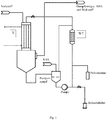
- Fig. 1 is a suitable plant for gas phase phosgenation shown schematically. This plant is particularly suitable for the production of 1,3-XDI and 1,4-XDI with contents of nitriles> 0.1 wt .-% based on the isocyanate produced.
- a tubular reactor (L: 9350 mm, inner diameter 134.5 mm) with a coaxial nozzle arranged on the reactor axis (inner diameter 134.5 mm) and a subsequent isocyanate condensation step were continuously 200 kg / h of 1,3-XDA abs at a pressure of 650 mbar.
- the temperature in the pumped circulation (3200 kg / h) was kept by cooling in a heat exchanger (WT) at 150 ° C.
- the pumping cycle was previously 500 ppm Tinuvin ® 571 added.
- the gas stream containing the reaction product 1,3-XDI was cooled by injection cooling with monochlorobenzene and condensed, the temperature of the liquid phase in the quench being about 90 ° C.
- the gas chromatographically determined content of 3-chloromethyl-benzyl isocyanate was 0.4% based on the sum of 1,3-XDI and 3-Cl-XI.
- the reaction mixture was freed from HCl and phosgene and worked up by distillation.
- the yield of 1,3-XDI was 95% of theory.
- the stream of gaseous 1,3-XDA and nitrogen was heated to 280 ° C in another heat exchanger and fed via the coaxial nozzle to the reactor.
- 500 kg / h of phosgene were heated to 310 ° C. in parallel and likewise continuously fed to the reactor on the annulus left free from the nozzle, in which the two educt streams were mixed and reacted.
- the velocity of the gas stream in the reactor was about 20 m / s and the velocity ratio of amine to phosgene stream 8.8.
- the gas stream containing the reaction product 1,3-XDI was cooled by injection cooling with monochlorobenzene and condensed, the temperature of the liquid phase in the quench being about 90 ° C.
- Example 3 2 kg of the XDI obtained in Example 3 were fractionally distilled through a column. The first 800 g were discarded as forerun, the main fraction was obtained 700 g of colorless 1,3-XDI. These were mixed with 0.98 g of Zelec UN at room temperature and allowed to stand for 24 h. The HC content of the sample, measured according to ASTM regulation D4663-98, after distillation was 108 ppm. Analogously to Example 4, a purity determination was carried out by HPLC. No 3-isocyanatomethylbenzonitrile was found here. The share of 1,3-XDI was 95.4%.
- the mold was made by clamping two glass mold shells (85mm diameter, 88mm inner radius, Shamir Insight, Inc., IL) 8mm apart with a plastic seal ring to form a pouring cavity.
- the mold distance is 8 mm at each point of the lens.
- the filled mold was cured in the oven with the following temperature profile: 15 hours at 65 ° C .; Annealed for 2 hours at 100 ° C and a further 2 hours at 120 ° C. Thereafter, the mold was cooled to room temperature and after complete cooling, first the cuff and then the two glass bodies were removed manually.
- the transmission was 90.3% with the standard illuminant D65, the haze was 2.1.
- the refractive index nE was 1.67 at 23 ° C.
- Example 6 Analogous to Example 6, a lens blank was prepared using 1,3-XDI from Example 5. This lens blank was completely cloudy, the transmission was only 29.7%, the Haze at 100.
- the transmission was 86.3% for the standard illuminant D65, the haze was 2.9.
- the refractive index nE was 1.67 at 23 ° C.
- DRC dibutyltin dichloride
- DBC dibutyltin dichloride
Landscapes
- Chemical & Material Sciences (AREA)
- Organic Chemistry (AREA)
- Chemical Kinetics & Catalysis (AREA)
- Health & Medical Sciences (AREA)
- Medicinal Chemistry (AREA)
- Polymers & Plastics (AREA)
- Physics & Mathematics (AREA)
- Optics & Photonics (AREA)
- General Physics & Mathematics (AREA)
- Inorganic Chemistry (AREA)
- Polyurethanes Or Polyureas (AREA)
- Eyeglasses (AREA)
- Organic Low-Molecular-Weight Compounds And Preparation Thereof (AREA)
- Compositions Of Macromolecular Compounds (AREA)
Description
- Die vorliegende Erfindung betrifft Zusammensetzungen zur Herstellung transparenter Polythiourethankörper enthaltend oder bestehend aus
- A) einer Polyisocyanatkomponente enthaltend zumindest ein Polyisocyanat mit einer Funktionalität an Isocyanatgruppen von wenigstens 2 pro Molekül,
- B) einer Thiolkomponente enthaltend zumindest ein Polythiol mit einer Funktionalität an Thiolgruppen von wenigstens 2 pro Molekül,
sowie gegebenenfalls - C) Hilfs- und Zusatzmittel,
- Für verschiedene Anwendungen, beispielsweise als leichtgewichtiger Ersatz für mineralisches Glas zur Herstellung von Scheiben für Automobil- und Flugzeugbau oder als Vergussmassen für optische, elektronische oder optoelektronische Bauteile, ist heute im Markt ein zunehmendes Interesse an transparenten, lichtechten Polyurethanmassen zu verzeichnen.
- Insbesondere für hochwertige optische Anwendungen, wie z. B. für Linsen oder Brillengläser, besteht allgemein der Wunsch nach Kunststoffinaterialien, die eine hohe Lichtbrechung und gleichzeitig eine geringe Dispersion (hohe Abbe-Zahl) aufweisen.
- Die Herstellung von transparenten Polyurethanmassen mit hohem Brechungsindex wurde bereits vielfach beschrieben. Oft kommen dabei als Polyisocyanatkomponenten sogenannte araliphatische Diisocyanate zum Einsatz, d. h. solche Diisocyanate, deren Isocyanatgruppen über aliphatische Reste an einem aromatischen System gebunden vorliegen. Aufgrund ihrer aromatischen Strukturen ergeben araliphatische Diisocyanate Polyurethane, die einen erhöhten Brechungsindex aufweisen, gleichzeitig garantieren die aliphatisch gebundenen Isocyanatgruppen die für hochwertige Anwendungen benötigte Lichtechtheit und geringe Vergilbungsneigung.
-
US-A 4680369 undUS-A 4689387 beschreiben beispielsweise als Linsenmaterialien geeignete Polyurethane bzw. Polythiourethane, bei deren Herstellung zur Erzielung besonders hoher Brechungsindices spezielle Schwefel enthaltende Polyole bzw. mercaptofunktionelle aliphatische Verbindungen mit monomeren araliphatischen Diisocyanaten, wie z. B. 1,3-Bis(isocyanatomethyl)benzol (m-Xylylendiisocyanat, m-XDI), 1,4-Bis(isocyanatomethyl)benzol (p-Xylylendiisocyanat, p-XDI), 1,3-Bis(2-isocyanatopropan-2-yl)benzol (m-Tetramethylxylylendiisocyanat, m-TMXDI) oder 1,3-Bis(isocyanatomethyl)-2,4,5,6-tetrachlorbenzol kombiniert werden. - Monomere araliphatische Diisocyanate, wie m- und p-XDI oder m-TMXDI, werden auch in einer Vielzahl weiterer Veröffentlichungen, wie z. B. der
EP-A 0 235 743 ,EP-A 0 268 896 ,EP-A 0 271 839 ,EP-A 0 408 459 ,EP-A 0 506 315 ,EP-A 0 586 091 undEP-A 0 803 743 , als die bevorzugten Polyisocyanatkomponente zur Herstellung hochbrechender Linsenmaterialien genannt. Sie dienen dabei als Vernetzerkomponenten für Polyole und/oder Polythiole und ergeben in Abhängigkeit vom Reaktionspartner transparente Kunststoffe mit hohen Brechungsindices im Bereich von 1,56 bis 1,67 und vergleichsweise hohen Abbe-Zahlen bis zu 45. - Ein wesentlicher Nachteil der genannten Verfahren zur Herstellung hoch lichtbrechender Polyurethane beziehungsweise Polythiourethane für optische Anwendungen ist, dass die Reaktion zwischen Polythiolen und Polyisocyaten sehr empfindlich gegen Verunreinigungen ist, so dass die gefertigten Linsen zum Teil hinsichtlich ihrer Transparenz und Trübungsfreiheit nicht immer den gewünschten Anforderungen genügen. Dies gilt vor allem für die Anwendung in Linsen und dergleichen.
- Die Aufgabe der vorliegenden Erfindung bestand somit darin, eine Zusammensetzung zur Herstellung transparenter Polythiourethankörper anzugeben, mit der sich solche Körper mit verbesserten optischen Eigenschaften, insbesondere einer verbesserten Transparenz und Trübungsfreiheit erzeugen lassen.
- Diese Aufgabe wurde bei einer Zusammensetzung der eingangs genannten Art dadurch gelöst, dass die Zusammensetzung ferner D) zumindest ein aromatisches Nitril enthält.
- Gegenstand der vorliegenden Erfindung ist damit eine Zusammensetzung zur Herstellung transparenter Polythiourethankörper enthaltend oder bestehend aus
- A) einer Polyisocyanatkomponente enthaltend zumindest ein Polyisocyanat mit einer Funktionalität an Isocyanatgruppen von wenigstens 2 pro Molekül,
- B) einer Thiolkomponente enthaltend oder bestehend aus zumindest ein Polythiol mit einer Funktionalität an Thiolgruppen von wenigstens 2 pro Molekül,
sowie gegebenenfalls - C) Hilfs- und Zusatzmittel,
wobei das Verhältnis von Isocyanatgruppen zu gegenüber Isocyanaten reaktiven Gruppen 0,5 : 1 bis 2,0 : 1 beträgt,
wobei die Zusammensetzung dadurch gekennzeichnet ist, dass
die Zusammensetzung ferner - D) zumindest ein aromatisches Nitril enthält.
- Im Rahmen der vorliegenden Erfindung wird unter dem Begriff transparent verstanden, dass der transparente Körper bei einer Dicke von 2 mm und bei der Normlichtart D65 (definiert in DIN 6173) eine Transmission von ≥ 85 % aufweist. Wobei dieser Transmissionswert bei der optionalen Mitverwendung von UV-Stabilisatoren und Farbstoffen von dem vorstehend genannten Wert von ≥ 85 % abweichen kann.
- Der vorliegenden Erfindung liegt die Erkenntnis zugrunde, dass durch die Anwesenheit wenigstens eines aromatischen Nitrils in Zusammensetzungen der eingangs genannten Art bei der Weiterverarbeitung zu Polythiourethanen deutlich seltener Trübungen in den so erzeugten Formkörpern auftreten. Ohne an eine Theorie gebunden zu sein wird vermutet, dass die Nitrile entweder mit den Thiolen reagieren können oder als Löslichkeitsvermittler für entstehende Dimere oder Trimere des Polyisocyanats wirken. Diese könnten ohne das Nitril ausfallen, was ein möglicher Grund für die auftretende Trübung sein kann.
- Ein weiterer Vorteil besteht darin, dass die erfindungsgemäße Zusammensetzung weniger empfindlich gegen eingeschlepptes Wasser ist, als bislang bekannte Systeme, wie sie beispielsweise in
US 8,044,165 B2 beschrieben sind. Normalerweise muss insbesondere die Thiolkomponente getrocknet werden, um überschüssiges Wasser zu entfernen, das ansonsten die optischen Eigenschaften erzeugter optischer Bauteile beeinträchtigen könnte. Demgegenüber ist dies bei der vorliegenden Erfindung nicht notwendig. So kann der Wassergehalt der Thiolkomponente bei den erfindungsgemäßen Zusammensetzungen > 600 ppm betragen, insbesondere > 800 ppm oder gar mehr als 900 ppm. - Es existieren verschiedene Möglichkeiten, das aromatische Nitril in die Zusammensetzung einzubringen. Die Nitrilzugabe kann bevorzugt bei der Formulierung der Zusammensetzung erfolgen, wobei das Nitril in besonders bevorzugter Weise mit der Polyisocyanatkomponente vorgemischt wird, bevor die Umsetzung mit der Thiolkomponente erfolgt. Die Erfindung ist jedoch keinesfalls auf diese Möglichkeit beschränkt. So kann die Nitrilzugabe auch vor oder während der Erzeugung der Polyisocyanate erfolgen, was typischerweise durch eine Flüssigphasen- oder Gasphasen-Phosgenierung der entsprechenden Polyamine erfolgt. Auch die Zugabe von Teilmengen des aromatischen Nitrils zu beliebigen Zeitpunkten ist möglich.
- Es ist ferner möglich, Teilmengen oder die Gesamtmenge der aromatischen Nitrile erst beim Vermischen der reaktiven Komponenten zuzugeben oder mit der Thiolkomponente vorzumischen.
- Ebenso kann - abgesehen von der vorbeschrieben aktiven Zugabe der aromatischen Nitrile - eine Teilmenge oder auch die Gesamtmenge an aromatischen Nitrilen "in-situ" erzeugt werden. Dies geschieht über eine Gasphasenphosgenierung araliphatischer Polyamine zu den entsprechenden araliphatischen Polyisocyanaten. Dabei entstehen - anders als bei der Flüssigphasenphosgenierung - aromatische Nitrile als Nebenprodukte der Phosgenierung. Ganz bevorzugt wird diese Möglichkeit bei der Gasphasenphosgenierung von 1,3-Xylyendiamin (1,3-XDA) und/oder 1,4-Xylyendiamin (1,4-XDA) zu 1,3-Bis(isocyanatomethyl)benzol (1,3 XDI) und/oder 1,4-Bis(isocyanatomethyl)benzol (1,4 XDI) angewendet. Je nach gewünschter Nitrilmenge kann das so erzeugte araliphatische Diisocyanat oder eine Mischung der genannten Verbindungen mit der produktionsbedingt enthaltenen Menge an aromatischen Nitrilen in einer erfindungsgemäßen Zusammensetzung eingesetzt, oder aber die Nitrilmenge durch Zugabe weiterer aromatischer Nitrile, die identisch oder verschieden zu den enthaltenen Nitrilen sein können, erhöht werden.
- Grundsätzlich können die erfindungsgemäßen Zusammensetzungen neben den aromatischen Nitrilen zusätzlich auch andere organische Nitrile enthalten, wie beispielsweise aliphatische, cycloaliphatische oder araliphatische Nitrile.
- Erfindungsgemäß ist vorgesehen, dass die Polyisocyanatkomponente zumindest ein Polyisocyanat enthält, das wenigstens zwei Isocyanatgruppen pro Molekül besitzt, insbesondere von 2 bis 6, vorzugsweise von 2 bis 4, besonders bevorzugt von 2 bis 3. Dabei können auch Mischungen von Polyisocyanaten unterschiedlicher Funktionalität eingesetzt werden, sodass sich ungeradzahlige mittlere Funktionalitäten ergeben. Unter einem Polyisocyanat werden im Rahmen der vorliegenden Erfindung organische Isocyanate verstanden mit zwei oder mehr freien Isocyanatgruppen. Das Polyisocyanat kann dabei in monomerer Form oder auch in oligomerer Form vorliegen. Hierfür geeignete Modifizierungsreaktionen sind beispielsweise die üblichen Verfahren zur katalytischen Oligomerisierung von Isocyanaten unter Bildung von Uretdion-, Isocyanurat-, Iminooxadiazindion- und/oder Oxadiazintrionstrukturen oder zur Biuretisierung von Diisocyanaten, wie sie z. B. in Laas et al., J. Prakt. Chem. 336, 1994, 185-200, in
DE-A 1 670 666 undEP-A 0 798 299 beispielhaft beschrieben sind. Konkrete Beschreibungen solcher Polyisocyanate auf Basis araliphatischer Diisocyanate finden sich z. B. auch inEP-A 0 081 713 ,EP-A 0 197 543 ,GB-A 1 034 152 JP-A 05286978 - Im Prinzip können als Polyisocyanate im Rahmen der vorliegenden Erfindung sämtliche an sich bekannte Polyisocyanate eingesetzt werden. Dies sind beispielsweise solche des Molekulargewichtsbereiches 140 bis 400 g/mol, wie z. B. 1,4-Diisocyanatobutan, 1,5-Diisocyanatopentan, 1,6-Diisocyanatohexan (HDI), 1,5-Diisocyanato-2,2-dimethylpentan, 2,2,4- bzw. 2,4,4-Trimethyl-1,6-diisocyanatohexan, 1,8-Diisocyanatooctan, 1,9-Diisocyanato-nonan, 1,10-Diisocyanatodecan, 1,3- und 1,4-Diisocyanatocyclohexan, 1,4-Diisocyanato-3,3,5-trimethylcyclohexan, 1,3-Diisocyanato-2-methylcyclohexan, 1,3-Diisocyanato-4-methyl-cyclohexan, 1-Isocyanato-3,3,5-trimethyl-5-isocyanatomethylcyclohexan (Isophorondiisocyanat; IPDI), 1-Isocyanato-1-methyl-4(3)-isocyanatomethylcyclohexan, 2,4'- und 4,4'-Diisocyanatodicyclohexylmethan (H12-MDI), 1,3- und 1,4-Bis(isocyanatomethyl)cyclohexan, 2,5-Bis(isocyanatomethyl)-bicyclo[2.2.1]heptan, 2,6-Bis(isocyanatomethyl)-bicyclo [2.2.1]heptan, 4,4'-Diisocyanato-3,3'-dimethyldicyclohexylmethan, 4,4' Diisocyanato-3,3',5,5'-tetramethyldicyclo-hexylmethan, 4,4'-Diisocyanato-1,1'-bi(cyclohexyl), 4,4'-Diisocyanato-3,3'-dimethyl-1,1'-bi(cyclohexyl), 4,4'-Diisocyanato-2,2',5,5'-tetra-methyl-1,1'-bi(cyclohexyl), 1,8-Diisocyanato-p-menthan, 1,3-Diisocyanatoadamantan, 1,3-Dimethyl-5,7-diisocyanatoadamantan, 1,3- und 1,4-Bis-(isocyanatomethyl)benzol, 1,3-und 1,4-Bis(1-isocyanato-1-methylethyl)-benzol (TMXDI), Bis(4-(1-isocyanato-1-methylethyl)phenyl)-carbonat, 1,3- und 1,4-Phenylendiisocyanat, 2,4- und 2,6-Toluylendiisocyanat sowie beliebige Gemische dieser Isomeren, Diphenylmethan-2,4'-und/oder -4,4'-diisocyanat und Naphthylen-1,5-diisocyanat sowie beliebige Gemische solcher Diisocyanate.
- Die Polyisocyanate können dabei durch beliebige Verfahren hergestellt sein, wie beispielsweise durch Phosgenierung der entsprechenden Amine in der Gas- oder Flüssigphase, aber auch durch Phosgen-freie Methoden wie beispielsweise durch Carbamatspaltung.
- Vorzugsweise sind die Polyisocyanate ausgewählt aus 1,3-Bis(isocyanatomethyl)benzol (1,3 XDI), 1,4-Bis(isocyanatomethyl)benzol (1,4 XDI), 2,5-Bis(isocyanatomethyl)bicyclo[2.2.1]heptan, 2,6-Bis(isocyanatomethyl)bicyclo[2.2.1]heptan, 1,4-Bis(isocyanatomethyl)cyclohexan, 1,3-Bis(isocyanatomethyl)cyclohexan, 2,2'-Diisocyanatodicyclohexylmethan, 2,4'-Diisocyanatodicyclohexylmethan, 4,4'-Diisocyanatodicyclohexylmethan (H12 MDI), 1-Isocyanato-3,3,5-trimethyl-5-isocyanatomethylcyclohexan (Isophorondiisocyanat; IPDI) oder Mischungen von diesen, insbesondere bevorzugt 1,3-Bis(isocyanatomethyl)benzol (1,3 XDI) und/ oder 1,4-Bis(isocyanatomethyl)benzol (1,4 XDI). Diese Poly- beziehungsweise Diisocyanate sind bevorzugt, weil hierdurch Linsenmaterialien mit besonders guten optischen Eigenschaften erhältlich sind, wie hohem Brechungsindex und hoher Transparenz. Diese Vorteile sind bei den als bevorzugt genannten Diisocyanaten 1,3-Bis(isocyanatomethyl)benzol (1,3 XDI) und 1,4-Bis(isocyanatomethyl)benzol (1,4 XDI) besonders ausgeprägt.
- Die mittlere Isocyanatfunktionalität der Polyisocyanatkomponente A) beträgt bevorzugt 1,8 bis 4,0, insbesondere 1,9 bis 3,5, besonders bevorzugt 2,0 bis 3,0.
- Nach der vorliegenden Erfindung kann vorgesehen sein, dass wenigstens ein Polyisocyanat der Polyisocyanatkomponente A) durch Gasphasenphosgenierung aliphatischer, cycloaliphatischer, aromatischer oder araliphatischer Polyamine hergestellt ist. Ein derartiges Verfahren für die Erzeugung der erfindungsgemäß einzusetzenden Polyisocyanate ist in
EP 1 754 698 B1 beschrieben. Ebenfalls einsetzbar ist ein Verfahren zur Gasphasenphosgenierung, wie es inWO 2013/079517 A1 offenbart ist. - Bei der Gasphasenphosgenierung wird vorzugsweise so vorgegangen, dass die entsprechenden Ausgangssubstanzen, das heißt die den herzustellenden Polyisocyanaten zugrundeliegenden Polyamine, gegebenenfalls unter Zusatz von Stabilisatoren und / oder eines Inertgases, verdampft werden, dabei wird wenn benötigt bei einem Druck von < 1000 mbar gearbeitet. Die auf diese Weise verdampften Polyamine werden in einem Kreislauf mit einer mittleren Verweilzeit von 5 bis 90 Minuten und einer Temperatur von 40 bis 190 °C geführt und dabei bei einer Temperatur von 10 bis 100 K oberhalb der Verdampfungstemperatur der Amine unter dem gegebenen Druck nach an sich bekannten Verfahren der Gasphasenphosgenierung mit Phosgen umgesetzt. Die vorgenannten Verfahrensbedingungen gelten insbesondere für die Erzeugung von 1,3-Xylylendiisocyanat und 1,4-Xylylendiisocyanat. Auf diese Weise entstehen vergleichsverweise hohe Mengen an Nitrilen, die sich vorteilhaft bei der Weiterverarbeitung in einer erfindungsgemäßen Zusammensetzung auswirken, insbesondere im Hinblick auf die Transparenz daraus erzeugter Formkörper. In diesem Falle kann - je nach gewünschtem Gehalt an aromatischen Nitrilen in der Zusammensetzung kann bei dieser Ausführungsform auf eine aktive Zugabe aromatischer Nitrile verzichtet werden.
- Geeignete Modifizierungsreaktionen zur Herstellung der Polyisocyanatkomponenten A) sind, sofern gewünscht, eine Urethanisierung und/oder Allophanatisierung araliphatischer Diisocyanate nach Zusatz molar unterschüssiger Mengen hydroxyfunktioneller Reaktionspartner, insbesondere niedermolekularer ein- oder mehrwertiger Alkohole des Molekulargewichtsbereiches 32 bis 300 g/mol, wie z. B. Methanol, Ethanol, n-Propanol, Isopropanol, n-Butanol, Isobutanol, sec-Butanol, die isomeren Pentanole, Hexanole, Octanole und Nonanole, n-Decanol, n-Dodecanol, n-Tetradecanol, n-Hexadecanol, n-Octadecanol, Cyclohexanol, die isomeren Methylcyclohexanole, Hydroxymethylcyclohexan, 3-Methyl-3-hydroxymethyloxetan, 1,2-Ethandiol, 1,2- und 1,3-Propandiol, die isomeren Butandiole, Pentandiole, Hexandiole, Heptandiole und Octandiole, 1,2- und 1,4-Cyclohexandiol, 1,4-Cyclohexandimethanol, 4,4'-(1-Methylethyliden)-biscyclohexanol, Diethylenglylol, Dipropylenglykol, 1,2,3-Propantriol, 1,1,1-Trimethylolethan, 1,2,6-Hexantriol, 1,1,1-Trimethylolpropan, 2,2-Bis(hydroxymethyl)-1,3-propandiol oder 1,3,5-Tris(2-hydroxyethyl)-isocyanurat, oder beliebiger Gemische solcher Alkohole. Bevorzugte Alkohole zur Herstellung Urethan- und/oder Allophanat-modifizierter Polyisocyanatkomponenten A) sind die genannten Monoalkohole und Diole mit 2 bis 8 Kohlenstoffatomen.
- Konkrete Beschreibungen Urethan- und/oder Allophanat-modifizierter Polyisocyanate auf Basis araliphatischer Diisocyanate finden sich beispielsweise in
EP-A 1 437 371 ,EP-A 1 443 067 ,JP-A 200516161691 JP-A 2005162271 - Soll für die erfindungsgemäße Zusammensetzung ein oder mehrere, über Gasphasenphosgenierung erzeugte Polyisocyanate eingesetzt werden, enthält nach einer bevorzugten Ausgestaltung der erfindungsgemäßen Zusammensetzung die Polyisocyanatkomponente wenigstens 30 Gew.-% bezogen auf die Polyisocyanatkomponente an durch Gasphasenphosgenierung hergestellten Polyisocyanat, insbesondere wenigstens 50 Gew.-%, weiter bevorzugt wenigstens 80 Gew.-% oder gar wenigstens 90 Gew.-%, besonders bevorzugt wenigstens 95 Gew.-% oder gar wenigstens 96 oder wenigstens 98 Gew.-%.
- Bei dem Einsatz von über Gasphasenphosgenierung erzeugtem Polyisocyanat bildet bevorzugt wenigstens ein Nitril einen weiteren Bestandteil der Polyisocyanatkomponente, das als Nebenprodukt in der über Gasphasenphosgenierung enthaltenen Polyisocyanatkomponente enthalten ist. Neben dem über Gasphasenphosgenierung erzeugten Polyisocyanat kann der Polyisocyanatkomponente durchaus auch ein über andere Herstellungswege erzeugtes Polyisocyanat zugesetzt sein, wie beispielsweise ein Polyisocyanat, welches über Flüssigphasen-Phosgenierung erzeugt wurde.
- Je nach Nitril-Gehalt der Polyisocyanatkomponente kann der Anteil an durch andere als Gasphasenphosgenierung erzeugten Polyisocyanaten beispielsweise bis zu 19 Gew.-% bezogen auf die Polyisocyanatkomponente A) betragen, gegebenenfalls auch bis zu 14 Gew.-%, bis zu 9 Gew.-%., bis zu 4 Gew.-% oder bis zu 3 Gew.-%.
- Nach einer bevorzugten Ausführungsform der erfindungsgemäßen Zusammensetzung, in der zumindest ein über Gasphasenphosgenierung erzeugtes Polyisocyanat eingesetzt wird, enthält die Polyisocyanatkomponente wenigstens 0,005 Gew.-% bezogen auf die Polyisocyanatkomponente A) an wenigstens einem aromatischen Nitril, insbesondere wenigstens 0,01 Gew.-%, bevorzugt 0,005 bis 15 Gew.-%, weiter bevorzugt 0,01 bis 5 Gew.-%, besonders bevorzugt 0,1 bis 2 Gew.-% oder gar 0,1 bis 1 Gew.-%.
- Wie bereits vorstehend ausgeführt wurde, können die erfindungsgemäß eingesetzten und durch Gasphasenphosgenierung erzeugten Polyisocyanatkomponenten herstellungsbedingt bereits einen gewissen Anteil an Nitrilen enthalten, der unter anderem durch die Natur der bei der Reaktion eingesetzten Polyamine und darüber hinaus durch die Wahl der Reaktionsbedingungen, insbesondere den Druck und die Reaktionstemperatur, beeinflusst werden kann. Dies gilt insbesondere für die im Rahmen der vorliegenden Erfindung besonders bevorzugten Polyisocyanate 1,3-Bis(isocyanatomethyl)benzol (1,3 XDI) und 1,4-Bis(isocyanatomethyl)benzol (1,4 XDI), die nach der Gasphasenphosgenierung in der Regel vergleichsweise hohe Gehalte an entsprechenden Nitrilen aufweisen.
- Unabhängig von der Anwesenheit eines oder mehrerer über Gasphasenphosgenierung erzeugter Polyisocyanate enthält die Zusammensetzung in bevorzugter Weise 0,0025 bis 10 Gew.-%, bezogen auf die gesamte Zusammensetzung an aromatischem Nitril, insbesondere 0,005 bis 5 Gew.-%, weiter bevorzugt 0,01 bis 3 Gew.-% und besonders bevorzugt 0,05 bis 2 Gew.-%. Diese Einsatzmengen an aromatischen Nitrilen - unabhängig ob sie als Nebenprodukt der Gasphasenphosgenierung vorliegen oder vollständig oder teilweise aktiv zugesetzt wurden - sind besonders vorteilhaft, weil sich hierdurch besonders transparente und trübungsfreie optische Formkörper aus Polythiourethan herstellen lassen, wie beispielsweise Linsen.
- Der Gehalt an Nitrilen wird im Rahmen der vorliegenden Erfindung über Derivatisierung mit Diethylamin und anschließender HPLC-MS durch Integration der Flächen der Signale im UV bestimmt. Für die HPLC-MS Messung kann beispielsweise das folgende Programm gewählt werden:
- Synapt G2-S HR-MS, ACQUITY UPLC (Waters) QS. Nr.: 02634
- UV: PDA (Total Absorbance Chromatogram)
- Säule: Kinetex 100 x 2.1mm_1.7µm
- Säulentemperatur: 30 °C
- Die mobile Phase bestand aus:
- Lösemittel:
- A) Wasser + 0.05% Ameisensäure
- B) Acetonitril + 0.05% Ameisensäure
- Flussrate: 0.5 ml/min
- Gradient: t0/5%B_t0.5/5%B_t6/100%B_t7/100%B_t7.1/5%B_t8/5%B
- Im Rahmen der vorliegenden Erfindung ist es bevorzugt, dass das Nitril von demselben Polyamin abgeleitete ist wie das Polyisocyanat. Dies gilt dabei sowohl für die herstellungsbedingt enthaltenen Nitrile als auch für gegebenenfalls nachträglich zugefügte Nitrile. Dies ist besonders vorteilhaft, da aufgrund des gleichen chemischen Grundgerüst wie das des bei der Gasphasenphosgenierung erzeugten Polyisocyanats eine besonders gute Vermittlungswirkung durch das Nitril erreicht wird.
- Besonders bevorzugt ist es ferner, dass das Nitril wenigstens eine weitere funktionelle Gruppe enthält, wobei es sich insbesondere um eine Gruppe handelt, die in das Polythiourethan Netzwerk einbauen kann, um eine spätere Migration des Nitrils aus dem Formkörper zu verhindern, und besonders bevorzugt um eine Isocyantgruppe handeln kann. Dies soll im Folgenden anhand des Beispiels 1,3-Bis(Isocyanatomethyl)benzol(1,3-XDI) verdeutlicht werden. Dieses Diisocyanat kann durch Gasphasenphosgenierung von 1,3-Bis(Aminomethyl)benzol erzeugt werden. Das besonders bevorzugte Isocyanatonitril ist in diesem Fall das 3-(Isocyantomethyl)benzonitril.
- Bei der Umsetzung eines solchen Isocyanatonitrils mit der Thiolkomponente können Nitril-modifizierte Thiourethane entstehen. Dies sei gezeigt am Beispiel des 3-(Isocyantomethyl)benzonitrils:

- Darin bezeichnet R2 den Rest des eingesetzten Polythiols. Für 4-Mercaptomethyl-1,8-dimercapto-3,6-dithiaoctan (DMPT) entspricht der Rest R2 folgender Struktureinheit, wobei der linke Bindungsstrich in der Formel die Bindung zum Schwefelatom in der vorgenannten Struktur darstellt:
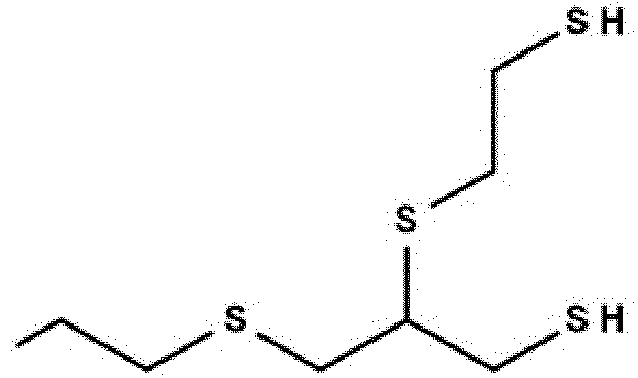
- Es können auch beide Thiolgruppen des DMPT mit jeweils einem Molekül 3-(Isocyantomethyl)benzonitril reagieren, wobei die folgende Struktur entsteht:

- Analoge Verbindungen können auch mit optional eingesetzten Polyolen entstehen. Zunächst allgemein das Reaktionsprodukt von 3-(Isocyantomethyl)benzonitril mit einem Polyol mit R1 als Rest des eingesetzten Polyols:

- Es entsteht also ein Nitril-modifiziertes Urethan. Bei Einsatz eines Diols können auch beide OH-Gruppen mit jeweils einem Molekül 3-(Isocyantomethyl)benzonitril reagieren, wobei die folgende Struktur entsteht:

- Unter aromatischen Nitrilen werden im Sinne dieser Erfindung Verbindungen verstanden, die direkt an einen Aromaten gebunden eine Nitrilgruppe aufweisen und bevorzugt eine Molmasse von < 1000 g/mol, besonders bevorzugt < 500 g/mol haben.
- Nach einer bevorzugten Ausgestaltung der erfindungsgemäßen Zusammensetzung ist das Nitril ausgewählt aus Benzonitril, 3-(Isocyanatomethyl)benzonitril, 4-(Isocyanatomethyl)benzonitril, 3-(Chloromethyl)benzonitril, 4-(Chloromethyl)benzonitril, 3-Cyanobenzoesäure, 4-Cyanobenzoesäure, 2-Hydroxybenzonitril, 3- Hydroxybenzonitril, 4-Hydroxybenzonitril, 3-Cyanobenzoesäurechlorid, 4-Cyanobenzoesäurechlorid oder Mischungen von diesen, insbesondere Benzonitril, 3-(Chloromethyl)benzonitril, 4-(Chloromethyl)benzonitril, 3-(Isocyanatomethyl)benzonitril, und/ oder 4-(Isocyanatomethyl)benzonitril, besonders bevorzugt 3-(Isocyanatomethyl)benzonitril, und/ oder 4-(Isocyanatomethyl)benzonitril. Der Einsatz dieser Nitrile ist insbesondere bei Einsatz einer Polyisocyanatkomponente von Vorteil, die größere Anteile an 1,3-XDI und/ oder 1,4-XDI, wie > 50 Gew.-% bezogen auf die Polyisocyanatkomponente A) aufweist, oder die hinsichtlich der Polyisocyanate vollständig aus diesen Verbindungen besteht. In diesen Fällen kann eine besonders ausgeprägte Verbesserung der optischen Eigenschaften eines daraus erzeugten Polythiourethankörpers beobachtet werden, speziell was dessen Transparenz angeht.
- Nach einer besonders bevorzugten Ausführungsform der erfindungsgemäßen Zusammensetzung ist das Polyisocyanat ausgewählt aus 1,3-Bis(Isocyanatomethyl)benzol (1,3 XDI) und das Nitril aus 3-(Isocyanatomethyl)benzonitril und/oder dass das Polyisocyanat ausgewählt ist aus 1,4-Bis(isocyanatomethyl)benzol (1,4 XDI) und das Nitril aus 4-(Isocyanatomethyl)benzonitril.
- Die erfindungsgemäße Zusammensetzung enthält ferner eine Thiolkomponente B). Diese beinhaltet oder besteht aus zumindest einem Polythiol mit einer Funktionalität an Thiolgruppen von wenigstens zwei pro Molekül, insbesondere von 2 bis 6, vorzugsweise von 2 bis 4, besonders bevorzugt von 3 bis 4. Dabei können auch Mischungen von Polythiolen unterschiedlicher Funktionalität eingesetzt werden, sodass sich ungeradzahlige mittlere Funktionalitäten ergeben. Unter einem Polythiol werden im Rahmen der vorliegenden Erfindung organische Thiole mit zwei oder mehr Thiolgruppen verstanden. Damit bezieht sich die Silbe "poly" im Wesentlichen auf die Zahl der Thiolgruppen und bedeutet, wie auch vorstehend bei den Polyisocyanat-Verbindungen ausgeführt nicht zwangsläufig, dass das Polythiol eine oligomere oder gar polymere Struktur aufweisen muss. Obgleich können die erfindungsgemäß eingesetzten Polythiole durchaus auch ein Polyehter-Grundgerüst, ein Polythiolether-Grundgerüst oder ein gemischtes Grundgerüst aus O-Ether und S-Ether-Einheiten besitzen.
- Das Polythiol kann ein mittleres Molekulargewicht von 80 (Methandithiol) bis etwa 12000 g/mol aufweisen, vorzugsweise 250 bis 8000 g/mol.
- Als Polythiole eignen sich beispielsweise Methandithiol, 1,2-Ethandithiol, 1,1-Propandithiol, 1,2-Propandithiol, 1,3-Propandithiol, 2,2-Propandithiol, 1,4-Butandithiol, 2,3-Butandithiol, 1,5-Pentandithiol, 1,6-Hexandithiol, 1,2,3-Propantrithiol, 1,1-Cyclohexandithiol, 1,2-Cyclohexandithiol, 2,2-Dimethylpropan-1,3-dithiol, 3,4-Dimethoxybutan-1,2-dithiol und 2-Methylcyclohexan-2,3-dithiol, Thioethergruppen enthaltende Polythiole, wie z. B. 2,4-Dimercaptomethyl-1,5-dimercapto-3-thiapentan, 4-Mercaptomethyl-1,8-dimercapto-3,6-dithiaoctan, 4,8-Dimercaptomethyl-1,11-dimercapto-3,6,9-trithiaundecan, 4,7-Dimercaptomethyl-1,11-dimercapto-3,6,9-trithiaundecan, 5,7-Dimercaptomethyl-1,11-dimercapto-3,6,9-trithiaundecan, 4,5-Bis(mercaptoethylthio)-1,10-dimercapto-3,8-dithiadecan, Tetrakis(mercaptomethyl)methan, 1,1,3,3-Tetrakis(mercaptomethylthio)propan, 1,1,5,5-Tetrakis(mercaptomethylthio)-3-thiapentan,1,1,6,6-Tetrakis(mercaptomethylthio)-3,4-dithiahexan, 2-Mercaptoethylthio-1,3-dimercaptopropan, 2,3-Bis(mercaptoethylthio)-1-mercaptopropan, 2,2-Bis(mercaptomethyl)-1,3-dimercaptopropan, Bis(mercaptomethyl)sulfid, Bis(mercaptomethyl)disulfid, Bis(mercaptoethyl)sulfid, Bis(mercaptoethyl)disulfid, Bis(mercaptopropyl)sulfid, Bis(mercaptopropyl)disulfid, Bis(mercaptomethylthio)methan, Tris(mercaptomethylthio)methan, Bis(mercaptoethylthio)methan, Tris(mercaptoethylthio)methan, Bis(mercaptopropylthio)methan, 1,2-Bis(mercaptomethylthio)ethan, 1,2-Bis(mercaptoethylthio)ethan, 2-Mercaptoethylthio)ethan, 1,3-Bis(mercaptomethylthio)propan, 1,3-Bis(mercaptopropylthio)propan, 1,2,3-Tris(mercaptomethylthio)propan, 1,2,3-Tris(mercaptoethylthio)propan, 1,2,3-Tris(mercaptopropylthio)propan, Tetrakis(mercaptomethylthio)methan, Tetrakis(mercaptoethylthiomethyl)methan, Tetrakis(mercaptopropylthiomethyl)methan, 2,5-Dimercapto-1,4-dithian, 2,5-Bis(mercaptomethyl)-1,4-dithian und dessen gemäß
JP-A 07118263 - Vorzugsweise ist das Polythiol ausgewählt aus 4-Mercaptomethyl-1,8-dimercapto-3,6-dithiaoctan, 2,5-Bismercaptomethyl-1,4-dithian, 1,1,3,3-Tetrakis(mercaptomethylthio)propan, 5,7-Dimercaptomethyl-1,11-dimercapto-3,6,9-trithiaundecan, 4,7-Dimercaptomethyl-1,11-dimercapto-3,6,9-trithiaundecan, 4,8-Dimercaptomethyl-1,11-dimercapto-3,6,9-trithiaundecan, Trimethylolpropan-tris(3-mercaptopropionat), Trimethylolethan-tris(2-mercaptoacetat), Pentaerythrit-tetrakis(2-mercaptoacetat) und/ oder Pentaerythrit-tetrakis(3-mercaptopropionat).
- Abgesehen von der Thiolkomponente B) kann die erfindungsgemäße Zusammensetzung auch andere, üblicherweise mit Polyisocyanaten reagierende Komponenten enthalten. Hierbei handelt es sich insbesondere um die üblichen aus der Polyurethanchemie bekannten Polyetherpolyole, Polyesterpolyole, Polyetherpolyesterpolyole, Polythioetherpolyole, polymermodifizierte Polyetherpolyole, Pfropfpolyetherpolyole, insbesondere solche auf Styrol- und/oder Acrylnitrilbasis, Polyetherpolyamine, hydroxylgruppenhaltigen Polyacetale und/oder hydroxylgruppenhaltigen aliphatischen Polycarbonate, die üblicherweise ein gewichtsmittleres Molekulargewicht von 106 bis 12000 g/mol, vorzugsweise 250 bis 8000 g/mol aufweisen. Ein breiter Überblick über geeignete Reaktionspartner B) findet sich beispielsweise in N. Adam et al.: "Polyurethanes", Ullmann's Encyclopedia of Industrial Chemistry, Electronic Release, 7th ed., chap. 3.2 - 3.4, Wiley-VCH, Weinheim 2005.
- Unter einem Polythiourethan wird im Sinne der vorliegenden Erfindung ein Polymer verstanden, bei dem mehr als die Hälfte bis sämtliche der Bindungen zwischen dem Polyisocyanat und der oder den Isocyanat-reaktiven Komponente(n) Thiourethangruppen sind. Es können also zu weniger als die Hälfte andere Bindungen vorhanden sein, wie beispielsweise Urethan- oder Harnstoffbrücken. In diesem Falle enthält die erfindungsgemäße Zusammensetzung noch andere Isocyanat-reaktiven Komponente(n). Diese lediglich optionalen Komponenten werden im Folgenden näher beschrieben.
- Geeignete Polyetherpolyole, sofern verwendet, sind beispielsweise solche der in der
DE-A 2 622 951 , Spalte 6, Zeile 65 - Spalte 7, Zeile 47, oder derEP-A 0 978 523 Seite 4, Zeile 45 bis Seite 5, Zeile 14 genannten Art, sofern sie den oben gemachten Angaben hinsichtlich Funktionalität und Molekulargewicht entsprechen. Besonders bevorzugte Polyetherpolyole B) sind Anlagerungsprodukte von Ethylenoxid und/oder Propylenoxid an Glycerin, Trimethylolpropan, Ethylendiamin und/oder Pentaerythrit. - Geeignete Polyesterpolyole, sofern verwendet, sind beispielsweise solche der in der
EP-A 0 978 523 Seite 5, Zeilen 17 bis 47 oder derEP-A 0 659 792 Seite 6, Zeilen 8 bis 19 genannten Art, sofern sie den oben gemachten Angaben entsprechen, bevorzugt solche, deren Hydroxylzahl von 20 bis 650 mg KOH/g beträgt. - Geeignete Polyacetalpolyole, sofern verwendet, sind beispielsweise die bekannten Umsetzungsprodukte einfacher Glykole, wie z. B. Diethylenglykol, Triethylenglykol, 4,4'-Dioxethoxy-diphenyl-dimethylmethan (Addukt von 2 mol Ethylenoxid an Bisphenol A) oder Hexandiol, mit Formaldehyd oder auch durch Polykondensation cyclischer Acetale, wie z. B. Trioxan, hergestellte Polyacetale.
- Ebenfalls können Aminopolyether oder Gemische von Aminopolyethern geeignet sein, d. h. Polyether mit gegenüber Isocyanatgruppen reaktionsfähigen Gruppen, die sich zumindest zu 50 Äquivalent-%, vorzugsweise zumindest zu 80 Äquivalent-%, aus primären und/oder sekundären, aromatisch oder aliphatisch gebundenen Aminogruppen und zum Rest aus primären und/oder sekundären, aliphatisch gebundenen Hydroxylgruppen zusammensetzen. Geeignete derartige Aminopolyether sind beispielsweise die in
EP-A 0 081 701 , Spalte 4, Zeile 26 bis Spalte 5, Zeile 40, genannten Verbindungen. Ebenfalls als Ausgangskomponente E) geeignet sind aminofunktionelle Polyetherurethane oder -harnstoffe, wie sie sich beispielsweise nach dem Verfahren derDE-A 2 948 419 durch Hydrolyse von isocyanatfunktionellen Polyetherprepolymeren herstellen lassen oder auch Aminogruppen aufweisende Polyester des obengenannten Molekulargewichtsbereichs. - Weitere geeignete gegenüber Isocyanatgruppen reaktive Komponenten sind beispielsweise auch die in
EP-A 0 689 556 undEP-A 0 937 110 beschriebenen, z. B. durch Umsetzung epoxidierter Fettsäureester mit aliphatischen oder aromatischen Polyolen unter Epoxidringöffung erhältlichen speziellen Polyole. - Auch Hydroxylgruppen enthaltende Polybutadiene können gegebenenfalls eingesetzt werden.
- Darüber hinaus sind als gegenüber Isocyanatgruppen reaktive Komponenten auch Schwefel enthaltende Hydroxyverbindungen geeignet. Beispielhaft seien hier genannt einfache Mercaptoalkohole, wie z. B. 2-Mercaptoethanol, 3-Mercaptopropanol, 1,3-Dimercapto-2-propanol, 2,3-Dimercaptopropanol und Dithioerythritol, Thioetherstrukturen enthaltende Alkohole, wie z. B. Di(2-hydroxyethyl)sulfid, 1,2-Bis(2-hydroxyethylmercapto)ethan, Bis(2-hydroxyethyl)disulfid und 1,4-Dithian-2,5-diol, oder Schwefel enthaltende Diole mit Polyesterurethan-, Polythioesterurethan-, Polyesterthiourethan- oder Polythioesterthiourethanstruktur der in der
EP-A 1 640 394 genannten Art. - Als gegenüber Isocyanaten reaktive Verbindungen können die erfindungsgemäßen Zusammensetzungen auch niedermolekulare, hydroxy- und/oder aminofunktionelle Komponenten enthalten, d. h. solche eines Molekulargewichtsbereiches von 60 bis 500 g/mol, vorzugsweise von 62 bis 400 g/mol.
- Hierbei handelt es sich beispielsweise um einfache ein- oder mehrwertige Alkohole mit 2 bis 14, vorzugsweise 4 bis 10 Kohlenstoffatomen, wie z. B. 1,2-Ethandiol, 1,2- und 1,3-Propandiol, die isomeren Butandiole, Pentandiole, Hexandiole, Heptandiole und Octandiole, 1,10-Decandiol, 1,2- und 1,4-Cyclohexandiol, 1,4-Cyclohexandimethanol, 4,4'-(1-Methylethyliden)-biscyclohexanol, 1,2,3-Propantriol, 1,1,1-Trimethylolethan, 1,2,6-Hexantriol, 1,1,1-Trimethylolpropan, 2,2-Bis(hydroxymethyl)-1,3-propandiol, Bis-(2-hydroxyethyl)-hydrochinon, 1,2,4- und 1,3,5-Trihydroxycyclohexan oder 1,3,5-Tris(2-hydroxyethyl)-isocyanurat.
- Beispiele für geeignete niedermolekulare aminofunktionelle Verbindungen sind aliphatische und cycloaliphatische Amine und Aminoalkohole mit primär und/oder sekundär gebundenen Aminogruppen, wie z. B. Cyclohexylamin, 2-Methyl-1,5-pentandiamin, Diethanolamin, Monoethanolamin, Propylamin, Butylamin, Dibutylamin, Hexylamin, Monoisopropanolamin, Diisopropanolamin, Ethylendiamin, 1,3-Diaminopropan, 1,4-Diaminobutan, Isophorondiamin, Diethylentriamin, Ethanolamin, Aminoethylethanolamin, Diaminocyclohexan, Hexamethylendiamin, Methyliminobispropylamin, Iminobispropylamin, Bis(aminopropyl)piperazin, Aminoethylpiperazin, 1,2-Diaminocyclohexan, Triethylentetramin, Tetraethylenpentamin, 1,8-p-Diaminomenthan, Bis(4-aminocyclohexyl)methan, Bis(4-amino-3-methylcyclohexyl)methan, Bis(4-amino-3,5-dimethylcyclohexyl)methan, Bis(4-amino-2,3,5-trimethylcyclohexyl)methan, 1,1-Bis(4-aminocyclohexyl)propan, 2,2-Bis(4-aminocyclohexyl)propan, 1,1-Bis(4-aminocyclohexyl)ethan, 1,1-Bis(4-aminocyclohexyl)butan, 2,2-Bis(4-aminocyclohexyl)butan, 1,1-Bis(4-amino-3-methylcyclohexyl)ethan, 2,2-Bis(4-amino-3-methylcyclohexyl)propan, 1,1-Bis(4-amino-3,5-dimethylcyclohexyl)ethan, 2,2-Bis(4-amino-3,5-dimethylcyclohexyl)propan, 2,2-Bis(4-amino-3,5-dimethylcyclohexyl)butan, 2,4-Diaminodicyclohexylmethan, 4-Aminocyclohexyl-4-amino-3-methylcyclohexylmethan, 4-Amino-3,5-dimethylcyclohexyl-4-amino-3-methylcyclohexylmethan und 2-(4-Aminocyclohexyl)-2-(4-amino-3-methylcyclohexyl)methan.
- Beispiele für aromatische Polyamine, insbesondere Diamine, mit Molekulargewichten unter 500, die geeignete gegenüber Isocyanaten reaktive Verbindungen B) darstellen, sind z. B. 1,2- und 1,4-Diaminobenzol, 2,4- und 2,6-Diaminotoluol, 2,4'- und/oder 4,4'-Diaminodiphenylmethan, 1,5-Diaminonaphthalin, 4,4',4"-Triaminotriphenylmethan, 4,4'-Bis-(methylamino)-diphenylmethan oder 1-Methyl-2-methylamino-4-aminobenzol. 1-Methyl-3,5-diethyl-2,4-diaminobenzol, 1-Methyl-3,5-diethyl-2,6-diaminobenzol, 1,3,5-Trimethyl-2,4-diaminobenzol, 1,3,5-Triethyl-2,4-diaminobenzol, 3,5,3',5'-Tetraethyl-4,4'-diaminodiphenylmethan, 3,5,3',5'-Tetraisopropyl-4,4'-diaminodiphenylmethan, 3,5-Diethyl-3',5'-düsopropyl-4,4'-diaminodiphenylmethan, 3,3'-Diethyl-5,5'-diisopropyl-4,4'-diaminodiphenylmethan, 1-Methyl-2,6-diamino-3-isopropylbenzol, flüssige Gemische von Polyphenylpolymethylenpolyaminen, wie sie auf bekannte Weise durch Kondensation von Anilin mit Formaldehyd erhältlich sind, sowie beliebige Mischungen solcher Polyamine. In diesem Zusammenhang seien beispielsweise Mischungen von 1-Methyl-3,5-diethyl-2,4-diaminobenzol mit 1-Methyl-3,5-diethyl-2,6-diaminobenzol in einem Gewichtsverhältnis von 50 : 50 bis 85 : 15, vorzugsweise von 65 : 35 bis 80 : 20 besonders erwähnt.
- Die Verwendung niedermolekularer aminofunktioneller Polyether mit Molekulargewichten unter 500 g/mol ist ebenfalls möglich. Hierbei handelt es sich beispielsweise um solche mit primären und/oder sekundären, aromatisch oder aliphatisch gebundenen Aminogruppen, deren Aminogruppen gegebenenfalls über Urethan- oder Estergruppen an die Polyetherketten angebunden sind und die nach bekannten, bereits oben zur Herstellung der höhermolekularen Aminopolyether beschriebenen Verfahren zugänglich sind.
- Gegebenenfalls können auch sterisch gehinderte aliphatische Diamine mit zwei sekundär gebundenen Aminogruppen als gegenüber Isocyanatgruppen reaktive Komponenten eingesetzt werden, wie z. B. die aus
EP-A 0 403 921 bekannten Umsetzungsprodukte aliphatischer und/oder cycloaliphatischer Diamine mit Maleinsäure- oder Fumarsäureestern oder die beispielsweise in derDE-A 19 701 835 beschriebenen Hydrierungsprodukte aus aliphatischen und/oder cycloaliphatischen Diaminen und Ketonen, wie z. B. Diisopropylketon, zugänglicher Schiffscher Basen. - Neben den genannten Ausgangskomponeten A) und B) können dabei gegebenenfalls Hilfs- und Zusatzmittel C), wie z. B. Katalysatoren, oberflächenaktive Mittel, UV-Stabilisatoren, Antioxidantien, Duftstoffe, Formtrennmittel, Füllstoffe und/ oder Pigmente, mitverwendet werden.
- Zur Reaktionsbeschleunigung können beispielsweise übliche aus der Polyurethanchemie bekannte Katalysatoren zum Einsatz kommen. Beispielhaft seien hier genannt tert. Amine, wie z. B. Triethylamin, Tributylamin, Dimethylbenzylamin, Diethylbenzylamin, Pyridin, Methylpyridin, Dicyclohexylmethylamin, Dimethylcyclohexylamin, N,N,N',N'-Tetramethyldiaminodiethylether, Bis-(dimethylaminopropyl)-harnstoff, N-Methyl- bzw. N-Ethylmorpholin, N-Cocomorpholin, N-Cyclohexylmorpholin, N,N,N',N'-Tetramethylethylendiamin, N,N,N',N'-Tetramethy-1,3-butandiamin, N,N,N',N'-Tetramethyl-1,6-hexandiamin, Pentamethyldiethylentriamin, N-Methylpiperidin, N-Dimethylaminoethylpiperidin, N,N'-Dimethylpiperazin, N-Methyl-N'-dimethylaminopiperazin, 1,8-Diazabicyclo(5.4.0)undecen-7 (DBU), 1,2-Dimethylimidazol, 2-Methylimidazol, N,N-Dimethylimidazol-β-phenylethylamin, 1,4-Diazabicyclo-(2,2,2)-octan, Bis-(N,N-dimethylaminoethyl)adipat; Alkanolaminverbindungen, wie z. B. Triethanolamin, Triisopropanolamin, N-Methyl- und N-Ethyldiethanolamin, Dimethylaminoethanol, 2-(N,N-Dimethylaminoethoxy)ethanol, N,N',N"-Tris-(dialkylaminoalkyl)hexahydrotriazine, z.B. N, N',N"-Tris-(dimethylaminopropyl)-s-hexahydrotriazin und/oder Bis(dimethylaminoethyl)ether; Metallsalze, wie z. B. anorganische und/oder organische Verbindungen des Eisens, Bleis, Wismuths, Zinks, und/oder Zinns in üblichen Oxidationsstufen des Metalls, beispielsweise Eisen(II)-chlorid, Eisen(III)-chlorid, Wismut(III)- Wismut(III)-2-ethylhexanoat, Wismut(III)-octoat, Wismut(III)-neodecanoat, Zinkchlorid, Zink-2-ethylcaproat, Zinn(II)-octoat, Zinn(II)-ethylcaproat, Zinn(II)-palmitat, Dibutylzinn(IV)-dilaurat (DBTL), Dibutylzinn(IV)-dichlorid, Dimetylzinn(IV)-dichlorid oder Bleioctoat; Amidine, wie z. B. 2,3-Dimethyl-3,4,5,6-tetrahydropyrimidin; Tetraalkylammoniumhydroxide, wie z. B. Tetramethylammoniumhydroxid; Alkalihydroxide, wie z. B. Natriumhydroxid und Alkalialkoholate, wie z. B. Natriummethylat und Kaliumisopropylat, sowie Alkalisalze von langkettigen Fettsäuren mit 10 bis 20 C-Atomen und gegebenenfalls seitenständigen OH-Gruppen.
- Bevorzugte einzusetzende Katalysatoren C) sind tertiäre Amine, Bismuth- und Zinnverbindungen der genannten Art.
- Die beispielhaft genannten Katalysatoren können bei der Herstellung der erfindungsgemäßen lichtechten Polyurethan-, Polythiourethan- und/oder Polyharnstoffinassen einzeln oder in Form beliebiger Mischungen untereinander eingesetzt werden und kommen dabei gegebenenfalls in Mengen von 0,001 bis 5,0 Gew.-%, bevorzugt 0,002 bis 2 Gew.-%, berechnet als Gesamtmenge an eingesetzten Katalysatoren bezogen auf die Gesamtmenge der verwendeten Ausgangsverbindungen, zum Einsatz.
- Aus den erfindungsgemäßen Zusammensetzungen werden vorzugsweise transparente kompakte Formteile mit hohem Brechungsindex hergestellt.
- Die aus den erfindungsgemäßen Zusammensetzungen erhaltenen Körper zeichnen sich bereits als solche, d. h. ohne Zusatz entsprechender Stabilisatoren, durch eine sehr gute Lichtbeständigkeit aus. Dennoch können bei ihrer Herstellung gegebenenfalls UV-Schutzmittel (Lichtstabilisatoren) oder Antioxidantien der bekannten Art als Hilfs- und Zusatzmittel C) mitverwendet werden.
- Geeignete UV-Stabilisatoren C) sind beispielsweise Piperidinderivate, wie z. B. 4-Benzoyloxy-2,2,6,6-tetramethylpiperidin, 4-Benzoyloxy-1,2,2,6,6-pentamethylpiperidin, Bis-(2,2,6,6-tetramethyl-4-piperidyl)sebacat, Bis(1,2,2,6,6-pentamethyl-4-piperidyl)sebacat, Methyl(1,2,2,6,6-pentamethyl-4-piperidyl)sebacat, Bis-(2,2,6,6-tetramethyl-4-piperidyl)-suberat oder Bis-(2,2,6,6-tetramethyl-4-piperidyl)-dodecandioat, Benzophenonderivate, wie z. B. 2,4-Dihydroxy-, 2-Hydroxy-4-methoxy-, 2-Hydroxy-4-octoxy-, 2-Hydroxy-4-dodecyloxy- oder 2,2'-Dihydroxy-4-dodecyloxy-benzophenon, Benztriazolderivate, wie z. B. 2-(5-Methyl-2-hydroxyphenyl)benztriazol, 2-(5-tert.-Butyl-2-hydroxyphenyl)benztriazol, 2-(5-tert.-Octyl-2-hydroxyphenyl)benztriazol, 2-(5-Dodecyl-2-hydroxyphenyl)benztriazol, 2-(3,5-Di-tert.-butyl-2-hydroxyphenyl)-5-chlorbenztriazol, 2-(3,5-Di-tert.-amyl-2-hydroxyphenyl)benztriazol, 2-(3,5-Di-tert.-butyl-2-hydroxyphenyl)benztriazol, 2-(3-tert.-Butyl-5-methyl-2-hydroxyphenyl)-5-chlorbenztriazol und Veresterungsprodukte von 2-(3-tert.-Butyl-5-propionsäure-2-hydroxyphenyl)benztriazol mit Polyethylenglykol 300, Oxalanilide, wie z. B. 2-Ethyl-2'-ethoxy- oder 4-Methyl-4'-methoxyoxalanilid, Salicylsäureester, wie z. B. Salicylsäurephenylester, Salicylsäure-4-tert.-butylphenylester und Salicylsäure-4-tert.-octylphenylester, Zimtsäureesterderivate, wie z. B. α-Cyano-β-methyl-4-methoxyzimtsäuremethylester, α-Cyano-β-methyl-4-methoxyzimtsäurebutylester, α-Cyano-β-phenylzimtsäureethylester und α-Cyano-β-phenylzimtsäureisooctylester, oder Malonesterderivate, wie z. B. 4-Methoxybenzylidenmalonsäuredimethylester, 4-Methoxybenzylidenmalonsäurediethylester und 4-Butoxy-benzylidenmalonsäuredimethylester. Diese Lichtstabilisatoren können sowohl einzeln als auch in beliebigen Kombinationen untereinander zum Einsatz kommen.
- Geeignete Antioxidantien C) sind beispielsweise die bekannten sterisch gehinderten Phenole, wie z. B. 2,6-Di-tert-butyl-4-methylphenol (Ionol), Pentaerythrit-tetrakis(3-(3,5-di-tert-butyl-4-hydroxyphenyl)propionat), Octadecyl-3-(3,5-di-tert-butyl-4-hydroxyphenyl)-propionat, Triethylenglykol-bis(3-tert-butyl-4-hydroxy-5-methylphenyl)propionat, 2,2'-Thio-bis(4-methyl-6-tert-butylphenol), 2,2'-Thiodiethyl-bis[3-(3,5-di-tert-butyl-4-hydroxyphenyl)propionat), die sowohl einzeln als auch in beliebigen Kombinationen untereinander zum Einsatz kommen.
- Weitere, gegebenenfalls mitzuverwendende Hilfs- und Zusatzmittel C) sind beispielsweise die bekannten Flammschutzmittel, wie z.B. Tris-chlorethylphosphat, Ammoniumphosphat oder -polyphosphat, Füllstoffe, wie z. B. Bariumsulfat, Kieselgur, Russ, Schlämmkreide oder auch verstärkend wirkende Glasfasern.
- Schließlich können gegebenenfalls auch die an sich bekannten inneren Formtrennmittel Farbstoffe, Pigmente, Hydrolyseschutzmittel, fungistatische und bakteriostatisch wirkende Substanzen mitverwendet werden.
- Besonders bevorzugt enthält die erfindungsgemäße Zusammensetzung als Komponente C) zumindest ein Formtrennmittel, das ausgewählt ist aus Mono- und / oder Dialkylphosphaten und / oder Mono- und / oder Dialkoxyalkylphosphaten. Als Mono- und / oder Dialkylphosphate sind insbesondere Mono- und / oder Dialkylphosphate mit 2 bis 18 Kohlenstoffatomen im Alkylrest, bevorzugt 8 bis 12 Kohlenstoffatomen. Besonders bevorzugte Mono- beziehungsweise Dialkoxyalkylphosphate besitzen 2 bis 12 Kohlenstoffatome im Alkoxyalkylrest und bis zu drei Ethergruppen pro Alkoxyalkylrest, wobei die vorgenannten Mono- beziehungsweise Alkoxyalkylphosphate insbesondere 4 bis 10 Kohlenstoffatome im Alkoxyalkylrest aufweisen. Die bevorzugten Mono- / Dialkylphosphate und Mono- / Dialkoxyalkylphosphate sind besonders vorteilhaft, da sie neben ihrer eigentlichen Funktion als Formtrennmittel zusätzlich noch einen günstigen Einfluss auf die Reaktionsgeschwindigkeit bei der Umsetzung der Polyisocyanatkomponente mit der Thiolkomponente insofern zeigen, dass durch deren Zusatz die Reaktionsgeschwindigkeit der beiden Komponenten miteinander reduziert wird. Dies führt letztlich zu optisch hochwertigeren Formkörpern und einer einfacheren Handhabung der Zusammensetzung nach dem Vermischen der Komponenten.
- Geeignete Formtrennmittel sind beispielsweise Methylphosphat, Dimethylphosphat, Methoxyethylphosphat, Methoxypropylphosphat, Di-(methoxyethyl)phosphat, Methoxyethyl-ethoxyethylphosphat, Methoxyethyl-propoxyethylphosphat, Di-(methoxypropyl)phosphat, Ethylphosphat, Diethylphosphat, Ethoxyethylphosphat, Di-(ethoxyethyl)phosphat, Ethoxypropylphosphat, Ethoxyethyl-propoxyethylphosphat, Di-(ethoxypropyl)phosphat, Ethoxyethyl-butoxyethylphosphat, Isopropylphosphat, Diisopropylphosphat, Propoxyethylphosphat, Di-(propoxyethyl)phosphat, Propoxypropylphosphat, Di-(propoxylpropyl)phosphate, Butylphosphat, Dibutylphosphat, Butoxyethylphosphat, Butoxypropylphosphat, Di-(butoxyethyl) phosphat, Pentoxyethylphosphat, Bis-(2-ethylhexyl)phosphat, Di-(hexyloxyethyl)phosphat, Octylphosphat, Dioctylphosphat, Decylphosphat, Isodecylphosphat, Diisodecylphosphat, Isodecyloxyethylphosphat, Di-(decyloxyethyl)phosphat, Dodecylphosphat, Didoceylphosphat, Tridecanolephosphat, Bis(tridecanol)-phosphat, Stearylphospat, Distearylphosphat und beliebige Gemische solcher Verbindungen.
- Zweckmäßigerweise enthalten die erfindungsgemäßen Zusammensetzungen bezogen auf die Gesamtzusammensetzung 0,01 bis 4 Gew.-% an Mono- / Dialkylphosphaten und / oder Mono- / Dialkylalkoxyphosphaten, bevorzugt 0,02 bis 2 Gew.-%. Die vorgenannten Einsatzmengen beziehen sich dabei auf den Gesamtgehalt dieser Substanzen als Formtrennmittel.
- Eine besonders bevorzugte erfindungsgemäße Zusammensetzung zur Herstellung transparenter Polythiourethankörper enthält oder besteht aus
- A) 35 bis 65 Gew.-% bezogen auf die Zusammensetzung, insbesondere 45 bis 55 Gew.-% einer Polyisocyanatkomponente enthaltend
zumindest 90 bis 99,8 Gew.-%, insbesondere 95 bis 99,7 Gew.-% bezogen auf die Polyisocyanatkomponente eines Polyisocyanat ausgewählt aus 1,3-XDI und/ oder 1,4-XDI mit einer Funktionalität an Isocyanatgruppen von 2 pro Molekül und 0,05 bis 2 Gew.-%, insbesondere 0,1 bis 1 Gew.-% bezogen auf die Polyisocyanatkomponente an 3-(Isocyanatomethyl)benzonitril und/oder 4-(Isocyanatomethyl)benzonitril, - B) 35 bis 65 Gew.-% bezogen auf die Zusammensetzung, insbesondere 45 bis 55 Gew.-% einer Thiolkomponente enthaltend zumindest ein Polythiol mit einer Funktionalität an Thiolgruppen von wenigstens 2 pro Molekül, wobei die Thiolkomponente insbesondere aus einem Polythiol mit einer Funktionalität an Thiolgruppen von 3 pro Molekül, nämlich DMPT (4-Mercaptomethyl-1,8-dimercapto-3,6-dithiaoctan), besteht,
sowie - C) Hilfs- und Zusatzmittel umfassend 0,01 bis 4 Gew.-%, insbesondere 0,02 bis 2 Gew.-% eines Formtrennmittels ausgewählt aus Mono- und/ oder Dialkylphosphaten mit 2 bis 18 Kohlenstoffatomen im Alkylrest und/oder Mono- und/ oder Dialkoxyalkylphosphaten mit 2 bis 12 Kohlenstoffatomen im Alkoxyalkylrest und bis zu drei Ethergruppen pro Alkoxyalkylrest,
wobei das Verhältnis von Isocyanatgruppen zu gegenüber Isocyanaten reaktiven Gruppen 0,5 : 1 bis 2,0 : 1 beträgt,
wobei die Zusammensetzung dadurch gekennzeichnet ist, dass
die Zusammensetzung ferner 0,005 bis 10 Gew.-% bezogen auf die gesamte Zusammensetzung als Komponente D) zumindest eines aromatischen Nitrils enthält, das ausgewählt ist aus 3-(Isocyanatomethyl)benzonitril, und/ oder 4-(Isocyanatomethyl)benzonitril, insbesondere 0,01 bis 5 Gew.-%. - Ein weiterer Gegenstand der vorliegenden Erfindung betrifft ein Verfahren zur Herstellung transparenter Polythiourethankörper durch Umsetzung einer Zusammensetzung enthaltend oder bestehend aus
- A) einer Polyisocyanatkomponente enthaltend zumindest ein Polyisocyanat mit einer Funktionalität an Isocyanatgruppen von wenigstens 2 pro Molekül,
- B) einer Thiolkomponente enthaltend oder bestehend aus zumindest ein Polythiol mit einer Funktionalität an Thiolgruppen von wenigstens 2 pro Molekül, sowie gegebenenfalls
- C) Hilfs- und Zusatzmittel,
wobei das Verhältnis von Isocyanatgruppen zu gegenüber Isocyanaten reaktiven Gruppen 0,5 : 1 bis 2,0 : 1 beträgt,
wobei das das Verfahren dadurch gekennzeichnet ist, dass die Zusammensetzung ferner - D) zumindest ein aromatisches Nitril enthält.
- Für die im erfindungsgemäßen Verfahren eingesetzten Zusammensetzungen gelten analog die oben ausgeführten bevorzugten Ausführungsformen und Definitionen.
- Das Verfahren kann insbesondere ohne Lösemittelzusatz, also lösemittelfrei, durchgeführt werden, wobei die Nitrilzugabe in diesem Zusammenhang nicht als Lösemittelzugabe zu verstehen ist.
- Unabhängig von der Art der gewählten Ausgangsstoffe erfolgt beim erfindungsgemäßen Verfahren die Umsetzung der Polyisocyanatgemische A) mit der Thiolkomponente B) sowie gegebenenfalls weiteren gegenüber Isocyanatgruppen reaktiven Komponenten unter Einhaltung eines Äquivalentverhältnisses von Isocyanatgruppen zu gegenüber Isocyanaten reaktiven Gruppen von 0,5 : 1 bis 2,0 : 1, vorzugsweise von 0,7 : 1 bis 1,3 : 1, besonders bevorzugt von 0,8 : 1 bis 1,2 : 1.
- Bei dem erfindungsgemäßen Verfahren werden die Komponenten der erfindungsgemäßen Zusammensetzung bevorzugt, gegebenenfalls in lösemittelfreier Form, im oben angegebenen Äquivalentverhältnis von Isocyanatgruppen zu gegenüber Isocyanaten reaktiven Gruppen, mit Hilfe geeigneter Mischaggregate gemischt und nach beliebigen Methoden in offene oder geschlossene Formen, beispielsweise durch einfaches Vergießen von Hand, bevorzugt aber mit Hilfe geeigneter Maschinen, wie z. B. den in der Polyurethantechnologie üblichen Niederdruck- oder Hochdruckmaschinen oder nach dem RIM-Verfahren, eingefüllt. Die Aushärtung kann in einem Temperaturbereich von 40 bis 180°C, vorzugsweise von 50 bis 140°C, besonders bevorzugt von 60 bis 120°C, und gegebenenfalls unter einem erhöhten Druck von bis zu 300 bar, vorzugsweise bis 100 bar, besonders bevorzugt bis zu 40 bar durchgeführt werden.
- Dabei können die Polyisocyanate und gegebenenfalls auch die anderen Ausgangskomponenten durch Anlegen von Vakuum entgast werden.
- In der Regel können die so aus den erfindungsgemäß hergestellten Formkörper nach kurzer Zeit entformt werden, beispielsweise nach 2 bis 60 min. Gegebenenfalls kann sich eine Nachhärtung bei einer Temperatur von 50 bis 100 °C anschließen, vorzugsweise bei 60 bis 90°C.
- Auf diese Weise erhält man kompakte licht- und wetterbeständige Polythiourethankörper, die eine hohe Beständigkeit gegenüber Lösungsmitteln und Chemikalien sowie hervorragende mechanische Eigenschaften, insbesondere eine exzellente Wärmeformbeständigkeit auch bei höheren Temperaturen von beispielsweise 80°C, besitzen. Gegenüber den bisher bekannten Systemen, die keine aromatischen Nitrile enthalten, zeichnen sich die erfindungsgemäßen Formkörper durch eine geringere Neigung zur Bildung von Trübung aus.
- Ein weiterer Gegenstand der vorliegenden Erfindung betrifft einen kompakten transparenten Polythiourethankörper, erhältlich durch Umsetzung der Komponenten der erfindungsgemäßen Zusammensetzung. Bei dem Polythiourethankörper kann es sich hierbei um ein Glasersatzteil, ein optisches, optoelektronisches oder elektronisches Bauteil, um eine optische Linse oder um ein Brillenglas handeln. Konkrete Anwendungen sind beispielsweise die Herstellung von bzw. die Verwendung als Glasersatz-Scheiben, wie z. B. Sonnendächern, Front-, Heck- oder Seitenscheiben im Fahrzeug- oder Flugzeugbau, als Sicherheitsglas, Solarmodulen, Leuchtdioden, Linsen oder Kollimatoren, wie sie beispielsweise als Vorsatzoptik in LED-Leuchten oder Automobilscheinwerfern zum Einsatz kommen.
- Besonders bevorzugtes Einsatzgebiet für die aus den erfindungsgemäßen Zusammensetzungen erhältlichen erfindungsgemäßen Polythiourethan-Formkörpern ist aber die Herstellung leichtgewichtiger Kunststoff-Brillengläser mit hohem Brechungsindex und hoher Abbe-Zahl. Erfindungsgemäß hergestellte Brillengläser zeichnen sich durch hervorragende mechanische Eigenschaften, insbesondere Härte und Schlagfestigkeit sowie gute Kratzfestigkeit aus und sind darüber hinaus leicht zu bearbeiten und beliebig einfärbbar. Die vorliegende Erfindung betrifft ferner die Verwendung von aromatischen Nitrilen zur Herstellung transparenter Polythiourethankörper. Offenbart wird ferner eine Mischung aus einem Polyisocyanat mit einer Funktionalität an Isocyanatgruppen von wenigstens 2 pro Molekül und wenigstens einem aromatischen Nitril zur Herstellung kompakter transparenter Polythiourethankörper.
- Die Erfindung wird im Folgenden anhand von Ausführungsbeispielen näher erörtert.
- In
Fig. 1 ist eine geeignete Anlage zur Gasphasenphosgenierung schematisch abgebildet. Diese Anlage eignet sich insbesondere zur Erzeugung von 1,3-XDI und 1,4-XDI mit Gehalten an Nitrilen >0,1 Gew.-% bezogen auf das erzeugte Isocyanat. - Alle Prozentangaben beziehen sich, soweit nichts Anderslautendes vermerkt, auf das Gewicht.
- Die Bestimmung der NCO-Gehalte erfolgte titrimetrisch nach DIN EN ISO 11909.
- Die Messung der Brechungsindices und Abbe-Zahlen erfolgte an einem Abbe-Refraktometer Modell B der Fa. Zeiss nach DIN EN ISO 489:1999-08.
- Die Transmissions- und Haze- Messungen nach ASTM D 1003 wurden mit einem Haze-Gard Plus der Fa. Byk bei Normlichtart D65 (definiert in DIN 6173) durchgeführt.
- Die verwendeten Chemikalien wurden ohne weitere Vorbehandlung eingesetzt:
- Tinuvin ® 571: Alkylphenol-substituiertes Benztriazol (BASF)
- Zelec UN: Mischung aus langkettigen Mono- und Dialkylphosphat (Steppan)
- DBC: Dibutylzinndichlorid (Acros Organics)
- DMPT: 4-Mercaptomethyl-1,8-dimercapto-3,6-dithiaoctan (Bruno Bock GmbH)
- Desmodur W: H12-MDI, NCO Funktionalität 2 (Bayer MaterialScience AG) Benzonitril (Merck KGaA)
- In einer Anlage zur Gasphasenphosgenierung mit einer Aminverdampfungsstufe entsprechend
Fig. 1 , einem Rohreaktor (L: 9350 mm, Innendurchmesser 134,5 mm) mit einer auf der Reaktorachse angeordneten Koaxialdüse (Innendurchmesser 134,5 mm) und einer nachgeschalteten Isocyanatkondensationsstufe wurden kontinuierlich 200 kg/h 1,3-XDA bei einem Druck von 650 mbar abs. unter Einleitung eines Stickstoffstroms von 10 kg/h verdampft, wobei die Temperatur im Umpumpkreislauf (3200 kg/h) durch Kühlung in einem Wärmetauscher (WT) bei 150°C gehalten wurde. Dem Umpumpkreislauf wurden vorher 500 ppm Tinuvin ® 571 zugesetzt. Die Vorlauftemperatur zum Verdampfer (V) betrug 255°C, die Eintrittstemperatur des Kühlmediums in den Wärmetauscher (WT) 40°C und die mittlere Verweilzeit des 1,3-XDA im Umpumpkreislauf 35 Minuten. Der Strom aus gasförmigem 1,3-XDA und Stickstoff wurde nach Verlassen des Verdampfers in einem weiteren Wärmetauscher auf 280°C erhitzt und über die Koaxialdüse dem Reaktor zugeführt. Gleichzeitig wurden parallel dazu 750 kg/h Phosgen auf 310°C erhitzt und auf dem von der Düse freigelassenen Ringraum ebenfalls dem Reaktor kontinuierlich zugeführt, in welchem die beiden Eduktströme gemischt und zur Reaktion gebracht wurden. Dabei betrug die Geschwindigkeit des Gasstroms im Reaktor ca. 20 m/s und das Geschwindigkeitsverhältnis von Amin-/Stickstoff- zu Phosgenstrom 8,8. Der Druck an der Vakuumpumpe lag bei 600 mbar abs. - Nach einer mittleren Verweilzeit im Reaktor von 0,48 s wurde der das Reaktionsprodukt 1,3-XDI enthaltende Gasstrom durch Einspritzkühlung mit Monochlorbenzol abgekühlt und kondensiert, wobei die Temperatur der flüssigen Phase in der Quenche ca. 90°C betrug. Der gaschromatographisch bestimmte Gehalt an 3-Chlormethyl-benzylisocyanat betrug 0,4 % bezogen auf die Summe aus 1,3-XDI und 3-Cl-XI. Nachfolgend wurde das Reaktionsgemisch von HCl und Phosgen befreit und destillativ aufgearbeitet. Die Ausbeute an 1,3-XDI betrug 95% der Theorie.
- In der oben beschriebenen Anlage wurden analog 160 kg/h 1,3-XDA bei einem Druck von 500 mbar abs. unter Einleitung eines Stickstoffstroms von 4 kg/h verdampft, wobei die Temperatur im Umpumpkreislauf (3200 kg/h) durch Kühlung in einem Wärmetauscher (WT) bei 150°C gehalten wurde. Dem Umpumpkreislauf wurden vorher 500 ppm Tinuvin ® 571 zugesetzt. Die Vorlauftemperatur zum Verdampfer (V) betrug 240°C, die Eintrittstemperatur des Kühlmediums in den Wärmetauscher (WT) 40°C und die mittlere Verweilzeit des 1,3-XDA im Umpumpkreislauf 43 Minuten. Der Strom aus gasförmigem1,3-XDA und Stickstoff wurde in einem weiteren Wärmetauscher auf 280°C erhitzt und über die Koaxialdüse dem Reaktor zugeführt. Gleichzeitig wurden parallel dazu 500 kg/h Phosgen auf 310°C erhitzt und auf dem von der Düse freigelassenen Ringraum ebenfalls dem Reaktor kontinuierlich zugeführt, in welchem die beiden Eduktströme gemischt und zur Reaktion gebracht wurden. Dabei betrug die Geschwindigkeit des Gasstroms im Reaktor ca. 20 m/s und das Geschwindigkeitsverhältnis von Amin- zu Phosgenstrom 8,8. Nach einer mittleren Verweilzeit im Reaktor von 0,46 s wurde der das Reaktionsprodukt 1,3-XDI enthaltende Gasstrom durch Einspritzkühlung mit Monochlorbenzol abgekühlt und kondensiert, wobei die Temperatur der flüssigen Phase in der Quenche ca. 90°C betrug.
- Der gaschromatographisch bestimmte Gehalt an 3-Chlormethyl-benzylisocyanat betrug 0,3 % bezogen auf die Summe aus 1,3-XDI und 1,3-Cl-XI. Nachfolgend wurde das Reaktionsgemisch von HCl und Phosgen befreit und destillativ aufgearbeitet. Die Ausbeute an 1,3-XDI betrug 92% der Theorie.
- Unter Rühren und Kühlen wurde eine Lösung von 5 Gew.-Teilen 1,3-XDA in 50 Gew.-Teilen Monochlorbenzol bei 0 - 10°C zu einer Lösung von 20 Gew.-Teilen Phosgen in 25 Gew.-Teilen Monochlorbenzol dosiert und nach beendeter Zugabe auf Raumtemperatur kommen gelassen. Anschließend wurde die Temperatur unter Einleiten von Phosgen entsprechend der Gasentwicklung bis zum Rückfluss erhöht und solange weiter phosgeniert, bis die Lösung allmählich klar wurde. Sobald der Klarpunkt erreicht war (ca. 4-5 h), wurde noch 30 Minuten nachphosgeniert. Dann wurde die Phosgeneinleitung beendet und unter Einleitung von Stickstoff solange am Rückfluss gekocht, bis im Abgas kein Phosgen mehr nachweisbar war.
- Anschließend wurde das Reaktionsgemisch destillativ aufgearbeitet, wobei XDI als farblose Flüssigkeit mit einem Siedepunkt von 130°C / 0,2mbar erhalten wurde. Die Ausbeute an 1,3-XDI betrug ca. 80% der Theorie.
- 2 kg des in Beispiel 2 erhaltenen XDI wurden über eine Kolonne fraktioniert destilliert. Die ersten 500 g wurden als Vorlauf verworfen, als Hauptfraktion wurden 1 kg farbloses 1,3-XDI erhalten. Diese wurden mit 1,4g Zelec UN (Steppan) bei Raumtemperatur versetzt und 24 h stehen gelassen. Der HC Gehalt der Probe, gemessen nach ASTM Vorschrift D4663-98, lag nach der Destillation bei 105 ppm. Zur Bestimmung des Gehalts an 3-Isocyanatomethylbenzonitril wurden 1 g 1,3-XDI in 100 ml Acetonitril gelöst. 100 µl dieser Lösung wurden mit 900 µl einer Diethylamin Lösung (0,2 g Diethylamin in 100 ml Acetonitril) gemischt und 30 min bei 65 °C vor der HPLC-MS Messung gelagert. Die Reinheit wurde bestimmt durch Integration der Flächen der Signale im UV Spektrometer. Dabei wurde angenommen, dass alle Verbindungen die gleiche UV Absorption zeigen und keine Verbindungen ohne UV Absorption in den Proben enthalten sind. Eine weitere Annahme war, dass keinerlei Abbaureaktionen während der Messung stattfinden. Für die HPLC-MS Messung wurde folgendes Programm gewählt:
- Synapt G2-S HR-MS, ACQUITY UPLC (Waters) QS. Nr.: 02634
- UV: PDA (Total Absorbance Chromatogram)
- Säule: Kinetex 100 x 2.1mm_1.7µm
- Säulentemperatur: 30 °C
- Die mobile Phase bestand aus:
- Lösemittel:
- A) Wasser + 0.05% Ameisensäure
- B) Acetonitril + 0.05% Ameisensäure
- Flussrate: 0.5 ml/min
- Gradient: t0/5%B_t0.5/5%B_t6/100%B_t7/100%B_t7.1/5%B_t8/5%B
- In der Probe wurden 98,4 % 1,3-XDI sowie 0,7 % 3-Isocyanatomethylbenzonitril gefunden.
- 2 kg des in Beispiel 3 erhaltenen XDI wurden über eine Kolonne fraktioniert destilliert. Die ersten 800 g wurden als Vorlauf verworfen, als Hauptfraktion wurden 700 g farbloses 1,3-XDI erhalten. Diese wurden mit 0,98 g Zelec UN bei Raumtemperatur versetzt und 24 h stehen gelassen. Der HC Gehalt der Probe, gemessen nach ASTM Vorschrift D4663-98, lag nach der Destillation bei 108 ppm. Analog zu Beispiel 4 wurde eine Reinheitsbestimmung per HPLC durchgeführt. Hierbei wurde kein 3-Isocyanatomethylbenzonitril gefunden. Die Anteil an 1,3-XDI lag bei 95,4 %.
- In einem Kolben wurden in 94,59 g 1,3-XDI aus Beispiel 4 0,002 g Dibutylzinndichlorid (DBC) gelöst und für 30 Minuten bei 10 mbar evakuiert. 90,00 g DMPT (4-Mercaptomethyl-1,8-dimercapto-3,6-dithiaoctan) wurden anschließend in den Kolben dazugegeben, und die finale Mischung wurde für 30 Minuten bei 10 mbar gerührt und entgast. Die Mischung wurde dann durch einen 5 µm Filter filtriert, auf eine Spritze aufgezogen und die Gießform damit vollständig gefüllt. Die Gießform wurde erstellt, indem zwei Glasformschalen (85mm Durchmesser, Innenradius 88 mm, Shamir Insight, Inc., IL) im Abstand von 8 mm mit einem Kunststoff Dichtring zusammengeklemmt wurden, so dass eine Gießkavität gebildet wird. Der Formabstand beträgt an jeder Stelle der Linse 8 mm.
- Die gefüllte Gießform wurde im Trockenschrank mit folgendem Temperaturprofil gehärtet: 15 Stunden bei 65 °C; 2 Stunden bei 100 °C und weitere 2 Stunden bei 120 °C getempert. Danach wurde die Gießform auf Raumtemperatur abgekühlt und nach vollständigem Abkühlen zunächst die Manschette und dann die zwei Glaskörper manuell entfernt.
- Auf diese Weise wurde ein völlig klarer, transparenter und trübungsfreier Brillenglasrohling erhalten.
- Die Transmission betrug bei der Normlichtart D65 90,3 %, der Haze lag bei 2,1. Der Brechungsindex nE betrug 1,67 bei 23 °C.
- Analog zu Beispiel 6 wurde ein Brillenglasrohling hergestellt unter Verwendung von 1,3-XDI aus Beispiel 5. Dieser Brillenglasrohling war vollkommen trübe, die Transmission lag bei lediglich 29,7 %, der Haze bei 100.
- In einem Kolben wurden 94,59 g 1,3-XDI aus Beispiel 5 mit 9,25 g Benzonitril versetzt, darin 0,002 g Dibutylzinndichlorid (DBC) gelöst und für 30 Minuten bei 10 mbar evakuiert. 90,00 g DMPT (4-Mercaptomethyl-1,8-dimercapto-3,6-dithiaoctan) wurden anschließend in den Kolben dazugegeben, und die finale Mischung wurde für 30 Minuten bei 10 mbar gerührt und entgast. Die Mischung wurde dann anschließend wie in Beispiel 6 weiter zu einem Brillenglasrohling weiterverarbeitet.
- Auf diese Weise wurde ein völlig klarer, transparenter und trübungsfreier Brillenglasrohling erhalten.
- Die Transmission betrug bei der Normlichtart D65 86,3 %, der Haze lag bei 2,9. Der Brechungsindex nE betrug 1,67 bei 23 °C.
- In einem Kolben wurden in 131,00 g Desmodur W, 10,89 g Benzonitril und 1,31 g Zelec UN 0,011 g Dibutylzinndichlorid (DBC) gelöst und für 30 Minuten bei 10 mbar evakuiert. 85,50 g DMPT (4-Mercaptomethyl-1,8-dimercapto-3,6-dithiaoctan) wurden anschließend in den Kolben dazugegeben, und die finale Mischung wurde für 30 Minuten bei 10 mbar gerührt und entgast. 20 g der Mischung wurden dann in einen verschließbaren PP-Becher (Salbenkruke 75 g, Innendurchmesser 50 mm) gegeben und im Trockenschrank mit folgendem Temperaturprofil gehärtet: 8 Stunden bei 65 °C; 2 Stunden bei 100 °C und weitere 6 Stunden bei 120 °C getempert. Danach wurde die Gießform auf Raumtemperatur abgekühlt und nach vollständigem Abkühlen der Gießkörper entformt. Der Gießkörper war trübungsfrei und transparent.
- In einem Kolben wurden in 131,00 g Desmodur W und 2,6 g Zelec UN 0,22 g Dibutylzinndichlorid (DBC) gelöst und für 30 Minuten bei 10 mbar evakuiert. 85,50 g DMPT (4-Mercaptomethyl-1,8-dimercapto-3,6-dithiaoctan) wurden anschließend in den Kolben dazugegeben, und die finale Mischung wurde für 30 Minuten bei 10 mbar gerührt und entgast. 20 g der Mischung wurden dann in einen verschließbaren PP-Becher (Salbenkruke 75 g, Innendurchmesser 50 mm) gegeben und im Trockenschrank mit folgendem Temperaturprofil gehärtet: 8 Stunden bei 65 °C; 2 Stunden bei 100 °C und weitere 6 Stunden bei 120 °C getempert. Danach wurde die Gießform auf Raumtemperatur abgekühlt und nach vollständigem Abkühlen der Gießkörper entformt. Der Gießkörper war milchig weiß.
Claims (14)
- Zusammensetzung zur Herstellung transparenter Polythiourethankörper enthaltend oder bestehend ausA) einer Polyisocyanatkomponente enthaltend zumindest ein Polyisocyanat mit einer Funktionalität an Isocyanatgruppen von wenigstens 2 pro Molekül,B) einer Thiolkomponente enthaltend zumindest ein Polythiol mit einer Funktionalität an Thiolgruppen von wenigstens 2 pro Molekül,
sowie gegebenenfallsC) Hilfs- und Zusatzmittel,
wobei das Verhältnis von Isocyanatgruppen zu gegenüber Isocyanaten reaktiven Gruppen 0,5 : 1 bis 2,0 : 1 beträgt,
dadurch gekennzeichnet, dass die Zusammensetzung fernerD) zumindest ein aromatisches Nitril enthält. - Zusammensetzung nach Anspruch 1, dadurch gekennzeichnet, dass die Zusammensetzung 0,0025 bis 10 Gew.-% bezogen auf die gesamte Zusammensetzung an aromatischem Nitril enthält, insbesondere 0,005 bis 5 Gew.-%.
- Zusammensetzung nach Anspruch 1 oder 2, dadurch gekennzeichnet, dass das Nitril mindestens eine weitere funktionelle Gruppe enthält, insbesondere eine Isocyanat-Gruppe.
- Zusammensetzung nach einem der vorstehenden Ansprüche, dadurch gekennzeichnet, dass das Nitril ausgewählt ist aus Benzonitril, 3-(Isocyanatomethyl)benzonitril, 4-(Isocyanatomethyl)benzonitril, 3-/Chloromethyl)benzonitril, 4-/Chloromethyl)benzonitril oder Mischungen von diesen, insbesondere Benzonitril, 3-(Isocyanatomethyl)benzonitril, und/ oder 4-/Isocyanatomethyl)benzonitril.
- Zusammensetzung nach einem der vorstehenden Ansprüche, dadurch gekenn-zeichnet, dass das Polyisocyanat ausgewählt ist aus 1,3-Bis(isocyanatomethyl)benzol (1,3 XDI), 1,4-Bis/isocyanatomethyl)benzol (1,4 XDI), 2,5-Bis/isocyanatomethyl)bicyclo[2.2.1]heptan, 2,6-Bis(isocyanatomethyl)bicyclo[2.2.1]heptan, 1,4-Bis/isocyanatomethyl)cyclohexan, 1,3-Bis(isocyanatomethyl)cyclohexan, 2,2'-Diisocyanatodicyclohexylmethan, 2,4'-Diisocyanatodicyclohexylmethan, 4,4'-Diisocyanatodicyclohexylmethan (H12 MDI), 1-Isocyanato-3,3,5-trimethyl-5-isocyanatomethylcyclohexan (Isophorondiisocyanat; IPDI) oder Mischungen von diesen, insbesondere bevorzugt 1,3-Bis(isocyanatomethyl)benzol (1,3 XDI) und/ oder 1,4-Bis(isocyanatomethyl)benzol (1,4 XDI).
- Zusammensetzung nach einem der vorstehenden Ansprüche, dadurch gekennzeichnet, dass das Polyisocyanat ein aromatisches Polyisocyanat ist und das Nitril von demselben Polyamin abgeleitet ist wie das Polyisocyanat.
- Zusammensetzung nach Anspruch 5 oder 6, dadurch gekennzeichnet, dass das Polyisocyanat ausgewählt ist aus 1,3-Bis(isocyanatomethyl)benzol (1,3 XDI) und das Nitril aus 3-(Isocyanatomethyl)benzonitril und/oder dass das Polyisocyanat ausgewählt ist aus 1,4-Bis(isocyanatomethyl)benzol (1,4 XDI) und das Nitril aus 4-(Isocyanatomethyl)benzonitril.
- Zusammensetzung nach einem der vorstehenden Ansprüche, dadurch gekennzeichnet, dass das Polythiol ausgewählt ist aus 4-Mercaptomethyl-1,8-dimercapto-3,6-dithiaoctan, 2,5-Bismercaptomethyl-1,4-dithian, 1,1,3,3-Tetrakis/mercaptomethylthio)propan, 5,7-Dimercaptomethyl-1,11-dimercapto-3,6,9-trithiaundecan, 4,7-Dimercaptomethyl-1,11-dimercapto-3,6,9-trithiaundecan, 4,8-Dimercaptomethyl-1,11-dimercapto-3,6,9-trithiaundecan, Trimethylolpropan-tris(3-mercaptopropionat), Trimethylolethan-tris(2-mercaptoacetat), Pentaerythrit-tetrakis(2-mercaptoacetat) und/ oder Pentaerythrittetrakis(3-mercaptopropionat).
- Zusammensetzung nach einem der vorstehenden Ansprüche, dadurch gekennzeichnet, dass als Komponente C) Katalysatoren, oberflächenaktive Mittel, UV-Stabilisatoren, Antioxidantien, Duftstoffe, Formtrennmittel, Füllstoffe und/ oder Pigmente eingesetzt werden.
- Zusammensetzung nach Anspruch 9, dadurch gekennzeichnet, dass als Formtrennmittel Phosphorsäureester eingesetzt werden, insbesondere Mono- und/ oder Dialkylphosphate mit 2 bis 18 Kohlenstoffatomen im Alkylrest, bevorzugt mit 8 bis 12 Kohlenstoffatomen.
- Zusammensetzung nach Anspruch 9 oder 10, dadurch gekennzeichnet, dass als Formtrennmittel Mono- und/ oder Dialkoxyalkylphosphate mit 2 bis 12 Kohlenstoffatomen im Alkoxyalkylrest und bis zu drei Ethergruppen pro Alkoxyalkylrest, insbesondere 4 bis 10 Kohlenstoffatomen.
- Verfahren zur Herstellung transparenter Polythiourethankörper durch Umsetzung einer Zusammensetzung enthaltend oder bestehend ausA) einer Polyisocyanatkomponente enthaltend zumindest ein Polyisocyanat mit einer Funktionalität an Isocyanatgruppen von wenigstens 2 pro Molekül,B) einer Thiolkomponente enthaltend zumindest ein Polythiol mit einer Funktionalität an Thiolgruppen von wenigstens 2 pro Molekül,
sowie gegebenenfallsC) Hilfs- und Zusatzmittel,
wobei das Verhältnis von Isocyanatgruppen zu gegenüber Isocyanaten reaktiven Gruppen 0,5 : 1 bis 2,0 : 1 beträgt,
dadurch gekennzeichnet, dass die Zusammensetzung fernerD) zumindest ein aromatisches Nitril enthält. - Kompakter transparenter Polythiourethankörper erhältlich durch Umsetzung der Komponenten einer Zusammensetzung nach einem der Ansprüche 1 bis 11, wobei es sich bei dem Polythiourethankörper insbesondere um ein Glasersatzteil, ein optisches, optoelektronisches oder elektronisches Bauteil, um optische Linsen oder Brillengläser handelt.
- Verwendung von aromatischen Nitrilen zur Herstellung transparenter Polythiourethankörper.
Applications Claiming Priority (2)
| Application Number | Priority Date | Filing Date | Title |
|---|---|---|---|
| EP14164345 | 2014-04-11 | ||
| PCT/EP2015/057960 WO2015155367A1 (de) | 2014-04-11 | 2015-04-13 | Zusammensetzung enthaltend aromatische nitrile zur herstellung transparenter polythiourethankörper |
Publications (2)
| Publication Number | Publication Date |
|---|---|
| EP3129352A1 EP3129352A1 (de) | 2017-02-15 |
| EP3129352B1 true EP3129352B1 (de) | 2017-11-15 |
Family
ID=50543430
Family Applications (3)
| Application Number | Title | Priority Date | Filing Date |
|---|---|---|---|
| EP15717146.3A Active EP3129352B1 (de) | 2014-04-11 | 2015-04-13 | Zusammensetzung enthaltend aromatische nitrile zur herstellung transparenter polythiourethankörper |
| EP15715731.4A Active EP3129351B1 (de) | 2014-04-11 | 2015-04-13 | Verfahren zur herstellung von xylylendiisocyanaten in der gasphase |
| EP15718814.5A Active EP3129353B1 (de) | 2014-04-11 | 2015-04-13 | Zusammensetzung zur herstellung transparenter polythiourethan-körper |
Family Applications After (2)
| Application Number | Title | Priority Date | Filing Date |
|---|---|---|---|
| EP15715731.4A Active EP3129351B1 (de) | 2014-04-11 | 2015-04-13 | Verfahren zur herstellung von xylylendiisocyanaten in der gasphase |
| EP15718814.5A Active EP3129353B1 (de) | 2014-04-11 | 2015-04-13 | Zusammensetzung zur herstellung transparenter polythiourethan-körper |
Country Status (7)
| Country | Link |
|---|---|
| US (3) | US10252988B2 (de) |
| EP (3) | EP3129352B1 (de) |
| JP (3) | JP6710159B2 (de) |
| KR (2) | KR20160147802A (de) |
| CN (3) | CN106459357B (de) |
| HU (1) | HUE035911T2 (de) |
| WO (3) | WO2015155367A1 (de) |
Families Citing this family (39)
| Publication number | Priority date | Publication date | Assignee | Title |
|---|---|---|---|---|
| WO2015155367A1 (de) * | 2014-04-11 | 2015-10-15 | Bayer Materialscience Ag | Zusammensetzung enthaltend aromatische nitrile zur herstellung transparenter polythiourethankörper |
| CN107667089B (zh) * | 2015-06-12 | 2021-02-26 | 科思创德国股份有限公司 | 在气相中制备二异氰酸酯的方法 |
| WO2017148795A1 (de) | 2016-02-29 | 2017-09-08 | Covestro Deutschland Ag | Isophthalsäuredichlorid zur erhöhung der lagerstabilität von xylylendiisocyanat |
| CN108779066A (zh) * | 2016-04-11 | 2018-11-09 | 三井化学株式会社 | 苯二甲撑二异氰酸酯组合物、树脂及聚合性组合物 |
| KR101854429B1 (ko) * | 2016-12-29 | 2018-05-03 | 한화케미칼 주식회사 | 지방족 이소시아네이트의 제조 방법 |
| KR102491064B1 (ko) * | 2017-04-10 | 2023-01-19 | 미쓰이 가가쿠 가부시키가이샤 | 자일릴렌 다이아이소사이아네이트 조성물, 자일릴렌 다이아이소사이아네이트 변성체 조성물, 이액형 수지 원료 및 수지 |
| KR101835082B1 (ko) * | 2017-05-16 | 2018-03-06 | 에스케이씨 주식회사 | 광학 렌즈에 사용되는 이소시아네이트 조성물 및 이의 제조방법 |
| KR101842254B1 (ko) * | 2017-05-17 | 2018-03-27 | 에스케이씨 주식회사 | 안정성 및 반응성이 개선된 자이릴렌디이소시아네이트 조성물, 및 이를 이용한 광학 렌즈 |
| KR101964924B1 (ko) * | 2017-05-29 | 2019-04-03 | 에스케이씨 주식회사 | 광학 렌즈에 사용되는 이소시아네이트 조성물 및 이의 제조방법 |
| CN107325024B (zh) * | 2017-08-11 | 2019-02-22 | 黄河三角洲京博化工研究院有限公司 | 一种苯二亚甲基二异氰酸酯的制备方法 |
| CN109422909B (zh) * | 2017-08-24 | 2021-04-09 | 补天新材料技术有限公司 | 原甲酸醇胺盐和碳酸醇胺盐碱性发泡剂和用于制备聚氨酯喷涂泡沫体材料的用途 |
| CN109422911B (zh) * | 2017-08-24 | 2021-03-12 | 补天新材料技术有限公司 | 包含原甲酸醇胺盐和丙醇胺盐的发泡剂及用于聚氨酯冰箱冰柜泡沫体材料的用途 |
| CN109422865A (zh) * | 2017-08-25 | 2019-03-05 | 科思创德国股份有限公司 | 一种聚氨酯树脂的制备方法及其得到的聚氨酯树脂 |
| CN108101810A (zh) * | 2017-12-18 | 2018-06-01 | 甘肃银光聚银化工有限公司 | 一种直接光气化法制备苯二亚甲基二异氰酸酯的方法 |
| CN108250405A (zh) * | 2018-01-15 | 2018-07-06 | 广州昊毅化工科技有限公司 | 无溶剂聚氨酯树脂及其制备方法与应用 |
| KR102006857B1 (ko) * | 2018-02-13 | 2019-08-02 | 에스케이씨 주식회사 | 광학 렌즈에 사용되는 이소시아네이트 조성물 및 이의 제조방법 |
| CN110483337B (zh) * | 2018-05-14 | 2020-08-28 | 中国科学院过程工程研究所 | 一种苯二亚甲基二异氰酸酯产品的分离精制系统及方法 |
| US12146023B2 (en) | 2018-06-07 | 2024-11-19 | Woori Fine Chem Co., Ltd. | Method for manufacturing diisocyanate and optical lens |
| CN111138617B (zh) * | 2018-11-02 | 2022-07-12 | 万华化学集团股份有限公司 | 一种聚氨酯光学材料树脂及其制备方法 |
| CN111217975B (zh) * | 2018-11-27 | 2022-01-07 | 万华化学集团股份有限公司 | 光学材料用树脂的制备方法 |
| CN110256993B (zh) * | 2018-12-05 | 2021-04-06 | 广东嘉元科技股份有限公司 | 一种应用于制备覆铜箔板的胶体铜箔 |
| JP2021006847A (ja) * | 2019-06-28 | 2021-01-21 | ホヤ レンズ タイランド リミテッドHOYA Lens Thailand Ltd | 眼鏡レンズの製造方法、眼鏡レンズおよび眼鏡 |
| CN112300361B (zh) | 2019-07-29 | 2021-12-14 | 万华化学集团股份有限公司 | 一种聚氨酯光学树脂制备方法及其应用 |
| CN112648625B (zh) | 2019-10-12 | 2022-02-18 | 万华化学集团股份有限公司 | 一种高温气体急速冷却的装置和方法 |
| US11731936B2 (en) * | 2019-12-06 | 2023-08-22 | Skc Co., Ltd. | Diisocyanate composition, preparation method thereof and optical material using same |
| MX2022012244A (es) | 2020-03-30 | 2022-10-27 | Ppg Ind Ohio Inc | Metodo para preparar composiciones de polimeros de baja turbidez para su uso en materiales opticos con indice de refraccion alto. |
| KR102965341B1 (ko) * | 2020-06-30 | 2026-05-18 | 케이에스광학주식회사 | 내열성이 우수한 광학 수지용 조성물 및 이를 이용한 광학 수지 |
| CN115989258B (zh) | 2020-09-03 | 2025-10-21 | 爱思开核心聚氨酯有限公司 | 苯二亚甲基二异氰酸酯组合物和包括其的光学聚合性组合物 |
| EP4209526A4 (de) * | 2020-09-03 | 2024-10-02 | SK pucore co., ltd. | Polythiolzusammensetzung und optische polymerisierbare zusammensetzung damit |
| US12630694B2 (en) | 2020-11-13 | 2026-05-19 | Mitsui Chemicals, Inc. | Polythiol composition, polymerizable composition, resin, molded body, optical material, and lens |
| CN112661930B (zh) * | 2020-11-27 | 2022-08-05 | 万华化学集团股份有限公司 | 一种苯二亚甲基二异氰酸酯组合物及光学树脂 |
| JP7240568B2 (ja) * | 2021-03-10 | 2023-03-15 | 三井化学株式会社 | キシリレンジイソシアネート組成物、光学材料用重合性組成物、樹脂、成形体、光学素子およびレンズ |
| CN114044744B (zh) * | 2021-10-18 | 2023-05-02 | 宁夏瑞泰科技股份有限公司 | 一种采用气相法合成正丁基异氰酸酯的方法 |
| JP2025530650A (ja) * | 2022-08-10 | 2025-09-17 | ハンワ ソリューションズ コーポレイション | イソシアネート組成物の製造方法およびイソシアネート組成物 |
| CN115404039B (zh) * | 2022-09-21 | 2023-06-16 | 杭州之江有机硅化工有限公司 | 一种聚氨酯胶黏剂及其制备方法和应用 |
| JP2025529320A (ja) | 2022-11-17 | 2025-09-04 | 万華化学集団股▲分▼有限公司 | イソシアネート組成物、変性イソシアネート、ポリウレタン樹脂及び光学材料 |
| CN117186057B (zh) * | 2023-05-31 | 2025-08-15 | 益丰新材料股份有限公司 | 一种多硫醇组合物及应用 |
| CN122228286A (zh) * | 2023-11-27 | 2026-06-16 | 三井化学株式会社 | 多硫醇组合物、聚合性组合物、树脂、成型体、光学材料及透镜 |
| WO2025198327A1 (ko) * | 2024-03-19 | 2025-09-25 | 한화솔루션 주식회사 | 이소시아네이트 조성물 및 이를 포함하는 중합성 조성물 |
Family Cites Families (76)
| Publication number | Priority date | Publication date | Assignee | Title |
|---|---|---|---|---|
| US3424780A (en) | 1964-03-16 | 1969-01-28 | Upjohn Co | Process for manufacturing polyisocyanates |
| DE1226109B (de) | 1964-04-20 | 1966-10-06 | Bayer Ag | Verfahren zur Herstellung von Polyisocyanaten mit Isocyanuratstruktur |
| US3386942A (en) * | 1964-06-29 | 1968-06-04 | Eastman Kodak Co | Stabilization of non-yellowing segmented polyurethane copolymers of polymeric diols, functionally aliphatic diisocyanates and functionally aliphatic diamines |
| CA932333A (en) | 1966-02-02 | 1973-08-21 | Farbenfabriken Bayer Aktiengesellschaft | Compounds containing the 2,4,6-triketo-1,3,5-oxadiazine ring |
| DE2622951B2 (de) | 1976-05-21 | 1979-09-06 | Bayer Ag, 5090 Leverkusen | Verfahren zur Herstellung von elastischen Fonnkörpern |
| US4218543A (en) | 1976-05-21 | 1980-08-19 | Bayer Aktiengesellschaft | Rim process for the production of elastic moldings |
| US4229560A (en) * | 1978-05-30 | 1980-10-21 | Chernikhov Alexei Y | Thermostable nitrogen containing heterocyclic polymers and process for producing |
| DE2854412A1 (de) * | 1978-12-16 | 1980-06-26 | Bayer Ag | Beschichtungsmittel zur herstellung von hitzeresistenten ueberzuegen und filmen |
| DE2948419C2 (de) | 1979-12-01 | 1985-02-07 | Bayer Ag, 5090 Leverkusen | Verfahren zur Herstellung von Polyaminen und deren Verwendung in einem Verfahren zur Herstellung von Polyurethankunststoffen |
| US4365051A (en) * | 1980-02-25 | 1982-12-21 | The Goodyear Tire & Rubber Company | Polyurethane prepared from diamine and prepolymer |
| US4294746A (en) * | 1980-06-17 | 1981-10-13 | Union Carbide Corporation | Stabilizers for cycloaliphatic epoxide containing compositions |
| DE3147736A1 (de) | 1981-12-02 | 1983-06-09 | Bayer Ag, 5090 Leverkusen | Verfahren zur herstellung von elastischen formkoerpern |
| JPS5896658A (ja) | 1981-12-04 | 1983-06-08 | Takeda Chem Ind Ltd | 一液型熱硬化性ポリウレタン塗料用組成物 |
| JPS60199016A (ja) | 1984-03-23 | 1985-10-08 | Mitsui Toatsu Chem Inc | チオカルバミン酸s―アルキルエステル系レンズ用樹脂の製造方法 |
| JPS60217229A (ja) | 1984-04-11 | 1985-10-30 | Mitsui Toatsu Chem Inc | 硫黄原子含有ポリウレタン系レンズ用樹脂の製造方法 |
| JPS6236350A (ja) | 1985-04-10 | 1987-02-17 | Takeda Chem Ind Ltd | ポリイソシアネ−ト |
| DE3761564D1 (de) | 1986-03-01 | 1990-03-08 | Mitsui Toatsu Chemicals | Harze mit einem hohen brechungsindex fuer linsen aus kunststoff. |
| JPH0678415B2 (ja) | 1986-11-21 | 1994-10-05 | 三井東圧化学株式会社 | 高屈折率プラスチックレンズ用樹脂 |
| JPH0777733B2 (ja) * | 1986-12-15 | 1995-08-23 | 三井東圧化学株式会社 | 含硫ウレタン樹脂製レンズの注型重合方法 |
| DE3714439A1 (de) | 1987-04-30 | 1988-11-10 | Bayer Ag | Verfahren zur herstellung von (cyclo)aliphatischen diisocyanaten |
| JP2859270B2 (ja) | 1987-06-11 | 1999-02-17 | 旭光学工業株式会社 | カメラの視線方向検出装置 |
| JPH07118989B2 (ja) * | 1987-09-22 | 1995-12-20 | ホーヤ株式会社 | ポリウレタンレンズの製造方法 |
| US4866103A (en) * | 1987-10-16 | 1989-09-12 | Ici Americas Inc. | Polyisocyanate compositions |
| ES2062188T3 (es) | 1989-06-23 | 1994-12-16 | Bayer Ag | Procedimiento para la elaboracion de revestimientos. |
| FR2649711B1 (fr) | 1989-07-13 | 1993-01-22 | Essilor Int | Compositions de polymeres a base de polythiourethanes pour la fabrication de verres organiques |
| US5525654A (en) * | 1990-09-18 | 1996-06-11 | Henkel Kommanditgesellschaft Auf Aktien | Polyurethane-based sealing and adhesive compositions containing special diurethane plasticizers |
| US5194559A (en) | 1991-03-25 | 1993-03-16 | Mitsui Toatsu Chemicals, Inc. | Optical urethane resins and plastic lenses comprising the same |
| JPH05286978A (ja) | 1992-04-13 | 1993-11-02 | Nippon Nohyaku Co Ltd | トリアジンオリゴマー類及びその製造法 |
| US5306799A (en) * | 1992-08-26 | 1994-04-26 | Mitsui Toatsu Chemicals, Inc. | High refractive index plastic lens and composition therefor |
| FR2697017B1 (fr) * | 1992-10-16 | 1995-01-06 | Rhone Poulenc Chimie | Procédé de préparation de composés du type isocyanates aromatiques en phase gazeuse. |
| JPH06256459A (ja) * | 1993-03-02 | 1994-09-13 | Hoya Corp | 光学材料用重合体及びその製造方法 |
| DE4308097A1 (de) | 1993-03-15 | 1994-09-22 | Henkel Kgaa | Polyol für ein Isocyanat-Gießharz und Beschichtungen |
| DE4331085A1 (de) * | 1993-09-13 | 1995-03-16 | Basf Ag | Stabile, nach phosgenfreien Verfahren erhältliche Polyisocyanatzusammensetzungen und ein Verfahren zu ihrer Herstellung |
| JP2695599B2 (ja) | 1993-09-29 | 1997-12-24 | ホーヤ株式会社 | ポリウレタンレンズの製造方法 |
| JP2766611B2 (ja) | 1993-10-19 | 1998-06-18 | ホーヤ株式会社 | 反応性オリゴマー |
| US5502147A (en) | 1993-12-21 | 1996-03-26 | Bayer Corporation | Aliphatic rim elastomers |
| US5523467A (en) | 1994-03-22 | 1996-06-04 | Mitsui Toatsu Chemicals, Inc. | Process for the preparation of aliphatic polyisocyanates |
| FR2723585B1 (fr) * | 1994-08-12 | 1996-09-27 | Rhone Poulenc Chimie | Procede de preparation de composes du type polyisocyanates aromatiques en phase gazeuse. |
| US5736609A (en) * | 1995-06-30 | 1998-04-07 | Mitsui Toatsu Chemicals, Inc. | Sulfur-containing urethane-based resin composition, its resin, and optical element and lens comprising resin |
| JPH09176264A (ja) * | 1995-12-22 | 1997-07-08 | Shin Etsu Chem Co Ltd | ポリカルボジイミド溶液の安定化方法 |
| DE19611849A1 (de) | 1996-03-26 | 1997-10-02 | Bayer Ag | Neue Isocyanattrimerisate und Isocyanattrimerisatmischungen, deren Herstellung und Verwendung |
| EP0912632B1 (de) * | 1996-07-17 | 2005-02-09 | Essilor International Compagnie Generale D'optique | Interne formtrenn-zusammensetzungen, enthaltend phosphatester |
| DE19646424A1 (de) | 1996-11-11 | 1998-05-14 | Henkel Kgaa | Verwendung von Polyolen für Isocyanat-Gießharze und -Beschichtungsmassen |
| DE19701835A1 (de) | 1997-01-21 | 1998-07-23 | Huels Chemische Werke Ag | Kalthärtende, lösemittelarme oder lösemittelfreie Zweikomponenten-Polyurethan-Polyharnstoff-Massen |
| DE19800529A1 (de) | 1998-01-09 | 1999-07-15 | Bayer Ag | Verfahren zur Phosgenierung von Aminen in der Gasphase unter Einsatz von Mikrostrukturmischern |
| DE19835113A1 (de) | 1998-08-04 | 2000-02-10 | Basf Ag | Verfahren zur Herstellung von kompakten, transparenten Polyisocyanat-Polyadditionsprodukten |
| WO2000026272A1 (en) * | 1998-10-29 | 2000-05-11 | Essilor International Compagnie Generale D'optique | Polymerizable compositions for making thio containing resins including a salt catalyst and process for making thio containing resin articles |
| US5973098A (en) * | 1998-10-29 | 1999-10-26 | Essilor International - Compagnie Generale D'optique | Polymerizable compositions for making thio containing resins including a thiocyanate salt catalyst and process for making thio containing resin articles |
| DE19852681A1 (de) | 1998-11-16 | 2000-05-18 | Basf Ag | Carbamatlösungen |
| DE10133729A1 (de) | 2001-07-11 | 2003-01-23 | Bayer Ag | Verfahren zur Herstellung von (cyclo)aliphatischen Diisocyanaten |
| DE10133728A1 (de) | 2001-07-11 | 2003-01-23 | Bayer Ag | Verfahren zur Herstellung von (cyclo)aliphatischen Diisocyanaten |
| DE10158160A1 (de) * | 2001-11-28 | 2003-06-12 | Basf Ag | Herstellung von Isocyanaten in der Gasphase |
| DE10161384A1 (de) | 2001-12-14 | 2003-06-18 | Bayer Ag | Verbessertes Verfahren für die Herstellung von (/Poly)-isocyanaten in der Gasphase |
| DE10245704A1 (de) | 2002-09-30 | 2004-04-01 | Bayer Ag | Verfahren zum Quenchen eines gasförmigen Reaktionsgemisches bei der Gasphasenphosgenierung von Diaminen |
| JP4214379B2 (ja) | 2003-01-07 | 2009-01-28 | 三菱瓦斯化学株式会社 | 空気入りタイヤ |
| JP2004231730A (ja) | 2003-01-29 | 2004-08-19 | Mitsubishi Gas Chem Co Inc | ガスバリア性コートフィルム |
| CN100455616C (zh) * | 2003-06-09 | 2009-01-28 | Hoya株式会社 | 多元醇化合物、透明成形体和透明成形体的制造方法 |
| EP1640394A4 (de) * | 2003-06-09 | 2010-04-28 | Hoya Corp | Polyolverbindung, transparente formkörper und verfahren zur herstellung von transparentem formkörper |
| DE10349504A1 (de) | 2003-10-23 | 2005-05-25 | Bayer Technology Services Gmbh | Verfahren zur Herstellung von Isocyanaten in der Gasphase |
| JP4367618B2 (ja) | 2003-12-03 | 2009-11-18 | 三菱瓦斯化学株式会社 | 食品の保存方法 |
| JP4196199B2 (ja) | 2003-12-03 | 2008-12-17 | 三菱瓦斯化学株式会社 | ガスバリア性中空容器 |
| DE10359627A1 (de) | 2003-12-18 | 2005-07-21 | Bayer Materialscience Ag | Verfahren zur Herstellung von Diisocyanaten |
| WO2007010996A1 (ja) * | 2005-07-22 | 2007-01-25 | Mitsui Chemicals, Inc. | イソシアナートの製造方法、それにより得られたイソシアナート、およびその用途 |
| DE102005036870A1 (de) * | 2005-08-02 | 2007-02-08 | Bayer Materialscience Ag | Verfahren zur Gasphasenphosgenierung |
| RU2008115525A (ru) | 2005-09-22 | 2009-10-27 | Хантсмэн Интернэшнл Ллс (Us) | Способ получения полиизоцианатов |
| US20070126151A1 (en) * | 2005-12-07 | 2007-06-07 | Huei-Rong Huang | Method and apparatus for making molded elastomer |
| CN101370841B (zh) * | 2006-02-23 | 2012-02-29 | 三井化学株式会社 | 聚硫氨酯类光学材料制造用内部脱模剂 |
| US7872093B2 (en) * | 2006-08-31 | 2011-01-18 | Hoya Corporation | Method for producing polythiourethane resin |
| KR20140089436A (ko) | 2006-10-16 | 2014-07-14 | 미쓰이 가가쿠 가부시키가이샤 | 광학재료용 수지의 제조방법 |
| CN101622226B (zh) * | 2007-01-17 | 2013-07-10 | 巴斯夫欧洲公司 | 制备异氰酸酯的方法 |
| EP2060560B1 (de) * | 2007-11-14 | 2016-04-13 | Covestro Deutschland AG | Herstellung von hellfarbigen Isocyanaten |
| DE102010019342A1 (de) * | 2010-05-05 | 2011-11-10 | Bayer Materialscience Ag | Verfahren zur Herstellung von Isocyanaten in der Gasphase |
| DE102010031683A1 (de) * | 2010-07-20 | 2012-01-26 | Bayer Materialscience Ag | Polyisocyanatgemische |
| US9321720B2 (en) | 2010-10-14 | 2016-04-26 | Basf Se | Process for preparing isocyanates |
| KR102081402B1 (ko) * | 2011-11-29 | 2020-02-25 | 바스프 에스이 | 기상 중 상응하는 아민의 포스겐화에 의한 이소시아네이트의 제조 방법 |
| WO2015155367A1 (de) * | 2014-04-11 | 2015-10-15 | Bayer Materialscience Ag | Zusammensetzung enthaltend aromatische nitrile zur herstellung transparenter polythiourethankörper |
-
2015
- 2015-04-13 WO PCT/EP2015/057960 patent/WO2015155367A1/de not_active Ceased
- 2015-04-13 JP JP2016561299A patent/JP6710159B2/ja active Active
- 2015-04-13 EP EP15717146.3A patent/EP3129352B1/de active Active
- 2015-04-13 JP JP2016561319A patent/JP6810919B2/ja active Active
- 2015-04-13 EP EP15715731.4A patent/EP3129351B1/de active Active
- 2015-04-13 CN CN201580019230.5A patent/CN106459357B/zh active Active
- 2015-04-13 HU HUE15717146A patent/HUE035911T2/en unknown
- 2015-04-13 WO PCT/EP2015/057957 patent/WO2015155366A1/de not_active Ceased
- 2015-04-13 US US15/303,066 patent/US10252988B2/en active Active
- 2015-04-13 KR KR1020167031178A patent/KR20160147802A/ko not_active Ceased
- 2015-04-13 JP JP2016561372A patent/JP2017512883A/ja not_active Withdrawn
- 2015-04-13 CN CN201580028574.2A patent/CN106573881B/zh active Active
- 2015-04-13 CN CN201580028512.1A patent/CN106414538B/zh active Active
- 2015-04-13 US US15/302,724 patent/US10294198B2/en active Active
- 2015-04-13 KR KR1020167027761A patent/KR20160143671A/ko not_active Ceased
- 2015-04-13 US US15/303,119 patent/US20170029552A1/en not_active Abandoned
- 2015-04-13 EP EP15718814.5A patent/EP3129353B1/de active Active
- 2015-04-13 WO PCT/EP2015/057956 patent/WO2015155365A2/de not_active Ceased
Non-Patent Citations (1)
| Title |
|---|
| None * |
Also Published As
| Publication number | Publication date |
|---|---|
| CN106414538A (zh) | 2017-02-15 |
| WO2015155367A1 (de) | 2015-10-15 |
| JP6710159B2 (ja) | 2020-06-17 |
| US20170121449A1 (en) | 2017-05-04 |
| CN106459357B (zh) | 2019-07-30 |
| JP2017512881A (ja) | 2017-05-25 |
| CN106573881B (zh) | 2019-07-16 |
| JP2017517487A (ja) | 2017-06-29 |
| JP6810919B2 (ja) | 2021-01-13 |
| US10252988B2 (en) | 2019-04-09 |
| EP3129353A1 (de) | 2017-02-15 |
| KR20160147802A (ko) | 2016-12-23 |
| US20170210702A1 (en) | 2017-07-27 |
| KR20160143671A (ko) | 2016-12-14 |
| EP3129351B1 (de) | 2019-04-10 |
| EP3129353B1 (de) | 2024-02-28 |
| WO2015155365A3 (de) | 2015-12-30 |
| CN106573881A (zh) | 2017-04-19 |
| EP3129352A1 (de) | 2017-02-15 |
| WO2015155366A1 (de) | 2015-10-15 |
| EP3129351A2 (de) | 2017-02-15 |
| WO2015155365A2 (de) | 2015-10-15 |
| HUE035911T2 (en) | 2018-05-28 |
| US20170029552A1 (en) | 2017-02-02 |
| CN106414538B (zh) | 2020-02-28 |
| CN106459357A (zh) | 2017-02-22 |
| US10294198B2 (en) | 2019-05-21 |
| JP2017512883A (ja) | 2017-05-25 |
Similar Documents
| Publication | Publication Date | Title |
|---|---|---|
| EP3129353B1 (de) | Zusammensetzung zur herstellung transparenter polythiourethan-körper | |
| EP2596042B1 (de) | Polyisocyanatgemische | |
| EP2841479B1 (de) | Lichtechte polyurethanzusammensetzungen | |
| EP2596041B1 (de) | Polyurethane mit hoher lichtbrechung | |
| EP2596040B1 (de) | Polyurethane mit geringem volumenschrumpf | |
| HK1203537B (en) | Lightfast polyurethane compositions |
Legal Events
| Date | Code | Title | Description |
|---|---|---|---|
| PUAI | Public reference made under article 153(3) epc to a published international application that has entered the european phase |
Free format text: ORIGINAL CODE: 0009012 |
|
| 17P | Request for examination filed |
Effective date: 20161111 |
|
| AK | Designated contracting states |
Kind code of ref document: A1 Designated state(s): AL AT BE BG CH CY CZ DE DK EE ES FI FR GB GR HR HU IE IS IT LI LT LU LV MC MK MT NL NO PL PT RO RS SE SI SK SM TR |
|
| AX | Request for extension of the european patent |
Extension state: BA ME |
|
| DAV | Request for validation of the european patent (deleted) | ||
| DAX | Request for extension of the european patent (deleted) | ||
| GRAP | Despatch of communication of intention to grant a patent |
Free format text: ORIGINAL CODE: EPIDOSNIGR1 |
|
| INTG | Intention to grant announced |
Effective date: 20170816 |
|
| GRAS | Grant fee paid |
Free format text: ORIGINAL CODE: EPIDOSNIGR3 |
|
| GRAA | (expected) grant |
Free format text: ORIGINAL CODE: 0009210 |
|
| AK | Designated contracting states |
Kind code of ref document: B1 Designated state(s): AL AT BE BG CH CY CZ DE DK EE ES FI FR GB GR HR HU IE IS IT LI LT LU LV MC MK MT NL NO PL PT RO RS SE SI SK SM TR |
|
| REG | Reference to a national code |
Ref country code: CH Ref legal event code: EP Ref country code: GB Ref legal event code: FG4D Free format text: NOT ENGLISH Ref country code: AT Ref legal event code: REF Ref document number: 946115 Country of ref document: AT Kind code of ref document: T Effective date: 20171115 |
|
| REG | Reference to a national code |
Ref country code: IE Ref legal event code: FG4D Free format text: LANGUAGE OF EP DOCUMENT: GERMAN |
|
| REG | Reference to a national code |
Ref country code: DE Ref legal event code: R096 Ref document number: 502015002357 Country of ref document: DE |
|
| REG | Reference to a national code |
Ref country code: NL Ref legal event code: MP Effective date: 20171115 |
|
| REG | Reference to a national code |
Ref country code: LT Ref legal event code: MG4D |
|
| REG | Reference to a national code |
Ref country code: FR Ref legal event code: PLFP Year of fee payment: 4 |
|
| PG25 | Lapsed in a contracting state [announced via postgrant information from national office to epo] |
Ref country code: FI Free format text: LAPSE BECAUSE OF FAILURE TO SUBMIT A TRANSLATION OF THE DESCRIPTION OR TO PAY THE FEE WITHIN THE PRESCRIBED TIME-LIMIT Effective date: 20171115 Ref country code: SE Free format text: LAPSE BECAUSE OF FAILURE TO SUBMIT A TRANSLATION OF THE DESCRIPTION OR TO PAY THE FEE WITHIN THE PRESCRIBED TIME-LIMIT Effective date: 20171115 Ref country code: ES Free format text: LAPSE BECAUSE OF FAILURE TO SUBMIT A TRANSLATION OF THE DESCRIPTION OR TO PAY THE FEE WITHIN THE PRESCRIBED TIME-LIMIT Effective date: 20171115 Ref country code: NL Free format text: LAPSE BECAUSE OF FAILURE TO SUBMIT A TRANSLATION OF THE DESCRIPTION OR TO PAY THE FEE WITHIN THE PRESCRIBED TIME-LIMIT Effective date: 20171115 Ref country code: NO Free format text: LAPSE BECAUSE OF FAILURE TO SUBMIT A TRANSLATION OF THE DESCRIPTION OR TO PAY THE FEE WITHIN THE PRESCRIBED TIME-LIMIT Effective date: 20180215 Ref country code: LT Free format text: LAPSE BECAUSE OF FAILURE TO SUBMIT A TRANSLATION OF THE DESCRIPTION OR TO PAY THE FEE WITHIN THE PRESCRIBED TIME-LIMIT Effective date: 20171115 |
|
| REG | Reference to a national code |
Ref country code: HU Ref legal event code: AG4A Ref document number: E035911 Country of ref document: HU |
|
| PG25 | Lapsed in a contracting state [announced via postgrant information from national office to epo] |
Ref country code: HR Free format text: LAPSE BECAUSE OF FAILURE TO SUBMIT A TRANSLATION OF THE DESCRIPTION OR TO PAY THE FEE WITHIN THE PRESCRIBED TIME-LIMIT Effective date: 20171115 Ref country code: GR Free format text: LAPSE BECAUSE OF FAILURE TO SUBMIT A TRANSLATION OF THE DESCRIPTION OR TO PAY THE FEE WITHIN THE PRESCRIBED TIME-LIMIT Effective date: 20180216 Ref country code: LV Free format text: LAPSE BECAUSE OF FAILURE TO SUBMIT A TRANSLATION OF THE DESCRIPTION OR TO PAY THE FEE WITHIN THE PRESCRIBED TIME-LIMIT Effective date: 20171115 Ref country code: RS Free format text: LAPSE BECAUSE OF FAILURE TO SUBMIT A TRANSLATION OF THE DESCRIPTION OR TO PAY THE FEE WITHIN THE PRESCRIBED TIME-LIMIT Effective date: 20171115 Ref country code: BG Free format text: LAPSE BECAUSE OF FAILURE TO SUBMIT A TRANSLATION OF THE DESCRIPTION OR TO PAY THE FEE WITHIN THE PRESCRIBED TIME-LIMIT Effective date: 20180215 |
|
| PG25 | Lapsed in a contracting state [announced via postgrant information from national office to epo] |
Ref country code: CY Free format text: LAPSE BECAUSE OF FAILURE TO SUBMIT A TRANSLATION OF THE DESCRIPTION OR TO PAY THE FEE WITHIN THE PRESCRIBED TIME-LIMIT Effective date: 20171115 Ref country code: EE Free format text: LAPSE BECAUSE OF FAILURE TO SUBMIT A TRANSLATION OF THE DESCRIPTION OR TO PAY THE FEE WITHIN THE PRESCRIBED TIME-LIMIT Effective date: 20171115 Ref country code: DK Free format text: LAPSE BECAUSE OF FAILURE TO SUBMIT A TRANSLATION OF THE DESCRIPTION OR TO PAY THE FEE WITHIN THE PRESCRIBED TIME-LIMIT Effective date: 20171115 Ref country code: SK Free format text: LAPSE BECAUSE OF FAILURE TO SUBMIT A TRANSLATION OF THE DESCRIPTION OR TO PAY THE FEE WITHIN THE PRESCRIBED TIME-LIMIT Effective date: 20171115 Ref country code: CZ Free format text: LAPSE BECAUSE OF FAILURE TO SUBMIT A TRANSLATION OF THE DESCRIPTION OR TO PAY THE FEE WITHIN THE PRESCRIBED TIME-LIMIT Effective date: 20171115 |
|
| REG | Reference to a national code |
Ref country code: DE Ref legal event code: R097 Ref document number: 502015002357 Country of ref document: DE |
|
| PG25 | Lapsed in a contracting state [announced via postgrant information from national office to epo] |
Ref country code: PL Free format text: LAPSE BECAUSE OF FAILURE TO SUBMIT A TRANSLATION OF THE DESCRIPTION OR TO PAY THE FEE WITHIN THE PRESCRIBED TIME-LIMIT Effective date: 20171115 Ref country code: SM Free format text: LAPSE BECAUSE OF FAILURE TO SUBMIT A TRANSLATION OF THE DESCRIPTION OR TO PAY THE FEE WITHIN THE PRESCRIBED TIME-LIMIT Effective date: 20171115 |
|
| PLBE | No opposition filed within time limit |
Free format text: ORIGINAL CODE: 0009261 |
|
| STAA | Information on the status of an ep patent application or granted ep patent |
Free format text: STATUS: NO OPPOSITION FILED WITHIN TIME LIMIT |
|
| PG25 | Lapsed in a contracting state [announced via postgrant information from national office to epo] |
Ref country code: MT Free format text: LAPSE BECAUSE OF FAILURE TO SUBMIT A TRANSLATION OF THE DESCRIPTION OR TO PAY THE FEE WITHIN THE PRESCRIBED TIME-LIMIT Effective date: 20171115 |
|
| 26N | No opposition filed |
Effective date: 20180817 |
|
| PG25 | Lapsed in a contracting state [announced via postgrant information from national office to epo] |
Ref country code: MC Free format text: LAPSE BECAUSE OF FAILURE TO SUBMIT A TRANSLATION OF THE DESCRIPTION OR TO PAY THE FEE WITHIN THE PRESCRIBED TIME-LIMIT Effective date: 20171115 |
|
| REG | Reference to a national code |
Ref country code: CH Ref legal event code: PL |
|
| REG | Reference to a national code |
Ref country code: BE Ref legal event code: MM Effective date: 20180430 |
|
| REG | Reference to a national code |
Ref country code: IE Ref legal event code: MM4A |
|
| PG25 | Lapsed in a contracting state [announced via postgrant information from national office to epo] |
Ref country code: LU Free format text: LAPSE BECAUSE OF NON-PAYMENT OF DUE FEES Effective date: 20180413 |
|
| PG25 | Lapsed in a contracting state [announced via postgrant information from national office to epo] |
Ref country code: LI Free format text: LAPSE BECAUSE OF NON-PAYMENT OF DUE FEES Effective date: 20180430 Ref country code: BE Free format text: LAPSE BECAUSE OF NON-PAYMENT OF DUE FEES Effective date: 20180430 Ref country code: CH Free format text: LAPSE BECAUSE OF NON-PAYMENT OF DUE FEES Effective date: 20180430 |
|
| PG25 | Lapsed in a contracting state [announced via postgrant information from national office to epo] |
Ref country code: IE Free format text: LAPSE BECAUSE OF NON-PAYMENT OF DUE FEES Effective date: 20180413 |
|
| GBPC | Gb: european patent ceased through non-payment of renewal fee |
Effective date: 20190413 |
|
| PG25 | Lapsed in a contracting state [announced via postgrant information from national office to epo] |
Ref country code: GB Free format text: LAPSE BECAUSE OF NON-PAYMENT OF DUE FEES Effective date: 20190413 |
|
| PG25 | Lapsed in a contracting state [announced via postgrant information from national office to epo] |
Ref country code: TR Free format text: LAPSE BECAUSE OF FAILURE TO SUBMIT A TRANSLATION OF THE DESCRIPTION OR TO PAY THE FEE WITHIN THE PRESCRIBED TIME-LIMIT Effective date: 20171115 |
|
| PG25 | Lapsed in a contracting state [announced via postgrant information from national office to epo] |
Ref country code: PT Free format text: LAPSE BECAUSE OF FAILURE TO SUBMIT A TRANSLATION OF THE DESCRIPTION OR TO PAY THE FEE WITHIN THE PRESCRIBED TIME-LIMIT Effective date: 20171115 |
|
| PG25 | Lapsed in a contracting state [announced via postgrant information from national office to epo] |
Ref country code: RO Free format text: LAPSE BECAUSE OF FAILURE TO SUBMIT A TRANSLATION OF THE DESCRIPTION OR TO PAY THE FEE WITHIN THE PRESCRIBED TIME-LIMIT Effective date: 20171115 Ref country code: MK Free format text: LAPSE BECAUSE OF NON-PAYMENT OF DUE FEES Effective date: 20171115 |
|
| PG25 | Lapsed in a contracting state [announced via postgrant information from national office to epo] |
Ref country code: AL Free format text: LAPSE BECAUSE OF FAILURE TO SUBMIT A TRANSLATION OF THE DESCRIPTION OR TO PAY THE FEE WITHIN THE PRESCRIBED TIME-LIMIT Effective date: 20171115 Ref country code: IS Free format text: LAPSE BECAUSE OF FAILURE TO SUBMIT A TRANSLATION OF THE DESCRIPTION OR TO PAY THE FEE WITHIN THE PRESCRIBED TIME-LIMIT Effective date: 20180315 |
|
| PG25 | Lapsed in a contracting state [announced via postgrant information from national office to epo] |
Ref country code: SI Free format text: LAPSE BECAUSE OF NON-PAYMENT OF DUE FEES Effective date: 20180413 |
|
| REG | Reference to a national code |
Ref country code: AT Ref legal event code: MM01 Ref document number: 946115 Country of ref document: AT Kind code of ref document: T Effective date: 20200413 |
|
| PG25 | Lapsed in a contracting state [announced via postgrant information from national office to epo] |
Ref country code: AT Free format text: LAPSE BECAUSE OF NON-PAYMENT OF DUE FEES Effective date: 20200413 |
|
| PGFP | Annual fee paid to national office [announced via postgrant information from national office to epo] |
Ref country code: HU Payment date: 20210404 Year of fee payment: 7 |
|
| PG25 | Lapsed in a contracting state [announced via postgrant information from national office to epo] |
Ref country code: HU Free format text: LAPSE BECAUSE OF NON-PAYMENT OF DUE FEES Effective date: 20220414 |
|
| REG | Reference to a national code |
Ref country code: DE Ref legal event code: R081 Ref document number: 502015002357 Country of ref document: DE Owner name: MITSUI CHEMICALS, INC., JP Free format text: FORMER OWNER: COVESTRO DEUTSCHLAND AG, 51373 LEVERKUSEN, DE |
|
| PGFP | Annual fee paid to national office [announced via postgrant information from national office to epo] |
Ref country code: IT Payment date: 20260427 Year of fee payment: 12 |
|
| PGFP | Annual fee paid to national office [announced via postgrant information from national office to epo] |
Ref country code: DE Payment date: 20260422 Year of fee payment: 12 |
|
| PGFP | Annual fee paid to national office [announced via postgrant information from national office to epo] |
Ref country code: FR Payment date: 20260420 Year of fee payment: 12 |