EP1443067A1 - Gas barrier polyurethane coated film having xylylenediamine structural units - Google Patents
Gas barrier polyurethane coated film having xylylenediamine structural units Download PDFInfo
- Publication number
- EP1443067A1 EP1443067A1 EP04001642A EP04001642A EP1443067A1 EP 1443067 A1 EP1443067 A1 EP 1443067A1 EP 04001642 A EP04001642 A EP 04001642A EP 04001642 A EP04001642 A EP 04001642A EP 1443067 A1 EP1443067 A1 EP 1443067A1
- Authority
- EP
- European Patent Office
- Prior art keywords
- barriering
- gas
- compound
- coated film
- film
- Prior art date
- Legal status (The legal status is an assumption and is not a legal conclusion. Google has not performed a legal analysis and makes no representation as to the accuracy of the status listed.)
- Withdrawn
Links
- 239000004814 polyurethane Substances 0.000 title claims abstract description 14
- 229920002635 polyurethane Polymers 0.000 title claims abstract description 14
- GKXVJHDEWHKBFH-UHFFFAOYSA-N [2-(aminomethyl)phenyl]methanamine Chemical compound NCC1=CC=CC=C1CN GKXVJHDEWHKBFH-UHFFFAOYSA-N 0.000 title claims 2
- 230000004888 barrier function Effects 0.000 title 1
- 150000001875 compounds Chemical class 0.000 claims abstract description 111
- 239000007789 gas Substances 0.000 claims abstract description 72
- 239000005056 polyisocyanate Substances 0.000 claims abstract description 66
- 229920001228 polyisocyanate Polymers 0.000 claims abstract description 66
- 239000000463 material Substances 0.000 claims abstract description 42
- UFHFLCQGNIYNRP-UHFFFAOYSA-N Hydrogen Chemical compound [H][H] UFHFLCQGNIYNRP-UHFFFAOYSA-N 0.000 claims abstract description 40
- 238000000576 coating method Methods 0.000 claims abstract description 40
- 239000001257 hydrogen Substances 0.000 claims abstract description 40
- 229910052739 hydrogen Inorganic materials 0.000 claims abstract description 40
- 239000011248 coating agent Substances 0.000 claims abstract description 38
- 239000000203 mixture Substances 0.000 claims abstract description 17
- 229920006254 polymer film Polymers 0.000 claims abstract description 14
- -1 aromatic aliphatic polyol Chemical class 0.000 claims description 35
- 229920005862 polyol Polymers 0.000 claims description 21
- 229920000768 polyamine Polymers 0.000 claims description 19
- 125000002947 alkylene group Chemical group 0.000 claims description 18
- 125000001931 aliphatic group Chemical group 0.000 claims description 17
- 150000001412 amines Chemical class 0.000 claims description 17
- 239000012948 isocyanate Substances 0.000 claims description 16
- 239000004952 Polyamide Substances 0.000 claims description 15
- 125000002723 alicyclic group Chemical group 0.000 claims description 15
- 125000003118 aryl group Chemical group 0.000 claims description 15
- 229920002647 polyamide Polymers 0.000 claims description 15
- 229920000728 polyester Polymers 0.000 claims description 15
- 150000003077 polyols Chemical class 0.000 claims description 14
- 150000001735 carboxylic acids Chemical class 0.000 claims description 12
- 229910052782 aluminium Inorganic materials 0.000 claims description 10
- XAGFODPZIPBFFR-UHFFFAOYSA-N aluminium Chemical compound [Al] XAGFODPZIPBFFR-UHFFFAOYSA-N 0.000 claims description 10
- XUIMIQQOPSSXEZ-UHFFFAOYSA-N Silicon Chemical compound [Si] XUIMIQQOPSSXEZ-UHFFFAOYSA-N 0.000 claims description 9
- 239000007795 chemical reaction product Substances 0.000 claims description 9
- 239000010703 silicon Substances 0.000 claims description 9
- 229910052710 silicon Inorganic materials 0.000 claims description 9
- 229920005570 flexible polymer Polymers 0.000 claims description 8
- FKTHNVSLHLHISI-UHFFFAOYSA-N 1,2-bis(isocyanatomethyl)benzene Chemical compound O=C=NCC1=CC=CC=C1CN=C=O FKTHNVSLHLHISI-UHFFFAOYSA-N 0.000 claims description 6
- LFQSCWFLJHTTHZ-UHFFFAOYSA-N Ethanol Chemical compound CCO LFQSCWFLJHTTHZ-UHFFFAOYSA-N 0.000 claims description 6
- YAIQCYZCSGLAAN-UHFFFAOYSA-N [Si+4].[O-2].[Al+3] Chemical compound [Si+4].[O-2].[Al+3] YAIQCYZCSGLAAN-UHFFFAOYSA-N 0.000 claims description 6
- 125000004432 carbon atom Chemical group C* 0.000 claims description 5
- 150000001298 alcohols Chemical class 0.000 claims description 3
- 125000003368 amide group Chemical group 0.000 claims description 3
- 229920000098 polyolefin Polymers 0.000 claims description 3
- 230000001070 adhesive effect Effects 0.000 abstract description 25
- 238000005452 bending Methods 0.000 abstract description 17
- 238000012856 packing Methods 0.000 abstract description 8
- 235000013305 food Nutrition 0.000 abstract description 5
- 239000003814 drug Substances 0.000 abstract description 4
- 229940079593 drug Drugs 0.000 abstract description 4
- 239000010408 film Substances 0.000 description 128
- 239000010410 layer Substances 0.000 description 51
- 238000000034 method Methods 0.000 description 26
- QVGXLLKOCUKJST-UHFFFAOYSA-N atomic oxygen Chemical compound [O] QVGXLLKOCUKJST-UHFFFAOYSA-N 0.000 description 25
- 239000001301 oxygen Substances 0.000 description 25
- 229910052760 oxygen Inorganic materials 0.000 description 25
- 239000007788 liquid Substances 0.000 description 22
- 230000035699 permeability Effects 0.000 description 22
- IJGRMHOSHXDMSA-UHFFFAOYSA-N Atomic nitrogen Chemical compound N#N IJGRMHOSHXDMSA-UHFFFAOYSA-N 0.000 description 18
- FDLQZKYLHJJBHD-UHFFFAOYSA-N [3-(aminomethyl)phenyl]methanamine Chemical compound NCC1=CC=CC(CN)=C1 FDLQZKYLHJJBHD-UHFFFAOYSA-N 0.000 description 17
- 238000006243 chemical reaction Methods 0.000 description 17
- 239000000047 product Substances 0.000 description 17
- 230000000052 comparative effect Effects 0.000 description 16
- LYCAIKOWRPUZTN-UHFFFAOYSA-N Ethylene glycol Chemical compound OCCO LYCAIKOWRPUZTN-UHFFFAOYSA-N 0.000 description 15
- XEKOWRVHYACXOJ-UHFFFAOYSA-N Ethyl acetate Chemical compound CCOC(C)=O XEKOWRVHYACXOJ-UHFFFAOYSA-N 0.000 description 12
- 238000011282 treatment Methods 0.000 description 12
- CSCPPACGZOOCGX-UHFFFAOYSA-N Acetone Chemical compound CC(C)=O CSCPPACGZOOCGX-UHFFFAOYSA-N 0.000 description 11
- ZWEHNKRNPOVVGH-UHFFFAOYSA-N 2-Butanone Chemical compound CCC(C)=O ZWEHNKRNPOVVGH-UHFFFAOYSA-N 0.000 description 9
- ZMXDDKWLCZADIW-UHFFFAOYSA-N N,N-Dimethylformamide Chemical compound CN(C)C=O ZMXDDKWLCZADIW-UHFFFAOYSA-N 0.000 description 9
- YXFVVABEGXRONW-UHFFFAOYSA-N Toluene Chemical compound CC1=CC=CC=C1 YXFVVABEGXRONW-UHFFFAOYSA-N 0.000 description 9
- MTHSVFCYNBDYFN-UHFFFAOYSA-N diethylene glycol Chemical compound OCCOCCO MTHSVFCYNBDYFN-UHFFFAOYSA-N 0.000 description 9
- 229910052757 nitrogen Inorganic materials 0.000 description 9
- 239000003960 organic solvent Substances 0.000 description 9
- 239000000243 solution Substances 0.000 description 9
- 239000010409 thin film Substances 0.000 description 8
- 229940126062 Compound A Drugs 0.000 description 6
- PEDCQBHIVMGVHV-UHFFFAOYSA-N Glycerine Chemical compound OCC(O)CO PEDCQBHIVMGVHV-UHFFFAOYSA-N 0.000 description 6
- NLDMNSXOCDLTTB-UHFFFAOYSA-N Heterophylliin A Natural products O1C2COC(=O)C3=CC(O)=C(O)C(O)=C3C3=C(O)C(O)=C(O)C=C3C(=O)OC2C(OC(=O)C=2C=C(O)C(O)=C(O)C=2)C(O)C1OC(=O)C1=CC(O)=C(O)C(O)=C1 NLDMNSXOCDLTTB-UHFFFAOYSA-N 0.000 description 6
- WYURNTSHIVDZCO-UHFFFAOYSA-N Tetrahydrofuran Chemical compound C1CCOC1 WYURNTSHIVDZCO-UHFFFAOYSA-N 0.000 description 6
- WERYXYBDKMZEQL-UHFFFAOYSA-N butane-1,4-diol Chemical compound OCCCCO WERYXYBDKMZEQL-UHFFFAOYSA-N 0.000 description 6
- 229920005989 resin Polymers 0.000 description 6
- 239000011347 resin Substances 0.000 description 6
- 239000004372 Polyvinyl alcohol Substances 0.000 description 5
- ZJCCRDAZUWHFQH-UHFFFAOYSA-N Trimethylolpropane Chemical compound CCC(CO)(CO)CO ZJCCRDAZUWHFQH-UHFFFAOYSA-N 0.000 description 5
- 239000002253 acid Substances 0.000 description 5
- 229910052736 halogen Inorganic materials 0.000 description 5
- 150000002367 halogens Chemical class 0.000 description 5
- 229920000139 polyethylene terephthalate Polymers 0.000 description 5
- 239000005020 polyethylene terephthalate Substances 0.000 description 5
- 229920002451 polyvinyl alcohol Polymers 0.000 description 5
- HZAXFHJVJLSVMW-UHFFFAOYSA-N 2-Aminoethan-1-ol Chemical compound NCCO HZAXFHJVJLSVMW-UHFFFAOYSA-N 0.000 description 4
- VYPSYNLAJGMNEJ-UHFFFAOYSA-N Silicium dioxide Chemical compound O=[Si]=O VYPSYNLAJGMNEJ-UHFFFAOYSA-N 0.000 description 4
- VHRGRCVQAFMJIZ-UHFFFAOYSA-N cadaverine Chemical compound NCCCCCN VHRGRCVQAFMJIZ-UHFFFAOYSA-N 0.000 description 4
- 239000003054 catalyst Substances 0.000 description 4
- NAQMVNRVTILPCV-UHFFFAOYSA-N hexane-1,6-diamine Chemical compound NCCCCCCN NAQMVNRVTILPCV-UHFFFAOYSA-N 0.000 description 4
- 239000002985 plastic film Substances 0.000 description 4
- LVTJOONKWUXEFR-FZRMHRINSA-N protoneodioscin Natural products O(C[C@@H](CC[C@]1(O)[C@H](C)[C@@H]2[C@]3(C)[C@H]([C@H]4[C@@H]([C@]5(C)C(=CC4)C[C@@H](O[C@@H]4[C@H](O[C@H]6[C@@H](O)[C@@H](O)[C@@H](O)[C@H](C)O6)[C@@H](O)[C@H](O[C@H]6[C@@H](O)[C@@H](O)[C@@H](O)[C@H](C)O6)[C@H](CO)O4)CC5)CC3)C[C@@H]2O1)C)[C@H]1[C@H](O)[C@H](O)[C@H](O)[C@@H](CO)O1 LVTJOONKWUXEFR-FZRMHRINSA-N 0.000 description 4
- KIDHWZJUCRJVML-UHFFFAOYSA-N putrescine Chemical compound NCCCCN KIDHWZJUCRJVML-UHFFFAOYSA-N 0.000 description 4
- 239000011342 resin composition Substances 0.000 description 4
- XFNJVJPLKCPIBV-UHFFFAOYSA-N trimethylenediamine Chemical compound NCCCN XFNJVJPLKCPIBV-UHFFFAOYSA-N 0.000 description 4
- WEVYAHXRMPXWCK-UHFFFAOYSA-N Acetonitrile Chemical compound CC#N WEVYAHXRMPXWCK-UHFFFAOYSA-N 0.000 description 3
- DKPFZGUDAPQIHT-UHFFFAOYSA-N Butyl acetate Natural products CCCCOC(C)=O DKPFZGUDAPQIHT-UHFFFAOYSA-N 0.000 description 3
- XDTMQSROBMDMFD-UHFFFAOYSA-N Cyclohexane Chemical compound C1CCCCC1 XDTMQSROBMDMFD-UHFFFAOYSA-N 0.000 description 3
- NTIZESTWPVYFNL-UHFFFAOYSA-N Methyl isobutyl ketone Chemical compound CC(C)CC(C)=O NTIZESTWPVYFNL-UHFFFAOYSA-N 0.000 description 3
- UIHCLUNTQKBZGK-UHFFFAOYSA-N Methyl isobutyl ketone Natural products CCC(C)C(C)=O UIHCLUNTQKBZGK-UHFFFAOYSA-N 0.000 description 3
- FXHOOIRPVKKKFG-UHFFFAOYSA-N N,N-Dimethylacetamide Chemical compound CN(C)C(C)=O FXHOOIRPVKKKFG-UHFFFAOYSA-N 0.000 description 3
- CTQNGGLPUBDAKN-UHFFFAOYSA-N O-Xylene Chemical compound CC1=CC=CC=C1C CTQNGGLPUBDAKN-UHFFFAOYSA-N 0.000 description 3
- 239000000853 adhesive Substances 0.000 description 3
- 235000011187 glycerol Nutrition 0.000 description 3
- FUZZWVXGSFPDMH-UHFFFAOYSA-N hexanoic acid Chemical compound CCCCCC(O)=O FUZZWVXGSFPDMH-UHFFFAOYSA-N 0.000 description 3
- 125000002887 hydroxy group Chemical group [H]O* 0.000 description 3
- 150000002513 isocyanates Chemical class 0.000 description 3
- ZFSLODLOARCGLH-UHFFFAOYSA-N isocyanuric acid Chemical compound OC1=NC(O)=NC(O)=N1 ZFSLODLOARCGLH-UHFFFAOYSA-N 0.000 description 3
- 238000004519 manufacturing process Methods 0.000 description 3
- 238000002156 mixing Methods 0.000 description 3
- 229920006255 plastic film Polymers 0.000 description 3
- 239000005033 polyvinylidene chloride Substances 0.000 description 3
- 239000007787 solid Substances 0.000 description 3
- 239000002904 solvent Substances 0.000 description 3
- YLQBMQCUIZJEEH-UHFFFAOYSA-N tetrahydrofuran Natural products C=1C=COC=1 YLQBMQCUIZJEEH-UHFFFAOYSA-N 0.000 description 3
- 239000000080 wetting agent Substances 0.000 description 3
- 239000008096 xylene Substances 0.000 description 3
- DNIAPMSPPWPWGF-VKHMYHEASA-N (+)-propylene glycol Chemical compound C[C@H](O)CO DNIAPMSPPWPWGF-VKHMYHEASA-N 0.000 description 2
- RTTZISZSHSCFRH-UHFFFAOYSA-N 1,3-bis(isocyanatomethyl)benzene Chemical compound O=C=NCC1=CC=CC(CN=C=O)=C1 RTTZISZSHSCFRH-UHFFFAOYSA-N 0.000 description 2
- VGHSXKTVMPXHNG-UHFFFAOYSA-N 1,3-diisocyanatobenzene Chemical compound O=C=NC1=CC=CC(N=C=O)=C1 VGHSXKTVMPXHNG-UHFFFAOYSA-N 0.000 description 2
- YPFDHNVEDLHUCE-UHFFFAOYSA-N 1,3-propanediol Substances OCCCO YPFDHNVEDLHUCE-UHFFFAOYSA-N 0.000 description 2
- OHLKMGYGBHFODF-UHFFFAOYSA-N 1,4-bis(isocyanatomethyl)benzene Chemical compound O=C=NCC1=CC=C(CN=C=O)C=C1 OHLKMGYGBHFODF-UHFFFAOYSA-N 0.000 description 2
- ALQLPWJFHRMHIU-UHFFFAOYSA-N 1,4-diisocyanatobenzene Chemical compound O=C=NC1=CC=C(N=C=O)C=C1 ALQLPWJFHRMHIU-UHFFFAOYSA-N 0.000 description 2
- CDMDQYCEEKCBGR-UHFFFAOYSA-N 1,4-diisocyanatocyclohexane Chemical compound O=C=NC1CCC(N=C=O)CC1 CDMDQYCEEKCBGR-UHFFFAOYSA-N 0.000 description 2
- ALVZNPYWJMLXKV-UHFFFAOYSA-N 1,9-Nonanediol Chemical compound OCCCCCCCCCO ALVZNPYWJMLXKV-UHFFFAOYSA-N 0.000 description 2
- RLYCRLGLCUXUPO-UHFFFAOYSA-N 2,6-diaminotoluene Chemical compound CC1=C(N)C=CC=C1N RLYCRLGLCUXUPO-UHFFFAOYSA-N 0.000 description 2
- YAUNWJSAHTXBCF-UHFFFAOYSA-N 2-[3-(2-aminopropan-2-yl)phenyl]propan-2-amine Chemical compound CC(C)(N)C1=CC=CC(C(C)(C)N)=C1 YAUNWJSAHTXBCF-UHFFFAOYSA-N 0.000 description 2
- FZZMTSNZRBFGGU-UHFFFAOYSA-N 2-chloro-7-fluoroquinazolin-4-amine Chemical compound FC1=CC=C2C(N)=NC(Cl)=NC2=C1 FZZMTSNZRBFGGU-UHFFFAOYSA-N 0.000 description 2
- SVONRAPFKPVNKG-UHFFFAOYSA-N 2-ethoxyethyl acetate Chemical compound CCOCCOC(C)=O SVONRAPFKPVNKG-UHFFFAOYSA-N 0.000 description 2
- RNLHGQLZWXBQNY-UHFFFAOYSA-N 3-(aminomethyl)-3,5,5-trimethylcyclohexan-1-amine Chemical compound CC1(C)CC(N)CC(C)(CN)C1 RNLHGQLZWXBQNY-UHFFFAOYSA-N 0.000 description 2
- SXFJDZNJHVPHPH-UHFFFAOYSA-N 3-methylpentane-1,5-diol Chemical compound OCCC(C)CCO SXFJDZNJHVPHPH-UHFFFAOYSA-N 0.000 description 2
- JOYRKODLDBILNP-UHFFFAOYSA-N Ethyl urethane Chemical compound CCOC(N)=O JOYRKODLDBILNP-UHFFFAOYSA-N 0.000 description 2
- 229920000219 Ethylene vinyl alcohol Polymers 0.000 description 2
- PIICEJLVQHRZGT-UHFFFAOYSA-N Ethylenediamine Chemical compound NCCN PIICEJLVQHRZGT-UHFFFAOYSA-N 0.000 description 2
- 239000005057 Hexamethylene diisocyanate Substances 0.000 description 2
- 239000005058 Isophorone diisocyanate Substances 0.000 description 2
- OFOBLEOULBTSOW-UHFFFAOYSA-N Malonic acid Chemical compound OC(=O)CC(O)=O OFOBLEOULBTSOW-UHFFFAOYSA-N 0.000 description 2
- ALQSHHUCVQOPAS-UHFFFAOYSA-N Pentane-1,5-diol Chemical compound OCCCCCO ALQSHHUCVQOPAS-UHFFFAOYSA-N 0.000 description 2
- 239000004743 Polypropylene Substances 0.000 description 2
- 229920001328 Polyvinylidene chloride Polymers 0.000 description 2
- WUGQZFFCHPXWKQ-UHFFFAOYSA-N Propanolamine Chemical compound NCCCO WUGQZFFCHPXWKQ-UHFFFAOYSA-N 0.000 description 2
- KKEYFWRCBNTPAC-UHFFFAOYSA-N Terephthalic acid Chemical compound OC(=O)C1=CC=C(C(O)=O)C=C1 KKEYFWRCBNTPAC-UHFFFAOYSA-N 0.000 description 2
- UWHCKJMYHZGTIT-UHFFFAOYSA-N Tetraethylene glycol, Natural products OCCOCCOCCOCCO UWHCKJMYHZGTIT-UHFFFAOYSA-N 0.000 description 2
- YWMLORGQOFONNT-UHFFFAOYSA-N [3-(hydroxymethyl)phenyl]methanol Chemical compound OCC1=CC=CC(CO)=C1 YWMLORGQOFONNT-UHFFFAOYSA-N 0.000 description 2
- OXIKYYJDTWKERT-UHFFFAOYSA-N [4-(aminomethyl)cyclohexyl]methanamine Chemical compound NCC1CCC(CN)CC1 OXIKYYJDTWKERT-UHFFFAOYSA-N 0.000 description 2
- ISKQADXMHQSTHK-UHFFFAOYSA-N [4-(aminomethyl)phenyl]methanamine Chemical compound NCC1=CC=C(CN)C=C1 ISKQADXMHQSTHK-UHFFFAOYSA-N 0.000 description 2
- YIMQCDZDWXUDCA-UHFFFAOYSA-N [4-(hydroxymethyl)cyclohexyl]methanol Chemical compound OCC1CCC(CO)CC1 YIMQCDZDWXUDCA-UHFFFAOYSA-N 0.000 description 2
- BWVAOONFBYYRHY-UHFFFAOYSA-N [4-(hydroxymethyl)phenyl]methanol Chemical compound OCC1=CC=C(CO)C=C1 BWVAOONFBYYRHY-UHFFFAOYSA-N 0.000 description 2
- WNLRTRBMVRJNCN-UHFFFAOYSA-N adipic acid Chemical compound OC(=O)CCCCC(O)=O WNLRTRBMVRJNCN-UHFFFAOYSA-N 0.000 description 2
- 150000001334 alicyclic compounds Chemical class 0.000 description 2
- 150000007824 aliphatic compounds Chemical class 0.000 description 2
- PNEYBMLMFCGWSK-UHFFFAOYSA-N aluminium oxide Inorganic materials [O-2].[O-2].[O-2].[Al+3].[Al+3] PNEYBMLMFCGWSK-UHFFFAOYSA-N 0.000 description 2
- 125000003277 amino group Chemical group 0.000 description 2
- 150000001491 aromatic compounds Chemical class 0.000 description 2
- XMSVKICKONKVNM-UHFFFAOYSA-N bicyclo[2.2.1]heptane-3,4-diamine Chemical compound C1CC2(N)C(N)CC1C2 XMSVKICKONKVNM-UHFFFAOYSA-N 0.000 description 2
- JGCWKVKYRNXTMD-UHFFFAOYSA-N bicyclo[2.2.1]heptane;isocyanic acid Chemical compound N=C=O.N=C=O.C1CC2CCC1C2 JGCWKVKYRNXTMD-UHFFFAOYSA-N 0.000 description 2
- 239000003795 chemical substances by application Substances 0.000 description 2
- 239000007822 coupling agent Substances 0.000 description 2
- FOTKYAAJKYLFFN-UHFFFAOYSA-N decane-1,10-diol Chemical compound OCCCCCCCCCCO FOTKYAAJKYLFFN-UHFFFAOYSA-N 0.000 description 2
- 238000000151 deposition Methods 0.000 description 2
- SZXQTJUDPRGNJN-UHFFFAOYSA-N dipropylene glycol Chemical compound OCCCOCCCO SZXQTJUDPRGNJN-UHFFFAOYSA-N 0.000 description 2
- 238000001035 drying Methods 0.000 description 2
- UFRKOOWSQGXVKV-UHFFFAOYSA-N ethene;ethenol Chemical compound C=C.OC=C UFRKOOWSQGXVKV-UHFFFAOYSA-N 0.000 description 2
- 239000004715 ethylene vinyl alcohol Substances 0.000 description 2
- 238000010438 heat treatment Methods 0.000 description 2
- SXCBDZAEHILGLM-UHFFFAOYSA-N heptane-1,7-diol Chemical compound OCCCCCCCO SXCBDZAEHILGLM-UHFFFAOYSA-N 0.000 description 2
- RRAMGCGOFNQTLD-UHFFFAOYSA-N hexamethylene diisocyanate Chemical compound O=C=NCCCCCCN=C=O RRAMGCGOFNQTLD-UHFFFAOYSA-N 0.000 description 2
- XXMIOPMDWAUFGU-UHFFFAOYSA-N hexane-1,6-diol Chemical compound OCCCCCCO XXMIOPMDWAUFGU-UHFFFAOYSA-N 0.000 description 2
- 125000004435 hydrogen atom Chemical group [H]* 0.000 description 2
- 239000011256 inorganic filler Substances 0.000 description 2
- 229910003475 inorganic filler Inorganic materials 0.000 description 2
- NIMLQBUJDJZYEJ-UHFFFAOYSA-N isophorone diisocyanate Chemical compound CC1(C)CC(N=C=O)CC(C)(CN=C=O)C1 NIMLQBUJDJZYEJ-UHFFFAOYSA-N 0.000 description 2
- QQVIHTHCMHWDBS-UHFFFAOYSA-N isophthalic acid Chemical compound OC(=O)C1=CC=CC(C(O)=O)=C1 QQVIHTHCMHWDBS-UHFFFAOYSA-N 0.000 description 2
- 150000002611 lead compounds Chemical class 0.000 description 2
- 150000002736 metal compounds Chemical class 0.000 description 2
- SLCVBVWXLSEKPL-UHFFFAOYSA-N neopentyl glycol Chemical compound OCC(C)(C)CO SLCVBVWXLSEKPL-UHFFFAOYSA-N 0.000 description 2
- BDJRBEYXGGNYIS-UHFFFAOYSA-N nonanedioic acid Chemical compound OC(=O)CCCCCCCC(O)=O BDJRBEYXGGNYIS-UHFFFAOYSA-N 0.000 description 2
- OEIJHBUUFURJLI-UHFFFAOYSA-N octane-1,8-diol Chemical compound OCCCCCCCCO OEIJHBUUFURJLI-UHFFFAOYSA-N 0.000 description 2
- WXZMFSXDPGVJKK-UHFFFAOYSA-N pentaerythritol Chemical compound OCC(CO)(CO)CO WXZMFSXDPGVJKK-UHFFFAOYSA-N 0.000 description 2
- 229920001155 polypropylene Polymers 0.000 description 2
- 229920000166 polytrimethylene carbonate Polymers 0.000 description 2
- 229920005749 polyurethane resin Polymers 0.000 description 2
- CXMXRPHRNRROMY-UHFFFAOYSA-N sebacic acid Chemical compound OC(=O)CCCCCCCCC(O)=O CXMXRPHRNRROMY-UHFFFAOYSA-N 0.000 description 2
- 239000000377 silicon dioxide Substances 0.000 description 2
- 239000011343 solid material Substances 0.000 description 2
- 238000005507 spraying Methods 0.000 description 2
- TYFQFVWCELRYAO-UHFFFAOYSA-N suberic acid Chemical compound OC(=O)CCCCCCC(O)=O TYFQFVWCELRYAO-UHFFFAOYSA-N 0.000 description 2
- 239000000126 substance Substances 0.000 description 2
- 150000003512 tertiary amines Chemical class 0.000 description 2
- 150000003606 tin compounds Chemical class 0.000 description 2
- DVKJHBMWWAPEIU-UHFFFAOYSA-N toluene 2,4-diisocyanate Chemical compound CC1=CC=C(N=C=O)C=C1N=C=O DVKJHBMWWAPEIU-UHFFFAOYSA-N 0.000 description 2
- RUELTTOHQODFPA-UHFFFAOYSA-N toluene 2,6-diisocyanate Chemical compound CC1=C(N=C=O)C=CC=C1N=C=O RUELTTOHQODFPA-UHFFFAOYSA-N 0.000 description 2
- ZIBGPFATKBEMQZ-UHFFFAOYSA-N triethylene glycol Chemical compound OCCOCCOCCO ZIBGPFATKBEMQZ-UHFFFAOYSA-N 0.000 description 2
- ARCGXLSVLAOJQL-UHFFFAOYSA-N trimellitic acid Chemical compound OC(=O)C1=CC=C(C(O)=O)C(C(O)=O)=C1 ARCGXLSVLAOJQL-UHFFFAOYSA-N 0.000 description 2
- RYHBNJHYFVUHQT-UHFFFAOYSA-N 1,4-Dioxane Chemical compound C1COCCO1 RYHBNJHYFVUHQT-UHFFFAOYSA-N 0.000 description 1
- KVGZZAHHUNAVKZ-UHFFFAOYSA-N 1,4-Dioxin Chemical compound O1C=COC=C1 KVGZZAHHUNAVKZ-UHFFFAOYSA-N 0.000 description 1
- OHKOAJUTRVTYSW-UHFFFAOYSA-N 2-[(2-aminophenyl)methyl]aniline Chemical compound NC1=CC=CC=C1CC1=CC=CC=C1N OHKOAJUTRVTYSW-UHFFFAOYSA-N 0.000 description 1
- AWFYPPSBLUWMFQ-UHFFFAOYSA-N 2-[5-[2-(2,3-dihydro-1H-inden-2-ylamino)pyrimidin-5-yl]-1,3,4-oxadiazol-2-yl]-1-(1,4,6,7-tetrahydropyrazolo[4,3-c]pyridin-5-yl)ethanone Chemical compound C1C(CC2=CC=CC=C12)NC1=NC=C(C=N1)C1=NN=C(O1)CC(=O)N1CC2=C(CC1)NN=C2 AWFYPPSBLUWMFQ-UHFFFAOYSA-N 0.000 description 1
- CNPURSDMOWDNOQ-UHFFFAOYSA-N 4-methoxy-7h-pyrrolo[2,3-d]pyrimidin-2-amine Chemical compound COC1=NC(N)=NC2=C1C=CN2 CNPURSDMOWDNOQ-UHFFFAOYSA-N 0.000 description 1
- RYGMFSIKBFXOCR-UHFFFAOYSA-N Copper Chemical compound [Cu] RYGMFSIKBFXOCR-UHFFFAOYSA-N 0.000 description 1
- 239000004593 Epoxy Substances 0.000 description 1
- VGGSQFUCUMXWEO-UHFFFAOYSA-N Ethene Chemical compound C=C VGGSQFUCUMXWEO-UHFFFAOYSA-N 0.000 description 1
- 239000005977 Ethylene Substances 0.000 description 1
- IAYPIBMASNFSPL-UHFFFAOYSA-N Ethylene oxide Chemical compound C1CO1 IAYPIBMASNFSPL-UHFFFAOYSA-N 0.000 description 1
- 229920002292 Nylon 6 Polymers 0.000 description 1
- 229920002302 Nylon 6,6 Polymers 0.000 description 1
- 239000004793 Polystyrene Substances 0.000 description 1
- GOOHAUXETOMSMM-UHFFFAOYSA-N Propylene oxide Chemical compound CC1CO1 GOOHAUXETOMSMM-UHFFFAOYSA-N 0.000 description 1
- 239000006087 Silane Coupling Agent Substances 0.000 description 1
- KDYFGRWQOYBRFD-UHFFFAOYSA-N Succinic acid Natural products OC(=O)CCC(O)=O KDYFGRWQOYBRFD-UHFFFAOYSA-N 0.000 description 1
- ATJFFYVFTNAWJD-UHFFFAOYSA-N Tin Chemical compound [Sn] ATJFFYVFTNAWJD-UHFFFAOYSA-N 0.000 description 1
- RTAQQCXQSZGOHL-UHFFFAOYSA-N Titanium Chemical compound [Ti] RTAQQCXQSZGOHL-UHFFFAOYSA-N 0.000 description 1
- 239000000654 additive Substances 0.000 description 1
- 239000012790 adhesive layer Substances 0.000 description 1
- 239000001361 adipic acid Substances 0.000 description 1
- 235000011037 adipic acid Nutrition 0.000 description 1
- 238000007754 air knife coating Methods 0.000 description 1
- 150000001408 amides Chemical class 0.000 description 1
- 150000004945 aromatic hydrocarbons Chemical class 0.000 description 1
- 238000009835 boiling Methods 0.000 description 1
- DQXBYHZEEUGOBF-UHFFFAOYSA-N but-3-enoic acid;ethene Chemical compound C=C.OC(=O)CC=C DQXBYHZEEUGOBF-UHFFFAOYSA-N 0.000 description 1
- KDYFGRWQOYBRFD-NUQCWPJISA-N butanedioic acid Chemical compound O[14C](=O)CC[14C](O)=O KDYFGRWQOYBRFD-NUQCWPJISA-N 0.000 description 1
- 239000011247 coating layer Substances 0.000 description 1
- 229910052802 copper Inorganic materials 0.000 description 1
- 239000010949 copper Substances 0.000 description 1
- 238000003851 corona treatment Methods 0.000 description 1
- 239000002537 cosmetic Substances 0.000 description 1
- 238000005520 cutting process Methods 0.000 description 1
- 230000007547 defect Effects 0.000 description 1
- 238000010790 dilution Methods 0.000 description 1
- 239000012895 dilution Substances 0.000 description 1
- 238000007598 dipping method Methods 0.000 description 1
- 238000004821 distillation Methods 0.000 description 1
- 230000000694 effects Effects 0.000 description 1
- 230000007613 environmental effect Effects 0.000 description 1
- 150000002148 esters Chemical class 0.000 description 1
- 150000002170 ethers Chemical class 0.000 description 1
- 239000005038 ethylene vinyl acetate Substances 0.000 description 1
- 238000000605 extraction Methods 0.000 description 1
- 239000011888 foil Substances 0.000 description 1
- 125000000524 functional group Chemical group 0.000 description 1
- 239000011521 glass Substances 0.000 description 1
- 125000005843 halogen group Chemical group 0.000 description 1
- 231100001261 hazardous Toxicity 0.000 description 1
- 150000002484 inorganic compounds Chemical class 0.000 description 1
- 229910010272 inorganic material Inorganic materials 0.000 description 1
- 238000011835 investigation Methods 0.000 description 1
- IQPQWNKOIGAROB-UHFFFAOYSA-N isocyanate group Chemical group [N-]=C=O IQPQWNKOIGAROB-UHFFFAOYSA-N 0.000 description 1
- 150000002576 ketones Chemical class 0.000 description 1
- 229920000092 linear low density polyethylene Polymers 0.000 description 1
- 239000004707 linear low-density polyethylene Substances 0.000 description 1
- 229910052751 metal Inorganic materials 0.000 description 1
- 239000002184 metal Substances 0.000 description 1
- 239000010445 mica Substances 0.000 description 1
- 229910052618 mica group Inorganic materials 0.000 description 1
- 150000002825 nitriles Chemical class 0.000 description 1
- 229920003207 poly(ethylene-2,6-naphthalate) Polymers 0.000 description 1
- 229920001200 poly(ethylene-vinyl acetate) Polymers 0.000 description 1
- 239000011112 polyethylene naphthalate Substances 0.000 description 1
- 229920002223 polystyrene Polymers 0.000 description 1
- QQONPFPTGQHPMA-UHFFFAOYSA-N propylene Natural products CC=C QQONPFPTGQHPMA-UHFFFAOYSA-N 0.000 description 1
- 125000004805 propylene group Chemical group [H]C([H])([H])C([H])([*:1])C([H])([H])[*:2] 0.000 description 1
- 238000007789 sealing Methods 0.000 description 1
- 239000002356 single layer Substances 0.000 description 1
- 239000007921 spray Substances 0.000 description 1
- 238000004381 surface treatment Methods 0.000 description 1
- 230000002195 synergetic effect Effects 0.000 description 1
- 239000000454 talc Substances 0.000 description 1
- 229910052623 talc Inorganic materials 0.000 description 1
- 229920001187 thermosetting polymer Polymers 0.000 description 1
- 239000010936 titanium Substances 0.000 description 1
- 229910052719 titanium Inorganic materials 0.000 description 1
- 238000001771 vacuum deposition Methods 0.000 description 1
- 239000002699 waste material Substances 0.000 description 1
- 238000009736 wetting Methods 0.000 description 1
Classifications
-
- C—CHEMISTRY; METALLURGY
- C08—ORGANIC MACROMOLECULAR COMPOUNDS; THEIR PREPARATION OR CHEMICAL WORKING-UP; COMPOSITIONS BASED THEREON
- C08G—MACROMOLECULAR COMPOUNDS OBTAINED OTHERWISE THAN BY REACTIONS ONLY INVOLVING UNSATURATED CARBON-TO-CARBON BONDS
- C08G18/00—Polymeric products of isocyanates or isothiocyanates
- C08G18/06—Polymeric products of isocyanates or isothiocyanates with compounds having active hydrogen
- C08G18/70—Polymeric products of isocyanates or isothiocyanates with compounds having active hydrogen characterised by the isocyanates or isothiocyanates used
- C08G18/72—Polyisocyanates or polyisothiocyanates
- C08G18/74—Polyisocyanates or polyisothiocyanates cyclic
- C08G18/76—Polyisocyanates or polyisothiocyanates cyclic aromatic
- C08G18/7614—Polyisocyanates or polyisothiocyanates cyclic aromatic containing only one aromatic ring
- C08G18/7628—Polyisocyanates or polyisothiocyanates cyclic aromatic containing only one aromatic ring containing at least one isocyanate or isothiocyanate group linked to the aromatic ring by means of an aliphatic group
- C08G18/7642—Polyisocyanates or polyisothiocyanates cyclic aromatic containing only one aromatic ring containing at least one isocyanate or isothiocyanate group linked to the aromatic ring by means of an aliphatic group containing at least two isocyanate or isothiocyanate groups linked to the aromatic ring by means of an aliphatic group having a primary carbon atom next to the isocyanate or isothiocyanate groups, e.g. xylylene diisocyanate or homologues substituted on the aromatic ring
-
- C—CHEMISTRY; METALLURGY
- C08—ORGANIC MACROMOLECULAR COMPOUNDS; THEIR PREPARATION OR CHEMICAL WORKING-UP; COMPOSITIONS BASED THEREON
- C08G—MACROMOLECULAR COMPOUNDS OBTAINED OTHERWISE THAN BY REACTIONS ONLY INVOLVING UNSATURATED CARBON-TO-CARBON BONDS
- C08G18/00—Polymeric products of isocyanates or isothiocyanates
- C08G18/06—Polymeric products of isocyanates or isothiocyanates with compounds having active hydrogen
- C08G18/28—Polymeric products of isocyanates or isothiocyanates with compounds having active hydrogen characterised by the compounds used containing active hydrogen
- C08G18/30—Low-molecular-weight compounds
- C08G18/32—Polyhydroxy compounds; Polyamines; Hydroxyamines
- C08G18/3203—Polyhydroxy compounds
- C08G18/3206—Polyhydroxy compounds aliphatic
-
- C—CHEMISTRY; METALLURGY
- C08—ORGANIC MACROMOLECULAR COMPOUNDS; THEIR PREPARATION OR CHEMICAL WORKING-UP; COMPOSITIONS BASED THEREON
- C08G—MACROMOLECULAR COMPOUNDS OBTAINED OTHERWISE THAN BY REACTIONS ONLY INVOLVING UNSATURATED CARBON-TO-CARBON BONDS
- C08G18/00—Polymeric products of isocyanates or isothiocyanates
- C08G18/06—Polymeric products of isocyanates or isothiocyanates with compounds having active hydrogen
- C08G18/28—Polymeric products of isocyanates or isothiocyanates with compounds having active hydrogen characterised by the compounds used containing active hydrogen
- C08G18/40—High-molecular-weight compounds
- C08G18/48—Polyethers
- C08G18/50—Polyethers having heteroatoms other than oxygen
- C08G18/5021—Polyethers having heteroatoms other than oxygen having nitrogen
- C08G18/5024—Polyethers having heteroatoms other than oxygen having nitrogen containing primary and/or secondary amino groups
-
- Y—GENERAL TAGGING OF NEW TECHNOLOGICAL DEVELOPMENTS; GENERAL TAGGING OF CROSS-SECTIONAL TECHNOLOGIES SPANNING OVER SEVERAL SECTIONS OF THE IPC; TECHNICAL SUBJECTS COVERED BY FORMER USPC CROSS-REFERENCE ART COLLECTIONS [XRACs] AND DIGESTS
- Y10—TECHNICAL SUBJECTS COVERED BY FORMER USPC
- Y10T—TECHNICAL SUBJECTS COVERED BY FORMER US CLASSIFICATION
- Y10T428/00—Stock material or miscellaneous articles
- Y10T428/31504—Composite [nonstructural laminate]
- Y10T428/31551—Of polyamidoester [polyurethane, polyisocyanate, polycarbamate, etc.]
-
- Y—GENERAL TAGGING OF NEW TECHNOLOGICAL DEVELOPMENTS; GENERAL TAGGING OF CROSS-SECTIONAL TECHNOLOGIES SPANNING OVER SEVERAL SECTIONS OF THE IPC; TECHNICAL SUBJECTS COVERED BY FORMER USPC CROSS-REFERENCE ART COLLECTIONS [XRACs] AND DIGESTS
- Y10—TECHNICAL SUBJECTS COVERED BY FORMER USPC
- Y10T—TECHNICAL SUBJECTS COVERED BY FORMER US CLASSIFICATION
- Y10T428/00—Stock material or miscellaneous articles
- Y10T428/31504—Composite [nonstructural laminate]
- Y10T428/31551—Of polyamidoester [polyurethane, polyisocyanate, polycarbamate, etc.]
- Y10T428/31562—Next to polyamide [nylon, etc.]
-
- Y—GENERAL TAGGING OF NEW TECHNOLOGICAL DEVELOPMENTS; GENERAL TAGGING OF CROSS-SECTIONAL TECHNOLOGIES SPANNING OVER SEVERAL SECTIONS OF THE IPC; TECHNICAL SUBJECTS COVERED BY FORMER USPC CROSS-REFERENCE ART COLLECTIONS [XRACs] AND DIGESTS
- Y10—TECHNICAL SUBJECTS COVERED BY FORMER USPC
- Y10T—TECHNICAL SUBJECTS COVERED BY FORMER US CLASSIFICATION
- Y10T428/00—Stock material or miscellaneous articles
- Y10T428/31504—Composite [nonstructural laminate]
- Y10T428/31551—Of polyamidoester [polyurethane, polyisocyanate, polycarbamate, etc.]
- Y10T428/31565—Next to polyester [polyethylene terephthalate, etc.]
-
- Y—GENERAL TAGGING OF NEW TECHNOLOGICAL DEVELOPMENTS; GENERAL TAGGING OF CROSS-SECTIONAL TECHNOLOGIES SPANNING OVER SEVERAL SECTIONS OF THE IPC; TECHNICAL SUBJECTS COVERED BY FORMER USPC CROSS-REFERENCE ART COLLECTIONS [XRACs] AND DIGESTS
- Y10—TECHNICAL SUBJECTS COVERED BY FORMER USPC
- Y10T—TECHNICAL SUBJECTS COVERED BY FORMER US CLASSIFICATION
- Y10T428/00—Stock material or miscellaneous articles
- Y10T428/31504—Composite [nonstructural laminate]
- Y10T428/31551—Of polyamidoester [polyurethane, polyisocyanate, polycarbamate, etc.]
- Y10T428/31573—Next to addition polymer of ethylenically unsaturated monomer
- Y10T428/31576—Ester monomer type [polyvinylacetate, etc.]
-
- Y—GENERAL TAGGING OF NEW TECHNOLOGICAL DEVELOPMENTS; GENERAL TAGGING OF CROSS-SECTIONAL TECHNOLOGIES SPANNING OVER SEVERAL SECTIONS OF THE IPC; TECHNICAL SUBJECTS COVERED BY FORMER USPC CROSS-REFERENCE ART COLLECTIONS [XRACs] AND DIGESTS
- Y10—TECHNICAL SUBJECTS COVERED BY FORMER USPC
- Y10T—TECHNICAL SUBJECTS COVERED BY FORMER US CLASSIFICATION
- Y10T428/00—Stock material or miscellaneous articles
- Y10T428/31504—Composite [nonstructural laminate]
- Y10T428/31551—Of polyamidoester [polyurethane, polyisocyanate, polycarbamate, etc.]
- Y10T428/31573—Next to addition polymer of ethylenically unsaturated monomer
- Y10T428/31587—Hydrocarbon polymer [polyethylene, polybutadiene, etc.]
-
- Y—GENERAL TAGGING OF NEW TECHNOLOGICAL DEVELOPMENTS; GENERAL TAGGING OF CROSS-SECTIONAL TECHNOLOGIES SPANNING OVER SEVERAL SECTIONS OF THE IPC; TECHNICAL SUBJECTS COVERED BY FORMER USPC CROSS-REFERENCE ART COLLECTIONS [XRACs] AND DIGESTS
- Y10—TECHNICAL SUBJECTS COVERED BY FORMER USPC
- Y10T—TECHNICAL SUBJECTS COVERED BY FORMER US CLASSIFICATION
- Y10T428/00—Stock material or miscellaneous articles
- Y10T428/31504—Composite [nonstructural laminate]
- Y10T428/31551—Of polyamidoester [polyurethane, polyisocyanate, polycarbamate, etc.]
- Y10T428/31598—Next to silicon-containing [silicone, cement, etc.] layer
Definitions
- the present invention relates to a non-halogen base gas-barriering coated film suitably used for packing materials for foods and medicines for the purpose of preserving the contents by cutting off various gases such as oxygen, steam and fragrant components.
- plastic films, sheets and the molded and processed products thereof are mainly used for packing materials for the purpose of preserving the contents because of transparency, light weight and economical efficiency.
- Performances required to plastic films used for packing foods, medicines and cosmetics include a barriering property against various gases, a transparency, a retort treating resistance, a bending resistance, a flexibility and a heat sealing property, and the high barriering property against oxygen and steam is particularly required for the purpose of preserving a performance and a quality of the contents.
- PVDC polyvinylidene chloride
- EVOH resin ethylene vinyl acetate copolymer-saponified product
- PVA polyvinyl alcohol
- an inorganic-deposited film obtained by depositing silica and alumina on a flexible polymer film.
- the EVOH resin film and the PVA-coated film have the problem that if they are exposed to moisture at a high humidity or subjected to boiling treatment or retort treatment, an oxygen barriering property is notably reduced
- the inorganic-deposited film has the problem that since a gas barriering layer is formed by depositing a hard inorganic compound, cracks and pinholes are produced on the gas barriering layer by bending and markedly lower the gas barriering property.
- vacuum deposition film requires a large-scaled production facility as compared with those in a coated film and laminated film, and it becomes expensive in terms of a production cost.
- a film prepared by applying an adhesive is increased in a thickness since an adhesive layer is added to a coating layer, and therefore an influence exerted on the environment by an increase in waste which is regarded as a problem in recent years is inevitably concerned about. Accordingly, a gas-barriering coated film in which a gas barriering performance is compatible with an adhesive performance is strongly desired to be developed in a packing material from the viewpoint of both of the cost and the environment.
- An object of the present invention is to provide a non-halogen base gas-barriering coated film which solves the problems described above and has an excellent gas barriering property.
- a non-halogen base gas-barriering coated film which is excellent in various performances such as a gas barriering property, a transparency, a bending resistance and a retort treating resistance is obtained by coating a gas barriering layer formed from a coating material having a specific composition on a flexible polymer film or an inorganic-deposited polymer film which is a base material.
- the present invention relates to a gas-barriering coated film obtained by coating a gas barriering layer on at least one face of a flexible film or an inorganic-deposited polymer film, wherein the above gas barriering layer comprises a polyurethane resin-cured material formed from a composition comprising an active hydrogen-containing compound (A) and an organic polyisocyanate compound (B), and 20 % by weight or more of a skeletal structure represented by Formula (1) is contained in the above resin-cured material:
- any materials can be used for the flexible polymer film or the inorganic-deposited polymer film which is a base material as long as they can be a base material which can hold the gas barriering layer (coated layer) formed from the composition comprising the active hydrogen-containing compound (A) and the organic polyisocyanate compound (B).
- the flexible polymer film Capable of being given as the examples of the flexible polymer film are, for example, polyolefin base films of ethylene and propylene, polyester base films of polyethylene terephthalate and polyethylene naphthalate, polyamide base films of nylon 6 and nylon 6,6, polyacryl base films, polystyrene base films, EVOH base films and PVA base films, and capable of being given as the examples of the inorganic-deposited polymer film are aluminum-deposited polyester base films, aluminum-deposited polyamide base films, aluminum oxide-deposited polyester base films, aluminum oxide-deposited polyamide base films, silicon oxide-deposited polyester base films, silicon oxide-deposited polyamide base films, aluminum oxide silicon oxide-binarily deposited polyester base films and aluminum oxide silicon oxide-binarily deposited polyamide base films.
- polyolefin base films polyester base films, polyamide base films, aluminum-deposited polyester base films, aluminum-deposited polyamide base films, aluminum oxide-deposited polyester base films, aluminum oxide-deposited polyamide base films, silicon oxide-deposited polyester base films, silicon oxide-deposited polyamide base films, aluminum oxide silicon oxide-binarily deposited polyester base films and aluminum oxide silicon oxide-binarily deposited polyamide base films.
- the polymer film which is the base material for the coated film of the present invention may be either of a single layer film comprising a film selected from the films described above and a multilayer film comprising a film selected from the films described above as an external layer. These films may be stretched in a monoaxial or biaxial direction, and a thickness thereof is practically 10 to 300 ⁇ m, preferably 10 to 200 ⁇ m.
- the flexible polymer film and the inorganic-deposited polymer film which are provided with a coating may be subjected to various surface treatments such as flame treatment and corona discharge treatment so that the coated film which is a gas barriering layer having no defects such as layer breaking and cissing caused in coating a coating liquid is formed. Such treatments accelerate good adhesion of the gas barriering layer onto the flexible polymer film and the inorganic-deposited polymer film.
- the gas barriering layer in the present invention is characterized by containing 20 % by weight or more of the skeletal structure represented by Formula (1) in the polyurethane resin-cured material formed from the composition described above.
- the high gas barriering property and the good adhesive property onto the base material are revealed by containing the skeletal structure represented by Formula (1) in the polyurethane resin-cured material at a high level.
- the active hydrogen-containing compound (A) and the organic polyisocyanate compound (B) shall be explained below. At least one of the active hydrogen-containing compound (A) and the organic polyisocyanate compound (B) preferably contains a compound which can form the skeletal structure represented by Formula (1) by reacting (A) with (B).
- At lest one compound selected from (i) an alkylene oxide adduct of polyamine, (ii) an amide group-containing alcohol, (iii) a polyol adduct of a polyisocyanate compound and (iv) a polyol is used as the active hydrogen-containing compound (A).
- These compounds may be any of the aliphatic compounds, the alicyclic compounds, the aromatic aliphatic compounds and the aromatic compounds and can suitably be selected according to the uses and the required performances in the uses.
- the active hydrogen-containing compound having an aromatic part or an alicyclic part in a molecule is preferred, and the active hydrogen-containing compound which can form the skeletal structure represented by Formula (1) by reacting (A) with (B) is more preferred.
- aliphatic polyamines such as ethylenediamine, trimethylenediamine, tetramethylenediamine, pentamethylenediamine, hexamethylenediamine, ethanolamine and propanolamine
- alicyclic polyamines such as 1,3- or 1,4-bis(aminomethyl)cyclohexane, 4,4'-, 2,4'- or 2,2'-dicyclohexylmethanediamine, isophoronediamine and norbornanediamine
- aromatic aliphatic polyamines such as m- or p-xylylenediamine, ⁇ , ⁇ , ⁇ ', ⁇ '-tetramethyl-m-xylylenediamine and ⁇ , ⁇ , ⁇ ', ⁇ '-tetramethyl-p-xylylenediamine and aromatic polyamines such as 2,4- or 2,6-tolylenediamine and 4,4'-
- Hydroxyalkylamides can be given as the examples of the amide group-containing alcohol of (ii).
- aromatic polyisocyanates such as m- or p-phenylenediisocyanate, 2,4- or 2,6-tolylenediisocyanate, 4,4'-, 2,4'- or 2,2'-diphenylmetanediisocyanate, 4,4'-toluidinediisocyanate, 4,4'-diphenyletherdiisocyanate and 1,5- or 2,6-naphthalenediisocyanate
- aromatic aliphatic polyisocyanates such as m- or p-xylylenediisocyanate, ⁇ , ⁇ , ⁇ ', ⁇ '-tetramethyl-m-xylylenediisocyanate and ⁇ , ⁇ , ⁇ ', ⁇ '-tetramethyl-p-xylylenediisocyanate, alicyclic polyisocyanates
- aliphatic polyols such as ethylene glycol, 1,2 or 1,3-propanediol, 1,3 or 1,4-butanediol, 1,5-pentanediol, 3-methyl-1,5-pentanediol, 1,6-hexanediol, 1,7-heptanediol, 1,8-octanediol, 1,9-nonanediol, 1,10-decanediol, diethylene glycol, triethylene glycol, tetraethylene glycol, dipropylene glycol, neopentyl glycol, glycerin, trimethylolpropane and pentaerythritol, alicyclic polyols such as 1,3 or 1,4-cyclohexanedimethanol and aromatic polyols such as m- or p-xylylene glycol
- the alkylene oxide adduct (i) of polyamine described above reveals a high gas barriering property and an adhesive property onto the base material how many carbon atoms alkylene oxide has, but considering the revelation of the higher gas barriering property and the better adhesive property, alkylene oxide has preferably 2 to 4 carbon atoms.
- Any reaction mole ratio of polyamine to alkylene oxide described above reveals the gas barriering property, but considering the revelation of the higher gas barriering property and the better adhesive property, the mole ratio ([alkylene oxide]/[polyamine]) falls preferably in a range of 2 to 16.
- a method in which alkylene oxide is added to polyamine, which has so far been used in the present field, can be adopted as a reacting method for forming the alkylene oxide adduct (i) of the polyamine described above.
- the reaction can be carried out at a reacting temperature falling in a range of 20 to 150°C according to the kind of the polyamine and the alkylene oxide.
- the resulting product can have various forms from a solid to a liquid at a room temperature according to the kind of the polyamine and the alkylene oxide.
- any of the polyols of (iv) described above may be used for the polyol added to the polyisocyanate compound of (iii) described above.
- Any reaction equivalent ratio reveals the high gas barriering property and the high adhesive property, but considering the revelation of the higher gas barriering property and the better adhesive property onto the base material, the equivalent ratio ([OH group in polyol]/[NCO group in polyisocyanate compound]) falls preferably in a range of 2 to 20.
- the reacting method shall not specifically be restricted in terms of an order of adding the structural components described above, and various methods which have so far been used in the present field can be adopted, wherein the whole amounts of the respective components are mixed in succession or at the same time or the polyisocyanate compound is suitably added again, if necessary, in the middle of the reaction.
- an organic solvent can be used, if necessary, in the reaction.
- the organic solvent are toluene, xylene, ethyl acetate, butyl acetate, cellosolve acetate, acetone, methyl ethyl ketone, methyl isobutyl ketone, tetrahydrofuran, dimethylformamide and dimethylacetamide.
- organic solvents can be used alone or in combination of two or more kinds thereof.
- publicly known organic metal compounds (lead or tin compounds) and tertiary amines can be used, if necessary, as a reaction accelerating agent in the reaction.
- the reaction can be carried out at a reacting temperature falling in a range of 20 to 160°C according to the kind of the polyisocyanate compound and the polyol.
- the resulting product can have various forms from a solid to a liquid at a room temperature according to the kind of the polyisocyanate compound and the polyol.
- active hydrogen-containing compounds (A) described above can be used alone or in the form of a mixture in which they are mixed in a suitable proportion in order to enhance various performances such as a flexibility, an impact resistance and a humidity and heat resistance of the film.
- the active hydrogen-containing compounds (A) described above is preferably an alkylene oxide adduct of an aromatic aliphatic polyamine, a polyol adduct of an aromatic aliphatic polyisocyanate compound and an aromatic aliphatic polyol considering the revelation of the higher gas barriering property and the better adhesive property onto the base material, and it is more preferably an alkylene oxide adduct of an aromatic aliphatic polyamine.
- organic polyisocyanate compound (B) a compound which is a reaction product of the following compounds (a) and (b) or a reaction product of the following compounds (a), (b) and (c) and which has two or more NCO groups at an end is used as the organic polyisocyanate compound (B):
- the organic polyisocyanate compound having an aromatic part and an alicyclic part in a molecule is preferred, and the compound which can form the skeletal structure represented by Formula (1) described above by reacting (A) with (B) is more preferred.
- any reaction equivalent ratio of the components (a) and (b) or the components (a), (b) and (c) reveals the high gas barriering property and the high adhesive property, but considering the revelation of the higher gas barriering property and the better adhesive property onto the base material, the equivalent ratio ([component (a)]/[component (b)] or [component (a)]/[component (b) + [component (c)] is preferably 2 to 30.
- a reacting method for forming the organic polyisocyanate compound (B) shall not specifically be restricted in terms of an order of adding the structural components described above, and various methods which have so far been used in the present field can be adopted, wherein the whole amounts of the respective components are mixed in succession or at the same time or the multifunctional isocyanate compound is suitably added again, if necessary, in the middle of the reaction. Further, an organic solvent can be used, if necessary, in the reaction.
- organic solvent examples include toluene, xylene, ethyl acetate, butyl acetate, cellosolve acetate, acetone, methyl ethyl ketone, methyl isobutyl ketone, tetrahydrofuran, dimethylformamide and dimethylacetamide.
- organic solvents can be used alone or in combination of two or more kinds thereof.
- publicly known organic metal compounds (lead or tin compounds) and tertiary amines can be used, if necessary, as a reaction-accelerating agent.
- the reaction can be carried out at a reacting temperature falling in a range of 20 to 200°C according to the kind of the components (a), (b) and (c).
- the resulting product can have various forms from a solid to a liquid at a room temperature according to the kind of the components (a), (b) and (c). If the excess unreacted component (a) is present in the reaction product of (a) and (b) or the reaction product of (a), (b) and (c), it can be removed from the reaction product by an existing method such as thin film distillation and extraction.
- the multifunctional isocyanate compound which is the component (a) are aromatic multifunctional isocyanate compounds such as m- or p-phenylenediisocyanate, 2,4- or 2,6-tolylenediisocyanate, 4,4'-, 2,4'- or 2,2'-diphenylmetanediisocyanate, 4,4'-toluidinediisocyanate, 4,4'-diphenyletherdiisocyanate and 1,5- or 2,6-naphthalenediisocyanate, aromatic aliphatic multifunctional isocyanates such as m- or p-xylylenediisocyanate, ⁇ , ⁇ , ⁇ ', ⁇ '-tetramethyl-m-xylylenediisocyanate and ⁇ , ⁇ , ⁇ ', ⁇ '-tetramethyl-p-xylylenediisocyanate, alicyclic multifunctional isocyanates such as 1,3- or 1,4-cyclohe
- the component (b) is at least one multifunctional alcohol selected from multifunctional alcohols having 2 to 10 carbon atoms, and they can suitably be selected alone or in combination of two or more kinds thereof according to the uses and the performances required in the uses.
- the multifunctional alcohol are aliphatic polyols such as ethylene glycol, 1,2 or 1,3-propanediol, 1,3 or 1,4-butanediol, 1,5-pentanediol, 3-methyl-1,5-pentanediol, 1,6-hexanediol, 1,7-heptanediol, 1,8-octanediol, 1,9-nonanediol, 1,10-decanediol, diethylene glycol, triethylene glycol, tetraethylene glycol, dipropylene glycol, neopentyl glycol, glycerin, trimethylolpropane and pentaerythrito
- the component (c) is at least one compound selected from aromatic multifunctional amines, aromatic aliphatic multifunctional amines, alicyclic multifunctional amines, aliphatic multifunctional amines, aliphatic alkanolamines, aromatic multifunctional carboxylic acids, alicyclic multifunctional carboxylic acids and aliphatic multifunctional carboxylic acids, and they can suitably be selected alone or in combination of two or more kinds thereof according to the uses and the performances required in the uses.
- 2,4- or 2,6-Tolylenediamine and 4,4'-, 2,4'- or 2,2'-diaminodiphenylmetane can be given as the examples of the aromatic multifunctional amines described above; m- or p-xylylenediamine, ⁇ , ⁇ , ⁇ ', ⁇ '-tetramethyl-m-xylylenediamine and ⁇ , ⁇ , ⁇ ', ⁇ '-tetramethyl-p-xylylenediamine can be given as the examples of the aromatic aliphatic multifunctional amines; 1,3- or 1,4-bis(aminomethyl)cyclohexane, 4,4'-, 2,4'- or 2,2'-dicyclohexylmethanediamine, isophoronediamine and norbornanediamine can be given as the examples of the alicyclic multifunctional amines; ethylenediamine, trimethylenediamine, tetramethylenediamine, pentamethylenediamine and hex
- Isophthalic acid, terephthalic acid, 2,6-naphthalenedicarboxlic acid, paraphenylenedicarboxlic acid and trimellitic acid can be given as the examples of the aromatic multifunctional carboxylic acids; 1,3-cyclohexanedicarboxlic acid and 1,4-cyclohexanedicarboxlic acid can be given as the examples of the alicyclic multifunctional carboxylic acids; and malonic acid, succinic acid, adipic acid, suberic acid, azelaic acid, sebacic acid and dodecanedionic acid can be given as the examples of the aliphatic multifunctional carboxylic acids.
- the multifunctional isocyanate compound which is the component (a) is preferably at least one compound selected from xylylenediisocyanate and a buret product, an alohanate product, a urethodione product and an isocyanurate product which are compounds derived from xylylenediisocyanate considering the revelation of the higher gas barriering property and the better adhesive property, and it is more preferably xylylenediisocyanate.
- the coated layer forming the coated film of the present invention contains 20 % by weight or more, preferably 25 % by weight or more and more preferably 30 % by weight or more of the skeletal structure represented by Formula (1) described above in the polyurethane resin-cured material formed from the composition described above.
- the high gas barriering property and the good adhesive property onto the base material can be revealed by containing 20 % by weight or more of the skeletal structure represented by Formula (1) described above in the polyurethane resin-cured material.
- a blending proportion of the active hydrogen-containing compound (A) and the organic polyisocyanate compound (B) in the composition described above may be a standard blending range used when preparing a polyurethane resin-cured material by the reaction of an active hydrogen-containing compound with an organic polyisocyanate compound.
- a ratio of the number of an isocyanate group contained in the organic polyisocyanate compound (B) to the sum of the numbers of hydroxyl groups and amino groups contained in the active hydrogen-containing compound (A) falls in a range of 0.8 to 3.0, preferably 0.9 to 2.5.
- the active hydrogen-containing compound (A) and the organic polyisocyanate compound (B) coexist for long time, it is preferred to separate the polyurethane resin-cured matte-forming components containing them into two or more liquids in storing and mix these liquids immediately before using to form the composition described above.
- various additives are added if necessary, and some kind of a suited organic solvent is added for dilution to prepare a coating liquid.
- the above coating liquid is coated on a flexible film or an inorganic-deposited polymer film, and then it is subjected, if necessary, to drying and heat treatments, whereby a coated film is formed.
- the coating liquid is prepared in a concentration of the composition which is satisfactory for obtaining the polyurethane resin-cured material.
- concentration of the composition in the coating liquid can take various states from a case where it is not diluted by a solvent to a case where it is diluted to a concentration of about 5 % by weight by using some kind of a suited organic solvent.
- the curing reaction temperature may be various from a room temperature to about 140°C.
- the organic solvent shall not specifically be restricted as long as it is inert to the reaction and includes, for example, aromatic hydrocarbons such as toluene and xylene, ketones such as acetone, methyl ethyl ketone and methyl isobutyl ketone, ethers such as tetrahydrofuran and dioxane, esters such as ethyl acetate and butyl acetate, nitriles such as acetonitrile and amides such as dimethylformamide and dimethylacetamide. These solvents can be used alone or in combination of two or more kinds thereof.
- aromatic hydrocarbons such as toluene and xylene
- ketones such as acetone, methyl ethyl ketone and methyl isobutyl ketone
- ethers such as tetrahydrofuran and dioxane
- esters such as ethyl acetate and butyl acetate
- urethane-reducing catalysts such as an amine base catalyst, a tin base catalyst and a lead base catalyst can be used, if necessary, alone or in combination of two or more kinds thereof.
- the composition described above may be mixed, if necessary, with a thermosetting resin composition such as an epoxy base resin composition, a polyacryl base resin composition and a polyurethane base resin composition as long as the effects of the present invention are not damaged.
- a thermosetting resin composition such as an epoxy base resin composition, a polyacryl base resin composition and a polyurethane base resin composition
- a wetting agent such as a silicon or acryl base compound may be added, if necessary, to the coating liquid described above in order to aid wetting on the surface in applying the coating liquid on various film materials.
- the suited wetting agent includes BYK331, BYK333, BYK348 and BYK381 which are available from BYK Chemie GmbH. When adding them, it is added in a range of 0.01 to 2.0 % by weight based on the whole weight of the composition described above.
- an inorganic filler such as silica, alumina, mica, talc, aluminum flake and glass flake may be added to the coating liquid described above.
- Such inorganic filler is preferably plate type. They are added in a proportion falling preferably in arrange of 0.01 to 10.0 % by weight based on the whole weight of the composition described above.
- a coupling agent such as a silane coupling agent and a titanium coupling agent may be added to the coating liquid in order to further improve an adhesive property of the gas barriering layer onto the polymer film. They are added in a proportion falling preferably in arrange of 0.01 to 5.0 % by weight based on the whole weight of the composition described above.
- any of usually used coating methods such as roll coating, spray coating, air knife coating, dipping and brush coating can be used as a coating method used in applying the coating liquid on the polymer film.
- Roll coating or spray coating is preferred.
- conventional roll coating or spray technique and facilities for coating a curing coating material component can be applied thereto.
- a thickness of the gas barriering layer obtained after applying the coating liquid on the polymer film, drying and subjecting to heat treatment is practically 0.1 to 100 ⁇ m, preferably 0.3 to 10 ⁇ m. If it is less than 0.1 ⁇ m, the gas barriering property is less likely to be exhibited, and on the other hand, if it exceeds 100 ⁇ m, unevenness is produced in a film thickness thereof.
- At least one layer of a flexible polymer film, a paper layer of carton, a metal foil layer of aluminum and copper and an oxygen absorbing layer may further be laminated on the gas barriering layer when the gas-barriering coated film produced in the manner described above is used for uses in various packing materials.
- any of methods for producing conventional laminated films such as dry laminate and extruding laminate can be used.
- the gas-barriering coated film of the present invention is excellent in various performances such as a layer-to-layer adhesive property, a gas barriering property at a high humidity, a bending resistance and a retort treating resistance in addition to a high gas barriering property, and therefore it is applied to various uses including packing materials for food and medicines to which a high gas barriering property is required. Further, since a non-halogen base gas-barriering coating material is used for the gas-barriering coated film of the present invention, a load exerted on the environment is small.
- coated films in the examples and the comparative examples were evaluated by the following methods.
- An oxygen permeability-measuring apparatus (OX-TRAN 10/50A, manufactured by Modern Control Co., Itd.) was used to measure an oxygen permeability of the coated film under the conditions of 23°C and a relative humidity of 60 %. Further, the oxygen permeability at a high humidity was measured under the respective conditions of 23°C and a relative humidity of 90 % and 100 %.
- a method designated in JIS Z-0208 was used to measure a steam permeability of the coated film under the conditions of 40°C and a relative humidity of 90 %.
- a numerical value to which ⁇ f ⁇ is affixed as shown in Table 1 shows that the base material film has been broken before peeling, and the numerical value shows a fracture strength thereof.
- a retort food autoclave (manufactured by Tomy Co., Ltd.) was used to subject the coated film to retort treatment at 121°C for 30 minutes, and an oxygen permeability of the treated film was measured under the conditions of 23°C and a relative humidity of 60 %.
- a gelvor flex tester (manufactured by Rigaku Ind. Co., Ltd.) was used to measure an oxygen permeability of the coated film subjected to twisting of five times at 360 degrees under the conditions of 23°C and a relative humidity of 60 %.
- a reactor was charged with 1 mole of meta-xylylenediamine. The temperature was elevated to 50°C under nitrogen flow, and 4 mole of ethylene oxide was dropwise added in 5 hours. After finishing dropwise adding, the solution was stirred at 100°C for 5 hours to obtain an active hydrogen-containing compound A.
- a concentration of a meta-xylylenediamine skeleton having the skeletal structure represented by Formula (1) is 42.3 %.
- a reactor was charged with 1 mole of meta-xylylenediamine. The temperature was elevated to 50°C under nitrogen flow, and 4 mole of propylene oxide was dropwise added in 5 hours. After finishing dropwise adding, the solution was stirred at 100°C for 5 hours to obtain an active hydrogen-containing compound B.
- a concentration of a meta-xylylenediamine skeleton having the skeletal structure represented by Formula (1) is 35.8 %.
- a reactor was charged with 20 mole of ethylene glycol. The temperature was elevated to 80°C under nitrogen flow, and 1 mole of meta-xylylenediisocyanate was dropwise added in one hour. After finishing dropwise adding, the solution was stirred at 80°C for 2 hours, and then a thin film distilling apparatus of 0.03 m 2 was used to obtain an active hydrogen-containing compound C having a proportion of remaining ethylene glycol of 0.6 % by weight on the conditions of a vacuum degree of 1.0 Torr (133Pa), a distilling temperature of 180°C and a feeding rate of 5 g/minute.
- a concentration of a meta-xylylenediamine skeleton having the skeletal structure represented by Formula (1) is 38.8 %.
- An active hydrogen-containing compound D was synthesized by the same method as in the active hydrogen-containing compound C, except that 1,4-butanediol was used.
- a concentration of a meta-xylylenediamine skeleton having the skeletal structure represented by Formula (1) is 33.0 %.
- a reactor was charged with 4 mole of meta-xylylenediisocyanate. The temperature was elevated to 80°C under nitrogen flow, and 1 mole of ethylene glycol was dropwise added in 2 hours. After finishing dropwise adding, the solution was stirred at 80°C for 2 hours, and then the thin film distilling apparatus of 0.03 m 2 was used to obtain an organic polyisocyanate compound a having a proportion of remaining meta-xylylenediisocyanate of 0.8 % by weight on the conditions of a vacuum degree of 1.0 Torr (133Pa), a distilling temperature of 180°C and a feeding rate of 5 g/minute.
- a concentration of a meta-xylylene-diamine skeleton having the skeletal structure represented by Formula (1) is 61.0 %.
- a reactor was charged with 4 mole of meta-xylylenediisocyanate. The temperature was elevated to 80°C under nitrogen flow, and 1 mole of diethylene glycol was dropwise added in 2 hours. After finishing dropwise adding, the solution was stirred at 80°C for 2 hours, and then the thin film distilling apparatus of 0.03 m 2 was used to obtain an organic polyisocyanate compound b having a proportion of remaining meta-xylylenediisocyanate of 0.5 % by weight on the conditions of a vacuum degree of 1.0 Torr (133Pa), a distilling temperature of 180°C and a feeding rate of 5 g/minute.
- a concentration of a meta-xylylenediamine skeleton having the skeletal structure represented by Formula (1) is 60.5 %.
- a reactor was charged with 10 mole of meta-xylylenediisocyanate. The temperature was elevated to 80°C under nitrogen flow, and 1 mole of glycerin was dropwise added in 5 hours. After finishing dropwise adding, the solution was stirred at 80°C for 2 hours, and then the thin film distilling apparatus of 0.03 m 2 was used to obtain an organic polyisocyanate compound c having a proportion of remaining meta-xylylenediisocyanate of 1.0 % by weight on the conditions of a vacuum degree of 1.0 Torr (133Pa), a distilling temperature of 180°C and a feeding rate of 3 g/minute.
- a concentration of a meta-xylylenediamine skeleton having the skeletal structure represented by Formula (1) is 57.1 %.
- a reactor was charged with 1 mole of meta-xylylenediisocyanate. The temperature was elevated to 80°C under nitrogen flow, and 10 mole of trimethylolpropane was dropwise added in 3 hours. After finishing dropwise adding, the solution was stirred at 80°C for 2 hours, and then the thin film distilling apparatus of 0.03 m 2 was used to obtain an organic polyisocyanate compound d having a proportion of remaining meta-xylylenediisocyanate of 0.5 % by weight on the conditions of a vacuum degree of 1.0 Torr (133Pa), a distilling temperature of 180°C and a feeding rate of 5 g/minute.
- a concentration of a meta-xylylene-diamine skeleton having the skeletal structure represented by Formula (1) is 54.3 %.
- a reactor was charged with 6 mole of tolylenediisocyanate. The temperature was elevated to 80°C under nitrogen flow, and 1 mole of trimethylolpropane was dropwise added in 3 hours. After finishing dropwise adding, the solution was stirred at 80°C for 2 hours, and then the thin film distilling apparatus of 0.03 m 2 was used to obtain an organic polyisocyanate compound e having a proportion of remaining tolylenediisocyanate of 0.6 % by weight on the conditions of a vacuum degree of 1.0 Torr, a distilling temperature of 180°C and a feeding rate of 5 g/minute.
- a concentration of a meta-xylylenediamine skeleton having the skeletal structure represented by Formula (1) is 0 %.
- a reactor was charged with 3 mole of (isocyanatemethyl)-cyclohexane and 3 mole of meta-xylylenediisocyanate. The temperature was elevated to 80°C under nitrogen flow, and 1 mole of trimethylolpropane was dropwise added in 3 hours.
- an organic polyisocyanate compound f having a proportion of the sum of remaining (isocyanatemethyl)cyclohexane and meta-xylylenediisocyanate of 0.5 % by weight on the conditions of a vacuum degree of 1.0 Torr (133Pa), a distilling temperature of 180°C and a feeding rate of 5 g/minute.
- a concentration of a meta-xylylenediamine skeleton having the skeletal structure represented by Formula (1) is 26.7 %.
- An acryl base wetting agent (BYK381; manufactured by BYK Chemie GmbH) 0.02 part by weight was added thereto and stirred well to prepare a coating liquid.
- This coating liquid was coated on a stretched polypropylene film having a thickness of 20 ⁇ m (brand name: Pylene; manufactured by Toyobo Co., Ltd.) by means of a bar coated No. 6 and cured at 60°C for one hour to thereby produce a coated film.
- the gas barriering layer had a thickness of about 3 ⁇ m.
- the coated film thus obtained was evaluated for an oxygen permeability, a steam permeability, a gas barriering property and a layer-to-layer adhesive property. The results thereof are shown in Table 1.
- a concentration of the skeletal structure represented by Formula (1) in the gas barriering layer was 57.5 % by weight.
- a coated film was produced by the same method as in Example 1, except that the organic polyisocyanate compound b 481 parts by weight was substituted for the organic polyisocyanate compound a 342 parts by weight.
- the coated film thus obtained was evaluated in the same manner as in Example 1. The results thereof are shown in Table 1.
- a concentration of the skeletal structure represented by Formula (1) in the gas barriering layer was 57.3 % by weight.
- a coated film was produced by the same method as in Example 1, except that the organic polyisocyanate compound c 387 parts by weight was substituted for the organic polyisocyanate compound a 342 parts by weight.
- the coated film thus obtained was evaluated in the same manner as in Example 1. The results thereof are shown in Table 1.
- a concentration of the skeletal structure represented by Formula (1) in the gas barriering layer was 54.1 % by weight.
- a coated film was produced by the same method as in Example 1, except that the organic polyisocyanate compound d 429 parts by weight was substituted for the organic polyisocyanate compound a 342 parts by weight.
- the coated film thus obtained was evaluated in the same manner as in Example 1. The results thereof are shown in Table 1.
- a concentration of the skeletal structure represented by Formula (1) in the gas barriering layer was 52.0 % by weight.
- a coated film was produced by the same method as in Example 1, except that the organic polyisocyanate compound f 452 parts by weight was substituted for the organic polyisocyanate compound a 342 parts by weight.
- the coated film thus obtained was evaluated in the same manner as in Example 1. The results thereof are shown in Table 1.
- a concentration of the skeletal structure represented by Formula (1) in the gas barriering layer was 29.5 % by weight.
- a coated film was produced by the same method as in Example 1, except that the active hydrogen-containing compound B 100 parts by weight was substituted for the active hydrogen-containing compound A 100 parts by weight and that an amount of the organic polyisocyanate compound a was changed to 395 parts by weight.
- the coated film thus obtained was evaluated in the same manner as in Example 1. The results thereof are shown in Table 1.
- a concentration of the skeletal structure represented by Formula (1) in the gas barriering layer was 55.9 % by weight.
- a coated film was produced by the same method as in Example 1, except that the active hydrogen-containing compound C 100 parts by weight was substituted for the active hydrogen-containing compound A 100 parts by weight and that the organic polyisocyanate compound c 317 parts by weight was substituted for the organic polyisocyanate compound a 312 parts by weight.
- the coated film thus obtained was evaluated in the same manner as in Example 1. The results thereof are shown in Table 1.
- a concentration of the skeletal structure represented by Formula (1) in the gas barriering layer was 55.6 % by weight.
- a coated film was produced by the same method as in Example 1, except that the active hydrogen-containing compound D 100 parts by weight was substituted for the active hydrogen-containing compound A 100 parts by weight and that the organic polyisocyanate compound d 267 parts by weight was substituted for the organic polyisocyanate compound a 342 parts by weight.
- the coated film thus obtained was evaluated in the same manner as in Example 1. The results thereof are shown in Table 1.
- a concentration of the skeletal structure represented by Formula (1) in the gas barriering layer was 48.5 % by weight.
- a coated film was produced by the same method as in Example 1, except that the base material film was changed to a silicon oxide-deposited polyethylene terephthalate film having a thickness of 12 ⁇ m (Techbarrier; manufactured by Mitsubishi Chemical Kojin Packs Co., Ltd.). The coated film thus obtained was evaluated in the same manner as in Example 1. The results thereof are shown in Table 1.
- a PVDC-coated, stretched polypropylene (KOPP) film having a thickness of about 20 ⁇ m was evaluated in the same manner as in Example 1. The results thereof are shown in Table 1.
- a coated film was produced by the same method as in Example 1, except that the organic polyisocyanate compound e 418 parts by weight was substituted for the organic polyisocyanate compound a 342 parts by weight.
- the coated film thus obtained was evaluated in the same manner as in Example 1.
- a concentration of the skeletal structure represented by Formula (1) in the gas barriering layer was 11.5 % by weight.
- Example 1 Oxygen permeability (ml/m 2 ⁇ day ⁇ MPa) Steam permeability (g/m 2 ⁇ day) Layer-to-layer adhesive property (g/15 mm) Example 1 70 4 250f Example 2 80 4 250f Example 3 80 4 250f Example 4 120 4 250f Example 5 200 4 250f Example 6 70 4 250f Example 7 100 4 250f Example 8 300 4 250f Example 9 10 1 500f Comparative Example 1 70 5 Not measurable Comparative Example 2 1200 10 50 f: the base material film was broken
- the coating liquid used in Example 1 was prepared. This coating liquid was coated on an aluminum oxide-deposited polyethylene terephthalate film having a thickness of 12 ⁇ m (GL-AEH; manufactured by Toppan Print Co., Ltd.) used as the base material film by means of a bar coater No. 3, and it was cured at 60°C for one hour, whereby a coated film was obtained.
- the gas barriering layer had a thickness of 0.5 ⁇ m.
- the coated film thus obtained was evaluated for an oxygen permeability and tested for a bending resistance. The results thereof are shown in Table 2.
- the aluminum oxide-deposited polyethylene terephthalate film having a thickness of 12 ⁇ m (GL-AEH; manufactured by Toppan Print Co., Ltd.) on which the gas barriering layer of the present invention was not coated was evaluated for an oxygen permeability and tested for a bending resistance. The results thereof are shown in Table 2.
- Urethane coating treatment Oxygen permeability measured value Oxygen permeability measured value after bending five times Treat Coated film thickness ( ⁇ m)
- the oxygen permeability in Table 2 shows the gas barriering property before and after the bending resistance test in the cases where the gas barriering layer of the present invention was coated (Example 10) and not coated (Comparative Example 3) on the inorganic-deposited film.
- the inorganic-deposited film on which the gas barriering layer of the present invention was not coated (Comparative Example 3) was inferior in a bending resistance and reduced to 1/4 in an oxygen barriering property after the bending resistance test.
- the inorganic-deposited film (Example 10) which was subjected to urethane coating treatment using the coating liquid prepared in Example 1 the oxygen barriering property after the bending resistance test was reduced only to 1/2.
- the inorganic-deposited film is enhanced in a gas barriering property and improved in a bending resistance by coating the polyurethane base gas-barriering resin of the present invention.
- This is considered to be attributable to that the gas-barriering resin fills up small holes (pinholes) present in the inorganic-deposited layer and that the inorganic-deposited layer which is inferior in a bending resistance is guarded by the polyurethane base gas-barriering layer, and it is considered that a marked synergistic effect has been revealed by coating the coating liquid of the resent invention.
- the coated film prepared in Example 2 was evaluated for an oxygen permeability at a high humidity (relative humidity: 90 % and 100 %), a bending resistance (oxygen permeability after gelvor treatment) and an oxygen permeability after retort treatment. The results thereof are shown in Table 3.
- Example 3 The film prepared in Example 3 was evaluated in the same manner as in Example 11. The results thereof are shown in Table 3.
- Example 9 The film prepared in Example 9 was evaluated in the same manner as in Example 11. The results thereof are shown in Table 3.
- the silicon oxide-deposited polyethylene terephthalate film having a thickness of 12 ⁇ m (brand name: Techbarrier; manufactured by Mitsubishi Chemical Kojin Packs Co., Ltd.) was evaluated in the same manner as in Example 11. The results thereof are shown in Table 3.
- a PVA-coated OPP having a thickness of about 20 ⁇ m was evaluated in the same manner as in Example 11. The results thereof are shown in Table 3.
- Oxygen permeability (ml/m 2 ⁇ day ⁇ MPa) 60%RH 90%RH 100%RH After gelvor treatment After retort treatment
- Example 11 80 100 150 150 100
- Example 12 80 80 90 90
- Example 13 10 10 10 10 10 Comparative Example 4 70 100 300 > 10000 110 Comparative Example 5 30 40 150 >10000 100 Comparative Example 6 10 >10000 >10000 >10000 1500
Landscapes
- Chemical & Material Sciences (AREA)
- Health & Medical Sciences (AREA)
- Chemical Kinetics & Catalysis (AREA)
- Medicinal Chemistry (AREA)
- Polymers & Plastics (AREA)
- Organic Chemistry (AREA)
- Polyurethanes Or Polyureas (AREA)
- Laminated Bodies (AREA)
- Coating Of Shaped Articles Made Of Macromolecular Substances (AREA)
Abstract
Provided is a gas-barriering coated film obtained by coating a
gas barriering layer on at least one face of a flexible film or an
inorganic-deposited polymer film, wherein the above gas-barriering
layer is a polyurethane resin-cured material formed from a composition
comprising an active hydrogen-containing compound (A) and an
organic polyisocyanate compound (B), and 20 % by weight or more of a
skeletal structure represented by Formula (1) is contained in the above
resin-cured material. The gas-barriering coated film of the present
invention is excellent in various performances such as a layer-to-layer
adhesive property, a gas barriering property at a high humidity, a
bending resistance and a retort treating resistance in addition to a high
gas barriering property, and therefore it is applied to various uses
including packing materials for food and medicines to which a high gas
barriering property is required.
Description
The present invention relates to a non-halogen base gas-barriering
coated film suitably used for packing materials for foods and
medicines for the purpose of preserving the contents by cutting off
various gases such as oxygen, steam and fragrant components.
In recent years, plastic films, sheets and the molded and
processed products thereof are mainly used for packing materials for
the purpose of preserving the contents because of transparency, light
weight and economical efficiency. Performances required to plastic
films used for packing foods, medicines and cosmetics include a
barriering property against various gases, a transparency, a retort
treating resistance, a bending resistance, a flexibility and a heat sealing
property, and the high barriering property against oxygen and steam is
particularly required for the purpose of preserving a performance and a
quality of the contents.
In general, a gas barriering property of plastic films is not high
so much, and a method in which a polyvinylidene chloride (PVDC) resin
is coated has so far mainly been used as means for providing these
films with a gas barriering property. However, it is regarded as a
problem that a PVDC-coated film prepared by this method contains a
halogen atom and therefore generates hazardous gas such as dioxin in
incinerating, which is likely to cause environmental rupture.
Known as an alternative technique for this are an ethylene vinyl
acetate copolymer-saponified product (EVOF resin) film, a polyvinyl
alcohol (PVA)-coated film and an inorganic-deposited film obtained by
depositing silica and alumina on a flexible polymer film. However, the
EVOH resin film and the PVA-coated film have the problem that if they
are exposed to moisture at a high humidity or subjected to boiling
treatment or retort treatment, an oxygen barriering property is notably
reduced, and the inorganic-deposited film has the problem that since a
gas barriering layer is formed by depositing a hard inorganic compound,
cracks and pinholes are produced on the gas barriering layer by
bending and markedly lower the gas barriering property. Further, such
vacuum deposition film requires a large-scaled production facility as
compared with those in a coated film and laminated film, and it
becomes expensive in terms of a production cost.
On the other hand, coating by a polyurethane resin having a
gas barriering property and a gas barriering film having this resin layer
are disclosed as a non-halogen base coating technique in an official
gazette of Japanese Patent Application Laid-Open No. 98047/2001.
However, this polyurethane resin layer does not have an adhesive
property between films and therefore can not help being restricted to
the same uses as those of gas-barriering film layers which have so far
been used. Accordingly, when a gas barriering property is required to
packing materials, an adhesive has to be applied in coating a gas
barriering layer on a conventional film, so that a laminated film is
disadvantageous in terms of a production cost. Further, a film
prepared by applying an adhesive is increased in a thickness since an
adhesive layer is added to a coating layer, and therefore an influence
exerted on the environment by an increase in waste which is regarded
as a problem in recent years is inevitably concerned about.
Accordingly, a gas-barriering coated film in which a gas barriering
performance is compatible with an adhesive performance is strongly
desired to be developed in a packing material from the viewpoint of both
of the cost and the environment.
An object of the present invention is to provide a non-halogen
base gas-barriering coated film which solves the problems described
above and has an excellent gas barriering property.
Intensive investigations repeated by the present inventors in
order to solve the problems described above have resulted in finding
that a non-halogen base gas-barriering coated film which is excellent in
various performances such as a gas barriering property, a transparency,
a bending resistance and a retort treating resistance is obtained by
coating a gas barriering layer formed from a coating material having a
specific composition on a flexible polymer film or an inorganic-deposited
polymer film which is a base material.
That is, the present invention relates to a gas-barriering coated
film obtained by coating a gas barriering layer on at least one face of a
flexible film or an inorganic-deposited polymer film, wherein the above
gas barriering layer comprises a polyurethane resin-cured material
formed from a composition comprising an active hydrogen-containing
compound (A) and an organic polyisocyanate compound (B), and 20 %
by weight or more of a skeletal structure represented by Formula (1) is
contained in the above resin-cured material:

In the present invention, any materials can be used for the
flexible polymer film or the inorganic-deposited polymer film which is a
base material as long as they can be a base material which can hold
the gas barriering layer (coated layer) formed from the composition
comprising the active hydrogen-containing compound (A) and the
organic polyisocyanate compound (B). Capable of being given as the
examples of the flexible polymer film are, for example, polyolefin base
films of ethylene and propylene, polyester base films of polyethylene
terephthalate and polyethylene naphthalate, polyamide base films of
nylon 6 and nylon 6,6, polyacryl base films, polystyrene base films,
EVOH base films and PVA base films, and capable of being given as
the examples of the inorganic-deposited polymer film are aluminum-deposited
polyester base films, aluminum-deposited polyamide base
films, aluminum oxide-deposited polyester base films, aluminum oxide-deposited
polyamide base films, silicon oxide-deposited polyester base
films, silicon oxide-deposited polyamide base films, aluminum oxide
silicon oxide-binarily deposited polyester base films and aluminum
oxide silicon oxide-binarily deposited polyamide base films. Among
them, more preferred are polyolefin base films, polyester base films,
polyamide base films, aluminum-deposited polyester base films,
aluminum-deposited polyamide base films, aluminum oxide-deposited
polyester base films, aluminum oxide-deposited polyamide base films,
silicon oxide-deposited polyester base films, silicon oxide-deposited
polyamide base films, aluminum oxide silicon oxide-binarily deposited
polyester base films and aluminum oxide silicon oxide-binarily
deposited polyamide base films.
The polymer film which is the base material for the coated film
of the present invention may be either of a single layer film comprising a
film selected from the films described above and a multilayer film
comprising a film selected from the films described above as an
external layer. These films may be stretched in a monoaxial or biaxial
direction, and a thickness thereof is practically 10 to 300 µm,
preferably 10 to 200 µm. Further, the flexible polymer film and the
inorganic-deposited polymer film which are provided with a coating may
be subjected to various surface treatments such as flame treatment and
corona discharge treatment so that the coated film which is a gas
barriering layer having no defects such as layer breaking and cissing
caused in coating a coating liquid is formed. Such treatments
accelerate good adhesion of the gas barriering layer onto the flexible
polymer film and the inorganic-deposited polymer film.
The gas barriering layer in the present invention is
characterized by containing 20 % by weight or more of the skeletal
structure represented by Formula (1) in the polyurethane resin-cured
material formed from the composition described above. The high gas
barriering property and the good adhesive property onto the base
material are revealed by containing the skeletal structure represented
by Formula (1) in the polyurethane resin-cured material at a high level.
The active hydrogen-containing compound (A) and the organic
polyisocyanate compound (B) shall be explained below. At least one
of the active hydrogen-containing compound (A) and the organic
polyisocyanate compound (B) preferably contains a compound which
can form the skeletal structure represented by Formula (1) by reacting
(A) with (B).
In the present invention, at lest one compound selected from (i)
an alkylene oxide adduct of polyamine, (ii) an amide group-containing
alcohol, (iii) a polyol adduct of a polyisocyanate compound and (iv) a
polyol is used as the active hydrogen-containing compound (A).
These compounds may be any of the aliphatic compounds, the alicyclic
compounds, the aromatic aliphatic compounds and the aromatic
compounds and can suitably be selected according to the uses and the
required performances in the uses. Considering the revelation of the
higher gas barriering property and the better adhesive property onto the
base material, the active hydrogen-containing compound having an
aromatic part or an alicyclic part in a molecule is preferred, and the
active hydrogen-containing compound which can form the skeletal
structure represented by Formula (1) by reacting (A) with (B) is more
preferred. Used is the active hydrogen-containing compound which
has an amino group and/or a hydroxyl group as a terminal functional
group and in which the total number of active hydrogens contained in
the compound is 2 or more, and considering the revelation of the high
gas barriering property and the good adhesive property onto the base
material, the total number of active hydrogens contained in the
compound is preferably 3 or more, more preferably 4 or more.
Capable of being given as the examples of the polyamine in (i)
the alkylene oxide compound of polyamine described above are
aliphatic polyamines such as ethylenediamine, trimethylenediamine,
tetramethylenediamine, pentamethylenediamine, hexamethylenediamine,
ethanolamine and propanolamine, alicyclic polyamines such
as 1,3- or 1,4-bis(aminomethyl)cyclohexane, 4,4'-, 2,4'- or 2,2'-dicyclohexylmethanediamine,
isophoronediamine and norbornanediamine,
aromatic aliphatic polyamines such as m- or p-xylylenediamine,
α,α,α',α'-tetramethyl-m-xylylenediamine and α,α,α',α'-tetramethyl-p-xylylenediamine
and aromatic polyamines such as 2,4- or
2,6-tolylenediamine and 4,4'-, 2,4'- or 2,2'-diaminodiphenylmethane.
Hydroxyalkylamides can be given as the examples of the amide
group-containing alcohol of (ii).
Capable of being given as the examples of the polyisocyanate
compound in (iii) the polyol adduct of the polyisocyanate compound
described above are aromatic polyisocyanates such as m- or p-phenylenediisocyanate,
2,4- or 2,6-tolylenediisocyanate, 4,4'-, 2,4'- or
2,2'-diphenylmetanediisocyanate, 4,4'-toluidinediisocyanate, 4,4'-diphenyletherdiisocyanate
and 1,5- or 2,6-naphthalenediisocyanate,
aromatic aliphatic polyisocyanates such as m- or p-xylylenediisocyanate,
α,α,α',α'-tetramethyl-m-xylylenediisocyanate and α,α,α',α'-tetramethyl-p-xylylenediisocyanate,
alicyclic polyisocyanates such as
1,3- or 1,4-cyclohexanediisocyanate, isophoronediisocyanate, 1,3- or
1,4-bis(isocyanatemethyl)cyclohexane, 4,4'-, 2,4'- or 2,2'-dicyclohexylmethanediisocyanate
and norbornanediisocyanate, aliphatic
polyisocyanates such as hexamethylenediisocyanate and buret
products, alohanate products, urethodione products and isocyanurate
products of the aromatic polyisocyanates, the aromatic aliphatic
polyisocyanates, the alicyclic polyisocyanates and the aliphatic
polyisocyanates each described above.
Capable of being given as the examples of the polyol of (iv)
described above are aliphatic polyols such as ethylene glycol, 1,2 or
1,3-propanediol, 1,3 or 1,4-butanediol, 1,5-pentanediol, 3-methyl-1,5-pentanediol,
1,6-hexanediol, 1,7-heptanediol, 1,8-octanediol, 1,9-nonanediol,
1,10-decanediol, diethylene glycol, triethylene glycol,
tetraethylene glycol, dipropylene glycol, neopentyl glycol, glycerin,
trimethylolpropane and pentaerythritol, alicyclic polyols such as 1,3 or
1,4-cyclohexanedimethanol and aromatic polyols such as m- or p-xylylene
glycol.
The alkylene oxide adduct (i) of polyamine described above
reveals a high gas barriering property and an adhesive property onto
the base material how many carbon atoms alkylene oxide has, but
considering the revelation of the higher gas barriering property and the
better adhesive property, alkylene oxide has preferably 2 to 4 carbon
atoms. Any reaction mole ratio of polyamine to alkylene oxide
described above reveals the gas barriering property, but considering the
revelation of the higher gas barriering property and the better adhesive
property, the mole ratio ([alkylene oxide]/[polyamine]) falls preferably in
a range of 2 to 16.
A method in which alkylene oxide is added to polyamine, which
has so far been used in the present field, can be adopted as a reacting
method for forming the alkylene oxide adduct (i) of the polyamine
described above. The reaction can be carried out at a reacting
temperature falling in a range of 20 to 150°C according to the kind of
the polyamine and the alkylene oxide. The resulting product can have
various forms from a solid to a liquid at a room temperature according
to the kind of the polyamine and the alkylene oxide.
Any of the polyols of (iv) described above may be used for the
polyol added to the polyisocyanate compound of (iii) described above.
Any reaction equivalent ratio reveals the high gas barriering property
and the high adhesive property, but considering the revelation of the
higher gas barriering property and the better adhesive property onto the
base material, the equivalent ratio ([OH group in polyol]/[NCO group in
polyisocyanate compound]) falls preferably in a range of 2 to 20. The
reacting method shall not specifically be restricted in terms of an order
of adding the structural components described above, and various
methods which have so far been used in the present field can be
adopted, wherein the whole amounts of the respective components are
mixed in succession or at the same time or the polyisocyanate
compound is suitably added again, if necessary, in the middle of the
reaction. Further, an organic solvent can be used, if necessary, in the
reaction. Capable being given as the examples of the organic solvent
are toluene, xylene, ethyl acetate, butyl acetate, cellosolve acetate,
acetone, methyl ethyl ketone, methyl isobutyl ketone, tetrahydrofuran,
dimethylformamide and dimethylacetamide. These organic solvents
can be used alone or in combination of two or more kinds thereof.
Further, publicly known organic metal compounds (lead or tin
compounds) and tertiary amines can be used, if necessary, as a
reaction accelerating agent in the reaction. The reaction can be
carried out at a reacting temperature falling in a range of 20 to 160°C
according to the kind of the polyisocyanate compound and the polyol.
The resulting product can have various forms from a solid to a liquid at
a room temperature according to the kind of the polyisocyanate
compound and the polyol.
Further, the active hydrogen-containing compounds (A)
described above can be used alone or in the form of a mixture in which
they are mixed in a suitable proportion in order to enhance various
performances such as a flexibility, an impact resistance and a humidity
and heat resistance of the film.
The active hydrogen-containing compounds (A) described
above is preferably an alkylene oxide adduct of an aromatic aliphatic
polyamine, a polyol adduct of an aromatic aliphatic polyisocyanate
compound and an aromatic aliphatic polyol considering the revelation of
the higher gas barriering property and the better adhesive property onto
the base material, and it is more preferably an alkylene oxide adduct of
an aromatic aliphatic polyamine.
In the present invention, a compound which is a reaction
product of the following compounds (a) and (b) or a reaction product of
the following compounds (a), (b) and (c) and which has two or more
NCO groups at an end is used as the organic polyisocyanate compound
(B):
They may be any of the aliphatic compounds, the alicyclic
compounds, the aromatic aliphatic compounds and the aromatic
compounds and can suitably be selected according to the uses and the
performances required in the uses. However, considering the
revelation of the higher gas barriering property and the better adhesive
property onto the base material, the organic polyisocyanate compound
having an aromatic part and an alicyclic part in a molecule is preferred,
and the compound which can form the skeletal structure represented by
Formula (1) described above by reacting (A) with (B) is more preferred.
Any reaction equivalent ratio of the components (a) and (b) or the
components (a), (b) and (c) reveals the high gas barriering property and
the high adhesive property, but considering the revelation of the higher
gas barriering property and the better adhesive property onto the base
material, the equivalent ratio ([component (a)]/[component (b)] or
[component (a)]/[component (b) + [component (c)] is preferably 2 to 30.
A reacting method for forming the organic polyisocyanate
compound (B) shall not specifically be restricted in terms of an order of
adding the structural components described above, and various
methods which have so far been used in the present field can be
adopted, wherein the whole amounts of the respective components are
mixed in succession or at the same time or the multifunctional
isocyanate compound is suitably added again, if necessary, in the
middle of the reaction. Further, an organic solvent can be used, if
necessary, in the reaction. Capable being given as the examples of
the organic solvent are toluene, xylene, ethyl acetate, butyl acetate,
cellosolve acetate, acetone, methyl ethyl ketone, methyl isobutyl ketone,
tetrahydrofuran, dimethylformamide and dimethylacetamide. These
organic solvents can be used alone or in combination of two or more
kinds thereof. Further, publicly known organic metal compounds (lead
or tin compounds) and tertiary amines can be used, if necessary, as a
reaction-accelerating agent. The reaction can be carried out at a
reacting temperature falling in a range of 20 to 200°C according to the
kind of the components (a), (b) and (c). The resulting product can
have various forms from a solid to a liquid at a room temperature
according to the kind of the components (a), (b) and (c). If the excess
unreacted component (a) is present in the reaction product of (a) and
(b) or the reaction product of (a), (b) and (c), it can be removed from the
reaction product by an existing method such as thin film distillation and
extraction.
Capable of being given as the examples of the multifunctional
isocyanate compound which is the component (a) are aromatic
multifunctional isocyanate compounds such as m- or p-phenylenediisocyanate,
2,4- or 2,6-tolylenediisocyanate, 4,4'-, 2,4'- or
2,2'-diphenylmetanediisocyanate, 4,4'-toluidinediisocyanate, 4,4'-diphenyletherdiisocyanate
and 1,5- or 2,6-naphthalenediisocyanate,
aromatic aliphatic multifunctional isocyanates such as m- or p-xylylenediisocyanate,
α,α,α',α'-tetramethyl-m-xylylenediisocyanate
and α,α,α',α'-tetramethyl-p-xylylenediisocyanate, alicyclic
multifunctional isocyanates such as 1,3- or 1,4-cyclohexanediisocyanate,
isophoronediisocyanate, 1,3- or 1,4-bis(isocyanatemethyl)cyclohexane,
4,4'-, 2,4'- or 2,2'-dicyclohexylmethanediisocyanate
and norbornanediisocyanate, aliphatic multifunctional
isocyanates such as hexamethylenediisocyanate and buret products,
alohanate products, urethodione products and isocyanurate products of
the aromatic multifunctional isocyanate compounds, the aromatic
aliphatic multifunctional isocyanate compounds, the alicyclic
multifunctional isocyanate compounds and the aliphatic multifunctional
isocyanate compounds each described above. The multifunctional
isocyanate compounds can suitably be selected alone or in combination
of two or more kinds thereof according to the uses and the
performances required in the uses.
The component (b) is at least one multifunctional alcohol
selected from multifunctional alcohols having 2 to 10 carbon atoms, and
they can suitably be selected alone or in combination of two or more
kinds thereof according to the uses and the performances required in
the uses. Capable being given as the examples of the multifunctional
alcohol are aliphatic polyols such as ethylene glycol, 1,2 or 1,3-propanediol,
1,3 or 1,4-butanediol, 1,5-pentanediol, 3-methyl-1,5-pentanediol,
1,6-hexanediol, 1,7-heptanediol, 1,8-octanediol, 1,9-nonanediol,
1,10-decanediol, diethylene glycol, triethylene glycol,
tetraethylene glycol, dipropylene glycol, neopentyl glycol, glycerin,
trimethylolpropane and pentaerythritol, alicyclic polyols such as 1,3 or
1,4-cyclohexanedimethanol and aromatic polyols such as m- or p-xylylene
glycol.
The component (c) is at least one compound selected from
aromatic multifunctional amines, aromatic aliphatic multifunctional
amines, alicyclic multifunctional amines, aliphatic multifunctional amines,
aliphatic alkanolamines, aromatic multifunctional carboxylic acids,
alicyclic multifunctional carboxylic acids and aliphatic multifunctional
carboxylic acids, and they can suitably be selected alone or in
combination of two or more kinds thereof according to the uses and the
performances required in the uses.
2,4- or 2,6-Tolylenediamine and 4,4'-, 2,4'- or 2,2'-diaminodiphenylmetane
can be given as the examples of the aromatic
multifunctional amines described above; m- or p-xylylenediamine, α,α,α',α'-tetramethyl-m-xylylenediamine
and α,α,α', α'-tetramethyl-p-xylylenediamine
can be given as the examples of the aromatic aliphatic
multifunctional amines; 1,3- or 1,4-bis(aminomethyl)cyclohexane, 4,4'-,
2,4'- or 2,2'-dicyclohexylmethanediamine, isophoronediamine and
norbornanediamine can be given as the examples of the alicyclic
multifunctional amines; ethylenediamine, trimethylenediamine,
tetramethylenediamine, pentamethylenediamine and hexamethylenediamine
can be given as the examples of the aliphatic multifunctional
amines; and ethanolamine and propanolamine can be given as the
examples of the aliphatic alkanolamines. Isophthalic acid, terephthalic
acid, 2,6-naphthalenedicarboxlic acid, paraphenylenedicarboxlic acid
and trimellitic acid can be given as the examples of the aromatic
multifunctional carboxylic acids; 1,3-cyclohexanedicarboxlic acid and
1,4-cyclohexanedicarboxlic acid can be given as the examples of the
alicyclic multifunctional carboxylic acids; and malonic acid, succinic acid,
adipic acid, suberic acid, azelaic acid, sebacic acid and dodecanedionic
acid can be given as the examples of the aliphatic multifunctional
carboxylic acids.
In making use of the reaction product of (a) and (b) or the
reaction product of (a), (b) and (c) as the organic polyisocyanate
compound (B), the multifunctional isocyanate compound which is the
component (a) is preferably at least one compound selected from
xylylenediisocyanate and a buret product, an alohanate product, a
urethodione product and an isocyanurate product which are compounds
derived from xylylenediisocyanate considering the revelation of the
higher gas barriering property and the better adhesive property, and it is
more preferably xylylenediisocyanate.
The coated layer forming the coated film of the present
invention contains 20 % by weight or more, preferably 25 % by weight
or more and more preferably 30 % by weight or more of the skeletal
structure represented by Formula (1) described above in the
polyurethane resin-cured material formed from the composition
described above. The high gas barriering property and the good
adhesive property onto the base material can be revealed by containing
20 % by weight or more of the skeletal structure represented by
Formula (1) described above in the polyurethane resin-cured material.
In the present invention, a blending proportion of the active
hydrogen-containing compound (A) and the organic polyisocyanate
compound (B) in the composition described above may be a standard
blending range used when preparing a polyurethane resin-cured
material by the reaction of an active hydrogen-containing compound
with an organic polyisocyanate compound. To be specific, a ratio of
the number of an isocyanate group contained in the organic
polyisocyanate compound (B) to the sum of the numbers of hydroxyl
groups and amino groups contained in the active hydrogen-containing
compound (A) falls in a range of 0.8 to 3.0, preferably 0.9 to 2.5.
In the present invention, since curing reaction proceeds if the
active hydrogen-containing compound (A) and the organic
polyisocyanate compound (B) coexist for long time, it is preferred to
separate the polyurethane resin-cured matte-forming components
containing them into two or more liquids in storing and mix these liquids
immediately before using to form the composition described above. In
mixing, various additives are added if necessary, and some kind of a
suited organic solvent is added for dilution to prepare a coating liquid.
The above coating liquid is coated on a flexible film or an inorganic-deposited
polymer film, and then it is subjected, if necessary, to drying
and heat treatments, whereby a coated film is formed. That is, the
coating liquid is prepared in a concentration of the composition which is
satisfactory for obtaining the polyurethane resin-cured material. This
can be changed by selecting the staring materials, and a concentration
of the composition in the coating liquid can take various states from a
case where it is not diluted by a solvent to a case where it is diluted to a
concentration of about 5 % by weight by using some kind of a suited
organic solvent. Similarly, the curing reaction temperature may be
various from a room temperature to about 140°C. The organic solvent
shall not specifically be restricted as long as it is inert to the reaction
and includes, for example, aromatic hydrocarbons such as toluene and
xylene, ketones such as acetone, methyl ethyl ketone and methyl
isobutyl ketone, ethers such as tetrahydrofuran and dioxane, esters
such as ethyl acetate and butyl acetate, nitriles such as acetonitrile and
amides such as dimethylformamide and dimethylacetamide. These
solvents can be used alone or in combination of two or more kinds
thereof. In a urethane- and/or urea-reducing reaction, urethane-reducing
catalysts such as an amine base catalyst, a tin base catalyst
and a lead base catalyst can be used, if necessary, alone or in
combination of two or more kinds thereof.
Further, in the present invention, the composition described
above may be mixed, if necessary, with a thermosetting resin
composition such as an epoxy base resin composition, a polyacryl base
resin composition and a polyurethane base resin composition as long
as the effects of the present invention are not damaged.
In the present invention, a wetting agent such as a silicon or
acryl base compound may be added, if necessary, to the coating liquid
described above in order to aid wetting on the surface in applying the
coating liquid on various film materials. The suited wetting agent
includes BYK331, BYK333, BYK348 and BYK381 which are available
from BYK Chemie GmbH. When adding them, it is added in a range of
0.01 to 2.0 % by weight based on the whole weight of the composition
described above.
Further, in order to raise various performances such as a gas
barriering property, an impact resistance and a heat resistance of the
gas-barriering coated film of the present invention, an inorganic filler
such as silica, alumina, mica, talc, aluminum flake and glass flake may
be added to the coating liquid described above. Such inorganic filler is
preferably plate type. They are added in a proportion falling preferably
in arrange of 0.01 to 10.0 % by weight based on the whole weight of the
composition described above.
Further, a coupling agent such as a silane coupling agent and a
titanium coupling agent may be added to the coating liquid in order to
further improve an adhesive property of the gas barriering layer onto the
polymer film. They are added in a proportion falling preferably in
arrange of 0.01 to 5.0 % by weight based on the whole weight of the
composition described above.
In the present invention, any of usually used coating methods
such as roll coating, spray coating, air knife coating, dipping and brush
coating can be used as a coating method used in applying the coating
liquid on the polymer film. Roll coating or spray coating is preferred.
For example, conventional roll coating or spray technique and facilities
for coating a curing coating material component can be applied thereto.
A thickness of the gas barriering layer obtained after applying
the coating liquid on the polymer film, drying and subjecting to heat
treatment is practically 0.1 to 100 µm, preferably 0.3 to 10 µm. If it
is less than 0.1 µm, the gas barriering property is less likely to be
exhibited, and on the other hand, if it exceeds 100 µm, unevenness is
produced in a film thickness thereof.
In the present invention, at least one layer of a flexible polymer
film, a paper layer of carton, a metal foil layer of aluminum and copper
and an oxygen absorbing layer may further be laminated on the gas
barriering layer when the gas-barriering coated film produced in the
manner described above is used for uses in various packing materials.
When producing the laminated film described above, any of methods for
producing conventional laminated films such as dry laminate and
extruding laminate can be used.
The gas-barriering coated film of the present invention is
excellent in various performances such as a layer-to-layer adhesive
property, a gas barriering property at a high humidity, a bending
resistance and a retort treating resistance in addition to a high gas
barriering property, and therefore it is applied to various uses including
packing materials for food and medicines to which a high gas barriering
property is required. Further, since a non-halogen base gas-barriering
coating material is used for the gas-barriering coated film of the present
invention, a load exerted on the environment is small.
The examples of the present invention shall be introduced
below, but the present invention shall by no means be restricted by
these examples.
The coated films in the examples and the comparative
examples were evaluated by the following methods.
An oxygen permeability-measuring apparatus (OX-TRAN
10/50A, manufactured by Modern Control Co., Itd.) was used to
measure an oxygen permeability of the coated film under the conditions
of 23°C and a relative humidity of 60 %. Further, the oxygen
permeability at a high humidity was measured under the respective
conditions of 23°C and a relative humidity of 90 % and 100 %.
A method designated in JIS Z-0208 was used to measure a
steam permeability of the coated film under the conditions of 40°C and
a relative humidity of 90 %.
A linear low density polyethylene film (Lix; manufactured by
Toyobo Co., Ltd.) having a thickness of 40 µm was adhered on the
gas barriering layer of the coated film by means of a heat roller of 110°C
to prepare a test piece. A method designated in JIS K-6854 and a
strip of the coated film having a laminated film width of 15 mm and a
length of 20 cm were used to measure the layer-to-layer adhesive
property at a peeling speed of 100 mm/minute by means of a T type
peeling tester. A numerical value to which ┌f┘ is affixed as shown in
Table 1 shows that the base material film has been broken before
peeling, and the numerical value shows a fracture strength thereof.
A retort food autoclave (manufactured by Tomy Co., Ltd.) was
used to subject the coated film to retort treatment at 121°C for 30
minutes, and an oxygen permeability of the treated film was measured
under the conditions of 23°C and a relative humidity of 60 %.
Oxygen permeability measured value (ml/m2·day·MPa) after bending
five times
A gelvor flex tester (manufactured by Rigaku Ind. Co., Ltd.) was
used to measure an oxygen permeability of the coated film subjected to
twisting of five times at 360 degrees under the conditions of 23°C and a
relative humidity of 60 %.
A reactor was charged with 1 mole of meta-xylylenediamine.
The temperature was elevated to 50°C under nitrogen flow, and 4 mole
of ethylene oxide was dropwise added in 5 hours. After finishing
dropwise adding, the solution was stirred at 100°C for 5 hours to obtain
an active hydrogen-containing compound A. A concentration of a
meta-xylylenediamine skeleton having the skeletal structure
represented by Formula (1) is 42.3 %.
A reactor was charged with 1 mole of meta-xylylenediamine.
The temperature was elevated to 50°C under nitrogen flow, and 4 mole
of propylene oxide was dropwise added in 5 hours. After finishing
dropwise adding, the solution was stirred at 100°C for 5 hours to obtain
an active hydrogen-containing compound B. A concentration of a
meta-xylylenediamine skeleton having the skeletal structure
represented by Formula (1) is 35.8 %.
A reactor was charged with 20 mole of ethylene glycol. The
temperature was elevated to 80°C under nitrogen flow, and 1 mole of
meta-xylylenediisocyanate was dropwise added in one hour. After
finishing dropwise adding, the solution was stirred at 80°C for 2 hours,
and then a thin film distilling apparatus of 0.03 m2 was used to obtain an
active hydrogen-containing compound C having a proportion of
remaining ethylene glycol of 0.6 % by weight on the conditions of a
vacuum degree of 1.0 Torr (133Pa), a distilling temperature of 180°C
and a feeding rate of 5 g/minute. A concentration of a meta-xylylenediamine
skeleton having the skeletal structure represented by
Formula (1) is 38.8 %.
An active hydrogen-containing compound D was synthesized by
the same method as in the active hydrogen-containing compound C,
except that 1,4-butanediol was used. A concentration of a meta-xylylenediamine
skeleton having the skeletal structure represented by
Formula (1) is 33.0 %.
A reactor was charged with 4 mole of meta-xylylenediisocyanate.
The temperature was elevated to 80°C under
nitrogen flow, and 1 mole of ethylene glycol was dropwise added in 2
hours. After finishing dropwise adding, the solution was stirred at 80°C
for 2 hours, and then the thin film distilling apparatus of 0.03 m2 was
used to obtain an organic polyisocyanate compound a having a
proportion of remaining meta-xylylenediisocyanate of 0.8 % by weight
on the conditions of a vacuum degree of 1.0 Torr (133Pa), a distilling
temperature of 180°C and a feeding rate of 5 g/minute. A
concentration of a meta-xylylene-diamine skeleton having the skeletal
structure represented by Formula (1) is 61.0 %.
A reactor was charged with 4 mole of meta-xylylenediisocyanate.
The temperature was elevated to 80°C under
nitrogen flow, and 1 mole of diethylene glycol was dropwise added in 2
hours. After finishing dropwise adding, the solution was stirred at 80°C
for 2 hours, and then the thin film distilling apparatus of 0.03 m2 was
used to obtain an organic polyisocyanate compound b having a
proportion of remaining meta-xylylenediisocyanate of 0.5 % by weight
on the conditions of a vacuum degree of 1.0 Torr (133Pa), a distilling
temperature of 180°C and a feeding rate of 5 g/minute. A
concentration of a meta-xylylenediamine skeleton having the skeletal
structure represented by Formula (1) is 60.5 %.
A reactor was charged with 10 mole of meta-xylylenediisocyanate.
The temperature was elevated to 80°C under nitrogen
flow, and 1 mole of glycerin was dropwise added in 5 hours. After
finishing dropwise adding, the solution was stirred at 80°C for 2 hours,
and then the thin film distilling apparatus of 0.03 m2 was used to obtain
an organic polyisocyanate compound c having a proportion of
remaining meta-xylylenediisocyanate of 1.0 % by weight on the
conditions of a vacuum degree of 1.0 Torr (133Pa), a distilling
temperature of 180°C and a feeding rate of 3 g/minute. A
concentration of a meta-xylylenediamine skeleton having the skeletal
structure represented by Formula (1) is 57.1 %.
A reactor was charged with 1 mole of meta-xylylenediisocyanate.
The temperature was elevated to 80°C under
nitrogen flow, and 10 mole of trimethylolpropane was dropwise added in
3 hours. After finishing dropwise adding, the solution was stirred at
80°C for 2 hours, and then the thin film distilling apparatus of 0.03 m2
was used to obtain an organic polyisocyanate compound d having a
proportion of remaining meta-xylylenediisocyanate of 0.5 % by weight
on the conditions of a vacuum degree of 1.0 Torr (133Pa), a distilling
temperature of 180°C and a feeding rate of 5 g/minute. A
concentration of a meta-xylylene-diamine skeleton having the skeletal
structure represented by Formula (1) is 54.3 %.
A reactor was charged with 6 mole of tolylenediisocyanate.
The temperature was elevated to 80°C under nitrogen flow, and 1 mole
of trimethylolpropane was dropwise added in 3 hours. After finishing
dropwise adding, the solution was stirred at 80°C for 2 hours, and then
the thin film distilling apparatus of 0.03 m2 was used to obtain an
organic polyisocyanate compound e having a proportion of remaining
tolylenediisocyanate of 0.6 % by weight on the conditions of a vacuum
degree of 1.0 Torr, a distilling temperature of 180°C and a feeding rate
of 5 g/minute. A concentration of a meta-xylylenediamine skeleton
having the skeletal structure represented by Formula (1) is 0 %.
A reactor was charged with 3 mole of (isocyanatemethyl)-cyclohexane
and 3 mole of meta-xylylenediisocyanate. The
temperature was elevated to 80°C under nitrogen flow, and 1 mole of
trimethylolpropane was dropwise added in 3 hours. After finishing
dropwise adding, the solution was stirred at 80°C for 2 hours, and then
the thin film distilling apparatus of 0.03 m2 was used to obtain an
organic polyisocyanate compound f having a proportion of the sum of
remaining (isocyanatemethyl)cyclohexane and meta-xylylenediisocyanate
of 0.5 % by weight on the conditions of a vacuum degree
of 1.0 Torr (133Pa), a distilling temperature of 180°C and a feeding rate
of 5 g/minute. A concentration of a meta-xylylenediamine skeleton
having the skeletal structure represented by Formula (1) is 26.7 %.
In the following examples, <a content of the skeletal structure
represented by Formula (1) in the gas barriering layer> is a value
calculated from a concentration of a meta-xylylenediamine skeleton
having the skeletal structure represented by Formula (1) in the active
hydrogen-containing compound (A) and the organic polyisocyanate
compound (B) and the respective use amounts thereof according to the
following equation:
<content of the skeletal structure represented by Formula (1) in the gas barriering layer> = ([use amount of active hydrogen-containing compound (A) x concentration of a meta-xylylenediamine skeleton having the skeletal structure represented by Formula (1) in (A)] + [use amount of organic polyisocyanate compound (B) x concentration of a meta-xylylenediamine skeleton having the skeletal structure represented by Formula (1) in (B)])/(use amount of (A) + use amount of (B))
<content of the skeletal structure represented by Formula (1) in the gas barriering layer> = ([use amount of active hydrogen-containing compound (A) x concentration of a meta-xylylenediamine skeleton having the skeletal structure represented by Formula (1) in (A)] + [use amount of organic polyisocyanate compound (B) x concentration of a meta-xylylenediamine skeleton having the skeletal structure represented by Formula (1) in (B)])/(use amount of (A) + use amount of (B))
The active hydrogen-containing compound A 100 parts by
weight was mixed with the organic polyisocyanate compound a 442
parts by weight, and a solid material concentration thereof was adjusted
to a solid material concentration of 35 % by weight using an
acetone/ethyl acetate = 1/0.3 solvent. An acryl base wetting agent
(BYK381; manufactured by BYK Chemie GmbH) 0.02 part by weight
was added thereto and stirred well to prepare a coating liquid. This
coating liquid was coated on a stretched polypropylene film having a
thickness of 20 µm (brand name: Pylene; manufactured by Toyobo
Co., Ltd.) by means of a bar coated No. 6 and cured at 60°C for one
hour to thereby produce a coated film. The gas barriering layer had a
thickness of about 3 µm. The coated film thus obtained was
evaluated for an oxygen permeability, a steam permeability, a gas
barriering property and a layer-to-layer adhesive property. The results
thereof are shown in Table 1. A concentration of the skeletal structure
represented by Formula (1) in the gas barriering layer was 57.5 % by
weight.
A coated film was produced by the same method as in Example
1, except that the organic polyisocyanate compound b 481 parts by
weight was substituted for the organic polyisocyanate compound a 342
parts by weight. The coated film thus obtained was evaluated in the
same manner as in Example 1. The results thereof are shown in Table
1. A concentration of the skeletal structure represented by Formula (1)
in the gas barriering layer was 57.3 % by weight.
A coated film was produced by the same method as in Example
1, except that the organic polyisocyanate compound c 387 parts by
weight was substituted for the organic polyisocyanate compound a 342
parts by weight. The coated film thus obtained was evaluated in the
same manner as in Example 1. The results thereof are shown in Table
1. A concentration of the skeletal structure represented by Formula (1)
in the gas barriering layer was 54.1 % by weight.
A coated film was produced by the same method as in Example
1, except that the organic polyisocyanate compound d 429 parts by
weight was substituted for the organic polyisocyanate compound a 342
parts by weight. The coated film thus obtained was evaluated in the
same manner as in Example 1. The results thereof are shown in Table
1. A concentration of the skeletal structure represented by Formula (1)
in the gas barriering layer was 52.0 % by weight.
A coated film was produced by the same method as in Example
1, except that the organic polyisocyanate compound f 452 parts by
weight was substituted for the organic polyisocyanate compound a 342
parts by weight. The coated film thus obtained was evaluated in the
same manner as in Example 1. The results thereof are shown in Table
1. A concentration of the skeletal structure represented by Formula (1)
in the gas barriering layer was 29.5 % by weight.
A coated film was produced by the same method as in Example
1, except that the active hydrogen-containing compound B 100 parts by
weight was substituted for the active hydrogen-containing compound A
100 parts by weight and that an amount of the organic polyisocyanate
compound a was changed to 395 parts by weight. The coated film
thus obtained was evaluated in the same manner as in Example 1.
The results thereof are shown in Table 1. A concentration of the
skeletal structure represented by Formula (1) in the gas barriering layer
was 55.9 % by weight.
A coated film was produced by the same method as in Example
1, except that the active hydrogen-containing compound C 100 parts by
weight was substituted for the active hydrogen-containing compound A
100 parts by weight and that the organic polyisocyanate compound c
317 parts by weight was substituted for the organic polyisocyanate
compound a 312 parts by weight. The coated film thus obtained was
evaluated in the same manner as in Example 1. The results thereof
are shown in Table 1. A concentration of the skeletal structure
represented by Formula (1) in the gas barriering layer was 55.6 % by
weight.
A coated film was produced by the same method as in Example
1, except that the active hydrogen-containing compound D 100 parts by
weight was substituted for the active hydrogen-containing compound A
100 parts by weight and that the organic polyisocyanate compound d
267 parts by weight was substituted for the organic polyisocyanate
compound a 342 parts by weight. The coated film thus obtained was
evaluated in the same manner as in Example 1. The results thereof
are shown in Table 1. A concentration of the skeletal structure
represented by Formula (1) in the gas barriering layer was 48.5 % by
weight.
A coated film was produced by the same method as in Example
1, except that the base material film was changed to a silicon oxide-deposited
polyethylene terephthalate film having a thickness of 12 µm
(Techbarrier; manufactured by Mitsubishi Chemical Kojin Packs Co.,
Ltd.). The coated film thus obtained was evaluated in the same
manner as in Example 1. The results thereof are shown in Table 1.
A PVDC-coated, stretched polypropylene (KOPP) film having a
thickness of about 20 µm (Senecy KOP #1000; manufactured by
Daicel Chemical Co., Ltd.) was evaluated in the same manner as in
Example 1. The results thereof are shown in Table 1.
A coated film was produced by the same method as in Example
1, except that the organic polyisocyanate compound e 418 parts by
weight was substituted for the organic polyisocyanate compound a 342
parts by weight. The coated film thus obtained was evaluated in the
same manner as in Example 1. A concentration of the skeletal
structure represented by Formula (1) in the gas barriering layer was
11.5 % by weight.
| Oxygen permeability (ml/m2·day·MPa) | Steam permeability (g/m2·day) | Layer-to-layer adhesive property (g/15 mm) | |
| Example 1 | 70 | 4 | 250f |
| Example 2 | 80 | 4 | 250f |
| Example 3 | 80 | 4 | 250f |
| Example 4 | 120 | 4 | 250f |
| Example 5 | 200 | 4 | 250f |
| Example 6 | 70 | 4 | 250f |
| Example 7 | 100 | 4 | 250f |
| Example 8 | 300 | 4 | 250f |
| Example 9 | 10 | 1 | 500f |
| Comparative Example 1 | 70 | 5 | Not measurable |
| Comparative Example 2 | 1200 | 10 | 50 |
| f: the base material film was broken |
The coating liquid used in Example 1 was prepared. This
coating liquid was coated on an aluminum oxide-deposited polyethylene
terephthalate film having a thickness of 12 µm (GL-AEH;
manufactured by Toppan Print Co., Ltd.) used as the base material film
by means of a bar coater No. 3, and it was cured at 60°C for one hour,
whereby a coated film was obtained. The gas barriering layer had a
thickness of 0.5 µm. The coated film thus obtained was evaluated for
an oxygen permeability and tested for a bending resistance. The
results thereof are shown in Table 2.
The aluminum oxide-deposited polyethylene terephthalate film
having a thickness of 12 µm (GL-AEH; manufactured by Toppan Print
Co., Ltd.) on which the gas barriering layer of the present invention was
not coated was evaluated for an oxygen permeability and tested for a
bending resistance. The results thereof are shown in Table 2.
| Urethane coating treatment | Oxygen permeability measured value | Oxygen permeability measured value after bending five times | ||
| Treat | Coated film thickness (µm) | |||
| Example 10 | Done | 0.5 | 10 | 20 |
| Comparative Example 3 | None | - | 25 | 100 |
The oxygen permeability in Table 2 shows the gas barriering
property before and after the bending resistance test in the cases where
the gas barriering layer of the present invention was coated (Example
10) and not coated (Comparative Example 3) on the inorganic-deposited
film.
The inorganic-deposited film on which the gas barriering layer
of the present invention was not coated (Comparative Example 3) was
inferior in a bending resistance and reduced to 1/4 in an oxygen
barriering property after the bending resistance test. On the other
hand, in the inorganic-deposited film (Example 10) which was subjected
to urethane coating treatment using the coating liquid prepared in
Example 1, the oxygen barriering property after the bending resistance
test was reduced only to 1/2.
That is, the inorganic-deposited film is enhanced in a gas
barriering property and improved in a bending resistance by coating the
polyurethane base gas-barriering resin of the present invention. This
is considered to be attributable to that the gas-barriering resin fills up
small holes (pinholes) present in the inorganic-deposited layer and that
the inorganic-deposited layer which is inferior in a bending resistance is
guarded by the polyurethane base gas-barriering layer, and it is
considered that a marked synergistic effect has been revealed by
coating the coating liquid of the resent invention.
The coated film prepared in Example 2 was evaluated for an
oxygen permeability at a high humidity (relative humidity: 90 % and
100 %), a bending resistance (oxygen permeability after gelvor
treatment) and an oxygen permeability after retort treatment. The
results thereof are shown in Table 3.
The film prepared in Example 3 was evaluated in the same
manner as in Example 11. The results thereof are shown in Table 3.
The film prepared in Example 9 was evaluated in the same
manner as in Example 11. The results thereof are shown in Table 3.
The film prepared in Comparative Example 1 was evaluated in
the same manner as in Example 11. The results thereof are shown in
Table 3.
The silicon oxide-deposited polyethylene terephthalate film
having a thickness of 12 µm (brand name: Techbarrier; manufactured
by Mitsubishi Chemical Kojin Packs Co., Ltd.) was evaluated in the
same manner as in Example 11. The results thereof are shown in
Table 3.
A PVA-coated OPP having a thickness of about 20 µm (brand
name: Renbarrier; manufactured by Rengo Co., Ltd.) was evaluated in
the same manner as in Example 11. The results thereof are shown in
Table 3.
| Oxygen permeability (ml/m2·day·MPa) | |||||
| 60%RH | 90%RH | 100%RH | After gelvor treatment | After retort treatment | |
| Example 11 | 80 | 100 | 150 | 150 | 100 |
| Example 12 | 80 | 80 | 90 | 90 | 90 |
| Example 13 | 10 | 10 | 10 | 10 | 10 |
| Comparative Example 4 | 70 | 100 | 300 | > 10000 | 110 |
| Comparative Example 5 | 30 | 40 | 150 | >10000 | 100 |
| Comparative Example 6 | 10 | >10000 | >10000 | >10000 | 1500 |
Claims (11)
- A gas-barriering coated film obtained by coating a gas barriering layer on at least one face of a flexible film or an inorganic-deposited polymer film, wherein the above gas barriering layer comprises a polyurethane resin-cured material formed from a composition comprising an active hydrogen-containing compound (A) and an organic polyisocyanate compound (B), and 20 % by weight or more of a skeletal structure represented by Formula (1) is contained in the above resin-cured material:
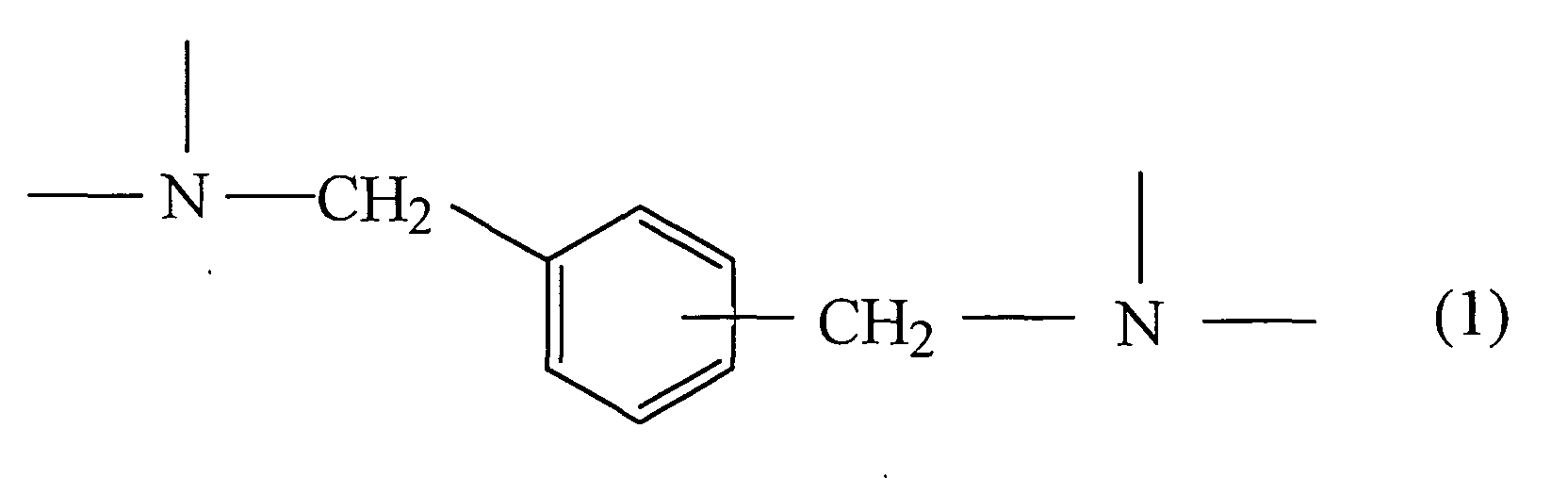
- The gas-barriering coated film as described in claim 1, wherein at least one of the active hydrogen-containing compound (A) and the organic polyisocyanate compound (B) contains a compound which can form the skeletal structure represented by Formula (1) by reacting (A) with (B).
- The gas-barriering coated film as described in claim 1 or 2, wherein the active hydrogen-containing compound (A) is at least one compound selected from an alkylene oxide adduct of polyamine, an amide group-containing polyol, a polyol adduct of a polyisocyanate compound and a polyol.
- The gas-barriering coated film as described in claim 3, wherein the active hydrogen-containing compound (A) is at least one compound selected from an alkylene oxide adduct of an aromatic aliphatic polyamine, a polyol adduct of an aromatic aliphatic polyisocyanate compound and an aromatic aliphatic polyol.
- The gas-barriering coated film as described in claim 4, wherein the active hydrogen-containing compound (A) is the alkylene oxide adduct of the aromatic aliphatic polyamine.
- The gas-barriering coated film as described in claim 5, wherein the active hydrogen-containing compound (A) is an alkylene oxide adduct of xylylenediamine.
- The gas-barriering coated film as described in any of claims 3 to 6, wherein the alkylene oxide described above is alkylene oxide having 2 to 4 carbon atoms.
- The gas-barriering coated film as described in claim 1 or 2, wherein the organic polyisocyanate compound (B) is a reaction product of the following compounds (a) and (b) or a reaction product of the following compounds (a), (b) and (c) and has two or more NCO groups at an end:(a) a multifunctional isocyanate compound,(b) at least one multifunctional alcohol selected from multifunctional alcohols having 2 to 10 carbon atoms and(c) at least one compound selected from aromatic multifunctional amines, aromatic aliphatic multifunctional amines, alicyclic multifunctional amines, aliphatic multifunctional amines, aliphatic alkanolamines, aromatic multifunctional carboxylic acids, alicyclic multifunctional carboxylic acids and aliphatic multifunctional carboxylic acids.
- The gas-barriering coated film as described in claim 8, wherein the multifunctional isocyanate compound (a) described above is at least one compound selected from xylylenediisocyanate and a compound derived from xylylenediisocyanate.
- The gas-barriering coated film as described in claim 9, wherein the multifunctional isocyanate compound is xylylenediisocyanate.
- The gas-barriering coated film as described in claim 1 or 2, wherein the flexible polymer film or the inorganic-deposited polymer film is a film selected from polyolefin base films, polyester base films, polyamide base films, aluminum-deposited polyester base films, aluminum-deposited polyamide base films, aluminum oxide-deposited polyester base films, aluminum oxide-deposited polyamide base films, silicon oxide-deposited polyester base films, silicon oxide-deposited polyamide base films, aluminum oxide silicon oxide-binarily deposited polyester base films and aluminum oxide silicon oxide-binarily deposited polyamide base films.
Applications Claiming Priority (2)
| Application Number | Priority Date | Filing Date | Title |
|---|---|---|---|
| JP2003020168 | 2003-01-29 | ||
| JP2003020168A JP2004231730A (en) | 2003-01-29 | 2003-01-29 | Gas barrier coating film |
Publications (1)
| Publication Number | Publication Date |
|---|---|
| EP1443067A1 true EP1443067A1 (en) | 2004-08-04 |
Family
ID=32652866
Family Applications (1)
| Application Number | Title | Priority Date | Filing Date |
|---|---|---|---|
| EP04001642A Withdrawn EP1443067A1 (en) | 2003-01-29 | 2004-01-27 | Gas barrier polyurethane coated film having xylylenediamine structural units |
Country Status (4)
| Country | Link |
|---|---|
| US (2) | US20040185266A1 (en) |
| EP (1) | EP1443067A1 (en) |
| JP (1) | JP2004231730A (en) |
| CN (1) | CN100365088C (en) |
Cited By (7)
| Publication number | Priority date | Publication date | Assignee | Title |
|---|---|---|---|---|
| WO2008035557A1 (en) | 2006-09-22 | 2008-03-27 | Toray Industries, Inc. | Gas barrier film |
| EP1801161A4 (en) * | 2004-10-12 | 2008-05-21 | Toray Industries | Gas barrier resin composition and gas barrier film |
| EP2172500A4 (en) * | 2007-07-24 | 2010-08-04 | Mitsubishi Gas Chemical Co | POLYURETHANE RESIN COMPOSITION |
| DE102010031681A1 (en) | 2010-07-20 | 2012-01-26 | Bayer Materialscience Ag | Polyurethanes with low volume shrinkage |
| US8115326B2 (en) | 2006-11-30 | 2012-02-14 | Corning Incorporated | Flexible substrates having a thin-film barrier |
| WO2015155366A1 (en) | 2014-04-11 | 2015-10-15 | Bayer Materialscience Ag | Composition for producing transparent polythiourethane bodies |
| EP3101044A4 (en) * | 2014-01-28 | 2017-09-20 | Mitsui Chemicals, Inc. | Polyisocyanate composition, two-pack-type curable polyurethane resin, coating material, adhesive, and process for producing polyisocyanate composition |
Families Citing this family (11)
| Publication number | Priority date | Publication date | Assignee | Title |
|---|---|---|---|---|
| JP2004136899A (en) * | 2002-10-15 | 2004-05-13 | Mitsubishi Gas Chem Co Inc | Fuel container with excellent gasoline barrier properties |
| US8193257B2 (en) * | 2007-01-30 | 2012-06-05 | Dow Global Technologies Llc | Amine-initiated polyols and rigid polyurethane foam made therefrom |
| JP5040491B2 (en) * | 2007-07-13 | 2012-10-03 | 東レ株式会社 | Gas barrier film |
| JP5612570B2 (en) * | 2008-06-10 | 2014-10-22 | ダウ グローバル テクノロジーズ エルエルシー | Methylene bis (cyclohexylamine) initiated polyol and rigid polyurethane foam made from the polyol |
| MX2010013604A (en) * | 2008-06-10 | 2010-12-21 | Dow Global Technologies Inc | 1,3- or 1,4-bis(aminomethyl)cyclohexane-initiated polyols and rigid polyurethane foam made therefrom. |
| DE102010031684A1 (en) † | 2010-07-20 | 2012-01-26 | Bayer Materialscience Ag | Polyurethanes with high refraction of light |
| JP6816376B2 (en) * | 2016-03-30 | 2021-01-20 | 東洋紡株式会社 | Laminated film |
| JP6911988B2 (en) * | 2016-03-30 | 2021-07-28 | 東洋紡株式会社 | Laminated film |
| JP7000694B2 (en) * | 2017-03-30 | 2022-01-19 | 東洋紡株式会社 | Laminated film |
| KR20240108532A (en) * | 2017-08-10 | 2024-07-09 | 도요보 가부시키가이샤 | Gas barrier film production method |
| CN118254446A (en) * | 2024-03-27 | 2024-06-28 | 海宁市嘉华包装有限公司 | A high barrier film for flexible display and preparation method thereof |
Citations (2)
| Publication number | Priority date | Publication date | Assignee | Title |
|---|---|---|---|---|
| EP1081170A2 (en) * | 1999-07-27 | 2001-03-07 | Takeda Chemical Industries, Ltd. | Gas barrier polyurethane resin |
| EP1369443A2 (en) * | 2002-06-04 | 2003-12-10 | Mitsubishi Gas Chemical Company, Inc. | Gas-barrier polyurethane resin, and adhesive for laminate, film and paint containing the same |
Family Cites Families (4)
| Publication number | Priority date | Publication date | Assignee | Title |
|---|---|---|---|---|
| GB2093049B (en) * | 1981-02-09 | 1985-01-23 | Takeda Chemical Industries Ltd | A method of curing compounds containing isocyanate groups |
| JPS58204018A (en) | 1982-05-22 | 1983-11-28 | Toyo Tire & Rubber Co Ltd | Heat-resistant polyurethane resin |
| JP4758539B2 (en) * | 1999-12-09 | 2011-08-31 | 共同印刷株式会社 | Coating composition and gas barrier film |
| EP1396443A1 (en) | 2002-09-05 | 2004-03-10 | W.M.B. World Move Box Anstalt | Box for military camp equipment |
-
2003
- 2003-01-29 JP JP2003020168A patent/JP2004231730A/en active Pending
-
2004
- 2004-01-27 EP EP04001642A patent/EP1443067A1/en not_active Withdrawn
- 2004-01-29 CN CNB200410002413XA patent/CN100365088C/en not_active Expired - Lifetime
- 2004-01-29 US US10/765,924 patent/US20040185266A1/en not_active Abandoned
-
2006
- 2006-06-19 US US11/455,244 patent/US7534493B2/en not_active Expired - Lifetime
Patent Citations (2)
| Publication number | Priority date | Publication date | Assignee | Title |
|---|---|---|---|---|
| EP1081170A2 (en) * | 1999-07-27 | 2001-03-07 | Takeda Chemical Industries, Ltd. | Gas barrier polyurethane resin |
| EP1369443A2 (en) * | 2002-06-04 | 2003-12-10 | Mitsubishi Gas Chemical Company, Inc. | Gas-barrier polyurethane resin, and adhesive for laminate, film and paint containing the same |
Cited By (12)
| Publication number | Priority date | Publication date | Assignee | Title |
|---|---|---|---|---|
| EP1801161A4 (en) * | 2004-10-12 | 2008-05-21 | Toray Industries | Gas barrier resin composition and gas barrier film |
| WO2008035557A1 (en) | 2006-09-22 | 2008-03-27 | Toray Industries, Inc. | Gas barrier film |
| EP2065178A4 (en) * | 2006-09-22 | 2009-09-23 | Toray Industries | Gas barrier film |
| US8115326B2 (en) | 2006-11-30 | 2012-02-14 | Corning Incorporated | Flexible substrates having a thin-film barrier |
| US8435605B2 (en) | 2006-11-30 | 2013-05-07 | Corning Incorporated | Flexible substrates having a thin-film barrier |
| EP2172500A4 (en) * | 2007-07-24 | 2010-08-04 | Mitsubishi Gas Chemical Co | POLYURETHANE RESIN COMPOSITION |
| US8394501B2 (en) | 2007-07-24 | 2013-03-12 | Mitsubishi Gas Chemical Company, Inc. | Polyurethane resin composition |
| DE102010031681A1 (en) | 2010-07-20 | 2012-01-26 | Bayer Materialscience Ag | Polyurethanes with low volume shrinkage |
| WO2012010524A1 (en) | 2010-07-20 | 2012-01-26 | Bayer Materialscience Ag | Polyurethane having low volume shrinkage |
| EP3101044A4 (en) * | 2014-01-28 | 2017-09-20 | Mitsui Chemicals, Inc. | Polyisocyanate composition, two-pack-type curable polyurethane resin, coating material, adhesive, and process for producing polyisocyanate composition |
| WO2015155366A1 (en) | 2014-04-11 | 2015-10-15 | Bayer Materialscience Ag | Composition for producing transparent polythiourethane bodies |
| US10252988B2 (en) | 2014-04-11 | 2019-04-09 | Covestro Deutschland Ag | Composition for producing transparent polythiourethane bodies |
Also Published As
| Publication number | Publication date |
|---|---|
| US7534493B2 (en) | 2009-05-19 |
| US20040185266A1 (en) | 2004-09-23 |
| US20070003768A1 (en) | 2007-01-04 |
| CN1519285A (en) | 2004-08-11 |
| CN100365088C (en) | 2008-01-30 |
| JP2004231730A (en) | 2004-08-19 |
Similar Documents
| Publication | Publication Date | Title |
|---|---|---|
| EP1369443B1 (en) | Gas-barrier polyurethane resin, and adhesive for laminate, film and paint containing the same | |
| US7534493B2 (en) | Gas-barriering coated film | |
| CN101289604B (en) | Laminating adhesive for retort pouches | |
| JP2004010655A (en) | Two-part curable polyurethane resin composition and gas barrier laminate adhesive | |
| TWI839322B (en) | Two-component solventless adhesive compositions and methods of making same | |
| US6596819B2 (en) | Polyisocyanate curing agent for laminate adhesive and process for production thereof | |
| JP4054972B2 (en) | Thermosetting gas barrier polyurethane resin and gas barrier film containing the resin | |
| US4496707A (en) | Polyurethane and method for making stable components thereof | |
| JP7137937B2 (en) | Laminating adhesives and packaging materials | |
| WO2010098210A1 (en) | Primer composition | |
| JP7671636B2 (en) | Polyurethane dispersion, gas barrier coating material and laminate | |
| JP2025122100A (en) | Method for producing adhesive and method for producing laminate | |
| JP2021024986A (en) | Gas barrier polyurethane resin composition and laminate | |
| JP3958486B2 (en) | Two-component curable resin composition and laminating adhesive | |
| EP4678697A1 (en) | Polyurethane dispersion, gas barrier coating material, and method for producing polyurethane dispersion | |
| JP7253043B2 (en) | Two-liquid curing laminating adhesive and laminating film | |
| EP3854857B1 (en) | Organic polymer, composition containing same and method for producing same | |
| JP2007217642A (en) | Two-component curable gas barrier polyurethane resin and laminated film | |
| EP4488063A1 (en) | Laminate | |
| JP2004231731A (en) | Gas barrier paint | |
| KR100586132B1 (en) | Laminate Adhesives | |
| EP4375064A1 (en) | Retortable solvent free lamination adhesives | |
| KR20030003504A (en) | Polyisocyanate curing agents for laminate adhesives and laminate adhesives using same | |
| JP2010215866A (en) | Primer composition for spray coating | |
| JP2002079641A (en) | Structure having epoxy resin layer |
Legal Events
| Date | Code | Title | Description |
|---|---|---|---|
| PUAI | Public reference made under article 153(3) epc to a published international application that has entered the european phase |
Free format text: ORIGINAL CODE: 0009012 |
|
| AK | Designated contracting states |
Kind code of ref document: A1 Designated state(s): AT BE BG CH CY CZ DE DK EE ES FI FR GB GR HU IE IT LI LU MC NL PT RO SE SI SK TR |
|
| AX | Request for extension of the european patent |
Extension state: AL LT LV MK |
|
| 17P | Request for examination filed |
Effective date: 20050112 |
|
| AKX | Designation fees paid |
Designated state(s): DE FR |
|
| RBV | Designated contracting states (corrected) |
Designated state(s): DE FR |
|
| STAA | Information on the status of an ep patent application or granted ep patent |
Free format text: STATUS: THE APPLICATION HAS BEEN WITHDRAWN |
|
| 18W | Application withdrawn |
Effective date: 20060131 |