EP0081701A1 - Verfahren zur Herstellung von elastischen Formkörpern - Google Patents
Verfahren zur Herstellung von elastischen Formkörpern Download PDFInfo
- Publication number
- EP0081701A1 EP0081701A1 EP82110726A EP82110726A EP0081701A1 EP 0081701 A1 EP0081701 A1 EP 0081701A1 EP 82110726 A EP82110726 A EP 82110726A EP 82110726 A EP82110726 A EP 82110726A EP 0081701 A1 EP0081701 A1 EP 0081701A1
- Authority
- EP
- European Patent Office
- Prior art keywords
- groups
- component
- molecular weight
- process according
- amino groups
- Prior art date
- Legal status (The legal status is an assumption and is not a legal conclusion. Google has not performed a legal analysis and makes no representation as to the accuracy of the status listed.)
- Granted
Links
Classifications
-
- C—CHEMISTRY; METALLURGY
- C08—ORGANIC MACROMOLECULAR COMPOUNDS; THEIR PREPARATION OR CHEMICAL WORKING-UP; COMPOSITIONS BASED THEREON
- C08G—MACROMOLECULAR COMPOUNDS OBTAINED OTHERWISE THAN BY REACTIONS ONLY INVOLVING UNSATURATED CARBON-TO-CARBON BONDS
- C08G18/00—Polymeric products of isocyanates or isothiocyanates
- C08G18/06—Polymeric products of isocyanates or isothiocyanates with compounds having active hydrogen
- C08G18/28—Polymeric products of isocyanates or isothiocyanates with compounds having active hydrogen characterised by the compounds used containing active hydrogen
- C08G18/65—Low-molecular-weight compounds having active hydrogen with high-molecular-weight compounds having active hydrogen
- C08G18/66—Compounds of groups C08G18/42, C08G18/48, or C08G18/52
- C08G18/6666—Compounds of group C08G18/48 or C08G18/52
- C08G18/667—Compounds of group C08G18/48 or C08G18/52 with compounds of group C08G18/32 or polyamines of C08G18/38
- C08G18/6681—Compounds of group C08G18/48 or C08G18/52 with compounds of group C08G18/32 or polyamines of C08G18/38 with compounds of group C08G18/32 or C08G18/3271 and/or polyamines of C08G18/38
- C08G18/6685—Compounds of group C08G18/48 or C08G18/52 with compounds of group C08G18/32 or polyamines of C08G18/38 with compounds of group C08G18/32 or C08G18/3271 and/or polyamines of C08G18/38 with compounds of group C08G18/3225 or polyamines of C08G18/38
-
- C—CHEMISTRY; METALLURGY
- C08—ORGANIC MACROMOLECULAR COMPOUNDS; THEIR PREPARATION OR CHEMICAL WORKING-UP; COMPOSITIONS BASED THEREON
- C08G—MACROMOLECULAR COMPOUNDS OBTAINED OTHERWISE THAN BY REACTIONS ONLY INVOLVING UNSATURATED CARBON-TO-CARBON BONDS
- C08G18/00—Polymeric products of isocyanates or isothiocyanates
- C08G18/06—Polymeric products of isocyanates or isothiocyanates with compounds having active hydrogen
- C08G18/28—Polymeric products of isocyanates or isothiocyanates with compounds having active hydrogen characterised by the compounds used containing active hydrogen
- C08G18/40—High-molecular-weight compounds
- C08G18/48—Polyethers
- C08G18/50—Polyethers having heteroatoms other than oxygen
- C08G18/5021—Polyethers having heteroatoms other than oxygen having nitrogen
- C08G18/5024—Polyethers having heteroatoms other than oxygen having nitrogen containing primary and/or secondary amino groups
-
- C—CHEMISTRY; METALLURGY
- C08—ORGANIC MACROMOLECULAR COMPOUNDS; THEIR PREPARATION OR CHEMICAL WORKING-UP; COMPOSITIONS BASED THEREON
- C08G—MACROMOLECULAR COMPOUNDS OBTAINED OTHERWISE THAN BY REACTIONS ONLY INVOLVING UNSATURATED CARBON-TO-CARBON BONDS
- C08G2110/00—Foam properties
- C08G2110/0033—Foam properties having integral skins
-
- C—CHEMISTRY; METALLURGY
- C08—ORGANIC MACROMOLECULAR COMPOUNDS; THEIR PREPARATION OR CHEMICAL WORKING-UP; COMPOSITIONS BASED THEREON
- C08G—MACROMOLECULAR COMPOUNDS OBTAINED OTHERWISE THAN BY REACTIONS ONLY INVOLVING UNSATURATED CARBON-TO-CARBON BONDS
- C08G2110/00—Foam properties
- C08G2110/0041—Foam properties having specified density
- C08G2110/0066—≥ 150kg/m3
-
- C—CHEMISTRY; METALLURGY
- C08—ORGANIC MACROMOLECULAR COMPOUNDS; THEIR PREPARATION OR CHEMICAL WORKING-UP; COMPOSITIONS BASED THEREON
- C08G—MACROMOLECULAR COMPOUNDS OBTAINED OTHERWISE THAN BY REACTIONS ONLY INVOLVING UNSATURATED CARBON-TO-CARBON BONDS
- C08G2120/00—Compositions for reaction injection moulding processes
Definitions
- the present invention relates to an improved one-step process for the production of elastic molded articles with a closed surface layer by means of the reaction injection molding technique, in which highly reactive systems made of polyisocyanates, higher molecular weight polyamino compounds and aromatic diamines are used.
- highly reactive systems made of polyisocyanates, higher molecular weight polyamino compounds and aromatic diamines are used.
- demoulding can be achieved without the use of external release agents.
- the production of moldings with a closed surface layer by the isocyanate polyaddition process is generally known. It is carried out, for example, by introducing a reactive and, if appropriate, also foamable mixture based on compounds having several reactive hydrogen atoms and polyisocyanates into a mold (see, for example, German Auslegeschrift 1 196 864).
- Particularly suitable compounds with reactive hydrogen atoms are hydroxyl-containing polyethers, while 2,4- and 2,6-tolylene diisocyanate, their isomer mixtures and the like are examples of polyisocyanates polyphenylpolymethylene polyisocyanate obtained by aniline-formaldehyde condensation and subsequent phosgenation should be mentioned.
- water and / or fluorocarbons can serve as blowing agents.
- Catalysts as are known per se for the production of polyurethane are also generally used.
- DE-OS 2 622 951 (US Pat. No. 4,218,543) describes how even extremely reactive systems, that is to say one-shot mixtures, can be made from di- or polyisocyanates based on 4,4'-diisocyanate diphenylmethane, active aromatic polyamines, higher molecular weight polyhydroxy compounds with primary hydroxyl groups and strong catalysts, with starting times down to less than one second, can be processed by this method.
- the transition from the liquid to the solid phase occurs almost suddenly, which leads to the liquid reaction mixture solidifying in the mold on its walls, as it were.
- the polyisocyanate component a) to be used in the process according to the invention is aromatic di- and / or polyisocyanates, ie those which have only aromatically bound isocyanate groups.
- aromatic di- and / or polyisocyanates ie those which have only aromatically bound isocyanate groups.
- examples of such compounds are 2,4- and / or 2,6-diisocyanatotoluene, 2,2'-, 2,4'- and / or 4,4'-diisocyanatodiphenylmethane, mixtures of these latter isomers with their higher homologues, such as them in the known phosgenation of aniline / formaldehyde condensates, reaction products containing urethane groups of the di- and / or polyisocyanates mentioned with inferior amounts of aliphatic polyhydroxyl compounds of the molecular weight range 62-700 such as, for example, ethylene glycol, trimethylolpropane, propylene glycol,
- the preferred starting materials a) include the derivatives of 4,4'-diisocyanatodiphenylmethane which are liquid at room temperature, for example the polyisocyanates containing urethane groups, which according to DE-PS 1 618 380 (US Pat. No.
- the preferred polyisocyanates to be used according to the invention are polyisocyanates or polyisocyanate mixtures of the diphenylmethane series which are liquid at room temperature and are optionally chemically modified as described and have a (mean) NCO functionality of 2-2.2, in particular 2, in which the main component (more than 50% by weight) 4,4'-diisocyanatodiphenylmethane is present.
- Component b which is essential to the invention, is at least 2 terminally arranged polyethers which are reactive toward isocyanate groups and have an average molecular weight of 1800-12000, preferably 2000-8000, whose (can be calculated from the functionality and the content of isocyanate-reactive groups) Terminal groups that are reactive toward isocyanate groups consist of at least 50, preferably 80-100 equivalent percent of primary and / or secondary, aromatic or aliphatic, preferably aliphatic, amino groups and the remainder of primary and / or secondary, aliphatic hydroxyl groups. If polyether mixtures are used, individual components of the mixture can also have a molecular weight below 1800, for example between 500 and 1800, provided that the average molecular weight of the mixture is within the ranges mentioned.
- polystyrene resin polystyrene resin
- terminal residues bearing the amino groups can also be linked to the polyether chain via urethane or ester groups.
- aminopolyethers are prepared in a manner known per se. For example, amination of polyhydroxy polyethers such as polypropylene glycol ethers can be carried out by reaction with ammonia in the presence of Raney nickel and hydrogen (BE-PS 634 741). US Pat. No. 3,654,370 describes the preparation of polyoxyalkylene polyamines by reacting the corresponding polyol with ammonia and hydrogen in the presence of a nickel, copper, chromium Catalyst.
- DE-PS 1 193 671 describes the preparation of polyethers with amino end groups by hydrogenation of cyanoethylated polyoxypropylene ethers. Further methods for the preparation of polyoxyalkylene (polyether) amines are described in US Pat. No. 3,155,728, US Pat. No. 3,236,895 and FR Pat. No. 1,551,605.
- FR-PS 1 466 708 describes, for example, the preparation of polyethers having secondary amino end groups.
- Higher molecular weight polyhydroxy polyethers can be converted by reaction with isatoic anhydride into the corresponding anthranilic acid esters suitable according to the invention as component b), as described, for example, in DE-OS 2 019 432, DE-OS 2 619 840, US Pat. No. 3,808,250, US Pat. No. 3 975 428 or U.S. Patent 4,016,143. In this way, polyethers with terminal aromatic amino groups are formed.
- Aminopolyethers which are obtained according to DE-OS 2 948 419 by hydrolysis of compounds having terminal isocyanate groups are preferably used.
- two or three hydroxyl-containing polyethers are preferably reacted with polyisocyanates to form NCO prepolymers and in one second step, the isocyanate group is converted into an amino group by hydrolysis.
- aminopolyethers to be used according to the invention as component b) are often mixtures of the compounds mentioned by way of example and have (on a statistical average) two to three terminal groups which are reactive toward isocyanate groups.
- aminopolyethers mentioned by way of example in the process according to the invention can optionally also be mixed with amino group-free polyhydroxy polyethers of the type mentioned in US Pat. No. 4,218,543 and / or in admixture with comparatively low molecular weight, highly functional polyether polyols, for example those in the molecular weight range 500-1000 and an average hydroxyl functionality of 3 to 6 may be used, although this is less preferred. If such mixtures are used, however, care must be taken to ensure that at least 50 equivalent percent of the groups present in the mixture and reactive toward isocyanate groups represent primary and / or secondary amino groups of the type mentioned by way of example.
- Component c) to be used in the process according to the invention is diamines with exclusively aromatically bound, primary or secondary, preferably primary, amino groups in the molecular weight range 108-400.
- diamines are 1,4-diamino-benzene, 2,4-diaminotoluene, 2,4'- and / or 4,4'-diaminodiphenylmethane, 3,3'-dimethyl-4,4'-diamino-diphenylmethane or 4 , 4'-Diaminodiphenyl-propane (2,2), or any mixture of such diamines.
- the preferred diamines to be used in the process according to the invention are those which have an alkyl substituent in at least one ortho position to the amino groups, in particular those which have at least one alkyl substituent ortho to the first amino group and in ortho position to the second amino group have two alkyl substituents, each with 1 to 3 carbon atoms, particularly preferably those which in each case have at least one ortho position to the amino groups, an ethyl, n-propyl and / or iso-propyl substituent and optionally have methyl substituents in further ortho positions to the amino groups.
- Examples of preferred or particularly preferred diamines are 2,4-diaminomesitylene, 1,3,5-triethyl-2,4-diaminobenzene, 1,3,5-triisopropyl-2,4-diaminobenzene, 1-methyl-3,5 -diethyl-2,4-diaminobenzene, 1-methyl-3,5-diethyl-2,6-diaminobenzene, 4,6-dimethyl-2-ethyl-1,3-diaminobenzene, 3,5,3 ', 5' -Tetraethyl-4,4'-diaminodiphenylmethane, 3,5,3 ', 5'-tetraisopropyl-4,4'-diaminodiphenylmethane or 3,5-diethyl-3', 5'-diisopropyl-4,4'-diaminodiphenylmethane.
- aromatic diamines mentioned can also be used in a mixture.
- 1-methyl-3,5-diethyl-2,4-diaminobenzene or a mixture thereof with 1-methyl-3,5-diethyl-2,6-diaminobenzene are particularly preferred.
- the chain extender c) comes at the fiction according to the method, preferably in amounts of 5 to 50% by weight, particularly preferably 10 to 40% by weight, based on component b), are used.
- the preferred release agents thus include the at least 25 aliphatic carbon atom salts of fatty acids with at least 12 aliphatic carbon atoms and primary mono-, di- or polyamines with two or more carbon atoms or amines with amide or ester groups, which have at least one primary, secondary or tertiary Have amino group, saturated and / or unsaturated COOH and / or OH groups containing esters of mono- and / or polyfunctional carboxylic acids and polyfunctional alcohols with hydroxyl or acid numbers of at least 5, ester-like reaction products of ricinoleic acid and langket term fatty acids, salts from carboxylic acids and tertiary amines and natural and / or synthetic oils, fats or waxes.
- the oleic acid or tall oil fatty acid salt of the amide group-containing amine which has been obtained by reacting N-dimethylaminopropylamine with oleic acid or tall oil fatty acid, is particularly preferred.
- release agents which are mentioned by way of example and which are preferably to be used
- other known release agents of the prior art can also be used in the process according to the invention alone or in a mixture with the preferred release agents which are mentioned as examples.
- the internal mold release agents mentioned are used, if at all, in a total amount of 0.1 to 25% by weight, preferably 1 to 10% by weight, based on the entire reaction mixture.
- Suitable catalysts to be used are tertiary amines of the type known per se, for example:
- Organic metal catalysts especially organic tin catalysts, such as tin (II) salts of carboxylic acids such as tin (II) acetate, tin (II) octoate, tin (II) ethylhexoate and tin (II) - Laurate and the dialkyl tin salts of carboxylic acids such as dibutyltin diacetate, dibutyltin dilaurate, dibutyltin maleate or dioctyltin diacetate can be used alone or in combination with the tertiary amines.
- tin (II) salts of carboxylic acids such as tin (II) acetate, tin (II) octoate, tin (II) ethylhexoate and tin (II) - Laurate
- dialkyl tin salts of carboxylic acids such as dibutyltin
- the catalysts are used in an amount of about 0.001 and 10% by weight, preferably 0.05 to 1% by weight, based on component b).
- Compact moldings are preferably produced by the process according to the invention, but blowing agents can also be used as further component d), moldings with a closed surface and a cellular interior then being obtained. Water and / or volatile organic substances and / or dissolved inert gases can be used as blowing agents.
- organic blowing agents come e.g. Acetone, ethyl acetate, methanol, ethanol, halogen-substituted alkanes such as methylene chloride, chloroform, ethylidene chloride, vinylidene chloride, monofluorotrichloromethane, chlorodifluoromethane, dichlorodifluoromethane, butane, hexane, heptane or diethyl ether are also suitable.
- halogen-substituted alkanes such as methylene chloride, chloroform, ethylidene chloride, vinylidene chloride, monofluorotrichloromethane, chlorodifluoromethane, dichlorodifluoromethane, butane, hexane, heptane or diethyl ether are also suitable.
- Suitable inert gases are e.g. Nitrogen, air, carbon dioxide.
- a blowing effect can also be achieved by adding compounds which decompose at temperatures above room temperature with the elimination of gases, for example nitrogen, for example azo compounds such as azoisobutter acid nitrile.
- gases for example nitrogen
- azo compounds such as azoisobutter acid nitrile.
- surface-active additives can also be used as further component d) (emulsifiers and foam stabilizers).
- the emulsifiers are e.g. the sodium salts of castor oil sulfonates or also of fatty acids or salts of fatty acids with amines such as oleic acid diethylamine or stearic acid diethanolamine in question.
- Alkali or ammonium salts of sulfonic acids such as dodecylbenzenesulfonic acid or dinaphthylmethane disulfonic acid or also of fatty acids such as ricinoleic acid or of polymeric fatty acids can also be used as surface-active additives.
- Water-soluble polyether siloxanes are particularly suitable as foam stabilizers. These compounds are generally designed so that a copolymer of ethylene oxide and propylene oxide is linked to a polydimethylsiloxane radical. Such foam stabilizers are e.g. in U.S. Patent 2,764,565.
- cell regulators are also known per se Type, such as paraffins or fatty alcohols or dimethylpolysiloxanes, as well as pigments or dyes and flame retardants of the type known per se, for example tris-chloroethylphosphate or ammonium phosphate and polyphosphate, also stabilizers against aging and weathering, plasticizers and fungistatic and bacteriostatic substances and fillers such as Called barium sulfate, glass fiber, diatomaceous earth or chalk.
- paraffins or fatty alcohols or dimethylpolysiloxanes as well as pigments or dyes and flame retardants of the type known per se, for example tris-chloroethylphosphate or ammonium phosphate and polyphosphate, also stabilizers against aging and weathering, plasticizers and fungistatic and bacteriostatic substances and fillers such as Called barium sulfate, glass fiber, diatomaceous earth or chalk.
- auxiliaries and additives which may be used are also, for example, low molecular weight, ie, a molecular weight of 62-500, preferably 62-400, polyhydric alcohols which, in addition to the amine chain extenders c), may be used in amounts to modify the properties of the moldings 50 equivalent percent, based on the groups of component c) which are reactive toward isocyanate groups, can also be used.
- the use of such low molecular weight polyhydroxyl however, connections are less preferred.
- the amount of component a) is preferably such that an isocyanate index of 70-130, in particular 90-110, is present in the foamable mixture.
- the isocyanate index is the quotient of the number of isocyanate groups and the number of groups reactive toward isocyanates, multiplied by 100. The calculation of the isocyanate index does not include any groups that are present in the release agents and are reactive towards isocyanate groups (carboxyl groups) .
- the known reaction injection molding technique (RSG process) is used.
- Two reaction components are generally used here, the polyisocyanate component a) being the first and the “polyamine component”, ie the mixture of components b) and c) being the second reaction component.
- the components d) which are optionally to be used are generally admixed with the "polyamine component", but it may also be expedient, for example when using release agents containing isocyanate groups, to be incorporated into the polyisocyanate component a) before the process according to the invention is carried out.
- mixing heads which permit the use of three or four separate components when carrying out the process according to the invention, so that premixing of the individual components is not required.
- the amount of the mixture, which may be foamable, is introduced into the mold in such a way that the moldings have a density of 0.8-1.4 g / cm 3 , preferably 0.9-1.2 g / cm 3 . Shaped articles with a density of more than 1.2 g / cm can result, especially when mineral fillers are also used.
- the moldings can be removed from the mold after a mold service life of 5 to 90, preferably 20 to 60, seconds.
- a temperature between 10 and 60 ° C., preferably 20 to 50 ° C., is generally chosen as the starting temperature of the mixture introduced into the mold.
- the temperature of the mold is generally 40 to 100 ° C, preferably 50 to 70 ° C.
- the moldings obtainable by the process according to the invention are particularly suitable for the production of flexible automobile bumpers or body elements.
- Polyamine mixture and polyisocyanate were fed to a high-pressure metering unit, optionally in admixture with the mold release agent, and after intensive mixing in a positively controlled mixing head, they were pressed into a 60 ° C hot metal tool in the shortest possible time.
- the tool - a box shape made of aluminum - allows the production of a molded part of the following dimensions:
- the temperature of the raw materials is 40 ° C.
- the mold life is 1 minute.
- the PUR molded part has the following mechanical values:
- the polyurethane elastomer has no strength.
- the molded part has the following mechanical values:
- Example 3 The system of Example 3 is reacted without a catalyst (dibutyltin dilaurate and 1,4-diazabicyclo- (2,2,2) -octane) according to the RSG process with the processing conditions chosen in Example 1.
- a catalyst dibutyltin dilaurate and 1,4-diazabicyclo- (2,2,2) -octane
- test series was terminated after more than 50 demouldings; the formation of a disruptive layer on the tool surface was not observed.
- the molded part has the following mechanical values:
- the molded parts can be easily removed without the use of external release agents.
- the test series was terminated after more than 30 demouldings; the formation of a disruptive layer on the tool surface was not observed.
- the molded part has the following mechanical values:
- the molded parts can be easily removed without the use of external release agents.
- the test series was terminated after more than 50 demouldings; the formation of a disruptive layer on the tool surface was not observed.
- the molded part has the following mechanical values:
Landscapes
- Chemical & Material Sciences (AREA)
- Health & Medical Sciences (AREA)
- Chemical Kinetics & Catalysis (AREA)
- Medicinal Chemistry (AREA)
- Polymers & Plastics (AREA)
- Organic Chemistry (AREA)
- Polyurethanes Or Polyureas (AREA)
- Processing And Handling Of Plastics And Other Materials For Molding In General (AREA)
- Manufacture Of Macromolecular Shaped Articles (AREA)
- Treatments Of Macromolecular Shaped Articles (AREA)
- Injection Moulding Of Plastics Or The Like (AREA)
- Springs (AREA)
- Casting Or Compression Moulding Of Plastics Or The Like (AREA)
Abstract
Description
- Die vorliegende Erfindung betrifft ein verbessertes Einstufen-Verfahren zur Herstellung elastischer Formkörper mit einer geschlossenen Oberflächenschicht mittels der Reaktionsspritzgußtechnik, in welchem hochreaktive Systeme aus Polyisocyanaten, höhermolekularen Polyaminoverbindungen und aromatischen Diaminen eingesetzt werden. Durch Mitverwendung innerer Trennmittel wird eine Entformung ohne Anwendung externer Trennmittel realisierbar.
- Die Herstellung von Formkörpern mit einer geschlossenen Oberflächenschicht nach dem Isocyanat-Polyadditionsverfahren ist grundsätzlich bekannt. Sie erfolgt z.B. durch Einführen einer reaktions- und gegebenenfalls auch schäumfähigen Mischung auf Basis von Verbindungen mit mehreren reaktionsfähigen Wasserstoffatomen und Polyisocyanaten in eine Form (vgl. z.B. die deutsche Auslegeschrift 1 196 864). Als Verbindungen mit reaktionsfähigen Wasserstoffatomen kommen dabei vor allem Hydroxylgruppen aufweisende Polyether in Frage, während als Beispiel für Polyisocyanate 2,4- und 2,6-Toluylendiisocyanat, deren Isomerengemische sowie das durch Anilin-Formaldehyd-Kondensation und anschließende Phosgenierung erhaltene Polyphenylpolymethylenpolyisocyanat zu nennen sind. Als Treibmittel können z.B. Wasser und/oder Fluorkohlenwasserstoffe dienen. Auch Katalysatoren, wie sie für die Polyurethanherstellung an sich bekannt sind, werden im allgemeinen mitverwendet.
- Bei geeigneter Wahl der Ausgangskomponenten (zusätzlich können z.B. auch noch Kettenverlängerungsmittel wie Glykole oder Diamine mitverwendet werden) ist es nach dieser Verfahrensweise möglich, sowohl elastische als auch starre Produkte bzw. alle dazwischenliegenden Varianten herzustellen. Für hochbeanspruchte Formteile wählt man im allgemeinen schwach verzweigt aufgebaute Rohstoffe, die nach der Verarbeitung Materialien mit einem elastomerähnlichen Eigenschaftsbild ergeben. Derartige Formteile werden schon seit langem (z.B. in der Schuhindustrie als Sohlen) in technischem Maßstab hergestellt. Große Formteile fanden Eingang in die Automobilindustrie. Die Verarbeitung der Rohstoffe zu Karosserieteilen erfolgt dabei vor allem nach dem sogenannten Reaktionsspritzgußverfahren (RSG-Verfahren). Es handelt sich dabei um eine Fülltechnik, bei der die hochaktiven, flüssigen Ausgangskomponenten über Hochdruckdosieraggregate mit großer Austragsleistung nach Vermischen in sogenannten zwangsgesteuerten Mischköpfen in kürzester Zeit in die Form eingespritzt werden.
- In der DE-OS 2 622 951 (US-PS 4 218 543) wird beschrieben, wie man selbst extrem reaktive Systeme, also one-shot-Gemische, aus bei Raumtemperaturen flüssigen Di-oder Polyisocyanaten auf Basis von 4,4'-Diisocyanatdiphenylmethan, aktiven aromatischen Polyaminen, höhermolekularen Polyhydroxylverbindungen mit primären Hydroxylgruppen und starken Katalysatoren, mit Startzeiten bis herab zu weniger als einer Sekunde, nach dieser Methode verarbeiten kann. Bei solchen Systemen erfolgt der Übergang der flüssigen in die feste Phase nahezu schlagartig, was dazu führt, daß das flüssige Reaktionsgemisch in der Form an deren Wandungen gleichsam erstarrt.
- Ein Vorteil dieser Systeme ist die Tatsache, daß für die Entformung aus geometrisch einfachen Plattenwerkzeugen kein externes Trennmittel als Trennhilfe angewandt zu werden braucht. Für eine Serienproduktion jedoch muß in regelmäßigen Abständen Trennmittel aufgetragen werden. Während dieser Zeit fällt das Werkzeug für die Produktion aus. Feine Gravierungen des Werkzeuges werden mit der Zeit von den Trennmittelresten überdeckt. Ein Entfernen dieser fest haftenden Rückstände in den häufig stark konturierten Werkzeugen ist nur mit großem Aufwand möglich. Die Kunststoffteile sind mit einem dünnen Trennfilm überzogen, auf dem Lacksysteme nicht haften. Die Teile müssen vor der Lackierung geschliffen oder mit Lösungsmitteln abgewaschen werden, um eine ausreichende Haftung des Lackes auf dem Kunststoff zu erzielen.
- Die Mitverwendung der aus der Patentliteratur bekannten, beispielsweise für die Herstellung von selbsttrennenden Schaumstoff-Formkörpern auf Polyurethanbasis gut geeigneten Formtrennmittel (vgl. z.B. US-PS 3 726 952, GB-PS 1 365 215, US-PS 4 033 912, US-PS 4 024 090, US-PS 4 058 492, DE-OS 2 427 273, DE-OS 2 431 968, DE-OS 2 307 589, DE-OS 2 319 648 oder US-PS 4 076 695) in den speziellen Reaktionsgemischen gemäß DE-OS 2 622 951 führt im allgemeinen bestenfalls zu einer geringfügigen Verbesserung der selbsttrennenden Eigenschaften der nach der Reaktionsspritzgußtechnik hergestellten Elastomeren. Die Mitverwendung von saure Gruppen, insbesondere von Carboxylgruppen aufweisenden Trennmitteln in den Rezepturen gemäß DE-OS 2 622 951 ist außerdem mit dem Nachteil verbunden, daß die Katalyse der hochreaktiven Systeme gestört wird und Formkörper ohne Anfangsfestigkeit resultieren.
- Es war daher die der vorliegenden Erfindung zugrundeliegende Aufgabe, ein verbessertes Verfahren zur Herstellung von elastomeren Formkörpern zur Verfügung zu stellen, welches eine problemlose Serienfertigung auch dünnwandiger Formteile nach dem Reaktionsspritzgußverfahren ohne Anwendung externer Trennmittel ermöglicht.
- Diese Aufgabe konnte durch das nachstehend näher beschriebene erfindungsgemäße Verfahren gelöst werden. Es zeigte sich nämlich überraschenderweise, daß beim Austausch der höhermolekularen Polyhydroxylverbindungen im System der DE-OS 2 622 951 durch entsprechende Verbindungen mit Aminoendgruppen einerseits auf eine Katalyse durch tertiäre Amine bzw. zinnorganische Verbindungen verzichtet werden kann und andererseits, daß die Verwendung der bekannten inneren Trennmittel des Standes der Technik bei nachstehend näher beschriebenen erfindungsgemäßen Verfahren im Gegensatz zum Verfahren gemäß DE-OS 2 622 951 zu einer ganz wesentlichen Verbesserung der selbsttrennenden Eigenschaften der Formkörper führt, so daß auf die Anwendung externer Trennmittel verzichtet werden kann.
- Gegenstand der Erfindung ist ein Verfahren zur Herstellung von elastischen Formkörpern mit einer geschlossenen Oberflächenschicht, aus Polyharnstoff-Elastomeren durch Umsetzung in geschlossenen Formen eines Reaktionsgemisches aus
- a) einer Polyisocyanat-Komponente, bestehend aus mindestens einem Di- oder Polyisocyanat mit ausschließlich aromatisch gebundenen Isocyanatgruppen,
- b) Verbindungen mit einem Molekulargewicht zwischen 1800 und 12 000, welche mindestens 2 gegenüber Isocyanatgruppen reaktionsfähige Gruppen aufweisen,
- c) Diaminen mit 2 primären und/oder sekundären aromatisch gebundenen Aminogruppen des Molekulargewichtsbereichs 108-400 und
- d) gegebenenfalls den in der Polyurethanchemie an sich bekannten Hilfs- und Zusatzmitteln, wobei die Komponenten a)-d) als one-shot-System nach der Reaktionsspritzgußtechnik verarbeitet werden, dadurch gekennzeichnet, daß man als Komponente b) Polyether verwendet, deren gegenüber Isocyanatgruppen reaktionsfähige Gruppen zumindest zu 50 % aus primären und/ oder sekundären Aminogruppen bestehen.
- Bei der beim erfindungsgemäßen Verfahren einzusetzenden Polyisocyanatkomponente a) handelt es sich um aromatische Di- und/oder Polyisocyanate, d.h. um solche, die ausschließlich aromatisch gebundene Isocyanatgruppen aufweisen. Beispiele für derartige Verbindungen sind 2,4- und/oder 2,6-Diisocyanatotoluol, 2,2'-, 2,4'-und/oder 4,4'-Diisocyanatodiphenylmethan, Gemische dieser letztgenannten Isomeren mit ihren höheren Homologen, wie sie bei der bekannten Phosgenierung von Anilin/Formaldehyd-Kondensaten anfallen, Urethangruppen aufweisende Umsetzungsprodukte der genannten Di-und/oder Polyisocyanate mit unterschüssigen Mengen an aliphatischen Polyhydroxylverbindungen des Molekulargewichtsbereichs 62-700 wie z.B. Ethylenglykol, Trimethylolpropan, Propylenglykol, Dipropylenglykol oder Polypropylenglykolen des genannten Molekulargewichtsbereichs, durch partielle Carbodiimidisierung der Isocyanatgruppen der genannten Di- und/oder Polyisocyanate modifizierte Di- und/oder Polyisocyanate, Methyl-substituierte Diisocyanate der Diphenylmethanreihe bzw. deren Gemische der beispielsweise in EP-OS 0 024 665 beschriebenen Art oder beliebige Gemische derartiger aromatischer Di- und Polyisocyanate. Zu den bevorzugten Ausgangsmaterialien a) gehören die bei Raumtemperatur flüssigen Derivate des 4,4'-Diisocyanatodiphenylmethans, beispielsweise die Urethangruppen aufweisenden Polyisocyanate, die gemäß DE-PS 1 618 380 (US-PS 3 644 457) durch Umsetzung von 1 Mol 4,4'-Diisocyanatodiphenylmethan mit 0,05 bis 0,3 Molen an niedermolekularen Diolen oder Triolen, vorzugsweise Polypropylenglykolen mit einem unter 700 liegenden Molekulargewicht, zugänglich sind, oder Carbodiimid- und/oder Urethonimingruppen aufweisende Diisocyanate auf Basis von 4,4'-Diisocyanatodiphenylmethan, wie sie beispielsweise gemäß US-PS 3 152 162, US-PS 3 384 653, US-PS 3 449 256, DE-OS 2 537 685 oder EP-OS 5233 (US-Anmeldung 903 308) zugänglich sind. Auch die entsprechenden Modifizierungsprodukte auf Basis von Gemischen aus 2,4'- und 4,4'-Diisocyanatodiphenylmethan oder auch Gemische der wie beschrieben modifizierten 4,4'-Diisocyanatodiphenylmethane mit untergeordneten Mengen an höher als difunktionellen Polyisocyanaten der Diphenylmethanreihe, beispielsweise solche der in DE-OS 2 624 526 beschriebenen Art gehören zu den bevorzugten Polyisocyanaten. Im allgemeinen handelt es sich bei den bevorzugten, erfindungsgemäß einzusetzenden Polyisocyanaten um bei Raumtemperatur flüssige, gegebenenfalls wie beschrieben chemisch modifizierte Polyisocyanate bzw. Polyisocyanatgemische der Diphenylmethanreihe einer (mittleren) NCO-Funktionalität von 2-2,2, insbesondere von 2, in denen als Hauptkomponente (mehr als 50 Gew.-%) 4,4'-Diisocyanatodiphenylmethan vorliegt.
- Bei der erfindungswesentlichen Komponente b) handelt es sich um mindestens 2 endständig angeordnete, gegenüber Isocyanatgruppen reaktionsfähige Gruppen aufweisende Polyether eines (aus der Funktionalität und dem Gehalt an gegenüber Isocyantgruppen reaktionsfähigen Gruppen errechenbaren) mittleren Molekulargewichts von 1800-12 000, vorzugsweise 2000-8000, deren endständige, gegenüber Isocyanatgruppen reaktionsfähige Gruppen zumindest zu 50, vorzugsweise zu 80-100 Äquivalentprozent aus primären und/oder sekundären, aromatisch oder aliphatisch, vorzugsweise aliphatisch gebundenen Aminogruppen und zum Rest aus primären und/oder sekundären, aliphatisch gebundenen Hydroxylgruppen bestehen. Im Falle der Verwendung von Polyether-Gemischen können einzelne Komponenten des Gemisches auch ein unter 1800, beispielsweise ein zwischen 500 und 1800 liegendes Molekulargewicht aufweisen, vorausgesetzt, daß das mittlere Molekulargewicht des Gemisches innerhalb der genannten Bereiche liegt. Die Verwendung derartiger Gemische mit Einzelkomponenten mit einem unter 1800 liegenden Molekulargewicht ist allerdings weniger bevorzugt. In diesen Verbindungen können die die Aminogruppen tragenden, endständigen Reste mit der Polyetherkette auch über Urethan- oder Estergruppen verknüpft sein. Die Herstellung dieser "Aminopolyether" erfolgt in an sich bekannter Weise. So kann beispielsweise eine Aminierung von Polyhydroxypolyethern wie z.B. Polypropylenglykolethern durch Reaktion mit Ammoniak in Gegenwart von Raney-Nickel und Wasserstoff durchgeführt werden (BE-PS 634 741). US-PS 3 654 370 beschreibt die Herstellung von Polyoxyalkylenpolyaminen durch Umsetzung des entsprechenden Polyols mit Ammoniak und Wasserstoff in Gegenwart eines Nickel-, Kupfer-, Chrom-Katalysators. In der DE-PS 1 193 671 wird die Herstellung von Polyethern mit Amino-Endgruppen durch Hydrierung von cyanethylierten Polyoxypropylenethern beschrieben. Weitere Methoden zur Herstellung von Polyoxyalkylen-(Polyether)-aminen sind in US-PS 3 155 728, US-PS 3 236 895 und FR-PS 1 551 605 beschrieben. In der FR-PS 1 466 708 wird beispielsweise die Herstellung von sekundäre Amino-Endgruppen aufweisenden Polyethern beschrieben.
- Höhermolekulare Polyhydroxypolyether können durch Reaktion mit Isatosäureanhydrid in die entsprechenden, erfindungsgemäß als Komponente b) geeigneten Anthranilsäureester überführt werden, wie dies beispielsweise in DE-OS 2 019 432, DE-OS 2 619 840, US-PS 3 808 250, US-PS 3 975 428 oder US-PS 4 016 143 beschrieben ist. Auf diese Weise entstehen Polyether mit endständigen aromatischen Aminogruppen.
- Durch Umsetzung von NCO-Präpolymeren auf Basis von Polyhydroxypolyethern mit Hydroxylgruppen aufweisenden Enaminen, Aldiminen oder Ketiminen und anschließende Hydrolyse erhält man gemäß DE-OS 2 546 536 bzw. US-PS 3 865 791 höhermolekulare, endständige Aminogruppen aufweisende Verbindungen.
- Bevorzugt eingesetzt werden Aminopolyether, die nach DE-OS 2 948 419 durch Hydrolyse von endständige Isocyanatgruppen aufweisenden Verbindungen erhalten werden. Bei diesem Verfahren werden vorzugsweise zwei oder drei Hydroxylgruppen aufweisende Polyether mit Polyisocyanaten zu NCO-Präpolymeren umgesetzt und in einem zweiten Schritt die Isocyanatgruppe durch Hydrolyse in eine Aminogruppe überführt.
- Die erfindungsgemäß als Komponente b) einzusetzenden "Aminopolyether" stellen oftmals Gemische der beispielhaft genannten Verbindungen dar und weisen (im statistischen Mittel) zwei bis drei endständige, gegenüber Isocyanatgruppen reaktionsfähige Gruppen auf.
- Die beispielhaft genannten "Aminopolyether" können beim erfindungsgemäßen Verfahren gegebenenfalls auch in Abmischung von Aminogruppen-freien Polyhydroxypolyethern der in US-PS 4 218 543 beispielshaft genannten Art und/oder in Abmischung mit vergleichsweise niedermolekularen, hochfunktionellen Polyetherpolyolen, beispielsweise solchen des Molekulargewichtsbereichs 500 - 1000 und einer mittleren Hydroxylfunktionalität von 3 bis 6 eingesetzt werden, obwohl dies weniger bevorzugt ist. Im Falle der Verwendung derartiger Abmischungen muß jedoch darauf geachtet werden, daß mindestens 50 Äquivalentprozent der in der Abmischung vorliegenden, gegenüber Isocyanatgruppen reaktionsfähigen Gruppen primäre und/oder sekundäre Aminogruppen der beispielhaft genannten Art darstellen.
- Bei der beim erfindungsgemäßen Verfahren einzusetzenden Komponente c) handelt es sich um Diamine mit ausschließlich aromatisch gebundenen, primären oder sekundären, vorzugsweise primären Aminogruppen des Molekulargewichtsbereichs 108-400. Beispiele derartiger Diamine sind 1,4-Diamino-benzol, 2,4-Diaminotoluol, 2,4'- und/oder 4,4'-Diaminodiphenylmethan, 3,3'-Dimethyl-4,4'-diamino-diphenylmethan oder 4,4'-Diaminodiphenyl-propan-(2,2), bzw. beliebige Gemische derartiger Diamine.
- Bei den bevorzugten, beim erfindungsgemäßen Verfahren einzusetzenden, Diaminen handelt es sich jedoch um solche, die zumindest in jeweils einer ortho-Stellung zu den Aminogruppen einen Alkylsubstituenten aufweisen, insbesondere um solche, die in ortho-Stellung zu der ersten Aminogruppe mindestens einen Alkylsubstituenten und in ortho-Stellung zur zweiten Aminogruppe zwei Alkylsubstituenten mit jeweils 1 bis 3 Kohlenstoffatomen, aufweisen, besonders bevorzugt um solche, die in jeweils mindestens einer ortho-Stellung zu den Aminogruppen einen Ethyl-, n-Propyl- und/oder iso-Propyl-Substituenten und gegebenenfalls in weiteren ortho-Stellungen zu den Aminogruppen Methylsubstituenten aufweisen.
- Beispiele für bevorzugte bzw. besonders bevorzugte Diamine sind 2,4-Diaminomesitylen, 1,3,5-Triethyl-2,4-diaminobenzol, 1,3,5-Triisopropyl-2,4-diaminobenzol, 1-Methyl-3,5-diethyl-2,4-diaminobenzol, 1-Methyl-3,5-diethyl-2,6-diaminobenzol, 4,6-Dimethyl-2-ethyl-1,3-diaminobenzol, 3,5,3',5'-Tetraethyl-4,4'-diaminodiphenylmethan, 3,5,3',5'-Tetraisopropyl-4,4'-diaminodiphenylmethan oder 3,5-Diethyl-3',5'-diisopropyl-4,4'-diaminodiphenylmethan.
- Selbstverständlich können die genannten aromatischen Diamine auch im Gemisch angewendet werden. Besonders bevorzugt sind in diesem Zusammenhang 1-Methyl-3,5-diethyl-2,4-diaminobenzol oder eine Mischung aus diesem mit 1-Methyl-3,5-diethyl-2,6-diaminobenzol.
- Das Kettenverlängerungsmittel c) kommt beim erfindungsgemäßen Verfahren vorzugsweise in Mengen von 5 bis 50 Gew.-%, besonders bevorzugt 10 bis 40 Gew.-%, bezogen auf Komponente b), zum Einsatz.
- Es ist einer der Hauptvorteile des erfindungsgemäßen Verfahrens im Vergleich zum Verfahren der DE-OS 2 622 951, daß die Mitverwendung der an sich bekannten Formtrennmittel des Standes der Technik die Herstellung von Formkörpern mit ausgezeichneten, selbsttrennenden Eigenschaften ermöglicht. Demzufolge stellen diese, beispielsweise in den o.g. Literaturstellen genannten inneren Trennmittel Hilfsmittel d) dar, die vorzugsweise beim erfindungsgemäßen Verfahren mitverwendet werden. Grundsätzlich können alle Trennmittel des Standes der Technik beim erfindungsgemäßen Verfahren mitverwendet werden. Bevorzugt sind innere Formtrennmittel, wie sie beispielsweise in DE-OS 1 953 637 (= US-PS 3 726 952), DE-OS 2 121 670 (= GB-PS 1 365 215), DE-OS 2 431 968 (= US-PS 4 098 731) bzw. in DE-OS 2 404 310 (= US-PS 4 058 492) beschrieben sind. Zu den bevorzugten Trennmitteln gehören somit die mindestens 25 aliphatische Kohlenstoffatome aufweisenden Salze von Fettsäuren mit mindestens 12 aliphatischen Kohlenstoffatomen und primären Mono-, Di- oder Polyaminen mit zwei und mehr Kohlenstoffatomen oder Amid- oder Estergruppen aufweisenden Aminen, die mindestens eine primäre, sekundäre oder tertiäre Aminogruppe besitzen, gesättigte und/oder ungesättigte COOH- und/oder OH-Gruppen aufweisende Ester von mono- und/oder polyfunktionellen Carbonsäuren und polyfunktionellen Alkoholen mit Hydroxyl- oder Säurezahlen von mindestens 5, esterartige Umsetzungsprodukte aus Ricinolsäure und langkettigen Fettsäuren, Salze aus Carbonsäuren und tertiären Aminen sowie natürliche und/oder synthetische öle, Fette oder Wachse.
- Besonders bevorzugt ist das ölsäure- oder Tallölfettsäuresalz des amidgruppenhaltigen Amins, das durch Umsetzung von N-Dimethylaminopropylamin mit ölsäure oder Tallölfettsäure erhalten worden ist.
- Neben diesen beispielhaft genannten, bevorzugt einzusetzenden Trennmitteln können prinzipiell beim erfindungsgemäßen Verfahren auch andere an sich bekannte Trennmittel des Standes der Technik allein oder im Gemisch mit den bevorzugten, beispielhaft genannten Trennmitteln eingesetzt werden. Zu diesen weiterhin geeigneten Trennmitteln gehören beispielsweise die Umsetzungsprodukte aus Fettsäureestern und Polyisocyanaten gemäß DE-OS 2 319 648, die Umsetzungsprodukte aus reaktionsfähige Wasserstoffatome aufweisenden Polysiloxanen mit Mono- und/oder Polyisocyanaten gemäß DE-OS 2 356 692 (= US-PS 4 033 912), Ester von Hydroxymethylgruppen aufweisenden Polysiloxanen mit Mono- und/oder Polycarbonsäuren gemäß DE-OS 2 363 452 (= US-PS 4 024 090) und Salze aus Aminogruppen enthaltenden Polysiloxanen und Fettsäuren gemäß DE-OS 2 427 273 oder DE-OS 2 431 968 (US-PS 4 098 731).
- Die genannten inneren Formtrennmittel werden, falls überhaupt, in einer Menge von insgesamt 0,1 bis 25 Gew.-%, vorzugsweise 1 bis 10 Gew.-%, bezogen auf das gesamte Reaktionsgemisch, eingesetzt.
- Obwohl für die Herstellung elastischer Formkörper aus den Komponenten a)-c) und darüber hinaus bei Einsatz der bevorzugten Formtrennmittel d) keine Katalysatoren für die Reaktion zwischen Isocyanat- und gegenüber Isocyanatgruppen reaktionsfähigen Gruppen der Komponenten b) und c) eingesetzt werden müssen, können die Katalysatoren, die in bekannter Weise bei der Herstellung von Polyurethanschaumstoffen und mikrozellularen Elastomeren eingesetzt werden, als weitere Hilfs- bzw. Zusatzmittel d) mitverwendet werden.
- Als mitzuverwendende Katalysatoren kommen tertiäre Amine der an sich bekannten Art in Frage, z.B.:
- Triethylamin, Tributylamin, N-Methyl-morpholin, N-Ethylmorpholin, N-Cocomorpholin, N,N,N',N'-Tetramethylethylendiamin, 1,4-Diazabicyclo-(2,2,2)-octan, N-Methyl-N'-dimethylaminoethylpiperazin, N,N-Dimethylbenzylamin, Bis-(N,N-diethylaminoethyl)-adipat, N,N-Di- ethylbenzylamin, Pentamethyldiethylentriamin, N,N-Dimethylcyclohexylamin, N,N,N',N'-Tetramethyl-1,3-butandiamin, N,N-Dimethylimidazol-ß-phenylethylamin, 1,2-Dimethylimidazol und 2-Methyl-imidazol.
- Auch organische Metallkatalysatoren, insbesondere organische Zinnkatalysatoren, wie z.B. Zinn-(II)-salze von Carbonsäuren wie Zinn-(II)-acetat, Zinn-(II)-octoat, Zinn-(II)-ethylhexoat und Zinn-(II)-laurat und die Dialkyl-zinnsalze von Carbonsäuren, wie z.B. Dibutylzinndiacetat, Dibutyl-zinndilaurat, Dibutyl-zinnmaleat oder Dioctyl-zinndiacetat können allein oder in Kombination mit den tertiären Aminen verwendet werden. Weitere Vertreter von Katalysatoren sowie Einzelheiten über die Wirkungsweise der Katalysatoren sind im Kunststoff-Handbuch, Band VII, herausgegeben von Vieweg und Höchtlen, Carl-Hanser-Verlag, München 1966, z.B. auf den Seiten 96 bis 102 beschrieben.
- Die Katalysatoren werden, falls überhaupt, in einer Menge von etwa 0,001 und 10 Gew.-%, vorzugsweise 0,05 bis 1 Gew.-%, bezogen auf die Komponente b), eingesetzt.
- Nach dem erfindungsgemäßen Verfahren werden vorzugsweise kompakte Formteile hergestellt, jedoch können auch Treibmittel als weitere Komponente d) eingesetzt werden, wobei dann Formteile mit einer geschlossenen Oberfläche und einem zelligen Inneren erhalten werden. So können als Treibmittel Wasser und/oder leicht flüchtige organische Substanzen und/oder gelöste inerte Gase verwendet werden.
- Als organische Treibmittel kommen z.B. Aceton, Ethylacetat, Methanol, Ethanol, halogensubstituierte Alkane wie Methylenchlorid, Chloroform, Ethylidenchlorid, Vinylidenchlorid, Monofluortrichlormethan, Chlordifluormethan, Dichlordifluormethan, ferner Butan, Hexan, Heptan oder Diethylether in Frage.
- Geeignete inerte Gase sind z.B. Stickstoff, Luft, Kohlendioxid.
- Eine Treibwirkung kann auch durch Zusatz von bei Temperaturen über Raumtemperatur unter Abspaltung von Gasen, beispielsweise von Stickstoff, sich zersetzenden Verbindungen, z.B. Azoverbindungen wie Azoisobuttersäurenitril, erzielt werden. Weitere Beispiele für Treibmittel sowie Einzelheiten über die Verwendung von Treibmitteln sind im Kunststoff-Handbuch, Band VII, herausgegeben von Vieweg und Höchtlen, Carl-Hanser-Verlag, München 1966, z.B. auf den Seiten 108 und 109, 453 bis 455 und 507 bis 510, beschrieben.
- Erfindungsgemäß können auch oberflächenaktive Zusatzstoffe als weitere Komponente d) (Emulgatoren und Schaumstabilisatoren) mitverwendet werden. Als Emulgatoren kommen z.B. die Natriumsalze von Ricinusölsulfonaten oder auch von Fettsäuren oder Salze von Fettsäuren mit Aminen wie ölsaures Diethylamin oder stearinsaures Diethanolamin in Frage. Auch Alkali- oder Ammoniumsalze von Sulfonsäuren wie etwa von Dodecylbenzolsulfonsäure oder Dinaphthylmethandisulfonsäure oder auch von Fettsäuren wie Ricinolsäure oder von polymeren Fettsäuren können als oberflächenaktive Zusatzstoffe mitverwendet werden.
- Als Schaumstabilisatoren kommen vor allem wasserlösliche Polyethersiloxane in Frage. Diese Verbindungen sind im allgemeinen so aufgebaut, daß ein Copolymerisat aus Ethylenoxid und Propylenoxid mit einem Polydimethylsiloxanrest verbunden ist. Derartige Schaumstabilisatoren sind z.B. in der US-PS 2 764 565 beschrieben.
- Als weitere Hilfs- und Zusatzmittel, die gegebenenfalls beim erfindungsgemäßen Verfahren mitverwendet werden, seien auch Zellregler der an sich bekannten Art, wie z.B. Paraffine oder Fettalkohole oder Dimethylpolysiloxane, sowie Pigmente oder Farbstoffe und Flammschutzmittel der an sich bekannten Art, z.B. Tris-chlorethylphosphat oder Ammoniumphosphat und -polyphosphat, ferner Stabilisatoren gegen Alterungs- und Witterungseinflüsse, Weichmacher und fungistatisch und bakteriostatisch wirkende Substanzen sowie Füllstoffe wie Bariumsulfat, Glasfaser, Kieselgur oder Schlämmkreide genannt.
- Weitere Beispiele von gegebenenfalls erfindungsgemäß mitzuverwendenden oberflächenaktiven Zusatzstoffen und Schaumstabilisatoren, flammhemmenden Substanzen, Weichmachern, Farbstoffen und Füllstoffen, fungistatisch und bakteriostatisch wirksamen Substanzen sowie Einzelheiten über Verwendungs- und Wirkungsweise dieser Zusatzmittel sind im Kunststoff-Handbuch, Band VII, herausgegeben von Vieweg und Höchtlen, Carl-Hanser-Verlag, München 1966, z.B. auf den Seiten 103 bis 113, beschrieben.
- Als weitere, gegebenenfalls mitzuverwendende Hilfs-und Zusatzmittel kommen auch beispielsweise niedermolekulare, d.h. ein Molekulargewicht von 62 - 500, vorzugsweise 62 - 400 aufweisende, mehrwertige Alkohole in Betracht, die gegebenenfalls zur Modifizierung der Eigenschaften der Formkröper neben den aminischen Kettenverlängerungsmitteln c) in Mengen bis zu 50 Äquivalentprozent, bezogen auf die gegenüber Isocyanatgruppen reaktionsfähigen Gruppen der Komponente c) mitverwendet werden können. Hierzu gehören beispielsweise Ethylenglykol, Butandiol-1,4,Hexamethylenglykol, Trimethylolpropan, Diethylenglykol, Triethylenglykol, Dipropylenglykol, Tripropylenglykol, Propoxylierungsprodukte von Trimethylolpropan mit einem Molekulargewicht von bis zu 500, vorzugsweise bis zu 400, oder Propoxylierungsprodukte von Ethylendiamin mit einem Molekulargewicht von bis zu 500, vorzugsweise bis zu 400. Die Mitverwendung derartiger, niedermolekularer Polyhydroxylverbindungen ist jedoch weniger bevorzugt.
- Bei der Durchführung des erfindungsgemäßen Verfahrens wird die Menge der Komponente a) (Polyisocyanatkomponente) vorzugsweise so bemessen, daß im schaumfähigen Gemisch eine Isocyanat-Kennzahl von 70-130, insbesondere 90-110, vorliegt. Unter Isocyanat-Kennzahl versteht man hierbei den Quotienten aus Anzahl der Isocyanatgruppen und Anzahl der gegenüber Isocyanaten reaktiven Gruppen, multipliziert mit 100. In die Berechnung der Isocyanat-Kennzahl gehen hierbei die gegebenenfalls in den Trennmitteln vorliegenden, gegenüber Isocyanatgruppen reaktionsfähigen Gruppen (Carboxylgruppen) nicht ein. Bei der Durchführung des erfindungsgemäßen Verfahrens wird nach der bekannten Reaktionsspritzgußtechnik (RSG-Verfahren) gearbeitet. Hierbei kommen im allgemeinen zwei Reaktionskomponenten zum Einsatz, wobei die Polyisocyanatkomponente a) die erste und die "Polyamin-Komponente", d.h. das Gemisch der Komponenten b) und c) die zweite Reaktionskomponente darstellen. Die gegebenenfalls mitzuverwendenden Komponenten d) werden im allgemeinen der "Polyamin-Komponente" zugemischt, jedoch kann es auch zweckmäßig sein, beispielsweise bei der Verwendung von Isocyanatgruppen aufweisenden Trennmitteln, diese vor der Durchführung des erfindungsgemäßen Verfahrens der Polyisocyanatkomponente a) einzuverleiben. Grundsätzlich ist es selbstverständlich auch möglich, solche Mischköpfe zu verwenden, die den Einsatz von drei oder vier getrennten Komponenten bei der Durchführung des erfindungsgemäßen Verfahrens gestatten, so daß eine Vormischung der Einzelkomponenten nicht erfoderlich ist. Die Menge des in die Form eingebrachten, gegebenenfalls schäumfähigen Gemischs wird im allgemeinen so bemessen, daß die Formkörper eine Dichte von 0,8-1,4 g/cm3, vorzugsweise von 0,9-1,2 g/cm3, aufweisen. Insbesondere bei der Mitverwendung von mineralischen Füllstoffen können Formkörper mit einer über 1,2 g/cm liegenden Dichte resultieren. Die Formkörper können nach einer Formstandzeit von 5 bis 90, vorzugsweise 20 bis 60, Sekunden entformt werden.
- Als Ausgangstemperatur des in die Form eingebrachten Gemisches wird im allgemeinen eine Temperatur zwischen 10 und 60°C, vorzugsweise 20 bis 50°C, gewählt. Die Temperatur der Form beträgt im allgemeinen 40 bis 100°C, vorzugsweise 50 bis 70°C.
- Die nach dem erfindungsgemäßen Verfahren erhältlichen Formkörper eignen sich insbesondere zur Herstellung von flexiblen Automobil-Stoßstangen bzw. Karosserieelementen.
- Durch geeignete Variation der Ausgangsverbindungen a) bis d), insbesondere bei relativ geringem Anteil an Diamin c), können aber z.B. auch flexible Schuhsohlen mit gutem Abriebverhalten und ausgezeichneter mechanischer Festigkeit erhalten werden.
- Die Verarbeitung der in den folgenden Beispielen beschriebenen Rezepturen erfolgte mit Hilfe der Reaktionsspritzgußtechnik oder englisch "reaction injection moulding" (RIM).
- Polyamingemisch und Polyisocyanat wurden - gegebenenfalls in Abmischung mit dem die Entformung erleichternden Trennmittel - einem Hochdruckdosieraggregat zugeführt und nach intensiver Vermischung in einem zwangsgesteuerten Mischkopf in kürzester Zeit in ein 60°C heißes Metallwerkzeug gedrückt.
- Das Werkzeug - eine Kastenform aus Aluminium - erlaubt die Herstellung eines Formteils der folgenden Abmessungen:

- In das Oberteil des Werkzeugs sind 24 mm tiefe, 3 mm breite, konisch zulaufende Aussparungen eingefräst, die im Formteil dann zu Rippen führen. Bei der Entformung sind starke Scherkräfte zu überwinden.
-

- Die Temperatur der Rohstoffe beträgt 40°C. Die Formstandzeit beträgt 1 Minute.
- Ohne Anwendung äußerer Trennmittel können 5 Formteile entformt werden, dabei bildet sich auf der Werkzeugoberfläche eine störende Schicht, die bei weiteren Entformungen zum Zerreißen des Formteiles führt. Das PUR-Formteil hat folgende mechanische Werte:


- Beispiel 2 (Vergleich mit innerem Trennmittel)

- Nach Öffnung des Werkzeuges kann das Formteil nur zerstört entnommen werden. Das Polyurethan-Elastomere hat keinerlei Festigkeit.
-

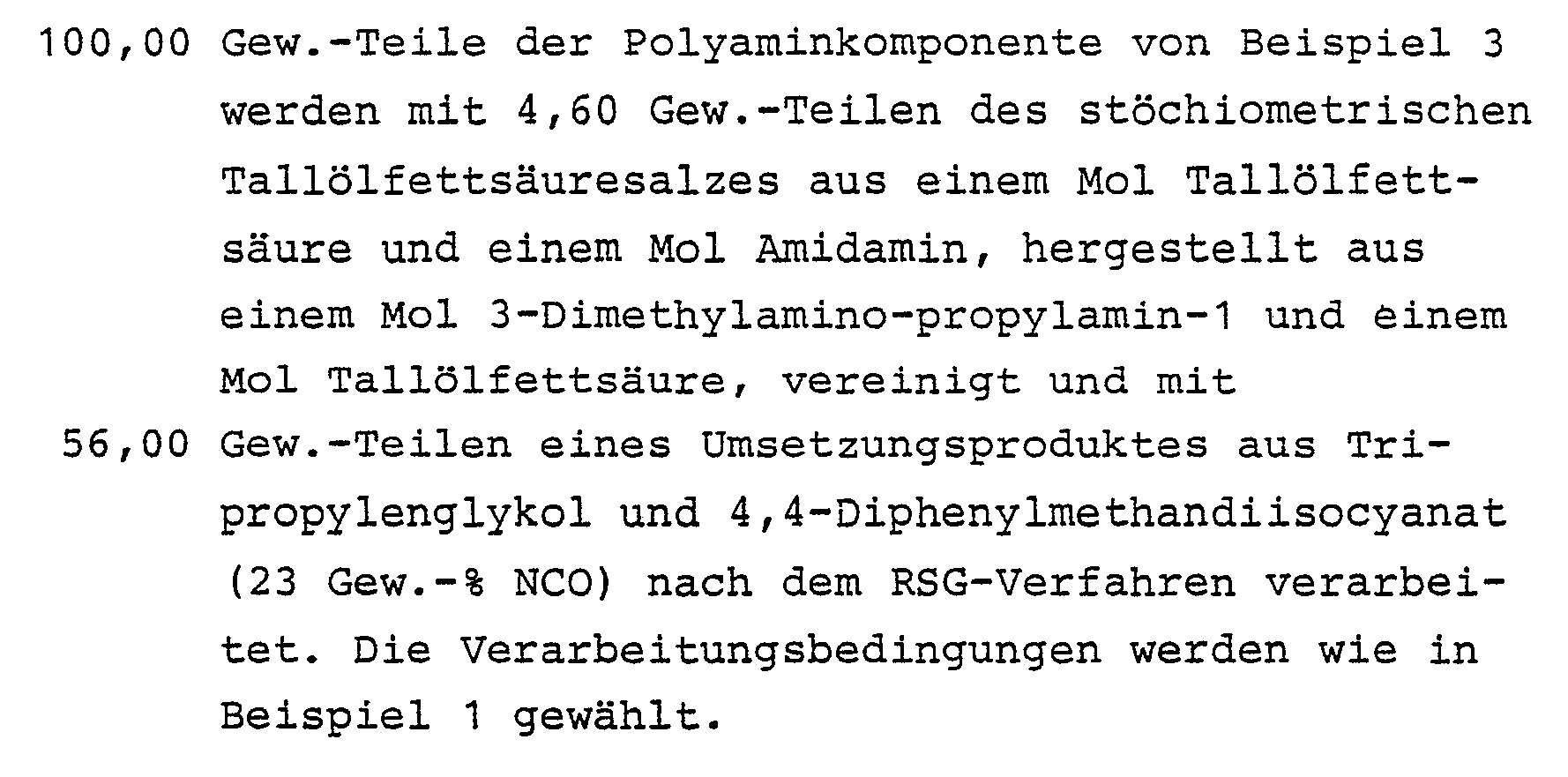
- werden zu einer Polyaminkomponente vereinigt und mit 58,00 Gew.-Teilen eines Umsetzungsproduktes aus Tripropylenglykol und 4,4'-Diphenylmethandiisocyanat (23 Gew.-% NCO) nach dem RSG-Verfahren verarbeitet. Die Verarbeitungsbedingungen werden wie in Beispiel 1 gewählt.
- Ohne Anwendung äußerer Trennmittel können 8 bis 10 Formteile entformt werden, weitere Entformungen führen zur Zerstörung des Formteils.
- Das Formteil hat folgende mechanische Werte:


- Das System von Beispiel 3 wird ohne Katalysator (Dibutylzinndilaurat und 1,4-Diazabicyclo-(2,2,2)-octan) nach dem RSG-Verfahren mit den in Beispiel 1 gewählten Verarbeitungsbedingungen umgesetzt.
- Ohne Anwendung äußerer Trennmittel können bei einer Formstandzeit von 1 Minute noch 5 Formteile entformt werden. Die Festigkeit bei Entformung ("green strength") der-Formteile ist ausgezeichnet. Folgende mechanische Werte werden ermittelt:

-
- Ohne Anwendung äußerer Trennmittel konnten mühelos Formteile entnommen werden. Nach mehr als 50 Entformungen wurde die Versuchsreihe abgebrochen, Aufbau einer störenden Schicht auf der Werkzeugoberfläche wurde nicht beobachtet.
- Das Formteil hat folgende mechanische Werte:

-

- Ohne Anwendung äußerer Trennmittel können die Formteile mühelos entnommen werden. Nach mehr als 30 Entformungen wurde die Versuchsreihe abgebrochen, Aufbau einer störenden Schicht auf der Werkzeugoberfläche wurde nicht beobachtet.
- Das Formteil hat folgende mechanische Werte:

-


- Ohne Anwendung äußerer Trennmittel können die Formteile mühelos entnommen werden. Nach mehr als 50 Entformungen wurde die Versuchsreihe abgebrochen, Aufbau einer störenden Schicht auf der Werkzeugoberfläche wurde nicht beobachtet.
- Das Formteil hat folgende mechanische Werte:

Claims (5)
wobei die Komponenten a)-d) als one-shot-System nach der Reaktionsspritzgußtechnik verarbeitet werden, dadurch gekennzeichnet, daß man als Komponente b) Polyether verwendet, deren gegenüber Isocyanatgruppen reaktionsfähige Gruppen zumindest zu 50 % aus primären und/oder sekundären Aminogruppen bestehen.
Priority Applications (1)
| Application Number | Priority Date | Filing Date | Title |
|---|---|---|---|
| AT82110726T ATE13769T1 (de) | 1981-12-02 | 1982-11-20 | Verfahren zur herstellung von elastischen formkoerpern. |
Applications Claiming Priority (2)
| Application Number | Priority Date | Filing Date | Title |
|---|---|---|---|
| DE19813147736 DE3147736A1 (de) | 1981-12-02 | 1981-12-02 | Verfahren zur herstellung von elastischen formkoerpern |
| DE3147736 | 1981-12-02 |
Publications (2)
| Publication Number | Publication Date |
|---|---|
| EP0081701A1 true EP0081701A1 (de) | 1983-06-22 |
| EP0081701B1 EP0081701B1 (de) | 1985-06-12 |
Family
ID=6147729
Family Applications (1)
| Application Number | Title | Priority Date | Filing Date |
|---|---|---|---|
| EP82110726A Expired EP0081701B1 (de) | 1981-12-02 | 1982-11-20 | Verfahren zur Herstellung von elastischen Formkörpern |
Country Status (9)
| Country | Link |
|---|---|
| US (2) | US4774263A (de) |
| EP (1) | EP0081701B1 (de) |
| JP (1) | JPS58103521A (de) |
| AT (1) | ATE13769T1 (de) |
| AU (1) | AU560836B2 (de) |
| BR (1) | BR8206981A (de) |
| CA (1) | CA1243443A (de) |
| DE (2) | DE3147736A1 (de) |
| ES (1) | ES8402849A1 (de) |
Cited By (57)
| Publication number | Priority date | Publication date | Assignee | Title |
|---|---|---|---|---|
| EP0093334A1 (de) * | 1982-04-29 | 1983-11-09 | BASF Aktiengesellschaft | Verfahren zur Herstellung von gegebenenfalls zellhaltigen Formkörpern aus Polyharnstoff-Elastomeren |
| EP0093861A1 (de) * | 1982-04-23 | 1983-11-16 | Texaco Development Corporation | Ein RIM-Elastomer, welches ein inneres Trennmittel enthält und durch ein Zweistromverfahren hergestellt ist |
| EP0093862A1 (de) * | 1982-04-23 | 1983-11-16 | Texaco Development Corporation | RIM-Polyharnstoff-Elastomere |
| EP0124843A1 (de) * | 1983-05-09 | 1984-11-14 | Mobay Chemical Corporation | Verfahren und Zusammensetzung zur Herstellung von Formkörpern auf Basis von Polyurethan Elastomeren |
| EP0135867A3 (de) * | 1983-09-16 | 1985-05-15 | Bayer Ag | |
| US4530941A (en) * | 1983-01-26 | 1985-07-23 | The Dow Chemical Company | Reaction injection molded polyurethanes employing high molecular weight polyols |
| EP0154400A1 (de) * | 1984-02-13 | 1985-09-11 | Texaco Development Corporation | Durch Reaktionsspritzguss geformte Elastomere, die hochmolekulare organische Säuren enthalten |
| DE3411216A1 (de) * | 1984-03-27 | 1985-10-10 | Basf Ag, 6700 Ludwigshafen | Verfahren zur herstellung von elastischen, kompakten oder zelligen polyurethan-polyharnstoff-formkoerpern |
| EP0153639A3 (en) * | 1984-02-18 | 1986-03-12 | Basf Aktiengesellschaft | Process for the preparation of cellular or compact polyurethane-polyurea mouldings having modified mould release properties, and internal mould release agents for the polyisocyanate-polyaddition process |
| EP0128691A3 (de) * | 1983-06-08 | 1986-04-30 | Texaco Development Corporation | Durch Reaktionsspritzgiessverfahren geformte Polyurethan-Elastomere |
| US4607090A (en) * | 1984-08-30 | 1986-08-19 | Texaco Inc. | Reaction injection molded elastomers |
| US4609684A (en) * | 1985-06-21 | 1986-09-02 | Texaco Inc. | Rim products made from isatoic anhydride derivatives of polyoxyalkylene polyamines |
| US4609683A (en) * | 1985-06-21 | 1986-09-02 | Texaco Inc. | Quasi-prepolymers from isatoic anhydride derivatives of polyoxyalkylene polyamines and rim products made therefrom |
| EP0190317A4 (de) * | 1984-08-17 | 1987-01-10 | Dow Chemical Co | Interne formtrennmittel, zusammensetzungen mit aktivem wasserstoff, welche die internen formtrennmittel enthalten und verfahren zur herstellung geformter polyurethane und/oder polyharnstoffe und ähnlicher polymere. |
| US4642320A (en) * | 1983-11-02 | 1987-02-10 | The Dow Chemical Company | Reaction injection molded polyureas employing high molecular weight amine-terminated polyethers |
| US4705814A (en) * | 1986-11-06 | 1987-11-10 | Texaco Inc. | Reaction product of polyoxyalkylene polyamine and an aliphatic isocyanate |
| EP0243777A3 (de) * | 1986-04-25 | 1988-01-27 | Bayer Ag | Verfahren zur Herstellung von Polyharnstoffschaum-Formteilen |
| US4732919A (en) * | 1986-11-06 | 1988-03-22 | Texaco Inc. | Reaction injection molded elastomer made from a quasi-prepolymer of a polyoxyalkylene polyamine and an aromatic isocyanate |
| US4740531A (en) * | 1986-08-07 | 1988-04-26 | Bayer Aktiengesellschaft | Polyaminohydroxyl compounds containing urethane and/or urea groups and processes for their preparation and use |
| US4753966A (en) * | 1986-11-20 | 1988-06-28 | Bayer Aktiengesellschaft | Mold release composition, mixtures containing this mold release composition, a process for the production of elastomeric molded products, and the molded products obtained by this process |
| US4758604A (en) * | 1987-04-07 | 1988-07-19 | The Dow Chemical Company | Polyurea rim systems having improved processibility |
| US4766172A (en) * | 1986-08-07 | 1988-08-23 | Bayer Aktiengesellschaft | Mold release composition, mixtures containing this mold release composition, a process for the production of molded articles and the molded articles obtained by this process |
| WO1988008009A1 (en) * | 1987-04-07 | 1988-10-20 | The Dow Chemical Company | Flexible polyurea or polyurea-polyurethane foams prepared from high equivalent weight amine-terminated compounds and process for preparing the same |
| EP0256362A3 (de) * | 1986-08-09 | 1988-11-30 | Bayer Ag | Verfahren zur Herstellung von Formkörpern auf Polyurethan- und/oder Polyharnstoff-Basis und die nach diesem Verfahren erhaltenen Formkörpern |
| US4845133A (en) * | 1987-04-07 | 1989-07-04 | The Dow Chemical Company | Flexible polyurea or polyurea-polyurethane foams prepared from high equivalent weight amine-terminated compounds |
| EP0327898A1 (de) * | 1988-01-30 | 1989-08-16 | Phoenix Aktiengesellschaft | Verfahren zur Herstellung von Polyurethan-Polyharnstoff-Formkörpern |
| US4876019A (en) * | 1983-02-16 | 1989-10-24 | The Dow Chemical Company | Internal mold release compositions |
| EP0350644A1 (de) * | 1988-06-28 | 1990-01-17 | Miles Inc. | Fliesseigenschaften aufweisende Polyharnstoff-Systeme für das Reaktionsspritzguss-Verfahren |
| EP0359456A1 (de) * | 1988-09-09 | 1990-03-21 | Imperial Chemical Industries Plc | Imino/Enamine-Funktionalität aufweisende, mit Isocyanat reagierende Polymere |
| EP0361704A1 (de) * | 1988-09-09 | 1990-04-04 | Imperial Chemical Industries Plc | Zusammensetzungen für das Reaktionsspritzguss-Verfahren |
| EP0361703A1 (de) * | 1988-09-09 | 1990-04-04 | Imperial Chemical Industries Plc | Zusammensetzungen aus Materie |
| EP0296852A3 (en) * | 1987-06-26 | 1990-06-06 | Minnesota Mining And Manufacturing Company | Method of making purely primary diamines |
| EP0310896A3 (en) * | 1987-10-06 | 1990-06-27 | Bayer Ag | Process for the preparation of mouldings or films |
| US4950789A (en) * | 1989-01-25 | 1990-08-21 | The Dow Chemical Company | Aromatic polyalkyleneoxy polyamines containing amioncarbonyl or aminothiocarbonyl moieties and a compatible mixture of high and low molecular weight polyols made therefrom |
| EP0348760A3 (de) * | 1988-07-01 | 1991-02-06 | Bayer Ag | Verfahren zur Herstellung von Formkörpern und die nach diesem Verfahren erhaltenen Formkörper |
| US5008033A (en) * | 1983-02-16 | 1991-04-16 | The Dow Chemical Company | Internal mold release compositions |
| US5011647A (en) * | 1983-02-16 | 1991-04-30 | The Dow Chemical Company | Internal mold release compositions |
| US5057543A (en) * | 1989-08-25 | 1991-10-15 | The Dow Chemical Company | Blends of alkylene glycols and relatively high equivalent weight active hydrogen compounds containing additives |
| US5070110A (en) * | 1989-08-25 | 1991-12-03 | The Dow Chemical Company | Blends of alkylene glycols and relatively high equivalent weight active hydrogen compounds containing multipurpose additives |
| US5072026A (en) * | 1987-03-11 | 1991-12-10 | Ici Americas Inc. | Polyureas by reaction injection moulding of enamino-functional aliphatic polyether resin-containing systems and an enamine-terminated polyether |
| US5093383A (en) * | 1987-03-11 | 1992-03-03 | Ici Americas Inc. | Polyurethane/urea foams from isocyanate prepolymers and isocyanate reactive imino/enamino functional reactants |
| US5157059A (en) * | 1991-03-19 | 1992-10-20 | Krauss-Maffei Ag | Method of and apparatus for producing a foamed mass of a polyurea elastomer |
| US5212209A (en) * | 1991-11-18 | 1993-05-18 | The Dow Chemical Company | Compatibilized internal mold release composition for preparations of foamed and fiber-reinforced polymeric articles |
| US5270014A (en) * | 1991-03-19 | 1993-12-14 | Krauss-Maffei Ag | Apparatus for producing a foamed mass of a polyurea elastomer |
| EP0119471B1 (de) * | 1983-02-16 | 1994-03-16 | The Dow Chemical Company | Aktiven Wasserstoff enthaltende Zusammensetzung, die einem geformten Artikel Entformungseigenschaften verleiht, und Verfahren zur Herstellung von polymeren Produkten aus der aktiven Wasserstoff enthaltenden Zusammensetzung |
| US5538679A (en) * | 1988-11-29 | 1996-07-23 | Bayer Aktiengesellschaft | Process of making molded products |
| US5583196A (en) * | 1992-01-31 | 1996-12-10 | Karl Fischer Industrieanlagen Gmbh | Melt formed from polyurethane and/or polyurethane urea elastomer and method for producing the same |
| EP0726128A3 (de) * | 1995-02-09 | 1997-08-20 | Bayer Ag | Verfahren zur Herstellung von Kunststoff-Formteilen und eine Formtrennmittel-Zubereitung |
| EP1502913A1 (de) | 2003-07-30 | 2005-02-02 | Kao Corporation | Prozess zur Herstellung von Polyoxyalkylen Triamin |
| KR100860447B1 (ko) * | 2001-07-24 | 2008-09-25 | 마이크로소프트 코포레이션 | 선택된 기능성을 갖는 오퍼레이팅 시스템 생성 및 이용을위한 방법 및 시스템 |
| DE102009005711A1 (de) | 2009-01-22 | 2010-07-29 | Bayer Materialscience Ag | Polyurethanvergussmassen |
| WO2012010524A1 (de) | 2010-07-20 | 2012-01-26 | Bayer Materialscience Ag | Polyurethane mit geringem volumenschrumpf |
| DE102010031683A1 (de) | 2010-07-20 | 2012-01-26 | Bayer Materialscience Ag | Polyisocyanatgemische |
| DE102010031684A1 (de) | 2010-07-20 | 2012-01-26 | Bayer Materialscience Ag | Polyurethane mit hoher Lichtbrechung |
| WO2015155366A1 (de) | 2014-04-11 | 2015-10-15 | Bayer Materialscience Ag | Zusammensetzung zur herstellung transparenter polythiourethan-körper |
| EP3061622A1 (de) | 2015-02-03 | 2016-08-31 | Seagrave Coating Corp. | Beschichtungszusammensetzungen |
| US9458282B2 (en) | 2009-01-22 | 2016-10-04 | Covestro Deutchland Ag | Polyurethane sealing compounds |
Families Citing this family (42)
| Publication number | Priority date | Publication date | Assignee | Title |
|---|---|---|---|---|
| JPS5912823A (ja) * | 1982-07-13 | 1984-01-23 | Asahi Glass Co Ltd | 反応射出成形方法 |
| JPS604519A (ja) * | 1983-06-24 | 1985-01-11 | Asahi Glass Co Ltd | 反応射出成形方法 |
| DE3407931A1 (de) * | 1984-03-03 | 1985-09-05 | Bayer Ag, 5090 Leverkusen | Verfahren zur herstellung von formkoerpern auf basis von harnstoffgruppen aufweisenden polyurethanen |
| JPS62101623A (ja) * | 1984-10-25 | 1987-05-12 | ザ ダウ ケミカル コンパニ− | 高曲げ弾性率エラストマ−の製造方法 |
| DE3636604A1 (de) * | 1986-10-28 | 1988-05-05 | Bayer Ag | Verfahren zur herstellung von polyurethanformkoerpern |
| JPS63154718A (ja) * | 1986-12-19 | 1988-06-28 | Human Ind Corp | ポリウレタンフオ−ムの製造方法 |
| DE3703739A1 (de) * | 1987-02-07 | 1988-08-18 | Bayer Ag | Verfahren zur herstellung von formkoerpern, hierzu geeignete gemische von gegenueber isocyanatgruppen reaktionsfaehigen verbindungen und die nach dem verfahren erhaltenen formkoerper |
| US4935460A (en) * | 1987-03-11 | 1990-06-19 | Ici Americas Inc. | Reaction injection molding compositions |
| US4904705A (en) * | 1987-06-30 | 1990-02-27 | Union Carbide Chemicals And Plastics Company Inc. | Polyurea foams made from N-(polyoxyalkyl)-N-(alkyl)amines |
| US4902777A (en) * | 1987-06-30 | 1990-02-20 | Union Carbide Chemicals And Plastics Company, Inc. | N-(polyoxyalkyl)-n-(alkyl)amines |
| US4902768A (en) * | 1987-06-30 | 1990-02-20 | Union Carbide Chemicals And Plastics Company Inc. | Elastomers prepared from N-(polyoxyalkyl)-N-(alkyl)amines |
| DE3732726A1 (de) * | 1987-09-29 | 1989-04-06 | Bayer Ag | Verfahren zur herstellung von polyurethanharnstoff-elastomeren |
| DE3809524A1 (de) * | 1988-03-22 | 1989-10-05 | Bayer Ag | Verfahren zur herstellung von verbundkoerpern und die nach diesem verfahren erhaeltlichen verbundkoerper |
| GB8906335D0 (en) * | 1988-03-31 | 1989-05-04 | Ici Plc | Internal mould release compositions |
| GB8807684D0 (en) * | 1988-03-31 | 1988-05-05 | Ici Plc | Internal mould release composition |
| US5028635A (en) * | 1988-06-28 | 1991-07-02 | Mobay Corporation | Polyurea-cyclic carbonate RIM systems having improved flow properties |
| US5149458A (en) * | 1988-06-28 | 1992-09-22 | Miles Inc. | Polyurea rim systems having improved flow properties and containing an organic cyclic carbonate |
| US4857561A (en) * | 1988-08-30 | 1989-08-15 | Mobay Corporation | Novel neopentyladipate based prepolymers and reaction injection molded products made therefrom |
| US5034427A (en) * | 1989-11-22 | 1991-07-23 | Imperial Chemical Industries Plc | Method for preparing moulded polureapolyurethane flexible foams |
| USRE34669E (en) * | 1988-11-25 | 1994-07-19 | Imperial Chemical Industries Plc | Method for preparing moulded polyureapolyurethane flexible foams |
| US4983643A (en) * | 1989-06-08 | 1991-01-08 | Mobay Corporation | Polyurea elastomers with reduced brittleness |
| US4965293A (en) * | 1989-06-08 | 1990-10-23 | Mobay Corporation | Polyurea elastomers with improved surface quality |
| US4954537A (en) * | 1989-06-08 | 1990-09-04 | Mobay Corporation | Internal mold release agent for use in polyurea rim systems |
| US4981877A (en) * | 1989-08-25 | 1991-01-01 | The Dow Chemical Company | Blends of alkylene glycols and relatively high equivalent weight active hydrogen compounds containing multipurpose additives |
| US5239038A (en) * | 1989-11-29 | 1993-08-24 | Miles Inc. | Cyclohexanedimethanoladipate based prepolymers and reaction injection molded products made therefrom |
| US5135962A (en) * | 1990-04-06 | 1992-08-04 | Miles Inc. | Internal mold release agent for use in polyurea rim systems |
| US5098984A (en) * | 1990-06-15 | 1992-03-24 | Mobay Corporation | Isocyanate terminated prepolymers and the use thereof in a rim process |
| US5219973A (en) * | 1990-12-07 | 1993-06-15 | Miles Inc. | Polyurea rim systems |
| US5356946A (en) * | 1991-12-09 | 1994-10-18 | Miles Inc. | Process for preparing reaction injection moldings |
| US5368806A (en) * | 1992-11-05 | 1994-11-29 | Miles Inc. | Production of moldings by the reaction injection molding process |
| US5244613A (en) * | 1993-01-21 | 1993-09-14 | Miles Inc. | Process for the production of reinforced moldings and the resultant products |
| CA2117741A1 (en) * | 1993-10-28 | 1995-04-29 | Michael F. Hurley | Rim process utilizing isocyanates based upon 2,4'-and 4,4'- diphenylmethane diisocyanate |
| US5350778A (en) * | 1993-10-28 | 1994-09-27 | Miles Inc. | Polyisocyanate based upon 4,4'- and 2,4'-diphenylmethane diisocyanates and use thereof in a rim process |
| CA2117740A1 (en) * | 1993-10-28 | 1995-04-29 | Michael F. Hurley | Polyisocyanate based upon 4,4'-and 2,4'-diphenylmethane diisocyanates and use thereof in a rim process |
| US5731367A (en) * | 1997-02-04 | 1998-03-24 | Bayer Corporation | Injection molded parts having improved surface gloss |
| DE19756372A1 (de) | 1997-12-18 | 1999-06-24 | Bayer Ag | Verbesserte Leimungsmittel für Papier |
| US6679832B1 (en) | 1998-04-03 | 2004-01-20 | Hashem Sultan | Implantable device for treating impotence by delivering a vasodilator agent to the erectile bodies of the penis |
| US6765080B2 (en) * | 2002-06-06 | 2004-07-20 | Bayer Corporation | High performance RIM elastomers and a process for their production |
| DE102006032187A1 (de) * | 2006-07-12 | 2008-01-24 | Bayer Materialscience Ag | Polyharnstoff-Polyurethan-Formkörper und Verfahren zu ihrer Herstellung |
| EP2986904B1 (de) | 2013-04-19 | 2018-05-30 | Covestro LLC | In-mold-verkapselung einer elektronischen leiterplatte und anordnung |
| US10519273B2 (en) | 2017-12-07 | 2019-12-31 | Covestro Llc | Processes for producing filter cartridge assemblies and molded polyurethane elastomers |
| WO2020076579A1 (en) | 2018-10-09 | 2020-04-16 | Covestro Llc | Insert-molded electronic modules using thermally conductive polycarbonate and molded interlocking features |
Citations (7)
| Publication number | Priority date | Publication date | Assignee | Title |
|---|---|---|---|---|
| GB1049644A (en) * | 1962-05-31 | 1966-11-30 | Gen Tire & Rubber Co | Novel cellular isocyanate reaction products and processes therefor |
| GB1326901A (en) * | 1969-11-21 | 1973-08-15 | Ici Ltd | Expanded polyurethanes |
| US3838076A (en) * | 1973-03-12 | 1974-09-24 | Jefferson Chem Co Inc | Polyurethane foams from partially aminated polyether polyols |
| DE2622951A1 (de) * | 1976-05-21 | 1977-11-24 | Bayer Ag | Verfahren zur herstellung von elastischen formkoerpern |
| GB1520557A (en) * | 1976-10-20 | 1978-08-09 | Ihara Chemical Ind Co | Process for producing urethane elastomer |
| US4111861A (en) * | 1976-09-24 | 1978-09-05 | Union Carbide Corporation | Method of molding polyurethanes having mold release properties |
| EP0069286A1 (de) * | 1981-07-04 | 1983-01-12 | BASF Aktiengesellschaft | Verfahren zur Herstellung von gegebenenfalls zelligen Polyurethan-Polyharnstoff-Formkörpern und alkylsubstituierte Phenylendiamine hierzu |
Family Cites Families (20)
| Publication number | Priority date | Publication date | Assignee | Title |
|---|---|---|---|---|
| GB969114A (en) * | 1962-09-07 | 1964-09-09 | Philco Corp | Foam plastic structures |
| BE757939A (fr) * | 1969-10-24 | 1971-04-01 | Bayer Ag | Procede de preparation de matieres en mousses |
| DE2121670C3 (de) * | 1971-05-03 | 1979-11-15 | Bayer Ag, 5090 Leverkusen | Verfahren zur Herstellung von Schaumstoffen |
| US4201847A (en) * | 1973-02-16 | 1980-05-06 | Bayer Aktiengesellschaft | Process of preparing foams with internal mold-release agents |
| DE2319648C2 (de) * | 1973-04-18 | 1985-08-14 | Bayer Ag, 5090 Leverkusen | Weitere Ausbildung des Verfahrens zur Herstellung von Schaumstoffen mit vorzüglichen Entformungseigenschaften |
| DE2356692C2 (de) * | 1973-11-13 | 1984-01-19 | Bayer Ag, 5090 Leverkusen | Verfahren zur Herstellung von Schaumstoffen |
| DE2363452C2 (de) * | 1973-12-20 | 1983-10-06 | Bayer Ag, 5090 Leverkusen | Verfahren zur Herstellung von Schaumstoffen |
| US4058492A (en) * | 1974-01-10 | 1977-11-15 | Bayer Aktiengesellschaft | Process for molding polyurethane foams |
| DE2427273C2 (de) * | 1974-06-06 | 1982-10-07 | Bayer Ag, 5090 Leverkusen | Verfahren zur Herstellung von formverschäumten Schaumstoffen mit selbsttrennenden Eigenschaften |
| US4098731A (en) * | 1974-07-03 | 1978-07-04 | Bayer Aktiengesellschaft | Process for the production of foams |
| US4218543A (en) * | 1976-05-21 | 1980-08-19 | Bayer Aktiengesellschaft | Rim process for the production of elastic moldings |
| US4076695A (en) * | 1977-02-07 | 1978-02-28 | Dow Corning Corporation | Silicone containing reaction injection molded polyurethanes |
| JPS5417359A (en) * | 1977-07-08 | 1979-02-08 | Hitachi Ltd | Manufacture of clad |
| US4272618A (en) * | 1979-04-30 | 1981-06-09 | Texaco Development Corp. | Heat stable reaction injection molded elastomers |
| US4246363A (en) * | 1979-06-18 | 1981-01-20 | The Dow Chemical Company | Reaction injection molded polyurethanes having particular flexural modulus factors and at least two thermal transition temperatures in a particular range |
| US4269945A (en) * | 1980-01-24 | 1981-05-26 | The Dow Chemical Company | Reaction injection molded polyurethanes employing aliphatic amine chain extenders |
| US4379100A (en) * | 1981-02-02 | 1983-04-05 | Ex-Cell-O Corporation | Polyurethane molding process with siloxane internal release agent |
| US4396729A (en) * | 1982-04-23 | 1983-08-02 | Texaco Inc. | Reaction injection molded elastomer containing an internal mold release made by a two-stream system |
| US4433067A (en) * | 1982-04-23 | 1984-02-21 | Texaco Inc. | Reaction injection molded elastomers prepared from amine terminated polyethers, amine terminated chain extender and aromatic polyisocyanate |
| US4444910A (en) * | 1982-04-23 | 1984-04-24 | Texaco Inc. | Reaction injection molded elastomers made using a polyurethane organometallic catalyst amine terminated polyethers amine terminated chain extender and aromatic polyisocyanate |
-
1981
- 1981-12-02 DE DE19813147736 patent/DE3147736A1/de not_active Withdrawn
-
1982
- 1982-11-04 AU AU90150/82A patent/AU560836B2/en not_active Ceased
- 1982-11-15 CA CA000415537A patent/CA1243443A/en not_active Expired
- 1982-11-20 AT AT82110726T patent/ATE13769T1/de not_active IP Right Cessation
- 1982-11-20 DE DE8282110726T patent/DE3264141D1/de not_active Expired
- 1982-11-20 EP EP82110726A patent/EP0081701B1/de not_active Expired
- 1982-11-22 US US06/443,414 patent/US4774263A/en not_active Expired - Lifetime
- 1982-12-01 ES ES517860A patent/ES8402849A1/es not_active Expired
- 1982-12-01 JP JP57209495A patent/JPS58103521A/ja active Granted
- 1982-12-01 BR BR8206981A patent/BR8206981A/pt not_active IP Right Cessation
-
1986
- 1986-04-18 US US06/853,520 patent/US4774264A/en not_active Expired - Lifetime
Patent Citations (7)
| Publication number | Priority date | Publication date | Assignee | Title |
|---|---|---|---|---|
| GB1049644A (en) * | 1962-05-31 | 1966-11-30 | Gen Tire & Rubber Co | Novel cellular isocyanate reaction products and processes therefor |
| GB1326901A (en) * | 1969-11-21 | 1973-08-15 | Ici Ltd | Expanded polyurethanes |
| US3838076A (en) * | 1973-03-12 | 1974-09-24 | Jefferson Chem Co Inc | Polyurethane foams from partially aminated polyether polyols |
| DE2622951A1 (de) * | 1976-05-21 | 1977-11-24 | Bayer Ag | Verfahren zur herstellung von elastischen formkoerpern |
| US4111861A (en) * | 1976-09-24 | 1978-09-05 | Union Carbide Corporation | Method of molding polyurethanes having mold release properties |
| GB1520557A (en) * | 1976-10-20 | 1978-08-09 | Ihara Chemical Ind Co | Process for producing urethane elastomer |
| EP0069286A1 (de) * | 1981-07-04 | 1983-01-12 | BASF Aktiengesellschaft | Verfahren zur Herstellung von gegebenenfalls zelligen Polyurethan-Polyharnstoff-Formkörpern und alkylsubstituierte Phenylendiamine hierzu |
Cited By (67)
| Publication number | Priority date | Publication date | Assignee | Title |
|---|---|---|---|---|
| EP0093861A1 (de) * | 1982-04-23 | 1983-11-16 | Texaco Development Corporation | Ein RIM-Elastomer, welches ein inneres Trennmittel enthält und durch ein Zweistromverfahren hergestellt ist |
| EP0093862A1 (de) * | 1982-04-23 | 1983-11-16 | Texaco Development Corporation | RIM-Polyharnstoff-Elastomere |
| EP0093334A1 (de) * | 1982-04-29 | 1983-11-09 | BASF Aktiengesellschaft | Verfahren zur Herstellung von gegebenenfalls zellhaltigen Formkörpern aus Polyharnstoff-Elastomeren |
| US4530941A (en) * | 1983-01-26 | 1985-07-23 | The Dow Chemical Company | Reaction injection molded polyurethanes employing high molecular weight polyols |
| US5008033A (en) * | 1983-02-16 | 1991-04-16 | The Dow Chemical Company | Internal mold release compositions |
| US5011647A (en) * | 1983-02-16 | 1991-04-30 | The Dow Chemical Company | Internal mold release compositions |
| US4876019A (en) * | 1983-02-16 | 1989-10-24 | The Dow Chemical Company | Internal mold release compositions |
| EP0119471B1 (de) * | 1983-02-16 | 1994-03-16 | The Dow Chemical Company | Aktiven Wasserstoff enthaltende Zusammensetzung, die einem geformten Artikel Entformungseigenschaften verleiht, und Verfahren zur Herstellung von polymeren Produkten aus der aktiven Wasserstoff enthaltenden Zusammensetzung |
| EP0124843A1 (de) * | 1983-05-09 | 1984-11-14 | Mobay Chemical Corporation | Verfahren und Zusammensetzung zur Herstellung von Formkörpern auf Basis von Polyurethan Elastomeren |
| EP0128691A3 (de) * | 1983-06-08 | 1986-04-30 | Texaco Development Corporation | Durch Reaktionsspritzgiessverfahren geformte Polyurethan-Elastomere |
| EP0135867A3 (de) * | 1983-09-16 | 1985-05-15 | Bayer Ag | |
| US4645630A (en) * | 1983-09-16 | 1987-02-24 | Bayer Aktiengesellschaft | Process for the production of microcellular or foamed moldings and compounds containing isocyanate-reactive groups suitable for carrying out this process |
| US4642320A (en) * | 1983-11-02 | 1987-02-10 | The Dow Chemical Company | Reaction injection molded polyureas employing high molecular weight amine-terminated polyethers |
| EP0154400A1 (de) * | 1984-02-13 | 1985-09-11 | Texaco Development Corporation | Durch Reaktionsspritzguss geformte Elastomere, die hochmolekulare organische Säuren enthalten |
| EP0153639A3 (en) * | 1984-02-18 | 1986-03-12 | Basf Aktiengesellschaft | Process for the preparation of cellular or compact polyurethane-polyurea mouldings having modified mould release properties, and internal mould release agents for the polyisocyanate-polyaddition process |
| DE3411216A1 (de) * | 1984-03-27 | 1985-10-10 | Basf Ag, 6700 Ludwigshafen | Verfahren zur herstellung von elastischen, kompakten oder zelligen polyurethan-polyharnstoff-formkoerpern |
| EP0190317A4 (de) * | 1984-08-17 | 1987-01-10 | Dow Chemical Co | Interne formtrennmittel, zusammensetzungen mit aktivem wasserstoff, welche die internen formtrennmittel enthalten und verfahren zur herstellung geformter polyurethane und/oder polyharnstoffe und ähnlicher polymere. |
| US4607090A (en) * | 1984-08-30 | 1986-08-19 | Texaco Inc. | Reaction injection molded elastomers |
| US4609683A (en) * | 1985-06-21 | 1986-09-02 | Texaco Inc. | Quasi-prepolymers from isatoic anhydride derivatives of polyoxyalkylene polyamines and rim products made therefrom |
| US4609684A (en) * | 1985-06-21 | 1986-09-02 | Texaco Inc. | Rim products made from isatoic anhydride derivatives of polyoxyalkylene polyamines |
| EP0243777A3 (de) * | 1986-04-25 | 1988-01-27 | Bayer Ag | Verfahren zur Herstellung von Polyharnstoffschaum-Formteilen |
| US4746681A (en) * | 1986-04-25 | 1988-05-24 | Bayer Aktiengesellschaft | Molded polyurea articles and a process for the production thereof |
| US4740531A (en) * | 1986-08-07 | 1988-04-26 | Bayer Aktiengesellschaft | Polyaminohydroxyl compounds containing urethane and/or urea groups and processes for their preparation and use |
| US4766172A (en) * | 1986-08-07 | 1988-08-23 | Bayer Aktiengesellschaft | Mold release composition, mixtures containing this mold release composition, a process for the production of molded articles and the molded articles obtained by this process |
| EP0256362A3 (de) * | 1986-08-09 | 1988-11-30 | Bayer Ag | Verfahren zur Herstellung von Formkörpern auf Polyurethan- und/oder Polyharnstoff-Basis und die nach diesem Verfahren erhaltenen Formkörpern |
| US4732919A (en) * | 1986-11-06 | 1988-03-22 | Texaco Inc. | Reaction injection molded elastomer made from a quasi-prepolymer of a polyoxyalkylene polyamine and an aromatic isocyanate |
| US4705814A (en) * | 1986-11-06 | 1987-11-10 | Texaco Inc. | Reaction product of polyoxyalkylene polyamine and an aliphatic isocyanate |
| US4753966A (en) * | 1986-11-20 | 1988-06-28 | Bayer Aktiengesellschaft | Mold release composition, mixtures containing this mold release composition, a process for the production of elastomeric molded products, and the molded products obtained by this process |
| US5072026A (en) * | 1987-03-11 | 1991-12-10 | Ici Americas Inc. | Polyureas by reaction injection moulding of enamino-functional aliphatic polyether resin-containing systems and an enamine-terminated polyether |
| US5093383A (en) * | 1987-03-11 | 1992-03-03 | Ici Americas Inc. | Polyurethane/urea foams from isocyanate prepolymers and isocyanate reactive imino/enamino functional reactants |
| WO1988008009A1 (en) * | 1987-04-07 | 1988-10-20 | The Dow Chemical Company | Flexible polyurea or polyurea-polyurethane foams prepared from high equivalent weight amine-terminated compounds and process for preparing the same |
| US4758604A (en) * | 1987-04-07 | 1988-07-19 | The Dow Chemical Company | Polyurea rim systems having improved processibility |
| US4845133A (en) * | 1987-04-07 | 1989-07-04 | The Dow Chemical Company | Flexible polyurea or polyurea-polyurethane foams prepared from high equivalent weight amine-terminated compounds |
| EP0286005A3 (de) * | 1987-04-07 | 1989-10-04 | The Dow Chemical Company | Flexible Polyharnstoff- oder Polyharnstoff-Polyurethanschaumstoffe aus aminabgeschlossenen Verbindungen und Verfahren zu ihrer Herstellung |
| EP0296852A3 (en) * | 1987-06-26 | 1990-06-06 | Minnesota Mining And Manufacturing Company | Method of making purely primary diamines |
| EP0310896A3 (en) * | 1987-10-06 | 1990-06-27 | Bayer Ag | Process for the preparation of mouldings or films |
| EP0327898A1 (de) * | 1988-01-30 | 1989-08-16 | Phoenix Aktiengesellschaft | Verfahren zur Herstellung von Polyurethan-Polyharnstoff-Formkörpern |
| EP0350644A1 (de) * | 1988-06-28 | 1990-01-17 | Miles Inc. | Fliesseigenschaften aufweisende Polyharnstoff-Systeme für das Reaktionsspritzguss-Verfahren |
| EP0348760A3 (de) * | 1988-07-01 | 1991-02-06 | Bayer Ag | Verfahren zur Herstellung von Formkörpern und die nach diesem Verfahren erhaltenen Formkörper |
| EP0361704A1 (de) * | 1988-09-09 | 1990-04-04 | Imperial Chemical Industries Plc | Zusammensetzungen für das Reaktionsspritzguss-Verfahren |
| EP0361703A1 (de) * | 1988-09-09 | 1990-04-04 | Imperial Chemical Industries Plc | Zusammensetzungen aus Materie |
| EP0359456A1 (de) * | 1988-09-09 | 1990-03-21 | Imperial Chemical Industries Plc | Imino/Enamine-Funktionalität aufweisende, mit Isocyanat reagierende Polymere |
| US5538679A (en) * | 1988-11-29 | 1996-07-23 | Bayer Aktiengesellschaft | Process of making molded products |
| US4950789A (en) * | 1989-01-25 | 1990-08-21 | The Dow Chemical Company | Aromatic polyalkyleneoxy polyamines containing amioncarbonyl or aminothiocarbonyl moieties and a compatible mixture of high and low molecular weight polyols made therefrom |
| US5057543A (en) * | 1989-08-25 | 1991-10-15 | The Dow Chemical Company | Blends of alkylene glycols and relatively high equivalent weight active hydrogen compounds containing additives |
| US5070110A (en) * | 1989-08-25 | 1991-12-03 | The Dow Chemical Company | Blends of alkylene glycols and relatively high equivalent weight active hydrogen compounds containing multipurpose additives |
| US5157059A (en) * | 1991-03-19 | 1992-10-20 | Krauss-Maffei Ag | Method of and apparatus for producing a foamed mass of a polyurea elastomer |
| US5270014A (en) * | 1991-03-19 | 1993-12-14 | Krauss-Maffei Ag | Apparatus for producing a foamed mass of a polyurea elastomer |
| US5212209A (en) * | 1991-11-18 | 1993-05-18 | The Dow Chemical Company | Compatibilized internal mold release composition for preparations of foamed and fiber-reinforced polymeric articles |
| US5583196A (en) * | 1992-01-31 | 1996-12-10 | Karl Fischer Industrieanlagen Gmbh | Melt formed from polyurethane and/or polyurethane urea elastomer and method for producing the same |
| EP0726128A3 (de) * | 1995-02-09 | 1997-08-20 | Bayer Ag | Verfahren zur Herstellung von Kunststoff-Formteilen und eine Formtrennmittel-Zubereitung |
| KR100860447B1 (ko) * | 2001-07-24 | 2008-09-25 | 마이크로소프트 코포레이션 | 선택된 기능성을 갖는 오퍼레이팅 시스템 생성 및 이용을위한 방법 및 시스템 |
| US7161038B2 (en) | 2003-07-30 | 2007-01-09 | Kao Corporation | Process for producing polyoxyalkylene triamine |
| EP1502913A1 (de) | 2003-07-30 | 2005-02-02 | Kao Corporation | Prozess zur Herstellung von Polyoxyalkylen Triamin |
| DE102009005711A1 (de) | 2009-01-22 | 2010-07-29 | Bayer Materialscience Ag | Polyurethanvergussmassen |
| WO2010083958A1 (de) | 2009-01-22 | 2010-07-29 | Bayer Materialscience Ag | Polyurethanvergussmassen |
| US9458282B2 (en) | 2009-01-22 | 2016-10-04 | Covestro Deutchland Ag | Polyurethane sealing compounds |
| DE102010031684A1 (de) | 2010-07-20 | 2012-01-26 | Bayer Materialscience Ag | Polyurethane mit hoher Lichtbrechung |
| WO2012010523A1 (de) | 2010-07-20 | 2012-01-26 | Bayer Materialscience Ag | Polyisocyanatgemische |
| DE102010031683A1 (de) | 2010-07-20 | 2012-01-26 | Bayer Materialscience Ag | Polyisocyanatgemische |
| WO2012010526A1 (de) | 2010-07-20 | 2012-01-26 | Bayer Materialscience Ag | Polyurethane mit hoher lichtbrechung |
| DE102010031681A1 (de) | 2010-07-20 | 2012-01-26 | Bayer Materialscience Ag | Polyurethane mit geringem Volumenschrumpf |
| US9458318B2 (en) | 2010-07-20 | 2016-10-04 | Covestro Deutschland Ag | Polyisocyanate mixtures |
| WO2012010524A1 (de) | 2010-07-20 | 2012-01-26 | Bayer Materialscience Ag | Polyurethane mit geringem volumenschrumpf |
| WO2015155366A1 (de) | 2014-04-11 | 2015-10-15 | Bayer Materialscience Ag | Zusammensetzung zur herstellung transparenter polythiourethan-körper |
| US10252988B2 (en) | 2014-04-11 | 2019-04-09 | Covestro Deutschland Ag | Composition for producing transparent polythiourethane bodies |
| EP3061622A1 (de) | 2015-02-03 | 2016-08-31 | Seagrave Coating Corp. | Beschichtungszusammensetzungen |
Also Published As
| Publication number | Publication date |
|---|---|
| US4774264A (en) | 1988-09-27 |
| JPS6356887B2 (de) | 1988-11-09 |
| ES517860A0 (es) | 1984-02-16 |
| DE3264141D1 (en) | 1985-07-18 |
| DE3147736A1 (de) | 1983-06-09 |
| BR8206981A (pt) | 1983-10-11 |
| CA1243443A (en) | 1988-10-18 |
| US4774263A (en) | 1988-09-27 |
| ATE13769T1 (de) | 1985-06-15 |
| AU560836B2 (en) | 1987-04-16 |
| EP0081701B1 (de) | 1985-06-12 |
| ES8402849A1 (es) | 1984-02-16 |
| AU9015082A (en) | 1983-06-09 |
| JPS58103521A (ja) | 1983-06-20 |
Similar Documents
| Publication | Publication Date | Title |
|---|---|---|
| EP0081701B1 (de) | Verfahren zur Herstellung von elastischen Formkörpern | |
| DE2622951C3 (de) | ||
| EP0017928B1 (de) | Verfahren zur Herstellung von elastischen Formkörpern | |
| DE2363452C2 (de) | Verfahren zur Herstellung von Schaumstoffen | |
| EP0135867B1 (de) | Verfahren zur Herstellung von mikrozellularen oder geschäumten Formkörpern und zur Durchführung dieses Verfahrens geeignete Verbindungen mit gegenüber Isocyanatgruppen reaktionsfähigen Gruppen | |
| EP0180749B1 (de) | Verfahren zur Herstellung von Formkörpern | |
| DE2356692C2 (de) | Verfahren zur Herstellung von Schaumstoffen | |
| EP0355000B1 (de) | Verfahren zur Herstellung von Urethangruppen aufweisenden Polyharnstoff-Elastomeren | |
| EP0265781B1 (de) | Verfahren zur Herstellung von Polyurethanformkörpern | |
| EP0022497B1 (de) | Verfahren zur Herstellung von elastischen, gegebenenfalls zellförmigen, Polyurethanharnstoffen | |
| DE2427273A1 (de) | Verfahren zur herstellung von schaumstoffen | |
| EP0255905B1 (de) | Trennmittelkomposition, diese Trennmittelkomposition enthaltende Gemische, ein Verfahren zur Herstellung von elastischen Formkörpern und die nach diesem Verfahren erhaltenen Formkörper | |
| EP0109605B1 (de) | Verfahren zur Herstellung von mikrozellularen oder geschäumten Formkörpern | |
| EP0256362A2 (de) | Verfahren zur Herstellung von Formkörpern auf Polyurethan- und/oder Polyharnstoff-Basis und die nach diesem Verfahren erhaltenen Formkörpern | |
| DE2933165A1 (de) | Verfahren zur herstellung von dynamisch besonders belastbaren luftreifen | |
| EP1461193B1 (de) | Trennmittel und verfahren zur herstellung von kunststofformteilen | |
| EP0512347B1 (de) | Verfahren zur Herstellung von Urethangruppen aufweisenden Polyharnstoff-Elastomeren | |
| CH636364A5 (en) | Process for the preparation of cold-curing, flexible foams containing urethane groups | |
| DE2937330A1 (de) | Verfahren zur herstellung von elastischen, flammkaschierbaren und hochfrequenzverschweissbaren polyurethanschaumstoffen | |
| DE3613973A1 (de) | Verfahren zur herstellung von polyharnstoffschaum-formteilen | |
| EP1516711B1 (de) | Trennmittel, Kunststoffformteile und Verfahren zu ihrer Herstellung | |
| EP0395969B1 (de) | Verfahren zur Herstellung von Urethangruppen aufweisenden Polyharnstoff-Elastomeren | |
| EP0220411A1 (de) | Verfahren zur Herstellung von Schuhsohlen | |
| EP3293218A1 (de) | Verfahren zur erniedrigung der aldehydemissionen von polyurethanschaumstoffen | |
| EP0204246B1 (de) | Verfahren zur Herstellung von elastischen Formkörpern |
Legal Events
| Date | Code | Title | Description |
|---|---|---|---|
| PUAI | Public reference made under article 153(3) epc to a published international application that has entered the european phase |
Free format text: ORIGINAL CODE: 0009012 |
|
| 17P | Request for examination filed |
Effective date: 19821120 |
|
| AK | Designated contracting states |
Designated state(s): AT BE CH DE FR GB IT LI NL SE |
|
| ITF | It: translation for a ep patent filed | ||
| GRAA | (expected) grant |
Free format text: ORIGINAL CODE: 0009210 |
|
| AK | Designated contracting states |
Designated state(s): AT BE CH DE FR GB IT LI NL SE |
|
| REF | Corresponds to: |
Ref document number: 13769 Country of ref document: AT Date of ref document: 19850615 Kind code of ref document: T |
|
| REF | Corresponds to: |
Ref document number: 3264141 Country of ref document: DE Date of ref document: 19850718 |
|
| ET | Fr: translation filed | ||
| PLBI | Opposition filed |
Free format text: ORIGINAL CODE: 0009260 |
|
| 26 | Opposition filed |
Opponent name: BASF AKTIENGESELLSCHAFT Effective date: 19860301 |
|
| NLR1 | Nl: opposition has been filed with the epo |
Opponent name: BASF AKTIENGESELLSCHAFT |
|
| PLBN | Opposition rejected |
Free format text: ORIGINAL CODE: 0009273 |
|
| STAA | Information on the status of an ep patent application or granted ep patent |
Free format text: STATUS: OPPOSITION REJECTED |
|
| 27O | Opposition rejected |
Effective date: 19880629 |
|
| NLR2 | Nl: decision of opposition | ||
| ITTA | It: last paid annual fee | ||
| EAL | Se: european patent in force in sweden |
Ref document number: 82110726.5 |
|
| PGFP | Annual fee paid to national office [announced via postgrant information from national office to epo] |
Ref country code: DE Payment date: 19981010 Year of fee payment: 17 |
|
| PGFP | Annual fee paid to national office [announced via postgrant information from national office to epo] |
Ref country code: SE Payment date: 19981019 Year of fee payment: 17 |
|
| PGFP | Annual fee paid to national office [announced via postgrant information from national office to epo] |
Ref country code: AT Payment date: 19981028 Year of fee payment: 17 |
|
| PGFP | Annual fee paid to national office [announced via postgrant information from national office to epo] |
Ref country code: CH Payment date: 19981112 Year of fee payment: 17 |
|
| PGFP | Annual fee paid to national office [announced via postgrant information from national office to epo] |
Ref country code: FR Payment date: 19981118 Year of fee payment: 17 |
|
| PGFP | Annual fee paid to national office [announced via postgrant information from national office to epo] |
Ref country code: GB Payment date: 19981120 Year of fee payment: 17 |
|
| PGFP | Annual fee paid to national office [announced via postgrant information from national office to epo] |
Ref country code: BE Payment date: 19981125 Year of fee payment: 17 |
|
| PGFP | Annual fee paid to national office [announced via postgrant information from national office to epo] |
Ref country code: NL Payment date: 19981130 Year of fee payment: 17 |
|
| PG25 | Lapsed in a contracting state [announced via postgrant information from national office to epo] |
Ref country code: GB Free format text: LAPSE BECAUSE OF NON-PAYMENT OF DUE FEES Effective date: 19991120 Ref country code: AT Free format text: LAPSE BECAUSE OF NON-PAYMENT OF DUE FEES Effective date: 19991120 |
|
| PG25 | Lapsed in a contracting state [announced via postgrant information from national office to epo] |
Ref country code: SE Free format text: LAPSE BECAUSE OF NON-PAYMENT OF DUE FEES Effective date: 19991121 |
|
| PG25 | Lapsed in a contracting state [announced via postgrant information from national office to epo] |
Ref country code: LI Free format text: LAPSE BECAUSE OF NON-PAYMENT OF DUE FEES Effective date: 19991130 Ref country code: CH Free format text: LAPSE BECAUSE OF NON-PAYMENT OF DUE FEES Effective date: 19991130 Ref country code: BE Free format text: LAPSE BECAUSE OF NON-PAYMENT OF DUE FEES Effective date: 19991130 |
|
| BERE | Be: lapsed |
Owner name: BAYER A.G. Effective date: 19991130 |
|
| PG25 | Lapsed in a contracting state [announced via postgrant information from national office to epo] |
Ref country code: NL Free format text: LAPSE BECAUSE OF NON-PAYMENT OF DUE FEES Effective date: 20000601 |
|
| GBPC | Gb: european patent ceased through non-payment of renewal fee |
Effective date: 19991120 |
|
| REG | Reference to a national code |
Ref country code: CH Ref legal event code: PL |
|
| EUG | Se: european patent has lapsed |
Ref document number: 82110726.5 |
|
| PG25 | Lapsed in a contracting state [announced via postgrant information from national office to epo] |
Ref country code: FR Free format text: LAPSE BECAUSE OF NON-PAYMENT OF DUE FEES Effective date: 20000731 |
|
| NLV4 | Nl: lapsed or anulled due to non-payment of the annual fee |
Effective date: 20000601 |
|
| PG25 | Lapsed in a contracting state [announced via postgrant information from national office to epo] |
Ref country code: DE Free format text: LAPSE BECAUSE OF NON-PAYMENT OF DUE FEES Effective date: 20000901 |
|
| REG | Reference to a national code |
Ref country code: FR Ref legal event code: ST |
|
| APAH | Appeal reference modified |
Free format text: ORIGINAL CODE: EPIDOSCREFNO |