EP0256362A2 - Verfahren zur Herstellung von Formkörpern auf Polyurethan- und/oder Polyharnstoff-Basis und die nach diesem Verfahren erhaltenen Formkörpern - Google Patents
Verfahren zur Herstellung von Formkörpern auf Polyurethan- und/oder Polyharnstoff-Basis und die nach diesem Verfahren erhaltenen Formkörpern Download PDFInfo
- Publication number
- EP0256362A2 EP0256362A2 EP87110820A EP87110820A EP0256362A2 EP 0256362 A2 EP0256362 A2 EP 0256362A2 EP 87110820 A EP87110820 A EP 87110820A EP 87110820 A EP87110820 A EP 87110820A EP 0256362 A2 EP0256362 A2 EP 0256362A2
- Authority
- EP
- European Patent Office
- Prior art keywords
- acid
- carbon atoms
- component
- release agents
- groups
- Prior art date
- Legal status (The legal status is an assumption and is not a legal conclusion. Google has not performed a legal analysis and makes no representation as to the accuracy of the status listed.)
- Withdrawn
Links
- 238000000034 method Methods 0.000 title claims abstract description 28
- 238000000465 moulding Methods 0.000 title claims abstract description 10
- 239000004814 polyurethane Substances 0.000 title claims description 12
- 229920002396 Polyurea Polymers 0.000 title description 7
- 238000002360 preparation method Methods 0.000 title description 6
- 229920003226 polyurethane urea Polymers 0.000 title description 2
- 150000001875 compounds Chemical class 0.000 claims abstract description 25
- 229920001228 polyisocyanate Polymers 0.000 claims abstract description 20
- 239000005056 polyisocyanate Substances 0.000 claims abstract description 20
- 125000004432 carbon atom Chemical group C* 0.000 claims abstract description 19
- 239000000654 additive Substances 0.000 claims abstract description 16
- 150000003839 salts Chemical class 0.000 claims abstract description 15
- 150000001735 carboxylic acids Chemical class 0.000 claims abstract description 14
- IQPQWNKOIGAROB-UHFFFAOYSA-N isocyanate group Chemical group [N-]=C=O IQPQWNKOIGAROB-UHFFFAOYSA-N 0.000 claims abstract description 13
- 238000004519 manufacturing process Methods 0.000 claims abstract description 12
- 239000006082 mold release agent Substances 0.000 claims abstract description 12
- 229920006395 saturated elastomer Polymers 0.000 claims abstract description 12
- 238000006243 chemical reaction Methods 0.000 claims abstract description 11
- 239000011541 reaction mixture Substances 0.000 claims abstract description 11
- 150000003512 tertiary amines Chemical class 0.000 claims abstract description 9
- 125000004435 hydrogen atom Chemical group [H]* 0.000 claims abstract description 7
- 239000002344 surface layer Substances 0.000 claims abstract description 4
- 235000014113 dietary fatty acids Nutrition 0.000 claims description 41
- 239000000194 fatty acid Substances 0.000 claims description 41
- 229930195729 fatty acid Natural products 0.000 claims description 41
- 239000000203 mixture Substances 0.000 claims description 40
- 150000004665 fatty acids Chemical class 0.000 claims description 39
- 150000001412 amines Chemical class 0.000 claims description 36
- 239000003795 chemical substances by application Substances 0.000 claims description 23
- -1 unsaturated aliphatic monocarboxylic acids Chemical class 0.000 claims description 17
- ZQPPMHVWECSIRJ-UHFFFAOYSA-N Oleic acid Natural products CCCCCCCCC=CCCCCCCCC(O)=O ZQPPMHVWECSIRJ-UHFFFAOYSA-N 0.000 claims description 16
- QXJSBBXBKPUZAA-UHFFFAOYSA-N isooleic acid Natural products CCCCCCCC=CCCCCCCCCC(O)=O QXJSBBXBKPUZAA-UHFFFAOYSA-N 0.000 claims description 16
- WRIDQFICGBMAFQ-UHFFFAOYSA-N (E)-8-Octadecenoic acid Natural products CCCCCCCCCC=CCCCCCCC(O)=O WRIDQFICGBMAFQ-UHFFFAOYSA-N 0.000 claims description 15
- LQJBNNIYVWPHFW-UHFFFAOYSA-N 20:1omega9c fatty acid Natural products CCCCCCCCCCC=CCCCCCCCC(O)=O LQJBNNIYVWPHFW-UHFFFAOYSA-N 0.000 claims description 15
- QSBYPNXLFMSGKH-UHFFFAOYSA-N 9-Heptadecensaeure Natural products CCCCCCCC=CCCCCCCCC(O)=O QSBYPNXLFMSGKH-UHFFFAOYSA-N 0.000 claims description 15
- 239000005642 Oleic acid Substances 0.000 claims description 15
- 125000001931 aliphatic group Chemical group 0.000 claims description 10
- 229920002635 polyurethane Polymers 0.000 claims description 7
- RTZKZFJDLAIYFH-UHFFFAOYSA-N ether Substances CCOCC RTZKZFJDLAIYFH-UHFFFAOYSA-N 0.000 claims description 3
- ZQPPMHVWECSIRJ-KTKRTIGZSA-N oleic acid Chemical compound CCCCCCCC\C=C/CCCCCCCC(O)=O ZQPPMHVWECSIRJ-KTKRTIGZSA-N 0.000 claims 2
- 229910052757 nitrogen Inorganic materials 0.000 abstract description 9
- 125000001424 substituent group Chemical group 0.000 abstract description 4
- 125000004433 nitrogen atom Chemical group N* 0.000 abstract description 2
- 229920000570 polyether Polymers 0.000 description 19
- 239000002253 acid Substances 0.000 description 15
- 125000003277 amino group Chemical group 0.000 description 15
- LYCAIKOWRPUZTN-UHFFFAOYSA-N Ethylene glycol Chemical compound OCCO LYCAIKOWRPUZTN-UHFFFAOYSA-N 0.000 description 14
- ZQPPMHVWECSIRJ-MDZDMXLPSA-N elaidic acid Chemical compound CCCCCCCC\C=C\CCCCCCCC(O)=O ZQPPMHVWECSIRJ-MDZDMXLPSA-N 0.000 description 14
- 235000021313 oleic acid Nutrition 0.000 description 13
- 125000002887 hydroxy group Chemical group [H]O* 0.000 description 11
- 229920003023 plastic Polymers 0.000 description 10
- 239000004033 plastic Substances 0.000 description 10
- DNIAPMSPPWPWGF-UHFFFAOYSA-N Propylene glycol Chemical compound CC(O)CO DNIAPMSPPWPWGF-UHFFFAOYSA-N 0.000 description 8
- 239000003054 catalyst Substances 0.000 description 8
- 239000004721 Polyphenylene oxide Substances 0.000 description 7
- 150000007513 acids Chemical class 0.000 description 7
- 150000004985 diamines Chemical class 0.000 description 7
- QGZKDVFQNNGYKY-UHFFFAOYSA-N Ammonia Chemical compound N QGZKDVFQNNGYKY-UHFFFAOYSA-N 0.000 description 6
- YMWUJEATGCHHMB-UHFFFAOYSA-N Dichloromethane Chemical compound ClCCl YMWUJEATGCHHMB-UHFFFAOYSA-N 0.000 description 6
- MTHSVFCYNBDYFN-UHFFFAOYSA-N diethylene glycol Chemical compound OCCOCCO MTHSVFCYNBDYFN-UHFFFAOYSA-N 0.000 description 6
- NAPSCFZYZVSQHF-UHFFFAOYSA-N dimantine Chemical compound CCCCCCCCCCCCCCCCCCN(C)C NAPSCFZYZVSQHF-UHFFFAOYSA-N 0.000 description 6
- 125000002924 primary amino group Chemical group [H]N([H])* 0.000 description 6
- IAYPIBMASNFSPL-UHFFFAOYSA-N Ethylene oxide Chemical compound C1CO1 IAYPIBMASNFSPL-UHFFFAOYSA-N 0.000 description 5
- OYHQOLUKZRVURQ-HZJYTTRNSA-N Linoleic acid Chemical compound CCCCC\C=C/C\C=C/CCCCCCCC(O)=O OYHQOLUKZRVURQ-HZJYTTRNSA-N 0.000 description 5
- DTOSIQBPPRVQHS-PDBXOOCHSA-N alpha-linolenic acid Chemical compound CC\C=C/C\C=C/C\C=C/CCCCCCCC(O)=O DTOSIQBPPRVQHS-PDBXOOCHSA-N 0.000 description 5
- 235000020661 alpha-linolenic acid Nutrition 0.000 description 5
- 125000004185 ester group Chemical group 0.000 description 5
- 150000002148 esters Chemical class 0.000 description 5
- 235000020778 linoleic acid Nutrition 0.000 description 5
- OYHQOLUKZRVURQ-IXWMQOLASA-N linoleic acid Natural products CCCCC\C=C/C\C=C\CCCCCCCC(O)=O OYHQOLUKZRVURQ-IXWMQOLASA-N 0.000 description 5
- 229960004488 linolenic acid Drugs 0.000 description 5
- KQQKGWQCNNTQJW-UHFFFAOYSA-N linolenic acid Natural products CC=CCCC=CCC=CCCCCCCCC(O)=O KQQKGWQCNNTQJW-UHFFFAOYSA-N 0.000 description 5
- 229920001451 polypropylene glycol Polymers 0.000 description 5
- 235000017060 Arachis glabrata Nutrition 0.000 description 4
- 244000105624 Arachis hypogaea Species 0.000 description 4
- 235000010777 Arachis hypogaea Nutrition 0.000 description 4
- 235000018262 Arachis monticola Nutrition 0.000 description 4
- IJGRMHOSHXDMSA-UHFFFAOYSA-N Atomic nitrogen Chemical compound N#N IJGRMHOSHXDMSA-UHFFFAOYSA-N 0.000 description 4
- JOYRKODLDBILNP-UHFFFAOYSA-N Ethyl urethane Chemical compound CCOC(N)=O JOYRKODLDBILNP-UHFFFAOYSA-N 0.000 description 4
- PEDCQBHIVMGVHV-UHFFFAOYSA-N Glycerine Chemical compound OCC(O)CO PEDCQBHIVMGVHV-UHFFFAOYSA-N 0.000 description 4
- REYJJPSVUYRZGE-UHFFFAOYSA-N Octadecylamine Chemical compound CCCCCCCCCCCCCCCCCCN REYJJPSVUYRZGE-UHFFFAOYSA-N 0.000 description 4
- GOOHAUXETOMSMM-UHFFFAOYSA-N Propylene oxide Chemical compound CC1CO1 GOOHAUXETOMSMM-UHFFFAOYSA-N 0.000 description 4
- ZJCCRDAZUWHFQH-UHFFFAOYSA-N Trimethylolpropane Chemical compound CCC(CO)(CO)CO ZJCCRDAZUWHFQH-UHFFFAOYSA-N 0.000 description 4
- 125000003118 aryl group Chemical group 0.000 description 4
- 239000006260 foam Substances 0.000 description 4
- 239000004872 foam stabilizing agent Substances 0.000 description 4
- 235000020232 peanut Nutrition 0.000 description 4
- 229920005862 polyol Polymers 0.000 description 4
- 150000003077 polyols Chemical class 0.000 description 4
- WBHHMMIMDMUBKC-XLNAKTSKSA-N ricinelaidic acid Chemical compound CCCCCC[C@@H](O)C\C=C\CCCCCCCC(O)=O WBHHMMIMDMUBKC-XLNAKTSKSA-N 0.000 description 4
- 229960003656 ricinoleic acid Drugs 0.000 description 4
- FEUQNCSVHBHROZ-UHFFFAOYSA-N ricinoleic acid Natural products CCCCCCC(O[Si](C)(C)C)CC=CCCCCCCCC(=O)OC FEUQNCSVHBHROZ-UHFFFAOYSA-N 0.000 description 4
- 239000000126 substance Substances 0.000 description 4
- 239000003784 tall oil Substances 0.000 description 4
- 239000003760 tallow Substances 0.000 description 4
- UPMLOUAZCHDJJD-UHFFFAOYSA-N 4,4'-Diphenylmethane Diisocyanate Chemical compound C1=CC(N=C=O)=CC=C1CC1=CC=C(N=C=O)C=C1 UPMLOUAZCHDJJD-UHFFFAOYSA-N 0.000 description 3
- MGYGFNQQGAQEON-UHFFFAOYSA-N 4-tolyl isocyanate Chemical compound CC1=CC=C(N=C=O)C=C1 MGYGFNQQGAQEON-UHFFFAOYSA-N 0.000 description 3
- 239000004604 Blowing Agent Substances 0.000 description 3
- PXHVJJICTQNCMI-UHFFFAOYSA-N Nickel Chemical compound [Ni] PXHVJJICTQNCMI-UHFFFAOYSA-N 0.000 description 3
- KWYUFKZDYYNOTN-UHFFFAOYSA-M Potassium hydroxide Chemical compound [OH-].[K+] KWYUFKZDYYNOTN-UHFFFAOYSA-M 0.000 description 3
- HEMHJVSKTPXQMS-UHFFFAOYSA-M Sodium hydroxide Chemical compound [OH-].[Na+] HEMHJVSKTPXQMS-UHFFFAOYSA-M 0.000 description 3
- WYURNTSHIVDZCO-UHFFFAOYSA-N Tetrahydrofuran Chemical compound C1CCOC1 WYURNTSHIVDZCO-UHFFFAOYSA-N 0.000 description 3
- ZMANZCXQSJIPKH-UHFFFAOYSA-N Triethylamine Chemical compound CCN(CC)CC ZMANZCXQSJIPKH-UHFFFAOYSA-N 0.000 description 3
- XSQUKJJJFZCRTK-UHFFFAOYSA-N Urea Chemical compound NC(N)=O XSQUKJJJFZCRTK-UHFFFAOYSA-N 0.000 description 3
- 150000001298 alcohols Chemical class 0.000 description 3
- 150000001408 amides Chemical class 0.000 description 3
- 229910021529 ammonia Inorganic materials 0.000 description 3
- 229910052799 carbon Inorganic materials 0.000 description 3
- 239000007795 chemical reaction product Substances 0.000 description 3
- SZXQTJUDPRGNJN-UHFFFAOYSA-N dipropylene glycol Chemical compound OCCCOCCCO SZXQTJUDPRGNJN-UHFFFAOYSA-N 0.000 description 3
- 230000000694 effects Effects 0.000 description 3
- 150000002170 ethers Chemical class 0.000 description 3
- 150000002334 glycols Chemical class 0.000 description 3
- 230000007062 hydrolysis Effects 0.000 description 3
- 238000006460 hydrolysis reaction Methods 0.000 description 3
- 239000012948 isocyanate Substances 0.000 description 3
- 150000002513 isocyanates Chemical class 0.000 description 3
- ZFSLODLOARCGLH-UHFFFAOYSA-N isocyanuric acid Chemical compound OC1=NC(O)=NC(O)=N1 ZFSLODLOARCGLH-UHFFFAOYSA-N 0.000 description 3
- 229910052751 metal Inorganic materials 0.000 description 3
- 239000002184 metal Substances 0.000 description 3
- 238000002156 mixing Methods 0.000 description 3
- YWFWDNVOPHGWMX-UHFFFAOYSA-N n,n-dimethyldodecan-1-amine Chemical compound CCCCCCCCCCCCN(C)C YWFWDNVOPHGWMX-UHFFFAOYSA-N 0.000 description 3
- NHLUVTZJQOJKCC-UHFFFAOYSA-N n,n-dimethylhexadecan-1-amine Chemical compound CCCCCCCCCCCCCCCCN(C)C NHLUVTZJQOJKCC-UHFFFAOYSA-N 0.000 description 3
- SFBHPFQSSDCYSL-UHFFFAOYSA-N n,n-dimethyltetradecan-1-amine Chemical compound CCCCCCCCCCCCCCN(C)C SFBHPFQSSDCYSL-UHFFFAOYSA-N 0.000 description 3
- VLKZOEOYAKHREP-UHFFFAOYSA-N n-Hexane Chemical compound CCCCCC VLKZOEOYAKHREP-UHFFFAOYSA-N 0.000 description 3
- 229920000768 polyamine Polymers 0.000 description 3
- 229920000728 polyester Polymers 0.000 description 3
- 229920005903 polyol mixture Polymers 0.000 description 3
- 229920006295 polythiol Polymers 0.000 description 3
- 239000000047 product Substances 0.000 description 3
- 235000013772 propylene glycol Nutrition 0.000 description 3
- 125000000467 secondary amino group Chemical group [H]N([*:1])[*:2] 0.000 description 3
- 239000003381 stabilizer Substances 0.000 description 3
- RUELTTOHQODFPA-UHFFFAOYSA-N toluene 2,6-diisocyanate Chemical compound CC1=C(N=C=O)C=CC=C1N=C=O RUELTTOHQODFPA-UHFFFAOYSA-N 0.000 description 3
- IMNIMPAHZVJRPE-UHFFFAOYSA-N triethylenediamine Chemical compound C1CN2CCN1CC2 IMNIMPAHZVJRPE-UHFFFAOYSA-N 0.000 description 3
- QGLWBTPVKHMVHM-KTKRTIGZSA-N (z)-octadec-9-en-1-amine Chemical compound CCCCCCCC\C=C/CCCCCCCCN QGLWBTPVKHMVHM-KTKRTIGZSA-N 0.000 description 2
- FJLUATLTXUNBOT-UHFFFAOYSA-N 1-Hexadecylamine Chemical compound CCCCCCCCCCCCCCCCN FJLUATLTXUNBOT-UHFFFAOYSA-N 0.000 description 2
- HZAXFHJVJLSVMW-UHFFFAOYSA-N 2-Aminoethan-1-ol Chemical compound NCCO HZAXFHJVJLSVMW-UHFFFAOYSA-N 0.000 description 2
- RQEOBXYYEPMCPJ-UHFFFAOYSA-N 4,6-diethyl-2-methylbenzene-1,3-diamine Chemical compound CCC1=CC(CC)=C(N)C(C)=C1N RQEOBXYYEPMCPJ-UHFFFAOYSA-N 0.000 description 2
- CSCPPACGZOOCGX-UHFFFAOYSA-N Acetone Chemical compound CC(C)=O CSCPPACGZOOCGX-UHFFFAOYSA-N 0.000 description 2
- PAYRUJLWNCNPSJ-UHFFFAOYSA-N Aniline Chemical compound NC1=CC=CC=C1 PAYRUJLWNCNPSJ-UHFFFAOYSA-N 0.000 description 2
- OKTJSMMVPCPJKN-UHFFFAOYSA-N Carbon Chemical compound [C] OKTJSMMVPCPJKN-UHFFFAOYSA-N 0.000 description 2
- CURLTUGMZLYLDI-UHFFFAOYSA-N Carbon dioxide Chemical compound O=C=O CURLTUGMZLYLDI-UHFFFAOYSA-N 0.000 description 2
- HEDRZPFGACZZDS-UHFFFAOYSA-N Chloroform Chemical compound ClC(Cl)Cl HEDRZPFGACZZDS-UHFFFAOYSA-N 0.000 description 2
- 235000013162 Cocos nucifera Nutrition 0.000 description 2
- 244000060011 Cocos nucifera Species 0.000 description 2
- LCGLNKUTAGEVQW-UHFFFAOYSA-N Dimethyl ether Chemical compound COC LCGLNKUTAGEVQW-UHFFFAOYSA-N 0.000 description 2
- PIICEJLVQHRZGT-UHFFFAOYSA-N Ethylenediamine Chemical compound NCCN PIICEJLVQHRZGT-UHFFFAOYSA-N 0.000 description 2
- VZCYOOQTPOCHFL-OWOJBTEDSA-N Fumaric acid Chemical compound OC(=O)\C=C\C(O)=O VZCYOOQTPOCHFL-OWOJBTEDSA-N 0.000 description 2
- VEXZGXHMUGYJMC-UHFFFAOYSA-N Hydrochloric acid Chemical compound Cl VEXZGXHMUGYJMC-UHFFFAOYSA-N 0.000 description 2
- UFHFLCQGNIYNRP-UHFFFAOYSA-N Hydrogen Chemical compound [H][H] UFHFLCQGNIYNRP-UHFFFAOYSA-N 0.000 description 2
- IMNFDUFMRHMDMM-UHFFFAOYSA-N N-Heptane Chemical compound CCCCCCC IMNFDUFMRHMDMM-UHFFFAOYSA-N 0.000 description 2
- WQDUMFSSJAZKTM-UHFFFAOYSA-N Sodium methoxide Chemical compound [Na+].[O-]C WQDUMFSSJAZKTM-UHFFFAOYSA-N 0.000 description 2
- 229910000831 Steel Inorganic materials 0.000 description 2
- PPBRXRYQALVLMV-UHFFFAOYSA-N Styrene Chemical compound C=CC1=CC=CC=C1 PPBRXRYQALVLMV-UHFFFAOYSA-N 0.000 description 2
- KKEYFWRCBNTPAC-UHFFFAOYSA-N Terephthalic acid Chemical compound OC(=O)C1=CC=C(C(O)=O)C=C1 KKEYFWRCBNTPAC-UHFFFAOYSA-N 0.000 description 2
- PLZVEHJLHYMBBY-UHFFFAOYSA-N Tetradecylamine Chemical compound CCCCCCCCCCCCCCN PLZVEHJLHYMBBY-UHFFFAOYSA-N 0.000 description 2
- WNLRTRBMVRJNCN-UHFFFAOYSA-N adipic acid Chemical compound OC(=O)CCCCC(O)=O WNLRTRBMVRJNCN-UHFFFAOYSA-N 0.000 description 2
- 150000007933 aliphatic carboxylic acids Chemical class 0.000 description 2
- 239000000022 bacteriostatic agent Substances 0.000 description 2
- TZCXTZWJZNENPQ-UHFFFAOYSA-L barium sulfate Chemical compound [Ba+2].[O-]S([O-])(=O)=O TZCXTZWJZNENPQ-UHFFFAOYSA-L 0.000 description 2
- 239000002585 base Substances 0.000 description 2
- 150000001718 carbodiimides Chemical class 0.000 description 2
- 125000003178 carboxy group Chemical group [H]OC(*)=O 0.000 description 2
- 239000004359 castor oil Substances 0.000 description 2
- 235000019438 castor oil Nutrition 0.000 description 2
- 229950010007 dimantine Drugs 0.000 description 2
- 235000013870 dimethyl polysiloxane Nutrition 0.000 description 2
- WOZVHXUHUFLZGK-UHFFFAOYSA-N dimethyl terephthalate Chemical compound COC(=O)C1=CC=C(C(=O)OC)C=C1 WOZVHXUHUFLZGK-UHFFFAOYSA-N 0.000 description 2
- JRBPAEWTRLWTQC-UHFFFAOYSA-N dodecylamine Chemical compound CCCCCCCCCCCCN JRBPAEWTRLWTQC-UHFFFAOYSA-N 0.000 description 2
- 239000000975 dye Substances 0.000 description 2
- 239000003995 emulsifying agent Substances 0.000 description 2
- 239000000945 filler Substances 0.000 description 2
- 239000003063 flame retardant Substances 0.000 description 2
- 230000001408 fungistatic effect Effects 0.000 description 2
- 235000011187 glycerol Nutrition 0.000 description 2
- ZEMPKEQAKRGZGQ-XOQCFJPHSA-N glycerol triricinoleate Natural products CCCCCC[C@@H](O)CC=CCCCCCCCC(=O)OC[C@@H](COC(=O)CCCCCCCC=CC[C@@H](O)CCCCCC)OC(=O)CCCCCCCC=CC[C@H](O)CCCCCC ZEMPKEQAKRGZGQ-XOQCFJPHSA-N 0.000 description 2
- IPCSVZSSVZVIGE-UHFFFAOYSA-N hexadecanoic acid Chemical compound CCCCCCCCCCCCCCCC(O)=O IPCSVZSSVZVIGE-UHFFFAOYSA-N 0.000 description 2
- XXMIOPMDWAUFGU-UHFFFAOYSA-N hexane-1,6-diol Chemical compound OCCCCCCO XXMIOPMDWAUFGU-UHFFFAOYSA-N 0.000 description 2
- 239000001257 hydrogen Substances 0.000 description 2
- 229910052739 hydrogen Inorganic materials 0.000 description 2
- QQVIHTHCMHWDBS-UHFFFAOYSA-N isophthalic acid Chemical compound OC(=O)C1=CC=CC(C(O)=O)=C1 QQVIHTHCMHWDBS-UHFFFAOYSA-N 0.000 description 2
- 239000000944 linseed oil Substances 0.000 description 2
- 235000021388 linseed oil Nutrition 0.000 description 2
- 239000007788 liquid Substances 0.000 description 2
- CKFGINPQOCXMAZ-UHFFFAOYSA-N methanediol Chemical compound OCO CKFGINPQOCXMAZ-UHFFFAOYSA-N 0.000 description 2
- 150000002763 monocarboxylic acids Chemical class 0.000 description 2
- ICZKASVWFUJTEI-UHFFFAOYSA-N n,n-dimethyldocosan-1-amine Chemical compound CCCCCCCCCCCCCCCCCCCCCCN(C)C ICZKASVWFUJTEI-UHFFFAOYSA-N 0.000 description 2
- AYNZRGVSQNDHIX-UHFFFAOYSA-N n,n-dimethylicosan-1-amine Chemical compound CCCCCCCCCCCCCCCCCCCCN(C)C AYNZRGVSQNDHIX-UHFFFAOYSA-N 0.000 description 2
- QJGQUHMNIGDVPM-UHFFFAOYSA-N nitrogen group Chemical group [N] QJGQUHMNIGDVPM-UHFFFAOYSA-N 0.000 description 2
- BDJRBEYXGGNYIS-UHFFFAOYSA-N nonanedioic acid Chemical compound OC(=O)CCCCCCCC(O)=O BDJRBEYXGGNYIS-UHFFFAOYSA-N 0.000 description 2
- 239000003921 oil Substances 0.000 description 2
- 235000019198 oils Nutrition 0.000 description 2
- 150000002924 oxiranes Chemical class 0.000 description 2
- XNGIFLGASWRNHJ-UHFFFAOYSA-N phthalic acid Chemical compound OC(=O)C1=CC=CC=C1C(O)=O XNGIFLGASWRNHJ-UHFFFAOYSA-N 0.000 description 2
- 239000004014 plasticizer Substances 0.000 description 2
- 229920000435 poly(dimethylsiloxane) Polymers 0.000 description 2
- 229920005906 polyester polyol Polymers 0.000 description 2
- 238000006116 polymerization reaction Methods 0.000 description 2
- SCVFZCLFOSHCOH-UHFFFAOYSA-M potassium acetate Chemical compound [K+].CC([O-])=O SCVFZCLFOSHCOH-UHFFFAOYSA-M 0.000 description 2
- YPFDHNVEDLHUCE-UHFFFAOYSA-N propane-1,3-diol Chemical compound OCCCO YPFDHNVEDLHUCE-UHFFFAOYSA-N 0.000 description 2
- CXMXRPHRNRROMY-UHFFFAOYSA-N sebacic acid Chemical compound OC(=O)CCCCCCCCC(O)=O CXMXRPHRNRROMY-UHFFFAOYSA-N 0.000 description 2
- 235000012424 soybean oil Nutrition 0.000 description 2
- 239000003549 soybean oil Substances 0.000 description 2
- 239000010959 steel Substances 0.000 description 2
- TYFQFVWCELRYAO-UHFFFAOYSA-N suberic acid Chemical compound OC(=O)CCCCCCC(O)=O TYFQFVWCELRYAO-UHFFFAOYSA-N 0.000 description 2
- IUTCEZPPWBHGIX-UHFFFAOYSA-N tin(2+) Chemical class [Sn+2] IUTCEZPPWBHGIX-UHFFFAOYSA-N 0.000 description 2
- VZCYOOQTPOCHFL-UHFFFAOYSA-N trans-butenedioic acid Natural products OC(=O)C=CC(O)=O VZCYOOQTPOCHFL-UHFFFAOYSA-N 0.000 description 2
- ZIBGPFATKBEMQZ-UHFFFAOYSA-N triethylene glycol Chemical compound OCCOCCOCCO ZIBGPFATKBEMQZ-UHFFFAOYSA-N 0.000 description 2
- ARCGXLSVLAOJQL-UHFFFAOYSA-N trimellitic acid Chemical compound OC(=O)C1=CC=C(C(O)=O)C(C(O)=O)=C1 ARCGXLSVLAOJQL-UHFFFAOYSA-N 0.000 description 2
- 238000005829 trimerization reaction Methods 0.000 description 2
- XLYOFNOQVPJJNP-UHFFFAOYSA-N water Substances O XLYOFNOQVPJJNP-UHFFFAOYSA-N 0.000 description 2
- PUPZLCDOIYMWBV-UHFFFAOYSA-N (+/-)-1,3-Butanediol Chemical compound CC(O)CCO PUPZLCDOIYMWBV-UHFFFAOYSA-N 0.000 description 1
- MUTGBJKUEZFXGO-OLQVQODUSA-N (3as,7ar)-3a,4,5,6,7,7a-hexahydro-2-benzofuran-1,3-dione Chemical compound C1CCC[C@@H]2C(=O)OC(=O)[C@@H]21 MUTGBJKUEZFXGO-OLQVQODUSA-N 0.000 description 1
- KMOUUZVZFBCRAM-OLQVQODUSA-N (3as,7ar)-3a,4,7,7a-tetrahydro-2-benzofuran-1,3-dione Chemical compound C1C=CC[C@@H]2C(=O)OC(=O)[C@@H]21 KMOUUZVZFBCRAM-OLQVQODUSA-N 0.000 description 1
- OYHQOLUKZRVURQ-NTGFUMLPSA-N (9Z,12Z)-9,10,12,13-tetratritiooctadeca-9,12-dienoic acid Chemical compound C(CCCCCCC\C(=C(/C\C(=C(/CCCCC)\[3H])\[3H])\[3H])\[3H])(=O)O OYHQOLUKZRVURQ-NTGFUMLPSA-N 0.000 description 1
- 125000004178 (C1-C4) alkyl group Chemical group 0.000 description 1
- ZBBLRPRYYSJUCZ-GRHBHMESSA-L (z)-but-2-enedioate;dibutyltin(2+) Chemical compound [O-]C(=O)\C=C/C([O-])=O.CCCC[Sn+2]CCCC ZBBLRPRYYSJUCZ-GRHBHMESSA-L 0.000 description 1
- ZWVMLYRJXORSEP-UHFFFAOYSA-N 1,2,6-Hexanetriol Chemical compound OCCCCC(O)CO ZWVMLYRJXORSEP-UHFFFAOYSA-N 0.000 description 1
- GIWQSPITLQVMSG-UHFFFAOYSA-N 1,2-dimethylimidazole Chemical compound CC1=NC=CN1C GIWQSPITLQVMSG-UHFFFAOYSA-N 0.000 description 1
- CBCKQZAAMUWICA-UHFFFAOYSA-N 1,4-phenylenediamine Chemical compound NC1=CC=C(N)C=C1 CBCKQZAAMUWICA-UHFFFAOYSA-N 0.000 description 1
- ZMESHQOXZMOOQQ-UHFFFAOYSA-N 1-(naphthalen-1-ylmethyl)naphthalene Chemical compound C1=CC=C2C(CC=3C4=CC=CC=C4C=CC=3)=CC=CC2=C1 ZMESHQOXZMOOQQ-UHFFFAOYSA-N 0.000 description 1
- MIFOOYKIUBEFNC-UHFFFAOYSA-N 1-ethyl-3,5-dimethylcyclohexa-2,4-diene-1,2-diamine Chemical compound CCC1(N)CC(C)=CC(C)=C1N MIFOOYKIUBEFNC-UHFFFAOYSA-N 0.000 description 1
- RNFJDJUURJAICM-UHFFFAOYSA-N 2,2,4,4,6,6-hexaphenoxy-1,3,5-triaza-2$l^{5},4$l^{5},6$l^{5}-triphosphacyclohexa-1,3,5-triene Chemical compound N=1P(OC=2C=CC=CC=2)(OC=2C=CC=CC=2)=NP(OC=2C=CC=CC=2)(OC=2C=CC=CC=2)=NP=1(OC=1C=CC=CC=1)OC1=CC=CC=C1 RNFJDJUURJAICM-UHFFFAOYSA-N 0.000 description 1
- UCUPHRPMBXOFAU-UHFFFAOYSA-N 2,4,6-tri(propan-2-yl)benzene-1,3-diamine Chemical compound CC(C)C1=CC(C(C)C)=C(N)C(C(C)C)=C1N UCUPHRPMBXOFAU-UHFFFAOYSA-N 0.000 description 1
- JGYUBHGXADMAQU-UHFFFAOYSA-N 2,4,6-triethylbenzene-1,3-diamine Chemical compound CCC1=CC(CC)=C(N)C(CC)=C1N JGYUBHGXADMAQU-UHFFFAOYSA-N 0.000 description 1
- ZVDSMYGTJDFNHN-UHFFFAOYSA-N 2,4,6-trimethylbenzene-1,3-diamine Chemical group CC1=CC(C)=C(N)C(C)=C1N ZVDSMYGTJDFNHN-UHFFFAOYSA-N 0.000 description 1
- VOZKAJLKRJDJLL-UHFFFAOYSA-N 2,4-diaminotoluene Chemical compound CC1=CC=C(N)C=C1N VOZKAJLKRJDJLL-UHFFFAOYSA-N 0.000 description 1
- PISLZQACAJMAIO-UHFFFAOYSA-N 2,4-diethyl-6-methylbenzene-1,3-diamine Chemical compound CCC1=CC(C)=C(N)C(CC)=C1N PISLZQACAJMAIO-UHFFFAOYSA-N 0.000 description 1
- RZEWIYUUNKCGKA-UHFFFAOYSA-N 2-(2-hydroxyethylamino)ethanol;octadecanoic acid Chemical compound OCCNCCO.CCCCCCCCCCCCCCCCCC(O)=O RZEWIYUUNKCGKA-UHFFFAOYSA-N 0.000 description 1
- LCZVSXRMYJUNFX-UHFFFAOYSA-N 2-[2-(2-hydroxypropoxy)propoxy]propan-1-ol Chemical compound CC(O)COC(C)COC(C)CO LCZVSXRMYJUNFX-UHFFFAOYSA-N 0.000 description 1
- WBIQQQGBSDOWNP-UHFFFAOYSA-N 2-dodecylbenzenesulfonic acid Chemical compound CCCCCCCCCCCCC1=CC=CC=C1S(O)(=O)=O WBIQQQGBSDOWNP-UHFFFAOYSA-N 0.000 description 1
- QWGRWMMWNDWRQN-UHFFFAOYSA-N 2-methylpropane-1,3-diol Chemical compound OCC(C)CO QWGRWMMWNDWRQN-UHFFFAOYSA-N 0.000 description 1
- BTXXTMOWISPQSJ-UHFFFAOYSA-N 4,4,4-trifluorobutan-2-one Chemical compound CC(=O)CC(F)(F)F BTXXTMOWISPQSJ-UHFFFAOYSA-N 0.000 description 1
- KNDQHSIWLOJIGP-UHFFFAOYSA-N 826-62-0 Chemical compound C1C2C3C(=O)OC(=O)C3C1C=C2 KNDQHSIWLOJIGP-UHFFFAOYSA-N 0.000 description 1
- BQACOLQNOUYJCE-FYZZASKESA-N Abietic acid Natural products CC(C)C1=CC2=CC[C@]3(C)[C@](C)(CCC[C@@]3(C)C(=O)O)[C@H]2CC1 BQACOLQNOUYJCE-FYZZASKESA-N 0.000 description 1
- RSWGJHLUYNHPMX-UHFFFAOYSA-N Abietic-Saeure Natural products C12CCC(C(C)C)=CC2=CCC2C1(C)CCCC2(C)C(O)=O RSWGJHLUYNHPMX-UHFFFAOYSA-N 0.000 description 1
- NLHHRLWOUZZQLW-UHFFFAOYSA-N Acrylonitrile Chemical compound C=CC#N NLHHRLWOUZZQLW-UHFFFAOYSA-N 0.000 description 1
- 239000004254 Ammonium phosphate Substances 0.000 description 1
- 239000004114 Ammonium polyphosphate Substances 0.000 description 1
- 125000004399 C1-C4 alkenyl group Chemical group 0.000 description 1
- 239000004215 Carbon black (E152) Substances 0.000 description 1
- 239000004970 Chain extender Substances 0.000 description 1
- VOPWNXZWBYDODV-UHFFFAOYSA-N Chlorodifluoromethane Chemical compound FC(F)Cl VOPWNXZWBYDODV-UHFFFAOYSA-N 0.000 description 1
- VYZAMTAEIAYCRO-UHFFFAOYSA-N Chromium Chemical compound [Cr] VYZAMTAEIAYCRO-UHFFFAOYSA-N 0.000 description 1
- RYGMFSIKBFXOCR-UHFFFAOYSA-N Copper Chemical compound [Cu] RYGMFSIKBFXOCR-UHFFFAOYSA-N 0.000 description 1
- FBPFZTCFMRRESA-FSIIMWSLSA-N D-Glucitol Natural products OC[C@H](O)[C@H](O)[C@@H](O)[C@H](O)CO FBPFZTCFMRRESA-FSIIMWSLSA-N 0.000 description 1
- FBPFZTCFMRRESA-KVTDHHQDSA-N D-Mannitol Chemical compound OC[C@@H](O)[C@@H](O)[C@H](O)[C@H](O)CO FBPFZTCFMRRESA-KVTDHHQDSA-N 0.000 description 1
- FBPFZTCFMRRESA-JGWLITMVSA-N D-glucitol Chemical compound OC[C@H](O)[C@@H](O)[C@H](O)[C@H](O)CO FBPFZTCFMRRESA-JGWLITMVSA-N 0.000 description 1
- 239000004338 Dichlorodifluoromethane Substances 0.000 description 1
- RPNUMPOLZDHAAY-UHFFFAOYSA-N Diethylenetriamine Chemical class NCCNCCN RPNUMPOLZDHAAY-UHFFFAOYSA-N 0.000 description 1
- BRLQWZUYTZBJKN-UHFFFAOYSA-N Epichlorohydrin Chemical compound ClCC1CO1 BRLQWZUYTZBJKN-UHFFFAOYSA-N 0.000 description 1
- 239000005909 Kieselgur Substances 0.000 description 1
- 238000005684 Liebig rearrangement reaction Methods 0.000 description 1
- 229930195725 Mannitol Natural products 0.000 description 1
- 229910019142 PO4 Inorganic materials 0.000 description 1
- 235000021314 Palmitic acid Nutrition 0.000 description 1
- LGRFSURHDFAFJT-UHFFFAOYSA-N Phthalic anhydride Natural products C1=CC=C2C(=O)OC(=O)C2=C1 LGRFSURHDFAFJT-UHFFFAOYSA-N 0.000 description 1
- 239000004952 Polyamide Substances 0.000 description 1
- 239000002202 Polyethylene glycol Substances 0.000 description 1
- 229920000388 Polyphosphate Polymers 0.000 description 1
- OFOBLEOULBTSOW-UHFFFAOYSA-N Propanedioic acid Natural products OC(=O)CC(O)=O OFOBLEOULBTSOW-UHFFFAOYSA-N 0.000 description 1
- 239000007868 Raney catalyst Substances 0.000 description 1
- 229910000564 Raney nickel Inorganic materials 0.000 description 1
- VYPSYNLAJGMNEJ-UHFFFAOYSA-N Silicium dioxide Chemical compound O=[Si]=O VYPSYNLAJGMNEJ-UHFFFAOYSA-N 0.000 description 1
- 229920002472 Starch Polymers 0.000 description 1
- 235000021355 Stearic acid Nutrition 0.000 description 1
- AWMVMTVKBNGEAK-UHFFFAOYSA-N Styrene oxide Chemical compound C1OC1C1=CC=CC=C1 AWMVMTVKBNGEAK-UHFFFAOYSA-N 0.000 description 1
- KDYFGRWQOYBRFD-UHFFFAOYSA-N Succinic acid Natural products OC(=O)CCC(O)=O KDYFGRWQOYBRFD-UHFFFAOYSA-N 0.000 description 1
- CZMRCDWAGMRECN-UGDNZRGBSA-N Sucrose Chemical compound O[C@H]1[C@H](O)[C@@H](CO)O[C@@]1(CO)O[C@@H]1[C@H](O)[C@@H](O)[C@H](O)[C@@H](CO)O1 CZMRCDWAGMRECN-UGDNZRGBSA-N 0.000 description 1
- 229930006000 Sucrose Natural products 0.000 description 1
- UWHCKJMYHZGTIT-UHFFFAOYSA-N Tetraethylene glycol, Natural products OCCOCCOCCOCCO UWHCKJMYHZGTIT-UHFFFAOYSA-N 0.000 description 1
- GSEJCLTVZPLZKY-UHFFFAOYSA-N Triethanolamine Chemical compound OCCN(CCO)CCO GSEJCLTVZPLZKY-UHFFFAOYSA-N 0.000 description 1
- SLINHMUFWFWBMU-UHFFFAOYSA-N Triisopropanolamine Chemical compound CC(O)CN(CC(C)O)CC(C)O SLINHMUFWFWBMU-UHFFFAOYSA-N 0.000 description 1
- JOZSCPCCPRBYNA-UHFFFAOYSA-N [1-(hydroxymethyl)cyclohexyl]methanol;[4-(hydroxymethyl)cyclohexyl]methanol Chemical compound OCC1CCC(CO)CC1.OCC1(CO)CCCCC1 JOZSCPCCPRBYNA-UHFFFAOYSA-N 0.000 description 1
- ISKQADXMHQSTHK-UHFFFAOYSA-N [4-(aminomethyl)phenyl]methanamine Chemical compound NCC1=CC=C(CN)C=C1 ISKQADXMHQSTHK-UHFFFAOYSA-N 0.000 description 1
- CQQXCSFSYHAZOO-UHFFFAOYSA-L [acetyloxy(dioctyl)stannyl] acetate Chemical compound CCCCCCCC[Sn](OC(C)=O)(OC(C)=O)CCCCCCCC CQQXCSFSYHAZOO-UHFFFAOYSA-L 0.000 description 1
- UKLDJPRMSDWDSL-UHFFFAOYSA-L [dibutyl(dodecanoyloxy)stannyl] dodecanoate Chemical compound CCCCCCCCCCCC(=O)O[Sn](CCCC)(CCCC)OC(=O)CCCCCCCCCCC UKLDJPRMSDWDSL-UHFFFAOYSA-L 0.000 description 1
- 150000008065 acid anhydrides Chemical class 0.000 description 1
- 238000002479 acid--base titration Methods 0.000 description 1
- 230000002378 acidificating effect Effects 0.000 description 1
- 239000001361 adipic acid Substances 0.000 description 1
- 235000011037 adipic acid Nutrition 0.000 description 1
- 230000032683 aging Effects 0.000 description 1
- 230000001476 alcoholic effect Effects 0.000 description 1
- 150000004705 aldimines Chemical class 0.000 description 1
- 150000001335 aliphatic alkanes Chemical class 0.000 description 1
- 239000003513 alkali Substances 0.000 description 1
- 229910001854 alkali hydroxide Inorganic materials 0.000 description 1
- 150000008044 alkali metal hydroxides Chemical class 0.000 description 1
- 150000001447 alkali salts Chemical class 0.000 description 1
- 229910052782 aluminium Inorganic materials 0.000 description 1
- XAGFODPZIPBFFR-UHFFFAOYSA-N aluminium Chemical compound [Al] XAGFODPZIPBFFR-UHFFFAOYSA-N 0.000 description 1
- 125000003368 amide group Chemical group 0.000 description 1
- 238000005576 amination reaction Methods 0.000 description 1
- 229910000148 ammonium phosphate Inorganic materials 0.000 description 1
- 235000019289 ammonium phosphates Nutrition 0.000 description 1
- 235000019826 ammonium polyphosphate Nutrition 0.000 description 1
- 150000003863 ammonium salts Chemical class 0.000 description 1
- RWZYAGGXGHYGMB-UHFFFAOYSA-N anthranilic acid Chemical class NC1=CC=CC=C1C(O)=O RWZYAGGXGHYGMB-UHFFFAOYSA-N 0.000 description 1
- 150000004984 aromatic diamines Chemical class 0.000 description 1
- 239000012752 auxiliary agent Substances 0.000 description 1
- IISBACLAFKSPIT-UHFFFAOYSA-N bisphenol A Chemical compound C=1C=C(O)C=CC=1C(C)(C)C1=CC=C(O)C=C1 IISBACLAFKSPIT-UHFFFAOYSA-N 0.000 description 1
- 239000001273 butane Substances 0.000 description 1
- BMRWNKZVCUKKSR-UHFFFAOYSA-N butane-1,2-diol Chemical compound CCC(O)CO BMRWNKZVCUKKSR-UHFFFAOYSA-N 0.000 description 1
- WERYXYBDKMZEQL-UHFFFAOYSA-N butane-1,4-diol Chemical compound OCCCCO WERYXYBDKMZEQL-UHFFFAOYSA-N 0.000 description 1
- KDYFGRWQOYBRFD-NUQCWPJISA-N butanedioic acid Chemical compound O[14C](=O)CC[14C](O)=O KDYFGRWQOYBRFD-NUQCWPJISA-N 0.000 description 1
- JHIWVOJDXOSYLW-UHFFFAOYSA-N butyl 2,2-difluorocyclopropane-1-carboxylate Chemical compound CCCCOC(=O)C1CC1(F)F JHIWVOJDXOSYLW-UHFFFAOYSA-N 0.000 description 1
- 238000004364 calculation method Methods 0.000 description 1
- 239000004202 carbamide Substances 0.000 description 1
- 150000001720 carbohydrates Chemical class 0.000 description 1
- 235000014633 carbohydrates Nutrition 0.000 description 1
- 150000001721 carbon Chemical group 0.000 description 1
- 239000001569 carbon dioxide Substances 0.000 description 1
- 229910002092 carbon dioxide Inorganic materials 0.000 description 1
- BVKZGUZCCUSVTD-UHFFFAOYSA-N carbonic acid Chemical class OC(O)=O BVKZGUZCCUSVTD-UHFFFAOYSA-N 0.000 description 1
- 150000001732 carboxylic acid derivatives Chemical class 0.000 description 1
- 230000003197 catalytic effect Effects 0.000 description 1
- 230000001413 cellular effect Effects 0.000 description 1
- 229910052804 chromium Inorganic materials 0.000 description 1
- 239000011651 chromium Substances 0.000 description 1
- 238000009833 condensation Methods 0.000 description 1
- 238000010276 construction Methods 0.000 description 1
- 229920001577 copolymer Polymers 0.000 description 1
- 229910052802 copper Inorganic materials 0.000 description 1
- 239000010949 copper Substances 0.000 description 1
- 239000003431 cross linking reagent Substances 0.000 description 1
- FOTKYAAJKYLFFN-UHFFFAOYSA-N decane-1,10-diol Chemical compound OCCCCCCCCCCO FOTKYAAJKYLFFN-UHFFFAOYSA-N 0.000 description 1
- JQZRVMZHTADUSY-UHFFFAOYSA-L di(octanoyloxy)tin Chemical compound [Sn+2].CCCCCCCC([O-])=O.CCCCCCCC([O-])=O JQZRVMZHTADUSY-UHFFFAOYSA-L 0.000 description 1
- PNOXNTGLSKTMQO-UHFFFAOYSA-L diacetyloxytin Chemical compound CC(=O)O[Sn]OC(C)=O PNOXNTGLSKTMQO-UHFFFAOYSA-L 0.000 description 1
- MNNHAPBLZZVQHP-UHFFFAOYSA-N diammonium hydrogen phosphate Chemical compound [NH4+].[NH4+].OP([O-])([O-])=O MNNHAPBLZZVQHP-UHFFFAOYSA-N 0.000 description 1
- AYOHIQLKSOJJQH-UHFFFAOYSA-N dibutyltin Chemical compound CCCC[Sn]CCCC AYOHIQLKSOJJQH-UHFFFAOYSA-N 0.000 description 1
- 239000012975 dibutyltin dilaurate Substances 0.000 description 1
- PXBRQCKWGAHEHS-UHFFFAOYSA-N dichlorodifluoromethane Chemical compound FC(F)(Cl)Cl PXBRQCKWGAHEHS-UHFFFAOYSA-N 0.000 description 1
- 235000019404 dichlorodifluoromethane Nutrition 0.000 description 1
- 239000004205 dimethyl polysiloxane Substances 0.000 description 1
- XXBDWLFCJWSEKW-UHFFFAOYSA-N dimethylbenzylamine Chemical compound CN(C)CC1=CC=CC=C1 XXBDWLFCJWSEKW-UHFFFAOYSA-N 0.000 description 1
- VFFDVELHRCMPLY-UHFFFAOYSA-N dimethyldodecyl amine Natural products CC(C)CCCCCCCCCCCN VFFDVELHRCMPLY-UHFFFAOYSA-N 0.000 description 1
- CZZYITDELCSZES-UHFFFAOYSA-N diphenylmethane Chemical class C=1C=CC=CC=1CC1=CC=CC=C1 CZZYITDELCSZES-UHFFFAOYSA-N 0.000 description 1
- POULHZVOKOAJMA-UHFFFAOYSA-M dodecanoate Chemical compound CCCCCCCCCCCC([O-])=O POULHZVOKOAJMA-UHFFFAOYSA-M 0.000 description 1
- PYBNTRWJKQJDRE-UHFFFAOYSA-L dodecanoate;tin(2+) Chemical compound [Sn+2].CCCCCCCCCCCC([O-])=O.CCCCCCCCCCCC([O-])=O PYBNTRWJKQJDRE-UHFFFAOYSA-L 0.000 description 1
- 229940060296 dodecylbenzenesulfonic acid Drugs 0.000 description 1
- 150000002081 enamines Chemical class 0.000 description 1
- 238000005516 engineering process Methods 0.000 description 1
- 239000003822 epoxy resin Substances 0.000 description 1
- 238000007046 ethoxylation reaction Methods 0.000 description 1
- 125000001495 ethyl group Chemical group [H]C([H])([H])C([H])([H])* 0.000 description 1
- SHZIWNPUGXLXDT-UHFFFAOYSA-N ethyl hexanoate Chemical compound CCCCCC(=O)OCC SHZIWNPUGXLXDT-UHFFFAOYSA-N 0.000 description 1
- 150000002191 fatty alcohols Chemical class 0.000 description 1
- 238000010097 foam moulding Methods 0.000 description 1
- 235000019256 formaldehyde Nutrition 0.000 description 1
- DYDNPESBYVVLBO-UHFFFAOYSA-N formanilide Chemical compound O=CNC1=CC=CC=C1 DYDNPESBYVVLBO-UHFFFAOYSA-N 0.000 description 1
- 239000001530 fumaric acid Substances 0.000 description 1
- VANNPISTIUFMLH-UHFFFAOYSA-N glutaric anhydride Chemical compound O=C1CCCC(=O)O1 VANNPISTIUFMLH-UHFFFAOYSA-N 0.000 description 1
- 125000005843 halogen group Chemical group 0.000 description 1
- 125000000623 heterocyclic group Chemical group 0.000 description 1
- 229930195733 hydrocarbon Natural products 0.000 description 1
- 238000005984 hydrogenation reaction Methods 0.000 description 1
- WGCNASOHLSPBMP-UHFFFAOYSA-N hydroxyacetaldehyde Natural products OCC=O WGCNASOHLSPBMP-UHFFFAOYSA-N 0.000 description 1
- JEIPFZHSYJVQDO-UHFFFAOYSA-N iron(III) oxide Inorganic materials O=[Fe]O[Fe]=O JEIPFZHSYJVQDO-UHFFFAOYSA-N 0.000 description 1
- VYFOAVADNIHPTR-UHFFFAOYSA-N isatoic anhydride Chemical compound NC1=CC=CC=C1CO VYFOAVADNIHPTR-UHFFFAOYSA-N 0.000 description 1
- 150000004658 ketimines Chemical class 0.000 description 1
- 150000002596 lactones Chemical class 0.000 description 1
- 229940070765 laurate Drugs 0.000 description 1
- VZCYOOQTPOCHFL-UPHRSURJSA-N maleic acid Chemical compound OC(=O)\C=C/C(O)=O VZCYOOQTPOCHFL-UPHRSURJSA-N 0.000 description 1
- 239000011976 maleic acid Substances 0.000 description 1
- FPYJFEHAWHCUMM-UHFFFAOYSA-N maleic anhydride Chemical compound O=C1OC(=O)C=C1 FPYJFEHAWHCUMM-UHFFFAOYSA-N 0.000 description 1
- 239000000594 mannitol Substances 0.000 description 1
- 235000010355 mannitol Nutrition 0.000 description 1
- 239000000463 material Substances 0.000 description 1
- 238000002844 melting Methods 0.000 description 1
- 150000002736 metal compounds Chemical class 0.000 description 1
- CRVGTESFCCXCTH-UHFFFAOYSA-N methyl diethanolamine Chemical compound OCCN(C)CCO CRVGTESFCCXCTH-UHFFFAOYSA-N 0.000 description 1
- 125000002496 methyl group Chemical group [H]C([H])([H])* 0.000 description 1
- SWVGZFQJXVPIKM-UHFFFAOYSA-N n,n-bis(methylamino)propan-1-amine Chemical compound CCCN(NC)NC SWVGZFQJXVPIKM-UHFFFAOYSA-N 0.000 description 1
- WQEPLUUGTLDZJY-UHFFFAOYSA-N n-Pentadecanoic acid Natural products CCCCCCCCCCCCCCC(O)=O WQEPLUUGTLDZJY-UHFFFAOYSA-N 0.000 description 1
- IJDNQMDRQITEOD-UHFFFAOYSA-N n-butane Chemical compound CCCC IJDNQMDRQITEOD-UHFFFAOYSA-N 0.000 description 1
- HOKMYEORIPLLGI-KVVVOXFISA-N n-ethylethanamine;(z)-octadec-9-enoic acid Chemical compound CCNCC.CCCCCCCC\C=C/CCCCCCCC(O)=O HOKMYEORIPLLGI-KVVVOXFISA-N 0.000 description 1
- VFLWKHBYVIUAMP-UHFFFAOYSA-N n-methyl-n-octadecyloctadecan-1-amine Chemical compound CCCCCCCCCCCCCCCCCCN(C)CCCCCCCCCCCCCCCCCC VFLWKHBYVIUAMP-UHFFFAOYSA-N 0.000 description 1
- OFBQJSOFQDEBGM-UHFFFAOYSA-N n-pentane Natural products CCCCC OFBQJSOFQDEBGM-UHFFFAOYSA-N 0.000 description 1
- 125000004123 n-propyl group Chemical group [H]C([H])([H])C([H])([H])C([H])([H])* 0.000 description 1
- SLCVBVWXLSEKPL-UHFFFAOYSA-N neopentyl glycol Chemical compound OCC(C)(C)CO SLCVBVWXLSEKPL-UHFFFAOYSA-N 0.000 description 1
- 229910052759 nickel Inorganic materials 0.000 description 1
- JCXJVPUVTGWSNB-UHFFFAOYSA-N nitrogen dioxide Inorganic materials O=[N]=O JCXJVPUVTGWSNB-UHFFFAOYSA-N 0.000 description 1
- QIQXTHQIDYTFRH-UHFFFAOYSA-N octadecanoic acid Chemical compound CCCCCCCCCCCCCCCCCC(O)=O QIQXTHQIDYTFRH-UHFFFAOYSA-N 0.000 description 1
- OQCDKBAXFALNLD-UHFFFAOYSA-N octadecanoic acid Natural products CCCCCCCC(C)CCCCCCCCC(O)=O OQCDKBAXFALNLD-UHFFFAOYSA-N 0.000 description 1
- OEIJHBUUFURJLI-UHFFFAOYSA-N octane-1,8-diol Chemical compound OCCCCCCCCO OEIJHBUUFURJLI-UHFFFAOYSA-N 0.000 description 1
- WXZMFSXDPGVJKK-UHFFFAOYSA-N pentaerythritol Chemical compound OCC(CO)(CO)CO WXZMFSXDPGVJKK-UHFFFAOYSA-N 0.000 description 1
- 239000010452 phosphate Substances 0.000 description 1
- NBIIXXVUZAFLBC-UHFFFAOYSA-K phosphate Chemical compound [O-]P([O-])([O-])=O NBIIXXVUZAFLBC-UHFFFAOYSA-K 0.000 description 1
- 235000021317 phosphate Nutrition 0.000 description 1
- 239000000049 pigment Substances 0.000 description 1
- 229920002647 polyamide Polymers 0.000 description 1
- 229920001748 polybutylene Polymers 0.000 description 1
- 239000004417 polycarbonate Substances 0.000 description 1
- 229920000515 polycarbonate Polymers 0.000 description 1
- 229920000647 polyepoxide Polymers 0.000 description 1
- 229920006149 polyester-amide block copolymer Polymers 0.000 description 1
- 229920001223 polyethylene glycol Polymers 0.000 description 1
- 229920000642 polymer Polymers 0.000 description 1
- 229920006324 polyoxymethylene Polymers 0.000 description 1
- 229920001296 polysiloxane Polymers 0.000 description 1
- 235000011056 potassium acetate Nutrition 0.000 description 1
- ZGJADVGJIVEEGF-UHFFFAOYSA-M potassium;phenoxide Chemical compound [K+].[O-]C1=CC=CC=C1 ZGJADVGJIVEEGF-UHFFFAOYSA-M 0.000 description 1
- 150000003141 primary amines Chemical class 0.000 description 1
- 239000000376 reactant Substances 0.000 description 1
- 238000010107 reaction injection moulding Methods 0.000 description 1
- 230000009257 reactivity Effects 0.000 description 1
- 238000000926 separation method Methods 0.000 description 1
- 239000010802 sludge Substances 0.000 description 1
- NESLWCLHZZISNB-UHFFFAOYSA-M sodium phenolate Chemical compound [Na+].[O-]C1=CC=CC=C1 NESLWCLHZZISNB-UHFFFAOYSA-M 0.000 description 1
- 159000000000 sodium salts Chemical class 0.000 description 1
- 239000007787 solid Substances 0.000 description 1
- 239000000243 solution Substances 0.000 description 1
- 239000002904 solvent Substances 0.000 description 1
- 239000004071 soot Substances 0.000 description 1
- 239000000600 sorbitol Substances 0.000 description 1
- 235000010356 sorbitol Nutrition 0.000 description 1
- 239000008107 starch Substances 0.000 description 1
- 235000019698 starch Nutrition 0.000 description 1
- 239000008117 stearic acid Substances 0.000 description 1
- 239000005720 sucrose Substances 0.000 description 1
- 150000005846 sugar alcohols Polymers 0.000 description 1
- 150000003871 sulfonates Chemical class 0.000 description 1
- 150000003460 sulfonic acids Chemical class 0.000 description 1
- 125000000999 tert-butyl group Chemical group [H]C([H])([H])C(*)(C([H])([H])[H])C([H])([H])[H] 0.000 description 1
- 125000001302 tertiary amino group Chemical group 0.000 description 1
- 150000005622 tetraalkylammonium hydroxides Chemical class 0.000 description 1
- AUHHYELHRWCWEZ-UHFFFAOYSA-N tetrachlorophthalic anhydride Chemical compound ClC1=C(Cl)C(Cl)=C2C(=O)OC(=O)C2=C1Cl AUHHYELHRWCWEZ-UHFFFAOYSA-N 0.000 description 1
- YLQBMQCUIZJEEH-UHFFFAOYSA-N tetrahydrofuran Natural products C=1C=COC=1 YLQBMQCUIZJEEH-UHFFFAOYSA-N 0.000 description 1
- 125000003396 thiol group Chemical group [H]S* 0.000 description 1
- 150000003606 tin compounds Chemical class 0.000 description 1
- CYRMSUTZVYGINF-UHFFFAOYSA-N trichlorofluoromethane Chemical compound FC(Cl)(Cl)Cl CYRMSUTZVYGINF-UHFFFAOYSA-N 0.000 description 1
- QXJQHYBHAIHNGG-UHFFFAOYSA-N trimethylolethane Chemical compound OCC(C)(CO)CO QXJQHYBHAIHNGG-UHFFFAOYSA-N 0.000 description 1
- AVWRKZWQTYIKIY-UHFFFAOYSA-N urea-1-carboxylic acid Chemical compound NC(=O)NC(O)=O AVWRKZWQTYIKIY-UHFFFAOYSA-N 0.000 description 1
- 239000003981 vehicle Substances 0.000 description 1
- 229920002554 vinyl polymer Polymers 0.000 description 1
- 210000002268 wool Anatomy 0.000 description 1
- PAPBSGBWRJIAAV-UHFFFAOYSA-N ε-Caprolactone Chemical compound O=C1CCCCCO1 PAPBSGBWRJIAAV-UHFFFAOYSA-N 0.000 description 1
Classifications
-
- C—CHEMISTRY; METALLURGY
- C08—ORGANIC MACROMOLECULAR COMPOUNDS; THEIR PREPARATION OR CHEMICAL WORKING-UP; COMPOSITIONS BASED THEREON
- C08K—Use of inorganic or non-macromolecular organic substances as compounding ingredients
- C08K5/00—Use of organic ingredients
- C08K5/04—Oxygen-containing compounds
- C08K5/09—Carboxylic acids; Metal salts thereof; Anhydrides thereof
- C08K5/098—Metal salts of carboxylic acids
-
- B—PERFORMING OPERATIONS; TRANSPORTING
- B29—WORKING OF PLASTICS; WORKING OF SUBSTANCES IN A PLASTIC STATE IN GENERAL
- B29C—SHAPING OR JOINING OF PLASTICS; SHAPING OF MATERIAL IN A PLASTIC STATE, NOT OTHERWISE PROVIDED FOR; AFTER-TREATMENT OF THE SHAPED PRODUCTS, e.g. REPAIRING
- B29C33/00—Moulds or cores; Details thereof or accessories therefor
- B29C33/56—Coatings, e.g. enameled or galvanised; Releasing, lubricating or separating agents
- B29C33/60—Releasing, lubricating or separating agents
-
- C—CHEMISTRY; METALLURGY
- C08—ORGANIC MACROMOLECULAR COMPOUNDS; THEIR PREPARATION OR CHEMICAL WORKING-UP; COMPOSITIONS BASED THEREON
- C08K—Use of inorganic or non-macromolecular organic substances as compounding ingredients
- C08K5/00—Use of organic ingredients
- C08K5/16—Nitrogen-containing compounds
-
- B—PERFORMING OPERATIONS; TRANSPORTING
- B29—WORKING OF PLASTICS; WORKING OF SUBSTANCES IN A PLASTIC STATE IN GENERAL
- B29K—INDEXING SCHEME ASSOCIATED WITH SUBCLASSES B29B, B29C OR B29D, RELATING TO MOULDING MATERIALS OR TO MATERIALS FOR MOULDS, REINFORCEMENTS, FILLERS OR PREFORMED PARTS, e.g. INSERTS
- B29K2075/00—Use of PU, i.e. polyureas or polyurethanes or derivatives thereof, as moulding material
-
- B—PERFORMING OPERATIONS; TRANSPORTING
- B29—WORKING OF PLASTICS; WORKING OF SUBSTANCES IN A PLASTIC STATE IN GENERAL
- B29K—INDEXING SCHEME ASSOCIATED WITH SUBCLASSES B29B, B29C OR B29D, RELATING TO MOULDING MATERIALS OR TO MATERIALS FOR MOULDS, REINFORCEMENTS, FILLERS OR PREFORMED PARTS, e.g. INSERTS
- B29K2105/00—Condition, form or state of moulded material or of the material to be shaped
- B29K2105/04—Condition, form or state of moulded material or of the material to be shaped cellular or porous
-
- Y—GENERAL TAGGING OF NEW TECHNOLOGICAL DEVELOPMENTS; GENERAL TAGGING OF CROSS-SECTIONAL TECHNOLOGIES SPANNING OVER SEVERAL SECTIONS OF THE IPC; TECHNICAL SUBJECTS COVERED BY FORMER USPC CROSS-REFERENCE ART COLLECTIONS [XRACs] AND DIGESTS
- Y10—TECHNICAL SUBJECTS COVERED BY FORMER USPC
- Y10S—TECHNICAL SUBJECTS COVERED BY FORMER USPC CROSS-REFERENCE ART COLLECTIONS [XRACs] AND DIGESTS
- Y10S264/00—Plastic and nonmetallic article shaping or treating: processes
- Y10S264/83—Injection molding of polyolefin-type foam
Definitions
- the present invention relates to a new process for the production of optionally foamed moldings based on polyurethanes and / or polyureas with a closed surface layer with excellent mold release properties by reaction in closed forms of an optionally foamable reaction mixture of polyisocyanates, compounds with hydrogen atoms which are reactive toward isocyanate groups, internal mold release agents and optionally further auxiliaries and additives, certain organic carboxylic acids and tertiary amines being used as internal mold release agents.
- DE-OS 2 121 670 recommends the use of binary or ternary mixtures of various internal mold release agents, salts of aliphatic carboxylic acids and, if appropriate, amides and / or ester groups containing amines having at least 20 aliphatic carbon atoms being considered as a component of such mixtures.
- DE-OS 2 431 968 recommends certain salts of saturated or unsaturated aliphatic or cycloaliphatic carboxylic acids with at least 8 carbon atoms and such tertiary amines as internal mold release agents nen, which contain no amide or ester groups and in which the atomic ratio of tertiary amine nitrogen to carbon in the amine molecule is between 1: 3 and 1:12.
- Any organic polyisocyanates can be considered as starting component a) in the process according to the invention, for example those as described by W. Siefken in Justus Liebigs Annalen der Chemie, (1949), 562, pages 75 to 136.
- the polyisocyanates exemplified in US Pat. No. 4,065,410, column 2, line 34 - column 3, line 22 are suitable.
- Component a) is preferably the technically easily accessible polyisocyanates of polyurethane chemistry, i.e. around 2,4- and / or 2,6-diisocyanatotoluene, as well as any mixtures of these isomers (TDI), around 4,4 ⁇ - and / or 2,4 ⁇ -diisocyanatodiphenylmethane, around polyphenyl-polymethylene-polyisocyanates, such as those produced by aniline-formaldehyde -Condensation and subsequent phosgenation are prepared (crude MDI) or carbodiimide, urethane, allophanate, isocyanurate, urea or biuret-modified derivatives of these polyisocyanates.
- TDI 2,4- and / or 2,6-diisocyanatotoluene
- TDI 4,4 ⁇ - and / or 2,4 ⁇ -diisocyanatodiphenylmethane
- the polyisocyanates a) to be used with particular preference include (i) polyisocyanates containing urethane groups, such as those obtained by reacting excess amounts of 4,4'-diisocyanatodiphenylmethane or of its technical mixtures with 2,4 ⁇ -diisocyanatodiphenylmethane with low molecular weight, linear or branched alkane diols, dialkylene glycols or polyoxyalkylene glycols with a molecular weight of up to 3000, in particular polypropylene glycols with a maximum molecular weight of 700, are obtained, (ii) 2,4- and / or 2,6-diisocyanatotoluene, (iii) carbodiimide or uretonimine and / or isocyanurate groups containing polyisocyanates based on mixtures of 2,4 ⁇ - and 4,4 ⁇ -diisocyanatodiphenylmethane, 2,4 - and /
- the starting component b) is a compound having a hydrogen atom which is reactive towards isocyanate groups and has a molecular weight in the range from 62 to 10,000. It is a compound or a mixture of compounds which contains at least 2, in general (on average) 2 to 3 isocyanate groups have reactive groups.
- the groups which are reactive toward isocyanate groups are alcoholic, primary or secondary hydroxyl groups, primary or secondary amino groups, carboxyl groups or thiol groups, preferably primary or secondary hydroxyl groups and / or primary or secondary amino groups, the terms "Primary" or “secondary” in the first case refer to the nature of the carbon atom linked to the hydroxyl group and in the second case to the amino group itself.
- component b) is a mixture of b1) higher molecular weight compounds, ie those of the molecular weight range 400 to 10,000, preferably 1000 to 6000 with at least 2, preferably with 2 to 4 hydroxyl and / or amino groups of the type mentioned b2) low molecular weight, ie having a molecular weight of 60 to 399 compounds with at least 2, preferably 2 to 4 hydroxyl and / or amino groups of the type mentioned.
- Suitable higher molecular weight compounds b1) are in particular the polyester polyols or polyether polyols known per se from polyurethane chemistry or the aminopolyethers known from polyisocyanate chemistry.
- polyhydroxy polyethers which are suitable according to the invention are those of the type known per se and are, for example, by polymerization of epoxides such as ethylene oxide, propylene oxide, butylene oxide, tetrahydrofuran, styrene oxide or epichlorohydrin with themselves, for example in the presence of BF3 or by addition of these epoxides, if appropriate in a mixture or successively, on starting components with reactive hydrogen atoms, such as alcohols or amines, for example water, ethylene glycol, propylene glycol (1,3) or - (1,2), trimethylolpropane, 4,4'-dihydroxydiphenylpropane, aniline, ammonia, ethanolamine, ethylenediamine .
- epoxides such as ethylene oxide, propylene oxide, butylene oxide, tetrahydrofuran, styrene oxide or epichlorohydrin
- reactive hydrogen atoms such as alcohols or
- sucrose polyethers e.g. described in German interpretations 1 176 358 and 1 064 938 are possible according to the invention. In many cases, those polyethers are preferred which predominantly (up to 90% by weight, based on all OH groups present in the polyether) have primary OH groups.
- Polyethers modified by vinyl polymers such as those e.g. by polymerization of styrene or acrylonitrile in the presence of polyethers (American patents 33 83 351, 33 04 273, 35 23 093, 31 10 695, German patent 11 52 536) may be suitable.
- the polyester polyols that can be considered as component b1) are the known reaction products of polyhydric, preferably dihydric and optionally additionally trihydric alcohols with polyhydric, preferably dihydric, carboxylic acids.
- polyhydric preferably dihydric and optionally additionally trihydric alcohols
- polyhydric preferably dihydric, carboxylic acids.
- the corresponding polycarboxylic acid anhydrides or corresponding polycarboxylic acid esters of lower alcohols or mixtures thereof can also be used to produce the polyesters.
- the polycarboxylic acids can be aliphatic, cycloaliphatic, aromatic and / or heterocyclic in nature and optionally substituted, for example, by halogen atoms and / or unsaturated.
- Examples include: succinic acid, adipic acid, suberic acid, azelaic acid, sebacic acid, phthalic acid, isophthalic acid, trimellitic acid, phthalic anhydride, tetrahydrophthalic anhydride, hexahydro phthalic anhydride, tetrachlorophthalic anhydride, endomethylene tetrahydrophthalic anhydride, glutaric anhydride, maleic acid, maleic anhydride, fumaric acid, dimeric and trimeric fatty acids such as oleic acid, optionally in a mixture with monomeric fatty acids, dimethyl terephthalate, terephthalic acid.
- Polyhydric alcohols include, for example, ethylene glycol, propylene glycol (1,2) and - (1,3), butylene glycol (1,4) and - (2,3), hexanediol (1,6), octanediol (1, 8), neopentyl glycol, cyclohexanedimethanol (1,4-bis-hydroxymethylcyclohexane), 2-methyl-1,3-propanediol, glycerin, trimethylolpropane, hexanetriol- (1,2,6), butanetriol- (1,2,4), Trimethylolethane, pentaerythritol, quinite, mannitol and sorbitol, methylene glycol, furthermore diethylene glycol, triethylene glycol, tetraethylene glycol, polyethylene glycol, dipropylene glycol, polypropylene glycols, dibutylene glycol and polybutylene glycols.
- the aminopolyethers which can also be used as component b1) are compounds of the stated molecular weight range (the molecular weight is in each case the average molecular weight which can be calculated from the functionality and the content of groups which are reactive toward isocyanates), and their groups which are reactive towards isocyanate groups at least 30, preferably 60 to 100 equivalent percent of primary and / or secondary, preferably primary, aromatic or aliphatic, preferably aromatically bound amino groups and the rest of primary and / or secondary, aliphatically bound hydroxyl groups.
- the terminal residues bearing the amino group can also be linked to the polyether chain via urethane or ester groups.
- aminopolyethers are prepared in a manner known per se. For example, amination of polyhydroxyl polyethers such as e.g. Polypropylene glycol ethers can be carried out by reaction with ammonia in the presence of Raney nickel and hydrogen (BE-PS 634 741). US Pat. No. 3,654,370 describes the preparation of polyoxyalkylene polyamines by reacting the corresponding polyol with ammonia and hydrogen in the presence of a nickel, copper, chromium catalyst.
- DE-PS 1 193 671 describes the preparation of polyethers with amino end groups by hydrogenation of cyanoethylated polyoxypropylene ethers. Further methods for the preparation of polyoxyalkylene (polyether) amines are described in US Pat. No. 3,155,728, US Pat. No. 3,236,895 and FR Pat. No. 1,551,605.
- FR-PS 1 466 708 describes, for example, the preparation of polyethers having secondary amino end groups.
- Higher molecular weight polyhydroxy polyethers can be converted into the corresponding anthranilic acid esters by reaction with isatoic anhydride, as described, for example, in DE-OS 2 019 432, DE-OS 2 619 840, U.S. Patent 3,808,250, U.S. Patent 3,975,428 or U.S. Patent 4,016,143. In this way, polyethers with terminal aromatic amino groups are formed.
- Aminopolyethers e.g. according to DE-OS 2 948 419 can be obtained by hydrolysis of compounds having terminal isocyanate groups.
- two or three hydroxyl groups-containing polyethers are preferably reacted with polyisocyanates to form NCO prepolymers and, in a second step, the isocyanate group is converted into an amino group by hydrolysis.
- aminopolyethers to be used according to the invention are often mixtures of the compounds mentioned by way of example and have (on a statistical average) two to three terminal groups which are reactive toward isocyanate groups.
- aminopolyethers mentioned by way of example can, if appropriate, also be used in the process according to the invention in admixture with amino group-free polyhydroxy polyethers of the type mentioned by way of example.
- the chain extenders or crosslinking agents b2) which are generally used in an amount of up to 80, preferably up to 65 and in particular from 10 to 60% by weight, based on the total weight of component b), are preferably low molecular weight polyols or polyamines of the abovementioned molecular weight range.
- Suitable low molecular weight polyhydroxyl compounds b2) are, for example, ethylene glycol, 1,2-dihydroxypropane, 1,3-dihydroxypropane, 1,2-dihydroxybutane, 1,4-dihydroxybutane, 1,6-dihydroxyhexane, 1,10-dihydroxydecane, diethylene glycol, triethylene glycol, dipropylene glycol , Tripropylene glycol, glycerin, trimethylolpropane or any mixture of such polyhydroxyl compounds.
- the polyamines which can be used as component b2) are preferably diamines with exclusively aromatically bound, primary or secondary, preferably primary amino groups in the molecular weight range 108 to 399, such as e.g. 1,4-diaminobenzene, 2,4-diaminotoluene, 2,4 ⁇ - and / or 4,4 ⁇ -diaminodiphenylmethane, 3,3 ⁇ -dimethyl-4,4 ⁇ -diamino-diphenylmethane or 4,4 ⁇ -diaminodiphenylpropane- (2,2) , or any mixtures of such diamines.
- 1,4-diaminobenzene 2,4-diaminotoluene
- 2,4 ⁇ - and / or 4,4 ⁇ -diaminodiphenylmethane 3,3 ⁇ -dimethyl-4,4 ⁇ -diamino-diphenylmethane or 4,4 ⁇ -diaminodiphenylpropan
- the preferred diamines b2) are aromatic diamines which have an alkyl substituent in at least one ortho position to the amino groups, in particular those which have at least one alkyl substituent in the ortho position to the first amino group and in ortho Position to second amino groups have two alkyl substituents, each having 1 to 4 carbon atoms, particularly preferably those which in each case have an ethyl, t-butyl, n-propyl and / or iso-propyl substituent in at least one ortho position to the amino groups and optionally have methyl substituents in further ortho positions to the amino groups.
- Examples of preferred or particularly preferred diamines are 2,4-diaminomesitylene, 1,3,5-triethyl-2,4-diaminobenzene, 1,3,5-triisopropyl-2,4-diaminobenzene, 1-methyl-3,5 -diethyl-2,6-diaminobenzene, 4,6-dimethyl-2-ethyl-2,3-diaminobenzene, 3,5,3 ⁇ , 5 ⁇ -tetraethyl-4, 4 ⁇ -diaminodiphenylmethane, 3,5,3 ⁇ , 5 ⁇ -tetraisopropyl -4,4 ⁇ -diamino-diphenylmethane or 3,5-diethyl-3 ⁇ , 5 ⁇ -diisopropyl-4,4 ⁇ -diaminodiphenylmethane.
- Particularly preferred diamines b2) are 1-methyl-3,5-diethyl-2,4-diaminobenzene and its technical mixtures with 1-methyl-3,5-diethyl-2,6-diaminobenzene, which generally contain up to 35% by weight. -%, based on the mixture of diamines, of the latter isomer.
- diamines mentioned by way of example can of course also be used in a mixture with the polyhydroxyl compounds mentioned above as component b2).
- reactive groups can be used as component b1) or as part of component b1).
- reactive groups include, for example, polythioethers, polythio mixed ethers, polythioether esters, polythioether ester amides, polyacetals, polycarbonates containing hydroxyl groups, polyester amides, polyamides, polyhydroxyl compounds containing urethane or urea groups, natural polyols such as castor oil, carbohydrates or starch.
- Suitable structural components b) are also in High Polymers, Vol. XVI, "Polyurethanes, Chemistry and Technology", written by Saunders-Frisch, Interscience Publishers, New York, London, Volume I, 1962, pages 32-42 and pages 44-54 and volume II, 1964, pages 5-6 and 198-199, as well as in the plastics manual, volume VII, Vieweg-Höchtlen, Carl-Hanser-Verlag, Kunststoff 1966, e.g. on pages 45 to 71.
- Component c) which is essential to the invention, is salts of (i) saturated or unsaturated aliphatic or cycloaliphatic carboxylic acids or carboxylic acid mixtures with on average at least 8, preferably 12 to 36 and particularly preferably 12 to 24 carbon atoms and (ii) tert. Amines of the above general formula.
- Component (i) is preferably aliphatic, optionally unsaturated monocarboxylic acids having 12 to 18 carbon atoms.
- Suitable acids are natural or synthetic monocarboxylic acids or natural fatty acid mixtures, such as, for example, abietic acid, palmitic acid, stearic acid, oleic acid, Elaidic acid, linoleic acid, ricinoleic acid, fatty acid esters of ricinoleic acid, in particular those of fatty acids with more than 12 carbon atoms, polyricinoleic acid esters, linolenic acid or else technically obtained fatty acid mixtures, such as sperm oil fatty acid, tranfatty acid, tallow fatty acid, soybean oil fatty acid, palm kernel fatty acid, tall oil fatty acid, peanut acid fatty acid, preferably peanut acid fatty acid, peanut acid fatty acid, peanut acid fatty acid, preferred are fatty acids or fatty acid mixtures which are liquid at room temperature, in particular oleic acid and / or technical fatty acid mixtures containing oleic acid, for example soybean oil fatty acid, tall oil fatty acid, castor
- the amine component (ii) of the release agents c) essential to the invention are compounds of the above general formula which have no amide or ester groups in the molecule.
- the amines can be aromatic, araliphatic, cycloaliphatic or aliphatic in nature. Such are preferably tert. Amines are used, the substituents of which are exclusively aliphatic in nature. The atomic ratio of tertiary nitrogen to carbon is always less than 1:12.
- Suitable tert. Amines (ii) are, for example, N, N-dialkylfatty amines such as N, N-dimethyldodecylamine, N, N-dimethyltetradecylamine, N, N-dimethylhexadecylamine, N, N-dimethyloctadecylamine, N, N-dimethyl coconut fatty amine, N, N-dimethylstearylamine, N- Methyl distearylamine, N, N-dimethylsojaamine, N, N-dimethyl tallow fatty amine, N, N-dimethyl sperm oil fatty amine, and the higher N, N-dialk (en) yl fatty amines with identical or different C1-C18-preferably C1-C4-alkyl and / or C1-C18- preferably C1-C4-alkenyl groups as substituents of the basic nitrogen atoms; Ethoxylation and
- the release agents c) can be prepared by simply mixing the individual components (i) and (ii), where appropriate elevated temperatures of up to 80 ° C. are used.
- At least 1 mole of the fatty acid component (i) should be used per mole of tertiary amine (ii), preferably stoichiometric or up to 200 mole% superstoichiometric fatty acid amounts, based on the tertiary amino groups.
- auxiliaries and additives d) to be used according to the invention are, for example, d1) water and / or volatile organic substances as blowing agents.
- Suitable organic blowing agents are, for example, acetone, halogen-substituted alkanes such as methylene chloride, chloroform, monofluorotrichloromethane, chlorodifluoromethane, dichlorodifluoromethane, Butane, hexane, heptane or dimethyl ether.
- Compounds that release nitrogen or carbon dioxide at elevated temperatures are also suitable as blowing agents.
- auxiliaries and additives d) which may be used are d2) catalysts of the type known per se, such as, for example, tertiary amines such as triethylamine, N, N-dimethylbenzylamine, triethylene diamine, permethylated diethylene triamine or 1,2-dimethylimidazole; built-in tert.
- Amines such as Triethanolamine, triisopropanolamine, N-methyldiethanolamine; Catalysts with carbon-silicon bonds, e.g.
- the catalysts are generally used in an amount between about 0.001 and 10% by weight, based on the amount of compounds having at least two isocyanate-reactive hydrogen atoms with a molecular weight of 62 to 10,000.
- auxiliaries and additives d) which may be used are, for example, d3) surface-active additives (emulsifiers and foam stabilizers).
- the emulsifiers are e.g. the sodium salts of castor oil sulfonates or also of fatty acids or salts of fatty acids with amines such as oleic acid diethylamine or stearic acid diethanolamine in question.
- Alkali or ammonium salts of sulfonic acids such as dodecylbenzenesulfonic acid or dinaphthylmethane disulfonic acid or also of fatty acids such as ricinoleic acid or of polymeric fatty acids can also be used as surface-active additives.
- auxiliaries and additives d) that may be used are, for example, d4) foam stabilizers, especially water-soluble polyether siloxanes. These compounds are generally designed so that a copolymer of ethylene oxide and propylene oxide is linked to a polydimethylsiloxane radical. Such foam stabilizers are e.g. in U.S. Patent No. 2,764,565.
- auxiliaries and additives d) which may also be used are in particular also known per se th internal mold release agents of the prior art, for example those as described in DE-OS 1 953 637, DE-OS 2 121 670, DE-OS 2 431 968 or in BE-PS 782 942, in particular the oleic acid or tall oil fatty acid salt of the amide group-containing amine, which is accessible by reacting N, N-dimethylaminopropylamine with oleic acid or tall oil fatty acid.
- release agents can also be used which can be built into the plastic structure, as described, for example, in DE-OS 2 305 276 or DE-OS 2 356 692.
- auxiliary agents and additives d) which may also be used are also reaction retardants, e.g. acidic substances such as hydrochloric acid or organic acid halides, cell regulators of the type known per se, such as paraffics or fatty alcohols or dimethylpolysiloxanes, and pigments or dyes and flame retardants of the type known per se, e.g. Trischloroethyl phosphate or ammonium phosphate and polyphosphate, further stabilizers against aging and weather influences, plasticizers and fungistatic and bacteriostatic substances, fillers such as barium sulfate, diatomaceous earth, soot or sludge chalk into consideration.
- reaction retardants e.g. acidic substances such as hydrochloric acid or organic acid halides
- cell regulators of the type known per se such as paraffics or fatty alcohols or dimethylpolysiloxanes
- pigments or dyes and flame retardants of the type known per se, e.
- surface-active additives and foam stabilizers to be used according to the invention as well as cell regulators, reaction retarders, stabilizers, flame-retardant substances, Plasticizers, dyes and fillers as well as fungistatic and bacteriostatic substances as well as details on the use and mode of action of these additives are in the plastic manual, volume VII, edited by Vieweg and Höchtlen, Carl-Hanser-Verlag, Kunststoff 1966, e.g. on pages 103 to 113.
- the polyisocyanate component a) is used in amounts which correspond to an NCO index of 70 to 160, preferably 90 to 110.
- the NCO index denotes the quotient of the number of NCO groups divided by the number of groups that are reactive towards isocyanate groups multiplied by 100, primary amino groups being included in the calculation as monofunctional groups.
- the process according to the invention is particularly suitable for the production of polyurethane plastics which may have urea groups or, if amino groups having only amino groups are used, for the production of polyurea-based plastics. However, it is also possible, but less preferred, to produce isocyanurate group-containing plastics of the type mentioned by the process according to the invention.
- the reactants are used in compliance with NCO indicators up to 1500, preferably from 160 to 1500 and in particular from 800 to 1200, at the same time by using a trimerization catalyst of the type known per se (for example potassium acetate or a trimerisie) tion catalyst effective Mannich base) is ensured that a trimerization reaction of the excess isocyanate groups takes place simultaneously with the isocyanate polyaddition reaction.
- a trimerization catalyst of the type known per se for example potassium acetate or a trimerisie) tion catalyst effective Mannich base
- the release agents c) essential to the invention are used in an amount of 0.1 to 20, preferably 0.3 to 9,% by weight, based on the entire reaction mixture.
- the implementation is carried out in closed forms. Both metal molds (steel or aluminum) and plastic molds (eg based on epoxy resin) can be used.
- the reaction mixture consisting of the individual components a) to d) is produced shortly before the mold is filled in a manner known per se by mixing the individual components, components c) and d) being generally admixed with component b) beforehand.
- the process according to the invention is suitable for the production of both compact and foamed moldings, ie the density of the resulting filler-free moldings lies within the density range from 300 to 1200 g / cm 3.
- the foam molding is carried out in such a way that the molded part has a compact skin and a cellular core.
- Cold-curing foams can also be produced according to the invention (cf. British patent specification 11 62 517, German patent application specification 21 53 086).
- the reaction components a) to d) can be processed by the one-stage process, the prepolymer process or the semi-prepolymer process, machine equipment often being used, e.g. those which are described in US Pat. No. 2,764,565, particularly preferably the reaction injection molding technique is used.
- the polyisocyanate component a) is preferably mixed with a mixture of components b), c) and d) and introduced into the mold.
- the process products according to the invention can be used in a hard setting for the production of furniture parts, body parts of vehicles, technical devices and components, and in a semi-hard to soft setting for the production of safety upholstery in automobile construction, elastic shoe soles, bumpers, etc.
- a polyol mixture of OH number 415 consisting of 70.9 pbw of a polyether of OH number 27, which has been obtained by adding a mixture of 80% propylene oxide and 20% ethylene oxide to trimethylolpropane, and 1.7 pbw of a propoxylated ethylenediamine with OH number 790, 21.1 GT ethylene glycol, 1.7 GT polyether polysiloxane stabilizer (OS 50 manufacturer: Bayer AG, Leverkusen) 0.08 pbw of dibutyl tin IV laurate 0.34 GT 30% solution of 1,4-diazabicyclo- (2,2,2) -octane in dipropylene glycol 4.2 parts by weight of internal release agent according to the examples.
- 100 pbw of this polyol mixture are prepared with 111 pbw of a urethane-modified polyisocyanate mixture having an average NCO functionality of 2.2 and an NCO content of 28.5% by weight, produced by reacting polypropylene glycol of average molecular weight 218 with a polyisocyanate mixture consisting of 75% by weight .
- the polyol mixture is mixed with the polyisocyanate using a laboratory stirrer and poured onto an open mold heated to 60 ° C. with an inserted black plate measuring 310 ⁇ 210 ⁇ 0.5 mm.
- the black plates were degreased with fine steel wool and methylene chloride and rust spots were removed.
- the PUR mixture sets after about 20 to 30 s. After 5 minutes, the black plate with the PUR mass is removed from the tool.
- the PUR material cannot be torn off the black plate without the use of an internal release agent, since it adheres very strongly to the surface of the plate.
- the hard molded part When using the internal release agents (see table 1) in the specified concentration, the hard molded part can be removed from the black plate without sticking.
Landscapes
- Chemical & Material Sciences (AREA)
- Health & Medical Sciences (AREA)
- Chemical Kinetics & Catalysis (AREA)
- Medicinal Chemistry (AREA)
- Polymers & Plastics (AREA)
- Organic Chemistry (AREA)
- Engineering & Computer Science (AREA)
- Mechanical Engineering (AREA)
- Polyurethanes Or Polyureas (AREA)
- Moulds For Moulding Plastics Or The Like (AREA)
- Compositions Of Macromolecular Compounds (AREA)
- Casting Or Compression Moulding Of Plastics Or The Like (AREA)
Abstract
Description
- Die vorliegende Erfindung betrifft ein neues Verfahren zur Herstellung von gegebenenfalls geschäumten Formkörpern auf Basis von Polyurethanen und/oder von Polyharnstoffen mit einer geschlossenen Oberflächenschicht mit vorzüglichen Entformungseigenschaften durch Umsetzung in geschlossenen Formen eines gegebenenfalls schaumfähigen Reaktionsgemischs aus Polyisocyanaten, Verbindungen mit gegenüber Isocyanatgruppen reaktionsfähigen Wasserstoffatomen, inneren Formtrennmitteln und gegebenenfalls weiteren Hilfs- und Zusatzmitteln, wobei man als innere Formtrennmittel bestimmte Salze von organischen Carbonsäuren und tertiären Aminen verwendet.
- Bei der Herstellung von Formkörpern auf Polyurethan- und/oder Polyharnstoff-Basis werden als Formwerkzeuge vorzugsweise solche aus Metall verwendet. Um beim Entformen ein Haften des Kunststoffteils an der Werkzeug oberfläche zu verhindern wird das Werkzeug häufig mit einem äußeren Trennmittel versehen. Es ist jedoch auch bekannt, die Wirkung dieser äußeren Trennmittel durch Mitverwendung sogenannter innerer Formtrennmittel zu verbessern bzw. die Verwendung von äußeren Trennmitteln weitgehend überflüssig zu machen.
- So wird beispielsweise in der DE-OS 1 953 637 darauf hingewiesen, daß man auf das Auftragen eines äußeren Formtrennmittels verzichten kann, wenn man dem schaumfähigen Reaktionsgemisch bestimmte Zusatzstoffe beimischt, die dem fertigen Kunststoff vorzügliche Trenneigenschaften in Metallformen verleihen. Als derartige Zusatzstoffe wurden mindestens 25 C-Atome aufweisende Salze von aliphatischen Carbonsäuren mit vorzugsweise primären Aminen oder Amid- oder Estergruppen enthaltenden Aminen empfohlen.
- Die DE-OS 2 121 670 empfiehlt die Verwendung von binären bzw. ternären Gemischen von verschiedenen inneren Formtrennmitteln, wobei als eine Komponente derartiger Gemische mindestens 20 aliphatische Kohlenstoffatome aufweisende Salze von aliphatischen Carbonsäuren und gegebenenfalls Amid- und/oder Estergruppen aufweisenden Aminen in Betracht kommen.
- Die DE-OS 2 431 968 empfiehlt als innere Formtrennmittel bestimmte Salze aus gesättigten oder ungesättigten aliphatischen oder cycloaliphatischen Carbonsäuren mit mindestens 8 Kohlenstoffatomen und solchen tertiären Ami nen, die keine Amid- oder Estergruppen enthalten und bei denen das atomare Verhältnis von tertiärem Aminstickstoff zu Kohlenstoff im Aminmolekül zwischen 1:3 und 1:12 liegt.
- Bei der weiteren Suche nach inneren Trennmitteln, die einen guten Trenneffekt erbringen, wurde nun festgestellt, daß Salze aus gesättigten oder ungesättigten aliphatischen oder cycloaliphatischen Carbonsäuren mit mindestens 8 Kohlenstoffatomen und solchen tertiären Aminen, die einen Kohlenwasserstoffrest mit mindestens 12 Kohlenstoffatomen als Substituenten aufweisen, besonders wirksame innere Formtrennmittel darstellen. Gegenüber den gemäß DE-OS 2 431 968 vorzugsweise eingesetzten Trennmitteln unterscheiden sich die nachstehend näher beschriebenen, erfindungsgemäß einzusetzenden Trennmittel insbesondere dadurch, daß die katalytische Wirkung der in den Salzen protoniert vorliegenden, tert. Amine von untergeordneter Bedeutung ist, so daß die Verwendung der erfindungsgemäß einzusetzenden Trennmittel ohne nennenswerten Einfluß auf die Reaktivität der Reaktionsgemische bleibt.
- Gegenstand der vorliegenden Erfindung ist ein Verfahren zur Herstellung von gegebenenfalls geschäumten Formkörpern mit einer geschlossenen Oberflächenschicht durch Umsetzung in geschlossenen Formen eines Reaktionsgemischs aus
- a) organischen Polyisocyanaten,
- b) Verbindungen mit gegenübr Isocyanatgruppen reaktionsfähigen Wasserstoffatomen des Molekulargewichtsbereichs 62 bis 10 000,
- c) Formtrennmitteln bestehend aus Salzen aus (i) gesättigten oder ungesättigten aliphatischen oder cycloaliphatischen Carbonsäuren oder Carbonsäuregemischen mit (im statistischen Mittel) mindestens 8 Kohlenstoffatomen pro Molekül und (ii) tertiären Aminen,
und gegebenenfalls - d) weiteren, aus der Polyurethanchemie an sich bekannten Hilfs- und Zusatzmitteln,
- Beim erfindungsgemäßen Verfahren kommen als Ausgangskomponente a) beliebige organische Polyisocyanate in Betracht, beispielsweise solche, wie sie von W. Siefken in Justus Liebigs Annalen der Chemie, (1949), 562, Seiten 75 bis 136, beschrieben werden. Geeignet sind beispielsweise die in US-PS 4 065 410, Kolonne 2, Zeile 34 - Kolonne 3, Zeile 22 beispielhaft genannten Polyisocyanate.
- Vorzugsweise handelt es sich bei der Komponente a) um die technisch leicht zugänglichen Polyisocyanate der Polyurethanchemie, d.h. um 2,4- und/oder 2,6-Diisocyanatotoluol, sowie beliebige Gemische dieser Isomeren (TDI), um 4,4ʹ- und/oder 2,4ʹ-Diisocyanatodiphenylmethan, um Polyphenyl-polymethylen-polyisocyanate, wie sie durch Anilin-Formaldehyd-Kondensation und anschließende Phosgenierung hergestellt werden (rohes MDI) oder um Carbodiimid-, Urethan-, Allophanat-, Isocyanurat-, Harnstoff- oder Biuret-modifizierte Derivate dieser Polyisocyanate.
- Zu den besonders bevorzugt einzusetzenden Polyisocyanaten a) gehören (i) Urethangruppen aufweisende Polyisocyanate, wie sie beispielsweise durch Umsetzung von überschüssigen Mengen an 4,4ʹ-Diisocyanatodiphenylmethan bzw. von dessen technischen Gemischen mit 2,4ʹ-Diisocyanatodiphenylmethan mit niedermolekularen, linearen oder verzweigten Alkandiolen, Dialkylenglykolen oder Polyoxyalkylenglykolen mit einem Molekulargewicht von bis zu 3000, insbesondere Polypropylenglykolen eines maximalen Molekulargewichts von 700, erhalten werden, (ii) 2,4- und/oder 2,6-Diisocyanatotoluol, (iii) Carbodiimid- bzw. Uretonimin- und/oder Isocyanuratgruppen aufweisende Polyisocyanate auf Basis von Gemischen aus 2,4ʹ- und 4,4ʹ-Diisocyanatodiphenylmethan, 2,4- und/oder 2,6-Diisocyanatotoluol und insbesondere auf Basis von 4,4ʹ-Diisocyanatodiphenylmethan, (iv) Mischungen aus 2,4- und 2,6-Diisocyantotoluol mit 4,4ʹ- und gegebenenfalls 2,4ʹ-Diisocyanatodiphenylmethan oder um (v) Gemische der genannten Diisocyanatotoluole mit rohem MDI.
- Bei der Ausgangskomponente b) handelt es sich um Verbindungen mit gegenüber Isocyanatgruppen reaktionsfähigen Wasserstoffatomen des Molekulargewichtsbereichs 62 bis 10 000. Es handelt sich hierbei um Verbindungen oder um Gemische von Verbindungen, welche mindestens 2, im allgemeinen (im statistischen Mittel) 2 bis 3 gegenüber Isocyanatgruppen reaktionsfähige Gruppen aufweisen. Bei den gegenüber Isocyanatgruppen reaktionsfähigen Gruppen handelt es sich um alkoholische, primäre oder sekundäre Hydroxylgruppen, primäre oder sekundäre Aminogruppen, Carboxylgruppen oder Thiolgruppen, vorzugsweise um primäre oder sekundäre Hydroxylgruppen und/oder um primäre oder sekundäre Aminogruppen, wobei sich die Begriffe "primär" bzw. "sekundär" im ersten Falle auf die Natur des mit der Hydroxylgruppe verknüpften Kohlenstoffatoms und im zweiten Falle auf die Aminogruppe selbst beziehen. Im allgemeinen handelt es sich bei der Komponente b) um Gemische aus b1) höhermolekularen Verbindungen, d.h. solchen des Molekulargewichtsbereichs 400 bis 10 000, vorzugsweise 1000 bis 6000 mit mindestens 2, vorzugsweise mit 2 bis 4 Hydroxyl- und/oder Aminogruppen der genannten Art mit b2) niedermolekularen, d.h. ein Molekulargewicht von 60 bis 399 aufweisenden Verbindungen mit mindestens 2, vorzugsweise 2 bis 4 Hydroxyl- und/oder Aminogruppen der genannten Art.
- Geeignete höhermolekulare Verbindungen b1) sind insbesondere die aus der Polyurethanchemie an sich bekannten Polyesterpolyole oder Polyetherpolyole oder die aus der Polyisocyanatchemie bekannten Aminopolyether.
- Die erfindungsgemäß in Betracht kommenden Polyhydroxypolyether sind solche der an sich bekannten Art und werden z.B. durch Polymerisation von Epoxiden wie Ethylenoxid, Propylenoxid, Butylenoxid, Tetrahydrofuran, Styroloxid oder Epichlorhydrin mit sich selbst, z.B. in Gegenwart von BF₃ oder durch Anlagerung dieser Epoxide, gegebenenfalls im Gemisch oder nacheinander, an Startkomponenten mit reaktionsfähigen Wasserstoffatomen, wie Alkohole oder Amine, z.B. Wasser, Ethylenglykol, Propylenglykol-(1,3) oder -(1,2), Trimethylolpropan, 4,4ʹ-Dihydroxydiphenylpropan, Anilin, Ammoniak, Ethanolamin, Ethylendiamin hergestellt.
- Auch Sucrosepolyether, wie sie z.B. in den deutschen Auslegeschriften 1 176 358 und 1 064 938 beschrieben werden, kommen erfindungsgemäß in Frage. Vielfach sind solche Polyether bevorzugt, die überwiegend (bis zu 90 Gew.-%, bezogen auf alle vorhandenen OH-Gruppen im Polyether) primäre OH-Gruppe aufweisen. Auch durch Vinylpolymerisate modifizierte Polyether, wie sie z.B. durch Polymerisation von Styrol, Acrylnitril in Gegenwart von Polyethern entstehen (amerikanische Patentschriften 33 83 351, 33 04 273, 35 23 093, 31 10 695, deutsche Patentschrift 11 52 536), sind gegebenenfalls geeignet.
- Bei den als Komponente b1) in Betracht kommenden Polyesterpolyolen handelt es sich um die bekannten Umsetzungsprodukte von mehrwertigen, vorzugsweise zweiwertigen und gegebenenfalls zusätzlich dreiwertigen Alkoholen mit mehrwertigen, vorzugsweise zweiwertigen, Carbonsäuren. Anstelle der freien Polycarbonsäuren können auch die entsprechenden Polycarbonsäureanhydride oder entsprechende Polycarbonsäureester von niederen Alkoholen oder deren Gemische zur Herstellung der Polyester verwendet werden. Die Polycarbonsäuren können aliphatischer, cycloaliphatischer, aromatischer und/oder heterocyclischer Natur sein und gegebenenfalls z.B. durch Halogenatome, substituiert und/oder ungesättigt sein. Als Beispiele hierfür seien genannt: Bernsteinsäure, Adipinsäure, Korksäure, Azelainsäure, Sebacinsäure, Phthalsäure, Isophthalsäure, Trimellitsäure, Phthalsäureanhydrid, Tetrahydrophthalsäureanhydrid, Hexahydro phthalsäureanhydrid, Tetrachlorphthalsäureanhydrid, Endomethylentetrahydrophthalsäureanhydrid, Glutarsäureanhydrid, Maleinsäure, Maleinsäureanhydrid, Fumarsäure, dimere und trimere Fettsäuren wie Ölsäure, gegebenenfalls in Mischung mit monomeren Fettsäuren, Terephthalsäuredimethylester, Terephthalsäure-bis-glykolester. Als mehrwertige Alkohole kommen z.B. Ethylenglykol, Propylenglykol-(1,2) und -(1,3), Butylenglykol-(1,4) und -(2,3), Hexandiol-(1,6), Octandiol-(1,8), Neopentylglykol, Cyclohexandimethanol (1,4-Bis-hydroxymethylcyclohexan), 2-Methyl-1,3-propandiol, Glycerin, Trimethylolpropan, Hexantriol-(1,2,6), Butantriol-(1,2,4), Trimethylolethan, Pentaerythrit, Chinit, Mannit und Sorbit, Methylenglykosid, ferner Diethylenglykol, Triethylenglykol, Tetraethylenglykol, Polyethylenglykol, Dipropylenglykol, Polypropylenglykole, Dibutylenglykol und Polybutylenglykole in Frage. Die Polyester können anteilig endständige Carboxylgruppen aufweisen. Auch Polyester aus Lactonen, z.B. ε-Caprolacton oder Hydroxycarbonsäuren, z.B. ω-Hydroxycapronsäure, sind einsetzbar.
- Bei den ebenfalls als Komponente b1) einsetzbaren Aminopolyethern handelt es sich um Verbindungen des genannten Molekulargewichtsbereichs (bei dem Molekulargewicht handelt es sich jeweils um das mittlere, aus der Funktionalität und dem Gehalt an gegenüber Isocyanaten reaktionsfähigen Gruppen errechenbare Molekulargewicht), deren gegenüber Isocyanatgruppen reaktionsfähigen Gruppen zumindest zu 30, vorzugsweise zu 60 bis 100 Äquivalentprozent aus primären und/oder sekundären, vorzugsweise primären, aromatisch oder aliphatisch, vorzugsweise aromatisch gebundenen Aminogruppen und zum Rest aus primären und/oder sekundären, aliphatisch gebundenen Hydroxylgruppen bestehen.
- In diesen Verbindungen können die die Aminogruppe tragenden, endständigen Reste mit der Polyetherkette auch über Urethan- oder Estergruppen verknüpft sein. Die Herstellung dieser "Aminopolyether" erfolgt in an sich bekannter Weise. So kann beispielsweise eine Aminierung von Polyhydroxylpolyethern wie z.B. Polypropylenglykolethern durch Reaktion mit Ammoniak in Gegenwart von Raney-Nickel und Wasserstoff durchgeführt werden (BE-PS 634 741). US-PS 3 654 370 beschreibt die Herstellung von Polyoxyalkylenpolyaminen durch Umsetzung des entsprechenden Polyols mit Ammoniak und Wasserstoff in Gegenwart eines Nickel-, Kupfer-, Chrom-Katalysators. In der DE-PS 1 193 671 wird die Herstellung von Polyethern mit Amino-Endgruppen durch Hydrierung von cyanethylierten Polyoxypropylenethern beschrieben. Weitere Methoden zur Herstellung von Polyoxyalkylen-(Polyether)-aminen sind in US-PS 3 155 728, US-PS 3 236 895 und FR-PS 1 551 605 beschrieben. In der FR-PS 1 466 708 wird beispielsweise die Herstellung von sekundäre Amino-Endgruppen aufweisenden Polyethern beschrieben.
- Höhermolekulare Polyhydroxypolyether können durch Reaktion mit Isatosäureanhydrid in die entsprechenden Anthranilsäureester überführt werden, wie dies beispielsweise in DE-OS 2 019 432, DE-OS 2 619 840, US-PS 3 808 250, US-PS 3 975 428 oder US-PS 4 016 143 beschrieben ist. Auf diese Weise entstehen Polyether mit endständigen aromatischen Aminogruppen.
- Durch Umsetzung von NCO-Prepolymeren auf Basis von Polyhydroxypolyethern mit Hydroxylgruppen aufweisenden Enaminen, Aldiminen oder Ketiminen und anschließende Hydrolyse erhält man gemäß DE-OS 2 546 536 bzw. US-PS 3 865 791 höhermolekulare, endständige Aminogruppen aufweisende Verbindungen.
- Bevorzugt eingesetzt werden Aminopolyether, die z.B. nach DE-OS 2 948 419 durch Hydrolyse von endständige Isocyanatgruppen aufweisenden Verbindungen erhalten werden. Bei diesem Verfahren werden vorzugsweise zwei oder drei Hydroxylgruppen aufweisende Polyether mit Polyisocyanaten zu NCO-Prepolymeren umgesetzt und in einem zweiten Schritt die Isocyanatgruppe durch Hydrolyse in eine Aminogruppe überführt.
- Die erfindungsgemäß einzusetzenden "Aminopolyether" stellen oftmals Gemische der beispielhaft genannten Verbindungen dar und weisen (im statistischen Mittel) zwei bis drei endständige, gegenüber Isocyanatgruppen reaktionsfähige Gruppen auf.
- Die beispielhaft genannten "Aminopolyether" können beim erfindungsgemäßen Verfahren gegebenenfalls auch in Abmischung mit Aminogruppen-freien Polyhydroxypolyethern der beispielhaft genannten Art eingesetzt werden.
- Bei den Kettenverlängerungsmitteln bzw. Vernetzungsmitteln b2), die im allgemeinen in einer Menge von bis zu 80, vorzugsweise von bis zu 65 und insbesondere von10 bis 60 Gew.-%, bezogen auf das Gesamtgewicht der Komponente b) eingesetzt werden, handelt es sich vorzugsweise um niedermolekulare Polyole bzw. Polyamine des obengenannten Molekulargewichtsbereichs.
- Geeignete niedermolekulare Polyhydroxylverbindungen b2) sind beispielsweise Ethylenglykol, 1,2-Dihydroxypropan, 1,3-Dihydroxypropan, 1,2-Dihydroxybutan, 1,4-Dihydroxybutan, 1,6-Dihydroxyhexan, 1,10-Dihydroxydecan, Diethylenglykol, Triethylenglykol, Dipropylenglykol, Tripropylenglykol, Glycerin, Trimethylolpropan oder beliebige Gemische derartiger Polyhydroxylverbindungen.
- Bei den Polyaminen, die als Komponente b2) eingesetzt werden können, handelt es sich vorzugsweise um Diamine mit ausschließlich aromatisch gebundenen, primären oder sekundären, vorzugsweise primären Aminogruppen des Molekulargewichtsbereichs 108 bis 399, wie z.B. 1,4-Diaminobenzol, 2,4-Diaminotoluol, 2,4ʹ- und/oder 4,4ʹ-Diaminodiphenylmethan, 3,3ʹ-Dimethyl-4,4ʹ-diamino-diphenylmethan oder 4,4ʹ-Diaminodiphenylpropan-(2,2), bzw. beliebige Gemische derartiger Diamine.
- Bei den bevorzugten Diaminen b2) handelt es sich jedoch um solche aromatische Diamine, die zumindest in jeweils einer ortho-Stellung zu den Aminogruppen einen Alkylsubstituenten aufweisen, insbesondere um solche, die in ortho-Stellung zu der ersten Aminogruppe mindestens einen Alkylsubstituenten und in ortho-Stellung zur zweiten Aminogruppen zwei Alkylsubstituenten mit jeweils 1 bis 4 Kohlenstoffatomen, aufweisen, besonders bevorzugt um solche, die in jeweils mindestens einer ortho-Stellung zu den Aminogruppen einen Ethyl-, t-Butyl-, n-Propyl- und/oder iso-Propyl-Substituenten und gegebenenfalls in weiteren ortho-Stellungen zu den Aminogruppen Methylsubstituenten aufweisen.
- Beispiele für bevorzugte bzw. besonderes bevorzugte Diamine sind 2,4-Diaminomesitylen, 1,3,5-Triethyl-2,4-diaminobenzol, 1,3,5-Triisopropyl-2,4-diaminobenzol, 1-Methyl-3,5-diethyl-2,6-diaminobenzol, 4,6-Dimethyl-2-ethyl-2,3-diaminobenzol, 3,5,3ʹ,5ʹ-Tetraethyl-4 ,4ʹ-diaminodiphenylmethan, 3,5,3ʹ,5ʹ-Tetraisopropyl-4,4ʹ-diamino-diphenylmethan oder 3,5-Diethyl-3ʹ,5ʹ-diisopropyl-4,4ʹ-diaminodiphenylmethan. Besonders bevorzugte Diamine b2) sind 1-Methyl-3,5-diethyl-2,4-diaminobenzol und dessen technischen Gemische mit 1-Methyl-3,5-diethyl-2,6-diaminobenzol, die im allgemeinen bis zu 35 Gew.-%, bezogen auf Diamingemisch, des letztgenannten Isomeren enthalten.
- Die beispielhaft genannten Diamine können selbstverständlich auch im Gemisch mit den oben beispielhaft genannten Polyhydroxylverbindungen als Komponente b2) zum Einsatz gelangen.
- Neben den beispielhaft genannten Aufbaukomponenten b) können beim erfindungsgemäßen Verfahren auch andere höhermolekulare Verbindungen mit gegenüber Isocyanat gruppen reaktionsfähigen Gruppen als Komponente b1) bzw. als Teil der Komponente b1) zum Einsatz gelangen. Hierzu gehören beispielsweise Polythioether, Polythiomischether, Polythioetherester, Polythioetheresteramide, Polyacetale, Hydroxylgruppen aufweisende Polycarbonate, Polyesteramide, Polyamide, Urethan- oder Harnstoffgruppen aufweisende Polyhydroxylverbindungen, natürliche Polyole wie beispielsweise Rizinusöl, Kohlenhydrate oder Stärke.
- Vertreter von geeigneten Aufbaukomponenten b) sind im übrigen in High Polymers, Vol. XVI, "Polyurethanes, Chemistry and Technology", verfaßt von Saunders-Frisch, Interscience Publishers, New York, London, Band I, 1962, Seiten 32-42 und Seiten 44-54 und Band II, 1964, Seiten 5-6 und 198-199, sowie im Kunststoff-Handbuch, Band VII, Vieweg-Höchtlen, Carl-Hanser-Verlag, München 1966, z.B. auf den Seiten 45 bis 71, beschrieben.
- Bei der erfindungswesentlichen Komponente c) handelt es sich um Salze aus (i) gesättigten oder ungesättigten aliphatischen oder cycloaliphatischen Carbonsäuren oder Carbonsäuregemischen mit im Mittel mindestens 8, vorzugsweise 12 bis 36 und besonders bevorzugt 12 bis 24 Kohlenstoffatomen und (ii) tert. Aminen der vorstehend genannten allgemeinen Formel. Bevorzugt handelt es sich bei der Komponente (i) um aliphatische, gegebenenfalls ungesättigte Monocarbonsäuren mit 12 bis 18 C-Atomen.
- Geeignete Säuren (i) sind natürliche oder synthetische Monocarbonsäuren bzw. natürliche Fettsäuregemische, wie z.B. Abietinsäure, Palmitinsäure, Stearinsäure, Ölsäure, Elaidinsäure, Linolsäure, Rizinolsäure, Fettsäureester der Rizinolsäure, insbesondere solche von Fettsäuren mit mehr als 12 C-Atomen, Polyrizinolsäureester, Linolensäure oder auch technisch anfallende Fettsäuregemische, wie Spermölfettsäure, Tranfettsäure, Talgfettsäure, Sojaölfettsäure, Palmkernfettsäure, Erdnußfettsäure, Tallölfettsäure, Rizinensäure usw. Bevorzugt sind bei Raumtemperatur flüssige Fettsäuren bzw. Fettsäuregemische, insbesondere Ölsäure und/oder vorwiegend Ölsäure enthaltende technische Fettsäuregemische, etwa Sojaölfettsäure, Tallölfettsäure, Rizinensäuren sowie Ester aus 1 Mol Ölsäure und 1 - 3 Mol Rizinolsäure.
- Bei der Aminkomponente (ii) der erfindungswesentlichen Trennmittel c) handelt es sich um Verbindungen der obengenannten allgemeinen Formel, die keine Amid- oder Estergruppen im Molekül aufweisen. Die Amine können aromatischer, araliphatischer, cycloaliphatischer oder aliphatischer Natur sein. Vorzugsweise werden solche tert. Amine verwendet, deren Substituenten ausschließlich aliphatischer Natur sind. Das atomare Verhältnis von tertiärem Stickstoff zu Kohlenstoff ist stets kleiner als 1:12.
- Geeignete tert. Amine (ii) sind beispielsweise N,N-Dialkylfettamine wie N,N-Dimethyldodecylamin, N,N-Dimethyltetradecylamin, N,N-Dimethylhexadecylamin, N,N-Dimethyloctadecylamin, N,N-Dimethylkokosfettamin, N,N-Dimethylstearylamin, N-Methyldistearylamin, N,N-Dimethylsojaamin, N,N-Dimethyltalgfettamin, N,N-Dimethylspermöl fettamin, sowie die höheren N,N-Dialk(en)yl-fettamine mit identischen oder unterschiedlichen C₁-C₁₈-vorzugsweise C₁-C₄-Alkyl- und/oder C₁-C₁₈- vorzugsweise C₁-C₄-Alkenylgruppen als Substituenten der basischen Stickstoffatome; Ethoxylierungs- und/oder Propoxylierungsprodukte von Fettaminen wie die Umsetzungsprodukte von Oleylamin, Kokosfettamin, Stearylamin, Talgfettamin, Octadecylamin, Talgfettoleylamin oder anderen Fettaminen mit 2 bis 25 Mol Ethylenoxid und/oder Propylenoxid pro Mol Fettamin.
- Die Herstellung der Trennmittel c) kann durch einfaches Abmischen der Einzelkomponenten (i) und (ii) erfolgen, wobei gegebenenfalls erhöhte Temperaturen bis zu 80°C zur Anwendung gelangen.
- Pro Mol tertiäres Amin (ii) soll mindestens 1 Mol der Fettsäurekomponente (i) zum Einsatz gelangen, bevorzugt werden, bezogen auf die tertiären Aminogruppen, stöchiometrische oder bis zu 200 Mol-% überstöchiometrische Fettsäuremengen eingesetzt.
- Als erfindungsgemäß gegebenenfalls mitzuverwendende Hilfs- und Zusatzmittel d) kommen beispielsweise d1) Wasser und/oder leichtflüchtige organische Substanzen als Treibmittel in Betracht. Geeignete organische Treibmittel sind beispielsweise Aceton, halogensubstituierte Alkane wie Methylenchlorid, Chloroform, Monofluortrichlormethan, Chlordifluormethan, Dichlordifluormethan, Butan, Hexan, Heptan oder Dimethylether. Auch Verbindungen, die bei erhöhter Temperatur Stickstoff oder Kohlendioxid abspalten sind als Treibmittel geeignet.
- Als weitere, gegebenenfalls mitzuverwendende Hilfs- und Zusatzmittel d) kommen d2) Katalysatoren der an sich bekannten Art in Betracht, wie beispielsweise tertiäre Amine wie Triethylamin, N,N-Dimethylbenzylamin, Triethylendiamin, permethyliertes Diethylentriamin oder 1,2-Dimethylimidazol; einbaufähige tert. Amine wie z.B. Triethanolamin, Triisopropanolamin, N-Methyldiethanolamin; Katalysatoren mit Kohlenstoff-Silicium-Bindungen wie z.B. die in der DE-PS 1 229 290 beschriebenen Verbindungen; stickstoffhaltige Basen wie z.B. Tetraalkylammoniumhydroxide; Alkalihydroxide oder -phenolate wie Natriumhydroxid, Kaliumhydroxid, Natriumphenolat oder Kaliumphenolat; Alkalialkoholate wie z.B. Natriummethylat; organische Metallverbindungen, insbesondere organische Zinnverbindungen wie Zinn(II)salze von Carbonsäuren wie Zinn(II)-acetat, Zinn(II)octoat, Zinn(II)ethylhexoat und Zinn(II)-laurat und die Dialkylzinnsalze von Carbonsäuren, wie z.B. Dibutylzinndiacetat, Dibutylzinn-dilaurat, Dibutylzinnmaleat oder Dioctylzinndiacetat in Betracht.
- Weitere Vertreter von erfindungsgemäß zu verwendenden Katalysatoren sowie Einzelheiten über die Wirkungsweise der Katalysatoren sind im Kunststoff-Handbuch, Band VII, herausgegeben von Vieweg und Höchtlen, Carl-Hanser-Verlag, München 1966, z.B. auf den Seiten 96 bis 102 beschrieben.
- Die Katalysatoren werden in der Regel in einer Menge zwischen etwa 0,001 und 10 Gew.-%, bezogen auf die Menge an Verbindungen mit mindestens zwei gegenüber Isocyanaten reaktionsfähigen Wasserstoffatomen von einem Molekulargewicht von 62 bis 10 000, eingesetzt.
- Weitere gegebenenfalls mitzuverwendende Hilfs- und Zusatzmittel d) sind beispielsweise d3) oberflächenaktive Zusatzstoffe (Emulgatoren und Schaumstabilisatoren). Als Emulgatoren kommen z.B. die Natriumsalze von Ricinusölsulfonaten oder auch von Fettsäuren oder Salze von Fettsäuren mit Aminen wie ölsaures Diethylamin oder stearinsaures Diethanolamin in Frage. Auch Alkali- oder Ammoniumsalze von Sulfonsäuren wie etwa von Dodecylbenzolsulfonsäure oder Dinaphthylmethandisulfonsäure oder auch von Fettsäuren wie Ricinolsäure oder von polymeren Fettsäuren können als oberflächenaktive Zusatzstoffe mitverwendet werden.
- Weitere gegebenenfalls mitzuverwendende Hilfs- und Zusatzmittel d) sind beispielsweise d4) Schaumstabilisatoren, vor allem wasserlösliche Polyethersiloxane. Diese Verbindungen sind im allgemeinen so aufgebaut, daß ein Copolymerisat aus Ethylenoxid und Propylenoxid mit einem Polydimethylsiloxanrest verbunden ist. Derartige Schaumstabilisatoren sind z.B. in der US-Patentschrift 27 64 565 beschrieben.
- Weitere gegebenenfalls mitzuverwendende Hilfs- und Zusatzmittel d) sind insbesondere auch die an sich bekann ten inneren Formtrennmittel des Standes der Technik, beispielsweise solche, wie sie in DE-OS 1 953 637, DE-OS 2 121 670, DE-OS 2 431 968 oder in BE-PS 782 942 beschrieben sind, insbesondere das Ölsäure- oder Tallölfettsäuresalz des amidgruppenhaltigen Amins, welches durch Umsetzung von N,N-Dimethylaminopropylamin mit Ölsäure oder Tallölfettsäure zugänglich ist. Ferner können solche Trennmittel zusätzlich Verwendung finden, die in das Kunststoffgerüst eingebaut werden können, wie sie beispielsweise in DE-OS 2 305 276 oder DE-OS 2 356 692 beschrieben sind.
- Schließlich kommen als gegebenenfalls mitzuverwendende Hilfs- und Zusatzmittel d) auch Reaktionsverzögerer, z.B. sauer reagierende Stoffe wie Salzsäure oder organische Säurehalogenide, ferner Zellregler den an sich bekannten Art wie Paraffie oder Fettalkohole oder Dimethylpolysiloxane sowie Pigmente oder Farbstoffe und Flammschutzmittel der an sich bekannten Art, z.B. Trischlorethylphosphat oder Ammoniumphosphat und -polyphosphat, ferner Stabilisatoren gegen Alterungs- und Witterungseinflüsse, Weichmacher und fungistatisch und bakteriostatisch wirkende Substanzen, Füllstoffe wie Bariumsulfat, Kieselgur, Ruß oder Schlämmkreide in Betracht.
- Weitere Beispiele von gegebenenfalls erfindungsgemäß mitzuverwendenden oberflächenaktiven Zusatzstoffen und Schaumstabilisatoren sowie Zellreglern, Reaktionsverzögerern, Stabilisatoren, flammhemmenden Substanzen, Weichmachern, Farbstoffen und Füllstoffen sowie fungistatisch und bakteriostatisch wirksamen Substanzen sowie Einzelheiten über Verwendungs- und Wirkungsweise dieser Zusatzmittel sind im Kunststoff-Handbuch, Band VII, herausgegeben von Vieweg und Höchtlen, Carl-Hanser-Verlag, München 1966, z.B. auf den Seiten 103 bis 113 beschrieben.
- Bei der Durchführung des erfindungsgemäßen Verfahrens kommt die Polyisocyanatkomponente a) in solchen Mengen zum Einsatz, die einer NCO-Kennzahl von 70 bis 160, vorzugsweise 90 bis 110 entsprechen. Die NCO-Kennzahl bezeichnet hierbei den Quotienten aus Anzahl an NCO-Gruppen dividiert durch die Anzahl an gegenüber Isocyanatgruppen reaktionsfähigen Gruppen multipliziert mit 100, wobei primäre Aminogruppen als monofunktionelle Gruppen in die Berechnung eingehen. Das erfindungsgemäße Verfahren eignet sich insbesondere zur Herstellung von gegebenenfalls Harnstoffgruppen aufweisenden Polyurethankunststoffen bzw., bei ausschließlicher Verwendung von Aminogruppen aufweisenden Reaktionskomponenten b) zur Herstellung von Kunststoffen auf Polyharnstoff-Basis. Es ist jedoch auch möglich, jedoch weniger bevorzugt, nach dem erfindungsgemäßen Verfahren Isocyanuratgruppen aufweisenden Kunststoffe der genannten Art herzustellen. Hierzu kommen die Reaktionspartner unter Einhaltung von NCO-Kennzahlen bis zu 1500, vorzugsweise von 160 bis 1500 und insbesondere von 800 bis 1200 zum Einsatz, wobei gleichzeitig durch Mitverwendung eines Trimerisierungskatalysators der an sich bekannten Art (beispielsweise Kaliumacetat oder eine als Trimerisie rungskatalysator wirksame Mannichbase) dafür Sorge getragen wird, daß gleichzeitig neben der Isocyanat-Polyadditionreaktion eine Trimerisierungsreaktion der überschüssigen Isocyanatgruppen stattfindet.
- Bei der Durchführung des erfindungsgemäßen Verfahrens kommen die erfindungswesentlichen Trennmittel c) in einer Menge von 0,1 bis 20, vorzugsweise 0,3 bis 9 Gew.-%, bezogen auf das gesamte Reaktionsgemisch, zum Einsatz.
- Die Umsetzung wird in geschlossenen Formen durchgeführt. Es kommen sowohl Metallformen (Stahl oder Aluminium) als auch Kunststofformen (z.B. auf Epoxidharzbasis) in Betracht. Das aus den Einzelkomponenten a) bis d) bestehende Reaktionsgemisch wird kurz vor Befüllen der Form in an sich bekannter Weise durch Vermischen der Einzelkomponenten hergestellt,wobei im allgemeinen die Komponenten c) und d) der Komponente b) vorab zugemischt werden. Das erfindungsgemäße Verfahren eignet sich sowohl zur Herstellung vom kompakten als auch von geschäumten Formkörpern, d.h. die Dichte der resultierenden füllstofffreien Formkörper liegt innerhalb des Dichtebereichs von 300 bis 1200 g/cm³. Im Falle der Herstellung von Schaumstoffen wird die Formverschäumung so durchgeführt, daß das Formteil eine kompakte Haut und einen zelligen Kern aufweist. Erfindungsgemäß kann man in diesem Zusammenhang so vorgehen, daß man in die Form so viel schäumfähiges Reaktionsgemisch einträgt, daß der gebildete Schaumstoff die Form gerade ausfüllt. Man kann aber auch so arbeiten, daß man mehr schäumfähiges Reaktionsgemisch in die Form einträgt, als zur Ausfüllung des Forminneren mit Schaumstoff notwendig ist. Im letztgenannten Fall wird somit unter Überladung gearbeitet: eine derartige Verfahrensweise ist z.B. aus der US-Patentschrift 31 78 490 oder aus der US-Patentschrift 31 82 104 bekannt.
- Erfindungsgemäß können auch kalthärtende Schaumstoffe hergestellt werden (vgl. britische Patentschrift 11 62 517, deutsche Offenlegungsschrift 21 53 086).
- Die Verarbeitung der Reaktionskomponenten a) bis d) kann nach dem Einstufenverfahren, dem Prepolymerverfahren oder dem Semiprepolymerverfahren erfolgen, wobei man sich oft maschineller Einrichtungen bedient, z.B. solcher, die in der US-Patentschrift 2 764 565 beschrieben werden, besonders bevorzugt wird nach der Methode der Reaktionsspritzgußtechnik gearbeitet. Hierbei wird vorzugsweise die Polyisocyanatkomponente a) mit einem Gemisch der Komponente b), c) und d) vermischt und in die Form eingetragen.
- Die erfindungsgemäßen Verfahrensprodukte können in harter Einstellung zur Herstellung von Möbelteilen, Karosserieteilen von Fahrzeugen, technischen Geräten und Bauelementen Verwendung finden, sowie in halbharter bis weicher Einstellung zur Herstellung von Sicherheitspolsterungen im Automobilbau, elastischen Schuhsohlen, Stoßfängern usw.
- Im folgenden sei das erfindungsgemäße Verfahren beispielhaft beschrieben. Die angegebenen Teile sind Gewichtsteile, sofern nicht anders vermerkt.
- Zur Herstellung der Trennmittel werden Gemische aus 1 Äquivalent der Aminverbindung und 1 Äquivalent der Fettsäuren ca. 1/2 Stunde bei 60°C gerührt. Die Reihenfolge der Vermischung der beiden Komponenten ist beliebig. Im allgemeinen brauchen bei der Herstellung der in den meisten Fällen als Flüssigkeiten oder niedrigschmelzende Feststoffe anfallenden Salze, keine Lösungsmittel zugesetzt zu werden.
- Werden Amin- oder Säuregemische mit nicht eindeutiger Zusammensetzung eingesetzt, so wird das Äquivalentgewicht dieser Gemische durch eine Säure-Base-Titration vor der Reaktion ermittelt. Durch die Hydrophobie der Ausgangssubstanzen bedingte Fehler von ± 5 % sind dabei ohne merkliche Auswirkung auf die Eigenschaften der Endprodukte.
- Als Trennmittel werden beispielhaft Salze folgender Zusammensetzung verwendet:
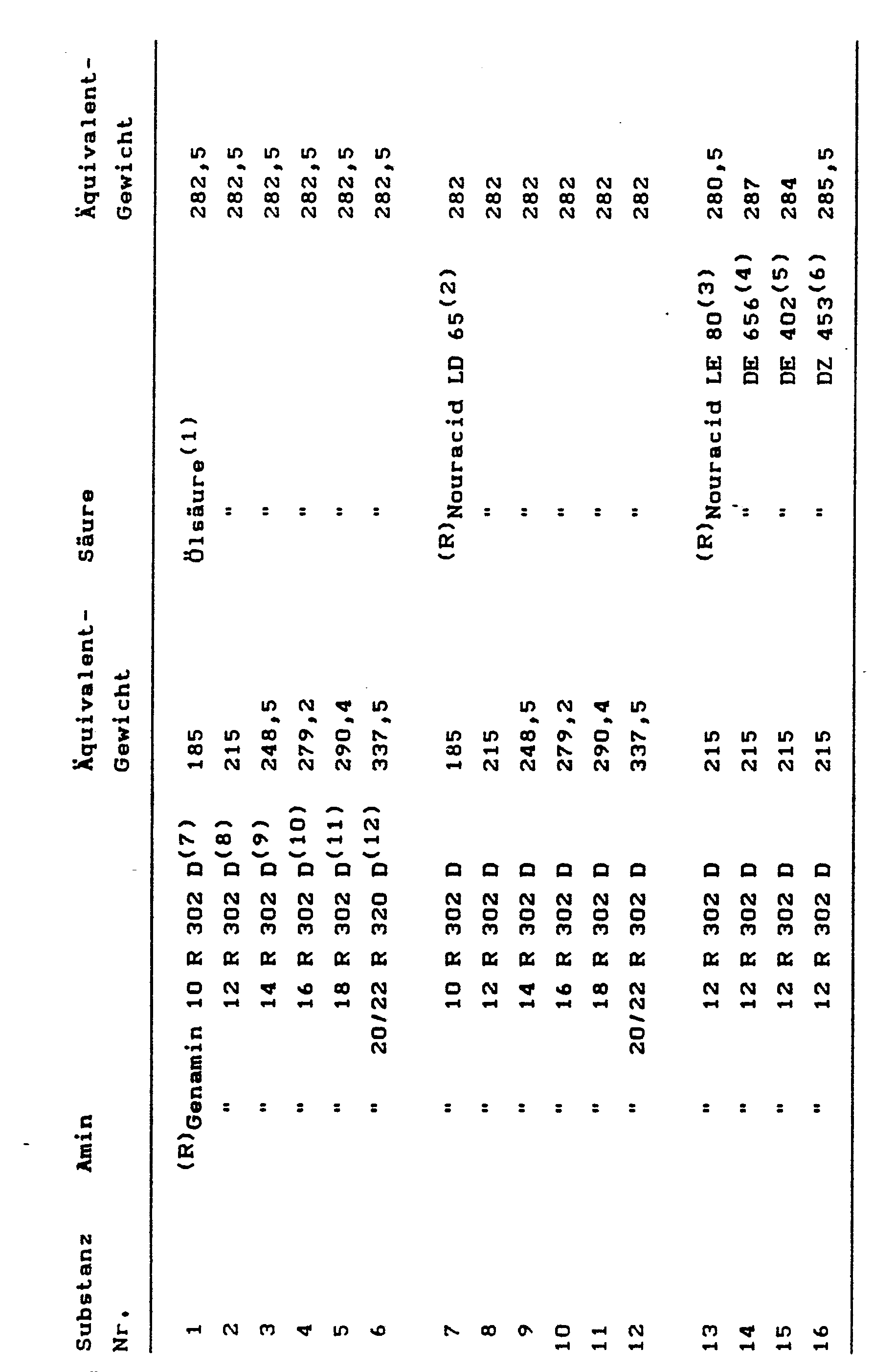
- 1) Ölsäure ® Edenor Ti 05 der Fa. Unichema
- 2) Leinölfettsäure der Fa. Akzo Chemie GmbH, Emmerich
mit 14 % ges. Fettsäuren C12-18
21 % Ölsäure
25 % Linolsäure
40 % Linolensäure - 3) Leinölfettsäure der Fa. Akzo Chemie GmbH, Emmerich
mit 13 % ges. Fettsäuren C12-18
20 % Ölsäure
17 % Linolsäure
50 % Linolensäure - 4) Ricinenfettsäure der Fa. Akzo Chemie GmbH, Emmerich
mit 3 % ges. Fettsäuren C12-18
6 % Ölsäure
26 % Linolsäure
65 % Linolensäure - 5) Ricinenfettsäure der Fa. Akzo Chemie GmbH, Emmerich
mit 10 % ges. Fettsäuren C12-18
17 % Ölsäure
48 % Linolsäure
25 % konj. C18-Diensäuren - 6) Ricinenfettsäure der Fa. Akzo Chemie GmbH, Emmerich
mit 6 % ges. Fettsäuren C12-18
21 % Ölsäure
35 % Linolsäure
34 % konj. C18-Diensäuren
3 % Linolensäure
1 % ges. Fettsäuren C>18 - 7) tert. Amin der Fa. Hoechst, Frankfurt,
mit ≧95 % Dimethyldodecylamin - 8) tert. Amin der Fa. Hoechst, Frankfurt,
mit ≧95 % Dimethyltetradecylamin, - 9) tert. Amin der Fa. Hoechst, Frankfurt,
mit ≧90 % Dimethylhexadecylamin - 10) tert. Amin der Fa. Hoechst, Frankfurt,
mit ≧95 % Dimethyloctadecylamin - 11) tert. Amin der Fa. Hoechst, Frankfurt,
mit 10 % Dimethyloctadecylamin
15 % Dimethyleicosylamin
75 % Dimethyldocosylamin - 12) tert. Amin der Fa. Hoechst, Frankfurt
Additionsprodukt aus Amingemisch 1 % Dodecylamin
4 % Tetradecylamin
12 % Hexadecylamin
83 % Octadecylamin
und ca. 8 Mol Ethylenoxid pro Mol Amingemisch - 100 Gewichtsteile eines Polyolgemisches der OH-Zahl 415 bestehend aus
70,9 GT eines Polyethers der OH-Zahl 27, der durch Addition eines Gemisches aus 80 % Propylenoxid und 20 % Ethylenoxid an Trimethylolpropan erhalten worden ist, und
1,7 GT eines propoxylierten Ethylendiamins der OH-Zahl 790,
21,1 GT Ethylenglykol,
1,7 GT Polyetherpolysiloxan-Stabilisator (OS 50 Hersteller: Bayer AG, Leverkusen)
0,08 GT Dibutyl-Zinn-IV-laurat
0,34 GT 30 %ige Lösung von 1,4-Diazabicyclo-(2,2,2)-octan in Dipropylenglykol
4,2 GT innerem Trennmittel gemäß den Beispielen. - 100 GT dieser Polyolmischung werden mit 111 GT eines urethanmodifizierten Polyisocyanatgemisches einer mittleren NCO-Funktionalität von 2,2 mit einem NCO-Gehalt von 28,5 Gew.-%, hergestellt durch Umsetzung von Polypropylenglykol des mittleren Molekulargewichts 218 mit einem Polyisocyanatgemisch bestehend aus 75 Gew.-Teilen 4,4ʹ-Diisocyanatodiphenylmethan, 4 Gew.-Teilen 2,4ʹ-Diisocyanatodiphenylmethan und 21 Gew.-Teilen an höherkernigen Polyisocyanaten der Diphenylmethanreihe, umgesetzt.
- Das Polyolgemisch wird mit dem Polyisocyanat mittels eines Laboratoriumsrührers vermischt und auf eine offene, auf 60°C temperierte Form mit einem eingelegten Schwarzblech der Abmessungen 310 x 210 x 0,5 mm gegossen. Die Schwarzbleche wurden mit feiner Stahlwolle und Methylenchlorid entfettet und von Roststellen befreit. Die PUR-Mischung bindet nach etwa 20 bis 30 s ab. Nach 5 Minuten wird das Schwarzblech mit der PUR-Masse aus dem Werkzeug entnommen. Das PUR-Material kann ohne Anwendung eines internen Trennmittels nicht vom Schwarzblech abgerissen werden, da es sehr stark auf der Blechfläche haftet.
- Bei Einsatz der internen Trennmittel (siehe Tabelle 1) in der angegebenen Konzentration kann das harte Formteil ohne zu haften vom Schwarzblech abgenommen werden.

R₁ für einen gesättigten oder ungesättigten aliphatischen Kohlenwasserstoffrest mit mindestens 12 Kohlenstoffatomen steht und
R₂ und R₃ für gleiche oder verschiedene Reste stehen und gesättigte oder ungesättigte, vorzugsweise gesättigte aliphatische Kohlenwasserstoffreste mit 1 bis 18, vorzugsweise 1 bis 4 Kohlenstoffatomen, insbesondere Methylreste und/oder gegebenenfalls Etherbrücken aufweisende Hydroxyalkylreste mit 2 bis 40 Kohlenstoffatomen bedeuten.
Claims (6)
a) organischen Polyisocyanaten,
b) Verbindungen mit gegenüber Isocyanatgrupen reaktionsfähigen Wasserstoffatomen des Molekulargewichtsbereichs 62 bis 10 000,
c) Formtrennmitteln bestehend aus Salzen aus (i) gesättigten oder ungesättigten aliphatischen oder cycloaliphatischen Carbonsäuren oder Carbonsäuregemischen mit (im statistischen Mittel) mindestens 8 Kohlenstoffatomen pro Molekül und (ii) tertiären Aminen,
und gegebenenfalls
d) weiteren, aus der Polyurethanchemie an sich bekannten Hilfs- und Zusatzmitteln,
dadurch gekennzeichnet, daß man als Trennmittel c) solche Salze verwendet, deren Aminkomponente (ii) aus tertiären Monoaminen oder Gemischen von tertiären Monoaminen der Formel

R₁ für einen gesättigten oder ungesättigten aliphatischen Kohlenwasserstoffrest mit mindestens 12 Kohlenstoffatomen steht und
R₂ und R₃ für gleiche oder verschiedene Reste stehen und gesättigte oder ungesättigte aliphatische Kohlenwasserstoffreste mit 1 bis 18 Kohlenstoffatomen und/oder gegebenenfalls Etherbrücken aufweisende Hydroxyalkylreste mit 2 bis 40 Kohlenstoffatomen bedeuten.
Applications Claiming Priority (2)
| Application Number | Priority Date | Filing Date | Title |
|---|---|---|---|
| DE19863627078 DE3627078A1 (de) | 1986-08-09 | 1986-08-09 | Verfahren zur herstellung von formkoerpern auf polyurethan- und/oder polyharnstoff-basis und die nach diesem verfahren erhaltenen formkoerper |
| DE3627078 | 1986-08-09 |
Publications (2)
| Publication Number | Publication Date |
|---|---|
| EP0256362A2 true EP0256362A2 (de) | 1988-02-24 |
| EP0256362A3 EP0256362A3 (de) | 1988-11-30 |
Family
ID=6307081
Family Applications (1)
| Application Number | Title | Priority Date | Filing Date |
|---|---|---|---|
| EP87110820A Withdrawn EP0256362A3 (de) | 1986-08-09 | 1987-07-25 | Verfahren zur Herstellung von Formkörpern auf Polyurethan- und/oder Polyharnstoff-Basis und die nach diesem Verfahren erhaltenen Formkörpern |
Country Status (4)
| Country | Link |
|---|---|
| US (1) | US4919878A (de) |
| EP (1) | EP0256362A3 (de) |
| JP (1) | JPS6356558A (de) |
| DE (1) | DE3627078A1 (de) |
Cited By (1)
| Publication number | Priority date | Publication date | Assignee | Title |
|---|---|---|---|---|
| EP0490342A3 (en) * | 1990-12-11 | 1992-11-25 | The Dow Chemical Company | Compatibilized internal mold release compositions for preparation of foamed and fiber-reinforced polymeric articles |
Families Citing this family (14)
| Publication number | Priority date | Publication date | Assignee | Title |
|---|---|---|---|---|
| DE3802427A1 (de) * | 1987-10-06 | 1989-08-03 | Bayer Ag | Verfahren zur herstellung von formkoerpern oder folien |
| CA2071766A1 (en) * | 1991-07-22 | 1993-01-23 | Stephen J. Harasin | Slower reacting rim systems based upon aliphatic amine terminated polyethers |
| US5352754A (en) * | 1992-10-26 | 1994-10-04 | Becton, Dickinson And Company | High impact polyurethane |
| DE4322887C1 (de) * | 1993-07-09 | 1995-01-12 | Bayer Ag | Verfahren zum Herstellen von Formteilen und Füllungen aus Polyurethan-Hart- und -Weichschaumstoffen |
| US5710231A (en) * | 1994-04-08 | 1998-01-20 | Imperial Chemical Industries Plc | Isocyanate-reactive compositions containing internal mold release agents |
| GB2324798B (en) * | 1997-05-01 | 1999-08-18 | Ici Plc | Open celled cellular polyurethane products |
| USD466628S1 (en) | 2001-10-22 | 2002-12-03 | Kraft Foods Holdings, Inc. | Post facade |
| EP1382624A1 (de) * | 2002-07-15 | 2004-01-21 | Tosoh Corporation | Katalysator und Verfahren für die Herstellung eines harten Polyurethanschaums |
| US8597016B2 (en) | 2005-11-23 | 2013-12-03 | Milgard Manufacturing Incorporated | System for producing pultruded components |
| US7901762B2 (en) * | 2005-11-23 | 2011-03-08 | Milgard Manufacturing Incorporated | Pultruded component |
| US8101107B2 (en) | 2005-11-23 | 2012-01-24 | Milgard Manufacturing Incorporated | Method for producing pultruded components |
| US7875675B2 (en) | 2005-11-23 | 2011-01-25 | Milgard Manufacturing Incorporated | Resin for composite structures |
| KR20130102557A (ko) | 2010-09-10 | 2013-09-17 | 인비스타 테크놀러지스 에스.에이.알.엘. | 폴리에테르아민, 폴리에테르아민을 포함하는 조성물, 및 제조 방법 |
| EP2687551A1 (de) * | 2012-07-17 | 2014-01-22 | Huntsman International Llc | Zwischenpolysiocyanurat, umfassend Materialien |
Family Cites Families (9)
| Publication number | Priority date | Publication date | Assignee | Title |
|---|---|---|---|---|
| BE757939A (fr) * | 1969-10-24 | 1971-04-01 | Bayer Ag | Procede de preparation de matieres en mousses |
| US4098731A (en) * | 1974-07-03 | 1978-07-04 | Bayer Aktiengesellschaft | Process for the production of foams |
| DE3147736A1 (de) * | 1981-12-02 | 1983-06-09 | Bayer Ag, 5090 Leverkusen | Verfahren zur herstellung von elastischen formkoerpern |
| JPS60500418A (ja) * | 1983-02-16 | 1985-03-28 | ザ・ダウ・ケミカル・カンパニ− | 成形物品へ離型性を与える活性水素含有組成物 |
| JPS6058418A (ja) * | 1983-09-08 | 1985-04-04 | Toyo Soda Mfg Co Ltd | 遅延性を有するポリウレタン用触媒 |
| DE3333464A1 (de) * | 1983-09-16 | 1985-04-11 | Bayer Ag, 5090 Leverkusen | Verfahren zur herstellung von mikrozellularen oder geschaeumten formkoerpern und zur durchfuehrung dieses verfahrens geeignete verbindungen mit gegenueber isocyanatgruppen reaktionsfaehigen gruppen |
| DE3405875A1 (de) * | 1984-02-18 | 1985-08-22 | Basf Ag, 6700 Ludwigshafen | Verfahren zur herstellung von zelligen oder kompakten polyurethan-polyharnstoff-formkoerpern mit verbesserten entformungseigenschaften sowie innere formtrennmittel fuer das polyisocyanat-polyadditionsverfahren |
| US4585803A (en) * | 1984-08-17 | 1986-04-29 | The Dow Chemical Company | Internal mold release compositions |
| US4710521A (en) * | 1986-07-25 | 1987-12-01 | The Celotex Corporation | Catalyst mixtures for polyisocyanurate foam |
-
1986
- 1986-08-09 DE DE19863627078 patent/DE3627078A1/de not_active Withdrawn
-
1987
- 1987-07-25 EP EP87110820A patent/EP0256362A3/de not_active Withdrawn
- 1987-08-03 US US07/081,043 patent/US4919878A/en not_active Expired - Fee Related
- 1987-08-07 JP JP62196556A patent/JPS6356558A/ja active Pending
Cited By (1)
| Publication number | Priority date | Publication date | Assignee | Title |
|---|---|---|---|---|
| EP0490342A3 (en) * | 1990-12-11 | 1992-11-25 | The Dow Chemical Company | Compatibilized internal mold release compositions for preparation of foamed and fiber-reinforced polymeric articles |
Also Published As
| Publication number | Publication date |
|---|---|
| US4919878A (en) | 1990-04-24 |
| DE3627078A1 (de) | 1988-02-18 |
| EP0256362A3 (de) | 1988-11-30 |
| JPS6356558A (ja) | 1988-03-11 |
Similar Documents
| Publication | Publication Date | Title |
|---|---|---|
| EP0081701B1 (de) | Verfahren zur Herstellung von elastischen Formkörpern | |
| EP0135867B1 (de) | Verfahren zur Herstellung von mikrozellularen oder geschäumten Formkörpern und zur Durchführung dieses Verfahrens geeignete Verbindungen mit gegenüber Isocyanatgruppen reaktionsfähigen Gruppen | |
| EP0000389B1 (de) | Verfahren zur Herstellung von Polyurethankunststoffen | |
| EP0022497B1 (de) | Verfahren zur Herstellung von elastischen, gegebenenfalls zellförmigen, Polyurethanharnstoffen | |
| EP0265781B1 (de) | Verfahren zur Herstellung von Polyurethanformkörpern | |
| EP0255905B1 (de) | Trennmittelkomposition, diese Trennmittelkomposition enthaltende Gemische, ein Verfahren zur Herstellung von elastischen Formkörpern und die nach diesem Verfahren erhaltenen Formkörper | |
| EP0268175B1 (de) | Trennmittelkomposition, diese Trennmittelkomposition enthaltende Gemische und ein Verfahren zur Herstellung von elastischen Formkörpern | |
| EP0256362A2 (de) | Verfahren zur Herstellung von Formkörpern auf Polyurethan- und/oder Polyharnstoff-Basis und die nach diesem Verfahren erhaltenen Formkörpern | |
| EP0187330B1 (de) | Stabile Dispersionen von Polyharnstoffen und/oder Polyhydrazodicarbonamiden in höhermolekularen, mindestens eine Hydroxylgruppe aufweisenden Hydroxylverbindungen, ein Verfahren zu ihrer Herstellung und ihre Verwendung zur Herstellung von Polyurethankunststoffen | |
| EP0278334B1 (de) | Verfahren zur Herstellung von Formkörpern, hierzu geeignete Gemische von gegenüber Isocyanatgruppen reaktionsfähigen Verbindungen und die nach dem Verfahren erhaltenen Formkörper | |
| EP0199967B1 (de) | Verfahren zum Umkanten von Holzplatten | |
| EP0109605A2 (de) | Verfahren zur Herstellung von mikrozellularen oder geschäumten Formkörpern | |
| EP0243777A2 (de) | Verfahren zur Herstellung von Polyharnstoffschaum-Formteilen | |
| EP0220411A1 (de) | Verfahren zur Herstellung von Schuhsohlen | |
| EP0471260A2 (de) | Verfahren zur Herstellung von offenzelligen Polyurethan-Weichschaumstoffen und deren Verwendung als Polstermaterial | |
| EP0309840B1 (de) | Verfahren zur Herstellung von Polyurethanharnstoff-Elastomeren | |
| EP0431412A2 (de) | Verfahren zur Herstellung von wärmestandfesten Polyurethanharnstoffelastomeren | |
| EP0700946B1 (de) | Verfahren zur Herstellung von elastischen Formkörpern | |
| DD282699A5 (de) | Verfahren zur hersteelung von polyurethanharnstoff-elastomeren | |
| EP0204246B1 (de) | Verfahren zur Herstellung von elastischen Formkörpern | |
| DE3829583A1 (de) | Verfahren zur herstellung von formkunststoffen auf polyurethan-basis und deren verwendung als schuhsohlen | |
| EP0077964A1 (de) | Verfahren zur Herstellung von flammfesten, kaltzähen Polyurethanschaumstoffen und deren Verwendung als Innenauskleidung von Lagertanks | |
| DE2404310A1 (de) | Verfahren zur herstellung von schaumstoffen | |
| DE2431968A1 (de) | Verfahren zur herstellung von schaumstoffen | |
| DE2623961A1 (de) | Verfahren zur herstellung von polyurethanen |
Legal Events
| Date | Code | Title | Description |
|---|---|---|---|
| PUAI | Public reference made under article 153(3) epc to a published international application that has entered the european phase |
Free format text: ORIGINAL CODE: 0009012 |
|
| 17P | Request for examination filed |
Effective date: 19870725 |
|
| AK | Designated contracting states |
Kind code of ref document: A2 Designated state(s): BE DE GB NL |
|
| PUAL | Search report despatched |
Free format text: ORIGINAL CODE: 0009013 |
|
| AK | Designated contracting states |
Kind code of ref document: A3 Designated state(s): BE DE GB NL |
|
| 17Q | First examination report despatched |
Effective date: 19900622 |
|
| STAA | Information on the status of an ep patent application or granted ep patent |
Free format text: STATUS: THE APPLICATION HAS BEEN WITHDRAWN |
|
| 18W | Application withdrawn |
Withdrawal date: 19900810 |
|
| R18W | Application withdrawn (corrected) |
Effective date: 19900810 |
|
| RIN1 | Information on inventor provided before grant (corrected) |
Inventor name: KOPP, RICHARD, DR. Inventor name: PILGER, FRIEDHELM, DR. Inventor name: GANSTER, OTTO, DR. |