EP2904655B1 - Positiv-elektrodenaktivmaterial von hoher kapazität - Google Patents
Positiv-elektrodenaktivmaterial von hoher kapazität Download PDFInfo
- Publication number
- EP2904655B1 EP2904655B1 EP13844158.9A EP13844158A EP2904655B1 EP 2904655 B1 EP2904655 B1 EP 2904655B1 EP 13844158 A EP13844158 A EP 13844158A EP 2904655 B1 EP2904655 B1 EP 2904655B1
- Authority
- EP
- European Patent Office
- Prior art keywords
- lithium
- carbon
- further preferably
- elevated temperature
- capacity
- Prior art date
- Legal status (The legal status is an assumption and is not a legal conclusion. Google has not performed a legal analysis and makes no representation as to the accuracy of the status listed.)
- Active
Links
Images


Classifications
-
- H—ELECTRICITY
- H01—ELECTRIC ELEMENTS
- H01M—PROCESSES OR MEANS, e.g. BATTERIES, FOR THE DIRECT CONVERSION OF CHEMICAL ENERGY INTO ELECTRICAL ENERGY
- H01M4/00—Electrodes
- H01M4/02—Electrodes composed of, or comprising, active material
- H01M4/36—Selection of substances as active materials, active masses, active liquids
- H01M4/362—Composites
- H01M4/366—Composites as layered products
-
- H—ELECTRICITY
- H01—ELECTRIC ELEMENTS
- H01M—PROCESSES OR MEANS, e.g. BATTERIES, FOR THE DIRECT CONVERSION OF CHEMICAL ENERGY INTO ELECTRICAL ENERGY
- H01M10/00—Secondary cells; Manufacture thereof
- H01M10/05—Accumulators with non-aqueous electrolyte
- H01M10/052—Li-accumulators
- H01M10/0525—Rocking-chair batteries, i.e. batteries with lithium insertion or intercalation in both electrodes; Lithium-ion batteries
-
- H—ELECTRICITY
- H01—ELECTRIC ELEMENTS
- H01M—PROCESSES OR MEANS, e.g. BATTERIES, FOR THE DIRECT CONVERSION OF CHEMICAL ENERGY INTO ELECTRICAL ENERGY
- H01M4/00—Electrodes
- H01M4/02—Electrodes composed of, or comprising, active material
- H01M4/13—Electrodes for accumulators with non-aqueous electrolyte, e.g. for lithium-accumulators; Processes of manufacture thereof
- H01M4/131—Electrodes based on mixed oxides or hydroxides, or on mixtures of oxides or hydroxides, e.g. LiCoOx
-
- H—ELECTRICITY
- H01—ELECTRIC ELEMENTS
- H01M—PROCESSES OR MEANS, e.g. BATTERIES, FOR THE DIRECT CONVERSION OF CHEMICAL ENERGY INTO ELECTRICAL ENERGY
- H01M4/00—Electrodes
- H01M4/02—Electrodes composed of, or comprising, active material
- H01M4/36—Selection of substances as active materials, active masses, active liquids
- H01M4/48—Selection of substances as active materials, active masses, active liquids of inorganic oxides or hydroxides
- H01M4/485—Selection of substances as active materials, active masses, active liquids of inorganic oxides or hydroxides of mixed oxides or hydroxides for inserting or intercalating light metals, e.g. LiTi2O4 or LiTi2OxFy
-
- H—ELECTRICITY
- H01—ELECTRIC ELEMENTS
- H01M—PROCESSES OR MEANS, e.g. BATTERIES, FOR THE DIRECT CONVERSION OF CHEMICAL ENERGY INTO ELECTRICAL ENERGY
- H01M4/00—Electrodes
- H01M4/02—Electrodes composed of, or comprising, active material
- H01M4/36—Selection of substances as active materials, active masses, active liquids
- H01M4/48—Selection of substances as active materials, active masses, active liquids of inorganic oxides or hydroxides
- H01M4/52—Selection of substances as active materials, active masses, active liquids of inorganic oxides or hydroxides of nickel, cobalt or iron
- H01M4/525—Selection of substances as active materials, active masses, active liquids of inorganic oxides or hydroxides of nickel, cobalt or iron of mixed oxides or hydroxides containing iron, cobalt or nickel for inserting or intercalating light metals, e.g. LiNiO2, LiCoO2 or LiCoOxFy
-
- H—ELECTRICITY
- H01—ELECTRIC ELEMENTS
- H01M—PROCESSES OR MEANS, e.g. BATTERIES, FOR THE DIRECT CONVERSION OF CHEMICAL ENERGY INTO ELECTRICAL ENERGY
- H01M4/00—Electrodes
- H01M4/02—Electrodes composed of, or comprising, active material
- H01M4/62—Selection of inactive substances as ingredients for active masses, e.g. binders, fillers
- H01M4/624—Electric conductive fillers
-
- H—ELECTRICITY
- H01—ELECTRIC ELEMENTS
- H01M—PROCESSES OR MEANS, e.g. BATTERIES, FOR THE DIRECT CONVERSION OF CHEMICAL ENERGY INTO ELECTRICAL ENERGY
- H01M4/00—Electrodes
- H01M4/02—Electrodes composed of, or comprising, active material
- H01M4/62—Selection of inactive substances as ingredients for active masses, e.g. binders, fillers
- H01M4/624—Electric conductive fillers
- H01M4/625—Carbon or graphite
-
- Y—GENERAL TAGGING OF NEW TECHNOLOGICAL DEVELOPMENTS; GENERAL TAGGING OF CROSS-SECTIONAL TECHNOLOGIES SPANNING OVER SEVERAL SECTIONS OF THE IPC; TECHNICAL SUBJECTS COVERED BY FORMER USPC CROSS-REFERENCE ART COLLECTIONS [XRACs] AND DIGESTS
- Y02—TECHNOLOGIES OR APPLICATIONS FOR MITIGATION OR ADAPTATION AGAINST CLIMATE CHANGE
- Y02E—REDUCTION OF GREENHOUSE GAS [GHG] EMISSIONS, RELATED TO ENERGY GENERATION, TRANSMISSION OR DISTRIBUTION
- Y02E60/00—Enabling technologies; Technologies with a potential or indirect contribution to GHG emissions mitigation
- Y02E60/10—Energy storage using batteries
Definitions
- the present disclosure relates to a discharge-positive electrode (also referred to as cathode) for a lithium secondary battery that exhibits a large reversible capacity and does not require overcharge (the charging beyond the theoretical capacity limit) during the first cycles, and a synthesis route for producing the same.
- a discharge-positive electrode also referred to as cathode
- overcharge the charging beyond the theoretical capacity limit
- Li battery cathode materials The positive electrode (cathode) material is the limiting factor in the production of high capacity and high energy density lithium ion batteries.
- An important class of cathode materials for secondary lithium batteries is constituted by rock-salt type layered lithium metal oxides of the general composition LiMO 2 , where M is a metallic species or a mixture of several such. In such layered oxides, every second plane in ⁇ 111> direction (from F-3m cubic system) contains alternating lithium cations or cations of species M ( M. S. Whittingham, Science 192 (1976) 1126-1127 ; M. S. Whittingham, Chemical Reviews 104 (2004) 4271-4302 ).
- Li(Li,Ni,Co,Mn)O 2 compounds are overcharged in the first cycle at a voltage above 4.7 V in order to release oxygen, and achieve a higher capacity in the subsequent cycles ( M. M. Thackeray et al., J. Mater. Chem. 17 (2007) 3112-3125 ; A. R. Armstrong et al., J. Am. Chem. Soc. 128 (2006) 8694-8698 ).
- this overcharge process is more expensive to implement and leads to cathode materials with limited long-term stability as well as reduced charge/discharge rate capability.
- overcharging may lead to oxygen evolution and poses a potential safety risk, and adds cost and complications to battery manufacturing.
- Zhang et al J. Electrochemical Society, 150(5), A601-A607 (2003 ) discloses novel layered Li-Cr-Ti-O cathode materials.
- James et al. J. Solid State Chem., 76, 87-96 (1998 ) discloses the structure and bonding in Li 2 MoO 3 and Li 2-x moO 3 (0 ⁇ x ⁇ 1.7).
- a discharge-positive electrode material for a lithium secondary battery that exhibits a large reversible capacity of more than 150 mAh/g.
- the material is a (rock-salt type) lithium metal oxide with composition according to claim 1.
- the material is capable of cation mixing. In contrast to existing lithium excess metal oxide active materials, the material presented here does not require overcharge during the first cycles.
- the distribution of cations becomes more random and/or more disordered among cation layers upon subjecting an oxide to at least one lithium ion extraction-insertion cycle. In some embodiments, the distribution of cations becomes more uniformly distributed over the cation layers (as opposed to strict segregation into Li and M layers) upon subjecting an oxide to at least one lithium ion extraction-insertion cycle.
- a provided material is a lithium metal oxide characterized by a general formula according to claim 1; said oxide, as synthesized, showing a random or partially random distribution of Li cations and M cations in the oxygen arrangement of the rock-salt structure, as measurable by XRD.
- such oxides when characterized by XRD, show a peak whose intensity I' is the largest in the range 16-22 degrees 2 ⁇ , and a peak whose intensity I" is the largest in the range 42-46 degrees 2 ⁇ .
- I' is essentially zero, so that I '/ I" ⁇ 0.01.
- the absence of oxygen oxidation is characterized by a first charge capacity of at least 150 mAh/g when charging at room temperature at C/20 rate which is the rate to potentially utilize the full theoretical capacity C max in 20 hours.
- the distance between any two neighboring oxygen planes in any lattice direction is less than 2.55 ⁇ upon subjecting the oxide to at least one lithium insertion-extraction cycle.
- An oxide according to the invention is Li 1+x Mo 2x Cr 1-3x O 2 , wherein 0.15 ⁇ x ⁇ 0.333, preferably Li(Li 0.233 Mo 0.467 Cr 0.3 )O 2 .
- the present disclosure provides an electrode comprising at least one oxide disclosed herein.
- the present disclosure provides a coated electrode material comprising at least one oxide disclosed herein.
- a coated electrode material has a coating comprising a member selected from the group consisting of carbon, MgO, Al 2 O 3 , SiO 2 , TiO 2 , ZnO, SnO 2 , ZrO 2 , Li 2 O-2B 2 O 3 glass, phosphates, and combinations thereof.
- a coating comprises a phosphate is selected from the group consisting of AlPO 4 , Li 4 P 2 O 7 , and Li 3 PO 4 .
- a coating comprises carbon.
- a provided electrode composition comprises carbon black, a binder, and a coated electrode material described herein.
- the present disclosure provides methods of preparing Li 1+x Mo 2x Cr 1-3x O 2 , wherein 0.15 ⁇ x ⁇ 0.333, the method comprising contacting precursors Li 2 CO 3 , MoO 2 , and Cr 3 (OH) 2 (OOCCH 3 ) 7 at an elevated temperature.
- Li(Li (1-x)/3 Mo (2-2x)/3 Cr x )O 2 is Li(Li 0.233 Mo 0.467 Cr 0.3 )O 2 .
- the elevated temperature is from about 800 °C to 1200 °C. In certain embodiments, the elevated temperature is from about 800 °C to 1000 °C.
- the methods comprise milling the precursors. In some embodiments, the methods comprise dispersing the precursors in a suitable solvent prior to milling, and drying the resulting mixture.
- an amount of lithium may be lost during synthesis of certain oxides.
- the experimental stoichiometry can be about Li 1.211 Mo 0.467 Cr 0.3 O 2 .
- the provided methods utilize Li 2 CO 3 in excess of the stoichiometric amount needed to produce the desired final compound.
- the present disclosure provides methods of coating Li 1+x Mo 2x Cr 1-3x O 2 , wherein 0.15 ⁇ x ⁇ 0.333, the method comprising contacting a suitable coating material with Li 1+x Mo 2x Cr 1-3x O 2 at an elevated temperature.
- the method comprises milling the suitable coating material with Li(Li (1-x)/3 Mo (2-2x)/3 Cr x )O 2 .
- the weight ratio of Li(Li (1-x)/3 Mo (2-2x)/3 Cr x )O 2 to the suitable coating material is from about 90:10 to about 70:30 (e.g., about 90:10, 85:15, 80:20, 75:25, or 70:30).
- the elevated temperature is from about 400 °C to about 800 °C.
- the suitable coating material is carbon.
- the suitable coating material is a carbon precursor.
- the carbon precursor converts to carbon at an elevated temperature.
- the carbon precursor is a carbohydrate.
- the carbon precursor is sucrose.
- the present disclosure also provides lithium batteries and lithium-ion cells comprising an electrode material described herein.
- the present disclosure further provides devices comprising such lithium batteries and lithium-ion cells.
- a device is a portable electronic device, an automobile, or an energy storage system.
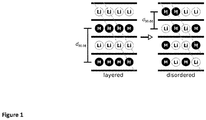
- the layeredness of a sample of a LiMO 2 compound can be experimentally quantified using powder X-ray diffraction (XRD).
- XRD powder X-ray diffraction
- the distance d M-M between layers containing cation species M is approximately twice as large as in disordered materials ( Fig. 1 ), and manifests itself in a Cu k - ⁇ Bragg reflection at 2 ⁇ ⁇ 16-22°, such as a (003) peak in R-3m layered oxides, or a (001) peak in P-3m1 layered oxides.
- peak A refers to a peak whose intensity I' is the largest in the range 16-22°.
- the intensity of peak A comes from the plane that mainly composed of metal ions that are strong x-ray scatterers. Therefore, any damage to the layered arrangement of metal ion results in the decrease of peak A's intensity, as the metal plane now becomes partially composed of weak x-ray scatterers, such as lithium ions or vacancies.
- crystal planes whose compositions are independent of the cation mixing such as (104) planes in R-3m layered oxides, or (011) planes in P-3m1 layered oxides, which are typically observed at 2 ⁇ ⁇ 42-46°. These planes give rise to XRD peaks that are insensitive with respect to the cation ordering.
- peak B refers to a peak whose intensity I" is the largest in the range 42-46°. Therefore, the ratio of the intensities of an ordering-sensitive XRD peak at 2 ⁇ ⁇ 16-22° (peak A) and an ordering-insensitive peak at 2 ⁇ ⁇ 42-46° (peak B) thus quantifies the layeredness of the sample.
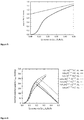
- Fig. 2 shows how the intensity ratio between (003) peak (peak A) and (104) peak (peak B) of R-3m LiCoO 2 changes with cation mixing (disordering). When LiCoO 2 is perfectly layered (0% mixing), the ratio is high, and the high intensity coming from the (003) peak is clearly seen.
- the necessary energy for lithium activation i.e., the lithium diffusion barrier, depends on (i) the oxidation state of the face sharing species of these tetrahedral sites (the higher the oxidation state, the greater the electrostatic repulsion), and (ii) the size of the tetrahedral sites, which in layered oxides is in turn mainly determined by the oxygen-layer distance enclosing a lithium layer in (111) direction ( slab distance ) .
- the second parameter, the slab distance, is challenging to predict prior to the actual synthesis of a compound, as cation mixing upon charge-discharge cycling (i.e., the migration of metal cations to the lithium layer and vice versa ) can dramatically reduce the slab distance and render a large fraction of lithium inaccessible.
- the first parameter, the oxidation state of face sharing cations can be systematically controlled by introducing excess lithium to the compound, thereby effectively altering the stoichiometry to the general composition formula Li 1+x M y O 2 (with lithium excess x). Excess lithium will lead to locally lithium-rich environments, in which lithium is the only face sharing species of tetrahedral sites ( Fig. 4 ), resulting in low lithium diffusion barriers.
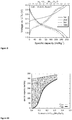
- FIG. 5 shows the number of accessible lithium ions per formula unit as a function of lithium excess as calculated in a numerical percolation simulation.
- Example 1 is according to the invention; all other Examples are for illustrative purposes only.
- Li 2 CO 3 , MoO 2 , and Cr 3 (OH) 2 (OOCCH 3 ) 7 were used as precursors. More than ⁇ 5% excess Li 2 CO 3 from the stoichiometric amount needed to synthesize Li 1+x Mo 2x Cr 1-3x O 2 , [0 ⁇ x ⁇ 0.333] was used to compensate for possible Li loss during high temperature solid state reaction.
- the precursors were dispersed into acetone and ball-milled for 24 hours and dried overnight to prepare the precursor mixture. The mixture was fired at 1050 °C for 15 hours under Ar gas, and manually ground to obtain the final products.
- Carbon coating can be applied 1) to prevent Mo and Cr dissolution, 2) to improve the cycling performance of Li 1+x Mo 2x Cr 1-3x O 2 by decreasing the particle size upon the carbon coating process, and 3) to improve electronic conductivity of the compounds.
- Sucrose C 12 H 22 O 11
- Li 1+x Mo 2x Cr 1-3x O 2 in weight ratio between 90:10 and 70:30 of active material to sucrose. Then the mixture was annealed between 400 °C to 800 °C for 2 to 6 hours under Ar gas.
- Swagelok cells were assembled under Ar atmosphere in a glove box.
- ⁇ 70wt% of the active compounds, ⁇ 20wt% of carbon black, and ⁇ 10wt% of PTFE binder were intimately mixed by hands or planetary ball-mill.
- the above compounds transform from a layered to a disorder rocksalt type lithium metal oxide by cation mixing during cycling.
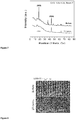
- a representative pattern of layered Li-TM-oxides is seen before cycling, and that of disordered Li-TM-oxides is seen after 10 cycles.
- the significant decrease in the intensity ratio of (003) peak to (104) peak, the measure of layeredness, indicates that cation mixing triggers the transformation from a layered to disordered rocksalt type lithium metal oxide.
- Figure 9 shows the voltage profile of carbon-coated Li 1.233 Mo 0.467 Cr 0.3 O 2 when cycled between 1.5 V-4.3 V at C/20.
- a voltage profile change indicates the structural evolution of an electrode material.
- the significant change in the profile after the 1 st charge is consistent with our XRD and STEM observations of heavy cation mixing in the 1 st cycle.
- Figure 10 explains why such a high capacity could be achieved in disordered (cation-mixed) Li 1.233 Mo 0.467 Cr 0.3 O 2 .
- the tetrahedral sites, face-sharing only lithium-ions form a percolating network in a rock salt structure.
- Li 2 CO 3 , NiCO 3 , and Sb 2 O 5 (or Nb 2 O 5 ) were used as precursors. More than ⁇ 5% excess Li 2 CO 3 from the stoichiometric amount needed to synthesize Li 1+x Ni (2-4x)/3 M (1+x)/3 O 2 , [0 ⁇ x ⁇ 0.3] was used to compensate for possible Li loss during high temperature solid state reaction.
- the precursors were dispersed into acetone and ball-milled for 24 hours and dried overnight to prepare the precursor mixture. The mixture was fired at 800 °C for 15 hours under O 2 gas, and manually ground to obtain the final products.
- Sucrose C 12 H 22 O 11
- Li 1+x Ni (2-4x)/3 M (1+x)/3 O 2 [M Sb or Nb] in weight ratio between 90:10 and 70:30 of active material to sucrose. Then the mixture can be annealed between 400 °C to 800 °C for 2 to 6 hours under O 2 gas.
- Swagelok cells were assembled under Ar atmosphere in a glove box.
- ⁇ 80wt% of the active compounds, ⁇ 15wt% of carbon black, and ⁇ 5wt% of PTFE binder were intimately mixed by hands or planetary ball-mill.
- Li 2 CO 3 , NiCO 3 , and MoO 2 can be used as precursors. More than ⁇ 5% excess Li 2 CO 3 from the stoichiometric amount needed to synthesize Li 1+x Ni (3-5x)/4 Mo (1+x)/4 O 2 [0 ⁇ x ⁇ 0.3] can be used to compensate for possible Li loss during high temperature solid state reaction.
- the precursors can be dispersed into acetone and ball-milled for 24 hours and dried overnight to prepare the precursor mixture. The mixture can be fired at 800 °C for 10 hours under O 2 gas, and manually ground to obtain the final products.
- Carbon coating can be applied 1) to improve the cycling performance of Li 1+x Ni (3-5x)/4 Mo (1+x)/4 O 2 by decreasing the particle size upon the carbon coating process, and 2) to improve electronic conductivity of the compounds.
- Sucrose C 12 H 22 O 11
- Li 1+x Ni (3-5x)/4 Mo (1+x)/4 O 2 in weight ratio between 90:10 and 70:30 of active material to sucrose. Then the mixture can be annealed between 400 °C to 800 °C for 2 to 6 hours under O 2 gas.
- Swagelok cells can be assembled under Ar atmosphere in a glove box.
- ⁇ 80wt% of the active compounds, ⁇ 15wt% of carbon black, and ⁇ 5wt% of PTFE binder can be intimately mixed by hands or planetary ball-mill.
- Li 1+x Ni (3-5x)/4 Mo (1+x)/4 O 2 may exhibit the maximum capacity as shown in the dotted curve in Fig. 3 , and the minimum capacity (determined by accessible lithium atoms per formula unit) as shown in the dotted curve in Fig. 5 if sufficient voltage can be applied within the voltage windows of electrolytes.
- the precursors can be dispersed into acetone and ball-milled for 24 hours and dried overnight to prepare the precursor mixture. The mixture can be fired at 600 °C for 10 hours under O 2 gas, and manually ground to obtain the final products.
- Carbon coating can be applied 1) to improve the cycling performance of Li 1+x Ru 2x M 1-3x O 2 by decreasing the particle size upon the carbon coating process, and 2) to improve electronic conductivity of the compounds.
- Sucrose C 12 H 22 O 11
- Li 1+x Ru 2x M 1-3x O 2 in weight ratio between 90:10 and 70:30 of active material to sucrose. Then the mixture can be annealed between 400 °C to 800 °C for 2 to 6 hours under O 2 gas.
- Swagelok cells can be assembled under Ar atmosphere in a glove box.
- ⁇ 80wt% of the active compounds, ⁇ 15wt% of carbon black, and ⁇ 5wt% of PTFE binder can be intimately mixed by hands or planetary ball-mill.
- Li 1+x Ru 2x M 1-3x O 2 [0 ⁇ x ⁇ 0.333] may exhibit the maximum capacity as shown in the dash-dotted curve in Fig. 3 , and the minimum capacity (determined by accessible lithium atoms per formula unit) as shown in the dash-dotted curve in Fig. 5 if sufficient voltage can be applied within the voltage windows of electrolytes.
- Li 2 CO 3 , FeCO 3 , and Nb 2 O 5 can be used as precursors. More than ⁇ 5% excess Li 2 CO 3 from the stoichiometric amount needed to synthesize Li 1.125 Fe 0.7 Nb 0.175 O 2 can be used to compensate for possible Li loss during high temperature solid state reaction.
- the precursors can be dispersed into acetone and ball-milled for 24 hours and dried overnight to prepare the precursor mixture. The mixture can be fired at 600 °C for 10 hours under O 2 gas, and manually ground to obtain the final products.
- Carbon coating can be applied 1) to improve the cycling performance of Li 1+x Fe 1-y Nb y O 2 by decreasing the particle size upon the carbon coating process, and 2) to improve electronic conductivity of the compounds.
- Sucrose C 12 H 22 O 11
- Li 1+x Fe 1-y Nb y O 2 in weight ratio between 90:10 and 70:30 of active material to sucrose. Then the mixture can be annealed between 400 °C to 800 °C for 2 to 6 hours under O 2 gas.
- Swagelok cells can be assembled under Ar atmosphere in a glove box.
- ⁇ 80wt% of the active compounds, ⁇ 15wt% of carbon black, and ⁇ 5wt% of PTFE binder can be intimately mixed by hands or planetary ball-mill.
- Li 1+x Fe 1-y Nb y O 2 (0.15 ⁇ x ⁇ 0.3, 0 ⁇ y ⁇ 0.3) may exhibit the maximum capacity as shown in the dotted curve in Fig. 3 and the minimum capacity (determined by accessible lithium atoms per formula unit) as shown in the dotted curve in Fig. 5 if sufficient voltage can be applied within the voltage windows of electrolytes.
Landscapes
- Chemical & Material Sciences (AREA)
- Chemical Kinetics & Catalysis (AREA)
- Electrochemistry (AREA)
- General Chemical & Material Sciences (AREA)
- Composite Materials (AREA)
- Inorganic Chemistry (AREA)
- Engineering & Computer Science (AREA)
- Materials Engineering (AREA)
- Manufacturing & Machinery (AREA)
- Battery Electrode And Active Subsutance (AREA)
- Secondary Cells (AREA)
- Inorganic Compounds Of Heavy Metals (AREA)
- Compounds Of Iron (AREA)
Claims (11)
- Oxid Li1+xMo2xCr1-3xO2, wobei 0,15 < x < 0,333; vorzugsweise Oxid Li(Li0,233Mo0,467Cr0,3)O2.
- Elektrode, aufweisend mindestens ein Oxid nach Anspruch 1.
- Beschichtetes Elektrodenmaterial, aufweisend ein Oxid nach Anspruch 1.
- Beschichtetes Elektrodenmaterial nach Anspruch 3 mit einer Beschichtung, die ein Element aufweist, das aus der Gruppe ausgewählt ist, die aus Kohlenstoff, MgO, Al2O3, SiO2, TiO2, ZnO, SnO2, ZrO2, Li2O-2B2O3-Glas, Phosphaten und Kombinationen davon besteht, wobei vorzugsweise:
das Phosphat ausgewählt ist aus der Gruppe bestehend aus AlPO4, Li4P2O7 und Li3PO4, oder wobei die Beschichtung Kohlenstoff ist. - Elektrodenzusammensetzung, aufweisend Ruß, ein Bindemittel und das beschichtete Elektrodenmaterial nach Anspruch 3.
- Lithiumbatterie oder Lithiumzelle, aufweisend das Elektrodenmaterial nach Anspruch 2.
- Vorrichtung, aufweisend die Lithiumbatterie nach Anspruch 6, wobei die Vorrichtung vorzugsweise ein tragbares elektronisches Gerät, ein Automobil oder ein Energiespeichersystem ist.
- Verfahren zur Herstellung von Li1+xMo2xCr1-3xO2, wobei 0,15 < x < 0,333, wobei das Verfahren das Inkontaktbringen der chemischen Ausgangsstoffe Li2CO3, MoO2 und Cr3(OH)2(OOCCH3)7 bei einer erhöhten Temperatur aufweist, wobei vorzugsweise:
die erhöhte Temperatur von 800 °C bis 1200 °C beträgt, weiter bevorzugt:
aufweisend die Verwendung von Li2CO3 im Überschuss der stöchiometrischen Menge, die benötigt wird, um die gewünschte Endverbindung herzustellen, weiter bevorzugt:
aufweisend das Mahlen der chemischen Ausgangsstoffe, weiter bevorzugt: aufweisend das Dispergieren der chemischen Ausgangsstoffe in einem geeigneten Lösungsmittel vor dem Mahlen und das Trocknen der resultierenden Mischung, wobei weiter bevorzugt:
die erhöhte Temperatur von 800 °C bis 1000 °C beträgt, wobei weiter bevorzugt:
Li(Li(1-x)/3Mo(2-2x)/3Crx)O2 Li(Li0,233Mo0,467Cr0,3)O2 ist. - Verfahren zum Beschichten von Li1+xMo2xCr1-3xO2, wobei 0,15 < x < 0,333, wobei das Verfahren das Inkontaktbringen eines geeigneten Beschichtungsmaterials mit Li1+xMo2xCr1-3xO2 bei einer erhöhten Temperatur aufweist.
- Verfahren nach Anspruch 9, aufweisend das Mahlen des geeigneten Beschichtungsmaterials mit Li(Li(1-x)/3Mo(2-2x)/3Crx)O2, wobei vorzugsweise:
das Gewichtsverhältnis von Li(Li(1-x)/3Mo(2-2x)/3Crx)O2 zu dem geeigneten Beschichtungsmaterial etwa von 90 : 10 bis etwa 70 : 30 beträgt, wobei weiter bevorzugt:
die erhöhte Temperatur von etwa 400 °C bis etwa 800 °C beträgt, wobei weiter bevorzugt:
das geeignete Beschichtungsmaterial Kohlenstoff ist. - Verfahren nach Anspruch 9 oder Anspruch 10, wobei das geeignete Beschichtungsmaterial ein Kohlenstoffausgangsmaterial ist, wobei sich vorzugsweise:
das Kohlenstoffausgangsmaterial bei einer erhöhten Temperatur in Kohlenstoff umwandelt, wobei weiter bevorzugt:
das Kohlenstoffausgangsmaterial ein Kohlenhydrat ist.
Priority Applications (4)
| Application Number | Priority Date | Filing Date | Title |
|---|---|---|---|
| EP22209384.1A EP4160739A1 (de) | 2012-10-02 | 2013-10-02 | Positiv-elektrodenaktivmaterial von hoher kapazität |
| EP22209401.3A EP4181235A1 (de) | 2012-10-02 | 2013-10-02 | Positiv-elektrodenaktivmaterial von hoher kapazität |
| PL13844158T PL2904655T3 (pl) | 2012-10-02 | 2013-10-02 | Materiał aktywny elektrody dodatniej o wysokiej wydajności |
| EP21184570.6A EP3944374B1 (de) | 2012-10-02 | 2013-10-02 | Positiv-elektrodenaktivmaterial von hoher kapazität |
Applications Claiming Priority (2)
| Application Number | Priority Date | Filing Date | Title |
|---|---|---|---|
| US201261708963P | 2012-10-02 | 2012-10-02 | |
| PCT/US2013/063094 WO2014055665A2 (en) | 2012-10-02 | 2013-10-02 | High-capacity positive electrode active material |
Related Child Applications (3)
| Application Number | Title | Priority Date | Filing Date |
|---|---|---|---|
| EP21184570.6A Division EP3944374B1 (de) | 2012-10-02 | 2013-10-02 | Positiv-elektrodenaktivmaterial von hoher kapazität |
| EP22209384.1A Division EP4160739A1 (de) | 2012-10-02 | 2013-10-02 | Positiv-elektrodenaktivmaterial von hoher kapazität |
| EP22209401.3A Division EP4181235A1 (de) | 2012-10-02 | 2013-10-02 | Positiv-elektrodenaktivmaterial von hoher kapazität |
Publications (3)
| Publication Number | Publication Date |
|---|---|
| EP2904655A2 EP2904655A2 (de) | 2015-08-12 |
| EP2904655A4 EP2904655A4 (de) | 2016-09-28 |
| EP2904655B1 true EP2904655B1 (de) | 2021-07-21 |
Family
ID=50432900
Family Applications (4)
| Application Number | Title | Priority Date | Filing Date |
|---|---|---|---|
| EP13844158.9A Active EP2904655B1 (de) | 2012-10-02 | 2013-10-02 | Positiv-elektrodenaktivmaterial von hoher kapazität |
| EP22209401.3A Pending EP4181235A1 (de) | 2012-10-02 | 2013-10-02 | Positiv-elektrodenaktivmaterial von hoher kapazität |
| EP21184570.6A Active EP3944374B1 (de) | 2012-10-02 | 2013-10-02 | Positiv-elektrodenaktivmaterial von hoher kapazität |
| EP22209384.1A Pending EP4160739A1 (de) | 2012-10-02 | 2013-10-02 | Positiv-elektrodenaktivmaterial von hoher kapazität |
Family Applications After (3)
| Application Number | Title | Priority Date | Filing Date |
|---|---|---|---|
| EP22209401.3A Pending EP4181235A1 (de) | 2012-10-02 | 2013-10-02 | Positiv-elektrodenaktivmaterial von hoher kapazität |
| EP21184570.6A Active EP3944374B1 (de) | 2012-10-02 | 2013-10-02 | Positiv-elektrodenaktivmaterial von hoher kapazität |
| EP22209384.1A Pending EP4160739A1 (de) | 2012-10-02 | 2013-10-02 | Positiv-elektrodenaktivmaterial von hoher kapazität |
Country Status (9)
| Country | Link |
|---|---|
| US (3) | US9960417B2 (de) |
| EP (4) | EP2904655B1 (de) |
| JP (2) | JP2015535801A (de) |
| KR (2) | KR20210041136A (de) |
| CN (1) | CN104685679B (de) |
| FI (1) | FI3944374T3 (de) |
| HU (2) | HUE062621T2 (de) |
| PL (2) | PL3944374T3 (de) |
| WO (1) | WO2014055665A2 (de) |
Families Citing this family (67)
| Publication number | Priority date | Publication date | Assignee | Title |
|---|---|---|---|---|
| US8399130B2 (en) | 2010-08-16 | 2013-03-19 | Massachusetts Institute Of Technology | Mixed phosphate-diphosphate electrode materials and methods of manufacturing same |
| US20150010822A1 (en) * | 2012-02-06 | 2015-01-08 | Nec Corporation | Lithium-ion battery and method for producing same |
| JP6094491B2 (ja) * | 2012-02-06 | 2017-03-15 | 日本電気株式会社 | リチウムイオン電池およびその製造方法 |
| PL3944374T3 (pl) | 2012-10-02 | 2023-12-11 | Massachusetts Institute Of Technology | Materiał aktywny elektrody dodatniej o wysokiej wydajności |
| JP6197029B2 (ja) * | 2013-03-27 | 2017-09-13 | 株式会社Gsユアサ | 非水電解質蓄電素子用活物質 |
| JP6117718B2 (ja) * | 2014-03-03 | 2017-04-19 | Jx金属株式会社 | リチウム複合酸化物 |
| WO2015170216A1 (en) * | 2014-05-09 | 2015-11-12 | Semiconductor Energy Laboratory Co., Ltd. | Lithium-ion secondary battery and electronic device |
| CN104009209A (zh) * | 2014-06-05 | 2014-08-27 | 湖南工程学院 | 一种核壳结构锂离子电池正极材料的制备方法 |
| KR20210117342A (ko) * | 2015-04-23 | 2021-09-28 | 유미코아 | 리튬 이온 충전식 배터리용 캐소드 재료 |
| CN107431201B (zh) | 2015-07-23 | 2021-06-01 | 松下知识产权经营株式会社 | 正极活性物质和电池 |
| EP3136478B1 (de) | 2015-08-26 | 2019-07-24 | Massachusetts Institute Of Technology | Ungeordnete kationen oxide für wiederaufladbare lithiumbatterien und andere anwendungen |
| JP6793354B2 (ja) | 2015-09-16 | 2020-12-02 | パナソニックIpマネジメント株式会社 | 電池 |
| JP6846627B2 (ja) | 2015-09-16 | 2021-03-24 | パナソニックIpマネジメント株式会社 | 正極活物質、および、電池 |
| WO2017047015A1 (ja) | 2015-09-16 | 2017-03-23 | パナソニックIpマネジメント株式会社 | 電池 |
| WO2017047019A1 (ja) | 2015-09-16 | 2017-03-23 | パナソニックIpマネジメント株式会社 | 電池 |
| JP6861402B2 (ja) | 2015-09-16 | 2021-04-21 | パナソニックIpマネジメント株式会社 | 電池 |
| JP6861401B2 (ja) | 2015-09-16 | 2021-04-21 | パナソニックIpマネジメント株式会社 | 正極活物質、および、電池 |
| WO2017047023A1 (ja) | 2015-09-16 | 2017-03-23 | パナソニックIpマネジメント株式会社 | 電池 |
| JP6846628B2 (ja) | 2015-09-16 | 2021-03-24 | パナソニックIpマネジメント株式会社 | 正極活物質、および、電池 |
| KR102059978B1 (ko) * | 2015-11-30 | 2019-12-30 | 주식회사 엘지화학 | 이차전지용 양극활물질 및 이를 포함하는 이차전지 |
| FR3045211B1 (fr) * | 2015-12-09 | 2020-06-05 | Commissariat A L'energie Atomique Et Aux Energies Alternatives | Materiau de cathode pour batteries li-ion |
| CN107104232B (zh) * | 2016-02-19 | 2022-01-07 | 松下知识产权经营株式会社 | 正极活性物质和电池 |
| CN107104231A (zh) * | 2016-02-19 | 2017-08-29 | 松下知识产权经营株式会社 | 正极活性物质以及电池 |
| KR20170108310A (ko) * | 2016-03-17 | 2017-09-27 | 주식회사 엘지화학 | 양극 활물질 및 이의 제조방법, 이를 포함하는 리튬 이차 전지 |
| US10280092B2 (en) | 2016-07-28 | 2019-05-07 | Wildcat Discovery Technologies, Inc | Oxides for high energy cathode materials |
| JP6941811B2 (ja) * | 2016-09-26 | 2021-09-29 | パナソニックIpマネジメント株式会社 | 電池用正極活物質、および、電池 |
| JP6979586B2 (ja) * | 2016-11-15 | 2021-12-15 | パナソニックIpマネジメント株式会社 | 電池用正極活物質、および、電池用正極活物質を用いた電池 |
| WO2018092359A1 (ja) | 2016-11-15 | 2018-05-24 | パナソニックIpマネジメント株式会社 | 電池用正極活物質、および、電池 |
| JP6964246B2 (ja) | 2016-12-02 | 2021-11-10 | パナソニックIpマネジメント株式会社 | 正極活物質、および、正極活物質を用いた電池 |
| JP6952247B2 (ja) | 2017-01-19 | 2021-10-20 | パナソニックIpマネジメント株式会社 | 正極活物質、および、電池 |
| JP7065341B2 (ja) | 2017-01-19 | 2022-05-12 | パナソニックIpマネジメント株式会社 | 正極活物質、および、電池 |
| CN110199419B (zh) * | 2017-03-06 | 2022-08-23 | 松下知识产权经营株式会社 | 正极活性物质以及电池 |
| KR102864924B1 (ko) * | 2017-04-07 | 2025-09-26 | 더 리젠츠 오브 더 유니버시티 오브 캘리포니아 | 불소 치환 양이온 무질서 리튬 금속 산화물 및 그 제조 방법 |
| JP6990854B6 (ja) | 2017-04-24 | 2023-12-14 | パナソニックIpマネジメント株式会社 | 正極活物質、および、電池 |
| WO2018220882A1 (ja) | 2017-05-29 | 2018-12-06 | パナソニックIpマネジメント株式会社 | 正極活物質、および、電池 |
| US11588418B2 (en) | 2017-08-08 | 2023-02-21 | Vanderbilt University | Energy harvesting devices and methods of making and use thereof |
| US10978706B2 (en) | 2017-09-19 | 2021-04-13 | The Regents Of The University Of California | Cation-disordered rocksalt lithium metal oxides and oxyfluorides and methods of making same |
| CN108232343B (zh) * | 2018-01-04 | 2020-02-14 | 中南大学 | 用于锂离子电池的补锂添加剂、补锂正极及其制备和应用 |
| KR102429236B1 (ko) * | 2018-01-05 | 2022-08-05 | 주식회사 엘지에너지솔루션 | 이차전지용 양극 활물질, 그 제조방법 및 이를 포함하는 리튬 이차전지 |
| JP7228773B2 (ja) | 2018-01-17 | 2023-02-27 | パナソニックIpマネジメント株式会社 | 正極活物質、および、電池 |
| KR102571977B1 (ko) * | 2018-03-13 | 2023-08-30 | 삼성전자주식회사 | 타공 보조 장치 |
| WO2019177394A1 (ko) * | 2018-03-15 | 2019-09-19 | 포항공과대학교 산학협력단 | 리튬 이차전지용 양극 활물질 및 그 제조 방법 |
| KR102288295B1 (ko) | 2018-06-20 | 2021-08-10 | 주식회사 엘지화학 | 리튬 이차 전지용 양극 활물질 및 리튬 이차 전지 |
| CN108807920B (zh) * | 2018-06-20 | 2021-07-13 | 淮安新能源材料技术研究院 | Laso包覆八面体结构镍锰酸锂复合材料及制备方法 |
| CN111162273B (zh) * | 2018-09-25 | 2022-06-07 | 微宏动力系统(湖州)有限公司 | 正极活性材料及包括其的锂离子电化学系统 |
| CN109616620A (zh) * | 2018-10-16 | 2019-04-12 | 河南科隆新能源股份有限公司 | 一种氧化镁包覆锂离子电池高镍正极材料的方法 |
| GB2591433B (en) | 2019-10-22 | 2024-07-10 | Dyson Technology Ltd | A cathode composition |
| GB2589063B (en) | 2019-10-22 | 2024-11-20 | Dyson Technology Ltd | A cathode composition |
| EP3985762B1 (de) | 2020-01-31 | 2023-08-09 | LG Energy Solution, Ltd. | Irreversibles additiv in kathodenmaterial für sekundärbatterie, kathodenmaterial damit und sekundärbatterie mit kathodenmaterial |
| US11870056B2 (en) | 2020-08-18 | 2024-01-09 | Wildcat Discovery Technologies, Inc. | Cathode with disordered rocksalt material and method of forming the cathode |
| CN112357977B (zh) * | 2020-10-21 | 2022-02-08 | 横店集团东磁股份有限公司 | 一种正极材料,其制备方法及用途 |
| CN112271282B (zh) * | 2020-10-24 | 2021-10-01 | 江西普瑞美新材料科技有限公司 | 一种高镍三元正极材料水洗包覆Al的方法 |
| GB202103829D0 (en) | 2021-03-19 | 2021-05-05 | Johnson Matthey Plc | Battery material |
| GB202104700D0 (en) | 2021-04-01 | 2021-05-19 | Johnson Matthey Plc | Battery material |
| CN113314701A (zh) * | 2021-05-21 | 2021-08-27 | 上海大学 | 一种碳包覆的阳离子无序正极材料及制备方法和锂离子电池 |
| US12166202B2 (en) | 2021-08-31 | 2024-12-10 | Wildcat Discovery Technologies, Inc. | Cathode with coated disordered rocksalt material |
| WO2023039517A2 (en) * | 2021-09-09 | 2023-03-16 | The Regents Of The University Of California | High-energy li-rich rocksalt cathodes with inhibited cation migration |
| GB202115191D0 (en) | 2021-10-22 | 2021-12-08 | Johnson Matthey Plc | Cathode active materials |
| WO2023164309A1 (en) * | 2022-02-28 | 2023-08-31 | Virginia Tech Intellectual Properties, Inc. | Cation-disordered cathode materials for stable lithium-ion batteries |
| JP7547436B2 (ja) * | 2022-05-30 | 2024-09-09 | 住友化学株式会社 | リチウム含有酸化物、電極、及び電池 |
| KR20250016111A (ko) | 2022-05-30 | 2025-02-03 | 스미또모 가가꾸 가부시키가이샤 | 리튬 함유 산화물, 전극 및 전지 |
| EP4532424A1 (de) | 2022-06-03 | 2025-04-09 | Wildcat Discovery Technologies, Inc. | Ungeordnetes steinsalzkathodenmaterial und verfahren zur herstellung davon |
| JP2025518067A (ja) | 2022-06-03 | 2025-06-12 | ワイルドキャット・ディスカバリー・テクノロジーズ・インコーポレイテッド | 不規則岩塩型材料及びそれを形成する方法 |
| EP4543810A1 (de) * | 2022-06-21 | 2025-04-30 | Umicore | Lithiumreiches nickelreiches positivelektrodenaktivmaterial |
| CN116231112B (zh) * | 2023-03-03 | 2025-05-27 | 中国长江三峡集团有限公司 | 一种水系二次电池用电解液、二次电池及其应用 |
| GB202402701D0 (en) * | 2024-02-26 | 2024-04-10 | Univ Liverpool | Positive electrode active material for batteries |
| CN120057924B (zh) * | 2025-02-28 | 2025-11-21 | 南通睿理新能源科技有限公司 | 一种高容量硅碳负极材料的制备方法 |
Citations (1)
| Publication number | Priority date | Publication date | Assignee | Title |
|---|---|---|---|---|
| US20040091779A1 (en) * | 2002-11-01 | 2004-05-13 | The University Of Chicago | Layered cathode materials for lithium ion rechargeable batteries |
Family Cites Families (29)
| Publication number | Priority date | Publication date | Assignee | Title |
|---|---|---|---|---|
| US4049891A (en) | 1976-06-21 | 1977-09-20 | Massachusetts Institute Of Technology | Compositions for fast alkali-metal-ion transport |
| EP0017400B1 (de) | 1979-04-05 | 1984-05-30 | United Kingdom Atomic Energy Authority | Elektrochemische Zelle und Verfahren zur Herstellung von Ionenleitern für diese Zelle |
| US4507371A (en) | 1982-06-02 | 1985-03-26 | South African Inventions Development Corporation | Solid state cell wherein an anode, solid electrolyte and cathode each comprise a cubic-close-packed framework structure |
| US6514640B1 (en) | 1996-04-23 | 2003-02-04 | Board Of Regents, The University Of Texas System | Cathode materials for secondary (rechargeable) lithium batteries |
| US5910382A (en) | 1996-04-23 | 1999-06-08 | Board Of Regents, University Of Texas Systems | Cathode materials for secondary (rechargeable) lithium batteries |
| JP3331373B2 (ja) * | 2000-03-17 | 2002-10-07 | 独立行政法人産業技術総合研究所 | リチウム二次電池用正極材料及びその製造方法ならびにその正極材料を用いたリチウム二次電池 |
| US6660432B2 (en) | 2000-09-14 | 2003-12-09 | Ilion Technology Corporation | Lithiated oxide materials and methods of manufacture |
| JP3982165B2 (ja) * | 2000-10-05 | 2007-09-26 | ソニー株式会社 | 固体電解質電池 |
| FR2864348B1 (fr) | 2003-12-18 | 2006-03-10 | Commissariat Energie Atomique | Accumulateur au lithium presentant a la fois un potentiel electrique et une capacite d'insertion du lthium eleves. |
| WO2007041209A2 (en) * | 2005-09-29 | 2007-04-12 | Massachusetts Institute Of Technology | Oxides having high energy densities |
| JP2007188703A (ja) * | 2006-01-12 | 2007-07-26 | Matsushita Electric Ind Co Ltd | 非水電解質二次電池 |
| JP4691711B2 (ja) | 2006-03-20 | 2011-06-01 | 独立行政法人産業技術総合研究所 | リチウムマンガン系複合酸化物およびその製造方法 |
| JP5219422B2 (ja) * | 2007-07-31 | 2013-06-26 | 三洋電機株式会社 | 非水電解質二次電池 |
| JP2009129587A (ja) * | 2007-11-20 | 2009-06-11 | Agc Seimi Chemical Co Ltd | 電池用電極活物質及びその製造方法 |
| JP2012503293A (ja) * | 2008-09-23 | 2012-02-02 | コリア ベーシック サイエンス インスティテュート | リチウム二次電池用負極活物質、その製造方法およびそれを含むリチウム二次電池 |
| US9172086B2 (en) * | 2008-12-05 | 2015-10-27 | Samsung Sdi Co., Ltd. | Cathode and lithium battery using the same |
| KR101578706B1 (ko) * | 2008-12-05 | 2015-12-18 | 삼성에스디아이 주식회사 | 캐소드 및 이를 채용한 리튬 전지 |
| WO2010093219A2 (ko) * | 2009-02-13 | 2010-08-19 | 주식회사 엘지화학 | 에너지 밀도가 향상된 리튬이차전지 |
| KR20110019574A (ko) * | 2009-08-20 | 2011-02-28 | 삼성에스디아이 주식회사 | 양극활물질, 이를 채용한 양극과 리튬 전지 및 이의 제조방법 |
| CN101997109B (zh) | 2009-08-20 | 2013-06-12 | 华南理工大学 | 锂离子电池正极材料Li9V3(P2O7)3(PO4)2的制备方法 |
| CN102870256A (zh) | 2009-08-27 | 2013-01-09 | 安维亚系统公司 | 基于锂的电池的经金属氧化物涂布的正电极材料 |
| US9843041B2 (en) | 2009-11-11 | 2017-12-12 | Zenlabs Energy, Inc. | Coated positive electrode materials for lithium ion batteries |
| CN102244231A (zh) * | 2010-05-14 | 2011-11-16 | 中国科学院物理研究所 | 对正极活性材料和/或正极进行表面包覆的方法以及正极和电池的制备方法 |
| JP6015886B2 (ja) | 2010-07-20 | 2016-10-26 | 国立研究開発法人産業技術総合研究所 | リチウムマンガン系複合酸化物およびその製造方法 |
| US8399130B2 (en) | 2010-08-16 | 2013-03-19 | Massachusetts Institute Of Technology | Mixed phosphate-diphosphate electrode materials and methods of manufacturing same |
| KR101754800B1 (ko) * | 2010-08-19 | 2017-07-06 | 삼성전자주식회사 | 양극, 그 제조방법 및 이를 채용한 리튬전지 |
| JP4706991B2 (ja) * | 2010-10-05 | 2011-06-22 | 株式会社Gsユアサ | リチウム二次電池の製造方法 |
| PL3944374T3 (pl) | 2012-10-02 | 2023-12-11 | Massachusetts Institute Of Technology | Materiał aktywny elektrody dodatniej o wysokiej wydajności |
| WO2014110412A2 (en) | 2013-01-11 | 2014-07-17 | Massachusetts Institute Of Technology | Design of multi-electron li-ion phosphate cathodes by mixing transition metals |
-
2013
- 2013-10-02 PL PL21184570.6T patent/PL3944374T3/pl unknown
- 2013-10-02 PL PL13844158T patent/PL2904655T3/pl unknown
- 2013-10-02 KR KR1020217010500A patent/KR20210041136A/ko not_active Withdrawn
- 2013-10-02 US US14/044,814 patent/US9960417B2/en active Active
- 2013-10-02 CN CN201380051132.0A patent/CN104685679B/zh active Active
- 2013-10-02 WO PCT/US2013/063094 patent/WO2014055665A2/en not_active Ceased
- 2013-10-02 FI FIEP21184570.6T patent/FI3944374T3/fi active
- 2013-10-02 EP EP13844158.9A patent/EP2904655B1/de active Active
- 2013-10-02 EP EP22209401.3A patent/EP4181235A1/de active Pending
- 2013-10-02 KR KR1020157011623A patent/KR102362350B1/ko active Active
- 2013-10-02 JP JP2015534827A patent/JP2015535801A/ja not_active Withdrawn
- 2013-10-02 EP EP21184570.6A patent/EP3944374B1/de active Active
- 2013-10-02 HU HUE21184570A patent/HUE062621T2/hu unknown
- 2013-10-02 EP EP22209384.1A patent/EP4160739A1/de active Pending
- 2013-10-02 HU HUE13844158A patent/HUE055941T2/hu unknown
- 2013-10-02 US US14/044,596 patent/US9780363B2/en active Active
-
2017
- 2017-08-30 US US15/691,396 patent/US10957901B2/en active Active
-
2018
- 2018-03-26 JP JP2018058306A patent/JP6788626B2/ja active Active
Patent Citations (1)
| Publication number | Priority date | Publication date | Assignee | Title |
|---|---|---|---|---|
| US20040091779A1 (en) * | 2002-11-01 | 2004-05-13 | The University Of Chicago | Layered cathode materials for lithium ion rechargeable batteries |
Also Published As
| Publication number | Publication date |
|---|---|
| EP3944374A3 (de) | 2022-07-06 |
| EP3944374B1 (de) | 2023-06-21 |
| JP2018092958A (ja) | 2018-06-14 |
| US9780363B2 (en) | 2017-10-03 |
| FI3944374T3 (fi) | 2023-09-12 |
| EP4181235A1 (de) | 2023-05-17 |
| US10957901B2 (en) | 2021-03-23 |
| EP2904655A2 (de) | 2015-08-12 |
| CN104685679B (zh) | 2018-02-16 |
| HUE062621T2 (hu) | 2023-11-28 |
| KR20150065840A (ko) | 2015-06-15 |
| EP2904655A4 (de) | 2016-09-28 |
| WO2014055665A2 (en) | 2014-04-10 |
| KR102362350B1 (ko) | 2022-02-15 |
| US20140099549A1 (en) | 2014-04-10 |
| JP2015535801A (ja) | 2015-12-17 |
| KR20210041136A (ko) | 2021-04-14 |
| EP3944374A2 (de) | 2022-01-26 |
| US9960417B2 (en) | 2018-05-01 |
| PL2904655T3 (pl) | 2021-12-27 |
| US20180053934A1 (en) | 2018-02-22 |
| EP4160739A1 (de) | 2023-04-05 |
| US20140141329A1 (en) | 2014-05-22 |
| WO2014055665A3 (en) | 2014-07-10 |
| JP6788626B2 (ja) | 2020-11-25 |
| HUE055941T2 (hu) | 2022-01-28 |
| PL3944374T3 (pl) | 2023-12-11 |
| CN104685679A (zh) | 2015-06-03 |
Similar Documents
| Publication | Publication Date | Title |
|---|---|---|
| EP2904655B1 (de) | Positiv-elektrodenaktivmaterial von hoher kapazität | |
| Peng et al. | Enhanced electrochemical performance of layered Li-rich cathode materials for lithium ion batteries via aluminum and boron dual-doping | |
| Liu et al. | Electrochemical insertion/deinsertion of sodium on NaV6O15 nanorods as cathode material of rechargeable sodium-based batteries | |
| West et al. | Preparation of high quality layered-layered composite Li2MnO3–LiMO2 (M= Ni, Mn, Co) Li-ion cathodes by a ball milling–annealing process | |
| Zhao et al. | Synthesis, characterization, and electrochemistry of cathode material Li [Li0. 2Co0. 13Ni0. 13Mn0. 54] O2 using organic chelating agents for lithium-ion batteries | |
| EP3163656B1 (de) | Zusammengesetztes positivelektrodenaktivmaterial, positivelektrode damit und lithiumbatterie mit der positivelektrode | |
| Park et al. | Powder property and electrochemical characterization of Li2MnO3 material | |
| Chen et al. | Electrochemical performance of LaF3-coated LiMn2O4 cathode materials for lithium ion batteries | |
| Wu et al. | Role of LaNiO3 in suppressing voltage decay of layered lithium-rich cathode materials | |
| CN102396090B (zh) | 用于可充电锂电池的高电压负极活性材料 | |
| Wang et al. | AlPO4-Li3PO4 dual shell for enhancing interfacial stability of Co-free Li-rich Mn-based cathode | |
| Jin et al. | Electrochemically active MnO2 coated Li1. 2Ni0. 18Co0. 04Mn0. 58O2 cathode with highly improved initial coulombic efficiency | |
| He et al. | SmPO4-coated Li1. 2Mn0. 54Ni0. 13Co0. 13O2 as a cathode material with enhanced cycling stability for lithium ion batteries | |
| Cong et al. | (PO4) 3− polyanions doped LiNi1/3Co1/3Mn1/3O2: an ultrafast-rate, long-life and high-voltage cathode material for Li-ion rechargeable batteries | |
| Liu et al. | Synthesis and electrochemical properties of cation-disordered Li-Ni-Ti-O compounds as cathode material for lithium ion batteries | |
| Liu et al. | Heightening the long cycling stability and reducing oxygen loss of li-rich cathode materials by mo–f co-doping for half/full lithium-ion batteries | |
| Nie et al. | Synthesis of LiCr0. 2Ni0. 4Mn1. 4O4 with superior electrochemical performance via a two-step thermo polymerization technique | |
| Park et al. | The effects of Na doping on performance of layered Li1. 1− xNax [Ni0. 2Co0. 3Mn0. 4] O2 materials for lithium secondary batteries | |
| Lu et al. | Effect of Y-doping on high voltage stability of NaNi1/3Fe1/3Mn1/3O2 as a cathode material for sodium-ion batteries | |
| Lu et al. | Chlorine-doping boosting Na+ transport kinetics of P2-type layered Na0. 66Ni0. 27Zn0. 06Mn0. 67O2 cathode for Na-ion batteries via regulating ion migration path | |
| Bezza et al. | Electrochemical lithiation/delithiation of SnP 2 O 7 observed by in situ XRD and ex situ 7 Li/31 P NMR, and 119 Sn Mössbauer spectroscopy | |
| Park et al. | Cycle mechanism and electrochemical properties of lithium manganese oxide prepared using different Mn sources | |
| Aguilar-Eseiza et al. | High voltage–Improved reversible capacity in Ni+ 2/+ 3 modified copper-based cathodes for lithium ion batteries | |
| Şahan et al. | Improvement of the electrochemical performance of LiMn2O4 cathode active material by lithium borosilicate (LBS) surface coating for lithium-ion batteries | |
| Canini et al. | On the stabilizing effect of Zr doping in LiMn1. 5Fe0. 5O4 spinel cathodes for Lithium-ion Batteries |
Legal Events
| Date | Code | Title | Description |
|---|---|---|---|
| PUAI | Public reference made under article 153(3) epc to a published international application that has entered the european phase |
Free format text: ORIGINAL CODE: 0009012 |
|
| 17P | Request for examination filed |
Effective date: 20150413 |
|
| AK | Designated contracting states |
Kind code of ref document: A2 Designated state(s): AL AT BE BG CH CY CZ DE DK EE ES FI FR GB GR HR HU IE IS IT LI LT LU LV MC MK MT NL NO PL PT RO RS SE SI SK SM TR |
|
| AX | Request for extension of the european patent |
Extension state: BA ME |
|
| DAX | Request for extension of the european patent (deleted) | ||
| RIC1 | Information provided on ipc code assigned before grant |
Ipc: H01M 4/525 20100101ALI20160318BHEP Ipc: H01M 4/36 20060101ALI20160318BHEP Ipc: H01M 4/485 20100101AFI20160318BHEP Ipc: H01M 4/62 20060101ALI20160318BHEP Ipc: H01M 4/131 20100101ALI20160318BHEP |
|
| A4 | Supplementary search report drawn up and despatched |
Effective date: 20160825 |
|
| RIC1 | Information provided on ipc code assigned before grant |
Ipc: H01M 4/525 20100101ALI20160819BHEP Ipc: H01M 4/36 20060101ALI20160819BHEP Ipc: H01M 4/131 20100101ALI20160819BHEP Ipc: H01M 4/62 20060101ALI20160819BHEP Ipc: H01M 4/485 20100101AFI20160819BHEP |
|
| STAA | Information on the status of an ep patent application or granted ep patent |
Free format text: STATUS: EXAMINATION IS IN PROGRESS |
|
| 17Q | First examination report despatched |
Effective date: 20171214 |
|
| GRAP | Despatch of communication of intention to grant a patent |
Free format text: ORIGINAL CODE: EPIDOSNIGR1 |
|
| STAA | Information on the status of an ep patent application or granted ep patent |
Free format text: STATUS: GRANT OF PATENT IS INTENDED |
|
| INTG | Intention to grant announced |
Effective date: 20200922 |
|
| GRAJ | Information related to disapproval of communication of intention to grant by the applicant or resumption of examination proceedings by the epo deleted |
Free format text: ORIGINAL CODE: EPIDOSDIGR1 |
|
| STAA | Information on the status of an ep patent application or granted ep patent |
Free format text: STATUS: EXAMINATION IS IN PROGRESS |
|
| GRAS | Grant fee paid |
Free format text: ORIGINAL CODE: EPIDOSNIGR3 |
|
| STAA | Information on the status of an ep patent application or granted ep patent |
Free format text: STATUS: GRANT OF PATENT IS INTENDED |
|
| GRAP | Despatch of communication of intention to grant a patent |
Free format text: ORIGINAL CODE: EPIDOSNIGR1 |
|
| INTC | Intention to grant announced (deleted) | ||
| INTG | Intention to grant announced |
Effective date: 20210301 |
|
| GRAA | (expected) grant |
Free format text: ORIGINAL CODE: 0009210 |
|
| STAA | Information on the status of an ep patent application or granted ep patent |
Free format text: STATUS: THE PATENT HAS BEEN GRANTED |
|
| AK | Designated contracting states |
Kind code of ref document: B1 Designated state(s): AL AT BE BG CH CY CZ DE DK EE ES FI FR GB GR HR HU IE IS IT LI LT LU LV MC MK MT NL NO PL PT RO RS SE SI SK SM TR |
|
| REG | Reference to a national code |
Ref country code: GB Ref legal event code: FG4D |
|
| REG | Reference to a national code |
Ref country code: CH Ref legal event code: EP |
|
| REG | Reference to a national code |
Ref country code: DE Ref legal event code: R096 Ref document number: 602013078470 Country of ref document: DE |
|
| REG | Reference to a national code |
Ref country code: AT Ref legal event code: REF Ref document number: 1413426 Country of ref document: AT Kind code of ref document: T Effective date: 20210815 |
|
| REG | Reference to a national code |
Ref country code: IE Ref legal event code: FG4D |
|
| REG | Reference to a national code |
Ref country code: FI Ref legal event code: FGE |
|
| REG | Reference to a national code |
Ref country code: SE Ref legal event code: TRGR |
|
| REG | Reference to a national code |
Ref country code: LT Ref legal event code: MG9D |
|
| REG | Reference to a national code |
Ref country code: NL Ref legal event code: MP Effective date: 20210721 |
|
| REG | Reference to a national code |
Ref country code: AT Ref legal event code: MK05 Ref document number: 1413426 Country of ref document: AT Kind code of ref document: T Effective date: 20210721 |
|
| REG | Reference to a national code |
Ref country code: HU Ref legal event code: AG4A Ref document number: E055941 Country of ref document: HU |
|
| PG25 | Lapsed in a contracting state [announced via postgrant information from national office to epo] |
Ref country code: RS Free format text: LAPSE BECAUSE OF FAILURE TO SUBMIT A TRANSLATION OF THE DESCRIPTION OR TO PAY THE FEE WITHIN THE PRESCRIBED TIME-LIMIT Effective date: 20210721 Ref country code: HR Free format text: LAPSE BECAUSE OF FAILURE TO SUBMIT A TRANSLATION OF THE DESCRIPTION OR TO PAY THE FEE WITHIN THE PRESCRIBED TIME-LIMIT Effective date: 20210721 Ref country code: LT Free format text: LAPSE BECAUSE OF FAILURE TO SUBMIT A TRANSLATION OF THE DESCRIPTION OR TO PAY THE FEE WITHIN THE PRESCRIBED TIME-LIMIT Effective date: 20210721 Ref country code: BG Free format text: LAPSE BECAUSE OF FAILURE TO SUBMIT A TRANSLATION OF THE DESCRIPTION OR TO PAY THE FEE WITHIN THE PRESCRIBED TIME-LIMIT Effective date: 20211021 Ref country code: AT Free format text: LAPSE BECAUSE OF FAILURE TO SUBMIT A TRANSLATION OF THE DESCRIPTION OR TO PAY THE FEE WITHIN THE PRESCRIBED TIME-LIMIT Effective date: 20210721 Ref country code: NL Free format text: LAPSE BECAUSE OF FAILURE TO SUBMIT A TRANSLATION OF THE DESCRIPTION OR TO PAY THE FEE WITHIN THE PRESCRIBED TIME-LIMIT Effective date: 20210721 Ref country code: PT Free format text: LAPSE BECAUSE OF FAILURE TO SUBMIT A TRANSLATION OF THE DESCRIPTION OR TO PAY THE FEE WITHIN THE PRESCRIBED TIME-LIMIT Effective date: 20211122 Ref country code: NO Free format text: LAPSE BECAUSE OF FAILURE TO SUBMIT A TRANSLATION OF THE DESCRIPTION OR TO PAY THE FEE WITHIN THE PRESCRIBED TIME-LIMIT Effective date: 20211021 Ref country code: ES Free format text: LAPSE BECAUSE OF FAILURE TO SUBMIT A TRANSLATION OF THE DESCRIPTION OR TO PAY THE FEE WITHIN THE PRESCRIBED TIME-LIMIT Effective date: 20210721 |
|
| PG25 | Lapsed in a contracting state [announced via postgrant information from national office to epo] |
Ref country code: LV Free format text: LAPSE BECAUSE OF FAILURE TO SUBMIT A TRANSLATION OF THE DESCRIPTION OR TO PAY THE FEE WITHIN THE PRESCRIBED TIME-LIMIT Effective date: 20210721 Ref country code: GR Free format text: LAPSE BECAUSE OF FAILURE TO SUBMIT A TRANSLATION OF THE DESCRIPTION OR TO PAY THE FEE WITHIN THE PRESCRIBED TIME-LIMIT Effective date: 20211022 |
|
| REG | Reference to a national code |
Ref country code: DE Ref legal event code: R097 Ref document number: 602013078470 Country of ref document: DE |
|
| PG25 | Lapsed in a contracting state [announced via postgrant information from national office to epo] |
Ref country code: DK Free format text: LAPSE BECAUSE OF FAILURE TO SUBMIT A TRANSLATION OF THE DESCRIPTION OR TO PAY THE FEE WITHIN THE PRESCRIBED TIME-LIMIT Effective date: 20210721 |
|
| PLBE | No opposition filed within time limit |
Free format text: ORIGINAL CODE: 0009261 |
|
| STAA | Information on the status of an ep patent application or granted ep patent |
Free format text: STATUS: NO OPPOSITION FILED WITHIN TIME LIMIT |
|
| REG | Reference to a national code |
Ref country code: CH Ref legal event code: PL |
|
| PG25 | Lapsed in a contracting state [announced via postgrant information from national office to epo] |
Ref country code: SM Free format text: LAPSE BECAUSE OF FAILURE TO SUBMIT A TRANSLATION OF THE DESCRIPTION OR TO PAY THE FEE WITHIN THE PRESCRIBED TIME-LIMIT Effective date: 20210721 Ref country code: SK Free format text: LAPSE BECAUSE OF FAILURE TO SUBMIT A TRANSLATION OF THE DESCRIPTION OR TO PAY THE FEE WITHIN THE PRESCRIBED TIME-LIMIT Effective date: 20210721 Ref country code: RO Free format text: LAPSE BECAUSE OF FAILURE TO SUBMIT A TRANSLATION OF THE DESCRIPTION OR TO PAY THE FEE WITHIN THE PRESCRIBED TIME-LIMIT Effective date: 20210721 Ref country code: EE Free format text: LAPSE BECAUSE OF FAILURE TO SUBMIT A TRANSLATION OF THE DESCRIPTION OR TO PAY THE FEE WITHIN THE PRESCRIBED TIME-LIMIT Effective date: 20210721 Ref country code: CZ Free format text: LAPSE BECAUSE OF FAILURE TO SUBMIT A TRANSLATION OF THE DESCRIPTION OR TO PAY THE FEE WITHIN THE PRESCRIBED TIME-LIMIT Effective date: 20210721 Ref country code: AL Free format text: LAPSE BECAUSE OF FAILURE TO SUBMIT A TRANSLATION OF THE DESCRIPTION OR TO PAY THE FEE WITHIN THE PRESCRIBED TIME-LIMIT Effective date: 20210721 |
|
| REG | Reference to a national code |
Ref country code: BE Ref legal event code: MM Effective date: 20211031 |
|
| 26N | No opposition filed |
Effective date: 20220422 |
|
| PG25 | Lapsed in a contracting state [announced via postgrant information from national office to epo] |
Ref country code: MC Free format text: LAPSE BECAUSE OF FAILURE TO SUBMIT A TRANSLATION OF THE DESCRIPTION OR TO PAY THE FEE WITHIN THE PRESCRIBED TIME-LIMIT Effective date: 20210721 |
|
| PG25 | Lapsed in a contracting state [announced via postgrant information from national office to epo] |
Ref country code: LU Free format text: LAPSE BECAUSE OF NON-PAYMENT OF DUE FEES Effective date: 20211002 Ref country code: IT Free format text: LAPSE BECAUSE OF FAILURE TO SUBMIT A TRANSLATION OF THE DESCRIPTION OR TO PAY THE FEE WITHIN THE PRESCRIBED TIME-LIMIT Effective date: 20210721 Ref country code: BE Free format text: LAPSE BECAUSE OF NON-PAYMENT OF DUE FEES Effective date: 20211031 |
|
| PG25 | Lapsed in a contracting state [announced via postgrant information from national office to epo] |
Ref country code: LI Free format text: LAPSE BECAUSE OF NON-PAYMENT OF DUE FEES Effective date: 20211031 Ref country code: CH Free format text: LAPSE BECAUSE OF NON-PAYMENT OF DUE FEES Effective date: 20211031 |
|
| PG25 | Lapsed in a contracting state [announced via postgrant information from national office to epo] |
Ref country code: IE Free format text: LAPSE BECAUSE OF NON-PAYMENT OF DUE FEES Effective date: 20211002 |
|
| PG25 | Lapsed in a contracting state [announced via postgrant information from national office to epo] |
Ref country code: CY Free format text: LAPSE BECAUSE OF FAILURE TO SUBMIT A TRANSLATION OF THE DESCRIPTION OR TO PAY THE FEE WITHIN THE PRESCRIBED TIME-LIMIT Effective date: 20210721 |
|
| P01 | Opt-out of the competence of the unified patent court (upc) registered |
Effective date: 20230528 |
|
| PG25 | Lapsed in a contracting state [announced via postgrant information from national office to epo] |
Ref country code: MK Free format text: LAPSE BECAUSE OF FAILURE TO SUBMIT A TRANSLATION OF THE DESCRIPTION OR TO PAY THE FEE WITHIN THE PRESCRIBED TIME-LIMIT Effective date: 20210721 |
|
| PG25 | Lapsed in a contracting state [announced via postgrant information from national office to epo] |
Ref country code: MT Free format text: LAPSE BECAUSE OF FAILURE TO SUBMIT A TRANSLATION OF THE DESCRIPTION OR TO PAY THE FEE WITHIN THE PRESCRIBED TIME-LIMIT Effective date: 20210721 |
|
| REG | Reference to a national code |
Ref country code: HU Ref legal event code: HC9C Owner name: MASSACHUSETTS INSTITUTE OF TECHNOLOGY, US |
|
| PGFP | Annual fee paid to national office [announced via postgrant information from national office to epo] |
Ref country code: PL Payment date: 20250926 Year of fee payment: 13 |
|
| PGFP | Annual fee paid to national office [announced via postgrant information from national office to epo] |
Ref country code: HU Payment date: 20250923 Year of fee payment: 13 |
|
| PG25 | Lapsed in a contracting state [announced via postgrant information from national office to epo] |
Ref country code: TR Free format text: LAPSE BECAUSE OF FAILURE TO SUBMIT A TRANSLATION OF THE DESCRIPTION OR TO PAY THE FEE WITHIN THE PRESCRIBED TIME-LIMIT Effective date: 20210721 |
|
| PGFP | Annual fee paid to national office [announced via postgrant information from national office to epo] |
Ref country code: DE Payment date: 20251029 Year of fee payment: 13 |
|
| PGFP | Annual fee paid to national office [announced via postgrant information from national office to epo] |
Ref country code: GB Payment date: 20251027 Year of fee payment: 13 |
|
| PGFP | Annual fee paid to national office [announced via postgrant information from national office to epo] |
Ref country code: FI Payment date: 20251027 Year of fee payment: 13 |
|
| PGFP | Annual fee paid to national office [announced via postgrant information from national office to epo] |
Ref country code: FR Payment date: 20251027 Year of fee payment: 13 |
|
| PGFP | Annual fee paid to national office [announced via postgrant information from national office to epo] |
Ref country code: SE Payment date: 20251027 Year of fee payment: 13 |