EP2584075B1 - Large area deposition and doping of graphene, and products including the same - Google Patents
Large area deposition and doping of graphene, and products including the same Download PDFInfo
- Publication number
- EP2584075B1 EP2584075B1 EP13151839.1A EP13151839A EP2584075B1 EP 2584075 B1 EP2584075 B1 EP 2584075B1 EP 13151839 A EP13151839 A EP 13151839A EP 2584075 B1 EP2584075 B1 EP 2584075B1
- Authority
- EP
- European Patent Office
- Prior art keywords
- graphene
- thin film
- example embodiments
- layer
- certain example
- Prior art date
- Legal status (The legal status is an assumption and is not a legal conclusion. Google has not performed a legal analysis and makes no representation as to the accuracy of the status listed.)
- Not-in-force
Links
- OKTJSMMVPCPJKN-UHFFFAOYSA-N Carbon Chemical compound [C] OKTJSMMVPCPJKN-UHFFFAOYSA-N 0.000 title claims description 290
- 229910021389 graphene Inorganic materials 0.000 title claims description 265
- 230000008021 deposition Effects 0.000 title description 12
- 238000000034 method Methods 0.000 claims description 94
- 239000000758 substrate Substances 0.000 claims description 74
- 239000003054 catalyst Substances 0.000 claims description 58
- 239000010409 thin film Substances 0.000 claims description 50
- 239000002019 doping agent Substances 0.000 claims description 39
- IJGRMHOSHXDMSA-UHFFFAOYSA-N Atomic nitrogen Chemical compound N#N IJGRMHOSHXDMSA-UHFFFAOYSA-N 0.000 claims description 14
- 239000013078 crystal Substances 0.000 claims description 10
- 229910052757 nitrogen Inorganic materials 0.000 claims description 7
- 238000004519 manufacturing process Methods 0.000 claims description 5
- ZOXJGFHDIHLPTG-UHFFFAOYSA-N Boron Chemical compound [B] ZOXJGFHDIHLPTG-UHFFFAOYSA-N 0.000 claims description 4
- WHXSMMKQMYFTQS-UHFFFAOYSA-N Lithium Chemical compound [Li] WHXSMMKQMYFTQS-UHFFFAOYSA-N 0.000 claims description 4
- ZLMJMSJWJFRBEC-UHFFFAOYSA-N Potassium Chemical compound [K] ZLMJMSJWJFRBEC-UHFFFAOYSA-N 0.000 claims description 4
- 229910052796 boron Inorganic materials 0.000 claims description 4
- 238000009792 diffusion process Methods 0.000 claims description 4
- 238000009501 film coating Methods 0.000 claims description 4
- BHEPBYXIRTUNPN-UHFFFAOYSA-N hydridophosphorus(.) (triplet) Chemical compound [PH] BHEPBYXIRTUNPN-UHFFFAOYSA-N 0.000 claims description 4
- 229910052744 lithium Inorganic materials 0.000 claims description 4
- 229910052700 potassium Inorganic materials 0.000 claims description 4
- 239000011591 potassium Substances 0.000 claims description 4
- NINIDFKCEFEMDL-UHFFFAOYSA-N Sulfur Chemical compound [S] NINIDFKCEFEMDL-UHFFFAOYSA-N 0.000 claims description 3
- 229910052717 sulfur Inorganic materials 0.000 claims description 3
- 239000011593 sulfur Substances 0.000 claims description 3
- QGZKDVFQNNGYKY-UHFFFAOYSA-O Ammonium Chemical compound [NH4+] QGZKDVFQNNGYKY-UHFFFAOYSA-O 0.000 claims description 2
- PXGOKWXKJXAPGV-UHFFFAOYSA-N Fluorine Chemical compound FF PXGOKWXKJXAPGV-UHFFFAOYSA-N 0.000 claims description 2
- 239000011737 fluorine Substances 0.000 claims description 2
- 229910052731 fluorine Inorganic materials 0.000 claims description 2
- 150000002222 fluorine compounds Chemical class 0.000 claims description 2
- 239000010410 layer Substances 0.000 description 147
- 239000007789 gas Substances 0.000 description 34
- 239000011521 glass Substances 0.000 description 31
- 239000010408 film Substances 0.000 description 30
- 229910052751 metal Inorganic materials 0.000 description 28
- 239000002184 metal Substances 0.000 description 28
- 229920000642 polymer Polymers 0.000 description 25
- 230000008569 process Effects 0.000 description 23
- 239000000463 material Substances 0.000 description 17
- 229910002804 graphite Inorganic materials 0.000 description 16
- 239000010439 graphite Substances 0.000 description 16
- 239000004065 semiconductor Substances 0.000 description 16
- 238000010884 ion-beam technique Methods 0.000 description 15
- 238000000151 deposition Methods 0.000 description 13
- 239000004215 Carbon black (E152) Substances 0.000 description 12
- XLOMVQKBTHCTTD-UHFFFAOYSA-N Zinc monoxide Chemical compound [Zn]=O XLOMVQKBTHCTTD-UHFFFAOYSA-N 0.000 description 12
- 229930195733 hydrocarbon Natural products 0.000 description 12
- 150000002430 hydrocarbons Chemical class 0.000 description 12
- 238000012546 transfer Methods 0.000 description 12
- 238000002425 crystallisation Methods 0.000 description 11
- 230000008025 crystallization Effects 0.000 description 11
- 238000010791 quenching Methods 0.000 description 11
- 230000000171 quenching effect Effects 0.000 description 11
- PXHVJJICTQNCMI-UHFFFAOYSA-N Nickel Chemical compound [Ni] PXHVJJICTQNCMI-UHFFFAOYSA-N 0.000 description 10
- 238000000576 coating method Methods 0.000 description 10
- 230000015572 biosynthetic process Effects 0.000 description 8
- 229910052799 carbon Inorganic materials 0.000 description 8
- 238000005530 etching Methods 0.000 description 8
- 239000012535 impurity Substances 0.000 description 8
- 239000011888 foil Substances 0.000 description 7
- 230000003667 anti-reflective effect Effects 0.000 description 6
- 230000003197 catalytic effect Effects 0.000 description 6
- 239000011651 chromium Substances 0.000 description 6
- 239000011248 coating agent Substances 0.000 description 6
- 238000013461 design Methods 0.000 description 6
- 238000010438 heat treatment Methods 0.000 description 6
- 239000000047 product Substances 0.000 description 6
- 239000000523 sample Substances 0.000 description 6
- 239000011787 zinc oxide Substances 0.000 description 6
- 230000005540 biological transmission Effects 0.000 description 5
- VNNRSPGTAMTISX-UHFFFAOYSA-N chromium nickel Chemical compound [Cr].[Ni] VNNRSPGTAMTISX-UHFFFAOYSA-N 0.000 description 5
- 230000000694 effects Effects 0.000 description 5
- 239000013067 intermediate product Substances 0.000 description 5
- 229910001120 nichrome Inorganic materials 0.000 description 5
- 229910052759 nickel Inorganic materials 0.000 description 5
- 229920002120 photoresistant polymer Polymers 0.000 description 5
- 239000007787 solid Substances 0.000 description 5
- 239000000126 substance Substances 0.000 description 5
- XKRFYHLGVUSROY-UHFFFAOYSA-N Argon Chemical compound [Ar] XKRFYHLGVUSROY-UHFFFAOYSA-N 0.000 description 4
- 229910004613 CdTe Inorganic materials 0.000 description 4
- 229920000997 Graphane Polymers 0.000 description 4
- XEEYBQQBJWHFJM-UHFFFAOYSA-N Iron Chemical compound [Fe] XEEYBQQBJWHFJM-UHFFFAOYSA-N 0.000 description 4
- 239000012467 final product Substances 0.000 description 4
- 239000011241 protective layer Substances 0.000 description 4
- 230000005855 radiation Effects 0.000 description 4
- XOLBLPGZBRYERU-UHFFFAOYSA-N tin dioxide Chemical compound O=[Sn]=O XOLBLPGZBRYERU-UHFFFAOYSA-N 0.000 description 4
- VYZAMTAEIAYCRO-UHFFFAOYSA-N Chromium Chemical compound [Cr] VYZAMTAEIAYCRO-UHFFFAOYSA-N 0.000 description 3
- 239000000853 adhesive Substances 0.000 description 3
- 230000001070 adhesive effect Effects 0.000 description 3
- 230000008901 benefit Effects 0.000 description 3
- 229910052804 chromium Inorganic materials 0.000 description 3
- 238000001816 cooling Methods 0.000 description 3
- 238000004299 exfoliation Methods 0.000 description 3
- -1 for example Substances 0.000 description 3
- 125000004435 hydrogen atom Chemical class [H]* 0.000 description 3
- 150000002500 ions Chemical class 0.000 description 3
- 238000003475 lamination Methods 0.000 description 3
- 150000002739 metals Chemical class 0.000 description 3
- VNWKTOKETHGBQD-UHFFFAOYSA-N methane Chemical compound C VNWKTOKETHGBQD-UHFFFAOYSA-N 0.000 description 3
- 239000000203 mixture Substances 0.000 description 3
- 238000000329 molecular dynamics simulation Methods 0.000 description 3
- 239000002060 nanoflake Substances 0.000 description 3
- 230000005298 paramagnetic effect Effects 0.000 description 3
- 239000002245 particle Substances 0.000 description 3
- 238000000059 patterning Methods 0.000 description 3
- 238000005240 physical vapour deposition Methods 0.000 description 3
- 229920003229 poly(methyl methacrylate) Polymers 0.000 description 3
- 239000004926 polymethyl methacrylate Substances 0.000 description 3
- 238000011160 research Methods 0.000 description 3
- 238000001228 spectrum Methods 0.000 description 3
- 238000004528 spin coating Methods 0.000 description 3
- 229910000684 Cobalt-chrome Inorganic materials 0.000 description 2
- 229910000599 Cr alloy Inorganic materials 0.000 description 2
- 238000003775 Density Functional Theory Methods 0.000 description 2
- VEXZGXHMUGYJMC-UHFFFAOYSA-N Hydrochloric acid Chemical compound Cl VEXZGXHMUGYJMC-UHFFFAOYSA-N 0.000 description 2
- 229910000990 Ni alloy Inorganic materials 0.000 description 2
- NBIIXXVUZAFLBC-UHFFFAOYSA-N Phosphoric acid Chemical compound OP(O)(O)=O NBIIXXVUZAFLBC-UHFFFAOYSA-N 0.000 description 2
- XUIMIQQOPSSXEZ-UHFFFAOYSA-N Silicon Chemical compound [Si] XUIMIQQOPSSXEZ-UHFFFAOYSA-N 0.000 description 2
- RAHZWNYVWXNFOC-UHFFFAOYSA-N Sulphur dioxide Chemical compound O=S=O RAHZWNYVWXNFOC-UHFFFAOYSA-N 0.000 description 2
- 239000002253 acid Substances 0.000 description 2
- 229910021417 amorphous silicon Inorganic materials 0.000 description 2
- 239000006117 anti-reflective coating Substances 0.000 description 2
- 229910052786 argon Inorganic materials 0.000 description 2
- YKYOUMDCQGMQQO-UHFFFAOYSA-L cadmium dichloride Chemical compound Cl[Cd]Cl YKYOUMDCQGMQQO-UHFFFAOYSA-L 0.000 description 2
- 125000004432 carbon atom Chemical group C* 0.000 description 2
- 239000002041 carbon nanotube Substances 0.000 description 2
- 229910021393 carbon nanotube Inorganic materials 0.000 description 2
- 239000000969 carrier Substances 0.000 description 2
- 239000000919 ceramic Substances 0.000 description 2
- 230000008859 change Effects 0.000 description 2
- 238000004140 cleaning Methods 0.000 description 2
- 229910017052 cobalt Inorganic materials 0.000 description 2
- 239000010941 cobalt Substances 0.000 description 2
- GUTLYIVDDKVIGB-UHFFFAOYSA-N cobalt atom Chemical compound [Co] GUTLYIVDDKVIGB-UHFFFAOYSA-N 0.000 description 2
- 239000004020 conductor Substances 0.000 description 2
- 238000011109 contamination Methods 0.000 description 2
- 239000007772 electrode material Substances 0.000 description 2
- 238000004050 hot filament vapor deposition Methods 0.000 description 2
- 239000001257 hydrogen Substances 0.000 description 2
- 229910052739 hydrogen Inorganic materials 0.000 description 2
- 239000007943 implant Substances 0.000 description 2
- 239000011261 inert gas Substances 0.000 description 2
- 238000002329 infrared spectrum Methods 0.000 description 2
- 238000007689 inspection Methods 0.000 description 2
- 229910052742 iron Inorganic materials 0.000 description 2
- 238000010329 laser etching Methods 0.000 description 2
- 238000005259 measurement Methods 0.000 description 2
- 230000007246 mechanism Effects 0.000 description 2
- 229910044991 metal oxide Inorganic materials 0.000 description 2
- 150000004706 metal oxides Chemical class 0.000 description 2
- 239000003863 metallic catalyst Substances 0.000 description 2
- 230000005693 optoelectronics Effects 0.000 description 2
- 229910000889 permalloy Inorganic materials 0.000 description 2
- 238000009832 plasma treatment Methods 0.000 description 2
- 238000002360 preparation method Methods 0.000 description 2
- 238000000197 pyrolysis Methods 0.000 description 2
- 230000009467 reduction Effects 0.000 description 2
- 229910052710 silicon Inorganic materials 0.000 description 2
- 239000010703 silicon Substances 0.000 description 2
- 238000004088 simulation Methods 0.000 description 2
- 238000001179 sorption measurement Methods 0.000 description 2
- 238000004544 sputter deposition Methods 0.000 description 2
- 229910001887 tin oxide Inorganic materials 0.000 description 2
- 238000001429 visible spectrum Methods 0.000 description 2
- 235000012431 wafers Nutrition 0.000 description 2
- 241000169624 Casearia sylvestris Species 0.000 description 1
- RYGMFSIKBFXOCR-UHFFFAOYSA-N Copper Chemical compound [Cu] RYGMFSIKBFXOCR-UHFFFAOYSA-N 0.000 description 1
- 229910000640 Fe alloy Inorganic materials 0.000 description 1
- UFHFLCQGNIYNRP-UHFFFAOYSA-N Hydrogen Chemical compound [H][H] UFHFLCQGNIYNRP-UHFFFAOYSA-N 0.000 description 1
- YZCKVEUIGOORGS-UHFFFAOYSA-N Hydrogen atom Chemical compound [H] YZCKVEUIGOORGS-UHFFFAOYSA-N 0.000 description 1
- 229910018487 Ni—Cr Inorganic materials 0.000 description 1
- 241000009328 Perro Species 0.000 description 1
- VYPSYNLAJGMNEJ-UHFFFAOYSA-N Silicium dioxide Chemical compound O=[Si]=O VYPSYNLAJGMNEJ-UHFFFAOYSA-N 0.000 description 1
- BQCADISMDOOEFD-UHFFFAOYSA-N Silver Chemical compound [Ag] BQCADISMDOOEFD-UHFFFAOYSA-N 0.000 description 1
- QCWXUUIWCKQGHC-UHFFFAOYSA-N Zirconium Chemical compound [Zr] QCWXUUIWCKQGHC-UHFFFAOYSA-N 0.000 description 1
- 150000007513 acids Chemical class 0.000 description 1
- 239000002156 adsorbate Substances 0.000 description 1
- 229910052782 aluminium Inorganic materials 0.000 description 1
- XAGFODPZIPBFFR-UHFFFAOYSA-N aluminium Chemical compound [Al] XAGFODPZIPBFFR-UHFFFAOYSA-N 0.000 description 1
- 229910000147 aluminium phosphate Inorganic materials 0.000 description 1
- 238000000137 annealing Methods 0.000 description 1
- 238000002048 anodisation reaction Methods 0.000 description 1
- 238000004380 ashing Methods 0.000 description 1
- 125000004429 atom Chemical group 0.000 description 1
- 238000004630 atomic force microscopy Methods 0.000 description 1
- 238000004364 calculation method Methods 0.000 description 1
- 238000012512 characterization method Methods 0.000 description 1
- 239000002800 charge carrier Substances 0.000 description 1
- 238000005229 chemical vapour deposition Methods 0.000 description 1
- 238000003776 cleavage reaction Methods 0.000 description 1
- 238000002485 combustion reaction Methods 0.000 description 1
- 230000000052 comparative effect Effects 0.000 description 1
- 238000007796 conventional method Methods 0.000 description 1
- 239000002826 coolant Substances 0.000 description 1
- 239000012809 cooling fluid Substances 0.000 description 1
- 239000000112 cooling gas Substances 0.000 description 1
- 229910052802 copper Inorganic materials 0.000 description 1
- 239000010949 copper Substances 0.000 description 1
- PMHQVHHXPFUNSP-UHFFFAOYSA-M copper(1+);methylsulfanylmethane;bromide Chemical compound Br[Cu].CSC PMHQVHHXPFUNSP-UHFFFAOYSA-M 0.000 description 1
- 230000008878 coupling Effects 0.000 description 1
- 238000010168 coupling process Methods 0.000 description 1
- 238000005859 coupling reaction Methods 0.000 description 1
- 238000005336 cracking Methods 0.000 description 1
- 230000007547 defect Effects 0.000 description 1
- 230000001419 dependent effect Effects 0.000 description 1
- 230000001627 detrimental effect Effects 0.000 description 1
- 230000005292 diamagnetic effect Effects 0.000 description 1
- 229910003460 diamond Inorganic materials 0.000 description 1
- 239000010432 diamond Substances 0.000 description 1
- 239000000539 dimer Substances 0.000 description 1
- 239000006185 dispersion Substances 0.000 description 1
- 239000000428 dust Substances 0.000 description 1
- 230000005684 electric field Effects 0.000 description 1
- 230000005520 electrodynamics Effects 0.000 description 1
- 239000012776 electronic material Substances 0.000 description 1
- 238000005516 engineering process Methods 0.000 description 1
- 238000001704 evaporation Methods 0.000 description 1
- 230000008020 evaporation Effects 0.000 description 1
- 230000002349 favourable effect Effects 0.000 description 1
- 239000012530 fluid Substances 0.000 description 1
- 230000004907 flux Effects 0.000 description 1
- 238000009472 formulation Methods 0.000 description 1
- 238000010574 gas phase reaction Methods 0.000 description 1
- 239000000156 glass melt Substances 0.000 description 1
- 238000001534 heteroepitaxy Methods 0.000 description 1
- 238000010921 in-depth analysis Methods 0.000 description 1
- 238000011065 in-situ storage Methods 0.000 description 1
- 238000010348 incorporation Methods 0.000 description 1
- 229910052738 indium Inorganic materials 0.000 description 1
- APFVFJFRJDLVQX-UHFFFAOYSA-N indium atom Chemical compound [In] APFVFJFRJDLVQX-UHFFFAOYSA-N 0.000 description 1
- AMGQUBHHOARCQH-UHFFFAOYSA-N indium;oxotin Chemical compound [In].[Sn]=O AMGQUBHHOARCQH-UHFFFAOYSA-N 0.000 description 1
- 230000003993 interaction Effects 0.000 description 1
- UGKDIUIOSMUOAW-UHFFFAOYSA-N iron nickel Chemical compound [Fe].[Ni] UGKDIUIOSMUOAW-UHFFFAOYSA-N 0.000 description 1
- 238000002955 isolation Methods 0.000 description 1
- 230000005291 magnetic effect Effects 0.000 description 1
- 238000013507 mapping Methods 0.000 description 1
- 230000008018 melting Effects 0.000 description 1
- 238000002844 melting Methods 0.000 description 1
- 239000012528 membrane Substances 0.000 description 1
- 230000005499 meniscus Effects 0.000 description 1
- 238000004377 microelectronic Methods 0.000 description 1
- 238000004476 mid-IR spectroscopy Methods 0.000 description 1
- 238000012986 modification Methods 0.000 description 1
- 230000004048 modification Effects 0.000 description 1
- 239000002135 nanosheet Substances 0.000 description 1
- 239000002071 nanotube Substances 0.000 description 1
- 230000003287 optical effect Effects 0.000 description 1
- 230000037361 pathway Effects 0.000 description 1
- 230000000149 penetrating effect Effects 0.000 description 1
- 230000000737 periodic effect Effects 0.000 description 1
- 238000010587 phase diagram Methods 0.000 description 1
- 238000004375 physisorption Methods 0.000 description 1
- 238000000623 plasma-assisted chemical vapour deposition Methods 0.000 description 1
- 239000004033 plastic Substances 0.000 description 1
- 229920003023 plastic Polymers 0.000 description 1
- 230000010287 polarization Effects 0.000 description 1
- 229920005597 polymer membrane Polymers 0.000 description 1
- 229920001296 polysiloxane Polymers 0.000 description 1
- 230000003389 potentiating effect Effects 0.000 description 1
- 239000002243 precursor Substances 0.000 description 1
- 238000012545 processing Methods 0.000 description 1
- 239000000376 reactant Substances 0.000 description 1
- 238000005096 rolling process Methods 0.000 description 1
- 238000004626 scanning electron microscopy Methods 0.000 description 1
- 230000002000 scavenging effect Effects 0.000 description 1
- 230000007017 scission Effects 0.000 description 1
- 238000007650 screen-printing Methods 0.000 description 1
- 229910052814 silicon oxide Inorganic materials 0.000 description 1
- 229910052709 silver Inorganic materials 0.000 description 1
- 239000004332 silver Substances 0.000 description 1
- 239000002356 single layer Substances 0.000 description 1
- 238000005245 sintering Methods 0.000 description 1
- 239000002904 solvent Substances 0.000 description 1
- 125000006850 spacer group Chemical group 0.000 description 1
- 241000894007 species Species 0.000 description 1
- 238000003860 storage Methods 0.000 description 1
- 239000004094 surface-active agent Substances 0.000 description 1
- 238000010257 thawing Methods 0.000 description 1
- 150000003568 thioethers Chemical class 0.000 description 1
- 229910052720 vanadium Inorganic materials 0.000 description 1
- LEONUFNNVUYDNQ-UHFFFAOYSA-N vanadium atom Chemical compound [V] LEONUFNNVUYDNQ-UHFFFAOYSA-N 0.000 description 1
- 238000007740 vapor deposition Methods 0.000 description 1
- 235000021419 vinegar Nutrition 0.000 description 1
- 239000000052 vinegar Substances 0.000 description 1
- 238000011179 visual inspection Methods 0.000 description 1
- 238000005406 washing Methods 0.000 description 1
- XLYOFNOQVPJJNP-UHFFFAOYSA-N water Substances O XLYOFNOQVPJJNP-UHFFFAOYSA-N 0.000 description 1
- 229910052726 zirconium Inorganic materials 0.000 description 1
Images



Classifications
-
- C—CHEMISTRY; METALLURGY
- C30—CRYSTAL GROWTH
- C30B—SINGLE-CRYSTAL GROWTH; UNIDIRECTIONAL SOLIDIFICATION OF EUTECTIC MATERIAL OR UNIDIRECTIONAL DEMIXING OF EUTECTOID MATERIAL; REFINING BY ZONE-MELTING OF MATERIAL; PRODUCTION OF A HOMOGENEOUS POLYCRYSTALLINE MATERIAL WITH DEFINED STRUCTURE; SINGLE CRYSTALS OR HOMOGENEOUS POLYCRYSTALLINE MATERIAL WITH DEFINED STRUCTURE; AFTER-TREATMENT OF SINGLE CRYSTALS OR A HOMOGENEOUS POLYCRYSTALLINE MATERIAL WITH DEFINED STRUCTURE; APPARATUS THEREFOR
- C30B29/00—Single crystals or homogeneous polycrystalline material with defined structure characterised by the material or by their shape
- C30B29/02—Elements
-
- C—CHEMISTRY; METALLURGY
- C01—INORGANIC CHEMISTRY
- C01B—NON-METALLIC ELEMENTS; COMPOUNDS THEREOF; METALLOIDS OR COMPOUNDS THEREOF NOT COVERED BY SUBCLASS C01C
- C01B32/00—Carbon; Compounds thereof
- C01B32/15—Nano-sized carbon materials
- C01B32/182—Graphene
- C01B32/184—Preparation
- C01B32/188—Preparation by epitaxial growth
-
- C—CHEMISTRY; METALLURGY
- C30—CRYSTAL GROWTH
- C30B—SINGLE-CRYSTAL GROWTH; UNIDIRECTIONAL SOLIDIFICATION OF EUTECTIC MATERIAL OR UNIDIRECTIONAL DEMIXING OF EUTECTOID MATERIAL; REFINING BY ZONE-MELTING OF MATERIAL; PRODUCTION OF A HOMOGENEOUS POLYCRYSTALLINE MATERIAL WITH DEFINED STRUCTURE; SINGLE CRYSTALS OR HOMOGENEOUS POLYCRYSTALLINE MATERIAL WITH DEFINED STRUCTURE; AFTER-TREATMENT OF SINGLE CRYSTALS OR A HOMOGENEOUS POLYCRYSTALLINE MATERIAL WITH DEFINED STRUCTURE; APPARATUS THEREFOR
- C30B31/00—Diffusion or doping processes for single crystals or homogeneous polycrystalline material with defined structure; Apparatus therefor
- C30B31/02—Diffusion or doping processes for single crystals or homogeneous polycrystalline material with defined structure; Apparatus therefor by contacting with diffusion materials in the solid state
-
- C—CHEMISTRY; METALLURGY
- C30—CRYSTAL GROWTH
- C30B—SINGLE-CRYSTAL GROWTH; UNIDIRECTIONAL SOLIDIFICATION OF EUTECTIC MATERIAL OR UNIDIRECTIONAL DEMIXING OF EUTECTOID MATERIAL; REFINING BY ZONE-MELTING OF MATERIAL; PRODUCTION OF A HOMOGENEOUS POLYCRYSTALLINE MATERIAL WITH DEFINED STRUCTURE; SINGLE CRYSTALS OR HOMOGENEOUS POLYCRYSTALLINE MATERIAL WITH DEFINED STRUCTURE; AFTER-TREATMENT OF SINGLE CRYSTALS OR A HOMOGENEOUS POLYCRYSTALLINE MATERIAL WITH DEFINED STRUCTURE; APPARATUS THEREFOR
- C30B31/00—Diffusion or doping processes for single crystals or homogeneous polycrystalline material with defined structure; Apparatus therefor
- C30B31/04—Diffusion or doping processes for single crystals or homogeneous polycrystalline material with defined structure; Apparatus therefor by contacting with diffusion materials in the liquid state
-
- C—CHEMISTRY; METALLURGY
- C30—CRYSTAL GROWTH
- C30B—SINGLE-CRYSTAL GROWTH; UNIDIRECTIONAL SOLIDIFICATION OF EUTECTIC MATERIAL OR UNIDIRECTIONAL DEMIXING OF EUTECTOID MATERIAL; REFINING BY ZONE-MELTING OF MATERIAL; PRODUCTION OF A HOMOGENEOUS POLYCRYSTALLINE MATERIAL WITH DEFINED STRUCTURE; SINGLE CRYSTALS OR HOMOGENEOUS POLYCRYSTALLINE MATERIAL WITH DEFINED STRUCTURE; AFTER-TREATMENT OF SINGLE CRYSTALS OR A HOMOGENEOUS POLYCRYSTALLINE MATERIAL WITH DEFINED STRUCTURE; APPARATUS THEREFOR
- C30B31/00—Diffusion or doping processes for single crystals or homogeneous polycrystalline material with defined structure; Apparatus therefor
- C30B31/20—Doping by irradiation with electromagnetic waves or by particle radiation
- C30B31/22—Doping by irradiation with electromagnetic waves or by particle radiation by ion-implantation
-
- H—ELECTRICITY
- H01—ELECTRIC ELEMENTS
- H01B—CABLES; CONDUCTORS; INSULATORS; SELECTION OF MATERIALS FOR THEIR CONDUCTIVE, INSULATING OR DIELECTRIC PROPERTIES
- H01B1/00—Conductors or conductive bodies characterised by the conductive materials; Selection of materials as conductors
- H01B1/04—Conductors or conductive bodies characterised by the conductive materials; Selection of materials as conductors mainly consisting of carbon-silicon compounds, carbon or silicon
-
- B—PERFORMING OPERATIONS; TRANSPORTING
- B82—NANOTECHNOLOGY
- B82Y—SPECIFIC USES OR APPLICATIONS OF NANOSTRUCTURES; MEASUREMENT OR ANALYSIS OF NANOSTRUCTURES; MANUFACTURE OR TREATMENT OF NANOSTRUCTURES
- B82Y30/00—Nanotechnology for materials or surface science, e.g. nanocomposites
-
- B—PERFORMING OPERATIONS; TRANSPORTING
- B82—NANOTECHNOLOGY
- B82Y—SPECIFIC USES OR APPLICATIONS OF NANOSTRUCTURES; MEASUREMENT OR ANALYSIS OF NANOSTRUCTURES; MANUFACTURE OR TREATMENT OF NANOSTRUCTURES
- B82Y40/00—Manufacture or treatment of nanostructures
Definitions
- graphene thin films grown on large areas hetero-epitaxially e.g., on a catalyst thin film, from a hydrocarbon gas (such as, for example, C 2 H 2 , CH 4 , or the like).
- a hydrocarbon gas such as, for example, C 2 H 2 , CH 4 , or the like.
- the graphene thin films of certain example embodiments are doped.
- graphene thin films, once formed, may be lifted off of their carrier substrates and transferred to receiving substrates, e.g., for inclusion in an intermediate or final product.
- ITO Indium tin oxide
- FTO or SnO:F coatings are widely used as window electrodes in opto-electronic devices. These transparent conductive oxides (TCOs) have been enormous successful in a variety of applications. Unfortunately, however, the use of ITO and FTO is becoming increasingly problematic for a number of reasons.
- Such problems include, for example, the fact that there is a limited amount of the element indium available on Earth, the instability of the TCOs in the presence of an acide or base, their susceptibility to ion diffusion from ion conducting layers, their limited transparency in the near infrared region (e.g., power-rich spectrum), high leakage current of FTO devices caused by FTO structure defects, etc.
- the brittle nature of ITO and its high deposition temperature can also limit its applications.
- surface asperities in SnO2:F may cause problematic arcing.
- TCO transparent conductive coating
- graphene generally refers to one or more atomic layers of graphite, e.g., with a single graphene layer or SGL being extendible up to n-layers of graphite (e.g., where n can be as high as about 10).
- Graphene's recent discovery and isolation (by cleaving crystalline graphite) at the University of Manchester comes at a time when the trend in electronics is to reduce the dimensions of the circuit elements to the nanometer scale. In this respect, graphene has unexpectedly led to a new world of unique opto-electronic properties, not encountered in standard electronic materials. This emerges from the linear dispersion relation (E vs.
- the universal coupling constant a is nearly 2 in graphene compared to 1/137 in vacuum. See K.S. Novoselov, "Electrical Field Effect in Atomically Thin Carbon Films," Science, vol. 306, pp. 666-69 (2004 ).
- graphene is chemically and thermally stable (although graphene may be surface-oxidized at 300 degrees C), thereby allowing successfully fabricated graphene-based devices to withstand ambient conditions.
- High quality graphene sheets were first made by micro-mechanical cleavage of bulk graphite. The same technique is being fine-tuned to currently provide high-quality graphene crystallites up to 100 ⁇ m 2 in size. This size is sufficient for most research purposes in micro-electronics. Consequently, most techniques developed so far, mainly at universities, have focused more on the microscopic sample, and device preparation and characterization rather than scaling up.
- HOPG pyrolytic graphite
- Graphene produced in this manner is filtered and then adhered to a surface.
- exfoliated graphene tends to fold and become crumpled, exists as small strips and relies on a collage/stitch process for deposition, lacks inherent control on the number of graphene layers, etc.
- the material so produced is often contaminated by intercalates and, as such, has low grade electronic properties.
- An in-depth analysis of the carbon phase diagram shows process window conditions suitable to produce not only graphite and diamond, but also other allotropic forms such as, for example, carbon nano-tubes (CNT).
- Catalytic deposition of nano-tubes is done from a gas phase at temperatures as high as 1000 degrees C by a variety of groups.
- WO 2005/084172 A2 relates to carbon nanoflakes and methods of making and using the same.
- the carbon nanoflakes are carbon nanosheets, which are less than 2 nm thick and are made by using RF-PECVD. Those nanoflakes may be useful as emitters, for hydrogen storage applications, for sensors and as catalyst supports.
- CN 101289 181 B discloses a doped graphene and a preparation method thereof.
- the doped graphene is prepared by adopting a chemical vapor deposition method.
- certain example embodiments of this invention relate to a scalable technique to hetero-epitaxially grow mono-crystalline graphite (n as large as about 15) and convert it to high electronic grade (HEG) graphene (n ⁇ about 3).
- Certain example embodiments also relate to the use of HEG graphene in transparent (in terms of both visible and infrared spectra), conductive ultra-thin graphene films, e.g., as an alternative to the ubiquitously employed metal oxides window electrodes for a variety of applications (including, for example, solid-state solar cells).
- the growth technique of certain example embodiments is based on a catalytically driven hetero-epitaxial CVD process which takes place a temperature that is low enough to be glass-friendly.
- thermodynamic as well as kinetics principles allow HEG graphene films to be crystallized from the gas phase on a seed catalyst layer at a temperature less than about 700 degrees C.
- Certain example embodiments also use atomic hydrogen, which has been proven to be a potent radical for scavenging amorphous carbonaceous contamination on substrates and being able to do so at low process temperatures. It is also extremely good at removing oxides and other overlayers typically left by etching procedures.
- Certain example embodiments of this invention relate to a method of making a doped graphene thin film.
- An intermediate graphene thin film is hetero-epitaxially grown on a catalyst thin film, with the catalyst thin film having a substantially single-orientation large-grain crystal structure.
- the intermediate graphene thin film is doped with n-type or p-type dopants in making the doped graphene thin film.
- the doped graphene thin film has a sheet resistance less than 150 ohms/square.
- the doping of the intermediate graphene thin film comprises providing a target receiving substrate having at least one thin film coating disposed thereon, with the thin film coating including solid-state dopants therein; and allowing the solid-state dopants in the at least one thin film formed on the target receiving substrate to migrate into the intermediate graphene thin film by thermal diffusion.
- Certain example embodiments of this invention relate to a doped graphene thin film hetero-epitaxially grown, directly or indirectly, on a metal catalyst thin film having a substantially single-orientation large-grain crystal structure.
- the graphene thin film is 1-10 atomic layers thick.
- the doped graphene thin film has a sheet resistance less than 150 ohms/square.
- the doped graphene thin film may, in certain example embodiments, have a sheet resistance of 10-20 ohms/square.
- the doped graphene thin films of certain example embodiments include n-type or p-type dopants.
- Certain example embodiments of this invention relate to a scalable technique to hetero-epitaxially grow mono-crystalline graphite (n as large as about 15) and convert it to high electronic grade (HEG) graphene (n ⁇ about 3). Certain example embodiments also relate to the use of HEG graphene in transparent (in terms of both visible and infrared spectra), conductive ultra-thin graphene films, e.g., as an alternative to the more ubiquitously employed metal oxides window electrodes for a variety of applications (including, for example, solid-state solar cells).
- the growth technique of certain example embodiments is based on a catalytically driven hetero-epitaxial CVD process which takes place a temperature that is low enough to be glass-friendly. For example, thermodynamic as well as kinetics principles allow HEG graphene films to be crystallized from the gas phase on a seed catalyst layer (e.g., at a temperature less than about 600 degrees C).
- Fig. 1 is a high level flowchart illustrating the overall techniques of certain example embodiments.
- the overall techniques of certain example embodiments can be classified as belonging to one of four basic steps: graphene crystallization on a suitable back support (step S101), graphene release or debonding from the back support (step S103), graphene transference to the target substrate or surface (step S105), and incorporation of the target substrate or surface into a product (step S107).
- step S101 graphene crystallization on a suitable back support
- step S103 graphene release or debonding from the back support
- step S105 graphene transference to the target substrate or surface
- step S107 incorporation of the target substrate or surface into a product
- the product referred to in step S107 may be an intermediate product or a final product.
- the graphene crystallization techniques of certain example embodiments may be thought of as involving "cracking" a hydrocarbon gas and reassembling the carbon atoms into the familiar honeycomb structure over a large area (e.g., an area of about 1 meter, or larger), e.g., leveraging the surface catalytic pathway.
- the graphene crystallization techniques of certain example embodiments take place at high temperature and moderate pressures. Illustrative details of this example process will be described in detail below.
- the catalytic growth techniques of certain example embodiments are somewhat related to the techniques that have been used to grow graphite over a hetero-epitaxial area.
- a catalyst for graphene crystallization is disposed on a suitable back support.
- the back support may be any suitable material capable of withstanding high heats (e.g., temperatures up to about 1000 degrees C) such as, for example, certain ceramics or glass products, zirconium inclusive materials, aluminum nitride materials, silicon wafers, etc.
- a thin film is disposed, directly or indirectly, on the back support, thereby ensuring that its surface is substantially uncontaminated prior to the crystallization process.
- the inventor of the instant invention has discovered that graphene crystallization is facilitated when the catalyst layer has a single-orientation crystal structure.
- small grains have been determined to be less advantageous, since their mosaic structure ultimately will be transferred to the graphene layer.
- the particular orientation of the crystal structure has been found to be largely insignificant for graphene crystallization, provided that the catalyst layer, at least in substantial part, has a single-orientation crystal structure.
- the comparative absence of (or low) grain boundaries in the catalyst has been found to result in the same or a similar orientation for the grown graphene, and has been found to provide for high electrical grade (HEG) graphene.
- HOG high electrical grade
- the catalyst layer itself may be disposed on the back support by any suitable technique such as, for example, sputtering, combustion vapor deposition (CVD), flame pyrolysis, etc.
- the catalyst layer itself may comprise any suitable metal or metal-inclusive material.
- the catalyst layer may comprise, for example, metals such as nickel, cobalt, iron, permalloy (e.g., nickel iron alloys, generally comprising about 20% iron and 80% nickel), alloys of nickel and chromium, copper, and combinations thereof.
- nickel iron alloys e.g., nickel iron alloys, generally comprising about 20% iron and 80% nickel
- alloys of nickel and chromium copper, and combinations thereof.
- other metals may be used in connection with certain example embodiments.
- the inventor has discovered that catalyst layers of or including nickel are particular advantageous for graphene crystallization, and that alloys of nickel and chromium are yet more advantageous.
- the inventor has discovered that the amount of chromium in nickel-chromium layers (also sometimes called nichrome or NiCr layers) can be optimized so as to promote the formation of large crystals.
- 3-15% Cr in the NiCr layer is preferable, 5-12% Cr in the NiCr layer is more preferable, and 7-10% of Cr in the NiCr layer is still more preferable.
- the presence of vanadium in the metal thin film also has been found to be advantageous to promote large crystal growth.
- the catalyst layer may be relatively thin or thick.
- the thin film may be 50-1000 nm thick, more preferably 75-750 nm thick, and still more preferably 100-500 nm thick.
- a "large crystal growth" may in certain example instances include crystals having a length along a major axis on the order of 10s of microns, and sometimes even larger.
- a hydrocarbon gas e.g., C 2 H 2 gas, CH 4 gas, etc.
- the hydrocarbon gas may be introduced at a pressure ranging from about 5-150 mTorr, more prerferably 10-100 mTorr. In general, the higher the pressure, the faster the growth of the graphene.
- the back support and/or the chamber as a whole is/are then heated to dissolve or "crack open" the hydrocarbon gas.
- the back support may be raised to a temperature in the range of 600-1200 degrees C, more preferably 700-1000 degrees C, and still more preferably 800-900 degrees C.
- the heating may be accomplished by any suitable technique such as, for example, via a short wave infrared (IR) heater.
- the heating may take place in an environment comprising a gas such as argon, nitrogen, a mix of nitrogen and hydrogen, or other suitable environment.
- a gas such as argon, nitrogen, a mix of nitrogen and hydrogen, or other suitable environment.
- the heating of the hydrocarbon gas may take place in an environment comprising other gasses in certain example embodiments.
- it may be desirable to use a pure hydrocarbon gas for example, with C 2 H 2
- a mix of hydrocarbon gas an another inert or other gas for example, CH 4 mixed with Ar.
- the graphene will grow in this or another suitable environment.
- a quenching process may be performed using an inert gas such as, for example, argon, nitrogen, combinations thereof, etc.
- an inert gas such as, for example, argon, nitrogen, combinations thereof, etc.
- the quenching should be performed fairly quickly. More particularly, it has been found that quenching too fast or too slow results in poor or no graphene growth on the surface of the catalyst layer.
- Fig. 2 is an example schematic view of the catalytic growth techniques of certain example embodiments, illustrating the introduction of the hydrocarbon gas, the carbon dissolving, and the possible results of quenching, in accordance with certain example embodiments.
- the technique relies on the fact that the contrast of graphene may be enhanced substantially by spin coating a material onto it.
- a widely used UV curable resist e.g., PMMA
- PMMA may be spin coated, screen printed, gravure coated, or otherwise disposed on the graphene/metal/back support, e.g., at a thickness sufficient to make the film visible and continuous (e.g., around 1 micron thick).
- the inclusion of a polymer resist also may facilitate the lift-off process of the graphene prior to its transfer to the final surface. That is, in addition to providing an indication as to when graphene formation is complete, the polymer resist also may provide a support for the highly elastic graphene when the metal layer is released or otherwise debonded from the back support as explained in detail below.
- the layer can be etched down, for example, using hydrogen atoms (H*).
- H* hydrogen atoms
- This technique may be advantageous in a number of example situations. For instance, where growth occurs too quickly, unexpectedly, unevenly, etc., H* can be used to correct such problems.
- graphite may be created, graphane may be deposited, and the graphane may be selectively etched back to the desired n-level HEG graphene, e.g., using H*.
- H* can be used to selectively etch away graphene, e.g., to create conductive areas and non-conductive areas. This may be accomplished by applying an appropriate mask, performing the etching, and then removing the mask, for example.
- a sheet resistance of 150 ohms/square may be suitable for certain example applications, it will be appreciated that a further reduction in sheet resistance may be desirable for different example applications. For example, it will be appreciated that a sheet resistance of 10-20 ohms/square may be desirable for certain example applications.
- the inventor of the instant invention has determined that sheet resistance can be lowered via the doping of the graphene.
- graphene exhibits ballistic transport on a submicron scale and can be doped heavily -- either by gate voltages or molecular adsorbates or intercalates in the case where n ⁇ 2 -- without significant loss of mobility. It has been determined by the inventor of the instant invention that that in graphene, aside from the donor/acceptor distinction, there are in general two different classes of dopants, namely, paramagnetic and nonmagnetic.
- impurities act generally as rather weak dopants, whereas the paramagnetic impurities cause strong doping: Because of the linearly vanishing, electron-hole symmetric density of states (DOS) near the Dirac point of graphene, localized impurity states without spin polarization are pinned to the center of the pseudo-gap. Thus, impurity states in graphene distinguish strongly from their counterparts in usual semiconductors, where the DOS in the valence and conduction bands are very different and impurity levels lie generally far away from the middle of the gap.
- DOS electron-hole symmetric density of states
- Example dopants suitable for use in connection with certain example embodiments include nitrogen, boron, phosphorous, fluorides, lithium, potassium, ammonium, etc.
- Sulfur-based dopants e.g., sulfur dioxide
- sulfides present in glass substrates may be caused to seep out of the glass and thus dope the graphene-based layer.
- graphene doping techniques are set forth in greater detail below.
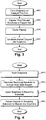
- Fig. 3 is a flowchart illustrating a first technique for doping graphene.
- the Fig. 3 technique essentially involves ion beam implanting the doping material in the graphene.
- graphene is grown on a metal catalyst (step S301), e.g., as described above.
- the catalyst with the graphene formed thereon is exposed to a gas comprising a material to be used as the dopant (also sometimes referred to as a dopant gas) (step S303).
- a plasma is then excited within a chamber containing the catalyst with the graphene formed thereon and the dopant gas (S305).
- An ion beam is then used to implant the dopant into the graphene (S307).
- Example ion beam techniques suitable for this sort of doping are disclosed in, for example, U.S. Patent Nos. 6,602,371 ; 6,808,606 ; and Re. 38,358 , and U.S. Publication No. 2008/0199702 .
- the ion beam power may be about 10-200 ev, more preferably 20-50 ev, still more preferably 20-40 ev.
- Fig. 4 is a flowchart illustrating a second example technique for doping graphene.
- the Fig. 4 technique essentially involves pre-implanting solid state dopants in the target receiving substrate, and then causing those solid state dopants to migrate into the graphene when the graphene is applied to the receiving substrate.
- graphene is grown on a metal catalyst (step S401), e.g., as described above.
- the receiving substrate is pre-fabricated so as to include solid-state dopants therein (step S403).
- the solid-state dopants may be included via the melting in the formulation in the glass.
- dopant may be included in the glass melt.
- the graphene is applied to the receiving substrate, e.g., using one of the example techniques described in detail below (step S405). Then, the solid-state dopants in the receiving substrate are caused to migrate into the graphene. The heat used in the deposition of the graphene will cause the dopants to migrate towards the graphene layer being formed.
- An ion beam also can be used to implant the dopants directly in the glass.
- the ion beam power may be about 10-1000 ev, more preferably 20-500 ev, still more preferably 20-100 ev.
- the ion beam may operate at about 10-200 ev, more preferably 20-50 ev, still more preferably 20-40 ev.
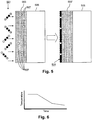
- Fig. 5 is an example schematic view illustrating a third technique for doping graphene in accordance with certain example embodiments.
- the Fig. 5 example techniques essentially involves pre-implanting solid state dopants 507 in the metal catalyst layer 503, and then causing those solid state dopants 507 to migrate through the catalyst layer 503 as the graphene is being formed, thereby creating a doped graphene 509 on the surface of the catalyst layer 503. More particularly, in this example technique, the catalyst layer 503 is disposed on the back support 505.
- the catalyst layer 503 includes solid-state dopants 507 therein.
- the catalyst has solid-state dopant atoms inside its bulk (e.g., from about 1-10%, more preferably about 1-5%, and most preferably about 1-3%).
- Hydrocarbon gas 501 is introduced proximate to the catalyst layer 503 formed, at a high temperature.
- the solid-state dopants 507 in the catalyst layer 503 are caused to migrate towards the outer surface thereof, e.g., by this high temperature, as the graphene crystallization takes place.
- the rate at which the dopants arrive at the surface has been found to be a function of the catalyst thickness and temperature.
- the crystallization is stopped via quenching and, ultimately, a doped graphene 509 is formed on the surface of the catalyst layer 503'.
- the catalyst layer 503' now has fewer (or no) solid-state dopants 507 located therein.
- One advantage of this example technique relates to the potential to control the ultrathin film growth by judiciously varying the metal surface temperature, partial pressure, and residence time of the deposition gas species, as well as the reactive radicals used in quenching rate process.
- example doping techniques may be used alone and/or in various combinations and sub-combinations with one another and/or further techniques. It also will be appreciated that certain example embodiments may include a single dopant material or multiple dopant materials, e.g., by using a particular example technique once, a particular technique repeatedly, or through a combination of multiple techniques one or more times each. For example, p-type and n-type dopants are possible in certain example embodiments.
- Fig. 6 is a graph plotting temperature vs. time involved in the doping of graphene in accordance with certain example embodiments.
- the cooling may be accomplished using, for example, an inert gas.
- the high temperature may be about 900 degrees C in certain example embodiments, and the low temperature may be about 700 degrees C, and the cooling may take place over several minutes.
- the same heating/cooling profile as that shown in Fig. 6 may be used regardless of whether the graphene is doped.
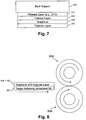
- Fig. 7 is an example layer stack useful in the graphene release or debonding techniques of certain example embodiments.
- an optional release layer 701 may be provided between the back support 505 and the catalyst layer 503. This release layer 701 may be of or include, for example, zinc oxide (e.g., ZnO or other suitable stoichiometry).
- the graphene 509/metal catalyst layer 503/release layer 701 stack coated substrate 505 may receive a thick overcoat (e.g., several microns thick) layer of polymer 703, e.g., applied via spin coating, dispensed by a meniscus flow, etc., which may be cured.
- this polymer layer 703 may act as a backbone or support for the graphene 509 during lift-off and/or debonding, keeping the extremely flexible graphene film continuous, while also reducing the likelihood of the graphene film curling up, creasing, or otherwise deforming.
- PMMA may be used as the polymer that allows the graphene to become visible by phase contrast and for support prior to and/or during lift-off.
- a broad range of polymers whose mechanical and chemical properties can be matched to those of graphene may be used during the support phase, as well as the release transfer phase in connection with certain example embodiments.
- the work for lift-off may be performed in parallel with the main epitaxial growth branch, e.g., by experimenting with graphene films that can be chemically exfoliated from graphite.
- the release layer may be chemically induced to de-bond the graphene/metal from mother substrate once the polymer layer disposed thereon.
- a zinc oxide release layer washing in vinegar may trigger the release of the graphene.
- the use of a zinc oxide release layer also is advantageous, inasmuch as the inventor of the instant invention has discovered that the metal catalyst layer also is removed from the graphene with the release layer. It is believed that this is a result of the texturing caused by the zinc oxide release layer together with its inter-linkages formed with the grains in the catalyst layer. It will be appreciated that this reduces (and sometimes even eliminates) the need to later remove the catalyst layer.
- Certain lift-off/debonding and transfer techniques essentially regard the original substrate as a reusable epitaxial growth substrate.
- a selective etching to undercut and dissolve away the metallic catalyst thin film away from the epitaxially grown (with polymer on top) graphene may be desirable in such example embodiments.
- the catalyst layer may be etched off, regardless of whether a release layer is used, in certain example embodiments.
- Suitable etchants include, for example, acids such as hydrochloric acid, phosphoric acid, etc.
- the final recipient glass substrate surface may be prepared so as to receive the graphene layer.
- a Langmuir Blodgett film e.g., from a Langmuir-Blodgett acid
- the final recipient substrate alternatively or additionally may be coated with a smooth graphenophillic layer such as, for example, a silicone-based polymer, etc., making the latter receptive to the graphene. This may help to ensure electrostatic bonding, thus preferentially allowing the transfer of the graphene during transfer.
- the target substrate may additionally or alternatively be exposed to UV radiation, e.g., to increase the surface energy of the target substrate and thus make it more receptive to the graphene.
- the graphene may be applied to the substrate via blanket stamping and/or rolling in certain example embodiments. Such processes allow the graphene previously grown and chemisorbed onto the metal carrier to be transferred onto the recipient glass by contact pressure.
- the graphene may be applied to the substrate via one or more lamination rollers, e.g., as shown in Fig. 8 .
- Fig. 8 shows upper and lower rollers 803a and 803b, which will apply pressure and cause the graphene 509 and polymer layer 703 to be laminated to the target substrate 801.
- the target substrate 801 have a silicon-inclusive or other graphenophillic layer disposed thereon to facilitate the lamination.
- the polymer layer 703 will be applied as the outermost layer and that the graphene 509 will be closer to (or even directly on) the target substrate 801.
- one or more layers may be provided on the substrate prior to the application of the graphene.
- the polymer layer may be removed.
- the polymer may be dissolved using an appropriate solvent.
- a photosensitive material such as PMMA
- it may be removed via UV light exposure. Of course, other removal techniques also are possible.
- the catalyst thin film may be etched off after the graphene has been applied to the target substrate in certain example embodiments, e.g., using one of the example etchants described above.
- the choice of etchant also may be based on the presence or absence of any layers underlying the graphene.
- Certain example embodiments more directly electrochemically anodize the metal catalyst thin film below the graphene.
- the graphene itself may act as the cathode, as the metal below is anodized into a transparent oxide while still being bonded to the original substrate.
- Such example embodiments may be used to bypass the use of the polymer overcoat by essentially performing the lift-off and transfer processes in one step.
- anodization by electrochemical means may affect the electronic properties of the graphene and thus may need to be compensated for.
- the catalyst layer below the graphene may be oxidized in other ways to make it transparent. For example, a conductive oxide may be used to "link" the graphene-based layer to a substrate, semiconductor, or other layer.
- cobalt, chrome cobalt, nickel chrome cobalt, and/or the like may be oxidized. In certain example embodiments, this may also reduce the need for graphene lift-off; making the transfer, manipulation, and other handling of graphene easier.
- the graphene also may be picked up using an adhesive or tape-like material in certain example embodiments.
- the adhesive may be positioned on the target substrate.
- the graphene may be transferred to the target substrate, e.g., following the application of pressure, by more strongly adhering to the substrate than to the tape, etc.
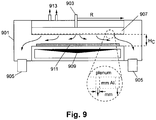
- FIG. 9 is a cross-sectional schematic view of a reactor suitable for depositing high electronic grade (HEG) graphene in accordance with an example embodiment.
- the reactor includes a body portion 901 with several inlets and outlets.
- a gas inlet 903 is provided at the top and in the approximate horizontal center of the body portion 901 of the reactor.
- the gas inlet 903 may receive gas from one or more sources and thus may provide various gasses including, for example, the hydrocarbon gas, the gas(ses) used to form the environment during hetero-epitaxial growth, the quenching gas(ses), etc.
- the flow and flux of the gas will be described in greater detail below, e.g., with reference to the plenum design of the showerhead 907.
- a plurality of exhaust ports 905 may be provided at the bottom of the body portion 901 of the reactor. In the Fig.
- two exhaust ports 905 are provided proximate to the extremes of the body portion 901 of the reactor, e.g., so as to draw out gas provided by the gas inlet 903 that generally will flow through substantially the entirety of the body portion 901. It will be appreciated that more or fewer exhaust ports 905 may be provided in certain example embodiments (e.g., further exhaust ports 905 may be provided in the approximate horizontal center of the body portion 901 of the reactor, at the top or sides of the body portion 901 of the reactor, etc.).
- the back support substrate 909 may be cleaned and have the catalyst thin film disposed thereon (e.g., by physical vapor deposition or PVD, sputtering, CVD, flame pyrolysis, or the like) prior to entry into the reactor by a load-lock mechanism in certain example embodiments.
- the catalyst thin film disposed thereon (e.g., by physical vapor deposition or PVD, sputtering, CVD, flame pyrolysis, or the like) prior to entry into the reactor by a load-lock mechanism in certain example embodiments.
- the surface of the back support substrate 909 may be rapidly heated (e.g., using an RTA heater, a shortwave IR heater, or other suitable heater that is capable of inductively heating the substrate and/or layers thereon without necessarily also heating the entire chamber) to a controllable temperature level and uniformity that allows (i) the metal film to crystallize and activate, and (ii) the preferential deposition of graphene of substantially uniform and controllable thickness from a gas phase precursor on its surface.
- the heater may be controllable so as to account for the parameter deposition rate/(temperature * thickness) of catalyst ratio.
- the back support substrate 909 may move through the reactor in the direction R or may sit stationary under the showerhead 907.
- the showerhead 907 may be cooled, e.g., using a cooling fluid or gas introduced by one or more coolant inlets/outlets 913.
- the plenum design may include a plurality of apertures in the bottom of the showerhead 907, with each such aperture being only a few millimeters wide.
- Changing the ceiling gap Hc, or the height between the bottom surface of the showerhead 907 and the top surface upon which the back support substrate 909 moves, may have several effects.
- the chamber volume and thus the surface-to-volume ratio may be modified, thereby affecting the gas residence time, consumption time, and radial velocities. Changes in the residence time have been found to strongly influence the extent of gas phase reactions.
- the ceiling gap Hc may be varied through simple hardware changes, by providing adjustable mounting of the substrate electrode, etc., so as to affect the hetero-epitaxial growth of the graphene.
- the Fig. 9 example embodiment is not necessarily intended to operate a plasma within the reactor. This is because the crystalline film growth mechanism is by hetero-epitaxy by surface sorption (generally occurring only on the catalyst). Growth from the plasma phase has been found to give rise to mostly amorphous films and also has been found to allow the formation of macro-particle or dust formation that can greatly reduce film quality and result in pinholes that would be detrimental for a one-to-ten atomic layer film.
- certain example embodiments may involve making graphite (e.g., monocrystalline graphite), etching it to graphane (e.g., of a certain n-value), and turning the graphane into graphene (e.g., into HEG graphene).
- an in-situ end-point technique may be implemented as a feedback parameter.
- an ion beam source may be located in-line but external to the reactor of Fig. 9 , e.g., to perform doping in accordance with the example techniques described above. However, in certain example embodiments, an ion beam source may be located within the body portion of a reactor.
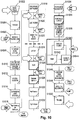
- Fig. 10 is an example process flow that illustrates certain of the example catalytic CVD growth, lift-off, and transfer techniques of certain example embodiments.
- the example process shown in Fig. 10 begins as the back support glass is inspected, e.g., using a conventional glass inspection method (step S1002) and washed (step S1004).
- the back support glass may then be cleaned using ion beam cleaning, plasma ashing, or the like (step S1006).
- the catalyst e.g., a metal catalyst
- step S1006 is disposed on the back support, e.g., using PVD (step S1008). It is noted that the cleaning process of step S1006 may be accomplished within the graphene coater/reactor in certain example embodiments of this invention.
- the back support glass with or without the metal catalyst thin film formed thereon may be loaded into the graphene coater/reactor prior to step S1006 in certain example embodiments, e.g., depending on whether the metal catalyst layer is deposited within or prior to the coater/reactor.
- the catalytic deposition of an n-layer graphene may then take place (step S1010).
- the graphene may be etched down by introducing hydrogen atoms (H*) in certain example embodiments, and the graphene optionally may be doped, e.g., depending on the target application (step S1012).
- the end of the graphene formation is detected, e.g., by determining whether enough graphene has been deposited and/or whether the H* etching has been sufficient (step S1014).
- a rapid quenching process is used, and the back support glass with the graphene formed therein exits the reactor/coater (step S1016). Visual inspection optionally may be performed at this point.
- a polymer useful in the transference of the graphene may be disposed on the graphene, e.g., by spin, blade, or other coating technique (step S1018).
- This product optionally may be inspected, e.g., to determine whether the requisite color change takes place. If it has, the polymer may be cured (e.g., using heat, UV radiation, etc.) (step S1020), and then inspected again.
- the metal catalyst may be under-etched or otherwise released (step S1022), e.g., to prepare the graphene for lift-off (step S1024).
- the polymer and the graphene optionally may be inspected and then washed, e.g., to remove any remaining under-etchants and/or non-cured polymer (step S1026). Another optional inspection process may be performed at this point.
- a surfactant may be applied (step S1028), pins are placed at least into the polymer (step S1030), and the membrane is flipped (step S1032), e.g., with the aid of these pins.
- the lift-off process is now complete, and the graphene is now ready to be transferred to the recipient substrate.
- the recipient substrate is prepared (step S1034), e.g., in a clean room.
- the surface of the recipient substrate may be functionalized, e.g., by exposing it to a UV light to increase its surface energy, to apply graphenophillic coatings thereto, etc. (step S1036).
- the graphene / polymer membrane may then be transferred onto the host substrate (step S1038).
- the receiving substrate with the graphene and polymer attached thereto may be fed into a module to remove the polymer (step S1040). This may be done by exposing the polymer to UV light, heat, chemicals, etc. The substrate with the graphene and at least partially dissolved polymer may then be washed (step S1042), with any excess water or other materials evaporated and dried off (step S 1044). This polymer removal process may be repeated, as necessary.
- the sheet resistance of the graphene on the substrate may be measured (step S1046), e.g., using a standard four-point probe.
- Optical transmission (e.g., Tvis, etc.) also may be measured (step S1048). Assuming that the intermediate or final products meet quality standards, they may be packaged (step S1050).
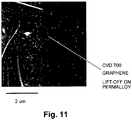
- Fig. 11 is an image of a sample graphene produced according to certain example embodiments.
- the Fig. 11 image highlights the lift-off of the hetero-epitaxially grown graphene from a permalloy thin film.
- graphene-based layers may be used in a wide variety of applications and/or electronic devices.
- ITO and/or other conductive layers simply may be replaced by graphene-based layers.
- Making devices with graphene will typically involve making contacts with metals, degenerate semiconductors like ITO, solar cell semiconductors such as a-Si and CdTe among others, and/or the like.
- the graphene-based layer may be doped in accordance with any semiconductor layers adjacent thereto. That is, in certain example embodiments, if a graphene-based layer is adjacent to an n-type semiconductor layer, the graphene-based layer may be doped with an n-type dopant.
- a graphene-based layer if a graphene-based layer is adjacent to a p-type semiconductor layer, the graphene-based layer may be doped with a p-type dopant.
- DFT density functional theory
- a first example electronic device that may make use of one or more graphene-based layers is a solar photovoltaic device.
- Such example devices may include front electrodes or back electrodes.
- the graphene-based layers may simply replace the ITO typically used therein.
- Photovoltaic devices are disclosed in, for example, U.S. Patent Nos. 6,784,361 , 6,288,325 , 6,613,603 and 6,123,824 ; U.S. Publication Nos. 2008/0169021 ; 2009/0032098 ; 2008/0308147 ; 2009/0020157 2009/0194157 , 2010/0089444 , and 2010/0304523 .
- Fig. 12 is a cross-sectional schematic view of a solar photovoltaic device incorporating graphene-based layers according to certain example embodiments.
- a glass substrate 1202 is provided.
- the glass substrate 1202 may be of any of the glasses described in any of U.S. Patent Application Nos. 2006/0169316 and/or 2006/0249199 .
- the glass substrate optionally may be nano-textured, e.g., to increase the efficiency of the solar cell.
- An anti-reflective (AR) coating 1204 may be provided on an exterior surface of the glass substrate 1202, e.g., to increase transmission.
- the anti-reflective coating 1204 may be a single-layer anti-reflective (SLAR) coating (e.g., a silicon oxide anti-reflective coating) or a multi-layer anti-reflective (MLAR) coating.
- SLAR single-layer anti-reflective
- MLAR multi-layer anti-reflective
- One or more absorbing layers 1206 may be provided on the glass substrate 1202 opposite the AR coating 1204, e.g., in the case of a back electrode device such as that shown in the Fig. 12 example embodiment.
- the absorbing layers 1206 may be sandwiched between first and second semi-conductors.
- absorbing layers 1206 are sandwiched between n-type semiconductor layer 1208 (closer to the glass substrate 1202) and p-type semiconductor 1210 (farther from the glass substrate 1202).
- a back contact 1212 e.g., of aluminum or other suitable material also may be provided.
- first and second graphene-based layers 1214 and 1216 may be provided.
- the graphene-based layers 1214 and 1216 may be doped so as to match the adjacent semiconductor layers 1208 and 1210, respectively.
- graphene-based layer 1214 may be doped with n-type dopants and graphene-based layer 1216 may be doped with p-type dopants.
- an optional layer 1218 may be provided between the glass substrate 1202 and the first graphene-based layer 1214.
- graphene is very flexible, it generally will conform to the surface on which it is placed. Accordingly, it is possible to texture the optional layer 1218 so that the texture of that layer may be "transferred” or otherwise reflected in the generally conformal graphene-based layer 1214.
- the optional textured layer 1218 may comprise zinc-doped tin oxide (ZTO). It is noted that one or both of semiconductors 1208 and 1210 may be replaced with polymeric conductive materials in certain example embodiments.
- graphene is essentially transparent in the near and mid-IR ranges implies that the most penetrating long wavelength radiation may penetrate and generate carriers deep into the i-layer of both single and tandem junction solar cells. This implies that the need to texture back contacts may not be needed with graphene-based layers, as the efficiency will already be increased by as much as several percentage points.
- Certain example embodiments may involve single-junction solar cells, whereas certain example embodiments may involve tandem solar cells.
- Certain example embodiments may be CdS, CdTe, CIS/ CIGS, a-Si, and/or other types of solar cells.
- the touch panel display may be a capacitive or resistive touch panel display including ITO or other conductive layers. See, for example, U.S. Patent Nos. 7,436,393 ; 7,372,510 ; 7,215,331 ; 6,204,897 ; 6,177,918 ; and 5,650,597 , and Application No. 2010/0122900 .
- the ITO and/or other conductive layers may be replaced in such touch panels may be replaced with graphene-based layers.
- Fig. 13 is a cross-sectional schematic view of a touch screen incorporating graphene-based layers according to certain example embodiments. Fig.
- FIG. 13 includes an underlying display 1302, which may, in certain example embodiments, be an LCD, plasma, or other flat panel display.
- An optically clear adhesive 1304 couples the display 1302 to a thin glass sheet 1306.
- a deformable PET foil 1308 is provided as the top-most layer in the Fig. 13 example embodiment.
- the PET foil 1308 is spaced apart from the upper surface of the thin glass substrate 1306 by virtual of a plurality of pillar spacers 1310 and edge seals 1312.
- First and second graphene-based layers 1314 and 1316 may be provided on the surface of the PET foil 1308 closer to the display 1302 and to the thin glass substrate 1306 on the surface facing the PET foil 1308, respectively.
- One or both graphene-based layers 1314 and 1316 may be patterned, e.g., by ion beam and/or laser etching. It is noted that the graphene-based layer on the PET foil may be transferred from its growth location to the intermediate product using the PET foil itself. In other words, the PET foil may be used instead of a photoresist or other material when lifting off the graphene and/or moving it.
- a sheet resistance of less than about 500 ohms/square for the graphene-based layers is acceptable in embodiments similar to those shown in Fig. 13 , and a sheet resistance of less than about 300 ohms/square is advantageous for the graphene-based layers.
- the ITO typically found in display 1302 may be replaced with one or more graphene-based layers.
- graphene-based layers may be provided as a common electrode on the color filter substrate and/or as patterned electrodes on the so-called TFT substrate.
- graphene-based layers, doped or undoped also may be used in connection with the design and fabrication of the individual TFTs. Similar arrangements also may be provided in connection with plasma and/or other plat panel displays.
- Graphene-based layers also may be used to create conductive data/bus lines, bus bars, antennas, and/or the like. Such structures may be formed on/applied to glass substrates, silicon wafers, etc.
- Fig. 14 is a flowchart illustrating an example technique for forming a conductive data/bus line in accordance with certain example embodiments.
- step S1401 a graphene-based layer is formed on an appropriate substrate.
- a protective layer may be provided over the graphene-based layer.
- the graphene-based layer is selectively removed or patterned. This removal or patterning may be accomplished by laser etching.
- etching may be performed via exposure to an ion beam/plasma treatment.
- H* may be used, e.g., in connection with a hot filament.
- a protective layer may be desirable.
- a photoresist material may be used to protect the graphene areas of interest.
- Such a photoresist may be applied, e.g., by spin coating or the like in step S1403.
- S1407 the optional protective layer is removed. Exposure to UV radiation may be used with appropriate photoresists, for example.
- the conductive graphene-based pattern may be transferred to an intermediate or final product if it was not already formed thereon, e.g., using any appropriate technique (such as, for example, those described above).
- certain example embodiments have been described as etching away or removing graphene-based layers, certain example embodiments may simply change the conductivity of the graphene-based layer. In such cases, some or all of the graphene may not be removed. However, because the conductivity has been suitably altered, only the appropriately patterned areas may be conductive.
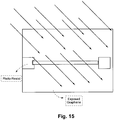
- Fig. 15 is a schematic view of a technique for forming a conductive data/bus line in accordance with certain example embodiments.
- the conductivity of the graphene is selectively changed by virtue of exposure to an ion beam.
- a photoresist is applied in a suitable pattern, e.g., so as to protect desired portions of the graphene-based layer, whereas the other portions of the graphene-based layer remain exposed to the ion beam/plasma.
- Mobility data is shown in the table below after various samples have been deposited and etched. Etched Sampled Passes Thickness ( ⁇ ) Rho ( ⁇ cm) Conductivty (1/ ⁇ cm) Mobility ⁇ (cm ⁇ 2/ Vs) A 25 8 1.03E-04 970000 120,000 B 20 6 5.24E-03 1010000 143000 C 10 6 5.94E-02 1600000 150000 D 5 6 1.48E-02 1500000 160000
- the layer will be largely transparent.
- bus bars that may be incorporated into vehicle windows (e.g., for defrosting, antenna usage, powering components, etc.), flat panel (e.g., LCD, plasma, and/or other) display devices, skylights, refrigerator/freezer doors/windows, etc. This may also advantageously reduce the need for black frits often found in such products.
- graphene-based layers may be used in place of ITO in electrochromic devices.
- a first layer may be said to be “on” or “supported by” a second layer, even if there are one or more layers therebetween.
Landscapes
- Chemical & Material Sciences (AREA)
- Engineering & Computer Science (AREA)
- Organic Chemistry (AREA)
- Materials Engineering (AREA)
- Crystallography & Structural Chemistry (AREA)
- Metallurgy (AREA)
- Nanotechnology (AREA)
- Physics & Mathematics (AREA)
- Condensed Matter Physics & Semiconductors (AREA)
- General Physics & Mathematics (AREA)
- Electromagnetism (AREA)
- Inorganic Chemistry (AREA)
- Manufacturing & Machinery (AREA)
- Composite Materials (AREA)
- Carbon And Carbon Compounds (AREA)
- Photovoltaic Devices (AREA)
- Catalysts (AREA)
Priority Applications (1)
| Application Number | Priority Date | Filing Date | Title |
|---|---|---|---|
| PL13151839T PL2584075T3 (pl) | 2009-08-07 | 2010-07-22 | Osadzanie dużopowierzchniowe i domieszkowanie grafenu oraz produkty go zawierające |
Applications Claiming Priority (2)
| Application Number | Priority Date | Filing Date | Title |
|---|---|---|---|
| US12/461,343 US8507797B2 (en) | 2009-08-07 | 2009-08-07 | Large area deposition and doping of graphene, and products including the same |
| EP10739729.1A EP2462264B1 (en) | 2009-08-07 | 2010-07-22 | Large area deposition and doping of graphene |
Related Parent Applications (3)
| Application Number | Title | Priority Date | Filing Date |
|---|---|---|---|
| EP10739729.1A Division-Into EP2462264B1 (en) | 2009-08-07 | 2010-07-22 | Large area deposition and doping of graphene |
| EP10739729.1A Division EP2462264B1 (en) | 2009-08-07 | 2010-07-22 | Large area deposition and doping of graphene |
| EP10739729.1 Division | 2010-07-22 |
Publications (3)
| Publication Number | Publication Date |
|---|---|
| EP2584075A2 EP2584075A2 (en) | 2013-04-24 |
| EP2584075A3 EP2584075A3 (en) | 2013-07-10 |
| EP2584075B1 true EP2584075B1 (en) | 2018-04-04 |
Family
ID=42829044
Family Applications (4)
| Application Number | Title | Priority Date | Filing Date |
|---|---|---|---|
| EP13151839.1A Not-in-force EP2584075B1 (en) | 2009-08-07 | 2010-07-22 | Large area deposition and doping of graphene, and products including the same |
| EP10739729.1A Not-in-force EP2462264B1 (en) | 2009-08-07 | 2010-07-22 | Large area deposition and doping of graphene |
| EP13151838.3A Not-in-force EP2584074B1 (en) | 2009-08-07 | 2010-07-22 | Large area deposition and doping of graphene, and products including the same |
| EP13151835.9A Active EP2584073B1 (en) | 2009-08-07 | 2010-07-22 | Method of doping a large area graphene thin film grown by heteroepitaxy |
Family Applications After (3)
| Application Number | Title | Priority Date | Filing Date |
|---|---|---|---|
| EP10739729.1A Not-in-force EP2462264B1 (en) | 2009-08-07 | 2010-07-22 | Large area deposition and doping of graphene |
| EP13151838.3A Not-in-force EP2584074B1 (en) | 2009-08-07 | 2010-07-22 | Large area deposition and doping of graphene, and products including the same |
| EP13151835.9A Active EP2584073B1 (en) | 2009-08-07 | 2010-07-22 | Method of doping a large area graphene thin film grown by heteroepitaxy |
Country Status (12)
| Country | Link |
|---|---|
| US (2) | US8507797B2 (enExample) |
| EP (4) | EP2584075B1 (enExample) |
| JP (1) | JP5667188B2 (enExample) |
| KR (1) | KR101698228B1 (enExample) |
| CN (1) | CN102597336B (enExample) |
| BR (1) | BR112012002814A2 (enExample) |
| IN (1) | IN2012DN00996A (enExample) |
| MX (1) | MX2012001605A (enExample) |
| PL (3) | PL2584074T3 (enExample) |
| RU (1) | RU2567949C2 (enExample) |
| TW (1) | TW201111278A (enExample) |
| WO (1) | WO2011016837A1 (enExample) |
Families Citing this family (113)
| Publication number | Priority date | Publication date | Assignee | Title |
|---|---|---|---|---|
| US8507797B2 (en) | 2009-08-07 | 2013-08-13 | Guardian Industries Corp. | Large area deposition and doping of graphene, and products including the same |
| US8269931B2 (en) * | 2009-09-14 | 2012-09-18 | The Aerospace Corporation | Systems and methods for preparing films using sequential ion implantation, and films formed using same |
| KR101652787B1 (ko) * | 2009-11-12 | 2016-09-01 | 삼성전자주식회사 | 대면적 그라핀의 제조방법 및 전사방법 |
| US9306099B2 (en) * | 2009-12-01 | 2016-04-05 | Samsung Electronics Co., Ltd. | Material including graphene and an inorganic material and method of manufacturing the material |
| US8354323B2 (en) | 2010-02-02 | 2013-01-15 | Searete Llc | Doped graphene electronic materials |
| US8563965B2 (en) | 2010-02-02 | 2013-10-22 | The Invention Science Fund I, Llc | Doped graphene electronic materials |
| US8426842B2 (en) * | 2010-02-02 | 2013-04-23 | The Invention Science Fund I, Llc | Doped graphene electronic materials |
| US11071241B2 (en) * | 2010-03-05 | 2021-07-20 | Graphene Square Inc. | Electromagnetic shielding method using graphene and electromagnetic shielding material |
| US8890277B2 (en) * | 2010-03-15 | 2014-11-18 | University Of Florida Research Foundation Inc. | Graphite and/or graphene semiconductor devices |
| GB201004554D0 (en) * | 2010-03-18 | 2010-05-05 | Isis Innovation | Superconducting materials |
| JP5664119B2 (ja) * | 2010-10-25 | 2015-02-04 | ソニー株式会社 | 透明導電膜、透明導電膜の製造方法、光電変換装置および電子機器 |
| GB201021112D0 (en) | 2010-12-13 | 2011-01-26 | Ntnu Technology Transfer As | Nanowires |
| WO2012088334A1 (en) | 2010-12-21 | 2012-06-28 | Kenneth Shepard | Electrical devices with graphene on boron nitride |
| KR101469450B1 (ko) * | 2011-03-02 | 2014-12-05 | 그래핀스퀘어 주식회사 | 그래핀의 n-도핑 방법 |
| US8739728B2 (en) * | 2011-04-07 | 2014-06-03 | Dynamic Micro Systems, Semiconductor Equipment Gmbh | Methods and apparatuses for roll-on coating |
| CN102191476B (zh) * | 2011-04-11 | 2014-12-10 | 兰州大学 | 硫掺杂石墨烯薄膜的制备方法 |
| US8388924B2 (en) | 2011-04-21 | 2013-03-05 | The Aerospace Corporation | Method for growth of high quality graphene films |
| WO2012148439A1 (en) * | 2011-04-25 | 2012-11-01 | William Marsh Rice University | Direct growth of graphene films on non-catalyst surfaces |
| CN102760686B (zh) * | 2011-04-27 | 2014-12-03 | 中芯国际集成电路制造(上海)有限公司 | 半导体器件、形成互连结构的方法 |
| KR101878733B1 (ko) * | 2011-05-04 | 2018-07-16 | 삼성전자주식회사 | 그래핀 직성장 방법 |
| DE102011077784A1 (de) | 2011-06-20 | 2012-12-20 | Carl Zeiss Smt Gmbh | Projektionsanordnung |
| CN102887498B (zh) * | 2011-07-21 | 2014-10-15 | 海洋王照明科技股份有限公司 | 掺氮石墨烯的制备方法 |
| JP2014527950A (ja) | 2011-09-09 | 2014-10-23 | ボード オブ トラスティーズ オブノーザン イリノイ ユニバーシティー | 結晶性グラフェンおよび結晶性グラフェンの製造方法 |
| US8872159B2 (en) * | 2011-09-29 | 2014-10-28 | The United States Of America, As Represented By The Secretary Of The Navy | Graphene on semiconductor detector |
| JP5856423B2 (ja) | 2011-09-30 | 2016-02-09 | 株式会社東芝 | 導電材料およびこれを用いた電気素子 |
| KR101851570B1 (ko) * | 2011-12-01 | 2018-04-25 | 삼성전자주식회사 | 그래핀과 폴리머의 복합체 및 그 제조방법 |
| CN103974900B (zh) * | 2011-12-12 | 2017-03-08 | 松下电器产业株式会社 | 碳系材料、电极催化剂、氧还原电极催化剂、气体扩散电极、水溶液电解装置和制备碳系材料的方法 |
| KR102002600B1 (ko) * | 2011-12-28 | 2019-07-23 | 재단법인 포항산업과학연구원 | 치환 보론 그래핀 제조방법 |
| GB201200355D0 (en) * | 2012-01-10 | 2012-02-22 | Norwegian Univ Sci & Tech Ntnu | Nanowires |
| ITMI20120191A1 (it) * | 2012-02-10 | 2013-08-11 | St Microelectronics Srl | Metodo per trasferire uno strato di grafene |
| JP5971840B2 (ja) * | 2012-02-20 | 2016-08-17 | 株式会社Ihi | 窒素導入方法 |
| JP5839571B2 (ja) * | 2012-02-27 | 2016-01-06 | 積水ナノコートテクノロジー株式会社 | 窒素原子がドープされたグラフェンフィルムを製造する方法 |
| CN102602916A (zh) * | 2012-03-16 | 2012-07-25 | 南京先丰纳米材料科技有限公司 | 一种大面积石墨烯薄膜的异地应用方法 |
| GB201211038D0 (en) | 2012-06-21 | 2012-08-01 | Norwegian Univ Sci & Tech Ntnu | Solar cells |
| EP2719270A1 (de) * | 2012-10-11 | 2014-04-16 | BYK-Chemie GmbH | Beschichtungszusammensetzung und deren Verwendung |
| TWI511356B (zh) * | 2012-11-21 | 2015-12-01 | Ind Tech Res Inst | 石墨烯電極、包含其之能量儲存裝置、及其製造方法 |
| CN104812697B (zh) * | 2012-11-29 | 2018-11-06 | 北京信纳国际新材料科技有限公司 | 一种氮硫共掺石墨烯量子点的制备方法 |
| KR101850112B1 (ko) * | 2012-12-26 | 2018-04-19 | 한화테크윈 주식회사 | 그래핀, 그래핀 제조용 조성물 및 이를 이용한 그래핀의 제조 방법 |
| US10315275B2 (en) * | 2013-01-24 | 2019-06-11 | Wisconsin Alumni Research Foundation | Reducing surface asperities |
| KR20140099103A (ko) * | 2013-02-01 | 2014-08-11 | 삼성전자주식회사 | 포토마스크 및 이를 이용한 반도체 소자의 제조 방법 |
| CN103112849B (zh) * | 2013-03-13 | 2014-10-22 | 上海第二工业大学 | 一种含硫键的石墨烯多孔纳米材料及其制备方法 |
| US9324579B2 (en) | 2013-03-14 | 2016-04-26 | The Aerospace Corporation | Metal structures and methods of using same for transporting or gettering materials disposed within semiconductor substrates |
| CN104047060B (zh) * | 2013-03-14 | 2016-12-28 | 中国科学院上海微系统与信息技术研究所 | 一种对石墨烯进行硫掺杂的方法 |
| US8664642B1 (en) * | 2013-03-15 | 2014-03-04 | Solan, LLC | Nonplanar graphite-based devices having multiple bandgaps |
| US10431354B2 (en) | 2013-03-15 | 2019-10-01 | Guardian Glass, LLC | Methods for direct production of graphene on dielectric substrates, and associated articles/devices |
| US9593019B2 (en) | 2013-03-15 | 2017-03-14 | Guardian Industries Corp. | Methods for low-temperature graphene precipitation onto glass, and associated articles/devices |
| CN104078742B (zh) * | 2013-03-27 | 2017-09-12 | 上海德门电子科技有限公司 | 一种透明介质天线 |
| KR102107538B1 (ko) | 2013-05-07 | 2020-05-07 | 삼성전자주식회사 | 그래핀 전사 방법, 이를 이용한 소자의 제조방법 및 그래핀을 포함하는 기판 구조체 |
| KR101486428B1 (ko) * | 2013-05-28 | 2015-01-27 | 중앙대학교 산학협력단 | 그래핀, 이의 표면 처리방법 및 이를 포함하는 전자 소자 |
| GB201311101D0 (en) | 2013-06-21 | 2013-08-07 | Norwegian Univ Sci & Tech Ntnu | Semiconducting Films |
| CN103365004B (zh) * | 2013-07-26 | 2016-04-13 | 深圳市华星光电技术有限公司 | 透明导电层、具有该透明导电层的cf基板及其制备方法 |
| US9758381B2 (en) * | 2013-08-05 | 2017-09-12 | National University Of Singapore | Method to transfer two dimensional film grown on metal-coated wafer to the wafer itself in a face-to face manner |
| WO2015021479A1 (en) * | 2013-08-09 | 2015-02-12 | The Trustees Of Columbia University In The City Of New York | Systems and methods for assembling two-dimensional materials |
| US9452934B2 (en) | 2013-09-12 | 2016-09-27 | The Hong Kong University Of Science And Technology | Synthesis of ultra-large graphene oxide sheets |
| US9574063B2 (en) | 2013-09-17 | 2017-02-21 | Lockheed Martin Corporation | Method of making a large area graphene composite material |
| CN103710759B (zh) * | 2013-12-17 | 2016-03-02 | 华中科技大学 | 一种石墨烯图形化掺杂方法 |
| KR101842033B1 (ko) * | 2014-01-06 | 2018-03-26 | 한화테크윈 주식회사 | 그래핀 제조용 조성물 및 이를 이용한 그래핀의 제조 방법 |
| KR102256017B1 (ko) * | 2014-01-28 | 2021-05-24 | 삼성전자주식회사 | 2차원 반도체의 도핑방법 및 스위칭 소자 |
| WO2015126139A1 (en) | 2014-02-19 | 2015-08-27 | Samsung Electronics Co., Ltd. | Wiring structure and electronic device employing the same |
| WO2015176220A1 (zh) * | 2014-05-20 | 2015-11-26 | 中国科学院上海微系统与信息技术研究所 | 一种对石墨烯进行硫掺杂的方法 |
| WO2015191520A1 (en) * | 2014-06-09 | 2015-12-17 | Natcore Technology, Inc. | Emitter diffusion conditions for black silicon |
| GB201410214D0 (en) * | 2014-06-09 | 2014-07-23 | Univ Surrey | A method for graphene and carbon nanotube growth |
| CN104029431B (zh) * | 2014-06-23 | 2018-06-19 | 南开大学 | 扭曲角度可控的多层石墨烯结构制备方法 |
| US9337149B2 (en) | 2014-07-29 | 2016-05-10 | Samsung Electronics Co, Ltd. | Semiconductor devices and methods of fabricating the same |
| KR101696539B1 (ko) | 2015-03-09 | 2017-01-16 | 한양대학교 산학협력단 | 박막, 그 제조 방법, 및 그 제조 장치 |
| CN104817060B (zh) * | 2015-05-07 | 2016-08-17 | 常州大学 | 一种二维锂掺杂石墨烯的制备方法 |
| CN104817061A (zh) * | 2015-05-07 | 2015-08-05 | 常州大学 | 一种二维硼掺杂石墨烯的制备方法 |
| US10156726B2 (en) | 2015-06-29 | 2018-12-18 | Microsoft Technology Licensing, Llc | Graphene in optical systems |
| US9777547B1 (en) | 2015-06-29 | 2017-10-03 | Milanovich Investments, L.L.C. | Blowout preventers made from plastic enhanced with graphene, phosphorescent or other material, with sleeves that fit inside well pipes, and making use of well pressure |
| EA201890167A1 (ru) | 2015-07-13 | 2018-07-31 | Крайонано Ас | Светодиоды и фотодетекторы, сформированные из нанопроводников/нанопирамид |
| KR102564288B1 (ko) | 2015-07-13 | 2023-08-04 | 크래요나노 에이에스 | 그라파이트 기판상에서 성장한 나노와이어 또는 나노피라미드 |
| EP3544046A1 (en) | 2015-07-31 | 2019-09-25 | Crayonano AS | Processes for growing nanowires or nanopyramids |
| GB201514542D0 (en) * | 2015-08-14 | 2015-09-30 | Thomas Simon C S | A method of producing graphene |
| US10145005B2 (en) | 2015-08-19 | 2018-12-04 | Guardian Glass, LLC | Techniques for low temperature direct graphene growth on glass |
| WO2017044577A1 (en) | 2015-09-08 | 2017-03-16 | Massachusetts Institute Of Technology | Systems and methods for graphene based layer transfer |
| US11124734B2 (en) | 2015-10-15 | 2021-09-21 | Flex-G Pty Ltd | Traction drive fluid |
| EP3387679B1 (en) * | 2015-12-09 | 2022-04-27 | First Solar, Inc. | Photovoltaic devices and method of manufacturing |
| JP6691782B2 (ja) * | 2016-01-20 | 2020-05-13 | 株式会社ダイセル | 硫黄含有酸化グラフェン又は硫黄含有グラフェン及びその製造方法 |
| US10714648B2 (en) * | 2016-01-25 | 2020-07-14 | University-Industry Cooperation Group Of Kyung Hee University | Solar cell with graphene-silicon quantum dot hybrid structure and method of manufacturing the same |
| KR101849360B1 (ko) | 2016-01-29 | 2018-04-16 | 한화테크윈 주식회사 | 그래핀 기반 적층체 및 이의 제조방법 |
| AU2017216258A1 (en) * | 2016-02-03 | 2018-09-06 | Imagine Intelligent Materials Limited | Geotextile with conductive properties |
| DE102016102594A1 (de) | 2016-02-15 | 2017-08-17 | Albert-Ludwigs-Universität Freiburg | Verfahren zur Herstellung von dotiertem Graphenoxid und/oder Graphen |
| TWI648423B (zh) | 2016-03-08 | 2019-01-21 | 財團法人工業技術研究院 | 金屬摻雜石墨烯及其成長方法 |
| CN107621737A (zh) * | 2016-07-13 | 2018-01-23 | 武利铭 | 全固态电致变色玻璃 |
| CN106448921B (zh) * | 2016-09-07 | 2018-04-10 | 芜湖桑乐金电子科技有限公司 | 氮掺石墨烯改性石墨原浆及其制备方法 |
| CN106298076B (zh) * | 2016-09-07 | 2018-01-16 | 芜湖桑乐金电子科技有限公司 | 氮掺石墨烯改性石墨原浆及其制备方法 |
| CN106409378B (zh) * | 2016-09-07 | 2018-01-16 | 芜湖桑乐金电子科技有限公司 | 氮掺石墨烯改性石墨原浆及其制备方法 |
| US10738648B2 (en) * | 2016-10-13 | 2020-08-11 | General Electric Company | Graphene discs and bores and methods of preparing the same |
| JP6977249B2 (ja) * | 2016-10-31 | 2021-12-08 | コニカミノルタ株式会社 | 画像形成装置および寿命予測方法 |
| EP3539152A4 (en) | 2016-11-08 | 2020-06-24 | Massachusetts Institute of Technology | LAYER TRANSFER DISLOCATION FILTERING SYSTEMS AND METHODS |
| CN106744898B (zh) * | 2016-12-06 | 2019-08-30 | 中国石油大学(北京) | 一种氮气等离子体改性的三维石墨烯粉体及其制备与应用 |
| RU2725266C1 (ru) * | 2017-01-11 | 2020-06-30 | Бейкер Хьюз, Э Джии Компани, Ллк | Тонкопленочные подложки, содержащие сшитые углеродные наноструктуры, и связанные способы |
| RU2662535C1 (ru) * | 2017-01-31 | 2018-07-26 | Акционерное общество "Научно-исследовательский институт конструкционных материалов на основе графита "НИИграфит" | Способ получения гибридного материала на основе прозрачной проводящей графеновой пленки |
| EP3586368A4 (en) | 2017-02-24 | 2020-12-09 | Massachusetts Institute of Technology (MIT) | METHODS AND APPARATUS FOR VERTICALLY STACKED MULTICOLORED LIGHT DIODE (LED) DISPLAY |
| GB201705755D0 (en) | 2017-04-10 | 2017-05-24 | Norwegian Univ Of Science And Tech (Ntnu) | Nanostructure |
| CN107634328B (zh) * | 2017-09-01 | 2020-10-09 | 中国科学院重庆绿色智能技术研究院 | 一种石墨烯透明天线及其制备方法 |
| WO2019246515A1 (en) | 2018-06-22 | 2019-12-26 | Massachusetts Institute Of Technology | Systems and methods for growth of silicon carbide over a layer comprising graphene and/or hexagonal boron nitride and related articles |
| CN108975319B (zh) * | 2018-08-22 | 2020-09-15 | 恒力(厦门)石墨烯科技产业集团有限公司 | 一种p型半导体石墨烯的制备方法 |
| CN109179394B (zh) * | 2018-09-26 | 2021-03-23 | 长飞光纤光缆股份有限公司 | 一种石墨烯薄膜直接转移装置及方法 |
| CN113382959A (zh) * | 2018-11-30 | 2021-09-10 | 纽约州州立大学研究基金会 | 用于产生n-掺杂石墨烯膜的方法 |
| AU2019403434B2 (en) | 2018-12-21 | 2021-11-11 | Performance Nanocarbon, Inc. | In situ production and functionalization of carbon materials via gas-liquid mass transfer and uses thereof |
| KR102068038B1 (ko) * | 2019-03-29 | 2020-01-20 | 재단법인 포항산업과학연구원 | 보론 치환 그래핀 |
| GB201913701D0 (en) | 2019-09-23 | 2019-11-06 | Crayonano As | Composition of matter |
| WO2021133158A1 (en) * | 2019-12-23 | 2021-07-01 | Mimos Berhad | Method of forming single layer nitrogen-doped graphene |
| WO2021213625A1 (de) * | 2020-04-20 | 2021-10-28 | Ev Group E. Thallner Gmbh | Trägersubstrat, verfahren zur herstellung eines trägersubstrates sowie verfahren zur übertragung einer übertragungsschicht von einem trägersubstrat auf ein produktsubstrat |
| CN111863994A (zh) * | 2020-07-01 | 2020-10-30 | 珠海格力电器股份有限公司 | 具有透明导电带的光伏组件 |
| CN112299401A (zh) * | 2020-11-10 | 2021-02-02 | 内蒙古科技大学 | 一种氮、硼共掺杂石墨烯复合薄膜及其制备方法 |
| WO2022101210A2 (en) * | 2020-11-10 | 2022-05-19 | B2D Holding Gmbh | Three-dimensional high aspect ratio graphene film composites |
| CN112678810A (zh) * | 2020-12-09 | 2021-04-20 | 电子科技大学 | 一种制备高迁移率的n型单层硫掺杂石墨烯薄膜的方法 |
| CN112778823B (zh) * | 2021-01-27 | 2022-08-12 | 九江纳维新材料科技有限公司 | 超高电导率电子级石墨烯-银复合导电uv固化油墨及其制备方法与应用 |
| JP2022183969A (ja) * | 2021-05-31 | 2022-12-13 | 東京エレクトロン株式会社 | 成膜方法および成膜装置 |
| RU2761051C1 (ru) * | 2021-06-08 | 2021-12-02 | Федеральное государственное автономное образовательное учреждение высшего образования "Национальный исследовательский университет "Московский институт электронной техники" | Способ изготовления межприборной изоляции мощных нитридгаллиевых транзисторов |
| CN118180635B (zh) * | 2024-04-08 | 2024-08-20 | 广东工业大学 | 一种杂原子掺杂石墨烯薄膜的激光加工方法及杂原子掺杂石墨烯薄膜 |
Family Cites Families (92)
| Publication number | Priority date | Publication date | Assignee | Title |
|---|---|---|---|---|
| US122218A (en) | 1871-12-26 | Improvement in combined walking-cane and billiard-cue | ||
| US4929205A (en) | 1988-10-07 | 1990-05-29 | Jones Elene K | Leg immobilizer-drag for training swimmers |
| US5227038A (en) | 1991-10-04 | 1993-07-13 | William Marsh Rice University | Electric arc process for making fullerenes |
| US5300203A (en) | 1991-11-27 | 1994-04-05 | William Marsh Rice University | Process for making fullerenes by the laser evaporation of carbon |
| US5591312A (en) | 1992-10-09 | 1997-01-07 | William Marsh Rice University | Process for making fullerene fibers |
| DE4313481A1 (de) | 1993-04-24 | 1994-10-27 | Hoechst Ag | Fullerenderivate, Verfahren zur Herstellung und deren Verwendung |
| AU7211494A (en) | 1993-06-28 | 1995-01-17 | William Marsh Rice University | Solar process for making fullerenes |
| US5650597A (en) | 1995-01-20 | 1997-07-22 | Dynapro Systems, Inc. | Capacitive touch sensor |
| US6162926A (en) | 1995-07-31 | 2000-12-19 | Sphere Biosystems, Inc. | Multi-substituted fullerenes and methods for their preparation and characterization |
| US6183714B1 (en) | 1995-09-08 | 2001-02-06 | Rice University | Method of making ropes of single-wall carbon nanotubes |
| US7338915B1 (en) | 1995-09-08 | 2008-03-04 | Rice University | Ropes of single-wall carbon nanotubes and compositions thereof |
| EP0927331B1 (en) | 1996-08-08 | 2004-03-31 | William Marsh Rice University | Macroscopically manipulable nanoscale devices made from nanotube assemblies |
| US6123824A (en) | 1996-12-13 | 2000-09-26 | Canon Kabushiki Kaisha | Process for producing photo-electricity generating device |
| JPH10178195A (ja) | 1996-12-18 | 1998-06-30 | Canon Inc | 光起電力素子 |
| CA2283502C (en) | 1997-03-07 | 2005-06-14 | William Marsh Rice University | Carbon fibers formed from singlewall carbon nanotubes |
| US6683783B1 (en) | 1997-03-07 | 2004-01-27 | William Marsh Rice University | Carbon fibers formed from single-wall carbon nanotubes |
| JPH1146006A (ja) | 1997-07-25 | 1999-02-16 | Canon Inc | 光起電力素子およびその製造方法 |
| US6129901A (en) | 1997-11-18 | 2000-10-10 | Martin Moskovits | Controlled synthesis and metal-filling of aligned carbon nanotubes |
| GB9806066D0 (en) | 1998-03-20 | 1998-05-20 | Cambridge Display Tech Ltd | Multilayer photovoltaic or photoconductive devices |
| US6863942B2 (en) | 1998-06-19 | 2005-03-08 | The Research Foundation Of State University Of New York | Free-standing and aligned carbon nanotubes and synthesis thereof |
| US6077722A (en) | 1998-07-14 | 2000-06-20 | Bp Solarex | Producing thin film photovoltaic modules with high integrity interconnects and dual layer contacts |
| US6057903A (en) | 1998-08-18 | 2000-05-02 | International Business Machines Corporation | Liquid crystal display device employing a guard plane between a layer for measuring touch position and common electrode layer |
| US6204897B1 (en) | 1998-08-18 | 2001-03-20 | International Business Machines Corporation | Integrated resistor for measuring touch position in a liquid crystal display device |
| DE69934127T2 (de) | 1998-09-18 | 2007-10-31 | William Marsh Rice University, Houston | Katalytisches wachstum von einwandigen kohlenstoffnanoröhren aus metallpartikeln |
| CA2344577C (en) | 1998-09-18 | 2009-12-08 | William Marsh Rice University | Chemical derivatization of single-wall carbon nanotubes to facilitate solvation thereof; and use of derivatized nanotubes |
| US7125534B1 (en) | 1998-09-18 | 2006-10-24 | William Marsh Rice University | Catalytic growth of single- and double-wall carbon nanotubes from metal particles |
| US6835366B1 (en) | 1998-09-18 | 2004-12-28 | William Marsh Rice University | Chemical derivatization of single-wall carbon nanotubes to facilitate solvation thereof, and use of derivatized nanotubes |
| US6692717B1 (en) | 1999-09-17 | 2004-02-17 | William Marsh Rice University | Catalytic growth of single-wall carbon nanotubes from metal particles |
| CA2350099C (en) | 1998-11-03 | 2008-05-20 | William Marsh Rice University | Gas-phase nucleation and growth of single-wall carbon nanotubes from high pressure co |
| US6808606B2 (en) | 1999-05-03 | 2004-10-26 | Guardian Industries Corp. | Method of manufacturing window using ion beam milling of glass substrate(s) |
| WO2001030694A1 (en) | 1999-10-27 | 2001-05-03 | William Marsh Rice University | Macroscopic ordered assembly of carbon nanotubes |
| US7195780B2 (en) | 2002-10-21 | 2007-03-27 | University Of Florida | Nanoparticle delivery system |
| JP2004506530A (ja) | 2000-08-24 | 2004-03-04 | ウィリアム・マーシュ・ライス・ユニバーシティ | ポリマー巻き付け単層カーボンナノチューブ |
| US6359388B1 (en) | 2000-08-28 | 2002-03-19 | Guardian Industries Corp. | Cold cathode ion beam deposition apparatus with segregated gas flow |
| US6784361B2 (en) | 2000-09-20 | 2004-08-31 | Bp Corporation North America Inc. | Amorphous silicon photovoltaic devices |
| US7052668B2 (en) | 2001-01-31 | 2006-05-30 | William Marsh Rice University | Process utilizing seeds for making single-wall carbon nanotubes |
| US6913789B2 (en) | 2001-01-31 | 2005-07-05 | William Marsh Rice University | Process utilizing pre-formed cluster catalysts for making single-wall carbon nanotubes |
| US6752977B2 (en) | 2001-02-12 | 2004-06-22 | William Marsh Rice University | Process for purifying single-wall carbon nanotubes and compositions thereof |
| US7090819B2 (en) | 2001-02-12 | 2006-08-15 | William Marsh Rice University | Gas-phase process for purifying single-wall carbon nanotubes and compositions thereof |
| US6602371B2 (en) | 2001-02-27 | 2003-08-05 | Guardian Industries Corp. | Method of making a curved vehicle windshield |
| US7265174B2 (en) | 2001-03-22 | 2007-09-04 | Clemson University | Halogen containing-polymer nanocomposite compositions, methods, and products employing such compositions |
| US6890506B1 (en) | 2001-04-12 | 2005-05-10 | Penn State Research Foundation | Method of forming carbon fibers |
| US7014737B2 (en) | 2001-06-15 | 2006-03-21 | Penn State Research Foundation | Method of purifying nanotubes and nanofibers using electromagnetic radiation |
| US7125502B2 (en) | 2001-07-06 | 2006-10-24 | William Marsh Rice University | Fibers of aligned single-wall carbon nanotubes and process for making the same |
| ATE414675T1 (de) | 2001-08-29 | 2008-12-15 | Georgia Tech Res Inst | Zusammensetzungen, welche stäbchenförmige polymere und nanoröhrenförmige strukturen umfassen, sowie verfahren zur herstellung derselben |
| US6538153B1 (en) | 2001-09-25 | 2003-03-25 | C Sixty Inc. | Method of synthesis of water soluble fullerene polyacids using a macrocyclic malonate reactant |
| DE10228523B4 (de) | 2001-11-14 | 2017-09-21 | Lg Display Co., Ltd. | Berührungstablett |
| US7138100B2 (en) | 2001-11-21 | 2006-11-21 | William Marsh Rice Univesity | Process for making single-wall carbon nanotubes utilizing refractory particles |
| AU2002357360A1 (en) | 2001-12-28 | 2003-07-24 | The Penn State Research Foundation | Method for low temperature synthesis of single wall carbon nanotubes |
| TW200307563A (en) | 2002-02-14 | 2003-12-16 | Sixty Inc C | Use of BUCKYSOME or carbon nanotube for drug delivery |
| AU2003216481A1 (en) | 2002-03-01 | 2003-09-16 | Planar Systems, Inc. | Reflection resistant touch screens |
| US20040038251A1 (en) | 2002-03-04 | 2004-02-26 | Smalley Richard E. | Single-wall carbon nanotubes of precisely defined type and use thereof |
| JP3962376B2 (ja) | 2002-03-14 | 2007-08-22 | カーボン ナノテクノロジーズ インコーポレーテッド | 極性重合体及び単層壁炭素ナノチューブを含有する複合体材料 |
| US6899945B2 (en) | 2002-03-19 | 2005-05-31 | William Marsh Rice University | Entangled single-wall carbon nanotube solid material and methods for making same |
| US7192642B2 (en) | 2002-03-22 | 2007-03-20 | Georgia Tech Research Corporation | Single-wall carbon nanotube film having high modulus and conductivity and process for making the same |
| US7135160B2 (en) | 2002-04-02 | 2006-11-14 | Carbon Nanotechnologies, Inc. | Spheroidal aggregates comprising single-wall carbon nanotubes and method for making the same |
| JP2005522398A (ja) | 2002-04-08 | 2005-07-28 | ウィリアム・マーシュ・ライス・ユニバーシティ | フッ素化を介して単層カーボンナノチューブを切断する方法 |
| US7061749B2 (en) | 2002-07-01 | 2006-06-13 | Georgia Tech Research Corporation | Supercapacitor having electrode material comprising single-wall carbon nanotubes and process for making the same |
| US6852410B2 (en) | 2002-07-01 | 2005-02-08 | Georgia Tech Research Corporation | Macroscopic fiber comprising single-wall carbon nanotubes and acrylonitrile-based polymer and process for making the same |
| US7250148B2 (en) | 2002-07-31 | 2007-07-31 | Carbon Nanotechnologies, Inc. | Method for making single-wall carbon nanotubes using supported catalysts |
| KR100480823B1 (ko) | 2002-11-14 | 2005-04-07 | 엘지.필립스 엘시디 주식회사 | 표시장치용 터치 패널 |
| US7273095B2 (en) | 2003-03-11 | 2007-09-25 | United States Of America As Represented By The Administrator Of The National Aeronautics And Space Administration | Nanoengineered thermal materials based on carbon nanotube array composites |
| JP4797121B2 (ja) | 2003-04-24 | 2011-10-19 | 三星電子株式会社 | 伝導性炭素ナノチューブ・重合体複合体 |
| US7220818B2 (en) | 2003-08-20 | 2007-05-22 | The Regents Of The University Of California | Noncovalent functionalization of nanotubes |
| US7109581B2 (en) | 2003-08-25 | 2006-09-19 | Nanoconduction, Inc. | System and method using self-assembled nano structures in the design and fabrication of an integrated circuit micro-cooler |
| US20050069863A1 (en) * | 2003-09-29 | 2005-03-31 | Jorge Moraleda | Systems and methods for analyzing gene expression data for clinical diagnostics |
| WO2005084172A2 (en) | 2003-10-03 | 2005-09-15 | College Of William & Mary | Carbon nanostructures and methods of making and using the same |
| US7163956B2 (en) | 2003-10-10 | 2007-01-16 | C Sixty Inc. | Substituted fullerene compositions and their use as antioxidants |
| US7211795B2 (en) | 2004-02-06 | 2007-05-01 | California Institute Of Technology | Method for manufacturing single wall carbon nanotube tips |
| US7279916B2 (en) | 2004-10-05 | 2007-10-09 | Nanoconduction, Inc. | Apparatus and test device for the application and measurement of prescribed, predicted and controlled contact pressure on wires |
| JP5054896B2 (ja) | 2005-03-28 | 2012-10-24 | 勝 堀 | カーボンナノウォールの処理方法、カーボンナノウォール、カーボンナノウォールデバイス |
| JP4766895B2 (ja) * | 2005-03-28 | 2011-09-07 | トヨタ自動車株式会社 | カーボンナノウォールデバイス |
| US20080169021A1 (en) | 2007-01-16 | 2008-07-17 | Guardian Industries Corp. | Method of making TCO front electrode for use in photovoltaic device or the like |
| US7964238B2 (en) | 2007-01-29 | 2011-06-21 | Guardian Industries Corp. | Method of making coated article including ion beam treatment of metal oxide protective film |
| JP5135825B2 (ja) | 2007-02-21 | 2013-02-06 | 富士通株式会社 | グラフェントランジスタ及びその製造方法 |
| US8168964B2 (en) * | 2007-03-02 | 2012-05-01 | Nec Corporation | Semiconductor device using graphene and method of manufacturing the same |
| WO2008128554A1 (en) | 2007-04-20 | 2008-10-30 | MAX-PLANCK-Gesellschaft zur Förderung der Wissenschaften e.V. | Highly conductive, transparent carbon films as electrode materials |
| US7875945B2 (en) | 2007-06-12 | 2011-01-25 | Guardian Industries Corp. | Rear electrode structure for use in photovoltaic device such as CIGS/CIS photovoltaic device and method of making same |
| US20080308147A1 (en) | 2007-06-12 | 2008-12-18 | Yiwei Lu | Rear electrode structure for use in photovoltaic device such as CIGS/CIS photovoltaic device and method of making same |
| JP5101200B2 (ja) | 2007-07-31 | 2012-12-19 | 三菱重工業株式会社 | 光電変換装置の製造方法 |
| US20090032098A1 (en) | 2007-08-03 | 2009-02-05 | Guardian Industries Corp. | Photovoltaic device having multilayer antireflective layer supported by front substrate |
| KR20090026568A (ko) | 2007-09-10 | 2009-03-13 | 삼성전자주식회사 | 그라펜 시트 및 그의 제조방법 |
| JP5605650B2 (ja) | 2007-10-19 | 2014-10-15 | ユニバーシティー オブ ウロンゴング | グラフェン分散液の製造方法 |
| KR100923304B1 (ko) | 2007-10-29 | 2009-10-23 | 삼성전자주식회사 | 그라펜 시트 및 그의 제조방법 |
| KR101344493B1 (ko) * | 2007-12-17 | 2013-12-24 | 삼성전자주식회사 | 단결정 그라펜 시트 및 그의 제조방법 |
| KR101234881B1 (ko) | 2007-12-20 | 2013-02-20 | 시마 나노 테크 이스라엘 리미티드 | 나노입자로 형성된 투명한 전극을 갖는 광전지 소자 |
| JP2009182173A (ja) | 2008-01-31 | 2009-08-13 | Fujitsu Ltd | グラフェントランジスタ及び電子機器 |
| US8535553B2 (en) | 2008-04-14 | 2013-09-17 | Massachusetts Institute Of Technology | Large-area single- and few-layer graphene on arbitrary substrates |
| CN101289181B (zh) | 2008-05-29 | 2010-09-01 | 中国科学院化学研究所 | 掺杂石墨烯及其制备方法 |
| US20100323113A1 (en) * | 2009-06-18 | 2010-12-23 | Ramappa Deepak A | Method to Synthesize Graphene |
| US8507797B2 (en) | 2009-08-07 | 2013-08-13 | Guardian Industries Corp. | Large area deposition and doping of graphene, and products including the same |
| IL220677A (en) * | 2011-06-30 | 2017-02-28 | Rohm & Haas Elect Mat | Transparent conductive items |
-
2009
- 2009-08-07 US US12/461,343 patent/US8507797B2/en not_active Expired - Fee Related
-
2010
- 2010-07-22 BR BR112012002814-6A patent/BR112012002814A2/pt not_active Application Discontinuation
- 2010-07-22 WO PCT/US2010/002058 patent/WO2011016837A1/en not_active Ceased
- 2010-07-22 EP EP13151839.1A patent/EP2584075B1/en not_active Not-in-force
- 2010-07-22 EP EP10739729.1A patent/EP2462264B1/en not_active Not-in-force
- 2010-07-22 PL PL13151838T patent/PL2584074T3/pl unknown
- 2010-07-22 EP EP13151838.3A patent/EP2584074B1/en not_active Not-in-force
- 2010-07-22 KR KR1020127005794A patent/KR101698228B1/ko not_active Expired - Fee Related
- 2010-07-22 JP JP2012523599A patent/JP5667188B2/ja not_active Expired - Fee Related
- 2010-07-22 EP EP13151835.9A patent/EP2584073B1/en active Active
- 2010-07-22 MX MX2012001605A patent/MX2012001605A/es active IP Right Grant
- 2010-07-22 PL PL13151839T patent/PL2584075T3/pl unknown
- 2010-07-22 RU RU2012108604/05A patent/RU2567949C2/ru not_active IP Right Cessation
- 2010-07-22 PL PL10739729T patent/PL2462264T3/pl unknown
- 2010-07-22 CN CN201080034917.3A patent/CN102597336B/zh not_active Expired - Fee Related
- 2010-08-03 TW TW099125716A patent/TW201111278A/zh unknown
-
2012
- 2012-02-03 IN IN996DEN2012 patent/IN2012DN00996A/en unknown
-
2013
- 2013-07-16 US US13/942,726 patent/US9418770B2/en not_active Expired - Fee Related
Non-Patent Citations (1)
| Title |
|---|
| None * |
Also Published As
| Publication number | Publication date |
|---|---|
| JP2013501696A (ja) | 2013-01-17 |
| EP2584074A2 (en) | 2013-04-24 |
| US20130309475A1 (en) | 2013-11-21 |
| BR112012002814A2 (pt) | 2020-08-11 |
| JP5667188B2 (ja) | 2015-02-12 |
| US9418770B2 (en) | 2016-08-16 |
| PL2462264T3 (pl) | 2018-07-31 |
| WO2011016837A1 (en) | 2011-02-10 |
| EP2462264B1 (en) | 2018-03-14 |
| EP2462264A1 (en) | 2012-06-13 |
| IN2012DN00996A (enExample) | 2015-04-10 |
| TW201111278A (en) | 2011-04-01 |
| KR101698228B1 (ko) | 2017-01-19 |
| RU2567949C2 (ru) | 2015-11-10 |
| US20110030991A1 (en) | 2011-02-10 |
| PL2584075T3 (pl) | 2018-11-30 |
| EP2584075A2 (en) | 2013-04-24 |
| EP2584073A2 (en) | 2013-04-24 |
| EP2584073B1 (en) | 2020-05-06 |
| KR20120080168A (ko) | 2012-07-16 |
| EP2584074B1 (en) | 2018-04-04 |
| EP2584075A3 (en) | 2013-07-10 |
| PL2584074T3 (pl) | 2018-10-31 |
| EP2584074A3 (en) | 2013-07-10 |
| CN102597336A (zh) | 2012-07-18 |
| EP2584073A3 (en) | 2013-07-10 |
| RU2012108604A (ru) | 2013-09-27 |
| US8507797B2 (en) | 2013-08-13 |
| CN102597336B (zh) | 2017-09-22 |
| MX2012001605A (es) | 2012-06-08 |
Similar Documents
| Publication | Publication Date | Title |
|---|---|---|
| EP2584075B1 (en) | Large area deposition and doping of graphene, and products including the same | |
| EP2462624B1 (en) | Electronic device including doped graphene-based layers | |
| EP2462263B1 (en) | Debonding and transfer techniques for hetero-epitaxially grown graphene | |
| US10167572B2 (en) | Large area deposition of graphene via hetero-epitaxial growth, and products including the same |
Legal Events
| Date | Code | Title | Description |
|---|---|---|---|
| PUAI | Public reference made under article 153(3) epc to a published international application that has entered the european phase |
Free format text: ORIGINAL CODE: 0009012 |
|
| AC | Divisional application: reference to earlier application |
Ref document number: 2462264 Country of ref document: EP Kind code of ref document: P |
|
| AK | Designated contracting states |
Kind code of ref document: A2 Designated state(s): AL AT BE BG CH CY CZ DE DK EE ES FI FR GB GR HR HU IE IS IT LI LT LU LV MC MK MT NL NO PL PT RO SE SI SK SM TR |
|
| PUAL | Search report despatched |
Free format text: ORIGINAL CODE: 0009013 |
|
| AK | Designated contracting states |
Kind code of ref document: A3 Designated state(s): AL AT BE BG CH CY CZ DE DK EE ES FI FR GB GR HR HU IE IS IT LI LT LU LV MC MK MT NL NO PL PT RO SE SI SK SM TR |
|
| RIC1 | Information provided on ipc code assigned before grant |
Ipc: C30B 31/22 20060101ALI20130604BHEP Ipc: C30B 31/02 20060101ALI20130604BHEP Ipc: C30B 31/04 20060101ALI20130604BHEP Ipc: C30B 29/02 20060101AFI20130604BHEP |
|
| 17P | Request for examination filed |
Effective date: 20140109 |
|
| RBV | Designated contracting states (corrected) |
Designated state(s): AL AT BE BG CH CY CZ DE DK EE ES FI FR GB GR HR HU IE IS IT LI LT LU LV MC MK MT NL NO PL PT RO SE SI SK SM TR |
|
| STAA | Information on the status of an ep patent application or granted ep patent |
Free format text: STATUS: EXAMINATION IS IN PROGRESS |
|
| 17Q | First examination report despatched |
Effective date: 20170404 |
|
| REG | Reference to a national code |
Ref country code: DE Ref legal event code: R079 Ref document number: 602010049769 Country of ref document: DE Free format text: PREVIOUS MAIN CLASS: C30B0029020000 Ipc: B82Y0030000000 |
|
| RIC1 | Information provided on ipc code assigned before grant |
Ipc: B82Y 40/00 20110101ALI20170904BHEP Ipc: C30B 31/04 20060101ALI20170904BHEP Ipc: C30B 29/02 20060101ALI20170904BHEP Ipc: C30B 31/02 20060101ALI20170904BHEP Ipc: C01B 32/188 20170101ALI20170904BHEP Ipc: C30B 31/22 20060101ALI20170904BHEP Ipc: H01B 1/04 20060101ALI20170904BHEP Ipc: B82Y 30/00 20110101AFI20170904BHEP |
|
| GRAP | Despatch of communication of intention to grant a patent |
Free format text: ORIGINAL CODE: EPIDOSNIGR1 |
|
| STAA | Information on the status of an ep patent application or granted ep patent |
Free format text: STATUS: GRANT OF PATENT IS INTENDED |
|
| INTG | Intention to grant announced |
Effective date: 20171030 |
|
| RAP1 | Party data changed (applicant data changed or rights of an application transferred) |
Owner name: GUARDIAN GLASS, LLC |
|
| GRAS | Grant fee paid |
Free format text: ORIGINAL CODE: EPIDOSNIGR3 |
|
| GRAA | (expected) grant |
Free format text: ORIGINAL CODE: 0009210 |
|
| STAA | Information on the status of an ep patent application or granted ep patent |
Free format text: STATUS: THE PATENT HAS BEEN GRANTED |
|
| AC | Divisional application: reference to earlier application |
Ref document number: 2462264 Country of ref document: EP Kind code of ref document: P |
|
| AK | Designated contracting states |
Kind code of ref document: B1 Designated state(s): AL AT BE BG CH CY CZ DE DK EE ES FI FR GB GR HR HU IE IS IT LI LT LU LV MC MK MT NL NO PL PT RO SE SI SK SM TR |
|
| REG | Reference to a national code |
Ref country code: GB Ref legal event code: FG4D |
|
| REG | Reference to a national code |
Ref country code: CH Ref legal event code: EP |
|
| REG | Reference to a national code |
Ref country code: AT Ref legal event code: REF Ref document number: 985395 Country of ref document: AT Kind code of ref document: T Effective date: 20180415 |
|
| REG | Reference to a national code |
Ref country code: IE Ref legal event code: FG4D |
|
| REG | Reference to a national code |
Ref country code: DE Ref legal event code: R096 Ref document number: 602010049769 Country of ref document: DE |
|
| REG | Reference to a national code |
Ref country code: FR Ref legal event code: PLFP Year of fee payment: 9 |
|
| REG | Reference to a national code |
Ref country code: NL Ref legal event code: MP Effective date: 20180404 |
|
| REG | Reference to a national code |
Ref country code: LT Ref legal event code: MG4D |
|
| PG25 | Lapsed in a contracting state [announced via postgrant information from national office to epo] |
Ref country code: NL Free format text: LAPSE BECAUSE OF FAILURE TO SUBMIT A TRANSLATION OF THE DESCRIPTION OR TO PAY THE FEE WITHIN THE PRESCRIBED TIME-LIMIT Effective date: 20180404 |
|
| PG25 | Lapsed in a contracting state [announced via postgrant information from national office to epo] |
Ref country code: BG Free format text: LAPSE BECAUSE OF FAILURE TO SUBMIT A TRANSLATION OF THE DESCRIPTION OR TO PAY THE FEE WITHIN THE PRESCRIBED TIME-LIMIT Effective date: 20180704 Ref country code: SE Free format text: LAPSE BECAUSE OF FAILURE TO SUBMIT A TRANSLATION OF THE DESCRIPTION OR TO PAY THE FEE WITHIN THE PRESCRIBED TIME-LIMIT Effective date: 20180404 Ref country code: NO Free format text: LAPSE BECAUSE OF FAILURE TO SUBMIT A TRANSLATION OF THE DESCRIPTION OR TO PAY THE FEE WITHIN THE PRESCRIBED TIME-LIMIT Effective date: 20180704 Ref country code: AL Free format text: LAPSE BECAUSE OF FAILURE TO SUBMIT A TRANSLATION OF THE DESCRIPTION OR TO PAY THE FEE WITHIN THE PRESCRIBED TIME-LIMIT Effective date: 20180404 Ref country code: FI Free format text: LAPSE BECAUSE OF FAILURE TO SUBMIT A TRANSLATION OF THE DESCRIPTION OR TO PAY THE FEE WITHIN THE PRESCRIBED TIME-LIMIT Effective date: 20180404 Ref country code: LT Free format text: LAPSE BECAUSE OF FAILURE TO SUBMIT A TRANSLATION OF THE DESCRIPTION OR TO PAY THE FEE WITHIN THE PRESCRIBED TIME-LIMIT Effective date: 20180404 Ref country code: ES Free format text: LAPSE BECAUSE OF FAILURE TO SUBMIT A TRANSLATION OF THE DESCRIPTION OR TO PAY THE FEE WITHIN THE PRESCRIBED TIME-LIMIT Effective date: 20180404 |
|
| PG25 | Lapsed in a contracting state [announced via postgrant information from national office to epo] |
Ref country code: HR Free format text: LAPSE BECAUSE OF FAILURE TO SUBMIT A TRANSLATION OF THE DESCRIPTION OR TO PAY THE FEE WITHIN THE PRESCRIBED TIME-LIMIT Effective date: 20180404 Ref country code: GR Free format text: LAPSE BECAUSE OF FAILURE TO SUBMIT A TRANSLATION OF THE DESCRIPTION OR TO PAY THE FEE WITHIN THE PRESCRIBED TIME-LIMIT Effective date: 20180705 Ref country code: LV Free format text: LAPSE BECAUSE OF FAILURE TO SUBMIT A TRANSLATION OF THE DESCRIPTION OR TO PAY THE FEE WITHIN THE PRESCRIBED TIME-LIMIT Effective date: 20180404 |
|
| REG | Reference to a national code |
Ref country code: CH Ref legal event code: PK Free format text: BERICHTIGUNGEN |
|
| REG | Reference to a national code |
Ref country code: AT Ref legal event code: MK05 Ref document number: 985395 Country of ref document: AT Kind code of ref document: T Effective date: 20180404 |
|
| PG25 | Lapsed in a contracting state [announced via postgrant information from national office to epo] |
Ref country code: PT Free format text: LAPSE BECAUSE OF FAILURE TO SUBMIT A TRANSLATION OF THE DESCRIPTION OR TO PAY THE FEE WITHIN THE PRESCRIBED TIME-LIMIT Effective date: 20180806 |
|
| RIC2 | Information provided on ipc code assigned after grant |
Ipc: C30B 31/04 20060101ALI20170904BHEP Ipc: B82Y 40/00 20110101ALI20170904BHEP Ipc: B82Y 30/00 20110101AFI20170904BHEP Ipc: C30B 31/22 20060101ALI20170904BHEP Ipc: C01B 32/188 20170101ALI20170904BHEP Ipc: C30B 31/02 20060101ALI20170904BHEP Ipc: C30B 29/02 20060101ALI20170904BHEP Ipc: H01B 1/04 20060101ALI20170904BHEP |
|
| REG | Reference to a national code |
Ref country code: DE Ref legal event code: R097 Ref document number: 602010049769 Country of ref document: DE |
|
| PG25 | Lapsed in a contracting state [announced via postgrant information from national office to epo] |
Ref country code: SK Free format text: LAPSE BECAUSE OF FAILURE TO SUBMIT A TRANSLATION OF THE DESCRIPTION OR TO PAY THE FEE WITHIN THE PRESCRIBED TIME-LIMIT Effective date: 20180404 Ref country code: RO Free format text: LAPSE BECAUSE OF FAILURE TO SUBMIT A TRANSLATION OF THE DESCRIPTION OR TO PAY THE FEE WITHIN THE PRESCRIBED TIME-LIMIT Effective date: 20180404 Ref country code: CZ Free format text: LAPSE BECAUSE OF FAILURE TO SUBMIT A TRANSLATION OF THE DESCRIPTION OR TO PAY THE FEE WITHIN THE PRESCRIBED TIME-LIMIT Effective date: 20180404 Ref country code: EE Free format text: LAPSE BECAUSE OF FAILURE TO SUBMIT A TRANSLATION OF THE DESCRIPTION OR TO PAY THE FEE WITHIN THE PRESCRIBED TIME-LIMIT Effective date: 20180404 Ref country code: AT Free format text: LAPSE BECAUSE OF FAILURE TO SUBMIT A TRANSLATION OF THE DESCRIPTION OR TO PAY THE FEE WITHIN THE PRESCRIBED TIME-LIMIT Effective date: 20180404 Ref country code: DK Free format text: LAPSE BECAUSE OF FAILURE TO SUBMIT A TRANSLATION OF THE DESCRIPTION OR TO PAY THE FEE WITHIN THE PRESCRIBED TIME-LIMIT Effective date: 20180404 |
|
| REG | Reference to a national code |
Ref country code: CH Ref legal event code: PK Free format text: BERICHTIGUNGEN |
|
| PLBE | No opposition filed within time limit |
Free format text: ORIGINAL CODE: 0009261 |
|
| STAA | Information on the status of an ep patent application or granted ep patent |
Free format text: STATUS: NO OPPOSITION FILED WITHIN TIME LIMIT |
|
| RIC2 | Information provided on ipc code assigned after grant |
Ipc: C30B 29/02 20060101ALI20170904BHEP Ipc: C30B 31/22 20060101ALI20170904BHEP Ipc: C30B 31/04 20060101ALI20170904BHEP Ipc: C01B 32/188 20170101ALI20170904BHEP Ipc: B82Y 40/00 20110101ALI20170904BHEP Ipc: C30B 31/02 20060101ALI20170904BHEP Ipc: B82Y 30/00 20110101AFI20170904BHEP Ipc: H01B 1/04 20060101ALI20170904BHEP |
|
| PG25 | Lapsed in a contracting state [announced via postgrant information from national office to epo] |
Ref country code: SM Free format text: LAPSE BECAUSE OF FAILURE TO SUBMIT A TRANSLATION OF THE DESCRIPTION OR TO PAY THE FEE WITHIN THE PRESCRIBED TIME-LIMIT Effective date: 20180404 Ref country code: IT Free format text: LAPSE BECAUSE OF FAILURE TO SUBMIT A TRANSLATION OF THE DESCRIPTION OR TO PAY THE FEE WITHIN THE PRESCRIBED TIME-LIMIT Effective date: 20180404 |
|
| REG | Reference to a national code |
Ref country code: CH Ref legal event code: PL |
|
| 26N | No opposition filed |
Effective date: 20190107 |
|
| PG25 | Lapsed in a contracting state [announced via postgrant information from national office to epo] |
Ref country code: MC Free format text: LAPSE BECAUSE OF FAILURE TO SUBMIT A TRANSLATION OF THE DESCRIPTION OR TO PAY THE FEE WITHIN THE PRESCRIBED TIME-LIMIT Effective date: 20180404 Ref country code: LU Free format text: LAPSE BECAUSE OF NON-PAYMENT OF DUE FEES Effective date: 20180722 |
|
| REG | Reference to a national code |
Ref country code: BE Ref legal event code: MM Effective date: 20180731 |
|
| REG | Reference to a national code |
Ref country code: IE Ref legal event code: MM4A |
|
| PG25 | Lapsed in a contracting state [announced via postgrant information from national office to epo] |
Ref country code: CH Free format text: LAPSE BECAUSE OF NON-PAYMENT OF DUE FEES Effective date: 20180731 Ref country code: IE Free format text: LAPSE BECAUSE OF NON-PAYMENT OF DUE FEES Effective date: 20180722 Ref country code: LI Free format text: LAPSE BECAUSE OF NON-PAYMENT OF DUE FEES Effective date: 20180731 |
|
| PG25 | Lapsed in a contracting state [announced via postgrant information from national office to epo] |
Ref country code: BE Free format text: LAPSE BECAUSE OF NON-PAYMENT OF DUE FEES Effective date: 20180731 Ref country code: SI Free format text: LAPSE BECAUSE OF FAILURE TO SUBMIT A TRANSLATION OF THE DESCRIPTION OR TO PAY THE FEE WITHIN THE PRESCRIBED TIME-LIMIT Effective date: 20180404 |
|
| PGFP | Annual fee paid to national office [announced via postgrant information from national office to epo] |
Ref country code: PL Payment date: 20190605 Year of fee payment: 10 |
|
| PGFP | Annual fee paid to national office [announced via postgrant information from national office to epo] |
Ref country code: FR Payment date: 20190619 Year of fee payment: 10 |
|
| PGFP | Annual fee paid to national office [announced via postgrant information from national office to epo] |
Ref country code: DE Payment date: 20190710 Year of fee payment: 10 |
|
| PGFP | Annual fee paid to national office [announced via postgrant information from national office to epo] |
Ref country code: GB Payment date: 20190717 Year of fee payment: 10 |
|
| PG25 | Lapsed in a contracting state [announced via postgrant information from national office to epo] |
Ref country code: MT Free format text: LAPSE BECAUSE OF NON-PAYMENT OF DUE FEES Effective date: 20180722 |
|
| PG25 | Lapsed in a contracting state [announced via postgrant information from national office to epo] |
Ref country code: TR Free format text: LAPSE BECAUSE OF FAILURE TO SUBMIT A TRANSLATION OF THE DESCRIPTION OR TO PAY THE FEE WITHIN THE PRESCRIBED TIME-LIMIT Effective date: 20180404 |
|
| PG25 | Lapsed in a contracting state [announced via postgrant information from national office to epo] |
Ref country code: HU Free format text: LAPSE BECAUSE OF FAILURE TO SUBMIT A TRANSLATION OF THE DESCRIPTION OR TO PAY THE FEE WITHIN THE PRESCRIBED TIME-LIMIT; INVALID AB INITIO Effective date: 20100722 |
|
| PG25 | Lapsed in a contracting state [announced via postgrant information from national office to epo] |
Ref country code: MK Free format text: LAPSE BECAUSE OF NON-PAYMENT OF DUE FEES Effective date: 20180404 Ref country code: CY Free format text: LAPSE BECAUSE OF FAILURE TO SUBMIT A TRANSLATION OF THE DESCRIPTION OR TO PAY THE FEE WITHIN THE PRESCRIBED TIME-LIMIT Effective date: 20180404 |
|
| PG25 | Lapsed in a contracting state [announced via postgrant information from national office to epo] |
Ref country code: IS Free format text: LAPSE BECAUSE OF FAILURE TO SUBMIT A TRANSLATION OF THE DESCRIPTION OR TO PAY THE FEE WITHIN THE PRESCRIBED TIME-LIMIT Effective date: 20180804 |
|
| REG | Reference to a national code |
Ref country code: DE Ref legal event code: R119 Ref document number: 602010049769 Country of ref document: DE |
|
| GBPC | Gb: european patent ceased through non-payment of renewal fee |
Effective date: 20200722 |
|
| PG25 | Lapsed in a contracting state [announced via postgrant information from national office to epo] |
Ref country code: FR Free format text: LAPSE BECAUSE OF NON-PAYMENT OF DUE FEES Effective date: 20200731 Ref country code: GB Free format text: LAPSE BECAUSE OF NON-PAYMENT OF DUE FEES Effective date: 20200722 |
|
| PG25 | Lapsed in a contracting state [announced via postgrant information from national office to epo] |
Ref country code: DE Free format text: LAPSE BECAUSE OF NON-PAYMENT OF DUE FEES Effective date: 20210202 |
|
| PG25 | Lapsed in a contracting state [announced via postgrant information from national office to epo] |
Ref country code: PL Free format text: LAPSE BECAUSE OF NON-PAYMENT OF DUE FEES Effective date: 20200722 |