EP1249875B2 - Light emitting device - Google Patents
Light emitting device Download PDFInfo
- Publication number
- EP1249875B2 EP1249875B2 EP02007380.5A EP02007380A EP1249875B2 EP 1249875 B2 EP1249875 B2 EP 1249875B2 EP 02007380 A EP02007380 A EP 02007380A EP 1249875 B2 EP1249875 B2 EP 1249875B2
- Authority
- EP
- European Patent Office
- Prior art keywords
- light emitting
- resin
- emitting device
- silicone resin
- sealing element
- Prior art date
- Legal status (The legal status is an assumption and is not a legal conclusion. Google has not performed a legal analysis and makes no representation as to the accuracy of the status listed.)
- Expired - Lifetime
Links
Images



Classifications
-
- H—ELECTRICITY
- H10—SEMICONDUCTOR DEVICES; ELECTRIC SOLID-STATE DEVICES NOT OTHERWISE PROVIDED FOR
- H10H—INORGANIC LIGHT-EMITTING SEMICONDUCTOR DEVICES HAVING POTENTIAL BARRIERS
- H10H20/00—Individual inorganic light-emitting semiconductor devices having potential barriers, e.g. light-emitting diodes [LED]
- H10H20/80—Constructional details
- H10H20/85—Packages
- H10H20/852—Encapsulations
- H10H20/854—Encapsulations characterised by their material, e.g. epoxy or silicone resins
-
- H—ELECTRICITY
- H10—SEMICONDUCTOR DEVICES; ELECTRIC SOLID-STATE DEVICES NOT OTHERWISE PROVIDED FOR
- H10H—INORGANIC LIGHT-EMITTING SEMICONDUCTOR DEVICES HAVING POTENTIAL BARRIERS
- H10H20/00—Individual inorganic light-emitting semiconductor devices having potential barriers, e.g. light-emitting diodes [LED]
- H10H20/80—Constructional details
- H10H20/85—Packages
- H10H20/8506—Containers
-
- H—ELECTRICITY
- H10—SEMICONDUCTOR DEVICES; ELECTRIC SOLID-STATE DEVICES NOT OTHERWISE PROVIDED FOR
- H10W—GENERIC PACKAGES, INTERCONNECTIONS, CONNECTORS OR OTHER CONSTRUCTIONAL DETAILS OF DEVICES COVERED BY CLASS H10
- H10W72/00—Interconnections or connectors in packages
- H10W72/50—Bond wires
- H10W72/531—Shapes of wire connectors
- H10W72/536—Shapes of wire connectors the connected ends being ball-shaped
-
- H—ELECTRICITY
- H10—SEMICONDUCTOR DEVICES; ELECTRIC SOLID-STATE DEVICES NOT OTHERWISE PROVIDED FOR
- H10W—GENERIC PACKAGES, INTERCONNECTIONS, CONNECTORS OR OTHER CONSTRUCTIONAL DETAILS OF DEVICES COVERED BY CLASS H10
- H10W72/00—Interconnections or connectors in packages
- H10W72/50—Bond wires
- H10W72/551—Materials of bond wires
- H10W72/552—Materials of bond wires comprising metals or metalloids, e.g. silver
- H10W72/5522—Materials of bond wires comprising metals or metalloids, e.g. silver comprising gold [Au]
-
- H—ELECTRICITY
- H10—SEMICONDUCTOR DEVICES; ELECTRIC SOLID-STATE DEVICES NOT OTHERWISE PROVIDED FOR
- H10W—GENERIC PACKAGES, INTERCONNECTIONS, CONNECTORS OR OTHER CONSTRUCTIONAL DETAILS OF DEVICES COVERED BY CLASS H10
- H10W72/00—Interconnections or connectors in packages
- H10W72/851—Dispositions of multiple connectors or interconnections
- H10W72/874—On different surfaces
- H10W72/884—Die-attach connectors and bond wires
-
- H—ELECTRICITY
- H10—SEMICONDUCTOR DEVICES; ELECTRIC SOLID-STATE DEVICES NOT OTHERWISE PROVIDED FOR
- H10W—GENERIC PACKAGES, INTERCONNECTIONS, CONNECTORS OR OTHER CONSTRUCTIONAL DETAILS OF DEVICES COVERED BY CLASS H10
- H10W90/00—Package configurations
- H10W90/701—Package configurations characterised by the relative positions of pads or connectors relative to package parts
- H10W90/731—Package configurations characterised by the relative positions of pads or connectors relative to package parts of die-attach connectors
- H10W90/736—Package configurations characterised by the relative positions of pads or connectors relative to package parts of die-attach connectors between a chip and a stacked lead frame, conducting package substrate or heat sink
-
- H—ELECTRICITY
- H10—SEMICONDUCTOR DEVICES; ELECTRIC SOLID-STATE DEVICES NOT OTHERWISE PROVIDED FOR
- H10W—GENERIC PACKAGES, INTERCONNECTIONS, CONNECTORS OR OTHER CONSTRUCTIONAL DETAILS OF DEVICES COVERED BY CLASS H10
- H10W90/00—Package configurations
- H10W90/701—Package configurations characterised by the relative positions of pads or connectors relative to package parts
- H10W90/751—Package configurations characterised by the relative positions of pads or connectors relative to package parts of bond wires
- H10W90/756—Package configurations characterised by the relative positions of pads or connectors relative to package parts of bond wires between a chip and a stacked lead frame, conducting package substrate or heat sink
Definitions
- This invention relates to a light emitting device, in particular, having a structure where a semiconductor light emitting element is sealed by a resin element.
- Light emitting devices including LEDs (light emitting diodes) or other semiconductor light emitting have been widely used as various kinds of indicators, light sources, flat-type display devices, backlight of liquid crystal displays, and so forth.
- the typical light emitting devices have a structure where a light emitting element is sealed by a resin in order to protect the element against a outer atmosphere or mechanical shocks.
- Fig. 10 shows such a typical conventional light emitting device.
- the light emitting device shown here is of a so-called "surface mounting" type, including a package (resin stem) 800, semiconductor light emitting element 802 and sealing element 804 of a resin.
- the resin stem 800 has a structure molding a pair of leads 805, 806 shaped from lead frames with a resin portion 803 of a thermoplastic resin.
- the resin portion 803 has an opening 801, and the semiconductor light emitting element 802 is place therein. Then the semiconductor light emitting element 802 is sealed with an epoxy resin 804.
- the semiconductor light emitting element 802 is mounted on the lead 806.
- An electrode (not shown) of the semiconductor light emitting element 802 and the lead 805 are connected to each other by a wire 809.
- the semiconductor light emitting element 802 emits light, and the light is extracted from an emission surface 812 via the epoxy resin 804.
- the light emitting device shown in Fig. 10 certainly meets the requirements currently in force, i.e., 100 cycles as the current level of temperature cycle tests requested for ordinary civilian uses, and 300 cycles for carborne uses. However, for further improvement of the reliability toward the future uses, essential review is required.
- the epoxy resins 804 is physically hard and fragile and produces a large stress upon hardening and that there still exists room for improvement in quality of close contact with the resin portion 803 of a thermoplastic resin that surrounds it.
- the invention has been made upon recognition of those problems. It is therefore an object of the invention to provide a light emitting device of a type sealing a semiconductor light emitting element with a resin, which can improve the reliability and long-time stability, and can compactly mount a plurality of chips.
- silicon resin any resin having as its skeleton a structure in which silicon atoms having organic radicals such as alkyl radicals or aryl radicals are alternately connected to oxygen atoms. Needless to say, those containing additive elements added to such skeletons are also included in “silicone resins”.
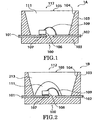
- Fig. 1 shows schematic cross-sectional view illustrating a configuration of the substantial part of a light emitting device.
- the light emitting device 1A shown here includes a resin stem 100, a semiconductor light emitting element 106 mounted on the resin stem 100 and a sealing element 111 provided to embed the element 106.
- the resin stem 100 includes leads 101, 102 shaped from a lead frame, and a resin portion 103 molded integrally with the leads 101, 102.
- the resin portion 103 is typically made of a thermoplastic resin preferably, for example, of a nylon system having inert coupling radicals.
- the thermoplastic resin may be a resin having a high resistance to heat, such as liquid crystal polymer (LCP), polyphenylene sulfide (PPS: thermoplastic resin) or syndiotactic polystyrene (SPS: crystalline polystyrene).
- LCP liquid crystal polymer
- PPS polyphenylene sulfide
- SPS syndiotactic polystyrene
- the plan-viewed outer configuration of the resin portion 103 may be a substantial square approximately sized 2.0 ⁇ 2.0mm through 6.0 ⁇ 6.0mm, or a substantial rectangular approximately sized 2.0 ⁇ 3.0mm through 5.0 ⁇ 7.0mm.
- the leads 101, 102 have opposed ends close to each other, and extend therefrom in the opposite directions to outside the resin portion 103.
- the resin portion 103 has formed an opening 105, and the semiconductor light emitting element 106 is mounted at the bottom of the opening 105.
- the plan-viewed shape of the opening 105 can be circular of approximately elliptical or approximately elongate-circular.
- the inner wall surface of the resin portion 103 surrounding the element 106 inclines to face toward the light extraction direction to function as a reflective surface 104 for reflecting light.
- the light emitting element 106 is placed to deviate from the center of the bottom surface of the opening 105.
- the reason of this off-center arrangement is to ensure a enough space for boding wire 109, and to realize a high optical output by increasing the reflection efficiency by placing the element 106 close to the reflective surface 104.
- the light emitting element 106 is mounted by an adhesive 107 such as silver (Ag) paste onto a lead 101 which is placed at the bottom of the opening 105.
- the element 106 has a electrode (not shown) on its surface, and is connected with the lead 102 by a bonding wire 109 such as a gold (Au) wire.
- the invention uses a silicone resin instead of a conventional epoxy resin as the sealing element 111 filling the opening 105.
- silicone resins are less fragile and less subjected to cracks.
- Silicone resins usable in the present invention exhibit a high bonding force with the resin portion 103 made of a thermoplastic resin, for example, and a high moisture resistance. Additionally, they do not crack or exfoliate so much due to a temperature stress. Furthermore, such a silicone resin filled in the opening produces only a remarkably small resin stress to the light emitting element 106 and the Au wire 109.
- silicone resins are more resistance to light irradiated from the light emitting element 106 than epoxy resins.
- Rubber-like silicone resins have a JISA hardness in the range of approximately 50 to 90.
- Epoxy resins widely used as the sealing element materials in conventional light emitting devices have a JISA hardness around 95.
- rubber-like silicone resins having a JISA hardness in the range of 50 to 90 are prevented from deformation by a selector or an assembler used for selecting or assembling light emitting devices.
- a technique for increasing the hardness of a silicone resin is to add an agent for giving a thixotropy index.
- a silicone resin Upon burying a silicone resin, it is poured into the opening 105 of the resin stem through a thin nozzle, and thereafter cured. In this process, it is preferable to use a silicone resin having a pre-curing viscosity around 100cp through 10000cp. Thereby, it is possible to fully bury the opening including narrow spaces and to limit the residual stress upon curing within a sufficiently low range, without giving an excessive stress to the light emitting element 106 and the wire 109.
- the Inventor prepared light emitting devices according to the example as shown in Fig. 1 by using a rubber-like silicone resin having the pre-during viscosity of 1000cp and post-curing JISA hardness value of 70, and carried out a temperature cycle test in the temperature range from -40°C to 110°C.
- a temperature cycle test in the temperature range from -40°C to 110°C.
- a silicone resin in particular, a rubber-like silicone resin, reduces the possibility of cracks and exfoliation that often occurred in conventional epoxy resins, breakage of wires, and so on.
- the Inventor has found that the optical output efficiency of the light emitting device can be improved by using the silicone resin. That is, the Inventor has found a substantially transparent resin material among the silicone resin, especially among the rubber-like silicone resin, which can be used in the present invention. By using such a transparent silicone resin, the optical output efficiency of the light emitted from the light emitting element 106 can be improved. As a result, a brighter light emitting device can be realized.
- silicone resin also improves the durability against light emitted from the semiconductor light emitting element 106 or light intruding from the exterior of the light emitting device. Epoxy resins change in color when exposed to light, and even if it is initially transparent, its optical transmittance decreases after long-time use.
- silicone resin leads to a very satisfactory result. That is, if a silicone resin is used, change or color and other types of deterioration do not occur even after it is exposed to short wavelength light such as ultraviolet rays. That is, the silicone resin can maintain its initial transparent state for a long period. Therefore, silicone resins contribute to realization of light emitting devices exhibiting excellent resistance to light and weather, and contribute to keep a high external output efficiency for a long period.
- the resin portion 103 may be equipped with optical reflectivity.
- the resin portion 103 may be made of 65 or more weight % of a thermoplastic resin and 35 or less weight % of a filling agent.
- the filling agent contains a, high-reflective material such as titanium oxide (TiO 3 ), silicon oxide, aluminum oxide, silica or alumina. In case of titanium oxide, its content is in the range from 10 to 15%.
- the reflective surface 104 is a part of the resin portion containing a diffusing material that reflects light, it can reflect light from the light emitting element 106 and the fluorescent element 110 upward to realize a high luminance of the light emitting device. If the reflective surface 104 is configured as a paraboloid of revolution, for example, the output and the quality of the light emitting device can be further improved.
- Fig. 2 is a cross-sectional view that schematically shows the second specific example of a light emitting device.
- Fig. 2 is a cross-sectional view that schematically shows the second specific example of a light emitting device.
- the same or equivalent components as those already explained with reference to Fig. 1 are commonly labeled, and their detailed explanation is omitted for simplicity.
- the light emitting device 1B shown here also includes a resin stem 100, semiconductor light emitting element 106 mounted thereon, and sealing element 111 of a silicone resin provided to embed the element 106.
- the sealing element 111 merely embeds the light emitting element 106, and a second sealing element 213 of a transparent resin is provided outside the sealing element 111.
- the second sealing element 213 may be made of an epoxy resin, silicone resin or any of other various materials.
- the second sealing element 213 may be colored, and any material adaptable to the dye or coloring agent used can be selected.
- the second sealing element 213 may contain a diffusing material dispersed therein to scatter light. In this case, light can be diffused, and broader light distribution characteristics can be obtained.
- a silicone resin is used as the second sealing element 213, then its close contact with the sealing element 111 is enhanced, and the moisture resistance is improved.
- the sealing element 111 made of a silicone resin wraps the entirety of the Au wire 109. Therefore, a reliable light emitting element free from breakage of wire due to a resin stress can be realized. If the wire partly projects into the second sealing element 213, it will readily break due to a stress produced at the interface between the sealing elements 111, 213. In this specific example, however, since the wire 109 is entirely embedded by the sealing element 111, it is free from breakage.
- Fig. 3 is a cross-sectional view that schematically shows the third specific example of a light emitting device.
- the same or equivalent components as those already explained with reference to Figs. 1 and 2 are commonly labeled, and their detailed explanation is omitted for simplicity.
- the light emitting device 1C shown here also includes a resin stem 100, semiconductor light emitting element 106 mounted thereon, and sealing element 111 provided to embed the element 106.
- the sealing element 111 merely embeds the light emitting element 106. In this specific example, however, the space outside the sealing element 111 remains open, without being filled by any other sealing element.
- the limitative use of the sealing element 111 only to enclose the light emitting element 106 mounted at the bottom of the opening 105 contributes to small-sizing the emitting portion. Therefore, the luminance increases, and the function of the reflective surface 104 to gather rays of light is enhanced.
- the approximately hemispheric sealing element 111 serves as the emission point, and the reflective surface 104 surrounds it, the same optically converging effect as a conventional lamp can be obtained.
- the sealing element 111 embeds the entirety of the Au wires 108, 109, it prevents breakage of wire by a resin stress, and ensures a high reliability.
- Fig. 4 is a cross-sectional view that schematically shows the fourth specific example of a light emitting device.
- the light emitting device 1D shown here also includes a resin stem 100, semiconductor light emitting element 106 mounted thereon, and sealing element 111 embedding the element 106.
- the example shown here includes a convex transparent element 413 is provided on the sealing element 111 to ensure the function of gathering rays of light.
- the transparent element 413 may be made of a resin, for example.
- a silicone resin is advantageous for decreasing the difference of the refractive index from the sealing element 111 and to reduce the loss by reflection at the interface with the sealing element 111.
- the convex shape of the transparent element 413 is not limited to a spherical shape. Any appropriate shape can be selected depending on the required converging ratio or luminous intensity profile.
- Fig. 5 is a cross-sectional view that schematically shows a fifth example of a light emitting device.
- the same or equivalent components as those already explained with reference to Figs. 1 through 4 are commonly labeled, and their detailed explanation is omitted for simplicity.
- the light emitting device 1E shown here also includes a resin stem 100, semiconductor light emitting element 106 mounted thereon, and sealing element 111 embedding the stacked structure.
- the sealing element 111 is made of silicone resin having a hardness in a range from 50 through 90 in JISA value.
- the resin portion 103 has no side wall around the sealing element 111 such that the light from the element 106 both upwardly and laterally to realize a wide luminous intensity profile. This is suitable for applications expected to provide a wide field of view or a wide field of emission.
- the sealing element is hemispherical as shown in Fig. 6 .
- Fig. 7 is a cross-sectional view that schematically shows a sixth example of a light emitting device.
- the same or equivalent components as those already explained with reference to Figs. 1 through 6 are commonly labeled, and their detailed explanation is omitted for simplicity.
- the light emitting device IF shown here also includes a pair of leads 101, 102.
- the first lead 101 has formed a cup portion 601 at the distal end, and the stacked structure including the light emitting element 106 is mounted at the bottom of the cup portion 601. Then the wire 109 extending from the element 106 is connected to the lead 102.
- the sealing element 111 is formed to embed these components.
- the sealing element 111 is made of silicone resin having a hardness in a range from 50 through 90 in JISA value.
- the inner side wall surface of the cup portion 601 serves as the reflective surface to reflect the primary light from the light emitting element 106 upwardly.
- the transparent sealing element 111 can function as a convex lens to converge the light emitted from the element 106.
- the light emitting device shown here replaces conventional lamp-type semiconductor devices, and is operative as a general-purpose light emitting device having a relatively wide field of emission.
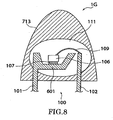
- Fig. 8 is a cross-sectional view that schematically shows a seventh example of a light emitting device.
- the same or equivalent components as those already explained with reference to Figs. 1 through 7 are commonly labeled, and their detailed explanation is omitted for simplicity.
- the light emitting device 1G shown here has a structure similar to the light emitting device 1F shown in fig. 7 .
- the light emitting device 1G also has a cup portion 601 at the distal end of the first lead 101, and the light emitting element 106 is mounted at the bottom thereof. Then the wire 109 from the element 106 is connected to the lead 102.
- the sealing element 111 is made of silicone resin having a hardness in a range from 50 through 90 in JISA value. The sealing element 111 is provided to embed those components.
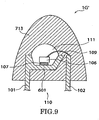
- the sealing element 111 is small-sized, and a transparent element 713 is provided to enclose the sealing element 111.
- the small-sized sealing element 111 diminishes the emission portion and increases the luminance.
- the top surface of the transparent element 713 functions as a lens to gather rays of light, and makes it possible to extract converged light as well.
- the transparent element 713 enclosing the sealing element 111 isolates the element 111 from the outside atmosphere and improves its durability against moisture and corrosive atmosphere.
- the transparent element may be made of a resin. Especially, an epoxy resin or silicone resin is advantageous for close contact with the sealing element 111 to enhance the resistance to whether and the mechanical strength.
- the sealing element 111 may be limited only on the cup portion 601 to reduce the size of the emission portion and thereby increase the luminance.
- the wire 109 will extend beyond the boundary between the sealing element 111 and the transparent element 713.
- the sealing element 111 and the transparent element 713 are made of similar materials, the stress at the boundary will be minimized and will prevent breakage of wire.
Landscapes
- Led Device Packages (AREA)
Applications Claiming Priority (2)
| Application Number | Priority Date | Filing Date | Title |
|---|---|---|---|
| JP2001110675 | 2001-04-09 | ||
| JP2001110675A JP2002314139A (ja) | 2001-04-09 | 2001-04-09 | 発光装置 |
Publications (4)
| Publication Number | Publication Date |
|---|---|
| EP1249875A2 EP1249875A2 (en) | 2002-10-16 |
| EP1249875A3 EP1249875A3 (en) | 2007-12-19 |
| EP1249875B1 EP1249875B1 (en) | 2011-02-16 |
| EP1249875B2 true EP1249875B2 (en) | 2019-02-20 |
Family
ID=18962398
Family Applications (1)
| Application Number | Title | Priority Date | Filing Date |
|---|---|---|---|
| EP02007380.5A Expired - Lifetime EP1249875B2 (en) | 2001-04-09 | 2002-04-09 | Light emitting device |
Country Status (6)
| Country | Link |
|---|---|
| US (1) | US6710377B2 (https=) |
| EP (1) | EP1249875B2 (https=) |
| JP (1) | JP2002314139A (https=) |
| CN (1) | CN1262023C (https=) |
| DE (1) | DE60239173D1 (https=) |
| TW (1) | TW552722B (https=) |
Families Citing this family (77)
| Publication number | Priority date | Publication date | Assignee | Title |
|---|---|---|---|---|
| DE10033502A1 (de) * | 2000-07-10 | 2002-01-31 | Osram Opto Semiconductors Gmbh | Optoelektronisches Modul, Verfahren zu dessen Herstellung und dessen Verwendung |
| JP2002314138A (ja) * | 2001-04-09 | 2002-10-25 | Toshiba Corp | 発光装置 |
| JP4101468B2 (ja) * | 2001-04-09 | 2008-06-18 | 豊田合成株式会社 | 発光装置の製造方法 |
| US7244965B2 (en) * | 2002-09-04 | 2007-07-17 | Cree Inc, | Power surface mount light emitting die package |
| DE20301627U1 (de) | 2003-01-30 | 2003-04-17 | OSA Opto Light GmbH, 12555 Berlin | Optoelektronisches SMD-Bauelement für nicht axiale Anwendungen |
| DE10307800A1 (de) * | 2003-02-24 | 2004-09-02 | Vishay Semiconductor Gmbh | Halbleiterbauteil |
| TW200427111A (en) | 2003-03-12 | 2004-12-01 | Shinetsu Chemical Co | Material for coating/protecting light-emitting semiconductor and the light-emitting semiconductor device |
| JP4599857B2 (ja) * | 2003-04-24 | 2010-12-15 | 日亜化学工業株式会社 | 半導体装置及びその製造方法 |
| JP4645071B2 (ja) * | 2003-06-20 | 2011-03-09 | 日亜化学工業株式会社 | パッケージ成型体およびそれを用いた半導体装置 |
| TWI373150B (en) | 2003-07-09 | 2012-09-21 | Shinetsu Chemical Co | Silicone rubber composition, light-emitting semiconductor embedding/protecting material and light-emitting semiconductor device |
| JP4586967B2 (ja) * | 2003-07-09 | 2010-11-24 | 信越化学工業株式会社 | 発光半導体被覆保護材及び発光半導体装置 |
| US6995402B2 (en) * | 2003-10-03 | 2006-02-07 | Lumileds Lighting, U.S., Llc | Integrated reflector cup for a light emitting device mount |
| US7276782B2 (en) * | 2003-10-31 | 2007-10-02 | Harvatek Corporation | Package structure for semiconductor |
| JP4150980B2 (ja) * | 2003-11-04 | 2008-09-17 | 信越半導体株式会社 | 発光素子 |
| JP4803339B2 (ja) | 2003-11-20 | 2011-10-26 | 信越化学工業株式会社 | エポキシ・シリコーン混成樹脂組成物及び発光半導体装置 |
| US7329904B2 (en) * | 2004-01-30 | 2008-02-12 | Toyoda Gosei Co., Ltd. | LED lamp device |
| JP4300418B2 (ja) | 2004-04-30 | 2009-07-22 | 信越化学工業株式会社 | エポキシ・シリコーン混成樹脂組成物及び発光半導体装置 |
| US20050280016A1 (en) * | 2004-06-17 | 2005-12-22 | Mok Thye L | PCB-based surface mount LED device with silicone-based encapsulation structure |
| US20060006791A1 (en) * | 2004-07-06 | 2006-01-12 | Chia Chee W | Light emitting diode display that does not require epoxy encapsulation of the light emitting diode |
| US20060046327A1 (en) * | 2004-08-30 | 2006-03-02 | Nan Ya Plastics Corporation | High heat dissipation LED device and its manufacturing method |
| KR100709890B1 (ko) * | 2004-09-10 | 2007-04-20 | 서울반도체 주식회사 | 다중 몰딩수지를 갖는 발광다이오드 패키지 |
| EP1794808B1 (en) * | 2004-09-10 | 2017-08-09 | Seoul Semiconductor Co., Ltd. | Light emitting diode package having multiple molding resins |
| DE102005043928B4 (de) * | 2004-09-16 | 2011-08-18 | Sharp Kk | Optisches Halbleiterbauteil und Verfahren zu dessen Herstellung |
| DE102004045950A1 (de) * | 2004-09-22 | 2006-03-30 | Osram Opto Semiconductors Gmbh | Gehäuse für ein optoelektronisches Bauelement, optoelektronisches Bauelement und Verfahren zur Herstellung eines optoelektronischen Bauelements |
| WO2006080729A1 (en) | 2004-10-07 | 2006-08-03 | Seoul Semiconductor Co., Ltd. | Side illumination lens and luminescent device using the same |
| CN100382287C (zh) * | 2004-10-12 | 2008-04-16 | 宏齐科技股份有限公司 | 一种半导体的封装结构 |
| US20060092644A1 (en) * | 2004-10-28 | 2006-05-04 | Mok Thye L | Small package high efficiency illuminator design |
| JP4634810B2 (ja) * | 2005-01-20 | 2011-02-16 | 信越化学工業株式会社 | シリコーン封止型led |
| TWI382077B (zh) | 2005-02-23 | 2013-01-11 | 三菱化學股份有限公司 | 半導體發光裝置用構件及其製造方法,暨使用其之半導體發光裝置 |
| JP5694875B2 (ja) * | 2005-02-23 | 2015-04-01 | 三菱化学株式会社 | 半導体発光デバイス用部材及びその製造方法、並びにそれを用いた半導体発光デバイス |
| CN100377376C (zh) * | 2005-03-21 | 2008-03-26 | 亿光电子工业股份有限公司 | 发光二极管反射盖制造方法 |
| JP2006269531A (ja) * | 2005-03-22 | 2006-10-05 | Matsushita Electric Ind Co Ltd | 光半導体装置 |
| JP4744178B2 (ja) | 2005-04-08 | 2011-08-10 | シャープ株式会社 | 発光ダイオード |
| US20060270808A1 (en) * | 2005-05-24 | 2006-11-30 | Shin-Etsu Chemical Co., Ltd. | Epoxy-silicone mixed resin composition, cured article thereof, and light-emitting semiconductor device |
| DE102005034122A1 (de) * | 2005-07-21 | 2007-02-08 | Wacker Chemie Ag | Siliconharzverguss von Leuchtdioden |
| US7952108B2 (en) * | 2005-10-18 | 2011-05-31 | Finisar Corporation | Reducing thermal expansion effects in semiconductor packages |
| KR100691440B1 (ko) * | 2005-11-15 | 2007-03-09 | 삼성전기주식회사 | Led 패키지 |
| JP2007194401A (ja) * | 2006-01-19 | 2007-08-02 | Showa Denko Kk | 化合物半導体発光素子を用いたledパッケージ |
| US8044412B2 (en) | 2006-01-20 | 2011-10-25 | Taiwan Semiconductor Manufacturing Company, Ltd | Package for a light emitting element |
| DE102006030003A1 (de) | 2006-05-11 | 2007-11-15 | Wacker Chemie Ag | Siliconharzbeschichtung für elektronische Bauteile |
| US7923928B2 (en) | 2006-06-27 | 2011-04-12 | Mitsubishi Chemical Corporation | Illuminating device |
| JP5141107B2 (ja) * | 2006-06-27 | 2013-02-13 | 三菱化学株式会社 | 照明装置 |
| JP5205724B2 (ja) * | 2006-08-04 | 2013-06-05 | 日亜化学工業株式会社 | 発光装置 |
| US20080049445A1 (en) * | 2006-08-25 | 2008-02-28 | Philips Lumileds Lighting Company, Llc | Backlight Using High-Powered Corner LED |
| KR101258227B1 (ko) | 2006-08-29 | 2013-04-25 | 서울반도체 주식회사 | 발광 소자 |
| KR100828900B1 (ko) * | 2006-09-04 | 2008-05-09 | 엘지이노텍 주식회사 | 발광 다이오드 패키지 및 그 제조방법 |
| JP5380774B2 (ja) | 2006-12-28 | 2014-01-08 | 日亜化学工業株式会社 | 表面実装型側面発光装置及びその製造方法 |
| KR101119172B1 (ko) * | 2007-02-05 | 2012-03-21 | 삼성전자주식회사 | 발광 다이오드 모듈 및 이를 구비한 표시 장치 |
| DE102007025749A1 (de) * | 2007-06-01 | 2008-12-11 | Wacker Chemie Ag | Leuchtkörper-Silicon-Formteil |
| JP5052326B2 (ja) * | 2007-10-31 | 2012-10-17 | シャープ株式会社 | チップ部品型led及びその製造方法 |
| DE102008014122A1 (de) | 2007-11-29 | 2009-06-04 | Osram Opto Semiconductors Gmbh | Verfahren zur Herstellung eines optoelektronischen Bauelements und optoelektronisches Bauelement |
| JP5136963B2 (ja) * | 2008-03-24 | 2013-02-06 | 信越化学工業株式会社 | 硬化性シリコーンゴム組成物及び半導体装置 |
| JP2010031149A (ja) | 2008-07-29 | 2010-02-12 | Shin-Etsu Chemical Co Ltd | 光半導体素子封止用樹脂組成物 |
| WO2010044023A1 (en) * | 2008-10-17 | 2010-04-22 | Koninklijke Philips Electronics N.V. | Light emitting device |
| TWI384591B (zh) * | 2008-11-17 | 2013-02-01 | 億光電子工業股份有限公司 | 發光二極體電路板 |
| JP5333758B2 (ja) * | 2009-02-27 | 2013-11-06 | 東芝ライテック株式会社 | 照明装置および照明器具 |
| US20100289055A1 (en) * | 2009-05-14 | 2010-11-18 | Avago Technologies Ecbu Ip (Singapore) Pte. Ltd. | Silicone leaded chip carrier |
| JP5305452B2 (ja) | 2009-06-12 | 2013-10-02 | 信越化学工業株式会社 | 光半導体素子封止用樹脂組成物 |
| JP5354191B2 (ja) * | 2009-06-30 | 2013-11-27 | 東芝ライテック株式会社 | 電球形ランプおよび照明器具 |
| JP2011049527A (ja) | 2009-07-29 | 2011-03-10 | Toshiba Lighting & Technology Corp | Led照明装置 |
| US8678618B2 (en) | 2009-09-25 | 2014-03-25 | Toshiba Lighting & Technology Corporation | Self-ballasted lamp having a light-transmissive member in contact with light emitting elements and lighting equipment incorporating the same |
| JP5257622B2 (ja) | 2010-02-26 | 2013-08-07 | 東芝ライテック株式会社 | 電球形ランプおよび照明器具 |
| JP5489280B2 (ja) | 2010-04-07 | 2014-05-14 | 信越化学工業株式会社 | 光半導体封止用エポキシ組成物 |
| JP2012019062A (ja) | 2010-07-08 | 2012-01-26 | Shin Etsu Chem Co Ltd | 発光半導体装置、実装基板及びそれらの製造方法 |
| KR101626412B1 (ko) * | 2010-12-24 | 2016-06-02 | 삼성전자주식회사 | 발광소자 패키지 및 그 제조방법 |
| DE102011100028A1 (de) | 2011-04-29 | 2012-10-31 | Osram Opto Semiconductors Gmbh | Bauelement und Verfahren zur Herstellung eines Bauelements |
| KR101830717B1 (ko) * | 2011-06-30 | 2018-02-21 | 엘지이노텍 주식회사 | 발광 소자 패키지 |
| JP5682497B2 (ja) * | 2011-07-29 | 2015-03-11 | 信越化学工業株式会社 | 表面実装型発光装置の製造方法及びリフレクター基板 |
| CN102623623A (zh) * | 2012-03-26 | 2012-08-01 | 李海涛 | 一种软胶保护内芯的表面贴装式led装置 |
| JP5721668B2 (ja) * | 2012-06-29 | 2015-05-20 | シャープ株式会社 | 発光装置、照明装置および表示装置用バックライト |
| JP2014120515A (ja) * | 2012-12-13 | 2014-06-30 | Shin Etsu Chem Co Ltd | 光学半導体装置用基板とその製造方法、集合基板、及び光学半導体装置とその製造方法 |
| JP6707369B2 (ja) | 2015-03-30 | 2020-06-10 | ダウ・東レ株式会社 | シリコーン材料、硬化性シリコーン組成物、および光デバイス |
| CN105316564B (zh) * | 2015-06-08 | 2017-05-17 | 天津达祥精密工业有限公司 | 采用喂丝球化处理的高镍奥氏体球墨铸铁生产工艺 |
| JP6679306B2 (ja) * | 2015-12-28 | 2020-04-15 | シャープ株式会社 | 発光素子の製造方法 |
| CN113632250B (zh) * | 2018-11-29 | 2022-07-08 | 亮锐有限责任公司 | 发光器件及其封装方法 |
| US11600754B2 (en) | 2018-11-29 | 2023-03-07 | Lumileds Llc | Light-emitting device and method of packaging the same |
| CN114784170A (zh) * | 2022-04-14 | 2022-07-22 | 佛山市国星光电股份有限公司 | 一种led支架、支架的制备方法、发光器件及支架阵列 |
Family Cites Families (17)
| Publication number | Priority date | Publication date | Assignee | Title |
|---|---|---|---|---|
| JPS6254974A (ja) * | 1985-09-04 | 1987-03-10 | Mitsubishi Electric Corp | 光結合半導体装置 |
| JP2715792B2 (ja) * | 1992-02-13 | 1998-02-18 | 信越化学工業株式会社 | 光透過性エポキシ樹脂組成物及び光半導体装置 |
| JPH065742A (ja) * | 1992-06-22 | 1994-01-14 | Mitsubishi Electric Corp | 半導体装置、その封止に用いられる樹脂および半導体装置の製造方法 |
| JPH07111343A (ja) * | 1993-10-13 | 1995-04-25 | Matsushita Electron Corp | 光電装置 |
| DE69428578T2 (de) * | 1993-12-16 | 2002-06-27 | Sharp K.K., Osaka | Herstellungsverfahren für lichtemittierenden Halbleitervorrichtungen |
| JP3648756B2 (ja) * | 1994-03-22 | 2005-05-18 | Jsr株式会社 | 半導体素子用コーテイング材 |
| JPH07278438A (ja) * | 1994-04-14 | 1995-10-24 | Toray Dow Corning Silicone Co Ltd | 電子部品含浸用硬化性オルガノポリシロキサン組成物および電子部品 |
| US5832600A (en) * | 1995-06-06 | 1998-11-10 | Seiko Epson Corporation | Method of mounting electronic parts |
| JP3393247B2 (ja) * | 1995-09-29 | 2003-04-07 | ソニー株式会社 | 光学装置およびその製造方法 |
| JPH09246423A (ja) * | 1996-03-13 | 1997-09-19 | Hitachi Ltd | 半導体装置 |
| JP3034363U (ja) * | 1996-05-01 | 1997-02-18 | 武雄 稲垣 | 発光素子を内蔵した表示灯 |
| JP3492178B2 (ja) * | 1997-01-15 | 2004-02-03 | 株式会社東芝 | 半導体発光装置及びその製造方法 |
| US6274890B1 (en) * | 1997-01-15 | 2001-08-14 | Kabushiki Kaisha Toshiba | Semiconductor light emitting device and its manufacturing method |
| TW414924B (en) * | 1998-05-29 | 2000-12-11 | Rohm Co Ltd | Semiconductor device of resin package |
| JP3618551B2 (ja) * | 1998-06-30 | 2005-02-09 | 株式会社東芝 | 光半導体モジュール |
| JP2000156528A (ja) * | 1998-11-19 | 2000-06-06 | Sharp Corp | 発光素子 |
| JP3613041B2 (ja) * | 1998-12-16 | 2005-01-26 | 日亜化学工業株式会社 | 発光装置及びその製造方法 |
-
2001
- 2001-04-09 JP JP2001110675A patent/JP2002314139A/ja active Pending
-
2002
- 2002-04-04 TW TW091106884A patent/TW552722B/zh active
- 2002-04-09 DE DE60239173T patent/DE60239173D1/de not_active Expired - Lifetime
- 2002-04-09 US US10/119,413 patent/US6710377B2/en not_active Expired - Lifetime
- 2002-04-09 CN CNB02106198XA patent/CN1262023C/zh not_active Expired - Fee Related
- 2002-04-09 EP EP02007380.5A patent/EP1249875B2/en not_active Expired - Lifetime
Also Published As
| Publication number | Publication date |
|---|---|
| US20020145152A1 (en) | 2002-10-10 |
| CN1380704A (zh) | 2002-11-20 |
| EP1249875B1 (en) | 2011-02-16 |
| EP1249875A3 (en) | 2007-12-19 |
| DE60239173D1 (de) | 2011-03-31 |
| CN1262023C (zh) | 2006-06-28 |
| EP1249875A2 (en) | 2002-10-16 |
| JP2002314139A (ja) | 2002-10-25 |
| US6710377B2 (en) | 2004-03-23 |
| TW552722B (en) | 2003-09-11 |
Similar Documents
| Publication | Publication Date | Title |
|---|---|---|
| EP1249875B2 (en) | Light emitting device | |
| US6747293B2 (en) | Light emitting device | |
| CN100550439C (zh) | 半导体发光器件及制造方法 | |
| CN102804426B (zh) | 发光装置 | |
| JP5695488B2 (ja) | 発光体パッケージ | |
| JP4599857B2 (ja) | 半導体装置及びその製造方法 | |
| EP1741315B1 (en) | Light-emitting devices having multiple encapsulation layers with at least one of the encapsulation layers including nanoparticles and methods of forming the same | |
| EP0854523B1 (en) | Semiconductor light emitting device and its manufacturing method | |
| JP5596901B2 (ja) | 反射レンズを備えたパワー発光ダイパッケージおよびその作製方法 | |
| US8304799B2 (en) | Optoelectronic component and package for an optoelectronic component | |
| KR101088910B1 (ko) | Led 패키지 및 그 제조방법 | |
| JP2007329502A (ja) | 発光装置 | |
| JP4403199B2 (ja) | 発光装置 | |
| JP4600404B2 (ja) | 半導体装置及びその製造方法 | |
| US8101967B2 (en) | Optical semiconductor package and optical semiconductor device | |
| JP3931916B2 (ja) | 半導体装置及びその製造方法 | |
| CN108369979A (zh) | 电光组件 | |
| KR20090049466A (ko) | 램프형 발광다이오드 패키지 | |
| KR100848873B1 (ko) | Led 램프 및 그 제조 방법 | |
| KR20090132087A (ko) | Led 패키지 |
Legal Events
| Date | Code | Title | Description |
|---|---|---|---|
| PUAI | Public reference made under article 153(3) epc to a published international application that has entered the european phase |
Free format text: ORIGINAL CODE: 0009012 |
|
| 17P | Request for examination filed |
Effective date: 20020409 |
|
| AK | Designated contracting states |
Kind code of ref document: A2 Designated state(s): AT BE CH CY DE DK ES FI FR GB GR IE IT LI LU MC NL PT SE TR |
|
| AX | Request for extension of the european patent |
Free format text: AL;LT;LV;MK;RO;SI |
|
| PUAL | Search report despatched |
Free format text: ORIGINAL CODE: 0009013 |
|
| AK | Designated contracting states |
Kind code of ref document: A3 Designated state(s): AT BE CH CY DE DK ES FI FR GB GR IE IT LI LU MC NL PT SE TR |
|
| AX | Request for extension of the european patent |
Extension state: AL LT LV MK RO SI |
|
| AKX | Designation fees paid |
Designated state(s): DE FR GB |
|
| 17Q | First examination report despatched |
Effective date: 20091021 |
|
| GRAP | Despatch of communication of intention to grant a patent |
Free format text: ORIGINAL CODE: EPIDOSNIGR1 |
|
| RIC1 | Information provided on ipc code assigned before grant |
Ipc: H01L 33/56 20100101AFI20100830BHEP Ipc: H01L 33/48 20100101ALN20100830BHEP |
|
| GRAS | Grant fee paid |
Free format text: ORIGINAL CODE: EPIDOSNIGR3 |
|
| GRAA | (expected) grant |
Free format text: ORIGINAL CODE: 0009210 |
|
| AK | Designated contracting states |
Kind code of ref document: B1 Designated state(s): DE FR GB |
|
| REG | Reference to a national code |
Ref country code: GB Ref legal event code: FG4D |
|
| REF | Corresponds to: |
Ref document number: 60239173 Country of ref document: DE Date of ref document: 20110331 Kind code of ref document: P |
|
| REG | Reference to a national code |
Ref country code: DE Ref legal event code: R096 Ref document number: 60239173 Country of ref document: DE Effective date: 20110331 |
|
| PLBI | Opposition filed |
Free format text: ORIGINAL CODE: 0009260 |
|
| 26 | Opposition filed |
Opponent name: HENKEL AG & CO. KGAA Effective date: 20111115 |
|
| PLAX | Notice of opposition and request to file observation + time limit sent |
Free format text: ORIGINAL CODE: EPIDOSNOBS2 |
|
| REG | Reference to a national code |
Ref country code: DE Ref legal event code: R026 Ref document number: 60239173 Country of ref document: DE Effective date: 20111115 |
|
| PLAF | Information modified related to communication of a notice of opposition and request to file observations + time limit |
Free format text: ORIGINAL CODE: EPIDOSCOBS2 |
|
| PLBB | Reply of patent proprietor to notice(s) of opposition received |
Free format text: ORIGINAL CODE: EPIDOSNOBS3 |
|
| PGFP | Annual fee paid to national office [announced via postgrant information from national office to epo] |
Ref country code: GB Payment date: 20120404 Year of fee payment: 11 |
|
| GBPC | Gb: european patent ceased through non-payment of renewal fee |
Effective date: 20130409 |
|
| APAH | Appeal reference modified |
Free format text: ORIGINAL CODE: EPIDOSCREFNO |
|
| APBM | Appeal reference recorded |
Free format text: ORIGINAL CODE: EPIDOSNREFNO |
|
| APBP | Date of receipt of notice of appeal recorded |
Free format text: ORIGINAL CODE: EPIDOSNNOA2O |
|
| PG25 | Lapsed in a contracting state [announced via postgrant information from national office to epo] |
Ref country code: GB Free format text: LAPSE BECAUSE OF NON-PAYMENT OF DUE FEES Effective date: 20130409 |
|
| APBQ | Date of receipt of statement of grounds of appeal recorded |
Free format text: ORIGINAL CODE: EPIDOSNNOA3O |
|
| REG | Reference to a national code |
Ref country code: FR Ref legal event code: PLFP Year of fee payment: 15 |
|
| PGFP | Annual fee paid to national office [announced via postgrant information from national office to epo] |
Ref country code: FR Payment date: 20160309 Year of fee payment: 15 |
|
| REG | Reference to a national code |
Ref country code: FR Ref legal event code: ST Effective date: 20171229 |
|
| PG25 | Lapsed in a contracting state [announced via postgrant information from national office to epo] |
Ref country code: FR Free format text: LAPSE BECAUSE OF NON-PAYMENT OF DUE FEES Effective date: 20170502 |
|
| APBU | Appeal procedure closed |
Free format text: ORIGINAL CODE: EPIDOSNNOA9O |
|
| PUAH | Patent maintained in amended form |
Free format text: ORIGINAL CODE: 0009272 |
|
| STAA | Information on the status of an ep patent application or granted ep patent |
Free format text: STATUS: PATENT MAINTAINED AS AMENDED |
|
| 27A | Patent maintained in amended form |
Effective date: 20190220 |
|
| AK | Designated contracting states |
Kind code of ref document: B2 Designated state(s): DE FR GB |
|
| REG | Reference to a national code |
Ref country code: DE Ref legal event code: R102 Ref document number: 60239173 Country of ref document: DE |
|
| PGFP | Annual fee paid to national office [announced via postgrant information from national office to epo] |
Ref country code: DE Payment date: 20210316 Year of fee payment: 20 |
|
| REG | Reference to a national code |
Ref country code: DE Ref legal event code: R071 Ref document number: 60239173 Country of ref document: DE |