EP1076676B1 - Engineering-ionomerblends und engineering-ionomerblendmembranen - Google Patents
Engineering-ionomerblends und engineering-ionomerblendmembranen Download PDFInfo
- Publication number
- EP1076676B1 EP1076676B1 EP99920761A EP99920761A EP1076676B1 EP 1076676 B1 EP1076676 B1 EP 1076676B1 EP 99920761 A EP99920761 A EP 99920761A EP 99920761 A EP99920761 A EP 99920761A EP 1076676 B1 EP1076676 B1 EP 1076676B1
- Authority
- EP
- European Patent Office
- Prior art keywords
- polymer
- acid
- poly
- polymeric
- groups
- Prior art date
- Legal status (The legal status is an assumption and is not a legal conclusion. Google has not performed a legal analysis and makes no representation as to the accuracy of the status listed.)
- Expired - Lifetime
Links
- 0 CC(C)(c(cc1)ccc1OC)c(cc1)ccc1Oc(cc1S(O)(=O)=O)ccc1S(C(C(C)=CC(C)=C1)C1=*)(=O)=O Chemical compound CC(C)(c(cc1)ccc1OC)c(cc1)ccc1Oc(cc1S(O)(=O)=O)ccc1S(C(C(C)=CC(C)=C1)C1=*)(=O)=O 0.000 description 1
Classifications
-
- H—ELECTRICITY
- H01—ELECTRIC ELEMENTS
- H01M—PROCESSES OR MEANS, e.g. BATTERIES, FOR THE DIRECT CONVERSION OF CHEMICAL ENERGY INTO ELECTRICAL ENERGY
- H01M8/00—Fuel cells; Manufacture thereof
- H01M8/10—Fuel cells with solid electrolytes
- H01M8/1016—Fuel cells with solid electrolytes characterised by the electrolyte material
- H01M8/1018—Polymeric electrolyte materials
- H01M8/102—Polymeric electrolyte materials characterised by the chemical structure of the main chain of the ion-conducting polymer
- H01M8/103—Polymeric electrolyte materials characterised by the chemical structure of the main chain of the ion-conducting polymer having nitrogen, e.g. sulfonated polybenzimidazoles [S-PBI], polybenzimidazoles with phosphoric acid, sulfonated polyamides [S-PA] or sulfonated polyphosphazenes [S-PPh]
-
- B—PERFORMING OPERATIONS; TRANSPORTING
- B01—PHYSICAL OR CHEMICAL PROCESSES OR APPARATUS IN GENERAL
- B01D—SEPARATION
- B01D71/00—Semi-permeable membranes for separation processes or apparatus characterised by the material; Manufacturing processes specially adapted therefor
- B01D71/06—Organic material
- B01D71/52—Polyethers
- B01D71/522—Aromatic polyethers
- B01D71/5222—Polyetherketone, polyetheretherketone, or polyaryletherketone
-
- B—PERFORMING OPERATIONS; TRANSPORTING
- B01—PHYSICAL OR CHEMICAL PROCESSES OR APPARATUS IN GENERAL
- B01D—SEPARATION
- B01D71/00—Semi-permeable membranes for separation processes or apparatus characterised by the material; Manufacturing processes specially adapted therefor
- B01D71/06—Organic material
- B01D71/58—Other polymers having nitrogen in the main chain, with or without oxygen or carbon only
- B01D71/62—Polycondensates having nitrogen-containing heterocyclic rings in the main chain
-
- B—PERFORMING OPERATIONS; TRANSPORTING
- B01—PHYSICAL OR CHEMICAL PROCESSES OR APPARATUS IN GENERAL
- B01D—SEPARATION
- B01D71/00—Semi-permeable membranes for separation processes or apparatus characterised by the material; Manufacturing processes specially adapted therefor
- B01D71/06—Organic material
- B01D71/66—Polymers having sulfur in the main chain, with or without nitrogen, oxygen or carbon only
- B01D71/68—Polysulfones; Polyethersulfones
-
- C—CHEMISTRY; METALLURGY
- C08—ORGANIC MACROMOLECULAR COMPOUNDS; THEIR PREPARATION OR CHEMICAL WORKING-UP; COMPOSITIONS BASED THEREON
- C08G—MACROMOLECULAR COMPOUNDS OBTAINED OTHERWISE THAN BY REACTIONS ONLY INVOLVING UNSATURATED CARBON-TO-CARBON BONDS
- C08G65/00—Macromolecular compounds obtained by reactions forming an ether link in the main chain of the macromolecule
- C08G65/34—Macromolecular compounds obtained by reactions forming an ether link in the main chain of the macromolecule from hydroxy compounds or their metallic derivatives
- C08G65/48—Polymers modified by chemical after-treatment
-
- C—CHEMISTRY; METALLURGY
- C08—ORGANIC MACROMOLECULAR COMPOUNDS; THEIR PREPARATION OR CHEMICAL WORKING-UP; COMPOSITIONS BASED THEREON
- C08L—COMPOSITIONS OF MACROMOLECULAR COMPOUNDS
- C08L71/00—Compositions of polyethers obtained by reactions forming an ether link in the main chain; Compositions of derivatives of such polymers
-
- C—CHEMISTRY; METALLURGY
- C08—ORGANIC MACROMOLECULAR COMPOUNDS; THEIR PREPARATION OR CHEMICAL WORKING-UP; COMPOSITIONS BASED THEREON
- C08L—COMPOSITIONS OF MACROMOLECULAR COMPOUNDS
- C08L79/00—Compositions of macromolecular compounds obtained by reactions forming in the main chain of the macromolecule a linkage containing nitrogen with or without oxygen or carbon only, not provided for in groups C08L61/00 - C08L77/00
- C08L79/04—Polycondensates having nitrogen-containing heterocyclic rings in the main chain; Polyhydrazides; Polyamide acids or similar polyimide precursors
-
- H—ELECTRICITY
- H01—ELECTRIC ELEMENTS
- H01M—PROCESSES OR MEANS, e.g. BATTERIES, FOR THE DIRECT CONVERSION OF CHEMICAL ENERGY INTO ELECTRICAL ENERGY
- H01M8/00—Fuel cells; Manufacture thereof
- H01M8/10—Fuel cells with solid electrolytes
- H01M8/1016—Fuel cells with solid electrolytes characterised by the electrolyte material
- H01M8/1018—Polymeric electrolyte materials
- H01M8/102—Polymeric electrolyte materials characterised by the chemical structure of the main chain of the ion-conducting polymer
- H01M8/1025—Polymeric electrolyte materials characterised by the chemical structure of the main chain of the ion-conducting polymer having only carbon and oxygen, e.g. polyethers, sulfonated polyetheretherketones [S-PEEK], sulfonated polysaccharides, sulfonated celluloses or sulfonated polyesters
-
- H—ELECTRICITY
- H01—ELECTRIC ELEMENTS
- H01M—PROCESSES OR MEANS, e.g. BATTERIES, FOR THE DIRECT CONVERSION OF CHEMICAL ENERGY INTO ELECTRICAL ENERGY
- H01M8/00—Fuel cells; Manufacture thereof
- H01M8/10—Fuel cells with solid electrolytes
- H01M8/1016—Fuel cells with solid electrolytes characterised by the electrolyte material
- H01M8/1018—Polymeric electrolyte materials
- H01M8/102—Polymeric electrolyte materials characterised by the chemical structure of the main chain of the ion-conducting polymer
- H01M8/1032—Polymeric electrolyte materials characterised by the chemical structure of the main chain of the ion-conducting polymer having sulfur, e.g. sulfonated-polyethersulfones [S-PES]
-
- H—ELECTRICITY
- H01—ELECTRIC ELEMENTS
- H01M—PROCESSES OR MEANS, e.g. BATTERIES, FOR THE DIRECT CONVERSION OF CHEMICAL ENERGY INTO ELECTRICAL ENERGY
- H01M8/00—Fuel cells; Manufacture thereof
- H01M8/10—Fuel cells with solid electrolytes
- H01M8/1016—Fuel cells with solid electrolytes characterised by the electrolyte material
- H01M8/1018—Polymeric electrolyte materials
- H01M8/1041—Polymer electrolyte composites, mixtures or blends
- H01M8/1044—Mixtures of polymers, of which at least one is ionically conductive
-
- Y—GENERAL TAGGING OF NEW TECHNOLOGICAL DEVELOPMENTS; GENERAL TAGGING OF CROSS-SECTIONAL TECHNOLOGIES SPANNING OVER SEVERAL SECTIONS OF THE IPC; TECHNICAL SUBJECTS COVERED BY FORMER USPC CROSS-REFERENCE ART COLLECTIONS [XRACs] AND DIGESTS
- Y02—TECHNOLOGIES OR APPLICATIONS FOR MITIGATION OR ADAPTATION AGAINST CLIMATE CHANGE
- Y02E—REDUCTION OF GREENHOUSE GAS [GHG] EMISSIONS, RELATED TO ENERGY GENERATION, TRANSMISSION OR DISTRIBUTION
- Y02E60/00—Enabling technologies; Technologies with a potential or indirect contribution to GHG emissions mitigation
- Y02E60/30—Hydrogen technology
- Y02E60/50—Fuel cells
-
- Y—GENERAL TAGGING OF NEW TECHNOLOGICAL DEVELOPMENTS; GENERAL TAGGING OF CROSS-SECTIONAL TECHNOLOGIES SPANNING OVER SEVERAL SECTIONS OF THE IPC; TECHNICAL SUBJECTS COVERED BY FORMER USPC CROSS-REFERENCE ART COLLECTIONS [XRACs] AND DIGESTS
- Y02—TECHNOLOGIES OR APPLICATIONS FOR MITIGATION OR ADAPTATION AGAINST CLIMATE CHANGE
- Y02P—CLIMATE CHANGE MITIGATION TECHNOLOGIES IN THE PRODUCTION OR PROCESSING OF GOODS
- Y02P70/00—Climate change mitigation technologies in the production process for final industrial or consumer products
- Y02P70/50—Manufacturing or production processes characterised by the final manufactured product
Definitions
- the invention relates to new compatible binary and ternary Acid-base polymer blends and Acid-base polymer blend membranes.
- the invention further provides the use of these binary and ternary ionomer membranes in electro-membrane processes such as polymer electrolyte membrane fuel cells (PEFC), direct methanol fuel cells (DMFC) and electrodialysis and in other membrane processes such as dialysis and Reverse osmosis, diffusion dialysis, gas permeation, pervaporation and Perstraction.
- PEFC polymer electrolyte membrane fuel cells
- DMFC direct methanol fuel cells
- electrodialysis in other membrane processes such as dialysis and Reverse osmosis, diffusion dialysis, gas permeation, pervaporation and Perstraction.
- PEMFC polymer electrolyte membrane fuel cells
- DMFC direct methanol fuel cells
- PEM-E polymer electrolyte membrane electrolysis
- the perfluorinated ionomer Nafion® (Grot, WG: Perfluorinated Ion Exchange Polymers and Their Use in Research and Industry, Macromolecular Symposia, 82, 161-172 (1994)) meets the high requirements for the chemical, Mechanical and Thermal Stability (Ledjeff, K., Heinzel, A., Mahlendorf, F., Peinecke, V .: The Reversible Membrane Fuel Cell, Dechema Monographs, Volume 128, VCH Verlagsgesellschaft, 103-118 (1993)).
- It has several disadvantages that make the search for alternative materials necessary: It is very expensive (DM 1400 .- / m 2 ).
- the very complex production process contains highly toxic intermediates (see Grot, WG).
- the environmental compatibility of Nafion® has to be critically evaluated: as perfluorinated polymer it is hardly degradable.
- the recyclability of Nafion® is questionable.
- Aryl main chain ion exchange polymers are used as alternative materials for the perfluorinated ionomers such as sulfonated polyethersulfone (Nolte, R .; Ledjeff, K .; Bauer, M .; Mülhaupt, R.: Partially sulfonated poly (arylene ether sulfone) - A Versatile Proton Conducting Membrane Material for Modern Energy Conversion Technologies Journal of Membrane Science 83, 211-220 (1993)) and sulfonated Poly (ether ether ketone) (Helmer-Metzmann, F. Ledjeff, K. Nolte, R., et al. Polymer electrolyte membrane and method for its production EP 0 574 791 A2) in consideration, however, the disadvantage of a high brittleness at dehydration what their application for example in membrane fuel cells unfavorable.
- sulfonated polyethersulfone Nolte,
- polyimides such as the polybenzimidazole PBI poly [(2,2'-m-phenylene) -5,5'-bibenzimidazole] of the general formula: and the polyetherimide poly [2,2'-bis (3,4-dicarboxyphenoxy) phenylpropane-2-phenylene-bisimide] show excellent thermal stabilities (Musto, P., Karasz, FE; MacKnight, WJ: Fourier transform infra-red spectroscopy on the thermooxidative degradation of polybenzimidazole and of a polybenzimidazole / polyetherimide blend, Polymer, 34 (12), 2934-2945 (1993)).
- Process for the preparation of acid-base polymer blends or acid-base polymer blend membranes characterized in that solutions of polymeric sulfonic acids or sulfonic acid salts, polymeric phosphonic acids or phosphonic acid salts and / or polymeric carboxylic acids or carboxylic acid salts and a basic imidazole, benzimidazole and / or others heterocyclic, especially heteroaromatic nitrogen-containing basic groups such as oxazole, isooxazole, carbazole, indole, isoindole, thiazole, isothiazole, benzoxazole, benzothiazole, imidazolidine, indazole, 1,2,3-oxadiazole , 1,2,3-thiadiazole, 1,2,4-thiadiazole, 1,2,3-triazole, benzotriazole, 1,2,4-triazole, tetrazole, pyrrole, pyrrolidine, If necessary, with the addition of LiCl in di
- the invention relates to acid-base polymer blends or Acid-base polymer blend membranes produced by the process according to the invention are available.
- polymeric sulfonic, phosphonic and / or Carboxylic acids or salts used in polymers are selected from polyetheretherketones, polyethersulphones, polyphenylsulphones, Polyphenylene sulfides and / or polyphenylene oxides.
- a polymer is dissolved Sulfonic acid, phosphonic acid and / or carboxylic acid first in one dipolar-aprotic solvent, adds the solution a content of acid groups equivalent amount of a primary, secondary or tertiary amine, then sets a solid or in a dipolar aprotic solvent dissolved basic polymer, the imidazole groups or benzimidazole groups and / or heterocyclic, especially heteroaromatic nitrogen-containing having basic assemblies, and dissolves this polymer also in the solution
- a particular method according to the invention is characterized in that the solution of polymeric sulfonic acid or polymeric sulfonic acid salt, polymeric Phosphonic acid or polymeric phosphonic acid salt, polymeric carboxylic acid or polymeric carboxylic acid salt and imidazole groups or benzimidazole groups and / or other heterocyclic, especially heteroaromatic Nitrogen-containing basic components containing basic polymer according to Claim 1 adds a further polymer, which primary, secondary or tertiary basic nitrogen groups and this polymer in the solution dissolves.
- the polymer blends according to the invention can be used in the form of thin films (membranes) as proton-conducting electrolyte in membrane fuel cells (H 2 polymer electrolyte fuel cells or direct methanol fuel cells), in polymer electrolyte membrane (PEM) electrolysis, in aqueous or nonaqueous electrodialysis or in diffusion dialysis.
- membrane fuel cells H 2 polymer electrolyte fuel cells or direct methanol fuel cells
- PEM polymer electrolyte membrane electrolysis
- aqueous or nonaqueous electrodialysis or in diffusion dialysis in aqueous or nonaqueous electrodialysis or in diffusion dialysis.
- polymer blends according to the invention can be in the form of thinner Films (membranes) or in the form of hollow fibers in pervaporation, perstraction, Gas separation, dialysis, ultrafiltration, nanofiltration or reverse osmosis be used.
- ionic crosslinkers are for the high thermal and mechanical stability of the acid-base blends of the invention responsible.
- the polymer solution was admixed with 10 g of a 15% strength by weight solution of poly (sulfone-ortho) sulfon-diamine) was added in NMP and stirred until homogenization, with this solution a sheet of about 400 ⁇ m thick film was doctored on a glass plate, the solvent was evaporated at a temperature of 120-140 ° C. The glass plate with the thin polymer film became The membrane was dissolved at 60-80 ° C for 24 h in 8% HCl and then for 24 h at temperatures of 20-80 ° C in demineralized water After-treatment with water.
Landscapes
- Chemical & Material Sciences (AREA)
- Chemical Kinetics & Catalysis (AREA)
- General Chemical & Material Sciences (AREA)
- Life Sciences & Earth Sciences (AREA)
- Engineering & Computer Science (AREA)
- Manufacturing & Machinery (AREA)
- Sustainable Development (AREA)
- Sustainable Energy (AREA)
- Electrochemistry (AREA)
- Polymers & Plastics (AREA)
- Medicinal Chemistry (AREA)
- Crystallography & Structural Chemistry (AREA)
- Organic Chemistry (AREA)
- Health & Medical Sciences (AREA)
- Composite Materials (AREA)
- Manufacture Of Macromolecular Shaped Articles (AREA)
- Compositions Of Macromolecular Compounds (AREA)
- Macromolecular Compounds Obtained By Forming Nitrogen-Containing Linkages In General (AREA)
- Separation Using Semi-Permeable Membranes (AREA)
- Fuel Cell (AREA)
- Conductive Materials (AREA)
- Addition Polymer Or Copolymer, Post-Treatments, Or Chemical Modifications (AREA)
- Materials For Medical Uses (AREA)
- Orthopedics, Nursing, And Contraception (AREA)
- Medicines Containing Plant Substances (AREA)
- Treatments Of Macromolecular Shaped Articles (AREA)
Description
Es ist sehr teuer (DM 1400.-/m2). Das sehr komplexe Herstellverfahren beinhaltet hochtoxische Zwischenstufen (siehe Grot, W. G.). Die Umweltverträglichkeit von Nafion® ist kritisch zu bewerten: als perfluoriertes Polymer ist es schwer abbaubar. Die Recyclierbarkeit von Nafion® ist fraglich.

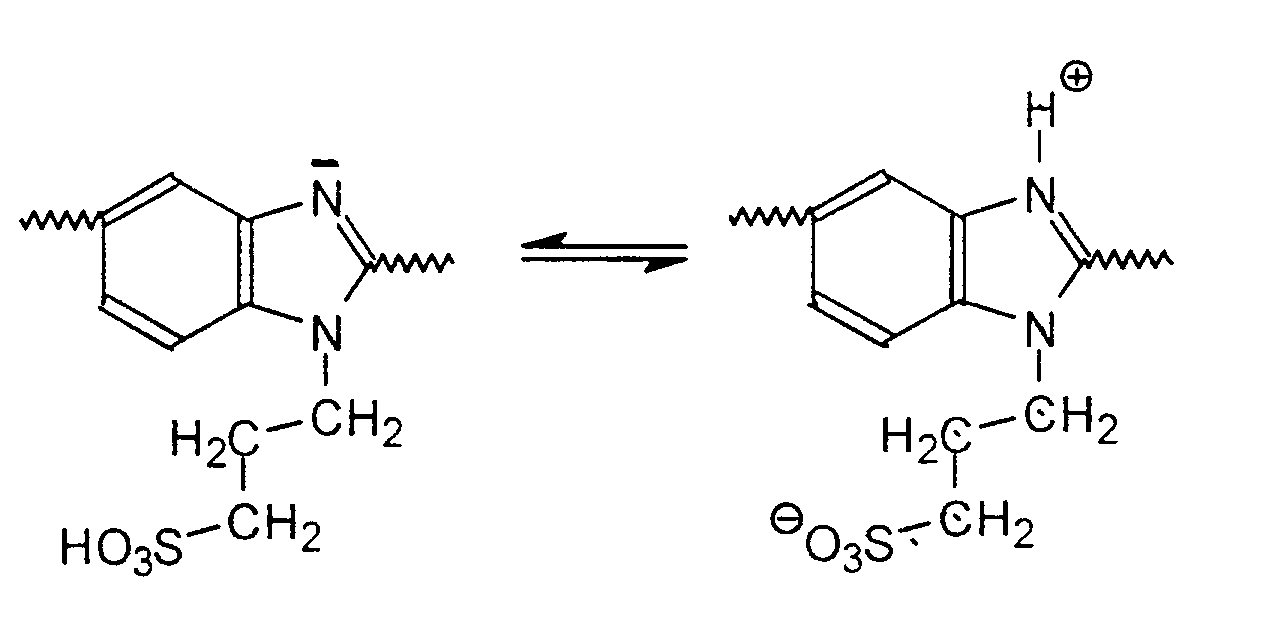


- R5 für -O- und
- R6 für -SO2-,
- R7 für
und

- R8 für -S- stehen
Poly(etheretherketone) mit ([R5-R2-R5-R2-R7]n; x = 1, R4=H)
Poly(ethersulfone) ([R1-R5-R2-R6-R2-R5]n; R2: x=1, R4=H),
Poly(ethersulfone) ([R2-R6-R2-R5]n; R2: x=1, R4=H),
Poly(phenylsulfone) ([(R2)2-R5-R2-R6-R2]n; R2: x=2, R4=H),
Polyetherethersulfone ([R5-R2-R5-R2-R6]n-[R5-R2-R6-R2]m; R2: x=1, R4=H, n / m =0,18),
Poly(phenylensulfide) ([R2-R8]n; R2: x=1, R4=H) und/oder
Poly(phenylenoxide) ([R2-R5]n; R4=CH3) mit den Imidazolgruppen oder Benzimidazolgruppen enthaltenden Polymeren umsetzt.
- Binäre Blends:
- 1a-2 oder 1b-2
- Ternäre Blends:
- 1a-2-3 oder 1b-2-3


- eine starke Verbesserung der mechanischen Festigkeit gegenüber der jeweiligen reinen polymeren Sulfonsäure (dem jeweiligen polymeren Sulfonsäuresalz);
- wasserlösliche polymere Sulfonsäuresalze verlieren überraschenderweise nach dem Zusammenmischen mit PBI ihre Wasserlöslichkeit aufgrund der Wechselwirkungen der Polymerketten der Blendkomponenten (Bildung von Wasserstoffbrücken-Bindungen).
- die Blends der polymeren Sulfonsäuren mit PBI weisen eine hohe thermische Stabilität bereits bei überraschend geringen Gehalten von PBI im Blend (3-10%) auf, verursacht durch Protonenübertragung von der Sulfonsäure auf den basischen Polybenzimidazol-Stickstoff unter Polysalzbildung und durch die hohe thermische Stabilität des PBI.

- die erfindungsgemäßen Blends werden ausschließlich in wässrigem Medium eingesetzt, d. h. hier ist Wasser der Ampholyt (siehe die Anwendungsbeispiele, bei der die Protonenleitfähigkeit bzw. der Protonenwiderstand in 0,5-molarer wässriger HCl gemessen wurde).
- bei den erfindungsgemäßen Säure-Base-Blends fungiert das Imidazol, Benzimidazol oder andere basische N-haltige heterocyclische, insbesondere heteroaromatische Gruppen enthaltende Polymer ausschließlich als Base, d. h. es bildet durch Protonenübertragung von der Säurekomponente ionische Bindungen zu dieser aus. Wie IR-spektroskopische Messungen ergeben haben, dissoziiert das Proton vom Imidazolium-Kation in wässrigem Medium nicht mehr ab, da die Imidazolgruppierung eine starke Base ist (pk b etwa 9-10).
- bei den erfindungsgemäßen Säure-Base-Blends läuft die Protonenleitung ausschließlich über die Sulfonsäuregruppen der sauren Blendkomponente. Aus diesem Grunde werden in der vorliegenden Erfindung Säure-Base-Blends bevorzugt, die die saure Komponente im molaren Überschuß enthalten.
- Binäre Anionenaustauscher-Blends aus Imidazol enthaltenden Polymeren und aus Anionenaustauscherpolymeren und ternäre Blends werden in DE 196 32 285 A1 nicht offenbart. Insbesondere die Blends aus Imidazol enthaltenden Polymeren, polymeren Säuren und einem weiteren basischen Polymer sind sehr vielversprechend, da bei diesen Blends die mechanische und thermische Stabilität noch weiter verbessert werden kann.
- sulfoniertem PEEK/PSU
- Polybenzimidazol
- aminiertem PSU
| Charakterisierungsergebnisse: | |
| Ionenaustauscherkapazität | 1,06 meq SO3H/g Polymer |
| Dicke | 20 µm |
| Quellung (H2O, RT, H+-Form) | 22,8% |
| Flächenwiderstand (RT, H+-Form) | 0,116 Ωcm2 (gemessen in 0,5 N HCl) |
| spezif. Widerstand (RT, H+-Form) | 58,125 Ωcm |
| thermische Stabilität (aus DSC, TGA) | Beginn Zersetzung: ≈350°C (Bedingungen: Luft, Aufheizrate 20°C/min) |
| Daten der Herstellung und Charakterisierung von Blendmembranen aus sulfoniertem PSU und dem Polybenzimidazol PBI Poly[2,2'-(m-phenylen)-5,5'-bibenzimidazol] | |||||||
| Membran | Menge PBI | Menge PSU | PBI-Gehalt Membran | Kapazität | Quellung | R H+ / a | R H+ / sp |
| [Nr] | [g] | [g] | [Gew%] | | [%] | [Ωcm2] | [Ωcm] |
| 58 | 0,25 | 2,7 | 8,5 | 2,087 | 118 | 0,107 | 6,56 |
| 60 | 0,357 | 1,428 | 20 | 1,068 | 30,8 | 0,178 | 46,78 |
| 61 | 0.357 | 2,023 | 15 | 1,457 | 43,26 | 0,074 | 16,5 |
| 62 | 0,357 | 3,213 | 10 | 1,842 | 107,5 | 0,061 | 6,65 |
| 68 | 0,357 | 1,071 | 25 | 0,83 | 17,26 | 0,497 | 292,35 |
| 57 | 0,25 | 2,25 | 10 | 0,46 | 8,75 | 0,718 | 194.05 |
| 69 | 0,357 | 7,14 | 5 | 1,12 | 14,56 | 0,119 | 51.85 |
| Charakterisierungsergebnisse: | |
| Ionenaustauscherkapazität | 0,93 meq SO3H/g Polymer |
| Dicke | 54 µm |
| Quellung (H2O, RT, H+-Form) | 25,6% |
| Flächenwiderstand (RT, H+-Form) | 0,62 Ωcm2 (gemessen in 0,5 N HCl) |
| spezif. Widerstand (RT, H+-Form) | 114,82 Ωcm |
| thermische Stabilität (aus DSC, TGA) | Beginn Zersetzung ≈300°C (Bedingungen: Luft, Aufheizrate 5°C/min) |
Claims (9)
- Verfahren zur Herstellung von Säure-Base-Polymerblends oder Säure-Base-Polymerblendmembranen, dadurch gekennzeichnet, daß man Lösungen von polymeren Sulfonsäuren oder Sulfonsäuresalzen, polymeren Phosphonsäuren oder Phosphonsäuresalzen und/oder polymeren Carbonsäuren oder Carbonsäuresalzen und einem basischen Imidazol, Benzimidazol- und/oder andere heterocyclische, insbesondere heteroaromatische Stickstoff-haltige basische Baugruppen wie Oxazol-, Isooxazol-, Carbazol-, Indol-, Isoindol-, Thiazol-, Isothiazol-, Benzoxazol-, Benzthiazol-, Imidazolidin-, Indazol-, 1,2,3-Oxadiazol-, 1,2,3-Thiadiazol-, 1,2,4-Thiadiazol-, 1,2,3-Triazol-, Benzotriazol-,- 1,2,4-Triazol-, Tetrazol-, Pyrrol-, Pyrrolidin-, Pyrrazolgruppen enthaltenden Polymer ggf. unter Addition von LiCl in dipolar-aprotischen Lösungsmitteln umsetzt und aus den Lösungen das Lösungsmittel verdampft, wobei man die SO3H-, PO3H2- oder COOH-Form der Blends durch Nachbehandlung des Blendpolymers oder der Blendpolymermembran in verdünnten Mineralsäuren bei Temperaturen von 20 bis 80 °C herstellt.
- Verfahren nach Anspruch 1, dadurch gekennzeichnet, daß man die polymeren Sulfonsäuren-, Phosphonsäuren- und/oder Carbonsäuren oder Salze die ausgewählt sind aus Polyetheretherketonen, Polyethersulfonen, Polyphenylsulfonen, Polyphenylensulfiden und/oder Polyphenylenoxiden.
- Verfahren nach Anspruch 1, dadurch gekennzeichnet, daß man polymere Sulfonsäure-, Phosphonsäure- und/oder Carbonsäuresalze ausgewählt aus Polymeren die als Repitiereinheit aromatische Kern-Stukturen der Formeln R1 oder R2 aufweisen, wobei
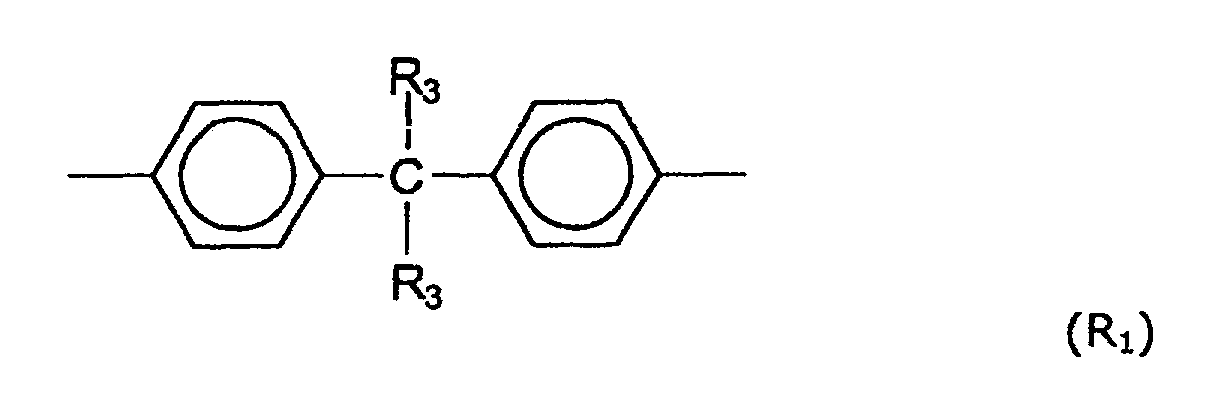 wobei
wobei die über Brückengruppen R5, R6, R7 oder R8 verknüpft sind, wobeiR3 für Wasserstoff, Trifluormethyl oder CnH2n+1, mit n = 1 bis 10, insbesondere MethylR4 für Wasserstoff, CnH2n+1 mit n = 1 bis 10, insbesondere Methyl oder Phenyl undx für 1, 2 oder 3 steht,insbesondere,R5 für -O- undR6 für -SO2-,R7 fürund
 R8 für -S- stehen
Poly(etheretherketone) mit ([R5-R2-R5-R2-R7]n; x = 1, R4=H)
Poly(ethersulfone) ([R1-R5-R2-R6-R2-R5]n; R2: x=1, R4=H),
Poly(ethersulfone) ([R2-R6-R2-R5]n; R2: x=1, R4=H),
Poly(phenylsulfone) ([(R2)2-R5-R2-R6-R2]n; R2: x=2, R4=H),
Polyetherethersulfone ([R5-R2-R5-R2-R6]n-[R5-R2-R6-R2]m; R2: x=1, R4=H, n / m =0,18),
Poly(phenylensulfide) ([R2-R8]n; R2: x=1, R4=H) und/oder
Poly(phenylenoxide) ([R2-R5]n; R4=CH3) mit den Imidazolgruppen oder Benzimidazolgruppen enthaltenden Polymeren umsetzt. - Verfahren nach den Ansprüchen 1 bis 3, dadurch gekennzeichnet, daß man zuerst eine polymere Sulfonsäure, Phosphonsäure und/oder Carbonsäure in einem dipolar-aprotischen Lösungsmittel auflöst, eine dem Gehalt an Säuregruppen äquivalente Menge eines primären, sekundären oder tertiären Amins zufügt, der Lösung danach ein festes oder in einem dipolar-aprotischen Lösungsmittel gelöstes basisches Polymer zusetzt, das Imidazolgruppen oder Benzimidazolgruppen und/oder heterocyclische, insbesondere heteroaromatische Stickstoff-haltige basische Baugruppen gemäß Anspruch 1 aufweist, und dieses Polymer auch in der Lösung auflöst.
- Verfahren nach den Ansprüchen 1 bis 4, dadurch gekennzeichnet, daß man der Lösung aus polymerer Sulfonsäure oder polymerem Sulfonsäuresalz, polymerer Phosphonsäure oder polymerem Phosphonsäuresalz, polymerer Carbonsäure oder polymerem Carbonsäuresalz und Imidazolgruppen oder Benzimidazolgruppen und/oder andere heterocyclische, insbesondere heteroaromatische Stickstoff-haltige basische Baugruppen enthaltendem basischem Polymer gemäß Anspruch 1 ein weiteres Polymer zusetzt, welches primäre, sekundäre oder tertiäre basische Stickstoffgruppen aufweist und dieses Polymer in der Lösung auflöst.
- Säure-Base-Polymerblends oder Säure-Base-Polymerblendmembranen, erhältlich nach einem Verfahren nach den Ansprüchen 1-5.
- Verfahren nach einem der Ansprüche 1 bis 5 , dadurch gekennzeichnet, daß man als Benzimidazolgruppen enthaltendes basisches Polymer Poly[(2,2'-m-phenylen)-5,5'-bibenzimidazol] einsetzt.
- Verwendung von Polymerblends nach Anspruch 6 in Form dünner Folien (Membranen) als protonenleitender Elektrolyt in Membranbrennstoffzellen (H2-Polymerelektrolytbrennstoffzellen oder Direktmethanolbrennstoffzellen), in der Polymerelektrolytmembran(PEM)-Elektrolyse, in der wässrigen oder nichtwässrigen Elektrodialyse oder in der Diffusionsdialyse.
- Verwendung von Polymerblends nach Anspruch 6 in Form dünner Folien (Membranen) oder in Form von Hohlfasern in der Pervaporation, Perstraktion, Gastrennung, Dialyse, Ultrafiltration, Nanofiltration oder Umkehrosmose.
Applications Claiming Priority (3)
| Application Number | Priority Date | Filing Date | Title |
|---|---|---|---|
| DE19817374 | 1998-04-18 | ||
| DE19817374A DE19817374A1 (de) | 1998-04-18 | 1998-04-18 | Engineering-Ionomerblends und Engineering-Ionomermembranen |
| PCT/EP1999/002755 WO1999054407A2 (de) | 1998-04-18 | 1999-04-16 | Engineering-ionomerblends und engineering-ionomerblendmembranen |
Publications (2)
| Publication Number | Publication Date |
|---|---|
| EP1076676A2 EP1076676A2 (de) | 2001-02-21 |
| EP1076676B1 true EP1076676B1 (de) | 2004-01-28 |
Family
ID=7865050
Family Applications (1)
| Application Number | Title | Priority Date | Filing Date |
|---|---|---|---|
| EP99920761A Expired - Lifetime EP1076676B1 (de) | 1998-04-18 | 1999-04-16 | Engineering-ionomerblends und engineering-ionomerblendmembranen |
Country Status (17)
| Country | Link |
|---|---|
| US (1) | US6723757B1 (de) |
| EP (1) | EP1076676B1 (de) |
| JP (1) | JP3688201B2 (de) |
| KR (1) | KR100586204B1 (de) |
| CN (1) | CN1231538C (de) |
| AT (1) | ATE258570T1 (de) |
| AU (1) | AU769177B2 (de) |
| BR (1) | BR9909720B1 (de) |
| CA (1) | CA2324963C (de) |
| DE (2) | DE19817374A1 (de) |
| DK (1) | DK1076676T3 (de) |
| ES (1) | ES2222031T3 (de) |
| IL (2) | IL139051A0 (de) |
| MX (1) | MXPA00010192A (de) |
| MY (1) | MY120071A (de) |
| WO (1) | WO1999054407A2 (de) |
| ZA (1) | ZA200005736B (de) |
Families Citing this family (67)
| Publication number | Priority date | Publication date | Assignee | Title |
|---|---|---|---|---|
| DE19851498A1 (de) * | 1998-11-09 | 2000-07-06 | Aventis Res & Tech Gmbh & Co | Polymerzusammensetzung, Membran enthaltend diese, Verfahren zu deren Herstellung und deren Verwendung |
| DE19919708A1 (de) * | 1999-04-30 | 2001-03-01 | Univ Stuttgart | Stufenweise Alkylierung von polymeren Aminen |
| US6638659B1 (en) * | 1999-04-30 | 2003-10-28 | University Of Connecticut | Membrane electrode assemblies using ionic composite membranes |
| GR1003647B (el) * | 1999-12-30 | 2001-08-30 | ����������������������������������������&�������������������...� | Μεμβρανεσαπολυμερωναεμποτισμενεσαμεαοξυαγιααχρησηαωσαστερεοιαηλεκτρολυτεσ.α |
| DE10010001A1 (de) * | 2000-03-02 | 2001-09-06 | Celanese Ventures Gmbh | Neue Blendpolymermembranen zum Einsatz in Brennstoffzellen |
| DE10021106A1 (de) * | 2000-05-02 | 2001-11-08 | Univ Stuttgart | Polymere Membranen |
| CN1439032A (zh) * | 2000-06-02 | 2003-08-27 | Sri国际公司 | 聚合物组合物 |
| DE10052237A1 (de) | 2000-10-21 | 2002-08-01 | Celanese Ventures Gmbh | Verfahren zur Herstellung einer Lösung von einem Polymer enthaltend wiederkehrende Azoleinheiten, nach dem Verfahren hergestellte Lösungen und deren Verwendung |
| DE10052242A1 (de) | 2000-10-21 | 2002-05-02 | Celanese Ventures Gmbh | Mit Säure dotierte, ein- oder mehrschichtige Kunststoffmembran mit Schichten aufweisend Polymerblends umfassend Polymere mit wiederkehrenden Azoleinheiten, Verfahren zur Herstellung solche Kunststoffmembranen sowie deren Verwendung |
| US7316855B2 (en) | 2001-06-01 | 2008-01-08 | Polyfuel, Inc. | Fuel cell assembly for portable electronic device and interface, control, and regulator circuit for fuel cell powered electronic device |
| ATE400904T1 (de) | 2001-06-01 | 2008-07-15 | Polyfuel Inc | Austauschbare brennstoffpatrone, brennstoffzellenaggregat mit besagter brennstoffpatrone für tragbare elektronische geräte und entsprechendes gerät |
| DE10207411A1 (de) | 2002-02-21 | 2003-09-04 | Daimler Chrysler Ag | Verfahren zur Herstellung von Kompositmembranen |
| CN100383180C (zh) * | 2002-05-09 | 2008-04-23 | 华南理工大学 | 低温直接甲醇燃料电池用聚乙烯磺酸膜及其制备方法 |
| WO2003095509A1 (en) | 2002-05-13 | 2003-11-20 | Polyfuel, Inc. | Sulfonated copolymer |
| CA2485971A1 (en) | 2002-05-13 | 2004-05-21 | Polyfuel, Inc. | Ion conductive block copolymers |
| US7354679B2 (en) | 2002-05-13 | 2008-04-08 | Polyfuel, Inc. | Ion conductive random copolymers |
| US20040018410A1 (en) * | 2002-06-10 | 2004-01-29 | Hongli Dai | Additive for direct methanol fuel cells |
| JP3878521B2 (ja) * | 2002-07-18 | 2007-02-07 | 本田技研工業株式会社 | プロトン伝導性高分子固体電解質およびその製造方法 |
| JP3878520B2 (ja) * | 2002-07-18 | 2007-02-07 | 本田技研工業株式会社 | プロトン伝導性高分子固体電解質およびその製造方法 |
| DE10246373A1 (de) | 2002-10-04 | 2004-04-15 | Celanese Ventures Gmbh | Protonenleitende Polymermembran umfassend Sulfonsäuregruppen enthaltende Polyazole und deren Anwendung in Brennstoffzellen |
| DE10246461A1 (de) | 2002-10-04 | 2004-04-15 | Celanese Ventures Gmbh | Protonenleitende Polymermembran enthaltend Polyazolblends und deren Anwendung in Brennstoffzellen |
| DE10320320B4 (de) * | 2003-05-06 | 2007-08-16 | Forschungszentrum Jülich GmbH | Katalysatorschicht, geeignete Katalysatorpaste, sowie Herstellungsverfahren derselben |
| CN100446312C (zh) * | 2003-06-25 | 2008-12-24 | 东丽株式会社 | 高分子电解质、以及使用了该高分子电解质的高分子电解质膜、膜电极复合体和高分子电解质型燃料电池 |
| GB2421505B (en) * | 2003-06-27 | 2008-09-17 | Asahi Kasei Chemicals Corp | Polymer electrolyte membrane having high durability and method for producing the same |
| DE10340929A1 (de) * | 2003-09-04 | 2005-04-07 | Celanese Ventures Gmbh | Protonenleitende Polymermembran umfassend mindestens ein poröses Trägermaterial und deren Anwendung in Brennstoffzellen |
| DE10340927A1 (de) * | 2003-09-04 | 2005-03-31 | Celanese Ventures Gmbh | Protonenleitende Polymermembran enthaltend Polymere mit an aromatische Gruppen kovalent gebundene Sulfonsäuregruppen, Membran-Elektoden-Einheit und deren Anwendung in Brennstoffzellen |
| JP4512843B2 (ja) * | 2003-11-17 | 2010-07-28 | Jsr株式会社 | 酸塩基複合型高分子電解質膜 |
| JP2005222890A (ja) * | 2004-02-09 | 2005-08-18 | Toyota Motor Corp | 燃料電池用電解質材料 |
| WO2005103161A1 (ja) | 2004-04-23 | 2005-11-03 | Asahi Kasei Chemicals Corporation | 芳香族炭化水素系樹脂を含有する高分子電解質組成物 |
| DE102004023038B4 (de) * | 2004-05-06 | 2008-07-31 | "Stiftung Caesar" (Center Of Advanced European Studies And Research) | Protonenleitende Polymerelectrolytmembran |
| WO2006018020A2 (de) * | 2004-08-20 | 2006-02-23 | Universität Stuttgart | Ionomere mit ionogenen gruppen in der seitenkette |
| WO2006025351A1 (ja) * | 2004-09-03 | 2006-03-09 | Toray Industries, Inc. | 高分子電解質材料、高分子電解質部品、膜電極複合体、および高分子電解質型燃料電池 |
| EP1788654B1 (de) * | 2004-09-09 | 2011-11-16 | Asahi Kasei Chemicals Corporation | Fest-polymerelektrolytmembran und herstellungsverfahren dafür |
| US7435496B2 (en) * | 2005-01-12 | 2008-10-14 | Toyota Motor Engineering & Manufacturing North America, Inc. | Anhydrous proton conductor based on heterocycle attached to a polymer backbone |
| JP4936673B2 (ja) * | 2005-02-10 | 2012-05-23 | 株式会社東芝 | 高分子電解質膜および直接メタノール型燃料電池 |
| JP5004525B2 (ja) * | 2005-07-01 | 2012-08-22 | 株式会社トクヤマ | 燃料電池用隔膜 |
| US7923166B2 (en) * | 2005-07-01 | 2011-04-12 | Tokuyama Corporation | Separating membrane for fuel cell |
| US20070020501A1 (en) * | 2005-07-21 | 2007-01-25 | Ling-Feng Li | Polyelectrolyte membranes as separator for battery and fuel cell applications |
| JP5132115B2 (ja) * | 2005-09-30 | 2013-01-30 | 株式会社トクヤマ | 燃料電池用隔膜 |
| CA2878756A1 (en) * | 2005-09-30 | 2007-04-12 | Battelle Memorial Institute | Polymers for use in fuel cell components |
| DE102006040749A1 (de) | 2006-08-31 | 2008-03-06 | Daimler Ag | Oxidationsstabilisierte Polymer-Elektrolyt-Membranen für Brennstoffzellen |
| US20080063914A1 (en) * | 2006-09-11 | 2008-03-13 | Nora Gourdoupi | High temperature polymer electrolyte membranes and membrane electrode assemblies based on blends of aromatic polyethers |
| WO2008031199A1 (en) * | 2006-09-11 | 2008-03-20 | Transfert Plus, S.E.C. | Ionic compounds having bronsted acidity and uses thereof |
| JP5211317B2 (ja) * | 2007-01-12 | 2013-06-12 | 国立大学法人山梨大学 | プロトン伝導性芳香族高分子、プロトン伝導性芳香族高分子膜及びそれを用いた燃料電池 |
| US8304134B2 (en) * | 2007-02-21 | 2012-11-06 | Asahi Kasei E-Materials Corporation | Polymer electrolyte composition, polymer electrolyte membrane, membrane electrode assembly and solid polymer electrolyte-based fuel cell |
| JP5245269B2 (ja) * | 2007-03-28 | 2013-07-24 | 株式会社豊田中央研究所 | 複合電解質及び固体高分子型燃料電池 |
| WO2009096786A1 (en) * | 2008-01-30 | 2009-08-06 | Doetze Jakob Sikkema | Novel phenol compounds and (co)polymers thereof |
| US8008404B2 (en) * | 2008-05-09 | 2011-08-30 | GM Global Technology Operations LLC | Composite membrane |
| US8623124B2 (en) * | 2008-10-07 | 2014-01-07 | National University Of Singapore | Polymer blends and carbonized polymer blends |
| EP2481119A1 (de) * | 2009-09-24 | 2012-08-01 | EWE-Forschungszentrum Für Energietechnologie E.V. | Protonenaustauschmembran mit polymermischungen für hochtemperatur-protonenaustauschmembran-brennstoffzellen |
| CA2784974A1 (en) * | 2009-12-04 | 2011-06-09 | Prudent Energy Inc. | Polymer blend proton exchange membrane and preparation method thereof |
| CN101798394B (zh) * | 2009-12-28 | 2011-12-21 | 东北大学 | 一种磷酸掺杂的具有自组装结构的磺酸化聚合物复合膜的制备方法 |
| US9393557B2 (en) * | 2010-01-09 | 2016-07-19 | Dais Analytic Corporation | Anionic exchange electrolyte polymer membranes |
| KR20130020000A (ko) | 2011-08-18 | 2013-02-27 | 삼성전자주식회사 | 다공성막, 이를 포함하는 전해질막, 그 제조방법 및 이를 채용한 연료전지 |
| JP6282585B2 (ja) * | 2012-05-14 | 2018-02-21 | 東レ株式会社 | 半透膜およびその製造方法、半透膜を用いた濃度差発電方法 |
| CN102728237A (zh) * | 2012-06-20 | 2012-10-17 | 中国科学技术大学 | 均相阴离子交换膜及其制备方法 |
| CN104610674A (zh) * | 2013-10-24 | 2015-05-13 | 上海大学 | 聚苯乙烯膦酸/聚苯乙烯-1,2,3-三唑酸碱复合质子交换膜及其制备方法 |
| WO2015133594A1 (ja) * | 2014-03-07 | 2015-09-11 | 東レ株式会社 | 高分子電解質膜、およびそれを用いた触媒層付電解質膜、膜電極複合体および固体高分子型燃料電池 |
| CA2941371C (en) | 2014-03-07 | 2023-01-03 | Toray Industries, Inc. | Polymer electrolyte membrane, catalyst coated membrane, membrane electrode assembly, and polymer electrolyte fuel cell |
| CN105457511B (zh) * | 2015-03-10 | 2017-08-25 | 合肥工业大学 | 基于1,2,3‑三氮唑鎓盐的阴离子交换膜材料及其制备方法和应用 |
| EP3411430B1 (de) * | 2016-02-03 | 2025-08-13 | Camx Power, L.L.C. | Bipolare ionomer-membran |
| CN108281692B (zh) * | 2018-02-11 | 2020-05-05 | 温州市赢创新材料技术有限公司 | 一种磷化聚苯醚质子交换膜及其制备方法 |
| CN109320692B (zh) * | 2018-09-21 | 2020-01-31 | 中国科学院长春应用化学研究所 | 一种含阳离子基团无醚键聚芴烷撑、其制备方法和阴离子交换膜 |
| DE102019008024A1 (de) * | 2019-11-18 | 2021-05-20 | Universität Stuttgart | Kationenaustauscher- und Anionenaustauscherpolymere und -(blend)membranen aus hochfluorierte aromatische Gruppen enthaltenden Polymeren mittlels nucleophiler Substitution |
| CN112126946B (zh) * | 2020-09-15 | 2021-08-27 | 中国科学院大连化学物理研究所 | 一种酸碱水电解用复合膜及其制备方法和应用 |
| EP3993115A1 (de) * | 2020-10-31 | 2022-05-04 | Mann+Hummel Life Sciences & Environment Holding Singapore Pte. Ltd. | Membranen aus säure-base-polymermischungen |
| US12278363B1 (en) | 2024-04-29 | 2025-04-15 | Camx Power, Llc | Multiple morphology composite cathode materials providing high energy and long cycle life and cells employing the same |
Family Cites Families (11)
| Publication number | Priority date | Publication date | Assignee | Title |
|---|---|---|---|---|
| US4020142A (en) | 1975-08-21 | 1977-04-26 | Celanese Corporation | Chemical modification of polybenzimidazole semipermeable |
| US5525430A (en) * | 1986-12-31 | 1996-06-11 | Chahroudi; Day | Electrically activated thermochromic optical shutters |
| US5008339A (en) * | 1987-01-20 | 1991-04-16 | California Institute Of Technology | Novel polyelectrolyte copolymer and mixed polymers and composites thereof |
| US4898917A (en) * | 1987-09-11 | 1990-02-06 | Hoechst Celanese Corporation | N-substituted polybenzimidazole polymer |
| US4842740A (en) * | 1988-08-05 | 1989-06-27 | Hoechst Celanese Corporation | Membranes prepared from blend of polybenzimidazole with polyarylates |
| DE4026154C2 (de) * | 1990-08-17 | 1994-05-19 | Fraunhofer Ges Forschung | Bipolare Mehrschichtmembranen |
| JPH0691949B2 (ja) | 1992-04-23 | 1994-11-16 | 通商産業省基礎産業局長 | ポリイオンコンプレックス製分離膜 |
| US5525436A (en) | 1994-11-01 | 1996-06-11 | Case Western Reserve University | Proton conducting polymers used as membranes |
| US5599639A (en) * | 1995-08-31 | 1997-02-04 | Hoechst Celanese Corporation | Acid-modified polybenzimidazole fuel cell elements |
| DE19632285A1 (de) | 1996-08-09 | 1998-02-19 | Hoechst Ag | Protonenleiter mit einer Temperaturbeständigkeit in einem weiten Bereich und guten Protonenleitfähigkeiten |
| DE19817376A1 (de) * | 1998-04-18 | 1999-10-21 | Univ Stuttgart Lehrstuhl Und I | Säure-Base-Polymerblends und ihre Verwendung in Membranprozessen |
-
1998
- 1998-04-18 DE DE19817374A patent/DE19817374A1/de not_active Withdrawn
-
1999
- 1999-04-16 US US09/647,811 patent/US6723757B1/en not_active Expired - Lifetime
- 1999-04-16 MX MXPA00010192A patent/MXPA00010192A/es active IP Right Grant
- 1999-04-16 WO PCT/EP1999/002755 patent/WO1999054407A2/de not_active Ceased
- 1999-04-16 ES ES99920761T patent/ES2222031T3/es not_active Expired - Lifetime
- 1999-04-16 DK DK99920761T patent/DK1076676T3/da active
- 1999-04-16 BR BRPI9909720-6A patent/BR9909720B1/pt not_active IP Right Cessation
- 1999-04-16 CN CNB998051748A patent/CN1231538C/zh not_active Expired - Fee Related
- 1999-04-16 IL IL13905199A patent/IL139051A0/xx unknown
- 1999-04-16 JP JP2000544745A patent/JP3688201B2/ja not_active Expired - Lifetime
- 1999-04-16 KR KR1020007011575A patent/KR100586204B1/ko not_active Expired - Fee Related
- 1999-04-16 DE DE59908425T patent/DE59908425D1/de not_active Expired - Lifetime
- 1999-04-16 AU AU38216/99A patent/AU769177B2/en not_active Expired
- 1999-04-16 CA CA2324963A patent/CA2324963C/en not_active Expired - Fee Related
- 1999-04-16 AT AT99920761T patent/ATE258570T1/de active
- 1999-04-16 MY MYPI99001471A patent/MY120071A/en unknown
- 1999-04-16 EP EP99920761A patent/EP1076676B1/de not_active Expired - Lifetime
-
2000
- 2000-10-16 IL IL139051A patent/IL139051A/en not_active IP Right Cessation
- 2000-10-17 ZA ZA200005736A patent/ZA200005736B/en unknown
Also Published As
| Publication number | Publication date |
|---|---|
| WO1999054407A2 (de) | 1999-10-28 |
| CN1231538C (zh) | 2005-12-14 |
| DE59908425D1 (de) | 2004-03-04 |
| JP2002512291A (ja) | 2002-04-23 |
| AU769177B2 (en) | 2004-01-15 |
| KR100586204B1 (ko) | 2006-06-07 |
| AU3821699A (en) | 1999-11-08 |
| ZA200005736B (en) | 2002-01-17 |
| DE19817374A1 (de) | 1999-10-21 |
| CA2324963C (en) | 2016-06-21 |
| DK1076676T3 (da) | 2004-06-01 |
| US6723757B1 (en) | 2004-04-20 |
| ATE258570T1 (de) | 2004-02-15 |
| MXPA00010192A (es) | 2002-08-06 |
| CA2324963A1 (en) | 1999-10-28 |
| BR9909720A (pt) | 2000-12-26 |
| BR9909720B1 (pt) | 2010-09-21 |
| HK1034989A1 (en) | 2001-11-09 |
| EP1076676A2 (de) | 2001-02-21 |
| MY120071A (en) | 2005-08-30 |
| WO1999054407A3 (de) | 2000-03-09 |
| KR20010042819A (ko) | 2001-05-25 |
| ES2222031T3 (es) | 2005-01-16 |
| JP3688201B2 (ja) | 2005-08-24 |
| IL139051A0 (en) | 2001-11-25 |
| CN1297467A (zh) | 2001-05-30 |
| IL139051A (en) | 2010-11-30 |
Similar Documents
| Publication | Publication Date | Title |
|---|---|---|
| WO1999054407A2 (de) | Engineering-ionomerblends und engineering-ionomerblendmembranen | |
| EP1073690B1 (de) | Säure-base-polymerblends und ihre verwendung in membranprozessen | |
| EP1427517B1 (de) | Protonleitende membran und beschichtung | |
| DE69933129T2 (de) | Ionenaustauschpolymere | |
| JP3729735B2 (ja) | イオン交換膜の製造方法 | |
| DE102014009170A1 (de) | Kombinatorisches Materialsystem für Ionenaustauschermembranen und dessen Verwendung in elektrochemischen Prozessen | |
| EP1175254A1 (de) | Stufenweise alkylierung von polymeren aminen | |
| EP1105433A1 (de) | Modifikation von engineeringpolymeren mit n-basischen gruppen und mit ionenaustauschergruppen in der seitenkette | |
| DE10209784A1 (de) | Sulfinatgruppen enthaltende Oligomere und Polymere und Verfahren zu ihrer Herstellung | |
| WO2021099315A1 (de) | Kationenaustauscher- und anionenaustauscherpolymere und -(blend)membranen aus hochfluorierte aromatische gruppen enthaltenden polymeren mittels nucleophiler substitution | |
| DE10019732A1 (de) | Säure-Base-Polymermembranen | |
| HK1034989B (en) | Engineering ionomeric blends and engineering ionomeric blend membranes | |
| EP1420037B1 (de) | Ionenleitende Membran für elektrochemische Anwendungen | |
| DE10024575A1 (de) | Kovalent vernetzte Polymere und Polymermembranen via Sulfinatalkylierung | |
| DE10148132A9 (de) | Ionenleitende Membran für elektrochemische Anwendungen | |
| HK1034988B (en) | Acid-base polymer blends and their use in membrane processes |
Legal Events
| Date | Code | Title | Description |
|---|---|---|---|
| PUAI | Public reference made under article 153(3) epc to a published international application that has entered the european phase |
Free format text: ORIGINAL CODE: 0009012 |
|
| 17P | Request for examination filed |
Effective date: 20000912 |
|
| AK | Designated contracting states |
Kind code of ref document: A2 Designated state(s): AT BE CH CY DE DK ES FI FR GB GR IE IT LI LU MC NL PT SE |
|
| 17Q | First examination report despatched |
Effective date: 20020531 |
|
| GRAP | Despatch of communication of intention to grant a patent |
Free format text: ORIGINAL CODE: EPIDOSNIGR1 |
|
| GRAS | Grant fee paid |
Free format text: ORIGINAL CODE: EPIDOSNIGR3 |
|
| GRAA | (expected) grant |
Free format text: ORIGINAL CODE: 0009210 |
|
| AK | Designated contracting states |
Kind code of ref document: B1 Designated state(s): AT BE CH CY DE DK ES FI FR GB GR IE IT LI LU MC NL PT SE |
|
| PG25 | Lapsed in a contracting state [announced via postgrant information from national office to epo] |
Ref country code: IT Free format text: LAPSE BECAUSE OF FAILURE TO SUBMIT A TRANSLATION OF THE DESCRIPTION OR TO PAY THE FEE WITHIN THE PRESCRIBED TIME-LIMIT;WARNING: LAPSES OF ITALIAN PATENTS WITH EFFECTIVE DATE BEFORE 2007 MAY HAVE OCCURRED AT ANY TIME BEFORE 2007. THE CORRECT EFFECTIVE DATE MAY BE DIFFERENT FROM THE ONE RECORDED. Effective date: 20040128 Ref country code: IE Free format text: LAPSE BECAUSE OF FAILURE TO SUBMIT A TRANSLATION OF THE DESCRIPTION OR TO PAY THE FEE WITHIN THE PRESCRIBED TIME-LIMIT Effective date: 20040128 Ref country code: FI Free format text: LAPSE BECAUSE OF FAILURE TO SUBMIT A TRANSLATION OF THE DESCRIPTION OR TO PAY THE FEE WITHIN THE PRESCRIBED TIME-LIMIT Effective date: 20040128 Ref country code: CY Free format text: LAPSE BECAUSE OF FAILURE TO SUBMIT A TRANSLATION OF THE DESCRIPTION OR TO PAY THE FEE WITHIN THE PRESCRIBED TIME-LIMIT Effective date: 20040128 |
|
| REG | Reference to a national code |
Ref country code: GB Ref legal event code: FG4D Free format text: NOT ENGLISH |
|
| REG | Reference to a national code |
Ref country code: CH Ref legal event code: EP |
|
| REG | Reference to a national code |
Ref country code: IE Ref legal event code: FG4D Free format text: GERMAN |
|
| REF | Corresponds to: |
Ref document number: 59908425 Country of ref document: DE Date of ref document: 20040304 Kind code of ref document: P |
|
| GBT | Gb: translation of ep patent filed (gb section 77(6)(a)/1977) |
Effective date: 20040312 |
|
| PG25 | Lapsed in a contracting state [announced via postgrant information from national office to epo] |
Ref country code: LU Free format text: LAPSE BECAUSE OF NON-PAYMENT OF DUE FEES Effective date: 20040416 |
|
| PG25 | Lapsed in a contracting state [announced via postgrant information from national office to epo] |
Ref country code: SE Free format text: LAPSE BECAUSE OF FAILURE TO SUBMIT A TRANSLATION OF THE DESCRIPTION OR TO PAY THE FEE WITHIN THE PRESCRIBED TIME-LIMIT Effective date: 20040428 Ref country code: GR Free format text: LAPSE BECAUSE OF FAILURE TO SUBMIT A TRANSLATION OF THE DESCRIPTION OR TO PAY THE FEE WITHIN THE PRESCRIBED TIME-LIMIT Effective date: 20040428 |
|
| PG25 | Lapsed in a contracting state [announced via postgrant information from national office to epo] |
Ref country code: MC Free format text: LAPSE BECAUSE OF NON-PAYMENT OF DUE FEES Effective date: 20040430 |
|
| REG | Reference to a national code |
Ref country code: DK Ref legal event code: T3 |
|
| REG | Reference to a national code |
Ref country code: IE Ref legal event code: FD4D |
|
| ET | Fr: translation filed | ||
| REG | Reference to a national code |
Ref country code: HK Ref legal event code: GR Ref document number: 1034989 Country of ref document: HK |
|
| PLBE | No opposition filed within time limit |
Free format text: ORIGINAL CODE: 0009261 |
|
| STAA | Information on the status of an ep patent application or granted ep patent |
Free format text: STATUS: NO OPPOSITION FILED WITHIN TIME LIMIT |
|
| REG | Reference to a national code |
Ref country code: ES Ref legal event code: FG2A Ref document number: 2222031 Country of ref document: ES Kind code of ref document: T3 |
|
| 26N | No opposition filed |
Effective date: 20041029 |
|
| PG25 | Lapsed in a contracting state [announced via postgrant information from national office to epo] |
Ref country code: PT Free format text: LAPSE BECAUSE OF NON-PAYMENT OF DUE FEES Effective date: 20040628 |
|
| REG | Reference to a national code |
Ref country code: FR Ref legal event code: PLFP Year of fee payment: 18 |
|
| PGFP | Annual fee paid to national office [announced via postgrant information from national office to epo] |
Ref country code: NL Payment date: 20160429 Year of fee payment: 18 |
|
| PGFP | Annual fee paid to national office [announced via postgrant information from national office to epo] |
Ref country code: AT Payment date: 20160502 Year of fee payment: 18 Ref country code: BE Payment date: 20160429 Year of fee payment: 18 |
|
| PGFP | Annual fee paid to national office [announced via postgrant information from national office to epo] |
Ref country code: DK Payment date: 20170428 Year of fee payment: 19 |
|
| REG | Reference to a national code |
Ref country code: FR Ref legal event code: PLFP Year of fee payment: 19 |
|
| REG | Reference to a national code |
Ref country code: NL Ref legal event code: MM Effective date: 20170501 |
|
| REG | Reference to a national code |
Ref country code: AT Ref legal event code: MM01 Ref document number: 258570 Country of ref document: AT Kind code of ref document: T Effective date: 20170416 |
|
| PG25 | Lapsed in a contracting state [announced via postgrant information from national office to epo] |
Ref country code: AT Free format text: LAPSE BECAUSE OF NON-PAYMENT OF DUE FEES Effective date: 20170416 Ref country code: NL Free format text: LAPSE BECAUSE OF NON-PAYMENT OF DUE FEES Effective date: 20170501 |
|
| REG | Reference to a national code |
Ref country code: BE Ref legal event code: MM Effective date: 20170430 |
|
| REG | Reference to a national code |
Ref country code: FR Ref legal event code: PLFP Year of fee payment: 20 |
|
| PG25 | Lapsed in a contracting state [announced via postgrant information from national office to epo] |
Ref country code: BE Free format text: LAPSE BECAUSE OF NON-PAYMENT OF DUE FEES Effective date: 20170430 |
|
| PGFP | Annual fee paid to national office [announced via postgrant information from national office to epo] |
Ref country code: DE Payment date: 20180430 Year of fee payment: 20 |
|
| PGFP | Annual fee paid to national office [announced via postgrant information from national office to epo] |
Ref country code: FR Payment date: 20180430 Year of fee payment: 20 |
|
| REG | Reference to a national code |
Ref country code: DK Ref legal event code: EBP Effective date: 20180430 |
|
| PGFP | Annual fee paid to national office [announced via postgrant information from national office to epo] |
Ref country code: GB Payment date: 20181031 Year of fee payment: 20 Ref country code: CH Payment date: 20181031 Year of fee payment: 20 Ref country code: ES Payment date: 20181031 Year of fee payment: 20 |
|
| REG | Reference to a national code |
Ref country code: DE Ref legal event code: R071 Ref document number: 59908425 Country of ref document: DE |
|
| REG | Reference to a national code |
Ref country code: CH Ref legal event code: PL |
|
| REG | Reference to a national code |
Ref country code: GB Ref legal event code: PE20 Expiry date: 20190415 |
|
| PG25 | Lapsed in a contracting state [announced via postgrant information from national office to epo] |
Ref country code: DK Free format text: LAPSE BECAUSE OF NON-PAYMENT OF DUE FEES Effective date: 20180430 |
|
| PG25 | Lapsed in a contracting state [announced via postgrant information from national office to epo] |
Ref country code: GB Free format text: LAPSE BECAUSE OF EXPIRATION OF PROTECTION Effective date: 20190415 |
|
| REG | Reference to a national code |
Ref country code: ES Ref legal event code: FD2A Effective date: 20200803 |
|
| PG25 | Lapsed in a contracting state [announced via postgrant information from national office to epo] |
Ref country code: ES Free format text: LAPSE BECAUSE OF EXPIRATION OF PROTECTION Effective date: 20190417 |