EP0973039A2 - Robotersystem zum transportieren von Behältern und Objekte in einem automatisierten analytischen Instrument, und Wartungswerkzeug zu deren Wartung - Google Patents
Robotersystem zum transportieren von Behältern und Objekte in einem automatisierten analytischen Instrument, und Wartungswerkzeug zu deren Wartung Download PDFInfo
- Publication number
- EP0973039A2 EP0973039A2 EP99113524A EP99113524A EP0973039A2 EP 0973039 A2 EP0973039 A2 EP 0973039A2 EP 99113524 A EP99113524 A EP 99113524A EP 99113524 A EP99113524 A EP 99113524A EP 0973039 A2 EP0973039 A2 EP 0973039A2
- Authority
- EP
- European Patent Office
- Prior art keywords
- robotic arm
- instrument
- fingers
- rail
- arm
- Prior art date
- Legal status (The legal status is an assumption and is not a legal conclusion. Google has not performed a legal analysis and makes no representation as to the accuracy of the status listed.)
- Withdrawn
Links
- 230000033001 locomotion Effects 0.000 claims description 45
- 238000000034 method Methods 0.000 claims description 16
- 230000008878 coupling Effects 0.000 claims description 2
- 238000010168 coupling process Methods 0.000 claims description 2
- 238000005859 coupling reaction Methods 0.000 claims description 2
- 238000000926 separation method Methods 0.000 claims description 2
- 238000012360 testing method Methods 0.000 abstract description 87
- 210000003811 finger Anatomy 0.000 description 104
- 230000032258 transport Effects 0.000 description 39
- 239000003153 chemical reaction reagent Substances 0.000 description 24
- 230000003287 optical effect Effects 0.000 description 12
- 239000003085 diluting agent Substances 0.000 description 11
- 238000004458 analytical method Methods 0.000 description 8
- 230000001133 acceleration Effects 0.000 description 6
- 238000010790 dilution Methods 0.000 description 6
- 239000012895 dilution Substances 0.000 description 6
- 230000008569 process Effects 0.000 description 6
- 239000007788 liquid Substances 0.000 description 5
- 238000013459 approach Methods 0.000 description 3
- 230000007246 mechanism Effects 0.000 description 3
- 230000003213 activating effect Effects 0.000 description 2
- 230000004913 activation Effects 0.000 description 2
- 230000008859 change Effects 0.000 description 2
- 238000010276 construction Methods 0.000 description 2
- 230000036461 convulsion Effects 0.000 description 2
- 238000001514 detection method Methods 0.000 description 2
- 230000006870 function Effects 0.000 description 2
- 239000011521 glass Substances 0.000 description 2
- 238000012986 modification Methods 0.000 description 2
- 230000004048 modification Effects 0.000 description 2
- 229920003023 plastic Polymers 0.000 description 2
- 238000012545 processing Methods 0.000 description 2
- 229910001369 Brass Inorganic materials 0.000 description 1
- 230000009471 action Effects 0.000 description 1
- 239000012190 activator Substances 0.000 description 1
- 230000001154 acute effect Effects 0.000 description 1
- 230000000712 assembly Effects 0.000 description 1
- 238000000429 assembly Methods 0.000 description 1
- 238000005452 bending Methods 0.000 description 1
- 210000001124 body fluid Anatomy 0.000 description 1
- 239000010839 body fluid Substances 0.000 description 1
- 239000010951 brass Substances 0.000 description 1
- 238000004140 cleaning Methods 0.000 description 1
- 238000013461 design Methods 0.000 description 1
- 238000003113 dilution method Methods 0.000 description 1
- 230000009977 dual effect Effects 0.000 description 1
- 230000000694 effects Effects 0.000 description 1
- 238000009429 electrical wiring Methods 0.000 description 1
- 239000003792 electrolyte Substances 0.000 description 1
- 230000007613 environmental effect Effects 0.000 description 1
- 238000003018 immunoassay Methods 0.000 description 1
- 239000003562 lightweight material Substances 0.000 description 1
- 238000005461 lubrication Methods 0.000 description 1
- 238000012423 maintenance Methods 0.000 description 1
- 238000013507 mapping Methods 0.000 description 1
- 238000005259 measurement Methods 0.000 description 1
- 230000010355 oscillation Effects 0.000 description 1
- 230000000737 periodic effect Effects 0.000 description 1
- 230000000644 propagated effect Effects 0.000 description 1
- 230000001902 propagating effect Effects 0.000 description 1
- 238000011084 recovery Methods 0.000 description 1
- 230000009467 reduction Effects 0.000 description 1
- 230000000717 retained effect Effects 0.000 description 1
- 230000002441 reversible effect Effects 0.000 description 1
- 101150073388 rpl3 gene Proteins 0.000 description 1
- 238000006467 substitution reaction Methods 0.000 description 1
- 230000001360 synchronised effect Effects 0.000 description 1
- 210000003813 thumb Anatomy 0.000 description 1
- 230000007704 transition Effects 0.000 description 1
- GYTROFMCUJZKNA-UHFFFAOYSA-N triethyl triethoxysilyl silicate Chemical compound CCO[Si](OCC)(OCC)O[Si](OCC)(OCC)OCC GYTROFMCUJZKNA-UHFFFAOYSA-N 0.000 description 1
- 239000011800 void material Substances 0.000 description 1
Images











Classifications
-
- G—PHYSICS
- G01—MEASURING; TESTING
- G01N—INVESTIGATING OR ANALYSING MATERIALS BY DETERMINING THEIR CHEMICAL OR PHYSICAL PROPERTIES
- G01N35/00—Automatic analysis not limited to methods or materials provided for in any single one of groups G01N1/00 - G01N33/00; Handling materials therefor
- G01N35/0099—Automatic analysis not limited to methods or materials provided for in any single one of groups G01N1/00 - G01N33/00; Handling materials therefor comprising robots or similar manipulators
-
- Y—GENERAL TAGGING OF NEW TECHNOLOGICAL DEVELOPMENTS; GENERAL TAGGING OF CROSS-SECTIONAL TECHNOLOGIES SPANNING OVER SEVERAL SECTIONS OF THE IPC; TECHNICAL SUBJECTS COVERED BY FORMER USPC CROSS-REFERENCE ART COLLECTIONS [XRACs] AND DIGESTS
- Y10—TECHNICAL SUBJECTS COVERED BY FORMER USPC
- Y10S—TECHNICAL SUBJECTS COVERED BY FORMER USPC CROSS-REFERENCE ART COLLECTIONS [XRACs] AND DIGESTS
- Y10S294/00—Handling: hand and hoist-line implements
- Y10S294/907—Sensor controlled device
Definitions
- This invention relates to the use of one or more robotic arms in an automated analytical instrument to transport test tubes and other containers or objects between various locations within the instrument and optionally to and from a transport line system in an automated laboratory transport system.
- Robotics have been incorporated into analytical instruments in various ways. The most common use of robotics in these instruments has been to transport a pipette to aspirate liquid from a test tube. Another use of robotics has been to transport a test tube rack within an automated testing system, as described in U.S. Patent No. 5,260,872.
- Robotics have also been used to transport test tubes within an instrument.
- U.S. Patent No. 4,835,711 to Hutchins et al. illustrates a robotic arm transporting a test tube to various work stations which are placed in a circle around the robotic arm.
- the robotic arm is mounted to a fixed position on the workstation and rotates about an axis perpendicular to the surface of the workstation.
- the test tube appears to be gripped within gripper fingers, the ends of which are curved in the shape of the test tube. No provision is made to transport containers other than test tubes.
- FIG. 90/03834 Another robotic arm for transporting a test tube is shown in International Publication No. WO 90/03834. This robotic arm rotates and may lift or lower the test tube but the robotic arm is not translatable along any axis. The gripper fingers are only shown and described as gripping a test tube.
- U.S. Patent No. 4,835,707 to Amano et al. describes a robotic arm that is mounted to the central portion of the workstation and articulates in the x, y, and z axes and rotates in the theta direction.
- the robot may grasp a sample tube or one of various circular nozzles on the workstation with a chuck.
- WO 93/15407 describes the movement of a test tube with a robotic arm with a "hand" to carry the test tube between a mosaic of tesserae of devices and subsidiary devices.
- the robotic arm may move along a rail in a first axis and a horizontal arm is translatable along second and third axes (vertically and horizontally) and is pivotable about an axis of rotation.
- This application also teaches that more than one similar apparatuses may be adjoined by and cooperate with another by extending the rails supporting the robots to extend over the adjoining apparatus.
- a better alternative is to use a lab automation transport line to transport test tubes between instruments positioned along the side of the transport line.
- One such transport line is described in U.S. Patent No. 5,623,415 to O'Bryan and assigned to SmithKline Beecham Corporation.
- a generic pick-and-place engine with a robotic arm and grip, is referenced as the means for transferring test tubes between the transport line and the instruments.
- a pipetting engine may pipette specimens of samples from the test tubes in the transport line for use by the instrument.
- test tubes including tubes to hold samples, calibrators and controls
- customized reagent and diluent packages including dilution cups and pretreatment incubator covers, from a first, source location to a second, destination location.
- the term "container” as used in this application shall include, but not be limited to, objects and each of the foregoing specifically enumerated examples of containers.
- the robotic arm(s) of the present invention may be advantageously used in a variety of applications, such as a means of transport between modules of a modular automated analytical instrument or between an analytical instrument and a sample transport line.
- a robotic arm for an analytical instrument has two translational degrees of freedom, a first along the x-axis and a second along the z-axis, and one rotational degree of freedom in a theta direction about the z-axis.
- the robotic arm comprises a platform that may move along a rail running above the rear of the instrument and defining the x-axis, a lead screw assembly coupled to the platform and defining the z-axis, a gripper arm coupled to the lead screw assembly to move along the lead screw, grippers mounted to the outer end of the gripper arm, and two gripper fingers.
- the gripper arm, grippers, and gripper fingers may collectively be referred to as the gripper assembly.
- the x, z and theta movements are powered by respective servo motors and the grippers are coupled to electronics mounted above the grippers, including an inertia switch and an encoder.
- An analytical instrument may have at least two of these robotic arms to increase the throughput of the instrument and to provide redundancy in the event that one of the robotic arms fail.
- each of the gripper fingers on the robotic arm have upper and lower projections separated by a groove.
- the grooves allows the fingers to grip and transport various types of containers that have flanges that fit within the grooves, including specialized containers, such as reagent and diluent packages and dilution cups designed for use with-the instrument, or other containers with flanges.
- the groove self-aligns a misaligned container as the fingers close around the flange by pushing down on the top of the flange with the bottom of the upper projections and pushing up on the bottom of the flange with the top of the lower projections.
- the fingers may use the upper and lower projections to grip and transport other containers with cylindrical exterior gripping surfaces, including individual test tubes where the fingers are sufficiently long.
- the distance to which the fingers separate from one another is limited to a distance smaller than the opening of the grippers. This is preferably accomplished with a rod mounted to one of the fingers, passing through an aperture on the other finger, and ending in a stop, which prevents the fingers from separating more than a desired distance.
- the robotic arm may have an absolute encoder either coupled to the gripper assembly, the platform, or preferably a separate absolute encoder for each of the gripper assembly the platform to determine whether the robotic arm is in a position where it may be safely homed without hitting an obstruction.
- the robotic arm may instead reach these locations by inserting a container into or removing a container from a shuttle on the chassis that moves along the y-axis and provides access to at least some of those locations to which the robotic arm cannot reach.
- the shuttle is preferably a rack that may hold multiple containers.
- the analytical instrument is designed to be used in conjunction with a laboratory automation system.
- the instrument has side posts and a gap between the side posts that is large enough to allow the gripper arm to pivot outside of the instrument with a sufficient reach for the fingers to transport test tubes between the transport line of the laboratory automation system and the instrument.
- the platform of the robotic arm is coupled to the rail on the instrument with a bearing plate to simplify the removal of the robotic arm for service or replacement.
- the service or replacement may be further simplified, in yet another aspect of the invention, with a service tool that is mounted to one side of the instrument.
- the robotic arm may be transferred from the rail on the instrument to a rail extension on the service tool for easier access.
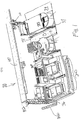
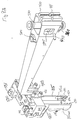
- an analytical instrument 10 has a sample handler module 20 for feeding test tubes of various sizes and other containers to the instrument 10, and one or more additional modules, at least some of which may be optional.
- the modules prepare a supplied test tube for analysis, if necessary, and then perform one or more analyses on the test tube.
- Sample handler 20 may include an automatic decapper, as described in the referenced Automatic Decapper application, (not shown in Fig. 1 but which may be located in location 30) for decapping capped test tubes and a reagent activator 36 for preparing reagent packages for use by analytical modules.
- a module 31 for processing the tubes before analysis including a predilution apparatus for adding reagents and diluents to and incubating samples (as described in the referenced "Cup Handling Subsystem” application, and an ion selective electrode apparatus for measuring electrolytes in body fluid.
- a predilution apparatus for adding reagents and diluents to and incubating samples
- an ion selective electrode apparatus for measuring electrolytes in body fluid.
- analytical modules including a clinical analysis module 33, and an immunoassay module represented by box 34.
- Containers that are transported within the instrument include various types and sizes of capped or uncapped test tubes (including tubes, with or without insert cups, to hold samples, calibrators, and controls), customized reagent and diluent packages, dilution cups and pretreatment incubator covers (which cover the dilution cups in the heated dilution module during the dilution process to confine the heat).
- a beam 40 runs above the rear of the instrument 10. (Fig. 2) The length of beam 40 will vary depending on the length of the instrument 10, which may have a varying number of modules.
- a robotic arm 100 which reaches over at least a rear area of instrument 10, and which for safety reasons is preferably not accessible to the operator, is mounted to beam 40 and is designed for picking up and transporting the containers.
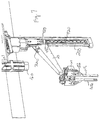
- Robotic arm 100 comprises several sections, including saddle platform 101, a vertically mounted lead screw assembly 102, a gripper arm 103 coupled to lead screw assembly 102 on one end, and a gripper actuator 104 and gripper fingers 105, including right finger 105 R and left finger 105 L , mounted to the other end of gripper arm 103 for gripping the containers.
- Robotic arm 100 has four degrees of freedom of movement above the sample handler 20 and modules 30-34.
- the entire robotic arm 100 may move linearly in the x-direction defined by beam 40 along saddle platform 101.
- gripper arm 103 may also move linearly up and down along the z-axis defined by lead screw assembly 102.
- lead screw assembly 102 is rotatable, thereby causing an angular (or theta) motion of gripper arm 103 about the z-axis in a theta direction.
- gripper fingers 105 open and close linearly.
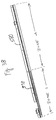
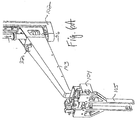
- beam 40 comprises a precision plate 110, a beam box assembly 111 mounted to the bottom rear of precision plate 110, a rack 112 mounted to the bottom of precision plate 110 in front of beam box assembly 111, and a linear sliding rail 113 mounted to the bottom of precision plate 110 in front of rack 112.
- the length of beam 40, rack 112 and rail 113 will depend on the number and size of analytical modules in instrument 10.
- Rotatable hard stops 120-123 are mounted across the top front of beam 40, two near each end of beam 40. Hard stops 120-123 may be rotated upward and into respective exposed recesses 130-133 on the front of beam 40 or may be turned down as shown. Also mounted to the front of beam 40 across the top left side of beam 40 is a zonal homing bar (Figs. 1 and 3B). The function of hard stops 120-123 and zonal homing bar 580 will be discussed in more detail below.
- Robotic arm 100 is mounted to beam 40 with one or more bearing blocks.
- the bearing blocks may comprise two linear ball retained bearing blocks 150, 151 coupled the top of saddle platform 101 that are mounted to and linked together by bearing plate 154.
- Bearing blocks 150, 151 may be purchased premounted by the manufacturer to rail 113. While rail 113 may vary in length, preferred rails with premounted bearing blocks are manufactured by IKO of Japan as the LWE series. (For example, for a rail that is 1660 mm long, the preferred rail with bearing blocks is IKO model number LWESC20C2R1660H.)
- a tongue 152 on each of bearing blocks 150, 151 slides along tracks 153a, 153b on the front and back of rail 113.
- roller bearings may be used to couple robotic arm 100 to rail 113, instead of ball bearings.
- the bearing block or blocks must carry the maximum load of robotic arm 100 loaded with the heaviest container it may carry, and must be able to accelerate and travel at the desired speeds smoothly while keeping noise to a minimum, minimizing torque about each of the x, y and z axes to maintain robotic arm 100 relative to the predefined locations on instrument 10 which it must reach, and not wearing excessively.
- the maximum torque of each of bearing blocks 150, 151 may be determined from handbooks obtainable from the bearing block manufacturer.
- Saddle platform 101 is removably mounted to bearing plate 154 to easily remove robotic arm 100 at saddle 101 for service.
- robotic arm 100 is driven in a linear motion along the x-axis by an "x-motor" 160 mounted beneath saddle platform 101.
- X-motor 160 is preferably a brushless closed-loop servo motor coupled to a gear box and has a built-in incremental encoder to track the position of robotic arm 100 along rail 113.
- X-motor 160 may be the motor manufactured by Parker/Compumotor of Rhonert Park, CA as Model No. CM160XE-00438 that has a built-in optical encoder to track the position of robotic arm 100 and has a gear box with a gear ratio between the motor and gear of 5.5:1.
- the particular motor 160 is selected to achieve the desired speeds and accelerations, to prevent oscillations of the robotic arm and to provide smooth transitions when accelerating and decelerating to minimize jerk, which may cause samples in open test tubes to spill and may cause excessive noise.
- a drive shaft 161 on x-motor 160 passes through saddle platform 101 and attaches to a pinion 164 above saddle platform 101. Pinion 164 engages against rack 112, thereby driving robotic arm 100 in the x-direction.
- X-motor 160 is mounted to an adjustable mounting plate 166 (Fig. 5C) and mounting plate 166 is mounted to saddle platform 101. Slots 167 on mounting plate 166 allow for the minor adjustment of x-motor toward or away from rack 112 to accommodate some imprecision in the mounting of rack 112 along beam 40. Pinion 164 is held in place with a split hub clamp (not shown).
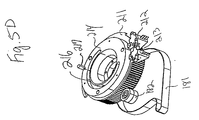
- a "theta motor” 170 to rotate gripper arm 103 in a theta direction is mounted to a mounting plate 176 and mounting plate 176 is then mounted to the top of saddle platform 101.
- Slots 177 in mounting plate 176 provide for the minor adjustment in the positioning of theta motor 170.
- a drive shaft 172 of theta motor 170 passes through a hole 179 in the bottom of saddle platform 101 and a pulley 174 is attached at the end of drive shaft 172.
- Pulley 174 is indirectly coupled to a planetary gear 180 mounted underneath saddle platform 101 with a synchronous timing drive belt 181 having teeth.
- Drive belt 181 is tightened in place with idler point 182 attached to a mounting pin 183 on the bottom of saddle platform 101 that increases the length of drive belt 181 which contacts pinion 174 and planetary gear 180 and provides for the proper tensioning of drive belt 181.
- Planetary gear 180 is held in place with a thrust plate 184.
- a preferred theta motor 170 may be identical to x-motor 160.
- the drive ratio between planetary gear 180 and pulley 174 for theta motor 170 should preferably be 10:1.
- the various components mounted between saddle platform 101 and thrust plate 184 are shown in an exploded view in Fig. 5C.
- An aperture 190 in saddle platform 101 extends downward from saddle platform 101 through the bottom of a circular projection 191 formed at the bottom of saddle platform 101.
- An absolute two-bit encoder is provided to create zones along theta over which it is safe to home as described below.
- the absolute encoder comprises an encoder ring 211 and two optical vane-type sensors 212, 213. Sensor 213 is mounted farther from the center of encoder ring 211 than sensor 212. The operation of encoder 210 will be described below.
- Kit motor housing 220 (Figs. 5A and 5B) is mounted to the bottom of planetary gear 180, and the top of lead screw bracket 190 is mounted to the outside of housing 220 at point 222 on connector 221. (Fig. 5A)
- the activation of theta-motor 170 causes the rotation of planetary gear 180 and the theta rotation of robotic arm 100.
- the theta range of movement is limited to less than 360 degrees to avoid hitting a possible back wall on instrument 10.
- the theta range of movement is limited by homing stop pin 217 inserted in slot 216 which extends around only a portion of homing plate 214.
- a "z-motor” 240 raises and lowers gripper arm 103 in the z-direction.
- Z-motor 240 is preferably a brushless closed-loop servo motor assembled below saddle platform 101 from a kit motor.
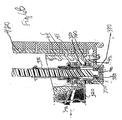
- the kit motor comprises a rotor 241 that is press fit onto a lead screw 250 and a stator 242 that is press fit to the inside of kit motor housing 220.
- Fig. 5E One suitable kit motor for z-motor 240 is manufactured by MFM Model No. K032.
- An incremental encoder is also provided to track the position of robotic arm in the z directions.
- Motors 160, 170 and 240 are conventionally powered and controlled by standard power distribution and servo control cards mounted in a tray (not shown) on instrument 10 and connected to a wiring harness 300 on robotic arm 100 with a laminated, flexible cable 260 (Fig. 3B).
- the servo circuitry permits the detection of obstructions to the motion of robotic arm 100 and position loss. If an error is detected, a recovery procedure to attempt homing of robotic arm 100 (in the particular dimension in which it was detected) that caused the error is initiated to resume normal operation. If the circuitry is unable to recover, robotic arm 100 stops moving and the user is alerted.
- Cable 260 is preferably cambered for smoother, controlled movement of the cable as robotic arm 100 moves along rail 113. As shown in Fig. 2, wiring harness 300 is connected to cable 260 above an L-shaped plate 255 mounted to saddle platform 101 and overhanging beam 40.
- Controlling the operation of instrument 10 are multiple controllers.
- one controller such as a controller from Galil of California, Model No. DMC1503 or a similar controller, is used for each robotic arm ( i.e. , both robotic arm 100 and robotic arm 200 referenced below) to store parameters and profiles for controlling the robotics.
- a bearing 270 Mounted above the z-motor 240 and within kit motor housing 220 is a bearing 270 through which lead screw 250 passes and mounted above bearing 270 is an optical encoder 280 with commutation tracks for measuring the rotation of z-motor 240 and thereby tracking the movement of gripper arm 103 along the z-axis.
- the top of lead screw 250 terminates within the center of optical encoder 280.
- optical encoder 280 for z-motor 240 is the RCM15 Commutation 1.5" encoder manufactured by Renco of Goleta, California.
- Optical encoder 280 has commutation tracks in quadrature (i.e. , the commutator has four zones demarcated by two rows of commutation tracks around the circumference of a glass disk which rotates within optical encoder.)
- Glass disk 281 is fit onto lead screw 250 and is driven by the rotation of lead screw 250.
- the body 282 of optical encoder 280 is mounted within kit motor housing 220.
- a space 290 is left in housing above optical encoder 280 for wiring from wiring harness 300 which passes through an aperture 190 in the bottom of saddle platform 101 and into space 290.
- Wiring harness 300 passes out the bottom of kit motor housing 220 at 310 (Fig. 4C and 5B) and enters the top of gripper arm 103 through an aperture 320. (Fig. 6A)
- Wiring harness 300 then passes within gripper arm 103 to gripper actuator 104. In this manner, wiring harness 300 does not interfere with the movement of robotic arm 100.
- Gripper arm 103 extends the reach of fingers 105 to reach all areas of instrument 10 to and from which containers are to be moved by robotic arm 100. In the preferred embodiment, the reach does not extend to the front area of the instrument. Containers are fed into and out of the robot-accessible areas of sample handler 20 by the sample handler itself and containers are transported toward the front of the analytical modules, such as modules 33, 34 on a rack 37 on shuttle 38.
- Gripper arm 103 may be sloped downward from its proximal to distal ends to reduce the required length of lead screw assembly 102 and thereby minimize interference posed by possible components or other obstructions situated under lead screw assembly 102.
- Fig. 6B illustrates the coupling of lead screw assembly 102 to a frilly-lowered gripper arm 103.
- a zero lash plastic slip nut 330 that is threaded on the inside is placed onto lead screw 250.
- a brass cylindrical insert 340 that is threaded on both its interior and exterior is threaded on its interior onto slip nut 330 and glued to slip nut 330. Insert 340 is inserted through a hole 350 in the bottom of gripper arm 103 and a split collar 360 is tightened to the bottom of insert 340 to lock gripper arm 103 to insert 340.
- the bottom of lead screw 250 sits in a bearing 370.
- Bearing 370 is held in place with an adjustment nut 380 tightened to the bottom of lead screw bracket 190.
- a circular wave spring 390 is inserted between adjustment nut 380 and lead screw bracket 190 to accommodate thermal expansion in lead screw 250.
- a void 400 is left between the bottom of lead screw 250 and adjustment nut 380 to permit the rotation of lead screw 250.
- Threading on lead screw 250 preferably moves gripper arm 103 121 ⁇ 2 mm per revolution of lead screw 250 to provide a smooth motion and lessen the effects of the inertia of a load on the motion of gripper arm 103.
- the threading also provides precise control over the vertical movement of gripper arm 103.
- z-motor 240 is activated in a first direction causing lead screw 250 to rotate.
- Two pillow blocks 410, 411 at one end of gripper arm 103 slide along a rail 420 (Fig. 7) mounted to lead screw bracket 190. If gripper arm 103 is fully raised, the top of upper pillow block 410 hits a hard stop 430 along rail 420 and a pin 440 that functions as a z-axis homing flag on the side of gripper arm 103 engages within a plug-shaped, through-beam infrared sensor 450. This interrupts an infrared light beam, which is transmitted out of a transmitter on one side 451 of sensor 450 and otherwise received on the other side 452 of sensor 450 (Fig. 3B).
- z-motor 240 is activated in the opposite direction.
- a hard stop 460 is mounted to the bottom of lead screw bracket 190 (Fig. 6B).
- An insert 470 is press fit into the bottom of gripper arm 103 adjacent rail 113 to reference (i.e., contact) hard stop 460 if gripper arm 103 is fully lowered along lead screw bracket 190.
- a vertical mount area 480 is provided on the outer end of gripper arm 103 for mounting gripper actuator ("grippers") 104, which is a conventional parallel grippers.
- grippers gripper actuator
- FIGs. 8A and 8B The back of grippers 104 mount to the front of vertical mount 480.
- Grippers 104 are designed to be easily removable for replacement or service by the removal of four thumb screws 481.
- Grippers 104 are a horizontal grippers, as opposed to a vertical grippers, to provide space on top of grippers 104 for mounting a printed circuit board 500 with various electronics components.
- One suitable grippers is model RPL-3 manufactured by Robohand Inc. of Monroe, Connecticut. Fingers 105 are mounted to the front of grippers 104.
- Printed circuit board 500 is mounted to posts 505 that are mounted to the top of grippers 104 and various electronic components are mounted to the top of printed circuit board 500, including an inertia switch 510, an optical vane-type sensor 530, such as an infrared through-beam sensor, and an incremental encoder 540.
- Inertia switch 510 immediately detects a collision between fingers 105 or grippers 104 and some other object and to immediately stop the movement of grippers 104.
- Sensor 530 detects when grippers 104 are fully closed when infrared beam on sensor 530 is interrupted by a U-shaped flag that is mounted to the top of one of fingers 105, the right finger in the illustrated embodiment.
- Printed circuit board 500 processes signals received from inertia switch 510, sensor 530 and encoder 540 and communicates with the controller for robotic arm 100.
- Encoder 540 tacks the opening and closing of grippers 104 and thereby determines the width of the container which is gripped by grippers 104 by determining the size to which gripper 104 remains after gripping a container.
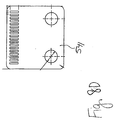
- Encoder 540 which may comprise an encoder manufactured by Hewlett-Packard as Model HEDS 9100, preferably has two infrared beams spaced apart from one another that both counts the number of tracks on a plate 541 (Fig. 8D), mounted to the top of fingers 105, which passes sideways through encoder 104 as grippers 104 open and close.
- Plate 541 is transparent except for a pattern of parallel black lines spaced from each other by a width equal to the width of a line equidistantly.
- Infrared beams on encoder 104 are spaced apart from each other out of phase by 90° to generate identical signals 90° out of phase and to increase the precision of the measurements to half the width of a line. Whether grippers 104 are opening or closing may be determined from the shape of the signal generated.
- vertical grippers 104' are mounted to a horizontally-positioned mount area on a slightly different gripper arm 103'.
- the top of a grippers 104' mounts to the mount area on gripper arm 103' and fingers 105' mount to the bottom of grippers 104'.
- this embodiment may not leave enough space to mount the electronics thereon.
- Grippers 104 are pneumatically operated with air ports (not shown) to inject air into a double action air cylinder in grippers. Pressure applied on one side of the cylinder opens grippers 104 along with fingers 105 and pressure applied on the other side of the cylinder closes grippers 104 and fingers 105. Grippers 104 maintain a closed position when not in the process of picking up or releasing a container so as not to drop the container if air pressure is lost while holding the container.
- Valves and air tubes are located as close as possible to robotic arm 100 to be able to respond to the activation of grippers 104 as quickly as possible.
- grippers 104 may open more than is desirable and than the manufacturer's specifications for the grippers such that the outer side of fingers 105 might hit an adjacent container or obstruction. Therefore, referring to Figs. 8B and 11A, a means for limiting the separation of fingers 105 independently of grippers 104 is incorporated into fingers 105.
- the limiting means consists of a rod 553, mounted to the inner face of one of the fingers 105, such as left finger 105 L , that passes through a corresponding hole 554 on the inner face of right finger 105 R .
- Rod 553 has a stop 556 at the end that is larger than hole 554 and limits the opening of fingers 105. When fingers 105 are closed, stop 556 extends into a hole 555 on the outer face of finger 105 R that provides clearance for stop 556.
- the gripping force of grippers 104 should preferably be limited, such as to a range of 25-30 psi, to minimize the deflection of fingers 105 and limited so that it does not exceed 50% of the force necessary to crush the weakest test tube that will be used in instrument 10.
- Robotic arm 100 is designed to transport the various containers referenced above. Fingers 105 must therefore be versatile and strong enough to resist bending by the heaviest load placed on robotic arm 100. Fingers also must be compact enough to avoid hitting obstructions while moving containers into and out of areas with tight clearances.
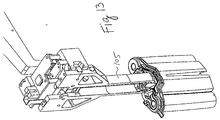
- reagent packages as shown in Figs. 12 and 13 may be inserted through an opening 33a in a cover 33b on top of clinical analysis module 33 and into a carousel (not shown) under cover 33b. Opening 33a may be only several millimeters wider than the reagent package and fingers 105 must clear opening and have some clearance to insert the reagent package into the carousel.
- fingers 105 must be able to insert a diluent package, which contains diluent (application Ser. No. 29/088,045) and is less than half the size of the reagent package through opening 31a in a cover 31b on module 31, which is smaller than opening 33a, and into a particular position on another carousel (not shown) on module 31. Fingers 105 must also be long enough so that grippers 104 never descends below any cover on an analytical module where environmental conditions could damage it.
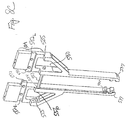
- Each of the two fingers 105 are almost identical. Fingers 105 are shaped as shown in Fig. 10 with a pentagonal upper portion 105 U and a narrower lower portion 105 B extending vertically downward. The wider top surface of fingers 105 U provides more stability to fingers while the much narrower lower section 105 B allow fingers 105 to move within tight spaces. When grippers 104 are opened, the top of upper portion 105 U opens outward over the bottom surface of grippers 104 to a width such that the outermost edge 105 out of each finger 105 when grippers 104 are fully open does not extend beyond the sides of grippers 104.
- fingers 105 mount to grippers 104 at grooves 582 R and 582 L .
- the thickness of fingers 105 is reduced in a top portion 584 and at point 585 the fingers 104 widen so that when fingers 105 are mounted to grippers 104 the lower portion of fingers 105 below point 585 wraps below grippers 104.
- two projections 550, 551 extend inward from fingers 105 with a groove or channel 552 left between the projections.
- Upper and lower projections 550, 551 are flat on top and bottom and are contoured identically on their innermost sides to have central sections 550 C , 551 C which may be curved and front and back sections 550 F , 551 F and 550 B , 551 B , respectively, which have a straight edge and are angled from one another at approximately 120° (the zero reference point of the angle being at the center of center sections 550 C , 551 C ).
- the central sections 550 C , 551 C are preferably curved at a radius of 3 mm to better grip front and rear walls on the gripping block 560 on reagent and diluent packages described below.
- the angle between front sections 550 F , 551 F and back sections 550 B , 551 B is selected so that fingers 105 do not break a test tube when they close around a test tube, which might otherwise occur if the angle between front and back sections 550 F and 550 B were less than 120°.
- Upper and lower projections 550, 551 extend an additional approximately 4 mm inwards beyond the 1 mm thickness of the lower portion 105 L of fingers 105.
- the inner-facing side 105 IN of each of fingers 105 is curved. (Fig.
- a beveled edge 535 between upper projection 551 and side 105 IN accommodates caps or closures on short test tubes, such as 75 mm test tubes, which the robotic arm 100 picks up with the lower edge of screw-on caps positioned directly above upper projection 551 when a test tube is gripped so the caps preferably do not touch upper projection 551.
- Another beveled edge 537 at the bottom outer edge of fingers 105 prevents the fingers 105 from breaking a first test tube if fingers 105 knock into that first test tube while picking up a second test tube adjacent the first test tube.
- the height and width of lower projection 550 is also selected to be able to grip a predilution cup 564 described in the Cup Handling System application and further described below, and the height and width of upper projection 551 is selected to be equal to the width of lower projection 550.
- the height of upper and lower projection 551, 550 are respectively, approximately 2 mm and 4 mm.
- Groove 552, separating upper and lower projections 550, 551, is approximately 4 mm high.
- rod 553 limits the opening of fingers 105 so that the exterior sides of fingers 105 separate from each other approximately 30 mm, as shown in Fig. 10. Because of the approximately 5 mm thickness of lower and upper projection 550, 551, the maximum diameter of test tubes, incubator covers or other round containers that may be gripped by fingers 105 is approximately 20 mm. Due to slight variation in the length of projections 550, 551, the maximum diameter maybe as large as 20.5 mm.
- a gripping block or other gripping means preferably including a flange, must be provided on the containers for robotic arm 100 to lift them.
- One particular gripping block 560 may be provided on the top of a reagent package, which contains reagents used by instrument 10. This particular reagent package is described in more detail in application Ser. No. 08/985,759 (which refers to gripping block 560 as "pivot block 110").
- Gripping block 560 has a front wall 563 and a back wall (not shown but shaped like front wall 563) which is curved to fit within the contour of fingers 105 and two curved flanges, front flange 561 and rear flange 562, which may follow the same curvature as the front and back walls.
- front and rear flanges 561, 562 must be separated from one another by a diameter of less than 20 mm in order to fit between fingers 105.
- the recesses and contours of the side walls of gripping means 560 as well as other details of the illustrated reagent package are not significant for the purposes of the present application. However, it is important that no elements adjacent the gripping means 560 interfere with movement of fingers 105 around flanges 561 562.
- a similar gripping means may be used on other containers, such as the diluent packages.
- Groove 552 serves to properly align an otherwise misaligned container at the time the container is retrieved. If a reagent package or other container with gripping block 560 or a similar means for gripping the container is not seated at its pick up location completely vertically when robotic arm 100 arrives to pick it up, projections 550, 551 and groove 552 help align the reagent package or other container as fingers 105 close around gripping block 560 by catching flanges 561, 562 of gripping block 560 in groove 552. The top of the flange that is raised too high hits the bottom of projection 557 and is pushed downward while the bottom of the other flange that is too low is pushed upward by the top of lower projection 550.
- Groove 552 between projections 550, 551 is sized to grasp the top flanges 561, 562 on opposite sides of gripping block 560, while providing some additional space allowance for realignment of the flanges and to prevent flanges 561, 562 from getting stuck in groove.
- flanges 561, 562 are approximately 1 mm thick the 4 mm height of the groove provides the additional space allowance required for realignment.
- Stops 570 at the top front of fingers 105 face inward with fingers 105 installed on grippers 104. The stops contact each other when grippers 104 are closed to counteract the forces propagated through fingers 105 by the closing of grippers 104 and the resulting contact of upper and lower projections 550, 551 at the bottom of fingers 105, which otherwise cause fingers 105 to bend. Stops 570 extend inward approximately 4 mm which is the width of lower projection 550.
- FIG. 11B Other containers that may be gripped by fingers 105 include an incubator cover 557 used by instrument 10 (Fig. 11B) and the dilution cup 564 (Fig. 11C).
- Incubator cover 557 has a cylindrical gripping section 558 by which it is gripped.
- Cup 564 has a cylindrical upper portion 565 that includes a bottom flange 566, a top flange 567 and a groove 568 between flanges 566 and 567.
- Lower projection 550 is inserted within groove 568 and top flange 567 of cup 564 fits within groove 562 of fingers 105.
- the height of top flange 567 is sized to leave clearance for the upper surface of top flange 567 to self-align cup 564 during pickup.
- Gripper arm 103 and fingers 105 are designed to be as lightweight as possible by construction with relatively lightweight materials and the use of various features that lighten gripper arm 103 and fingers 105. Therefore, gripper arm 103 preferably has apertures 575 on the sides of gripper arm 103 near lead screw 250. For the same reason, an opening 580 is preferably left within each of fingers 105 to lighten the weight of fingers 105.
- robotic arm 100 As robotic arm 100 is designed to carry, among other things, open test tubes, movements of robotic arm 100 should prevent the jerking of test tubes or other movements which may cause the spilling of samples from open test tubes. Of further concern, movements of robotic arm 100 should not disturb samples, which may be incubated in one of modules in instrument 10. Therefore, the acceleration of robotic arm 100 in the x-direction along rail 113 when carrying a test tube should preferably not exceed 0.3g to avoid spillage when carrying an open container such as a test tube. The acceleration may be increased to as much as 0.5g if spillage is not found. When robotic arm 100 transports closed containers, including reagent packs, it may accelerate faster.
- This acceleration and deceleration should follow an S-curve-shaped acceleration profile to prevent jerk in robotic arm 100 from propagating to modules 20, 30-34 in instrument 10.
- robotic arm 100 When robotic arm 100 is not carrying a test tube it may accelerate faster, possibly as high as 1.5g.
- Vertical up and down movements or gripper arm 103 along rail 420 may accelerate up to 1g.
- Slew speeds and acceleration profiles for motors 160, 170 and 240 must also keep audible noise to a minimum.
- robotic arm 100 transports containers between specific positions on instrument 10, it must track precisely where it is located. Moreover, in a typical analytical instrument with which robotic arm 100 may be used, there are likely to be areas, such as where other components of instrument 10 or beams or walls of the instrument are located, where certain movements of robotic arm 100 may be limited. Therefore, homing mechanisms are provided for each of the x-motor 160, theta-motor 170 and z-motor 240 to properly position robotic arm 100 to a known location after it is powered up or if robotic arm 100 collides with another object before resuming operation.
- Robotic arm 100 may always be homed along the z-axis without any concern of hitting an obstruction because z-axis homing requires only that gripper arm 103 be fully raised.
- robotic arm 100 cannot be homed in the x and theta directions in every location along instrument 10 as robotic arm 100 may hit an obstruction if it were homed in certain areas.
- homing in the theta direction requires a large rotation of gripper arm 103 in the theta direction, which on homing plate 214 is approximately 270°.
- the layout of instrument 10 in the configuration shown in Fig. 1, creates some spaces where robotic arm 100 cannot be fully rotated over 270° in the theta direction, and other spaces where robotic arm 100 may be homed in the theta direction.
- the first step in the homing process is to home gripper arm 103 along the z-axis.
- this simply entails raising gripper arm 103 from whatever position it is previously in along the z-axis and gripper arm 103 is detected to be in a home position when pin 440 on gripper arm 103 passes through an infrared beam in through-beam sensor 450.
- Sensor 450 uses "fine edge" detection, meaning that it only detects the front edge of an object moving upward through the bottom edge of the infrared beam so if gripper arm 103 is already fully raised at the start of the homing process it is not detected.
- gripper arm 103 is fully raised before homing begins, gripper arm 103 is lowered slightly beneath sensor 450 and is then returned to its original fully-raised position. (Fig. 6).
- the homing mechanism next determines if it can be homed in the x and theta directions.
- the primary concern in homing in the x-direction is that robotic arm 100 be able to travel the full length of rail 113 without gripper arm 103 hitting an obstruction, including a side wall of instrument 10.
- the primary concern in homing in the theta direction is that robotic arm 100 not hit an obstruction as it pivots about lead screw 250.
- An absolute two-bit encoder comprising encoder ring 211 and sensors 212, 213 adjacent encoder ring 211 provide the information required to determine if it is safe for robotic arm 100 to home in the x direction.
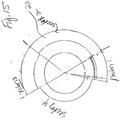
- Encoder ring 211 defines four sectors 1-4 (Fig. 15). The size of the sectors may vary but are selected so that movement is permitted in those sectors in which gripper 103 will not hit an obstruction when robotic arm 100 is moved in the x-direction along rail 113. These sectors will generally be confined to areas under beam 40.
- sector 1 covers an arc over the left side of the rear of instrument 10 under beam 40
- sector 2 covers an arc which would position arm above components of the various modules where there are obstructions
- sector 3 covers an arc over the right side of the rear of instrument 10 under beam 40
- sector 4 covers an arc where gripper arm 103 would hit a back wall of instrument 10. If robotic arm 100 is to be homed in the x-direction by moving the left along rail 113, gripper arm 103 must face to the right of instrument 10 with gripper arm 103 confined to a position in sector 3.
- instrument 10 determines what sector gripper arm 103 is in and, with an exception to be described below, moves it to either sector 1 or 3 depending on the direction in which robotic arm is homed. (In a single robot arm system, the closest side of instrument 10 may be selected for homing to home as quickly as possible. In the dual robotic arm system described below, the left arm would home to the left and the right arm would home to the right.)
- the robotic controller determines which sector gripper arm is in by reading the status of sensors 212, 213 and causes gripper arm 103 to rotate into homing sector 1 or 3, if it is not there already.
- the perimeter of encoder ring 211 blocks the infrared beam in neither of sensors 212, 213 when that sector is adjacent sensors so both sensors are ON in sector 4, only outer sensor 213 is ON and inner sensor 212 is OFF when sector 3 passes adjacent sensors 212, 213, both sensors are OFF in sector 2 when sector 2 is adjacent sensors 212, 213, and inner sensor 212 is ON while outer sensor 213 is OFF when sector 1 is adjacent sensors 212, 213.
- the absolute encoder thereby knows what sector the robotic arm is in.
- Robotic controller must also insure that gripper arm 103 is in a safe area along the x-axis for the rotation of gripper arm 103 over theta into sectors 1 and 3 before homing along the x-axis is performed.
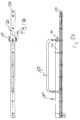
- the required determination is made with another absolute two-bit encoder comprising a zonal encoder bar 580 mounted in front of a portion of beam 40 (Figs. 2 and 3B) and two optical vane-type sensors 590, 591 (Fig. 4B) mounted to a sensor mount 593 on the top of saddle platform 101.
- Sensor mount 593 has two tiers 595, with tier 596 elevated above tier 595 to position sensor 590 higher than sensor 591.
- the absolute two-bit encoder demarcates three zones along the x-axis, zones 1-3 (Fig. 3C). It is safe to move gripper arm 103 in the theta direction with the pivot point of gripper arm 103 (which is around lead screw 250) anywhere in the middle zone 2 and unsafe to move gripper arm 103 in the theta directions in zones 1 and 3 because of obstructions.
- Zonal encoder bar 580 extends lengthwise across only a portion of beam 40, viz. zones 1 and 2 to minimize the length of bar 580. It is unnecessary for bar 580 to extend to zone 1 and 4.
- the bottom of zonal encoder bar 580 extends below the front of beam 40 a sufficient distance to pass through both sensors 590, 591 as robotic arm 100 moves in the x-direction.
- An elongated opening 598 is left in the zonal encoder for 580 toward the bottom of zonal encoder bar 580 across the length of zone 2 and is covered with a transparent plastic.
- both sensors 590, 591 are OFF because they are blocked by bar 580.
- lower sensor 591 passes across opening 598 and is ON while upper sensor 590 is blocked and is OFF.
- Bar 580 ends at the edge of zone 3 so that when robotic arm 100 is in zone 3, both lower and upper sensors 590, 591 are ON.
- the precise coding of the sectors and zones defined by encoder ring 211 and zonal encoder bar 580 in combination with the sensors, i.e. , which sensors must be ON or OFF to indicate a particular sector or zone, is generally unimportant as long as robotic controller has a particular code associated with each sector or zone.
- the coding scheme should be a gray coding scheme in which the movement from one sector into an adjacent sector does not cause both bits for both sensors 212, 213 along theta to change.
- sensors 590, 591 along the x-axis There is a similar restriction for sensors 590, 591 along the x-axis. Otherwise, a simultaneous change in both sensors would create a brief moment when both sensors in either the theta or x directions are neither ON nor OFF and could lead to an instability.
- robotic arm 100 is in zone 2 where theta movement is permitted, gripper arm 103 is rotated to sectors 1 or 3 and then x homing may be performed. X homing is also permitted if gripper arm 103 is already in sectors 1 or 3 prior to homing. If, however, robotic arm 100 is in one of zones 1 or 3 and gripper arm 103 is not in sectors 1 or 3 prior to homing, robotic controller is unable to home robotic arm 100 without manual intervention. This latter condition should not occur during normal operation of instrument 10 unless an operator has previously improperly manually moved robotic arm 100 into such a space where it is impossible to automatically home.
- theta homing mechanism also includes homing plate 214 and pin 216 (Fig. 5C).
- robotic arm 100 is homed along the x-axis by moved robotic arm 100 to the left or right until it contacts a preselected hard stop on beam 40.
- an incremental encoder built into x-motor 160 tracks the precise position of robotic arm 100 along the x-axis.
- Robotic arm 100 is then moved from the hard stop position to zone 2 for theta homing. To home as rapidly as possible, robotic arm 100 need only be moved to the edge of zone 2 closest to the hard stop against which robotic arm 100 was homed or slightly inward therefrom into zone 2.
- Robotic arm 100 is now homed in the theta direction by rotating robotic arm 100 in a clockwise or counterclockwise direction until robotic arm 100 no longer rotates because pin 216 in track of homing plate 214 prevents further movement.
- An incremental encoder built into theta motor 170 tracks any further rotation of robotic arm 100 about theta.
- Grippers 104 are maintained in their closed position when not opened to grip a container and are not homed as part of the homing of robotic arm 100. If fingers 105 are holding a container at the time that power is turned off, robotic controller will be aware of this because sensor 530 on fingers 105 is ON and the operator will be alerted to remove the container.
- An uninterrupted power supply (“UPS”) is preferably attached to instrument 10 to allow for an orderly shut down of instrument 10, including the saving of various information and the transport of a container already carried by robotic arm 100 to its destination.
- the user identifies the particular container to instrument 10 with a bar code placed on the container and other significant information, such as, where the container is a test tube, what tests are to be performed on the sample in the test tube, or, where the container contains reagent or diluent, what reagent or diluent is in the container.
- the user may also enter information that identifies the height of the test tube or other container or the instrument itself may measure the height of the test tube or other container.
- the robotic arm may be requested to transport a particular container, such as when an analytical module is ready to perform a test on a test tube or has completed performing the test, or when an additional reagent package is needed or is ready for disposal.
- the user need not enter information regarding the diameter of a test tube as that information is determined by how far grippers 104 close during the gripping process.
- Software for instrument 10 is programmed into the sample handler microcontroller to provide the instructions for the order of priority in which containers will be moved. The particular programming will vary depending upon the attached modules and user preference. Also programmed into the software are the instrument-specific x-y coordinates where containers may be located for pickup or should be dropped off.
- the software converts x-y coordinates into x and theta coordinates for moving robotic arm 100.
- a positional ambiguity is presented by this mapping over x, y coordinates into x and theta coordinates because the robotic arm 100 may approach some x-y coordinates from either an acute or obtuse theta angle such that saddle platform is in one of two possible positions along the x-axis.
- This problem is represented in Fig. 14.
- This ambiguity is simply resolvable by approaching the desired x-y coordinate from whichever angle enables the x-y coordinate to be reached as quickly as possible.
- there is no positional ambiguity as a specific x-y coordinate is only reachable from a single angle theta.
- robotic arm 100 moves to the location of the requested container by first moving along the x-axis (in the usual event that fingers 105 cannot reach that x-y location with a theta motion alone). After reaching the required location along the x-axis, theta motor 170 on robotic arm 100 is activated to move fingers 105 to the desired x-y position.
- the built-in incremental encoders in the motors track movement of x-motor 160 and theta-motor 170.
- the air-activated grippers 104 are opened and gripper arm 103 is lowered by activating z-motor 240.
- Optical encoder 280 for z-motor 240 tracks the travel of gripper arm 103 along z-axis.
- the sample handler controller knows the height of each container before the robotic arm 100 grips the container and thereby knows the distance to which gripper arm 103 must be lowered to grip a particular container and instructs the robotic controller accordingly.
- robotic controller determines how far to lower gripper arm 103 based on the height, programmed into the robotic controller, of two types of customized test tube racks used throughout instrument 10.
- gripper arm 103 is lowered to position the bottom of fingers 105 approximately 3 mm above the top of a test tube rack in which the test tube is located. (The length of test tube extending beneath the bottom of fingers 105 is therefore always the same but the length of the test tube within fingers 105 differs depending on the height of the gripped test tube.)
- Grippers 104 then close.
- encoder 540 When grippers 104 stop moving toward a closed position due to the resistance of the container to be gripped, encoder 540 will reflect this by not registering any movement of plate 541 on fingers 105 for 2-3 consecutive readings of encoder 540. If sensor 530 does not indicate that fingers 105 are fully closed, software in the robotic controller concludes that a container has been gripped. Liner encoder 540 tracks the distance over which fingers 105 have closed in order to determine the width of the test tube or other container and conveys that information to the controller via printed circuit board 500. If sensor 530 is activated after fingers 105 have fully closed and a container was supposed to have been gripped, the controller knows that the pickup operation was unsuccessful.
- the successfully gripped container is then raised by gripper arm 103 by activating z-motor 240 in the reverse direction, moved to the desired location along the x-y axis, lowered into position, and released by fingers 105.
- a second robotic arm 600 may be added to the analytical instrument to divide the workload and improve the throughput of instrument 10. (Fig. 16) This second robotic arm 600 is particularly important where a large number of modules are included in a single instrument.
- the second robotic arm 600 is identical in construction to and moves along the same rail 113 and rack 112 as the first robotic arm 100. Both robotic arms 100, 600 may work in unison.
- a collision avoidance protocol for avoiding collisions between robotic arms 100, 600 must be incorporated into software on the sample handler controller.
- robotic arm A and robotic arm B One possible collision avoidance essentially works as follows (with the two robotic arms being referred to generically as robotic arm A and robotic arm B): To avoid collisions between the two robotic arms A and B, the current positions of both robotic arms are tracked.
- robotic arm A receives a request to perform an operation, software in the sample handler controller determines two possible motions of robotic arm A which would cause fingers 105 to reach the same point on the x-y plane, which is a "positional ambiguity", shown in Fig. 14. The first motion would move robotic arm 100 to a first position on the x-axis and then cause robotic arm A to rotate over a first angle theta.
- the second motion would move robotic arm A to a second position on the x-axis and over a second angle theta to reach the same point.
- the software determines what movements of robotic arm 100 are needed to get from the present position to the new position in either of the two possible motion and then estimates whether a requested move of one of the robotic arms, which we will refer to as "A”, will cause that robotic arm A to collide with the other robotic arm, which we will refer to as "B". If robotic arm B will not interfere with the movement of robotic arm A in either the first or second available motions, robotic arm A is moved in the manner in which fingers 105 which will reach the desired position on instrument 10 faster.
- robotic arm B is not performing a task but only one of the two possible motions will not cause a collision between the two robotic arms and the motion which is not possible is the faster of the two possible motions, robotic arm B is moved out of the way and robotic arm A moves in the manner in which fingers 105 will reach the desired position faster. But if the faster motion did not require the movement of robotic arm B, robotic arm B would not be moved. If robotic arm B is performing a task and only one of the two possible motions will not cause a collision between the two robotic arms, robotic arm A is moved in the motion that does not cause a collision. If robotic arm B is performing a task and there is no manner in which to avoid a collision if robotic arm A is moved to the desired destination, robotic arm A is not moved until robotic arm B finishes its task and moves out of the way to prevent a collision.
- robotic arm 100 For purposes of homing each of robotic arms 100, 600, robotic arm 100 is homed in the x-direction by first moving its gripper arm 103 to sector 3 and then to the left along the x-axis until it hits hard stop 120 and thereafter moves to zone 2 for theta homing. Robotic arm 100 is then moved out of zone 2. Robotic arm 600 is then homed in the x-direction by first moving its gripper arm 103 to sector 1 and then to the right along the x-axis until it hits the rightmost hard stop 123 and thereafter moves to zone 2 for theta homing.
- the second robotic arm 600 also adds redundancy. Should one of robotic arms 100, 600 break down, the remaining working robotic arm may perform all required operations, albeit at a reduced throughput (the actual reduction in the throughput depending on the tasks which must be performed).
- the malfunctioning robotic arm is disabled using the user interface to the software on instrument 10 and is then manually moved to the side of beam 40 to a park position.
- Hard stops 121, 122 are utilized to park the malfunctioning robotic arm and to prevent the two robotic arms from hitting one another.
- a malfunctioning robotic arm 100 is moved to the left side of beam 40 against hard stop 120, and hard stop 121, located on the opposite side of robotic arm 100 is rotated downward to confine robotic arm 100 to the park position between hard stops 120 and 121.
- a malfunctioning robotic arm 600 is moved to the right side of beam 40 against hard stop 123, and hard stop 122, located on the opposite side of robotic arm 100 is rotated downward to confine robotic arm 100 to the park position between hard stops 122 and 123.
- the park positions of robotic arms 100, 600 may also be used as park positions in which routine maintenance may be performed on robotic arms 100, 600, including cleaning fingers 105 on the arms.
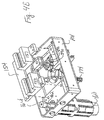
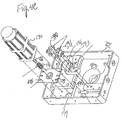
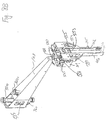
- robotic arms 100, 600 may be transferred from instrument 10 to a service tool 700 shown in Figs. 17A-17B.
- Service tool 700 comprises a short extension 710 to beam 40, which may be temporarily inserted into the left side of beam 40 and a rail 720.
- Rail 720 is mounted to the bottom of service tool 700 in the same position as rail 113 on beam 40 but there is no rack on service tool that is equivalent to rack 112. Rail 720 extends beyond beam extension 710 and passes under beam 40 to contact rail 113.
- rail 720 is at least as long as the combined length of the saddle platforms of the two robotic arms 100, 600.
- Alignment pin or pins 730 on the right side of rail 720 are inserted into one or more matching holes 735 (Fig. 2) on the left side of rail 113 to assist in properly aligning rail 720 on service tool 700 with rail 113 on beam 40.
- Alignment pin or pins 730 may be a bullet pin, which is relatively long (on the order of several cm), in order to more easily engage the holes on rail 113.
- Screws 740, 741 or another securing means are inserted through holes 745 at the end of beam extension 710 and are threaded into corresponding holes on the side of beam 40 to secure the service tool 700 to beam 40.
- the service technician disables robotic arm 100 using the software, disconnects a connector (not shown) connecting wiring harness 300 on robotic arm 100 to electrical wiring and air lines on the instrument, and rotates upwards whichever of hard stops 120-123 is necessary to remove robotic arm 100.
- the technician manually slides robotic arm 100 along rail 113 on beam 40 and onto rail 720 on service tool 700.
- Robotic arm 100 may then be removed by unscrewing the four screws connecting saddle platform 101 to bearing plate 154.
- service tool 700 with robotic arm 100 on it may be removed.
- Robotic arm 600 may also be similarly moved onto service tool 700 after robotic arm 100 is removed either while robotic arm 100 is on service tool 700 or after robotic arm 100 has been removed from service tool 700.
- Service tool 700 may have a handle 750 on the top for carrying the service tool 700 but handle 750 must be sufficiently short so the top of handle 750 does not hit plate 255, which overhangs beam 40 and service tool 700.
- system topology including a grid of all of the potential locations to which a container may be moved is mapped out in software installed in robotic controllers before instrument 10 is first activated.
- test tubes may be input into instrument 10 through a laboratory (or "lab") automation system (not shown), such as the Lab Cell system from the Bayer Corporation.
- a laboratory automation system such as the Lab Cell system from the Bayer Corporation.
- instrument 10 becomes a subsystem in the overall lab automation system.
- robotic arm 100 is used to remove test tubes from a transport system 800 (Fig. 1) for analysis by instrument 10 and reinsert test tubes into transport system 800 after they have been analyzed.
- both robotic arms 100, 600 should be used when instrument 10 is used as a lab automation subsystem.
- Robotic arm 100 transports test tubes between a transport system 800 and a shuttle 810 on instrument 10, which may hold several test tubes at a time.
- a bar code reader and ultrasonic liquid level sensor (not shown) are positioned adjacent shuttle 810 to identify the test tubes in shuttle 810 and to determine if the test tubes have caps which must be removed or to read the level of liquid in the test tubes of those test tubes which do not have caps.
- shuttle 810 After being read by a bar code reader and ultrasonic liquid level sensor, shuttle 810 then stops in a position where shuttle 810 is held down as test tubes are removed therefrom by either robotic arm 100 or robotic arm 600 for transport to various modules within instrument 10 other than sample handler 20.
- the left frame of the instrument consists of two vertical posts 812, 813 with clearance between the posts for gripper arm 103 of robotic arm 100 to extend and move in the z and theta directions beyond the left side of instrument 10.
- a removable left side panel (not shown) may be hung over posts 812, 813 when instrument 10 is not interfaced with a lab automation system.
- Lab automation systems that cannot be reached with gripper arm 103 may also interface with instrument 10 in one of two ways.
- a longer beam that extends beyond the leftmost side of instrument 10 may be substituted for the ordinary beam 40 to allow robotic arm 100 to move in the x-direction beyond the left side of instrument 10 above transport system 800 on the lab automation system.
- the gripper arm may be modified to be a two-piece gripper arm with the outer piece, to which grippers 104 mount removable, such as at point 830 (Fig. 11A) and replaceable with a longer second piece that is longer to reach farther, if necessary.
- a separate set of grippers 104 and fingers 105 may be mounted to the end of the extended second piece to simplify the substitution.
- the longer second piece may also be used on one or both robotic arms 100, 600 where instrument 10 has a module, which requires a robotic arm to have a farther reach.
- a serial port on instrument 10 (not shown) for interfacing with the lab automation system is also provided.
- a robotic arm of the kind described, or with some features removed may be used on an interface between a transport line and another instrument, other than the one described, to transport containers between the transport line and the other instrument.
Landscapes
- Engineering & Computer Science (AREA)
- Robotics (AREA)
- Physics & Mathematics (AREA)
- Health & Medical Sciences (AREA)
- Life Sciences & Earth Sciences (AREA)
- Chemical & Material Sciences (AREA)
- Analytical Chemistry (AREA)
- Biochemistry (AREA)
- General Health & Medical Sciences (AREA)
- General Physics & Mathematics (AREA)
- Immunology (AREA)
- Pathology (AREA)
- Automatic Analysis And Handling Materials Therefor (AREA)
- Manipulator (AREA)
Applications Claiming Priority (2)
| Application Number | Priority Date | Filing Date | Title |
|---|---|---|---|
| US11508098A | 1998-07-14 | 1998-07-14 | |
| US115080 | 1998-07-14 |
Publications (2)
| Publication Number | Publication Date |
|---|---|
| EP0973039A2 true EP0973039A2 (de) | 2000-01-19 |
| EP0973039A3 EP0973039A3 (de) | 2000-10-11 |
Family
ID=22359208
Family Applications (1)
| Application Number | Title | Priority Date | Filing Date |
|---|---|---|---|
| EP99113524A Withdrawn EP0973039A3 (de) | 1998-07-14 | 1999-07-05 | Robotersystem zum transportieren von Behältern und Objekte in einem automatisierten analytischen Instrument, und Wartungswerkzeug zu deren Wartung |
Country Status (7)
| Country | Link |
|---|---|
| US (3) | US6293750B1 (de) |
| EP (1) | EP0973039A3 (de) |
| JP (1) | JP2000052288A (de) |
| AU (1) | AU754768B2 (de) |
| BR (1) | BR9902713A (de) |
| CA (1) | CA2273729A1 (de) |
| NO (1) | NO993449L (de) |
Cited By (12)
| Publication number | Priority date | Publication date | Assignee | Title |
|---|---|---|---|---|
| WO2001096863A3 (en) * | 2000-06-15 | 2003-06-26 | Beckman Coulter Inc | Method and system for transporting and storing multiple reagent packs and reagent packs used therein |
| EP1154270A3 (de) * | 2000-05-09 | 2004-04-28 | Tosoh Corporation | Analysator zur Messung von glykolisiertem Hämoglobin |
| WO2008067847A1 (en) * | 2006-12-04 | 2008-06-12 | Inpeco Ip Ltd. | Container transfer apparatus with automatic positioning compensation |
| US9057714B2 (en) | 2005-05-04 | 2015-06-16 | Abbott Laboratories | Reagent and sample handling device for automatic testing system |
| CN104860061A (zh) * | 2015-06-07 | 2015-08-26 | 蒋海兵 | 一种自动输送系统及其使用方法 |
| CN105283275A (zh) * | 2013-04-29 | 2016-01-27 | 雷陆西赛车运动公司 | 使用机器人管理进行储存以及处理多种零件形状的方法及系统 |
| US9335336B2 (en) | 2011-09-09 | 2016-05-10 | Gen-Probe Incorporated | Automated sample handling instrumentation, systems, processes, and methods |
| EP2613156A4 (de) * | 2010-09-03 | 2017-12-20 | Hitachi High-Technologies Corporation | Probenübertragungsmechanismus |
| WO2018005239A1 (en) | 2016-07-01 | 2018-01-04 | Siemens Healthcare Diagnostics Inc. | Method and apparatus to automatically transfer and open a reagent container |
| IT201700025766A1 (it) * | 2017-03-08 | 2018-09-08 | Epistolio S R L | Robot di verniciatura |
| CN109564234A (zh) * | 2016-08-03 | 2019-04-02 | 株式会社日立高新技术 | 栓处理装置及具备其的检体检查自动化系统 |
| US20230201816A1 (en) * | 2020-06-02 | 2023-06-29 | Kawasaki Jukogyo Kabushiki Kaisha | Testing equipment system |
Families Citing this family (171)
| Publication number | Priority date | Publication date | Assignee | Title |
|---|---|---|---|---|
| EP0882500A1 (de) * | 1996-10-30 | 1998-12-09 | Sumitomo Chemical Company Limited | Automatisierungssystem fur syntheseexperimente, vorrichtung zur flussigkeitsstrennung und -behandlung sowie reaktionsbehalter |
| US6331437B1 (en) * | 1998-07-14 | 2001-12-18 | Bayer Corporation | Automatic handler for feeding containers into and out of an analytical instrument |
| US6530735B1 (en) * | 2000-06-22 | 2003-03-11 | Amkor Technology, Inc. | Gripper assembly |
| US6889813B1 (en) | 2000-06-22 | 2005-05-10 | Amkor Technology, Inc. | Material transport method |
| US6695120B1 (en) * | 2000-06-22 | 2004-02-24 | Amkor Technology, Inc. | Assembly for transporting material |
| JP4498561B2 (ja) * | 2000-08-04 | 2010-07-07 | 富士機械製造株式会社 | 配線板支持装置の段取替え装置 |
| DE10041231A1 (de) * | 2000-08-22 | 2002-03-07 | Leica Microsystems | Vorrichtung zur Behandlung von Objekten |
| CH709629B1 (de) * | 2000-10-06 | 2015-11-30 | Chemspeed Technologies Ag | Vorrichtung mit einem Werkzeughalter, einem Werkzeug und einer Waage. |
| US7771656B2 (en) * | 2001-01-23 | 2010-08-10 | Hitachi, Ltd. | Automatic analyzer |
| US20030048448A1 (en) * | 2001-03-19 | 2003-03-13 | Fleming Timothy J. | Automated apparatus for testing optical filters |
| US7065892B2 (en) * | 2001-03-19 | 2006-06-27 | Veeco Instruments Inc. | Method and apparatus for calibrating a vision system to a parts handling device |
| US6983547B2 (en) * | 2001-03-19 | 2006-01-10 | Veeco Instruments Inc. | Goniometer |
| RU2316748C2 (ru) * | 2002-05-20 | 2008-02-10 | Нортроп Грумман Корпорейшен | Система и способ обнаружения точечного источника биологического агента |
| US7867444B2 (en) * | 2002-05-30 | 2011-01-11 | Siemens Healthcare Diagnostics, Inc. | Lab cell centrifuging module |
| DE10233299A1 (de) * | 2002-07-22 | 2004-02-12 | Maschinenfabrik J. Dieffenbacher Gmbh & Co | Verfahren und Vorrichtung zum Aufnehmen eines Plastifikates |
| JP3712397B2 (ja) * | 2003-01-24 | 2005-11-02 | 株式会社椿本チエイン | チューブ把持装置 |
| US20050169733A1 (en) * | 2004-01-29 | 2005-08-04 | Drynkin Alexander V. | Automated tube handler system |
| DE102004006085B4 (de) * | 2004-02-07 | 2007-01-04 | Müller Weingarten AG | Transportvorrichtung für Werkstücke durch Pressenanlagen |
| ATE400817T1 (de) * | 2004-03-31 | 2008-07-15 | Hoffmann La Roche | Modulare analysevorrichtung |
| JP4907644B2 (ja) * | 2005-03-18 | 2012-04-04 | エルジー ハウスホールド アンド ヘルスケア リミテッド | ロボットハンド |
| KR200387669Y1 (ko) * | 2005-03-18 | 2005-06-21 | (주)디씨팩 | 산업용 로봇핸드 |
| USD532524S1 (en) | 2005-05-04 | 2006-11-21 | Abbott Laboratories | Reagent carrier for use in an automated analyzer |
| USD533947S1 (en) | 2005-05-04 | 2006-12-19 | Abbott Laboratories | Reagent carrier for use in an automated analyzer |
| USD534280S1 (en) | 2005-05-04 | 2006-12-26 | Abbott Laboratories | Reagent carrier for use in an automated analyzer |
| USD531736S1 (en) | 2005-05-04 | 2006-11-07 | Abbott Laboratories | Reagent carrier for use in an automated analyzer |
| US7694583B2 (en) * | 2005-05-05 | 2010-04-13 | Control Gaging, Inc. | Gripper gage assembly |
| WO2006128322A1 (en) * | 2005-06-02 | 2006-12-07 | Capitalbio Corporation | High speed scanning platform for microarray scanner |
| US7904182B2 (en) * | 2005-06-08 | 2011-03-08 | Brooks Automation, Inc. | Scalable motion control system |
| US20070017682A1 (en) * | 2005-07-21 | 2007-01-25 | Egill Abrahamsen | Tubular running apparatus |
| JP2007147536A (ja) * | 2005-11-30 | 2007-06-14 | Tokyo Electron Ltd | プローブカード移載補助装置及び検査設備 |
| US20070258858A1 (en) * | 2006-05-03 | 2007-11-08 | Brian Rasnow | Robotic gripper for transporting multiple object types |
| US7439752B2 (en) * | 2006-05-03 | 2008-10-21 | Micron Technology, Inc. | Methods of providing semiconductor components within sockets |
| JP4861762B2 (ja) * | 2006-07-13 | 2012-01-25 | ベックマン コールター, インコーポレイテッド | 自動分析装置 |
| US20080020467A1 (en) * | 2006-07-20 | 2008-01-24 | Lawrence Barnes | Fluid metering in a metering zone |
| US7855077B2 (en) * | 2006-09-29 | 2010-12-21 | Beckman Coulter, Inc. | Method and device for test sample loading |
| US8357538B2 (en) * | 2007-04-06 | 2013-01-22 | Qiagen Gaithersburg, Inc. | Automated assay and system |
| US7985375B2 (en) | 2007-04-06 | 2011-07-26 | Qiagen Gaithersburg, Inc. | Sample preparation system and method for processing clinical specimens |
| US8703492B2 (en) | 2007-04-06 | 2014-04-22 | Qiagen Gaithersburg, Inc. | Open platform hybrid manual-automated sample processing system |
| KR100866410B1 (ko) * | 2007-09-10 | 2008-11-03 | 테스코 주식회사 | 시험관 준비 장치 |
| US8271138B2 (en) * | 2007-09-12 | 2012-09-18 | Intelligent Hospital Systems Ltd. | Gripper device |
| JP4291385B2 (ja) * | 2007-09-27 | 2009-07-08 | ファナック株式会社 | ロボット手先部の速度に基づいてロボットを停止させるロボット制御装置 |
| WO2009076392A1 (en) * | 2007-12-11 | 2009-06-18 | Tripath Imaging, Inc. | Sequential centrifuge |
| ES2741661T3 (es) | 2008-03-11 | 2020-02-11 | Tripath Imaging Inc | Sistema integrado de preparación secuencial de muestras |
| US8609024B2 (en) * | 2009-05-15 | 2013-12-17 | Biomerieux, Inc. | System and method for automatically venting and sampling a culture specimen container |
| MX338624B (es) * | 2009-05-15 | 2016-04-26 | Bio Merieux Inc | Aparato automatizado para la deteccion microbiana. |
| US8480953B2 (en) * | 2009-05-20 | 2013-07-09 | Protedyne Corporation | System and method for vessel alignment |
| US8715574B2 (en) * | 2009-06-19 | 2014-05-06 | Abbott Laboratories | System for managing inventory of bulk liquids |
| US9953141B2 (en) | 2009-11-18 | 2018-04-24 | Becton, Dickinson And Company | Laboratory central control unit method and system |
| US8235437B2 (en) | 2010-04-07 | 2012-08-07 | Delaware Capital Formation, Inc. | Electric gripper drive with a torsional compliance device |
| DE102010028769A1 (de) | 2010-05-07 | 2011-11-10 | Pvt Probenverteiltechnik Gmbh | System zum Transportieren von Behältern zwischen unterschiedlichen Stationen und Behälterträger |
| US20120018941A1 (en) * | 2010-07-20 | 2012-01-26 | Acme Manufacturing Company | Direct clamp gripper and part adapter system for gripper |
| US9016750B2 (en) | 2010-10-01 | 2015-04-28 | Cap-Pack Truck Products Llc | Vehicular storage system |
| EP2458387A3 (de) * | 2010-11-30 | 2013-09-18 | Kabushiki Kaisha Yaskawa Denki | Probenverarbeitungssystem |
| JP5705579B2 (ja) | 2011-02-18 | 2015-04-22 | 株式会社日立ハイテクノロジーズ | 分析装置 |
| EP2681567B1 (de) * | 2011-03-03 | 2021-04-28 | Life Technologies Corporation | Probenahmesonden |
| DE202011100970U1 (de) | 2011-05-19 | 2011-10-20 | HAP Handhabungs-, Automatisierungs- und Präzisionstechnik GmbH | Vorrichtung zur Manipulation von Gegenständen |
| CN103827655B (zh) * | 2011-07-22 | 2018-08-14 | 罗氏血液诊断股份有限公司 | 样品运送系统及方法 |
| US9075031B2 (en) | 2011-10-11 | 2015-07-07 | Ortho-Clinical Diagnostics, Inc. | Apparatus for gripping and holding diagnostic cassettes |
| EP2589968A1 (de) | 2011-11-04 | 2013-05-08 | Roche Diagnostics GmbH | Laborprobenverteilungssystem, Laborsystem und Betriebsverfahren |
| EP2589966A1 (de) | 2011-11-04 | 2013-05-08 | Roche Diagnostics GmbH | Laborprobenverteilungssystem und entsprechendes Betriebsverfahren |
| EP2589967A1 (de) | 2011-11-04 | 2013-05-08 | Roche Diagnostics GmbH | Laborprobenverteilungssystem und entsprechendes Betriebsverfahren |
| BR112014011048A2 (pt) * | 2011-11-07 | 2017-05-02 | Beckman Coulter Inc | braço robótico |
| US9381524B2 (en) | 2011-11-08 | 2016-07-05 | Becton, Dickinson And Company | System and method for automated sample preparation |
| JP2013136141A (ja) * | 2011-11-30 | 2013-07-11 | Canon Inc | 把持装置、ロボット装置及び把持装置の制御方法 |
| FR2987896B1 (fr) * | 2012-03-08 | 2014-04-25 | Noviloire | Automate d'analyse medicale et procede correspondant |
| US9470510B2 (en) | 2012-03-29 | 2016-10-18 | Biomerieux, Inc. | Systems and methods for detecting fallen containers suitable for apparatus for automated evaluation of microorganism growth in test samples |
| US8935001B2 (en) * | 2012-03-29 | 2015-01-13 | bioMeriéux, Inc. | System and method for establishing and/or maintaining proper alignment of a robotic transfer mechanism |
| WO2014025817A1 (en) * | 2012-08-06 | 2014-02-13 | Beckman Coulter, Inc. | Sensing specimen gripper |
| CN102794762B (zh) * | 2012-08-24 | 2015-05-06 | 常熟市华德粉末冶金有限公司 | 粉末冶金齿轮自动精密整型机械手 |
| JP2016500878A (ja) | 2012-10-16 | 2016-01-14 | ベックマン コールター, インコーポレイテッド | コンテナ充填レベルの検出 |
| EP2746775B1 (de) * | 2012-12-19 | 2019-09-04 | F.Hoffmann-La Roche Ag | Vorrichtung und Verfahren zur Übertragung von Reaktionsgefäßen |
| JP6101091B2 (ja) * | 2013-01-29 | 2017-03-22 | 株式会社日立ハイテクノロジーズ | 検体容器移動システムおよび検体容器移動方法 |
| JP6169245B2 (ja) | 2013-03-15 | 2017-07-26 | アボット・ラボラトリーズAbbott Laboratories | 後部アクセス可能トラックシステムを有する自動診断分析装置および関連方法 |
| ES2970108T3 (es) | 2013-03-15 | 2024-05-27 | Abbott Lab | Analizadores de diagnóstico con carruseles de pretratamiento y métodos relacionados |
| CN109358202B (zh) | 2013-03-15 | 2023-04-07 | 雅培制药有限公司 | 具有竖直布置的圆盘传送带的自动化诊断分析仪及相关方法 |
| JP6114466B2 (ja) * | 2013-04-15 | 2017-04-12 | エナジウム リミテッド | 試験管グリッパー及びこれを含む試験管準備装置 |
| DE102013214694B4 (de) * | 2013-07-26 | 2015-02-12 | Roche Pvt Gmbh | Verfahren zum Handhaben eines Gegenstands und Vorrichtung zum Handhaben von Gegenständen |
| CA3003212C (en) * | 2013-08-02 | 2020-09-01 | J&J SOLUTIONS, INC. d.b.a CORVIDA MEDICAL | Compounding systems and methods for safe medicament transport |
| WO2015054599A2 (en) * | 2013-10-11 | 2015-04-16 | Rethink Robotics, Inc. | Robotic placement and manipulation with enhanced accuracy |
| EP2927168A1 (de) | 2014-03-31 | 2015-10-07 | Roche Diagniostics GmbH | Transportvorrichtung, Probenverteilungssystem und Laborautomatisierungssystem |
| EP2927163B1 (de) | 2014-03-31 | 2018-02-28 | Roche Diagnostics GmbH | Vertikalfördervorrichtung, Probenverteilungssystem und Laborautomatisierungssystem |
| EP2927625A1 (de) | 2014-03-31 | 2015-10-07 | Roche Diagniostics GmbH | Probenverteilungssystem und Laborautomatisierungssystem |
| EP2927695B1 (de) | 2014-03-31 | 2018-08-22 | Roche Diagniostics GmbH | Probenverteilungssystem und Laborautomatisierungssystem |
| EP2927167B1 (de) | 2014-03-31 | 2018-04-18 | F. Hoffmann-La Roche AG | Versandvorrichtung, Probenverteilungssystem und Laborautomatisierungssystem |
| CN105319379B (zh) * | 2014-05-21 | 2017-02-22 | 凯和生物科技(上海)有限公司 | 一种免疫全自动分析仪 |
| ES2684793T3 (es) * | 2014-05-28 | 2018-10-04 | Inpeco Holding Ltd. | Un aparato para almacenamiento y recuperación de grandes volúmenes de tubos de ensayo |
| EP2957914B1 (de) | 2014-06-17 | 2018-01-03 | Roche Diagnostics GmbH | Laborprobenverteilungssystem und Laborautomatisierungssystem |
| EP2977766A1 (de) | 2014-07-24 | 2016-01-27 | Roche Diagniostics GmbH | Laborprobenverteilungssystem und Laborautomatisierungssystem |
| EP2988134A1 (de) * | 2014-08-21 | 2016-02-24 | Roche Diagniostics GmbH | Probenbehälterträger für ein Laborprobenverteilungssystem, Laborprobenverteilungssystem und Laborautomatisierungssystem |
| EP2995960B1 (de) | 2014-09-09 | 2020-07-15 | Roche Diagniostics GmbH | Laborprobenverteilungssystem und Verfahren zur Kalibrierung von magnetischen Sensoren |
| EP2995580A1 (de) | 2014-09-09 | 2016-03-16 | Roche Diagniostics GmbH | Laborprobenverteilungssystem und Laborautomatisierungssystem |
| US9952242B2 (en) | 2014-09-12 | 2018-04-24 | Roche Diagnostics Operations, Inc. | Laboratory sample distribution system and laboratory automation system |
| EP2995958A1 (de) | 2014-09-15 | 2016-03-16 | Roche Diagniostics GmbH | Verfahren zum Betrieb einer Laborprobe Verteilungssystem, Laborprobenverteilungssystems und Laborautomatisierungssystem |
| EP3006943B1 (de) | 2014-10-07 | 2020-04-22 | Roche Diagniostics GmbH | Modul für ein Laborprobenverteilungssystem, Laborprobenverteilungssystem und Laborautomatisierungssystem |
| EP3016116A1 (de) | 2014-11-03 | 2016-05-04 | Roche Diagniostics GmbH | Leiterplattenanordnung, Spule für ein Laborprobenverteilungssystem, Laborprobenverteilungssystem und Laborautomatisierungssystem |
| JP6419540B2 (ja) * | 2014-11-14 | 2018-11-07 | シスメックス株式会社 | 検体測定装置および検体測定方法 |
| EP3070479B1 (de) | 2015-03-16 | 2019-07-03 | Roche Diagniostics GmbH | Transportträger, laborfrachtverteilungssystem und laborautomatisierungssystem |
| EP3537160B1 (de) | 2015-03-23 | 2020-08-12 | Roche Diagnostics GmbH | Laborprobenverteilungssystem und laborautomatisierungssystem |
| JP6504900B2 (ja) * | 2015-04-22 | 2019-04-24 | 株式会社日立製作所 | 試料搬送装置 |
| EP3095739A1 (de) | 2015-05-22 | 2016-11-23 | Roche Diagniostics GmbH | Verfahren zum betrieb eines laborprobenverteilungssystems, laborprobenverteilungssystem und laborautomatisierungssystem |
| EP3096146A1 (de) | 2015-05-22 | 2016-11-23 | Roche Diagniostics GmbH | Verfahren zum betrieb eines laborprobenverteilungssystems, laborprobenverteilungssystem und laborautomatisierungssystem |
| EP3096145B1 (de) | 2015-05-22 | 2019-09-04 | Roche Diagniostics GmbH | Verfahren zum betrieb eines laborautomatisierungssystems und laborautomatisierungssystem |
| JP2017007023A (ja) * | 2015-06-19 | 2017-01-12 | ライフロボティクス株式会社 | ロボット装置及びモータ制御装置 |
| EP3112874A1 (de) | 2015-07-02 | 2017-01-04 | Roche Diagnostics GmbH | Speichermodul, verfahren zum betrieb eines laborautomatisierungssystems und laborautomatisierungssystem |
| EP3121603A1 (de) | 2015-07-22 | 2017-01-25 | Roche Diagnostics GmbH | Probenbehälterträger, laborprobenverteilungssystem und laborautomatisierungssystem |
| EP3139175B1 (de) | 2015-09-01 | 2021-12-15 | Roche Diagnostics GmbH | Laborfrachtverteilungssystem, laborautomatisierungssystem und verfahren zum betrieb eines laborfrachtverteilungssystems |
| EP3153866A1 (de) | 2015-10-06 | 2017-04-12 | Roche Diagnostics GmbH | Verfahren zur bestimmung einer übergabeposition und laborautomatisierungssystem |
| EP3153867B1 (de) | 2015-10-06 | 2018-11-14 | Roche Diagniostics GmbH | Verfahren zur konfiguration eines laborautomatisierungssystems, laborprobenverteilungssystem und laborautomatisierungssystem |
| EP3156352B1 (de) | 2015-10-13 | 2019-02-27 | Roche Diagniostics GmbH | Laborprobenverteilungssystem und laborautomatisierungssystem |
| EP3156353B1 (de) | 2015-10-14 | 2019-04-03 | Roche Diagniostics GmbH | Verfahren zum drehen eines probenbehälterträgers, laborprobenverteilungssystem und laborautomatisierungssystem |
| CN207636617U (zh) | 2016-02-17 | 2018-07-20 | 贝克顿·迪金森公司 | 自动化预分析样品处理模块和容器穿梭器运送组件 |
| EP3211428A1 (de) | 2016-02-26 | 2017-08-30 | Roche Diagnostics GmbH | Transportvorrichtungseinheit für ein laborprobenverteilungssystem |
| EP3211429A1 (de) | 2016-02-26 | 2017-08-30 | Roche Diagnostics GmbH | Transportvorrichtung mit gefliester fahroberfläche |
| EP3211430A1 (de) | 2016-02-26 | 2017-08-30 | Roche Diagnostics GmbH | Transportvorrichtung mit grundplattenmodulen |
| ES2949406T3 (es) | 2016-04-22 | 2023-09-28 | Becton Dickinson Co | Analizador automatizado que pincha tapones para aspiración |
| JP7111623B2 (ja) | 2016-04-22 | 2022-08-02 | ベクトン・ディキンソン・アンド・カンパニー | 自動化された診断アナライザおよびその動作のための方法 |
| WO2017207657A1 (en) | 2016-06-03 | 2017-12-07 | Roche Diagnostics Gmbh | Laboratory sample distribution system and laboratory automation system |
| EP3255519B1 (de) | 2016-06-09 | 2019-02-20 | Roche Diagniostics GmbH | Laborprobenverteilungssystem und verfahren zum betrieb eines laborprobenverteilungssystems |
| EP3260867A1 (de) | 2016-06-21 | 2017-12-27 | Roche Diagnostics GmbH | Verfahren zur bestimmung einer übergabeposition und laborautomatisierungssystem |
| EP3484679B1 (de) * | 2016-07-14 | 2022-07-27 | Siemens Healthcare Diagnostics Inc. | Verfahren, systeme und vorrichtung zur dynamischen aufnahme und platzierung einer auswahlfolge auf der grundlage von probengestellbildgebungsdaten |
| WO2018013345A1 (en) * | 2016-07-14 | 2018-01-18 | Siemens Healthcare Diagnostics Inc. | Methods and apparatus for dynamic position adjustments of a robot gripper based on sample rack imaging data |
| EP3494398B1 (de) | 2016-08-04 | 2022-04-06 | Roche Diagnostics GmbH | Laborprobenverteilungssystem und laborautomatisierungssystem |
| EP3330717B1 (de) | 2016-12-01 | 2022-04-06 | Roche Diagnostics GmbH | Laborprobenverteilungssystem und laborautomatisierungssystem |
| EP3343232B1 (de) | 2016-12-29 | 2021-09-15 | Roche Diagnostics GmbH | Laborprobenverteilungssystem und laborautomatisierungssystem |
| EP3355065B1 (de) | 2017-01-31 | 2021-08-18 | Roche Diagnostics GmbH | Laborprobenverteilungssystem und laborautomatisierungssystem |
| EP3357842B1 (de) | 2017-02-03 | 2022-03-23 | Roche Diagnostics GmbH | Laborautomatisierungssystem |
| JP6860843B2 (ja) * | 2017-02-20 | 2021-04-21 | 株式会社安川電機 | ロボットシステム、ロボット制御装置、及びロボット制御方法 |
| TWI611885B (zh) * | 2017-04-07 | 2018-01-21 | 上銀科技股份有限公司 | 具垂直提昇工件功能的夾爪 |
| EP3410123B1 (de) | 2017-06-02 | 2023-09-20 | Roche Diagnostics GmbH | Verfahren zum betrieb eines laborprobenverteilungssystems, laborprobenverteilungssystem und laborautomatisierungssystem |
| US10173323B2 (en) * | 2017-06-09 | 2019-01-08 | Precise Automation, Inc. | Collaborative robot |
| US10252420B2 (en) * | 2017-06-09 | 2019-04-09 | Precise Automation, Inc. | Collaborative robot |
| EP3428653B1 (de) | 2017-07-13 | 2021-09-15 | Roche Diagnostics GmbH | Verfahren zum betreiben eines laborprobenverteilungssystems, laborprobenverteilungssystem und laborautomatisierungssystem |
| EP3457144B1 (de) | 2017-09-13 | 2021-10-20 | Roche Diagnostics GmbH | Probenbehälterträger, laborprobenverteilungssystem und laborautomatisierungssystem |
| EP3456415B1 (de) | 2017-09-13 | 2021-10-20 | Roche Diagnostics GmbH | Probenbehälterträger, laborprobenverteilungssystem und laborautomatisierungssystem |
| EP3537159B1 (de) | 2018-03-07 | 2022-08-31 | Roche Diagnostics GmbH | Verfahren zum betrieb eines laborprobenverteilungssystems, laborprobenverteilungssystem und laborautomatisierungssystem |
| EP3540443B1 (de) | 2018-03-16 | 2023-08-30 | Roche Diagnostics GmbH | Laborsystem, laborprobenverteilungssystem und laborautomationssystem |
| JP7260960B2 (ja) | 2018-03-29 | 2023-04-19 | シスメックス株式会社 | 検体前処理装置、ロボットアームおよび検体前処理方法 |
| CA3105186C (en) | 2018-05-18 | 2023-10-03 | Nottingham Spirk Design Associates | Ice cream dispensing machine and cartridge |
| US11940456B2 (en) | 2018-09-11 | 2024-03-26 | Becton Dickinson And Company | Robotic sample preparation system for diagnostic testing with automated position learning |
| JP2020051961A (ja) * | 2018-09-28 | 2020-04-02 | 株式会社日立ハイテク | 検体移載機構 |
| CN109129406A (zh) * | 2018-10-09 | 2019-01-04 | 西安航空学院 | 工业机械人用的移动式平台 |
| WO2020120343A1 (en) * | 2018-12-14 | 2020-06-18 | Project Management Limited | A test tube manipulation system |
| CN109732621B (zh) * | 2019-02-27 | 2021-06-29 | 上海鑫玺实业有限公司 | 基于物联网的危险品实验室用智能机器人及其控制方法 |
| CN109782008B (zh) * | 2019-03-12 | 2024-01-26 | 合肥中科方舟机器人技术有限公司 | 一种用于土壤有机质前处理环节的自动化处理装置及其控制方法 |
| CN109975073B (zh) * | 2019-03-29 | 2024-03-19 | 赫安仕科技(苏州)有限公司 | 一种取液装置及取液方法 |
| CN110018320A (zh) * | 2019-03-29 | 2019-07-16 | 赫安仕科技(苏州)有限公司 | 一种检测驱动装置及驱动方法 |
| US12145246B1 (en) | 2019-04-12 | 2024-11-19 | Kurt Manufacturing Company, Inc. | Workpiece processing system |
| JP7204587B2 (ja) * | 2019-06-17 | 2023-01-16 | 株式会社東芝 | 物体ハンドリング制御装置、物体ハンドリング装置、物体ハンドリング方法および物体ハンドリングプログラム |
| CN110547638B (zh) * | 2019-09-02 | 2020-09-08 | 宁波市晶杰国际物流有限公司 | 一种孕妇枕的生产线及其生产方法 |
| JP7491543B2 (ja) * | 2019-09-26 | 2024-05-28 | 株式会社イシダ | 計量装置 |
| LU101562B1 (en) | 2019-12-17 | 2021-06-17 | Stratec Se | Centralised terminal |
| CN117250364A (zh) * | 2020-01-21 | 2023-12-19 | 深圳迎凯生物科技有限公司 | 分析装置 |
| US11530052B1 (en) | 2020-02-17 | 2022-12-20 | Amazon Technologies, Inc. | Systems and methods for automated ground handling of aerial vehicles |
| US11642797B2 (en) | 2020-03-19 | 2023-05-09 | Tata Consultancy Services Limited | Gripper apparatus for grasping objects |
| US11597092B1 (en) * | 2020-03-26 | 2023-03-07 | Amazon Technologies, Ine. | End-of-arm tool with a load cell |
| EP3925911B1 (de) | 2020-06-19 | 2023-05-24 | Roche Diagnostics GmbH | Laborprobenverteilungssystem und entsprechendes verfahren zum betrieb |
| EP3940388B1 (de) | 2020-07-15 | 2024-04-10 | Roche Diagnostics GmbH | Laborprobenverteilungssystem und verfahren zum betrieb davon |
| US11534924B1 (en) | 2020-07-21 | 2022-12-27 | Amazon Technologies, Inc. | Systems and methods for generating models for automated handling of vehicles |
| CN114054122B (zh) * | 2020-07-31 | 2023-07-28 | 深圳市帝迈生物技术有限公司 | 样本分析仪、夹爪装置 |
| US11534915B1 (en) | 2020-08-05 | 2022-12-27 | Amazon Technologies, Inc. | Determining vehicle integrity based on observed behavior during predetermined manipulations |
| EP4232246A1 (de) * | 2020-10-22 | 2023-08-30 | Gen-Probe Incorporated | Automatisierter greifmechanismus |
| EP4001923B1 (de) | 2020-11-23 | 2024-06-05 | Roche Diagnostics GmbH | Laborprobenverteilungssystem und laborautomatisierungssystem |
| CN112405564A (zh) * | 2020-12-11 | 2021-02-26 | 中铁第四勘察设计院集团有限公司 | 一种车辆基地综合管廊自动巡检机器人 |
| US11747356B2 (en) | 2020-12-21 | 2023-09-05 | Roche Diagnostics Operations, Inc. | Support element for a modular transport plane, modular transport plane, and laboratory distribution system |
| CN113816131A (zh) * | 2021-09-06 | 2021-12-21 | 广州华银医学检验中心有限公司 | 一种试管分拣机的自动扫描模组 |
| US12153279B2 (en) | 2021-09-16 | 2024-11-26 | Banner Engineering Corp. | Lens alignment system with multiple degrees of freedom |
| CN113820513B (zh) * | 2021-09-18 | 2024-06-21 | 浙江盛域医疗技术有限公司 | 一种用于加样的臂组模块 |
| CN115951076A (zh) * | 2022-12-29 | 2023-04-11 | 深圳迎凯生物科技有限公司 | 分析装置及调度方法 |
| CN116513962B (zh) * | 2023-06-30 | 2023-08-25 | 诸城市中裕机电设备有限公司 | 一种禽畜饲料加工车间自动化转移提升机构 |
| WO2025053773A1 (ru) * | 2023-09-05 | 2025-03-13 | Общество С Ограниченной Ответственностью "Эвотэк Инновации" | Система для инкубации и формирования цифровых изображений биологических образцов |
| CN117245634B (zh) * | 2023-11-15 | 2024-01-23 | 云南师范大学 | 一种六自由度高精度机械臂 |
Family Cites Families (112)
| Publication number | Priority date | Publication date | Assignee | Title |
|---|---|---|---|---|
| DE8424341U1 (de) | 1985-05-15 | Badischer Normteile- und Apparatebau Augustin GmbH & Co, 7631 Kappel-Grafenhausen | Probenverteiler | |
| US1909813A (en) * | 1932-04-22 | 1933-05-16 | Hazel Atlas Glass Co | Glass transfer apparatus |
| US3579303A (en) | 1968-03-06 | 1971-05-18 | Donald E Pickering | System for handling specimens and other substances in medicine and physical sciences |
| US3741409A (en) * | 1971-12-01 | 1973-06-26 | Freeport Brick Co | Transfer apparatus for articles with a vertical passage |
| GB1453226A (en) | 1974-01-30 | 1976-10-20 | Newman Howells Associates Ltd | Apparatus for the treatment or processing of histological and other specimens or apparatus |
| US3871832A (en) | 1974-03-05 | 1975-03-18 | Inst Bio Endrocrinologie Inc | Test tube rack |
| SE419709B (sv) * | 1979-02-21 | 1981-08-24 | Roland Kaufeldt | Sett och anordning for att astadkomma snabb gang och mjuk inbromsning samt ett noggrant bestemt slutlege hos en rorlig robotram |
| JPS55136958A (en) | 1979-04-14 | 1980-10-25 | Olympus Optical Co Ltd | Automatic analyzer |
| JPS55140155A (en) | 1979-04-19 | 1980-11-01 | Olympus Optical Co Ltd | Distribution device |
| US4305130A (en) * | 1979-05-29 | 1981-12-08 | University Of Rhode Island | Apparatus and method to enable a robot with vision to acquire, orient and transport workpieces |
| DE2937061C2 (de) * | 1979-09-13 | 1981-11-12 | Pfaff Industriemaschinen Gmbh, 6750 Kaiserslautern | Handhabungsgerät mit einer Greifvorrichtung |
| US4298570A (en) | 1980-04-18 | 1981-11-03 | Beckman Instruments, Inc. | Tray section for automated sample handling apparatus |
| JPS5929397B2 (ja) * | 1980-08-15 | 1984-07-20 | 株式会社山武 | ダブルハンドを有するロボツト |
| JPS5782769A (en) | 1980-11-10 | 1982-05-24 | Hitachi Ltd | Automatic analyzing device |
| JPS5790162A (en) | 1980-11-25 | 1982-06-04 | Hiroshi Inoue | Sample distributor |
| US4453807A (en) | 1981-06-17 | 1984-06-12 | Smithkline Beckman Corp | System for handling slides |
| US4501495A (en) | 1981-06-17 | 1985-02-26 | Smithkline Beckman Corporation | Slide carrier |
| JPS5848860A (ja) | 1981-09-18 | 1983-03-22 | Toa Medical Electronics Co Ltd | 自動分析測定装置における衝撃緩和機構 |
| US4452899A (en) | 1982-06-10 | 1984-06-05 | Eastman Kodak Company | Method for metering biological fluids |
| JPS5940234A (ja) | 1982-08-31 | 1984-03-05 | Nippon Tectron Co Ltd | 試薬容器装置 |
| US5175086A (en) | 1983-01-24 | 1992-12-29 | Olympus Optical Co., Ltd. | Method for effecting heterogeneous immunological analysis |
| DE3319410A1 (de) | 1983-05-28 | 1984-11-29 | Bodenseewerk Perkin-Elmer & Co GmbH, 7770 Überlingen | Vorrichtung zur untersuchung von umwandlungswaermen von materialproben |
| US4723353A (en) * | 1984-05-14 | 1988-02-09 | Monforte Mathew L | Exchangeable multi-function end effector tools |
| JPS6117519A (ja) | 1984-07-04 | 1986-01-25 | Maruho Kk | 輸血用血液の選別方法 |
| JPH0690211B2 (ja) | 1984-09-21 | 1994-11-14 | オリンパス光学工業株式会社 | 免疫学的分析装置およびその方法 |
| US4573862A (en) * | 1984-09-24 | 1986-03-04 | Lamb Technicon Corp. | Workpiece transfer device |
| DD246466A3 (de) | 1984-12-29 | 1987-06-10 | Zeiss Jena Veb Carl | Anordnung zur auswertung zweidimensionaler objektvorlagen |
| GB8500294D0 (en) | 1985-01-07 | 1985-02-13 | Martin W J | Automatic chemistry machine |
| JPS61189457A (ja) * | 1985-02-19 | 1986-08-23 | Nippon Kokan Kk <Nkk> | 石炭類自動工業分析用ロボツトハンド |
| US4670219A (en) | 1985-02-27 | 1987-06-02 | Fisher Scientific Company | Liquid handling |
| US4708886A (en) | 1985-02-27 | 1987-11-24 | Fisher Scientific Company | Analysis system |
| US4676951A (en) | 1985-07-01 | 1987-06-30 | American Hospital Supply Corp. | Automatic specimen analyzing system |
| JPH0711526B2 (ja) | 1985-07-13 | 1995-02-08 | 株式会社島津製作所 | 自動サンプリング装置 |
| US4803050A (en) | 1985-07-22 | 1989-02-07 | Sequoia-Turner Corporation | Method and apparatus for liquid addition and aspiration in automated immunoassay techniques |
| AU596987B2 (en) | 1985-08-30 | 1990-05-24 | Tosoh Corporation | Automated immunoassay analyser |
| US4950319A (en) | 1986-01-30 | 1990-08-21 | Corning Incorporated | Heating oven for preparing optical waveguide fibers |
| JPH0697305B2 (ja) | 1986-02-18 | 1994-11-30 | 株式会社日立製作所 | スライド標本載置装置 |
| CH669851A5 (de) | 1986-03-06 | 1989-04-14 | Tecan Ag | |
| US5104621A (en) | 1986-03-26 | 1992-04-14 | Beckman Instruments, Inc. | Automated multi-purpose analytical chemistry processing center and laboratory work station |
| US5125748A (en) | 1986-03-26 | 1992-06-30 | Beckman Instruments, Inc. | Optical detection module for use in an automated laboratory work station |
| US5108703A (en) | 1986-03-26 | 1992-04-28 | Beckman Instruments, Inc. | Automated multi-purpose analytical chemistry processing center and laboratory work station |
| US5139744A (en) | 1986-03-26 | 1992-08-18 | Beckman Instruments, Inc. | Automated laboratory work station having module identification means |
| US5206568A (en) | 1986-03-26 | 1993-04-27 | Beckman Instruments, Inc. | Coordinated control of stepper motors |
| US4835711A (en) | 1986-05-30 | 1989-05-30 | Zymark Corporation | Quickly reconfigurable robotic system |
| EP0258565A3 (de) | 1986-07-02 | 1989-05-24 | E.I. Du Pont De Nemours And Company | Mittel zur Identifizierung der Position |
| DE3622208A1 (de) | 1986-07-02 | 1988-01-07 | Bayer Ag | Thermoplastische formmassen aus abs und hydriertem nitrilkautschuk |
| US4758409A (en) | 1986-07-10 | 1988-07-19 | Techicon Instruments Corporation | Microsample cup |
| EP0255026A3 (de) | 1986-07-23 | 1988-10-19 | Takeda Chemical Industries, Ltd. | Automatisches Analyseverfahren und Vorrichtung zur Untersuchung enzymatischer Reaktionen |
| DE3634976C2 (de) | 1986-10-14 | 1997-09-11 | Tiyoda Seisakusho Koushoku Kk | Vorrichtung zur automatischen Färbung von Präparaten zur mikroskopischen Untersuchung |
| JPS63180832A (ja) | 1987-01-22 | 1988-07-25 | Power Reactor & Nuclear Fuel Dev Corp | 自動重量サンプリング装置 |
| DE8702984U1 (de) | 1987-02-26 | 1987-08-13 | Siemens AG, 1000 Berlin und 8000 München | Einrichtung für die geordnete Zuführung einer Vielzahl von Proben in ein automatisches Meßsystem |
| US4890247A (en) | 1987-03-16 | 1989-12-26 | Helena Laboratories Corporation | Automatic electrophoresis apparatus and method |
| US4909920A (en) | 1987-03-16 | 1990-03-20 | Helena Laboratories | Automatic electrophoresis apparatus and method |
| US4986891A (en) | 1987-03-16 | 1991-01-22 | Helena Laboratories Corporation | Automatic electrophoresis apparatus and method |
| US4954237A (en) | 1987-03-16 | 1990-09-04 | Helena Laboratories | Automatic electrophoresis apparatus |
| EP0285116A3 (de) | 1987-04-01 | 1990-07-04 | Sartorius Ag | Vorrichtung und Verfahren zur Sterilitätsprüfung von Flüssigkeiten und von in eine Flüssigphase überführten Stoffen nach der Membranfiltermethode |
| US5004582A (en) | 1987-07-15 | 1991-04-02 | Fuji Photo Film Co., Ltd. | Biochemical analysis apparatus |
| JPS6440155A (en) | 1987-08-04 | 1989-02-10 | Kawasaki Steel Co | Metallurgical treating apparatus in tundish for continuous casting |
| JPH06103315B2 (ja) | 1987-08-14 | 1994-12-14 | 株式会社東芝 | 自動化学分析装置の分注ノズル装置 |
| US5051238A (en) | 1987-11-20 | 1991-09-24 | Hitachi, Ltd. | Automatic analyzing system |
| DE3882675T2 (de) | 1987-12-14 | 1993-11-04 | Ajinomoto Kk | Automatisches probenvorbereitungsgeraet und filter fuer ein solches geraet. |
| US5096828A (en) | 1987-12-25 | 1992-03-17 | Fuji Photo Film Co., Ltd. | Biochemical analysis method |
| JPH01195362A (ja) | 1988-01-29 | 1989-08-07 | Shimadzu Corp | 試料注入装置 |
| US4955653A (en) * | 1988-09-28 | 1990-09-11 | Administrator, National Aeronautics And Space Administration | Spiral lead platen robotic end effector |
| US4927545A (en) | 1988-10-06 | 1990-05-22 | Medical Automation Specialties, Inc. | Method and apparatus for automatic processing and analyzing of blood serum |
| US4962041A (en) | 1988-10-06 | 1990-10-09 | Medical Automation Specialities, Inc. | Method and apparatus for automatic processing and analyzing of blood serum |
| US5166889A (en) | 1989-01-10 | 1992-11-24 | Medical Robotics, Inc. | Robotic liquid sampling system |
| JPH0312554A (ja) | 1989-06-09 | 1991-01-21 | Hitachi Ltd | 試料瓶自動搬送装置 |
| US5277871A (en) | 1989-10-20 | 1994-01-11 | Hitachi, Ltd. | Liquid chromatographic analyzer, sample feeder and prelabeling reaction treating method |
| US5183638A (en) | 1989-12-04 | 1993-02-02 | Kabushiki Kaisha Nittec | Automatic immunity analysis apparatus with magnetic particle separation |
| US5061639A (en) | 1989-12-06 | 1991-10-29 | E. I. Dupont De Nemours And Company | Liquid dispenser accuracy verification method |
| JPH03186763A (ja) | 1989-12-18 | 1991-08-14 | Shimadzu Corp | 自動分析装置 |
| CA2031912A1 (en) | 1989-12-22 | 1991-06-23 | Robert Fred Pfost | Heated cover device |
| DE4004198A1 (de) | 1990-02-12 | 1991-08-14 | Max Planck Gesellschaft | Geraet zum dosierten einfuehren einer substanz in eine anzahl von substraten |
| TW199858B (de) | 1990-03-30 | 1993-02-11 | Fujirebio Kk | |
| US5207986A (en) | 1990-03-30 | 1993-05-04 | Shimadzu Corporation | Automatic analyzer |
| GB9007340D0 (en) | 1990-04-02 | 1990-05-30 | Raychem Ltd | Capsule for a liquid container |
| DE69126690T2 (de) | 1990-04-06 | 1998-01-02 | Perkin Elmer Corp | Automatisiertes labor für molekularbiologie |
| JPH04234A (ja) | 1990-04-12 | 1992-01-06 | Hitachi Ltd | 電動送風機 |
| US5141871A (en) | 1990-05-10 | 1992-08-25 | Pb Diagnostic Systems, Inc. | Fluid dispensing system with optical locator |
| US5425918A (en) | 1990-07-18 | 1995-06-20 | Australian Biomedical Corporation | Apparatus for automatic tissue staining for immunohistochemistry |
| US5080864A (en) | 1990-07-20 | 1992-01-14 | Eastman Kodak Company | Stopper detector |
| JP2573744B2 (ja) | 1990-11-26 | 1997-01-22 | 東陶機器株式会社 | 試験片の位置決め部材からの離脱方法 |
| US5128103A (en) | 1990-12-14 | 1992-07-07 | E. I. Du Pont De Nemours And Company | Apparatus for automatically processing magnetic solid phase reagents |
| US5292482A (en) | 1991-02-07 | 1994-03-08 | Olympus Optical Co., Ltd. | Automatic analyzing apparatus and automatic analyzing method |
| JP2967606B2 (ja) | 1991-05-09 | 1999-10-25 | スズキ株式会社 | 凝集パターン判定用プレート送り出し装置 |
| CA2069530A1 (en) | 1991-06-03 | 1992-12-04 | Cass J. Grandone | Reagent pack for immunoassays |
| DE4118886A1 (de) | 1991-06-10 | 1992-12-17 | Ismatec S A | Probenbehandlungsapparat |
| US5366896A (en) | 1991-07-30 | 1994-11-22 | University Of Virginia Alumni Patents Foundation | Robotically operated laboratory system |
| US5696887A (en) | 1991-08-05 | 1997-12-09 | Biotek Solutions, Incorporated | Automated tissue assay using standardized chemicals and packages |
| US5260872A (en) | 1991-10-04 | 1993-11-09 | Abbott Laboratories | Automated testing system |
| JPH05111884A (ja) * | 1991-10-21 | 1993-05-07 | Matsushita Electric Ind Co Ltd | 移行装置 |
| US5266272A (en) * | 1991-10-31 | 1993-11-30 | Baxter Diagnostics Inc. | Specimen processing and analyzing systems with a station for holding specimen trays during processing |
| US5332275A (en) * | 1991-11-27 | 1994-07-26 | Microscience Group, Inc. | Microgripper |
| IT1260447B (it) * | 1992-01-27 | 1996-04-09 | Procedimento e apparecchiatura per l'automazione integrale di un laboratorio di analisi | |
| US5376313A (en) | 1992-03-27 | 1994-12-27 | Abbott Laboratories | Injection molding a plastic assay cuvette having low birefringence |
| JP3193443B2 (ja) | 1992-04-24 | 2001-07-30 | オリンパス光学工業株式会社 | 自動分析装置 |
| DE9207767U1 (de) | 1992-06-09 | 1993-07-08 | Siemens AG, 8000 München | Vorrichtung für die Zuführung von Proben in Analysengeräte |
| JP2812625B2 (ja) | 1992-10-19 | 1998-10-22 | 株式会社日立製作所 | 液体試料自動分析装置 |
| US5324480A (en) | 1992-12-04 | 1994-06-28 | Hamilton Company | Liquid handling system |
| WO1994023911A1 (en) * | 1993-04-16 | 1994-10-27 | Brooks Automation, Inc. | Articulated arm transfer device |
| KR100205615B1 (ko) * | 1993-09-02 | 1999-07-01 | 다카다 요시유키 | 액츄에이터 구조체 |
| PT644426E (pt) | 1993-09-17 | 2004-08-31 | Hoffmann La Roche | Aparelho de analises com um dispositivo para a suspensao de particulas e processo para a realizacao da suspensao |
| US5639425A (en) | 1994-09-21 | 1997-06-17 | Hitachi, Ltd. | Analyzing apparatus having pipetting device |
| JP2955613B2 (ja) | 1994-09-21 | 1999-10-04 | 株式会社日立製作所 | 分析装置 |
| JPH09162A (ja) | 1995-06-16 | 1997-01-07 | Kao Corp | 苦みの低減された蛋白質加水分解物の製造法 |
| US5894754A (en) * | 1996-04-26 | 1999-04-20 | Amada Company, Limited | System for producing bent sheet-metal articles and components of the system |
| DE29608120U1 (de) | 1996-05-04 | 1996-08-08 | Giesen, Wilhelm, 48485 Neuenkirchen | Vorrichtung zum Manipulieren von mit Barcodes versehenen Probenröhrchen |
| US5769775A (en) * | 1996-07-26 | 1998-06-23 | Labotix Automation Inc. | Automated centrifuge for automatically receiving and balancing samples |
| US5774963A (en) * | 1996-09-20 | 1998-07-07 | Globe Products Inc. | Armature manufacturing lines and armature transfer apparatus |
| US5873488A (en) * | 1997-07-21 | 1999-02-23 | Scriptpro, Llc | Vial gripper mechanism |
| JPH1195362A (ja) | 1997-09-18 | 1999-04-09 | Konica Corp | ハロゲン化銀写真感光材料及び画像形成方法 |
-
1999
- 1999-06-07 CA CA002273729A patent/CA2273729A1/en not_active Abandoned
- 1999-06-15 AU AU35033/99A patent/AU754768B2/en not_active Ceased
- 1999-07-05 EP EP99113524A patent/EP0973039A3/de not_active Withdrawn
- 1999-07-08 BR BR9902713A patent/BR9902713A/pt not_active IP Right Cessation
- 1999-07-13 NO NO993449A patent/NO993449L/no not_active Application Discontinuation
- 1999-07-14 JP JP11200715A patent/JP2000052288A/ja active Pending
-
2000
- 2000-03-24 US US09/534,388 patent/US6293750B1/en not_active Expired - Lifetime
- 2000-03-24 US US09/534,163 patent/US6374982B1/en not_active Expired - Lifetime
- 2000-03-24 US US09/534,387 patent/US6332636B1/en not_active Expired - Lifetime
Cited By (31)
| Publication number | Priority date | Publication date | Assignee | Title |
|---|---|---|---|---|
| EP1154270A3 (de) * | 2000-05-09 | 2004-04-28 | Tosoh Corporation | Analysator zur Messung von glykolisiertem Hämoglobin |
| US6746648B1 (en) | 2000-06-15 | 2004-06-08 | Beckman Coulter, Inc. | Method and system for transporting and storing multiple reagent packs and reagent packs used therein |
| US8017093B2 (en) | 2000-06-15 | 2011-09-13 | Beckman Coulter, Inc. | Method and system for transporting and storing multiple reagent packs and reagent packs used therein |
| WO2001096863A3 (en) * | 2000-06-15 | 2003-06-26 | Beckman Coulter Inc | Method and system for transporting and storing multiple reagent packs and reagent packs used therein |
| US10191072B2 (en) | 2005-05-04 | 2019-01-29 | Abbott Laboratories | Reagent and sample handling device for automatic testing system |
| US9057714B2 (en) | 2005-05-04 | 2015-06-16 | Abbott Laboratories | Reagent and sample handling device for automatic testing system |
| WO2008067847A1 (en) * | 2006-12-04 | 2008-06-12 | Inpeco Ip Ltd. | Container transfer apparatus with automatic positioning compensation |
| CN101558312B (zh) * | 2006-12-04 | 2011-11-23 | 英派克埃彼有限公司 | 具有自动定位补偿的容器传输装置 |
| US8132837B2 (en) | 2006-12-04 | 2012-03-13 | Inpeco Ip Ltd. | Container transfer apparatus with automatic positioning compensation |
| EP2613156A4 (de) * | 2010-09-03 | 2017-12-20 | Hitachi High-Technologies Corporation | Probenübertragungsmechanismus |
| US9335336B2 (en) | 2011-09-09 | 2016-05-10 | Gen-Probe Incorporated | Automated sample handling instrumentation, systems, processes, and methods |
| US10921338B2 (en) | 2011-09-09 | 2021-02-16 | Gen-Probe Incorporated | Sample container handling with automated cap removal/replacement and drip control |
| US11614454B2 (en) | 2011-09-09 | 2023-03-28 | Gen-Probe Incorporated | Automated container capping/decapping mechanism |
| US10877057B2 (en) | 2011-09-09 | 2020-12-29 | Gen-Probe Incorporated | Thermal printing on wall of tubular vessel |
| US11815522B2 (en) | 2011-09-09 | 2023-11-14 | Gen-Probe Incorporated | Automated sample handing instrumentation, systems, processes, and methods |
| US10132821B2 (en) | 2011-09-09 | 2018-11-20 | Gen-Probe Incorporated | Automated method for determining the presence of a mucoid strand |
| US10688611B2 (en) | 2013-04-29 | 2020-06-23 | Versabuilt, Inc. | System and method for storing and processing a variety of part shapes using robotic tending |
| CN105283275B (zh) * | 2013-04-29 | 2017-05-31 | 雷陆西赛车运动公司 | 使用机器人管理进行储存以及处理多种零件形状的方法及系统 |
| CN105283275A (zh) * | 2013-04-29 | 2016-01-27 | 雷陆西赛车运动公司 | 使用机器人管理进行储存以及处理多种零件形状的方法及系统 |
| CN104860061A (zh) * | 2015-06-07 | 2015-08-26 | 蒋海兵 | 一种自动输送系统及其使用方法 |
| CN109416367B (zh) * | 2016-07-01 | 2022-10-14 | 西门子医疗保健诊断公司 | 自动传送和打开试剂容器的方法和设备 |
| WO2018005239A1 (en) | 2016-07-01 | 2018-01-04 | Siemens Healthcare Diagnostics Inc. | Method and apparatus to automatically transfer and open a reagent container |
| US11366131B2 (en) | 2016-07-01 | 2022-06-21 | Siemens Healthcare Diagnostics Inc. | Method and apparatus to automatically transfer and open a reagent container |
| CN109416367A (zh) * | 2016-07-01 | 2019-03-01 | 西门子医疗保健诊断公司 | 自动传送和打开试剂容器的方法和设备 |
| EP3479127A4 (de) * | 2016-07-01 | 2019-07-24 | Siemens Healthcare Diagnostics Inc. | Verfahren und vorrichtung zur automatischen übertragung und öffnung eines reagenzbehälters |
| EP3495823A4 (de) * | 2016-08-03 | 2020-05-13 | Hitachi High-Tech Corporation | Stopfenverarbeitungsvorrichtung und probentestautomatisierungssystem damit |
| US11061044B2 (en) | 2016-08-03 | 2021-07-13 | Hitachi High-Tech Corporation | Plug processing device and specimen test automation system including same |
| CN109564234A (zh) * | 2016-08-03 | 2019-04-02 | 株式会社日立高新技术 | 栓处理装置及具备其的检体检查自动化系统 |
| IT201700025766A1 (it) * | 2017-03-08 | 2018-09-08 | Epistolio S R L | Robot di verniciatura |
| US20230201816A1 (en) * | 2020-06-02 | 2023-06-29 | Kawasaki Jukogyo Kabushiki Kaisha | Testing equipment system |
| EP4159178A4 (de) * | 2020-06-02 | 2024-10-30 | Kawasaki Jukogyo Kabushiki Kaisha | Inspektionssystem |
Also Published As
| Publication number | Publication date |
|---|---|
| AU754768B2 (en) | 2002-11-21 |
| US6332636B1 (en) | 2001-12-25 |
| EP0973039A3 (de) | 2000-10-11 |
| BR9902713A (pt) | 2000-03-21 |
| CA2273729A1 (en) | 2000-01-14 |
| US6293750B1 (en) | 2001-09-25 |
| JP2000052288A (ja) | 2000-02-22 |
| US6374982B1 (en) | 2002-04-23 |
| AU3503399A (en) | 2000-02-03 |
| NO993449L (no) | 2000-01-17 |
| NO993449D0 (no) | 1999-07-13 |
Similar Documents
| Publication | Publication Date | Title |
|---|---|---|
| US6374982B1 (en) | Robotics for transporting containers and objects within an automated analytical instrument and service tool for servicing robotics | |
| US20240310396A1 (en) | Robotic sample preparation system for diagnostic testing with automated position learning | |
| EP2613156B1 (de) | Probenübertragungsmechanismus | |
| AU2017220028B2 (en) | Automated sample preparation system for diagnostic testing of same | |
| EP2707726B1 (de) | System und verfahren mit einem transportelement für laborprodukte | |
| EP0703457B1 (de) | Analysegerät | |
| EP2430458B1 (de) | Verfahren und vorrichtung zum transport von reaktionsgefässen in einem gerät für mehrstufige analyseverfahren | |
| US6591160B2 (en) | Self teaching robot | |
| WO2008021803A2 (en) | Merge stop gate for an automated laboratory sample handling worksystem | |
| CA2092026A1 (en) | Processing station for an analytical device | |
| CN110694804A (zh) | 试剂离心系统 | |
| JPH1090279A (ja) | オートサンプラ | |
| EP4217143B1 (de) | Vorrichtung und verfahren zum betrieb einer twistlock und zugehöriger roboter | |
| CN211488155U (zh) | 离心系统 | |
| CN220807387U (zh) | 多自由度机械臂和检测设备 | |
| JP2024517639A (ja) | 生体試料容器用のホルダを搬送するシステムを備えた生体試料処理システム | |
| WO2023288300A1 (en) | Labware transport apparatus | |
| CN222630460U (zh) | 一种夹爪及试剂存储模块 | |
| CN215699543U (zh) | 旋钮智能控制安装装置 | |
| CN117754616A (zh) | 手爪组件及机器人 | |
| HK1180039B (en) | System for processing closed sample tubes | |
| HK1180039A1 (zh) | 用於处理封闭的样品管的系统 | |
| JPH0578448U (ja) | 工業用ロボットのワ−ク保持装置 |
Legal Events
| Date | Code | Title | Description |
|---|---|---|---|
| PUAI | Public reference made under article 153(3) epc to a published international application that has entered the european phase |
Free format text: ORIGINAL CODE: 0009012 |
|
| AK | Designated contracting states |
Kind code of ref document: A2 Designated state(s): AT BE CH CY DE DK ES FI FR GB GR IE IT LI LU MC NL PT SE |
|
| AX | Request for extension of the european patent |
Free format text: AL;LT;LV;MK;RO;SI |
|
| PUAL | Search report despatched |
Free format text: ORIGINAL CODE: 0009013 |
|
| RIC1 | Information provided on ipc code assigned before grant |
Free format text: 7G 01N 35/00 A, 7G 01N 35/04 B, 7B 25J 5/02 B, 7B 25J 15/08 B |
|
| AK | Designated contracting states |
Kind code of ref document: A3 Designated state(s): AT BE CH CY DE DK ES FI FR GB GR IE IT LI LU MC NL PT SE |
|
| AX | Request for extension of the european patent |
Free format text: AL;LT;LV;MK;RO;SI |
|
| 17P | Request for examination filed |
Effective date: 20010411 |
|
| AKX | Designation fees paid |
Free format text: AT BE CH CY DE DK ES FI FR GB GR IE IT LI LU MC NL PT SE |
|
| STAA | Information on the status of an ep patent application or granted ep patent |
Free format text: STATUS: THE APPLICATION IS DEEMED TO BE WITHDRAWN |
|
| 18D | Application deemed to be withdrawn |
Effective date: 20070201 |