EP0488643A2 - Elektrooptisches Gerät und Verfahren zu dessen Ansteuerung - Google Patents
Elektrooptisches Gerät und Verfahren zu dessen Ansteuerung Download PDFInfo
- Publication number
- EP0488643A2 EP0488643A2 EP91310870A EP91310870A EP0488643A2 EP 0488643 A2 EP0488643 A2 EP 0488643A2 EP 91310870 A EP91310870 A EP 91310870A EP 91310870 A EP91310870 A EP 91310870A EP 0488643 A2 EP0488643 A2 EP 0488643A2
- Authority
- EP
- European Patent Office
- Prior art keywords
- field effect
- effect transistor
- channel field
- voltage level
- control line
- Prior art date
- Legal status (The legal status is an assumption and is not a legal conclusion. Google has not performed a legal analysis and makes no representation as to the accuracy of the status listed.)
- Withdrawn
Links
Images







Classifications
-
- G—PHYSICS
- G09—EDUCATION; CRYPTOGRAPHY; DISPLAY; ADVERTISING; SEALS
- G09G—ARRANGEMENTS OR CIRCUITS FOR CONTROL OF INDICATING DEVICES USING STATIC MEANS TO PRESENT VARIABLE INFORMATION
- G09G3/00—Control arrangements or circuits, of interest only in connection with visual indicators other than cathode-ray tubes
- G09G3/20—Control arrangements or circuits, of interest only in connection with visual indicators other than cathode-ray tubes for presentation of an assembly of a number of characters, e.g. a page, by composing the assembly by combination of individual elements arranged in a matrix no fixed position being assigned to or needed to be assigned to the individual characters or partial characters
- G09G3/34—Control arrangements or circuits, of interest only in connection with visual indicators other than cathode-ray tubes for presentation of an assembly of a number of characters, e.g. a page, by composing the assembly by combination of individual elements arranged in a matrix no fixed position being assigned to or needed to be assigned to the individual characters or partial characters by control of light from an independent source
- G09G3/36—Control arrangements or circuits, of interest only in connection with visual indicators other than cathode-ray tubes for presentation of an assembly of a number of characters, e.g. a page, by composing the assembly by combination of individual elements arranged in a matrix no fixed position being assigned to or needed to be assigned to the individual characters or partial characters by control of light from an independent source using liquid crystals
- G09G3/3611—Control of matrices with row and column drivers
- G09G3/3648—Control of matrices with row and column drivers using an active matrix
-
- G—PHYSICS
- G02—OPTICS
- G02F—OPTICAL DEVICES OR ARRANGEMENTS FOR THE CONTROL OF LIGHT BY MODIFICATION OF THE OPTICAL PROPERTIES OF THE MEDIA OF THE ELEMENTS INVOLVED THEREIN; NON-LINEAR OPTICS; FREQUENCY-CHANGING OF LIGHT; OPTICAL LOGIC ELEMENTS; OPTICAL ANALOGUE/DIGITAL CONVERTERS
- G02F1/00—Devices or arrangements for the control of the intensity, colour, phase, polarisation or direction of light arriving from an independent light source, e.g. switching, gating or modulating; Non-linear optics
- G02F1/01—Devices or arrangements for the control of the intensity, colour, phase, polarisation or direction of light arriving from an independent light source, e.g. switching, gating or modulating; Non-linear optics for the control of the intensity, phase, polarisation or colour
- G02F1/13—Devices or arrangements for the control of the intensity, colour, phase, polarisation or direction of light arriving from an independent light source, e.g. switching, gating or modulating; Non-linear optics for the control of the intensity, phase, polarisation or colour based on liquid crystals, e.g. single liquid crystal display cells
- G02F1/133—Constructional arrangements; Operation of liquid crystal cells; Circuit arrangements
- G02F1/136—Liquid crystal cells structurally associated with a semi-conducting layer or substrate, e.g. cells forming part of an integrated circuit
- G02F1/1362—Active matrix addressed cells
- G02F1/1368—Active matrix addressed cells in which the switching element is a three-electrode device
-
- G—PHYSICS
- G02—OPTICS
- G02F—OPTICAL DEVICES OR ARRANGEMENTS FOR THE CONTROL OF LIGHT BY MODIFICATION OF THE OPTICAL PROPERTIES OF THE MEDIA OF THE ELEMENTS INVOLVED THEREIN; NON-LINEAR OPTICS; FREQUENCY-CHANGING OF LIGHT; OPTICAL LOGIC ELEMENTS; OPTICAL ANALOGUE/DIGITAL CONVERTERS
- G02F1/00—Devices or arrangements for the control of the intensity, colour, phase, polarisation or direction of light arriving from an independent light source, e.g. switching, gating or modulating; Non-linear optics
- G02F1/01—Devices or arrangements for the control of the intensity, colour, phase, polarisation or direction of light arriving from an independent light source, e.g. switching, gating or modulating; Non-linear optics for the control of the intensity, phase, polarisation or colour
- G02F1/13—Devices or arrangements for the control of the intensity, colour, phase, polarisation or direction of light arriving from an independent light source, e.g. switching, gating or modulating; Non-linear optics for the control of the intensity, phase, polarisation or colour based on liquid crystals, e.g. single liquid crystal display cells
- G02F1/133—Constructional arrangements; Operation of liquid crystal cells; Circuit arrangements
- G02F1/136—Liquid crystal cells structurally associated with a semi-conducting layer or substrate, e.g. cells forming part of an integrated circuit
- G02F1/1362—Active matrix addressed cells
- G02F1/13624—Active matrix addressed cells having more than one switching element per pixel
-
- G—PHYSICS
- G09—EDUCATION; CRYPTOGRAPHY; DISPLAY; ADVERTISING; SEALS
- G09G—ARRANGEMENTS OR CIRCUITS FOR CONTROL OF INDICATING DEVICES USING STATIC MEANS TO PRESENT VARIABLE INFORMATION
- G09G3/00—Control arrangements or circuits, of interest only in connection with visual indicators other than cathode-ray tubes
- G09G3/20—Control arrangements or circuits, of interest only in connection with visual indicators other than cathode-ray tubes for presentation of an assembly of a number of characters, e.g. a page, by composing the assembly by combination of individual elements arranged in a matrix no fixed position being assigned to or needed to be assigned to the individual characters or partial characters
- G09G3/34—Control arrangements or circuits, of interest only in connection with visual indicators other than cathode-ray tubes for presentation of an assembly of a number of characters, e.g. a page, by composing the assembly by combination of individual elements arranged in a matrix no fixed position being assigned to or needed to be assigned to the individual characters or partial characters by control of light from an independent source
- G09G3/36—Control arrangements or circuits, of interest only in connection with visual indicators other than cathode-ray tubes for presentation of an assembly of a number of characters, e.g. a page, by composing the assembly by combination of individual elements arranged in a matrix no fixed position being assigned to or needed to be assigned to the individual characters or partial characters by control of light from an independent source using liquid crystals
- G09G3/3611—Control of matrices with row and column drivers
- G09G3/3648—Control of matrices with row and column drivers using an active matrix
- G09G3/3659—Control of matrices with row and column drivers using an active matrix the addressing of the pixel involving the control of two or more scan electrodes or two or more data electrodes, e.g. pixel voltage dependant on signal of two data electrodes
-
- H—ELECTRICITY
- H10—SEMICONDUCTOR DEVICES; ELECTRIC SOLID-STATE DEVICES NOT OTHERWISE PROVIDED FOR
- H10D—INORGANIC ELECTRIC SEMICONDUCTOR DEVICES
- H10D30/00—Field-effect transistors [FET]
- H10D30/60—Insulated-gate field-effect transistors [IGFET]
- H10D30/67—Thin-film transistors [TFT]
- H10D30/6758—Thin-film transistors [TFT] characterised by the insulating substrates
-
- H—ELECTRICITY
- H10—SEMICONDUCTOR DEVICES; ELECTRIC SOLID-STATE DEVICES NOT OTHERWISE PROVIDED FOR
- H10D—INORGANIC ELECTRIC SEMICONDUCTOR DEVICES
- H10D62/00—Semiconductor bodies, or regions thereof, of devices having potential barriers
- H10D62/40—Crystalline structures
-
- H—ELECTRICITY
- H10—SEMICONDUCTOR DEVICES; ELECTRIC SOLID-STATE DEVICES NOT OTHERWISE PROVIDED FOR
- H10D—INORGANIC ELECTRIC SEMICONDUCTOR DEVICES
- H10D86/00—Integrated devices formed in or on insulating or conducting substrates, e.g. formed in silicon-on-insulator [SOI] substrates or on stainless steel or glass substrates
- H10D86/40—Integrated devices formed in or on insulating or conducting substrates, e.g. formed in silicon-on-insulator [SOI] substrates or on stainless steel or glass substrates characterised by multiple TFTs
-
- G—PHYSICS
- G02—OPTICS
- G02F—OPTICAL DEVICES OR ARRANGEMENTS FOR THE CONTROL OF LIGHT BY MODIFICATION OF THE OPTICAL PROPERTIES OF THE MEDIA OF THE ELEMENTS INVOLVED THEREIN; NON-LINEAR OPTICS; FREQUENCY-CHANGING OF LIGHT; OPTICAL LOGIC ELEMENTS; OPTICAL ANALOGUE/DIGITAL CONVERTERS
- G02F1/00—Devices or arrangements for the control of the intensity, colour, phase, polarisation or direction of light arriving from an independent light source, e.g. switching, gating or modulating; Non-linear optics
- G02F1/01—Devices or arrangements for the control of the intensity, colour, phase, polarisation or direction of light arriving from an independent light source, e.g. switching, gating or modulating; Non-linear optics for the control of the intensity, phase, polarisation or colour
- G02F1/13—Devices or arrangements for the control of the intensity, colour, phase, polarisation or direction of light arriving from an independent light source, e.g. switching, gating or modulating; Non-linear optics for the control of the intensity, phase, polarisation or colour based on liquid crystals, e.g. single liquid crystal display cells
- G02F1/133—Constructional arrangements; Operation of liquid crystal cells; Circuit arrangements
- G02F1/136—Liquid crystal cells structurally associated with a semi-conducting layer or substrate, e.g. cells forming part of an integrated circuit
- G02F1/1362—Active matrix addressed cells
- G02F1/13624—Active matrix addressed cells having more than one switching element per pixel
- G02F1/136245—Active matrix addressed cells having more than one switching element per pixel having complementary transistors
-
- G—PHYSICS
- G02—OPTICS
- G02F—OPTICAL DEVICES OR ARRANGEMENTS FOR THE CONTROL OF LIGHT BY MODIFICATION OF THE OPTICAL PROPERTIES OF THE MEDIA OF THE ELEMENTS INVOLVED THEREIN; NON-LINEAR OPTICS; FREQUENCY-CHANGING OF LIGHT; OPTICAL LOGIC ELEMENTS; OPTICAL ANALOGUE/DIGITAL CONVERTERS
- G02F2203/00—Function characteristic
- G02F2203/30—Gray scale
-
- G—PHYSICS
- G09—EDUCATION; CRYPTOGRAPHY; DISPLAY; ADVERTISING; SEALS
- G09G—ARRANGEMENTS OR CIRCUITS FOR CONTROL OF INDICATING DEVICES USING STATIC MEANS TO PRESENT VARIABLE INFORMATION
- G09G2300/00—Aspects of the constitution of display devices
- G09G2300/04—Structural and physical details of display devices
- G09G2300/0421—Structural details of the set of electrodes
- G09G2300/0426—Layout of electrodes and connections
-
- G—PHYSICS
- G09—EDUCATION; CRYPTOGRAPHY; DISPLAY; ADVERTISING; SEALS
- G09G—ARRANGEMENTS OR CIRCUITS FOR CONTROL OF INDICATING DEVICES USING STATIC MEANS TO PRESENT VARIABLE INFORMATION
- G09G2300/00—Aspects of the constitution of display devices
- G09G2300/08—Active matrix structure, i.e. with use of active elements, inclusive of non-linear two terminal elements, in the pixels together with light emitting or modulating elements
- G09G2300/0809—Several active elements per pixel in active matrix panels
-
- G—PHYSICS
- G09—EDUCATION; CRYPTOGRAPHY; DISPLAY; ADVERTISING; SEALS
- G09G—ARRANGEMENTS OR CIRCUITS FOR CONTROL OF INDICATING DEVICES USING STATIC MEANS TO PRESENT VARIABLE INFORMATION
- G09G2300/00—Aspects of the constitution of display devices
- G09G2300/08—Active matrix structure, i.e. with use of active elements, inclusive of non-linear two terminal elements, in the pixels together with light emitting or modulating elements
- G09G2300/0809—Several active elements per pixel in active matrix panels
- G09G2300/0823—Several active elements per pixel in active matrix panels used to establish symmetry in driving, e.g. with polarity inversion
-
- G—PHYSICS
- G09—EDUCATION; CRYPTOGRAPHY; DISPLAY; ADVERTISING; SEALS
- G09G—ARRANGEMENTS OR CIRCUITS FOR CONTROL OF INDICATING DEVICES USING STATIC MEANS TO PRESENT VARIABLE INFORMATION
- G09G2330/00—Aspects of power supply; Aspects of display protection and defect management
- G09G2330/08—Fault-tolerant or redundant circuits, or circuits in which repair of defects is prepared
-
- G—PHYSICS
- G09—EDUCATION; CRYPTOGRAPHY; DISPLAY; ADVERTISING; SEALS
- G09G—ARRANGEMENTS OR CIRCUITS FOR CONTROL OF INDICATING DEVICES USING STATIC MEANS TO PRESENT VARIABLE INFORMATION
- G09G3/00—Control arrangements or circuits, of interest only in connection with visual indicators other than cathode-ray tubes
- G09G3/20—Control arrangements or circuits, of interest only in connection with visual indicators other than cathode-ray tubes for presentation of an assembly of a number of characters, e.g. a page, by composing the assembly by combination of individual elements arranged in a matrix no fixed position being assigned to or needed to be assigned to the individual characters or partial characters
- G09G3/2007—Display of intermediate tones
- G09G3/2011—Display of intermediate tones by amplitude modulation
Definitions
- the present invention relates to a grey tone display and a driving method for the same and, more particularly though not exclusively to a display driving system utilizing complementary thin-film insulated-gate field effect transistors suitable for use in liquid crystal displays.
- Displays of this type comprise visual panels and peripheral circuits for driving the panels.
- a peripheral circuit is formed by attaching a single crystalline chip containing integrated circuits to a glass substrate by tab-bonding or COG (chip on glass).
- a visual panel comprises a plurality of pixels, each pixel being provided with a driving TFT.
- the TFT is usually an n-channel FET formed within an amorphous or polycrystalline semiconductor film which is electrically coupled to a respective pixel.
- Fig. 1 is a diagram illustrating the equivalent circuit of an exemplary liquid crystal display.
- the diagram shows only a 2 x 2 matrix for the sake of convenience of description, whereas ordinary liquid crystal displays commonly consist of much greater numbers of pixels for example a 640 x 480 pixel matrix, a 1260 x 960 pixel matrix and so on.
- the liquid crystal display includes a liquid crystal layer 42 disposed between a pair of glass substrates 11 and 11′ as shown in Fig. 2.
- Numeral 54 designates a polarizing plate.
- the inner surface of the glass substrate 11′ is coated with a ground electrode 53.
- the inner surface of the other substrate 11 is provided with a plurality of conductive pads each constituting one pixel of the display.
- Each conductive pad is formed together with an n-channel FET 51 whose source is electrically connected to the corresponding pad.
- the drains of all the FETs in the same row of the matrix are connected to a common control line for the row to which control signals are supplied from a row driver 47.
- the gates of all the n-channel FETs in the same column are connected to a common control line for the column to which control signals are supplied from a column driver 46.
- the column driver 46 supplies control signals of a high voltage level to selected columns to turn on the TFTs of those columns.
- the switching action of the TFTs cannot sufficiently be carried out so that the output voltage of the TFT (i.e. the input to the pixel) does not reach a predetermined high voltage level (e.g. 5V), or the output voltage does not drop sufficiently to reach a predetermined low voltage level (e.g. 0V).
- a predetermined high voltage level e.g. 5V
- a predetermined low voltage level e.g. 0V
- the liquid crystal voltage (VLC) floats when the TFT is turned off.
- the amount of electric charge accumulated on the liquid crystal layer which is equivalent to a capacitance, determines the VLC.
- the accumulated charge will leak through a channel resistance RSD which may be formed by dust or ionized impurities or through the liquid crystal itself whose resistance RLC 44 may occasionally be reduced.
- RSD channel resistance
- the liquid crystal material to which control voltages are applied are subjected to an average electric field in one direction during operation.
- the electric field tends to cause electrolysis when continuously used. Because of this, the aging of the liquid crystal material is accelerated and the working life of the display is reduced.
- the present invention in one of its aspects, provides a display which comprises a light influencing medium, electrodes defining a plurality of pixels in the medium, and a control circuit for supplying control signals to the electrodes, the control circuit supplying the control signal to each pixel through a switching element which comprises at least one complementary transistor pair connected between a low voltage level and a high voltage level.
- a display which comprises a light influencing medium, electrodes defining a plurality of pixels in the medium, and a control circuit for supplying control signals to the electrodes, the control circuit supplying the control signal to each pixel through a switching element which comprises at least one complementary transistor pair connected between a low voltage level and a high voltage level.
- the complementary transistors are coupled in series at their source terminals to form the output terminal of the complementary transistor pair.
- the input terminal of the complementary transistor pair is formed by their gate terminals being coupled to each other.
- a display of this type is driven by applying control signals in the form of pulses to conductive pads.
- the light influencing medium is disposed between the conductive pads and a back electrode.
- the back electrode is supplied with an alternating voltage in order to make the average voltage applied to the light influencing medium equal to zero volts.
- the present invention is applied to the field of liquid crystal displays (LCDs).
- LCDs liquid crystal displays
- Each pixel of the display is provided with a switching element comprising complementary thin-film field effect transistors which forcibly pull or push the voltage level of the liquid crystal layer to a definite high or low value rather than leaving it in a floating state.
- the present invention can also be implemented with a variety of other types of transistor, such as staggered types, coplanar types, inverted staggered types and inverted coplanar types.
- the channel regions of the transistors may be doped by the introduction of a suitable impurity which reduces the photosensitivity of the transistors, in order to eliminate the undesirable influence of incident light.
- control transistors of a driver for supplying control signals to the switching transistors are formed also on the same substrate at its peripheral position where no light is incident, they are not spoiled by the impurity.
- two types of transistors are formed on the substrate, one being doped and the other not being doped and having a carrier mobility 2 to 4 times greater than that of the spoiled transistors.
- Fig. 3 is a diagram illustrating the equivalent circuit of a liquid crystal display in accordance with a first embodiment of the present invention.
- the diagram shows only a 2 x 2 matrix for the sake of convenience of description, whereas ordinary liquid crystal displays commonly consist of much greater numbers of pixels such as a 640 x 480 matrix or a 1260 x 960 matrix.
- the liquid crystal display includes a liquid crystal layer 42 disposed between a pair of glass substrates 11 and 11′ as shown in Fig. 2.
- the inner surface of the glass substrate 11′ is coated with an electrode 53.
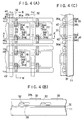
- the inner surface of the other substrate 11 is provided with a plurality of conductive pads 37b each constituting one pixel of the display as seen from Fig. 4(A).
- the dashed line encloses one pixel in the figure.
- Each conductive pad 37b is formed on the substrate together with two CMOS transistors, namely an n-channel FET 51 and a p-channel FET 41, whose sources 34b′ and 34b are electrically connected with the corresponding pad 37b.
- the drains of all the n-channel CMOS FETs on the same row are connected with a VDD line 48 of the row.
- the drains of the p-channel CMOS FETs on the same row are connected with a VSS line 49 of the row.
- the gates of all the p-channel and n-channel CMOS FETs on the same column are connected with a VGG line of the column.
- the VSS and the VDD lines are connected to a row driver 47 and supplied with control signals therefrom.
- the VGG lines 52 are connected to a column driver 46 and supplied with control signals therefrom.
- the column driver 46 and the row driver 47 are formed on the projected end of the glass substrate 11 as will be understood from the illustration of Fig. 2.
- the distance between the substrates is selected to be about 10 ⁇ m and both the inner surfaces of the substrates are provided with orientation control films which are given a suitable rubbing treatment.
- the distance between the substrates is selected to be about 1.5 to 3.5 ⁇ m, e.g. 2.3 ⁇ m and only one of the inner surfaces (the surface of the ground electrode) is provided with an orientation control film given a suitable rubbing treatment.
- the driving voltage is ⁇ 20V.
- the distance between the substrates is selected to be about 1.0 to 10.0 ⁇ m, e.g.
- the driving voltage is ⁇ 10 to ⁇ 15V.
- polarization plates are also unnecessary and therefore the amount of available light can be relatively increased in either transmission or reflective types of LCD. Accordingly, whereas the liquid crystal layer possesses no threshold voltage, a large contrast in displayed images may be realized and undesirable cross-talk may be effectively prevented by the use of complementary TFTs which provide a definite threshold voltage.
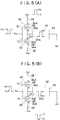
- the operation of the complementary transistors will now be explained with reference to Fig. 5(A) and 5(B).
- VDD line and the VSS line be +10V and -10V respectively.
- the n-channel transistor 51 is turned on and the p-channel transistor 41 turned off when a positive voltage VGG is applied to the gate terminals 40 and 40′ as illustrated in Fig. 5(A).
- VGG-Vth the effective gate voltage (the gate voltage relative to the source voltage) becomes less than the threshold voltage Vth.
- the n-channel transistor always supplies electric charge to the source terminal in order to maintain the source voltage level at that level and to cope with current leakage from the source terminal.
- the source terminal i.e. the output level of the complementary transistors is fixed to the VGG-Vth level so that the output level can be controlled by the input gate signal.
- the n-channel transistor 51 is turned off and the p-channel transistor 41 turned on when a negative voltage VGG is applied to the gate terminals 40 and 40′ as illustrated in Fig. 5(B).
- VGG-Vth the effective gate voltage (the gate voltage relative to the source voltage) becomes lower in magnitude than the threshold voltage Vth.
- the n-channel transistor always discharges the source terminal in order to maintain the source voltage level at that level and to cope with current leakage from the source terminal. Accordingly, the source terminal, ie. the output level of the complementary transistors is fixed to the VGG-Vth level so that the output level can also be controlled by the input gate signal.
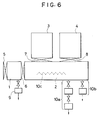
- FIG. 6 is a schematic view showing a multi-chamber sputtering system for depositing semiconductor and oxide films by magnetron RF sputtering.
- the system comprises a loading and unloading chamber 1 provided with a gate valve 5, a subsidiary chamber 2 connected to the loading and unloading chamber 1 via a gate valve 6, and first and second individual sputtering apparatuses 3 and 4 respectively connected to the subsidiary chamber 2 through gate valves 7 and 8 respectively.
- the loading and unloading chamber 1 is provided with an evacuation system 9 comprising a rotary pump and a turbomolecular pump coupled in series.
- the subsidiary chamber 2 is provided with a first evacuation system 10a for roughing comprising a rotary pump and a turbomolecular pump in series, a second evacuation system 10b for high vacuum evacuation comprising a cryosorption pump and a heater 10c located in the subsidiary chamber 2 in order to heat the substrates to be coated. If substrates to be coated are thermally stabilized in advance by being heated in the subsidiary chamber 2, their thermal distortion and stress caused in films during deposition can be reduced thereby improving the adhesion of the films to the substrates.
- the sputtering apparatuses 3 and 4 are individual planar type magnetron RF sputtering apparatuses suitable for exclusive use in depositing oxide films and semiconductor films respectively when used in accordance with the present invention.
- Figs. 7(A) and 7(B) illustrate details of the RF sputtering apparatus.
- the apparatus comprises a vacuum chamber 20, a first evacuation system 12-1 for roughing consisting of a turbomolecular pump 12b and a rotary pump 12d provided with valves 12a and 12c respectively, a second evacuation system 12-2 for high vacuum evacuation comprising a cryosorption pump 12e provided with a valve 12f, a metallic holder 13 fixed in the lower section of the vacuum chamber 20 for supporting a target 14 thereon, the holder being formed with an inner conduit 13a through which a coolant can be caused to flow to cool the target 14 and being provided with a plurality of magnets 13b such as permanent magnets, an energy supply 15 consisting of an RF (e.g.
- 13.56MHz source 15a provided with a matching box 15b for supplying RF energy to the holder 13, a substrate holder 16 located in the upper section of the vacuum chamber 20 for supporting a substrate 11 to be coated, a heater 16a embedded in the substrate holder 16, a shutter system 17 located between the substrate 11 and the target 14, and a gas supply system 18.
- a sealing means 19 is also provided for ensuring that the vacuum chamber 20 remains airtight. In advance of actual deposition on the substrate 11, impurities occurring in the targets are sputtered out and deposited on the shutter 17 which is positioned between the substrate 11 and the target 14, and then the shutter is removed in order to enable normal deposition to be effected on the substrate 11.
- the magnets 13b are oriented with their N poles at their upper ends and their S poles at their lower ends and are horizontally arranged in a circle as illustrated in Fig. 7(B) in order to confine electrons within a sputtering region between the substrate 11 and the target 14.
- a method of manufacturing thin-film field effect transistors 41 and 51 in accordance with the first preferred embodiment of the invention will now be described in detail.
- This exemplary method is carried out with a multi-chamber apparatus suitable for mass-production.
- the method is applicable to similar processes utilizing separate chambers without substantial modification.
- Ten sheets of glass substrate are mounted on a cassette and placed in the loading and unloading chamber 1 through the gate valve 5.
- the substrates may be made from an inexpensive glass which can endure thermal treatment at high temperatures up to 700°C, e.g. 600°C, such as NO glass manufactured by Nippon Electric Glass Co.
- the cassette is transported from the loading and unloading chamber I into the subsidiary chamber 2 through the gate valve 6.
- One of the glass substrates is positioned in the first magnetron RF sputtering apparatus as shown in Fig. 7(A) by means of a transportation mechanism (not shown) and coated with a Si02 film 32 as a blocking film to a thickness of 1000 ⁇ to 3000 ⁇ .
- the conditions under which this deposition is carried out are given as: an atmosphere of 100% oxygen; a total atmospheric pressure of 0.5 Pa; a substrate temperature of 150°C; and a power output of 400W to 800W from the 13.56 MHz RF apparatus.
- the target is composed of a single crystalline silicon or a quartz block and the deposition speed is 30 to 100 ⁇ /min.
- the coated substrate is then exchanged for one of the remaining substrates and this is subsequently coated with a Si02 film in the same manner. This process is repeated until all the substrates mounted on the cassette are coated with a Si02 film.
- the transportation of a substrate between the subsidiary chamber 2 and the sputtering apparatus 3 has to be carried out after adjusting the pressures and the inner atmospheres of the chambers 2 and 3 to be equivalent, so as to eliminate undesirable impurities.
- An amorphous silicon film 33 is next deposited in the second sputtering apparatus 4 on the Si02 film 32 to a thickness of from 500 nm to 1 ⁇ m, e.g. 2000 ⁇ .
- the total density of oxygen, carbon and nitrogen in the amorphous film is preferably between 5 x 10²⁰ to 5 x 1021cm ⁇ 3 in order to eliminate the undesirable influence of incident light on the channel region of the transistor by reducing its photosensitivity.
- the photosensitivity of the channel can alternatively be reduced by introducing a spoiling impurity selectively into the channel.
- it is desirable that the total density of oxygen, carbon and nitrogen in the amorphous film does not exceed 7 x 1020cm ⁇ 3, and preferably that it does not exceed 1 x 1019cm ⁇ 3.
- the ten substrates are placed into the second sputtering apparatus 4 one after another from the subsidiary chamber 2 in the same manner as described previously and an amorphous silicon film is deposited on each substrate.
- the transportation of each substrate between the second sputtering apparatus 4 and the subsidiary chamber 2 is carried out after adjusting the pressures and the inner atmospheres of the chambers 2 and 4 in order to eliminate undesirable impurities. This procedure is generally employed when it is desired to transport the substrates between any two adjacent chambers, even if not particularly described hereinbelow.
- the hydrogen and argon gases desirably have purities of 99.999% and 99.99% respectively and are introduced after the inside of the second sputtering apparatus 4 is evacuated to a pressure not higher than 1 x 10 ⁇ 5 Pa.
- Deposition is carried out under a total atmospheric pressure of 0.5 Pa with the output power of the 13.56 MHz RF apparatus at 400W to 800W using a target composed of single crystalline silicon desirably containing oxygen atoms at a concentration of no greater than 5 x 108cm ⁇ 3 (typically 1 x 108cm ⁇ 3 and with the substrate temperature (deposition temperature maintained at 150°C by use of the heater 16a.
- the hydrogen proportion in the mixture may be chosen to be between 5% and 100%, the deposition temperature between 50°C and 500°C (typically 150°C) and the output power of the RF apparatus between 1W and 10MW in a frequency range from 500Hz to 1000Hz which in addition may be combined with another pulsed energy source.
- the amorphous silicon film 33 may be deposited by low-pressure CVD (LPCVD) or plasma CVD.
- LPCVD low-pressure CVD
- the deposition is carried out by introducing disilane (Si2H6) or trisilane (Si3H8) in a suitable CVD chamber.
- the deposition temperature is selected to be 100°C to 200°C lower than the recrystallization temperature of the silicon, i.e. 450°C to 550°C, for example 530°C.
- the deposition speed is 50 to 200 ⁇ /min.
- Boron may be introduced at a density of 1 x 1015cm ⁇ 3 to 1 x 1018cm ⁇ 3 into the film by using diborane as a dopant gas together with the silane in order to make the threshold voltages of N-type and P-type TFTs even.
- the deposition is carried out by introducing monosilane (SiH4) or disilane (Si2H6) at 300°C in a suitable plasma CVD chamber.
- the input energy is for example high-frequency electric energy at 13.56MHz.
- the oxygen density of the semiconductor film is preferably no higher than 5 x 1021cm ⁇ 3 because if the oxygen density is too high, thermal treatment has to be carried out at a high temperature for a long period of time in order to sufficiently recrystallize the semiconductor film in a later step.
- the oxygen density must not be too low because leakage current in the off condition of the TFT increases in response to a back light which may be provided in the liquid crystal display if a particular spoiling impurity is not used. For this reason, the oxygen density is selected between 4 x 10¹⁹ and 4 x 1021cm ⁇ 3.
- the deposition of the semiconductor film can be carried out in order that the total density of oxygen in the semiconductor film does not exceed 7 x 1020cm ⁇ 3, preferably that it does not exceed 1 x 1019cm ⁇ 3.
- Such a low density makes it easy to recrystallize the source and drain regions of the semiconductor film in a later step by thermal treatment.
- the mobility of these TFTs can be increased, because the introduction of oxygen is prevented, resulting in a high speed of operation.
- thermal treatment is given thereto in the subsidiary chamber 2 by means of the heater 10c at an operating temperature in the range 450°C to 700°C (typically 600°C) for a period of 12 to 70 hours using a non-oxidizing atmosphere, e.g. hydrogen.
- the film is recrystallized by this treatment (thermal annealing) and forms a semi-amorphous or semi-crystalline structure.
- Si-H bonds react with other Si-H bonds and are converted to Si-Si bonds by thermal treatment in the temperature range 450°C to 700°C in a non-oxidizing atmosphere.
- This coupling of adjacent silicon atoms (Si-Si) functions to let adjacent clusters be attracted to each other, whereas without thermal treatment these clusters have a tendency to convert their states to more ordered states (partial recrystallization).
- the crystalline structure of these clusters is given lattice distortion and the peak of its Raman spectra (522cm ⁇ 1: the peak of single crystalline silicon) is displaced in the low-frequency direction.
- the apparent grain diameter calculated on the basis of half-width is in the range 50 ⁇ to 500 ⁇ which seems to indicate the existence of microcrystals.
- the polycrystalline (semi-amorphous or semi-crystalline) structure of silicon in accordance with the present invention is entirely different than usual polycrystals in which grain boundaries provide barriers against carrier transportation, so that the carrier mobility of the polycrystalline silicon can be of the order of 15 to 300 cm2/Vsec (electron mobility) and 10 to 200 cm2/Vsec (hole mobility). Therefore, the semi-amorphous or semi-crystalline structure in accordance with the present invention can be considered substantially not to include undesirable grain boundaries.
- the semiconductor is subjected to high temperatures of 1000°C or higher rather than the relatively low temperatures of 450°C to 700°C, latent oxygen atoms come to appear at the boundaries between the clusters and form barriers as in some of the prior art techniques.
- the carrier mobility can be improved by increasing the strength of the anchoring between the clusters.
- the oxygen density in the semiconductor film is decreased to 7 x 1019cm ⁇ 3, desirably to 1 x 1019cm ⁇ 3.
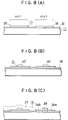
- the amorphous silicon semiconductor film 33 is patterned by means of a photomask as indicated by 1 in Fig. 8(A) to leave areas 33 and 33′ which are necessary to form N-channel and P-channel transistors.
- the substrates are placed again in the first sputtering apparatus 3.
- the entire structure is then coated with a silicon oxide film 35 of a thickness of 500 ⁇ to 2000 ⁇ , e.g. 1000 ⁇ , by sputtering in an oxide atmosphere as illustrated in Fig. 8(B).
- the deposition condition is the same as that for the silicon oxide film 32 as explained above.
- the characteristics at the interface between the silicon oxide film 35 and the underlying semiconductor film 33 can be improved by applying ultraviolet radiation to implement ozone oxidation.
- the interface states can be decreased by utilizing photo-CVD in combination with the sputtering explained in the description of deposition of the oxide film 32.
- fluorine may be introduced in this deposition in order to fix sodium ions.
- the atmosphere comprises a high density of oxygen (95%) including NF3 (5%) at a total atmospheric pressure of 0.5 Pa
- the output power of the 13.56 MHz RF apparatus is 400W
- a target composed of a single crystalline silicon or an artificial quartz is used and the substrate temperature is maintained at 100°C.
- the silicon oxide film 35 for the gate insulating film includes fluorine atoms which function to terminate open ended or dangling bonds of silicon atoms so that the formation of fixed charge can be prevented at the interface between the semiconductor films 33 and 33′ and the oxide film 35.
- a silicon semiconductor film of 0.2 ⁇ m thickness which is highly doped with phosphorus at a density of 1 x 10²¹ to 5 x 1021cm ⁇ 3 is deposited by low-pressure CVD on the silicon oxide film 35 followed, if desired, by the coating of a single conductive film of 0.3 ⁇ m thickness made of molybdenum or tungsten or a multiple conductive film comprising the single conductive film previously described and a MoSi02 or WSi02 film.
- the semiconductor film coated with the single or multiple conductive film is then patterned by photolithography with a suitable mask as shown in Fig. 8(B) at 2 in order to form gate electrodes 40 and 40′.
- a photoresist film 27′ is formed by the use of a photomask as shown in Fig. 8(C) at 3 in order to cover the semiconductor film 33′.
- self-aligned impurity regions i.e. a source and a drain region 34a and 34b are formed by ion implantation of boron at a density of 1 x 1015cm ⁇ 2 to 5 x 1015cm ⁇ 2.
- the resultant intermediate region 28 of the silicon semiconductor film 33 between the impurity regions 34a and 34b is then defined as a channel region as illustrated in Fig. 8(C).
- photoresist film 27 After removing photoresist film 27′, another photoresist film 27 is formed by the use of a photomask 4 in order to cover the semiconductor film 33.
- a photomask 4 Using the gate electrode 40′ and the photoresist film 27′, self aligned impurity regions, i.e. a source and a drain region 34b′ and 34a′ are formed by ion implantation of phosphorus at a density of 1 x 1015cm ⁇ 2 to 5 x 1015cm ⁇ 2.
- the resultant intermediate region 28′ of the silicon semiconductor film 33 between the impurity regions 34a′ and 34b′ is then defined as a channel region as illustrated in Fig.8(D).
- the channel lengths of the p-channel and n-channel transistor are 10 ⁇ m respectively.
- the channel widths of the p-channel and n-channel transistor are 20 ⁇ m respectively.
- the ion implantation may instead be carried out by selectively removing the silicon oxide film 35 by the use of the gate electrode 40 or 40′ as a mask followed by direct ion implantation of boron or phosphorus.
- the channel regions are subsequently thermally annealed at 600°C for 10 to 50 hours in an atmosphere of hydrogen to make the impurities in the drain and source regions active.
- An interlayer insulating film 37 of silicon oxide is deposited to a thickness of 0.2 to 0.6 ⁇ m by the same sputtering method as described above over the entire surface of the structure, followed by etching by means of a photomask 5 for opening contact holes 39 through the interlayer insulation film 37 and the oxide film 35 in order to provide access to the underlying source and drain regions 34b, 34a, 34b′ and 34a′.
- the deposition of the interlayer insulating film 37 may be carried out by LPCVD, photo-CVD, ordinal-pressure CVD (TEOS-ozone).
- TEOS-ozone ordinal-pressure CVD
- an aluminium film of 0.5 to 1 ⁇ m thickness is deposited on the structure over the contact holes 39 and is patterned to form source and drain electrodes 36b, 36a, 36b′ and 36a′ by means of a photomask 6 as illustrated in Fig. 8(F).
- An organic resin film 39 such as a transparent polyimide film is coated over the structure to provide a planar surface and patterned by means of a photomask 7 to provide access to the source electrodes 36b and 36b′.
- lead electrode 37 made of a transparent conductive material such as indium tin oxide (ITO) which is to be electrically connected with the pad 37b.
- ITO film is deposited by sputtering at room temperature to a temperature of 150°C followed by annealing in an oxidizing atmosphere (02) or in air at a temperature of 200°C to 400°C.
- the pad 37b can be formed at the same time by the deposition of the lead electrode 37. Then, the formation of the CMOS transistors is completed.
- the mobility and the threshold voltage of the p-channel TFT are 20 cm2/Vs and -5.9 V respectively.
- the mobility, the threshold voltage of the n-channel TFT are 40 cm2/Vs and 5.0 V respectively.
- the glass substrate provided with these CMOS transistors incorporating suitable conductive patterns as illustrated, is joined with a counterpart glass substrate provided with a ground electrode located throughout its entire inner surface which followed by the injection of a liquid crystal material between these two substrates.
- One of the advantages of the above process is that the formation of these transistors (spoiled and not spoiled) can be carried out at temperatures no higher than 700°C so that the process does not require the use of expensive substrates such as quartz substrates and is therefore suitable for large scale LCD production methods.
- thermal annealing is carried out twice at the steps corresponding to Figs. 8(A) and 8(D).
- the first annealing (Fig. 8(A)), however, can be omitted to shorten the process time because of the subsequent second annealing.
- CMOS thin-film field effect transistors in accordance with a second preferred embodiment of the present invention will now be described.
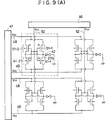
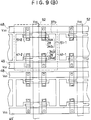
- two pairs of complementary CMOS transistors 51-1 with 41-1 and 51-2 with 41-2 are connected in parallel to the conductive pad 37b for each pixel (as enclosed by the dashed line) at their source electrodes.
- These CMOS transistors are manufactured using the steps explained above in conjunction with the first embodiment except for the fact that the number of transistors is doubled. Similar elements are given similar numerals as in the first embodiment.
- the electrode pads 37b have to be deposited on the VGG line by use of a suitable insulating film therebetween. The electrical operation is substantially the same as that of the first embodiment.
- two identical individual switching elements are prepared corresponding to one pixel so that if the operation of one of them is at fault, the operation of the information display can be maintained by eradicating the faulty element by laser radiation without affecting the remaining CMOS transistors. For this reason, the conductive transparent pads are formed so as not to cover these TFTs.
- CMOS thin-film field effect transistors in accordance with a third preferred embodiment of the present invention will now be described.
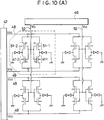
- two pairs of complementary CMOS transistors 51-1 with 41-1 and 51-2 with 41-2 are connected in parallel to an electrode pad 37b for each pixel at their source electrodes.
- the electrode pad 37b is separated into two portions 37b-1 and 37b-2 each independently connected to a corresponding one of the two CMOS transistors.
- These CMOS transistors are manufactured using the steps explained above in conjunction with the first embodiment except for the fact that the number of transistors is doubled. Similar elements are given similar numerals as in the first embodiment.
- each pixel comprises two individual sub-pixels. In accordance with this embodiment, even if the operation of one of the sub-pixels is faulty, the other sub-pixel can support the operation of the pixel and therefore the deterioration of grey scales is substantially decreased.
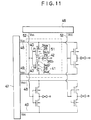
- Fig. 11 is a diagram illustrating the equivalent circuit of a liquid crystal display in accordance with a fourth embodiment of the present invention.
- the pixel configuration as shown in Fig. 4 can be applied also for this embodiment.
- the diagram shows only a 2 x 2 matrix for convenience of description whereas ordinary liquid crystal displays consist of much greater numbers of pixels such as a 640 x 480 matrix or a 1260 x 960 matrix.
- the liquid crystal display includes a liquid crystal layer 42 disposed between a pair of glass substrates 11 and 11′ in the same manner as the first embodiment as shown in Fig. 2.
- the entirety of the inner surface of the glass substrate 11′ is coated with a back electrode 53.
- the electrode 53 is not grounded but rather is supplied with an offset voltage in accordance with the driving mechanism of the liquid crystal display as explained in detail infra.
- the inner surface of the other substrate 11 is provided with a plurality of conductive pads 37b each constituting one pixel of the display in the same manner as the first embodiment.
- Each conductive pad 37b is formed on the substrate together with two CMOS transistors, namely an N-type FET 51 and a P-type FET 41, whose sources 34b′ and 34b respectively are electrically connected with the corresponding pad 37b.
- the drains of all the N-type CMOS FETs on the same row are connected with a VDD line 48 of the row.
- the drains of all the P-type CMOS FETs on the same row are connected with a VSS line 49 of the row.
- the gates of all the P-type and N-type CMOS FETs on the same column are connected with a VGG line of the column.
- the VSS and VDD lines are connected to a row driver 47 and supplied with control signals therefrom.
- the VGG lines 52 are connected to a column driver 46 and supplied with control signals therefrom.
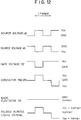
- Fig. 12 illustrates the operational action of each pixel in response to several control signals applied to the VDD line, the VSS line, the VGG line and the back electrode.
- the liquid crystal voltage level at the pixel i.e. the voltage level of the pad 37b
- the voltage applied between the liquid crystal at the pixel is calculated by subtracting the offset (bias) voltage applied to the back electrode from the liquid crystal voltage.
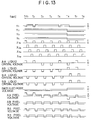
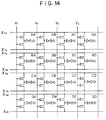
- FIG. 14 illustrates the control signals applied to the VDD lines, the VSS lines, the VGG lines and the back electrode.
- the VDD lines are called X 1a , X 2a , X 3a and X 4a from the first row to the fourth row in the diagram respectively whereas the VSS lines are called X 1b , X 2b , X 3b and X 4b in the same manner.
- the signals applied to the VSS lines are exactly the inverse of the signals applied to the VDD lines as shown in Fig. 12 and therefore, the waveforms of the VSS lines are not illustrated.
- the VGG lines are called Y1, Y2, Y3 and Y4 from the left column to the right column respectively.
- the control signals applied to the VDD and VSS lines are addressing signals which scan from the first row to the fourth row as shown in Fig. 13.
- Opposed pulses are applied to the VDD and VSS lines connected to one addressed row for a time interval equivalent to one quarter of the frame interval during which all the rows are sequentially scanned.
- the control signals applied to the VGG lines are data signals which determine the visual pattern appearing on the display.
- a positive pulse is applied to the VGG line of the j-th column at the time when the i-th row is addressed by applying opposed pulses to the VDD and VSS lines on the i-th row.
- the pixel on the first column and the first row (given symbol AA in Fig. 14) is actuated in the first quarter of the first frame interval between T1 and T2, the second frame interval between T2 and T3 and the fifth frame interval between T5 and T6.
- the back electrode is biassed by a negative voltage between T1 and T6.
- the VDD, VSS and VGG signal levels and the bias voltage are for example 20V, -20V, ⁇ 20V and ⁇ 10V respectively in the case when the optical characteristic of the liquid crystal is changed by a threshold voltage of 20V thereacross. Accordingly, as understood from Fig. 12, a high voltage such as 30V is only applied to the selected pixel (the AA pixel in the figure) while the voltage level applied to the other pixel does not exceed 10V. In the time interval T6 to T8 in Fig. 13, the voltage levels on the VGG lines and the back electrode are inverted so that the polarity of the applied voltage on each pixel is simply inverted.
- a low voltage such as -30V is only applied to the selected pixel (the AA pixel in the figure) while the absolute voltage level applied to the other pixel does not exceed 10V.
- the pixel in the first column and the first row is actuated in the sixth frame between T6 and T7.
- the inversion of polarity takes place repeatedly once per several frames to several tens of frames, so that the average voltage applied to the liquid crystal approaches to zero volts throughout its operation resulting in the effective prevention of deterioration of the liquid crystal.
- the voltage level of control signals applied to the liquid crystal layer can be easily adjusted to the threshold level of the liquid crystal layer by simply adjusting the bias voltage level applied to the back electrode.
- the employment of the bias voltage makes it possible to cancel out the effect of the electric field impressed on the liquid crystal by periodically changing the polarity of the bias voltage, resulting in the prevention of electrolysis of the liquid crystal material.
- CMOS transistors 41-1 with 51-1 and 41-2 with 51-2 are connected in parallel to an electrode pad 36b for each pixel (as enclosed by the dashed line) at their source electrodes.
- CMOS transistors are manufactured using the steps explained above in conjunction with the first embodiment except for the fact that the number of transistors is doubled. Similar elements are given similar numerals as in the first embodiment.
- the electrical operation is substantially the same as that of the third embodiment.
- two identical individual switching elements are prepared corresponding to one pixel so that when the operation of one of them is faulty, the operation of the information display can be maintained by eradicating the faulty element by laser radiation without prejudice to the operation of the remaining CMOS transistors. For this reason, the conductive transparent pads are formed so as not to cover these TFTs.
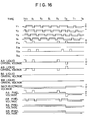
- Fig. 16 illustrates the control signals applied to the VDD lines, the VSS lines, the VGG lines and the back electrode in the same manner as the second embodiment.
- the control signals applied to the VGG lines are addressing signals which repeatedly scan from the first row to the fourth row as shown in Fig. 16.
- a negative or positive pulse is applied to the VGG line connected to an addressed column.
- the opposed control signals applied to the VDD and VSS lines are data signals which determine the visual pattern appearing on the display.
- opposed pulses are applied to the VDD and VSS lines of the i-th row at the time when the j-th column is addressed by applying a positive pulse to the VGG line on the j-th column.
- the pixel on the first column and the first row is actuated in the first frame interval between T1 and T2, the second frame interval between T2 and T3 and the fifth frame interval between T5 and T6.
- the back electrode is biassed by a negative voltage between T1 and T6.
- the VDD, VSS and VGG signal levels and the bias voltage are for example 20V, -20V, ⁇ 20V and ⁇ 10V respectively in the case when the optical characteristic of the liquid crystal is changed by a threshold voltage of 20V. Accordingly, as understood from Fig. 12, a high voltage such as 30V is only applied to the selected pixel while the voltage level applied to the other pixel does not exceed 10V. In the time interval T6 to T8 in Fig. 16, the voltage levels on the VGG lines and the back electrode are inverted so that the polarity of the applied voltage on each pixel is simply inverted. Accordingly, a low voltage such as -30V is only applied to the selected pixel while the absolute voltage level applied to the other pixel does not exceed 10V.
- the pixel in the first column and the first row is actuated in the sixth frame between T6 and T7.
- the inversion of polarity takes place repeatedly once per several frames to several tens of frames so that the average voltage applied to the liquid crystal approaches zero volts throughout its operation resulting in the effective prevention of deterioration of the liquid crystal.
- CMOS transistors 41-1 with 51-1 and 41-2 with 51-2 are connected in parallel to an electrode pad 37b for each pixel at their source electrodes.
- the electrode pad 37b is separated into two portions 37b-1 and 37b-2 each independently connected to a corresponding one of the two CMOS transistors in the same manner as Fig. 10(B).
- CMOS transistors are manufactured using the steps explained above in conjunction with the first embodiment except for the fact that the number of transistors is increased. Similar elements are given similar numerals as in the first embodiment. Then, each pixel comprises two individual sub-pixels.
- the other sub-pixel can support the operation of the pixel and therefore the possibility of deterioration in grey scale is substantially decreased. Also even when the operational speed of one sub-pixel becomes low, the quality of the displayed image is not greatly deteriorated.
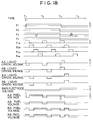
- FIG. 18 illustrates the control signals applied to the VDD lines, the VSS lines, the VGG lines and the back electrode in the same manner as the fourth embodiment.
- the control signals applied to the VDD and VSS lines are addressing signals which scan from the first row to the fourth row as shown in Fig. 18.
- Opposed pulses are applied to the VDD and VSS lines connected to an addressed row.
- control signals applied to the VGG lines are data signals which determine the visual pattern appearing on the display.
- control signals applied to the VGG lines are positive or negative pulses whose pulse width is only one 16th of one frame interval (e.g. between T1 and T2).
- the pulse width of addressing signals applied to the VDD and VSS lines is on the other hand, one quarter of the frame interval in the same manner as the second embodiment.
- the use of 16th division is suitable for colour displays.
- a positive pulse is applied to the VGG line of the j-th column at the time when the i-th row is addressed by applying opposed pulses to the VDD and VSS lines on the i-th row.
- the pixel on the first column and the first row is actuated in the first frame interval between T1 and T2.
- the back electrode is biassed by a negative voltage between T1 and T3.
- the VDD, VSS and VGG signal levels and the bias voltage are for example 20V, -20V, +20V and +10V respectively in the case when the optical characteristic of the liquid crystal is changed by a threshold voltage of 20V in the same manner as previously stated.
- a high voltage such as 30V is only applied to the selected pixel while the voltage level applied to the other pixel does not exceed 10V.
- the voltage levels on the VGG lines and the back electrode are inverted so that the polarity of the applied voltage on each pixel is simply inverted.
- a low voltage such as -30V is only applied to the selected pixel while the absolute voltage level applied to the other pixel does not exceed 10V.
- the pixel in the first column and the first row is actuated in the third frame between T3 and T4.
- the inversion of polarity takes place repeatedly once per several frames to several tens of frames so that the average voltage applied to the liquid crystal approaches zero volts throughout its operation resulting in the effective prevention of deterioration of the liquid crystal.
- the above embodiments are applications using CMOS technology for switching devices in liquid crystal displays.
- the TFT in accordance with the present invention can be utilized in the form of a switching device comprising one TFT for driving one pixel.
- the equivalent circuit would be substantially the same as that illustrated in Fig.1 except that the resistance RSD would not be effective because the n-type TFT is contructed with a doped semiconductor film which is not sensitive to incident light as explained above.
- the electrode pad of each pixel becomes electrically floating when not addressed in this modification so that the voltage level thereof may not always be fixed as compared with those utilizing CMOS technology.
- the manufacturing process thereof is very simple without the need of light blocking means.
- the liquid crystal material used in the liquid crystal display may include other types of materials.
- a suitable phase transition liquid crystal material can be prepared by adding an ion dopant into a nematic liquid crystal material of guest-host type or dielectric anisotropic type.
- the phase transition liquid crystal material changes its optical appearance from a transparent state to a cloudy state and vice versa through a phase transition between its nematic phase and its cholesteric phase in accordance with application of an electric field.
- suitable light influencing materials may also be utilized for the same purpose such as electrophoresis dispersions which are prepared by dispersing pigment particles in an organic liquid which has been colored by a dye. If a grey scale is desired, a plurality of frame intervals are given to one image to be displayed and the selected pixels are actuated in fewer frame intervals than given in accordance with the desired grey tone.
- the present invention can be applied to displays utilizing other types of semiconductor devices such as germanium or silicon/germanium (Si x Ge x ) semiconductor devices, in which case the thermal treatment can be done at temperatures approximately 100°C lower than those used for silicon semiconductors in the above embodiments.
- the deposition of such a semiconductor can be carried out by sputtering in a high-energy hydrogen plasma caused by optical energy (shorter than 1000 nm wavelength) or by electron cyclotron resonance (ECR).
- ECR electron cyclotron resonance
- gases including hydrogen molecules some hydrogen compounds can be used as the atmosphere for sputtering as long as they do not introduce additional impurities.
- monosilane or disilane may be used for forming silicon semiconductor transistors.
- oxide and semiconductor films are deposited respectively in separate apparatuses, it is also possible to deposit other types of gate insulating films or gate electrodes in a common apparatus.
- a halogen such as fluorine may be used as a sputtering atmosphere so as to introduce halogen atoms into the oxide films in order to effectively prevent alkali metal atoms from getting into the film from the glass substrate by virtue of neutralization.
- the same effect can be expected by the introduction of phosphorus in place of a halogen.
- the present invention can be applied to other types of optical devices utilizing semiconductor devices such as image sensors, load elements or three-dimensional elements of monolithic integrated semiconductor devices.
- field effect transistors are formed on a glass substrate.
- other substrates can be used instead.
- thin-film field effect transistors may be formed on a silicon substrate in a liquid crystal display or an image sensor device.
- This silicon substrate may be an intrinsic silicon substrate, a p-type silicon substrate, an n-type silicon substrate, or a silicon substrate in which MOSFETs, bipolar transistors, or the like are provided in integrated circuit form.
- An insulating layer is provided between such a substrate and the thin-film field effect transistors although such an insulating layer may be dispensed with in the case of an intrinsic silicon substrate.
- a gate electrode may be either a single layer electrode or a multi-layer electrode in a gate insulated field effect transistor in accordance with the present invention.
- the single layer gate electrode may be a silicon electrode doped with phosphorus or an aluminium electrode.
- the multi-layer gate electrode may be a two-layer electrode which consists of a lower chromium layer and an upper aluminium layer formed thereon or a two-layer electrode which consists of a lower silicon layer doped with phosphorus and an upper metallic or metal silicide layer formed thereon.
- the aluminium single layer electrode and the upper aluminium layer can be formed by sputtering an aluminium target.
- the silicon single layer electrode and the lower silicon layer can be formed by low-pressure CVD or by sputtering a silicon target doped with phosphorus.
- the lower chromium layer can be formed by sputtering a chromium target.
- the metallic layer may be a molybdenum layer formed by sputtering a molybdenum target, a wolfram layer formed by sputtering a wolfram target, a titanium layer formed by sputtering a titanium target, or an aluminium layer formed by sputtering an aluminium target.
- the metal silicide layer may be a MoSi2 layer formed by sputtering a MoSi2 target, a WSi2 layer formed by sputtering a WSi2 target, or a TiSi2 layer formed by sputtering a TiSi2 target.
Landscapes
- Physics & Mathematics (AREA)
- Engineering & Computer Science (AREA)
- General Physics & Mathematics (AREA)
- Chemical & Material Sciences (AREA)
- Crystallography & Structural Chemistry (AREA)
- Nonlinear Science (AREA)
- Computer Hardware Design (AREA)
- Theoretical Computer Science (AREA)
- Mathematical Physics (AREA)
- Optics & Photonics (AREA)
- Microelectronics & Electronic Packaging (AREA)
- Thin Film Transistor (AREA)
- Liquid Crystal (AREA)
- Control Of Indicators Other Than Cathode Ray Tubes (AREA)
- Liquid Crystal Display Device Control (AREA)
Applications Claiming Priority (4)
| Application Number | Priority Date | Filing Date | Title |
|---|---|---|---|
| JP323695/90 | 1990-11-26 | ||
| JP32369590A JP2742725B2 (ja) | 1990-11-26 | 1990-11-26 | 表示装置 |
| JP415721/90 | 1990-12-10 | ||
| JP41572190A JP3270485B2 (ja) | 1990-12-10 | 1990-12-10 | 表示装置の駆動方法 |
Publications (2)
| Publication Number | Publication Date |
|---|---|
| EP0488643A2 true EP0488643A2 (de) | 1992-06-03 |
| EP0488643A3 EP0488643A3 (en) | 1993-05-12 |
Family
ID=26571277
Family Applications (1)
| Application Number | Title | Priority Date | Filing Date |
|---|---|---|---|
| EP19910310870 Withdrawn EP0488643A3 (en) | 1990-11-26 | 1991-11-26 | Electro-optical device and driving method for the same |
Country Status (3)
| Country | Link |
|---|---|
| US (5) | US5495353A (de) |
| EP (1) | EP0488643A3 (de) |
| KR (5) | KR950001360B1 (de) |
Cited By (3)
| Publication number | Priority date | Publication date | Assignee | Title |
|---|---|---|---|---|
| US7154147B1 (en) | 1990-11-26 | 2006-12-26 | Semiconductor Energy Laboratory Co., Ltd. | Electro-optical device and driving method for the same |
| US7329906B2 (en) | 1992-08-27 | 2008-02-12 | Semiconductor Energy Laboratory Co., Ltd. | Semiconductor device and method for forming the same |
| US8106867B2 (en) | 1990-11-26 | 2012-01-31 | Semiconductor Energy Laboratory Co., Ltd. | Electro-optical device and driving method for the same |
Families Citing this family (135)
| Publication number | Priority date | Publication date | Assignee | Title |
|---|---|---|---|---|
| DE69125886T2 (de) * | 1990-05-29 | 1997-11-20 | Semiconductor Energy Lab | Dünnfilmtransistoren |
| US5210050A (en) | 1990-10-15 | 1993-05-11 | Semiconductor Energy Laboratory Co., Ltd. | Method for manufacturing a semiconductor device comprising a semiconductor film |
| US5849601A (en) * | 1990-12-25 | 1998-12-15 | Semiconductor Energy Laboratory Co., Ltd. | Electro-optical device and method for manufacturing the same |
| US7115902B1 (en) | 1990-11-20 | 2006-10-03 | Semiconductor Energy Laboratory Co., Ltd. | Electro-optical device and method for manufacturing the same |
| KR950013784B1 (ko) | 1990-11-20 | 1995-11-16 | 가부시키가이샤 한도오따이 에네루기 겐큐쇼 | 반도체 전계효과 트랜지스터 및 그 제조방법과 박막트랜지스터 |
| KR950001360B1 (ko) * | 1990-11-26 | 1995-02-17 | 가부시키가이샤 한도오따이 에네루기 겐큐쇼 | 전기 광학장치와 그 구동방법 |
| JP2838318B2 (ja) | 1990-11-30 | 1998-12-16 | 株式会社半導体エネルギー研究所 | 感光装置及びその作製方法 |
| US5821563A (en) | 1990-12-25 | 1998-10-13 | Semiconductor Energy Laboratory Co., Ltd. | Semiconductor device free from reverse leakage and throw leakage |
| US7253437B2 (en) * | 1990-12-25 | 2007-08-07 | Semiconductor Energy Laboratory Co., Ltd. | Display device having a thin film transistor |
| US7576360B2 (en) * | 1990-12-25 | 2009-08-18 | Semiconductor Energy Laboratory Co., Ltd. | Electro-optical device which comprises thin film transistors and method for manufacturing the same |
| US7098479B1 (en) | 1990-12-25 | 2006-08-29 | Semiconductor Energy Laboratory Co., Ltd. | Electro-optical device and method for manufacturing the same |
| EP0499979A3 (en) | 1991-02-16 | 1993-06-09 | Semiconductor Energy Laboratory Co., Ltd. | Electro-optical device |
| JP2794678B2 (ja) | 1991-08-26 | 1998-09-10 | 株式会社 半導体エネルギー研究所 | 絶縁ゲイト型半導体装置およびその作製方法 |
| JP2794499B2 (ja) | 1991-03-26 | 1998-09-03 | 株式会社半導体エネルギー研究所 | 半導体装置の作製方法 |
| US6778231B1 (en) | 1991-06-14 | 2004-08-17 | Semiconductor Energy Laboratory Co., Ltd. | Electro-optical display device |
| US6975296B1 (en) | 1991-06-14 | 2005-12-13 | Semiconductor Energy Laboratory Co., Ltd. | Electro-optical device and method of driving the same |
| US5414442A (en) * | 1991-06-14 | 1995-05-09 | Semiconductor Energy Laboratory Co., Ltd. | Electro-optical device and method of driving the same |
| JP2845303B2 (ja) | 1991-08-23 | 1999-01-13 | 株式会社 半導体エネルギー研究所 | 半導体装置とその作製方法 |
| JP2784615B2 (ja) * | 1991-10-16 | 1998-08-06 | 株式会社半導体エネルギー研究所 | 電気光学表示装置およびその駆動方法 |
| US7071910B1 (en) | 1991-10-16 | 2006-07-04 | Semiconductor Energy Laboratory Co., Ltd. | Electrooptical device and method of driving and manufacturing the same |
| US6759680B1 (en) | 1991-10-16 | 2004-07-06 | Semiconductor Energy Laboratory Co., Ltd. | Display device having thin film transistors |
| US7253440B1 (en) * | 1991-10-16 | 2007-08-07 | Semiconductor Energy Laboratory Co., Ltd. | Semiconductor device having at least first and second thin film transistors |
| JP2651972B2 (ja) * | 1992-03-04 | 1997-09-10 | 株式会社半導体エネルギー研究所 | 液晶電気光学装置 |
| US6964890B1 (en) | 1992-03-17 | 2005-11-15 | Semiconductor Energy Laboratory Co., Ltd. | Semiconductor device and method for forming the same |
| US5424244A (en) | 1992-03-26 | 1995-06-13 | Semiconductor Energy Laboratory Co., Ltd. | Process for laser processing and apparatus for use in the same |
| US6693681B1 (en) | 1992-04-28 | 2004-02-17 | Semiconductor Energy Laboratory Co., Ltd. | Electro-optical device and method of driving the same |
| JP2814161B2 (ja) * | 1992-04-28 | 1998-10-22 | 株式会社半導体エネルギー研究所 | アクティブマトリクス表示装置およびその駆動方法 |
| US5808315A (en) * | 1992-07-21 | 1998-09-15 | Semiconductor Energy Laboratory Co., Ltd. | Thin film transistor having transparent conductive film |
| US5403762A (en) | 1993-06-30 | 1995-04-04 | Semiconductor Energy Laboratory Co., Ltd. | Method of fabricating a TFT |
| JP3587537B2 (ja) | 1992-12-09 | 2004-11-10 | 株式会社半導体エネルギー研究所 | 半導体装置 |
| KR100367869B1 (ko) * | 1993-09-20 | 2003-06-09 | 가부시끼가이샤 히다치 세이사꾸쇼 | 액정표시장치 |
| US5738731A (en) * | 1993-11-19 | 1998-04-14 | Mega Chips Corporation | Photovoltaic device |
| US6798023B1 (en) | 1993-12-02 | 2004-09-28 | Semiconductor Energy Laboratory Co., Ltd. | Semiconductor device comprising first insulating film, second insulating film comprising organic resin on the first insulating film, and pixel electrode over the second insulating film |
| US7081938B1 (en) | 1993-12-03 | 2006-07-25 | Semiconductor Energy Laboratory Co., Ltd. | Electro-optical device and method for manufacturing the same |
| JPH07302912A (ja) | 1994-04-29 | 1995-11-14 | Semiconductor Energy Lab Co Ltd | 半導体装置 |
| JPH07321328A (ja) * | 1994-05-27 | 1995-12-08 | Hitachi Ltd | 薄膜トランジスタ駆動液晶表示装置およびその製法 |
| JP3059915B2 (ja) * | 1994-09-29 | 2000-07-04 | 三洋電機株式会社 | 表示装置および表示装置の製造方法 |
| JP2900229B2 (ja) | 1994-12-27 | 1999-06-02 | 株式会社半導体エネルギー研究所 | 半導体装置およびその作製方法および電気光学装置 |
| KR100372304B1 (ko) * | 1995-01-27 | 2003-05-17 | 삼성전자주식회사 | 박막트랜지스터액정표시장치및그의제조방법 |
| JP3364081B2 (ja) * | 1995-02-16 | 2003-01-08 | 株式会社半導体エネルギー研究所 | 半導体装置の作製方法 |
| US5834327A (en) * | 1995-03-18 | 1998-11-10 | Semiconductor Energy Laboratory Co., Ltd. | Method for producing display device |
| TW454101B (en) | 1995-10-04 | 2001-09-11 | Hitachi Ltd | In-plane field type liquid crystal display device comprising liquid crystal molecules with more than two different kinds of reorientation directions and its manufacturing method |
| US5585744A (en) * | 1995-10-13 | 1996-12-17 | Cirrus Logic, Inc. | Circuits systems and methods for reducing power loss during transfer of data across a conductive line |
| JP3647523B2 (ja) * | 1995-10-14 | 2005-05-11 | 株式会社半導体エネルギー研究所 | マトリクス型液晶表示装置 |
| TW329500B (en) | 1995-11-14 | 1998-04-11 | Handotai Energy Kenkyusho Kk | Electro-optical device |
| US6800875B1 (en) | 1995-11-17 | 2004-10-05 | Semiconductor Energy Laboratory Co., Ltd. | Active matrix electro-luminescent display device with an organic leveling layer |
| TWI228625B (en) * | 1995-11-17 | 2005-03-01 | Semiconductor Energy Lab | Display device |
| JPH09146108A (ja) * | 1995-11-17 | 1997-06-06 | Semiconductor Energy Lab Co Ltd | 液晶表示装置およびその駆動方法 |
| US6294799B1 (en) * | 1995-11-27 | 2001-09-25 | Semiconductor Energy Laboratory Co., Ltd. | Semiconductor device and method of fabricating same |
| US5940732A (en) * | 1995-11-27 | 1999-08-17 | Semiconductor Energy Laboratory Co., | Method of fabricating semiconductor device |
| TW309633B (de) * | 1995-12-14 | 1997-07-01 | Handotai Energy Kenkyusho Kk | |
| US6225218B1 (en) | 1995-12-20 | 2001-05-01 | Semiconductor Energy Laboratory Co., Ltd. | Semiconductor device and its manufacturing method |
| US6478263B1 (en) | 1997-01-17 | 2002-11-12 | Semiconductor Energy Laboratory Co., Ltd. | Semiconductor device and its manufacturing method |
| US5985740A (en) | 1996-01-19 | 1999-11-16 | Semiconductor Energy Laboratory Co., Ltd. | Method of manufacturing a semiconductor device including reduction of a catalyst |
| JP3645379B2 (ja) * | 1996-01-19 | 2005-05-11 | 株式会社半導体エネルギー研究所 | 半導体装置の作製方法 |
| JP3645378B2 (ja) | 1996-01-19 | 2005-05-11 | 株式会社半導体エネルギー研究所 | 半導体装置の作製方法 |
| JP3645380B2 (ja) | 1996-01-19 | 2005-05-11 | 株式会社半導体エネルギー研究所 | 半導体装置の作製方法、情報端末、ヘッドマウントディスプレイ、ナビゲーションシステム、携帯電話、ビデオカメラ、投射型表示装置 |
| JP3729955B2 (ja) | 1996-01-19 | 2005-12-21 | 株式会社半導体エネルギー研究所 | 半導体装置の作製方法 |
| US5888858A (en) | 1996-01-20 | 1999-03-30 | Semiconductor Energy Laboratory Co., Ltd. | Semiconductor device and fabrication method thereof |
| US7056381B1 (en) | 1996-01-26 | 2006-06-06 | Semiconductor Energy Laboratory Co., Ltd. | Fabrication method of semiconductor device |
| US6180439B1 (en) | 1996-01-26 | 2001-01-30 | Semiconductor Energy Laboratory Co., Ltd. | Method for fabricating a semiconductor device |
| US6465287B1 (en) | 1996-01-27 | 2002-10-15 | Semiconductor Energy Laboratory Co., Ltd. | Method for fabricating a semiconductor device using a metal catalyst and high temperature crystallization |
| US6697129B1 (en) * | 1996-02-14 | 2004-02-24 | Semiconductor Energy Laboratory Co., Ltd. | Guest-host mode liquid crystal display device of lateral electric field driving type |
| JP3647542B2 (ja) * | 1996-02-20 | 2005-05-11 | 株式会社半導体エネルギー研究所 | 液晶表示装置 |
| US6157428A (en) * | 1997-05-07 | 2000-12-05 | Sanyo Electric Co., Ltd. | Liquid crystal display |
| US6100562A (en) | 1996-03-17 | 2000-08-08 | Semiconductor Energy Laboratory Co., Ltd. | Method of manufacturing a semiconductor device |
| JP3527009B2 (ja) | 1996-03-21 | 2004-05-17 | 株式会社半導体エネルギー研究所 | 半導体装置およびその作製方法 |
| JP3725266B2 (ja) * | 1996-11-07 | 2005-12-07 | 株式会社半導体エネルギー研究所 | 配線形成方法 |
| JP3788649B2 (ja) * | 1996-11-22 | 2006-06-21 | 株式会社半導体エネルギー研究所 | 液晶表示装置 |
| JPH10198292A (ja) | 1996-12-30 | 1998-07-31 | Semiconductor Energy Lab Co Ltd | 半導体装置およびその作製方法 |
| US6037609A (en) * | 1997-01-17 | 2000-03-14 | General Electric Company | Corrosion resistant imager |
| JPH10214974A (ja) * | 1997-01-28 | 1998-08-11 | Semiconductor Energy Lab Co Ltd | 半導体装置およびその作製方法 |
| JP3856901B2 (ja) | 1997-04-15 | 2006-12-13 | 株式会社半導体エネルギー研究所 | 表示装置 |
| GB9719019D0 (en) | 1997-09-08 | 1997-11-12 | Central Research Lab Ltd | An optical modulator and integrated circuit therefor |
| JP4307582B2 (ja) | 1997-11-18 | 2009-08-05 | 三洋電機株式会社 | 液晶表示装置 |
| JP4049422B2 (ja) | 1997-11-18 | 2008-02-20 | 三洋電機株式会社 | 液晶表示装置の製造方法 |
| JP3723336B2 (ja) | 1997-11-18 | 2005-12-07 | 三洋電機株式会社 | 液晶表示装置 |
| US7202497B2 (en) | 1997-11-27 | 2007-04-10 | Semiconductor Energy Laboratory Co., Ltd. | Semiconductor device |
| JP4014710B2 (ja) | 1997-11-28 | 2007-11-28 | 株式会社半導体エネルギー研究所 | 液晶表示装置 |
| JP3433101B2 (ja) * | 1998-06-03 | 2003-08-04 | 三洋電機株式会社 | 表示装置 |
| US6140630A (en) * | 1998-10-14 | 2000-10-31 | Micron Technology, Inc. | Vcc pump for CMOS imagers |
| US7791116B1 (en) | 1998-10-14 | 2010-09-07 | Micron Technology, Inc. | CMOS imager having a nitride dielectric |
| US6740915B1 (en) | 1998-11-12 | 2004-05-25 | Micron Technology, Inc. | CMOS imager cell having a buried contact |
| US6825878B1 (en) | 1998-12-08 | 2004-11-30 | Micron Technology, Inc. | Twin P-well CMOS imager |
| US6639261B2 (en) * | 1998-12-08 | 2003-10-28 | Micron Technology, Inc. | Method for forming a low leakage contact in a CMOS imager |
| US20030089929A1 (en) * | 2001-02-14 | 2003-05-15 | Rhodes Howard E. | Trench photosensor for a CMOS imager |
| US6232626B1 (en) | 1999-02-01 | 2001-05-15 | Micron Technology, Inc. | Trench photosensor for a CMOS imager |
| US6506635B1 (en) * | 1999-02-12 | 2003-01-14 | Semiconductor Energy Laboratory Co., Ltd. | Semiconductor device, and method of forming the same |
| US7145536B1 (en) | 1999-03-26 | 2006-12-05 | Semiconductor Energy Laboratory Co., Ltd. | Liquid crystal display device |
| US6475836B1 (en) * | 1999-03-29 | 2002-11-05 | Semiconductor Energy Laboratory Co., Ltd. | Semiconductor device and manufacturing method thereof |
| KR100291770B1 (ko) * | 1999-06-04 | 2001-05-15 | 권오경 | 액정표시장치 |
| US6376868B1 (en) | 1999-06-15 | 2002-04-23 | Micron Technology, Inc. | Multi-layered gate for a CMOS imager |
| US6654057B1 (en) | 1999-06-17 | 2003-11-25 | Micron Technology, Inc. | Active pixel sensor with a diagonal active area |
| US6414342B1 (en) | 1999-06-18 | 2002-07-02 | Micron Technology Inc. | Photogate with improved short wavelength response for a CMOS imager |
| US6326652B1 (en) | 1999-06-18 | 2001-12-04 | Micron Technology, Inc., | CMOS imager with a self-aligned buried contact |
| US6204524B1 (en) | 1999-07-14 | 2001-03-20 | Micron Technology, Inc. | CMOS imager with storage capacitor |
| JP2001053283A (ja) | 1999-08-12 | 2001-02-23 | Semiconductor Energy Lab Co Ltd | 半導体装置及びその作製方法 |
| US6630701B1 (en) * | 1999-08-16 | 2003-10-07 | Micron Technology, Inc. | Buried channel CMOS imager and method of forming same |
| US6333205B1 (en) | 1999-08-16 | 2001-12-25 | Micron Technology, Inc. | CMOS imager with selectively silicided gates |
| US6885366B1 (en) * | 1999-09-30 | 2005-04-26 | Semiconductor Energy Laboratory Co., Ltd. | Display device |
| US7023021B2 (en) * | 2000-02-22 | 2006-04-04 | Semiconductor Energy Laboratory Co., Ltd. | Semiconductor device and method of manufacturing the same |
| JP4118484B2 (ja) | 2000-03-06 | 2008-07-16 | 株式会社半導体エネルギー研究所 | 半導体装置の作製方法 |
| JP2001257350A (ja) * | 2000-03-08 | 2001-09-21 | Semiconductor Energy Lab Co Ltd | 半導体装置およびその作製方法 |
| JP4700160B2 (ja) | 2000-03-13 | 2011-06-15 | 株式会社半導体エネルギー研究所 | 半導体装置 |
| JP4118485B2 (ja) * | 2000-03-13 | 2008-07-16 | 株式会社半導体エネルギー研究所 | 半導体装置の作製方法 |
| JP4683688B2 (ja) | 2000-03-16 | 2011-05-18 | 株式会社半導体エネルギー研究所 | 液晶表示装置の作製方法 |
| JP4393662B2 (ja) | 2000-03-17 | 2010-01-06 | 株式会社半導体エネルギー研究所 | 液晶表示装置の作製方法 |
| US6789910B2 (en) | 2000-04-12 | 2004-09-14 | Semiconductor Energy Laboratory, Co., Ltd. | Illumination apparatus |
| JP4785229B2 (ja) | 2000-05-09 | 2011-10-05 | 株式会社半導体エネルギー研究所 | 半導体装置の作製方法 |
| GB0011964D0 (en) * | 2000-05-18 | 2000-07-05 | Suyal N | Thick glass films with controlled refractive indices and their applications |
| US6511869B2 (en) | 2000-12-05 | 2003-01-28 | International Business Machines Corporation | Thin film transistors with self-aligned transparent pixel electrode |
| KR100776505B1 (ko) * | 2000-12-30 | 2007-11-16 | 엘지.필립스 엘시디 주식회사 | 액정표시장치의 화소전극 제조 방법 |
| US7071037B2 (en) | 2001-03-06 | 2006-07-04 | Semiconductor Energy Laboratory Co., Ltd. | Semiconductor device and manufacturing method thereof |
| KR100443831B1 (ko) * | 2001-12-20 | 2004-08-09 | 엘지.필립스 엘시디 주식회사 | 액정표시소자의 제조 방법 |
| TWI297407B (de) * | 2002-01-29 | 2008-06-01 | Au Optronics Corp | |
| KR100997699B1 (ko) * | 2002-03-05 | 2010-12-02 | 가부시키가이샤 한도오따이 에네루기 켄큐쇼 | 트랜지스터 |
| KR100890022B1 (ko) * | 2002-07-19 | 2009-03-25 | 삼성전자주식회사 | 액정 표시 장치 및 그 구동 방법 |
| JP3880568B2 (ja) * | 2002-10-25 | 2007-02-14 | 鹿児島日本電気株式会社 | 液晶表示装置の製造方法 |
| US7250720B2 (en) | 2003-04-25 | 2007-07-31 | Semiconductor Energy Laboratory Co., Ltd. | Display device |
| US7709777B2 (en) * | 2003-06-16 | 2010-05-04 | Micron Technology, Inc. | Pumps for CMOS imagers |
| WO2005038763A1 (en) * | 2003-10-16 | 2005-04-28 | Koninklijke Philips Electronics N.V. | Color display panel |
| KR20060025785A (ko) * | 2004-09-17 | 2006-03-22 | 삼성전자주식회사 | 액정 표시 장치 |
| JP4530167B2 (ja) * | 2005-09-22 | 2010-08-25 | セイコーエプソン株式会社 | 電気泳動装置、電子機器、および電気泳動装置の駆動方法 |
| WO2007046290A1 (en) * | 2005-10-18 | 2007-04-26 | Semiconductor Energy Laboratory Co., Ltd. | Semiconductor device and manufacturing method thereof |
| US8278739B2 (en) * | 2006-03-20 | 2012-10-02 | Semiconductor Energy Laboratory Co., Ltd. | Crystalline semiconductor film, semiconductor device, and method for manufacturing thereof |
| US7514716B2 (en) * | 2006-08-29 | 2009-04-07 | Aptina Imaging Corporation | In-pixel analog memory with non-destructive read sense circuit for high dynamic range global shutter pixel operation |
| TWI438823B (zh) * | 2006-08-31 | 2014-05-21 | 半導體能源研究所股份有限公司 | 晶體半導體膜的製造方法和半導體裝置 |
| US7662703B2 (en) * | 2006-08-31 | 2010-02-16 | Semiconductor Energy Laboratory Co., Ltd. | Method for manufacturing crystalline semiconductor film and semiconductor device |
| US7972943B2 (en) * | 2007-03-02 | 2011-07-05 | Semiconductor Energy Laboratory Co., Ltd. | Manufacturing method of semiconductor device |
| US8976103B2 (en) * | 2007-06-29 | 2015-03-10 | Japan Display West Inc. | Display apparatus, driving method for display apparatus and electronic apparatus |
| JP2011077322A (ja) * | 2009-09-30 | 2011-04-14 | Tokyo Electron Ltd | 結晶性珪素膜の成膜方法およびプラズマcvd装置 |
| KR101712340B1 (ko) * | 2009-10-30 | 2017-03-06 | 가부시키가이샤 한도오따이 에네루기 켄큐쇼 | 구동 회로, 구동 회로를 포함하는 표시 장치, 및 표시 장치를 포함하는 전자 기기 |
| JP5933897B2 (ja) | 2011-03-18 | 2016-06-15 | 株式会社半導体エネルギー研究所 | 半導体装置 |
| CN105137660A (zh) * | 2015-09-25 | 2015-12-09 | 京东方科技集团股份有限公司 | 一种光配向膜杂质去除装置和方法 |
| KR102692995B1 (ko) * | 2024-01-24 | 2024-08-07 | 주식회사 베터스틸 | 크롤러드릴용 고기능 피스톤 및 그 제조방법 |
Family Cites Families (64)
| Publication number | Priority date | Publication date | Assignee | Title |
|---|---|---|---|---|
| JPS4977537A (de) * | 1972-11-27 | 1974-07-26 | ||
| DE2508802A1 (de) * | 1975-02-28 | 1976-09-09 | Siemens Ag | Verfahren zum abscheiden von elementarem silicium |
| US4103297A (en) * | 1976-12-20 | 1978-07-25 | Hughes Aircraft Company | Light-insensitive matrix addressed liquid crystal display system |
| JPS53144297A (en) * | 1977-05-20 | 1978-12-15 | Matsushita Electric Ind Co Ltd | Display device |
| JPS5842448B2 (ja) * | 1978-08-25 | 1983-09-20 | セイコーエプソン株式会社 | 液晶表示パネル |
| US4239346A (en) * | 1979-05-23 | 1980-12-16 | Hughes Aircraft Company | Compact liquid crystal display system |
| JPS56146142A (en) * | 1980-04-16 | 1981-11-13 | Hitachi Ltd | Electrophotographic sensitive film |
| JPS5727263A (en) * | 1980-07-28 | 1982-02-13 | Hitachi Ltd | Electrophotographic photosensitive film |
| JPH02210330A (ja) * | 1981-01-09 | 1990-08-21 | Semiconductor Energy Lab Co Ltd | 液晶電気光学装置 |
| JPS5827365A (ja) * | 1981-08-10 | 1983-02-18 | Semiconductor Energy Lab Co Ltd | 半導体装置およびその作製方法 |
| JPH0656887B2 (ja) * | 1982-02-03 | 1994-07-27 | 株式会社日立製作所 | 半導体装置およびその製法 |
| JPS58144888A (ja) * | 1982-02-23 | 1983-08-29 | セイコーインスツルメンツ株式会社 | 行列形液晶表示装置 |
| JPS59115574A (ja) * | 1982-12-23 | 1984-07-04 | Semiconductor Energy Lab Co Ltd | 光電変換装置作製方法 |
| US4591892A (en) * | 1982-08-24 | 1986-05-27 | Semiconductor Energy Laboratory Co., Ltd. | Semiconductor photoelectric conversion device |
| DE3331601C2 (de) * | 1982-09-02 | 1987-04-30 | Canon K.K., Tokio/Tokyo | Halbleiterbauelement |
| JPS5999887A (ja) * | 1982-11-29 | 1984-06-08 | Sony Corp | 液晶表示装置 |
| US4862237A (en) * | 1983-01-10 | 1989-08-29 | Seiko Epson Corporation | Solid state image sensor |
| US4860069A (en) * | 1983-09-24 | 1989-08-22 | Semiconductor Energy Laboratory Co., Ltd. | Non-single-cry stal semiconductor light emitting device |
| US4670763A (en) * | 1984-05-14 | 1987-06-02 | Energy Conversion Devices, Inc. | Thin film field effect transistor |
| US4727044A (en) * | 1984-05-18 | 1988-02-23 | Semiconductor Energy Laboratory Co., Ltd. | Method of making a thin film transistor with laser recrystallized source and drain |
| JPH0693166B2 (ja) * | 1984-09-05 | 1994-11-16 | 株式会社日立製作所 | 液晶素子 |
| JPS61136263A (ja) * | 1984-12-07 | 1986-06-24 | Fuji Photo Film Co Ltd | 固体撮像素子およびその製造方法 |
| JPS61141174A (ja) * | 1984-12-13 | 1986-06-28 | Seiko Epson Corp | 固体撮像装置 |
| DE3689735T2 (de) * | 1985-08-02 | 1994-06-30 | Semiconductor Energy Lab | Verfahren und Gerät zur Herstellung von Halbleitervorrichtungen. |
| US4597160A (en) * | 1985-08-09 | 1986-07-01 | Rca Corporation | Method of fabricating a polysilicon transistor with a high carrier mobility |
| JPS62126677A (ja) * | 1985-11-27 | 1987-06-08 | Sharp Corp | 薄膜トランジスタアレイ |
| JPS6310777A (ja) * | 1986-07-01 | 1988-01-18 | Hokuriku Seiyaku Co Ltd | ピペラジンアセトアミド誘導体 |
| JPH07112259B2 (ja) * | 1986-09-26 | 1995-11-29 | ソニー株式会社 | デイスプレイ装置 |
| JPS6396636A (ja) * | 1986-10-13 | 1988-04-27 | Seiko Epson Corp | アクテイブマトリクスパネル |
| JPS63100777A (ja) * | 1986-10-16 | 1988-05-02 | Fujitsu Ltd | 透明電極のパタ−ン形成法 |
| DE3802365A1 (de) * | 1987-01-27 | 1988-10-27 | Ricoh Kk | Amorpher siliziumphotosensor |
| JPS6430272A (en) * | 1987-07-27 | 1989-02-01 | Alps Electric Co Ltd | Thin film transistor |
| JPH07114184B2 (ja) * | 1987-07-27 | 1995-12-06 | 日本電信電話株式会社 | 薄膜形シリコン半導体装置およびその製造方法 |
| US4891330A (en) * | 1987-07-27 | 1990-01-02 | Energy Conversion Devices, Inc. | Method of fabricating n-type and p-type microcrystalline semiconductor alloy material including band gap widening elements |
| JPS6437585A (en) * | 1987-08-04 | 1989-02-08 | Nippon Telegraph & Telephone | Active matrix type display device |
| JPS6450028A (en) * | 1987-08-21 | 1989-02-27 | Nec Corp | Thin film transistor substrate |
| US5327001A (en) * | 1987-09-09 | 1994-07-05 | Casio Computer Co., Ltd. | Thin film transistor array having single light shield layer over transistors and gate and drain lines |
| JPS6468724A (en) * | 1987-09-09 | 1989-03-14 | Seiko Epson Corp | Active matrix panel |
| US5032883A (en) * | 1987-09-09 | 1991-07-16 | Casio Computer Co., Ltd. | Thin film transistor and method of manufacturing the same |
| JPH01130131A (ja) * | 1987-11-16 | 1989-05-23 | Seiko Epson Corp | ドライバー内蔵アクティブマトリクスパネル |
| US4897360A (en) * | 1987-12-09 | 1990-01-30 | Wisconsin Alumni Research Foundation | Polysilicon thin film process |
| JPH01156725A (ja) * | 1987-12-15 | 1989-06-20 | Seiko Epson Corp | 表示装置 |
| JPH01161316A (ja) * | 1987-12-18 | 1989-06-26 | Sharp Corp | 液晶表示装置の検査方法 |
| US4949141A (en) * | 1988-02-04 | 1990-08-14 | Amoco Corporation | Vertical gate thin film transistors in liquid crystal array |
| JP2653099B2 (ja) * | 1988-05-17 | 1997-09-10 | セイコーエプソン株式会社 | アクティブマトリクスパネル,投写型表示装置及びビューファインダー |
| JPH01308066A (ja) * | 1988-06-07 | 1989-12-12 | Fujitsu Ltd | 半導体装置の製造方法 |
| JPH01321073A (ja) * | 1988-06-22 | 1989-12-27 | Hitachi Ltd | ワーク判別機能付はんだ付け装置 |
| JPH0251129A (ja) * | 1988-08-12 | 1990-02-21 | Sanyo Electric Co Ltd | アクテイブマトリクス液晶表示パネル |
| JPH02103925A (ja) * | 1988-10-13 | 1990-04-17 | Seiko Epson Corp | 半導体装置の製造方法 |
| CA1313563C (en) * | 1988-10-26 | 1993-02-09 | Makoto Sasaki | Thin film transistor panel |
| JPH02178632A (ja) * | 1988-12-29 | 1990-07-11 | Sony Corp | 液晶表示装置 |
| JP2741769B2 (ja) * | 1989-01-18 | 1998-04-22 | 株式会社日立製作所 | 液晶表示装置 |
| US5051570A (en) * | 1989-01-20 | 1991-09-24 | Nec Corporation | Liquid crystal light valve showing an improved display contrast |
| JPH02234134A (ja) * | 1989-03-07 | 1990-09-17 | Nec Corp | 液晶表示装置用アクティブマトリクス基板 |
| JPH0356941A (ja) * | 1989-07-26 | 1991-03-12 | Hitachi Ltd | 液晶デイスプレイ |
| GB2235326A (en) * | 1989-08-16 | 1991-02-27 | Philips Electronic Associated | Active matrix liquid crystal colour display devices |
| US5056895A (en) * | 1990-05-21 | 1991-10-15 | Greyhawk Systems, Inc. | Active matrix liquid crystal liquid crystal light valve including a dielectric mirror upon a leveling layer and having fringing fields |
| US5182624A (en) * | 1990-08-08 | 1993-01-26 | Minnesota Mining And Manufacturing Company | Solid state electromagnetic radiation detector fet array |
| US5210050A (en) * | 1990-10-15 | 1993-05-11 | Semiconductor Energy Laboratory Co., Ltd. | Method for manufacturing a semiconductor device comprising a semiconductor film |
| EP0486284A3 (en) * | 1990-11-13 | 1993-09-01 | Sel Semiconductor Energy Laboratory Co., Ltd. | Electro-optical device and driving method for the same |
| KR950001360B1 (ko) * | 1990-11-26 | 1995-02-17 | 가부시키가이샤 한도오따이 에네루기 겐큐쇼 | 전기 광학장치와 그 구동방법 |
| US5250818A (en) * | 1991-03-01 | 1993-10-05 | Board Of Trustees Of Leland Stanford University | Low temperature germanium-silicon on insulator thin-film transistor |
| JP2873632B2 (ja) * | 1991-03-15 | 1999-03-24 | 株式会社半導体エネルギー研究所 | 半導体装置 |
| EP0631143A3 (de) * | 1993-06-28 | 1995-09-13 | Hitachi Electronics | Digitaloszilloskop mit flachem Farbbildschirm. |
-
1991
- 1991-05-31 KR KR1019910009128A patent/KR950001360B1/ko not_active Expired - Lifetime
- 1991-11-26 EP EP19910310870 patent/EP0488643A3/en not_active Withdrawn
-
1994
- 1994-04-08 US US08/224,992 patent/US5495353A/en not_active Expired - Lifetime
-
1995
- 1995-10-13 US US08/542,821 patent/US5612799A/en not_active Expired - Lifetime
-
1996
- 1996-12-13 US US08/766,709 patent/US5905555A/en not_active Expired - Lifetime
-
1997
- 1997-11-04 US US08/963,761 patent/US5899547A/en not_active Expired - Lifetime
- 1997-11-04 US US08/964,028 patent/US5946059A/en not_active Expired - Lifetime
-
1998
- 1998-04-16 KR KR1019980013615A patent/KR100289755B1/ko not_active Expired - Lifetime
-
1999
- 1999-07-28 KR KR1019990030753A patent/KR100522960B1/ko not_active Expired - Lifetime
-
2005
- 2005-03-31 KR KR1020050026915A patent/KR100537690B1/ko not_active Expired - Lifetime
- 2005-08-09 KR KR1020050072677A patent/KR100588597B1/ko not_active Expired - Lifetime
Cited By (6)
| Publication number | Priority date | Publication date | Assignee | Title |
|---|---|---|---|---|
| US7154147B1 (en) | 1990-11-26 | 2006-12-26 | Semiconductor Energy Laboratory Co., Ltd. | Electro-optical device and driving method for the same |
| US7423290B2 (en) | 1990-11-26 | 2008-09-09 | Semiconductor Energy Laboratory Co., Ltd. | Electro-optical device and driving method for the same |
| US8026886B2 (en) | 1990-11-26 | 2011-09-27 | Semiconductor Energy Laboratory Co., Ltd. | Electro-optical device and driving method for the same |
| US8106867B2 (en) | 1990-11-26 | 2012-01-31 | Semiconductor Energy Laboratory Co., Ltd. | Electro-optical device and driving method for the same |
| US7329906B2 (en) | 1992-08-27 | 2008-02-12 | Semiconductor Energy Laboratory Co., Ltd. | Semiconductor device and method for forming the same |
| US7416907B2 (en) | 1992-08-27 | 2008-08-26 | Semiconductor Energy Laboratory Co., Ltd. | Semiconductor device and method for forming the same |
Also Published As
| Publication number | Publication date |
|---|---|
| US5946059A (en) | 1999-08-31 |
| KR20000050264A (ko) | 2000-08-05 |
| KR920010532A (ko) | 1992-06-26 |
| US5905555A (en) | 1999-05-18 |
| US5612799A (en) | 1997-03-18 |
| US5495353A (en) | 1996-02-27 |
| KR100537690B1 (ko) | 2005-12-20 |
| EP0488643A3 (en) | 1993-05-12 |
| KR950001360B1 (ko) | 1995-02-17 |
| KR100522960B1 (ko) | 2005-10-24 |
| KR100588597B1 (ko) | 2006-06-14 |
| KR100289755B1 (ko) | 2001-05-15 |
| US5899547A (en) | 1999-05-04 |
Similar Documents
| Publication | Publication Date | Title |
|---|---|---|
| EP0488643A2 (de) | Elektrooptisches Gerät und Verfahren zu dessen Ansteuerung | |
| US5859445A (en) | Electro-optical device including thin film transistors having spoiling impurities added thereto | |
| US8026886B2 (en) | Electro-optical device and driving method for the same | |
| US5514879A (en) | Gate insulated field effect transistors and method of manufacturing the same | |
| US7462515B2 (en) | Electro-optical device and driving method for the same | |
| JP2999271B2 (ja) | 表示装置 | |
| EP0486284A2 (de) | Elektrooptisches Gerät und Steuerverfahren dafür | |
| US20010050664A1 (en) | Electro-optical device and driving method for the same | |
| US6369788B1 (en) | Electro-optical device and driving method for the same | |
| US8106867B2 (en) | Electro-optical device and driving method for the same | |
| JP3297674B2 (ja) | 表示装置 | |
| KR960004152B1 (ko) | 전기 광학 장치 | |
| KR100267386B1 (ko) | 전기광학장치 | |
| JP2742725B2 (ja) | 表示装置 | |
| JP3350528B2 (ja) | アクティブマトリクス型表示装置 | |
| JP3651731B2 (ja) | 表示装置 | |
| JP3220092B2 (ja) | 表示装置 | |
| KR20000050263A (ko) | 전기광학장치 | |
| JP3229938B2 (ja) | 表示装置 | |
| JP3330910B2 (ja) | 電気光学装置 |
Legal Events
| Date | Code | Title | Description |
|---|---|---|---|
| PUAI | Public reference made under article 153(3) epc to a published international application that has entered the european phase |
Free format text: ORIGINAL CODE: 0009012 |
|
| AK | Designated contracting states |
Kind code of ref document: A2 Designated state(s): DE FR GB |
|
| PUAL | Search report despatched |
Free format text: ORIGINAL CODE: 0009013 |
|
| AK | Designated contracting states |
Kind code of ref document: A3 Designated state(s): DE FR GB |
|
| STAA | Information on the status of an ep patent application or granted ep patent |
Free format text: STATUS: THE APPLICATION IS DEEMED TO BE WITHDRAWN |
|
| 18D | Application deemed to be withdrawn |
Effective date: 19931113 |