WO2025141837A1 - L-グルタミン酸生産菌およびl-グルタミン酸の製造方法 - Google Patents
L-グルタミン酸生産菌およびl-グルタミン酸の製造方法 Download PDFInfo
- Publication number
- WO2025141837A1 WO2025141837A1 PCT/JP2023/047150 JP2023047150W WO2025141837A1 WO 2025141837 A1 WO2025141837 A1 WO 2025141837A1 JP 2023047150 W JP2023047150 W JP 2023047150W WO 2025141837 A1 WO2025141837 A1 WO 2025141837A1
- Authority
- WO
- WIPO (PCT)
- Prior art keywords
- amino acid
- gene
- protein
- glutamic acid
- mutant
- Prior art date
- Legal status (The legal status is an assumption and is not a legal conclusion. Google has not performed a legal analysis and makes no representation as to the accuracy of the status listed.)
- Pending
Links
Images

Classifications
-
- C—CHEMISTRY; METALLURGY
- C12—BIOCHEMISTRY; BEER; SPIRITS; WINE; VINEGAR; MICROBIOLOGY; ENZYMOLOGY; MUTATION OR GENETIC ENGINEERING
- C12N—MICROORGANISMS OR ENZYMES; COMPOSITIONS THEREOF; PROPAGATING, PRESERVING, OR MAINTAINING MICROORGANISMS; MUTATION OR GENETIC ENGINEERING; CULTURE MEDIA
- C12N15/00—Mutation or genetic engineering; DNA or RNA concerning genetic engineering, vectors, e.g. plasmids, or their isolation, preparation or purification; Use of hosts therefor
- C12N15/09—Recombinant DNA-technology
- C12N15/63—Introduction of foreign genetic material using vectors; Vectors; Use of hosts therefor; Regulation of expression
- C12N15/74—Vectors or expression systems specially adapted for prokaryotic hosts other than E. coli, e.g. Lactobacillus, Micromonospora
- C12N15/77—Vectors or expression systems specially adapted for prokaryotic hosts other than E. coli, e.g. Lactobacillus, Micromonospora for Corynebacterium; for Brevibacterium
-
- C—CHEMISTRY; METALLURGY
- C07—ORGANIC CHEMISTRY
- C07K—PEPTIDES
- C07K14/00—Peptides having more than 20 amino acids; Gastrins; Somatostatins; Melanotropins; Derivatives thereof
- C07K14/195—Peptides having more than 20 amino acids; Gastrins; Somatostatins; Melanotropins; Derivatives thereof from bacteria
- C07K14/34—Peptides having more than 20 amino acids; Gastrins; Somatostatins; Melanotropins; Derivatives thereof from bacteria from Corynebacterium (G)
-
- C—CHEMISTRY; METALLURGY
- C12—BIOCHEMISTRY; BEER; SPIRITS; WINE; VINEGAR; MICROBIOLOGY; ENZYMOLOGY; MUTATION OR GENETIC ENGINEERING
- C12N—MICROORGANISMS OR ENZYMES; COMPOSITIONS THEREOF; PROPAGATING, PRESERVING, OR MAINTAINING MICROORGANISMS; MUTATION OR GENETIC ENGINEERING; CULTURE MEDIA
- C12N9/00—Enzymes; Proenzymes; Compositions thereof; Processes for preparing, activating, inhibiting, separating or purifying enzymes
- C12N9/10—Transferases (2.)
- C12N9/1003—Transferases (2.) transferring one-carbon groups (2.1)
- C12N9/1014—Hydroxymethyl-, formyl-transferases (2.1.2)
-
- C—CHEMISTRY; METALLURGY
- C12—BIOCHEMISTRY; BEER; SPIRITS; WINE; VINEGAR; MICROBIOLOGY; ENZYMOLOGY; MUTATION OR GENETIC ENGINEERING
- C12P—FERMENTATION OR ENZYME-USING PROCESSES TO SYNTHESISE A DESIRED CHEMICAL COMPOUND OR COMPOSITION OR TO SEPARATE OPTICAL ISOMERS FROM A RACEMIC MIXTURE
- C12P13/00—Preparation of nitrogen-containing organic compounds
- C12P13/04—Alpha- or beta- amino acids
- C12P13/14—Glutamic acid; Glutamine
-
- C—CHEMISTRY; METALLURGY
- C12—BIOCHEMISTRY; BEER; SPIRITS; WINE; VINEGAR; MICROBIOLOGY; ENZYMOLOGY; MUTATION OR GENETIC ENGINEERING
- C12Y—ENZYMES
- C12Y201/00—Transferases transferring one-carbon groups (2.1)
- C12Y201/02—Hydroxymethyl-, formyl- and related transferases (2.1.2)
- C12Y201/02001—Glycine hydroxymethyltransferase (2.1.2.1)
Definitions
- the present invention relates to the fermentation industry, and more specifically to a method for producing L-glutamic acid and bacteria used therein.
- L-glutamic acid is industrially useful as a seasoning ingredient, etc.
- L-amino acids are industrially produced, for example, by fermentation using microorganisms such as bacteria capable of producing L-amino acids (Non-Patent Document 1). For example, strains isolated from nature or mutant strains thereof are used as such microorganisms. In addition, the L-amino acid production ability of microorganisms can be improved by recombinant DNA technology.
- Serine hydroxymethyltransferase is an enzyme that catalyzes the hydroxymethyl group transfer reaction of serine and/or glycine (https://www.genome.jp/entry/2.1.2.1), but its relationship to L-glutamic acid production was unknown.
- the objective of the present invention is to develop a new technology for improving the L-glutamic acid production ability of bacteria, and to provide an efficient method for producing L-glutamic acid and the bacteria used therein.
- the present invention can be exemplified as follows.
- a coryneform bacterium having an ability to produce L-glutamic acid The mutant glyA gene is modified to encode a mutant serine hydroxymethyltransferase having a substitution of the glycine residue at position 265 in the amino acid sequence of a wild-type serine hydroxymethyltransferase with another amino acid residue.
- Corynebacterium [2] The coryneform bacterium according to [1], wherein the other amino acid is lysine, glutamic acid, threonine, serine, aspartic acid, asparagine, glutamine, arginine, cysteine, histidine or tyrosine.
- coryneform bacterium according to any one of [1] to [4], wherein the coryneform bacterium is a bacterium belonging to the genus Corynebacterium.
- coryneform bacterium is Corynebacterium glutamicum.
- [7] It has been modified to carry a mutant yggB gene, The coryneform bacterium according to any one of [1] to [6], wherein the mutant yggB gene is a gene encoding a protein having an amino acid sequence in which one or several amino acids have been substituted, deleted, inserted and/or added in the amino acid sequence of SEQ ID NO:8.
- the mutant yggB gene is a gene encoding a protein having the amino acid sequence of SEQ ID NO: 10.
- a method for producing L-glutamic acid comprising the steps of: culturing the coryneform bacterium according to any one of [1] to [8] in a medium and allowing L-glutamic acid to accumulate in the medium and/or within the cells of the bacterium; and collecting L-glutamic acid from the medium and/or the cells. Including, Manufacturing method.
- a mutant serine hydroxymethyltransferase having a substitution of the glycine residue at position 265 in the amino acid sequence of a wild-type serine hydroxymethyltransferase with another amino acid residue.
- L-amino acids include, but are not limited to, L-alanine, L-arginine, L-asparagine, L-aspartic acid, L-citrulline, L-cysteine, L-glutamic acid, L-glutamine, glycine, L-histidine, L-isoleucine, L-leucine, L-lysine, L-methionine, L-ornithine, L-phenylalanine, L-proline, L-serine, L-threonine, L-tryptophan, L-tyrosine, and L-valine.
- coryneform bacteria include the following species: Corynebacterium acetoacidophilum Corynebacterium acetoglutamicum Corynebacterium alkanolyticum Corynebacterium callunae Corynebacterium crenatum Corynebacterium glutamicum Corynebacterium lilium Corynebacterium melassecola Corynebacterium thermoaminogenes (Corynebacterium efficiens) Corynebacterium herculis Brevibacterium divaricatum (Corynebacterium glutamicum) Brevibacterium flavum (Corynebacterium glutamicum) Brevibacterium immariophilum Brevibacterium lactofermentum (Corynebacterium glutamicum) Brevibacterium roseum Brevibacterium saccharolyticum Brevibacterium thiogenitalis Corynebacterium ammoniagenes (Corynebacterium stationis) Brevibacterium album Brevibacterium cerinum
- the coryneform bacteria includes Brevibacterium lactofermentum (new name: Corynebacterium glutamicum) ATCC 13869.
- Brevibacterium lactofermentum new name: Corynebacterium glutamicum
- Another example of a coryneform bacterium is the C. glutamicum 2256 ⁇ sucA ⁇ ldhA yggB* strain, which is defective in the ldhA and sucA genes of Corynebacterium glutamicum ATCC 13869 and has an IS mutation (V419::IS) in the yggB gene (WO2014/185430).
- Corynebacterium also includes bacteria that were previously classified as Brevibacterium but have now been integrated into the genus Corynebacterium (Int. J. Syst. Bacteriol., 41, 255(1991)).
- Corynebacterium stationis also includes bacteria that were previously classified as Corynebacterium ammoniagenes but have now been reclassified as Corynebacterium stationis based on 16S rRNA sequence analysis, etc. (Int. J. Syst. Evol. Microbiol., 60, 874-879(2010)).
- strains can be obtained, for example, from the American Type Culture Collection (Address: 12301 Parklawn Drive, Rockville, Maryland 20852, P.O. Box 1549, Manassas, VA 20108, United States of America). That is, each strain is assigned a registration number, and can be obtained by using this registration number (see http://www.atcc.org/). The registration number corresponding to each strain is listed in the catalog of the American Type Culture Collection. These strains can also be obtained, for example, from the depository institution where each strain was deposited.
- the bacterium of the present invention may inherently have the ability to produce L-glutamic acid, or may be modified to retain the ability to produce L-glutamic acid.
- Bacteria capable of producing L-glutamic acid can be obtained, for example, by imparting L-glutamic acid production ability to the above-mentioned bacteria, or by enhancing the L-glutamic acid production ability of the above-mentioned bacteria.
- L-glutamic acid can be imparted or enhanced by methods that have been used in the breeding of amino acid producing bacteria such as Corynebacterium or Escherichia bacteria (see Amino Acid Fermentation, Academic Press, first published May 30, 1986, pp. 77-100). Such methods include, for example, obtaining auxotrophic mutants, obtaining L-glutamic acid analogue resistant strains, obtaining metabolic control mutants, and creating recombinant strains with enhanced activity of L-glutamic acid biosynthetic enzymes.
- the properties such as auxotrophy, analogue resistance, metabolic control mutations, etc. that are imparted may be one, two, three or more.
- Auxotrophic mutants, analogue-resistant mutants or metabolically controlled mutants with L-glutamic acid production ability can be obtained by subjecting a parent strain or wild-type strain to a conventional mutagen treatment and selecting from the resulting mutants those that exhibit auxotrophy, analogue-resistant or metabolically controlled mutations and have L-glutamic acid production ability.
- Conventional mutagen treatments include irradiation with X-rays or ultraviolet light, and treatment with mutagens such as N-methyl-N'-nitro-N-nitrosoguanidine (MNNG), ethyl methanesulfonate (EMS) and methyl methanesulfonate (MMS).
- L-glutamic acid production ability can be imparted or enhanced by enhancing the activity of an enzyme involved in the biosynthesis of L-glutamic acid.
- Enzyme activity can be enhanced, for example, by modifying the bacterium so that expression of the gene encoding the enzyme is enhanced. Methods for enhancing gene expression are described in WO00/18935, EP1010755A, etc.
- L-glutamic acid producing bacteria and methods for imparting or enhancing L-glutamic acid producing ability are given below. Note that the properties possessed by L-glutamic acid producing bacteria and the modifications for imparting or enhancing L-glutamic acid producing ability as exemplified below may all be used alone or in appropriate combination.
- genes in parentheses are examples of genes that code for the enzymes (the same applies to the following descriptions).
- these enzymes it is preferable to enhance the activity of one or more enzymes selected from glutamate dehydrogenase, citrate synthase, phosphoenolpyruvate carboxylase, and methylcitrate synthase.
- gltBD glutamate synthase gene
- a method for imparting or enhancing L-glutamic acid production ability for example, a method of modifying a bacterium to reduce the activity of one or more enzymes selected from enzymes that catalyze a reaction that branches off from the L-glutamic acid biosynthetic pathway to produce a compound other than L-glutamic acid.
- Such enzymes include, but are not limited to, isocitrate lyase (aceA), ⁇ -ketoglutarate dehydrogenase (sucA, odhA), acetolactate synthase (ilvI), formate acetyltransferase (pfl), lactate dehydrogenase (ldh), alcohol dehydrogenase (adh), glutamate decarboxylase (gadAB), and succinate dehydrogenase (sdhABCD).
- aceA isocitrate lyase
- sucA ⁇ -ketoglutarate dehydrogenase
- ilvI acetolactate synthase
- pfl lactate dehydrogenase
- adh alcohol dehydrogenase
- glutamate decarboxylase gadAB
- succinate dehydrogenase succinate dehydrogenase
- Coryneform bacteria with reduced or no ⁇ -ketoglutarate dehydrogenase activity and a method for obtaining them are described in WO2008/075483.
- Specific examples of coryneform bacteria with reduced or no ⁇ -ketoglutarate dehydrogenase activity include the following strains. Corynebacterium glutamicum (Brevibacterium lactofermentum) L30-2 strain (Japanese Patent Application Publication No. 2006-340603) Corynebacterium glutamicum (Brevibacterium lactofermentum) ⁇ S strain (WO95/34672) Corynebacterium glutamicum (Brevibacterium lactofermentum) AJ12821 (FERM BP-4172; French Patent Invention No.
- L-glutamic acid producing bacteria or parent strains for deriving them include strains in which both ⁇ -ketoglutarate dehydrogenase (sucA) activity and succinate dehydrogenase (sdh) activity are reduced or deleted (JP Patent Publication No. 2010-041920).
- serA ⁇ -ketoglutarate dehydrogenase
- shdh succinate dehydrogenase
- a specific example of such a strain is the odhAsdhA double-deleted strain of Corynebacterium glutamicum ATCC14067 (Corynebacterium glutamicum 8L3G ⁇ SDH strain) (JP Patent Publication No. 2010-041920).
- methods for imparting or enhancing L-glutamic acid production ability to coryneform bacteria include methods for imparting resistance to organic acid analogues or respiratory inhibitors, and methods for imparting sensitivity to cell wall synthesis inhibitors.
- Specific examples of such methods include a method of imparting monofluoroacetic acid resistance (JP Patent Publication 50-113209 A), a method of imparting adenine resistance or thymine resistance (JP Patent Publication 57-065198 A), a method of weakening urease (JP Patent Publication 52-038088 A), a method of imparting malonic acid resistance (JP Patent Publication 52-038088 A), a method of imparting resistance to benzopyrones or naphthoquinones (JP Patent Publication 56-1889 A), a method of imparting HOQNO resistance (JP Patent Publication 56-140895 A), a method of imparting ⁇ -ketomalonic acid resistance (JP Patent Publication 57-2689 A), a method of imparting gu
- resistant or sensitive bacteria include the following strains.
- Corynebacterium glutamicum (Brevibacterium flavum) AJ3949 (FERM BP-2632; Japanese Patent Application Laid-open No. 113209/1983)
- Corynebacterium glutamicum AJ11628 (FERM P-5736; Japanese Unexamined Patent Publication No. 57-065198)
- Corynebacterium glutamicum (Brevibacterium flavum) AJ11355 (FERM P-5007; Japanese Patent Application Laid-open No. 1889/1989)
- Corynebacterium glutamicum AJ11368 (FERM P-5020; Japanese Patent Application Publication No.
- a method for imparting or enhancing L-glutamic acid production ability is, for example, a method of modifying bacteria so that the activity of excreting L-glutamic acid from bacterial cells is increased.
- the activity of excreting L-glutamic acid can be increased, for example, by increasing the expression of a gene that encodes a protein that excretes L-glutamic acid.
- genes that encode proteins that excrete various amino acids include the b2682 gene (ygaZ), the b2683 gene (ygaH), the b1242 gene (ychE), and the b3434 gene (yhgN) (JP Patent Publication 2002-300874).
- methods for imparting or enhancing L-glutamic acid production ability include, for example, modifying bacteria to increase the activity of proteins involved in sugar metabolism or energy metabolism.
- Proteins involved in sugar metabolism include proteins involved in sugar uptake and glycolytic enzymes. Genes encoding proteins involved in sugar metabolism include the glucose 6-phosphate isomerase gene (pgi; WO01/02542), pyruvate carboxylase gene (pyc; WO99/18228, EP1092776A), phosphoglucomutase gene (pgm; WO03/04598), fructose bisphosphate aldolase gene (pfkB, fbp; WO03/04664), transaldolase gene (talB; WO03/008611), fumarase gene (fum; WO01/02545), non-PTS sucrose uptake gene (csc; EP1149911A), and sucrose utilization genes (scrAB operon; U.S. Patent No. 7,179,623).
- glucose 6-phosphate isomerase gene pgi; WO01/02542
- pyruvate carboxylase gene pyc; WO99/18228, EP
- Gene that codes for proteins involved in energy metabolism includes the transhydrogenase gene (pntAB; U.S. Patent No. 5,830,716) and the cytochrome bo type oxidase gene (cyoB; EP1070376A).
- methods for imparting or enhancing L-glutamic acid producing ability to coryneform bacteria include a method for enhancing expression of the yggB gene and a method for introducing a mutant yggB gene with a mutation introduced into the coding region (WO2006/070944).
- the bacterium of the present invention may be modified to increase expression of the yggB gene, or may be modified to retain (have) a mutant yggB gene.
- the yggB gene is a gene that encodes a mechanosensitive channel.
- Examples of the yggB gene include the yggB gene of coryneform bacteria.
- Specific examples of the yggB gene of coryneform bacteria include the yggB genes of Corynebacterium glutamicum ATCC13869, Corynebacterium glutamicum ATCC13032, Corynebacterium glutamicum ATCC14967, Corynebacterium melassecola ATCC17965, and Corynebacterium callunae ATCC 15991 (WO2006/070944).
- the yggB gene of Corynebacterium glutamicum ATCC13032 corresponds to the complementary sequence of the sequence from 1,336,091 to 1,337,692 in the genome sequence registered in the NCBI database under GenBank Accession No. NC_003450, and is also called NCgl1221.
- the YggB protein encoded by the yggB gene of Corynebacterium glutamicum ATCC13032 is registered under GenBank Accession No. NP_600492.
- the nucleotide sequence of the yggB gene of Corynebacterium glutamicum 2256 (ATCC 13869) and the amino acid sequence of the YggB protein encoded by the gene are shown in SEQ ID NO: 7 and SEQ ID NO: 8, respectively.
- a change in amino acid sequence caused by a "specific mutation” in the yggB gene is also referred to as a "specific mutation.”
- the term "wild type” used here is a convenient description to distinguish it from a “mutant type,” and is not limited to those obtained in nature, as long as they do not have a "specific mutation.”
- Examples of wild-type YggB proteins include the YggB proteins exemplified above, such as a protein having the amino acid sequence shown in SEQ ID NO: 8.
- the amino acid residues at positions 419 to 529 correspond to the amino acid residues at positions 419 to 533 of the wild-type YggB protein.
- the alanine residue at position 98 in the YggB protein of Corynebacterium callunae corresponds to the alanine residue at position 100 of the wild-type YggB protein.
- the coryneform bacterium of the present invention may be a coryneform bacterium having L-glutamic acid producing ability as described above that has been modified to carry a mutant glyA gene, or may be a coryneform bacterium obtained by imparting L-glutamic acid producing ability to a coryneform bacterium modified to carry a mutant glyA gene. Also included are coryneform bacteria that have been modified to carry a mutant glyA gene and thus have L-glutamic acid producing ability.
- wild-type GlyA proteins also include conservative variants (variants that maintain the original function) of the GlyA proteins exemplified above that do not have a "specific genetic mutation.”
- An example of the "original function" of the GlyA protein is its function as a serine hydroxymethyltransferase.
- a mutation at the 265th amino acid residue of the wild-type GlyA protein may be, for example, a mutation in which the 265th glycine residue of the wild-type GlyA protein is replaced with another amino acid residue.
- the "other amino acid” is not particularly limited as long as it is a natural amino acid other than glycine. Examples of the "other amino acid” include Lys, Glu, Thr, Val, Leu, Ile, Ser, Asp, Asn, Gln, Arg, Cys, Met, Phe, Trp, Tyr, Pro, Ala, and His.
- amino acid residue at position X of the wild-type GlyA protein refers to the amino acid residue corresponding to the amino acid residue at position X in SEQ ID NO: 2.
- Position X in an amino acid sequence refers to the Xth position counted from the N-terminus of the amino acid sequence, with the N-terminal amino acid residue being the first amino acid residue.
- the position of an amino acid residue indicates a relative position, and its absolute position may change due to deletion, insertion, addition, etc. of amino acids.
- amino acid residue at position 265 of the wild-type GlyA protein refers to the amino acid residue corresponding to the amino acid residue at position 265 in SEQ ID NO: 2, and when one amino acid residue is deleted N-terminally from position 265, the amino acid residue at position 264 from the N-terminus is regarded as the "amino acid residue at position 265 of the wild-type GlyA protein.”
- amino acid residue at position 266 from the N-terminus is regarded as the "amino acid residue at position 265 of the wild-type GlyA protein.”
- amino acid sequence of any GlyA protein which amino acid residue is "the amino acid residue corresponding to the amino acid residue at position X in SEQ ID NO:2" can be determined by aligning the amino acid sequence of the GlyA protein with the amino acid sequence of SEQ ID NO:2. Alignment can be performed, for example, using known genetic analysis software. Specific examples of such software include DNASIS manufactured by Hitachi Solutions and GENETYX manufactured by Genetyx (Elizabeth C. Tyler et al., Computers and Biomedical Research, 24(1), 72-96, 1991; Barton GJ et al., Journal of molecular biology, 198(2), 327-37. 1987).
- the mutant glyA gene can be obtained by modifying the wild-type glyA gene so that it has the above-mentioned "specific gene mutation.”
- DNA modification can be carried out by known techniques. Specifically, for example, site-specific mutagenesis methods for introducing a desired mutation into a target site in DNA include a method using PCR (Higuchi, R., 61, in PCR technology, Erlich, H. A. Eds., Stockton press (1989); Carter, P., Meth. In Enzymol., 154, 382 (1987)) and a method using phages (Kramer, W. and Frits, H. J., Meth. In Enzymol., 154, 350 (1987); Kunkel, T. A. et al., Meth. In Enzymol., 154, 367 (1987)).
- Mutant glyA genes can also be obtained by chemical synthesis.
- the wild-type glyA gene may be, for example, a gene having the nucleotide sequence of the glyA gene exemplified above (for example, the nucleotide sequence shown in SEQ ID NO: 1).
- the GlyA protein may be, for example, a protein having the amino acid sequence of the GlyA protein exemplified above (for example, the amino acid sequence shown in SEQ ID NO: 2).
- the expression "having an (amino acid or nucleotide) sequence” means "including the (amino acid or nucleotide) sequence" unless otherwise specified, and also includes the case where "consists of the (amino acid or nucleotide) sequence".
- the wild-type glyA gene may also be a variant of the above-exemplified glyA gene (e.g., a gene having the nucleotide sequence shown in SEQ ID NO: 1) so long as the original function is maintained.
- the GlyA protein may also be a variant of the above-exemplified GlyA protein (e.g., a protein having the amino acid sequence shown in SEQ ID NO: 2) so long as the original function is maintained.
- Such variants that maintain the original function may be referred to as "conservative variants.”
- the term "glyA gene" includes the above-exemplified glyA genes as well as their conservative variants.
- GlyA protein includes the above-exemplified GlyA proteins as well as their conservative variants.
- Conservative variants include, for example, homologs and artificially modified versions of the above-exemplified glyA genes and GlyA proteins.
- the original function is maintained means that a variant of a gene or protein has a function (e.g., activity or property) that corresponds to the function (e.g., activity or property) of the original gene or protein.
- the original function is maintained with respect to a gene means that a variant of the gene encodes a protein whose original function is maintained. That is, “the original function is maintained” with respect to a glyA gene may mean that a variant of the glyA gene encodes a protein that has the activity of the GlyA protein, i.e., serine hydroxymethyltransferase activity. Also, “the original function is maintained” with respect to a GlyA protein may mean that a variant of the GlyA protein has the activity of the GlyA protein, i.e., serine hydroxymethyltransferase activity.
- Serine hydroxymethyltransferase activity can be measured, for example, by incubating the enzyme with a corresponding substrate (e.g., L-serine and tetrahydrofolate) and measuring the enzyme- and substrate-dependent production of the corresponding product (e.g., glycine and 5,10-methylenetetrahydrofolate).
- a corresponding substrate e.g., L-serine and tetrahydrofolate
- the enzyme- and substrate-dependent production of the corresponding product e.g., glycine and 5,10-methylenetetrahydrofolate
- GlyA gene homologs or GlyA protein homologs can be easily obtained from public databases, for example, by BLAST search or FASTA search using the nucleotide sequence of the glyA gene or the amino acid sequence of the GlyA protein as a query sequence.
- glyA gene homologs can be obtained, for example, by PCR using the chromosomes of various organisms as templates and oligonucleotides prepared based on the nucleotide sequences of these known glyA genes as primers.
- the glyA gene may be a gene encoding a GlyA protein having an amino acid sequence in which one or several amino acids at one or several positions in the above amino acid sequence (e.g., the amino acid sequence shown in SEQ ID NO: 2) have been substituted, deleted, inserted, and/or added, so long as the original function is maintained.
- the encoded protein may have its N-terminus and/or C-terminus extended or shortened. Note that the above "one or several" varies depending on the position and type of amino acid residue in the three-dimensional structure of the protein, but specifically means, for example, 1 to 50, 1 to 40, 1 to 30, preferably 1 to 20, more preferably 1 to 10, even more preferably 1 to 5, and particularly preferably 1 to 3.
- substitutions, deletions, insertions and/or additions of one or several amino acids are conservative mutations that maintain the normal function of the protein.
- a typical example of a conservative mutation is conservative substitution.
- a conservative substitution is a mutation in which Phe, Trp and Tyr are substituted for each other when the substitution site is an aromatic amino acid, Leu, Ile and Val are substituted for each other when the substitution site is a hydrophobic amino acid, Gln and Asn are substituted for each other when the substitution site is a polar amino acid, Lys, Arg and His are substituted for each other when the substitution site is a basic amino acid, Asp and Glu are substituted for each other when the substitution site is an acidic amino acid, and Ser and Thr are substituted for each other when the substitution site is an amino acid with a hydroxyl group.
- substitutions that are considered to be conservative substitutions include substitutions of Ala to Ser or Thr, substitutions of Arg to Gln, His or Lys, substitutions of Asn to Glu, Gln, Lys, His or Asp, substitutions of Asp to Asn, Glu or Gln, substitutions of Cys to Ser or Ala, substitutions of Gln to Asn, Glu, Lys, His, Asp or Arg, substitutions of Glu to Gly, Asn, Gln, Lys or Asp, substitutions of Gly to Pro, substitutions of His to Asn, Lys, Gln, Arg or Tyr, substitutions of Ile to Pro ...
- substitutions include substitutions of Lys with Leu, Met, Val, or Phe, substitutions of Leu with Ile, Met, Val, or Phe, substitutions of Lys with Asn, Glu, Gln, His, or Arg, substitutions of Met with Ile, Leu, Val, or Phe, substitutions of Phe with Trp, Tyr, Met, Ile, or Leu, substitutions of Ser with Thr or Ala, substitutions of Thr with Ser or Ala, substitutions of Trp with Phe or Tyr, substitutions of Tyr with His, Phe, or Trp, and substitutions of Val with Met, Ile, or Leu.
- the above-mentioned amino acid substitutions, deletions, insertions, or additions also include those that arise due to naturally occurring mutations (mutants or variants) such as those based on individual differences in organisms derived from genes and differences in species.
- the glyA gene may be a gene encoding a protein having an amino acid sequence that has, for example, 50% or more, 65% or more, 80% or more, preferably 90% or more, more preferably 95% or more, even more preferably 97% or more, and particularly preferably 99% or more identity to the entire amino acid sequence described above, so long as the original function is maintained.
- the glyA gene may also be a gene (e.g., DNA) that hybridizes under stringent conditions with a probe that can be prepared from the above base sequence (e.g., the base sequence shown in SEQ ID NO: 1), such as a complementary sequence to all or part of the above base sequence, so long as the original function is maintained.
- stringent conditions refer to conditions under which so-called specific hybrids are formed and non-specific hybrids are not formed.
- DNAs with high identity for example DNAs with an identity of 50% or more, 65% or more, 80% or more, preferably 90% or more, more preferably 95% or more, even more preferably 97% or more, and particularly preferably 99% or more, hybridize with each other, and DNAs with lower identity do not hybridize with each other; or a condition in which washing is performed once, preferably 2 to 3 times, at a salt concentration and temperature equivalent to the washing conditions for normal Southern hybridization, which are 60°C, 1xSSC, 0.1% SDS, preferably 60°C, 0.1xSSC, 0.1% SDS, more preferably 68°C, 0.1xSSC, 0.1% SDS.
- a salt concentration and temperature equivalent to the washing conditions for normal Southern hybridization which are 60°C, 1xSSC, 0.1% SDS, preferably 60°C, 0.1xSSC, 0.1% SDS, more preferably 68°C, 0.1xSSC, 0.1% SDS.
- the probe used in the hybridization may be a part of the complementary sequence of the gene.
- a probe can be prepared by PCR using oligonucleotides prepared based on a known gene sequence as primers and a DNA fragment containing the above-mentioned gene as a template.
- a DNA fragment of about 300 bp in length can be used as the probe.
- washing conditions for the hybridization include 50°C, 2xSSC, and 0.1% SDS.
- the glyA gene may have any codon replaced with an equivalent codon.
- the glyA gene may be a variant of the glyA gene exemplified above due to the degeneracy of the genetic code.
- the glyA gene may be modified to have optimal codons depending on the codon usage frequency of the host used.
- hemicellulose is generally more easily hydrolyzed than cellulose
- the hemicellulose in the plant biomass may be hydrolyzed in advance to liberate pentoses, and then the cellulose may be hydrolyzed to produce hexoses.
- Xylose may be supplied by conversion from hexoses such as glucose, for example, by endowing the bacterium of the present invention with a conversion pathway from the hexoses to xylose.
- glucose may be used alone as the carbon source, or a mixture of two carbon sources, such as glucose and fructose or glucose and sucrose, in any ratio (for example, 3:7 to 7:3 by weight) may be used.
- nitrogen sources include ammonium salts such as ammonium sulfate, ammonium chloride, and ammonium phosphate; organic nitrogen sources such as peptone, yeast extract, meat extract, and hydrolyzed vegetable protein (HVP; for example, hydrolyzed soy protein, soy sauce, and pea sauce); ammonia, and urea.
- Ammonia gas and aqueous ammonia used for pH adjustment may also be used as nitrogen sources.
- the nitrogen source one type of nitrogen source may be used, or two or more types of nitrogen sources may be used in combination.
- osmotic pressure regulators for the medium include salts such as sodium chloride and potassium chloride, and polysaccharides that cannot be assimilated by microorganisms (sorbitol, dextrin, etc.).
- osmotic pressure compensation substances include potassium ions, betaine (glycine betaine), blackstrap molasses (particularly sugar beet blackstrap molasses), glutamic acid, and trehalose.
- polymers selected from the group consisting of water-soluble cellulose derivatives, water-soluble polyvinyl compounds, polyvinyl compounds soluble in polar organic solvents, water-soluble starch derivatives, alginates, and polyacrylates may also be added to the medium.
- one type of component may be used, or two or more types of components may be used in combination.
- auxotrophic mutants that require amino acids or other nutrients for growth
- Cultivation can be carried out using a liquid medium.
- a liquid medium For example, the method described in "Biotechnology Textbook Series 13: Cultivation Engineering, Yoshida Toshiomi, Corona Publishing, 1998” can be used for liquid culture. That is, for example, surface culture, submerged culture, membrane (dialysis membrane, for example, Forfermenter, etc.) separation type culture, immobilized microbial culture, etc. can be used for liquid culture.
- aeration stirring type culture device, airlift type culture device, packed bed type culture device, fluidized bed type culture device, etc. can be used for culture.
- the method described in "Fermentation Engineering Basics, Academic Press Center, 1988” can be used.
- the seed culture step may include two or more seed culture steps in order to obtain the amount of bacteria required for the main culture step.
- the seed culture solution may be inoculated only at the start of the main culture, or may be inoculated at the start of the main culture and additionally during the main culture.
- each medium component may be contained in the initial medium, the feed medium, or both.
- the type of component contained in the initial medium may or may not be the same as the type of component contained in the feed medium.
- the concentration of each component contained in the initial medium may or may not be the same as the concentration of each component contained in the feed medium.
- Two or more feed media containing different types and/or concentrations of components may be used.
- the type and/or concentration of components contained in the feed medium for each feed may or may not be the same.
- the carbon source of the initial medium may be glucose
- the carbon source of the feed medium may be sucrose.
- Sterilization of the medium may or may not be performed. Sterilization of the medium may be performed for the purpose of preventing contamination by various bacteria. Sterilization of the medium can be referred to as sterilization or sterilization. Methods of sterilizing the medium include sterilization under high temperature and pressure conditions, sterilization by UV irradiation, and sterilization using a filter or membrane. Sterilization of the medium may be performed batchwise or continuously. For example, methods of performing sterilization under high temperature and pressure conditions batchwise include autoclave sterilization and batch sterilization performed in a culture tank. For example, methods of performing sterilization under high temperature and pressure conditions continuously include continuous sterilization equipped with a plate-type heat exchanger. Sterilization of the sugar may be performed simultaneously with other medium components, or may be performed separately from the other components. Preferably, the sugar and the other components may be sterilized separately.
- the concentration of the carbon source in the medium is not particularly limited as long as the bacterium of the present invention can grow and L-glutamic acid can be produced.
- the concentration of the carbon source in the medium may be as high as possible, for example, within a range in which the production of L-glutamic acid is not inhibited.
- the concentration of the carbon source in the medium may be, for example, 1 to 50 w/v%, preferably 1 to 30 w/v%, and more preferably 3 to 10 w/v%, as the initial concentration (initial concentration in the medium).
- additional carbon sources may be added to the medium as appropriate. For example, additional carbon sources may be added to the medium according to the consumption of the carbon source as the fermentation progresses.
- the amount of carbon source supplied may be an amount that satisfies a sufficiency condition (a condition in which an amount in excess of the carbon assimilation capacity of the bacterium of the present invention is supplied) or a limiting condition (a condition in which an amount insufficient to the carbon assimilation capacity of the bacterium of the present invention is supplied).
- a sufficiency condition a condition in which an amount in excess of the carbon assimilation capacity of the bacterium of the present invention is supplied
- a limiting condition a condition in which an amount insufficient to the carbon assimilation capacity of the bacterium of the present invention is supplied.
- the cultivation may be carried out, for example, using a liquid medium under aerobic or microaerobic conditions.
- “Aerobic conditions” refers to a dissolved oxygen concentration in the liquid medium of 0.33 ppm or more, which is the detection limit of an oxygen membrane electrode, and may preferably be 1.5 ppm or more.
- the oxygen concentration under aerobic conditions may be controlled, for example, to 5-50%, preferably about 10%, of the saturated oxygen concentration.
- “Microaerobic conditions” may refer to conditions in which the dissolved oxygen concentration in the medium is less than 0.33 ppm.
- the dissolved oxygen concentration in the medium under microaerobic conditions may be, for example, 0.30 ppm or less, 0.25 ppm or less, 0.20 ppm or less, 0.15 ppm or less, 0.10 ppm or less, or 0.05 ppm or less.
- the oxygen concentration under microaerobic conditions may be controlled to, for example, less than 5%, 3.75% or less, 3.125% or less, 2.5% or less, 1.875% or less, 1.25% or less, or 0.8125% or less of the saturated oxygen concentration.
- the culture may be performed by aeration culture, shaking culture, stirring culture, or a combination thereof.
- the pH of the medium may be, for example, pH 3 to 10, preferably pH 4.0 to 9.5.
- the pH of the medium may be adjusted as necessary.
- the pH of the medium may be adjusted using various alkaline or acidic substances such as ammonia gas, ammonia water, sodium carbonate, sodium bicarbonate, potassium carbonate, potassium bicarbonate, magnesium carbonate, sodium hydroxide, potassium hydroxide, calcium hydroxide, and magnesium hydroxide.
- the culture temperature may be, for example, 20 to 40°C, preferably 25°C to 37°C.
- the culture temperature may be changed in two or more stages. For example, as disclosed in Journal of Industrial Microbiology & Biotechnology (2002) 28, 333-337, the culture temperature may be shifted to a higher temperature, from 33°C to 37-40°C.
- the culture period may be, for example, 10 hours to 120 hours.
- the culture may be continued, for example, until the carbon source in the medium is consumed or until the activity of the bacterium of the present invention is lost.
- L-glutamic acid accumulates in the medium and/or within the bacterial cells.
- the culture can be carried out while precipitating L-glutamic acid in the medium.
- Conditions for L-glutamic acid precipitation include, for example, pH 5.0 to 4.0, preferably pH 4.5 to 4.0, more preferably pH 4.3 to 4.0, and particularly preferably pH 4.0 (EP1078989A).
- crystallization can be made more efficient by adding pantothenic acid to the medium (WO2004/111258).
- crystallization can be made more efficient by adding L-glutamic acid crystals as seed crystals to the medium (EP1233069A).
- crystallization can be made more efficient by adding L-glutamic acid crystals and L-lysine crystals to the medium as seed crystals (EP1624069A).
- the fermentation liquid can be treated, for example, with a liquid cyclone.
- the liquid cyclone can be, for example, of a general shape with a cylindrical diameter of 10 to 110 mm and made of ceramic, stainless steel or resin.
- the amount of fermentation liquid fed to the liquid cyclone can be set, for example, according to the bacterial cell concentration and L-glutamic acid concentration in the fermentation liquid.
- the amount of fermentation liquid fed to the liquid cyclone can be, for example, 2 to 1200 L/min.
- L-glutamic acid can be confirmed by known methods used to detect or identify compounds. Examples of such methods include HPLC, LC/MS, GC/MS, and NMR. These methods can be used alone or in appropriate combination.
- L-glutamic acid can be recovered from the fermentation broth by known methods used for separating and purifying compounds. Examples of such methods include the ion exchange resin method (Nagai, H. et al., Separation Science and Technology, 39(16), 3691-3710), precipitation method, membrane separation method (JP Patent Publication Nos. 9-164323 and 9-173792), and crystallization method (WO2008/078448 and WO2008/078646). These methods can be used alone or in appropriate combination.
- L-glutamic acid When L-glutamic acid accumulates in the cells, the cells can be disrupted by ultrasonic waves or the like, and the cells can be removed by centrifugation to obtain a supernatant, from which L-glutamic acid can be recovered by the ion exchange resin method or the like.
- the recovered L-glutamic acid may be in the free form, a salt thereof, or a mixture thereof.
- salts include sulfates, hydrochlorides, carbonates, ammonium salts, sodium salts, and potassium salts.
- free L-glutamic acid, monosodium L-glutamate (e.g., monoammonium L-glutamate), or mixtures thereof may be used.
- monosodium L-glutamate can be obtained by crystallizing ammonium L-glutamate in a fermentation broth with an acid and adding an equimolar amount of sodium hydroxide to the crystals. Activated carbon may be added before or after crystallization to decolorize the product (see Industrial Crystallization of Monosodium Glutamate, Journal of the Society of Sea Water Science of Japan, Vol. 56, No. 5, Tetsuya Kawakita).
- the monosodium glutamate crystals can be used, for example, as an umami seasoning.
- the monosodium glutamate crystals may be used as a seasoning by mixing with nucleic acids such as sodium guanylate and sodium inosinate, which also have an umami taste.
- L-glutamic acid precipitates in the medium it can be recovered by centrifugation, filtration, or other methods. L-glutamic acid precipitated in the medium may also be isolated together with L-glutamic acid dissolved in the medium after crystallization.
- the recovered L-glutamic acid may contain, in addition to L-glutamic acid, bacterial cells, medium components, water, metabolic by-products of bacteria, and other components.
- L-glutamic acid may be purified to a desired degree.
- the purity of the recovered L-glutamic acid may be, for example, 50% (w/w) or more, preferably 85% (w/w) or more, and particularly preferably 95% (w/w) or more (Japanese Patent No. 1214636, US Patent No. 5431933, US Patent No. 4956471, US Patent No. 4777051, US Patent No. 4946654, US Patent No. 5840358, US Patent No. 6238714, US Patent Application Publication No. 2005/0025878).
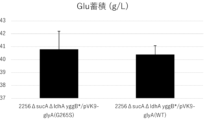
- the constructed wild-type glyA gene introduction vector (pVK9-glyA(WT)) and mutant glyA gene introduction vector (pVK9-glyA(G265S)) were introduced alone into the C. glutamicum 2256 ⁇ sucA ⁇ ldhA yggB* strain to obtain wild-type glyA gene introduction strains and mutant glyA gene introduction strains.
- a control strain was obtained by introducing pVK9 alone into the C. glutamicum 2256 ⁇ sucA ⁇ ldhA yggB* strain.
Landscapes
- Chemical & Material Sciences (AREA)
- Health & Medical Sciences (AREA)
- Organic Chemistry (AREA)
- Life Sciences & Earth Sciences (AREA)
- Genetics & Genomics (AREA)
- Engineering & Computer Science (AREA)
- Zoology (AREA)
- Wood Science & Technology (AREA)
- Bioinformatics & Cheminformatics (AREA)
- General Health & Medical Sciences (AREA)
- General Engineering & Computer Science (AREA)
- Biochemistry (AREA)
- Biotechnology (AREA)
- Microbiology (AREA)
- Molecular Biology (AREA)
- Biomedical Technology (AREA)
- Biophysics (AREA)
- Medicinal Chemistry (AREA)
- General Chemical & Material Sciences (AREA)
- Chemical Kinetics & Catalysis (AREA)
- Gastroenterology & Hepatology (AREA)
- Proteomics, Peptides & Aminoacids (AREA)
- Physics & Mathematics (AREA)
- Plant Pathology (AREA)
- Micro-Organisms Or Cultivation Processes Thereof (AREA)
- Preparation Of Compounds By Using Micro-Organisms (AREA)
Priority Applications (3)
| Application Number | Priority Date | Filing Date | Title |
|---|---|---|---|
| PCT/JP2023/047150 WO2025141837A1 (ja) | 2023-12-28 | 2023-12-28 | L-グルタミン酸生産菌およびl-グルタミン酸の製造方法 |
| JP2025534315A JP7716166B1 (ja) | 2023-12-28 | 2023-12-28 | L-グルタミン酸生産菌およびl-グルタミン酸の製造方法 |
| EP23963185.6A EP4692312A1 (en) | 2023-12-28 | 2023-12-28 | L-glutamic acid-producing bacterium and method for producing l-glutamic acid |
Applications Claiming Priority (1)
| Application Number | Priority Date | Filing Date | Title |
|---|---|---|---|
| PCT/JP2023/047150 WO2025141837A1 (ja) | 2023-12-28 | 2023-12-28 | L-グルタミン酸生産菌およびl-グルタミン酸の製造方法 |
Publications (1)
| Publication Number | Publication Date |
|---|---|
| WO2025141837A1 true WO2025141837A1 (ja) | 2025-07-03 |
Family
ID=96217408
Family Applications (1)
| Application Number | Title | Priority Date | Filing Date |
|---|---|---|---|
| PCT/JP2023/047150 Pending WO2025141837A1 (ja) | 2023-12-28 | 2023-12-28 | L-グルタミン酸生産菌およびl-グルタミン酸の製造方法 |
Country Status (3)
| Country | Link |
|---|---|
| EP (1) | EP4692312A1 (https=) |
| JP (1) | JP7716166B1 (https=) |
| WO (1) | WO2025141837A1 (https=) |
Citations (57)
| Publication number | Priority date | Publication date | Assignee | Title |
|---|---|---|---|---|
| JPS50113209A (https=) | 1974-02-13 | 1975-09-05 | ||
| JPS5238088A (en) | 1975-09-19 | 1977-03-24 | Ajinomoto Co Inc | Preparation of l-glutamic acid |
| JPS561889A (en) | 1979-06-20 | 1981-01-10 | Ajinomoto Co Inc | Preparation of l-glutamic acid by fermentation |
| JPS5635981A (en) | 1979-08-31 | 1981-04-08 | Ajinomoto Co Inc | Novel variant |
| JPS56140895A (en) | 1980-04-02 | 1981-11-04 | Ajinomoto Co Inc | Preparation of l-glutamic acid by fermentation |
| JPS572689A (en) | 1981-03-23 | 1982-01-08 | Ajinomoto Co Inc | Preparation of l-glutamic acid |
| JPS5765198A (en) | 1980-10-09 | 1982-04-20 | Ajinomoto Co Inc | Fermentative production of l-glutamic acid |
| JPS57134500A (en) | 1981-02-12 | 1982-08-19 | Kyowa Hakko Kogyo Co Ltd | Plasmid pcg1 |
| JPS57183799A (en) | 1981-04-17 | 1982-11-12 | Kyowa Hakko Kogyo Co Ltd | Novel plasmid |
| JPS5835197A (ja) | 1981-08-26 | 1983-03-01 | Kyowa Hakko Kogyo Co Ltd | プラスミドpcg2 |
| JPS58192900A (ja) | 1982-05-04 | 1983-11-10 | Ajinomoto Co Inc | 複合プラスミド |
| US4777051A (en) | 1986-06-20 | 1988-10-11 | Ajinomoto Co., Inc. | Process for the production of a composition for animal feed |
| JPH01191686A (ja) | 1988-01-26 | 1989-08-01 | Mitsubishi Petrochem Co Ltd | 複合プラスミド |
| JPH0272876A (ja) | 1988-09-08 | 1990-03-13 | Mitsubishi Petrochem Co Ltd | トリプトフアンシンターゼの製造法 |
| JPH02109985A (ja) | 1988-02-22 | 1990-04-23 | Eurolysine | 細菌染色体上ヘの目的遺伝子の組み込み方法及び該方法によって得られた細菌 |
| US4946654A (en) | 1984-04-07 | 1990-08-07 | Bayer Aktiengesellschaft | Process for preparing granulates |
| US4956471A (en) | 1986-04-28 | 1990-09-11 | Ajinomoto Company, Inc. | Process for isolating and purifying amino acids |
| JPH03210184A (ja) | 1990-01-11 | 1991-09-13 | Mitsubishi Petrochem Co Ltd | 新規プラスミドベクター |
| JPH0488994A (ja) | 1990-07-30 | 1992-03-23 | Kyowa Hakko Kogyo Co Ltd | 発酵法によるl―グルタミン酸の製造法 |
| US5185262A (en) | 1988-07-27 | 1993-02-09 | Mitsubishi Petrochemical Co., Ltd. | DNA fragment containing gene which encodes the function of stabilizing plasmid in host microorganism |
| US5431933A (en) | 1991-09-17 | 1995-07-11 | Degussa Aktiengesellschaft | Animal feed supplement based on a fermentation broth amino acid, a process for its production and its use |
| JPH0970291A (ja) | 1995-06-30 | 1997-03-18 | Ajinomoto Co Inc | 人工トランスポゾンを用いた遺伝子増幅方法 |
| JPH09164323A (ja) | 1995-10-13 | 1997-06-24 | Ajinomoto Co Inc | 発酵液の膜除菌方法 |
| JPH09173792A (ja) | 1995-10-23 | 1997-07-08 | Ajinomoto Co Inc | 発酵液の処理方法 |
| JPH10215883A (ja) | 1996-12-05 | 1998-08-18 | Ajinomoto Co Inc | L−リジンの製造法 |
| US5830716A (en) | 1993-10-28 | 1998-11-03 | Ajinomoto Co., Inc. | Increased amounts of substances by modifying a microorganism to increase production of NADPH from NADH |
| US5840358A (en) | 1996-05-31 | 1998-11-24 | Degussa Aktiengesellschaft | Process for the preparation of an animal feed supplement based on fermentation broth |
| WO1999007853A1 (en) | 1997-08-12 | 1999-02-18 | Ajinomoto Co., Inc. | Process for producing l-glutamic acid by fermentation method |
| US5882888A (en) | 1995-01-23 | 1999-03-16 | Novo Nordisk A/S | DNA integration by transposition |
| WO1999018228A2 (de) | 1997-10-04 | 1999-04-15 | Forschungszentrum Jülich GmbH | Verfahren zur mikrobiellen herstellung von aminosäuren der aspartat- und/oder glutamatfamilie und im verfahren einsetzbare mittel |
| WO2000018935A1 (en) | 1998-09-25 | 2000-04-06 | Ajinomoto Co.,Inc. | Process for constructing amino acid-producing bacterium and process for producing amino acid by fermentation method with the use of the thus constructed amino acid-producing bacterium |
| EP1010755A1 (en) | 1998-12-18 | 2000-06-21 | Ajinomoto Co., Inc. | Method for producing L-Glutamic acid by fermentation |
| WO2001002542A1 (fr) | 1999-07-02 | 2001-01-11 | Ajinomoto Co., Inc. | Procede de production d'acide l-amine |
| WO2001002545A1 (fr) | 1999-07-02 | 2001-01-11 | Ajinomoto Co., Inc. | Procede de production d'acide l-amine |
| EP1070376A1 (de) | 1998-04-09 | 2001-01-24 | Siemens Aktiengesellschaft | Anordnung und verfahren zur elektrischen energieversorgung einer elektrischen last |
| EP1078989A2 (en) | 1999-08-20 | 2001-02-28 | Ajinomoto Co., Ltd. | Method for producing L-glutamic acid by fermentation accompanied by precipitation |
| EP1092776A1 (en) | 1999-10-14 | 2001-04-18 | Ajinomoto Co., Inc. | Method for producing L-amino acid by fermentation |
| US6238714B1 (en) | 1999-05-05 | 2001-05-29 | Degussa-Huls Ag | Feedstuff additive which contains D-pantothenic acid and/or its salts and a process for the preparation thereof |
| EP1149911A2 (en) | 2000-04-26 | 2001-10-31 | Ajinomoto Co., Ltd. | Amino acid producing strains belonging to the genus Escherichia and method for producing amino acid |
| EP1233069A2 (en) | 2001-02-20 | 2002-08-21 | Ajinomoto Co., Inc. | Method for producing L-glutamic acid |
| JP2002300874A (ja) | 2001-02-13 | 2002-10-15 | Ajinomoto Co Inc | エシェリヒア属細菌を用いたl−アミノ酸の製造法 |
| WO2003004664A2 (en) | 2001-07-06 | 2003-01-16 | Degussa Ag | Process for the preparation of l-amino acids using strains of the enterobacteriaceae family with enhanced fba expression |
| WO2003008611A2 (en) | 2001-07-18 | 2003-01-30 | Degussa Ag | Process for the preparation of l-amino acids using strains of the enterobacteriaceae family which contain an enhanced talb gene |
| WO2004111258A1 (ja) | 2003-06-10 | 2004-12-23 | Ajinomoto Co., Inc. | L−グルタミン酸の製造法 |
| US20050025878A1 (en) | 2003-07-11 | 2005-02-03 | Degussa Ag | Process for the granulation of an animal feedstuff additive |
| EP1624069A1 (en) | 2003-05-07 | 2006-02-08 | Ajinomoto Co., Inc. | Process for producing l-glutamic acid |
| WO2006057450A1 (en) | 2004-11-25 | 2006-06-01 | Ajinomoto Co., Inc. | L-amino acid-producing bacterium and a method for producing l-amino acid |
| US20060141588A1 (en) | 2004-12-28 | 2006-06-29 | Jun Nakamura | L-glutamic acid-producing microorganism and a method for producing l-glutamic acid |
| WO2006070944A2 (en) | 2004-12-28 | 2006-07-06 | Ajinomoto Co., Inc. | L-glutamic acid-producing microorganism and a method for producing l-glutamic acid |
| JP2006340603A (ja) | 2003-06-23 | 2006-12-21 | Ajinomoto Co Inc | L−グルタミン酸の製造法 |
| WO2008075483A1 (ja) | 2006-12-19 | 2008-06-26 | Ajinomoto Co., Inc. | L-アミノ酸の製造法 |
| WO2008078448A1 (ja) | 2006-12-25 | 2008-07-03 | Ajinomoto Co., Inc. | 塩基性アミノ酸塩酸塩結晶の取得方法 |
| WO2008078646A1 (ja) | 2006-12-22 | 2008-07-03 | Ajinomoto Co., Inc. | アミノ酸又は核酸の結晶の分離方法 |
| JP2009501512A (ja) * | 2005-06-17 | 2009-01-22 | アイアンウッド ファーマシューティカルズ インコーポレイテッド | 改良されたアミノ酸及び代謝産物生合成 |
| WO2013069634A1 (ja) | 2011-11-11 | 2013-05-16 | 味の素株式会社 | 発酵法による目的物質の製造法 |
| WO2014185430A1 (ja) | 2013-05-13 | 2014-11-20 | 味の素株式会社 | L-アミノ酸の製造法 |
| JP6097869B1 (ja) | 2016-08-01 | 2017-03-15 | 新日鉄住金エンジニアリング株式会社 | エタノールの製造方法 |
Family Cites Families (3)
| Publication number | Priority date | Publication date | Assignee | Title |
|---|---|---|---|---|
| JPS5832596B2 (ja) | 1979-08-10 | 1983-07-14 | 味の素株式会社 | 発酵法によるl−グルタミン酸の製造方法 |
| JPS58158192A (ja) | 1982-03-15 | 1983-09-20 | Ajinomoto Co Inc | 発酵法によるl−グルタミン酸の製造方法 |
| JP2537260B2 (ja) | 1988-02-23 | 1996-09-25 | 東陶機器株式会社 | 和風便器の施工方法 |
-
2023
- 2023-12-28 EP EP23963185.6A patent/EP4692312A1/en active Pending
- 2023-12-28 WO PCT/JP2023/047150 patent/WO2025141837A1/ja active Pending
- 2023-12-28 JP JP2025534315A patent/JP7716166B1/ja active Active
Patent Citations (61)
| Publication number | Priority date | Publication date | Assignee | Title |
|---|---|---|---|---|
| JPS50113209A (https=) | 1974-02-13 | 1975-09-05 | ||
| JPS5238088A (en) | 1975-09-19 | 1977-03-24 | Ajinomoto Co Inc | Preparation of l-glutamic acid |
| JPS561889A (en) | 1979-06-20 | 1981-01-10 | Ajinomoto Co Inc | Preparation of l-glutamic acid by fermentation |
| JPS5635981A (en) | 1979-08-31 | 1981-04-08 | Ajinomoto Co Inc | Novel variant |
| JPS56140895A (en) | 1980-04-02 | 1981-11-04 | Ajinomoto Co Inc | Preparation of l-glutamic acid by fermentation |
| JPS5765198A (en) | 1980-10-09 | 1982-04-20 | Ajinomoto Co Inc | Fermentative production of l-glutamic acid |
| JPS57134500A (en) | 1981-02-12 | 1982-08-19 | Kyowa Hakko Kogyo Co Ltd | Plasmid pcg1 |
| JPS572689A (en) | 1981-03-23 | 1982-01-08 | Ajinomoto Co Inc | Preparation of l-glutamic acid |
| JPS57183799A (en) | 1981-04-17 | 1982-11-12 | Kyowa Hakko Kogyo Co Ltd | Novel plasmid |
| JPS5835197A (ja) | 1981-08-26 | 1983-03-01 | Kyowa Hakko Kogyo Co Ltd | プラスミドpcg2 |
| JPS58192900A (ja) | 1982-05-04 | 1983-11-10 | Ajinomoto Co Inc | 複合プラスミド |
| US4946654A (en) | 1984-04-07 | 1990-08-07 | Bayer Aktiengesellschaft | Process for preparing granulates |
| US4956471A (en) | 1986-04-28 | 1990-09-11 | Ajinomoto Company, Inc. | Process for isolating and purifying amino acids |
| US4777051A (en) | 1986-06-20 | 1988-10-11 | Ajinomoto Co., Inc. | Process for the production of a composition for animal feed |
| JPH01191686A (ja) | 1988-01-26 | 1989-08-01 | Mitsubishi Petrochem Co Ltd | 複合プラスミド |
| JPH02109985A (ja) | 1988-02-22 | 1990-04-23 | Eurolysine | 細菌染色体上ヘの目的遺伝子の組み込み方法及び該方法によって得られた細菌 |
| US5185262A (en) | 1988-07-27 | 1993-02-09 | Mitsubishi Petrochemical Co., Ltd. | DNA fragment containing gene which encodes the function of stabilizing plasmid in host microorganism |
| JPH0272876A (ja) | 1988-09-08 | 1990-03-13 | Mitsubishi Petrochem Co Ltd | トリプトフアンシンターゼの製造法 |
| JPH03210184A (ja) | 1990-01-11 | 1991-09-13 | Mitsubishi Petrochem Co Ltd | 新規プラスミドベクター |
| JPH0488994A (ja) | 1990-07-30 | 1992-03-23 | Kyowa Hakko Kogyo Co Ltd | 発酵法によるl―グルタミン酸の製造法 |
| US5431933A (en) | 1991-09-17 | 1995-07-11 | Degussa Aktiengesellschaft | Animal feed supplement based on a fermentation broth amino acid, a process for its production and its use |
| US5830716A (en) | 1993-10-28 | 1998-11-03 | Ajinomoto Co., Inc. | Increased amounts of substances by modifying a microorganism to increase production of NADPH from NADH |
| US5882888A (en) | 1995-01-23 | 1999-03-16 | Novo Nordisk A/S | DNA integration by transposition |
| EP0805867B1 (en) | 1995-01-23 | 2003-12-17 | Novozymes A/S | Dna integration by transposition |
| JPH0970291A (ja) | 1995-06-30 | 1997-03-18 | Ajinomoto Co Inc | 人工トランスポゾンを用いた遺伝子増幅方法 |
| JPH09164323A (ja) | 1995-10-13 | 1997-06-24 | Ajinomoto Co Inc | 発酵液の膜除菌方法 |
| JPH09173792A (ja) | 1995-10-23 | 1997-07-08 | Ajinomoto Co Inc | 発酵液の処理方法 |
| US5840358A (en) | 1996-05-31 | 1998-11-24 | Degussa Aktiengesellschaft | Process for the preparation of an animal feed supplement based on fermentation broth |
| JPH10215883A (ja) | 1996-12-05 | 1998-08-18 | Ajinomoto Co Inc | L−リジンの製造法 |
| WO1999007853A1 (en) | 1997-08-12 | 1999-02-18 | Ajinomoto Co., Inc. | Process for producing l-glutamic acid by fermentation method |
| WO1999018228A2 (de) | 1997-10-04 | 1999-04-15 | Forschungszentrum Jülich GmbH | Verfahren zur mikrobiellen herstellung von aminosäuren der aspartat- und/oder glutamatfamilie und im verfahren einsetzbare mittel |
| EP1070376A1 (de) | 1998-04-09 | 2001-01-24 | Siemens Aktiengesellschaft | Anordnung und verfahren zur elektrischen energieversorgung einer elektrischen last |
| WO2000018935A1 (en) | 1998-09-25 | 2000-04-06 | Ajinomoto Co.,Inc. | Process for constructing amino acid-producing bacterium and process for producing amino acid by fermentation method with the use of the thus constructed amino acid-producing bacterium |
| EP1010755A1 (en) | 1998-12-18 | 2000-06-21 | Ajinomoto Co., Inc. | Method for producing L-Glutamic acid by fermentation |
| US6238714B1 (en) | 1999-05-05 | 2001-05-29 | Degussa-Huls Ag | Feedstuff additive which contains D-pantothenic acid and/or its salts and a process for the preparation thereof |
| WO2001002542A1 (fr) | 1999-07-02 | 2001-01-11 | Ajinomoto Co., Inc. | Procede de production d'acide l-amine |
| WO2001002545A1 (fr) | 1999-07-02 | 2001-01-11 | Ajinomoto Co., Inc. | Procede de production d'acide l-amine |
| EP1078989A2 (en) | 1999-08-20 | 2001-02-28 | Ajinomoto Co., Ltd. | Method for producing L-glutamic acid by fermentation accompanied by precipitation |
| EP1092776A1 (en) | 1999-10-14 | 2001-04-18 | Ajinomoto Co., Inc. | Method for producing L-amino acid by fermentation |
| EP1149911A2 (en) | 2000-04-26 | 2001-10-31 | Ajinomoto Co., Ltd. | Amino acid producing strains belonging to the genus Escherichia and method for producing amino acid |
| US7179623B2 (en) | 2000-04-26 | 2007-02-20 | Ajinomoto Co., Inc. | Method of producing amino acids using E. coli transformed with sucrose PTS genes |
| JP2002300874A (ja) | 2001-02-13 | 2002-10-15 | Ajinomoto Co Inc | エシェリヒア属細菌を用いたl−アミノ酸の製造法 |
| EP1233069A2 (en) | 2001-02-20 | 2002-08-21 | Ajinomoto Co., Inc. | Method for producing L-glutamic acid |
| WO2003004598A2 (en) | 2001-07-06 | 2003-01-16 | Degussa Ag | Process for the preparation of l-amino acids using strains of the enterobacteriaceae family |
| WO2003004664A2 (en) | 2001-07-06 | 2003-01-16 | Degussa Ag | Process for the preparation of l-amino acids using strains of the enterobacteriaceae family with enhanced fba expression |
| WO2003008611A2 (en) | 2001-07-18 | 2003-01-30 | Degussa Ag | Process for the preparation of l-amino acids using strains of the enterobacteriaceae family which contain an enhanced talb gene |
| EP1624069A1 (en) | 2003-05-07 | 2006-02-08 | Ajinomoto Co., Inc. | Process for producing l-glutamic acid |
| WO2004111258A1 (ja) | 2003-06-10 | 2004-12-23 | Ajinomoto Co., Inc. | L−グルタミン酸の製造法 |
| JP2006340603A (ja) | 2003-06-23 | 2006-12-21 | Ajinomoto Co Inc | L−グルタミン酸の製造法 |
| US20050025878A1 (en) | 2003-07-11 | 2005-02-03 | Degussa Ag | Process for the granulation of an animal feedstuff additive |
| WO2006057450A1 (en) | 2004-11-25 | 2006-06-01 | Ajinomoto Co., Inc. | L-amino acid-producing bacterium and a method for producing l-amino acid |
| US20060141588A1 (en) | 2004-12-28 | 2006-06-29 | Jun Nakamura | L-glutamic acid-producing microorganism and a method for producing l-glutamic acid |
| WO2006070944A2 (en) | 2004-12-28 | 2006-07-06 | Ajinomoto Co., Inc. | L-glutamic acid-producing microorganism and a method for producing l-glutamic acid |
| JP2009501512A (ja) * | 2005-06-17 | 2009-01-22 | アイアンウッド ファーマシューティカルズ インコーポレイテッド | 改良されたアミノ酸及び代謝産物生合成 |
| WO2008075483A1 (ja) | 2006-12-19 | 2008-06-26 | Ajinomoto Co., Inc. | L-アミノ酸の製造法 |
| JP2010041920A (ja) | 2006-12-19 | 2010-02-25 | Ajinomoto Co Inc | L−アミノ酸の製造法 |
| WO2008078646A1 (ja) | 2006-12-22 | 2008-07-03 | Ajinomoto Co., Inc. | アミノ酸又は核酸の結晶の分離方法 |
| WO2008078448A1 (ja) | 2006-12-25 | 2008-07-03 | Ajinomoto Co., Inc. | 塩基性アミノ酸塩酸塩結晶の取得方法 |
| WO2013069634A1 (ja) | 2011-11-11 | 2013-05-16 | 味の素株式会社 | 発酵法による目的物質の製造法 |
| WO2014185430A1 (ja) | 2013-05-13 | 2014-11-20 | 味の素株式会社 | L-アミノ酸の製造法 |
| JP6097869B1 (ja) | 2016-08-01 | 2017-03-15 | 新日鉄住金エンジニアリング株式会社 | エタノールの製造方法 |
Non-Patent Citations (17)
| Title |
|---|
| "GenBank", Database accession no. WP_003856790.1 |
| AGRIC. BIOL. CHEM., vol. 48, 1984, pages 2901 - 2903 |
| BARTON GJ ET AL., JOURNAL OF MOLECULAR BIOLOGY, vol. 198, no. 2, 1987, pages 327 - 37 |
| DATSENKO, K. A.WANNER, B. L., PROC. NATL. ACAD. SCI. U S A., vol. 97, 2000, pages 6640 - 6645 |
| ELIZABETH C. TYLER ET AL., COMPUTERS AND BIOMEDICAL RESEARCH, vol. 24, no. 1, 1991, pages 72 - 96 |
| GAGNON, D. ; FOUCHER, A. ; GIRARD, I. ; OUELLETTE, M.: "Stage specific gene expression and cellular localization of two isoforms of the serine hydroxymethyltransferase in the protozoan parasite Leishmania", MOLECULAR AND BIOCHEMICAL PARASITOLOGY, vol. 150, no. 1, 1 November 2006 (2006-11-01), NL , pages 63 - 71, XP025032662, ISSN: 0166-6851, DOI: 10.1016/j.molbiopara.2006.06.009 * |
| HIGUCHI, R.: "PCR technology", vol. 61, 1989, STOCKTON PRESS |
| HONG MING CHUAN, WU MEI LI, CHANG MING CHUNG: "Cloning and complete nucleotide sequence of Acinetobacter radioresistens CMC-1 AglyA gene encoding serine hydroxymethyltransferase", FEMS MICROBIOLOGY LETTERS, vol. 170, no. 2, 15 January 1999 (1999-01-15), pages 413 - 418, XP093330880, ISSN: 0378-1097, DOI: 10.1111/j.1574-6968.1999.tb13402.x * |
| INT. J. SYST. BACTERIOL., vol. 41, 1991, pages 255 |
| INT. J. SYST. EVOL. MICROBIOL., vol. 60, 2010, pages 874 - 879 |
| JOURNAL OF INDUSTRIAL MICROBIOLOGY & BIOTECHNOLOGY, vol. 28, 2002, pages 333 - 337 |
| KRAMER, W.FRITS, H. J., METH. IN ENZYMOL., vol. 154, 1987, pages 382 |
| KUNIHIKO AKASHI ET AL.: "Amino Acid Fermentation", 30 May 1986, GAKKAI PUBLISHING CENTER, INC., pages: 195 - 100 |
| KUNKEL, T. A., vol. 154, 1987, pages 367 |
| MILLER, J. H.: "Experiments in Molecular Genetics", 1972, COLD SPRING HARBOR LABORATORY |
| NAGAI, H. ET AL., SEPARATION SCIENCE AND TECHNOLOGY, vol. 39, no. 16, pages 3691 - 3710 |
| See also references of EP4692312A1 |
Also Published As
| Publication number | Publication date |
|---|---|
| JPWO2025141837A1 (https=) | 2025-07-03 |
| JP7716166B1 (ja) | 2025-07-31 |
| EP4692312A1 (en) | 2026-02-11 |
Similar Documents
| Publication | Publication Date | Title |
|---|---|---|
| CN107034250B (zh) | 谷氨酸类l-氨基酸的制造方法 | |
| CN103396976B (zh) | L-谷氨酸类氨基酸生产微生物以及氨基酸的生产方法 | |
| KR101773755B1 (ko) | L-아미노산의 제조법 | |
| JP4595506B2 (ja) | L−アミノ酸生産菌及びl−アミノ酸の製造方法 | |
| EP2083083B1 (en) | Method for production of l-amino acid | |
| JP6519476B2 (ja) | 目的物質の製造法 | |
| JP2926991B2 (ja) | 発酵法によるl−リジン及びl−グルタミン酸の製造方法 | |
| CN116445387A (zh) | 生产目标物质的方法、转基因微生物及核酸的应用 | |
| JPWO1996006180A1 (ja) | 発酵法によるl−リジン及びl−グルタミン酸の製造方法 | |
| JP2009254323A (ja) | L−グルタミン酸系アミノ酸の製造法 | |
| US20230416793A1 (en) | Method of producing l-amino acid | |
| JP2016163540A (ja) | 有用物質の製造方法 | |
| CN101248170B (zh) | 产生l-谷氨酸的细菌和用于产生l-谷氨酸的方法 | |
| WO2007037460A1 (en) | An l-amino acid-producing bacterium and a method for producing l-amino acids | |
| JP7716166B1 (ja) | L-グルタミン酸生産菌およびl-グルタミン酸の製造方法 | |
| JP7716823B1 (ja) | L-グルタミン酸生産菌およびl-グルタミン酸の製造方法 | |
| JP7747242B1 (ja) | L-グルタミン酸の製造方法 | |
| EP1929028A1 (en) | An l-amino acid-producing bacterium and a method for producing l-amino acids | |
| KR20260062987A (ko) | L-글루탐산 생산균 및 l-글루탐산의 제조 방법 | |
| CN101248169B (zh) | 产生l-谷氨酸的细菌和用于产生l-谷氨酸的方法 | |
| JP4257215B2 (ja) | 変異型イソプロピルリンゴ酸イソメラーゼ | |
| JP4576850B2 (ja) | 発酵法によるl−アルギニン又はl−リジンの製造法 | |
| WO2024162450A1 (ja) | L-グルタミン酸の製造法 | |
| JP2006129840A (ja) | L−グルタミン酸の製造法 | |
| KR20240046412A (ko) | L-아미노산의 제조법 |
Legal Events
| Date | Code | Title | Description |
|---|---|---|---|
| ENP | Entry into the national phase |
Ref document number: 2025534315 Country of ref document: JP Kind code of ref document: A |
|
| WWE | Wipo information: entry into national phase |
Ref document number: 2025534315 Country of ref document: JP |
|
| 121 | Ep: the epo has been informed by wipo that ep was designated in this application |
Ref document number: 23963185 Country of ref document: EP Kind code of ref document: A1 |
|
| WWE | Wipo information: entry into national phase |
Ref document number: 2023963185 Country of ref document: EP |
|
| REG | Reference to national code |
Ref country code: BR Ref legal event code: B01A Ref document number: 112025023863 Country of ref document: BR |
|
| ENP | Entry into the national phase |
Ref document number: 2023963185 Country of ref document: EP Effective date: 20251106 |
|
| ENP | Entry into the national phase |
Ref document number: 2023963185 Country of ref document: EP Effective date: 20251106 |
|
| ENP | Entry into the national phase |
Ref document number: 2023963185 Country of ref document: EP Effective date: 20251106 |
|
| ENP | Entry into the national phase |
Ref document number: 2023963185 Country of ref document: EP Effective date: 20251106 |
|
| ENP | Entry into the national phase |
Ref document number: 112025023863 Country of ref document: BR Kind code of ref document: A2 Effective date: 20251031 |
|
| ENP | Entry into the national phase |
Ref document number: 2023963185 Country of ref document: EP Effective date: 20251106 |
|
| ENP | Entry into the national phase |
Ref document number: 2023963185 Country of ref document: EP Effective date: 20251106 |
|
| ENP | Entry into the national phase |
Ref document number: 2023963185 Country of ref document: EP Effective date: 20251106 |
|
| ENP | Entry into the national phase |
Ref document number: 2023963185 Country of ref document: EP Effective date: 20251106 |
|
| WWP | Wipo information: published in national office |
Ref document number: 2023963185 Country of ref document: EP |
|
| WWE | Wipo information: entry into national phase |
Ref document number: 202690861 Country of ref document: EA |