WO2012144563A1 - ポリアミドイミド溶液およびポリアミドイミド膜 - Google Patents
ポリアミドイミド溶液およびポリアミドイミド膜 Download PDFInfo
- Publication number
- WO2012144563A1 WO2012144563A1 PCT/JP2012/060624 JP2012060624W WO2012144563A1 WO 2012144563 A1 WO2012144563 A1 WO 2012144563A1 JP 2012060624 W JP2012060624 W JP 2012060624W WO 2012144563 A1 WO2012144563 A1 WO 2012144563A1
- Authority
- WO
- WIPO (PCT)
- Prior art keywords
- polyamideimide
- solvent
- film
- solution
- polyamide
- Prior art date
- Legal status (The legal status is an assumption and is not a legal conclusion. Google has not performed a legal analysis and makes no representation as to the accuracy of the status listed.)
- Ceased
Links
Classifications
-
- C—CHEMISTRY; METALLURGY
- C08—ORGANIC MACROMOLECULAR COMPOUNDS; THEIR PREPARATION OR CHEMICAL WORKING-UP; COMPOSITIONS BASED THEREON
- C08G—MACROMOLECULAR COMPOUNDS OBTAINED OTHERWISE THAN BY REACTIONS ONLY INVOLVING UNSATURATED CARBON-TO-CARBON BONDS
- C08G73/00—Macromolecular compounds obtained by reactions forming a linkage containing nitrogen with or without oxygen or carbon in the main chain of the macromolecule, not provided for in groups C08G12/00 - C08G71/00
- C08G73/06—Polycondensates having nitrogen-containing heterocyclic rings in the main chain of the macromolecule
- C08G73/10—Polyimides; Polyester-imides; Polyamide-imides; Polyamide acids or similar polyimide precursors
- C08G73/14—Polyamide-imides
-
- B—PERFORMING OPERATIONS; TRANSPORTING
- B32—LAYERED PRODUCTS
- B32B—LAYERED PRODUCTS, i.e. PRODUCTS BUILT-UP OF STRATA OF FLAT OR NON-FLAT, e.g. CELLULAR OR HONEYCOMB, FORM
- B32B17/00—Layered products essentially comprising sheet glass, or glass, slag, or like fibres
- B32B17/06—Layered products essentially comprising sheet glass, or glass, slag, or like fibres comprising glass as the main or only constituent of a layer, next to another layer of a specific material
- B32B17/10—Layered products essentially comprising sheet glass, or glass, slag, or like fibres comprising glass as the main or only constituent of a layer, next to another layer of a specific material of synthetic resin
-
- B—PERFORMING OPERATIONS; TRANSPORTING
- B32—LAYERED PRODUCTS
- B32B—LAYERED PRODUCTS, i.e. PRODUCTS BUILT-UP OF STRATA OF FLAT OR NON-FLAT, e.g. CELLULAR OR HONEYCOMB, FORM
- B32B27/00—Layered products comprising a layer of synthetic resin
- B32B27/34—Layered products comprising a layer of synthetic resin comprising polyamides
-
- C—CHEMISTRY; METALLURGY
- C08—ORGANIC MACROMOLECULAR COMPOUNDS; THEIR PREPARATION OR CHEMICAL WORKING-UP; COMPOSITIONS BASED THEREON
- C08L—COMPOSITIONS OF MACROMOLECULAR COMPOUNDS
- C08L79/00—Compositions of macromolecular compounds obtained by reactions forming in the main chain of the macromolecule a linkage containing nitrogen with or without oxygen or carbon only, not provided for in groups C08L61/00 - C08L77/00
- C08L79/04—Polycondensates having nitrogen-containing heterocyclic rings in the main chain; Polyhydrazides; Polyamide acids or similar polyimide precursors
- C08L79/08—Polyimides; Polyester-imides; Polyamide-imides; Polyamide acids or similar polyimide precursors
-
- C—CHEMISTRY; METALLURGY
- C09—DYES; PAINTS; POLISHES; NATURAL RESINS; ADHESIVES; COMPOSITIONS NOT OTHERWISE PROVIDED FOR; APPLICATIONS OF MATERIALS NOT OTHERWISE PROVIDED FOR
- C09D—COATING COMPOSITIONS, e.g. PAINTS, VARNISHES OR LACQUERS; FILLING PASTES; CHEMICAL PAINT OR INK REMOVERS; INKS; CORRECTING FLUIDS; WOODSTAINS; PASTES OR SOLIDS FOR COLOURING OR PRINTING; USE OF MATERIALS THEREFOR
- C09D7/00—Features of coating compositions, not provided for in group C09D5/00; Processes for incorporating ingredients in coating compositions
- C09D7/20—Diluents or solvents
-
- G—PHYSICS
- G02—OPTICS
- G02B—OPTICAL ELEMENTS, SYSTEMS OR APPARATUS
- G02B5/00—Optical elements other than lenses
- G02B5/20—Filters
-
- H—ELECTRICITY
- H05—ELECTRIC TECHNIQUES NOT OTHERWISE PROVIDED FOR
- H05B—ELECTRIC HEATING; ELECTRIC LIGHT SOURCES NOT OTHERWISE PROVIDED FOR; CIRCUIT ARRANGEMENTS FOR ELECTRIC LIGHT SOURCES, IN GENERAL
- H05B33/00—Electroluminescent light sources
- H05B33/02—Details
-
- H—ELECTRICITY
- H10—SEMICONDUCTOR DEVICES; ELECTRIC SOLID-STATE DEVICES NOT OTHERWISE PROVIDED FOR
- H10D—INORGANIC ELECTRIC SEMICONDUCTOR DEVICES
- H10D30/00—Field-effect transistors [FET]
- H10D30/60—Insulated-gate field-effect transistors [IGFET]
- H10D30/67—Thin-film transistors [TFT]
-
- H—ELECTRICITY
- H10—SEMICONDUCTOR DEVICES; ELECTRIC SOLID-STATE DEVICES NOT OTHERWISE PROVIDED FOR
- H10D—INORGANIC ELECTRIC SEMICONDUCTOR DEVICES
- H10D30/00—Field-effect transistors [FET]
- H10D30/60—Insulated-gate field-effect transistors [IGFET]
- H10D30/67—Thin-film transistors [TFT]
- H10D30/6758—Thin-film transistors [TFT] characterised by the insulating substrates
-
- H—ELECTRICITY
- H10—SEMICONDUCTOR DEVICES; ELECTRIC SOLID-STATE DEVICES NOT OTHERWISE PROVIDED FOR
- H10K—ORGANIC ELECTRIC SOLID-STATE DEVICES
- H10K50/00—Organic light-emitting devices
-
- H—ELECTRICITY
- H10—SEMICONDUCTOR DEVICES; ELECTRIC SOLID-STATE DEVICES NOT OTHERWISE PROVIDED FOR
- H10K—ORGANIC ELECTRIC SOLID-STATE DEVICES
- H10K77/00—Constructional details of devices covered by this subclass and not covered by groups H10K10/80, H10K30/80, H10K50/80 or H10K59/80
- H10K77/10—Substrates, e.g. flexible substrates
- H10K77/111—Flexible substrates
-
- B—PERFORMING OPERATIONS; TRANSPORTING
- B32—LAYERED PRODUCTS
- B32B—LAYERED PRODUCTS, i.e. PRODUCTS BUILT-UP OF STRATA OF FLAT OR NON-FLAT, e.g. CELLULAR OR HONEYCOMB, FORM
- B32B2379/00—Other polymers having nitrogen, with or without oxygen or carbon only, in the main chain
- B32B2379/08—Polyimides
-
- H—ELECTRICITY
- H10—SEMICONDUCTOR DEVICES; ELECTRIC SOLID-STATE DEVICES NOT OTHERWISE PROVIDED FOR
- H10K—ORGANIC ELECTRIC SOLID-STATE DEVICES
- H10K77/00—Constructional details of devices covered by this subclass and not covered by groups H10K10/80, H10K30/80, H10K50/80 or H10K59/80
- H10K77/10—Substrates, e.g. flexible substrates
-
- Y—GENERAL TAGGING OF NEW TECHNOLOGICAL DEVELOPMENTS; GENERAL TAGGING OF CROSS-SECTIONAL TECHNOLOGIES SPANNING OVER SEVERAL SECTIONS OF THE IPC; TECHNICAL SUBJECTS COVERED BY FORMER USPC CROSS-REFERENCE ART COLLECTIONS [XRACs] AND DIGESTS
- Y10—TECHNICAL SUBJECTS COVERED BY FORMER USPC
- Y10T—TECHNICAL SUBJECTS COVERED BY FORMER US CLASSIFICATION
- Y10T428/00—Stock material or miscellaneous articles
- Y10T428/31504—Composite [nonstructural laminate]
- Y10T428/31551—Of polyamidoester [polyurethane, polyisocyanate, polycarbamate, etc.]
- Y10T428/31623—Next to polyamide or polyimide
Definitions
- the present invention relates to a polyamideimide solution and a polyamideimide film obtained from the polyamideimide solution. Furthermore, the present invention relates to a laminate including a polyamideimide film, a flexible display substrate, a TFT substrate, a color filter, electronic paper, and an organic EL.
- the device fabrication process as described above can be divided into batch type and roll-to-roll.
- a roll-to-roll fabrication process new equipment is required and several problems due to winding and film-to-film contact must be overcome.
- the batch type is a process in which a coating resin solution is applied on a substrate such as glass or metal, dried, the substrate is formed, and then peeled off. Therefore, the current glass substrate process and equipment such as TFT can be used, which is advantageous in terms of cost.
- Polyimide is being studied as a material that satisfies these requirements. Since polyimide resins are excellent in heat resistance, mechanical strength, electrical characteristics, etc., they have been widely used as industrial materials in the fields of electricity, electronics, machinery, aviation and the like. In particular, unlike general polyimide, polyamideimide is known to be soluble in organic solvents (for example, Patent Document 1), and solution film formation such as enamel varnish, coating agent for electrical insulation, paint is essential. It has been suitably used for various applications.
- an amide solvent is often used as a solvent for dissolving polyimide.
- Amide solvents are highly soluble, but easily absorb moisture due to their high polarity, which can cause problems such as absorption of moisture in the air during coating, phase separation, and whitening of the coating surface. Many.
- a waiting time is generated until the next step after coating, so that whitening occurs and there is a high possibility of causing a problem.
- Whitening causes deterioration of surface properties, and there is a concern that it may become a problem in later processing.
- Patent Document 2 describes an amide group-containing polyimide.
- Patent Document 3 synthesizes amide group-containing tetracarboxylic dianhydride as a soluble polyamideimide, and synthesizes polyamideimide from this material and diamine.
- the relationship between the polyamideimide solution and the linear thermal expansion coefficient Is not mentioned at all.
- in order to apply using an inorganic material for a base material it does not show sufficient thermal expansion characteristics.
- soluble polyamideimide has been conventionally known, but a polyamideimide solution that has a very low coefficient of linear thermal expansion when formed into a film and that can be formed without whitening during coating is It has not been disclosed so far.
- the present invention has been accomplished in view of the above circumstances, and an object of the present invention is to obtain a polyamideimide solution having an excellent low linear thermal expansion coefficient and an excellent coating property. Furthermore, it aims at providing the product or member with a high request
- an object of the present invention is to provide a product and a member that are applied to the use of forming a polyamideimide film obtained from the polyamideimide solution of the present invention on an inorganic surface such as glass, metal, metal oxide, and single crystal silicon. .
- Polyamideimide solution which is the above-mentioned problem, and is excellent in solubility in organic solvents and low linear thermal expansibility, and also in excellent coating properties (that is, excellent in solubility and low linear thermal expansibility of polyamideimide in organic solvents, It has been found that it is very effective to use a mixed solvent of an amide-based solvent and a solvent other than the amide-based solvent in order to obtain a polyamideimide solution having excellent coating properties.
- a polyamide-imide solution according to the present invention is a polyamide-imide solution containing a polyamide-imide having a structure represented by the following general formula (1) and an organic solvent, wherein the organic solvent is A mixed solvent of an amide solvent and a solvent other than an amide solvent, wherein the solvent other than the amide solvent is selected from the group consisting of ether solvents, ketone solvents, ester solvents, glycol ether solvents, and glycol ester solvents. Is also characterized by being one solvent.
- the polyamide-imide film according to the present invention contains a polyamide-imide having a structure represented by the following general formula (1),
- the polyamideimide solution according to the present invention exhibits excellent coating properties without whitening during coating. Furthermore, the polyamideimide film obtained from the polyamideimide solution has a very low coefficient of linear thermal expansion.
- the present invention is a polyamide-imide solution containing a polyamide-imide having a structure represented by the following general formula (1) and an organic solvent, wherein the organic solvent is a mixture of an amide-based solvent and a solvent other than an amide-based solvent.
- the present invention provides a polyamideimide solution containing a polyamideimide represented by the following general formula (1) and an organic solvent, wherein the organic solvent is an amide solvent and a solvent other than the amide solvent.
- the present invention relates to a polyamidoimide solution, which is a mixed solvent, and the solvent other than the amide solvent is at least one solvent selected from the group consisting of ether solvents, ketone solvents, ester solvents, glycol ether solvents, and glycol ester solvents.
- polyamideimides including the structure represented by the general formula (1)
- a polyamide including a structure represented by the following formula (6) from the viewpoint of achieving both a low linear thermal expansion coefficient and solution processability / coating property It is more preferable to use an imide.
- the polyamideimide including the structure represented by the general formula (1) is more preferably a polyamideimide represented by the general formula (1), and the polyamideimide represented by the general formula (1).
- a polyamideimide represented by the following formula (6) it is more preferable to use a polyamideimide represented by the following formula (6) from the viewpoint of achieving both a low linear thermal expansion coefficient and solution processability / coatability.
- the method for producing the polyamideimide of the present invention is not particularly limited, and a production method suitable for the purpose can be selected.
- trimellitic anhydride chloride and a diamine represented by the following formula (2) or (3) are reacted in the presence of a solvent, and the tetracarboxylic dianhydride represented by the following formula (4) is once reacted.
- tetracarboxylic dianhydride once isolated and purified, and further reacted with diamine to imidize.
- JP-A-2010-106225 As a method for isolating tetracarboxylic dianhydride represented by the following formula (4) and then reacting with diamine, the method described in JP-A-2010-106225 can be used. For example, in Synthesis Example 2 described later, the method for producing polyamideimide described in JP-A 2010-106225 is employed. Moreover, you may use reaction promoters, such as an acetic acid and a tertiary amine, as needed.
- polyamide-amide acid which is a precursor of polyamideimide, represented by the general formula (5) is synthesized.
- Polyamide-amide acid can be synthesized by mixing a diamine component and trimellitic anhydride chloride. Agitation is preferably performed during mixing, and the stirring time is preferably 1 to 24 hours.
- the reaction temperature at the time of stirring is appropriately selected depending on the raw materials used. Specifically, the reaction temperature is preferably ⁇ 10 ° C. to 50 ° C., more preferably 0 ° C. to 30 ° C. Since the polyamide-amide acid synthesis reaction is a polycondensation reaction, the molecular weight can be adjusted by changing the charging ratio of the diamine component and trimellitic anhydride chloride.
- the charging ratio can be arbitrarily selected according to the target molecular weight, and is in the range of 90: 100 to 110: 100 from the viewpoint of developing solubility in organic solvents and low linear thermal expansion characteristics. preferable.
- a method of adding acid anhydride chloride to the diamine component or the opposite method can be adopted, but a method of adding trimellitic anhydride chloride to the diamine component is more preferable.
- Each component may be added at once, or may be added in a plurality of times.
- the organic solvent used for the polymerization of the polyamide-amide acid in the one-pot method is not particularly limited as long as it does not react with trimellitic anhydride chloride and the diamine used and can dissolve the precursor polyamide-amide acid.
- urea solvents such as methylurea and N, N-dimethylethylurea, sulfoxides or sulfone solvents such as dimethyl sulfoxide, diphenylsulfone, and tetramethylsulfone, N, N-dimethylacetamide (hereinafter referred to as DMAC) N, N′-diethylacetamide, N-methyl-2-pyrrolidone (hereinafter sometimes referred to as NMP), ⁇ -butyrolactone (hereinafter sometimes referred to as GBL), hexamethylphosphorus Amide solvents such as acid triamide, alkyl halide solvents such as chloroform and methylene chloride, aromatic hydrocarbon solvents such as benzene
- Examples of the method for converting the precursor polyamide-amide acid to polyamideimide include a method of adding a dehydration catalyst and an imidizing agent to a polyamide-amide acid solution and imidizing.
- a solution containing this polyamideimide, a dehydration catalyst, and an imidizing agent may be used as a polyamideimide solution. It is also possible to deposit a poor solvent in a solution containing this polyamideimide, a dehydration catalyst, and an imidizing agent, and to precipitate it as a solid state polyamideimide.
- the impurities (hydrochloride), dehydration catalyst and imidizing agent generated during the synthesis of the precursor can be washed and removed with a poor solvent, and the substrate to be coated (It is also referred to as a “support” in the present specification) and is particularly preferable in that various organic solvents can be selected.
- a tertiary amine can be used as the imidizing agent.
- a heterocyclic tertiary amine is preferable.
- specific examples of the heterocyclic tertiary amine include pyridine, picoline, quinoline, isoquinoline and the like.
- An acid anhydride is used as the dehydration catalyst, and specific examples include acetic anhydride, propionic acid anhydride, n-butyric acid anhydride, benzoic acid anhydride, trifluoroacetic acid anhydride and the like.
- the addition amount of the imidizing agent and the dehydration catalyst is 0.5 to 5.0 times the molar equivalent of the imidizing agent with respect to the amide group formed by the reaction between the acid anhydride group and the amino group, More preferred is 0.7 to 2.5 times molar equivalent, and particularly preferred is 0.8 to 2.0 times molar equivalent.
- the dehydration catalyst is 0.5 to 10.0 times molar equivalent, more preferably 0.7 to 5.0 times molar equivalent, especially about the amide group formed by the reaction of the acid anhydride group and amino group. A molar equivalent of 0.8 to 3.0 is preferred.
- the imidizing agent and dehydration catalyst When the imidizing agent and dehydration catalyst are added to the polyamide-amide acid solution, they may be added directly without dissolving them in a solvent, or those dissolved in a solvent may be added. In the direct addition method, before the imidizing agent and the dehydration catalyst are uniformly dispersed in the solution, the imidization reaction may proceed locally and rapidly to form a gel. More preferably, the imidizing agent and the dehydration catalyst are dissolved in a solvent and appropriately diluted, and the solution is mixed with the polyamide-amide acid solution.
- a method for isolating polyamideimide in a solid state by introducing a polyamideimide solution containing a polyamideimide, an imidizing agent and a dehydration catalyst into a poor solvent, or containing a polyamideimide, an imidizing agent and a dehydration catalyst
- a method of precipitating polyamideimide in a solid state by introducing a poor solvent into the polyamideimide solution can be used.
- the polyamideimide in the solid state is in the form of powder, flakes, and solids including various forms, and the average particle size is preferably 5 mm or less, more preferably 3 mm or less, and particularly preferably 1 mm or less. .
- a poor solvent for polyamideimide As a poor solvent for polyamideimide used in the present invention, a poor solvent for polyamideimide, which is miscible with an organic solvent used as a solvent dissolving polyamideimide, can be used.
- the poor solvent for polyamideimide include water, methyl alcohol, ethyl alcohol, 2-propyl alcohol (isopropyl alcohol), ethylene glycol, triethylene glycol, 2-butyl alcohol, 2-hexyl alcohol, cyclopentyl alcohol, cyclohexyl alcohol, Examples thereof include phenol and t-butyl alcohol.
- alcohols such as 2-propyl alcohol (isopropyl alcohol), 2-butyl alcohol, 2-pentyl alcohol, phenol, cyclopentyl alcohol, cyclohexyl alcohol, and t-butyl alcohol are the solid-state polyamideimides after isolation. From the viewpoint of not reducing the stability and imidation rate, 2-propyl alcohol is particularly preferable.
- the solid content concentration of the polyamideimide solution is not particularly limited as long as the viscosity is capable of stirring, but from the viewpoint of reducing the particle size of the solid polyamideimide, It is preferable that the partial concentration is low, that is, it is dilute. After the dilution is performed so that the solid content concentration of the polyamideimide solution is 15% or less, more preferably 10% or less, the polyamideimide solution has a poor solvent. Is preferably introduced. Moreover, if the solid content concentration of the polyamideimide solution is 5% or more, the amount of the poor solvent used for precipitating the polyamideimide is not excessively increased, which is preferable. The amount of the poor solvent used is preferably equal to or more than that of the polyamideimide solution, more preferably 2 to 3 times.
- solid content is all components other than a solvent, and solid content concentration represents weight% concentration of solid content in the whole solution.
- the solid-state polyamideimide obtained here contains a small amount of an imidizing agent and a dehydration catalyst, it is preferably washed several times with the above-mentioned poor solvent, particularly an alcohol solvent such as 2-propyl alcohol.
- the method for drying the solid polyamideimide thus obtained may be vacuum drying or hot air drying. In order to completely remove the solvent contained in the polyamideimide in the solid state, vacuum drying is desirable.
- the drying temperature is preferably in the range of 100 to 200 ° C, particularly preferably 120 to 180 ° C.
- the polyamideimide having the structure represented by the general formula (1) may be produced by coating a polyamide-amidic acid solution as a precursor on a support and then heating imidization on the support. good.
- the weight average molecular weight of the polyamideimide according to the present invention is preferably in the range of 5,000 to 500,000, more preferably in the range of 10,000 to 300,000, depending on the use. More preferably, it is in the range of 30,000 to 200,000.
- the weight average molecular weight is less than 5,000, when a coating film or film is used, it may be difficult to obtain sufficient characteristics such that the film becomes extremely fragile.
- it exceeds 500,000 the solution viscosity increases, there is a risk of handling deterioration and solubility reduction, and it may be difficult to obtain a coating film or film having a smooth surface and a uniform film thickness.
- the molecular weight here refers to a value in terms of polyethylene glycol as measured by gel permeation chromatography (GPC).
- polyamideimide solution of the present invention Polyamideimide produced by the method described above can be dissolved in a suitable solvent exhibiting solubility.
- an amide solvent is often used as a solvent for dissolving polyamideimide.
- the amide solvent means an organic solvent containing an amide group.
- the amide solvent is excellent in solubility, it has high hygroscopicity, and in the case of a solution process, in the case of a batch process, it is assumed that a waiting time occurs before moving to the next step. From the viewpoint of whitening.
- solvents other than amides often exhibit hydrophobic properties and are poor in solubility, but are effective in suppressing whitening of the wet film during coating.
- the solvent other than the amide solvent is a solvent having a hydrophobic property compared to the amide solvent, and specifically represents a solvent group of ether type, ketone type, ester type, glycol ether type, glycol ester type. .
- solvent groups other than the above amide solvents generally have low solubility in polyamideimide, and it is difficult to use these solvents alone.
- many solvents other than amides generally have a low boiling point, and the solvent volatilizes easily in the coating process even at room temperature, which may cause a change in the viscosity of the solution and cause drying of the die lip during coating. There is a risk of problems in continuous coating properties.
- the organic solvent used has less odor.
- the solvent used in the polyamideimide solution of the present invention is a mixed solvent of an amide solvent and a solvent other than an amide solvent, and the solvent other than the amide solvent is an ether, ketone, ester, glycol ether, or glycol. At least one solvent selected from the group consisting of ester solvents.
- N, N-dimethylacetamide or N, N-dimethylformamide (hereinafter sometimes referred to as DMF) is preferably used from the viewpoint of solubility.
- Non-amide solvents include methyl ethyl ketone, methyl isobutyl ketone, cyclohexanone, cyclopentanone, propylene glycol monomethyl ether acetate, methyl triglyme, methyl tetraglyme, methyl monoglyme, methyl diglyme, ethyl monoglyme, and ethyl diglyme.
- the solvent is selected from lime, butyl diglyme, and ⁇ -butyrolactone, and cyclohexanone, cyclopentanone, propylene glycol monomethyl ether acetate, and methyltriglyme from the viewpoint that the difference in boiling point from the amide solvent is small It is particularly preferred to use a more selected solvent.
- symmetrical glycol diether solvents such as methyltriglyme, methyltetraglyme, methylmonoglyme, methyldiglyme, ethylmonoglyme, ethyldiglyme, butyldiglyme, etc.
- methyltriglyme is particularly preferable from the viewpoint that the difference in boiling point from the amide solvent is small and the solubility in polyamideimide.
- the mixing ratio of the amide-based solvent and the solvent other than the amide-based solvent can be arbitrarily selected as long as the transparency and uniformity of the polyamide-imide solution is maintained, and whitening is suppressed.
- Ratio that is, the weight ratio of the amide solvent to the non-amide solvent (amide solvent / non-amide solvent) is 80/20 to 5/95, and is 80/20 to 10/90. Is more preferably 70/30 to 20/80, and particularly preferably 70/30 to 30/70.
- the viscosity of the polyamideimide solution is selected at any time according to the coating thickness and coating environment, and is not particularly limited.
- the pressure is preferably from 0.1 to 50 Pa ⁇ s, more preferably from 0.5 to 30 Pa ⁇ s. If it is lower than 0.1 Pa ⁇ s, the solution viscosity is too low to ensure sufficient film thickness accuracy, and if it is higher than 50 Pa ⁇ s, the solution viscosity is too high to ensure film thickness accuracy and the coating is not possible. A portion that dries immediately after the process occurs, and appearance defects such as gel defects may occur. That is, it is preferable that the polyamideimide solution has a viscosity of 0.1 Pa ⁇ s or more because sufficient film thickness accuracy can be secured.
- the polyamideimide solution having a viscosity of 50 Pa ⁇ s or less is preferable because the film thickness accuracy can be secured and the occurrence of a portion that dries immediately after coating is suppressed, and appearance defects such as gel defects are less likely to occur. .
- the content of the polyamideimide containing the structure represented by the general formula (1) in the polyamideimide solution is preferably 1 to 50% by weight, and more preferably 7 to 20% by weight. If it is less than 1% by weight, it is difficult to obtain a uniform film, and if it is more than 50% by weight, there is a possibility of problems in storage stability or unevenness during film formation, which is not preferable. That is, in the polyamide-imide solution, the content of the polyamide-imide containing the structure represented by the general formula (1) is 1% by weight or more, whereby a uniform film is easily obtained and is 50% by weight or less. Therefore, it is preferable because there is a low possibility that a problem occurs in storage stability or unevenness occurs during film formation.
- the polyamideimide film of the present invention is a film-like molded article containing polyamideimide having a structure represented by the general formula (1).
- the film thickness of the polyamideimide film according to the present invention is preferably 5 ⁇ m to 100 ⁇ m, more preferably 10 ⁇ m to 50 ⁇ m from the viewpoint of sufficient film strength and ease of handling. Furthermore, since the film thickness affects the coefficient of linear thermal expansion, the film thickness of the polyamideimide film according to the present invention is 15 ⁇ m to 40 ⁇ m from the viewpoint of satisfying both low thermal expansion characteristics and film strength. Further preferred.
- the polyamideimide film of the present invention can be obtained by forming a polyamideimide solution obtained by the above-described method. More specifically, the polyamide-imide film of the present invention is obtained by applying a polyamide-imide solution obtained by the above-described method onto a support. After coating, it is possible to form a film by drying to obtain a polyamideimide film. By forming the film via the polyamideimide solution of the present invention, self-orientation of the polymer chain is induced and low linear thermal expansion characteristics are exhibited. Regarding the drying temperature at the time of film formation, it is possible to select conditions suitable for the process, and there is no particular limitation.
- the polyamideimide film obtained by the above production method has low linear thermal expansion characteristics and dimensional stability before and after heating as film characteristics. For example, when these values are measured by thermomechanical analysis (TMA), the film thickness is measured, cut into a size of 10 mm ⁇ 3 mm, a load of 3.0 g is applied to the film sample, and the rate of temperature increase is 10 ° C./min.
- An imide film can be obtained.
- the linear thermal expansion coefficient in the range of 100 to 300 ° C. is a value obtained by the evaluation method described in “(3) Linear thermal expansion coefficient of film (polyamideimide film)” in Examples. Say.
- the value of the birefringence ⁇ N expressed by is 0.040 or more, more preferably 0.070 or more and 0.30 or less, and further preferably 0.075 or more and 0.30 or less. 0.085 or more and 0.30 or less is particularly preferable, and 0.085 or more and 0.20 or less is most preferable.
- birefringence ⁇ N is less than 0.040, in-plane molecular orientation is not sufficient and the linear thermal expansion coefficient becomes high, and if it is more than 0.30, crystallization of the film occurs, Since turbidity may occur, it is not preferable. That is, a birefringence ⁇ N value of 0.040 or more is preferable because the in-plane molecular orientation is sufficiently high and the linear thermal expansion coefficient is low. A birefringence ⁇ N value of 0.30 or less is preferable because crystallization of the film hardly occurs and turbidity or the like hardly occurs.
- the support on which the polyamideimide solution is applied is selected from a glass substrate; a metal substrate such as SUS or a metal belt; polyethylene terephthalate, polycarbonate, polyacrylate, polyethylene naphthalate, and triacetyl cellulose.
- a plastic film is used as the support, a material that does not dissolve the plastic film is appropriately selected as the organic solvent used for dissolving the polyamideimide.
- the glass transition temperature of the polyamideimide film of the present invention is preferably as high as possible from the viewpoint of heat resistance, but the glass transition temperature when measured by differential scanning calorimetry (DSC) or dynamic viscoelasticity analysis (DMA). However, it is preferably 250 ° C. or higher, and more preferably 300 ° C. or higher in that the heat treatment temperature can be increased.
- DSC differential scanning calorimetry
- DMA dynamic viscoelasticity analysis
- the polyamide-imide according to the present invention may be subjected to coating and molding processes for producing products and members as they are, but it may be processed into a laminate by further processing such as coating on the molded product formed into a film. I can do it.
- a light or thermosetting component, a non-polymerizable binder resin other than the polyamideimide according to the present invention, and other components may be blended. Good. Moreover, it can also be dissolved or dispersed in a solvent as required.
- various other organic or inorganic low molecular or high molecular compounds may be blended.
- dyes, surfactants, leveling agents, plasticizers, fine particles, sensitizers, and the like can be used.
- the fine particles include organic fine particles such as polystyrene and polytetrafluoroethylene, inorganic fine particles such as colloidal silica, carbon, and layered silicate, and these may have a porous or hollow structure.
- the function or form includes pigments, fillers, fibers, and the like.
- the solid content of the polyamideimide including the structure represented by the general formula (1) is usually contained in the range of 5.00 to 99.9% by weight. 99.9% by weight means substantially all of them.
- the solid content means that the solvent in the whole, that is, the polyamideimide solution and the polyamideimide film is dried, and the residual solvent content is 0.1% by weight or less.
- the mixing ratio of other optional components is preferably in the range of 0.1 to 50% by weight, more preferably in the range of 0.01 to 30% by weight, and more preferably in the range of 0.1 to 10% by weight with respect to the entire solid content. % Range is particularly preferred.
- the amount is less than 0.01% by weight, the effect of adding the additive is hardly exhibited, and when the amount is more than 50% by weight, the properties of the polyamideimide are hardly reflected in the final product. That is, if the blending ratio of other optional components is 0.1% by weight or more based on the entire solid content, the effect of adding the additive is exhibited, and if it is 50% by weight or less, the polyamideimide These characteristics are preferred because they are easily reflected in the final product.
- the solid content of the polyamideimide is all components other than the solvent, and a liquid monomer component is also included in the solid content.
- the polyamideimide solution according to the present invention may be formed into a film shape and various inorganic thin films such as metal oxides and transparent electrodes may be formed on the surface thereof.
- the method for forming these inorganic thin films is not particularly limited, and may be, for example, a CVD method; a PVD method such as a sputtering method, a vacuum vapor deposition method, or an ion plating method.
- the polyamide-imide solution according to the present invention has high dimensional stability and high solubility in an organic solvent in addition to the original properties of polyamide-imide such as heat resistance and insulation, and also has excellent coating properties.
- Fields and products in which these characteristics are effective for example, printed materials, color filters, flexible display substrates, TFT substrates, optical films and other optical materials; image display devices such as liquid crystal display devices, organic EL and electronic paper; It can be suitably used as an electronic device material or a solar cell, and can also be applied as an alternative material for a portion where glass is currently used.
- the present invention has the following configuration.
- the polyamideimide solution is a polyamideimide solution containing the polyamideimide represented by the general formula (1) and an organic solvent, and the organic solvent is a mixed solvent of an amide solvent and a solvent other than the amide solvent.
- the polyamideimide solution is characterized in that the solvent other than the amide solvent is at least one solvent selected from the group consisting of ether solvents, ketone solvents, ester solvents, glycol ether solvents, and glycol ester solvents.
- polyamideimide solution according to 1 or 2 wherein the polyamideimide having a structure represented by the general formula (1) is a polyamideimide represented by the following formula (6).
- the amide solvent is N, N-dimethylacetamide or N, N-dimethylformamide
- solvents other than the amide solvent are methyl ethyl ketone, methyl isobutyl ketone, cyclohexanone, cyclopentanone, propylene glycol monomethyl ether acetate, methyl triglyme, methyl Any one of 1-3, wherein the solvent is at least one solvent selected from the group consisting of tetraglyme, methyl monoglyme, methyl diglyme, ethyl monoglyme, ethyl diglyme, butyl diglyme, and ⁇ -butyrolactone
- the amide solvent is N, N-dimethylacetamide or N, N-dimethylformamide
- the solvent other than the amide solvent is methyl ethyl ketone, methyl isobutyl ketone, cyclohexanone, cyclopentanone, propylene glycol monomethyl ether acetate, and 4.
- a polyamidoimide film having a birefringence ⁇ N represented by ⁇ N Nxy ⁇ Nz of 0.040 or more, where Nxy is an in-plane refractive index and Nz is a refractive index in the thickness direction.
- polyamide-imide film according to any one of 5 to 8 wherein the linear thermal expansion coefficient between 100 and 300 ° C. is 22 ppm / K or less. More preferably, the polyamideimide film according to any one of 5 to 8, wherein the linear thermal expansion coefficient between 100 and 300 ° C. is 20 ppm / K or less.
- the polyamideimide film according to any one of 5 to 9.
- a laminate comprising the polyamideimide film according to any one of 5 to 10 above and a glass substrate.
- a flexible display substrate comprising the polyamideimide film according to any one of 5 to 10 above.
- a TFT substrate comprising the polyamideimide film according to any one of 5 to 10 above.
- a color filter comprising the polyamideimide film according to any one of 5 to 10 above.
- An electronic paper comprising the polyamideimide film according to any one of 5 to 10 above.
- An organic EL display comprising the polyamideimide film as described in any one of 5 to 10 above.
- the refractive index was measured with an Abbe refractometer (DR-M2) manufactured by ATAGO, in which a film cut to 40 mm ⁇ 8 mm was set with an eyepiece with a polarizing plate.
- the in-plane and thickness direction refractive indexes were measured by changing the direction of the polarizing plate and changing the polarization direction.
- the measurement wavelength was the wavelength of the sodium lamp used as the light source (589 nm), the intermediate solution was sulfur saturated methylene iodide, and the test piece was measured with a refractive index of 1.92.
- (6) Whitening evaluation during coating A polyamideimide solution was coated on a glass substrate as a support to prepare a wet film, and the wet film was observed in an environment of temperature: 23 ° C. and relative humidity: 55% RH. The time until the wet film began to whiten was measured. When the start of whitening was 5 minutes or more, it was judged that whitening during coating was suppressed.
- Tack-free evaluation A polyamideimide solution was applied to a glass substrate as a support to prepare a wet film, and this wet film was observed in an environment of temperature: 23 ° C. and relative humidity: 55% RH. The time until the surface dried and became tack-free was measured. When this time was 10 minutes or more, it was judged that the continuous coatability was good.
- trimellitic anhydride chloride was slowly added as a powder and stirred for 3 hours in an ice bath at 5 ° C. Note that the charged concentrations of the solute, that is, the diamine compound and trimellitic anhydride chloride in this solution were 30% by weight with respect to the total reaction solution.
- CPN cyclopentanone
- CHN cyclohexanone
- PGMEA propylene glycol monomethyl ether acetate
- TFMB 2,2′-bis (trifluoromethyl) benzidine
- Solution B was added dropwise to Solution A with stirring, followed by stirring for 3 hours, and then stirring at room temperature (23 ° C.) for 12 hours.
- the precipitate was filtered off and washed well with a mixed solvent of ethyl acetate / n-hexane (volume ratio 1: 1). Then, it was separated by filtration and vacuum-dried at 60 ° C. for 12 hours and further at 120 ° C. for 12 hours to obtain a white product with a yield of 70%.
- TFMB 9.7 g was placed in a 500 mL glass separable flask equipped with a stirrer equipped with a stainless steel stirring rod equipped with a four-blade stirring blade on a polytetrafluoroethylene sealing stopper and a nitrogen introduction tube, and polymerized. After adding 153 g of dehydrated N, N-dimethylformamide (DMF) as a solvent for use and stirring, 20.2 g of amide group-containing tetracarboxylic dianhydride represented by the above formula (7) was added to this solution for 10 minutes. After stirring, 17 g of acetic acid was added and the mixture was stirred at room temperature (23 ° C.) to obtain polyamide-amide acid. In addition, the preparation density
- Example 8 ⁇ Production of film>
- the evaluation results of the obtained film are shown in Table 3.
- concentration of the diamine compound and tetracarboxylic dianhydride in this solution was 15 weight% with respect to all the reaction liquids. 100 g of DMF was added to this solution, and the feed concentration was adjusted to 10% by weight to obtain polyamide-amic acid.
- Comparative Example 12 The polyamideimide film obtained in Comparative Example 11 was redissolved in DMAC to prepare a polyamideimide solution containing 7% by weight of polyamideimide, and this polyamideimide solution was coated on a glass plate as a support. Then, it was dried at 60 ° C. for 10 minutes, and further dried at 150 ° C. for 60 minutes and at 300 ° C. for 60 minutes. Thereafter, the film was peeled off from the glass plate to obtain a film. The evaluation results of the obtained film are shown in Table 3.
- concentration of the diamine compound and tetracarboxylic dianhydride in this solution was 15 weight% with respect to all the reaction liquids.
- 100 g of DMAC was added and adjusted so that the feed concentration was 10% by weight to obtain polyamide-amide acid.
- the polyamideimide solutions described in Examples 1 to 17 had a whitening time of 5 minutes or more and a tack-free time of 45 minutes or more compared to the polyamideimide solutions or polyamide-amide acid solutions described in Comparative Examples 1 to 15. In addition, the coating property was excellent, and the obtained polyamideimide film had a very low thermal expansion coefficient. Further, the polyamideimide films obtained in Examples 1 to 17 had a lower linear thermal expansion coefficient and higher birefringence than Comparative Example 15.
- the polyamide-imide solution according to the present invention has high dimensional stability and high solubility in an organic solvent in addition to the original properties of polyamide-imide such as heat resistance and insulation, and also has excellent coating properties.
- Fields and products in which these characteristics are effective for example, printed materials, color filters, flexible display substrates, TFT substrates, optical films and other optical materials; image display devices such as liquid crystal display devices, organic EL and electronic paper; It can be suitably used as an electronic device material or a solar cell, and can also be applied as an alternative material for a portion where glass is currently used.
Landscapes
- Chemical & Material Sciences (AREA)
- Organic Chemistry (AREA)
- Medicinal Chemistry (AREA)
- Polymers & Plastics (AREA)
- Health & Medical Sciences (AREA)
- Chemical Kinetics & Catalysis (AREA)
- Materials Engineering (AREA)
- Wood Science & Technology (AREA)
- Physics & Mathematics (AREA)
- Engineering & Computer Science (AREA)
- Life Sciences & Earth Sciences (AREA)
- Optics & Photonics (AREA)
- General Physics & Mathematics (AREA)
- Macromolecular Compounds Obtained By Forming Nitrogen-Containing Linkages In General (AREA)
- Manufacture Of Macromolecular Shaped Articles (AREA)
- Compositions Of Macromolecular Compounds (AREA)
- Thin Film Transistor (AREA)
- Laminated Bodies (AREA)
Abstract
Description








△N=Nxy-Nz
で表される複屈折△Nの値は、0.040以上であり、0.070以上、0.30以下であることがより好ましく、0.075以上、0.30以下であることがさらに好ましく、0.085以上、0.30以下であることが特に好ましく、0.085以上、0.20以下であることが最も好ましい。複屈折△Nの値が0.040より小さいと、面内の分子配向が十分ではなく、線熱膨張係数が高くなる点から好ましくなく、0.30より大きいと、フィルムの結晶化が起こり、濁りなどが生じる可能性があるため好ましくない。すなわち、複屈折△Nの値が0.040以上の場合、面内の分子配向が十分高く、線熱膨張係数が低くなるため好ましい。また、複屈折△Nの値が0.30以下であれば、フィルムの結晶化が起こりにくく、濁りなどが生じにくいため好ましい。

より好ましくは、アミド系溶媒とアミド系以外の溶媒との重量比(アミド系溶媒/アミド系以外の溶媒)が、80/20~10/90の範囲でることを特徴とする請求項1に記載のポリアミドイミド溶液。

より好ましくは、アミド系溶媒が、N,N-ジメチルアセトアミドまたはN,N-ジメチルホルムアミドであり、アミド系以外の溶媒がメチルエチルケトン、メチルイソブチルケトン、シクロヘキサノン、シクロペンタノン、プロピレングリコールモノメチルエーテルアセテート、およびメチルトリグライムからなる群より選ばれた少なくも1つの溶媒であることを特徴とする1~3のいずれかに記載のポリアミドイミド溶液。

本明細書中に記載の材料特性値等は以下の評価法によって得られたものである。
(1)ポリアミドイミドの分子量
表1の条件にて重量平均分子量(Mw)を求めた。評価結果を表3に示す。

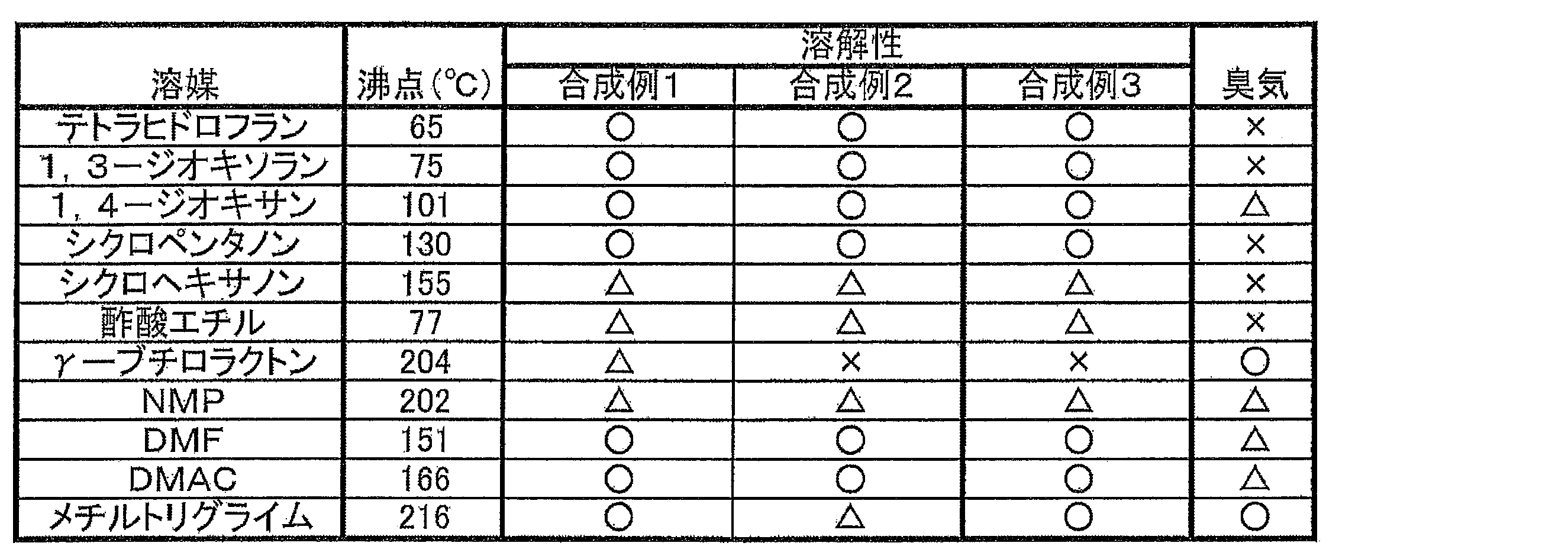
合成例1、2および3で得られたポリアミドイミド0.5gに対し、表2に記載の有機溶媒9.5g(固形分濃度5%)をサンプル管に配合し、マグネチックスターラーにより室温、具体的には23℃で撹拌した。完全に溶解したものを○、一部溶け残りがあるものを△、不溶なものを×とした。使用した溶媒とその沸点、評価結果を表2に示す。また、使用した有機溶媒の臭気について、ほぼ無臭のものを○、やや臭気があるものを△、はっきりと臭気を感じることができるものを×として評価した。結果を表2に示す。また、本発明の実施例および比較例で使用した有機溶媒(混合溶媒も含む)についても同様に評価し、結果を表3に示した。
線熱膨張係数の測定は、セイコー電子(株)社製TMA120Cを用いて(サンプルサイズ 幅3mm、長さ10mm、膜厚を測定し、フィルムの断面積を算出)、荷重3gとし10℃/minで10~340℃まで一旦昇温(1回目の昇温)させた後、10℃まで冷却し、さらに340℃まで10℃/minで昇温(2回目の昇温)したときの、2回目の昇温時の100~200℃および100~300℃における単位温度あたりの試料の歪の変化量から線熱膨張係数を求めた。
(4)フィルムのガラス転移温度
セイコー電子工業社製DMS-200を用い、測定長(測定治具間隔)を20mm、測定周波数を1Hzとして、動的粘弾性測定を行い、貯蔵弾性率の変曲点(tanδのピークトップ)をガラス転移温度とした。
(5)フィルム(ポリアミドイミド膜)の複屈折
高分子鎖がどの程度フィルム面に平行に配向しているかを表す程度(面内配向度)の指標として、複屈折の測定を実施した。ここで複屈折(△N)とは、ポリアミドイミド膜の面内の屈折率をNxy、厚み方向の屈折率をNzとしたときに、△N=Nxy-Nzで表される値である。屈折率の測定は、40mm×8mmにカットしたフィルムを偏光板付き接眼鏡をセットしたATAGO社製アッベ屈折計(DR-M2)にて測定した。偏光板の向きを変え、偏光方向を変えることで面内および厚み方向の屈折率を測定した。測定波長は光源として用いたナトリウムランプの波長(589nm)とし、中間液はイオウ飽和ヨウ化メチレンを用い、テストピースは屈折率が1.92のものを用いて測定した。
(6)塗工時の白化評価
ポリアミドイミド溶液を支持体であるガラス基板に塗工して湿膜を作製し、この湿膜を温度:23℃、相対湿度:55%RHの環境にて観察し、湿膜が白化し始めるまでの時間を計測した。白化開始が5分以上となった場合、塗工時の白化は抑制されたものと判断した。
(7)タックフリーの評価
ポリアミドイミド溶液を支持体であるガラス基板に塗工して湿膜を作製し、この湿膜を温度:23℃、相対湿度:55%RHの環境にて観察し、表面が乾燥し、タックフリーの状態になるまでの時間を計測した。この時間が、10分以上となった場合、連続塗工性が良好であると判断した。
<ポリアミドイミドの合成>
ポリテトラフルオロエチレン製のシール栓に撹拌翼を具備したステンレス製撹拌棒を備えた撹拌機、窒素導入管を備えた、2Lのガラス製セパラブルフラスコに、2,2’-ビス(トリフルオロメチル)ベンジジン(以下、TFMBと称することがある。)12.1gを入れ、重合用溶媒として脱水したN,N-ジメチルアセトアミド(DMAC)46.6gを仕込み攪拌した後、ピリジンを3.0g加え均一になるまで撹拌し、5℃の氷浴にて冷却した。この溶液を撹拌しながら、トリメリット酸無水物クロライド7.9gを粉体のままゆっくりと加え、5℃の氷浴中にて3時間攪拌した。なお、この溶液における溶質即ちジアミン化合物およびトリメリット酸無水物クロライドの仕込み濃度は、全反応液に対して30重量%となっていた。
<フィルムの作製>
合成例1で得られたポリアミドイミドを重量比:DMAC/シクロペンタノン(以下、CPN)=70/30混合溶媒に溶解してポリアミドイミドが7重量%含有されているポリアミドイミド溶液を作製し、支持体であるガラス板上に塗工した後、60℃で10分間乾燥させ、さらに150℃で60分間、300℃で60分間乾燥させた。その後ガラス板からフィルムを剥がし、フィルムを得た。得られたフィルムの評価結果を表3に示す。
合成例1で得られたポリアミドイミドを重量比:DMAC/CPN=50/50混合溶媒に溶解してポリアミドイミドが7重量%含有されているポリアミドイミド溶液を作製し、支持体であるガラス板上に塗工した後、60℃で10分間乾燥させ、さらに150℃で60分間、300℃で60分間乾燥させた。その後ガラス板からフィルムを剥がし、フィルムを得た。得られたフィルムの評価結果を表3に示す。
合成例1で得られたポリアミドイミドを重量比:DMAC/シクロヘキサノン(以下、CHN)=70/30混合溶媒に溶解してポリアミドイミドが10重量%含有されているポリアミドイミド溶液を作製し、支持体であるガラス板上に塗工した後、60℃で10分
間乾燥させ、さらに150℃で60分間、300℃で60分間乾燥させた。その後ガラス板からフィルムを剥がし、フィルムを得た。得られたフィルムの評価結果を表3に示す。
合成例1で得られたポリアミドイミドを重量比:DMAC/CHN=50/50混合溶媒に溶解してポリアミドイミドが10重量%含有されているポリアミドイミド溶液を作製し、支持体であるガラス板上に塗工した後、60℃で10分間乾燥させ、さらに150℃で60分間、300℃で60分間乾燥させた。その後ガラス板からフィルムを剥がし、フィルムを得た。得られたフィルムの評価結果を表3に示す。
合成例1で得られたポリアミドイミドを重量比:DMAC/プロピレングリコールモノメチルエーテルアセテート(以下、PGMEA)=70/30混合溶媒に溶解してポリアミドイミドが10重量%含有されているポリアミドイミド溶液を作製し、支持体であるガラス板上に塗工した後、60℃で10分間乾燥させ、さらに150℃で60分間、300℃で60分間乾燥させた。その後ガラス板からフィルムを剥がし、フィルムを得た。得られたフィルムの評価結果を表3に示す。
合成例1で得られたポリアミドイミドを重量比:DMF/CPN=50/50混合溶媒に溶解してポリアミドイミドが10重量%含有されているポリアミドイミド溶液を作製し、支持体であるガラス板上に塗工した後、60℃で10分間乾燥させ、さらに150℃で60分間、300℃で60分間乾燥させた。その後ガラス板からフィルムを剥がし、フィルムを得た。得られたフィルムの評価結果を表3に示す。
合成例1で得られたポリアミドイミドを重量比:DMF/CHN=50/50混合溶媒に溶解してポリアミドイミドが10重量%含有されているポリアミドイミド溶液を作製し、支持体であるガラス板上に塗工した後、60℃で10分間乾燥させ、さらに150℃で60分間、300℃で60分間乾燥させた。その後ガラス板からフィルムを剥がし、フィルムを得た。得られたフィルムの評価結果を表3に示す。
<アミド基含有テトラカルボン酸二無水物の合成(下記式(7))>

ポリテトラフルオロエチレン製のシール栓に4枚羽根撹拌翼を具備したステンレス製撹拌棒を備えた撹拌機、窒素導入管を備えた、500mLのガラス製セパラブルフラスコに、TFMB9.7gを入れ、重合用溶媒として脱水したN,N-ジメチルホルムアミド(DMF)153gを仕込んで攪拌した後、この溶液に、上記式(7)に示すアミド基含有テトラカルボン酸二無水物20.2gを加え、10分撹拌後、酢酸17gを添加し、室温(23℃)で撹拌することでポリアミド-アミド酸を得た。なお、この溶液におけるジアミン化合物およびテトラカルボン酸二無水物の仕込み濃度は、全反応液に対して15重量%となっていた。
<フィルムの作製>
合成例2で得られたポリアミドイミドを重量比:DMAC/CPN=70/30混合溶媒に溶解してポリアミドイミドが7重量%含有されているポリアミドイミド溶液を作製し、支持体であるガラス板上に塗工した後、60℃で10分間乾燥させ、さらに150℃で60分間、300℃で60分間乾燥させた。その後ガラス板からフィルムを剥がし、フィルムを得た。得られたフィルムの評価結果を表3に示す。
合成例2で得られたポリアミドイミドを重量比:DMAC/CPN=50/50混合溶媒に溶解してポリアミドイミドが7重量%含有されているポリアミドイミド溶液を作製し、支持体であるガラス板上に塗工した後、60℃で10分間乾燥させ、さらに150℃で60分間、300℃で60分間乾燥させた。その後ガラス板からフィルムを剥がし、フィルムを得た。得られたフィルムの評価結果を表3に示す。
合成例2で得られたポリアミドイミドを重量比:DMAC/CHN=70/30混合溶媒に溶解してポリアミドイミドが7重量%含有されているポリアミドイミド溶液を作製し、支持体であるガラス板上に塗工した後、60℃で10分間乾燥させ、さらに150℃で60分間、300℃で60分間乾燥させた。その後ガラス板からフィルムを剥がし、フィルムを得た。得られたフィルムの評価結果を表3に示す。
合成例2で得られたポリアミドイミドを重量比:DMAC/CHN=50/50混合溶媒に溶解してポリアミドイミドが7重量%含有されているポリアミドイミド溶液を作製し、支持体であるガラス板上に塗工した後、60℃で10分間乾燥させ、さらに150℃で60分間、300℃で60分間乾燥させた。その後ガラス板からフィルムを剥がし、フィルムを得た。得られたフィルムの評価結果を表3に示す。
合成例2で得られたポリアミドイミドを重量比:DMAC/PGMEA=70/30混合溶媒に溶解してポリアミドイミドが7重量%含有されているポリアミドイミド溶液を作製し、支持体であるガラス板上に塗工した後、60℃で10分間乾燥させ、さらに150℃で60分間、300℃で60分間乾燥させた。その後ガラス板からフィルムを剥がし、フィルムを得た。得られたフィルムの評価結果を表3に示す。
合成例2で得られたポリアミドイミドを重量比:DMF/CPN=50/50混合溶媒に溶解してポリアミドイミドが7重量%含有されているポリアミドイミド溶液を作製し、支持体であるガラス板上に塗工した後、60℃で10分間乾燥させ、さらに150℃で60分間、300℃で60分間乾燥させた。その後ガラス板からフィルムを剥がし、フィルムを得た。得られたフィルムの評価結果を表3に示す。
合成例2で得られたポリアミドイミドを重量比:DMF/CHN=50/50混合溶媒に溶解してポリアミドイミドが7重量%含有されているポリアミドイミド溶液を作製し、支持体であるガラス板上に塗工した後、60℃で10分間乾燥させ、さらに150℃で60分間、300℃で60分間乾燥させた。その後ガラス板からフィルムを剥がし、フィルムを得た。得られたフィルムの評価結果を表3に示す。
合成例1で得られたポリアミドイミドを重量比:DMAC/メチルトリグライム(以下、MTG)=20/80混合溶媒に溶解してポリアミドイミドが7重量%含有されているポリアミドイミド溶液を作製し、支持体であるガラス板上に塗工した後、60℃で10分間乾燥させ、さらに150℃で60分間、300℃で60分間乾燥させた。その後ガラス板からフィルムを剥がし、フィルムを得た。得られたフィルムの評価結果を表3に示す。
ポリテトラフルオロエチレン製のシール栓に4枚羽根撹拌翼を具備したステンレス製撹拌棒を備えた撹拌機、窒素導入管を備えた、500mLのガラス製セパラブルフラスコに、TFMB9.8gを入れ、重合用溶媒として脱水したN,N-ジメチルホルムアミド(DMF)153gを仕込んで攪拌した後、この溶液に、上記式(7)に示すアミド基含有テトラカルボン酸二無水物20.1gを加え、10分攪拌後、酢酸17gを添加し、室温(23℃)で攪拌することでポリアミド-アミド酸を得た。なお、この溶液におけるジアミン化合物およびテトラカルボン酸二無水物の仕込み濃度は、全反応液に対して15重量%となっていた。
合成例3で得られたポリアミドイミドを重量比:DMAC/MTG=30/70混合溶媒に溶解してポリアミドイミドが7重量%含有されているポリアミドイミド溶液を作製し、支持体であるガラス板上に塗工した後、60℃で10分間乾燥させ、さらに150℃で60分間、300℃で60分間乾燥させた。その後ガラス板からフィルムを剥がし、フィルムを得た。得られたフィルムの評価結果を表3に示す。
合成例3で得られたポリアミドイミドを重量比:DMAC/γ-ブチロラクトン(GBL)=50/50混合溶媒に溶解してポリアミドイミドが7重量%含有されているポリアミドイミド溶液を作製し、支持体であるガラス板上に塗工した後、60℃で10分間乾燥させ、さらに150℃で60分間、300℃で60分間乾燥させた。その後ガラス板からフィルムを剥がし、フィルムを得た。得られたフィルムの評価結果を表3に示す。
合成例1で得られたポリアミドイミドをDMACに溶解してポリアミドイミドが10重量%含有されているポリアミドイミド溶液を作製し、支持体であるガラス板上に塗工した後、60℃で10分間乾燥させ、さらに150℃で60分間、300℃で60分間乾燥させた。その後ガラス板からフィルムを剥がし、フィルムを得た。得られたフィルムの評価結果を表3に示す。
合成例1で得られたポリアミドイミドをDMFに溶解してポリアミドイミドが10重量%含有されているポリアミドイミド溶液を作製し、支持体であるガラス板上に塗工した後、60℃で10分間乾燥させ、さらに150℃で60分間、300℃で60分間乾燥させた。その後ガラス板からフィルムを剥がし、フィルムを得た。得られたフィルムの評価結果を表3に示す。
合成例1で得られたポリアミドイミドをテトラヒドロフラン(以下、THF)に溶解してポリアミドイミドが10重量%含有されているポリアミドイミド溶液を作製し、支持体であるガラス板上に塗工した後、60℃で10分間乾燥させ、さらに150℃で60分間、300℃で60分間乾燥させた。その後ガラス板からフィルムを剥がし、フィルムを得た。得られたフィルムの評価結果を表3に示す。
合成例1で得られたポリアミドイミドを1,3-ジオキソランに溶解してポリアミドイミドが10重量%含有されているポリアミドイミド溶液を作製し、支持体であるガラス板上に塗工した後、60℃で10分間乾燥させ、さらに150℃で60分間、300℃で60分間乾燥させた。その後ガラス板からフィルムを剥がし、フィルムを得た。得られたフィルムの評価結果を表3に示す。
合成例1で得られたポリアミドイミドを1,4-ジオキサンに溶解してポリアミドイミドが10重量%含有されているポリアミドイミド溶液を作製し、支持体であるガラス板上に塗工した後、60℃で10分間乾燥させ、さらに150℃で60分間、300℃で60分間乾燥させた。その後ガラス板からフィルムを剥がし、フィルムを得た。得られたフィルムの評価結果を表3に示す。
合成例2で得られたポリアミドイミドをDMACに溶解してポリアミドイミドが7重量%含有されているポリアミドイミド溶液を作製し、支持体であるガラス板上に塗工した後、60℃で10分間乾燥させ、さらに150℃で60分間、300℃で60分間乾燥させた。その後ガラス板からフィルムを剥がし、フィルムを得た。得られたフィルムの評価結果を表3に示す。
合成例2で得られたポリアミドイミドをDMFに溶解してポリアミドイミドが7重量%含有されているポリアミドイミド溶液を作製し、支持体であるガラス板上に塗工した後、60℃で10分間乾燥させ、さらに150℃で60分間、300℃で60分間乾燥させた。その後ガラス板からフィルムを剥がし、フィルムを得た。得られたフィルムの評価結果を表3に示す。
合成例2で得られたポリアミドイミドをTHFに溶解してポリアミドイミドが7重量%含有されているポリアミドイミド溶液を作製し、支持体であるガラス板上に塗工した後、60℃で10分間乾燥させ、さらに150℃で60分間、300℃で60分間乾燥させた。その後ガラス板からフィルムを剥がし、フィルムを得た。得られたフィルムの評価結果を表3に示す。
合成例2で得られたポリアミドイミドを1,3-ジオキソランに溶解してポリアミドイミドが7重量%含有されているポリアミドイミド溶液を作製し、支持体であるガラス板上に塗工した後、60℃で10分間乾燥させ、さらに150℃で60分間、300℃で60分間乾燥させた。その後ガラス板からフィルムを剥がし、フィルムを得た。得られたフィルムの評価結果を表3に示す。
合成例2で得られたポリアミドイミドを1,4-ジオキサンに溶解してポリアミドイミドが7重量%含有されているポリアミドイミド溶液を作製し、支持体であるガラス板上に塗工した後、60℃で10分間乾燥させ、さらに150℃で60分間、300℃で60分間乾燥させた。その後ガラス板からフィルムを剥がし、フィルムを得た。得られたフィルムの評価結果を表3に示す。
ポリテトラフルオロエチレン製のシール栓に4枚羽根撹拌翼を具備したステンレス製撹拌棒を備えた撹拌機、窒素導入管を備えた、500mLのガラス製セパラブルフラスコに、TFMB9.7gを入れ、重合用溶媒として脱水したN,N-ジメチルホルムアミド(DMF)170gを仕込んで攪拌した後、この溶液に、上記式(7)に示すアミド基含有テトラカルボン酸二無水物20.2gを加え、室温(23℃)で攪拌し、ポリアミドーアミド酸を得た。なお、この溶液におけるジアミン化合物およびテトラカルボン酸二無水物の仕込み濃度は、全反応液に対して15重量%となっていた。この溶液にDMF100gを加え、仕込み濃度が10重量%となるように調整し、ポリアミド-アミド酸を得た。
<フィルムの作製>
合成例4で得られたポリアミド-アミド酸溶液を支持体であるガラス板上に塗工した後、60℃で10分間乾燥させ、さらに150℃で60分間、300℃で60分間乾燥させた。その後ガラス板からフィルムを剥がし、フィルムを得た。得られたフィルムの評価結果を表3に示す。
比較例11で得られたポリアミドイミドフィルムをDMACに再溶解し、ポリアミドイミドが7重量%含有されているポリアミドイミド溶液を作製し、このポリアミドイミド溶液を支持体であるガラス板上に塗工した後、60℃で10分間乾燥させ、さらに150℃で60分間、300℃で60分間乾燥させた。その後ガラス板からフィルムを剥がし、フィルムを得た。得られたフィルムの評価結果を表3に示す。
合成例1で得られたポリアミドイミドをMTGに溶解してポリアミドイミドが7重量%含有されているポリアミドイミド溶液を作製し、支持体であるガラス板上に塗工した後、60℃で10分間乾燥させ、さらに150℃で60分間、300℃で60分間乾燥させた。その後ガラス板からフィルムを剥がし、フィルムを得た。得られたフィルムの評価結果を表3に示す。
合成例2で得られたポリアミドイミドを重量比:DMAC/DMF=50/50混合溶媒に溶解してポリアミドイミドが7重量%含有されているポリアミドイミド溶液を作製し、支持体であるガラス板上に塗工した後、60℃で10分間乾燥させ、さらに150℃で60分間、300℃で60分間乾燥させた。その後ガラス板からフィルムを剥がし、フィルムを得た。得られたフィルムの評価結果を表3に示す。
ポリテトラフルオロエチレン製のシール栓に4枚羽根撹拌翼を具備したステンレス製撹拌棒を備えた撹拌機、窒素導入管を備えた、500mLのガラス製セパラブルフラスコに、TFMB9.7gを入れ、重合用溶媒として脱水したDMAC170gを仕込んで攪拌した後、この溶液に、上記式(7)に示すアミド基含有テトラカルボン酸二無水物20.4gを加え、室温(23℃)で攪拌し、ポリアミド-アミド酸を得た。なお、この溶液におけるジアミン化合物およびテトラカルボン酸二無水物の仕込み濃度は、全反応液に対して15重量%となっていた。この溶液にDMAC100gを加え、仕込み濃度が10重量%となるように調整し、ポリアミド-アミド酸を得た。
合成例5で得られたポリアミド-アミド酸溶液を支持体であるガラス板上に塗工した後、60℃で10分間乾燥させ、さらに150℃で60分間、300℃で60分間乾燥させた。その後ガラス板からフィルムを剥がし、フィルムを得た。得られたフィルムの評価結果を表3に示す。

実施例1~17に記載のポリアミドイミド溶液は、比較例1~15に記載のポリアミドイミド溶液またはポリアミド-アミド酸溶液と比べて白化時間が5分以上かつタックフリーまでの時間が45分以上であり、塗工性に優れており、さらに、得られたポリアミドイミド膜は極めて低い熱膨張係数を有していた。また、実施例1~17で得られたポリアミドイミド膜は比較例15と比べて低い線熱膨張係数、高い複屈折を有していた。
Claims (16)
- 下記一般式(1)で表される構造を含むポリアミドイミドと有機溶媒とを含有するポリアミドイミド溶液であって、該有機溶媒がアミド系溶媒と、アミド系以外の溶媒との混合溶媒であって、アミド系以外の溶媒がエーテル系、ケトン系、エステル系、グリコールエーテル系、およびグリコールエステル系溶媒からなる群より選ばれた少なくも1つの溶媒であることを特徴とするポリアミドイミド溶液。

- アミド系溶媒とアミド系以外の溶媒との重量比(アミド系溶媒/アミド系以外の溶媒)が、80/20~5/95の範囲であることを特徴とする請求項1に記載のポリアミドイミド溶液。
- 前記一般式(1)で表される構造を含むポリアミドイミドが下記式(6)で表されるポリアミドイミドであることを特徴とする請求項1または2に記載のポリアミドイミド溶液。

- アミド系溶媒が、N,N-ジメチルアセトアミドまたはN,N-ジメチルホルムアミドであり、アミド系以外の溶媒がメチルエチルケトン、メチルイソブチルケトン、シクロヘキサノン、シクロペンタノン、プロピレングリコールモノメチルエーテルアセテート、メチルトリグライム、メチルテトラグライム、メチルモノグライム、メチルジグライム、エチルモノグライム、エチルジグライム、ブチルジグライム、およびγ-ブチロラクトンからなる群より選ばれた少なくとも1つの溶媒であることを特徴とする請求項1~3のいずれか1項に記載のポリアミドイミド溶液。
- 下記一般式(1)で表される構造を含むポリアミドイミドを含有し、

- 請求項1~4のいずれか1項に記載のポリアミドイミド溶液を製膜することにより得られることを特徴とするポリアミドイミド膜。
- 前記一般式(1)で表される構造を含むポリアミドイミドと有機溶媒とを含有するポリアミドイミド溶液であって、該有機溶媒がアミド系溶媒と、アミド系以外の溶媒との混合溶媒であって、アミド系以外の溶媒がエーテル系、ケトン系、エステル系、グリコールエーテル系、およびグリコールエステル系溶媒からなる群より選ばれた少なくも1つの溶媒であることを特徴とするポリアミドイミド溶液を製膜することにより得られることを特徴とする請求項5に記載のポリアミドイミド膜。
- 前記ポリアミドイミド溶液を支持体に塗工して得られることを特徴とする請求項6または7に記載のポリアミドイミド膜。
- 100~300℃の間の線熱膨張係数が22ppm/K以下であることを特徴とする請求項5~8のいずれか1項に記載のポリアミドイミド膜。
- 面内の屈折率をNxy、厚み方向の屈折率をNzとしたときに、△N=Nxy-Nzで表される複屈折△Nが0.070以上、0.30以下であることを特徴とする請求項5~9のいずれか1項に記載のポリアミドイミド膜。
- 請求項5~10のいずれか1項に記載のポリアミドイミド膜とガラス基板とからなることを特徴とする積層物。
- 請求項5~10のいずれか1項に記載のポリアミドイミド膜を含有することを特徴とするフレキシブルディスプレイ基板。
- 請求項5~10のいずれか1項に記載のポリアミドイミド膜を含有することを特徴とするTFT基板。
- 請求項5~10のいずれか1項に記載のポリアミドイミド膜を含有することを特徴とするカラーフィルター。
- 請求項5~10のいずれか1項に記載のポリアミドイミド膜を含有することを特徴とする電子ペーパー。
- 請求項5~10のいずれか1項に記載のポリアミドイミド膜を含有することを特徴とする有機ELディスプレイ。
Priority Applications (4)
| Application Number | Priority Date | Filing Date | Title |
|---|---|---|---|
| KR1020137030106A KR101890451B1 (ko) | 2011-04-20 | 2012-04-19 | 폴리아미드이미드 용액 및 폴리아미드이미드막 |
| CN201280018593.3A CN103502314B (zh) | 2011-04-20 | 2012-04-19 | 聚酰胺酰亚胺溶液以及聚酰胺酰亚胺膜 |
| US14/112,503 US20140072813A1 (en) | 2011-04-20 | 2012-04-19 | Polyamide-imide solution and polyamide-imide film |
| JP2013511036A JP6010531B2 (ja) | 2011-04-20 | 2012-04-19 | ポリアミドイミド溶液およびポリアミドイミド膜の製造方法 |
Applications Claiming Priority (2)
| Application Number | Priority Date | Filing Date | Title |
|---|---|---|---|
| JP2011094441 | 2011-04-20 | ||
| JP2011-094441 | 2011-04-20 |
Publications (1)
| Publication Number | Publication Date |
|---|---|
| WO2012144563A1 true WO2012144563A1 (ja) | 2012-10-26 |
Family
ID=47041668
Family Applications (1)
| Application Number | Title | Priority Date | Filing Date |
|---|---|---|---|
| PCT/JP2012/060624 Ceased WO2012144563A1 (ja) | 2011-04-20 | 2012-04-19 | ポリアミドイミド溶液およびポリアミドイミド膜 |
Country Status (6)
| Country | Link |
|---|---|
| US (1) | US20140072813A1 (ja) |
| JP (1) | JP6010531B2 (ja) |
| KR (1) | KR101890451B1 (ja) |
| CN (1) | CN103502314B (ja) |
| TW (1) | TWI529200B (ja) |
| WO (1) | WO2012144563A1 (ja) |
Cited By (12)
| Publication number | Priority date | Publication date | Assignee | Title |
|---|---|---|---|---|
| WO2015099478A1 (ko) * | 2013-12-26 | 2015-07-02 | 코오롱인더스트리 주식회사 | 투명 폴리아마이드-이미드 수지 및 이를 이용한 필름 |
| KR20150076114A (ko) * | 2013-12-26 | 2015-07-06 | 코오롱인더스트리 주식회사 | 투명 폴리아마이드―이미드 수지 및 이를 이용한 필름 |
| JP2016027561A (ja) * | 2014-06-30 | 2016-02-18 | Tdk株式会社 | リチウムイオン二次電池用負極バインダー、リチウムイオン二次電池用負極およびリチウムイオン二次電池 |
| CN105392821A (zh) * | 2013-07-26 | 2016-03-09 | 日产化学工业株式会社 | 显示器基板用树脂组合物、显示器基板用树脂薄膜及显示器基板用树脂薄膜的制造方法 |
| JP2017511423A (ja) * | 2014-04-17 | 2017-04-20 | フジフィルム・ハント・ケミカルズ・ユーエスエイ,インコーポレイテッド | ポリアミドイミド用の低毒性溶媒系およびポリアミドアミック酸樹脂生産 |
| JP2017516886A (ja) * | 2014-04-17 | 2017-06-22 | フジフィルム・ハント・ケミカルズ・ユーエスエイ,インコーポレイテッド | ポリアミドイミド用の低毒性溶媒系およびポリアミドアミック酸樹脂コーティング |
| CN108137560A (zh) * | 2015-07-14 | 2018-06-08 | 汉高知识产权控股有限责任公司 | 用于滴注填充式密封剂应用的双马来酰亚胺树脂 |
| WO2018117465A1 (ko) * | 2016-12-20 | 2018-06-28 | 주식회사 엘지화학 | 폴리아미드이미드 공중합체 및 이를 포함하는 무색 투명한 폴리아미드이미드 필름 |
| WO2018135433A1 (ja) * | 2017-01-20 | 2018-07-26 | 住友化学株式会社 | 光学フィルム及び光学フィルムの製造方法 |
| JP2018119133A (ja) * | 2017-01-20 | 2018-08-02 | 住友化学株式会社 | 光学フィルムおよび光学フィルムの製造方法 |
| JP2018137217A (ja) * | 2017-02-21 | 2018-08-30 | ユニチカ株式会社 | 多孔質ポリアミドイミド被膜の形成方法 |
| US10882958B2 (en) | 2016-12-20 | 2021-01-05 | Lg Chem, Ltd. | Polyamideimide copolymers and colorless and transparent polyamideimide film comprising the same |
Families Citing this family (19)
| Publication number | Priority date | Publication date | Assignee | Title |
|---|---|---|---|---|
| US9997353B1 (en) * | 2010-12-24 | 2018-06-12 | Ananda H. Kumar | Silicon composite substrates |
| KR101874728B1 (ko) * | 2014-01-16 | 2018-07-04 | 유니티카 가부시끼가이샤 | 폴리아마이드 이미드 용액, 다공질 폴리아마이드 이미드 필름, 및 그의 제조 방법 |
| TWI504679B (zh) * | 2014-03-24 | 2015-10-21 | Daxin Materials Corp | Compositions for thermal barrier layers |
| KR102232009B1 (ko) * | 2014-12-30 | 2021-03-25 | 코오롱인더스트리 주식회사 | 폴리아마이드-이미드 전구체, 폴리아마이드-이미드 필름 및 이를 포함하는 표시소자 |
| KR102227672B1 (ko) * | 2014-12-31 | 2021-03-16 | 코오롱인더스트리 주식회사 | 폴리아마이드-이미드 전구체, 폴리아마이드-이미드 필름 및 이를 포함하는 표시소자 |
| KR102304106B1 (ko) * | 2015-01-30 | 2021-09-23 | 삼성전자주식회사 | 폴리(이미드-아미드)를 포함하는 성형품 제조용 조성물, 상기 조성물의 제조 방법, 및 폴리(이미드-아미드)를 포함하는 성형품 |
| CN105017534A (zh) * | 2015-08-13 | 2015-11-04 | 中国科学院光电技术研究所 | 一种可溶性无色透明低热膨胀系数聚酰胺酰亚胺薄膜制备方法 |
| CN105552278A (zh) * | 2016-01-27 | 2016-05-04 | 江苏巨贤合成材料有限公司 | 一种聚酰胺酰亚胺锂电池隔膜的制备方法 |
| KR102452649B1 (ko) * | 2016-10-21 | 2022-10-07 | 삼성전자주식회사 | 적층 투명 필름, 표시 장치용 윈도우 및 표시 장치 |
| KR101959046B1 (ko) | 2016-11-17 | 2019-03-18 | 주식회사 엘지화학 | 폴리이미드계 블록 공중합체 필름 |
| KR102230059B1 (ko) * | 2018-01-11 | 2021-03-18 | 주식회사 엘지화학 | 폴리아미드이미드 수지 필름 |
| KR102147386B1 (ko) | 2019-07-25 | 2020-08-24 | 에스케이이노베이션 주식회사 | 폴리아미드이미드 필름 |
| KR20210016231A (ko) | 2019-08-02 | 2021-02-15 | 삼성디스플레이 주식회사 | 패널 하부 시트 및 이를 포함하는 표시 장치 |
| KR102832101B1 (ko) | 2019-08-02 | 2025-07-09 | 삼성디스플레이 주식회사 | 표시 장치 |
| CN111675902A (zh) * | 2020-05-22 | 2020-09-18 | 浙江中科玖源新材料有限公司 | 一种高耐热低热膨胀系数的透明聚酰亚胺薄膜及制备方法 |
| CN111533909B (zh) * | 2020-06-08 | 2023-04-25 | 武汉柔显科技股份有限公司 | 一种聚酰胺酰亚胺、聚酰胺酰亚胺薄膜及显示装置 |
| CN111607083A (zh) * | 2020-06-10 | 2020-09-01 | 浙江中科玖源新材料有限公司 | 一种光学膜及其透明基板、图像显示装置、太阳能电池 |
| KR20230143768A (ko) | 2022-04-06 | 2023-10-13 | 에스케이이노베이션 주식회사 | 폴리아미드이미드 필름 및 이의 제조방법 |
| KR20240049477A (ko) | 2022-10-08 | 2024-04-16 | 김현수 | 염도 측정이 가능한 냄비 |
Citations (8)
| Publication number | Priority date | Publication date | Assignee | Title |
|---|---|---|---|---|
| JP2001264771A (ja) * | 2001-01-26 | 2001-09-26 | Jsr Corp | 液晶配向剤および液晶配向膜の製造方法 |
| JP2004231946A (ja) * | 2003-01-10 | 2004-08-19 | Nitto Denko Corp | ポリイミドフィルムおよびその製造方法 |
| JP2006002163A (ja) * | 2005-08-08 | 2006-01-05 | Pi R & D Co Ltd | ケトン及び/又はエーテルの溶媒に可溶なブロック共重合ポリイミド組成物及びその製造法 |
| JP2007193045A (ja) * | 2006-01-18 | 2007-08-02 | Nitto Denko Corp | 位相差板、及び光学フィルム、及び液晶パネル、及び画像表示装置 |
| JP2008285660A (ja) * | 2007-04-16 | 2008-11-27 | Hitachi Chem Co Ltd | ポリアミドイミド樹脂、ポリアミドイミド樹脂組成物及び塗料組成物 |
| JP2009258552A (ja) * | 2008-04-21 | 2009-11-05 | Seiko Epson Corp | 液晶配向膜形成用組成物及び液晶表示装置の製造方法 |
| JP2010106225A (ja) * | 2008-09-30 | 2010-05-13 | Nissan Chem Ind Ltd | 新規なフッ素化テトラカルボン酸二無水物、これより得られるポリイミド前駆体、ポリイミドとその利用 |
| WO2011065131A1 (ja) * | 2009-11-26 | 2011-06-03 | 株式会社カネカ | 光学フィルム、光学フィルムの製造方法、透明基板、画像表示装置及び太陽電池 |
Family Cites Families (11)
| Publication number | Priority date | Publication date | Assignee | Title |
|---|---|---|---|---|
| JP3097704B2 (ja) | 1991-09-02 | 2000-10-10 | 東洋紡績株式会社 | ポリアミドイミド樹脂 |
| KR100262417B1 (ko) * | 1992-06-04 | 2000-08-01 | 엔다 나오또 | 필름접착제 및 그의 제조 방법 |
| JP3267347B2 (ja) * | 1992-10-27 | 2002-03-18 | ジェイエスアール株式会社 | 液晶配向剤 |
| JP3897576B2 (ja) * | 2001-10-12 | 2007-03-28 | 株式会社ピーアイ技術研究所 | ケトン及び/又はエーテルの溶媒に可溶なブロック共重合ポリイミド組成物及びその製造法 |
| KR20050094804A (ko) * | 2003-01-10 | 2005-09-28 | 닛토덴코 가부시키가이샤 | 폴리이미드 필름 및 그 제조 방법 |
| US20070225438A1 (en) * | 2004-04-27 | 2007-09-27 | Yuji Hasegawa | Resin Paste for Die Bonding |
| KR20160130876A (ko) * | 2009-09-30 | 2016-11-14 | 다이니폰 인사츠 가부시키가이샤 | 플렉시블 디바이스용 기판, 플렉시블 디바이스용 박막 트랜지스터 기판, 플렉시블 디바이스, 박막 소자용 기판, 박막 소자, 박막 트랜지스터, 박막 소자용 기판의 제조 방법, 박막 소자의 제조 방법 및 박막 트랜지스터의 제조 방법 |
| WO2011040440A1 (ja) * | 2009-09-30 | 2011-04-07 | 大日本印刷株式会社 | フレキシブルデバイス用基板、フレキシブルデバイス用薄膜トランジスタ基板、フレキシブルデバイス、薄膜素子用基板、薄膜素子、薄膜トランジスタ、薄膜素子用基板の製造方法、薄膜素子の製造方法および薄膜トランジスタの製造方法 |
| JP2012077144A (ja) * | 2010-09-30 | 2012-04-19 | Kaneka Corp | ポリアミドイミド樹脂およびその製造方法、ポリアミドイミド樹脂溶液、ポリアミドイミド膜およびその利用 |
| JP5606257B2 (ja) * | 2010-09-30 | 2014-10-15 | 株式会社カネカ | ポリイミド樹脂フィルム及びその製造方法 |
| MX359815B (es) * | 2012-01-09 | 2018-10-11 | Du Pont | Soluciones aglomerantes acuosas. |
-
2012
- 2012-04-19 CN CN201280018593.3A patent/CN103502314B/zh active Active
- 2012-04-19 US US14/112,503 patent/US20140072813A1/en not_active Abandoned
- 2012-04-19 TW TW101114026A patent/TWI529200B/zh active
- 2012-04-19 JP JP2013511036A patent/JP6010531B2/ja active Active
- 2012-04-19 KR KR1020137030106A patent/KR101890451B1/ko active Active
- 2012-04-19 WO PCT/JP2012/060624 patent/WO2012144563A1/ja not_active Ceased
Patent Citations (8)
| Publication number | Priority date | Publication date | Assignee | Title |
|---|---|---|---|---|
| JP2001264771A (ja) * | 2001-01-26 | 2001-09-26 | Jsr Corp | 液晶配向剤および液晶配向膜の製造方法 |
| JP2004231946A (ja) * | 2003-01-10 | 2004-08-19 | Nitto Denko Corp | ポリイミドフィルムおよびその製造方法 |
| JP2006002163A (ja) * | 2005-08-08 | 2006-01-05 | Pi R & D Co Ltd | ケトン及び/又はエーテルの溶媒に可溶なブロック共重合ポリイミド組成物及びその製造法 |
| JP2007193045A (ja) * | 2006-01-18 | 2007-08-02 | Nitto Denko Corp | 位相差板、及び光学フィルム、及び液晶パネル、及び画像表示装置 |
| JP2008285660A (ja) * | 2007-04-16 | 2008-11-27 | Hitachi Chem Co Ltd | ポリアミドイミド樹脂、ポリアミドイミド樹脂組成物及び塗料組成物 |
| JP2009258552A (ja) * | 2008-04-21 | 2009-11-05 | Seiko Epson Corp | 液晶配向膜形成用組成物及び液晶表示装置の製造方法 |
| JP2010106225A (ja) * | 2008-09-30 | 2010-05-13 | Nissan Chem Ind Ltd | 新規なフッ素化テトラカルボン酸二無水物、これより得られるポリイミド前駆体、ポリイミドとその利用 |
| WO2011065131A1 (ja) * | 2009-11-26 | 2011-06-03 | 株式会社カネカ | 光学フィルム、光学フィルムの製造方法、透明基板、画像表示装置及び太陽電池 |
Cited By (25)
| Publication number | Priority date | Publication date | Assignee | Title |
|---|---|---|---|---|
| CN105392821A (zh) * | 2013-07-26 | 2016-03-09 | 日产化学工业株式会社 | 显示器基板用树脂组合物、显示器基板用树脂薄膜及显示器基板用树脂薄膜的制造方法 |
| CN105392821B (zh) * | 2013-07-26 | 2018-10-23 | 日产化学工业株式会社 | 显示器基板用树脂组合物、显示器基板用树脂薄膜及显示器基板用树脂薄膜的制造方法 |
| CN105899581B (zh) * | 2013-12-26 | 2017-11-24 | 可隆工业株式会社 | 透明聚酰胺‑酰亚胺树脂及使用该树脂的薄膜 |
| KR101870341B1 (ko) | 2013-12-26 | 2018-06-22 | 코오롱인더스트리 주식회사 | 투명 폴리아마이드―이미드 수지 및 이를 이용한 필름 |
| CN105899581A (zh) * | 2013-12-26 | 2016-08-24 | 可隆工业株式会社 | 透明聚酰胺-酰亚胺树脂及使用该树脂的薄膜 |
| US9580555B2 (en) | 2013-12-26 | 2017-02-28 | Kolon Industries, Inc. | Transparent polyamide-imide resin and film using same |
| WO2015099478A1 (ko) * | 2013-12-26 | 2015-07-02 | 코오롱인더스트리 주식회사 | 투명 폴리아마이드-이미드 수지 및 이를 이용한 필름 |
| KR20190087397A (ko) * | 2013-12-26 | 2019-07-24 | 코오롱인더스트리 주식회사 | 투명 폴리아마이드-이미드 수지 및 이를 이용한 필름 |
| KR20150076114A (ko) * | 2013-12-26 | 2015-07-06 | 코오롱인더스트리 주식회사 | 투명 폴리아마이드―이미드 수지 및 이를 이용한 필름 |
| USRE48141E1 (en) | 2013-12-26 | 2020-08-04 | Kolon Industries, Inc. | Transparent polyamide-imide resin and film using same |
| KR102238308B1 (ko) | 2013-12-26 | 2021-04-09 | 코오롱인더스트리 주식회사 | 투명 폴리아마이드-이미드 수지 및 이를 이용한 필름 |
| JP2017511423A (ja) * | 2014-04-17 | 2017-04-20 | フジフィルム・ハント・ケミカルズ・ユーエスエイ,インコーポレイテッド | ポリアミドイミド用の低毒性溶媒系およびポリアミドアミック酸樹脂生産 |
| EP3131989A4 (en) * | 2014-04-17 | 2017-12-13 | Cymer-Dayton, Llc | Low toxicity solvent system for polyamideimide and polyamide amic acid resin coating |
| JP2017516886A (ja) * | 2014-04-17 | 2017-06-22 | フジフィルム・ハント・ケミカルズ・ユーエスエイ,インコーポレイテッド | ポリアミドイミド用の低毒性溶媒系およびポリアミドアミック酸樹脂コーティング |
| AU2015247468B2 (en) * | 2014-04-17 | 2019-02-14 | Cymer-Dayton, Llc | Low toxicity solvent system for polyamideimide and polyamide amic acid resin coating |
| JP2016027561A (ja) * | 2014-06-30 | 2016-02-18 | Tdk株式会社 | リチウムイオン二次電池用負極バインダー、リチウムイオン二次電池用負極およびリチウムイオン二次電池 |
| CN108137560B (zh) * | 2015-07-14 | 2019-03-08 | 汉高知识产权控股有限责任公司 | 用于滴注填充式密封剂应用的双马来酰亚胺树脂 |
| CN108137560A (zh) * | 2015-07-14 | 2018-06-08 | 汉高知识产权控股有限责任公司 | 用于滴注填充式密封剂应用的双马来酰亚胺树脂 |
| WO2018117465A1 (ko) * | 2016-12-20 | 2018-06-28 | 주식회사 엘지화학 | 폴리아미드이미드 공중합체 및 이를 포함하는 무색 투명한 폴리아미드이미드 필름 |
| US10882958B2 (en) | 2016-12-20 | 2021-01-05 | Lg Chem, Ltd. | Polyamideimide copolymers and colorless and transparent polyamideimide film comprising the same |
| JP2018119133A (ja) * | 2017-01-20 | 2018-08-02 | 住友化学株式会社 | 光学フィルムおよび光学フィルムの製造方法 |
| WO2018135433A1 (ja) * | 2017-01-20 | 2018-07-26 | 住友化学株式会社 | 光学フィルム及び光学フィルムの製造方法 |
| JP7249732B2 (ja) | 2017-01-20 | 2023-03-31 | 住友化学株式会社 | 光学フィルムおよび光学フィルムの製造方法 |
| JP2018137217A (ja) * | 2017-02-21 | 2018-08-30 | ユニチカ株式会社 | 多孔質ポリアミドイミド被膜の形成方法 |
| JP7032793B2 (ja) | 2017-02-21 | 2022-03-09 | ユニチカ株式会社 | 多孔質ポリアミドイミド被膜の形成方法 |
Also Published As
| Publication number | Publication date |
|---|---|
| JP6010531B2 (ja) | 2016-10-19 |
| CN103502314A (zh) | 2014-01-08 |
| KR20140026485A (ko) | 2014-03-05 |
| TW201247743A (en) | 2012-12-01 |
| US20140072813A1 (en) | 2014-03-13 |
| KR101890451B1 (ko) | 2018-08-21 |
| CN103502314B (zh) | 2016-02-03 |
| JPWO2012144563A1 (ja) | 2014-07-28 |
| TWI529200B (zh) | 2016-04-11 |
Similar Documents
| Publication | Publication Date | Title |
|---|---|---|
| JP6010531B2 (ja) | ポリアミドイミド溶液およびポリアミドイミド膜の製造方法 | |
| TWI542610B (zh) | 聚醯胺酸、聚醯亞胺、聚醯胺酸溶液、聚醯亞胺溶液、由此等溶液所得之聚醯亞胺膜及聚醯亞胺膜之利用 | |
| JP5757876B2 (ja) | 光学フィルム、光学フィルムの製造方法、透明基板、画像表示装置及び太陽電池 | |
| JP5695276B2 (ja) | ポリアミド酸、ポリイミド、ポリアミド酸溶液、およびポリイミドの利用 | |
| JP2012077144A (ja) | ポリアミドイミド樹脂およびその製造方法、ポリアミドイミド樹脂溶液、ポリアミドイミド膜およびその利用 | |
| JP5909391B2 (ja) | ポリイミド溶液およびその溶液から得られるポリイミド膜 | |
| JP6236349B2 (ja) | ポリイミドおよびその利用 | |
| JP7527610B2 (ja) | ポリイミド粉体、ポリイミドワニス、ポリイミドフィルムおよびポリイミド多孔質膜 | |
| JP5985977B2 (ja) | ポリイミド樹脂溶液 | |
| JP7094296B2 (ja) | ポリイミド樹脂およびその製造方法、ポリイミド溶液、ならびにポリイミドフィルムおよびその製造方法 | |
| JP2012062344A (ja) | ポリイミド前駆体、ポリイミド樹脂およびその利用 | |
| WO2017014286A1 (ja) | ポリイミド系ワニス、それを用いたポリイミド系フィルムの製造方法、及び、ポリイミド系フィルム | |
| JPWO2019073972A1 (ja) | ポリイミド樹脂およびその製造方法、ポリイミド溶液、ならびにポリイミドフィルムおよびその製造方法 | |
| JP2008045054A (ja) | 脂環系ポリイミド共重合体及びその製造方法 | |
| JP2013007003A (ja) | ポリイミド樹脂粒子の製造方法 | |
| TWI780171B (zh) | 可撓性裝置基板形成用組成物 | |
| KR20210093183A (ko) | 폴리아미드계 수지 분체의 제조 방법 | |
| WO2020196103A1 (ja) | 無色透明樹脂フィルムの製造方法 | |
| JP2020122121A (ja) | ポリイミド系樹脂粉体の製造方法 | |
| TW202012508A (zh) | 聚醯胺系樹脂粉體之製造方法及聚醯胺系樹脂組合物 |
Legal Events
| Date | Code | Title | Description |
|---|---|---|---|
| 121 | Ep: the epo has been informed by wipo that ep was designated in this application |
Ref document number: 12774106 Country of ref document: EP Kind code of ref document: A1 |
|
| ENP | Entry into the national phase |
Ref document number: 2013511036 Country of ref document: JP Kind code of ref document: A |
|
| WWE | Wipo information: entry into national phase |
Ref document number: 14112503 Country of ref document: US |
|
| NENP | Non-entry into the national phase |
Ref country code: DE |
|
| ENP | Entry into the national phase |
Ref document number: 20137030106 Country of ref document: KR Kind code of ref document: A |
|
| 122 | Ep: pct application non-entry in european phase |
Ref document number: 12774106 Country of ref document: EP Kind code of ref document: A1 |