WO2010143589A1 - 口腔用組成物 - Google Patents
口腔用組成物 Download PDFInfo
- Publication number
- WO2010143589A1 WO2010143589A1 PCT/JP2010/059505 JP2010059505W WO2010143589A1 WO 2010143589 A1 WO2010143589 A1 WO 2010143589A1 JP 2010059505 W JP2010059505 W JP 2010059505W WO 2010143589 A1 WO2010143589 A1 WO 2010143589A1
- Authority
- WO
- WIPO (PCT)
- Prior art keywords
- composition
- vitamin
- salt
- oral cavity
- derivative
- Prior art date
- Legal status (The legal status is an assumption and is not a legal conclusion. Google has not performed a legal analysis and makes no representation as to the accuracy of the status listed.)
- Ceased
Links
Classifications
-
- A—HUMAN NECESSITIES
- A61—MEDICAL OR VETERINARY SCIENCE; HYGIENE
- A61Q—SPECIFIC USE OF COSMETICS OR SIMILAR TOILETRY PREPARATIONS
- A61Q11/00—Preparations for care of the teeth, of the oral cavity or of dentures; Dentifrices, e.g. toothpastes; Mouth rinses
-
- A—HUMAN NECESSITIES
- A61—MEDICAL OR VETERINARY SCIENCE; HYGIENE
- A61K—PREPARATIONS FOR MEDICAL, DENTAL OR TOILETRY PURPOSES
- A61K8/00—Cosmetics or similar toiletry preparations
- A61K8/18—Cosmetics or similar toiletry preparations characterised by the composition
- A61K8/30—Cosmetics or similar toiletry preparations characterised by the composition containing organic compounds
- A61K8/33—Cosmetics or similar toiletry preparations characterised by the composition containing organic compounds containing oxygen
- A61K8/39—Derivatives containing from 2 to 10 oxyalkylene groups
-
- A—HUMAN NECESSITIES
- A61—MEDICAL OR VETERINARY SCIENCE; HYGIENE
- A61K—PREPARATIONS FOR MEDICAL, DENTAL OR TOILETRY PURPOSES
- A61K8/00—Cosmetics or similar toiletry preparations
- A61K8/18—Cosmetics or similar toiletry preparations characterised by the composition
- A61K8/30—Cosmetics or similar toiletry preparations characterised by the composition containing organic compounds
- A61K8/60—Sugars; Derivatives thereof
- A61K8/604—Alkylpolyglycosides; Derivatives thereof, e.g. esters
-
- A—HUMAN NECESSITIES
- A61—MEDICAL OR VETERINARY SCIENCE; HYGIENE
- A61K—PREPARATIONS FOR MEDICAL, DENTAL OR TOILETRY PURPOSES
- A61K8/00—Cosmetics or similar toiletry preparations
- A61K8/18—Cosmetics or similar toiletry preparations characterised by the composition
- A61K8/30—Cosmetics or similar toiletry preparations characterised by the composition containing organic compounds
- A61K8/67—Vitamins
- A61K8/676—Ascorbic acid, i.e. vitamin C
-
- A—HUMAN NECESSITIES
- A61—MEDICAL OR VETERINARY SCIENCE; HYGIENE
- A61K—PREPARATIONS FOR MEDICAL, DENTAL OR TOILETRY PURPOSES
- A61K8/00—Cosmetics or similar toiletry preparations
- A61K8/18—Cosmetics or similar toiletry preparations characterised by the composition
- A61K8/30—Cosmetics or similar toiletry preparations characterised by the composition containing organic compounds
- A61K8/67—Vitamins
- A61K8/678—Tocopherol, i.e. vitamin E
-
- A—HUMAN NECESSITIES
- A61—MEDICAL OR VETERINARY SCIENCE; HYGIENE
- A61K—PREPARATIONS FOR MEDICAL, DENTAL OR TOILETRY PURPOSES
- A61K8/00—Cosmetics or similar toiletry preparations
- A61K8/18—Cosmetics or similar toiletry preparations characterised by the composition
- A61K8/72—Cosmetics or similar toiletry preparations characterised by the composition containing organic macromolecular compounds
- A61K8/84—Cosmetics or similar toiletry preparations characterised by the composition containing organic macromolecular compounds obtained by reactions otherwise than those involving only carbon-carbon unsaturated bonds
- A61K8/86—Polyethers
-
- A—HUMAN NECESSITIES
- A61—MEDICAL OR VETERINARY SCIENCE; HYGIENE
- A61K—PREPARATIONS FOR MEDICAL, DENTAL OR TOILETRY PURPOSES
- A61K2800/00—Properties of cosmetic compositions or active ingredients thereof or formulation aids used therein and process related aspects
- A61K2800/40—Chemical, physico-chemical or functional or structural properties of particular ingredients
- A61K2800/59—Mixtures
- A61K2800/592—Mixtures of compounds complementing their respective functions
Definitions
- the present invention relates to an oral composition containing an ascorbic acid phosphate ester or a salt thereof, exhibiting a high periodontal disease prevention or improvement effect and excellent in storage stability over time.
- an ascorbic acid phosphate ester or a salt thereof exhibiting a high periodontal disease prevention or improvement effect and excellent in storage stability over time.
- the effect of improving bad breath and gingival crevicular fluid volume increase is particularly high, and the storage stability of ascorbic acid phosphate or its salt over time is excellent, and separation and discoloration are prevented and the appearance
- the present invention relates to a composition for oral cavity that is also excellent in stability.
- Periodontal disease is counted as one of the major causes of tooth loss, and its prevention is expected to lead to an improvement in QOL (Quality of Life).
- QOL Quality of Life
- Many periodontal diseases are thought to be infections caused by bacteria, mainly obligate anaerobic gram-negative bacilli, resulting in destruction of connective tissue and alveolar bone. Redness, swelling, bleeding, drainage, bad breath, etc. are observed as clinical findings in this process. There is also a bacterial-host reaction between cause and effect.
- neutrophils In the living body, neutrophils have a function of sterilizing bacteria and protecting the living body. However, particularly in chronic inflammation, leakage of cellular components and production of excessive active oxygen adversely affect living tissues. Therefore, it is useful to prevent tissue destruction by active oxygen by using an antioxidant such as ascorbic acid phosphate or a salt thereof. It is described in, for example, Patent Document 1 that blending an ascorbic acid phosphate ester or a derivative thereof into an oral composition is effective in preventing periodontal disease. However, ascorbic acid phosphate is easily decomposed in the preparation, and there is a problem that storage stability is not sufficient when water or an anionic surfactant is present.
- Vitamin E also known as tocopherol
- Patent Document 2 discloses that blending a vitamin E derivative into an oral composition is effective in preventing periodontal disease.
- vitamin E derivatives are easily decomposed in the preparation and it is difficult to ensure storage stability.
- Patent Document 3 It is described in, for example, Patent Document 3 and the like that a bactericidal agent that exhibits an effect by directly reducing the number of oral bacteria that cause inflammation of gums is effective in preventing and improving periodontal diseases.
- a surfactant it is common to use a surfactant to solubilize a bactericidal agent in an oral composition and stably mix it, but depending on the amount of surfactant, micelles formed by the surfactant may be rigid. Therefore, there was a problem that the bactericide incorporated in the micelle was not released at the target site, making it difficult to exert its effect.
- ascorbic acid ester or a salt thereof, vitamin E or a derivative thereof, and a bactericidal agent still have room for improvement in terms of stably blending them into the oral composition and sufficiently exerting these effects. It has been difficult to stably blend the ingredients at the same time to achieve high effects and to improve storage stability over time.
- Patent Document 4 discloses a dentifrice composition containing an ascorbic acid phosphate salt, a vitamin E derivative, and a cationic fungicide, a vitamin E derivative, a cationic fungicide, and polyoxyethylene hydrogenated castor oil (hereinafter, polyoxyethylene is POE).
- polyoxyethylene polyoxyethylene
- Patent Document 6 describes a composition using an ascorbic acid phosphate ester salt, a vitamin E derivative and a nonionic fungicide in combination as a caries prevention coating composition containing no abrasive. However, solubilization and blending stability of vitamin E derivatives and nonionic fungicides are not sufficient.
- Patent Document 7 describes a composition using a combination of anaerobic fungicide.
- this composition it is difficult to say that the mixing ratio of each component is appropriate. For this reason, the micelle formed by the surfactant becomes too rigid, and the vitamin E derivative and the bactericide incorporated in the micelle are in the target site. It was not released sufficiently and there was room for improvement in the manifestation of the effect.
- Patent Document 8 describes a composition in which an ascorbic acid phosphate ester salt, a vitamin E derivative, a POE alkyl ether, and a nonionic fungicide are blended as an oral composition containing vitamin E or a derivative thereof.
- this composition it is difficult to say that the blending ratio of each component, in particular, the blending ratio of the POE alkyl ether to the vitamin E derivative and the nonionic fungicide is appropriate. For this reason, the stability of the vitamin E derivative and the nonionic fungicide That is not enough.
- Patent Document 8 does not define the alkyl group part of the POE alkyl ether, and there is a description that the ascorbic acid derivative stabilizes vitamin E. However, simultaneous stabilization of vitamin E and ascorbic acid derivative is described. Is not shown.
- Applicant has formulated an oral composition containing an ascorbic acid phosphate ester salt with POE hydrogenated castor oil having an EO average addition mole number of 5 to 10 and adjusting the pH to 6.5 to 9.0.
- a product was proposed in Japanese Patent Application No. 2007-326959 (Japanese Patent Laid-Open No. 2009-149537).
- This application includes ascorbic acid phosphate salt, vitamin E derivative, PEO hydrogenated castor oil with 5 and 20 EO average addition moles, POE cetyl ether with 7 EO average addition moles and isopropylmethylphenol in Example 30.
- the composition to contain is described.
- this technology improves the oral retention and mucosal permeability of ascorbic acid phosphate ester salt by blending specific POE hydrogenated castor oil and adjusting the pH, and is derived from ascorbic acid phosphate ester salt.
- the effect can be effectively exhibited, and the technical idea is different from the present invention.
- the composition for oral cavity which has solved the above-mentioned problems, has a higher preventive or ameliorating effect on periodontal diseases, and has excellent storage stability over time, and appearance stability typified by prevention of separation and discoloration. Development of things is desired.
- the present invention has been made in view of the above circumstances, and ascorbic acid phosphate or a salt thereof, vitamin E or a derivative thereof, and a bactericidal agent are stably and effectively blended, and has an excellent periodontal disease prevention or improvement effect.
- An object of the present invention is to provide an oral composition that is effective and has excellent storage stability over time.
- the present inventors have (A) ascorbic acid phosphate ester or salt thereof, (B) vitamin E or derivative thereof, and (C) EO average added mole number. 10 to 60 mol of POE hydrogenated castor oil, POE alkyl ether having an alkyl group with 14 to 18 carbon atoms and EO average addition mole number of 5 to 8 mol, and an alkyl glucoside with an alkyl group having 10 to 14 carbon atoms
- One or more selected surfactants are blended, and (D) a nonionic germicide or (E) a cationic germicide is blended as a germicide, and the blending amounts and blending ratios of these components are shown below.
- composition for oral cavity in such a suitable range is excellent in preventing or ameliorating periodontal disease and excellent in storage stability over time.
- ascorbic acid phosphate or a salt thereof, vitamin E or a derivative thereof, and a bactericidal agent are stably blended at the same time, the effects derived from these components are effectively expressed, and bad breath and gums derived from periodontal diseases.
- a high effect of improving the increase in the amount of cough exudate (hereinafter referred to as GCF) and a high bactericidal effect on periodontal disease-causing bacteria are exhibited at the same time.
- Acid ester or a salt thereof and vitamin E or a derivative thereof are blended stably over a long period of time, and separation and discoloration do not occur over time, and the storage stability over time is excellent.
- the composition described above can provide an oral composition having both a high periodontal disease improving effect and excellent storage stability over time, which could not be achieved by conventional techniques.
- Ascorbic acid phosphate or a salt thereof, vitamin E or a derivative thereof, and a bactericidal agent are known to be effective in preventing or ameliorating periodontal diseases.
- a bactericidal agent are known to be effective in preventing or ameliorating periodontal diseases.
- these ingredients act synergistically, and in particular, among the symptoms associated with periodontal diseases, a high effect of improving the bad breath and the increase in the amount of GCF is exhibited.
- This GCF is present in the gingiva and gingival crevice, and actively blocks foreign substances such as bacteria and toxins by antibody components, etc., and contributes to biological defense.
- interleukin (hereinafter referred to as IL) Abbreviations) -1, cytokines such as IL-6, IL-8, and the like have been suggested to be associated with periodontal diseases (Non-patent Document 2).
- IL interleukin
- cytokines such as IL-6, IL-8, and the like
- the periodontal disease is remarkably improved, the amount of GCF once increased is decreased, the substrate of bad breath production is reduced, and the bactericidal agent sterilizes the bad breath producing bacteria. It is speculated that this can be suppressed.
- the amount of GCF increases when suffering from a periodontal disease and decreases when it improves, it is used as an index for measuring the degree of severity and improvement of the periodontal disease.
- composition of the present invention further contains (F) glycyrrhetinic acid, ⁇ -aminocaproic acid, glycyrrhizinate, tranexamic acid, buckwheat extract, and allantoin to prevent periodontal disease.
- the improvement effect is further improved, and the amount of GCF that has increased with the onset of periodontal disease can be more effectively reduced.
- the present invention provides the following oral composition.
- Claim 1 (A) Ascorbic acid phosphate or a salt thereof, (B) Vitamin E or a derivative thereof, (C) polyoxyethylene hydrogenated castor oil having an average addition mole number of ethylene oxide of 10 to 60 moles, polyoxyethylene alkyl having an alkyl group carbon number of 14 to 18 and an average addition mole number of ethylene oxide of 5 to 8 moles
- D) contains a nonionic fungicide, the total content of the components (A), (B) and (D) is 0.2 to 1.5% by mass, and (C) / ((B) A composition for oral cavity, wherein (D) is 8 to 20 by mass ratio.
- Claim 2 The composition for oral cavity according to claim 1, wherein the nonionic fungicide is isopropylmethylphenol or triclosan.
- Claim 3 (A) Ascorbic acid phosphate or a salt thereof, (B) Vitamin E or a derivative thereof, (C) polyoxyethylene hydrogenated castor oil having an average addition mole number of ethylene oxide of 10 to 60 moles, polyoxyethylene alkyl having an alkyl group carbon number of 14 to 18 and an average addition mole number of ethylene oxide of 5 to 8 moles
- One or more surfactants selected from ethers and alkyl glucosides having 10 to 14 carbon atoms in the alkyl group (E) a cationic fungicide, the total content of the components (A), (B) and (E) is 0.2 to 1.3% by mass, and (C) / ((B) + The composition for oral cavity, wherein (E)) is 8 to 18 by mass ratio.
- Claim 4 (E) The composition for oral cavity according to claim 3, wherein the cationic fungicide is at least one selected from cetylpyridinium chloride, benzethonium chloride, benzalkonium chloride, chlorhexidine gluconate, and chlorhexidine hydrochloride.
- Claim 5 The total content of the component (A), the component (B), and the component (D) or (E) is 0.2 to 1.0% by mass, and (C) / [(B) + (( The oral composition according to any one of claims 1 to 4, wherein D) or (E))] is 8 to 15 in terms of mass ratio.
- Claim 6 6.
- composition according to claim 1 further comprising (F) one or more selected from glycyrrhetinic acid, ⁇ -aminocaproic acid, glycyrrhizinate, tranexamic acid, buckwheat extract, and allantoin. Oral composition.
- the oral composition of the present invention exhibits a high effect of improving an increase in halitosis and the amount of GCF, among other symptoms associated with periodontal diseases, and a high bactericidal effect on periodontal disease-causing bacteria, and preservation over time Excellent stability and excellent appearance stability represented by separation and discoloration. Furthermore, the inhibitory effect of the higher increase in the amount of GCF is exhibited by mix
- composition for oral cavity of the present invention comprises (A) ascorbic acid phosphate or a salt thereof, (B) vitamin E or a derivative thereof, (C) a specific surfactant, And (D) a nonionic fungicide or (E) a cationic fungicide as a fungicide.
- Ascorbic acid phosphoric acid ester and its salt one or two or more hydroxyl groups at any of the 2, 3, 5, and 6 positions of ascorbic acid became esters of compounds such as phosphoric acid and polyphosphoric acid.
- examples thereof include ascorbic acid-2-phosphate, ascorbic acid-3-phosphate, ascorbic acid-6-phosphate, ascorbic acid-2-polyphosphate, and salts thereof.
- Alkali metal salts such as sodium salt, potassium salt, calcium salt and magnesium salt, and alkaline earth metal salts.
- magnesium salt and sodium salt of ascorbic acid phosphate ester that is, L-ascorbyl magnesium phosphate and L-ascorbyl sodium phosphate are preferably used.
- L-ascorbyl magnesium phosphate is Showa Denko K.K. (trade name: ascorbic acid PM), Wako Pure Chemical Industries, Ltd. (trade name: phosphorus L-ascorbyl sodium phosphate, such as L-ascorbyl acid phosphate, is available from DSM Nutrition Japan (trade name: Stay-C50), BASF Japan Ltd. (trade name: L-ascorbyl sodium phosphate), etc. it can.
- the amount of ascorbic acid phosphate ester or salt thereof is 0.05 to 0.8% (mass%, the same applies hereinafter) of the whole composition from the viewpoint of periodontal disease prevention effect and storage stability over time, and particularly 0. .1 to 0.5% is preferable. If the compounding amount is less than 0.05%, the effect of preventing or improving periodontal disease cannot be obtained sufficiently, and if it exceeds 0.8%, discoloration may occur over time, and irritation will be adversely affected. There is a case.
- Vitamin E or a derivative thereof includes d- ⁇ -tocopherol, dl- ⁇ -tocopherol, ⁇ -tocopherol, ⁇ -tocopherol, ⁇ -tocopherol and acetic acid thereof. Further, esters or salts with organic acids such as nicotinic acid, succinic acid and linolenic acid can be used.
- VE derivative examples include d- ⁇ -tocopherol acetate, dl- ⁇ -tocopherol acetate, d- ⁇ -tocopherol nicotinate, dl- ⁇ -tocopherol nicotinate, d- ⁇ -tocopherol succinate, dl- ⁇ -succinate.
- Tocopherol, linolenic acid d- ⁇ -tocopherol, linolenic acid dl- ⁇ -tocopherol, tocopherol calcium succinate and the like can be mentioned.
- Vitamin E or a derivative thereof is particularly dl- ⁇ -tocopherol, dl- ⁇ -tocopherol acetate, dl-nicotinic acid dl in that it has high physiological activity and is colorless to pale yellow and hardly affects the color and appearance of the preparation.
- - ⁇ -Tocopherol is preferred.
- VE or its derivative (s) can be mix
- VE or a derivative thereof those conforming to the former cosmetic raw material standard (Making basic group) or quasi-drug raw material standard 2006 can be used, and those generally used in cosmetics and oral compositions can be used.
- a commercial product sold by DSM Nutrition Japan, Eisai Food Chemical, BASF Japan, or the like can be used.
- the blending amount of VE or a derivative thereof is preferably 0.05 to 0.5%, particularly 0.05 to 0.3% of the whole composition from the viewpoint of periodontal disease prevention effect and storage stability over time. If the blending amount is less than 0.05%, the periodontal disease prevention / amelioration effect cannot be sufficiently obtained, and if it exceeds 0.5%, it is difficult to solubilize in the preparation, and separation or discoloration occurs over time, It may become oily and have a poor taste.
- Component (C) comprises POE alkyl ether having an EO average addition mole number of 5 to 8 moles and an alkyl group having 14 to 18 carbon atoms, POE hydrogenated castor oil having an EO average addition mole number of 10 to 60 moles, and an alkyl group.
- the POE alkyl ether preferably has an alkyl group having 14 to 18 carbon atoms, preferably 16 to 18 carbon atoms. If the alkyl group has less than 14 carbon atoms, the lipophilicity is low, so that the oil-soluble component is not sufficiently solubilized, and sufficient foaming properties cannot be obtained. Due to its small size, the oil-soluble component is insufficiently solubilized, and a unique taste and oiliness are produced during use of the preparation.
- Specific examples of the POE alkyl ether include POE cetyl ether, POE myristyl ether, POE stearyl ether and the like, and POE stearyl ether is particularly preferable.
- the average EO addition mole number of the POE alkyl ether is in the range of 5 to 8 moles. When the EO average added mole number is lower than 5 moles, the solubilizing ability is insufficient, so that the oil-soluble liquid component is separated in the preparation. Deterioration occurs and the feeling of use becomes inferior.
- POE alkyl ether commercially available products such as EMALEX 105, 107, 605, and 608 of Nippon Emulsion Co., Ltd. can be used.
- the POE hydrogenated castor oil one having an EO average added mole number of 10 to 60 can be used.
- an EO average addition mole number of 10 to 30 is particularly preferable
- an EO average addition mole number of 40 to 60 is particularly preferable. If the EO average added mole number is less than 10 moles, the solubilizing ability of the oil-soluble component is insufficient, and particularly when it is prepared as a toothpaste, rough skin at a low temperature may occur and the appearance may deteriorate.
- oil-soluble components such as vitamin E or its derivatives and bactericides, as well as oil-soluble active ingredients and fragrance ingredients may be inferior and the oil-soluble ingredients may be separated.
- oil-soluble components such as vitamin E or its derivatives and bactericides, as well as oil-soluble active ingredients and fragrance ingredients may be inferior and the oil-soluble ingredients may be separated.
- POE hydrogenated castor oil commercially available products such as NIKKOL HCO-10, HCO-20, HCO-30, HCO-40, HCO-50, and HCO-60 from Nikko Chemicals Co., Ltd. can be used. .
- alkyl glucoside an alkyl group having 10 to 14 carbon atoms, preferably 10 to 12 carbon atoms, is used. If the number of carbon atoms is less than 10, sufficient foaming properties cannot be obtained, and if it exceeds 14, a unique taste or oiliness is produced during use.
- commercially available products such as planter care 1200UP and planter care 2000UP manufactured by Cognis can be used.
- (C) As a component, you may mix
- a POE-cured castor having an alkyl group with 16 to 18 carbon atoms and an EO average addition mole number of 5 to 8 moles and an EO average addition mole number of 10 to 30 Oil is preferably used in a mass ratio of 3: 7 to 7: 3.
- a POE alkyl ether having an alkyl group with 16 to 18 carbon atoms and an EO addition mole number of 6 or less is used, a POE hydrogenated castor oil having an EO average addition mole number of 20 to 40 is used in combination.
- the total blending amount of the nonionic surfactant of component (C) is 0.5 to 5% of the total composition from the viewpoint of solubilizing ability of oil-soluble ingredients, expression of effects of oil-soluble ingredients, and usability. 0.5 to 3% is preferable. If the blending amount is less than 0.5%, sufficient oil-soluble component solubilizing ability cannot be obtained, and VE or its derivatives and nonionic fungicides are not sufficiently solubilized, resulting in insufficient storage stability. is there.
- the micelle due to component (C) becomes too rigid and the oil-soluble active ingredient taken into the micelle is not released into the oral cavity, so it is sufficient to prevent and improve periodontal disease and bad breath May not be obtained, or bitterness or irritation may occur and the preparation cannot be applied to the oral cavity for a long time.
- the blending amount is most preferably 1 to 3%.
- a nonionic fungicide or (E) a cationic fungicide is blended in the composition of the present invention as a fungicide.
- Nonionic fungicides include isopropylmethylphenol, triclosan, hinokitiol, phenol, etc., and one or more of these can be used.
- isopropylmethylphenol Phenol and triclosan are preferred.
- Commercially available non-ionic disinfectants can be used.
- Isopropylmethylphenol can be obtained from Osaka Kasei Co., Ltd. (trade name: isopropylmethylphenol), and triclosan can be obtained from Ciba Specialty Chemicals Co., Ltd. (trade name: Irgasan DP-300). Can do.
- the compounding amount of the nonionic fungicide is preferably 0.01 to 0.3%, particularly 0.02 to 0.1% of the whole composition from the viewpoint of periodontal disease prevention effect and usability. If the blending amount is less than 0.01%, the bactericidal effect is inferior, the periodontal disease and bad breath amelioration effect by sterilization is not sufficiently obtained, and even if the blending amount exceeds 0.3%, it is not solubilized and separated over time Or discoloration may occur, or bitterness may occur, resulting in poor usability.
- Cationic fungicides include quaternary ammonium compounds such as cetylpyridinium chloride, benzethonium chloride, benzalkonium chloride and decalinium chloride, bisguanides such as chlorhexidine gluconate and chlorhexidine hydrochloride, and alkyldiaminoethylglycine hydrochloride. 1 type or 2 types or more are used, and quaternary ammonium type and bisguanide type are particularly preferable in terms of bactericidal power and taste. Among them, cetylpyridinium chloride, benzethonium chloride, benzalkonium chloride, gluconic acid Most preferred are chlorhexidine and chlorhexidine hydrochloride.
- cetylpyridinium chloride is Wako Pure Chemical Industries (trade name: cetylpyridinium chloride), benzethonium chloride is Lonza Japan (trade name: Hyamine 1622), and benzalkonium chloride is sweet potato chemistry.
- Sangyo Co., Ltd. (trade name: 10% benzalkonium chloride solution)
- Chlorhexidine Gluconate is Dainippon Sumitomo Pharma Co., Ltd. (trade name: Hibiten Gluconate Solution)
- Chlorhexidine Hydrochloride is Dainippon Sumitomo Pharma Co., Ltd. (trade name: 5% Hibiten) Liquid) or the like.
- the blending amount of the cationic fungicide is preferably 0.001 to 0.1%, particularly 0.01 to 0.05% of the whole composition from the viewpoint of periodontal disease prevention effect and feeling of use. If the blending amount is less than 0.001%, the bactericidal effect is inferior, the periodontal disease and bad breath improving effect due to sterilization cannot be sufficiently obtained, and if it exceeds 0.1%, bitterness etc. occurs and the feeling of use becomes worse, May cause discoloration.
- the total amount of (A) ascorbic acid phosphate or a salt thereof, (B) vitamin E or a derivative thereof, and (D) a nonionic bactericidal agent is effective for preventing periodontal diseases and appearance stability. From the viewpoint, it is 0.2 to 1.5% of the whole composition, and 0.2 to 1.0% is particularly preferable. If the total blending amount is less than 0.2%, the periodontal disease prevention effect is not sufficiently exhibited, and if it exceeds 1.5%, the component (A), (B) or (D) is separated over time or discoloration occurs. Arise.
- the blending ratio of the components (C), (B) and (D) is (C) / ((B) + (D) from the viewpoint of the periodontal disease prevention effect, the stability of the component (B) and the suppression of separation. )) Is a mass ratio of 8 to 20, particularly preferably 8 to 15. If the blending ratio is less than 8, the component (B) or the component (D) is not solubilized, resulting in insufficient storage stability or separation in the preparation, and if it exceeds 20, the micelle by the component (C) becomes too rigid, and the component (B) and component (D) incorporated in the micelle are not released into the oral cavity, and the periodontal disease prevention effect is not sufficiently exhibited.
- the total amount of (A) ascorbic acid phosphate or a salt thereof, (B) vitamin E or a derivative thereof, and (E) a cationic fungicide is a point of periodontal disease prevention effect and appearance stability. Therefore, it is 0.2 to 1.3% of the whole composition, and particularly preferably 0.2 to 1.0%. If the total blending amount is less than 0.2%, the periodontal disease prevention effect is not sufficiently exhibited, and if it exceeds 1.3%, the component (A), (B) or (E) is separated over time or discoloration occurs. Arise.
- the blending ratio of the components (C), (B) and (E) is (C) / ((B) + (E) in terms of periodontal disease prevention effect, stability of the component (B) and appearance stability. )) Is a mass ratio of 8 to 18, particularly preferably 8 to 15.
- the blending ratio is less than 8, the component (B) is not solubilized, so the storage stability becomes insufficient and separation occurs in the preparation.
- the micelle by the component (C) becomes too rigid.
- the components (B) and (E) incorporated in the micelles are not released into the oral cavity, and the effects derived from these components are not fully exhibited.
- the total content of the component (A), the component (B), and the component (D) or (E) is 0.2 to 1.0%, and (C) / ((B ) + ((D) or (E)) in the mass ratio of 8 to 15 is most effective because the effect of preventing or ameliorating periodontal disease is further improved and the storage stability with time is excellent.
- the oral composition of the present invention further contains one or more active ingredients selected from (F) glycyrrhetinic acid, ⁇ -aminocaproic acid, glycyrrhizinate, tranexamic acid, buckwheat extract and allantoins. It is preferable. By blending the component (F), the periodontal disease prevention / amelioration effect can be further improved, and as a result, the leaching of GCF associated with the periodontal disease can be further suppressed. Allantoins include allantoin, allantoinchlorohydroxyaluminum, and allantoindihydroxyaluminum (also known as aldioxa).
- the component may be a natural product or a synthetic product, and a commercially available product can be used.
- glycyrrhetinic acid is Maruzen Pharmaceutical Co. (trade name: glycyrrhetinic acid)
- ⁇ -aminocaproic acid is Daiichi Chemicals (trade name: epsilon-aminocaproic acid) and Ajinomoto Co. (trade name: epsilon-aminocaproic acid)
- Examples of glycyrrhizinate include dipotassium glycyrrhizinate Maruzen Pharmaceutical Co., Ltd.
- tranexamic acid is Daiichi Pharmatech (trade name: tranexamic acid)
- Awaku Extract is Oshiro Pharmaceutical Co., Ltd. (trade name: Awaku Extract) and Iwase Cosfa (trade name: Awaku Liquid E)
- Allantoin is DSM Nutrition Japan (trade name: Allantoin)
- Allantoin Chloroxyaluminum is Merck (trade name: RonaCare Alla toin (registered trademark)), allantoin dihydroxy aluminum Kawaken Fine Chemicals Co., Ltd. (trade name: ALDA) include those available from the like.
- the blending amount is preferably 0.01 to 0.5%, particularly 0.01 to 0.3% of the entire composition from the viewpoint of periodontal disease prevention effect and feeling of use. If the blending amount is less than 0.01%, the GCF amount increase inhibitory effect may not be satisfactorily exhibited and the periodontal disease prevention effect may not be sufficiently improved. It can happen.
- Dextranase can be further blended into the oral composition of the present invention.
- dextranase it becomes easy to decompose and remove plaque, which is one of the causes of periodontal diseases, and the effect of preventing and improving periodontal diseases can be further enhanced.
- Dextranase is an enzyme produced by the genus Ketomium, Penicillium, Aspergillus, Spicaria, Lactobacillus, Servibrio, etc., and has a plaque-degrading action. Dextranase can be obtained from Daiichi Sankyo Propharma Co., Ltd. (trade name: dextranase).
- the blending amount is preferably 2 to 200 units / g, particularly 10 to 50 units / g, from the viewpoint of plaque decomposition effect and formulation stability.
- One unit of dextranase is the amount of dextranase that produces a free reducing sugar corresponding to 1 ⁇ mol of glucose per minute when the reaction is carried out using dextran as a substrate.
- the blending amount is preferably 0.016 to 1.5%, particularly 0.08 to 0.38% of the total composition. If the blending amount is less than 2 units / g, the blending effect, for example, a sufficient plaque removing effect may not be obtained. If it exceeds 200 units / g, discoloration of the preparation may occur.
- Fluoride ion source can be further blended in the oral composition of the present invention.
- a fluoride ion supply source By compounding a fluoride ion supply source, it is possible to reinforce the tooth quality of the root part exposed as a result of gingival retraction due to periodontal disease, and to prevent or suppress the development or progression of root caries.
- the tooth root part is easily dissolved in acid, so it tends to be caries. However, in the case of healthy gingiva, the tooth root part is inside the gingiva, so it does not come into contact with acid and does not become caries. . However, if the gingiva retreats due to periodontal disease, the root of the tooth is exposed and dissolved by contact with acid, resulting in caries. This is called “root caries”.
- the tooth quality at the root portion is strengthened and hardly dissolved in the acid, and the development or progression of root caries can be prevented or suppressed.
- Fluorine ion supply sources include sodium fluoride, potassium fluoride, ammonium fluoride, tin fluoride, amine fluoride, sodium monofluorophosphate, potassium monofluorophosphate, sodium silicon fluoride, calcium calcium fluoride, etc. It is done. These can use 1 type (s) or 2 or more types, However, Sodium fluoride and sodium monofluorophosphate are preferable especially in terms of taste.
- a commercially available fluorine ion supply source can be used, for example, sodium fluoride can be obtained from Stella Chemifa Corporation, and sodium monofluorophosphate can be obtained from Albright & Wilson Corporation.
- the blending amount is preferably 0.02 to 10.0%, particularly 0.05 to 1.5% of the entire composition from the viewpoint of root caries prevention effect and solubility.
- the blending amount of the fluoride ion source is less than 0.02%, a satisfactory blending effect may not be obtained, and if it exceeds 10.0%, solubilization in the preparation may be difficult.
- the composition for oral cavity of the present invention includes various kinds of toothpastes such as toothpaste, toothpaste, foam toothpaste, liquid toothpaste, liquid toothpaste, mouthwash, mouth freshener, oral pasta, gargle tablets, chewing gum and the like. And can be suitably prepared as a dentifrice or mouthwash.
- the composition for oral cavity can be blended with other known components in addition to the above components according to various dosage forms within a range not impairing the effects of the present invention, and can be prepared by a usual method. it can.
- abrasives As optional components that can be blended, abrasives, wetting agents, binders, solvents, surfactants other than the above component (C), further sweeteners, preservatives, various active ingredients, pH adjusters, if necessary, A coloring agent, a fragrance
- abrasive examples include silica-based abrasives such as silica gel, precipitated silica, aluminosilicate, zirconosilicate, and amorphous anhydrous silicic acid, dicalcium phosphate dihydrate, dibasic calcium phosphate anhydride, tricalcium phosphate, fourth Calcium phosphate, eighth calcium phosphate, calcium pyrophosphate, aluminum hydroxide, alumina, titanium dioxide, insoluble calcium metaphosphate, light calcium carbonate, heavy calcium carbonate, magnesium carbonate, tribasic magnesium phosphate, zeolite, polymethyl methacrylate, nylon powder, Examples thereof include silk powder, cellulose powder, and glucomannan.
- the blending amount of the abrasive is usually 0 to 50%, and 2 to 40% is particularly preferable in the dentifrice composition.
- wetting agent examples include sorbitol, glycerin, propylene glycol, polyethylene glycol having an average molecular weight of 200 to 6000, 1,3-butylene glycol, xylitol, erythritol, lactitol, palatinose, palatinit, trehalose and other sugar alcohols and polyhydric alcohols. (The amount is usually 0 to 50%, particularly 5 to 45%).
- Binders include xanthan gum, sodium polyacrylate, carrageenan, sodium alginate, propylene glycol alginate, carboxyvinyl polymer, tragacanth gum, guar gum, hydroxypropyl guar gum, tara gum, locust bean gum, karaya gum, quince seed gum, tamarind gum, carboxy Sodium methylcellulose, hydroxyethylcellulose, hydroxypropylcellulose, hydroxypropylmethylcellulose, methylcellulose, cellulose, gellan gum, gelatin, curdlan, gum arabic, agar, pectin, sodium caseinate, polyvinyl alcohol, polyvinylpyrrolidone, pullulan, thickening silica, beegum, smectite , Laponite, montmorillonite, bentona Doo and the like (the amount is usually 0-5%. Preferably from 0.1 to 5%).
- water As a solvent, water is generally used. When it contains water, the amount is usually 1 to 99%, and it is usually 1 to 50% in the dentifrice composition.
- a lower alcohol such as ethanol may be blended as a solvent, and the blending amount of the lower alcohol is preferably 0.1 to 30%.
- the total amount of the solvent is usually 0 to 99%.
- surfactant in addition to the surfactant of component (C), other nonionic surfactants, anionic surfactants, cationic surfactants, and amphoteric surfactants can be blended.
- POE polyoxypropylene copolymer sucrose fatty acid ester, sorbitan fatty acid ester, glycerin fatty acid ester, polyglycerin fatty acid ester, POE sorbitan fatty acid ester, POE sorbit fatty acid ester, POE glycerin fatty acid ester, POE glycol fatty acid ester POE alkyl ether phosphate and its salt, POE alkyl ether sulfate, POE phytosterol and phytostanol, POE alkyl phenyl ether phosphate and its salt, POE lanolin and lanolin alcohol, POE alkylamine and fatty acid amide, POE alkylphenyl formaldehyde condensation Products, POE polyoxypropylene al
- anionic surfactants such as sodium and sodium dioctylsulfosuccinate
- cationic surfactants such as alkylammonium and alkylbenzylammonium salts
- amphoteric surfactants such as betaine acetate, imidazolinium betaine, and fatty acid amidopropyl betaine.
- the amount of these surfactants is usually 0 to 5%.
- nonionic surfactants other than the component (C) may not be added, and may be 0%.
- the amount of the surfactant as the optional component described above is preferably in the range where the total amount of the component (C) and the surfactant is 0.5 to 6%.
- Sweetening agents include saccharin sodium, stevioside, stevia extract, paramethoxycinnamic aldehyde, neohesperidyl dihydrochalcone, perilartin, thaumatin, sucralose, acesulfame potassium, aspartame and the like.
- preservative examples include parabens (paraoxybenzoic acid ester) such as methylparaben, butylparaben, and ethylparaben, benzoic acid and its salt, salicylic acid and its ester or salt, and the like.
- parabens paraoxybenzoic acid ester
- benzoic acid and its salt such as methylparaben, butylparaben, and ethylparaben
- salicylic acid and its ester or salt and the like.
- dextranase other than the fluoride ion source, for example, ascorbic acid and its derivatives, riboflavin, Vitamins such as pyridoxine hydrochloride, cyanocobalamin, ⁇ -carotene, ergocalciferol, menadione, ubiquinone, plant extracts such as auren, ougon, hamamelis, clove, chamomile, latania, myrrh, toki, rosemary, safflower, mutanase, lysozyme , Enzymes such as amylase, protease, lytic enzyme, superoxide dismutase, salts such as sodium chloride, potassium nitrate, sodium polyphosphate, carbonate, bicarbonate, sesquicarbonate, ⁇ -oryzanol, dihydrocholesterol, ⁇ -bisabolol, azulene
- pH adjusters examples include citric acid, malic acid, lactic acid, tartaric acid, succinic acid, acetic acid, phosphoric acid, pyrophosphoric acid, glycerophosphoric acid, various salts such as potassium salt, sodium salt and ammonium salt, sodium hydroxide, hydrochloric acid Etc. These can be blended singly or in combination of two or more so that the pH of the composition is in the range of 5-9 (the blending amount is usually 0-2%).
- Red No. 2 Red No. 3, Red No. 225, Red No. 226, Yellow No. 4, Yellow No. 5, Yellow No. 205, Blue No. 1, Blue No. 2, Blue No. 201, Blue No. 204, Green No. 3 and other legal dyes, safflower dyes, gardenia dyes, cochineal dyes, anato dyes, bengara, mica titanium, titanium oxide and the like.
- Perfumes include peppermint oil, spearmint oil, anise oil, eucalyptus oil, winter green oil, cassia oil, clove oil, thyme oil, sage oil, lemon oil, orange oil, peppermint oil, cardamom oil, coriander oil, mandarin oil, Lime oil, lavender oil, rosemary oil, laurel oil, camomil oil, caraway oil, marjoram oil, bay oil, lemongrass oil, origanum oil, pine needle oil, neroli oil, rose oil, jasmine oil, iris concrete, absolute Natural fragrances such as peppermint, absolute rose, orange flower, and processed natural fragrances such as front reservoir cut, rear reservoir cut, fractional distillation, liquid-liquid extraction, essence, powder fragrance, and the like, and Menthol, Carvone, Anethole, Cineol, Salicyl Methyl, cinnamic aldehyde, eugenol, 3-l-menthoxypropane-1,2-diol
- flavor raw material can be used and it is not limited to the fragrance
- the blending amount is not particularly limited, but the above fragrance material is preferably used at 0.000001 to 1% in the preparation composition. Further, as a flavoring fragrance using the above fragrance material, it is preferable to use 0.1 to 2.0% in the preparation composition.
- composition for oral cavity of the present invention is applied to containers such as aluminum laminated tubes, glass-deposited plastic tubes, dispenser containers by mechanical or differential pressure, bottle containers such as polyethylene terephthalate and glass, and film packaging containers such as pillow packaging. Can be filled.
- the present invention will be specifically described using examples, comparative examples, and formulation examples, but the present invention is not limited to the following examples.
- the blending amount is mass%.
- materials that conform to cosmetic raw material standards or quasi-drug raw material standards were used.
- the composition of the fragrance is as shown in Tables 9-15.
- Ethylene oxide was abbreviated as EO
- polyoxyethylene was abbreviated as POE.
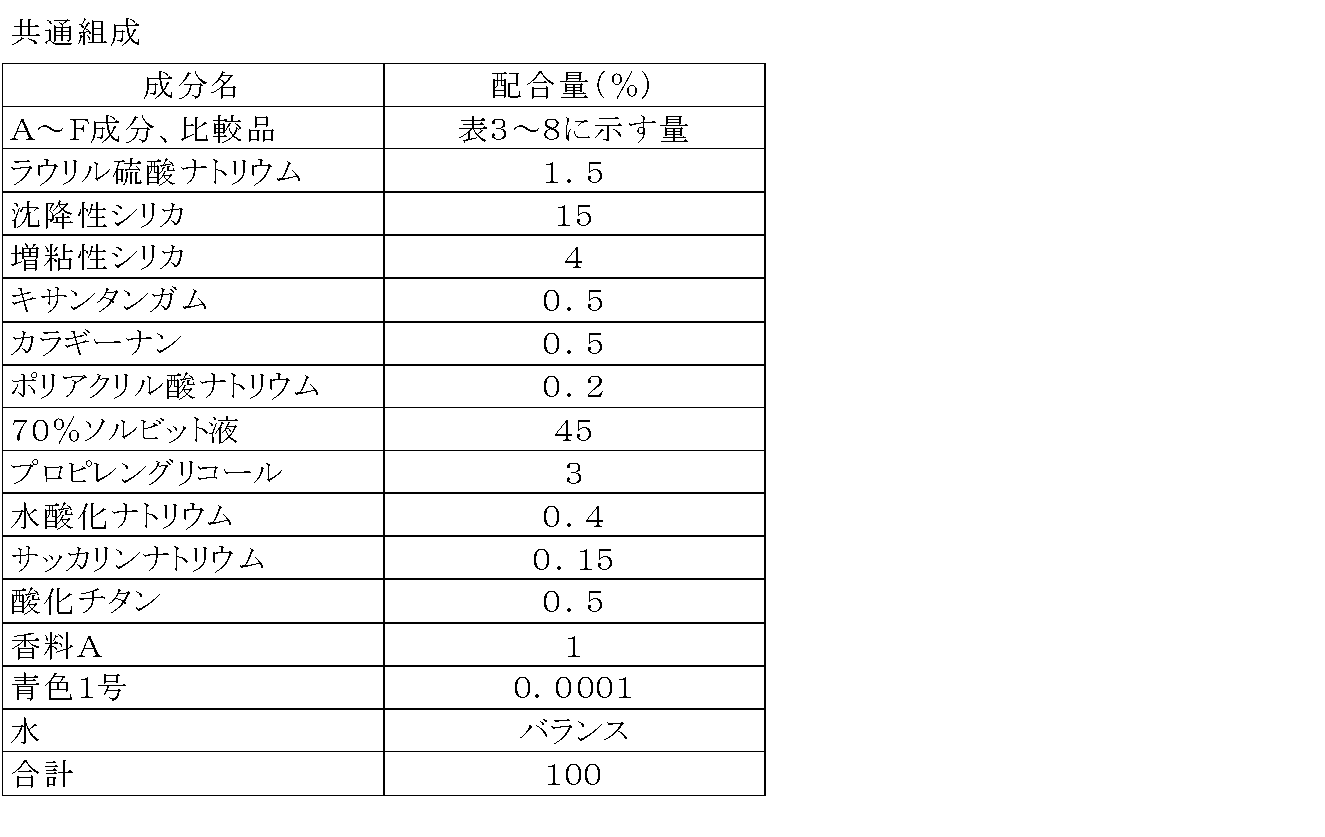
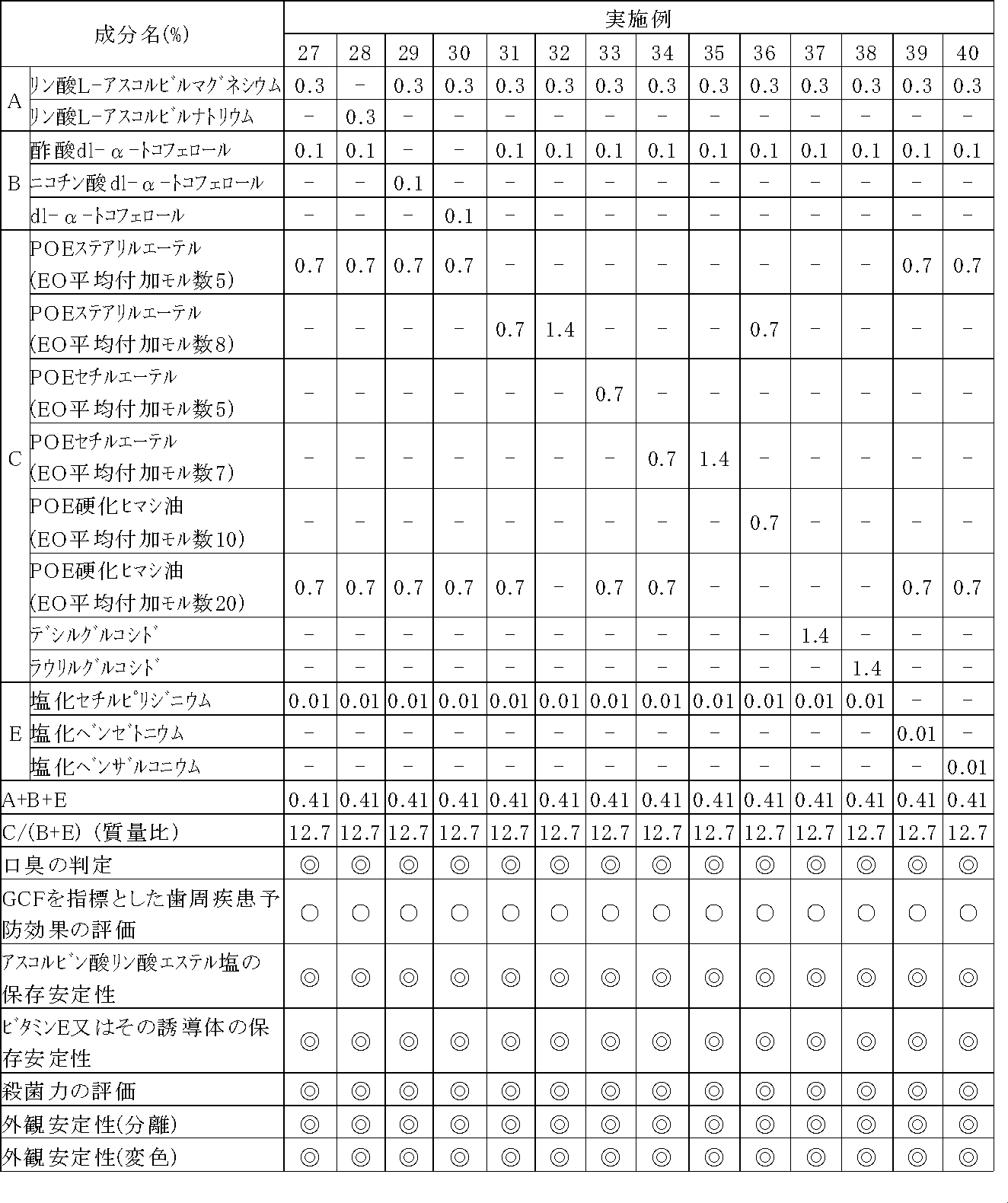
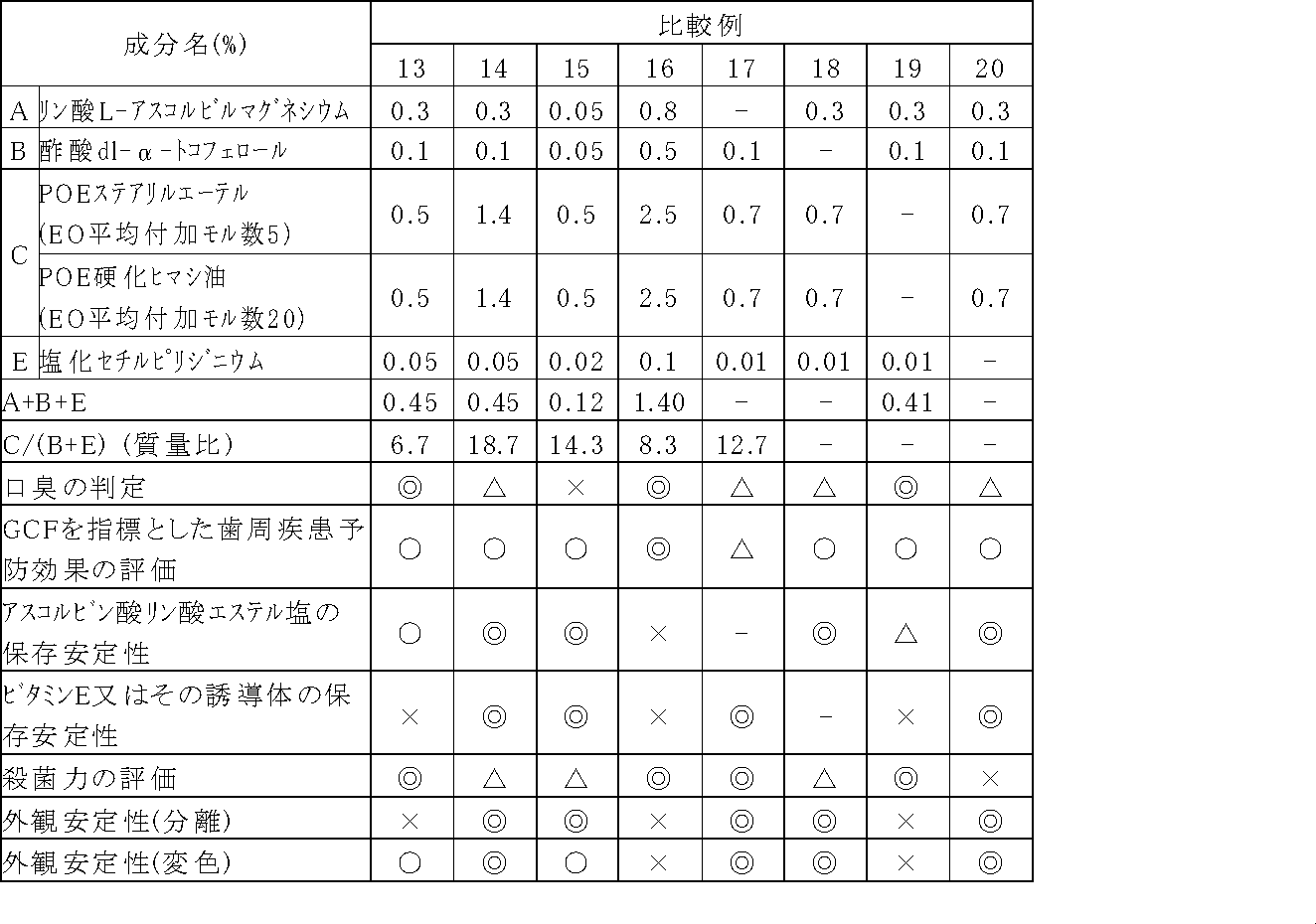
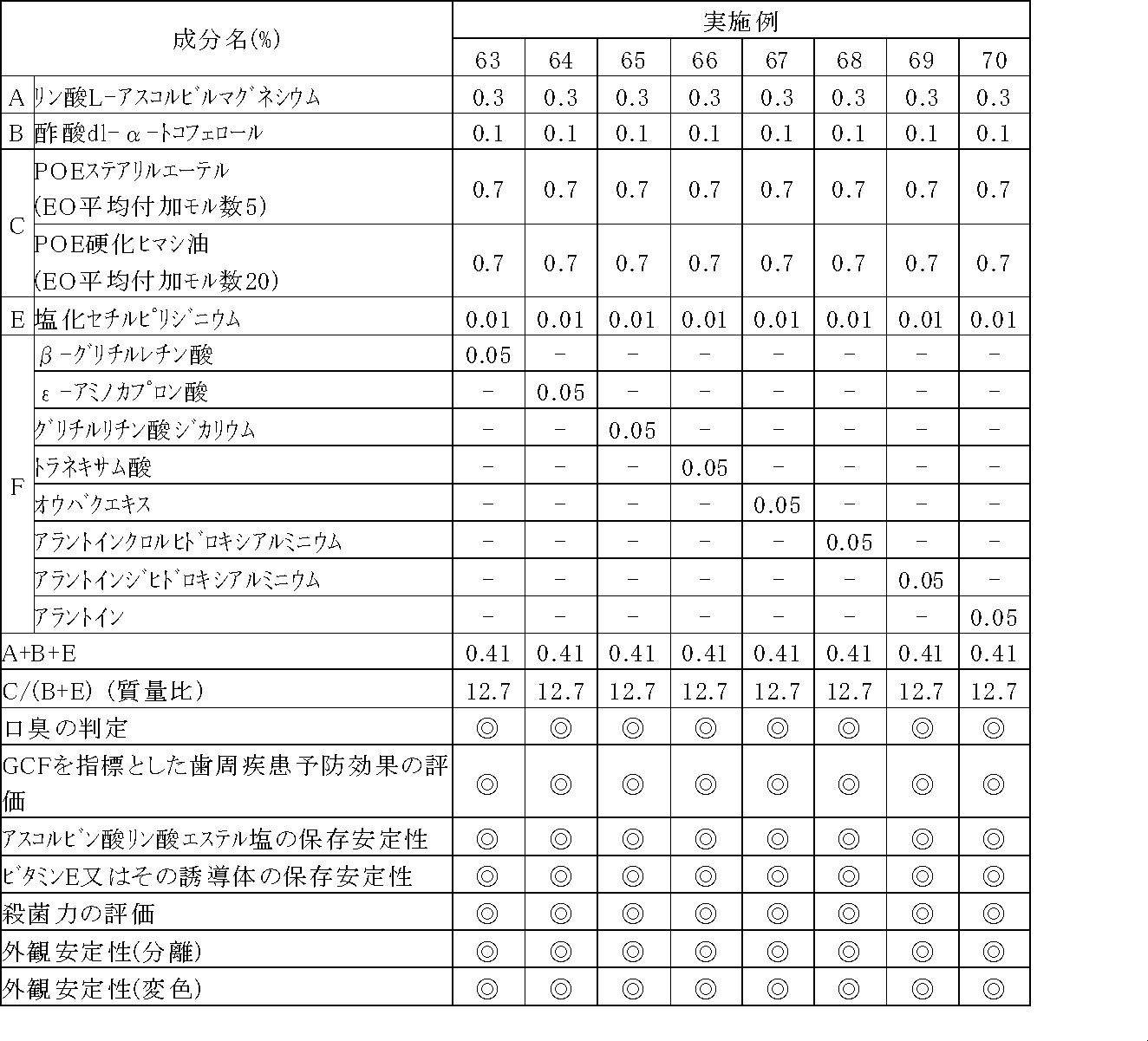
- Examples and comparative examples A composition comprising the common composition shown in Table 2 below and the components (A) to (C), (D) or (E), and further the component (F) in the types and amounts shown in Tables 3 to 8.
- the dentifrice composition was degassed and mixed using a kneader and prepared by a conventional method. The amount of the dentifrice composition charged was 5 kg.
- the obtained dentifrice composition was filled in a tube A made of the material described later and evaluated by the following method. The results are shown in Tables 3-8.
- Tube A From the outermost layer, LDPE55 / PET12 / LDPE20 / white LDPE60 / EMAA20 / AL10 / EMAA30 / LDPE20 / LLDPE30 (thickness 257 ⁇ m, diameter 26 mm, filling amount 50 g) A numerical value shows thickness (micrometer).
- LDPE Low density polyethylene
- White LDPE White low density polyethylene
- LLDPE Linear low density polyethylene
- AL Aluminum PET: Polyethylene terephthalate EMAA: Copolymer resin of ethylene / methacrylic acid
- a beagle dog (4 years old, female, 4 each group) was used for evaluation with bad breath and GCF amount as indicators. After the evaluation of halitosis and measurement of the amount of GCF before the start of the test, administration was performed twice a day for 1 month to evaluate halitosis and the amount of GCF. Administration of the test preparation was carried out by brushing the entire oral cavity of a beagle dog by taking 0.5 g of the test preparation in the case of a dentifrice and 0.5 mL in the case of a mouthwash. Details of the evaluation method are shown below.
- Improvement of bad breath derived from periodontal disease S1-S2 This average value was determined according to the criteria described below. It was judged that an oral composition having a degree of improvement in bad breath derived from periodontal disease was ⁇ or ⁇ was an oral composition having an effect of preventing or improving periodontal disease.
- GCF gingival crevicular fluid
- GCF change rate is calculated according to the following formula, the average value of 4 test sites of 4 beagle dogs is determined according to the criteria described later, periodontal disease with ⁇ , ⁇ oral composition as index of gingival crevicular fluid Judged to have a preventive effect.
- GCF change rate (%) ((GCF amount at start of test ⁇ GCF amount at end of test) / GCF amount at start of test) ⁇ 100
- Evaluation of storage stability of ascorbic acid phosphate or its salt over time The test sample was stored for 1 month in a thermostatic bath at 50 ° C. Thereafter, the sample was allowed to stand at room temperature and then used for evaluating the storage stability of ascorbic acid phosphate ester or a salt thereof. The residual rate was calculated from the initial value on the day of manufacture. All reagents were manufactured by Kanto Chemical.
- test preparation is a dentifrice
- 10 mmol / L phosphate buffer 1.5 mmol / L potassium dihydrogen phosphate, 23.5 mmol / L dipotassium hydrogen phosphate, pH 8.0
- Ascorbic acid phosphate ester or a salt thereof is extracted, and high performance liquid chromatography (pump: JASCO PU1580, autosampler: Shimadzu SIL-10A, UV detector: Shimadzu SPD-6A, recording device: Shimadzu
- the quantification was carried out by the absolute calibration curve method using Seisakusho C-R4A, column thermostat: JASCO CO-966).
- the column is a stainless steel tube having a diameter of about 4.6 mm and a length of about 150 mm, and a 5 ⁇ m liquid chromatograph.
- TSK-gel ODS-80Ts manufactured by Tosoh Corporation
- a column temperature of about 40 ° C.
- a detection wavelength of 240 nm and a flow rate of 0.8 mL / min.
- Residual rate of ascorbic acid phosphate or salt thereof (Evaluation sample value (%) / initial value (%)) ⁇ 100
- Residual rate of ascorbic acid phosphate or salt thereof ⁇ : 95% or more ⁇ : less than 95% ⁇ : less than 90% ⁇ : less than 80%
- test sample was stored for 1 month in a thermostatic bath at 50 ° C. After leaving this at room temperature, if the test preparation is a dentifrice or oral pasta, 10 g is taken and extracted with methanol, followed by liquid chromatography (pump: JASCO PU-980, autosampler: JASCO) AS-950, detector: JASCO UV-970, recording device: system instrument Chromatocoder 21J, column thermostatic chamber: JASCO CO-966).
- the measurement conditions were as follows: a stainless steel tube with an inner diameter of 4.6 mm and a length of 15 cm was filled with a 5 ⁇ m octadecylsilylated silica gel for liquid chromatography, methanol was used as the mobile phase, the column temperature was 25 ° C., and 1.0 mL / min. was measured by an absolute calibration curve method with an ultraviolet absorptiometry (measurement wavelength: 284 nm). In addition, in the case of a mouthwash, it diluted with methanol and measured on the same conditions. This result was determined according to the criteria described below, and it was determined that the storage stability of the vitamin E derivative was ensured for the oral compositions of A and B.
- Residual rate of vitamin E or its derivative (Evaluation sample value (%) / initial value (%)) ⁇ 100
- test preparation When the test preparation was a dentifrice, 40 mL of artificial saliva was added to 10 g of the composition and stirred, followed by centrifugation (10,000 rotations / minute, 10 minutes), and the resulting supernatant was used as a sample stock solution.
- test preparation When the test preparation was a mouthwash, 40 mL of artificial saliva was added to 10 g of the composition and diluted to obtain a sample stock solution. After 2 mL of the sample stock solution was allowed to act on 2 mL of the bacterial solution for 30 seconds, 50 ⁇ L was collected to obtain a sample solution for bactericidal evaluation.
- Bactericidal power evaluation is performed by adding a bactericidal power evaluation sample solution (50 ⁇ L) to a THB liquid medium (4 mL) and culturing (37 ° C., 8 hours), and then measuring the amount of grown bacteria using turbidity (OD660) as an index. Evaluations were made on the assumption that a smaller number gave a higher bactericidal activity.
- OD660 is less than 1 ⁇ : OD660 is 1 or more and less than 1.2 ⁇ : OD660 is 1.2 or more and less than 2 ⁇ : OD660 is 2 or more
- evaluation of appearance stability (separation, discoloration) over time: The test sample was stored for 1 month in a thermostatic bath at 50 ° C. Then, after leaving the sample to room temperature, it was used for evaluation of appearance stability.
- the test sample was a toothpaste
- the sample was extruded about 10 cm onto a straw half paper, and the presence or absence of separation and discoloration was observed and evaluated.
- the test sample was a mouthwash
- the container was allowed to stand for 1 day, and then the presence or absence of separation and discoloration was observed and evaluated.
- discoloration was evaluated on the basis of the thing which preserve
- the evaluation criteria are as follows.
- composition for oral cavity of the present invention is effective in suppressing bad breath derived from periodontal disease, periodontal disease preventive effect using GCF as an index, bactericidal activity, ascorbic acid phosphate ester or salt thereof And Vitamin E or its derivatives have excellent storage stability over time and appearance stability (no separation, no discoloration), high periodontal disease prevention or improvement effect, and excellent storage stability over time It has been found.
- composition for oral cavity of the present invention is effective in preventing bad breath derived from periodontal disease, periodontal disease preventive effect using GCF as an index, bactericidal activity, ascorbic acid phosphate ester or salt thereof And Vitamin E or its derivatives have excellent storage stability over time and appearance stability (no separation, no discoloration), high periodontal disease prevention or improvement effect, and excellent storage stability over time It has been found.
- composition for oral cavity of the present invention is a periodontal disease using GCF as an index by further blending glycyrrhetinic acid, ⁇ -aminocaproic acid, glycyrrhizinate, tranexamic acid, buckwheat extract or allantoins. It was found that the prevention / improvement effect is improved. Similar results were obtained when perfumes B to I were used in place of perfume A.
Landscapes
- Health & Medical Sciences (AREA)
- Life Sciences & Earth Sciences (AREA)
- Animal Behavior & Ethology (AREA)
- General Health & Medical Sciences (AREA)
- Public Health (AREA)
- Veterinary Medicine (AREA)
- Birds (AREA)
- Epidemiology (AREA)
- Emergency Medicine (AREA)
- Oral & Maxillofacial Surgery (AREA)
- Cosmetics (AREA)
Abstract
Description
本発明によれば、アスコルビン酸リン酸エステル又はその塩、ビタミンE又はその誘導体、及び殺菌剤が同時に安定配合されてこれら成分由来の効果が有効に発現し、歯周疾患に由来する口臭や歯肉溝滲出液(以下、GCF)量の増加を改善する高い効果及び歯周病原因菌への高い殺菌効果が同時に発揮され、歯周疾患の予防・改善効果が格段に向上すると共に、アスコルビン酸リン酸エステル又はその塩とビタミンE又はその誘導体とが同時に長期間に亘って安定配合され、かつ経時で分離や変色が生じることがなく、経時保存安定性にも優れる。
請求項1;
(A)アスコルビン酸リン酸エステル又はその塩、
(B)ビタミンE又はその誘導体、
(C)エチレンオキサイドの平均付加モル数が10~60モルのポリオキシエチレン硬化ヒマシ油、アルキル基の炭素数が14~18でエチレンオキサイドの平均付加モル数が5~8モルのポリオキシエチレンアルキルエーテル及びアルキル基の炭素数が10~14のアルキルグルコシドから選ばれる1種以上の界面活性剤、
(D)非イオン性殺菌剤
を含有し、(A)、(B)及び(D)成分の合計含有量が0.2~1.5質量%であり、かつ(C)/((B)+(D))が質量比で8~20であることを特徴とする口腔用組成物。
請求項2;
(D)非イオン性殺菌剤が、イソプロピルメチルフェノール又はトリクロサンである請求項1記載の口腔用組成物。
請求項3;
(A)アスコルビン酸リン酸エステル又はその塩、
(B)ビタミンE又はその誘導体、
(C)エチレンオキサイドの平均付加モル数が10~60モルのポリオキシエチレン硬化ヒマシ油、アルキル基の炭素数が14~18でエチレンオキサイドの平均付加モル数が5~8モルのポリオキシエチレンアルキルエーテル、及びアルキル基の炭素数が10~14のアルキルグルコシドから選ばれる1種以上の界面活性剤、
(E)カチオン性殺菌剤
を含有し、(A)、(B)及び(E)成分の合計含有量が0.2~1.3質量%であり、かつ(C)/((B)+(E))が質量比で8~18であることを特徴とする口腔用組成物。
請求項4;
(E)カチオン性殺菌剤が、塩化セチルピリジニウム、塩化ベンゼトニウム、塩化ベンザルコニウム、グルコン酸クロルヘキシジン、塩酸クロルヘキシジンから選ばれる1種以上である請求項3記載の口腔用組成物。
請求項5;
(A)成分と、(B)成分と、(D)又は(E)成分との合計含有量が0.2~1.0質量%であり、かつ(C)/〔(B)+((D)又は(E))〕が質量比で8~15であることを特徴とする請求項1乃至4のいずれか1項記載の口腔用組成物。
請求項6;
更に、(F)グリチルレチン酸、ε-アミノカプロン酸、グリチルリチン酸塩、トラネキサム酸、オウバクエキス及びアラントイン類から選ばれる1種以上を含有することを特徴とする請求項1乃至5のいずれか1項記載の口腔用組成物。
ビタミンE又はその誘導体としては、生理活性が高く、また無色から淡黄色で製剤の色調や外観にほとんど影響を与えない点で、特にdl-α-トコフェロール、酢酸dl-α-トコフェロール、ニコチン酸dl-α-トコフェロールが好ましい。なお、VE又はその誘導体は、1種単独で又は2種以上を組み合わせて配合することができる。
このようなPOEアルキルエーテルとしては、日本エマルジョン(株)のEMALEX105、107、605、608等の市販品を使用することができる。
このようなPOE硬化ヒマシ油としては、日光ケミカルズ(株)のNIKKOL HCO-10、HCO-20、HCO-30、HCO-40、HCO-50、HCO-60等の市販品を使用することができる。
このようなアルキルグルコシドとしては、コグニス社のプランタケア1200UP、プランタケア2000UP等の市販品を使用できる。
この場合、口腔用組成物は、各種剤型に応じて、上記成分に加えて、その他の公知成分を本発明の効果を損なわない範囲で配合することができ、通常の方法で調製することができる。配合できる任意成分としては、研磨剤、湿潤剤、粘結剤、溶剤、上記(C)成分以外の界面活性剤、更には必要に応じて甘味剤、防腐剤、各種有効成分、pH調整剤、着色剤、香料等を配合でき、これら成分を混合して製造することができる。
研磨剤の配合量は通常0~50%であり、歯磨剤組成物では特に2~40%が好ましい。
上記した任意成分としての界面活性剤の配合量は、(C)成分の界面活性剤との合計配合量が0.5~6%となる範囲が好ましい。

下記表2に示す共通組成で、表3~8に示す通りの種類及び配合量で(A)~(C)成分、(D)又は(E)成分、更には(F)成分を配合した組成の歯磨剤組成物を、ニーダーを用いて脱気混合し、常法により調製した。歯磨剤組成物の仕込み量は5kgとした。得られた歯磨剤組成物を、後述する材質のチューブAに充填し、下記方法で評価した。結果を表3~8に示す。
最外層よりLDPE55/PET12/LDPE20/白LDPE60/EMAA20/AL10/EMAA30/LDPE20/LLDPE30(厚さ257μm、直径26mm、充填量50g)
数値は厚さ(μm)を示す。略号の示すところは以下の通りである。
LDPE:低密度ポリエチレン
白LDPE:白色低密度ポリエチレン
LLDPE:直鎖状低密度ポリエチレン
AL:アルミニウム
PET:ポリエチレンテレフタレート
EMAA:エチレン・メタクリル酸の共重合体樹脂
ビーグル犬(4歳、雌、各群4頭)を用いて、口臭とGCF量を指標に評価を行った。試験開始前に口臭の評価とGCF量の測定を行った後、1日2回、1ヶ月間投与し、口臭とGCF量の評価を行った。被験製剤の投与は、被験製剤が歯磨剤の場合は0.5g、洗口剤の場合は0.5mLを綿球に取ってビーグル犬の口腔内全体をブラッシングした。評価法の詳細を以下に示す。
試験開始時の口臭を調香師5名が後述の基準に従って評価し、その評点をS1とした。1ヶ月間被験製剤を投与した後、同様に調香師5名が後述の基準に従って歯周疾患由来の口臭のレベルを評価し、その評点をS2とした。次式に従って各ビーグル犬の歯周疾患由来の口臭の改善度を算出し、ビーグル犬4頭の平均値を求めた。
この平均値を後述の基準に従って判定した。歯周疾患由来の口臭の改善度が◎、○の口腔用組成物を、歯周疾患予防・改善効果のある口腔用組成物であると判断した。
5:歯周疾患由来のきわめて強い口臭がある
4:歯周疾患由来の強い口臭がある
3:歯周疾患由来の口臭がややある
2:歯周疾患由来の口臭がわずかにある
1:歯周疾患由来の口臭がほとんどない
0:歯周疾患由来の口臭が全くない
<口臭の判定基準>
歯周疾患由来の口臭の改善度
◎:3以上~5以下
○:2以上~3未満
△:1以上~2未満
×:1未満
ビーグル犬の下顎4部位(P3、P4、M1近心、M2遠心)を被験部位とし、試験開始の前後にGCF量の測定を行った。なお、GCFの採取は、口臭を評価した後に行った。GCF量は、GCFコレクション ストリップス(ペリオペーパー(登録商標)、(株)ヨシダ)を試験開始時に選定した被験部位歯周ポケットに30秒間挿入することで採取し、GCFメーター(ペリオトロン(登録商標)、(株)ヨシダ)で測定した。次式に従ってGCF変化率を算出し、ビーグル犬4頭の被験部位4箇所の平均値を後述の基準に従って判定し、◎、○の口腔用組成物を、歯肉溝浸出液を指標とした歯周疾患予防効果があると判断した。
((試験開始時のGCF量-試験終了時のGCF量)/試験開始時のGCF量)×100
GCF変化率
◎:70%以上
○:40%以上70%未満
△:20%以上40%未満
×:20%未満
被験サンプルを、50℃の恒温槽中で1ヶ月間保存した。その後、サンプルを常温になるまで放置した後、アスコルビン酸リン酸エステル又はその塩の保存安定性の評価に用いた。残存率は製造当日の初期値から算出した。試薬は全て関東化学社製を用いた。
被験製剤が歯磨剤の場合は0.1gを測り取り、10mmol/Lのリン酸緩衝液(1.5mmol/L リン酸二水素カリウム、23.5mmol/L リン酸水素二カリウム、pH8.0)を加えて、アスコルビン酸リン酸エステル又はその塩を抽出し、高速液体クロマトグラフィー(ポンプ:日本分光 PU1580、オートサンプラー:島津製作所 SIL-10A、UV検出器:島津製作所 SPD-6A、記録装置:島津製作所 C-R4A、カラム恒温槽:日本分光 CO-966)を用い、絶対検量線法にて定量を行った。移動相は25mmol/Lリン酸二水素カリウム+5mmol/Lテトラブチルアンモニウム/アセトニトリル=91/9混液(容量比)、カラムは直径約4.6mm、長さ約150mmのステンレス管に5μmの液体クロマトグラフ用オクタデシルシリル化シリカゲルを充填したもの(例:TSK-gel ODS-80Ts(東ソー(株)社製))、カラム温度約40℃、検出波長240nm、流速は0.8mL/分とした。なお、洗口剤の場合は、10mmol/Lのリン酸緩衝液を用いて希釈し、同様の条件で測定を行った。この結果を後述の基準に従って判定し、◎、○の口腔用組成物を、アスコルビン酸リン酸エステル塩の保存安定性が確保されていると判断した。
(評価サンプル値(%)/初期値(%))×100
アスコルビン酸リン酸エステル又はその塩の安定性評価は、繰り返し3回の平均値を以下の基準で判断した。
アスコルビン酸リン酸エステル又はその塩の残存率
◎:95%以上
○:95%未満
△:90%未満
×:80%未満
被験サンプルを、50℃の恒温槽中で1ヶ月間保存した。これを常温になるまで放置した後、被験製剤が歯磨剤もしくは口腔用パスタの場合は10g分取し、メタノールで抽出した後、液体クロマトグラフィー(ポンプ:日本分光 PU-980、オートサンプラー:日本分光 AS-950、検出器:日本分光 UV-970、記録装置:システムインスツルメント Chromatocoder21J、カラム恒温槽:日本分光 CO-966)により定量を行った。測定条件は、内径4.6mm,長さ15cmのステンレス管に5μmの液体クロマトグラフ用オクタデシルシリル化シリカゲルを充てんしたカラムを用い、メタノールを移動相に用い、カラム温度25℃、1.0mL/分の流量で、紫外吸光光度(測定波長284nm)での絶対検量線法により測定した。なお、洗口剤の場合は、メタノールを用いて希釈し、同様の条件で測定を行った。この結果を後述の基準に従って判定し、◎、○の口腔用組成物を、ビタミンE誘導体の保存安定性が確保されていると判断した。
(評価サンプル値(%)/初期値(%))×100
ビタミンE又はその誘導体の安定性評価は、繰り返し3回の平均値を以下の基準で判断した。
ビタミンE又はその誘導体の残存率
◎:95%以上
○:90%以上95%未満
△:80%以上90%未満
×:80%未満
凍結保存してあったポルフィロモナス・ジンジバリス培養液40μLをそれぞれ5mg/Lヘミン(Sigma社製)、及び1mg/LビタミンK(和光純薬工業社製)を含むトッドヘーウィットブロス(Becton and Dickinson社製)培養液(THBHM)4mLに添加し、37℃で二晩嫌気培養(80vol%窒素、10vol%二酸化炭素、10vol%水素)後、波長660nmでの濁度(OD660)=1に調整し、菌液とした。
被験製剤が歯磨剤の場合は組成物10gに人工唾液40mLを加え撹拌した後、遠心分離(10,000回転/分、10分間)し、得られた上清を試料原液とした。被験製剤が洗口剤の場合は組成物10gに人工唾液40mLを加えて希釈し、試料原液とした。この試料原液2mLを菌液2mLに30秒間作用させた後、50μLを分取し、殺菌力評価サンプル液とした。殺菌力評価は、殺菌力評価サンプル液(50μL)をTHB液体培地(4mL)に添加し、培養(37℃、8時間)した後、増殖した菌量を濁度(OD660)を指標に測定し、数値の小さいものがより高い殺菌力が得られたものとして評価を行った。
◎:OD660が1未満
○:OD660が1以上1.2未満
△:OD660が1.2以上2未満
×:OD660が2以上
被験サンプルを、50℃の恒温槽中で1ヶ月間保存した。その後、サンプルを常温になるまで放置した後、外観安定性の評価に用いた。被験サンプルが練歯磨の場合は、サンプルをわら半紙の上に約10cm押し出し、分離及び変色の有無を観察し、評価した。被験サンプルが洗口剤の場合は、容器を1日静置した後、分離及び変色の有無を観察し、評価した。なお、変色は被験サンプルを5℃の恒温槽に保存しておいた物を基準として評価を行った。評価基準は以下の通りである。
◎:分離が全く認められない
○:分離がほとんど認められない
△:分離がやや認められる
×:著しい分離が認められる
<変色の評点>
◎:変色が全く認められない
○:変色がほとんど認められない
△:変色がやや認められる
×:著しい変色が認められる







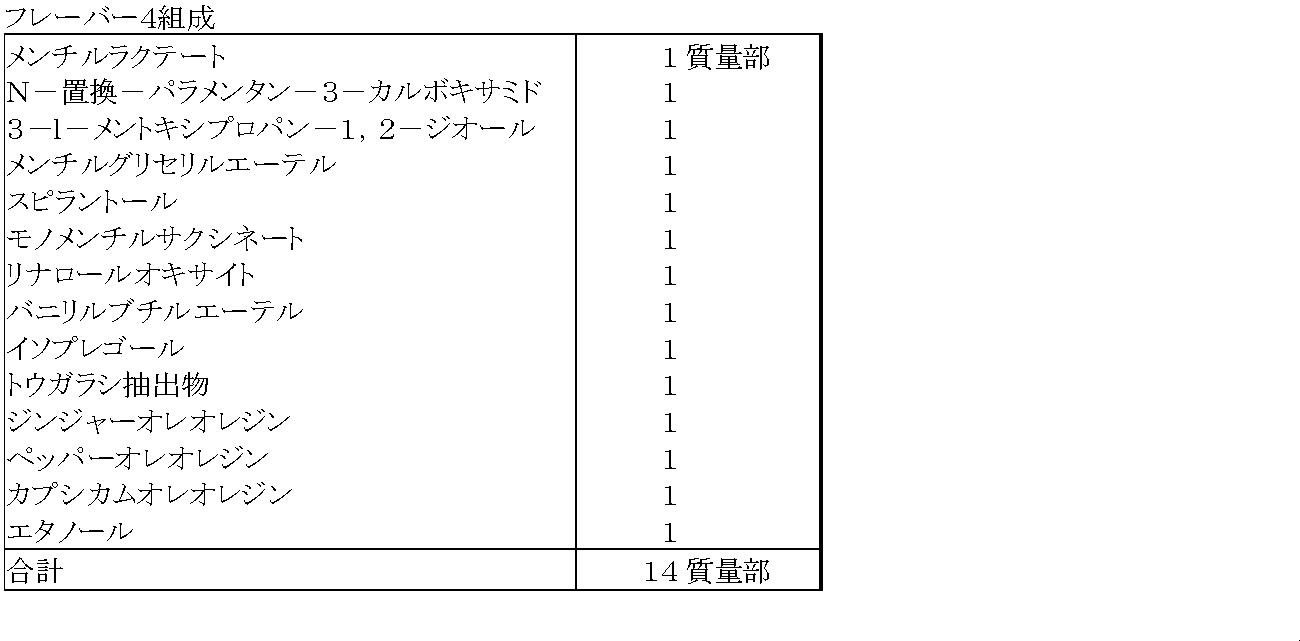

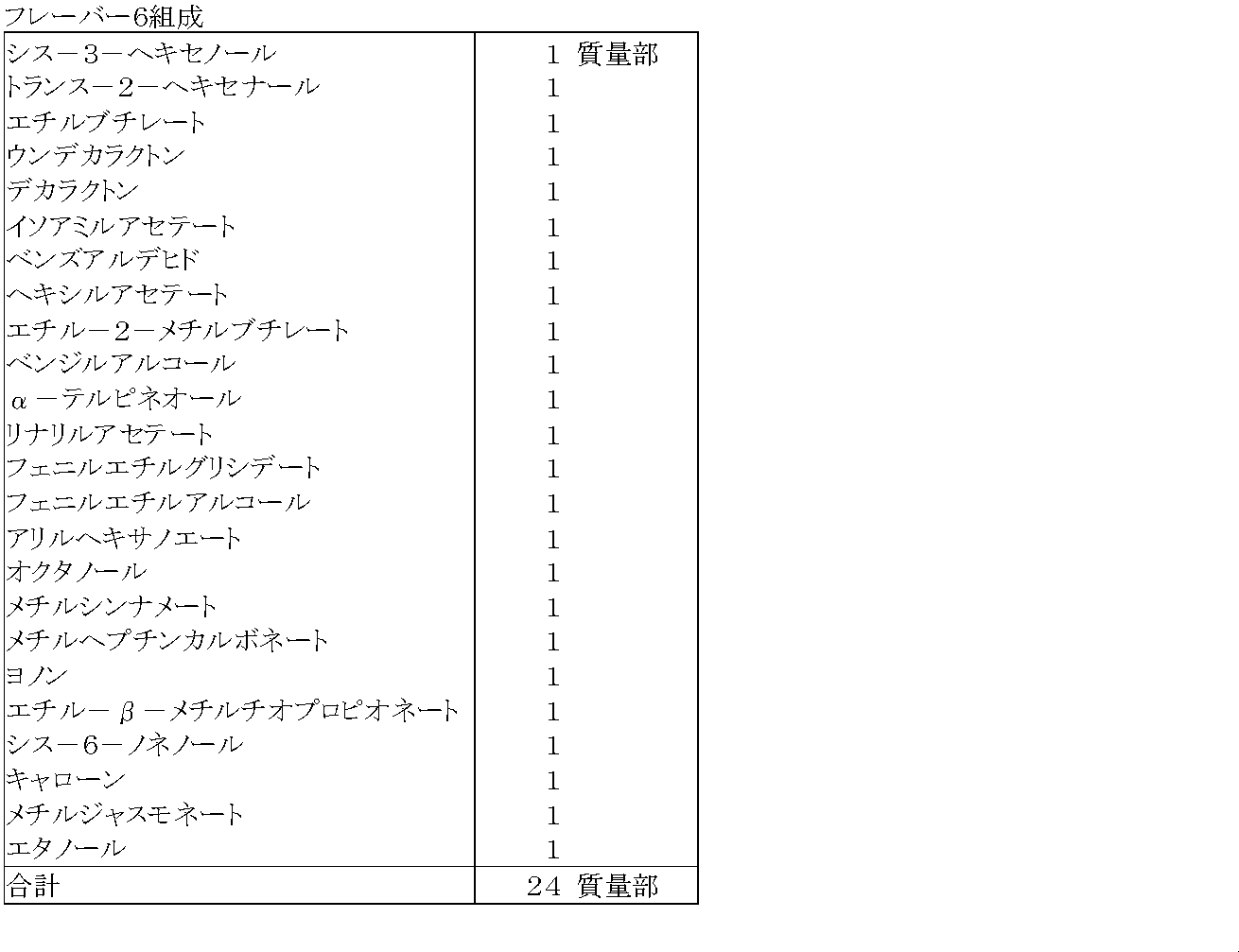
下記組成の口腔用組成物を調製し、上記と同様に評価したところ、いずれの口腔用組成物も、歯周疾患に由来する口臭の防止効果、GCFを指標とした歯周疾患予防効果、アスコルビン酸リン酸エステル又はその塩の保存安定性、ビタミンE又はその誘導体の保存安定性、殺菌力、及び外観安定性(分離のなさ、変色のなさ)に優れていた。更に、デキストラナーゼ含有組成は歯垢除去効果、フッ素イオン供給源含有組成は根面う蝕の予防又は改善効果にも優れていた。
(A)リン酸L-アスコルビルマグネシウム 0.3%
(B)酢酸dl-α-トコフェロール 0.1
(C)POEステアリルエーテル 1
(EO平均付加モル数5)
(C)POE硬化ヒマシ油 1
(EO平均付加モル数20)
(D)イソプロピルメチルフェノール 0.05
β-グリチルレチン酸 0.05
デキストラナーゼ(13,000単位/g) 0.16
フッ化ナトリウム 0.21
ラウリル硫酸ナトリウム 1.5
沈降性シリカ 15
増粘性シリカ 4
キサンタンガム 0.5
カラギーナン 0.5
ポリアクリル酸ナトリウム 0.2
70%ソルビット液 45
プロピレングリコール 3
水酸化ナトリウム 0.4
サッカリンナトリウム 0.15
酸化チタン 0.5
香料A 1
青色1号 0.0001
精製水 バランス
合計 100.00%
A+B+D=0.45%
C/(B+D)=13.3
(A)リン酸L-アスコルビルマグネシウム 0.3%
(B)酢酸dl-α-トコフェロール 0.1
(C)POEステアリルエーテル 1
(EO平均付加モル数5)
(C)POE硬化ヒマシ油 1
(EO平均付加モル数20)
(D)イソプロピルメチルフェノール 0.05
β-グリチルレチン酸 0.05
デキストラナーゼ(13,000単位/g) 0.16
モノフルオロリン酸ナトリウム 0.73
ラウリル硫酸ナトリウム 1.5
沈降性シリカ 15
増粘性シリカ 4
キサンタンガム 0.5
カラギーナン 0.5
ポリアクリル酸ナトリウム 0.2
70%ソルビット液 45
プロピレングリコール 3
水酸化ナトリウム 0.4
サッカリンナトリウム 0.15
酸化チタン 0.5
香料A 1
青色1号 0.0001
精製水 バランス
合計 100.00%
A+B+D=0.45%
C/(B+D)=13.3
(A)リン酸L-アスコルビルマグネシウム 0.3%
(B)酢酸dl-α-トコフェロール 0.1
(C)POEステアリルエーテル 1
(EO平均付加モル数5)
(C)POE硬化ヒマシ油 1
(EO平均付加モル数20)
(E)塩化セチルピリジニウム 0.01
β-グリチルレチン酸 0.05
デキストラナーゼ(13,000単位/g) 0.16
フッ化ナトリウム 0.21
ラウリル硫酸ナトリウム 1.5
沈降性シリカ 15
増粘性シリカ 4
キサンタンガム 0.5
カラギーナン 0.5
ポリアクリル酸ナトリウム 0.2
70%ソルビット液 45
プロピレングリコール 3
水酸化ナトリウム 0.4
サッカリンナトリウム 0.15
酸化チタン 0.5
香料A 1
青色1号 0.0001
精製水 バランス
合計 100.00%
A+B+E=0.41%
C/(B+E)=12.7
(A)リン酸L-アスコルビルマグネシウム 0.3%
(B)酢酸dl-α-トコフェロール 0.1
(C)POEステアリルエーテル 1
(EO平均付加モル数5)
(C)POE硬化ヒマシ油 1
(EO平均付加モル数20)
(E)塩化セチルピリジニウム 0.01
β-グリチルレチン酸 0.05
デキストラナーゼ(13,000単位/g) 0.16
モノフルオロリン酸ナトリウム 0.73
ラウリル硫酸ナトリウム 1.5
沈降性シリカ 15
増粘性シリカ 4
キサンタンガム 0.5
カラギーナン 0.5
ポリアクリル酸ナトリウム 0.2
70%ソルビット液 45
プロピレングリコール 3
水酸化ナトリウム 0.4
サッカリンナトリウム 0.15
酸化チタン 0.5
香料A 1
青色1号 0.0001
精製水 バランス
合計 100.00%
A+B+E=0.41%
C/(B+E)=12.7
(A)リン酸L-アスコルビルマグネシウム 0.5%
(B)酢酸dl-α-トコフェロール 0.1
(C)デシルグルコシド 1
(C)ラウリルグルコシド 1
(E)塩化セチルピリジニウム 0.05
モノフルオロリン酸ナトリウム 0.7
ラウリル硫酸ナトリウム 1.5
歯磨用リン酸水素カルシウム 40
増粘性シリカ 4
キサンタンガム 0.5
カラギーナン 0.5
ポリアクリル酸ナトリウム 0.2
70%ソルビット液 20
パラチニット 2
プロピレングリコール 3
水酸化ナトリウム 0.4
サッカリンナトリウム 0.15
酸化チタン 0.5
香料A 1
精製水 バランス
合計 100.00%
A+B+E=0.65%
C/(B+E)=13.3
(A)リン酸L-アスコルビルマグネシウム 0.5%
(B)酢酸dl-α-トコフェロール 0.1
(C)デシルグルコシド 1
(C)ラウリルグルコシド 1
(E)塩化セチルピリジニウム 0.05
フッ化ナトリウム 0.21
ラウリル硫酸ナトリウム 1.5
歯磨用リン酸水素カルシウム 40
増粘性シリカ 4
キサンタンガム 0.5
カラギーナン 0.5
ポリアクリル酸ナトリウム 0.2
70%ソルビット液 20
パラチニット 2
プロピレングリコール 3
水酸化ナトリウム 0.4
サッカリンナトリウム 0.15
酸化チタン 0.5
香料A 1
精製水 バランス
合計 100.00%
A+B+E=0.65%
C/(B+E)=13.3
(A)リン酸L-アスコルビルマグネシウム 0.5%
(B)酢酸dl-α-トコフェロール 0.1
(C)ポリオキシエチレン硬化ヒマシ油 2
(EO平均付加モル数20)
(E)塩化ベンゼトニウム 0.05
β-グリチルレチン酸 0.05
モノフルオロリン酸ナトリウム 0.7
ラウリル硫酸ナトリウム 1.5
炭酸カルシウム 40
増粘性シリカ 4
キサンタンガム 0.5
カラギーナン 0.5
ポリアクリル酸ナトリウム 0.2
70%ソルビット液 20
エリスリトール 2
プロピレングリコール 3
水酸化ナトリウム 0.4
サッカリンナトリウム 0.15
酸化チタン 0.5
香料A 1
精製水 バランス
合計 100.00%
A+B+E=0.65%
C/(B+E)=13.3
(A)リン酸L-アスコルビルマグネシウム 0.5%
(B)ニコチン酸dl-α-トコフェロール 0.1
(C)ラウリルグルコシド 1
(E)塩化セチルピリジニウム 0.01
β-グリチルレチン酸 0.2
デキストラナーゼ(13,000単位/g) 0.2
ラウリル硫酸ナトリウム 0.5
エタノール 10
グリセリン 10
水酸化ナトリウム 0.4
サッカリンナトリウム 0.01
香料A 0.5
精製水 バランス
合計 100.00%
A+B+E=0.61%
C/(B+E)=9.1
(A)リン酸L-アスコルビルマグネシウム 0.5%
(B)ニコチン酸dl-α-トコフェロール 0.1
(C)ポリオキシエチレン硬化ヒマシ油 1
(EO平均付加モル数60)
(E)塩化セチルピリジニウム 0.01
β-グリチルレチン酸 0.2
デキストラナーゼ(13,000単位/g) 0.2
ラウリル硫酸ナトリウム 0.5
エタノール 10
グリセリン 10
水酸化ナトリウム 0.4
サッカリンナトリウム 0.01
香料A 0.5
精製水 バランス
合計 100.00%
A+B+E=0.61%
C/(B+E)=9.1
Claims (6)
- (A)アスコルビン酸リン酸エステル又はその塩、
(B)ビタミンE又はその誘導体、
(C)エチレンオキサイドの平均付加モル数が10~60モルのポリオキシエチレン硬化ヒマシ油、アルキル基の炭素数が14~18でエチレンオキサイドの平均付加モル数が5~8モルのポリオキシエチレンアルキルエーテル及びアルキル基の炭素数が10~14のアルキルグルコシドから選ばれる1種以上の界面活性剤、
(D)非イオン性殺菌剤
を含有し、(A)、(B)及び(D)成分の合計含有量が0.2~1.5質量%であり、かつ(C)/((B)+(D))が質量比で8~20であることを特徴とする口腔用組成物。 - (D)非イオン性殺菌剤が、イソプロピルメチルフェノール又はトリクロサンである請求項1記載の口腔用組成物。
- (A)アスコルビン酸リン酸エステル又はその塩、
(B)ビタミンE又はその誘導体、
(C)エチレンオキサイドの平均付加モル数が10~60モルのポリオキシエチレン硬化ヒマシ油、アルキル基の炭素数が14~18でエチレンオキサイドの平均付加モル数が5~8モルのポリオキシエチレンアルキルエーテル、及びアルキル基の炭素数が10~14のアルキルグルコシドから選ばれる1種以上の界面活性剤、
(E)カチオン性殺菌剤
を含有し、(A)、(B)及び(E)成分の合計含有量が0.2~1.3質量%であり、かつ(C)/((B)+(E))が質量比で8~18であることを特徴とする口腔用組成物。 - (E)カチオン性殺菌剤が、塩化セチルピリジニウム、塩化ベンゼトニウム、塩化ベンザルコニウム、グルコン酸クロルヘキシジン、塩酸クロルヘキシジンから選ばれる1種以上である請求項3記載の口腔用組成物。
- (A)成分と、(B)成分と、(D)又は(E)成分との合計含有量が0.2~1.0質量%であり、かつ(C)/〔(B)+((D)又は(E))〕が質量比で8~15であることを特徴とする請求項1乃至4のいずれか1項記載の口腔用組成物。
- 更に、(F)グリチルレチン酸、ε-アミノカプロン酸、グリチルリチン酸塩、トラネキサム酸、オウバクエキス及びアラントイン類から選ばれる1種以上を含有することを特徴とする請求項1乃至5のいずれか1項記載の口腔用組成物。
Priority Applications (3)
| Application Number | Priority Date | Filing Date | Title |
|---|---|---|---|
| JP2011518510A JP5765225B2 (ja) | 2009-06-08 | 2010-06-04 | 口腔用組成物 |
| CN201080025211.0A CN102802602B (zh) | 2009-06-08 | 2010-06-04 | 口腔用组合物 |
| KR1020117030164A KR101763953B1 (ko) | 2009-06-08 | 2010-06-04 | 구강용 조성물 |
Applications Claiming Priority (2)
| Application Number | Priority Date | Filing Date | Title |
|---|---|---|---|
| JP2009136994 | 2009-06-08 | ||
| JP2009-136994 | 2009-06-08 |
Publications (1)
| Publication Number | Publication Date |
|---|---|
| WO2010143589A1 true WO2010143589A1 (ja) | 2010-12-16 |
Family
ID=43308844
Family Applications (1)
| Application Number | Title | Priority Date | Filing Date |
|---|---|---|---|
| PCT/JP2010/059505 Ceased WO2010143589A1 (ja) | 2009-06-08 | 2010-06-04 | 口腔用組成物 |
Country Status (4)
| Country | Link |
|---|---|
| JP (2) | JP5765225B2 (ja) |
| KR (1) | KR101763953B1 (ja) |
| CN (1) | CN102802602B (ja) |
| WO (1) | WO2010143589A1 (ja) |
Cited By (19)
| Publication number | Priority date | Publication date | Assignee | Title |
|---|---|---|---|---|
| RU2467738C1 (ru) * | 2011-12-21 | 2012-11-27 | Юлия Витальевна Шикова | Стоматологическая мазь с хлоргексидином и аминокапроновой кислотой для комплексного лечения воспалительных заболеваний пародонта |
| WO2013099621A1 (ja) * | 2011-12-26 | 2013-07-04 | ライオン株式会社 | 口腔用組成物 |
| JP2013129600A (ja) * | 2011-12-20 | 2013-07-04 | Lion Corp | 歯磨剤組成物 |
| JP2013129601A (ja) * | 2011-12-20 | 2013-07-04 | Lion Corp | 歯磨剤組成物 |
| WO2013133096A1 (ja) * | 2012-03-07 | 2013-09-12 | ライオン株式会社 | 口腔用組成物 |
| JP2015086164A (ja) * | 2013-10-30 | 2015-05-07 | ライオン株式会社 | 液体口腔用組成物 |
| JP2016117697A (ja) * | 2014-12-24 | 2016-06-30 | ライオン株式会社 | 口腔用組成物及び口腔用組成物の変色防止方法 |
| JP2016199473A (ja) * | 2015-04-07 | 2016-12-01 | ライオン株式会社 | 歯磨組成物及び歯磨組成物における容器へのイソプロピルメチルフェノールの吸着抑制方法 |
| JP2016222556A (ja) * | 2015-05-28 | 2016-12-28 | ライオン株式会社 | 液体口腔用組成物 |
| JP2017025101A (ja) * | 2011-09-28 | 2017-02-02 | ライオン株式会社 | 口腔用組成物 |
| JP2017214300A (ja) * | 2016-05-30 | 2017-12-07 | ライオン株式会社 | 口腔用組成物 |
| WO2018003770A1 (ja) * | 2016-06-29 | 2018-01-04 | ライオン株式会社 | 口腔用組成物 |
| JP2018052871A (ja) * | 2016-09-29 | 2018-04-05 | サンスター株式会社 | 抗歯周病組成物 |
| CN110292540A (zh) * | 2018-03-22 | 2019-10-01 | 狮王株式会社 | 洁齿剂组合物 |
| JP2020196767A (ja) * | 2015-04-07 | 2020-12-10 | ライオン株式会社 | 歯磨組成物及び歯磨組成物における容器へのイソプロピルメチルフェノールの吸着抑制方法 |
| JP2022093971A (ja) * | 2020-12-14 | 2022-06-24 | ライオン株式会社 | 口腔用組成物 |
| JP2022097295A (ja) * | 2020-12-18 | 2022-06-30 | サンスター株式会社 | 口腔用組成物 |
| JP2022154529A (ja) * | 2021-03-30 | 2022-10-13 | ライオン株式会社 | 液体口腔用組成物 |
| JP2022168043A (ja) * | 2020-09-14 | 2022-11-04 | ライオン株式会社 | 歯磨組成物及び歯磨組成物における容器へのイソプロピルメチルフェノールの吸着抑制方法 |
Families Citing this family (16)
| Publication number | Priority date | Publication date | Assignee | Title |
|---|---|---|---|---|
| CN104780901B (zh) * | 2012-11-08 | 2019-04-26 | 狮王株式会社 | 口腔用组合物 |
| KR102006955B1 (ko) * | 2013-07-18 | 2019-08-02 | 주식회사 엘지생활건강 | 구강 케어용 조성물 |
| KR101636430B1 (ko) * | 2014-07-10 | 2016-07-05 | 동아제약 주식회사 | 항염 및 살균력이 증진된 치주질환 예방 또는 개선용 조성물 |
| JP6413815B2 (ja) * | 2015-02-06 | 2018-10-31 | ライオン株式会社 | 液体口腔用組成物 |
| JP6648640B2 (ja) * | 2016-05-30 | 2020-02-14 | ライオン株式会社 | 口腔用組成物 |
| MY192189A (en) * | 2016-05-30 | 2022-08-05 | Lion Corp | Composition for use in oral cavity |
| CN108042420B (zh) * | 2017-12-20 | 2020-07-07 | 弘美制药(中国)有限公司 | 一种用于口腔保健的组合物及其应用 |
| CN108245552B (zh) * | 2018-01-24 | 2021-01-26 | 弘美制药(中国)有限公司 | 一种用于口腔的组合物及其应用 |
| JP7087782B2 (ja) * | 2018-07-27 | 2022-06-21 | ライオン株式会社 | 口腔用組成物 |
| WO2020137417A1 (ja) * | 2018-12-26 | 2020-07-02 | ライオン株式会社 | 口腔用組成物 |
| ES3035089T3 (en) * | 2019-04-25 | 2025-08-28 | Adtec Co Ltd | Periodontopathic bacteria detection method |
| CN111053705A (zh) * | 2019-12-31 | 2020-04-24 | 合肥赛为智慧医疗有限公司 | 一种改善口臭型牙膏及其制备方法 |
| JP7604777B2 (ja) * | 2020-03-12 | 2024-12-24 | ライオン株式会社 | 口腔用組成物 |
| JP7731755B2 (ja) * | 2021-10-11 | 2025-09-01 | ライオン株式会社 | 非水系口腔用組成物 |
| CN120201992A (zh) * | 2022-11-17 | 2025-06-24 | 高露洁-棕榄公司 | 胶束漱口剂组合物 |
| JP7785997B1 (ja) * | 2025-06-27 | 2025-12-15 | サンスター株式会社 | グリチルレチン酸、並びに塩化セチルピリジニウム及び/又はイソプロピルメチルフェノール含有組成物 |
Citations (6)
| Publication number | Priority date | Publication date | Assignee | Title |
|---|---|---|---|---|
| JPS61225115A (ja) * | 1985-03-29 | 1986-10-06 | Lion Corp | 2重カプセル及び該カプセルを含有する口腔用組成物 |
| JPS6296408A (ja) * | 1985-10-23 | 1987-05-02 | Showa Denko Kk | 口腔用薬剤 |
| JP2002020292A (ja) * | 2000-06-30 | 2002-01-23 | Lion Corp | アスコルビン酸リン酸エステル類含有組成物 |
| JP2004323488A (ja) * | 2003-04-30 | 2004-11-18 | Lion Corp | 口腔用組成物及び口腔用製品 |
| JP2005247786A (ja) * | 2004-03-05 | 2005-09-15 | Lion Corp | 歯磨剤組成物及び歯磨剤製品 |
| JP2007308443A (ja) * | 2006-05-22 | 2007-11-29 | Lion Corp | 口腔用貼付剤製品 |
Family Cites Families (14)
| Publication number | Priority date | Publication date | Assignee | Title |
|---|---|---|---|---|
| JP2936579B2 (ja) * | 1989-05-08 | 1999-08-23 | ライオン株式会社 | 口腔用組成物 |
| JP2000256152A (ja) * | 1999-03-05 | 2000-09-19 | Lion Corp | 口腔用組成物 |
| JP2003212741A (ja) * | 2000-11-29 | 2003-07-30 | Lion Corp | 歯磨組成物 |
| JP2003221320A (ja) * | 2002-01-29 | 2003-08-05 | Lion Corp | 口腔用組成物 |
| JP2004026658A (ja) * | 2002-06-21 | 2004-01-29 | Lion Corp | 口腔用組成物 |
| JP2004083543A (ja) * | 2002-08-27 | 2004-03-18 | Lion Corp | アスコルビン酸誘導体配合口腔用組成物 |
| JP4778726B2 (ja) * | 2005-05-09 | 2011-09-21 | 日本ゼトック株式会社 | 口腔用組成物 |
| JP2007169201A (ja) * | 2005-12-21 | 2007-07-05 | Lion Corp | 口腔用組成物 |
| JP4892966B2 (ja) * | 2005-12-27 | 2012-03-07 | ライオン株式会社 | 歯磨剤組成物 |
| JP5053683B2 (ja) * | 2006-03-31 | 2012-10-17 | 株式会社コーセー | 油中水型乳化化粧料 |
| JP2008143825A (ja) * | 2006-12-08 | 2008-06-26 | Lion Corp | 歯磨組成物 |
| JP5205618B2 (ja) * | 2007-06-19 | 2013-06-05 | 学校法人日本大学 | 抗菌剤 |
| JP5166780B2 (ja) * | 2007-06-20 | 2013-03-21 | 花王株式会社 | 液体口腔用組成物 |
| JP5132208B2 (ja) * | 2007-06-28 | 2013-01-30 | 東洋ビューティ株式会社 | 化粧料 |
-
2010
- 2010-06-04 JP JP2011518510A patent/JP5765225B2/ja active Active
- 2010-06-04 KR KR1020117030164A patent/KR101763953B1/ko not_active Expired - Fee Related
- 2010-06-04 WO PCT/JP2010/059505 patent/WO2010143589A1/ja not_active Ceased
- 2010-06-04 CN CN201080025211.0A patent/CN102802602B/zh not_active Expired - Fee Related
-
2015
- 2015-03-12 JP JP2015049262A patent/JP6207541B2/ja active Active
Patent Citations (6)
| Publication number | Priority date | Publication date | Assignee | Title |
|---|---|---|---|---|
| JPS61225115A (ja) * | 1985-03-29 | 1986-10-06 | Lion Corp | 2重カプセル及び該カプセルを含有する口腔用組成物 |
| JPS6296408A (ja) * | 1985-10-23 | 1987-05-02 | Showa Denko Kk | 口腔用薬剤 |
| JP2002020292A (ja) * | 2000-06-30 | 2002-01-23 | Lion Corp | アスコルビン酸リン酸エステル類含有組成物 |
| JP2004323488A (ja) * | 2003-04-30 | 2004-11-18 | Lion Corp | 口腔用組成物及び口腔用製品 |
| JP2005247786A (ja) * | 2004-03-05 | 2005-09-15 | Lion Corp | 歯磨剤組成物及び歯磨剤製品 |
| JP2007308443A (ja) * | 2006-05-22 | 2007-11-29 | Lion Corp | 口腔用貼付剤製品 |
Non-Patent Citations (1)
| Title |
|---|
| YOSHIKAZU IIZUKA ET AL.: "Shimazai o Kagaku suru -Hokenzai to shite no Kino to Koka, 1st edition", KABUSHIKI KAISHA GAKKEN SHOIN, 10 March 1995 (1995-03-10), pages 80 - 85 * |
Cited By (26)
| Publication number | Priority date | Publication date | Assignee | Title |
|---|---|---|---|---|
| JP2017025101A (ja) * | 2011-09-28 | 2017-02-02 | ライオン株式会社 | 口腔用組成物 |
| JP2013129600A (ja) * | 2011-12-20 | 2013-07-04 | Lion Corp | 歯磨剤組成物 |
| JP2013129601A (ja) * | 2011-12-20 | 2013-07-04 | Lion Corp | 歯磨剤組成物 |
| RU2467738C1 (ru) * | 2011-12-21 | 2012-11-27 | Юлия Витальевна Шикова | Стоматологическая мазь с хлоргексидином и аминокапроновой кислотой для комплексного лечения воспалительных заболеваний пародонта |
| WO2013099621A1 (ja) * | 2011-12-26 | 2013-07-04 | ライオン株式会社 | 口腔用組成物 |
| JP2013133280A (ja) * | 2011-12-26 | 2013-07-08 | Lion Corp | 口腔用組成物 |
| CN104135996A (zh) * | 2012-03-07 | 2014-11-05 | 狮王株式会社 | 口腔用组合物 |
| JPWO2013133096A1 (ja) * | 2012-03-07 | 2015-07-30 | ライオン株式会社 | 口腔用組成物 |
| WO2013133096A1 (ja) * | 2012-03-07 | 2013-09-12 | ライオン株式会社 | 口腔用組成物 |
| JP2015086164A (ja) * | 2013-10-30 | 2015-05-07 | ライオン株式会社 | 液体口腔用組成物 |
| JP2016117697A (ja) * | 2014-12-24 | 2016-06-30 | ライオン株式会社 | 口腔用組成物及び口腔用組成物の変色防止方法 |
| JP2020196767A (ja) * | 2015-04-07 | 2020-12-10 | ライオン株式会社 | 歯磨組成物及び歯磨組成物における容器へのイソプロピルメチルフェノールの吸着抑制方法 |
| JP2016199473A (ja) * | 2015-04-07 | 2016-12-01 | ライオン株式会社 | 歯磨組成物及び歯磨組成物における容器へのイソプロピルメチルフェノールの吸着抑制方法 |
| JP7479254B2 (ja) | 2015-04-07 | 2024-05-08 | ライオン株式会社 | 歯磨組成物及び歯磨組成物における容器へのイソプロピルメチルフェノールの吸着抑制方法 |
| JP2016222556A (ja) * | 2015-05-28 | 2016-12-28 | ライオン株式会社 | 液体口腔用組成物 |
| JP2017214300A (ja) * | 2016-05-30 | 2017-12-07 | ライオン株式会社 | 口腔用組成物 |
| WO2018003770A1 (ja) * | 2016-06-29 | 2018-01-04 | ライオン株式会社 | 口腔用組成物 |
| JP2018052871A (ja) * | 2016-09-29 | 2018-04-05 | サンスター株式会社 | 抗歯周病組成物 |
| JP2019167297A (ja) * | 2018-03-22 | 2019-10-03 | ライオン株式会社 | 歯磨剤組成物 |
| CN110292540A (zh) * | 2018-03-22 | 2019-10-01 | 狮王株式会社 | 洁齿剂组合物 |
| JP2022168043A (ja) * | 2020-09-14 | 2022-11-04 | ライオン株式会社 | 歯磨組成物及び歯磨組成物における容器へのイソプロピルメチルフェノールの吸着抑制方法 |
| JP2022093971A (ja) * | 2020-12-14 | 2022-06-24 | ライオン株式会社 | 口腔用組成物 |
| JP7625844B2 (ja) | 2020-12-14 | 2025-02-04 | ライオン株式会社 | 口腔用組成物 |
| JP2022097295A (ja) * | 2020-12-18 | 2022-06-30 | サンスター株式会社 | 口腔用組成物 |
| JP7767008B2 (ja) | 2020-12-18 | 2025-11-11 | サンスター株式会社 | 口腔用組成物 |
| JP2022154529A (ja) * | 2021-03-30 | 2022-10-13 | ライオン株式会社 | 液体口腔用組成物 |
Also Published As
| Publication number | Publication date |
|---|---|
| CN102802602A (zh) | 2012-11-28 |
| JP2015110664A (ja) | 2015-06-18 |
| CN102802602B (zh) | 2014-08-06 |
| KR20120034656A (ko) | 2012-04-12 |
| JPWO2010143589A1 (ja) | 2012-11-22 |
| JP6207541B2 (ja) | 2017-10-04 |
| JP5765225B2 (ja) | 2015-08-19 |
| KR101763953B1 (ko) | 2017-08-14 |
Similar Documents
| Publication | Publication Date | Title |
|---|---|---|
| JP6207541B2 (ja) | 口腔用組成物 | |
| JP5526619B2 (ja) | 練歯磨剤組成物 | |
| JP5862195B2 (ja) | 口腔用組成物及び口腔バイオフィルム殺菌剤 | |
| JP5729252B2 (ja) | 口腔用組成物 | |
| JP2019052110A (ja) | 口腔用組成物 | |
| WO2011055707A1 (ja) | 歯磨剤組成物 | |
| JP2021104978A (ja) | 口腔用組成物 | |
| JP2006182662A (ja) | 歯磨剤組成物 | |
| JP5493732B2 (ja) | 口腔用組成物 | |
| WO2018066341A1 (ja) | 口腔用組成物、及びその製剤変色及び液分離の抑制方法 | |
| US20110318283A1 (en) | Use of antibacterial compounds for the oral cavity hygiene | |
| JP5830324B2 (ja) | 歯磨剤組成物 | |
| JP2008143825A (ja) | 歯磨組成物 | |
| WO2011077847A1 (ja) | 乳化型液体口腔用組成物及びその製造方法 | |
| JP2021134193A (ja) | 口腔用組成物 | |
| JP2007169201A (ja) | 口腔用組成物 | |
| JP4561973B2 (ja) | 歯磨組成物 | |
| JP5720697B2 (ja) | 歯磨剤組成物 | |
| JP2006104144A (ja) | 歯磨組成物 | |
| JP6222216B2 (ja) | 口腔用組成物 | |
| JP2008150304A (ja) | 歯磨剤組成物 | |
| JP5625704B2 (ja) | 歯磨剤組成物 | |
| JP4985975B2 (ja) | 口腔用組成物 | |
| JP2017007992A (ja) | 口腔用組成物及びその殺菌力向上方法 | |
| JP6222217B2 (ja) | 口腔用組成物 |
Legal Events
| Date | Code | Title | Description |
|---|---|---|---|
| WWE | Wipo information: entry into national phase |
Ref document number: 201080025211.0 Country of ref document: CN |
|
| 121 | Ep: the epo has been informed by wipo that ep was designated in this application |
Ref document number: 10786120 Country of ref document: EP Kind code of ref document: A1 |
|
| WWE | Wipo information: entry into national phase |
Ref document number: 2011518510 Country of ref document: JP |
|
| NENP | Non-entry into the national phase |
Ref country code: DE |
|
| ENP | Entry into the national phase |
Ref document number: 20117030164 Country of ref document: KR Kind code of ref document: A |
|
| 122 | Ep: pct application non-entry in european phase |
Ref document number: 10786120 Country of ref document: EP Kind code of ref document: A1 |