EP3608337B1 - Bispezifische antigenbindende moleküle zur t-zellen-aktivierung - Google Patents
Bispezifische antigenbindende moleküle zur t-zellen-aktivierung Download PDFInfo
- Publication number
- EP3608337B1 EP3608337B1 EP19172443.4A EP19172443A EP3608337B1 EP 3608337 B1 EP3608337 B1 EP 3608337B1 EP 19172443 A EP19172443 A EP 19172443A EP 3608337 B1 EP3608337 B1 EP 3608337B1
- Authority
- EP
- European Patent Office
- Prior art keywords
- molecule
- fab
- domain
- antigen binding
- cell
- Prior art date
- Legal status (The legal status is an assumption and is not a legal conclusion. Google has not performed a legal analysis and makes no representation as to the accuracy of the status listed.)
- Active
Links
Images
























Classifications
-
- C—CHEMISTRY; METALLURGY
- C07—ORGANIC CHEMISTRY
- C07K—PEPTIDES
- C07K16/00—Immunoglobulins [IG], e.g. monoclonal or polyclonal antibodies
- C07K16/18—Immunoglobulins [IG], e.g. monoclonal or polyclonal antibodies against material from animals or humans
- C07K16/28—Immunoglobulins [IG], e.g. monoclonal or polyclonal antibodies against material from animals or humans against receptors, cell surface antigens or cell surface determinants
- C07K16/2803—Immunoglobulins [IG], e.g. monoclonal or polyclonal antibodies against material from animals or humans against receptors, cell surface antigens or cell surface determinants against the immunoglobulin superfamily
- C07K16/2809—Immunoglobulins [IG], e.g. monoclonal or polyclonal antibodies against material from animals or humans against receptors, cell surface antigens or cell surface determinants against the immunoglobulin superfamily against the T-cell receptor (TcR)-CD3 complex
-
- A—HUMAN NECESSITIES
- A61—MEDICAL OR VETERINARY SCIENCE; HYGIENE
- A61P—SPECIFIC THERAPEUTIC ACTIVITY OF CHEMICAL COMPOUNDS OR MEDICINAL PREPARATIONS
- A61P35/00—Antineoplastic agents
-
- C—CHEMISTRY; METALLURGY
- C07—ORGANIC CHEMISTRY
- C07K—PEPTIDES
- C07K16/00—Immunoglobulins [IG], e.g. monoclonal or polyclonal antibodies
- C07K16/18—Immunoglobulins [IG], e.g. monoclonal or polyclonal antibodies against material from animals or humans
- C07K16/28—Immunoglobulins [IG], e.g. monoclonal or polyclonal antibodies against material from animals or humans against receptors, cell surface antigens or cell surface determinants
- C07K16/2878—Immunoglobulins [IG], e.g. monoclonal or polyclonal antibodies against material from animals or humans against receptors, cell surface antigens or cell surface determinants against the NGF-receptor/TNF-receptor superfamily, e.g. CD27, CD30, CD40, CD95
-
- C—CHEMISTRY; METALLURGY
- C07—ORGANIC CHEMISTRY
- C07K—PEPTIDES
- C07K16/00—Immunoglobulins [IG], e.g. monoclonal or polyclonal antibodies
- C07K16/18—Immunoglobulins [IG], e.g. monoclonal or polyclonal antibodies against material from animals or humans
- C07K16/28—Immunoglobulins [IG], e.g. monoclonal or polyclonal antibodies against material from animals or humans against receptors, cell surface antigens or cell surface determinants
- C07K16/2887—Immunoglobulins [IG], e.g. monoclonal or polyclonal antibodies against material from animals or humans against receptors, cell surface antigens or cell surface determinants against CD20
-
- C—CHEMISTRY; METALLURGY
- C07—ORGANIC CHEMISTRY
- C07K—PEPTIDES
- C07K16/00—Immunoglobulins [IG], e.g. monoclonal or polyclonal antibodies
- C07K16/18—Immunoglobulins [IG], e.g. monoclonal or polyclonal antibodies against material from animals or humans
- C07K16/28—Immunoglobulins [IG], e.g. monoclonal or polyclonal antibodies against material from animals or humans against receptors, cell surface antigens or cell surface determinants
- C07K16/30—Immunoglobulins [IG], e.g. monoclonal or polyclonal antibodies against material from animals or humans against receptors, cell surface antigens or cell surface determinants from tumour cells
- C07K16/3053—Skin, nerves, brain
-
- C—CHEMISTRY; METALLURGY
- C07—ORGANIC CHEMISTRY
- C07K—PEPTIDES
- C07K16/00—Immunoglobulins [IG], e.g. monoclonal or polyclonal antibodies
- C07K16/18—Immunoglobulins [IG], e.g. monoclonal or polyclonal antibodies against material from animals or humans
- C07K16/32—Immunoglobulins [IG], e.g. monoclonal or polyclonal antibodies against material from animals or humans against translation products of oncogenes
-
- A—HUMAN NECESSITIES
- A61—MEDICAL OR VETERINARY SCIENCE; HYGIENE
- A61K—PREPARATIONS FOR MEDICAL, DENTAL OR TOILETRY PURPOSES
- A61K39/00—Medicinal preparations containing antigens or antibodies
- A61K2039/505—Medicinal preparations containing antigens or antibodies comprising antibodies
-
- C—CHEMISTRY; METALLURGY
- C07—ORGANIC CHEMISTRY
- C07K—PEPTIDES
- C07K2317/00—Immunoglobulins specific features
- C07K2317/10—Immunoglobulins specific features characterized by their source of isolation or production
- C07K2317/14—Specific host cells or culture conditions, e.g. components, pH or temperature
-
- C—CHEMISTRY; METALLURGY
- C07—ORGANIC CHEMISTRY
- C07K—PEPTIDES
- C07K2317/00—Immunoglobulins specific features
- C07K2317/20—Immunoglobulins specific features characterized by taxonomic origin
- C07K2317/21—Immunoglobulins specific features characterized by taxonomic origin from primates, e.g. man
-
- C—CHEMISTRY; METALLURGY
- C07—ORGANIC CHEMISTRY
- C07K—PEPTIDES
- C07K2317/00—Immunoglobulins specific features
- C07K2317/30—Immunoglobulins specific features characterized by aspects of specificity or valency
- C07K2317/31—Immunoglobulins specific features characterized by aspects of specificity or valency multispecific
-
- C—CHEMISTRY; METALLURGY
- C07—ORGANIC CHEMISTRY
- C07K—PEPTIDES
- C07K2317/00—Immunoglobulins specific features
- C07K2317/30—Immunoglobulins specific features characterized by aspects of specificity or valency
- C07K2317/33—Crossreactivity, e.g. for species or epitope, or lack of said crossreactivity
-
- C—CHEMISTRY; METALLURGY
- C07—ORGANIC CHEMISTRY
- C07K—PEPTIDES
- C07K2317/00—Immunoglobulins specific features
- C07K2317/50—Immunoglobulins specific features characterized by immunoglobulin fragments
- C07K2317/51—Complete heavy chain or Fd fragment, i.e. VH + CH1
-
- C—CHEMISTRY; METALLURGY
- C07—ORGANIC CHEMISTRY
- C07K—PEPTIDES
- C07K2317/00—Immunoglobulins specific features
- C07K2317/50—Immunoglobulins specific features characterized by immunoglobulin fragments
- C07K2317/515—Complete light chain, i.e. VL + CL
-
- C—CHEMISTRY; METALLURGY
- C07—ORGANIC CHEMISTRY
- C07K—PEPTIDES
- C07K2317/00—Immunoglobulins specific features
- C07K2317/50—Immunoglobulins specific features characterized by immunoglobulin fragments
- C07K2317/52—Constant or Fc region; Isotype
- C07K2317/526—CH3 domain
-
- C—CHEMISTRY; METALLURGY
- C07—ORGANIC CHEMISTRY
- C07K—PEPTIDES
- C07K2317/00—Immunoglobulins specific features
- C07K2317/50—Immunoglobulins specific features characterized by immunoglobulin fragments
- C07K2317/54—F(ab')2
-
- C—CHEMISTRY; METALLURGY
- C07—ORGANIC CHEMISTRY
- C07K—PEPTIDES
- C07K2317/00—Immunoglobulins specific features
- C07K2317/50—Immunoglobulins specific features characterized by immunoglobulin fragments
- C07K2317/55—Fab or Fab'
-
- C—CHEMISTRY; METALLURGY
- C07—ORGANIC CHEMISTRY
- C07K—PEPTIDES
- C07K2317/00—Immunoglobulins specific features
- C07K2317/60—Immunoglobulins specific features characterized by non-natural combinations of immunoglobulin fragments
- C07K2317/64—Immunoglobulins specific features characterized by non-natural combinations of immunoglobulin fragments comprising a combination of variable region and constant region components
-
- C—CHEMISTRY; METALLURGY
- C07—ORGANIC CHEMISTRY
- C07K—PEPTIDES
- C07K2317/00—Immunoglobulins specific features
- C07K2317/60—Immunoglobulins specific features characterized by non-natural combinations of immunoglobulin fragments
- C07K2317/66—Immunoglobulins specific features characterized by non-natural combinations of immunoglobulin fragments comprising a swap of domains, e.g. CH3-CH2, VH-CL or VL-CH1
-
- C—CHEMISTRY; METALLURGY
- C07—ORGANIC CHEMISTRY
- C07K—PEPTIDES
- C07K2317/00—Immunoglobulins specific features
- C07K2317/70—Immunoglobulins specific features characterized by effect upon binding to a cell or to an antigen
- C07K2317/71—Decreased effector function due to an Fc-modification
-
- C—CHEMISTRY; METALLURGY
- C07—ORGANIC CHEMISTRY
- C07K—PEPTIDES
- C07K2317/00—Immunoglobulins specific features
- C07K2317/70—Immunoglobulins specific features characterized by effect upon binding to a cell or to an antigen
- C07K2317/73—Inducing cell death, e.g. apoptosis, necrosis or inhibition of cell proliferation
- C07K2317/732—Antibody-dependent cellular cytotoxicity [ADCC]
-
- C—CHEMISTRY; METALLURGY
- C07—ORGANIC CHEMISTRY
- C07K—PEPTIDES
- C07K2317/00—Immunoglobulins specific features
- C07K2317/90—Immunoglobulins specific features characterized by (pharmaco)kinetic aspects or by stability of the immunoglobulin
- C07K2317/92—Affinity (KD), association rate (Ka), dissociation rate (Kd) or EC50 value
-
- C—CHEMISTRY; METALLURGY
- C07—ORGANIC CHEMISTRY
- C07K—PEPTIDES
- C07K2317/00—Immunoglobulins specific features
- C07K2317/90—Immunoglobulins specific features characterized by (pharmaco)kinetic aspects or by stability of the immunoglobulin
- C07K2317/94—Stability, e.g. half-life, pH, temperature or enzyme-resistance
Definitions
- the present invention generally relates to bispecific antigen binding molecules for activating T cells.
- the selective destruction of an individual cell or a specific cell type is often desirable in a variety of clinical settings. For example, it is a primary goal of cancer therapy to specifically destroy tumor cells, while leaving healthy cells and tissues intact and undamaged.
- CTLs constitute the most potent effector cells of the immune system, however they cannot be activated by the effector mechanism mediated by the Fc domain of conventional therapeutic antibodies.
- bispecific antibodies designed to bind with one "arm” to a surface antigen on target cells, and with the second "arm” to an activating, invariant component of the T cell receptor (TCR) complex, have become of interest in recent years.
- TCR T cell receptor
- the simultaneous binding of such an antibody to both of its targets will force a temporary interaction between target cell and T cell, causing activation of any cytotoxic T cell and subsequent lysis of the target cell.
- the immune response is re-directed to the target cells and is independent of peptide antigen presentation by the target cell or the specificity of the T cell as would be relevant for normal MHC-restricted activation of CTLs.
- CTLs are only activated when a target cell is presenting the bispecific antibody to them, i.e. the immunological synapse is mimicked.
- bispecific antibodies that do not require lymphocyte preconditioning or co-stimulation in order to elicit efficient lysis of target cells.
- BiTE bispecific T cell engager
- BiTEs are tandem scFv molecules wherein two scFv molecules are fused by a flexible linker.
- Further bispecific formats being evaluated for T cell engagement include diabodies ( Holliger et al., Prot Eng 9, 299-305 (1996 )) and derivatives thereof, such as tandem diabodies ( Kipriyanov et al., J Mol Biol 293, 41-66 (1999 )).
- DART dual affinity retargeting
- triomabs which are whole hybrid mouse/rat IgG molecules and also currently being evaluated in clinical trials, represent a larger sized format (reviewed in Seimetz et al., Cancer Treat Rev 36, 458-467 (2010 )).
- the variety of formats that are being developed shows the great potential attributed to T cell re-direction and activation in immunotherapy.
- the task of generating bispecific antibodies suitable therefor is, however, by no means trivial, but involves a number of challenges that have to be met related to efficacy, toxicity, applicability and produceability of the antibodies.
- IgG-like formats while being able to efficiently crosslink effector and target cells - have a very short serum half life requiring them to be administered to patients by continuous infusion.
- IgG-like formats on the other hand - while having the great benefit of a long half life - suffer from toxicity associated with the native effector functions inherent to IgG molecules.
- Their immunogenic potential constitutes another unfavorable feature of IgG-like bispecific antibodies, especially non-human formats, for successful therapeutic development.
- bispecific antibodies a major challenge in the general development of bispecific antibodies has been the production of bispecific antibody constructs at a clinically sufficient quantity and purity, due to the mispairing of antibody heavy and light chains of different specificities upon co-expression, which decreases the yield of the correctly assembled construct and results in a number of non-functional side products from which the desired bispecific antibody may be difficult to separate.
- the ⁇ knobs-into-holes' strategy aims at forcing the pairing of two different antibody heavy chains by introducing mutations into the CH3 domains to modify the contact interface.
- bulky amino acids are replaced by amino acids with short side chains to create a ⁇ hole'.
- amino acids with large side chains are introduced into the other CH3 domain, to create a 'knob'.
- heterodimer By coexpressing these two heavy chains (and two identical light chains, which have to be appropriate for both heavy chains), high yields of heterodimer ('knob-hole') versus homodimer ( ⁇ hole-hole' or ⁇ knob-knob') are observed ( Ridgway, J.B., et al., Protein Eng. 9 (1996) 617-621 ; and WO 96/027011 ).
- the percentage of heterodimer could be further increased by remodeling the interaction surfaces of the two CH3 domains using a phage display approach and the introduction of a disulfide bridge to stabilize the heterodimers ( Merchant, A.M., et al., Nature Biotech.
- the ⁇ knobs-into-holes' strategy does, however, not solve the problem of heavy chain-light chain mispairing, which occurs in bispecific antibodies comprising different light chains for binding to the different target antigens.
- a strategy to prevent heavy chain-light chain mispairing is to exchange domains between the heavy and light chains of one of the binding arms of a bispecific antibody (see WO 2009/080251 , WO 2009/080252 , WO 2009/080253 , WO 2009/080254 and Schaefer, W. et al, PNAS, 108 (2011) 11187-11191 , which relate to bispecific IgG antibodies with a domain crossover).
- the present invention provides bispecific antigen binding molecules designed for T cell activation and re-direction that combine good efficacy and produceability with low toxicity and favorable pharmacokinetic properties.
- the invention is as defined in claim 1. According to the invention, the ratio of a desired bispecific antibody compared to undesired side products, in particular Bence Jones-type side products occurring in bispecific antibodies with a VH/VL domain exchange in one of their binding arms, can be improved by the introduction of charged amino acids with opposite charges at specific amino acid positions in the CH1 and CL domains.
- the present invention provides a T cell activating bispecific antigen binding molecule as defined in claim 1, comprising
- the T cell activating bispecific antigen binding molecule according to the invention comprises a third Fab molecule which specifically binds to the first antigen.
- the third Fab molecule is identical to the first Fab molecule.
- the third Fab molecule thus comprises the same amino acid substitutions as the first Fab molecule.
- the third Fab molecule particularly is a conventional Fab molecule.
- the first and the third Fab molecule specifically bind to CD20, and the second Fab molecule specifically binds to CD3, more particularly CD3 epsilon
- the first Fab molecule under a) and the second Fab molecule under b) are fused to each other, via a peptide linker.
- the first Fab molecule is fused at the C-terminus of the Fab heavy chain to the N-terminus of the Fab heavy chain of the second Fab molecule.
- the second Fab molecule is fused at the C-terminus of the Fab heavy chain to the N-terminus of the Fab heavy chain of the first Fab molecule or (ii) the first Fab molecule is fused at the C-terminus of the Fab heavy chain to the N-terminus of the Fab heavy chain of the second Fab molecule
- the Fab light chain of the Fab molecule and the Fab light chain of the second Fab molecule may be fused to each other, optionally via a peptide linker.
- the T cell activating bispecific antigen binding molecule according to the invention additionally comprises an Fc domain composed of a first and a second subunit capable of stable association.
- the second Fab molecule is fused at the C-terminus of the Fab heavy chain to the N-terminus of the first subunit of the Fc domain.
- the first Fab molecule is fused at the C-terminus of the Fab heavy chain to the N-terminus of the Fab heavy chain of the second Fab molecule.
- the third Fab molecule is fused at the C-terminus of the Fab heavy chain to the N-terminus of the first subunit of the Fc domain.
- the second and the third Fab molecule are each fused at the C-terminus of the Fab heavy chain to the N-terminus of one of the subunits of the Fc domain, and the first Fab molecule is fused at the C-terminus of the Fab heavy chain to the N-terminus of the Fab heavy chain of the second Fab molecule.
- the T cell activating bispecific antigen binding molecule essentially comprises an immunoglobulin molecule, wherein in one of the Fab arms the heavy and light chain variable regions VH and VL are exchanged/replaced by each other, and wherein an additional (conventional) Fab molecule is N-terminally fused to said Fab arm.
- the amino acid substitutions described herein are in the CH1 and CL domains of the first and the third Fab molecule.
- the amino acid substitutions as described herein are made in the first andthe third Fab molecule, and no such amino acid substitutions are made in the second Fab molecule.
- Amino acid substitutions as described herein are made in the first and the third Fab molecule and the constant domain CL of the first and the third Fab molecule is of kappa isotype.
- the constant domain CL of the first (and the third) Fab molecule and the constant domain CL of the second Fab molecule are of kappa isotype.
- the immunoglobulin molecule comprised in the T cell activating bispecific antigen binding molecule according to the invention is an IgG 1 subclass immunoglobulin.
- the immunoglobulin is an IgG 4 subclass immunoglobulin.
- the invention provides a T cell activating bispecific antigen binding molecule as defined in claim 1, which molecule comprises
- the Fc domain is an IgG 1 Fc domain.
- the Fc domain is an IgG 4 Fc domain.
- the Fc domain is an IgG 4 Fc domain comprising the amino acid substitution S228P (Kabat numbering).
- the Fc domain is a human Fc domain.
- the Fc domain comprises a modification promoting the association of the first and the second Fc domain subunit.
- An amino acid residue in the CH3 domain of the first subunit of the Fc domain is replaced with an amino acid residue having a larger side chain volume, thereby generating a protuberance within the CH3 domain of the first subunit which is positionable in a cavity within the CH3 domain of the second subunit, and an amino acid residue in the CH3 domain of the second subunit of the Fc domain is replaced with an amino acid residue having a smaller side chain volume, thereby generating a cavity within the CH3 domain of the second subunit within which the protuberance within the CH3 domain of the first subunit is positionable.
- the Fc domain exhibits reduced binding affinity to an Fc receptor and/or reduced effector function, as compared to a native IgG 1 Fc domain.
- the Fc domain is engineered to have reduced binding affinity to an Fc receptor and/or reduced effector function, as compared to a non-engineered Fc domain.
- the Fc domain comprises one or more amino acid substitution that reduces binding to an Fc receptor and/or effector function.
- the one or more amino acid substitution in the Fc domain that reduces binding to an Fc receptor and/or effector function is at one or more position selected from the group of L234, L235, and P329 (Kabat EU index numbering).
- Each subunit of the Fc domain comprises three amino acid substitutions that reduce binding to an Fc receptor and/or effector function wherein said amino acid substitutions are L234A, L235A and P329G (Kabat EU index numbering).
- the Fc domain is an IgG 1 Fc domain, particularly a human IgG 1 Fc domain.
- each subunit of the Fc domain comprises two amino acid substitutions that reduce binding to an Fc receptor and/or effector function wherein said amino acid substitutions are L235E and P329G (Kabat EU index numbering).
- the Fc domain is an IgG 4 Fc domain, particularly a human IgG 4 Fc domain.
- the Fc domain of the T cell activating bispecific antigen binding molecule is an IgG 4 Fc domain and comprises the amino acid substitutions L235E and S228P (SPLE) (Kabat EU index numbering).
- the Fc receptor is an Fcy receptor.
- the Fc receptor is a human Fc receptor and the Fc receptor is an activating Fc receptor.
- the Fc receptor is human Fc ⁇ RIIa, FcyRI, and/or FcyRIIIa.
- the effector function is antibody-dependent cell-mediated cytotoxicity (ADCC).
- the T cell activating bispecific antigen binding molecule comprises a Fab molecule which specifically binds to CD3, more particularly CD3 epsilon, comprises the heavy chain complementarity determining region (CDR) 1 of SEQ ID NO: 4, the heavy chain CDR 2 of SEQ ID NO: 5, the heavy chain CDR 3 of SEQ ID NO: 6, the light chain CDR 1 of SEQ ID NO: 8, the light chain CDR 2 of SEQ ID NO: 9 and the light chain CDR 3 of SEQ ID NO: 10.
- CDR heavy chain complementarity determining region
- the Fab molecule which specifically binds to an activating T cell antigen, particularly CD3, more particularly CD3 epsilon comprises a heavy chain variable region comprising an amino acid sequence that is at least about 95%, 96%, 97%, 98%, 99% or 100% identical to the amino acid sequence of SEQ ID NO: 3 and a light chain variable region comprising an amino acid sequence that is at least about 95%, 96%, 97%, 98%, 99% or 100% identical to the amino acid sequence of SEQ ID NO: 7.
- the second Fab molecule comprised in the T cell activating bispecific antigen binding molecule according to the invention specifically binds to CD3, more particularly CD3 epsilon, and comprises the heavy chain complementarity determining region (CDR) 1 of SEQ ID NO: 4, the heavy chain CDR 2 of SEQ ID NO: 5, the heavy chain CDR 3 of SEQ ID NO: 6, the light chain CDR 1 of SEQ ID NO: 8, the light chain CDR 2 of SEQ ID NO: 9 and the light chain CDR 3 of SEQ ID NO: 10.
- the second Fab molecule comprises a heavy chain variable region comprising the amino acid sequence of SEQ ID NO: 3 and a light chain variable region comprising the amino acid sequence of SEQ ID NO: 7.
- the T cell activating bispecific antigen binding molecule comprisesthe two Fab molecules which specifically bind to the target cell antigen CD20 which comprises the heavy chain complementarity determining region (CDR) 1 of SEQ ID NO: 46, the heavy chain CDR 2 of SEQ ID NO: 47, the heavy chain CDR 3 of SEQ ID NO: 48, the light chain CDR 1 of SEQ ID NO: 49, the light chain CDR 2 of SEQ ID NO: 50 and the light chain CDR 3 of SEQ ID NO: 51.
- CD20 which comprises the heavy chain complementarity determining region (CDR) 1 of SEQ ID NO: 46, the heavy chain CDR 2 of SEQ ID NO: 47, the heavy chain CDR 3 of SEQ ID NO: 48, the light chain CDR 1 of SEQ ID NO: 49, the light chain CDR 2 of SEQ ID NO: 50 and the light chain CDR 3 of SEQ ID NO: 51.
- the Fab molecule which specifically binds to a target cell antigen, particularly CD20 comprises a heavy chain variable region comprising an amino acid sequence that is at least about 95%, 96%, 97%, 98%, 99% or 100% identical to the amino acid sequence of SEQ ID NO: 30 and a light chain variable region comprising an amino acid sequence that is at least about 95%, 96%, 97%, 98%, 99% or 100% identical to the amino acid sequence of SEQ ID NO: 31.
- the first and, the third Fab molecule comprised in the T cell activating bispecific antigen binding molecule according to the invention specifically binds to CD20, and comprises the heavy chain complementarity determining region (CDR) 1 of SEQ ID NO: 46, the heavy chain CDR 2 of SEQ ID NO: 47, the heavy chain CDR 3 of SEQ ID NO: 48, the light chain CDR 1 of SEQ ID NO: 49, the light chain CDR 2 of SEQ ID NO: 50 and the light chain CDR 3 of SEQ ID NO: 51.
- the first and third Fab molecule comprises a heavy chain variable region comprising the amino acid sequence of SEQ ID NO: 30 and a light chain variable region comprising the amino acid sequence of SEQ ID NO: 31.
- the invention provides a T cell activating bispecific antigen binding molecule as defined in claim 1, which molecule comprises
- one or more isolated polynucleotide(s) encoding a T cell activating bispecific antigen binding molecule of the invention.
- the disclosure further provides one or more expression vector(s) comprising the isolated polynucleotide(s) of the invention, and a host cell comprising the isolated polynucleotide(s) or the expression vector(s) of the disclosure.
- the host cell is a eukaryotic cell, particularly a mammalian cell.
- a method of producing the T cell activating bispecific antigen binding molecule of the disclosure comprising the steps of a) culturing the host cell of the disclosure under conditions suitable for the expression of the T cell activating bispecific antigen binding molecule and b) recovering the T cell activating bispecific antigen binding molecule.
- the disclosure also encompasses a T cell activating bispecific antigen binding molecule produced by the method of the invention.
- the disclosure further provides a pharmaceutical composition
- a pharmaceutical composition comprising the T cell activating bispecific antigen binding molecule of the invention and a pharmaceutically acceptable carrier.
- the disclosure provides a T cell activating bispecific antigen binding molecule or a pharmaceutical composition of the invention for use as a medicament.
- a T cell activating bispecific antigen binding molecule or a pharmaceutical composition according to the disclosure for use in the treatment of a disease in an individual in need thereof.
- the disease is cancer.
- a T cell activating bispecific antigen binding molecule of the invention for the manufacture of a medicament for the treatment of a disease in an individual in need thereof; comprising administering to said individual a therapeutically effective amount of a composition comprising the T cell activating bispecific antigen binding molecule according to the invention in a pharmaceutically acceptable form.
- the disease is cancer.
- the individual preferably is a mammal, particularly a human.
- the invention is as defined in the claim.
- antigen binding molecule refers in its broadest sense to a molecule that specifically binds an antigenic determinant.
- antigen binding molecules are immunoglobulins and derivatives, e.g. fragments, thereof.
- bispecific means that the antigen binding molecule is able to specifically bind to at least two distinct antigenic determinants.
- a bispecific antigen binding molecule comprises two antigen binding sites, each of which is specific for a different antigenic determinant.
- the bispecific antigen binding molecule is capable of simultaneously binding two antigenic determinants, particularly two antigenic determinants expressed on two distinct cells.
- valent denotes the presence of a specified number of antigen binding sites in an antigen binding molecule.
- monovalent binding to an antigen denotes the presence of one (and not more than one) antigen binding site specific for the antigen in the antigen binding molecule.
- an “antigen binding site” refers to the site, i.e. one or more amino acid residues, of an antigen binding molecule which provides interaction with the antigen.
- the antigen binding site of an antibody comprises amino acid residues from the complementarity determining regions (CDRs).
- CDRs complementarity determining regions
- a native immunoglobulin molecule typically has two antigen binding sites, a Fab molecule typically has a single antigen binding site.
- the term "antigen binding moiety” refers to a polypeptide molecule that specifically binds to an antigenic determinant.
- the antigen binding moiety is able to direct the entity to which it is attached (e.g. a second antigen binding moiety) to a target site, for example to a specific type of tumor cell or tumor stroma bearing the antigenic determinant.
- the antigen binding moiety is able to activate signaling through its target antigen, for example a T cell receptor complex antigen.
- Antigen binding moieties include antibodies and fragments thereof as further defined herein. Particular antigen binding moieties include an antigen binding domain of an antibody, comprising an antibody heavy chain variable region and an antibody light chain variable region.
- the antigen binding moieties may comprise antibody constant regions as further defined herein and known in the art.
- Useful heavy chain constant regions include any of the five isotypes: ⁇ , ⁇ , ⁇ , ⁇ , or ⁇ .
- Useful light chain constant regions include any of the two isotypes: ⁇ and ⁇ .
- antigenic determinant is synonymous with “antigen” and “epitope,” and refers to a site (e.g. a contiguous stretch of amino acids or a conformational configuration made up of different regions of non-contiguous amino acids) on a polypeptide macromolecule to which an antigen binding moiety binds, forming an antigen binding moiety-antigen complex.
- Useful antigenic determinants can be found, for example, on the surfaces of tumor cells, on the surfaces of virus-infected cells, on the surfaces of other diseased cells, on the surface of immune cells, free in blood serum, and/or in the extracellular matrix (ECM).
- ECM extracellular matrix
- CD3 can be any native form the proteins from any vertebrate source, including mammals such as primates (e.g. humans) and rodents (e.g. mice and rats), unless otherwise indicated.
- the antigen is a human protein.
- the term encompasses the "full-length", unprocessed protein as well as any form of the protein that results from processing in the cell.
- the term also encompasses naturally occurring variants of the protein, e.g. splice variants or allelic variants.
- An exemplary human protein useful as antigen is CD3, particularly the epsilon subunit of CD3 (see UniProt no. P07766 (version 130), NCBI RefSeq no.
- the T cell activating bispecific antigen binding molecule of the invention binds to an epitope of CD3 or a target cell antigen that is conserved among the CD3 or target cell antigen from different species.
- ELISA enzyme-linked immunosorbent assay
- SPR surface plasmon resonance
- an antigen binding moiety that binds to the antigen, or an antigen binding molecule comprising that antigen binding moiety has a dissociation constant (K D ) of ⁇ 1 ⁇ M, ⁇ 100 nM, ⁇ 10 nM, ⁇ 1 nM, ⁇ 0.1 nM, ⁇ 0.01 nM, or ⁇ 0.001 nM (e.g. 10 -8 M or less, e.g. from 10 -8 M to 10 -13 M, e.g., from 10 -9 M to 10 -13 M).
- K D dissociation constant
- Binding affinity refers to intrinsic binding affinity which reflects a 1:1 interaction between members of a binding pair (e.g., an antigen binding moiety and an antigen, or a receptor and its ligand).
- the affinity of a molecule X for its partner Y can generally be represented by the dissociation constant (K D ), which is the ratio of dissociation and association rate constants (k off and k on , respectively).
- affinities may comprise different rate constants, as long as the ratio of the rate constants remains the same.
- Affinity can be measured by well established methods known in the art, including those described herein.
- a particular method for measuring affinity is Surface Plasmon Resonance (SPR).
- Reduced binding for example reduced binding to an Fc receptor, refers to a decrease in affinity for the respective interaction, as measured for example by SPR.
- the term includes also reduction of the affinity to zero (or below the detection limit of the analytic method), i.e. complete abolishment of the interaction.
- increased binding refers to an increase in binding affinity for the respective interaction.
- an "activating T cell antigen” as used herein refers to an antigenic determinant expressed on the surface of a T lymphocyte, particularly a cytotoxic T lymphocyte, which is capable of inducing T cell activation upon interaction with an antigen binding molecule. Specifically, interaction of an antigen binding molecule with an activating T cell antigen may induce T cell activation by triggering the signaling cascade of the T cell receptor complex.
- the activating T cell antigen is CD3, particularly the epsilon subunit of CD3 (see UniProt no. P07766 (version 130), NCBI RefSeq no. NP_000724.1, SEQ ID NO: 1 for the human sequence; or UniProt no. Q95LI5 (version 49), NCBI GenBank no. BAB71849.1, SEQ ID NO: 2 for the cynomolgus [Macaca fascicularis] sequence).
- T cell activation refers to one or more cellular response of a T lymphocyte, particularly a cytotoxic T lymphocyte, selected from: proliferation, differentiation, cytokine secretion, cytotoxic effector molecule release, cytotoxic activity, and expression of activation markers.
- the T cell activating bispecific antigen binding molecules of the invention are capable of inducing T cell activation. Suitable assays to measure T cell activation are known in the art described herein.
- target cell antigen refers to an antigenic determinant presented on the surface of a target cell, for example a cell in a tumor such as a cancer cell or a cell of the tumor stroma.
- the target cell antigen is CD20, particularly human CD20 (see UniProt no. P11836).
- the terms “first”, “second” or “third” with respect to Fab molecules etc. are used for convenience of distinguishing when there is more than one of each type of moiety. Use of these terms is not intended to confer a specific order or orientation of the T cell activating bispecific antigen binding molecule unless explicitly so stated.
- a “Fab molecule” refers to a protein consisting of the VH and CH1 domain of the heavy chain (the “Fab heavy chain”) and the VL and CL domain of the light chain (the “Fab light chain”) of an immunoglobulin.
- fused is meant that the components (e.g. a Fab molecule and an Fc domain subunit) are linked by peptide bonds, either directly or via one or more peptide linkers.
- single-chain refers to a molecule comprising amino acid monomers linearly linked by peptide bonds.
- one of the antigen binding moieties is a single-chain Fab molecule, i.e. a Fab molecule wherein the Fab light chain and the Fab heavy chain are connected by a peptide linker to form a single peptide chain.
- the C-terminus of the Fab light chain is connected to the N-terminus of the Fab heavy chain in the single-chain Fab molecule.
- crossover Fab molecule also termed “Crossfab” is meant a Fab molecule wherein the variable domains of the Fab heavy and light chain are exchanged (i.e. replaced by each other), i.e. the crossover Fab molecule comprises a peptide chain composed of the light chain variable domain VL and the heavy chain constant domain 1 CH1 (VL-CH1, in N- to C-terminal direction), and a peptide chain composed of the heavy chain variable domain VH and the light chain constant domain CL (VH-CL, in N- to C-terminal direction).
- the peptide chain comprising the heavy chain constant domain 1 CH1 is referred to herein as the "heavy chain" of the crossover Fab molecule.
- a "conventional" Fab molecule is meant a Fab molecule in its natural format, i.e. comprising a heavy chain composed of the heavy chain variable and constant domains (VH-CH1, in N- to C-terminal direction), and a light chain composed of the light chain variable and constant domains (VL-CL, in N- to C-terminal direction).
- immunoglobulin molecule refers to a protein having the structure of a naturally occurring antibody.
- immunoglobulins of the IgG class are heterotetrameric glycoproteins of about 150,000 daltons, composed of two light chains and two heavy chains that are disulfide-bonded. From N- to C-terminus, each heavy chain has a variable domain (VH), also called a variable heavy domain or a heavy chain variable region, followed by three constant domains (CH1, CH2, and CH3), also called a heavy chain constant region.
- VH variable domain
- CH1, CH2, and CH3 constant domains
- each light chain has a variable domain (VL), also called a variable light domain or a light chain variable region, followed by a constant light (CL) domain, also called a light chain constant region.
- VL variable domain
- CL constant light
- the heavy chain of an immunoglobulin may be assigned to one of five types, called ⁇ (IgA), ⁇ (IgD), ⁇ (IgE), ⁇ (IgG), or ⁇ (IgM), some of which may be further divided into subtypes, e.g. ⁇ 1 (IgG 1 ), ⁇ 2 (IgG 2 ), ⁇ 3 (IgG 3 ), ⁇ 4 (IgG 4 ), ⁇ 1 (IgA 1 ) and ⁇ 2 (IgA 2 ).
- the light chain of an immunoglobulin may be assigned to one of two types, called kappa ( ⁇ ) and lambda ( ⁇ ), based on the amino acid sequence of its constant domain.
- An immunoglobulin essentially consists of two Fab molecules and an Fc domain, linked via the immunoglobulin hinge region.
- antibody herein is used in the broadest sense and encompasses various antibody structures, including but not limited to monoclonal antibodies, polyclonal antibodies, and antibody fragments so long as they exhibit the desired antigen-binding activity.
- antibody fragment refers to a molecule other than an intact antibody that comprises a portion of an intact antibody that binds the antigen to which the intact antibody binds.
- antibody fragments include but are not limited to Fv, Fab, Fab', Fab'-SH, F(ab') 2 , diabodies, linear antibodies, single-chain antibody molecules (e.g. scFv), and single-domain antibodies.
- scFv single-chain antibody molecules
- Diabodies are antibody fragments with two antigen-binding sites that may be bivalent or bispecific.
- Single-domain antibodies are antibody fragments comprising all or a portion of the heavy chain variable domain or all or a portion of the light chain variable domain of an antibody.
- a single-domain antibody is a human single-domain antibody (Domantis, Inc., Waltham, MA; see e.g. U.S. Patent No.
- Antibody fragments can be made by various techniques, including but not limited to proteolytic digestion of an intact antibody as well as production by recombinant host cells (e.g. E. coli or phage), as described herein.
- recombinant host cells e.g. E. coli or phage
- an antigen binding domain refers to the part of an antibody that comprises the area which specifically binds to and is complementary to part or all of an antigen.
- An antigen binding domain may be provided by, for example, one or more antibody variable domains (also called antibody variable regions).
- an antigen binding domain comprises an antibody light chain variable domain (VL) and an antibody heavy chain variable domain (VH).
- variable region refers to the domain of an antibody heavy or light chain that is involved in binding the antibody to antigen.
- the variable domains of the heavy chain and light chain (VH and VL, respectively) of a native antibody generally have similar structures, with each domain comprising four conserved framework regions (FRs) and three hypervariable regions (HVRs). See, e.g., Kindt et al., Kuby Immunology, 6th ed., W.H. Freeman and Co., page 91 (2007 ). A single VH or VL domain may be sufficient to confer antigen-binding specificity.
- hypervariable region refers to each of the regions of an antibody variable domain which are hypervariable in sequence and/or form structurally defined loops ("hypervariable loops").
- native four-chain antibodies comprise six HVRs; three in the VH (H1, H2, H3), and three in the VL (L1, L2, L3).
- HVRs generally comprise amino acid residues from the hypervariable loops and/or from the complementarity determining regions (CDRs), the latter being of highest sequence variability and/or involved in antigen recognition. With the exception of CDR1 in VH, CDRs generally comprise the amino acid residues that form the hypervariable loops.
- Hypervariable regions are also referred to as "complementarity determining regions” (CDRs), and these terms are used herein interchangeably in reference to portions of the variable region that form the antigen binding regions.
- CDRs complementarity determining regions
- This particular region has been described by Kabat et al., Sequences of Proteins of Immunological Interest, 5th Ed. Public Health Service, National Institutes of Health, Bethesda, MD (1991 ) and by Chothia et al., J Mol Biol 196:901-917 (1987 ), where the definitions include overlapping or subsets of amino acid residues when compared against each other. Nevertheless, application of either definition to refer to a CDR of an antibody or variants thereof is intended to be within the scope of the term as defined and used herein.
- CDR Definitions 1 CDR Kabat Chothia AbM 2 V H CDR1 31-35 26-32 26-35 V H CDR2 50-65 52-58 50-58 V H CDR3 95-102 95-102 95-102 V L CDR1 24-34 26-32 24-34 V L CDR2 50-56 50-52 50-56 V L CDR3 89-97 91-96 89-97 1 Numbering of all CDR definitions in Table 1 is according to the numbering conventions set forth by Kabat et al. (see below). 2 "AbM” with a lowercase “b” as used in Table 1 refers to the CDRs as defined by Oxford Molecular's "AbM” antibody modeling software.
- Kabat et al. also defined a numbering system for variable region sequences that is applicable to any antibody.
- One of ordinary skill in the art can unambiguously assign this system of "Kabat numbering" to any variable region sequence, without reliance on any experimental data beyond the sequence itself.
- Kabat numbering refers to the numbering system set forth by Kabat et al., Sequences of Proteins of Immunological Interest, 5th Ed. Public Health Service, National Institutes of Health, Bethesda, MD (1991 ). Unless otherwise specified, references to the numbering of specific amino acid residue positions in an antibody variable region are according to the Kabat numbering system.
- amino acid positions of all constant regions and domains of the heavy and light chain are numbered according to the Kabat numbering system described in Kabat, et al., Sequences of Proteins of Immunological Interest, 5th ed., Public Health Service, National Institutes of Health, Bethesda, MD (1991 ) and is referred to as "numbering according to Kabat” or "Kabat numbering" herein.
- Kabat numbering system see pages 647-660 of Kabat, et al., Sequences of Proteins of Immunological Interest, 5th ed., Public Health Service, National Institutes of Health, Bethesda, MD (1991 )
- CL light chain constant domain
- Kabat EU index numbering system see pages 661-723
- CH1, Hinge, CH2 and CH3 heavy chain constant domains
- polypeptide sequences of the sequence listing are not numbered according to the Kabat numbering system. However, it is well within the ordinary skill of one in the art to convert the numbering of the sequences of the Sequence Listing to Kabat numbering.
- FR Framework or "FR” refers to variable domain residues other than hypervariable region (HVR) residues.
- the FR of a variable domain generally consists of four FR domains: FR1, FR2, FR3, and FR4. Accordingly, the HVR and FR sequences generally appear in the following sequence in VH (or VL): FR1-H1(L1)-FR2-H2(L2)-FR3-H3(L3)-FR4.
- the "class" of an antibody or immunoglobulin refers to the type of constant domain or constant region possessed by its heavy chain.
- the heavy chain constant domains that correspond to the different classes of immunoglobulins are called ⁇ , ⁇ , ⁇ , ⁇ , and ⁇ , respectively.
- Fc domain or "Fc region” herein is used to define a C-terminal region of an immunoglobulin heavy chain that contains at least a portion of the constant region.
- the term includes native sequence Fc regions and variant Fc regions.
- the boundaries of the Fc region of an IgG heavy chain might vary slightly, the human IgG heavy chain Fc region is usually defined to extend from Cys226, or from Pro230, to the carboxyl-terminus of the heavy chain.
- antibodies produced by host cells may undergo post-translational cleavage of one or more, particularly one or two, amino acids from the C-terminus of the heavy chain.
- an antibody produced by a host cell by expression of a specific nucleic acid molecule encoding a full-length heavy chain may include the full-length heavy chain, or it may include a cleaved variant of the full-length heavy chain (also referred to herein as a "cleaved variant heavy chain").
- a cleaved variant heavy chain also referred to herein as a "cleaved variant heavy chain”
- the final two C-terminal amino acids of the heavy chain are glycine (G446) and lysine (K447, numbering according to Kabat EU index). Therefore, the C-terminal lysine (Lys447), or the C-terminal glycine (Gly446) and lysine (K447), of the Fc region may or may not be present.
- a heavy chain including a subunit of an Fc domain as specified herein comprised in a T cell activating bispecific antigen binding molecule according to the invention, comprises an additional C-terminal glycine-lysine dipeptide (G446 and K447, numbering according to EU index of Kabat).
- a heavy chain including a subunit of an Fc domain as specified herein, comprised in a T cell activating bispecific antigen binding molecule according to the invention comprises an additional C-terminal glycine residue (G446, numbering according to EU index of Kabat).
- Compositions of the disclosure such as the pharmaceutical compositions described herein, comprise a population of T cell activating bispecific antigen binding molecules of the invention.
- the population of T cell activating bispecific antigen binding molecule may comprise molecules having a full-length heavy chain and molecules having a cleaved variant heavy chain.
- the population of T cell activating bispecific antigen binding molecules may consist of a mixture of molecules having a full-length heavy chain and molecules having a cleaved variant heavy chain, wherein at least 50%, at least 60%, at least 70%, at least 80% or at least 90% of the T cell activating bispecific antigen binding molecules have a cleaved variant heavy chain.
- a composition comprising a population of T cell activating bispecific antigen binding molecules of the invention comprises an T cell activating bispecific antigen binding molecule comprising a heavy chain including a subunit of an Fc domain as specified herein with an additional C-terminal glycine-lysine dipeptide (G446 and K447, numbering according to EU index of Kabat).
- such a composition comprises a population of T cell activating bispecific antigen binding molecules comprised of molecules comprising a heavy chain including a subunit of an Fc domain as specified herein; molecules comprising a heavy chain including a subunit of a Fc domain as specified herein with an additional C-terminal glycine residue (G446, numbering according to EU index of Kabat); and molecules comprising a heavy chain including a subunit of an Fc domain as specified herein with an additional C-terminal glycine-lysine dipeptide (G446 and K447, numbering according to EU index of Kabat).
- a "subunit" of an Fc domain as used herein refers to one of the two polypeptides forming the dimeric Fc domain, i.e. a polypeptide comprising C-terminal constant regions of an immunoglobulin heavy chain, capable of stable self-association.
- a subunit of an IgG Fc domain comprises an IgG CH2 and an IgG CH3 constant domain.
- a "modification promoting the association of the first and the second subunit of the Fc domain” is a manipulation of the peptide backbone or the post-translational modifications of an Fc domain subunit that reduces or prevents the association of a polypeptide comprising the Fc domain subunit with an identical polypeptide to form a homodimer.
- a modification promoting association as used herein particularly includes separate modifications made to each of the two Fc domain subunits desired to associate (i.e. the first and the second subunit of the Fc domain), wherein the modifications are complementary to each other so as to promote association of the two Fc domain subunits.
- a modification promoting association may alter the structure or charge of one or both of the Fc domain subunits so as to make their association sterically or electrostatically favorable, respectively.
- (hetero)dimerization occurs between a polypeptide comprising the first Fc domain subunit and a polypeptide comprising the second Fc domain subunit, which might be non-identical in the sense that further components fused to each of the subunits (e.g. antigen binding moieties) are not the same.
- the modification promoting association comprises an amino acid mutation in the Fc domain, specifically an amino acid substitution.
- the modification promoting association comprises a separate amino acid mutation, specifically an amino acid substitution, in each of the two subunits of the Fc domain.
- effector functions refers to those biological activities attributable to the Fc region of an antibody, which vary with the antibody isotype.
- antibody effector functions include: C1q binding and complement dependent cytotoxicity (CDC), Fc receptor binding, antibody-dependent cell-mediated cytotoxicity (ADCC), antibody-dependent cellular phagocytosis (ADCP), cytokine secretion, immune complex-mediated antigen uptake by antigen presenting cells, down regulation of cell surface receptors (e.g. B cell receptor), and B cell activation.
- engine engineered, engineering
- engineering includes modifications of the amino acid sequence, of the glycosylation pattern, or of the side chain group of individual amino acids, as well as combinations of these approaches.
- amino acid mutation as used herein is meant to encompass amino acid substitutions, deletions, insertions, and modifications. Any combination of substitution, deletion, insertion, and modification can be made to arrive at the final construct, provided that the final construct possesses the desired characteristics, e.g., reduced binding to an Fc receptor, or increased association with another peptide.
- Amino acid sequence deletions and insertions include amino- and/or carboxy-terminal deletions and insertions of amino acids.
- Particular amino acid mutations are amino acid substitutions.
- non-conservative amino acid substitutions i.e. replacing one amino acid with another amino acid having different structural and/or chemical properties, are particularly preferred.
- Amino acid substitutions include replacement by non-naturally occurring amino acids or by naturally occurring amino acid derivatives of the twenty standard amino acids (e.g. 4-hydroxyproline, 3-methylhistidine, ornithine, homoserine, 5-hydroxylysine).
- Amino acid mutations can be generated using genetic or chemical methods well known in the art. Genetic methods may include site-directed mutagenesis, PCR, gene synthesis and the like. It is contemplated that methods of altering the side chain group of an amino acid by methods other than genetic engineering, such as chemical modification, may also be useful. Various designations may be used herein to indicate the same amino acid mutation. For example, a substitution from proline at position 329 of the Fc domain to glycine can be indicated as 329G, G329, G 329 , P329G, or Pro329Gly.
- polypeptide refers to a molecule composed of monomers (amino acids) linearly linked by amide bonds (also known as peptide bonds).
- polypeptide refers to any chain of two or more amino acids, and does not refer to a specific length of the product.
- peptides, dipeptides, tripeptides, oligopeptides, "protein,” “amino acid chain,” or any other term used to refer to a chain of two or more amino acids are included within the definition of "polypeptide,” and the term “polypeptide” may be used instead of, or interchangeably with any of these terms.
- polypeptide is also intended to refer to the products of post-expression modifications of the polypeptide, including without limitation glycosylation, acetylation, phosphorylation, amidation, derivatization by known protecting/blocking groups, proteolytic cleavage, or modification by non-naturally occurring amino acids.
- a polypeptide may be derived from a natural biological source or produced by recombinant technology, but is not necessarily translated from a designated nucleic acid sequence. It may be generated in any manner, including by chemical synthesis.
- a polypeptide of the disclosure may be of a size of about 3 or more, 5 or more, 10 or more, 20 or more, 25 or more, 50 or more, 75 or more, 100 or more, 200 or more, 500 or more, 1,000 or more, or 2,000 or more amino acids.
- Polypeptides may have a defined three-dimensional structure, although they do not necessarily have such structure. Polypeptides with a defined three-dimensional structure are referred to as folded, and polypeptides which do not possess a defined three-dimensional structure, but rather can adopt a large number of different conformations, and are referred to as unfolded.
- an “isolated” polypeptide or a variant, or derivative thereof is intended a polypeptide that is not in its natural milieu. No particular level of purification is required.
- an isolated polypeptide can be removed from its native or natural environment.
- Recombinantly produced polypeptides and proteins expressed in host cells are considered isolated for the purpose of the disclosure, as are native or recombinant polypeptides which have been separated, fractionated, or partially or substantially purified by any suitable technique.
- Percent (%) amino acid sequence identity with respect to a reference polypeptide sequence is defined as the percentage of amino acid residues in a candidate sequence that are identical with the amino acid residues in the reference polypeptide sequence, after aligning the sequences and introducing gaps, if necessary, to achieve the maximum percent sequence identity, and not considering any conservative substitutions as part of the sequence identity. Alignment for purposes of determining percent amino acid sequence identity can be achieved in various ways that are within the skill in the art, for instance, using publicly available computer software such as BLAST, BLAST-2, ALIGN or Megalign (DNASTAR) software. Those skilled in the art can determine appropriate parameters for aligning sequences, including any algorithms needed to achieve maximal alignment over the full length of the sequences being compared.
- % amino acid sequence identity values are generated using the sequence comparison computer program ALIGN-2.
- the ALIGN-2 sequence comparison computer program was authored by Genentech, Inc., and the source code has been filed with user documentation in the U.S. Copyright Office, Washington D.C., 20559, where it is registered under U.S. Copyright Registration No. TXU510087.
- the ALIGN-2 program is publicly available from Genentech, Inc., South San Francisco, California, or may be compiled from the source code.
- the ALIGN-2 program should be compiled for use on a UNIX operating system, including digital UNIX V4.0D. All sequence comparison parameters are set by the ALIGN-2 program and do not vary.
- the % amino acid sequence identity of a given amino acid sequence A to, with, or against a given amino acid sequence B is calculated as follows: 10 0 times the fraction X/Y where X is the number of amino acid residues scored as identical matches by the sequence alignment program ALIGN-2 in that program's alignment of A and B, and where Y is the total number of amino acid residues in B.
- polynucleotide refers to an isolated nucleic acid molecule or construct, e.g. messenger RNA (mRNA), virally-derived RNA, or plasmid DNA (pDNA).
- mRNA messenger RNA
- pDNA virally-derived RNA
- a polynucleotide may comprise a conventional phosphodiester bond or a non-conventional bond (e.g. an amide bond, such as found in peptide nucleic acids (PNA).
- PNA peptide nucleic acids
- nucleic acid molecule refers to any one or more nucleic acid segments, e.g. DNA or RNA fragments, present in a polynucleotide.
- isolated nucleic acid molecule or polynucleotide is intended a nucleic acid molecule, DNA or RNA, which has been removed from its native environment.
- a recombinant polynucleotide encoding a polypeptide contained in a vector is considered isolated for the purposes of the present disclosure.
- Further examples of an isolated polynucleotide include recombinant polynucleotides maintained in heterologous host cells or purified (partially or substantially) polynucleotides in solution.
- An isolated polynucleotide includes a polynucleotide molecule contained in cells that ordinarily contain the polynucleotide molecule, but the polynucleotide molecule is present extrachromosomally or at a chromosomal location that is different from its natural chromosomal location.
- Isolated RNA molecules include in vivo or in vitro RNA transcripts of the present disclosure, as well as positive and negative strand forms, and double-stranded forms. Isolated polynucleotides or nucleic acids according to the present disclosure further include such molecules produced synthetically.
- a polynucleotide or a nucleic acid may be or may include a regulatory element such as a promoter, ribosome binding site, or a transcription terminator.
- nucleic acid or polynucleotide having a nucleotide sequence at least, for example, 95% "identical" to a reference nucleotide sequence of the present disclosure it is intended that the nucleotide sequence of the polynucleotide is identical to the reference sequence except that the polynucleotide sequence may include up to five point mutations per each 100 nucleotides of the reference nucleotide sequence.
- a polynucleotide having a nucleotide sequence at least 95% identical to a reference nucleotide sequence up to 5% of the nucleotides in the reference sequence may be deleted or substituted with another nucleotide, or a number of nucleotides up to 5% of the total nucleotides in the reference sequence may be inserted into the reference sequence.
- These alterations of the reference sequence may occur at the 5' or 3' terminal positions of the reference nucleotide sequence or anywhere between those terminal positions, interspersed either individually among residues in the reference sequence or in one or more contiguous groups within the reference sequence.
- any particular polynucleotide sequence is at least 80%, 85%, 90%, 95%, 96%, 97%, 98% or 99% identical to a nucleotide sequence of the present disclosure can be determined conventionally using known computer programs, such as the ones discussed above for polypeptides (e.g. ALIGN-2).
- expression cassette refers to a polynucleotide generated recombinantly or synthetically, with a series of specified nucleic acid elements that permit transcription of a particular nucleic acid in a target cell.
- the recombinant expression cassette can be incorporated into a plasmid, chromosome, mitochondrial DNA, plastid DNA, virus, or nucleic acid fragment.
- the recombinant expression cassette portion of an expression vector includes, among other sequences, a nucleic acid sequence to be transcribed and a promoter.
- the expression cassette comprises polynucleotide sequences that encode bispecific antigen binding molecules of the invention or fragments thereof.
- vector or "expression vector” is synonymous with "expression construct” and refers to a DNA molecule that is used to introduce and direct the expression of a specific gene to which it is operably associated in a target cell.
- the term includes the vector as a self-replicating nucleic acid structure as well as the vector incorporated into the genome of a host cell into which it has been introduced.
- the expression vector of the present disclosure comprises an expression cassette. Expression vectors allow transcription of large amounts of stable mRNA. Once the expression vector is inside the target cell, the ribonucleic acid molecule or protein that is encoded by the gene is produced by the cellular transcription and/or translation machinery.
- the expression vector comprises an expression cassette that comprises polynucleotide sequences that encode bispecific antigen binding molecules of the invention or fragments thereof.
- host cell refers to cells into which exogenous nucleic acid has been introduced, including the progeny of such cells.
- Host cells include “transformants” and “transformed cells,” which include the primary transformed cell and progeny derived therefrom without regard to the number of passages.
- Progeny may not be completely identical in nucleic acid content to a parent cell, but may contain mutations. Mutant progeny that have the same function or biological activity as screened or selected for in the originally transformed cell are included herein.
- a host cell is any type of cellular system that can be used to generate the bispecific antigen binding molecules of the present invention.
- Host cells include cultured cells, e.g. mammalian cultured cells, such as CHO cells, BHK cells, NS0 cells, SP2/0 cells, YO myeloma cells, P3X63 mouse myeloma cells, PER cells, PER.C6 cells or hybridoma cells, yeast cells, insect cells, and plant cells, to name only a few, but also cells comprised within a transgenic animal, transgenic plant or cultured plant or animal tissue.
- mammalian cultured cells such as CHO cells, BHK cells, NS0 cells, SP2/0 cells, YO myeloma cells, P3X63 mouse myeloma cells, PER cells, PER.C6 cells or hybridoma cells, yeast cells, insect cells, and plant cells, to name only a few, but also cells comprised within a transgenic animal, transgenic
- an “activating Fc receptor” is an Fc receptor that following engagement by an Fc domain of an antibody elicits signaling events that stimulate the receptor-bearing cell to perform effector functions.
- Human activating Fc receptors include FcyRIIIa (CD16a), FcyRI (CD64), FcyRIIa (CD32), and Fc ⁇ RI (CD89).
- Antibody-dependent cell-mediated cytotoxicity is an immune mechanism leading to the lysis of antibody-coated target cells by immune effector cells.
- the target cells are cells to which antibodies or derivatives thereof comprising an Fc region specifically bind, generally via the protein part that is N-terminal to the Fc region.
- reduced ADCC is defined as either a reduction in the number of target cells that are lysed in a given time, at a given concentration of antibody in the medium surrounding the target cells, by the mechanism of ADCC defined above, and/or an increase in the concentration of antibody in the medium surrounding the target cells, required to achieve the lysis of a given number of target cells in a given time, by the mechanism of ADCC.
- the reduction in ADCC is relative to the ADCC mediated by the same antibody produced by the same type of host cells, using the same standard production, purification, formulation and storage methods (which are known to those skilled in the art), but that has not been engineered.
- the reduction in ADCC mediated by an antibody comprising in its Fc domain an amino acid substitution that reduces ADCC is relative to the ADCC mediated by the same antibody without this amino acid substitution in the Fc domain.
- Suitable assays to measure ADCC are well known in the art (see e.g. PCT publication no. WO 2006/082515 or PCT publication no. WO 2012/130831 ).
- an “effective amount” of an agent refers to the amount that is necessary to result in a physiological change in the cell or tissue to which it is administered.
- a “therapeutically effective amount” of an agent refers to an amount effective, at dosages and for periods of time necessary, to achieve the desired therapeutic or prophylactic result.
- a therapeutically effective amount of an agent for example eliminates, decreases, delays, minimizes or prevents adverse effects of a disease.
- mammals include, but are not limited to, domesticated animals (e.g. cows, sheep, cats, dogs, and horses), primates (e.g. humans and non-human primates such as monkeys), rabbits, and rodents (e.g. mice and rats). Particularly, the individual or subject is a human.
- domesticated animals e.g. cows, sheep, cats, dogs, and horses
- primates e.g. humans and non-human primates such as monkeys
- rabbits e.g. mice and rats
- rodents e.g. mice and rats
- composition refers to a preparation which is in such form as to permit the biological activity of an active ingredient contained therein to be effective, and which contains no additional components which are unacceptably toxic to a subject to which the formulation would be administered.
- a “pharmaceutically acceptable carrier” refers to an ingredient in a pharmaceutical composition, other than an active ingredient, which is nontoxic to a subject.
- a pharmaceutically acceptable carrier includes, but is not limited to, a buffer, excipient, stabilizer, or preservative.
- treatment refers to clinical intervention in an attempt to alter the natural course of a disease in the individual being treated, and can be performed either for prophylaxis or during the course of clinical pathology. Desirable effects of treatment include, but are not limited to, preventing occurrence or recurrence of disease, alleviation of symptoms, diminishment of any direct or indirect pathological consequences of the disease, preventing metastasis, decreasing the rate of disease progression, amelioration or palliation of the disease state, and remission or improved prognosis.
- T cell activating bispecific antigen binding molecules of the invention are used to delay development of a disease or to slow the progression of a disease.
- package insert is used to refer to instructions customarily included in commercial packages of therapeutic products, that contain information about the indications, usage, dosage, administration, combination therapy, contraindications and/or warnings concerning the use of such therapeutic products.
- the invention is as defined in the claim.
- the invention provides a T cell activating bispecific antigen binding molecule with favorable properties for therapeutic application, in particular with improved produceability (e.g. with respect to purity, yield).
- the amino acid substitutions in Fab molecules comprised in the T cell activating bispecific antigen binding molecules of the invention are particularly efficient in reducing mispairing of light chains with non-matching heavy chains (Bence-Jones-type side products), which can occur in the production of Fab-based bi-/multispecific antigen binding molecules with a VH/VL exchange in one (or more, in case of molecules comprising more than two antigen-binding Fab molecules) of their binding arms (see also WO2015/150447 , particularly the examples therein).
- the invention provides a T cell activating bispecific antigen binding molecule as defined in the claim, which molecule comprises
- the amino acid at position 124 is substituted independently by lysine (K), arginine (R) or histidine (H) (numbering according to Kabat) (in one preferred aspect independently by lysine (K) or arginine (R)), and in the constant domain CH1 of the first Fab molecule under a) the amino acid at position 147 or the amino acid at position 213 is substituted independently by glutamic acid (E), or aspartic acid (D) (numbering according to Kabat EU index).
- the amino acid at position 124 is substituted independently by lysine (K), arginine (R) or histidine (H) (numbering according to Kabat), and in the constant domain CH1 of the first Fab molecule under a) the amino acid at position 147 is substituted independently by glutamic acid (E), or aspartic acid (D) (numbering according to Kabat EU index).
- the amino acid at position 124 is substituted independently by lysine (K), arginine (R) or histidine (H) (numbering according to Kabat) (in one preferred aspect independently by lysine (K) or arginine (R)) and the amino acid at position 123 is substituted independently by lysine (K), arginine (R) or histidine (H) (numbering according to Kabat) (in one preferred aspectt independently by lysine (K) or arginine (R)), and in the constant domain CH1 of the first Fab molecule under a) the amino acid at position 147 is substituted independently by glutamic acid (E), or aspartic acid (D) (numbering according to Kabat EU index) and the amino acid at position 213 is substituted independently by glutamic acid (E), or aspartic acid (D) (numbering according to Kabat EU index).
- the amino acid at position 124 is substituted by lysine (K) (numbering according to Kabat) and the amino acid at position 123 is substituted by lysine (K) or arginine (R) (numbering according to Kabat)
- the amino acid at position 147 is substituted by glutamic acid (E) (numbering according to Kabat EU index) and the amino acid at position 213 is substituted by glutamic acid (E) (numbering according to Kabat EU index).
- the amino acid at position 124 is substituted by lysine (K) (numbering according to Kabat) and the amino acid at position 123 is substituted by arginine (R) (numbering according to Kabat), and in the constant domain CH1 of the first Fab molecule under a) the amino acid at position 147 is substituted by glutamic acid (E) (numbering according to Kabat EU index) and the amino acid at position 213 is substituted by glutamic acid (E) (numbering according to Kabat EU index).
- the constant domain CL of the first Fab molecule under a) is of kappa isotype.
- the amino acid substitutions according to oneaspect of the disclosure may be made in the constant domain CL and the constant domain CH1 of the second Fab molecule under b) instead of in the constant domain CL and the constant domain CH1 of the first Fab molecule under a).
- the constant domain CL of the second Fab molecule under b) is of kappa isotype.
- the T cell activating bispecific antigen binding molecule according to the invention further comprises a third Fab molecule which specifically binds to CD20.
- Said third Fab molecule is identical to the first Fab molecule under a).
- the amino acid substitutions are in the constant domain CL and the constant domain CH1 of each of the first Fab molecule and the third Fab molecule.
- the amino acid substitutions according to aspects of the disclosure may be made in the constant domain CL and the constant domain CH1 of the second Fab molecule under b), but not in the constant domain CL and the constant domain CH1 of the first Fab molecule and the third Fab molecule.
- the T cell activating bispecific antigen binding molecule according to the invention further comprises an Fc domain composed of a first and a second subunit capable of stable association.
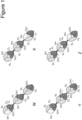
- T cell activating bispecific antigen binding molecule of the disclosure can be fused to each other in a variety of configurations. Exemplary configurations are depicted in Figure 1 .
- the T cell activating bispecific antigen binding molecule comprises an Fc domain composed of a first and a second subunit capable of stable association.
- the second Fab molecule is fused at the C-terminus of the Fab heavy chain to the N-terminus of the first subunit of the Fc domain.
- the first Fab molecule is fused at the C-terminus of the Fab heavy chain to the N-terminus of the Fab heavy chain of the second Fab molecule.
- the T cell activating bispecific antigen binding molecule essentially consists of the first and the second Fab molecule, the Fc domain composed of a first and a second subunit, and optionally one or more peptide linkers, wherein the first Fab molecule is fused at the C-terminus of the Fab heavy chain to the N-terminus of the Fab heavy chain of the second Fab molecule, and the second Fab molecule is fused at the C-terminus of the Fab heavy chain to the N-terminus of the first or the second subunit of the Fc domain.
- Such a configuration is schematically depicted in Figures 1G and 1K .
- the Fab light chain of the first Fab molecule and the Fab light chain of the second Fab molecule may additionally be fused to each other.
- the first Fab molecule is fused at the C-terminus of the Fab heavy chain to the N-terminus of the first or second subunit of the Fc domain.
- the T cell activating bispecific antigen binding molecule essentially consists of the first and the second Fab molecule, the Fc domain composed of a first and a second subunit, and optionally one or more peptide linkers, wherein the first and the second Fab molecule are each fused at the C-terminus of the Fab heavy chain to the N-terminus of one of the subunits of the Fc domain.
- the first and the second Fab molecule may be fused to the Fc domain directly or through a peptide linker.
- the first and the second Fab molecule are each fused to the Fc domain through an immunoglobulin hinge region.
- the immunoglobulin hinge region is a human IgG 1 hinge region, particularly where the Fc domain is an IgG 1 Fc domain.
- the first Fab molecule is fused at the C-terminus of the Fab heavy chain to the N-terminus of the first or second subunit of the Fc domain.
- the second Fab molecule is fused at the C-terminus of the Fab heavy chain to the N-terminus of the Fab heavy chain of the first Fab molecule.
- the T cell activating bispecific antigen binding molecule essentially consists of the first and the second Fab molecule, the Fc domain composed of a first and a second subunit, and optionally one or more peptide linkers, wherein the second Fab molecule is fused at the C-terminus of the Fab heavy chain to the N-terminus of the Fab heavy chain of the first Fab molecule, and the first Fab molecule is fused at the C-terminus of the Fab heavy chain to the N-terminus of the first or the second subunit of the Fc domain.
- Such a configuration is schematically depicted in Figures 1H and 1L .
- the Fab light chain of the first Fab molecule and the Fab light chain of the second Fab molecule may additionally be fused to each other.
- the Fab molecules may be fused to the Fc domain or to each other directly or through a peptide linker, comprising one or more amino acids, typically about 2-20 amino acids.
- Peptide linkers are known in the art and are described herein. Suitable, non-immunogenic peptide linkers include, for example, (G 4 S) n , (SG 4 ) n , (G 4 S) n or G 4 (SG 4 ) n peptide linkers.
- "n" is generally an integer from 1 to 10, typically from 2 to 4.
- said peptide linker has a length of at least 5 amino acids, in one aspect a length of 5 to 100, in a further aspect of 10 to 50 amino acids.
- said peptide linker is (G 4 S) 2 .
- a particularly suitable peptide linker for fusing the Fab light chains of the first and the second Fab molecule to each other is (G 4 S) 2 .
- An exemplary peptide linker suitable for connecting the Fab heavy chains of the first and the second Fab fragments comprises the sequence (D)-(G 4 S) 2 (SEQ ID NOs 11 and 12). Additionally, linkers may comprise (a portion of) an immunoglobulin hinge region. Particularly where a Fab molecule is fused to the N-terminus of an Fc domain subunit, it may be fused via an immunoglobulin hinge region or a portion thereof, with or without an additional peptide linker.
- a T cell activating bispecific antigen binding molecule with a single antigen binding moiety capable of specific binding to a target cell antigen (for example as shown in Figure 1A , D, G, H, K, L) is useful, particularly in cases where internalization of the target cell antigen is to be expected following binding of a high affinity antigen binding moiety.
- a target cell antigen for example as shown in Figure 1A , D, G, H, K, L
- the presence of more than one antigen binding moiety specific for the target cell antigen may enhance internalization of the target cell antigen, thereby reducing its availablity.
- T cell activating bispecific antigen binding molecule comprising two or more antigen binding moieties (such as Fab moelcules) specific for a target cell antigen (see examples shown in Figure 1B, 1C, 1E, 1F , 1I, 1J. 1M or 1N ), for example to optimize targeting to the target site or to allow crosslinking of target cell antigens.
- antigen binding moieties such as Fab moelcules
- the T cell activating bispecific antigen binding molecule of the invention further comprises a third Fab molecule which specifically binds to the first antigen.
- the first antigen is the target cell antigen.
- the third Fab molecule is a conventional Fab molecule.
- the third Fab molecule is identical to the first Fab molecule (i.e. the first and the third Fab molecule comprise the same heavy and light chain amino acid sequences and have the same arrangement of domains (i.e. conventional).
- the second Fab molecule specifically binds to the activating T cell antigenCD3, and the first and third Fab molecule specifically bind to CD20.
- the T cell activating bispecific antigen binding molecule of the invention further comprises a third Fab molecule which specifically binds to the second antigen.
- the second antigen preferably is the target cell antigen.
- the third Fab molecule is a crossover Fab molecule (a Fab molecule wherein the variable domains VH and VL of the Fab heavy and light chains are exchanged / replaced by each other).
- the third Fab molecule is identical to the second Fab molecule (i.e. the second and the third Fab molecule comprise the same heavy and light chain amino acid sequences and have the same arrangement of domains (i.e. conventional or crossover)).
- the first Fab molecule specifically binds to an activating T cell antigen, particularly CD3, and the second and third Fab molecule specifically bind to a target cell antigen.
- the third Fab molecule is fused at the C-terminus of the Fab heavy chain to the N-terminus of the first subunit of the Fc domain.
- Tthe second and the third Fab molecule are each fused at the C-terminus of the Fab heavy chain to the N-terminus of one of the subunits of the Fc domain, and the first Fab molecule is fused at the C-terminus of the Fab heavy chain to the N-terminus of the Fab heavy chain of the second Fab molecule.
- the T cell activating bispecific antigen binding molecule essentially consists of the first, the second and the third Fab molecule, the Fc domain composed of a first and a second subunit, and one or more peptide linkers, wherein the first Fab molecule is fused at the C-terminus of the Fab heavy chain to the N-terminus of the Fab heavy chain of the second Fab molecule, and the second Fab molecule is fused at the C-terminus of the Fab heavy chain to the N-terminus of the first subunit of the Fc domain, and wherein the third Fab molecule is fused at the C-terminus of the Fab heavy chain to the N-terminus of the second subunit of the Fc domain.
- the third Fab molecule is a conventional Fab molecule and identical to the first Fab molecule
- Figure 1I and 1M alternative aspects, wherein the third Fab molecule is a crossover Fab molecule and preferably identical to the second Fab molecule.
- the second and the third Fab molecule may be fused to the Fc domain directly or through a peptide linker.
- the second and the third Fab molecule are each fused to the Fc domain through an immunoglobulin hinge region.
- the immunoglobulin hinge region is a human IgG 1 hinge region
- the Fc domain is an IgG 1 Fc domain.
- the Fab light chain of the first Fab molecule and the Fab light chain of the second Fab molecule may additionally be fused to each other.
- the first and the third Fab molecule are each fused at the C-terminus of the Fab heavy chain to the N-terminus of one of the subunits of the Fc domain, and the second Fab molecule is fused at the C-terminus of the Fab heavy chain to the N-terminus of the Fab heavy chain of the first Fab molecule.
- the T cell activating bispecific antigen binding molecule essentially consists of the first, the second and the third Fab molecule, the Fc domain composed of a first and a second subunit, and optionally one or more peptide linkers, wherein the second Fab molecule is fused at the C-terminus of the Fab heavy chain to the N-terminus of the Fab heavy chain of the first Fab molecule, and the first Fab molecule is fused at the C-terminus of the Fab heavy chain to the N-terminus of the first subunit of the Fc domain, and wherein the third Fab molecule is fused at the C-terminus of the Fab heavy chain to the N-terminus of the second subunit of the Fc domain.
- Such a configuration is schematically depicted in Figure 1C and 1F (particular aspects, wherein the third Fab molecule is a conventional Fab molecule and preferably identical to the first Fab molecule) and in Figure 1J and 1N (alternative aspects of the disclosure, wherein the third Fab molecule is a crossover Fab molecule and preferably identical to the second Fab molecule).
- the first and the third Fab molecule may be fused to the Fc domain directly or through a peptide linker.
- the first and the third Fab molecule are each fused to the Fc domain through an immunoglobulin hinge region.
- the immunoglobulin hinge region is a human IgG 1 hinge region, particularly where the Fc domain is an IgG 1 Fc domain.
- the Fab light chain of the first Fab molecule and the Fab light chain of the second Fab molecule may additionally be fused to each other.
- the two Fab molecules, the hinge regions and the Fc domain essentially form an immunoglobulin molecule.
- the immunoglobulin molecule is an IgG class immunoglobulin.
- the immunoglobulin is an IgG 1 subclass immunoglobulin.
- the immunoglobulin is an IgG 4 subclass immunoglobulin.
- the immunoglobulin is a human immunoglobulin.
- the immunoglobulin is a chimeric immunoglobulin or a humanized immunoglobulin.
- the Fab light chain of the first Fab molecule and the Fab light chain of the second Fab molecule are fused to each other, optionally via a peptide lnker.
- the Fab light chain of the first Fab molecule may be fused at its C-terminus to the N-terminus of the Fab light chain of the second Fab molecule, or the Fab light chain of the second Fab molecule may be fused at its C-terminus to the N-terminus of the Fab light chain of the first Fab molecule.
- Fusion of the Fab light chains of the first and the second Fab molecule further reduces mispairing of unmatched Fab heavy and light chains, and also reduces the number of plasmids needed for expression of some of the T cell activating bispecific antigen binding molecules of the disclosure.
- the T cell activating bispecific antigen binding molecule comprises a polypeptide wherein the Fab light chain variable region of the second Fab molecule shares a carboxy-terminal peptide bond with the Fab heavy chain constant region of the second Fab molecule (i.e.
- the second Fab molecule comprises a crossover Fab heavy chain, wherein the heavy chain variable region is replaced by a light chain variable region), which in turn shares a carboxy-terminal peptide bond with an Fc domain subunit (VL (2) -CH1 (2) -CH2-CH3(-CH4)), and a polypeptide wherein the Fab heavy chain of the first Fab molecule shares a carboxy-terminal peptide bond with an Fc domain subunit (VH (1) -CH1 (1) -CH2-CH3(-CH4)).
- the T cell activating bispecific antigen binding molecule further comprises a polypeptide wherein the Fab heavy chain variable region of the second Fab molecule shares a carboxy-terminal peptide bond with the Fab light chain constant region of the second Fab molecule (VH (2) -CL (2) ) and the Fab light chain polypeptide of the first Fab molecule (VL(i)-CL(i)).
- the polypeptides are covalently linked, e.g., by a disulfide bond.
- the T cell activating bispecific antigen binding molecule comprises a polypeptide wherein the Fab light chain variable region of the second Fab molecule shares a carboxy-terminal peptide bond with the Fab heavy chain constant region of the second Fab molecule (i.e. the second Fab molecule comprises a crossover Fab heavy chain, wherein the heavy chain variable region is replaced by a light chain variable region), which in turn shares a carboxy-terminal peptide bond with the Fab heavy chain of the first Fab molecule, which in turn shares a carboxy-terminal peptide bond with an Fc domain subunit (VL (2) -CH1 (2) -VH (1) -CH1 (1) -CH2-CH3(-CH4)).
- VL (2) -CH1 (2) -VH (1) -CH1 (1) -CH2-CH3(-CH4) an Fc domain subunit
- the T cell activating bispecific antigen binding molecule comprises a polypeptide wherein the Fab heavy chain of the first Fab molecule shares a carboxy-terminal peptide bond with the Fab light chain variable region of the second Fab molecule which in turn shares a carboxy-terminal peptide bond with the Fab heavy chain constant region of the second Fab molecule (i.e. the second Fab molecule comprises a crossover Fab heavy chain, wherein the heavy chain variable region is replaced by a light chain variable region), which in turn shares a carboxy-terminal peptide bond with an Fc domain subunit (VH (1) -CH1 (1) -VL (2) -CH1 (2) -CH2-CH3(-CH4)).
- VH (1) -CH1 (1) -VL (2) -CH1 (2) -CH2-CH3(-CH4) an Fc domain subunit
- the T cell activating bispecific antigen binding molecule further comprises a crossover Fab light chain polypeptide of the second Fab molecule, wherein the Fab heavy chain variable region of the second Fab molecule shares a carboxy-terminal peptide bond with the Fab light chain constant region of the second Fab molecule (VH (2) -CL (2) ), and the Fab light chain polypeptide of the first Fab molecule (VL(i)-CL(i)).
- the T cell activating bispecific antigen binding molecule further comprises a polypeptide wherein the Fab light chain variable region of the second Fab molecule shares a carboxy-terminal peptide bond with the Fab heavy chain constant region of the second Fab molecule which in turn shares a carboxy-terminal peptide bond with the Fab light chain polypeptide of the first Fab molecule (VL (2) -CH1 (2) -VL (1) -CL (1) ), or a polypeptide wherein the Fab light chain polypeptide of the first Fab molecule shares a carboxy-terminal peptide bond with the Fab heavy chain variable region of the second Fab molecule which in turn shares a carboxy-terminal peptide bond with the Fab light chain constant region of the second Fab molecule (VL (1) -CL (1) -VH (2) -CL (2) ), as appropriate.
- the T cell activating bispecific antigen binding molecule further comprises a polypeptide wherein the Fab heavy chain of a third Fab molecule shares a carboxy-terminal peptide bond with an Fc domain subunit (VH (3) -CH1 (3) -CH (2) -CH (3) (-CH4)) and the Fab light chain polypeptide of a third Fab molecule (VL (3) -CL (3) ).
- the polypeptides are covalently linked, e.g., by a disulfide bond.
- the first Fab molecule is fused at the C-terminus of the Fab heavy chain to the N-terminus of the Fab heavy chain of the second Fab molecule.
- the T cell activating bispecific antigen binding molecule does not comprise an Fc domain.
- the T cell activating bispecific antigen binding molecule essentially consists of the first and the second Fab molecule, and optionally one or more peptide linkers, wherein the first Fab molecule is fused at the C-terminus of the Fab heavy chain to the N-terminus of the Fab heavy chain of the second Fab molecule.
- Such a configuration is schematically depicted in Figures 1O and 1S .
- the second Fab molecule is fused at the C-terminus of the Fab heavy chain to the N-terminus of the Fab heavy chain of the first Fab molecule.
- the T cell activating bispecific antigen binding molecule does not comprise an Fc domain.
- the T cell activating bispecific antigen binding molecule essentially consists of the first and the second Fab molecule, and optionally one or more peptide linkers, wherein the second Fab molecule is fused at the C-terminus of the Fab heavy chain to the N-terminus of the Fab heavy chain of the first Fab molecule.
- Such a configuration is schematically depicted in Figures 1P and 1T .
- the first Fab molecule is fused at the C-terminus of the Fab heavy chain to the N-terminus of the Fab heavy chain of the second Fab molecule
- the T cell activating bispecific antigen binding molecule further comprises a third Fab molecule, wherein said third Fab molecule is fused at the C-terminus of the Fab heavy chain to the N-terminus of the Fab heavy chain of the first Fab molecule.
- said third Fab molecule is a conventional Fab molecule.
- said third Fab molecule is a crossover Fab molecule as described herein, i.e.
- the T cell activating bispecific antigen binding molecule essentially consists of the first, the second and the third Fab molecule, and optionally one or more peptide linkers, wherein the first Fab molecule is fused at the C-terminus of the Fab heavy chain to the N-terminus of the Fab heavy chain of the second Fab molecule, and the third Fab molecule is fused at the C-terminus of the Fab heavy chain to the N-terminus of the Fab heavy chain of the first Fab molecule.
- Such a configuration is schematically depicted in Figure 1Q and 1U (particular aspects, wherein the third Fab molecule is a conventional Fab molecule and preferably identical to the first Fab molecule).
- the first Fab molecule is fused at the C-terminus of the Fab heavy chain to the N-terminus of the Fab heavy chain of the second Fab molecule
- the T cell activating bispecific antigen binding molecule further comprises a third Fab molecule, wherein said third Fab molecule is fused at the N-terminus of the Fab heavy chain to the C-terminus of the Fab heavy chain of the second Fab molecule.
- said third Fab molecule is a crossover Fab molecule as described herein, i.e. a Fab molecule wherein the variable domains VH and VL of the Fab heavy and light chains are exchanged / replaced by each other.
- said third Fab molecule is a conventional Fab molecule.
- the T cell activating bispecific antigen binding molecule essentially consists of the first, the second and the third Fab molecule, and optionally one or more peptide linkers, wherein the first Fab molecule is fused at the C-terminus of the Fab heavy chain to the N-terminus of the Fab heavy chain of the second Fab molecule, and the third Fab molecule is fused at the N-terminus of the Fab heavy chain to the C-terminus of the Fab heavy chain of the second Fab molecule.
- Figure 1W and 1Y particular aspects, wherein the third Fab molecule is a crossover Fab molecule and preferably identical to the second Fab molecule).
- the second Fab molecule is fused at the C-terminus of the Fab heavy chain to the N-terminus of the Fab heavy chain of the first Fab molecule
- the T cell activating bispecific antigen binding molecule further comprises a third Fab molecule, wherein said third Fab molecule is fused at the N-terminus of the Fab heavy chain to the C-terminus of the Fab heavy chain of the first Fab molecule.
- said third Fab molecule is a conventional Fab molecule.
- said third Fab molecule is a crossover Fab molecule as described herein, i.e.
- the T cell activating bispecific antigen binding molecule essentially consists of the first, the second and the third Fab molecule, and optionally one or more peptide linkers, wherein the second Fab molecule is fused at the C-terminus of the Fab heavy chain to the N-terminus of the Fab heavy chain of the first Fab molecule, and the third Fab molecule is fused at the N-terminus of the Fab heavy chain to the C-terminus of the Fab heavy chain of the first Fab molecule.
- Such a configuration is schematically depicted in Figure 1R and 1V (particular aspects, wherein the third Fab molecule is a conventional Fab molecule and preferably identical to the first Fab molecule).
- the second Fab molecule is fused at the C-terminus of the Fab heavy chain to the N-terminus of the Fab heavy chain of the first Fab molecule
- the T cell activating bispecific antigen binding molecule further comprises a third Fab molecule, wherein said third Fab molecule is fused at the C-terminus of the Fab heavy chain to the N-terminus of the Fab heavy chain of the second Fab molecule.
- said third Fab molecule is a crossover Fab molecule as described herein, i.e. a Fab molecule wherein the variable domains VH and VL of the Fab heavy and light chains are exchanged / replaced by each other.
- said third Fab molecule is a conventional Fab molecule.
- the T cell activating bispecific antigen binding molecule essentially consists of the first, the second and the third Fab molecule, and optionally one or more peptide linkers, wherein the second Fab molecule is fused at the C-terminus of the Fab heavy chain to the N-terminus of the Fab heavy chain of the first Fab molecule, and the third Fab molecule is fused at the C-terminus of the Fab heavy chain to the N-terminus of the Fab heavy chain of the second Fab molecule.
- Figure 1X and 1Z particular aspects, wherein the third Fab molecule is a crossover Fab molecule and preferably identical to the first Fab molecule).
- the T cell activating bispecific antigen binding molecule comprises a polypeptide wherein the Fab heavy chain of the first Fab molecule shares a carboxy-terminal peptide bond with the Fab light chain variable region of the second Fab molecule, which in turn shares a carboxy-terminal peptide bond with the Fab heavy chain constant region of the second Fab molecule (i.e. the second Fab molecule comprises a crossover Fab heavy chain, wherein the heavy chain variable region is replaced by a light chain variable region) (VH (1) -CH1 (1) -VL (2) -CH1 (2) ).
- the T cell activating bispecific antigen binding molecule further comprises a polypeptide wherein the Fab heavy chain variable region of the second Fab molecule shares a carboxy-terminal peptide bond with the Fab light chain constant region of the second Fab molecule (VH (2) -CL (2) ) and the Fab light chain polypeptide of the first Fab molecule (VL(i)-CL(i)).
- the T cell activating bispecific antigen binding molecule according to the invention comprises a polypeptide wherein the Fab light chain variable region of the second Fab molecule shares a carboxy-terminal peptide bond with the Fab heavy chain constant region of the second Fab molecule (i.e.
- the second Fab molecule comprises a crossover Fab heavy chain, wherein the heavy chain variable region is replaced by a light chain variable region), which in turn shares a carboxy-terminal peptide bond with the Fab heavy chain of the first Fab molecule (VL (2) -CH1 (2) -VH (1) -CH1 (1) ).
- the T cell activating bispecific antigen binding molecule further comprises a polypeptide wherein the Fab heavy chain variable region of the second Fab molecule shares a carboxy-terminal peptide bond with the Fab light chain constant region of the second Fab molecule (VH (2) -CL (2) ) and the Fab light chain polypeptide of the first Fab molecule (VL (1) -CL (1) ).
- the T cell activating bispecific antigen binding molecule comprises a polypeptide wherein the Fab heavy chain of a third Fab molecule shares a carboxy-terminal peptide bond with the Fab heavy chain of the first Fab molecule, which in turn shares a carboxy-terminal peptide bond with the Fab light chain variable region of the second Fab molecule, which in turn shares a carboxy-terminal peptide bond with the Fab heavy chain constant region of the second Fab molecule (i.e.
- the second Fab molecule comprises a crossover Fab heavy chain, wherein the heavy chain variable region is replaced by a light chain variable region) (VH (3) -CH1 (3) -VH (1) -CH1 (1) -VL (2) -CH1 (2) ).
- the T cell activating bispecific antigen binding molecule further comprises a polypeptide wherein the Fab heavy chain variable region of the second Fab molecule shares a carboxy-terminal peptide bond with the Fab light chain constant region of the second Fab molecule (VH (2) -CL (2) ) and the Fab light chain polypeptide of the first Fab molecule (VL(i)-CL(i)).
- the T cell activating bispecific antigen binding molecule further comprises the Fab light chain polypeptide of a third Fab molecule (VL (3) -CL (3) ).
- the T cell activating bispecific antigen binding molecule according to the invention comprises a polypeptide wherein the Fab light chain variable region of the second Fab molecule shares a carboxy-terminal peptide bond with the Fab heavy chain constant region of the second Fab molecule (i.e.
- the second Fab molecule comprises a crossover Fab heavy chain, wherein the heavy chain variable region is replaced by a light chain variable region), which in turn shares a carboxy-terminal peptide bond with the Fab heavy chain of the first Fab molecule, which in turn shares a carboxy-terminal peptide bond with the Fab heavy chain of a third Fab molecule (VL (2) -CH1 (2) -VH (1) -CH1 (1) -VH (3) -CH1 (3) ).
- the T cell activating bispecific antigen binding molecule further comprises a polypeptide wherein the Fab heavy chain variable region of the second Fab molecule shares a carboxy-terminal peptide bond with the Fab light chain constant region of the second Fab molecule (VH (2) -CL (2) ) and the Fab light chain polypeptide of the first Fab molecule (VL(i)-CL(i)).
- the T cell activating bispecific antigen binding molecule further comprises the Fab light chain polypeptide of a third Fab molecule (VL (3) -CL (3) ).
- the T cell activating bispecific antigen binding molecule comprises a polypeptide wherein the Fab heavy chain of the first Fab molecule shares a carboxy-terminal peptide bond with the Fab light chain variable region of the second Fab molecule, which in turn shares a carboxy-terminal peptide bond with the Fab heavy chain constant region of the second Fab molecule (i.e.
- the second Fab molecule comprises a crossover Fab heavy chain, wherein the heavy chain variable region is replaced by a light chain variable region), which in turn shares a carboxy-terminal peptide bond with the Fab light chain variable region of a third Fab molecule, which in turn shares a carboxy-terminal peptide bond with the Fab heavy chain constant region of a third Fab molecule (i.e. the third Fab molecule comprises a crossover Fab heavy chain, wherein the heavy chain variable region is replaced by a light chain variable region) (VH (1) -CH1 (1) - L (2) -CH1 (2) -VL (3) -CH1 (3) ).
- the T cell activating bispecific antigen binding molecule further comprises a polypeptide wherein the Fab heavy chain variable region of the second Fab molecule shares a carboxy-terminal peptide bond with the Fab light chain constant region of the second Fab molecule (VH (2) -CL (2) ) and the Fab light chain polypeptide of the first Fab molecule (VL(i)-CL(i)).
- the T cell activating bispecific antigen binding molecule further comprises a polypeptide wherein the Fab heavy chain variable region of a third Fab molecule shares a carboxy-terminal peptide bond with the Fab light chain constant region of a third Fab molecule (VH (3) -CL (3) ).
- the T cell activating bispecific antigen binding molecule comprises a polypeptide wherein the Fab light chain variable region of a third Fab molecule shares a carboxy-terminal peptide bond with the Fab heavy chain constant region of a third Fab molecule (i.e. the third Fab molecule comprises a crossover Fab heavy chain, wherein the heavy chain variable region is replaced by a light chain variable region), which in turn shares a carboxy-terminal peptide bond with the Fab light chain variable region of the second Fab molecule, which in turn shares a carboxy-terminal peptide bond with the Fab heavy chain constant region of the second Fab molecule (i.e.
- the second Fab molecule comprises a crossover Fab heavy chain, wherein the heavy chain variable region is replaced by a light chain variable region), which in turn shares a carboxy-terminal peptide bond with the Fab heavy chain of the first Fab molecule (VL (3) -CH1 (3) -VL (2) -CH1 (2) -VH (1) -CH1 (1) ).
- the T cell activating bispecific antigen binding molecule further comprises a polypeptide wherein the Fab heavy chain variable region of the second Fab molecule shares a carboxy-terminal peptide bond with the Fab light chain constant region of the second Fab molecule (VH (2) -CL (2) ) and the Fab light chain polypeptide of the first Fab molecule (VL(i)-CL(i)).
- the T cell activating bispecific antigen binding molecule further comprises a polypeptide wherein the Fab heavy chain variable region of a third Fab molecule shares a carboxy-terminal peptide bond with the Fab light chain constant region of a third Fab molecule (VH (3) -CL (3) ).
- components of the T cell activating bispecific antigen binding molecule may be fused directly or through various linkers, particularly peptide linkers comprising one or more amino acids, typically about 2-20 amino acids, that are described herein or are known in the art.
- Suitable, non-immunogenic peptide linkers include, for example, (G 4 S) n , (SG 4 ) n , (G 4 S) n or G 4 (SG 4 ) n peptide linkers, wherein n is generally an integer from 1 to 10, typically from 2 to 4.
- the Fc domain of the T cell activating bispecific antigen binding molecule consists of a pair of polypeptide chains comprising heavy chain domains of an immunoglobulin molecule.
- the Fc domain of an immunoglobulin G (IgG) molecule is a dimer, each subunit of which comprises the CH2 and CH3 IgG heavy chain constant domains.
- the two subunits of the Fc domain are capable of stable association with each other.
- the T cell activating bispecific antigen binding molecule of the invention comprises not more than one Fc domain.
- the Fc domain of the T cell activating bispecific antigen binding molecule is an IgG Fc domain.
- the Fc domain is an IgG 1 Fc domain.
- the Fc domain is an IgG 4 Fc domain.
- the Fc domain is an IgG 4 Fc domain comprising an amino acid substitution at position S228 (Kabat numbering), particularly the amino acid substitution S228P. This amino acid substitution reduces in vivo Fab arm exchange of IgG 4 antibodies (see Stubenrauch et al., Drug Metabolism and Disposition 38, 84-91 (2010 )).
- the Fc domain is human. An exemplary sequence of a human IgG 1 Fc region is given in SEQ ID NO: 13.
- T cell activating bispecific antigen binding molecules according to the invention and the disclosure comprise different Fab molecules, fused to one or the other of the two subunits of the Fc domain, thus the two subunits of the Fc domain are typically comprised in two non-identical polypeptide chains. Recombinant co-expression of these polypeptides and subsequent dimerization leads to several possible combinations of the two polypeptides. To improve the yield and purity of T cell activating bispecific antigen binding molecules in recombinant production, it will thus be advantageous to introduce in the Fc domain of the T cell activating bispecific antigen binding molecule a modification promoting the association of the desired polypeptides.
- the Fc domain of the T cell activating bispecific antigen binding molecule comprises a modification promoting the association of the first and the second subunit of the Fc domain.
- the site of most extensive protein-protein interaction between the two subunits of a human IgG Fc domain is in the CH3 domain of the Fc domain.
- said modification is in the CH3 domain of the Fc domain.
- the CH3 domain of the first subunit of the Fc domain and the CH3 domain of the second subunit of the Fc domain are both engineered in a complementary manner so that each CH3 domain (or the heavy chain comprising it) can no longer homodimerize with itself but is forced to heterodimerize with the complementarily engineered other CH3 domain (so that the first and second CH3 domain heterodimerize and no homdimers between the two first or the two second CH3 domains are formed).
- said modification promoting the association of the first and the second subunit of the Fc domain is a so-called "knob-into-hole” modification, comprising a "knob” modification in one of the two subunits of the Fc domain and a "hole” modification in the other one of the two subunits of the Fc domain.
- the method involves introducing a protuberance ("knob") at the interface of a first polypeptide and a corresponding cavity ("hole") in the interface of a second polypeptide, such that the protuberance can be positioned in the cavity so as to promote heterodimer formation and hinder homodimer formation.
- Protuberances are constructed by replacing small amino acid side chains from the interface of the first polypeptide with larger side chains (e.g. tyrosine or tryptophan).
- Compensatory cavities of identical or similar size to the protuberances are created in the interface of the second polypeptide by replacing large amino acid side chains with smaller ones (e.g. alanine or threonine).
- an amino acid residue is replaced with an amino acid residue having a larger side chain volume, thereby generating a protuberance within the CH3 domain of the first subunit which is positionable in a cavity within the CH3 domain of the second subunit, and in the CH3 domain of the second subunit of the Fc domain an amino acid residue is replaced with an amino acid residue having a smaller side chain volume, thereby generating a cavity within the CH3 domain of the second subunit within which the protuberance within the CH3 domain of the first subunit is positionable.
- said amino acid residue having a larger side chain volume is selected from the group consisting of arginine (R), phenylalanine (F), tyrosine (Y), and tryptophan (W).
- said amino acid residue having a smaller side chain volume is selected from the group consisting of alanine (A), serine (S), threonine (T), and valine (V).
- the protuberance and cavity can be made by altering the nucleic acid encoding the polypeptides, e.g. by site-specific mutagenesis, or by peptide synthesis.
- the threonine residue at position 366 is replaced with a tryptophan residue (T366W), and in the CH3 domain of the second subunit of the Fc domain (the "hole” subunit) the tyrosine residue at position 407 is replaced with a valine residue (Y407V).
- the threonine residue at position 366 is replaced with a serine residue (T366S) and the leucine residue at position 368 is replaced with an alanine residue (L368A) (numberings according to Kabat EU index).
- the serine residue at position 354 is replaced with a cysteine residue (S354C) or the glutamic acid residue at position 356 is replaced with a cysteine residue (E356C), and in the second subunit of the Fc domain additionally the tyrosine residue at position 349 is replaced by a cysteine residue (Y349C) (numberings according to Kabat EU index). Introduction of these two cysteine residues results in formation of a disulfide bridge between the two subunits of the Fc domain, further stabilizing the dimer ( Carter, J Immunol Methods 248, 7-15 (2001 )).
- the first subunit of the Fc domain comprises amino acid substitutions S354C and T366W
- the second subunit of the Fc domain comprises amino acid substitutions Y349C, T366S, L368A and Y407V (numbering according to Kabat EU index).
- the Fab molecule which specifically binds an activating T cell antigen is fused (optionally via a Fab molecule which specifically binds to a target cell antigen) to the first subunit of the Fc domain (comprising the "knob" modification).
- fusion of the Fab molecule which specifically binds an activating T cell antigen to the knob-containing subunit of the Fc domain will (further) minimize the generation of antigen binding molecules comprising two Fab molecules which bind to an activating T cell antigen (steric clash of two knob-containing polypeptides).
- heterodimerization approach described in EP 1870459 A1 is used alternatively. This approach is based on the introduction of charged amino acids with opposite charges at specific amino acid positions in the CH3/CH3 domain interface between the two subunits of the Fc domain.
- T cell activating bispecific antigen binding molecule are amino acid mutations R409D; K370E in one of the two CH3 domains (of the Fc domain) and amino acid mutations D399K; E357K in the other one of the CH3 domains of the Fc domain (numbering according to Kabat EU index).
- the T cell activating bispecific antigen binding molecule comprises amino acid mutation T366W in the CH3 domain of the first subunit of the Fc domain and amino acid mutations T366S, L368A, Y407V in the CH3 domain of the second subunit of the Fc domain, and additionally amino acid mutations R409D; K370E in the CH3 domain of the first subunit of the Fc domain and amino acid mutations D399K; E357K in the CH3 domain of the second subunit of the Fc domain (numberings according to Kabat EU index).
- T cell activating bispecific antigen binding molecule comprises amino acid mutations S354C, T366W in the CH3 domain of the first subunit of the Fc domain and amino acid mutations Y349C, T366S, L368A, Y407V in the CH3 domain of the second subunit of the Fc domain, or said T cell activating bispecific antigen binding molecule comprises amino acid mutations Y349C, T366W in the CH3 domain of the first subunit of the Fc domain and amino acid mutations S354C, T366S, L368A, Y407V in the CH3 domains of the second subunit of the Fc domain and additionally amino acid mutations R409D; K370E in the CH3 domain of the first subunit of the Fc domain and amino acid mutations D399K; E357K in the CH3 domain of the second subunit of the Fc domain (all numberings according to Kabat EU index).
- a first CH3 domain comprises amino acid mutation T366K and a second CH3 domain comprises amino acid mutation L351D (numberings according to Kabat EU index).
- the first CH3 domain comprises further amino acid mutation L351K.
- the second CH3 domain comprises further an amino acid mutation selected from Y349E, Y349D and L368E (preferably L368E) (numberings according to Kabat EU index).
- a first CH3 domain comprises amino acid mutations L351Y, Y407A and a second CH3 domain comprises amino acid mutations T366A, K409F.
- the second CH3 domain comprises a further amino acid mutation at position T411, D399, S400, F405, N390, or K392, e.g.
- T411N, T411R, T411Q, T411K, T411D, T411E or T411W b) D399R, D399W, D399Y or D399K
- S400E, S400D, S400R, or S400K d) F405I, F405M, F405T, F405S, F405V or F405W, e) N390R, N390K or N390D, f) K392V, K392M, K392R, K392L, K392F or K392E (numberings according to Kabat EU index).
- a first CH3 domain comprises amino acid mutations L351Y, Y407A and a second CH3 domain comprises amino acid mutations T366V, K409F.
- a first CH3 domain comprises amino acid mutation Y407A and a second CH3 domain comprises amino acid mutations T366A, K409F.
- the second CH3 domain further comprises amino acid mutations K392E, T411E, D399R and S400R (numberings according to Kabat EU index).
- heterodimerization approach described in WO 2011/143545 is used alternatively, e.g. with the amino acid modification at a position selected from the group consisting of 368 and 409 (numbering according to Kabat EU index).
- a first CH3 domain comprises amino acid mutation T366W and a second CH3 domain comprises amino acid mutation Y407A.
- a first CH3 domain comprises amino acid mutation T366Y and a second CH3 domain comprises amino acid mutation Y407T (numberings according to Kabat EU index).
- the T cell activating bispecific antigen binding molecule or its Fc domain is of IgG 2 subclass and the heterodimerization approach described in WO 2010/129304 is used alternatively.
- a modification promoting association of the first and the second subunit of the Fc domain comprises a modification mediating electrostatic steering effects, e.g. as described in PCT publication WO 2009/089004 .
- this method involves replacement of one or more amino acid residues at the interface of the two Fc domain subunits by charged amino acid residues so that homodimer formation becomes electrostatically unfavorable but heterodimerization electrostatically favorable.
- a first CH3 domain comprises amino acid substitution of K392 or N392 with a negatively charged amino acid (e.g. glutamic acid (E), or aspartic acid (D), preferably K392D or N392D) and a second CH3 domain comprises amino acid substitution of D399, E356, D356, or E357 with a positively charged amino acid (e.g. lysine (K) or arginine (R), preferably D399K, E356K, D356K, or E357K, and more preferably D399K and E356K).
- the first CH3 domain further comprises amino acid substitution of K409 or R409 with a negatively charged amino acid (e.g.
- the first CH3 domain further or alternatively comprises amino acid substitution of K439 and/or K370 with a negatively charged amino acid (e.g. glutamic acid (E), or aspartic acid (D)) (all numberings according to Kabat EU index).
- a negatively charged amino acid e.g. glutamic acid (E), or aspartic acid (D)
- a first CH3 domain comprises amino acid mutations K253E, D282K, and K322D and a second CH3 domain comprises amino acid mutations D239K, E240K, and K292D (numberings according to Kabat EU index).
- heterodimerization approach described in WO 2007/110205 can be used alternatively.
- the first subunit of the Fc domain comprises amino acid substitutions K392D and K409D
- the second subunit of the Fc domain comprises amino acid substitutions D356K and D399K (numbering according to Kabat EU index).
- the Fc domain confers to the T cell activating bispecific antigen binding molecule favorable pharmacokinetic properties, including a long serum half-life which contributes to good accumulation in the target tissue and a favorable tissue-blood distribution ratio. At the same time it may, however, lead to undesirable targeting of the T cell activating bispecific antigen binding molecule to cells expressing Fc receptors rather than to the preferred antigen-bearing cells. Moreover, the co-activation of Fc receptor signaling pathways may lead to cytokine release which, in combination with the T cell activating properties and the long half-life of the antigen binding molecule, results in excessive activation of cytokine receptors and severe side effects upon systemic administration. Activation of (Fc receptor-bearing) immune cells other than T cells may even reduce efficacy of the T cell activating bispecific antigen binding molecule due to the potential destruction of T cells e.g. by NK cells.
- the Fc domain of the T cell activating bispecific antigen binding molecules according to the invention exhibits reduced binding affinity to an Fc receptor and/or reduced effector function, as compared to a native IgG 1 Fc domain.
- the Fc domain (or the T cell activating bispecific antigen binding molecule comprising said Fc domain) exhibits less than 50%, preferably less than 20%, more preferably less than 10% and most preferably less than 5% of the binding affinity to an Fc receptor, as compared to a native IgG 1 Fc domain (or a T cell activating bispecific antigen binding molecule comprising a native IgG 1 Fc domain), and/or less than 50%, preferably less than 20%, more preferably less than 10% and most preferably less than 5% of the effector function, as compared to a native IgG 1 Fc domain domain (or a T cell activating bispecific antigen binding molecule comprising a native IgG 1 Fc domain).
- the Fc domain domain (or the T cell activating bispecific antigen binding molecule comprising said Fc domain) does not substantially bind to an Fc receptor and/or induce effector function.
- the Fc receptor is an Fcy receptor.
- the Fc receptor is a human Fc receptor.
- the Fc receptor is an activating Fc receptor.
- the Fc receptor is an activating human Fc ⁇ receptor, more specifically a human FcyRIIIa receptor.
- the effector function is one or more selected from the group of CDC, ADCC, ADCP, and cytokine secretion. In a particular embodiment the effector function is ADCC.
- the Fc domain domain exhibits substantially similar binding affinity to neonatal Fc receptor (FcRn), as compared to a native IgG 1 Fc domain domain.
- FcRn neonatal Fc receptor
- Substantially similar binding to FcRn is achieved when the Fc domain (or the T cell activating bispecific antigen binding molecule comprising said Fc domain) exhibits greater than about 70%, particularly greater than about 80%, more particularly greater than about 90% of the binding affinity of a native IgG 1 Fc domain (or the T cell activating bispecific antigen binding molecule comprising a native IgG 1 Fc domain) to FcRn.
- the Fc domain is engineered to have reduced binding affinity to an Fc receptor and/or reduced effector function, as compared to a non-engineered Fc domain.
- the Fc domain of the T cell activating bispecific antigen binding molecule comprises one or more amino acid mutation that reduces the binding affinity of the Fc domain to an Fc receptor and/or effector function. Typically, the same one or more amino acid mutation is present in each of the two subunits of the Fc domain.
- the amino acid mutation reduces the binding affinity of the Fc domain to an Fc receptor. In one aspectthe amino acid mutation reduces the binding affinity of the Fc domain to an Fc receptor by at least 2-fold, at least 5-fold, or at least 10-fold.
- the combination of these amino acid mutations may reduce the binding affinity of the Fc domain to an Fc receptor by at least 10-fold, at least 20-fold, or even at least 50-fold.
- the T cell activating bispecific antigen binding molecule comprising an engineered Fc domain exhibits less than 20%, particularly less than 10%, more particularly less than 5% of the binding affinity to an Fc receptor as compared to a T cell activating bispecific antigen binding molecule comprising a non-engineered Fc domain.
- the Fc receptor is an Fcy receptor.
- the Fc receptor is a human Fc receptor.
- the Fc receptor is an activating Fc receptor.
- the Fc receptor is an activating human Fc ⁇ receptor, more specifically human FcyRIIIa, FcyRI or FcyRIIa, most specifically human FcyRIIIa.
- binding to each of these receptors is reduced.
- Binding affinity to a complement component, specifically binding affinity to C1q, is also reduced.
- Binding affinity to neonatal Fc receptor (FcRn) is not reduced. Substantially similar binding to FcRn, i.e.
- the Fc domain, or T cell activating bispecific antigen binding molecules of the disclosure comprising said Fc domain may exhibit greater than about 80% and even greater than about 90% of such affinity.
- the Fc domain of the T cell activating bispecific antigen binding molecule is engineered to have reduced effector function, as compared to a non-engineered Fc domain.
- the reduced effector function can include, but is not limited to, one or more of the following: reduced complement dependent cytotoxicity (CDC), reduced antibody-dependent cell-mediated cytotoxicity (ADCC), reduced antibody-dependent cellular phagocytosis (ADCP), reduced cytokine secretion, reduced immune complex-mediated antigen uptake by antigen-presenting cells, reduced binding to NK cells, reduced binding to macrophages, reduced binding to monocytes, reduced binding to polymorphonuclear cells, reduced direct signaling inducing apoptosis, reduced crosslinking of target-bound antibodies, reduced dendritic cell maturation, or reduced T cell priming.
- CDC complement dependent cytotoxicity
- ADCC reduced antibody-dependent cell-mediated cytotoxicity
- ADCP reduced antibody-dependent cellular phagocytosis
- reduced immune complex-mediated antigen uptake by antigen-presenting cells reduced binding to NK cells, reduced binding to macrophages, reduced binding to monocytes, reduced binding to polymorphonuclear cells, reduced direct signaling inducing
- the reduced effector function is one or more selected from the group of reduced CDC, reduced ADCC, reduced ADCP, and reduced cytokine secretion. According to the invention, the reduced effector function is reduced ADCC. In one aspect the reduced ADCC is less than 20% of the ADCC induced by a non-engineered Fc domain (or a T cell activating bispecific antigen binding molecule comprising a non-engineered Fc domain).
- the amino acid mutation that reduces the binding affinity of the Fc domain to an Fc receptor and/or effector function is an amino acid substitution.
- the Fc domain comprises an amino acid substitution at a position selected from the group of E233, L234, L235, N297, P331 and P329 (numberings according to Kabat EU index).
- the Fc domain comprises an amino acid substitution at a position selected from the group of L234, L235 and P329 (numberings according to Kabat EU index).
- the Fc domain comprises the amino acid substitutions L234A and L235A (numberings according to Kabat EU index).
- the Fc domain is an IgG 1 Fc domain, particularly a human IgG 1 Fc domain.
- the Fc domain comprises an amino acid substitution at position P329.
- the amino acid substitution is P329A or P329G, particularly P329G (numberings according to Kabat EU index).
- the Fc domain comprises an amino acid substitution at position P329 and a further amino acid substitution at a position selected from E233, L234, L235, N297 and P331 (numberings according to Kabat EU index).
- the further amino acid substitution is E233P, L234A, L235A, L235E, N297A, N297D or P331S.
- the Fc domain comprises amino acid substitutions at positions P329, L234 and L235(numberings according to Kabat EU index).
- the Fc domain comprises the amino acid mutations L234A, L235A and P329G ("P329G LALA").
- the Fc domain is an IgG 1 Fc domain, particularly a human IgG 1 Fc domain.
- the "P329G LALA" combination of amino acid substitutions almost completely abolishes Fcy receptor (as well as complement) binding of a human IgG 1 Fc domain, as described in PCT publication no. WO 2012/130831 .
- WO 2012/130831 also describes methods of preparing such mutant Fc domains and methods for determining its properties such as Fc receptor binding or effector functions.
- the Fc domain of the T cell activating bispecific antigen binding molecules is an IgG 4 Fc domain, particularly a human IgG 4 Fc domain.
- the IgG 4 Fc domain comprises amino acid substitutions at position S228, specifically the amino acid substitution S228P (numberings according to Kabat EU index).
- the IgG 4 Fc domain comprises an amino acid substitution at position L235, specifically the amino acid substitution L235E (numberings according to Kabat EU index).
- the IgG 4 Fc domain comprises an amino acid substitution at position P329, specifically the amino acid substitution P329G (numberings according to Kabat EU index).
- the IgG 4 Fc domain comprises amino acid substitutions at positions S228, L235 and P329, specifically amino acid substitutions S228P, L235E and P329G (numberings according to Kabat EU index).
- Such IgG 4 Fc domain mutants and their Fc ⁇ receptor binding properties are described in PCT publication no. WO 2012/130831 .
- the Fc domain exhibiting reduced binding affinity to an Fc receptor and/or reduced effector function, as compared to a native IgG 1 Fc domain, is a human IgG 1 Fc domain comprising the amino acid substitutions L234A, L235A and P329G (numberings according to Kabat EU index).
- N-glycosylation of the Fc domain has been eliminated.
- the Fc domain comprises an amino acid mutation at position N297, particularly an amino acid substitution replacing asparagine by alanine (N297A) or aspartic acid (N297D) (numberings according to Kabat EU index).
- Fc domains with reduced Fc receptor binding and/or effector function according to the disclosure also include those with substitution of one or more of Fc domain residues 238, 265, 269, 270, 297, 327 and 329 ( U.S. Patent No. 6,737,056 ) (numberings according to Kabat EU index).
- Fc mutants include Fc mutants with substitutions at two or more of amino acid positions 265, 269, 270, 297 and 327, including the so-called "DANA" Fc mutant with substitution of residues 265 and 297 to alanine ( US Patent No. 7,332,581 ).
- Mutant Fc domains can be prepared by amino acid deletion, substitution, insertion or modification using genetic or chemical methods well known in the art. Genetic methods may include site-specific mutagenesis of the encoding DNA sequence, PCR, gene synthesis, and the like. The correct nucleotide changes can be verified for example by sequencing.
- Binding to Fc receptors can be easily determined e.g. by ELISA, or by Surface Plasmon Resonance (SPR) using standard instrumentation such as a BIAcore instrument (GE Healthcare), and Fc receptors such as may be obtained by recombinant expression. A suitable such binding assay is described herein. Alternatively, binding affinity of Fc domains or cell activating bispecific antigen binding molecules comprising an Fc domain for Fc receptors may be evaluated using cell lines known to express particular Fc receptors, such as human NK cells expressing FcyIIIa receptor.
- Effector function of an Fc domain, or a T cell activating bispecific antigen binding molecule comprising an Fc domain can be measured by methods known in the art.
- a suitable assay for measuring ADCC is described herein.
- Other examples of in vitro assays to assess ADCC activity of a molecule of interest are described in U.S. Patent No. 5,500,362 ; Hellstrom et al. Proc Natl Acad Sci USA 83, 7059-7063 (1986 ) and Hellstrom et al., Proc Natl Acad Sci USA 82, 1499-1502 (1985 ); U.S. Patent No. 5,821,337 ; Bruggemann et al., J Exp Med 166, 1351-1361 (1987 ).
- non-radioactive assays methods may be employed (see, for example, ACTI TM non-radioactive cytotoxicity assay for flow cytometry (CellTechnology, Inc. Mountain View, CA); and CytoTox 96 ® non-radioactive cytotoxicity assay (Promega, Madison, WI)).
- Useful effector cells for such assays include peripheral blood mononuclear cells (PBMC) and Natural Killer (NK) cells.
- PBMC peripheral blood mononuclear cells
- NK Natural Killer
- ADCC activity of the molecule of interest may be assessed in vivo, e.g. in a animal model such as that disclosed in Clynes et al., Proc Natl Acad Sci USA 95, 652-656 (1998 ).
- the binding of the Fc domain to a complement component, specifically to C1q, is reduced. Accordingly, the Fc domain is engineered to have reduced effector function, said reduced effector function includes reduced CDC.
- C1q binding assays may be carried out to determine whether the T cell activating bispecific antigen binding molecule is able to bind C1q and hence has CDC activity. See e.g., C1q and C3c binding ELISA in WO 2006/029879 and WO 2005/100402 .
- a CDC assay may be performed (see, for example, Gazzano-Santoro et al., J Immunol Methods 202, 163 (1996 ); Cragg et al., Blood 101, 1045-1052 (2003 ); and Cragg and Glennie, Blood 103, 2738-2743 (2004 )).
- the antigen binding molecule of the invention is bispecific, i.e. it comprises at least two antigen binding moieties capable of specific binding to two distinct antigenic determinants.
- the antigen binding moieties are Fab molecules (i.e. antigen binding domains composed of a heavy and a light chain, each comprising a variable and a constant domain).
- said Fab molecules are human.
- said Fab molecules are humanized. Said Fab molecules comprise human heavy and light chain constant domains.
- At least one of the antigen binding moieties is a crossover Fab molecule.
- Such modification reduces mispairing of heavy and light chains from different Fab molecules, thereby improving the yield and purity of the T cell activating bispecific antigen binding molecule of the invention in recombinant production.
- the variable domains of the Fab light chain and the Fab heavy chain (VL and VH, respectively) are exchanged.
- the preparation of the T cell activating bispecific antigen binding molecule may comprise certain side products due to a so-called Bence Jones-type interaction between mispaired heavy and light chains (see Schaefer et al, PNAS, 108 (2011) 11187-11191 ).
- charged amino acids with opposite charges are introduced at specific amino acid positions in the CH1 and CL domains of either the Fab molecule(s) specifically binding to a target cell antigen, or the Fab molecule specifically binding to an activating T cell antigen.
- Charge modifications according to the invention are made in the conventional Fab molecule(s) comprised in the T cell activating bispecific antigen binding molecule (such as shown e.g. in Figures 1 A-C , G-J), further charge modifications in the crossover Fab molecule(s) comprised in the T cell activating bispecific antigen binding molecule are disclosed (such as shown e.g. in Figure 1 D-F , K-N) (but not in both).
- the charge modifications are made in the conventional Fab molecules comprised in the T cell activating bispecific antigen binding molecule (which specifically bind to the target cell antigen).
- the T cell activating bispecific antigen binding molecule is capable of simultaneous binding to a target cell antigen, particularly a tumor cell antigen, and an activating T cell antigen, particularly CD3.
- the T cell activating bispecific antigen binding molecule is capable of crosslinking a T cell and a target cell by simultaneous binding to a target cell antigen and an activating T cell antigen. Such simultaneous binding results in lysis of the target cell, particularly a tumor cell. Such simultaneous binding results in activation of the T cell.
- Such simultaneous binding results in a cellular response of a T lymphocyte, particularly a cytotoxic T lymphocyte, selected from the group of: proliferation, differentiation, cytokine secretion, cytotoxic effector molecule release, cytotoxic activity, and expression of activation markers. Binding of the T cell activating bispecific antigen binding molecule to the activating T cell antigen, particularly CD3, without simultaneous binding to the target cell antigen does not result in T cell activation.
- the T cell activating bispecific antigen binding molecule is capable of re-directing cytotoxic activity of a T cell to a target cell. Said re-direction is independent of MHC-mediated peptide antigen presentation by the target cell and and/or specificity of the T cell.
- a T cell according to the invention is a cytotoxic T cell.
- the T cell is a CD4 + or a CD8 + T cell, particularly a CD8 + T cell.
- the T cell activating bispecific antigen binding molecule of the invention comprises one Fab molecule which specifically binds to an activating T cell antigen (also referred to herein as an "activating T cell antigen binding Fab molecule").
- the T cell activating bispecific antigen binding molecule comprises not more than one Fab molecule (or other Fab molecule) capable of specific binding to an activating T cell antigen.
- the T cell activating bispecific antigen binding molecule provides monovalent binding to the activating T cell antigen.
- the Fab molecule which specifically binds an activating T cell antigen is a crossover Fab molecule as described herein, i.e. a Fab molecule wherein the variable domains VH and VL of the Fab heavy and light chains are exchanged / replaced by each other.
- the Fab molecules which specifically bind a target cell antigen are conventional Fab molecules.
- the Fab molecule which specifically binds to an activating T cell antigen is a crossover Fab molecule and the Fab molecules which specifically bind to a target cell antigen are conventional Fab molecules.
- the Fab molecule which specifically binds an activating T cell antigen is a conventional Fab molecule.
- the Fab molecule(s) which specifically binds a target cell antigen is a crossover Fab molecule as described herein, i.e. a Fab molecule wherein the variable domains VH and VL of the Fab heavy and light chains are exchanged / replaced by each other.
- the activating T cell antigen is CD3, particularly human CD3 (SEQ ID NO: 1) or cynomolgus CD3 (SEQ ID NO: 2), most particularly human CD3.
- the activating T cell antigen binding Fab molecule is cross-reactive for (i.e. specifically binds to) human and cynomolgus CD3.
- the activating T cell antigen is the epsilon subunit of CD3 (CD3 epsilon).
- the activating T cell antigen binding Fab molecule specifically binds to CD3, particularly CD3 epsilon, and comprises at least one heavy chain complementarity determining region (CDR) selected from the group consisting of SEQ ID NO: 4, SEQ ID NO: 5 and SEQ ID NO: 6 and at least one light chain CDR selected from the group of SEQ ID NO: 8, SEQ ID NO: 9, SEQ ID NO: 10.
- CDR heavy chain complementarity determining region
- the CD3 binding Fab molecule comprises a heavy chain variable region comprising the heavy chain CDR1 of SEQ ID NO: 4, the heavy chain CDR2 of SEQ ID NO: 5, the heavy chain CDR3 of SEQ ID NO: 6, and a light chain variable region comprising the light chain CDR1 of SEQ ID NO: 8, the light chain CDR2 of SEQ ID NO: 9, and the light chain CDR3 of SEQ ID NO: 10.
- the CD3 binding Fab molecule comprises a heavy chain variable region comprising the heavy chain CDR1 of SEQ ID NO: 4, the heavy chain CDR2 of SEQ ID NO: 67, the heavy chain CDR3 of SEQ ID NO: 6, and a light chain variable region comprising the light chain CDR1 of SEQ ID NO: 68, the light chain CDR2 of SEQ ID NO: 9, and the light chain CDR3 of SEQ ID NO: 10.
- the CD3 binding Fab molecule comprises a heavy chain variable region sequence that is at least about 95%, 96%, 97%, 98%, 99% or 100% identical to SEQ ID NO: 3 and a light chain variable region sequence that is at least about 95%, 96%, 97%, 98%, 99% or 100% identical to SEQ ID NO: 7.
- the CD3 binding Fab molecule comprises a heavy chain variable region comprising the amino acid sequence of SEQ ID NO: 3 and a light chain variable region comprising the amino acid sequence of SEQ ID NO: 7.
- the CD3 binding Fab molecule comprises the heavy chain variable region sequence of SEQ ID NO: 3 and the light chain variable region sequence of SEQ ID NO: 7.
- the T cell activating bispecific antigen binding molecule of the invention comprises two Fab molecules which specifically bind to CD20 (also referred to herein as "target cell antigen binding Fab molecule").
- the T cell activating bispecific antigen binding molecule comprises two Fab molecules which specifically bind to a target cell antigen. Each of these Fab molecules specifically binds to the same antigenic determinant. All of these Fab molecules are identical, i.e. they comprise the same amino acid sequences including the same amino acid substitutions in the CH1 and CL domain as described herein .
- the T cell activating bispecific antigen binding molecule comprises an immunoglobulin molecule which specifically binds to a target cell antigen.
- the T cell activating bispecific antigen binding molecule comprises not more than two Fab molecules which specifically bind to a target cell antigen.
- the Fab molecules which specficially bind to a target cell antigen are a conventional Fab molecule.
- the Fab molecule which specifically binds an activating T cell antigen is a crossover Fab molecule as described herein, i.e. a Fab molecule wherein the variable domains VH and VL of the Fab heavy and light chains are exchanged / replaced by each other.
- the Fab molecule(s) which specficially bind to a target cell antigen is/are a crossover Fab molecule as described herein, i.e. a Fab molecule wherein the variable domains VH and VL of the Fab heavy and light chains are exchanged / replaced by each other.
- the Fab molecule(s) which specifically binds an activating T cell antigen is a conventional Fab molecule.
- the target cell antigen binding Fab molecule binds to a specific antigenic determinant and is able to direct the T cell activating bispecific antigen binding molecule to a target site, for example to a specific type of tumor cell that bears the antigenic determinant.
- the target cell antigen binding Fab molecule specifically binds to a cell surface antigen.
- the target cell antigen binding Fab molecule is directed to an antigen associated with a pathological condition, such as an antigen presented on a tumor cell or on a virus-infected cell.
- Suitable target cell antigens are cell surface antigens, for example, but not limited to, cell surface receptors.
- the target cell antigen is a human antigen.
- Exemplary target cell antigens include CD20, Her2, Her3, MCSP (melanoma-associated chondroitin sulfate proteoglycan, also known as chondroitin sulfate proteoglycan 4), or BCMA (human B cell maturation target, also known as Tumor Necrosis Factor Receptor Superfamily Member 17 (UniProt Q02223)).
- the target cell antigen is CD20, particularly human CD20.
- the target cell antigen is CD20 and the Fab molecule which specifically binds to said target cell antigen comprises a heavy chain variable region comprising the heavy chain complementarity determining region (CDR) 1 of SEQ ID NO: 46, the heavy chain CDR 2 of SEQ ID NO: 47, and the heavy chain CDR 3 of SEQ ID NO: 48, and a light chain variable region comprising the light chain CDR 1 of SEQ ID NO: 49, the light chain CDR 2 of SEQ ID NO: 50 and the light chain CDR 3 of SEQ ID NO: 51.
- CDR heavy chain complementarity determining region
- the target cell antigen is CD20 and the Fab molecule which specifically binds to said target cell antigen comprises a heavy chain variable region that is at least 95%, 96%, 97%, 98%, or 99% identical to the sequence of SEQ ID NO: 30, and a light chain variable region that is at least 95%, 96%, 97%, 98%, or 99% identical to the sequence of SEQ ID NO: 31,
- the target cell antigen is CD20 and the Fab molecule which specifically binds to said target cell antigen comprises the heavy chain variable region sequence of SEQ ID NO: 30, and the light chain variable region sequence of SEQ ID NO: 31.
- the T cell activating bispecific antigen binding molecule comprises a polypeptide that is at least 95%, 96%, 97%, 98%, or 99% identical to the sequence of SEQ ID NO: 18, a polypeptide that is at least 95%, 96%, 97%, 98%, or 99% identical to the sequence of SEQ ID NO: 19, a polypeptide that is at least 95%, 96%, 97%, 98%, or 99% identical to the sequence of SEQ ID NO: 20, and a polypeptide that is at least 95%, 96%, 97%, 98%, or 99% identical to the sequence of SEQ ID NO: 21.
- the T cell activating bispecific antigen binding molecule comprises a polypeptide sequence of SEQ ID NO: 18, a polypeptide sequence of SEQ ID NO: 19, two polypeptide sequences of SEQ ID NO: 20 and a polypeptide sequence of SEQ ID NO: 21.
- the T cell activating bispecific antigen binding molecule comprises a polypeptide that is at least 95%, 96%, 97%, 98%, or 99% identical to the sequence of SEQ ID NO: 32, a polypeptide that is at least 95%, 96%, 97%, 98%, or 99% identical to the sequence of SEQ ID NO: 19, a polypeptide that is at least 95%, 96%, 97%, 98%, or 99% identical to the sequence of SEQ ID NO: 20, and a polypeptide that is at least 95%, 96%, 97%, 98%, or 99% identical to the sequence of SEQ ID NO: 21.
- the T cell activating bispecific antigen binding molecule comprises a polypeptide sequence of SEQ ID NO: 32, a polypeptide sequence of SEQ ID NO: 19, a polypeptide sequence of SEQ ID NO: 20 and a polypeptide sequence of SEQ ID NO: 21.
- the T cell activating bispecific antigen binding molecule comprises a polypeptide that is at least 95%, 96%, 97%, 98%, or 99% identical to the sequence of SEQ ID NO: 36, a polypeptide that is at least 95%, 96%, 97%, 98%, or 99% identical to the sequence of SEQ ID NO: 37, a polypeptide that is at least 95%, 96%, 97%, 98%, or 99% identical to the sequence of SEQ ID NO: 38, and a polypeptide that is at least 95%, 96%, 97%, 98%, or 99% identical to the sequence of SEQ ID NO: 39.
- the T cell activating bispecific antigen binding molecule comprises a polypeptide sequence of SEQ ID NO: 36, a polypeptide sequence of SEQ ID NO: 37, a polypeptide sequence of SEQ ID NO: 38 and a polypeptide sequence of SEQ ID NO: 39.
- the T cell activating bispecific antigen binding molecule comprises a polypeptide that is at least 95%, 96%, 97%, 98%, or 99% identical to the sequence of SEQ ID NO: 40, a polypeptide that is at least 95%, 96%, 97%, 98%, or 99% identical to the sequence of SEQ ID NO: 41, a polypeptide that is at least 95%, 96%, 97%, 98%, or 99% identical to the sequence of SEQ ID NO: 20, and a polypeptide that is at least 95%, 96%, 97%, 98%, or 99% identical to the sequence of SEQ ID NO: 21.
- the T cell activating bispecific antigen binding molecule comprises a polypeptide sequence of SEQ ID NO: 40, a polypeptide sequence of SEQ ID NO: 41, a polypeptide sequence of SEQ ID NO: 20 and a polypeptide sequence of SEQ ID NO: 21.
- the target antigen is Her2, particularly human Her2.
- the target cell antigen is Her2 and the Fab molecule which specifically binds to said target cell antigen comprises a heavy chain variable region that is at least 95%, 96%, 97%, 98%, or 99% identical to the sequence of SEQ ID NO: 61, and a light chain variable region that is at least 95%, 96%, 97%, 98%, or 99% identical to the sequence of SEQ ID NO: 62
- the target cell antigen is Her2 and the Fab molecule which specifically binds to said target cell antigen comprises the heavy chain variable region sequence of SEQ ID NO: 61, and the light chain variable region sequence of SEQ ID NO: 62.
- the T cell activating bispecific antigen binding molecule comprises a polypeptide that is at least 95%, 96%, 97%, 98%, or 99% identical to the sequence of SEQ ID NO: 21, a polypeptide that is at least 95%, 96%, 97%, 98%, or 99% identical to the sequence of SEQ ID NO: 52, a polypeptide that is at least 95%, 96%, 97%, 98%, or 99% identical to the sequence of SEQ ID NO: 53, and a polypeptide that is at least 95%, 96%, 97%, 98%, or 99% identical to the sequence of SEQ ID NO: 54.
- the T cell activating bispecific antigen binding molecule comprises a polypeptide sequence of SEQ ID NO: 21, a polypeptide sequence of SEQ ID NO: 52, a polypeptide sequence of SEQ ID NO: 53 and a polypeptide sequence of SEQ ID NO: 54.
- the target antigen is Her3, particularly human Her3.
- the target cell antigen is Her3 and the Fab molecule which specifically binds to said target cell antigen comprises a heavy chain variable region that is at least 95%, 96%, 97%, 98%, or 99% identical to the sequence of SEQ ID NO: 63, and a light chain variable region that is at least 95%, 96%, 97%, 98%, or 99% identical to the sequence of SEQ ID NO: 64,
- the target cell antigen is Her3 and the Fab molecule which specifically binds to said target cell antigen comprises the heavy chain variable region sequence of SEQ ID NO: 63, and the light chain variable region sequence of SEQ ID NO: 64.
- the T cell activating bispecific antigen binding molecule comprises a polypeptide that is at least 95%, 96%, 97%, 98%, or 99% identical to the sequence of SEQ ID NO: 21, a polypeptide that is at least 95%, 96%, 97%, 98%, or 99% identical to the sequence of SEQ ID NO: 55, a polypeptide that is at least 95%, 96%, 97%, 98%, or 99% identical to the sequence of SEQ ID NO: 56, and a polypeptide that is at least 95%, 96%, 97%, 98%, or 99% identical to the sequence of SEQ ID NO: 57.
- the T cell activating bispecific antigen binding molecule comprises a polypeptide sequence of SEQ ID NO: 21, a polypeptide sequence of SEQ ID NO: 55, a polypeptide sequence of SEQ ID NO: 56 and a polypeptide sequence of SEQ ID NO: 57.
- the target antigen is melanoma-associated chondroitin sulfate proteoglycan (MCSP), particularly human MCSP.
- the target cell antigen is MCSP and the Fab molecule which specifically binds to said target cell antigen comprises a heavy chain variable region that is at least 95%, 96%, 97%, 98%, or 99% identical to the sequence of SEQ ID NO: 65, and a light chain variable region that is at least 95%, 96%, 97%, 98%, or 99% identical to the sequence of SEQ ID NO: 66
- the target cell antigen is Her2 and the Fab molecule which specifically binds to said target cell antigen comprises the heavy chain variable region sequence of SEQ ID NO: 65, and the light chain variable region sequence of SEQ ID NO: 66.
- the target antigen is BCMA. In other aspects, the target cell antigen is not BCMA.
- the disclosure further provides isolated polynucleotides encoding a T cell activating bispecific antigen binding molecule as described herein or a fragment thereof.
- said fragment is an antigen binding fragment.
- the polynucleotides encoding T cell activating bispecific antigen binding molecules of the invention may be expressed as a single polynucleotide that encodes the entire T cell activating bispecific antigen binding molecule or as multiple (e.g., two or more) polynucleotides that are co-expressed. Polypeptides encoded by polynucleotides that are co-expressed may associate through, e.g., disulfide bonds or other means to form a functional T cell activating bispecific antigen binding molecule.
- the light chain portion of a Fab molecule may be encoded by a separate polynucleotide from the portion of the T cell activating bispecific antigen binding molecule comprising the heavy chain portion of the Fab molecule, an Fc domain subunit and optionally (part of) another Fab molecule.
- the heavy chain polypeptides When co-expressed, the heavy chain polypeptides will associate with the light chain polypeptides to form the Fab molecule.
- the portion of the T cell activating bispecific antigen binding molecule comprising one of the two Fc domain subunits and optionally (part of) one or more Fab molecules could be encoded by a separate polynucleotide from the portion of the T cell activating bispecific antigen binding molecule comprising the the other of the two Fc domain subunits and optionally (part of) a Fab molecule. When co-expressed, the Fc domain subunits will associate to form the Fc domain.
- the isolated polynucleotide encodes the entire T cell activating bispecific antigen binding molecule according to the invention as described herein. In other aspects, the isolated polynucleotide encodes polypeptides comprised in the T cell activating bispecific antigen binding molecule according to the invention as described herein.
- RNA for example, in the form of messenger RNA (mRNA).
- mRNA messenger RNA
- RNA of the present disclosure may be single stranded or double stranded.
- T cell activating bispecific antigen binding molecules of the invention may be obtained, for example, by solid-state peptide synthesis (e.g. Merrifield solid phase synthesis) or recombinant production.
- solid-state peptide synthesis e.g. Merrifield solid phase synthesis
- Such polynucleotide may be readily isolated and sequenced using conventional procedures.
- a vector, preferably an expression vector, comprising one or more of the polynucleotides as described herein is provided.
- Methods which are well known to those skilled in the art can be used to construct expression vectors containing the coding sequence of a T cell activating bispecific antigen binding molecule (fragment) along with appropriate transcriptional/translational control signals.
- These methods include in vitro recombinant DNA techniques, synthetic techniques and in vivo recombination/genetic recombination. See, for example, the techniques described in Maniatis et al., MOLECULAR CLONING: A LABORATORY MANUAL, Cold Spring Harbor Laboratory, N.Y. (1989 ); and Ausubel et al., CURRENT PROTOCOLS IN MOLECULAR BIOLOGY, Greene Publishing Associates and Wiley Interscience, N.Y (1989 ).
- the expression vector can be part of a plasmid, virus, or may be a nucleic acid fragment.
- the expression vector includes an expression cassette into which the polynucleotide encoding the T cell activating bispecific antigen binding molecule (fragment) (i.e. the coding region) is cloned in operable association with a promoter and/or other transcription or translation control elements.
- a "coding region" is a portion of nucleic acid which consists of codons translated into amino acids.
- a "stop codon" (TAG, TGA, or TAA) is not translated into an amino acid, it may be considered to be part of a coding region, if present, but any flanking sequences, for example promoters, ribosome binding sites, transcriptional terminators, introns, 5' and 3' untranslated regions, and the like, are not part of a coding region.
- Two or more coding regions can be present in a single polynucleotide construct, e.g. on a single vector, or in separate polynucleotide constructs, e.g. on separate (different) vectors.
- any vector may contain a single coding region, or may comprise two or more coding regions, e.g.
- a vector as described herein may encode one or more polypeptides, which are post- or co-translationally separated into the final proteins via proteolytic cleavage.
- a vector, polynucleotide, or nucleic acid as described herein may encode heterologous coding regions, either fused or unfused to a polynucleotide encoding the T cell activating bispecific antigen binding molecule (fragment) of the invention, or variant or derivative thereof.
- Heterologous coding regions include without limitation specialized elements or motifs, such as a secretory signal peptide or a heterologous functional domain. An operable association is when a coding region for a gene product, e.g.
- a polypeptide is associated with one or more regulatory sequences in such a way as to place expression of the gene product under the influence or control of the regulatory sequence(s).
- Two DNA fragments (such as a polypeptide coding region and a promoter associated therewith) are "operably associated” if induction of promoter function results in the transcription of mRNA encoding the desired gene product and if the nature of the linkage between the two DNA fragments does not interfere with the ability of the expression regulatory sequences to direct the expression of the gene product or interfere with the ability of the DNA template to be transcribed.
- a promoter region would be operably associated with a nucleic acid encoding a polypeptide if the promoter was capable of effecting transcription of that nucleic acid.
- the promoter may be a cell-specific promoter that directs substantial transcription of the DNA only in predetermined cells.
- Other transcription control elements besides a promoter, for example enhancers, operators, repressors, and transcription termination signals, can be operably associated with the polynucleotide to direct cell-specific transcription.
- Suitable promoters and other transcription control regions are disclosed herein.
- a variety of transcription control regions are known to those skilled in the art. These include, without limitation, transcription control regions, which function in vertebrate cells, such as, but not limited to, promoter and enhancer segments from cytomegaloviruses (e.g. the immediate early promoter, in conjunction with intron-A), simian virus 40 (e.g.
- transcription control regions include those derived from vertebrate genes such as actin, heat shock protein, bovine growth hormone and rabbit â-globin, as well as other sequences capable of controlling gene expression in eukaryotic cells. Additional suitable transcription control regions include tissue-specific promoters and enhancers as well as inducible promoters (e.g. promoters inducible tetracyclins). Similarly, a variety of translation control elements are known to those of ordinary skill in the art.
- the expression cassette may also include other features such as an origin of replication, and/or chromosome integration elements such as retroviral long terminal repeats (LTRs), or adeno-associated viral (AAV) inverted terminal repeats (ITRs).
- LTRs retroviral long terminal repeats
- AAV adeno-associated viral
- Polynucleotide and nucleic acid coding regions of the presentdisclosure may be associated with additional coding regions which encode secretory or signal peptides, which direct the secretion of a polypeptide encoded by a polynucleotide of the present disclosure.
- additional coding regions which encode secretory or signal peptides, which direct the secretion of a polypeptide encoded by a polynucleotide of the present disclosure.
- DNA encoding a signal sequence may be placed upstream of the nucleic acid encoding a T cell activating bispecific antigen binding molecule of thedisclosure or a fragment thereof.
- proteins secreted by mammalian cells have a signal peptide or secretory leader sequence which is cleaved from the mature protein once export of the growing protein chain across the rough endoplasmic reticulum has been initiated.
- polypeptides secreted by vertebrate cells generally have a signal peptide fused to the N-terminus of the polypeptide, which is cleaved from the translated polypeptide to produce a secreted or "mature" form of the polypeptide.
- the native signal peptide e.g.
- an immunoglobulin heavy chain or light chain signal peptide is used, or a functional derivative of that sequence that retains the ability to direct the secretion of the polypeptide that is operably associated with it.
- a heterologous mammalian signal peptide, or a functional derivative thereof may be used.
- the wild-type leader sequence may be substituted with the leader sequence of human tissue plasminogen activator (TPA) or mouse ⁇ -glucuronidase.
- TPA tissue plasminogen activator
- DNA encoding a short protein sequence that could be used to facilitate later purification (e.g. a histidine tag) or assist in labeling the T cell activating bispecific antigen binding molecule may be included within or at the ends of the T cell activating bispecific antigen binding molecule (fragment) encoding polynucleotide.
- a host cell comprising one or more polynucleotides as described herein.
- a host cell comprising one or more vectors as described herein.
- the polynucleotides and vectors may incorporate any of the features, singly or in combination, described herein in relation to polynucleotides and vectors, respectively.
- a host cell comprises (e.g. has been transformed or transfected with) a vector comprising a polynucleotide that encodes (part of) a T cell activating bispecific antigen binding molecule of the invention.
- the term "host cell” refers to any kind of cellular system which can be engineered to generate the T cell activating bispecific antigen binding molecules of the invention or fragments thereof.
- Host cells suitable for replicating and for supporting expression of T cell activating bispecific antigen binding molecules are well known in the art. Such cells may be transfected or transduced as appropriate with the particular expression vector and large quantities of vector containing cells can be grown for seeding large scale fermenters to obtain sufficient quantities of the T cell activating bispecific antigen binding molecule for clinical applications.
- Suitable host cells include prokaryotic microorganisms, such as E. coli, or various eukaryotic cells, such as Chinese hamster ovary cells (CHO), insect cells, or the like.
- polypeptides may be produced in bacteria in particular when glycosylation is not needed. After expression, the polypeptide may be isolated from the bacterial cell paste in a soluble fraction and can be further purified.
- eukaryotic microbes such as filamentous fungi or yeast are suitable cloning or expression hosts for polypeptide-encoding vectors, including fungi and yeast strains whose glycosylation pathways have been "humanized", resulting in the production of a polypeptide with a partially or fully human glycosylation pattern. See Gerngross, Nat Biotech 22, 1409-1414 (2004 ), and Li et al., Nat Biotech 24, 210-215 (2006 ).
- Suitable host cells for the expression of (glycosylated) polypeptides are also derived from multicellular organisms (invertebrates and vertebrates).
- invertebrate cells include plant and insect cells. Numerous baculoviral strains have been identified which may be used in conjunction with insect cells, particularly for transfection of Spodoptera frugiperda cells. Plant cell cultures can also be utilized as hosts. See e.g. US Patent Nos. 5,959,177 , 6,040,498 , 6,420,548 , 7,125,978 , and 6,417,429 (describing PLANTIBODIES TM technology for producing antibodies in transgenic plants). Vertebrate cells may also be used as hosts.
- mammalian cell lines that are adapted to grow in suspension may be useful.
- useful mammalian host cell lines are monkey kidney CV1 line transformed by SV40 (COS-7); human embryonic kidney line (293 or 293T cells as described, e.g., in Graham et al., J Gen Virol 36, 59 (1977 )), baby hamster kidney cells (BHK), mouse sertoli cells (TM4 cells as described, e.g., in Mather, Biol Reprod 23, 243-251 (1980 )), monkey kidney cells (CV1), African green monkey kidney cells (VERO-76), human cervical carcinoma cells (HELA), canine kidney cells (MDCK), buffalo rat liver cells (BRL 3A), human lung cells (W138), human liver cells (Hep G2), mouse mammary tumor cells (MMT 060562), TRI cells (as described, e.g., in Mather et al., Annals N.Y.
- CHO Chinese hamster ovary
- dhfr - CHO cells Urlaub et al., Proc Natl Acad Sci USA 77, 4216 (1980 )
- myeloma cell lines such as YO, NS0, P3X63 and Sp2/0.
- Yazaki and Wu Methods in Molecular Biology, Vol. 248 (B.K.C. Lo, ed., Humana Press, Totowa, NJ), pp. 255-268 (2003 ).
- Host cells include cultured cells, e.g., mammalian cultured cells, yeast cells, insect cells, bacterial cells and plant cells, to name only a few, but also cells comprised within a transgenic animal, transgenic plant or cultured plant or animal tissue.
- the host cell is a eukaryotic cell, preferably a mammalian cell, such as a Chinese Hamster Ovary (CHO) cell, a human embryonic kidney (HEK) cell or a lymphoid cell (e.g., Y0, NS0, Sp20 cell).
- CHO Chinese Hamster Ovary
- HEK human embryonic kidney
- a lymphoid cell e.g., Y0, NS0, Sp20 cell.
- Cells expressing a polypeptide comprising either the heavy or the light chain of an antigen binding domain such as an antibody may be engineered so as to also express the other of the antibody chains such that the expressed product is an antibody that has both a heavy and a light chain.
- a method of producing a T cell activating bispecific antigen binding molecule according to the invention comprises culturing a host cell comprising a polynucleotide encoding the T cell activating bispecific antigen binding molecule, as provided herein, under conditions suitable for expression of the T cell activating bispecific antigen binding molecule, and recovering the T cell activating bispecific antigen binding molecule from the host cell (or host cell culture medium).
- T cell activating bispecific antigen binding molecule The components of the T cell activating bispecific antigen binding molecule are genetically fused to each other.
- T cell activating bispecific antigen binding molecule can be designed such that its components are fused directly to each other or indirectly through a linker sequence.
- the composition and length of the linker may be determined in accordance with methods well known in the art and may be tested for efficacy. Examples of linker sequences between different components of T cell activating bispecific antigen binding molecules are found in the sequences provided herein. Additional sequences may also be included to incorporate a cleavage site to separate the individual components of the fusion if desired, for example an endopeptidase recognition sequence.
- the one or more antigen binding moieties of the T cell activating bispecific antigen binding molecules comprise at least an antibody variable region capable of binding an antigenic determinant.
- Variable regions can form part of and be derived from naturally or non-naturally occurring antibodies and fragments thereof.
- Methods to produce polyclonal antibodies and monoclonal antibodies are well known in the art (see e.g. Harlow and Lane, "Antibodies, a laboratory manual", Cold Spring Harbor Laboratory, 1988 ).
- Non-naturally occurring antibodies can be constructed using solid phase-peptide synthesis, can be produced recombinantly (e.g. as described in U.S. patent No. 4,186,567 ) or can be obtained, for example, by screening combinatorial libraries comprising variable heavy chains and variable light chains (see e.g. U.S. Patent. No. 5,969,108 to McCafferty).
- any animal species of antibody, antibody fragment, antigen binding domain or variable region can be used in the T cell activating bispecific antigen binding molecules of the invention.
- Non-limiting antibodies, antibody fragments, antigen binding domains or variable regions useful in the present disclosure can be of murine, primate, or human origin. If the T cell activating bispecific antigen binding molecule is intended for human use, a chimeric form of antibody may be used wherein the constant regions of the antibody are from a human.
- a humanized or fully human form of the antibody can also be prepared in accordance with methods well known in the art (see e. g. U.S. Patent No. 5,565,332 to Winter ).
- Humanization may be achieved by various methods including, but not limited to (a) grafting the non-human (e.g., donor antibody) CDRs onto human (e.g. recipient antibody) framework and constant regions with or without retention of critical framework residues (e.g. those that are important for retaining good antigen binding affinity or antibody functions), (b) grafting only the non-human specificity-determining regions (SDRs or a-CDRs; the residues critical for the antibody-antigen interaction) onto human framework and constant regions, or (c) transplanting the entire non-human variable domains, but "cloaking" them with a human-like section by replacement of surface residues.
- a grafting the non-human (e.g., donor antibody) CDRs onto human (e.g. recipient antibody) framework and constant regions with or without retention of critical framework residues (e.g. those that are important for retaining good antigen binding affinity or antibody functions)
- SDRs or a-CDRs the residues critical for the antibody-antigen interaction
- Human antibodies and human variable regions can be produced using various techniques known in the art. Human antibodies are described generally in van Dijk and van de Winkel, Curr Opin Pharmacol 5, 368-74 (2001 ) and Lonberg, Curr Opin Immunol 20, 450-459 (2008 ). Human variable regions can form part of and be derived from human monoclonal antibodies made by the hybridoma method (see e.g. Monoclonal Antibody Production Techniques and Applications, pp. 51-63 (Marcel Dekker, Inc., New York, 1987 )). Human antibodies and human variable regions may also be prepared by administering an immunogen to a transgenic animal that has been modified to produce intact human antibodies or intact antibodies with human variable regions in response to antigenic challenge (see e.g.
- Human antibodies and human variable regions may also be generated by isolating Fv clone variable region sequences selected from human-derived phage display libraries (see e.g., Hoogenboom et al. in Methods in Molecular Biology 178, 1-37 (O'Brien et al., ed., Human Press, Totowa, NJ, 2001); and McCafferty et al., Nature 348, 552-554 ; Clackson et al., Nature 352, 624-628 (1991 )). Phage typically display antibody fragments, either as single-chain Fv (scFv) fragments or as Fab fragments.
- scFv single-chain Fv
- the antigen binding moieties useful in the present disclosure are engineered to have enhanced binding affinity according to, for example, the methods disclosed in U.S. Pat. Appl. Publ. No. 2004/0132066 .
- the ability of the T cell activating bispecific antigen binding molecule of the invention to bind to a specific antigenic determinant can be measured either through an enzyme-linked immunosorbent assay (ELISA) or other techniques familiar to one of skill in the art, e.g. surface plasmon resonance technique (analyzed on a BIACORE T100 system) ( Liljeblad, et al., Glyco J 17, 323-329 (2000 )), and traditional binding assays ( Heeley, Endocr Res 28, 217-229 (2002 )).
- ELISA enzyme-linked immunosorbent assay
- Competition assays may be used to identify an antibody, antibody fragment, antigen binding domain or variable domain that competes with a reference antibody for binding to a particular antigen, e.g. an antibody that competes with the V9 antibody for binding to CD3.
- a competing antibody binds to the same epitope (e.g. a linear or a conformational epitope) that is bound by the reference antibody.
- epitope e.g. a linear or a conformational epitope
- Detailed exemplary methods for mapping an epitope to which an antibody binds are provided in Morris (1996) "Epitope Mapping Protocols," in Methods in Molecular Biology vol. 66 (Humana Press, Totowa, NJ ).
- immobilized antigen e.g.
- CD3 is incubated in a solution comprising a first labeled antibody that binds to the antigen (e.g. V9 antibody, described in US 6,054,297 ) and a second unlabeled antibody that is being tested for its ability to compete with the first antibody for binding to the antigen.
- the second antibody may be present in a hybridoma supernatant.
- immobilized antigen is incubated in a solution comprising the first labeled antibody but not the second unlabeled antibody. After incubation under conditions permissive for binding of the first antibody to the antigen, excess unbound antibody is removed, and the amount of label associated with immobilized antigen is measured.
- T cell activating bispecific antigen binding molecules prepared as described herein may be purified by art-known techniques such as high performance liquid chromatography, ion exchange chromatography, gel electrophoresis, affinity chromatography, size exclusion chromatography, and the like.
- the actual conditions used to purify a particular protein will depend, in part, on factors such as net charge, hydrophobicity, hydrophilicity etc., and will be apparent to those having skill in the art.
- affinity chromatography purification an antibody, ligand, receptor or antigen can be used to which the T cell activating bispecific antigen binding molecule binds.
- a matrix with protein A or protein G may be used for affinity chromatography purification of T cell activating bispecific antigen binding molecules of the invention.
- Sequential Protein A or G affinity chromatography and size exclusion chromatography can be used to isolate a T cell activating bispecific antigen binding molecule essentially as described in the Examples.
- the purity of the T cell activating bispecific antigen binding molecule can be determined by any of a variety of well known analytical methods including gel electrophoresis, high pressure liquid chromatography, and the like.
- the heavy chain fusion proteins expressed as described in the Examples were shown to be intact and properly assembled as demonstrated by reducing SDS-PAGE (see e.g. Figure 3 ). Three bands were resolved at approximately Mr 25,000, Mr 50,000 and Mr 75,000, corresponding to the predicted molecular weights of the T cell activating bispecific antigen binding molecule light chain, heavy chain and heavy chain/light chain fusion protein.
- T cell activating bispecific antigen binding molecules provided herein may be identified, screened for, or characterized for their physical/chemical properties and/or biological activities by various assays known in the art.
- the affinity of the T cell activating bispecific antigen binding molecule for an Fc receptor or a target antigen can be determined in accordance with the methods set forth in the Examples by surface plasmon resonance (SPR), using standard instrumentation such as a BIAcore instrument (GE Healthcare), and receptors or target proteins such as may be obtained by recombinant expression.
- SPR surface plasmon resonance
- BIAcore instrument GE Healthcare
- receptors or target proteins such as may be obtained by recombinant expression.
- binding of T cell activating bispecific antigen binding molecules for different receptors or target antigens may be evaluated using cell lines expressing the particular receptor or target antigen, for example by flow cytometry (FACS).
- FACS flow cytometry
- K D is measured by surface plasmon resonance using a BIACORE ® T100 machine (GE Healthcare) at 25 °C.
- CM5 chips To analyze the interaction between the Fc-portion and Fc receptors, His-tagged recombinant Fc-receptor is captured by an anti-Penta His antibody (Qiagen) immobilized on CM5 chips and the bispecific constructs are used as analytes. Briefly, carboxymethylated dextran biosensor chips (CM5, GE Healthcare) are activated with N-ethyl-N'-(3-dimethylaminopropyl)-carbodiimide hydrochloride (EDC) and N-hydroxysuccinimide (NHS) according to the supplier's instructions.
- EDC N-ethyl-N'-(3-dimethylaminopropyl)-carbodiimide hydrochloride
- NHS N-hydroxysuccinimide
- Anti Penta-His antibody is diluted with 10 mM sodium acetate, pH 5.0, to 40 ⁇ g/ml before injection at a flow rate of 5 ⁇ l/min to achieve approximately 6500 response units (RU) of coupled protein. Following the injection of the ligand, 1 M ethanolamine is injected to block unreacted groups. Subsequently the Fc-receptor is captured for 60 s at 4 or 10 nM.
- HBS-EP GE Healthcare, 10 mM HEPES, 150 mM NaCl, 3 mM EDTA, 0.05% Surfactant P20, pH 7.4
- HBS-EP GE Healthcare, 10 mM HEPES, 150 mM NaCl, 3 mM EDTA, 0.05% Surfactant P20, pH 7.4
- bispecific constructs are captured by an anti human Fab specific antibody (GE Healthcare) that is immobilized on an activated CM5-sensor chip surface as described for the anti Penta-His antibody.
- the final amount of coupled protein is approximately 12000 RU.
- the bispecific constructs are captured for 90 s at 300 nM.
- the target antigens are passed through the flow cells for 180 s at a concentration range from 250 to 1000 nM with a flowrate of 30 ⁇ l/min. The dissociation is monitored for 180 s.
- Biological activity of the T cell activating bispecific antigen binding molecules of the invention can be measured by various assays as described in the Examples. Biological activities may for example include the induction of proliferation of T cells, the induction of signaling in T cells, the induction of expression of activation markers in T cells, the induction of cytokine secretion by T cells, the induction of lysis of target cells such as tumor cells, and the induction of tumor regression and/or the improvement of survival.
- compositions Compositions, Formulations, and Routes of Administration
- compositions comprising any of the T cell activating bispecific antigen binding molecules provided herein, e.g., for use in any of the below therapeutic methods.
- a pharmaceutical composition comprises any of the T cell activating bispecific antigen binding molecules provided herein and a pharmaceutically acceptable carrier.
- a pharmaceutical composition comprises any of the T cell activating bispecific antigen binding molecules provided herein and at least one additional therapeutic agent, e.g., as described below.
- a method of producing a T cell activating bispecific antigen binding molecule of the invention in a form suitable for administration in vivo comprising (a) obtaining a T cell activating bispecific antigen binding molecule according to the invention, and (b) formulating the T cell activating bispecific antigen binding molecule with at least one pharmaceutically acceptable carrier, whereby a preparation of T cell activating bispecific antigen binding molecule is formulated for administration in vivo.
- compositions of the presentdisclosure comprise a therapeutically effective amount of one or more T cell activating bispecific antigen binding molecule dissolved or dispersed in a pharmaceutically acceptable carrier.
- pharmaceutically acceptable refers to molecular entities and compositions that are generally non-toxic to recipients at the dosages and concentrations employed, i.e. do not produce an adverse, allergic or other untoward reaction when administered to an animal, such as, for example, a human, as appropriate.
- the preparation of a pharmaceutical composition that contains at least one T cell activating bispecific antigen binding molecule and optionally an additional active ingredient will be known to those of skill in the art in light of the present disclosure, as exemplified by Remington's Pharmaceutical Sciences, 18th Ed.
- compositions are lyophilized formulations or aqueous solutions.
- pharmaceutically acceptable carrier includes any and all solvents, buffers, dispersion media, coatings, surfactants, antioxidants, preservatives (e.g.
- antibacterial agents antifungal agents
- isotonic agents absorption delaying agents, salts, preservatives, antioxidants, proteins, drugs, drug stabilizers, polymers, gels, binders, excipients, disintegration agents, lubricants, sweetening agents, flavoring agents, dyes, such like materials and combinations thereof, as would be known to one of ordinary skill in the art (see, for example, Remington's Pharmaceutical Sciences, 18th Ed. Mack Printing Company, 1990, pp. 1289-1329 ). Except insofar as any conventional carrier is incompatible with the active ingredient, its use in the therapeutic or pharmaceutical compositions is contemplated.
- T cell activating bispecific antigen binding molecules of the present invention can be administered intravenously, intradermally, intraarterially, intraperitoneally, intralesionally, intracranially, intraarticularly, intraprostatically, intrasplenically, intrarenally, intrapleurally, intratracheally, intranasally, intravitreally, intravaginally, intrarectally, intratumorally, intramuscularly, intraperitoneally, subcutaneously, subconjunctivally, intravesicularlly, mucosally, intrapericardially, intraumbilically, intraocularally, orally, topically, locally, by inhalation (e.g.
- aerosol inhalation injection, infusion, continuous infusion, localized perfusion bathing target cells directly, via a catheter, via a lavage, in cremes, in lipid compositions (e.g. liposomes), or by other method or any combination of the forgoing as would be known to one of ordinary skill in the art (see, for example, Remington's Pharmaceutical Sciences, 18th Ed. Mack Printing Company, 1990 ).
- Parenteral administration in particular intravenous injection, is most commonly used for administering polypeptide molecules such as the T cell activating bispecific antigen binding molecules of the invention.
- compositions include those designed for administration by injection, e.g. subcutaneous, intradermal, intralesional, intravenous, intraarterial intramuscular, intrathecal or intraperitoneal injection.
- the T cell activating bispecific antigen binding molecules of the invention may be formulated in aqueous solutions, preferably in physiologically compatible buffers such as Hanks' solution, Ringer's solution, or physiological saline buffer.
- the solution may contain formulatory agents such as suspending, stabilizing and/or dispersing agents.
- the T cell activating bispecific antigen binding molecules may be in powder form for constitution with a suitable vehicle, e.g., sterile pyrogen-free water, before use.
- Sterile injectable solutions are prepared by incorporating the T cell activating bispecific antigen binding molecules of the invention in the required amount in the appropriate solvent with various of the other ingredients enumerated below, as required. Sterility may be readily accomplished, e.g., by filtration through sterile filtration membranes. Generally, dispersions are prepared by incorporating the various sterilized active ingredients into a sterile vehicle which contains the basic dispersion medium and/or the other ingredients. In the case of sterile powders for the preparation of sterile injectable solutions, suspensions or emulsion, the preferred methods of preparation are vacuum-drying or freeze-drying techniques which yield a powder of the active ingredient plus any additional desired ingredient from a previously sterile-filtered liquid medium thereof.
- the liquid medium should be suitably buffered if necessary and the liquid diluent first rendered isotonic prior to injection with sufficient saline or glucose.
- the composition must be stable under the conditions of manufacture and storage, and preserved against the contaminating action of microorganisms, such as bacteria and fungi. It will be appreciated that endotoxin contamination should be kept minimally at a safe level, for example, less that 0.5 ng/mg protein.
- Suitable pharmaceutically acceptable carriers include, but are not limited to: buffers such as phosphate, citrate, and other organic acids; antioxidants including ascorbic acid and methionine; preservatives (such as octadecyldimethylbenzyl ammonium chloride; hexamethonium chloride; benzalkonium chloride; benzethonium chloride; phenol, butyl or benzyl alcohol; alkyl parabens such as methyl or propyl paraben; catechol; resorcinol; cyclohexanol; 3-pentanol; and m-cresol); low molecular weight (less than about 10 residues) polypeptides; proteins, such as serum albumin, gelatin, or immunoglobulins; hydrophilic polymers such as polyvinylpyrrolidone; amino acids such as glycine, glutamine, asparagine, histidine, arginine, or lysine; monosaccharides
- Aqueous injection suspensions may contain compounds which increase the viscosity of the suspension, such as sodium carboxymethyl cellulose, sorbitol, dextran, or the like.
- the suspension may also contain suitable stabilizers or agents which increase the solubility of the compounds to allow for the preparation of highly concentrated solutions.
- suspensions of the active compounds may be prepared as appropriate oily injection suspensions.
- Suitable lipophilic solvents or vehicles include fatty oils such as sesame oil, or synthetic fatty acid esters, such as ethyl cleats or triglycerides, or liposomes.
- Active ingredients may be entrapped in microcapsules prepared, for example, by coacervation techniques or by interfacial polymerization, for example, hydroxymethylcellulose or gelatin-microcapsules and poly-(methylmethacylate) microcapsules, respectively, in colloidal drug delivery systems (for example, liposomes, albumin microspheres, microemulsions, nano-particles and nanocapsules) or in macroemulsions.
- colloidal drug delivery systems for example, liposomes, albumin microspheres, microemulsions, nano-particles and nanocapsules
- Sustained-release preparations may be prepared.
- sustained-release preparations include semipermeable matrices of solid hydrophobic polymers containing the polypeptide, which matrices are in the form of shaped articles, e.g. films, or microcapsules.
- prolonged absorption of an injectable composition can be brought about by the use in the compositions of agents delaying absorption, such as, for example, aluminum monostearate, gelatin or combinations thereof.
- the T cell activating bispecific antigen binding molecules may also be formulated as a depot preparation. Such long acting formulations may be administered by implantation (for example subcutaneously or intramuscularly) or by intramuscular injection.
- the T cell activating bispecific antigen binding molecules may be formulated with suitable polymeric or hydrophobic materials (for example as an emulsion in an acceptable oil) or ion exchange resins, or as sparingly soluble derivatives, for example, as a sparingly soluble salt.
- compositions comprising the T cell activating bispecific antigen binding molecules of the invention may be manufactured by means of conventional mixing, dissolving, emulsifying, encapsulating, entrapping or lyophilizing processes.
- Pharmaceutical compositions may be formulated in conventional manner using one or more physiologically acceptable carriers, diluents, excipients or auxiliaries which facilitate processing of the proteins into preparations that can be used pharmaceutically. Proper formulation is dependent upon the route of administration chosen.
- the T cell activating bispecific antigen binding molecules may be formulated into a composition in a free acid or base, neutral or salt form.
- Pharmaceutically acceptable salts are salts that substantially retain the biological activity of the free acid or base. These include the acid addition salts, e.g., those formed with the free amino groups of a proteinaceous composition, or which are formed with inorganic acids such as for example, hydrochloric or phosphoric acids, or such organic acids as acetic, oxalic, tartaric or mandelic acid.
- Salts formed with the free carboxyl groups can also be derived from inorganic bases such as for example, sodium, potassium, ammonium, calcium or ferric hydroxides; or such organic bases as isopropylamine, trimethylamine, histidine or procaine. Pharmaceutical salts tend to be more soluble in aqueous and other protic solvents than are the corresponding free base forms.
- T cell activating bispecific antigen binding molecules may be used in therapeutic methods.
- T cell activating bispecific antigen binding molecules of the disclosure can be used as immunotherapeutic agents, for example in the treatment of cancers.
- T cell activating bispecific antigen binding molecules of the invention would be formulated, dosed, and administered in a fashion consistent with good medical practice.
- Factors for consideration in this context include the particular disorder being treated, the particular mammal being treated, the clinical condition of the individual patient, the cause of the disorder, the site of delivery of the agent, the method of administration, the scheduling of administration, and other factors known to medical practitioners.
- T cell activating bispecific antigen binding molecules for use as a medicament are provided.
- T cell activating bispecific antigen binding molecules for use in treating a disease are provided.
- the disclosure provides a T cell activating bispecific antigen binding molecule as described herein for use in the treatment of a disease in an individual in need thereof.
- the disclosure provides a T cell activating bispecific antigen binding molecule for use in treating an individual having a disease comprising administering to the individual a therapeutically effective amount of the T cell activating bispecific antigen binding molecule.
- the disease to be treated is a proliferative disorder.
- the disease is cancer.
- the use further comprises administering to the individual a therapeutically effective amount of at least one additional therapeutic agent, e.g., an anti-cancer agent if the disease to be treated is cancer.
- the disclosure provides a T cell activating bispecific antigen binding molecule as described herein for use in inducing lysis of a target cell, particularly a tumor cell.
- the disclosure provides a T cell activating bispecific antigen binding molecule for use in inducing lysis of a target cell, particularly a tumor cell, in an individual comprising administering to the individual an effective amount of the T cell activating bispecific antigen binding molecule to induce lysis of a target cell.
- An "individual" according to any of the above aspects is a mammal, preferably a human.
- the disclosure provides for the use of a T cell activating bispecific antigen binding molecule of the invention in the manufacture or preparation of a medicament.
- the medicament is for the treatment of a disease in an individual in need thereof.
- the medicament is for use in treating a disease comprising administering to an individual having the disease a therapeutically effective amount of the medicament.
- the disease to be treated is a proliferative disorder.
- the disease is cancer.
- the use further comprises administering to the individual a therapeutically effective amount of at least one additional therapeutic agent, e.g., an anti-cancer agent if the disease to be treated is cancer.
- the medicament is for inducing lysis of a target cell, particularly a tumor cell.
- the medicament is for use in inducing lysis of a target cell, particularly a tumor cell, in an individual comprising administering to the individual an effective amount of the medicament to induce lysis of a target cell.
- An "individual" according to any of the above aspects may be a mammal, preferably a human.
- the disease to be treated is a proliferative disorder, particularly cancer.
- cancers include bladder cancer, brain cancer, head and neck cancer, pancreatic cancer, lung cancer, breast cancer, ovarian cancer, uterine cancer, cervical cancer, endometrial cancer, esophageal cancer, colon cancer, colorectal cancer, rectal cancer, gastric cancer, prostate cancer, blood cancer, skin cancer, squamous cell carcinoma, bone cancer, and kidney cancer.
- the cancer is chosen from the group consisting of renal cell cancer, skin cancer, lung cancer, colorectal cancer, breast cancer, brain cancer, head and neck cancer.
- T cell activating bispecific antigen binding molecule may not provide a cure but may only provide partial benefit.
- a physiological change having some benefit is also considered therapeutically beneficial.
- an amount of T cell activating bispecific antigen binding molecule that provides a physiological change is considered an "effective amount" or a "therapeutically effective amount".
- the subject, patient, or individual in need of treatment is typically a mammal, more specifically a human.
- an effective amount of a T cell activating bispecific antigen binding molecule of the invention is administered to a cell.
- a therapeutically effective amount of a T cell activating bispecific antigen binding molecule of the invention is administered to an individual for the treatment of disease.
- the appropriate dosage of a T cell activating bispecific antigen binding molecule of the invention (when used alone or in combination with one or more other additional therapeutic agents) will depend on the type of disease to be treated, the route of administration, the body weight of the patient, the type of T cell activating bispecific antigen binding molecule, the severity and course of the disease, whether the T cell activating bispecific antigen binding molecule is administered for preventive or therapeutic purposes, previous or concurrent therapeutic interventions, the patient's clinical history and response to the T cell activating bispecific antigen binding molecule, and the discretion of the attending physician.
- the practitioner responsible for administration will, in any event, determine the concentration of active ingredient(s) in a composition and appropriate dose(s) for the individual subject.
- Various dosing schedules including but not limited to single or multiple administrations over various time-points, bolus administration, and pulse infusion are contemplated herein.
- the T cell activating bispecific antigen binding molecule is suitably administered to the patient at one time or over a series of treatments.
- about 1 ⁇ g/kg to 15 mg/kg (e.g. 0.1 mg/kg - 10 mg/kg) of T cell activating bispecific antigen binding molecule can be an initial candidate dosage for administration to the patient, whether, for example, by one or more separate administrations, or by continuous infusion.
- One typical daily dosage might range from about 1 ⁇ g/kg to 100 mg/kg or more, depending on the factors mentioned above.
- the treatment would generally be sustained until a desired suppression of disease symptoms occurs.
- a dose may also comprise from about 1 microgram/kg body weight, about 5 microgram/kg body weight, about 10 microgram/kg body weight, about 50 microgram/kg body weight, about 100 microgram/kg body weight, about 200 microgram/kg body weight, about 350 microgram/kg body weight, about 500 microgram/kg body weight, about 1 milligram/kg body weight, about 5 milligram/kg body weight, about 10 milligram/kg body weight, about 50 milligram/kg body weight, about 100 milligram/kg body weight, about 200 milligram/kg body weight, about 350 milligram/kg body weight, about 500 milligram/kg body weight, to about 1000 mg/kg body weight or more per administration, and any range derivable therein.
- a range of about 5 mg/kg body weight to about 100 mg/kg body weight, about 5 microgram/kg body weight to about 500 milligram/kg body weight, etc. can be administered, based on the numbers described above.
- one or more doses of about 0.5 mg/kg, 2.0 mg/kg, 5.0 mg/kg or 10 mg/kg (or any combination thereof) may be administered to the patient.
- Such doses may be administered intermittently, e.g. every week or every three weeks (e.g. such that the patient receives from about two to about twenty, or e.g. about six doses of the T cell activating bispecific antigen binding molecule).
- An initial higher loading dose, followed by one or more lower doses may be administered.
- other dosage regimens may be useful. The progress of this therapy is easily monitored by conventional techniques and assays.
- the T cell activating bispecific antigen binding molecules of the invention will generally be used in an amount effective to achieve the intended purpose.
- the T cell activating bispecific antigen binding molecules of the invention, or pharmaceutical compositions thereof are administered or applied in a therapeutically effective amount. Determination of a therapeutically effective amount is well within the capabilities of those skilled in the art, especially in light of the detailed disclosure provided herein.
- a therapeutically effective dose can be estimated initially from in vitro assays, such as cell culture assays.
- a dose can then be formulated in animal models to achieve a circulating concentration range that includes the IC 50 as determined in cell culture. Such information can be used to more accurately determine useful doses in humans.
- Initial dosages can also be estimated from in vivo data, e.g., animal models, using techniques that are well known in the art. One having ordinary skill in the art could readily optimize administration to humans based on animal data.
- Dosage amount and interval may be adjusted individually to provide plasma levels of the T cell activating bispecific antigen binding molecules which are sufficient to maintain therapeutic effect.
- Usual patient dosages for administration by injection range from about 0.1 to 50 mg/kg/day, typically from about 0.5 to 1 mg/kg/day.
- Therapeutically effective plasma levels may be achieved by administering multiple doses each day. Levels in plasma may be measured, for example, by HPLC.
- the effective local concentration of the T cell activating bispecific antigen binding molecules may not be related to plasma concentration.
- One having skill in the art will be able to optimize therapeutically effective local dosages without undue experimentation.
- a therapeutically effective dose of the T cell activating bispecific antigen binding molecules described herein will generally provide therapeutic benefit without causing substantial toxicity.
- Toxicity and therapeutic efficacy of a T cell activating bispecific antigen binding molecule can be determined by standard pharmaceutical procedures in cell culture or experimental animals. Cell culture assays and animal studies can be used to determine the LD 50 (the dose lethal to 50% of a population) and the ED 50 (the dose therapeutically effective in 50% of a population). The dose ratio between toxic and therapeutic effects is the therapeutic index, which can be expressed as the ratio LD 50 /ED 50 . T cell activating bispecific antigen binding molecules that exhibit large therapeutic indices are preferred.
- the T cell activating bispecific antigen binding molecule according to the present invention exhibits a high therapeutic index.
- the data obtained from cell culture assays and animal studies can be used in formulating a range of dosages suitable for use in humans.
- the dosage lies preferably within a range of circulating concentrations that include the ED 50 with little or no toxicity.
- the dosage may vary within this range depending upon a variety of factors, e.g., the dosage form employed, the route of administration utilized, the condition of the subject, and the like.
- the exact formulation, route of administration and dosage can be chosen by the individual physician in view of the patient's condition (see, e.g., Fingl et al., 1975, in: The Pharmacological Basis of Therapeutics, Ch. 1, p. 1 ).
- the attending physician for patients treated with T cell activating bispecific antigen binding molecules of the invention would know how and when to terminate, interrupt, or adjust administration due to toxicity, organ dysfunction, and the like. Conversely, the attending physician would also know to adjust treatment to higher levels if the clinical response were not adequate (precluding toxicity).
- the magnitude of an administered dose in the management of the disorder of interest will vary with the severity of the condition to be treated, with the route of administration, and the like. The severity of the condition may, for example, be evaluated, in part, by standard prognostic evaluation methods. Further, the dose and perhaps dose frequency will also vary according to the age, body weight, and response of the individual patient.
- the T cell activating bispecific antigen binding molecules of the invention may be administered in combination with one or more other agents in therapy.
- a T cell activating bispecific antigen binding molecule of the invention may be co-administered with at least one additional therapeutic agent.
- therapeutic agent encompasses any agent administered to treat a symptom or disease in an individual in need of such treatment.
- additional therapeutic agent may comprise any active ingredients suitable for the particular indication being treated, preferably those with complementary activities that do not adversely affect each other.
- an additional therapeutic agent is an immunomodulatory agent, a cytostatic agent, an inhibitor of cell adhesion, a cytotoxic agent, an activator of cell apoptosis, or an agent that increases the sensitivity of cells to apoptotic inducers.
- the additional therapeutic agent is an anti-cancer agent, for example a microtubule disruptor, an antimetabolite, a topoisomerase inhibitor, a DNA intercalator, an alkylating agent, a hormonal therapy, a kinase inhibitor, a receptor antagonist, an activator of tumor cell apoptosis, or an antiangiogenic agent.
- Such other agents are suitably present in combination in amounts that are effective for the purpose intended.
- the effective amount of such other agents depends on the amount of T cell activating bispecific antigen binding molecule used, the type of disorder or treatment, and other factors discussed above.
- the T cell activating bispecific antigen binding molecules are generally used in the same dosages and with administration routes as described herein, or about from 1 to 99% of the dosages described herein, or in any dosage and by any route that is empirically/clinically determined to be appropriate.
- combination therapies noted above encompass combined administration (where two or more therapeutic agents are included in the same or separate compositions), and separate administration, in which case, administration of the T cell activating bispecific antigen binding molecule of the invention can occur prior to, simultaneously, and/or following, administration of the additional therapeutic agent and/or adjuvant.
- T cell activating bispecific antigen binding molecules of the invention can also be used in combination with radiation therapy.
- an article of manufacture containing materials useful for the treatment, prevention and/or diagnosis of the disorders described above comprises a container and a label or package insert on or associated with the container.
- Suitable containers include, for example, bottles, vials, syringes, IV solution bags, etc.
- the containers may be formed from a variety of materials such as glass or plastic.
- the container holds a composition which is by itself or combined with another composition effective for treating, preventing and/or diagnosing the condition and may have a sterile access port (for example the container may be an intravenous solution bag or a vial having a stopper pierceable by a hypodermic injection needle).
- At least one active agent in the composition is a T cell activating bispecific antigen binding molecule of the invention.
- the label or package insert indicates that the composition is used for treating the condition of choice.
- the article of manufacture may comprise (a) a first container with a composition contained therein, wherein the composition comprises a T cell activating bispecific antigen binding molecule of the invention; and (b) a second container with a composition contained therein, wherein the composition comprises a further cytotoxic or otherwise therapeutic agent.
- the article of manufacture in this aspect of the disclosure may further comprise a package insert indicating that the compositions can be used to treat a particular condition.
- the article of manufacture may further comprise a second (or third) container comprising a pharmaceutically-acceptable buffer, such as bacteriostatic water for injection (BWFI), phosphate-buffered saline, Ringer's solution and dextrose solution. It may further include other materials desirable from a commercial and user standpoint, including other buffers, diluents, filters, needles, and syringes.
- BWFI bacteriostatic water for injection
- phosphate-buffered saline such as bacteriostatic water for injection (BWFI), phosphate-buffered saline, Ringer's solution and dextrose solution.
- BWFI bacteriostatic water for injection
- phosphate-buffered saline such as bacteriostatic water for injection (BWFI), phosphate-buffered saline, Ringer's solution and dextrose solution.
- BWFI bacteriostatic water for injection
- Ringer's solution such as phosphate
- DNA sequences were determined by double strand sequencing.
- Desired gene segments where required were either generated by PCR using appropriate templates or were synthesized by Geneart AG (Regensburg, Germany) from synthetic oligonucleotides and PCR products by automated gene synthesis. In cases where no exact gene sequence was available, oligonucleotide primers were designed based on sequences from closest homologues and the genes were isolated by RT-PCR from RNA originating from the appropriate tissue. The gene segments flanked by singular restriction endonuclease cleavage sites were cloned into standard cloning / sequencing vectors. The plasmid DNA was purified from transformed bacteria and concentration determined by UV spectroscopy. The DNA sequence of the subcloned gene fragments was confirmed by DNA sequencing. Gene segments were designed with suitable restriction sites to allow sub-cloning into the respective expression vectors. All constructs were designed with a 5'-end DNA sequence coding for a leader peptide which targets proteins for secretion in eukaryotic cells.
- T-cell bispecific (TCB) antibodies with and without charge modifications (anti-CD20 / anti-CD3)
- variable region of heavy and light chain DNA sequences were subcloned in frame with either the constant heavy chain or the constant light chain pre-inserted into the respective recipient mammalian expression vector.
- Protein expression is driven by an MPSV promoter and a synthetic polyA signal sequence is present at the 3' end of the CDS.
- each vector contains an EBV OriP sequence.
- the molecules were produced by co-transfecting HEK293-EBNA cells growing in suspension with the mammalian expression vectors using polyethylenimine (PEI).
- PEI polyethylenimine
- the cells were transfected with the corresponding expression vectors in a 1:2:1:1 ratio
- A "vector heavy chain (VH-CH1-VH-CL-CH2-CH3)” : “vector light chain (VL-CL)” : “vector heavy chain (VH-CH1-CH2-CH3)” : “vector light chain (VL-CH1)”
- B, D, G, J, K “vector heavy chain (VH-CH1-VL-CH1-CH2-CH3)” : “vector light chain (VL-CL)” : “vector heavy chain (VH-CH1-CH2-CH3)” : “vector light chain (VH-CL)”
- C "vector heavy chain (VL-CH1-VH-CH1-CH2-CH3)
- HEK293 EBNA cells were cultivated in suspension serum free in Excell culture medium containing 6 mM L-glutamine and 250 mg/l G418.
- 600 ml tubespin flasks maximum. working volume 400 ml
- 600 million HEK293 EBNA cells were seeded 24 hours before transfection.
- cells were centrifuged for 5 min at 210 ⁇ g, and supernatant was replaced by 20 ml pre-warmed CD CHO medium.
- Expression vectors are mixed in 20 ml CD CHO medium to a final amount of 400 ⁇ g DNA.
- the concentration of the constructs in the culture medium was determined by ProteinA-HPLC. The basis of separation was binding of Fc-containing molecules on ProteinA at pH 8.0 and step elution from pH 2.5. There were two mobile phases. These were Tris (10 mM) - glycine (50 mM) - NaCl (100 mM) buffers, identical except that they were adjusted to different pHs (8 and 2.5).
- the column body was an Upchurch 2x20 mm pre-column with an internal volume of ⁇ 63 ⁇ l packed with POROS 20A. 100 ⁇ l of each sample was injected on equilibrated material with a flow rate of 0.5 ml/min. After 0.67 minutes the sample was eluted with a pH step to pH 2.5. Quantitation was done by determination of 280 nm absorbance and calculation using a standard curve with a concentration range of human IgG1 from 16 to 166 mg/l.
- the secreted protein was purified from cell culture supernatants by affinity chromatography using Protein A affinity chromatography, followed by a size exclusion chromatographic step.
- the column was washed subsequently with 20 ml 10 mM MES, 100 mM sodium chloride, pH 5.0, and target protein was eluted in 6 column volumes 20 mM sodium citrate, 100 mM sodium chloride, 100 mM glycine, pH 3.0. Protein solution was neutralized by adding 1/10 of 0.5 M sodium phosphate, pH 8.0. Target protein was concentrated and filtrated prior to loading on a HiLoad Superdex 200 column (GE Healthcare) equilibrated with 20 mM histidine, 140 mM sodium chloride, 0.01% Tween-20, pH 6.0.
- Molecule A had to be purified by an additional preparative size exclusion chromatography (SEC) step to achieve a final monomer content of 100%. Therefore, fractions with high monomer content from the first size exclusion step were pooled, concentrated and again loaded on a HiLoad Superdex 200 column (GE Healthcare). This additional purification step was not necessary for the other molecules (depending on the side product profile, however, pooling of fractions and therefore recovery after the first size exclusion chromatography was different for these molecules).
- SEC preparative size exclusion chromatography
- the protein concentration of purified protein samples was determined by measuring the optical density (OD) at 280 nm, using the molar extinction coefficient calculated on the basis of the amino acid sequence.
- the aggregate content of antibody samples was analyzed using a TSKgel G3000 SW XL analytical size-exclusion column (Tosoh) in 25 mM K 2 HPO 4 , 125 mM NaCl, 200 mM L-arginine monohydrocloride, 0.02 % (w/v) NaN 3 , pH 6.7 running buffer at 25°C.
- Molecule A showed a high aggregate content after the first preparative size exclusion chromatography. The content of aggregates after this purification step could not be determined since there was no baseline separation of high molecular weight impurities and the monomeric fraction. To obtain 100% monomeric material an additional preparative size exclusion chromatography step was necessary. Molecule B was 100% monomeric after one preparative size exclusion chromatography.
- Figure 3M and 3N show chromatograms of the SEC purification step (preparative SEC) wherein molecule A has a broad peak as compared to molecule B, indicating that the preparation of molecule A loaded on the SEC is not homogenous while the preparation of molecule B is largely monomeric.
- Molecule C could be produced with high titer but compared to molecule B the final recovery was lower due to a high content of side products that could not be completely removed by the applied chromatography methods (Table 2; Table 3; Figure 3B and J , and Figure 3C and K ). As shown in Figure 3B and 3K , the SDS-PAGE analysis after the Protein A purification step showed no side product for molecule B, while the preparation of molecule C contains some side products appearing at an apparent molecular weight of 100 kDa.
- Molecule D differs from molecule B only in the absence of the charged residues in the anti-CD20 Fabs. This molecule could also be produced transiently with high titer but as already described for molecule C the final quality shown on analytical SEC (98% monomer for molecule D, vs. 100% monomer for molecule B) and the recovery was lower than for molecule B due to a high content of side products (Table 2; Table 3; Figure 3B and J and Figure 3D and L ). As shown in Figure 3J and 3L , the SDS-PAGE analysis after the Protein A purification step showed no side product for molecule B, while the preparation of molecule D contains some side products appearing at an apparent molecular weight of 66 kDa and 40 kDa.
- Figure 3N and 3O show chromatograms of the SEC purification step (preparative SEC) wherein molecule D has a broad peak as compared to molecule B, indicating that the preparation of molecule D loaded on the SEC is not homogenous while the preparation of molecule B is largely monomeric.
- molecule F In contrast to molecule B, molecule F has the VH-VL exchange on the Fab of the tumor target binding moiety whereas the charge modifications have been introduced in the anti-CD3 Fab. This molecule could be produced with high titers too, but the final recovery was low due to side products.
- the format with charge modifications in the anti-CD20 Fab is preferable with regard to production and purification.
- DD K392D
- K409D K392D
- K409D K409D in one of the subunits of the Fc domain
- KK D356K
- D399K in the other of the subunits of the Fc domain (EU numbering)
- the generation of bispecific molecules is fostered by the introduction of two aspartic acid residues on one heavy chain and two lysine residues in the second heavy chain ( Figure 2G ).
- This molecule could be produced with high titer but the final product has still some high molecular and low molecular weight impurities shown by analytical SEC and capillary electrophoresis (Table 2; Table 3) whereas the side products could be completely removed for the same molecule carrying the "knob into hole” mutation (molecule B).
- Molecule I which differs from molecule H in its CD20 binder, showed a higher aggregate content after the final preparative size exclusion chromatography compared to molecule H.
- the final purity shown by CE-SDS analyses was higher for molecule H than for the molecule I (Table 3; Figure 3H and I ).
- the recovery for molecule H was 40% higher than for molecule I (Table 2). This result shows that the quality of the molecule is also dependent on the antibody used in the T cell bispecific format.
- Molecule K has charge modifications in the CD3 binding CrossFab rather than the CD20 binding Fabs. This has an impact on the final quality as shown by CE-SDS (Table 3, Figure 3O). The difference in quality is mostly visible after the first purification step on SDS-Page ( Figure 3P, 3Q). Molecule K contains more side products at 150 kDa and 70 kDa (half molecules and constructs probably missing light chains) than molecule J. Both molecules have the same thermal stability which is similar to molecule B (Table 4).
- the final protein solution was analyzed by LC-MS analyses.
- the constructs were treated with PNGaseF.
- the pH of the protein solution was adjusted to pH 7.0 by adding 2 ⁇ l 2 M Tris to 20 ⁇ g protein with a concentration of 0.5 mg/ml. 0.8 ⁇ g PNGaseF was added and incubated for 12 h at 37°C.
- the LC-MS method was performed on an Agilent HPLC 1200 coupled to a TOF 6441 mass spectrometer (Agilent).
- the chromatographic separation was performed on a Macherey Nagel Polysterene column; RP1000-8 (8 ⁇ m particle size, 4.6 ⁇ 250 mm; cat. No. 719510).
- Eluent A was 5% acetonitrile and 0.05% (v/v) formic acid in water
- eluent B was 95% acetonitrile, 5% water and 0.05% formic acid.
- the flow rate was 1 ml/min, the separation was performed at 40°C and with 6 ⁇ g (15 ⁇ l) protein sample obtained with the treatment described before.
- Time (min.) %B 0.5 15 10 60 12.5 100 14.5 100 14.6 15 16 15 16.1 100
- the ESI-source was running with a drying gas flow of 12 l/min, a temperature of 350°C and a nebulizer pressure of 60 psi.
- the MS spectra were acquired using a fragmentor voltage of 380 V and a mass range 700 to 3200 m/z in positive ion mode. MS data are acquired by the instrument software from 4 to 17 minutes.
- the preparation of molecule A had about 10-15% molecules with mispaired light chains and traces of free or linked light chains.
- the preparation of molecule B had traces of molecules comprising two CD3 light chains. Impurities such as free light chain or linked light chain could not be detected (Table 2).
- Thermal stability was monitored by Static Light Scattering (SLS) and by measuring the intrinsic protein fluorescence in response to applied temperature stress.
- SLS Static Light Scattering
- 30 ⁇ g of filtered protein sample with a protein concentration of 1 mg/ml was applied in duplicate to Optim 2 (Avacta Analytical Ltd; GB).
- the temperature was ramped from 25 to 85°C at 0.1 °C/min, with the radius and total scattering intensity being collected.
- For determination of intrinsic protein fluorescence the sample was excited at 295 nm and emission was collected between 266 and 473 nm.
- Thermal stability was determined for all molecules, results are shown in Table 4.
- the aggregation temperature (T Agg ) determined by dynamic light scattering and the melting temperature (T M ) measured by protein fluorescence after applying a temperature gradient was comparable for all molecules with T Agg ranging from 54-58°C and T M ranging from 56-60°C (Table 4).
- TABLE 4 Thermal stability of anti-CD20 / anti-CD3 TCB molecules with and without charge modifications. Molecule T Aggregation [°C] T M [°C] A 54.4 55.9 B 54.3 56.4 C 56 59 D 56 59 E 56 60 F 58 60 G 57 59 H 55 56 I 53 57 J 54 55 K 54 55
- the binding to CD3 of anti-CD3 / anti-CD20 T cell bispecific (TCB) antibodies with or without charge modifications was measured using human CD3-expressing Jurkat cells.
- the binding to CD20 was determined using human CD20-expressing Z-138 cells.
- Suspension cells were harvested, washed once with PBS, and viability and cell density determined using Vicell.
- the suspension cells were resuspended at 2 ⁇ 10 6 cells/ml in FACS buffer. 100 ⁇ l of the cell suspension were seeded into a 96 well round bottom plate. Each step was performed at 4°C. The plates were centrifuged at 360 ⁇ g for 5 min and the supernatant was removed.
- Antibody dilutions were prepared in PBS/0.1 % BSA. 30 ⁇ l of the diluted anti-CD3 / anti-CD20 TCB antibodies or FACS buffer were added to the wells and the cells were incubated for 30 min at 4°C. After the incubation, 120 ⁇ l FACS buffer were added per well, the plate was centrifuged for 5 min at 350 ⁇ g, and the supernatant was removed. The washing step was repeated once. 30 ⁇ l prediluted secondary antibody was added per well, as indicated in the plate layout. The plates were incubated for further 30 min at 4°C.
- PBMCs peripheral blood mononuclear cells
- Fresh blood was diluted with sterile PBS and layered over Histopaque gradient (Sigma, #H8889). After centrifugation (450 ⁇ g, 30 minutes, room temperature), the plasma above the PBMC-containing interphase was discarded and PBMCs transferred in a new falcon tube subsequently filled with 50 ml PBS. The mixture was centrifuged (400 ⁇ g, 10 minutes, room temperature), the supernatant discarded and the PBMC pellet washed twice with sterile PBS (centrifugation steps 350 ⁇ g, 10 minutes).
- the resulting PBMC population was counted automatically (ViCell) and kept in RPMI1640 medium containing 10% FCS and 1% L-alanyl-L-glutamine (Biochrom, K0302) in cell incubator (37°C, 5% CO 2 ) until further use (no longer than 24 h).
- the antibodies were added at indicated concentrations (range of 1000 pM -0.1 pM in triplicates).
- PBMCs were added to target cells at the final E:T ratio of 6:1. After the incubation, plates were centrifuged at 420 ⁇ g for 4 min and 50 ⁇ l/well was transferred into fresh 96-flat bottom plates for LDH detection.
- LDH detection was performed using a Cytotoxicity Detection Kit (Roche #11644793001) according to the instructions of the manufacturer. The remaining cells were washed with PBS containing 0.1% BSA. Surface staining for CD8 (APCCy7 anti-human CD8, Biolegend #301016), CD4 (FITC anti-human CD4, Biolegend # 300506), CD69 (BV421 anti-human CD69 Biolegend #310930) and CD25 (PECy7 anti-human CD25 Biolegend #302612) was performed according to the suppliers' indications. After 30 min at 4°C cells were washed twice with 150 ⁇ l/well PBS containing 0.1% BSA and fixed using 100 ⁇ l/well 2 % PFA. The measurement was performed using a BD FACS CantoII.
- DLBCL Diffuse Large-Cell B Cell Lymphoma
- the crossreactivity of the anti-CD3 / anti-CD20 TCB antibody shown as molecule "B" above was evaluated by assessing binding to human and cynomolgus monkey CD20-expressing B cells and CD3-expressing CD4 and CD8 T cells. Briefly, heparinized human and cynomolgus monkey blood from healthy donors was used to isolate PBMCs by density centrifugation. Isolated PBMCs were counted, checked for viability and resuspended at 4 ⁇ 10 6 cells/ml in FACS buffer (100 ⁇ l PBS 0.1% BSA).
- PBMCs were incubated for 30 min at 4°C with increasing concentrations of the CD20 TCB-AlexaFlour488 (200 pM - 200 nM), washed twice with cold PBS 0.1% BSA, re-incubated for further 30 min at 4°C with human/cynomolgus cross-reactive antibodies: anti-CD19 (in house, clone 8B8)-AlexaFluor647, anti-CD4 (BD, #552838, clone L200)-PerCPCy5.5 and anti-CD8 (BD, #555367, clone RPA-T8)-PE.
- PBMCs were washed twice with cold PBS 0.1% BSA and treated with FACS Lysing solution (BD, # 349202) followed by FACS analysis using a FACS CantoII (Software FACS Diva). Binding curves were obtained using GraphPadPrism5.
- Results are shown in Figure 11A (binding to human and cynomolgus monkey B cells), Figure 11B (binding to human and cynomolgus monkey CD4 T cells) and Figure 11C (binding to human and cynomolgus monkey CD8 T cells).
- Tumor cell lysis mediated by different anti-CD20 / anti-CD3 TCB antibody formats was assessed on Z138 cells (mantle cell lymphoma, 0.06-0.23 ⁇ 10 6 CD20 binding sites).
- Human PBMCs were used as effectors and tumor lysis was detected at 21-24 h of incubation with the different bispecific antibody formats. Briefly, target cells were harvested, washed, and plated at density of 50 000 cells/well using U-bottom 96-well plates. Peripheral blood mononuclear cells (PBMCs) were prepared by Histopaque density centrifugation of healthy human blood.
- PBMCs Peripheral blood mononuclear cells
- Fresh blood was diluted with sterile PBS and layered over Histopaque gradient (Sigma, #H8889). After centrifugation (450 ⁇ g, 30 minutes, room temperature, w/o brake), the plasma above the PBMC-containing interphase was discarded and PBMCs transferred in a new falcon tube subsequently filled with 50 ml of PBS. The mixture was centrifuged (350 ⁇ g, 10 minutes, room temperature), the supernatant discarded and the PBMC pellet washed with sterile PBS (300 ⁇ g, 10 minutes).
- the resulting PBMC population was counted automatically (ViCell) and stored in RPMI1640 medium containing 10% FCS and 1% L-alanyl-L-glutamine (Biochrom, K0302) at 37°C, 5% CO 2 in cell incubator until further use (no longer than 24 h).
- the antibodies were added at the indicated concentrations (range of 0.1 pM - 1 nM in triplicates).
- PBMCs were added to target cells at final E:T ratio of 6:1.
- Figure 12 shows that different CD20 TCB antibody formats induced a strong and target-specific lysis of CD20 + target cells.
- Panel A shows that the "CD20 TCB_2+1_with charges, inverted” (molecule “B” shown above) displays comparable activity to the "CD20 TCB_2+1_no charges, inverted” (molecule “A” shown above) and that both are more potent than the "CD20 TCB_1+1_with charges” format (molecule "H” shown above).
- Panel B shows that "CD20 TCB_2+1_with charges, inverted” (molecule “B” shown above) is more potent than “CD20 TCB_2+1_with charges, classical” format (molecule "C” shown above).
- Tumor cell lysis mediated by different anti-CD20 / anti-CD3 TCB antibody formats was further assessed on Z138 cells (mantle cell lymphoma) using human PBMCs derived from three different healthy donors as well as on a broader panel of DLBCL lines including OCI Ly-18 (0.06-0.2 ⁇ 10 6 CD20 binding sites), Ramos (0.1-0.4 ⁇ 10 6 CD20 binding sites), SU-DHL-5 (0.13-0.21 ⁇ 10 6 CD20 binding sites), SU-DHL-8 (CD20 binding sites below detection limit of the assay), Toledo (0.02 ⁇ 10 6 CD20 binding sites) and U2932 (0.09-0.4 ⁇ 10 6 CD20 binding sites) cell lines.
- Tumor cell harvest, PBMC isolation, and assay conditions were identical to the ones described in the previous example.
- E:T ratio for the assays shown in Figures 13 A-C was 6:1, for the assay shown in Figure 13D it was 3:1.
- Tumor cell lysis was assessed after 21 h of incubation at 37°C, 5% CO 2 by quantification of LDH released into cell supernatants by apoptotic/necrotic cells (LDH detection kit, Roche Applied Science, #11 644 793 001).
- LDH detection kit Roche Applied Science, #11 644 793 001
- PBMCs were transferred to a round-bottom 96-well plate, centrifuged at 400 ⁇ g for 5 min and washed twice with PBS containing 0.1% BSA.
- CD8 APCCy7 anti-human CD8 Biolegend, #301016)
- CD4 FITC anti-human CD4, Biolegend #300506
- CD25 PECy7 anti-human CD25 Biolegend #302612
- Figure 13 shows that the "CD20 TCB_2+1_with charges, inverted” antibody format (molecule "B” shown above) is more potent than “CD20 TCB_1+1” antibody format (molecule "H” shown above) as assessed by detection of both tumor cell lysis (Panels A, D) and T cell activation (Panel B, C) using PBMCs from different donors.
- the EC50 values related to tumor lysis and T cell activation of Z138 cells are given in Table 6a.
- the EC50 values related to tumor lysis assays of a panel of DLBCL cell lines are given in Table 6b.
- the EC50 values were calculated using GraphPadPrism5. TABLE 6a.
- Ramos n.d. n.d. SU-DHL-5 1.2 69.7 SU-DHL-8 0.5 218.9
- Figure 14 shows that the "CD20 TCB_2+1_with charges, inverted” (molecule "B” above) is more potent in depleting normal B cells than both obinutuzumab (Gazyva) and "CD20 TCB_1+1” with charges (molecule "H” above).
- CD20-targeting antibodies EC50 [pM] 24 h CD20 TCB_2+1_with charges, inverted (molecule B) 13.2 Obinutuzumab (Gazyva ® ) 79.2 CD20 TCB_1+1 (molecule H) 3753
- the capacity of different anti-CD20 / anti-CD3 TCB antibody formats to induce T cell crosslinking and subsequently T cell activation was assessed using co-cultures of CD20-expressing tumor target cells and Jurkat-NFAT reporter cells (a CD3-expressing human acute lymphatic leukemia reporter cell line with a NFAT promoter, GloResponse Jurkat NFAT-RE-luc2P, Promega #CS176501).
- Jurkat-NFAT reporter cells a CD3-expressing human acute lymphatic leukemia reporter cell line with a NFAT promoter, GloResponse Jurkat NFAT-RE-luc2P, Promega #CS176501.
- the intensity of luminescence signal (obtained upon addition of luciferase substrate) is proportional to the intensity of CD3 activation and signaling.
- Jurkat-NFAT reporter cells grow in suspension and were cultured in RPMI1640, 2g/l glucose, 2 g/l NaHCO 3 , 10 % FCS, 25 mM HEPES, 2 mM L-glutamin, 1 x NEAA, 1 x sodium-pyruvate at 0.1 - 0.5 mio cells per ml, 200 ⁇ g per ml hygromycin.
- tumor target cells Z138 were harvested and viability determined using ViCell. 50 ⁇ l/well of diluted antibodies or medium (for controls) was added to target cells.
- a single dose pharmacokinetic study was performed to evaluate exposure of anti-CD20 / anti-CD3 TCB molecule "B" (hereinafter called "CD20 TCB") during efficacy studies ( Figure 16 ).
- An i.v. bolus administration of 0.5 mg/kg was administered to NOG mice and blood samples were taken at selected time points for pharmacokinetic evaluation.
- a generic immunoassay was used for measuring total concentrations of the CD20 TCB.
- the calibration range of the standard curve for the CD20 TCB was 0.78 to 50 ng/ml, where 15 ng/ml is the lower limit of quantification (LLOQ).
- mice were bled for B cell and T-cell analysis one and three days after the first therapeutic injection (D1, D3), and three days after the second (D10), at which time point the study was terminated.
- FIG. 18 shows B- and T-cell counts analysed by ex vivo flow cytometry in blood of vehicle (left panel) and CD20 TCB (right panel)-treated mice at the different time points. Results demonstrate that circulating B-cells were very efficiently depleted already one day after CD20 TCB injection, and their number remained undetectable for the whole study duration. On the contrary, circulating T-cell count only transiently dropped at D1 after therapeutic injection, returned to baseline levels at D3, and remained stable for the whole study duration.
- T-cell activation status was also analysed in blood of treated mice at D3 and D10 after first therapeutic injection, by means of ex vivo flow cytometry using different T-cell surface markers and the proliferation marker Ki67 ( Figure 19 ).
- T-cells from CD20 TCB-treated mice showed an activated phenotype at D3 after therapeutic injection (upper panel), with up-regulation of the activation markers CD25, 4-1BB, PD-1 and granzyme-B (GZB) in both CD4 and CD8 T-cell compartments, compared to T-cells from vehicle control.
- T-cells from treated mice also expressed higher levels of the proliferation marker Ki67.
- most of the T-cell activation markers had returned to baseline levels with the exception of GZB and PD-1, which were still expressed at higher levels compared to vehicle control.
- Figure 20 shows the results of B-cell and T-cell analyses done on spleens of vehicle and CD20 TCB-treated mice at study termination (D10).
- CD20 TCB treatment mediated a very efficient B cell depletion also in this secondary lymphoid organ ( Figure 20A ), while T-cell counts showed levels comparable to vehicle control ( Figure 20B ).
- the T cell activation status ( Figure 20C ) was similar to that observed in blood, with higher expression of GZB and PD-1 in splenic T cells of treated mice compared to vehicle control.
- CD20 TCB Anti-tumor activity of CD20 TCB was tested in NOG mice bearing the human diffuse large B cell lymphoma cell line WSU-DLCL2 and transferred with human peripheral mononuclear cells (PBMC). Briefly, female NOG mice were injected sub-cutaneously (s.c.) with 1.5 ⁇ 10 6 WSU-DLCL2 cells (originally obtained from the European Collection of Cell Culture). When average tumor volume reached 200 mm 3 , mice received intra-peritoneal injection of human PBMC (10 ⁇ 10 6 cells per mouse) as source human T-cells. Two days later, mice received CD20 TCB therapy i.v. at a dose of 0.5 mg/kg administered once a week. As depicted in Figure 21 , CD20 TCB shows a potent anti-tumor activity, with almost complete tumor regression observed at study termination (day 34).
- PBMC peripheral mononuclear cells
- Example 2 is not according to the invention and is present for illustration purposes only.
- the anti-BCMA/anti-CD3 "2+1 IgG CrossFab, inverted” molecule without charge modifications (referred to in this example as "83A10-TCB") comprises the amino acid sequences of SEQ ID NOs 22-25
- the anti-BCMA/anti-CD3 "2+1 IgG CrossFab, inverted” molecule with charge modifications (referred to in this example as "83A10-TCBcv”) comprises the amino acid sequences of SEQ ID NOs 26-29.
- the IgG1 derived bispecific molecules consist at least of two antigen binding moieties capable of binding specifically to two distinct antigenic determinants CD3 and BCMA.
- the antigen binding moieties are Fab fragments composed of a heavy and a light chain, each comprising a variable and a constant region. At least one of the Fab fragments was a "Crossfab" fragment, wherein VH and VL were exchanged. The exchange of VH and VL within the Fab fragment assures that Fab fragments of different specificity do not have identical domain arrangements.
- the bispecific molecule design was monovalent for CD3 and bivalent for BCMA where one Fab fragment was fused to the N-terminus of the inner CrossFab (2+1).
- the bispecific molecule contained an Fc part in order for the molecule to have a longer half-life.
- the molecules were produced by co-transfecting HEK293 EBNA cells growing in suspension with the mammalian expression vectors using polyethylenimine (PEI).
- PEI polyethylenimine
- 2+1 CrossFab-IgG constructs cells were transfected with the corresponding expression vectors in a 1:2:1:1 ratio ("vector Fc(knob)” : "vector light chain” : “vector light chain CrossFab” : “vector heavy chain-CrossFab ").
- an additional approach is applied to the molecule by introducing substitutions of charged amino acids with the opposite charge at specific amino acid positions in the CH1 and CL domains in the constant domain CL of the first light chain under a) the amino acid at position 124 is substituted independently by lysine (K), arginine (R) or histidine (H) (numbering according to Kabat) (in one preferred embodiment independently by lysine (K), arginine (R)), and wherein in the constant domain CH1 of the first heavy chain under a) the amino acid at position 147 or the amino acid at position 213 is substituted independently by glutamic acid (E), or aspartic acid (D) (numbering according to Kabat); or ii) in the constant domain CL of the second light chain under b) the amino acid at position 124 is substituted independently by lysine (K), arginine (R) or histidine (H) (numbering according to Kabat) (in one preferred embodiment independently by lysine (K), arginine
- bispecific antibodies were expressed by transient co-transfection of the respective mammalian expression vectors in HEK293-EBNA cells, which were cultivated in suspension, using polyethylenimine (PEI).
- PEI polyethylenimine
- the HEK293-EBNA cells were seeded at 1.5 Mio viable cells/mL in Ex-Cell medium supplemented with 6 mM of L-Glutamine.
- 2.0 Mio viable cells were centrifuged (5 minutes at 210 ⁇ g). The supernatant was aspirated and the cells resuspended in 100 ⁇ L of CD CHO medium.
- the supernatant was loaded on a protein A column (HiTrap Protein A FF , 5 mL, GE Healthcare) equilibrated with 6 CV 20 mM sodium phosphate, 20 mM sodium citrate, pH 7.5. After a washing step with the same buffer the antibody was eluted from the column by step elution with 20 mM sodium phosphate, 100 mM sodium chloride, 100 mM Glycine, pH 3.0. The fractions with the desired antibody were immediately neutralized by 0.5 M Sodium Phosphate, pH 8.0 (1:10), pooled and concentrated by centrifugation. The concentrate was sterile filtered and processed further by cation exchange chromatography and/or size exclusion chromatography.
- the concentrated protein was diluted 1:10 with the elution buffer used for the affinity step and loaded onto a cation exchange colume (Poros 50 HS, Applied Biosystems). After two washing steps with the equilibration buffer and a washing buffer resp. 20 mM sodium phosphate, 20 mM sodium citrate, 20 mM TRIS, pH 5.0 and 20 mM sodium phosphate, 20 mM sodium citrate, 20 mM TRIS, 100 mM sodium chloride pH 5.0 the protein was eluted with a gradient using 20 mM sodium phosphate, 20 mM sodium citrate, 20 mM TRIS, 100 mM sodium chloride pH 8.5. The fractions containing the desired antibody were pooled, concentrated by centrifugation, sterile filtered and processed further a size exclusion step.
- the concentrated protein was injected in a XK16/60 HiLoad Superdex 200 column (GE Healthcare), and 20 mM Histidine, 140 mM Sodium Chloride, pH 6.0 with or without Tween20 as formulation buffer.
- the fractions containing the monomers were pooled, concentrated by centrifugation and sterile filtered into a sterile vial.
- Determination of the antibody concentration was done by measurement of the absorbance at 280 nm, using the theoretical value of the absorbance of a 0.1% solution of the antibody. This value was based on the amino acid sequence and calculated by GPMAW software (Lighthouse data).
- liquid chromatography-mass spectometry (LC-MS) was used.
- a deglycosylation step was first performed.
- PNGaseF ProZyme
- the pH of the protein solution was adjusted to pH7.0 by adding 2 ⁇ l 2 M Tris to 20 ⁇ g protein with a concentration of 0.5 mg/ml. 0.8 ⁇ g PNGaseF was added and incubated for 12 h at 37 °C.
- the LC-MS online detection was then performed.
- LC-MS method was performed on an Agilent HPLC 1200 coupled to a TOF 6441 mass spectrometer (Agilent).
- the chromatographic separation was performed on a Macherey Nagel Polysterene column; RP1000-8 (8 ⁇ m particle size, 4.6 ⁇ 250 mm; cat. No. 719510).
- Eluent A was 5 % acetonitrile and 0.05 % (v/v) formic acid in water
- eluent B was 95 % acetonitrile, 5 % water and 0.05 % formic acid.
- the flow rate was 1 ml/min, the separation was performed at 40°C and 6 ⁇ g (15 ⁇ l) of a protein sample obtained with a treatment as described before.
- Time (min.) %B 0.5 15 10 60 12.5 100 14.5 100 14.6 15 16 15 16.1 100
- the eluate was directed into the waste to protect the mass spectrometer from salt contamination.
- the ESI-source was running with a drying gas flow of 12 l/min, a temperature of 350°C and a nebulizer pressure of 60psi.
- the MS spectra were acquired using a fragmentor voltage of 380 V and a mass range 700 to 3200 m/z in positive ion mode using. MS data were acquired by the instrument software from 4 to 17 minutes.
- Figure 23 depicts the CE-SDS (non-reduced) graphs of the final protein preparations after different methods of purification for 83A10-TCB and 83A10-TCBcv antibodies.
- Protein A (PA) affinity chromatography and size exclusion chromatographic (SEC) purification steps applied to 83A10-TCB antibody resulted in a purity of ⁇ 30% and 82.8% of monomer content (A).
- additional purifications steps including cation exchange chromatography (cIEX) and a final size exclusion chromatographic (re-SEC) steps were applied to the final protein preparations in (A), the purity was increased to 93.4% but the monomer content remained the same and the yield was significantly reduced to 0.42 mg/L.
- cIEX cation exchange chromatography
- re-SEC final size exclusion chromatographic
- a head-to-head production run to compare the production/purification profile of 83A10-TCB vs. 83A10-TCBcv antibodies was then conducted to further evaluate the advantages of the CL-CH1 charge modifications applied to the antibodies.
- properties of 83A10-TCB and 83A10-TCBcv antibodies were measured side-by-side and compared after each purification steps 1) PA affinity chromatography only (A, B), 2) PA affinity chromatography then SEC (C, D) and 3) PA affinity chromatography then SEC then cIEX and re-SEC (E, F).
- 83A10-TCB and 83A10-TCBcv final protein preparations from Figures 24C and 24D were pooled with approximately 1 L (equivolume) of respective final protein preparations from another purification batch (same production) following PA affinity chromatography purification step only. The pooled protein preparations were then being further purified by cIEX and SEC purification methods.
- Table 10 summarizes the properties of 83A10-TCB as compared to 83A10-TCVcv following PA purification step.
- Table 11 summarizes the properties of 83A10-TCB as compared to 83A10-TCVcv following PA and SEC purification steps.
- Table 12 summarizes the properties of 83A10-TCB as compared to 83A10-TCVcv following PA and SEC plus PA alone then cIEX and re-SEC purification steps. For Tables 10 to 12, the values in bold highlight the superior property as compared between 83A10-TCB vs. 83A10-TCVcv.
- Anti-BCMA/anti-CD3 TCB antibodies were analyzed by flow cytometry for binding to human BCMA on BCMA-expressing NCI-H929 cells (ATCC ® CRL-9068 TM ).
- MKN45 human gastric adenocarcinoma cell line that does not express BCMA
- ViCell Viable cells were then adjusted to 2 ⁇ 10 6 cells per ml in BSA-containing FACS Stain Buffer (BD Biosciences).
- EC50 were calculated using Prism GraphPad (LaJolla, CA, USA) and EC50 values denoting the antibody concentration required to reach 50% of the maximal binding for the binding of 83A10-TCB and 83A10-TCBcv to H929 cells are summarized in Table 13.
- Figure 25C shows that 83A10-TCB and 83A10-TCBcv bind to H929 cells in a concentration-dependent manner and with similar potency. Such results are expected since 83A10-TCB and 83A10-TCBcv molecules share identical CDR sequences on the respective VL and VH variable domains.
- DP47-TCB control antibody did not bind to BCMA-positive H929 myeloma cells as measured by a lack of increase in median fluorescence intensity.
- 83A10-TCB and 83A10-TCBcv were evaluated for binding to BCMA-positive H929 cells and lack of binding to BCMA/CD3-negative MKN45 cells. As depicted in Figure 25D , 83A10-TCB and 83A10-TCBcv bind to BCMA-positive H929 cells in a concentration-dependent manner and with similar potency.
- EC50 values for the binding of 83A10-TCB and 83A10-TCBcv to H929 cells for this second experiment are summarized in Table 14. TABLE 13. EC50 values for binding of anti-BCMA/anti-CD3 TCB antibodies to H929 cells (Experiment 1). Anti-BCMA/anti-CD3 TCB molecules EC50 (nM) EC50 ( ⁇ g/ml) 83A10-TCB 9.8 1.9 83A10-TCBcv 14.5 2.8 TABLE 14. EC50 values for binding of anti-BCMA/anti-CD3 TCB antibodies to H929 cells (Experiment 2). Anti-BCMA/anti-CD3 TCB molecules EC50 (nM) EC50 ( ⁇ g/ml) 83A10-TCB 16.9 3.25 83A10-TCBcv 14.5 2.8
- Anti-BCMA/anti-CD3 TCB antibodies were also analyzed for their potential to induce T cell-mediated apoptosis in BCMA-high expressing myeloma cells upon crosslinking of the construct via binding of the antigen binding moieties to BCMA on cells. Briefly, human BCMA-expressing H929 multiple myeloma target cells were harvested with Cell Dissociation Buffer, washed and resuspended in RPMI supplemented with 10% fetal bovine serum (Invitrogen).
- LDH release from the apoptotic/necrotic myeloma target cells into the supernatant was then measured with the LDH detection kit (Roche Applied Science), following the manufacturer's instructions.
- the percentage of LDH release was plotted against the concentrations of anti-BCMA/anti-CD3 T cell bispecific antibodies in concentration-response curves.
- the EC50 values were measured using Prism software (GraphPad) and determined as the TCB antibody concentration that results in 50% of maximum LDH release.
- anti-BCMA/anti-CD3 TCB antibodies ((A,B) 83A10-TCB, (C,D) 83A10-TCBcv) induced a concentration-dependent killing of BCMA-positive H929 myeloma cells as measured by LDH release.
- the killing of H929 cells was specific since DP47-TCB control antibody which does not bind to BCMA-positive target cells did not induce LDH release, even at the highest concentration of 1 nM (A).
- Example 3 is not according to the invention and is present for illustration purposes only.
- FIG. 27 A schematic illustration of the molecules prepared in this example is shown in Figure 27 .
- the anti-Her2/anti-CD3 "2+1 IgG CrossFab, inverted” molecule with charge modifications (referred to in this example as "Her2 TCB") comprises the amino acid sequences of SEQ ID NOs 21, 52, 53 and 54.
- the anti-Her3/anti-CD3 "2+1 IgG CrossFab” molecule with charge modifications (referred to in this example as "Her3 TCB”) comprises the amino acid sequences of SEQ ID NOs 21, 55, 56 and 57.
- Her3 TCB could be purified with good recovery. The final quality was superior to the Her2 TCB comparing the final monomer content. Also the CE-SDS shows 100% target protein, assuming the peak detected at 192.05 kDa corresponds to the non-glycosylated Fc-species.
- Adherent KPL-4 tumor cells (kindly provided by J. Kurebayashi, Kawasaki Medical School, Japan) were harvested with Cell Dissociation Buffer (Gibco Invitrogen) and washed with FACS buffer once, before viability was determined by ViCell.
- 0.2 million cells were plated per well of a round-bottom 96-well plate and the plates were centrifuged for 4 min at 400 g. Then 25 ⁇ l per well of the TCB dilutions in FACS buffer was added to the cells. The cells were incubated for 30 min in the fridge. Afterwards the cells were washed twice with 150 ⁇ l FACS buffer per well.
- the plates were washed twice with 150 ⁇ l FACS buffer per well and resuspended in 150 ⁇ l FACS buffer.
- the analysis was performed using a BD FACS CantoII, equipped with FACS Diva Software. Median fluorescence values (MFI) were plotted against the concentration of the TCB molecules.
- both TCBs show concentration-dependent good binding to their respective target antigens on cells.
- CD8 + T effector cells of a classical tumor cell lysis experiment (as described below) with Her3 TCB using an effector-to-target ratio (E:T) of 10:1 and an incubation time of 48h were evaluated for the percentage of CD69-positive cells.
- PBMCs were transferred to a round-bottom 96-well plate, centrifuged at 350 ⁇ g for 5 min and washed twice with PBS containing 0.1% BSA.
- Cells were washed twice with 150 ⁇ l/well PBS containing 0.1% BSA and fixed for 20 min at 4°C using 100 ⁇ l/well 1% PFA. After centrifugation, the samples were resuspended in 200 ⁇ l/well PBS 0.1% BSA and analyzed at FACS CantoII (Software FACS Diva).
- the Her3 TCB induces cross-linkage of T cells and tumor cells (KPL-4) via its respective targeting moieties and induces activation of T cells in a concentration-dependent manner.
- the capacity of the Her2 TCB and the Her3 TCB to induce T cell cross-linking and subsequently T cell activation was assessed using co-cultures of tumor antigen positive target cells (KPL-4) and Jurkat-NFAT reporter cells (a CD3-expressing human acute lymphatic leukemia reporter cell line with a NFAT promoter, GloResponse Jurkat NFAT-RE-luc2P, Promega #CS176501).
- KPL-4 tumor antigen positive target cells
- Jurkat-NFAT reporter cells a CD3-expressing human acute lymphatic leukemia reporter cell line with a NFAT promoter, GloResponse Jurkat NFAT-RE-luc2P, Promega #CS176501.
- KPL-4 human tumor cells were harvested with Cell Dissociation Buffer (Gibco Invitrogen) and viability was determined using ViCell. 20 000 cells/well were plated in a flat-bottom, white-walled 96-well-plate (Greiner bio-one) and diluted TCBs or medium (for controls) was added. Subsequently, Jurkat-NFAT reporter cells were harvested and viability assessed using ViCell. Cells were resuspended in cell culture medium and added to tumor cells to obtain a final E:T of 2.5:1 (for Her2 TCB) or 5:1 (for Her3 TCB) as indicated, and a final volume of 100 ⁇ l per well.
- Cell Dissociation Buffer Gibco Invitrogen
- ONE-Glo solution Promega, #E6120
- Luminescence was detected using WALLAC Victor3 ELISA reader (PerkinElmer2030), 5 sec/well as detection time.
- both TCB molecules induce T cell cross-linking via CD3 and subsequently T cell activation.
- the Her3 TCB is slightly more potent on KPL-4 cells, which might be explained by a higher level of Her3 over Her2 on these target cells.
- Tumor cell lysis of Her2- or Her3-expressing tumor target cells induced by the respective TCB molecules was assessed, using human peripheral blood mononuclear cells (PBMCs) as effectors, at an E:T of 10:1. Tumor cell lysis was determined by measurement of released LDH into the supernatants after 24 h and 48 h upon incubation with the TCBs, as indicated.
- PBMCs peripheral blood mononuclear cells
- Human PBMCs were isolated from fresh blood or from a buffy coat. Briefly, blood was diluted 2:1 (fresh blood) or 3:1 (buffy coat) with PBS. About 30 ml of the blood/PBS mixture was layered on 15 ml of Histopaque (Sigma) and centrifuged for 30 min at 450 ⁇ g without brake at RT. The lymphocytes were collected with a 10 ml pipette into 50 ml tubes containing PBS. The tubes were filled up to 50 ml with PBS and centrifuged 10 min at 350 g. The supernatant was discarded, the pellet re-suspended in 50 ml PBS and centrifuged for 10 min at 300 ⁇ g. The washing step was repeated once.
- the cells were re-suspended in RPMI containing 10% FCS and 1% GlutaMax (Life Technologies) and stored at 37°C, 5% CO 2 in the incubator until assay start (not longer than 24h).
- Target cells were harvested with Trypsin/EDTA, washed, and plated at density of 30 000 cells/well using flat-bottom 96-well plates. Cells were left to adhere overnight in a humidified incubator. On the day of the assay, the assay plates were centrifuged at 350 ⁇ g for 5 min and the medium was aspirated. 100 ⁇ l per well of assay medium were added.
- TCBs were added at indicated concentrations (range of 0.001 pM - 1 nM for the Her3 TCB, and 0.01 pM - 100 nM for the Her2 TCB, in triplicates).
- PBMCs were added to target cells at the final E:T ratio of 10:1.
- LDH lactate dehydrogenase
- the EC50 values were calculated using GraphPadPrism5.
- tumor cell lysis was determined by Caspase 3/7 activity after 6.5h by measuring luminescence in a microplate reader (5 s reading time per wells).
- KPL-4-Caspase-3/7 GloSensor target cells KPL-4 cells stably transfected with GloSensor plasmid
- PBMCs Peripheral blood mononuclear cells
- Example 4 is not according to the invention and is present for illustration purposes only.
- FIG. 34 A schematic illustration of the molecules prepared in this example is shown in Figure 34 .
- the anti-MCSP/anti-CD3 "(Fab) 2 -CrossFab” molecule with charge modifications in the MCSP binders (referred to as "(Fab)2-XFab-LC007cv” in this example) comprises the amino acid sequences of SEQ ID NOs 58, 59 and 60.
- the anti-MCSP/anti-CD3 "(Fab) 2 -CrossFab” molecule without charge modifications referred to as "(Fab)2-XFab” in this example) comprises the corresponding amino acid sequences without the charge modifications.
- the HEK293-EBNA cells were transfected with the corresponding expression vectors in a 1:2:1 ratio ("vector heavy chain” : “vector light chain anti-MSCP Fab” : “vector light chain anti-CD3 Fab”).
- Concentration of the constructs in the culture medium was determined by ProteinA-HPLC, based on binding of parts of the CH1 domain to ProteinA at pH8.0 and step elution from pH2.5 as described in Example 1.
- the secreted proteins were purified from cell culture supernatants by affinity chromatography using affinity chromatography binding to CH1, followed by a size exclusion chromatographic step.
- the target protein was eluted in 10 column volumes gradient to 50 mM Tris, 100 mM glycine, 150 mM NaCl pH 2.0. Protein solution was neutralized by adding 1/40 of 2 M Tris pH 8.0. Target protein is concentrated and filtered prior loading on a HiLoad Superdex 200 column (GE Healthcare) equilibrated with 20 mM histidine, 140 mM sodium chloride, 0.01% Tween-20, pH 6.0.
- Jurkat-NFAT suspension cells were harvested, washed with FACS buffer (PBS + 0.1% BSA) once and viability was determined by ViCell.
- Adherent MV-3 tumor cells were harvested with Cell Dissociation Buffer (Gibco Invitrogen) and washed with FACS buffer once, before viability was determined by ViCell.
- 0.2 million cells were plated per well of a round-bottom 96-well plate and the plates were centrifuged for 4 min at 400 ⁇ g. Then 25 ⁇ l per well of the primary antibody dilutions in FACS buffer was added to the cells. The cells were incubated for 30 min in the fridge. Afterwards the cells were washed twice with 150 ⁇ l FACS buffer per well. 25 ⁇ l of the diluted secondary antibody (FITC conjugated AffiniPure F(ab') 2 Fragment, Goat Anti-Human IgG, F(ab') 2 fragment specific, Jackson ImmunoResearch) were added per well and the plates were stained for further 30 min at 4°C in the dark.
- FITC conjugated AffiniPure F(ab') 2 Fragment Goat Anti-Human IgG, F(ab') 2 fragment specific, Jackson ImmunoResearch
- the plates were washed twice with 150 ⁇ l FACS buffer per well and resuspended in 150 ⁇ l FACS buffer.
- the analysis was performed using a BD FACS CantoII, equipped with FACS Diva Software. Median fluorescence values (MFI) were plotted against the concentration of the MCSP TCB molecules.
- the (Fab)2-XFAb-LC007cv molecule shows concentration-dependent binding to human MCSP on MV-3 and to human CD3 on Jurkat cells.
- the (Fab)2-XFab molecule without charge modifications shows comparable binding to human MCSP as (Fab)2-XFAb-LC007cv (EC50 binding of 2.3 nM for the (Fab)2-XFAb-LC007cv versus EC 50 1.5 nM for the (Fab)2-XFab).
- Tumor cell lysis of MCSP-expressing MV-3 tumor target cells induced by the MCSP TCB molecules was using human PBMCs as effectors, at an E:T of 10:1. Tumor cell lysis was determined by measurement of released LDH into the supernatants after 24 h and 48 h upon incubation with the TCBs.
- target cells were harvested with Trypsin/EDTA, washed, and plated at density of 25 000 cells/well using flat-bottom 96-well plates. Cells were left to adhere overnight in a humidified incubator. On the day of the assay, the assay plates were centrifuged at 350 ⁇ g for 5 min and the medium was aspirated. 100 ⁇ l per well of assay medium were added.
- PBMCs Peripheral blood mononuclear cells
- blood was diluted 2:1 with PBS.
- Histopaque Sigma
- the lymphocytes were collected with a 10 ml pipette into 50 ml tubes containing PBS.
- the tubes were filled up to 50 ml with PBS and centrifuged 10 min at 350 ⁇ g.
- the supernatant was discarded, the pellet re-suspended in 50 ml PBS and centrifuged for 10 min at 300 ⁇ g.
- the washing step was repeated once.
- the cells were re-suspended in RPMI containing 10 % FCS and 1% GlutaMax (Life Technologies) and stored at 37°C, 5% CO 2 in the incubator until assay start (not longer than 24h).
- the TCB molecules were added at indicated concentrations (range of 0.04 pM - 10 nM in triplicates).
- PBMCs were added to target cells at the final E:T ratio of 10:1.
- the EC50 values were calculated using GraphPadPrism5.
- both molecules show concentration-dependent lysis of hMCSP-expressing target cells.
- the potency of the (Fab)2-XFAb-LC007cv molecule (EC50 2.8 pM after 24h, and 8.6 pM after 48h) is comparable to the potency of the (Fab)2-XFab molecule without charge modifications (EC50 5.9 pM after 24 h, and 4.8 pM after 48 h).
Landscapes
- Health & Medical Sciences (AREA)
- Chemical & Material Sciences (AREA)
- Immunology (AREA)
- Organic Chemistry (AREA)
- Life Sciences & Earth Sciences (AREA)
- General Health & Medical Sciences (AREA)
- Medicinal Chemistry (AREA)
- Molecular Biology (AREA)
- Genetics & Genomics (AREA)
- Biophysics (AREA)
- Biochemistry (AREA)
- Proteomics, Peptides & Aminoacids (AREA)
- Oncology (AREA)
- Engineering & Computer Science (AREA)
- Cell Biology (AREA)
- Neurology (AREA)
- Biomedical Technology (AREA)
- Pharmacology & Pharmacy (AREA)
- Public Health (AREA)
- Veterinary Medicine (AREA)
- Animal Behavior & Ethology (AREA)
- Nuclear Medicine, Radiotherapy & Molecular Imaging (AREA)
- General Chemical & Material Sciences (AREA)
- Chemical Kinetics & Catalysis (AREA)
- Peptides Or Proteins (AREA)
- Micro-Organisms Or Cultivation Processes Thereof (AREA)
- Preparation Of Compounds By Using Micro-Organisms (AREA)
- Medicines Containing Material From Animals Or Micro-Organisms (AREA)
- Pharmaceuticals Containing Other Organic And Inorganic Compounds (AREA)
- Medicines Containing Antibodies Or Antigens For Use As Internal Diagnostic Agents (AREA)
- Measuring Or Testing Involving Enzymes Or Micro-Organisms (AREA)
- Medicines That Contain Protein Lipid Enzymes And Other Medicines (AREA)
Claims (1)
- T-Zell-aktivierendes, bispezifisches, antigenbindendes Molekül, wobei das Molekül eine schwere Kette von SEQ ID NO:18, eine schwere Kette von SEQ ID NO: 19, zwei leichte Ketten von SEQ ID NO:20 und eine leichte Kette von SEQ ID NO:21 umfasst; und wobei die schweren und leichten Ketten unter Bildung eines ersten Fab-Moleküls, das spezifisch an CD20 bindet, eines zweiten Fab-Moleküls, das spezifisch an CD3 bindet, und eines dritten Fab-Moleküls, das spezifisch an CD20 bindet, und einer Fc-Domäne, bestehend aus einer ersten und einer zweiten Untereinheit, die zu stabiler Assoziation fähig sind, vereinigt werden.
Priority Applications (5)
| Application Number | Priority Date | Filing Date | Title |
|---|---|---|---|
| SM20240235T SMT202400235T1 (it) | 2014-08-04 | 2015-08-03 | Molecole bispecifiche leganti l’antigene di attivazione delle cellule t |
| HRP20240734TT HRP20240734T1 (hr) | 2014-08-04 | 2015-08-03 | Molekule vezane na bispecifične antigene koji aktiviraju t stanice |
| RS20240611A RS65573B1 (sr) | 2014-08-04 | 2015-08-03 | Bispecifični antigen vezujući molekuli koji aktiviraju t ćelije |
| MA50584A MA50584B1 (fr) | 2014-08-04 | 2015-08-03 | Molécules bispécifiques de liaison à l'antigène activant des lymphocytes t |
| SI201532017T SI3608337T1 (sl) | 2014-08-04 | 2015-08-03 | Biospecifične molekule za aktivacijo celic T in antigensko vezavo |
Applications Claiming Priority (4)
| Application Number | Priority Date | Filing Date | Title |
|---|---|---|---|
| EP14179764 | 2014-08-04 | ||
| EP15170866 | 2015-06-05 | ||
| EP15742329.4A EP3177643B1 (de) | 2014-08-04 | 2015-08-03 | Bispezifische antigenbindende moleküle zur t-zellen-aktivierung |
| PCT/EP2015/067776 WO2016020309A1 (en) | 2014-08-04 | 2015-08-03 | Bispecific t cell activating antigen binding molecules |
Related Parent Applications (1)
| Application Number | Title | Priority Date | Filing Date |
|---|---|---|---|
| EP15742329.4A Division EP3177643B1 (de) | 2014-08-04 | 2015-08-03 | Bispezifische antigenbindende moleküle zur t-zellen-aktivierung |
Publications (2)
| Publication Number | Publication Date |
|---|---|
| EP3608337A1 EP3608337A1 (de) | 2020-02-12 |
| EP3608337B1 true EP3608337B1 (de) | 2024-04-17 |
Family
ID=53758236
Family Applications (2)
| Application Number | Title | Priority Date | Filing Date |
|---|---|---|---|
| EP15742329.4A Active EP3177643B1 (de) | 2014-08-04 | 2015-08-03 | Bispezifische antigenbindende moleküle zur t-zellen-aktivierung |
| EP19172443.4A Active EP3608337B1 (de) | 2014-08-04 | 2015-08-03 | Bispezifische antigenbindende moleküle zur t-zellen-aktivierung |
Family Applications Before (1)
| Application Number | Title | Priority Date | Filing Date |
|---|---|---|---|
| EP15742329.4A Active EP3177643B1 (de) | 2014-08-04 | 2015-08-03 | Bispezifische antigenbindende moleküle zur t-zellen-aktivierung |
Country Status (36)
| Country | Link |
|---|---|
| US (8) | US9914776B2 (de) |
| EP (2) | EP3177643B1 (de) |
| JP (1) | JP6464255B2 (de) |
| KR (4) | KR102317315B1 (de) |
| CN (1) | CN106661120B (de) |
| AU (2) | AU2015299163B2 (de) |
| CA (1) | CA2951599C (de) |
| CL (1) | CL2017000278A1 (de) |
| CR (1) | CR20170032A (de) |
| CY (1) | CY2024021I1 (de) |
| DK (2) | DK3177643T3 (de) |
| EA (1) | EA038958B1 (de) |
| ES (2) | ES2979976T3 (de) |
| FI (3) | FI3177643T5 (de) |
| FR (1) | FR23C1043I2 (de) |
| HR (2) | HRP20191174T1 (de) |
| HU (3) | HUE044814T2 (de) |
| IL (2) | IL249120B (de) |
| LT (3) | LT3177643T (de) |
| MA (2) | MA50584B1 (de) |
| MX (1) | MX380514B (de) |
| MY (2) | MY202917A (de) |
| NL (1) | NL301246I2 (de) |
| NO (1) | NO2023039I1 (de) |
| PE (2) | PE20170263A1 (de) |
| PH (1) | PH12016502505B1 (de) |
| PL (2) | PL3177643T3 (de) |
| PT (1) | PT3177643T (de) |
| RS (2) | RS65573B1 (de) |
| SG (2) | SG10201803384TA (de) |
| SI (2) | SI3608337T1 (de) |
| SM (1) | SMT202400235T1 (de) |
| TW (1) | TWI589591B (de) |
| UA (1) | UA124254C2 (de) |
| WO (1) | WO2016020309A1 (de) |
| ZA (1) | ZA201608205B (de) |
Families Citing this family (213)
| Publication number | Priority date | Publication date | Assignee | Title |
|---|---|---|---|---|
| US20090162359A1 (en) | 2007-12-21 | 2009-06-25 | Christian Klein | Bivalent, bispecific antibodies |
| US9676845B2 (en) | 2009-06-16 | 2017-06-13 | Hoffmann-La Roche, Inc. | Bispecific antigen binding proteins |
| CN103403025B (zh) | 2011-02-28 | 2016-10-12 | 弗·哈夫曼-拉罗切有限公司 | 单价抗原结合蛋白 |
| ES2549638T3 (es) | 2011-02-28 | 2015-10-30 | F. Hoffmann-La Roche Ag | Proteínas de unión a antígeno |
| BR112014004168A2 (pt) | 2011-08-23 | 2017-12-12 | Roche Glycart Ag | anticorpo biespecífico, composição farmacêutica, uso do anticorpo biespecífico, célula hospedeira procariótica ou eucariótica, método de produção de anticorpo e invenção |
| WO2014056783A1 (en) | 2012-10-08 | 2014-04-17 | Roche Glycart Ag | Fc-free antibodies comprising two fab-fragments and methods of use |
| DK2961771T3 (da) * | 2013-02-26 | 2020-03-02 | Roche Glycart Ag | Bispecifikke, T-celle-aktiverende, antigenbindende molekyler, der er specifikke for CD3 og CEA |
| EP2961773B1 (de) | 2013-02-26 | 2019-03-20 | Roche Glycart AG | Bispezifische antigenbindende moleküle zur t-zellen-aktivierung |
| KR20160044060A (ko) | 2013-10-11 | 2016-04-22 | 에프. 호프만-라 로슈 아게 | 다중특이적 도메인 교환된 통상의 가변 경쇄 항체 |
| KR102357961B1 (ko) | 2013-12-17 | 2022-02-08 | 제넨테크, 인크. | 항-cd3 항체 및 이의 사용 방법 |
| EP2982692A1 (de) * | 2014-08-04 | 2016-02-10 | EngMab AG | Bispezifische Antikörper gegen CD3-Epsilon und BCMA |
| SI3608337T1 (sl) | 2014-08-04 | 2024-07-31 | F. Hoffmann - La Roche Ag | Biospecifične molekule za aktivacijo celic T in antigensko vezavo |
| SG11201701627PA (en) | 2014-09-12 | 2017-03-30 | Genentech Inc | Anti-cll-1 antibodies and immunoconjugates |
| EP3204415B1 (de) * | 2014-10-09 | 2020-06-17 | EngMab Sàrl | Bispezifische antikörper gegen cd3epsilon und ror1 |
| PL3221356T3 (pl) | 2014-11-20 | 2021-01-11 | F. Hoffmann-La Roche Ag | Wiążące antygen dwuswoiste cząsteczki przeciwko folr1 i cd3 aktywujące limfocyty t |
| CN107207609B (zh) | 2014-11-20 | 2022-07-19 | 豪夫迈·罗氏有限公司 | 共同轻链和使用方法 |
| DK3789402T3 (da) | 2014-11-20 | 2022-09-19 | Hoffmann La Roche | Kombinationsbehandling med T-celleaktiverende bispecifikke antigenbindende molekyler og PD-1-aksebindende antagonister |
| EP3029068A1 (de) * | 2014-12-03 | 2016-06-08 | EngMab AG | Bispezifische Antikörper gegen CD3-Epsilon-BCMA und zur Verwendung bei der Behandlung von Krankheiten |
| AR102918A1 (es) | 2014-12-05 | 2017-04-05 | Genentech Inc | Anticuerpos anti-cd79b y métodos de uso |
| EP3310378B1 (de) | 2015-06-16 | 2024-01-24 | F. Hoffmann-La Roche AG | Anti-cll-1-antikörper und verfahren zur verwendung |
| CA2986928A1 (en) | 2015-06-16 | 2016-12-22 | Genentech, Inc. | Humanized and affinity matured antibodies to fcrh5 and methods of use |
| JP6691144B2 (ja) | 2015-06-24 | 2020-04-28 | エフ.ホフマン−ラ ロシュ アーゲーF. Hoffmann−La Roche Aktiengesellschaft | 目的に合わせた親和性を有する抗トランスフェリンレセプター抗体 |
| TWI796283B (zh) | 2015-07-31 | 2023-03-21 | 德商安美基研究(慕尼黑)公司 | Msln及cd3抗體構築體 |
| TWI744242B (zh) | 2015-07-31 | 2021-11-01 | 德商安美基研究(慕尼黑)公司 | Egfrviii及cd3抗體構築體 |
| TWI829617B (zh) | 2015-07-31 | 2024-01-21 | 德商安美基研究(慕尼黑)公司 | Flt3及cd3抗體構築體 |
| EA039859B1 (ru) | 2015-07-31 | 2022-03-21 | Эмджен Рисерч (Мюник) Гмбх | Биспецифические конструкты антител, связывающие egfrviii и cd3 |
| CN105384825B (zh) * | 2015-08-11 | 2018-06-01 | 南京传奇生物科技有限公司 | 一种基于单域抗体的双特异性嵌合抗原受体及其应用 |
| AR106188A1 (es) | 2015-10-01 | 2017-12-20 | Hoffmann La Roche | Anticuerpos anti-cd19 humano humanizados y métodos de utilización |
| EP3356406A1 (de) | 2015-10-02 | 2018-08-08 | H. Hoffnabb-La Roche Ag | Bispezifische antikörper gegen menschliches cd20/gegen den menschlichen transferrinrezeptor und verfahren zur verwendung |
| BR112018000835A2 (pt) * | 2015-10-02 | 2018-09-11 | Hoffmann La Roche | molécula, um ou mais polinucleotídeos, um ou mais vetores, célula, método de produção da molécula, composição, uso da molécula, método de tratamento de uma doença e método para induzir a lise de uma célula-alvo |
| AR106189A1 (es) | 2015-10-02 | 2017-12-20 | Hoffmann La Roche | ANTICUERPOS BIESPECÍFICOS CONTRA EL A-b HUMANO Y EL RECEPTOR DE TRANSFERRINA HUMANO Y MÉTODOS DE USO |
| IL313608A (en) | 2015-12-09 | 2024-08-01 | Hoffmann La Roche | Antibody against CD20 type II to reduce the formation of antibodies against drugs |
| AU2017205089B2 (en) | 2016-01-08 | 2023-10-05 | F. Hoffmann-La Roche Ag | Methods of treating CEA-positive cancers using PD-1 axis binding antagonists and anti-CEA/anti-CD3 bispecific antibodies |
| TN2018000266A1 (en) | 2016-02-03 | 2020-01-16 | Amgen Res Munich Gmbh | Psma and cd3 bispecific t cell engaging antibody constructs. |
| JP7014724B2 (ja) | 2016-02-06 | 2022-02-01 | エピムアブ バイオセラピューティクス インコーポレイテッド | タンデム型Fab免疫グロブリンおよびその使用 |
| AU2017238172B2 (en) | 2016-03-21 | 2024-06-27 | Marengo Therapeutics, Inc. | Multispecific and multifunctional molecules and uses thereof |
| ES2947230T3 (es) | 2016-03-22 | 2023-08-03 | Hoffmann La Roche | Moléculas biespecíficas para linfocitos T activadas por proteasa |
| EP3448987A4 (de) | 2016-04-29 | 2020-05-27 | Voyager Therapeutics, Inc. | Zusammensetzungen zur behandlung einer erkrankung |
| EP3448874A4 (de) | 2016-04-29 | 2020-04-22 | Voyager Therapeutics, Inc. | Zusammensetzungen zur behandlung einer erkrankung |
| CA3059010A1 (en) | 2016-06-02 | 2018-12-06 | F. Hoffmann-La Roche Ag | Type ii anti-cd20 antibody and anti-cd20/cd3 bispecific antibody for treatment of cancer |
| EP3252078A1 (de) | 2016-06-02 | 2017-12-06 | F. Hoffmann-La Roche AG | Typ ii anti-cd20 antikörper und anti-cd20/cd3 bispecific antikörper zur behandlung von krebs |
| JP7175769B2 (ja) | 2016-06-30 | 2022-11-21 | エフ・ホフマン-ラ・ロシュ・アクチェンゲゼルシャフト | 改善された養子t細胞療法 |
| RS64925B1 (sr) | 2016-08-10 | 2023-12-29 | Legend Biotech Ireland Ltd | Himerni antigenski receptori koji ciljaju bcma i postupci njihove upotrebe |
| TWI672317B (zh) * | 2016-08-16 | 2019-09-21 | Epimab Biotherapeutics, Inc. | 單價不對稱串聯Fab雙特異性抗體 |
| PL3519437T3 (pl) * | 2016-09-30 | 2022-01-17 | F. Hoffmann-La Roche Ag | Przeciwciała dwuswoiste przeciwko p95HER2 |
| KR102687833B1 (ko) * | 2016-11-02 | 2024-07-24 | 브리스톨-마이어스 스큅 컴퍼니 | 다발성 골수종 치료를 위한 bcma 및 cd3에 대응하는 이중 특이적 항체 및 면역학적 약물의 복합용도 |
| MX2019005438A (es) | 2016-11-15 | 2019-08-16 | Genentech Inc | Dosificacion para tratamiento con anticuerpos bispecificos anti-cd20 / anti-cd3. |
| TW201829463A (zh) | 2016-11-18 | 2018-08-16 | 瑞士商赫孚孟拉羅股份公司 | 抗hla-g抗體及其用途 |
| MX2019006954A (es) * | 2016-12-20 | 2019-08-01 | Hoffmann La Roche | Terapia de combinacion de anticuerpos biespecificos anti-cd20/anti-cd3 y agonistas de 4-1bb (cd137). |
| WO2018151820A1 (en) | 2017-02-16 | 2018-08-23 | Elstar Therapeutics, Inc. | Multifunctional molecules comprising a trimeric ligand and uses thereof |
| BR112019017629A2 (pt) | 2017-03-27 | 2020-04-07 | Hoffmann La Roche | receptor de união ao antígeno, polinucleotídeo isolado, vetor, célula t transduzida, métodos para o tratamento de uma doença e para induzir a lise, utilização do receptor e receptor |
| BR112019018767A2 (pt) | 2017-04-03 | 2020-05-05 | Hoffmann La Roche | anticorpos, molécula de ligação ao antígeno biespecífica, um ou mais polinucleotídeos isolados, um ou mais vetores, célula hospedeira, método para produzir um anticorpo, composição farmacêutica, usos, método para tratar uma doença em um indivíduo e invenção |
| US11285207B2 (en) | 2017-04-05 | 2022-03-29 | Hoffmann-La Roche Inc. | Bispecific antibodies specifically binding to PD1 and LAG3 |
| CN120607624A (zh) | 2017-04-11 | 2025-09-09 | 因荷布瑞克斯生物科学公司 | 具有受限cd3结合的多特异性多肽构建体及其使用方法 |
| JP7257335B2 (ja) | 2017-05-25 | 2023-04-13 | ブリストル-マイヤーズ スクイブ カンパニー | アンタゴニスト性cd40モノクローナル抗体およびその使用 |
| US20210246227A1 (en) | 2017-05-31 | 2021-08-12 | Elstar Therapeutics, Inc. | Multispecific molecules that bind to myeloproliferative leukemia (mpl) protein and uses thereof |
| JP7368856B2 (ja) | 2017-07-25 | 2023-10-25 | トゥルーバインディング,インコーポレイテッド | Tim-3とそのリガンドとの相互作用の遮断によるがん治療 |
| WO2019035938A1 (en) | 2017-08-16 | 2019-02-21 | Elstar Therapeutics, Inc. | MULTISPECIFIC MOLECULES BINDING TO BCMA AND USES THEREOF |
| BR112020007154A2 (pt) * | 2017-10-20 | 2020-09-29 | F. Hoffmann-La Roche Ag | método para produzir um polipeptídeo e polipeptídeos heterodimérico |
| MX2020004100A (es) | 2017-10-30 | 2020-07-24 | Hoffmann La Roche | Metodo para generacion in vivo de anticuerpos multiespecificos a partir de anticuerpos monoespecificos. |
| CA3084105A1 (en) | 2017-12-21 | 2019-06-27 | F. Hoffmann-La Roche Ag | Antibodies binding to hla-a2/wt1 |
| IL275462B2 (en) | 2017-12-22 | 2026-01-01 | Genentech Inc | Targeted integration of nucleic acids |
| US12247060B2 (en) | 2018-01-09 | 2025-03-11 | Marengo Therapeutics, Inc. | Calreticulin binding constructs and engineered T cells for the treatment of diseases |
| EP3746470A1 (de) | 2018-01-31 | 2020-12-09 | F. Hoffmann-La Roche AG | Stabilisierte immunoglobulindomänen |
| WO2019149716A1 (en) | 2018-01-31 | 2019-08-08 | F. Hoffmann-La Roche Ag | Bispecific antibodies comprising an antigen-binding site binding to lag3 |
| PE20211116A1 (es) * | 2018-02-08 | 2021-06-23 | Genentech Inc | Moleculas biespecificas de union al antigeno y metodos de uso |
| TWI829667B (zh) | 2018-02-09 | 2024-01-21 | 瑞士商赫孚孟拉羅股份公司 | 結合gprc5d之抗體 |
| CN111742219A (zh) * | 2018-03-01 | 2020-10-02 | 豪夫迈·罗氏有限公司 | 用于新颖靶抗原结合模块的特异性测定法 |
| IL277174B2 (en) * | 2018-03-13 | 2025-12-01 | Hoffmann La Roche | Therapeutic combination of 4-1 bb agonists with anti-cd20 antibodies |
| WO2019178362A1 (en) | 2018-03-14 | 2019-09-19 | Elstar Therapeutics, Inc. | Multifunctional molecules that bind to calreticulin and uses thereof |
| US20210009711A1 (en) | 2018-03-14 | 2021-01-14 | Elstar Therapeutics, Inc. | Multifunctional molecules and uses thereof |
| EP3775184B1 (de) | 2018-03-29 | 2025-12-10 | F. Hoffmann-La Roche AG | Modulation der laktogenen aktivität bei säugerzellen |
| AU2019251488B2 (en) | 2018-04-11 | 2026-02-12 | Inhibrx Biosciences, Inc. | Multispecific polypeptide constructs having constrained CD3 binding and related methods and uses |
| AR115052A1 (es) | 2018-04-18 | 2020-11-25 | Hoffmann La Roche | Anticuerpos multiespecíficos y utilización de los mismos |
| AR114789A1 (es) | 2018-04-18 | 2020-10-14 | Hoffmann La Roche | Anticuerpos anti-hla-g y uso de los mismos |
| WO2019210848A1 (en) | 2018-05-03 | 2019-11-07 | Shanghai Epimab Biotherapeutics Co., Ltd. | High affinity antibodies to pd-1 and lag-3 and bispecific binding proteins made therefrom |
| US12358998B2 (en) | 2018-06-29 | 2025-07-15 | City Of Hope | Anti-CD6 antibody-growth factor complex for treating autoimmune diseases |
| JP7554742B2 (ja) | 2018-07-03 | 2024-09-20 | マレンゴ・セラピューティクス,インコーポレーテッド | 抗tcr抗体分子およびその使用 |
| US12195533B2 (en) | 2018-07-24 | 2025-01-14 | Inhibrx Biosciences, Inc. | Multispecific polypeptide constructs containing a constrained CD3 binding domain and a receptor binding region and methods of using the same |
| WO2020062155A1 (en) * | 2018-09-29 | 2020-04-02 | Mab-Legend Biotech Co., Ltd. | Dual targeting antigen binding molecule |
| EP3864045A2 (de) | 2018-10-11 | 2021-08-18 | Inhibrx, Inc. | Dll3-einzeldomänenantikörper und therapeutische zusammensetzungen davon |
| TWI897855B (zh) * | 2018-10-26 | 2025-09-21 | 美商免疫遺傳股份有限公司 | E p C A M 抗體、可活化抗體及免疫偶聯物以及其用途 |
| CN112912392B (zh) | 2018-10-26 | 2024-08-02 | 豪夫迈·罗氏有限公司 | 利用重组酶介导的盒式交换的多特异性抗体筛选方法 |
| CN109836502B (zh) * | 2018-11-12 | 2021-09-07 | 浙江大学 | 一种双特异性抗体及其应用 |
| AR117091A1 (es) | 2018-11-19 | 2021-07-07 | Bristol Myers Squibb Co | Anticuerpos monoclonales antagonistas contra cd40 y sus usos |
| US20220041719A1 (en) | 2018-12-05 | 2022-02-10 | Morphosys Ag | Multispecific antigen-binding molecules |
| SG11202105093RA (en) | 2018-12-21 | 2021-06-29 | Hoffmann La Roche | Tumor-targeted agonistic cd28 antigen binding molecules |
| EP3980544A1 (de) | 2018-12-21 | 2022-04-13 | F. Hoffmann-La Roche AG | Gezielte integration von nukleinsäuren |
| AR117727A1 (es) | 2018-12-21 | 2021-08-25 | Hoffmann La Roche | Anticuerpos que se unen a cd3 |
| JP7090780B2 (ja) * | 2018-12-21 | 2022-06-24 | エフ・ホフマン-ラ・ロシュ・アクチェンゲゼルシャフト | Cd3に結合する抗体 |
| CN120058944A (zh) | 2019-01-30 | 2025-05-30 | 真和制药有限公司 | 抗gal3抗体及其用途 |
| SG11202109122SA (en) | 2019-02-21 | 2021-09-29 | Marengo Therapeutics Inc | Anti-tcr antibody molecules and uses thereof |
| GB2597851B (en) | 2019-02-21 | 2024-05-29 | Marengo Therapeutics Inc | Antibody molecules that bind to NKP30 and uses thereof |
| EP3927745A1 (de) | 2019-02-21 | 2021-12-29 | Marengo Therapeutics, Inc. | Multifunktionsmoleküle, die an t-zellen binden, und deren verwendung zur behandlung von autoimmunerkrankungen |
| AU2020226893B2 (en) | 2019-02-21 | 2025-02-27 | Marengo Therapeutics, Inc. | Multifunctional molecules that bind to T cell related cancer cells and uses thereof |
| WO2020172601A1 (en) | 2019-02-21 | 2020-08-27 | Elstar Therapeutics, Inc. | Multifunctional molecules that bind to calreticulin and uses thereof |
| EP3947437A1 (de) | 2019-03-29 | 2022-02-09 | F. Hoffmann-La Roche AG | Verfahren zur erzeugung einer fcrn-exprimierenden zelle durch gezielte integration mehrerer expressionskassetten in einer definierten organisation |
| JP7812230B2 (ja) * | 2019-04-25 | 2026-02-09 | エフ. ホフマン-ラ ロシュ アーゲー | ポリペプチド鎖交換による抗体由来ポリペプチドの生成 |
| CA3134016A1 (en) * | 2019-05-09 | 2020-11-12 | Genentech, Inc. | Methods of making antibodies |
| EP3986925A1 (de) * | 2019-06-19 | 2022-04-27 | F. Hoffmann-La Roche AG | Verfahren zur herstellung einer trivalenten antikörperexprimierenden zelle durch gezielte integration mehrerer expressionskassetten in eine definierte organisation |
| CA3140192A1 (en) | 2019-06-19 | 2020-12-24 | Johannes Auer | Method for the generation of a multivalent, multispecific antibody expressing cell by targeted integration of multiple expression cassettes in a defined organization |
| WO2021018925A1 (en) | 2019-07-31 | 2021-02-04 | F. Hoffmann-La Roche Ag | Antibodies binding to gprc5d |
| BR112022001460A2 (pt) | 2019-07-31 | 2022-03-22 | Hoffmann La Roche | Moléculas de ligação ao antígeno biespecíficas, um ou mais polinucleotídeos isolados, célula hospedeira, método para produzir uma molécula de ligação ao antígeno biespecífica e para tratar uma doença em um indivíduo, composição farmacêutica, uso da molécula de ligação ao antígeno biespecífica e invenção |
| US12312414B2 (en) | 2019-09-18 | 2025-05-27 | Genentech, Inc. | Anti-KLK7 antibodies, anti-KLK5 antibodies, multispecific anti-KLK5/KLK7 antibodies, and methods of use |
| IL292602A (en) * | 2019-11-07 | 2022-07-01 | Amgen Inc | High salt washes during cation exchange chromatography to remove product-related impurities |
| IL293423A (en) | 2019-12-13 | 2022-07-01 | Genentech Inc | Anti-ly6g6d antibodies and methods of use |
| CR20220256A (es) | 2019-12-18 | 2022-08-31 | Hoffmann La Roche | Anticuerpos que se unen a hla-a2/mage-a4 |
| CN115515678A (zh) | 2019-12-23 | 2022-12-23 | 基因泰克公司 | 载脂蛋白l1特异性抗体及其使用方法 |
| WO2021138407A2 (en) | 2020-01-03 | 2021-07-08 | Marengo Therapeutics, Inc. | Multifunctional molecules that bind to cd33 and uses thereof |
| GB2609554B (en) | 2020-01-03 | 2025-08-20 | Marengo Therapeutics Inc | Anti-TCR antibody molecules and uses thereof |
| CN115052897B (zh) * | 2020-01-28 | 2024-06-21 | 湖南远泰生物技术有限公司 | PLAP-CD3ε双特异性抗体 |
| JP7789002B2 (ja) | 2020-01-29 | 2025-12-19 | インヒブルクス バイオサイエンシズ インコーポレイテッド | Cd28シングルドメイン抗体ならびにその多価および多重特異性の構築物 |
| JP7735291B2 (ja) | 2020-02-21 | 2025-09-08 | エーアールエス ファーマシューティカルズ、インコーポレイテッド | ネクチン-4抗体コンジュゲートおよびその使用 |
| EP4114860A1 (de) | 2020-03-06 | 2023-01-11 | Go Therapeutics, Inc. | Anti-glyco-cd44-antikörper und deren verwendungen |
| JP2023518841A (ja) | 2020-03-26 | 2023-05-08 | ジェネンテック, インコーポレイテッド | 宿主細胞タンパク質が減少した修飾哺乳動物細胞 |
| BR112022021203A2 (pt) | 2020-04-24 | 2022-12-06 | Hoffmann La Roche | Modulação de enzima e via com compostos sulfidrila e seus derivados |
| JP2023523011A (ja) | 2020-04-24 | 2023-06-01 | マレンゴ・セラピューティクス,インコーポレーテッド | T細胞関連のがん細胞に結合する多機能性分子およびその使用 |
| CA3185040A1 (en) | 2020-05-26 | 2021-12-02 | Truebinding, Inc. | Methods of treating inflammatory diseases by blocking galectin-3 |
| US20230340081A1 (en) | 2020-06-08 | 2023-10-26 | Hoffmann-La Roche Inc. | Anti-hbv antibodies and methods of use |
| TWI811703B (zh) | 2020-06-19 | 2023-08-11 | 瑞士商赫孚孟拉羅股份公司 | 與cd3及cd19結合之抗體 |
| TW202216767A (zh) * | 2020-06-19 | 2022-05-01 | 瑞士商赫孚孟拉羅股份公司 | 與CD3及FolR1結合之抗體 |
| WO2021255146A1 (en) | 2020-06-19 | 2021-12-23 | F. Hoffmann-La Roche Ag | Antibodies binding to cd3 and cea |
| PH12022500027A1 (en) * | 2020-06-19 | 2024-03-25 | Hoffmann La Roche | Antibodies binding to cd3 |
| US20220041672A1 (en) | 2020-06-24 | 2022-02-10 | Genentech, Inc. | Apoptosis resistant cell lines |
| KR20230027043A (ko) | 2020-06-24 | 2023-02-27 | 제넨테크, 인크. | 핵산의 표적화 통합 |
| JP2023531067A (ja) * | 2020-06-25 | 2023-07-20 | エフ・ホフマン-ラ・ロシュ・アクチェンゲゼルシャフト | 抗cd3/抗cd28二重特異性抗原結合分子 |
| EP4175673A1 (de) | 2020-07-01 | 2023-05-10 | ARS Pharmaceuticals Inc. | Anti-asgr1-antikörperkonjugate und verwendungen davon |
| WO2022007807A1 (zh) * | 2020-07-07 | 2022-01-13 | 百奥泰生物制药股份有限公司 | 双特异性抗体及其应用 |
| PH12023550112A1 (en) | 2020-07-17 | 2024-06-24 | Genentech Inc | Anti-notch2 antibodies and methods of use |
| JP2023536366A (ja) | 2020-08-07 | 2023-08-24 | エフ. ホフマン-ラ ロシュ アーゲー | タンパク質組成物を製造するための方法 |
| GB2616354A (en) | 2020-08-26 | 2023-09-06 | Marengo Therapeutics Inc | Methods of detecting TRBC1 or TRBC2 |
| EP4204096A4 (de) | 2020-08-26 | 2024-10-02 | Marengo Therapeutics, Inc. | An nkp30 bindende antikörpermoleküle und verwendungen davon |
| JP2023542080A (ja) | 2020-08-26 | 2023-10-05 | マレンゴ・セラピューティクス,インコーポレーテッド | カルレティキュリンに結合する多機能性分子およびその使用 |
| JP2023539201A (ja) | 2020-08-28 | 2023-09-13 | ジェネンテック, インコーポレイテッド | 宿主細胞タンパク質のCRISPR/Cas9マルチプレックスノックアウト |
| BR112023005399A2 (pt) | 2020-09-24 | 2023-04-25 | Hoffmann La Roche | Anticorpo biespecífico, uso de um anticorpo biespecífico, métodos para tratamento de uma doença em um indivíduo e para prevenir ou mitigar um efeito adverso, inibidor de tirosina quinase, uso de um inibidor de tirosina quinase e invenção |
| KR20230095113A (ko) | 2020-11-04 | 2023-06-28 | 제넨테크, 인크. | 항-cd20/항-cd3 이중특이적 항체들과 항-cd79b 항체 약물 접합체들을 이용한 치료를 위한 투약 |
| WO2022098628A2 (en) | 2020-11-04 | 2022-05-12 | Genentech, Inc. | Subcutaneous dosing of anti-cd20/anti-cd3 bispecific antibodies |
| MX2023005132A (es) | 2020-11-04 | 2023-05-25 | Genentech Inc | Dosificacion para el tratamiento con anticuerpos biespecificos anti-cd20/anti-cd3. |
| EP4570256A3 (de) | 2020-11-05 | 2025-09-24 | Board of Regents, The University of Texas System | Gegen egfr-antigene gerichtete manipulierte t-zell-rezeptoren und verfahren zur verwendung |
| JP2023547523A (ja) | 2020-11-10 | 2023-11-10 | エフ・ホフマン-ラ・ロシュ・アクチェンゲゼルシャフト | T細胞係合剤関連の有害作用の防止又は軽減 |
| WO2022109611A1 (en) | 2020-11-20 | 2022-05-27 | Simcere Innovation, Inc. | Armed dual car-t compositions and methods for cancer immunotherapy |
| MX2023007133A (es) | 2020-12-17 | 2023-06-27 | Hoffmann La Roche | Anticuerpos anti-hla-g y uso de estos. |
| CN114656562B (zh) * | 2020-12-23 | 2023-11-03 | 北京天广实生物技术股份有限公司 | 结合人和猴cd3的抗体及其应用 |
| WO2022148732A1 (en) | 2021-01-06 | 2022-07-14 | F. Hoffmann-La Roche Ag | Combination therapy employing a pd1-lag3 bispecific antibody and a cd20 t cell bispecific antibody |
| JP2024509695A (ja) | 2021-02-03 | 2024-03-05 | ジェネンテック, インコーポレイテッド | 多重特異性結合タンパク質分解プラットフォームおよび使用方法 |
| US20250326855A1 (en) | 2021-03-05 | 2025-10-23 | Go Therapeutics, Inc. | Anti-glyco-cd44 antibodies and their uses |
| JP2024512377A (ja) | 2021-03-12 | 2024-03-19 | ジェネンテック, インコーポレイテッド | 抗klk7抗体、抗klk5抗体、多重特異性抗klk5/klk7抗体、及び使用方法 |
| AU2022255506A1 (en) | 2021-04-08 | 2023-11-09 | Marengo Therapeutics, Inc. | Multifunctional molecules binding to tcr and uses thereof |
| EP4326855A1 (de) | 2021-04-19 | 2024-02-28 | Genentech, Inc. | Modifizierte säugerzellen |
| CA3213632A1 (en) | 2021-04-30 | 2022-11-03 | F. Hoffmann-La Roche Ag | Dosing for combination treatment with anti-cd20/anti-cd3 bispecific antibody and anti-cd79b antibody drug conjugate |
| WO2022228706A1 (en) | 2021-04-30 | 2022-11-03 | F. Hoffmann-La Roche Ag | Dosing for treatment with anti-cd20/anti-cd3 bispecific antibody |
| WO2022241235A1 (en) | 2021-05-14 | 2022-11-17 | Genentech, Inc. | Methods for treatment of cd20-positive proliferative disorder with mosunetuzumab and polatuzumab vedotin |
| EP4341385A1 (de) | 2021-05-21 | 2024-03-27 | Genentech, Inc. | Modifizierte zellen zur herstellung eines rekombinanten produkts von interesse |
| EP4355778A1 (de) | 2021-06-17 | 2024-04-24 | Boehringer Ingelheim International GmbH | Neue trispezifische bindungsmoleküle |
| MX2023015416A (es) | 2021-07-02 | 2024-04-30 | Genentech Inc | Procedimientos y composiciones para tratar el cancer. |
| EP4371125A1 (de) | 2021-07-13 | 2024-05-22 | Genentech, Inc. | Multivariates modell zur vorhersage des zytokinfreisetzungssyndroms |
| AU2022315528A1 (en) | 2021-07-22 | 2023-10-19 | F. Hoffmann-La Roche Ag | Heterodimeric fc domain antibodies |
| AU2022317820A1 (en) | 2021-07-28 | 2023-12-14 | F. Hoffmann-La Roche Ag | Methods and compositions for treating cancer |
| JP2024528217A (ja) | 2021-08-03 | 2024-07-26 | エフ・ホフマン-ラ・ロシュ・アクチェンゲゼルシャフト | 二重特異性抗体および使用方法 |
| CA3228178A1 (en) | 2021-08-05 | 2023-02-09 | Go Therapeutics, Inc. | Anti-glyco-muc4 antibodies and their uses |
| WO2023034569A1 (en) | 2021-09-03 | 2023-03-09 | Go Therapeutics, Inc. | Anti-glyco-cmet antibodies and their uses |
| US20250066498A1 (en) | 2021-09-03 | 2025-02-27 | Go Therapeutics, Inc. | Anti-glyco-lamp1 antibodies and their uses |
| AR127887A1 (es) | 2021-12-10 | 2024-03-06 | Hoffmann La Roche | Anticuerpos que se unen a cd3 y plap |
| CN118510810A (zh) | 2022-01-10 | 2024-08-16 | 南京维立志博生物科技有限公司 | 一种抗体及其用途 |
| US20250084169A1 (en) | 2022-01-12 | 2025-03-13 | Biomolecular Holdings Llc | Nk/monocyte engagers |
| WO2023141445A1 (en) | 2022-01-19 | 2023-07-27 | Genentech, Inc. | Anti-notch2 antibodies and conjugates and methods of use |
| WO2023180353A1 (en) | 2022-03-23 | 2023-09-28 | F. Hoffmann-La Roche Ag | Combination treatment of an anti-cd20/anti-cd3 bispecific antibody and chemotherapy |
| US20230406930A1 (en) | 2022-04-13 | 2023-12-21 | Genentech, Inc. | Pharmaceutical compositions of therapeutic proteins and methods of use |
| TW202404637A (zh) | 2022-04-13 | 2024-02-01 | 瑞士商赫孚孟拉羅股份公司 | 抗cd20/抗cd3雙特異性抗體之醫藥組成物及使用方法 |
| US20230416412A1 (en) | 2022-05-31 | 2023-12-28 | Hoffmann-La Roche Inc. | Prevention or mitigation of t-cell engaging agent-related adverse effects |
| WO2024020564A1 (en) | 2022-07-22 | 2024-01-25 | Genentech, Inc. | Anti-steap1 antigen-binding molecules and uses thereof |
| CN119998329A (zh) * | 2022-08-05 | 2025-05-13 | 上海凯今生物科技有限公司 | 多特异性多肽复合物 |
| TW202423969A (zh) | 2022-10-10 | 2024-06-16 | 瑞士商赫孚孟拉羅股份公司 | Gprc5d tcb及蛋白酶體抑制劑之組合療法 |
| TW202423970A (zh) | 2022-10-10 | 2024-06-16 | 瑞士商赫孚孟拉羅股份公司 | Gprc5d tcb及cd38抗體之組合療法 |
| EP4602068A1 (de) | 2022-10-10 | 2025-08-20 | Université d'Aix Marseille | Anti-scd146-antikörper und verwendungen davon |
| TW202430211A (zh) | 2022-10-10 | 2024-08-01 | 瑞士商赫孚孟拉羅股份公司 | Gprc5d tcb及imid之組合療法 |
| EP4601691A1 (de) | 2022-10-14 | 2025-08-20 | Talem Therapeutics LLC | Anti-trkb/cd3-antikörper und verwendungen davon |
| CN120152989A (zh) | 2022-11-03 | 2025-06-13 | 豪夫迈·罗氏有限公司 | 抗cd19/抗cd28双特异性抗体的组合疗法 |
| EP4619511A1 (de) | 2022-11-15 | 2025-09-24 | Genentech, Inc. | Kombinierte transposonvermittelte integration und gezielte integration von nukleinsäuren in wirtszellen |
| JP2025541150A (ja) | 2022-12-09 | 2025-12-18 | ファイザー・インコーポレイテッド | Cd47遮断薬と抗cd20/抗cd3二重特異性抗体との併用療法 |
| EP4634397A1 (de) | 2022-12-12 | 2025-10-22 | Genentech Inc. | Optimierung des sialinsäuregehalts von polypeptiden |
| US20240240175A1 (en) | 2023-01-12 | 2024-07-18 | Genentech, Inc. | Combinatorial vector cloning and transfection strategies for targeted integration of nucleic acids |
| JP2026505747A (ja) | 2023-01-25 | 2026-02-18 | エフ・ホフマン-ラ・ロシュ・アクチェンゲゼルシャフト | Csf1rおよびcd3に結合する抗体 |
| TW202436339A (zh) | 2023-01-31 | 2024-09-16 | 瑞士商赫孚孟拉羅股份公司 | 治療選自非小細胞肺癌或三陰性乳癌的癌症之用途 |
| WO2024163009A1 (en) | 2023-01-31 | 2024-08-08 | Genentech, Inc. | Methods and compositions for treating urothelial bladder cancer |
| WO2024184287A1 (en) | 2023-03-06 | 2024-09-12 | F. Hoffmann-La Roche Ag | Combination therapy of an anti-egfrviii/anti-cd3 antibody and an tumor-targeted 4-1bb agonist |
| WO2024191785A1 (en) | 2023-03-10 | 2024-09-19 | Genentech, Inc. | Fusions with proteases and uses thereof |
| JP2026508605A (ja) | 2023-03-13 | 2026-03-11 | エフ. ホフマン-ラ ロシュ アーゲー | 抗hla-g/抗cd3二重特異性抗体及び4-1bb(cd137)アゴニストを用いたがんの処置 |
| EP4680635A1 (de) | 2023-03-13 | 2026-01-21 | F. Hoffmann-La Roche AG | Kombinationstherapie mit einem pd1-lag3-bispezifischen antikörper und einem bispezifischen hla-g-t-zellantikörper |
| AU2024248331A1 (en) | 2023-03-31 | 2025-10-09 | Genentech, Inc. | Anti-alpha v beta 8 integrin antibodies and methods of use |
| AU2024269754A1 (en) | 2023-05-08 | 2025-10-23 | F. Hoffmann-La Roche Ag | Targeted interferon alpha fusion proteins and methods of use |
| CN119894934A (zh) | 2023-05-18 | 2025-04-25 | 南京维立志博生物科技股份有限公司 | 结合lilrb4和cd3的抗体及其用途 |
| CN121311247A (zh) | 2023-06-09 | 2026-01-09 | 舒泰神(北京)生物制药股份有限公司 | 特异性结合masp3的抗体以及特异性结合masp3和masp2的多特异性抗体 |
| WO2024263761A1 (en) | 2023-06-22 | 2024-12-26 | Genentech, Inc. | Antibodies and uses thereof |
| WO2024263195A1 (en) | 2023-06-23 | 2024-12-26 | Genentech, Inc. | Methods for treatment of liver cancer |
| WO2024263904A1 (en) | 2023-06-23 | 2024-12-26 | Genentech, Inc. | Methods for treatment of liver cancer |
| WO2025021838A1 (en) | 2023-07-26 | 2025-01-30 | F. Hoffmann-La Roche Ag | Antibodies binding to cd3 |
| AR133909A1 (es) | 2023-09-25 | 2025-11-12 | Hoffmann La Roche | ANTICUERPO QUE SE UNE A C3bBb |
| WO2025085705A1 (en) | 2023-10-18 | 2025-04-24 | Genentech, Inc. | Retroviral-like particle-reduced chinese hamster ovary production cell lines |
| WO2025125386A1 (en) | 2023-12-14 | 2025-06-19 | F. Hoffmann-La Roche Ag | Antibodies that bind to folr1 and methods of use |
| US20260071002A1 (en) | 2023-12-20 | 2026-03-12 | Hoffmann-La Roche Inc. | Antibodies binding to ceacam5 |
| WO2025137086A1 (en) | 2023-12-20 | 2025-06-26 | Genentech, Inc. | Reducing alpha-gal |
| TW202542177A (zh) | 2023-12-22 | 2025-11-01 | 瑞士商赫孚孟拉羅股份公司 | 可活化融合蛋白及使用方法 |
| WO2025181189A1 (en) | 2024-03-01 | 2025-09-04 | F. Hoffmann-La Roche Ag | Antibodies binding to cd3 |
| WO2025211874A1 (ko) * | 2024-04-04 | 2025-10-09 | 주식회사 크로스포인트테라퓨틱스 | 인간 항체 fc 변이체 포함 이중항체 및 그 용도 |
| WO2025215060A1 (en) | 2024-04-11 | 2025-10-16 | F. Hoffmann-La Roche Ag | Antibodies that specifically bind modified oligonucleotides |
| WO2025233264A1 (en) | 2024-05-07 | 2025-11-13 | Innate Pharma | Use of cd73 blocking agents in combination with anti-cd20 x cd3 t cell engagers |
| WO2025233266A1 (en) | 2024-05-07 | 2025-11-13 | Innate Pharma | Use of cd39 blocking agents in combination with anti-cd20 x cd3 t cell engagers |
| WO2026006162A2 (en) | 2024-06-24 | 2026-01-02 | Genentech, Inc. | B vitamin modulation |
| WO2026011013A1 (en) | 2024-07-02 | 2026-01-08 | Epibiologics, Inc. | Binding agents and uses thereof |
| WO2026037841A1 (en) | 2024-08-12 | 2026-02-19 | ONA Therapeutics S.L. | Anti-fgfr4 molecules and uses thereof |
| WO2026041568A1 (en) | 2024-08-20 | 2026-02-26 | F. Hoffmann-La Roche Ag | Antibodies binding to cd3 and dotam |
| WO2026050572A2 (en) | 2024-08-29 | 2026-03-05 | Marengo Therapeutics, Inc. | Multifunctional molecules binding to tcr and uses thereof |
Family Cites Families (133)
| Publication number | Priority date | Publication date | Assignee | Title |
|---|---|---|---|---|
| NL7802170A (nl) | 1977-04-18 | 1978-10-20 | Hitachi Metals Ltd | Sierraad. |
| US6548640B1 (en) | 1986-03-27 | 2003-04-15 | Btg International Limited | Altered antibodies |
| IL85035A0 (en) | 1987-01-08 | 1988-06-30 | Int Genetic Eng | Polynucleotide molecule,a chimeric antibody with specificity for human b cell surface antigen,a process for the preparation and methods utilizing the same |
| AU634186B2 (en) | 1988-11-11 | 1993-02-18 | Medical Research Council | Single domain ligands, receptors comprising said ligands, methods for their production, and use of said ligands and receptors |
| DE3920358A1 (de) | 1989-06-22 | 1991-01-17 | Behringwerke Ag | Bispezifische und oligospezifische, mono- und oligovalente antikoerperkonstrukte, ihre herstellung und verwendung |
| AU6290090A (en) | 1989-08-29 | 1991-04-08 | University Of Southampton | Bi-or trispecific (fab)3 or (fab)4 conjugates |
| US5959177A (en) | 1989-10-27 | 1999-09-28 | The Scripps Research Institute | Transgenic plants expressing assembled secretory antibodies |
| GB9015198D0 (en) | 1990-07-10 | 1990-08-29 | Brien Caroline J O | Binding substance |
| US5571894A (en) | 1991-02-05 | 1996-11-05 | Ciba-Geigy Corporation | Recombinant antibodies specific for a growth factor receptor |
| ES2206447T3 (es) | 1991-06-14 | 2004-05-16 | Genentech, Inc. | Anticuerpo humanizado para heregulina. |
| WO1994004679A1 (en) | 1991-06-14 | 1994-03-03 | Genentech, Inc. | Method for making humanized antibodies |
| GB9114948D0 (en) | 1991-07-11 | 1991-08-28 | Pfizer Ltd | Process for preparing sertraline intermediates |
| US5565332A (en) | 1991-09-23 | 1996-10-15 | Medical Research Council | Production of chimeric antibodies - a combinatorial approach |
| FI941572A7 (fi) | 1991-10-07 | 1994-05-27 | Oncologix Inc | Anti-erbB-2-monoklonaalisten vasta-aineiden yhdistelmä ja käyttömenete lmä |
| EP0625200B1 (de) | 1992-02-06 | 2005-05-11 | Chiron Corporation | Marker für krebs und biosynthetisches bindeprotein dafür |
| US5798100A (en) | 1994-07-06 | 1998-08-25 | Immunomedics, Inc. | Multi-stage cascade boosting vaccine |
| US5731168A (en) | 1995-03-01 | 1998-03-24 | Genentech, Inc. | Method for making heteromultimeric polypeptides |
| US5869046A (en) | 1995-04-14 | 1999-02-09 | Genentech, Inc. | Altered polypeptides with increased half-life |
| JPH11507535A (ja) | 1995-06-07 | 1999-07-06 | イムクローン システムズ インコーポレイテッド | 腫瘍の成長を抑制する抗体および抗体フラグメント類 |
| US7727761B2 (en) | 1995-08-01 | 2010-06-01 | Vegenics Limited | Vascular endothelial growth factor C (VEGF-C) protein and gene, mutants thereof, and uses thereof |
| ES2246069T3 (es) | 1997-05-02 | 2006-02-01 | Genentech, Inc. | Procedimiento de preparacion de anticuerpos multiespecificos que tienen componentes comunes y multimericos. |
| US6040498A (en) | 1998-08-11 | 2000-03-21 | North Caroline State University | Genetically engineered duckweed |
| ATE531812T1 (de) | 1997-12-05 | 2011-11-15 | Scripps Research Inst | Humanisierung von nager-antikörpern |
| AU2719099A (en) | 1998-01-23 | 1999-08-09 | Vlaams Interuniversitair Instituut Voor Biotechnologie Vzw | Multipurpose antibody derivatives |
| US6737056B1 (en) | 1999-01-15 | 2004-05-18 | Genentech, Inc. | Polypeptide variants with altered effector function |
| US7125978B1 (en) | 1999-10-04 | 2006-10-24 | Medicago Inc. | Promoter for regulating expression of foreign genes |
| NZ517906A (en) | 1999-10-04 | 2003-01-31 | Medicago Inc | Cloning of genomic sequences encoding nitrite reductase (NiR) for use in regulated expression of foreign genes in host plants |
| LT2857516T (lt) | 2000-04-11 | 2017-09-11 | Genentech, Inc. | Multivalentiniai antikūnai ir jų panaudojimas |
| WO2002009573A2 (en) | 2000-07-31 | 2002-02-07 | The Brigham And Women's Hospital, Inc. | Prognostic classification of endometrial cancer |
| US7317091B2 (en) | 2002-03-01 | 2008-01-08 | Xencor, Inc. | Optimized Fc variants |
| US20040110226A1 (en) * | 2002-03-01 | 2004-06-10 | Xencor | Antibody optimization |
| LT2077282T (lt) * | 2003-11-05 | 2017-03-10 | Roche Glycart Ag | Antigeną surišančios molekulės su padidintu fc receptoriaus surišimo giminingumu ir efektoriaus funkcija |
| NZ550217A (en) | 2004-03-31 | 2009-11-27 | Genentech Inc | Humanized anti-TGF-beta antibodies |
| EP2357201B1 (de) | 2004-04-13 | 2017-08-30 | F. Hoffmann-La Roche AG | Antikörper gegen P-Selectin |
| TWI380996B (zh) | 2004-09-17 | 2013-01-01 | Hoffmann La Roche | 抗ox40l抗體 |
| MX2007008619A (es) | 2005-02-07 | 2007-09-11 | Glycart Biotechnology Ag | Moleculas de union al antigeno que fijan egfr, vectores que las codifican y usos de las mismas. |
| TWI544076B (zh) | 2005-03-31 | 2016-08-01 | 中外製藥股份有限公司 | A method of manufacturing a polypeptide that controls assembly |
| CA2606081C (en) | 2005-04-26 | 2013-09-17 | Markus M. Heiss | Combination of the application of antibodies for immunostimulation together with glucocorticoids |
| BRPI0611445A2 (pt) | 2005-05-09 | 2010-09-08 | Glycart Biotechnology Ag | molécula de ligação a antìgeno glicomanipulada, polinucleotìdeo, polipeptìdeo, vetor, célula hospedeira, método para produção, uso e composição farmacêutica |
| KR20140053410A (ko) | 2005-08-19 | 2014-05-07 | 아보트 러보러터리즈 | 이원 가변 도메인 면역글로불린 및 이의 용도 |
| US7612181B2 (en) | 2005-08-19 | 2009-11-03 | Abbott Laboratories | Dual variable domain immunoglobulin and uses thereof |
| WO2007042261A2 (en) | 2005-10-11 | 2007-04-19 | Micromet Ag | Compositions comprising cross-species-specific antibodies and uses thereof |
| KR101410521B1 (ko) | 2005-12-16 | 2014-06-20 | 아이비씨 파마슈티컬스, 인코퍼레이티드 | 다가 면역글로불린-계 생동성 어셈블리들 |
| PL1999154T3 (pl) | 2006-03-24 | 2013-03-29 | Merck Patent Gmbh | Skonstruowane metodami inżynierii heterodimeryczne domeny białkowe |
| AU2007257692B2 (en) | 2006-06-12 | 2013-11-14 | Aptevo Research And Development Llc | Single-chain multivalent binding proteins with effector function |
| JP2009541275A (ja) | 2006-06-22 | 2009-11-26 | ノボ・ノルデイスク・エー/エス | 二重特異性抗体の生産 |
| PL2155788T3 (pl) | 2007-04-03 | 2013-02-28 | Amgen Res Munich Gmbh | Swoiste międzygatunkowe bispecyficzne czynniki wiążące |
| SG195609A1 (en) | 2007-04-03 | 2013-12-30 | Amgen Res Munich Gmbh | Cross-species-specific binding domain |
| HUE040467T2 (hu) | 2007-04-03 | 2019-03-28 | Amgen Res Munich Gmbh | Keresztfaj-specifikus kötõdomén |
| JP5490714B2 (ja) | 2007-11-28 | 2014-05-14 | メディミューン,エルエルシー | タンパク質製剤 |
| US8227577B2 (en) | 2007-12-21 | 2012-07-24 | Hoffman-La Roche Inc. | Bivalent, bispecific antibodies |
| US8242247B2 (en) | 2007-12-21 | 2012-08-14 | Hoffmann-La Roche Inc. | Bivalent, bispecific antibodies |
| US20090162359A1 (en) | 2007-12-21 | 2009-06-25 | Christian Klein | Bivalent, bispecific antibodies |
| US9266967B2 (en) | 2007-12-21 | 2016-02-23 | Hoffmann-La Roche, Inc. | Bivalent, bispecific antibodies |
| US8592562B2 (en) * | 2008-01-07 | 2013-11-26 | Amgen Inc. | Method for making antibody Fc-heterodimeric molecules using electrostatic steering effects |
| JP5501439B2 (ja) | 2009-04-02 | 2014-05-21 | ロシュ グリクアート アクチェンゲゼルシャフト | 完全長抗体と単鎖Fabフラグメントとを含む多重特異的抗体 |
| SG175077A1 (en) | 2009-04-07 | 2011-11-28 | Roche Glycart Ag | Trivalent, bispecific antibodies |
| EP3505636A1 (de) | 2009-04-27 | 2019-07-03 | OncoMed Pharmaceuticals, Inc. | Verfahren zur herstellung von heteromultimeren molekülen |
| TW201100543A (en) | 2009-05-27 | 2011-01-01 | Hoffmann La Roche | Tri-or tetraspecific antibodies |
| US9676845B2 (en) | 2009-06-16 | 2017-06-13 | Hoffmann-La Roche, Inc. | Bispecific antigen binding proteins |
| US8703132B2 (en) | 2009-06-18 | 2014-04-22 | Hoffmann-La Roche, Inc. | Bispecific, tetravalent antigen binding proteins |
| SG178567A1 (en) | 2009-08-31 | 2012-04-27 | Roche Glycart Ag | Affinity-matured humanized anti cea monoclonal antibodies |
| WO2011028952A1 (en) | 2009-09-02 | 2011-03-10 | Xencor, Inc. | Compositions and methods for simultaneous bivalent and monovalent co-engagement of antigens |
| US20130089554A1 (en) | 2009-12-29 | 2013-04-11 | Emergent Product Development Seattle, Llc | RON Binding Constructs and Methods of Use Thereof |
| AR080793A1 (es) | 2010-03-26 | 2012-05-09 | Roche Glycart Ag | Anticuerpos biespecificos |
| US9527926B2 (en) | 2010-05-14 | 2016-12-27 | Rinat Neuroscience Corp. | Heterodimeric proteins and methods for producing and purifying them |
| CA2815266C (en) | 2010-11-05 | 2023-09-05 | Zymeworks Inc. | Stable heterodimeric antibody design with mutations in the fc domain |
| MX349057B (es) * | 2010-11-30 | 2017-07-07 | Chugai Pharmaceutical Co Ltd | Agente terapeutico que induce citotoxicidad. |
| LT3075745T (lt) | 2011-02-10 | 2018-11-26 | Roche Glycart Ag | Mutavę interleukino-2 polipeptidai |
| EP2681244B1 (de) | 2011-03-02 | 2017-11-29 | Roche Glycart AG | Cea-antikörper |
| HUE041335T2 (hu) | 2011-03-29 | 2019-05-28 | Roche Glycart Ag | Antitest FC-variánsok |
| WO2012143524A2 (en) | 2011-04-20 | 2012-10-26 | Genmab A/S | Bispecific antibodies against her2 and cd3 |
| EA201892619A1 (ru) | 2011-04-29 | 2019-04-30 | Роше Гликарт Аг | Иммуноконъюгаты, содержащие мутантные полипептиды интерлейкина-2 |
| JP6400470B2 (ja) | 2011-05-16 | 2018-10-03 | ジェネロン(シャンハイ)コーポレイション リミテッド | 多重特異性Fab融合タンパク質および使用法 |
| RS58765B1 (sr) | 2011-05-21 | 2019-06-28 | Macrogenics Inc | Cd3-vezujući molekuli sposobni za vezivanje za humani i nehumani cd3 |
| US20140242081A1 (en) | 2011-07-18 | 2014-08-28 | Micromet Ag | Dosing regimens for treatment of cea-expressing cancers |
| KR101886983B1 (ko) | 2011-08-23 | 2018-08-08 | 로슈 글리카트 아게 | 2 개의 fab 단편을 포함하는 fc-부재 항체 및 이용 방법 |
| HUE039703T2 (hu) * | 2011-08-23 | 2019-01-28 | Roche Glycart Ag | Bispecifikus antigénkötõ molekulák |
| ES2659764T3 (es) * | 2011-08-23 | 2018-03-19 | Roche Glycart Ag | Moléculas biespecíficas de unión a antígeno activadoras de linfocitos T |
| RU2014109038A (ru) | 2011-08-23 | 2015-09-27 | Рош Гликарт Аг | Антитела к хондроитинсульфат протеогликану меланомы |
| BR112014004168A2 (pt) * | 2011-08-23 | 2017-12-12 | Roche Glycart Ag | anticorpo biespecífico, composição farmacêutica, uso do anticorpo biespecífico, célula hospedeira procariótica ou eucariótica, método de produção de anticorpo e invenção |
| US20130078250A1 (en) | 2011-08-23 | 2013-03-28 | Oliver Ast | Bispecific t cell activating antigen binding molecules |
| EP2578230A1 (de) | 2011-10-04 | 2013-04-10 | Trion Pharma Gmbh | Entfernung von Tumorzellen aus einer intraoperativen autologen Blutsammlung |
| US10851178B2 (en) | 2011-10-10 | 2020-12-01 | Xencor, Inc. | Heterodimeric human IgG1 polypeptides with isoelectric point modifications |
| SI2794905T1 (sl) | 2011-12-20 | 2020-08-31 | Medimmune, Llc | Modificirani polipeptidi za ogrodja bispecifičnega protitelesa |
| CN107383197B (zh) | 2012-04-20 | 2021-12-10 | 美勒斯公司 | 用于产生免疫球蛋白样分子的方法和手段 |
| US20150203591A1 (en) | 2012-08-02 | 2015-07-23 | Regeneron Pharmaceuticals, Inc. | Mutivalent antigen-binding proteins |
| AR092044A1 (es) | 2012-08-07 | 2015-03-18 | Roche Glycart Ag | Inmunoterapia mejorada |
| AU2013302696B9 (en) | 2012-08-14 | 2018-08-09 | Ibc Pharmaceuticals, Inc. | T-cell redirecting bispecific antibodies for treatment of disease |
| JOP20200236A1 (ar) | 2012-09-21 | 2017-06-16 | Regeneron Pharma | الأجسام المضادة لمضاد cd3 وجزيئات ربط الأنتيجين ثنائية التحديد التي تربط cd3 وcd20 واستخداماتها |
| JP6273205B2 (ja) * | 2012-10-05 | 2018-01-31 | 協和発酵キリン株式会社 | ヘテロダイマータンパク質組成物 |
| WO2014056783A1 (en) | 2012-10-08 | 2014-04-17 | Roche Glycart Ag | Fc-free antibodies comprising two fab-fragments and methods of use |
| UY35148A (es) * | 2012-11-21 | 2014-05-30 | Amgen Inc | Immunoglobulinas heterodiméricas |
| US10487155B2 (en) | 2013-01-14 | 2019-11-26 | Xencor, Inc. | Heterodimeric proteins |
| US9701759B2 (en) | 2013-01-14 | 2017-07-11 | Xencor, Inc. | Heterodimeric proteins |
| LT2943511T (lt) * | 2013-01-14 | 2019-11-11 | Xencor Inc | Nauji heterodimeriniai baltymai |
| US9605084B2 (en) | 2013-03-15 | 2017-03-28 | Xencor, Inc. | Heterodimeric proteins |
| US10968276B2 (en) | 2013-03-12 | 2021-04-06 | Xencor, Inc. | Optimized anti-CD3 variable regions |
| US10131710B2 (en) | 2013-01-14 | 2018-11-20 | Xencor, Inc. | Optimized antibody variable regions |
| EP2953972B1 (de) | 2013-02-05 | 2020-07-08 | EngMab Sàrl | Verfahren zur auswahl von antikörpern gegen bcma |
| JO3529B1 (ar) | 2013-02-08 | 2020-07-05 | Amgen Res Munich Gmbh | مضاد التصاق خلايا الدم البيض من أجل التخفيف من الاثار السلبية الممكنة الناتجة عن مجالات ارتباط cd3- المحدد |
| EP2961773B1 (de) | 2013-02-26 | 2019-03-20 | Roche Glycart AG | Bispezifische antigenbindende moleküle zur t-zellen-aktivierung |
| DK2961771T3 (da) * | 2013-02-26 | 2020-03-02 | Roche Glycart Ag | Bispecifikke, T-celle-aktiverende, antigenbindende molekyler, der er specifikke for CD3 og CEA |
| CN104936985A (zh) | 2013-02-26 | 2015-09-23 | 罗切格利卡特公司 | 双特异性t细胞活化性抗原结合分子 |
| US10351626B2 (en) | 2013-03-14 | 2019-07-16 | The Scripps Research Institute | Targeting agent antibody conjugates and uses thereof |
| US10858417B2 (en) | 2013-03-15 | 2020-12-08 | Xencor, Inc. | Heterodimeric proteins |
| JP6541581B2 (ja) | 2013-03-15 | 2019-07-10 | グラクソスミスクライン、インテレクチュアル、プロパティー、(ナンバー2)、リミテッドGlaxosmithkline Intellectual Property (No.2) Limited | 低濃度抗体製剤 |
| EP2789630A1 (de) | 2013-04-09 | 2014-10-15 | EngMab AG | Bispezifische Antikörper gegen CD3e und ROR1 |
| SG11201509361TA (en) | 2013-05-28 | 2015-12-30 | Numab Ag | Novel antibodies |
| KR102357961B1 (ko) | 2013-12-17 | 2022-02-08 | 제넨테크, 인크. | 항-cd3 항체 및 이의 사용 방법 |
| EP3647324A1 (de) | 2013-12-17 | 2020-05-06 | F. Hoffmann-La Roche AG | Verfahren zur krebsbehandlung unter verwendung von pd-1-achsen-bindenden antagonisten und taxanen |
| UA117289C2 (uk) | 2014-04-02 | 2018-07-10 | Ф. Хоффманн-Ля Рош Аг | Мультиспецифічне антитіло |
| SI3608337T1 (sl) | 2014-08-04 | 2024-07-31 | F. Hoffmann - La Roche Ag | Biospecifične molekule za aktivacijo celic T in antigensko vezavo |
| EP2982692A1 (de) | 2014-08-04 | 2016-02-10 | EngMab AG | Bispezifische Antikörper gegen CD3-Epsilon und BCMA |
| WO2016019969A1 (en) | 2014-08-08 | 2016-02-11 | Ludwig-Maximilians-Universität München | Subcutaneously administered bispecific antibodies for use in the treatment of cancer |
| ES2774380T3 (es) | 2014-08-29 | 2020-07-20 | Hoffmann La Roche | Politerapia de inmunocitocinas de variante de IL-2 dirigida a tumor y anticuerpos frente a PD-L1 humano |
| WO2016036678A1 (en) | 2014-09-02 | 2016-03-10 | Medimmune, Llc | Formulations of bispecific antibodies |
| MA40764A (fr) | 2014-09-26 | 2017-08-01 | Chugai Pharmaceutical Co Ltd | Agent thérapeutique induisant une cytotoxicité |
| US20170306044A1 (en) | 2014-10-09 | 2017-10-26 | Engmab Ag | Bispecific antibodies against cd3epsilon and ror1 for use in the treatment of ovarian cancer |
| EP3204415B1 (de) | 2014-10-09 | 2020-06-17 | EngMab Sàrl | Bispezifische antikörper gegen cd3epsilon und ror1 |
| EP3023437A1 (de) | 2014-11-20 | 2016-05-25 | EngMab AG | Bispezifische Antikörper gegen CD3epsilon und BCMA |
| CN107207609B (zh) | 2014-11-20 | 2022-07-19 | 豪夫迈·罗氏有限公司 | 共同轻链和使用方法 |
| PL3221356T3 (pl) | 2014-11-20 | 2021-01-11 | F. Hoffmann-La Roche Ag | Wiążące antygen dwuswoiste cząsteczki przeciwko folr1 i cd3 aktywujące limfocyty t |
| EP3029068A1 (de) | 2014-12-03 | 2016-06-08 | EngMab AG | Bispezifische Antikörper gegen CD3-Epsilon-BCMA und zur Verwendung bei der Behandlung von Krankheiten |
| EP3778640A1 (de) | 2015-05-01 | 2021-02-17 | Genentech, Inc. | Maskierte anti-cd3-antikörper und verfahren zur verwendung |
| CA2986928A1 (en) | 2015-06-16 | 2016-12-22 | Genentech, Inc. | Humanized and affinity matured antibodies to fcrh5 and methods of use |
| EP3331910B1 (de) | 2015-08-03 | 2019-12-11 | EngMab Sàrl | Monoklonale antikörper gegen humanes b cell maturation antigen (bcma) |
| JP6937746B2 (ja) | 2015-10-02 | 2021-09-22 | エフ・ホフマン−ラ・ロシュ・アクチェンゲゼルシャフト | 二重特異性抗cd19×cd3t細胞活性化抗原結合分子 |
| US20170096485A1 (en) | 2015-10-02 | 2017-04-06 | Hoffmann-La Roche Inc. | Bispecific t cell activating antigen binding molecules |
| WO2017055318A1 (en) | 2015-10-02 | 2017-04-06 | F. Hoffmann-La Roche Ag | Cd33xcd3 bispecific t cell activating antigen binding molecules |
| EP3356409A2 (de) | 2015-10-02 | 2018-08-08 | H. Hoffnabb-La Roche Ag | Bispezifische antigenbindende moleküle zur t-zellen-aktivierung |
| BR112018000835A2 (pt) | 2015-10-02 | 2018-09-11 | Hoffmann La Roche | molécula, um ou mais polinucleotídeos, um ou mais vetores, célula, método de produção da molécula, composição, uso da molécula, método de tratamento de uma doença e método para induzir a lise de uma célula-alvo |
| IL313608A (en) | 2015-12-09 | 2024-08-01 | Hoffmann La Roche | Antibody against CD20 type II to reduce the formation of antibodies against drugs |
-
2015
- 2015-08-03 SI SI201532017T patent/SI3608337T1/sl unknown
- 2015-08-03 EA EA201790307A patent/EA038958B1/ru unknown
- 2015-08-03 HU HUE15742329 patent/HUE044814T2/hu unknown
- 2015-08-03 MY MYPI2020005514A patent/MY202917A/en unknown
- 2015-08-03 WO PCT/EP2015/067776 patent/WO2016020309A1/en not_active Ceased
- 2015-08-03 US US14/816,252 patent/US9914776B2/en active Active
- 2015-08-03 FI FIEP15742329.4T patent/FI3177643T5/fi active
- 2015-08-03 ES ES19172443T patent/ES2979976T3/es active Active
- 2015-08-03 HR HRP20191174TT patent/HRP20191174T1/hr unknown
- 2015-08-03 AU AU2015299163A patent/AU2015299163B2/en active Active
- 2015-08-03 LT LTEP15742329.4T patent/LT3177643T/lt unknown
- 2015-08-03 EP EP15742329.4A patent/EP3177643B1/de active Active
- 2015-08-03 PE PE2016002507A patent/PE20170263A1/es unknown
- 2015-08-03 CN CN201580036082.8A patent/CN106661120B/zh active Active
- 2015-08-03 PH PH1/2016/502505A patent/PH12016502505B1/en unknown
- 2015-08-03 HR HRP20240734TT patent/HRP20240734T1/hr unknown
- 2015-08-03 TW TW104125134A patent/TWI589591B/zh active
- 2015-08-03 RS RS20240611A patent/RS65573B1/sr unknown
- 2015-08-03 CA CA2951599A patent/CA2951599C/en active Active
- 2015-08-03 SM SM20240235T patent/SMT202400235T1/it unknown
- 2015-08-03 SG SG10201803384TA patent/SG10201803384TA/en unknown
- 2015-08-03 EP EP19172443.4A patent/EP3608337B1/de active Active
- 2015-08-03 KR KR1020197018263A patent/KR102317315B1/ko active Active
- 2015-08-03 KR KR1020227020721A patent/KR102703974B1/ko active Active
- 2015-08-03 PL PL15742329T patent/PL3177643T3/pl unknown
- 2015-08-03 MA MA50584A patent/MA50584B1/fr unknown
- 2015-08-03 LT LTEP19172443.4T patent/LT3608337T/lt unknown
- 2015-08-03 SG SG11201700879WA patent/SG11201700879WA/en unknown
- 2015-08-03 SI SI201530794T patent/SI3177643T1/sl unknown
- 2015-08-03 HU HUE19172443A patent/HUE067340T2/hu unknown
- 2015-08-03 DK DK15742329.4T patent/DK3177643T3/da active
- 2015-08-03 KR KR1020217033668A patent/KR102411972B1/ko active Active
- 2015-08-03 MY MYPI2017700354A patent/MY179611A/en unknown
- 2015-08-03 CR CR20170032A patent/CR20170032A/es unknown
- 2015-08-03 UA UAA201702046A patent/UA124254C2/uk unknown
- 2015-08-03 PL PL19172443.4T patent/PL3608337T3/pl unknown
- 2015-08-03 JP JP2017506345A patent/JP6464255B2/ja active Active
- 2015-08-03 MX MX2017001556A patent/MX380514B/es unknown
- 2015-08-03 ES ES15742329T patent/ES2734178T3/es active Active
- 2015-08-03 PT PT15742329T patent/PT3177643T/pt unknown
- 2015-08-03 MA MA040510A patent/MA40510A/fr unknown
- 2015-08-03 KR KR1020177002967A patent/KR102067092B1/ko active Active
- 2015-08-03 FI FIEP19172443.4T patent/FI3608337T3/fi active
- 2015-08-03 DK DK19172443.4T patent/DK3608337T3/da active
- 2015-08-03 PE PE2021000892A patent/PE20211533A1/es unknown
- 2015-08-03 RS RS20190799A patent/RS58913B1/sr unknown
-
2016
- 2016-11-22 IL IL249120A patent/IL249120B/en active IP Right Grant
- 2016-11-28 ZA ZA2016/08205A patent/ZA201608205B/en unknown
-
2017
- 2017-02-02 CL CL2017000278A patent/CL2017000278A1/es unknown
-
2018
- 2018-01-24 US US15/879,040 patent/US10611840B2/en active Active
- 2018-01-24 US US15/879,260 patent/US10611841B2/en active Active
-
2019
- 2019-10-17 AU AU2019250201A patent/AU2019250201B2/en active Active
- 2019-12-03 IL IL271133A patent/IL271133B/en unknown
-
2020
- 2020-02-24 US US16/799,662 patent/US11117965B2/en active Active
-
2022
- 2022-04-01 US US17/711,489 patent/US20220403027A1/en not_active Abandoned
- 2022-10-13 US US18/046,365 patent/US20230287118A1/en not_active Abandoned
-
2023
- 2023-07-06 US US18/348,060 patent/US20240141044A1/en not_active Abandoned
- 2023-10-03 HU HUS2300033C patent/HUS2300033I1/hu unknown
- 2023-10-04 NL NL301246C patent/NL301246I2/nl unknown
- 2023-10-13 NO NO2023039C patent/NO2023039I1/no unknown
- 2023-11-06 FR FR23C1043C patent/FR23C1043I2/fr active Active
- 2023-11-07 LT LTPA2023533C patent/LTC3177643I2/lt unknown
- 2023-12-04 FI FIC20230037C patent/FIC20230037I1/fi unknown
-
2024
- 2024-06-19 CY CY2024021C patent/CY2024021I1/el unknown
-
2025
- 2025-05-01 US US19/195,950 patent/US20260022172A1/en active Pending
Non-Patent Citations (1)
| Title |
|---|
| W. SCHAEFER ET AL: "Immunoglobulin domain crossover as a generic approach for the production of bispecific IgG antibodies", PROCEEDINGS OF THE NATIONAL ACADEMY OF SCIENCES, vol. 108, no. 27, 20 June 2011 (2011-06-20), pages 11187 - 11192, XP055241993, ISSN: 0027-8424, DOI: 10.1073/pnas.1019002108 * |
Also Published As
Similar Documents
| Publication | Publication Date | Title |
|---|---|---|
| US20260022172A1 (en) | Bispecific t cell activating antigen binding molecules | |
| EP3356407B1 (de) | Bispezifische anti-cd19xcd3-t-zell-aktivierende antigenbindende moleküle | |
| EP3356410B1 (de) | Bispezifische anti-ceaxcd3-t-zell-aktivierende antigenbindende moleküle | |
| US20170096495A1 (en) | Bispecific t cell activating antigen binding molecules | |
| WO2017055392A1 (en) | Anti-cd3xcd44v6 bispecific t cell activating antigen binding molecules | |
| NZ727600B2 (en) | Bispecific t cell activating antigen binding molecules |
Legal Events
| Date | Code | Title | Description |
|---|---|---|---|
| REG | Reference to a national code |
Ref country code: HR Ref legal event code: TUEP Ref document number: P20240734 Country of ref document: HR |
|
| PUAI | Public reference made under article 153(3) epc to a published international application that has entered the european phase |
Free format text: ORIGINAL CODE: 0009012 |
|
| STAA | Information on the status of an ep patent application or granted ep patent |
Free format text: STATUS: THE APPLICATION HAS BEEN PUBLISHED |
|
| AC | Divisional application: reference to earlier application |
Ref document number: 3177643 Country of ref document: EP Kind code of ref document: P |
|
| AK | Designated contracting states |
Kind code of ref document: A1 Designated state(s): AL AT BE BG CH CY CZ DE DK EE ES FI FR GB GR HR HU IE IS IT LI LT LU LV MC MK MT NL NO PL PT RO RS SE SI SK SM TR |
|
| STAA | Information on the status of an ep patent application or granted ep patent |
Free format text: STATUS: REQUEST FOR EXAMINATION WAS MADE |
|
| 17P | Request for examination filed |
Effective date: 20200812 |
|
| RAV | Requested validation state of the european patent: fee paid |
Extension state: MA Effective date: 20200812 |
|
| RBV | Designated contracting states (corrected) |
Designated state(s): AL AT BE BG CH CY CZ DE DK EE ES FI FR GB GR HR HU IE IS IT LI LT LU LV MC MK MT NL NO PL PT RO RS SE SI SK SM TR |
|
| STAA | Information on the status of an ep patent application or granted ep patent |
Free format text: STATUS: EXAMINATION IS IN PROGRESS |
|
| 17Q | First examination report despatched |
Effective date: 20230316 |
|
| GRAP | Despatch of communication of intention to grant a patent |
Free format text: ORIGINAL CODE: EPIDOSNIGR1 |
|
| STAA | Information on the status of an ep patent application or granted ep patent |
Free format text: STATUS: GRANT OF PATENT IS INTENDED |
|
| INTG | Intention to grant announced |
Effective date: 20231110 |
|
| RIC1 | Information provided on ipc code assigned before grant |
Ipc: A61P 35/00 20060101ALI20231030BHEP Ipc: C07K 16/32 20060101ALI20231030BHEP Ipc: C07K 16/30 20060101ALI20231030BHEP Ipc: C07K 16/28 20060101AFI20231030BHEP |
|
| GRAS | Grant fee paid |
Free format text: ORIGINAL CODE: EPIDOSNIGR3 |
|
| GRAA | (expected) grant |
Free format text: ORIGINAL CODE: 0009210 |
|
| STAA | Information on the status of an ep patent application or granted ep patent |
Free format text: STATUS: THE PATENT HAS BEEN GRANTED |
|
| P01 | Opt-out of the competence of the unified patent court (upc) registered |
Effective date: 20240214 |
|
| AC | Divisional application: reference to earlier application |
Ref document number: 3177643 Country of ref document: EP Kind code of ref document: P |
|
| AK | Designated contracting states |
Kind code of ref document: B1 Designated state(s): AL AT BE BG CH CY CZ DE DK EE ES FI FR GB GR HR HU IE IS IT LI LT LU LV MC MK MT NL NO PL PT RO RS SE SI SK SM TR |
|
| REG | Reference to a national code |
Ref country code: GB Ref legal event code: FG4D |
|
| REG | Reference to a national code |
Ref country code: CH Ref legal event code: EP |
|
| REG | Reference to a national code |
Ref country code: DE Ref legal event code: R096 Ref document number: 602015088386 Country of ref document: DE |
|
| REG | Reference to a national code |
Ref country code: IE Ref legal event code: FG4D |
|
| REG | Reference to a national code |
Ref country code: RO Ref legal event code: EPE |
|
| REG | Reference to a national code |
Ref country code: FI Ref legal event code: FGE |
|
| REG | Reference to a national code |
Ref country code: DK Ref legal event code: T3 Effective date: 20240614 |
|
| REG | Reference to a national code |
Ref country code: PT Ref legal event code: SC4A Ref document number: 3608337 Country of ref document: PT Date of ref document: 20240620 Kind code of ref document: T Free format text: AVAILABILITY OF NATIONAL TRANSLATION Effective date: 20240614 |
|
| REG | Reference to a national code |
Ref country code: MA Ref legal event code: VAGR Ref document number: 50584 Country of ref document: MA Kind code of ref document: B1 |
|
| REG | Reference to a national code |
Ref country code: SE Ref legal event code: TRGR |
|
| REG | Reference to a national code |
Ref country code: LU Ref legal event code: SPCF Free format text: PRODUCT NAME: GLOFITAMAB; AUTHORISATION NUMBER AND DATE: EU/1/23/1742 20240607 Spc suppl protection certif: LUC00348 Filing date: 20240607 Expiry date: 20350803 Extension date: 20390607 |
|
| REG | Reference to a national code |
Ref country code: NL Ref legal event code: FP |
|
| REG | Reference to a national code |
Ref country code: GR Ref legal event code: EP Ref document number: 20240401330 Country of ref document: GR Effective date: 20240716 |
|
| REG | Reference to a national code |
Ref country code: SK Ref legal event code: T3 Ref document number: E 44284 Country of ref document: SK |
|
| REG | Reference to a national code |
Ref country code: HR Ref legal event code: ODRP Ref document number: P20240734 Country of ref document: HR Payment date: 20240729 Year of fee payment: 10 |
|
| REG | Reference to a national code |
Ref country code: HR Ref legal event code: T1PR Ref document number: P20240734 Country of ref document: HR |
|
| REG | Reference to a national code |
Ref country code: AT Ref legal event code: UEP Ref document number: 1677191 Country of ref document: AT Kind code of ref document: T Effective date: 20240417 |
|
| REG | Reference to a national code |
Ref country code: EE Ref legal event code: FG4A Ref document number: E024386 Country of ref document: EE Effective date: 20240617 |
|
| REG | Reference to a national code |
Ref country code: ES Ref legal event code: FG2A Ref document number: 2979976 Country of ref document: ES Kind code of ref document: T3 Effective date: 20240927 |
|
| REG | Reference to a national code |
Ref country code: EE Ref legal event code: AA1Y Ref document number: E024386 Country of ref document: EE Free format text: PRODUCT NAME: GLOFITAMAB;REG NO/DATE: EU/1/23/1742 10.07.2023 Spc suppl protection certif: C20240027 Filing date: 20240815 |
|
| REG | Reference to a national code |
Ref country code: HU Ref legal event code: AG4A Ref document number: E067340 Country of ref document: HU |
|
| REG | Reference to a national code |
Ref country code: DE Ref legal event code: R097 Ref document number: 602015088386 Country of ref document: DE |
|
| PG25 | Lapsed in a contracting state [announced via postgrant information from national office to epo] |
Ref country code: AL Free format text: LAPSE BECAUSE OF FAILURE TO SUBMIT A TRANSLATION OF THE DESCRIPTION OR TO PAY THE FEE WITHIN THE PRESCRIBED TIME-LIMIT Effective date: 20240417 |
|
| PG25 | Lapsed in a contracting state [announced via postgrant information from national office to epo] |
Ref country code: AL Free format text: LAPSE BECAUSE OF FAILURE TO SUBMIT A TRANSLATION OF THE DESCRIPTION OR TO PAY THE FEE WITHIN THE PRESCRIBED TIME-LIMIT Effective date: 20240417 |
|
| PLBE | No opposition filed within time limit |
Free format text: ORIGINAL CODE: 0009261 |
|
| STAA | Information on the status of an ep patent application or granted ep patent |
Free format text: STATUS: NO OPPOSITION FILED WITHIN TIME LIMIT |
|
| 26N | No opposition filed |
Effective date: 20250120 |
|
| PGFP | Annual fee paid to national office [announced via postgrant information from national office to epo] |
Ref country code: NL Payment date: 20250723 Year of fee payment: 11 Ref country code: LU Payment date: 20250723 Year of fee payment: 11 |
|
| REG | Reference to a national code |
Ref country code: HR Ref legal event code: ODRP Ref document number: P20240734 Country of ref document: HR Payment date: 20250724 Year of fee payment: 11 |
|
| PGFP | Annual fee paid to national office [announced via postgrant information from national office to epo] |
Ref country code: HU Payment date: 20250815 Year of fee payment: 11 |
|
| PGFP | Annual fee paid to national office [announced via postgrant information from national office to epo] |
Ref country code: SM Payment date: 20250724 Year of fee payment: 11 |
|
| PGFP | Annual fee paid to national office [announced via postgrant information from national office to epo] |
Ref country code: ES Payment date: 20250901 Year of fee payment: 11 Ref country code: PT Payment date: 20250724 Year of fee payment: 11 Ref country code: FI Payment date: 20250723 Year of fee payment: 11 |
|
| PGFP | Annual fee paid to national office [announced via postgrant information from national office to epo] |
Ref country code: LT Payment date: 20250723 Year of fee payment: 11 Ref country code: DE Payment date: 20250724 Year of fee payment: 11 Ref country code: DK Payment date: 20250723 Year of fee payment: 11 |
|
| PGFP | Annual fee paid to national office [announced via postgrant information from national office to epo] |
Ref country code: MC Payment date: 20250728 Year of fee payment: 11 Ref country code: GR Payment date: 20250725 Year of fee payment: 11 Ref country code: NO Payment date: 20250725 Year of fee payment: 11 |
|
| PGFP | Annual fee paid to national office [announced via postgrant information from national office to epo] |
Ref country code: TR Payment date: 20250729 Year of fee payment: 11 Ref country code: PL Payment date: 20250724 Year of fee payment: 11 Ref country code: IT Payment date: 20250723 Year of fee payment: 11 |
|
| PGFP | Annual fee paid to national office [announced via postgrant information from national office to epo] |
Ref country code: BE Payment date: 20250723 Year of fee payment: 11 Ref country code: BG Payment date: 20250724 Year of fee payment: 11 Ref country code: GB Payment date: 20250724 Year of fee payment: 11 |
|
| PGFP | Annual fee paid to national office [announced via postgrant information from national office to epo] |
Ref country code: HR Payment date: 20250724 Year of fee payment: 11 |
|
| PGFP | Annual fee paid to national office [announced via postgrant information from national office to epo] |
Ref country code: AT Payment date: 20250725 Year of fee payment: 11 Ref country code: AL Payment date: 20250825 Year of fee payment: 11 Ref country code: FR Payment date: 20250725 Year of fee payment: 11 |
|
| PGFP | Annual fee paid to national office [announced via postgrant information from national office to epo] |
Ref country code: MT Payment date: 20250730 Year of fee payment: 11 Ref country code: SE Payment date: 20250723 Year of fee payment: 11 Ref country code: CH Payment date: 20250901 Year of fee payment: 11 |
|
| PGFP | Annual fee paid to national office [announced via postgrant information from national office to epo] |
Ref country code: EE Payment date: 20250806 Year of fee payment: 11 Ref country code: IE Payment date: 20250725 Year of fee payment: 11 Ref country code: CZ Payment date: 20250725 Year of fee payment: 11 Ref country code: RS Payment date: 20250730 Year of fee payment: 11 |
|
| PGFP | Annual fee paid to national office [announced via postgrant information from national office to epo] |
Ref country code: RO Payment date: 20250801 Year of fee payment: 11 |
|
| PGFP | Annual fee paid to national office [announced via postgrant information from national office to epo] |
Ref country code: SK Payment date: 20250729 Year of fee payment: 11 |
|
| PGFP | Annual fee paid to national office [announced via postgrant information from national office to epo] |
Ref country code: IS Payment date: 20250805 Year of fee payment: 11 |
|
| PGFP | Annual fee paid to national office [announced via postgrant information from national office to epo] |
Ref country code: LV Payment date: 20250723 Year of fee payment: 11 |
|
| PGFP | Annual fee paid to national office [announced via postgrant information from national office to epo] |
Ref country code: SI Payment date: 20250731 Year of fee payment: 11 |
|
| PGFP | Annual fee paid to national office [announced via postgrant information from national office to epo] |
Ref country code: MK Payment date: 20250725 Year of fee payment: 11 |
|
| VSFP | Annual fee paid to validation state [announced via postgrant information from national office to epo] |
Ref country code: MA Payment date: 20250813 Year of fee payment: 11 Ref country code: MA Payment date: 20240805 Year of fee payment: 10 |
|
| PGFP | Annual fee paid to national office [announced via postgrant information from national office to epo] |
Ref country code: CY Payment date: 20250724 Year of fee payment: 11 |