EP2061840B1 - Curable orgnopolysiloxane composition and semiconductor device - Google Patents
Curable orgnopolysiloxane composition and semiconductor device Download PDFInfo
- Publication number
- EP2061840B1 EP2061840B1 EP07791537A EP07791537A EP2061840B1 EP 2061840 B1 EP2061840 B1 EP 2061840B1 EP 07791537 A EP07791537 A EP 07791537A EP 07791537 A EP07791537 A EP 07791537A EP 2061840 B1 EP2061840 B1 EP 2061840B1
- Authority
- EP
- European Patent Office
- Prior art keywords
- component
- sio
- silicon
- groups
- molecule
- Prior art date
- Legal status (The legal status is an assumption and is not a legal conclusion. Google has not performed a legal analysis and makes no representation as to the accuracy of the status listed.)
- Active
Links
Images
Classifications
-
- C—CHEMISTRY; METALLURGY
- C08—ORGANIC MACROMOLECULAR COMPOUNDS; THEIR PREPARATION OR CHEMICAL WORKING-UP; COMPOSITIONS BASED THEREON
- C08L—COMPOSITIONS OF MACROMOLECULAR COMPOUNDS
- C08L83/00—Compositions of macromolecular compounds obtained by reactions forming in the main chain of the macromolecule a linkage containing silicon with or without sulfur, nitrogen, oxygen or carbon only; Compositions of derivatives of such polymers
- C08L83/04—Polysiloxanes
-
- H—ELECTRICITY
- H10—SEMICONDUCTOR DEVICES; ELECTRIC SOLID-STATE DEVICES NOT OTHERWISE PROVIDED FOR
- H10W—GENERIC PACKAGES, INTERCONNECTIONS, CONNECTORS OR OTHER CONSTRUCTIONAL DETAILS OF DEVICES COVERED BY CLASS H10
- H10W74/00—Encapsulations, e.g. protective coatings
- H10W74/40—Encapsulations, e.g. protective coatings characterised by their materials
- H10W74/47—Encapsulations, e.g. protective coatings characterised by their materials comprising organic materials, e.g. plastics or resins
- H10W74/476—Organic materials comprising silicon
-
- C—CHEMISTRY; METALLURGY
- C08—ORGANIC MACROMOLECULAR COMPOUNDS; THEIR PREPARATION OR CHEMICAL WORKING-UP; COMPOSITIONS BASED THEREON
- C08G—MACROMOLECULAR COMPOUNDS OBTAINED OTHERWISE THAN BY REACTIONS ONLY INVOLVING UNSATURATED CARBON-TO-CARBON BONDS
- C08G77/00—Macromolecular compounds obtained by reactions forming a linkage containing silicon with or without sulfur, nitrogen, oxygen or carbon in the main chain of the macromolecule
- C08G77/04—Polysiloxanes
- C08G77/12—Polysiloxanes containing silicon bound to hydrogen
-
- C—CHEMISTRY; METALLURGY
- C08—ORGANIC MACROMOLECULAR COMPOUNDS; THEIR PREPARATION OR CHEMICAL WORKING-UP; COMPOSITIONS BASED THEREON
- C08G—MACROMOLECULAR COMPOUNDS OBTAINED OTHERWISE THAN BY REACTIONS ONLY INVOLVING UNSATURATED CARBON-TO-CARBON BONDS
- C08G77/00—Macromolecular compounds obtained by reactions forming a linkage containing silicon with or without sulfur, nitrogen, oxygen or carbon in the main chain of the macromolecule
- C08G77/04—Polysiloxanes
- C08G77/20—Polysiloxanes containing silicon bound to unsaturated aliphatic groups
-
- C—CHEMISTRY; METALLURGY
- C08—ORGANIC MACROMOLECULAR COMPOUNDS; THEIR PREPARATION OR CHEMICAL WORKING-UP; COMPOSITIONS BASED THEREON
- C08G—MACROMOLECULAR COMPOUNDS OBTAINED OTHERWISE THAN BY REACTIONS ONLY INVOLVING UNSATURATED CARBON-TO-CARBON BONDS
- C08G77/00—Macromolecular compounds obtained by reactions forming a linkage containing silicon with or without sulfur, nitrogen, oxygen or carbon in the main chain of the macromolecule
- C08G77/70—Siloxanes defined by use of the MDTQ nomenclature
-
- H—ELECTRICITY
- H10—SEMICONDUCTOR DEVICES; ELECTRIC SOLID-STATE DEVICES NOT OTHERWISE PROVIDED FOR
- H10W—GENERIC PACKAGES, INTERCONNECTIONS, CONNECTORS OR OTHER CONSTRUCTIONAL DETAILS OF DEVICES COVERED BY CLASS H10
- H10W90/00—Package configurations
- H10W90/701—Package configurations characterised by the relative positions of pads or connectors relative to package parts
- H10W90/751—Package configurations characterised by the relative positions of pads or connectors relative to package parts of bond wires
- H10W90/756—Package configurations characterised by the relative positions of pads or connectors relative to package parts of bond wires between a chip and a stacked lead frame, conducting package substrate or heat sink
Definitions
- the present invention relates to a curable organopolysiloxane composition and a semiconductor device, and in particular, to a curable organopolysiloxane composition that has excellent curability and, when cured, forms a flexible cured product having a high refractive index and optical transmissivity, high adherence to various substrates, high hardness and slight surface tack, and to a semiconductor device of superior reliability, whose semiconductor element is covered by the cured product of the above-mentioned composition.
- Curable organopolysiloxane compositions that can be cured by a hydrosilylation reaction are used as protective coating agents for semiconductor elements in photo couplers, light-emitting diodes, solid-state image sensors, and other optical semiconductor devices.
- the protective coating agents of such semiconductor elements are required to exhibit no light absorption or scattering.
- Curable organopolysiloxane compositions that are cured by a hydrosilylation reaction to form cured products with a high refractive index and optical transmissivity can be exemplified by the following: a curable organopolysiloxane composition comprising an organopolysiloxane containing silicon-bonded phenyl groups and silicon-bonded alkenyl groups, an organohydrogencyclosiloxane, and a hydrosilylation reaction catalyst (see Japanese Unexamined Patent Application Publication (hereinafter referred to as "Kokai") Hei 08-176447 ); a curable organopolysiloxane composition comprising a liquid or solid organopolysiloxane with a viscosity of not less than 10,000 mPa ⁇ s at 25°C containing silicon-bonded phenyl groups and silicon-bonded alkenyl groups, an organohydrogenpolysiloxane having at least two silicon-bonded hydrogen atoms in one molecule
- cured products obtained by curing such curable organopolysiloxane compositions have insufficient adherence to substrates, the surface of the cured products is sticky and, as a result, dust and dirt easily adheres thereto, causing a drop in transmissivity, and in addition, their hardness is low, which makes them prone to scratching.
- the curable organopolysiloxane composition of the present invention comprises at least the following components:
- the semiconductor device of the present invention has a semiconductor element covered by the cured product of the above-mentioned curable organopolysiloxane composition.
- the curable organopolysiloxane composition of the present invention has excellent curability and, when cured, forms a flexible cured product having a high refractive index and optical transmissivity, high adherence to various substrates it comes into contact with in the process of curing, high hardness and slight surface tack.
- the semiconductor device of the present invention is obtained using the above-mentioned composition and therefore possesses superior reliability.
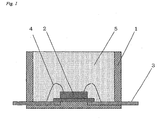
- Fig. 1 is a cross-sectional view of a surface-mount-type light-emitting diode (LED) as an example of the inventive semiconductor device.
- LED light-emitting diode
- Component (A), which is the primary component of the present composition, is selected from the group consisting of the following items (i) through (iii):
- R 1 in the formula stands for a substituted or unsubstituted monovalent hydrocarbon group that does not have aliphatic unsaturated bonds, which is specifically exemplified by methyl, ethyl, propyl, butyl, pentyl, hexyl, heptyl, and other alkyl groups; phenyl, tolyl, xylyl, naphthyl, and other aryl groups; benzyl, phenetyl, and other aralkyl groups; and chloromethyl, 3-chloropropyl, 3,3,3-trifluoropropyl, and other halogenated alkyl groups.
- At least one R 1 in the formula is an aryl group, preferably phenyl group.
- R 2 in the formula is an alkenyl group exemplified by vinyl, allyl, butenyl, pentenyl, and hexenyl group, preferably vinyl group.
- the content of aryl groups relative to the total of R 1 and R 2 in one molecule is preferably not less than 30 mol%, more preferably, not less than 35 mol%, and especially preferably, not less than 40 mol%.
- "m" is a positive integer
- n is a positive integer.
- the values are such that a diorganopolysiloxane is produced whose mass average molecular weight is at least 3,000.
- the mass average molecular weight of component (A 1 ) is at least 3,000, which is due to the fact that if said molecular weight is less than 3,000, the adherence of the resultant cured product to substrates decreases and the mechanical strength of the cured product drops.
- the viscosity of such component (A 1 ) at 25°C in general, its viscosity is preferably not less than 2,000 mPa ⁇ s.
- the diorganopolysiloxane of component (A 1 ) is exemplified by methylphenylsiloxane-methylvinylsiloxane copolymer having both terminals of the molecular chain end-blocked by dimethylvinylsiloxy groups; methylphenylsiloxane-methylvinylsiloxane-dimethylsiloxane copolymer having both terminals of the molecular chain end-blocked by dimethylvinylsiloxy groups; and mixtures of two or more of the above.
- component (A 2 ) is a component used to adjust the viscosity of the resultant composition when a high-viscosity diorganopolysiloxane is used as component (A 1 ).
- R 1 is a substituted or unsubstituted monovalent hydrocarbon group that does not have aliphatic unsaturated bonds and is exemplified by the same groups as above.
- at least one R 1 in the formula is an aryl group, preferably phenyl group.
- R 2 in the formula is an alkenyl group exemplified by the same groups as those mentioned above, preferably vinyl group.
- the content of aryl groups relative to the total of R 1 and R 2 in one molecule is preferably not less than 30 mol%, more preferably, not less than 35 mol%, and especially preferably, not less than 40 mol%.
- “m' " is a positive integer
- "n' " is a positive integer. Specifically, the values are such that a diorganopolysiloxane is produced whose mass average molecular weight is less than 3,000.
- the mass average molecular weight of component (A 2 ) is less than 3,000, which is due to the fact that if said molecular weight is 3,000 or more, the viscosity of the resultant composition decreases and it becomes difficult to improve its handling properties and filling properties when a high-viscosity diorganopolysiloxane is used as component (A 1 ). While there are no particular limitations concerning the viscosity of component (A 2 ) at 25°C, it is preferably less than 2000 mPa ⁇ s, more preferably, in the range of from 10 to 1000 mPa ⁇ s, and especially preferably, in the range of from 100 to 1000 mPa ⁇ s.
- the mass ratio of component (A 1 ) and component (A 2 ) is preferably in the range of from 1:100 to 100:1, more preferably, in the range of from 1:50 to 50:1, and especially preferably, in the range of from 1:10 to 10:1.
- the diorganopolysiloxane of component (A 2 ) is exemplified by methylphenylsiloxane-methylvinylsiloxane copolymer having both terminals of the molecular chain end-blocked by dimethylvinylsiloxy groups; methylphenylsiloxane-methylvinylsiloxane-dimethylsiloxane copolymer having both terminals of the molecular chain end-blocked by dimethylvinylsiloxy groups; and mixtures of two or more of the above.
- Component (A 3 ) is a component used to improve the flexibility of the resultant cured product as well as to adjust the viscosity of the resultant composition when a high-viscosity diorganopolysiloxane is used as component (A 1 ).
- R 1 is a substituted or unsubstituted monovalent hydrocarbon group that does not have aliphatic unsaturated bonds and is exemplified by the same groups as above.
- at least one R 1 in the formula is an aryl group, preferably phenyl group.
- R 2 in the formula is an alkenyl group exemplified by the same groups as those mentioned above, preferably vinyl group.
- the content of aryl groups relative to the total of R 1 and R 2 in one molecule is preferably not less than 30 mol%, more preferably, not less than 35 mol%, and especially preferably, not less than 40 mol%.
- “m” " in the formula is a positive integer. While there are no particular limitations concerning the molecular weight and viscosity of component (A 3 ), in general, its viscosity at 25°C is preferably in the range of from 10 to 1,000,000 mPa ⁇ s, and especially preferably, in the range of from 100 to 50,000 mPa ⁇ s.
- the mass ratio of component (A 1 ) and component (A 3 ) is preferably in the range of from 1:100 to 100:1, more preferably, in the range of from 1:50 to 50:1, and especially preferably, in the range of from 1:10 to 10:1.
- the diorganopolysiloxane of component (A 3 ) is exemplified by methylphenylpolysiloxane having both terminals of the molecular chain end-blocked by dimethylvinylsiloxy groups; methylphenylsiloxane-dimethylsiloxane copolymer having both terminals of the molecular chain end-blocked by dimethylvinylsiloxy groups; and mixtures of two or more of the above.
- Component (B) which is a component used to impart mechanical strength to the resultant cured product, is a branched organopolysiloxane represented by the average unit formula: (R 3 SiO 3/2 ) a (R 3 2 SiO 2/2 ) b (R 3 3 SiO 1/2 ) c (SiO 4/2 ) d (XO 1/2 ) e
- R 3 stands for a substituted or unsubstituted monovalent hydrocarbon group specifically exemplified by methyl, ethyl, propyl, butyl, pentyl, hexyl, heptyl, and other alkyl groups; vinyl, allyl, butenyl, pentenyl, hexenyl, and other alkenyl groups; phenyl, tolyl, xylyl, naphthyl, and other aryl groups; benzyl, phenetyl, and other aralkyl groups; and chloromethyl, 3-chloropropyl, 3,3,3-trifluoropropyl, and other halogenated allyl groups.
- At least one R 3 in the formula is an alkenyl group.
- the alkenyl group content is preferably not less than 0.5 mol% relative to the total of R 3 in one molecule.
- at least one R 3 in the formula is an aryl group.
- the aryl group content is preferably not less than 25 mol%, more preferably, not less than 30 mol%, and especially preferably, not less than 40 mol% relative to the total of R 3 in one molecule.
- X is a hydrogen atom or an alkyl group, with the alkyl group exemplified by methyl, ethyl, and propyl group.
- a is a positive number
- b is 0 or a positive number
- c is 0 or a positive number
- d is 0 or a positive number
- e is 0 or a positive number
- b/a is a number between 0 and 10
- c/a is a number between 0 and 5.0
- d/(a+b+c+d) is a number between 0 and 0.3
- e/(a+b+c+d)” is a number between 0 and 0.4.
- the molecular weight of component (B) its mass average molecular weight is preferably in the range of from 500 to 10,000 and, particularly preferably, in the range of from 700 to 3,000.
- the content of component (B) in the present composition is such that the ratio of the mass of component (B) to component (A), i.e. ⁇ mass of component (B)/mass of component (A) ⁇ is in the range of from 1/99 to 99/1, and more preferably, in the range of from 10/99 to 70/30.
- This is due to the fact that the strength of the resultant cured product decreases when the content of component (B) is below the lower limit of the above-mentioned range and, on the other hand, due to the fact that the handling properties of the resultant composition decrease and the resultant cured product becomes extremely hard when the upper limit of the above-mentioned range is exceeded.
- Component (C) which is a curing agent in the present composition, is an organopolysiloxane having at least, on average, two silicon-bonded aryl groups and at least, on average, two silicon-bonded hydrogen atoms in one molecule.
- the aryl groups of component (C) are exemplified by phenyl, tolyl, xylyl, and naphthyl group, with phenyl group being preferable.
- silicon-bonded groups other than aryl groups and hydrogen atoms in component (C) are exemplified by methyl, ethyl, propyl, butyl, pentyl, hexyl, heptyl, and other alkyl groups; benzyl, phenetyl, and other aralkyl groups; and chloromethyl, 3-chloropropyl, 3,3,3-trifluoropropyl, and other halogenated alkyl groups; with alkyl groups being preferable and methyl groups being particularly preferable.
- the content of aryl groups relative to all the silicon-bonded organic groups in one molecule is preferably not less than 10 mol% and, more preferably, not less than 15 mol%. While there are no particular limitations concerning the viscosity of component (C) at 25°C, its viscosity is preferably in the range of from 1 to 1,000 mPa ⁇ s, and especially preferably, in the range of from 2 to 500 mPa ⁇ s.
- the organopolysiloxane of component (C) is exemplified by methylphenylpolysiloxane having both terminals of the molecular chain end-blocked by dimethylhydrogensiloxy groups; methylphenylsiloxane-dimethylsiloxane copolymer having both terminals of the molecular chain end-blocked by dimethylhydrogensiloxy groups; methylphenylsiloxane-methylhydrogensiloxane copolymer having both terminals of the molecular chain end-blocked by trimethylsiloxy groups; methylphenylsiloxane-methylhydrogensiloxane-dimethylsiloxane copolymer having both terminals of the molecular chain end-blocked by trimethylsiloxy groups; organopolysiloxane copolymer made up of siloxane units represented by (CH 3 ) 2 HSiO 1/2 and siloxane units represented by C 6 H 5 SiO 3/2
- component (C) is preferably a linear diorganopolysiloxane having both terminals of the molecular chain end-blocked by silicon-bonded hydrogen atoms.
- Such component (C) is represented by the general formula: HR 1 2 SiO(R 1 2 SiO) p SiR 1 2 H
- R 1 is a substituted or unsubstituted monovalent hydrocarbon group that does not have aliphatic unsaturated bonds and is exemplified by the same groups as above, preferably, by methyl and phenyl group.
- at least one R 1 in the formula has to be an aryl group, with phenyl group being particularly preferable.
- "p" in the formula is an integer of 1 or greater, preferably, an integer between 1 and 20, and especially preferably, an integer between 1 and 10. This is due to the fact that when "p" exceeds the upper limit of the above-mentioned range, the handling properties and filling properties of the resultant composition decrease and the adherence of the resultant cured product tends to decrease.
- the content of component (C) is such that the amount of silicon-bonded hydrogen atoms in the present component per 1 mol of the total of the alkenyl groups in component (A) and component (B) is in the range of from 0.1 to 10 mol, preferably, in the range of from 0.1 to 5 mol, and especially preferably, in the range of from 0.5 to 2 mol. This is due to the fact that the resultant composition does not completely cure if the content of component (C) is below the lower limit of the above-mentioned range and, on the other hand, the fact that the heat resistance of the resultant cured product decreases if the upper limit of the above-mentioned range is exceeded.
- the hydrosilylation reaction catalyst of component (D), which is a catalyst used to promote the cure of the present composition, is specifically exemplified by platinum-based catalysts, rhodium-based catalysts, palladium-based catalysts, and iridium-based catalysts, with platinum-based catalysts being preferable.
- the platinum-based catalysts are exemplified by platinum micropowder, platinum black, chloroplatinic acid, platinum tetrachloride, alcohol-modified chloroplatinic acid, olefin complexes of platinum, alkenylsiloxane complexes of platinum, carbonyl complexes of platinum, as well as powders of methylmethacrylate resins, polycarbonate resins, polystyrene resins, silicone resins and other thermoplastic organic resins containing these platinum-based catalysts.
- the content of component (D) is a catalytic content, more specifically, a content such that the content of metal atoms in component (D) relative to the composition is in the range of from 0.1 to 1,000 ppm in mass units, preferably, in the range of from 0.1 to 500 ppm, and especially preferably, in the range of from 0.1 to 100 ppm.
- the present composition may contain (E) an adhesion-imparting agent.
- Component (E) is preferably an adhesion-imparting agent obtained by radical co-polymerization of (E 1 ) a vinylic monomer having no epoxy groups, silicon-bonded alkoxy groups, and silicon-bonded hydrogen atoms; (E2) a vinylic monomer having epoxy groups and/or silicon-bonded alkoxy groups and having no silicon-bonded hydrogen atoms; and (E 3 ) a vinylic monomer having silicon-bonded hydrogen atoms.
- Component (E 1 ) is exemplified by methyl acrylate, methyl methacrylate, ethyl acrylate, ethyl methacrylate, n -propyl acrylate, n -propyl methacrylate, isopropyl acrylate, isopropyl methacrylate, n -butyl acrylate, n -butyl methacrylate, isobutyl acrylate, isobutyl methacrylate, t -butyl acrylate, t -butyl methacrylate, and other lower alkyl acrylates or methacrylates; n -hexyl methacrylate, cyclohexyl acrylate, 2-ethylhexyl acrylate, octyl acrylate, lauryl acrylate, stearyl acrylate, and other higher alkyl acrylates or methacrylates; vinyl acetate, vinyl propionate
- component (E 1 ) may be a polyfunctional vinylic monomer specifically exemplified by allyl acrylate, allyl methacrylate, and other alkenyl acrylate or methacrylate; trimethylolpropane triacrylate, trimethylolpropane trimethacrylate, pentaerythritol triacrylate, pentaerythritol trimethacrylate, ethylene glycol diacrylate, ethylene glycol dimethacrylate, tetraethylene glycol diacrylate, polyethylene glycol diacrylate, polyethylene glycol dimethacrylate, 1,4-butanediol diacrylate, 1,4-butanediol dimethacrylate, 1,6-hexanediol diacrylate, 1,6-hexanediol dimethacrylate, neopentyl glycol diacrylate, neopentyl glycol dimethacrylate, trimethylolpropane trioxye
- component (E 2 ) is exemplified by glycidyl acrylate, glycidyl methacrylate, 3,4-epoxycyclohexylmethyl acrylate, 3,4-epoxycyclohexylmethyl methacrylate, and other epoxy-containing alcohol esters of acrylic acid or methacrylic acid; 3-methacryloxypropyltrimethoxysilane, 3-methacryloxypropyltriethoxysilane, 3-methacryloxypropyldimethoxymethylsilane, 3-methacryloxypropyldiethoxymethylsilane, 3-acryloxypropyltrimethoxysilane, and other acryloxyalkylalkoxysilanes or methacryloxyalkylalkoxysilanes; 3-methacrylamidopropyltrimethoxysilane, 3-acrylamidopropyltriethoxysilane, and other acrylamidoalkylalkoxysilanes or methacrylacryloxy
- component (E 3 ) is specifically exemplified by the following compounds.
- CH 2 C(CH 3 )C(O)OC 3 H 6 Si[OSiH(CH 3 ) 2 ] 3
- CH 2 CHC(O)OC 3 H 6 Si[OSiH(CH 3 ) 2 ] 3
- CH 2 C(CH 3 )C(O)OC 3 H 6 Si[OSiH(CH 3 ) 2 ] 2 [OSi(CH 3 ) 3 ]
- CH 2 CHC(O)OC 3 H 6 Si[OSiH(CH 3 ) 2 ] 2 [OSi(CH 3 ) 3 ]
- CH 2 C(CH 3 )C(O)OC 3 H 6 Si[OSiH(CH 3 ) 2 ][OSi(CH 3 ) 3 ] 2
- CH 2 CHC(O)OC 3 H 6 Si[OSiH(CH 3 )2][OSi(CH 3 ) 3 ] 2
- CH 2 C(CH 3 )C(O)C 3
- dimethylpolysiloxanes having methacryloxy, acryloxy, vinylphenyl, alkenyl, and other radical polymerizable vinyl bond-containing groups at the terminal of the molecular chain and having silicon-bonded hydrogen atoms in side chains and at the terminal of the molecular chain are also suggested.
- component (E 4 ) a chain transfer agent may be added during the radical co-polymerization of component (E 1 ), component (E 2 ), and component (E 3 ) to permit preparation of radical polymerization products of predetermined degrees of polymerization in a stable and highly reproducible manner.
- component (E 4 ) is preferably a mercapto-containing organosilicon compound or organic mercaptan. It is believed that the mercapto groups control the degree of polymerization by bonding to the terminal of the radical polymerization product.
- the mercapto-containing organosilicon compounds of component (E 4 ) are exemplified by 3-mercaptopropyltrimethoxysilane, 3-mercaptopropyltriethoxysilane, 3-mercaptopropyldimethoxymethylsilane, 3-mercaptopropylmethoxydimethylsilane, and other mercaptoalkylalkoxysilanes; mercaptopropyltri(dimethylhydrogensiloxy)silane, mercaptopropyldi(dimethylhydrogensiloxy)methylsilane, and other mercaptoalkyl(dialkylhydrogensiloxy)silanes.
- the organic mercaptan of component (E 4 ) is exemplified by 2-mercaptoethanol, butylmercaptan, hexylmercaptan, and n-dodecylmercaptan.
- mercapto-containing organosilicon compounds in particular, mercaptoalkylalkoxysilanes and mercaptoalkyl(dialkylhydrogensiloxy)silanes are especially preferable from the standpoint of their adherence-improving action.
- the amount of added component (E 4 ) which is adjusted appropriately so as to obtain a radical polymerization product of a predetermined degree of polymerization.
- component (E 1 ), component (E 2 ), and component (E 3 ) added during their co-polymerization it is preferable to use 10.0 to 70.0 mol% of component (E 1 ), 20.0 to 70.0 mol% of component (E 2 ), and 5.0 to 70.0 mol% of component (E 3 ), and it is especially preferable to use 15.0 to 55.0 mol% of component (E 1 ), 30.0 to 50.0 mol% of component (E 2 ), and 10.0 to 55.0 mol% of component (E 3 ).
- the radical polymerization reaction is carried out in the presence or in the absence of an organic solvent.
- an organic solvent is used, the radical polymerization reaction is conducted in the presence of a free-radical initiator, preferably, in the temperature range of 50 to 150°C for 3 to 20 hours.
- the organic solvents used at such time are exemplified by hexane, octane, decane, cyclohexane, and other aliphatic hydrocarbons; benzene, toluene, xylene, and other aromatic hydrocarbons; diethyl ether, dibutyl ether, tetrahydrofuran, dioxane, and other ethers; acetone, methyl ethyl ketone, methyl isobutyl ketone, diisobutyl ketone, and other ketones; methyl acetate, ethyl acetate, butyl acetate, isobutyl acetate, and other esters; methanol, ethanol, isopropanol, butanol, and other alcohols.
- toluene or xylene are particularly suitable.
- free-radical initiators conventional publicly known compounds normally used in the radical polymerication process can be used as the free-radical initiators.
- These free-radical initiators are specifically exemplified by 2,2'-azobis(isobutyronitrile), 2,2'-azobis(2-methylbutyronitrile), 2,2'-azobis(2,4-dimethylvaleronitrile), and other azobis compounds; benzoyl peroxide, lauroyl peroxide, tert -butylperoxybenzoate, tert -butylperoxy-2-ethylhexanoate, and other organic peroxides, as well as mixtures of two or more of the above.
- the amount of the added free-radical initiator is preferably in the range of from 0.1 to 5 parts by mass relative to 100 parts by mass of the total of the above-described component (E I ), component (E 2 ), and component (E 3 ).
- the present composition may contain an organosilicon compound having at least one silicon-bonded alkoxy group in one molecule as component (E).
- the alkoxy group is exemplified by methoxy, ethoxy, propoxy, butoxy, and methoxyethoxy groups, with methoxy groups being preferable.
- groups other than the alkoxy groups attached to the silicon atoms of the organosilicon compound are exemplified by substituted or unsubstituted monovalent groups, such as methyl, ethyl, propyl, butyl, pentyl, hexyl, heptyl, and other alkyl groups; vinyl, allyl, butenyl, pentenyl, hexenyl, and other alkenyl groups; phenyl, tolyl, xylyl, naphthyl, and other aryl groups; benzyl, phenetyl, and other aralkyl groups; chloromethyl, 3-chloropropyl, 3,3,3-trifluoropropyl, and other halogenated alkyl groups; epoxy-containing monovalent organic groups, such as 3-glycidoxypropyl, 4-glycidoxybutyl, and other glycidoxyalkyl groups; 2-(3,4-epoxycyclohexyl
- the organosilicon compound preferably has groups capable of reacting with component (A), component (B), or component (C), more specifically, it preferably has silicon-bonded hydrogen atoms or silicon-bonded alkenyl groups. Moreover, because of the ability to impart sufficient adherence to various substrates, the organosilicon compound preferably has at least one epoxy-containing monovalent organic group in one molecule.
- Such organosilicon compounds are exemplified by organosilane compounds, organosiloxane oligomers, and alkyl silicates.
- the molecular structure of the organosiloxane oligomers or alkyl silicates is exemplified by linear, partially branched linear, branched, cyclic, and network-like, with linear, branched, and network-like being particularly preferable.
- Such organosilicon compounds are exemplified by 3-glycidoxypropyltrimethoxysilane, 2-(3,4-epoxycyclohexyl)ethyltrimethoxysilane, 3-methacryloxypropyltrimethoxysilane, and other silane compounds; siloxane compounds having, respectively, at least one silicon-bonded alkenyl group or silicon-bonded hydrogen atom, and an alkoxy group in one molecule, mixtures of siloxane compounds having, respectively, at least one silicon-bonded alkenyl group and silicon-bonded hydroxyl group in one molecule with siloxane compounds or silane compounds having at least one silicon-bonded alkoxy group, siloxane compounds represented by the average unit formula: (where "j", "k”, and “p” are positive numbers), siloxane compounds represented by the average unit formula: (where "j", "k”, “p”, and “q” are positive numbers), methyl polysilicate, ethyl polysilicate, and epoxy-containing
- component (E) is preferably liquid at normal temperature and, specifically, its viscosity at 25°C is preferably in the range of from 1 to 1,000,000 mPa ⁇ s.
- the content of component (E) in the present composition is preferably in the range of from 0.001 to 10 parts by mass, more preferably, in the range of from 0.01 to 10 parts by mass, and especially preferably, in the range of from 0.01 to 5 parts by mass relative to 100 parts by mass of the total of components (A) through (C).
- the present composition may contain a reaction inhibitor used for improving the storage stability and handling properties of the present composition.
- the reaction inhibitor is exemplified by 2-methyl-3-butyn-2-ol, 3,5-dimethyl-1-hexyn-3-ol, 2-phenyl-3-butyn-2-ol, and other alkyne alcohols; 3-methyl-3-penten-1-yne, 3,5-dimethyl-3-hexen-1-yne, and other ene-yne compounds; 1,3,5,7-tetramethyl-1,3,5,7-tetravinylcyclotetrasiloxane, 1,3,5,7-tetramethyl-1,3,5,7-tetrahexenylcyclotetrasiloxane, and benzotriazole. While there are no particular limitations concerning the content of the reaction inhibitor in the present composition, it is preferably an amount in the range of from 10 to 50,000 ppm relative to the present composition in mass units.
- the present composition may contain other optional components, such as silica powder, quartz powder, alumina powder, and other inorganic fillers; powders of organic resins, such as polymethacrylate resins; pigments, heat resistance-improvers, flame retardants, solvents, etc.
- the present composition preferably contains 0.1 to 10 mass% of silica powder, and it is especially preferable for it to contain the powder in the range of from 0.1 to 5 mass% because then its optical transmissivity does not decrease.
- the present composition forms a cured product with a Type A durometer value (hardness) of preferably not less than 15 in accordance with JIS K 6253.
- the hardness is preferably in the range of from 15 to 80, and especially preferably, in the range of 15 to 50 because this makes it possible to decrease the surface tack of the resultant cured product.
- Such a cured product is elastomer-like, in particular, rubber-like.
- the index of refraction at 25°C of the present composition in visible light of 589 nm is preferably not less than 1.5.
- the composition preferably forms cured products whose optical transmissivity at 25°C at an optical path length of 0.2 mm and a wavelength of 450 nm is not less than 80%, and especially preferably, forms cured products whose optical transmissivity is 90% to 100%.
- the present composition While there are no particular limitations concerning the method used to cure the present composition, it is preferable, for instance, to cure the present composition into a gel-like incompletely cured product and then turn it into a completely cured product by keeping it at more elevated temperature.
- heat curing is divided into two or more stages, with the minimum temperature that initiates the curing of the present composition used as the curing temperature during curing in the first stage.
- the curing temperature of the first stage is preferably not more than 100°C.
- the present composition gels and turns into a non-flowable cured product.
- the second stage it is completely cured by maintaining it at a more elevated temperature than in the first stage. This temperature is preferably in the range of from 120 to 180°C.
- Such two-stage curing makes it possible to reduce internal stress that builds up during the curing of the present composition and permits an improvement in adherence to substrates.
- the semiconductor device of the present invention has a semiconductor element covered by a cured product of the above-mentioned curable organopolysiloxane composition.
- This semiconductor element may be a light-emitting semiconductor element, a light-receiving semiconductor element, etc.
- a representative example of the optical semiconductor element is an LED chip, which is suitably formed as a light-emitting layer of semiconductor material, such as InN, AlN, GaN, ZnSe, SiC, GaP, GaAs, GaAlAs, GaAlN, AlInGaP, InGaN, AlInGaN, etc. on a substrate using the liquid phase growth technique or MOCVD technique.
- the semiconductor device of the present invention is, for instance, a surface mount-type light-emitting diode (LED) obtained by placing an optical semiconductor element (e.g. an LED chip) inside a case of a U-shaped cross-section made of heat-resistant organic resin (for instance, polyphthalamide resin, polyphenylene sulfide resin, or polyether nitrile resin), filling the case with the above-described curable organopolysiloxane composition, and curing it, thereby encapsulating the optical semiconductor element (e.g. an LED chip) in the transparent cured product obtained by curing the above-mentioned curable organopolysiloxane composition.
- an optical semiconductor element e.g. an LED chip
- the above-mentioned curable organopolysiloxane composition durably adheres to the bonding wires, inner electrodes (inner leads), optical semiconductor element (e.g. LED chips), and heat resistant organic resins it comes into contact with in the process of curing.
- a light-emitting diode may be a bullet-shaped device, with devices other than light-emitting diodes (LED) exemplified by photocouplers and CCDs.
- LED light-emitting diodes
- Fig. 1 is a surface mount-type device.
- Inner leads 3 extend from the side walls towards the center of the inner bottom portion of case 1 made of polyphthalamide (PPA) resin, an LED chip 2 is positioned over the central portions of the inner leads 3, the LED chip 2 and inner leads 3 are electrically connected with bonding wires 4, and the inside of case 1 made of polyphthalamide (PPA) resin is filled with the inventive curable organopolysiloxane composition which, when heat-cured, forms a transparent cured product 5.
- PPA polyphthalamide
- the organopolysiloxane was used to prepare a toluene solution and gel permeation chromatography of the toluene medium was used to determine the mass average molecular weight based on standard polystyrene.
- the index of refraction of the curable organopolysiloxane composition was measured at 25°C using an Abbe refractometer. It should be noted that visible light of 589 nm was used as the optical source.
- the curable organopolysiloxane composition was placed between two glass plates and cured by keeping it at 150°C for 1 hour (optical path length: 0.2 mm), whereupon optical transmissivity was measured at 25°C using a recording spectrophotometer capable of measurement at any wavelength in the visible light (wavelength: 400 nm to 700 nm) range.
- Optical transmissivity with the glass plates included and optical transmissivity of the glass plates alone were measured, and optical transmissivity of the cured product was obtained as their difference. It should be noted that Table 1 contains optical transmissivity at a wavelength of 450 nm.
- a sheet of cured product was fabricated by press-molding the curable organopolysiloxane composition at 150°C for 1 hour.
- the hardness of the cured product sheet was measured using a Type A durometer as specified in JIS K 6253.
- a sheet of cured product was fabricated by press-molding the curable organopolysiloxane composition at 150°C for 1 hour. The surface of the cured product sheet was touched with a finger and its tackiness was evaluated in the following manner.
- Dumbbell-shaped Type 3 test pieces of the cured product as specified in JIS K 6251, were fabricated by press-molding the curable organopolysiloxane composition at 150°C for 1 hour.
- the tensile strength of the cured product was measured in accordance with the method specified in JIS K 6251.
- a light-emitting diode (LED) of the surface mount type was fabricated using the curable organopolysiloxane composition and the peeling ratio of the cured product was evaluated in the following manner.
- the curable organopolysiloxane composition of each Practical Example and each Comparative Example was defoamed and injected through a dispenser into a polyphthalamide (PPA) resin case 1 of a precursor article, in which inner leads 3 extended from the side walls towards the center of the inner bottom portion of a cylindrical case 1 that was made of polyphthalamide (PPA) resin (inner diameter 2.0 mm, depth 1.0 mm) and was sealed at the bottom, an LED chip 2 was positioned over the central portions of the inner leads 3, and bonding wires were used to electrically connect LED chip 2 to inner leads 3, whereupon the above-mentioned composition was first kept at 60°C for 1 hour and then kept at 150°C for 1 hour, thereby curing it and producing sixteen light-emitting diodes (LEDs) of the surface mount type illustrated in Fig. 1 .
- LEDs sixteen light-emitting diodes
- peeling ratio number of devices exhibiting peeling/16
- peeling between the inner walls of the polyphthalamide (PPA) resin case 1 and the heat-cured product of the composition was examined for each of the above-mentioned 16 surface mount type light-emitting diodes (LEDs) using an optical microscope.
- the co-polymer was a yellowish transparent liquid with a viscosity of 180,000 mPa ⁇ s, a refractive index of 1.4723, a silicon-bonded hydrogen atom content of 0.08 mass%, a silicon-bonded methoxy group content of 4.8 mass%, and an epoxy equivalent of 470.
- Curable organopolysiloxane compositions were prepared by mixing the below listed components in the part by mass proportions indicated in Table 1. The characteristics of these curable organopolysiloxane compositions, the characteristics of the cured products obtained by curing these compositions, as well as the characteristics of the surface mount type light-emitting diodes (LEDs) fabricated using these compositions were evaluated in the above-described manner and the results were listed in Table 1.
- LEDs surface mount type light-emitting diodes
- the curable organopolysiloxane composition of the present invention is useful as a potting agent, protective coating agent, underfilling agent, etc. used for electronic equipment, electronic components, electric equipment, electric components, etc.
- the composition forms a cured product with a high refractive index and optical transmissivity, high hardness, low surface tack, and excellent adherence to various substrates, it is useful as an encapsulant, potting agent, protective coating agent, underfilling agent, etc. used for optical semiconductor elements and optical semiconductor members.
- the semiconductor device of the present invention is useful as a light-emitting device, light-emitting diode (LED) display, etc.
Landscapes
- Chemical & Material Sciences (AREA)
- Health & Medical Sciences (AREA)
- Chemical Kinetics & Catalysis (AREA)
- Medicinal Chemistry (AREA)
- Polymers & Plastics (AREA)
- Organic Chemistry (AREA)
- Compositions Of Macromolecular Compounds (AREA)
- Structures Or Materials For Encapsulating Or Coating Semiconductor Devices Or Solid State Devices (AREA)
- Silicon Polymers (AREA)
- Led Device Packages (AREA)
Applications Claiming Priority (2)
| Application Number | Priority Date | Filing Date | Title |
|---|---|---|---|
| JP2006229551A JP5148088B2 (ja) | 2006-08-25 | 2006-08-25 | 硬化性オルガノポリシロキサン組成物および半導体装置 |
| PCT/JP2007/064843 WO2008023537A1 (en) | 2006-08-25 | 2007-07-24 | Curable orgnopolysiloxane composition and semiconductor device |
Publications (2)
| Publication Number | Publication Date |
|---|---|
| EP2061840A1 EP2061840A1 (en) | 2009-05-27 |
| EP2061840B1 true EP2061840B1 (en) | 2010-01-06 |
Family
ID=38596765
Family Applications (1)
| Application Number | Title | Priority Date | Filing Date |
|---|---|---|---|
| EP07791537A Active EP2061840B1 (en) | 2006-08-25 | 2007-07-24 | Curable orgnopolysiloxane composition and semiconductor device |
Country Status (10)
| Country | Link |
|---|---|
| US (1) | US8217388B2 (https=) |
| EP (1) | EP2061840B1 (https=) |
| JP (1) | JP5148088B2 (https=) |
| KR (1) | KR101408711B1 (https=) |
| CN (1) | CN101506309B (https=) |
| AT (1) | ATE454430T1 (https=) |
| DE (1) | DE602007004235D1 (https=) |
| MY (1) | MY145422A (https=) |
| TW (1) | TWI398488B (https=) |
| WO (1) | WO2008023537A1 (https=) |
Cited By (2)
| Publication number | Priority date | Publication date | Assignee | Title |
|---|---|---|---|---|
| US9593277B2 (en) | 2014-02-04 | 2017-03-14 | Dow Corning Toray Co., Ltd. | Curable silicone composition, cured product therefrom, and optical semiconductor device |
| US9944759B2 (en) | 2014-02-04 | 2018-04-17 | Dow Corning Toray Co., Ltd. | Curable silicone composition, cured product therefrom, and optical semiconductor device |
Families Citing this family (66)
| Publication number | Priority date | Publication date | Assignee | Title |
|---|---|---|---|---|
| JP4895879B2 (ja) * | 2007-03-19 | 2012-03-14 | サンユレック株式会社 | 発光素子封止用シリコーン樹脂組成物及びこれを用いたポッティング方式による光半導体電子部品の製造方法 |
| JP5000566B2 (ja) * | 2008-03-27 | 2012-08-15 | 信越化学工業株式会社 | 硬化性シリコーンゴム組成物、およびそれを封止材料として用いた光半導体装置 |
| US12064979B2 (en) | 2008-06-13 | 2024-08-20 | Kateeva, Inc. | Low-particle gas enclosure systems and methods |
| US11975546B2 (en) | 2008-06-13 | 2024-05-07 | Kateeva, Inc. | Gas enclosure assembly and system |
| US8899171B2 (en) | 2008-06-13 | 2014-12-02 | Kateeva, Inc. | Gas enclosure assembly and system |
| US10434804B2 (en) | 2008-06-13 | 2019-10-08 | Kateeva, Inc. | Low particle gas enclosure systems and methods |
| US12018857B2 (en) | 2008-06-13 | 2024-06-25 | Kateeva, Inc. | Gas enclosure assembly and system |
| JP2010013503A (ja) * | 2008-07-01 | 2010-01-21 | Showa Highpolymer Co Ltd | 硬化性樹脂組成物およびオプトデバイス |
| JP5469874B2 (ja) * | 2008-09-05 | 2014-04-16 | 東レ・ダウコーニング株式会社 | 硬化性オルガノポリシロキサン組成物、光半導体素子封止剤および光半導体装置 |
| JP5414337B2 (ja) * | 2009-04-17 | 2014-02-12 | 信越化学工業株式会社 | 光半導体装置の封止方法 |
| US20120065343A1 (en) * | 2009-05-29 | 2012-03-15 | Maneesh Bahadur | Silicone Composition for Producing Transparent Silicone Materials and Optical Devices |
| JP2011155187A (ja) * | 2010-01-28 | 2011-08-11 | Konica Minolta Opto Inc | 発光ダイオードユニットの製造方法 |
| JP2011155188A (ja) * | 2010-01-28 | 2011-08-11 | Konica Minolta Opto Inc | 発光ダイオードユニットの製造方法 |
| JP5621272B2 (ja) * | 2010-02-15 | 2014-11-12 | 横浜ゴム株式会社 | シリコーン樹脂組成物、およびこれを用いる光半導体封止体 |
| CN102471581B (zh) * | 2010-07-27 | 2015-01-28 | 株式会社艾迪科 | 半导体密封用固化性组合物 |
| JP5971835B2 (ja) * | 2010-08-23 | 2016-08-17 | 信越化学工業株式会社 | 硬化性シリコーン樹脂組成物及びそれを用いた発光ダイオード装置 |
| KR101477609B1 (ko) | 2010-09-22 | 2014-12-31 | 다우 코닝 코포레이션 | 수지-선형 유기실록산 블록 공중합체를 함유하는 고굴절률 조성물 |
| KR20140093601A (ko) * | 2010-10-19 | 2014-07-28 | 어브레스틱 (상하이) 리미티드 | 발광 소자용 혼성 실리콘 조성물 |
| JP5549554B2 (ja) * | 2010-11-15 | 2014-07-16 | 信越化学工業株式会社 | 熱硬化性フルオロポリエーテル系接着剤組成物及びその接着方法 |
| TWI519605B (zh) | 2010-12-22 | 2016-02-01 | 邁圖高新材料日本合同公司 | 紫外線硬化型聚矽氧樹脂組成物,以及使用該組成物的圖像顯示裝置 |
| EP2657300B1 (en) | 2010-12-22 | 2015-12-02 | Momentive Performance Materials Japan LLC | Heat-curable polyorganosiloxane composition and use thereof |
| JP5522111B2 (ja) | 2011-04-08 | 2014-06-18 | 信越化学工業株式会社 | シリコーン樹脂組成物及び当該組成物を使用した光半導体装置 |
| CN103534296A (zh) | 2011-05-11 | 2014-01-22 | 汉高股份有限公司 | 具有改善的阻隔性的聚硅氧烷树脂 |
| WO2012157330A1 (ja) * | 2011-05-17 | 2012-11-22 | 積水化学工業株式会社 | 光半導体装置用封止剤及び光半導体装置 |
| JP5992666B2 (ja) * | 2011-06-16 | 2016-09-14 | 東レ・ダウコーニング株式会社 | 架橋性シリコーン組成物及びその架橋物 |
| JP5287935B2 (ja) * | 2011-06-16 | 2013-09-11 | 東レ株式会社 | 蛍光体含有シート、それを用いたled発光装置およびその製造方法 |
| EP2733160A4 (en) * | 2011-07-07 | 2014-12-17 | Dow Corning Toray Co Ltd | ORGANOPOLYSILOXAN AND MANUFACTURING METHOD THEREFOR |
| JP5893874B2 (ja) * | 2011-09-02 | 2016-03-23 | 信越化学工業株式会社 | 光半導体装置 |
| JP5912600B2 (ja) * | 2011-09-16 | 2016-04-27 | 東レ・ダウコーニング株式会社 | 硬化性シリコーン組成物、その硬化物、および光半導体装置 |
| KR101865922B1 (ko) | 2011-09-30 | 2018-06-11 | 롬엔드하스전자재료코리아유한회사 | 유기실록산 중합체를 포함하는 저온 경화성 수지 조성물 |
| JP5921154B2 (ja) * | 2011-11-09 | 2016-05-24 | 日東電工株式会社 | 光学フィルム、画像表示装置および画像表示装置の製造方法 |
| CN104066795B (zh) * | 2011-11-25 | 2016-06-08 | Lg化学株式会社 | 可固化组合物 |
| JP2013139547A (ja) * | 2011-12-05 | 2013-07-18 | Jsr Corp | 硬化性組成物、硬化物および光半導体装置 |
| JP5621819B2 (ja) * | 2011-12-20 | 2014-11-12 | Jsr株式会社 | 硬化性組成物、硬化物および光半導体装置 |
| JP5652387B2 (ja) * | 2011-12-22 | 2015-01-14 | 信越化学工業株式会社 | 高信頼性硬化性シリコーン樹脂組成物及びそれを使用した光半導体装置 |
| JP5575820B2 (ja) * | 2012-01-31 | 2014-08-20 | 信越化学工業株式会社 | 硬化性オルガノポリシロキサン組成物、光学素子封止材および光学素子 |
| CN104583278B (zh) | 2012-05-14 | 2018-04-10 | 莫门蒂夫性能材料股份有限公司 | 高折射率材料 |
| JP5819787B2 (ja) * | 2012-07-19 | 2015-11-24 | 信越化学工業株式会社 | 硬化性シリコーン樹脂組成物 |
| JP2014031394A (ja) * | 2012-08-01 | 2014-02-20 | Shin Etsu Chem Co Ltd | 付加硬化型シリコーン組成物、及び該組成物の硬化物により半導体素子が被覆された半導体装置 |
| CN104662098A (zh) | 2012-08-02 | 2015-05-27 | 汉高股份有限公司 | 用于led封装剂的包含聚碳硅烷和含氢聚硅氧烷的可固化组合物 |
| EP2880082A4 (en) | 2012-08-02 | 2016-03-02 | Henkel China Co Ltd | POLYCARBOSILAN AND HARDENABLE COMPOSITIONS FOR LED PACKAGING THEREOF |
| DE102012220954A1 (de) * | 2012-11-16 | 2014-05-22 | Wacker Chemie Ag | Schleifbare Siliconelastomerzusammensetzung und deren Verwendung |
| WO2014084624A1 (ko) * | 2012-11-30 | 2014-06-05 | 코오롱생명과학 주식회사 | 광디바이스용 경화형 투명 실리콘 조성물 |
| US9688820B2 (en) * | 2013-04-04 | 2017-06-27 | Lg Chem, Ltd. | Curable composition |
| CN103525095A (zh) * | 2013-09-30 | 2014-01-22 | 瑞金市瑞谷科技发展有限公司 | 一种可固化的有机基聚硅氧烷组合物 |
| WO2015100375A1 (en) | 2013-12-26 | 2015-07-02 | Kateeva, Inc. | Thermal treatment of electronic devices |
| US9343678B2 (en) * | 2014-01-21 | 2016-05-17 | Kateeva, Inc. | Apparatus and techniques for electronic device encapsulation |
| WO2015112454A1 (en) | 2014-01-21 | 2015-07-30 | Kateeva, Inc. | Apparatus and techniques for electronic device encapsulation |
| CN106103594B (zh) * | 2014-01-27 | 2019-06-28 | 陶氏东丽株式会社 | 有机硅凝胶组合物 |
| KR20150097947A (ko) * | 2014-02-19 | 2015-08-27 | 다우 코닝 코포레이션 | 반응성 실리콘 조성물, 이로부터 제조되는 핫멜트 재료, 및 경화성 핫멜트 조성물 |
| JP6323086B2 (ja) * | 2014-03-12 | 2018-05-16 | Jnc株式会社 | 熱硬化性樹脂組成物及びそれを用いた物品 |
| CN105038253B (zh) * | 2014-04-30 | 2018-07-13 | 长兴材料工业股份有限公司 | 可固化组合物及其制法 |
| KR102850075B1 (ko) | 2014-04-30 | 2025-08-25 | 카티바, 인크. | 가스 쿠션 장비 및 기판 코팅 기술 |
| CN105199397B (zh) * | 2014-06-17 | 2018-05-08 | 广州慧谷化学有限公司 | 一种可固化的有机聚硅氧烷组合物及半导体器件 |
| WO2016006773A1 (ko) * | 2014-07-10 | 2016-01-14 | 삼성에스디아이 주식회사 | 경화형 폴리오르가노실록산 조성물, 봉지재, 및 광학기기 |
| KR20170042648A (ko) * | 2014-08-12 | 2017-04-19 | 고쿠리쓰다이가쿠호진 규슈다이가쿠 | 하이드로실릴화 반응 촉매 |
| JP6799070B2 (ja) * | 2016-03-07 | 2020-12-09 | ダウ シリコーンズ コーポレーション | 光硬化性シリコーン組成物及びその硬化物 |
| CN105694047B (zh) * | 2016-04-26 | 2018-09-25 | 烟台德邦先进硅材料有限公司 | 主链含环状结构改性有机硅聚合物及其制备方法 |
| WO2018062009A1 (ja) * | 2016-09-29 | 2018-04-05 | 東レ・ダウコーニング株式会社 | 硬化性シリコーン組成物、その硬化物、および光半導体装置 |
| JP6884458B2 (ja) * | 2017-02-27 | 2021-06-09 | デュポン・東レ・スペシャルティ・マテリアル株式会社 | 硬化性オルガノポリシロキサン組成物および半導体装置 |
| TWI627777B (zh) * | 2017-07-26 | 2018-06-21 | 財團法人工業技術研究院 | 光學補償結構 |
| CN107541076A (zh) * | 2017-09-28 | 2018-01-05 | 广州慧谷化学有限公司 | 高耐热的有机聚硅氧烷组合物及半导体器件 |
| JP6905486B2 (ja) * | 2018-03-13 | 2021-07-21 | 信越化学工業株式会社 | 付加硬化型シリコーン組成物、シリコーン硬化物、及び半導体装置 |
| JP6966381B2 (ja) * | 2018-05-09 | 2021-11-17 | 信越化学工業株式会社 | プライマー組成物及びこれを用いた光半導体装置 |
| CN113874454B (zh) * | 2019-05-21 | 2023-05-23 | 美国陶氏有机硅公司 | 聚有机硅氧烷防粘涂层及其制备和用途 |
| CN110982346A (zh) * | 2019-12-12 | 2020-04-10 | 浙江福斯特新材料研究院有限公司 | 墨水组合物、封装结构及半导体器件 |
Family Cites Families (15)
| Publication number | Priority date | Publication date | Assignee | Title |
|---|---|---|---|---|
| JP3899134B2 (ja) * | 1993-12-29 | 2007-03-28 | 東レ・ダウコーニング株式会社 | 加熱硬化性シリコーン組成物 |
| JP3574226B2 (ja) | 1994-10-28 | 2004-10-06 | 東レ・ダウコーニング・シリコーン株式会社 | 硬化性シリコーン組成物およびその硬化物 |
| JP3344286B2 (ja) | 1997-06-12 | 2002-11-11 | 信越化学工業株式会社 | 付加硬化型シリコーン樹脂組成物 |
| JP4875251B2 (ja) * | 2001-04-26 | 2012-02-15 | 東レ・ダウコーニング株式会社 | シリコーンゲル組成物 |
| JP4040858B2 (ja) * | 2001-10-19 | 2008-01-30 | 東レ・ダウコーニング株式会社 | 硬化性オルガノポリシロキサン組成物および半導体装置 |
| JP4663969B2 (ja) * | 2002-07-09 | 2011-04-06 | 東レ・ダウコーニング株式会社 | 硬化性シリコーンレジン組成物およびその硬化物 |
| JP4409160B2 (ja) * | 2002-10-28 | 2010-02-03 | 東レ・ダウコーニング株式会社 | 硬化性オルガノポリシロキサン組成物および半導体装置 |
| JP4908736B2 (ja) * | 2003-10-01 | 2012-04-04 | 東レ・ダウコーニング株式会社 | 硬化性オルガノポリシロキサン組成物および半導体装置 |
| JP2005162859A (ja) * | 2003-12-02 | 2005-06-23 | Dow Corning Toray Silicone Co Ltd | 付加反応硬化型オルガノポリシロキサン樹脂組成物および光学部材 |
| JP4801320B2 (ja) * | 2003-12-19 | 2011-10-26 | 東レ・ダウコーニング株式会社 | 付加反応硬化型オルガノポリシロキサン樹脂組成物 |
| JP2006063092A (ja) * | 2004-07-29 | 2006-03-09 | Dow Corning Toray Co Ltd | 硬化性オルガノポリシロキサン組成物、その硬化方法、光半導体装置および接着促進剤 |
| EP1674495A1 (en) * | 2004-12-22 | 2006-06-28 | Huntsman Advanced Materials (Switzerland) GmbH | Coating system |
| JP4636242B2 (ja) * | 2005-04-21 | 2011-02-23 | 信越化学工業株式会社 | 光半導体素子封止材及び光半導体素子 |
| KR101325792B1 (ko) * | 2006-01-17 | 2013-11-04 | 다우 코닝 코포레이션 | 열 안정성 투명 실리콘 수지 조성물 및 이의 제조 방법 및용도 |
| JP5202822B2 (ja) * | 2006-06-23 | 2013-06-05 | 東レ・ダウコーニング株式会社 | 硬化性オルガノポリシロキサン組成物および半導体装置 |
-
2006
- 2006-08-25 JP JP2006229551A patent/JP5148088B2/ja active Active
-
2007
- 2007-07-13 TW TW096125678A patent/TWI398488B/zh active
- 2007-07-24 AT AT07791537T patent/ATE454430T1/de not_active IP Right Cessation
- 2007-07-24 MY MYPI20090723A patent/MY145422A/en unknown
- 2007-07-24 KR KR1020097003829A patent/KR101408711B1/ko active Active
- 2007-07-24 CN CN2007800316498A patent/CN101506309B/zh active Active
- 2007-07-24 EP EP07791537A patent/EP2061840B1/en active Active
- 2007-07-24 US US12/438,658 patent/US8217388B2/en active Active
- 2007-07-24 DE DE602007004235T patent/DE602007004235D1/de active Active
- 2007-07-24 WO PCT/JP2007/064843 patent/WO2008023537A1/en not_active Ceased
Cited By (2)
| Publication number | Priority date | Publication date | Assignee | Title |
|---|---|---|---|---|
| US9593277B2 (en) | 2014-02-04 | 2017-03-14 | Dow Corning Toray Co., Ltd. | Curable silicone composition, cured product therefrom, and optical semiconductor device |
| US9944759B2 (en) | 2014-02-04 | 2018-04-17 | Dow Corning Toray Co., Ltd. | Curable silicone composition, cured product therefrom, and optical semiconductor device |
Also Published As
| Publication number | Publication date |
|---|---|
| KR20090054429A (ko) | 2009-05-29 |
| CN101506309A (zh) | 2009-08-12 |
| ATE454430T1 (de) | 2010-01-15 |
| US8217388B2 (en) | 2012-07-10 |
| TWI398488B (zh) | 2013-06-11 |
| DE602007004235D1 (de) | 2010-02-25 |
| KR101408711B1 (ko) | 2014-06-17 |
| JP5148088B2 (ja) | 2013-02-20 |
| JP2008050494A (ja) | 2008-03-06 |
| MY145422A (en) | 2012-02-15 |
| EP2061840A1 (en) | 2009-05-27 |
| WO2008023537A1 (en) | 2008-02-28 |
| TW200811244A (en) | 2008-03-01 |
| US20100301377A1 (en) | 2010-12-02 |
| CN101506309B (zh) | 2012-03-21 |
Similar Documents
| Publication | Publication Date | Title |
|---|---|---|
| EP2061840B1 (en) | Curable orgnopolysiloxane composition and semiconductor device | |
| EP1781741B1 (en) | Curable organopolysiloxane composition, method of curing thereof, semiconductor device, and adhesion promoter | |
| KR101699383B1 (ko) | 경화성 오가노폴리실록산 조성물 및 반도체 장치 | |
| EP1556443B2 (en) | Curable organopolysiloxane composition and a semiconductor device made with the use of this composition | |
| EP2303965B1 (en) | Curable organopolysiloxane composition and semiconductor device | |
| CN113348210B (zh) | 固化性有机硅组合物、其固化物及其制造方法 | |
| JP5524017B2 (ja) | 付加硬化型シリコーン組成物、及び該組成物の硬化物により半導体素子が被覆された半導体装置 | |
| KR20040048423A (ko) | 경화성 오가노폴리실록산 조성물, 당해 조성물의 경화생성물의 용도 및 반도체 장치 | |
| CN103571209A (zh) | 加成固化型硅酮组合物、及半导体装置 | |
| JP5368379B2 (ja) | 硬化性オルガノポリシロキサン組成物及びそれを用いた半導体装置 | |
| CN110862802B (zh) | 加成固化型有机硅组合物及半导体装置 | |
| JP2020033406A (ja) | 付加硬化型シリコーン組成物及び半導体装置 |
Legal Events
| Date | Code | Title | Description |
|---|---|---|---|
| PUAI | Public reference made under article 153(3) epc to a published international application that has entered the european phase |
Free format text: ORIGINAL CODE: 0009012 |
|
| 17P | Request for examination filed |
Effective date: 20090320 |
|
| AK | Designated contracting states |
Kind code of ref document: A1 Designated state(s): AT BE BG CH CY CZ DE DK EE ES FI FR GB GR HU IE IS IT LI LT LU LV MC MT NL PL PT RO SE SI SK TR |
|
| AX | Request for extension of the european patent |
Extension state: AL BA HR MK RS |
|
| GRAP | Despatch of communication of intention to grant a patent |
Free format text: ORIGINAL CODE: EPIDOSNIGR1 |
|
| DAX | Request for extension of the european patent (deleted) | ||
| GRAS | Grant fee paid |
Free format text: ORIGINAL CODE: EPIDOSNIGR3 |
|
| GRAA | (expected) grant |
Free format text: ORIGINAL CODE: 0009210 |
|
| AK | Designated contracting states |
Kind code of ref document: B1 Designated state(s): AT BE BG CH CY CZ DE DK EE ES FI FR GB GR HU IE IS IT LI LT LU LV MC MT NL PL PT RO SE SI SK TR |
|
| REG | Reference to a national code |
Ref country code: GB Ref legal event code: FG4D |
|
| REG | Reference to a national code |
Ref country code: CH Ref legal event code: EP |
|
| REG | Reference to a national code |
Ref country code: IE Ref legal event code: FG4D |
|
| REF | Corresponds to: |
Ref document number: 602007004235 Country of ref document: DE Date of ref document: 20100225 Kind code of ref document: P |
|
| REG | Reference to a national code |
Ref country code: NL Ref legal event code: VDEP Effective date: 20100106 |
|
| PG25 | Lapsed in a contracting state [announced via postgrant information from national office to epo] |
Ref country code: SI Free format text: LAPSE BECAUSE OF FAILURE TO SUBMIT A TRANSLATION OF THE DESCRIPTION OR TO PAY THE FEE WITHIN THE PRESCRIBED TIME-LIMIT Effective date: 20100106 |
|
| LTIE | Lt: invalidation of european patent or patent extension |
Effective date: 20100106 |
|
| PG25 | Lapsed in a contracting state [announced via postgrant information from national office to epo] |
Ref country code: AT Free format text: LAPSE BECAUSE OF FAILURE TO SUBMIT A TRANSLATION OF THE DESCRIPTION OR TO PAY THE FEE WITHIN THE PRESCRIBED TIME-LIMIT Effective date: 20100106 |
|
| PG25 | Lapsed in a contracting state [announced via postgrant information from national office to epo] |
Ref country code: ES Free format text: LAPSE BECAUSE OF FAILURE TO SUBMIT A TRANSLATION OF THE DESCRIPTION OR TO PAY THE FEE WITHIN THE PRESCRIBED TIME-LIMIT Effective date: 20100417 Ref country code: PT Free format text: LAPSE BECAUSE OF FAILURE TO SUBMIT A TRANSLATION OF THE DESCRIPTION OR TO PAY THE FEE WITHIN THE PRESCRIBED TIME-LIMIT Effective date: 20100506 Ref country code: IS Free format text: LAPSE BECAUSE OF FAILURE TO SUBMIT A TRANSLATION OF THE DESCRIPTION OR TO PAY THE FEE WITHIN THE PRESCRIBED TIME-LIMIT Effective date: 20100506 Ref country code: LT Free format text: LAPSE BECAUSE OF FAILURE TO SUBMIT A TRANSLATION OF THE DESCRIPTION OR TO PAY THE FEE WITHIN THE PRESCRIBED TIME-LIMIT Effective date: 20100106 Ref country code: NL Free format text: LAPSE BECAUSE OF FAILURE TO SUBMIT A TRANSLATION OF THE DESCRIPTION OR TO PAY THE FEE WITHIN THE PRESCRIBED TIME-LIMIT Effective date: 20100106 |
|
| PG25 | Lapsed in a contracting state [announced via postgrant information from national office to epo] |
Ref country code: LV Free format text: LAPSE BECAUSE OF FAILURE TO SUBMIT A TRANSLATION OF THE DESCRIPTION OR TO PAY THE FEE WITHIN THE PRESCRIBED TIME-LIMIT Effective date: 20100106 Ref country code: PL Free format text: LAPSE BECAUSE OF FAILURE TO SUBMIT A TRANSLATION OF THE DESCRIPTION OR TO PAY THE FEE WITHIN THE PRESCRIBED TIME-LIMIT Effective date: 20100106 Ref country code: FI Free format text: LAPSE BECAUSE OF FAILURE TO SUBMIT A TRANSLATION OF THE DESCRIPTION OR TO PAY THE FEE WITHIN THE PRESCRIBED TIME-LIMIT Effective date: 20100106 |
|
| PG25 | Lapsed in a contracting state [announced via postgrant information from national office to epo] |
Ref country code: SE Free format text: LAPSE BECAUSE OF FAILURE TO SUBMIT A TRANSLATION OF THE DESCRIPTION OR TO PAY THE FEE WITHIN THE PRESCRIBED TIME-LIMIT Effective date: 20100106 Ref country code: BE Free format text: LAPSE BECAUSE OF FAILURE TO SUBMIT A TRANSLATION OF THE DESCRIPTION OR TO PAY THE FEE WITHIN THE PRESCRIBED TIME-LIMIT Effective date: 20100106 Ref country code: CY Free format text: LAPSE BECAUSE OF FAILURE TO SUBMIT A TRANSLATION OF THE DESCRIPTION OR TO PAY THE FEE WITHIN THE PRESCRIBED TIME-LIMIT Effective date: 20100106 Ref country code: EE Free format text: LAPSE BECAUSE OF FAILURE TO SUBMIT A TRANSLATION OF THE DESCRIPTION OR TO PAY THE FEE WITHIN THE PRESCRIBED TIME-LIMIT Effective date: 20100106 Ref country code: GR Free format text: LAPSE BECAUSE OF FAILURE TO SUBMIT A TRANSLATION OF THE DESCRIPTION OR TO PAY THE FEE WITHIN THE PRESCRIBED TIME-LIMIT Effective date: 20100407 Ref country code: RO Free format text: LAPSE BECAUSE OF FAILURE TO SUBMIT A TRANSLATION OF THE DESCRIPTION OR TO PAY THE FEE WITHIN THE PRESCRIBED TIME-LIMIT Effective date: 20100106 |
|
| PLBE | No opposition filed within time limit |
Free format text: ORIGINAL CODE: 0009261 |
|
| STAA | Information on the status of an ep patent application or granted ep patent |
Free format text: STATUS: NO OPPOSITION FILED WITHIN TIME LIMIT |
|
| PG25 | Lapsed in a contracting state [announced via postgrant information from national office to epo] |
Ref country code: SK Free format text: LAPSE BECAUSE OF FAILURE TO SUBMIT A TRANSLATION OF THE DESCRIPTION OR TO PAY THE FEE WITHIN THE PRESCRIBED TIME-LIMIT Effective date: 20100106 Ref country code: CZ Free format text: LAPSE BECAUSE OF FAILURE TO SUBMIT A TRANSLATION OF THE DESCRIPTION OR TO PAY THE FEE WITHIN THE PRESCRIBED TIME-LIMIT Effective date: 20100106 Ref country code: BG Free format text: LAPSE BECAUSE OF FAILURE TO SUBMIT A TRANSLATION OF THE DESCRIPTION OR TO PAY THE FEE WITHIN THE PRESCRIBED TIME-LIMIT Effective date: 20100406 |
|
| 26N | No opposition filed |
Effective date: 20101007 |
|
| PG25 | Lapsed in a contracting state [announced via postgrant information from national office to epo] |
Ref country code: DK Free format text: LAPSE BECAUSE OF FAILURE TO SUBMIT A TRANSLATION OF THE DESCRIPTION OR TO PAY THE FEE WITHIN THE PRESCRIBED TIME-LIMIT Effective date: 20100106 |
|
| PG25 | Lapsed in a contracting state [announced via postgrant information from national office to epo] |
Ref country code: MC Free format text: LAPSE BECAUSE OF NON-PAYMENT OF DUE FEES Effective date: 20100731 |
|
| PG25 | Lapsed in a contracting state [announced via postgrant information from national office to epo] |
Ref country code: IT Free format text: LAPSE BECAUSE OF FAILURE TO SUBMIT A TRANSLATION OF THE DESCRIPTION OR TO PAY THE FEE WITHIN THE PRESCRIBED TIME-LIMIT Effective date: 20100106 |
|
| PG25 | Lapsed in a contracting state [announced via postgrant information from national office to epo] |
Ref country code: IE Free format text: LAPSE BECAUSE OF NON-PAYMENT OF DUE FEES Effective date: 20100724 |
|
| PG25 | Lapsed in a contracting state [announced via postgrant information from national office to epo] |
Ref country code: MT Free format text: LAPSE BECAUSE OF FAILURE TO SUBMIT A TRANSLATION OF THE DESCRIPTION OR TO PAY THE FEE WITHIN THE PRESCRIBED TIME-LIMIT Effective date: 20100106 |
|
| REG | Reference to a national code |
Ref country code: CH Ref legal event code: PL |
|
| PG25 | Lapsed in a contracting state [announced via postgrant information from national office to epo] |
Ref country code: CH Free format text: LAPSE BECAUSE OF NON-PAYMENT OF DUE FEES Effective date: 20110731 Ref country code: LI Free format text: LAPSE BECAUSE OF NON-PAYMENT OF DUE FEES Effective date: 20110731 |
|
| PG25 | Lapsed in a contracting state [announced via postgrant information from national office to epo] |
Ref country code: HU Free format text: LAPSE BECAUSE OF FAILURE TO SUBMIT A TRANSLATION OF THE DESCRIPTION OR TO PAY THE FEE WITHIN THE PRESCRIBED TIME-LIMIT Effective date: 20100707 Ref country code: LU Free format text: LAPSE BECAUSE OF NON-PAYMENT OF DUE FEES Effective date: 20100724 |
|
| PG25 | Lapsed in a contracting state [announced via postgrant information from national office to epo] |
Ref country code: TR Free format text: LAPSE BECAUSE OF FAILURE TO SUBMIT A TRANSLATION OF THE DESCRIPTION OR TO PAY THE FEE WITHIN THE PRESCRIBED TIME-LIMIT Effective date: 20100106 |
|
| PGFP | Annual fee paid to national office [announced via postgrant information from national office to epo] |
Ref country code: GB Payment date: 20130724 Year of fee payment: 7 Ref country code: FR Payment date: 20130724 Year of fee payment: 7 |
|
| REG | Reference to a national code |
Ref country code: DE Ref legal event code: R082 Ref document number: 602007004235 Country of ref document: DE Representative=s name: FLEISCHER, ENGELS & PARTNER MBB, PATENTANWAELT, DE |
|
| GBPC | Gb: european patent ceased through non-payment of renewal fee |
Effective date: 20140724 |
|
| REG | Reference to a national code |
Ref country code: FR Ref legal event code: ST Effective date: 20150331 |
|
| PG25 | Lapsed in a contracting state [announced via postgrant information from national office to epo] |
Ref country code: FR Free format text: LAPSE BECAUSE OF NON-PAYMENT OF DUE FEES Effective date: 20140731 Ref country code: GB Free format text: LAPSE BECAUSE OF NON-PAYMENT OF DUE FEES Effective date: 20140724 |
|
| REG | Reference to a national code |
Ref country code: DE Ref legal event code: R082 Ref document number: 602007004235 Country of ref document: DE Representative=s name: FLEISCHER, ENGELS & PARTNER MBB, PATENTANWAELT, DE Ref country code: DE Ref legal event code: R081 Ref document number: 602007004235 Country of ref document: DE Owner name: DOW TORAY CO., LTD., JP Free format text: FORMER OWNER: DOW CORNING TORAY CO., LTD., TOKYO, JP |
|
| P01 | Opt-out of the competence of the unified patent court (upc) registered |
Effective date: 20230525 |
|
| PGFP | Annual fee paid to national office [announced via postgrant information from national office to epo] |
Ref country code: DE Payment date: 20250604 Year of fee payment: 19 |