EP0864645B1 - Negativstrand rna virus mit selbständiger replikationsaktivität - Google Patents
Negativstrand rna virus mit selbständiger replikationsaktivität Download PDFInfo
- Publication number
- EP0864645B1 EP0864645B1 EP96935402A EP96935402A EP0864645B1 EP 0864645 B1 EP0864645 B1 EP 0864645B1 EP 96935402 A EP96935402 A EP 96935402A EP 96935402 A EP96935402 A EP 96935402A EP 0864645 B1 EP0864645 B1 EP 0864645B1
- Authority
- EP
- European Patent Office
- Prior art keywords
- complex
- host
- rna
- proteins
- gene
- Prior art date
- Legal status (The legal status is an assumption and is not a legal conclusion. Google has not performed a legal analysis and makes no representation as to the accuracy of the status listed.)
- Expired - Lifetime
Links
- 239000013598 vector Substances 0.000 title claims abstract description 40
- 241000700605 Viruses Species 0.000 title claims description 61
- 230000003362 replicative effect Effects 0.000 title claims description 15
- 108090000623 proteins and genes Proteins 0.000 claims abstract description 186
- 241000711408 Murine respirovirus Species 0.000 claims abstract description 63
- 238000000034 method Methods 0.000 claims abstract description 47
- 230000003612 virological effect Effects 0.000 claims abstract description 38
- 238000004519 manufacturing process Methods 0.000 claims abstract description 18
- 210000004027 cell Anatomy 0.000 claims description 99
- 239000002299 complementary DNA Substances 0.000 claims description 61
- 102000004169 proteins and genes Human genes 0.000 claims description 43
- 102000039446 nucleic acids Human genes 0.000 claims description 21
- 108020004707 nucleic acids Proteins 0.000 claims description 21
- 150000007523 nucleic acids Chemical class 0.000 claims description 21
- 102000004190 Enzymes Human genes 0.000 claims description 19
- 108090000790 Enzymes Proteins 0.000 claims description 19
- 230000002950 deficient Effects 0.000 claims description 18
- 238000001415 gene therapy Methods 0.000 claims description 17
- 210000000349 chromosome Anatomy 0.000 claims description 16
- 230000003570 biosynthesizing effect Effects 0.000 claims description 15
- 230000008569 process Effects 0.000 claims description 11
- 239000012530 fluid Substances 0.000 claims description 10
- 239000001963 growth medium Substances 0.000 claims description 10
- 108020000999 Viral RNA Proteins 0.000 claims description 8
- 101001065501 Escherichia phage MS2 Lysis protein Proteins 0.000 claims description 7
- 238000002360 preparation method Methods 0.000 claims description 5
- 108010068327 4-hydroxyphenylpyruvate dioxygenase Proteins 0.000 claims description 2
- 101710133291 Hemagglutinin-neuraminidase Proteins 0.000 claims description 2
- 230000010076 replication Effects 0.000 abstract description 48
- 239000002245 particle Substances 0.000 abstract description 31
- 108091032973 (ribonucleotides)n+m Proteins 0.000 description 138
- 108020004414 DNA Proteins 0.000 description 38
- 241001493065 dsRNA viruses Species 0.000 description 35
- 239000013603 viral vector Substances 0.000 description 29
- 238000013518 transcription Methods 0.000 description 25
- 230000035897 transcription Effects 0.000 description 25
- 230000014509 gene expression Effects 0.000 description 24
- 108020004635 Complementary DNA Proteins 0.000 description 20
- 208000015181 infectious disease Diseases 0.000 description 20
- 235000013601 eggs Nutrition 0.000 description 17
- 238000000338 in vitro Methods 0.000 description 16
- 239000000243 solution Substances 0.000 description 14
- 241001465754 Metazoa Species 0.000 description 12
- 230000002458 infectious effect Effects 0.000 description 12
- 239000013612 plasmid Substances 0.000 description 10
- 102000040650 (ribonucleotides)n+m Human genes 0.000 description 9
- 241000271566 Aves Species 0.000 description 9
- 241000287828 Gallus gallus Species 0.000 description 9
- 239000003112 inhibitor Substances 0.000 description 9
- 239000002609 medium Substances 0.000 description 9
- 230000007812 deficiency Effects 0.000 description 8
- 230000001419 dependent effect Effects 0.000 description 8
- 230000009261 transgenic effect Effects 0.000 description 7
- 108060001084 Luciferase Proteins 0.000 description 6
- 241000700618 Vaccinia virus Species 0.000 description 6
- 230000015572 biosynthetic process Effects 0.000 description 6
- 230000000694 effects Effects 0.000 description 6
- 238000002474 experimental method Methods 0.000 description 6
- 239000000463 material Substances 0.000 description 6
- 239000000047 product Substances 0.000 description 6
- 238000011160 research Methods 0.000 description 6
- 102000053602 DNA Human genes 0.000 description 5
- 238000002965 ELISA Methods 0.000 description 5
- 238000005516 engineering process Methods 0.000 description 5
- 238000011534 incubation Methods 0.000 description 5
- 239000000203 mixture Substances 0.000 description 5
- 230000001177 retroviral effect Effects 0.000 description 5
- 239000006228 supernatant Substances 0.000 description 5
- 238000005406 washing Methods 0.000 description 5
- 101710137500 T7 RNA polymerase Proteins 0.000 description 4
- 230000001413 cellular effect Effects 0.000 description 4
- 238000003780 insertion Methods 0.000 description 4
- 230000037431 insertion Effects 0.000 description 4
- 210000004379 membrane Anatomy 0.000 description 4
- 239000012528 membrane Substances 0.000 description 4
- 238000004806 packaging method and process Methods 0.000 description 4
- 230000006798 recombination Effects 0.000 description 4
- 238000005215 recombination Methods 0.000 description 4
- 238000012546 transfer Methods 0.000 description 4
- 241000238631 Hexapoda Species 0.000 description 3
- 241000282412 Homo Species 0.000 description 3
- 102100034349 Integrase Human genes 0.000 description 3
- 241000710960 Sindbis virus Species 0.000 description 3
- 239000003054 catalyst Substances 0.000 description 3
- 239000013611 chromosomal DNA Substances 0.000 description 3
- 238000010276 construction Methods 0.000 description 3
- 229940079593 drug Drugs 0.000 description 3
- 239000003814 drug Substances 0.000 description 3
- 230000003834 intracellular effect Effects 0.000 description 3
- 108020004999 messenger RNA Proteins 0.000 description 3
- 239000002773 nucleotide Substances 0.000 description 3
- 125000003729 nucleotide group Chemical group 0.000 description 3
- 239000000126 substance Substances 0.000 description 3
- 230000001225 therapeutic effect Effects 0.000 description 3
- 241000712461 unidentified influenza virus Species 0.000 description 3
- 241001430294 unidentified retrovirus Species 0.000 description 3
- 210000000605 viral structure Anatomy 0.000 description 3
- JKMHFZQWWAIEOD-UHFFFAOYSA-N 2-[4-(2-hydroxyethyl)piperazin-1-yl]ethanesulfonic acid Chemical compound OCC[NH+]1CCN(CCS([O-])(=O)=O)CC1 JKMHFZQWWAIEOD-UHFFFAOYSA-N 0.000 description 2
- 229920001817 Agar Polymers 0.000 description 2
- 108090000994 Catalytic RNA Proteins 0.000 description 2
- 108090000626 DNA-directed RNA polymerases Proteins 0.000 description 2
- 102000004163 DNA-directed RNA polymerases Human genes 0.000 description 2
- 241000588724 Escherichia coli Species 0.000 description 2
- LFQSCWFLJHTTHZ-UHFFFAOYSA-N Ethanol Chemical compound CCO LFQSCWFLJHTTHZ-UHFFFAOYSA-N 0.000 description 2
- 241000725303 Human immunodeficiency virus Species 0.000 description 2
- 241000713772 Human immunodeficiency virus 1 Species 0.000 description 2
- 108060004795 Methyltransferase Proteins 0.000 description 2
- 108010092799 RNA-directed DNA polymerase Proteins 0.000 description 2
- 241000711798 Rabies lyssavirus Species 0.000 description 2
- 241000710961 Semliki Forest virus Species 0.000 description 2
- FAPWRFPIFSIZLT-UHFFFAOYSA-M Sodium chloride Chemical compound [Na+].[Cl-] FAPWRFPIFSIZLT-UHFFFAOYSA-M 0.000 description 2
- 101710198474 Spike protein Proteins 0.000 description 2
- 102000004142 Trypsin Human genes 0.000 description 2
- 108090000631 Trypsin Proteins 0.000 description 2
- 108091034135 Vault RNA Proteins 0.000 description 2
- 108700005077 Viral Genes Proteins 0.000 description 2
- 239000008272 agar Substances 0.000 description 2
- 230000003321 amplification Effects 0.000 description 2
- 238000004458 analytical method Methods 0.000 description 2
- 230000008901 benefit Effects 0.000 description 2
- 210000000601 blood cell Anatomy 0.000 description 2
- 210000000234 capsid Anatomy 0.000 description 2
- 239000006143 cell culture medium Substances 0.000 description 2
- 239000006285 cell suspension Substances 0.000 description 2
- 210000003711 chorioallantoic membrane Anatomy 0.000 description 2
- 230000000295 complement effect Effects 0.000 description 2
- 238000000432 density-gradient centrifugation Methods 0.000 description 2
- 238000010790 dilution Methods 0.000 description 2
- 239000012895 dilution Substances 0.000 description 2
- 239000012634 fragment Substances 0.000 description 2
- 230000002401 inhibitory effect Effects 0.000 description 2
- 230000002452 interceptive effect Effects 0.000 description 2
- 238000011835 investigation Methods 0.000 description 2
- 208000032839 leukemia Diseases 0.000 description 2
- 230000034217 membrane fusion Effects 0.000 description 2
- 238000002156 mixing Methods 0.000 description 2
- 238000003199 nucleic acid amplification method Methods 0.000 description 2
- 230000036961 partial effect Effects 0.000 description 2
- 108091008146 restriction endonucleases Proteins 0.000 description 2
- 230000000717 retained effect Effects 0.000 description 2
- 238000012360 testing method Methods 0.000 description 2
- 210000001519 tissue Anatomy 0.000 description 2
- 238000013519 translation Methods 0.000 description 2
- 239000012588 trypsin Substances 0.000 description 2
- 238000001262 western blot Methods 0.000 description 2
- KSXTUUUQYQYKCR-LQDDAWAPSA-M 2,3-bis[[(z)-octadec-9-enoyl]oxy]propyl-trimethylazanium;chloride Chemical compound [Cl-].CCCCCCCC\C=C/CCCCCCCC(=O)OCC(C[N+](C)(C)C)OC(=O)CCCCCCC\C=C/CCCCCCCC KSXTUUUQYQYKCR-LQDDAWAPSA-M 0.000 description 1
- YRNWIFYIFSBPAU-UHFFFAOYSA-N 4-[4-(dimethylamino)phenyl]-n,n-dimethylaniline Chemical compound C1=CC(N(C)C)=CC=C1C1=CC=C(N(C)C)C=C1 YRNWIFYIFSBPAU-UHFFFAOYSA-N 0.000 description 1
- LVSPDZAGCBEQAV-UHFFFAOYSA-N 4-chloronaphthalen-1-ol Chemical compound C1=CC=C2C(O)=CC=C(Cl)C2=C1 LVSPDZAGCBEQAV-UHFFFAOYSA-N 0.000 description 1
- 208000009746 Adult T-Cell Leukemia-Lymphoma Diseases 0.000 description 1
- 208000016683 Adult T-cell leukemia/lymphoma Diseases 0.000 description 1
- 241000711404 Avian avulavirus 1 Species 0.000 description 1
- 241000283690 Bos taurus Species 0.000 description 1
- 241000712083 Canine morbillivirus Species 0.000 description 1
- 208000003322 Coinfection Diseases 0.000 description 1
- 108020004394 Complementary RNA Proteins 0.000 description 1
- UHDGCWIWMRVCDJ-CCXZUQQUSA-N Cytarabine Chemical compound O=C1N=C(N)C=CN1[C@H]1[C@@H](O)[C@H](O)[C@@H](CO)O1 UHDGCWIWMRVCDJ-CCXZUQQUSA-N 0.000 description 1
- 108010075613 DNA replicase Proteins 0.000 description 1
- 241000450599 DNA viruses Species 0.000 description 1
- 241000255925 Diptera Species 0.000 description 1
- 101710091045 Envelope protein Proteins 0.000 description 1
- 241000714165 Feline leukemia virus Species 0.000 description 1
- 241001663880 Gammaretrovirus Species 0.000 description 1
- 101710154606 Hemagglutinin Proteins 0.000 description 1
- 239000005089 Luciferase Substances 0.000 description 1
- 101710085938 Matrix protein Proteins 0.000 description 1
- 241000712079 Measles morbillivirus Species 0.000 description 1
- 101710127721 Membrane protein Proteins 0.000 description 1
- 241000711386 Mumps virus Species 0.000 description 1
- 101150118742 NP gene Proteins 0.000 description 1
- 108090001074 Nucleocapsid Proteins Proteins 0.000 description 1
- 108091034117 Oligonucleotide Proteins 0.000 description 1
- 102000043276 Oncogene Human genes 0.000 description 1
- 108700020796 Oncogene Proteins 0.000 description 1
- 241000712464 Orthomyxoviridae Species 0.000 description 1
- 101710093908 Outer capsid protein VP4 Proteins 0.000 description 1
- 101710135467 Outer capsid protein sigma-1 Proteins 0.000 description 1
- 239000002033 PVDF binder Substances 0.000 description 1
- 241001504519 Papio ursinus Species 0.000 description 1
- 241000711504 Paramyxoviridae Species 0.000 description 1
- BELBBZDIHDAJOR-UHFFFAOYSA-N Phenolsulfonephthalein Chemical compound C1=CC(O)=CC=C1C1(C=2C=CC(O)=CC=2)C2=CC=CC=C2S(=O)(=O)O1 BELBBZDIHDAJOR-UHFFFAOYSA-N 0.000 description 1
- 239000004793 Polystyrene Substances 0.000 description 1
- 101710176177 Protein A56 Proteins 0.000 description 1
- 101710188315 Protein X Proteins 0.000 description 1
- 230000006819 RNA synthesis Effects 0.000 description 1
- 241000725643 Respiratory syncytial virus Species 0.000 description 1
- 241000711931 Rhabdoviridae Species 0.000 description 1
- IWUCXVSUMQZMFG-AFCXAGJDSA-N Ribavirin Chemical compound N1=C(C(=O)N)N=CN1[C@H]1[C@H](O)[C@H](O)[C@@H](CO)O1 IWUCXVSUMQZMFG-AFCXAGJDSA-N 0.000 description 1
- 241000711897 Rinderpest morbillivirus Species 0.000 description 1
- 108091081021 Sense strand Proteins 0.000 description 1
- 101710172711 Structural protein Proteins 0.000 description 1
- 229930006000 Sucrose Natural products 0.000 description 1
- CZMRCDWAGMRECN-UGDNZRGBSA-N Sucrose Chemical compound O[C@H]1[C@H](O)[C@@H](CO)O[C@@]1(CO)O[C@@H]1[C@H](O)[C@@H](O)[C@H](O)[C@@H](CO)O1 CZMRCDWAGMRECN-UGDNZRGBSA-N 0.000 description 1
- 241000711975 Vesicular stomatitis virus Species 0.000 description 1
- 208000036142 Viral infection Diseases 0.000 description 1
- 230000002378 acidificating effect Effects 0.000 description 1
- 230000009471 action Effects 0.000 description 1
- 230000004913 activation Effects 0.000 description 1
- 201000006966 adult T-cell leukemia Diseases 0.000 description 1
- 239000003242 anti bacterial agent Substances 0.000 description 1
- 229940088710 antibiotic agent Drugs 0.000 description 1
- 238000003556 assay Methods 0.000 description 1
- 230000002238 attenuated effect Effects 0.000 description 1
- 210000004369 blood Anatomy 0.000 description 1
- 239000008280 blood Substances 0.000 description 1
- 239000007975 buffered saline Substances 0.000 description 1
- 238000010804 cDNA synthesis Methods 0.000 description 1
- AIYUHDOJVYHVIT-UHFFFAOYSA-M caesium chloride Chemical compound [Cl-].[Cs+] AIYUHDOJVYHVIT-UHFFFAOYSA-M 0.000 description 1
- 210000000170 cell membrane Anatomy 0.000 description 1
- 238000006243 chemical reaction Methods 0.000 description 1
- 239000007795 chemical reaction product Substances 0.000 description 1
- 230000002759 chromosomal effect Effects 0.000 description 1
- 238000010367 cloning Methods 0.000 description 1
- 239000003184 complementary RNA Substances 0.000 description 1
- 150000001875 compounds Chemical class 0.000 description 1
- 210000004748 cultured cell Anatomy 0.000 description 1
- 229960000684 cytarabine Drugs 0.000 description 1
- 230000003247 decreasing effect Effects 0.000 description 1
- 230000006866 deterioration Effects 0.000 description 1
- 238000011161 development Methods 0.000 description 1
- 230000009977 dual effect Effects 0.000 description 1
- 238000001962 electrophoresis Methods 0.000 description 1
- 230000012202 endocytosis Effects 0.000 description 1
- 108010030074 endodeoxyribonuclease MluI Proteins 0.000 description 1
- 239000012737 fresh medium Substances 0.000 description 1
- 230000004927 fusion Effects 0.000 description 1
- 239000000499 gel Substances 0.000 description 1
- 230000002068 genetic effect Effects 0.000 description 1
- 230000035931 haemagglutination Effects 0.000 description 1
- 230000036541 health Effects 0.000 description 1
- 239000000185 hemagglutinin Substances 0.000 description 1
- 230000005847 immunogenicity Effects 0.000 description 1
- 230000002779 inactivation Effects 0.000 description 1
- 230000001939 inductive effect Effects 0.000 description 1
- 230000005764 inhibitory process Effects 0.000 description 1
- 239000003446 ligand Substances 0.000 description 1
- 239000012139 lysis buffer Substances 0.000 description 1
- 239000003550 marker Substances 0.000 description 1
- 238000000520 microinjection Methods 0.000 description 1
- 210000004940 nucleus Anatomy 0.000 description 1
- 230000003287 optical effect Effects 0.000 description 1
- 230000001717 pathogenic effect Effects 0.000 description 1
- 229960003531 phenolsulfonphthalein Drugs 0.000 description 1
- 239000004033 plastic Substances 0.000 description 1
- 229920003023 plastic Polymers 0.000 description 1
- 229920002401 polyacrylamide Polymers 0.000 description 1
- 229920002223 polystyrene Polymers 0.000 description 1
- 229920002981 polyvinylidene fluoride Polymers 0.000 description 1
- 244000144977 poultry Species 0.000 description 1
- 239000002244 precipitate Substances 0.000 description 1
- 230000002062 proliferating effect Effects 0.000 description 1
- 230000001902 propagating effect Effects 0.000 description 1
- 230000001105 regulatory effect Effects 0.000 description 1
- 238000003757 reverse transcription PCR Methods 0.000 description 1
- 229960000329 ribavirin Drugs 0.000 description 1
- HZCAHMRRMINHDJ-DBRKOABJSA-N ribavirin Natural products O[C@@H]1[C@H](O)[C@@H](CO)O[C@H]1N1N=CN=C1 HZCAHMRRMINHDJ-DBRKOABJSA-N 0.000 description 1
- JQXXHWHPUNPDRT-WLSIYKJHSA-N rifampicin Chemical compound O([C@](C1=O)(C)O/C=C/[C@@H]([C@H]([C@@H](OC(C)=O)[C@H](C)[C@H](O)[C@H](C)[C@@H](O)[C@@H](C)\C=C\C=C(C)/C(=O)NC=2C(O)=C3C([O-])=C4C)C)OC)C4=C1C3=C(O)C=2\C=N\N1CC[NH+](C)CC1 JQXXHWHPUNPDRT-WLSIYKJHSA-N 0.000 description 1
- 229960001225 rifampicin Drugs 0.000 description 1
- 239000012723 sample buffer Substances 0.000 description 1
- 238000005070 sampling Methods 0.000 description 1
- 239000013049 sediment Substances 0.000 description 1
- 238000013207 serial dilution Methods 0.000 description 1
- 210000002966 serum Anatomy 0.000 description 1
- 239000002356 single layer Substances 0.000 description 1
- 239000011780 sodium chloride Substances 0.000 description 1
- 238000010561 standard procedure Methods 0.000 description 1
- 239000000758 substrate Substances 0.000 description 1
- 239000005720 sucrose Substances 0.000 description 1
- 239000000725 suspension Substances 0.000 description 1
- 230000002194 synthesizing effect Effects 0.000 description 1
- 238000002560 therapeutic procedure Methods 0.000 description 1
- 238000001890 transfection Methods 0.000 description 1
- 230000010474 transient expression Effects 0.000 description 1
- 238000005199 ultracentrifugation Methods 0.000 description 1
- 241000701161 unidentified adenovirus Species 0.000 description 1
- 230000029812 viral genome replication Effects 0.000 description 1
- 230000009385 viral infection Effects 0.000 description 1
- 230000006490 viral transcription Effects 0.000 description 1
Images


Classifications
-
- C—CHEMISTRY; METALLURGY
- C12—BIOCHEMISTRY; BEER; SPIRITS; WINE; VINEGAR; MICROBIOLOGY; ENZYMOLOGY; MUTATION OR GENETIC ENGINEERING
- C12N—MICROORGANISMS OR ENZYMES; COMPOSITIONS THEREOF; PROPAGATING, PRESERVING, OR MAINTAINING MICROORGANISMS; MUTATION OR GENETIC ENGINEERING; CULTURE MEDIA
- C12N15/00—Mutation or genetic engineering; DNA or RNA concerning genetic engineering, vectors, e.g. plasmids, or their isolation, preparation or purification; Use of hosts therefor
- C12N15/09—Recombinant DNA-technology
- C12N15/63—Introduction of foreign genetic material using vectors; Vectors; Use of hosts therefor; Regulation of expression
- C12N15/79—Vectors or expression systems specially adapted for eukaryotic hosts
- C12N15/85—Vectors or expression systems specially adapted for eukaryotic hosts for animal cells
- C12N15/86—Viral vectors
-
- A—HUMAN NECESSITIES
- A61—MEDICAL OR VETERINARY SCIENCE; HYGIENE
- A61K—PREPARATIONS FOR MEDICAL, DENTAL OR TOILETRY PURPOSES
- A61K48/00—Medicinal preparations containing genetic material which is inserted into cells of the living body to treat genetic diseases; Gene therapy
-
- C—CHEMISTRY; METALLURGY
- C07—ORGANIC CHEMISTRY
- C07K—PEPTIDES
- C07K14/00—Peptides having more than 20 amino acids; Gastrins; Somatostatins; Melanotropins; Derivatives thereof
- C07K14/005—Peptides having more than 20 amino acids; Gastrins; Somatostatins; Melanotropins; Derivatives thereof from viruses
-
- C—CHEMISTRY; METALLURGY
- C12—BIOCHEMISTRY; BEER; SPIRITS; WINE; VINEGAR; MICROBIOLOGY; ENZYMOLOGY; MUTATION OR GENETIC ENGINEERING
- C12N—MICROORGANISMS OR ENZYMES; COMPOSITIONS THEREOF; PROPAGATING, PRESERVING, OR MAINTAINING MICROORGANISMS; MUTATION OR GENETIC ENGINEERING; CULTURE MEDIA
- C12N15/00—Mutation or genetic engineering; DNA or RNA concerning genetic engineering, vectors, e.g. plasmids, or their isolation, preparation or purification; Use of hosts therefor
- C12N15/09—Recombinant DNA-technology
- C12N15/11—DNA or RNA fragments; Modified forms thereof; Non-coding nucleic acids having a biological activity
-
- C—CHEMISTRY; METALLURGY
- C12—BIOCHEMISTRY; BEER; SPIRITS; WINE; VINEGAR; MICROBIOLOGY; ENZYMOLOGY; MUTATION OR GENETIC ENGINEERING
- C12N—MICROORGANISMS OR ENZYMES; COMPOSITIONS THEREOF; PROPAGATING, PRESERVING, OR MAINTAINING MICROORGANISMS; MUTATION OR GENETIC ENGINEERING; CULTURE MEDIA
- C12N7/00—Viruses; Bacteriophages; Compositions thereof; Preparation or purification thereof
-
- C—CHEMISTRY; METALLURGY
- C12—BIOCHEMISTRY; BEER; SPIRITS; WINE; VINEGAR; MICROBIOLOGY; ENZYMOLOGY; MUTATION OR GENETIC ENGINEERING
- C12P—FERMENTATION OR ENZYME-USING PROCESSES TO SYNTHESISE A DESIRED CHEMICAL COMPOUND OR COMPOSITION OR TO SEPARATE OPTICAL ISOMERS FROM A RACEMIC MIXTURE
- C12P21/00—Preparation of peptides or proteins
- C12P21/02—Preparation of peptides or proteins having a known sequence of two or more amino acids, e.g. glutathione
-
- C—CHEMISTRY; METALLURGY
- C12—BIOCHEMISTRY; BEER; SPIRITS; WINE; VINEGAR; MICROBIOLOGY; ENZYMOLOGY; MUTATION OR GENETIC ENGINEERING
- C12N—MICROORGANISMS OR ENZYMES; COMPOSITIONS THEREOF; PROPAGATING, PRESERVING, OR MAINTAINING MICROORGANISMS; MUTATION OR GENETIC ENGINEERING; CULTURE MEDIA
- C12N2740/00—Reverse transcribing RNA viruses
- C12N2740/00011—Details
- C12N2740/10011—Retroviridae
- C12N2740/16011—Human Immunodeficiency Virus, HIV
- C12N2740/16111—Human Immunodeficiency Virus, HIV concerning HIV env
- C12N2740/16122—New viral proteins or individual genes, new structural or functional aspects of known viral proteins or genes
-
- C—CHEMISTRY; METALLURGY
- C12—BIOCHEMISTRY; BEER; SPIRITS; WINE; VINEGAR; MICROBIOLOGY; ENZYMOLOGY; MUTATION OR GENETIC ENGINEERING
- C12N—MICROORGANISMS OR ENZYMES; COMPOSITIONS THEREOF; PROPAGATING, PRESERVING, OR MAINTAINING MICROORGANISMS; MUTATION OR GENETIC ENGINEERING; CULTURE MEDIA
- C12N2760/00—MICROORGANISMS OR ENZYMES; COMPOSITIONS THEREOF; PROPAGATING, PRESERVING, OR MAINTAINING MICROORGANISMS; MUTATION OR GENETIC ENGINEERING; CULTURE MEDIA ssRNA viruses negative-sense
- C12N2760/00011—Details
- C12N2760/18011—Paramyxoviridae
- C12N2760/18811—Sendai virus
- C12N2760/18821—Viruses as such, e.g. new isolates, mutants or their genomic sequences
-
- C—CHEMISTRY; METALLURGY
- C12—BIOCHEMISTRY; BEER; SPIRITS; WINE; VINEGAR; MICROBIOLOGY; ENZYMOLOGY; MUTATION OR GENETIC ENGINEERING
- C12N—MICROORGANISMS OR ENZYMES; COMPOSITIONS THEREOF; PROPAGATING, PRESERVING, OR MAINTAINING MICROORGANISMS; MUTATION OR GENETIC ENGINEERING; CULTURE MEDIA
- C12N2760/00—MICROORGANISMS OR ENZYMES; COMPOSITIONS THEREOF; PROPAGATING, PRESERVING, OR MAINTAINING MICROORGANISMS; MUTATION OR GENETIC ENGINEERING; CULTURE MEDIA ssRNA viruses negative-sense
- C12N2760/00011—Details
- C12N2760/18011—Paramyxoviridae
- C12N2760/18811—Sendai virus
- C12N2760/18822—New viral proteins or individual genes, new structural or functional aspects of known viral proteins or genes
-
- C—CHEMISTRY; METALLURGY
- C12—BIOCHEMISTRY; BEER; SPIRITS; WINE; VINEGAR; MICROBIOLOGY; ENZYMOLOGY; MUTATION OR GENETIC ENGINEERING
- C12N—MICROORGANISMS OR ENZYMES; COMPOSITIONS THEREOF; PROPAGATING, PRESERVING, OR MAINTAINING MICROORGANISMS; MUTATION OR GENETIC ENGINEERING; CULTURE MEDIA
- C12N2760/00—MICROORGANISMS OR ENZYMES; COMPOSITIONS THEREOF; PROPAGATING, PRESERVING, OR MAINTAINING MICROORGANISMS; MUTATION OR GENETIC ENGINEERING; CULTURE MEDIA ssRNA viruses negative-sense
- C12N2760/00011—Details
- C12N2760/18011—Paramyxoviridae
- C12N2760/18811—Sendai virus
- C12N2760/18841—Use of virus, viral particle or viral elements as a vector
- C12N2760/18843—Use of virus, viral particle or viral elements as a vector viral genome or elements thereof as genetic vector
-
- C—CHEMISTRY; METALLURGY
- C12—BIOCHEMISTRY; BEER; SPIRITS; WINE; VINEGAR; MICROBIOLOGY; ENZYMOLOGY; MUTATION OR GENETIC ENGINEERING
- C12N—MICROORGANISMS OR ENZYMES; COMPOSITIONS THEREOF; PROPAGATING, PRESERVING, OR MAINTAINING MICROORGANISMS; MUTATION OR GENETIC ENGINEERING; CULTURE MEDIA
- C12N2760/00—MICROORGANISMS OR ENZYMES; COMPOSITIONS THEREOF; PROPAGATING, PRESERVING, OR MAINTAINING MICROORGANISMS; MUTATION OR GENETIC ENGINEERING; CULTURE MEDIA ssRNA viruses negative-sense
- C12N2760/00011—Details
- C12N2760/18011—Paramyxoviridae
- C12N2760/18811—Sendai virus
- C12N2760/18851—Methods of production or purification of viral material
- C12N2760/18852—Methods of production or purification of viral material relating to complementing cells and packaging systems for producing virus or viral particles
Definitions
- the present invention relates to a viral vector for the gene therapy. More specifically, this invention relates to a negative strand RNA viral vector.
- the basic principle of viral vector is a method for transferring the desired gene into targeted cells by utilizing the viral infectivity.
- infectious in this specification is meant the "capability of a virus to transfer its nucleic acid, etc. into cells through its retaining adhesiveness to cells and fusion capability to membrane”.
- nucleocapsid and envelope proteins, etc. which are derived from the virus and confer the infectivity on the recombinant virus. These proteins enable the transfer of the enclosed recombinant gene into cells.
- Such recombinant viral vectors can be used for the purpose of not only gene therapy, but also production of cells expressing a desired gene as well as transgenic animals.
- Viral vectors are classified into three classes comprising the retroviral vector, DNA viral vector and RNA viral vector.
- Retroviruses replicate through the following processes. First, upon viral infection established, they generate complementary DNAs (cDNAs) using their own reverse transcriptase as at least part of catalysts and their own RNA templates. After several steps, said cDNAs are incorporated into host chromosomal DNAs, becoming the proviruses. Proviruses are transcribed by the DNA-dependent RNA polymerase derived from the host, generating viral RNAs, which is packaged by the gene products encoded by their own genes, becoming viral particles.
- cDNAs complementary DNAs
- Proviruses are transcribed by the DNA-dependent RNA polymerase derived from the host, generating viral RNAs, which is packaged by the gene products encoded by their own genes, becoming viral particles.
- retroviral vectors used in gene therapy, etc. are capable of carrying out processes up to provirus generation. However, they are deficient viruses deprived of genes necessary for their packaging so that they do not form viral particles from provirus. Retroviruses are exemplified by, for example, mouse leukemia virus, feline leukemia virus, baboon type C oncovirus, human immunodeficiency virus, adult T cell leukemia virus, etc.
- retroviral vectors hitherto reported include those derived from mouse leukemia virus [see Virology, 65, 1202 (1991), Biotechniques, 9, 980 (1989), Nucleic Acids Research, 18, 3587 (1990), Molecular and Cellular Biology, 7, 887 (1987), Proceedings of National Academy of Sciences of United States of America, 90, 3539 (1993), Proceedings of National Academy of Sciences of United States of America, 86, 3519 (1989), etc.] and those derived from human immunodeficiency virus [see Journal of Clinical Investigation, 88, 1043 (1991)], etc.
- Retroviral vectors are produced aiming at efficiently integrating a specific DNA into chromosomal DNA.
- the insertion position of the desired gene is unpredictable, there is undeniable possibilities such as the damage of normal genes, activation of oncogenes, and excessive or suppressive expression of desired gene, due to inactivation by insertion.
- a transient expression system using DNA viral vectors which can be used as extrachromosomal genes has been developed.
- DNA viral vectors are derived from DNA viruses, having DNA as genetic information within viral particles. Replication of said DNA is carried out by repeating the process of generating complementary DNA strand using DNA-dependent DNA replicase derived from host as at least one of catalysts with its own DNA as template.
- the actual gene therapy using adenoviral vector, a DNA viral vector usable as extrachromosomal gene is exemplified by the article in [Nature Genetics, 3, 1-2 (1993)].
- adenoviral vector a DNA viral vector usable as extrachromosomal gene
- RNA viral vectors based on RNA viruses have been developed as conceivably more safer vectors than DNA viral vectors described above.
- RNA viruses replicate by repeating the processes for generating complementary strands using their own RNA-dependent RNA replicase as the catalyst with their own RNA as template.
- the genome RNA of positive strand RNA viruses have dual functions as the messenger RNA (hereafter simply called mRNA), which generate proteins, depending on the translational functions of host cells, necessary for the replication and viral particle formation.
- mRNA messenger RNA
- the genome RNA itself of positive strand RNA viruses has a disseminative capability.
- disseminative capability is meant “the capability to form infectious particles or their equivalent complexes and disseminate them to other cells following the transfer of nucleic acid into host cells by infection or artificial techniques and the intracellular replication of said nucleic acid”.
- Sindbis virus classified to positive strand RNA viruses and Sendai virus classified to negative strand RNA viruses have both infectivity and disseminative capability.
- Adeno-satellite virus classified in Parboviruses is infectious but not disseminative (mixed infection with adenovirus is required for the formation of viral particles.). Furthermore, the positive strand RNA derived from Sindbis virus which is artificially transcribed in vitro is disseminative (forming infectious viral particles when transfected into cells), but neither positive nor negative RNA strands of Sendai virus artificially transcribed in vitro is disseminative (generating no infectious viral particles when transfected into cells).
- RNA viral vectors derived from positive strand RNA viruses preceded [see Bio/Technology, 11, 916-920 (1993), Nucleic Acids Research, 23, 1495-1501 (1995), Human Gene Therapy, 6, 1161-1167 (1995), Methods in Cell Biology, 43, 43-53 (1994), Methods in Cell Biology, 43, 55-78 (1994)].
- RNA viral vectors derived from Semliki forest virus (SFV) and Sindbis virus are basically of the RNA structure wherein the structural gene regions related to the viral structure are deleted, and a group of genes encoding proteins necessary for viral transcription and replication are retained with a desired foreign gene being linked downstream of the transcription promotor.
- RNA or cDNA which can transcribe said RNA [Nucleic Acids Research, 23, 1495-1501 (1995)] into cells by microinjection, etc.
- RNA vectors containing the foreign gene and the transcription of the foreign gene inserted downstream of the transcription promotor, resulting in the expression of the desired products from the foreign gene within cells.
- the present inventors succeeded in forming an infectious but not disseminative complex by the co-presence of cDNA unit (helper) for expressing the viral structural gene and that for expressing said RNA vector in the packaging cells.
- helper cDNA unit
- recombination between RNA derived from helper and vector RNA often occurred during packaging, resulting in the emergence of infectious particles.
- spike proteins present in the icosohedral capsid characteristic of positive strand RNA viruses catalyzed this recombination. Therefore, the introduction of variation into spike proteins has been attempted to solve these problems [Bio/Technology, 11, 916-920 (1993)].
- RNA viral vectors are expected to be useful as RNA vectors with autonomous replicating capability, but their use as vectors for gene therapy poses the following problems.
- RNA viral vectors derived from negative strand RNA viruses are constructed. That is, since negative strand RNA viruses do not have the capsid of icosohedral structure, and also since the envelope size of particles is known to vary depending on the inside RNA content, they are supposed to be much less restricted by the size of foreign genes to be inserted when used as RNA viral vectors. Furthermore, since a group of proteins required for transcription and replication are packaged into particles, only two processes are required, including cellular adhesion and membrane fusion, until nucleic acids are released from packaged complex and replicated.
- RNA alone is not disseminative, and disseminative particles can be easily identified, because they readily fuse with cell membrane and proliferate within cells. Therefore, the presence of disseminative particles can be easily detected.
- negative strand RNA viruses are not transmitted by insects.
- Influenza virus is an eight-segmented negative strand RNA virus. According to these literatures, a foreign gene was first inserted to a cDNA corresponding to one of said segments, and the RNA transcribed from the cDNA corresponding to all eight segments including the one inserted with said foreign gene was assembled with the virus-derived NP protein to form an RNP. Then, the virus-reconstitution system was established by providing cells with these RNPs and RNA-dependent RNA polymerase. In addition, as with negative single stranded RNA viruses, virus-reconstitution from cDNA was reported with rabies virus belonging to rhabdoviruses [J. Virol., 68, 713-719 (1994)].
- RNA viral vectors in general, it is conceivably necessary to beforehand provide inhibitors for replication of RNA viral vectors which have no effects on host's replication and transcription, providing for the case where RNA replicated and transcribed in large amounts exerts undesirable effects on treated humans and animals.
- inhibitors have been developed.
- the present inventors obtained full-length cDNAs corresponding to both positive and negative strands, constructed plasmids for inducing the intracellular biosynthesis of either positive or negative strand RNA of Sendai virus, and transferred said plasmids into host cells wherein cDNAs concerning the transcription and replication were expressed. As a result, they first succeeded in re-constructing Sendai virus particles from cDNAs derived thereof.
- Sendai virus could be reconstructed without using recombinant vaccinia virus as T7-RNA polymerase expression unit. That is, when the full-length RNA of Sendai virus transcribed in vitro was transferred into cells, and cDNAs encoding enzymes for initial transcription and replication were transcribed under the control of T7 promotor, viral particles were re-constructed. This indicates that, if cells which express group of all enzymes required for initial transcription and replication are constituted, the recombinant Sendai virus, eventually complexes described above can be formed entirely without using helper viruses such as vaccinia virus. Since cells which express group of all enzymes required for initial transcription and replication were already described [J.
- Virology, 68, 8413-8417 (1994)] those skilled in the art may form such cells with reference to said article.
- Cells described in said reference are the one derived from the 293 cell line which carries three of Sendai virus genes, namely NP, P/C and L, on its chromosome, expressing proteins encoded by the three genes, NP, P/C and L.
- RNA molecule containing a foreign gene transcribed from "specific viral cDNA deficient in at least a part of structural genes but normal in genes for the replication enzyme group" can be enclosed in the viral structure comprising the initial transcription and replication enzymes, complexes which are infectious to and autonomously replicating but deficient in the disseminative potency, and functional as the foreign gene vector can be formed.
- complexes are extremely useful as a vector for gene therapy. That is, in the present invention, with a negative strand RNA virus, it becomes possible to prepare complexes which are infectious as well as autonomously replicative but is deficient in the disseminative potency, for example, complexes comprising the initial transcription and replication enzymes.
- the present inventors further developed a method for amplifying the same complex by transfecting said complex to cells which express the structural proteins corresponding to genes in RNA of the complex which have been deleted or inactivated. Further, taking avian eggs into consideration as the most suitable medium for proliferating Sendai virus in order to amplify the said complex, the inventors found that transgenic avians, their eggs and cells which carry at least one or more genes out of M, F and HN genes of Sendai virus on chromosome are suitable for amplifying complexes.
- transgenic avians Methods for preparing transgenic avians have been reported [Poultry Sci., 65, 1445-1458 (1986); Bio/Technology, 12, 60-63 (1994)], and those skilled in the art can appropriately produce transgenic birds carrying at least one or more genes out of M, F and HN genes on their chromosomes.
- proteins encoded by genes related to the deficiency in disseminative capability of RNA contained in the complex among M, F and HN genes are expressed in transgenic birds.
- Genome of Sendai virus Z is a single stranded RNA comprising 15384 nucleotides [Virology, 108, 318-324 (1981)]. Its entire base sequence has been determined from cDNA clones prepared by using reverse transcriptase [Nucleic Acids Research, 11, 7313-7330 (1983); Nucleic Acids Research, 12, 7965-7972 (1984); Nucleic Acids Research, 14, 1545-1563 (1986)]. Since its genome RNA is a negative strand, a group of enzymes for transcription and replication in the viral particles perform both transcription and replication with the genome RNA as template.
- NP, P/C, M, F, HN and L proteins encoded by the genome RNA. It has been elucidated that, of these proteins, NP, P/C and L are factors essential and sufficient for replication [Journal of Virology, 68, 8413-8417 (1994)], and M, F and HN are components necessary for constructing the viral structure.
- RNA virus from which RNA is derived is Sendai virus
- it is possible to reconstruct an infectious complex by transferring both 1) cDNA transcribable to DNA, and 2) a gene encoding the RNA polymerase necessary for transcribing said cDNA within cells or an RNA molecule itself transcribed from said cDNA in vitro into cells wherein all the genes for the autonomous replication, NP, P/C and L, and a group of genes, out of M, F and HN genes, for the deficiency of RNA dissemination are expressed.
- RNA disseminative capability may be transiently expressed by transfecting cells with the plasmids coding for the respective genes.
- genes related to the deficiency of RNA disseminative capability at least are preferably incorporated into chromosomes to be stably expressed.
- the present inventors further developed a method for producing said complex thus re-constituted in large quantities, wherein said complex is replicated by transfecting it to cells having no genes related to the autonomous replication but expressing genes, from among M, F and HN genes, related to the deficiency in the RNA disseminative potency.
- cells having no genes related to the autonomous replication but expressing a group of genes, from among M, F and HN genes, related to the deficiency in the RNA disseminative capability transgenic avian eggs expressing said group of genes are preferable for the production of complex on a large scale.
- the present inventors produced cells for propagating the complex containing said RNA and proteins. More specifically, said cells are those with genes corresponding to a group of genes related to the deficiency in infectious particle-forming capability of the RNA retained by said complex, and capable of intracellularly producing proteins encoded by said genes.
- the specific RNA virus from which RNA is derived is Sendai virus
- cells which have at least more than one genes from among M, F and HN genes on their chromosomes or animals having such cells are used.
- M, F and HN genes are not necessarily of wild type. Any of those with functions equivalent to those of the wild type will be usable.
- any gene may be used where said gene has complementarity to the wild type for deficient virus when functionally introduced into cells.
- Preferable cells to be used are host cells for Sendai virus. It is preferable that proteins encoded by genes corresponding to those related to the deficiency in infectious particle-forming capability, from among M, F and HN genes in the vector viral RNA, are intracellularly produced.
- the present inventors developed an inhibitor for the negative strand virus vector which specifically inhibits the RNA-dependent RNA replication and RNA-dependent RNA transcription without affecting the transcription and translation of cell-derived RNAs leading only to the inhibition of RNA-dependent RNA replication.
- the present invention comprises the followings.
- Negative strand RNA viruses with disseminative capability may be used as materials in the present invention. Although incomplete viruses such as defective interfering particles (DI particles) and synthetic oligonucleotide may also be used as partial materials, in general, they must have the base sequence equivalent to that of the virus with disseminative capability.
- Negative strand RNA viruses of the present invention include, for example, Sendai virus, Newcastle disease virus, mumps virus, measles virus, respiratory syncytial virus, rinderpest virus of cattle and canine distemper virus of Paramyxoviridae, influenza virus of Orthomyxoviridae, vesicular stomatitis virus and rabies virus of Rhabdoviridae.
- the negative strand viral material recombinant negative strand viruses derived from any viruses described above and retaining the disseminative capability may be used.
- the recombinant negative strand virus may be the one with the gene for the immunogenicity inactivated or a partial region of gene altered to enhance the efficiency of RNA transcription and replication.
- RNAs contained in the RNA-protein complex of the present invention can be obtained by transcribing modified cDNAs derived from any viruses or recombinant viruses described above in vitro or intracellularly.
- RNAs thus obtained at least one gene related to the disseminative capability of the original virus must be deleted or inactivated, but the gene related to the autonomous replication should not.
- RNA molecules with artificial sequences, which are obtained by transcribing, in vitro or intracellularly, DNA formed by inserting the genes for the autonomous replication into cDNA having both terminus structures of the virus genome such as DI molecule, may be also used.
- the genes related to autonomous replication refer to any one of the NP, P/C and L genes
- the gene related to the disseminative capability refers to any one of the M, F and HN genes. Therefore, the RNA molecule of Sendai virus Z strain deficient only in the M gene, for example, is suitable as a component contained in the "complex" of the present invention. Also, the RNA molecule having all the M, F and HN genes deleted or inactivated are also preferable as the component contained in the "complex” of the present invention.
- sequences of these genes are not necessarily the same as those of virus, and may be modified by introducing variations, or replacing by the corresponding gene derived from other viruses, so far as the transcription and replication activity of the resulting RNA is similar to or higher than that of the natural one.
- Virus structural component free of nucleic acid includes, for example, virus with only its RNA removed.
- structural component is used the one which complements the infectivity and autonomous replicating capability at the early stage, but not the disseminative capability.
- Sendai virus the complex composed of its RNA with only the M gene deleted, and Sendai virus having only its RNA deleted have the infectivity and autonomous replicating capability, but no disseminative capability.
- Complex may contain other components so long as it is provided with no disseminative capability.
- complex may contain adhering molecule, ligand, receptors, etc. on its envelope surface for facilitating the adherence to specific cells.
- the RNA molecule contained in the complex can have an inserted foreign gene at its appropriate site.
- the foreign gene encoding said protein is inserted.
- a sequence of bases of 6 multiplication in number is preferably inserted between sequences R1 (5'-AGGGTCAAAGT-3') and R2 (5'-GTAAGAAAAA-3') [Journal of Virology, Vol. 67, No. 8 (1993), p.4822-4830].
- Levels of expression of the foreign gene inserted into RNA can be regulated by virtue of the site of gene insertion and the base sequence flanking the foreign gene.
- Preferred host cells for the introduction of the complex to express desired proteins are those expressing genes deleted in the RNA molecule composed of said complex.
- transgenic avian eggs expressing said genes are most preferable for preparing proteins in large quantities.
- proteins thus expressed can be recovered from the culture medium when host cells are cultured cells, and chorio-allantoic fluid when host cells are chicken eggs, using standard techniques.
- a disseminative complex in place of non-disseminative complex of the present invention.
- cDNA to be introduced into cells is preferably in the circular form rather than in the linear form, and, for viral particle formation at a high efficiency, the transcription of the positive strand RNA is preferred to that of the negative strand RNA within cells.
- these conditions may not necessarily be applicable to the reconstitution of all other negative strand RNA viruses, it is possible to search for appropriate conditions for the reconstitution of other negative strand RNA viruses based on the disclosure of the present invention and conventional technology, indicating a possibility for establishing techniques to produce basic materials of desired negative strand viral vectors, that is, the viral reconstitution systems.
- RNA replication inhibitor any drugs to inhibit RNA-dependent RNA replication may be applied, and, for example, Ribavirin, TJ13025, etc. are preferably used.
- Such replication inhibitors are effective, for example, when health deterioration is noticed with the cellular amplification of recombinant RNA, or when the control of intracellular expression of foreign genes derived from recombinant RNA is required.
- steps A-B processes for reconstituting the complex of the present invention from cDNA with the M gene deleted of Sendai virus (steps A-B), and those for amplifying said complex (steps B-C) are shown in Fig. 1.
- Example 1 Preparation of Sendai virus transcription units pUC18/T7(-)HVJRz.DNA and pUC18/T7(+)HVJRz.DNA
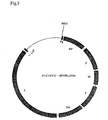
- Plasmid pUC18/T7(-)HVJRz.DNA was constructed by inserting a DNA molecule comprising T7 RNA polymerase promotor, Sendai virus cDNA designed to be transcribed to the negative strand RNA and the ribozyme gene in this order into pUC18 vector. Also, plasmid pUC18/T7(+)HVJRz.DNA was constructed by inserting a DNA molecule comprising T7 RNA polymerase promotor, Sendai virus cDNA designed to be transcribed to the positive strand RNA and the ribozyme gene in this order into pUC18 vector. Constructions of pUC18/T7(-)HVJRz.DNA and pUC18/T7(+)HVJRz.DNA are shown in Figs. 1 and 2, respectively.
- LLC-MK2 cells (2 x 10 6 ) trypsinized in a usual manner were placed in a 60-mm diameter plastic dish, and incubated in MEM medium (MEM supplemented with 10% FBS) (2 ml) in a 5% CO 2 atmosphere at 37°C for 24 h. After removing the medium and washing with PBS (1 ml), a suspension of recombinant vaccinia virus vTF7-3 expressing T7 polymerase in PBS (0.1 ml) was added to the cells at the multiplicity of infection (moi) of 2. The dish was gently agitated every 15 min to thoroughly spread the viral solution for 1 h infection. After removing the viral solution and washing with PBS (1 ml), a medium containing cDNA, which was prepared as follows, was added to the dish.
- MEM medium MEM supplemented with 10% FBS
- PBS multiplicity of infection
- Nucleic acids shown in Tables 1 and 2 (containing plasmids expressing factors required for the replication of Sendai virus, pGEM-L, pGEM-P/C and pGEM-NP) were placed in a 1.5-ml sampling tube, and adjusted to a total volume of 0.1 ml with HBS (Hepes buffered saline; 20 mM Hepes pH 7.4 containing 150 mM NaCl).
- HBS Hepes buffered saline
- (+)cDNAs represent plasmids pUC18/T7(-)HVJRz.DNA and pUC18/T7(+)HVJRz. DNA, respectively, and /C and /L indicate that cDNA is introduced into cells in the circular form and linear form after the treatment with restriction enzyme MluI, respectively.
- a polystyrene tube were placed HBS (0.07 ml), DOTAP (Boehringer Mannheim) (0.03 ml). To this tube was added the nucleic acid solution described above, and the mixture was left standing as such for 10 min. Then, to this mixture was added the cell culture medium described above (2 ml, MEM supplemented with 10% FBS) followed by the vaccinia virus inhibitors, rifampicin and cytosine arabinoside C (C/Ara/C), to the final concentrations of 0.1 mg/ml and 0.04 mg/ml, respectively, resulting in the preparation of the medium containing cDNA described above.
- HBS HBS
- DOTAP Boehringer Mannheim
- the dish described above was incubated in a 5% CO 2 atmosphere at 37°C for 40 h.
- the cells in the dish were harvested using a rubber policeman, transferred to an Eppendorf tube, sedimented by centrifuging at 6,000 rpm for 5 min, and re-suspended in PBS (1 ml). Aliquots of this cell suspension, as such or after diluted, were inoculated to 10-days old developing embryonated chicken eggs. That is, the cell suspension was diluted with PBS to the cell numbers shown in Table 1, and eggs inoculated with its 0.5-ml aliquots were incubated at 35°C for 72 h, then at 4°C overnight. Chorio-allantoic fluid was recovered as virus solution from these eggs using a syringe with a needle.
- Hemagglutinin unit (HAU) and plaque forming unit (PFU) of the recovered virus solution were assayed as follows.
- HAU was determined as follows. Chicken blood was centrifuged at 400 x g for 10 min and the supernatant was discarded. Precipitates thus obtained were suspended in 100 volumes of PBS, and centrifuged at 400 x g for 10 min to discard the supernatant. This procedure was repeated twice to prepare an 0.1% blood cell solution. Two-fold serial dilutions of virus solutions were prepared, and 0.05 ml each dilution to be assayed was dispensed into each well of 96-well titer plate. The blood cell solution (0.05 ml each) was further added to each well, gently swirled to ensure a thorough mixing, and left at 4°C for 40 min. The highest virus dilution to cause the hemagglutination observable with the naked eye was taken as HAU.
- PFU was assayed as follows. CV-1 cells were grown to a monolayer on a 6-well culture plate. After the culture medium was discarded, a virus solution 10-fold serially diluted (0.1 ml each) was dispensed into each well of the culture plate to infect the cells at 37°C for 1 h. During the infection, a mixture of 2 x MEM free of serum and melted 2% agar (55°C) was prepared, and trypsin was added to the mixture to a final concentration of 0.0075 mg/ml. After 1 h infection and removal of the virus solution, the culture medium mixed with agar (3 ml each) was added to each well of the culture plate, and incubated under a 5% CO 2 atmosphere at 37°C for 3 days. Phenol red (0.1%) (0.2 ml) was added to each well, incubated at 37°C for 3 h, and then removed. Unstained plaques were counted to estimate the virus titer as PFU/ml.
- Table 1 shows Sendai virus template cDNAs transfected into LLC-2 cells, amounts of cDNA factors, pGEM-L, pGEM-P/C, and pGEM-NP, required for the RNA replication, incubation time, cell numbers inoculated to chicken eggs, HAU and PFU values.
- Sendai virus can be reconstituted by introducing cDNAs into cells, and that virus particles are more efficiently reconstituted by introducing cDNAs transcribing positive strand RNAs as compared with those transcribing negative strand RNAs, and further by introducing cDNAs in the circular form rather in the linear form.
- Table 2 shows Sendai virus template cDNAs introduced into LLC-MK2 cells, amounts of the cDNA factors required for RNA replication including pGEM-L, pGEM-P/C and pGEM-NP, incubation time, number of cells inoculated into chicken eggs, and values of HAU and PFU.
- RNA synthesis was performed in vitro with a purified T7 polymerase preparation (EPICENTRE TECHNOLOGIES: Ampliscribe T7 Transcription Kit). The method for synthesizing in vitro RNAs essentially followed the protocols provided with the kit. Using RNA products thus obtained in place of cDNAs in Example 2, similar experiments were performed, and the virus production was estimated by HA test. Results are shown in Table 3.
- virus can be reconstituted by introducing either negative or positive sense strand RNAs into cells.
- Example 5 Expression of foreign genes inserted into Sendai viral vectors in host cells
- the HIV-1gp120 gene was amplified on "pN1432" by the standard PCR techniques. PCR products were subjected to TA cloning, digested with NotI, and then inserted into the NotI site of "pSeV18 + ". Then, E. coli cells were transformed with this recombinant plasmid.
- DNAs were extracted from each colony of E. coli by the "Miniprep” method, digested with DraIII, and then electrophoresed. Positive clones (designated “clone 9" hereafter) were selected by confirming to contain DNA fragments of the size expected from the insertion. After DNA fragments were confirmed to have the authentic nucleotide sequence, DNAs were purified by a cesium chloride density gradient centrifugation. pSeV18 + inserted with the gp120 gene is designated "pSeVgp120" hereafter.
- chorio-allantoic fluid was recovered from embryonated chicken eggs and assayed for the viral HAU by exactly as described in Example 2. The recovered virus was also examined for the expression of gp120 by ELISA as follows.
- the virus solution thus obtained was inoculated to CV-1 cells, and similarly examined as follows.
- CV-1 cells were dispensed to a culture plate at 5 x 10 5 cells/plate, grown, and then the culture medium was discarded. After washing with PBS(-), the viral solution was added to the cells at the multiplicity of infection of 10, and incubated at room temperature for 1 h. After the virus solution was discarded, washed with PBS(-), a plain MEM medium (MEM medium supplemented with antibiotics AraC and Rif, and trypsin) was added to the cells, and incubated at 37°C for 48 h.
- MEM medium plain MEM medium supplemented with antibiotics AraC and Rif, and trypsin
- the medium was recovered and assayed for HAU (by a similar method as described in Example 2) and examined for the expression of gp120 (by ELISA). Results are shown in the center column of Table 4.
- the supernatant of CV-1 cell culture medium was inoculated to embryonated chicken eggs again, and the virus solution thus obtained was assayed for HAU and also examined for the gp120 expression (by ELISA). Results are shown in the right hand column of Table 4.
- gp120 was analyzed by Western blotting. After the culture medium of CV-1 cells infected with SeVgp120 was centrifuged at 20,000 rpm for 1 h to sediment virus, the supernatant was treated with either TCA (10%, v/v) for 15 min on ice or 70% ethanol at -20°C, and centrifuged at 15,000 rpm for 15 min. Proteins thus precipitated were mixed to react with an "SDS-PAGE sample buffer" (Daiichi Chemicals) at 90°C for 3 min, and then subjected to electrophoresis on 10% SDS-polyacrylamide gel (SDS-PAGE).
- SDS-PAGE sample buffer Daiichi Chemicals
- Proteins thus fractionated were transferred to PVDF membranes (Daiichi Chemicals), reacted with monoclonal antibody 902 at room temperature for 1 h, and then washed with T-TBS.
- the membranes were reacted with anti-mIgG (Amersham) at room temperature for 1 h, and washed with T-TBS.
- the membranes were then reacted with HRP-linked protein A (Amersham) at room temperature for 1 h, washed with T-TBS, and 4-chloro-1-naphthol (4CNPlus) (Daiichi Chemicals) was added to detect gp120.
- HRP-linked protein A Amersham
- 4-chloro-1-naphthol (4CNPlus) was added to detect gp120.
- protein bands were visualized at positions corresponding to the expected molecular weight of gp120.
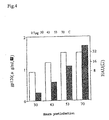
- CV-1 cells (5 x 10 6 ) dispensed to 10-cm plate were infected with SeVgp120 at the multiplicity of infection of 10, and the culture medium (1 ml each) was postinfectionally recovered at 30, 43, 53 and 70 h, mixed with an equal volume of the fresh medium, and subjected to HAU assay, gp120 expression examination (by ELISA) and Western blotting. Results are shown in Figure 4. As clearly shown in Fig. 3, the production of gp120 tends to increase with the increasing HA titer of Sendai virus.
- Example 6 Analyses of SeVgp120 propagation and gp120 expression level in various types of cells
- HAU and gp120 expression levels were assayed. Results are shown in Table 5.
- Example 7 Studies on the expression of luciferase gene inserted into the Sendai viral vector in host cells.
- the luciferase gene bounded by the engineered NotI sites on both termini was constructed by the standard PCR using a set of primers [5'-AAGCGGCCGCCAAAGTTCACGATGGAAGAC-3') (30mer) (SEQ ID NO: 3)] and [5'-TGCGGCCGCGATGAACTTTCACCCTAAGTTTTTCTTACTACGGATTATTACAATTTGGACTTTCCGCCC-3' (69mer) (SEQ ID NO: 4) with "pHvluciRT4" as a template.
- the PCR product was cloned into the NotI window of pSeV18 + to obtain Sendai virus vector to which the luciferase gene was inserted. Then, this recombinant vector was transfected into LLCMK2 cells, and inoculated into embryonated chicken eggs. Chorio-allantoic membranes of developing eggs were excised out, twice washed with cold PBS(-), and, after the addition of a lysis buffer (Picagene WAKO) (25 ⁇ l) and thorough mixing, centrifuged at 15,000 rpm for 2 min.
- a lysis buffer Picagene WAKO
- a system has been established allowing the efficient rescue of viral particles from cDNAs of negative strand viruses, and also a method has been developed enabling the production and amplification of "complexes comprised of RNAs derived from disseminative specific negative strand RNA virus and viral structural components containing no nucleic acids so as to have the infectivity and autonomous RNA replicating capability but no disseminative potency". Since said complexes can replicate only within infected cells, these techniques are especially useful in the fields of gene therapy, etc. wherein therapeutical safety is highly appreciated.
Landscapes
- Life Sciences & Earth Sciences (AREA)
- Health & Medical Sciences (AREA)
- Chemical & Material Sciences (AREA)
- Genetics & Genomics (AREA)
- Engineering & Computer Science (AREA)
- Organic Chemistry (AREA)
- Zoology (AREA)
- Wood Science & Technology (AREA)
- Bioinformatics & Cheminformatics (AREA)
- Biotechnology (AREA)
- Biomedical Technology (AREA)
- General Engineering & Computer Science (AREA)
- General Health & Medical Sciences (AREA)
- Biochemistry (AREA)
- Molecular Biology (AREA)
- Microbiology (AREA)
- Virology (AREA)
- Biophysics (AREA)
- Medicinal Chemistry (AREA)
- Physics & Mathematics (AREA)
- Plant Pathology (AREA)
- Immunology (AREA)
- Proteomics, Peptides & Aminoacids (AREA)
- Gastroenterology & Hepatology (AREA)
- Animal Behavior & Ethology (AREA)
- General Chemical & Material Sciences (AREA)
- Pharmacology & Pharmacy (AREA)
- Epidemiology (AREA)
- Chemical Kinetics & Catalysis (AREA)
- Public Health (AREA)
- Veterinary Medicine (AREA)
- Micro-Organisms Or Cultivation Processes Thereof (AREA)
- Medicines That Contain Protein Lipid Enzymes And Other Medicines (AREA)
- Medicines Containing Material From Animals Or Micro-Organisms (AREA)
- Preparation Of Compounds By Using Micro-Organisms (AREA)
- Pharmaceuticals Containing Other Organic And Inorganic Compounds (AREA)
Claims (21)
- Komplex, umfassend einen RNA-Molikül umfassend Sendai virale RNA oder Sendai virale cRNA, worin das RNA-Molekül darin defekt ist, daß mindestens mehr als ein Gen, das für M, F und HN-Proteine kodiert, dielietiert oder inaktiviert ist, und virale strukturelle Komponenten, abgeleitet von dem Sendai-Virus, die keine Nukleinsäure enthalten, wobei der Komplex eine zelluläre Infiktivität aufweist und in der Lage ist, autonom RNA zu replizieren, jedoch in seiner disseminativen Fähigkeit defizient ist.
- Komplex nach Anspruch 1, wobei das in dem Komplex enthaltenen RNA-Molekül ein fremdes Gen umfaßt.
- Kit, umfassend die folgenden Komponenten,a) das in dem Komplex nach Anspruch 1 oder 2 enthaltene RNA-Molekül oder die cRNA dieser RNA oder eine cDNA, die in der Lage ist, die RNA oder die cRNA zu biosynthetisieren,b) Enzyme, die für eine Replikation der RNA oder der cRNA erforderlich sind oder ein Gen, das in der Lage ist, die Enzyme zu biosynthetisieren, undc) Proteine, die mit der Infektivität des Komplexes zusammenhängen oder ein Gen oder ein Wirt, der in der Lage ist, diese Proteine zu biosynthetisieren.
- Kit nach Anspruch 3, worin die Komponente von Anspruch 3 c) einem Wirt entspricht, zu dem der Komplex nach Anspruch 1 oder 2 disseminieren kann.
- Kit nach Anspruch 3, wobei die Komponenten von Anspruch 3 a) und b) dem Komplex nach Anspruch 1 oder 2 entsprechen und die Komponente von 3 c) einem Wirt entspricht, zu dem der Komplex von Anspruch 1 oder 2 disseminieren kann.
- Kit nach Anspruch 3, wobei die Enzyme nach Anspruch 3 b) zu allen NP-, P/C- und L-Proteinen des Sendai-Virus entsprechen.
- Kit nach Anspruch 3, wobei die Enzyme nach Anspruch 3 b) zu allen NP-, P/C- und L-Proteinen vom Sendai-Virus entsprechen, und die Komponente von Anspruch 3 c) einem Wirt entspricht, zu dem der Komplex nach Anspruch 1 oder 2 disseminieren kann.
- Verfahren zur Herstellung des Komplexes nach Anspruch 1 oder 2 durch Einführen aller drei Komponenten der Ansprüche 3 a), 3 b) und 3 c) in einen Wirt.
- Verfahren zur Herstellung des Komplexes nach Anspruch 1 oder 2 durch Einführen beider Komponenten des Anspruchs 3 a) und 3 b) in den Wirt nach Anspruch 4.
- Verfahren zur Amplifizierung und Herstellung des Komplexes nach Anspruch 1 oder 2 durch Transfizieren des Komplexes in den Wirt nach Anspruch 5.
- Verfahren zur Herstellung des Komplexes nach Anspruch 1 oder 2 durch Einführen beider Komponenten des Anspruchs 3 a) und 3 c) und aller NP-, P/C- und L-Proteine von Sendai-Virus oder eines Gens, das in der Lage ist, diese Proteine zu biosynthetisieren, in einen Wirt.
- Verfahren zur Herstellung des Komplexes nach Anspruch 1 oder 2 durch Einführen des RNA-Moleküls von Anspruch 3 a) und aller NP-, P/C- und L-Proteine vom Sendaivirus oder eines Gens, das in der Lage ist, diese Proteine zu biosynthetisieren in den Wirt nach Anspruch 7.
- Kit, umfassend die folgenden Komponenten,a) das RNA-Molekül nach Anspruch 1,b) einen Wirt, umfassend die M-, NP-, P/C- und L-Gene vom Sendai-Virus auf seinen Chromosomen, undc) einen Wirt, umfassend das M-Gen vom Sendai-Virus auf seinen Chromosomen.
- Verfahren zur Herstellung eines Komplexes durch Einführen des RNA-Moleküls nach Anspruch 13 a) in den Wirt nach Anspruch 13 b) und Amplifizieren und Herstellen des Komplexes durch Transfizieren dieses in den Wirt nach Anspruch 13 c).
- Kit, umfassend die folgenden Komponenten,a) das RNA-Molekül nach Anspruch 1,b) einen Wirt, umfassend die M-, F-, HN-, NP-, P/C- und L-Gene auf seinen Chromosomen, undc) einen Wirt, umfassend die M-, F- und HN-Gene von Sendai-Virus auf seinen Chromosomen.
- Verfahren zur Amplifizierung und Herstellung eines Komplexes durch Einführen des RNA-Moleküls nach Anspruch 15 a) in den Wirt nach Anspruch 15 b) und Amplifizieren und Herstellen des Komplexes durch Transfizieren desselben in den Wirt nach Anspruch 15 c).
- Komplex, hergestellt durch das Verfahren nach Anspruch 14 oder 16.
- Verfahren zur Herstellung von Fremdproteinen, wobei das Verfahren die Prozesse von Einführen des Komplexes nach Anspruch 2 in einen Wirt und erhalten der exprimierten Proteine umfaßt.
- Verfahren zur Herstellung von Fremdproteinen nach Anspruch 18, wobei der Wirt eine Zelle ist, die eine Gruppe von Genen unter denjenigen exprimiert, die mit der disseminativen Fähigkeit zusammenhängen, die in dem RNA-Molekül deffizient sind, das in dem Komplex nach Anspruch 2 enthalten ist.
- Kulturmedium oder chorio-allantoide Flüssigkeit, enthaltend den Komplex nach Anspruch 2 und die exprimierten Fremdproteine, erhältlich durch Beimpfen des Komplexes von Anspruch 2 an einen Wirt und Erhalten seines Kulturmediums oder der chorio-allantoiden Flüssigkeit.
- Verwendung eines Komplexes nach einem der Ansprüche 1, 2 und 17 zur Herstellung eines Vektors zur Verwendung in der Gentherapie.
Priority Applications (1)
| Application Number | Priority Date | Filing Date | Title |
|---|---|---|---|
| EP03002037A EP1325960A3 (de) | 1995-10-31 | 1996-10-22 | Minus Strang RNA viraler vektor mit unabhängiger Replikationsfähigkeit |
Applications Claiming Priority (4)
| Application Number | Priority Date | Filing Date | Title |
|---|---|---|---|
| JP30831595 | 1995-10-31 | ||
| JP308315/95 | 1995-10-31 | ||
| JP30831595 | 1995-10-31 | ||
| PCT/JP1996/003068 WO1997016538A1 (en) | 1995-10-31 | 1996-10-22 | (-)-strand rna virus vector having autonomously replicating activity |
Related Child Applications (1)
| Application Number | Title | Priority Date | Filing Date |
|---|---|---|---|
| EP03002037A Division EP1325960A3 (de) | 1995-10-31 | 1996-10-22 | Minus Strang RNA viraler vektor mit unabhängiger Replikationsfähigkeit |
Publications (4)
| Publication Number | Publication Date |
|---|---|
| EP0864645A1 EP0864645A1 (de) | 1998-09-16 |
| EP0864645A4 EP0864645A4 (de) | 2000-01-26 |
| EP0864645B1 true EP0864645B1 (de) | 2005-06-29 |
| EP0864645B9 EP0864645B9 (de) | 2006-03-22 |
Family
ID=17979579
Family Applications (2)
| Application Number | Title | Priority Date | Filing Date |
|---|---|---|---|
| EP03002037A Ceased EP1325960A3 (de) | 1995-10-31 | 1996-10-22 | Minus Strang RNA viraler vektor mit unabhängiger Replikationsfähigkeit |
| EP96935402A Expired - Lifetime EP0864645B9 (de) | 1995-10-31 | 1996-10-22 | Negativstrand rna virus mit selbständiger replikationsaktivität |
Family Applications Before (1)
| Application Number | Title | Priority Date | Filing Date |
|---|---|---|---|
| EP03002037A Ceased EP1325960A3 (de) | 1995-10-31 | 1996-10-22 | Minus Strang RNA viraler vektor mit unabhängiger Replikationsfähigkeit |
Country Status (9)
| Country | Link |
|---|---|
| US (2) | US6723532B2 (de) |
| EP (2) | EP1325960A3 (de) |
| KR (2) | KR100754091B1 (de) |
| CN (1) | CN1118569C (de) |
| AT (1) | ATE298789T1 (de) |
| AU (1) | AU7335196A (de) |
| DE (1) | DE69634904T2 (de) |
| DK (1) | DK0864645T3 (de) |
| WO (1) | WO1997016538A1 (de) |
Families Citing this family (69)
| Publication number | Priority date | Publication date | Assignee | Title |
|---|---|---|---|---|
| CN1143892C (zh) * | 1995-11-01 | 2004-03-31 | 株式会社载体研究所 | 重组仙台病毒 |
| US7241617B2 (en) | 1998-07-03 | 2007-07-10 | Dnavec Research, Inc. | Sendai viral vectors comprising foreign genes inserted between the R1 and R2 Loci |
| HK1039792B (zh) * | 1998-07-03 | 2006-08-18 | 株式会社载体研究所 | 用於神经细胞转移基因的负链rna病毒载体 |
| US6828138B1 (en) | 1998-08-11 | 2004-12-07 | Dnavec Research Inc. | Recombinant sendai virus vector including a gene encoding a chemokine |
| WO2000009700A1 (fr) * | 1998-08-11 | 2000-02-24 | Dnavec Research Inc. | Vecteur de virus d'arn ayant la capacite de s'infiltrer par contact |
| US6544785B1 (en) | 1998-09-14 | 2003-04-08 | Mount Sinai School Of Medicine Of New York University | Helper-free rescue of recombinant negative strand RNA viruses |
| EP1013667B1 (de) * | 1998-11-09 | 2006-10-11 | Nippon Biologicals, Inc. | Verfahren zur Cytokinproduktionn unter Verwendung eines Sendai Virus Expressionssystems |
| US6490775B1 (en) * | 1999-04-23 | 2002-12-10 | Veri-Tek Inc. | Press operation verification system |
| ATE367445T1 (de) * | 1999-05-18 | 2007-08-15 | Dnavec Research Inc | Viraler paramyxoviridae vektor mit einem defekten hüllprotein-gen |
| US7226786B2 (en) | 1999-05-18 | 2007-06-05 | Dnavec Research Inc. | Envelope gene-deficient Paramyxovirus vector |
| US20030166252A1 (en) * | 1999-05-18 | 2003-09-04 | Kaio Kitazato | Paramyxovirus-derived RNP |
| CA2376106A1 (en) * | 1999-09-06 | 2001-03-15 | Dnavec Research Inc. | Paramyxoviruses comprising modified transcription start sequence |
| US7314614B1 (en) | 1999-11-02 | 2008-01-01 | Dnavec Research, Inc. | Recombinant sendai virus vector for introducing exogenous genes to airway epithelia |
| JP4838962B2 (ja) * | 1999-11-02 | 2011-12-14 | 株式会社ディナベック研究所 | 気道上皮細胞への外因性遺伝子導入用組換えセンダイウイルスベクター |
| US6875436B1 (en) | 1999-11-19 | 2005-04-05 | The Kitasata Institute | Method for producing cell-fushion type morbillivirus mutants |
| AU2001225487A1 (en) * | 2000-01-19 | 2001-07-31 | Dnavec Research Inc. | Use of paramyxovirus vector in gene transfer into blood vessel |
| KR100854917B1 (ko) * | 2000-03-30 | 2008-08-27 | 가부시키가이샤 디나벡크 겐큐쇼 | 센다이바이러스 벡터를 사용한 aids 바이러스 백신 |
| CA2322057A1 (en) | 2000-05-18 | 2001-11-18 | Dnavec Research Inc. | Paramyxovirus vectors used for transfer of foreign genes |
| AU2001262684A1 (en) * | 2000-06-01 | 2001-12-11 | Dnavec Research Inc. | Pseudo-type retrovirus vector containing membrane protein having hemagglutinin activity |
| AU2001266337A1 (en) * | 2000-06-27 | 2002-01-08 | Dnavec Research Inc. | Virus vector for transferring gene into renal cells |
| CN1526014A (zh) * | 2000-10-06 | 2004-09-01 | ��ʽ���������о��� | 用于将外源基因导入骨骼肌的副粘病毒载体 |
| JP2002142770A (ja) * | 2000-11-08 | 2002-05-21 | Dnavec Research Inc | 循環系への遺伝子送達用パラミクソウイルスベクター |
| ES2305138T3 (es) | 2000-11-27 | 2008-11-01 | Dnavec Research Inc. | Vector de paramixovirus que codifica factor 2 de crecimiento de fibroblastos (fgf2) y uso del mismo. |
| US7465456B2 (en) | 2002-04-26 | 2008-12-16 | Medimmune, Llc | Multi plasmid system for the production of influenza virus |
| EP1499348B1 (de) | 2002-04-26 | 2014-10-01 | MedImmune, LLC | Verfahren zur erzeugung von infectiösen grippevirus b in zellkultur |
| EP1504766A4 (de) * | 2002-04-30 | 2006-11-02 | Dnavec Research Inc | Arzneimittel- oder genträgerzusammensetzung mit verringerter hämagglutinin-aktivität |
| JP4448440B2 (ja) * | 2002-04-30 | 2010-04-07 | 株式会社ディナベック研究所 | プロテアーゼ依存性トロピズムが改変されたベクター |
| WO2003102183A1 (en) * | 2002-06-03 | 2003-12-11 | Dnavec Research Inc. | Pramyxovirus vectors encoding antibody and utilization thereof |
| US20060128019A1 (en) * | 2002-09-04 | 2006-06-15 | Masanori Kobayashi | Process for producing virus vector containing membrane protein having sialic acid-binding in envelope with the use of gram-positive bacterium origin nueraminidase |
| WO2004038029A1 (ja) * | 2002-10-24 | 2004-05-06 | Dnavec Research Inc. | T細胞に遺伝子を導入する方法 |
| WO2005018539A2 (en) | 2003-06-16 | 2005-03-03 | Medimmune Vaccines, Inc. | Influenza hemagglutinin and neuraminidase variants |
| JPWO2005001082A1 (ja) * | 2003-06-30 | 2006-08-10 | 株式会社ディナベック研究所 | 高変異領域が改変された遺伝子を搭載するマイナス鎖rnaウイルスベクター |
| CN1902312B (zh) * | 2003-11-04 | 2011-02-23 | 株式会社载体研究所 | 制备导入了基因的树突细胞的方法 |
| AU2004308328B2 (en) | 2003-12-23 | 2009-06-04 | Medimmune, Llc | Multi plasmid system for the production of influenza virus |
| JPWO2005067981A1 (ja) | 2004-01-13 | 2007-12-27 | 株式会社ディナベック研究所 | 免疫刺激性サイトカインをコードするマイナス鎖rnaウイルスベクターを用いる腫瘍の遺伝子治療 |
| WO2005071092A1 (ja) | 2004-01-22 | 2005-08-04 | Dnavec Research Inc. | サイトメガロウイルスエンハンサーおよびニワトリβ-アクチンプロモーターを含むハイブリッドプロモーターを利用したマイナス鎖RNAウイルスベクターの製造方法 |
| KR20070004637A (ko) * | 2004-01-22 | 2007-01-09 | 가부시키가이샤 디나벡크 겐큐쇼 | 바이러스 벡터의 제조방법 |
| CA2560046A1 (en) * | 2004-03-16 | 2005-09-22 | Dnavec Research Inc. | Methods for suppressing tumor proliferation |
| CN1957084A (zh) * | 2004-03-23 | 2007-05-02 | 株式会社载体研究所 | 与组织的维持和/或修复相关联的骨髓相关细胞 |
| EP2902484A1 (de) | 2004-05-25 | 2015-08-05 | MedImmune, LLC | Influenza-Hämagglutinin- und Neuraminidase-Varianten |
| CA2571844A1 (en) * | 2004-06-24 | 2006-01-05 | Dnavec Research Inc. | Anticancer agent containing minus-strand rna virus |
| ES2527503T3 (es) | 2005-03-08 | 2015-01-26 | Medimmune, Llc | Virus influenza reordenantes |
| JP4969444B2 (ja) | 2005-06-14 | 2012-07-04 | ディナベック株式会社 | 抗体の作製方法 |
| DK1950307T3 (en) | 2005-10-28 | 2016-02-15 | Id Pharma Co Ltd | Luftvejsepitelstamcelle for gene transfer using a lentiviral vector, which is pseudo typified by RNA virus spike protein |
| EP1983048A4 (de) * | 2006-01-17 | 2009-04-22 | Dnavec Corp | Neues proteinexpressionssystem |
| KR20090027693A (ko) | 2006-05-31 | 2009-03-17 | 디나벡크 가부시키가이샤 | 알츠하이머병 치료제 |
| EP2048232A4 (de) | 2006-07-13 | 2010-10-13 | Dnavec Corp | Nichtreplizierender paramyxoviridae-virusvektor |
| EP2049662A4 (de) | 2006-07-21 | 2009-12-30 | Medimmune Llc | Verfahren und zusammensetzungen zur erhöhung des replikationsvermögens eines influenza-virus |
| JP2010500034A (ja) | 2006-08-09 | 2010-01-07 | メッドイミューン バクシーンズ,インコーポレイティド | インフルエンザ赤血球凝集素変異体およびノイラミニダーゼ変異体 |
| JPWO2008029790A1 (ja) | 2006-09-04 | 2010-01-21 | 協和発酵キリン株式会社 | 新規核酸 |
| WO2008084319A2 (ja) | 2006-12-18 | 2008-07-17 | Kyowa Hakko Kirin Co., Ltd. | 新規核酸 |
| US20100323428A1 (en) | 2007-02-07 | 2010-12-23 | Dnavec Corporation | Attenuated minus-stranded rna virus |
| US20100203027A1 (en) | 2007-04-27 | 2010-08-12 | Kyushu Univeristy National University | Viral vector for gene therapy |
| EP2674486A1 (de) | 2007-06-18 | 2013-12-18 | MedImmune, LLC | Influenza-B-Viren mit Veränderungen im Hämagglutininpolypeptid |
| WO2009044899A1 (ja) | 2007-10-03 | 2009-04-09 | Kyowa Hakko Kirin Co., Ltd. | 細胞の増殖を制御する核酸 |
| US20110130442A1 (en) | 2008-06-04 | 2011-06-02 | Kyowa Hakko Kirin Co., Ltd. | Nucleic acid capable of controlling degranulation of mast cell |
| RU2523587C2 (ru) | 2008-07-11 | 2014-07-20 | МЕДИММЬЮН, ЭлЭлСи | Варианты гемагглютинина и нейрамидазы вируса гриппа |
| CN102159710B (zh) | 2008-07-16 | 2015-09-02 | 生物载体株式会社 | 使用染色体非整合型病毒载体制造经初始化的细胞的方法 |
| JPWO2010050586A1 (ja) | 2008-10-31 | 2012-03-29 | ディナベック株式会社 | 組み換え蛋白質の発現を増強する方法 |
| EP2396033B1 (de) | 2009-02-12 | 2016-09-28 | MedImmune, LLC | Influenza-hämagglutinin- und neuraminidase-varianten |
| JP5697044B2 (ja) | 2010-01-08 | 2015-04-08 | 国立大学法人京都大学 | タウオパチー治療用ワクチン |
| JP5908838B2 (ja) | 2010-08-30 | 2016-04-26 | 株式会社Idファーマ | 多能性幹細胞を誘導するための組成物およびその使用 |
| CN105916980B (zh) | 2013-09-24 | 2025-09-16 | 株式会社爱迪药业 | 用于改进诱导多能干细胞的效率的方法 |
| WO2018092887A1 (ja) | 2016-11-17 | 2018-05-24 | 国立感染症研究所長が代表する日本国 | 非感染性パラミクソウイルス粒子を用いた感染症ワクチン |
| CN111479920B (zh) | 2017-07-21 | 2025-08-01 | 株式会社爱医隆集团 | 用于修饰靶序列的多核苷酸及其用途 |
| EP3744847A4 (de) | 2018-01-22 | 2021-12-08 | Japan as Represented by The Director-General of National Institute of Infectious Diseases | Selektives cd8-positives t-zellinduzierendes impfstoffantigen |
| JP7808298B2 (ja) | 2020-09-04 | 2026-01-29 | Heartseed株式会社 | iPS細胞の品質改善剤、iPS細胞の製造方法、iPS細胞、及びiPS細胞製造用組成物 |
| CA3203232A1 (en) | 2020-12-25 | 2022-06-30 | Kyoto University | Method for producing naive human ips cells from somatic cells |
| KR20250007525A (ko) | 2022-04-25 | 2025-01-14 | 도키와-바이오 가부시키가이샤 | Rna 바이러스 유래의 키메라 엔벨로프 단백질 및 상기 단백질을 가지는 rna 바이러스 벡터 |
Family Cites Families (15)
| Publication number | Priority date | Publication date | Assignee | Title |
|---|---|---|---|---|
| US5166057A (en) * | 1989-08-28 | 1992-11-24 | The Mount Sinai School Of Medicine Of The City University Of New York | Recombinant negative strand rna virus expression-systems |
| AU7007491A (en) * | 1990-02-02 | 1991-08-08 | Schweiz. Serum- & Impfinstitut Bern | Cdna corresponding to the genome of negative-strand rna viruses, and process for the production of infectious negative-strand rna viruses |
| JP3029272B2 (ja) | 1990-05-29 | 2000-04-04 | 邦忠 下遠野 | 構造蛋白質遺伝子、組換えベクター、組換えウイルス、ポリペプチドおよびポリペプチドの製造方法 |
| US5665362A (en) | 1990-09-25 | 1997-09-09 | Cantab Pharmaceuticals Research Limited | Viral vaccines |
| US5318898A (en) * | 1991-04-02 | 1994-06-07 | Genetics Institute, Inc. | Production of recombinant bone-inducing proteins |
| JPH0585943A (ja) | 1991-07-18 | 1993-04-06 | Tonen Corp | 組換えワクシニアウイルスを用いる非a非b型肝炎ウイルス遺伝子の発現および非a非b型肝炎ワクチン |
| JPH05301895A (ja) | 1992-04-22 | 1993-11-16 | Nippon Zeon Co Ltd | ハイブリッド抗原タンパク質、それを発現する組み換えウイルス、及びその製造方法 |
| ZA937164B (en) * | 1992-09-28 | 1994-05-23 | Commw Scient Ind Res Org | Delivery system |
| US5516720A (en) | 1994-02-14 | 1996-05-14 | United Microelectronics Corporation | Stress relaxation in dielectric before metallization |
| DK0702085T4 (da) | 1994-07-18 | 2010-04-06 | Conzelmann Karl Klaus Prof Dr | Rekombinant infektiøs ikke-segmenteret negativ-strenget RNA-virus |
| WO1996010400A1 (en) | 1994-09-30 | 1996-04-11 | The Uab Research Foundation | Gene therapy vectors and vaccines based on non-segmented negatives stranded rna viruses |
| US5716821A (en) | 1994-09-30 | 1998-02-10 | Uab Research Foundation | Prevention and treatment of respiratory tract disease |
| ATE181112T1 (de) | 1995-08-09 | 1999-06-15 | Schweiz Serum & Impfinst | Dem genom von minussträngigen rna-viren entsprechende cdna und verfahren zur herstellung von infektiösen minussträngigen rna-viren |
| KR0179554B1 (ko) * | 1995-11-30 | 1999-04-15 | 김주용 | 반도체 소자의 소자분리절연막 형성방법 |
| CA2253595A1 (en) | 1996-05-01 | 1997-11-06 | The Government Of The United States Of America, Represented By The Secre Tary, Department Of Health And Human Services | Generation of viral transfectants using recombinant dna-derived nucleocapsid proteins |
-
1996
- 1996-10-22 DE DE69634904T patent/DE69634904T2/de not_active Expired - Lifetime
- 1996-10-22 KR KR1020057010921A patent/KR100754091B1/ko not_active Expired - Fee Related
- 1996-10-22 DK DK96935402T patent/DK0864645T3/da active
- 1996-10-22 EP EP03002037A patent/EP1325960A3/de not_active Ceased
- 1996-10-22 AU AU73351/96A patent/AU7335196A/en not_active Abandoned
- 1996-10-22 WO PCT/JP1996/003068 patent/WO1997016538A1/ja not_active Ceased
- 1996-10-22 CN CN96199467A patent/CN1118569C/zh not_active Expired - Lifetime
- 1996-10-22 AT AT96935402T patent/ATE298789T1/de active
- 1996-10-22 EP EP96935402A patent/EP0864645B9/de not_active Expired - Lifetime
- 1996-10-22 KR KR1019980703189A patent/KR100552387B1/ko not_active Expired - Lifetime
-
1998
- 1998-04-30 US US09/070,938 patent/US6723532B2/en not_active Expired - Lifetime
-
1999
- 1999-12-23 US US09/471,840 patent/US6645760B2/en not_active Expired - Lifetime
Also Published As
| Publication number | Publication date |
|---|---|
| KR100552387B1 (ko) | 2006-04-21 |
| HK1018287A1 (en) | 1999-12-17 |
| DE69634904D1 (de) | 2005-08-04 |
| KR20050084302A (ko) | 2005-08-26 |
| DK0864645T3 (da) | 2005-10-24 |
| DE69634904T2 (de) | 2006-05-18 |
| EP0864645B9 (de) | 2006-03-22 |
| CN1207123A (zh) | 1999-02-03 |
| EP1325960A3 (de) | 2004-09-15 |
| US6723532B2 (en) | 2004-04-20 |
| US20020100066A1 (en) | 2002-07-25 |
| US20020081706A1 (en) | 2002-06-27 |
| CN1118569C (zh) | 2003-08-20 |
| EP1325960A2 (de) | 2003-07-09 |
| EP0864645A4 (de) | 2000-01-26 |
| KR19990067232A (ko) | 1999-08-16 |
| ATE298789T1 (de) | 2005-07-15 |
| AU7335196A (en) | 1997-05-22 |
| US6645760B2 (en) | 2003-11-11 |
| EP0864645A1 (de) | 1998-09-16 |
| WO1997016538A1 (en) | 1997-05-09 |
| KR100754091B1 (ko) | 2007-08-31 |
Similar Documents
| Publication | Publication Date | Title |
|---|---|---|
| EP0864645B9 (de) | Negativstrand rna virus mit selbständiger replikationsaktivität | |
| CA2236378C (en) | Recombinant sendai virus | |
| CN101379183B (zh) | 流感病毒的拯救 | |
| KR100667452B1 (ko) | 재조합 rsv 바이러스 발현 시스템 및 백신 | |
| Leyrer et al. | Rapid and efficient recovery of Sendai virus from cDNA: factors influencing recombinant virus rescue | |
| KR100579662B1 (ko) | 리보핵산 바이러스의 신규 구제방법 | |
| Parks et al. | Expression of a foreign gene by recombinant canine distemper virus recovered from cloned DNAs | |
| JP3992200B2 (ja) | 組換え体センダイウイルスを利用した膜融合性リポソーム | |
| CA2236113C (en) | Negative strand rna viral vector having autonomous replication capability | |
| JPWO1997016171A1 (ja) | 組換え体センダイウイルスを利用した膜融合性リポソーム | |
| JP3732204B2 (ja) | 自律複製能を有する(−)鎖rnaウイルスベクター | |
| JP7762791B2 (ja) | 水疱性口内炎ウイルスのレスキュー | |
| JP3991339B2 (ja) | 組換え体センダイウイルス | |
| JP3638019B2 (ja) | 組換え体センダイウイルス | |
| EP1106692B1 (de) | Rns virus vektor mit der fähigkeit zur kontaktinfiltration | |
| JPWO2007007921A1 (ja) | 分節ゲノム型組換えモノネガウイルスベクター | |
| JPWO1997016538A1 (ja) | 自律複製能を有する(−)鎖rnaウイルスベクター | |
| JP2005102702A (ja) | 組換え体センダイウイルス | |
| RU2132877C1 (ru) | Фрагмент рекомбинантной рнк (варианты), рибонуклеопротеиновый комплекс (варианты), плазмида | |
| JPWO1997016539A1 (ja) | 組換え体センダイウイルス | |
| Iida et al. | Cytoplasmic RNA Vector Derived from Nontransmissible Sendai Virus: Production and Use | |
| Nagai et al. | Sendai Virus Biology and Engineering Leading up to the Development of a Novel Class of Expression Vector | |
| JP2004187533A (ja) | 非分節(−)鎖rnaウイルス発現ベクター |
Legal Events
| Date | Code | Title | Description |
|---|---|---|---|
| PUAI | Public reference made under article 153(3) epc to a published international application that has entered the european phase |
Free format text: ORIGINAL CODE: 0009012 |
|
| 17P | Request for examination filed |
Effective date: 19980529 |
|
| AK | Designated contracting states |
Kind code of ref document: A1 Designated state(s): AT CH DE DK FI FR GB IT LI NL SE |
|
| RIN1 | Information on inventor provided before grant (corrected) |
Inventor name: SHIODA, TATSUO Inventor name: HASEGAWA, MAMORU Inventor name: SAKATA, TSUNEAKI Inventor name: ASAKAWA, MAKOTO Inventor name: MURAI, FUKASHI Inventor name: KATO, ATSUSHI Inventor name: NAGAI, YOSHIYUKI |
|
| A4 | Supplementary search report drawn up and despatched |
Effective date: 19991213 |
|
| AK | Designated contracting states |
Kind code of ref document: A4 Designated state(s): AT CH DE DK FI FR GB IT LI NL SE |
|
| 17Q | First examination report despatched |
Effective date: 20020923 |
|
| GRAP | Despatch of communication of intention to grant a patent |
Free format text: ORIGINAL CODE: EPIDOSNIGR1 |
|
| RTI1 | Title (correction) |
Free format text: NEGATIVE-STRAND RNA VIRUS VECTOR HAVING AUTONOMOUSLY REPLICATING ACTIVITY |
|
| RTI1 | Title (correction) |
Free format text: NEGATIVE-STRAND RNA VIRUS VECTOR HAVING AUTONOMOUSLY REPLICATING ACTIVITY |
|
| GRAS | Grant fee paid |
Free format text: ORIGINAL CODE: EPIDOSNIGR3 |
|
| GRAA | (expected) grant |
Free format text: ORIGINAL CODE: 0009210 |
|
| AK | Designated contracting states |
Kind code of ref document: B1 Designated state(s): AT CH DE DK FI FR GB IT LI NL SE |
|
| REG | Reference to a national code |
Ref country code: GB Ref legal event code: FG4D |
|
| REG | Reference to a national code |
Ref country code: CH Ref legal event code: EP |
|
| REF | Corresponds to: |
Ref document number: 69634904 Country of ref document: DE Date of ref document: 20050804 Kind code of ref document: P |
|
| REG | Reference to a national code |
Ref country code: SE Ref legal event code: TRGR |
|
| REG | Reference to a national code |
Ref country code: DK Ref legal event code: T3 |
|
| REG | Reference to a national code |
Ref country code: CH Ref legal event code: NV Representative=s name: E. BLUM & CO. PATENTANWAELTE |
|
| ET | Fr: translation filed | ||
| PLBE | No opposition filed within time limit |
Free format text: ORIGINAL CODE: 0009261 |
|
| STAA | Information on the status of an ep patent application or granted ep patent |
Free format text: STATUS: NO OPPOSITION FILED WITHIN TIME LIMIT |
|
| 26N | No opposition filed |
Effective date: 20060330 |
|
| REG | Reference to a national code |
Ref country code: CH Ref legal event code: PFA Owner name: DNAVEC RESEARCH INC. Free format text: DNAVEC RESEARCH INC.#25-11 KANNONDAI 1-CHOME#TSUKUBA-SHI, IBARAKI 305 (JP) -TRANSFER TO- DNAVEC RESEARCH INC.#25-11 KANNONDAI 1-CHOME#TSUKUBA-SHI, IBARAKI 305 (JP) |
|
| PGFP | Annual fee paid to national office [announced via postgrant information from national office to epo] |
Ref country code: AT Payment date: 20101014 Year of fee payment: 15 |
|
| PGFP | Annual fee paid to national office [announced via postgrant information from national office to epo] |
Ref country code: DK Payment date: 20111019 Year of fee payment: 16 Ref country code: CH Payment date: 20111024 Year of fee payment: 16 |
|
| REG | Reference to a national code |
Ref country code: CH Ref legal event code: PL |
|
| REG | Reference to a national code |
Ref country code: DK Ref legal event code: EBP |
|
| REG | Reference to a national code |
Ref country code: AT Ref legal event code: MM01 Ref document number: 298789 Country of ref document: AT Kind code of ref document: T Effective date: 20121022 |
|
| PG25 | Lapsed in a contracting state [announced via postgrant information from national office to epo] |
Ref country code: CH Free format text: LAPSE BECAUSE OF NON-PAYMENT OF DUE FEES Effective date: 20121031 Ref country code: AT Free format text: LAPSE BECAUSE OF NON-PAYMENT OF DUE FEES Effective date: 20121022 Ref country code: LI Free format text: LAPSE BECAUSE OF NON-PAYMENT OF DUE FEES Effective date: 20121031 |
|
| PG25 | Lapsed in a contracting state [announced via postgrant information from national office to epo] |
Ref country code: DK Free format text: LAPSE BECAUSE OF NON-PAYMENT OF DUE FEES Effective date: 20121031 |
|
| PGFP | Annual fee paid to national office [announced via postgrant information from national office to epo] |
Ref country code: SE Payment date: 20131022 Year of fee payment: 18 |
|
| PGFP | Annual fee paid to national office [announced via postgrant information from national office to epo] |
Ref country code: IT Payment date: 20131030 Year of fee payment: 18 Ref country code: FI Payment date: 20131011 Year of fee payment: 18 Ref country code: NL Payment date: 20131022 Year of fee payment: 18 |
|
| REG | Reference to a national code |
Ref country code: NL Ref legal event code: V1 Effective date: 20150501 |
|
| REG | Reference to a national code |
Ref country code: SE Ref legal event code: EUG |
|
| PG25 | Lapsed in a contracting state [announced via postgrant information from national office to epo] |
Ref country code: FI Free format text: LAPSE BECAUSE OF NON-PAYMENT OF DUE FEES Effective date: 20141022 Ref country code: SE Free format text: LAPSE BECAUSE OF NON-PAYMENT OF DUE FEES Effective date: 20141023 |
|
| PG25 | Lapsed in a contracting state [announced via postgrant information from national office to epo] |
Ref country code: IT Free format text: LAPSE BECAUSE OF NON-PAYMENT OF DUE FEES Effective date: 20141022 Ref country code: NL Free format text: LAPSE BECAUSE OF NON-PAYMENT OF DUE FEES Effective date: 20150501 |
|
| REG | Reference to a national code |
Ref country code: FR Ref legal event code: PLFP Year of fee payment: 20 |
|
| PGFP | Annual fee paid to national office [announced via postgrant information from national office to epo] |
Ref country code: GB Payment date: 20151021 Year of fee payment: 20 Ref country code: DE Payment date: 20151022 Year of fee payment: 20 |
|
| PGFP | Annual fee paid to national office [announced via postgrant information from national office to epo] |
Ref country code: FR Payment date: 20151023 Year of fee payment: 20 |
|
| REG | Reference to a national code |
Ref country code: DE Ref legal event code: R071 Ref document number: 69634904 Country of ref document: DE |
|
| REG | Reference to a national code |
Ref country code: GB Ref legal event code: PE20 Expiry date: 20161021 |
|
| PG25 | Lapsed in a contracting state [announced via postgrant information from national office to epo] |
Ref country code: GB Free format text: LAPSE BECAUSE OF EXPIRATION OF PROTECTION Effective date: 20161021 |