EP0770059B1 - Substituierte benzamidine, ihre herstellung und verwendung als arzneimittel - Google Patents
Substituierte benzamidine, ihre herstellung und verwendung als arzneimittel Download PDFInfo
- Publication number
- EP0770059B1 EP0770059B1 EP95921824A EP95921824A EP0770059B1 EP 0770059 B1 EP0770059 B1 EP 0770059B1 EP 95921824 A EP95921824 A EP 95921824A EP 95921824 A EP95921824 A EP 95921824A EP 0770059 B1 EP0770059 B1 EP 0770059B1
- Authority
- EP
- European Patent Office
- Prior art keywords
- denotes
- alkyl
- aryl
- group
- phenyl
- Prior art date
- Legal status (The legal status is an assumption and is not a legal conclusion. Google has not performed a legal analysis and makes no representation as to the accuracy of the status listed.)
- Expired - Lifetime
Links
- 0 CC=CC(NC(CCC=CC(*)=C)=CC=*)=CC=* Chemical compound CC=CC(NC(CCC=CC(*)=C)=CC=*)=CC=* 0.000 description 2
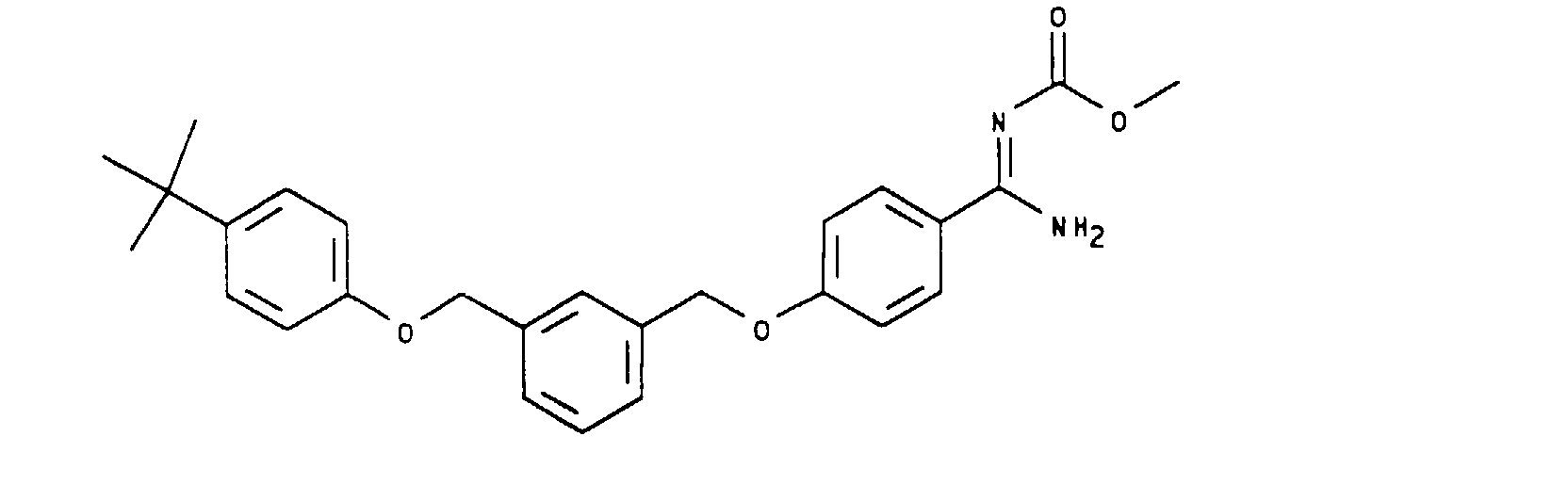
- JQZWDVIWDIVCJJ-UHFFFAOYSA-N CC(C)(C)c(cc1)ccc1OCc1cccc(COc(cc2)ccc2/C(/N)=N/C(OC)=O)c1 Chemical compound CC(C)(C)c(cc1)ccc1OCc1cccc(COc(cc2)ccc2/C(/N)=N/C(OC)=O)c1 JQZWDVIWDIVCJJ-UHFFFAOYSA-N 0.000 description 1
Classifications
-
- C—CHEMISTRY; METALLURGY
- C07—ORGANIC CHEMISTRY
- C07C—ACYCLIC OR CARBOCYCLIC COMPOUNDS
- C07C271/00—Derivatives of carbamic acids, i.e. compounds containing any of the groups, the nitrogen atom not being part of nitro or nitroso groups
- C07C271/62—Compounds containing any of the groups, X being a hetero atom, Y being any atom, e.g. N-acylcarbamates
- C07C271/64—Y being a hydrogen or a carbon atom, e.g. benzoylcarbamates
-
- C—CHEMISTRY; METALLURGY
- C07—ORGANIC CHEMISTRY
- C07C—ACYCLIC OR CARBOCYCLIC COMPOUNDS
- C07C259/00—Compounds containing carboxyl groups, an oxygen atom of a carboxyl group being replaced by a nitrogen atom, this nitrogen atom being further bound to an oxygen atom and not being part of nitro or nitroso groups
- C07C259/12—Compounds containing carboxyl groups, an oxygen atom of a carboxyl group being replaced by a nitrogen atom, this nitrogen atom being further bound to an oxygen atom and not being part of nitro or nitroso groups with replacement of the other oxygen atom of the carboxyl group by nitrogen atoms, e.g. N-hydroxyamidines
- C07C259/18—Compounds containing carboxyl groups, an oxygen atom of a carboxyl group being replaced by a nitrogen atom, this nitrogen atom being further bound to an oxygen atom and not being part of nitro or nitroso groups with replacement of the other oxygen atom of the carboxyl group by nitrogen atoms, e.g. N-hydroxyamidines having carbon atoms of hydroxamidine groups bound to carbon atoms of six-membered aromatic rings
-
- A—HUMAN NECESSITIES
- A61—MEDICAL OR VETERINARY SCIENCE; HYGIENE
- A61K—PREPARATIONS FOR MEDICAL, DENTAL OR TOILETRY PURPOSES
- A61K31/00—Medicinal preparations containing organic active ingredients
- A61K31/13—Amines
- A61K31/155—Amidines (), e.g. guanidine (H2N—C(=NH)—NH2), isourea (N=C(OH)—NH2), isothiourea (—N=C(SH)—NH2)
-
- A—HUMAN NECESSITIES
- A61—MEDICAL OR VETERINARY SCIENCE; HYGIENE
- A61P—SPECIFIC THERAPEUTIC ACTIVITY OF CHEMICAL COMPOUNDS OR MEDICINAL PREPARATIONS
- A61P1/00—Drugs for disorders of the alimentary tract or the digestive system
-
- A—HUMAN NECESSITIES
- A61—MEDICAL OR VETERINARY SCIENCE; HYGIENE
- A61P—SPECIFIC THERAPEUTIC ACTIVITY OF CHEMICAL COMPOUNDS OR MEDICINAL PREPARATIONS
- A61P1/00—Drugs for disorders of the alimentary tract or the digestive system
- A61P1/04—Drugs for disorders of the alimentary tract or the digestive system for ulcers, gastritis or reflux esophagitis, e.g. antacids, inhibitors of acid secretion, mucosal protectants
-
- A—HUMAN NECESSITIES
- A61—MEDICAL OR VETERINARY SCIENCE; HYGIENE
- A61P—SPECIFIC THERAPEUTIC ACTIVITY OF CHEMICAL COMPOUNDS OR MEDICINAL PREPARATIONS
- A61P11/00—Drugs for disorders of the respiratory system
-
- A—HUMAN NECESSITIES
- A61—MEDICAL OR VETERINARY SCIENCE; HYGIENE
- A61P—SPECIFIC THERAPEUTIC ACTIVITY OF CHEMICAL COMPOUNDS OR MEDICINAL PREPARATIONS
- A61P11/00—Drugs for disorders of the respiratory system
- A61P11/06—Antiasthmatics
-
- A—HUMAN NECESSITIES
- A61—MEDICAL OR VETERINARY SCIENCE; HYGIENE
- A61P—SPECIFIC THERAPEUTIC ACTIVITY OF CHEMICAL COMPOUNDS OR MEDICINAL PREPARATIONS
- A61P11/00—Drugs for disorders of the respiratory system
- A61P11/08—Bronchodilators
-
- A—HUMAN NECESSITIES
- A61—MEDICAL OR VETERINARY SCIENCE; HYGIENE
- A61P—SPECIFIC THERAPEUTIC ACTIVITY OF CHEMICAL COMPOUNDS OR MEDICINAL PREPARATIONS
- A61P17/00—Drugs for dermatological disorders
-
- A—HUMAN NECESSITIES
- A61—MEDICAL OR VETERINARY SCIENCE; HYGIENE
- A61P—SPECIFIC THERAPEUTIC ACTIVITY OF CHEMICAL COMPOUNDS OR MEDICINAL PREPARATIONS
- A61P17/00—Drugs for dermatological disorders
- A61P17/06—Antipsoriatics
-
- A—HUMAN NECESSITIES
- A61—MEDICAL OR VETERINARY SCIENCE; HYGIENE
- A61P—SPECIFIC THERAPEUTIC ACTIVITY OF CHEMICAL COMPOUNDS OR MEDICINAL PREPARATIONS
- A61P19/00—Drugs for skeletal disorders
- A61P19/02—Drugs for skeletal disorders for joint disorders, e.g. arthritis, arthrosis
-
- A—HUMAN NECESSITIES
- A61—MEDICAL OR VETERINARY SCIENCE; HYGIENE
- A61P—SPECIFIC THERAPEUTIC ACTIVITY OF CHEMICAL COMPOUNDS OR MEDICINAL PREPARATIONS
- A61P25/00—Drugs for disorders of the nervous system
- A61P25/04—Centrally acting analgesics, e.g. opioids
-
- A—HUMAN NECESSITIES
- A61—MEDICAL OR VETERINARY SCIENCE; HYGIENE
- A61P—SPECIFIC THERAPEUTIC ACTIVITY OF CHEMICAL COMPOUNDS OR MEDICINAL PREPARATIONS
- A61P25/00—Drugs for disorders of the nervous system
- A61P25/28—Drugs for disorders of the nervous system for treating neurodegenerative disorders of the central nervous system, e.g. nootropic agents, cognition enhancers, drugs for treating Alzheimer's disease or other forms of dementia
-
- A—HUMAN NECESSITIES
- A61—MEDICAL OR VETERINARY SCIENCE; HYGIENE
- A61P—SPECIFIC THERAPEUTIC ACTIVITY OF CHEMICAL COMPOUNDS OR MEDICINAL PREPARATIONS
- A61P29/00—Non-central analgesic, antipyretic or antiinflammatory agents, e.g. antirheumatic agents; Non-steroidal antiinflammatory drugs [NSAID]
-
- A—HUMAN NECESSITIES
- A61—MEDICAL OR VETERINARY SCIENCE; HYGIENE
- A61P—SPECIFIC THERAPEUTIC ACTIVITY OF CHEMICAL COMPOUNDS OR MEDICINAL PREPARATIONS
- A61P35/00—Antineoplastic agents
-
- A—HUMAN NECESSITIES
- A61—MEDICAL OR VETERINARY SCIENCE; HYGIENE
- A61P—SPECIFIC THERAPEUTIC ACTIVITY OF CHEMICAL COMPOUNDS OR MEDICINAL PREPARATIONS
- A61P37/00—Drugs for immunological or allergic disorders
-
- A—HUMAN NECESSITIES
- A61—MEDICAL OR VETERINARY SCIENCE; HYGIENE
- A61P—SPECIFIC THERAPEUTIC ACTIVITY OF CHEMICAL COMPOUNDS OR MEDICINAL PREPARATIONS
- A61P37/00—Drugs for immunological or allergic disorders
- A61P37/08—Antiallergic agents
-
- A—HUMAN NECESSITIES
- A61—MEDICAL OR VETERINARY SCIENCE; HYGIENE
- A61P—SPECIFIC THERAPEUTIC ACTIVITY OF CHEMICAL COMPOUNDS OR MEDICINAL PREPARATIONS
- A61P43/00—Drugs for specific purposes, not provided for in groups A61P1/00-A61P41/00
-
- A—HUMAN NECESSITIES
- A61—MEDICAL OR VETERINARY SCIENCE; HYGIENE
- A61P—SPECIFIC THERAPEUTIC ACTIVITY OF CHEMICAL COMPOUNDS OR MEDICINAL PREPARATIONS
- A61P5/00—Drugs for disorders of the endocrine system
-
- A—HUMAN NECESSITIES
- A61—MEDICAL OR VETERINARY SCIENCE; HYGIENE
- A61P—SPECIFIC THERAPEUTIC ACTIVITY OF CHEMICAL COMPOUNDS OR MEDICINAL PREPARATIONS
- A61P9/00—Drugs for disorders of the cardiovascular system
-
- A—HUMAN NECESSITIES
- A61—MEDICAL OR VETERINARY SCIENCE; HYGIENE
- A61P—SPECIFIC THERAPEUTIC ACTIVITY OF CHEMICAL COMPOUNDS OR MEDICINAL PREPARATIONS
- A61P9/00—Drugs for disorders of the cardiovascular system
- A61P9/10—Drugs for disorders of the cardiovascular system for treating ischaemic or atherosclerotic diseases, e.g. antianginal drugs, coronary vasodilators, drugs for myocardial infarction, retinopathy, cerebrovascula insufficiency, renal arteriosclerosis
Definitions
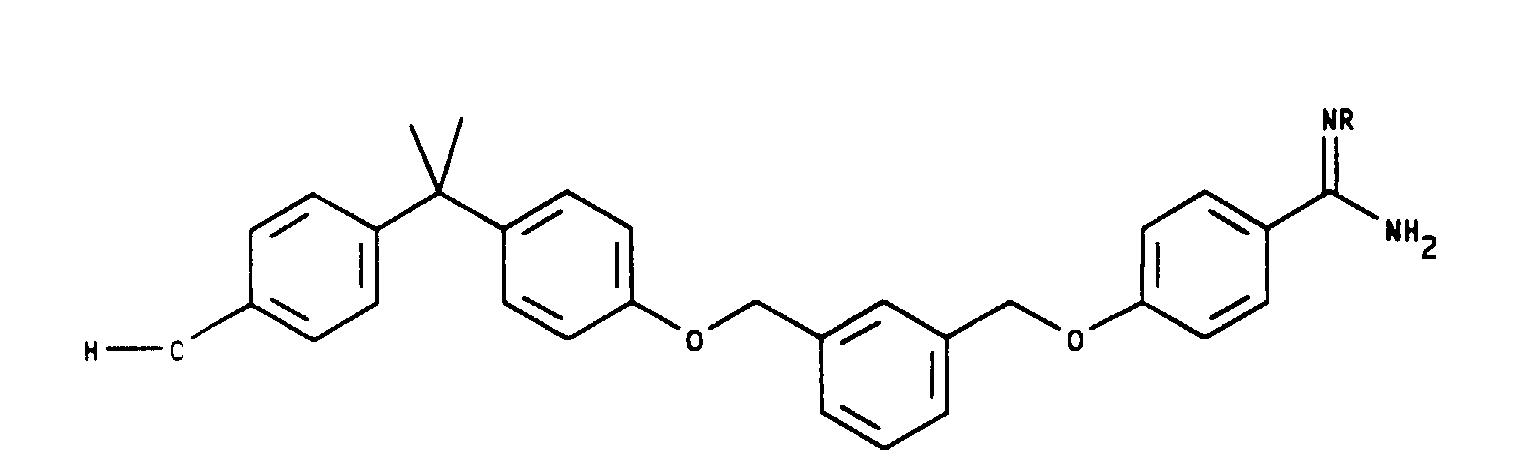
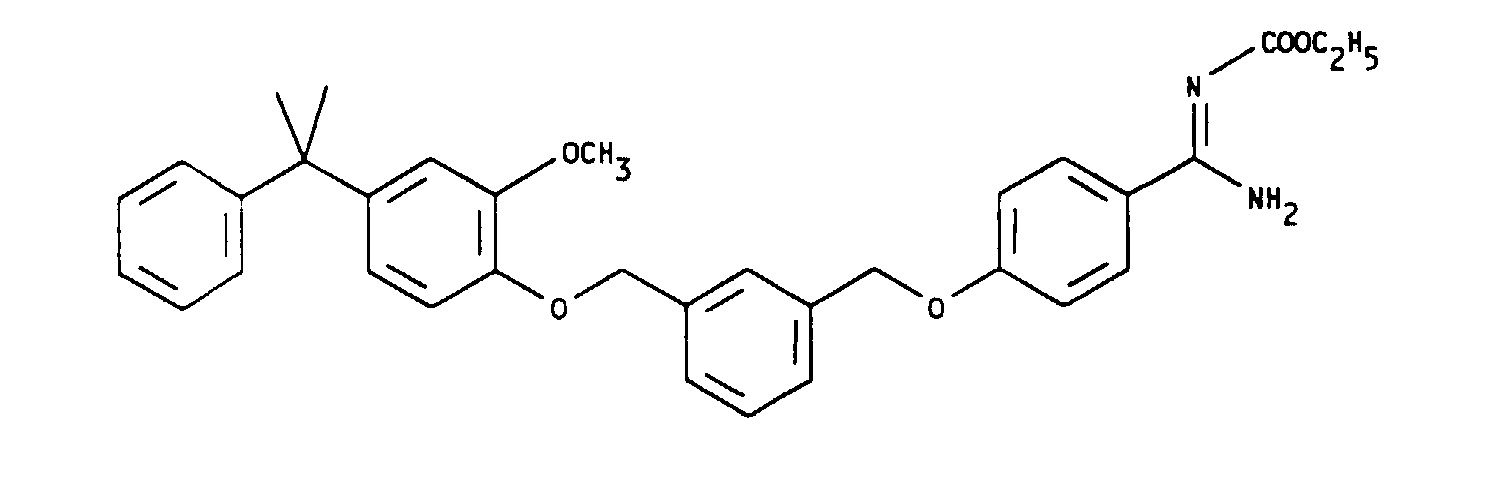
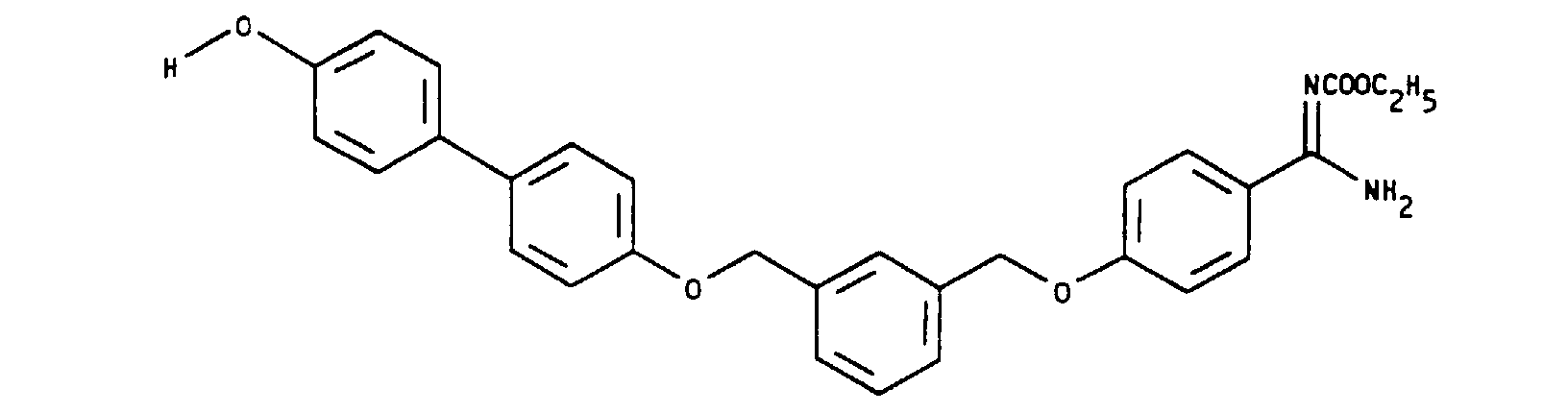
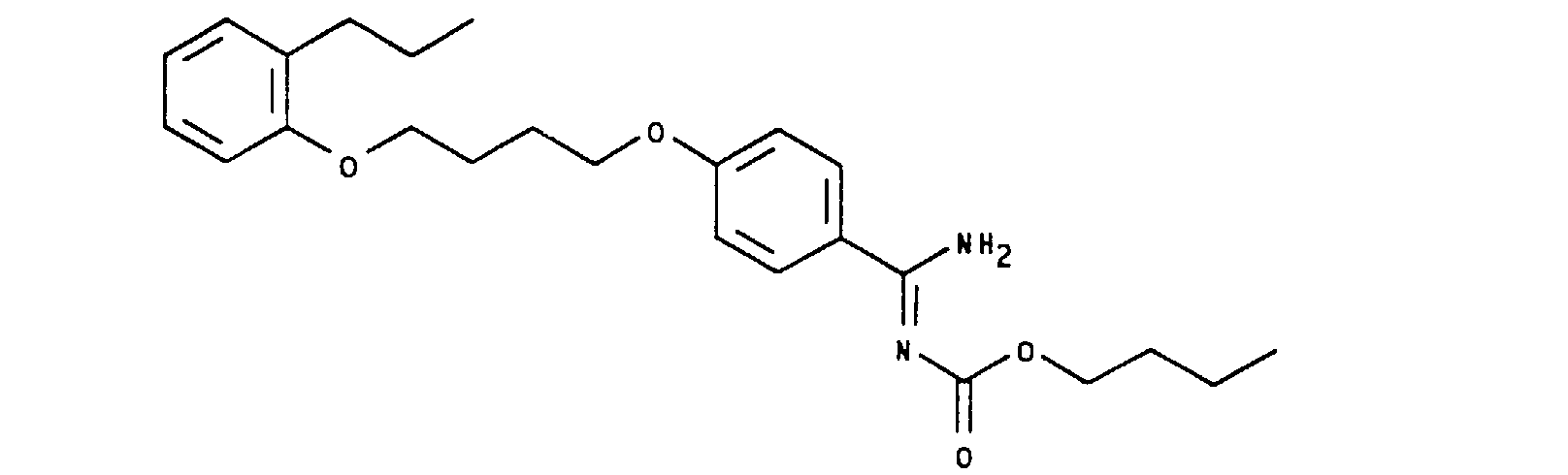
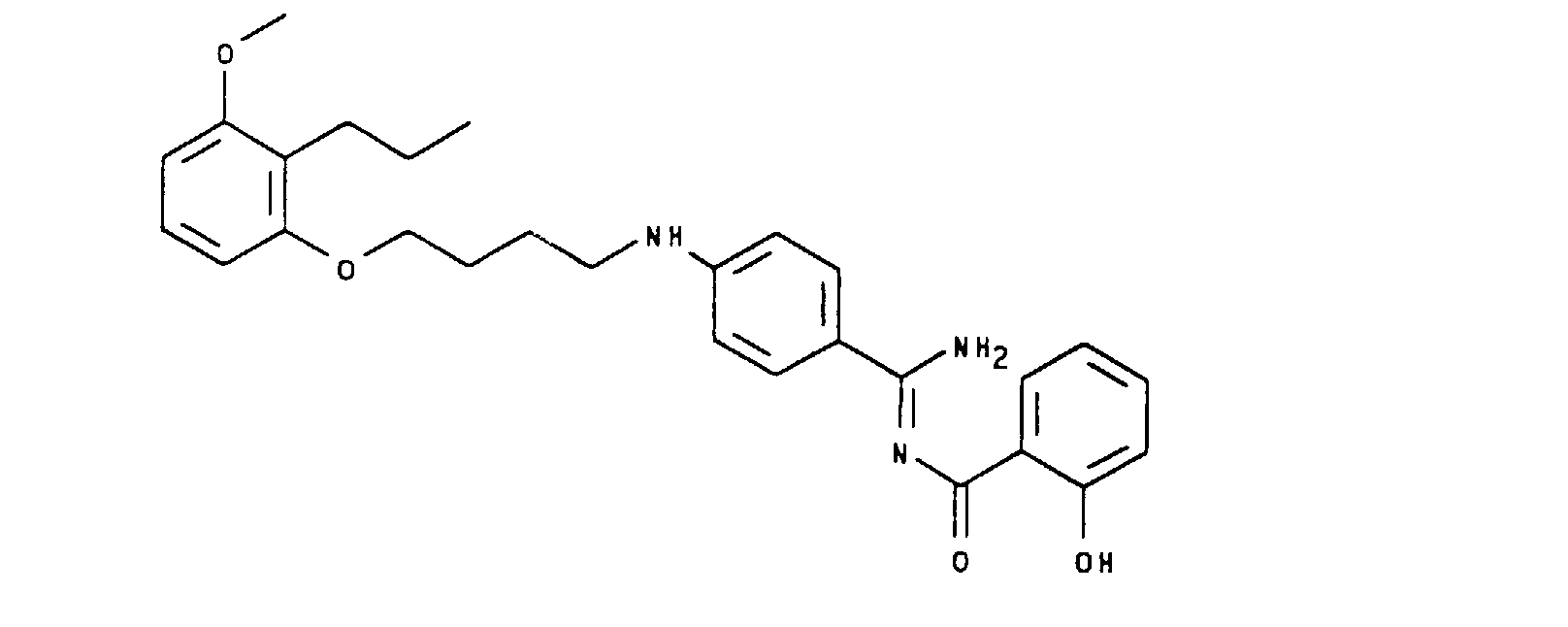
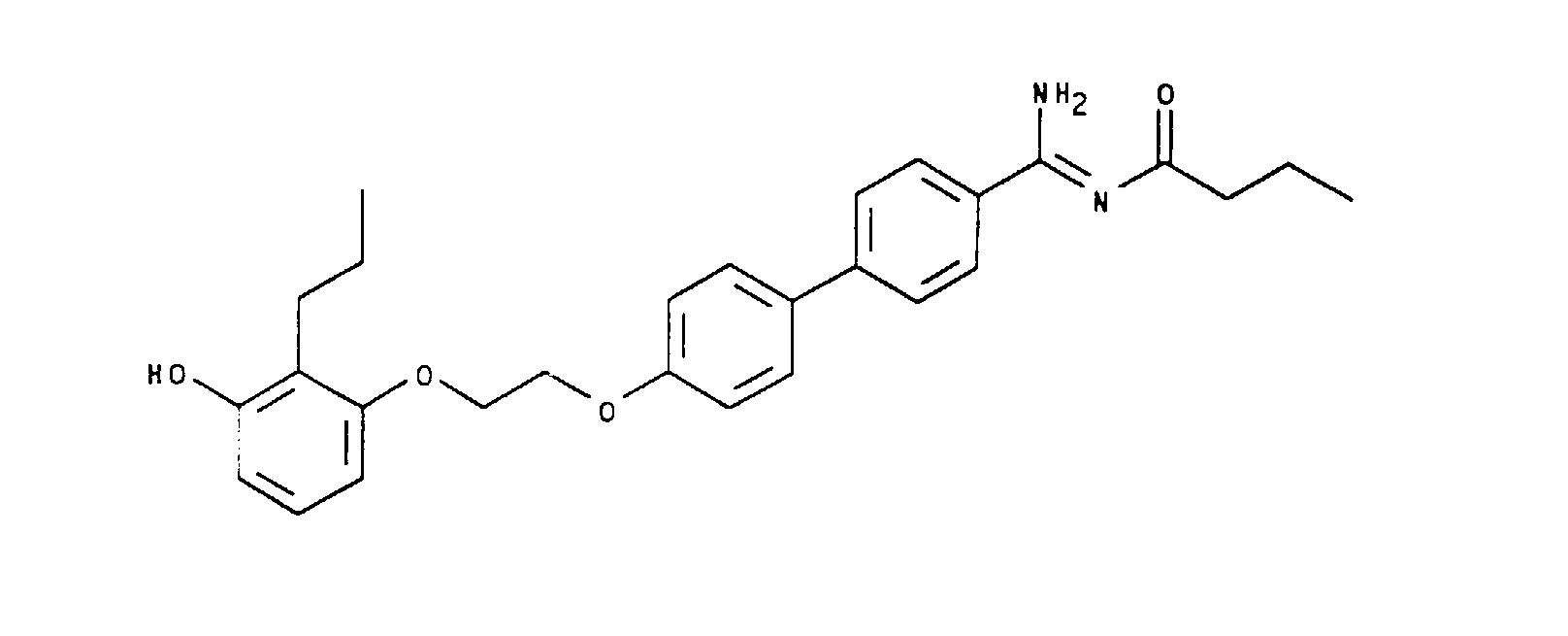
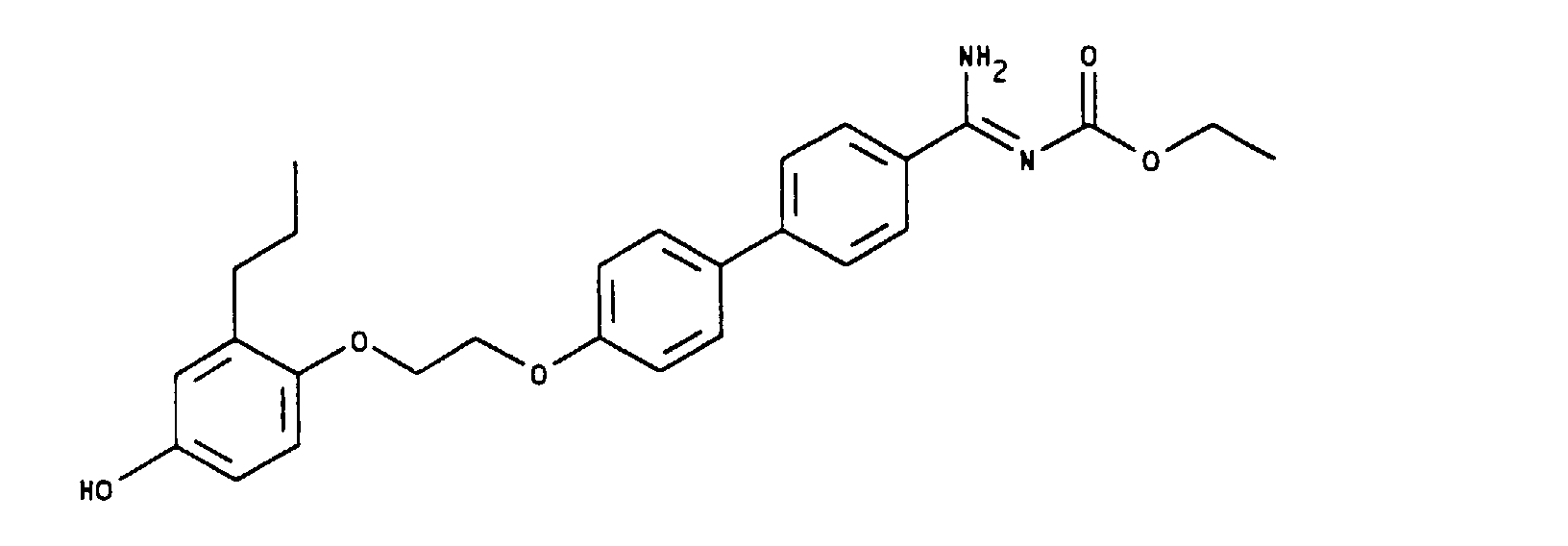
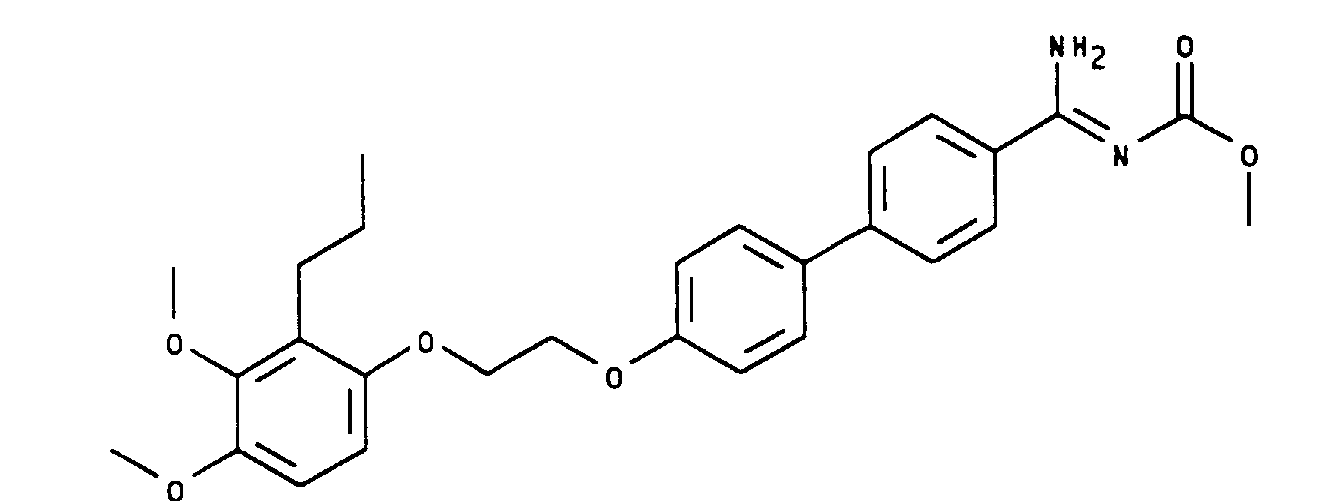
- the invention relates to new substituted benzamidines, their preparation by conventional methods and their use as medicaments with in particular LTB 4 receptor antagonistic activity.
- the new compounds can each be present as free bases or as salts with acids, preferably with physiologically compatible acids; if they contain one or more chiral centers, they are claimed as racemates, in enantiomerically pure or enriched form, if appropriate as diastereomer pairs. Any tautomers (with -C (NH) -NHR 1 ) are also included.
- the number of carbon atoms in the alkyl and alkoxy groups is preferably between 1 and 4. Alkyl and alkoxy groups having up to 3, especially with up to 2, carbon atoms are preferred as substituents in aromatic or heteroaromatic radicals.
- the amidino group C (NH 2 ) NR 1 is preferably in the para position to group A.
- the starting materials can be synthesized using customary methods.
- the compounds of the formula I are distinguished by a wide range of possible uses in the therapeutic field. Emphasis should be placed on those applications for which the LTB 4 receptor antagonistic properties play a role.
- the following are particularly worth mentioning: Arthritis, asthma, chronic obstructive pulmonary diseases such as chronic bronchitis, psoriasis, ulcerative colitis, gastro- or enteropathy induced by non-steroidal anti-inflammatory drugs, Alzheimer's disease, shock, reperfusion damage / ischemia, atherosclerosis, multiple sclerosis.
- the new compounds can also be used to treat diseases or conditions in which the passage of cells from the blood via the vascular endothelium into the tissue is important (for example metastasis) or diseases and conditions in which the combination of the LTB 4 or another Molecule (for example 12-HETE) with the LTB 4 receptor has an influence on cell proliferation (such as chronic myelocytic leukemia).
- the new compounds can also be used in combination with other active substances, for example those which are used for the same indications, or for example with antiallergics, secretolytics, ⁇ 2 -adrenergics, inhalable steroids, antihistamines and / or PAF antagonists.
- Administration can be topical, oral, transdermal, nasal, parenteral or inhalative.
- the new compounds are well tolerated and inexpensive Bioavailability.
- the therapeutic or prophylactic dose is - except from that Effectiveness of the individual connections and the body weight of the Patients - depending on the nature and seriousness of the Disease state.
- the dose is between 10 and 500 mg, preferably between 20 and 250 mg.
- the patient between about 0.5 and 25, preferably between about 2 and 20 mg of active ingredient supplied.
- Inhalation solutions generally contain between about 0.5 and 5% active ingredient.
- the new connections can be made in usual preparations, such as tablets, coated tablets, Capsules, wafers, powders, granules, solutions, emulsions, syrups, Inhalation aerosols, ointments, suppositories.
- Active ingredient according to the invention 20 parts by weight Stearic acid 6 parts by weight glucose 474 parts by weight
- the ingredients are processed in the usual way to tablets of 500 mg weight. If desired, the active substance content can be increased or decreased and the amount of glucose reduced or increased accordingly.
- Suppositories Composition Active ingredient according to the invention 100 parts by weight Lactose, powdered 45 parts by weight Cocoa butter 1555 parts by weight
- the ingredients become suppositories of 1.7 g in the usual way Weight processed.
- Micronized active ingredient powder (compound of formula I; particle size approx. 0.5 to 7 ⁇ m) is filled into hard gelatin capsules in an amount of 5 mg, optionally with the addition of micronized lactose.
- the powder is extracted from conventional inhalation devices, e.g. according to DE-A 33 45 722, inhaled.
Landscapes
- Health & Medical Sciences (AREA)
- Chemical & Material Sciences (AREA)
- Organic Chemistry (AREA)
- Animal Behavior & Ethology (AREA)
- Medicinal Chemistry (AREA)
- Veterinary Medicine (AREA)
- Public Health (AREA)
- General Health & Medical Sciences (AREA)
- Life Sciences & Earth Sciences (AREA)
- Pharmacology & Pharmacy (AREA)
- Chemical Kinetics & Catalysis (AREA)
- Nuclear Medicine, Radiotherapy & Molecular Imaging (AREA)
- Engineering & Computer Science (AREA)
- General Chemical & Material Sciences (AREA)
- Bioinformatics & Cheminformatics (AREA)
- Pulmonology (AREA)
- Neurosurgery (AREA)
- Biomedical Technology (AREA)
- Neurology (AREA)
- Immunology (AREA)
- Dermatology (AREA)
- Cardiology (AREA)
- Rheumatology (AREA)
- Heart & Thoracic Surgery (AREA)
- Pain & Pain Management (AREA)
- Orthopedic Medicine & Surgery (AREA)
- Vascular Medicine (AREA)
- Psychiatry (AREA)
- Hospice & Palliative Care (AREA)
- Diabetes (AREA)
- Urology & Nephrology (AREA)
- Endocrinology (AREA)
- Physical Education & Sports Medicine (AREA)
- Epidemiology (AREA)
- Pharmaceuticals Containing Other Organic And Inorganic Compounds (AREA)
- Organic Low-Molecular-Weight Compounds And Preparation Thereof (AREA)
- Acyclic And Carbocyclic Compounds In Medicinal Compositions (AREA)
- Pyridine Compounds (AREA)
- Other In-Based Heterocyclic Compounds (AREA)
- Saccharide Compounds (AREA)
Description

- A
- für die Gruppe
odersteht;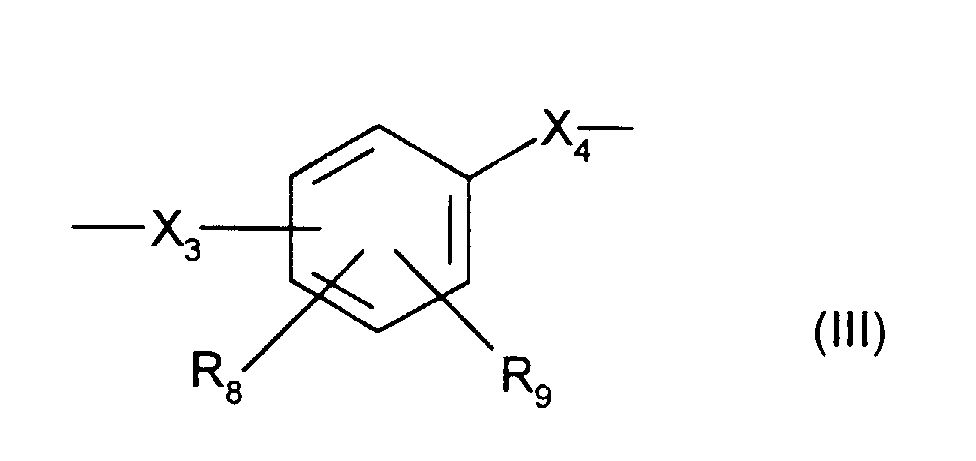
- X1
- für O, NH oder NCH3
- X2
- für O, NH, NCH3 oder

- X3
- für -X-CnH2n-;
- X4
- für -CnH2n-X- (n = 1 oder 2, X = O, NH oder NCH3);
- R1
- für OH, CN, COR12, COOR12 und CHO;
- R2
- für Br, Cl, F, CF3, OH, C1-C6-Alkyl, C5-C7-Cycloalkyl, Aryl, O-Aryl, CH2-Aryl,
CR5R6-Aryl, C(CH3)2-R7;
außerdem für H, wenn A ein Rest der Formel III oder wenn X2 ein Rest der Formel IV ist;
außerdem für C1-C6-Alkoxy, wenn A die Gruppe II ist, X1 und m die obige Bedeutung haben und X2 für NH, NCH3 oder die Gruppe IV steht,
oder wenn A die Gruppe III bedeutet, X3 die obige Bedeutung hat und in X4 X für NH oder NCH3 steht; - R3
- für H, C1-C6-Alkyl, OH, Cl, F, außerdem für C1-C6-Alkoxy, wenn R2 Aryl,
O-Aryl, CH2-Aryl, CR5R6-Aryl oder C(CH3)2-R7 ist oder wenn X2 die Gruppe
IV bedeutet;
R2 und R3 können gemeinsam auch einen ankondensierten aromatischen oder oder heteroaromatischen Ring bedeuten; - R4
- für H oder C1-C6-Alkyl;
- R5
- für C1-C4-Alkyl, CF3, CH2OH, COOH oder COO(C1-C4-Alkyl);
- R6
- für H, C1-C4-Alkyl oder CF3;
R5 und R6 können gemeinsam auch eine C4-C6-Alkylengruppe bilden; - R7
- für CH2OH, COOH, COO(C1-C4-Alkyl), CONR10R11 oder CH2NR10R11;
- R8, R9
- für H, Br, Cl, F, OH, C1-C6-Alkyl oder C1-C6-Alkoxy;
- R10
- für H, C1-C6-Alkyl, Phenyl, Phenyl-(C1-C6-Alkyl), COR12, COOR12, CHO,
CONH2, CONHR12, SO2-(C1-C6-Alkyl), SO2-Phenyl,
wobei der Phenylrest ein- oder mehrfach durch Cl, F, CF3, C1-C4-Alkyl, OH, C1-C4-Alkoxy substituiert sein kann; - R11
- H oder C1-C6-Alkyl;
R10 und R11 können gemeinsam auch eine C4-C6-Alkylengruppe darstellen; - R12
- für C1-C6-Alkyl, C5-C7-Cycloalkyl, Aryl, Heteroaryl, Aralkyl oder Heteroaryl-(C1-C6-Alkyl), wobei die Aryl- oder Heteroarylgruppen ein- oder mehrfach durch Cl, F, CF3, C1-C4-Alkyl, OH oder C1-C4-Alkoxy substituiert sein können
- A
- für eine Gruppe -X1-CmH2m-X2- steht,
worin m eine ganze Zahl 2,3 oder 4 und - X1
- O, NH,
- X2
- O, NH oder
und

- R2
- Wasserstoff, Br, Cl, F, CF3, C1-C6-Alkyl, Phenyl,
- R3
- Wasserstoff, C1-C6-Alkyl, Hydroxy, Cl, F, C1-C6-Alkoxy,
- R4
- Wasserstoff, C1-C6-Alkyl
- R1
- nicht die Bedeutung von -OH haben darf.
worin
- A, m, n, X3, X4 und R1
- die obige Bedeutung haben;
- X1
- für O;
- X2
- für O oder eine Gruppe IV (worin X1 aleich O ist);
- R2
- für Cl, F, CF3, OH, C1-C6-Alkyl, Aryl, O-Aryl, CH2-Aryl oder CR5R6-Aryl, und,
wenn X2 die Gruppe IV ist, außerdem für C1-C6-Alkoxy; - R3
- für H, C1-C6-Alkyl oder OH, und,
wenn R2 CR5R6-Aryl ist, außerdem für C1-C6-Alkoxy; - R4
- für H;
- R5
- für C1-C3-Alkyl, CF3 oder CH2OH;
- R6
- für H, C1-C3-Alkyl oder CF3,
R5 und R6 gemeinsam auch für C4-C5-Alkylen; - R8, R9
- für H, F oder OH
- X1
- für O;
- X2
- für die Gruppe IV (worin X1 gleich O ist);
- X
- für O;
- R1
- für COOR12;
- R2
- für C1-C6-Alkyl, Aryl, O-Aryl, CH2-Aryl oder CR5R6-Aryl;
- R3
- für H, OH oder C1-C6-Alkyl und, wenn R2 CR5R6-Aryl ist, auch für C1-C6-Alkoxy;
- R4
- für H;
- R5, R6
- für C1-C3-Alkyl oder CF3;
- R8,R9
- für H;
- R12
- für C1-C6-Alkyl, Aralkyl oder C7-C5-Cycloalkyl steht.
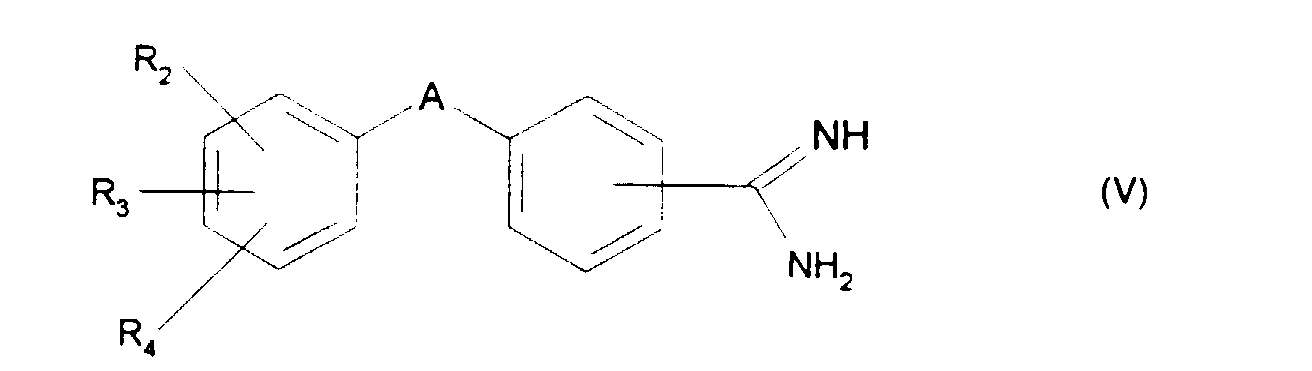
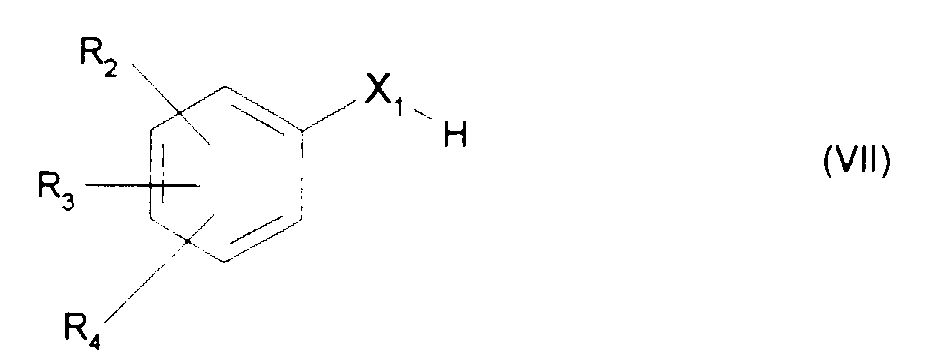


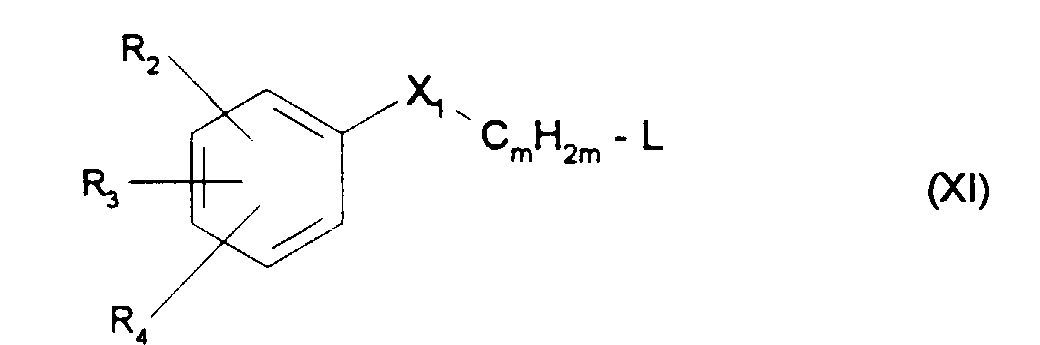
mit einer Verbindung der Formel

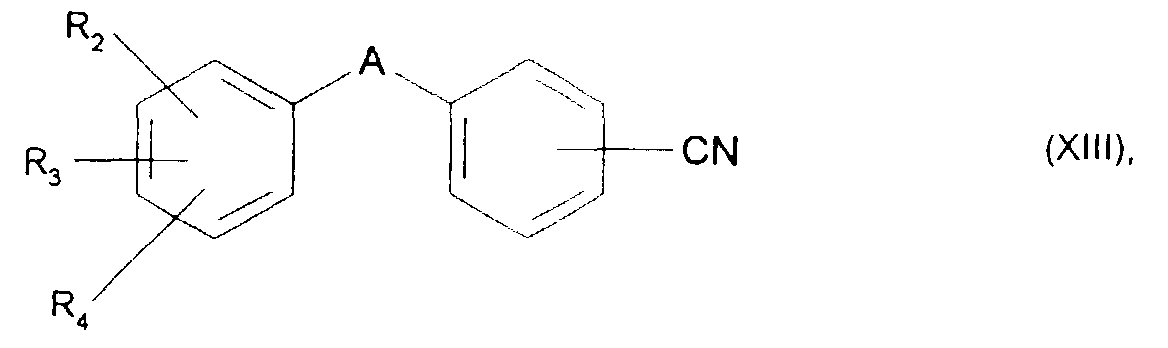
Umsetzung von Nitrilen der Formel
Arthritis, Asthma, chronische obstruktive Lungenerkrankungen, etwa chronische Bronchitis, Psoriasis, Colitis ulcerosa, durch nichtsteroidale Antiphlogistika induzierte Gastro- oder Enteropathie, Alzheimer-Krankheit, Schock, Reperfusionsschäden/lschämien, Atherosklerose, Multiple Sklerose.
Auch lassen sich mit den neuen Verbindungen Krankheiten oder Zustände behandeln, bei denen die Passage von Zellen aus dem Blut über das vaskuläre Endothelium in das Gewebe von Bedeutung ist (etwa Metastasis) oder Krankheiten und Zustände, bei denen die Kombination des LTB4 oder eines anderen Moleküls (beispielsweise 12-HETE) mit dem LTB4-Rezeptor einen Einfluß auf die Zell-Proliferation hat (etwa chronische myelozytische Leukämie).
Die neuen Verbindungen können auch in Kombination mit anderen Wirkstoffen angewendet werden, etwa solchen, die für dieselben Indikationen Verwendung finden, oder z.B. mit Antiallergika, Sekretolytika, β2-Adrenergika, inhalativ anwendbaren Steroiden, Antihistaminika und/oder PAF-Antagonisten. Die Verabreichung kann topisch, oral, transdermal, nasal, parenteral oder inhalativ erfolgen.
| 1. Tabletten | |
| Zusammensetzung: | |
| Wirkstoff gemäß der Erfindung | 20 Gew.-Teile |
| Stearinsäure | 6 Gew.-Teile |
| Traubenzucker | 474 Gew.-Teile |
| 2. Suppositorien | |
| Zusammensetzung: | |
| Wirkstoff gemäß der Erfindung | 100 Gew.-Teile |
| Laktose, gepulvert | 45 Gew.-Teile |
| Kakao-Butter | 1555 Gew.-Teile |





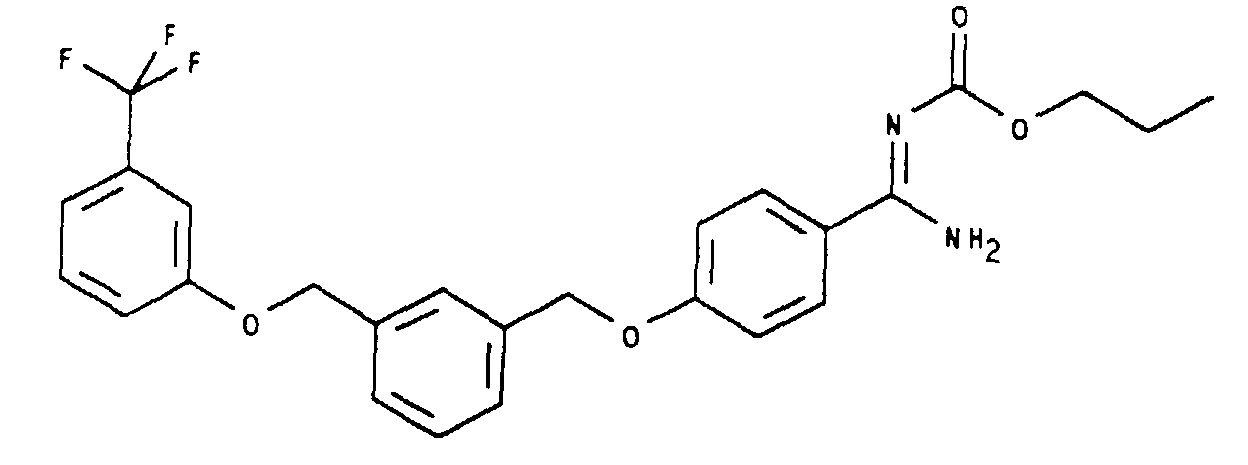
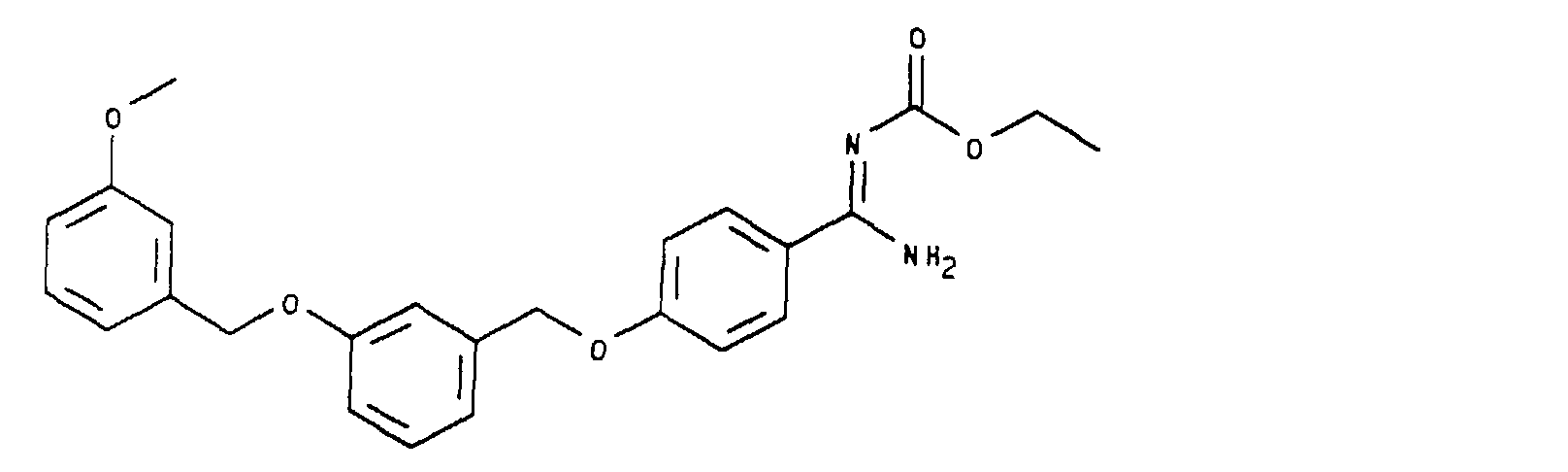

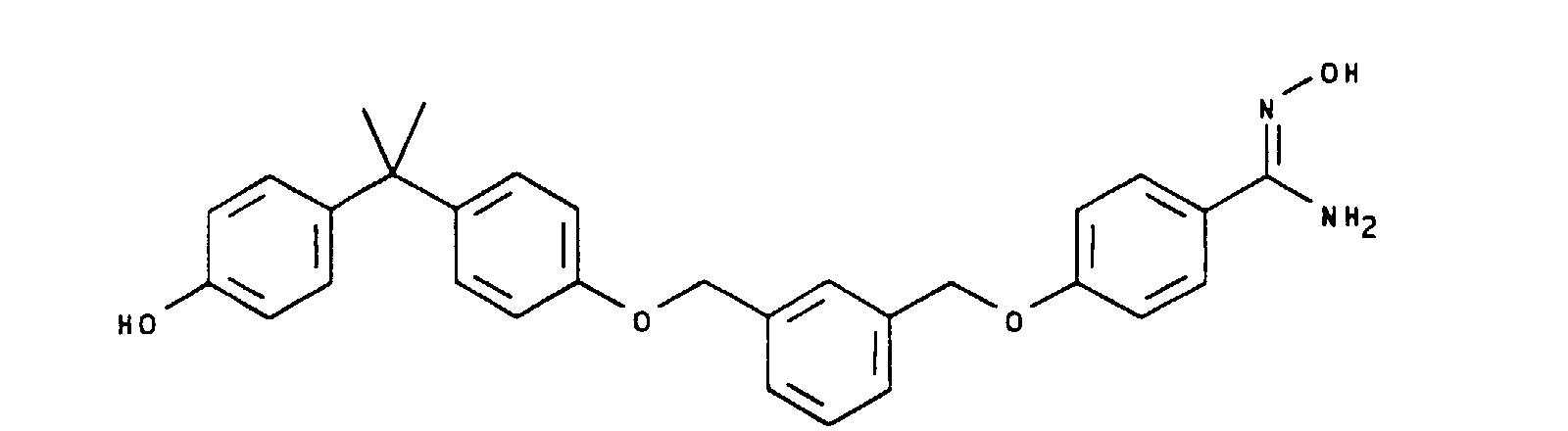

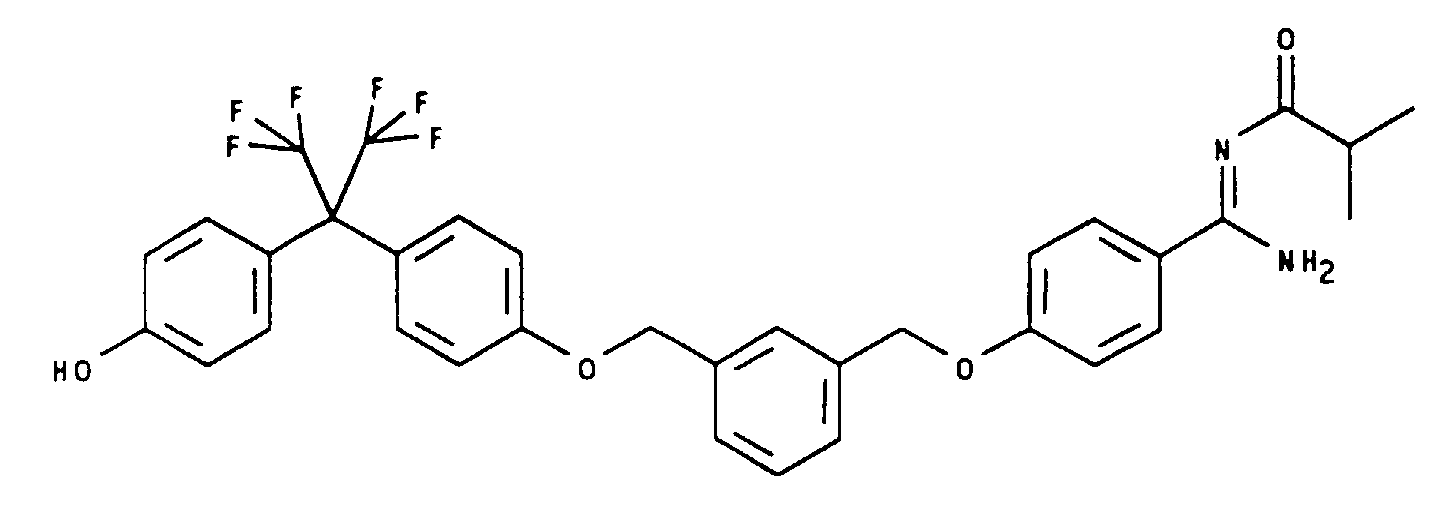
Claims (13)
- Neue substituierte Benzamidine der Formelin der

- A
- für die Gruppe
odersteht: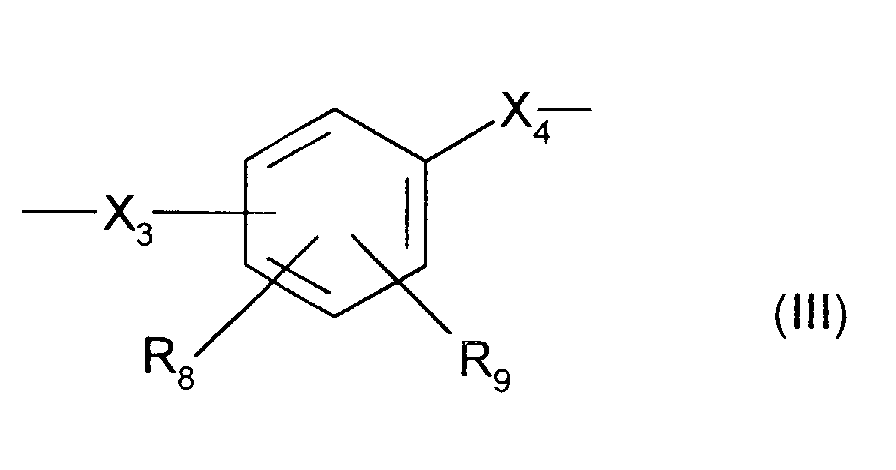
- X1
- für O, NH oder NCH3
- X2
- für O, NH, NCH3 oder

- X3
- für X-CnH2n-;
- X4
- für -CnH2n-X- (n = 1 oder 2, X = O, NH oder NCH3);
- R1
- für OH, CN, COR12, COOR12 und CHO;
- R2
- für Br, Cl, F, CF3, OH, C1-C6-Alkyl, C5-C7-Cycloalkyl, Aryl, O-Aryl, CH2-Aryl,
CR5R6-Aryl, C(CH3)2-R7;
außerdem für H, wenn A ein Rest der Formel III oder wenn X2 ein Rest der Formel IV ist;
außerdem für C1-C6-Alkoxy, wenn A die Gruppe II ist, X1 und m die obige Bedeutung haben und X2 für NH, NCH3 oder die Gruppe IV steht,
oder wenn A die Gruppe III bedeutet, X3 die obige Bedeutung hat und in X4 X für NH oder NCH3 steht; - R3
- für H, C1-C6-Alkyl, OH, Cl, F, außerdem für C1-C6-Alkoxy, wenn R2 Aryl,
O-Aryl, CH2-Aryl, CR5R6-Aryl oder C(CH3)2-R7 ist oder wenn X2 die
Gruppe
IV bedeutet;
R2 und R3 können gemeinsam auch einen ankondensierten aromatischen oder heteroaromatischen Ring bedeuten; - R4
- für H oder C1-C6-Alkyl;
- R5
- für C1-C4-Alkyl, CF3, CH2OH, COOH oder COO(C1-C4-Alkyl);
- R6
- für H, C1-C4-Alkyl oder CF3;
R5 und R6 können gemeinsam auch eine C4-C6-Alkylengruppe bilden; - R7
- für CH2OH, COOH, COO(C1-C4-Alkyl), CONR10R11 oder CH2NR10R11;
- R8, R9
- für H, Br, Cl, F, OH, C1-C6-Alkyl oder C1-C6-Alkoxy;
- R10
- für H, C1-C6-Alkyl, Phenyl, Phenyl-(C1-C6-Alkyl), COR12, COOR12, CHO,
CONH2, CONHR12, SO2-(C1-C6-Alkyl), SO2-Phenyl,
wobei der Phenylrest ein- oder mehrfach durch Cl, F, CF3, C1-C4-Alkyl, OH, C1-C4-Alkoxy substituiert sein kann; - R11
- H oder C1-C6-Alkyl;
R10 und R11 können gemeinsam auch eine C4-C6-Alkylengruppe darstellen; - R12
- für C1-C6-Alkyl, C5-C7-Cycloalkyl, Aryl, Heteroaryl, Aralkyl oder Heteroaryl-(C1-C6-Alkyl), wobei die Aryl- oder Heteroarylgruppen ein- oder mehrfach durch Cl, F, CF3, C1-C4-Alkyl, OH oder C1-C4-Alkoxy substituiert sein können
- A
- für eine Gruppe -X1-CmH2m-X2- steht,
worin m eine ganze Zahl 2,3 oder 4 und- X1
- O, NH,
- X2
- O, NH oder

- R2
- Wasserstoff, Br, Cl, F, CF3, C1-C6-Alkyl, Phenyl,
- R3
- Wasserstoff, C1-C6-Alkyl, Hydroxy, Cl, F, C1-C6-Alkoxy,
- R4
- Wasserstoff, C1-C6-Alkyl
- R1
- nicht die Bedeutung von -OH haben darf.
- Verbindungen nach Anspruch 1, in denen Aryl Phenyl oder ein- oder mehrfach substituiertes Phenyl und Heteroaryl Pyridyl, Pyridazinyl, Pyrimidyl, Pyrazinyl, Thienyl oder Furyl bedeutet.
- Verbindungen nach Anspruch 1 oder 2,
worin- A, m, n, X3, X4 und R1
- die obige Bedeutung haben;
- X1
- für O;
- X2
- für O oder eine Gruppe IV ( worin X1 gleich O ist);
- R2
- für Cl, F, CF3, OH, C1-C6-Alkyl, Aryl, O-Aryl, CH2-Aryl oder CR5R6-Aryl,
und,
wenn X2 die Gruppe IV ist außerdem für C1-C6-Alkoxy; - R3
- für H, C1-C6-Alkyl oder OH, und,
wenn R2 CR5R6-Aryl ist, außerdem für C1-C6-Alkoxy; - R4
- für H;
- R5
- für C1-C3-Alkyl, CF3 oder CH2OH;
- R6
- für H, C1-C3-Alkyl oder CF3,
- R5 und R6
- gemeinsam auch für C4-C5-Alkylen;
- R8, R9
- für H, F oder OH
- Die Verbindungen nach Anspruch 1 oder 2,
worin- X1
- für O;
- X2
- für die Gruppe IV (worin X1 gleich O ist);
- X
- für O;
- R1
- für COOR12;
- R2
- für C1-C6-Alkyl, Aryl, O-Aryl, CH2-Aryl oder CR5R6-Aryl;
- R3
- für H, OH oder C1-C6-Alkyl und, wenn R2 CR5R6-Aryl ist, auch für C1-C6-Alkoxy;
- R4
- für H;
- R5, R6
- für C1-C3-Alkyl oder CF3;
- R8,R9
- für H;
- R12
- für C1-C6-Alkyl, Aralkyl oder C7-C5-Cycloalkyl
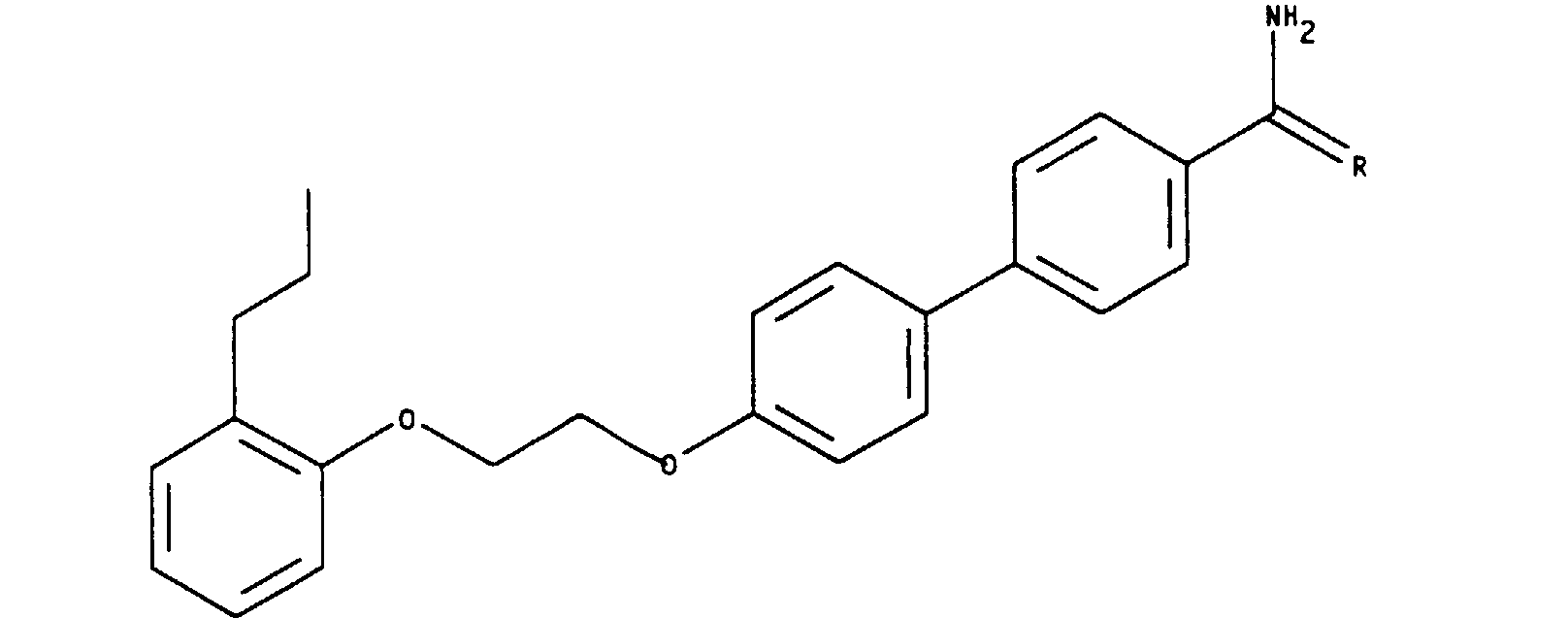
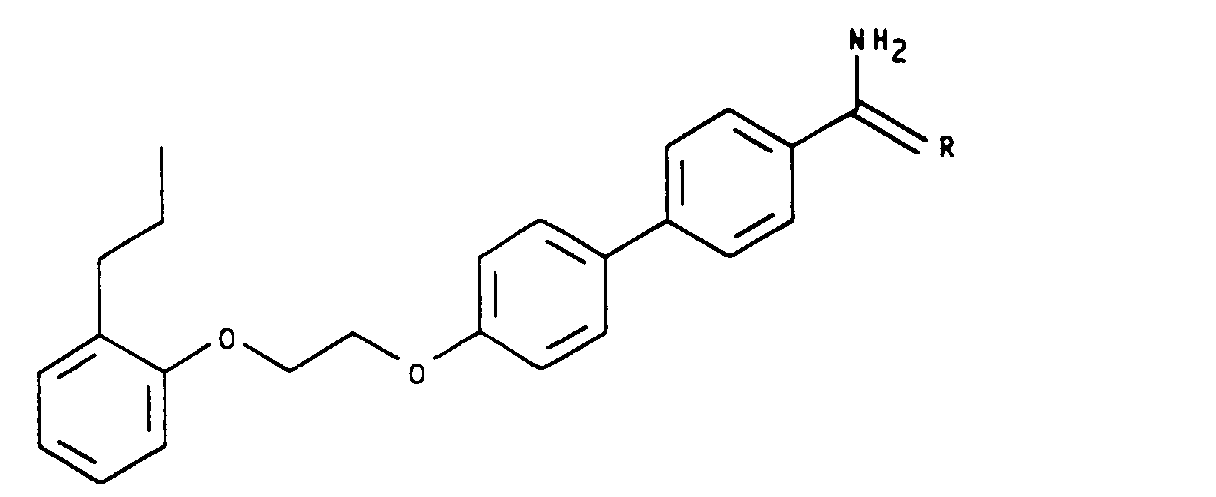
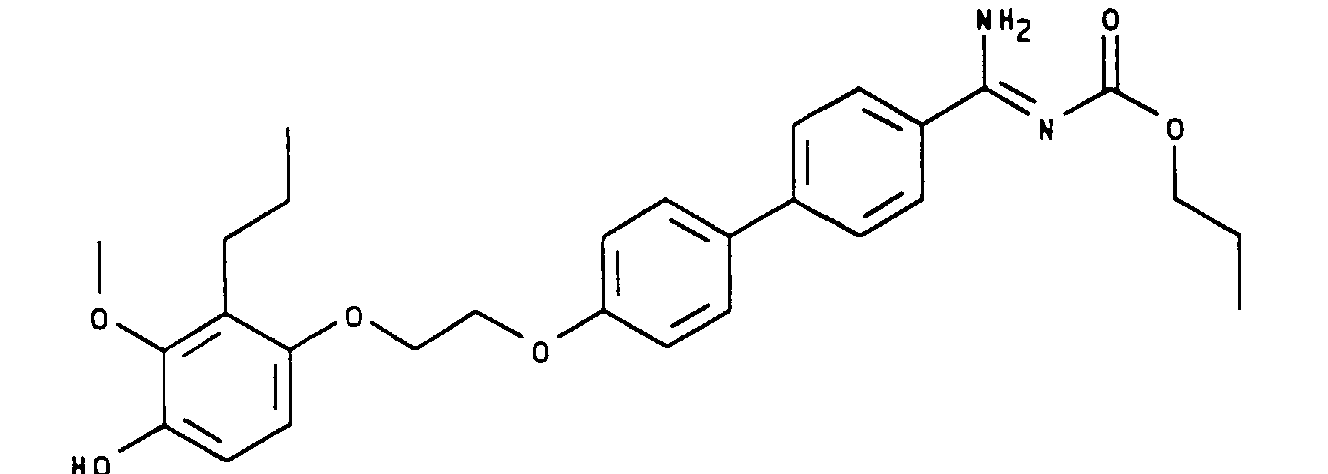
- Methoxycarbonyl-imino-{4'-[2-(2-propylphenoxy)-ethoxy]-biphenyl-4-yl}-methyl)-amin und seine Säureadditionssalze.
- (Benzyloxycarbonyl-imino-{4'-[2-(2-propylphenoxy)-ethoxy]-biphenyl-4-yl}methyl)-amin und seine Säureadditionssalze.
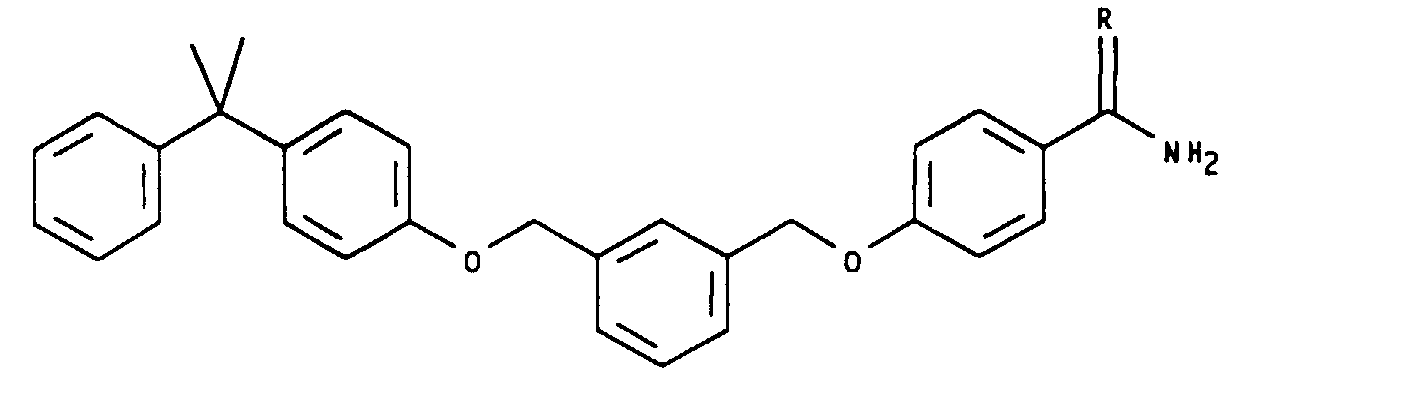
- [Hydroxy-imino-(4-{3-[4-(1-methyl-1-phenylethyl)-phenoxymethyl]-benzyloxy}phenyl)-methyl]-amin und seine Säureadditionssalze
- [Ethoxycarbonyl-imino-(4-{3-[4-(1-methyl-1-phenylethyl)-phenoxymethyl]-benzyloxy}phenyl)-methyl]-amin und seine Säureadditionssalze.
- [3'-Pyridylcarbonyl-imino-(4-{3-[4-(1 -methyl-1-phenylethyl)-phenoxymethyl]-benzyloxy}phenyl)-methyl]-amin und seine Säureadditionssalze.
- Pharmazeutische Zubereitungen mit üblichen Hilfs- und/oder Trägerstoffen, gekennzeichnet durch einen Gehalt an einer Verbindung nach Anspruch 1 bis 9.
- Verwendung von Verbindungen der allgemeinen Formel Iin der
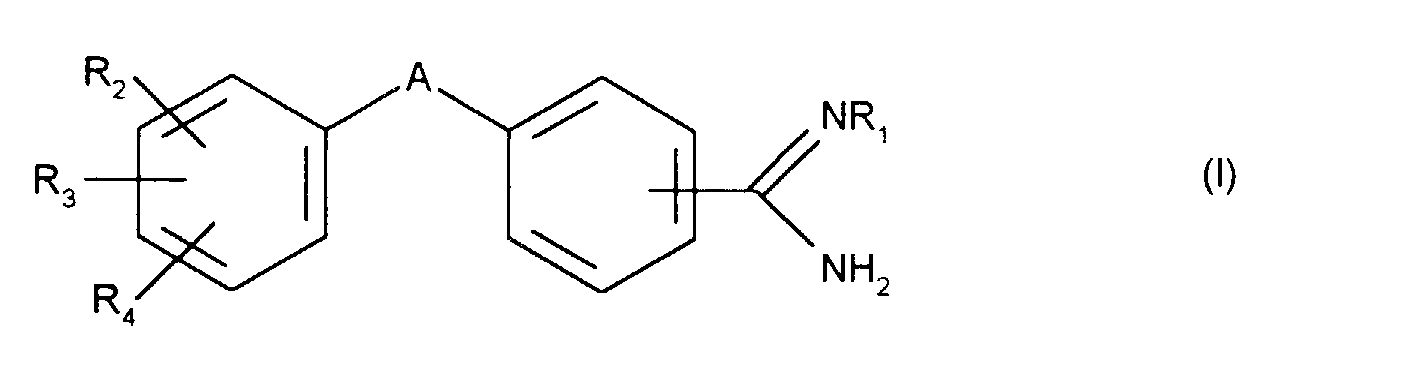
- A
- für die Gruppe
odersteht: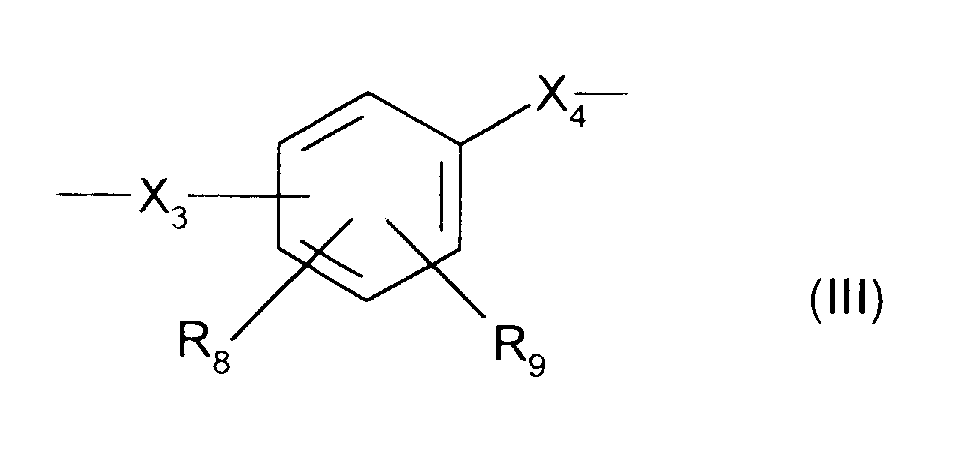
- X1
- für O, NH oder NCH3
- X2
- für O, NH, NCH3 oder
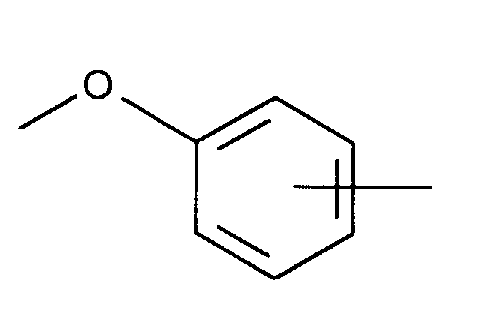
- X3
- für -X-CnH2n-;
- X4
- für -CnH2n-X- (n = 1 oder 2, X = O, NH oder NCH3);
- R1
- für OH, CN, COR12, COOR12 und CHO;
- R2
- für Br, Cl, F, CF3, OH, C1-C6-Alkyl, C5-C7-Cycloalkyl, Aryl, O-Aryl,
CH2-Aryl, CR5R6-Aryl, C(CH3)2-R7;
außerdem für H, wenn A ein Rest der Formel III oder wenn X2 ein Rest der Formel IV ist;
außerdem für C1-C6-Alkoxy, wenn A die Gruppe II ist, X1 und m die obige Bedeutung haben und X2 für NH, NCH3 oder die Gruppe IV steht,
oder wenn A die Gruppe III bedeutet, X3 die obige Bedeutung hat und in X4 X für NH oder NCH3 steht; - R3
- für H, C1-C6-Alkyl, OH, Cl, F, außerdem für C1-C6-Alkoxy, wenn R2
Aryl, O-Aryl, CH2-Aryl, CR5R6-Aryl oder C(CH3)2-R7 ist oder
wenn X2 die Gruppe IV bedeutet; - R2 und R3
- können gemeinsam auch einen ankondensierten aromatischen oder heteroaromatischen Ring bedeuten;
- R4
- für H oder C1-C6-Alkyl;
- R5
- für C1-C4-Alkyl, CF3, CH2OH, COOH oder COO(C1-C4-Alkyl);
- R6
- für H, C1-C4-Alkyl oder CF3;
- R5 und R6
- können gemeinsam auch eine C4-C6-Alkylengruppe bilden;
- R7
- für CH2OH, COOH, COO(C1-C4-Alkyl), CONR10R11 oder CH2NR10R11;
- R8, R9
- für H, Br, Cl, F, OH, C1-C6-Alkyl oder C1-C6-Alkoxy;
- R10
- für H, C1-C6-Alkyl, Phenyl, Phenyl-(C1-C6-Alkyl), COR12,
COOR12, CHO, CONH2, CONHR12, SO2-(C1-C6-Alkyl),
SO2-Phenyl,
wobei der Phenylrest ein- oder mehrfach durch Cl, F, CF3, C1-C4-Alkyl, OH, C1-C4-Alkoxy substituiert sein kann; - R11
- H oder C1-C6-Alkyl;
- R10 und R11
- können gemeinsam auch eine C4-C6-Alkylengruppe darstellen;
- R12
- für C1-C6-Alkyl, C5-C7-Cycloalkyl, Aryl, Heteroaryl, Aralkyl oder Heteroaryl-(C1-C6-Alkyl), wobei die Aryl- oder Heteroarylgruppen ein- oder mehrfach durch Cl, F, CF3, C1-C4-Alkyl, OH oder C1-C4-Alkoxy substituiert sein können;
- Verwendung von Verbindungen gemäß Anspruch 11 zur Herstellung eines Arzneimittels für die Behandlung von Krankheiten, bei denen entzündliche und/oder allergische Vorgänge eine Rolle spielen, insbesondere Arthritis, Asthma, chronischen obstruktiven Lungenerkrankungen, Psoriasis, Colitis ulcerosa, Alzheimer-Krankheit, Schock, Atherosklerose, Multiple Sklerose, und zur Behandlung einer durch nichtsteroidale Antiphlogistika induzierten Gastropathie sowie bei Metastasis und chronischer myelozytischer Leukämie.
- Verfahren zur Herstellung der Verbindungen nach Anspruch 1 bis 9,
dadurch gekennzeichnet, daß mana.) ein Amidin der Formelmit einer Verbindung der Formel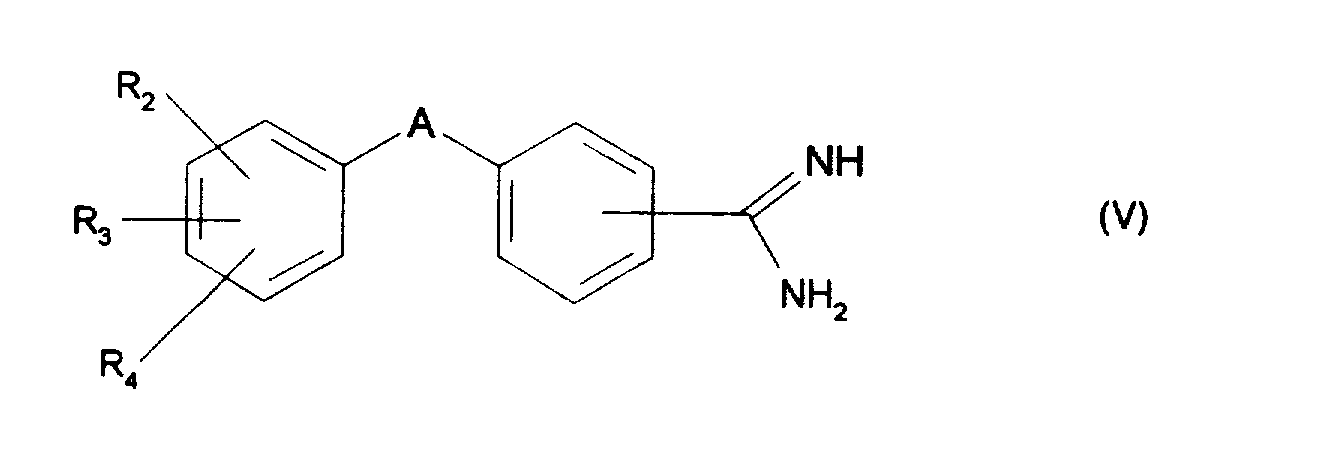
oder, daß manb.) eine Verbindung der Formel(worin R2, R3, R4 und X1 die obige Bedeutung haben), mit einem Benzamidinderivat der Formel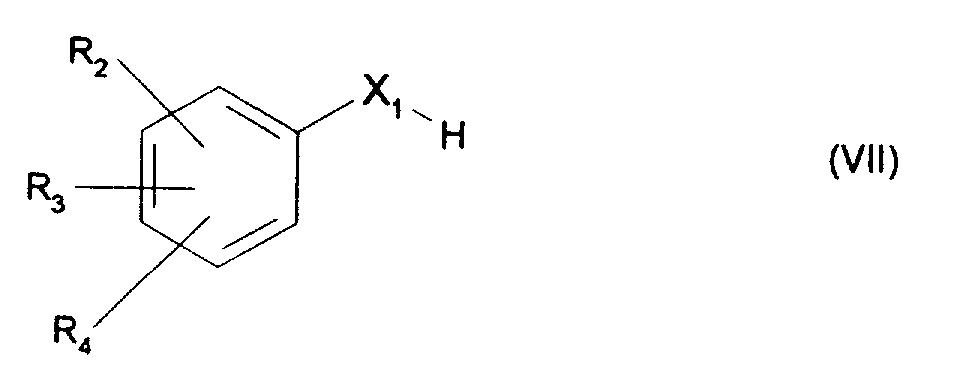 oder
oder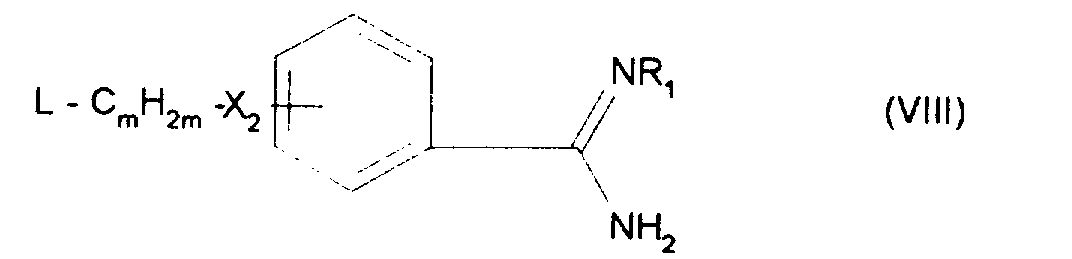 (worin L, m, n, X, X2, X4, R1, R8 und R9 die obige Bedeutung haben), umsetzt,
oder daß manc.) eine Verbindung der Formel(R1 und X2 in der obigen Bedeutung) mit einer Verbindung der Formel oder
oder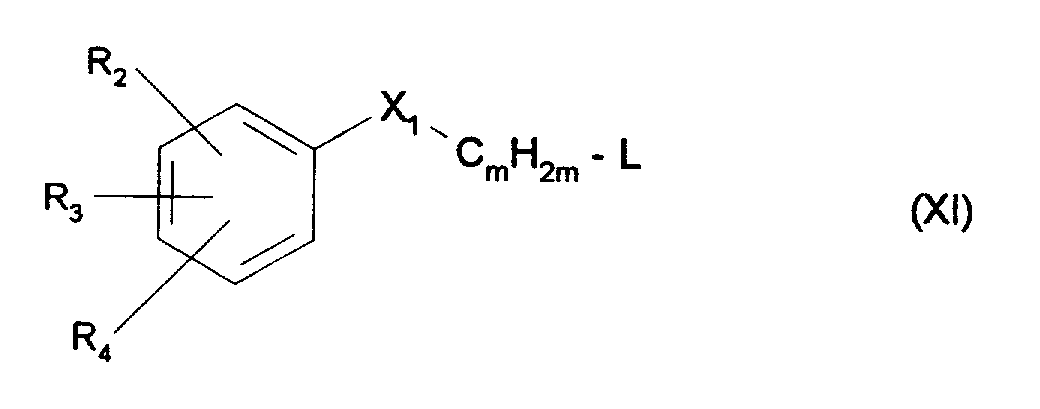 (worin L, m, n, R2, R3, R4, R8, R9, X1 und X3 die obige Bedeutung haben) umsetzt,
oder, daß mand.) zur Herstellung solcher Verbindungen der Formel I, in denen R1 OH bedeutet, ein Nitril der Formelworin A, R2, R3, und R4 die obige Bedeutung haben,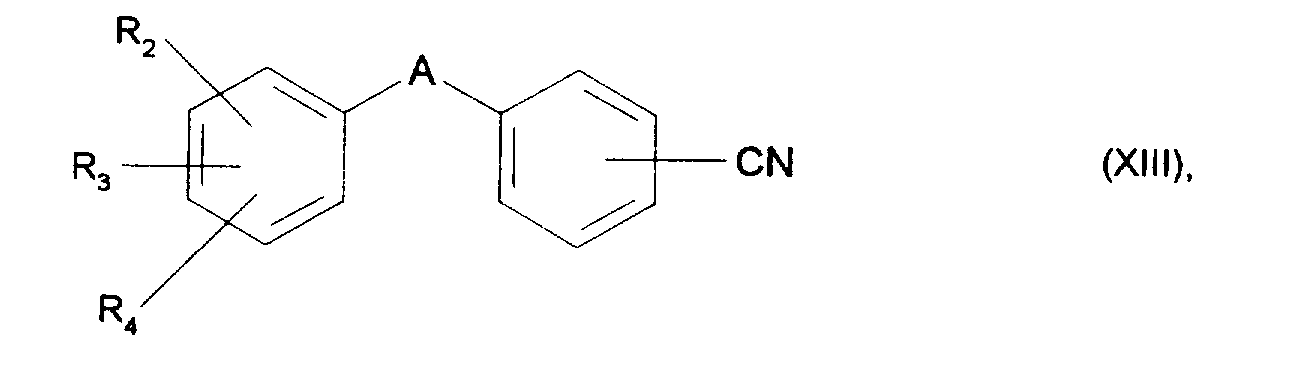
mit Hydroxylamin umsetzt
und aus den erhaltenen Produkten, je nach ihrer Art, gegebenenfalls optische Antipoden oder diastereomere Antipodenpaare herstellt oder daß man aus erhaltenen Basen Säureadditionssalze, aus zunächst erhaltenen Säureadditionssalzen freie Basen gewinnt.
Priority Applications (1)
| Application Number | Priority Date | Filing Date | Title |
|---|---|---|---|
| SI9530249T SI0770059T1 (en) | 1994-07-13 | 1995-06-03 | Substituted benzamidines, their production and their use as medicaments |
Applications Claiming Priority (3)
| Application Number | Priority Date | Filing Date | Title |
|---|---|---|---|
| DE4424713 | 1994-07-13 | ||
| DE4424713A DE4424713A1 (de) | 1994-07-13 | 1994-07-13 | Substituierte Benzamidine, ihre Herstellung und Verwendung als Arnzneistoffe |
| PCT/EP1995/002112 WO1996002497A1 (de) | 1994-07-13 | 1995-06-03 | Substituierte benzamidine, ihre herstellung und verwendung als arzneimittel |
Publications (2)
| Publication Number | Publication Date |
|---|---|
| EP0770059A1 EP0770059A1 (de) | 1997-05-02 |
| EP0770059B1 true EP0770059B1 (de) | 1999-04-07 |
Family
ID=6523047
Family Applications (1)
| Application Number | Title | Priority Date | Filing Date |
|---|---|---|---|
| EP95921824A Expired - Lifetime EP0770059B1 (de) | 1994-07-13 | 1995-06-03 | Substituierte benzamidine, ihre herstellung und verwendung als arzneimittel |
Country Status (36)
| Country | Link |
|---|---|
| US (1) | US5731332A (de) |
| EP (1) | EP0770059B1 (de) |
| JP (1) | JP2931410B2 (de) |
| KR (1) | KR100421580B1 (de) |
| CN (1) | CN1083830C (de) |
| AT (1) | ATE178590T1 (de) |
| AU (1) | AU700585B2 (de) |
| BG (1) | BG62090B1 (de) |
| BR (1) | BR9508374A (de) |
| CA (1) | CA2194885C (de) |
| CO (1) | CO4410184A1 (de) |
| CZ (1) | CZ289376B6 (de) |
| DE (2) | DE4424713A1 (de) |
| DK (1) | DK0770059T3 (de) |
| EE (1) | EE03311B1 (de) |
| ES (1) | ES2131830T3 (de) |
| FI (1) | FI970094L (de) |
| GR (1) | GR3030043T3 (de) |
| HR (1) | HRP950365B1 (de) |
| HU (1) | HU224823B1 (de) |
| IL (1) | IL114571A (de) |
| MX (1) | MX9700273A (de) |
| MY (1) | MY117090A (de) |
| NO (1) | NO307373B1 (de) |
| NZ (1) | NZ287883A (de) |
| PE (1) | PE32496A1 (de) |
| PL (1) | PL179595B1 (de) |
| RO (1) | RO118653B1 (de) |
| RU (1) | RU2159228C2 (de) |
| SA (1) | SA95160355B1 (de) |
| SK (1) | SK281744B6 (de) |
| TW (1) | TW555738B (de) |
| UA (1) | UA45351C2 (de) |
| WO (1) | WO1996002497A1 (de) |
| YU (1) | YU48934B (de) |
| ZA (1) | ZA955780B (de) |
Families Citing this family (24)
| Publication number | Priority date | Publication date | Assignee | Title |
|---|---|---|---|---|
| US6486181B1 (en) | 1992-08-28 | 2002-11-26 | City Of Hope | Human leukocutye 12-lipoxygenase and its role in the pathogenesis of disease states |
| US6191169B1 (en) | 1992-08-28 | 2001-02-20 | City Of Hope | Human leukocyte 12-lipoxygenase and its role in the pathogenesis of disease states |
| CA2214685C (en) * | 1995-03-10 | 2008-05-20 | Berlex Laboratories, Inc. | Benzamidine derivatives their preparation and their use as anti-coagulants |
| WO1996036347A1 (en) * | 1995-05-17 | 1996-11-21 | Eli Lilly And Company | Use of leukotriene antagonists for alzheimer's disease |
| DE19636689A1 (de) | 1996-09-10 | 1998-03-12 | Boehringer Ingelheim Kg | Neue Benzamidinderivate |
| DE19718334A1 (de) | 1997-04-30 | 1998-11-05 | Boehringer Ingelheim Pharma | Neue Benzylaminderivate und Phenylethylaminderivate, Verfahren zu ihrer Herstellung und ihre Verwendung als Arzneimittel |
| TW513402B (en) * | 1997-05-30 | 2002-12-11 | Daiichi Seiyaku Co | Process for preparing 3-(7-amidino-2-naphthyl)-2-phenylpropionic acid derivatives |
| WO1999018956A1 (en) * | 1997-10-15 | 1999-04-22 | City Of Hope | 12(s)-hete receptor blockers |
| ID24720A (id) | 1997-12-12 | 2000-08-03 | Novartis Ag | Senyawa amidino tersubstitusi dalam perawatan penyakit gangguan paru-paru kronis |
| DE19834713A1 (de) * | 1998-07-31 | 2000-02-03 | Boehringer Ingelheim Pharma | Neue Phenylethylaminderivate, Verfahren zu ihrer Herstellung und ihre Verwendung als Arzneimittel |
| US6291531B1 (en) * | 1999-10-07 | 2001-09-18 | Boehringer Ingelheim Pharma Kg | LTB4 antagonist, processes for the preparation thereof and its use as a pharmaceutical composition |
| US6417382B2 (en) | 2000-01-12 | 2002-07-09 | Boehringer Ingelheim Pharma Kg | Process for preparing aryl-iminomethyl-carbamino acid esters |
| DE10000907A1 (de) * | 2000-01-12 | 2001-07-19 | Boehringer Ingelheim Pharma | Verfahren zur Herstellung von Aryl-iminomethyl-carbaminsäureestern |
| US6528491B2 (en) * | 2000-10-24 | 2003-03-04 | Boehringer Ingelheim Pharma Kg | Pyranoside derivatives |
| CA2433451A1 (en) * | 2001-01-16 | 2002-07-18 | Boehringer Ingelheim Pharma Gmbh & Co. Kg | Use of an ltb4 antagonist for the treatment and/or prevention of diseases caused by increased expression of mucin genes |
| US20030119901A1 (en) * | 2001-07-14 | 2003-06-26 | Boehringer Ingelheim Pharma Kg | Pharmaceutical formulation containing an LTB4 antagonist |
| CN1298316C (zh) * | 2001-07-14 | 2007-02-07 | 贝林格尔英格海姆法玛两合公司 | 含有ltb4拮抗剂的药物制剂 |
| JP2005504053A (ja) * | 2001-08-31 | 2005-02-10 | ニューロケム (インターナショナル) リミテッド | アミロイドーシス治療のためのアミジン誘導体 |
| RS20050390A (sr) * | 2002-11-26 | 2008-04-04 | Boehringer Ingelheim Pharma Gmbh. & Co.Kg., | Farmaceutska kompozicija koja obuhvata ltb4 antagonist i koks-2 inhibitor ili kombinovani koks1/2 inhibitor |
| DE10350528A1 (de) * | 2003-10-29 | 2005-06-09 | Boehringer Ingelheim Pharma Gmbh & Co. Kg | Arzneimittelformulierung, enthaltend einen LTB4-Antagonisten, sowie Verfahren zu deren Herstellung und deren Verwendung |
| US7262223B2 (en) * | 2004-01-23 | 2007-08-28 | Neurochem (International) Limited | Amidine derivatives for treating amyloidosis |
| KR100716389B1 (ko) * | 2004-11-23 | 2007-05-11 | 동화약품공업주식회사 | N-히드록시-4-{5-[4-(5-이소프로필-2-메틸-1,3-티아졸-4-일)페녹시]펜톡시}벤즈아미딘 2메탄술폰산염 |
| CN103012200B (zh) * | 2011-09-20 | 2014-12-17 | 北京大学 | 具有β-分泌酶抑制功能的化合物及其制备方法与应用 |
| WO2018207950A1 (ja) | 2017-05-12 | 2018-11-15 | 横山 茂之 | クラスa gpcr結合性化合物改変体 |
Family Cites Families (6)
| Publication number | Priority date | Publication date | Assignee | Title |
|---|---|---|---|---|
| FR2550192B1 (fr) * | 1983-08-03 | 1986-04-04 | Sanofi Sa | Nouveaux derives de la benzamidine a activite antimicrobienne, leur procede de preparation, leur utilisation en tant que medicaments desinfectants ou conservateurs |
| US5451700A (en) * | 1991-06-11 | 1995-09-19 | Ciba-Geigy Corporation | Amidino compounds, their manufacture and methods of treatment |
| EP0518818A3 (en) * | 1991-06-11 | 1993-04-28 | Ciba-Geigy Ag | Arylethers, their manufacture and use as medicament |
| DK0518819T3 (da) * | 1991-06-11 | 1995-09-25 | Ciba Geigy Ag | Amidino-forbindelser, deres fremstilling og anvendelse som lægemiddel |
| EP0625138B1 (de) * | 1992-02-05 | 1999-06-02 | BOEHRINGER INGELHEIM INTERNATIONAL GmbH | Neue amidinderivate, ihre herstellung und verwendung als arzneimittel mit ltb4-antagonistischer wirkung |
| US5455274A (en) * | 1992-12-09 | 1995-10-03 | Ciba-Geigy Corporation | Hydroxyamidine derivatives |
-
1994
- 1994-07-13 DE DE4424713A patent/DE4424713A1/de not_active Withdrawn
-
1995
- 1995-06-03 CZ CZ199766A patent/CZ289376B6/cs not_active IP Right Cessation
- 1995-06-03 JP JP8504618A patent/JP2931410B2/ja not_active Expired - Lifetime
- 1995-06-03 RO RO97-00018A patent/RO118653B1/ro unknown
- 1995-06-03 US US08/765,692 patent/US5731332A/en not_active Expired - Lifetime
- 1995-06-03 WO PCT/EP1995/002112 patent/WO1996002497A1/de not_active Ceased
- 1995-06-03 AT AT95921824T patent/ATE178590T1/de active
- 1995-06-03 FI FI970094A patent/FI970094L/fi not_active Application Discontinuation
- 1995-06-03 MX MX9700273A patent/MX9700273A/es not_active IP Right Cessation
- 1995-06-03 KR KR1019970700124A patent/KR100421580B1/ko not_active Expired - Fee Related
- 1995-06-03 SK SK19-97A patent/SK281744B6/sk not_active IP Right Cessation
- 1995-06-03 CN CN95194048A patent/CN1083830C/zh not_active Expired - Fee Related
- 1995-06-03 RU RU97102043/04A patent/RU2159228C2/ru not_active IP Right Cessation
- 1995-06-03 UA UA97020598A patent/UA45351C2/uk unknown
- 1995-06-03 CA CA002194885A patent/CA2194885C/en not_active Expired - Fee Related
- 1995-06-03 PL PL95318115A patent/PL179595B1/pl not_active IP Right Cessation
- 1995-06-03 EE EE9700066A patent/EE03311B1/xx not_active IP Right Cessation
- 1995-06-03 HU HU9700059A patent/HU224823B1/hu not_active IP Right Cessation
- 1995-06-03 DE DE59505600T patent/DE59505600D1/de not_active Expired - Lifetime
- 1995-06-03 BR BR9508374A patent/BR9508374A/pt not_active IP Right Cessation
- 1995-06-03 DK DK95921824T patent/DK0770059T3/da active
- 1995-06-03 EP EP95921824A patent/EP0770059B1/de not_active Expired - Lifetime
- 1995-06-03 ES ES95921824T patent/ES2131830T3/es not_active Expired - Lifetime
- 1995-06-03 NZ NZ287883A patent/NZ287883A/xx not_active IP Right Cessation
- 1995-06-03 AU AU26742/95A patent/AU700585B2/en not_active Ceased
- 1995-06-28 HR HRP4424713.3A patent/HRP950365B1/xx not_active IP Right Cessation
- 1995-07-04 TW TW084106873A patent/TW555738B/zh active
- 1995-07-06 YU YU45295A patent/YU48934B/sh unknown
- 1995-07-11 PE PE1995273519A patent/PE32496A1/es not_active Application Discontinuation
- 1995-07-12 ZA ZA955780A patent/ZA955780B/xx unknown
- 1995-07-12 CO CO95030618A patent/CO4410184A1/es unknown
- 1995-07-12 IL IL11457195A patent/IL114571A/xx not_active IP Right Cessation
- 1995-07-13 MY MYPI95001982A patent/MY117090A/en unknown
- 1995-11-01 SA SA95160355A patent/SA95160355B1/ar unknown
-
1997
- 1997-01-04 BG BG101105A patent/BG62090B1/bg unknown
- 1997-01-10 NO NO970122A patent/NO307373B1/no unknown
-
1999
- 1999-04-23 GR GR990401120T patent/GR3030043T3/el unknown
Also Published As
Similar Documents
| Publication | Publication Date | Title |
|---|---|---|
| EP0770059B1 (de) | Substituierte benzamidine, ihre herstellung und verwendung als arzneimittel | |
| EP0902013B1 (de) | Neue Amiderivate, ihre Herstellung und Verwendung als Arzneimittel mit LTB4-antagonistischer Wirkung | |
| DE602004011513T2 (de) | 2-amino-pyridin-derivate als beta-2 adrenoreceptor agonisten | |
| EP0929516B1 (de) | Benzamidinderivate und ihre verwendung als arzneimittel mit ltb4-antagonistischer wirkung | |
| DD296921A5 (de) | Verfahren zur herstellung von piperazinderivaten | |
| DE9290063U1 (de) | Chinuclidin-Derivate | |
| DE2501648A1 (de) | Substituierte pyridinyloxy-(thio)- phenyl-alkanamide und -harnstoffe | |
| WO1993004035A1 (de) | Neue 3,5-di-tert.butyl-4-hydroxyphenyl-derivate, verfahren zu ihrer herstellung und arzneimittel | |
| EP0574808A1 (de) | Amidin-Biphenylderivate, diese Verbindungen enthaltende Arzneimittel und Verfahren zu ihrer Herstellung | |
| EP1015421B1 (de) | Neue phenylamidinderivate, verfahren zu ihrer herstellung und ihre verwendung als arzneimittel | |
| EP0483580A2 (de) | 1-(2-Arylethyl)-Pyrrolidine | |
| DE69424183T2 (de) | 6-(2-imidazolinylamino)chinolin-verbindungen als alpha-2-adrenoceptor-antagonisten | |
| EP0770058A1 (de) | Neue chemische verbindung, ihre herstellung und ihre verwendung als arzneistoff | |
| DE69404624T2 (de) | 15-Deoxyspergualine-Analoge, Verfahren in ihrer Herstellung und ihre Verwendung als Immunosuppressiva | |
| EP1003728B1 (de) | 2-(3-(4-(2-t-Butyl-6-trifluormethylpyrimidin-4-yl)piperazin-1-yl)propylmercapto)pyrimidin-4-ol-fumarat | |
| WO2002034715A1 (de) | Benzamidin-derivate mit einer sulfat-gruppe als ltb4-antagonisten | |
| EP0980351A1 (de) | Neue benzylaminderivate und phenylethylaminderivate, verfahren zu ihrer herstellung und ihre verwendung als arzneimittel | |
| EP1337512A1 (de) | (4-acylaminopiperidin-1-yl)acetamide als neurokininantagonisten | |
| AT387964B (de) | Verfahren zur herstellung von neuen piperazinderivaten und von enantiomeren oder diastereomeren davon | |
| CH584695A5 (en) | 3-amino-2-hydroxypropoxy substd. diazines and pyridines - with beta-adrenergic blocking or stimulating activity | |
| DE4203201A1 (de) | Neue amidinderivate, ihre herstellung und verwendung | |
| DE4224289A1 (de) | Neue Amidinderivate, ihre Herstellung und Verwendung | |
| DE19948428A1 (de) | Neuer LTB¶4¶-Antagonist, Verfahren zu dessen Herstellung und dessen Verwendung als Arzneimittel | |
| CH584698A5 (en) | 3-amino-2-hydroxypropoxy substd. diazines and pyridines - with beta-adrenergic blocking or stimulating activity | |
| DE4431868A1 (de) | Phenylenderivate, diese Verbindungen enthaltende Arzneimittel und Verfahren zu ihrer Herstellung |
Legal Events
| Date | Code | Title | Description |
|---|---|---|---|
| PUAI | Public reference made under article 153(3) epc to a published international application that has entered the european phase |
Free format text: ORIGINAL CODE: 0009012 |
|
| 17P | Request for examination filed |
Effective date: 19970213 |
|
| AK | Designated contracting states |
Kind code of ref document: A1 Designated state(s): AT BE CH DE DK ES FR GB GR IE IT LI LU MC NL PT SE |
|
| AX | Request for extension of the european patent |
Free format text: LT PAYMENT 970213;LV PAYMENT 970213;SI PAYMENT 970213 |
|
| 17Q | First examination report despatched |
Effective date: 19980113 |
|
| GRAG | Despatch of communication of intention to grant |
Free format text: ORIGINAL CODE: EPIDOS AGRA |
|
| RAP1 | Party data changed (applicant data changed or rights of an application transferred) |
Owner name: BOEHRINGER INGELHEIM PHARMA KG |
|
| GRAG | Despatch of communication of intention to grant |
Free format text: ORIGINAL CODE: EPIDOS AGRA |
|
| GRAG | Despatch of communication of intention to grant |
Free format text: ORIGINAL CODE: EPIDOS AGRA |
|
| GRAH | Despatch of communication of intention to grant a patent |
Free format text: ORIGINAL CODE: EPIDOS IGRA |
|
| GRAH | Despatch of communication of intention to grant a patent |
Free format text: ORIGINAL CODE: EPIDOS IGRA |
|
| GRAA | (expected) grant |
Free format text: ORIGINAL CODE: 0009210 |
|
| AK | Designated contracting states |
Kind code of ref document: B1 Designated state(s): AT BE CH DE DK ES FR GB GR IE IT LI LU MC NL PT SE |
|
| AX | Request for extension of the european patent |
Free format text: LT PAYMENT 970213;LV PAYMENT 970213;SI PAYMENT 970213 |
|
| REF | Corresponds to: |
Ref document number: 178590 Country of ref document: AT Date of ref document: 19990415 Kind code of ref document: T |
|
| REG | Reference to a national code |
Ref country code: CH Ref legal event code: EP |
|
| REG | Reference to a national code |
Ref country code: IE Ref legal event code: FG4D Free format text: GERMAN |
|
| REF | Corresponds to: |
Ref document number: 59505600 Country of ref document: DE Date of ref document: 19990512 |
|
| GBT | Gb: translation of ep patent filed (gb section 77(6)(a)/1977) |
Effective date: 19990528 |
|
| ET | Fr: translation filed | ||
| REG | Reference to a national code |
Ref country code: ES Ref legal event code: FG2A Ref document number: 2131830 Country of ref document: ES Kind code of ref document: T3 |
|
| REG | Reference to a national code |
Ref country code: DK Ref legal event code: T3 |
|
| PLBE | No opposition filed within time limit |
Free format text: ORIGINAL CODE: 0009261 |
|
| STAA | Information on the status of an ep patent application or granted ep patent |
Free format text: STATUS: NO OPPOSITION FILED WITHIN TIME LIMIT |
|
| 26N | No opposition filed | ||
| REG | Reference to a national code |
Ref country code: GB Ref legal event code: IF02 |
|
| REG | Reference to a national code |
Ref country code: CH Ref legal event code: PFA Owner name: BOEHRINGER INGELHEIM PHARMA GMBH & CO. KG Free format text: BOEHRINGER INGELHEIM PHARMA KG#BINGER STRASSE 173#55216 INGELHEIM AM RHEIN (DE) -TRANSFER TO- BOEHRINGER INGELHEIM PHARMA GMBH & CO. KG#BINGER STRASSE 173#55216 INGELHEIM AM RHEIN (DE) Ref country code: CH Ref legal event code: NV Representative=s name: SCHMAUDER & PARTNER AG PATENTANWALTSBUERO |
|
| NLT1 | Nl: modifications of names registered in virtue of documents presented to the patent office pursuant to art. 16 a, paragraph 1 |
Owner name: BOEHRINGER INGELHEIM PHARMA GMBH & CO.KG |
|
| REG | Reference to a national code |
Ref country code: PT Ref legal event code: PD4A Free format text: BOEHRINGER INGELHEIM PHARMA GMBH & CO.KG DE Effective date: 20030521 |
|
| REG | Reference to a national code |
Ref country code: FR Ref legal event code: CD |
|
| REG | Reference to a national code |
Ref country code: SI Ref legal event code: IF |
|
| PGFP | Annual fee paid to national office [announced via postgrant information from national office to epo] |
Ref country code: LU Payment date: 20080613 Year of fee payment: 14 Ref country code: DK Payment date: 20080610 Year of fee payment: 14 |
|
| PGFP | Annual fee paid to national office [announced via postgrant information from national office to epo] |
Ref country code: PT Payment date: 20080530 Year of fee payment: 14 Ref country code: MC Payment date: 20080612 Year of fee payment: 14 |
|
| PGFP | Annual fee paid to national office [announced via postgrant information from national office to epo] |
Ref country code: NL Payment date: 20080618 Year of fee payment: 14 Ref country code: IE Payment date: 20080619 Year of fee payment: 14 Ref country code: SE Payment date: 20080612 Year of fee payment: 14 |
|
| PGFP | Annual fee paid to national office [announced via postgrant information from national office to epo] |
Ref country code: BE Payment date: 20080728 Year of fee payment: 14 |
|
| PGFP | Annual fee paid to national office [announced via postgrant information from national office to epo] |
Ref country code: GR Payment date: 20080620 Year of fee payment: 14 |
|
| REG | Reference to a national code |
Ref country code: CH Ref legal event code: PCAR Free format text: SCHMAUDER & PARTNER AG PATENT- UND MARKENANWAELTE VSP;ZWAENGIWEG 7;8038 ZUERICH (CH) |
|
| REG | Reference to a national code |
Ref country code: PT Ref legal event code: MM4A Free format text: LAPSE DUE TO NON-PAYMENT OF FEES Effective date: 20091203 |
|
| BERE | Be: lapsed |
Owner name: *BOEHRINGER INGELHEIM PHARMA G.M.B.H. & CO. K.G. Effective date: 20090630 |
|
| LTLA | Lt: lapse of european patent or patent extension |
Effective date: 20090603 |
|
| PG25 | Lapsed in a contracting state [announced via postgrant information from national office to epo] |
Ref country code: MC Free format text: LAPSE BECAUSE OF NON-PAYMENT OF DUE FEES Effective date: 20090630 |
|
| REG | Reference to a national code |
Ref country code: DK Ref legal event code: EBP |
|
| NLV4 | Nl: lapsed or anulled due to non-payment of the annual fee |
Effective date: 20100101 |
|
| PG25 | Lapsed in a contracting state [announced via postgrant information from national office to epo] |
Ref country code: PT Free format text: LAPSE BECAUSE OF NON-PAYMENT OF DUE FEES Effective date: 20091203 |
|
| REG | Reference to a national code |
Ref country code: IE Ref legal event code: MM4A |
|
| PG25 | Lapsed in a contracting state [announced via postgrant information from national office to epo] |
Ref country code: IE Free format text: LAPSE BECAUSE OF NON-PAYMENT OF DUE FEES Effective date: 20090603 |
|
| PG25 | Lapsed in a contracting state [announced via postgrant information from national office to epo] |
Ref country code: BE Free format text: LAPSE BECAUSE OF NON-PAYMENT OF DUE FEES Effective date: 20090630 |
|
| PG25 | Lapsed in a contracting state [announced via postgrant information from national office to epo] |
Ref country code: NL Free format text: LAPSE BECAUSE OF NON-PAYMENT OF DUE FEES Effective date: 20100101 Ref country code: DK Free format text: LAPSE BECAUSE OF NON-PAYMENT OF DUE FEES Effective date: 20090630 |
|
| PG25 | Lapsed in a contracting state [announced via postgrant information from national office to epo] |
Ref country code: GR Free format text: LAPSE BECAUSE OF NON-PAYMENT OF DUE FEES Effective date: 20100107 |
|
| PG25 | Lapsed in a contracting state [announced via postgrant information from national office to epo] |
Ref country code: LU Free format text: LAPSE BECAUSE OF NON-PAYMENT OF DUE FEES Effective date: 20090603 |
|
| PG25 | Lapsed in a contracting state [announced via postgrant information from national office to epo] |
Ref country code: SE Free format text: LAPSE BECAUSE OF NON-PAYMENT OF DUE FEES Effective date: 20090604 |
|
| PGFP | Annual fee paid to national office [announced via postgrant information from national office to epo] |
Ref country code: ES Payment date: 20110624 Year of fee payment: 17 Ref country code: CH Payment date: 20110623 Year of fee payment: 17 |
|
| PGFP | Annual fee paid to national office [announced via postgrant information from national office to epo] |
Ref country code: AT Payment date: 20110613 Year of fee payment: 17 |
|
| PGFP | Annual fee paid to national office [announced via postgrant information from national office to epo] |
Ref country code: IT Payment date: 20110625 Year of fee payment: 17 |
|
| REG | Reference to a national code |
Ref country code: CH Ref legal event code: PL |
|
| REG | Reference to a national code |
Ref country code: CH Ref legal event code: PL Ref country code: AT Ref legal event code: MM01 Ref document number: 178590 Country of ref document: AT Kind code of ref document: T Effective date: 20120603 |
|
| PG25 | Lapsed in a contracting state [announced via postgrant information from national office to epo] |
Ref country code: IT Free format text: LAPSE BECAUSE OF NON-PAYMENT OF DUE FEES Effective date: 20120603 |
|
| PG25 | Lapsed in a contracting state [announced via postgrant information from national office to epo] |
Ref country code: CH Free format text: LAPSE BECAUSE OF NON-PAYMENT OF DUE FEES Effective date: 20120630 Ref country code: LI Free format text: LAPSE BECAUSE OF NON-PAYMENT OF DUE FEES Effective date: 20120630 |
|
| PG25 | Lapsed in a contracting state [announced via postgrant information from national office to epo] |
Ref country code: AT Free format text: LAPSE BECAUSE OF NON-PAYMENT OF DUE FEES Effective date: 20120603 |
|
| REG | Reference to a national code |
Ref country code: ES Ref legal event code: FD2A Effective date: 20131018 |
|
| PG25 | Lapsed in a contracting state [announced via postgrant information from national office to epo] |
Ref country code: ES Free format text: LAPSE BECAUSE OF NON-PAYMENT OF DUE FEES Effective date: 20120604 |
|
| PGFP | Annual fee paid to national office [announced via postgrant information from national office to epo] |
Ref country code: GB Payment date: 20140618 Year of fee payment: 20 |
|
| PGFP | Annual fee paid to national office [announced via postgrant information from national office to epo] |
Ref country code: DE Payment date: 20140619 Year of fee payment: 20 |
|
| PGFP | Annual fee paid to national office [announced via postgrant information from national office to epo] |
Ref country code: FR Payment date: 20140619 Year of fee payment: 20 |
|
| REG | Reference to a national code |
Ref country code: DE Ref legal event code: R071 Ref document number: 59505600 Country of ref document: DE |
|
| REG | Reference to a national code |
Ref country code: GB Ref legal event code: PE20 Expiry date: 20150602 |
|
| PG25 | Lapsed in a contracting state [announced via postgrant information from national office to epo] |
Ref country code: GB Free format text: LAPSE BECAUSE OF EXPIRATION OF PROTECTION Effective date: 20150602 |