EP0902013B1 - Neue Amiderivate, ihre Herstellung und Verwendung als Arzneimittel mit LTB4-antagonistischer Wirkung - Google Patents
Neue Amiderivate, ihre Herstellung und Verwendung als Arzneimittel mit LTB4-antagonistischer Wirkung Download PDFInfo
- Publication number
- EP0902013B1 EP0902013B1 EP98121305A EP98121305A EP0902013B1 EP 0902013 B1 EP0902013 B1 EP 0902013B1 EP 98121305 A EP98121305 A EP 98121305A EP 98121305 A EP98121305 A EP 98121305A EP 0902013 B1 EP0902013 B1 EP 0902013B1
- Authority
- EP
- European Patent Office
- Prior art keywords
- alkyl
- formula
- denotes
- compounds
- addition salts
- Prior art date
- Legal status (The legal status is an assumption and is not a legal conclusion. Google has not performed a legal analysis and makes no representation as to the accuracy of the status listed.)
- Expired - Lifetime
Links
- 0 CCCNc(c(O*)ccc1)c1OC Chemical compound CCCNc(c(O*)ccc1)c1OC 0.000 description 3
Classifications
-
- C—CHEMISTRY; METALLURGY
- C07—ORGANIC CHEMISTRY
- C07D—HETEROCYCLIC COMPOUNDS
- C07D213/00—Heterocyclic compounds containing six-membered rings, not condensed with other rings, with one nitrogen atom as the only ring hetero atom and three or more double bonds between ring members or between ring members and non-ring members
- C07D213/02—Heterocyclic compounds containing six-membered rings, not condensed with other rings, with one nitrogen atom as the only ring hetero atom and three or more double bonds between ring members or between ring members and non-ring members having three double bonds between ring members or between ring members and non-ring members
- C07D213/04—Heterocyclic compounds containing six-membered rings, not condensed with other rings, with one nitrogen atom as the only ring hetero atom and three or more double bonds between ring members or between ring members and non-ring members having three double bonds between ring members or between ring members and non-ring members having no bond between the ring nitrogen atom and a non-ring member or having only hydrogen or carbon atoms directly attached to the ring nitrogen atom
- C07D213/60—Heterocyclic compounds containing six-membered rings, not condensed with other rings, with one nitrogen atom as the only ring hetero atom and three or more double bonds between ring members or between ring members and non-ring members having three double bonds between ring members or between ring members and non-ring members having no bond between the ring nitrogen atom and a non-ring member or having only hydrogen or carbon atoms directly attached to the ring nitrogen atom with hetero atoms or with carbon atoms having three bonds to hetero atoms with at the most one bond to halogen, e.g. ester or nitrile radicals, directly attached to ring carbon atoms
- C07D213/78—Carbon atoms having three bonds to hetero atoms, with at the most one bond to halogen, e.g. ester or nitrile radicals
-
- A—HUMAN NECESSITIES
- A61—MEDICAL OR VETERINARY SCIENCE; HYGIENE
- A61P—SPECIFIC THERAPEUTIC ACTIVITY OF CHEMICAL COMPOUNDS OR MEDICINAL PREPARATIONS
- A61P1/00—Drugs for disorders of the alimentary tract or the digestive system
- A61P1/04—Drugs for disorders of the alimentary tract or the digestive system for ulcers, gastritis or reflux esophagitis, e.g. antacids, inhibitors of acid secretion, mucosal protectants
-
- A—HUMAN NECESSITIES
- A61—MEDICAL OR VETERINARY SCIENCE; HYGIENE
- A61P—SPECIFIC THERAPEUTIC ACTIVITY OF CHEMICAL COMPOUNDS OR MEDICINAL PREPARATIONS
- A61P11/00—Drugs for disorders of the respiratory system
-
- A—HUMAN NECESSITIES
- A61—MEDICAL OR VETERINARY SCIENCE; HYGIENE
- A61P—SPECIFIC THERAPEUTIC ACTIVITY OF CHEMICAL COMPOUNDS OR MEDICINAL PREPARATIONS
- A61P11/00—Drugs for disorders of the respiratory system
- A61P11/06—Antiasthmatics
-
- A—HUMAN NECESSITIES
- A61—MEDICAL OR VETERINARY SCIENCE; HYGIENE
- A61P—SPECIFIC THERAPEUTIC ACTIVITY OF CHEMICAL COMPOUNDS OR MEDICINAL PREPARATIONS
- A61P17/00—Drugs for dermatological disorders
- A61P17/06—Antipsoriatics
-
- A—HUMAN NECESSITIES
- A61—MEDICAL OR VETERINARY SCIENCE; HYGIENE
- A61P—SPECIFIC THERAPEUTIC ACTIVITY OF CHEMICAL COMPOUNDS OR MEDICINAL PREPARATIONS
- A61P29/00—Non-central analgesic, antipyretic or antiinflammatory agents, e.g. antirheumatic agents; Non-steroidal antiinflammatory drugs [NSAID]
-
- A—HUMAN NECESSITIES
- A61—MEDICAL OR VETERINARY SCIENCE; HYGIENE
- A61P—SPECIFIC THERAPEUTIC ACTIVITY OF CHEMICAL COMPOUNDS OR MEDICINAL PREPARATIONS
- A61P37/00—Drugs for immunological or allergic disorders
-
- A—HUMAN NECESSITIES
- A61—MEDICAL OR VETERINARY SCIENCE; HYGIENE
- A61P—SPECIFIC THERAPEUTIC ACTIVITY OF CHEMICAL COMPOUNDS OR MEDICINAL PREPARATIONS
- A61P37/00—Drugs for immunological or allergic disorders
- A61P37/08—Antiallergic agents
-
- C—CHEMISTRY; METALLURGY
- C07—ORGANIC CHEMISTRY
- C07C—ACYCLIC OR CARBOCYCLIC COMPOUNDS
- C07C257/00—Compounds containing carboxyl groups, the doubly-bound oxygen atom of a carboxyl group being replaced by a doubly-bound nitrogen atom, this nitrogen atom not being further bound to an oxygen atom, e.g. imino-ethers, amidines
- C07C257/10—Compounds containing carboxyl groups, the doubly-bound oxygen atom of a carboxyl group being replaced by a doubly-bound nitrogen atom, this nitrogen atom not being further bound to an oxygen atom, e.g. imino-ethers, amidines with replacement of the other oxygen atom of the carboxyl group by nitrogen atoms, e.g. amidines
- C07C257/18—Compounds containing carboxyl groups, the doubly-bound oxygen atom of a carboxyl group being replaced by a doubly-bound nitrogen atom, this nitrogen atom not being further bound to an oxygen atom, e.g. imino-ethers, amidines with replacement of the other oxygen atom of the carboxyl group by nitrogen atoms, e.g. amidines having carbon atoms of amidino groups bound to carbon atoms of six-membered aromatic rings
-
- C—CHEMISTRY; METALLURGY
- C07—ORGANIC CHEMISTRY
- C07C—ACYCLIC OR CARBOCYCLIC COMPOUNDS
- C07C317/00—Sulfones; Sulfoxides
- C07C317/16—Sulfones; Sulfoxides having sulfone or sulfoxide groups and singly-bound oxygen atoms bound to the same carbon skeleton
- C07C317/18—Sulfones; Sulfoxides having sulfone or sulfoxide groups and singly-bound oxygen atoms bound to the same carbon skeleton with sulfone or sulfoxide groups bound to acyclic carbon atoms of the carbon skeleton
-
- C—CHEMISTRY; METALLURGY
- C07—ORGANIC CHEMISTRY
- C07C—ACYCLIC OR CARBOCYCLIC COMPOUNDS
- C07C317/00—Sulfones; Sulfoxides
- C07C317/16—Sulfones; Sulfoxides having sulfone or sulfoxide groups and singly-bound oxygen atoms bound to the same carbon skeleton
- C07C317/22—Sulfones; Sulfoxides having sulfone or sulfoxide groups and singly-bound oxygen atoms bound to the same carbon skeleton with sulfone or sulfoxide groups bound to carbon atoms of six-membered aromatic rings of the carbon skeleton
-
- C—CHEMISTRY; METALLURGY
- C07—ORGANIC CHEMISTRY
- C07C—ACYCLIC OR CARBOCYCLIC COMPOUNDS
- C07C317/00—Sulfones; Sulfoxides
- C07C317/44—Sulfones; Sulfoxides having sulfone or sulfoxide groups and carboxyl groups bound to the same carbon skeleton
-
- C—CHEMISTRY; METALLURGY
- C07—ORGANIC CHEMISTRY
- C07C—ACYCLIC OR CARBOCYCLIC COMPOUNDS
- C07C323/00—Thiols, sulfides, hydropolysulfides or polysulfides substituted by halogen, oxygen or nitrogen atoms, or by sulfur atoms not being part of thio groups
- C07C323/10—Thiols, sulfides, hydropolysulfides or polysulfides substituted by halogen, oxygen or nitrogen atoms, or by sulfur atoms not being part of thio groups containing thio groups and singly-bound oxygen atoms bound to the same carbon skeleton
- C07C323/18—Thiols, sulfides, hydropolysulfides or polysulfides substituted by halogen, oxygen or nitrogen atoms, or by sulfur atoms not being part of thio groups containing thio groups and singly-bound oxygen atoms bound to the same carbon skeleton having the sulfur atom of at least one of the thio groups bound to a carbon atom of a six-membered aromatic ring of the carbon skeleton
- C07C323/20—Thiols, sulfides, hydropolysulfides or polysulfides substituted by halogen, oxygen or nitrogen atoms, or by sulfur atoms not being part of thio groups containing thio groups and singly-bound oxygen atoms bound to the same carbon skeleton having the sulfur atom of at least one of the thio groups bound to a carbon atom of a six-membered aromatic ring of the carbon skeleton with singly-bound oxygen atoms bound to carbon atoms of the same non-condensed six-membered aromatic ring
-
- C—CHEMISTRY; METALLURGY
- C07—ORGANIC CHEMISTRY
- C07C—ACYCLIC OR CARBOCYCLIC COMPOUNDS
- C07C323/00—Thiols, sulfides, hydropolysulfides or polysulfides substituted by halogen, oxygen or nitrogen atoms, or by sulfur atoms not being part of thio groups
- C07C323/50—Thiols, sulfides, hydropolysulfides or polysulfides substituted by halogen, oxygen or nitrogen atoms, or by sulfur atoms not being part of thio groups containing thio groups and carboxyl groups bound to the same carbon skeleton
- C07C323/62—Thiols, sulfides, hydropolysulfides or polysulfides substituted by halogen, oxygen or nitrogen atoms, or by sulfur atoms not being part of thio groups containing thio groups and carboxyl groups bound to the same carbon skeleton having the sulfur atom of at least one of the thio groups bound to a carbon atom of a six-membered aromatic ring of the carbon skeleton
-
- C—CHEMISTRY; METALLURGY
- C07—ORGANIC CHEMISTRY
- C07D—HETEROCYCLIC COMPOUNDS
- C07D307/00—Heterocyclic compounds containing five-membered rings having one oxygen atom as the only ring hetero atom
- C07D307/77—Heterocyclic compounds containing five-membered rings having one oxygen atom as the only ring hetero atom ortho- or peri-condensed with carbocyclic rings or ring systems
- C07D307/78—Benzo [b] furans; Hydrogenated benzo [b] furans
- C07D307/79—Benzo [b] furans; Hydrogenated benzo [b] furans with only hydrogen atoms, hydrocarbon or substituted hydrocarbon radicals, directly attached to carbon atoms of the hetero ring
-
- C—CHEMISTRY; METALLURGY
- C07—ORGANIC CHEMISTRY
- C07D—HETEROCYCLIC COMPOUNDS
- C07D311/00—Heterocyclic compounds containing six-membered rings having one oxygen atom as the only hetero atom, condensed with other rings
- C07D311/02—Heterocyclic compounds containing six-membered rings having one oxygen atom as the only hetero atom, condensed with other rings ortho- or peri-condensed with carbocyclic rings or ring systems
- C07D311/04—Benzo[b]pyrans, not hydrogenated in the carbocyclic ring
- C07D311/22—Benzo[b]pyrans, not hydrogenated in the carbocyclic ring with oxygen or sulfur atoms directly attached in position 4
Definitions
- the invention relates to new amidine derivatives, their Manufacture according to conventional methods and their Use in medicines.
- the compounds according to the invention can be used therapeutically, in particular because of their LTB 4 -antagonistic action.
- the broad general formula of European patent application EP 0 518 818 does in part include the benzamidines according to the invention. However, there is no reference to those benzamidines which have a 2-n-propyl-3-alkoxyphenyl group.
- R ' is C 1 -C 6 alkyl or benzyl, and a, b and R have the meaning given above, with ammonia.
- the reaction is advantageously carried out in an organic solvent at temperatures between about 0 ° C. and the boiling point of the reaction mixture, preferably between room temperature and about 100 ° C. or the boiling point, insofar as this is lower.
- Suitable solvents are polar solvents such as methanol, ethanol, propanols. If the starting materials are sufficiently acid-stable, the reaction can also take place via the corresponding acid imide chlorides instead of via the imido esters.
- the reaction takes place in aprotic solvents such as dimethyl sulfoxide, dimethylformamide, acetonitrile or alcohols such as methanol, ethanol or propanol with the addition of a base (metal carbonates, Metal hydroxides, metal hydrides) at temperatures between about 0 and 140 ° C or the boiling temperature of the reaction mixture.
- aprotic solvents such as dimethyl sulfoxide, dimethylformamide, acetonitrile or alcohols such as methanol, ethanol or propanol
- a base metal carbonates, Metal hydroxides, metal hydrides
- the phenols can also be in the form of Salts, such as the alkali salts, can be used.
- nucleofugic leaving group are e.g. Halogens, about Br, Cl.
- the amidoxime of the formula VII is expediently listed under Add the calculated amount of the acid whose Salt is desired as the final product in methanol dissolved and at room temperature under light pressure, e.g. at 5 bar until the hydrogen uptake has ended hydrated.
- the starting materials can be made using customary methods known compounds can be obtained.
- the starting materials for process 1 can be obtained from the corresponding nitriles by reaction with HCl via the imide chloride stage or directly by reaction with, for example, C 1 -C 6 alcohols or benzyl alcohol in the presence of an acid such as HCl.
- the reaction of the nitriles with H 2 S in solvents such as pyridine or dimethylformamide in the presence of a base such as triethylamine and subsequent alkylation or benzylation lead to compounds of the formula II.
- the compounds according to the invention can be used therapeutically, in particular because of their LTB 4 -antagonistic action. They are therefore particularly suitable for use in diseases in which inflammatory and / or allergic processes play a role, for example asthma, ulcerative colitis, psoriasis, and also for the treatment of gastropathy induced by non-steroidal anti-inflammatory drugs.
- the new compounds can also be used in combination with other active ingredients, e.g. B. with antiallergics, secretolytics, ⁇ 2 -adrenergics, inhaled steroids, antihistamines and / or PAF antagonists. Administration can be topical, oral, transdermal, nasal, parenteral or inhalative.
- the therapeutic or prophylactic dose is - apart from the potency of the individual compounds and the body weight of the patient - dependent on the nature and seriousness of the disease.
- the dose is between 10 and 250 mg, preferably between 20 and 200 mg.
- the patient is given between about 2 and 20 mg of active ingredient.
- the new compounds can be administered in customary preparations, for example as tablets, dragées, capsules, wafers, powders, granules, solutions, emulsions, syrups, inhalation aerosols, ointments, suppositories.
- 3 H-LTB 4 3 H-LTB 4
- vital U937 cells differentiated, human monocytic cell line with naturally expressed LTB 4 receptors
- the binding of 3 H-LTB 4 (3nM) on vital U937 cells is inhibited in a dose-dependent manner by increasing the concentration of the test substance (incubation 2 h at 0 ° C).
- the radioactivity of the bound LTB 4 receptor / 3 H-LTB 4 complex is quantified by scintillation measurement.
- the affinity (inhibition constant K i ) was determined by iteratively adapting a displacement curve to the measured values (program: "coupled mass equilibria" on a Wang computer).
- the 3 H-LTB 4 receptor binding to guinea pig spleen cells in the presence of 10% blood plasma provided K i values of in part far below 1 ⁇ M, in particular between 0.2 and 0.02.
Landscapes
- Chemical & Material Sciences (AREA)
- Organic Chemistry (AREA)
- Health & Medical Sciences (AREA)
- General Health & Medical Sciences (AREA)
- Animal Behavior & Ethology (AREA)
- Veterinary Medicine (AREA)
- Chemical Kinetics & Catalysis (AREA)
- General Chemical & Material Sciences (AREA)
- Medicinal Chemistry (AREA)
- Nuclear Medicine, Radiotherapy & Molecular Imaging (AREA)
- Public Health (AREA)
- Pharmacology & Pharmacy (AREA)
- Life Sciences & Earth Sciences (AREA)
- Engineering & Computer Science (AREA)
- Bioinformatics & Cheminformatics (AREA)
- Pulmonology (AREA)
- Immunology (AREA)
- Pain & Pain Management (AREA)
- Rheumatology (AREA)
- Dermatology (AREA)
- Pharmaceuticals Containing Other Organic And Inorganic Compounds (AREA)
- Organic Low-Molecular-Weight Compounds And Preparation Thereof (AREA)
- Acyclic And Carbocyclic Compounds In Medicinal Compositions (AREA)
- Pyrane Compounds (AREA)
- Heterocyclic Compounds That Contain Two Or More Ring Oxygen Atoms (AREA)
- Furan Compounds (AREA)
- Heterocyclic Carbon Compounds Containing A Hetero Ring Having Nitrogen And Oxygen As The Only Ring Hetero Atoms (AREA)
- Pyridine Compounds (AREA)
- Saccharide Compounds (AREA)
Description

a = 0 oder 1/ b = 1 oder a = 0/b = 2 ist, insbesondere wobei R H, CH3 oder C2H5, a 0 oder 1 und b 1 bedeutet, oder wobei a 0, b 2, R CH3 bedeutet.


und a, b und R die oben angegebene Bedeutung aufweisen, mit Ammoniak.
Bei hinreichend säurestabilen Ausgangsstoffen kann die Umsetzung statt über die Imidoester auch über die entsprechenden Säureimidchloride erfolgen.

- R"
- C1-C4-Alkyl bedeutet, mit einer Verbindung der
Formel
worin a und b die obige Bedeutung haben und L für eine nucleofuge Abgangsgruppe steht bzw.


Die neuen Verbindungen können in üblichen Zubereitungen verabreicht werden, etwa als Tabletten, Dragées, Kapseln, Oblaten, Pulver, Granulate, Lösungen, Emulsionen, Sirupe, Inhalationsaerosole, Salben, Suppositorien.
| Zusammensetzung: | |
| Wirkstoff gemäß der Erfindung | 20 Gew.-Teile |
| Stearinsäure | 6 Gew.-Teile |
| Traubenzucker | 474 Gew.-Teile |
| Zusammensetzung: | |
| Wirkstoff gemäß der Erfindung | 100 Gew.-Teile |
| Laktose, gepulvert | 45 Gew.-Teile |
| Kakao-Butter | 1555 Gew.-Teile |
Die Bestimmung der Affinität (Inhibitionskonstante Ki) erfolgte durch iterative Anpassung einer Verdrängungskurve an die Meßwerte (Programm: "gekoppelte Massengleichgewichte" auf Wang-Computer).


Man erhält 1,15 g 7-[4-(4-Imidacarboxyethyl-phenoxy)-E-but(2)-enyloxy]-8-propyl-4H-1-benzopyran-4-on-hydrochlorid. Der Imidoester wird mit 50 ml ethanolischer Ammoniaklösung (5 M) versetzt und 3 Stunden bei 70°C erwärmt. Man dampft das Gemisch ein und chromatographiert den Rückstand (Chloroform/Methanol 7:3, Kieselgel). Nach Umkristallisieren aus Dichlormethan/Diethylether erhält man 0,6 g 7-[4-(4-Amidino-phenoxy)-E-but(2)-enyloxy]-8-propyl-4H-1-benzopyran-4-on-hydrochlorid (Fp. 144 - 148°C).
Man destilliert das Lösungsmittel im Vakuum ab und nimmt den Rückstand in 50 ml Ethanol auf. Dazu tropft man ein Gemisch aus 14 ml ethanolischer Ammoniaklösung und 50 ml Ethanol und läßt das Gemisch 24 Stunden bei Raumtemperatur stehen. Das Lösungsmittel dampft man ab und chromatographiert den Rückstand (Chloroform/Methanol 8:2; Kieselgel 60).
Man erhält 1,8 g 4-[4-(2-propyl-3-methoxy-phenoxy)-butyloxy]-benzamidin-hydrochlorid-hemihydrat.
(Fp. 117-121°C).


Ausbeute: 47,8 g
Fp.: 164,5 - 165,5°C.
Ausbeute: 45,2 g
Fp.: 204 - 204,5°C.

| Nr. | R | a | b | Fp. [°C] |
| 1 | H | 0 | 1 | 178-80 (Hydrochlorid) |
| 2 | H | 1 | 1 | 248-51 (Hydrochlorid) |
| 3 | H | 1 | 2 | |
| 4 | CH3 | 0 | 1 | 176-8 (Hydrochlorid) |
| 5 | CH3 | 1 | 1 | 236-40(Methansulfonat) |
| 6 | C2H5 | 0 | 1 | |
| 7 | C2H5 | 0 | 2 | |
| 8 | n-C3H7 | 0 | 2 | |
| 9 | n-C3H7 | 1 | 1 | |
| 10 | i-C3H7 | 1 | 1 | |
| 11 | n-C4H9 | 0 | 1 | 144-7 (Hydrochlorid) |
| 12 | n-C4H9 | 0 | 2 |
Claims (9)
- Verbindungen der Formel Iworin

- a
- 0 oder 1,
- b
- 1 oder 2, und
- Verbindungen der Formel I, worin a = 0 oder 1/ b = 1 oder a = 0/b = 2 ist, als freie Basen oder als Säureadditionssalze.
- Verbindungen nach Anspruch 2, wobei
R H, CH3 oder C2H5, a 0 oder 1 und b 1 bedeutet, als freie Basen oder als Säureadditionssalze. - Verbindungen nach Anspruch 2, wobei
a 0, b 2 und R CH3 bedeuten, als freie Basen oder als Säureadditionssalze. - Verbindungen nach Anspruch 1 ausgewählt aus den
Verbindungen der Formel I, worin R a und b die folgenden Bedeutungen aufweisen:R a b H 0 1 H 1 1 H 1 2 CH3 0 1 CH3 1 1 C2H5 0 1 C2H5 0 2 n-C3H7 0 2 n-C3H7 1 1 i-C3H7 1 1 n-C4H9 0 1 n-C4H9 0 2 - Pharmazeutische Zubereitungen, gekennzeichnet durch einen Gehalt an einer Verbindung nach Anspruch 1 bis 5 in Verbindung mit üblichen Hilfs- und/oder Trägerstoffen.
- Verwendung von Verbindungen nach Anspruch 1 bis 5 zur Herstellung von Arzneimitteln für die Behandlung von Krankheiten, bei denen LTB4-antagonistische Verbindungen eingesetzt werden können.
- Verwendung von Verbindungen nach Anspruch 1 bis 5 bei der Herstellung von Arzneimitteln für die Behandlung von Krankheiten, bei denen entzündliche und/oder allergische Vorgänge eine Rolle spielen, insbesondere Asthma, Colitis ulcerosa, Psoriasis, und zur Behandlung einer durch nichtsteroidale Antiphlogistika induzierten Gastropathie.
- Verfahren zur Herstellung von Verbindungen nach Anspruch 1 bis 5, dadurch gekennzeichnet, daß mana) einen Imidoester der Formelworin R' C1-C6-Alkyl oder Benzyl bedeutet,
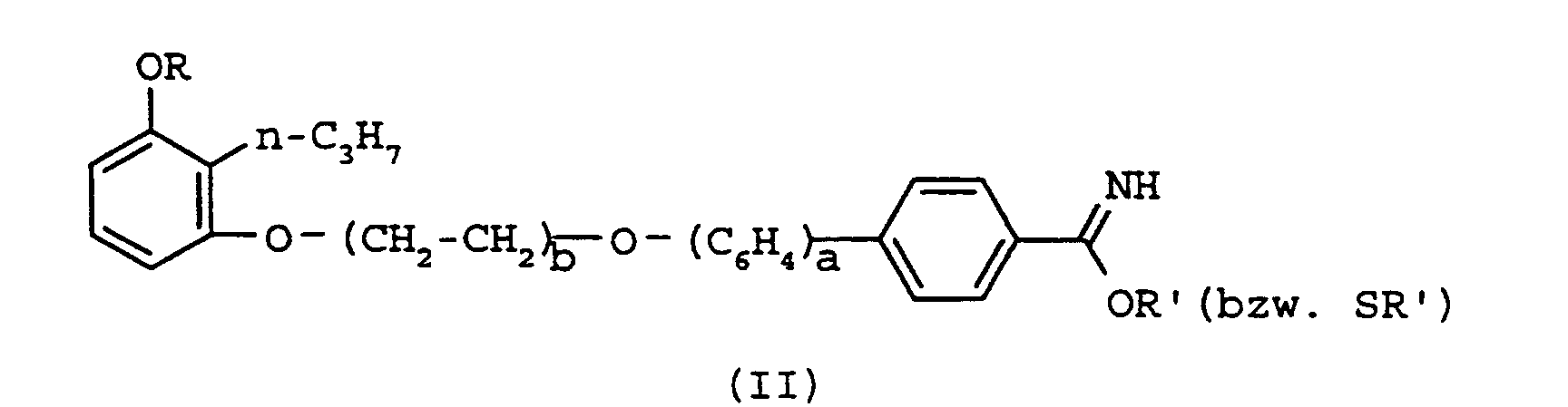
und a, b und R die in Anspruch 1 bis 5 angegebene Bedeutung aufweisen, oder das entsprechende Säureimidchlorid mit Ammoniak umsetzt, oder daß manb1) ein Phenol der Formelworin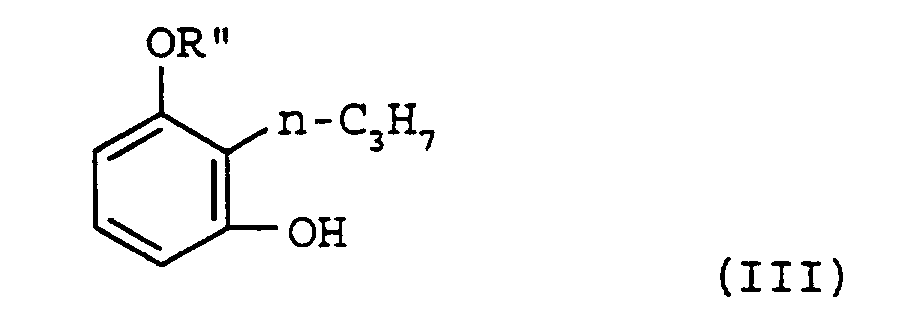
R" C1-C4-Alkyl bedeutet, mit einer Verbindung der Formelworin a und b die obige Bedeutung haben und L für eine nucleofuge Abgangsgruppe steht bzw.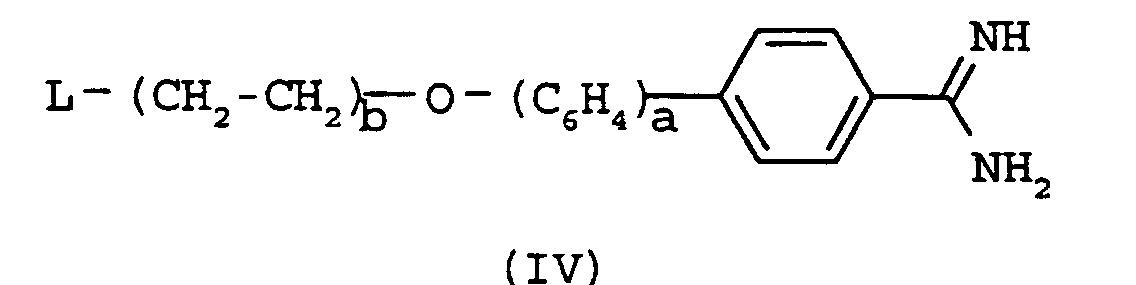 b2) ein Phenol der Formelworin a die obige Bedeutung hat, mit einer Verbindung der Formel
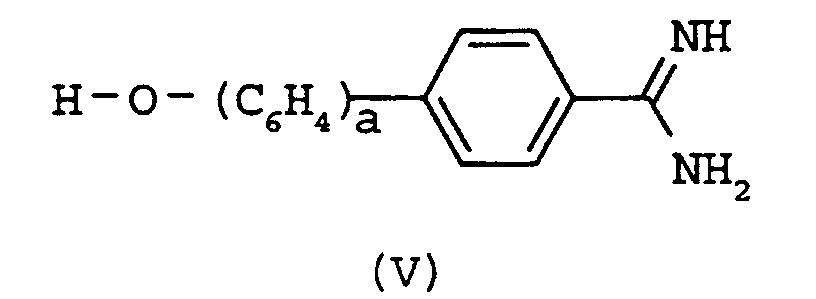 worin b, L und R" die obige Bedeutung haben, umsetzt, oder daß man
 c) ein Amidoxim der Formelworin R, a und b die obige Bedeutung haben, zum entsprechenden Amidin reduziert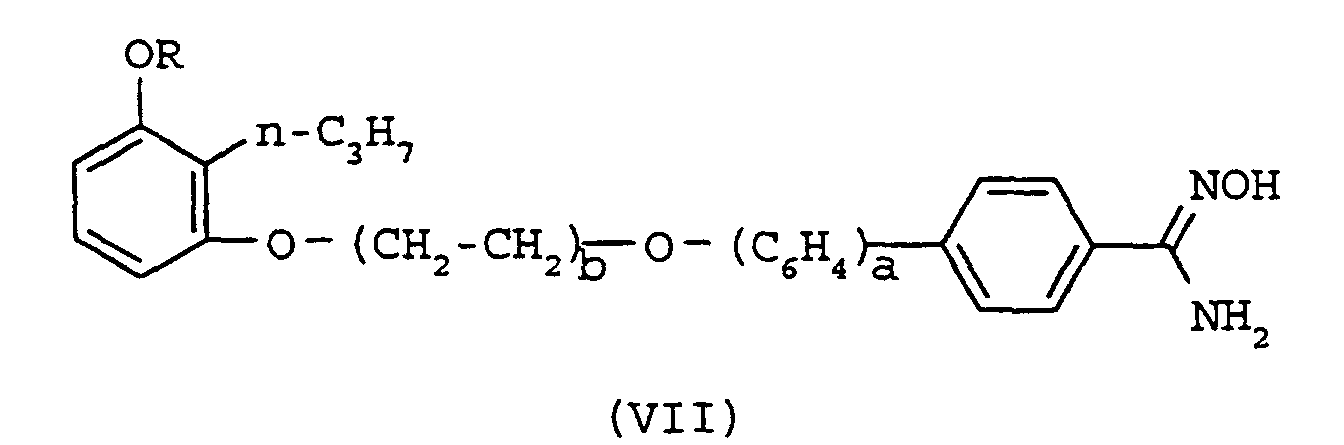
und gewünschtenfalls an erhaltenen Basen Säureadditionssalze aus erhaltenen Säureadditionssalzen die freien Basen herstellt.
Applications Claiming Priority (7)
| Application Number | Priority Date | Filing Date | Title |
|---|---|---|---|
| DE4203201A DE4203201A1 (de) | 1992-02-05 | 1992-02-05 | Neue amidinderivate, ihre herstellung und verwendung |
| DE4203201 | 1992-02-05 | ||
| DE4224289 | 1992-07-23 | ||
| DE4224289A DE4224289A1 (de) | 1992-07-23 | 1992-07-23 | Neue Amidinderivate, ihre Herstellung und Verwendung |
| DE4244241A DE4244241A1 (de) | 1992-12-24 | 1992-12-24 | Neue Verbindungen, ihre Herstellung und ihre Verwendung |
| DE4244241 | 1992-12-24 | ||
| EP93902195A EP0625138B1 (de) | 1992-02-05 | 1993-01-14 | Neue amidinderivate, ihre herstellung und verwendung als arzneimittel mit ltb4-antagonistischer wirkung |
Related Parent Applications (1)
| Application Number | Title | Priority Date | Filing Date |
|---|---|---|---|
| EP93902195A Division EP0625138B1 (de) | 1992-02-05 | 1993-01-14 | Neue amidinderivate, ihre herstellung und verwendung als arzneimittel mit ltb4-antagonistischer wirkung |
Publications (2)
| Publication Number | Publication Date |
|---|---|
| EP0902013A1 EP0902013A1 (de) | 1999-03-17 |
| EP0902013B1 true EP0902013B1 (de) | 2001-12-12 |
Family
ID=27203364
Family Applications (2)
| Application Number | Title | Priority Date | Filing Date |
|---|---|---|---|
| EP98121305A Expired - Lifetime EP0902013B1 (de) | 1992-02-05 | 1993-01-14 | Neue Amiderivate, ihre Herstellung und Verwendung als Arzneimittel mit LTB4-antagonistischer Wirkung |
| EP93902195A Expired - Lifetime EP0625138B1 (de) | 1992-02-05 | 1993-01-14 | Neue amidinderivate, ihre herstellung und verwendung als arzneimittel mit ltb4-antagonistischer wirkung |
Family Applications After (1)
| Application Number | Title | Priority Date | Filing Date |
|---|---|---|---|
| EP93902195A Expired - Lifetime EP0625138B1 (de) | 1992-02-05 | 1993-01-14 | Neue amidinderivate, ihre herstellung und verwendung als arzneimittel mit ltb4-antagonistischer wirkung |
Country Status (29)
| Country | Link |
|---|---|
| US (3) | US6037377A (de) |
| EP (2) | EP0902013B1 (de) |
| JP (2) | JP3487851B2 (de) |
| KR (1) | KR0163222B1 (de) |
| AT (2) | ATE180770T1 (de) |
| AU (1) | AU673343B2 (de) |
| CA (2) | CA2129526A1 (de) |
| CZ (2) | CZ287209B6 (de) |
| DE (2) | DE59310252D1 (de) |
| DK (2) | DK0902013T3 (de) |
| ES (2) | ES2132216T3 (de) |
| FI (1) | FI943618A0 (de) |
| GR (1) | GR3030468T3 (de) |
| HR (1) | HRP930102B1 (de) |
| HU (1) | HU216191B (de) |
| IL (1) | IL104589A0 (de) |
| MX (1) | MX9300630A (de) |
| NO (1) | NO301540B1 (de) |
| NZ (1) | NZ246593A (de) |
| PL (2) | PL173781B1 (de) |
| PT (1) | PT902013E (de) |
| RU (1) | RU2124002C1 (de) |
| SG (1) | SG44837A1 (de) |
| SI (1) | SI9300066B (de) |
| SK (1) | SK281016B6 (de) |
| TW (1) | TW232005B (de) |
| UA (1) | UA43318C2 (de) |
| WO (1) | WO1993016036A1 (de) |
| YU (1) | YU49038B (de) |
Families Citing this family (37)
| Publication number | Priority date | Publication date | Assignee | Title |
|---|---|---|---|---|
| US5488160A (en) * | 1991-06-11 | 1996-01-30 | Ciba-Geigy Corporation | Amidino compounds, their manufacture and method of treatment |
| US5451700A (en) * | 1991-06-11 | 1995-09-19 | Ciba-Geigy Corporation | Amidino compounds, their manufacture and methods of treatment |
| US5455274A (en) * | 1992-12-09 | 1995-10-03 | Ciba-Geigy Corporation | Hydroxyamidine derivatives |
| DE4309285A1 (de) * | 1993-03-23 | 1994-09-29 | Boehringer Ingelheim Kg | Heterocyclen enthaltende Amidinderivate, ihre Herstellung und Verwendung |
| DE4424714A1 (de) * | 1994-07-13 | 1996-01-18 | Boehringer Ingelheim Kg | Neue chemische Verbindung, ihre Herstellung und ihre Verwendung als Arnzneistoff |
| DE4424713A1 (de) * | 1994-07-13 | 1996-01-18 | Boehringer Ingelheim Kg | Substituierte Benzamidine, ihre Herstellung und Verwendung als Arnzneistoffe |
| DE19546452A1 (de) * | 1995-12-13 | 1997-06-19 | Boehringer Ingelheim Kg | Neue Phenylamidinderivate, Verfahren zu ihrer Herstelung und ihre Verwendung als Arzneimittel |
| CA2256309C (en) | 1995-12-29 | 2006-08-15 | 3-Dimensional Pharmaceuticals, Inc. | Amidino protease inhibitors |
| US5942544A (en) * | 1996-02-22 | 1999-08-24 | Dupont Pharmaceuticals Company | α-branched anilines, toluenes, and analogs thereof as factor Xa inhibitors |
| DE19636689A1 (de) | 1996-09-10 | 1998-03-12 | Boehringer Ingelheim Kg | Neue Benzamidinderivate |
| DE19637123A1 (de) * | 1996-09-12 | 1998-03-19 | Boehringer Ingelheim Kg | Neue Pyranosidderivate |
| EP0942903A1 (de) | 1996-09-26 | 1999-09-22 | Novartis AG | Arylsubstituierte acrylamine mit leukotriene b4-(ltb-4)-rezeptor antagonistischer aktivität |
| EA200800375A1 (ru) * | 1997-05-14 | 2008-06-30 | Атеродженикс, Инк. | Соединения и способы ингибирования экспрессии vcam-1 |
| US6670398B2 (en) * | 1997-05-14 | 2003-12-30 | Atherogenics, Inc. | Compounds and methods for treating transplant rejection |
| US5872122A (en) * | 1997-10-16 | 1999-02-16 | Monsanto Company | Pyrimidinylamidino β-amino acid derivatives useful as inhibitors of platelet aggregation |
| ID24720A (id) | 1997-12-12 | 2000-08-03 | Novartis Ag | Senyawa amidino tersubstitusi dalam perawatan penyakit gangguan paru-paru kronis |
| HUP0101369A3 (en) * | 1997-12-23 | 2002-11-28 | Schering Corp | Composition for treating respiratory and skin diseases, comprising at least one leukotriene antagonist and at least one antihistamine |
| US6291514B1 (en) | 1998-02-09 | 2001-09-18 | 3-Dimensional Pharmaceuticals, Inc. | Heteroaryl amidines, methylamidines and guanidines, preparation thereof, and use thereof as protease inhibitors |
| DE19948428A1 (de) * | 1999-10-07 | 2001-04-12 | Boehringer Ingelheim Pharma | Neuer LTB¶4¶-Antagonist, Verfahren zu dessen Herstellung und dessen Verwendung als Arzneimittel |
| FR2801053B1 (fr) * | 1999-11-16 | 2004-06-25 | Sod Conseils Rech Applic | Nouveaux derives d'amidines, leur preparation et leur application a titre de medicaments |
| US6528491B2 (en) * | 2000-10-24 | 2003-03-04 | Boehringer Ingelheim Pharma Kg | Pyranoside derivatives |
| DE10052333A1 (de) * | 2000-10-24 | 2002-05-02 | Boehringer Ingelheim Pharma | Neue Sulfooxybenzamide |
| WO2002087556A2 (en) * | 2001-04-11 | 2002-11-07 | Atherogenics, Inc. | Probucol monoesters and their use to increase plasma hdl cholesterol levels and improve hdl functionality |
| WO2003007922A2 (de) * | 2001-07-14 | 2003-01-30 | Boehringer Ingelheim Pharma Gmbh & Co. Kg | Arzneimittelformulierung enthaltend einen ltb4 antagonisten |
| US20030119901A1 (en) * | 2001-07-14 | 2003-06-26 | Boehringer Ingelheim Pharma Kg | Pharmaceutical formulation containing an LTB4 antagonist |
| US20040006092A1 (en) * | 2001-08-31 | 2004-01-08 | Neurochem, Inc. | Amidine derivatives for treating amyloidosis |
| WO2004058722A1 (en) * | 2002-12-24 | 2004-07-15 | Arena Pharmaceuticals, Inc. | Diarylamine and arylheteroarylamine pyrazole derivatives as modulators of 5ht2a |
| EP1493739A1 (de) * | 2003-07-03 | 2005-01-05 | Warner-Lambert Company LLC | Thiophenderivate von Aminosäuren, Verfahren zu ihrer Herstellung und diese enthaltende Zusammensetzungen |
| US7262223B2 (en) | 2004-01-23 | 2007-08-28 | Neurochem (International) Limited | Amidine derivatives for treating amyloidosis |
| KR100716389B1 (ko) * | 2004-11-23 | 2007-05-11 | 동화약품공업주식회사 | N-히드록시-4-{5-[4-(5-이소프로필-2-메틸-1,3-티아졸-4-일)페녹시]펜톡시}벤즈아미딘 2메탄술폰산염 |
| GB2445920A (en) * | 2007-01-25 | 2008-07-30 | Mucokinetica Ltd | Amidino compounds for treatment of respiratory disease |
| JP2010522762A (ja) * | 2007-03-26 | 2010-07-08 | サルトリア・フアーマシユーテイカルズ・エル・エル・シー | 糖尿病の治療のための方法及びプロブコール誘導体の組成物 |
| US20080280985A1 (en) * | 2007-03-27 | 2008-11-13 | Scott Robert A D | Methods and Compositions Using Certain Phenolic Derivatives for the Treatment of Diabetes |
| US8691866B2 (en) | 2008-12-10 | 2014-04-08 | The General Hospital Corporation | HIF inhibitors and use thereof |
| EP2961746B1 (de) | 2013-02-28 | 2018-01-03 | Bristol-Myers Squibb Company | Phenylpyrazolderivate als potente rock1- und rock2-inhibitoren |
| AR094929A1 (es) | 2013-02-28 | 2015-09-09 | Bristol Myers Squibb Co | Derivados de fenilpirazol como inhibidores potentes de rock1 y rock2 |
| AU2019387370A1 (en) | 2018-11-30 | 2021-06-10 | Nuvation Bio Inc. | Pyrrole and pyrazole compounds and methods of use thereof |
Family Cites Families (9)
| Publication number | Priority date | Publication date | Assignee | Title |
|---|---|---|---|---|
| FR2516922A1 (fr) * | 1981-11-25 | 1983-05-27 | Lipha | Acides (oxo-4-4h-(1)-benzopyran-8-yl) alcanoiques, sels et derives, preparation et medicament les contenant |
| JPS62142168A (ja) * | 1985-10-16 | 1987-06-25 | Mitsubishi Chem Ind Ltd | チアゾ−ル誘導体及びそれを有効成分とするロイコトリエンきつ抗剤 |
| US4889871A (en) * | 1987-05-29 | 1989-12-26 | G. D. Searle & Co. | Alkoxy-substituted dihydrobenzopyran-2-carboxylate derivatives |
| SU1591809A3 (ru) * | 1987-09-16 | 1990-09-07 | Pfizer | Способ получения производных 4-гвдрокси-2-замещенного хроман-4-уксусной кислоты в виде рацемического соединения или оптически активного соединения или их фар |
| AU626033B2 (en) * | 1988-10-25 | 1992-07-23 | Government Of The United States Of America, As Represented By The Secretary Of The Army, The | Methods for the treatment and prophylaxis of pneumocystis carinii pneumonia and other diseases and compounds and formulations for use in said methods |
| EP0518819B1 (de) * | 1991-06-11 | 1995-08-02 | Ciba-Geigy Ag | Amidino-Verbindungen, ihre Herstellung und Verwendung als Arzneimittel |
| EP0518818A3 (en) * | 1991-06-11 | 1993-04-28 | Ciba-Geigy Ag | Arylethers, their manufacture and use as medicament |
| US5246965A (en) * | 1991-06-11 | 1993-09-21 | Ciba-Geigy | Arylethers, their manufacture and methods of treatment |
| US5424334A (en) * | 1991-12-19 | 1995-06-13 | G. D. Searle & Co. | Peptide mimetic compounds useful as platelet aggregation inhibitors |
-
1993
- 1993-01-14 PL PL93316750A patent/PL173781B1/pl unknown
- 1993-01-14 AT AT93902195T patent/ATE180770T1/de not_active IP Right Cessation
- 1993-01-14 WO PCT/EP1993/000070 patent/WO1993016036A1/de not_active Ceased
- 1993-01-14 SG SG1996008431A patent/SG44837A1/en unknown
- 1993-01-14 FI FI943618A patent/FI943618A0/fi unknown
- 1993-01-14 DK DK98121305T patent/DK0902013T3/da active
- 1993-01-14 CZ CZ19941886A patent/CZ287209B6/cs unknown
- 1993-01-14 AT AT98121305T patent/ATE210634T1/de not_active IP Right Cessation
- 1993-01-14 PL PL93304713A patent/PL173789B1/pl unknown
- 1993-01-14 DE DE59310252T patent/DE59310252D1/de not_active Expired - Fee Related
- 1993-01-14 EP EP98121305A patent/EP0902013B1/de not_active Expired - Lifetime
- 1993-01-14 HU HU9402291A patent/HU216191B/hu not_active IP Right Cessation
- 1993-01-14 JP JP51370193A patent/JP3487851B2/ja not_active Expired - Fee Related
- 1993-01-14 DE DE59309630T patent/DE59309630D1/de not_active Expired - Fee Related
- 1993-01-14 CA CA002129526A patent/CA2129526A1/en not_active Abandoned
- 1993-01-14 CA CA002427890A patent/CA2427890A1/en not_active Abandoned
- 1993-01-14 NZ NZ246593A patent/NZ246593A/en unknown
- 1993-01-14 DK DK93902195T patent/DK0625138T3/da active
- 1993-01-14 UA UA94095773A patent/UA43318C2/uk unknown
- 1993-01-14 EP EP93902195A patent/EP0625138B1/de not_active Expired - Lifetime
- 1993-01-14 KR KR1019940702669A patent/KR0163222B1/ko not_active Expired - Fee Related
- 1993-01-14 PT PT98121305T patent/PT902013E/pt unknown
- 1993-01-14 ES ES93902195T patent/ES2132216T3/es not_active Expired - Lifetime
- 1993-01-14 SK SK914-94A patent/SK281016B6/sk unknown
- 1993-01-14 ES ES98121305T patent/ES2165122T3/es not_active Expired - Lifetime
- 1993-01-14 RU RU94041836A patent/RU2124002C1/ru not_active IP Right Cessation
- 1993-01-14 AU AU33497/93A patent/AU673343B2/en not_active Ceased
- 1993-01-29 TW TW082100562A patent/TW232005B/zh active
- 1993-02-03 IL IL104589A patent/IL104589A0/xx not_active IP Right Cessation
- 1993-02-03 YU YU6393A patent/YU49038B/sh unknown
- 1993-02-03 HR HRP4244241.9A patent/HRP930102B1/xx not_active IP Right Cessation
- 1993-02-04 MX MX9300630A patent/MX9300630A/es not_active IP Right Cessation
- 1993-02-05 SI SI9300066A patent/SI9300066B/sl not_active IP Right Cessation
-
1994
- 1994-08-04 NO NO942903A patent/NO301540B1/no not_active IP Right Cessation
-
1995
- 1995-06-05 US US08/460,961 patent/US6037377A/en not_active Expired - Lifetime
-
1997
- 1997-04-18 CZ CZ19971203A patent/CZ287173B6/cs unknown
-
1999
- 1999-06-09 GR GR990401541T patent/GR3030468T3/el unknown
-
2000
- 2000-01-18 US US09/484,073 patent/US6489365B1/en not_active Expired - Lifetime
-
2002
- 2002-03-18 JP JP2002073593A patent/JP2002322143A/ja active Pending
- 2002-09-23 US US10/252,976 patent/US20030130232A1/en not_active Abandoned
Also Published As
Similar Documents
| Publication | Publication Date | Title |
|---|---|---|
| EP0625138B1 (de) | Neue amidinderivate, ihre herstellung und verwendung als arzneimittel mit ltb4-antagonistischer wirkung | |
| DE2833140C2 (de) | ||
| EP0929516B1 (de) | Benzamidinderivate und ihre verwendung als arzneimittel mit ltb4-antagonistischer wirkung | |
| EP0770059B1 (de) | Substituierte benzamidine, ihre herstellung und verwendung als arzneimittel | |
| EP0690849A1 (de) | Heterocyclen enthaltende amidinderivate, ihre herstellung und verwendung | |
| EP1015421B1 (de) | Neue phenylamidinderivate, verfahren zu ihrer herstellung und ihre verwendung als arzneimittel | |
| DE3134590A1 (de) | Neue benzo-heterocyclen | |
| DE3524990A1 (de) | Aminophenolverbindungen, verfahren zu ihrer herstellung und sie enthaltende pharmazeutische zubereitungen | |
| EP0321864A2 (de) | Neue Ammoniumverbindungen, ihre Herstellung und Verwendung | |
| DE68913673T2 (de) | Substituierte Imidazol-Derivate und Verfahren zu deren Herstellung und Anwendung. | |
| EP0770058A1 (de) | Neue chemische verbindung, ihre herstellung und ihre verwendung als arzneistoff | |
| DE3586411T2 (de) | Dopamin-antagoniste. | |
| DE3630903A1 (de) | Neue tetrahydronaphthalin- und indanderivate, verfahren zu deren herstellung sowie diese enthaltende arzneimittel | |
| DE2552933A1 (de) | Hydroxypolyhalogenisopropyl-substituierte ureidoverbindungen, verfahren zu ihrer herstellung und sie enthaltende arzneimittel | |
| EP1332128A1 (de) | Benzamidin-derivate mit einer sulfat-gruppe als ltb4-antagonisten | |
| AT363074B (de) | Verfahren zur herstellung von neuen 1-amino-niedrig-alkyl-3,4-diphenyl-1h-pyrazolen und ihren salzen | |
| EP0980351B1 (de) | Benzylaminderivate und phenylethylaminderivate, verfahren zu ihrer herstellung und ihre verwendung als arzneimittel | |
| DE4203201A1 (de) | Neue amidinderivate, ihre herstellung und verwendung | |
| DE4244241A1 (de) | Neue Verbindungen, ihre Herstellung und ihre Verwendung | |
| DE1493955C3 (de) | Sulfonanilide und Verfahren zu ihrer Herstellung | |
| DE4224289A1 (de) | Neue Amidinderivate, ihre Herstellung und Verwendung | |
| AT368146B (de) | Verfahren zur herstellung neuer 2-anilinooxazoline | |
| EP0305845A1 (de) | Pyridylethanolamine, diese Verbindungen enthaltende Arzneimittel und Verfahren zu ihrer Herstellung | |
| DE1593579C (de) | ||
| DD231352A5 (de) | Verfahren zur herstellung tricyclischer verbindungen |
Legal Events
| Date | Code | Title | Description |
|---|---|---|---|
| PUAI | Public reference made under article 153(3) epc to a published international application that has entered the european phase |
Free format text: ORIGINAL CODE: 0009012 |
|
| AC | Divisional application: reference to earlier application |
Ref document number: 625138 Country of ref document: EP |
|
| AK | Designated contracting states |
Kind code of ref document: A1 Designated state(s): AT BE CH DE DK ES FR GB GR IE IT LI LU NL PT SE |
|
| RIN1 | Information on inventor provided before grant (corrected) |
Inventor name: FUEGNER, ARMIN Inventor name: BIRKE, FRANZ Inventor name: HIMMELSBACH, FRANK Inventor name: RENTH, ERNST-OTTO Inventor name: SCHROMM, KURT Inventor name: ANDERSKEWITZ, RALF |
|
| 17P | Request for examination filed |
Effective date: 19990917 |
|
| RIN1 | Information on inventor provided before grant (corrected) |
Inventor name: FUEGNER, ARMIN Inventor name: BIRKE, FRANZ Inventor name: HIMMELSBACH, FRANK Inventor name: RENTH, ERNST-OTTO Inventor name: SCHROMM, KURT Inventor name: ANDERSKEWITZ, RALF |
|
| 17Q | First examination report despatched |
Effective date: 20000321 |
|
| RAP1 | Party data changed (applicant data changed or rights of an application transferred) |
Owner name: BOEHRINGER INGELHEIM PHARMA KG Owner name: BOEHRINGER INGELHEIM INTERNATIONAL GMBH |
|
| RAP1 | Party data changed (applicant data changed or rights of an application transferred) |
Owner name: BOEHRINGER INGELHEIM PHARMA KG Owner name: BOEHRINGER INGELHEIM INTERNATIONAL GMBH |
|
| GRAG | Despatch of communication of intention to grant |
Free format text: ORIGINAL CODE: EPIDOS AGRA |
|
| GRAG | Despatch of communication of intention to grant |
Free format text: ORIGINAL CODE: EPIDOS AGRA |
|
| GRAH | Despatch of communication of intention to grant a patent |
Free format text: ORIGINAL CODE: EPIDOS IGRA |
|
| GRAH | Despatch of communication of intention to grant a patent |
Free format text: ORIGINAL CODE: EPIDOS IGRA |
|
| GRAA | (expected) grant |
Free format text: ORIGINAL CODE: 0009210 |
|
| AC | Divisional application: reference to earlier application |
Ref document number: 625138 Country of ref document: EP |
|
| AK | Designated contracting states |
Kind code of ref document: B1 Designated state(s): AT BE CH DE DK ES FR GB GR IE IT LI LU NL PT SE |
|
| REF | Corresponds to: |
Ref document number: 210634 Country of ref document: AT Date of ref document: 20011215 Kind code of ref document: T |
|
| REG | Reference to a national code |
Ref country code: CH Ref legal event code: EP |
|
| REG | Reference to a national code |
Ref country code: GB Ref legal event code: IF02 |
|
| REG | Reference to a national code |
Ref country code: IE Ref legal event code: FG4D Free format text: GERMAN |
|
| REF | Corresponds to: |
Ref document number: 59310252 Country of ref document: DE Date of ref document: 20020124 |
|
| REG | Reference to a national code |
Ref country code: ES Ref legal event code: FG2A Ref document number: 2165122 Country of ref document: ES Kind code of ref document: T3 |
|
| REG | Reference to a national code |
Ref country code: DK Ref legal event code: T3 |
|
| GBT | Gb: translation of ep patent filed (gb section 77(6)(a)/1977) |
Effective date: 20020313 |
|
| ET | Fr: translation filed | ||
| REG | Reference to a national code |
Ref country code: PT Ref legal event code: SC4A Free format text: AVAILABILITY OF NATIONAL TRANSLATION Effective date: 20020308 |
|
| REG | Reference to a national code |
Ref country code: GR Ref legal event code: EP Ref document number: 20020400968 Country of ref document: GR |
|
| PLBE | No opposition filed within time limit |
Free format text: ORIGINAL CODE: 0009261 |
|
| STAA | Information on the status of an ep patent application or granted ep patent |
Free format text: STATUS: NO OPPOSITION FILED WITHIN TIME LIMIT |
|
| 26N | No opposition filed | ||
| PGFP | Annual fee paid to national office [announced via postgrant information from national office to epo] |
Ref country code: CH Payment date: 20021218 Year of fee payment: 11 |
|
| PGFP | Annual fee paid to national office [announced via postgrant information from national office to epo] |
Ref country code: PT Payment date: 20021219 Year of fee payment: 11 |
|
| PGFP | Annual fee paid to national office [announced via postgrant information from national office to epo] |
Ref country code: IE Payment date: 20021220 Year of fee payment: 11 Ref country code: GR Payment date: 20021220 Year of fee payment: 11 |
|
| PGFP | Annual fee paid to national office [announced via postgrant information from national office to epo] |
Ref country code: NL Payment date: 20021227 Year of fee payment: 11 Ref country code: GB Payment date: 20021227 Year of fee payment: 11 |
|
| PGFP | Annual fee paid to national office [announced via postgrant information from national office to epo] |
Ref country code: LU Payment date: 20021230 Year of fee payment: 11 |
|
| PGFP | Annual fee paid to national office [announced via postgrant information from national office to epo] |
Ref country code: AT Payment date: 20030102 Year of fee payment: 11 |
|
| PGFP | Annual fee paid to national office [announced via postgrant information from national office to epo] |
Ref country code: DK Payment date: 20030106 Year of fee payment: 11 |
|
| PGFP | Annual fee paid to national office [announced via postgrant information from national office to epo] |
Ref country code: SE Payment date: 20030109 Year of fee payment: 11 |
|
| PGFP | Annual fee paid to national office [announced via postgrant information from national office to epo] |
Ref country code: FR Payment date: 20030110 Year of fee payment: 11 |
|
| PGFP | Annual fee paid to national office [announced via postgrant information from national office to epo] |
Ref country code: BE Payment date: 20030123 Year of fee payment: 11 |
|
| PGFP | Annual fee paid to national office [announced via postgrant information from national office to epo] |
Ref country code: ES Payment date: 20030124 Year of fee payment: 11 Ref country code: DE Payment date: 20030124 Year of fee payment: 11 |
|
| REG | Reference to a national code |
Ref country code: CH Ref legal event code: PFA Owner name: BOEHRINGER INGELHEIM PHARMA GMBH & CO. KG Free format text: BOEHRINGER INGELHEIM PHARMA KG#BINGER STRASSE 173#55218 INGELHEIM AM RHEIN (DE) -TRANSFER TO- BOEHRINGER INGELHEIM PHARMA GMBH & CO. KG#BINGER STRASSE 173#55216 INGELHEIM AM RHEIN (DE) Ref country code: CH Ref legal event code: NV Representative=s name: SCHMAUDER & PARTNER AG PATENTANWALTSBUERO |
|
| NLT1 | Nl: modifications of names registered in virtue of documents presented to the patent office pursuant to art. 16 a, paragraph 1 |
Owner name: BOEHRINGER INGELHEIM PHARMA GMBH & CO.KG |
|
| REG | Reference to a national code |
Ref country code: PT Ref legal event code: PD4A Free format text: BOEHRINGER INGELHEIM PHARMA GMBH & CO.KG DE Effective date: 20030521 |
|
| REG | Reference to a national code |
Ref country code: FR Ref legal event code: CD |
|
| PG25 | Lapsed in a contracting state [announced via postgrant information from national office to epo] |
Ref country code: LU Free format text: LAPSE BECAUSE OF NON-PAYMENT OF DUE FEES Effective date: 20040114 Ref country code: IE Free format text: LAPSE BECAUSE OF NON-PAYMENT OF DUE FEES Effective date: 20040114 Ref country code: GB Free format text: LAPSE BECAUSE OF NON-PAYMENT OF DUE FEES Effective date: 20040114 Ref country code: AT Free format text: LAPSE BECAUSE OF NON-PAYMENT OF DUE FEES Effective date: 20040114 |
|
| PG25 | Lapsed in a contracting state [announced via postgrant information from national office to epo] |
Ref country code: SE Free format text: LAPSE BECAUSE OF NON-PAYMENT OF DUE FEES Effective date: 20040115 Ref country code: ES Free format text: LAPSE BECAUSE OF NON-PAYMENT OF DUE FEES Effective date: 20040115 |
|
| PG25 | Lapsed in a contracting state [announced via postgrant information from national office to epo] |
Ref country code: LI Free format text: LAPSE BECAUSE OF NON-PAYMENT OF DUE FEES Effective date: 20040131 Ref country code: CH Free format text: LAPSE BECAUSE OF NON-PAYMENT OF DUE FEES Effective date: 20040131 Ref country code: BE Free format text: LAPSE BECAUSE OF NON-PAYMENT OF DUE FEES Effective date: 20040131 |
|
| PG25 | Lapsed in a contracting state [announced via postgrant information from national office to epo] |
Ref country code: DK Free format text: LAPSE BECAUSE OF NON-PAYMENT OF DUE FEES Effective date: 20040202 |
|
| BERE | Be: lapsed |
Owner name: *BOEHRINGER INGELHEIM PHARMA G.M.B.H. & CO. K.G. Effective date: 20040131 |
|
| PG25 | Lapsed in a contracting state [announced via postgrant information from national office to epo] |
Ref country code: PT Free format text: LAPSE BECAUSE OF NON-PAYMENT OF DUE FEES Effective date: 20040731 |
|
| PG25 | Lapsed in a contracting state [announced via postgrant information from national office to epo] |
Ref country code: NL Free format text: LAPSE BECAUSE OF NON-PAYMENT OF DUE FEES Effective date: 20040801 |
|
| PG25 | Lapsed in a contracting state [announced via postgrant information from national office to epo] |
Ref country code: DE Free format text: LAPSE BECAUSE OF NON-PAYMENT OF DUE FEES Effective date: 20040803 |
|
| PG25 | Lapsed in a contracting state [announced via postgrant information from national office to epo] |
Ref country code: GR Free format text: LAPSE BECAUSE OF NON-PAYMENT OF DUE FEES Effective date: 20040804 |
|
| EUG | Se: european patent has lapsed | ||
| GBPC | Gb: european patent ceased through non-payment of renewal fee |
Effective date: 20040114 |
|
| REG | Reference to a national code |
Ref country code: DK Ref legal event code: EBP |
|
| REG | Reference to a national code |
Ref country code: CH Ref legal event code: PL |
|
| PG25 | Lapsed in a contracting state [announced via postgrant information from national office to epo] |
Ref country code: FR Free format text: LAPSE BECAUSE OF NON-PAYMENT OF DUE FEES Effective date: 20040930 |
|
| NLV4 | Nl: lapsed or anulled due to non-payment of the annual fee |
Effective date: 20040801 |
|
| REG | Reference to a national code |
Ref country code: IE Ref legal event code: MM4A |
|
| REG | Reference to a national code |
Ref country code: FR Ref legal event code: ST |
|
| PG25 | Lapsed in a contracting state [announced via postgrant information from national office to epo] |
Ref country code: IT Free format text: LAPSE BECAUSE OF NON-PAYMENT OF DUE FEES Effective date: 20050114 |
|
| REG | Reference to a national code |
Ref country code: ES Ref legal event code: FD2A Effective date: 20040115 |