WO2025141838A1 - L-グルタミン酸生産菌およびl-グルタミン酸の製造方法 - Google Patents
L-グルタミン酸生産菌およびl-グルタミン酸の製造方法 Download PDFInfo
- Publication number
- WO2025141838A1 WO2025141838A1 PCT/JP2023/047152 JP2023047152W WO2025141838A1 WO 2025141838 A1 WO2025141838 A1 WO 2025141838A1 JP 2023047152 W JP2023047152 W JP 2023047152W WO 2025141838 A1 WO2025141838 A1 WO 2025141838A1
- Authority
- WO
- WIPO (PCT)
- Prior art keywords
- amino acid
- acetyl
- coa hydrolase
- gene
- glutamic acid
- Prior art date
- Legal status (The legal status is an assumption and is not a legal conclusion. Google has not performed a legal analysis and makes no representation as to the accuracy of the status listed.)
- Pending
Links
Images
Classifications
-
- C—CHEMISTRY; METALLURGY
- C12—BIOCHEMISTRY; BEER; SPIRITS; WINE; VINEGAR; MICROBIOLOGY; ENZYMOLOGY; MUTATION OR GENETIC ENGINEERING
- C12N—MICROORGANISMS OR ENZYMES; COMPOSITIONS THEREOF; PROPAGATING, PRESERVING, OR MAINTAINING MICROORGANISMS; MUTATION OR GENETIC ENGINEERING; CULTURE MEDIA
- C12N15/00—Mutation or genetic engineering; DNA or RNA concerning genetic engineering, vectors, e.g. plasmids, or their isolation, preparation or purification; Use of hosts therefor
- C12N15/09—Recombinant DNA-technology
- C12N15/63—Introduction of foreign genetic material using vectors; Vectors; Use of hosts therefor; Regulation of expression
- C12N15/74—Vectors or expression systems specially adapted for prokaryotic hosts other than E. coli, e.g. Lactobacillus, Micromonospora
- C12N15/77—Vectors or expression systems specially adapted for prokaryotic hosts other than E. coli, e.g. Lactobacillus, Micromonospora for Corynebacterium; for Brevibacterium
-
- C—CHEMISTRY; METALLURGY
- C12—BIOCHEMISTRY; BEER; SPIRITS; WINE; VINEGAR; MICROBIOLOGY; ENZYMOLOGY; MUTATION OR GENETIC ENGINEERING
- C12N—MICROORGANISMS OR ENZYMES; COMPOSITIONS THEREOF; PROPAGATING, PRESERVING, OR MAINTAINING MICROORGANISMS; MUTATION OR GENETIC ENGINEERING; CULTURE MEDIA
- C12N9/00—Enzymes; Proenzymes; Compositions thereof; Processes for preparing, activating, inhibiting, separating or purifying enzymes
- C12N9/14—Hydrolases (3)
- C12N9/16—Hydrolases (3) acting on ester bonds (3.1)
-
- C—CHEMISTRY; METALLURGY
- C12—BIOCHEMISTRY; BEER; SPIRITS; WINE; VINEGAR; MICROBIOLOGY; ENZYMOLOGY; MUTATION OR GENETIC ENGINEERING
- C12P—FERMENTATION OR ENZYME-USING PROCESSES TO SYNTHESISE A DESIRED CHEMICAL COMPOUND OR COMPOSITION OR TO SEPARATE OPTICAL ISOMERS FROM A RACEMIC MIXTURE
- C12P13/00—Preparation of nitrogen-containing organic compounds
- C12P13/04—Alpha- or beta- amino acids
- C12P13/14—Glutamic acid; Glutamine
-
- C—CHEMISTRY; METALLURGY
- C12—BIOCHEMISTRY; BEER; SPIRITS; WINE; VINEGAR; MICROBIOLOGY; ENZYMOLOGY; MUTATION OR GENETIC ENGINEERING
- C12Y—ENZYMES
- C12Y301/00—Hydrolases acting on ester bonds (3.1)
- C12Y301/02—Thioester hydrolases (3.1.2)
- C12Y301/02001—Acetyl-CoA hydrolase (3.1.2.1)
-
- C—CHEMISTRY; METALLURGY
- C12—BIOCHEMISTRY; BEER; SPIRITS; WINE; VINEGAR; MICROBIOLOGY; ENZYMOLOGY; MUTATION OR GENETIC ENGINEERING
- C12R—INDEXING SCHEME ASSOCIATED WITH SUBCLASSES C12C - C12Q, RELATING TO MICROORGANISMS
- C12R2001/00—Microorganisms ; Processes using microorganisms
- C12R2001/01—Bacteria or Actinomycetales ; using bacteria or Actinomycetales
- C12R2001/15—Corynebacterium
Definitions
- the present invention relates to the fermentation industry, and more specifically to a method for producing L-glutamic acid and bacteria used therein.
- L-glutamic acid is industrially useful as a seasoning ingredient, etc.
- L-amino acids are industrially produced, for example, by fermentation using microorganisms such as bacteria capable of producing L-amino acids (Non-Patent Document 1). For example, strains isolated from nature or mutant strains thereof are used as such microorganisms. In addition, the L-amino acid production ability of microorganisms can be improved by recombinant DNA technology.
- Acetyl-CoA hydrolase is an enzyme that has the activity of catalyzing the reaction of hydrolyzing acetyl-CoA to produce coenzyme A and acetic acid and/or the reverse reaction (Non-Patent Document 2), and it is known that the production capacity of L-glutamic acid, L-valine, and L-alanine is enhanced by reducing the activity of this enzyme (Patent Document 1). However, it was not known that a specific mutation in the amino acid sequence of this enzyme contributes to the enhancement of L-glutamic acid production capacity.
- the objective of the present invention is to develop a new technology for improving the L-glutamic acid production ability of bacteria, and to provide an efficient method for producing L-glutamic acid and the bacteria used therein.
- L-amino acids include, but are not limited to, L-alanine, L-arginine, L-asparagine, L-aspartic acid, L-citrulline, L-cysteine, L-glutamic acid, L-glutamine, glycine, L-histidine, L-isoleucine, L-leucine, L-lysine, L-methionine, L-ornithine, L-phenylalanine, L-proline, L-serine, L-threonine, L-tryptophan, L-tyrosine, and L-valine.
- the terms “glutamic acid” and “amino acid” mean L-glutamic acid and L-amino acid, respectively, unless otherwise specified.
- the terms “L-glutamic acid” and “L-amino acid” mean, unless otherwise specified, free L-glutamic acid, free L-amino acid, a salt thereof, or a mixture thereof. Salts will be described later.
- Coryneform bacteria include bacteria belonging to genera such as Corynebacterium, Brevibacterium, and Microbacterium.
- Coryneform bacteria include, in particular, Corynebacterium glutamicum (formerly known as Brevibacterium lactofermentum).
- the coryneform bacteria includes Brevibacterium lactofermentum (new name: Corynebacterium glutamicum) ATCC 13869.
- Brevibacterium lactofermentum new name: Corynebacterium glutamicum
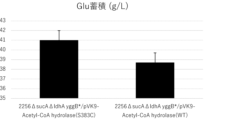
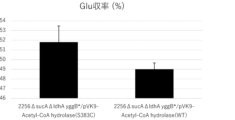
- Another example of a coryneform bacterium is the C. glutamicum 2256 ⁇ sucA ⁇ ldhA yggB* strain, which is defective in the ldhA and sucA genes of Corynebacterium glutamicum ATCC 13869 and has an IS mutation (V419::IS) in the yggB gene (WO2014/185430).
- the bacterium of the present invention may inherently have the ability to produce L-glutamic acid, or may be modified to retain the ability to produce L-glutamic acid.
- Bacteria capable of producing L-glutamic acid can be obtained, for example, by imparting L-glutamic acid production ability to the above-mentioned bacteria, or by enhancing the L-glutamic acid production ability of the above-mentioned bacteria.
- L-glutamic acid can be imparted or enhanced by methods that have been used in the breeding of amino acid producing bacteria such as Corynebacterium or Escherichia bacteria (see Amino Acid Fermentation, Academic Press, first published May 30, 1986, pp. 77-100). Such methods include, for example, obtaining auxotrophic mutants, obtaining L-glutamic acid analogue resistant strains, obtaining metabolic control mutants, and creating recombinant strains with enhanced activity of L-glutamic acid biosynthetic enzymes.
- the properties such as auxotrophy, analogue resistance, metabolic control mutations, etc. that are imparted may be one, two, three or more.
- the activity of the L-glutamic acid biosynthetic enzymes may be enhanced, either one, or two, three or more.
- the conferring of properties such as auxotrophy, analog resistance, and metabolic control mutations may be combined with the enhancement of biosynthetic enzyme activity.
- Auxotrophic mutants, analogue-resistant mutants or metabolically controlled mutants with L-glutamic acid production ability can be obtained by subjecting a parent strain or wild-type strain to a conventional mutagen treatment and selecting from the resulting mutants those that exhibit auxotrophy, analogue-resistant or metabolically controlled mutations and have L-glutamic acid production ability.
- Conventional mutagen treatments include irradiation with X-rays or ultraviolet light, and treatment with mutagens such as N-methyl-N'-nitro-N-nitrosoguanidine (MNNG), ethyl methanesulfonate (EMS) and methyl methanesulfonate (MMS).
- L-glutamic acid production ability can be imparted or enhanced by enhancing the activity of an enzyme involved in the biosynthesis of L-glutamic acid.
- Enzyme activity can be enhanced, for example, by modifying the bacterium so that expression of the gene encoding the enzyme is enhanced. Methods for enhancing gene expression are described in WO00/18935, EP1010755A, etc.
- L-glutamic acid production ability can also be imparted or enhanced by reducing the activity of an enzyme that catalyzes a reaction that branches off from the L-glutamic acid biosynthetic pathway to produce a compound other than L-glutamic acid.
- an enzyme that catalyzes a reaction that branches off from the L-glutamic acid biosynthetic pathway to produce a compound other than L-glutamic acid also includes enzymes involved in the decomposition of L-glutamic acid.
- L-glutamic acid producing bacteria and methods for imparting or enhancing L-glutamic acid producing ability are given below. Note that the properties possessed by L-glutamic acid producing bacteria and the modifications for imparting or enhancing L-glutamic acid producing ability as exemplified below may all be used alone or in appropriate combination.
- Methods for imparting or enhancing L-glutamic acid production ability include, for example, methods for modifying bacteria so as to increase the activity of one or more enzymes selected from L-glutamic acid biosynthesis enzymes.
- enzymes include, but are not limited to, glutamate dehydrogenase (gdhA), glutamine synthetase (glnA), glutamate synthase (gltBD), isocitrate dehydrogenase (icdA), aconitate hydratase (acnA, acnB), citrate synthase (gltA), methylcitrate synthase (prpC), pyruvate carboxylase (pyc), pyruvate dehydrogenase (aceEF, lpdA), pyruvate kinase (pykA, pykF), phosphoenolpyruvate
- Examples of the enzymes that can be used include synthase (ppsA
- genes in parentheses are examples of genes that code for the enzymes (the same applies to the following descriptions).
- these enzymes it is preferable to enhance the activity of one or more enzymes selected from glutamate dehydrogenase, citrate synthase, phosphoenolpyruvate carboxylase, and methylcitrate synthase.
- a method for imparting or enhancing L-glutamic acid production ability for example, a method of modifying a bacterium to reduce the activity of one or more enzymes selected from enzymes that catalyze a reaction that branches off from the L-glutamic acid biosynthetic pathway to produce a compound other than L-glutamic acid.
- L-glutamic acid producing bacteria or parent strains for deriving them include strains in which both ⁇ -ketoglutarate dehydrogenase (sucA) activity and succinate dehydrogenase (sdh) activity are reduced or deleted (JP Patent Publication No. 2010-041920).
- serA ⁇ -ketoglutarate dehydrogenase
- shdh succinate dehydrogenase
- a specific example of such a strain is the odhAsdhA double-deleted strain of Corynebacterium glutamicum ATCC14067 (Corynebacterium glutamicum 8L3G ⁇ SDH strain) (JP Patent Publication No. 2010-041920).
- a method for imparting or enhancing L-glutamic acid production ability is, for example, a method of modifying bacteria so that the activity of excreting L-glutamic acid from bacterial cells is increased.
- the activity of excreting L-glutamic acid can be increased, for example, by increasing the expression of a gene that encodes a protein that excretes L-glutamic acid.
- genes that encode proteins that excrete various amino acids include the b2682 gene (ygaZ), the b2683 gene (ygaH), the b1242 gene (ychE), and the b3434 gene (yhgN) (JP Patent Publication 2002-300874).
- methods for imparting or enhancing L-glutamic acid production ability include, for example, modifying bacteria to increase the activity of proteins involved in sugar metabolism or energy metabolism.
- Proteins involved in sugar metabolism include proteins involved in sugar uptake and glycolytic enzymes. Genes encoding proteins involved in sugar metabolism include the glucose 6-phosphate isomerase gene (pgi; WO01/02542), pyruvate carboxylase gene (pyc; WO99/18228, EP1092776A), phosphoglucomutase gene (pgm; WO03/04598), fructose bisphosphate aldolase gene (pfkB, fbp; WO03/04664), transaldolase gene (talB; WO03/008611), fumarase gene (fum; WO01/02545), non-PTS sucrose uptake gene (csc; EP1149911A), and sucrose utilization genes (scrAB operon; U.S. Patent No. 7,179,623).
- glucose 6-phosphate isomerase gene pgi; WO01/02542
- pyruvate carboxylase gene pyc; WO99/18228, EP
- Gene that codes for proteins involved in energy metabolism includes the transhydrogenase gene (pntAB; U.S. Patent No. 5,830,716) and the cytochrome bo type oxidase gene (cyoB; EP1070376A).
- methods for imparting or enhancing L-glutamic acid producing ability to coryneform bacteria include a method for enhancing expression of the yggB gene and a method for introducing a mutant yggB gene with a mutation introduced into the coding region (WO2006/070944).
- the bacterium of the present invention may be modified to increase expression of the yggB gene, or may be modified to retain (have) a mutant yggB gene.
- a yggB gene having a "specific mutation” described below is also referred to as a mutant yggB gene, and a protein encoded thereby is also referred to as a mutant YggB protein.
- a yggB gene not having a "specific mutation” described below is also referred to as a wild-type yggB gene, and a protein encoded thereby is also referred to as a wild-type YggB protein.
- a change in amino acid sequence caused by a "specific mutation” in the yggB gene is also referred to as a "specific mutation.”
- the term "wild type” used here is a convenient description to distinguish it from a “mutant type,” and is not limited to those obtained in nature, as long as they do not have a "specific mutation.”
- Examples of wild-type YggB proteins include the YggB proteins exemplified above, such as a protein having the amino acid sequence shown in SEQ ID NO: 8.
- wild-type YggB proteins include conservative variants (variants that maintain the original function) of the YggB proteins exemplified above that do not have a "specific mutation.”
- the "original function" of the YggB protein may be, for example, its function as a mechanosensitive channel, or it may be a property that improves the L-glutamic acid production ability of the coryneform bacterium when its expression is increased in the coryneform bacterium.
- a specific example of a mutant yggB gene having a 2A-1 type mutation is a yggB gene in which an IS is inserted next to "G" at position 1255 of SEQ ID NO: 7, and which encodes a mutant YggB protein with a total length of 423 amino acid residues, which is shorter than the original wild-type YggB protein (SEQ ID NO: 8).
- the nucleotide sequence of this mutant yggB gene (V419::IS) and the amino acid sequence of the mutant YggB protein (V419::IS) encoded by the same gene are shown in SEQ ID NO: 9 and SEQ ID NO: 10, respectively.
- positions 1 to 1269 represent the CDS of the mutant YggB protein (V419::IS).
- a specific example of an L-glutamic acid-producing bacterium having a mutant yggB gene (V419::IS) is the C. glutamicum 2256 ⁇ sucA ⁇ ldhA yggB * strain (WO2014/185430).
- proline residues examples include mutations in which the proline residues present at positions 419 to 533 of the wild-type YggB protein are substituted with other amino acids.
- proline residues examples include proline residues at positions 424, 437, 453, 457, 462, 469, 484, 489, 497, 515, 529, and 533 of the wild-type YggB protein.
- the "other amino acids” are not particularly limited as long as they are natural amino acids other than proline.
- the proline residue at position 424 may be preferably substituted with a hydrophobic amino acid (Ala, Gly, Val, Leu, or Ile), more preferably with a branched-chain amino acid (Leu, Val, or Ile), and for example, the proline residue at position 437 may be preferably substituted with an amino acid having a hydroxyl group in the side chain (Thr, Ser, or Tyr), more preferably with Ser.
- the YggB protein is presumed to have five transmembrane domains.
- the transmembrane domains correspond to the amino acid residues at positions 1-23 (first transmembrane domain), 25-47 (second transmembrane domain), 62-84 (third transmembrane domain), 86-108 (fourth transmembrane domain), and 110-132 (fifth transmembrane domain) of the wild-type YggB protein.
- the mutations in the transmembrane domain are mutations in the domains in the wild-type yggB gene that code for these transmembrane domains.
- the mutations in the transmembrane domain may be introduced at one or more sites in the domain.
- the mutations in the transmembrane domain are preferably those that cause substitution, deletion, addition, insertion, or inversion of one or several amino acids, and are not accompanied by frameshift mutations or nonsense mutations.
- the term "one or several” means preferably 1-20, more preferably 1-10, even more preferably 1-5, and particularly preferably 1-3.
- Mutations in the transmembrane region include those that insert one or several amino acids (e.g., Cys-Ser-Leu) between the leucine residue at position 14 and the tryptophan residue at position 15 of the wild-type YggB protein, those that replace the alanine residue at position 100 with another amino acid residue (e.g., an amino acid having a hydroxyl group in its side chain (Thr, Ser, or Tyr), preferably Thr), and those that replace the alanine residue at position 111 with another amino acid residue (e.g., Val or an amino acid having a hydroxyl group in its side chain (Thr, Ser, or Tyr), preferably Val or Thr).
- amino acids e.g., Cys-Ser-Leu
- amino acid residue at position X of the wild-type YggB protein means the amino acid residue corresponding to the amino acid residue at position X in SEQ ID NO: 8.
- position X in an amino acid sequence means the Xth position counted from the N-terminus of the amino acid sequence, and the N-terminal amino acid residue is the first amino acid residue.
- the position of an amino acid residue indicates a relative position, and its absolute position may change due to deletion, insertion, addition, etc. of amino acids.
- amino acid residue at position 419 of the wild-type YggB protein means the amino acid residue corresponding to the amino acid residue at position 419 in SEQ ID NO: 8, and when one amino acid residue is deleted on the N-terminal side of position 419, the amino acid residue at position 418 from the N-terminus is considered to be the "amino acid residue at position 419 of the wild-type YggB protein".
- amino acid residue at position 420 from the N-terminus is considered to be the "amino acid residue at position 419 of the wild-type YggB protein".
- the amino acid residues at positions 419 to 529 correspond to the amino acid residues at positions 419 to 533 of the wild-type YggB protein.
- the alanine residue at position 98 in the YggB protein of Corynebacterium callunae corresponds to the alanine residue at position 100 of the wild-type YggB protein.
- the mutant yggB gene can be obtained by modifying the wild-type yggB gene so that it has the above-mentioned "specific mutation.”
- DNA modification can be carried out by known techniques.
- site-specific mutagenesis methods that introduce a desired mutation into a target site in DNA include a method using PCR (Higuchi, R., 61, in PCR technology, Erlich, H. A. Eds., Stockton press (1989); Carter, P., Meth. In Enzymol., 154, 382 (1987)) and a method using phages (Kramer, W. and Frits, H. J., Meth. In Enzymol., 154, 350 (1987); Kunkel, T. A. et al., Meth. In Enzymol., 154, 367 (1987)).
- Mutant yggB genes can also be obtained by chemical synthesis.
- Coryneform bacteria can be modified to have a mutant yggB gene by introducing a mutant yggB gene into the coryneform bacterium.
- coryneform bacteria can also be modified to have a mutant yggB gene by introducing a mutation into the yggB gene that the bacterium has through natural mutation or mutagen treatment.
- the coryneform bacterium of the present invention may be a coryneform bacterium having L-glutamic acid producing ability as described above that has been modified to carry a mutant acetyl-CoA hydrolase gene, or a coryneform bacterium obtained by imparting L-glutamic acid producing ability to a coryneform bacterium modified to carry a mutant acetyl-CoA hydrolase gene. Also included are coryneform bacteria that have been modified to carry a mutant acetyl-CoA hydrolase gene to have L-glutamic acid producing ability.
- the acetyl-CoA hydrolase gene is a gene that codes for acetyl-CoA hydrolase.
- Examples of the acetyl-CoA hydrolase gene include the acetyl-CoA hydrolase genes of coryneform bacteria.
- Specific examples of the acetyl-CoA hydrolase genes of coryneform bacteria include the acetyl-CoA hydrolase genes of Corynebacterium glutamicum ATCC13869, Corynebacterium glutamicum ATCC13032, Corynebacterium glutamicum ATCC14967, and Corynebacterium melassecola ATCC17965.
- the acetyl-CoA hydrolase gene of Corynebacterium glutamicum ATCC13032 corresponds to the complementary sequence of the sequence from 2,729,376 to 2,730,884 in the genome sequence registered in the NCBI database under GenBank Accession No. NC_003450, and is also called NCgl2480.
- the acetyl-CoA hydrolase encoded by the acetyl-CoA hydrolase gene of Corynebacterium glutamicum ATCC13032 is registered under GenBank Accession No. WP_003858947.1.
- nucleotide sequence of the wild-type acetyl-CoA hydrolase gene of Corynebacterium glutamicum 2256 (ATCC 13869) and the amino acid sequence of the acetyl-CoA hydrolase encoded by the gene are shown in SEQ ID NO: 1 and SEQ ID NO: 2, respectively.
- acetyl-CoA hydrolase may refer to a protein having an activity of catalyzing a reaction in which acetyl-CoA is hydrolyzed to produce coenzyme A and acetic acid and/or the reverse reaction (e.g., EC 3.1.2.1).
- the activity is also referred to as "acetyl-CoA hydrolase activity.”
- the acetyl-CoA hydrolase activity may be an activity of catalyzing a reaction in which acetyl-CoA and H 2 O are converted to coenzyme A and acetic acid and/or the reverse reaction.
- Acetyl-CoA hydrolase is also referred to as "acetyl-CoA deacylase.”
- An example of a gene encoding acetyl-CoA hydrolase is the NCgl2480 gene.
- the base sequence of the acetyl-CoA hydrolase gene, such as the NCgl2480 gene, contained in the bacterium to be modified and the amino acid sequence of the acetyl-CoA hydrolase encoded by them can be obtained from a public database such as NCBI.
- an acetyl-CoA hydrolase gene having a "specific genetic mutation” described below is also referred to as a mutant acetyl-CoA hydrolase gene, and a protein encoded thereby is also referred to as a mutant acetyl-CoA hydrolase.
- an acetyl-CoA hydrolase gene not having a "specific genetic mutation” described below is also referred to as a wild-type acetyl-CoA hydrolase gene, and a protein encoded thereby is also referred to as a wild-type acetyl-CoA hydrolase.
- acetyl-CoA hydrolase a change in amino acid sequence caused by a "specific genetic mutation" in the acetyl-CoA hydrolase gene is also referred to as a "specific genetic mutation.”
- wild type used here is a convenient description to distinguish it from a "mutant type,” and is not limited to those obtained in nature, as long as they do not have a "specific genetic mutation.”
- Examples of wild-type acetyl-CoA hydrolases include the acetyl-CoA hydrolases exemplified above, for example, a protein having the amino acid sequence shown in SEQ ID NO: 2.
- wild-type acetyl-CoA hydrolases include conservative variants (variants that maintain the original function) of the acetyl-CoA hydrolases exemplified above that do not have a "specific genetic mutation.”
- the serine residue at position 383 may be replaced with a hydrophilic amino acid (Lys, Glu, Thr, Asp, Asn, Gln, Arg, Cys, or His), and more preferably with Cys.
- the serine residue at position 383 may be replaced with a sulfur-containing amino acid (Cys or Met), and more preferably with Cys.
- amino acid residue at position X of wild-type acetyl-CoA hydrolase means an amino acid residue corresponding to the amino acid residue at position X in SEQ ID NO: 2.
- Position X in an amino acid sequence means the Xth position counted from the N-terminus of the amino acid sequence, and the N-terminal amino acid residue is the first amino acid residue.
- the position of an amino acid residue indicates a relative position, and its absolute position may change due to deletion, insertion, addition, etc. of amino acids.
- Acetyl-CoA hydrolase activity can be measured, for example, by incubating the enzyme with a corresponding substrate (e.g., acetyl-CoA and H2O ) and measuring the enzyme- and substrate-dependent production of the corresponding product (e.g., coenzyme A and acetate).
- a corresponding substrate e.g., acetyl-CoA and H2O
- the enzyme- and substrate-dependent production of the corresponding product e.g., coenzyme A and acetate
- a homologue of the acetyl-CoA hydrolase gene or a homologue of acetyl-CoA hydrolase can be easily obtained from a public database, for example, by a BLAST search or a FASTA search using the base sequence of the acetyl-CoA hydrolase gene or the amino acid sequence of the acetyl-CoA hydrolase as a query sequence.
- a homologue of the acetyl-CoA hydrolase gene can be obtained, for example, by PCR using the chromosomes of various organisms as a template and oligonucleotides prepared based on the base sequences of these known acetyl-CoA hydrolase genes as primers.
- the acetyl-CoA hydrolase gene may be a gene encoding an acetyl-CoA hydrolase having an amino acid sequence in which one or several amino acids at one or several positions in the above amino acid sequence (for example, the amino acid sequence shown in SEQ ID NO: 2) have been substituted, deleted, inserted and/or added, so long as the original function is maintained.
- the encoded protein may have its N-terminus and/or C-terminus extended or shortened.
- substitutions, deletions, insertions and/or additions of one or several amino acids are conservative mutations that maintain the normal function of the protein.
- a typical example of a conservative mutation is conservative substitution.
- a conservative substitution is a mutation in which Phe, Trp and Tyr are substituted for each other when the substitution site is an aromatic amino acid, Leu, Ile and Val are substituted for each other when the substitution site is a hydrophobic amino acid, Gln and Asn are substituted for each other when the substitution site is a polar amino acid, Lys, Arg and His are substituted for each other when the substitution site is a basic amino acid, Asp and Glu are substituted for each other when the substitution site is an acidic amino acid, and Ser and Thr are substituted for each other when the substitution site is an amino acid with a hydroxyl group.
- substitutions that are considered to be conservative substitutions include substitutions of Ala to Ser or Thr, substitutions of Arg to Gln, His or Lys, substitutions of Asn to Glu, Gln, Lys, His or Asp, substitutions of Asp to Asn, Glu or Gln, substitutions of Cys to Ser or Ala, substitutions of Gln to Asn, Glu, Lys, His, Asp or Arg, substitutions of Glu to Gly, Asn, Gln, Lys or Asp, substitutions of Gly to Pro, substitutions of His to Asn, Lys, Gln, Arg or Tyr, substitutions of Ile to Pro ...
- substitutions include substitutions of Lys with Leu, Met, Val, or Phe, substitutions of Leu with Ile, Met, Val, or Phe, substitutions of Lys with Asn, Glu, Gln, His, or Arg, substitutions of Met with Ile, Leu, Val, or Phe, substitutions of Phe with Trp, Tyr, Met, Ile, or Leu, substitutions of Ser with Thr or Ala, substitutions of Thr with Ser or Ala, substitutions of Trp with Phe or Tyr, substitutions of Tyr with His, Phe, or Trp, and substitutions of Val with Met, Ile, or Leu.
- the above-mentioned amino acid substitutions, deletions, insertions, or additions also include those that arise due to naturally occurring mutations (mutants or variants), such as those based on individual differences or species differences in the organism from which the gene is derived.
- the acetyl-CoA hydrolase gene may be a gene encoding a protein having an amino acid sequence that has, for example, 50% or more, 65% or more, 80% or more, preferably 90% or more, more preferably 95% or more, even more preferably 97% or more, and particularly preferably 99% or more identity to the entire amino acid sequence described above, so long as the original function is maintained.
- the acetyl-CoA hydrolase gene may be a gene (e.g., DNA) that hybridizes under stringent conditions with a probe that can be prepared from the above base sequence (e.g., the base sequence shown in SEQ ID NO: 1), such as a complementary sequence to all or part of the above base sequence, so long as the original function is maintained.
- stringent conditions refer to conditions under which so-called specific hybrids are formed and non-specific hybrids are not formed.
- DNAs with high identity for example DNAs with an identity of 50% or more, 65% or more, 80% or more, preferably 90% or more, more preferably 95% or more, even more preferably 97% or more, and particularly preferably 99% or more, hybridize with each other, and DNAs with lower identity do not hybridize with each other; or a condition in which washing is performed once, preferably 2 to 3 times, at a salt concentration and temperature equivalent to the washing conditions for normal Southern hybridization, which are 60°C, 1xSSC, 0.1% SDS, preferably 60°C, 0.1xSSC, 0.1% SDS, more preferably 68°C, 0.1xSSC, 0.1% SDS.
- a salt concentration and temperature equivalent to the washing conditions for normal Southern hybridization which are 60°C, 1xSSC, 0.1% SDS, preferably 60°C, 0.1xSSC, 0.1% SDS, more preferably 68°C, 0.1xSSC, 0.1% SDS.
- the probe used in the hybridization may be a part of the complementary sequence of the gene.
- a probe can be prepared by PCR using oligonucleotides prepared based on a known gene sequence as primers and a DNA fragment containing the above-mentioned gene as a template.
- a DNA fragment of about 300 bp in length can be used as the probe.
- washing conditions for the hybridization include 50°C, 2xSSC, and 0.1% SDS.
- the acetyl-CoA hydrolase gene may be one in which any codon has been replaced with an equivalent codon.
- the acetyl-CoA hydrolase gene may be a variant of the acetyl-CoA hydrolase gene exemplified above due to the degeneracy of the genetic code.
- the acetyl-CoA hydrolase gene may be modified to have an optimal codon depending on the codon usage frequency of the host used.
- genes and proteins used to breed L-glutamic acid producing bacteria may have the nucleotide sequence and amino acid sequence of known genes and proteins, such as the above-mentioned genes and proteins.
- the genes and proteins used to breed L-glutamic acid producing bacteria may be conservative variants of known genes and proteins, such as the above-mentioned genes and proteins.
- the genes used to breed L-glutamic acid producing bacteria may be genes that code for proteins having an amino acid sequence in which one or several amino acids at one or several positions in the amino acid sequence of a known protein are substituted, deleted, inserted or added, as long as the original function is maintained.
- Methods for modifying the bacterium to retain the mutant acetyl-CoA hydrolase gene include a method for introducing a mutant acetyl-CoA hydrolase gene into the coryneform bacterium, in which a mutation has been introduced into the coding region of the wild-type acetyl-CoA hydrolase gene to replace the serine residue at position 383, and a method for introducing the same mutation into the coding region of the wild-type acetyl-CoA hydrolase gene possessed by the coryneform bacterium.
- Coryneform bacteria can be modified to have a mutant acetyl-CoA hydrolase gene by introducing the mutant acetyl-CoA hydrolase gene into the coryneform bacterium. Note that coryneform bacteria can also be modified to have a mutant acetyl-CoA hydrolase gene by introducing a mutation into the acetyl-CoA hydrolase gene that the coryneform bacterium has by natural mutation or mutagen treatment.
- Introduction of a mutant acetyl-CoA hydrolase gene into a coryneform bacterium can be achieved by introducing the gene into the host chromosome.
- Introduction of a gene into a chromosome can be achieved, for example, by homologous recombination (Miller, J. H. Experiments in Molecular Genetics, 1972, Cold Spring Harbor Laboratory).
- Examples of gene introduction methods using homologous recombination include a method using linear DNA such as Red-driven integration (Datsenko, K. A, and Wanner, B. L. Proc. Natl. Acad. Sci. U. S. A.
- a method using a plasmid containing a temperature-sensitive replication origin a method using a conjugatively transferable plasmid, a method using a suicide vector that does not have a replication origin that functions in the host, and a transduction method using a phage.
- a host is transformed with a recombinant DNA containing a mutant acetyl-CoA hydrolase gene, and the gene can be introduced into the host chromosome by causing homologous recombination with a target site on the host chromosome.
- the structure of the recombinant DNA used for homologous recombination is not particularly limited as long as it causes homologous recombination in a desired manner.
- a host is transformed with a linear DNA containing a mutant acetyl-CoA hydrolase gene, and the linear DNA has base sequences at both ends of the gene that are homologous to the upstream and downstream of the target site on the chromosome, respectively, and homologous recombination is caused upstream and downstream of the target site, respectively, thereby replacing the target site with the gene.
- the recombinant DNA used for homologous recombination may have a marker gene for selecting a transformant. Only one copy of the gene may be introduced, or two or more copies may be introduced.
- multiple copies of the mutant acetyl-CoA hydrolase gene can be introduced into a chromosome by performing homologous recombination using a base sequence that has multiple copies on a chromosome as a target.
- base sequences that exist in multiple copies on a chromosome include repetitive DNA sequences and inverted repeats at both ends of a transposon.
- Homologous recombination may also be performed by targeting an appropriate base sequence on a chromosome, such as a gene that is not necessary for the production of a target substance.
- Genes can also be randomly introduced onto a chromosome using transposons or Mini-Mu (JP Patent Publication 2-109985, US Patent No. 5,882,888, EP805867B1). Note that such chromosome modification techniques using homologous recombination are not limited to the introduction of mutant acetyl-CoA hydrolase genes, and can be used for any modification of a chromosome, such as modification of an expression regulatory sequence.
- the introduction of the mutant acetyl-CoA hydrolase gene onto the chromosome can be confirmed by Southern hybridization using a probe having a sequence complementary to all or part of the gene, or by PCR using primers created based on the sequence of the gene.
- the vector is preferably a multicopy vector.
- the vector in order to select a transformant, the vector preferably has a marker such as an antibiotic resistance gene.
- the vector may also have a promoter or terminator for expressing the inserted gene.
- the vector may be, for example, a bacterial plasmid-derived vector, a yeast plasmid-derived vector, a bacteriophage-derived vector, a cosmid, or a phagemid.
- Specific examples of vectors capable of autonomous replication in coryneform bacteria include pHM1519 (Agric. Biol. Chem., 48, 2901-2903 (1984)); pAM330 (Agric. Biol.
- plasmids having drug resistance genes improved from these such as pCRY30 (Japanese Patent Laid-Open No. 3-210184); pCRY21, pCRY2KE, pCRY2KX, pCRY31, pCRY3KE, and pCRY3KX (Japanese Patent Laid-Open No. 2-72876, U.S. Pat. No. 5,185,262). No.); pCRY2 and pCRY3 (JP Patent Publication No. 1-191686); pAJ655, pAJ611, and pAJ1844 (JP Patent Publication No.
- pCG1 JP Patent Publication No. 57-134500
- pCG2 JP Patent Publication No. 58-35197
- pCG4 and pCG11 JP Patent Publication No. 57-183799
- pVK7 JP Patent Publication No. 10-215883
- pVK9 US Patent Application Publication No. 2006/0141588
- pVC7 JP Patent Publication No. 9-070291
- pVS7 WO2013/069634
- promoter that functions in the host.
- the promoter may be a host-derived promoter or a heterologous promoter.
- the promoter may be an intrinsic promoter of the gene to be introduced or a promoter of another gene.
- a terminator for terminating transcription can be placed downstream of the gene.
- the terminator may be a terminator derived from the host or a terminator derived from a heterologous species.
- the terminator may be a terminator inherent to the gene to be introduced or a terminator from another gene.
- each gene only needs to be retained in the host in an expressible manner.
- all of the genes may be retained on a single expression vector, or all of the genes may be retained on a chromosome.
- the genes may be retained separately on multiple expression vectors, or may be retained separately on a single or multiple expression vectors and on a chromosome.
- Two or more genes may be introduced as an operon. Examples of "introducing two or more genes” include introducing genes that each code for two or more proteins (e.g., enzymes), introducing genes that each code for two or more subunits that make up a single protein complex (e.g., an enzyme complex), and combinations thereof.
- the method of the present invention is a method for producing L-glutamic acid, comprising culturing the bacterium of the present invention described in ⁇ 1> in a medium, accumulating L-glutamic acid in the medium and/or within the cells of the bacterium, and collecting L-glutamic acid from the medium and/or the cells.
- L-glutamic acid is as described above.
- L-glutamic acid may be produced alone, or L-glutamic acid and one or more amino acids other than L-glutamic acid, such as L-amino acids (also referred to as L-amino acids), may be produced.
- the medium used is not particularly limited as long as the bacterium of the present invention can grow and L-glutamic acid can be produced.
- a normal medium used for culturing bacteria such as coryneform bacteria can be used as the medium.
- a medium containing components selected from a carbon source, a nitrogen source, a phosphate source, a sulfur source, and various other organic and inorganic components as necessary can be used as the medium.
- the types and concentrations of medium components can be appropriately set depending on various conditions such as the type of bacteria used.
- carbon sources include sugars such as glucose, fructose, sucrose, lactose, galactose, xylose, arabinose, maltose, isomaltose, blackstrap molasses, starch hydrolysates, and biomass hydrolysates; organic acids such as acetic acid, fumaric acid, citric acid, and succinic acid; alcohols such as glycerol, crude glycerol, and ethanol; and fatty acids.
- sugars include sugars in particular.
- Examples of carbon sources include glucose and fructose in particular.
- Sugars such as glucose and fructose may be used alone or in combination with other carbon sources.
- carbon sources include sugars containing fructose as a constituent sugar.
Landscapes
- Chemical & Material Sciences (AREA)
- Organic Chemistry (AREA)
- Life Sciences & Earth Sciences (AREA)
- Health & Medical Sciences (AREA)
- Genetics & Genomics (AREA)
- Engineering & Computer Science (AREA)
- Wood Science & Technology (AREA)
- Zoology (AREA)
- Bioinformatics & Cheminformatics (AREA)
- General Engineering & Computer Science (AREA)
- General Health & Medical Sciences (AREA)
- Biochemistry (AREA)
- Biotechnology (AREA)
- Microbiology (AREA)
- Biomedical Technology (AREA)
- Molecular Biology (AREA)
- Medicinal Chemistry (AREA)
- Physics & Mathematics (AREA)
- Biophysics (AREA)
- Plant Pathology (AREA)
- Chemical Kinetics & Catalysis (AREA)
- General Chemical & Material Sciences (AREA)
- Micro-Organisms Or Cultivation Processes Thereof (AREA)
- Preparation Of Compounds By Using Micro-Organisms (AREA)
Priority Applications (3)
| Application Number | Priority Date | Filing Date | Title |
|---|---|---|---|
| JP2025534317A JP7716823B1 (ja) | 2023-12-28 | 2023-12-28 | L-グルタミン酸生産菌およびl-グルタミン酸の製造方法 |
| PCT/JP2023/047152 WO2025141838A1 (ja) | 2023-12-28 | 2023-12-28 | L-グルタミン酸生産菌およびl-グルタミン酸の製造方法 |
| EP23963186.4A EP4692313A1 (en) | 2023-12-28 | 2023-12-28 | L-glutamic acid-producing bacterium and method for producing l-glutamic acid |
Applications Claiming Priority (1)
| Application Number | Priority Date | Filing Date | Title |
|---|---|---|---|
| PCT/JP2023/047152 WO2025141838A1 (ja) | 2023-12-28 | 2023-12-28 | L-グルタミン酸生産菌およびl-グルタミン酸の製造方法 |
Publications (1)
| Publication Number | Publication Date |
|---|---|
| WO2025141838A1 true WO2025141838A1 (ja) | 2025-07-03 |
Family
ID=96217142
Family Applications (1)
| Application Number | Title | Priority Date | Filing Date |
|---|---|---|---|
| PCT/JP2023/047152 Pending WO2025141838A1 (ja) | 2023-12-28 | 2023-12-28 | L-グルタミン酸生産菌およびl-グルタミン酸の製造方法 |
Country Status (3)
| Country | Link |
|---|---|
| EP (1) | EP4692313A1 (https=) |
| JP (1) | JP7716823B1 (https=) |
| WO (1) | WO2025141838A1 (https=) |
Citations (60)
| Publication number | Priority date | Publication date | Assignee | Title |
|---|---|---|---|---|
| JPS50113209A (https=) | 1974-02-13 | 1975-09-05 | ||
| JPS5238088A (en) | 1975-09-19 | 1977-03-24 | Ajinomoto Co Inc | Preparation of l-glutamic acid |
| JPS561889A (en) | 1979-06-20 | 1981-01-10 | Ajinomoto Co Inc | Preparation of l-glutamic acid by fermentation |
| JPS5635981A (en) | 1979-08-31 | 1981-04-08 | Ajinomoto Co Inc | Novel variant |
| JPS56140895A (en) | 1980-04-02 | 1981-11-04 | Ajinomoto Co Inc | Preparation of l-glutamic acid by fermentation |
| JPS572689A (en) | 1981-03-23 | 1982-01-08 | Ajinomoto Co Inc | Preparation of l-glutamic acid |
| JPS5765198A (en) | 1980-10-09 | 1982-04-20 | Ajinomoto Co Inc | Fermentative production of l-glutamic acid |
| JPS57134500A (en) | 1981-02-12 | 1982-08-19 | Kyowa Hakko Kogyo Co Ltd | Plasmid pcg1 |
| JPS57183799A (en) | 1981-04-17 | 1982-11-12 | Kyowa Hakko Kogyo Co Ltd | Novel plasmid |
| JPS5835197A (ja) | 1981-08-26 | 1983-03-01 | Kyowa Hakko Kogyo Co Ltd | プラスミドpcg2 |
| JPS58192900A (ja) | 1982-05-04 | 1983-11-10 | Ajinomoto Co Inc | 複合プラスミド |
| US4777051A (en) | 1986-06-20 | 1988-10-11 | Ajinomoto Co., Inc. | Process for the production of a composition for animal feed |
| JPH01191686A (ja) | 1988-01-26 | 1989-08-01 | Mitsubishi Petrochem Co Ltd | 複合プラスミド |
| JPH0272876A (ja) | 1988-09-08 | 1990-03-13 | Mitsubishi Petrochem Co Ltd | トリプトフアンシンターゼの製造法 |
| JPH02109985A (ja) | 1988-02-22 | 1990-04-23 | Eurolysine | 細菌染色体上ヘの目的遺伝子の組み込み方法及び該方法によって得られた細菌 |
| US4946654A (en) | 1984-04-07 | 1990-08-07 | Bayer Aktiengesellschaft | Process for preparing granulates |
| US4956471A (en) | 1986-04-28 | 1990-09-11 | Ajinomoto Company, Inc. | Process for isolating and purifying amino acids |
| JPH03210184A (ja) | 1990-01-11 | 1991-09-13 | Mitsubishi Petrochem Co Ltd | 新規プラスミドベクター |
| JPH0488994A (ja) | 1990-07-30 | 1992-03-23 | Kyowa Hakko Kogyo Co Ltd | 発酵法によるl―グルタミン酸の製造法 |
| US5185262A (en) | 1988-07-27 | 1993-02-09 | Mitsubishi Petrochemical Co., Ltd. | DNA fragment containing gene which encodes the function of stabilizing plasmid in host microorganism |
| JPH0548890A (ja) | 1991-08-20 | 1993-02-26 | Omron Corp | 画像処理装置 |
| JPH05158192A (ja) | 1991-12-10 | 1993-06-25 | Fuji Photo Film Co Ltd | 写真フイルムパトローネ |
| US5431933A (en) | 1991-09-17 | 1995-07-11 | Degussa Aktiengesellschaft | Animal feed supplement based on a fermentation broth amino acid, a process for its production and its use |
| JPH0970291A (ja) | 1995-06-30 | 1997-03-18 | Ajinomoto Co Inc | 人工トランスポゾンを用いた遺伝子増幅方法 |
| JPH09164323A (ja) | 1995-10-13 | 1997-06-24 | Ajinomoto Co Inc | 発酵液の膜除菌方法 |
| JPH09173792A (ja) | 1995-10-23 | 1997-07-08 | Ajinomoto Co Inc | 発酵液の処理方法 |
| JPH10215883A (ja) | 1996-12-05 | 1998-08-18 | Ajinomoto Co Inc | L−リジンの製造法 |
| US5830716A (en) | 1993-10-28 | 1998-11-03 | Ajinomoto Co., Inc. | Increased amounts of substances by modifying a microorganism to increase production of NADPH from NADH |
| US5840358A (en) | 1996-05-31 | 1998-11-24 | Degussa Aktiengesellschaft | Process for the preparation of an animal feed supplement based on fermentation broth |
| WO1999007853A1 (en) | 1997-08-12 | 1999-02-18 | Ajinomoto Co., Inc. | Process for producing l-glutamic acid by fermentation method |
| US5882888A (en) | 1995-01-23 | 1999-03-16 | Novo Nordisk A/S | DNA integration by transposition |
| WO1999018228A2 (de) | 1997-10-04 | 1999-04-15 | Forschungszentrum Jülich GmbH | Verfahren zur mikrobiellen herstellung von aminosäuren der aspartat- und/oder glutamatfamilie und im verfahren einsetzbare mittel |
| WO2000018935A1 (en) | 1998-09-25 | 2000-04-06 | Ajinomoto Co.,Inc. | Process for constructing amino acid-producing bacterium and process for producing amino acid by fermentation method with the use of the thus constructed amino acid-producing bacterium |
| EP1010755A1 (en) | 1998-12-18 | 2000-06-21 | Ajinomoto Co., Inc. | Method for producing L-Glutamic acid by fermentation |
| WO2001002542A1 (fr) | 1999-07-02 | 2001-01-11 | Ajinomoto Co., Inc. | Procede de production d'acide l-amine |
| WO2001002545A1 (fr) | 1999-07-02 | 2001-01-11 | Ajinomoto Co., Inc. | Procede de production d'acide l-amine |
| EP1070376A1 (de) | 1998-04-09 | 2001-01-24 | Siemens Aktiengesellschaft | Anordnung und verfahren zur elektrischen energieversorgung einer elektrischen last |
| EP1078989A2 (en) | 1999-08-20 | 2001-02-28 | Ajinomoto Co., Ltd. | Method for producing L-glutamic acid by fermentation accompanied by precipitation |
| EP1092776A1 (en) | 1999-10-14 | 2001-04-18 | Ajinomoto Co., Inc. | Method for producing L-amino acid by fermentation |
| US6238714B1 (en) | 1999-05-05 | 2001-05-29 | Degussa-Huls Ag | Feedstuff additive which contains D-pantothenic acid and/or its salts and a process for the preparation thereof |
| EP1149911A2 (en) | 2000-04-26 | 2001-10-31 | Ajinomoto Co., Ltd. | Amino acid producing strains belonging to the genus Escherichia and method for producing amino acid |
| EP1233069A2 (en) | 2001-02-20 | 2002-08-21 | Ajinomoto Co., Inc. | Method for producing L-glutamic acid |
| JP2002300874A (ja) | 2001-02-13 | 2002-10-15 | Ajinomoto Co Inc | エシェリヒア属細菌を用いたl−アミノ酸の製造法 |
| WO2003004598A2 (en) | 2001-07-06 | 2003-01-16 | Degussa Ag | Process for the preparation of l-amino acids using strains of the enterobacteriaceae family |
| WO2003008611A2 (en) | 2001-07-18 | 2003-01-30 | Degussa Ag | Process for the preparation of l-amino acids using strains of the enterobacteriaceae family which contain an enhanced talb gene |
| US6640645B2 (en) | 2000-05-06 | 2003-11-04 | Wabco Gmbh & Co. Ohg | Electronic control apparatus |
| WO2004111258A1 (ja) | 2003-06-10 | 2004-12-23 | Ajinomoto Co., Inc. | L−グルタミン酸の製造法 |
| US20050025878A1 (en) | 2003-07-11 | 2005-02-03 | Degussa Ag | Process for the granulation of an animal feedstuff additive |
| EP1624069A1 (en) | 2003-05-07 | 2006-02-08 | Ajinomoto Co., Inc. | Process for producing l-glutamic acid |
| WO2006057450A1 (en) | 2004-11-25 | 2006-06-01 | Ajinomoto Co., Inc. | L-amino acid-producing bacterium and a method for producing l-amino acid |
| US20060141588A1 (en) | 2004-12-28 | 2006-06-29 | Jun Nakamura | L-glutamic acid-producing microorganism and a method for producing l-glutamic acid |
| WO2006070944A2 (en) | 2004-12-28 | 2006-07-06 | Ajinomoto Co., Inc. | L-glutamic acid-producing microorganism and a method for producing l-glutamic acid |
| JP2006340603A (ja) | 2003-06-23 | 2006-12-21 | Ajinomoto Co Inc | L−グルタミン酸の製造法 |
| JP2007097573A (ja) * | 2004-12-28 | 2007-04-19 | Ajinomoto Co Inc | L−グルタミン酸生産菌及びl−グルタミン酸の製造方法 |
| WO2008075483A1 (ja) | 2006-12-19 | 2008-06-26 | Ajinomoto Co., Inc. | L-アミノ酸の製造法 |
| WO2008078646A1 (ja) | 2006-12-22 | 2008-07-03 | Ajinomoto Co., Inc. | アミノ酸又は核酸の結晶の分離方法 |
| WO2008078448A1 (ja) | 2006-12-25 | 2008-07-03 | Ajinomoto Co., Inc. | 塩基性アミノ酸塩酸塩結晶の取得方法 |
| WO2013069634A1 (ja) | 2011-11-11 | 2013-05-16 | 味の素株式会社 | 発酵法による目的物質の製造法 |
| WO2014185430A1 (ja) | 2013-05-13 | 2014-11-20 | 味の素株式会社 | L-アミノ酸の製造法 |
| JP6097869B1 (ja) | 2016-08-01 | 2017-03-15 | 新日鉄住金エンジニアリング株式会社 | エタノールの製造方法 |
Family Cites Families (3)
| Publication number | Priority date | Publication date | Assignee | Title |
|---|---|---|---|---|
| JPS5832596B2 (ja) | 1979-08-10 | 1983-07-14 | 味の素株式会社 | 発酵法によるl−グルタミン酸の製造方法 |
| JPS58158192A (ja) | 1982-03-15 | 1983-09-20 | Ajinomoto Co Inc | 発酵法によるl−グルタミン酸の製造方法 |
| JP2537260B2 (ja) | 1988-02-23 | 1996-09-25 | 東陶機器株式会社 | 和風便器の施工方法 |
-
2023
- 2023-12-28 JP JP2025534317A patent/JP7716823B1/ja active Active
- 2023-12-28 WO PCT/JP2023/047152 patent/WO2025141838A1/ja active Pending
- 2023-12-28 EP EP23963186.4A patent/EP4692313A1/en active Pending
Patent Citations (65)
| Publication number | Priority date | Publication date | Assignee | Title |
|---|---|---|---|---|
| JPS50113209A (https=) | 1974-02-13 | 1975-09-05 | ||
| JPS5238088A (en) | 1975-09-19 | 1977-03-24 | Ajinomoto Co Inc | Preparation of l-glutamic acid |
| JPS561889A (en) | 1979-06-20 | 1981-01-10 | Ajinomoto Co Inc | Preparation of l-glutamic acid by fermentation |
| JPS5635981A (en) | 1979-08-31 | 1981-04-08 | Ajinomoto Co Inc | Novel variant |
| JPS56140895A (en) | 1980-04-02 | 1981-11-04 | Ajinomoto Co Inc | Preparation of l-glutamic acid by fermentation |
| JPS5765198A (en) | 1980-10-09 | 1982-04-20 | Ajinomoto Co Inc | Fermentative production of l-glutamic acid |
| JPS57134500A (en) | 1981-02-12 | 1982-08-19 | Kyowa Hakko Kogyo Co Ltd | Plasmid pcg1 |
| JPS572689A (en) | 1981-03-23 | 1982-01-08 | Ajinomoto Co Inc | Preparation of l-glutamic acid |
| JPS57183799A (en) | 1981-04-17 | 1982-11-12 | Kyowa Hakko Kogyo Co Ltd | Novel plasmid |
| JPS5835197A (ja) | 1981-08-26 | 1983-03-01 | Kyowa Hakko Kogyo Co Ltd | プラスミドpcg2 |
| JPS58192900A (ja) | 1982-05-04 | 1983-11-10 | Ajinomoto Co Inc | 複合プラスミド |
| US4946654A (en) | 1984-04-07 | 1990-08-07 | Bayer Aktiengesellschaft | Process for preparing granulates |
| US4956471A (en) | 1986-04-28 | 1990-09-11 | Ajinomoto Company, Inc. | Process for isolating and purifying amino acids |
| US4777051A (en) | 1986-06-20 | 1988-10-11 | Ajinomoto Co., Inc. | Process for the production of a composition for animal feed |
| JPH01191686A (ja) | 1988-01-26 | 1989-08-01 | Mitsubishi Petrochem Co Ltd | 複合プラスミド |
| JPH02109985A (ja) | 1988-02-22 | 1990-04-23 | Eurolysine | 細菌染色体上ヘの目的遺伝子の組み込み方法及び該方法によって得られた細菌 |
| US5185262A (en) | 1988-07-27 | 1993-02-09 | Mitsubishi Petrochemical Co., Ltd. | DNA fragment containing gene which encodes the function of stabilizing plasmid in host microorganism |
| JPH0272876A (ja) | 1988-09-08 | 1990-03-13 | Mitsubishi Petrochem Co Ltd | トリプトフアンシンターゼの製造法 |
| JPH03210184A (ja) | 1990-01-11 | 1991-09-13 | Mitsubishi Petrochem Co Ltd | 新規プラスミドベクター |
| JPH0488994A (ja) | 1990-07-30 | 1992-03-23 | Kyowa Hakko Kogyo Co Ltd | 発酵法によるl―グルタミン酸の製造法 |
| JPH0548890A (ja) | 1991-08-20 | 1993-02-26 | Omron Corp | 画像処理装置 |
| US5431933A (en) | 1991-09-17 | 1995-07-11 | Degussa Aktiengesellschaft | Animal feed supplement based on a fermentation broth amino acid, a process for its production and its use |
| JPH05158192A (ja) | 1991-12-10 | 1993-06-25 | Fuji Photo Film Co Ltd | 写真フイルムパトローネ |
| US5830716A (en) | 1993-10-28 | 1998-11-03 | Ajinomoto Co., Inc. | Increased amounts of substances by modifying a microorganism to increase production of NADPH from NADH |
| US5882888A (en) | 1995-01-23 | 1999-03-16 | Novo Nordisk A/S | DNA integration by transposition |
| EP0805867B1 (en) | 1995-01-23 | 2003-12-17 | Novozymes A/S | Dna integration by transposition |
| JPH0970291A (ja) | 1995-06-30 | 1997-03-18 | Ajinomoto Co Inc | 人工トランスポゾンを用いた遺伝子増幅方法 |
| JPH09164323A (ja) | 1995-10-13 | 1997-06-24 | Ajinomoto Co Inc | 発酵液の膜除菌方法 |
| JPH09173792A (ja) | 1995-10-23 | 1997-07-08 | Ajinomoto Co Inc | 発酵液の処理方法 |
| US5840358A (en) | 1996-05-31 | 1998-11-24 | Degussa Aktiengesellschaft | Process for the preparation of an animal feed supplement based on fermentation broth |
| JPH10215883A (ja) | 1996-12-05 | 1998-08-18 | Ajinomoto Co Inc | L−リジンの製造法 |
| WO1999007853A1 (en) | 1997-08-12 | 1999-02-18 | Ajinomoto Co., Inc. | Process for producing l-glutamic acid by fermentation method |
| WO1999018228A2 (de) | 1997-10-04 | 1999-04-15 | Forschungszentrum Jülich GmbH | Verfahren zur mikrobiellen herstellung von aminosäuren der aspartat- und/oder glutamatfamilie und im verfahren einsetzbare mittel |
| EP1070376A1 (de) | 1998-04-09 | 2001-01-24 | Siemens Aktiengesellschaft | Anordnung und verfahren zur elektrischen energieversorgung einer elektrischen last |
| WO2000018935A1 (en) | 1998-09-25 | 2000-04-06 | Ajinomoto Co.,Inc. | Process for constructing amino acid-producing bacterium and process for producing amino acid by fermentation method with the use of the thus constructed amino acid-producing bacterium |
| EP1010755A1 (en) | 1998-12-18 | 2000-06-21 | Ajinomoto Co., Inc. | Method for producing L-Glutamic acid by fermentation |
| US6238714B1 (en) | 1999-05-05 | 2001-05-29 | Degussa-Huls Ag | Feedstuff additive which contains D-pantothenic acid and/or its salts and a process for the preparation thereof |
| WO2001002542A1 (fr) | 1999-07-02 | 2001-01-11 | Ajinomoto Co., Inc. | Procede de production d'acide l-amine |
| WO2001002545A1 (fr) | 1999-07-02 | 2001-01-11 | Ajinomoto Co., Inc. | Procede de production d'acide l-amine |
| EP1078989A2 (en) | 1999-08-20 | 2001-02-28 | Ajinomoto Co., Ltd. | Method for producing L-glutamic acid by fermentation accompanied by precipitation |
| EP1092776A1 (en) | 1999-10-14 | 2001-04-18 | Ajinomoto Co., Inc. | Method for producing L-amino acid by fermentation |
| EP1149911A2 (en) | 2000-04-26 | 2001-10-31 | Ajinomoto Co., Ltd. | Amino acid producing strains belonging to the genus Escherichia and method for producing amino acid |
| US7179623B2 (en) | 2000-04-26 | 2007-02-20 | Ajinomoto Co., Inc. | Method of producing amino acids using E. coli transformed with sucrose PTS genes |
| US6640645B2 (en) | 2000-05-06 | 2003-11-04 | Wabco Gmbh & Co. Ohg | Electronic control apparatus |
| JP2002300874A (ja) | 2001-02-13 | 2002-10-15 | Ajinomoto Co Inc | エシェリヒア属細菌を用いたl−アミノ酸の製造法 |
| EP1233069A2 (en) | 2001-02-20 | 2002-08-21 | Ajinomoto Co., Inc. | Method for producing L-glutamic acid |
| WO2003004664A2 (en) | 2001-07-06 | 2003-01-16 | Degussa Ag | Process for the preparation of l-amino acids using strains of the enterobacteriaceae family with enhanced fba expression |
| WO2003004598A2 (en) | 2001-07-06 | 2003-01-16 | Degussa Ag | Process for the preparation of l-amino acids using strains of the enterobacteriaceae family |
| WO2003008611A2 (en) | 2001-07-18 | 2003-01-30 | Degussa Ag | Process for the preparation of l-amino acids using strains of the enterobacteriaceae family which contain an enhanced talb gene |
| EP1624069A1 (en) | 2003-05-07 | 2006-02-08 | Ajinomoto Co., Inc. | Process for producing l-glutamic acid |
| WO2004111258A1 (ja) | 2003-06-10 | 2004-12-23 | Ajinomoto Co., Inc. | L−グルタミン酸の製造法 |
| JP2006340603A (ja) | 2003-06-23 | 2006-12-21 | Ajinomoto Co Inc | L−グルタミン酸の製造法 |
| US20050025878A1 (en) | 2003-07-11 | 2005-02-03 | Degussa Ag | Process for the granulation of an animal feedstuff additive |
| JP2006149214A (ja) * | 2004-11-25 | 2006-06-15 | Ajinomoto Co Inc | L−アミノ酸生産菌及びl−アミノ酸の製造方法 |
| WO2006057450A1 (en) | 2004-11-25 | 2006-06-01 | Ajinomoto Co., Inc. | L-amino acid-producing bacterium and a method for producing l-amino acid |
| US20060141588A1 (en) | 2004-12-28 | 2006-06-29 | Jun Nakamura | L-glutamic acid-producing microorganism and a method for producing l-glutamic acid |
| WO2006070944A2 (en) | 2004-12-28 | 2006-07-06 | Ajinomoto Co., Inc. | L-glutamic acid-producing microorganism and a method for producing l-glutamic acid |
| JP2007097573A (ja) * | 2004-12-28 | 2007-04-19 | Ajinomoto Co Inc | L−グルタミン酸生産菌及びl−グルタミン酸の製造方法 |
| WO2008075483A1 (ja) | 2006-12-19 | 2008-06-26 | Ajinomoto Co., Inc. | L-アミノ酸の製造法 |
| JP2010041920A (ja) | 2006-12-19 | 2010-02-25 | Ajinomoto Co Inc | L−アミノ酸の製造法 |
| WO2008078646A1 (ja) | 2006-12-22 | 2008-07-03 | Ajinomoto Co., Inc. | アミノ酸又は核酸の結晶の分離方法 |
| WO2008078448A1 (ja) | 2006-12-25 | 2008-07-03 | Ajinomoto Co., Inc. | 塩基性アミノ酸塩酸塩結晶の取得方法 |
| WO2013069634A1 (ja) | 2011-11-11 | 2013-05-16 | 味の素株式会社 | 発酵法による目的物質の製造法 |
| WO2014185430A1 (ja) | 2013-05-13 | 2014-11-20 | 味の素株式会社 | L-アミノ酸の製造法 |
| JP6097869B1 (ja) | 2016-08-01 | 2017-03-15 | 新日鉄住金エンジニアリング株式会社 | エタノールの製造方法 |
Non-Patent Citations (15)
| Title |
|---|
| "GenBank", Database accession no. WP_003858947.1 |
| "NCBI", Database accession no. NC_003450 |
| AGRIC. BIOL. CHEM., vol. 48, 1984, pages 2901 - 2903 |
| BARTON GJ ET AL., JOURNAL OF MOLECULAR BIOLOGY, vol. 198, no. 2, 1987, pages 327 - 37 |
| DATSENKO, K. A.WANNER, B. L., PROC. NATL. ACAD. SCI. U S A., vol. 97, pages 6640 - 6645 |
| ELIZABETH C. TYLER ET AL., COMPUTERS AND BIOMEDICAL RESEARCH, vol. 24, no. 1, 1991, pages 72 - 96 |
| HIGUCHI, R.: "PCR technology", 1989, STOCKTON PRESS |
| INT. J. SYST. BACTERIOL., vol. 41, 1991, pages 255 |
| INT. J. SYST. EVOL. MICROBIOL., vol. 60, 2010, pages 874 - 879 |
| JOURNAL OF INDUSTRIAL MICROBIOLOGY & BIOTECHNOLOGY, vol. 28, 2002, pages 333 - 337 |
| KRAMER, W.FRITS, H. J., METH. IN ENZYMOL., vol. 154, 1987, pages 382 |
| KUNIHIKO AKASHI ET AL.: "Amino Acid Fermentation", 30 May 1986, GAKKAI PUBLISHING CENTER, INC., pages: 195 - 100 |
| MILLER, J. H.: "Experiments in Molecular Genetics", 1972, COLD SPRING HARBOR LABORATORY |
| NAGAI, H. ET AL., SEPARATION SCIENCE AND TECHNOLOGY, vol. 39, no. 16, pages 3691 - 3710 |
| See also references of EP4692313A1 |
Also Published As
| Publication number | Publication date |
|---|---|
| JPWO2025141838A1 (https=) | 2025-07-03 |
| EP4692313A1 (en) | 2026-02-11 |
| JP7716823B1 (ja) | 2025-08-01 |
Similar Documents
| Publication | Publication Date | Title |
|---|---|---|
| CN107034250B (zh) | 谷氨酸类l-氨基酸的制造方法 | |
| CN103396976B (zh) | L-谷氨酸类氨基酸生产微生物以及氨基酸的生产方法 | |
| JP4595506B2 (ja) | L−アミノ酸生産菌及びl−アミノ酸の製造方法 | |
| KR101773755B1 (ko) | L-아미노산의 제조법 | |
| JP6519476B2 (ja) | 目的物質の製造法 | |
| JP2926991B2 (ja) | 発酵法によるl−リジン及びl−グルタミン酸の製造方法 | |
| CN116445387A (zh) | 生产目标物质的方法、转基因微生物及核酸的应用 | |
| JPWO1996006180A1 (ja) | 発酵法によるl−リジン及びl−グルタミン酸の製造方法 | |
| US20230416793A1 (en) | Method of producing l-amino acid | |
| JP2016163540A (ja) | 有用物質の製造方法 | |
| CN101248170B (zh) | 产生l-谷氨酸的细菌和用于产生l-谷氨酸的方法 | |
| EP1929029A1 (en) | An l-amino acid-producing bacterium and a method for producing l-amino acids | |
| JP7716823B1 (ja) | L-グルタミン酸生産菌およびl-グルタミン酸の製造方法 | |
| JP7716166B1 (ja) | L-グルタミン酸生産菌およびl-グルタミン酸の製造方法 | |
| JP7747242B1 (ja) | L-グルタミン酸の製造方法 | |
| WO2007037459A1 (en) | An l-amino acid-producing bacterium and a method for producing l-amino acids | |
| KR20260062987A (ko) | L-글루탐산 생산균 및 l-글루탐산의 제조 방법 | |
| CN101248169B (zh) | 产生l-谷氨酸的细菌和用于产生l-谷氨酸的方法 | |
| JP4576850B2 (ja) | 発酵法によるl−アルギニン又はl−リジンの製造法 | |
| WO2024162450A1 (ja) | L-グルタミン酸の製造法 | |
| KR20240046412A (ko) | L-아미노산의 제조법 |
Legal Events
| Date | Code | Title | Description |
|---|---|---|---|
| ENP | Entry into the national phase |
Ref document number: 2025534317 Country of ref document: JP Kind code of ref document: A |
|
| WWE | Wipo information: entry into national phase |
Ref document number: 2025534317 Country of ref document: JP |
|
| 121 | Ep: the epo has been informed by wipo that ep was designated in this application |
Ref document number: 23963186 Country of ref document: EP Kind code of ref document: A1 |
|
| WWE | Wipo information: entry into national phase |
Ref document number: 2023963186 Country of ref document: EP |
|
| REG | Reference to national code |
Ref country code: BR Ref legal event code: B01A Ref document number: 112025023861 Country of ref document: BR |
|
| ENP | Entry into the national phase |
Ref document number: 2023963186 Country of ref document: EP Effective date: 20251104 |
|
| ENP | Entry into the national phase |
Ref document number: 2023963186 Country of ref document: EP Effective date: 20251104 |
|
| ENP | Entry into the national phase |
Ref document number: 2023963186 Country of ref document: EP Effective date: 20251104 |
|
| ENP | Entry into the national phase |
Ref document number: 2023963186 Country of ref document: EP Effective date: 20251104 |
|
| ENP | Entry into the national phase |
Ref document number: 112025023861 Country of ref document: BR Kind code of ref document: A2 Effective date: 20251031 |
|
| ENP | Entry into the national phase |
Ref document number: 2023963186 Country of ref document: EP Effective date: 20251104 |
|
| ENP | Entry into the national phase |
Ref document number: 2023963186 Country of ref document: EP Effective date: 20251104 |
|
| ENP | Entry into the national phase |
Ref document number: 2023963186 Country of ref document: EP Effective date: 20251104 |
|
| ENP | Entry into the national phase |
Ref document number: 2023963186 Country of ref document: EP Effective date: 20251104 |
|
| WWP | Wipo information: published in national office |
Ref document number: 2023963186 Country of ref document: EP |
|
| WWE | Wipo information: entry into national phase |
Ref document number: 202690862 Country of ref document: EA |