WO2017209199A1 - 脂環式テトラカルボン酸二無水物の製造方法 - Google Patents
脂環式テトラカルボン酸二無水物の製造方法 Download PDFInfo
- Publication number
- WO2017209199A1 WO2017209199A1 PCT/JP2017/020320 JP2017020320W WO2017209199A1 WO 2017209199 A1 WO2017209199 A1 WO 2017209199A1 JP 2017020320 W JP2017020320 W JP 2017020320W WO 2017209199 A1 WO2017209199 A1 WO 2017209199A1
- Authority
- WO
- WIPO (PCT)
- Prior art keywords
- compound
- group
- carbon atoms
- alkyl group
- represented
- Prior art date
- Legal status (The legal status is an assumption and is not a legal conclusion. Google has not performed a legal analysis and makes no representation as to the accuracy of the status listed.)
- Ceased
Links
- 0 *[C@](C(C([C@](C1)[C@@]2O)[C@](*)C3[C@@](C4)[C@@]5N)[C@]1[C@]2*=C)C3[C@@]4[C@]5O Chemical compound *[C@](C(C([C@](C1)[C@@]2O)[C@](*)C3[C@@](C4)[C@@]5N)[C@]1[C@]2*=C)C3[C@@]4[C@]5O 0.000 description 8
- ZCJHLBHJGLCVRU-UHFFFAOYSA-N O=C(C1C2C3C=CC1C3)C(C1C=CC3C1)C3C2=O Chemical compound O=C(C1C2C3C=CC1C3)C(C1C=CC3C1)C3C2=O ZCJHLBHJGLCVRU-UHFFFAOYSA-N 0.000 description 1
Classifications
-
- C—CHEMISTRY; METALLURGY
- C08—ORGANIC MACROMOLECULAR COMPOUNDS; THEIR PREPARATION OR CHEMICAL WORKING-UP; COMPOSITIONS BASED THEREON
- C08G—MACROMOLECULAR COMPOUNDS OBTAINED OTHERWISE THAN BY REACTIONS ONLY INVOLVING UNSATURATED CARBON-TO-CARBON BONDS
- C08G73/00—Macromolecular compounds obtained by reactions forming a linkage containing nitrogen with or without oxygen or carbon in the main chain of the macromolecule, not provided for in groups C08G12/00 - C08G71/00
- C08G73/06—Polycondensates having nitrogen-containing heterocyclic rings in the main chain of the macromolecule
- C08G73/10—Polyimides; Polyester-imides; Polyamide-imides; Polyamide acids or similar polyimide precursors
- C08G73/1003—Preparatory processes
- C08G73/1007—Preparatory processes from tetracarboxylic acids or derivatives and diamines
-
- C—CHEMISTRY; METALLURGY
- C07—ORGANIC CHEMISTRY
- C07C—ACYCLIC OR CARBOCYCLIC COMPOUNDS
- C07C69/00—Esters of carboxylic acids; Esters of carbonic or haloformic acids
- C07C69/74—Esters of carboxylic acids having an esterified carboxyl group bound to a carbon atom of a ring other than a six-membered aromatic ring
- C07C69/753—Esters of carboxylic acids having an esterified carboxyl group bound to a carbon atom of a ring other than a six-membered aromatic ring of polycyclic acids
-
- C—CHEMISTRY; METALLURGY
- C07—ORGANIC CHEMISTRY
- C07D—HETEROCYCLIC COMPOUNDS
- C07D307/00—Heterocyclic compounds containing five-membered rings having one oxygen atom as the only ring hetero atom
- C07D307/77—Heterocyclic compounds containing five-membered rings having one oxygen atom as the only ring hetero atom ortho- or peri-condensed with carbocyclic rings or ring systems
- C07D307/93—Heterocyclic compounds containing five-membered rings having one oxygen atom as the only ring hetero atom ortho- or peri-condensed with carbocyclic rings or ring systems condensed with a ring other than six-membered
-
- C—CHEMISTRY; METALLURGY
- C07—ORGANIC CHEMISTRY
- C07D—HETEROCYCLIC COMPOUNDS
- C07D493/00—Heterocyclic compounds containing oxygen atoms as the only ring hetero atoms in the condensed system
- C07D493/02—Heterocyclic compounds containing oxygen atoms as the only ring hetero atoms in the condensed system in which the condensed system contains two hetero rings
- C07D493/04—Ortho-condensed systems
-
- C—CHEMISTRY; METALLURGY
- C08—ORGANIC MACROMOLECULAR COMPOUNDS; THEIR PREPARATION OR CHEMICAL WORKING-UP; COMPOSITIONS BASED THEREON
- C08G—MACROMOLECULAR COMPOUNDS OBTAINED OTHERWISE THAN BY REACTIONS ONLY INVOLVING UNSATURATED CARBON-TO-CARBON BONDS
- C08G73/00—Macromolecular compounds obtained by reactions forming a linkage containing nitrogen with or without oxygen or carbon in the main chain of the macromolecule, not provided for in groups C08G12/00 - C08G71/00
- C08G73/06—Polycondensates having nitrogen-containing heterocyclic rings in the main chain of the macromolecule
- C08G73/10—Polyimides; Polyester-imides; Polyamide-imides; Polyamide acids or similar polyimide precursors
-
- C—CHEMISTRY; METALLURGY
- C08—ORGANIC MACROMOLECULAR COMPOUNDS; THEIR PREPARATION OR CHEMICAL WORKING-UP; COMPOSITIONS BASED THEREON
- C08J—WORKING-UP; GENERAL PROCESSES OF COMPOUNDING; AFTER-TREATMENT NOT COVERED BY SUBCLASSES C08B, C08C, C08F, C08G or C08H
- C08J5/00—Manufacture of articles or shaped materials containing macromolecular substances
- C08J5/18—Manufacture of films or sheets
-
- C—CHEMISTRY; METALLURGY
- C08—ORGANIC MACROMOLECULAR COMPOUNDS; THEIR PREPARATION OR CHEMICAL WORKING-UP; COMPOSITIONS BASED THEREON
- C08L—COMPOSITIONS OF MACROMOLECULAR COMPOUNDS
- C08L79/00—Compositions of macromolecular compounds obtained by reactions forming in the main chain of the macromolecule a linkage containing nitrogen with or without oxygen or carbon only, not provided for in groups C08L61/00 - C08L77/00
- C08L79/04—Polycondensates having nitrogen-containing heterocyclic rings in the main chain; Polyhydrazides; Polyamide acids or similar polyimide precursors
- C08L79/08—Polyimides; Polyester-imides; Polyamide-imides; Polyamide acids or similar polyimide precursors
-
- C—CHEMISTRY; METALLURGY
- C09—DYES; PAINTS; POLISHES; NATURAL RESINS; ADHESIVES; COMPOSITIONS NOT OTHERWISE PROVIDED FOR; APPLICATIONS OF MATERIALS NOT OTHERWISE PROVIDED FOR
- C09D—COATING COMPOSITIONS, e.g. PAINTS, VARNISHES OR LACQUERS; FILLING PASTES; CHEMICAL PAINT OR INK REMOVERS; INKS; CORRECTING FLUIDS; WOODSTAINS; PASTES OR SOLIDS FOR COLOURING OR PRINTING; USE OF MATERIALS THEREFOR
- C09D179/00—Coating compositions based on macromolecular compounds obtained by reactions forming in the main chain of the macromolecule a linkage containing nitrogen, with or without oxygen, or carbon only, not provided for in groups C09D161/00 - C09D177/00
- C09D179/04—Polycondensates having nitrogen-containing heterocyclic rings in the main chain; Polyhydrazides; Polyamide acids or similar polyimide precursors
- C09D179/08—Polyimides; Polyester-imides; Polyamide-imides; Polyamide acids or similar polyimide precursors
-
- G—PHYSICS
- G02—OPTICS
- G02F—OPTICAL DEVICES OR ARRANGEMENTS FOR THE CONTROL OF LIGHT BY MODIFICATION OF THE OPTICAL PROPERTIES OF THE MEDIA OF THE ELEMENTS INVOLVED THEREIN; NON-LINEAR OPTICS; FREQUENCY-CHANGING OF LIGHT; OPTICAL LOGIC ELEMENTS; OPTICAL ANALOGUE/DIGITAL CONVERTERS
- G02F1/00—Devices or arrangements for the control of the intensity, colour, phase, polarisation or direction of light arriving from an independent light source, e.g. switching, gating or modulating; Non-linear optics
- G02F1/01—Devices or arrangements for the control of the intensity, colour, phase, polarisation or direction of light arriving from an independent light source, e.g. switching, gating or modulating; Non-linear optics for the control of the intensity, phase, polarisation or colour
- G02F1/13—Devices or arrangements for the control of the intensity, colour, phase, polarisation or direction of light arriving from an independent light source, e.g. switching, gating or modulating; Non-linear optics for the control of the intensity, phase, polarisation or colour based on liquid crystals, e.g. single liquid crystal display cells
- G02F1/133—Constructional arrangements; Operation of liquid crystal cells; Circuit arrangements
- G02F1/1333—Constructional arrangements; Manufacturing methods
- G02F1/133305—Flexible substrates, e.g. plastics, organic film
-
- G—PHYSICS
- G06—COMPUTING OR CALCULATING; COUNTING
- G06F—ELECTRIC DIGITAL DATA PROCESSING
- G06F3/00—Input arrangements for transferring data to be processed into a form capable of being handled by the computer; Output arrangements for transferring data from processing unit to output unit, e.g. interface arrangements
- G06F3/01—Input arrangements or combined input and output arrangements for interaction between user and computer
- G06F3/03—Arrangements for converting the position or the displacement of a member into a coded form
- G06F3/041—Digitisers, e.g. for touch screens or touch pads, characterised by the transducing means
-
- H—ELECTRICITY
- H10—SEMICONDUCTOR DEVICES; ELECTRIC SOLID-STATE DEVICES NOT OTHERWISE PROVIDED FOR
- H10F—INORGANIC SEMICONDUCTOR DEVICES SENSITIVE TO INFRARED RADIATION, LIGHT, ELECTROMAGNETIC RADIATION OF SHORTER WAVELENGTH OR CORPUSCULAR RADIATION
- H10F77/00—Constructional details of devices covered by this subclass
- H10F77/30—Coatings
- H10F77/306—Coatings for devices having potential barriers
- H10F77/311—Coatings for devices having potential barriers for photovoltaic cells
-
- C—CHEMISTRY; METALLURGY
- C07—ORGANIC CHEMISTRY
- C07C—ACYCLIC OR CARBOCYCLIC COMPOUNDS
- C07C2603/00—Systems containing at least three condensed rings
- C07C2603/56—Ring systems containing bridged rings
- C07C2603/86—Ring systems containing bridged rings containing four rings
-
- C—CHEMISTRY; METALLURGY
- C07—ORGANIC CHEMISTRY
- C07C—ACYCLIC OR CARBOCYCLIC COMPOUNDS
- C07C2603/00—Systems containing at least three condensed rings
- C07C2603/56—Ring systems containing bridged rings
- C07C2603/90—Ring systems containing bridged rings containing more than four rings
-
- C—CHEMISTRY; METALLURGY
- C08—ORGANIC MACROMOLECULAR COMPOUNDS; THEIR PREPARATION OR CHEMICAL WORKING-UP; COMPOSITIONS BASED THEREON
- C08J—WORKING-UP; GENERAL PROCESSES OF COMPOUNDING; AFTER-TREATMENT NOT COVERED BY SUBCLASSES C08B, C08C, C08F, C08G or C08H
- C08J2379/00—Characterised by the use of macromolecular compounds obtained by reactions forming in the main chain of the macromolecule a linkage containing nitrogen with or without oxygen, or carbon only, not provided for in groups C08J2361/00 - C08J2377/00
- C08J2379/04—Polycondensates having nitrogen-containing heterocyclic rings in the main chain; Polyhydrazides; Polyamide acids or similar polyimide precursors
- C08J2379/08—Polyimides; Polyester-imides; Polyamide-imides; Polyamide acids or similar polyimide precursors
-
- C—CHEMISTRY; METALLURGY
- C08—ORGANIC MACROMOLECULAR COMPOUNDS; THEIR PREPARATION OR CHEMICAL WORKING-UP; COMPOSITIONS BASED THEREON
- C08L—COMPOSITIONS OF MACROMOLECULAR COMPOUNDS
- C08L2201/00—Properties
- C08L2201/10—Transparent films; Clear coatings; Transparent materials
-
- C—CHEMISTRY; METALLURGY
- C08—ORGANIC MACROMOLECULAR COMPOUNDS; THEIR PREPARATION OR CHEMICAL WORKING-UP; COMPOSITIONS BASED THEREON
- C08L—COMPOSITIONS OF MACROMOLECULAR COMPOUNDS
- C08L2203/00—Applications
- C08L2203/16—Applications used for films
Definitions
- the present invention relates to a method for producing alicyclic tetracarboxylic acid dianhydride, and a method for producing an ester compound which is an intermediate thereof.
- alicyclic tetracarboxylic acid dianhydride is a compound useful as a monomer for producing a polyimide.
- alicyclic carbonyl compounds are utilized in various fields, and alicyclic tetracarboxylic acid dianhydride is a compound useful as a monomer for polyimide production.
- 3aR, 4R, 5R, 5aR, 8aS, 9S, 10S, 10aS) -decahydro-1H, 3H-4, 10: 5, 9-dimethanonaphtho [2,3-c: 6, 7-c '] difuran -1,3,6,8-tetraone (hereinafter sometimes referred to as DNDA) is one of useful compounds.
- DNDA 1,3R, 4, 4a, 5, 8, 8a-hexahydro-1,4: 5,8- produced from norbornadiene and cyclopentadiene Dimethanonaphthalene (hereinafter sometimes referred to as BNDE) is reacted with carbon monoxide in the presence of a palladium catalyst to give tetramethyl (1R, 2R, 3S, 4S, 5S, 6S, 7R, 8R) -decahydro-1, After conversion to 4: 5,8-dimethanonaphthalene-2,3,6,7-tetracarboxylate (hereinafter sometimes referred to as DNME), this is subjected to an anhydride reaction in the presence of an acid to obtain DNDA.
- Methods of manufacturing are known (see, for example, Patent Documents 1 and 2 and Non-Patent Document 1).
- Patent Document 1 reports on a method for producing DNDA and a polyimide using DNDA. Specifically, BNDE, methanol, palladium carbon, and copper chloride are placed in a reaction vessel and then reacted with carbon monoxide to obtain DNME, which is an ester compound, which is a tetracarboxylic acid using hydrochloric acid. The compound is converted to a cyclization reaction with acetic anhydride.
- Patent Document 2 describes a method for producing a carboxylic acid anhydride from a carboxylic acid ester compound.
- DNDA is produced by reacting the ester compound DNME in acetic acid in the presence of an acid such as an ion exchange resin or p-toluenesulfonic acid.
- an acid such as an ion exchange resin or p-toluenesulfonic acid.
- acetic acid is distilled off under reduced pressure to obtain DNDA as a solid, and the precipitate is filtered.
- Non-Patent Document 1 DNDA is reacted with a diamine to synthesize a polyimide having solubility and transparency.
- cyclopentadiene and norbornadiene are reacted under heating to obtain BNDE, followed by BNDE, methanol, palladium carbon, copper chloride and reacting with carbon monoxide to obtain ester compound DNME, Transesterification is carried out in formic acid in the presence of an acid (p-toluenesulfonic acid), and dehydration (cyclization reaction) is carried out in acetic anhydride.
- the obtained DNDA is crystallized with acetic anhydride, but the purity is not described.
- JP-A-2-235842 Japanese Patent Application Laid-Open No. 5-140141
- Patent Document 1 When the inventor of the present application re-tested Patent Document 1, since BNDE was not dissolved in methanol, the reproducibility of the reaction was poor, and the result was a very low yield. Further, when the production method of Patent Document 2 was additionally tested, acetic anhydride remained in DNDA, and it was found that it was unsuitable as a production method of acid dianhydride used when synthesizing a polyimide. Furthermore, when the same crystallization method as in Non-Patent Document 1 was performed, several weight percent of acetic anhydride and acetic acid remained in DNDA. Since acetic anhydride reacts with diamine, this crystallization method was found to be unsuitable as a method for producing acid dianhydride for polyimide synthesis.
- the object of the present invention is industrially suitable which can produce alicyclic tetracarboxylic acid dianhydride such as DNDA or an ester compound in high yield and high purity by a simple method under a mild condition. It is an object of the present invention to provide a process for producing an alicyclic tetracarboxylic acid dianhydride or an ester compound. Another object of the present invention is to provide an alicyclic tetracarboxylic acid dianhydride and an ester compound suitable as a monomer for polymer production such as polyimide.
- the present invention relates to the following matters.
- Process 1 wherein an norbornadiene represented by the following formula (1) and a cyclopentadiene represented by the following formula (2) are reacted to obtain an olefin compound represented by the following formula (3) Then, an olefin compound represented by the formula (3), an alcohol compound and carbon monoxide are reacted in the presence of a palladium compound and a copper compound to obtain an ester compound represented by the following formula (4): Then, the ester compound represented by the formula (4) is reacted in the presence of an acid in an organic solvent to obtain an alicyclic tetracarboxylic acid dianhydride represented by the following formula (5): Including In the step 2, at least one of the following two operations (A) and (B) is performed, and a method for producing an alicyclic tetracarboxylic acid dianhydride.
- R represents an alkyl group having 1 to 10 carbon atoms
- a method for producing an ester compound comprising performing at least one of the following two operations (A) and (B) in the step: (A) After mixing a palladium compound, a copper compound, and an alcohol compound in a reaction vessel, the following substitution operation of (C-2) and stirring operation of following (C-1) are sequentially performed to be mixed with the olefin compound .
- R 1 is an alkyl group having 1 to 15 carbon atoms or an alkenyl group having 1 to 15 carbon atoms.
- Three R 1 s may be the same as or different from each other, and two or more R 1 s may be R 1 may be bonded to each other to form one or more rings together with the carbon atom to which they are attached
- the hydrogen atom on the alkyl group is an alkenyl group having 1 to 5 carbon atoms, -COOR a A carbon atom in the alkyl group which may be substituted by the ester group, aryl group having 6 to 15 carbon atoms, alkoxy group represented by -OR b , cyano group, or group represented by -OSO 2 R c
- the hydrogen atom on the aryl group may be substituted by a phenyl group, an alkyl group having 1 to 10 carbon atoms, or an alkenyl group having 1 to 10 carbon atoms.
- R a , R b and R c are
- R 1 is as defined above, and R represents an alkyl group having 1 to 10 carbon atoms).
- the olefin compound and the ester compound are represented by the following formulas (8) and (8-1), the following formulas (9) and (9-1), the following formulas (10) and (10-1), and the following formula (11) And (11-1), the following formulas (11-2) and (11-3), the following formulas (12) and (12-1), the following formulas (13) and (13-1), the following formula (14) And (14-1), the following formulas (15) and (15-1), the following formulas (16) and (16-1), or the following formulas (17) and (17-1).
- R 2 is a hydrogen atom, an alkyl group having 1 to 10 carbon atoms, an ester group represented by —COOR d , or a cyano group.
- a hydrogen atom on the alkyl group is an ester represented by —COOR a
- R 2 may be substituted to an aryl group having a carbon number of 6 to 10.
- the two R 2 s may be the same as or different from each other, and are bonded to each other together with the carbon atom to which they are bonded
- R d and R a in the ester group represent an alkyl group having 1 to 10 carbon atoms or an aryl group having 6 to 10 carbon atoms, wherein R represents Indicates an alkyl group having 1 to 10 carbon atoms.
- R 3 represents a hydrogen atom, an alkyl group having 1 to 10 carbon atoms, a cyano group, or an ester group represented by —COOR d .
- a hydrogen atom on an alkyl group is an ester represented by —COOR a
- R 6 may be substituted to an aryl group having a carbon number of 6 to 10.
- the two R 3 s may be the same as or different from each other, and are bonded to each other together with one carbon atom to which they are bonded
- R d and R a in the ester group represent an alkyl group having 1 to 10 carbon atoms or an aryl group having 6 to 10 carbon atoms, wherein R represents Indicates an alkyl group having 1 to 10 carbon atoms.
- R 4 represents a hydrogen atom or an alkyl group having 1 to 10 carbon atoms.
- Two R 4 may be the same as or different from each other, and they are bonded to each other to bind to each other) And may form one or more rings together with the atom, wherein R represents an alkyl group having 1 to 10 carbon atoms.
- R 5 is a hydrogen atom, an alkyl group having 1 to 10 carbon atoms, an alkoxy group represented by —OR b , or a group represented by —OSO 2 R c.
- R b has 1 to carbon atoms 10 alkyl group, or an aryl group having 6 to 10 carbon atoms
- R c is an alkyl group having 1 to 10 carbon atoms, or .2 one R 5 which represents an aryl group having 6 to 10 carbon atoms are the same to each other They may also be different and may be combined with each other to form one or more rings with the carbon atom to which they are attached, wherein R represents an alkyl group having 1 to 10 carbon atoms.
- R represents an alkyl group having 1 to 10 carbon atoms
- R 6 represents a hydrogen atom, a phenyl group, or an alkyl group having 1 to 10 carbon atoms.
- Six R 6 may be the same as or different from each other, and two or more R 6 may be They may be bonded to each other to form one or more rings together with the carbon atom to which they are bonded, wherein R represents an alkyl group having 1 to 10 carbon atoms.
- R 7 represents a hydrogen atom, a phenyl group, or an alkyl group having 1 to 10 carbon atoms.
- Three R 7 s may be the same as or different from each other, and two or more R 7 s may be They may be bonded to each other to form one or more rings together with the carbon atom to which they are bonded, wherein R represents an alkyl group having 1 to 10 carbon atoms.
- R 8 represents a hydrogen atom or an alkyl group having 1 to 10 carbon atoms.
- R 8 s may be the same or different, and two or more R 8 s may be bonded to each other And may form one or more rings together with the carbon atom to which they are attached, wherein R represents an alkyl group having 1 to 10 carbon atoms.
- R 9 represents a hydrogen atom, a phenyl group, or an alkyl group having 1 to 10 carbon atoms.
- Three R 9 s may be the same as or different from each other, and two or more R 9 s may be They may be bonded to each other to form one or more rings together with the carbon atom to which they are bonded, wherein R represents an alkyl group having 1 to 10 carbon atoms.
- R represents an alkyl group having 1 to 10 carbon atoms
- R represents an alkyl group having 1 to 10 carbon atoms
- R 10 may be the same or different, and represents any of a methyl group, an ethyl group, an n-propyl group, or an isopropyl group).
- Ms represents a mesyl group represented by —SO 2 CH 3 ).
- Ms represents a mesyl group represented by —SO 2 CH 3.
- R 11 may be the same or different and is a methyl group, an ethyl group, an n-propyl group, or an isopropyl group Show one)
- Industrially suitable alicyclic tetracarboxylic acid dianhydride capable of producing an alicyclic tetracarboxylic acid dianhydride such as DNDA or an ester compound in high yield by a simple method under mild conditions according to the present invention It is possible to provide a method for producing an organic compound or an ester compound.
- an alicyclic tetracarboxylic acid dianhydride and an ester compound suitable as a monomer for polymer production such as polyimide can be provided.
- DNDA alicyclic tetracarboxylic acid dianhydride
- R is as defined above, and represents an alkyl group having 1 to 10 carbon atoms).
- Step 1 of the present invention is a step of reacting norbornadiene with cyclopentadiene to obtain an olefin compound represented by the above formula (3).
- Step 1 of reacting norbornadiene of the present invention with cyclopentadiene as shown in the figure below, (1R, 4S, 5S, 8R) -1, 4, 4a, 5, 8 having the same steric structure as the target product DNDA.
- 1R, 4S, 5S, 8R 1, 4, 4a, 5, 8 having the same steric structure as the target product DNDA.
- 8a-hexahydro-1,4 5,8-dimethanonaphthalene (BNDE), (1R, 4S, 4as, 5R, 8S, 8as) -1,4,4a, 5,8, which are stereoisomers.
- 8a-Hexahydro-1,4 5,8-dimethanonaphthalene (BNDE-1) and (1R, 4S, 4ar, 5R, 8S, 8ar) -1, 4, 4a, 5, 8, 8a-hexahydro-1 , 4: 5,8-Dimethanonaphthalene (BNDE-2) is obtained. Thereafter, the desired product BNDE can be obtained by distilling the obtained reaction mixture.
- the target products BNDE, BNDE-1 and BNDE-2 have similar boiling points, and if rectification, only high-purity target product BNDE can be obtained, but in simple distillation, a mixture consisting mainly of these three compounds can be obtained. .
- high-purity BNDE may be used in the next step 2, but a mixture containing BNDE and BNDE-1 may be used.
- highly pure DNME can be produced even by using a mixture of BNDE and BNDE-1.
- the mass ratio of BNDE / BNDE-1 is preferably 50/50 to 99/1 as the mixture (ie, the olefin compound represented by the formula (3)), and the content of BNDE in the mixture is Preferably, it is 50 to 99% by weight.
- the mass fraction after reaction is very small and is not a problem throughout the present invention.
- BNDE is a compound shown by said Formula (6).
- the cyclopentadiene used in step 1 of the present invention is represented by the above formula (2).
- Cyclopentadiene is a monomer of dicyclopentadiene, and by heating dicyclopentadiene at 160 to 200 ° C., cyclopentadiene can be quantitatively obtained.
- the cyclopentadiene used in step 1 of the present invention can also be generated in situ by the thermal decomposition of dicyclopentadiene.
- Dicyclopentadiene is a compound represented by the following formula (21).
- the amount of the norbornadiene to be used is preferably 1 mol or more, more preferably 2 to 10 mol, per 1 mol of cyclopentadiene.
- the amount of norbornadiene used is preferably 2 mol or more, more preferably 4 to 20 mol, per 1 mol of dicyclopentadiene. is there.
- an organic solvent may or may not be used.
- the solvent used is not particularly limited as long as it does not inhibit the reaction, and for example, formic acid, aliphatic carboxylic acids (eg, acetic acid, propionic acid, trifluoroacetic acid etc.), organic sulfonic acids (eg, methanesulfonic acid) Trifluoromethanesulfonic acid etc.), alcohols (eg methanol, ethanol, isopropyl alcohol, t-butyl alcohol, ethylene glycol, triethylene glycol etc.), ketones (eg acetone, butanone, cyclohexanone etc.), aliphatic carbonization Hydrogens (eg, n-pentane, n-hexane, n-heptane, cyclohexane etc.), amides (eg, N, N-dimethylformamide, N, N-dimethylacetamide, N-methylpyrrolidone etc.), amides
- the amount of the organic solvent used is appropriately adjusted depending on the uniformity and the stirring property of the reaction solution, but usually 1 to 50 g, more preferably 2 to 20 g per 1 g of norbornadiene. .
- Step 1 of the present invention is carried out, for example, by a method such as mixing norbornadiene and cyclopentadiene, or norbornadiene, cyclopentadiene and an organic solvent and stirring.
- the reaction temperature at that time is preferably 140 to 250 ° C., more preferably 150 to 220 ° C.
- the reaction pressure of the reaction in step 1 of the present invention is not particularly limited.
- the reaction environment is also not particularly limited, but the reaction in Step 1 of the present invention is preferably performed in an inert gas (for example, nitrogen, argon, helium) stream or under an inert gas atmosphere.
- an inert gas for example, nitrogen, argon, helium
- the reaction is usually carried out using an equimolar amount or an excess of norbornadiene to cyclopentadiene.
- the olefin compound represented by the formula (3) containing the target product BNDE is filtered, distilled, column chromatography, etc. Once isolated and purified by a general method such as, the next step is carried out.
- distilling BNDE it is preferable to carry out distillation at a temperature at which BNDE does not undergo thermal decomposition.
- the distillation of BNDE is preferably carried out at 50 to 180 ° C., more preferably 50 to 160 ° C.
- the norbornadiene used in excess in the reaction can be recovered and purified after purification by a general method such as distillation, column chromatography and the like.
- step 2 of the present invention an olefin compound represented by the formula (3), an alcohol compound and carbon monoxide are reacted in the presence of a palladium compound and a copper compound to obtain an ester compound represented by the following formula (4) It is a process.
- R represents an alkyl group having 1 to 10 carbon atoms, preferably a methyl group, an ethyl group, an n-propyl group or an isopropyl group, more preferably a methyl group, an ethyl group or an isopropyl group.
- the olefin compound represented by the formula (3) which can be used in this step is not limited to only BNDE as described above, but may be a mixture containing BNDE and BNDE-1.
- the content of BNDE in the mixture is preferably 50 to 99% by weight.
- Examples of the alcohol compound used in step 2 of the present invention include methanol, ethanol, n-propyl alcohol, isopropyl alcohol, n-butyl alcohol, sec-butyl alcohol, t-butyl alcohol, pentyl alcohol, methoxyethanol and ethoxyethanol
- Ethylene glycol, triethylene glycol and the like can be mentioned, preferably methanol, ethanol, n-propyl alcohol, isopropyl alcohol, more preferably methanol, ethanol, isopropyl alcohol.
- the amount of the alcohol compound used is preferably 0.1 to 200 g, more preferably 1 to 100 g, based on 1 g of the olefin compound of the formula (3).
- an organic solvent other than the alcohol may or may not be used.
- the organic solvent other than the alcohol used is not particularly limited as long as it does not inhibit the reaction, and for example, formic acid, aliphatic carboxylic acids (for example, acetic acid, propionic acid, trifluoroacetic acid etc.), organic sulfonic acids (for example Methanesulfonic acid, trifluoromethanesulfonic acid, etc.), aliphatic hydrocarbons (eg, n-pentane, n-hexane, n-heptane, cyclohexane, etc.), amides (eg, N, N-dimethylformamide, N , N-dimethylacetamide, N-methylpyrrolidone etc.), ureas (N, N'-dimethylimidazolidinone etc.), ethers (eg diethylether, diisopropylether, tetrahydrofuran, dioxane, 1,2-methylenedioxy Benzene, etc.), aromatic
- the amount of the organic solvent other than the alcohol used is preferably 0.1 to 200 g, and more preferably 1 to 100 g, per 1 g of the olefin compound of the formula (3).
- the palladium compound used in this reaction is not particularly limited as long as it contains palladium, for example, palladium halides such as palladium chloride and palladium bromide; palladium organic acid salts such as palladium acetate and palladium oxalate; Palladium inorganic acid salts such as palladium and palladium sulfate; palladium complexes such as bis (acetylacetonato) palladium, bis (1,1,1-5,5,5-hexafluoroacetylacetonato) palladium; palladium on carbon And palladium carbon and palladium alumina supported on a carrier such as alumina and the like, and preferably palladium chloride and palladium carbon are used.
- palladium halides such as palladium chloride and palladium bromide
- palladium organic acid salts such as palladium acetate and palladium oxalate
- Palladium inorganic acid salts such
- palladium compound is used in a meaning including a so-called compound, palladium metal alone, or carrier-supported palladium on which a palladium metal alone is supported on a carrier.
- the palladium compounds may be used singly or in combination of two or more.
- the amount of the palladium compound used is preferably 0.0001 to 0.2 mol, more preferably 0.001 to 0.1 mol, per 1 mol of the olefin compound of the formula (3).
- Pd (0) can be oxidized to Pd (II) if Pd (II) in the palladium compound is reduced to Pd (0).
- Pd (0) It is not particularly limited, and examples thereof include copper compounds, iron compounds and the like, with preference given to copper compounds.
- copper compound specifically, copper, copper acetate, copper propionate, copper normal butylate, copper 2-methylpropionate, copper pivalate, copper lactate, copper butyrate, copper benzoate, copper trifluoroacetate, bis (Acetylacetonato) copper, bis (1,1,1-5,5,5-hexafluoroacetylacetonato) copper, copper chloride, copper bromide, copper iodide, copper nitrate, copper nitrite, copper sulfate, Examples thereof include copper phosphate, copper oxide, copper hydroxide, copper trifluoromethanesulfonate, copper p-toluenesulfonate, and copper cyanide.
- iron compound ferric chloride, ferric nitrate, ferric sulfate, ferric acetate and the like can be mentioned.
- a divalent copper compound is used, more preferably copper (II) chloride is used.
- a "copper compound” shall be used in the meaning also containing a copper simple substance.
- metal compounds such as “iron compound” shall also be used in the meaning also containing a metal simple substance. In addition, you may use these metallic compounds individually or in mixture of 2 or more types.
- the amount of the copper compound used is preferably 4 to 50 mol, more preferably 5 to 20 mol, per 1 mol of the olefin compound of the above formula (3).
- the temperature (the temperature at the time of operation before the reaction, and the reaction temperature) is usually -10 to 100 ° C, preferably -10 to 70 ° C, and more preferably 0 to 50 ° C.
- step 2 at least one of the following operations (A) and (B) needs to be performed.
- substitution operation (C-2) and stirring operation (C-1) are sequentially performed to mix with the olefin compound.
- C-2 After mixing a palladium compound, a copper compound, an alcohol compound, and an ortho ester compound in a reaction vessel, the following substitution operation (C-2) is carried out to mix with the olefin compound.
- C-1) Stir under an atmosphere of carbon monoxide.
- C-2) After depressurizing the reaction vessel, the operation of sealing carbon monoxide gas is performed once or more.
- the operations (C-2) and (C-1) may be alternately repeated twice or more, and after performing the operation (C-1), the operation (C-2) is further performed.
- the olefin compound may be mixed after performing the operation of
- the operation (B) after performing the operation (C-2), the operation (C-1) may be performed.
- the carbonylation reaction that is, the reaction for producing the ester compound represented by the formula (4)
- the carbonylation reaction proceeds rapidly, and the ester compound is obtained in a high yield. If the pretreatment is not carried out or is insufficient, the yield of ester compound is reduced.
- the operation of reducing the pressure in the reaction vessel and the operation of sealing carbon monoxide are repeated once or twice or more (the operation of (C-2)), and stirring is performed for a fixed time ( It is carried out by the operation (C-1).
- the operation (C-2) is carried out in order to replace the gas in the reaction vessel with carbon monoxide, and is appropriately controlled depending on the degree of reduced pressure and the amount of carbon monoxide enclosed, but after reducing the pressure in the reaction vessel
- the operation of sealing the carbon monoxide gas is performed once or more, preferably 2 to 5 times.
- the solution containing palladium compound, copper compound, alcohol compound and, if necessary, other organic solvent may be stirred. It is not necessary to stir.
- the degree of pressure reduction is appropriately adjusted and is not particularly limited. For example, by setting the pressure to 50 to 200 torr, preferably 70 to 150 torr, the gas in the reaction vessel can be efficiently replaced with carbon monoxide.
- the operation (C-1) may be carried out while circulating carbon monoxide, or it may be carried out by temporarily putting carbon monoxide in a bag or container having confidentiality, such as natural rubber.
- the reaction vessel may be pressurized with carbon monoxide.
- the volume of the carbon monoxide bag or container is, for example, 0.1 L or more, preferably 0.2 to 10 L, per 1 L of the reaction container.
- Operation (C-1) One required time, ie, a stirring time of the solution is, for example, 1 hour or more, preferably 1 to 5 hours.
- the number of pre-treatments may be appropriately adjusted according to the reaction vessel and the volume of carbon monoxide used, but preferably once or more. Two to five times.
- the operation of (C-1) and the operation of (C-2) do not necessarily have to be repeated the same number of times.
- the operation of (C-1) is not performed,
- the solution obtained and the olefin compound may be mixed.
- the temperature at the time of operation is usually ⁇ 10 to 100 ° C., preferably ⁇ 10 to 70 ° C., and more preferably 0 to 50 ° C.
- Operation (B) In operation (B), after mixing a palladium compound, a copper compound, an alcohol compound, an ortho ester compound and, if necessary, another organic solvent in a reaction vessel, an operation of reducing the pressure in the reaction vessel, and carbon monoxide gas Are enclosed (operation (C-2) above), and mixed with the olefin compound.
- operation (B) is the same as the operation (A) except that the operation is mixed with the ortho ester compound and the operation of the (C-1) does not have to be performed.
- the operation (B) after the operation (C-2) and before the addition of the olefin compound, in the same manner as the operation (A), the operation (C-1) of the above (under an atmosphere of carbon monoxide)
- the solution may be stirred, but in the case of the operation (B) using an ortho ester compound, the carbonylation reaction (that is, in the formula (4)) may be performed without performing the operation of the above (C-1)
- the reaction to form the ester compound shown) proceeds rapidly, and the ester compound is obtained in high yield.
- this operation (B) by using the ortho ester compound, it is possible to reduce the number of times of repeating the pressure reducing operation and the carbon monoxide gas charging operation in the operation (C-2).
- the operation (C-2) is also performed in operation (B) to replace the gas in the reaction vessel with carbon monoxide, and is appropriately adjusted depending on the degree of pressure reduction and the amount of carbon monoxide enclosed.
- the operation of sealing carbon monoxide gas is performed once or more, preferably 2 to 5 times.
- a solution containing a palladium compound, a copper compound, an alcohol compound, an ortho ester compound, and, if necessary, another organic solvent, while reducing pressure or sealing carbon monoxide The stirring may or may not be stirring.
- the degree of pressure reduction is appropriately adjusted and is not particularly limited. For example, by setting the pressure to 50 to 200 torr, preferably 70 to 150 torr, the gas in the reaction vessel can be efficiently replaced with carbon monoxide.
- the temperature at the time of operation is usually ⁇ 10 to 100 ° C., preferably ⁇ 10 to 70 ° C., and more preferably 0 to 50 ° C.
- Examples of the ortho ester compound used in this operation (B) include compounds represented by the following formula (22), such as methyl orthoformate and ethyl orthoformate, and preferably methyl orthoformate is used.
- R f represents a hydrogen atom or an alkyl group having 1 to 5 carbon atoms, preferably a hydrogen atom, a methyl group, more preferably a hydrogen atom.
- R e represents an alkyl group having 1 to 5 carbon atoms, preferably a methyl group or an ethyl group, more preferably a methyl group.
- the three R e may be the same or different, but are preferably the same.
- the amount of the ortho ester compound used is preferably 0.5 to 5 mol, more preferably 0.8 to 3 mol, per 1 mol of the olefin compound of the above formula (3). By setting the amount used in this range, the carbonylation reaction can proceed efficiently, and the ester compound represented by the above formula (4) can be obtained in an industrially suitable yield.
- the olefin compound is mixed with the obtained solution.
- an olefin compound dropwise to the obtained solution may be dropped as it is in the case of a liquid, but is preferably dropped as a mixture with an organic solvent, preferably an organic solvent other than alcohols.
- the time taken for the dropping is not particularly limited, for example, the total amount to be dropped is dropped into the solution for 1 hour or more, preferably 2 hours or more, more preferably 2 hours or more and 16 hours or less.
- the solvent in which the olefin compound is dissolved can be changed as appropriate, it is preferable that the solvent mentioned as the organic solvent other than the alcohol used in the above-mentioned step 2 is included.
- reaction The reaction in the step 2 of the present invention may be carried out, for example, after the operation of the above (C-1) or (C-2) and then the obtained solution (a solution containing a palladium compound, a copper compound and an alcohol compound, or palladium
- the olefin compound (BNDE) is mixed with a solution containing a compound, a copper compound, an alcohol compound, and an ortho ester compound and stirred.
- the reaction temperature at that time is generally ⁇ 10 to 100 ° C., preferably ⁇ 10 to 70 ° C., and more preferably 0 to 50 ° C.
- Carbon monoxide is also used after the operation of (C-1) or (C-2) is finished.
- BNDE olefin compound
- carbon monoxide absorption continues with the progress of the reaction, so carbon monoxide needs to be continuously supplied to the reactor. Therefore, even after the operation of (C-1) or (C-2) is finished, it is preferable to mix with the olefin compound while stirring under an atmosphere of carbon monoxide.
- the reaction pressure of the reaction in step 2 of the present invention may be atmospheric pressure (normal pressure) or may be increased.
- the reaction in step 2 of the present invention is performed under an atmosphere of carbon monoxide, but diluted with an inert gas (for example, nitrogen, argon, helium) to an atmosphere containing carbon monoxide and an inert gas. You may go.
- the number of operations (C-1) and (C-2) and the reaction time are also appropriately adjusted according to the pressure and concentration of carbon monoxide.
- step 2 of the present invention the ester compound represented by the above formula (4) is obtained, but in the present invention, for example, after completion of the reaction, filtration, concentration, crystallization, recrystallization, distillation, column chromatography etc.
- the ester compound may be isolated and purified once by a general method, the next step may be carried out, but the reaction solution obtained is used as it is or in the next step without isolation and purification. After switching to the solvent, it may be used in the next step.
- the olefin compound shown by a following formula may be contained depending on the reaction conditions of process 1, and refinement
- this ester compound include the following compounds.
- the solvent to be used is not particularly limited as long as it can separate these compounds, but alcohols (eg, methanol, ethanol, isopropyl alcohol, t-butyl alcohol, ethylene glycol, triethylene glycol etc.), ketones (Eg, acetone, butanone, cyclohexanone etc.), aliphatic hydrocarbons (eg, n-pentane, n-hexane, n-heptane, cyclohexane etc.), amides (eg, N, N-dimethylformamide, N , N-dimethylacetamide, N-methylpyrrolidone, N, N-dimethylbutyroamide etc., ureas (N, N'-dimethylimidazolidinone etc.), ethers (eg diethyl ether, diisopropyl ether, tetrahydro
- halogenated hydrocarbons aliphatic hydrocarbons and aromatic hydrocarbons are used.
- an activated carbon in order to remove the impurity produced
- the activated carbon treatment is carried out by adding activated carbon to the solution containing the ester compound after reaction, stirring and filtering.
- the stirring temperature is usually 10 to 100 ° C., preferably 15 to 70 ° C.
- the amount of activated carbon to be used is usually 30% by weight or less, preferably 0.01 to 20% by weight, based on BNDE.
- step 3 of the present invention the ester compound represented by the above formula (4) is reacted in the presence of an acid in an organic solvent to obtain the alicyclic tetracarboxylic acid dianhydride (DNDA represented by the above formula (5) ) Is obtained.
- DNDA alicyclic tetracarboxylic acid dianhydride
- the acid is not particularly limited, and examples thereof include mineral acids such as hydrochloric acid, hydrobromic acid, hydroiodic acid, sulfuric acid, chlorosulfuric acid and nitric acid; organic substances such as methanesulfonic acid, benzenesulfonic acid and p-toluenesulfonic acid Sulfonic acids; Halogenated carboxylic acids such as chloroacetic acid and trifluoroacetic acid, ion exchange resins, sulfuric acid silica gel, zeolite, acidic alumina and the like are mentioned, preferably mineral acids, organic sulfonic acids, more preferably organic sulfonic acids Be done. In addition, you may use these acids individually or in mixture of 2 or more types.
- the amount of the acid used is preferably 0.0001 to 0.1 mol, more preferably 0.001 to 0.05 mol, per 1 mol of the ester compound represented by the formula (4).
- the reaction of step 3 of the present invention is preferably carried out in an organic solvent.
- organic solvents particularly organic acid solvents such as formic acid, acetic acid, propionic acid and the like are preferable. These solvents may be used alone or in combination of two or more.
- the amount of the solvent used is appropriately adjusted depending on the homogeneity and the stirring property of the reaction solution, preferably 0.1 to 100 ml, more preferably 1 to 10 ml per 1 g of the ester compound represented by the formula (4). It is.
- the reaction in step 3 of the present invention is carried out, for example, by mixing the ester compound represented by the above formula (4), an acid, and an organic solvent (preferably an organic acid solvent) and stirring the mixture.
- the reaction temperature at that time is preferably 50 to 180 ° C., more preferably 70 to 150 ° C.
- the reaction pressure of the reaction in step 3 of the present invention is not particularly limited.
- the reaction environment is also not particularly limited, but the reaction in step 3 of the present invention is preferably performed in an inert gas (for example, nitrogen, argon, helium) stream or under an inert gas atmosphere.
- an inert gas for example, nitrogen, argon, helium
- DNDA obtained here can be isolated and purified by a general method such as filtration, concentration, recrystallization, sublimation and the like.
- DNDA in order to obtain DNDA, it is desirable to obtain by filtration.
- an organic acid in particular formic acid
- the formic acid dissolves DNDA, so if filtering in the formic acid solvent, the amount of DNDA obtained decreases. Therefore, it is desirable to replace formic acid with another solvent and then filter to obtain DNDA.
- the solvent used for the solvent substitution is not particularly limited as long as it does not react with DNDA, but hydrocarbon solvents such as toluene and heptane are preferable in view of low solubility in DNDA and solubility in formic acid.
- the DNDA obtained by filtration is preferably further purified by crystallization or the like.
- Non-Patent Document 1 DNME is treated with formic acid, p-toluenesulfonic acid and acetic anhydride, and then crystallization operation is carried out with acetic anhydride to obtain DNDA.
- acetic anhydride and acetic acid remain in DNDA obtained by the same crystallization method as in Non-Patent Document 1.
- Polyimides are produced by the reaction of acid dianhydrides with diamines. Since acetic anhydride and acetic acid react with diamine, DNDA in which acetic anhydride and acetic acid remain is not suitable as a raw material for synthesizing a polyimide.
- treatment with acetic anhydride may be performed. Similar to Non-Patent Document 1, acetic anhydride and acetic acid remain as DNDA obtained at this time.
- the crystallization operation is performed in another solvent system.
- This crystallization operation is performed by a general method.
- the solid is dissolved in a solvent having high solubility (hereinafter also referred to as a good solvent) while heating, a solvent having low solubility (hereinafter also referred to as a poor solvent) is added, and cooling is performed to precipitate crystals.
- a solvent having high solubility hereinafter also referred to as a good solvent
- a solvent having low solubility hereinafter also referred to as a poor solvent
- the good solvent used for crystallization is not particularly limited as long as it is a solvent having high solubility in DNDA, but dimethyl sulfoxide, N, N-dimethylformamide, N, N-dimethylacetamide, and the like used in polyimide production N-methyl pyrrolidone, N, N-dimethyl butyroamide, ⁇ -caprolactone, N, N-dimethyl isobutyramide, 1,3-dimethyl-2-imidazolidinone and the like are preferable.
- One poor solvent is not particularly limited as long as it is a solvent having a low solubility in DNDA, but a solvent having a low boiling point in view of remaining in solid crystals is preferable.
- hexane, cyclohexane, heptane, toluene, chlorobenzene, tetrahydrofuran, diethyl ether, diisopropyl ether, ethyl acetate, acetonitrile, acetone, cyclohexanone and the like can be mentioned.
- the good solvent is contained, for example, in an amount of about 0.05 to 5% by weight in the DNDA.
- the good solvent is used at the time of polyimide production, the remaining of the good solvent has no problem.
- DNDA has low solubility in many organic solvents.
- DNDA having no residual good solvent eg, one obtained by completely removing the solvent by sublimation purification
- Polyimides are usually produced by the reaction of an acid dianhydride with a diamine in a solvent. If the solubility of the acid dianhydride is poor, the reaction with the diamine is slow, which is very disadvantageous as an industrial process for producing a polyimide.
- DNDA in which a good solvent is solvated is a suitable compound for producing a polymer such as polyimide. That is, the preferred compound (DNDA) obtained according to the present invention can be prepared from a good solvent, specifically N, N-dimethylformamide, N, N-acetamide, N-methylpyrrolidone and N, N-dimethylbutyroamide. And cycloaliphatic tetracarboxylic acid dianhydride represented by the following formula (5) containing at least one solvent molecule selected from the group consisting of It is preferred that the content of the solvated solvent is 0.05 to 5% by weight with respect to the total amount of the acid dianhydride described by the solvated formula (5).
- Step 2 Application of Step 2 (Production Method of Ester Compound)
- the reaction of the olefin compound, the alcohol compound and the carbon monoxide in the step 2 is not limited to the olefin compound of the formula (3) as a substrate but can be applied to the olefin compound represented by the following general formula (7).
- the reaction conditions and the operation method may be appropriately changed depending on the solubility, the reactivity and the like of the compound, but are the same as the olefin compound of the formula (3).
- R 1 is an alkyl group having 1 to 15 carbon atoms or an alkenyl group having 1 to 15 carbon atoms.
- Three R 1 s may be the same as or different from each other, and two or more R 1 s may be bonded to each other to form one or more rings (for example, 6 to 15 carbon atoms) together with the carbon atom to which they are bonded.
- An aryl group, preferably a phenyl group) may be formed.
- the hydrogen atom on the alkyl group is an alkenyl group of 1 to 5 carbon atoms, an ester group of -COOR a , an aryl group of 6 to 15 carbon atoms, an alkoxy group of -OR b , a cyano group, or -OSO
- the group represented by 2 R c may be substituted, and a carbon atom in the alkyl group may form a carbonyl group.
- the hydrogen atom on the aryl group is a phenyl group, an alkyl group having 1 to 10 carbon atoms, or an alkenyl group having 1 to 10 carbon atoms, preferably a phenyl group or an alkenyl group having 1 to 10 carbon atoms, more preferably carbon It may be substituted by several 1 to 10 alkenyl groups.
- R a , R b and R c each represent an alkyl group having 1 to 10 carbon atoms or an aryl group having 6 to 10 carbon atoms, preferably a methyl group, an ethyl group, an n-propyl group or an isopropyl group It is.
- the olefin compound represented by the general formula (7) more preferably contains a group derived from bicyclo [2.2.1] hept-2-ene, in other words, contains a norbornene ring structure.
- bonds and forms may contain the structure shown by the said General formula (7).
- the olefin compound may contain two or more of the structures represented by the general formula (7).
- An ester compound obtained by reacting the olefin compound represented by the general formula (7) with carbon monoxide is a compound represented by the following general formula (7-1).
- R represents an alkyl group having 1 to 10 carbon atoms, preferably a methyl group, an ethyl group, an n-propyl group or an isopropyl group.
- R 1 is as defined above.
- the olefin compound represented by the general formula (7) and the ester compound represented by the general formula (7-1) preferably, the following formulas (8) and (8-1), and the following formulas (9) and (9) -1), the following formulas (10) and (10-1), the following formulas (11) and (11-1), the following formulas (11-2) and (11-3), the following formulas (12) and (12) -1), the following formulas (13) and (13-1), the following formulas (14) and (14-1), the following formulas (15) and (15-1), the following formulas (16) and (16-1) And compounds represented by any one of the following formulas (17) and (17-1).
- R 2 is a hydrogen atom, an alkyl group having 1 to 10 carbon atoms, an ester group represented by —COOR d , or a cyano group.
- the hydrogen atom on the alkyl group may be substituted by an ester group represented by -COOR a or an aryl group having 6 to 10 carbon atoms.
- the two R 2 s may be the same as or different from each other, and may be bonded to each other to form one or more rings together with the carbon atom to which they are bonded.
- R d and R a in the ester group each represent an alkyl group having 1 to 10 carbon atoms or an aryl group having 6 to 10 carbon atoms, preferably a methyl group, an ethyl group, an n-propyl group or an isopropyl group.
- R represents an alkyl group having 1 to 10 carbon atoms, preferably a methyl group, an ethyl group, an n-propyl group or an isopropyl group.
- R 3 represents a hydrogen atom, an alkyl group having 1 to 10 carbon atoms, a cyano group, or an ester group represented by —COOR d .
- the hydrogen atom on the alkyl group may be substituted by an ester group represented by -COOR a or an aryl group having 6 to 10 carbon atoms.
- Two R 3 s may be the same as or different from each other, and may be bonded to each other to form one or more rings together with the carbon atom to which they are bonded.
- R d and R a in the ester group each represent an alkyl group having 1 to 10 carbon atoms or an aryl group having 6 to 10 carbon atoms, preferably a methyl group, an ethyl group, an n-propyl group or an isopropyl group.
- R represents an alkyl group having 1 to 10 carbon atoms, preferably a methyl group, an ethyl group, an n-propyl group or an isopropyl group.
- R 4 represents a hydrogen atom or an alkyl group having 1 to 10 carbon atoms.
- the two R 4 s may be the same as or different from each other, and may be bonded to each other to form one or more rings together with the carbon atom to which they are bonded.
- R represents an alkyl group having 1 to 10 carbon atoms, preferably a methyl group, an ethyl group, an n-propyl group or an isopropyl group.
- R 5 is a hydrogen atom, an alkyl group having 1 to 10 carbon atoms, an alkoxy group represented by —OR b or a group represented by —OSO 2 R c .
- R b is an alkyl group having 1 to 10 carbon atoms or an aryl group having 6 to 10 carbon atoms, preferably a methyl group.
- R c represents an alkyl group having 1 to 10 carbon atoms or an aryl group having 6 to 10 carbon atoms, preferably a methyl group.
- Two R 5 s may be the same as or different from each other, and may be bonded to each other to form one or more rings together with the carbon atom to which they are bonded.
- R represents an alkyl group having 1 to 10 carbon atoms, preferably a methyl group, an ethyl group, an n-propyl group or an isopropyl group.
- R represents an alkyl group having 1 to 10 carbon atoms, preferably a methyl group, an ethyl group, an n-propyl group or an isopropyl group.
- R 6 represents a hydrogen atom, a phenyl group, or an alkyl group having 1 to 10 carbon atoms.
- Six R 6 s may be the same as or different from each other, and two or more R 6 s may be bonded to each other to form one or more rings together with the carbon atom to which they are bonded.
- R represents an alkyl group having 1 to 10 carbon atoms, preferably a methyl group, an ethyl group, an n-propyl group or an isopropyl group.
- R 7 represents a hydrogen atom, a phenyl group, or an alkyl group having 1 to 10 carbon atoms. Three R 7 s may be the same as or different from each other, and two or more R 7 s may be bonded to each other to form one or more rings together with the carbon atom to which they are bonded.
- R represents an alkyl group having 1 to 10 carbon atoms, preferably a methyl group, an ethyl group, an n-propyl group or an isopropyl group.
- R 8 represents a hydrogen atom or an alkyl group having 1 to 10 carbon atoms.
- R 8 s may be the same as or different from each other, and two or more R 8 s may be bonded to each other to form one or more rings together with the carbon atom to which they are bonded.
- R represents an alkyl group having 1 to 10 carbon atoms, preferably a methyl group, an ethyl group, an n-propyl group or an isopropyl group.
- R 9 represents a hydrogen atom, a phenyl group, or an alkyl group having 1 to 10 carbon atoms. Three R 9 s may be the same as or different from each other, and two or more R 9 s may be bonded to each other to form one or more rings together with the carbon atom to which they are bonded.
- R represents an alkyl group having 1 to 10 carbon atoms, preferably a methyl group, an ethyl group, an n-propyl group or an isopropyl group.
- R represents an alkyl group having 1 to 10 carbon atoms, preferably a methyl group, an ethyl group, an n-propyl group or an isopropyl group.
- R represents an alkyl group having 1 to 10 carbon atoms, preferably a methyl group, an ethyl group, an n-propyl group or an isopropyl group.
- R 2 and R are as defined above.
- R and Ms are as defined above.
- the same ester compound can be obtained.
- the compounds represented by the formula (8b) and the compound represented by the formula (17a) are different, the compound represented by the formula (8B) formed therefrom and the compound represented by the formula (17A)
- the structures of the compounds are the same.
- stereochemistry may differ depending on the raw material to be used and reaction conditions.
- an ester compound represented by the following formula (18) is preferable.
- R 10 which may be the same or different, represents any one of a methyl group, an ethyl group, an n-propyl group and an isopropyl group, preferably a methyl group and an ethyl group.
- the olefin compound represented by following formula (19) is preferable.
- Ms represents a mesyl group represented by -SO 2 CH 3 .
- ester compound represented by the formula (11-1) an ester compound represented by the following formula (20) is preferable.
- R 11 which may be the same or different, is a methyl group, an ethyl group, an n-propyl group or an isopropyl group, and is preferably a methyl group or an ethyl group.
- BNDE and BNDE-1 correspond to the olefin compound represented by the formula (3)
- DNME corresponds to the ester compound represented by the formula (4)
- DNDA represents the alicyclic tetracarboxylic acid represented by the formula (5) It corresponds to acid dianhydride.
- BNDE-1 (1R, 4S, 4as, 5R, 8S, 8as) -1, 4, 4a, 5, 8, 8a-hexahydro-1,4: 5,8-dimethanonaphthalene
- DNME tetramethyl (1R, 2R, 3S, 4S, 5S, 6S, 7R, 8R) -decahydro-1,4: 5,8-dimethanonaphthalene-2,3,6,7-tetracarboxylate
- the physical property values of the BNDE mixture were as follows.
- the reaction vessel was depressurized in a reaction vessel and charged with carbon monoxide (gas displacement with carbon monoxide) three times to make the inside of the system carbon monoxide atmosphere and stirred at 23 to 26 ° C. for 6 hours. In this operation, the degree of pressure reduction was 100 torr. The same applies to the following embodiments.
- Example 7 Synthesis of DNME 13.9 L of methanol was charged in a 20 L flask, and 4.50 kg (33.5 mol) of CuCl 2 and 65 g of 10% by weight Pd / C (30.5 mmol in terms of Pd; made by NE Chemcat; 50% by weight water-containing product) was added.
- Example 8 Synthesis of DNME 4.2 L of methanol is charged into a 10 L flask, and 1.37 kg (10.2 mol) of CuCl 2, 19.8 g of 10 wt% Pd / C (9.3 mmol in terms of Pd; NE Chemcat); 50 wt% water content Product and 706 g of toluene were added.
- Example 9 Synthesis of DNME In a 0.3 L four-necked flask, 10 wt% Pd / C 0.69 g (0.32 mmol in terms of Pd; made by NE Chemcat; 50 wt% hydrous product) and 44.2 g (329 mmol) CuCl 2 were added . To this, 135 mL of MeOH and 31 mL of toluene were added, and bubbling was performed with N 2 for 0.5 hour. Next, the pressure was reduced by a diaphragm pump until the liquid level was slightly bubbled, carbon monoxide was enclosed, and the inside of the system was gas-replaced with carbon monoxide.
- a syringe pump is used to obtain 20 ° C. to 30 ° C. Dropwise in 2 hours at. The mixture was stirred at the same temperature for 6 hours. HPLC analysis of the reaction solution was performed. The yield of DNME was 78.9%.
- Example 10 Synthesis of DNME In a 0.3 L four-necked flask, 10 wt% Pd / C 0.70 g (0.33 mmol of Pd conversion; made by NE Chemcat; 50 wt% hydrous product) and 44.4 g (330 mmol) of CuCl 2 were added . 70 mL of MeOH and 18.5 mL of CHCl 3 were added thereto, and bubbling was performed for 0.5 hour with N 2 . Next, the pressure was reduced by a diaphragm pump until the liquid level was slightly bubbled, carbon monoxide was enclosed, and the inside of the system was gas-replaced with carbon monoxide.
- Example 11 Synthesis of DNME In a 1.0 L four-necked flask, 10 wt% Pd / C 2.87 g (1.35 mmol in Pd conversion; made by NE Chemcat; 50 wt% water-containing product), 182.5 g (1.36 mol) CuCl 2 Added. Here, 434 mL of MeOH and 76 mL of CHCl 3 were added and bubbling was performed for 0.5 hour with N 2 . Next, the pressure was reduced by a diaphragm pump until the liquid level was slightly bubbled, carbon monoxide was enclosed, and the inside of the system was gas-replaced with carbon monoxide.
- Example 12 Synthesis of DNME In a 1.0 L separable flask, 10 wt% Pd / C 2.86 g (Pd conversion 1.34 mmol; made by NE Chemcat; 50 wt% water-containing product), 183.2 g CuCl 2 (1.36 mol) Added. Here, 443 mL of MeOH and 77 mL of CHCl 3 were added, and Ar was bubbled for 0.5 hours. Next, the pressure was reduced by a diaphragm pump until the liquid level was slightly bubbled, carbon monoxide was enclosed, and the inside of the system was gas-replaced with carbon monoxide. It stirred at room temperature (25 degreeC) for 2 hours (pretreatment).
- Example 13 Synthesis of DNME 0.126 g (0.71 mmol) of PdCl 2 and 182.9 g (1.36 mol) of CuCl 2 were added to a 1.0 L separable flask. 452 mL of MeOH and 77 mL of CHCl 3 were added thereto, and bubbling was performed for 0.5 hour with N 2 . Next, the pressure was reduced by a diaphragm pump until the liquid level was slightly bubbled, carbon monoxide was enclosed, and the inside of the system was gas-replaced with carbon monoxide. Stir at room temperature for 2 hours (pretreatment). The pressure in the flask was reduced, and carbon monoxide was again sealed.
- Example 14 Synthesis of DNME 0.023 g (0.13 mmol) of PdCl 2 and 187.0 g (1.39 mol) of CuCl 2 were added to a 1.0 L separable flask. To this, 451.3 mL of MeOH and 77.2 mL of CHCl 3 were added, and bubbling was performed for 0.5 hour with N 2 . Next, the pressure was reduced by a diaphragm pump until the liquid level was slightly bubbled, carbon monoxide was enclosed, and the inside of the system was gas-replaced with carbon monoxide. Stir at room temperature for 2 hours (pretreatment).
- Example 15 Synthesis of DNME
- 0.062 g (0.35 mmol) of PdCl 2 and 233.8 g (1.74 mol) of CuCl 2 were added.
- 454 mL of MeOH and 81.4 mL of CHCl 3 were added, and bubbling was performed for 0.5 hour with N 2 .
- the pressure was reduced by a diaphragm pump until the liquid level was slightly bubbled, carbon monoxide was enclosed, and the inside of the system was gas-replaced with carbon monoxide.
- Example 16 Synthesis of DNME
- 0.067 g (0.38 mmol) of PdCl 2 and 139.6 g (1.04 mol) of CuCl 2 were added.
- 465 mL of MeOH and 102 mL of CHCl 3 were added, and bubbling was performed for 0.5 hour with N 2 .
- the pressure was reduced by a diaphragm pump until the liquid level was slightly bubbled, carbon monoxide was enclosed, and the inside of the system was gas-replaced with carbon monoxide.
- Example 17 Synthesis of DNME
- 0.067 g (0.38 mmol) of PdCl 2 and 139.6 g (1.04 mol) of CuCl 2 were added.
- 465 mL of MeOH, 102 mL of CHCl 3, and 18 g (171 mmol) of trimethyl orthoformate were added, and bubbling was performed with N 2 for 0.5 hour.
- the pressure was reduced by a diaphragm pump until the liquid level was lightly bubbled, carbon monoxide was enclosed, and the inside of the system was gas-replaced with carbon monoxide.
- Example 18 Synthesis of DNME
- 0.061 g (0.35 mmol) of PdCl 2 and 233.5 g (1.74 mol) of CuCl 2 were added.
- 440 mL of MeOH and 77 mL of CHCl 3 were added thereto, and bubbling was performed for 0.5 hour with N 2 .
- the pressure was reduced by a diaphragm pump until the liquid level was slightly bubbled, carbon monoxide was enclosed, and the inside of the system was gas-replaced with carbon monoxide.
- Example 19 Synthesis of DNME
- 0.064 g (0.36 mmol) of PdCl 2 and 233.4 g (1.74 mol) of CuCl 2 were added.
- 441 mL of MeOH and 77 mL of CHCl 3 were added thereto, and bubbling was performed for 0.5 hour with N 2 .
- the pressure was reduced by a diaphragm pump until the liquid level was slightly bubbled, carbon monoxide was enclosed, and the inside of the system was gas-replaced with carbon monoxide.
- Example 20 Synthesis of DNEE
- PdCl 2 In a 2 L glass flask, 51.7 mg (0.29 mmol) of PdCl 2 and 195.1 g (1451 mmol) of CuCl 2 were added. To this was added 455 mL of EtOH (ethanol) and 21.5 g (145.1 mmol) of triethyl orthoformate. Next, the pressure was reduced by a diaphragm pump until the liquid level was lightly bubbled, carbon monoxide was enclosed, and the inside of the system was gas-replaced with carbon monoxide.
- the 5 L GL reaction vessel was replaced with argon gas, 3.0 kg of acetic anhydride and 199 g of DNDA crude product (I) were added, and the mixture was heated and stirred at an internal temperature of 121 ° C. to dissolve DNDA crude product (I) completely. Then, it cooled to 20 degreeC and stirred at 20 degreeC for 19 hours. The filtration was performed, the solid was washed with 0.8 kg of toluene, and the obtained solid was dried under reduced pressure. As a pale gray white solid, 59 g of DNDA crude product (II) (purity 89.6% by weight by NMR, yield 27.3% based on DNME) was obtained.
- the crude DNDA (II) contained 3.5% by weight of acetic anhydride and 1.0% by weight of acetic acid.
- Example 22 Synthesis of DNDA A 500 mL glass flask was replaced with Ar, and 29.93 g of DNME (purity 97.5%; 74.0 mmol) obtained in Example 18, 150 g of formic acid, para-toluenesulfonic acid monohydrate 0 28 g was added, and the mixture was heated and stirred at an internal temperature of 95 ° C to 99 ° C for 10 hours. After completion of the reaction, the reaction solution was concentrated under reduced pressure to remove formic acid, and an azeotropic operation with 90.0 g of toluene was performed twice to completely remove the formic acid. The toluene suspension was filtered and the solid was washed with toluene and dried in vacuo. 22.6 g of DNDA crude (I) was obtained as a light gray solid.
- the glass flask was replaced with argon gas, 300 g of N, N-dimethylacetamide was added, 17.1 g of DNDA crude product (II) obtained above was added, and the mixture was heated and stirred at an internal temperature of 50-60 ° C. It was completely dissolved. After that, 0.8 g of activated carbon (white coral A) was added and stirred at the same temperature. After filtration, the filtrate was washed with 17.1 g of N, N-dimethylacetamide, and the filtrate and the washing solution were combined and concentrated under reduced pressure to distill off 222 g of the solvent.
- activated carbon white coral A
- Example 23 Synthesis of DNDA A 500 mL glass flask is replaced with argon gas, and 24.8 g of DNME (purity 99.1% by weight; 62.3 mmol), 74 g of formic acid, and 0.23 g of paratoluenesulfonic acid monohydrate are added. The mixture was heated and stirred at an internal temperature of 95 ° C. to 99 ° C. for 10 hours. After completion of the reaction, the reaction solution was concentrated under reduced pressure to remove formic acid, and an azeotropic operation with 74.4 g of toluene was performed twice to completely remove the formic acid. The toluene suspension was filtered and the solid was washed with toluene and dried in vacuo. 18.8 g of DNDA crude (I) was obtained as a light gray solid.
- the glass flask was replaced with argon gas, 240 g of N, N-dimethylacetamide was added, 16.0 g of DNDA crude product (II) obtained above was added, and the mixture was heated and stirred at an internal temperature of 50 to 60 ° C. It was completely dissolved. Thereafter, 0.8 g of activated carbon was added and stirred at the same temperature. After filtration, the filtrate was washed with 17.1 g of N, N-dimethylacetamide, and the filtrate and the washing solution were combined and concentrated under reduced pressure to evaporate 216.4 g of the solvent.
- Example 24 Synthesis of DNDA A 500 mL glass flask was replaced with argon gas, and 72 g (purity 99.1%; 180.9 mmol) of DNME, 360 g of formic acid, 0.69 g (3.6 mmol) of paratoluenesulfonic acid monohydrate were dissolved in The mixture was heated and stirred at an internal temperature of 95 ° C. to 100 ° C. for 8 hours. After completion of the reaction, the reaction solution was concentrated under reduced pressure to remove formic acid, and an azeotropic operation with 144 g of toluene was performed twice to completely remove the formic acid. The toluene suspension was filtered and the solid was washed with 72 g of toluene and dried in vacuo. 53.4 g of DNDA crude (I) was obtained as a light gray solid.
- the glass flask is replaced with argon gas, 375 g of N, N-dimethylacetamide is added, 25 g of the crude DNDA (I) obtained above is added, and the mixture is heated and stirred at an internal temperature of 50 to 60 ° C. It was dissolved. Thereafter, 1.3 g of activated carbon was added and stirred at the same temperature. After filtration, the filtrate was washed with 17.1 g of N, N-dimethylacetamide, and the filtrate and the washing solution were combined and concentrated under reduced pressure to evaporate 216.4 g of the solvent.
- Example 25 Synthesis of DNDA A 500 mL glass flask was replaced with argon gas and 39.7 g (purity 98.5%; 99.2 mmol) of DNME, 200 g of formic acid, 0.39 g (2.05 mmol) of paratoluenesulfonic acid monohydrate. ) was added, and the mixture was heated and stirred at an internal temperature of 95 ° C. to 99 ° C. for 11 hours. After completion of the reaction, the formic acid was removed by concentration under reduced pressure to distill off the formic acid, and an azeotropic operation with 84 g of toluene was performed twice to completely remove the formic acid. The toluene suspension was filtered and the solid was washed with toluene and dried in vacuo. 29.3 g of DNDA crude (I) was obtained as a light gray solid.
- the glass flask is replaced with argon gas, 150 g of N-methylpyrrolidone is added, 10.0 g of the DNDA crude product (II) obtained above is added, and the mixture is heated and stirred at an internal temperature of 50 to 60 ° C. It was dissolved. Thereafter, 0.5 g of activated carbon was added and stirred at the same temperature. After filtration, the filtrate was washed with 10 g of N-methylpyrrolidone, and the filtrate and the washing solution were combined and concentrated under reduced pressure to distill off 131 g of the solvent.
- Example 26 Synthesis of DNDA A 200 mL glass flask is replaced with argon gas, 19.0 g of DNEE (purity 99.4% by volume; 41.9 mmol), 95 g of formic acid and 82.5 mg of methanesulfonic acid are added, and the internal temperature is 95 ° C. It heat-stirred at 99 degreeC for 16 hours. After completion of the reaction, the formic acid was removed by concentration under reduced pressure to distill off the formic acid, and an azeotropic operation with 38 g of toluene was carried out three times to completely remove the formic acid. The toluene suspension was filtered and the solid was washed with toluene and dried in vacuo. Obtained 12.3 g of DNDA crude (I) as a light gray solid.
- a 200 mL glass flask is replaced with argon gas, 165 g of N-methylpyrrolidone is added, 11.0 g of the DNDA crude product (I) obtained above is added, and the mixture is heated and stirred at an internal temperature of 50 ° C. to 60 ° C. It was completely dissolved. Thereafter, 0.5 g of activated carbon was added and stirred at the same temperature. After filtration, the filtrate was washed with N-methylpyrrolidone, and the filtrate and the washing solution were combined and concentrated under reduced pressure to distill off 132.5 g of the solvent.
- the obtained white solid was washed five times with 200 mL of 10 wt% hydrochloric acid, 200 mL of 10 wt% aqueous sodium hydrogen carbonate solution, and 200 mL of ion exchanged water, and vacuum dried. 128.9 g of the obtained white solid was dissolved in 2800 g of ethyl acetate and dried (dehydrated) with 35 g of anhydrous magnesium sulfate. Subsequently, this ethyl acetate solution is passed through a silica gel column, and the solvent is distilled off with an evaporator to obtain (1R, 4S, 5S, 8R, 9R, 10R) -1, 4, 4a, 5, 8, as a white solid.
- the obtained solution is washed 3 times with 324 g of saturated aqueous sodium hydrogen carbonate solution and further 3 times with 324 g of purified water, then 2.7 g of anhydrous magnesium sulfate is added to the organic layer and stirred, and then 2.7 g of activated carbon is added Stir and filter. Then, the obtained solution was concentrated under reduced pressure to obtain 51 g of a white solid.
- the obtained solution is washed 3 times with 269 g of saturated aqueous sodium hydrogen carbonate solution and further 3 times with 269 g of purified water, 2.2 g of anhydrous magnesium sulfate is added to the organic layer and stirred, and 2.2 g of activated carbon is added Stir and filter. Then, the solution was filtered and concentrated under reduced pressure to obtain 46.63 g of a brown solid.
- the resulting solution is washed three times with 648 g of saturated aqueous sodium hydrogen carbonate solution and three times with 240 g of purified water, and then 11 g of anhydrous magnesium sulfate is added to the organic layer and stirred, and then 5.4 g of activated carbon is added and stirred And filtered. Then, the solution was filtered and concentrated under reduced pressure to obtain 98 g of a yellow liquid.
- the present invention relates to a process for producing alicyclic tetracarboxylic acid dianhydride and an ester compound.
- alicyclic tetracarboxylic acid dianhydride is a compound useful as a monomer for producing a polyimide.
- industrially suitable alicyclic tetracarboxylic acid dianhydride capable of producing an alicyclic tetracarboxylic acid dianhydride such as DNDA or an ester compound in high yield by a simple method under mild conditions. It is possible to provide a method for producing an organic compound or an ester compound.
- an alicyclic tetracarboxylic acid dianhydride and an ester compound suitable as a monomer for polymer production such as polyimide can be provided. Further, completely separating stereoisomers in Step 1 of obtaining an olefin compound from norbornadiene and cyclopentadiene, and Step 2 of reacting an olefin compound, an alcohol compound, and carbon monoxide to obtain an ester compound. Instead, by crystallization, alicyclic tetracarboxylic acid dianhydride can be obtained with industrially suitable operation and purity.
Landscapes
- Chemical & Material Sciences (AREA)
- Organic Chemistry (AREA)
- Engineering & Computer Science (AREA)
- Physics & Mathematics (AREA)
- Chemical Kinetics & Catalysis (AREA)
- Polymers & Plastics (AREA)
- Health & Medical Sciences (AREA)
- Medicinal Chemistry (AREA)
- Theoretical Computer Science (AREA)
- Manufacturing & Machinery (AREA)
- General Engineering & Computer Science (AREA)
- Nonlinear Science (AREA)
- General Physics & Mathematics (AREA)
- Materials Engineering (AREA)
- Life Sciences & Earth Sciences (AREA)
- Optics & Photonics (AREA)
- Wood Science & Technology (AREA)
- Human Computer Interaction (AREA)
- Crystallography & Structural Chemistry (AREA)
- Mathematical Physics (AREA)
- Macromolecular Compounds Obtained By Forming Nitrogen-Containing Linkages In General (AREA)
- Organic Low-Molecular-Weight Compounds And Preparation Thereof (AREA)
- Heterocyclic Carbon Compounds Containing A Hetero Ring Having Oxygen Or Sulfur (AREA)
- Low-Molecular Organic Synthesis Reactions Using Catalysts (AREA)
- Sustainable Development (AREA)
- Sustainable Energy (AREA)
- Polymers With Sulfur, Phosphorus Or Metals In The Main Chain (AREA)
Abstract
本発明は、オレフィン化合物を一酸化炭素と反応させる際、以下の2つの操作(A)及び(B)のうち少なくとも1つを行うことを特徴とする、酸二無水物の製造方法に関する。 (A)反応容器中でパラジウム化合物、銅化合物、及びアルコール化合物を混合した後、下記(C-2)の置換操作及び下記(C-1)の攪拌操作を順に行い、前記オレフィン化合物と混合させる。 (B)反応容器中でパラジウム化合物、銅化合物、アルコール化合物、及びオルトエステル化合物を混合した後、下記(C-2)の置換操作を行い、前記オレフィン化合物と混合させる。 (C-1)一酸化炭素の雰囲気下で撹拌する。 (C-2)反応容器を減圧した後、一酸化炭素ガスを封入するという操作を1回以上行う。
Description
本発明は、脂環式テトラカルボン酸二無水物の製造方法、及び、その中間体であるエステル化合物の製造方法に関する。中でも、脂環式テトラカルボン酸二無水物は、ポリイミド製造用モノマーとして有用な化合物である。
従来、脂環式カルボニル化合物は、様々な分野で利用されており、脂環式テトラカルボン酸二無水物は、ポリイミド製造用モノマーとして有用な化合物である。中でも、(3aR,4R,5R,5aR,8aS,9S,10S,10aS)-デカヒドロ-1H,3H-4,10:5,9-ジメタノナフト[2,3-c:6,7-c’]ジフラン-1,3,6,8-テトラオン(以下、DNDAとも称することもある)は、有用な化合物の1つである。DNDAを製造する方法としては、例えば、ノルボルナジエンとシクロペンタジエンとから製造した(1R,4S,5S,8R)-1,4,4a,5,8,8a-ヘキサヒドロ-1,4:5,8-ジメタノナフタレン(以降、BNDEと称することもある)をパラジウム触媒存在下、一酸化炭素と反応させてテトラメチル(1R,2R,3S,4S,5S,6S,7R,8R)-デカヒドロ-1,4:5,8-ジメタノナフタレン-2,3,6,7-テトラカルボキシレート(以降、DNMEと称することもある)とした後、これを酸存在下で無水化反応を行なうことによりDNDAを製造する方法が知られている(例えば、特許文献1、2、非特許文献1参照)。
特許文献1では、DNDAを製造する方法とDNDAを使用するポリイミドについて報告している。DNDAの製造方法について、具体的には、BNDE、メタノール、パラジウム炭素、塩化銅を反応容器に入れた後、一酸化炭素と反応させ、エステル化合物であるDNMEを得、塩酸を用いてテトラカルボン酸化合物とし、さらに無水酢酸で環化反応を行なっている。
特許文献2では、カルボン酸エステル化合物からカルボン酸無水物を製造する方法について記載されている。具体的には、エステル化合物DNMEをイオン交換樹脂やパラトルエンスルホン酸などの酸存在下、酢酸中で反応させることによりDNDAを製造している。本反応ではDNDAを固体として得るために酢酸を減圧留去し、析出物をろ過している。
非特許文献1では、DNDAをジアミンと反応させ、可溶性と透明性を有するポリイミドを合成している。DNDAの製造方法について、シクロペンタジエンとノルボルナジエンとを加熱下、反応させ、BNDEを得、続いてBNDE、メタノール、パラジウム炭素、塩化銅を入れ、一酸化炭素と反応させ、エステル化合物DNMEを得、さらに酸(p-トルエンスルホン酸)存在下、ギ酸中でエステル交換反応を行い、無水酢酸中で脱水反応(環化反応)を行なっている。得られたDNDAは無水酢酸で晶析を行なっているが、純度の記載はない。
Macromolecules 1994, 27, 1117
特許文献1について、本願発明者が追試したところ、BNDEがメタノールに溶解しないため、反応の再現性に乏しく、非常に低収率な結果となった。また、特許文献2の製造方法について、追試したところ、無水酢酸がDNDAに残存し、ポリイミドを合成する際に用いる酸二無水物の製造方法としては不向きであることがわかった。さらに、非特許文献1と同様の晶析方法を行なったところ、無水酢酸や酢酸がDNDAに数重量%残存した。無水酢酸はジアミンと反応するため、本晶析方法はポリイミドの合成用の酸二無水物を製造する方法としては不向きであることがわかった。
以上の通り、上記いずれの方法においても、収率が低く、各化合物の純度等も不明であり、ポリイミドなど高分子製造用モノマーの工業的な製造方法として満足できるものではなかった。
以上から、本発明の課題は、温和な条件下、簡便な方法によって、DNDA等の脂環式テトラカルボン酸二無水物またはエステル化合物を高収率でかつ高純度で製造出来る、工業的に好適な脂環式テトラカルボン酸二無水物またはエステル化合物を製造する方法を提供することである。また、ポリイミドなど高分子製造用モノマーとして好適な脂環式テトラカルボン酸二無水物、及び、エステル化合物を提供することである。
本発明は以下の事項に関する。
1.下記式(1)で示されるノルボルナジエンと、下記式(2)で示されるシクロペンタジエンとを反応させ、下記式(3)で示されるオレフィン化合物を得る、工程1、
次いで、パラジウム化合物及び銅化合物の存在下、前記式(3)で示されるオレフィン化合物とアルコール化合物と一酸化炭素とを反応させ、下記式(4)で示されるエステル化合物を得る、工程2、及び
次いで、前記式(4)で示されるエステル化合物を酸の存在下、有機溶媒中で反応させて、下記式(5)で示される脂環式テトラカルボン酸二無水物を得る、工程3、
を含み、
前記工程2において、以下の2つの操作(A)及び(B)のうち少なくとも1つを行うことを特徴とする、脂環式テトラカルボン酸二無水物の製造方法。
(A)反応容器中でパラジウム化合物、銅化合物、及びアルコール化合物を混合した後、下記(C-2)の置換操作及び下記(C-1)の攪拌操作を順に行い、前記式(3)で示されるオレフィン化合物と混合させる。
(B)反応容器中でパラジウム化合物、銅化合物、アルコール化合物、及びオルトエステル化合物を混合した後、下記(C-2)の置換操作を行い、前記式(3)で示されるオレフィン化合物と混合させる。
(C-1)一酸化炭素の雰囲気下で撹拌する。
(C-2)反応容器を減圧した後、一酸化炭素ガスを封入するという操作を1回以上行う。
次いで、パラジウム化合物及び銅化合物の存在下、前記式(3)で示されるオレフィン化合物とアルコール化合物と一酸化炭素とを反応させ、下記式(4)で示されるエステル化合物を得る、工程2、及び
次いで、前記式(4)で示されるエステル化合物を酸の存在下、有機溶媒中で反応させて、下記式(5)で示される脂環式テトラカルボン酸二無水物を得る、工程3、
を含み、
前記工程2において、以下の2つの操作(A)及び(B)のうち少なくとも1つを行うことを特徴とする、脂環式テトラカルボン酸二無水物の製造方法。
(A)反応容器中でパラジウム化合物、銅化合物、及びアルコール化合物を混合した後、下記(C-2)の置換操作及び下記(C-1)の攪拌操作を順に行い、前記式(3)で示されるオレフィン化合物と混合させる。
(B)反応容器中でパラジウム化合物、銅化合物、アルコール化合物、及びオルトエステル化合物を混合した後、下記(C-2)の置換操作を行い、前記式(3)で示されるオレフィン化合物と混合させる。
(C-1)一酸化炭素の雰囲気下で撹拌する。
(C-2)反応容器を減圧した後、一酸化炭素ガスを封入するという操作を1回以上行う。




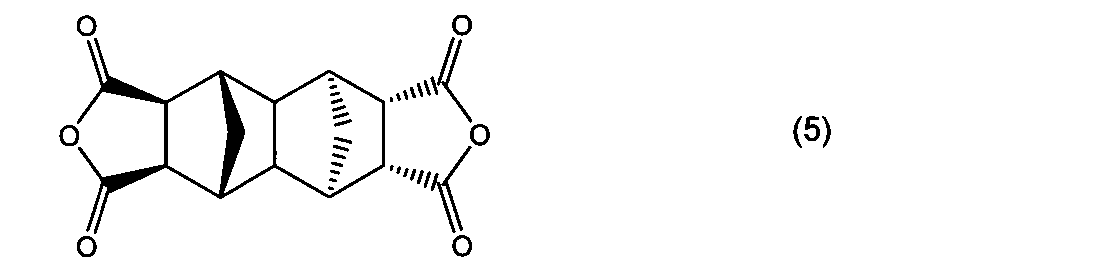
2.前記工程2において、使用する前記式(3)で示されるオレフィン化合物中における下記式(6)で示される化合物の含量が50-99重量%である、前記1記載の酸二無水物の製造方法。

3.前記工程2の操作(A)及び(B)において、オレフィン化合物と混合させる際に、パラジウム化合物、銅化合物、及びアルコール化合物を含む混合物、またはパラジウム化合物、銅化合物、アルコール化合物、及びオルトエステル化合物を含む混合物に対して前記式(3)で示されるオレフィン化合物を滴下することを特徴とする前記1~2のいずれか一つに記載の酸二無水物の製造方法。
4.パラジウム化合物及び銅化合物の存在下、下記一般式(7)で示されるオレフィン化合物とアルコール化合物と一酸化炭素とを反応させ、下記一般式(7-1)で示されるエステル化合物を得る工程を含み、当該工程において、以下の2つの操作(A)及び(B)のうち少なくとも1つを行うことを特徴とする、エステル化合物の製造方法。
(A)反応容器中でパラジウム化合物、銅化合物、及びアルコール化合物を混合した後、下記(C-2)の置換操作及び下記(C-1)の攪拌操作を順に行い、前記オレフィン化合物と混合させる。
(B)反応容器中でパラジウム化合物、銅化合物、アルコール化合物、及びオルトエステル化合物を混合した後、下記(C-2)の置換操作を行い、前記オレフィン化合物と混合させる。
(C-1)一酸化炭素の雰囲気下で撹拌する。
(C-2)反応容器を減圧した後、一酸化炭素ガスを封入するという操作を1回以上行う。
(A)反応容器中でパラジウム化合物、銅化合物、及びアルコール化合物を混合した後、下記(C-2)の置換操作及び下記(C-1)の攪拌操作を順に行い、前記オレフィン化合物と混合させる。
(B)反応容器中でパラジウム化合物、銅化合物、アルコール化合物、及びオルトエステル化合物を混合した後、下記(C-2)の置換操作を行い、前記オレフィン化合物と混合させる。
(C-1)一酸化炭素の雰囲気下で撹拌する。
(C-2)反応容器を減圧した後、一酸化炭素ガスを封入するという操作を1回以上行う。

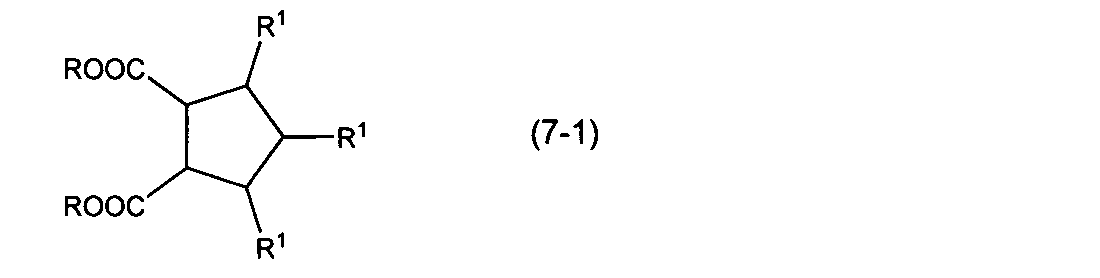
5.前記操作(A)及び(B)において、オレフィン化合物と混合させる際に、パラジウム化合物、銅化合物、及びアルコール化合物を含む混合物、またはパラジウム化合物、銅化合物、アルコール化合物、及びオルトエステル化合物を含む混合物に対して前記オレフィン化合物を滴下することを特徴とする前記4に記載のエステル化合物の製造方法。
6.前記オレフィン化合物及びエステル化合物が、それぞれ、下記式(8)及び(8-1)、下記式(9)及び(9-1)、下記式(10)及び(10-1)、下記式(11)及び(11-1)、下記式(11-2)及び(11-3)、下記式(12)及び(12-1)、下記式(13)及び(13-1)、下記式(14)及び(14-1)、下記式(15)及び(15-1)、下記式(16)及び(16-1)、または下記式(17)及び(17-1)のいずれかで示される化合物である、前記4~5のいずれか一項に記載のエステル化合物の製造方法。




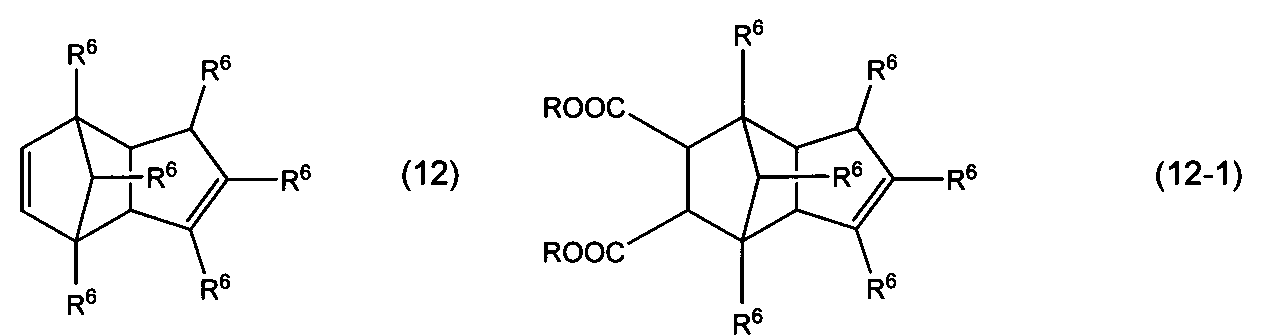
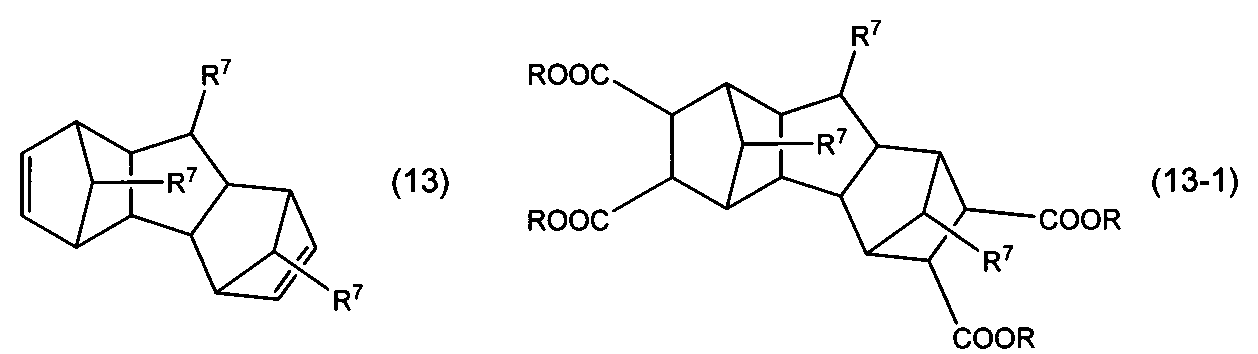

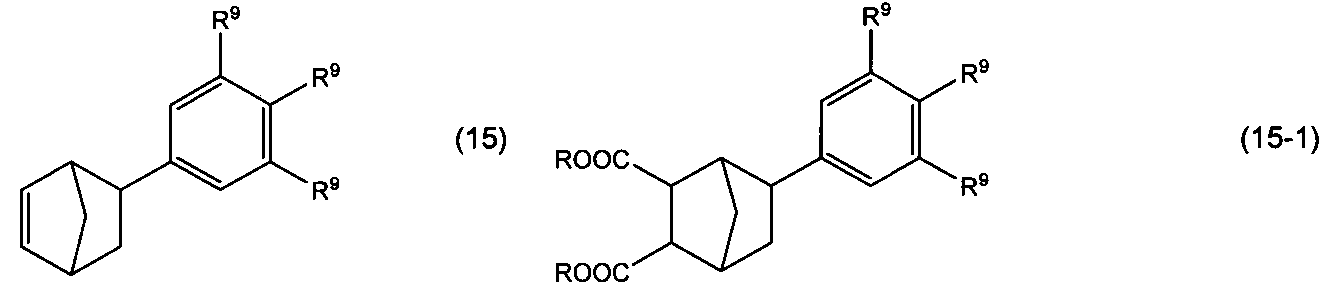
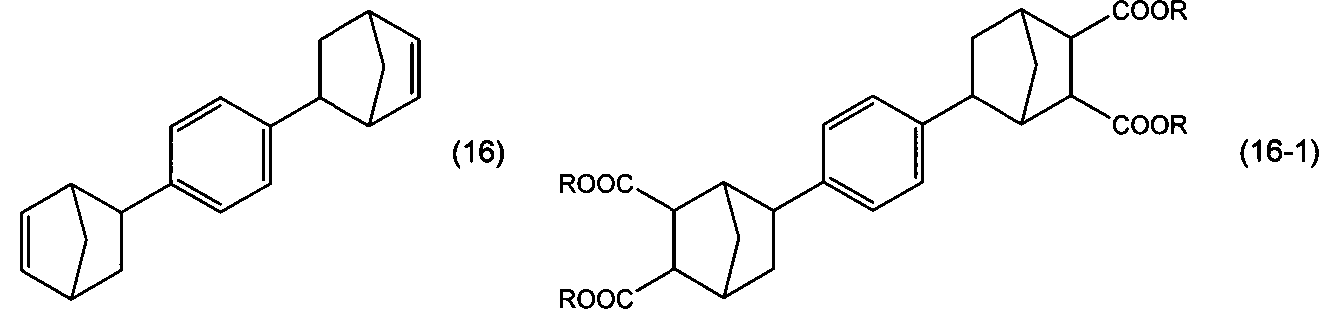

7.N,N-ジメチルホルムアミド、N,N-アセトアミド、N-メチルピロリドン、及びN,N-ジメチルブチロアミドからなる群より選ばれる少なくとも一種の溶媒分子を含む下記式(5)で表される脂環式テトラカルボン酸二無水物。

8.前記溶媒分子の含量が0.05~5重量%である前記7記載の酸二無水物。
9.下記式(18)で表されるエステル化合物。

10.下記式(19)で表されるオレフィン化合物。
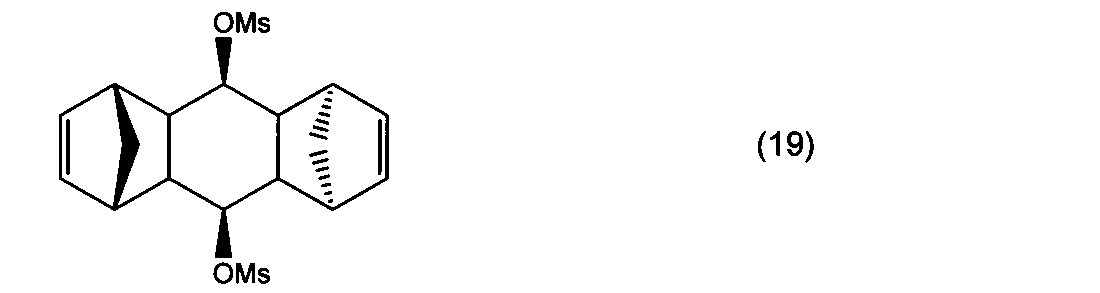
11.下記式(20)で表されるエステル化合物。
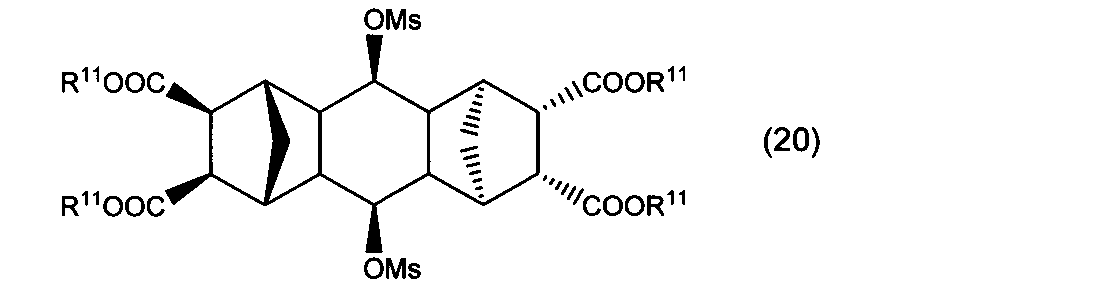
本発明により、温和な条件下、簡便な方法によって、DNDA等の脂環式テトラカルボン酸二無水物またはエステル化合物を高収率で製造出来る、工業的に好適な脂環式テトラカルボン酸二無水物またはエステル化合物を製造する方法を提供することが出来る。また、ポリイミドなど高分子製造用モノマーとして好適な脂環式テトラカルボン酸二無水物、及び、エステル化合物を提供することができる。
以下、本発明の好適な一実施形態について詳細に説明する。ただし、本発明は以下の実施形態に限定されるものではない。
<<脂環式テトラカルボン酸二無水物(DNDA)の製造方法>>
好適な脂環式テトラカルボン酸二無水物として、(3aR,4R,5R,5aR,8aS,9S,10S,10aS)-デカヒドロ-1H,3H-4,10:5,9-ジメタノナフト[2,3-c:6,7-c’]ジフラン-1,3,6,8-テトラオン(以下、DNDAとも称することもある)が挙げられる。DNDAの製造方法は下図の通りである。
好適な脂環式テトラカルボン酸二無水物として、(3aR,4R,5R,5aR,8aS,9S,10S,10aS)-デカヒドロ-1H,3H-4,10:5,9-ジメタノナフト[2,3-c:6,7-c’]ジフラン-1,3,6,8-テトラオン(以下、DNDAとも称することもある)が挙げられる。DNDAの製造方法は下図の通りである。

以下、各工程について詳述する。
<工程1>
本発明の工程1は、ノルボルナジエンと、シクロペンタジエンを反応させ、前記式(3)で示されるオレフィン化合物を得る工程である。
本発明の工程1は、ノルボルナジエンと、シクロペンタジエンを反応させ、前記式(3)で示されるオレフィン化合物を得る工程である。
本発明のノルボルナジエンとシクロペンタジエンを反応させる工程1では、下図の通り、目的物であるDNDAと同様の立体構造を有する(1R,4S,5S,8R)-1,4,4a,5,8,8a-ヘキサヒドロ-1,4:5,8-ジメタノナフタレン(BNDE)以外に、立体異性体である(1R,4S,4as,5R,8S,8as)-1,4,4a,5,8,8a-ヘキサヒドロ-1,4:5,8-ジメタノナフタレン(BNDE-1)と(1R,4S,4ar,5R,8S,8ar)-1,4,4a,5,8,8a-ヘキサヒドロ-1,4:5,8-ジメタノナフタレン(BNDE-2)を含む反応混合物が得られる。その後、得られた反応混合物を蒸留することにより、目的物BNDEが取得できる。目的物であるBNDEとBNDE-1やBNDE-2は沸点が近く、精留を行なえば高純度の目的物BNDEのみを取得できるが、単蒸留ではこれら3化合物が主成分である混合物が得られる。

本発明では、次の工程2において、純度の高いBNDEを用いても良いが、BNDEとBNDE-1を含む混合物を使用してもよい。後記するように、本発明の製造方法では、BNDEとBNDE-1との混合物を用いても、高純度のDNMEが製造することができる。本発明では、この混合物(すなわち、前記式(3)で示されるオレフィン化合物)として、BNDE/BNDE-1の質量割合が好ましくは50/50~99/1であり、混合物中のBNDEの含量は好ましくは50~99重量%である。BNDE-2については、反応後の質量割合は極めて少量であり、本発明を通じて問題とならない。なお、BNDEは、前記の式(6)で示される化合物である。
本発明の工程1において使用するシクロペンタジエンは、前記の式(2)で示される。
シクロペンタジエンはジシクロペンタジエンの単量体であり、ジシクロペンタジエンを160~200℃で加熱することにより定量的にシクロペンタジエンを取得できる。本発明の工程1において使用するシクロペンタジエンは、ジシクロペンタジエンの熱分解により系中で発生させて使用することもできる。ジシクロペンタジエンは下記式(21)で示される化合物である。

前記ノルボルナジエンの使用量は、シクロペンタジエン1モルに対して、好ましくは1モル以上、更に好ましくは2~10モルである。ジシクロペンタジエンを使用する場合、ジシクロペンタジエンはシクロペンタジエンの二量体であるので、ノルボルナジエンの使用量は、ジシクロペンタジエン1モルに対して好ましくは2モル以上、さらに好ましくは4~20モルである。
本発明の工程1において、有機溶媒を使用しても使用しなくてもよい。使用される溶媒としては、反応を阻害しないものならば特に限定されず、例えば、ギ酸、脂肪族カルボン酸類(例えば、酢酸、プロピオン酸、トリフルオロ酢酸等)、有機スルホン酸類(例えば、メタンスルホン酸、トリフルオロメタンスルホン酸等)、アルコール類(例えば、メタノール、エタノール、イソプロピルアルコール、t-ブチルアルコール、エチレングリコール、トリエチレングリコール等)、ケトン類(例えば、アセトン、ブタノン、シクロヘキサノン等)、脂肪族炭化水素類(例えば、n-ペンタン、n-へキサン、n-ヘプタン、シクロヘキサン等)、アミド類(例えば、N,N-ジメチルホルムアミド、N,N-ジメチルアセトアミド、N-メチルピロリドン等)、尿素類(N,N’-ジメチルイミダゾリジノン等)、エーテル類(例えば、ジエチルエーテル、ジイソプロピルエーテル、テトラヒドロフラン、ジオキサン、1,2-メチレンジオキシベンゼン等)、芳香族炭化水素類(例えば、ベンゼン、トルエン、キシレン等)、ハロゲン化芳香族炭化水素類(例えば、クロロベンゼン、1,2-ジクロロベンゼン、1,3-ジクロロベンゼン、1,4-ジクロロベンゼン等)、ニトロ化芳香族炭化水素類(例えば、ニトロベンゼン等)、ハロゲン化炭化水素類(例えば、塩化メチレン、クロロホルム、四塩化炭素、1,2-ジクロロエタン等)、カルボン酸エステル類(例えば、酢酸エチル、酢酸プロピル、酢酸ブチル等)、ニトリル類(例えば、アセトニトリル、プロピオニトリル、ベンゾニトリル等)、スルホキシド類(例えば、ジメチルスルホキシド等)、スルホン類(例えば、スルホラン等)、フェノール類(フェノール、メチルフェノール、パラクロロフェノール等)等が挙げられる。好ましくは脂肪族炭化水素類、及び芳香族炭化水素類が使用される。なお、これらの有機溶媒は、単独又は二種以上を混合して使用しても良い。
有機溶媒を使用する場合、有機溶媒の使用量は、反応液の均一性や攪拌性により適宜調節するが、通常、ノルボルナジエン1gに対して、好ましくは1~50g、更に好ましくは2~20gである。
本発明の工程1は、例えば、ノルボルナジエン及びシクロペンタジエン、又はノルボルナジエン、シクロペンタジエン及び有機溶媒を混合して、攪拌させる等の方法によって行われる。その際の反応温度は、好ましくは140~250℃、更に好ましくは150~220℃である。
本発明の工程1における反応の反応圧力は、特に限定されない。また、反応環境も特に限定されないが、本発明の工程1における反応は、不活性ガス(例えば、窒素、アルゴン、ヘリウム)気流下、又は不活性ガス雰囲気下で行うことが好ましい。
前記の通り、本発明の工程1では、通常、シクロペンタジエンに対して等モル量または過剰量のノルボルナジエンを用いて反応を行なう。反応終了後、必要に応じて、反応混合物から過剰分のノルボルナジエンを蒸留等により除去した後に、目的物BNDEを含む前記式(3)で示されるオレフィン化合物を、例えば、濾過、蒸留、カラムクロマトグラフィー等の一般的な方法によって、一旦単離及び精製した後に次の工程を行う。BNDEを蒸留する際には、BNDEが熱分解を起こさない温度で蒸留を行なうことが好ましい。BNDEの蒸留は、好ましくは50~180℃、さらに好ましくは50~160℃で行なうことが好ましい。反応で過剰に使用したノルボルナジエンは、蒸留、カラムクロマトグラフィー等の一般的な方法で精製した後に回収して、再使用できる。
<工程2>
本発明の工程2は、パラジウム化合物及び銅化合物の存在下、前記式(3)で示されるオレフィン化合物とアルコール化合物と一酸化炭素とを反応させ、下記式(4)で示されるエステル化合物を得る工程である。
本発明の工程2は、パラジウム化合物及び銅化合物の存在下、前記式(3)で示されるオレフィン化合物とアルコール化合物と一酸化炭素とを反応させ、下記式(4)で示されるエステル化合物を得る工程である。

式中、Rは、炭素数1~10のアルキル基を示し、好ましくはメチル基、エチル基、n-プロピル基、イソプロピル基、より好ましくはメチル基、エチル基、イソプロピル基である。
本工程で使用できる前記式(3)で示されるオレフィン化合物は、前記の通り、BNDEのみに限定されず、BNDEとBNDE-1を含む混合物であってもよい。混合物中のBNDEの含量は好ましくは50~99重量%である。
本発明の工程2で使用するアルコール化合物としては、例えば、メタノール、エタノール、n-プロピルアルコール、イソプロピルアルコール、n-ブチルアルコール、sec-ブチルアルコール、t-ブチルアルコール、ペンチルアルコール、メトキシエタノール、エトキシエタノール、エチレングリコール、トリエチレングリコール等が挙げられるが、好ましくはメタノール、エタノール、n-プロピルアルコール、イソプロピルアルコール、更に好ましくはメタノール、エタノール、イソプロピルアルコールが使用される。なお、これらのアルコールは、単独又は二種以上を混合して使用しても良い。
前記アルコール化合物の使用量は、前記式(3)のオレフィン化合物1gに対して、好ましくは0.1~200g、更に好ましくは1~100gである。
本発明の工程2においては、アルコール類以外の有機溶媒は用いても用いなくても良い。
使用するアルコール類以外の有機溶媒としては、反応を阻害しないものならば特に限定されず、例えば、ギ酸、脂肪族カルボン酸類(例えば、酢酸、プロピオン酸、トリフルオロ酢酸等)、有機スルホン酸類(例えば、メタンスルホン酸、トリフルオロメタンスルホン酸等)、脂肪族炭化水素類(例えば、n-ペンタン、n-へキサン、n-ヘプタン、シクロヘキサン等)、アミド類(例えば、N,N-ジメチルホルムアミド、N,N-ジメチルアセトアミド、N-メチルピロリドン等)、尿素類(N,N’-ジメチルイミダゾリジノン等)、エーテル類(例えば、ジエチルエーテル、ジイソプロピルエーテル、テトラヒドロフラン、ジオキサン、1,2-メチレンジオキシベンゼン等)、芳香族炭化水素類(例えば、ベンゼン、トルエン、キシレン等)、ハロゲン化芳香族炭化水素類(例えば、クロロベンゼン、1,2-ジクロロベンゼン、1,3-ジクロロベンゼン、1,4-ジクロロベンゼン等)、ニトロ化芳香族炭化水素類(例えば、ニトロベンゼン等)、ハロゲン化炭化水素類(例えば、塩化メチレン、クロロホルム、四塩化炭素、1,2-ジクロロエタン等)、カルボン酸エステル類(例えば、酢酸エチル、酢酸プロピル、酢酸ブチル等)、ニトリル類(例えば、アセトニトリル、プロピオニトリル、ベンゾニトリル等)、スルホキシド類(例えば、ジメチルスルホキシド等)、スルホン類(例えば、スルホラン等)等が挙げられる。好ましくは脂肪族炭化水素類、芳香族炭化水素類、ハロゲン化炭化水素類、ハロゲン化芳香族炭化水素類が使用される。なお、これらの有機溶媒は、単独又は二種以上を混合して使用しても良い。
前記アルコール類以外の有機溶媒の使用量は、通常、前記式(3)のオレフィン化合物1gに対して、好ましくは0.1~200g、更に好ましくは1~100gである。
本反応において使用するパラジウム化合物としては、パラジウムを含むものであれば特に限定されないが、例えば、塩化パラジウム、臭化パラジウム等のハロゲン化パラジウム;酢酸パラジウム、シュウ酸パラジウム等のパラジウム有機酸塩;硝酸パラジウム、硫酸パラジウム等のパラジウム無機酸塩;ビス(アセチルアセトナト)パラジウム、ビス(1,1,1-5,5,5-ヘキサフルオロアセチルアセトナト)パラジウム等のようなパラジウム錯体;パラジウムを炭素やアルミナなどの担体に担持させたパラジウム炭素やパラジウムアルミナ等が挙げられるが、好ましくは塩化パラジウムやパラジウム炭素が使用される。ここで、「パラジウム化合物」とは、いわゆる化合物と、パラジウム金属単体、あるいはパラジウム金属単体を担体に担持させた担体担持パラジウム等を含む意味で用いるものとする。なお、パラジウム化合物は、単独又は二種以上を混合して使用しても良い。
前記パラジウム化合物の使用量は、前記式(3)のオレフィン化合物1モルに対して、好ましくは0.0001~0.2モル、更に好ましくは0.001~0.1モルである。
本反応においてパラジウム化合物と共に使用する金属化合物としては、前記パラジウム化合物中のPd(II)がPd(0)に還元された場合に、Pd(0)をPd(II)に酸化できるものであればよく、特に制限されず、例えば、銅化合物、鉄化合物等が挙げられ、好ましくは銅化合物である。銅化合物として、具体的には、銅、酢酸銅、プロピオン酸銅、ノルマルブチル酸銅、2-メチルプロピオン酸銅、ピバル酸銅、乳酸銅、酪酸銅、安息香酸銅、トリフルオロ酢酸銅、ビス(アセチルアセトナト)銅、ビス(1,1,1-5,5,5-ヘキサフルオロアセチルアセトナト)銅、塩化銅、臭化銅、沃化銅、硝酸銅、亜硝酸銅、硫酸銅、リン酸銅、酸化銅、水酸化銅、トリフルオロメタンスルホン酸銅、パラトルエンスルホン酸銅、及びシアン化銅等が挙げられる。また、鉄化合物として、塩化第二鉄、硝酸第二鉄、硫酸第二鉄、酢酸第二鉄等が挙げられる。好ましくは二価の銅化合物が使用され、更に好ましくは塩化銅(II)が使用される。ここで、「銅化合物」とは、いわゆる化合物に加え、銅単体も含む意味で用いるものとする。また、「鉄化合物」等の「金属化合物」も、化合物に加え、金属単体も含む意味で用いるものとする。なお、これらの金属化合物は、単独又は二種以上を混合して使用しても良い。
前記銅化合物の使用量は、前記式(3)のオレフィン化合物1モルに対して、好ましくは4~50モル、更に好ましくは5~20モルである。
工程2において、温度(反応前の操作時の温度、及び反応温度)は、通常、-10~100℃、好ましくは-10~70℃、さらに好ましくは0~50℃である。
工程2において、以下の操作(A)及び(B)のうち、少なくとも1つを行う必要がある。
(A)反応容器中でパラジウム化合物、銅化合物、及びアルコール化合物を混合した後、下記(C-2)の置換操作及び(C-1)の攪拌操作を順に行い、前記オレフィン化合物と混合させる。
(B)反応容器中でパラジウム化合物、銅化合物、アルコール化合物、及びオルトエステル化合物を混合した後、下記(C-2)の置換操作を行い、前記オレフィン化合物と混合させる。
(C-1)一酸化炭素の雰囲気下で撹拌する。
(C-2)反応容器を減圧した後、一酸化炭素ガスを封入するという操作を1回以上行う。
(B)反応容器中でパラジウム化合物、銅化合物、アルコール化合物、及びオルトエステル化合物を混合した後、下記(C-2)の置換操作を行い、前記オレフィン化合物と混合させる。
(C-1)一酸化炭素の雰囲気下で撹拌する。
(C-2)反応容器を減圧した後、一酸化炭素ガスを封入するという操作を1回以上行う。
なお、操作(A)において、(C-2)及び(C-1)の操作を交互に2回以上繰り返してもよく、(C-1)の操作を行った後、さらに(C-2)の操作を行った後に、オレフィン化合物を混合させてもよい。また、操作(B)において、(C-2)の操作を行った後、(C-1)の操作を行ってもよい。
(操作(A))
BNDEを含むオレフィン化合物の添加前に、一酸化炭素を添加する。操作(A)では、反応容器にパラジウム化合物、銅化合物、アルコール化合物と、必要に応じて、その他の有機溶媒を加えた後、反応容器を減圧してから一酸化炭素を封入して(前記(C-2)の操作)、一酸化炭素のガス雰囲気で攪拌する(前記(C-1)の操作)。このようにオレフィン化合物を加える前の、(C-2)及び(C-1)の操作をまとめて前処理という。前処理が実施されると、カルボニル化反応(すなわち、前記式(4)で示されるエステル化合物の生成反応)は速やかに進行し、エステル化合物は高い収率で得られる。前処理が実施されない、または十分でない場合には、エステル化合物の収率は低下する。
BNDEを含むオレフィン化合物の添加前に、一酸化炭素を添加する。操作(A)では、反応容器にパラジウム化合物、銅化合物、アルコール化合物と、必要に応じて、その他の有機溶媒を加えた後、反応容器を減圧してから一酸化炭素を封入して(前記(C-2)の操作)、一酸化炭素のガス雰囲気で攪拌する(前記(C-1)の操作)。このようにオレフィン化合物を加える前の、(C-2)及び(C-1)の操作をまとめて前処理という。前処理が実施されると、カルボニル化反応(すなわち、前記式(4)で示されるエステル化合物の生成反応)は速やかに進行し、エステル化合物は高い収率で得られる。前処理が実施されない、または十分でない場合には、エステル化合物の収率は低下する。
前記の前処理は、反応容器を減圧する操作と、一酸化炭素を封入する操作を1回、又は2回以上繰り返した(前記(C-2)の操作)後、一定時間の攪拌を行う(前記(C-1)の操作)ことで実施される。
前記(C-2)の操作は、反応容器内のガスを一酸化炭素に置換するために行われ、減圧度や一酸化炭素の封入量によっても適宜調節されるが、反応容器を減圧した後、一酸化炭素ガスを封入するという操作を1回以上、好ましくは2~5回行う。この(C-2)の操作において、減圧や一酸化炭素を封入している最中は、パラジウム化合物、銅化合物、アルコール化合物、必要に応じて、その他の有機溶媒を含む溶液を撹拌しても撹拌しなくてもよい。この減圧度は適宜調整され、特に限定されないが、例えば50~200torr、好ましくは70~150torrとすることにより、効率的に反応容器内のガスを一酸化炭素に置換することができる。
前記(C-1)の操作は、一酸化炭素を流通させながら実施してもよく、一旦、天然ゴム製などの機密性のある袋あるいは容器等に一酸化炭素を入れて実施してもよく、一酸化炭素で反応容器を加圧して実施してもよい。一酸化炭素の袋あるいは容器の容量は、例えば、反応容器1Lに対して0.1L以上、好ましくは0.2~10Lである。操作(C-1)1回の所要時間、すなわち溶液の撹拌時間は、例えば1時間以上、好ましくは1~5時間である。
また前処理(前記(C-2)の操作及び(C-1)の操作)の回数は、反応容器や使用する一酸化炭素の体積に応じて適宜調整されるが、1回以上、好ましくは2~5回である。
また、(C-1)の操作及び(C-2)の操作は必ずしも同じ回数繰り返す必要は無く、例えば、(C-2)の操作の後、(C-1)の操作を行わずに、得られた溶液とオレフィン化合物を混合してもよい。
本操作(A)において、操作時の温度は、通常、-10~100℃、好ましくは-10~70℃、さらに好ましくは0~50℃である。
(操作(B))
操作(B)は、反応容器中でパラジウム化合物、銅化合物、アルコール化合物、オルトエステル化合物と、必要に応じて、その他の有機溶媒を混合した後、反応容器を減圧する操作と、一酸化炭素ガスを封入する操作を行い(前記(C-2)の操作)、前記オレフィン化合物と混合させることによって行われる。操作(B)は、前記オルトエステル化合物と混合する点、及び前記(C-1)の操作を行わなくてもよい点以外は、前記操作(A)と同様である。操作(B)においても、前記(C-2)の操作の後、オレフィン化合物の添加前に、操作(A)と同様に、前記(C-1)の操作(一酸化炭素の雰囲気下での溶液の撹拌)を行ってもよいが、オルトエステル化合物を使用する操作(B)の場合、前記(C-1)の操作を行わなくても、カルボニル化反応(すなわち、前記式(4)で示されるエステル化合物の生成反応)は速やかに進行し、エステル化合物は高い収率で得られる。また、この操作(B)では、オルトエステル化合物を使用することによって、操作(C-2)における、減圧操作と一酸化炭素ガス封入操作を繰り返す回数を低減することができる。
操作(B)は、反応容器中でパラジウム化合物、銅化合物、アルコール化合物、オルトエステル化合物と、必要に応じて、その他の有機溶媒を混合した後、反応容器を減圧する操作と、一酸化炭素ガスを封入する操作を行い(前記(C-2)の操作)、前記オレフィン化合物と混合させることによって行われる。操作(B)は、前記オルトエステル化合物と混合する点、及び前記(C-1)の操作を行わなくてもよい点以外は、前記操作(A)と同様である。操作(B)においても、前記(C-2)の操作の後、オレフィン化合物の添加前に、操作(A)と同様に、前記(C-1)の操作(一酸化炭素の雰囲気下での溶液の撹拌)を行ってもよいが、オルトエステル化合物を使用する操作(B)の場合、前記(C-1)の操作を行わなくても、カルボニル化反応(すなわち、前記式(4)で示されるエステル化合物の生成反応)は速やかに進行し、エステル化合物は高い収率で得られる。また、この操作(B)では、オルトエステル化合物を使用することによって、操作(C-2)における、減圧操作と一酸化炭素ガス封入操作を繰り返す回数を低減することができる。
なお、前記(C-2)の操作は、操作(B)でも反応容器内のガスを一酸化炭素に置換するために行われ、減圧度や一酸化炭素の封入量によっても適宜調節されるが、反応容器を減圧した後、一酸化炭素ガスを封入するという操作を1回以上、好ましくは2~5回行う。また、(C-2)の操作において、減圧や一酸化炭素を封入している最中は、パラジウム化合物、銅化合物、アルコール化合物、オルトエステル化合物、必要に応じて、その他の有機溶媒を含む溶液を撹拌しても撹拌しなくてもよい。この減圧度は適宜調整され、特に限定されないが、例えば50~200torr、好ましくは70~150torrとすることにより、効率的に反応容器内のガスを一酸化炭素に置換することができる。
本操作(B)において、操作時の温度は、通常、-10~100℃、好ましくは-10~70℃、さらに好ましくは0~50℃である。
本操作(B)において使用するオルトエステル化合物としては、下記式(22)で示される化合物、例えば、オルトギ酸メチル、オルトギ酸エチル等が挙げられるが、好ましくはオルトギ酸メチルが使用される。

式中、Rfは水素原子、又は炭素数1~5のアルキル基を示し、好ましくは水素原子、メチル基、より好ましくは水素原子である。また、Reは炭素数1~5のアルキル基を示し、好ましくはメチル基、エチル基、より好ましくはメチル基を示す。3つのReは同一であっても異なっていてもよいが、同一であることが好ましい。
前記オルトエステル化合物の使用量は、前記式(3)のオレフィン化合物1モルに対して、好ましくは0.5~5モル、更に好ましくは0.8~3モルである。使用量をこの範囲とすることで、カルボニル化反応が効率よく進行し、工業的に好適な収率で前記式(4)で示されるエステル化合物を得ることができる。
(操作(A)及び操作(B)に共通の操作)
(オレフィン化合物の混合・滴下)
工程2の操作(A)及び(B)において、前記(C-1)又は(C-2)の操作を行った後、得られた溶液に対して前記オレフィン化合物を混合する。その際に、得られた溶液に対してオレフィン化合物を滴下することが好ましい。また、オレフィン化合物は液体の場合、そのまま滴下することもできるが、有機溶媒、好ましくはアルコール類以外の有機溶媒との混合物として滴下することが好ましい。滴下にかかる時間は特に限定されないが、例えば、滴下すべき全量を1時間以上、好ましくは2時間以上、さらに好ましくは2時間以上16時間以内で溶液に滴下する。オレフィン化合物を溶解させる溶媒は適宜変更することができるが、前記の工程2で使用するアルコール類以外の有機溶媒として挙げた溶媒を含むことが好ましい。
(オレフィン化合物の混合・滴下)
工程2の操作(A)及び(B)において、前記(C-1)又は(C-2)の操作を行った後、得られた溶液に対して前記オレフィン化合物を混合する。その際に、得られた溶液に対してオレフィン化合物を滴下することが好ましい。また、オレフィン化合物は液体の場合、そのまま滴下することもできるが、有機溶媒、好ましくはアルコール類以外の有機溶媒との混合物として滴下することが好ましい。滴下にかかる時間は特に限定されないが、例えば、滴下すべき全量を1時間以上、好ましくは2時間以上、さらに好ましくは2時間以上16時間以内で溶液に滴下する。オレフィン化合物を溶解させる溶媒は適宜変更することができるが、前記の工程2で使用するアルコール類以外の有機溶媒として挙げた溶媒を含むことが好ましい。
(反応)
本発明の工程2における反応は、例えば、前記(C-1)又は(C-2)の操作を行った後、得られた溶液(パラジウム化合物、銅化合物、及びアルコール化合物を含む溶液、またはパラジウム化合物、銅化合物、アルコール化合物、及びオルトエステル化合物を含む溶液)にオレフィン化合物(BNDE)を混合して、攪拌させる等の方法によって行われる。その際の反応温度は、通常、-10~100℃、好ましくは-10~70℃、さらに好ましくは0~50℃である。
本発明の工程2における反応は、例えば、前記(C-1)又は(C-2)の操作を行った後、得られた溶液(パラジウム化合物、銅化合物、及びアルコール化合物を含む溶液、またはパラジウム化合物、銅化合物、アルコール化合物、及びオルトエステル化合物を含む溶液)にオレフィン化合物(BNDE)を混合して、攪拌させる等の方法によって行われる。その際の反応温度は、通常、-10~100℃、好ましくは-10~70℃、さらに好ましくは0~50℃である。
前記(C-1)又は(C-2)の操作が終了した後にも、一酸化炭素を使用する。オレフィン化合物(BNDE)を添加すると、反応の進行とともに一酸化炭素の吸収が進むことから、一酸化炭素を反応器へ供給し続ける必要がある。よって、(C-1)又は(C-2)の操作が終了した後においても、一酸化炭素雰囲気下で攪拌しながら、オレフィン化合物と混合することが好ましい。
本発明の工程2における反応の反応圧力は、大気圧下(常圧下)であってもよいし、加圧してもよい。また、本発明の工程2における反応は、一酸化炭素雰囲気下で行われるが、不活性ガス(例えば、窒素、アルゴン、ヘリウム)で希釈して、一酸化炭素と不活性ガスを含む雰囲気下で行ってもよい。なお、一酸化炭素の圧力や濃度に応じて、操作(C-1)や(C-2)の回数や反応時間も適宜調整される。
(精製)
本発明の工程2によって、前記式(4)で示されるエステル化合物が得られるが、本発明においては、例えば、反応終了後、濾過、濃縮、晶析、再結晶、蒸留、カラムクロマトグラフィー等の一般的な方法によって、エステル化合物を一旦単離・精製した後に、次の工程を行っても良いが、単離・精製を行わずに、得られた反応液をそのまま又は次の工程で使用する溶媒に切り換えた後に、次の工程に使用しても構わない。
本発明の工程2によって、前記式(4)で示されるエステル化合物が得られるが、本発明においては、例えば、反応終了後、濾過、濃縮、晶析、再結晶、蒸留、カラムクロマトグラフィー等の一般的な方法によって、エステル化合物を一旦単離・精製した後に、次の工程を行っても良いが、単離・精製を行わずに、得られた反応液をそのまま又は次の工程で使用する溶媒に切り換えた後に、次の工程に使用しても構わない。
工程1の反応条件、精製条件によっては下記式で示されるオレフィン化合物が含まれることがある。

そのため、工程2における反応では、下記式で示されるエステル化合物が生成することがある。
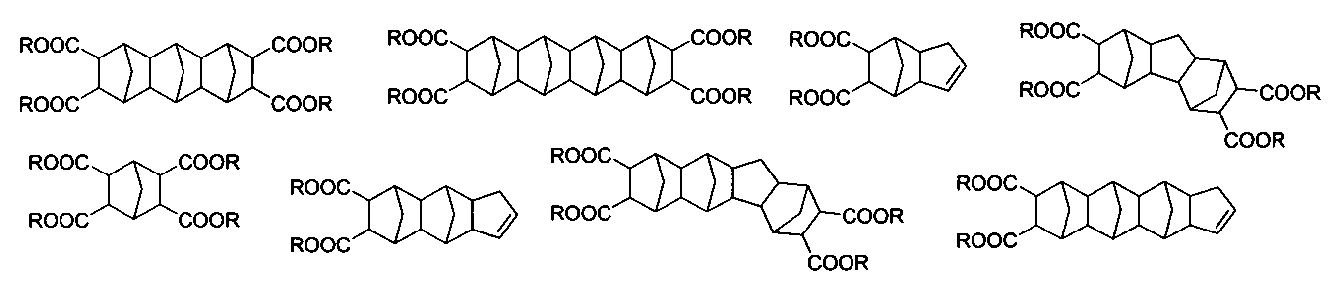
このエステル化合物としては具体的には以下の化合物が挙げられる。

このような多数のエステル化合物の中から、目的物のみを得るためには再結晶による精製が効果的である。使用される溶媒としては、これらの化合物が分離できるものであれば、特に限定されないが、アルコール類(例えば、メタノール、エタノール、イソプロピルアルコール、t-ブチルアルコール、エチレングリコール、トリエチレングリコール等)、ケトン類(例えば、アセトン、ブタノン、シクロヘキサノン等)、脂肪族炭化水素類(例えば、n-ペンタン、n-へキサン、n-ヘプタン、シクロヘキサン等)、アミド類(例えば、N,N-ジメチルホルムアミド、N,N-ジメチルアセトアミド、N-メチルピロリドン、N,N-ジメチルブチロアミド等)、尿素類(N,N’-ジメチルイミダゾリジノン等)、エーテル類(例えば、ジエチルエーテル、ジイソプロピルエーテル、テトラヒドロフラン、ジオキサン、1,2-メチレンジオキシベンゼン等)、芳香族炭化水素類(例えば、ベンゼン、トルエン、キシレン等)、ハロゲン化芳香族炭化水素類(例えば、クロロベンゼン、1,2-ジクロロベンゼン、1,3-ジクロロベンゼン、1,4-ジクロロベンゼン等)、ニトロ化芳香族炭化水素類(例えば、ニトロベンゼン等)、ハロゲン化炭化水素類(例えば、塩化メチレン、クロロホルム、四塩化炭素、1,2-ジクロロエタン等)、カルボン酸エステル類(例えば、酢酸エチル、酢酸プロピル、酢酸ブチル等)、ニトリル類(例えば、アセトニトリル、プロピオニトリル、ベンゾニトリル等)、スルホキシド類(例えば、ジメチルスルホキシド等)、スルホン類(例えば、スルホラン等)、フェノール類(フェノール、メチルフェノール、パラクロロフェノール等)等が挙げられる。好ましくはハロゲン化炭化水素類、脂肪族炭化水素類、及び芳香族炭化水素類が使用される。なお、これらの有機溶媒は、単独又は二種以上を混合して使用しても良い。この再結晶操作は、前記式(4)で示されるエステル化合物を得る際に、特に有効である。
また、反応中に生成した不純物を除去するため、活性炭処理することも好ましい。この活性炭処理は、反応後、前記エステル化合物を含む溶液に対して、活性炭を添加し、撹拌した後、濾過することにより行われる。撹拌温度は、通常、10~100℃、好ましくは15~70℃である。使用する活性炭の量は、原料としてBNDE(またはBNDEとBNDE-1を含む混合物)を用いる場合、通常、BNDEに対して、30重量%以下、好ましくは0.01~20重量%である。活性炭以外でも、不純物を吸着することができるものならば活性炭に代えて精製に使用することができ、特に限定されないが、具体的には活性白土、シリカゲル等が挙げられる。本操作により、ポリイミド原料として好適なエステル化合物を得ることができる。
<工程3>
本発明の工程3は、前記式(4)で示されるエステル化合物を酸の存在下、有機溶媒中で反応させて、前記式(5)で示される脂環式テトラカルボン酸二無水物(DNDA)を得る工程である。
本発明の工程3は、前記式(4)で示されるエステル化合物を酸の存在下、有機溶媒中で反応させて、前記式(5)で示される脂環式テトラカルボン酸二無水物(DNDA)を得る工程である。
本発明の工程3では酸を使用する。酸であれば特に制限されないが、例えば、塩酸、臭化水素酸、ヨウ化水素酸、硫酸、クロロ硫酸、硝酸等の鉱酸類;メタンスルホン酸、ベンゼンスルホン酸、p-トルエンスルホン酸等の有機スルホン酸類;クロロ酢酸、トリフルオロ酢酸等のハロゲン化カルボン酸類、イオン交換樹脂、硫酸シリカゲル、ゼオライト、酸性アルミナ等が挙げられるが、好ましくは鉱酸類、有機スルホン酸類、更に好ましくは有機スルホン酸類が使用される。なお、これらの酸は、単独又は二種以上を混合して使用しても良い。
前記酸の使用量は、前記式(4)で示されるエステル化合物1モルに対して、好ましくは0.0001~0.1モル、さらに好ましくは0.001~0.05モルである。
本発明の工程3の反応は有機溶媒中で行うことが好ましい。使用する溶媒としては、有機溶媒、特にギ酸、酢酸、プロピオン酸などの有機酸溶媒が好ましい。なお、これらの溶媒は、単独又は二種以上を混合して使用しても良い。
前記溶媒の使用量は、反応液の均一性や攪拌性により適宜調節するが、前記式(4)で示されるエステル化合物1gに対して、好ましくは0.1~100ml、更に好ましくは1~10mlである。
本発明の工程3における反応は、例えば、前記式(4)で示されるエステル化合物、酸、及び有機溶媒(好ましくは有機酸溶媒)を混合して、攪拌させる等の方法によって行われる。その際の反応温度は、好ましくは50~180℃、更に好ましくは70~150℃である。
本発明の工程3における反応の反応圧力は、特に限定されない。また、反応環境も特に限定されないが、本発明の工程3における反応は、不活性ガス(例えば、窒素、アルゴン、ヘリウム)気流下、又は不活性ガス雰囲気下で行うことが好ましい。
なお、ここで得られるDNDAは、反応終了後、例えば、濾過、濃縮、再結晶、昇華等の一般的な方法によって単離・精製することができる。
本発明ではDNDAを取得するため、濾過による取得を行なうことが望ましい。しかし、工程3で使用する溶媒として有機酸、特にギ酸を用いた場合、ギ酸はDNDAを溶解させるため、ギ酸溶媒のまま濾過を行なうとDNDAの取得量は低下する。そこで、ギ酸を別の溶媒で置換した後、濾過を行ない、DNDAを取得することが望ましい。溶媒置換に用いる溶媒はDNDAと反応しないものであれば特に制限されないが、DNDAに対する低い溶解度とギ酸に対する溶解度から、トルエンやヘプタンなどの炭化水素系溶媒が好ましい。
濾過により取得したDNDAは、さらに、晶析等により精製することが好ましい。
非特許文献1にはDNMEをギ酸、パラトルエンスルホン酸、無水酢酸で処理した後、無水酢酸により晶析操作を行ない、DNDAを得ている。しかし、非特許文献1と同様の晶析方法により得られるDNDAには無水酢酸や酢酸が残存する。ポリイミドは酸二無水物とジアミンとの反応により製造される。無水酢酸や酢酸はジアミンと反応するため、無水酢酸や酢酸が残存するDNDAは、ポリイミドを合成する原料としては不向きである。
本発明では、無水酢酸による処理(晶析)を行なっても良い。このとき得られるDNDAは、非特許文献1と同様に無水酢酸や酢酸が残存する。
そこで本発明では、無水酢酸や酢酸を含むDNDAから無水酢酸や酢酸を除去するために、別の溶媒系で晶析操作を行なう。この晶析操作は一般的な方法で行なう。例えば、固体を加熱しながら溶解度の高い溶媒(以下、良溶媒とも称する)に溶かし、溶解度の低い溶媒(以下、貧溶媒とも称する)を添加し、冷却して結晶を析出させる。
晶析に用いられる良溶媒はDNDAに対して溶解度の高い溶媒であれば特に制限されないが、ポリイミド製造の際に使用される、ジメチルスルホキシド、N,N-ジメチルホルムアミド、N,N-ジメチルアセトアミド、N-メチルピロリドン、N,N-ジメチルブチロアミド、γ-カプロラクトン、N,N-ジメチルイソブチルアミド、1,3-ジメチル-2-イミダゾリジノンなどが好ましい。一方の貧溶媒はDNDAに対して溶解度の低い溶媒であれば特に制限されないが、固体結晶への残存から沸点が低いものが好ましい。例えば、ヘキサン、シクロヘキサン、ヘプタン、トルエン、クロルベンゼン、テトラヒドロフラン、ジエチルエーテル、ジイソプロピルエーテル、酢酸エチル、アセトニトリル、アセトン、シクロヘキサノンなどが挙げられる。
なお、無水酢酸による晶析操作を行なわなかった場合も、この本発明の晶析操作を行なうことが好ましい。
前記のように晶析操作を行なって得られたDNDAを乾燥させた後、DNDA中に良溶媒が例えば0.05~5重量%程度含まれる。しかし、良溶媒はポリイミド製造時に使用されるため、良溶媒の残存は問題ない。DNDAは多くの有機溶剤に対する溶解度は低い。前記のように得られたDNDAと比較して、良溶媒の残存がないDNDA(例えば、昇華精製により溶媒を完全に除去したもの)では、通常、溶剤に対して溶解性が悪い。ポリイミドは、通常、溶媒中での酸二無水物とジアミンとの反応で製造される。酸二無水物の溶解性が悪いとジアミンとの反応が遅く、ポリイミドの工業的製法として非常に不利である。
したがって、良溶媒が溶媒和したDNDAは、ポリイミド等のポリマーを製造する上で、好適な化合物である。すなわち、本発明により得られる好適な化合物(DNDA)は、良溶媒、具体的にはN,N-ジメチルホルムアミド、N,N-アセトアミド、N-メチルピロリドン、及びN,N-ジメチルブチロアミドからなる群より選ばれる少なくとも一種の溶媒分子を含む下記式(5)で表される脂環式テトラカルボン酸二無水物である。溶媒和した溶媒の含量が、溶媒和した式(5)で記載される酸二無水物の総量に対して0.05~5重量%であることが好ましい。
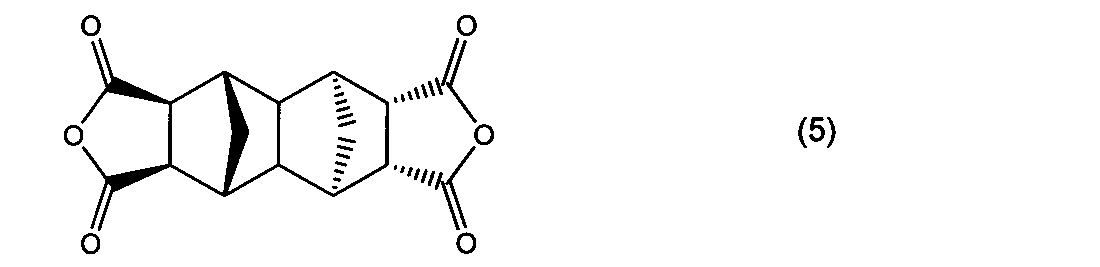
<<前記工程2の適用(エステル化合物の製造方法)>>
前記工程2における、オレフィン化合物とアルコール化合物と一酸化炭素との反応では、基質として前記式(3)のオレフィン化合物に限定されず、下記一般式(7)で示されるオレフィン化合物にも適用できる。反応条件や操作方法は化合物の溶解度や反応性等に応じて適宜変更されるが、前記式(3)のオレフィン化合物と同様である。
前記工程2における、オレフィン化合物とアルコール化合物と一酸化炭素との反応では、基質として前記式(3)のオレフィン化合物に限定されず、下記一般式(7)で示されるオレフィン化合物にも適用できる。反応条件や操作方法は化合物の溶解度や反応性等に応じて適宜変更されるが、前記式(3)のオレフィン化合物と同様である。

式中、R1は、炭素数1~15のアルキル基、又は炭素数1~15のアルケニル基である。3つのR1は互いに同一であっても異なっていてもよく、2つ以上のR1が互いに結合して、それらが結合する炭素原子と共に1つ又は複数の環(例えば炭素数6~15のアリール基、好ましくはフェニル基)を形成していてもよい。アルキル基上の水素原子は、炭素数1~5のアルケニル基、-COORaで示されるエステル基、炭素数6~15のアリール基、-ORbで示されるアルコキシ基、シアノ基、又は-OSO2Rcで示される基に置換していてもよく、アルキル基中の炭素原子がカルボニル基を形成していてもよい。このアリール基上の水素原子は、フェニル基、炭素数1~10のアルキル基、又は炭素数1~10のアルケニル基、好ましくはフェニル基、又は炭素数1~10のアルケニル基、より好ましくは炭素数1~10のアルケニル基に置換されていてもよい。また、Ra、Rb、Rcは、それぞれ炭素数1~10のアルキル基、又は炭素数6~10のアリール基であり、好ましくはメチル基、エチル基、n-プロピル基、又はイソプロピル基である。
前記一般式(7)で示されるオレフィン化合物は、ビシクロ[2.2.1]ヘプタ-2-エンから誘導される基を含むこと、換言すれば、ノルボルネン環構造を含むことがより好ましい。
なお、2つ以上のR1が互いに結合して形成する環構造が、前記一般式(7)で示される構造を含むものであってもよい。換言すれば、オレフィン化合物は、前記一般式(7)で示される構造を2つ以上含むものであってもよい。
前記一般式(7)で示されるオレフィン化合物を一酸化炭素と反応させることで得られるエステル化合物は、下記一般式(7-1)で示される化合物である。

式中、Rは、炭素数1~10のアルキル基を示し、好ましくはメチル基、エチル基、n-プロピル基、又はイソプロピル基である。R1は前記と同義である。
前記一般式(7)で示されるオレフィン化合物及び前記一般式(7-1)で示されるエステル化合物として、好ましくは、下記式(8)及び(8-1)、下記式(9)及び(9-1)、下記式(10)及び(10-1)、下記式(11)及び(11-1)、下記式(11-2)及び(11-3)、下記式(12)及び(12-1)、下記式(13)及び(13-1)、下記式(14)及び(14-1)、下記式(15)及び(15-1)、下記式(16)及び(16-1)、下記式(17)及び(17-1)のいずれかで示される化合物が挙げられる。

式中、R2は、水素原子、炭素数1~10のアルキル基、-COORdで示されるエステル基、又はシアノ基である。アルキル基上の水素原子は、-COORaで示されるエステル基、又は炭素数6~10のアリール基に置換していてもよい。2つのR2は互いに同一であっても異なっていてもよく、互いに結合して、それらが結合する炭素原子と共に1つ又は複数の環を形成していてもよい。エステル基中のRd及びRaは、炭素数1~10のアルキル基、又は炭素数6~10のアリール基を示し、好ましくはメチル基、エチル基、n-プロピル基、イソプロピル基である。式中、Rは、炭素数1~10のアルキル基を示し、好ましくはメチル基、エチル基、n-プロピル基、イソプロピル基である。

式中、R3は、水素原子、炭素数1~10のアルキル基、シアノ基、又は-COORdで示されるエステル基を示す。アルキル基上の水素原子は、-COORaで示されるエステル基、又は炭素数6~10のアリール基に置換していてもよい。2つのR3は互いに同一であっても異なっていてもよく、互いに結合して、それらが結合する炭素原子と共に1つ又は複数の環を形成していてもよい。エステル基中のRd及びRaは、炭素数1~10のアルキル基、又は炭素数6~10のアリール基を示し、好ましくはメチル基、エチル基、n-プロピル基、イソプロピル基である。式中、Rは、炭素数1~10のアルキル基を示し、好ましくはメチル基、エチル基、n-プロピル基、イソプロピル基である。

式中、R4は、水素原子、又は炭素数1~10のアルキル基を示す。2つのR4は互いに同一であっても異なっていてもよく、互いに結合して、それらが結合する炭素原子と共に1つ又は複数の環を形成していてもよい。式中、Rは、炭素数1~10のアルキル基を示し、好ましくはメチル基、エチル基、n-プロピル基、イソプロピル基である。
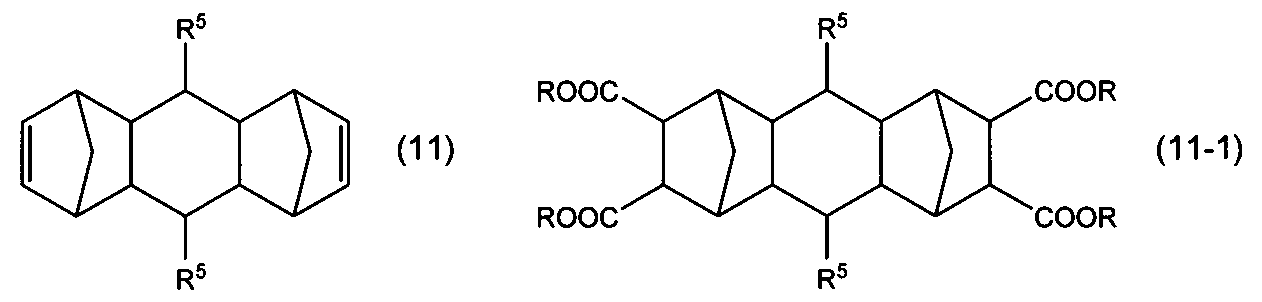
式中、R5は、水素原子、炭素数1~10のアルキル基、-ORbで示されるアルコキシ基、又は-OSO2Rcで示される基である。Rbは、炭素数1~10のアルキル基、又は炭素数6~10のアリール基であり、好ましくはメチル基である。Rcは、炭素数1~10のアルキル基、又は炭素数6~10のアリール基を示し、好ましくはメチル基である。2つのR5は互いに同一であっても異なっていてもよく、互いに結合して、それらが結合する炭素原子と共に1つ又は複数の環を形成していてもよい。式中、Rは、炭素数1~10のアルキル基を示し、好ましくはメチル基、エチル基、n-プロピル基、イソプロピル基である。
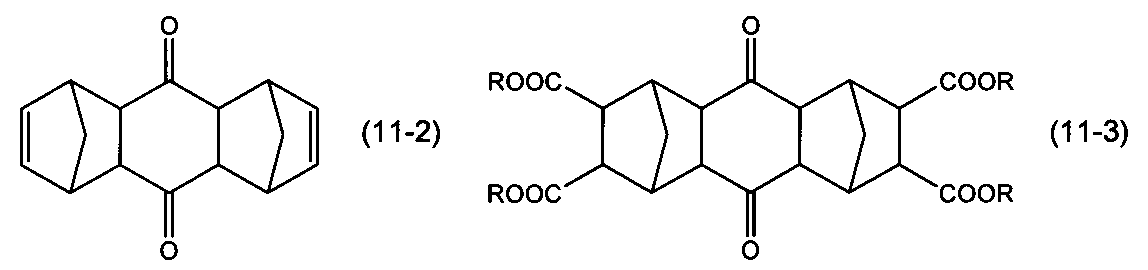
式中、Rは、炭素数1~10のアルキル基を示し、好ましくはメチル基、エチル基、n-プロピル基、イソプロピル基である。

式中、R6は、水素原子、フェニル基、又は炭素数1~10のアルキル基を示す。6つのR6は互いに同一であっても異なっていてもよく、2つ以上のR6が互いに結合して、それらが結合する炭素原子と共に1つ又は複数の環を形成していてもよい。式中、Rは、炭素数1~10のアルキル基を示し、好ましくはメチル基、エチル基、n-プロピル基、イソプロピル基である。
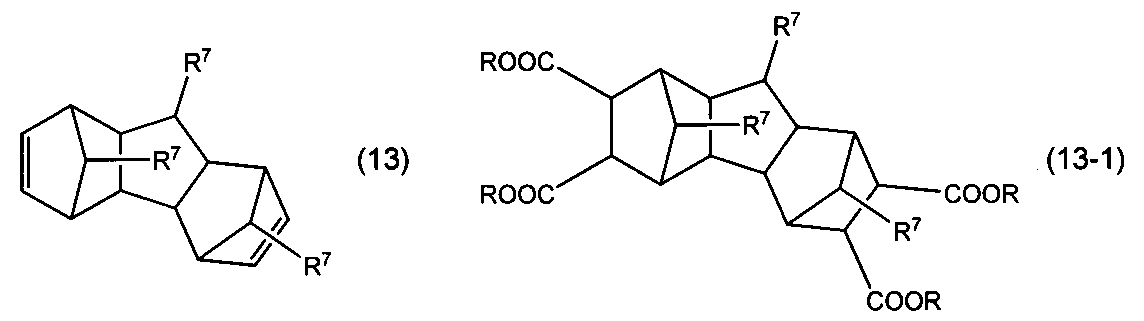
式中、R7は、水素原子、フェニル基、又は炭素数1~10のアルキル基を示す。3つのR7は互いに同一であっても異なっていてもよく、2つ以上のR7が互いに結合して、それらが結合する炭素原子と共に1つ又は複数の環を形成していてもよい。式中、Rは、炭素数1~10のアルキル基を示し、好ましくはメチル基、エチル基、n-プロピル基、イソプロピル基である。
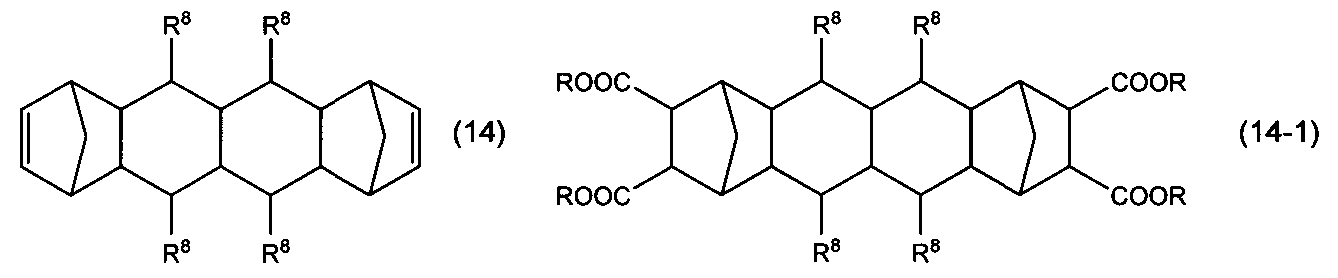
式中、R8は、水素原子、又は炭素数1~10のアルキル基を示す。4つのR8は互いに同一であっても異なっていてもよく、2つ以上のR8が互いに結合して、それらが結合する炭素原子と共に1つ又は複数の環を形成していてもよい。式中、Rは、炭素数1~10のアルキル基を示し、好ましくはメチル基、エチル基、n-プロピル基、イソプロピル基である。

式中、R9は、水素原子、フェニル基、又は炭素数1~10のアルキル基を示す。3つのR9は互いに同一であっても異なっていてもよく、2つ以上のR9が互いに結合して、それらが結合する炭素原子と共に1つ又は複数の環を形成していてもよい。式中、Rは、炭素数1~10のアルキル基を示し、好ましくはメチル基、エチル基、n-プロピル基、イソプロピル基である。

式中、Rは、炭素数1~10のアルキル基を示し、好ましくはメチル基、エチル基、n-プロピル基、イソプロピル基である。

式中、Rは、炭素数1~10のアルキル基を示し、好ましくはメチル基、エチル基、n-プロピル基、イソプロピル基である。
前記式(3)で示されるオレフィン化合物の場合のように、立体構造の異なる異性体が含まれる前記式(8)で示されるオレフィン化合物を反応させると、得られるエステル化合物として、好ましくは下記式(8-2)で示されるエステル化合物が得られることがある。

式中、R2及びRは前記と同義である。
さらに、前記式(8)、(9)、(10)、(11)、(11-2)、(12)、(13)、(14)、(15)、(16)、(17)で示される化合物として、具体的には、以下のオレフィン化合物が挙げられる。なお、本発明の範囲はこれらに限定されるものではない。前記式(8)に含まれる化合物は下記式(8a)、(8b)、(8c)、及び(8d)である。他の化合物についても同様である。
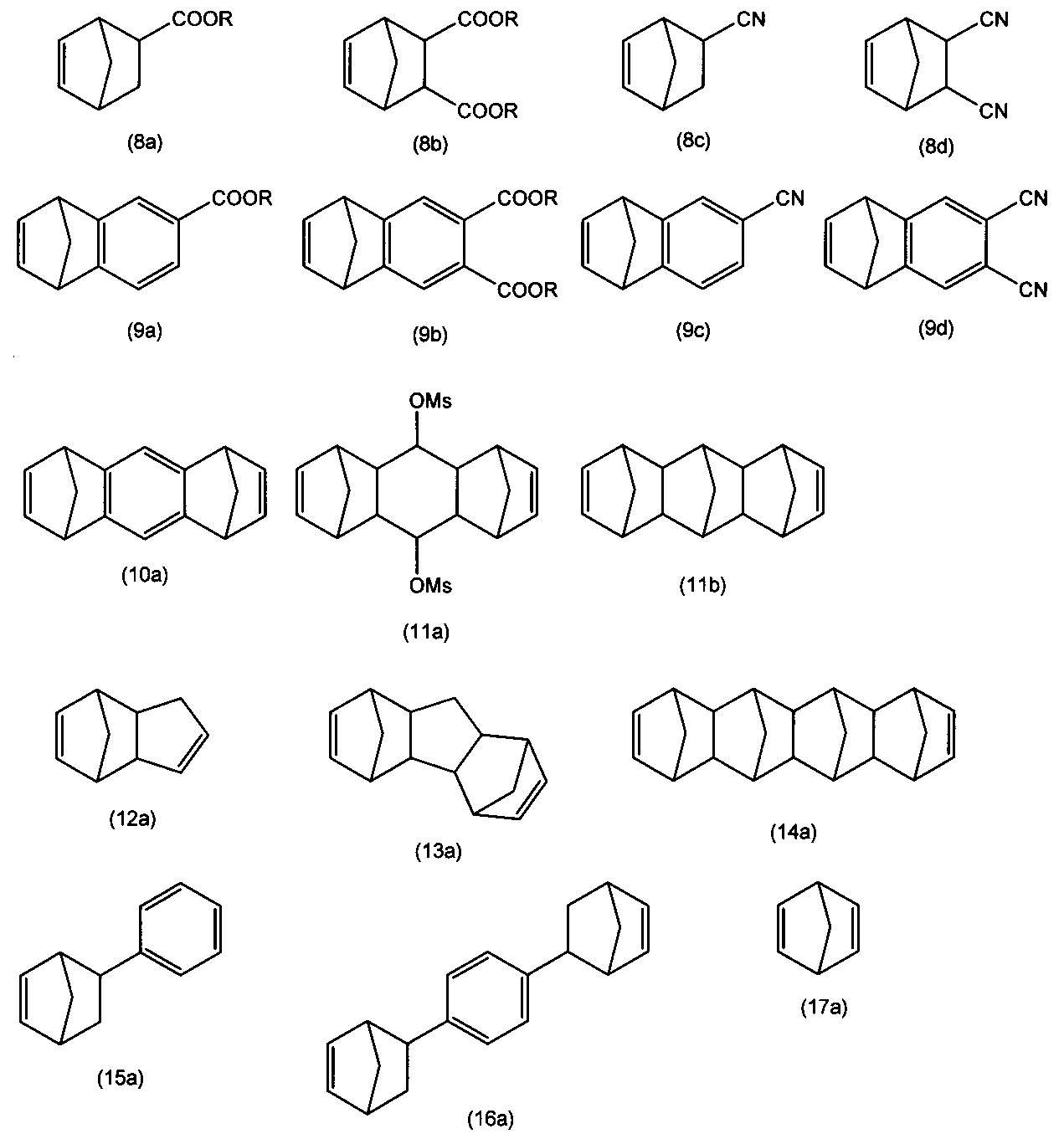
前記式(8-1)、(9-1)、(10-1)、(11-1)、(11-3)、(12-1)、(13-1)、(14-1)、(15-1)、(16-1)、(17-1)で示される化合物の具体例としては、以下のエステル化合物が挙げられる。本発明の範囲はこれらに限定されるものではない。
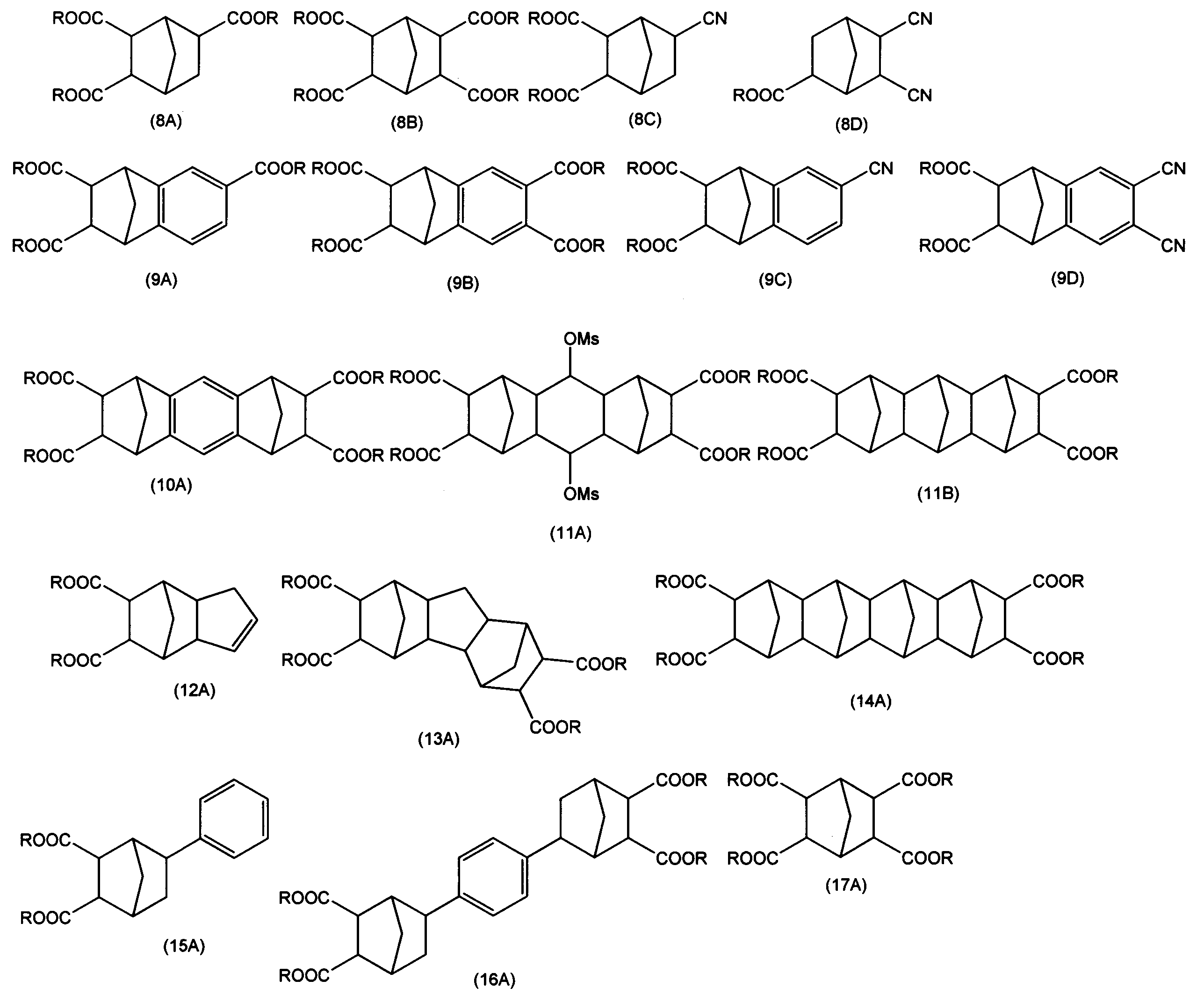
式中、R及びMsは前記と同義である。
また、使用するオレフィン化合物によっては、同じエステル化合物を得ることができる。例えば、前記式(8b)で示される化合物、及び前記式(17a)で示される化合物の構造は異なるが、これらから生成する前記式(8B)で示される化合物、及び前記式(17A)で示される化合物の構造は同じである。ただし、用いる原料や反応条件によっては、立体化学は異なることがある。
有用なポリイミド原料であるという観点から、前記式(9-1)で示されるエステル化合物としては、下記式(18)で表されるエステル化合物が好ましい。

式中、R10は、同一であっても異なっていてもよく、メチル基、エチル基、n-プロピル基、イソプロピル基のいずれかを示し、好ましくはメチル基、エチル基である。
また、有用なポリイミド原料であるという観点から、前記式(11)で示されるオレフィン化合物としては、下記式(19)で表されるオレフィン化合物が好ましい。

式中、Msは、-SO2CH3で示されるメシル基を示す。
さらに、有用なポリイミド原料であるという観点から、前記式(11-1)で示されるエステル化合物としては、下記式(20)で表されるエステル化合物が好ましい。

式中、Msは、前記と同義である。R11は、同一であっても異なっていてもよく、メチル基、エチル基、n-プロピル基、イソプロピル基のいずれかを示し、好ましくはメチル基、エチル基である。
次に、実施例を挙げて本発明を具体的に説明するが、本発明の範囲はこれらに限定されるものではない。
以下の実施例において、以下の略称を用いる。化合物の構造式も併せて記す。なお、BNDE及びBNDE-1は式(3)で示されるオレフィン化合物に相当し、DNMEは式(4)で示されるエステル化合物に相当し、DNDAは式(5)で示される脂環式テトラカルボン酸二無水物に相当する。
BNDE:(1R,4S,5S,8R)-1,4,4a,5,8,8a-ヘキサヒドロ-1,4:5,8-ジメタノナフタレン
BNDE:(1R,4S,5S,8R)-1,4,4a,5,8,8a-ヘキサヒドロ-1,4:5,8-ジメタノナフタレン






<工程1>
実施例1 BNDEの合成
アルゴン気流下、NOR:CP=1:1(モル比)となるように、1LオートクレーブへNOR184g(2mol)とDCP132g(1mol)を仕込み、窒素0.5MPaで3回封入(ガス置換)を行った後、195℃で6時間撹拌した。反応終了後に蒸留を行なった。59-62℃/2Torrの条件で取得した留分を集めてBNDE(BNDEとBNDE-1の混合物;以下、「BNDE混合物」と記載する)69.7gを得た。ガスクロマトグラフィー分析(以下、GC分析ともいう)による純度99重量%、BNDE:BNDE-1=85:15(モル比)、シクロペンタジエン基準の取得収率は18.7%であった。
実施例1 BNDEの合成
アルゴン気流下、NOR:CP=1:1(モル比)となるように、1LオートクレーブへNOR184g(2mol)とDCP132g(1mol)を仕込み、窒素0.5MPaで3回封入(ガス置換)を行った後、195℃で6時間撹拌した。反応終了後に蒸留を行なった。59-62℃/2Torrの条件で取得した留分を集めてBNDE(BNDEとBNDE-1の混合物;以下、「BNDE混合物」と記載する)69.7gを得た。ガスクロマトグラフィー分析(以下、GC分析ともいう)による純度99重量%、BNDE:BNDE-1=85:15(モル比)、シクロペンタジエン基準の取得収率は18.7%であった。
BNDE混合物の物性値は以下であった。
沸点;59-62℃/2Torr
1H-NMR(CDCl3,σ(ppm));
BNDE:0.95(d,J=8.8Hz,1H),1.47-1.53(m,1H),1.70(dt,J=7.6Hz,J=1.6Hz,1H),2.15-2.25(m,2H),2.45-2.50(m,2H),2.56(d,J=8.8Hz,1H),6.00-6.05(m,2H),6.15-6.25(m,2H);
BNDE-1:1.48-1.50(m,4H),2.58-2.62(m,4H),2.73-2.76(m,2H),5.30(s,4H)
CI-MS(m/z);159(M+1)
1H-NMR(CDCl3,σ(ppm));
BNDE:0.95(d,J=8.8Hz,1H),1.47-1.53(m,1H),1.70(dt,J=7.6Hz,J=1.6Hz,1H),2.15-2.25(m,2H),2.45-2.50(m,2H),2.56(d,J=8.8Hz,1H),6.00-6.05(m,2H),6.15-6.25(m,2H);
BNDE-1:1.48-1.50(m,4H),2.58-2.62(m,4H),2.73-2.76(m,2H),5.30(s,4H)
CI-MS(m/z);159(M+1)
実施例2 BNDEの合成
アルゴン気流下、NOR:CP=4:1(モル比)となるように、200mLオートクレーブへNOR125g(1.36mol)とDCP22.4g(0.169mol)を仕込み、窒素0.5MPaで3回封入を行った後、180℃で8時間撹拌した。反応液をGC分析するとBNDE32.6gを含んでいた。シクロペンタジエン基準の反応収率61%であった。
アルゴン気流下、NOR:CP=4:1(モル比)となるように、200mLオートクレーブへNOR125g(1.36mol)とDCP22.4g(0.169mol)を仕込み、窒素0.5MPaで3回封入を行った後、180℃で8時間撹拌した。反応液をGC分析するとBNDE32.6gを含んでいた。シクロペンタジエン基準の反応収率61%であった。
実施例3 BNDEの合成
アルゴン気流下、NOR:CP=5:1(モル比)となるように、200mLオートクレーブへNOR127.9g(1.39mol)とDCP18.4g(0.139mol)を仕込み、窒素0.5MPaで3回封入を行った後、180℃で8時間撹拌した。GC分析を行なった結果、反応液中にBNDE27.7gを含んでいた。シクロペンタジエン基準の反応収率63%であった。
アルゴン気流下、NOR:CP=5:1(モル比)となるように、200mLオートクレーブへNOR127.9g(1.39mol)とDCP18.4g(0.139mol)を仕込み、窒素0.5MPaで3回封入を行った後、180℃で8時間撹拌した。GC分析を行なった結果、反応液中にBNDE27.7gを含んでいた。シクロペンタジエン基準の反応収率63%であった。
実施例4 BNDEの合成
アルゴン気流下、NOR:CP=3.8:1(モル比)となるように、3LオートクレーブへNOR1769g(19.2mol)とDCP335g(2.53mol)を仕込み、窒素0.5MPaで3回封入を行った後、180℃で8時間撹拌した(GC分析による定量値から反応収率58.7%)。同様に、NOR:CP=5:1(モル比)となるように、NOR1923g(20.9mol)とDCP276g(2.09mol)を仕込み、180℃で8時間撹拌した(GC分析による定量値から反応収率61.5%)。同様に、NOR:CP=6:1(モル比)となるように、NOR1961g(21.3mol)とDCP235g(1.78mol)を仕込み、180℃で8時間撹拌した(GC分析による定量値から反応収率66.1%)。これら3バッチ分の反応液を合わせた。蒸留を行ない、BNDE混合物1273gを得た。GC分析による純度99重量%、BNDE:BNDE-1=86:14(モル比)、シクロペンタジエン基準の取得収率は54.1%であった。
アルゴン気流下、NOR:CP=3.8:1(モル比)となるように、3LオートクレーブへNOR1769g(19.2mol)とDCP335g(2.53mol)を仕込み、窒素0.5MPaで3回封入を行った後、180℃で8時間撹拌した(GC分析による定量値から反応収率58.7%)。同様に、NOR:CP=5:1(モル比)となるように、NOR1923g(20.9mol)とDCP276g(2.09mol)を仕込み、180℃で8時間撹拌した(GC分析による定量値から反応収率61.5%)。同様に、NOR:CP=6:1(モル比)となるように、NOR1961g(21.3mol)とDCP235g(1.78mol)を仕込み、180℃で8時間撹拌した(GC分析による定量値から反応収率66.1%)。これら3バッチ分の反応液を合わせた。蒸留を行ない、BNDE混合物1273gを得た。GC分析による純度99重量%、BNDE:BNDE-1=86:14(モル比)、シクロペンタジエン基準の取得収率は54.1%であった。
実施例5 BNDEの合成
アルゴン気流下、NOR:CP=5:1(モル比)となるように、200mLオートクレーブへNOR127.9g(1.39mol)とDCP18.4g(0.139mol)を仕込み、窒素0.5MPaで3回封入を行った後、155℃で10時間撹拌した。その後、165℃で10時間撹拌した。反応終了後に蒸留を行なった。液温98-116℃/13Torrの条件で取得した留分を集めてBNDE混合物48.9gを得た。GC分析による純度97重量%、BNDE:BNDE-1=85:15(モル比)、シクロペンタジエン基準の取得収率は45.8%であった。
アルゴン気流下、NOR:CP=5:1(モル比)となるように、200mLオートクレーブへNOR127.9g(1.39mol)とDCP18.4g(0.139mol)を仕込み、窒素0.5MPaで3回封入を行った後、155℃で10時間撹拌した。その後、165℃で10時間撹拌した。反応終了後に蒸留を行なった。液温98-116℃/13Torrの条件で取得した留分を集めてBNDE混合物48.9gを得た。GC分析による純度97重量%、BNDE:BNDE-1=85:15(モル比)、シクロペンタジエン基準の取得収率は45.8%であった。
<工程2>
実施例6 DNMEの合成
アルゴン気流下、室温(25℃)でBNDE混合物27g(純度99%、BNDE:BNDE-1=86:14(モル比)、145mmol)をMeOH(メタノール)578mLへ仕込み、CuCl2188g(1.4mol)と10重量%Pd/C5.4g(Pd換算2.5mmol;NEケムキャット製;50重量%含水品)を添加した。反応容器内の減圧及び一酸化炭素の封入(一酸化炭素でのガス置換)を3回繰り返して系内を一酸化炭素雰囲気にし、23-26℃で6時間撹拌した。本操作において、減圧度は100torrとした。以降の実施例においても同様とした。
実施例6 DNMEの合成
アルゴン気流下、室温(25℃)でBNDE混合物27g(純度99%、BNDE:BNDE-1=86:14(モル比)、145mmol)をMeOH(メタノール)578mLへ仕込み、CuCl2188g(1.4mol)と10重量%Pd/C5.4g(Pd換算2.5mmol;NEケムキャット製;50重量%含水品)を添加した。反応容器内の減圧及び一酸化炭素の封入(一酸化炭素でのガス置換)を3回繰り返して系内を一酸化炭素雰囲気にし、23-26℃で6時間撹拌した。本操作において、減圧度は100torrとした。以降の実施例においても同様とした。
一酸化炭素を除去した後、セライトろ過で不溶物をろ別し、ろ液を得た。クロロホルム190mLでろ物を洗浄し、前述のろ液と合わせた。ろ液を減圧濃縮し、得られた濃縮残渣にクロロホルム190mLを加え、0.5時間撹拌した後、不溶物(塩化銅)をろ別し、クロロホルム100mLで6回洗浄した。ろ液を水190mL、飽和炭酸水素ナトリウム190mL×2、飽和食塩水190mLで洗浄し、得られた有機層を無水硫酸マグネシウムで乾燥した。ろ過後に減圧濃縮し、茶色泡状物37.2gを得た。この茶色泡状物の晶析を試みたが、結晶は得られなかった。
得られた泡状物をシリカゲルカラムクロマトグラフィー(n-ヘプタン/酢酸エチル=5/1→2/1→1/1(体積比))で精製した。取得留分を濃縮した後、微黄色固体としてDNME13.8gを得た。GC分析による純度97.0重量%、収率23.4%であった。
DNMEの物性値は以下であった。
融点;169-170℃
1H-NMR(CDCl3,σ(ppm));1.34(d,J=8.4Hz,1H),1.56(d,J=10Hz,1H),1.84(s,2H),1.96(d,J=10Hz,1H),2.14(d,J=8.4Hz,1H),2.55-2.65(m,6H),3.06(d,J=1.6Hz,2H),3.61(s,6H),3.62(s,6H)
CI-MS(m/z);395(M+1)
1H-NMR(CDCl3,σ(ppm));1.34(d,J=8.4Hz,1H),1.56(d,J=10Hz,1H),1.84(s,2H),1.96(d,J=10Hz,1H),2.14(d,J=8.4Hz,1H),2.55-2.65(m,6H),3.06(d,J=1.6Hz,2H),3.61(s,6H),3.62(s,6H)
CI-MS(m/z);395(M+1)
実施例7 DNMEの合成
20Lフラスコへメタノール13.9Lを仕込み、CuCl24.50kg(33.5mol)と10重量%Pd/C65g(Pd換算30.5mmol;NEケムキャット製;50重量%含水品)を添加した。
20Lフラスコへメタノール13.9Lを仕込み、CuCl24.50kg(33.5mol)と10重量%Pd/C65g(Pd換算30.5mmol;NEケムキャット製;50重量%含水品)を添加した。
BNDE混合物650g(純度99%、BNDE:BNDE-1=86:14(モル比)、3.50mol)を添加した後、冷水バスで冷却し、液面が軽く泡立つまで減圧し、アルゴンで常圧に戻した。再び、減圧した後、一酸化炭素を封入し常圧に戻し、一酸化炭素を断続的に導入しながら11~26℃で4時間撹拌した。高速液体クロマトグラフィー分析(以下、HPLC分析ともいう)ではBNDE混合物(BNDE及びBNDE-1)は消失していた。一酸化炭素を除去し、セライトろ過で不溶物を除去した後、減圧下濃縮した。得られた濃縮残渣にクロロホルム10.8Lを加え、1時間撹拌した後、不溶物をセライトろ過でろ別した。クロロホルム4.8Lを用いて同様の作業を2回行ない、クロロホルム溶液23.3kgを得た。GC分析の結果、この溶液はDNME482gを含んでいた。収率は29.8%であった。
実施例8 DNMEの合成
10Lフラスコへメタノール4.2Lを仕込み、CuCl21.37kg(10.2mol)、10重量%Pd/C19.8g(Pd換算9.3mmol;NEケムキャット製;50重量%含水品)およびトルエン706gを添加した。
10Lフラスコへメタノール4.2Lを仕込み、CuCl21.37kg(10.2mol)、10重量%Pd/C19.8g(Pd換算9.3mmol;NEケムキャット製;50重量%含水品)およびトルエン706gを添加した。
BNDE混合物198.0g(純度99%、BNDE:BNDE-1=86:14(モル比)、1.07mol)を添加し、トルエン96gで洗い込んだ後、冷水バスで冷却し、液面が軽く泡立つまで減圧し、アルゴンで常圧に戻した。再び、減圧した後、一酸化炭素で常圧に戻し、一酸化炭素を断続的に導入しながら11~26℃で4時間撹拌した。HPLC分析ではBNDE混合物(BNDE及びBNDE-1)は消失していた。一酸化炭素を除去し、セライトろ過で不溶物を除去した後、減圧下濃縮した。得られた濃縮残渣にクロロホルム2.4Lを加え、1時間撹拌した後、不溶物をセライトろ過でろ別した。クロロホルム1.5Lを用いて同様の作業を2回行ない、クロロホルム溶液7.08kgを得た。水1.4L、飽和炭酸水素ナトリウム水溶液1.4Lで2回、飽和食塩水1.4Lの順に洗浄し、無水硫酸マグネシウムで乾燥した。硫酸マグネシウムをろ別してクロロホルム溶液9.2kgを得た。GC分析の結果、この溶液はDNME249g含んでいた。収率は50.4%であった。
実施例9 DNMEの合成
0.3L4つ口フラスコに10重量%Pd/C0.69g(Pd換算0.32mmol;NEケムキャット製;50重量%含水品)、CuCl244.2g(329mmol)を添加した。ここにMeOHを135mL、トルエンを31mL加え、N2で0.5時間バブリングを行った。次に、ダイヤフラムポンプで液面が軽く泡立つまで減圧し、一酸化炭素を封入して系内を一酸化炭素でガス置換した。次に、BNDE混合物6.35g(純度99%、BNDE:BNDE-1=89:11(モル比)、35.4mmol)をトルエン12.0mLに希釈し、シリンジポンプを使用して20℃から30℃で2時間で滴下した。同温度で6時間撹拌した。反応液のHPLC分析を行った。DNMEの収率は78.9%であった。
0.3L4つ口フラスコに10重量%Pd/C0.69g(Pd換算0.32mmol;NEケムキャット製;50重量%含水品)、CuCl244.2g(329mmol)を添加した。ここにMeOHを135mL、トルエンを31mL加え、N2で0.5時間バブリングを行った。次に、ダイヤフラムポンプで液面が軽く泡立つまで減圧し、一酸化炭素を封入して系内を一酸化炭素でガス置換した。次に、BNDE混合物6.35g(純度99%、BNDE:BNDE-1=89:11(モル比)、35.4mmol)をトルエン12.0mLに希釈し、シリンジポンプを使用して20℃から30℃で2時間で滴下した。同温度で6時間撹拌した。反応液のHPLC分析を行った。DNMEの収率は78.9%であった。
実施例10 DNMEの合成
0.3L4つ口フラスコに10重量%Pd/C0.70g(Pd換算0.33mmol;NEケムキャット製;50重量%含水品)、CuCl244.4g(330mmol)を添加した。ここにMeOHを70mL、CHCl3を18.5mL加え、N2で0.5時間バブリングを行った。次に、ダイヤフラムポンプで液面が軽く泡立つまで減圧し、一酸化炭素を封入して系内を一酸化炭素でガス置換した。次に、BNDE混合物6.35g(純度99%、BNDE:BNDE-1=89:11(モル比)、35.4mmol)をトルエン12mLに希釈し、シリンジポンプを使用して20℃から30℃で2時間で滴下した。同温度で6時間撹拌した。反応液のHPLC分析を行った。DNMEの収率は89.7%であった。
0.3L4つ口フラスコに10重量%Pd/C0.70g(Pd換算0.33mmol;NEケムキャット製;50重量%含水品)、CuCl244.4g(330mmol)を添加した。ここにMeOHを70mL、CHCl3を18.5mL加え、N2で0.5時間バブリングを行った。次に、ダイヤフラムポンプで液面が軽く泡立つまで減圧し、一酸化炭素を封入して系内を一酸化炭素でガス置換した。次に、BNDE混合物6.35g(純度99%、BNDE:BNDE-1=89:11(モル比)、35.4mmol)をトルエン12mLに希釈し、シリンジポンプを使用して20℃から30℃で2時間で滴下した。同温度で6時間撹拌した。反応液のHPLC分析を行った。DNMEの収率は89.7%であった。
実施例11 DNMEの合成
1.0L4つ口フラスコに10重量%Pd/C2.87g(Pd換算1.35mmol;NEケムキャット製;50重量%含水品)、CuCl2182.5g(1.36mol)を添加した。ここにMeOHを434mL、CHCl3を76mL加え、N2で0.5時間バブリングを行った。次に、ダイヤフラムポンプで液面が軽く泡立つまで減圧し、一酸化炭素を封入して系内を一酸化炭素でガス置換した。次に、BNDE混合物27.4g(純度99%、BNDE:BNDE-1=82:18(モル比)、141mmol)をCHCl330mLに希釈し、シリンジポンプを使用して20℃から30℃で2時間で滴下した。同温度で6時間撹拌した。反応液のHPLC分析を行った。DNMEの収率は65.7%であった。
1.0L4つ口フラスコに10重量%Pd/C2.87g(Pd換算1.35mmol;NEケムキャット製;50重量%含水品)、CuCl2182.5g(1.36mol)を添加した。ここにMeOHを434mL、CHCl3を76mL加え、N2で0.5時間バブリングを行った。次に、ダイヤフラムポンプで液面が軽く泡立つまで減圧し、一酸化炭素を封入して系内を一酸化炭素でガス置換した。次に、BNDE混合物27.4g(純度99%、BNDE:BNDE-1=82:18(モル比)、141mmol)をCHCl330mLに希釈し、シリンジポンプを使用して20℃から30℃で2時間で滴下した。同温度で6時間撹拌した。反応液のHPLC分析を行った。DNMEの収率は65.7%であった。
実施例12 DNMEの合成
1.0Lセパラブルフラスコに10重量%Pd/C2.86g(Pd換算1.34mmol;NEケムキャット製;50重量%含水品)、CuCl2183.2g(1.36mol)を添加した。ここにMeOHを443mL、CHCl3を77mL加え、Arで0.5時間バブリングを行った。次に、ダイヤフラムポンプで液面が軽く泡立つまで減圧し、一酸化炭素を封入して系内を一酸化炭素でガス置換した。室温(25℃)で2時間撹拌した(前処理)。フラスコ内を減圧(脱気)し、再度COを封入した。次に、BNDE混合物27.5g(純度99%、BNDE:BNDE-1=82:18(モル比)、141mmol)をCHCl329mLに希釈し、シリンジポンプを使用して20℃から30℃で2時間で滴下した。同温度で6時間撹拌した。反応液のHPLC分析を行った。DNMEの収率は90.5%であった。
1.0Lセパラブルフラスコに10重量%Pd/C2.86g(Pd換算1.34mmol;NEケムキャット製;50重量%含水品)、CuCl2183.2g(1.36mol)を添加した。ここにMeOHを443mL、CHCl3を77mL加え、Arで0.5時間バブリングを行った。次に、ダイヤフラムポンプで液面が軽く泡立つまで減圧し、一酸化炭素を封入して系内を一酸化炭素でガス置換した。室温(25℃)で2時間撹拌した(前処理)。フラスコ内を減圧(脱気)し、再度COを封入した。次に、BNDE混合物27.5g(純度99%、BNDE:BNDE-1=82:18(モル比)、141mmol)をCHCl329mLに希釈し、シリンジポンプを使用して20℃から30℃で2時間で滴下した。同温度で6時間撹拌した。反応液のHPLC分析を行った。DNMEの収率は90.5%であった。
実施例13 DNMEの合成
1.0LセパラブルフラスコにPdCl20.126g(0.71mmol)、CuCl2182.9g(1.36mol)を添加した。ここにMeOHを452mL、CHCl3を77mL加え、N2で0.5時間バブリングを行った。次に、ダイヤフラムポンプで液面が軽く泡立つまで減圧し、一酸化炭素を封入して系内を一酸化炭素でガス置換した。室温で2時間撹拌した(前処理)。フラスコ内を減圧し、再度一酸化炭素の封入を行った。次に、BNDE混合物27.2g(純度99%、BNDE:BNDE-1=82:18(モル比)、140mmol)をCHCl328mLに希釈し、シリンジポンプを使用して20℃から30℃で2時間で滴下した。同温度で6時間撹拌した。反応液のHPLC分析を行った。DNMEの収率は85.0%であった。
1.0LセパラブルフラスコにPdCl20.126g(0.71mmol)、CuCl2182.9g(1.36mol)を添加した。ここにMeOHを452mL、CHCl3を77mL加え、N2で0.5時間バブリングを行った。次に、ダイヤフラムポンプで液面が軽く泡立つまで減圧し、一酸化炭素を封入して系内を一酸化炭素でガス置換した。室温で2時間撹拌した(前処理)。フラスコ内を減圧し、再度一酸化炭素の封入を行った。次に、BNDE混合物27.2g(純度99%、BNDE:BNDE-1=82:18(モル比)、140mmol)をCHCl328mLに希釈し、シリンジポンプを使用して20℃から30℃で2時間で滴下した。同温度で6時間撹拌した。反応液のHPLC分析を行った。DNMEの収率は85.0%であった。
実施例14 DNMEの合成
1.0LセパラブルフラスコにPdCl20.023g(0.13mmol)、CuCl2187.0g(1.39mol)を添加した。ここにMeOHを451.3mL、CHCl3を77.2mL加え、N2で0.5時間バブリングを行った。次に、ダイヤフラムポンプで液面が軽く泡立つまで減圧し、一酸化炭素を封入して系内を一酸化炭素でガス置換した。室温で2時間撹拌した(前処理)。その後、同様の操作(系内の減圧、一酸化炭素の封入、反応液の撹拌)を2回行い、計3回の前処理を行なった。フラスコ内を減圧し、再度一酸化炭素の封入を行い、BNDE混合物27.7g(純度99%、BNDE:BNDE-1=82:18(モル比)、141mmol)をCHCl326.3mLに希釈し、シリンジポンプを使用して20℃から30℃で8時間で滴下した。同温度で3時間撹拌した。反応液のHPLC分析を行った。DNMEの収率は85.6%であった。
1.0LセパラブルフラスコにPdCl20.023g(0.13mmol)、CuCl2187.0g(1.39mol)を添加した。ここにMeOHを451.3mL、CHCl3を77.2mL加え、N2で0.5時間バブリングを行った。次に、ダイヤフラムポンプで液面が軽く泡立つまで減圧し、一酸化炭素を封入して系内を一酸化炭素でガス置換した。室温で2時間撹拌した(前処理)。その後、同様の操作(系内の減圧、一酸化炭素の封入、反応液の撹拌)を2回行い、計3回の前処理を行なった。フラスコ内を減圧し、再度一酸化炭素の封入を行い、BNDE混合物27.7g(純度99%、BNDE:BNDE-1=82:18(モル比)、141mmol)をCHCl326.3mLに希釈し、シリンジポンプを使用して20℃から30℃で8時間で滴下した。同温度で3時間撹拌した。反応液のHPLC分析を行った。DNMEの収率は85.6%であった。
実施例15 DNMEの合成
1.0LセパラブルフラスコにPdCl20.062g(0.35mmol)、CuCl2233.8g(1.74mol)を添加した。ここにMeOHを454mL、CHCl3を81.4mL加え、N2で0.5時間バブリングを行った。次に、ダイヤフラムポンプで液面が軽く泡立つまで減圧し、一酸化炭素を封入して系内を一酸化炭素でガス置換した。室温で2時間撹拌した(前処理)。その後、同様の操作(系内の減圧、一酸化炭素の封入、反応液の撹拌)を2回行い、計3回の前処理を行なった。フラスコ内を減圧し、再度一酸化炭素の封入を行い、BNDE混合物27.3g(純度99%、BNDE:BNDE-1=82:18(モル比)、139mmol)をCHCl320.0mLに希釈し、シリンジポンプを使用して20℃から30℃で8時間で滴下した。同温度で3時間撹拌した。反応液のHPLC分析を行った。DNMEの収率は94.3%であった。
1.0LセパラブルフラスコにPdCl20.062g(0.35mmol)、CuCl2233.8g(1.74mol)を添加した。ここにMeOHを454mL、CHCl3を81.4mL加え、N2で0.5時間バブリングを行った。次に、ダイヤフラムポンプで液面が軽く泡立つまで減圧し、一酸化炭素を封入して系内を一酸化炭素でガス置換した。室温で2時間撹拌した(前処理)。その後、同様の操作(系内の減圧、一酸化炭素の封入、反応液の撹拌)を2回行い、計3回の前処理を行なった。フラスコ内を減圧し、再度一酸化炭素の封入を行い、BNDE混合物27.3g(純度99%、BNDE:BNDE-1=82:18(モル比)、139mmol)をCHCl320.0mLに希釈し、シリンジポンプを使用して20℃から30℃で8時間で滴下した。同温度で3時間撹拌した。反応液のHPLC分析を行った。DNMEの収率は94.3%であった。
実施例16 DNMEの合成
1.0LセパラブルフラスコにPdCl20.067g(0.38mmol)、CuCl2139.6g(1.04mol)を添加した。ここにMeOHを465mL、CHCl3を102mL加え、N2で0.5時間バブリングを行った。次に、ダイヤフラムポンプで液面が軽く泡立つまで減圧し、一酸化炭素を封入して系内を一酸化炭素でガス置換した。室温で2時間撹拌した(前処理)。その後、同様の操作(系内の減圧、一酸化炭素の封入、反応液の撹拌)を2回行い、計3回の前処理を行なった。フラスコ内を減圧し、再度一酸化炭素の封入を行い、BNDE混合物27.1g(純度93%、BNDE:BNDE-1=79:21(モル比)、126mmol)をCHCl326mLに希釈し、シリンジポンプを使用して20℃から30℃で8時間で滴下した。同温度で3時間撹拌した。反応液のHPLC分析を行った。DNMEの収率は94.3%であった。
1.0LセパラブルフラスコにPdCl20.067g(0.38mmol)、CuCl2139.6g(1.04mol)を添加した。ここにMeOHを465mL、CHCl3を102mL加え、N2で0.5時間バブリングを行った。次に、ダイヤフラムポンプで液面が軽く泡立つまで減圧し、一酸化炭素を封入して系内を一酸化炭素でガス置換した。室温で2時間撹拌した(前処理)。その後、同様の操作(系内の減圧、一酸化炭素の封入、反応液の撹拌)を2回行い、計3回の前処理を行なった。フラスコ内を減圧し、再度一酸化炭素の封入を行い、BNDE混合物27.1g(純度93%、BNDE:BNDE-1=79:21(モル比)、126mmol)をCHCl326mLに希釈し、シリンジポンプを使用して20℃から30℃で8時間で滴下した。同温度で3時間撹拌した。反応液のHPLC分析を行った。DNMEの収率は94.3%であった。
実施例17 DNMEの合成
1.0LセパラブルフラスコにPdCl20.067g(0.38mmol)、CuCl2139.6g(1.04mol)を添加した。ここにMeOHを465mL、CHCl3を102mL、オルトギ酸トリメチル18g(171mmol)を加え、N2で0.5時間バブリングを行った。次に、ダイヤフラムポンプで液面が軽く泡立つまで減圧し、一酸化炭素を封入して系内を一酸化炭素でガス置換した。BNDE混合物27.0g(純度93%、BNDE:BNDE-1=79:21(モル比)、125mmol)をCHCl325mLに希釈し、シリンジポンプを使用して20℃から30℃で8時間で滴下した。同温度で3時間撹拌した。反応液のHPLC分析を行った。DNME収率91.5%であった。
1.0LセパラブルフラスコにPdCl20.067g(0.38mmol)、CuCl2139.6g(1.04mol)を添加した。ここにMeOHを465mL、CHCl3を102mL、オルトギ酸トリメチル18g(171mmol)を加え、N2で0.5時間バブリングを行った。次に、ダイヤフラムポンプで液面が軽く泡立つまで減圧し、一酸化炭素を封入して系内を一酸化炭素でガス置換した。BNDE混合物27.0g(純度93%、BNDE:BNDE-1=79:21(モル比)、125mmol)をCHCl325mLに希釈し、シリンジポンプを使用して20℃から30℃で8時間で滴下した。同温度で3時間撹拌した。反応液のHPLC分析を行った。DNME収率91.5%であった。
実施例18 DNMEの合成
1.0LセパラブルフラスコにPdCl20.061g(0.35mmol)、CuCl2233.5g(1.74mol)を添加した。ここにMeOHを440mL、CHCl3を77mL加え、N2で0.5時間バブリングを行った。次に、ダイヤフラムポンプで液面が軽く泡立つまで減圧し、一酸化炭素を封入して系内を一酸化炭素でガス置換した。室温で2時間撹拌した(前処理)。その後、同様の操作(系内の減圧、一酸化炭素の封入、反応液の撹拌)を2回行い、計3回の前処理を行なった。フラスコ内を減圧し、再度一酸化炭素の封入を行い、BNDE混合物27.5g(純度83.0%、BNDE:BNDE-1=78:22(モル比)、112.5mmol)をCHCl325.5mLに希釈し、シリンジポンプを使用して20℃から30℃で8時間で滴下した。同温度で3時間撹拌した。
1.0LセパラブルフラスコにPdCl20.061g(0.35mmol)、CuCl2233.5g(1.74mol)を添加した。ここにMeOHを440mL、CHCl3を77mL加え、N2で0.5時間バブリングを行った。次に、ダイヤフラムポンプで液面が軽く泡立つまで減圧し、一酸化炭素を封入して系内を一酸化炭素でガス置換した。室温で2時間撹拌した(前処理)。その後、同様の操作(系内の減圧、一酸化炭素の封入、反応液の撹拌)を2回行い、計3回の前処理を行なった。フラスコ内を減圧し、再度一酸化炭素の封入を行い、BNDE混合物27.5g(純度83.0%、BNDE:BNDE-1=78:22(モル比)、112.5mmol)をCHCl325.5mLに希釈し、シリンジポンプを使用して20℃から30℃で8時間で滴下した。同温度で3時間撹拌した。
反応後に一酸化炭素を除去し、減圧濃縮した後、CHCl3655gを添加してさらに減圧濃縮を行い、減圧下MeOHとCHCl3の溶媒置換を行なった。不溶物をろ別して、ろ物をCHCl3655gで洗浄し、ろ液と洗浄液を合わせた。有機層中のDNMEを分析したところ、DNMEが38.2g含まれていた。収率は86.1%であった。液容量が約半量になるまで減圧濃縮し、7重量%炭酸水素ナトリウム水溶液330gの中に滴下した。懸濁液中にセライト55gを加えて撹拌し、不溶物をろ別した後、ろ物をCHCl3で洗浄して、ろ液と洗浄液を合わせた。分液後にCHCl3層を7重量%炭酸水素ナトリウム水溶液330gで2回洗浄し、さらにCHCl3層を水330gで3回洗浄した。得られた有機層にMgSO42.7gを添加した後攪拌し、ろ過した。さらに活性炭2.7gを添加して攪拌し、ろ過した。
減圧濃縮により完全に溶媒を除去し、トルエン68.8gを加えて、100℃まで昇温させた。続いてヘプタン82.5gを添加した後、20℃で撹拌して、結晶を熟成した。ろ過、乾燥を行ない、白色固体としてDNME36.3g(NMR定量による純度97.5重量%;BNDE基準の収率79.8%)を得た。また、この生成物にDNME以外の立体異性体は含まれていなかった。
実施例19 DNMEの合成
1.0LセパラブルフラスコにPdCl20.064g(0.36mmol)、CuCl2233.4g(1.74mol)を添加した。ここにMeOHを441mL、CHCl3を77mL加え、N2で0.5時間バブリングを行った。次に、ダイヤフラムポンプで液面が軽く泡立つまで減圧し、一酸化炭素を封入して系内を一酸化炭素でガス置換した。室温で2時間撹拌した(前処理)。その後、同様の操作(系内の減圧、一酸化炭素の封入、反応液の撹拌)を2回行い、計3回の前処理を行なった。フラスコ内を減圧し、再度一酸化炭素の封入を行い、BNDE混合物27.2g(純度98.4%、BNDE:BNDE-1=52:48(モル比)、88.0mmol)をCHCl325.8mLに希釈し、シリンジポンプを使用して20℃から30℃で8時間で滴下した。同温度で3時間撹拌した。
1.0LセパラブルフラスコにPdCl20.064g(0.36mmol)、CuCl2233.4g(1.74mol)を添加した。ここにMeOHを441mL、CHCl3を77mL加え、N2で0.5時間バブリングを行った。次に、ダイヤフラムポンプで液面が軽く泡立つまで減圧し、一酸化炭素を封入して系内を一酸化炭素でガス置換した。室温で2時間撹拌した(前処理)。その後、同様の操作(系内の減圧、一酸化炭素の封入、反応液の撹拌)を2回行い、計3回の前処理を行なった。フラスコ内を減圧し、再度一酸化炭素の封入を行い、BNDE混合物27.2g(純度98.4%、BNDE:BNDE-1=52:48(モル比)、88.0mmol)をCHCl325.8mLに希釈し、シリンジポンプを使用して20℃から30℃で8時間で滴下した。同温度で3時間撹拌した。
反応後に一酸化炭素を除去し、減圧濃縮した後、CHCl3641gを添加してさらに減圧濃縮を行い、減圧下MeOHとCHCl3の溶媒置換を行なった。不溶物をろ別して、ろ物をCHCl3641gで洗浄し、ろ液と洗浄液を合わせた。有機層中のDNMEを分析したところ、DNMEが27.9g含まれていた。収率は80.4%であった。液容量が約半量になるまで減圧濃縮し、7重量%炭酸水素ナトリウム水溶液334gの中に滴下した。懸濁液中にセライト55gを加えて撹拌し、不溶物をろ別した後、ろ物をCHCl3で洗浄して、ろ液と洗浄液を合わせた。分液後にCHCl3層を7重量%炭酸水素ナトリウム水溶液334gで2回洗浄し、さらにCHCl3層を水334gで3回洗浄した。得られた有機層にMgSO42.7gを添加し、攪拌し、ろ過した。さらに活性炭2.7gを添加し攪拌し、ろ過した。
減圧濃縮により完全に溶媒を除去し、トルエン67.0gを加えて、100℃まで昇温させた。続いてヘプタン79.5gを添加した後、20℃で撹拌して、結晶を熟成した。ろ過、乾燥を行ない、白色固体としてDNME27.7g(NMR定量による純度99.1重量%;BNDE基準の収率79.1%)を得た。また、この生成物にDNME以外の立体異性体はほとんど含まれていなかった。
実施例20 DNEEの合成
2Lガラス製フラスコにPdCl251.7mg(0.29mmol)、CuCl2195.1g(1451mmol)を添加した。ここにEtOH(エタノール)を455mL、オルトギ酸トリエチル21.5g(145.1mmol)を加えた。次に、ダイヤフラムポンプで液面が軽く泡立つまで減圧し、一酸化炭素を封入して系内を一酸化炭素でガス置換した。BNDE混合物23.0g(純度98.7%、BNDE:BNDE-1=83:17(モル比)、118.9mmol)をEtOH24.7mLに希釈し、シリンジポンプを使用して8時間で滴下した。25℃で15時間撹拌した。
2Lガラス製フラスコにPdCl251.7mg(0.29mmol)、CuCl2195.1g(1451mmol)を添加した。ここにEtOH(エタノール)を455mL、オルトギ酸トリエチル21.5g(145.1mmol)を加えた。次に、ダイヤフラムポンプで液面が軽く泡立つまで減圧し、一酸化炭素を封入して系内を一酸化炭素でガス置換した。BNDE混合物23.0g(純度98.7%、BNDE:BNDE-1=83:17(モル比)、118.9mmol)をEtOH24.7mLに希釈し、シリンジポンプを使用して8時間で滴下した。25℃で15時間撹拌した。
反応後に一酸化炭素を除去し、減圧濃縮した後、トルエン546gを添加してさらに減圧濃縮を行い、減圧下EtOHとトルエンの溶媒置換を行なった。不溶物をろ別して、ろ物をトルエン546gで洗浄し、ろ液と洗浄液を合わせた。有機層中のDNEEを分析したところ、DNEEが49.2g含まれていた。収率は91.9%であった。液容量が約半量になるまで減圧濃縮し、7重量%炭酸水素ナトリウム水溶液276gの中に滴下した。懸濁液中にセライト46gを加えて撹拌し、不溶物をろ別した後、ろ物をトルエンで洗浄して、ろ液と洗浄液を合わせた。分液後にトルエン層を7重量%炭酸水素ナトリウム水溶液276gで2回洗浄し、さらにトルエン層を水276gで3回洗浄した。得られた有機層にMgSO42.3gを添加して撹拌した。さらに活性炭2.3gを添加して撹拌し、ろ過した。
減圧濃縮により完全に溶媒を除去し、トルエン39.4gを加えて、90℃まで昇温させた。続いてヘプタン477gを添加した後、0℃で撹拌して、結晶を熟成した。ろ過、乾燥を行ない、白色固体としてDNEE46.7g(NMR定量による純度99.4重量%;BNDE基準の収率86.7%)を得た。また、この生成物にDNEE以外の立体異性体は含まれていなかった。
<工程3>
実施例21 DNDAの合成
10LのGL反応釜をアルゴンガスで置換し、DNME255g(HPLC分析による純度99.9%、646.5mmol)、ギ酸3.9kg、パラトルエンスルホン酸一水和物2.45g(12.9mmol)を加え、内温89℃~92℃で加熱攪拌した。その間、反応の進行とともに副生するギ酸メチルを除去した。15時間で反応を終了した。その後、減圧下でギ酸を留去して固体を減圧乾燥させ、薄茶色固体としてDNDA粗体(I)199gが得られた。
実施例21 DNDAの合成
10LのGL反応釜をアルゴンガスで置換し、DNME255g(HPLC分析による純度99.9%、646.5mmol)、ギ酸3.9kg、パラトルエンスルホン酸一水和物2.45g(12.9mmol)を加え、内温89℃~92℃で加熱攪拌した。その間、反応の進行とともに副生するギ酸メチルを除去した。15時間で反応を終了した。その後、減圧下でギ酸を留去して固体を減圧乾燥させ、薄茶色固体としてDNDA粗体(I)199gが得られた。
5LのGL反応釜をアルゴンガスで置換し、無水酢酸3.0kg、DNDA粗体(I)199gを加え、内温121℃で加熱攪拌し、DNDA粗体(I)を完全に溶解させた。その後、20℃まで冷却し、20℃で19時間攪拌した。ろ過を行い、固体をトルエン0.8kgで洗浄し、得られた固体を減圧乾燥させた。薄灰白色固体としてDNDA粗体(II)59g(NMR定量による純度89.6重量%、DNME基準の収率27.3%)が得られた。DNDA粗体(II)中には無水酢酸3.5重量%、酢酸1.0重量%が含まれていた。
実施例22 DNDAの合成
500mLガラス製フラスコをArで置換し、実施例18で得られたDNME29.93g(純度97.5%;74.0mmol)、ギ酸150g、パラトルエンスルホン酸一水和物0.28gを加え、内温95℃から99℃で10時間加熱攪拌した。反応終了後に減圧濃縮してギ酸を留去し、トルエン90.0gによる共沸操作を2回実施し、ギ酸を完全に除去した。トルエン懸濁液をろ過して、固体をトルエンで洗浄し、減圧乾燥した。薄灰色固体としてDNDA粗体(I)22.6gを得た。
500mLガラス製フラスコをArで置換し、実施例18で得られたDNME29.93g(純度97.5%;74.0mmol)、ギ酸150g、パラトルエンスルホン酸一水和物0.28gを加え、内温95℃から99℃で10時間加熱攪拌した。反応終了後に減圧濃縮してギ酸を留去し、トルエン90.0gによる共沸操作を2回実施し、ギ酸を完全に除去した。トルエン懸濁液をろ過して、固体をトルエンで洗浄し、減圧乾燥した。薄灰色固体としてDNDA粗体(I)22.6gを得た。
500mLガラス製フラスコをアルゴンガスで置換し、無水酢酸400g、DNDA粗体(I)20.0gを加え、内温125~129℃で加熱撹拌し、固体を完全に溶解させた。その後、減圧濃縮して溶媒を340g留去した。100℃に加熱攪拌しながらトルエン360gを添加し、25℃で攪拌を行った。ろ過を行い、固体をトルエンで洗浄し、ろ物を減圧乾燥させ、灰白色固体としてDNDA粗体(II)18.7gを得た。
ガラス製フラスコをアルゴンガスで置換し、N,N-ジメチルアセトアミド300gを入れて、先ほど得られたDNDA粗体(II)17.1gを加え、内温50-60℃で加熱攪拌し、固体を完全に溶解させた。その後、活性炭(白鷺A)0.8gを添加し、同温度で攪拌した。ろ過を行い、ろ物をN,N-ジメチルアセトアミド17.1gで洗浄し、ろ液と洗浄液を合わせて減圧濃縮して溶媒を222g留去した。得られた懸濁液を100℃で加熱攪拌しながらトルエン257gとヘプタン86gからなる溶液を添加し、25℃で攪拌を行った。ろ過を行い、固体をトルエンで洗浄し、ろ物を減圧乾燥させた。白色固体としてDNDA15.5g(NMRによる定量による純度99.7重量%;工程収率85.4%)を得た。取得したDNDA中にN,N-ジメチルアセトアミドが0.3重量%含まれていた。
DNDAの物性値は以下であった。
融点;313℃
1H-NMR(DMSO-d6,σ(ppm));0.87(d,J=13Hz,1H),1.15(d,J=11Hz,1H),1.38(d,J=11Hz,1H),1.49(d,J=13Hz,1H),2.02(s,2H),2.67(s,2H),2.73(s,2H),2.96(d,J=1.4Hz,2H),3.24(d,J=1.4Hz,2H)
CI-MS(m/z);303(M+1)
1H-NMR(DMSO-d6,σ(ppm));0.87(d,J=13Hz,1H),1.15(d,J=11Hz,1H),1.38(d,J=11Hz,1H),1.49(d,J=13Hz,1H),2.02(s,2H),2.67(s,2H),2.73(s,2H),2.96(d,J=1.4Hz,2H),3.24(d,J=1.4Hz,2H)
CI-MS(m/z);303(M+1)
実施例23 DNDAの合成
500mLガラス製フラスコをアルゴンガスで置換し、DNME24.8g(純度99.1重量%;62.3mmol)、ギ酸74g、パラトルエンスルホン酸一水和物0.23gを加え、内温95℃から99℃で10時間加熱攪拌した。反応終了後に減圧濃縮してギ酸を留去し、トルエン74.4gによる共沸操作を2回実施し、ギ酸を完全に除去した。トルエン懸濁液をろ過して、固体をトルエンで洗浄し、減圧乾燥した。薄灰色固体としてDNDA粗体(I)18.8gを得た。
500mLガラス製フラスコをアルゴンガスで置換し、DNME24.8g(純度99.1重量%;62.3mmol)、ギ酸74g、パラトルエンスルホン酸一水和物0.23gを加え、内温95℃から99℃で10時間加熱攪拌した。反応終了後に減圧濃縮してギ酸を留去し、トルエン74.4gによる共沸操作を2回実施し、ギ酸を完全に除去した。トルエン懸濁液をろ過して、固体をトルエンで洗浄し、減圧乾燥した。薄灰色固体としてDNDA粗体(I)18.8gを得た。
500mLガラス製フラスコをアルゴンガスで置換し、無水酢酸353g、DNDA粗体(I)17.7gを加え、内温125~129℃で加熱撹拌し、固体を完全に溶解させた。その後、減圧濃縮して溶媒を283g留去した。100℃に加熱攪拌しながらトルエン317gを添加し、25℃で攪拌を行った。ろ過を行い、固体をトルエンで洗浄し、ろ物を減圧乾燥させ、灰白色固体としてDNDA粗体(II)17.6gを得た。
ガラス製フラスコをアルゴンガスで置換し、N,N-ジメチルアセトアミド240gを入れて、先ほど得られたDNDA粗体(II)16.0gを加え、内温50~60℃で加熱攪拌し、固体を完全に溶解させた。その後、活性炭0.8gを添加し、同温度で攪拌した。ろ過を行い、ろ物をN,N-ジメチルアセトアミド17.1gで洗浄し、ろ液と洗浄液を合わせて減圧濃縮して溶媒を216.4g留去した。得られた懸濁液を100℃で加熱攪拌しながらトルエン239gとヘプタン80.6gからなる溶液を添加し、25℃で攪拌を行った。ろ過を行い、固体をトルエンで洗浄し、ろ物を減圧乾燥させた。白色固体としてDNDA14.4g(NMRによる定量による純度99.3重量%;DNME基準の収率88.7%)を得た。取得したDNDA中にN,N-ジメチルアセトアミドが0.3重量%含まれていた。
実施例24 DNDAの合成
500mLガラス製フラスコをアルゴンガスで置換し、DNME72g(純度99.1%;180.9mmol)、ギ酸360g、パラトルエンスルホン酸一水和物0.69g(3.6mmol)を加え、内温95℃から100℃で8時間加熱攪拌した。反応終了後に減圧濃縮してギ酸を留去し、トルエン144gによる共沸操作を2回実施し、ギ酸を完全に除去した。トルエン懸濁液をろ過して、固体をトルエン72gで洗浄し、減圧乾燥した。薄灰色固体としてDNDA粗体(I)53.4gを得た。
500mLガラス製フラスコをアルゴンガスで置換し、DNME72g(純度99.1%;180.9mmol)、ギ酸360g、パラトルエンスルホン酸一水和物0.69g(3.6mmol)を加え、内温95℃から100℃で8時間加熱攪拌した。反応終了後に減圧濃縮してギ酸を留去し、トルエン144gによる共沸操作を2回実施し、ギ酸を完全に除去した。トルエン懸濁液をろ過して、固体をトルエン72gで洗浄し、減圧乾燥した。薄灰色固体としてDNDA粗体(I)53.4gを得た。
ガラス製フラスコをアルゴンガスで置換し、N,N-ジメチルアセトアミド375gを入れて、先ほど得られたDNDA粗体(I)25gを加え、内温50~60℃で加熱攪拌し、固体を完全に溶解させた。その後、活性炭1.3gを添加し、同温度で攪拌した。ろ過を行い、ろ物をN,N-ジメチルアセトアミド17.1gで洗浄し、ろ液と洗浄液を合わせて減圧濃縮して溶媒を216.4g留去した。得られた懸濁液を100℃で加熱攪拌しながらトルエン239gとヘプタン80.6gからなる溶液を添加し、25℃で攪拌を行った。ろ過を行い、固体をトルエンで洗浄し、ろ物を減圧乾燥させた。白色固体としてDNDA19.2g(NMRによる定量による純度99.3重量%;DNME基準の収率74.6%)を得た。取得したDNDA中にN,N-ジメチルアセトアミドが0.6重量%含まれていた。
実施例25 DNDAの合成
500mLガラス製フラスコをアルゴンガスで置換し、DNME39.7g(純度98.5%;99.2mmol)、ギ酸200g、パラトルエンスルホン酸一水和物0.39g(2.05mmol)を加え、内温95℃から99℃で11時間加熱攪拌した。反応終了後に減圧濃縮してギ酸を留去し、トルエン84gによる共沸操作を2回実施し、ギ酸を完全に除去した。トルエン懸濁液をろ過して、固体をトルエンで洗浄し、減圧乾燥した。薄灰色固体としてDNDA粗体(I)29.3gを得た。
500mLガラス製フラスコをアルゴンガスで置換し、DNME39.7g(純度98.5%;99.2mmol)、ギ酸200g、パラトルエンスルホン酸一水和物0.39g(2.05mmol)を加え、内温95℃から99℃で11時間加熱攪拌した。反応終了後に減圧濃縮してギ酸を留去し、トルエン84gによる共沸操作を2回実施し、ギ酸を完全に除去した。トルエン懸濁液をろ過して、固体をトルエンで洗浄し、減圧乾燥した。薄灰色固体としてDNDA粗体(I)29.3gを得た。
500mLガラス製フラスコをアルゴンガスで置換し、無水酢酸320g、DNDA粗体(I)16.02gを加え、内温125~129℃で加熱撹拌し、固体を完全に溶解させた。その後、減圧濃縮して溶媒を272g留去した。100℃に加熱攪拌しながらトルエン289gを添加し、25℃で攪拌を行った。ろ過を行い、固体をトルエンで洗浄し、ろ物を減圧乾燥させ、灰白色固体としてDNDA粗体(II)13.82gを得た。
ガラス製フラスコをアルゴンガスで置換し、N-メチルピロリドン150gを入れて、先ほど得られたDNDA粗体(II)10.0gを加え、内温50~60℃で加熱攪拌し、固体を完全に溶解させた。その後、活性炭0.5gを添加し、同温度で攪拌した。ろ過を行い、ろ物をN-メチルピロリドン10gで洗浄し、ろ液と洗浄液を合わせて減圧濃縮して溶媒を131g留去した。得られた懸濁液を100℃で加熱攪拌しながらトルエン100gとヘプタン50gからなる溶液を添加し、25℃で攪拌を行った。ろ過を行い、固体をトルエンで洗浄し、ろ物を減圧乾燥させた。白色固体としてDNDA9.36g(NMRによる定量による純度98.3重量%;DNME基準の収率88.7%)を得た。取得したDNDAはN-メチルピロリドンを0.9%含んでいた。
実施例26 DNDAの合成
200mLガラス製フラスコをアルゴンガスで置換し、DNEE19.0g(純度99.4量%;41.9mmol)、ギ酸95g、メタンスルホン酸82.5mgを加え、内温95℃から99℃で16時間加熱撹拌した。反応終了後に減圧濃縮してギ酸を留去し、トルエン38gによる共沸操作を3回実施し、ギ酸を完全に除去した。トルエン懸濁液をろ過して、固体をトルエンで洗浄し、減圧乾燥した。薄灰色固体としてDNDA粗体(I)12.3gを得た。
200mLガラス製フラスコをアルゴンガスで置換し、DNEE19.0g(純度99.4量%;41.9mmol)、ギ酸95g、メタンスルホン酸82.5mgを加え、内温95℃から99℃で16時間加熱撹拌した。反応終了後に減圧濃縮してギ酸を留去し、トルエン38gによる共沸操作を3回実施し、ギ酸を完全に除去した。トルエン懸濁液をろ過して、固体をトルエンで洗浄し、減圧乾燥した。薄灰色固体としてDNDA粗体(I)12.3gを得た。
200mLガラス製フラスコをアルゴンガスで置換し、N-メチルピロリドン165gを入れて、先ほど得られたDNDA粗体(I)11.0gを加えて内温50℃~60℃で加熱撹拌し、固体を完全に溶解させた。その後、活性炭0.5gを添加し、同温度で撹拌した。ろ過を行ない、ろ物をN-メチルピロリドンで洗浄し、ろ液と洗浄液を合わせて減圧濃縮して溶媒を132.5g留去した。得られた懸濁液を60℃で加熱撹拌しながらジイソプロピルエーテル110gとヘプタン50gからなる溶液を添加し、20℃で撹拌を行なった。ろ過を行ない、固体をヘプタンで洗浄し、ろ物を減圧乾燥させた。白色固体としてDNDA10.7g(NMR定量による純度98.5重量%;DNEE基準の収率93.0%)を得た。取得したDNDA中にはN-メチルピロリドンが1.4重量%含まれていた。
実施例27 DNCMS及びDNMTEの合成

J.Chin.Chem.Soc.1998,45,799に記載の方法を参照して、(1R,4S,5S,8R)-1,4,4a,5,8,8a,9a,10a-オクタヒドロ-1,4:5,8-ジメタノアントラセン-9,10-ジオンと水素化ホウ素ナトリウムとの反応で、(1R,4S,5S,8R,9S,10R)-1,4,4a,5,8,8a,9,9a,10,10a-デカヒドロ-1,4:5,8-ジメタノアントラセン-9,10-ジオール(DNHQ)を合成した。
(DNCMSの合成)
容量5Lの反応容器に、DNHQ87.0g(356mmol)、N,N-ジメチルアミノピリジン4.3g(35.2mmol)、ピリジン1740gを加え、温度5℃まで冷却した。そして、メシルクロリド87.0g(760mmol)を20分間かけて滴下した後、温度25℃まで昇温させ、同温度で9時間反応させた。続いて、イオン交換水2500gを滴下し、析出した白色固体をろ過した。得られた白色固体を10重量%塩酸200mL、10重量%炭酸水素ナトリウム水溶液200mL、さらにイオン交換水200mLで5回洗浄を行い、真空乾燥した。得られた白色固体128.9gを酢酸エチル2800gに溶解させ、無水硫酸マグネシウム35gで乾燥(脱水)させた。続いて、この酢酸エチル溶液をシリカゲルカラムに通し、溶媒をエバポレーターにて留去して、白色固体として(1R,4S,5S,8R,9S,10R)-1,4,4a,5,8,8a,9,9a,10,10a-デカヒドロ-1,4:5,8-ジメタノアントラセン-9,10-ジイル ジメタンスルホネート(DNCMS)124.5gを得た(1H-NMR分析による純度99重量%、収率87.4%)。
容量5Lの反応容器に、DNHQ87.0g(356mmol)、N,N-ジメチルアミノピリジン4.3g(35.2mmol)、ピリジン1740gを加え、温度5℃まで冷却した。そして、メシルクロリド87.0g(760mmol)を20分間かけて滴下した後、温度25℃まで昇温させ、同温度で9時間反応させた。続いて、イオン交換水2500gを滴下し、析出した白色固体をろ過した。得られた白色固体を10重量%塩酸200mL、10重量%炭酸水素ナトリウム水溶液200mL、さらにイオン交換水200mLで5回洗浄を行い、真空乾燥した。得られた白色固体128.9gを酢酸エチル2800gに溶解させ、無水硫酸マグネシウム35gで乾燥(脱水)させた。続いて、この酢酸エチル溶液をシリカゲルカラムに通し、溶媒をエバポレーターにて留去して、白色固体として(1R,4S,5S,8R,9S,10R)-1,4,4a,5,8,8a,9,9a,10,10a-デカヒドロ-1,4:5,8-ジメタノアントラセン-9,10-ジイル ジメタンスルホネート(DNCMS)124.5gを得た(1H-NMR分析による純度99重量%、収率87.4%)。
DNCMSの物性値は以下であった。
1H-NMR(DMSO-d6,σ(ppm));1.18(d,J=8.3Hz,1H),1.32(d,J=8.2Hz,1H),1.39-1.42(m,2H),2.00-2.15(m,2H),2.81(s,2H),2.85-2.90(m,2H),2.97(s,2H),3.22(s,6H),4.10-4.20(m,2H),6.23(s,2H),6.27(s,2H)
CI-MS(m/z);401(M+1)
CI-MS(m/z);401(M+1)
(DNMTEの合成)
容量1Lの反応容器に、メタノール364g、クロロホルム62g、塩化銅(II)136g(1011mmol)、塩化パラジウム6g(33.7mmol)を入れて、撹拌した。次に、ダイヤフラムポンプで液面が軽く泡立つまで減圧し、一酸化炭素を封入して系内を一酸化炭素でガス置換した。室温で2時間撹拌した(前処理)。その後、同様の操作(系内の減圧、一酸化炭素の封入、反応液の撹拌)を2回行い、計3回の前処理を行なった。フラスコ内を減圧し、再度一酸化炭素の封入を行い、クロロホルム178gに溶解したDNCMS27g(67.3mmol)の溶液を3時間かけて滴下し、4時間反応させた。次いで、系内の雰囲気を一酸化炭素からアルゴンに置換した後、反応混合物から溶媒を留去し、クロロホルム621gを添加した。同様の操作をさらに2回繰り返した。そして、得られた茶緑色の懸濁液から不溶物をろ過で除去した。得られた溶液を飽和炭酸水素ナトリウム水溶液324gで3回洗浄し、さらに精製水324gで3回洗浄した後、有機層に無水硫酸マグネシウム2.7gを入れて攪拌した後、活性炭2.7gを入れて攪拌し、ろ過した。そして、得られた溶液を減圧濃縮し、白色固体51gを得た。次いで、シリカゲルクロマトグラフィー(展開溶媒;ヘキサン:酢酸エチル=10:1(容量比))による精製を行い、白色固体として(1R,2R,3S,4S,5S,6S,7R,8R,9S,10R)-9,10-ビス((メチルスルホニル)オキシ)テトラデカヒドロ-1,4:5,8-ジメタノアントラセン-2,3,6,7-テトラカルボキシレート(DNMTE)27gを得た(HPLC分析による純度97.1重量%、収率64.4%)。
容量1Lの反応容器に、メタノール364g、クロロホルム62g、塩化銅(II)136g(1011mmol)、塩化パラジウム6g(33.7mmol)を入れて、撹拌した。次に、ダイヤフラムポンプで液面が軽く泡立つまで減圧し、一酸化炭素を封入して系内を一酸化炭素でガス置換した。室温で2時間撹拌した(前処理)。その後、同様の操作(系内の減圧、一酸化炭素の封入、反応液の撹拌)を2回行い、計3回の前処理を行なった。フラスコ内を減圧し、再度一酸化炭素の封入を行い、クロロホルム178gに溶解したDNCMS27g(67.3mmol)の溶液を3時間かけて滴下し、4時間反応させた。次いで、系内の雰囲気を一酸化炭素からアルゴンに置換した後、反応混合物から溶媒を留去し、クロロホルム621gを添加した。同様の操作をさらに2回繰り返した。そして、得られた茶緑色の懸濁液から不溶物をろ過で除去した。得られた溶液を飽和炭酸水素ナトリウム水溶液324gで3回洗浄し、さらに精製水324gで3回洗浄した後、有機層に無水硫酸マグネシウム2.7gを入れて攪拌した後、活性炭2.7gを入れて攪拌し、ろ過した。そして、得られた溶液を減圧濃縮し、白色固体51gを得た。次いで、シリカゲルクロマトグラフィー(展開溶媒;ヘキサン:酢酸エチル=10:1(容量比))による精製を行い、白色固体として(1R,2R,3S,4S,5S,6S,7R,8R,9S,10R)-9,10-ビス((メチルスルホニル)オキシ)テトラデカヒドロ-1,4:5,8-ジメタノアントラセン-2,3,6,7-テトラカルボキシレート(DNMTE)27gを得た(HPLC分析による純度97.1重量%、収率64.4%)。
DNMTEの物性値は以下であった。
1H-NMR(CDCl3,σ(ppm));1.49(d,J=10Hz,2H),2.31(d,J=10Hz,2H),2.62-2.67(m,2H),2.69(s,2H),2.87(s,4H),3.06(s,6H),3.19(s,2H),3.32(s,2H),3.64(s,6H),3.66(s,6H),4.98-5.12(m,2H)
CI-MS(m/z);637(M+1)
CI-MS(m/z);637(M+1)
実施例28 TNMEの合成

容量200mLのオートクレーブに、BNDE120g(755.75mmol)、ジシクロペンタジエン10g(75.86mmol)を仕込んだ。系内を窒素置換した後、温度180~185℃で8時間反応させた。反応終了後、薄茶液体127.5gを得た。温度87℃、塔頂温度73℃、真空度1.5kPa~0.5kPaの条件下、減圧蒸留を行ない、BNDEを含む留分を除去した。残渣29.3gにトルエン41.2gを入れ、温度56℃まで昇温して、完全に溶解させた。次いで、同温度でメタノール297gを添加した後、50℃に冷却したところ、上層に白色懸濁液、下層に黄色油分の二層系が得られた。上層の白色懸濁液を取り出し、減圧濃縮して、白色固体として1,4,4a,5,8,8a,9,9a,10,10a-デカヒドロ-1,4:5,8:9,10-トリメタノアントラセン(TNDE)24.03gを得た(GC分析による純度94.8重量%(異性体比31:68:1)、収率14.2%)。
容量1Lの反応容器に、メタノール299g、クロロホルム50g、塩化銅(II)200g(1.48mol)、塩化パラジウム351mg(1.98mmol)を入れて、撹拌した。次に、ダイヤフラムポンプで液面が軽く泡立つまで減圧し、一酸化炭素を封入して系内を一酸化炭素でガス置換した。室温で2時間撹拌した(前処理)。その後、同様の操作(系内の減圧、一酸化炭素の封入、反応液の撹拌)を2回行い、計3回の前処理を行なった。フラスコ内を減圧し、再度一酸化炭素の封入を行い、クロロホルム92gに溶解したTNDE22g(93.9mmol)の溶液を6.5時間かけて滴下し、20時間反応させた。系内の雰囲気を一酸化炭素からアルゴンに置換した後、反応混合物から溶媒を留去し、クロロホルム506gを添加した。同様の操作をさらに2回繰り返した。そして、茶緑色の懸濁液から不溶物をろ過で除去した。得られた溶液を飽和炭酸水素ナトリウム水溶液269gで3回洗浄し、さらに精製水269gで3回洗浄した後、有機層に無水硫酸マグネシウム2.2gを入れて攪拌した後、活性炭2.2gを入れて攪拌し、ろ過した。そして、溶液をろ過した後に減圧濃縮し、茶色固体46.63gを得た。次いで、再結晶(溶媒比;トルエン:ヘプタン=1:1.6(重量比))による精製、シリカゲルクロマトグラフィー(展開溶媒;ヘキサン:酢酸エチル:クロロホルム=10:1:1(容量比))による精製を行い、白色固体としてテトラメチル テトラデカヒドロ-1,4:5,8:9,10-トリメタノアントラセン-2,3,6,7-テトラカルボキシレート(TNME)18.39gを得た(HPLC分析による純度97重量%、収率41.3%)。
実施例29 BNMEの合成

Can.J.Chem.1975,53,256に記載の方法を参照して、ジメチル1,4,5,8-テトラヒドロ-1,4-メタノナフタレン-6,7-ジカルボキシレートの2,3-ジクロロ-5,6-ジシアノ-p-ベンゾキノンによる酸化反応で、ジメチル1,4-ジヒドロ-1,4-メタノナフタレン-6,7-ジカルボキシレート(CYPDM)を合成した。
容量500mLの反応容器に、メタノール135g、クロロホルム41g、塩化銅(II)52g(387mmol)、塩化パラジウム14mg(0.08mmol)を入れた。次に、ダイヤフラムポンプで液面が軽く泡立つまで減圧し、一酸化炭素を封入して系内を一酸化炭素でガス置換した。室温で2時間撹拌した(前処理)。その後、同様の操作(系内の減圧、一酸化炭素の封入、反応液の撹拌)を2回行い、計3回の前処理を行なった。フラスコ内を減圧し、再度一酸化炭素の封入を行い、クロロホルム66gに溶解したCYPDM20g(76.7mmol)の溶液を6時間かけて滴下し、室温で3時間反応させた。次いで、系内の雰囲気を一酸化炭素からアルゴンに置換した後、反応混合物から溶媒を留去し、クロロホルム300gを添加した。さらに減圧濃縮して溶媒を留去し、クロロホルム300gを添加した。そして、得られた茶緑色の懸濁液から不溶物をろ過で除去した。得られた溶液を飽和炭酸水素ナトリウム水溶液240gで3回洗浄し、さらに精製水240gで3回洗浄した後、有機層に無水硫酸マグネシウム4gを入れて攪拌した後、活性炭2gを入れて攪拌し、ろ過した。そして、溶液をろ過した後に減圧濃縮し、薄茶色固体26.7gを得た。次いで、シリカゲルクロマトグラフィー(展開溶媒;ヘキサン:酢酸エチル=15:1(重量比))による精製、続いて再結晶(溶媒比;トルエン/ヘプタン=2.5:1(容量比))による精製を行い、白色固体としてテトラメチル(1R,2S,3R,4S)-1,2,3,4-テトラヒドロ-1,4-メタノナフタレン-2,3,6,7-テトラカルボキシレート(BNME)22.4gを得た(HPLC分析による純度94.8重量%、収率67.5%)。
BNMEの物性値は以下であった。
1H-NMR(CDCl3,σ(ppm));1.89(d,J=10Hz,1H),2.54(d,J=10Hz,1H),2.74(d,J=2.0Hz,2H),3.67(t,J=2.0Hz,2H),3.70(s,6H),3.89(s,6H),7.57(s,2H)
CI-MS(m/z);377(M+1)
CI-MS(m/z);377(M+1)
実施例30 NMTEの合成

本発明は、脂環式テトラカルボン酸二無水物、及びエステル化合物の製造方法に関する。中でも、脂環式テトラカルボン酸二無水物は、ポリイミド製造用モノマーとして有用な化合物である。本発明において、温和な条件下、簡便な方法によって、DNDA等の脂環式テトラカルボン酸二無水物またはエステル化合物を高収率で製造出来る、工業的に好適な脂環式テトラカルボン酸二無水物またはエステル化合物を製造する方法を提供することが出来る。また、ポリイミドなど高分子製造用モノマーとして好適な脂環式テトラカルボン酸二無水物、及び、エステル化合物を提供することができる。さらに、ノルボルナジエンとシクロペンタジエンとからオレフィン化合物を得る工程1、及びオレフィン化合物とアルコール化合物と一酸化炭素とを反応させてエステル化合物を得る工程2において、立体異性体を完全に分離することをすることなく、晶析により、工業的に好適な操作及び純度で、脂環式テトラカルボン酸二無水物を得ることができる。
Claims (11)
- 下記式(1)で示されるノルボルナジエンと、下記式(2)で示されるシクロペンタジエンとを反応させ、下記式(3)で示されるオレフィン化合物を得る、工程1、
次いで、パラジウム化合物及び銅化合物の存在下、前記式(3)で示されるオレフィン化合物とアルコール化合物と一酸化炭素とを反応させ、下記式(4)で示されるエステル化合物を得る、工程2、及び
次いで、前記式(4)で示されるエステル化合物を酸の存在下、有機溶媒中で反応させて、下記式(5)で示される脂環式テトラカルボン酸二無水物を得る、工程3、
を含み、
前記工程2において、以下の2つの操作(A)及び(B)のうち少なくとも1つを行うことを特徴とする、脂環式テトラカルボン酸二無水物の製造方法。
(A)反応容器中でパラジウム化合物、銅化合物、及びアルコール化合物を混合した後、下記(C-2)の置換操作及び下記(C-1)の攪拌操作を順に行い、前記式(3)で示されるオレフィン化合物と混合させる。
(B)反応容器中でパラジウム化合物、銅化合物、アルコール化合物、及びオルトエステル化合物を混合した後、下記(C-2)の置換操作を行い、前記式(3)で示されるオレフィン化合物と混合させる。
(C-1)一酸化炭素の雰囲気下で撹拌する。
(C-2)反応容器を減圧した後、一酸化炭素ガスを封入するという操作を1回以上行う。




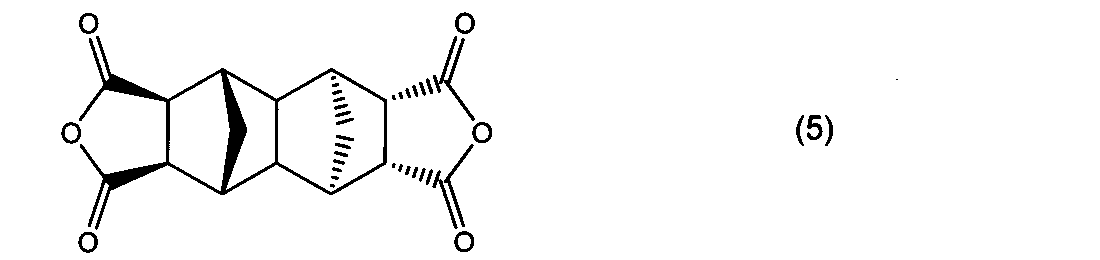
- 前記工程2において、使用する前記式(3)で示されるオレフィン化合物中における下記式(6)で示される化合物の含量が50-99重量%である、請求項1記載の酸二無水物の製造方法。

- 前記工程2の操作(A)及び(B)において、オレフィン化合物と混合させる際に、パラジウム化合物、銅化合物、及びアルコール化合物を含む混合物、またはパラジウム化合物、銅化合物、アルコール化合物、及びオルトエステル化合物を含む混合物に対して前記式(3)で示されるオレフィン化合物を滴下することを特徴とする請求項1~2のいずれか一項に記載の酸二無水物の製造方法。
- パラジウム化合物及び銅化合物の存在下、下記一般式(7)で示されるオレフィン化合物とアルコール化合物と一酸化炭素とを反応させ、下記一般式(7-1)で示されるエステル化合物を得る工程を含み、当該工程において、以下の2つの操作(A)及び(B)のうち少なくとも1つを行うことを特徴とする、エステル化合物の製造方法。
(A)反応容器中でパラジウム化合物、銅化合物、及びアルコール化合物を混合した後、下記(C-2)の置換操作及び下記(C-1)の攪拌操作を順に行い、前記オレフィン化合物と混合させる。
(B)反応容器中でパラジウム化合物、銅化合物、アルコール化合物、及びオルトエステル化合物を混合した後、下記(C-2)の置換操作を行い、前記オレフィン化合物と混合させる。
(C-1)一酸化炭素の雰囲気下で撹拌する。
(C-2)反応容器を減圧した後、一酸化炭素ガスを封入するという操作を1回以上行う。

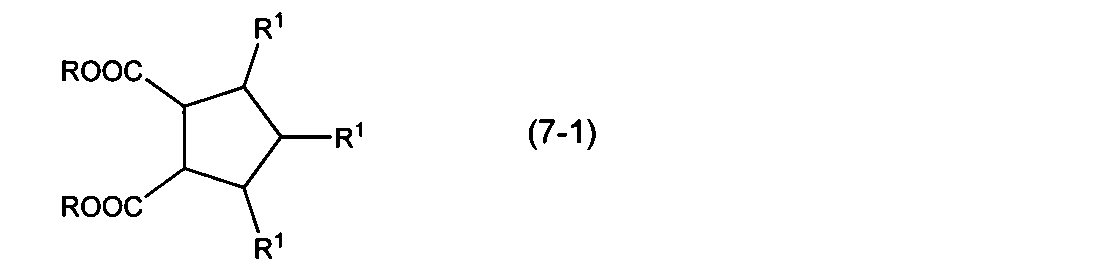
- 前記操作(A)及び(B)において、オレフィン化合物と混合させる際に、パラジウム化合物、銅化合物、及びアルコール化合物を含む混合物、またはパラジウム化合物、銅化合物、アルコール化合物、及びオルトエステル化合物を含む混合物に対して前記オレフィン化合物を滴下することを特徴とする請求項4に記載のエステル化合物の製造方法。
- 前記オレフィン化合物及びエステル化合物が、それぞれ、下記式(8)及び(8-1)、下記式(9)及び(9-1)、下記式(10)及び(10-1)、下記式(11)及び(11-1)、下記式(11-2)及び(11-3)、下記式(12)及び(12-1)、下記式(13)及び(13-1)、下記式(14)及び(14-1)、下記式(15)及び(15-1)、下記式(16)及び(16-1)、または下記式(17)及び(17-1)のいずれかで示される化合物である、請求項4~5のいずれか一項に記載のエステル化合物の製造方法。


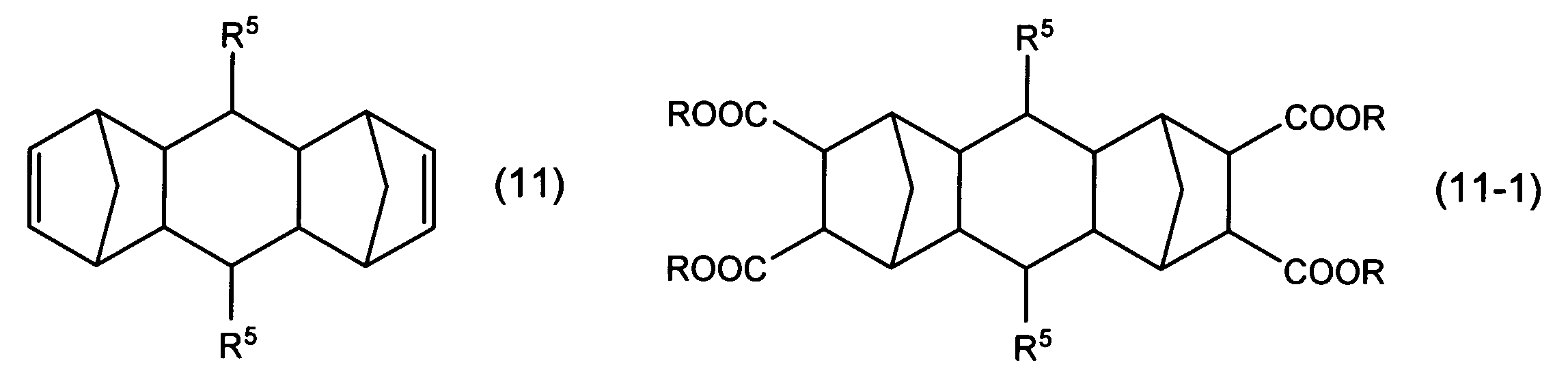


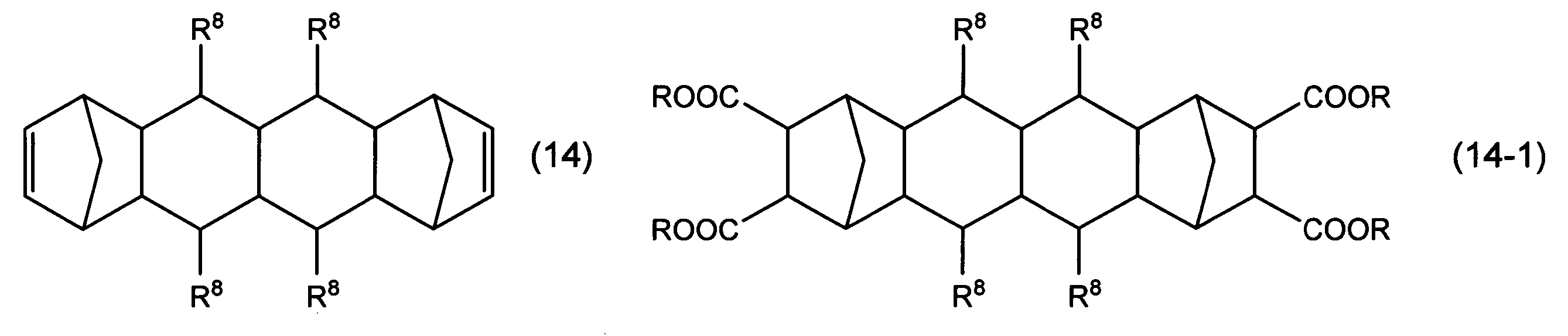
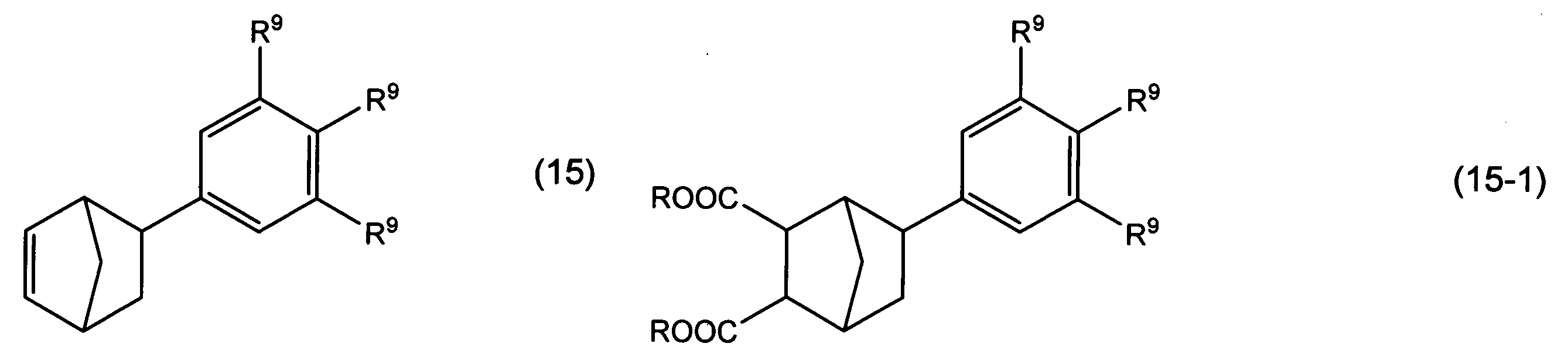


- N,N-ジメチルホルムアミド、N,N-アセトアミド、N-メチルピロリドン、及びN,N-ジメチルブチロアミドからなる群より選ばれる少なくとも一種の溶媒分子を含む下記式(5)で表される脂環式テトラカルボン酸二無水物。
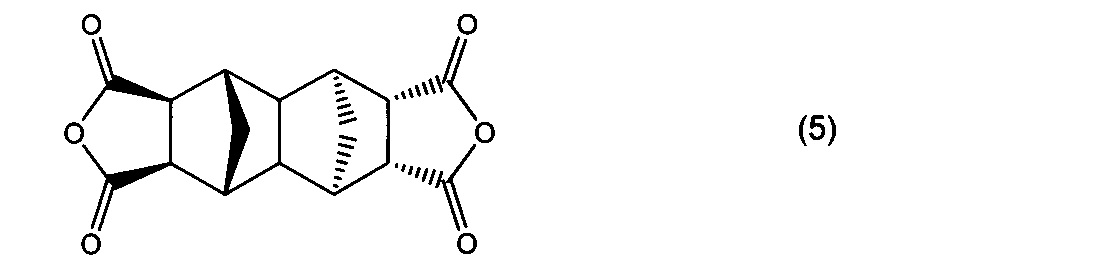
- 前記溶媒分子の含量が0.05~5重量%である請求項7記載の酸二無水物。
- 下記式(18)で表されるエステル化合物。

- 下記式(19)で表されるオレフィン化合物。

- 下記式(20)で表されるエステル化合物。
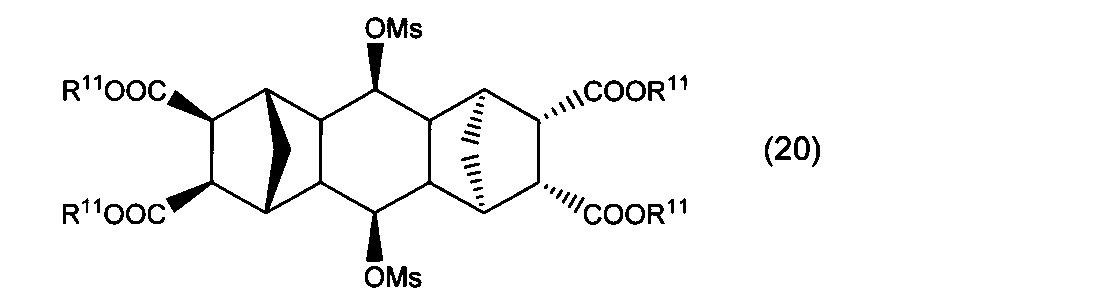
Priority Applications (2)
| Application Number | Priority Date | Filing Date | Title |
|---|---|---|---|
| JP2018520969A JP7052723B2 (ja) | 2016-05-31 | 2017-05-31 | 脂環式テトラカルボン酸二無水物の製造方法 |
| CN201780041078.XA CN109415379A (zh) | 2016-05-31 | 2017-05-31 | 产生脂环族四羧酸二酐的方法 |
Applications Claiming Priority (2)
| Application Number | Priority Date | Filing Date | Title |
|---|---|---|---|
| JP2016108630 | 2016-05-31 | ||
| JP2016-108630 | 2016-05-31 |
Publications (1)
| Publication Number | Publication Date |
|---|---|
| WO2017209199A1 true WO2017209199A1 (ja) | 2017-12-07 |
Family
ID=60478607
Family Applications (2)
| Application Number | Title | Priority Date | Filing Date |
|---|---|---|---|
| PCT/JP2017/020320 Ceased WO2017209199A1 (ja) | 2016-05-31 | 2017-05-31 | 脂環式テトラカルボン酸二無水物の製造方法 |
| PCT/JP2017/020315 Ceased WO2017209197A1 (ja) | 2016-05-31 | 2017-05-31 | ポリイミド前駆体、ポリイミド、ポリイミドフィルム、及び基板、並びにポリイミドの製造に使用されるテトラカルボン酸二無水物 |
Family Applications After (1)
| Application Number | Title | Priority Date | Filing Date |
|---|---|---|---|
| PCT/JP2017/020315 Ceased WO2017209197A1 (ja) | 2016-05-31 | 2017-05-31 | ポリイミド前駆体、ポリイミド、ポリイミドフィルム、及び基板、並びにポリイミドの製造に使用されるテトラカルボン酸二無水物 |
Country Status (5)
| Country | Link |
|---|---|
| JP (4) | JP7052723B2 (ja) |
| KR (1) | KR102347037B1 (ja) |
| CN (4) | CN118221527A (ja) |
| TW (2) | TWI791277B (ja) |
| WO (2) | WO2017209199A1 (ja) |
Cited By (1)
| Publication number | Priority date | Publication date | Assignee | Title |
|---|---|---|---|---|
| WO2024106432A1 (ja) * | 2022-11-15 | 2024-05-23 | 国立大学法人九州大学 | ジカルボン酸誘導体構造を有する化合物の製造方法 |
Families Citing this family (7)
| Publication number | Priority date | Publication date | Assignee | Title |
|---|---|---|---|---|
| WO2018221607A1 (ja) * | 2017-05-31 | 2018-12-06 | 宇部興産株式会社 | ポリイミドフィルム |
| KR102791022B1 (ko) * | 2020-04-14 | 2025-04-02 | 주식회사 엘지화학 | 폴리이미드 필름 적층체 및 이의 제조 방법 |
| KR102493901B1 (ko) * | 2020-11-30 | 2023-01-31 | 피아이첨단소재 주식회사 | 그라파이트 시트용 폴리이미드 필름, 이의 제조방법 및 이로부터 제조된 그라파이트 시트 |
| CN117043229A (zh) * | 2021-03-17 | 2023-11-10 | 三菱瓦斯化学株式会社 | 聚酰亚胺前体组合物 |
| CN113388109B (zh) * | 2021-07-10 | 2023-01-31 | 南昌大学 | 主链含苯并降冰片烯结构的聚酰亚胺及制备方法 |
| CN115745931B (zh) | 2021-09-03 | 2024-05-24 | 财团法人工业技术研究院 | 酸酐化合物、由其制得的聚酰亚胺与薄膜 |
| TWI896498B (zh) * | 2025-03-12 | 2025-09-01 | 國立臺灣科技大學 | 聚醯亞胺、含醚基的脂環族二酸酐及其合成方法 |
Citations (4)
| Publication number | Priority date | Publication date | Assignee | Title |
|---|---|---|---|---|
| JPS59501904A (ja) * | 1982-09-30 | 1984-11-15 | ザ ブリテイツシユ ペトロリユ−ム コムパニ− ピ−エルシ− | カルボン酸エステルおよび(または)カルボン酸の製造方法 |
| JPS62221652A (ja) * | 1986-02-28 | 1987-09-29 | シエル・インタ−ナシヨネイル・リサ−チ・マ−チヤツピイ・ベ−・ウイ | パラジウム触媒によるオレフイン状不飽和化合物のカルボニル化方法 |
| JPH02235842A (ja) * | 1989-03-09 | 1990-09-18 | Japan Synthetic Rubber Co Ltd | 脂環式テトラカルボン酸およびその誘導体 |
| JP2013166929A (ja) * | 2012-01-20 | 2013-08-29 | Ube Industries Ltd | ポリイミド前駆体及びポリイミド |
Family Cites Families (24)
| Publication number | Priority date | Publication date | Assignee | Title |
|---|---|---|---|---|
| JPS61275247A (ja) * | 1985-05-29 | 1986-12-05 | Sagami Chem Res Center | β−アルコキシカルボン酸エステルの製造方法 |
| JPS61275246A (ja) * | 1985-05-29 | 1986-12-05 | Sagami Chem Res Center | カルボン酸エステルの製造方法 |
| GB8602177D0 (en) * | 1986-01-29 | 1986-03-05 | Shell Int Research | Preparation of diester of dicarboxylic acid |
| JP2513006B2 (ja) * | 1988-11-30 | 1996-07-03 | 日本合成ゴム株式会社 | 脂環式テトラカルボン酸およびその誘導体 |
| JPH049368A (ja) * | 1990-04-26 | 1992-01-14 | Sumitomo Pharmaceut Co Ltd | エシソ―シス―2,3―ノルボルナンジカルボン酸イミドの製造法 |
| JPH05140141A (ja) * | 1991-11-13 | 1993-06-08 | Japan Synthetic Rubber Co Ltd | カルボン酸無水物の製造方法 |
| JPH05271409A (ja) * | 1992-03-30 | 1993-10-19 | Japan Synthetic Rubber Co Ltd | ポリアミド酸の製造方法 |
| JPH06345868A (ja) * | 1993-06-03 | 1994-12-20 | Shin Etsu Chem Co Ltd | ポリイミド及びその製造方法 |
| US6071670A (en) * | 1996-10-11 | 2000-06-06 | Kabushiki Kaisha Toshiba | Transparent resin, photosensitive composition, and method of forming a pattern |
| JP2001151728A (ja) * | 1999-11-30 | 2001-06-05 | Nissan Chem Ind Ltd | 脂環式ジカルボン酸誘導体の製造法及び脂環式ジカルボン酸誘導体 |
| JP4045595B2 (ja) * | 2003-04-22 | 2008-02-13 | Jsr株式会社 | 液晶配向剤 |
| JP2007002023A (ja) * | 2005-06-21 | 2007-01-11 | Fujifilm Holdings Corp | フィルムおよび画像表示装置 |
| JP5194342B2 (ja) * | 2005-07-15 | 2013-05-08 | Jnc株式会社 | 垂直配向液晶表示素子用の液晶配向剤及び垂直配向液晶表示素子 |
| JP5158356B2 (ja) * | 2008-06-03 | 2013-03-06 | Jsr株式会社 | 液晶配向剤、液晶配向膜および液晶表示素子 |
| JP2010184898A (ja) * | 2009-02-12 | 2010-08-26 | Tokyo Kogei Univ | ドデカハイドロ−1,4:5,8−ジメタノアントラセン−9,10−ジオン−2,3,6,7−テトラカルボン酸−2,3:6,7−二無水物類、ドデカハイドロ−1,4:5,8−ジメタノアントラセン−9,10−ジオン−2,3,6,7−テトラカルボン酸テトラエステル類、及び、その製造方法 |
| US20120190802A1 (en) * | 2011-01-26 | 2012-07-26 | Nexolve Corporation | Polyimide polymer from non-stoichiometric components |
| CN105254883B (zh) * | 2011-03-11 | 2018-02-02 | 宇部兴产株式会社 | 聚酰亚胺前体和聚酰亚胺 |
| JP5845918B2 (ja) * | 2012-01-20 | 2016-01-20 | 宇部興産株式会社 | ポリイミド前駆体及びポリイミド |
| US10174166B2 (en) * | 2012-09-10 | 2019-01-08 | Ube Industries, Ltd. | Polyimide precursor, polyimide, varnish, polyimide film, and substrate |
| WO2014038715A1 (ja) * | 2012-09-10 | 2014-03-13 | 宇部興産株式会社 | ポリイミド前駆体、ポリイミド、ワニス、ポリイミドフィルム、及び基板 |
| CN105492496B (zh) * | 2013-06-27 | 2017-09-22 | 宇部兴产株式会社 | 聚酰亚胺前体和聚酰亚胺 |
| JP2015108092A (ja) * | 2013-12-05 | 2015-06-11 | 学校法人東京工芸大学 | ポリイミドの製造方法及びその製造方法により得られるポリイミド |
| US10513582B2 (en) * | 2014-04-23 | 2019-12-24 | Jxtg Nippon Oil & Energy Corporation | Tetracarboxylic dianhydride, polyamic acid, polyimide, methods for producing the same, and polyamic acid solution |
| JP6086139B2 (ja) * | 2015-10-05 | 2017-03-01 | 宇部興産株式会社 | ポリイミド前駆体及びポリイミド |
-
2017
- 2017-05-31 TW TW110132670A patent/TWI791277B/zh active
- 2017-05-31 KR KR1020187036700A patent/KR102347037B1/ko active Active
- 2017-05-31 CN CN202410327300.4A patent/CN118221527A/zh active Pending
- 2017-05-31 JP JP2018520969A patent/JP7052723B2/ja active Active
- 2017-05-31 CN CN201780032695.3A patent/CN109312071B/zh active Active
- 2017-05-31 CN CN201780041078.XA patent/CN109415379A/zh active Pending
- 2017-05-31 TW TW106117913A patent/TWI742087B/zh active
- 2017-05-31 CN CN202210579415.3A patent/CN114854010B/zh active Active
- 2017-05-31 WO PCT/JP2017/020320 patent/WO2017209199A1/ja not_active Ceased
- 2017-05-31 JP JP2018520967A patent/JP6939779B2/ja active Active
- 2017-05-31 WO PCT/JP2017/020315 patent/WO2017209197A1/ja not_active Ceased
-
2021
- 2021-04-26 JP JP2021073717A patent/JP7173204B2/ja active Active
-
2022
- 2022-05-12 JP JP2022078910A patent/JP7327573B2/ja active Active
Patent Citations (4)
| Publication number | Priority date | Publication date | Assignee | Title |
|---|---|---|---|---|
| JPS59501904A (ja) * | 1982-09-30 | 1984-11-15 | ザ ブリテイツシユ ペトロリユ−ム コムパニ− ピ−エルシ− | カルボン酸エステルおよび(または)カルボン酸の製造方法 |
| JPS62221652A (ja) * | 1986-02-28 | 1987-09-29 | シエル・インタ−ナシヨネイル・リサ−チ・マ−チヤツピイ・ベ−・ウイ | パラジウム触媒によるオレフイン状不飽和化合物のカルボニル化方法 |
| JPH02235842A (ja) * | 1989-03-09 | 1990-09-18 | Japan Synthetic Rubber Co Ltd | 脂環式テトラカルボン酸およびその誘導体 |
| JP2013166929A (ja) * | 2012-01-20 | 2013-08-29 | Ube Industries Ltd | ポリイミド前駆体及びポリイミド |
Non-Patent Citations (1)
| Title |
|---|
| KUSAMA, M. ET AL.: "SOLUBLE POLYMIDES WITH POLYALICYCLIC STRUCTURE. 3.1. ÖPOLYMIDES FROM (4ARH,8ACH)-DECAHYDRO-IT,4T:5C,8C- DIMETHANONAPHTHALENE-2T,3T,6C,7C-TETRACARBOXYLIC 2,3:6,7- DIANHYDRIDE", MACROMOLECULES, vol. 27, 1994, pages 1117 - 1123, XP000433176 * |
Cited By (1)
| Publication number | Priority date | Publication date | Assignee | Title |
|---|---|---|---|---|
| WO2024106432A1 (ja) * | 2022-11-15 | 2024-05-23 | 国立大学法人九州大学 | ジカルボン酸誘導体構造を有する化合物の製造方法 |
Also Published As
| Publication number | Publication date |
|---|---|
| JP2021138952A (ja) | 2021-09-16 |
| KR20190014518A (ko) | 2019-02-12 |
| TWI791277B (zh) | 2023-02-01 |
| JP2022116052A (ja) | 2022-08-09 |
| JPWO2017209199A1 (ja) | 2019-04-04 |
| CN109312071B (zh) | 2022-06-14 |
| JP7173204B2 (ja) | 2022-11-16 |
| CN109415379A (zh) | 2019-03-01 |
| CN114854010B (zh) | 2024-04-16 |
| JPWO2017209197A1 (ja) | 2019-03-28 |
| CN114854010A (zh) | 2022-08-05 |
| JP7052723B2 (ja) | 2022-04-12 |
| TWI742087B (zh) | 2021-10-11 |
| CN109312071A (zh) | 2019-02-05 |
| TW201802144A (zh) | 2018-01-16 |
| CN118221527A (zh) | 2024-06-21 |
| WO2017209197A1 (ja) | 2017-12-07 |
| TW202146531A (zh) | 2021-12-16 |
| KR102347037B1 (ko) | 2022-01-05 |
| JP7327573B2 (ja) | 2023-08-16 |
| JP6939779B2 (ja) | 2021-09-22 |
Similar Documents
| Publication | Publication Date | Title |
|---|---|---|
| JP7052723B2 (ja) | 脂環式テトラカルボン酸二無水物の製造方法 | |
| CN102791669B (zh) | 5-降冰片烯-2-螺-α-环烷酮-α’-螺-2”-5”-降冰片烯类及其制造方法 | |
| WO2014172534A1 (en) | Metathesis catalysts and methods thereof | |
| KR20240158905A (ko) | 비페난트렌 화합물 또는 그의 알칼리 금속염 | |
| CN113929575B (zh) | 一种(1r,2s)-二氢茉莉酮酸甲酯的制备方法 | |
| TWI767955B (zh) | 脂環族四羧酸二酐之製造方法 | |
| CN110078622B (zh) | 一种4-乙氧基-1,1,2,4,5,6-六氢环丁烷并萘-2-苯甲酸酯的合成方法 | |
| Itoh et al. | Synthesis of novel bis-and oligo-gem-difluorocyclopropanes | |
| CN110650735A (zh) | 通过钯-催化的分子内链烯基化的4,5-螺环的高度非对映选择性结构 | |
| CN107663149A (zh) | 一种菲醌及其衍生物的制备方法 | |
| CN109134547B (zh) | 一种钌络合物、其制备方法和应用 | |
| CN112010882A (zh) | 立体选择性制备1,3-双取代环己烷类化合物的方法及应用 | |
| JP2015040176A (ja) | ビス−ボロンジピロメテン系色素 | |
| JPH08119939A (ja) | 高純度エーテル型ビスマレイミドの製造方法 | |
| JP7738931B2 (ja) | アキシアルアリール基含有トリベンゾトリキナセン及びその製造方法 | |
| JP2007001888A (ja) | 1,4−ジヒドロ−1,4−メタノアントラセン類の製造方法 | |
| CN112321398B (zh) | 一种通过腙化脂肪链单酮合成α-氟化酮的方法 | |
| CN115745724B (zh) | 反式-1,4-环己基类有机物及其合成方法 | |
| JP2014237820A (ja) | ポリイミドフィルム、並びに、それを用いたガスバリアフィルム、フレキシブル配線基板及び透明電極基板 | |
| JP2010163414A (ja) | トランス体構造を有する環状脂肪族ジアミンの製造法 | |
| CN122036555A (zh) | 一种反式6,7-二取代的双环[3.1.1]庚烷及其制备方法 | |
| JP4618412B2 (ja) | 脂環式テトラカルボン酸化合物及びその製造法 | |
| Borowiak et al. | Regio-selective bromination of multiflorine and structures of 3-bromomultiflorine and its molecular complex with succinimide | |
| JP2019527686A (ja) | ハロゲンコーティングメタセシス触媒及びその方法 | |
| WO2023000135A1 (en) | Processes of making onapristone and intermediates thereof |
Legal Events
| Date | Code | Title | Description |
|---|---|---|---|
| 121 | Ep: the epo has been informed by wipo that ep was designated in this application |
Ref document number: 17806750 Country of ref document: EP Kind code of ref document: A1 |
|
| ENP | Entry into the national phase |
Ref document number: 2018520969 Country of ref document: JP Kind code of ref document: A |
|
| NENP | Non-entry into the national phase |
Ref country code: DE |
|
| 122 | Ep: pct application non-entry in european phase |
Ref document number: 17806750 Country of ref document: EP Kind code of ref document: A1 |