WO2012102144A1 - 研磨用組成物、それを用いた研磨方法及び基板の製造方法 - Google Patents
研磨用組成物、それを用いた研磨方法及び基板の製造方法 Download PDFInfo
- Publication number
- WO2012102144A1 WO2012102144A1 PCT/JP2012/050935 JP2012050935W WO2012102144A1 WO 2012102144 A1 WO2012102144 A1 WO 2012102144A1 JP 2012050935 W JP2012050935 W JP 2012050935W WO 2012102144 A1 WO2012102144 A1 WO 2012102144A1
- Authority
- WO
- WIPO (PCT)
- Prior art keywords
- polishing
- polishing composition
- composition
- substrate
- polyoxyethylene
- Prior art date
- Legal status (The legal status is an assumption and is not a legal conclusion. Google has not performed a legal analysis and makes no representation as to the accuracy of the status listed.)
- Ceased
Links
Classifications
-
- H—ELECTRICITY
- H10—SEMICONDUCTOR DEVICES; ELECTRIC SOLID-STATE DEVICES NOT OTHERWISE PROVIDED FOR
- H10P—GENERIC PROCESSES OR APPARATUS FOR THE MANUFACTURE OR TREATMENT OF DEVICES COVERED BY CLASS H10
- H10P52/00—Grinding, lapping or polishing of wafers, substrates or parts of devices
- H10P52/40—Chemomechanical polishing [CMP]
- H10P52/402—Chemomechanical polishing [CMP] of semiconductor materials
-
- H—ELECTRICITY
- H10—SEMICONDUCTOR DEVICES; ELECTRIC SOLID-STATE DEVICES NOT OTHERWISE PROVIDED FOR
- H10P—GENERIC PROCESSES OR APPARATUS FOR THE MANUFACTURE OR TREATMENT OF DEVICES COVERED BY CLASS H10
- H10P52/00—Grinding, lapping or polishing of wafers, substrates or parts of devices
-
- B—PERFORMING OPERATIONS; TRANSPORTING
- B24—GRINDING; POLISHING
- B24B—MACHINES, DEVICES, OR PROCESSES FOR GRINDING OR POLISHING; DRESSING OR CONDITIONING OF ABRADING SURFACES; FEEDING OF GRINDING, POLISHING, OR LAPPING AGENTS
- B24B37/00—Lapping machines or devices; Accessories
- B24B37/04—Lapping machines or devices; Accessories designed for working plane surfaces
- B24B37/042—Lapping machines or devices; Accessories designed for working plane surfaces operating processes therefor
- B24B37/044—Lapping machines or devices; Accessories designed for working plane surfaces operating processes therefor characterised by the composition of the lapping agent
-
- C—CHEMISTRY; METALLURGY
- C09—DYES; PAINTS; POLISHES; NATURAL RESINS; ADHESIVES; COMPOSITIONS NOT OTHERWISE PROVIDED FOR; APPLICATIONS OF MATERIALS NOT OTHERWISE PROVIDED FOR
- C09G—POLISHING COMPOSITIONS; SKI WAXES
- C09G1/00—Polishing compositions
- C09G1/02—Polishing compositions containing abrasives or grinding agents
-
- C—CHEMISTRY; METALLURGY
- C09—DYES; PAINTS; POLISHES; NATURAL RESINS; ADHESIVES; COMPOSITIONS NOT OTHERWISE PROVIDED FOR; APPLICATIONS OF MATERIALS NOT OTHERWISE PROVIDED FOR
- C09G—POLISHING COMPOSITIONS; SKI WAXES
- C09G1/00—Polishing compositions
- C09G1/04—Aqueous dispersions
-
- C—CHEMISTRY; METALLURGY
- C09—DYES; PAINTS; POLISHES; NATURAL RESINS; ADHESIVES; COMPOSITIONS NOT OTHERWISE PROVIDED FOR; APPLICATIONS OF MATERIALS NOT OTHERWISE PROVIDED FOR
- C09K—MATERIALS FOR MISCELLANEOUS APPLICATIONS, NOT PROVIDED FOR ELSEWHERE
- C09K3/00—Materials not provided for elsewhere
- C09K3/14—Anti-slip materials; Abrasives
-
- C—CHEMISTRY; METALLURGY
- C09—DYES; PAINTS; POLISHES; NATURAL RESINS; ADHESIVES; COMPOSITIONS NOT OTHERWISE PROVIDED FOR; APPLICATIONS OF MATERIALS NOT OTHERWISE PROVIDED FOR
- C09K—MATERIALS FOR MISCELLANEOUS APPLICATIONS, NOT PROVIDED FOR ELSEWHERE
- C09K3/00—Materials not provided for elsewhere
- C09K3/14—Anti-slip materials; Abrasives
- C09K3/1409—Abrasive particles per se
-
- H—ELECTRICITY
- H10—SEMICONDUCTOR DEVICES; ELECTRIC SOLID-STATE DEVICES NOT OTHERWISE PROVIDED FOR
- H10P—GENERIC PROCESSES OR APPARATUS FOR THE MANUFACTURE OR TREATMENT OF DEVICES COVERED BY CLASS H10
- H10P90/00—Preparation of wafers not covered by a single main group of this subclass, e.g. wafer reinforcement
- H10P90/12—Preparing bulk and homogeneous wafers
- H10P90/129—Preparing bulk and homogeneous wafers by polishing
Definitions
- the present invention relates to a polishing composition used for polishing a substrate, a method for polishing a substrate using the polishing composition, and a method for manufacturing the substrate.
- LPD Light Point Defect
- COP is a defect in the crystal structure that occurs when the silicon ingot is pulled up, so it is difficult to remove it by polishing.
- LPD caused by foreign matter adhering to the substrate surface includes abrasives, additives such as water-soluble polymer compounds, pad debris, substrate debris, air dust and the like that could not be removed in the cleaning process. The thing resulting from other foreign materials is mentioned.
- Patent Document 1 describes a polishing composition that can reduce LPD caused by foreign substances adhering to a substrate surface.
- a water-soluble polymer is used for the purpose of preventing foreign matter from adhering to the substrate surface due to water repellency and drying of the substrate surface after polishing.
- the hydrophilicity imparted to the substrate surface by the polishing composition described in Patent Document 1 is not sufficient to prevent foreign matter from adhering to the substrate surface. Therefore, in order to reduce nanoscale LPD that has not been a problem in the past, a technique for further improving the hydrophilicity of the substrate surface is required.
- An object of the present invention is a polishing composition used in a polishing process of a substrate, which imparts high hydrophilicity to a polished substrate surface in order to reduce LPD on the polished substrate surface. It is another object of the present invention to provide a polishing method and a substrate manufacturing method using the same.
- the present inventors include a composition (A) containing hydroxyethyl cellulose, abrasive grains, ammonia and water, and at least one selected from organic acids and organic acid salts.
- the polishing composition of the present invention is a polishing composition comprising a composition (A) containing hydroxyethyl cellulose, abrasive grains, ammonia and water, and one kind selected from organic acids and organic acid salts,
- the polishing composition has an electrical conductivity of 1.2 to 8 times the electrical conductivity of the composition (A).
- the polishing method of the present invention is a method for polishing a substrate using the above polishing composition.
- the substrate manufacturing method of the present invention includes a step of polishing the surface of the substrate using the above polishing method.
- polishing composition of the present invention By polishing the substrate using the polishing composition of the present invention, good hydrophilicity can be imparted to the polished substrate surface. As a result, nanoscale LPD can be reduced.
- Polishing composition of the present invention comprises a composition (A) containing hydroxyethyl cellulose, abrasive grains, ammonia and water, and one kind selected from organic acids and organic acid salts.
- the electrical conductivity of the polishing composition is 1.2 times to 8 times the electrical conductivity of the composition (A).
- Polishing composition containing hydroxyethyl cellulose and organic acid or organic acid salt gives improved hydrophilicity to the substrate surface after polishing, and this improved hydrophilicity is for polishing caused by organic acid and organic acid salt
- the inventors have empirically found that it depends on the rate of increase in the electrical conductivity of the composition.
- the electrical conductivity is a value representing the ease of electricity passing through the substance, and is expressed in S / cm in SI units.
- the higher the concentration of charged ions in a liquid the easier it is for electricity to pass through the liquid, so the electrical conductivity of the liquid increases. That is, the increase in the electrical conductivity of the polishing composition of the present invention represents an increase in the ion concentration in the composition.
- the rate of increase in electrical conductivity due to the organic acid and organic acid salt of the polishing composition of the present invention is the value of the electrical conductivity of the polishing composition of the present invention. It is calculated by dividing by.
- the electrical conductivity can be obtained, for example, by measuring the composition (A) having a liquid temperature of 25 ° C. and the polishing composition using a conductivity meter DS-14 manufactured by Horiba, Ltd., but is not limited thereto. Not.
- the electrical conductivity of the polishing composition needs to be 1.2 times or more that of the composition (A). It is preferably 4 times or more.
- the electrical conductivity of the polishing composition is too small with respect to the electrical conductivity of the composition (A), the hydrophilicity of the substrate surface after polishing becomes insufficient.
- the electrical conductivity of the polishing composition that is, the ion concentration of the polishing composition is excessively large, the haze level of the substrate surface after polishing is adversely affected. It was. Therefore, in order not to deteriorate the haze level of the substrate surface after polishing, the electrical conductivity of the polishing composition needs to be 8 times or less than the electrical conductivity of the composition (A). It is preferable that it is less than twice. If the electrical conductivity of the polishing composition is too large relative to the electrical conductivity of the composition (A), the haze level of the substrate surface after polishing deteriorates, which is not preferable.
- the electrical conductivity of the polishing composition is 3.5 times or less than the electrical conductivity of the composition (A). It is more preferable. Moreover, when the density
- the organic acid and the organic acid salt contained in the polishing composition of the present invention serve to control electric conductivity, that is, ion concentration in the polishing composition.
- Organic acids are not limited by type, structure, or ionic valence.
- the organic acid salt may be a salt of any organic acid, and is not limited by the type, structure and ionic valence of the organic acid, and the type of base.
- organic acids that can be used in the polishing composition of the present invention and organic acids that form organic acid salts include fatty acids such as formic acid, acetic acid, and propionic acid, aromatic carboxylic acids such as benzoic acid and phthalic acid, Examples include, but are not limited to, citric acid, oxalic acid, tartaric acid, malic acid, maleic acid, fumaric acid, succinic acid, organic sulfonic acid, and organic phosphonic acid.
- bases that form organic acid salts include, but are not limited to, ammonium ions and various metal ions. From the viewpoint of preventing metal contamination on the substrate, the base forming the organic acid salt is preferably an ammonium ion.
- An organic acid and an organic acid salt may be used individually by 1 type, or may be used in combination of 2 or more type.
- the hydroxyethyl cellulose contained in the polishing composition of the present invention functions to impart hydrophilicity to the substrate surface after polishing. Furthermore, the present inventors have experienced that the improvement in the hydrophilicity of the substrate surface after polishing provided by the polishing composition of the present invention occurs specifically by using hydroxyethyl cellulose among water-soluble polymers. I found it.
- the weight average molecular weight of hydroxyethyl cellulose in terms of polyethylene oxide is preferably 10,000 or more, more preferably 50,000 or more, from the viewpoint of imparting sufficient hydrophilicity to the polished substrate surface.
- the weight average molecular weight of hydroxyethyl cellulose in terms of polyethylene oxide is preferably 2,000,000 or less, more preferably 500,000 or less, from the viewpoint of improving the dispersion stability of the polishing composition.
- the content of hydroxyethyl cellulose in the polishing composition is preferably 0.0001% by mass or more, more preferably 0.001% by mass or more, from the viewpoint of imparting sufficient hydrophilicity to the substrate surface after polishing. It is. In addition, the content of hydroxyethyl cellulose in the polishing composition is preferably 0.5% by mass or less, more preferably 0.1% by mass or less from the viewpoint of improving the dispersion stability of the polishing composition. It is.
- the abrasive grains contained in the polishing composition of the present invention function to physically polish the substrate surface.
- the content of abrasive grains in the polishing composition is preferably 0.01% by mass or more.
- content of the abrasive grain in polishing composition is 5 mass% or less, More preferably, it is 1 mass% or less, More preferably, it is 0.5 mass% or less.
- LPD due to adhesion of abrasive grains as a residue on the polished substrate surface is reduced.
- the abrasive grains are preferably silicon dioxide, more preferably colloidal silica or fumed silica, and even more preferably colloidal silica.
- colloidal silica or fumed silica is used, particularly when colloidal silica is used, scratches generated on the surface of the substrate in the polishing step are reduced.
- the grain size of the abrasive grains contained in the polishing composition is preferably 5 nm or more, more preferably 10 nm or more. Moreover, it is preferable that the particle size of the abrasive grain contained in polishing composition is 100 nm or less, More preferably, it is 40 nm or less.
- the particle size described here is an average primary particle size calculated from a specific surface area measured by a specific surface area measurement method (BET method) of powder by gas adsorption.
- the abrasive grains in the polishing composition have a value (D90 / D10) obtained by dividing the volume-based 90% cumulative average diameter (D90) by the volume-based 10% cumulative average diameter (D10) of 1 or more and 4 or less. It preferably has a particle size distribution.
- the volume-based 10% cumulative average diameter (D10) is the average particle diameter when the integrated value from the smaller particle diameter side is 10% in the particle size distribution shown on the volume basis.
- the volume-based 90% cumulative average diameter (D90) is an average particle diameter when the integrated value from the smaller particle diameter side is 90% in the particle size distribution shown on the volume basis.
- the particle size distribution shown on the volume basis can be measured using, for example, a particle size distribution measuring apparatus by a dynamic light scattering method, but is not limited thereto.
- Ammonia contained in the polishing composition of the present invention has a chemical etching action on the substrate surface and functions to chemically polish the substrate surface. It also serves to improve the dispersion stability of the polishing composition.
- the content of ammonia in the polishing composition is preferably 0.0001% by mass or more, and more preferably 0.001% by mass or more.
- the higher the ammonia content the better the chemical etching effect on the substrate surface, and the higher the polishing rate of the substrate with the polishing composition.
- the dispersion stability of the polishing composition is also improved.
- content of ammonia in polishing composition is 0.5 mass% or less, More preferably, it is 0.25 mass% or less. As the ammonia content decreases, the chemical etching action does not become excessive, so that the haze level of the substrate surface after polishing improves.
- the water contained in the polishing composition of the present invention functions to dissolve or disperse other components in the polishing composition. It is preferable that water does not contain impurities that inhibit the action of other components as much as possible. Specifically, ion-exchanged water, pure water, ultrapure water, distilled water, or the like, in which foreign ions are removed through a filter after removing impurity ions using an ion-exchange resin, is preferable.
- the pH of the polishing composition of the present invention is preferably 8 or more, more preferably 9 or more. Moreover, it is preferable that pH of polishing composition is 12 or less, More preferably, it is 11 or less. When the pH of the polishing composition is within the above range, it is easy to obtain a particularly preferable polishing rate in practical use.
- the polishing composition of the present invention may further contain a surfactant in addition to the components described above.
- the surfactant functions to reduce the haze level by suppressing the roughness of the substrate surface caused by the chemical etching of ammonia.
- the surfactant may be ionic or nonionic.
- foaming of the polishing composition is further suppressed as compared with the case of using a cationic surfactant or an anionic surfactant. Manufacture or use of objects is facilitated.
- nonionic surfactant does not change pH of polishing composition, control of pH at the time of manufacture or use of polishing composition becomes easy.
- nonionic surfactants are excellent in biodegradability and weakly toxic to living bodies, environmental impacts and dangers during handling can be reduced.
- the usable surfactant is not limited by the structure.
- examples of usable surfactants include oxyalkylene homopolymers such as polyethylene glycol and polypropylene glycol, diblock copolymers of polyoxyethylene polyoxypropylene, triblock copolymers, random copolymers, and alternating Copolymers of a plurality of types of oxyalkylenes such as copolymers, as well as polyoxyethylene alkyl ether, polyoxyethylene alkylphenyl ether, polyoxyethylene alkylamine, polyoxyethylene fatty acid ester, polyoxyethylene glyceryl ether fatty acid ester, And polyoxyalkylene adducts such as polyoxyethylene sorbitan fatty acid esters.
- examples of usable surfactants include polyoxyethylene polyoxypropylene copolymer, polyoxyethylene glycol, polyoxyethylene propyl ether, polyoxyethylene butyl ether, polyoxyethylene pentyl ether, polyoxyethylene Ethylene hexyl ether, polyoxyethylene octyl ether, polyoxyethylene-2-ethylhexyl ether, polyoxyethylene nonyl ether, polyoxyethylene decyl ether, polyoxyethylene isodecyl ether, polyoxyethylene tridecyl ether, polyoxyethylene lauryl ether , Polyoxyethylene cetyl ether, polyoxyethylene stearyl ether, polyoxyethylene isostearyl ether, polyoxyethylene Ether, polyoxyethylene phenyl ether, polyoxyethylene octyl phenyl ether, polyoxyethylene nonyl phenyl ether, polyoxyethylene dodecyl phenyl ether, polyoxyethylene styrenated pheny
- the weight average molecular weight of the surfactant is preferably 200 or more, more preferably 300 or more. Further, the weight average molecular weight of the surfactant is preferably 15,000 or less, more preferably 10,000 or less. When the weight average molecular weight of the surfactant is within the above range, the surface roughness of the substrate is sufficiently suppressed.
- the content of the surfactant in the polishing composition is preferably 0.00001% by mass or more, and more preferably 0.00005% by mass or more. Moreover, it is preferable that content of surfactant is 0.1 mass% or less, More preferably, it is 0.05 mass% or less. When the content of the surfactant is within the above range, the surface roughness of the substrate is sufficiently suppressed.
- examples of the substrate include a semiconductor substrate and a magnetic substrate, but are not limited thereto.
- the polishing composition is used for polishing, for example, a silicon substrate, a SiO 2 substrate, an SOI substrate, a plastic substrate, a glass substrate, a quartz substrate, and the like. It is preferably used in applications for polishing a wafer.
- polishing composition of the present invention imparts extremely good hydrophilicity to the polished substrate surface is still unclear.
- the increase in the electrical conductivity that is, the ionic concentration of the polishing composition due to the organic acid or the organic acid salt is to effectively increase the adsorptivity of hydroxyethyl cellulose to the substrate surface.
- the ion concentration of the polishing composition becomes excessively large, the adsorptivity of abrasive grains to the substrate surface and the adsorptivity between abrasive grains become excessive, which causes excessive physical polishing of the substrate surface by the abrasive grains.
- the haze level of the substrate surface after polishing deteriorates.
- the polishing composition of the present invention has the following advantages.
- the polishing composition of the present invention comprises a composition (A) containing hydroxyethyl cellulose, abrasive grains, ammonia and water, and at least one selected from organic acids and organic acid salts, and the electrical conductivity of the polishing composition. Is not less than 1.2 times and not more than 8 times the electrical conductivity of the composition (A). When the electric conductivity of the polishing composition is 1.2 to 8 times the electric conductivity of the composition (A), the hydrophilicity of the substrate surface after polishing can be improved. Therefore, the polishing composition of the present embodiment can be suitably used for the purpose of polishing the surface of a substrate, particularly for the purpose of final polishing of the surface of a silicon wafer that requires high surface accuracy.
- the embodiment of the polishing composition of the present invention may be as follows.
- the polishing composition of the present invention may further contain a known additive such as a preservative, if necessary.
- the polishing composition of the present invention may be produced by dissolving or dispersing each component other than the above-described water in water by a conventional method.
- the order of each component dissolved or dispersed in water is not particularly limited.
- the method of dissolution or dispersion is not particularly limited. For example, a general method such as stirring using a propeller stirrer or dispersion using a homogenizer can be used.
- the polishing composition of the present invention may be a one-component type or a multi-component type of two or more types.
- each dosage form may contain each component of hydroxyethyl cellulose, abrasive grains, ammonia, organic acid and organic acid salt separately, or some components as a mixture. But you can.
- the polishing composition of the present invention may be in a concentrated state during production and sale. That is, the polishing composition of the present invention may be produced and sold in the form of a stock solution of the polishing composition.
- the polishing composition in a concentrated state is advantageous in that it can reduce the cost for transportation or storage because the volume at the time of manufacture and sale becomes small.
- the concentration ratio of the stock solution of the polishing composition is preferably 5 times or more, more preferably 10 times or more, and even more preferably 20 times or more, but is not limited thereto.
- the concentration ratio refers to the ratio of the volume of the polishing composition after dilution to the volume of the stock solution of the polishing composition.
- the polishing composition of the present invention may be prepared by diluting a stock solution of the polishing composition with water.
- water having the same amount of impurities as the water contained in the polishing composition of the present invention is used. Therefore, when preparing by diluting the stock solution of the polishing composition with water, it is easy to handle because the stock solution of the polishing composition having a small volume can be transported and the polishing composition can be prepared immediately before polishing. This is advantageous in terms of height. Further, since the stock solution of the polishing composition has high stability, it is advantageous in terms of storage stability.
- the weight of the composition (A) in the polishing composition / the weight of at least one selected from an organic acid and an organic acid salt is preferably 99.999 / 0.001 to 90/10.
- the weight of hydroxyethyl cellulose / weight of abrasive grains / weight of ammonia / weight of water in the composition (A) is 0.01 / 1 / 0.01 / 98.98 to 0.2 / 1/0. It is preferable that it is 4 / 98.4.
- polishing method and substrate manufacturing method of the present invention is a method of polishing a substrate surface using the polishing composition of the present invention described above.
- the polishing composition of the present invention can be used in the same apparatus and conditions as those used in a normal substrate polishing step.
- the polishing pad used in the polishing method of the present invention may be of any type, for example, a nonwoven fabric type, a suede type, a polishing pad containing abrasive grains, or a polishing pad not containing abrasive grains.
- the temperature during polishing is not particularly limited, but is preferably 5 to 60 ° C.
- the polishing method of the present invention can be used in any stage of so-called multistage polishing.
- the polishing method of the present invention can be used for both polishing for improving the damaged layer of the silicon wafer and polishing for finishing the surface layer of the silicon wafer such as final polishing. it can.
- the polishing method of the present invention is preferably used for polishing for finishing the surface layer of the substrate, such as final polishing in which high smoothness and cleanliness are required on the polished substrate surface.
- the time required for polishing to finish the surface layer of the substrate is usually from 30 seconds to 30 minutes.
- Polishing compositions of Examples 1 to 18 and Comparative Examples 1 to 18 were prepared by mixing all or part of at least one selected from hydroxyethyl cellulose, abrasive grains, ammonia, and organic acids and organic acid salts with ion-exchanged water. A product was prepared. Table 1 shows the compositions and the rate of increase in electrical conductivity of each of the polishing compositions of Examples 1 to 18 and Comparative Examples 1 to 18. Although not shown in Table 1, each of the polishing compositions of Examples 1 to 12, Comparative Examples 1 to 7, and Comparative Examples 11 to 18 contains colloidal silica having an average primary particle diameter of 35 nm as abrasive grains.
- each of the polishing compositions of Examples 13 to 18 and Comparative Examples 8 to 10 contains colloidal silica having an average primary particle diameter of 25 nm as abrasive grains.
- Each of the polishing compositions of Examples 5 to 12, Comparative Examples 4 to 7, and Comparative Examples 11 to 18 contained 0.0025% by mass of a polyoxyethylene polyoxypropylene copolymer as a surfactant.
- Each of the polishing compositions of Example 13 and Comparative Example 8 contained 0.0013% by mass of a polyoxyethylene polyoxypropylene copolymer, and each of the polishing compositions of Examples 14 to 18 and Comparative Examples 9 and 10 was And 0.0030% by mass of a polyoxyethylene polyoxypropylene copolymer.
- the average primary particle diameter of the used colloidal silica was calculated from the value of the specific surface area measured by Flowsorb II 2300 manufactured by Micromeritics.
- the electrical conductivity of the polishing composition and the composition (A) at a liquid temperature of 25 ° C. was measured using a conductivity meter DS-14 manufactured by Horiba, Ltd., and the rate of increase in electrical conductivity was determined by polishing.
- the electric conductivity of the composition was obtained by dividing the electric conductivity of the composition (A) containing hydroxyethyl cellulose, abrasive grains and ammonia.
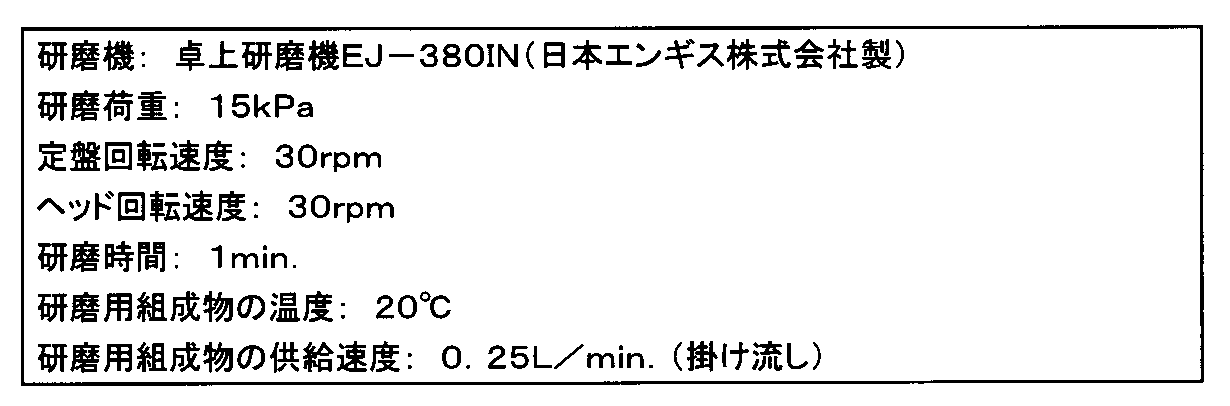
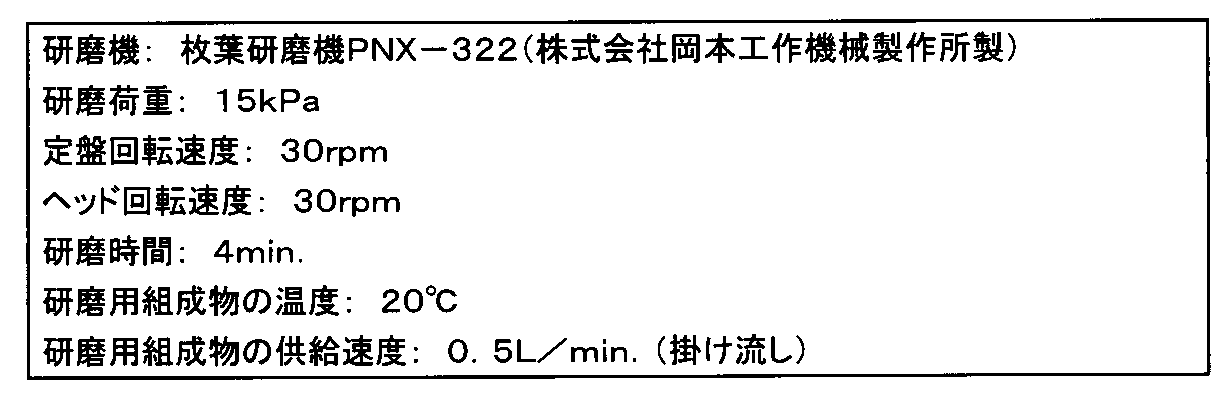
- the surface of the silicon wafer was polished under the conditions shown in Table 2.
- the surface of the polished silicon wafer is flowed at a flow rate of 7 L / min.
- the distance (water repellent distance) at which water was repelled from the edge of the silicon wafer was measured.
- the silicon wafer used for the measurement of the water repellent distance is a silicon wafer having a diameter of 200 mm, a conductivity type of P type, a crystal orientation of ⁇ 100>, and a resistivity of 0.1 ⁇ ⁇ cm or more and less than 100 ⁇ ⁇ cm. It was prepared by pre-polishing using a polishing slurry manufactured by Incorporated (trade name GLANZOX 2100) and then cutting into a 60 mm square chip type.
- hydrophilicity of the silicon wafer surface is worse as the value of the water repellent distance is larger.
- Table 1 the column “hydrophilicity” indicates the evaluation of hydrophilicity imparted to the surface of the silicon wafer by each of the polishing compositions of Examples 1 to 18 and Comparative Examples 1 to 18.
- “Excellent”, “good”, and “poor” respectively indicate the composition (A) and the water repellent distance when polished using the composition (A) containing hydroxyethyl cellulose, abrasive grains, and ammonia, and It represents that the water-repellent distance when polished with a polishing composition containing at least one selected from organic acids and organic acid salts has decreased by 10 mm or more, 5 mm or more, and less than 5 mm.
- the haze resulting from the polishing composition of the present invention is the haze value of a silicon wafer polished under the conditions shown in Table 3, and is measured in the DNO mode of a wafer inspection device Surfscan SP2 manufactured by KLA Tencor. Evaluated by value.
- the silicon wafer has a diameter of 200 mm, a conductivity type of P type, a crystal orientation of ⁇ 100>, a resistivity of 0.1 ⁇ ⁇ cm or more and less than 100 ⁇ ⁇ cm, and is a polishing slurry (trade name GLANZOX manufactured by Fujimi Incorporated). 2100) was used after preliminary polishing. Evaluation of haze on the surface of the silicon wafer after polishing is shown in the column of “DNO haze” in Table 1.
Landscapes
- Chemical & Material Sciences (AREA)
- Organic Chemistry (AREA)
- Engineering & Computer Science (AREA)
- Materials Engineering (AREA)
- Mechanical Engineering (AREA)
- Dispersion Chemistry (AREA)
- Mechanical Treatment Of Semiconductor (AREA)
- Finish Polishing, Edge Sharpening, And Grinding By Specific Grinding Devices (AREA)
Abstract
Description
本発明の研磨用組成物は、ヒドロキシエチルセルロース、砥粒、アンモニア及び水を含む組成物(A)と、有機酸及び有機酸塩から選ばれる一種とを含み、研磨用組成物の電気伝導度が組成物(A)の電気伝導度の1.2倍以上8倍以下であることを特徴とする。
本発明の研磨方法は、上述した本発明の研磨用組成物を用いて基板表面を研磨する方法である。本発明の研磨用組成物は、通常の基板の研磨工程で用いられるのと同じ装置及び条件で使用することができる。

Claims (4)
- ヒドロキシエチルセルロース、アンモニア、砥粒及び水を含む組成物(A)と、有機酸及び有機酸塩から選ばれる少なくとも一種とを含むことを特徴とする研磨用組成物であって、研磨用組成物の電気伝導度が組成物(A)の電気伝導度の1.2倍以上8倍以下であることを特徴とする研磨用組成物。
- 更に界面活性剤を含む、請求項1に記載の研磨用組成物。
- 請求項1又は2に記載の研磨用組成物を用いて基板表面を研磨する方法。
- 請求項3に記載の方法を用いて基板の表面を研磨する工程を含む基板の製造方法。
Priority Applications (6)
| Application Number | Priority Date | Filing Date | Title |
|---|---|---|---|
| CN201280006289.7A CN103403123B (zh) | 2011-01-26 | 2012-01-18 | 研磨用组合物、使用其的研磨方法及基板的制造方法 |
| US13/980,138 US20130302984A1 (en) | 2011-01-26 | 2012-01-18 | Polishing composition, polishing method using same, and substrate production method |
| JP2012554738A JP6050125B2 (ja) | 2011-01-26 | 2012-01-18 | 研磨用組成物、それを用いた研磨方法及び基板の製造方法 |
| DE112012000575.9T DE112012000575B4 (de) | 2011-01-26 | 2012-01-18 | Polierzusammensetzung, Polierverfahren unter Verwendung derselben und Substrat-Herstellungsverfahren |
| SG2013055470A SG192058A1 (en) | 2011-01-26 | 2012-01-18 | Polishing composition, polishing method using same, and substrate production method |
| KR1020137022028A KR101868657B1 (ko) | 2011-01-26 | 2012-01-18 | 연마용 조성물, 그것을 사용한 연마 방법 및 기판의 제조 방법 |
Applications Claiming Priority (2)
| Application Number | Priority Date | Filing Date | Title |
|---|---|---|---|
| JP2011014055 | 2011-01-26 | ||
| JP2011-014055 | 2011-01-26 |
Publications (1)
| Publication Number | Publication Date |
|---|---|
| WO2012102144A1 true WO2012102144A1 (ja) | 2012-08-02 |
Family
ID=46580716
Family Applications (1)
| Application Number | Title | Priority Date | Filing Date |
|---|---|---|---|
| PCT/JP2012/050935 Ceased WO2012102144A1 (ja) | 2011-01-26 | 2012-01-18 | 研磨用組成物、それを用いた研磨方法及び基板の製造方法 |
Country Status (8)
| Country | Link |
|---|---|
| US (1) | US20130302984A1 (ja) |
| JP (1) | JP6050125B2 (ja) |
| KR (1) | KR101868657B1 (ja) |
| CN (1) | CN103403123B (ja) |
| DE (1) | DE112012000575B4 (ja) |
| SG (1) | SG192058A1 (ja) |
| TW (1) | TWI532829B (ja) |
| WO (1) | WO2012102144A1 (ja) |
Cited By (9)
| Publication number | Priority date | Publication date | Assignee | Title |
|---|---|---|---|---|
| WO2014069139A1 (ja) * | 2012-11-02 | 2014-05-08 | 株式会社フジミインコーポレーテッド | 研磨用組成物 |
| JP2014116557A (ja) * | 2012-12-12 | 2014-06-26 | Fujimi Inc | 研磨用組成物およびその利用 |
| JP2015137297A (ja) * | 2014-01-21 | 2015-07-30 | 株式会社フジミインコーポレーテッド | 研磨用組成物およびその製造方法 |
| CN105073941A (zh) * | 2013-02-21 | 2015-11-18 | 福吉米株式会社 | 研磨用组合物及研磨物制造方法 |
| WO2016021117A1 (ja) * | 2014-08-05 | 2016-02-11 | 信越半導体株式会社 | シリコンウェーハの仕上げ研磨方法及びシリコンウェーハ |
| JP5897200B2 (ja) * | 2013-02-13 | 2016-03-30 | 株式会社フジミインコーポレーテッド | 研磨用組成物、研磨用組成物製造方法および研磨物製造方法 |
| WO2016190128A1 (ja) * | 2015-05-22 | 2016-12-01 | 株式会社フジミインコーポレーテッド | 研磨方法及び組成調整剤 |
| JP2017155198A (ja) * | 2016-03-04 | 2017-09-07 | Atシリカ株式会社 | 研磨用組成物 |
| WO2021117689A1 (ja) * | 2019-12-13 | 2021-06-17 | Cmcマテリアルズ株式会社 | 化学機械研磨組成物及びそれを用いた化学機械研磨方法 |
Families Citing this family (6)
| Publication number | Priority date | Publication date | Assignee | Title |
|---|---|---|---|---|
| JP6389629B2 (ja) * | 2014-03-31 | 2018-09-12 | ニッタ・ハース株式会社 | 研磨用組成物 |
| JP2016056292A (ja) * | 2014-09-10 | 2016-04-21 | 株式会社フジミインコーポレーテッド | 研磨用組成物及びその製造方法、研磨方法、並びに基板及びその製造方法 |
| KR102594932B1 (ko) * | 2015-05-08 | 2023-10-27 | 가부시키가이샤 후지미인코퍼레이티드 | 연마용 조성물 |
| CN110114518B (zh) * | 2017-05-26 | 2021-03-02 | 住友电气工业株式会社 | GaAs衬底及其制造方法 |
| CN113631679B (zh) | 2019-03-26 | 2023-08-08 | 福吉米株式会社 | 研磨用组合物 |
| KR20240074866A (ko) | 2021-10-12 | 2024-05-28 | 가부시키가이샤 후지미인코퍼레이티드 | 연마용 조성물 |
Citations (7)
| Publication number | Priority date | Publication date | Assignee | Title |
|---|---|---|---|---|
| JPH09256171A (ja) * | 1996-03-22 | 1997-09-30 | Neos Co Ltd | 磁気ディスク加工用水溶性加工油剤組成物、該組成物を含む加工液及び該加工液を用いた磁気ディスクの加工方法 |
| JPH11181409A (ja) * | 1997-12-19 | 1999-07-06 | Kao Corp | 研磨材組成物及びこれを用いた基板の製造方法 |
| JP2003188121A (ja) * | 2001-12-18 | 2003-07-04 | Kao Corp | 酸化物単結晶基板用研磨液組成物及びそれを用いた研磨方法 |
| JP2004300347A (ja) * | 2003-03-31 | 2004-10-28 | Fujimi Inc | 研磨用組成物 |
| JP2005085858A (ja) * | 2003-09-05 | 2005-03-31 | Fujimi Inc | 研磨用組成物 |
| JP2006022272A (ja) * | 2004-07-09 | 2006-01-26 | Three M Innovative Properties Co | 目詰まり防止被膜を有する研磨材 |
| JP2008053414A (ja) * | 2006-08-24 | 2008-03-06 | Fujimi Inc | 研磨用組成物及び研磨方法 |
Family Cites Families (13)
| Publication number | Priority date | Publication date | Assignee | Title |
|---|---|---|---|---|
| JP4115562B2 (ja) | 1997-10-14 | 2008-07-09 | 株式会社フジミインコーポレーテッド | 研磨用組成物 |
| JP4231950B2 (ja) * | 1999-10-18 | 2009-03-04 | 株式会社トクヤマ | 金属膜用研磨剤 |
| JP4593064B2 (ja) | 2002-09-30 | 2010-12-08 | 株式会社フジミインコーポレーテッド | 研磨用組成物及びそれを用いた研磨方法 |
| JP4212861B2 (ja) * | 2002-09-30 | 2009-01-21 | 株式会社フジミインコーポレーテッド | 研磨用組成物及びそれを用いたシリコンウエハの研磨方法、並びにリンス用組成物及びそれを用いたシリコンウエハのリンス方法 |
| JP4912592B2 (ja) * | 2002-11-08 | 2012-04-11 | 株式会社フジミインコーポレーテッド | 研磨用組成物及びその使用方法 |
| KR100636994B1 (ko) * | 2004-08-27 | 2006-10-20 | 제일모직주식회사 | 표면이하 결함을 개선하는 실리콘 웨이퍼 경면연마용슬러리 조성물 |
| KR100662546B1 (ko) * | 2005-03-07 | 2006-12-28 | 제일모직주식회사 | 실리콘 웨이퍼의 표면 품질을 개선하는 연마용 슬러리 조성물 및 이를 이용한 연마방법 |
| JP5218736B2 (ja) * | 2005-05-20 | 2013-06-26 | 日産化学工業株式会社 | 研磨用組成物の製造方法 |
| JP2007194335A (ja) * | 2006-01-18 | 2007-08-02 | Fujifilm Corp | 化学的機械的研磨方法 |
| US20080188162A1 (en) * | 2007-02-06 | 2008-08-07 | Itsuki Kobata | Electrochemical mechanical polishing apparatus conditioning method, and conditioning solution |
| JP2008221344A (ja) * | 2007-03-08 | 2008-09-25 | Ebara Corp | コンディショニング方法及びコンディショニング液 |
| JP2008235481A (ja) | 2007-03-19 | 2008-10-02 | Nippon Chem Ind Co Ltd | 半導体ウエハ研磨用組成物、その製造方法、及び研磨加工方法 |
| US9028572B2 (en) * | 2007-09-21 | 2015-05-12 | Cabot Microelectronics Corporation | Polishing composition and method utilizing abrasive particles treated with an aminosilane |
-
2012
- 2012-01-18 US US13/980,138 patent/US20130302984A1/en not_active Abandoned
- 2012-01-18 WO PCT/JP2012/050935 patent/WO2012102144A1/ja not_active Ceased
- 2012-01-18 DE DE112012000575.9T patent/DE112012000575B4/de active Active
- 2012-01-18 CN CN201280006289.7A patent/CN103403123B/zh active Active
- 2012-01-18 JP JP2012554738A patent/JP6050125B2/ja active Active
- 2012-01-18 SG SG2013055470A patent/SG192058A1/en unknown
- 2012-01-18 KR KR1020137022028A patent/KR101868657B1/ko active Active
- 2012-01-19 TW TW101102114A patent/TWI532829B/zh active
Patent Citations (7)
| Publication number | Priority date | Publication date | Assignee | Title |
|---|---|---|---|---|
| JPH09256171A (ja) * | 1996-03-22 | 1997-09-30 | Neos Co Ltd | 磁気ディスク加工用水溶性加工油剤組成物、該組成物を含む加工液及び該加工液を用いた磁気ディスクの加工方法 |
| JPH11181409A (ja) * | 1997-12-19 | 1999-07-06 | Kao Corp | 研磨材組成物及びこれを用いた基板の製造方法 |
| JP2003188121A (ja) * | 2001-12-18 | 2003-07-04 | Kao Corp | 酸化物単結晶基板用研磨液組成物及びそれを用いた研磨方法 |
| JP2004300347A (ja) * | 2003-03-31 | 2004-10-28 | Fujimi Inc | 研磨用組成物 |
| JP2005085858A (ja) * | 2003-09-05 | 2005-03-31 | Fujimi Inc | 研磨用組成物 |
| JP2006022272A (ja) * | 2004-07-09 | 2006-01-26 | Three M Innovative Properties Co | 目詰まり防止被膜を有する研磨材 |
| JP2008053414A (ja) * | 2006-08-24 | 2008-03-06 | Fujimi Inc | 研磨用組成物及び研磨方法 |
Cited By (18)
| Publication number | Priority date | Publication date | Assignee | Title |
|---|---|---|---|---|
| US9505951B2 (en) | 2012-11-02 | 2016-11-29 | Fujimi Incorporated | Polishing composition |
| WO2014069139A1 (ja) * | 2012-11-02 | 2014-05-08 | 株式会社フジミインコーポレーテッド | 研磨用組成物 |
| JP2014116557A (ja) * | 2012-12-12 | 2014-06-26 | Fujimi Inc | 研磨用組成物およびその利用 |
| JP5897200B2 (ja) * | 2013-02-13 | 2016-03-30 | 株式会社フジミインコーポレーテッド | 研磨用組成物、研磨用組成物製造方法および研磨物製造方法 |
| CN105073941A (zh) * | 2013-02-21 | 2015-11-18 | 福吉米株式会社 | 研磨用组合物及研磨物制造方法 |
| JP2015137297A (ja) * | 2014-01-21 | 2015-07-30 | 株式会社フジミインコーポレーテッド | 研磨用組成物およびその製造方法 |
| US10043673B2 (en) | 2014-08-05 | 2018-08-07 | Shin-Etsu Handotai Co., Ltd. | Final polishing method of silicon wafer and silicon wafer |
| WO2016021117A1 (ja) * | 2014-08-05 | 2016-02-11 | 信越半導体株式会社 | シリコンウェーハの仕上げ研磨方法及びシリコンウェーハ |
| JP2016039179A (ja) * | 2014-08-05 | 2016-03-22 | 信越半導体株式会社 | シリコンウェーハの仕上げ研磨方法及びシリコンウェーハ |
| WO2016190128A1 (ja) * | 2015-05-22 | 2016-12-01 | 株式会社フジミインコーポレーテッド | 研磨方法及び組成調整剤 |
| KR20180011046A (ko) * | 2015-05-22 | 2018-01-31 | 가부시키가이샤 후지미인코퍼레이티드 | 연마 방법 및 조성 조정제 |
| JP2016215336A (ja) * | 2015-05-22 | 2016-12-22 | 株式会社フジミインコーポレーテッド | 研磨方法及び組成調整剤 |
| KR102574629B1 (ko) | 2015-05-22 | 2023-09-06 | 가부시키가이샤 후지미인코퍼레이티드 | 연마 방법 및 조성 조정제 |
| JP2017155198A (ja) * | 2016-03-04 | 2017-09-07 | Atシリカ株式会社 | 研磨用組成物 |
| WO2017150114A1 (ja) * | 2016-03-04 | 2017-09-08 | 信越半導体株式会社 | 研磨用組成物 |
| WO2021117689A1 (ja) * | 2019-12-13 | 2021-06-17 | Cmcマテリアルズ株式会社 | 化学機械研磨組成物及びそれを用いた化学機械研磨方法 |
| JP2021095431A (ja) * | 2019-12-13 | 2021-06-24 | Cmcマテリアルズ株式会社 | 化学機械研磨組成物及びそれを用いた化学機械研磨方法 |
| JP7477964B2 (ja) | 2019-12-13 | 2024-05-02 | インテグリス・インコーポレーテッド | 化学機械研磨組成物及びそれを用いた化学機械研磨方法 |
Also Published As
| Publication number | Publication date |
|---|---|
| SG192058A1 (en) | 2013-08-30 |
| CN103403123B (zh) | 2015-04-08 |
| JP6050125B2 (ja) | 2016-12-21 |
| KR101868657B1 (ko) | 2018-06-18 |
| TW201237154A (en) | 2012-09-16 |
| TWI532829B (zh) | 2016-05-11 |
| CN103403123A (zh) | 2013-11-20 |
| DE112012000575B4 (de) | 2022-05-25 |
| KR20140012070A (ko) | 2014-01-29 |
| JPWO2012102144A1 (ja) | 2014-06-30 |
| US20130302984A1 (en) | 2013-11-14 |
| DE112012000575T5 (de) | 2013-11-21 |
Similar Documents
| Publication | Publication Date | Title |
|---|---|---|
| JP6050125B2 (ja) | 研磨用組成物、それを用いた研磨方法及び基板の製造方法 | |
| TWI546352B (zh) | 研磨用組成物及清洗用組成物 | |
| TWI592470B (zh) | 硏磨用組成物、硏磨用組成物之製造方法、及硏磨用組成物原液之製造方法 | |
| KR101728200B1 (ko) | 표면 처리 조성물 및 그것을 사용한 표면 처리 방법 | |
| JP5860057B2 (ja) | 研磨用組成物、それを用いた研磨方法及び基板の製造方法 | |
| TWI588248B (zh) | 用於拋光基材之溼式氧化鈰組合物、及其相關方法 | |
| TW201420738A (zh) | 研磨用組成物及基板之製造方法 | |
| CN105264647A (zh) | 硅晶圆研磨用组合物 | |
| JP6279593B2 (ja) | 研磨用組成物、研磨用組成物の製造方法およびシリコンウェーハ製造方法 | |
| TWI544065B (zh) | 用於選擇性拋光基材的濕式氧化鈰組合物、及其相關方法 | |
| JP7741793B2 (ja) | 研磨用組成物および研磨方法 | |
| JP6678076B2 (ja) | シリコンウェーハ用研磨液組成物 | |
| TW201351495A (zh) | 研磨用組成物及半導體基板之製造方法 | |
| TW201610123A (zh) | 矽晶圓研磨用組成物 | |
| JP7778680B2 (ja) | 研磨用組成物および研磨方法 | |
| JP2013171856A (ja) | 研磨用組成物及び半導体基板の製造方法 | |
| CN119998927A (zh) | 研磨用组合物的制造方法和研磨用组合物 |
Legal Events
| Date | Code | Title | Description |
|---|---|---|---|
| 121 | Ep: the epo has been informed by wipo that ep was designated in this application |
Ref document number: 12739021 Country of ref document: EP Kind code of ref document: A1 |
|
| ENP | Entry into the national phase |
Ref document number: 2012554738 Country of ref document: JP Kind code of ref document: A |
|
| WWE | Wipo information: entry into national phase |
Ref document number: 13980138 Country of ref document: US |
|
| WWE | Wipo information: entry into national phase |
Ref document number: 112012000575 Country of ref document: DE Ref document number: 1120120005759 Country of ref document: DE |
|
| ENP | Entry into the national phase |
Ref document number: 20137022028 Country of ref document: KR Kind code of ref document: A |
|
| 122 | Ep: pct application non-entry in european phase |
Ref document number: 12739021 Country of ref document: EP Kind code of ref document: A1 |