EP3357510B1 - Antibodies that bind csf1r - Google Patents
Antibodies that bind csf1r Download PDFInfo
- Publication number
- EP3357510B1 EP3357510B1 EP18151214.6A EP18151214A EP3357510B1 EP 3357510 B1 EP3357510 B1 EP 3357510B1 EP 18151214 A EP18151214 A EP 18151214A EP 3357510 B1 EP3357510 B1 EP 3357510B1
- Authority
- EP
- European Patent Office
- Prior art keywords
- antibody
- seq
- sequence
- heavy chain
- csf1r
- Prior art date
- Legal status (The legal status is an assumption and is not a legal conclusion. Google has not performed a legal analysis and makes no representation as to the accuracy of the status listed.)
- Active
Links
Images




Classifications
-
- C—CHEMISTRY; METALLURGY
- C07—ORGANIC CHEMISTRY
- C07K—PEPTIDES
- C07K16/00—Immunoglobulins [IGs], e.g. monoclonal or polyclonal antibodies
- C07K16/18—Immunoglobulins [IGs], e.g. monoclonal or polyclonal antibodies against material from animals or humans
- C07K16/28—Immunoglobulins [IGs], e.g. monoclonal or polyclonal antibodies against material from animals or humans against receptors, cell surface antigens or cell surface determinants
- C07K16/2866—Immunoglobulins [IGs], e.g. monoclonal or polyclonal antibodies against material from animals or humans against receptors, cell surface antigens or cell surface determinants against receptors for cytokines, lymphokines, interferons
-
- A—HUMAN NECESSITIES
- A61—MEDICAL OR VETERINARY SCIENCE; HYGIENE
- A61K—PREPARATIONS FOR MEDICAL, DENTAL OR TOILETRY PURPOSES
- A61K38/00—Medicinal preparations containing peptides
- A61K38/16—Peptides having more than 20 amino acids; Gastrins; Somatostatins; Melanotropins; Derivatives thereof
- A61K38/17—Peptides having more than 20 amino acids; Gastrins; Somatostatins; Melanotropins; Derivatives thereof from animals; from humans
-
- A—HUMAN NECESSITIES
- A61—MEDICAL OR VETERINARY SCIENCE; HYGIENE
- A61K—PREPARATIONS FOR MEDICAL, DENTAL OR TOILETRY PURPOSES
- A61K38/00—Medicinal preparations containing peptides
- A61K38/16—Peptides having more than 20 amino acids; Gastrins; Somatostatins; Melanotropins; Derivatives thereof
- A61K38/17—Peptides having more than 20 amino acids; Gastrins; Somatostatins; Melanotropins; Derivatives thereof from animals; from humans
- A61K38/18—Growth factors; Growth regulators
-
- A—HUMAN NECESSITIES
- A61—MEDICAL OR VETERINARY SCIENCE; HYGIENE
- A61K—PREPARATIONS FOR MEDICAL, DENTAL OR TOILETRY PURPOSES
- A61K39/00—Medicinal preparations containing antigens or antibodies
- A61K39/395—Antibodies; Immunoglobulins; Immune serum, e.g. antilymphocytic serum
-
- A—HUMAN NECESSITIES
- A61—MEDICAL OR VETERINARY SCIENCE; HYGIENE
- A61K—PREPARATIONS FOR MEDICAL, DENTAL OR TOILETRY PURPOSES
- A61K39/00—Medicinal preparations containing antigens or antibodies
- A61K39/395—Antibodies; Immunoglobulins; Immune serum, e.g. antilymphocytic serum
- A61K39/39533—Antibodies; Immunoglobulins; Immune serum, e.g. antilymphocytic serum against materials from animals
- A61K39/3955—Antibodies; Immunoglobulins; Immune serum, e.g. antilymphocytic serum against materials from animals against proteinaceous materials, e.g. enzymes, hormones, lymphokines
-
- A—HUMAN NECESSITIES
- A61—MEDICAL OR VETERINARY SCIENCE; HYGIENE
- A61K—PREPARATIONS FOR MEDICAL, DENTAL OR TOILETRY PURPOSES
- A61K39/00—Medicinal preparations containing antigens or antibodies
- A61K39/395—Antibodies; Immunoglobulins; Immune serum, e.g. antilymphocytic serum
- A61K39/39533—Antibodies; Immunoglobulins; Immune serum, e.g. antilymphocytic serum against materials from animals
- A61K39/39558—Antibodies; Immunoglobulins; Immune serum, e.g. antilymphocytic serum against materials from animals against tumor tissues, cells, antigens
-
- A—HUMAN NECESSITIES
- A61—MEDICAL OR VETERINARY SCIENCE; HYGIENE
- A61K—PREPARATIONS FOR MEDICAL, DENTAL OR TOILETRY PURPOSES
- A61K45/00—Medicinal preparations containing active ingredients not provided for in groups A61K31/00 - A61K41/00
- A61K45/06—Mixtures of active ingredients without chemical characterisation, e.g. antiphlogistics and cardiaca
-
- A—HUMAN NECESSITIES
- A61—MEDICAL OR VETERINARY SCIENCE; HYGIENE
- A61K—PREPARATIONS FOR MEDICAL, DENTAL OR TOILETRY PURPOSES
- A61K48/00—Medicinal preparations containing genetic material which is inserted into cells of the living body to treat genetic diseases; Gene therapy
-
- A—HUMAN NECESSITIES
- A61—MEDICAL OR VETERINARY SCIENCE; HYGIENE
- A61P—SPECIFIC THERAPEUTIC ACTIVITY OF CHEMICAL COMPOUNDS OR MEDICINAL PREPARATIONS
- A61P1/00—Drugs for disorders of the alimentary tract or the digestive system
-
- A—HUMAN NECESSITIES
- A61—MEDICAL OR VETERINARY SCIENCE; HYGIENE
- A61P—SPECIFIC THERAPEUTIC ACTIVITY OF CHEMICAL COMPOUNDS OR MEDICINAL PREPARATIONS
- A61P1/00—Drugs for disorders of the alimentary tract or the digestive system
- A61P1/04—Drugs for disorders of the alimentary tract or the digestive system for ulcers, gastritis or reflux esophagitis, e.g. antacids, inhibitors of acid secretion, mucosal protectants
-
- A—HUMAN NECESSITIES
- A61—MEDICAL OR VETERINARY SCIENCE; HYGIENE
- A61P—SPECIFIC THERAPEUTIC ACTIVITY OF CHEMICAL COMPOUNDS OR MEDICINAL PREPARATIONS
- A61P1/00—Drugs for disorders of the alimentary tract or the digestive system
- A61P1/16—Drugs for disorders of the alimentary tract or the digestive system for liver or gallbladder disorders, e.g. hepatoprotective agents, cholagogues, litholytics
-
- A—HUMAN NECESSITIES
- A61—MEDICAL OR VETERINARY SCIENCE; HYGIENE
- A61P—SPECIFIC THERAPEUTIC ACTIVITY OF CHEMICAL COMPOUNDS OR MEDICINAL PREPARATIONS
- A61P1/00—Drugs for disorders of the alimentary tract or the digestive system
- A61P1/18—Drugs for disorders of the alimentary tract or the digestive system for pancreatic disorders, e.g. pancreatic enzymes
-
- A—HUMAN NECESSITIES
- A61—MEDICAL OR VETERINARY SCIENCE; HYGIENE
- A61P—SPECIFIC THERAPEUTIC ACTIVITY OF CHEMICAL COMPOUNDS OR MEDICINAL PREPARATIONS
- A61P11/00—Drugs for disorders of the respiratory system
-
- A—HUMAN NECESSITIES
- A61—MEDICAL OR VETERINARY SCIENCE; HYGIENE
- A61P—SPECIFIC THERAPEUTIC ACTIVITY OF CHEMICAL COMPOUNDS OR MEDICINAL PREPARATIONS
- A61P13/00—Drugs for disorders of the urinary system
- A61P13/08—Drugs for disorders of the urinary system of the prostate
-
- A—HUMAN NECESSITIES
- A61—MEDICAL OR VETERINARY SCIENCE; HYGIENE
- A61P—SPECIFIC THERAPEUTIC ACTIVITY OF CHEMICAL COMPOUNDS OR MEDICINAL PREPARATIONS
- A61P13/00—Drugs for disorders of the urinary system
- A61P13/10—Drugs for disorders of the urinary system of the bladder
-
- A—HUMAN NECESSITIES
- A61—MEDICAL OR VETERINARY SCIENCE; HYGIENE
- A61P—SPECIFIC THERAPEUTIC ACTIVITY OF CHEMICAL COMPOUNDS OR MEDICINAL PREPARATIONS
- A61P15/00—Drugs for genital or sexual disorders; Contraceptives
-
- A—HUMAN NECESSITIES
- A61—MEDICAL OR VETERINARY SCIENCE; HYGIENE
- A61P—SPECIFIC THERAPEUTIC ACTIVITY OF CHEMICAL COMPOUNDS OR MEDICINAL PREPARATIONS
- A61P17/00—Drugs for dermatological disorders
-
- A—HUMAN NECESSITIES
- A61—MEDICAL OR VETERINARY SCIENCE; HYGIENE
- A61P—SPECIFIC THERAPEUTIC ACTIVITY OF CHEMICAL COMPOUNDS OR MEDICINAL PREPARATIONS
- A61P19/00—Drugs for skeletal disorders
-
- A—HUMAN NECESSITIES
- A61—MEDICAL OR VETERINARY SCIENCE; HYGIENE
- A61P—SPECIFIC THERAPEUTIC ACTIVITY OF CHEMICAL COMPOUNDS OR MEDICINAL PREPARATIONS
- A61P19/00—Drugs for skeletal disorders
- A61P19/02—Drugs for skeletal disorders for joint disorders, e.g. arthritis, arthrosis
-
- A—HUMAN NECESSITIES
- A61—MEDICAL OR VETERINARY SCIENCE; HYGIENE
- A61P—SPECIFIC THERAPEUTIC ACTIVITY OF CHEMICAL COMPOUNDS OR MEDICINAL PREPARATIONS
- A61P19/00—Drugs for skeletal disorders
- A61P19/08—Drugs for skeletal disorders for bone diseases, e.g. rachitism, Paget's disease
-
- A—HUMAN NECESSITIES
- A61—MEDICAL OR VETERINARY SCIENCE; HYGIENE
- A61P—SPECIFIC THERAPEUTIC ACTIVITY OF CHEMICAL COMPOUNDS OR MEDICINAL PREPARATIONS
- A61P19/00—Drugs for skeletal disorders
- A61P19/08—Drugs for skeletal disorders for bone diseases, e.g. rachitism, Paget's disease
- A61P19/10—Drugs for skeletal disorders for bone diseases, e.g. rachitism, Paget's disease for osteoporosis
-
- A—HUMAN NECESSITIES
- A61—MEDICAL OR VETERINARY SCIENCE; HYGIENE
- A61P—SPECIFIC THERAPEUTIC ACTIVITY OF CHEMICAL COMPOUNDS OR MEDICINAL PREPARATIONS
- A61P25/00—Drugs for disorders of the nervous system
-
- A—HUMAN NECESSITIES
- A61—MEDICAL OR VETERINARY SCIENCE; HYGIENE
- A61P—SPECIFIC THERAPEUTIC ACTIVITY OF CHEMICAL COMPOUNDS OR MEDICINAL PREPARATIONS
- A61P29/00—Non-central analgesic, antipyretic or antiinflammatory agents, e.g. antirheumatic agents; Non-steroidal antiinflammatory drugs [NSAID]
-
- A—HUMAN NECESSITIES
- A61—MEDICAL OR VETERINARY SCIENCE; HYGIENE
- A61P—SPECIFIC THERAPEUTIC ACTIVITY OF CHEMICAL COMPOUNDS OR MEDICINAL PREPARATIONS
- A61P31/00—Antiinfectives, i.e. antibiotics, antiseptics, chemotherapeutics
- A61P31/12—Antivirals
-
- A—HUMAN NECESSITIES
- A61—MEDICAL OR VETERINARY SCIENCE; HYGIENE
- A61P—SPECIFIC THERAPEUTIC ACTIVITY OF CHEMICAL COMPOUNDS OR MEDICINAL PREPARATIONS
- A61P31/00—Antiinfectives, i.e. antibiotics, antiseptics, chemotherapeutics
- A61P31/12—Antivirals
- A61P31/14—Antivirals for RNA viruses
-
- A—HUMAN NECESSITIES
- A61—MEDICAL OR VETERINARY SCIENCE; HYGIENE
- A61P—SPECIFIC THERAPEUTIC ACTIVITY OF CHEMICAL COMPOUNDS OR MEDICINAL PREPARATIONS
- A61P35/00—Antineoplastic agents
-
- A—HUMAN NECESSITIES
- A61—MEDICAL OR VETERINARY SCIENCE; HYGIENE
- A61P—SPECIFIC THERAPEUTIC ACTIVITY OF CHEMICAL COMPOUNDS OR MEDICINAL PREPARATIONS
- A61P35/00—Antineoplastic agents
- A61P35/02—Antineoplastic agents specific for leukemia
-
- A—HUMAN NECESSITIES
- A61—MEDICAL OR VETERINARY SCIENCE; HYGIENE
- A61P—SPECIFIC THERAPEUTIC ACTIVITY OF CHEMICAL COMPOUNDS OR MEDICINAL PREPARATIONS
- A61P37/00—Drugs for immunological or allergic disorders
-
- A—HUMAN NECESSITIES
- A61—MEDICAL OR VETERINARY SCIENCE; HYGIENE
- A61P—SPECIFIC THERAPEUTIC ACTIVITY OF CHEMICAL COMPOUNDS OR MEDICINAL PREPARATIONS
- A61P37/00—Drugs for immunological or allergic disorders
- A61P37/02—Immunomodulators
-
- A—HUMAN NECESSITIES
- A61—MEDICAL OR VETERINARY SCIENCE; HYGIENE
- A61P—SPECIFIC THERAPEUTIC ACTIVITY OF CHEMICAL COMPOUNDS OR MEDICINAL PREPARATIONS
- A61P37/00—Drugs for immunological or allergic disorders
- A61P37/02—Immunomodulators
- A61P37/04—Immunostimulants
-
- A—HUMAN NECESSITIES
- A61—MEDICAL OR VETERINARY SCIENCE; HYGIENE
- A61P—SPECIFIC THERAPEUTIC ACTIVITY OF CHEMICAL COMPOUNDS OR MEDICINAL PREPARATIONS
- A61P37/00—Drugs for immunological or allergic disorders
- A61P37/02—Immunomodulators
- A61P37/06—Immunosuppressants, e.g. drugs for graft rejection
-
- A—HUMAN NECESSITIES
- A61—MEDICAL OR VETERINARY SCIENCE; HYGIENE
- A61P—SPECIFIC THERAPEUTIC ACTIVITY OF CHEMICAL COMPOUNDS OR MEDICINAL PREPARATIONS
- A61P7/00—Drugs for disorders of the blood or the extracellular fluid
-
- C—CHEMISTRY; METALLURGY
- C07—ORGANIC CHEMISTRY
- C07K—PEPTIDES
- C07K14/00—Peptides having more than 20 amino acids; Gastrins; Somatostatins; Melanotropins; Derivatives thereof
- C07K14/435—Peptides having more than 20 amino acids; Gastrins; Somatostatins; Melanotropins; Derivatives thereof from animals; from humans
-
- C—CHEMISTRY; METALLURGY
- C07—ORGANIC CHEMISTRY
- C07K—PEPTIDES
- C07K14/00—Peptides having more than 20 amino acids; Gastrins; Somatostatins; Melanotropins; Derivatives thereof
- C07K14/435—Peptides having more than 20 amino acids; Gastrins; Somatostatins; Melanotropins; Derivatives thereof from animals; from humans
- C07K14/475—Growth factors; Growth regulators
-
- C—CHEMISTRY; METALLURGY
- C07—ORGANIC CHEMISTRY
- C07K—PEPTIDES
- C07K16/00—Immunoglobulins [IGs], e.g. monoclonal or polyclonal antibodies
- C07K16/18—Immunoglobulins [IGs], e.g. monoclonal or polyclonal antibodies against material from animals or humans
-
- C—CHEMISTRY; METALLURGY
- C07—ORGANIC CHEMISTRY
- C07K—PEPTIDES
- C07K16/00—Immunoglobulins [IGs], e.g. monoclonal or polyclonal antibodies
- C07K16/18—Immunoglobulins [IGs], e.g. monoclonal or polyclonal antibodies against material from animals or humans
- C07K16/22—Immunoglobulins [IGs], e.g. monoclonal or polyclonal antibodies against material from animals or humans against growth factors ; against growth regulators
-
- C—CHEMISTRY; METALLURGY
- C07—ORGANIC CHEMISTRY
- C07K—PEPTIDES
- C07K16/00—Immunoglobulins [IGs], e.g. monoclonal or polyclonal antibodies
- C07K16/18—Immunoglobulins [IGs], e.g. monoclonal or polyclonal antibodies against material from animals or humans
- C07K16/24—Immunoglobulins [IGs], e.g. monoclonal or polyclonal antibodies against material from animals or humans against cytokines, lymphokines or interferons
-
- C—CHEMISTRY; METALLURGY
- C07—ORGANIC CHEMISTRY
- C07K—PEPTIDES
- C07K16/00—Immunoglobulins [IGs], e.g. monoclonal or polyclonal antibodies
- C07K16/18—Immunoglobulins [IGs], e.g. monoclonal or polyclonal antibodies against material from animals or humans
- C07K16/28—Immunoglobulins [IGs], e.g. monoclonal or polyclonal antibodies against material from animals or humans against receptors, cell surface antigens or cell surface determinants
-
- C—CHEMISTRY; METALLURGY
- C12—BIOCHEMISTRY; BEER; SPIRITS; WINE; VINEGAR; MICROBIOLOGY; ENZYMOLOGY; MUTATION OR GENETIC ENGINEERING
- C12N—MICROORGANISMS OR ENZYMES; COMPOSITIONS THEREOF; PROPAGATING, PRESERVING, OR MAINTAINING MICROORGANISMS; MUTATION OR GENETIC ENGINEERING; CULTURE MEDIA
- C12N15/00—Mutation or genetic engineering; DNA or RNA concerning genetic engineering, vectors, e.g. plasmids, or their isolation, preparation or purification; Use of hosts therefor
- C12N15/09—Recombinant DNA-technology
- C12N15/11—DNA or RNA fragments; Modified forms thereof; Non-coding nucleic acids having a biological activity
-
- C—CHEMISTRY; METALLURGY
- C12—BIOCHEMISTRY; BEER; SPIRITS; WINE; VINEGAR; MICROBIOLOGY; ENZYMOLOGY; MUTATION OR GENETIC ENGINEERING
- C12N—MICROORGANISMS OR ENZYMES; COMPOSITIONS THEREOF; PROPAGATING, PRESERVING, OR MAINTAINING MICROORGANISMS; MUTATION OR GENETIC ENGINEERING; CULTURE MEDIA
- C12N15/00—Mutation or genetic engineering; DNA or RNA concerning genetic engineering, vectors, e.g. plasmids, or their isolation, preparation or purification; Use of hosts therefor
- C12N15/09—Recombinant DNA-technology
- C12N15/63—Introduction of foreign genetic material using vectors; Vectors; Use of hosts therefor; Regulation of expression
-
- C—CHEMISTRY; METALLURGY
- C07—ORGANIC CHEMISTRY
- C07K—PEPTIDES
- C07K2317/00—Immunoglobulins specific features
- C07K2317/20—Immunoglobulins specific features characterized by taxonomic origin
- C07K2317/24—Immunoglobulins specific features characterized by taxonomic origin containing regions, domains or residues from different species, e.g. chimeric, humanized or veneered
-
- C—CHEMISTRY; METALLURGY
- C07—ORGANIC CHEMISTRY
- C07K—PEPTIDES
- C07K2317/00—Immunoglobulins specific features
- C07K2317/30—Immunoglobulins specific features characterized by aspects of specificity or valency
- C07K2317/33—Crossreactivity, e.g. for species or epitope, or lack of said crossreactivity
-
- C—CHEMISTRY; METALLURGY
- C07—ORGANIC CHEMISTRY
- C07K—PEPTIDES
- C07K2317/00—Immunoglobulins specific features
- C07K2317/50—Immunoglobulins specific features characterized by immunoglobulin fragments
- C07K2317/51—Complete heavy chain or Fd fragment, i.e. VH + CH1
-
- C—CHEMISTRY; METALLURGY
- C07—ORGANIC CHEMISTRY
- C07K—PEPTIDES
- C07K2317/00—Immunoglobulins specific features
- C07K2317/50—Immunoglobulins specific features characterized by immunoglobulin fragments
- C07K2317/515—Complete light chain, i.e. VL + CL
-
- C—CHEMISTRY; METALLURGY
- C07—ORGANIC CHEMISTRY
- C07K—PEPTIDES
- C07K2317/00—Immunoglobulins specific features
- C07K2317/50—Immunoglobulins specific features characterized by immunoglobulin fragments
- C07K2317/52—Constant or Fc region; Isotype
-
- C—CHEMISTRY; METALLURGY
- C07—ORGANIC CHEMISTRY
- C07K—PEPTIDES
- C07K2317/00—Immunoglobulins specific features
- C07K2317/50—Immunoglobulins specific features characterized by immunoglobulin fragments
- C07K2317/55—Fab or Fab'
-
- C—CHEMISTRY; METALLURGY
- C07—ORGANIC CHEMISTRY
- C07K—PEPTIDES
- C07K2317/00—Immunoglobulins specific features
- C07K2317/50—Immunoglobulins specific features characterized by immunoglobulin fragments
- C07K2317/56—Immunoglobulins specific features characterized by immunoglobulin fragments variable (Fv) region, i.e. VH and/or VL
- C07K2317/565—Complementarity determining region [CDR]
-
- C—CHEMISTRY; METALLURGY
- C07—ORGANIC CHEMISTRY
- C07K—PEPTIDES
- C07K2317/00—Immunoglobulins specific features
- C07K2317/50—Immunoglobulins specific features characterized by immunoglobulin fragments
- C07K2317/56—Immunoglobulins specific features characterized by immunoglobulin fragments variable (Fv) region, i.e. VH and/or VL
- C07K2317/567—Framework region [FR]
-
- C—CHEMISTRY; METALLURGY
- C07—ORGANIC CHEMISTRY
- C07K—PEPTIDES
- C07K2317/00—Immunoglobulins specific features
- C07K2317/70—Immunoglobulins specific features characterized by effect upon binding to a cell or to an antigen
- C07K2317/73—Inducing cell death, e.g. apoptosis, necrosis or inhibition of cell proliferation
-
- C—CHEMISTRY; METALLURGY
- C07—ORGANIC CHEMISTRY
- C07K—PEPTIDES
- C07K2317/00—Immunoglobulins specific features
- C07K2317/70—Immunoglobulins specific features characterized by effect upon binding to a cell or to an antigen
- C07K2317/76—Antagonist effect on antigen, e.g. neutralization or inhibition of binding
-
- C—CHEMISTRY; METALLURGY
- C07—ORGANIC CHEMISTRY
- C07K—PEPTIDES
- C07K2317/00—Immunoglobulins specific features
- C07K2317/90—Immunoglobulins specific features characterized by (pharmaco)kinetic aspects or by stability of the immunoglobulin
- C07K2317/92—Affinity (KD), association rate (Ka), dissociation rate (Kd) or EC50 value
Definitions
- Antibodies that bind CSF1R are provided.
- Antibody heavy chains and light chains that are capable of forming antibodies that bind CSF1R are also provided.
- antibodies, heavy chains, and light chains comprising one or more particular complementarity determining regions (CDRs) are provided.
- Polynucleotides encoding antibodies to CSF1R are provided.
- Polynucleotides encoding antibody heavy chains or lights chains are also provided.
- Antibodies to CSF1 R are provided for use in methods of treatment, including, but not limited to, methods of treating rheumatoid arthritis, bone loss, and multiple sclerosis.
- Colony stimulating factor 1 receptor (referred to herein as CSF1R; also referred to in the art as FMS, FIM2, C-FMS, and CD115) is a single-pass transmembrane receptor with an N-terminal extracellular domain (ECD) and a C-terminal intracellular domain with tyrosine kinase activity.
- CSF1R the interleukin 34 ligand
- IL34 the interleukin 34 ligand
- Both CSF1 and IL34 stimulate monocyte survival, proliferation, and differentiation into macrophages.
- CSF1 tumor-associated macrophages
- TAMs tumor-associated macrophages
- CSF1 has been found to promote tumor growth and progression to metastasis in, for example, human breast cancer xenografts in mice. See, e.g., Paulus et al., Cancer Res. 66: 4349-56 (2006 ).
- CSF1R appears to play a role in osteolytic bone destruction in bone metastasis, as a small molecule inhibitor of receptor tyrosine kinase activity suppresses that destruction. See, e.g., Ohno et al., Mol. Cancer Ther. 5: 2634-43 (2006 ).
- CSF1 and its receptor have also been found to be involved in various inflammatory and autoimmune diseases. See, e.g., Hamilton, Nat. Rev. 8: 533-44 (2008 ). For example, synovial endothelial cells from joints afflicted with rheumatoid arthritis have been found to produce CSF1, suggesting a role for CSF1 and its receptor in the disease. Blocking CSF1R activity with an antibody results in positive clinical effects in mouse models of arthritis, including a reduction in the destruction of bone and cartilage and a reduction in macrophage numbers. See, e.g., Kitaura et al., J. Clin. Invest. 115: 3418-3427 (2005 ).
- Mature differentiated myeloid lineage cells such as macrophages, microglial cells, and osteoclasts contribute to pathology of various diseases such as rheumatoid arthritis, multiple sclerosis and diseases of bone loss.
- Differentiated myeloid lineage cells are derived from peripheral blood monocyte intermediates.
- CSF1R stimulation contributes to development of monocytes from bone marrow precursors, to monocyte proliferation and survival, and to differentiation of peripheral blood monocytes into differentiated myeloid lineage cells such as macrophages, microglial cells, and osteoclasts.
- CSF1R stimulation thus contributes to proliferation, survival, activation, and maturation of differentiated myeloid lineage cells, and in the pathologic setting, CSF1R stimulation contributes to the ability of differentiated myeloid lineage cells to mediate disease pathology.
- WO 2009/112245 discloses antibodies specific for the CSF-1R, compositions comprising said antibodies and methods of treatment using such compositions.
- WO 2009/026303 discloses antigen binding proteins that bind to human c-fms protein, along with nucleic acids encoding the antigen binding protein, vectors, and cells encoding the same.
- the antigen binding proteins are said to be able to inhibit binding of c-fms to CSF-1, reduce monocyte migration into tumors, and reduce the accumulation of tumor-associated macrophages.
- Tsuboi et al. (2000) Leukemia 14:1460-1466 discloses a role of the membrane form of human CSF-1 in proliferation of multipotent hematopoietic FDCP-Mix cells expressing human CSF1R.
- CSF1R-related diseases such as cancer, inflammatory conditions, and autoimmune diseases.
- the present inventors have invented a new set of antibodies, including humanized antibodies, directed against human CSF1R extracellular domain (CSF1R ECD).
- CSF1R ECD human CSF1R extracellular domain
- a Fab phage display library was made from spleens of mice that were immunized with a human CSF1R ECD-Fc fusion protein. 1056 phage clones expressing Fabs that bind to CSF-1R ECD-Fc were isolated through panning of this library. When the 1056 Fabs were expressed as purified protein, 668 were found to bind to CSF1R ECD. Of those 668 binding Fabs, only 121 Fabs blocked binding of CSF1 and/or IL34 to CSF1R.
- humanized antibodies retained subnanomolar binding affinities for human CSF1R ECD. See, e.g., Table 5. These humanized antibodies block binding of both ligands CSF1 and IL34 to human CSF1R, and many also block binding of both CSF1 and IL34 to cynomolgus monkey CSF1R. See, e.g., Table 4.
- three humanized antibodies were selected for additional studies.
- the three humanized antibodies were derived from the two chimeric antibodies that did not significantly lose cynomolgus monkey CSF1R binding affinity upon humanization.
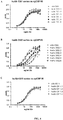
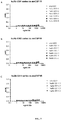
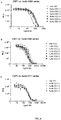
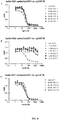
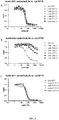
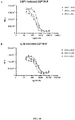
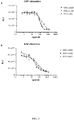
- Those three humanized antibodies inhibit ligand-induced phosphorylation of human CSF1R, and also block ligand-induced proliferation and survival responses in primary human monocytes. See, e.g., Tables 6 and 7, and Figures 10 and 11 .
- these antibodies are useful for treating diseases involving, for example, ligand-induced proliferation and survival responses in primary human monocytes.
- Blocking CSF1R-induced responses with an anti-CSFIR antibody should inhibit proliferation, survival, activation, maturation of differentiated myeloid lineage cells and attenuate their ability to mediate disease pathology.
- blocking CSF1R-induced responses with an anti-CSFIR antibody should inhibit differentiation of peripheral blood monocyte intermediates into differentiated myeloid lineage cells, decreasing the number of pathology-mediating differentiated myeloid lineage cells.
- the humanized anti-CSF1R antibodies described herein can be used to treat chronic diseases with extant symptoms by inhibiting the ability of differentiated myeloid lineage cells to mediate disease pathology.
- the humanized antibodies can also be used to treat chronic diseases that are relapsing and remitting in nature by inhibiting the development of new pathology-mediating myeloid lineage cells differentiated from peripheral blood monocytes during the remitting phase of the disease, thus attenuating the number of and new formation of the pathology-mediating cells.
- the invention provides an isolated antibody comprising a heavy chain and a light chain, as defined in the claims, wherein the antibody binds to CSF1R.
- the heavy chain comprises a sequence that is at least 90%, at least 95%, at least 97%, at least 99%, or 100% identical to a sequence selected from SEQ ID NOs: 9, 11, 13, and 39 to 45.
- the light chain comprises a sequence that is at least 90%, at least 95%, at least 97%, at least 99%, or 100% identical to a sequence selected from SEQ ID NOs: 10, 12, 14, and 46 to 52.
- the heavy chain comprises a sequence that is at least 90%, at least 95%, at least 97%, at least 99%, or 100% identical to a sequence selected from SEQ ID NOs: 9, 11, 13, and 39 to 45
- the light chain comprises a sequence that is at least 90%, at least 95%, at least 97%, at least 99%, or 100% identical to a sequence selected from SEQ ID NOs: 10, 12, 14, and 46 to 52.
- the HC CDR1, HC CDR2, and HC CDR3 comprise a set of sequences selected from: (a) SEQ ID NOs: 15, 16, and 17; (b) SEQ ID NOs: 21, 22, and 23; and (c) SEQ ID NOs: 27, 28, and 29.
- the LC CDR1, LC CDR2, and LC CDR3 comprise a set of sequences selected from: (a) SEQ ID NOs: 18, 19, and 20; (b) SEQ ID NOs: 24, 25, and 26; and (c) SEQ ID NOs: 30, 31, and 32.
- the heavy chain comprises an HC CDR1, HC CDR2, and HC CDR3, wherein the HC CDR1, HC CDR2, and HC CDR3 comprise a set of sequences selected from: (a) SEQ ID NOs: 15, 16, and 17; (b) SEQ ID NOs: 21, 22, and 23; and (c) SEQ ID NOs: 27, 28, and 29; and the light chain comprises an LC CDR1, LC CDR2, and LC CDR3, wherein the LC CDR1, LC CDR2, and LC CDR3 comprise a set of sequences selected from: (a) SEQ ID NOs: 18, 19, and 20; (b) SEQ ID NOs: 24, 25, and 26; and (c) SEQ ID NOs: 30, 31, and 32.
- an isolated antibody comprising a heavy chain and a light chain, wherein the antibody comprises:
- an antibody comprising a heavy chain and a light chain
- the antibody comprises: (a) a heavy chain comprising a heavy chain (HC) CDR1 having the sequence of SEQ ID NO: 15, an HC CDR2 having the sequence of SEQ ID NO: 16, and an HC CDR3 having the sequence of SEQ ID NO: 17, and a light chain comprising a light chain (LC) CDR1 having the sequence of SEQ ID NO: 18, a LC CDR2 having the sequence of SEQ ID NO: 19, and a LC CDR3 having the sequence of SEQ ID NO: 20; (b) a heavy chain comprising a heavy chain (HC) CDR1 having the sequence of SEQ ID NO: 21, an HC CDR2 having the sequence of SEQ ID NO: 22, and an HC CDR3 having the sequence of SEQ ID NO: 23, and a light chain comprising a light chain (LC) CDR1 having the sequence of SEQ ID NO: 24, a LC CDR2 having the sequence
- an antibody comprises a heavy chain and a light chain, wherein the antibody comprises: (a) a heavy chain comprising a sequence of SEQ ID NO: 53 and a light chain comprising a sequence of SEQ ID NO: 60; (b) a heavy chain comprising a sequence of SEQ ID NO: 53 and a light chain comprising a sequence of SEQ ID NO: 61; or (c) a heavy chain comprising a sequence of SEQ ID NO: 58 and a light chain comprising a sequence of SEQ ID NO: 65.
- an antibody comprises a heavy chain and a light chain, wherein the antibody comprises: (a) a heavy chain consisting of the sequence of SEQ ID NO: 53 and a light chain consisting of the sequence of SEQ ID NO: 60; (b) a heavy chain consisting of the sequence of SEQ ID NO: 53 and a light chain consisting of the sequence of SEQ ID NO: 61; or (c) a heavy chain consisting of the sequence of SEQ ID NO: 58 and a light chain consisting of the sequence of SEQ ID NO: 65.
- an antibody is a humanized antibody. In some embodiments, an antibody is selected from a Fab, an Fv, an scFv, a Fab', and a (Fab') 2 . In some embodiments, an antibody is a chimeric antibody. In some embodiments, an antibody is selected from an IgA, an IgG, and an IgD. In some embodiments, an antibody is an IgG. In some embodiments, an antibody is an IgG4. In some embodiments, an antibody is an IgG4 comprising an S241P mutation in at least one IgG4 heavy chain constant region.
- an antibody binds to human CSF1R and/or binds to cynomolgus CSF1R. In some embodiments, an antibody blocks ligand binding to CSF1R. In some embodiments, an antibody blocks binding of CSF1 and/or IL34 to CSF1R. In some embodiments, an antibody inhibits ligand-induced CSF1R phosphorylation. In some embodiments, an antibody inhibits CSF1- and/or IL34-induced CSF1R phosphorylation. In some embodiments, an antibody binds to human CSF1R with an affinity (K D ) of less than 1 nM. In some embodiments, antibody inhibits monocyte proliferation and/or survival responses in the presence of CSF1 or IL34.
- a pharmaceutical composition comprising an antibody that binds CSF1R is provided.
- an isolated nucleic acid comprising a nucleic acid or a composition described above is provided.
- a host cell is a eukaryotic host cell. In some embodiments, a host cell is a mammalian host cell. In some embodiments, a host cell is selected from a CHO cell, a 293 cell, an NSO cell, and a PER.C6 cell. In some embodiments, a host cell is a 293-6E cell or a DG44 cell.
- methods of treating disease comprising administering to a patient a pharmaceutical composition comprising an antibody that binds CSF1R are disclosed.
- a method of treating multiple sclerosis comprising administering to a patient a pharmaceutical composition comprising an antibody that binds CSF1R is disclosed.
- a method of treating rheumatoid arthritis comprising administering to a patient a pharmaceutical composition comprising an antibody that binds CSF1R is disclosed.
- a method of treating osteolytic bone loss comprising administering to a patient a pharmaceutical composition comprising an antibody that binds CSF1R is disclosed.
- the osteolytic bone loss is selected from osteoporosis, metastasis-induced osteolytic bone loss, and rheumatoid arthritis-induced bone loss.
- a method of treating cancer comprising administering to a patient a pharmaceutical composition comprising an antibody that binds CSF1R is disclosed.
- the cancer is selected from breast cancer, prostate cancer, endometrial cancer, bladder cancer, kidney cancer, esophageal cancer, squamous cell carcinoma, uveal melanoma, follicular lymphoma, renal cell carcinoma, cervical cancer, ovarian cancer, lung cancer, colorectal cancer, brain cancer, pancreatic cancer, head and neck cancer, liver cancer, leukemia, lymphoma, Hodgkin's disease, multiple myeloma, melanoma, astrocytoma, stomach cancer, and pulmonary adenocarcinoma.
- a method of treating an inflammatory condition comprising administering to a patient a pharmaceutical composition comprising an antibody that binds CSF1R is disclosed.
- antibodies that bind CSF1R and compositions comprising antibodies that bind CSF1R are provided for use in methods of treatment of human or animals. In some embodiments, antibodies that bind CSF1R and compositions comprising antibodies that bind CSF1R are provided for use in a method of treating rheumatoid arthritis in a human or animal. In some embodiments, antibodies that bind CSF1R and compositions comprising antibodies that bind CSF1R are provided for use in a method of treating multiple sclerosis in a human or animal. In some embodiments, antibodies that bind CSF1R and compositions comprising antibodies that bind CSF1R are provided for use in a method of treating cancer in a human or animal. In some embodiments, antibodies that bind CSF1R and compositions comprising antibodies that bind CSF1R are provided for use in a method of treating an inflammatory condition in a human or animal.
- Methods of treating diseases comprising administering novel antibodies to CSF1R are disclosed. All of the antibodies have binding affinities for human CSF1R ECD of less than 2 nM, and all but two of the humanized antibodies have sub-nanomolar binding affinities for human CSF1R ECD. Further, the new antibodies block binding of both CSF1 and IL34 to human CSF1R, and inhibit ligand-induced phosphorylation of human CSF1R. Many of the new antibodies also block binding of CSF1 and IL34 to cynomolgus CSF1R, which facilitates in vivo experiments to support the development of anti-CSFIR antibody therapeutics. The new antibodies are therefore well suited for therapeutic use in human diseases, including, but not limited to, cancer, autoimmune diseases, and inflammatory conditions.
- Exemplary techniques used in connection with recombinant DNA, oligonucleotide synthesis, tissue culture and transformation (e.g., electroporation, lipofection), enzymatic reactions, and purification techniques are known in the art. Many such techniques and procedures are described, e.g., in Sambrook et al. Molecular Cloning: A Laboratory Manual (2nd ed., Cold Spring Harbor Laboratory Press, Cold Spring Harbor, N.Y. (1989 )), among other places.
- exemplary techniques for chemical syntheses, chemical analyses, pharmaceutical preparation, formulation, and delivery, and treatment of patients are also known in the art.
- Anti-CSFIR antibodies include, but are not limited to, humanized antibodies, chimeric antibodies, mouse antibodies, human antibodies, and antibodies comprising the heavy chain and/or light chain CDRs discussed herein.
- humanized antibodies that bind CSF1R are provided.
- Humanized antibodies are useful as therapeutic molecules because humanized antibodies reduce or eliminate the human immune response to non-human antibodies (such as the human anti-mouse antibody (HAMA) response), which can result in an immune response to an antibody therapeutic, and decreased effictiveness of the therapeutic.
- HAMA human anti-mouse antibody
- Nonlimiting exemplary humanized antibodies include Ab1 through Ab16, described herein.
- Nonlimiting exemplary humanized antibodies also include antibodies comprising a heavy chain variable region of an antibody selected from Ab1 to Ab16 and/or a light chain variable region of an antibody selected from Ab1 to Ab16.
- Nonlimiting exemplary humanized antibodies include antibodies comprising a heavy chain variable region selected from SEQ ID NOs: 39 to 45 and/or a light chain variable region selected from SEQ ID NOs: 46 to 52.
- Exemplary humanized antibodies also include, but are not limited to, humanized antibodies comprising heavy chain CDR1, CDR2, and CDR3, and/or light chain CDR1, CDR2, and CDR3 of an antibody selected from 0301, 0302, and 0311.
- a humanized anti-CSFIR antibody comprises heavy chain CDR1, CDR2, and CDR3 and/or a light chain CDR1, CDR2, and CDR3 of an antibody selected from 0301, 0302, and 0311.
- Nonlimiting exemplary humanized anti-CSFIR antibodies include antibodies comprising sets of heavy chain CDR1, CDR2, and CDR3 selected from: SEQ ID NOs: 15, 16, and 17; SEQ ID NOs: 21, 22, and 23; and SEQ ID NOs: 27, 28, and 29.
- Nonlimiting exemplary humanized anti-CSFIR antibodies also include antibodies comprising sets of light chain CDR1, CDR2, and CDR3 selected from: SEQ ID NOs: 18, 19, and 20; SEQ ID NOs: 24, 25, and 26; and SEQ ID NOs: 30, 31, and 32.
- Nonlimiting exemplary humanized anti-CSFIR antibodies include antibodies comprising the sets of heavy chain CDR1, CDR2, and CDR3, and light chain CDR1, CDR2, and CDR3 in Table 1 (SEQ ID NOs shown; see Table 8 for sequences). Each row of Table 1 shows the heavy chain CDR1, CDR2, and CDR3, and light chain CDR1, CDR2, and CDR3 of an exemplary antibody.
- Table 1 Heavy chain and light chain CDRs Heavy chain Light chain CDR1 SEQ ID CDR2 SEQ ID CDR3 SEQ ID CDR1 SEQ ID CDR2 SEQ ID CDR3 SEQ ID 15 16 17 18 19 20 21 22 23 24 25 26 27 28 29 30 31 32
- a humanized anti-CSFIR antibody comprises a heavy chain comprising a variable region sequence that is at least 90%, at least 91%, at least 92%, at least 93%, at least 94%, at least 95%, at least 96%, at least 97%, at least 98%, or at least 99% identical to a sequence selected from SEQ ID NOs: 9, 11, 13, and 39 to 45, and wherein the antibody binds CSF1R.
- a humanized anti-CSFIR antibody comprises a light chain comprising a variable region sequence that is at least 90%, at least 91%, at least 92%, at least 93%, at least 94%, at least 95%, at least 96%, at least 97%, at least 98%, or at least 99% identical to a sequence selected from SEQ ID NOs: 10, 12, 14, and 46 to 52, wherein the antibody binds CSF1R.
- a humanized anti-CSFIR antibody comprises a heavy chain comprising a variable region sequence that is at least 90%, at least 91%, at least 92%, at least 93%, at least 94%, at least 95%, at least 96%, at least 97%, at least 98%, or at least 99% identical to a sequence selected from SEQ ID NOs: 9, 11, 13, and 39 to 45; and a light chain comprising a variable region sequence that is at least 90%, at least 91%, at least 92%, at least 93%, at least 94%, at least 95%, at least 96%, at least 97%, at least 98%, or at least 99% identical to a sequence selected from SEQ ID NOs: 10, 12, 14, and 46 to 52; wherein the antibody binds CSF1R.
- whether a particular polypeptide is, for example, at least 95% identical to an amino acid sequence can be determined using, e.g., a computer program.
- the percentage of identity is calculated over the full length of the reference amino acid sequence.
- a humanized anti-CSFIR antibody comprises at least one of the CDRs discussed herein. That is, in some embodiments, a humanized anti-CSFIR antibody comprises at least one CDR selected from a heavy chain CDR1 discussed herein, a heavy chain CDR2 discussed herein, a heavy chain CDR3 discussed herein, a light chain CDR1 discussed herein, a light chain CDR2 discussed herein, and a light chain CDR3 discussed herein. Further, in some embodiments, a humanized anti-CSFIR antibody comprises at least one mutated CDR based on a CDR discussed herein, wherein the mutated CDR comprises 1, 2, 3, or 4 amino acid substitutions relative to the CDR discussed herein.
- one or more of the amino acid substitutions are conservative amino acid substitutions.
- One skilled in the art can select one or more suitable conservative amino acid substitutions for a particular CDR sequence, wherein the suitable conservative amino acid substitutions are not predicted to significantly alter the binding properties of the antibody comprising the mutated CDR.
- Exemplary humanized anti-CSFIR antibodies also include antibodies that compete for binding to CSF1R with an antibody described herein.
- a humanized anti-CSFIR antibody is provided that competes for binding to CSF1R with an antibody selected from Fabs 0301, 0302, and 0311; and bivalent (i.e., having two heavy chains and two light chains) antibody versions of those Fabs.
- a humanized antibody described herein comprises one or more human constant regions.
- the human heavy chain constant region is of an isotype selected from IgA, IgG, and IgD.
- the human light chain constant region is of an isotype selected from ⁇ and ⁇ .
- a humanized antibody described herein comprises a human IgG constant region.
- a humanized antibody described herein comprises a human IgG4 heavy chain constant region.
- a humanized antibody described herein comprises an S241P mutation in the human IgG4 constant region.
- a humanized antibody described herein comprises a human IgG4 constant region and a human ⁇ light chain.
- the choice of heavy chain constant region can determine whether or not an antibody will have effector function in vivo.
- effector function includes antibody-dependent cell-mediated cytotoxicity (ADCC) and/or complement-dependent cytotoxicity (CDC), and can result in killing of the cell to which the antibody is bound.
- cell killing may be desirable, for example, when the antibody binds to a cell that supports the maintenance or growth of the tumor.
- Exemplary cells that may support the maintenance or growth of a tumor include, but are not limited to, tumor cells themselves, cells that aid in the recruitment of vasculature to the tumor, and cells that provide ligands, growth factors, or counter-receptors that support or promote tumour growth or tumour survial.
- an anti-CSFIR antibody comprising a human IgG1 heavy chain or a human IgG3 heavy chain is selected.
- effector function may not be desirable.
- anti-CSFIR antibodies developed for the treatment of cancer may not be suitable for use in treatment of MS and/or RA and/or osteolysis.
- an anti-CSFIR antibody that lacks significant effector function is used in treatment of MS and/or RA and/or osteolysis.
- an anti-CSFIR antibody for treatment of MS and/or RA and/or osteolysis comprises a human IgG4 or IgG2 heavy chain constant region.
- an IgG4 constant region comprises an S241P mutation.
- An antibody may be humanized by any method.
- Nonlimiting exemplary methods of humanization include methods described, e.g., in U.S. Patent Nos. 5,530,101 ; 5,585,089 ; 5,693,761 ; 5,693,762 ; 6,180,370 ; Jones et al., Nature 321: 522-525 (1986 ); Riechmann et al., Nature 332: 323-27 (1988 ); Verhoeyen et al., Science 239: 1534-36 (1988 ); and U.S. Publication No. US 2009/0136500 .
- a humanized antibody is an antibody in which at least one amino acid in a framework region of a non-human variable region has been replaced with the amino acid from the corresponding location in a human framework region.
- at least two, at least three, at least four, at least five, at least six, at least seven, at least eight, at least nine, at least 10, at least 11, at least 12, at least 15, or at least 20 amino acids in the framework regions of a non-human variable region are replaced with an amino acid from one or more corresponding locations in one or more human framework regions.
- some of the corresponding human amino acids used for substitution are from the framework regions of different human immunoglobulin genes. That is, in some such embodiments, one or more of the non-human amino acids may be replaced with corresponding amino acids from a human framework region of a first human antibody or encoded by a first human immunoglobulin gene, one or more of the non-human amino acids may be replaced with corresponding amino acids from a human framework region of a second human antibody or encoded by a second human immunoglobulin gene, one or more of the non-human amino acids may be replaced with corresponding amino acids from a human framework region of a third human antibody or encoded by a third human immunoglobulin gene, etc.
- all of the corresponding human amino acids being used for substitution in a single framework region need not be from the same human framework. In some embodiments, however, all of the corresponding human amino acids being used for substitution are from the same human antibody or encoded by the same human immunoglobulin gene.
- an antibody is humanized by replacing one or more entire framework regions with corresponding human framework regions.
- a human framework region is selected that has the highest level of homology to the non-human framework region being replaced.
- such a humanized antibody is a CDR-grafted antibody.
- one or more framework amino acids are changed back to the corresponding amino acid in a mouse framework region.
- Such "back mutations” are made, in some embodiments, to retain one or more mouse framework amino acids that appear to contribute to the structure of one or more of the CDRs and/or that may be involved in antigen contacts and/or appear to be involved in the overall structural integrity of the antibody.
- ten or fewer, nine or fewer, eight or fewer, seven or fewer, six or fewer, five or fewer, four or fewer, three or fewer, two or fewer, one, or zero back mutations are made to the framework regions of an antibody following CDR grafting.
- a humanized antibody also comprises a human heavy chain constant region and/or a human light chain constant region.
- an anti-CSFIR antibody is a chimeric antibody.
- an anti-CSFIR antibody comprises at least one non-human variable region and at least one human constant region.
- all of the variable regions of an anti-CSFIR antibody are non-human variable regions
- all of the constant regions of an anti-CSFIR antibody are human constant regions.
- one or more variable regions of a chimeric antibody are mouse variable regions.
- the human constant region of a chimeric antibody need not be of the same isotype as the non-human constant region, if any, it replaces. Chimeric antibodies are discussed, e.g., in U.S. Patent No. 4,816,567 ; and Morrison et al. Proc. Natl. Acad. Sci. USA 81: 6851-55 (1984 ).
- Nonlimiting exemplary chimeric antibodies include chimeric antibodies comprising the heavy and/or light chain variable regions of an antibody selected from 0301, 0302, and 0311. Additional nonlimiting exemplary chimeric antibodies include chimeric antibodies comprising heavy chain CDR1, CDR2, and CDR3, and/or light chain CDR1, CDR2, and CDR3 of an antibody selected from 0301, 0302, and 0311.
- Nonlimiting exemplary chimeric anti-CSFIR antibodies include antibodies comprising the following pairs of heavy and light chain variable regions: SEQ ID NOs: 9 and 10; SEQ ID NOs: 11 and 12; and SEQ ID NOs: 13 and 14.
- Nonlimiting exemplary anti-CSFIR antibodies include antibodies comprising a set of heavy chain CDR1, CDR2, and CDR3, and light chain CDR1, CDR2, and CDR3 shown above in Table 1.
- a chimeric anti-CSFIR antibody comprises a heavy chain comprising a variable region sequence that is at least 90%, at least 91%, at least 92%, at least 93%, at least 94%, at least 95%, at least 96%, at least 97%, at least 98%, or at least 99% identical to a sequence selected from SEQ ID NOs: 9, 11, 13, and 39 to 45, wherein the antibody binds CSF1R.
- a chimeric anti-CSFIR antibody comprises a light chain comprising a variable region sequence that is at least 90%, at least 91%, at least 92%, at least 93%, at least 94%, at least 95%, at least 96%, at least 97%, at least 98%, or at least 99% identical to a sequence selected from SEQ ID NOs: 10, 12, 14, and 46 to 52, wherein the antibody binds CSF1R.
- a chimeric anti-CSFIR antibody comprises a heavy chain comprising a variable region sequence that is at least 90%, at least 91%, at least 92%, at least 93%, at least 94%, at least 95%, at least 96%, at least 97%, at least 98%, or at least 99% identical to a sequence selected from SEQ ID NOs: 9, 11, 13, and 39 to 45; and a light chain comprising a variable region sequence that is at least 90%, at least 91%, at least 92%, at least 93%, at least 94%, at least 95%, at least 96%, at least 97%, at least 98%, or at least 99% identical to a sequence selected from SEQ ID NOs: 10, 12, 14, and 46 to 52; wherein the antibody binds CSF1R.
- a chimeric anti-CSFIR antibody comprises at least one of the CDRs discussed herein. That is, in some embodiments, a chimeric anti-CSFIR antibody comprises at least one CDR selected from a heavy chain CDR1 discussed herein, a heavy chain CDR2 discussed herein, a heavy chain CDR3 discussed herein, a light chain CDR1 discussed herein, a light chain CDR2 discussed herein, and a light chain CDR3 discussed herein. Further, in some embodiments, a chimeric anti-CSFIR antibody comprises at least one mutated CDR based on a CDR discussed herein, wherein the mutated CDR comprises 1, 2, 3, or 4 amino acid substitutions relative to the CDR discussed herein.
- one or more of the amino acid substitutions are conservative amino acid substitutions.
- One skilled in the art can select one or more suitable conservative amino acid substitutions for a particular CDR sequence, wherein the suitable conservative amino acid substitutions are not predicted to significantly alter the binding properties of the antibody comprising the mutated CDR.
- Exemplary chimeric anti-CSFIR antibodies also include chimeric antibodies that compete for binding to CSF1R with an antibody described herein.
- a chimeric anti-CSFIR antibody is provided that competes for binding to CSF1R with an antibody selected from Fabs 0301, 0302, and 0311; and bivalent (i.e., having two heavy chains and two light chains) antibody versions of those Fabs.
- a chimeric antibody described herein comprises one or more human constant regions.
- the human heavy chain constant region is of an isotype selected from IgA, IgG, and IgD.
- the human light chain constant region is of an isotype selected from ⁇ and ⁇ .
- a chimeric antibody described herein comprises a human IgG constant region.
- a chimeric antibody described herein comprises a human IgG4 heavy chain constant region.
- a chimeric antibody described herein comprises an S241P mutation in the human IgG4 constant region.
- a chimeric antibody described herein comprises a human IgG4 constant region and a human ⁇ light chain.
- effector function may depend on the particular method of treatment intended for an antibody.
- a chimeric anti-CSFIR antibody comprising a human IgG1 heavy chain constant region or a human IgG3 heavy chain constant region is selected.
- a chimeric anti-CSFIR antibody comprising a human IgG4 or IgG2 heavy chain constant region is selected.
- Human antibodies can be made by any suitable method.
- Nonlimiting exemplary methods include making human antibodies in transgenic mice that comprise human immunoglobulin loci. See, e.g., Jakobovits et al., Proc. Natl. Acad. Sci. USA 90: 2551-55 (1993 ); Jakobovits et al., Nature 362: 255-8 (1993 ); Lonberg et al., Nature 368: 856-9 (1994 ); and U.S. Patent Nos.
- Nonlimiting exemplary methods also include making human antibodies using phage display libraries. See, e.g., Hoogenboom et al., J. Mol. Biol. 227: 381-8 (1992 ); Marks et al., J. Mol. Biol. 222: 581-97 (1991 ); and PCT Publication No. WO 99/10494 .
- a human anti-CSFIR antibody binds to a polypeptide having the sequence of SEQ ID NO: 1.
- Exemplary human anti-CSFIR antibodies also include antibodies that compete for binding to CSF1R with an antibody described herein.
- a human anti-CSFIR antibody is provided that competes for binding to CSF1R with an antibody selected from Fabs 0301, 0302, and 0311, and bivalent (i.e., having two heavy chains and two light chains) antibody versions of those Fabs.
- a human anti-CSFIR antibody comprises one or more human constant regions.
- the human heavy chain constant region is of an isotype selected from IgA, IgG, and IgD.
- the human light chain constant region is of an isotype selected from ⁇ and ⁇ .
- a human antibody described herein comprises a human IgG constant region.
- a human antibody described herein comprises a human IgG4 heavy chain constant region.
- a human antibody described herein comprises an S241P mutation in the human IgG4 constant region.
- a human antibody described herein comprises a human IgG4 constant region and a human ⁇ light chain.
- a human anti-CSF1R antibody comprising a human IgG1 heavy chain constant region or a human IgG3 heavy chain constant region is selected. In some embodiments, when effector function is not desirable, a human anti-CSF1R antibody comprising a human IgG4 or IgG2 heavy chain constant region is selected.
- anti-CSF1R antibodies also include, but are not limited to, mouse, humanized, human, chimeric, and engineered antibodies that comprise, for example, one or more of the CDR sequences described herein.
- an anti-CSF1R antibody comprises a heavy chain variable region described herein.
- an anti-CSF1R antibody comprises a light chain variable region described herein.
- an anti-CSF1R antibody comprises a heavy chain variable region described herein and a light chain variable region described herein.
- an anti-CSF1R antibody comprises heavy chain CDR1, CDR2, and CDR3 described herein.
- an anti-CSF1R antibody comprises light chain CDR1, CDR2, and CDR3 described herein.
- an anti-CSFIR antibody comprises heavy chain CDR1, CDR2, and CDR3 described herein and light chain CDR1, CDR2, and CDR3 described herein.
- an anti-CSF1R antibody comprises a heavy chain variable region of an antibody selected from Fabs 0301, 0302, and 0311.
- Nonlimiting exemplary anti-CSF1R antibodies also include antibodies comprising a heavy chain variable region of an antibody selected from humanized antibodies Ab1 to Ab16.
- Nonlimiting exemplary anti-CSF1R antibodies include antibodies comprising a heavy chain variable region comprising a sequence selected from SEQ ID NOs: 9, 11, 13, and 39 to 45.
- an anti-CSF1R antibody comprises a light chain variable region of an antibody selected from Fabs 0301, 0302, and 311.
- Nonlimiting exemplary anti-CSF1R antibodies also include antibodies comprising a light chain variable region of an antibody selected from humanized antibodies Ab1 to Ab16.
- Nonlimiting exemplary anti-CSF1R antibodies include antibodies comprising a light chain variable region comprising a sequence selected from SEQ ID NOs: 10, 12, 14, and 46 to 52.
- an anti-CSF1R antibody comprises a heavy chain variable region and a light chain variable region of an antibody selected from Fabs 0301, 0302, and 0311.
- Nonlimiting exemplary anti-CSF1R antibodies also include antibodies comprising a heavy chain variable region and a light chain variable region of an antibody selected from humanized antibodies Ab1 to Ab16.
- Nonlimiting exemplary anti-CSF1R antibodies include antibodies comprising the following pairs of heavy and light chain variable regions: SEQ ID NOs: 9 and 10; SEQ ID NOs: 11 and 12; and SEQ ID NOs: 13 and 14; SEQ ID NOs: 39 and 40; SEQ ID NOs: 41 and 42; SEQ ID NOs: 43 and 44; SEQ ID NOs: 45 and 46; SEQ ID NOs: 47 and 48; SEQ ID NOs: 49 and 50; and SEQ ID NOs: 51 and 52.
- Nonlimiting exemplary anti-CSF1R antibodies also include antibodies comprising the following pairs of heavy and light chains: SEQ ID NOs: 33 and 34; SEQ ID NOs: 35 and 36; and SEQ ID NOs: 37 and 38.
- an anti-CSF1R antibody comprises heavy chain CDR1, CDR2, and CDR3 of an antibody selected from Fabs 0301, 0302, and 0311.
- Nonlimiting exemplary anti-CSFIR antibodies include antibodies comprising sets of heavy chain CDR1, CDR2, and CDR3 selected from: SEQ ID NOs: 15, 16, and 17; SEQ ID NOs: 21, 22, and 23; and SEQ ID NOs: 27, 28,and 29.
- an anti-CSF1R antibody comprises light chain CDR1, CDR2, and CDR3 of an antibody selected from Fabs 0301, 0302, and 0311.
- Nonlimiting exemplary anti-CSF1R antibodies include antibodies comprising sets of light chain CDR1, CDR2, and CDR3 selected from: SEQ ID NOs: 18, 19, and 20; SEQ ID NOs: 24, 25, and 26; and SEQ ID NOs: 30, 31, and 32.
- an anti-CSF1R antibody comprises heavy chain CDR1, CDR2, and CDR3, and light chain CDR1, CDR2, and CDR3 of an antibody selected from Fabs 0301, 0302, and 0311.
- Nonlimiting exemplary anti-CSF1R antibodies include antibodies comprising the sets of heavy chain CDR1, CDR2, and CDR3, and light chain CDR1, CDR2, and CDR3 shown above in Table 1.
- an anti-CSF1R antibody comprises a heavy chain comprising a variable region sequence that is at least 90%, at least 91%, at least 92%, at least 93%, at least 94%, at least 95%, at least 96%, at least 97%, at least 98%, or at least 99% identical to a sequence selected from SEQ ID NOs: 9, 11, 13, and 39 to 45, wherein the antibody binds CSF1R.
- an anti-CSF1R antibody comprises a light chain comprising a variable region sequence that is at least 90%, at least 91%, at least 92%, at least 93%, at least 94%, at least 95%, at least 96%, at least 97%, at least 98%, or at least 99% identical to a sequence selected from SEQ ID NOs: 10, 12, 14, and 46 to 52, wherein the antibody binds CSF1R.
- an anti-CSF1R antibody comprises a heavy chain comprising a variable region sequence that is at least 90%, at least 91%, at least 92%, at least 93%, at least 94%, at least 95%, at least 96%, at least 97%, at least 98%, or at least 99% identical to a sequence selected from SEQ ID NOs: 9, 11, 13, and 39 to 45; and a light chain comprising a variable region sequence that is at least 90%, at least 91%, at least 92%, at least 93%, at least 94%, at least 95%, at least 96%, at least 97%, at least 98%, or at least 99% identical to a sequence selected from SEQ ID NOs: 10, 12, 14, and 46 to 52; wherein the antibody binds CSF1R.
- an anti-CSF1R antibody comprises at least one of the CDRs discussed herein. That is, in some embodiments, an anti-CSF1R antibody comprises at least one CDR selected from a heavy chain CDR1 discussed herein, a heavy chain CDR2 discussed herein, a heavy chain CDR3 discussed herein, a light chain CDR1 discussed herein, a light chain CDR2 discussed herein, and a light chain CDR3 discussed herein. Further, in some embodiments, an anti-CSF1R antibody comprises at least one mutated CDR based on a CDR discussed herein, wherein the mutated CDR comprises 1, 2, 3, or 4 amino acid substitutions relative to the CDR discussed herein.
- one or more of the amino acid substitutions are conservative amino acid substitutions.
- One skilled in the art can select one or more suitable conservative amino acid substitutions for a particular CDR sequence, wherein the suitable conservative amino acid substitutions are not predicted to significantly alter the binding properties of the antibody comprising the mutated CDR.
- anti-CSF1R antibodies also include antibodies that compete for binding to CSF1R with an antibody described herein.
- an anti-CSF1R antibody is provided that competes for binding to CSF1R with an antibody selected from Fabs 0301, 0302, and 0311, and bivalent (i.e., having two heavy chains and two light chains) antibody versions of those Fabs.
- an antibody described herein comprises one or more human constant regions.
- the human heavy chain constant region is of an isotype selected from IgA, IgG, and IgD.
- the human light chain constant region is of an isotype selected from ⁇ and ⁇ .
- an antibody described herein comprises a human IgG constant region.
- an antibody described herein comprises a human IgG4 heavy chain constant region.
- an antibody described herein comprises an S241P mutation in the human IgG4 constant region.
- an antibody described herein comprises a human IgG4 constant region and a human ⁇ light chain.
- effector function may depend on the particular method of treatment intended for an antibody.
- an anti-CSF1R antibody comprising a human IgG1 heavy chain constant region or a human IgG3 heavy chain constant region is selected.
- an anti-CSF1R antibody comprising a human IgG4 or IgG2 heavy chain constant region is selected.
- anti-CSF1R antibody heavy chain variable regions are provided.
- an anti-CSF1R antibody heavy chain variable region is a mouse variable region, a human variable region, or a humanized variable region.
- An anti-CSF1R antibody heavy chain variable region comprises a heavy chain CDR1, FR2, CDR2, FR3, and CDR3.
- an anti-CSF1R antibody heavy chain variable region further comprises a heavy chain FR1 and/or FR4.
- Nonlimiting exemplary heavy chain variable regions include, but are not limited to, heavy chain variable regions having an amino acid sequence selected from SEQ ID NOs: 9, 11, 13, and 39 to 45.
- an anti-CSF1R antibody heavy chain variable region comprises a CDR1 comprising a sequence selected from SEQ ID NOs: 15, 21, and 27.
- an anti-CSF1R antibody heavy chain variable region comprises a CDR2 comprising a sequence selected from SEQ ID NOs: 16, 22, and 28.
- an anti-CSF1R antibody heavy chain variable region comprises a CDR3 comprising a sequence selected from SEQ ID NOs: 17, 23, and 29.
- Nonlimiting exemplary heavy chain variable regions include, but are not limited to, heavy chain variable regions comprising sets of CDR1, CDR2, and CDR3 selected from: SEQ ID NOs: 15, 16, and 17; SEQ ID NOs: 21, 22, and 23; and SEQ ID NOs: 27, 28, and 29.
- an anti-CSF1R antibody heavy chain comprises a variable region sequence that is at least 90%, at least 91%, at least 92%, at least 93%, at least 94%, at least 95%, at least 96%, at least 97%, at least 98%, or at least 99% identical to a sequence selected from SEQ ID NOs: 9, 11, 13, and 39 to 45, wherein the heavy chain, together with a light chain, is capable of forming an antibody that binds CSF1R.
- an anti-CSF1R antibody heavy chain comprises at least one of the CDRs discussed herein. That is, in some embodiments, an anti-CSF1R antibody heavy chain comprises at least one CDR selected from a heavy chain CDR1 discussed herein, a heavy chain CDR2 discussed herein, and a heavy chain CDR3 discussed herein. Further, in some embodiments, an anti-CSF1R antibody heavy chain comprises at least one mutated CDR based on a CDR discussed herein, wherein the mutated CDR comprises 1, 2, 3, or 4 amino acid substitutions relative to the CDR discussed herein. In some embodiments, one or more of the amino acid substitutions are conservative amino acid substitutions. One skilled in the art can select one or more suitable conservative amino acid substitutions for a particular CDR sequence, wherein the suitable conservative amino acid substitutions are not predicted to significantly alter the binding properties of the heavy chain comprising the mutated CDR.
- a heavy chain comprises a heavy chain constant region. In some embodiments, a heavy chain comprises a human heavy chain constant region. In some embodiments, the human heavy chain constant region is of an isotype selected from IgA, IgG, and IgD. In some embodiments, the human heavy chain constant region is an IgG constant region. In some embodiments, a heavy chain comprises a human igG4 heavy chain constant region. In some such embodiments, the human IgG4 heavy chain constant region comprises an S241P mutation.
- a heavy chain when effector function is desirable, comprises a human IgG1 or IgG3 heavy chain constant region. In some embodiments, when effector function is less desirable, a heavy chain comprises a human IgG4 or IgG2 heavy chain constant region.
- anti-CSFIR antibody light chain variable regions are provided.
- an anti-CSFIR antibody light chain variable region is a mouse variable region, a human variable region, or a humanized variable region.
- An anti-CSF1R antibody light chain variable region comprises a light chain CDR1, FR2, CDR2, FR3, and CDR3.
- an anti-CSF1R antibody light chain variable region further comprises a light chain FR1 and/or FR4.
- Nonlimiting exemplary light chain variable regions include light chain variable regions having an amino acid sequence selected from SEQ ID NOs: 10, 12, 14, and 46 to 52.
- an anti-CSF1R antibody light chain variable region comprises a CDR1 comprising a sequence selected from SEQ ID NOs: 18, 24 and 30.
- an anti-CSF1R antibody light chain variable region comprises a CDR2 comprising a sequence selected from SEQ ID NOs: 19, 25, and 31.
- an anti-CSF1R antibody light chain variable region comprises a CDR3 comprising a sequence selected from SEQ ID NOs: 20, 26, and 32.
- Nonlimiting exemplary light chain variable regions include, but are not limited to, light chain variable regions comprising sets of CDR1, CDR2, and CDR3 selected from: SEQ ID NOs: 18, 19, and 20; SEQ ID NOs: 24, 25, and 26; and SEQ ID NOs: 30, 31, and 32.
- an anti-CSF1R antibody light chain comprises a variable region sequence that is at least 90%, at least 91%, at least 92%, at least 93%, at least 94%, at least 95%, at least 96%, at least 97%, at least 98%, or at least 99% identical to a sequence selected from SEQ ID NOs: 10, 12, 14, and 46 to 52, wherein the light chain, together with a heavy chain, is capable of forming an antibody that binds CSF1R.
- an anti-CSF1R antibody light chain comprises at least one of the CDRs discussed herein. That is, in some embodiments, an anti-CSF1R antibody light chain comprises at least one CDR selected from a light chain CDR1 discussed herein, a light chain CDR2 discussed herein, and a light chain CDR3 discussed herein. Further, in some embodiments, an anti-CSF1R antibody light chain comprises at least one mutated CDR based on a CDR discussed herein, wherein the mutated CDR comprises 1, 2, 3, or 4 amino acid substitutions relative to the CDR discussed herein. In some embodiments, one or more of the amino acid substitutions are conservative amino acid substitutions. One skilled in the art can select one or more suitable conservative amino acid substitutions for a particular CDR sequence, wherein the suitable conservative amino acid substitutions are not predicted to significantly alter the binding properties of the light chain comprising the mutated CDR.
- a light chain comprises a human light chain constant region.
- a human light chain constant region is selected from a human ⁇ and a human ⁇ light chain constant region.
- additional molecules that bind CSF1R are provided.
- Such molecules include, but are not limited to, non-canonical scaffolds, such as anti-calins, adnectins, ankyrin repeats, etc. See, e.g., Hosse et al., Prot. Sci. 15:14 (2006 ); Fiedler, M. and Skerra, A., "Non-Antibody Scaffolds," pp.467-499 in Handbook of Therapeutic Antibodies, Dubel, S., ed., Wiley-VCH, Weinheim, Germany, 2007 .
- an antibody having a structure described above binds to the CSF1R with a binding affinity (K D ) of less than 1 nM, blocks binding of CSF1 and/or IL34 to CSF1R, and inhibits CSF1R phosphorylation induced by CSF1 and/or IL34.
- K D binding affinity
- an anti-CSFIR antibody binds to the extracellular domain of CSF1R (CSF1R-ECD).
- CSF1R-ECD CSF1R-ECD
- an anti-CSF1R antibody has a binding affinity (K D ) for CSF1R of less than 1 nM, less than 0.5 nM, less than 0.1 nM, or less than 0.05 nM.
- K D binding affinity
- an anti-CSF1R antibody has a K D of between 0.01 and 1 nM, between 0.01 and 0.5 nM, between 0.01 and 0.1 nM, between 0.01 and 0.05 nM, or between 0.02 and 0.05 nM.
- an anti-CSF1R antibody blocks ligand binding to CSF1R. In some embodiments, an anti-CSF1R antibody blocks binding of CSF1 to CSF1R. In some embodiments, an anti-CSF1R antibody blocks binding of IL34 to CSF1R. In some embodiments, an anti-CSF1R antibody blocks binding of both CSF1 and IL34 to CSF1R. In some embodiments, an antibody that blocks ligand binding binds to the extracellular domain of CSF1R. An antibody is considered to "block ligand binding to CSF1R" when it reduces the amount of detectable binding of a ligand to CSF1R by at least 50%, using the assay described in Example 7.
- an antibody reduces the amount of detectable binding of a ligand to CSF1R by at least 60%, at least 70%, at least 80%, or at least 90%, using the assay described in Example 7.
- the antibody is said to block ligand binding by at least 50%, at least 60%, at least 70%, etc.
- an anti-CSF1R antibody inhibits ligand-induced CSF1R phosphorylation. In some embodiments, an anti-CSF1R antibody inhibits CSF1-induced CSF1R phosphorylation. In some embodiments, an anti-CSF1R antibody inhibits IL34-induced CSF1R phosphorylation. In some embodiments, an anti-CSF1R antibody inhibits both CSF1-induced and IL34-induced CSF1R phosphorylation. An antibody is considered to "inhibit ligand-induced CSF1R phosphorylation" when it reduces the amount of detectable ligand-induced CSF1R phosphorylation by at least 50%, using the assay described in Example 6.
- an antibody reduces the amount of detectable ligand-induced CSF1R phosphorylation by at least 60%, at least 70%, at least 80%, or at least 90%, using the assay described in Example 6. In some such embodiments, the antibody is said to inhibit ligand-induced CSF1R phosphorylation by at least at least 50%, at least 60%, at least 70%, etc.
- an antibody inhibits monocyte proliferation and/or survival responses in the presence of CSF1 and/or IL34.
- An antibody is considered to "inhibit monocyte proliferation and/or survival responses" when it reduces the amount of monocyte proliferation and/or survival responses in the presence of CSF1 and/or IL34 by at least 50%, using the assay described in Example 10.
- an antibody reduces the amount of monocyte proliferation and/or survival responses in the presence of CSF1 and/or IL34 by at least 60%, at least 70%, at least 80%, or at least 90%, using the assay described in Example 10.
- the antibody is said to inhibit monocyte proliferation and/or survival responses by at least at least 50%, at least 60%, at least 70%, etc.
- an anti-CSF1R antibody is conjugated to a label and/or a cytotoxic agent.
- a label is a moiety that facilitates detection of the antibody and/or facilitates detection of a molecule to which the antibody binds.
- Nonlimiting exemplary labels include, but are not limited to, radioisotopes, fluorescent groups, enzymatic groups, chemiluminescent groups, biotin, epitope tags, metal-binding tags, etc.
- One skilled in the art can select a suitable label according to the intended application.
- a cytotoxic agent is a moiety that reduces the proliferative capacity of one or more cells.
- a cell has reduced proliferative capacity when the cell becomes less able to proliferate, for example, because the cell undergoes apoptosis or otherwise dies, the cell fails to proceed through the cell cycle and/or fails to divide, the cell differentiates, etc.
- Nonlimiting exemplary cytotoxic agents include, but are not limited to, radioisotopes, toxins, and chemotherapeutic agents.
- One skilled in the art can select a suitable cytotoxic according to the intended application.
- a label and/or a cytotoxic agent is conjugated to an antibody using chemical methods in vitro.
- Nonlimiting exemplary chemical methods of conjugation are known in the art, and include services, methods and/or reagents commercially available from, e.g., Thermo Scientific Life Science Research Produces (formerly Pierce; Rockford, IL), Prozyme (Hayward, CA), SACRI Antibody Services (Calgary, Canada), AbD Serotec (Raleigh, NC), etc.
- the label and/or cytotoxic agent when a label and/or cytotoxic agent is a polypeptide, the label and/or cytotoxic agent can be expressed from the same expression vector with at least one antibody chain to produce a polypeptide comprising the label and/or cytotoxic agent fused to an antibody chain.
- a suitable method for conjugating a label and/or cytotoxic agent to an antibody can be selected from the same expression vector with at least one antibody chain to produce a polypeptide comprising the label and/or cytotoxic agent fused to an antibody chain.
- a leader sequence from a heterologous protein may be desirable.
- a leader sequence is selected from SEQ ID NOs: 3 and 4, which are light chain and heavy chain leader sequences, respectively.
- employing heterologous leader sequences may be advantageous in that a resulting mature polypeptide may remain unaltered as the leader sequence is removed in the ER during the secretion process.
- the addition of a heterologous leader sequence may be required to express and secrete some proteins.
- leader sequence sequences are described, e.g., in the online Leader sequence Database maintained by the Department of Biochemistry, National University of Singapore. See Choo et al., BMC Bioinformatics, 6: 249 (2005 ); and PCT Publication No. WO 2006/081430 .
- nucleic acid molecules comprising polynucleotides that encode one or more chains of anti-CSFIR antibodies are provided.
- a nucleic acid molecule comprises a polynucleotide that encodes a heavy chain or a light chain of an anti-CSFIR antibody.
- a nucleic acid molecule comprises both a polynucleotide that encodes a heavy chain and a polynucleotide that encodes a light chain, of an anti-CSFIR antibody.
- a first nucleic acid molecule comprises a first polynucleotide that encodes a heavy chain and a second nucleic acid molecule comprises a second polynucleotide that encodes a light chain.
- the heavy chain and the light chain are expressed from one nucleic acid molecule, or from two separate nucleic acid molecules, as two separate polypeptides.
- a single polynucleotide encodes a single polypeptide comprising both a heavy chain and a light chain linked together.
- a polynucleotide encoding a heavy chain or light chain of an anti-CSFIR antibody comprises a nucleotide sequence that encodes a leader sequence, which, when translated, is located at the N terminus of the heavy chain or light chain.
- the leader sequence may be the native heavy or light chain leader sequence, or may be another heterologous leader sequence.
- Nucleic acid molecules may be constructed using recombinant DNA techniques conventional in the art.
- a nucleic acid molecule is an expression vector that is suitable for expression in a selected host cell.
- Vectors comprising polynucleotides that encode anti-CSFIR heavy chains and/or anti-CSFIR light chains are provided. Vectors comprising polynucleotides that encode anti-CSFIR heavy chains and/or anti-CSFIR light chains are also provided. Such vectors include, but are not limited to, DNA vectors, phage vectors, viral vectors, retroviral vectors, etc.
- a vector comprises a first polynucleotide sequence encoding a heavy chain and a second polynucleotide sequence encoding a light chain.
- the heavy chain and light chain are expressed from the vector as two separate polypeptides. In some embodiments, the heavy chain and light chain are expressed as part of a single polypeptide, such as, for example, when the antibody is an scFv.
- a first vector comprises a polynucleotide that encodes a heavy chain and a second vector comprises a polynucleotide that encodes a light chain.
- the first vector and second vector are transfected into host cells in similar amounts (such as similar molar amounts or similar mass amounts).
- a mole- or mass-ratio of between 5:1 and 1:5 of the first vector and the second vector is transfected into host cells.
- a mass ratio of between 1:1 and 1:5 for the vector encoding the heavy chain and the vector encoding the light chain is used.
- a mass ratio of 1:2 for the vector encoding the heavy chain and the vector encoding the light chain is used.
- a vector is selected that is optimized for expression of polypeptides in CHO or CHO-derived cells, or in NSO cells. Exemplary such vectors are described, e.g., in Running Deer et al., Biotechnol. Prog. 20:880-889 (2004 ).
- a vector is chosen for in vivo expression of anti-CSF1R heavy chains and/or anti-CSFIR light chains in animals, including humans.
- expression of the polypeptide is under the control of a promoter that functions in a tissue-specific manner.
- tissue-specific promoters are described, e.g., in PCT Publication No. WO 2006/076288 .
- anti-CSFIR heavy chains and/or anti-CSFIR light chains may be expressed in prokaryotic cells, such as bacterial cells; or in eukaryotic cells, such as fungal cells (such as yeast), plant cells, insect cells, and mammalian cells. Such expression may be carried out, for example, according to procedures known in the art.
- exemplary eukaryotic cells that may be used to express polypeptides include, but are not limited to, COS cells, including COS 7 cells; 293 cells, including 293-6E cells; CHO cells, including CHO-S and DG44 cells; PER.C6® cells (Crucell); and NSO cells.
- anti-CSFIR heavy chains and/or anti-CSFIR light chains may be expressed in yeast. See, e.g., U.S. Publication No. US 2006/0270045 A1 .
- a particular eukaryotic host cell is selected based on its ability to make desired post-translational modifications to the anti-CSF1R heavy chains and/or anti-CSF1R light chains.
- CHO cells produce polypeptides that have a higher level of sialylation than the same polypeptide produced in 293 cells.
- nucleic acids into a desired host cell may be accomplished by any method, including but not limited to, calcium phosphate transfection, DEAE-dextran mediated transfection, cationic lipid-mediated transfection, electroporation, transduction, infection, etc.
- Nonlimiting exemplary methods are described, e.g., in Sambrook et al., Molecular Cloning, A Laboratory Manual, 3rd ed. Cold Spring Harbor Laboratory Press (2001 ).
- Nucleic acids may be transiently or stably transfected in the desired host cells, according to any suitable method.
- one or more polypeptides may be produced in vivo in an animal that has been engineered or transfected with one or more nucleic acid molecules encoding the polypeptides, according to any suitable method.
- Anti-CSF1R antibodies may be purified by any suitable method. Such methods include, but are not limited to, the use of affinity matrices or hydrophobic interaction chromatography. Suitable affinity ligands include the CSF1R ECD and ligands that bind antibody constant regions. For example, a Protein A, Protein G, Protein A/G, or an antibody affinity column may be used to bind the constant region and to purify an anti-CSF1R antibody. Hydrophobic interactive chromatography, for example, a butyl or phenyl column, may also suitable for purifying some polypeptides. Many methods of purifying polypeptides are known in the art.
- an anti-CSF1R antibody is produced in a cell-free system.
- a cell-free system Nonlimiting exemplary cell-free systems are described, e.g., in Sitaraman et al., Methods Mol. Biol. 498: 229-44 (2009 ); Spirin, Trends Biotechnol. 22: 538-45 (2004 ); Endo et al., Biotechnol. Adv. 21: 695-713 (2003 ).
- Antibodies of the invention, and compositions comprising antibodies of the invention, are provided for use in methods of treatment for humans or animals. Methods of treating disease comprising administering anti-CSR1R antibodies are also disclosed.
- Nonlimiting exemplary diseases that can be treated with anti-CSFIR antibodies include, but are not limited to, RA, MS, cancer, metastasis-induced osteolytic bone loss, osteolytic disorders, and hypercalcemia-induced bone loss.
- the treatment is of inflammatory conditions.
- an inflammatory condition is selected from psoriasis, SLE (lupus), COPD, atopic dermatitis, and atherosclerosis, macrophage activation syndrome, and histiocytosis X.
- the inflammatory condition is selected from: proliferative vascular disease, acute respiratory distress syndrome, cytokine-mediated toxicity, interleukin-2 toxicity, appendicitis, peptic, gastric and duodenal ulcers, peritonitis, pancreatitis, ulcerative, pseudomembranous, acute and ischemic colitis, diverticulitis, epiglottitis, achalasia, cholangitis, cholecystitis, hepatitis, inflammatory bowel disease, Crohn's disease, enteritis, Whipple's disease, asthma, allergy, anaphylactic shock, immune complex disease, organ ischemia, reperfusion injury, organ necrosis, hay fever, sepsis, septicemia, endotoxic shock, cachexia, hyperpyrexia, eosinophilic granuloma, granulomatosis, sarcoidosis, septic abortion, epididymitis, vaginitis, prosta
- the treatment is of cancer.
- the cancer is a CSF1-secreting cancer.
- the cancer is one or more cancers selected from breast cancer, prostate cancer, endometrial cancer, bladder cancer, kidney cancer, esophageal cancer, squamous cell carcinoma, uveal melanoma, follicular lymphoma, renal cell carcinoma, cervical cancer, and ovarian cancer.
- an anti-CSFIR antibody is useful for treating one or more cancers selected from lung cancer, colorectal cancer, brain cancer, pancreatic cancer, head and neck cancer, liver cancer, leukemia, lymphoma, Hodgkin's disease, multiple myeloma, melanoma, astrocytoma, stomach cancer, and pulmonary adenocarcinoma.
- anti-CSFIR antibodies may be administered in vivo by various routes, including, but not limited to, oral, intra-arterial, parenteral, intranasal, intramuscular, intracardiac, intraventricular, intratracheal, buccal, rectal, intraperitoneal, intradermal, topical, transdermal, and intrathecal, or otherwise by implantation or inhalation.
- the subject compositions may be formulated into preparations in solid, semi-solid, liquid, or gaseous forms; including, but not limited to, tablets, capsules, powders, granules, ointments, solutions, suppositories, enemas, injections, inhalants, and aerosols.
- a nucleic acid molecule encoding an anti-CSFIR antibody may be coated onto gold microparticles and delivered intradermally by a particle bombardment device, or "gene gun,” as described in the literature (see, e.g., Tang et al., Nature 356:152-154 (1992 )).
- a particle bombardment device or "gene gun”
- the appropriate formulation and route of administration may be selected according to the intended application.
- compositions comprising anti-CSFIR antibodies are provided in formulations with a wide variety of pharmaceutically acceptable carriers (see, e.g., Gennaro, Remington: The Science and Practice of Pharmacy with Facts and Comparisons: Drugfacts Plus, 20th ed. (2003 ); Ansel et al., Pharmaceutical Dosage Forms and Drug Delivery Systems, 7th ed., Lippencott Williams and Wilkins (2004 ); Kibbe et al., Handbook of Pharmaceutical Excipients, 3rd ed., Pharmaceutical Press (2000 )).
- Various pharmaceutically acceptable carriers which include vehicles, adjuvants, and diluents, are available.
- Non-limiting exemplary carriers include saline, buffered saline, dextrose, water, glycerol, ethanol, and combinations thereof.
- compositions comprising anti-CSFIR antibodies may be formulated for injection, including subcutaneous administration, by dissolving, suspending, or emulsifying them in an aqueous or nonaqueous solvent, such as vegetable or other oils, synthetic aliphatic acid glycerides, esters of higher aliphatic acids, or propylene glycol; and if desired, with conventional additives such as solubilizers, isotonic agents, suspending agents, emulsifying agents, stabilizers and preservatives.
- the compositions may be formulated for inhalation, for example, using pressurized acceptable propellants such as dichlorodifluoromethane, propane, nitrogen, and the like.
- compositions may also be formulated, in various embodiments, into sustained release microcapsules, such as with biodegradable or non-biodegradable polymers.
- a non-limiting exemplary biodegradable formulation includes poly lactic acid-glycolic acid polymer.
- a non-limiting exemplary non-biodegradable formulation includes a polyglycerin fatty acid ester. Certain methods of making such formulations are described, for example, in EP 1 125 584 A1 .
- compositions contained in the unit dosage may comprise saline, sucrose, or the like; a buffer, such as phosphate, or the like; and/or be formulated within a stable and effective pH range.
- the composition may be provided as a lyophilized powder that may be reconstituted upon addition of an appropriate liquid, for example, sterile water.
- the composition comprises one or more substances that inhibit protein aggregation, including, but not limited to, sucrose and arginine.
- a composition of the invention comprises heparin and/or a proteoglycan.
- compositions are administered in an amount effective for treatment or prophylaxis of the specific indication.
- the therapeutically effective amount is typically dependent on the weight of the subject being treated, his or her physical or health condition, the extensiveness of the condition to be treated, or the age of the subject being treated.
- anti-CSFIR antibodies may be administered in an amount in the range of about 10 ⁇ g/kg body weight to about 100 mg/kg body weight per dose. In some embodiments, anti-CSFIR antibodies may be administered in an amount in the range of about 50 ⁇ g/kg body weight to about 5 mg/kg body weight per dose. In some embodiments, anti-CSFIR antibodies may be administered in an amount in the range of about 100 ⁇ g/kg body weight to about 10 mg/kg body weight per dose.
- anti-CSFIR antibodies may be administered in an amount in the range of about 100 ⁇ g/kg body weight to about 20 mg/kg body weight per dose. In some embodiments, anti-CSFIR antibodies may be administered in an amount in the range of about 0.5 mg/kg body weight to about 20 mg/kg body weight per dose.
- the anti-CSFIR antibody compositions may be administered as needed to subjects. Determination of the frequency of administration may be made by persons skilled in the art, such as an attending physician based on considerations of the condition being treated, age of the subject being treated, severity of the condition being treated, general state of health of the subject being treated and the like.
- an effective dose of an anti-CSFIR antibody is administered to a subject one or more times.
- an effective dose of an anti-CSF1R antibody is administered to the subject once a month, more than once a month, such as, for example, every two months or every three months.
- an effective dose of an anti-CSF1R antibody is administered less than once a month, such as, for example, every two weeks or every week.
- an effective dose of an anti-CSF1R antibody is administered to the subject at least once.
- the effective dose of an anti-CSF1R antibody may be administered multiple times, including for periods of at least a month, at least six months, or at least a year.
- Anti-CSF1R antibodies may be administered alone or with other modes of treatment. They may be provided before, substantially contemporaneous with, or after other modes of treatment, for example, surgery, chemotherapy, radiation therapy, or the administration of a biologic, such as another therapeutic antibody.
- anti-CSF1R antibodies may be administered with other therapeutic agents, for example, methotrexate, anti-TNF agents such as Remicade, Humira, Simponi, and Enbrel; glucocorticoids such as prednisone; Leflunomide; Azothioprine; JAK inhibitors such as CP 590690; SYK inhibitors such as R788; anti-IL-6 antibodies; anti-IL-6R antibodies; anti-CD-20 antibodies; anti-CD19 antibodies; anti-GM-CSF antibodies; and anti-GM-CSF-R antibodies.
- anti-CSFIR antibodies may be administered with other therapeutic agents, for example, interferon alpha; interferon beta; prednisone; anti-alpha4 integrin antibodies such as Tysabri; anti-CD20 antibodies such as Rituxan; FTY720 (Fingolimod); and Cladribine (Leustatin).
- other therapeutic agents for example, interferon alpha; interferon beta; prednisone; anti-alpha4 integrin antibodies such as Tysabri; anti-CD20 antibodies such as Rituxan; FTY720 (Fingolimod); and Cladribine (Leustatin).
- mice were immunized with a human CSF1R extracellular domain Fc fusion, hCSF1R ECD.506-Fc (SEQ ID NO: 6). Spleens from immunized mice were isolated, and a Fab phage display library was created from the spenocytes. Fab-expressing phage were selected for binding to human CSF1R ECD. Fabs from positive-binding phage were expressed and purified from bacteria. A total of 1056 Fab clones were selected for further analysis.
- Fabs were screened for the ability to bind human CSF1R ECD, block binding of human CSF1 to human CSF1R ECD, and block binding of human IL34 to human CSF1R ECD. Sequence analysis and clusertering of the Fabs that were selected from that screen was then performed and certain unique Fabs were selected.
- the unique Fabs were further analyzed for the ability to bind human CSF1R ECD, the ability to bind cynomolgus CSF1R ECD, and the ability to bind mouse CSF1R ECD.
- the Fabs were also analyzed for the ability to block human CSF1 binding to human CSF1R ECD and the ability to block human IL34 binding to human CSF1R ECD, and the ability to inhibit ligand-induced CSF1R phosphorylation in the presence of CSF1 or IL34. (Data not shown.)
- Fab VH regions cloned into and expressed from vector pTT5 (Biotechnology Research Institute, Montreal, Canada; and National Research Research Council of Canada, Ottawa, Canada) modified to contain a mouse IgH leader sequence (SEQ ID NO: 4) and a human IgG4 heavy chain constant region with the S241P mutation (SEQ ID NO: 94).
- Fab VL regions were cloned into and expressed from vector pTT5 modified to contain a mouse Ig ⁇ leader sequence (SEQ ID NO: 3) and a human Ig ⁇ light chain constant region (SEQ ID NO: 95). Fab V regions were inserted in such a way as not to introduce non-antibody derived amino acid sequences into the final proteins.
- the chimeric antibodies were transiently expressed and purified substantially as described below in Example 5.
- the 11 chimeric antibodies were assayed for binding to human, cynomolgus, and mouse CSF1R ECD.
- the chimeric antibodies were also assayed for the ability to block binding of human CSF1 to human CSF1R ECD, the ability to block binding of human IL34 to human CSF1R ECD, the ability to block binding of human CSF1 to cynomolgus CSF1R ECD, and the ability to inhibit ligand-induced CSF1R phosphorylation in the presence of CSF1 or IL34.
- the chimeric antibodies were further assayed for binding to CSF1R on the surface of cells.
- the chimeric antibodies were assayed to confirm that they do not induce CSF1R phosphorylation in the absence of ligand. (Data not shown.)
- chimeric anti-CSFIR antibodies 0301, 0302, and 0311 were selected for humanization.
- the antibodies were humanized by changing certain amino acid residues in the framework regions of the heavy and light chain variable regions.
- the criteria used for humanization were as described previously, e.g., in U.S. Publication No. US 2009/0136500 .
- cAb 0301 three humanized heavy chain variable regions and two humanized light chain variable regions were designed, for a total of six humanized antibodies, Ab1 to Ab6.
- cAb 0302 two humanized heavy chain variable regions and three humanized light chain variable regions were designed, for a total of six humanized antibodies, Ab7 to Ab12.
- cAb 0311 two humanized heavy chain variable regions and two humanized light chain variable regions were designed, for a total of four humanized antibodies, Ab13 to Ab16.
- Table 8 shows the full sequences for the humanized heavy chains and humanized light chains of antibodies Ab1 to Ab16.
- the name and SEQ ID NOs of the humanized heavy chain and humanized light chain of each of those antibodies is shown in Table 2.
- Table 2 Humanized heavy chains and light chains of Ab1 to Ab16 Humanized antibody Humanized HC SEQ ID NO Humanized LC SEQ ID NO Ab1 h0301-H0 53 h0301-L0 60 Ab2 h0301-H1 54 h0301-L0 60 Ab3 h0301-H2 55 h0301-L0 60 Ab4 h0301-H0 53 h0301-L1 61 Ab5 h0301-H1 54 h0301-L1 61 Ab6 h0301-H2 55 h0301-L1 61 Ab7 h0302-H1 56 h0302-L0 62 Ab8 h0302-H1 56 h0302-L1 63 Ab9 h0302-H1 56 h
- Example 5 Humanized anti-CSFIR antibodies bind to human and cynomolgus CSF1R ECD, but not to mouse CSF1R ECD
- the 16 humanized antibodies were transiently expressed in CHO cells, as follows. CHO-3E7 cells were co-transfected with individual heavy and light chain expression plasmids at a mass ratio of 1 heavy chain plasmid to 2 light chain plasmids using polyethyleneinimine (PEI) at a DNA:PEI ratio of 1:5. Total DNA used per transfection was 1.5 ⁇ g/ml of cells.
- PEI polyethyleneinimine
- Humanized antibodies were purified from transfected cell supernatants using HiTrap Protein A HP columns (GE Healthcare) followed by further purification using Phenyl HP columns (GE Healthcare).
- Antibody containing supernatants were loaded onto HiTrap Protein A HP columns pre-equilibrated with PBS/0.5M NaCl.
- Antibody loaded columns were washed with 10 column volumes PBS/0.5M NaCl, and eluted with a mixed linear-step gradient of 0.1 M Glycine, pH 2.7/ 0.5 M NaCl directly into 100 ul of 1M Tris buffer, pH 8.0.
- Antibody containing eluates were dialyzed against PBS, after which 2.4 M (NH 4 ) 2 SO 4 (Sigma) was added to achieve a conductivity equal to that of 10mM Potassium Phosphate pH7.0/1.2 M (NH 4 ) 2 SO 4 .
- Antibodies were then loaded on 1 ml Phenyl HP columns (GE Healthcare) pre-equilibrated with 10mM Potassium Phosphate pH7.0/1.2 M (NH 4 ) 2 SO 4 .
- Antibody loaded columns were washed with 15 column volumes 10mM Potassium Phosphate pH7.0/1.2 M (NH 4 ) 2 SO 4 , and eluted with a 20 column volume gradient of 10 mM Potassium Phosphate, pH 7.0.
- Antibody containing fractions were pooled and dialyzed against PBS.
- humanized antibodies along with their parental chimeric antibodies (cAbs), were assayed for binding to human, cynomolgus, and mouse CSF1R ECD, as follows.
- the binding curve for each humanized antibody binding to cynomolgus CSF1R ECD was determined as described above for human CSF1R, except the wells of the clear-bottom ELISA plates were coated overnight with 2 ⁇ g/ml recombinant cynoCSF1R ECD-Fc (FivePrime Therapeutics, SEQ ID NO: 8, but without the 19 amino acid leader sequence).
- the binding curve for each humanized antibody binding to mouse CSF1R ECD was determined as described above for human CSF1R, except the wells of the clear-bottom ELISA plates were coated overnight with 2 ⁇ g/ml recombinant mCSF1R ECD-Fc (FivePrime Therapeutics, SEQ ID NO: 93).
- Table 3 shows the EC50, calculated using the non-linear regression (curve-fit) analysis algorithm of the GraphPad Prism software (GraphPad Software) for each humanized antibody binding to human CSF1R ECD and cynomolgus CSF1R ECD. Because none of the chimeric antibodies detectably bound to mouse CSF1R ECD, an EC50 could not be calculated from that data. Table 3 also includes the calculated EC50s for the parental chimeric antibodies.
- Example 6 Humanized anti-CSFIR antibodies inhibit ligand-induced CSF1R phosphorylation
- CSF1R is phosphorylated in the presence of ligands CSF1 or IL34.
- CSF1R (SEQ ID NO: 2)-transfected CHO cells were incubated with serial dilutions of each humanized antibody or a parental chimeric antibody, beginning at 8 ⁇ g/ml, for 60 min on ice, after which 3.3 nM of human CSF1 (M-CSF, R&D Systems) was added to the cells.
- M-CSF human CSF1
- R&D Systems human CSF1
- the cells were incubated for 3 minutes at 37°C, and then lysed by addition of 1/10x volume of 10x cell lysis buffer (Cell Signaling Technology).
- the amount of phosphorylated CSF1R in the cell lysates was quantified using a human phospho-M-CSF R ELISA kit (R&D Systems) according to the manufacturer's instructions.
- CSF1R (SEQ ID NO: 2)-transfected CHO cells were incubated with 0.002 to 8 ⁇ g/ml of each humanized antibody or a parental chimeric antibody for 60 min on ice, after which 3.3 nM of human IL34 (FivePrime Therapeutics; SEQ ID NO: 68) was added to the cells. The cells were incubated for 3 minutes at 37°C, and then lysed by addition of 1/10x volume of 10x cell lysis buffer (Cell Signaling Technology). The amount of phosphorylated CSF1R in the cell lysates was quantified using a human phospho-M-CSF R ELISA kit (R&D Systems) according to the manufacturer's instructions.
- Example 7 Humanized anti-CSFIR antibodies block human CSF1 and human IL34 binding to human and cynomolgous CSF1R
- the humanized antibodies along with the parental chimeric antibodies (cAbs), were tested for their ability to block human CSF1 binding to human and cynomolgus CSF1R ECD, as follows.
- Recombinant Human CSF1 (M-CSF; R&D Systems) was biotinylated using an NH2-Biotin Labeling Kit (Dojindo Molecular Technologies).
- One hundred ⁇ l of 1 ⁇ g/ml biotinylated CSF1 in PBST/0.1% BSA was added to the wells of Reacti-Bind Streptavidin coated plates (Pierce) pre-blocked with SuperBlock blocking buffer (Pierce) according to the manufacturer's instructions.
- the humanized antibodies were tested for their ability to block human IL34 binding to human CSF1R ECD.
- the blocking activity of each humanized antibody was determined as described above for blocking of CSF1, except recombinant human IL34 (FivePrime Therapeutics; SEQ ID NO: 68) was biotinylated using an NH2-Biotin Labeling Kit (Dojindo Molecular Technologies), and then 100 ⁇ l of 1 ⁇ g/ml biotinylated recombinant IL34 in PBST/0.1% BSA was added to the wells of Reacti-Bind Streptavidin coated plates (Pierce) pre-blocked with SuperBlock blocking buffer (Pierce) according to the manufacturer's instructions.
- Table 4 shows the IC50, calculated using the non-linear regression (curve-fit) analysis algorithm of the GraphPad Prism software (GraphPad Software), for inhibition of ligand-induced CSF1R phosphorylation by each humanized antibody.
- Table 4 also shows the IC50, calculated using the non-linear regression (curve-fit) analysis algorithm of the GraphPad Prism software (GraphPad Software), for blocking of ligand binding to CSF1R ECD by each humanized antibody.
- Table 4 shows the number of amino acids in the framework regions of the light and heavy chain of each humanized antibody that were back-mutated to the corresponding mouse amino acid residue.
- humanized antibody h0301L1H1 has one amino acid in a light chain framework region that was back-mutated to the mouse amino acid, and one amino acid in the heavy chain framework regions that was back-mutated to the mouse amino acid.
- the back-mutated amino acid in the light chain framework is at position 1 in framework 1
- the back-mutated amino acid in the heavy chain is at position 71 in framework 3 according to Kabat numbering (see Figure IB).
- the k a , k d , and K D for binding to human CSF1R ECD was determined for each of the humanized antibodies as follows.
- Binding kinetics of anti-CSF1R humanized antibodies to CSF1R ECD was determined using Biacore T100 Surface Plasmon Resononance (SPR) (GE Healthcare Life Sciences, Piscataway, NY). Each of the humanized anti-CSF1R antibodies was captured on a CM5 sensor chip immobilized with anti-Human IgG antibody using the Human antibody capture kit (GE Healthcare Life Sciences, Piscataway, NY) at 150RU so that the Rmax value for hCSF1R ECD.506 (SEQ ID NO: 5) binding was 100RU. Rmax values of less than 150RU are recommended for accurately determining kinetic values.
- SPR Surface Plasmon Resononance
- hCSF1R ECD.506 was injected at six concentrations (90 nM, 30 nM, 10 nM, 3.33 nM, 1.11 nM, and 0 nM) for 2 minutes and dissociation was observed for 5 minutes to determine humanized antibody/hCSFIR ECD binding kinetic parameters.
- the association constant, dissociation constant, affinity, and binding capacity of each of the Fabs for human CSF1R ECD was calculated using the Biacore T100 Evaluation software package using the 1:1 binding model.
- Table 5 Humanised antibody binding affinity for human CSF1R huAbAb k a (M -1 s -1 ) K d (s -1 ) K D (nM) huAb 0301-L0H0 3.22 x 10 6 1.11 x 10-03 0.35 huAb 0301-L0H1 3.56 x 10 6 1.22 x 10-03 0.34 huAb 0301-L0H2 2.32 x 10 6 6.60 x 10-04 0.28 huAb 0301-L1H0 3.29 x 10 6 1.15 x 10-03 0.35 huAb 0301-L1H1 2.87 x 10 6 9.21 x 10-04 0.32 huAb 0301-L1H2 2.95 x 10 6 7.42 x 10-04 0.25 huAb 0302-L0H1 3.54 x 10 6 3.69 x 10-03 1.04 huAb 0302-L1H1 3.47 x 10 6 4.04
- humanized antibodies showed sub-nanomolar binding affinities for human CSF1R ECD, and the remaining two humanized antibodies showed binding affinities for human CSF1R ECD of less than 2 nM.
- Example 10 Humanized anti-CSFIR antibodies block ligand-induced proliferation/survival responses of primary human monocytes
- Humanized antibodies 0301-L0H0, 0301-L1H0, and 0311-L0H1 were tested for their ability to block ligand-induced monocyte proliferation/survival responses as follows.
- PBMCs Human peripheral blood mononuclear cells
- Ficoll-Paque cushion GE Healthcare Bio-Sciences
- Peripheral blood monocytes were subsequently isoated from the recovered PBMC fraction by centrifugation onto a 48.5% PercollTM cushion (GE Healthcare Bio-Sciences).
- the purified peripheral blood monocytes were stimuated with 162 pM recombinant human CSF1 or 1.6 nM recombinant human IL34 (both from R&D Systems) in the presence or absence of serial dilutions of humanised antibody 0301-L0H0, humanised antibody 0301-L1H0, or humanised antibody 0311-L0H1.
- relative cellular ATP content of each individual culture was assessed using CellTiter-Glo® reagent (Promega) according to the manufacturer's instructions. In this assay, relative cellular ATP content is directly proportional to the number of viable cells in culture, and thus reflects monocyte proliferation/survival responses.
- Example 11 Humanized anti-CSFIR antibodies do not directly stimulate primary human monocyte proliferation or survival responses
- Humanized antibodies 0301-L0H0, 0301-L1H0, and 0311-L0H1 were tested for their ability to directly stimulate primary monocyte proliferation and/or survival, as follows.
- Human peripheral blood monocytes were isolated as described in Example 10. Serial dilutions of humanised antibody 0301-L0H0, humanised antibody 0301-L1H0, or humanised antibody 0311-L0H1 were added to the monocytes in the absence of stimulation either by exogenous CSF1 or by exogenous IL34. After incubation at 37°C for 48 hours, relative ATP content of each individual cuture was assessed using CellTiter Glo® reagent (Promega) as in Example 10. The experiment was carried out on peripheral blood monocytes from three different donors.
- Table 8 provides certain sequences discussed herein. All polypeptide and antibody sequences are shown without leader sequences, unless otherwise indicated. Table 8: Sequences and Descriptions SEQ ID NO Description Sequence 1 hCSF1R (full-length, no leader sequence) 2 hCSF1R (full-length, + leader sequence) 5 hCSF1R ECD.506 6 hCSF1R ECD.506-Fc 7 cynoCSF1R ECD (with leader sequence) 8 cynoCSF1R ECD-Fc (with leader sequence) 3 Light chain leader sequence METDTLLLWV LLLWVPGSTG 4 Heavy chain leader sequence MAVLGLLLCL VTFPSCVLS 9 Fab 0301 heavy chain variable region 10 Fab 0301 light chain variable region 11 Fab 0302 heavy chain variable region 12 Fab 0302 light chain variable region 13 Fab 0311 heavy chain variable region 14 Fab 0311 light chain variable region 15 0301 heavy chain CDR1 GYTFTDNYMI 16 0301 heavy chain CDR2 DIN
Landscapes
- Health & Medical Sciences (AREA)
- Chemical & Material Sciences (AREA)
- Life Sciences & Earth Sciences (AREA)
- Organic Chemistry (AREA)
- Engineering & Computer Science (AREA)
- General Health & Medical Sciences (AREA)
- Medicinal Chemistry (AREA)
- Bioinformatics & Cheminformatics (AREA)
- Genetics & Genomics (AREA)
- Public Health (AREA)
- Pharmacology & Pharmacy (AREA)
- Veterinary Medicine (AREA)
- Animal Behavior & Ethology (AREA)
- Immunology (AREA)
- Chemical Kinetics & Catalysis (AREA)
- General Chemical & Material Sciences (AREA)
- Nuclear Medicine, Radiotherapy & Molecular Imaging (AREA)
- Molecular Biology (AREA)
- Biomedical Technology (AREA)
- Biochemistry (AREA)
- Biophysics (AREA)
- Zoology (AREA)
- Biotechnology (AREA)
- Proteomics, Peptides & Aminoacids (AREA)
- General Engineering & Computer Science (AREA)
- Wood Science & Technology (AREA)
- Microbiology (AREA)
- Epidemiology (AREA)
- Physical Education & Sports Medicine (AREA)
- Plant Pathology (AREA)
- Physics & Mathematics (AREA)
- Mycology (AREA)
- Gastroenterology & Hepatology (AREA)
- Oncology (AREA)
- Rheumatology (AREA)
- Orthopedic Medicine & Surgery (AREA)
- Endocrinology (AREA)
- Virology (AREA)
- Toxicology (AREA)
- Hematology (AREA)
Priority Applications (1)
| Application Number | Priority Date | Filing Date | Title |
|---|---|---|---|
| EP20182161.8A EP3943154A1 (en) | 2010-05-04 | 2011-05-04 | Antibodies that bind csf1r |
Applications Claiming Priority (3)
| Application Number | Priority Date | Filing Date | Title |
|---|---|---|---|
| US33117710P | 2010-05-04 | 2010-05-04 | |
| PCT/US2011/035231 WO2011140249A2 (en) | 2010-05-04 | 2011-05-04 | Antibodies that bind csf1r |
| EP11778283.9A EP2566517B1 (en) | 2010-05-04 | 2011-05-04 | Antibodies that bind csf1r |
Related Parent Applications (2)
| Application Number | Title | Priority Date | Filing Date |
|---|---|---|---|
| EP11778283.9A Division EP2566517B1 (en) | 2010-05-04 | 2011-05-04 | Antibodies that bind csf1r |
| EP11778283.9A Division-Into EP2566517B1 (en) | 2010-05-04 | 2011-05-04 | Antibodies that bind csf1r |
Related Child Applications (2)
| Application Number | Title | Priority Date | Filing Date |
|---|---|---|---|
| EP20182161.8A Division EP3943154A1 (en) | 2010-05-04 | 2011-05-04 | Antibodies that bind csf1r |
| EP20182161.8A Division-Into EP3943154A1 (en) | 2010-05-04 | 2011-05-04 | Antibodies that bind csf1r |
Publications (2)
| Publication Number | Publication Date |
|---|---|
| EP3357510A1 EP3357510A1 (en) | 2018-08-08 |
| EP3357510B1 true EP3357510B1 (en) | 2020-08-05 |
Family
ID=44902080
Family Applications (3)
| Application Number | Title | Priority Date | Filing Date |
|---|---|---|---|
| EP18151214.6A Active EP3357510B1 (en) | 2010-05-04 | 2011-05-04 | Antibodies that bind csf1r |
| EP20182161.8A Withdrawn EP3943154A1 (en) | 2010-05-04 | 2011-05-04 | Antibodies that bind csf1r |
| EP11778283.9A Active EP2566517B1 (en) | 2010-05-04 | 2011-05-04 | Antibodies that bind csf1r |
Family Applications After (2)
| Application Number | Title | Priority Date | Filing Date |
|---|---|---|---|
| EP20182161.8A Withdrawn EP3943154A1 (en) | 2010-05-04 | 2011-05-04 | Antibodies that bind csf1r |
| EP11778283.9A Active EP2566517B1 (en) | 2010-05-04 | 2011-05-04 | Antibodies that bind csf1r |
Country Status (27)
| Country | Link |
|---|---|
| US (8) | US8206715B2 (OSRAM) |
| EP (3) | EP3357510B1 (OSRAM) |
| JP (6) | JP6008842B2 (OSRAM) |
| KR (3) | KR20200044999A (OSRAM) |
| CN (4) | CN107011438B (OSRAM) |
| AU (4) | AU2011248083B2 (OSRAM) |
| BR (1) | BR112012027994B1 (OSRAM) |
| CA (1) | CA2797399C (OSRAM) |
| CY (1) | CY1121102T1 (OSRAM) |
| DK (1) | DK2566517T3 (OSRAM) |
| EA (1) | EA036336B1 (OSRAM) |
| ES (2) | ES2820517T3 (OSRAM) |
| HR (1) | HRP20190047T1 (OSRAM) |
| HU (1) | HUE042898T2 (OSRAM) |
| IL (3) | IL222629B (OSRAM) |
| LT (1) | LT2566517T (OSRAM) |
| MX (3) | MX355418B (OSRAM) |
| NZ (3) | NZ603193A (OSRAM) |
| PL (1) | PL2566517T3 (OSRAM) |
| PT (1) | PT2566517T (OSRAM) |
| RS (1) | RS58211B1 (OSRAM) |
| SG (3) | SG10201604798SA (OSRAM) |
| SI (1) | SI2566517T1 (OSRAM) |
| SM (1) | SMT201900074T1 (OSRAM) |
| TR (1) | TR201900368T4 (OSRAM) |
| TW (5) | TWI595008B (OSRAM) |
| WO (1) | WO2011140249A2 (OSRAM) |
Families Citing this family (301)
| Publication number | Priority date | Publication date | Assignee | Title |
|---|---|---|---|---|
| CA2655362A1 (en) | 2006-06-13 | 2007-12-21 | Oncomed Pharmaceuticals, Inc. | Compositions and methods for diagnosing and treating cancer |
| AU2008209482B2 (en) | 2007-01-24 | 2014-05-01 | Oncomed Pharmaceuticals, Inc. | Compositions and methods for diagnosing and treating cancer |
| NZ590127A (en) | 2008-07-08 | 2012-11-30 | Oncomed Pharm Inc | Notch1 receptor binding agents and methods of use thereof |
| RS58693B1 (sr) | 2009-12-10 | 2019-06-28 | Hoffmann La Roche | Antitela koja poželjno vezuju ekstracelularni domen 4 humanog csf1r, i njihova primena |
| US20160208011A1 (en) | 2010-01-28 | 2016-07-21 | The Board Of Trustees Of The Leland Stanford Junior University | Ccr3 modulation in the treatment of aging-associated impairments, and compositions for practicing the same |
| US10626399B2 (en) | 2010-01-28 | 2020-04-21 | The Board Of Trustees Of The Leland Stanford Junior University | Methods of treating cognitive symptoms of an aging-associated impairment by modulating C-C chemokine receptor type 3 (CCR3) |
| US10487148B2 (en) | 2010-01-28 | 2019-11-26 | The Board Of Trustees Of The Leland Stanford Junior University | Methods and compositions for treating aging-associated impairments |
| BR112012020372A8 (pt) | 2010-03-05 | 2018-01-02 | Hoffmann La Roche | anticorpo que se liga ao csf-1r humano, composição farmacêutica, ácido nucleico, vetores de expressão, célula hospedeira e método para a produção de um anticorpo recombinante |
| CA2789071C (en) | 2010-03-05 | 2018-03-27 | F. Hoffmann-La Roche Ag | Antibodies against human csf-1r and uses thereof |
| KR20200044999A (ko) | 2010-05-04 | 2020-04-29 | 파이브 프라임 테라퓨틱스, 인크. | Csf1r에 결합하는 항체들 |
| US9161968B2 (en) | 2011-04-08 | 2015-10-20 | The Board Of Trustees Of The Leland Stanford Junior University | Methods of neuroprotection involving macrophage colony stimulating factor receptor agonists |
| CA2841013C (en) | 2011-07-18 | 2020-04-21 | Morphosys Ag | Use of c-fms antagonists |
| WO2013059885A2 (en) | 2011-10-28 | 2013-05-02 | Cephalon Australia Pty Ltd | Polypeptide constructs and uses thereof |
| US10023643B2 (en) | 2011-12-15 | 2018-07-17 | Hoffmann-La Roche Inc. | Antibodies against human CSF-1R and uses thereof |
| BR112014018961A8 (pt) * | 2012-02-06 | 2017-07-11 | Genentech Inc | Anticorpo isolado, anticorpo biespecífico, fragmento, ácido nucleico isolado, vetor, célula hospedeira, método de produção de anticorpos, composição farmacêutica, uso do anticorpo, método de tratamento, método de inibição e artigo industrializado |
| US9708601B2 (en) | 2012-04-26 | 2017-07-18 | Vaccinex, Inc. | Fusion proteins to facilitate selection of cells infected with specific immunoglobulin gene recombinant vaccinia virus |
| US20130302322A1 (en) * | 2012-05-11 | 2013-11-14 | Five Prime Therapeutics, Inc. | Methods of treating conditions with antibodies that bind colony stimulating factor 1 receptor (csf1r) |
| BR112014028013A2 (pt) | 2012-05-11 | 2018-02-27 | Five Prime Therapeutics Inc | métodos para tratar uma condição associada com artrite reumatoide, artrite reumatoide, lesões de pele, nefrite lúpica, lúpus, uma condição inflamatória, distúrbio de cd16+, método para reduzir o número de monócitos cd16+, métodos para desacelerar a progressão de uma condição renal,de formação de panos e de perda óssea |
| AU2015264860B2 (en) * | 2012-05-11 | 2017-03-02 | Five Prime Therapeutics, Inc. | Method of treating conditions with antibodies that bind colony stimulating factor 1 receptor (CSF1R) |
| CN107759690A (zh) * | 2012-08-31 | 2018-03-06 | 戊瑞治疗有限公司 | 用结合群落刺激因子1受体(csf1r)的抗体治疗病状的方法 |
| CA2886772C (en) * | 2012-10-03 | 2021-01-12 | Livtech, Inc. | Anti-hdlk-1 antibody having an anti-tumor activity in vivo |
| US20160040142A1 (en) * | 2013-02-28 | 2016-02-11 | University Court Of The University Of Edinburgh | Csf1 therapeutics |
| EP2984106B1 (en) | 2013-04-12 | 2019-03-06 | MorphoSys AG | Antibodies targeting m-csf |
| AR095882A1 (es) | 2013-04-22 | 2015-11-18 | Hoffmann La Roche | Terapia de combinación de anticuerpos contra csf-1r humano con un agonista de tlr9 |
| GB201315487D0 (en) * | 2013-08-30 | 2013-10-16 | Ucb Pharma Sa | Antibodies |
| AR097584A1 (es) | 2013-09-12 | 2016-03-23 | Hoffmann La Roche | Terapia de combinación de anticuerpos contra el csf-1r humano y anticuerpos contra el pd-l1 humano |
| US10905779B2 (en) | 2013-12-09 | 2021-02-02 | The Board Of Trustees Of The Leland Stanford Junior University | Methods for screening human blood products comprising plasma using immunocompromised rodent models |
| WO2015088915A1 (en) | 2013-12-09 | 2015-06-18 | The Board Of Trustees Of The Leland Stanford Junior University | Methods and compositions for treating aging-associated conditions |
| PL3466949T3 (pl) | 2013-12-24 | 2021-05-31 | Bristol-Myers Squibb Company | Związek tricykliczny jako środki przeciwrakowe |
| WO2015153997A2 (en) * | 2014-04-04 | 2015-10-08 | Oncomed Pharmaceuticals, Inc. | Notch3 antibodies and uses thereof |
| WO2015188085A1 (en) | 2014-06-06 | 2015-12-10 | Flexus Biosciences, Inc. | Immunoregulatory agents |
| PL3151921T3 (pl) | 2014-06-06 | 2020-02-28 | Bristol-Myers Squibb Company | Przeciwciała przeciwko receptorowi indukowanego glukokortykoidami czynnika martwicy nowotworu (gitr) i ich zastosowania |
| SG11201610672YA (en) * | 2014-06-23 | 2017-01-27 | Five Prime Therapeutics Inc | Methods of treating conditions with antibodies that bind colony stimulating factor 1 receptor (csf1r) |
| KR102636539B1 (ko) * | 2014-10-29 | 2024-02-13 | 파이브 프라임 테라퓨틱스, 인크. | 암에 대한 조합 요법 |
| SI3215518T1 (sl) | 2014-10-29 | 2021-08-31 | Bicyclerd Limited | Biciklični peptidni ligandi, značilni za MT1-MMP |
| MX2017005462A (es) | 2014-11-05 | 2017-07-28 | Flexus Biosciences Inc | Agentes inmunorreguladores. |
| UY36391A (es) | 2014-11-05 | 2016-06-01 | Flexus Biosciences Inc | Compuestos moduladores de la enzima indolamina 2,3-dioxigenasa (ido1), sus métodos de síntesis y composiciones farmacèuticas que las contienen |
| UY36390A (es) | 2014-11-05 | 2016-06-01 | Flexus Biosciences Inc | Compuestos moduladores de la enzima indolamina 2,3-dioxigenasa (ido), sus métodos de síntesis y composiciones farmacéuticas que los contienen |
| LT3221363T (lt) | 2014-11-21 | 2020-08-10 | Bristol-Myers Squibb Company | Antikūnai prieš cd73 ir jų panaudojimas |
| BR112017013111A2 (pt) | 2014-12-22 | 2018-05-15 | Five Prime Therapeutics Inc | métodos de tratamento de um distúrbio e de tratamento da sinovite, uso de um anticorpo e anticorpo |
| TW201630907A (zh) | 2014-12-22 | 2016-09-01 | 必治妥美雅史谷比公司 | TGFβR拮抗劑 |
| SG10202006538TA (en) | 2014-12-23 | 2020-08-28 | Bristol Myers Squibb Co | Antibodies to tigit |
| WO2016127052A1 (en) | 2015-02-05 | 2016-08-11 | Bristol-Myers Squibb Company | Cxcl11 and smica as predictive biomarkers for efficacy of anti-ctla4 immunotherapy |
| CA2973423C (en) * | 2015-02-09 | 2023-09-05 | Ucb Biopharma Sprl | Pharmaceutical formulation |
| TN2017000374A1 (en) | 2015-03-02 | 2019-01-16 | Bristol Myers Squibb Co | TGF-β INHIBITORS |
| JP2018519245A (ja) | 2015-04-03 | 2018-07-19 | ブリストル−マイヤーズ スクイブ カンパニーBristol−Myers Squibb Company | 癌の治療のためのインドールアミン−2,3−ジオキシゲナーゼの阻害剤およびそれらの使用方法 |
| WO2016162505A1 (en) | 2015-04-08 | 2016-10-13 | F-Star Biotechnology Limited | Her2 binding agent therapies |
| SMT202100132T1 (it) | 2015-04-13 | 2021-05-07 | Five Prime Therapeutics Inc | Terapia di combinazione per il cancro |
| WO2016183114A1 (en) | 2015-05-11 | 2016-11-17 | Bristol-Myers Squibb Company | Tricyclic compounds as anticancer agents |
| WO2016183115A1 (en) | 2015-05-12 | 2016-11-17 | Bristol-Myers Squibb Company | 5h-pyrido[3,2-b]indole compounds as anticancer agents |
| US9725449B2 (en) | 2015-05-12 | 2017-08-08 | Bristol-Myers Squibb Company | Tricyclic compounds as anticancer agents |
| EP3932428A1 (en) | 2015-05-21 | 2022-01-05 | Harpoon Therapeutics, Inc. | Trispecific binding proteins and methods of use |
| EP3303390A1 (en) * | 2015-05-27 | 2018-04-11 | UCB Biopharma SPRL | Method for the treatment of neurological disease |
| JP6797137B2 (ja) | 2015-05-29 | 2020-12-09 | ブリストル−マイヤーズ スクイブ カンパニーBristol−Myers Squibb Company | Ox40に対する抗体およびその使用 |
| ES2902467T3 (es) | 2015-06-15 | 2022-03-28 | Univ Leland Stanford Junior | TIMP2 para su uso en el tratamiento de afecciones asociadas al envejecimiento |
| JP6621252B2 (ja) * | 2015-06-17 | 2019-12-18 | 国立大学法人北海道大学 | 治療耐性がんに対する治療耐性低減剤 |
| EP3313886A1 (en) | 2015-06-29 | 2018-05-02 | The Rockefeller University | Antibodies to cd40 with enhanced agonist activity |
| EP3328861A1 (en) | 2015-07-28 | 2018-06-06 | Bristol-Myers Squibb Company | Tgf beta receptor antagonists |
| KR20180042370A (ko) | 2015-08-25 | 2018-04-25 | 브리스톨-마이어스 스큅 컴퍼니 | Tgf 베타 수용체 길항제 |
| AU2016323582B2 (en) * | 2015-09-16 | 2022-09-15 | Ablexis, Llc | Anti-CD115 antibodies |
| WO2017053619A1 (en) | 2015-09-23 | 2017-03-30 | Bristrol-Myers Squibb Company | Glypican-3binding fibronectin based scafflold molecules |
| ES2926969T3 (es) | 2015-11-19 | 2022-10-31 | Bristol Myers Squibb Co | Anticuerpos contra el receptor de factor de necrosis de tumor inducido por glucocorticoides (gitr) y usos de los mismos |
| EP3390406A1 (en) | 2015-12-15 | 2018-10-24 | Bristol-Myers Squibb Company | Cxcr4 receptor antagonists |
| KR20230038311A (ko) | 2016-03-04 | 2023-03-17 | 브리스톨-마이어스 스큅 컴퍼니 | 항-cd73 항체와의 조합 요법 |
| AU2017252527A1 (en) | 2016-04-18 | 2018-11-08 | Celldex Therapeutics, Inc. | Agonistic antibodies that bind human CD40 and uses thereof |
| EP3995141B1 (en) | 2016-04-28 | 2024-01-03 | Alkahest, Inc. | Plasma fractions as therapy for thymic cancer |
| US10696648B2 (en) | 2016-05-04 | 2020-06-30 | Bristol-Myers Squibb Company | Inhibitors of indoleamine 2,3-dioxygenase and methods of their use |
| KR20190003687A (ko) | 2016-05-04 | 2019-01-09 | 브리스톨-마이어스 스큅 컴퍼니 | 인돌아민 2,3-디옥시게나제의 억제제 및 그의 사용 방법 |
| WO2017192813A1 (en) | 2016-05-04 | 2017-11-09 | Bristol-Myers Squibb Company | Inhibitors of indoleamine 2,3-dioxygenase and methods of their use |
| EP3452029A4 (en) | 2016-05-04 | 2019-10-30 | Bristol-Myers Squibb Company | INDOLEAMINE 2,3-DIOXYGENASE INHIBITORS AND METHODS OF USE |
| KR20190004743A (ko) | 2016-05-04 | 2019-01-14 | 브리스톨-마이어스 스큅 컴퍼니 | 인돌아민 2,3-디옥시게나제의 억제제 및 그의 사용 방법 |
| US11623958B2 (en) | 2016-05-20 | 2023-04-11 | Harpoon Therapeutics, Inc. | Single chain variable fragment CD3 binding proteins |
| US10994033B2 (en) | 2016-06-01 | 2021-05-04 | Bristol-Myers Squibb Company | Imaging methods using 18F-radiolabeled biologics |
| CA3026474A1 (en) | 2016-06-20 | 2017-12-28 | Kymab Limited | Anti-pd-l1 and il-2 cytokines |
| US20190248893A1 (en) | 2016-07-14 | 2019-08-15 | Bristol-Myers Squibb Company | Antibodies against tim3 and uses thereof |
| WO2018017633A1 (en) | 2016-07-21 | 2018-01-25 | Bristol-Myers Squibb Company | TGF Beta RECEPTOR ANTAGONISTS |
| SG11201900595YA (en) | 2016-08-02 | 2019-02-27 | Vaccinex Inc | Improved methods for producing polynucleotide libraries in vaccinia virus/eukaryotic cells |
| US10525107B2 (en) | 2016-08-18 | 2020-01-07 | Alkahest, Inc. | Blood plasma fractions as a treatment for aging-associated cognitive disorders |
| JP7138094B2 (ja) | 2016-08-25 | 2022-09-15 | エフ・ホフマン-ラ・ロシュ・アクチェンゲゼルシャフト | マクロファージ活性化剤と組み合わせた抗csf-1r抗体の間欠投与 |
| KR20190040990A (ko) | 2016-08-26 | 2019-04-19 | 브리스톨-마이어스 스큅 컴퍼니 | 인돌아민 2,3-디옥시게나제의 억제제 및 그의 사용 방법 |
| WO2018039512A1 (en) | 2016-08-26 | 2018-03-01 | Bristol-Myers Squibb Company | Inhibitors of indoleamine 2,3-dioxygenase and methods of their use |
| US10660909B2 (en) | 2016-11-17 | 2020-05-26 | Syntrix Biosystems Inc. | Method for treating cancer using chemokine antagonists |
| WO2018119142A1 (en) | 2016-12-21 | 2018-06-28 | Amgen Inc. | Anti-tnf alpha antibody formulations |
| JP7304287B2 (ja) | 2016-12-22 | 2023-07-06 | エフ・ホフマン-ラ・ロシュ・アクチェンゲゼルシャフト | 抗pd-l1/pd1治療の不成功後の、抗pd-l1抗体との組み合わせでの抗csf-1r抗体を用いた腫瘍の治療 |
| WO2018132279A1 (en) | 2017-01-05 | 2018-07-19 | Bristol-Myers Squibb Company | Tgf beta receptor antagonists |
| NZ754731A (en) | 2017-01-20 | 2023-02-24 | Arcus Biosciences Inc | Azolopyrimidine for the treatment of cancer-related disorders |
| JP2017125040A (ja) * | 2017-02-28 | 2017-07-20 | ファイブ プライム セラピューティックス インコーポレイテッド | コロニー刺激因子1受容体(csf1r)を結合させる抗体を用いて状態を治療する方法 |
| JP7251792B2 (ja) | 2017-03-23 | 2023-04-04 | ザ トラスティーズ オブ ザ ユニバーシティ オブ ペンシルバニア | 抗C5a抗体とその使用 |
| WO2018183366A1 (en) | 2017-03-28 | 2018-10-04 | Syndax Pharmaceuticals, Inc. | Combination therapies of csf-1r or csf-1 antibodies and a t-cell engaging therapy |
| CA3057687A1 (en) * | 2017-03-31 | 2018-10-04 | Five Prime Therapeutics, Inc. | Combination therapy for cancer using anti-gitr antibodies |
| TWI788340B (zh) | 2017-04-07 | 2023-01-01 | 美商必治妥美雅史谷比公司 | 抗icos促效劑抗體及其用途 |
| CA3058944A1 (en) | 2017-04-19 | 2018-10-25 | Elstar Therapeutics, Inc. | Multispecific molecules and uses thereof |
| AU2018256459B2 (en) | 2017-04-21 | 2023-12-07 | Ikena Oncology, Inc. | Indole AHR inhibitors and uses thereof |
| US11040068B2 (en) | 2017-04-26 | 2021-06-22 | Alkahest, Inc. | Dosing regimen for treatment of cognitive and motor impairments with blood plasma and blood plasma products |
| AU2018257921B2 (en) | 2017-04-26 | 2024-06-06 | Alkahest, Inc. | Dosing regimen for treatment of cognitive and motor impairments with blood plasma and blood plasma products |
| WO2018209049A1 (en) | 2017-05-12 | 2018-11-15 | Bristol-Myers Squibb Company | Inhibitors of indoleamine 2,3-dioxygenase and methods of their use |
| KR102376863B1 (ko) | 2017-05-12 | 2022-03-21 | 하푼 테라퓨틱스, 인크. | 메소텔린 결합 단백질 |
| ES2951809T3 (es) | 2017-05-17 | 2023-10-25 | Arcus Biosciences Inc | Derivados de quinazolina-pirazol para el tratamiento de trastornos relacionados con el cáncer |
| JP7537874B2 (ja) | 2017-05-19 | 2024-08-21 | シンダックス ファーマシューティカルズ, インコーポレイテッド | 併用療法 |
| CN111093651B (zh) | 2017-06-30 | 2023-06-06 | 百时美施贵宝公司 | Ido抑制剂的无定形和结晶形式 |
| EP3658565B1 (en) | 2017-07-28 | 2022-11-09 | Bristol-Myers Squibb Company | Cyclic dinucleotides as anticancer agents |
| CN111183147B (zh) | 2017-08-04 | 2024-07-05 | 拜斯科技术开发有限公司 | Cd137特异性的双环肽配体 |
| BR112020003116A2 (pt) | 2017-08-17 | 2020-08-04 | Ikena Oncology, Inc. | inibidores de ahr e usos dos mesmos |
| PE20200797A1 (es) | 2017-08-25 | 2020-08-10 | Five Prime Therapeutics Inc | Anticuerpos que se unen especificamente a b7-h4 humana |
| KR102812783B1 (ko) | 2017-08-31 | 2025-05-26 | 브리스톨-마이어스 스큅 컴퍼니 | 항암제로서의 시클릭 디뉴클레오티드 |
| CN111051327B (zh) | 2017-08-31 | 2023-11-03 | 百时美施贵宝公司 | 作为抗癌剂的环二核苷酸 |
| CN111051328B (zh) | 2017-08-31 | 2023-11-03 | 百时美施贵宝公司 | 作为抗癌剂的环二核苷酸 |
| WO2019055537A1 (en) | 2017-09-13 | 2019-03-21 | Five Prime Therapeutics, Inc. | ANTI-CSF1R AND ANTI-PD -1 ANTIBODY POLYTHERAPY FOR PANCREATIC CANCER |
| US11358948B2 (en) | 2017-09-22 | 2022-06-14 | Kymera Therapeutics, Inc. | CRBN ligands and uses thereof |
| IL322809A (en) | 2017-09-22 | 2025-10-01 | Kymera Therapeutics Inc | Protein Decomposers and Their Uses |
| WO2019074822A1 (en) | 2017-10-09 | 2019-04-18 | Bristol-Myers Squibb Company | INDOLEAMINE 2,3-DIOXYGENASE INHIBITORS AND METHODS OF USE |
| WO2019074824A1 (en) | 2017-10-09 | 2019-04-18 | Bristol-Myers Squibb Company | INDOLEAMINE 2,3-DIOXYGENASE INHIBITORS AND METHODS OF USE |
| EP3694552A1 (en) | 2017-10-10 | 2020-08-19 | Tilos Therapeutics, Inc. | Anti-lap antibodies and uses thereof |
| JP7212683B2 (ja) | 2017-10-10 | 2023-01-25 | ブリストル-マイヤーズ スクイブ カンパニー | 抗がん剤としての環状ジヌクレオチド |
| IL315737A (en) | 2017-10-13 | 2024-11-01 | Harpoon Therapeutics Inc | B-cell maturation antigen-binding proteins |
| CN111630070B (zh) | 2017-10-13 | 2024-07-30 | 哈普恩治疗公司 | 三特异性蛋白质及使用方法 |
| CN111406063B (zh) | 2017-10-16 | 2023-09-15 | 百时美施贵宝公司 | 作为抗癌剂的环二核苷酸 |
| WO2019080889A1 (zh) * | 2017-10-26 | 2019-05-02 | 江苏恒瑞医药股份有限公司 | 抗csf-1r抗体、其抗原结合片段及其医药用途 |
| EP3704159A1 (en) | 2017-11-01 | 2020-09-09 | Bristol-Myers Squibb Company | Immunostimulatory agonistic antibodies for use in treating cancer |
| JP7167146B2 (ja) | 2017-11-06 | 2022-11-08 | ブリストル-マイヤーズ スクイブ カンパニー | Hpk1阻害剤として有用なイソフラノン化合物 |
| WO2019113464A1 (en) | 2017-12-08 | 2019-06-13 | Elstar Therapeutics, Inc. | Multispecific molecules and uses thereof |
| IL315310A (en) | 2017-12-26 | 2024-10-01 | Kymera Therapeutics Inc | Irak degraders and uses thereof |
| KR102813744B1 (ko) | 2017-12-27 | 2025-05-28 | 브리스톨-마이어스 스큅 컴퍼니 | 항-cd40 항체 및 그의 용도 |
| US11447449B2 (en) | 2018-01-05 | 2022-09-20 | Bristol-Myers Squibb Company | Inhibitors of indoleamine 2,3-dioxygenase and methods of their use |
| US11512080B2 (en) | 2018-01-12 | 2022-11-29 | Kymera Therapeutics, Inc. | CRBN ligands and uses thereof |
| CN120192415A (zh) | 2018-01-12 | 2025-06-24 | 百时美施贵宝公司 | 抗tim3抗体及其用途 |
| WO2019140380A1 (en) | 2018-01-12 | 2019-07-18 | Kymera Therapeutics, Inc. | Protein degraders and uses thereof |
| CN108276495B (zh) * | 2018-01-24 | 2022-03-18 | 博生吉医药科技(苏州)有限公司 | 靶向csf1r嵌合抗原受体修饰的nk92mi细胞和t细胞及其制法和应用 |
| EP3743095A1 (en) | 2018-01-26 | 2020-12-02 | Celldex Therapeutics, Inc. | Methods of treating cancer with dendritic cell mobilizing agents |
| CN111918651B (zh) | 2018-01-29 | 2024-01-30 | 默克专利股份有限公司 | Gcn2抑制剂及其用途 |
| EP3746071A4 (en) | 2018-01-29 | 2021-09-01 | Merck Patent GmbH | GCN2 INHIBITORS AND THEIR USES |
| US10519187B2 (en) | 2018-02-13 | 2019-12-31 | Bristol-Myers Squibb Company | Cyclic dinucleotides as anticancer agents |
| US11478479B2 (en) | 2018-02-16 | 2022-10-25 | Arcus Biosciences, Inc. | Dosing with an azolopyrimidine compound |
| BR112020016986A2 (pt) | 2018-02-21 | 2021-03-02 | Five Prime Therapeutics, Inc. | formulações de anticorpo contra b7-h4 |
| WO2019165315A1 (en) | 2018-02-23 | 2019-08-29 | Syntrix Biosystems Inc. | Method for treating cancer using chemokine antagonists alone or in combination |
| WO2019162682A1 (en) | 2018-02-23 | 2019-08-29 | Bicycletx Limited | Multimeric bicyclic peptide ligands |
| GB201803226D0 (en) * | 2018-02-28 | 2018-04-11 | Ultrahuman Twelve Ltd | CSF1R Binding agents |
| CA3091801A1 (en) | 2018-03-02 | 2019-09-06 | Five Prime Therapeutics, Inc. | B7-h4 antibodies and methods of use thereof |
| EA202092086A1 (ru) | 2018-03-05 | 2021-02-09 | Аркус Байосайенсиз, Инк. | Ингибиторы аргиназы |
| JP7250808B2 (ja) | 2018-03-08 | 2023-04-03 | ブリストル-マイヤーズ スクイブ カンパニー | 抗がん剤としての環状ジヌクレオチド |
| PE20210290A1 (es) | 2018-03-21 | 2021-02-11 | Five Prime Therapeutics Inc | ANTICUERPOS DE UNION A VISTA A pH ACIDO |
| KR102761890B1 (ko) | 2018-03-23 | 2025-02-06 | 브리스톨-마이어스 스큅 컴퍼니 | Mica 및/또는 micb에 대한 항체 및 그의 용도 |
| WO2019191295A1 (en) | 2018-03-28 | 2019-10-03 | Bristol-Myers Squibb Company | Interleukin-2/interleukin-2 receptor alpha fusion proteins and methods of use |
| JP2021521182A (ja) | 2018-04-12 | 2021-08-26 | ブリストル−マイヤーズ スクイブ カンパニーBristol−Myers Squibb Company | Cd73アンタゴニストとpd−1/pd−l1軸アンタゴニストの組み合わせ治療 |
| JP2021522211A (ja) | 2018-04-16 | 2021-08-30 | アリーズ セラピューティクス, インコーポレイテッド | Ep4阻害剤およびその使用 |
| CA3135138A1 (en) * | 2018-04-19 | 2019-10-24 | The Board Of Trustees Of The University Of Illinois | Methods and compositions of inhibiting csf1r for treating allergic inflammation |
| WO2019213340A1 (en) | 2018-05-03 | 2019-11-07 | Bristol-Myers Squibb Company | Uracil derivatives as mer-axl inhibitors |
| US11180531B2 (en) | 2018-06-22 | 2021-11-23 | Bicycletx Limited | Bicyclic peptide ligands specific for Nectin-4 |
| WO2020006018A1 (en) | 2018-06-27 | 2020-01-02 | Bristol-Myers Squibb Company | Substituted naphthyridinone compounds useful as t cell activators |
| RS64285B1 (sr) | 2018-06-27 | 2023-07-31 | Bristol Myers Squibb Co | Jedinjenja naftiridinona korisna kao aktivatori t ćelija |
| US11292792B2 (en) | 2018-07-06 | 2022-04-05 | Kymera Therapeutics, Inc. | Tricyclic CRBN ligands and uses thereof |
| EP3817822A4 (en) | 2018-07-06 | 2022-07-27 | Kymera Therapeutics, Inc. | PROTEIN DEGRADANTS AND USES THEREOF |
| MX2021000009A (es) | 2018-07-09 | 2021-03-09 | Five Prime Therapeutics Inc | Anticuerpos de union a transcripcion tipo inmunoglobulina 4 (ilt4). |
| BR112021000303A2 (pt) | 2018-07-11 | 2021-04-13 | Five Prime Therapeutics, Inc. | Anticorpos que se ligam a vista em ph ácido |
| CN108948198B (zh) * | 2018-07-18 | 2020-09-01 | 博奥信生物技术(南京)有限公司 | 抗人csf-1r单克隆抗体及其应用 |
| CN108948199B (zh) * | 2018-07-18 | 2019-06-21 | 博奥信生物技术(南京)有限公司 | 抗人csf-1r单克隆抗体及其用途 |
| CA3106366A1 (en) | 2018-07-18 | 2020-01-23 | Arcus Biosciences, Inc. | Solid forms of an azolopyrimidine compound |
| CN109053887B (zh) * | 2018-07-18 | 2019-07-23 | 博奥信生物技术(南京)有限公司 | 一种抗人csf-1r单克隆抗体及用途 |
| WO2020023355A1 (en) | 2018-07-23 | 2020-01-30 | Bristol-Myers Squibb Company | Inhibitors of indoleamine 2,3-dioxygenase and methods of their use |
| WO2020023356A1 (en) | 2018-07-23 | 2020-01-30 | Bristol-Myers Squibb Company | Inhibitors of indoleamine 2,3-dioxygenase and methods of their use |
| EP3833762A4 (en) | 2018-08-09 | 2022-09-28 | Verseau Therapeutics, Inc. | Oligonucleotide compositions for targeting ccr2 and csf1r and uses thereof |
| US11253525B2 (en) | 2018-08-29 | 2022-02-22 | Bristol-Myers Squibb Company | Inhibitors of indoleamine 2,3-dioxygenase and methods of their use |
| US10959986B2 (en) | 2018-08-29 | 2021-03-30 | Bristol-Myers Squibb Company | Inhibitors of indoleamine 2,3-dioxygenase and methods of their use |
| EP3846793B1 (en) | 2018-09-07 | 2024-01-24 | PIC Therapeutics, Inc. | Eif4e inhibitors and uses thereof |
| WO2020061482A1 (en) | 2018-09-21 | 2020-03-26 | Harpoon Therapeutics, Inc. | Egfr binding proteins and methods of use |
| US10815311B2 (en) | 2018-09-25 | 2020-10-27 | Harpoon Therapeutics, Inc. | DLL3 binding proteins and methods of use |
| CA3113826A1 (en) | 2018-09-27 | 2020-04-02 | Marengo Therapeutics, Inc. | Csf1r/ccr2 multispecific antibodies |
| TW202035445A (zh) | 2018-10-10 | 2020-10-01 | 美商帝洛斯療法股份有限公司 | 抗lap抗體變異體及其用途 |
| MX2021004755A (es) | 2018-10-26 | 2021-06-08 | Alkahest Inc | Uso de plasma y fracciones de plasma para mejorar el dolor, la cicatrizacion de heridas y la recuperacion posoperatoria. |
| AU2019379808C1 (en) | 2018-11-16 | 2024-01-25 | Arcus Biosciences, Inc. | Inhibitors of ARG1 and/or ARG2 |
| MY205758A (en) | 2018-11-16 | 2024-11-12 | Bristol Myers Squibb Co | Anti-nkg2a antibodies and uses thereof |
| CA3119773A1 (en) | 2018-11-30 | 2020-06-04 | Kymera Therapeutics, Inc. | Irak degraders and uses thereof |
| WO2020123444A1 (en) | 2018-12-11 | 2020-06-18 | Celldex Therapeutics, Inc. | Methods of using cd27 antibodies as conditioning treatment for adoptive cell therapy |
| GB201820288D0 (en) | 2018-12-13 | 2019-01-30 | Bicycle Tx Ltd | Bicycle peptide ligaands specific for MT1-MMP |
| US12043668B2 (en) | 2018-12-13 | 2024-07-23 | Development Center For Biotechnology | Anti-human CSF-1R antibody and uses thereof |
| GB201820295D0 (en) | 2018-12-13 | 2019-01-30 | Bicyclerd Ltd | Bicyclic peptide ligands specific for MT1-MMP |
| GB201820325D0 (en) | 2018-12-13 | 2019-01-30 | Bicyclerd Ltd | Bicyclic peptide ligands specific for psma |
| EP3670659A1 (en) | 2018-12-20 | 2020-06-24 | Abivax | Biomarkers, and uses in treatment of viral infections, inflammations, or cancer |
| WO2020128526A1 (en) | 2018-12-21 | 2020-06-25 | Bicycletx Limited | Bicyclic peptide ligands specific for pd-l1 |
| JP2019089840A (ja) * | 2019-02-22 | 2019-06-13 | ファイブ プライム セラピューティックス インコーポレイテッド | コロニー刺激因子1受容体(csf1r)を結合させる抗体を用いて状態を治療する方法 |
| CA3133078A1 (en) | 2019-03-12 | 2020-09-17 | Arcus Biosciences, Inc. | Treatment of oncogene-driven cancers |
| CN120131907A (zh) | 2019-03-19 | 2025-06-13 | 瓦尔希伯伦私人肿瘤研究基金会 | 采用Omomyc和结合PD-1或CTLA-4的抗体治疗癌症的联合疗法 |
| CN113874397A (zh) | 2019-03-29 | 2021-12-31 | 艾库斯生物科学有限公司 | 利用鉴定的腺苷指纹治疗癌症 |
| CA3135569A1 (en) | 2019-04-02 | 2020-10-08 | Bicycletx Limited | Bicycle toxin conjugates and uses thereof |
| CN113939300A (zh) | 2019-04-05 | 2022-01-14 | 凯麦拉医疗公司 | Stat降解剂和其用途 |
| WO2020231766A1 (en) | 2019-05-13 | 2020-11-19 | Bristol-Myers Squibb Company | AGONISTS OF ROR GAMMAt |
| US12012374B2 (en) | 2019-05-13 | 2024-06-18 | Bristol-Myers Squibb Company | Agonists of ROR GAMMAt |
| WO2020232051A1 (en) * | 2019-05-15 | 2020-11-19 | Biosion Inc. | Antibody binding csf-1r and use thereof |
| CN114127315A (zh) | 2019-05-30 | 2022-03-01 | 百时美施贵宝公司 | 鉴定适合于免疫肿瘤学(i-o)疗法的受试者的方法 |
| JP2022534981A (ja) | 2019-05-30 | 2022-08-04 | ブリストル-マイヤーズ スクイブ カンパニー | 細胞局在化シグネチャーおよび組み合わせ治療 |
| WO2020243563A1 (en) | 2019-05-30 | 2020-12-03 | Bristol-Myers Squibb Company | Multi-tumor gene signatures for suitability to immuno-oncology therapy |
| AU2020282759A1 (en) | 2019-05-31 | 2021-12-23 | Ikena Oncology, Inc. | TEAD inhibitors and uses thereof |
| CN112300277A (zh) * | 2019-07-25 | 2021-02-02 | 苏州丁孚靶点生物技术有限公司 | Csf1r抗体、基因、载体、宿主细胞和csf1r拮抗剂 |
| US20220306630A1 (en) | 2019-08-06 | 2022-09-29 | Bristol-Myers Squibb Company | AGONISTS OF ROR GAMMAt |
| WO2021024020A1 (en) | 2019-08-06 | 2021-02-11 | Astellas Pharma Inc. | Combination therapy involving antibodies against claudin 18.2 and immune checkpoint inhibitors for treatment of cancer |
| AR119821A1 (es) | 2019-08-28 | 2022-01-12 | Bristol Myers Squibb Co | Compuestos de piridopirimidinonilo sustituidos útiles como activadores de células t |
| BR112022004451A2 (pt) | 2019-09-13 | 2022-06-21 | Nimbus Saturn Inc | Antagonistas de hpk1 e usos dos mesmos |
| AU2020350689A1 (en) | 2019-09-19 | 2022-03-31 | Bristol-Myers Squibb Company | Antibodies binding to VISTA at acidic pH |
| JP7712917B2 (ja) | 2019-09-26 | 2025-07-24 | エフ. ホフマン-ラ ロシュ アーゲー | 抗csf-1r抗体 |
| KR20220103753A (ko) | 2019-11-19 | 2022-07-22 | 브리스톨-마이어스 스큅 컴퍼니 | 헬리오스 단백질의 억제제로서 유용한 화합물 |
| KR20220104794A (ko) | 2019-11-26 | 2022-07-26 | 브리스톨-마이어스 스큅 컴퍼니 | (r)-n-(4-클로로페닐)-2-((1s,4s)-4-(6-플루오로퀴놀린-4-일)시클로헥실)프로판아미드의 염/공결정 |
| US11591339B2 (en) | 2019-11-26 | 2023-02-28 | Ikena Oncology, Inc. | Solid forms of (R)-N-(2-(5-fluoropyridin-3-yl)-8-isopropylpyrazolo[ 1,5-a][1,3,5]triazin-4-yl)-2,3,4,9-tetrahydro-1H-carbazol-3-amine maleate as aryl hydrocarbon receptor (AHR) inhibitors |
| US11591332B2 (en) | 2019-12-17 | 2023-02-28 | Kymera Therapeutics, Inc. | IRAK degraders and uses thereof |
| JP2023509366A (ja) | 2019-12-17 | 2023-03-08 | カイメラ セラピューティクス, インコーポレイテッド | Irak分解剤およびそれらの使用 |
| AR120823A1 (es) | 2019-12-23 | 2022-03-23 | Bristol Myers Squibb Co | Compuestos bicíclicos sustituidos útiles como activadores de células t |
| BR112022012220A2 (pt) | 2019-12-23 | 2022-09-13 | Bristol Myers Squibb Co | Compostos de piperazina quinolinonil substituída úteis como ativadores de célula t |
| US11679109B2 (en) | 2019-12-23 | 2023-06-20 | Kymera Therapeutics, Inc. | SMARCA degraders and uses thereof |
| ES3013568T3 (en) | 2019-12-23 | 2025-04-14 | Bristol Myers Squibb Co | Substituted heteroaryl compounds useful as t cell activators |
| BR112022012222A2 (pt) | 2019-12-23 | 2022-09-13 | Bristol Myers Squibb Co | Derivados de piperazina substituídos úteis como ativadores de células t |
| MX2022006958A (es) | 2019-12-23 | 2022-07-12 | Bristol Myers Squibb Co | Compuestos de quinazolinilo sustituidos utiles como activadores de celulas t. |
| US20230203170A1 (en) * | 2019-12-24 | 2023-06-29 | Adagene (Suzhou) Limited | Anti-CSF1R Molecules and Use Thereof |
| EP4087873A1 (en) | 2020-01-07 | 2022-11-16 | HiFiBiO (HK) Limited | Anti-galectin-9 antibody and uses thereof |
| WO2021178488A1 (en) | 2020-03-03 | 2021-09-10 | PIC Therapeutics, Inc. | Eif4e inhibitors and uses thereof |
| US20230140384A1 (en) | 2020-03-09 | 2023-05-04 | Bristol-Myers Squibb Company | Antibodies to cd40 with enhanced agonist activity |
| EP4121409A1 (en) | 2020-03-19 | 2023-01-25 | Arcus Biosciences, Inc. | Tetralin and tetrahydroquinoline compounds as inhibitors of hif-2alpha |
| PH12022552458A1 (en) | 2020-03-19 | 2024-01-22 | Kymera Therapeutics Inc | Mdm2 degraders and uses thereof |
| TW202140441A (zh) | 2020-03-23 | 2021-11-01 | 美商必治妥美雅史谷比公司 | 經取代之側氧基異吲哚啉化合物 |
| WO2021207449A1 (en) | 2020-04-09 | 2021-10-14 | Merck Sharp & Dohme Corp. | Affinity matured anti-lap antibodies and uses thereof |
| WO2021231732A1 (en) | 2020-05-15 | 2021-11-18 | Bristol-Myers Squibb Company | Antibodies to garp |
| CR20220611A (es) | 2020-06-02 | 2023-06-07 | Arcus Biosciences Inc | Anticuerpos anti-tigit |
| TW202210483A (zh) | 2020-06-03 | 2022-03-16 | 美商凱麥拉醫療公司 | Irak降解劑之結晶型 |
| EP4161521A4 (en) | 2020-06-03 | 2024-07-10 | Kymera Therapeutics, Inc. | DEUTERED IRAQ DEGRADERS AND USES THEREOF |
| WO2021257643A1 (en) | 2020-06-17 | 2021-12-23 | Arcus Biosciences, Inc. | Crystalline forms of a cd73 inhibitor and uses thereof |
| AU2021306613A1 (en) | 2020-07-07 | 2023-02-02 | BioNTech SE | Therapeutic RNA for HPV-positive cancer |
| EP4188374A4 (en) | 2020-07-30 | 2024-08-14 | Kymera Therapeutics, Inc. | METHODS FOR TREATING LYMPHO MUTANTS |
| US20240240255A1 (en) | 2020-08-17 | 2024-07-18 | Bicycletx Limited | Bicycle conjugates specific for nectin-4 and uses thereof |
| MX2023002326A (es) | 2020-08-31 | 2023-03-21 | Bristol Myers Squibb Co | Firma de localizacion celular e inmunoterapia. |
| AU2021392040A1 (en) | 2020-12-02 | 2023-06-29 | Ikena Oncology, Inc. | Tead inhibitors and uses thereof |
| WO2022120353A1 (en) | 2020-12-02 | 2022-06-09 | Ikena Oncology, Inc. | Tead inhibitors and uses thereof |
| WO2022120179A1 (en) | 2020-12-03 | 2022-06-09 | Bristol-Myers Squibb Company | Multi-tumor gene signatures and uses thereof |
| WO2022135667A1 (en) | 2020-12-21 | 2022-06-30 | BioNTech SE | Therapeutic rna for treating cancer |
| TW202245808A (zh) | 2020-12-21 | 2022-12-01 | 德商拜恩迪克公司 | 用於治療癌症之治療性rna |
| WO2022135666A1 (en) | 2020-12-21 | 2022-06-30 | BioNTech SE | Treatment schedule for cytokine proteins |
| MX2023007852A (es) | 2020-12-30 | 2023-07-07 | Kymera Therapeutics Inc | Degradadores de cinasas asociadas al receptor de interleucina-1 (irak) y usos de los mismos. |
| US20250186539A2 (en) | 2021-01-11 | 2025-06-12 | Bicycletx Limited | Methods for treating cancer |
| CA3206499A1 (en) | 2021-02-02 | 2022-08-11 | Liminal Biosciences Limited | Gpr84 antagonists and uses thereof |
| CA3206501A1 (en) | 2021-02-02 | 2022-08-11 | Shaun Abbott | Gpr84 antagonists and uses thereof |
| WO2022169921A1 (en) | 2021-02-04 | 2022-08-11 | Bristol-Myers Squibb Company | Benzofuran compounds as sting agonists |
| CN117120090A (zh) | 2021-02-12 | 2023-11-24 | 林伯士萨顿公司 | Hpk1拮抗剂和其用途 |
| EP4291187A4 (en) | 2021-02-15 | 2025-01-15 | Kymera Therapeutics, Inc. | Irak4 degraders and uses thereof |
| AU2022220869A1 (en) | 2021-02-15 | 2023-08-24 | Kymera Therapeutics, Inc. | Irak4 degraders and uses thereof |
| JP2024509192A (ja) | 2021-03-05 | 2024-02-29 | ニンバス サターン, インコーポレイテッド | Hpk1アンタゴニスト及びその使用 |
| WO2022197641A1 (en) | 2021-03-15 | 2022-09-22 | Rapt Therapeutics, Inc. | 1h-pyrazolo[3,4-d]pyrimidin-6-yl-amine derivatives as hematopoietic progenitor kinase 1 (hpk1) modulators and/or inhibitors for the treatment of cancer and other diseases |
| JP2024513011A (ja) | 2021-03-29 | 2024-03-21 | ニンバス サターン, インコーポレイテッド | Hpk1アンタゴニスト及びその使用 |
| US20240376224A1 (en) | 2021-04-02 | 2024-11-14 | The Regents Of The University Of California | Antibodies against cleaved cdcp1 and uses thereof |
| US20250346574A1 (en) | 2021-04-05 | 2025-11-13 | Bristol-Myers Squibb Company | Pyridinyl substituted oxoisoindoline compounds for the treatment of cancer |
| AU2022253242A1 (en) | 2021-04-06 | 2023-11-23 | Bristol-Myers Squibb Company | Pyridinyl substituted oxoisoindoline compounds |
| EP4319756A4 (en) | 2021-04-09 | 2025-02-26 | Nimbus Clio, Inc. | CBL-B MODULATORS AND USES THEREOF |
| WO2022221866A1 (en) | 2021-04-16 | 2022-10-20 | Ikena Oncology, Inc. | Mek inhibitors and uses thereof |
| CN117715904A (zh) | 2021-05-07 | 2024-03-15 | 凯麦拉医疗公司 | Cdk2降解剂和其用途 |
| CN117295741A (zh) | 2021-05-21 | 2023-12-26 | 艾库斯生物科学有限公司 | Axl化合物 |
| TW202313603A (zh) | 2021-05-21 | 2023-04-01 | 美商阿克思生物科學有限公司 | Axl抑制劑化合物 |
| CA3225254A1 (en) | 2021-07-13 | 2023-01-19 | BioNTech SE | Multispecific binding agents against cd40 and cd137 in combination therapy for cancer |
| CN118103368A (zh) | 2021-08-25 | 2024-05-28 | 皮克医疗公司 | Eif4e抑制剂及其用途 |
| US12157732B2 (en) | 2021-08-25 | 2024-12-03 | PIC Therapeutics, Inc. | eIF4E inhibitors and uses thereof |
| TW202333802A (zh) | 2021-10-11 | 2023-09-01 | 德商拜恩迪克公司 | 用於肺癌之治療性rna(二) |
| EP4422635A4 (en) | 2021-10-29 | 2025-11-26 | Kymera Therapeutics Inc | IRAQ4 DEGRADATION AGENTS AND THEIR SYNTHESIS |
| CA3236553A1 (en) | 2021-10-29 | 2023-05-04 | Joel Worley BEATTY | Inhibitors of hif-2alpha and methods of use thereof |
| WO2023114984A1 (en) | 2021-12-17 | 2023-06-22 | Ikena Oncology, Inc. | Tead inhibitors and uses thereof |
| AU2023214044A1 (en) | 2022-01-31 | 2024-08-08 | Kymera Therapeutics, Inc. | Irak degraders and uses thereof |
| WO2023150186A1 (en) | 2022-02-01 | 2023-08-10 | Arvinas Operations, Inc. | Dgk targeting compounds and uses thereof |
| WO2023173053A1 (en) | 2022-03-10 | 2023-09-14 | Ikena Oncology, Inc. | Mek inhibitors and uses thereof |
| WO2023173057A1 (en) | 2022-03-10 | 2023-09-14 | Ikena Oncology, Inc. | Mek inhibitors and uses thereof |
| WO2023178329A1 (en) | 2022-03-18 | 2023-09-21 | Bristol-Myers Squibb Company | Methods of isolating polypeptides |
| WO2023211889A1 (en) | 2022-04-25 | 2023-11-02 | Ikena Oncology, Inc. | Polymorphic compounds and uses thereof |
| CA3256561A1 (en) | 2022-05-02 | 2023-11-09 | Arcus Biosciences, Inc. | Anti-tigit antibodies and their uses |
| TW202404581A (zh) | 2022-05-25 | 2024-02-01 | 美商醫肯納腫瘤學公司 | Mek抑制劑及其用途 |
| WO2024015251A1 (en) | 2022-07-15 | 2024-01-18 | Arcus Biosciences, Inc. | Inhibitors of hpk1 and methods of use thereof |
| WO2024020034A1 (en) | 2022-07-20 | 2024-01-25 | Arcus Biosciences, Inc. | Cbl-b inhibitors and methods of use thereof |
| AU2023317740A1 (en) | 2022-08-02 | 2025-03-13 | Liminal Biosciences Limited | Heteroaryl carboxamide and related gpr84 antagonists and uses thereof |
| EP4565564A1 (en) | 2022-08-02 | 2025-06-11 | Liminal Biosciences Limited | Substituted pyridone gpr84 antagonists and uses thereof |
| WO2024028364A1 (en) | 2022-08-02 | 2024-02-08 | Liminal Biosciences Limited | Aryl-triazolyl and related gpr84 antagonists and uses thereof |
| EP4568950A1 (en) | 2022-08-08 | 2025-06-18 | Bristol-Myers Squibb Company | Substituted tetrazolyl compounds useful as t cell activators |
| EP4568963A1 (en) | 2022-08-09 | 2025-06-18 | Bristol-Myers Squibb Company | Tertiary amine substituted bicyclic compounds useful as t cell activators |
| EP4602041A1 (en) | 2022-10-14 | 2025-08-20 | Arcus Biosciences, Inc. | Hpk1 inhibitors and methods of use thereof |
| TW202428286A (zh) | 2022-10-20 | 2024-07-16 | 美商阿克思生物科學有限公司 | Cd73化合物之凍乾配方 |
| TW202430148A (zh) | 2022-11-22 | 2024-08-01 | 美商皮克醫療公司 | eIF4E抑制劑及其用途 |
| KR20250120305A (ko) | 2022-12-14 | 2025-08-08 | 아스텔라스 파마 유럽 비.브이. | Cldn18.2 및 cd3에 결합하는 2중 특이성 결합제와 면역 체크포인트 저해제를 수반한 조합 요법 |
| WO2024233360A1 (en) | 2023-05-05 | 2024-11-14 | Arcus Biosciences, Inc. | Cbl-b inhibitors and methods of use thereof |
| EP4511371A1 (en) | 2023-05-08 | 2025-02-26 | Bristol-Myers Squibb Company | Substituted phenyl oxazolone compounds |
| TW202446418A (zh) | 2023-05-17 | 2024-12-01 | 美商錫達斯醫藥股份有限公司 | 使用抗群落刺激因子1受體抗體治療慢性移植物抗宿主病相關閉塞性細支氣管炎症候群之方法 |
| WO2024243502A1 (en) | 2023-05-25 | 2024-11-28 | Arcus Biosciences, Inc. | Cbl-b inhibitors and methods of use thereof |
| WO2024249540A1 (en) | 2023-05-31 | 2024-12-05 | Bristol-Myers Squibb Company | Substituted oxazolone compound for decreasing levels of ikzf1-4 proteins |
| WO2024254227A1 (en) | 2023-06-07 | 2024-12-12 | Bristol-Myers Squibb Company | Spirocyclic substituted oxoisoindolinyl piperidine-2,6-dione compound |
| WO2024263853A1 (en) | 2023-06-23 | 2024-12-26 | Bristol-Myers Squibb Company | Substituted oxoisoindolinyl piperidine-2,6-dione compound as anticancer agent |
| WO2024264017A2 (en) | 2023-06-23 | 2024-12-26 | Kymera Therapeutics, Inc. | Irak degraders and uses thereof |
| WO2025030002A2 (en) | 2023-08-02 | 2025-02-06 | Arvinas Operations, Inc. | Dgk targeting compounds and uses thereof |
| WO2025038763A1 (en) | 2023-08-15 | 2025-02-20 | Bristol-Myers Squibb Company | Ceramic hydroxyapatite chromatography flow through method |
| EP4568957A1 (en) | 2023-09-02 | 2025-06-18 | Bristol-Myers Squibb Company | Substituted phenyl oxooxazolyl piperidine dione compounds |
| AR133800A1 (es) | 2023-09-13 | 2025-11-05 | Bristol Myers Squibb Co | Compuestos de oxoisoindolinil piperidina-2,6-diona sustituida |
| WO2025076299A1 (en) | 2023-10-06 | 2025-04-10 | Arcus Biosciences, Inc. | Cbl-b inhibitors and methods of use thereof |
| WO2025096494A1 (en) | 2023-10-31 | 2025-05-08 | Bristol-Myers Squibb Company | Ubiquitin specific processing protease 1 (usp1) compounds |
| TW202535865A (zh) | 2023-10-31 | 2025-09-16 | 美商必治妥美雅史谷比公司 | 泛素特異性加工蛋白酶1 (usp1) 化合物 |
| WO2025096487A1 (en) | 2023-10-31 | 2025-05-08 | Bristol-Myers Squibb Company | Ubiquitin specific processing protease 1 (usp1) compounds |
| WO2025096490A1 (en) | 2023-10-31 | 2025-05-08 | Bristol-Myers Squibb Company | Ubiquitin specific processing protease 1 (usp1) compounds |
| WO2025096505A1 (en) | 2023-10-31 | 2025-05-08 | Bristol-Myers Squibb Company | Ubiquitin specific processing protease 1 (usp1) compounds |
| WO2025096488A1 (en) | 2023-10-31 | 2025-05-08 | Bristol-Myers Squibb Company | Ubiquitin specific processing protease 1 (usp1) compounds |
| WO2025121445A1 (en) | 2023-12-08 | 2025-06-12 | Astellas Pharma Inc. | Combination therapy involving bispecific binding agents binding to cldn18.2 and cd3 and agents stabilizing or increasing expression of cldn18.2 |
| WO2025120867A1 (en) | 2023-12-08 | 2025-06-12 | Astellas Pharma Inc. | Combination therapy involving bispecific binding agents binding to cldn18.2 and cd3 and anti-vegfr2 antibodies |
| WO2025120866A1 (en) | 2023-12-08 | 2025-06-12 | Astellas Pharma Inc. | Combination therapy involving bispecific binding agents binding to cldn18.2 and cd3 and agents stabilizing or increasing expression of cldn18.2 |
| WO2025226767A1 (en) | 2024-04-24 | 2025-10-30 | Bristol-Myers Squibb Company | Substituted 3-(5-(6-aminopyridin-2-yl)-4-fluoro-1-oxoisoindolin-2-yl)piperidine-2,6-dione compounds for use in the treatment of cancer |
Family Cites Families (65)
| Publication number | Priority date | Publication date | Assignee | Title |
|---|---|---|---|---|
| US4816567A (en) | 1983-04-08 | 1989-03-28 | Genentech, Inc. | Recombinant immunoglobin preparations |
| AU2728588A (en) | 1987-10-23 | 1989-05-23 | Genetics Institute Inc. | Composition and method for treating cancers characterized by over-expression of the c-fms proto-oncogene |
| GB8823869D0 (en) | 1988-10-12 | 1988-11-16 | Medical Res Council | Production of antibodies |
| US5530101A (en) | 1988-12-28 | 1996-06-25 | Protein Design Labs, Inc. | Humanized immunoglobulins |
| US6713610B1 (en) | 1990-01-12 | 2004-03-30 | Raju Kucherlapati | Human antibodies derived from immunized xenomice |
| US6673986B1 (en) | 1990-01-12 | 2004-01-06 | Abgenix, Inc. | Generation of xenogeneic antibodies |
| US6255458B1 (en) | 1990-08-29 | 2001-07-03 | Genpharm International | High affinity human antibodies and human antibodies against digoxin |
| US5877397A (en) | 1990-08-29 | 1999-03-02 | Genpharm International Inc. | Transgenic non-human animals capable of producing heterologous antibodies of various isotypes |
| US6300129B1 (en) | 1990-08-29 | 2001-10-09 | Genpharm International | Transgenic non-human animals for producing heterologous antibodies |
| US5545806A (en) | 1990-08-29 | 1996-08-13 | Genpharm International, Inc. | Ransgenic non-human animals for producing heterologous antibodies |
| US5874299A (en) | 1990-08-29 | 1999-02-23 | Genpharm International, Inc. | Transgenic non-human animals capable of producing heterologous antibodies |
| JPH08507916A (ja) | 1992-06-09 | 1996-08-27 | カイロン コーポレイション | M−csfの結晶化 |
| US20020193575A1 (en) | 1993-09-07 | 2002-12-19 | Smithkline Beecham P.L.C. | Recombinant IL4 antibodies useful in treatment of IL4 mediated disorders |
| US6972323B1 (en) * | 1997-04-01 | 2005-12-06 | Sankyo Company, Limited | Anti-Fas antibodies |
| US6342220B1 (en) | 1997-08-25 | 2002-01-29 | Genentech, Inc. | Agonist antibodies |
| AU1804499A (en) | 1997-12-05 | 1999-06-28 | La Jolla Institute For Experimental Medicine | Inhibition of tumor growth by macrophage intervention |
| EP1125584A4 (en) | 1998-10-30 | 2005-01-12 | Takeda Chemical Industries Ltd | PREPARATIONS CONTAINING BETACELLULIN PROTEIN |
| JP4307775B2 (ja) | 1999-10-28 | 2009-08-05 | ゼイェトホサイン・アハリネヤート | Csf−1インヒビターの使用 |
| WO2001034177A2 (en) | 1999-11-08 | 2001-05-17 | The Government Of The United States Of America, A S Represented By The Secretary, Department Of Hea Lth & Human Services, The National Institutes Of Health | Method of treating a viral infection using antagonists of macrophage colony stimulating factor |
| US7108852B2 (en) | 2000-03-20 | 2006-09-19 | Warner-Lambert Company Llc | Methods of treating inflammation using antibodies to M-CSF |
| US7455836B2 (en) | 2000-05-08 | 2008-11-25 | The University Of Melbourne | Method of treatment and agents useful for same |
| US6773895B2 (en) | 2000-09-01 | 2004-08-10 | Boehringer Ingelheim Pharma Kg | Method for identifying substances which positively influence inflammatory conditions of chronic inflammatory airway diseases |
| US7247618B2 (en) | 2001-04-30 | 2007-07-24 | Tripathi Rajavashisth | Methods for inhibiting macrophage colony stimulating factor and c-FMS-dependent cell signaling |
| JP2005500034A (ja) | 2001-06-20 | 2005-01-06 | プロション バイオテク リミテッド | 受容体型タンパク質チロシンキナーゼ活性化を遮断する抗体、そのスクリーニング方法、及びその使用 |
| EP1532175B1 (en) | 2002-03-22 | 2012-10-17 | Aprogen, Inc. | Humanized antibody and process for preparing the same |
| WO2004045532A2 (en) | 2002-11-15 | 2004-06-03 | Chiron Corporation | Methods for preventing and treating cancer metastasis and bone loss associated with cancer metastasis |
| US7807389B2 (en) | 2003-03-14 | 2010-10-05 | University Of Rochester | Methods and compositions related to joint inflammation diseases |
| AR045563A1 (es) * | 2003-09-10 | 2005-11-02 | Warner Lambert Co | Anticuerpos dirigidos a m-csf |
| EP2330201B1 (en) | 2003-10-22 | 2017-04-05 | Keck Graduate Institute | Methods of synthesizing heteromultimeric polypeptides in yeast using a haploid mating strategy |
| GB0325836D0 (en) * | 2003-11-05 | 2003-12-10 | Celltech R&D Ltd | Biological products |
| JP2007524671A (ja) | 2004-01-21 | 2007-08-30 | カイロン コーポレイション | M−csfムテインおよびその使用 |
| JP2008506366A (ja) | 2004-05-14 | 2008-03-06 | レセプター バイオロジックス インコーポレイテッド | 細胞表面受容体アイソフォームならびにその同定および使用方法 |
| EP1778842B8 (en) | 2004-07-22 | 2012-03-21 | Five Prime Therapeutics, Inc. | Compositions and methods of use for mgd-csf in disease treatment |
| WO2006076288A2 (en) | 2005-01-11 | 2006-07-20 | Five Prime Therapeutics, Inc. | Dna constructs for long-term expression of intravascularly injected naked dna |
| CA2589895A1 (en) | 2005-01-27 | 2006-08-03 | Five Prime Therapeutics, Inc. | Leader sequences for directing secretion of polypeptides and methods for production thereof |
| US8003108B2 (en) | 2005-05-03 | 2011-08-23 | Amgen Inc. | Sclerostin epitopes |
| CA2628959A1 (en) * | 2005-11-10 | 2007-06-07 | Receptor Biologix, Inc. | Methods for production of receptor and ligand isoforms |
| WO2007075933A2 (en) | 2005-12-21 | 2007-07-05 | Cell Signaling Technology, Inc. | Translocation and mutant csf1r kinase in human leukemia |
| EP1977238B1 (en) | 2005-12-22 | 2016-09-28 | Novartis AG | Soluble human m-csf receptor and uses thereof |
| EP2705854A1 (en) | 2006-01-05 | 2014-03-12 | Novartis AG | Methods for preventing and treating cancer metastasis and bone loss associated with cancer metastasis |
| US20100036091A1 (en) | 2006-11-10 | 2010-02-11 | Amgen Inc. | Antibody-based diagnostics and therapeutics |
| WO2008060610A2 (en) | 2006-11-17 | 2008-05-22 | Biogen Idec Ma Inc. | Systemic administration of colony stimulating factors to treat amyloid associated disorders |
| DE602008004296D1 (de) * | 2007-02-14 | 2011-02-17 | Vaccinex Inc | Humanisierte anti-cd100-antikörper |
| WO2008124858A2 (en) | 2007-04-11 | 2008-10-23 | F-Star Biotechnologische Forschungs- Und Entwicklungsges. M.B.H. | Targeted receptor |
| US20100298217A1 (en) | 2007-05-30 | 2010-11-25 | Evan Richard Stanley | Csf-1r mutants |
| TWI595005B (zh) | 2007-08-21 | 2017-08-11 | 安健股份有限公司 | 人類c-fms抗原結合蛋白質 |
| US7981415B2 (en) | 2007-09-07 | 2011-07-19 | Cisthera, Inc. | Humanized PAI-1 antibodies |
| WO2009050228A2 (en) | 2007-10-18 | 2009-04-23 | Novartis Ag | Csf-1r inhibitors for treatment of cancer and bone diseases |
| US20090148883A1 (en) | 2007-10-31 | 2009-06-11 | Manthey Carl L | Biomarker for assessing response to fms treatment |
| US20110262425A1 (en) | 2007-12-12 | 2011-10-27 | National Cancer Center | Therapeutic agent for mll leukemia and moz leukemia of which molecular target is m-csf receptor, and use thereof |
| US8470977B2 (en) | 2008-03-14 | 2013-06-25 | Transgene S.A. | Antibody against the CSF-1R |
| KR101633520B1 (ko) * | 2008-03-14 | 2016-06-24 | 트랜스진 에스.에이. | Csf-1r에 대한 항체 |
| WO2010062399A2 (en) | 2008-11-26 | 2010-06-03 | Five Prime Therapeutics, Inc. | Csf1r extracellular domain fusion molecules and treatments using same |
| WO2010062401A2 (en) | 2008-11-26 | 2010-06-03 | Five Prime Therapeutics, Inc. | Treatment of osteolytic disorders and cancer using csf1r extracellular domain fusion molecules |
| RS58693B1 (sr) | 2009-12-10 | 2019-06-28 | Hoffmann La Roche | Antitela koja poželjno vezuju ekstracelularni domen 4 humanog csf1r, i njihova primena |
| BR112012020372A8 (pt) | 2010-03-05 | 2018-01-02 | Hoffmann La Roche | anticorpo que se liga ao csf-1r humano, composição farmacêutica, ácido nucleico, vetores de expressão, célula hospedeira e método para a produção de um anticorpo recombinante |
| CA2789071C (en) | 2010-03-05 | 2018-03-27 | F. Hoffmann-La Roche Ag | Antibodies against human csf-1r and uses thereof |
| AR080698A1 (es) | 2010-04-01 | 2012-05-02 | Imclone Llc | Anticuerpo o fragmento del mismo que especificamente enlaza la variante de csf -1r humano, composicion farmaceutica que lo comprende, su uso para la manufactura de un medicamento util para el tratamiento de cancer y metodo para determinar si un sujeto es candidato para tratamiento de cancer basado e |
| KR20200044999A (ko) | 2010-05-04 | 2020-04-29 | 파이브 프라임 테라퓨틱스, 인크. | Csf1r에 결합하는 항체들 |
| AR084234A1 (es) | 2010-12-13 | 2013-05-02 | Novartis Ag | Metodos predictivos y metodos para tratar artritis usando antagonistas de interleuquina 17 (il-17) |
| US20140288279A1 (en) | 2011-10-21 | 2014-09-25 | Institut National De La Sante Et De La Recherche Medicale (Inserm) | M-DC8+ Monocyte Depleting Agent for the Prevention or the Treatment of a Condition Associated with a Chronic Hyperactivation of the Immune System |
| WO2013057281A2 (en) | 2011-10-21 | 2013-04-25 | Transgene Sa | Modulation of macrophage activation |
| US20130302322A1 (en) | 2012-05-11 | 2013-11-14 | Five Prime Therapeutics, Inc. | Methods of treating conditions with antibodies that bind colony stimulating factor 1 receptor (csf1r) |
| BR112014028013A2 (pt) | 2012-05-11 | 2018-02-27 | Five Prime Therapeutics Inc | métodos para tratar uma condição associada com artrite reumatoide, artrite reumatoide, lesões de pele, nefrite lúpica, lúpus, uma condição inflamatória, distúrbio de cd16+, método para reduzir o número de monócitos cd16+, métodos para desacelerar a progressão de uma condição renal,de formação de panos e de perda óssea |
| CN107759690A (zh) | 2012-08-31 | 2018-03-06 | 戊瑞治疗有限公司 | 用结合群落刺激因子1受体(csf1r)的抗体治疗病状的方法 |
-
2011
- 2011-05-04 KR KR1020207011504A patent/KR20200044999A/ko not_active Ceased
- 2011-05-04 MX MX2015007635A patent/MX355418B/es unknown
- 2011-05-04 PT PT11778283T patent/PT2566517T/pt unknown
- 2011-05-04 NZ NZ603193A patent/NZ603193A/en not_active IP Right Cessation
- 2011-05-04 TW TW105113540A patent/TWI595008B/zh not_active IP Right Cessation
- 2011-05-04 EP EP18151214.6A patent/EP3357510B1/en active Active
- 2011-05-04 MX MX2017015045A patent/MX378336B/es unknown
- 2011-05-04 US US13/100,990 patent/US8206715B2/en active Active
- 2011-05-04 TR TR2019/00368T patent/TR201900368T4/tr unknown
- 2011-05-04 SG SG10201604798SA patent/SG10201604798SA/en unknown
- 2011-05-04 HU HUE11778283A patent/HUE042898T2/hu unknown
- 2011-05-04 JP JP2013509230A patent/JP6008842B2/ja active Active
- 2011-05-04 SI SI201131627T patent/SI2566517T1/sl unknown
- 2011-05-04 AU AU2011248083A patent/AU2011248083B2/en not_active Ceased
- 2011-05-04 CN CN201610842863.2A patent/CN107011438B/zh active Active
- 2011-05-04 CN CN202011184552.4A patent/CN112480256A/zh active Pending
- 2011-05-04 CN CN201180022404.5A patent/CN103179985B/zh active Active
- 2011-05-04 TW TW109142917A patent/TW202112827A/zh unknown
- 2011-05-04 LT LTEP11778283.9T patent/LT2566517T/lt unknown
- 2011-05-04 MX MX2012012790A patent/MX2012012790A/es active IP Right Grant
- 2011-05-04 HR HRP20190047TT patent/HRP20190047T1/hr unknown
- 2011-05-04 TW TW100115607A patent/TWI542361B/zh not_active IP Right Cessation
- 2011-05-04 SG SG10201911345WA patent/SG10201911345WA/en unknown
- 2011-05-04 KR KR1020187006772A patent/KR102105776B1/ko active Active
- 2011-05-04 ES ES18151214T patent/ES2820517T3/es active Active
- 2011-05-04 TW TW107143066A patent/TWI713942B/zh not_active IP Right Cessation
- 2011-05-04 PL PL11778283T patent/PL2566517T3/pl unknown
- 2011-05-04 CA CA2797399A patent/CA2797399C/en active Active
- 2011-05-04 CN CN201610842693.8A patent/CN106977603B/zh active Active
- 2011-05-04 EP EP20182161.8A patent/EP3943154A1/en not_active Withdrawn
- 2011-05-04 RS RS20190025A patent/RS58211B1/sr unknown
- 2011-05-04 KR KR1020127031635A patent/KR101838698B1/ko active Active
- 2011-05-04 SG SG2012079133A patent/SG185035A1/en unknown
- 2011-05-04 ES ES11778283T patent/ES2706412T3/es active Active
- 2011-05-04 TW TW106117413A patent/TWI651331B/zh not_active IP Right Cessation
- 2011-05-04 WO PCT/US2011/035231 patent/WO2011140249A2/en not_active Ceased
- 2011-05-04 NZ NZ712765A patent/NZ712765A/en not_active IP Right Cessation
- 2011-05-04 DK DK11778283.9T patent/DK2566517T3/en active
- 2011-05-04 SM SM20190074T patent/SMT201900074T1/it unknown
- 2011-05-04 EP EP11778283.9A patent/EP2566517B1/en active Active
- 2011-05-04 NZ NZ626610A patent/NZ626610A/en not_active IP Right Cessation
- 2011-05-04 EA EA201291161A patent/EA036336B1/ru not_active IP Right Cessation
- 2011-05-04 BR BR112012027994-7A patent/BR112012027994B1/pt not_active IP Right Cessation
-
2012
- 2012-05-04 US US13/464,503 patent/US8747845B2/en active Active
- 2012-10-23 IL IL222629A patent/IL222629B/en active IP Right Grant
-
2014
- 2014-04-30 US US14/266,209 patent/US9200075B2/en active Active
-
2015
- 2015-05-07 AU AU2015202477A patent/AU2015202477C1/en not_active Ceased
- 2015-10-27 US US14/924,568 patent/US9695243B2/en active Active
-
2016
- 2016-03-31 JP JP2016071180A patent/JP6196347B2/ja active Active
- 2016-09-29 US US15/279,853 patent/US9957327B2/en active Active
- 2016-11-22 AU AU2016262662A patent/AU2016262662B2/en not_active Ceased
-
2017
- 2017-08-17 JP JP2017157498A patent/JP6529552B2/ja active Active
- 2017-11-08 IL IL255524A patent/IL255524B/en active IP Right Grant
-
2018
- 2018-02-25 IL IL257712A patent/IL257712B/en active IP Right Grant
- 2018-03-26 US US15/935,621 patent/US10562970B2/en active Active
-
2019
- 2019-01-14 CY CY191100027T patent/CY1121102T1/el unknown
- 2019-02-01 AU AU2019200691A patent/AU2019200691B2/en not_active Ceased
- 2019-05-14 JP JP2019091364A patent/JP2019180413A/ja active Pending
-
2020
- 2020-01-08 US US16/737,217 patent/US11186646B2/en active Active
-
2021
- 2021-09-14 JP JP2021149042A patent/JP2022008382A/ja not_active Withdrawn
- 2021-10-28 US US17/513,109 patent/US20220153851A1/en not_active Abandoned
-
2023
- 2023-08-16 JP JP2023132563A patent/JP2023144055A/ja not_active Withdrawn
Non-Patent Citations (1)
| Title |
|---|
| None * |
Also Published As
Similar Documents
| Publication | Publication Date | Title |
|---|---|---|
| EP3357510B1 (en) | Antibodies that bind csf1r | |
| HK1179186B (en) | Antibodies that bind csf1r | |
| HK1179186A (en) | Antibodies that bind csf1r |
Legal Events
| Date | Code | Title | Description |
|---|---|---|---|
| PUAI | Public reference made under article 153(3) epc to a published international application that has entered the european phase |
Free format text: ORIGINAL CODE: 0009012 |
|
| STAA | Information on the status of an ep patent application or granted ep patent |
Free format text: STATUS: THE APPLICATION HAS BEEN PUBLISHED |
|
| AC | Divisional application: reference to earlier application |
Ref document number: 2566517 Country of ref document: EP Kind code of ref document: P |
|
| AK | Designated contracting states |
Kind code of ref document: A1 Designated state(s): AL AT BE BG CH CY CZ DE DK EE ES FI FR GB GR HR HU IE IS IT LI LT LU LV MC MK MT NL NO PL PT RO RS SE SI SK SM TR |
|
| AX | Request for extension of the european patent |
Extension state: BA ME |
|
| RAP1 | Party data changed (applicant data changed or rights of an application transferred) |
Owner name: FIVE PRIME THERAPEUTICS, INC. |
|
| STAA | Information on the status of an ep patent application or granted ep patent |
Free format text: STATUS: REQUEST FOR EXAMINATION WAS MADE |
|
| 17P | Request for examination filed |
Effective date: 20190206 |
|
| RBV | Designated contracting states (corrected) |
Designated state(s): AL AT BE BG CH CY CZ DE DK EE ES FI FR GB GR HR HU IE IS IT LI LT LU LV MC MK MT NL NO PL PT RO RS SE SI SK SM TR |
|
| GRAP | Despatch of communication of intention to grant a patent |
Free format text: ORIGINAL CODE: EPIDOSNIGR1 |
|
| STAA | Information on the status of an ep patent application or granted ep patent |
Free format text: STATUS: GRANT OF PATENT IS INTENDED |
|
| RIC1 | Information provided on ipc code assigned before grant |
Ipc: A61K 39/395 20060101AFI20200214BHEP Ipc: C07H 21/04 20060101ALI20200214BHEP Ipc: C07K 16/00 20060101ALI20200214BHEP Ipc: C07K 16/28 20060101ALI20200214BHEP |
|
| INTG | Intention to grant announced |
Effective date: 20200311 |
|
| GRAS | Grant fee paid |
Free format text: ORIGINAL CODE: EPIDOSNIGR3 |
|
| GRAA | (expected) grant |
Free format text: ORIGINAL CODE: 0009210 |
|
| STAA | Information on the status of an ep patent application or granted ep patent |
Free format text: STATUS: THE PATENT HAS BEEN GRANTED |
|
| AC | Divisional application: reference to earlier application |
Ref document number: 2566517 Country of ref document: EP Kind code of ref document: P |
|
| AK | Designated contracting states |
Kind code of ref document: B1 Designated state(s): AL AT BE BG CH CY CZ DE DK EE ES FI FR GB GR HR HU IE IS IT LI LT LU LV MC MK MT NL NO PL PT RO RS SE SI SK SM TR |
|
| REG | Reference to a national code |
Ref country code: GB Ref legal event code: FG4D |
|
| REG | Reference to a national code |
Ref country code: CH Ref legal event code: EP |
|
| REG | Reference to a national code |
Ref country code: AT Ref legal event code: REF Ref document number: 1297778 Country of ref document: AT Kind code of ref document: T Effective date: 20200815 |
|
| REG | Reference to a national code |
Ref country code: DE Ref legal event code: R096 Ref document number: 602011068152 Country of ref document: DE |
|
| REG | Reference to a national code |
Ref country code: IE Ref legal event code: FG4D |
|
| REG | Reference to a national code |
Ref country code: LT Ref legal event code: MG4D |
|
| REG | Reference to a national code |
Ref country code: NL Ref legal event code: MP Effective date: 20200805 |
|
| REG | Reference to a national code |
Ref country code: AT Ref legal event code: MK05 Ref document number: 1297778 Country of ref document: AT Kind code of ref document: T Effective date: 20200805 |
|
| PG25 | Lapsed in a contracting state [announced via postgrant information from national office to epo] |
Ref country code: LT Free format text: LAPSE BECAUSE OF FAILURE TO SUBMIT A TRANSLATION OF THE DESCRIPTION OR TO PAY THE FEE WITHIN THE PRESCRIBED TIME-LIMIT Effective date: 20200805 Ref country code: FI Free format text: LAPSE BECAUSE OF FAILURE TO SUBMIT A TRANSLATION OF THE DESCRIPTION OR TO PAY THE FEE WITHIN THE PRESCRIBED TIME-LIMIT Effective date: 20200805 Ref country code: GR Free format text: LAPSE BECAUSE OF FAILURE TO SUBMIT A TRANSLATION OF THE DESCRIPTION OR TO PAY THE FEE WITHIN THE PRESCRIBED TIME-LIMIT Effective date: 20201106 Ref country code: AT Free format text: LAPSE BECAUSE OF FAILURE TO SUBMIT A TRANSLATION OF THE DESCRIPTION OR TO PAY THE FEE WITHIN THE PRESCRIBED TIME-LIMIT Effective date: 20200805 Ref country code: SE Free format text: LAPSE BECAUSE OF FAILURE TO SUBMIT A TRANSLATION OF THE DESCRIPTION OR TO PAY THE FEE WITHIN THE PRESCRIBED TIME-LIMIT Effective date: 20200805 Ref country code: NO Free format text: LAPSE BECAUSE OF FAILURE TO SUBMIT A TRANSLATION OF THE DESCRIPTION OR TO PAY THE FEE WITHIN THE PRESCRIBED TIME-LIMIT Effective date: 20201105 Ref country code: BG Free format text: LAPSE BECAUSE OF FAILURE TO SUBMIT A TRANSLATION OF THE DESCRIPTION OR TO PAY THE FEE WITHIN THE PRESCRIBED TIME-LIMIT Effective date: 20201105 Ref country code: HR Free format text: LAPSE BECAUSE OF FAILURE TO SUBMIT A TRANSLATION OF THE DESCRIPTION OR TO PAY THE FEE WITHIN THE PRESCRIBED TIME-LIMIT Effective date: 20200805 Ref country code: PT Free format text: LAPSE BECAUSE OF FAILURE TO SUBMIT A TRANSLATION OF THE DESCRIPTION OR TO PAY THE FEE WITHIN THE PRESCRIBED TIME-LIMIT Effective date: 20201207 |
|
| PG25 | Lapsed in a contracting state [announced via postgrant information from national office to epo] |
Ref country code: LV Free format text: LAPSE BECAUSE OF FAILURE TO SUBMIT A TRANSLATION OF THE DESCRIPTION OR TO PAY THE FEE WITHIN THE PRESCRIBED TIME-LIMIT Effective date: 20200805 Ref country code: NL Free format text: LAPSE BECAUSE OF FAILURE TO SUBMIT A TRANSLATION OF THE DESCRIPTION OR TO PAY THE FEE WITHIN THE PRESCRIBED TIME-LIMIT Effective date: 20200805 Ref country code: RS Free format text: LAPSE BECAUSE OF FAILURE TO SUBMIT A TRANSLATION OF THE DESCRIPTION OR TO PAY THE FEE WITHIN THE PRESCRIBED TIME-LIMIT Effective date: 20200805 Ref country code: PL Free format text: LAPSE BECAUSE OF FAILURE TO SUBMIT A TRANSLATION OF THE DESCRIPTION OR TO PAY THE FEE WITHIN THE PRESCRIBED TIME-LIMIT Effective date: 20200805 Ref country code: IS Free format text: LAPSE BECAUSE OF FAILURE TO SUBMIT A TRANSLATION OF THE DESCRIPTION OR TO PAY THE FEE WITHIN THE PRESCRIBED TIME-LIMIT Effective date: 20201205 |
|
| REG | Reference to a national code |
Ref country code: ES Ref legal event code: FG2A Ref document number: 2820517 Country of ref document: ES Kind code of ref document: T3 Effective date: 20210421 |
|
| PG25 | Lapsed in a contracting state [announced via postgrant information from national office to epo] |
Ref country code: EE Free format text: LAPSE BECAUSE OF FAILURE TO SUBMIT A TRANSLATION OF THE DESCRIPTION OR TO PAY THE FEE WITHIN THE PRESCRIBED TIME-LIMIT Effective date: 20200805 Ref country code: RO Free format text: LAPSE BECAUSE OF FAILURE TO SUBMIT A TRANSLATION OF THE DESCRIPTION OR TO PAY THE FEE WITHIN THE PRESCRIBED TIME-LIMIT Effective date: 20200805 Ref country code: DK Free format text: LAPSE BECAUSE OF FAILURE TO SUBMIT A TRANSLATION OF THE DESCRIPTION OR TO PAY THE FEE WITHIN THE PRESCRIBED TIME-LIMIT Effective date: 20200805 Ref country code: CZ Free format text: LAPSE BECAUSE OF FAILURE TO SUBMIT A TRANSLATION OF THE DESCRIPTION OR TO PAY THE FEE WITHIN THE PRESCRIBED TIME-LIMIT Effective date: 20200805 Ref country code: SM Free format text: LAPSE BECAUSE OF FAILURE TO SUBMIT A TRANSLATION OF THE DESCRIPTION OR TO PAY THE FEE WITHIN THE PRESCRIBED TIME-LIMIT Effective date: 20200805 |
|
| REG | Reference to a national code |
Ref country code: DE Ref legal event code: R097 Ref document number: 602011068152 Country of ref document: DE |
|
| PG25 | Lapsed in a contracting state [announced via postgrant information from national office to epo] |
Ref country code: AL Free format text: LAPSE BECAUSE OF FAILURE TO SUBMIT A TRANSLATION OF THE DESCRIPTION OR TO PAY THE FEE WITHIN THE PRESCRIBED TIME-LIMIT Effective date: 20200805 |
|
| PLBE | No opposition filed within time limit |
Free format text: ORIGINAL CODE: 0009261 |
|
| STAA | Information on the status of an ep patent application or granted ep patent |
Free format text: STATUS: NO OPPOSITION FILED WITHIN TIME LIMIT |
|
| PG25 | Lapsed in a contracting state [announced via postgrant information from national office to epo] |
Ref country code: SK Free format text: LAPSE BECAUSE OF FAILURE TO SUBMIT A TRANSLATION OF THE DESCRIPTION OR TO PAY THE FEE WITHIN THE PRESCRIBED TIME-LIMIT Effective date: 20200805 |
|
| 26N | No opposition filed |
Effective date: 20210507 |
|
| PG25 | Lapsed in a contracting state [announced via postgrant information from national office to epo] |
Ref country code: SI Free format text: LAPSE BECAUSE OF FAILURE TO SUBMIT A TRANSLATION OF THE DESCRIPTION OR TO PAY THE FEE WITHIN THE PRESCRIBED TIME-LIMIT Effective date: 20200805 |
|
| REG | Reference to a national code |
Ref country code: CH Ref legal event code: PL |
|
| PG25 | Lapsed in a contracting state [announced via postgrant information from national office to epo] |
Ref country code: CH Free format text: LAPSE BECAUSE OF NON-PAYMENT OF DUE FEES Effective date: 20210531 Ref country code: MC Free format text: LAPSE BECAUSE OF FAILURE TO SUBMIT A TRANSLATION OF THE DESCRIPTION OR TO PAY THE FEE WITHIN THE PRESCRIBED TIME-LIMIT Effective date: 20200805 Ref country code: LU Free format text: LAPSE BECAUSE OF NON-PAYMENT OF DUE FEES Effective date: 20210504 Ref country code: LI Free format text: LAPSE BECAUSE OF NON-PAYMENT OF DUE FEES Effective date: 20210531 |
|
| REG | Reference to a national code |
Ref country code: BE Ref legal event code: MM Effective date: 20210531 |
|
| PG25 | Lapsed in a contracting state [announced via postgrant information from national office to epo] |
Ref country code: IE Free format text: LAPSE BECAUSE OF NON-PAYMENT OF DUE FEES Effective date: 20210504 |
|
| PG25 | Lapsed in a contracting state [announced via postgrant information from national office to epo] |
Ref country code: BE Free format text: LAPSE BECAUSE OF NON-PAYMENT OF DUE FEES Effective date: 20210531 |
|
| PG25 | Lapsed in a contracting state [announced via postgrant information from national office to epo] |
Ref country code: CY Free format text: LAPSE BECAUSE OF FAILURE TO SUBMIT A TRANSLATION OF THE DESCRIPTION OR TO PAY THE FEE WITHIN THE PRESCRIBED TIME-LIMIT Effective date: 20200805 |
|
| P01 | Opt-out of the competence of the unified patent court (upc) registered |
Effective date: 20230502 |
|
| PG25 | Lapsed in a contracting state [announced via postgrant information from national office to epo] |
Ref country code: HU Free format text: LAPSE BECAUSE OF FAILURE TO SUBMIT A TRANSLATION OF THE DESCRIPTION OR TO PAY THE FEE WITHIN THE PRESCRIBED TIME-LIMIT; INVALID AB INITIO Effective date: 20110504 |
|
| PG25 | Lapsed in a contracting state [announced via postgrant information from national office to epo] |
Ref country code: MK Free format text: LAPSE BECAUSE OF FAILURE TO SUBMIT A TRANSLATION OF THE DESCRIPTION OR TO PAY THE FEE WITHIN THE PRESCRIBED TIME-LIMIT Effective date: 20200805 |
|
| PG25 | Lapsed in a contracting state [announced via postgrant information from national office to epo] |
Ref country code: MT Free format text: LAPSE BECAUSE OF FAILURE TO SUBMIT A TRANSLATION OF THE DESCRIPTION OR TO PAY THE FEE WITHIN THE PRESCRIBED TIME-LIMIT Effective date: 20200805 |
|
| PGFP | Annual fee paid to national office [announced via postgrant information from national office to epo] |
Ref country code: DE Payment date: 20250402 Year of fee payment: 15 |
|
| PGFP | Annual fee paid to national office [announced via postgrant information from national office to epo] |
Ref country code: ES Payment date: 20250605 Year of fee payment: 15 Ref country code: GB Payment date: 20250401 Year of fee payment: 15 |
|
| PGFP | Annual fee paid to national office [announced via postgrant information from national office to epo] |
Ref country code: IT Payment date: 20250422 Year of fee payment: 15 |
|
| PGFP | Annual fee paid to national office [announced via postgrant information from national office to epo] |
Ref country code: FR Payment date: 20250401 Year of fee payment: 15 |
|
| PG25 | Lapsed in a contracting state [announced via postgrant information from national office to epo] |
Ref country code: TR Free format text: LAPSE BECAUSE OF FAILURE TO SUBMIT A TRANSLATION OF THE DESCRIPTION OR TO PAY THE FEE WITHIN THE PRESCRIBED TIME-LIMIT Effective date: 20200805 |