EP1978556A1 - Printed-circuit board, and method for manufacturing the same - Google Patents
Printed-circuit board, and method for manufacturing the same Download PDFInfo
- Publication number
- EP1978556A1 EP1978556A1 EP07707585A EP07707585A EP1978556A1 EP 1978556 A1 EP1978556 A1 EP 1978556A1 EP 07707585 A EP07707585 A EP 07707585A EP 07707585 A EP07707585 A EP 07707585A EP 1978556 A1 EP1978556 A1 EP 1978556A1
- Authority
- EP
- European Patent Office
- Prior art keywords
- diameter openings
- diameter
- small
- openings
- solder
- Prior art date
- Legal status (The legal status is an assumption and is not a legal conclusion. Google has not performed a legal analysis and makes no representation as to the accuracy of the status listed.)
- Withdrawn
Links
Images





Classifications
-
- H—ELECTRICITY
- H05—ELECTRIC TECHNIQUES NOT OTHERWISE PROVIDED FOR
- H05K—PRINTED CIRCUITS; CASINGS OR CONSTRUCTIONAL DETAILS OF ELECTRIC APPARATUS; MANUFACTURE OF ASSEMBLAGES OF ELECTRICAL COMPONENTS
- H05K3/00—Apparatus or processes for manufacturing printed circuits
- H05K3/30—Assembling printed circuits with electric components, e.g. with resistor
- H05K3/32—Assembling printed circuits with electric components, e.g. with resistor electrically connecting electric components or wires to printed circuits
- H05K3/34—Assembling printed circuits with electric components, e.g. with resistor electrically connecting electric components or wires to printed circuits by soldering
- H05K3/3457—Solder materials or compositions; Methods of application thereof
-
- H—ELECTRICITY
- H05—ELECTRIC TECHNIQUES NOT OTHERWISE PROVIDED FOR
- H05K—PRINTED CIRCUITS; CASINGS OR CONSTRUCTIONAL DETAILS OF ELECTRIC APPARATUS; MANUFACTURE OF ASSEMBLAGES OF ELECTRICAL COMPONENTS
- H05K3/00—Apparatus or processes for manufacturing printed circuits
- H05K3/40—Forming printed elements for providing electric connections to or between printed circuits
-
- H—ELECTRICITY
- H01—ELECTRIC ELEMENTS
- H01L—SEMICONDUCTOR DEVICES NOT COVERED BY CLASS H10
- H01L21/00—Processes or apparatus adapted for the manufacture or treatment of semiconductor or solid state devices or of parts thereof
- H01L21/02—Manufacture or treatment of semiconductor devices or of parts thereof
- H01L21/04—Manufacture or treatment of semiconductor devices or of parts thereof the devices having potential barriers, e.g. a PN junction, depletion layer or carrier concentration layer
- H01L21/48—Manufacture or treatment of parts, e.g. containers, prior to assembly of the devices, using processes not provided for in a single one of the groups H01L21/18 - H01L21/326 or H10D48/04 - H10D48/07
- H01L21/4814—Conductive parts
- H01L21/4846—Leads on or in insulating or insulated substrates, e.g. metallisation
- H01L21/4853—Connection or disconnection of other leads to or from a metallisation, e.g. pins, wires, bumps
-
- H—ELECTRICITY
- H01—ELECTRIC ELEMENTS
- H01L—SEMICONDUCTOR DEVICES NOT COVERED BY CLASS H10
- H01L24/00—Arrangements for connecting or disconnecting semiconductor or solid-state bodies; Methods or apparatus related thereto
- H01L24/80—Methods for connecting semiconductor or other solid state bodies using means for bonding being attached to, or being formed on, the surface to be connected
- H01L24/81—Methods for connecting semiconductor or other solid state bodies using means for bonding being attached to, or being formed on, the surface to be connected using a bump connector
-
- H—ELECTRICITY
- H01—ELECTRIC ELEMENTS
- H01L—SEMICONDUCTOR DEVICES NOT COVERED BY CLASS H10
- H01L2224/00—Indexing scheme for arrangements for connecting or disconnecting semiconductor or solid-state bodies and methods related thereto as covered by H01L24/00
- H01L2224/01—Means for bonding being attached to, or being formed on, the surface to be connected, e.g. chip-to-package, die-attach, "first-level" interconnects; Manufacturing methods related thereto
- H01L2224/02—Bonding areas; Manufacturing methods related thereto
- H01L2224/04—Structure, shape, material or disposition of the bonding areas prior to the connecting process
- H01L2224/05—Structure, shape, material or disposition of the bonding areas prior to the connecting process of an individual bonding area
- H01L2224/0554—External layer
-
- H—ELECTRICITY
- H01—ELECTRIC ELEMENTS
- H01L—SEMICONDUCTOR DEVICES NOT COVERED BY CLASS H10
- H01L2224/00—Indexing scheme for arrangements for connecting or disconnecting semiconductor or solid-state bodies and methods related thereto as covered by H01L24/00
- H01L2224/01—Means for bonding being attached to, or being formed on, the surface to be connected, e.g. chip-to-package, die-attach, "first-level" interconnects; Manufacturing methods related thereto
- H01L2224/02—Bonding areas; Manufacturing methods related thereto
- H01L2224/04—Structure, shape, material or disposition of the bonding areas prior to the connecting process
- H01L2224/05—Structure, shape, material or disposition of the bonding areas prior to the connecting process of an individual bonding area
- H01L2224/0554—External layer
- H01L2224/0556—Disposition
- H01L2224/05568—Disposition the whole external layer protruding from the surface
-
- H—ELECTRICITY
- H01—ELECTRIC ELEMENTS
- H01L—SEMICONDUCTOR DEVICES NOT COVERED BY CLASS H10
- H01L2224/00—Indexing scheme for arrangements for connecting or disconnecting semiconductor or solid-state bodies and methods related thereto as covered by H01L24/00
- H01L2224/01—Means for bonding being attached to, or being formed on, the surface to be connected, e.g. chip-to-package, die-attach, "first-level" interconnects; Manufacturing methods related thereto
- H01L2224/02—Bonding areas; Manufacturing methods related thereto
- H01L2224/04—Structure, shape, material or disposition of the bonding areas prior to the connecting process
- H01L2224/05—Structure, shape, material or disposition of the bonding areas prior to the connecting process of an individual bonding area
- H01L2224/0554—External layer
- H01L2224/05573—Single external layer
-
- H—ELECTRICITY
- H01—ELECTRIC ELEMENTS
- H01L—SEMICONDUCTOR DEVICES NOT COVERED BY CLASS H10
- H01L2224/00—Indexing scheme for arrangements for connecting or disconnecting semiconductor or solid-state bodies and methods related thereto as covered by H01L24/00
- H01L2224/01—Means for bonding being attached to, or being formed on, the surface to be connected, e.g. chip-to-package, die-attach, "first-level" interconnects; Manufacturing methods related thereto
- H01L2224/10—Bump connectors; Manufacturing methods related thereto
- H01L2224/11—Manufacturing methods
- H01L2224/113—Manufacturing methods by local deposition of the material of the bump connector
- H01L2224/1133—Manufacturing methods by local deposition of the material of the bump connector in solid form
- H01L2224/11334—Manufacturing methods by local deposition of the material of the bump connector in solid form using preformed bumps
-
- H—ELECTRICITY
- H01—ELECTRIC ELEMENTS
- H01L—SEMICONDUCTOR DEVICES NOT COVERED BY CLASS H10
- H01L2224/00—Indexing scheme for arrangements for connecting or disconnecting semiconductor or solid-state bodies and methods related thereto as covered by H01L24/00
- H01L2224/01—Means for bonding being attached to, or being formed on, the surface to be connected, e.g. chip-to-package, die-attach, "first-level" interconnects; Manufacturing methods related thereto
- H01L2224/10—Bump connectors; Manufacturing methods related thereto
- H01L2224/15—Structure, shape, material or disposition of the bump connectors after the connecting process
- H01L2224/16—Structure, shape, material or disposition of the bump connectors after the connecting process of an individual bump connector
- H01L2224/161—Disposition
- H01L2224/16151—Disposition the bump connector connecting between a semiconductor or solid-state body and an item not being a semiconductor or solid-state body, e.g. chip-to-substrate, chip-to-passive
- H01L2224/16221—Disposition the bump connector connecting between a semiconductor or solid-state body and an item not being a semiconductor or solid-state body, e.g. chip-to-substrate, chip-to-passive the body and the item being stacked
- H01L2224/16225—Disposition the bump connector connecting between a semiconductor or solid-state body and an item not being a semiconductor or solid-state body, e.g. chip-to-substrate, chip-to-passive the body and the item being stacked the item being non-metallic, e.g. insulating substrate with or without metallisation
-
- H—ELECTRICITY
- H01—ELECTRIC ELEMENTS
- H01L—SEMICONDUCTOR DEVICES NOT COVERED BY CLASS H10
- H01L2224/00—Indexing scheme for arrangements for connecting or disconnecting semiconductor or solid-state bodies and methods related thereto as covered by H01L24/00
- H01L2224/80—Methods for connecting semiconductor or other solid state bodies using means for bonding being attached to, or being formed on, the surface to be connected
- H01L2224/81—Methods for connecting semiconductor or other solid state bodies using means for bonding being attached to, or being formed on, the surface to be connected using a bump connector
- H01L2224/8119—Arrangement of the bump connectors prior to mounting
- H01L2224/81192—Arrangement of the bump connectors prior to mounting wherein the bump connectors are disposed only on another item or body to be connected to the semiconductor or solid-state body
-
- H—ELECTRICITY
- H01—ELECTRIC ELEMENTS
- H01L—SEMICONDUCTOR DEVICES NOT COVERED BY CLASS H10
- H01L2224/00—Indexing scheme for arrangements for connecting or disconnecting semiconductor or solid-state bodies and methods related thereto as covered by H01L24/00
- H01L2224/80—Methods for connecting semiconductor or other solid state bodies using means for bonding being attached to, or being formed on, the surface to be connected
- H01L2224/81—Methods for connecting semiconductor or other solid state bodies using means for bonding being attached to, or being formed on, the surface to be connected using a bump connector
- H01L2224/818—Bonding techniques
- H01L2224/81801—Soldering or alloying
-
- H—ELECTRICITY
- H01—ELECTRIC ELEMENTS
- H01L—SEMICONDUCTOR DEVICES NOT COVERED BY CLASS H10
- H01L2924/00—Indexing scheme for arrangements or methods for connecting or disconnecting semiconductor or solid-state bodies as covered by H01L24/00
- H01L2924/0001—Technical content checked by a classifier
- H01L2924/00014—Technical content checked by a classifier the subject-matter covered by the group, the symbol of which is combined with the symbol of this group, being disclosed without further technical details
-
- H—ELECTRICITY
- H01—ELECTRIC ELEMENTS
- H01L—SEMICONDUCTOR DEVICES NOT COVERED BY CLASS H10
- H01L2924/00—Indexing scheme for arrangements or methods for connecting or disconnecting semiconductor or solid-state bodies as covered by H01L24/00
- H01L2924/01—Chemical elements
- H01L2924/01004—Beryllium [Be]
-
- H—ELECTRICITY
- H01—ELECTRIC ELEMENTS
- H01L—SEMICONDUCTOR DEVICES NOT COVERED BY CLASS H10
- H01L2924/00—Indexing scheme for arrangements or methods for connecting or disconnecting semiconductor or solid-state bodies as covered by H01L24/00
- H01L2924/01—Chemical elements
- H01L2924/01005—Boron [B]
-
- H—ELECTRICITY
- H01—ELECTRIC ELEMENTS
- H01L—SEMICONDUCTOR DEVICES NOT COVERED BY CLASS H10
- H01L2924/00—Indexing scheme for arrangements or methods for connecting or disconnecting semiconductor or solid-state bodies as covered by H01L24/00
- H01L2924/01—Chemical elements
- H01L2924/01006—Carbon [C]
-
- H—ELECTRICITY
- H01—ELECTRIC ELEMENTS
- H01L—SEMICONDUCTOR DEVICES NOT COVERED BY CLASS H10
- H01L2924/00—Indexing scheme for arrangements or methods for connecting or disconnecting semiconductor or solid-state bodies as covered by H01L24/00
- H01L2924/01—Chemical elements
- H01L2924/01019—Potassium [K]
-
- H—ELECTRICITY
- H01—ELECTRIC ELEMENTS
- H01L—SEMICONDUCTOR DEVICES NOT COVERED BY CLASS H10
- H01L2924/00—Indexing scheme for arrangements or methods for connecting or disconnecting semiconductor or solid-state bodies as covered by H01L24/00
- H01L2924/01—Chemical elements
- H01L2924/01023—Vanadium [V]
-
- H—ELECTRICITY
- H01—ELECTRIC ELEMENTS
- H01L—SEMICONDUCTOR DEVICES NOT COVERED BY CLASS H10
- H01L2924/00—Indexing scheme for arrangements or methods for connecting or disconnecting semiconductor or solid-state bodies as covered by H01L24/00
- H01L2924/01—Chemical elements
- H01L2924/01029—Copper [Cu]
-
- H—ELECTRICITY
- H01—ELECTRIC ELEMENTS
- H01L—SEMICONDUCTOR DEVICES NOT COVERED BY CLASS H10
- H01L2924/00—Indexing scheme for arrangements or methods for connecting or disconnecting semiconductor or solid-state bodies as covered by H01L24/00
- H01L2924/01—Chemical elements
- H01L2924/0103—Zinc [Zn]
-
- H—ELECTRICITY
- H01—ELECTRIC ELEMENTS
- H01L—SEMICONDUCTOR DEVICES NOT COVERED BY CLASS H10
- H01L2924/00—Indexing scheme for arrangements or methods for connecting or disconnecting semiconductor or solid-state bodies as covered by H01L24/00
- H01L2924/01—Chemical elements
- H01L2924/01033—Arsenic [As]
-
- H—ELECTRICITY
- H01—ELECTRIC ELEMENTS
- H01L—SEMICONDUCTOR DEVICES NOT COVERED BY CLASS H10
- H01L2924/00—Indexing scheme for arrangements or methods for connecting or disconnecting semiconductor or solid-state bodies as covered by H01L24/00
- H01L2924/01—Chemical elements
- H01L2924/01047—Silver [Ag]
-
- H—ELECTRICITY
- H01—ELECTRIC ELEMENTS
- H01L—SEMICONDUCTOR DEVICES NOT COVERED BY CLASS H10
- H01L2924/00—Indexing scheme for arrangements or methods for connecting or disconnecting semiconductor or solid-state bodies as covered by H01L24/00
- H01L2924/01—Chemical elements
- H01L2924/0105—Tin [Sn]
-
- H—ELECTRICITY
- H01—ELECTRIC ELEMENTS
- H01L—SEMICONDUCTOR DEVICES NOT COVERED BY CLASS H10
- H01L2924/00—Indexing scheme for arrangements or methods for connecting or disconnecting semiconductor or solid-state bodies as covered by H01L24/00
- H01L2924/01—Chemical elements
- H01L2924/01078—Platinum [Pt]
-
- H—ELECTRICITY
- H01—ELECTRIC ELEMENTS
- H01L—SEMICONDUCTOR DEVICES NOT COVERED BY CLASS H10
- H01L2924/00—Indexing scheme for arrangements or methods for connecting or disconnecting semiconductor or solid-state bodies as covered by H01L24/00
- H01L2924/01—Chemical elements
- H01L2924/01079—Gold [Au]
-
- H—ELECTRICITY
- H01—ELECTRIC ELEMENTS
- H01L—SEMICONDUCTOR DEVICES NOT COVERED BY CLASS H10
- H01L2924/00—Indexing scheme for arrangements or methods for connecting or disconnecting semiconductor or solid-state bodies as covered by H01L24/00
- H01L2924/01—Chemical elements
- H01L2924/01082—Lead [Pb]
-
- H—ELECTRICITY
- H01—ELECTRIC ELEMENTS
- H01L—SEMICONDUCTOR DEVICES NOT COVERED BY CLASS H10
- H01L2924/00—Indexing scheme for arrangements or methods for connecting or disconnecting semiconductor or solid-state bodies as covered by H01L24/00
- H01L2924/01—Chemical elements
- H01L2924/01084—Polonium [Po]
-
- H—ELECTRICITY
- H01—ELECTRIC ELEMENTS
- H01L—SEMICONDUCTOR DEVICES NOT COVERED BY CLASS H10
- H01L2924/00—Indexing scheme for arrangements or methods for connecting or disconnecting semiconductor or solid-state bodies as covered by H01L24/00
- H01L2924/013—Alloys
- H01L2924/014—Solder alloys
-
- H—ELECTRICITY
- H01—ELECTRIC ELEMENTS
- H01L—SEMICONDUCTOR DEVICES NOT COVERED BY CLASS H10
- H01L2924/00—Indexing scheme for arrangements or methods for connecting or disconnecting semiconductor or solid-state bodies as covered by H01L24/00
- H01L2924/10—Details of semiconductor or other solid state devices to be connected
- H01L2924/11—Device type
- H01L2924/12—Passive devices, e.g. 2 terminal devices
- H01L2924/1204—Optical Diode
- H01L2924/12042—LASER
-
- H—ELECTRICITY
- H01—ELECTRIC ELEMENTS
- H01L—SEMICONDUCTOR DEVICES NOT COVERED BY CLASS H10
- H01L2924/00—Indexing scheme for arrangements or methods for connecting or disconnecting semiconductor or solid-state bodies as covered by H01L24/00
- H01L2924/10—Details of semiconductor or other solid state devices to be connected
- H01L2924/11—Device type
- H01L2924/14—Integrated circuits
-
- H—ELECTRICITY
- H01—ELECTRIC ELEMENTS
- H01L—SEMICONDUCTOR DEVICES NOT COVERED BY CLASS H10
- H01L2924/00—Indexing scheme for arrangements or methods for connecting or disconnecting semiconductor or solid-state bodies as covered by H01L24/00
- H01L2924/30—Technical effects
- H01L2924/301—Electrical effects
- H01L2924/30105—Capacitance
-
- H—ELECTRICITY
- H05—ELECTRIC TECHNIQUES NOT OTHERWISE PROVIDED FOR
- H05K—PRINTED CIRCUITS; CASINGS OR CONSTRUCTIONAL DETAILS OF ELECTRIC APPARATUS; MANUFACTURE OF ASSEMBLAGES OF ELECTRICAL COMPONENTS
- H05K2201/00—Indexing scheme relating to printed circuits covered by H05K1/00
- H05K2201/09—Shape and layout
- H05K2201/09209—Shape and layout details of conductors
- H05K2201/09372—Pads and lands
- H05K2201/094—Array of pads or lands differing from one another, e.g. in size, pitch or thickness; Using different connections on the pads
-
- H—ELECTRICITY
- H05—ELECTRIC TECHNIQUES NOT OTHERWISE PROVIDED FOR
- H05K—PRINTED CIRCUITS; CASINGS OR CONSTRUCTIONAL DETAILS OF ELECTRIC APPARATUS; MANUFACTURE OF ASSEMBLAGES OF ELECTRICAL COMPONENTS
- H05K2203/00—Indexing scheme relating to apparatus or processes for manufacturing printed circuits covered by H05K3/00
- H05K2203/02—Details related to mechanical or acoustic processing, e.g. drilling, punching, cutting, using ultrasound
- H05K2203/0278—Flat pressure, e.g. for connecting terminals with anisotropic conductive adhesive
-
- H—ELECTRICITY
- H05—ELECTRIC TECHNIQUES NOT OTHERWISE PROVIDED FOR
- H05K—PRINTED CIRCUITS; CASINGS OR CONSTRUCTIONAL DETAILS OF ELECTRIC APPARATUS; MANUFACTURE OF ASSEMBLAGES OF ELECTRICAL COMPONENTS
- H05K2203/00—Indexing scheme relating to apparatus or processes for manufacturing printed circuits covered by H05K3/00
- H05K2203/04—Soldering or other types of metallurgic bonding
- H05K2203/041—Solder preforms in the shape of solder balls
-
- H—ELECTRICITY
- H05—ELECTRIC TECHNIQUES NOT OTHERWISE PROVIDED FOR
- H05K—PRINTED CIRCUITS; CASINGS OR CONSTRUCTIONAL DETAILS OF ELECTRIC APPARATUS; MANUFACTURE OF ASSEMBLAGES OF ELECTRICAL COMPONENTS
- H05K2203/00—Indexing scheme relating to apparatus or processes for manufacturing printed circuits covered by H05K3/00
- H05K2203/04—Soldering or other types of metallurgic bonding
- H05K2203/043—Reflowing of solder coated conductors, not during connection of components, e.g. reflowing solder paste
-
- H—ELECTRICITY
- H05—ELECTRIC TECHNIQUES NOT OTHERWISE PROVIDED FOR
- H05K—PRINTED CIRCUITS; CASINGS OR CONSTRUCTIONAL DETAILS OF ELECTRIC APPARATUS; MANUFACTURE OF ASSEMBLAGES OF ELECTRICAL COMPONENTS
- H05K3/00—Apparatus or processes for manufacturing printed circuits
- H05K3/30—Assembling printed circuits with electric components, e.g. with resistor
- H05K3/32—Assembling printed circuits with electric components, e.g. with resistor electrically connecting electric components or wires to printed circuits
- H05K3/34—Assembling printed circuits with electric components, e.g. with resistor electrically connecting electric components or wires to printed circuits by soldering
- H05K3/341—Surface mounted components
- H05K3/3431—Leadless components
- H05K3/3436—Leadless components having an array of bottom contacts, e.g. pad grid array or ball grid array components
-
- H—ELECTRICITY
- H05—ELECTRIC TECHNIQUES NOT OTHERWISE PROVIDED FOR
- H05K—PRINTED CIRCUITS; CASINGS OR CONSTRUCTIONAL DETAILS OF ELECTRIC APPARATUS; MANUFACTURE OF ASSEMBLAGES OF ELECTRICAL COMPONENTS
- H05K3/00—Apparatus or processes for manufacturing printed circuits
- H05K3/30—Assembling printed circuits with electric components, e.g. with resistor
- H05K3/32—Assembling printed circuits with electric components, e.g. with resistor electrically connecting electric components or wires to printed circuits
- H05K3/34—Assembling printed circuits with electric components, e.g. with resistor electrically connecting electric components or wires to printed circuits by soldering
- H05K3/3457—Solder materials or compositions; Methods of application thereof
- H05K3/3478—Applying solder preforms; Transferring prefabricated solder patterns
-
- Y—GENERAL TAGGING OF NEW TECHNOLOGICAL DEVELOPMENTS; GENERAL TAGGING OF CROSS-SECTIONAL TECHNOLOGIES SPANNING OVER SEVERAL SECTIONS OF THE IPC; TECHNICAL SUBJECTS COVERED BY FORMER USPC CROSS-REFERENCE ART COLLECTIONS [XRACs] AND DIGESTS
- Y10—TECHNICAL SUBJECTS COVERED BY FORMER USPC
- Y10T—TECHNICAL SUBJECTS COVERED BY FORMER US CLASSIFICATION
- Y10T29/00—Metal working
- Y10T29/49—Method of mechanical manufacture
- Y10T29/49002—Electrical device making
- Y10T29/49117—Conductor or circuit manufacturing
- Y10T29/49121—Beam lead frame or beam lead device
-
- Y—GENERAL TAGGING OF NEW TECHNOLOGICAL DEVELOPMENTS; GENERAL TAGGING OF CROSS-SECTIONAL TECHNOLOGIES SPANNING OVER SEVERAL SECTIONS OF THE IPC; TECHNICAL SUBJECTS COVERED BY FORMER USPC CROSS-REFERENCE ART COLLECTIONS [XRACs] AND DIGESTS
- Y10—TECHNICAL SUBJECTS COVERED BY FORMER USPC
- Y10T—TECHNICAL SUBJECTS COVERED BY FORMER US CLASSIFICATION
- Y10T29/00—Metal working
- Y10T29/49—Method of mechanical manufacture
- Y10T29/49002—Electrical device making
- Y10T29/49117—Conductor or circuit manufacturing
- Y10T29/49124—On flat or curved insulated base, e.g., printed circuit, etc.
- Y10T29/4913—Assembling to base an electrical component, e.g., capacitor, etc.
- Y10T29/49139—Assembling to base an electrical component, e.g., capacitor, etc. by inserting component lead or terminal into base aperture
- Y10T29/4914—Assembling to base an electrical component, e.g., capacitor, etc. by inserting component lead or terminal into base aperture with deforming of lead or terminal
- Y10T29/49142—Assembling to base an electrical component, e.g., capacitor, etc. by inserting component lead or terminal into base aperture with deforming of lead or terminal including metal fusion
-
- Y—GENERAL TAGGING OF NEW TECHNOLOGICAL DEVELOPMENTS; GENERAL TAGGING OF CROSS-SECTIONAL TECHNOLOGIES SPANNING OVER SEVERAL SECTIONS OF THE IPC; TECHNICAL SUBJECTS COVERED BY FORMER USPC CROSS-REFERENCE ART COLLECTIONS [XRACs] AND DIGESTS
- Y10—TECHNICAL SUBJECTS COVERED BY FORMER USPC
- Y10T—TECHNICAL SUBJECTS COVERED BY FORMER US CLASSIFICATION
- Y10T29/00—Metal working
- Y10T29/49—Method of mechanical manufacture
- Y10T29/49002—Electrical device making
- Y10T29/49117—Conductor or circuit manufacturing
- Y10T29/49124—On flat or curved insulated base, e.g., printed circuit, etc.
- Y10T29/4913—Assembling to base an electrical component, e.g., capacitor, etc.
- Y10T29/49144—Assembling to base an electrical component, e.g., capacitor, etc. by metal fusion
-
- Y—GENERAL TAGGING OF NEW TECHNOLOGICAL DEVELOPMENTS; GENERAL TAGGING OF CROSS-SECTIONAL TECHNOLOGIES SPANNING OVER SEVERAL SECTIONS OF THE IPC; TECHNICAL SUBJECTS COVERED BY FORMER USPC CROSS-REFERENCE ART COLLECTIONS [XRACs] AND DIGESTS
- Y10—TECHNICAL SUBJECTS COVERED BY FORMER USPC
- Y10T—TECHNICAL SUBJECTS COVERED BY FORMER US CLASSIFICATION
- Y10T29/00—Metal working
- Y10T29/49—Method of mechanical manufacture
- Y10T29/49002—Electrical device making
- Y10T29/49117—Conductor or circuit manufacturing
- Y10T29/49124—On flat or curved insulated base, e.g., printed circuit, etc.
- Y10T29/49147—Assembling terminal to base
- Y10T29/49149—Assembling terminal to base by metal fusion bonding
-
- Y—GENERAL TAGGING OF NEW TECHNOLOGICAL DEVELOPMENTS; GENERAL TAGGING OF CROSS-SECTIONAL TECHNOLOGIES SPANNING OVER SEVERAL SECTIONS OF THE IPC; TECHNICAL SUBJECTS COVERED BY FORMER USPC CROSS-REFERENCE ART COLLECTIONS [XRACs] AND DIGESTS
- Y10—TECHNICAL SUBJECTS COVERED BY FORMER USPC
- Y10T—TECHNICAL SUBJECTS COVERED BY FORMER US CLASSIFICATION
- Y10T29/00—Metal working
- Y10T29/49—Method of mechanical manufacture
- Y10T29/49002—Electrical device making
- Y10T29/49117—Conductor or circuit manufacturing
- Y10T29/49124—On flat or curved insulated base, e.g., printed circuit, etc.
- Y10T29/49155—Manufacturing circuit on or in base
- Y10T29/49165—Manufacturing circuit on or in base by forming conductive walled aperture in base
- Y10T29/49167—Manufacturing circuit on or in base by forming conductive walled aperture in base with deforming of conductive path
Definitions
- This invention relates to a printed wiring board which can suitably be used for a package substrate comprising a build-up multilayer wiring board for mounting an IC chip and a method of manufacturing the printed wiring board.
- Solder bumps are used for an electrical connection between a package substrate and an IC chip. Solder bumps are formed with the following steps.
- solder balls end up being smaller than sand grains, and with the method of using concurrently a ball arrangement mask and a squeegee in Laid-Open patent No. 2001-267731 solder balls become deformed by the squeegee, leading to the unevenness of solder balls in height resulting in lower product qualities. Namely, smaller diameters of solder balls mean lower weight ratios to the surface area, giving rise to an adsorption phenomenon of solder balls due to intermolecular force.
- solder balls susceptible to aggregation are fed while being in contact with a squeegee, solder balls are damaged resulting in portions thereof missing. When portions of solder balls are missing, it gives rise to the unevenness in height among solder bumps as described in the above since the volume of a solder bump on each of the connection pads varies.
- One of the purposes for the present invention is to provide a printed wiring board and a method of manufacturing the printed wiring board whereby bumps can be formed in roughly the same height on the connection pads (conductor circuits exposed out of the solder resist layer and varying in size) having varying opening diameters in the solder resist. And another purpose is to provide a printed wiring board and a method of manufacturing the printed wiring board having a high mountability yield and connection reliability after the mounting.
- the method of manufacturing a printed wiring board having the bumps as set forth in claim 1 comprises at least the following steps (a) through (c) as technical features;
- metal balls having a low melting point are loaded into the large-diameter openings and the small-diameter openings in the solder resist layer.
- Bumps having a high height are formed out of metal balls having a low melting point in the small-diameter openings in the solder resist layer and bumps having a low height are formed out of metal balls having a low melting point in the large-diameter openings in the solder resist layer. Then, the bumps having a high height in the small-diameter openings are pressed on from the top such that they are made nearly the same in height as the bumps having a low height in the large-diameter openings.
- bumps can be formed in nearly the same height, and since the bumps in the small-diameter openings have the same amount of the metal having a low melting point as the bumps in the large-diameter openings, there occurs no non-connection at the bumps in the small-diameter openings when an IC chip is loaded via the bumps in the small-diameter openings and the bumps in the large-diameter openings, allowing the connection reliability between the IC chip and the printed wiring board to be secured.
- the metal balls having a low melting point are gathered with the use of a mask provided with opening portions corresponding to the openings in the solder resist layer and with a cylinder member being located above said mask and the air being sucked in from said cylinder member, and the metal balls having a low melting point gathered directly below the cylinder member by the above-described cylinder member or the printed wiring board and the mask being moved relative to each other in a horizontal direction are dropped into the small-diameter openings and large-diameter openings of the solder resist layer via the opening portions of the mask. Accordingly, this enables fine metal balls having a low melting point to be loaded with certainty in all the openings of the solder resist layer.
- the metal balls having a low melting point are moved while not in contact, the metal balls having a low melting point can be loaded in the small-diameter openings and large-diameter openings without being damaged, unlike the case using a squeegee, allowing the height of the bumps to be uniform. Further, this enables metal balls having a low melting point to be properly placed in the openings even on a printed wiring board with a much undulated surface such as a built-up multilayer wiring board.
- pads for power supply and ground are formed in large-diameter openings and mainly disposed on the center side of the printed wiring board such that the length of the wiring is short resulting in lower resistance value such that the voltage drop is minimized during a sudden increase in power consumption to prevent the IC chip from malfunctioning. Further, by their not being flattened but being maintained in a semi-circle shape, voids can easily be let out in reflow when the IC chip is loaded and the resistance value can be prevented from being elevated due to the voids.
- solder bumps in said small-diameter openings are flattened with a flattening plate material having opening portions corresponding to the sites where the large-diameter openings are formed such that the solder bumps having the same volume and being in the small-diameter openings are approximated in height to the solder bumps in the large-diameter openings to secure connection reliability.
- solder bumps in the small-diameter openings and the solder bumps in large-diameter openings are approximated to the height of 10 ⁇ m with the same volume, and since the solder bumps in the small-diameter openings are the same in volume with the solder bumps in large-diameter openings, there occurs no non-connection at the solder bumps in small-diameter openings when an IC chip is loaded via the solder bumps in small-diameter openings and the solder bumps in large-diameter openings allowing the connection reliability between the IC chip and the printed wiring board to be secured.
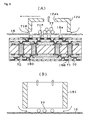
- the solder ball loading apparatus 100 comprises an XY2 suction table 114 for positioning and holding a multilayer printed wiring board 10, a vertically-moving shaft 112 for lifting and lowering said XY2 suction table 114, a ball arrangement mask 16 provided with openings corresponding to the connection pads of the multilayer printed wiring board, a loading cylinder (a cylinder member) 124 for guiding solder balls, a suction box 126 for supplying the loading cylinder 124 with a negative pressure, a ball removing cylinder 161 for collecting excess solder balls, a suction box 166 for supplying said ball removing cylinder 161 with a negative pressure, a ball removing suction unit 168 for holding solder balls collected, a mask clamp 144 for clamping the ball arrangement mask 16, an X-direction-moving shaft for sending the loading cylinder 124 and the ball removing cylinder 161 in the X direction, a moving-shaft support guide 142 for supporting the X-direction-moving shaft 140, an X-
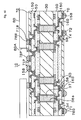
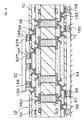
- Fig. 11 illustrates a sectional view of said multilayer printed wiring board 10
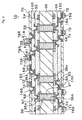
- Fig. 12 the condition in which the multilayer printed wiring board illustrated in Fig. 11 has an IC chip 90 attached thereto which is placed on a daughter board 94
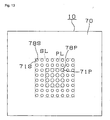
- Fig. 13 illustrates a plan view of the multilayer printed wiring board 10 prior to an IC chip being attached.
- Fig. 11 and Fig. 12 show illustratively with the numbers of solder bumps 78P and solder bumps 78s illustrated in Fig. 13 being reduced.
- solder bumps 78P and solder bumps 78S are provided on an actual package substrate.
- conductive circuits 34 on the surfaces of a core substrate 30.
- the top face and the bottom face of the core substrate 30 are connected via through holes 36.
- interlayer resin insulating layers 50 having via holes 60 and conductor circuits 58 formed thereon and interlayer resin insulating layers 150 having via holes 160 and conductor circuits 158 formed thereon.
- solder resist layers 70 On said via holes 160 and conductor circuits 70 there are formed solder resist layers 70.
- the solder bumps for power supply and ground 78P and the solder bumps for signal 78S are constituted out of solder balls having the same volumetric displacement as described below such that they have the same volume.
- the height H1 of the large-diameter solder bumps 78P is set to about 30 ⁇ m and the height H2 of the small-diameter solder bumps 78S is set by being flattened to about 30 ⁇ m which is the same as the height of the large-diameter solder bumps 78P.
- Many of the large-diameter solder bumps for power supply and ground 78P are disposed closer toward the center of the multilayer printed wiring board such that the wiring distance would be short, and the small-diameter solder bumps for signal 78S are disposed relatively lopsidedly on the outer side of the large-diameter solder bumps 78P.
- solder bumps 78D via the openings of said solder resist layer 70.
- the openings in the solder resist are formed such that a portion of the conductor circuits 158 is exposed, the openings may be formed such that they include via holes 160 only or via holes 160 and a portion of the conductor circuits 158.
- solder bumps for power supply and ground 78P on the upper face side of the multilayer printed wiring board 10 are connected to the electrodes for power supply and ground 92P of an IC chip 90 and the small-diameter opening solder bumps 78S to the electrodes for ground 92P.
- solder bumps 78D on the lower face side are connected to the lands 96 of the daughter board 94.
- Fig. 13 being a plan view of the multilayer printed wiring board prior to an IC chip being attached, with the multilayer printed wiring board 10 in accordance with the firs example, pads for power supply and ground 73P are formed in large-diameter openings 71P and mainly disposed on the center side (the area inside the dotted lines PL) of the multilayer printed wiring board 10 such that the length of the wiring from the IC chip 90 to the daughter board 94 is short and the resistance value is lowered.
- wiring density is elevated by pads for signal 73S disposed inside the area indicated by the broken lines SL being formed in the small-diameter openings 71S.
- solder resist openings in the solder resist for the signal line of the package substrate there has been a demand for the openings in the solder resist for the signal line of the package substrate to be smaller in diameter and narrower in pitch.
- an extremely small diameter of the solder bumps for power supply and ground on the package substrate is not desired. Namely, a small diameter of the solder bumps made of a solder alloy leads to a high resistance value causing a voltage drop when there is a sudden increase in power consumption causing the IC chip to malfunction.
- a measure to deal with this mutually conflicting demand is for the solder resist openings for signal to be of a small diameter and for the solder bumps for power supply and ground to be not of a small diameter.
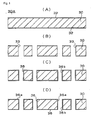
- the substrate 30 having through holes 36 formed therein is, after being washed with water and dried, undergoes a blacking process with an aqueous solution containing NaOH (10g/l), NaClO 2 (40g/l), and Na 3 PO 4 (6g/l) as a blacking bath (an oxidation bath) and a reduction process with an aqueous solution containing NaOH (10g/l) and NaBH4 (6g/l) as a reduction bath to form roughened faces 36a on the side-wall conductor layers 36b of the through holes 36 and the surfaces ( Fig. 1 (D) ).
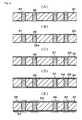
- the through holes 36 are filled with a filler 37 containing copper particles of the average particle diameter being 10 ⁇ m (a non-conductive plugging copper paste made by Tatsuta Electric Wire & Cable Co., Ltd., Product Name: DD paste) with screen printing, which is dried and hardened ( Fig. 2 (A) ).
- a coating is given with a printing method on the substrate with a mask placed thereon and provided with openings at the through hole portions to be filled in the through holes, and following the filling it is dried and hardened.
- the filler 36 which oozed out of the through holes 36 is removed by belt-sanding with the use of a #600 belt sanding paper (made by Sankyo Rikagaku Co., Ltd.), and, further, buffed to remove the flaws due to this belt-sanding to level the surfaces of substrate 30 ( Fig. 2 (B) ).
- a palladium catalyst is added to the surfaces of the substrate 30 leveled under the above-described (3) which is electroless copper-plated to form electroless copper-plated films 23 of 0.6 ⁇ m in thickness (refer to Fig. 2 (C) ).
- Electrolytic plating is conducted under the following conditions to form electrolytic copper plated films 24 of 15 ⁇ m in thickness such that an added thickness for the portions to constitute conductor circuits 34 and the portions to constitute the cover plated layers (through-hole lands) covering the filler 37 filled in through holes 36 are formed ( Fig. 2 (D) ).
- Electrolytic plating aqueous solution Sulfuric acid 180 g/l Copper sulfate 80 g/l Additive (made by Atotec Japan, Product name: Caparacid GL) 1 ml/l
- Electrolytic plating conditions Current density 1 A/dm 2 Time 70 minutes Temperature Room temperature.
- the plated films 23, 24 and the copper foils 32 at the portions where the etching resist 25 are not formed are dissolved and removed with an etching solution having cupric chloride as the main ingredient thereof, and, further, the etching resists 25 are stripped and removed with 5% KOH to form independent conductor circuits 34 and the cover plated layers 36a covering the filler 37 (refer to Fig. 3 (A) ).
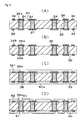
- interlayer resin insulating layer 50 On both faces of the substrate there was formed an interlayer resin insulating layer 50, after a resin film for interlayer resin insulating layer (made by Ajinomoto Co., Inc. :Product Name: ABF-45SH) 50 ⁇ being slightly larger than the substrate being placed on the substrate and preliminarily pressure-bonded under the conditions of the pressure being 0.45 MPa, the temperature being 80°C, and the pressure-bonding time being 10 seconds and sheared, by being laminated with the use of a vacuum laminator by the following method ( Fig. 3 (C) ).
- the resin film for interlayer resin insulating layer was fully pressure-bonded under the conditions of the degree of vacuum being 67 Pa, the pressure being 0.47 MPa, the temperature being 85°C, and the pressure-bonding time being 60 seconds and subsequently thermoset at 170°C for 40 minutes.
- openings for via holes 51 were formed in the interlayer resin insulating layers 50 with a CO2 gas laser at the wavelength of 10.4 ⁇ m under the conditions of the beam diameter of 4.00 mm, a top hat mode, the pulse width of 3 to 30 ⁇ m, and 1 to 3 shots ( Fig. 3 (D) ).
- the above-treated substrate was immersed in a neutralizing solution (made by Shipley Company, LLC) and then washed with water. Further, to the surfaces of said substrate which have been roughened (roughening depth being 3 ⁇ m) a palladium catalyst was added such that the catalyst nucleus was adhered to the surfaces of the interlayer resin insulating layers and the inner wall surfaces of the openings for via holes. Namely, the above-described substrate was immersed in a catalyst solution containing palladium chloride (PbCl 2 ) and stannous chloride (SnCl 2 ) to allow palladium metal to deposit such to provide the catalyst.
- PbCl 2 palladium chloride
- SnCl 2 stannous chloride
- Electroless plating conditions Liquid temperature at 34°C for 45 minutes
- Electrolytic plating solution Sulfuric acid 2.24 mol/l Copper sulfate 0.26 mol/l Additive 19.5 mol/l (made by Atotec Japan, Product Name: Caparacid GL)
- Electrolytic plating conditions Current density 1 A/dm 2 Time 70 minutes Temperature 22 ⁇ 2°C
- the same processing as in the above-described (4) was conducted to from roughened faces 58a on the surfaces of the conductor circuits 58 and via holes 60.
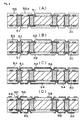
- the thickness of the lower layer conductor circuit 58 was 15 ⁇ m ( Fig. 5 (A) ). Except, the lower layer conductor circuit may be formed as having the thickness over the range of 5 to ⁇ m.
- solder resist layers were hardened by heat processes under the conditions of for one hour at 80°C, for one hour at 100°C, for one hour at 120°C, and for three hours at 150°C each to form solder resist pattern layers of 15 to 25 ⁇ m in thickness having openings.
- the substrate was immersed in an electroless gold plating solution containing potassium gold cyanide (7.6 ⁇ 10 -3 mol/l), ammonium chloride (1.9 ⁇ 10 -1 mol/l sodium citrate (1.2 ⁇ 10 -1 mol/l), and sodium hypophosphite (1.7 ⁇ 10 -1 mol/l) under the conditions of for 7.5 minutes at 80°C to form a gold plated layer 74 of about 0.03 ⁇ m in thickness on the nickel plated layers 72 ( Fig. 5 (D) ).
- a nickel-gold layer a single layer of tin or a precious metal (gold, silver, palladium, platinum, etc.) may be formed.
- solder balls 77 75 ⁇ m in diameter, Sn63Pb37 (made by Hitachi Metals, Ltd.) are supplied in a specified quantity from the solder ball supply unit 122 to the side of the loading cylinder 124. In addition, they may in advance be supplied to be stored in the loading cylinder. While Sn/Pb solder balls were used for solder balls in the examples, they may be Pb-free solder balls selected from a group of Sn and Ag, Cu, In, Bi, Zn, etc.
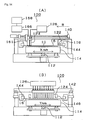
- the loading cylinders 124 lined up along the Y axis of the multilayer wiring board 10 as illustrated in Fig. 7 (B) and Fig. 8 (A) as well as Fig. 14 (B) and Fig. 14 (A) are moved in a horizontal direction along the X axis via the X-direction moving shaft 140.
- the solder balls 77 gathered on the ball arrangement mask 16 are moved with the movement of the loading cylinders 124 such that they are dropped via the openings 16a of the ball arrangement mask 16 and loaded into the small-diameter openings 71S and the large-diameter openings 71P of the multilayer printed wiring board 10.
- the solder balls 77 are successively arranged on all the connection pads on the side of the multilayer printed wiring board 10.
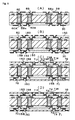
- solder balls 77 on the upper face were melted by reflow at 230°C to form large-diameter opening solder bumps 78P having a low height (H1®30 ⁇ m: the height protruding out of the surface of the solder resist) out of the solder balls 77 in the large-diameter openings 71P and small-diameter opening solder bumps 78S having a high height (H3®40 ⁇ m: the height protruding out of the surface of the solder resist) out of the solder balls 77 in the small-diameter openings 71S and solder bumps 78D on the lower face ( Fig. 9 ).
- solder bumps having a high height 78S in the small-diameter openings 71S are flattened by a flat plate 80 having an opening 80A at the position corresponding to the large-diameter opening solder bump portion being pressed on such that it is brought to the same height (H2®30 ⁇ m) as the height (H1®30 ⁇ m) of the solder bumps 78P in the large-diameter openings 71P ( Fig. 11 ).
- the flat plate 80 may be heated.
- the solder bumps in said small-diameter openings 71S are flattened with the flat plate for flattening 80 having an opening 80A corresponding to the position at which the large-diameter openings 71S are disposed such that the solder bumps 78S in the small-diameter openings 71S can be approximated in height to the solder bumps 78P in the large-diameter openings 71P with the same volume.
- solder bumps 78P, 78S By the IC chip 90 being loaded onto the multilayer printed wiring board 10 and by reflow the connections pads of the printed wiring board and the electrodes of the IC chip are connected via the solder bumps 78P, 78S. At that juncture, since the solder amount of the solder bumps 78S in the small-diameter openings 71S is the same as that of the solder bumps 78P in the large-diameter openings 71P, no non-connection occurs at the solder bumps 78S in the small-diameter openings 71S, allowing the connection reliability between the IC chip 90 and the multilayer printed wiring board 10 to be secured. Subsequently, it is attached to a daughter board 94 via solder bumps 78D ( Fig. 12 ).
- solder bumps having a high height 78S in the small-diameter openings 78S being flattened, the solder bumps 71S in the openings 71S with a varying diameter and the solder bumps 78P in the large-diameter openings 71P can be formed at roughly the same height.
- the mounting yield of the IC chip can be enhanced and the securing of the connection reliability between the IC chip 90 and the multilayer printed wiring board 10 becomes possible.
- solder bumps for power supply and ground 78P in the large-diameter openings 71P being not flattened and being maintained semi-circle, voids are easily let out during reflow when the IC chip being loaded, preventing the occurrence of voids due to air inside the solder bumps not likely to result in high resistance, which makes it advantageous for power supply.
- the solder balls 77 are gathered by air being suctioned out of said loading cylinders 124 and the solder balls 77 gathered directly below the loading cylinders 124 are moved such that they are on the ball arrangement mask 16 by the loading cylinders 124 or the printed wiring board and the ball arrangement mask 16 being moved relative to each other and dropped into the small-diameter openings 71S and the large-diameter openings 71P of the multilayer printed wiring board 10 via the openings 16a of the ball arrangement mask 16.
- solder balls 77 it allows with certainty fine solder balls 77 to be loaded into all of the small-diameter openings 71S and large-diameter openings 71P of the multilayer printed wiring board 10. And, since the solder balls are moved while being in no-contact, the solder balls can be loaded into the small-diameter openings 71S and large-diameter openings 71P without being damaged, resulting in an even height of the solder bumps 78S, 78P, unlike the situation where a squeegee is used. Further, since the solder balls are guided by suction force, the aggregation and adhesion of solder balls can be prevented. Since they present themselves as solder bumps of a large volume having a uniform height, they present themselves as, not only having a high cold and heat shock resistance, low resistance solder bumps which are advantageous for power supply.
- the height of small-diameter solder bumps 78S and the height of the large-diameter solder bumps 78S were set to the same 30 ⁇ m.
- the occurrence of non-connection bumps becomes difficult when it is set to no greater than 10 ⁇ m, which makes it easy to secure the connection reliability of solder bumps.
- the solder bumps 78S having a high height in the small-diameter openings 71S and the solder bumps 78P in the large-diameter openings 71P are flattened such that the heights (H2®30 ⁇ m) are the same ( Fig. 11 ).
- the solder bumps 78S and the solder bumps 78P are formed out of solder balls having the same diameter and have the same volume.
- solder bumps 78S in the small-diameter openings 71S which are flattened as a whole and the large-diameter 71S which are flattened at the top only are illustrated illustratively.
- the advantage is that the height of all the solder bumps can be set uniformly.
Landscapes
- Engineering & Computer Science (AREA)
- Microelectronics & Electronic Packaging (AREA)
- Manufacturing & Machinery (AREA)
- Computer Hardware Design (AREA)
- Power Engineering (AREA)
- Ceramic Engineering (AREA)
- Physics & Mathematics (AREA)
- Condensed Matter Physics & Semiconductors (AREA)
- General Physics & Mathematics (AREA)
- Electric Connection Of Electric Components To Printed Circuits (AREA)
- Production Of Multi-Layered Print Wiring Board (AREA)
Applications Claiming Priority (2)
| Application Number | Priority Date | Filing Date | Title |
|---|---|---|---|
| JP2006019065 | 2006-01-27 | ||
| PCT/JP2007/051354 WO2007086551A1 (ja) | 2006-01-27 | 2007-01-29 | プリント配線板及びプリント配線板の製造方法 |
Publications (1)
| Publication Number | Publication Date |
|---|---|
| EP1978556A1 true EP1978556A1 (en) | 2008-10-08 |
Family
ID=38309328
Family Applications (1)
| Application Number | Title | Priority Date | Filing Date |
|---|---|---|---|
| EP07707585A Withdrawn EP1978556A1 (en) | 2006-01-27 | 2007-01-29 | Printed-circuit board, and method for manufacturing the same |
Country Status (7)
| Country | Link |
|---|---|
| US (2) | US8087164B2 (enExample) |
| EP (1) | EP1978556A1 (enExample) |
| JP (1) | JP4731574B2 (enExample) |
| KR (1) | KR20080017431A (enExample) |
| CN (2) | CN101356642B (enExample) |
| TW (1) | TW200742515A (enExample) |
| WO (1) | WO2007086551A1 (enExample) |
Families Citing this family (28)
| Publication number | Priority date | Publication date | Assignee | Title |
|---|---|---|---|---|
| CN101171895B (zh) * | 2005-06-30 | 2010-06-23 | 揖斐电株式会社 | 印刷线路板 |
| CN101356642B (zh) * | 2006-01-27 | 2010-09-01 | 揖斐电株式会社 | 印刷线路板及其印刷线路板的制造方法 |
| JP5154271B2 (ja) * | 2008-03-17 | 2013-02-27 | 日本特殊陶業株式会社 | はんだバンプを有する配線基板及びその製造方法 |
| US8587129B2 (en) * | 2009-07-31 | 2013-11-19 | Stats Chippac Ltd. | Integrated circuit packaging system with through silicon via base and method of manufacture thereof |
| US8410376B2 (en) * | 2009-08-28 | 2013-04-02 | Ibiden Co., Ltd. | Printed wiring board and method for manufacturing the same |
| US20110048775A1 (en) * | 2009-08-31 | 2011-03-03 | Ibiden Co., Ltd. | Printed wiring board and method for manufacturing the same |
| JP5428667B2 (ja) | 2009-09-07 | 2014-02-26 | 日立化成株式会社 | 半導体チップ搭載用基板の製造方法 |
| US7867821B1 (en) * | 2009-09-18 | 2011-01-11 | Stats Chippac Ltd. | Integrated circuit package system with through semiconductor vias and method of manufacture thereof |
| KR101055473B1 (ko) * | 2009-12-15 | 2011-08-08 | 삼성전기주식회사 | 기판 제조용 캐리어 부재 및 이를 이용한 기판의 제조방법 |
| US8604600B2 (en) * | 2011-12-30 | 2013-12-10 | Deca Technologies Inc. | Fully molded fan-out |
| KR20110124993A (ko) * | 2010-05-12 | 2011-11-18 | 삼성전자주식회사 | 반도체 칩 및 이를 포함하는 반도체 패키지 및 반도체 칩의 제조 방법 |
| US9293405B2 (en) * | 2011-03-22 | 2016-03-22 | Renesas Electronics Corporation | Semiconductor device |
| US9236278B2 (en) * | 2011-09-23 | 2016-01-12 | Stats Chippac Ltd. | Integrated circuit packaging system with a substrate embedded dummy-die paddle and method of manufacture thereof |
| US8546925B2 (en) * | 2011-09-28 | 2013-10-01 | Texas Instruments Incorporated | Synchronous buck converter having coplanar array of contact bumps of equal volume |
| US9368439B2 (en) * | 2012-11-05 | 2016-06-14 | Nvidia Corporation | Substrate build up layer to achieve both finer design rule and better package coplanarity |
| US8969191B2 (en) * | 2013-07-16 | 2015-03-03 | Taiwan Semiconductor Manufacturing Co., Ltd. | Mechanisms for forming package structure |
| KR102192356B1 (ko) | 2013-07-29 | 2020-12-18 | 삼성전자주식회사 | 반도체 패키지 |
| JP6320066B2 (ja) * | 2014-02-13 | 2018-05-09 | イビデン株式会社 | ボール搭載用マスクおよびボール搭載装置 |
| JP2015231003A (ja) * | 2014-06-06 | 2015-12-21 | イビデン株式会社 | 回路基板および回路基板の製造方法 |
| CN105530768B (zh) * | 2014-09-28 | 2019-02-05 | 深南电路有限公司 | 一种电路板的制作方法及电路板 |
| KR102632351B1 (ko) * | 2016-02-05 | 2024-02-02 | 삼성전기주식회사 | 인쇄회로기판 및 이를 포함하는 패키지 기판 |
| CN107318228B (zh) * | 2017-08-29 | 2019-09-06 | 郑州云海信息技术有限公司 | 一种印制电路板的制造方法及其制造装置 |
| TWI650048B (zh) * | 2017-09-19 | 2019-02-01 | Nan Ya Printed Circuit Board Corporation | 印刷電路板結構及其形成方法 |
| CN108235591B (zh) * | 2018-01-08 | 2020-08-18 | 昆山首源电子科技有限公司 | 5g通讯高频信号板镀金蚀刻工艺 |
| CN110534451A (zh) * | 2018-05-25 | 2019-12-03 | 唐虞企业股份有限公司 | 一种导电端子置件设备及其导电端子置件方法 |
| CN113710377B (zh) * | 2019-04-30 | 2024-01-09 | 迪睿合株式会社 | 滑动处理物相对于滑动对象物的表面的供给或排除方法 |
| JP7257273B2 (ja) * | 2019-06-26 | 2023-04-13 | イビデン株式会社 | プリント配線板およびその製造方法 |
| CN113709972A (zh) * | 2021-09-27 | 2021-11-26 | 合肥移瑞通信技术有限公司 | 一种电路板及其制造方法、封装件 |
Family Cites Families (57)
| Publication number | Priority date | Publication date | Assignee | Title |
|---|---|---|---|---|
| JP2974436B2 (ja) | 1991-02-26 | 1999-11-10 | シチズン時計株式会社 | ハンダバンプの形成方法 |
| JP3152834B2 (ja) * | 1993-06-24 | 2001-04-03 | 株式会社東芝 | 電子回路装置 |
| JP3226703B2 (ja) * | 1994-03-18 | 2001-11-05 | 株式会社日立製作所 | 半導体装置及びその製法 |
| JP3138159B2 (ja) * | 1994-11-22 | 2001-02-26 | シャープ株式会社 | 半導体装置、半導体装置実装体、及び半導体装置の交換方法 |
| EP0774888B1 (en) * | 1995-11-16 | 2003-03-19 | Matsushita Electric Industrial Co., Ltd | Printed wiring board and assembly of the same |
| JP2842361B2 (ja) * | 1996-02-28 | 1999-01-06 | 日本電気株式会社 | 半導体装置 |
| US5660321A (en) * | 1996-03-29 | 1997-08-26 | Intel Corporation | Method for controlling solder bump height and volume for substrates containing both pad-on and pad-off via contacts |
| JPH1013007A (ja) * | 1996-03-29 | 1998-01-16 | Ngk Spark Plug Co Ltd | 半田バンプを有する配線基板及びその製造方法及び平坦化治具 |
| JP3401391B2 (ja) * | 1996-04-16 | 2003-04-28 | 日本特殊陶業株式会社 | 半田バンプを有する基板の製造方法 |
| JP2861965B2 (ja) * | 1996-09-20 | 1999-02-24 | 日本電気株式会社 | 突起電極の形成方法 |
| EP0844809B1 (en) * | 1996-11-20 | 2011-08-17 | Ibiden Co, Ltd. | Solder resist composition and printed circuit boards |
| TW392315B (en) * | 1996-12-03 | 2000-06-01 | Nippon Electric Co | Boards mounting with chips, mounting structure of chips, and manufacturing method for boards mounting with chips |
| KR100244580B1 (ko) * | 1997-06-24 | 2000-02-15 | 윤종용 | 금속 범프를 갖는 회로 기판의 제조 방법 및 그를 이용한 반도체 칩 패키지의 제조 방법 |
| US6028011A (en) * | 1997-10-13 | 2000-02-22 | Matsushita Electric Industrial Co., Ltd. | Method of forming electric pad of semiconductor device and method of forming solder bump |
| JPH11145176A (ja) * | 1997-11-11 | 1999-05-28 | Fujitsu Ltd | ハンダバンプの形成方法及び予備ハンダの形成方法 |
| JPH11204687A (ja) * | 1998-01-19 | 1999-07-30 | Juki Corp | バンプ形成方法及びバンプ形成装置 |
| US6137164A (en) * | 1998-03-16 | 2000-10-24 | Texas Instruments Incorporated | Thin stacked integrated circuit device |
| US6100112A (en) * | 1998-05-28 | 2000-08-08 | The Furukawa Electric Co., Ltd. | Method of manufacturing a tape carrier with bump |
| US6461953B1 (en) * | 1998-08-10 | 2002-10-08 | Fujitsu Limited | Solder bump forming method, electronic component mounting method, and electronic component mounting structure |
| US6268114B1 (en) * | 1998-09-18 | 2001-07-31 | Taiwan Semiconductor Manufacturing Company, Ltd | Method for forming fine-pitched solder bumps |
| US6746896B1 (en) * | 1999-08-28 | 2004-06-08 | Georgia Tech Research Corp. | Process and material for low-cost flip-chip solder interconnect structures |
| JP2001102738A (ja) * | 1999-09-30 | 2001-04-13 | Matsushita Electric Ind Co Ltd | 電子部品実装半田付け方法 |
| JP2001203318A (ja) * | 1999-12-17 | 2001-07-27 | Texas Instr Inc <Ti> | 複数のフリップチップを備えた半導体アセンブリ |
| JP2001267731A (ja) | 2000-01-13 | 2001-09-28 | Hitachi Ltd | バンプ付き電子部品の製造方法および電子部品の製造方法 |
| JP2001210749A (ja) * | 2000-01-26 | 2001-08-03 | Kyocera Corp | バンプ電極付き配線基板およびその製造方法 |
| JP2001319992A (ja) * | 2000-02-28 | 2001-11-16 | Shinko Electric Ind Co Ltd | 配線基板、半導体装置及びそれらの製造方法 |
| JP2002043467A (ja) * | 2000-07-31 | 2002-02-08 | Hitachi Chem Co Ltd | 半導体パッケージ用基板とその製造方法およびその基板を用いた半導体パッケージ並びに半導体パッケージの製造方法 |
| JP2002050716A (ja) * | 2000-08-02 | 2002-02-15 | Dainippon Printing Co Ltd | 半導体装置及びその作製方法 |
| US6459150B1 (en) * | 2000-08-17 | 2002-10-01 | Industrial Technology Research Institute | Electronic substrate having an aperture position through a substrate, conductive pads, and an insulating layer |
| CN1156204C (zh) * | 2000-09-04 | 2004-06-30 | 华泰电子股份有限公司 | 积体电路基板柱状凸块成型方法 |
| JP4130526B2 (ja) * | 2000-11-10 | 2008-08-06 | 株式会社日立製作所 | バンプ形成方法およびその装置 |
| US6596618B1 (en) * | 2000-12-08 | 2003-07-22 | Altera Corporation | Increased solder-bump height for improved flip-chip bonding and reliability |
| US6910812B2 (en) * | 2001-05-15 | 2005-06-28 | Peregrine Semiconductor Corporation | Small-scale optoelectronic package |
| JP2003188508A (ja) * | 2001-12-18 | 2003-07-04 | Toshiba Corp | プリント配線板、面実装形回路部品および回路モジュール |
| US6940176B2 (en) * | 2002-05-21 | 2005-09-06 | United Microelectronics Corp. | Solder pads for improving reliability of a package |
| JP2004055628A (ja) * | 2002-07-17 | 2004-02-19 | Dainippon Printing Co Ltd | ウエハレベルの半導体装置及びその作製方法 |
| JP4181510B2 (ja) * | 2003-02-28 | 2008-11-19 | 日本特殊陶業株式会社 | 樹脂製配線基板 |
| JP4094982B2 (ja) * | 2003-04-15 | 2008-06-04 | ハリマ化成株式会社 | はんだ析出方法およびはんだバンプ形成方法 |
| JP4269834B2 (ja) | 2003-07-23 | 2009-05-27 | トヨタ自動車株式会社 | 多段変速機 |
| JP4536430B2 (ja) * | 2004-06-10 | 2010-09-01 | イビデン株式会社 | フレックスリジッド配線板 |
| CN1826844B (zh) * | 2004-08-04 | 2012-01-11 | 揖斐电株式会社 | 焊球搭载方法及焊球搭载装置 |
| US7405474B1 (en) * | 2004-10-12 | 2008-07-29 | Cypress Semiconductor Corporation | Low cost thermally enhanced semiconductor package |
| US7215026B2 (en) * | 2005-04-14 | 2007-05-08 | Samsung Electonics Co., Ltd | Semiconductor module and method of forming a semiconductor module |
| KR100702969B1 (ko) * | 2005-04-19 | 2007-04-03 | 삼성전자주식회사 | 더미 솔더 볼을 갖는 bga형 반도체 칩 패키지의 기판 실장 구조 |
| CN101180727B (zh) | 2005-05-23 | 2010-06-16 | 揖斐电株式会社 | 印刷线路板及其制造方法 |
| JP2006344824A (ja) * | 2005-06-09 | 2006-12-21 | Nec Electronics Corp | 半導体装置および半導体装置の製造方法 |
| WO2007004657A1 (ja) | 2005-06-30 | 2007-01-11 | Ibiden Co., Ltd. | プリント配線板 |
| CN101171895B (zh) * | 2005-06-30 | 2010-06-23 | 揖斐电株式会社 | 印刷线路板 |
| US7566650B2 (en) * | 2005-09-23 | 2009-07-28 | Stats Chippac Ltd. | Integrated circuit solder bumping system |
| DE102005055280B3 (de) * | 2005-11-17 | 2007-04-12 | Infineon Technologies Ag | Verbindungselement zwischen Halbleiterchip und Schaltungsträger sowie Verfahren zur Herstellung und Verwendung des Verbindungselements |
| US20070145104A1 (en) * | 2005-12-28 | 2007-06-28 | Mengzhi Pang | System and method for advanced solder bumping using a disposable mask |
| US20070155154A1 (en) * | 2005-12-29 | 2007-07-05 | Mengzhi Pang | System and method for solder bumping using a disposable mask and a barrier layer |
| US7517788B2 (en) * | 2005-12-29 | 2009-04-14 | Intel Corporation | System, apparatus, and method for advanced solder bumping |
| DE102006001767B4 (de) * | 2006-01-12 | 2009-04-30 | Infineon Technologies Ag | Halbleitermodul mit Halbleiterchips und Verfahren zur Herstellung desselben |
| CN101356642B (zh) * | 2006-01-27 | 2010-09-01 | 揖斐电株式会社 | 印刷线路板及其印刷线路板的制造方法 |
| US7472473B2 (en) * | 2006-04-26 | 2009-01-06 | Ibiden Co., Ltd. | Solder ball loading apparatus |
| US7823762B2 (en) * | 2006-09-28 | 2010-11-02 | Ibiden Co., Ltd. | Manufacturing method and manufacturing apparatus of printed wiring board |
-
2007
- 2007-01-29 CN CN2007800011165A patent/CN101356642B/zh not_active Expired - Fee Related
- 2007-01-29 KR KR1020087000062A patent/KR20080017431A/ko not_active Ceased
- 2007-01-29 JP JP2007556031A patent/JP4731574B2/ja not_active Expired - Fee Related
- 2007-01-29 WO PCT/JP2007/051354 patent/WO2007086551A1/ja not_active Ceased
- 2007-01-29 TW TW096103191A patent/TW200742515A/zh unknown
- 2007-01-29 CN CN2010102198697A patent/CN101888747B/zh not_active Expired - Fee Related
- 2007-01-29 EP EP07707585A patent/EP1978556A1/en not_active Withdrawn
-
2008
- 2008-05-13 US US12/120,076 patent/US8087164B2/en active Active
-
2011
- 2011-10-17 US US13/274,897 patent/US9480170B2/en active Active
Non-Patent Citations (1)
| Title |
|---|
| See references of WO2007086551A1 * |
Also Published As
| Publication number | Publication date |
|---|---|
| CN101356642A (zh) | 2009-01-28 |
| CN101356642B (zh) | 2010-09-01 |
| US20080302560A1 (en) | 2008-12-11 |
| US9480170B2 (en) | 2016-10-25 |
| US8087164B2 (en) | 2012-01-03 |
| CN101888747B (zh) | 2012-09-05 |
| US20120031659A1 (en) | 2012-02-09 |
| TWI330512B (enExample) | 2010-09-11 |
| CN101888747A (zh) | 2010-11-17 |
| TW200742515A (en) | 2007-11-01 |
| KR20080017431A (ko) | 2008-02-26 |
| JP4731574B2 (ja) | 2011-07-27 |
| WO2007086551A1 (ja) | 2007-08-02 |
| JPWO2007086551A1 (ja) | 2009-06-25 |
Similar Documents
| Publication | Publication Date | Title |
|---|---|---|
| EP1978556A1 (en) | Printed-circuit board, and method for manufacturing the same | |
| US8083123B2 (en) | Method for manufacturing a printed wiring board | |
| US8800143B2 (en) | Multilayer printed wiring board and manufacturing method thereof | |
| US7656032B2 (en) | Semiconductor chip mounting wiring board, manufacturing method for same, and semiconductor module | |
| EP2312924A1 (en) | Multilayer printed wiring board | |
| US8371498B2 (en) | Method for manufacturing a printed wiring board | |
| US8592691B2 (en) | Printed wiring board | |
| WO2004077560A1 (ja) | 多層プリント配線板 | |
| US7845547B2 (en) | Method for manufacturing a printed wiring board |
Legal Events
| Date | Code | Title | Description |
|---|---|---|---|
| PUAI | Public reference made under article 153(3) epc to a published international application that has entered the european phase |
Free format text: ORIGINAL CODE: 0009012 |
|
| 17P | Request for examination filed |
Effective date: 20080213 |
|
| AK | Designated contracting states |
Kind code of ref document: A1 Designated state(s): DE |
|
| RBV | Designated contracting states (corrected) |
Designated state(s): DE |
|
| STAA | Information on the status of an ep patent application or granted ep patent |
Free format text: STATUS: THE APPLICATION IS DEEMED TO BE WITHDRAWN |
|
| 18D | Application deemed to be withdrawn |
Effective date: 20090801 |