EP1920804A1 - Verfahren und vorrichtung zur auswertung von spielergebnissen - Google Patents
Verfahren und vorrichtung zur auswertung von spielergebnissen Download PDFInfo
- Publication number
- EP1920804A1 EP1920804A1 EP06780989A EP06780989A EP1920804A1 EP 1920804 A1 EP1920804 A1 EP 1920804A1 EP 06780989 A EP06780989 A EP 06780989A EP 06780989 A EP06780989 A EP 06780989A EP 1920804 A1 EP1920804 A1 EP 1920804A1
- Authority
- EP
- European Patent Office
- Prior art keywords
- results
- player
- game
- determined
- determined results
- Prior art date
- Legal status (The legal status is an assumption and is not a legal conclusion. Google has not performed a legal analysis and makes no representation as to the accuracy of the status listed.)
- Withdrawn
Links
Images








Classifications
-
- A—HUMAN NECESSITIES
- A63—SPORTS; GAMES; AMUSEMENTS
- A63F—CARD, BOARD, OR ROULETTE GAMES; INDOOR GAMES USING SMALL MOVING PLAYING BODIES; VIDEO GAMES; GAMES NOT OTHERWISE PROVIDED FOR
- A63F13/00—Video games, i.e. games using an electronically generated display having two or more dimensions
- A63F13/70—Game security or game management aspects
- A63F13/79—Game security or game management aspects involving player-related data, e.g. identities, accounts, preferences or play histories
- A63F13/798—Game security or game management aspects involving player-related data, e.g. identities, accounts, preferences or play histories for assessing skills or for ranking players, e.g. for generating a hall of fame
-
- A63F13/10—
-
- A—HUMAN NECESSITIES
- A63—SPORTS; GAMES; AMUSEMENTS
- A63F—CARD, BOARD, OR ROULETTE GAMES; INDOOR GAMES USING SMALL MOVING PLAYING BODIES; VIDEO GAMES; GAMES NOT OTHERWISE PROVIDED FOR
- A63F13/00—Video games, i.e. games using an electronically generated display having two or more dimensions
- A63F13/45—Controlling the progress of the video game
- A63F13/46—Computing the game score
-
- A63F13/12—
-
- A—HUMAN NECESSITIES
- A63—SPORTS; GAMES; AMUSEMENTS
- A63F—CARD, BOARD, OR ROULETTE GAMES; INDOOR GAMES USING SMALL MOVING PLAYING BODIES; VIDEO GAMES; GAMES NOT OTHERWISE PROVIDED FOR
- A63F13/00—Video games, i.e. games using an electronically generated display having two or more dimensions
- A63F13/30—Interconnection arrangements between game servers and game devices; Interconnection arrangements between game devices; Interconnection arrangements between game servers
-
- A—HUMAN NECESSITIES
- A63—SPORTS; GAMES; AMUSEMENTS
- A63F—CARD, BOARD, OR ROULETTE GAMES; INDOOR GAMES USING SMALL MOVING PLAYING BODIES; VIDEO GAMES; GAMES NOT OTHERWISE PROVIDED FOR
- A63F13/00—Video games, i.e. games using an electronically generated display having two or more dimensions
- A63F13/30—Interconnection arrangements between game servers and game devices; Interconnection arrangements between game devices; Interconnection arrangements between game servers
- A63F13/35—Details of game servers
-
- A—HUMAN NECESSITIES
- A63—SPORTS; GAMES; AMUSEMENTS
- A63F—CARD, BOARD, OR ROULETTE GAMES; INDOOR GAMES USING SMALL MOVING PLAYING BODIES; VIDEO GAMES; GAMES NOT OTHERWISE PROVIDED FOR
- A63F13/00—Video games, i.e. games using an electronically generated display having two or more dimensions
- A63F13/45—Controlling the progress of the video game
-
- A—HUMAN NECESSITIES
- A63—SPORTS; GAMES; AMUSEMENTS
- A63F—CARD, BOARD, OR ROULETTE GAMES; INDOOR GAMES USING SMALL MOVING PLAYING BODIES; VIDEO GAMES; GAMES NOT OTHERWISE PROVIDED FOR
- A63F13/00—Video games, i.e. games using an electronically generated display having two or more dimensions
- A63F13/80—Special adaptations for executing a specific game genre or game mode
- A63F13/814—Musical performances, e.g. by evaluating the player's ability to follow a notation
-
- A—HUMAN NECESSITIES
- A63—SPORTS; GAMES; AMUSEMENTS
- A63F—CARD, BOARD, OR ROULETTE GAMES; INDOOR GAMES USING SMALL MOVING PLAYING BODIES; VIDEO GAMES; GAMES NOT OTHERWISE PROVIDED FOR
- A63F2300/00—Features of games using an electronically generated display having two or more dimensions, e.g. on a television screen, showing representations related to the game
- A63F2300/40—Features of games using an electronically generated display having two or more dimensions, e.g. on a television screen, showing representations related to the game characterised by details of platform network
- A63F2300/407—Data transfer via internet
-
- A—HUMAN NECESSITIES
- A63—SPORTS; GAMES; AMUSEMENTS
- A63F—CARD, BOARD, OR ROULETTE GAMES; INDOOR GAMES USING SMALL MOVING PLAYING BODIES; VIDEO GAMES; GAMES NOT OTHERWISE PROVIDED FOR
- A63F2300/00—Features of games using an electronically generated display having two or more dimensions, e.g. on a television screen, showing representations related to the game
- A63F2300/50—Features of games using an electronically generated display having two or more dimensions, e.g. on a television screen, showing representations related to the game characterized by details of game servers
-
- A—HUMAN NECESSITIES
- A63—SPORTS; GAMES; AMUSEMENTS
- A63F—CARD, BOARD, OR ROULETTE GAMES; INDOOR GAMES USING SMALL MOVING PLAYING BODIES; VIDEO GAMES; GAMES NOT OTHERWISE PROVIDED FOR
- A63F2300/00—Features of games using an electronically generated display having two or more dimensions, e.g. on a television screen, showing representations related to the game
- A63F2300/50—Features of games using an electronically generated display having two or more dimensions, e.g. on a television screen, showing representations related to the game characterized by details of game servers
- A63F2300/55—Details of game data or player data management
- A63F2300/5546—Details of game data or player data management using player registration data, e.g. identification, account, preferences, game history
- A63F2300/558—Details of game data or player data management using player registration data, e.g. identification, account, preferences, game history by assessing the players' skills or ranking
-
- A—HUMAN NECESSITIES
- A63—SPORTS; GAMES; AMUSEMENTS
- A63F—CARD, BOARD, OR ROULETTE GAMES; INDOOR GAMES USING SMALL MOVING PLAYING BODIES; VIDEO GAMES; GAMES NOT OTHERWISE PROVIDED FOR
- A63F2300/00—Features of games using an electronically generated display having two or more dimensions, e.g. on a television screen, showing representations related to the game
- A63F2300/60—Methods for processing data by generating or executing the game program
- A63F2300/6036—Methods for processing data by generating or executing the game program for offering a minigame in combination with a main game
-
- A—HUMAN NECESSITIES
- A63—SPORTS; GAMES; AMUSEMENTS
- A63F—CARD, BOARD, OR ROULETTE GAMES; INDOOR GAMES USING SMALL MOVING PLAYING BODIES; VIDEO GAMES; GAMES NOT OTHERWISE PROVIDED FOR
- A63F2300/00—Features of games using an electronically generated display having two or more dimensions, e.g. on a television screen, showing representations related to the game
- A63F2300/80—Features of games using an electronically generated display having two or more dimensions, e.g. on a television screen, showing representations related to the game specially adapted for executing a specific type of game
- A63F2300/8047—Music games
Definitions
- the present invention relates to a game result evaluating method in which the result of a game played by a plurality of players is evaluated, and the evaluation result is displayed.
- Patent Document 1 Japanese Patent Application Laid-open No. 2000-51523
- the display of ranking carried out after completion of a game may stimulate a player to improve their skills, it may not stimulate the player' s motivation for continued competition.
- the display of ranking is nothing more than an absolute evaluation of a player based on the game result, and does not contribute interest to the game after the game is finished.
- a first aspect of the present invention provides a game result evaluating method for evaluating a player's results for each predetermined evaluation item.
- the method includes the following steps.
- the results of two players are compared for each evaluation item evaluated for a music game or the like. Whether a player wins or loses in the secondary game is determined based on the comparison results, so a player's results in the primary game are indirectly evaluated in the secondary game. Also, by carrying out the secondary game after the primary game, it is possible to provide the player an added value that is not limited to simply evaluating the results of the player in the primary game, in other words the enjoyment of a separate game.
- Winning or losing in the secondary game is based on superiority or inferiority for each evaluation item in the primary game. Determination of superiority or inferiority may be carried out for the results for each evaluation item as they are, or by comparing the results for predetermined comparison items that combine evaluation items. In the case of the latter also, the evaluation items in the primary game indirectly determine the superiority or inferiority. In determining the winner and loser based on the results of the determination of superiority or inferiority, it is clear to the players that there is not even a small amount of intervention by the computer. Therefore, the players can readily accept the win or loss in the secondary game. Furthermore, even if just looking at the determination results based on the comparison items shows many defeats, a player can aim for a favorable determination result by using their skill.
- winning or losing in the secondary game does not depend on the game device, but there is scope for determining the result by their own skill, so the players can accept the results obtained.
- winning or losing in the secondary game is a reflection of both the player's results in the primary game and the players' skill in the secondary game, so the result is that both the motivation in the primary game, which is necessary for the secondary game, and interest in the secondary game are stimulated.
- the display position of the determined results is preferably circulated by repeatedly shifting the display position of the determined results for each evaluation item one at a time along the direction of arrangement of the determined results and re-displaying the determined results.
- the cards are shifted either to the left or to the right one at a time.
- the horizontal row arrangement circulates to the right at a constant velocity.
- the reference mark may be displayed at a predetermined position, for example a fixed position at the card that is third from the left.
- the reference mark may for example be moved at a constant speed in the opposite direction to the determined results. By doing this, the reference mark and the array of determined results circulate relative to each other, at a constant relative circulation speed. If the relative circulation speed is constant, a player can easily aim for a determination result that is favorable.
- the cards are shifted either clockwise or counterclockwise one at a time.
- the cards are circulated downwards by repeatedly moving the cards from top to bottom, and when the bottom end is reached the card is displayed at the top end, or circulating in the opposite direction. In this way, the circulation direction and the circulation form of the determined results array are varied in accordance with the display form.
- the reference mark is preferably circulated along the direction of arrangement of the determined results for each evaluation item in the step of moving the display position.
- the reference mark is shifted either to the left or to the right one at a time.
- the reference mark is shifted to the right, when the reference mark is moved as far as the right end, next the reference mark is moved to the left end , on the opposite side, and again the reference mark is shifted one at a time to the right.
- the reference mark circulates to the right along the horizontal row arrangement.
- the determined results array may be stopped and not circulate, or for example may circulate at a constant speed in the opposite direction to the reference mark. By doing this, the reference mark and the array of determined results circulate relative to each other at a constant relative circulation speed. If the relative circulation speed is constant, a player can easily aim for a determined result that is favorable.
- the reference mark is shifted either clockwise or counterclockwise.
- the reference mark circulates either downwards or upwards. In other words, the reference mark circulates along the array of determined results, in a path and direction corresponding to the display form of the determined results.
- the results of the other player for each evaluation item may be received from a computer terminal via a network in the step of determining the superiority and inferiority.
- the game terminal device that executes the present game results evaluation method is connected to a center server via a network.
- the center server collects and stores player individual data, for example, the results of each evaluation item in the primary game, and authorization information. After execution of the primary game is finished, the game terminal device receives a part of the individual data of another player in response to a request to the center server. In this way, after completion of the primary game, players can enjoy the secondary game with other players that exist over a wide area, based on the results of their own game.
- the determined result is preferably displayed as either a first value or a second value in the step of displaying the determined results.
- the step of displaying the determined results preferably displays the determined result as either a first value or a second value in.
- the step of moving the display position preferably
- the first value may be taken to be "Win”
- the second value may be taken to be "Lose”.
- the first value and the second value are preferably displayed in mutually different display formats in the step of displaying the determined results and the step of moving the display position.
- Another aspect of the present invention provides a game result evaluating device that evaluates a player's results for each predetermined evaluation item.
- the device includes the following units.
- This game results evaluation device has the same operation and effect as the first invention.
- Another aspect of the present invention provides a computer product directly loadable into the internal memory of a digital computer, comprising software code portions for performing the steps of claim 1 when said product is run on a computer.
- the method executed by this program has the same operation and effect as the first aspect of the present invention.
- winning or losing in the secondary game is a reflection of both the player' s results in the primary game and the players' skill in the secondary game, so the result is that both the motivation in the primary game, which is necessary for the secondary game, and interest in the secondary game are stimulated.
- the players are made to confront each other again using the players' results evaluated for each predetermined parameter (corresponding to evaluation items) during execution of various types of games.
- a primary game another game (hereafter referred to as a secondary game) is carried out.
- the primary game the players' results are evaluated for each predetermined comparison item, based on the parameters of the primary game.
- Victory or defeat in the secondary game depends on the results for each parameter of the players in the primary game, and the players' skill in the secondary game. Therefore, the players' effort and skill in the primary game is utilized in the results of the secondary game.
- Fig. 1 is an explanatory diagram showing the overall constitution of the game system according to the first embodiment example of the present invention.
- the game system includes a center server 100 and a plurality of game terminal devices 200a, b, ...
- the game system may also include mobile phones 150a, b, .. or personal computers 160a, b, ..
- the game terminal devices 200, the mobile phones 150, and the personal computers 160 are connected to the center server 100 via a network 300 such as the internet or the like.
- the center server 100 receives and records individual data for each player from the game terminal devices 200. Also, the center server 100 transmits individual data to the source of a request, in response to a request from the game terminal devices 200.
- the center server 100 includes the following elements (a) through (e).
- Fig. 2 shows an example of the constitution of the game terminal device 200.
- the game terminal device 200 obtains the individual data of the other player from the center server 100. Based on the obtained individual data, the secondary game is played, and the result is displayed.
- the game terminal device 200 includes the following elements (a) through (m).
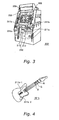
- Fig. 3 is an external isometric view of a music game device as a specific example of the game terminal device 200.
- music games are executed as the primary games.
- the monitor 206 is provided in the front of the body of the music game device.
- an input operation unit 211a such as a start button and the like, is provided to the left and the right below the monitor 206, below which two coin receipt units 213 are provided to the left and right.
- the card reader/writer 212 is provided below the coin receipt units 213.
- on the left and right sides of the monitor 206 are mock musical instruments as input operation unit 211 with which a player inputs rhythmic music, in other words guitar controllers 211b are installed.
- the speaker 208 is installed to output the performance effect of the tune performed. If two guitar controllers 211b are installed, two players can play the music game by carrying out input operations on the respective guitar controllers 211b.
- Fig. 4 is an enlarged diagram of the guitar controller.
- the guitar controller 211b has three types of neck buttons R, G, B for selecting the type of rhythmic sounds. Also, the guitar controller 211b has picking input portion 211b-1 for determining the output timing of the rhythmic sounds selected by at least one neck button. Also, the guitar controller 211b has a switch 211b-2 for switching the output mode of rhythmic sounds, disposed below the picking input portion 211b-1.
- games are carried out as follows, in accordance with a control program recorded in the ROM 203.
- a player inserts their own magnetic card into the card reader/writer 212 and inserts a coin into the coin receipt unit 213, in the game terminal device 200.
- the game terminal device 200 reads the card ID to recognize the card from the magnetic card inserted into the card reader/writer 212, and requests a password to be input.
- the input password is compared with the data of the center server 100, and individual authorization is carried out.
- the CPU 201 executes the control program, and the game starts.
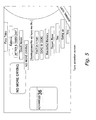
- Fig. 5 is an example of tune selection screen displayed on the monitor 206.
- the tune selection screen receives the selection of level of difficulty and tune from the player.
- the level of difficulty (“ADVANCED” in the figure) "36”
- the tune name "NO MORE CRYING” are selected.
- Fig. 6 is an example of game screen 223 displayed in the monitor 206.
- notes 224 indicating the operation timing for each rhythmic sound corresponding to each tune performed (BGM) are displayed in a notes display unit 221 for each rhythmic sound as shown in Fig. 6 .
- the notes 224 move independently in sequence for each rhythmic sound in accordance with the progress of each tune in a direction (the upward direction in Fig. 6 ) towards a standard line 222 in the notes display unit 221.
- the time when the notes 224 coincide with the standard line 222 is the operation timing that the player should operate the picking input portion 211b-1.
- the player operates the neck buttons R, G, B with one hand, and operates the picking input portion 211b-1 and the changing switch 211b-2 with the other hand, in accordance with the rhythmic sound, while checking the position of the notes 224, to input operation signals.
- the CPU 201 monitors the deviation between the operation timing and the operation signal input timing, and in accordance with whether the deviation is large or small displays "Perfect", "Great”, “Good”, “Poor”, or “Miss” in the notes display unit 221, and in addition counts its frequency of occurrence. Based on these frequencies of occurrence, the CPU 201 determines the player' s results for some or all of predetermined parameters.
- the parameters are the following seven parameters. However, the parameter types and numbers can be set in accordance with how the primary game is made.
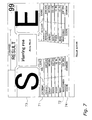
- Fig. 7 shows an example of the results screen when the music game is completed.
- the CPU 201 displays skill points 71 (in the figure “EXTREME” 86%), maximum combo number 72 (in the figure “MAXCOMBO” 234 (96%), rank 73 (in the figure “S”) , score 74 (in the figure “SCORE” 35468269), and so on, in the monitor 206.
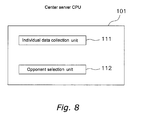
- Fig. 8 is an explanatory diagram showing the functional constitution of the CPU 101 of the center server 100.
- the CPU 101 includes individual data collection unit 111 and opponent selection unit 112. Before explaining these units, individual data is explained.
- Fig. 9 is an outline explanatory diagram of the individual data.
- the individual data is stored in the data storage unit 105 of the center server 100.
- the individual data includes "player ID”, “player name”, “authorization information”, "card ID”, “rank”, “parameter cumulative score”, and "secondary game cumulative score” in one record.
- Player ID is identification information for identifying a player.
- Player name is name of a player.
- Authorization information is the password or secret number used for authorizing a player.
- Card ID is identification information for identifying a card possessed by a player. A card ID is recorded on each card.
- “Rank” indicates the rank of a player.
- Parameter cumulative score indicates the cumulative value (hereafter referred to as parameter cumulative score) of the result of each parameter in primary games that the player has played in the past.
- the cumulative value of each parameter may be the cumulative value for each parameter calculated for a particular type of primary game, or it may be the cumulative value of the parameter results evaluated in common with a different type of primary game or a different version of the primary game.
- Secondary game cumulative score indicates the total number of wins and losses respectively in the secondary game at a certain rank. When the rank is changed, the secondary game cumulative score is reset.
- the individual data collection unit 111 receives individual data from each game terminal device 200, and updates the data storage unit 105. For example, if a certain player exceeds a predetermined number of wins in the secondary game, based on the results of the secondary game received from a game terminal device 200, the individual data collection unit 111 revises the individual data so that the player is promoted up by one rank.
- the opponent selection unit 112 selects a secondary game opponent in response to a request from a game terminal device 200.
- the opponent selection unit 112 receives a request that contains a player ID
- the opponent selection unit 112 selects another player ID having the same rank as the player ID.
- the parameter cumulative score of the selected player ID is transmitted to the game terminal device 200 that is the source of the request by the individual data collection unit 111. After receiving it, the game terminal device 200 that is the source of the request executes the secondary game based on the parameter cumulative score.
- Fig. 10 is an explanatory diagram showing the functional constitution of the CPU 201 of the game terminal device 200.
- the CPU 201 includes determination unit 201a, results display unit 201b, circulation unit 201c, instruction receipt unit 201d, and win/loss determination unit 201e.
- the determination unit 201a After completion of a primary game by a player, the determination unit 201a requests and obtains the parameter cumulative score of the other player from the center server 100. The determination unit 201a adds the player's score for each parameter obtained in the primary game to the player's parameter cumulative score for each parameter, to update the player's parameter cumulative score. The determination unit 201a compares the revised parameter cumulative score and the parameter cumulative score of the other player, for each parameter. This comparison may be carried out for all the parameters evaluated in the primary game, or it may be carried out for only some of the parameters. Next, based on the comparison result, the determination unit 201a determines the superiority or inferiority of the player relative to the other player, for each parameter. The player's parameter cumulative score is downloaded from the center server 100 together with other data before the start of the primary game (see Step S4 in the main process described later).
- Some or all of the parameters used in the primary game may be used as they are as comparison items for the secondary game, so the determination of superiority and inferiority may be carried out by comparing as they are the values of each of the parameters obtained in the primary game, but this is not necessarily the case.
- a combination of the values of several of the parameters in the primary game may be used as comparison items for the secondary game.
- the comparison items used in the secondary game can be determined as follows.
- comparison item 1 is an example of combining two of the parameters of the primary game as the comparison item.
- Comparison items 2 through 6 are examples of using parameters of the primary game as they are as comparison items for the secondary game.
- Comparison item 1 Level of difficulty + skill points
- Comparison item 2) (Maximum combo number)
- Comparison item 3) (Level of difficulty)
- Comparison item 4) (Amount of remaining life)
- Comparison item 5) (Number of "Perfects")
- Comparison item 6) (Skill points)
- the determination unit 201a obtains the values of the comparison items for the secondary game based on the parameter cumulative scores of the respective players, and compares them to determine the superiority and inferiority of the players for each comparison item. In other words, the determination unit 201a compares the player's score with the other player's score for each comparison item, based on the parameters from the primary game, and determines the superiority and inferiority of the players for each comparison item based on the comparison results. In other words, even if the number of parameter items of the player and the number of parameter items of the other player are different, it is possible to compete in the secondary game by calculating the values of the comparison items based on the scores for the parameters that are common to both.
- the comparison and the determination of superiority and inferiority may be carried out based on the scores for some of the parameters that are common among the parameter cumulative scores of the player and the opponent. Therefore, even if the primary games played by the player and the opponent for the secondary game are different, it is possible to carry out the secondary game.
- the determination unit 201a refers to the players' secondary game cumulative score, and if the number of wins reaches a predetermined number, a promotion game notification screen is output. For example, if the rank is increased every six wins, if the number of wins reaches five, a predetermined promotion game notification screen is output.
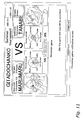
- Fig. 11 is an explanatory diagram showing an example of a promotion game notification screen. This screen makes the player aware that by winning the next secondary game, the player can be promoted.
- the results display unit 201b displays a competition screen on the monitor 206.
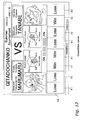
- Fig. 12 is an explanatory diagram showing an example of a competition screen displayed by the results display unit 201b.
- the results of the determination of superiority and inferiority for each comparison item calculated by the determination unit 201a are displayed in determined results fields F1 arranged in the horizontal direction of the screen.
- Each determined results field F1 corresponds to one of the parameters.
- the determined results are displayed as either of the values "Win” or "Lose”.
- the determined result is displayed for each of the comparison items "physical strength", "courage”, “agility", “arm strength”, “skill", and "weight”.
- the names of the comparison items used in the secondary game may be the same as the names of the parameters used in the primary game “skill points”, “maximum combo number”, ... , or they may be different.
- the results display unit 201b displays the determined results as one of two values. For example, it has been stated that the results display unit 201b displays the determined result as "Win” for comparison items for which it is determined that the player is superior to the other player, and conversely displays the determined result as "Lose” for comparison items for which it is determined that the player is inferior. By displaying the determined results as two values in this way, a player can easily see at a glance whether there are more "Wins” or "Losses", and can easily determine whether the player is in a favorable situation or not. Also, by using two values for the determined results, while a determined results field array FA and a reference mark RM, which are described later, are circulating, the player can easily aim for the timing that the reference mark RM is positioned at a "Win" field.
- the results display unit 201b may display the values of the two values in different display forms. For example, “Win” and “Lose” may be displayed in different colors respectively, so that a player can easily distinguish between “Win” and “Lose”. Therefore a player can be given a chance of winning, and the competitive motivation of the players raised. Also, displaying the width or height of the "Win” fields larger than the “Lose” fields is possible.
- the results display unit 201b may display the determined results fields F1 in a composite array to which fields having the same number of the each of the two values are added, as the determined results field array FA.
- Fig. 12 a display example of the determined results field array FA is shown in which one each "Win” and "Lose” field F2 are added to the right end. By adding the additional fields F2 and displaying them, the following effect is obtained. In other words, even if a player has lost all the comparison items in the secondary game, if a predetermined number of both "Win” and “Lose” fields are added, the player is given a definite chance to win.
- the player can aim for a reversal in the secondary game at one stroke. This means that depending on the player's skill, the player can achieve a win by coming from behind in the secondary game. In other words, even a player with poor skill in the primary game has the possibility of winning in the secondary game by skillfully aiming for a "Win” in the secondary game.
- the determination results displayed in the competition screen does not necessarily have to display the additional fields F2.
- the results display unit 201b may initially display the competition screen without displaying the additional fields F2, and subsequently add the display of the additional fields F2. In this way, the determined results for each comparison item are communicated to the players, and the players can be notified that the additional fields F2 have been provided.
- the circulation unit 201c moves the display position of either one or both of the determined results field array FA and the specific reference mark RM along the direction of alignment of the determined results field array FA. In this way, the determined results field array FA is circulated relative to the reference mark RM.
- the additional fields F2 as described previously may also be included in the determined results field array FA.
- Fig. 13A is a diagram for explaining the circulation of the determined results field array (FA).
- the procedure for the circulation of the determined results field array FA is as follows.
- the circulation unit 201c shifts the position of each field in the determined results field array FA in the direction of alignment of the fields (direction A or direction B in the figure) by a fixed distance, and then re-displays them. By repeating this, the field position corresponding to each parameter is circulated.
- each determined results field F1 is shifted in the direction A (to the right in the figure) shown in the figure, and when a field reaches the right end it is moved to the left end, and again shifted towards the right end.
- the amount shifted may be a predetermined number of dots, or it may be the width of one field.
- the horizontal array of the determined results field array FA circulates to the right at a constant velocity.
- the reference mark RM may be fixed in a fixed position, for example at the position of the fourth field from the left, or the reference mark RM may be circulated along the determined results field alignment direction as described later.
- the circulation direction may be switched at predetermined time intervals.
- Fig. 13B is a diagram for explaining the circulation of the reference mark RM.
- the circulation unit 201c can circulate the reference mark RM at a constant speed by repeatedly shifting the position of the reference mark RM in the determined results field array FA in the direction of alignment of the determined results fields F1 (direction A or direction B in the figure) by a fixed distance each time, and then re-displaying the reference mark RM.
- the amount shifted may be a predetermined number of dots, or it may be the width of one field. For example, in Fig.
- the reference mark RM is shifted by the amount of one field in the direction A (the right direction in the figure) every time, when the reference mark RM reaches the right end it is moved to the left end, and is again shifted towards the right end one field at a time.
- the reference mark RM circulates to the right along the determined results field array FA which is aligned horizontally.
- the determined results field array FA may be stopped, or it may be circulated along the determined results field alignment direction.
- the reference mark RM is a mark that identifies one of the fields of the determined results field array FA, there is no particular limitation. For example, an emphasis mark or lamp to emphasize a certain field, or a certain field can be displayed as enlarged, and so on, can be used.
- the circulation direction of the reference mark RM may be the same or the opposite direction to the circulation direction of the determined results field array FA.
- the circulation speeds of the two are adjusted so that the circulation speeds are not the same.
- the reference mark RM and the determined results field array FA each circulate relative to the other, with a constant relative circulation speed. If the relative circulation speed is constant, a player can easily aim for a determined result that is favorable.
- the circulation unit 201c may circulate a determined results field array FA containing additional fields F2.
- the determined results field array FA containing additional fields and the reference mark RM each circulate relative to the other.
- the direction of circulation of the determined results field array FA and the reference mark RM is varied in accordance with the form of alignment of the determined results fields F1. For example, if the determined results fields F1 are aligned in the shape of a ring, the direction of circulation is either clockwise or counterclockwise. Also for example, if the determined results fields F1 are aligned in a vertical column, the direction of circulation is either from top to bottom or the opposite.
- the relative circulation speed of the determined results field array FA and the reference mark RM is such that a player can aim for a "Win" field, and also the player cannot achieve 100 out of 100.
- the determined results field array FA should preferably circulate at a speed in the range of 0.1 to 0.5 seconds per cycle.
- the circulation speed varies depending on various factors, such as the size of each field, the size of the monitor 206, the form of the determined results display, and so on.
- the instruction receipt unit 201d receives instructions from a player regarding the timing that the reference mark RM is positioned at any of the determined results fields F1, while the determined results field array FA and the reference mark RM are circulating.
- the instruction receipt unit 201d receives instructions and displays the secondary game results screen with the circulation stopped.
- Fig. 14 is an example of a secondary game results screen with the circulation stopped after receipt of an instruction from a player.
- the reference mark RM is displayed as an enlarged display of a determined results field F1, and the reference mark RM is positioned at a "Win" field which is fourth from the left.
- the win/loss determination unit 201e determines whether a player has won or lost in the secondary game, in accordance with the value of the determined result field F1 at the position of the reference mark RM at the timing specified by the player. In the example in Fig. 14 , the reference mark RM is positioned at a "Win" field, so it is determined that the player has won the secondary game. Further, the win/loss determination unit 201e transmits to the center server 100 the results for each parameter in the primary game completed before starting the secondary game, and the win or lose results of the secondary game.
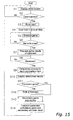
- Fig. 15 is a flowchart showing an example of the flow of the main process carried out by the game terminal device 200. When the electrical power to the game terminal device 200 is turned on, the following process is started.
- Steps S1-2 The CPU 201 displays a demo screen while waiting for an instruction to execute a game (S1). For example, when a coin is inserted, or a magnetic card is inserted into the card reader/writer 212, the procedure moves to Step S3.
- Step S3 The CPU 201 obtains the card ID that the card reader/writer 212 has read.
- Step S4 The CPU 201 transmits the card ID that has been read to the center server 100, and downloads individual data corresponding to the card ID.
- the downloaded individual data includes authorization information, parameter cumulative scores, and secondary game cumulative results.
- the CPU 201 requests the player to input authorization information, such as a password, or the like.
- the CPU 201 confirms whether the player is the person corresponding to the card ID by comparing the input authorization information with the authorization information included in the individual information.
- Step S5 The CPU 201 executes the primary game. Execution of the game is carried out independently from this process.
- Steps S6-S7 When the primary game is finished (S6) , the CPU 201 selects the opponent for the secondary game, and requests the parameter cumulative scores for the opponent from the center server 100 (S7) .
- the card ID is included with the request.
- the CPU 101 of the center server 100 selects as the opponent another player of the same rank as the player, and transmits the parameter cumulative scores of the opponent to the game terminal device 200.
- Steps S8-S10 When the CPU 201 receives the parameter cumulative scores of the opponent from the center server 100 (S8) , the CPU 201 obtains the results for each comparison item in the secondary game for both the player and the opponent, and determines the superiority or inferiority of the player for each comparison item (S9). The determined results are displayed in the competition screen (S10).
- Steps S11-S12 The CPU 201 determines whether to output a promotion game notification or not based on the number of wins contained in the secondary game cumulative results received from the center server 100 in Step S4. For example, if the rank is increased every six wins, and if the number of wins has reached five, the CPU 201 determines a "Yes", the promotion game notification screen is output, and after a predetermined period of time has passed the procedure moves to Step S13. If the CPU 201 determines a "No", the procedure moves to Step S13.
- Step S13 The CPU 201 executes a secondary game subroutine, which is described later, and determines the win or lose result of the secondary game.
- Step S14 The CPU 201 transmits the latest parameter cumulative scores that reflect the result of the primary game that has been executed, and the win or lose results of the secondary game to the center server 100.
- the center server 100 updates the secondary game cumulative results based on the received data. If the number of wins in the secondary game cumulative results has reached a predetermined number, the rank is updated and the secondary game cumulative results are reset. Then the procedure returns to Step S1, and waits to start the next game. This process is terminated when the power to the game terminal device is turned off.
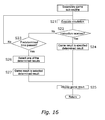
- Fig. 16 is a flowchart showing an example of the flow of the secondary game sub-routine process. In the main process as described previously, when the process moves to Step S13, the following process is started.
- Step S21-S23 The CPU 201 circulates the determined results field array FA and the predetermined reference mark RM, which are displayed in the competition screen, relative to each other (S21). To simplify the explanation, consider the case where the reference mark RM is fixed, and the determined results field array FA circulates. While the determined results field array FA is circulating, the CPU 201 waits for an instruction from the player until a predetermined period of time has passed (S22, S23).
- Steps S24-S25 When the CPU 201 receives a timing instruction from the player (S22) , the result of the secondary game is the value of the determined results field F1 at which the reference mark RM is positioned at that time. Also, the CPU 201 stops the circulation of the determined results field array FA at the time of the instruction from the player, and displays the secondary game results screen (S25).
- Step S26 If a timing instruction is not received from the player after a predetermined period of time has passed after start of circulation of the determined results field array FA, the CPU 201 selects one of the determined results fields F1 (S26) , and the value of that field is displayed as the result of the secondary game (S27, S25).
- the result of the secondary game determined by this sub-routine is transmitted to the center server 100 in the main process.
- the results of the primary game of two players are compared for each parameter evaluated in the primary game, such as a music game or the like. More specifically, the values of the comparison items used in the secondary game are based on the parameters evaluated in the primary game. Whether a player wins or loses in the secondary game is determined based on the values of these comparison items, so in determining the win or loss in the secondary game, a player's results in the primary game are indirectly evaluated. Moreover, in determining the winner and loser based on the results of the determination of superiority and inferiority, it is clear to the players that there is not even a small amount of intervention by the computer. Therefore, the players can readily accept the win or loss in the secondary game.
- winning or losing in the secondary game does not depend on the game device, but there is scope for determining the result by their own skill, so the players can accept the results obtained.
- winning or losing in the secondary game is a reflection of both the player's results in the primary game and the players' skill in the secondary game, so the result is that both the motivation in the primary game, which is necessary for the secondary game, and interest in the secondary game are stimulated.
- the game result evaluating method according to the present invention may be applied to the evaluation of the game results for all types of games based on predetermined evaluation items.
Landscapes
- Engineering & Computer Science (AREA)
- Multimedia (AREA)
- Theoretical Computer Science (AREA)
- Business, Economics & Management (AREA)
- Computer Security & Cryptography (AREA)
- General Business, Economics & Management (AREA)
- Management, Administration, Business Operations System, And Electronic Commerce (AREA)
- Electrophonic Musical Instruments (AREA)
Applications Claiming Priority (2)
| Application Number | Priority Date | Filing Date | Title |
|---|---|---|---|
| JP2005250430A JP3887001B1 (ja) | 2005-08-31 | 2005-08-31 | ゲーム成績評価方法及び装置 |
| PCT/JP2006/313819 WO2007026468A1 (ja) | 2005-08-31 | 2006-07-12 | ゲーム成績評価方法及び装置 |
Publications (2)
| Publication Number | Publication Date |
|---|---|
| EP1920804A1 true EP1920804A1 (de) | 2008-05-14 |
| EP1920804A4 EP1920804A4 (de) | 2012-05-02 |
Family
ID=37808571
Family Applications (1)
| Application Number | Title | Priority Date | Filing Date |
|---|---|---|---|
| EP06780989A Withdrawn EP1920804A4 (de) | 2005-08-31 | 2006-07-12 | Verfahren und vorrichtung zur auswertung von spielergebnissen |
Country Status (7)
| Country | Link |
|---|---|
| US (1) | US7988545B2 (de) |
| EP (1) | EP1920804A4 (de) |
| JP (1) | JP3887001B1 (de) |
| KR (1) | KR100920367B1 (de) |
| CN (1) | CN101203286B (de) |
| TW (1) | TW200722150A (de) |
| WO (1) | WO2007026468A1 (de) |
Cited By (1)
| Publication number | Priority date | Publication date | Assignee | Title |
|---|---|---|---|---|
| EP2359917A1 (de) * | 2010-01-27 | 2011-08-24 | NAMCO BANDAI Games Inc. | Eingabebestimmungsvorrichtung und Eingabebestimmungsverfahren |
Families Citing this family (21)
| Publication number | Priority date | Publication date | Assignee | Title |
|---|---|---|---|---|
| US7682237B2 (en) * | 2003-09-22 | 2010-03-23 | Ssd Company Limited | Music game with strike sounds changing in quality in the progress of music and entertainment music system |
| AU2008201892B2 (en) | 2007-05-16 | 2010-07-08 | Aristocrat Technologies Australia Pty Limited | A gaming system and a method of gaming |
| US8158873B2 (en) * | 2009-08-03 | 2012-04-17 | William Ivanich | Systems and methods for generating a game device music track from music |
| KR101190473B1 (ko) * | 2011-12-08 | 2012-12-24 | (주)네오위즈게임즈 | 온라인 게임에서의 친구간의 전적 제공 방법 및 서버 |
| KR20130083080A (ko) * | 2011-12-28 | 2013-07-22 | (주)네오위즈게임즈 | 온라인 게임에서 사용자의 상세 정보를 상세 정보 비교창에 표시하기 위한 방법 및 서버 |
| WO2013116926A1 (en) | 2012-02-06 | 2013-08-15 | Hothead Games, Inc. | Virtual opening of boxes and packs of cards |
| US8852000B1 (en) * | 2012-06-05 | 2014-10-07 | Kabam, Inc. | Using crowd-sourcing to verify the accuracy of results of client-side determinations |
| JP2015043832A (ja) * | 2013-08-27 | 2015-03-12 | 株式会社タイトー | ゲーム装置 |
| US10033786B2 (en) * | 2014-11-04 | 2018-07-24 | CineVR Europe S.à r.l. | Triggering of notifications in a communications network |
| US20170036119A1 (en) * | 2015-08-04 | 2017-02-09 | Hothead Games, Inc. | Virtual card play based interactive gaming experiences |
| US9919213B2 (en) | 2016-05-03 | 2018-03-20 | Hothead Games Inc. | Zoom controls for virtual environment user interfaces |
| US10010791B2 (en) | 2016-06-28 | 2018-07-03 | Hothead Games Inc. | Systems and methods for customized camera views and customizable objects in virtualized environments |
| US10004991B2 (en) | 2016-06-28 | 2018-06-26 | Hothead Games Inc. | Systems and methods for customized camera views in virtualized environments |
| WO2018069984A1 (ja) * | 2016-10-11 | 2018-04-19 | 富士通株式会社 | 生成プログラム、生成方法および生成装置 |
| JP6728310B2 (ja) * | 2018-11-21 | 2020-07-22 | 株式会社タイトー | ゲーム装置及びゲームプログラム |
| JP2021083958A (ja) * | 2019-11-29 | 2021-06-03 | 直次郎 竹田 | コンピュータ装置、制御方法およびプログラム |
| JP7440307B2 (ja) * | 2020-03-10 | 2024-02-28 | 株式会社バンダイナムコエンターテインメント | コンピュータシステムおよびゲームシステム |
| CN113262491B (zh) * | 2021-06-07 | 2024-11-19 | 网易(杭州)网络有限公司 | 一种互动方法、互动装置、电子设备及可读存储介质 |
| JP7546523B2 (ja) * | 2021-08-04 | 2024-09-06 | 任天堂株式会社 | ゲームプログラム、ゲーム装置、ゲーム処理方法、および、ゲームシステム |
| JP7307132B2 (ja) | 2021-09-21 | 2023-07-11 | 任天堂株式会社 | 情報処理システム、情報処理装置、情報処理プログラムおよび情報処理方法 |
| JP7112579B1 (ja) * | 2021-10-05 | 2022-08-03 | 株式会社バンダイ | プログラム、ゲーム装置及びゲームシステム |
Family Cites Families (45)
| Publication number | Priority date | Publication date | Assignee | Title |
|---|---|---|---|---|
| US4164081A (en) * | 1977-11-10 | 1979-08-14 | The United States Of America As Represented By The Secretary Of The Navy | Remote target hit monitoring system |
| JP3600339B2 (ja) * | 1995-12-14 | 2004-12-15 | 株式会社ナムコ | ゲームシステム及びゲームシステムの制御方法 |
| JP2935659B2 (ja) * | 1996-01-31 | 1999-08-16 | コナミ株式会社 | 競争ゲーム装置 |
| JP3103334B2 (ja) * | 1997-11-20 | 2000-10-30 | コナミ株式会社 | ビデオゲーム装置、ビデオゲームにおける制御方法及びビデオゲーム制御プログラムが記録された記録媒体 |
| JP2000051523A (ja) | 1998-08-05 | 2000-02-22 | Namco Ltd | ネットワークゲームシステムおよびゲーム集計データ表示方法 |
| US6217448B1 (en) * | 1998-09-18 | 2001-04-17 | Mikohn Gaming Corporation | Controller-based linked gaming machine bonus system |
| JP2000116938A (ja) | 1998-10-13 | 2000-04-25 | Konami Co Ltd | ゲームシステムおよびそのゲームを実行するためのプログラムを格納したコンピュータ読み取り可能な記憶媒体 |
| JP3924966B2 (ja) * | 1998-11-24 | 2007-06-06 | 株式会社セガ | ゲーム装置 |
| JP3017986B1 (ja) * | 1998-11-26 | 2000-03-13 | コナミ株式会社 | ゲームシステムおよびコンピュータ読み取り可能な記憶媒体 |
| JP3972230B2 (ja) * | 1999-02-15 | 2007-09-05 | 株式会社セガ | ゲーム装置、ゲーム装置の制御方法及び記録媒体 |
| JP3261110B2 (ja) * | 1999-02-16 | 2002-02-25 | コナミ株式会社 | ゲームシステムおよびコンピュータ読み取り可能な記憶媒体 |
| US6283855B1 (en) * | 1999-08-24 | 2001-09-04 | Walter L. Bingham | Method for playing a game |
| US6628264B1 (en) * | 1999-08-27 | 2003-09-30 | Sony Computer Entertainment Inc. | Entertainment system, entertainment apparatus, recording medium, and program |
| JP3980802B2 (ja) * | 1999-09-24 | 2007-09-26 | アルゼ株式会社 | 遊技機及び遊技システム |
| WO2001041891A1 (en) * | 1999-12-10 | 2001-06-14 | Namco, Ltd. | Game machine |
| JP2002066128A (ja) * | 2000-08-31 | 2002-03-05 | Konami Co Ltd | ゲーム装置、ゲーム処理方法及び情報記憶媒体 |
| JP3566195B2 (ja) * | 2000-08-31 | 2004-09-15 | コナミ株式会社 | ゲーム装置、ゲーム処理方法及び情報記憶媒体 |
| MXPA03002003A (es) | 2000-09-06 | 2005-02-25 | Casino Data Sys | Sistema para redondeo de bonificaciones para dispositivos de juego. |
| JP3482602B2 (ja) * | 2001-08-21 | 2003-12-22 | コナミ株式会社 | 対戦型ゲームのプログラム |
| JP5208339B2 (ja) * | 2001-08-23 | 2013-06-12 | 野村ホールディングス株式会社 | バーチャル株式投資ゲームのためのシステムおよびその処理方法 |
| JP2003144757A (ja) * | 2001-08-28 | 2003-05-20 | Square Co Ltd | オンラインゲームシステム、オンラインゲームシステムのサーバ装置、プレイヤランキング方法、プレイヤランキングプログラム、及びプレイヤランキングプログラムを記録した記録媒体 |
| US6811482B2 (en) * | 2002-03-05 | 2004-11-02 | Howard Letovsky | Video game of chance apparatus |
| JP2004033554A (ja) * | 2002-07-04 | 2004-02-05 | Aruze Corp | 遊技機、サーバ及びプログラム |
| JP2004229848A (ja) * | 2003-01-29 | 2004-08-19 | Aruze Corp | ゲームシステム及びゲームサーバ |
| US8348744B2 (en) * | 2003-02-12 | 2013-01-08 | Labtronix Concept Inc. | Participation-game system including an end-of-game evaluation means |
| JP3511518B1 (ja) * | 2003-03-07 | 2004-03-29 | 任天堂株式会社 | ゲーム装置、ゲームプログラムおよび情報記憶媒体 |
| JP4220340B2 (ja) * | 2003-09-12 | 2009-02-04 | 株式会社バンダイナムコゲームス | ゲームシステム、プログラムおよび情報記憶媒体 |
| JP2005131232A (ja) * | 2003-10-31 | 2005-05-26 | Sega Corp | ゲーム装置およびゲーム方法 |
| US8628397B2 (en) * | 2003-12-01 | 2014-01-14 | Konami Digital Entertainment Co., Ltd. | Multiplayer competition game device, game machine and game program |
| WO2005061063A1 (en) * | 2003-12-19 | 2005-07-07 | Zajac John D | Method and apparatus for playing a dice game |
| JP3825446B2 (ja) * | 2004-01-16 | 2006-09-27 | 株式会社コナミデジタルエンタテインメント | ゲーム結果評価方法、ゲーム結果評価装置、及びゲーム結果評価プログラム |
| US20050209717A1 (en) * | 2004-03-08 | 2005-09-22 | Flint Michael S | Competitor evaluation method and apparatus |
| JP3765498B2 (ja) * | 2004-05-11 | 2006-04-12 | 有限会社ネット棋院 | インターネットゲームの着手時間のカウント方法 |
| JP4342385B2 (ja) * | 2004-06-25 | 2009-10-14 | アルゼ株式会社 | ゲームシステム |
| JP4376708B2 (ja) * | 2004-07-01 | 2009-12-02 | アルゼ株式会社 | ゲームシステム、サーバ及びゲーム制御プログラム |
| JP2006014956A (ja) * | 2004-07-01 | 2006-01-19 | Aruze Corp | ゲームシステム、サーバ及びゲーム制御プログラム |
| US7326115B2 (en) * | 2004-08-20 | 2008-02-05 | Igt | Gaming device and method having a first interactive game which determines a function of a second wagering game |
| US7840288B2 (en) * | 2005-01-24 | 2010-11-23 | Microsoft Corporation | Player ranking with partial information |
| JP4372083B2 (ja) * | 2005-10-28 | 2009-11-25 | 株式会社コナミデジタルエンタテインメント | ゲームシステム及びゲーム機 |
| US20080102991A1 (en) * | 2006-10-27 | 2008-05-01 | Thomas Clark Hawkins | Athlete Reaction Training System |
| JP2008188054A (ja) * | 2007-01-31 | 2008-08-21 | Aruze Corp | 遊技機 |
| US7811164B1 (en) * | 2007-06-11 | 2010-10-12 | John Fox | Video skill game |
| US20090029754A1 (en) * | 2007-07-23 | 2009-01-29 | Cybersports, Inc | Tracking and Interactive Simulation of Real Sports Equipment |
| US8070589B2 (en) * | 2008-03-19 | 2011-12-06 | Cadillac Jack, Inc. | Skill-based redemption game |
| US20100035689A1 (en) * | 2008-08-11 | 2010-02-11 | Yaniv Altshuler | System and method for a gaming community |
-
2005
- 2005-08-31 JP JP2005250430A patent/JP3887001B1/ja not_active Expired - Lifetime
-
2006
- 2006-07-12 KR KR1020077024647A patent/KR100920367B1/ko not_active Expired - Fee Related
- 2006-07-12 CN CN2006800224542A patent/CN101203286B/zh not_active Expired - Fee Related
- 2006-07-12 WO PCT/JP2006/313819 patent/WO2007026468A1/ja not_active Ceased
- 2006-07-12 EP EP06780989A patent/EP1920804A4/de not_active Withdrawn
- 2006-08-02 TW TW095128366A patent/TW200722150A/zh not_active IP Right Cessation
-
2008
- 2008-02-26 US US12/037,610 patent/US7988545B2/en not_active Expired - Fee Related
Cited By (2)
| Publication number | Priority date | Publication date | Assignee | Title |
|---|---|---|---|---|
| EP2359917A1 (de) * | 2010-01-27 | 2011-08-24 | NAMCO BANDAI Games Inc. | Eingabebestimmungsvorrichtung und Eingabebestimmungsverfahren |
| US8784201B2 (en) | 2010-01-27 | 2014-07-22 | Namco Bandai Games Inc. | Information storage medium, game system, and input determination method |
Also Published As
| Publication number | Publication date |
|---|---|
| US7988545B2 (en) | 2011-08-02 |
| EP1920804A4 (de) | 2012-05-02 |
| CN101203286B (zh) | 2011-06-29 |
| US20080161078A1 (en) | 2008-07-03 |
| KR100920367B1 (ko) | 2009-10-07 |
| TWI320321B (de) | 2010-02-11 |
| CN101203286A (zh) | 2008-06-18 |
| JP2007061317A (ja) | 2007-03-15 |
| TW200722150A (en) | 2007-06-16 |
| WO2007026468A1 (ja) | 2007-03-08 |
| JP3887001B1 (ja) | 2007-02-28 |
| KR20070116660A (ko) | 2007-12-10 |
Similar Documents
| Publication | Publication Date | Title |
|---|---|---|
| US7988545B2 (en) | Game result evaluating method and device | |
| US8137171B2 (en) | Game result evaluation method and device | |
| US7452279B2 (en) | Recording medium of game program and game device using card | |
| JP3910890B2 (ja) | ゲームシステム、プログラム及び情報記憶媒体 | |
| US20070156267A1 (en) | Game results evaluating method and apparatus | |
| EP1181080A1 (de) | Spielmaschine mit vom spieler auszuwählenden ereignissen | |
| US20070232400A1 (en) | Server, game data downloading method, and information storage medium | |
| JP2003117245A (ja) | ゲームプログラム及びカードを使用するゲーム装置 | |
| KR20060043006A (ko) | 게임 장치, 게임 제어 방법, 프로그램 및 기록 매체 | |
| JP3227447B2 (ja) | ゲームシステム及び情報記憶媒体 | |
| JP3471340B2 (ja) | ゲームシステム、ビンゴカード作成記録媒体、ビンゴカード作成プログラム、ビンゴカード作成方法。 | |
| WO2020262500A1 (ja) | ゲーム装置およびゲームプログラム | |
| WO2020137655A1 (ja) | 情報処理プログラム、情報処理装置、及び情報処理システム | |
| JP2007313091A (ja) | ゲーム装置及びゲームプログラム | |
| JP2001353373A (ja) | ゲームシステム及び情報記憶媒体 | |
| HK1120455A (en) | Game result evaluating method and device | |
| JP7360933B2 (ja) | 情報処理プログラム、情報処理装置、及び情報処理システム | |
| US20060046811A1 (en) | Gaming machine, gaming machine control server and gaming system | |
| JP7657103B2 (ja) | プログラム | |
| JP7644074B2 (ja) | ゲームシステム及びサーバ | |
| JP7562810B1 (ja) | プログラム、ゲーム装置及びゲームシステム | |
| JP7693048B1 (ja) | プログラム及びゲーム装置 | |
| JP2000140423A (ja) | ゲーム装置、ゲーム展開変更方法及び情報記録媒体 | |
| HK1124277A (en) | Game result evaluating method and device | |
| JP2006130241A (ja) | ゲームシステム及びゲーム装置 |
Legal Events
| Date | Code | Title | Description |
|---|---|---|---|
| PUAI | Public reference made under article 153(3) epc to a published international application that has entered the european phase |
Free format text: ORIGINAL CODE: 0009012 |
|
| 17P | Request for examination filed |
Effective date: 20080225 |
|
| AK | Designated contracting states |
Kind code of ref document: A1 Designated state(s): DE ES FR GB IT |
|
| DAX | Request for extension of the european patent (deleted) | ||
| RBV | Designated contracting states (corrected) |
Designated state(s): DE ES FR GB IT |
|
| REG | Reference to a national code |
Ref country code: HK Ref legal event code: DE Ref document number: 1120455 Country of ref document: HK |
|
| A4 | Supplementary search report drawn up and despatched |
Effective date: 20120403 |
|
| RIC1 | Information provided on ipc code assigned before grant |
Ipc: A63F 13/12 20060101ALI20120328BHEP Ipc: A63F 13/10 20060101AFI20120328BHEP |
|
| 17Q | First examination report despatched |
Effective date: 20130814 |
|
| STAA | Information on the status of an ep patent application or granted ep patent |
Free format text: STATUS: THE APPLICATION IS DEEMED TO BE WITHDRAWN |
|
| 18D | Application deemed to be withdrawn |
Effective date: 20140103 |
|
| REG | Reference to a national code |
Ref country code: HK Ref legal event code: WD Ref document number: 1120455 Country of ref document: HK |