EP1798259B1 - Leitfähige zusammensetzung und herstellungsverfahren dafür, antistatisches anstrichmittel, antistatische beschichtung und antistatische folie, optischer filter, optisches informationsaufzeichnungsmedium und kondensator und herstellungsverfahren dafür - Google Patents
Leitfähige zusammensetzung und herstellungsverfahren dafür, antistatisches anstrichmittel, antistatische beschichtung und antistatische folie, optischer filter, optisches informationsaufzeichnungsmedium und kondensator und herstellungsverfahren dafür Download PDFInfo
- Publication number
- EP1798259B1 EP1798259B1 EP05790651A EP05790651A EP1798259B1 EP 1798259 B1 EP1798259 B1 EP 1798259B1 EP 05790651 A EP05790651 A EP 05790651A EP 05790651 A EP05790651 A EP 05790651A EP 1798259 B1 EP1798259 B1 EP 1798259B1
- Authority
- EP
- European Patent Office
- Prior art keywords
- acid
- group
- antistatic
- antistatic coating
- conductive polymer
- Prior art date
- Legal status (The legal status is an assumption and is not a legal conclusion. Google has not performed a legal analysis and makes no representation as to the accuracy of the status listed.)
- Expired - Lifetime
Links
- 0 *c(cc1*)cc(O)c1N=O Chemical compound *c(cc1*)cc(O)c1N=O 0.000 description 1
Images

Classifications
-
- H—ELECTRICITY
- H01—ELECTRIC ELEMENTS
- H01G—CAPACITORS; CAPACITORS, RECTIFIERS, DETECTORS, SWITCHING DEVICES, LIGHT-SENSITIVE OR TEMPERATURE-SENSITIVE DEVICES OF THE ELECTROLYTIC TYPE
- H01G9/00—Electrolytic capacitors, rectifiers, detectors, switching devices, light-sensitive or temperature-sensitive devices; Processes of their manufacture
- H01G9/004—Details
- H01G9/04—Electrodes or formation of dielectric layers thereon
- H01G9/042—Electrodes or formation of dielectric layers thereon characterised by the material
- H01G9/0425—Electrodes or formation of dielectric layers thereon characterised by the material specially adapted for cathode
-
- C—CHEMISTRY; METALLURGY
- C08—ORGANIC MACROMOLECULAR COMPOUNDS; THEIR PREPARATION OR CHEMICAL WORKING-UP; COMPOSITIONS BASED THEREON
- C08L—COMPOSITIONS OF MACROMOLECULAR COMPOUNDS
- C08L65/00—Compositions of macromolecular compounds obtained by reactions forming a carbon-to-carbon link in the main chain; Compositions of derivatives of such polymers
-
- C—CHEMISTRY; METALLURGY
- C09—DYES; PAINTS; POLISHES; NATURAL RESINS; ADHESIVES; COMPOSITIONS NOT OTHERWISE PROVIDED FOR; APPLICATIONS OF MATERIALS NOT OTHERWISE PROVIDED FOR
- C09D—COATING COMPOSITIONS, e.g. PAINTS, VARNISHES OR LACQUERS; FILLING PASTES; CHEMICAL PAINT OR INK REMOVERS; INKS; CORRECTING FLUIDS; WOODSTAINS; PASTES OR SOLIDS FOR COLOURING OR PRINTING; USE OF MATERIALS THEREFOR
- C09D165/00—Coating compositions based on macromolecular compounds obtained by reactions forming a carbon-to-carbon link in the main chain; Coating compositions based on derivatives of such polymers
-
- H—ELECTRICITY
- H01—ELECTRIC ELEMENTS
- H01B—CABLES; CONDUCTORS; INSULATORS; SELECTION OF MATERIALS FOR THEIR CONDUCTIVE, INSULATING OR DIELECTRIC PROPERTIES
- H01B1/00—Conductors or conductive bodies characterised by the conductive materials; Selection of materials as conductors
- H01B1/06—Conductors or conductive bodies characterised by the conductive materials; Selection of materials as conductors mainly consisting of other non-metallic substances
- H01B1/12—Conductors or conductive bodies characterised by the conductive materials; Selection of materials as conductors mainly consisting of other non-metallic substances organic substances
- H01B1/124—Intrinsically conductive polymers
- H01B1/127—Intrinsically conductive polymers comprising five-membered aromatic rings in the main chain, e.g. polypyrroles, polythiophenes
-
- H—ELECTRICITY
- H01—ELECTRIC ELEMENTS
- H01G—CAPACITORS; CAPACITORS, RECTIFIERS, DETECTORS, SWITCHING DEVICES, LIGHT-SENSITIVE OR TEMPERATURE-SENSITIVE DEVICES OF THE ELECTROLYTIC TYPE
- H01G11/00—Hybrid capacitors, i.e. capacitors having different positive and negative electrodes; Electric double-layer [EDL] capacitors; Processes for the manufacture thereof or of parts thereof
- H01G11/22—Electrodes
- H01G11/30—Electrodes characterised by their material
- H01G11/48—Conductive polymers
-
- H—ELECTRICITY
- H01—ELECTRIC ELEMENTS
- H01G—CAPACITORS; CAPACITORS, RECTIFIERS, DETECTORS, SWITCHING DEVICES, LIGHT-SENSITIVE OR TEMPERATURE-SENSITIVE DEVICES OF THE ELECTROLYTIC TYPE
- H01G11/00—Hybrid capacitors, i.e. capacitors having different positive and negative electrodes; Electric double-layer [EDL] capacitors; Processes for the manufacture thereof or of parts thereof
- H01G11/52—Separators
-
- H—ELECTRICITY
- H01—ELECTRIC ELEMENTS
- H01G—CAPACITORS; CAPACITORS, RECTIFIERS, DETECTORS, SWITCHING DEVICES, LIGHT-SENSITIVE OR TEMPERATURE-SENSITIVE DEVICES OF THE ELECTROLYTIC TYPE
- H01G11/00—Hybrid capacitors, i.e. capacitors having different positive and negative electrodes; Electric double-layer [EDL] capacitors; Processes for the manufacture thereof or of parts thereof
- H01G11/54—Electrolytes
- H01G11/56—Solid electrolytes, e.g. gels; Additives therein
-
- H—ELECTRICITY
- H01—ELECTRIC ELEMENTS
- H01G—CAPACITORS; CAPACITORS, RECTIFIERS, DETECTORS, SWITCHING DEVICES, LIGHT-SENSITIVE OR TEMPERATURE-SENSITIVE DEVICES OF THE ELECTROLYTIC TYPE
- H01G9/00—Electrolytic capacitors, rectifiers, detectors, switching devices, light-sensitive or temperature-sensitive devices; Processes of their manufacture
- H01G9/004—Details
- H01G9/022—Electrolytes; Absorbents
- H01G9/025—Solid electrolytes
- H01G9/028—Organic semiconducting electrolytes, e.g. TCNQ
-
- Y—GENERAL TAGGING OF NEW TECHNOLOGICAL DEVELOPMENTS; GENERAL TAGGING OF CROSS-SECTIONAL TECHNOLOGIES SPANNING OVER SEVERAL SECTIONS OF THE IPC; TECHNICAL SUBJECTS COVERED BY FORMER USPC CROSS-REFERENCE ART COLLECTIONS [XRACs] AND DIGESTS
- Y02—TECHNOLOGIES OR APPLICATIONS FOR MITIGATION OR ADAPTATION AGAINST CLIMATE CHANGE
- Y02E—REDUCTION OF GREENHOUSE GAS [GHG] EMISSIONS, RELATED TO ENERGY GENERATION, TRANSMISSION OR DISTRIBUTION
- Y02E60/00—Enabling technologies; Technologies with a potential or indirect contribution to GHG emissions mitigation
- Y02E60/13—Energy storage using capacitors
Definitions
- the present invention relates to a conductive composition containing a ⁇ conjugated conductive polymer and production method thereof.
- the present invention further relates to an antistatic coating material for imparting antistatic properties to a film, an antistatic coating material having antistatic properties, an antistatic film used in wrapping materials of food and electronic parts, an optical filter used for the front surface of a liquid crystal display and a plasma display, and an optical information recording medium, such as CDs and DVDs.
- the present invention relates to capacitors such as an aluminum electrolytic capacitor, tantalum electrolytic capacitor, and niobium electrolytic capacitor and a production method thereof.
- the present invention claims priority on Japanese Patent Application No. 2004-296380, filed on October 8, 2004 , Japanese Patent Application No.
- ⁇ conjugated conductive polymers are known as organic conductive materials.
- the ⁇ conjugated conductive polymers is generally referred to an organic polymer composed of the main chain of a conjugated system, and examples of the ⁇ conjugated conductive polymers include polypyrroles, polythiophenes, polyacetylenes, polyphenylenes, polyphenylene vinylenes, polyanilines, polyacenes, polythiophene vinylenes, and copolymers thereof.
- These ⁇ conjugated conductive polymers are usually synthesized by an electrolytic polymerization method or a chemical oxidative polymerization method.
- a previously prepared base such as an electrode material is immersed in a mixed solution of an electrolyte as a dopant and precursor monomers for constituting a ⁇ conjugated conductive polymer to form a film of the ⁇ conjugated conductive polymer on the base. Therefore, mass production is very difficult.
- the chemical oxidative polymerization method there are no such limitations on the chemical oxidative polymerization method. A large amount of a ⁇ conjugated conductive polymer can be produced in a solution by adding oxidant and oxidation polymerization catalysis to precursor monomers of the ⁇ conjugated conductive polymer.
- the ⁇ conjugated conductive polymer is obtained as an insoluble solid powder in the chemical oxidative polymerization method because the polymer becomes less soluble in a solvent as the conjugated system of the main chain of the polymer grows. It is difficult to form a uniform film of a ⁇ conjugated conductive polymer on a base surface if the polymer is insoluble. Additionally, the ⁇ conjugated conductive polymer tends to be an amorphous block and then a conductive composition containing ⁇ conjugated conductive polymer has low conductivity.
- an aqueous dispersion solution containing a ⁇ conjugated conductive polymer can be easily prepared. These methods require a ⁇ conjugated conductive polymer to contain a large amount of anion group-containing polymeric acid for ensuring its dispersibility. Therefore, the problem occurs that the obtained conductive compositions contain a large amount of compounds which do not contribute to conductivity, making it difficult to achieve high conductivity.
- the surface of an optical filter or an optical information recording medium has high hardness and high transparency as well as antistatic properties to prevent the adherence of dust and dirt due to the static electricity.
- the surface resistance of the antistatic property be in the region of about 10 6 to 10 10 ⁇ and that the resistance stabilizes (i.e., stabilized antistatic properties), from which antistatic coating having antistatic properties and high hardness is provided on the surface of optical filter or optical information recording medium.
- a metal or carbon with electron conduction as conduction mechanism is used, such humidity dependence disappears, but these materials are totally opaque and not applicable for purposes requiring the transparency.
- a metal oxide such as ITO (Indium Tin Oxide) has transparency and adopts the electron conduction as a conduction mechanism; therefore, it is suited in this respect, but a process using a sputtering apparatus must used for its film-forming. Not only is the process complicated but also the manufacturing cost rises.
- a coating film of inorganic metal oxide has low flexibility. When a film is formed on a thin base film, the coating film may be broken and does not exhibit conductivity. In addition, it is feared that peeling occurs at the interface and the transparency reduces because the adhesion to the base being an organic substance is low.
- ⁇ conjugated conductive polymers are known as organic materials with electron conduction as the conduction mechanism, but the ⁇ conjugated conductive polymers generally have insoluble and infusible properties, and it is difficult to coat the polymers on a base film after polymerization. Accordingly, it has been attempted that aniline be polymerized in the presence of a polymeric acid with a sulfo group (polyanion) to form a water-soluble polyaniline, the obtained mixture is used, coated on a base film and then dried (e.g., see Japanese Unexamined Patent Application, First Publication No. 1-254764 ).
- an antistatic coating can be formed.
- the antistatic coating has low conductivity because the coating is not obtained by a ⁇ conjugated conductive homopolymer, and the adhesion to a resin base is low and manufacturing processes are also complicated because the antistatic coating is water-soluble.
- Capacitors are given as example of using the ⁇ conjugated conductive polymers. In recent years, it has been required to reduce the impedance of capacitors used for electronics in a high-frequency region with the digitalization of electronics. A so-called functional capacitor in which an oxide film of valve metals such as aluminum, tantalum, and niobium is adopted as a dielectric and a ⁇ conjugated conductive polymer is formed on this surface and used as a cathode and thus far has been used in response to this requirement.
- valve metals such as aluminum, tantalum, and niobium
- this functional capacitor has an anode consisting of a porous valve metal body, a dielectric layer formed by oxidizing the surface of anode, and a cathode obtained by laminating a solid electrolyte layer, a carbon layer and a silver layer on the dielectric layer.
- the solid electrolyte layer of the capacitor is a layer constructed from a ⁇ conjugated conductive polymer of pyrrole, thiophene, and the like, and the layer performs to penetrate into the inside of porous body, come into contact with a larger area of electrolyte layer to derive a high capacity, restore defects of the dielectric layer, and prevent leakage of a current.
- An electrolytic polymerization method see Japanese Unexamined Patent Application, First Publication No. 63-158829
- a chemical oxidative polymerization method see Japanese Unexamined Patent Application, First Publication No. 63-173313
- the electrolytic polymerization method has the problem that a conductive layer made of manganese oxide must be formed on the surface of the porous valve metal body beforehand, the process is complicated, and further the manganese oxide has low conductivity and weakens the effect of using the ⁇ conjugated conductive polymers having high conductivity.
- the chemical oxidative polymerization method has the problem that the polymerization time is long, the polymerization must be repeated to ensure the thickness, the production efficiency of capacitors is low and the conductivity is also low.
- a capacitor having a low equivalent series resistance (ESR) as index of impedance has been desired, and the conductivity of the solid electrolyte layer must be increased to decrease ESR.
- ESR equivalent series resistance
- As a method for increasing the conductivity of the solid electrolyte layer for example, it has been proposed to highly control conditions for the chemical oxidative polymerization method (see Japanese Unexamined Patent Application, First Publication No. 11-74157 ).
- the complex chemical oxidative polymerization method is more complicated in many cases, thus the simplification and low costing of processes cannot be realized.
- the first object of the present invention is to provide a conductive composition excellent in all of electric conductivity, solvent solubility and heat stability and production method thereof.
- the second object of the present invention is to provide an antistatic coating material which can form an antistatic coating having high conductivity, flexibility, and adhesion to base, an antistatic coating which can be prepared by a simple production method of coating, and an antistatic film, an optical filter, and an optical information recording medium which all have excellent antistatic property.
- the third object of the present invention is to provide a capacitor having excellent conductivity of solid electrolyte layer of cathode and a low ESR, and a method of producing the capacitor in a simple manner.
- a conductive composition of the present invention comprises a ⁇ conjugated conductive polymer, a polyanion, and a hydroxy group-containing aromatic compound containing two or more hydroxy groups.
- the hydroxy group-containing aromatic compound is represented by the following formula (1): (wherein in formula (1), R represents a group selected from a linear or branched alkyl group, an alkenyl group, a cycloalkenyl group, an aryl group, or an aralkyl group, each having 1 to 15 carbon atoms.)
- the hydroxy group-containing aromatic compound may contain a sulfo group and/or a carboxy group.
- the conductive composition according to the present invention may further comprise a dopant.
- the conductive composition of the present invention may further comprise a binder resin.
- the binder resin may be at least one selected from the group consisting of polyurethane, polyester, acryl resin, polyamide, polyimide, epoxy resin, and polyimide silicone.
- a production method of a conductive composition of the present invention comprises: a polymerization step for dispering or dissolving a precursor monomer, which forms a ⁇ conjugated conductive polymer, in a solvent, and polymerizing the precursor monomer in a presence of a polyanion by a chemical oxidative polymerization, and an addition step for adding a hydroxy group-containing aromatic compound selected from the group consisting of 1,2,3-trihydroxybenzene and formula (1) as indicated above.
- the production method of the conductive composition of the present invention may further comprise a filtration step for partially removing free ions by an ultrafiltration method.
- An antistatic coating material of the present invention comprises: the conductive composition and a solvent.
- An antistatic coating of the present invention is produced by applying the antistatic coating material.
- An antistatic film of the present invention comprises: a film base and the antistatic coating formed on at least one side of the film base.
- An optical filter of the present invention comprises the antistatic coating.
- An optical information recording medium of the present invention comprises the antistatic coating.
- a capacitor of the present invention comprises: an anode composed of a porous valve metal body; a dielectric layer formed by oxidizing a surface of the anode; and a cathode formed on the dielectric layer, wherein the cathode has a solid electrolyte layer comprising the conductive composition.
- the cathode may further comprise an electrolyte.
- a production method of a capacitor of the present invention comprises the steps of: applying a conductive polymer solution, which comprises a ⁇ conjugated conductive polymer, a polyanion, a hydroxy group-containing aromatic compound, and a solvent, to a surface of a dielectric layer in a capacitor intermediate, which comprises an anode composed of a porous valve metal body and the dielectric layer formed by oxidizing a surface of the anode, and drying the conductive polymer solution, and wherein said hydroxy group-containing aromatic compound is selected from the group as indicated in claim 14.
- the conductive composition of the present invention is excellent in conductivity and stability.
- the conductive composition of the present invention if the hydroxy group-containing aromatic compound contains a sulfo group and/or a carboxy group, the conductivity increased.
- the conductive composition of the present invention further comprises a binder resin, a film formability and a film strength of a coating to be formed using the conductive composition are controlled. According to the production method of the conductive composition of the present invention, the conductive composition having excellent conductivity and stability is easily obtained. If the production method of the conductive composition comprises a filtration step for partially removing free ions by an ultrafiltration method, an operation for converting an anionic acid salt into an anionic acid is easily performed.
- an antistatic coating is formed having high conductivity, flexibility, and adhesion to a base. Moreover, such an antistatic coating material produces the antistatic coating at a low cost because a sufficient antistatic property is obtained by using it in a small amount.
- the antistatic coating material of the present invention if the hydroxy group-containing aromatic compound contains a sulfo group and/or a carboxy group, the conductivity of the antistatic coating further increases. If the antistatic coating material of the present invention further comprises a dopant, the conductivity of the antistatic coating further increases and heat resistance is improved. If a binder resin is contained in the antistatic coating material, adhesion to a base is improved.
- the binder resin is at least one selected from the group consisting of: polyurethane, polyester, acryl resin, polyamide, polyimide, epoxy resin, polyimide silicone, and melamine resin
- the binder resin is easily mixed with essential components of the antistatic material.
- the antistatic coating is excellent in conductivity, flexibility, and adhesion to a base, and can be produced by a simple production method, that is, coating.
- the antistatic film, optical filter, and optical information recording medium are excellent in antistatic properties, and prevent the occurrence of static electricity.
- the capacitor of the present invention has a low equivalent series resistance because the conductivity of cathode is high.
- the rate of deriving an electrostatic capacity increases.
- the production method of the capacitor of the present invention enables to simply produce the capacitor having a high conductivity of cathode and a low equivalent series resistance.
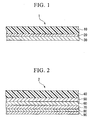
- Fig. 1 is a cross-sectional view showing an embodiment of the optical filter according to the present invention.
- Fig. 2 is a cross-sectional view showing an embodiment of the optical information recording medium according to the present invention.
- Fig. 3 is a cross-sectional view showing an embodiment of the capacitor according to the present invention.
- the conductive composition of the present invention comprises a ⁇ conjugated conductive polymer, a polyanion, and a hydroxy group-containing aromatic compound containing two or more hydroxy groups.
- Each component of the conductive composition is explained as follows.
- ⁇ conjugated conductive polymers can be used if they are organic polymers in which the main chain is constructed by a ⁇ -conjugate system.
- the polymer include polypyrroles, polythiophenes, polyacetylenes, polyphenylenes, polyphenylene vinylenes, polyanilines, polyacenes, polythiophene vinylenes, and copolymers thereof.
- Polypyrroles, polythiophenes, and polyanilines are preferable from in view of ease of polymerization and stability in the air.
- ⁇ conjugated conductive polymers can be obtained sufficient conductivity and compatibility for binder resins as they are unsubstituted, but it is preferable that functional groups such as alkyl, carboxyl, sulfo, alkoxy, hydroxyl, and cyano groups are introduced into ⁇ conjugated conductive polymers to increase the conductivity and dispersibility or solubility for binder resins.
- Examples of the ⁇ conjugated conductive polymer specifically include polypyrrole, poly(3-methylpyrrole), poly(N-methylpyrrole), poly(3-ethylpyrrole), poly(3-n-propylpyrrole), poly(3-butylpyrrole), poly(3-octylpyrrole), poly(3-decylpyrrole), poly(3-dodecylpyrrole), poly(3,4-dimethylpyrrole), poly(3,4-dibutylpyrrole), poly(3-carboxypyrrole), poly(3-methyl-4-carboxypyrrole), poly(3-methyl-4-carboxyethylpyrrole), poly(3-methyl-4-carboxybutylpyrrole), poly(3-hydroxypyrrole), poly(3-methoxypyrrole), poly(3-ethoxypyrrole), poly(3-butoxypyrrole), poly(3-hexyloxypyrrole), poly(3
- a (co)polymer composed of one or two compounds selected from polypyrrole, polythiophene, poly(N-methylpyrrol), poly(3-methylthiophene), poly(3,4-ethylenedioxythiophene) is suitably used in view of resistance value and reactivity.
- Polypyrrole and poly(3,4-ethylenedioxythiophene) are more preferable in view of increasing the conductivity and improving the heat resistance.
- alkyl-substituted compounds such as poly(N-methylpyrrol) and poly(3-methylthiophene) are more preferable because the solvent solubility, compatibility for binder resins, and dispersibility are improved.
- methyl group is preferable because it does not exert an adverse effect on the conductivity.
- PEDOT-PSS polystyrene sulfonate
- the above ⁇ conjugated conductive polymers can be easily produced by chemical oxidative polymerization of precursor monomers forming ⁇ conjugated conductive polymers in the presence of an appropriate oxidant, an oxidation catalyst, and a polyanion dopant described later.
- a precursor monomer has a ⁇ -conjugate system in a molecule and forms the ⁇ -conjugate system in the main chain when it is polymerized by the function of an appropriate oxidant.
- the precursor monomers include pyrroles and their derivatives, thiophenes and their derivatives, anilines and their derivatives, and the like.
- the precursor monomers include pyrrole, 3-methylpyrrole, 3-ethylpyrrole, 3-n-propylpyrrole, 3-butylpyrrole, 3-octylpyrrole, 3-decylpyrrole, 3-dodecylpyrrole, 3,4-dimethylpyrrole, 3,4-dibutylpyrrole, 3-carboxypyrrole, 3-methyl-4-carboxypyrrole, 3-methyl-4-carboxyethylpyrrole, 3-methyl-4-carboxybutylpyrrole, 3-hydroxypyrrole, 3-methoxypyrrole, 3-ethoxypyrrole, 3-butoxypyrrole, 3-hexyloxypyrrole, 3-methyl-4-hexyloxypyrrole, N-methylpyrrole, thiophene, 3-methyl-thiophene, 3-ethylthiophene, 3-propylthiophene, 3-butylthiophene, 3-hexylthiophene,
- solvents used in the preparation of ⁇ conjugated conductive polymers they are not specially limited and may be solvents which are able to dissolve or disperse the precursor monomers and keep the oxidizing power of oxidants and oxidation catalysts.
- polar solvents such as water, N-methyl-2-pyrrolidone, N,N-dimethylformamide, N,N-dimethylacetamide, dimethylsulfoxide, hexamethylene phosphortriamide, acetonitrile, benzonitrile, hexamethylphosphoric triamide, 1,3-dimethyl-2-imidazolidine, dimethylimidazoline, ethyl acetate, sulforan, diphenyl sulfone, and the like; phenols such as cresol, phenol, xylenol, and the like; alcohols such as methanol, ethanol, propanol, butanol, and the like; ketones such as acetone, methyl ethyl,
- Oxidants and oxidation catalysts may be ones which are able to oxidize the precursor monomers to obtain the ⁇ conjugated conductive polymers.
- examples of them include peroxodisulfates such as ammonium peroxodisulfate, sodium peroxodisulfate, potassium peroxodisulfate, and the like; transition metal compounds such as ferric chloride, ferric sulfate, ferric nitrate, cupric chloride, and the like; metal halide compounds such as boron trifluoride, aluminum chloride, and the like; metal oxides such as silver oxide, cesium oxide, and the like; peroxides such as hydrogen peroxide, ozone, and the like; organic peroxides such as benzoyl peroxide, and the like; oxygen, and the like.
- peroxodisulfates such as ammonium peroxodisulfate, sodium peroxodisulfate, potassium peroxodisulfate, and the like
- Polyanions are substituted or unsubstituted polyalkylenes, substituted or unsubstituted polyalkylenes, substituted or unsubstituted polyimides, substituted or unsubstituted polyamides, substituted or unsubstituted polyesters, and copolymers thereof, and are composed of structure units having anion groups and structure units having no anion groups.
- Anion groups of polyanion function as a dopant for the ⁇ conjugated conductive polymer and improve conductivity and heat resistance of the ⁇ conjugated conductive polymer.
- Polyalkylenes are polymers in which the main chain is constructed by repeated methylenes.
- Examples of polyalkylenes include polyethylene, polypropylene, polybutene, polypentene, polyhexene, polyvinyl alcohol, polyvinyl phenol, poly3,3,3-trifluoropropylene, polyacrylonitrile, polyacrylate, polystyrene, and the like.
- Polyalkenylenes are polymers composed of structural units in which one or more unsaturated bonds (vinyl groups) are contained in the main chain.
- polyalkenylenes include polymers comprising one or more structural units selected from propenylene, 1-methylpropenylene, 1-butylpropenylene, 1-decylpropenylene, 1-cyanopropenylene, 1-phenylpropenylene, 1-hydroxypropenylene, 1-butenylene, 1-methyl-1-butenylene, 1-ethyl-1-butenylene, 1-octyl-1-butenylene, 1-pentadecyl-1-butenylene, 2-methyl-1-butenylene, 2-ethyl-1-butenylene, 2-butyl-1-butenylene, 2-hexyl-I-butenylene, 2-octyl-1-butenylene, 2-decyl-1-butenylene, 2-dodecyl-1-butenylene, 2-phenyl-1
- substituted or unsubstituted butenylens are preferable from the fact that an interaction between an unsaturated bond and a ⁇ conjugated conductive polymer exists and substituted or unsubstituted butadienes are easily synthesized as starting materials.
- polyimides examples include polyimides from anhydrides such as pyromellitic dianhydride, biphenyltetracarboxylic dianhydride, benzophenone tetracarboxylic dianhydride, 2,2,3,3-tetracarboxyphenyl ether dianhydride, and 2,2-[4,4'-di(dicarboxyphenyloxy)phenyl]propane dianhydride; and diamines such as oxydiamine, p-phenylenediamine, m-phenylenediamine, and benzophenonediamine.
- polyamides examples include polyamide 6, polyamide 6, 6, polyamide 6, 10, and the like.
- polyesters include polyethylene terephthalate, polybutylene terephthalate, and the like.
- substituents include alkyl, hydroxyl, amino, carboxyl, cyano, phenyl, phenol, ester, alkoxy groups, and the like. If solubility for solvents, heat resistance, and compatibility with resins are considered, alkyl, hydroxyl, phenol, and ester groups are preferable.
- Alkyl groups can increase solubility for and dispersibility in polar solvents or nonpolar solvents, and compatibility with and dispersibility in resins. Hydroxyl groups can easily form a hydrogen bond with another hydrogen atom and increase solubility for organic solvents and compatibility with, dispersibility for, and adhesion to resins.
- cyano and hydroxyphenyl groups can increase compatibility with and solubility for polar resins and also increase heat resistance. In the above substituents, alkyl, hydroxyl, ester, and cyano groups are preferable.
- alkyl groups examples include chain alkyl groups such as methyl, ethyl, propyl, butyl, isobutyl, t-butyl, pentyl, hexyl, octyl, decyl, and dodecyl groups; and cycloalkyl groups such as cyclopropyl, cyclopentyl, and cyclohexyl groups. If solubility for solvents, dispersibility in resins, steric hindrance, and the like are considered, C 1 to C 12 alkyl groups are more preferable.
- the hydroxyl groups include hydroxyl groups directly bonded to the main chain of polyanions or hydroxyl groups bonded to the main chain via other functional groups.
- Examples of the other functional groups include C 1 to C 7 alkyl groups, C 2 to C 7 alkenyl groups, amide groups, imide groups, and the like.
- the hydroxyl groups are substituted at the end or in these functional groups.
- hydroxyl groups bonded at the end of C 1 to C 6 alkyl groups are more preferable in view of compatibility with resins and solubility for organic solvents.
- Examples of the amino groups include amino groups directly bonded to the main chain of polyanions or amino group bonded to the main chain via other functional groups.
- Examples of the other functional groups include C 1 to C 7 alkyl groups, C 2 to C 7 alkenyl groups, amide groups, imide groups, and the like. The amino groups are substituted at the end or in these functional groups.
- Examples of the phenol groups, phenol groups directly bonded to the main chain of polyanions or phenol group bonded to the main chain via other functional groups include C 1 to C 7 alkyl groups, C 2 to C 7 alkenyl groups, amide groups, imide groups, and the like.
- the phenol groups are substituted at the end or in these functional groups.
- Examples of the ester groups include alkyl ester groups or aromatic ester groups directly bonded to the main chain of polyanions or alkyl ester groups or aromatic ester groups bonded to the main chain via other functional groups.
- cyano groups examples include cyano groups directly bonded to the main chain of polyanions or cyano groups bonded to the end of C 1 to C 7 alkyl groups bonded to the main chain, cyano groups bonded the end of C 2 to C 7 alkenyl groups to the main chain, and the like.
- anion group among polyanions can be used if the anion group can be doped with the ⁇ conjugated conductive polymer by chemical oxidation, and preferred examples include a mono-substituted sulfuric acid ester group, mono-substituted phosphoric acid ester group, phosphoric group, carboxy group, and sulfo groups in view of easy production and stability. Furthermore, a sulfo group, mono-substituted phosphoric acid ester group, carboxy group, and the like are more preferable in view of the doping effect of the functional groups to the ⁇ conjugated conductive polymers. Preferred anion groups are provided in the main chain of polyanions adjacently or at a constant interval.
- polyanions include polyvinyl sulfonic acid, polystyrene sulfonic acid, polyallyl sulfonic acid, polyethyl acrylate sulfonic acid, polybutyl acrylate sulfonic acid, polyacryl sulfonic acid, polymethacryl sulfonic acid, poly-2-acrylamide-2-methylpropane sulfonic acid, polyisoprene sulfonic acid, polyvinyl carboxylic acid, polystyrene carboxylic acid, polyallyl carboxylic acid, polyacryl carboxylic acid, polymethacryl carboxylic acid, poly-2-acrylamide-2-methylpropane carboxylic acid, polyisoprene carboxylic acid, polyacrylic acid, and the like.
- polystyrene sulfonic acid polyisoprene sulfonic acid
- polyethyl acrylate sulfonic acid polybutyl acrylate sulfonic acid are preferable from effects of increasing compatibility with binder resins, further increasing conductivity of resultant antistatic coating material, and suppressing thermal decomposition of the ⁇ conjugated conductive polymers.
- Examples of production methods of polyanions include a method wherein an anion group is directly introduced into a polymer free of an anion group with an acid, a method wherein a polymer free of an anion group is sulfonated with a sulfonating agent, and a method wherein a polymer is produced by polymerization of an anion group containing polymerizable monomer.
- a method wherein a polymer is produced by polymerization of an anion group containing polymerizable monomer a method wherein an anion group containing polymerizable monomer is produced by oxidative polymerization or radical polymerization in a solvent in the presence of an oxidant and/or a polymerization catalyst.
- a predetermined amount of an anion group containing polymerizable monomer is dissolved in a solvent, kept to a certain temperature, a solution obtained by dissolving predetermined amounts of an oxidant and/or a polymerization catalyst in a solvent beforehand is added thereto and then the mixture is reacted for a predetermined time.
- a polymer obtained by this reaction is adjusted to a certain concentration with a solvent.
- a polymerizable monomer free of an anion group may also be copolymerized with an anion group containing polymerizable monomer.
- the oxidants, oxidation catalysts, and solvents to be used in the polymerization of an anion group containing polymerizable monomers are same as those used in the polymerization of precursor monomers forming the ⁇ conjugated conductive polymers.
- the obtained polymers are polyanion salts, they are preferably modified into polyanionic acids.
- methods for modifying the polymers into polyanionic acids ion-exchange method using an ion-exchange resin, dialysis method, ultrafiltration method, and the like are given, and the ultrafiltration method is preferable in view of easy operation.
- anion group containing polymerizable monomers is substituted by a mono-substituted sulfate group, a carboxyl group, sulfo group, and the like.
- anion group containing polymerizable monomers include a substituted or unsubstituted ethylenesulfonic acid compound, a substituted or unsubstituted styrene sulfonic acid compound, a substituted or unsubstituted acrylate sulfonic acid compound, a substituted or unsubstituted methacrylate sulfonic acid compound, a substituted or unsubstituted acrylamide sulfonic acid compound, a substituted or unsubstituted cyclovinylene sulfonic acid compound, a substituted or unsubstituted butadiene sulfonic acid compound, and a substituted or unsubstituted vinyl aromatic sulfonic acid compound.
- vinyl sulfonic acid and salts thereof examples include vinyl sulfonic acid and salts thereof, allyl sulfonic acid and salts thereof, methallylsulfonic acid and salts thereof, styrene sulfonic acid, methallyloxy benzene sulfonic acid and salts thereof, allyloxy benzene sulfonic acid and salts thereof, ⁇ -methylstyrenesulfonic acid and salts thereof, acrylamide-t-butyl sulfonic acid and salts thereof, 2-acrylamide-2-methylpropane sulfonic acid and salts thereof, 2-acrylamide-2-methylpropane sulfonic acid and salts thereof, cyclobutene-3-sulfonic acid and salts thereof, isoprene sulfonic acid and salts thereof, 1,3-butadiene-1-sulfonic acid and salts thereof, 1-methyl-1,3-butadiene-2-sulfonic acid and
- polymerizable monomers free of an anion group examples include ethylene, propene, 1-butene, 2-butene, 1-pentene, 2-pentene, 1-hexene, 2-hexene, styrene, p-methylstyrene, p-ethylstyrene, p-butylstyrene, 2,4,6-trimethylstyrene, p-methoxystyrene, ⁇ -methylstyrene, 2-vinylnaphthalene, 6-methyl-2-vinylnaphthalene, 1-vinylimidazole, vinylpyridine, vinyl acetate, acrylaldehyde, acrylonitrile, N-vinyl-2-pyrrolidone, N-vinylacetamide, N-vinylformamide, N-vinylimidazole, acrylamide, N,N-dimethylacrylamide, acrylic acid, methyl acrylate, ethyl acrylate
- a polyisoprene sulfonic acid, a copolymer containing a polyisoprene sulfonic acid, a polymethallyl sulfonic acid, a copolymer containing a polymethallyl sulfonic acid, a polysulfoethyl methacrylate, a copolymer containing a polysulfoethyl methacrylate, a poly(4-sulfobutyl methacrylate), a copolymer containing a poly(4-sulfobutyl methacrylate), a polymethallyloxybenzene sulfonic acid, a copolymer containing a polymethallyloxybenzene sulfonic acid, a polystyrene sulfonic acid, a copolymer containing a polystyrene sulfonic acid, and the like are preferred in view of
- the degree of polymerization of polyanions is preferably in a range of 10 to 10000 monomer units, more preferably in a range of 50 to 10000 monomer units in view of solubility in a solvent and conductivity.
- the content of polyanions contained in the conductive composition, the antistatic coating material, or the solid electrolyte layer of the capacitor is preferably 0.1 to 10 mol, and more preferably 1 to 7 mol to 1 mol of ⁇ conjugated conductive polymer. If the content of polyanions is less than 0.1 mol, the doping effect on ⁇ conjugated conductive polymer tends to weaken, and conductivity may be insufficient. In addition, the dispersibility and solubility in the solvent are deteriorated making it difficult to obtain uniform dispersions. If the content of polyanions is more than 10 mol, the content of the ⁇ conjugated conductive polymer in the conductive composition decreases making it difficult to obtain sufficient conductivity.
- a hydroxy group-containing aromatic compound is composed of an aromatic ring to which two or more hydroxy groups are bonded.
- the hydroxy group-containing aromatic compound has a strong interaction between the hydroxy groups and the aromatic ring, and tends to release hydrogen from the compound.
- hydroxy group-containing aromatic compounds include 1,4-dihydroxybenzene, 1,3-dihydroxybenzene, 2,3-dihydroxy-1-pentadecylbenzene, 2,4-dihydroxyacetophenone, 2,5-dihydroxyacetophenone, 2,4-dihydroxybenzophenone, 2,6-dihydroxybenzophenone, 3,4-dihydroxybenzophenone, 3,5-dihydroxybenzophenone, 2,4'-dihydroxydiphenylsulfone, 2,2',5,5'-tetrahydroxydiphenylsulfone, 3,3',5,5'-tetramethyl-4,4'-dihydoxydiphenylsulfone, hydroxyquinone carboxylic acid and salts thereof, 2,3-dihydroxy benzoic acid, 2,4-dihydroxy benzoic acid, 2,5-dihydroxy benzoic acid, 2,6-dihydroxy benzoic acid, 3,5-dihydroxy benzoic acid, 1,4-hydr
- R in formula (1) examples include alkyl groups such as methyl, ethyl, n-propyl, i-propyl, n-butyl, t-butyl, n-hexyl, i-hexyl, t-hexyl, and sec-hexyl groups; alkenyl groups such as vinyl, propenyl, and butenyl groups; cycloalkyl groups such as a cyclohexyl and cyclopentyl groups; cycloalkenyl groups such as cyclohexenyl group; aryl groups such as phenyl and naphthyl groups; aralkyl groups such as benzyl and phenethyl groups; and the like.
- the content of the hydroxy group-containing aromatic compound is preferably 0.05 to 10 mol, more preferably 0.3 to 5 mol to 1mol of the polyanion. If the content of the hydroxy group-containing aromatic compound is less than 0.05 mol, conductivity and heat resistance may be insufficient. If the content of the hydroxy group-containing aromatic compound is more than 10 mol, the content of the ⁇ conjugated conductive polymer in the conductive composition decreases making it difficult to obtain sufficient conductivity, and then the properties of the conductive composition, the antistatic coating material, or the solid electrolyte layer of the capacitor may be changed.
- Dopants other than polyanion dopants may also be added to improve the electric conductivity and heat stability. If the oxidation-reduction potential of the ⁇ conjugated conductive polymers can be changed, the other dopants may be donors or acceptors.
- donor dopants include alkali metals such as sodium, potassium, and the like; alkali-earth metals such as calcium, magnesium, and the like; quaternary amine compounds such as tetramethylammonium, tetraethylammonium, tetrapropylammonium, tetrabutylammonium, methyltriethylammonium, dimethyldiethylammonium, and the like.
- acceptor dopants include halogen compounds, Lewis acids, protonic acids, organic cyano compounds, organic metal compounds, and the like.
- halogen compounds include chlorine (Cl 2 ), bromine (Br 2 ), iodine (I 2 ), iodine chloride (ICl), iodine bromide (IBr), iodine fluoride (IF), and the like.
- Lewis acids include PF 5 , AsF 5 , SbF 5 , BF 5 , BCl 5 , BBr 5 , SO 3 , and the like.
- organic cyano compounds include compounds containing two or more cyano groups in the conjugated bond such as tetracyanoethylene, tetracyanoethyleneoxide, tetracyanobenzene, dichlorodicyanobenzoquinone (DDQ), tetracyanoquinodimethane, tetracyanoazanaphthalene, and the like.
- the protonic acids include inorganic acids and organic acids.
- inorganic acids include hydrochloric acid, sulfuric acid, nitric acid, phosphoric acid, borohydrofluoric acid, hydrofluoric acid, perchloric acid, and the like.
- organic acids include organic carboxylic acids, phenols, organic sulfonic acids, and the like.
- the organic carboxylic acid may be those having one or more carboxy groups in the aliphatic, aromatic, or cyclic aliphatic series.
- the organic carboxylic acids include formic acid, acetic acid, oxalic acid, benzoic acid, phthalic acid, maleic acid, fumaric acid, malonic acid, tartaric acid, citric acid, lactic acid, succinic acid, monochloroacetic acid, dichloroacetic acid, trichloroacetic acid, trifluoroacetic acid, nitroacetic acid, triphenylacetic acid, and the like.
- organic sulfonic acids those containing one, two or more sulfo groups in aliphatic, aromatic, and cyclic aliphatic compound or polymers containing sulfo groups can be used.
- organic sulfonic acids containing one sulfo group include methanesulfonic acid, ethanesulfonic acid, 1-propanesulfonic acid, 1-butanesulfonic acid, 1-hexanesulfonic acid, 1-heptanesulfonic acid, 1-octanesulfonic acid, 1-nonanesulfonic acid, 1-decanesulfonic acid, 1-dodecanesulfonic acid, 1-tetradecanesulfonic acid, 1-pentadecanesulfonic acid, 2-bromoethanesulfonic acid, 3-chloro-2-hydroxypropanesulfonic acid, trifluoromethanesulfonic acid, colistinmethanesulfonic acid, 2-acrylamide-2
- organic sulfonic acids containing two or more sulfo groups include ethanedisulfonic acid, butanedisulfonic acid, pentanedisulfonic acid, decanedisulfonic acid, o-benzenedisulfonic acid, m-benzenedisulfonic acid, p-benzenedisulfonic acid, toluenedisulfonic acid, xylenedisulfonic acid, chlorobenzenedisulfonic acid, fluorobenzenedisulfonic acid, dimethylbenzenedisulfonic acid, diethylbenzenedisulfonic acid, aniline-2,4-disulfonic acid, aniline-2,5-disulfonic acid, 3,4-dihydroxy-1,3-benzene disulfonic acid, naphthalenedisulfonic acid, methylnaphthalenedisulfonic acid, ethylnaphthalenedisulfonic acid, pentadecylnaphthalenedis
- the conductive composition of the present invention may be composed of the above-described three components, and a binder resin may be contained in the conductive composition in order to control coating formability, strength, and the like of a coating formed from the conductive composition. Furthermore, it is preferable that the antistatic coating material contains a binder resin because the scratch resistance and surface hardness of a coating are increased and the adhesion with a base is improved. When the antistatic coating material contains a binder resin, the pencil hardness (JIS K 5400) of the antistatic coating formed from the antistatic coating material is easily made to HB or harder. Namely, the binder resin functions as a hard coat component.
- binder resins they may be thermosetting resins or thermoplastic resins if they are compatible with or mixable/dispersible in each component in the conductive composition or in the antistatic coating material.
- binder resins include polyesters such as polyethylene terephthalate, polybutylene terephthalate, polyethylene naphthalate, and the like; polyimides such as polyimide, polyamideimide, and the like; polyamides such as polyamide 6, polyamide 6, 6, polyamide 12, polyamide 11, and the like; fluororesins such as polyvinylidene fluoride, polyvinyl fluoride, polytetrafluoroethylene, ethylenetetrafluoroethylene copolymer, polychlorotrifluoroethylene, and the like; vinyl resins such as polyvinyl alcohol, polyvinyl ether, polyvinyl butyral, polyvinyl acetate, polyvinyl chloride, and the like; epoxy resin; oxetane resin; xylene resin; aramide
- curing agents such as a crosslinking agent, polymerization initiator, and the like, a polymerization accelerator, solvent, viscosity modifier, or the like can be added.
- any one or more of polyurethane, polyester, acrylic resin, polyamide, polyimide, epoxy resin, polyimide silicone, and melamine resin are preferably used because these are easy to mix.
- acrylic resins are suited to such purposes as an optical filter because they have high hardness and excellent transparency.
- the acrylic resin preferably contains a heat-curable or photo-curable liquid polymer.
- the heat-curable liquid polymer can be, for example, a reactive polymer or a self-crosslinkable polymer.
- the reactive polymers are polymers obtained by polymerizing a monomer with a substituent such as hydroxyl, carboxyl, anhydride, oxetane, glycidyl, and amino groups.
- the monomers include polyfunctional alcohols such as ethylene glycol, diethylene glycol, dipropylene glycol, glycerin, and the like; carboxylic acid compounds such as malonic acid, succinic acid, glutamic acid, pimelic acid, ascorbic acid, phthalic acid, acetylsalicylic acid, adipic acid, isophthalic acid, benzoic acid, m-toluic acid, and the like; acid anhydrides such as maleic acid anhydride, phthalic acid anhydride, dodecylsuccinic anhydride, dichloromaleic anhydride, tetrachlorophthalic anhydride, tetrahydrophthalic anhydride, pyromellitic acid anhydride, and the like; o
- At least difunctional or higher crosslinking agents are used in the reactive polymers.
- the crosslinking agents include, for example, melamine resin, epoxy resin, metal oxides, and the like.
- the metal oxides include basic metallic compounds such as Al(OH) 3 , Al(OOC ⁇ CH 3 ) 2 (OOCH), Al(OOC ⁇ CH 3 ) 2 , ZrO(OCH 3 ), Mg(OOC ⁇ CH 3 ), Ca(OH) 2 , Ba(OH) 3 , and the like that can be properly used.
- the self-crosslinkable polymers are polymers that self-crosslink with each other by functional groups due to heating, and include, for example, glycidyl and carboxyl groups or N-methylol and carboxy groups.
- the photo-curable liquid polymer may be, for example, oligomers or prepolymers such as polyester, epoxy resin, oxetane resin, polyacryl, polyurethane, polyimide, polyamide, polyamideimide, polyimide silicone, and the like.
- Examples of monomer units constituting a photo-curable liquid polymer include monofunctional monomers and polyfunctional monomers of acrylates such as bisphenol A ethylene oxide-modified diacrylate, dipentaerythritol hexa(penta)acrylate, dipentaerythritol monohydroxy pentacrylate, dipropylene glycol diacrylate, trimethylolpropane triacrylate, glycerin propoxytriacrylate, 4-hydroxybutyl acrylate, 1,6-hexanediol diacrylate, 2-hydroxyethyl acrylate, 2-hydroxypropyl acrylate, isobornyl acrylate, polyethylene glycol diacrylate, pentaerythritol triacrylate, tetrahydrofurfuryl acrylate, trimethylolpropane triacrylate, tripropylene glycol diacrylate, and the like; methacrylates such as tetraethylene glycol dimethacrylate, alkyl methacrylates,
- the photo-curable liquid polymer is cured with a photopolymerization initiator.
- the photopolymerization initiator can be, for example, acetophenones, benzophenones, Michler's benzoylbenzoates, ⁇ -amyloxime esters, tetramethylthiuram monosulfides, or thioxanthones.
- a photosensitizer such as n-butylamine, triethylamine, and tri-n-butylphosphine can be mixed.
- cationic polymerization initiators examples include aryl diazonium salts, diaryl halonium salts, triphenyl sulfonium salts, silanol/aluminum chelate, ⁇ -sulfonyloxyketones, and the like.
- Precursor compounds or monomers forming a binder resin may be contained in place of the above-described binder resin.
- the binder resin can be formed by polymerizing the precursor compounds or monomers.
- additives may be contained as well as the binder resin.
- Additives which can be mixed with each component of the conductive composition are used, and examples of additives include a surface active agent, an antifoaming agent, a coupling agent, a neutralizing agent, an antioxidant, and the like.
- surface active agents include an anionic surface active agent such as carboxylate, sulfonate, sulfate salt, phosphate salt, and the like; a cationic surface active agent such as an amine salt, a quaternary ammonium salt, and the like; an amphoteric surface active agent such as a carboxybetaine, an aminocarboxylate salt, an imidazolium betaine, and the like; and a nonionic surface active agent such as a polyoxyethylene alkylether, a polyoxyethylene glycerine fatty acid ester, an ethylene glycol fatty acid ester, a polyoxyethylene fatty acid amide, and the like.
- anionic surface active agent such as carboxylate, sulfonate, sulfate salt, phosphate salt, and the like
- a cationic surface active agent such as an amine salt, a quaternary ammonium salt, and the like
- an amphoteric surface active agent such as a carboxybetaine
- antifoaming agents examples include a silicone resin, a polydimethylsiloxane, a silicone resin, and the like.
- coupling agents include a silane coupling agent containing vinyl, amino, epoxy groups, and the like.
- neutralizing agents include an alkali compound such as ammonia, sodium hydroxide, or the like and a nitrogen-containing compound such as primary amines, secondary amines, tertiary amines, and the like.
- antioxidants include a phenolic antioxidant, an amine antioxidant, a phosphorus-based antioxidant, a sulfur-based antioxidant, saccharides, vitamins, and the like.
- each conductive composition, antistatic coating material, and solid electrolyte layer of a capacitor contains a hydroxy group-containing aromatic compound, high conductivity and heat resistance are shown. It is considered that these properties can be obtained for the following reasons. Since the ⁇ conjugated conductive polymer is in a highly oxidized state, it is considered that radicals will be formed by oxidative degradation of a portion of the polymer due to the external environment such as heat, and then degradation progresses according to a radical chain reaction. On the other hand, the hydroxy group-containing aromatic compound has a strong interaction between the hydroxy groups and the aromatic ring, and tends to release hydrogen from the compound.
- hydrogen released from the hydroxy group-containing aromatic compound can deactivate radicals formed by oxidative degradation of the ⁇ conjugated conductive polymer. Accordingly, the radical chain reaction is stopped and progression of degradation is suppressed, and thus the heat resistance and stability should be high.
- This effect occurs when the aromatic compound contains two or more hydroxy groups.
- the hydroxy group-containing aromatic compound tends to interact with anion groups in the polyanion. It is considered that this interaction can shorten the distance between polyanions, and accordingly, the distance between the ⁇ conjugated conductive polymers, adsorbed on the polyanion by doping, each other can be also shortened. As a result, the energy for hopping, which is an electric conduction phenomenon between ⁇ conjugated conductive polymers, is reduced, and thus the total electric resistance can be reduced (conductivity can increase).
- a production method of a conductive composition according to the present invention is explained.
- a precursor monomer forming a ⁇ conjugated conductive polymer is dispersed or dissolved in a solvent in the presence of a polyanion to polymerize by a chemical oxidative polymerization.
- a polyanion, a precursor monomer, and an oxidant and/or oxidative polymerization catalyst for polymerizing the precursor monomer by the chemical oxidative polymerization are prepared.
- the precursor monomer and oxidant and/or oxidative polymerization catalyst are added to the polyanion maintained at a constant temperature and are reacted for a predetermined time while stirring to polymerize the precursor monomer by the chemical oxidative polymerization.
- An operation method, a sequence of the operation, reaction conditions, and the like are not limited in the polymerization step.
- a mixed solution having a predetermined concentration may be prepared by adding a solvent to the polyanion, precursor monomer, oxidant and/or oxidative polymerization catalyst beforehand.
- the main chain of the ⁇ conjugated conductive polymer grows along the main chain of the polyanion and then the ⁇ conjugated conductive polymer forms a bipolaron structure under the highly oxidized conditions. Accordingly, it is considered that anion groups of the polyanion are doped with the ⁇ conjugated conductive polymer to form a salt of the polyanion and the ⁇ conjugated conductive polymer.
- the polyanion has sulfo groups, a salt of the polyanion strongly bonding with the ⁇ conjugated conductive polymer can be formed. Since the ⁇ conjugated conductive polymer is strongly attracted to the main chain of the polyanion, the ⁇ conjugated conductive polymer arranged with regularity by growing along the main chain of the polyanion can be easily obtained.
- a mixed solution containing the polyanion and the ⁇ conjugated conductive polymer is obtained.
- a reaction terminator to stop the polymerization reaction may be added, if necessary, after the polymerization step has been completed.
- excess oxidant and/or oxidative polymerization catalyst and reaction by-products may be removed and ion exchange may be carried out after the polymerization step has been completed.
- a predetermined amount of a hydroxy group-containing aromatic compound is added in the mixed solution obtained in the polymerization step and mixed so as to form a uniform solution.
- a process for adding the hydroxy group-containing aromatic compound as it is and a process for adding a solution in which the hydroxy group-containing aromatic compound is dissolved or dispersed in a solvent are exemplified.
- the process for adding a solution in which the hydroxy group-containing aromatic compound is dissolved or dispersed in a solvent is preferred.
- Solvents for dissolving or dispersing the hydroxy group-containing aromatic compound are not especially limited and the above-described solvents can be used. Solvents may differ from the solvent used in the mixed solution.
- a conductive composition is obtained by partially removing free ions by an ultrafiltration method.
- the filtration step is an optional step and may be omitted.
- a polymer membrane an ultrafiltration membrane formed with a constant bore diameter is provided on a porous material and the solution is circulated.
- the ultrafiltration membrane is inserted to produce a differential pressure between the circulated solution and the permeated solution; therefore, a part of solution at the circulated solution side penetrates to the permeated solution side and releases the pressure at the circulated solution side.
- Particles smaller than the bore diameter of the ultrafiltration membrane and a part of the dissolved ions or the like contained in the circulated solution are transferred to the permeated solution side based on the above phenomenon to be removed.
- This method is a dilution method and impurities can be easily removed by repeating this dilution.
- the ultrafiltration membrane to be used is suitably selected depending upon the diameter of particles to be removed and ion species, and an ultrafiltration membrane having a range of molecular weight cut off of 1000 to 100000 is preferably used.
- ⁇ conjugated conductive polymers Since the obtained ⁇ conjugated conductive polymer contains a grown ⁇ -conjugate system in the main chain, ⁇ conjugated conductive polymers generally have insoluble and infusible properties. In the ⁇ conjugated conductive polymer solution obtained by dissolution or dispersion, since the ⁇ conjugated conductive polymer is self-coordinated by removing solvents, heating, doping, or the like when forming a film, the ⁇ conjugated conductive polymer may be insoluble. Therefore, solvents should be appropriately selected.
- the above-described production method of the conductive composition comprises a polymerization step for polymerizing a precursor monomer forming a ⁇ conjugated conductive polymer in the presence of polyanion by a chemical oxidative polymerization, and an addition step for adding a hydroxy group-containing aromatic compound, and then a conductive composition comprising the ⁇ conjugated conductive polymer, the polyanion, and the hydroxy group-containing aromatic compound is obtained. Since the conductive composition comprises the hydroxy group-containing aromatic compound, superior conductivity and stability are shown.
- an antistatic coating material To produce an antistatic coating material, first, a polyanion is dissolved in a solvent for dissolving it, a precursor monomer of a ⁇ conjugated conductive polymer and, as necessary, a dopant are added and fully stirred and mixed. Next, an oxidant is added dropwise into the obtained mixture to advance a polymerization and obtain complexes of the polyanion and ⁇ conjugated conductive polymer. Subsequently, the oxidant, residual monomer, and by-products are removed from the complexes to purify, and then, dissolved in an appropriate solvent. A hydroxy group-containing aromatic compound and, as necessary, a dopant and a binder resin are added to obtain an antistatic coating material.
- the ultrafiltration method is a method wherein a liquid in a solution is permeated and filtered through a porous ultrafiltration membrane while circulating the solution on the ultrafiltration membrane.
- the ultrafiltration membrane is inserted to produce a differential pressure between the circulated solution and the permeated solution; therefore, a part of solution at the circulated solution side penetrates to the permeated solution side and release the pressure at the circulated solution side.
- Particles smaller than the bore diameter of the ultrafiltration membrane and a part of dissolved ions transfer to the permeated solution side according to the penetration of this circulated solution. Therefore, these particles and dissolved ions can be removed.
- the ultrafiltration membrane to be used is properly selected depending upon diameter of particles to be removed and ion species, and the ultrafiltration membrane having a range of molecular weight cut off of 1000 to 100000 is preferably used.
- An antistatic coating is formed by applying an antistatic coating material on a base.
- methods for applying the antistatic coating material include dipping, comma coating, spray coating, roll coating, gravure printing, and the like.
- Bases are not specially limited, and resin moldings easy to cause static electricity, especially resin films such as polyester film, triacetyl cellulose (TAC) film, and the like are suitable.
- the solvent is removed by heating, or the coating may be cured by heat or light.
- heating methods in case of heating, for example, common methods such as hot-air heating or infrared heating can be adopted.
- a method for irradiating ultraviolet ray from light sources such as ultrahigh-pressure mercury vapor lamp, high-pressure mercury vapor lamp, low-pressure mercury vapor lamp, carbon arc, xenon arc, metal halide lamp, and the like can be adopted.
- the antistatic coating comprises the hydroxy group-containing aromatic compound
- the conductivity remarkably increases and the degradation of the ⁇ conjugated conductive polymer is suppressed. More specifically, the conductivity is about 0.001 to 100 S/cm when no hydroxy group-containing aromatic compound is contained, on the other hand, the conductivity is about 10 to 2000 S/cm when a hydroxy group-containing aromatic compound is contained.
- the transparency is preferably high. More specifically, the total light transmittance (JIS Z 8701) is preferably 85% or above, more preferably 90% or above, and especially preferably 96% or above.
- the haze (JIS K 6714) is preferably 5% or below, more preferably 3% or below, and especially preferably 1% or below.
- the surface hardness (pencil hardness) of the antistatic coating is preferably HB or harder when the antistatic coating also serves as a hard coat layer. The pencil hardness can be adjusted by the thickness of coating film. It is preferable that the surface resistance of the antistatic coating is properly adjusted in accordance with optical characteristics. Usually, if the surface resistance is about 1 ⁇ 10 3 ⁇ to 1 ⁇ 10 12 ⁇ , it is applicable to the antistatic purpose.
- the light transmittance, haze, and surface resistance of the coating film can be adjusted by the thickness of the coating film.
- the total light transmittance, haze, and surface resistance of the coating film can be adjusted by the thickness of the antistatic coating. It is preferable that a binder resin is not contained when a low surface resistance value is desired. However, it is preferable that a binder resin is contained to lower the cost or improve the adhesion to a base.
- An antistatic film has a film base and the above antistatic coating formed on at least one side of the film base.
- film bases include low-density polyethylene film, high-density polyethylene film, ethylene-propylene copolymer film, polypropylene film, ethylene-vinylacetate copolymer film, ethylene-methyl methacrylate copolymer film, polyethylene terephthalate (PET) film, polybutylene terephthalate (PBT) film, polyethylene naphthalate (PEN) film, polyimide film, 6-nylon film, 6,6-nylon film, polymethyl methacrylate film, polystyrene film” styrene-acrylonitrile-butadiene copolymer film, polyacrylonitrile film, cellulose triacetate (TAC) film, cellulose propionate film, polyvinyl chloride film, polyvinylidene chloride film, polyvinylidene fluoride film, polytetrafluoroethylene film, poly
- the surface of these film bases are usually oleophilic, when an antistatic coating material dissolved in an aqueous solvent is applied, the application is difficult. Therefore, when an antistatic coating material dissolved in an aqueous solvent is applied, it is preferable to give etching treatments such as sputtering, corona discharge, flame, ultraviolet irradiation, electron ray irradiation, chemical reaction, oxidation, and the like or hydrophilic treatments such as primer coating, and the like. Moreover, the surface may also be dust removed and cleaned by solvent washing, ultrasonic washing, or the like.
- FIG. 1 An embodiment example of an optical filter of the present invention is explained.
- the optical filter of this embodiment example is shown in Fig. 1 .
- This optical filter 1 comprises a film base 10, an antistatic coating 20 formed on the film base 10, and an antireflecting layer 30 formed on the antistatic coating 20.
- the antistatic coating 20 in this optical filter 1 functions as a hard coat layer.
- a transparent adhesive layer is provided on the surface of the film base 10 in the optical filter 1, and the optical filter 1 and the surface of the display are provided via the adhesive layer.
- the film base 10 Various plastic films having transparency can be used as the film base 10.
- the transparent plastic films include films made of polyethylene terephthalate, polyimide, polyether sulfone, polyether ether ketone, polycarbonate, polypropylene, polyamide, acrylamide, cellulose propionate, and the like.
- etching treatments such as sputtering, corona discharge, flame, ultraviolet irradiation, electron ray irradiation, chemical reaction, oxidation, and the like or hydrophilic treatments such as primer coating are given to the surface of film base 10. If such treatments are given to the surface, the adhesion to the antistatic coating 20 can be further increased.
- the surface of film base 10 may also be dust removed or cleaned by solvent washing, ultrasonic washing, or the like, as necessary, before the antistatic coating 20.
- the antistatic coating 20 is a membrane formed from an antistatic coating material as described above, and the membrane functions as a hard coat layer. Accordingly, as described above, the surface hardness (pencil hardness) of this antistatic coating 20 is preferably HB or harder.
- the total light transmittance (JIS Z 8701) of antistatic coating 20 is preferably 85% or above, more preferably 90% or above, and especially preferably 96% or above for optical purposes.
- the haze (JIS K 6714) is preferably 5% or below, more preferably 3% or below, and especially preferably 1% or below.
- the antireflecting layer 30 is a layer for preventing the reflection of light.
- This layer may be a single layer or a multilayer.
- the refractive index is preferably in a range of 1.38 to 1.45
- the thickness of optical film is preferably in a range of 80 to 100 nm
- the antireflecting layer 30 can be formed by either dry processes or wet processes. Examples of dry processes include physical deposition processes such as electron-beam vapor deposition process, dielectric heating vapor deposition process, resistance heating vapor deposition process, sputtering process, ion plating process, and the like, and plasma CVD process.
- the antireflecting layer 30 is formed by the dry processes, for example, inorganic compounds such as silicon oxide, magnesium fluoride, niobium oxide, titanium oxide, tantalum oxide, aluminum oxide, zirconium oxide, indium oxide, tin oxide, and the like can be used as components of the antireflecting layer 30.
- wet processes for example, processes wherein a coating containing curable compounds is applied by well-known methods such as comma coating, spray coating, roll coating, gravure printing, and the like are given.
- fluorine compounds such as fluorine-containing organic compounds, fluorine-containing organosilicon compounds, fluorine-containing inorganic compounds, and the like can be used as a curable compound.
- an antifouling layer may be further provided on the antireflecting layer 30. If the antifouling layer is provided, it prevents the adherence of dust and dirt or facilitates to remove dust and dirt even if they adhere to.
- the antifouling layer is not specially limited if it does not hinder the antireflection function of the antireflecting layer 30, can show high water repellence and high oil repellence, and prevent the adherence of contaminants.
- the antifouling layer may be a layer made of organic compounds or a layer made of inorganic compounds. For example, a layer containing organosilicon compounds with a perfluorosilane group or a fluorocycloalkyl group, or a layer containing organofluorine compounds can be used.
- the processes for forming the antifouling layer can be properly selected according to their kinds, for example, physical vapor deposition processes or chemical vapor deposition processes such as deposition process, sputtering process, ion plating process; vacuum processes such as plasma polymerization process; microgravure process, screen coating process, dip coating process, and the like can be adopted.
- the optical filter 1 described above is excellent in transparency and also excellent in adhesion to the film base 10 because the antistatic coating 20 protecting the film base 10 is formed and the antistatic coating 20 is formed from the above antistatic coating materials. Moreover, this optical filter 1 is a filter excellent in stability of antistatic property and its surface is hard to be adhered by dust. Then, such an optical filter 1 is suitably used as an antireflecting film, an infrared absorption film, an electromagnetic wave absorption film, and the like for liquid crystal displays and plasma displays.
- the optical filter of the present invention is not limited to the above-mentioned embodiment examples, if the optical filter has an antistatic coating formed from the above antistatic coating materials.
- a polarizing plate can also be used in place of the film base.
- a polarizing plate is obtained by laminating protecting films on one side or both sides of a polyvinyl alcohol resin film in which a dichromic colorant is absorbed and oriented. As dichromic colorants, iodine, dichromic dyes can be used.
- Such an optical filter can be provided at the uppermost surface of a liquid crystal display.
- optical information recording medium of the present invention An embodiment example of an optical information recording medium of the present invention is explained.
- the optical information recording medium of this embodiment example is shown in Fig. 2 .
- This optical information recording medium 2 is a rewrite-type disk and has a structure in which a disk-like transparent resin base 40, a first dielectric layer 50, an optical information recording layer 60, a second dielectric layer 70, a metal reflecting layer 80, and an antistatic coating 90 are formed in order.
- first dielectric layer 50 and the second dielectric layer 70 for example, inorganic materials such as SiN, SiO, SiO 2 , Ta 2 O 5 , or the like can be used. These dielectric layers are formed in a thickness of 10 to 500 nm by well-known means such as vacuum vapor deposition process, sputtering process, ion plating process, and the like
- inorganic photomagnetic recording materials such as Tb-Fe, Tb-Fe-Co, Dy-Fe-Co, Tb-Dy-Fe-Co, and the like
- inorganic phase-change recording materials such as TeOx, Te-Ge, Sn-Te-Ge, Bi-Te-Ge, Sb-Te-Ge, Pb-Sn-Te, Tl-In-Se, and the like
- organic colorants such as cyanine colorants, polymethine colorants, phthalocyanine colorants, merocyanine colorants, azulene colorants, squalium colorants, and the like are used.
- the optical information recording layer 60 When the optical information recording layer 60 is made of inorganic photomagnetic recording materials, it can be formed in a thickness of 10 to 999 nm by well-known means such as vacuum vapor deposition process, sputtering process, ion plating process, and the like.
- a solution given by dissolving an organic colorant in a solvent such as acetone, diacetone alcohol, ethanol, methanol, and the like can be formed in a thickness of 10 to 999 nm by well-known printing process or coating process.
- the metal reflecting layer 80 exhibits light reflectivity and is composed of metals such as Al, Cr, Ni, Ag, Au, and the like and oxides thereof, nitrides thereof, and the like separately or by combining two or more kinds of them.
- This metal reflecting layer 80 is formed in a thickness 2 to 200 nm by sputtering or vacuum deposition process.
- the antistatic coating 90 is formed from the above antistatic coating materials. Since the surface hardness of the antistatic coating 90 is set to HB or harder, the antistatic coating 90 can prevent surface scratch of the optical information recording medium 2 and prevent oxidation of the metal reflecting layer 80 as well as the adherence of dust due to static electricity.
- the thickness of antistatic coating 90 is preferably 3 to 15 ⁇ m. If the thickness is thinner than 3 ⁇ m, the formation of a uniform membrane tends to become difficult, sufficient antistatic property, surface scratch resistance and oxidation resistance of the metal reflecting layer 80 sometimes cannot be displayed. On the other hand, if the thickness is thicker than 15 ⁇ m, it is feared that the internal stress increases and mechanical properties of the optical information recording medium 2 deteriorate.
- the antistatic coating 90 is formed by applying an antistatic coating material on the metal reflecting layer 80 by well-known methods such as comma coating, spray coating, roll coating, gravure printing, and the like, and then drying the solvent or curing by heat or UV irradiation.
- the antistatic coating 90 protecting the optical information recording layer 60 and the metal reflecting layer 80 is formed, and the antistatic coating 90 is formed from the above antistatic coating material. Accordingly, the antistatic coating 90 is excellent in transparency in the range of 780 nm and 635 nm which is a range of wavelength of read-only laser because the haze is low and the light transmittance is high. Moreover, the dust adherence due to static electricity is suppressed and the recording reading errors and writing errors are prevented because the antistatic coating 90 has the antistatic property.
- the optical information recording medium of the present invention is not limited to the above-mentioned embodiment example; the optical information recording medium may also be a postscript-type disk.
- the postscript-type disk has a structure in which a transparent resin base (organic base), an optical information recording layer, a reflecting metal layer and an antistatic coating are formed in order.
- FIG. 3 is a diagram showing the construction of a capacitor of this embodiment example.
- This capacitor 100 is schematically constructed by having an anode 110 composed of a porous valve metal body, a dielectric layer 120 formed by oxidizing the surface of anode 110, and a cathode formed on the dielectric layer 120.
- valve metals forming the anode 110 include aluminum, tantalum, niobium, titanium, hafnium, zirconium, zinc, tungsten, bismuth, antimony, and the like. Among these, aluminum, tantalum, and niobium are preferably used. These valve metals can form a densely and durable dielectric oxide film (dielectric layer) by electrolytic oxidation; therefore, the capacity of capacitor can be stably increased.
- anode 110 an anode obtained by etching an aluminum foil to increase the surface area and then oxidizing its surface, an anode obtained by oxidizing the surface of sintered body of tantalum particles or niobium particles and then forming pellets, and the like are given. The irregularities are formed on the surface of anodes thus treated.
- the dielectric layer 120 is formed, for example, by anodic oxidation of the surface of metal body 110 in an electrolyte such as an aqueous solution of ammonium adipate. Accordingly, as shown in Fig. 3 , the irregularities are similarly formed at the surface of the dielectric layer 120 as the anode 110.
- a cathode 130 comprises a solid electrolyte layer 130a and a conductive layer 130b composed of carbon, silver, aluminum, and the like and formed on the solid electrolyte layer 130a.
- the solid electrolyte layer 130a comprises a ⁇ conjugated conductive polymer, a polyanion, and a hydroxy group-containing aromatic compound.
- the conductive layer 130b is constructed of carbon, silver, and the like, it is formed from a conductive paste containing a conductor such as carbon, silver, and the like.
- the conductive layer 130b is constructed of aluminum, it is formed from an aluminum foil.
- a separator can be provided between the solid electrolyte layer 130a and the conductive layer 130b as necessary.
- a production method of the capacitor is a method wherein a conductive polymer solution is applied to the surface of a dielectric layer 120 of a capacitor intermediate having the anode 110 composed of a porous valve metal body and the dielectric layer 120 of an oxide film formed by oxidizing the surface of the anode 110 to form the solid electrolyte layer 130a.
- the conductive polymer solution in this production method contains a ⁇ conjugated conductive polymer, a polyanion, a hydroxy group-containing aromatic compound, and a solvent.
- a precursor monomer such as aniline, pyrrole, thiophene, and the like forming the ⁇ conjugated conductive polymer is added into the obtained solution.
- an oxidant is added to polymerize the precursor monomer, subsequently, excess oxidant and precursor monomer are separated and purified.
- the hydroxy group-containing aromatic compound is added to obtain the conductive polymer solution.
- Solvents contained in the conductive polymer solution are not specially limited, examples of solvents include alcohol solvents such as methanol, ethanol, isopropyl alcohol (IPA), and the like; amide solvents such as N-methylpyrrolidone (NMP), dimethylacetamide (DMAc), dimethylformamide (DMF), and the like; ketone solvents such as methyl ethyl ketone (MEK), acetone, cyclohexane, and the like; ester solvents such as ethyl acetate, butyl acetate, and the like; toluene, xylene, water, and the like. They may be used separately or used by mixing. Water and alcohol solvents with a low environmental load are preferable among them from a recent viewpoint of environmental protection.
- Examples of coating methods of the conductive polymer solution include well-known methods such as coating, dipping, spraying, and the like.
- Examples of drying methods include well-known methods such as hot-air drying, and the like.
- the conductive layer 130b can be formed by well-known methods such as a method using a carbon paste or silver paste, and a method providing the cathode at the opposed side via a separator.
- the capacity is supplemented by impregnating an electrolyte as necessary after the solid electrolyte layer 130a is formed.
- Electrolytes are not specially limited if they have a high conductivity, and well-known electrolytes are dissolved in well-known solvents.
- solvents in the electrolytes include alcohol solvents such as ethylene glycol, diethylene glycol, propylene glycol, 1,4-butanediol, glycerin, and the like; lactone solvents such as ⁇ -butyrolactone, ⁇ -valerolactone, ⁇ -valerolactone, and the like; amide solvents such as N-methylformamide, N,N-dimethylformamide, N-methylacetamide, N-methylpyrrolidinone, and the like; nitrile solvents such as acetonitrile, 3-methoxypropionitrile, and the like; water and the like.
- electrolytes examples include electrolytes with organic acids such as adipic acid, glutaric acid, succinic acid, benzoic acid, isophthalic acid, phthalic acid, terephthalic acid, maleic acid, toluic acid, enanthic acid, malonic acid, formic acid, decane dicarboxylic acids such as 1,6-decane dicarboxylic acid, 5,6-decane dicarboxylic acid, and the like, octane dicarboxylic acids such as 1,7-octane dicarboxylic acid, and the like, azelaic acid, sebacic acid, and the like, or inorganic acids such as boric acid, polyalcohol complexes of boric acid obtained from boric acid and polyalcohols, phosphoric acid, carbonic acid, silicic acid, and the like as anion component; and primary amines (methylamine, ethylamine, propylamine, butylamine, ethylenediamine
- the above-mentioned production method involves simple processes, is suited to mass production, and is low-cost because the solid electrolyte layer is formed by coating a conductive polymer solution and then drying. Furthermore, since the conductive polymer solution contains a ⁇ conjugated conductive polymer, a polyanion, and a hydroxy group-containing aromatic compound, the degradation of the ⁇ conjugated conductive polymer in the solid electrolyte layer is suppressed and the hopping energy is reduced. Therefore, the conductivity of the solid electrolyte layer can be increased, and thus the performance of the capacitor can be improved.
- ethyl methacrylate sodium sulfonate was dissolved in 1000 ml of ion-exchanged water, 1.14 g of ammonium persulfate previously dissolved in 10 ml of water beforehand was added dropwise over 20 minutes while stirring at 80°C, and the mixture was continuously stirred for an additional 12 hours.
- 1000 ml of sulfuric acid diluted to 10% by weight was added to the obtained poly (ethyl methacrylate sodium sulfonate) solution, about 1000 ml of the solution was removed by an ultrafiltration method, 2000 ml of ion-exchanged water was added to the residue, and about 2000 ml of the solution was removed by the ultrafiltration method. The above ultrafiltration operation was repeated three times.
- Example 1 Electric conductivity (S/cm) Retention rate of electric conductivity depending on heat (%) Rate of change of electric conductivity depending on humidity (%)
- Example 1 98 67.5 -3.2
- Example 2 56 53.5 11.3
- Example 3 276 81.6 2.5
- Example 4 132 86.4 -5.5
- Example 5 653 91.3
- Example 6 283 89.5 3.3
- Example 7 578 92.8 3.8
- Example 8 45 45.4 5.4
- Example 9 32 52.6 7.3
- Example 10 420 88.2 Comparative Example 1 0.8 2.5 -350 Comparative Example 2 2.7 8.9 -490 Comparative Example 3 5.8 10.3 -487 Comparative Example 4 4.5 0.8 -386
- a coating film of the conductive composition was similarly obtained and evaluated as in Example 1 except that 0.48 g of hydroquinone was added in place of potassium hydroquinone sulfonate in Example 1. The results are shown in Table 1.
- a coating film of the conductive composition was similarly obtained and evaluated as in Example 1 except that the amount of potassium hydroquinone sulfonate added in Example 1 was changed from 1.0 g to 2.0 g. The results are shown in Table 1.
- a coating film of the conductive composition was similarly obtained and evaluated as in Example 1 except that the amount of potassium hydroquinone sulfonate added in Example 1 was changed from 1.0 g to 6.0 g. The results are shown in Table 1.
- a coating film of the conductive composition was similarly obtained and evaluated as in Example 1 except that 1.5 g of 1,2,3-trihydroxybenzene was added in place of potassium hydroquinone sulfonate in Example 1. The results are shown in Table 1.
- This operation was repeated three times. 200 ml of sulfuric acid diluted to 10% by weight and 2000 ml of ion-exchanged water were added to the obtained solution, about 2000 ml of the solution was removed by the ultrafiltration method, 2000 ml of ion-exchanged water was added to the residue, and about 2000 ml of the solution was removed by the ultrafiltration method. The above ultrafiltration operation was repeated three times. Subsequently, 2000 ml of ion-exchanged water was added to the obtained filtrate and about 2000 ml of the solution was removed by the ultrafiltration method.
- a coating film of the conductive composition was similarly obtained and evaluated as in Example 6 except that 1.5 g of 1,2,3-trihydroxybenzene was added in place of potassium hydroquinone sulfonate in Example 6. The results are shown in Table 1.
- a coating film of the conductive composition was similarly obtained and evaluated as in Example 8 except that 1.5 g of 1,2,3-trihydroxybenzene was added in place of potassium hydroquinone sulfonate in Example 6. The results are shown in Table 1.
- the filtrate was washed with ion-exchanged water and this operation was repeated three times.
- the filtrate was redispersed in 1000 ml of ion-exchanged water to obtain a polyacrylic acid-polypyrrole colloidal solution.
- the obtained polyacrylic acid-polypyrrole colloidal solution was coated on a glass and dried in an oven of 150°C to form a coating film. Electric characteristics of the coating film were evaluated as in Example 1. The results are shown in Table 1.
- the ⁇ conjugated conductive polymer solution A obtained in Preparation Example 3 (Comparative Example 2), the ⁇ conjugated conductive polymer solution B obtained in Preparation Example 4 (Comparative Example 3), and the ⁇ conjugated conductive polymer solution C obtained in Preparation Example 5 (Comparative Example 4) were coated on a glass and dried in an oven of 150°C to form coating films of the conductive compositions. Electric characteristics of the coating films were evaluated as in Example 1. The results are shown in Table 1.
- the conductive compositions of Examples 1 to 10 each containing a hydroxy group-containing aromatic compound had high conductivity and also had superior heat stability and moisture stability.
- the conductive compositions of Comparative Examples 1 to 4 each containing no hydroxy group-containing aromatic compound had low conductivity and also inferior heat stability and moisture stability.
- a coating film of the conductive composition was similarly obtained and evaluated as in Example 1 except that 3,4,5-methyl trihydroxybenzoate in the amount shown in Table 2 in place of potassium hydroquinone sulfonate was added to 100 g of the ⁇ conjugated conductive polymer solution A obtained in Preparation Example 3. The results are shown in Table 2.
- a coating film of the conductive composition was similarly obtained and evaluated as in Example 1 except that 3,4,5-propyl trihydroxybenzoate in the amount shown in Table 2 in place of potassium hydroquinone sulfonate was added to 100 g of the ⁇ conjugated conductive polymer solution A obtained in Preparation Example 3. The results are shown in Table 2.
- Example 11 A coating film obtained by adding 0.3 mol of 3,4,5-methyl trihydroxybenzoate in Example 11 had been left for 550 hours in an oven of 150°C. The electric conductivity and retention rate of electric conductivity depending on heat of the heated coating film were evaluated. The results are shown in Table 3.
- Example 5 A coating film obtained in Example 5 had been left for 550 hours in an oven of 150°C. The electric conductivity and retention rate of electric conductivity depending on heat of the heated coating film were evaluated. The results are shown in Table 3.
- the conductive compositions of Examples 13 and 14 containing the hydroxy group-containing aromatic compound had high electric conductivity and retention rate of electric conductivity depending on heat. Comparative Example 13 and Example 14, it was found that the conductive composition of Example 13 in which the hydroxy group-containing aromatic compound was represented by the formula (1) had superior electric conductivity and higher retention rate of electric conductivity depending on heat.
- Example 15 An antistatic coating was similarly obtained and evaluated as in Example 15 except that 1.5 g of 1,2,3-trihydroxybenzene in place of potassium hydroquinone sulfonate of Example 15 was added to 100 g of the ⁇ conjugated conductive polymer solution A obtained in Preparation Example 3. The results are shown in Table 4.
- An antistatic coating was similarly obtained and evaluated as in Example 16 except that 10 g of an aqueous polyester solution of 25% by weight (brand name: PLAS COAT Z-561, manufactured by Goo Chemical Co., Ltd.) was further added to prepare an antistatic coating material. The results are shown in Table 4.
- Example 17 An antistatic coating was similarly obtained and evaluated as in Example 17 except that 3 g of allylmethacrylate and 5 g of urethane-based acrylate (manufactured by Negami Chemical Industrial Co., Ltd.) were added in place of the aqueous polyester solution of Example 17 to prepare an antistatic coating material. The results are shown in Table 4.
- Example 20 An antistatic coating was similarly obtained and evaluated as in Example 20 except that 10 g of an aqueous polyester solution of 25% by weight (brand name: PLAS COAT Z-561, manufactured by Goo Chemical Co., Ltd.) was further added to prepare an antistatic coating material. The results are shown in Table 4.
- An antistatic coating material was similarly obtained as in Example 15 except that 0.4 g of 3,4,5-methyltrihydroxybenzoate in place of potassium hydroquinone sulfonate was added to 100 g of the ⁇ conjugated conductive polymer solution A obtained in Preparation Example 3 and 10 g of an aqueous polyester solution of 25% by weight (brand name: PLAS COAT Z-561, manufactured by Goo Chemical Co., Ltd.) was further added.
- An antistatic coating was similarly obtained and evaluated as in Example 15 except that the obtained antistatic coating material was coated on a PET film having 200 ⁇ m thickness. The results are shown in Table 4.
- Antistatic coatings of Examples 15 to 23 each containing a hydroxy group-containing aromatic compound had high conductivity and also had superior heat stability and moisture stability. Especially, the antistatic coating of Example 23 in which the hydroxy group-containing aromatic compound was represented by the formula (1) had higher conductivity and stability. On the other hand, antistatic coatings of Comparative Examples 5 to 7 each containing no hydroxy group-containing aromatic compound had low conductivity and also inferior heat stability and moisture stability.
- a conductive polymer solution B' was similarly obtained as in Example 24 except that 1.5 g of 1,2,3-trihydroxybenzene in place of potassium hydroquinone sulfonate was added to 100 g of the ⁇ conjugated conductive polymer solution A obtained in Preparation Example 3.
- the obtained conductive polymer solution B' was evaluated as in Example 24. The results are shown in Table 5.
- a conductive polymer solution C' was similarly obtained as in Example 24 except that 0.7 g of 3,4,5-methyltrihydroxybenzoate in place of potassium hydroquinone sulfonate was added to 100 g of the ⁇ conjugated conductive polymer solution A obtained in Preparation Example 3.
- the obtained conductive polymer solution C' was evaluated as in Example 24. The results are shown in Table 5.
- An anode lead terminal was connected to an etched aluminum foil (anode foil), then chemically reacted (oxidized) in a 10% by weight aqueous solution of ammonium adipate to form a dielectric layer at the aluminum surface and give a capacitor intermediate.
- the capacitor intermediate product and an opposite aluminum cathode foil welded with a cathode lead terminal were laminated, and the laminate was wound and taken as a capacitor element.
- a separator was inserted between the anode foil and the cathode foil of the capacitor intermediate.
- a capacitor element was dipped in the conductive polymer solution A' prepared in Example 24 and then dried with a hot-air dryer of 120°C to form a solid electrolyte layer at the surface of capacitor intermediate product on the dielectric side. Subsequently, the capacitor element with formed solid electrolyte layer and an electrolyte which was a solution of 20% by weight of ammonium hydrogen adipate and 80% by weight of ethylene glycol were packed in an aluminum case and sealed with a sealing gum to prepare a capacitor.
- the electrostatic capacity at 120 Hz, the initial value of equivalent series resistance (ESR) at 100 kHz and the ESR after 125°C and 500 hours of the prepared capacitor were measured by LCZ meter 2345 (manufactured by NF Corporation). The results are shown in Table 5.
- a capacitor was similarly prepared and evaluated as in Example 27 except that conductive polymer solution B' was used in place of conductive polymer solution A'. The results are shown in Table 5.
- a capacitor was similarly prepared and evaluated as in Example 27 except that conductive polymer solution C' was used in place of conductive polymer solution A'. The results are shown in Table 5.
- An anode lead terminal was connected to an etched aluminum foil (anode foil), then chemically reacted (oxidized) in a 10% by weight aqueous solution of ammonium adipate to form a dielectric layer at the aluminum surface and give a capacitor intermediate product.
- the capacitor intermediate was dipped in the conductive polymer solution A' prepared in Example 24 and then dried with a hot-air dryer of 120°C to form a solid electrolyte layer at the surface of capacitor intermediate product on the dielectric side.
- a carbon paste was applied onto the formed solid electrolyte layer and dried with a hot-air dryer of 120°C, and then a silver paste was further applied to form a conductive layer and dried with a hot-air dryer of 120°C to form a cathode.
- a lead terminal was mounted to the cathode, then wound and taken as a capacitor element.
- a separator was inserted between the anode foil and the cathode foil of the capacitor intermediate product.
- the capacitor element with formed solid electrolyte layer was packed in an aluminum case and sealed with a sealing gum to prepare a capacitor.
- the electrostatic capacity at 120 Hz, the initial value of equivalent series resistance (ESR) at 100 kHz and the ESR after 125°C and 500 hours of prepared capacitor were measured by LCZ meter 2345 (manufactured by NF Corporation).
- a capacitor was similarly prepared and evaluated as in Example 30 except that conductive polymer solution B' was used in place of conductive polymer solution A'. The results are shown in Table 5.
- a capacitor was similarly prepared and evaluated as in Example 27 except that the ⁇ conjugated conductive polymer solution A obtained in Preparation Example 3 was used as a conductive polymer solution. The results are shown in Table 5.
- each capacitor of Examples 27 to 31 in which a solid electrolyte layer of a cathode comprised a ⁇ conjugated conductive polymer, a polyanion, and a hydroxy group-containing aromatic compound the cathode had excellent conductivity and low equivalent series resistance.
- the capacitor of Example 31 in which the hydroxy group-containing aromatic compound was represented by the formula (1) had excellent conductivity and low equivalent series resistance in the cathode.
- a capacitor of Comparative Example 8 in which a solid electrolyte layer of a cathode comprised no hydroxy group-containing aromatic compound had low conductivity and high equivalent series resistance in the cathode.
- the conductive composition of the present invention to various fields requiring the conductivity, such as conductive coating, antistatic agent, electromagnetic wave shielding agent, conductive material requiring transparency, battery material, capacitor material, conductive adhesive, sensor, electronic device material, semiconductor material, semiconductive material, electrostatic copying member, photosensitive member of printing, and the like, transfer body, intermediate point transfer body, conveying member, electrophotographic material, and the like can be expected.
- the antistatic coating material of the present invention enables to prepare an antistatic coating having high conductivity, flexibility and adhesion base at a low cost because the antistatic coating can be formed by a simple method such as coating, and the like and display sufficient antistatic property in a small amount.
- the capacitor of the present invention has low equivalent series resistance (ESR) and can be manufactured by a simple method.
Landscapes
- Engineering & Computer Science (AREA)
- Chemical & Material Sciences (AREA)
- Power Engineering (AREA)
- Chemical Kinetics & Catalysis (AREA)
- Microelectronics & Electronic Packaging (AREA)
- Electrochemistry (AREA)
- Materials Engineering (AREA)
- Organic Chemistry (AREA)
- Spectroscopy & Molecular Physics (AREA)
- Physics & Mathematics (AREA)
- Health & Medical Sciences (AREA)
- Medicinal Chemistry (AREA)
- Polymers & Plastics (AREA)
- Life Sciences & Earth Sciences (AREA)
- Wood Science & Technology (AREA)
- Compositions Of Macromolecular Compounds (AREA)
- Paints Or Removers (AREA)
- Polyoxymethylene Polymers And Polymers With Carbon-To-Carbon Bonds (AREA)
- Conductive Materials (AREA)
Claims (14)
- Leitfähige Zusammensetzung, umfassend: ein n-konjugiertes leitfähiges Polymer, ein Polyanion und eine hydroxygruppenhaltige aromatische Verbindung, ausgewählt aus der Gruppe, die aus 1,2,3-Trihydroxybenzol und der folgenden Formel (1) besteht:

- Leitfähige Zusammensetzung nach Anspruch 1, welche ferner einen Dotierstoff umfasst.
- Leitfähige Zusammensetzung nach Anspruch 1, welche ferner ein Binderharz umfasst.
- Leitfähige Zusammensetzung nach Anspruch 3, wobei es sich bei dem Binderharz um mindestens eines handelt, das aus der Gruppe ausgewählt ist, die aus Polyurethan, Polyester, Acrylharz, Polyamid, Polyimid, Epoxyharz, Polyimidsilikon und Melaminharz besteht.
- Herstellungsverfahren für eine leitfähige Zusammensetzung, umfassend:einen Polymerisationsschritt zum Dispergieren oder Auflösen einer Monomer-Vorstufe, welche ein n-konjugiertes leitfähiges Polymer bildet, in einem Lösungsmittel und Polymerisieren der Monomer-Vorstufe in Gegenwart eines Polyanions durch eine chemische oxidative Polymerisation und einen Zugabeschritt zum Zugeben einer hydroxygruppenhaltigen aromatischen Verbindung, ausgewählt aus der Gruppe, die aus 1,2,3-Trihydroxybenzol und der folgenden Formel (1) besteht:
 wobei in der Formel (1) R für eine Gruppe steht, die aus einer linearen oder verzweigten Alkylgruppe, einer Alkenylgruppe, einer Cycloalkenylgruppe, einer Arylgruppe oder einer Aralkylgruppe ausgewählt ist, welche jeweils 1 bis 15 Kohlenstoffatome aufweisen.
 - Herstellungsverfahren für eine leitfähige Zusammensetzung nach Anspruch 5, welches ferner einen Filtrationsschritt zum teilweisen Entfernen von freien Ionen durch ein Ultrafiltrationsverfahren umfasst.
- Antistatisches Beschichtungsmaterial, umfassend: die leitfähige Zusammensetzung nach Anspruch 1 und ein Lösungsmittel.
- Antistatische Beschichtung, hergestellt durch Aufbringen des antistatischen Beschichtungsmaterials nach Anspruch 7.
- Antistatischer Film, umfassend: eine Filmbasis und die antistatische Beschichtung nach Anspruch 8, die auf mindestens einer Seite der Filmbasis ausgebildet ist.
- Optischer Filter, umfassend: die antistatische Beschichtung nach Anspruch 8.
- Optisches Datenaufzeichnungsmedium, umfassend: die antistatische Beschichtung nach Anspruch 8.
- Kondensator, umfassend:eine Anode, welche aus einem porösen Ventilmetallkörper besteht;eine dielektrische Schicht, welche durch Oxidieren einer Fläche der Anode gebildet ist; undeine Kathode, welche auf der dielektrischen Schicht gebildet ist,wobei die Kathode eine feste Elektrolytschicht aufweist, welche die leitfähige Zusammensetzung nach Anspruch 1 umfasst.
- Kondensator nach Anspruch 12, wobei die Kathode ferner einen Elektrolyten umfasst.
- Herstellungsverfahren für einen Kondensator, welches die folgenden Schritte umfasst:Aufbringen einer leitfähigen Polymerlösung, welche ein n-konjugiertes leitfähiges Polymer, ein Polyanion, eine hydroxygruppenhaltige aromatische Verbindung und ein Lösungsmittel umfasst, auf eine Fläche einer dielektrischen Schicht in einem Kondensator-Zwischenprodukt, welches eine Anode, die aus einem porösen Ventilmetallkörper besteht, und die dielektrische Schicht umfasst, die durch Oxidieren einer Fläche der Anode gebildet wird, und Trocknen der leitfähigen Polymerlösung, und wobei die hydroxygruppenhaltige aromatische Verbindung aus der Gruppe ausgewählt ist, die aus 1,2,3-Trihydroxybenzol und der folgenden Formel (1) besteht:
 wobei in der Formel (1) R für eine Gruppe steht, die aus einer linearen oder verzweigten Alkylgruppe, einer Alkenylgruppe, einer Cycloalkenylgruppe, einer Arylgruppe und einer Aralkylgruppe ausgewählt ist, welche jeweils 1 bis 15 Kohlenstoffatome aufweisen.
Applications Claiming Priority (7)
| Application Number | Priority Date | Filing Date | Title |
|---|---|---|---|
| JP2004296380 | 2004-10-08 | ||
| JP2004337469 | 2004-11-22 | ||
| JP2004348686 | 2004-12-01 | ||
| JP2005072758A JP4786206B2 (ja) | 2004-11-22 | 2005-03-15 | 帯電防止塗料、帯電防止膜及び帯電防止フィルム、光学フィルタ、光情報記録媒体 |
| JP2005072757A JP4602128B2 (ja) | 2004-12-01 | 2005-03-15 | コンデンサ及びその製造方法 |
| JP2005076972A JP5283818B2 (ja) | 2004-10-08 | 2005-03-17 | 導電性組成物及びその製造方法 |
| PCT/JP2005/018637 WO2006041032A1 (ja) | 2004-10-08 | 2005-10-07 | 導電性組成物及びその製造方法、帯電防止塗料、帯電防止膜及び帯電防止フィルム、光学フィルタ、光情報記録媒体、並びにコンデンサ及びその製造方法 |
Publications (3)
| Publication Number | Publication Date |
|---|---|
| EP1798259A1 EP1798259A1 (de) | 2007-06-20 |
| EP1798259A4 EP1798259A4 (de) | 2007-08-29 |
| EP1798259B1 true EP1798259B1 (de) | 2011-10-05 |
Family
ID=36144358
Family Applications (1)
| Application Number | Title | Priority Date | Filing Date |
|---|---|---|---|
| EP05790651A Expired - Lifetime EP1798259B1 (de) | 2004-10-08 | 2005-10-07 | Leitfähige zusammensetzung und herstellungsverfahren dafür, antistatisches anstrichmittel, antistatische beschichtung und antistatische folie, optischer filter, optisches informationsaufzeichnungsmedium und kondensator und herstellungsverfahren dafür |
Country Status (5)
| Country | Link |
|---|---|
| US (3) | US7842196B2 (de) |
| EP (1) | EP1798259B1 (de) |
| CN (1) | CN101035860B (de) |
| TW (1) | TWI325007B (de) |
| WO (1) | WO2006041032A1 (de) |
Families Citing this family (79)
| Publication number | Priority date | Publication date | Assignee | Title |
|---|---|---|---|---|
| US7268997B2 (en) * | 2005-08-29 | 2007-09-11 | Takeshi Saitou | Solid electrolytic capacitor |
| US7608342B2 (en) * | 2005-11-23 | 2009-10-27 | Brewer Science Inc. | Photocurable, conductive, transparent polymer coatings |
| TWI479509B (zh) * | 2006-02-09 | 2015-04-01 | 信越聚合物股份有限公司 | 導電性高分子溶液、導電性塗膜、電容器,以及電容器之製造方法 |
| JP4882567B2 (ja) * | 2006-07-19 | 2012-02-22 | パナソニック株式会社 | 固体電解コンデンサの製造方法及び固体電解コンデンサ |
| EP2057699B1 (de) * | 2006-08-21 | 2018-10-17 | Agfa-Gevaert | Uv-fotopolymerisierbare zusammensetzung zur herstellung organischer leitfähiger schichten oder strukturen |
| JP4896637B2 (ja) * | 2006-09-05 | 2012-03-14 | 帝人デュポンフィルム株式会社 | 導電性フィルム |
| JP4991228B2 (ja) * | 2006-09-22 | 2012-08-01 | 信越ポリマー株式会社 | 帯電防止フィルムの製造方法 |
| JP5026053B2 (ja) * | 2006-11-01 | 2012-09-12 | 信越ポリマー株式会社 | 導電性高分子溶液の製造方法 |
| WO2008055834A1 (en) * | 2006-11-06 | 2008-05-15 | Agfa-Gevaert | Layer configuration with improved stability to sunlight exposure |
| WO2009001772A1 (ja) * | 2007-06-26 | 2008-12-31 | Shin-Etsu Polymer Co., Ltd. | コンデンサ及びその製造方法 |
| JP2009009998A (ja) * | 2007-06-26 | 2009-01-15 | Shin Etsu Polymer Co Ltd | コンデンサ及びその製造方法 |
| JP5076850B2 (ja) * | 2007-12-07 | 2012-11-21 | パナソニック株式会社 | 電解コンデンサおよび電解コンデンサ駆動用電解液 |
| KR100926222B1 (ko) * | 2007-12-28 | 2009-11-09 | 제일모직주식회사 | 대전방지 코팅층을 포함하는 편광필름 |
| KR20100129267A (ko) * | 2008-02-05 | 2010-12-08 | 쇼와 덴코 가부시키가이샤 | 전자 부품용 소자 |
| US8865025B2 (en) * | 2008-04-11 | 2014-10-21 | Solvay Usa, Inc. | Doped conjugated polymers, devices, and methods of making devices |
| JP5612814B2 (ja) * | 2008-09-22 | 2014-10-22 | 信越ポリマー株式会社 | 導電性高分子溶液、導電性塗膜および入力デバイス |
| DE102009007594A1 (de) * | 2009-02-05 | 2010-08-12 | H.C. Starck Clevios Gmbh | Verfahren zur Herstellung von Elektrolytkondensatoren mit polymerer Außenschicht. |
| KR101077822B1 (ko) * | 2009-02-17 | 2011-10-31 | 도레이첨단소재 주식회사 | 코팅외관 결점이 개선된 대전방지 폴리에스테르 필름 및 그제조방법 |
| DE102009012660A1 (de) | 2009-03-13 | 2010-09-16 | H.C. Starck Clevios Gmbh | Polymerbeschichtungen mit verbesserter Temperaturstabilität |
| DE102009014856A1 (de) | 2009-03-30 | 2010-10-07 | H.C. Starck Clevios Gmbh | Polymerbeschichtungen mit verbesserter UV- und Temperaturstabilität |
| JP5380211B2 (ja) * | 2009-09-02 | 2014-01-08 | 富士フイルム株式会社 | 帯電防止層を有する光学フィルム、反射防止フィルム、偏光板、及び画像表示装置 |
| JP5701761B2 (ja) * | 2009-09-07 | 2015-04-15 | 出光興産株式会社 | 導電性組成物 |
| EP2476123A1 (de) * | 2009-09-08 | 2012-07-18 | E. I. du Pont de Nemours and Company | Leiter für fotovoltaische zellen |
| JP5554578B2 (ja) * | 2010-01-26 | 2014-07-23 | 帝人デュポンフィルム株式会社 | 導電性フィルム |
| US8760846B1 (en) | 2010-04-16 | 2014-06-24 | GranBlueTech, L.L.C. | Apparatus and method for capacitors having engineered electrodes with very high energy density |
| KR101942025B1 (ko) | 2010-08-20 | 2019-01-24 | 로디아 오퍼레이션스 | 전기적 전도성 중합체를 포함하는 막 |
| DE102010047086A1 (de) | 2010-10-01 | 2012-04-05 | Heraeus Clevios Gmbh | Schichtaufbauten mit verbesserten elektrischen Kenngrößen beinthaltend PEDOT/PSS sowie einen Stabilisator |
| JP5914036B2 (ja) * | 2011-04-20 | 2016-05-11 | 日東電工株式会社 | 導電性積層フィルムの製造方法 |
| JP5441952B2 (ja) | 2011-05-17 | 2014-03-12 | Necトーキン株式会社 | 導電性高分子懸濁溶液およびその製造方法、導電性高分子材料、ならびに電解コンデンサおよびその製造方法 |
| TWI494356B (zh) | 2011-10-28 | 2015-08-01 | Univ Nat Central | 摻雜態共軛高分子膜之製備及處理方法 |
| CN102516784B (zh) * | 2011-12-02 | 2014-07-02 | 华南理工大学 | 一种含有聚(3,4-乙撑二氧噻吩)/木质素磺酸的导电性组合物及其制备方法 |
| WO2013094462A1 (ja) * | 2011-12-19 | 2013-06-27 | テイカ株式会社 | 電解コンデンサおよびその製造方法 |
| TWI460203B (zh) * | 2011-12-30 | 2014-11-11 | Eternal Materials Co Ltd | 電解質材料調配物、由此形成之電解質材料組合物及其用途 |
| JP2013171956A (ja) * | 2012-02-21 | 2013-09-02 | Nec Tokin Corp | 固体電解コンデンサ及びその製造方法、並びに導電性高分子組成物 |
| US11482382B2 (en) | 2012-02-27 | 2022-10-25 | Kemet Electronics Corporation | Electrolytic capacitor and process for forming an electrolytic capacitor |
| US10643796B2 (en) * | 2012-02-27 | 2020-05-05 | Kemet Electronics Corporation | Conductive polymer dispersion with enhanced coverage |
| US10879010B2 (en) | 2012-02-27 | 2020-12-29 | Kemet Electronics Corporation | Electrolytic capacitor having a higher cap recovery and lower ESR |
| JP6308721B2 (ja) | 2012-03-30 | 2018-04-11 | 日東電工株式会社 | 偏光フィルム、光学フィルムおよび画像表示装置 |
| JP5919095B2 (ja) * | 2012-05-31 | 2016-05-18 | 信越ポリマー株式会社 | 導電性高分子塗料及び導電性塗膜 |
| KR102026446B1 (ko) * | 2012-07-20 | 2019-09-27 | 주식회사 동진쎄미켐 | 유기 도전성 조성물 |
| CN103570945B (zh) * | 2012-07-27 | 2016-02-24 | 远东新世纪股份有限公司 | 制造导电聚合物分散液的方法、导电聚合物材料及利用所述导电聚合物材料的固态电容 |
| TWI512046B (zh) * | 2013-02-15 | 2015-12-11 | Shinetsu Polymer Co | Hardened anti-charged organic polysiloxane composition and anti-charged polysiloxane film |
| EP2973606B1 (de) | 2013-03-15 | 2019-05-08 | Biotectix LLC | Implantierbare elektrode mit einer leitfähigen polymerbeschichtung |
| CN105229077B (zh) * | 2013-05-21 | 2017-06-09 | 信越聚合物株式会社 | 导电性高分子分散液及导电性涂膜 |
| KR102145868B1 (ko) * | 2013-08-23 | 2020-08-19 | 주식회사 그린나노테크 | 전도성 고분자 용액의 제조방법 및 전도성 고분자 필름 |
| WO2015042312A1 (en) * | 2013-09-18 | 2015-03-26 | Northwestern University | Control of surface charges by radical scavengers and antioxidants as a principle of antistatic polymers protecting electronic circuitry |
| US20150351207A1 (en) * | 2014-05-29 | 2015-12-03 | Qualcomm Mems Technologies, Inc. | Electrostatic discharge mitgation in display devices |
| KR20160005250A (ko) * | 2014-07-04 | 2016-01-14 | (주)수양켐텍 | 희석배율에 따른 다양한 표면저항 성능을 갖는 대전방지 코팅 조성물 |
| KR101569084B1 (ko) | 2014-08-26 | 2015-11-13 | 삼성전자 주식회사 | 광발광 적층 복합체 및 이를 포함하는 백라이트 유닛과 표시 장치 |
| CN104183303B (zh) * | 2014-09-03 | 2018-11-27 | 上海欧依有机光电材料有限公司 | 一种稳定的pedot/pss导电层电极及其制备方法 |
| US10020089B2 (en) * | 2014-09-05 | 2018-07-10 | Shin-Etsu Chemical Co., Ltd. | Conductive polymer composite and substrate |
| CN104409212A (zh) * | 2014-11-12 | 2015-03-11 | 深圳新宙邦科技股份有限公司 | 化成箔后处理方法、电极箔和电容器 |
| CN104409213A (zh) * | 2014-11-12 | 2015-03-11 | 深圳新宙邦科技股份有限公司 | 用于化成箔后处理的电解质胶液、电极箔和电容器 |
| JP6785413B2 (ja) * | 2015-03-31 | 2020-11-18 | パナソニックIpマネジメント株式会社 | 電解コンデンサおよびその製造方法 |
| JP6236156B2 (ja) * | 2015-06-01 | 2017-11-22 | 株式会社ノリタケカンパニーリミテド | 導電性組成物と電極形成方法 |
| US10584207B2 (en) * | 2015-06-23 | 2020-03-10 | Arkema Inc. | Quick-setting coating compositions with low pH stability and water resistance |
| JP6745153B2 (ja) * | 2016-07-11 | 2020-08-26 | 信越ポリマー株式会社 | 導電性離型層形成用塗料及びその製造方法、並びに導電性離型フィルム及びその製造方法 |
| CN107861176A (zh) * | 2016-11-04 | 2018-03-30 | 江苏日久光电股份有限公司 | 一种复合光学薄膜 |
| TWI629700B (zh) * | 2017-03-01 | 2018-07-11 | 鈺邦科技股份有限公司 | 電容器封裝結構 |
| KR102471351B1 (ko) * | 2017-03-30 | 2022-11-25 | 니폰 제온 가부시키가이샤 | 대전 방지 필름, 편광판, 터치 패널, 및 액정 표시 장치 |
| JP6910854B2 (ja) * | 2017-06-02 | 2021-07-28 | 信越ポリマー株式会社 | 導電性高分子分散液、導電性基板及びその製造方法 |
| JP7049125B2 (ja) * | 2018-02-02 | 2022-04-06 | 信越ポリマー株式会社 | 導電性高分子分散液及びその製造方法、並びに導電性フィルムの製造方法 |
| CN111971356B (zh) * | 2018-03-30 | 2023-02-03 | 综研化学株式会社 | 光学积层体、粘着剂组合物和保护材料 |
| JP7225879B2 (ja) * | 2019-02-13 | 2023-02-21 | 荒川化学工業株式会社 | 組成物、硬化物及び物品 |
| US12019372B2 (en) * | 2019-05-09 | 2024-06-25 | The Board Of Trustees Of The Leland Stanford Junior University | Directly photo-patternable, stretchable, electrically conductive polymer |
| EP3889980A1 (de) | 2020-04-02 | 2021-10-06 | Heraeus Deutschland GmbH & Co KG | Verfahren zur herstellung von polymerkondensatoren für anwendungen mit hoher zuverlässigkeit |
| WO2021230111A1 (ja) | 2020-05-15 | 2021-11-18 | パナソニックIpマネジメント株式会社 | 固体電解コンデンサ素子および固体電解コンデンサ |
| EP3996119A1 (de) | 2020-11-06 | 2022-05-11 | Heraeus Deutschland GmbH & Co. KG | Schichtzusammensetzung und verfahren zu deren herstellung |
| CN113729654B (zh) | 2021-09-14 | 2023-03-28 | 华中科技大学 | 术后皮瓣与重建肢体血流状态检测表皮贴附式传感系统 |
| EP4160632A1 (de) | 2021-09-29 | 2023-04-05 | Heraeus Deutschland GmbH & Co. KG | Verfahren zur herstellung von polymerkondensatoren für anwendungen mit hoher zuverlässigkeit |
| EP4386796A1 (de) | 2022-12-16 | 2024-06-19 | Heraeus Epurio GmbH | Verfahren zur herstellung von polymerkondensatoren für hochzuverlässige anwendungen |
| EP4465319A1 (de) | 2023-05-16 | 2024-11-20 | Heraeus Epurio GmbH | Pedot-dispersion mit niedrigem leistungsindex n |
| EP4465318A1 (de) | 2023-05-16 | 2024-11-20 | Heraeus Epurio GmbH | Pedot-dispersion mit hoher partikelzahl |
| EP4465320A1 (de) | 2023-05-16 | 2024-11-20 | Heraeus Epurio GmbH | Pedot-dispersion mit hohem leistungsindex n |
| EP4465317A1 (de) | 2023-05-16 | 2024-11-20 | Heraeus Epurio GmbH | Pedot-dispersion mit geringer anzahl von partikeln |
| US12362107B2 (en) * | 2023-11-17 | 2025-07-15 | Imam Abdulrahman Bin Faisal University | Non-flammable redox-mediated bioelectrolyte |
| WO2025176608A1 (en) * | 2024-02-19 | 2025-08-28 | Henkel Ag & Co. Kgaa | Primer compositions for adhesives |
| CN118335989B (zh) * | 2024-06-12 | 2024-08-13 | 深圳好电科技有限公司 | 一种正极粘结剂组合物及正极 |
| EP4668303A1 (de) | 2024-06-19 | 2025-12-24 | Heraeus Epurio GmbH | Leitfähige polymerdispersionen für verbesserte stabilitätsleistung von kondensatoren |
Family Cites Families (45)
| Publication number | Priority date | Publication date | Assignee | Title |
|---|---|---|---|---|
| JPH0831400B2 (ja) | 1986-12-23 | 1996-03-27 | 日本カ−リット株式会社 | 固体電解コンデンサ |
| JPS63173313A (ja) | 1987-01-13 | 1988-07-16 | 日本カーリット株式会社 | 固体電解コンデンサ |
| US4898921A (en) * | 1987-06-03 | 1990-02-06 | Montclair State College | Conducting polymer films, method of manufacture and applications therefor |
| JP2909544B2 (ja) | 1988-04-01 | 1999-06-23 | 日東電工株式会社 | 水溶性導電性有機重合体組成物の溶液の製造方法 |
| US4935163A (en) | 1988-08-01 | 1990-06-19 | Lockheed Corporation | High service temperature conductive polymers and method of producing same |
| JPH0668926B2 (ja) | 1990-01-29 | 1994-08-31 | 松下電器産業株式会社 | 導電性高分子とその製造方法およびそれを用いた電解コンデンサ |
| DE59010247D1 (de) | 1990-02-08 | 1996-05-02 | Bayer Ag | Neue Polythiophen-Dispersionen, ihre Herstellung und ihre Verwendung |
| EP0520294B1 (de) | 1991-06-24 | 1998-08-26 | Siemens Aktiengesellschaft | Halbleiterbauelement und Verfahren zu seiner Herstellung |
| JP2762779B2 (ja) | 1991-07-10 | 1998-06-04 | 松下電器産業株式会社 | コンデンサ及びその製造方法 |
| JPH07105718A (ja) | 1992-03-19 | 1995-04-21 | Ind Technol Res Inst | 導電性ポリマーと高分子電解質とからなる分子錯体およびその製造方法 |
| JPH06313038A (ja) | 1993-04-30 | 1994-11-08 | Marubishi Yuka Kogyo Kk | 導電性高分子コロイド水溶液の製造方法 |
| US5783111A (en) * | 1993-09-03 | 1998-07-21 | Uniax Corporation | Electrically conducting compositions |
| CN1046750C (zh) | 1993-09-03 | 1999-11-24 | 耐斯特欧公司 | 导电组合物 |
| JP3515799B2 (ja) | 1993-12-10 | 2004-04-05 | 丸菱油化工業株式会社 | 導電性高分子コロイド水溶液の製造方法 |
| DE19507413A1 (de) * | 1994-05-06 | 1995-11-09 | Bayer Ag | Leitfähige Beschichtungen |
| US5520852A (en) * | 1994-06-08 | 1996-05-28 | Neste Oy | Processible electrically conducting polyaniline compositions |
| US6087472A (en) | 1995-01-09 | 2000-07-11 | International Business Machines Corporation | Methods of fabrication of deaggregated electrically conductive polymers and precursors thereof |
| JP3520688B2 (ja) | 1996-09-17 | 2004-04-19 | 松下電器産業株式会社 | コンデンサ及びその製造方法 |
| JP3235475B2 (ja) | 1996-07-16 | 2001-12-04 | 日本電気株式会社 | 固体電解コンデンサ及びその製造方法 |
| JP3202640B2 (ja) | 1997-02-27 | 2001-08-27 | 富山日本電気株式会社 | 固体電解コンデンサの製造方法 |
| JP3416050B2 (ja) | 1997-06-17 | 2003-06-16 | 松下電器産業株式会社 | 電解コンデンサおよびその製造方法 |
| US6391379B1 (en) * | 1998-09-04 | 2002-05-21 | Kemet Electronics Corporation | Process of preparing a solid electrolytic capacitor containing a conductive polymer counter electrode |
| JP3504872B2 (ja) | 1998-11-20 | 2004-03-08 | 東西化学株式会社 | 塗膜、ならびに塗膜の形成方法 |
| US6806349B2 (en) * | 1999-01-12 | 2004-10-19 | International Business Machines Corporation | Methods of fabrication of deaggregated electrically conductive polymers and precursors thereof |
| JP3711964B2 (ja) | 1999-02-10 | 2005-11-02 | 松下電器産業株式会社 | 固体電解コンデンサの製造方法 |
| JP2000340462A (ja) | 1999-05-28 | 2000-12-08 | Matsushita Electric Ind Co Ltd | 固体電解コンデンサ |
| US6324051B1 (en) * | 1999-10-29 | 2001-11-27 | Matsushita Electric Industrial Co., Ltd. | Solid electrolytic capacitor |
| US6638680B2 (en) * | 2000-06-26 | 2003-10-28 | Agfa-Gevaert | Material and method for making an electroconductive pattern |
| AU6908401A (en) * | 2000-06-26 | 2002-01-08 | Agfa-Gevaert A.G. | Redispersible latex comprising a polythiophene |
| US6756474B2 (en) | 2001-02-09 | 2004-06-29 | E. I. Du Pont De Nemours And Company | Aqueous conductive dispersions of polyaniline having enhanced viscosity |
| EP1383819B1 (de) | 2001-03-29 | 2016-01-20 | Agfa-Gevaert N.V. | Verfahren zur herstellung einer wässrigen zusammensetzung enthaltend ein polymer oder copolymer von 3,4-dialkoxythiopen und einen nicht-newtonsches bindemittel |
| JP4070004B2 (ja) | 2001-04-13 | 2008-04-02 | 三洋化成工業株式会社 | 電解コンデンサ |
| EP1402319B1 (de) | 2001-06-22 | 2008-08-27 | Agfa-Gevaert | Material mit leitfähigem muster und material sowie methode zur herstellung eines leitfähigen musters |
| JP2003197468A (ja) * | 2001-10-19 | 2003-07-11 | Nec Tokin Toyama Ltd | 固体電解コンデンサ及びその製造方法 |
| US20030141487A1 (en) | 2001-12-26 | 2003-07-31 | Eastman Kodak Company | Composition containing electronically conductive polymer particles |
| JP3965300B2 (ja) * | 2002-01-18 | 2007-08-29 | Necトーキン株式会社 | Nb固体電解コンデンサおよびその製造方法 |
| AU2003294068A1 (en) * | 2002-01-22 | 2004-03-19 | John W. Connell | Mixtures comprising thiophene/anion dispersions and certain additives for producing coatings exhibiting improved conductivity, and methods related thereto |
| JP2003264127A (ja) | 2002-03-08 | 2003-09-19 | Fuji Photo Film Co Ltd | 固体電解コンデンサ |
| US20040092700A1 (en) * | 2002-08-23 | 2004-05-13 | Che-Hsiung Hsu | Methods for directly producing stable aqueous dispersions of electrically conducting polyanilines |
| AU2003262551A1 (en) | 2002-08-23 | 2004-03-11 | Agfa-Gevaert | Layer configuration with improved stability to sunlight exposure |
| KR100996359B1 (ko) * | 2002-09-24 | 2010-11-23 | 이 아이 듀폰 디 네모아 앤드 캄파니 | 중합체성 산 콜로이드로 제조된 수분산성 폴리티오펜 |
| DE602004001872T2 (de) | 2003-03-19 | 2007-09-06 | Koninklijke Philips Electronics N.V. | Beschreibbares optisches aufzeichnungsmedium |
| WO2004113441A1 (ja) | 2003-06-18 | 2004-12-29 | Shin-Etsu Polymer Co., Ltd. | 導電性組成物、導電性塗料、導電性樹脂、コンデンサ、光電変換素子、およびその製造方法 |
| TWI279405B (en) * | 2005-03-08 | 2007-04-21 | Ind Tech Res Inst | Retardant on polymerization of aniline |
| JP4823542B2 (ja) | 2005-03-22 | 2011-11-24 | 信越ポリマー株式会社 | 導電性高分子溶液及び導電性塗膜 |
-
2005
- 2005-10-06 US US11/244,604 patent/US7842196B2/en active Active
- 2005-10-06 TW TW094134923A patent/TWI325007B/zh not_active IP Right Cessation
- 2005-10-07 EP EP05790651A patent/EP1798259B1/de not_active Expired - Lifetime
- 2005-10-07 CN CN2005800340572A patent/CN101035860B/zh not_active Expired - Lifetime
- 2005-10-07 WO PCT/JP2005/018637 patent/WO2006041032A1/ja not_active Ceased
-
2010
- 2010-10-21 US US12/909,435 patent/US8021579B2/en not_active Expired - Lifetime
- 2010-10-21 US US12/909,449 patent/US8035952B2/en not_active Expired - Lifetime
Also Published As
| Publication number | Publication date |
|---|---|
| US8021579B2 (en) | 2011-09-20 |
| US7842196B2 (en) | 2010-11-30 |
| CN101035860A (zh) | 2007-09-12 |
| CN101035860B (zh) | 2011-09-28 |
| US20110038095A1 (en) | 2011-02-17 |
| US8035952B2 (en) | 2011-10-11 |
| US20060076541A1 (en) | 2006-04-13 |
| EP1798259A1 (de) | 2007-06-20 |
| TW200624504A (en) | 2006-07-16 |
| EP1798259A4 (de) | 2007-08-29 |
| TWI325007B (en) | 2010-05-21 |
| WO2006041032A1 (ja) | 2006-04-20 |
| US20110033651A1 (en) | 2011-02-10 |
Similar Documents
| Publication | Publication Date | Title |
|---|---|---|
| EP1798259B1 (de) | Leitfähige zusammensetzung und herstellungsverfahren dafür, antistatisches anstrichmittel, antistatische beschichtung und antistatische folie, optischer filter, optisches informationsaufzeichnungsmedium und kondensator und herstellungsverfahren dafür | |
| EP1792948B1 (de) | Leitfähige zusammensetzung und herstellungsverfahren dafür, antistatisches beschichtungsmaterial, antistatische membran, antistatische folie, optisches informationsaufzeichnungsmedium und kondensator und herstellungsverfahren dafür | |
| EP1918326B1 (de) | Leitfähige Zusammensetzung | |
| EP1857504B1 (de) | Elektrisch leitfähiges polymer enthaltende lösung, antistatikbeschichtungsmaterial, antistatische harte überzugsschicht, optisches filter, elektrisch leitfähiger überzugsfilm, antistatischer haftklebstoff, schicht aus antistatischem haftklebstoff und herstellungsverfahren dafür | |
| US7666326B2 (en) | Conductive composition and conductive cross-linked product, capacitor and production method thereof, and antistatic coating material, antistatic coating, antistatic film, optical filter, and optical information recording medium | |
| JP4772347B2 (ja) | 帯電防止塗料の製造方法および帯電防止性ハードコート層の製造方法 | |
| US20070096066A1 (en) | Conductive composition, conductive coating material, conductive resin, capacitor, photoelectric transducer, and their production method | |
| JP4786206B2 (ja) | 帯電防止塗料、帯電防止膜及び帯電防止フィルム、光学フィルタ、光情報記録媒体 | |
| JP6266241B2 (ja) | 導電性ポリマー組成物、及びその製造方法 | |
| JP4916740B2 (ja) | 導電性塗膜 | |
| JP6417452B2 (ja) | 導電性ポリマー及びその製造方法 | |
| JP2025008975A (ja) | 導電性高分子分散液及びその製造方法、並びにキャパシタ及びその製造方法 | |
| JP2023032653A (ja) | キャパシタ及びその製造方法 |
Legal Events
| Date | Code | Title | Description |
|---|---|---|---|
| PUAI | Public reference made under article 153(3) epc to a published international application that has entered the european phase |
Free format text: ORIGINAL CODE: 0009012 |
|
| 17P | Request for examination filed |
Effective date: 20070320 |
|
| AK | Designated contracting states |
Kind code of ref document: A1 Designated state(s): DE |
|
| A4 | Supplementary search report drawn up and despatched |
Effective date: 20070731 |
|
| RIC1 | Information provided on ipc code assigned before grant |
Ipc: C08L 65/00 20060101AFI20060906BHEP Ipc: C08K 5/134 20060101ALI20070725BHEP Ipc: H01L 51/30 20060101ALI20070725BHEP Ipc: H01B 1/20 20060101ALI20070725BHEP Ipc: C08G 61/12 20060101ALI20070725BHEP |
|
| RBV | Designated contracting states (corrected) |
Designated state(s): DE |
|
| 17Q | First examination report despatched |
Effective date: 20071105 |
|
| DAX | Request for extension of the european patent (deleted) | ||
| GRAP | Despatch of communication of intention to grant a patent |
Free format text: ORIGINAL CODE: EPIDOSNIGR1 |
|
| GRAS | Grant fee paid |
Free format text: ORIGINAL CODE: EPIDOSNIGR3 |
|
| RIN1 | Information on inventor provided before grant (corrected) |
Inventor name: NING, TAILU, Inventor name: ABE, RIKA, Inventor name: YOSHIDA, KAZUYOSHI, Inventor name: HIGUCHI, YUTAKA, Inventor name: MASAHIRO, YASUSHI, |
|
| RAP1 | Party data changed (applicant data changed or rights of an application transferred) |
Owner name: SHIN-ETSU POLYMER CO., LTD. |
|
| GRAA | (expected) grant |
Free format text: ORIGINAL CODE: 0009210 |
|
| AK | Designated contracting states |
Kind code of ref document: B1 Designated state(s): DE |
|
| REG | Reference to a national code |
Ref country code: DE Ref legal event code: R096 Ref document number: 602005030461 Country of ref document: DE Effective date: 20111201 |
|
| PLBI | Opposition filed |
Free format text: ORIGINAL CODE: 0009260 |
|
| PLAZ | Examination of admissibility of opposition: despatch of communication + time limit |
Free format text: ORIGINAL CODE: EPIDOSNOPE2 |
|
| 26 | Opposition filed |
Opponent name: HERAEUS PRECIOUS METALS GMBH & CO. KG Effective date: 20120705 |
|
| PLBA | Examination of admissibility of opposition: reply received |
Free format text: ORIGINAL CODE: EPIDOSNOPE4 |
|
| PLAX | Notice of opposition and request to file observation + time limit sent |
Free format text: ORIGINAL CODE: EPIDOSNOBS2 |
|
| REG | Reference to a national code |
Ref country code: DE Ref legal event code: R026 Ref document number: 602005030461 Country of ref document: DE Effective date: 20120705 |
|
| PLAF | Information modified related to communication of a notice of opposition and request to file observations + time limit |
Free format text: ORIGINAL CODE: EPIDOSCOBS2 |
|
| PLBB | Reply of patent proprietor to notice(s) of opposition received |
Free format text: ORIGINAL CODE: EPIDOSNOBS3 |
|
| PLBP | Opposition withdrawn |
Free format text: ORIGINAL CODE: 0009264 |
|
| PLBD | Termination of opposition procedure: decision despatched |
Free format text: ORIGINAL CODE: EPIDOSNOPC1 |
|
| PLBM | Termination of opposition procedure: date of legal effect published |
Free format text: ORIGINAL CODE: 0009276 |
|
| STAA | Information on the status of an ep patent application or granted ep patent |
Free format text: STATUS: OPPOSITION PROCEDURE CLOSED |
|
| 27C | Opposition proceedings terminated |
Effective date: 20130907 |
|
| PGFP | Annual fee paid to national office [announced via postgrant information from national office to epo] |
Ref country code: DE Payment date: 20241021 Year of fee payment: 20 |
|
| REG | Reference to a national code |
Ref country code: DE Ref legal event code: R071 Ref document number: 602005030461 Country of ref document: DE |