EP0854880B1 - Derives de la 5-0-desosaminyl 6-0-methyl erythronolide a, leur procede de preparation et leur application a la preparation de produits biologiquement actifs - Google Patents
Derives de la 5-0-desosaminyl 6-0-methyl erythronolide a, leur procede de preparation et leur application a la preparation de produits biologiquement actifs Download PDFInfo
- Publication number
- EP0854880B1 EP0854880B1 EP96931098A EP96931098A EP0854880B1 EP 0854880 B1 EP0854880 B1 EP 0854880B1 EP 96931098 A EP96931098 A EP 96931098A EP 96931098 A EP96931098 A EP 96931098A EP 0854880 B1 EP0854880 B1 EP 0854880B1
- Authority
- EP
- European Patent Office
- Prior art keywords
- formula
- compound
- methyl
- radical
- carbon atoms
- Prior art date
- Legal status (The legal status is an assumption and is not a legal conclusion. Google has not performed a legal analysis and makes no representation as to the accuracy of the status listed.)
- Expired - Lifetime
Links
- 0 CC(C1)*(C2OC)*(C)C1C2O Chemical compound CC(C1)*(C2OC)*(C)C1C2O 0.000 description 1
Classifications
-
- C—CHEMISTRY; METALLURGY
- C07—ORGANIC CHEMISTRY
- C07H—SUGARS; DERIVATIVES THEREOF; NUCLEOSIDES; NUCLEOTIDES; NUCLEIC ACIDS
- C07H17/00—Compounds containing heterocyclic radicals directly attached to hetero atoms of saccharide radicals
- C07H17/04—Heterocyclic radicals containing only oxygen as ring hetero atoms
- C07H17/08—Hetero rings containing eight or more ring members, e.g. erythromycins
-
- Y—GENERAL TAGGING OF NEW TECHNOLOGICAL DEVELOPMENTS; GENERAL TAGGING OF CROSS-SECTIONAL TECHNOLOGIES SPANNING OVER SEVERAL SECTIONS OF THE IPC; TECHNICAL SUBJECTS COVERED BY FORMER USPC CROSS-REFERENCE ART COLLECTIONS [XRACs] AND DIGESTS
- Y02—TECHNOLOGIES OR APPLICATIONS FOR MITIGATION OR ADAPTATION AGAINST CLIMATE CHANGE
- Y02P—CLIMATE CHANGE MITIGATION TECHNOLOGIES IN THE PRODUCTION OR PROCESSING OF GOODS
- Y02P20/00—Technologies relating to chemical industry
- Y02P20/50—Improvements relating to the production of bulk chemicals
- Y02P20/55—Design of synthesis routes, e.g. reducing the use of auxiliary or protecting groups
Definitions
- the present invention relates to new derivatives of 5-O-desosaminyl 6-O-methyl erythronolide A, process for preparation and their application to the preparation of products biologically active.
- R 1 represents an alkyl radical containing up to 8 carbon atoms substituted by one or more alkyl radicals containing up to 8 carbon atoms, or by one or more aryl radicals containing up to 14 carbon atoms, or else R 1 represents an aryl radical containing up to 14 carbon atoms, optionally substituted by one or more alkyl, alkenyl or alkynyl radicals containing up to 8 carbon atoms, alkoxy or alkylthio containing up to 8 carbon atoms, nitro, CF 3 or by one or more halogen atoms, in which Ra represents an alkyl or alkoxy radical containing up to 8 carbon atoms, Rb represents an alkyl radical containing up to 8 carbon atoms, optionally substituted by a heteroatom, Rc represents a hydrogen atom or an alkyl radical containing up to 8 carbon atoms, R 2 and R 3 , identical or different,
- the compounds of the invention can be used for the preparation of the compounds of formula (VI): in which Z represents a hydrogen atom or a protective group such as the rest of a carboxylic acid containing up to 8 carbon atoms, a trialkylsilyl or terbutyl radical.
- Z represents a hydrogen atom or a protective group such as the rest of a carboxylic acid containing up to 8 carbon atoms, a trialkylsilyl or terbutyl radical.
- the compounds of formula (VI) are described and claimed in European patent application 0 487 411, as intermediates which are useful in particular for the preparation of antibiotic products.
- a more particular subject of the invention is the compounds of formula (I) in which R 1 represents a radical in which Ra, Rb and Rc retain the same meaning as above and in particular those in which Ra, Rb and Rc represent a methyl radical as well as the compounds of formula (I) in which R 2 and R 3 both represent a radical trimethylsilyl.
- the subject of the invention is more particularly the compound of formula (I) the preparation of which is given below in the experimental part.
- the subject of the invention is also a process for preparing the compounds of formula (I) as defined above, characterized in that the compound of formula (II) is subjected: to the action of an oxime blocking agent at 9, to obtain a compound of formula (III): in which R 1 retains its previous meaning, which is subjected to the action of a hydroxyl blocking agent at 3 and / or at 2 'to obtain the compound of formula (IV): in which R 1 , R 2 and R 3 retain their previous meaning, which is subjected to the action of a methylating agent of hydroxyl at 6, to obtain the corresponding compound of formula (I).
- the compound of formula (II) used as starting material is a known product described by Le Mahieu et Coll. in J. Med. Chem. 17 (9) 953-956 (1974).
- the invention also relates to products new chemicals the products of formula (III) and of formula (IV) obtained during the implementation of the process the invention.
- a more particular subject of the invention is the products of formulas (III) and (IV) whose preparation is given below in the experimental part.
- the invention particularly relates to the application characterized in that a compound of formula (I) is subjected to the action of formic acid in the presence of sodium bisulfite or sodium metabisulfite to obtain the compound directly of formula (V): which is subjected to the action of a 2 'hydroxyl protecting agent to obtain the compound of formula (VI): in which Z represents a protective group like the rest of a carboxylic acid containing up to 8 carbon atoms, or a trialkylsilyl, terbutyl or triphenylmethyl radical.
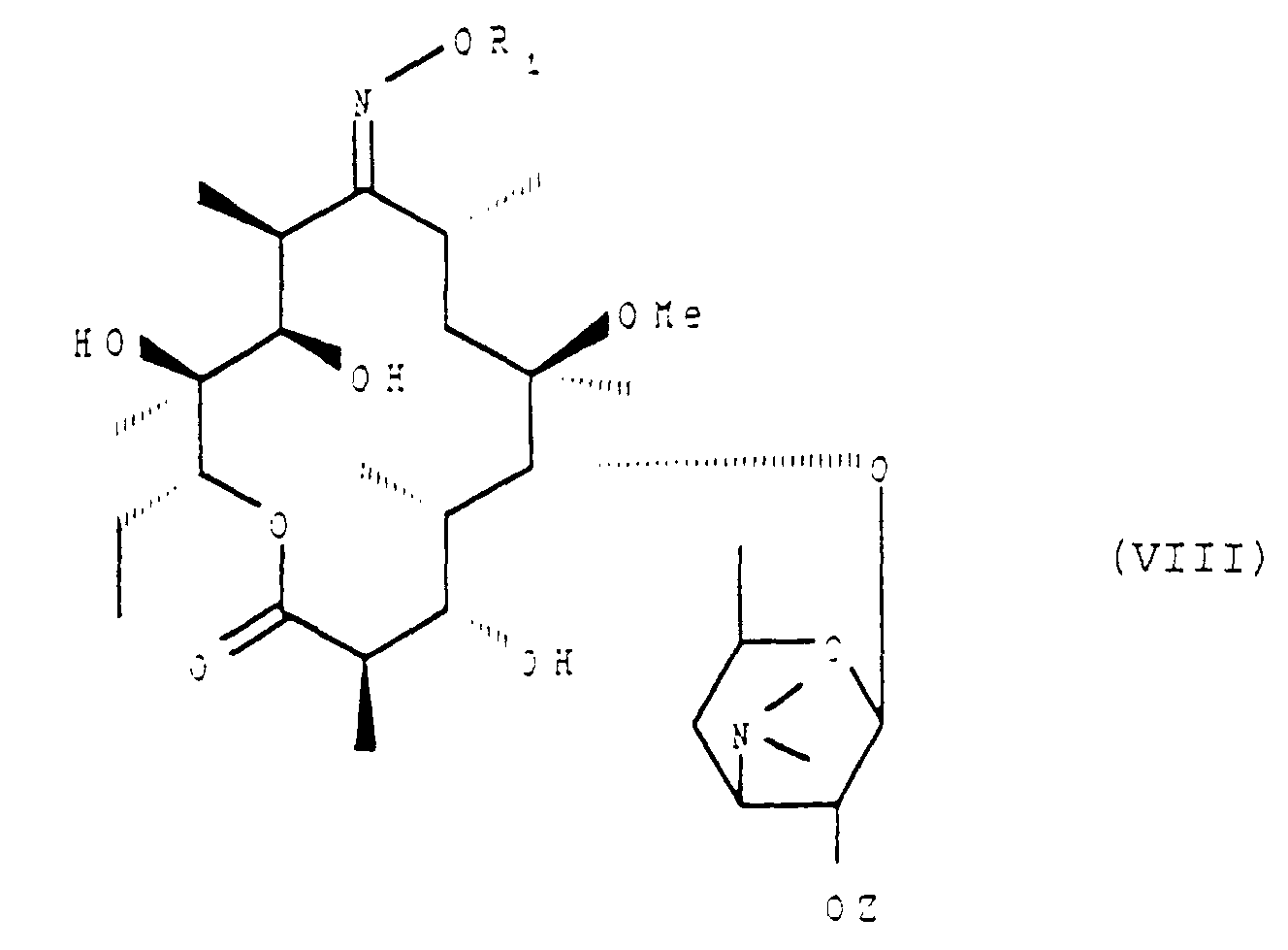
- the subject of the invention is also the application characterized in that a compound of formula (I) is subjected to the action of a hydroxyl-releasing agent at 3 and 2 ′ to obtain the compound of formula (VII): in which R 1 retains its previous meaning, which is subjected to the action of a protective agent for the OH group at 2 'to obtain the compound of formula (VIII): in which R 1 retains its previous meaning and Z represents a protective group as defined above, which is subjected to the action of a release agent for the 9-oxo group to obtain the corresponding compound of formula (VI): in which Z retains its previous meaning.
- Stage B 9-O- (1-methoxy-1-methylethyl) oxime of 3-O-de (2,6-dideoxy-3-C-methyl-3-O-methyl-alpha-L-ribo-hexopyranosyl) -2 ', 3-O-bis (trimethylsilyl) erythromycin,
- Stage C 9-O- (1-methoxy-1-methylethyl) oxime of 3-O-de (2,6-dideoxy-3-C-methyl-3-O-methyl-alpha-L-ribo-hexopyranosyl) -2 ', 3-O-bis (trimethylsilyl) 6-O-methyl erythromycin,
- Stage B 2'-O-acetyl 3-O-die (2,6-dideoxy 3-C-methyl 3-O-methyl alpha-L-ribo-hexopyranosyl) 6-O-methyl erythromycin
- the product of the previous stage is subjected to the action of acetic anhydride and obtains the desired product.
- Stage A 9-O- (1-methoxy 1-methylethyl) oxime of 3-O-de (2,6-dideoxy 3-C-methyl 3-O-methyl alpha-L-ribo-hexopyranosyl) 6-O- methyl erythromycin
- Stage B 9-O- (1-methoxy 1-methylethyl) 2'-O-acetyl 3-O-de (2,6-dideoxy 3-C-methyl 3-O-methyl alpha-L-ribo-) oxime hexopyranosyl) 6-O-methyl erythromycin
- a mixture of 2.17 g of product prepared in the preceding stage, 22 ml of CH 2 Cl 2 , 390 ⁇ l of acetic anhydride, is stirred for one and a half hours at room temperature. 22 ml of a saturated sodium bicarbonate solution are added. The organic phase is washed with 10 ml of salt water. The aqueous phases are re-extracted with CH 2 Cl 2 . The organic phase is dried over sodium sulfate, then the solvent is evaporated off under reduced pressure. The residue obtained is taken up in 4.25 ml of isopropyl ether and then 14.9 ml of heptane. After 5 minutes of stirring the precipitate is drained and then washed with heptane. After drying, 1.72 g of sought product is recovered (colorless crystals) mp 200 ° C. Yield 74.7%.
Landscapes
- Chemical & Material Sciences (AREA)
- Organic Chemistry (AREA)
- Engineering & Computer Science (AREA)
- Health & Medical Sciences (AREA)
- Biochemistry (AREA)
- Biotechnology (AREA)
- General Health & Medical Sciences (AREA)
- Genetics & Genomics (AREA)
- Molecular Biology (AREA)
- Life Sciences & Earth Sciences (AREA)
- Saccharide Compounds (AREA)
- Pharmaceuticals Containing Other Organic And Inorganic Compounds (AREA)
- Organic Low-Molecular-Weight Compounds And Preparation Thereof (AREA)
Abstract
Description

ou bien R1 représente un radical alkyle renfermant jusqu'à 8 atomes de carbone substitué par un ou plusieurs radicaux alkyle renfermant jusqu'à 8 atomes de carbone, ou par un ou plusieurs radicaux aryle renfermant jusqu'à 14 atomes de carbone,
ou bien R1 représente un radical aryle renfermant jusqu'à 14 atomes de carbone, éventuellement substitué par un ou plusieurs radicaux alkyle, alkényle ou alkynyle renfermant jusqu'à 8 atomes de carbone, alkoxy ou alkylthio renfermant jusqu'à 8 atomes de carbone, nitro, CF3 ou par un ou plusieurs atomes d'halogène,

Rb représente un radical alkyle renfermant jusqu'à 8 atomes de carbone, éventuellement substitué par un hétéroatome,
Rc représente un atome d'hydrogène ou un radical alkyle renfermant jusqu'à 8 atomes de carbone,
R2 et R3, identiques ou différents, représentent un radical trialkylsilyle dans lequel le radical alkyle renferme jusqu'à 8 atomes de carbone.
- le radical alkyle, alkényle ou alkynyle est de préférence un radical méthyle, éthyle, propyle, isopropyle, n-butyle, isobutyle, terbutyle, décyle ou dodécyle, vinyle, allyle, éthynyle, propynyle, cyclobutyle, cyclopentyle ou cyclohexyle,
- l'halogène est de préférence le fluor ou le chlore, ou le brome,
- le radical aryle est de préférence le radical phényle, ou un radical naphtyle,
- le radical aralkyle est de préférence un radical (C6H5)-(CH2)a, a étant un nombre entier compris entre 1 et 6, par exemple le nombre 1, 2, 3 ou 4 ; le radical aralkyle peut être par exemple, un radical benzyle éventuellement substitué ou un radical trityle,
- le radical alkyloxy est de préférence un radical méthoxy, éthoxy, propyloxy isopropyloxy, n-butyloxy, isobutyloxy, tert-butyloxy, n-pentyloxy, isopentyloxy, sec-pentyloxy, tert-pentyloxy, néopentyloxy, n-hexyloxy, sec-hexyloxy, tert-hexyloxy,
- le radical alkylthio correspondant peut être utilisé en reprenant les mêmes valeurs et en remplaçant l'atome d'oxygène par un atome de soufre, exemple : méthylthio, éthylthio. De plus, l'atome de soufre peut être oxydé, exemple : méthylsulfinyle, méthylsulfonyle.


- l'oxime en 9 est protégée sous forme de cétal, de thiocétal,
- les groupements 3-OH et 2'-OH sont bloqués par des groupements triméthylsilyle,
- la méthylation est réalisée au moyen de l'iodure de méthyle en présence d'une base par exemple la potasse, la soude, un hydrure tel que l'hydrure de sodium, un terbutylate de métal alcalin comme par exemple le terbutylate de potassium ou encore en présence de 1,5-diazabicyclo [4,3,0] non-5-ène ou de 1,8-diazabicyclo [5,4,0] undec-7-ène.
- libération de l'oxime en 9,
- libération de l'hydroxyle en 3 et 2',
- protection de l'hydroxyle en 2'.


0,84 (t) : CH 3-CH2 ; 1,07 (d)-1,09 (d)-1,23 (d)-1,26 (d)x2 : les CH 3-CH ; 2,25 (s) : N(Me)2 ; 2,48 (m) : H'3 ; 2,64 (dq) : H2 ; 2,72 (ql) : H10 ; 3,22 (s) : OMe ; ∼3,25 : H'2 ; 3,51 (d) : H5 ; 3,58 (dl) : H3 ; 3,68 (sl) : H11 ; ~3,50 (m) : H'5 ; ∼3,62 (m) : H8 ---> E ; 4,41 (d) : H'1 ; 5,23 (dd) : H13 ; 2,36-4,48-3,58 : H mobiles.
0,12-0,16 les OTMS ; 0,84 (t) : CH 3-CH2 ; 1,16 (x2)-1,38-1,45-1,47-1,00-1,25 : les CH 3-CH ; 2,23 (s) : N(Me)2 ; 2,47 (m) : H'3 ; 2,71 (m) : H2 et H10 ; 3,16 (dd) : H'2 ; 3,22 (s) : OMe ; 3,45 (m) : H'5 ; 3,58 (d) : H5 ; 3,66 : H8 ---> E ; 3,66 (s) : H11 ; 3,98 (dl) : H3 ; 4,2 (dd) : H'1 ; 5,14 (dd) : H13 ; 1,90 (s)-3,10-4,44 : OH.
Structure possible, on localise à 0,11 et 0,20 les SiMe3 0,84 (t) : CH 3-CH2 ; 0,95 (d)-0,97(d)-1,14(d)-1,17(d) x 2 : les CH 3-CH ; 1,18-1,35-1,40-1,48 les CH3-CH ; 2,22 (s) : N(Me)2 ; 2,46 (m) : H'3 ; 2,61 (ql) : H10 ; 2,72 (dq) : H2 ; 3,01 (s) : OMe ; 3,13 (dd) : H'5 ; 3,22 (s) : OMe chaíne ; 3,45 (m) : H'5 ; ∼3,70 : H8 ---> E ; ∼3,68 (m) : 2H (H3,H5) ; 3,79 (sl) 1H ---> H11 ; 4,24 (d) : H'1 ; 5,15 (dd) : H13 ; 3,29 (s) et 4,52 les OH.
Spectre identique aux données de la littérature
5,17 (d) : H13 ; 4,38 (d) : H'1 ; 3,93 (sl) : H mobile ; 3,85 (s) : H11 ; 3,68 (s) : H5 ; 3,54 à 3,62 (m) : H3, H'5 : 3,24 (m) : H'2 ; 2,98 (s) : OMe ; 2,25 (s) : N(Me)2 ; 1,37-1,31-1,27-1,25-1,21-1,18-1,14-1,11 : les CH 3-CH ; 0,83 (t) : CH 3-CH2.
0,84 (t) : CH 3-CH2 ; 0,97 (d)-1,10(d)-1,18(d)-1,24(d)-1,26(d) les CH 3-CH ; 1,20-1,40(x 2)-1,48 les CH 3-C ; 2,26 (s) : N(Me)2 ; 2,13 (ql) : H4 ; 2,48 (m) : H'3 ; ∼2,66 : H10 et H2 ; 2,98 (s) : OMe en 6 ; 3,22 (s) : OMe chaíne ; ∼3,26 : H'2 ; ∼3,54 : H3 et H'5 ; 3,68 (s)-3,83 (d) : H5 et H11 ; ~3,73 (m) H8 ---> E ; 4,38 (d) : H'1 ; 5,23 (dd) : H13.
0,83 (t) : CH 3-CH2 ; 0,92 (d)-0,97(d)-1,17(d)-1,28(d)-1,30(d) les CH 3-CH ; 1,18-1,29-1,40-1,47 les CH 3-C ; 2,06 (s) : OAc ; 2,26 (s) : N(Me)2 ; 2,59 (ql) : H10 ; 2,69 (m) : H'3 et H2 ; 2,95 (s) : OMe en 6 ; 3,22 (s) : OMe chaíne ; ∼3,47 : H3 ; H8 et H'5 ; 3,73 (d) : H5 et 3,79 (sl) : H11 ; 4,60 (d) : H'1 ; 4,77 (dd) : H'2 ; 5,23 (dd) : H13 ; 1,72 (d)-3,32-4,63 : H mobiles.
| IR : | |
| -OH | ~3626 cm-1 (Max) |
| 3500 cm-1 | |
| >=O | 1735 cm-1 |
| 1689 cm-1. |
Claims (12)
- Les composés de formule (I) :dans lesquels :

ou bien R1 représente un radical alkyle renfermant jusqu'à 8 atomes de carbone substitué par un ou plusieurs radicaux alkyle renfermant jusqu'à 8 atomes de carbone, ou par un ou plusieurs radicaux aryle renfermant jusqu'à 14 atomes de carbone,
ou bien R1 représente un radical aryle renfermant jusqu'à 14 atomes de carbone, éventuellement substitué par un ou plusieurs radicaux alkyle, alkényle ou alkynyle renfermant jusqu'à 8 atomes de carbone, alkoxy ou alkylthio renfermant jusqu'à 8 atomes de carbone, nitro, CF3 ou par un ou plusieurs atomes d'halogène,
ou bien R1 représente un radical :dans lequel Ra représente un radical alkyle ou alkoxy renfermant jusqu'à 8 atomes de carbone,
Rb représente un radical alkyle renfermant jusqu'à 8 atomes de carbone, éventuellement substitué par un hétéroatome,
Rc représente un atome d'hydrogène ou un radical alkyle renfermant jusqu'à 8 atomes de carbone,
R2 et R3, identiques ou différents, représentent un radical trialkylsilyle dans lequel le radical alkyle renferme jusqu'à 8 atomes de carbone, - Les composés de formule (I) tels que définis à la revendication 1 dans lesquels R1 représente un radicaldans lequel Ra, Rb et Rc conservent la même signification que dans la revendication 1.

- Les composés de formule (I) tels que définis à la revendication 2, dans lesquels Ra, Rb et Rc représentent un radical méthyle.
- Les composés de formule (I) tels que définis à la revendication 1, dans lesquels R2 et R3 représentnt un radical triméthylsilyle.
- Le composé de formule (I) définie à la revendication 1 dont le nom suit :9-O-(1-méthoxy-1-méthyléthyl) oxime de 3-0-de(2,6-didéoxy-3-C-méthyl-3-O-méthyl-alpha-L-ribo-hexopyranosyl)-2'O,3-O-bis-(triméthylsilyl)-6-O-méthyl érythromycine.
- Procédé de préparation des composés de formule (I) tels que définis à l'une quelconque des revendications 1 à 6, caractérisé en ce que l'on soumet le composé de formule (II) :à l'action d'un agent de blocage de l'oxime en 9, pour obtenir un composé de formule (III) :
 dans lequel R1 conserve sa signification précédente, que l'on soumet à l'action d'un agent de blocage de l'hydroxyle en 3 et en 2' pour obtenir le composé de formule (IV) :
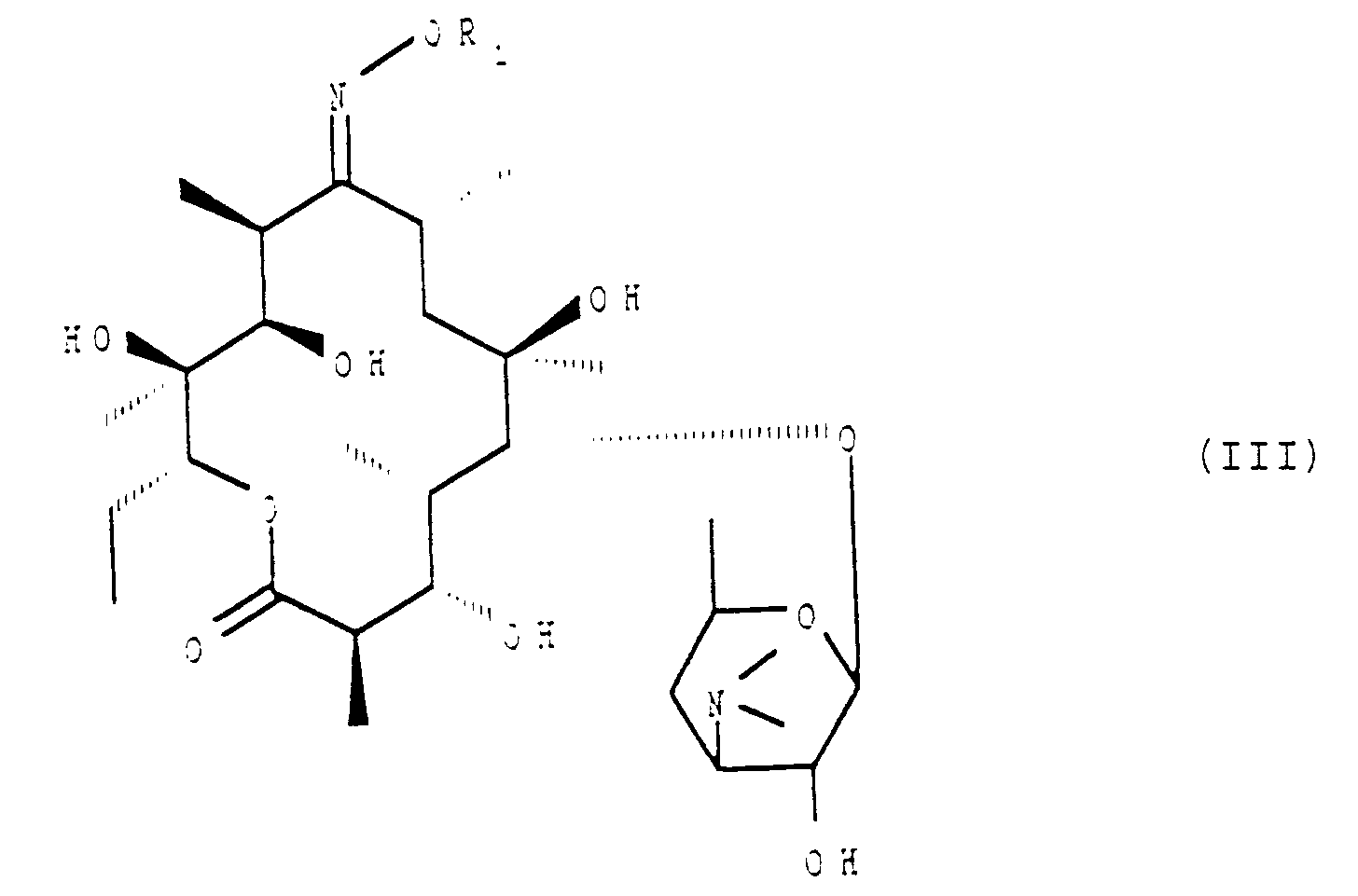 dans lequel R1, R2 et R3 conservent leur signification précédente, que l'on soumet à l'action d'un agent de méthylation de l'hydroxyle en 6, pour obtenir le composé de formule (I) correspondant.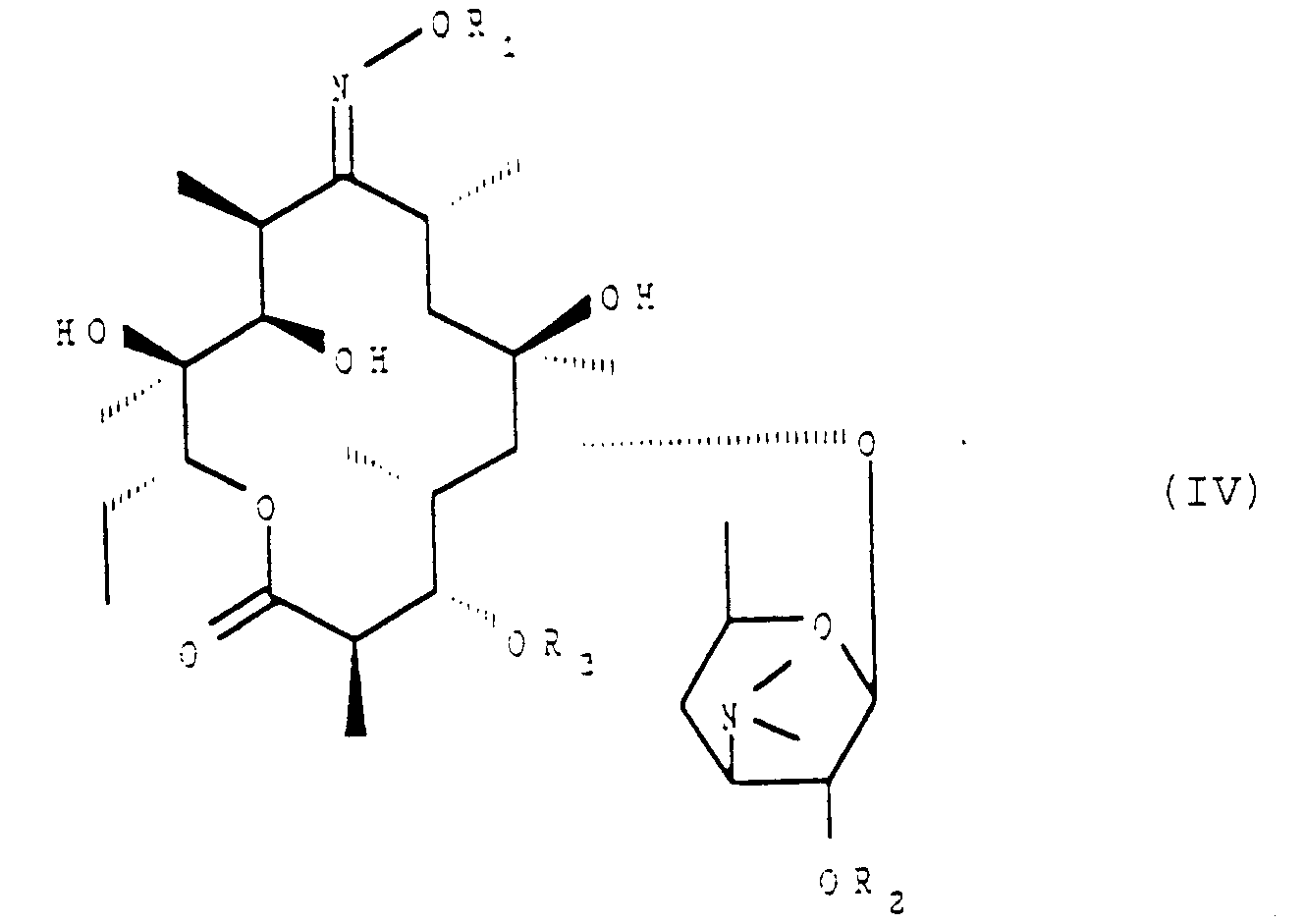
- Procédé de préparation selon la revendication 6, caractérisé en ce que la méthylation du composé de formule (IV) est réalisée au moyen de l'iodure de méthyle en présence d'une base.
- A titre de produits chimiques, les composés de formules (III) et (IV) tels que définis à la revendication 6.
- A titre de produits chimiques définis à la revendication 8, les produits suivants :la 9-O-(1-méthoxy-1-méthyléthyl) oxime de 3-0-de(2,6-didéoxy-3-C-méthyl-3-O-méthyl-alpha-L-ribo-hexopyranosyl) érythromycine,la 9-O-(1-méthoxy-1-méthyléthyl) oxime de 3-0-de(2,6-didéoxy-3-C-méthyl-3-O-méthyl-alpha-L-ribo-hexopyranosyl)-2'O,3-O-bis(triméthylsilyl) érythromycine.
- Application des composés de formule (I) tels que définis à l'une quelconque des revendications 1 à 4, caractérisée en ce que l'on soumet le composé de formule (I) aux étapes suivantes :libération de l'oxime en 9,libération de l'hydroxyle en 3 et 2',protection de l'hydroxyle en 2'.
- Application selon la revendication 10, caractérisée en ce que l'on soumet un composé de formule (I) à l'action de l'acide formique en présence de bisulfite de sodium ou de métabisulfite de sodium, pour obtenir directement le composé de formule (V) :que l'on soumet à l'action d'un agent de protection de l'hydroxyle en 2' pour obtenir le composé de formule (VI) :
 dans laquelle Z représente un groupement protecteur comme le reste d'un acide carboxylique renfermant jusqu'à 8 atomes de carbone, un radical trialkylsilyle, terbutyle ou triphénylméthyle.
- Application selon la revendication 11, caractérisée en ce que l'on soumet un composé de formule (I) à l'action d'un agent de libération de l'hydroxyle en 3 et en 2' pour obtenir le composé de formule (VII) :dans laquelle R1 conserve sa signification précédente, que l'on soumet à l'action d'un agent de protection du groupement OH en 2' pour obtenir le composé de formule (VIII) :
 dans laquelle R1 conserve sa signification précédente et Z représente un groupement protecteur, que l'on soumet à l'action d'un agent de libération du groupement 9-oxo pour obtenir le composé de formule (VI) correspondant :
 dans laquelle Z conserve sa signification précédente.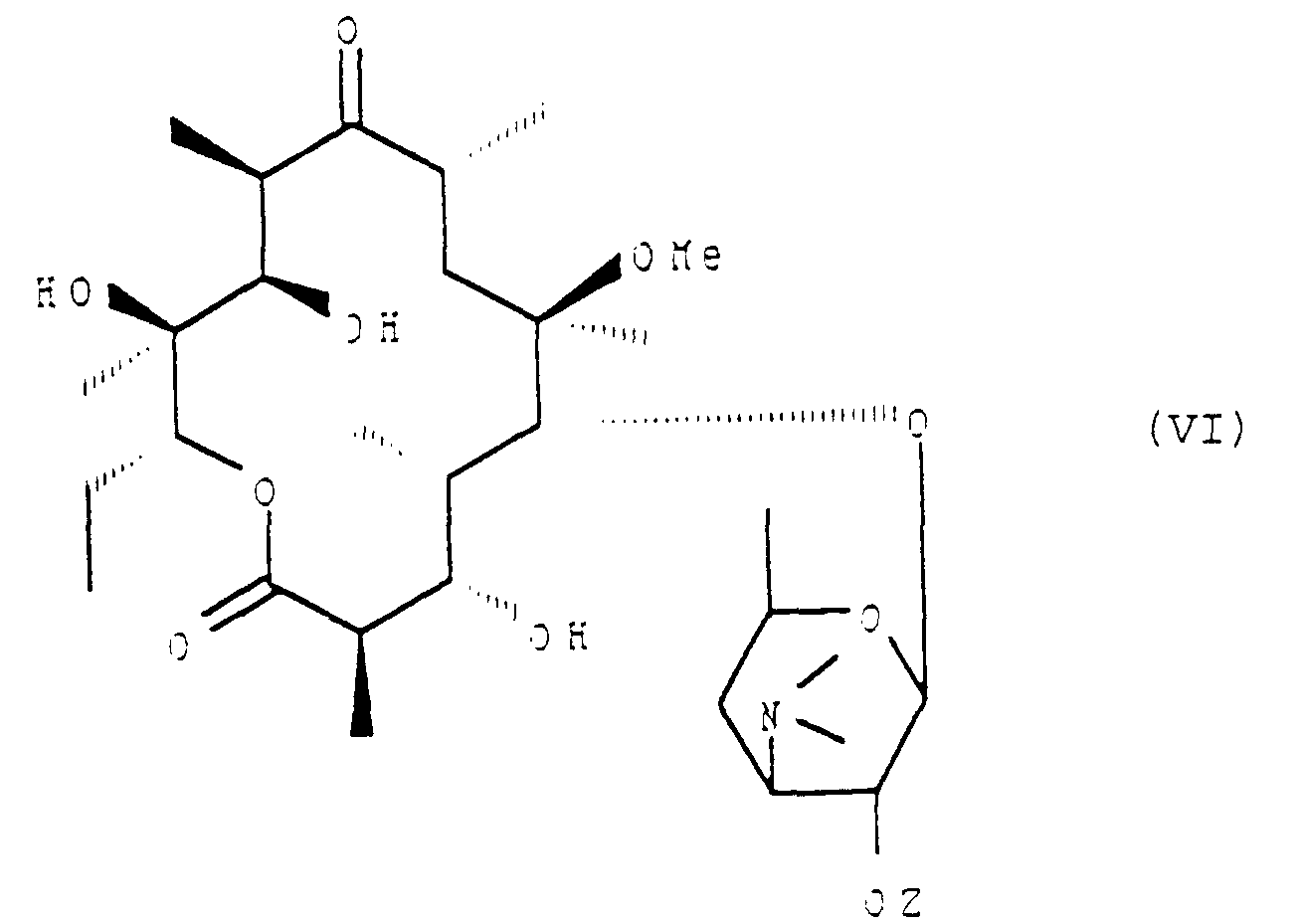
Priority Applications (1)
| Application Number | Priority Date | Filing Date | Title |
|---|---|---|---|
| SI9630684T SI0854880T1 (en) | 1995-09-11 | 1996-09-10 | 5-o-desosaminyl 6-o-methyl erythronolide derivatives a, method for preparing same and application thereof for preparing biologically active products |
Applications Claiming Priority (3)
| Application Number | Priority Date | Filing Date | Title |
|---|---|---|---|
| FR9510601 | 1995-09-11 | ||
| FR9510601A FR2738571B1 (fr) | 1995-09-11 | 1995-09-11 | Nouveaux derives de la 5-0-desosaminyl 6-0-methyl- erythronolide a, leur procede de preparation et leur application a la preparation de produits biologiquement actifs |
| PCT/FR1996/001384 WO1997010251A1 (fr) | 1995-09-11 | 1996-09-10 | Nouveaux derives de la 5-0-desosaminyl 6-0-methyl erythronolide a, leur procede de preparation et leur application a la preparation de produits biologiquement actifs |
Publications (2)
| Publication Number | Publication Date |
|---|---|
| EP0854880A1 EP0854880A1 (fr) | 1998-07-29 |
| EP0854880B1 true EP0854880B1 (fr) | 2004-05-06 |
Family
ID=9482423
Family Applications (1)
| Application Number | Title | Priority Date | Filing Date |
|---|---|---|---|
| EP96931098A Expired - Lifetime EP0854880B1 (fr) | 1995-09-11 | 1996-09-10 | Derives de la 5-0-desosaminyl 6-0-methyl erythronolide a, leur procede de preparation et leur application a la preparation de produits biologiquement actifs |
Country Status (34)
| Country | Link |
|---|---|
| US (1) | US5969161A (fr) |
| EP (1) | EP0854880B1 (fr) |
| JP (1) | JP4332218B2 (fr) |
| KR (1) | KR100457755B1 (fr) |
| CN (2) | CN1237069C (fr) |
| AP (1) | AP887A (fr) |
| AR (1) | AR004195A1 (fr) |
| AT (1) | ATE266035T1 (fr) |
| AU (1) | AU708811B2 (fr) |
| BG (1) | BG63822B1 (fr) |
| BR (1) | BR9610503A (fr) |
| CA (1) | CA2228670C (fr) |
| CZ (3) | CZ289945B6 (fr) |
| DE (1) | DE69632405T2 (fr) |
| DK (1) | DK0854880T3 (fr) |
| EA (1) | EA000575B1 (fr) |
| EE (1) | EE03774B1 (fr) |
| ES (1) | ES2219698T3 (fr) |
| FR (1) | FR2738571B1 (fr) |
| GE (1) | GEP20022838B (fr) |
| HK (1) | HK1041489B (fr) |
| HU (1) | HU227565B1 (fr) |
| IL (1) | IL123550A (fr) |
| MX (1) | MX9801859A (fr) |
| NO (2) | NO312678B1 (fr) |
| PL (1) | PL183652B1 (fr) |
| PT (1) | PT854880E (fr) |
| RO (1) | RO120137B1 (fr) |
| SI (1) | SI0854880T1 (fr) |
| SK (3) | SK283690B6 (fr) |
| TR (1) | TR199800438T1 (fr) |
| UA (1) | UA53628C2 (fr) |
| WO (1) | WO1997010251A1 (fr) |
| ZA (1) | ZA966837B (fr) |
Families Citing this family (33)
| Publication number | Priority date | Publication date | Assignee | Title |
|---|---|---|---|---|
| UA51730C2 (uk) * | 1996-09-04 | 2002-12-16 | Ебботт Лабораторіз | 6-o-заміщені кетоліди з антибактеріальною активністю, спосіб їх одержання (варіанти), фармацевтична композиція та спосіб регулювання бактеріальної інфекції у ссавців |
| SK285534B6 (sk) * | 1996-09-04 | 2007-03-01 | Abbott Laboratories | 6-O-substituované ketolidy s antibakteriálnou aktivitou, farmaceutická kompozícia s ich obsahom, ich použitie a spôsob ich prípravy |
| US6034069A (en) * | 1997-09-30 | 2000-03-07 | Abbott Laboratories | 3-'N-modified 6-O-substituted erythromycin ketolide derivatives having antibacterial activity |
| US6124269A (en) * | 1997-10-29 | 2000-09-26 | Abbott Laboratories | 2-Halo-6-O-substituted ketolide derivatives |
| US6046171A (en) * | 1997-10-29 | 2000-04-04 | Abbott Laboratories | 6,11-bridged erythromycin derivatives |
| US6054435A (en) * | 1999-03-19 | 2000-04-25 | Abbott Laboratories | 6-O-substituted macrolides having antibacterial activity |
| US6420535B1 (en) | 1999-06-07 | 2002-07-16 | Abbott Laboratories | 6-O-carbamate ketolide derivatives |
| WO2003070174A2 (fr) * | 2002-02-15 | 2003-08-28 | Sympore Gmbh | Conjugues de composes biologiquement actifs, procedes de preparation et d'utilisation, et formulation et applications pharmaceutiques |
| EP1509538A1 (fr) * | 2002-05-13 | 2005-03-02 | Enanta Pharmaceuticals, Inc. | Derives de l'erythromycine 6,11 bicyclique |
| US6764998B1 (en) | 2003-06-18 | 2004-07-20 | Enanta Pharmaceuticals, Inc. | 6,11-4C-bicyclic 9a-azalide derivatives |
| US7910558B2 (en) * | 2002-05-13 | 2011-03-22 | Enanta Pharmaceuticals, Inc. | Bridged macrocyclic compounds and processes for the preparation thereof |
| US7135573B2 (en) * | 2002-05-13 | 2006-11-14 | Enanta Pharmaceuticals, Inc. | Processes for the preparation of O-(6-Pyrazol-1-yl-pyridin-3-ylmethyl)-hydroxylamine |
| US6878691B2 (en) * | 2002-05-13 | 2005-04-12 | Enanta Pharmaceuticals, Inc. | 6-11 bicyclic ketolide derivatives |
| US7064110B2 (en) * | 2002-05-13 | 2006-06-20 | Enanta Pharmaceuticals, Inc. | 6-11 bicycle ketolide derivatives |
| WO2005070918A1 (fr) * | 2002-05-13 | 2005-08-04 | Enanta Pharmaceuticals, Inc. | Procede de preparation de derives bicycliques 6-11 d'erythromycine |
| US7273853B2 (en) * | 2002-05-13 | 2007-09-25 | Enanta Pharmaceuticals, Inc. | 6-11 bicyclic ketolide derivatives |
| US6753318B1 (en) * | 2002-07-25 | 2004-06-22 | Enanta Pharmaceuticals, Inc. | 6,11-4-carbon bridged erythromycin derivatives |
| US6841664B2 (en) | 2002-07-25 | 2005-01-11 | Enanra Pharmaceuticals, Inc. | 6,11-4-carbon bridged ketolides |
| ITMI20021726A1 (it) * | 2002-08-01 | 2004-02-02 | Zambon Spa | Macrolidi ad attivita' antiinfiammatoria. |
| US6645941B1 (en) | 2003-03-26 | 2003-11-11 | Enanta Pharmaceuticals, Inc. | 6,11-3C-bicyclic 9a-azalide derivatives |
| WO2005030227A1 (fr) * | 2003-09-23 | 2005-04-07 | Enanta Pharmaceuticals, Inc. | Derives 9a-azalide 11-3c-bicycliques |
| WO2005067564A2 (fr) * | 2004-01-07 | 2005-07-28 | Enanta Pharmaceuticals, Inc. | Derives d'erythromycine 6-11 bicyclique |
| US7265094B2 (en) * | 2004-01-09 | 2007-09-04 | Enanta Pharmaceuticals, Inc. | 9N-substituted 6-11 bicyclic erythromycin derivatives |
| US7229972B2 (en) | 2004-12-07 | 2007-06-12 | Enanta Pharmaceuticals, Inc. | 3,6-Bicyclolides |
| US7419962B2 (en) | 2004-12-07 | 2008-09-02 | Enanta Pharmaceuticals, Inc. | 3,6-bicyclolides |
| WO2006065721A2 (fr) | 2004-12-13 | 2006-06-22 | Enanta Pharmaceuticals, Inc. | Bicyclolides de 11, 12-lactone |
| WO2006065743A2 (fr) | 2004-12-13 | 2006-06-22 | Enanta Pharmaceuticals, Inc. | Bicyclolides tetracycliques |
| US7384922B2 (en) * | 2005-05-04 | 2008-06-10 | Enanta Pharmaceuticals, Inc. | 6-11 bridged oxime erythromycin derivatives |
| CA2615581A1 (fr) * | 2005-07-26 | 2007-02-01 | Merckle Gmbh | Conjugues macrolides de composes de pyrrolizine et d'indolizine comme inhibiteurs de la 5-lipooxygenase et de la cyclooxygenase |
| US8273720B2 (en) * | 2007-09-17 | 2012-09-25 | Enanta Pharmaceuticals, Inc. | 6,11-bicyclolides: bridged biaryl macrolide derivatives |
| US8354383B2 (en) * | 2007-09-17 | 2013-01-15 | Enanta Pharmaceuticals, Inc. | 6,11-bridged biaryl macrolides |
| KR101223158B1 (ko) * | 2007-09-17 | 2013-01-17 | 이난타 파마슈티칼스, 인코포레이티드 | 6,11-다리걸친 바이아릴 매크로라이드 |
| CN103232501A (zh) * | 2013-04-11 | 2013-08-07 | 宜昌东阳光药业股份有限公司 | 阿奇霉素或阿奇霉素的中间体脱去克拉定糖化合物的制备工艺 |
Family Cites Families (2)
| Publication number | Priority date | Publication date | Assignee | Title |
|---|---|---|---|---|
| KR960000434B1 (ko) * | 1986-12-17 | 1996-01-06 | 다이쇼 세이야꾸 가부시끼가이샤 | 에리스로마이신 a유도체 및 그의 제조 방법 |
| US5523399A (en) * | 1991-12-27 | 1996-06-04 | Taisho Pharmaceutical Co., Ltd. | 5-O-desosaminylerythronolide derivatives |
-
1995
- 1995-09-11 FR FR9510601A patent/FR2738571B1/fr not_active Expired - Lifetime
-
1996
- 1996-08-13 ZA ZA9606837A patent/ZA966837B/xx unknown
- 1996-09-05 AR ARP960104239A patent/AR004195A1/es unknown
- 1996-09-10 BR BR9610503A patent/BR9610503A/pt not_active IP Right Cessation
- 1996-09-10 US US09/043,044 patent/US5969161A/en not_active Expired - Lifetime
- 1996-09-10 SK SK294-98A patent/SK283690B6/sk not_active IP Right Cessation
- 1996-09-10 CN CNB001309064A patent/CN1237069C/zh not_active Expired - Lifetime
- 1996-09-10 EE EE9800065A patent/EE03774B1/xx unknown
- 1996-09-10 DE DE69632405T patent/DE69632405T2/de not_active Expired - Lifetime
- 1996-09-10 HU HU9802930A patent/HU227565B1/hu unknown
- 1996-09-10 AT AT96931098T patent/ATE266035T1/de active
- 1996-09-10 SK SK892-2003A patent/SK285995B6/sk not_active IP Right Cessation
- 1996-09-10 DK DK96931098T patent/DK0854880T3/da active
- 1996-09-10 IL IL12355096A patent/IL123550A/en not_active IP Right Cessation
- 1996-09-10 PL PL96326274A patent/PL183652B1/pl unknown
- 1996-09-10 CZ CZ1998717A patent/CZ289945B6/cs not_active IP Right Cessation
- 1996-09-10 PT PT96931098T patent/PT854880E/pt unknown
- 1996-09-10 CA CA002228670A patent/CA2228670C/fr not_active Expired - Lifetime
- 1996-09-10 KR KR10-1998-0701791A patent/KR100457755B1/ko not_active Expired - Lifetime
- 1996-09-10 SK SK893-2003A patent/SK285853B6/sk not_active IP Right Cessation
- 1996-09-10 CZ CZ20012389A patent/CZ294865B6/cs not_active IP Right Cessation
- 1996-09-10 WO PCT/FR1996/001384 patent/WO1997010251A1/fr not_active Ceased
- 1996-09-10 EP EP96931098A patent/EP0854880B1/fr not_active Expired - Lifetime
- 1996-09-10 AP APAP/P/1998/001210A patent/AP887A/en active
- 1996-09-10 CN CN96198171A patent/CN1070498C/zh not_active Expired - Lifetime
- 1996-09-10 RO RO98-00685A patent/RO120137B1/ro unknown
- 1996-09-10 CZ CZ20012390A patent/CZ294866B6/cs not_active IP Right Cessation
- 1996-09-10 TR TR1998/00438T patent/TR199800438T1/xx unknown
- 1996-09-10 SI SI9630684T patent/SI0854880T1/xx unknown
- 1996-09-10 ES ES96931098T patent/ES2219698T3/es not_active Expired - Lifetime
- 1996-09-10 EA EA199800288A patent/EA000575B1/ru not_active IP Right Cessation
- 1996-09-10 GE GEAP19964228A patent/GEP20022838B/en unknown
- 1996-09-10 AU AU69910/96A patent/AU708811B2/en not_active Expired
- 1996-09-10 JP JP51169697A patent/JP4332218B2/ja not_active Expired - Lifetime
- 1996-10-09 UA UA98041835A patent/UA53628C2/uk unknown
-
1998
- 1998-03-09 MX MX9801859A patent/MX9801859A/es unknown
- 1998-03-10 BG BG102312A patent/BG63822B1/bg unknown
- 1998-03-10 NO NO19981053A patent/NO312678B1/no not_active IP Right Cessation
-
2002
- 2002-03-06 NO NO20021111A patent/NO315048B1/no not_active IP Right Cessation
- 2002-04-19 HK HK02103101.8A patent/HK1041489B/zh not_active IP Right Cessation
Also Published As
Similar Documents
| Publication | Publication Date | Title |
|---|---|---|
| CA2228670C (fr) | Nouveaux derives de la 5-0-desosaminyl 6-0-methyl erythronolide a, leur procede de preparation et leur application a la preparation de produits biologiquement actifs | |
| EP0949268B1 (fr) | Nouveaux dérivés de la 2-fluoro 3-de[(2,6-didéoxy 3-C-méthyl-3-0-méthyl-alpha-L-ribohexopyranosyl) oxy] 6-0-méthyl 3-oxo érythromycine, leur procédé de préparation et leur application à la synthèse de principes actifs de médicaments | |
| FR2771092A1 (fr) | Procede de preparation de derives de la classe des taxoides | |
| RU2242461C2 (ru) | Производные 4-гидроксибифенилгидразида | |
| EP0912591B1 (fr) | Nouveau procede d'isomerisation du radical methyle en 10 de derives de l'erythromycine | |
| JPS6151578B2 (fr) | ||
| KR100672790B1 (ko) | 에리스로-3-아미노-2-히드록시부티르산 유도체의 제조 방법 | |
| CA2399634C (fr) | Procede pour la preparation de derives 9-deoxo-8a-aza-(8a-alkyl)-8a-homoerythromycine a a partir de la 9-deoxo-9(z)-hydroxyiminoerythromycine a | |
| CA2394623C (fr) | Procede de preparation et d'isolement de 9-desoxo-9(z)-hydroxyiminoerythromycin a | |
| JPH0717592B2 (ja) | α−(1−メチルエチル)−3,4−ジメトキシベンゼンアセトニトリルの製造方法、およびそれに使用される中間体化合物 | |
| EP0468581A1 (fr) | Procédé pour la préparation de 2,6-di-t-butyl-4-mercaptophénol | |
| CN121318799A (zh) | 拉法姆林中间体的高选择性制备方法 | |
| EP1165582B1 (fr) | Nouveau procede de preparation de l'etoposide | |
| HK1016187B (en) | Novel 5-o-deoaminyl 6-o-methyl erythronolide a derivatives, method for preparing the same | |
| JPH0415797B2 (fr) | ||
| EP0097550A1 (fr) | Procédé de préparation de dérivés de la cystamine à activité oncostatique | |
| FR2914642A1 (fr) | Procede de preparation de taxanes 3'-n-substitues a partir du paclitaxel | |
| FR2596048A1 (fr) | Derives du phenyl-(methoxy) phenyl-pyrenylmethane, procede d'obtention, intermediaires de synthese et application au marquage fluorescent de nucleosides, nucleotides et polynucleotides |
Legal Events
| Date | Code | Title | Description |
|---|---|---|---|
| PUAI | Public reference made under article 153(3) epc to a published international application that has entered the european phase |
Free format text: ORIGINAL CODE: 0009012 |
|
| 17P | Request for examination filed |
Effective date: 19980414 |
|
| AK | Designated contracting states |
Kind code of ref document: A1 Designated state(s): AT BE CH DE DK ES FI FR GB GR IE IT LI LU NL PT SE |
|
| AX | Request for extension of the european patent |
Free format text: AL PAYMENT 980224;LT PAYMENT 980224;LV PAYMENT 980224;SI PAYMENT 980224 |
|
| 17Q | First examination report despatched |
Effective date: 19980819 |
|
| RAP1 | Party data changed (applicant data changed or rights of an application transferred) |
Owner name: AVENTIS PHARMA S.A. |
|
| GRAP | Despatch of communication of intention to grant a patent |
Free format text: ORIGINAL CODE: EPIDOSNIGR1 |
|
| GRAS | Grant fee paid |
Free format text: ORIGINAL CODE: EPIDOSNIGR3 |
|
| GRAA | (expected) grant |
Free format text: ORIGINAL CODE: 0009210 |
|
| AK | Designated contracting states |
Kind code of ref document: B1 Designated state(s): AT BE CH DE DK ES FI FR GB GR IE IT LI LU NL PT SE |
|
| AX | Request for extension of the european patent |
Extension state: AL LT LV SI |
|
| REG | Reference to a national code |
Ref country code: GB Ref legal event code: FG4D Free format text: NOT ENGLISH |
|
| REG | Reference to a national code |
Ref country code: CH Ref legal event code: EP |
|
| REF | Corresponds to: |
Ref document number: 69632405 Country of ref document: DE Date of ref document: 20040609 Kind code of ref document: P |
|
| REG | Reference to a national code |
Ref country code: IE Ref legal event code: FG4D Free format text: FRENCH |
|
| REG | Reference to a national code |
Ref country code: CH Ref legal event code: NV Representative=s name: A. BRAUN, BRAUN, HERITIER, ESCHMANN AG PATENTANWAE |
|
| REG | Reference to a national code |
Ref country code: GR Ref legal event code: EP Ref document number: 20040402118 Country of ref document: GR |
|
| GBT | Gb: translation of ep patent filed (gb section 77(6)(a)/1977) |
Effective date: 20040708 |
|
| REG | Reference to a national code |
Ref country code: DK Ref legal event code: T3 |
|
| REG | Reference to a national code |
Ref country code: SE Ref legal event code: TRGR |
|
| REG | Reference to a national code |
Ref country code: PT Ref legal event code: SC4A Free format text: AVAILABILITY OF NATIONAL TRANSLATION Effective date: 20040726 |
|
| REG | Reference to a national code |
Ref country code: ES Ref legal event code: FG2A Ref document number: 2219698 Country of ref document: ES Kind code of ref document: T3 |
|
| REG | Reference to a national code |
Ref country code: SI Ref legal event code: IF |
|
| PLBE | No opposition filed within time limit |
Free format text: ORIGINAL CODE: 0009261 |
|
| STAA | Information on the status of an ep patent application or granted ep patent |
Free format text: STATUS: NO OPPOSITION FILED WITHIN TIME LIMIT |
|
| 26N | No opposition filed |
Effective date: 20050208 |
|
| REG | Reference to a national code |
Ref country code: CH Ref legal event code: PFA Owner name: AVENTIS PHARMA S.A. Free format text: AVENTIS PHARMA S.A.#20, AVENUE RAYMOND ARON#92160 ANTONY (FR) -TRANSFER TO- AVENTIS PHARMA S.A.#20, AVENUE RAYMOND ARON#92160 ANTONY (FR) |
|
| REG | Reference to a national code |
Ref country code: CH Ref legal event code: PCAR Free format text: NEW ADDRESS: HOLBEINSTRASSE 36-38, 4051 BASEL (CH) |
|
| REG | Reference to a national code |
Ref country code: FR Ref legal event code: PLFP Year of fee payment: 20 |
|
| PGFP | Annual fee paid to national office [announced via postgrant information from national office to epo] |
Ref country code: LU Payment date: 20150828 Year of fee payment: 20 |
|
| PGFP | Annual fee paid to national office [announced via postgrant information from national office to epo] |
Ref country code: FI Payment date: 20150909 Year of fee payment: 20 Ref country code: PT Payment date: 20150901 Year of fee payment: 20 Ref country code: CH Payment date: 20150911 Year of fee payment: 20 Ref country code: DE Payment date: 20150902 Year of fee payment: 20 Ref country code: ES Payment date: 20150810 Year of fee payment: 20 Ref country code: IE Payment date: 20150909 Year of fee payment: 20 Ref country code: GB Payment date: 20150909 Year of fee payment: 20 |
|
| PGFP | Annual fee paid to national office [announced via postgrant information from national office to epo] |
Ref country code: AT Payment date: 20150825 Year of fee payment: 20 Ref country code: SE Payment date: 20150911 Year of fee payment: 20 Ref country code: BE Payment date: 20150911 Year of fee payment: 20 Ref country code: FR Payment date: 20150629 Year of fee payment: 20 Ref country code: GR Payment date: 20150812 Year of fee payment: 20 |
|
| PGFP | Annual fee paid to national office [announced via postgrant information from national office to epo] |
Ref country code: DK Payment date: 20150910 Year of fee payment: 20 |
|
| PGFP | Annual fee paid to national office [announced via postgrant information from national office to epo] |
Ref country code: IT Payment date: 20150925 Year of fee payment: 20 |
|
| PGFP | Annual fee paid to national office [announced via postgrant information from national office to epo] |
Ref country code: NL Payment date: 20150909 Year of fee payment: 20 |
|
| REG | Reference to a national code |
Ref country code: DE Ref legal event code: R071 Ref document number: 69632405 Country of ref document: DE |
|
| REG | Reference to a national code |
Ref country code: DK Ref legal event code: EUP Effective date: 20160910 |
|
| REG | Reference to a national code |
Ref country code: NL Ref legal event code: MK Effective date: 20160909 |
|
| REG | Reference to a national code |
Ref country code: CH Ref legal event code: PL |
|
| REG | Reference to a national code |
Ref country code: GB Ref legal event code: PE20 Expiry date: 20160909 |
|
| REG | Reference to a national code |
Ref country code: AT Ref legal event code: MK07 Ref document number: 266035 Country of ref document: AT Kind code of ref document: T Effective date: 20160910 |
|
| PG25 | Lapsed in a contracting state [announced via postgrant information from national office to epo] |
Ref country code: GB Free format text: LAPSE BECAUSE OF EXPIRATION OF PROTECTION Effective date: 20160909 |
|
| REG | Reference to a national code |
Ref country code: SE Ref legal event code: EUG |
|
| REG | Reference to a national code |
Ref country code: IE Ref legal event code: MK9A |
|
| PG25 | Lapsed in a contracting state [announced via postgrant information from national office to epo] |
Ref country code: PT Free format text: LAPSE BECAUSE OF EXPIRATION OF PROTECTION Effective date: 20160919 |
|
| REG | Reference to a national code |
Ref country code: ES Ref legal event code: FD2A Effective date: 20161227 |
|
| PG25 | Lapsed in a contracting state [announced via postgrant information from national office to epo] |
Ref country code: IE Free format text: LAPSE BECAUSE OF EXPIRATION OF PROTECTION Effective date: 20160910 |
|
| REG | Reference to a national code |
Ref country code: GR Ref legal event code: MA Ref document number: 20040402118 Country of ref document: GR Effective date: 20160911 |
|
| PG25 | Lapsed in a contracting state [announced via postgrant information from national office to epo] |
Ref country code: ES Free format text: LAPSE BECAUSE OF EXPIRATION OF PROTECTION Effective date: 20160911 |