EP0636149B2 - Crosslinked hydrophilic resins and method of preparation - Google Patents
Crosslinked hydrophilic resins and method of preparation Download PDFInfo
- Publication number
- EP0636149B2 EP0636149B2 EP93910596A EP93910596A EP0636149B2 EP 0636149 B2 EP0636149 B2 EP 0636149B2 EP 93910596 A EP93910596 A EP 93910596A EP 93910596 A EP93910596 A EP 93910596A EP 0636149 B2 EP0636149 B2 EP 0636149B2
- Authority
- EP
- European Patent Office
- Prior art keywords
- resin
- hydrophilic resin
- crosslinked hydrophilic
- crosslinked
- independently
- Prior art date
- Legal status (The legal status is an assumption and is not a legal conclusion. Google has not performed a legal analysis and makes no representation as to the accuracy of the status listed.)
- Expired - Lifetime
Links
- 239000011347 resin Substances 0.000 title claims description 178
- 229920005989 resin Polymers 0.000 title claims description 178
- 238000000034 method Methods 0.000 title claims description 33
- 238000002360 preparation method Methods 0.000 title claims description 9
- 238000010521 absorption reaction Methods 0.000 claims description 72
- 239000002245 particle Substances 0.000 claims description 48
- 239000002250 absorbent Substances 0.000 claims description 37
- XLYOFNOQVPJJNP-UHFFFAOYSA-N water Substances O XLYOFNOQVPJJNP-UHFFFAOYSA-N 0.000 claims description 34
- 239000000178 monomer Substances 0.000 claims description 32
- 230000002745 absorbent Effects 0.000 claims description 25
- 238000001035 drying Methods 0.000 claims description 15
- 150000001875 compounds Chemical class 0.000 claims description 14
- 239000000017 hydrogel Substances 0.000 claims description 14
- 230000008569 process Effects 0.000 claims description 13
- 150000001732 carboxylic acid derivatives Chemical class 0.000 claims description 10
- 238000010438 heat treatment Methods 0.000 claims description 10
- 150000003839 salts Chemical class 0.000 claims description 10
- 239000012736 aqueous medium Substances 0.000 claims description 9
- 229920000642 polymer Polymers 0.000 claims description 9
- 239000002904 solvent Substances 0.000 claims description 9
- SMZOUWXMTYCWNB-UHFFFAOYSA-N 2-(2-methoxy-5-methylphenyl)ethanamine Chemical compound COC1=CC=C(C)C=C1CCN SMZOUWXMTYCWNB-UHFFFAOYSA-N 0.000 claims description 7
- 125000003342 alkenyl group Chemical group 0.000 claims description 6
- 238000004132 cross linking Methods 0.000 claims description 6
- HRPVXLWXLXDGHG-UHFFFAOYSA-N Acrylamide Chemical compound NC(=O)C=C HRPVXLWXLXDGHG-UHFFFAOYSA-N 0.000 claims description 5
- NLHHRLWOUZZQLW-UHFFFAOYSA-N Acrylonitrile Chemical compound C=CC#N NLHHRLWOUZZQLW-UHFFFAOYSA-N 0.000 claims description 5
- WHNWPMSKXPGLAX-UHFFFAOYSA-N N-Vinyl-2-pyrrolidone Chemical compound C=CN1CCCC1=O WHNWPMSKXPGLAX-UHFFFAOYSA-N 0.000 claims description 5
- 239000004372 Polyvinyl alcohol Substances 0.000 claims description 5
- 229920002472 Starch Polymers 0.000 claims description 5
- 150000001244 carboxylic acid anhydrides Chemical class 0.000 claims description 5
- 229920002451 polyvinyl alcohol Polymers 0.000 claims description 5
- 239000008107 starch Substances 0.000 claims description 5
- 235000019698 starch Nutrition 0.000 claims description 5
- NLVXSWCKKBEXTG-UHFFFAOYSA-N vinylsulfonic acid Chemical compound OS(=O)(=O)C=C NLVXSWCKKBEXTG-UHFFFAOYSA-N 0.000 claims description 5
- CERQOIWHTDAKMF-UHFFFAOYSA-N Methacrylic acid Chemical compound CC(=C)C(O)=O CERQOIWHTDAKMF-UHFFFAOYSA-N 0.000 claims description 4
- 239000001257 hydrogen Substances 0.000 claims description 4
- 229910052739 hydrogen Inorganic materials 0.000 claims description 4
- 125000004435 hydrogen atom Chemical group [H]* 0.000 claims description 4
- 125000000217 alkyl group Chemical group 0.000 claims description 3
- 125000003178 carboxy group Chemical group [H]OC(*)=O 0.000 claims description 3
- 239000003431 cross linking reagent Substances 0.000 claims description 3
- 150000003254 radicals Chemical class 0.000 claims description 3
- 239000012966 redox initiator Substances 0.000 claims description 2
- 150000008065 acid anhydrides Chemical class 0.000 claims 1
- 239000004971 Cross linker Substances 0.000 description 38
- 239000012632 extractable Substances 0.000 description 31
- IAYPIBMASNFSPL-UHFFFAOYSA-N Ethylene oxide Chemical compound C1CO1 IAYPIBMASNFSPL-UHFFFAOYSA-N 0.000 description 25
- 239000000463 material Substances 0.000 description 24
- 239000012530 fluid Substances 0.000 description 14
- -1 polyoxyethylene Polymers 0.000 description 14
- PEDCQBHIVMGVHV-UHFFFAOYSA-N Glycerine Chemical compound OCC(O)CO PEDCQBHIVMGVHV-UHFFFAOYSA-N 0.000 description 12
- 238000006116 polymerization reaction Methods 0.000 description 12
- ZJCCRDAZUWHFQH-UHFFFAOYSA-N Trimethylolpropane Chemical compound CCC(CO)(CO)CO ZJCCRDAZUWHFQH-UHFFFAOYSA-N 0.000 description 11
- 239000000499 gel Substances 0.000 description 11
- 239000000203 mixture Substances 0.000 description 11
- HEMHJVSKTPXQMS-UHFFFAOYSA-M Sodium hydroxide Chemical compound [OH-].[Na+] HEMHJVSKTPXQMS-UHFFFAOYSA-M 0.000 description 9
- 238000006243 chemical reaction Methods 0.000 description 9
- NIXOWILDQLNWCW-UHFFFAOYSA-N 2-Propenoic acid Natural products OC(=O)C=C NIXOWILDQLNWCW-UHFFFAOYSA-N 0.000 description 8
- 150000002148 esters Chemical class 0.000 description 7
- CIWBSHSKHKDKBQ-JLAZNSOCSA-N Ascorbic acid Chemical compound OC[C@H](O)[C@H]1OC(=O)C(O)=C1O CIWBSHSKHKDKBQ-JLAZNSOCSA-N 0.000 description 6
- IJGRMHOSHXDMSA-UHFFFAOYSA-N Atomic nitrogen Chemical compound N#N IJGRMHOSHXDMSA-UHFFFAOYSA-N 0.000 description 6
- 229920003171 Poly (ethylene oxide) Polymers 0.000 description 6
- 239000004094 surface-active agent Substances 0.000 description 6
- FAPWRFPIFSIZLT-UHFFFAOYSA-M Sodium chloride Chemical compound [Na+].[Cl-] FAPWRFPIFSIZLT-UHFFFAOYSA-M 0.000 description 5
- 235000011187 glycerol Nutrition 0.000 description 5
- 125000002887 hydroxy group Chemical group [H]O* 0.000 description 5
- 239000003960 organic solvent Substances 0.000 description 5
- 238000010951 particle size reduction Methods 0.000 description 5
- MHAJPDPJQMAIIY-UHFFFAOYSA-N Hydrogen peroxide Chemical compound OO MHAJPDPJQMAIIY-UHFFFAOYSA-N 0.000 description 4
- DAKWPKUUDNSNPN-UHFFFAOYSA-N Trimethylolpropane triacrylate Chemical compound C=CC(=O)OCC(CC)(COC(=O)C=C)COC(=O)C=C DAKWPKUUDNSNPN-UHFFFAOYSA-N 0.000 description 4
- 239000007864 aqueous solution Substances 0.000 description 4
- 150000001735 carboxylic acids Chemical class 0.000 description 4
- 230000000052 comparative effect Effects 0.000 description 4
- 230000007423 decrease Effects 0.000 description 4
- 230000000694 effects Effects 0.000 description 4
- 239000000835 fiber Substances 0.000 description 4
- 230000006872 improvement Effects 0.000 description 4
- 239000000047 product Substances 0.000 description 4
- 239000011541 reaction mixture Substances 0.000 description 4
- 230000003068 static effect Effects 0.000 description 4
- 238000010557 suspension polymerization reaction Methods 0.000 description 4
- 229940096522 trimethylolpropane triacrylate Drugs 0.000 description 4
- LFQSCWFLJHTTHZ-UHFFFAOYSA-N Ethanol Chemical compound CCO LFQSCWFLJHTTHZ-UHFFFAOYSA-N 0.000 description 3
- LYCAIKOWRPUZTN-UHFFFAOYSA-N Ethylene glycol Chemical compound OCCO LYCAIKOWRPUZTN-UHFFFAOYSA-N 0.000 description 3
- 239000004677 Nylon Substances 0.000 description 3
- DNIAPMSPPWPWGF-UHFFFAOYSA-N Propylene glycol Chemical compound CC(O)CO DNIAPMSPPWPWGF-UHFFFAOYSA-N 0.000 description 3
- 239000000654 additive Substances 0.000 description 3
- 229960005070 ascorbic acid Drugs 0.000 description 3
- 150000001768 cations Chemical class 0.000 description 3
- 239000002270 dispersing agent Substances 0.000 description 3
- 230000005611 electricity Effects 0.000 description 3
- 238000009472 formulation Methods 0.000 description 3
- 238000012688 inverse emulsion polymerization Methods 0.000 description 3
- 229910052751 metal Inorganic materials 0.000 description 3
- 239000002184 metal Substances 0.000 description 3
- 229910052757 nitrogen Inorganic materials 0.000 description 3
- 229920001778 nylon Polymers 0.000 description 3
- 230000009467 reduction Effects 0.000 description 3
- 239000000243 solution Substances 0.000 description 3
- XKRFYHLGVUSROY-UHFFFAOYSA-N Argon Chemical compound [Ar] XKRFYHLGVUSROY-UHFFFAOYSA-N 0.000 description 2
- FBPFZTCFMRRESA-FSIIMWSLSA-N D-Glucitol Natural products OC[C@H](O)[C@H](O)[C@@H](O)[C@H](O)CO FBPFZTCFMRRESA-FSIIMWSLSA-N 0.000 description 2
- VZCYOOQTPOCHFL-OWOJBTEDSA-N Fumaric acid Chemical compound OC(=O)\C=C\C(O)=O VZCYOOQTPOCHFL-OWOJBTEDSA-N 0.000 description 2
- VEXZGXHMUGYJMC-UHFFFAOYSA-N Hydrochloric acid Chemical compound Cl VEXZGXHMUGYJMC-UHFFFAOYSA-N 0.000 description 2
- 206010021639 Incontinence Diseases 0.000 description 2
- KFZMGEQAYNKOFK-UHFFFAOYSA-N Isopropanol Chemical compound CC(C)O KFZMGEQAYNKOFK-UHFFFAOYSA-N 0.000 description 2
- 239000004166 Lanolin Substances 0.000 description 2
- GLUUGHFHXGJENI-UHFFFAOYSA-N Piperazine Chemical compound C1CNCCN1 GLUUGHFHXGJENI-UHFFFAOYSA-N 0.000 description 2
- VYPSYNLAJGMNEJ-UHFFFAOYSA-N Silicium dioxide Chemical compound O=[Si]=O VYPSYNLAJGMNEJ-UHFFFAOYSA-N 0.000 description 2
- 230000002411 adverse Effects 0.000 description 2
- 239000008346 aqueous phase Substances 0.000 description 2
- 235000010323 ascorbic acid Nutrition 0.000 description 2
- 239000011668 ascorbic acid Substances 0.000 description 2
- 238000010533 azeotropic distillation Methods 0.000 description 2
- 230000005587 bubbling Effects 0.000 description 2
- WERYXYBDKMZEQL-UHFFFAOYSA-N butane-1,4-diol Chemical compound OCCCCO WERYXYBDKMZEQL-UHFFFAOYSA-N 0.000 description 2
- 239000003054 catalyst Substances 0.000 description 2
- 239000000706 filtrate Substances 0.000 description 2
- 238000001914 filtration Methods 0.000 description 2
- 239000007863 gel particle Substances 0.000 description 2
- 239000011521 glass Substances 0.000 description 2
- 229930195733 hydrocarbon Natural products 0.000 description 2
- 150000002430 hydrocarbons Chemical class 0.000 description 2
- 239000011261 inert gas Substances 0.000 description 2
- 239000003999 initiator Substances 0.000 description 2
- 229940039717 lanolin Drugs 0.000 description 2
- 235000019388 lanolin Nutrition 0.000 description 2
- WXZMFSXDPGVJKK-UHFFFAOYSA-N pentaerythritol Chemical compound OCC(CO)(CO)CO WXZMFSXDPGVJKK-UHFFFAOYSA-N 0.000 description 2
- 239000012071 phase Substances 0.000 description 2
- 229920005862 polyol Polymers 0.000 description 2
- 150000003077 polyols Chemical class 0.000 description 2
- 239000000843 powder Substances 0.000 description 2
- 239000012429 reaction media Substances 0.000 description 2
- 230000035484 reaction time Effects 0.000 description 2
- 235000010199 sorbic acid Nutrition 0.000 description 2
- 239000004334 sorbic acid Substances 0.000 description 2
- 229940075582 sorbic acid Drugs 0.000 description 2
- 239000000600 sorbitol Substances 0.000 description 2
- VZCYOOQTPOCHFL-UHFFFAOYSA-N trans-butenedioic acid Natural products OC(=O)C=CC(O)=O VZCYOOQTPOCHFL-UHFFFAOYSA-N 0.000 description 2
- DNIAPMSPPWPWGF-VKHMYHEASA-N (+)-propylene glycol Chemical compound C[C@H](O)CO DNIAPMSPPWPWGF-VKHMYHEASA-N 0.000 description 1
- PUPZLCDOIYMWBV-UHFFFAOYSA-N (+/-)-1,3-Butanediol Chemical compound CC(O)CCO PUPZLCDOIYMWBV-UHFFFAOYSA-N 0.000 description 1
- XVOUMQNXTGKGMA-OWOJBTEDSA-N (E)-glutaconic acid Chemical compound OC(=O)C\C=C\C(O)=O XVOUMQNXTGKGMA-OWOJBTEDSA-N 0.000 description 1
- 239000001124 (E)-prop-1-ene-1,2,3-tricarboxylic acid Substances 0.000 description 1
- WBYWAXJHAXSJNI-VOTSOKGWSA-M .beta-Phenylacrylic acid Natural products [O-]C(=O)\C=C\C1=CC=CC=C1 WBYWAXJHAXSJNI-VOTSOKGWSA-M 0.000 description 1
- YPFDHNVEDLHUCE-UHFFFAOYSA-N 1,3-propanediol Substances OCCCO YPFDHNVEDLHUCE-UHFFFAOYSA-N 0.000 description 1
- LCPVQAHEFVXVKT-UHFFFAOYSA-N 2-(2,4-difluorophenoxy)pyridin-3-amine Chemical compound NC1=CC=CN=C1OC1=CC=C(F)C=C1F LCPVQAHEFVXVKT-UHFFFAOYSA-N 0.000 description 1
- JAHNSTQSQJOJLO-UHFFFAOYSA-N 2-(3-fluorophenyl)-1h-imidazole Chemical compound FC1=CC=CC(C=2NC=CN=2)=C1 JAHNSTQSQJOJLO-UHFFFAOYSA-N 0.000 description 1
- SZTBMYHIYNGYIA-UHFFFAOYSA-N 2-chloroacrylic acid Chemical compound OC(=O)C(Cl)=C SZTBMYHIYNGYIA-UHFFFAOYSA-N 0.000 description 1
- IJVRPNIWWODHHA-UHFFFAOYSA-N 2-cyanoprop-2-enoic acid Chemical compound OC(=O)C(=C)C#N IJVRPNIWWODHHA-UHFFFAOYSA-N 0.000 description 1
- WROUWQQRXUBECT-UHFFFAOYSA-N 2-ethylacrylic acid Chemical compound CCC(=C)C(O)=O WROUWQQRXUBECT-UHFFFAOYSA-N 0.000 description 1
- ONPJWQSDZCGSQM-UHFFFAOYSA-N 2-phenylprop-2-enoic acid Chemical compound OC(=O)C(=C)C1=CC=CC=C1 ONPJWQSDZCGSQM-UHFFFAOYSA-N 0.000 description 1
- CYUZOYPRAQASLN-UHFFFAOYSA-N 3-prop-2-enoyloxypropanoic acid Chemical compound OC(=O)CCOC(=O)C=C CYUZOYPRAQASLN-UHFFFAOYSA-N 0.000 description 1
- GXLIFJYFGMHYDY-ZZXKWVIFSA-N 4-chlorocinnamic acid Chemical compound OC(=O)\C=C\C1=CC=C(Cl)C=C1 GXLIFJYFGMHYDY-ZZXKWVIFSA-N 0.000 description 1
- 241000251468 Actinopterygii Species 0.000 description 1
- QGZKDVFQNNGYKY-UHFFFAOYSA-O Ammonium Chemical compound [NH4+] QGZKDVFQNNGYKY-UHFFFAOYSA-O 0.000 description 1
- UIERETOOQGIECD-UHFFFAOYSA-N Angelic acid Natural products CC=C(C)C(O)=O UIERETOOQGIECD-UHFFFAOYSA-N 0.000 description 1
- 239000004342 Benzoyl peroxide Substances 0.000 description 1
- OMPJBNCRMGITSC-UHFFFAOYSA-N Benzoylperoxide Chemical compound C=1C=CC=CC=1C(=O)OOC(=O)C1=CC=CC=C1 OMPJBNCRMGITSC-UHFFFAOYSA-N 0.000 description 1
- OKTJSMMVPCPJKN-UHFFFAOYSA-N Carbon Chemical compound [C] OKTJSMMVPCPJKN-UHFFFAOYSA-N 0.000 description 1
- 239000004215 Carbon black (E152) Substances 0.000 description 1
- WBYWAXJHAXSJNI-SREVYHEPSA-N Cinnamic acid Chemical compound OC(=O)\C=C/C1=CC=CC=C1 WBYWAXJHAXSJNI-SREVYHEPSA-N 0.000 description 1
- XDTMQSROBMDMFD-UHFFFAOYSA-N Cyclohexane Chemical compound C1CCCCC1 XDTMQSROBMDMFD-UHFFFAOYSA-N 0.000 description 1
- CWYNVVGOOAEACU-UHFFFAOYSA-N Fe2+ Chemical class [Fe+2] CWYNVVGOOAEACU-UHFFFAOYSA-N 0.000 description 1
- DGAQECJNVWCQMB-PUAWFVPOSA-M Ilexoside XXIX Chemical compound C[C@@H]1CC[C@@]2(CC[C@@]3(C(=CC[C@H]4[C@]3(CC[C@@H]5[C@@]4(CC[C@@H](C5(C)C)OS(=O)(=O)[O-])C)C)[C@@H]2[C@]1(C)O)C)C(=O)O[C@H]6[C@@H]([C@H]([C@@H]([C@H](O6)CO)O)O)O.[Na+] DGAQECJNVWCQMB-PUAWFVPOSA-M 0.000 description 1
- 239000002211 L-ascorbic acid Substances 0.000 description 1
- 235000000069 L-ascorbic acid Nutrition 0.000 description 1
- 239000002202 Polyethylene glycol Substances 0.000 description 1
- ZLMJMSJWJFRBEC-UHFFFAOYSA-N Potassium Chemical compound [K] ZLMJMSJWJFRBEC-UHFFFAOYSA-N 0.000 description 1
- OFOBLEOULBTSOW-UHFFFAOYSA-N Propanedioic acid Natural products OC(=O)CC(O)=O OFOBLEOULBTSOW-UHFFFAOYSA-N 0.000 description 1
- DWAQJAXMDSEUJJ-UHFFFAOYSA-M Sodium bisulfite Chemical compound [Na+].OS([O-])=O DWAQJAXMDSEUJJ-UHFFFAOYSA-M 0.000 description 1
- 239000004133 Sodium thiosulphate Substances 0.000 description 1
- 241001122767 Theaceae Species 0.000 description 1
- 229940091181 aconitic acid Drugs 0.000 description 1
- 150000001253 acrylic acids Chemical class 0.000 description 1
- 230000009471 action Effects 0.000 description 1
- 238000005054 agglomeration Methods 0.000 description 1
- 230000002776 aggregation Effects 0.000 description 1
- 238000013019 agitation Methods 0.000 description 1
- 150000001298 alcohols Chemical class 0.000 description 1
- 125000002947 alkylene group Chemical group 0.000 description 1
- 150000001412 amines Chemical class 0.000 description 1
- 150000003863 ammonium salts Chemical class 0.000 description 1
- 238000004458 analytical method Methods 0.000 description 1
- UIERETOOQGIECD-ARJAWSKDSA-N angelic acid Chemical compound C\C=C(\C)C(O)=O UIERETOOQGIECD-ARJAWSKDSA-N 0.000 description 1
- 239000002216 antistatic agent Substances 0.000 description 1
- 239000012431 aqueous reaction media Substances 0.000 description 1
- 229910052786 argon Inorganic materials 0.000 description 1
- 239000012298 atmosphere Substances 0.000 description 1
- 235000019400 benzoyl peroxide Nutrition 0.000 description 1
- 230000015572 biosynthetic process Effects 0.000 description 1
- 230000000903 blocking effect Effects 0.000 description 1
- 210000001124 body fluid Anatomy 0.000 description 1
- 239000010839 body fluid Substances 0.000 description 1
- RLYNGYDVXRKEOO-SQQVDAMQSA-N but-2-enoic acid;(e)-but-2-enoic acid Chemical compound CC=CC(O)=O.C\C=C\C(O)=O RLYNGYDVXRKEOO-SQQVDAMQSA-N 0.000 description 1
- 125000000484 butyl group Chemical group [H]C([*])([H])C([H])([H])C([H])([H])C([H])([H])[H] 0.000 description 1
- 239000006227 byproduct Substances 0.000 description 1
- 229910052799 carbon Inorganic materials 0.000 description 1
- 230000015556 catabolic process Effects 0.000 description 1
- 239000007795 chemical reaction product Substances 0.000 description 1
- 239000003638 chemical reducing agent Substances 0.000 description 1
- 239000003795 chemical substances by application Substances 0.000 description 1
- 229930016911 cinnamic acid Natural products 0.000 description 1
- 235000013985 cinnamic acid Nutrition 0.000 description 1
- GTZCVFVGUGFEME-IWQZZHSRSA-N cis-aconitic acid Chemical compound OC(=O)C\C(C(O)=O)=C\C(O)=O GTZCVFVGUGFEME-IWQZZHSRSA-N 0.000 description 1
- HNEGQIOMVPPMNR-IHWYPQMZSA-N citraconic acid Chemical compound OC(=O)C(/C)=C\C(O)=O HNEGQIOMVPPMNR-IHWYPQMZSA-N 0.000 description 1
- 229940018557 citraconic acid Drugs 0.000 description 1
- 238000001816 cooling Methods 0.000 description 1
- 229920006037 cross link polymer Polymers 0.000 description 1
- MRIZMKJLUDDMHF-UHFFFAOYSA-N cumene;hydrogen peroxide Chemical class OO.CC(C)C1=CC=CC=C1 MRIZMKJLUDDMHF-UHFFFAOYSA-N 0.000 description 1
- 238000005520 cutting process Methods 0.000 description 1
- 238000006731 degradation reaction Methods 0.000 description 1
- 238000006392 deoxygenation reaction Methods 0.000 description 1
- 230000001419 dependent effect Effects 0.000 description 1
- VTIIJXUACCWYHX-UHFFFAOYSA-L disodium;carboxylatooxy carbonate Chemical compound [Na+].[Na+].[O-]C(=O)OOC([O-])=O VTIIJXUACCWYHX-UHFFFAOYSA-L 0.000 description 1
- 239000003995 emulsifying agent Substances 0.000 description 1
- 239000000839 emulsion Substances 0.000 description 1
- BEFDCLMNVWHSGT-UHFFFAOYSA-N ethenylcyclopentane Chemical compound C=CC1CCCC1 BEFDCLMNVWHSGT-UHFFFAOYSA-N 0.000 description 1
- 238000002474 experimental method Methods 0.000 description 1
- 239000012467 final product Substances 0.000 description 1
- 239000001530 fumaric acid Substances 0.000 description 1
- 150000002334 glycols Chemical class 0.000 description 1
- 238000000227 grinding Methods 0.000 description 1
- 239000005457 ice water Substances 0.000 description 1
- 239000004615 ingredient Substances 0.000 description 1
- 239000010954 inorganic particle Substances 0.000 description 1
- 229960004592 isopropanol Drugs 0.000 description 1
- 230000014759 maintenance of location Effects 0.000 description 1
- VZCYOOQTPOCHFL-UPHRSURJSA-N maleic acid Chemical compound OC(=O)\C=C/C(O)=O VZCYOOQTPOCHFL-UPHRSURJSA-N 0.000 description 1
- 239000011976 maleic acid Substances 0.000 description 1
- FPYJFEHAWHCUMM-UHFFFAOYSA-N maleic anhydride Chemical compound O=C1OC(=O)C=C1 FPYJFEHAWHCUMM-UHFFFAOYSA-N 0.000 description 1
- 239000011159 matrix material Substances 0.000 description 1
- 238000005259 measurement Methods 0.000 description 1
- 235000013372 meat Nutrition 0.000 description 1
- 230000007246 mechanism Effects 0.000 description 1
- HNEGQIOMVPPMNR-NSCUHMNNSA-N mesaconic acid Chemical compound OC(=O)C(/C)=C/C(O)=O HNEGQIOMVPPMNR-NSCUHMNNSA-N 0.000 description 1
- 229910000000 metal hydroxide Inorganic materials 0.000 description 1
- 150000004692 metal hydroxides Chemical class 0.000 description 1
- WBYWAXJHAXSJNI-UHFFFAOYSA-N methyl p-hydroxycinnamate Natural products OC(=O)C=CC1=CC=CC=C1 WBYWAXJHAXSJNI-UHFFFAOYSA-N 0.000 description 1
- LVHBHZANLOWSRM-UHFFFAOYSA-N methylenebutanedioic acid Natural products OC(=O)CC(=C)C(O)=O LVHBHZANLOWSRM-UHFFFAOYSA-N 0.000 description 1
- HNEGQIOMVPPMNR-UHFFFAOYSA-N methylfumaric acid Natural products OC(=O)C(C)=CC(O)=O HNEGQIOMVPPMNR-UHFFFAOYSA-N 0.000 description 1
- 238000006386 neutralization reaction Methods 0.000 description 1
- SRSFOMHQIATOFV-UHFFFAOYSA-N octanoyl octaneperoxoate Chemical compound CCCCCCCC(=O)OOC(=O)CCCCCCC SRSFOMHQIATOFV-UHFFFAOYSA-N 0.000 description 1
- 239000012074 organic phase Substances 0.000 description 1
- 230000033116 oxidation-reduction process Effects 0.000 description 1
- PGMYKACGEOXYJE-UHFFFAOYSA-N pentyl acetate Chemical compound CCCCCOC(C)=O PGMYKACGEOXYJE-UHFFFAOYSA-N 0.000 description 1
- 229920001223 polyethylene glycol Polymers 0.000 description 1
- 239000002861 polymer material Substances 0.000 description 1
- 239000003505 polymerization initiator Substances 0.000 description 1
- 229920001451 polypropylene glycol Polymers 0.000 description 1
- 229920001343 polytetrafluoroethylene Polymers 0.000 description 1
- 239000004810 polytetrafluoroethylene Substances 0.000 description 1
- 229920000166 polytrimethylene carbonate Polymers 0.000 description 1
- 229910052700 potassium Inorganic materials 0.000 description 1
- 239000011591 potassium Substances 0.000 description 1
- 230000002265 prevention Effects 0.000 description 1
- 239000000377 silicon dioxide Substances 0.000 description 1
- 229910052708 sodium Inorganic materials 0.000 description 1
- 239000011734 sodium Substances 0.000 description 1
- 235000010267 sodium hydrogen sulphite Nutrition 0.000 description 1
- 229940045872 sodium percarbonate Drugs 0.000 description 1
- CHQMHPLRPQMAMX-UHFFFAOYSA-L sodium persulfate Substances [Na+].[Na+].[O-]S(=O)(=O)OOS([O-])(=O)=O CHQMHPLRPQMAMX-UHFFFAOYSA-L 0.000 description 1
- AKHNMLFCWUSKQB-UHFFFAOYSA-L sodium thiosulfate Chemical compound [Na+].[Na+].[O-]S([O-])(=O)=S AKHNMLFCWUSKQB-UHFFFAOYSA-L 0.000 description 1
- 235000019345 sodium thiosulphate Nutrition 0.000 description 1
- SPDUKHLMYVCLOA-UHFFFAOYSA-M sodium;ethaneperoxoate Chemical compound [Na+].CC(=O)O[O-] SPDUKHLMYVCLOA-UHFFFAOYSA-M 0.000 description 1
- 239000003381 stabilizer Substances 0.000 description 1
- 229910001220 stainless steel Inorganic materials 0.000 description 1
- 239000010935 stainless steel Substances 0.000 description 1
- 239000007858 starting material Substances 0.000 description 1
- 239000000126 substance Substances 0.000 description 1
- 150000005846 sugar alcohols Polymers 0.000 description 1
- 229920000247 superabsorbent polymer Polymers 0.000 description 1
- 239000004583 superabsorbent polymers (SAPs) Substances 0.000 description 1
- 239000000725 suspension Substances 0.000 description 1
- GJBRNHKUVLOCEB-UHFFFAOYSA-N tert-butyl benzenecarboperoxoate Chemical compound CC(C)(C)OOC(=O)C1=CC=CC=C1 GJBRNHKUVLOCEB-UHFFFAOYSA-N 0.000 description 1
- GTZCVFVGUGFEME-UHFFFAOYSA-N trans-aconitic acid Natural products OC(=O)CC(C(O)=O)=CC(O)=O GTZCVFVGUGFEME-UHFFFAOYSA-N 0.000 description 1
- 229920003169 water-soluble polymer Polymers 0.000 description 1
- 238000009736 wetting Methods 0.000 description 1
Images




Classifications
-
- A—HUMAN NECESSITIES
- A61—MEDICAL OR VETERINARY SCIENCE; HYGIENE
- A61L—METHODS OR APPARATUS FOR STERILISING MATERIALS OR OBJECTS IN GENERAL; DISINFECTION, STERILISATION OR DEODORISATION OF AIR; CHEMICAL ASPECTS OF BANDAGES, DRESSINGS, ABSORBENT PADS OR SURGICAL ARTICLES; MATERIALS FOR BANDAGES, DRESSINGS, ABSORBENT PADS OR SURGICAL ARTICLES
- A61L15/00—Chemical aspects of, or use of materials for, bandages, dressings or absorbent pads
- A61L15/16—Bandages, dressings or absorbent pads for physiological fluids such as urine or blood, e.g. sanitary towels, tampons
- A61L15/42—Use of materials characterised by their function or physical properties
- A61L15/60—Liquid-swellable gel-forming materials, e.g. super-absorbents
-
- A—HUMAN NECESSITIES
- A61—MEDICAL OR VETERINARY SCIENCE; HYGIENE
- A61L—METHODS OR APPARATUS FOR STERILISING MATERIALS OR OBJECTS IN GENERAL; DISINFECTION, STERILISATION OR DEODORISATION OF AIR; CHEMICAL ASPECTS OF BANDAGES, DRESSINGS, ABSORBENT PADS OR SURGICAL ARTICLES; MATERIALS FOR BANDAGES, DRESSINGS, ABSORBENT PADS OR SURGICAL ARTICLES
- A61L15/00—Chemical aspects of, or use of materials for, bandages, dressings or absorbent pads
-
- C—CHEMISTRY; METALLURGY
- C08—ORGANIC MACROMOLECULAR COMPOUNDS; THEIR PREPARATION OR CHEMICAL WORKING-UP; COMPOSITIONS BASED THEREON
- C08F—MACROMOLECULAR COMPOUNDS OBTAINED BY REACTIONS ONLY INVOLVING CARBON-TO-CARBON UNSATURATED BONDS
- C08F20/00—Homopolymers and copolymers of compounds having one or more unsaturated aliphatic radicals, each having only one carbon-to-carbon double bond, and only one being terminated by only one carboxyl radical or a salt, anhydride, ester, amide, imide or nitrile thereof
-
- C—CHEMISTRY; METALLURGY
- C08—ORGANIC MACROMOLECULAR COMPOUNDS; THEIR PREPARATION OR CHEMICAL WORKING-UP; COMPOSITIONS BASED THEREON
- C08F—MACROMOLECULAR COMPOUNDS OBTAINED BY REACTIONS ONLY INVOLVING CARBON-TO-CARBON UNSATURATED BONDS
- C08F8/00—Chemical modification by after-treatment
- C08F8/14—Esterification
-
- C—CHEMISTRY; METALLURGY
- C08—ORGANIC MACROMOLECULAR COMPOUNDS; THEIR PREPARATION OR CHEMICAL WORKING-UP; COMPOSITIONS BASED THEREON
- C08G—MACROMOLECULAR COMPOUNDS OBTAINED OTHERWISE THAN BY REACTIONS ONLY INVOLVING UNSATURATED CARBON-TO-CARBON BONDS
- C08G65/00—Macromolecular compounds obtained by reactions forming an ether link in the main chain of the macromolecule
- C08G65/02—Macromolecular compounds obtained by reactions forming an ether link in the main chain of the macromolecule from cyclic ethers by opening of the heterocyclic ring
- C08G65/32—Polymers modified by chemical after-treatment
- C08G65/329—Polymers modified by chemical after-treatment with organic compounds
- C08G65/331—Polymers modified by chemical after-treatment with organic compounds containing oxygen
- C08G65/332—Polymers modified by chemical after-treatment with organic compounds containing oxygen containing carboxyl groups, or halides, or esters thereof
- C08G65/3322—Polymers modified by chemical after-treatment with organic compounds containing oxygen containing carboxyl groups, or halides, or esters thereof acyclic
-
- C—CHEMISTRY; METALLURGY
- C08—ORGANIC MACROMOLECULAR COMPOUNDS; THEIR PREPARATION OR CHEMICAL WORKING-UP; COMPOSITIONS BASED THEREON
- C08F—MACROMOLECULAR COMPOUNDS OBTAINED BY REACTIONS ONLY INVOLVING CARBON-TO-CARBON UNSATURATED BONDS
- C08F2810/00—Chemical modification of a polymer
- C08F2810/20—Chemical modification of a polymer leading to a crosslinking, either explicitly or inherently
Definitions
- This invention relates to crosslinked hydrophilic resins, methods for preparing crosslinked hydrophilic resins and absorbent structures incorporating the crosslinked hydrophilic resins.
- Hydrophilic resins are primarily used in personal care products which absorb body fluids, for example baby diapers, adult incontinence products and feminine hygiene products.
- hydrophilic resin particles are incorporated into absorbent structures which contain for example, synthetic and natural fiber or paper based woven and non-woven structures, and toughened masses of fibers, such as fluff pads.
- the materials used in such structures can instantaneously absorb aqueous fluids and distribute them over the whole absorbent structure.
- the structures in the absence of hydrophilic resin particles, have limited absorption capacity, and are bulky due to the large amount of material needed to provide acceptable absorption capacity and do not retain fluid under pressure.
- a means for improving the absorbency and fluid retention characteristics of such absorbent structures is to incorporate hydrophilic resin particles which imbibe fluids to form a swollen hydrogel material, see U.S. Patent 4,610,678.
- the hydrophilic resin particles quickly absorb fluids and retain such fluids to prevent leakage and give the absorbent structure a "dry feel" even when wetted.
- One method of improving the absorption characteristics is to incorporate a compound which crosslinks the final product into the monomer mixture used to prepare the hydrophilic resin.
- Brandt U.S. Patent 4,654,039 discloses the preparation of hydrophilic resins and known crosslinking agents for such resins, Column 6 line 34 to Column 7, line 16.
- Parks U.S. Patent 4,295,987 discloses the use of ethylene glycol diacrylate, tetraethyleneglycol diacrylate and methylene-bisacrylamide as crosslinking agents for polyacrylate based hydrophilic resins.
- Japanese patent 55-82104 discloses the use of ethylene glycol di(meth)acrylate, trimethylol propane tri(meth)acrylate and propylene glycol di (meth)acrylate as crosslinking agents for polyacrylate based hydrophilic resins.
- Masuda et al. U.S. Patent 4,076,663 discloses a water absorbent resin is produced by polymerizing (A) starch or cellulose, (B) at least one monomer having a polymerizable double bond which is water-soluble or becomes water-soluble by hydrolysis and (C) a crosslinking agent, and subjecting, if necessary, the resulting product to hydrolysis.
- di- or poly-esters of unsaturated mono- or poly-carboxylic acids with polyols such as di- or tri-(meth)acrylic acid esters of polyols (such as ethylene glycol, trimethylol propane, glycerine, polyoxyethylene glycols and polyoxypropylene glycols.
- Crosslinking improves the strength of the hydrophilic resins and improves the retention of absorbed fluids when the hydrophilic resin is placed under a load and reduces the percentage of extractable materials present, but on the other hand results in a lower capacity of the resin and in some areas may require more of the resin to achieve desired absorption capacity.
- Extractable materials are water-soluble oligomers or non-crosslinked polymers which can be extracted from the hydrophilic resins when exposed to aqueous fluids. The presence of extractable materials reduces the efficacy of the water absorbent particles.
- Many compounds useful as crosslinkers are not water-soluble and require the presence of surfactants or dispersants to solubilize or disperse them so they can be present in the reaction medium to crosslink the hydrophilic resins. The presence of such dispersants and surfactants often adversely affect the absorbent properties of the hydrophilic resins.
- hydrophilic resins which have high absorption capacity, low extractable materials and high toughness or gel modulus. What is further needed is a process for the preparation of such resins. What are needed are crosslinking agents which are water--soluble.
- the properties desired in hydrophilic resin vary depending upon the application and the desired effect of the resins. Thus, what are needed are processes which are flexible in preparing hydrophilic resins with varied properties such as absorption capacity and absorption under load.
- the invention comprises a carboxyl containing hydrophilic resin crosslinked by one or more compounds corresponding to Formula 1 R 1 -(O(CH(R 3 )CH(R 3 )O) y -C(O)-R 2 ) x wherein
- the invention is a process for the preparation of crosslinked hydrophilic resins which comprises A) contacting i) one or more ethylenically unsaturated carboxylic acids, ethylenically unsaturated carboxylic acid anhydrides or salts thereof and optionally ii) one or more comonomers of an acrylamide, a vinyl pyrrolidone, an acrylonitrile, a vinyl sulphonic acid, a cellulosic monomer, a modified cellulosic monomer, a polyvinyl alcohol or a starch hydrolyzate with iii) a crosslinking compound corresponding to Formula 1 in an aqueous medium, optionally in the presence of a free radical or redox catalyst system, under conditions such that a crosslinked hydrophilic resin is prepared.
- the properties of the crosslinked hydrophilic resin may be further enhanced or improved by heating the crosslinked hydrophilic resin under conditions such that the crosslinked hydrophilic resin exhibits a Centrifuge Capacity (CC) of 25 g/g or greater, an Absorption Under Load (AUL) of 25 g/g or greater and a ratio AUL/CC of 0.6 or greater, wherein the heating is performed after the crosslinked hydrophilic resin has been dried and optionally subjected to means to reduce the particle size of the crosslinked hydrophilic resin.
- CC Centrifuge Capacity
- AUL Absorption Under Load
- the invention is a water-absorbent structure containing the crosslinked hydrophilic resins of this invention.
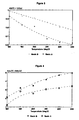
- Figure 1 is a plot of the ratio of the percentage of extractable materials to centrifuge capacity against the centrifuge capacity of crosslinked resins having varied amounts of ethylene oxide in the backbone of the crosslinker.
- Figure 2 plots both the ratio of centrifuge capacity after postheating (CC(T)) to centrifuge capacity before heating (CC(o)) and absorption under load after postheating against the number of moles of ethylene oxide in the backbone of the crosslinker.
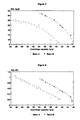
- Figure 3 is a plot of the ratio of centrifuge capacity after postheating to centrifuge capacity before postheating versus postheat temperature.
- Figure 4 shows a plot of the ratio of absorption under load after postheating to absorption under load before postheating against post heat temperature.
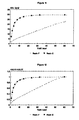
- Figure 5 plots the absorption under load against centrifuge capacity at various post heat temperatures.
- Figure 6 plots the ratio of absorption under load to centrifuge capacity against centrifuge capacity at each post heat temperature.
- Figure 7 plots the level of extractable materials present at each post heat temperature against centrifuge capacity.
- Figure 8 plots the ratio of extractables to centrifuge capacity against centrifuge capacity at each post heat temperature.
- Figure 9 plots the absorption under load against time for a resin of the invention and a comparative resin.
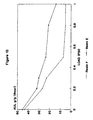
- Figure 10 plots the ratio of the absorption under load at various times to final absorption under load (60 minutes) against time for two resins, one of the invention and one comparative.
- Figure 11 is the plot of absorption under load versus time for two resins, one of the invention and one comparative resin.
- Figure 12 plots the ratio of absorption under load at various times over absorption under load at a final time of 60 minutes against time.
- Figure 13 plots absorption under load at varying load levels of 0 to 1.0 psi (70.31 gm/cm 2 ) for a resin of the invention and a comparative resin.
- the hydrophilic resins of this invention demonstrate high absorption capacities while having low extractable material fractions and a high absorbent gel particle toughness.
- the crosslinkers corresponding to Formula 1 are water-soluble or self-dispersible in water and thus no additional surfactants or dispersants are required.
- the optional postheating step in the process for the preparation of the water-absorbent resin particles allows variation of the process to achieve a desired mix of properties, that is absorption under load, absorption capacity and percent of extractable materials.
- the crosslinked hydrophilic resins of this invention are polymers derived from one or more ethylenically unsaturated carboxylic acids, ethylenically unsaturated carboxylic acid anhydrides or salts thereof. Additionally the polymers may include comonomers commonly known in the art for use in absorbent resins or for grafting onto absorbent resins such as an acrylamide, an acrylonitrile, a vinyl pyrrolidone, a vinyl sulphonic acid, a cellulosic monomer, a modified cellulosic monomer, a polyvinyl alcohol monomer or a starch hydrolyzate monomer.
- Olefinically unsaturated carboxylic acid and carboxylic acid anhydride monomers include the acrylic acids typified by acrylic acid, methacrylic acid, ethacrylic acid, alpha-chloroacrylic acid, alpha-cyano acrylic acid, beta-methyl-acrylic acid (crotonic acid), alpha phenyl acrylic acid, beta-acryloxy propionic acid, sorbic acid, alpha-chloro sorbic acid, angelic acid, cinnamic acid, p-chloro cinnamic acid, beta-styrl acrylic acid (I-carboxy-4-phenyl butadiene-1,3), itaconic acid, citraconic acid, mesaconic acid, glutaconic acid. aconitic acid, maleic acid. fumaric acid and maleic acid anhydride.
- the starting monomer is acrylic acid, methacrylic acid, or a salt thereof, with acrylic acid or a sall thereof being more preferred.
- the compounds corresponding to Formula 1 generally are C 3 -C 6 polyhydric hydrocarbons which have been alkoxylated with between two and eight ethylene oxide units per hydroxyl moiety wherein the terminal hydroxyl moiety of each ethylene oxide chain is esterified with a C 2 - 10 unsaturated carboxylic acid or ester thereof.
- the starting alcohol is a C 3 - 6 carbon polyhydric compound having from preferably 2 to 4 hydroxyl moieties. Even more preferably the starting material is trimethylol propane, glycerol, pentaerythritol, 1,3-propanediol, propylene glycol, 1,4-butanediol, or butylene glycol.
- the starting alcohol is trimethylol propane, glycerol or pentaerythritol with trimethylol propane being most preferred.
- the preferred number of ethylene oxide units in each chain is dependent upon the number of chains. As the number of chains (x) increases, the number of ethylene oxide units per chain required for good properties is lower.
- the esterifying agent is a C 2 - 10 straight- or branched-chain ethylenically unsaturated carboxylic acid or ester thereof, preferably a C 2-4 ethylenically unsaturated carboxylic acid or ester thereof, even more preferably a C 2-3 ethylenically unsaturated carboxylic acid or esterthereof, and most preferably acrylic acid, methacrylic acid or an ester thereof.
- the crosslinkers of this invention are prepared by processes well-known in the art.
- the polyhydric alcohol is reacted with from 2 to 8 ethylene oxide units per hydroxyl moiety so as to prepare a compound with 2 or more chains of hydroxy-terminated polyethylene oxides.
- the reaction product is reacted with sufficient C 2 - 10 straight- or branched-chained ethylenically unsaturated carboxylic acids, or an ester thereof, to provide a terminal ester containing ethylenically unsaturated moiety for each hydroxyl moiety on the alkylene chain attached to the starting alcohol.
- Such preparation procedures are well known in the art, see March, Advanced Organic Chemistry, 2nd Edition, pp. 361-365.
- crosslinkers described by Formula 1 are found as a mixture of materials described by the formula and by-products resulting from the preparation process.
- Crosslinkers corresponding to Formula 1 are available from Craynor under the trademark Craynor and from Sartomer under the trademark Sartomer.
- R 1 is a polyvalent C 3-6 straight- or branched-chain hydrocarbon. Polyvalent as used herein means the moiety has two or more valences by which the moiety is bonded to other moieties.
- R 2 is preferably a C 2 - 4 straight- or branched-chain alkenyl moiety, and most preferably a C 2 - 3 straight- or branched-chain alkenyl moiety.
- each R 3 is hydrogen.
- x is from 2 to 4, and even more preferably from 3 to 4.
- y is from 3 to 7 and more preferably 4 to 6.
- the crosslinker is present in sufficient amounts to significantly improve the absorption under load and reduce the percentage of extractable materials contained in the hydrophilic resin while preferably maintaining or increasing the centrifuge capacity.
- the crosslinker is present in an amount of 1,000 parts per million or greater by weight based on the amount of the polymerizable monomer present, more preferably 2,000 parts per million or greater and most preferably 3,500 parts per million or greater.
- the crosslinker is present in an amount of 50,000 parts per million or less by weight based upon the amount of the polymerizable monomer present, more preferably 5,000 parts per million or less and most preferably 8,000 parts per million or less.
- additives which are well-known in the art, such as surfactants, may be incorporated into the monomer mixture.
- crosslinked hydrophilic resins are prepared by contacting
- the monomers and crosslinkers are preferably dissolved, dispersed or suspended in the aqueous medium at a concentration level of 15 percent by weight or greater, more preferably 25 percent or greater, and most preferably 29 percent or greater.
- the monomers and crosslinkers are preferably dissolved, dispersed or suspended in the aqueous medium at a concentration level of 50 percent by weight or less and more preferably 40 percent or less.
- An optional component in the aqueous medium is a conventional water-soluble polymerization initiator material including peroxygen compounds such as sodium, potassium and ammonium persulfates, caprylyl peroxide, benzoyl peroxide, hydrogen peroxide, cumene hydroperoxides, tertiary butyl diperphthalate, tertiary butyl perbenzoate, sodium peracetate and sodium percarbonate.
- peroxygen compounds such as sodium, potassium and ammonium persulfates, caprylyl peroxide, benzoyl peroxide, hydrogen peroxide, cumene hydroperoxides, tertiary butyl diperphthalate, tertiary butyl perbenzoate, sodium peracetate and sodium percarbonate.
- the initiator material can comprise up to 5 mole percent based on the polymerizable monomer present. More preferably the initiator comprises from 0.001 to 0.5 mole percent based on the polymerizable monomer.
- the process of the invention may be performed in a batch manner wherein all of the reaction materials are contacted and the reaction proceeds, or it may take place with the continuous addition of one or more of the components over the reaction period.
- the aqueous medium is subjected to polymerization conditions which are sufficient to produce the crosslinked hydrophilic resin of the invention.
- the reaction is performed under an inert gas atmosphere, for example under nitrogen or argon.
- the reaction may be performed at any temperature at which polymerization occurs, preferably 0°C or greater, more preferably 25°C or greater and most preferably 50°C or greater.
- the temperature is 100°C or less, more preferably 80°C or less and most preferably 70°C or less.
- the reaction is exothermic and it may be desirable to provide a means for cooling the reactor so as to maintain a desired temperature.
- the reaction mixture may be reacted for a time sufficient to result in the desired conversion of polymerizable monomer to crosslinked hydrophilic resins.
- the conversion is 95 percent or greater, more preferably 98 percent or greater and most preferably 99 percent or greater.
- the reaction time is 20 minutes or greater, more preferably 1 hour or greater and most preferably 2 hours or greater.
- the reaction time is 6 hours or less, more preferably 4 hours or less and most preferably 3 hours or less.
- the carboxylic acid units of the hydrophilic resin are neutralized with base, even more preferably 50 percent or greater and most preferably 65 percent or greater. This neutralization may be performed after completion of the polymerization.
- the starting monomer mix has carboxylic acid moieties which are neutralized to the desired level prior to polymerization.
- the final polymer or the starting monomers may be neutralized by contacting them with a salt forming cation.
- salt forming cations include alkaline metal, ammonium, substituted ammonium and amine based cations.
- the polymer is neutralized with an alkaline metal hydroxide such as sodium hydroxide.
- the aqueous reaction mixture as hereinbefore described is suspended in the form of tiny droplets in a matrix of a water-immiscible, inert organic solvent such as cyclohexane.
- the crosslinked hydrophilic resins of the invention generally absorb all of the aqueous reaction medium to form a hydrogel.
- the crosslinked hydrophilic resin is recovered from the reactor in the form of an aqueous hydrogel.
- Hydrogel refers to water swollen crosslinked hydrophilic resin particles. In preferred embodiments such hydrogels comprise 15 percent by weight or greater crosslinked hydrophilic resin, with the remainder comprising water and more preferably comprise 25 percent by weight or greater crosslinked hydrophilic resin.
- the hydrogel comprises 50 percent by weight or less of crosslinked hydrophilic resin, and more typically 45 percent by weight crosslinked hydrophlic resin or less.
- the crosslinked hydrophilic resin hydrogel particles may be recovered from the reaction medium by azeotropic distillation and/or filtration followed by drying. If recovered by filtration then some means of removing the solvents present in the hydrogel must be used. Such means are commonly known in the art.
- the crosslinked hydrophilic resin hydrogel particles may be optionally subjected to an initial mechanical particle size reduction.
- the size of the gel particles after mechanical particle size reduction should be such that homogeneous drying of the particles can occur, with particle sizes of 2 cm or less being preferred.
- This particle size reduction can be performed by any means known in the art which gives the desired result.
- the particle size reduction is performed by chopping the hydrogel.
- the crosslinked hydrophilic resin hydrogel particles are subjected to conditions to remove substantially all of the water and optional solvent, such that the water-absorbent resin particles can be further processed, packaged, and incorporated into absorbent structures.
- the temperature at which the drying takes place is a temperature high enough such that the water and optional solvent, is removed in a reasonable time period, yet not so high so as to cause degradation of the crosslinked hydrophilic resin, such as by breaking of the crosslink bonds in the resin.
- the temperature of the water absorbent resin particles during drying is 170°C or less.
- the temperature during drying is 100°C or above, and more preferably 150°C or above.
- the drying time should be sufficient to remove substantially all of the water and optional solvent.
- Substantially all means all water and optional solvent is removed except minor amounts which do not adversely affect the processing of the particles or their function.
- a minimum time for drying is 10 minutes or greater, with 15 minutes or greater being typical.
- the drying time is 60 minutes or less, with 20 minutes or less being more preferred.
- drying is performed under conditions such that water, and optional solvent, volatilizing away from the absorbent resin particles is removed. This can be achieved by the use of vacuum techniques or by passing inert gases or air over or through the layers of crosslinked hydrophilic resin particles.
- the drying occurs in dryers in which heated air is blown through or over layers of the crosslinked hydrophilic resin particles.
- Preferred dryers are fluidized beds or belt dryers. Alternatively, a drum dryer may be used.
- the water may be removed by azeotropic distillation, by techniques well-known in the art.
- the crosslinked hydrophilic resin particles may fuse together to form sheets or agglomerates which sheets or agglomerates may then be subjected to mechanical breaking means part-way through the drying process.
- the crosslinked hydrophilic resin particles are then subjected to further mechanical particle reduction means.
- Such means can include chopping, cutting and/or grinding.
- the object is to reduce the particle size of the water-absorbent resin particles to a particle size acceptable in the ultimate end use.
- the absorbent resin particles are chopped and then ground.
- the particle size is preferably 2 mm or less, more preferably 0.8 mm or less.
- the particles have a size of 0.02 mm or greater, more preferably 0.05 mm or greater.
- the crosslinked hydrophilic resin particles may be subjected to surface crosslinking techniques to further strengthen the particles.
- surface crosslinking techniques are well-known in the art; see for example GB 2,119,384.
- the crosslinked hydrophilic resins are postheated at temperatures at which the crosslinked hydrophilic resins absorption properties are improved.
- the time period for exposure to such temperatures is chosen such that the absorption properties of the resin are improved.
- the crosslinked hydrophilic resins are preferably heated to a temperature 170°C or above, most preferably 190°C or above, and most preferably to 210°C or above. Below 170°C no improvement in the absorption properties is seen.
- the temperature should not be so high as to cause the crosslinked hydrophilic resin polymer to degrade.
- the temperature is 250°C or below and most preferably 230°C or below.
- the crosslinked hydrophilic resin is heated to the desired post heat temperature and preferably maintained at such temperature for at least 1 minute heating time and most preferably at least 5 minutes. Below 1 minute no improvement in properties occurs. If the heating time is too long it becomes uneconomical and risk is run that the crosslinked hydrophilic resin may be damaged.
- Preferably crosslinked hydrophilic resin is maintained at the desired temperature for 60 minutes or less, preferably 30 minutes or less. Above 60 minutes no significant improvement in properties is noticed.
- the properties of the crosslinked hydrophilic resin can be adjusted and tailored by adjustment of the temperature and the time of the postheating step. Longer post heat times result in a higher absorption under load, a lower level of extractable materials and a lower centrifuge capacity.
- the crosslinked hydrophilic resins may be difficult to handle due to the static electricity. It may be desirable to rehumidify the crosslinked hydrophilic resins to reduce or eliminate the effect of the static electricity.
- the surface of the resin particles may be treated with an antistatic agent such as polyethylene glycol or glycerin. Methods of humidification of dry resins are well-known in the art.
- the dry crosslinked hydrophilic resin is contacted with a sufficient amount of water vapor to reduce or eliminate the effects of the static electricity, yet not so much so as to cause the crosslinked hydrophilic resin to agglomerate.
- the dry crosslinked hydrophilic resin is humidified with 1 percent or more by weight of water and more preferably 5 percent or more by weight of water.
- the dry crosslinked resin is humidified with 10 percent or less by weight of water and more preferably 6 percent or less by weight of water.
- agglomeration prevention or rehydration additives may be added to the crosslinked hydrophilic resin.
- Such additives include surfactants and inert inorganic particles such as silica, see for example U.S. Patent Nos. 4,286,082, 4,734,478 and DE 2706135.
- crosslinked hydrophilic resins with a better balance of properties than previously known crosslinked hydrophilic resins.
- centrifuge capacity the extractable material level is lower and the absorption under load is higher for the crosslinked hydrophilic resins of the invention when compared to conventional resins.
- the centrifuge capacity is higher than in conventional resins.
- the crosslinked hydrophilic resins of this invention are more efficient than prior art resins.
- the objective of this invention to maximize the absorption under load and centrifuge capacity.
- One measure is to examine the relative ratio of the absorption under load to the centrifuge capacity. The higher this number is, the more successful the invention is in maximizing the properties of the water-absorbent resin. Preferably, this ratio is 0.5 or greater, more preferably 0.6 or greater, even more preferably 0.8 or greater and most preferably 1.0 or greater. It is also preferred that the resins have an absorption under load of 20 g/g or greater, more preferably 25 g/g or greater and most preferably 30 g/g or greater.
- the resins have a percent extractable materials level of 17 percent by weight of the particle or less, more preferably 12 percent or less, and most preferably 8 percent or less. It is also preferred that the resins have a centrifuge capacity of 25 g/g or more and more preferably 28 g/g or more.
- the crosslinked hydrophilic resins demonstrate a dry feel when swollen with water, excellent rehydration behavior, that is the ability of a swollen resin to accept additional fluid, distribute it throughout the gel volume and finally absorb it.
- the crosslinked hydrophilic resins also demonstrate low incidence of gel blocking as evidenced by formation of fish eyes and unswollen lumps.
- the crosslinked hydrophilic resins of the invention are used in absorbent structures they provide better performance in terms of dry feel when swollen, fluid retention under pressure and minimization of leaks.
- the load on a hydrophilic resin is increased the absorption capacity decreases.
- the crosslinked hydrophilic resins of the invention demonstrate a lower rate of decrease in absorption capacity as the load on the resin increases.
- the crosslinked hydrophilic resins of this invention can be used in any use wherein absorption and binding of aqueous based fluids is desired.
- the absorbent structure comprises an absorbent support structure and crosslinked hydrophilic resin particles according to the invention.
- the crosslinked hydrophilic resins of this invention are mixed into or attached to a structure of absorbent material such as synthetic or natural fibers or paper based woven or non-woven fibers etc. to form a structure.
- the woven or non-woven structure functions as a mechanism for wicking and transporting via capillary action the fluid to the water-absorbent resin particles which bind and retain such fluids.
- the absorbent structure comprises one or more layer of the crosslinked hydrophilic resins sandwiched between water permeable support layers.
- the crosslinked hydrophilic resins are adhesivized and attached to a support structure as disclosed in Ball WO 91/18092. Examples of such structures are diapers, adult incontinence structures and sanitary napkins.
- the crosslinked hydrophilic resins are prepared in an apparatus having four 300 mL glass reactors equipped with thermometers. A waterbath with a heater which is capable of holding all four reactors simultaneously is used. The use of four reactors allows four simultaneous runs of different crosslinkers or crosslinker levels.
- the glass reactors are dipped in the heating bath for 60 minutes at 70°C. Then the reactor is opened and a gelatinous mass is collected.
- the aqueous polymer gel is granulated to particles having a size of between approximately 1 and 5 mm with the aid of a meat mincer (disc holes 5 mm) and a part of it is dried in a hot air stream of 160°C for approximately 20 min.
- the polymer is ground in a knife cutter and sieved.
- the particle size fraction between 0.6 and 0.3 mm (30 to 50 mesh) is used for performance and quality analysis. For gel strength measurement the fraction 0.2 mm to 0.3 mm (50 to 80 mesh) is used.
- the 30 to 50 mesh fraction is collected and analyzed for 30 minutes centrifuge capacity (CC), g/g absorption under load (AUL), g/g and 16 hour extractables fraction (EXT %).
- Performance and quality of the crosslinked hydrophilic resins prepared are measured by the following methods.
- a nylon screen (50 x 50 mm; 100 mesh) is put on top of a perforated metal plate (holes with 5 mm) followed by a filter paper and finally by a stainless steel cylinder, of 26 mm inner diameter, 37 mm outer diameter and a height of 50 mm, whose both ends are open. 167 mg of water-absorbent resin particles are placed into the cylinder and evenly distributed, covered by a non-woven sheet of a diameter of 26 mm and finally pressed down with a polytetrafluoroethylene-coated piston of 26 mm diameter which carries the weight.
- the total weight of piston and cylinder is 109.4 g.
- the metal plate with the product in the cylinder on top is immersed into a 0.9 percent saline solution such that the nylon screen and the water surface have the same level so that the filter paper and the water-absorbent resin particles are able to absorb water without any static pressure.
- a soak time of one hour is applied.
- the plate is removed from the water reservoir and the excess water in the holes of the plate and in the nylon screen is soaked up by paper tissues. Then the weight is removed from the swollen gel and the gel is weighed.
- the weight ratio of saline solution absorbed under load to water-absorbent resin particles is the absorption under load (AUL).
- crosslinkers used are trimethylolpropane triacrylate and trimethylolpropane polyoxyethylene triacrylates with varied amounts of ethylene oxide units.
- the crosslinker, concentration of the crosslinker and the results are compiled in Table 1.
- Selected crosslinked water absorbent resins having each of the different crosslinkers tested herein are post heated according to the following procedure. Each post heated resin is tested for centrifuge capacity, absorption under load and extractables. The results are compiled in Table 1.
- the postheating is performed by preheating a zone with a hot air gun. Once the target temperature is reached and stabilized, the sample is placed in the zone, a contact thermometer is placed in contact with the sample. The temperature of the sample is monitored until it stabilizes at the target temperature. The sample is maintained at the target temperature for 20 minutes.
- Table 1 demonstrates the use of CRAYNOR CN 435 (a trimethylol propane polyoxyethylene) triacrylate having 5 ethyleneoxy units per polyethyleneoxy chain is advantageous as regards minimization of extractables at a given absorption capacity. This effect is more apparent for high values of centrifuge capacity, i.e., 40 g/g and over.
- Figure 1 is a plot of the ratio of extractables (percent) to the centrifuge capacity (g/g) vs the centrifuge capacity (g/g) for each of the experiments performed with crosslinked hydrophilic resins, wherein the crosslinkers contain 0, 3 and 15 moles of ethylene oxide residue per mole.
- Figure 1 demonstrates that hydrophilic resins prepared using a crosslinker having 15 moles of ethylene oxide incorporated into each mole of crosslinker demonstrates lower extractable levels at a given centrifuge capacity level than hydrophilic resins using crosslinkers without ethylene oxide or with three moles of ethylene oxide per mole. This demonstrates that the invention allows the preparation of hydrophilic resins with lower extractables without reducing the absorption capacity of the resin.
- Figure 2 is the plot of the ratio of Centrifuge Capacity after postheating (CC(T)) to Centrifuge Capacity before heating (CC(o)) against the number of moles of ethylene oxide in the backbone of the crosslinker.
- Figure 2 demonstrates that with postheating, the balance of properties improves with an increasing number of moles of ethylene oxide and with postheating.
- crosslinker is trimethylolpropane triacrylate (no ethylene oxide units) at a level of 2150 ppm, (Resin A).
- the crosslinker is trimethylolpropane polyethyleneoxy triacrylate (5 moles of ethylene oxide units per polyoxyethylene chain) used at a level of 3050 ppm (Resin B).
- a sample of each set is heated for 20 minutes at temperatures ranging from 180°C to 250°C. The centrifuge capacity, absorption under load and extractable levels are determined as described previously and compiled in Table 2.
- Figure 3 is a plot of the ratio of CC(T)/CC(O) versus temperature from 180°C to 230°C, for Resin A and Resin B.
- CC(T) is the centrifuge capacity after postheating and CC(O) is the centrifuge capacity prior to postheating.
- Figure 3 demonstrates that a hydrophilic resin crosslinked with a crosslinker of the invention (15 moles ethylene oxide unit) is less heat sensitive than the resins crosslinked with a prior art crosslinker (0 moles ethylene oxide), because with increasing post heat temperature the CC(T)/CC(o) ratio decreases at a faster rate for prior art resins than for resins crosslinked with crosslinkers of the invention.
- Figure 4 shows a plot of the ratio AUL (T)/AUL(O) for Resin A and Resin B at temperatures from 180°C to 230°C.
- AUL (T) is the absorption under load after postheating at the designated temperature
- AUL (O) is the absorption under load before postheating.
- Figure 4 demonstrates that the absorption under load for Resin B is higher at each temperature than that of Resin A. The increase in absorption under load is greater for Resin B than Resin A as the temperature of postheating increases.
- Figure 5 plots the absorption under load against the centrifuge capacity for both Resin A and Resin B at each postheat temperature. The curve demonstrates that Resin B has a significantly better balance of properties than Resin A. At a selected AUL Resin B demonstrates higher centrifuge capacity (absorption capacity) than Resin A. Alternatively at a selected centrifuge capacity Resin B demonstrates a higher AUL than Resin A.
- Figure 6 plots the ratio of absorption under load (AUL) to centrifuge capacity (CC) against the centrifuge capacity of Resin A and B at each post heat temperature.
- Figure 6 demonstrates at a selected centrifuge capacity the ratio of absorption under load to centrifuge capacity is higher for Resin B than for Resin A.
- Figures 3 to 6 collectively demonstrate that the use of the crosslinkers of the invention allows a significant improvement in absorption under load by postheating the resin with a smaller reduction in centrifuge capacity (absorption capacity) than demonstrated by resins crosslinked with a prior art crosslinker (Resin A).
- Figure 7 plots the level of extractables of Resins A and B at each post heat temperature against centrifuge capacity.
- Figure 8 plots the ratio of extractables to centrifuge capacity against centrifuge capacity for Resin A and Resin B at each post heat temperature.
- Figures 7 and 8 demonstrate that the use of the crosslinker of this invention (Resin B) allows higher centrifuge capacity at a given extractable level than a resin which uses a prior art crosslinker (Resin A).
- a sample of hydrophilic resin crosslinked with 3050 ppm of trimethylol propane polyoxyethylene triacrylate (15 moles of ethylene oxide units per mole of crosslinker) is post heated for 20 minutes at 230°C as previously described, (Resin C).
- a hydrophilic resin crosslinked with 2150 ppm of trimethylol propane triacrylate (no ethylene oxide) is post heated for 20 minutes at 190°C (Resin D).
- the absorption under load after 60 minutes for Resin C is 31.3 g/g.
- the absorption under load for Resin D after 60 minutes is 21.9 g/g.
- the absorption under load (AUL) after various absorption times are measured for both samples. The results are plotted in Figure 9.
- Figure 10 plots the ratio of AUL (t) after 60 minutes against the time for Resins C and D.
- Figures 9 and 10 demonstrate that the rate of absorption of Resin C is faster than that of Resin D.
- the crosslinked hydrophilic resins of the invention (Resin C) absorb fluids faster and retain fluids better under load than resins crosslinked with a prior art crosslinker (Resin D).
- a hydrophilic resin crosslinked with 8000 ppm trimethylolpropane polyoxyethylene triacrylate (15 moles of ethylene oxide units per mole crosslinker) is heated for 10 minutes at 215°C as previously described (Resin E).
- Resin E has an initial centrifuge capacity before postheating of 35 g/g and a final postheat treated centrifuge capacity of 29 g/g.
- a second hydrophilic resin crosslinked with trimethylolpropane triacrylate 6500 ppm (0 moles of ethylene oxide) which is not post heated and has centrifuge capacity of 29.4 g/g is also used (Resin F). Both resins are tested for absorption under load (AUL) at several times during a 1 hour period.
- AUL absorption under load
- Resin E shows on AUL of 29.6 g/g after 1 hour and Resin F shows on AUL of 22.3 g/g after 1 hour.
- the results are plotted in Figure 11.
- Figure 12 plots the ratio of AUL at various times to the AUL after 1 hour against the time for both Resin E and F.
- Figure 12 demonstrates that resins of the invention show faster absorption and better fluid retention than prior art resins (Resin F).
- the AUL of Resins E and F are measured under varying loads of from 0 to 1.0 psi (70.31 gm/cm 3 ).
- Figure 13 demonstrates the results in graph form.
Landscapes
- Chemical & Material Sciences (AREA)
- Health & Medical Sciences (AREA)
- Chemical Kinetics & Catalysis (AREA)
- Medicinal Chemistry (AREA)
- Polymers & Plastics (AREA)
- Organic Chemistry (AREA)
- General Chemical & Material Sciences (AREA)
- Materials Engineering (AREA)
- General Health & Medical Sciences (AREA)
- Engineering & Computer Science (AREA)
- Veterinary Medicine (AREA)
- Epidemiology (AREA)
- Life Sciences & Earth Sciences (AREA)
- Animal Behavior & Ethology (AREA)
- Public Health (AREA)
- Hematology (AREA)
- Dispersion Chemistry (AREA)
- Addition Polymer Or Copolymer, Post-Treatments, Or Chemical Modifications (AREA)
- Solid-Sorbent Or Filter-Aiding Compositions (AREA)
- Processes Of Treating Macromolecular Substances (AREA)
- Absorbent Articles And Supports Therefor (AREA)
Applications Claiming Priority (3)
| Application Number | Priority Date | Filing Date | Title |
|---|---|---|---|
| GB9208449 | 1992-04-16 | ||
| GB929208449A GB9208449D0 (en) | 1992-04-16 | 1992-04-16 | Crosslinked hydrophilic resins and method of preparation |
| PCT/US1993/003489 WO1993021237A1 (en) | 1992-04-16 | 1993-04-14 | Crosslinked hydrophilic resins and method of preparation |
Publications (3)
| Publication Number | Publication Date |
|---|---|
| EP0636149A1 EP0636149A1 (en) | 1995-02-01 |
| EP0636149B1 EP0636149B1 (en) | 1996-05-15 |
| EP0636149B2 true EP0636149B2 (en) | 2003-11-05 |
Family
ID=10714192
Family Applications (1)
| Application Number | Title | Priority Date | Filing Date |
|---|---|---|---|
| EP93910596A Expired - Lifetime EP0636149B2 (en) | 1992-04-16 | 1993-04-14 | Crosslinked hydrophilic resins and method of preparation |
Country Status (9)
| Country | Link |
|---|---|
| US (1) | US5506324A (enExample) |
| EP (1) | EP0636149B2 (enExample) |
| JP (1) | JP3474567B2 (enExample) |
| KR (1) | KR100257493B1 (enExample) |
| AU (1) | AU4103093A (enExample) |
| DE (1) | DE69302686T3 (enExample) |
| GB (1) | GB9208449D0 (enExample) |
| IL (1) | IL105384A0 (enExample) |
| WO (1) | WO1993021237A1 (enExample) |
Families Citing this family (292)
| Publication number | Priority date | Publication date | Assignee | Title |
|---|---|---|---|---|
| US5629377A (en) * | 1993-03-10 | 1997-05-13 | The Dow Chemical Company | Water absorbent resin particles of crosslinked carboxyl containing polymers and method of preparation |
| FR2735134B1 (fr) * | 1995-06-09 | 1997-07-11 | Rhone Poulenc Chimie | Poudres redispersables dans l'eau de polymeres filmogenes a structure coeur/ecorce |
| JPH0931107A (ja) * | 1995-07-18 | 1997-02-04 | Sanyo Chem Ind Ltd | 吸水性樹脂の製造法 |
| DE19543368C2 (de) * | 1995-11-21 | 1998-11-26 | Stockhausen Chem Fab Gmbh | Wasserabsorbierende Polymere mit verbesserten Eigenschaften, Verfahren zu deren Herstellung und deren Verwendung |
| DE19543366C2 (de) * | 1995-11-21 | 1998-09-10 | Stockhausen Chem Fab Gmbh | Mit ungesättigten Aminoalkoholen vernetzte, wasserquellbare Polymerisate, deren Herstellung und Verwendung |
| DE19646484C2 (de) * | 1995-11-21 | 2000-10-19 | Stockhausen Chem Fab Gmbh | Flüssigkeitsabsorbierende Polymere, Verfahren zu deren Herstellung und deren Verwendung |
| DE19625143C1 (de) * | 1996-06-24 | 1997-08-21 | Hoechst Ag | Verfahren zur Herstellung von hydrophilen, hochquellfähigen Hydrogelen |
| CZ438598A3 (cs) * | 1996-07-06 | 1999-08-11 | Stockhausen Gmbh & Co. Kg | Absorpční vložka, způsob její výroby a její užití |
| US5663263A (en) * | 1996-07-08 | 1997-09-02 | Geo Specialty Chemicals, Inc. | Aqueous thickener composition and process for making same |
| TW538055B (en) | 1997-04-14 | 2003-06-21 | Nippon Catalytic Chem Ind | Pressure-resistant absorbent resin, disposable diaper using the resin and absorbent resin, and method for production thereof |
| US6491993B1 (en) | 1999-08-12 | 2002-12-10 | Pactiv Corporation | Absorbent pouches |
| BR0116761A (pt) * | 2000-12-29 | 2004-02-25 | Dow Global Technologies Inc | Processo para a preparação de partìculas de resina absorventes de água de polìmeros contendo carboxila reticulados com baixo teor de monÈmero, partìculas obtidas e seu uso |
| CN1520428A (zh) * | 2001-06-29 | 2004-08-11 | 陶氏环球技术公司 | 低单体含量的吸水性含羧基聚合物 |
| BRPI0209022B8 (pt) * | 2001-06-29 | 2021-06-22 | Dow Global Technologies Inc | polímero insolúvel em água, absorvente de água, na forma de partículas, seu processo de preparação e sua estrutura absorvente |
| JP4313191B2 (ja) * | 2001-06-29 | 2009-08-12 | シュトックハウゼン ゲゼルシャフト ミット ベシュレンクテル ハフツング | 臭気抑制特性を有する超吸収性カルボキシル含有重合体および製造方法 |
| EP1304342B1 (en) * | 2001-10-19 | 2010-02-24 | Nippon Shokubai Co., Ltd. | Emulsion for damping materials and chipping-resistant materials |
| DE10225943A1 (de) | 2002-06-11 | 2004-01-08 | Basf Ag | Verfahren zur Herstellung von Estern von Polyalkoholen |
| DE50303213D1 (de) * | 2002-06-11 | 2006-06-08 | Basf Ag | (meth)acrylester von polyalkoxyliertem glycerin |
| EP1516009A1 (de) | 2002-06-11 | 2005-03-23 | Basf Aktiengesellschaft | (meth)acrylester von polyalkoxyliertem trimethylolpropan |
| BR0311489A (pt) | 2002-06-11 | 2005-03-15 | Basf Ag | éster, processos para a preparação do mesmo e de um hidrogel reticulado, hidrogel reticulado, usos de um polìmero, de uma mistura de reação e de um éster, e, composição de matéria |
| EP1447066B1 (en) | 2003-02-12 | 2008-10-01 | The Procter & Gamble Company | Comfortable diaper |
| EP1913912B2 (en) | 2003-02-12 | 2020-03-18 | The Procter and Gamble Company | Absorbent core for an absorbent article |
| CA2520719A1 (en) * | 2003-04-03 | 2004-10-14 | Basf Aktiengesellschaft | Mixtures of polyalkoxylated trimethylolpropane (meth)acrylate |
| DE10358372A1 (de) | 2003-04-03 | 2004-10-14 | Basf Ag | Gemische von Verbindungen mit mindestens zwei Doppelbindungen und deren Verwendung |
| KR20060024401A (ko) | 2003-06-06 | 2006-03-16 | 바스프 악티엔게젤샤프트 | 알킬레닐렌 글리콜의 (메트)아크릴산 에스테르 및 이의용도 |
| DE10331456A1 (de) | 2003-07-10 | 2005-02-24 | Basf Ag | (Meth)acrylsäureester alkoxilierter ungesättigter Polyolether und deren Herstellung |
| DE10331450A1 (de) * | 2003-07-10 | 2005-01-27 | Basf Ag | (Meth)acrylsäureester monoalkoxilierter Polyole und deren Herstellung |
| CA2534647A1 (en) | 2003-08-06 | 2005-02-17 | The Procter & Gamble Company | Absorbent article comprising coated water-swellable material |
| CA2534914A1 (en) | 2003-08-06 | 2005-02-17 | Basf Aktiengesellschaft | Water-swellable material comprising coated water-swellable polymers |
| CA2534285C (en) | 2003-08-06 | 2010-10-12 | The Procter & Gamble Company | Coated water-swellable material |
| EP1518567B1 (en) | 2003-09-25 | 2017-06-28 | The Procter & Gamble Company | Absorbent articles comprising fluid acquisition zones with coated superabsorbent particles |
| DE102004051242A1 (de) | 2004-10-20 | 2006-05-04 | Basf Ag | Feinteilige wasserabsorbierende Polymerpartikel mit hoher Flüssigkeitstransport- und Absorptionsleistung |
| WO2006062609A2 (en) * | 2004-12-03 | 2006-06-15 | Stockhausen Gmbh | Crosslinker for superabsorbent polymers |
| DE102005002412A1 (de) * | 2005-01-18 | 2006-07-27 | Basf Ag | Verfahren zur Herstellung von Polymeren durch Sprühpolymerisation |
| JP2008529591A (ja) | 2005-02-04 | 2008-08-07 | ザ プロクター アンド ギャンブル カンパニー | 改善された吸水性材料を有する吸収性構造体 |
| DE102005014291A1 (de) | 2005-03-24 | 2006-09-28 | Basf Ag | Verfahren zur Herstellung wasserabsorbierender Polymere |
| DE102005014841A1 (de) * | 2005-03-30 | 2006-10-05 | Basf Ag | Verfahren zur Herstellung wasserabsorbierender Polymerpartikel |
| TWI353360B (en) * | 2005-04-07 | 2011-12-01 | Nippon Catalytic Chem Ind | Production process of polyacrylic acid (salt) wate |
| US20060264861A1 (en) | 2005-05-20 | 2006-11-23 | Lavon Gary D | Disposable absorbent article having breathable side flaps |
| DE102005042604A1 (de) | 2005-09-07 | 2007-03-08 | Basf Ag | Neutralisationsverfahren |
| TWI394789B (zh) | 2005-12-22 | 2013-05-01 | Nippon Catalytic Chem Ind | 吸水性樹脂組成物及其製造方法、吸收性物品 |
| EP1837348B9 (en) | 2006-03-24 | 2020-01-08 | Nippon Shokubai Co.,Ltd. | Water-absorbing resin and method for manufacturing the same |
| EP1840137B1 (en) | 2006-03-29 | 2009-11-25 | Nippon Shokubai Co., Ltd. | Method of Producing Polyacrylic Acid (Salt) Water-Absorbent Resin |
| DE502007003544D1 (de) | 2006-10-19 | 2010-06-02 | Basf Se | Verfahren zur herstellung von superabsorbern |
| DE102008000237A1 (de) | 2007-02-06 | 2008-08-07 | Basf Se | Phenol-Imidazolderivate zur Stabilisierung von polymerisationsfähigen Verbindungen |
| US7939578B2 (en) | 2007-02-23 | 2011-05-10 | 3M Innovative Properties Company | Polymeric fibers and methods of making |
| US8513322B2 (en) * | 2007-05-31 | 2013-08-20 | 3M Innovative Properties Company | Polymeric beads and methods of making polymeric beads |
| CN101677892B (zh) | 2007-06-18 | 2014-03-12 | 宝洁公司 | 具有包括大体上连续分配的吸收性粒状聚合物材料的密封吸收芯的一次性吸收制品 |
| GB2460727B (en) | 2007-06-18 | 2012-04-11 | Procter & Gamble | Disposable absorbent article with substantially continously distributed absorbent particulate polymer material and method |
| US20100292427A1 (en) * | 2007-08-06 | 2010-11-18 | Canon Kabushiki Kaisha | Structural member and method of producing the structural member |
| EP2233848A4 (en) * | 2007-11-12 | 2014-11-19 | Mitsubishi Paper Mills Ltd | EVAPORATING FILTER FOR HUMIDIFICATION, EVAPORATIVE FILTER LAMINATE FOR HUMIDIFICATION AND THIS USE OF MOISTURIZING PROCESS |
| BRPI0820704A2 (pt) * | 2007-12-12 | 2015-06-16 | 3M Innovative Proferties Company | Métodos de fabricação de materiais poliméricos moldados |
| US9457048B2 (en) * | 2008-02-05 | 2016-10-04 | Wellosophy Corporation | Absorbent ingestible agents and associated methods of manufacture and use |
| BRPI0910858A2 (pt) | 2008-04-29 | 2018-03-27 | Procter & Gamble | processo para produção de um núcleo absorvente com uma cobertura de núcleo resistente à estiramento |
| EP2163266A1 (en) | 2008-09-12 | 2010-03-17 | The Procter & Gamble | Absorbent article comprising water-absorbing material |
| WO2010094639A2 (de) | 2009-02-18 | 2010-08-26 | Basf Se | Verfahren zur herstellung wasserabsorbierender polymerpartikel |
| US20100247916A1 (en) | 2009-03-24 | 2010-09-30 | Basf Se | Process for Producing Surface Postcrosslinked Water-Absorbing Polymer Particles |
| EP2424900B1 (de) | 2009-04-30 | 2013-04-03 | Basf Se | Verfahren zur abtrennung metallischer verunreinigungen |
| WO2010133529A2 (de) | 2009-05-20 | 2010-11-25 | Basf Se | Wasserabsorbierende speicherschichten |
| US8502012B2 (en) | 2009-06-16 | 2013-08-06 | The Procter & Gamble Company | Absorbent structures including coated absorbent material |
| CN102803316B (zh) | 2009-06-26 | 2015-09-16 | 巴斯夫欧洲公司 | 具有低结块倾向和在压力下的高吸收的吸水性聚合物颗粒的制备方法 |
| EP2277558B1 (en) | 2009-07-20 | 2014-07-02 | The Procter and Gamble Company | Superabsorbent polymer composite particles and processes therefore |
| EP2277557B1 (en) | 2009-07-20 | 2014-06-25 | The Procter and Gamble Company | Coated superabsorbent polymer particles and processes therefore |
| EP2470222B1 (de) | 2009-08-25 | 2015-10-14 | Basf Se | Verfahren zur herstellung wasserabsorbierender polymerpartikel mit verbesserter blutabsorption durch polymerisation von tropfen einer monomerlösung |
| WO2011023536A1 (de) | 2009-08-25 | 2011-03-03 | Basf Se | Weiche partikuläre superabsorber und ihre verwendung |
| CN102481386A (zh) | 2009-08-26 | 2012-05-30 | 巴斯夫欧洲公司 | 除臭组合物 |
| WO2011023647A1 (en) | 2009-08-28 | 2011-03-03 | Basf Se | Process for producing triclosan-coated superabsorbents |
| US8481159B2 (en) | 2009-09-04 | 2013-07-09 | Basf Se | Water-absorbent porous polymer particles having specific sphericity and high bulk density |
| CN102597082A (zh) | 2009-09-16 | 2012-07-18 | 巴斯夫欧洲公司 | 颜色稳定的超吸收剂 |
| JP2013505313A (ja) | 2009-09-17 | 2013-02-14 | ビーエーエスエフ ソシエタス・ヨーロピア | 色安定性の超吸収剤 |
| CN102498167A (zh) | 2009-09-18 | 2012-06-13 | 巴斯夫欧洲公司 | 含有超吸收剂的开孔泡沫体 |
| JP5801203B2 (ja) | 2009-09-29 | 2015-10-28 | 株式会社日本触媒 | 粒子状吸水剤及びその製造方法 |
| EP2486084B1 (de) | 2009-10-09 | 2016-03-23 | Basf Se | Verfahren zur nachbefeuchtung oberflächennachvernetzter wasserabsorbierender polymerpartikel |
| EP2486066B1 (de) | 2009-10-09 | 2013-08-28 | Basf Se | Verfahren zur nachbefeuchtung oberflächennachvernetzter wasserabsorbierender polymerpartikel |
| CN102573931B (zh) | 2009-10-09 | 2016-01-27 | 巴斯夫欧洲公司 | 用热蒸汽冷凝液制备吸水聚合物颗粒 |
| CN102573932B (zh) | 2009-10-09 | 2016-01-20 | 巴斯夫欧洲公司 | 连续生产吸水聚合物颗粒的方法 |
| US8292863B2 (en) | 2009-10-21 | 2012-10-23 | Donoho Christopher D | Disposable diaper with pouches |
| CN102596393A (zh) | 2009-11-06 | 2012-07-18 | 巴斯夫欧洲公司 | 含改良超吸收剂的织物 |
| CN102665772B (zh) | 2009-11-23 | 2016-08-03 | 巴斯夫欧洲公司 | 制备吸水性聚合物泡沫的方法 |
| WO2011061125A2 (de) | 2009-11-23 | 2011-05-26 | Basf Se | Verfahren zur herstellung wasserabsorbierender polymerpartikel mit verbesserter farbstabilität |
| JP2013511612A (ja) | 2009-11-23 | 2013-04-04 | ビーエーエスエフ ソシエタス・ヨーロピア | 発泡された吸水ポリマー粒子の製造方法 |
| EP2329803B1 (en) | 2009-12-02 | 2019-06-19 | The Procter & Gamble Company | Apparatus and method for transferring particulate material |
| JP6141020B2 (ja) | 2010-01-27 | 2017-06-07 | ビーエーエスエフ ソシエタス・ヨーロピアBasf Se | 臭気抑制吸水性複合材 |
| WO2011104152A1 (de) | 2010-02-24 | 2011-09-01 | Basf Se | Verfahren zur herstellung wasserabsorbierender polymerpartikel |
| WO2011104139A1 (de) | 2010-02-24 | 2011-09-01 | Basf Se | Verfahren zur herstellung wasserabsorbierender polymerpartikel |
| RU2012143697A (ru) | 2010-03-15 | 2014-04-20 | Басф Се | Способ получения водопоглощающих полимерных частиц путем полимеризации капель раствора мономеров |
| US8703876B2 (en) | 2010-03-15 | 2014-04-22 | Basf Se | Process for producing water absorbing polymer particles with improved color stability |
| EP2550306B1 (en) | 2010-03-24 | 2014-07-02 | Basf Se | A process for producing water-absorbent polymer particles by polymerizing droplets of a monomer solution |
| KR101782188B1 (ko) | 2010-03-24 | 2017-09-26 | 바스프 에스이 | 초박형 유체-흡수성 코어 |
| EP2550304B2 (de) | 2010-03-24 | 2018-09-19 | Basf Se | Verfahren zur entfernung von restmonomeren aus wasserabsorbierenden polymerpartikeln |
| EP2550316B2 (de) | 2010-03-25 | 2018-11-14 | Basf Se | Verfahren zur herstellung wasserabsorbierender polymerpartikel |
| WO2011131526A1 (de) | 2010-04-19 | 2011-10-27 | Basf Se | Verfahren zur herstellung wasserabsorbierender polymerpartikel |
| EP2580256A2 (de) | 2010-06-14 | 2013-04-17 | Basf Se | Wasserabsorbierende polymerpartikel mit verbesserter farbstabilität |
| US9962459B2 (en) | 2010-07-02 | 2018-05-08 | Basf Se | Ultrathin fluid-absorbent cores |
| US9089624B2 (en) | 2010-08-23 | 2015-07-28 | Basf Se | Ultrathin fluid-absorbent cores comprising adhesive and having very low dry SAP loss |
| WO2012045705A1 (de) | 2010-10-06 | 2012-04-12 | Basf Se | Verfahren zur herstellung thermisch oberflächennachvernetzter wasserabsorbierender polymerpartikel |
| JP2013540190A (ja) | 2010-10-21 | 2013-10-31 | ビーエーエスエフ ソシエタス・ヨーロピア | 吸水性ポリマー粒子及びその製造方法 |
| US8518539B2 (en) | 2010-10-21 | 2013-08-27 | The Procter & Gamble Company | Absorbent structures comprising post-crosslinked water-absorbent articles |
| EP2447286A1 (en) | 2010-11-01 | 2012-05-02 | The Procter & Gamble Company | Process using supercritical medium to produce polymers |
| EP2476714A1 (de) | 2011-01-13 | 2012-07-18 | Basf Se | Polyurethanintegralschaumstoffe mit verbesserter Oberflächenhärte |
| JP6138056B2 (ja) | 2011-02-07 | 2017-05-31 | ビーエーエスエフ ソシエタス・ヨーロピアBasf Se | 高い膨潤速度を有する吸水性ポリマー粒子の製造法 |
| WO2012107344A1 (de) | 2011-02-07 | 2012-08-16 | Basf Se | Verfahren zur herstellung wasserabsorbierender polymerpartikel |
| DE102011003877A1 (de) | 2011-02-09 | 2012-08-09 | Sb Limotive Company Ltd. | Zusammensetzung zum Löschen und/oder Hemmen von Fluor- und/oder Phosphor-haltigen Bränden |
| DE102011003882A1 (de) | 2011-02-09 | 2012-08-09 | Sb Limotive Company Ltd. | Zusammensetzung zum Löschen und/oder Hemmen von Fluor- und/oder Phosphor-haltigen Bränden |
| DE102011004815A1 (de) | 2011-02-28 | 2012-08-30 | Evonik Stockhausen Gmbh | Haut- und Handreinigungsmittel enthaltend superabsorbierende Partikel |
| JP6113084B2 (ja) | 2011-03-08 | 2017-04-12 | ビーエーエスエフ ソシエタス・ヨーロピアBasf Se | 改善された浸透性を有する吸水性ポリマー粒子を製造する方法 |
| CN103502324B (zh) | 2011-05-06 | 2015-12-23 | 巴斯夫欧洲公司 | 制备吸水聚合物颗粒的方法 |
| US9149556B2 (en) | 2011-05-18 | 2015-10-06 | The Procter & Gamble Company | Feminine hygiene absorbent articles comprising water-absorbing composites |
| CN103596599B (zh) | 2011-05-18 | 2016-08-17 | 巴斯夫欧洲公司 | 吸水聚合物颗粒用于吸收血液和/或月经的用途 |
| US9279048B2 (en) | 2011-05-18 | 2016-03-08 | Basf Se | Use of water-absorbing polymer particles for dewatering feces |
| US20120296297A1 (en) | 2011-05-18 | 2012-11-22 | Achille Di Cintio | Feminine hygiene absorbent articles comprising water-absorbing polymeric foams |
| US9265855B2 (en) | 2011-05-18 | 2016-02-23 | The Procter & Gamble Company | Feminine hygiene absorbent article comprising a superabsorbent foam of high swell rate |
| US8987545B2 (en) | 2011-05-18 | 2015-03-24 | The Procter & Gamble Company | Feminine hygiene absorbent articles comprising water-absorbing polymer particles |
| JP6109157B2 (ja) | 2011-05-18 | 2017-04-05 | ビーエーエスエフ ソシエタス・ヨーロピアBasf Se | 高膨潤率の超吸収性フォームの製造 |
| CN103561784B (zh) | 2011-05-18 | 2016-12-07 | 巴斯夫欧洲公司 | 吸水复合材料 |
| EP2714103B1 (de) | 2011-05-26 | 2019-08-21 | Basf Se | Verfahren zur kontinuierlichen herstellung wasserabsorbierender polymerpartikel |
| WO2012160174A1 (de) | 2011-05-26 | 2012-11-29 | Basf Se | Verfahren zur herstellung wasserabsorbierender polymerpartikel |
| US8664151B2 (en) | 2011-06-01 | 2014-03-04 | The Procter & Gamble Company | Articles comprising reinforced polyurethane coating agent |
| DE112012002289A5 (de) | 2011-06-01 | 2014-03-13 | Basf Se | Geruchsinhibierende Mischungen für Inkontinenzartikel |
| US8999884B2 (en) | 2011-06-01 | 2015-04-07 | The Procter & Gamble Company | Absorbent structures with coated water-absorbing material |
| EP2714755B1 (de) | 2011-06-03 | 2017-04-26 | Basf Se | Verfahren zur kontinuierlichen herstellung wasserabsorbierender polymerpartikel |
| EP2714750B1 (de) | 2011-06-03 | 2015-04-08 | Basf Se | Verfahren zur kontinuierlichen herstellung wasserabsorbierender polymerpartikel |
| DE202012013585U1 (de) | 2011-06-10 | 2018-01-17 | The Procter & Gamble Company | Einwegwindel |
| WO2012170779A1 (en) | 2011-06-10 | 2012-12-13 | The Procter & Gamble Company | Absorbent structure for absorbent articles |
| ES2459724T3 (es) | 2011-06-10 | 2014-05-12 | The Procter & Gamble Company | Método y aparato para hacer estructuras absorbentes con material absorbente |
| ES2484695T5 (es) | 2011-06-10 | 2018-02-13 | The Procter & Gamble Company | Pañal desechable que tiene una unión reducida entre el núcleo absorbente y la lámina de respaldo |
| EP3338750B2 (en) | 2011-06-10 | 2023-08-02 | The Procter & Gamble Company | Absorbent structure for absorbent articles |
| EP2532329B1 (en) | 2011-06-10 | 2018-09-19 | The Procter and Gamble Company | Method and apparatus for making absorbent structures with absorbent material |
| EP2532334B1 (en) | 2011-06-10 | 2016-10-12 | The Procter and Gamble Company | Absorbent core for disposable absorbent article |
| RU2013156991A (ru) | 2011-06-10 | 2015-07-20 | Дзе Проктер Энд Гэмбл Компани | Абсорбирующая сердцевина для одноразовых абсорбирующих изделий |
| EP2726116B1 (en) | 2011-06-30 | 2015-04-15 | The Procter and Gamble Company | Absorbent structure comprising an oil-scavenger component |
| WO2013007819A1 (de) | 2011-07-14 | 2013-01-17 | Basf Se | Verfahren zur herstellung wasserabsorbierender polymerpartikel mit hoher anquellgeschwindigkeit |
| WO2013045163A1 (en) | 2011-08-12 | 2013-04-04 | Basf Se | A process for producing water-absorbent polymer particles by polymerizing droplets of a monomer solution |
| WO2013056978A2 (en) | 2011-10-18 | 2013-04-25 | Basf Se | Fluid-absorbent article |
| EP2586412A1 (en) | 2011-10-24 | 2013-05-01 | Bostik SA | New absorbent article and process for making it |
| EP2586410A1 (en) | 2011-10-24 | 2013-05-01 | Bostik SA | Novel process for preparing an absorbent article |
| EP2586409A1 (en) | 2011-10-24 | 2013-05-01 | Bostik SA | New absorbent article and process for making it |
| DE102011117127A1 (de) | 2011-10-28 | 2013-05-02 | Basf Se | Flüssigkeiten aufnehmende und Flüssigkeiten speichernde Polymere, insbesondere Pfropfpolymere, Verfahren zu deren Herstellung sowie deren Verwendung |
| US9126186B2 (en) | 2011-11-18 | 2015-09-08 | Basf Se | Process for producing thermally surface postcrosslinked water-absorbing polymer particles |
| WO2013076031A1 (de) | 2011-11-22 | 2013-05-30 | Basf Se | Superabsorber mit pyrogenem aluminiumoxid |
| EP2620465B2 (en) | 2012-01-27 | 2018-03-28 | Evonik Degussa GmbH | Heat-treatment of water-absorbing polymeric particles in a fluidized bed at a fast heat-up rate |
| EP2812365A1 (de) | 2012-02-06 | 2014-12-17 | Basf Se | Verfahren zur herstellung wasserabsorbierender polymerpartikel |
| JP6133332B2 (ja) | 2012-02-15 | 2017-05-24 | ビーエーエスエフ ソシエタス・ヨーロピアBasf Se | 高い膨潤速度および高い透過率を有する吸水性ポリマー粒子 |
| KR20140142740A (ko) | 2012-03-30 | 2014-12-12 | 바스프 에스이 | 색 안정적 초흡수체 |
| CN104204039A (zh) | 2012-03-30 | 2014-12-10 | 巴斯夫欧洲公司 | 在具有反式螺杆螺纹的筒式热交换器中进行热表面后交联的方法 |
| WO2013144026A1 (de) | 2012-03-30 | 2013-10-03 | Basf Se | Farbstabiler superabsorber |
| EP2838572A1 (en) | 2012-04-17 | 2015-02-25 | Basf Se | Process for producing surface postcrosslinked water-absorbing polymer particles |
| EP2838573A1 (en) | 2012-04-17 | 2015-02-25 | Basf Se | Process for producing surface postcrosslinked water-absorbing polymer particles |
| WO2013182469A2 (en) | 2012-06-08 | 2013-12-12 | Basf Se | Odour-control superabsorbent |
| EP2671554B1 (en) | 2012-06-08 | 2016-04-27 | The Procter & Gamble Company | Absorbent core for use in absorbent articles |
| WO2013186176A1 (de) | 2012-06-13 | 2013-12-19 | Basf Se | Verfahren zur herstellung wasserabsorbierender polymerpartikel in einem polymerisationsreaktor mit mindestens zwei achsparallel rotierenden wellen |
| CN104411731B (zh) | 2012-06-19 | 2016-06-15 | 巴斯夫欧洲公司 | 用于制备吸水性聚合物颗粒的方法 |
| EP2679209B1 (en) | 2012-06-28 | 2015-03-04 | The Procter & Gamble Company | Absorbent articles with improved core |
| EP2679208B1 (en) | 2012-06-28 | 2015-01-28 | The Procter & Gamble Company | Absorbent core for use in absorbent articles |
| EP2679210B1 (en) | 2012-06-28 | 2015-01-28 | The Procter & Gamble Company | Absorbent articles with improved core |
| US9840598B2 (en) | 2012-07-03 | 2017-12-12 | Basf Se | Method for producing water-absorbent polymer particles with improved properties |
| WO2014019813A1 (de) | 2012-07-30 | 2014-02-06 | Basf Se | Geruchsinhibierende mischungen für inkontinenzartikel |
| JP6344744B2 (ja) | 2012-08-27 | 2018-06-20 | ビーエーエスエフ ソシエタス・ヨーロピアBasf Se | 吸水性ポリマー粒子の製造方法 |
| EP2897994B1 (en) | 2012-09-19 | 2016-11-23 | Basf Se | Process for producing water-absorbing polymer particles |
| EP2730596A1 (de) | 2012-11-13 | 2014-05-14 | Basf Se | Polyurethanweichschaumstoffe enthaltend Pflanzensamen |
| IN2015DN03110A (enExample) | 2012-11-13 | 2015-10-02 | Procter & Gamble | |
| MY171776A (en) | 2012-11-21 | 2019-10-29 | Basf Se | A process for producing surface-postcrosslinked water-absorbent polymer particles |
| JP6494520B2 (ja) | 2012-11-26 | 2019-04-03 | ビーエーエスエフ ソシエタス・ヨーロピアBasf Se | 再生原料に基づく超吸収体の製造方法 |
| PL2740452T3 (pl) | 2012-12-10 | 2022-01-31 | The Procter & Gamble Company | Wyrób chłonny o wysokiej zawartości materiału chłonnego |
| US8979815B2 (en) | 2012-12-10 | 2015-03-17 | The Procter & Gamble Company | Absorbent articles with channels |
| EP2740454B1 (en) | 2012-12-10 | 2019-06-12 | The Procter and Gamble Company | Absorbent article with profiled acquisition-distribution system |
| EP2740450B1 (en) | 2012-12-10 | 2025-12-31 | The Procter & Gamble Company | Absorbent core with a high content of superabsorbent material |
| US9216116B2 (en) | 2012-12-10 | 2015-12-22 | The Procter & Gamble Company | Absorbent articles with channels |
| US10639215B2 (en) | 2012-12-10 | 2020-05-05 | The Procter & Gamble Company | Absorbent articles with channels and/or pockets |
| DE202012013572U1 (de) | 2012-12-10 | 2017-12-05 | The Procter & Gamble Company | Absorptionsartikel mit hohem Absorptionsmaterialgehalt |
| DE202012013571U1 (de) | 2012-12-10 | 2017-12-06 | The Procter & Gamble Company | Absorptionspartikel mit hohem Absorptionsmaterialgehalt |
| US9216118B2 (en) | 2012-12-10 | 2015-12-22 | The Procter & Gamble Company | Absorbent articles with channels and/or pockets |
| PL2740449T3 (pl) | 2012-12-10 | 2019-07-31 | The Procter & Gamble Company | Artykuł chłonny o wysokiej zawartości materiału chłonnego |
| US10053597B2 (en) | 2013-01-18 | 2018-08-21 | Basf Se | Acrylic dispersion-based coating compositions |
| WO2014118024A1 (de) | 2013-01-29 | 2014-08-07 | Basf Se | Verfahren zur herstellung wasserabsorbierender polymerpartikel mit hoher quellgeschwindigkeit und hoher zentrifugenretentionskapazität bei gleichzeitig hoher permeabilität des gequollenen gelbetts |
| KR20150113129A (ko) | 2013-01-30 | 2015-10-07 | 바스프 에스이 | 물 흡수성 폴리머 입자로부터의 잔류 모노머의 제거 방법 |
| US9820894B2 (en) | 2013-03-22 | 2017-11-21 | The Procter & Gamble Company | Disposable absorbent articles |
| EP2983631B1 (en) | 2013-04-08 | 2018-08-01 | The Procter and Gamble Company | Absorbent articles with barrier leg cuffs |
| US9375507B2 (en) | 2013-04-10 | 2016-06-28 | Evonik Corporation | Particulate superabsorbent polymer composition having improved stability |
| US9302248B2 (en) | 2013-04-10 | 2016-04-05 | Evonik Corporation | Particulate superabsorbent polymer composition having improved stability |
| EP2813201B1 (en) | 2013-06-14 | 2017-11-01 | The Procter and Gamble Company | Absorbent article and absorbent core forming channels when wet |
| WO2015028158A1 (en) | 2013-08-26 | 2015-03-05 | Basf Se | Fluid-absorbent article |
| RU2649546C2 (ru) | 2013-08-27 | 2018-04-03 | Дзе Проктер Энд Гэмбл Компани | Абсорбирующие изделия, содержащие каналы |
| US9987176B2 (en) | 2013-08-27 | 2018-06-05 | The Procter & Gamble Company | Absorbent articles with channels |
| WO2015036273A1 (de) | 2013-09-12 | 2015-03-19 | Basf Se | Verfahren zur herstellung von acrylsäure |
| RU2636366C2 (ru) | 2013-09-16 | 2017-11-22 | Дзе Проктер Энд Гэмбл Компани | Абсорбирующие изделия с каналами и индицирующими элементами |
| US11207220B2 (en) | 2013-09-16 | 2021-12-28 | The Procter & Gamble Company | Absorbent articles with channels and signals |
| EP2851048B1 (en) | 2013-09-19 | 2018-09-05 | The Procter and Gamble Company | Absorbent cores having material free areas |
| JP6590800B2 (ja) | 2013-10-30 | 2019-10-16 | ビーエーエスエフ ソシエタス・ヨーロピアBasf Se | 吸収性ポリマー粒子を懸濁重合によって製造する方法 |
| JP6474403B2 (ja) | 2013-11-22 | 2019-02-27 | ビーエーエスエフ ソシエタス・ヨーロピアBasf Se | 吸水性ポリマー粒子の製造方法 |
| ES2606320T3 (es) | 2013-12-19 | 2017-03-23 | The Procter & Gamble Company | Núcleos absorbentes que tienen áreas formadoras de canal y juntas de envoltura en c |
| US9789009B2 (en) | 2013-12-19 | 2017-10-17 | The Procter & Gamble Company | Absorbent articles having channel-forming areas and wetness indicator |
| EP2905001B1 (en) | 2014-02-11 | 2017-01-04 | The Procter and Gamble Company | Method and apparatus for making an absorbent structure comprising channels |
| EP2949300B1 (en) | 2014-05-27 | 2017-08-02 | The Procter and Gamble Company | Absorbent core with absorbent material pattern |
| EP2995322B1 (de) | 2014-09-15 | 2017-03-01 | Evonik Degussa GmbH | Geruchsadsorptionsmittel |
| EP2995323B1 (de) | 2014-09-15 | 2019-02-27 | Evonik Degussa GmbH | Aminopolycarboxylsäuren als Prozesshilfsmittel bei der Superabsorberherstellung |
| WO2016050397A1 (de) | 2014-09-30 | 2016-04-07 | Basf Se | Verfahren zur herstellung wasserabsorbierender polymerpartikel |
| EP3009474B1 (de) | 2014-10-16 | 2017-09-13 | Evonik Degussa GmbH | Herstellverfahren für wasserlösliche Polymere |
| KR20160061743A (ko) * | 2014-11-24 | 2016-06-01 | 주식회사 엘지화학 | 고흡수성 수지 및 이의 제조 방법 |
| WO2016135020A1 (de) | 2015-02-24 | 2016-09-01 | Basf Se | Verfahren zur kontinuierlichen dehydratisierung von 3-hydroxypropionsäure zu acrylsäure |
| US10322040B2 (en) | 2015-03-16 | 2019-06-18 | The Procter & Gamble Company | Absorbent articles with improved cores |
| CN107405223B (zh) | 2015-03-16 | 2021-03-02 | 宝洁公司 | 具有改善的强度的吸收制品 |
| EP3280743B1 (de) | 2015-04-07 | 2022-03-09 | Basf Se | Verfahren zur agglomeration von superabsorberpartikeln |
| CN107438632B (zh) | 2015-04-07 | 2021-04-13 | 巴斯夫欧洲公司 | 制备超吸收剂颗粒的方法 |
| WO2016162175A1 (de) | 2015-04-07 | 2016-10-13 | Basf Se | Verfahren zur dehydratisierung von 3-hydroxypropionsäure zu acrylsäure |
| EP3295102B1 (de) | 2015-05-08 | 2023-06-07 | Basf Se | Herstellungsverfahren zur herstellung wasserabsorbierender polymerartikel und bandtrockner |
| WO2016183304A1 (en) | 2015-05-12 | 2016-11-17 | The Procter & Gamble Company | Absorbent article with improved core-to-backsheet adhesive |
| US10543129B2 (en) | 2015-05-29 | 2020-01-28 | The Procter & Gamble Company | Absorbent articles having channels and wetness indicator |
| WO2016207444A1 (en) | 2015-06-26 | 2016-12-29 | Bostik Inc. | New absorbent article comprising an acquisition/distribution layer and process for making it |
| EP3167859B1 (en) | 2015-11-16 | 2020-05-06 | The Procter and Gamble Company | Absorbent cores having material free areas |
| EP3175832B1 (en) | 2015-12-02 | 2020-10-28 | Paul Hartmann AG | Absorbent article with improved core |
| EP3205318A1 (en) | 2016-02-11 | 2017-08-16 | The Procter and Gamble Company | Absorbent article with high absorbent capacity |
| US10881555B2 (en) | 2016-03-30 | 2021-01-05 | Basf Se | Fluid-absorbent article |
| US10806640B2 (en) | 2016-03-30 | 2020-10-20 | Basf Se | Ultrathin fluid-absorbent article |
| US20170281425A1 (en) | 2016-03-30 | 2017-10-05 | Basf Se | Fluid-absorbent article |
| EP3238678B1 (en) | 2016-04-29 | 2019-02-27 | The Procter and Gamble Company | Absorbent core with transversal folding lines |
| EP3238676B1 (en) | 2016-04-29 | 2019-01-02 | The Procter and Gamble Company | Absorbent core with profiled distribution of absorbent material |
| WO2017207330A1 (de) | 2016-05-31 | 2017-12-07 | Basf Se | Verfahren zur herstellung von superabsorbern |
| EP3251648A1 (en) | 2016-05-31 | 2017-12-06 | The Procter and Gamble Company | Absorbent article with improved fluid distribution |
| EP3278782A1 (en) | 2016-08-02 | 2018-02-07 | The Procter and Gamble Company | Absorbent article with improved fluid storage |
| JP7150701B2 (ja) | 2016-08-10 | 2022-10-11 | ビーエーエスエフ ソシエタス・ヨーロピア | 高吸収体の製造方法 |
| WO2018077639A1 (en) | 2016-10-26 | 2018-05-03 | Basf Se | Method for discharging superabsorbent particles from a silo and filling them into bulk containers |
| US10828208B2 (en) | 2016-11-21 | 2020-11-10 | The Procte & Gamble Company | Low-bulk, close-fitting, high-capacity disposable absorbent pant |
| EP3576701B1 (en) | 2017-02-06 | 2022-10-19 | Basf Se | Fluid-absorbent article |
| JP7247094B2 (ja) | 2017-02-17 | 2023-03-28 | ビーエーエスエフ ソシエタス・ヨーロピア | 流体吸収性物品 |
| EP3391959A1 (en) | 2017-04-19 | 2018-10-24 | The Procter & Gamble Company | Method for making water-absorbing polymer particles having areas with inorganic solid particles and areas substantially free of inorganic solid particles |
| EP3391960B1 (en) | 2017-04-19 | 2023-11-22 | The Procter & Gamble Company | Superabsorbent polymer particles comprising one, or more than one area(s) with clay platelets and at least two distinct, non-adjacent areas with no clay platelets |
| EP3391962A1 (en) | 2017-04-19 | 2018-10-24 | The Procter & Gamble Company | Method for making water-absorbing polymer particles |
| EP3391961B1 (en) | 2017-04-19 | 2025-05-21 | The Procter & Gamble Company | Methof of obtaining agglomerated superabsorbent polymer particles having a specific size ratio |
| EP3391963B1 (en) | 2017-04-19 | 2021-04-14 | The Procter & Gamble Company | Process to prepare agglomerated superabsorbent polymer particles comprising clay platelets with edge modification and/or surface modification |
| EP3391958B1 (en) | 2017-04-19 | 2020-08-12 | The Procter & Gamble Company | Method of making surface-coated water-absorbing polymer particles in a microfluidic device |
| US20180333310A1 (en) | 2017-05-18 | 2018-11-22 | The Procter & Gamble Company | Incontinence pant with low-profile unelasticized zones |
| US11680142B2 (en) | 2017-07-12 | 2023-06-20 | Basf Se | Process for producing superabsorbent polymer particles |
| US11883848B2 (en) | 2017-07-31 | 2024-01-30 | Basf Se | Classification process for superabsorbent polymer particles |
| JP7275121B2 (ja) | 2017-10-18 | 2023-05-17 | ビーエーエスエフ ソシエタス・ヨーロピア | 超吸収体を製造する方法 |
| DE202017005496U1 (de) | 2017-10-24 | 2017-12-19 | The Procter & Gamble Company | Einwegwindel |
| EP3706900B1 (de) | 2017-11-10 | 2022-12-07 | Basf Se | Superabsorber |
| DE202017006014U1 (de) | 2017-11-21 | 2018-01-14 | The Procter & Gamble Company | Absorptionsartikel mit Taschen |
| DE202017006016U1 (de) | 2017-11-21 | 2017-12-01 | The Procter & Gamble Company | Absorptionsartikel mit Kanälen |
| WO2019137833A1 (de) | 2018-01-09 | 2019-07-18 | Basf Se | Superabsorbermischungen |
| CN111615408B (zh) | 2018-02-06 | 2026-07-03 | 巴斯夫欧洲公司 | 气动输送超吸收性颗粒的方法 |
| CN111836837A (zh) | 2018-02-22 | 2020-10-27 | 巴斯夫欧洲公司 | 制备超强吸水剂颗粒的方法 |
| CN111954692A (zh) | 2018-04-10 | 2020-11-17 | 巴斯夫欧洲公司 | 渗透性超吸收剂及其制备方法 |
| CN111989074B (zh) | 2018-04-20 | 2022-08-05 | 巴斯夫欧洲公司 | 制备超吸收剂的方法 |
| CN112040919B (zh) | 2018-04-20 | 2023-06-27 | 巴斯夫欧洲公司 | 薄流体吸收芯-吸收性纸 |
| JP7374175B2 (ja) | 2018-07-24 | 2023-11-06 | ビーエーエスエフ ソシエタス・ヨーロピア | 超吸収体の製造の方法 |
| US20210298962A1 (en) | 2018-08-01 | 2021-09-30 | Basf Se | Feminine hygiene absorbent article |
| WO2020025401A1 (en) | 2018-08-01 | 2020-02-06 | Basf Se | Fluid-absorbent core |
| WO2020038742A1 (de) | 2018-08-20 | 2020-02-27 | Basf Se | Verfahren zur herstellung von superabsorbern |
| KR102849724B1 (ko) | 2018-09-28 | 2025-08-25 | 바스프 에스이 | 초흡수제의 제조 방법 |
| JP7864484B2 (ja) | 2018-10-29 | 2026-05-25 | ベーアーエスエフ・エスエー | 長期色安定性の超吸収性ポリマー粒子を製造する方法 |
| DE102019216910A1 (de) | 2018-11-12 | 2020-05-14 | Basf Se | Verfahren zur Oberflächennachvernetzung von Superabsorbern |
| US12454503B2 (en) | 2018-11-14 | 2025-10-28 | Basf Se | Process for producing superabsorbents |
| JP7497826B2 (ja) | 2018-11-14 | 2024-06-11 | ベーアーエスエフ・エスエー | 超吸収体を製造する方法 |
| CN112969529B (zh) | 2018-11-14 | 2023-11-10 | 巴斯夫欧洲公司 | 制备超吸收剂的方法 |
| US12123835B2 (en) | 2018-11-29 | 2024-10-22 | Basf Se | Prediction of physical properties of superabsorbent polymers |
| WO2020151972A1 (de) | 2019-01-23 | 2020-07-30 | Basf Se | Verfahren zur herstellung von superabsorberpartikeln |
| WO2020151969A1 (de) | 2019-01-23 | 2020-07-30 | Basf Se | Verfahren zur herstellung von superabsorberpartikeln |
| EP3914400B1 (de) | 2019-01-23 | 2025-10-22 | Basf Se | Verfahren zur herstellung von superabsorberpartikeln |
| WO2020151971A1 (de) | 2019-01-23 | 2020-07-30 | Basf Se | Verfahren zur herstellung von superabsorberpartikeln |
| EP3914628B1 (de) | 2019-01-24 | 2026-03-11 | Basf Se | Verfahren zur herstellung von superabsorberpartikeln |
| KR102784852B1 (ko) | 2019-03-01 | 2025-03-20 | 바스프 에스이 | 고흡수성 폴리머 입자의 제조 방법 |
| US12403448B2 (en) | 2019-07-24 | 2025-09-02 | Basf Se | Permeable superabsorbent and process for production thereof |
| JP7834726B2 (ja) | 2020-09-17 | 2026-03-24 | ベーアーエスエフ・エスエー | 超吸収性ポリマー粒子を製造する方法 |
| EP4237386A1 (en) | 2020-10-28 | 2023-09-06 | The Procter & Gamble Company | Cementitious compositions comprising recycled superabsorbent polymer |
| US20240100506A1 (en) | 2020-12-16 | 2024-03-28 | Basf Se | Process for producing superabsorbent particles |
| CN118055954A (zh) | 2021-09-27 | 2024-05-17 | 巴斯夫欧洲公司 | 制备超级吸收剂颗粒的方法 |
| EP4489711B1 (en) | 2022-03-09 | 2026-04-15 | The Procter & Gamble Company | Absorbent article with high permeability sap |
| US20240091073A1 (en) | 2022-09-08 | 2024-03-21 | The Procter & Gamble Company | Disposable absorbent pants with elasticized waist panel structure and obscuring print patterns |
| CN120129670A (zh) | 2022-10-28 | 2025-06-10 | 巴斯夫欧洲公司 | 用于由可再生来源的乙醇制造感兴趣的丙烯衍生的化学品、特别是丙烯酸酯的方法 |
| US20260193423A1 (en) | 2022-11-29 | 2026-07-09 | Basf Se | Method for producing colour-stable super-absorber particles |
| CN120265687A (zh) | 2022-11-29 | 2025-07-04 | 巴斯夫欧洲公司 | 制备颜色稳定的超级吸收剂颗粒的方法 |
| JP2025539568A (ja) | 2022-12-14 | 2025-12-05 | ビーエーエスエフ ソシエタス・ヨーロピア | 超吸収体の製造方法 |
| WO2024132670A1 (de) | 2022-12-20 | 2024-06-27 | Basf Se | Verfahren zur herstellung von superabsorbern |
| JP2025541877A (ja) | 2022-12-20 | 2025-12-23 | ビーエーエスエフ ソシエタス・ヨーロピア | 超吸収体を製造するための方法 |
| CN120476171A (zh) | 2023-01-05 | 2025-08-12 | 巴斯夫欧洲公司 | 制备超级吸收剂的方法 |
| EP4646449A1 (de) | 2023-01-05 | 2025-11-12 | Basf Se | Verfahren zur herstellung von superabsorbern |
| EP4762115A1 (de) | 2023-08-17 | 2026-06-24 | Basf Se | Verfahren zur herstellung von superabsorbern |
| CN121712827A (zh) | 2023-08-18 | 2026-03-20 | 巴斯夫欧洲公司 | 超级吸收剂的表面热后交联的方法 |
| JP2026528650A (ja) | 2023-08-18 | 2026-08-24 | ビーエーエスエフ ソシエタス・ヨーロピア | 超吸収体を熱表面後架橋するプロセス |
| EP4762117A1 (de) | 2023-08-18 | 2026-06-24 | Basf Se | Verfahren zur thermischen oberflächennachvernetzung von superabsorbern |
| WO2025040440A1 (de) | 2023-08-18 | 2025-02-27 | Basf Se | Verfahren zur thermischen oberflächennachvernetzung von superabsorbern |
| KR20260076199A (ko) | 2023-09-22 | 2026-05-27 | 바스프 에스이 | 초흡수제의 열 표면 후가교 방법 |
| WO2025233190A1 (de) | 2024-05-10 | 2025-11-13 | Basf Se | Neutralisationsverfahren unter einsatz eines komplexbildners |
| WO2026021915A1 (en) | 2024-07-23 | 2026-01-29 | Basf Se | Process for producing superabsorbent |
| WO2026032770A1 (de) | 2024-08-08 | 2026-02-12 | Basf Se | Verfahren zur herstellung von superabsorbern |
| WO2026032769A1 (de) | 2024-08-08 | 2026-02-12 | Basf Se | Verfahren zur herstellung von superabsorbern |
| WO2026032768A1 (de) | 2024-08-08 | 2026-02-12 | Basf Se | Verfahren zur herstellung von superabsorbern |
| WO2026057365A1 (de) | 2024-09-10 | 2026-03-19 | Basf Se | Verfahren zur herstellung von superabsorberpartikeln mit geringem restmonomergehalt |
| WO2026082482A1 (en) | 2024-10-17 | 2026-04-23 | Basf Se | Odor-control superabsorbent comprising pelargonic acid |
| WO2026093043A1 (de) | 2024-10-28 | 2026-05-07 | Basf Se | Verfahren zur herstellung von fliessfähigen superabsorberpartikeln |
| WO2026098996A1 (en) | 2024-11-07 | 2026-05-15 | Basf Se | Odor-control superabsorbent comprising activated carbon material having a trimodal pore radius distribution |
Citations (10)
| Publication number | Priority date | Publication date | Assignee | Title |
|---|---|---|---|---|
| EP0238050A2 (de) † | 1986-03-21 | 1987-09-23 | BASF Aktiengesellschaft | Verfahren zur diskontinuierlichen Herstellung von vernetzten, feinteiligen Polymerisaten |
| EP0242478A2 (en) † | 1986-04-21 | 1987-10-28 | American Colloid Company | Water absorbent acrylic copolymers |
| EP0312952A2 (en) † | 1987-10-22 | 1989-04-26 | The Dow Chemical Company | Process for preparing absorbent polymers |
| EP0317106A2 (en) † | 1987-10-29 | 1989-05-24 | Nippon Shokubai Kagaku Kogyo Co., Ltd | Method of surface-treating water-absorbent resin |
| EP0370646A2 (en) † | 1988-11-21 | 1990-05-30 | Nippon Shokubai Co., Ltd. | Apparatus and method for the manufacture of absorbent materials |
| EP0372981A2 (en) † | 1988-12-08 | 1990-06-13 | Nippon Shokubai Co., Ltd. | Method for production of absorbent resin excelling in durability |
| DE4020780C1 (enExample) † | 1990-06-29 | 1991-08-29 | Chemische Fabrik Stockhausen Gmbh, 4150 Krefeld, De | |
| EP0530517A1 (en) † | 1991-08-15 | 1993-03-10 | Kimberly-Clark Corporation | Method of treating water-insoluble superabsorbent materials |
| WO1993005080A1 (en) † | 1991-09-09 | 1993-03-18 | The Dow Chemical Company | Superabsorbent polymers and process for producing |
| EP0559476A1 (en) † | 1992-03-05 | 1993-09-08 | Nippon Shokubai Co., Ltd. | Method for the production of absorbent resin |
Family Cites Families (12)
| Publication number | Priority date | Publication date | Assignee | Title |
|---|---|---|---|---|
| GB1263148A (en) * | 1968-04-03 | 1972-02-09 | Toray Industries | Antistatic copolymers and their use in the treatment of synthetic fibers |
| US3852302A (en) * | 1971-04-16 | 1974-12-03 | Ciba Geigy Corp | Diacrylic acid ester derivatives of hydantoin compounds |
| JPS512559B2 (enExample) * | 1971-08-12 | 1976-01-27 | ||
| JPS51125468A (en) * | 1975-03-27 | 1976-11-01 | Sanyo Chem Ind Ltd | Method of preparing resins of high water absorbency |
| US4295987A (en) * | 1979-12-26 | 1981-10-20 | The Procter & Gamble Company | Cross-linked sodium polyacrylate absorbent |
| JPS56147809A (en) * | 1980-04-18 | 1981-11-17 | Sumitomo Chem Co Ltd | Highly water absorbing hydrogel and its preparation |
| JPS58180233A (ja) * | 1982-04-19 | 1983-10-21 | Nippon Shokubai Kagaku Kogyo Co Ltd | 吸収剤 |
| US4557980A (en) * | 1984-08-21 | 1985-12-10 | Martin Processing, Inc. | Radiation curable coating for film structure |
| US4654039A (en) * | 1985-06-18 | 1987-03-31 | The Proctor & Gamble Company | Hydrogel-forming polymer compositions for use in absorbent structures |
| JPH01159637A (ja) * | 1987-12-16 | 1989-06-22 | Daicel Chem Ind Ltd | 感光性硬化組成物 |
| DE4006093A1 (de) * | 1990-02-27 | 1991-08-29 | Goldschmidt Ag Th | Polyacrylsaeureester mit langkettigen alkoxylierten kohlenwasserstoffoxy-gruppen und deren verwendung in der kosmetik und koerperpflege |
| US5140076A (en) * | 1990-04-02 | 1992-08-18 | Nippon Shokubai Kagaku Kogyo Co., Ltd. | Method of treating the surface of an absorbent resin |
-
1992
- 1992-04-16 GB GB929208449A patent/GB9208449D0/en not_active Ceased
-
1993
- 1993-04-14 EP EP93910596A patent/EP0636149B2/en not_active Expired - Lifetime
- 1993-04-14 KR KR1019940703650A patent/KR100257493B1/ko not_active Expired - Lifetime
- 1993-04-14 IL IL105384A patent/IL105384A0/xx unknown
- 1993-04-14 WO PCT/US1993/003489 patent/WO1993021237A1/en not_active Ceased
- 1993-04-14 DE DE69302686T patent/DE69302686T3/de not_active Expired - Lifetime
- 1993-04-14 AU AU41030/93A patent/AU4103093A/en not_active Abandoned
- 1993-04-14 JP JP51857693A patent/JP3474567B2/ja not_active Expired - Lifetime
-
1994
- 1994-05-31 US US08/251,826 patent/US5506324A/en not_active Expired - Lifetime
Patent Citations (10)
| Publication number | Priority date | Publication date | Assignee | Title |
|---|---|---|---|---|
| EP0238050A2 (de) † | 1986-03-21 | 1987-09-23 | BASF Aktiengesellschaft | Verfahren zur diskontinuierlichen Herstellung von vernetzten, feinteiligen Polymerisaten |
| EP0242478A2 (en) † | 1986-04-21 | 1987-10-28 | American Colloid Company | Water absorbent acrylic copolymers |
| EP0312952A2 (en) † | 1987-10-22 | 1989-04-26 | The Dow Chemical Company | Process for preparing absorbent polymers |
| EP0317106A2 (en) † | 1987-10-29 | 1989-05-24 | Nippon Shokubai Kagaku Kogyo Co., Ltd | Method of surface-treating water-absorbent resin |
| EP0370646A2 (en) † | 1988-11-21 | 1990-05-30 | Nippon Shokubai Co., Ltd. | Apparatus and method for the manufacture of absorbent materials |
| EP0372981A2 (en) † | 1988-12-08 | 1990-06-13 | Nippon Shokubai Co., Ltd. | Method for production of absorbent resin excelling in durability |
| DE4020780C1 (enExample) † | 1990-06-29 | 1991-08-29 | Chemische Fabrik Stockhausen Gmbh, 4150 Krefeld, De | |
| EP0530517A1 (en) † | 1991-08-15 | 1993-03-10 | Kimberly-Clark Corporation | Method of treating water-insoluble superabsorbent materials |
| WO1993005080A1 (en) † | 1991-09-09 | 1993-03-18 | The Dow Chemical Company | Superabsorbent polymers and process for producing |
| EP0559476A1 (en) † | 1992-03-05 | 1993-09-08 | Nippon Shokubai Co., Ltd. | Method for the production of absorbent resin |
Non-Patent Citations (1)
| Title |
|---|
| Makromol. Chem. Makromol. Symp. 35/36, 1990, S. 141-169, P. Trijasson et al. † |
Also Published As
| Publication number | Publication date |
|---|---|
| DE69302686D1 (de) | 1996-06-20 |
| GB9208449D0 (en) | 1992-06-03 |
| KR950700943A (ko) | 1995-02-20 |
| WO1993021237A1 (en) | 1993-10-28 |
| AU4103093A (en) | 1993-11-18 |
| US5506324A (en) | 1996-04-09 |
| EP0636149B1 (en) | 1996-05-15 |
| EP0636149A1 (en) | 1995-02-01 |
| DE69302686T3 (de) | 2004-07-22 |
| DE69302686T2 (de) | 1996-11-28 |
| JPH07505913A (ja) | 1995-06-29 |
| JP3474567B2 (ja) | 2003-12-08 |
| IL105384A0 (en) | 1993-08-18 |
| KR100257493B1 (ko) | 2000-06-01 |
Similar Documents
| Publication | Publication Date | Title |
|---|---|---|
| EP0636149B1 (en) | Crosslinked hydrophilic resins and method of preparation | |
| US5633316A (en) | Surface crosslinked and surfactant coated absorbent resin particles and method of preparation | |
| US5629377A (en) | Water absorbent resin particles of crosslinked carboxyl containing polymers and method of preparation | |
| KR100831885B1 (ko) | 단량체 함량이 낮은 가교결합 카복실 함유 중합체의흡수성 수지 입자 | |
| US5447727A (en) | Water-absorbent polymer having improved properties | |
| EP0688340B1 (en) | Water absorbent resin particles of crosslinked carboxyl containing polymers and method of preparation | |
| JPH08506363A (ja) | 改良された性質を有する吸水性ポリマー | |
| HUT63345A (en) | Method for producing polymers of high absorbing ability and their application | |
| JP2008522003A (ja) | 高吸水性ポリマー用架橋剤 | |
| EP1244474A1 (en) | High permeability, low absorption capacity polymers | |
| KR20010012132A (ko) | 레질리언스성의 초흡수성 조성물 | |
| JPH09502221A (ja) | 水性液吸収性粉末状ポリマー、その製造方法および吸収材としての用途 | |
| JPH09501975A (ja) | 優れた吸水性バランスを有する水性流体吸収性ポリマー | |
| KR20050019793A (ko) | 잔류 단량체 함량이 낮은 철 이온 함유 수흡수성 중합체의제조방법 | |
| JP4244084B2 (ja) | 吸水剤、その製造方法および体液吸収物品 |
Legal Events
| Date | Code | Title | Description |
|---|---|---|---|
| PUAI | Public reference made under article 153(3) epc to a published international application that has entered the european phase |
Free format text: ORIGINAL CODE: 0009012 |
|
| 17P | Request for examination filed |
Effective date: 19941017 |
|
| AK | Designated contracting states |
Kind code of ref document: A1 Designated state(s): DE FR GB |
|
| 17Q | First examination report despatched |
Effective date: 19951102 |
|
| GRAH | Despatch of communication of intention to grant a patent |
Free format text: ORIGINAL CODE: EPIDOS IGRA |
|
| GRAA | (expected) grant |
Free format text: ORIGINAL CODE: 0009210 |
|
| AK | Designated contracting states |
Kind code of ref document: B1 Designated state(s): DE FR GB |
|
| ET | Fr: translation filed | ||
| REF | Corresponds to: |
Ref document number: 69302686 Country of ref document: DE Date of ref document: 19960620 |
|
| PLBQ | Unpublished change to opponent data |
Free format text: ORIGINAL CODE: EPIDOS OPPO |
|
| PLBI | Opposition filed |
Free format text: ORIGINAL CODE: 0009260 |
|
| PLBF | Reply of patent proprietor to notice(s) of opposition |
Free format text: ORIGINAL CODE: EPIDOS OBSO |
|
| 26 | Opposition filed |
Opponent name: STOCKHAUSEN GMBH & CO.KG Effective date: 19970214 |
|
| PLBF | Reply of patent proprietor to notice(s) of opposition |
Free format text: ORIGINAL CODE: EPIDOS OBSO |
|
| PLBF | Reply of patent proprietor to notice(s) of opposition |
Free format text: ORIGINAL CODE: EPIDOS OBSO |
|
| RAP4 | Party data changed (patent owner data changed or rights of a patent transferred) |
Owner name: THE DOW CHEMICAL COMPANY |
|
| PLBQ | Unpublished change to opponent data |
Free format text: ORIGINAL CODE: EPIDOS OPPO |
|
| PLAB | Opposition data, opponent's data or that of the opponent's representative modified |
Free format text: ORIGINAL CODE: 0009299OPPO |
|
| R26 | Opposition filed (corrected) |
Opponent name: STOCKHAUSEN GMBH & CO.KG Effective date: 19970214 |
|
| PLAW | Interlocutory decision in opposition |
Free format text: ORIGINAL CODE: EPIDOS IDOP |
|
| APAC | Appeal dossier modified |
Free format text: ORIGINAL CODE: EPIDOS NOAPO |
|
| APAE | Appeal reference modified |
Free format text: ORIGINAL CODE: EPIDOS REFNO |
|
| APAC | Appeal dossier modified |
Free format text: ORIGINAL CODE: EPIDOS NOAPO |
|
| PLBQ | Unpublished change to opponent data |
Free format text: ORIGINAL CODE: EPIDOS OPPO |
|
| PLAB | Opposition data, opponent's data or that of the opponent's representative modified |
Free format text: ORIGINAL CODE: 0009299OPPO |
|
| PLBQ | Unpublished change to opponent data |
Free format text: ORIGINAL CODE: EPIDOS OPPO |
|
| PLAB | Opposition data, opponent's data or that of the opponent's representative modified |
Free format text: ORIGINAL CODE: 0009299OPPO |
|
| R26 | Opposition filed (corrected) |
Opponent name: STOCKHAUSEN GMBH & CO.KG Effective date: 19970214 |
|
| R26 | Opposition filed (corrected) |
Opponent name: STOCKHAUSEN GMBH & CO.KG Effective date: 19970214 |
|
| REG | Reference to a national code |
Ref country code: GB Ref legal event code: IF02 |
|
| APAC | Appeal dossier modified |
Free format text: ORIGINAL CODE: EPIDOS NOAPO |
|
| PLAB | Opposition data, opponent's data or that of the opponent's representative modified |
Free format text: ORIGINAL CODE: 0009299OPPO |
|
| PLAW | Interlocutory decision in opposition |
Free format text: ORIGINAL CODE: EPIDOS IDOP |
|
| PLBQ | Unpublished change to opponent data |
Free format text: ORIGINAL CODE: EPIDOS OPPO |
|
| R26 | Opposition filed (corrected) |
Opponent name: STOCKHAUSEN GMBH & CO.KG Effective date: 19970214 |
|
| PUAH | Patent maintained in amended form |
Free format text: ORIGINAL CODE: 0009272 |
|
| STAA | Information on the status of an ep patent application or granted ep patent |
Free format text: STATUS: PATENT MAINTAINED AS AMENDED |
|
| 27A | Patent maintained in amended form |
Effective date: 20031105 |
|
| AK | Designated contracting states |
Kind code of ref document: B2 Designated state(s): DE FR GB |
|
| ET3 | Fr: translation filed ** decision concerning opposition | ||
| APAH | Appeal reference modified |
Free format text: ORIGINAL CODE: EPIDOSCREFNO |
|
| REG | Reference to a national code |
Ref country code: GB Ref legal event code: 732E |
|
| REG | Reference to a national code |
Ref country code: FR Ref legal event code: TP |
|
| PGFP | Annual fee paid to national office [announced via postgrant information from national office to epo] |
Ref country code: GB Payment date: 20110421 Year of fee payment: 19 |
|
| PGFP | Annual fee paid to national office [announced via postgrant information from national office to epo] |
Ref country code: DE Payment date: 20120420 Year of fee payment: 20 |
|
| PGFP | Annual fee paid to national office [announced via postgrant information from national office to epo] |
Ref country code: FR Payment date: 20120507 Year of fee payment: 20 |
|
| REG | Reference to a national code |
Ref country code: DE Ref legal event code: R081 Ref document number: 69302686 Country of ref document: DE Owner name: EVONIK DEGUSSA GMBH, DE Free format text: FORMER OWNER: STOCKHAUSEN GMBH, 47805 KREFELD, DE Effective date: 20120907 |
|
| GBPC | Gb: european patent ceased through non-payment of renewal fee |
Effective date: 20120414 |
|
| PG25 | Lapsed in a contracting state [announced via postgrant information from national office to epo] |
Ref country code: GB Free format text: LAPSE BECAUSE OF NON-PAYMENT OF DUE FEES Effective date: 20120414 |
|
| REG | Reference to a national code |
Ref country code: DE Ref legal event code: R071 Ref document number: 69302686 Country of ref document: DE |
|
| PG25 | Lapsed in a contracting state [announced via postgrant information from national office to epo] |
Ref country code: DE Free format text: LAPSE BECAUSE OF EXPIRATION OF PROTECTION Effective date: 20130416 |