WO2020122229A1 - 粘着剤樹脂組成物、粘着剤樹脂硬化物、粘着シート及び画像表示装置積層体 - Google Patents
粘着剤樹脂組成物、粘着剤樹脂硬化物、粘着シート及び画像表示装置積層体 Download PDFInfo
- Publication number
- WO2020122229A1 WO2020122229A1 PCT/JP2019/048943 JP2019048943W WO2020122229A1 WO 2020122229 A1 WO2020122229 A1 WO 2020122229A1 JP 2019048943 W JP2019048943 W JP 2019048943W WO 2020122229 A1 WO2020122229 A1 WO 2020122229A1
- Authority
- WO
- WIPO (PCT)
- Prior art keywords
- sensitive adhesive
- pressure
- meth
- resin composition
- acrylate
- Prior art date
- Legal status (The legal status is an assumption and is not a legal conclusion. Google has not performed a legal analysis and makes no representation as to the accuracy of the status listed.)
- Ceased
Links
Images

Classifications
-
- C—CHEMISTRY; METALLURGY
- C09—DYES; PAINTS; POLISHES; NATURAL RESINS; ADHESIVES; COMPOSITIONS NOT OTHERWISE PROVIDED FOR; APPLICATIONS OF MATERIALS NOT OTHERWISE PROVIDED FOR
- C09J—ADHESIVES; NON-MECHANICAL ASPECTS OF ADHESIVE PROCESSES IN GENERAL; ADHESIVE PROCESSES NOT PROVIDED FOR ELSEWHERE; USE OF MATERIALS AS ADHESIVES
- C09J133/00—Adhesives based on homopolymers or copolymers of compounds having one or more unsaturated aliphatic radicals, each having only one carbon-to-carbon double bond, and at least one being terminated by only one carboxyl radical, or of salts, anhydrides, esters, amides, imides, or nitriles thereof; Adhesives based on derivatives of such polymers
- C09J133/04—Homopolymers or copolymers of esters
-
- B—PERFORMING OPERATIONS; TRANSPORTING
- B32—LAYERED PRODUCTS
- B32B—LAYERED PRODUCTS, i.e. PRODUCTS BUILT-UP OF STRATA OF FLAT OR NON-FLAT, e.g. CELLULAR OR HONEYCOMB, FORM
- B32B27/00—Layered products comprising a layer of synthetic resin
-
- B—PERFORMING OPERATIONS; TRANSPORTING
- B32—LAYERED PRODUCTS
- B32B—LAYERED PRODUCTS, i.e. PRODUCTS BUILT-UP OF STRATA OF FLAT OR NON-FLAT, e.g. CELLULAR OR HONEYCOMB, FORM
- B32B27/00—Layered products comprising a layer of synthetic resin
- B32B27/30—Layered products comprising a layer of synthetic resin comprising vinyl (co)polymers; comprising acrylic (co)polymers
-
- B—PERFORMING OPERATIONS; TRANSPORTING
- B32—LAYERED PRODUCTS
- B32B—LAYERED PRODUCTS, i.e. PRODUCTS BUILT-UP OF STRATA OF FLAT OR NON-FLAT, e.g. CELLULAR OR HONEYCOMB, FORM
- B32B7/00—Layered products characterised by the relation between layers; Layered products characterised by the relative orientation of features between layers, or by the relative values of a measurable parameter between layers, i.e. products comprising layers having different physical, chemical or physicochemical properties; Layered products characterised by the interconnection of layers
- B32B7/02—Physical, chemical or physicochemical properties
- B32B7/027—Thermal properties
-
- C—CHEMISTRY; METALLURGY
- C08—ORGANIC MACROMOLECULAR COMPOUNDS; THEIR PREPARATION OR CHEMICAL WORKING-UP; COMPOSITIONS BASED THEREON
- C08F—MACROMOLECULAR COMPOUNDS OBTAINED BY REACTIONS ONLY INVOLVING CARBON-TO-CARBON UNSATURATED BONDS
- C08F2/00—Processes of polymerisation
- C08F2/46—Polymerisation initiated by wave energy or particle radiation
- C08F2/48—Polymerisation initiated by wave energy or particle radiation by ultraviolet or visible light
- C08F2/50—Polymerisation initiated by wave energy or particle radiation by ultraviolet or visible light with sensitising agents
-
- C—CHEMISTRY; METALLURGY
- C08—ORGANIC MACROMOLECULAR COMPOUNDS; THEIR PREPARATION OR CHEMICAL WORKING-UP; COMPOSITIONS BASED THEREON
- C08F—MACROMOLECULAR COMPOUNDS OBTAINED BY REACTIONS ONLY INVOLVING CARBON-TO-CARBON UNSATURATED BONDS
- C08F220/00—Copolymers of compounds having one or more unsaturated aliphatic radicals, each having only one carbon-to-carbon double bond, and only one being terminated by only one carboxyl radical or a salt, anhydride ester, amide, imide or nitrile thereof
- C08F220/02—Monocarboxylic acids having less than ten carbon atoms; Derivatives thereof
- C08F220/10—Esters
- C08F220/26—Esters containing oxygen in addition to the carboxy oxygen
- C08F220/28—Esters containing oxygen in addition to the carboxy oxygen containing no aromatic rings in the alcohol moiety
- C08F220/285—Esters containing oxygen in addition to the carboxy oxygen containing no aromatic rings in the alcohol moiety and containing a polyether chain in the alcohol moiety
- C08F220/286—Esters containing oxygen in addition to the carboxy oxygen containing no aromatic rings in the alcohol moiety and containing a polyether chain in the alcohol moiety and containing polyethylene oxide in the alcohol moiety, e.g. methoxy polyethylene glycol (meth)acrylate
-
- C—CHEMISTRY; METALLURGY
- C08—ORGANIC MACROMOLECULAR COMPOUNDS; THEIR PREPARATION OR CHEMICAL WORKING-UP; COMPOSITIONS BASED THEREON
- C08F—MACROMOLECULAR COMPOUNDS OBTAINED BY REACTIONS ONLY INVOLVING CARBON-TO-CARBON UNSATURATED BONDS
- C08F220/00—Copolymers of compounds having one or more unsaturated aliphatic radicals, each having only one carbon-to-carbon double bond, and only one being terminated by only one carboxyl radical or a salt, anhydride ester, amide, imide or nitrile thereof
- C08F220/02—Monocarboxylic acids having less than ten carbon atoms; Derivatives thereof
- C08F220/10—Esters
- C08F220/34—Esters containing nitrogen, e.g. N,N-dimethylaminoethyl (meth)acrylate
- C08F220/343—Esters containing nitrogen, e.g. N,N-dimethylaminoethyl (meth)acrylate in the form of urethane links
-
- C—CHEMISTRY; METALLURGY
- C08—ORGANIC MACROMOLECULAR COMPOUNDS; THEIR PREPARATION OR CHEMICAL WORKING-UP; COMPOSITIONS BASED THEREON
- C08F—MACROMOLECULAR COMPOUNDS OBTAINED BY REACTIONS ONLY INVOLVING CARBON-TO-CARBON UNSATURATED BONDS
- C08F265/00—Macromolecular compounds obtained by polymerising monomers on to polymers of unsaturated monocarboxylic acids or derivatives thereof as defined in group C08F20/00
- C08F265/04—Macromolecular compounds obtained by polymerising monomers on to polymers of unsaturated monocarboxylic acids or derivatives thereof as defined in group C08F20/00 on to polymers of esters
- C08F265/06—Polymerisation of acrylate or methacrylate esters on to polymers thereof
-
- C—CHEMISTRY; METALLURGY
- C09—DYES; PAINTS; POLISHES; NATURAL RESINS; ADHESIVES; COMPOSITIONS NOT OTHERWISE PROVIDED FOR; APPLICATIONS OF MATERIALS NOT OTHERWISE PROVIDED FOR
- C09J—ADHESIVES; NON-MECHANICAL ASPECTS OF ADHESIVE PROCESSES IN GENERAL; ADHESIVE PROCESSES NOT PROVIDED FOR ELSEWHERE; USE OF MATERIALS AS ADHESIVES
- C09J11/00—Features of adhesives not provided for in group C09J9/00, e.g. additives
- C09J11/02—Non-macromolecular additives
- C09J11/06—Non-macromolecular additives organic
-
- C—CHEMISTRY; METALLURGY
- C09—DYES; PAINTS; POLISHES; NATURAL RESINS; ADHESIVES; COMPOSITIONS NOT OTHERWISE PROVIDED FOR; APPLICATIONS OF MATERIALS NOT OTHERWISE PROVIDED FOR
- C09J—ADHESIVES; NON-MECHANICAL ASPECTS OF ADHESIVE PROCESSES IN GENERAL; ADHESIVE PROCESSES NOT PROVIDED FOR ELSEWHERE; USE OF MATERIALS AS ADHESIVES
- C09J133/00—Adhesives based on homopolymers or copolymers of compounds having one or more unsaturated aliphatic radicals, each having only one carbon-to-carbon double bond, and at least one being terminated by only one carboxyl radical, or of salts, anhydrides, esters, amides, imides, or nitriles thereof; Adhesives based on derivatives of such polymers
- C09J133/04—Homopolymers or copolymers of esters
- C09J133/14—Homopolymers or copolymers of esters of esters containing halogen, nitrogen, sulfur or oxygen atoms in addition to the carboxy oxygen
-
- C—CHEMISTRY; METALLURGY
- C09—DYES; PAINTS; POLISHES; NATURAL RESINS; ADHESIVES; COMPOSITIONS NOT OTHERWISE PROVIDED FOR; APPLICATIONS OF MATERIALS NOT OTHERWISE PROVIDED FOR
- C09J—ADHESIVES; NON-MECHANICAL ASPECTS OF ADHESIVE PROCESSES IN GENERAL; ADHESIVE PROCESSES NOT PROVIDED FOR ELSEWHERE; USE OF MATERIALS AS ADHESIVES
- C09J175/00—Adhesives based on polyureas or polyurethanes; Adhesives based on derivatives of such polymers
- C09J175/04—Polyurethanes
- C09J175/14—Polyurethanes having carbon-to-carbon unsaturated bonds
-
- C—CHEMISTRY; METALLURGY
- C09—DYES; PAINTS; POLISHES; NATURAL RESINS; ADHESIVES; COMPOSITIONS NOT OTHERWISE PROVIDED FOR; APPLICATIONS OF MATERIALS NOT OTHERWISE PROVIDED FOR
- C09J—ADHESIVES; NON-MECHANICAL ASPECTS OF ADHESIVE PROCESSES IN GENERAL; ADHESIVE PROCESSES NOT PROVIDED FOR ELSEWHERE; USE OF MATERIALS AS ADHESIVES
- C09J4/00—Adhesives based on organic non-macromolecular compounds having at least one polymerisable carbon-to-carbon unsaturated bond ; adhesives, based on monomers of macromolecular compounds of groups C09J183/00 - C09J183/16
- C09J4/06—Organic non-macromolecular compounds having at least one polymerisable carbon-to-carbon unsaturated bond in combination with a macromolecular compound other than an unsaturated polymer of groups C09J159/00 - C09J187/00
-
- C—CHEMISTRY; METALLURGY
- C09—DYES; PAINTS; POLISHES; NATURAL RESINS; ADHESIVES; COMPOSITIONS NOT OTHERWISE PROVIDED FOR; APPLICATIONS OF MATERIALS NOT OTHERWISE PROVIDED FOR
- C09J—ADHESIVES; NON-MECHANICAL ASPECTS OF ADHESIVE PROCESSES IN GENERAL; ADHESIVE PROCESSES NOT PROVIDED FOR ELSEWHERE; USE OF MATERIALS AS ADHESIVES
- C09J7/00—Adhesives in the form of films or foils
- C09J7/10—Adhesives in the form of films or foils without carriers
-
- C—CHEMISTRY; METALLURGY
- C09—DYES; PAINTS; POLISHES; NATURAL RESINS; ADHESIVES; COMPOSITIONS NOT OTHERWISE PROVIDED FOR; APPLICATIONS OF MATERIALS NOT OTHERWISE PROVIDED FOR
- C09J—ADHESIVES; NON-MECHANICAL ASPECTS OF ADHESIVE PROCESSES IN GENERAL; ADHESIVE PROCESSES NOT PROVIDED FOR ELSEWHERE; USE OF MATERIALS AS ADHESIVES
- C09J7/00—Adhesives in the form of films or foils
- C09J7/30—Adhesives in the form of films or foils characterised by the adhesive composition
- C09J7/38—Pressure-sensitive adhesives [PSA]
-
- G—PHYSICS
- G02—OPTICS
- G02F—OPTICAL DEVICES OR ARRANGEMENTS FOR THE CONTROL OF LIGHT BY MODIFICATION OF THE OPTICAL PROPERTIES OF THE MEDIA OF THE ELEMENTS INVOLVED THEREIN; NON-LINEAR OPTICS; FREQUENCY-CHANGING OF LIGHT; OPTICAL LOGIC ELEMENTS; OPTICAL ANALOGUE/DIGITAL CONVERTERS
- G02F1/00—Devices or arrangements for the control of the intensity, colour, phase, polarisation or direction of light arriving from an independent light source, e.g. switching, gating or modulating; Non-linear optics
- G02F1/01—Devices or arrangements for the control of the intensity, colour, phase, polarisation or direction of light arriving from an independent light source, e.g. switching, gating or modulating; Non-linear optics for the control of the intensity, phase, polarisation or colour
- G02F1/13—Devices or arrangements for the control of the intensity, colour, phase, polarisation or direction of light arriving from an independent light source, e.g. switching, gating or modulating; Non-linear optics for the control of the intensity, phase, polarisation or colour based on liquid crystals, e.g. single liquid crystal display cells
- G02F1/133—Constructional arrangements; Operation of liquid crystal cells; Circuit arrangements
- G02F1/1333—Constructional arrangements; Manufacturing methods
-
- G—PHYSICS
- G06—COMPUTING OR CALCULATING; COUNTING
- G06F—ELECTRIC DIGITAL DATA PROCESSING
- G06F3/00—Input arrangements for transferring data to be processed into a form capable of being handled by the computer; Output arrangements for transferring data from processing unit to output unit, e.g. interface arrangements
- G06F3/01—Input arrangements or combined input and output arrangements for interaction between user and computer
- G06F3/03—Arrangements for converting the position or the displacement of a member into a coded form
- G06F3/041—Digitisers, e.g. for touch screens or touch pads, characterised by the transducing means
-
- G—PHYSICS
- G09—EDUCATION; CRYPTOGRAPHY; DISPLAY; ADVERTISING; SEALS
- G09F—DISPLAYING; ADVERTISING; SIGNS; LABELS OR NAME-PLATES; SEALS
- G09F9/00—Indicating arrangements for variable information in which the information is built-up on a support by selection or combination of individual elements
- G09F9/30—Indicating arrangements for variable information in which the information is built-up on a support by selection or combination of individual elements in which the desired character or characters are formed by combining individual elements
- G09F9/301—Indicating arrangements for variable information in which the information is built-up on a support by selection or combination of individual elements in which the desired character or characters are formed by combining individual elements flexible foldable or roll-able electronic displays, e.g. thin LCD, OLED
-
- C—CHEMISTRY; METALLURGY
- C09—DYES; PAINTS; POLISHES; NATURAL RESINS; ADHESIVES; COMPOSITIONS NOT OTHERWISE PROVIDED FOR; APPLICATIONS OF MATERIALS NOT OTHERWISE PROVIDED FOR
- C09J—ADHESIVES; NON-MECHANICAL ASPECTS OF ADHESIVE PROCESSES IN GENERAL; ADHESIVE PROCESSES NOT PROVIDED FOR ELSEWHERE; USE OF MATERIALS AS ADHESIVES
- C09J2203/00—Applications of adhesives in processes or use of adhesives in the form of films or foils
- C09J2203/318—Applications of adhesives in processes or use of adhesives in the form of films or foils for the production of liquid crystal displays
Definitions
- the present invention relates to a pressure-sensitive adhesive resin composition, and a pressure-sensitive adhesive resin cured product, a pressure-sensitive adhesive sheet, an image display device laminate and the like obtained by using the pressure-sensitive adhesive resin composition.
- an image display panel such as an LCD (Liquid Crystal Display), a PDP (Plasma Display Panel) or an EL (Electro-Luminescence) and a front side (viewing side) thereof are arranged.
- LCD Liquid Crystal Display
- PDP Plasma Display Panel
- EL Electro-Luminescence
- gas (called outgas) may be generated from the protective panel. Therefore, the adhesive or the sheet may be adhesive enough to withstand this gas pressure. If it has no cohesive force and cohesive force, gas remains in the pressure-sensitive adhesive or the sheet, and when the temperature rises, the residual gas foams and reduces the visibility of the screen.
- Patent Document 1 proposes an adhesive sheet that can be attached so as not to foam under a high temperature environment of about 80°C.
- Patent Documents 2 and 3 as a pressure-sensitive adhesive sheet having both foaming resistance under the high temperature environment as described above and conformability to an adherend, the pressure-sensitive adhesive sheet after being adhered to the adherend There is proposed a so-called post-curable pressure-sensitive adhesive sheet that can be photo-cured to improve cohesive force.
- organic electroluminescence (organic EL) display is mainly used.
- the double-sided pressure-sensitive adhesive sheet used for bonding these image display device constituent members has the optical properties required for conventional flat display panels. In addition to the characteristics and durability, it is required that bending, peeling, and floating do not occur even after a bending test.
- Patent Document 4 as a pressure-sensitive adhesive for an optical film, which does not cause peeling or floating even when a bonded film is deformed for a long time holding or bending test, (a1) alkyl (meth)acrylic 10 to 95% by mass of structural unit derived from acid ester monomer, 5 to 90% by mass of structural unit derived from (meth)acrylic acid ester monomer having (a2) alkoxyalkyl group or alkylene oxide group, and (a3) radical polymerization Having a glass transition temperature of -70 to -55°C, which is obtained by polymerizing 0 to 20% by mass of a structural unit derived from a functional group-containing monomer that is a (meth)acrylic acid ester monomer having no plural functional groups.
- a pressure-sensitive adhesive for an optical film which contains a (meth)acrylic acid ester copolymer (A) having a mass average molecular weight of more than 1,000,000 to 2,500,000, has been proposed.
- a pressure-sensitive adhesive sheet used for a flexible optical display device has a hydroxyl group (meth) formed from a monomer mixture containing a hydroxyl group-containing (meth)acrylate and an alkyl group-containing (meth)acrylate.
- a pressure-sensitive adhesive sheet containing an acrylic copolymer and having a glass transition temperature of ⁇ 35° C. or lower has been proposed.
- A-1 a structural unit (1) derived from the (meth)acrylic acid ester monomer (a-1-a), and the hydroxyl group-containing (meth)acrylic monomer (a-1).
- the cross-linking agent (B) is an acrylic polymer having urethane acrylate in a side chain.
- a pressure-sensitive adhesive composition having a glass transition temperature after curing of ⁇ 57.5° C. or lower.
- Patent Documents 4 to 6 in order to impart sufficient flexibility to the cured product of the pressure-sensitive adhesive composition at low temperature and to obtain folding resistance at low temperature, a base polymer having a low glass transition temperature is used. By using it, the pressure-sensitive adhesive sheet is provided with bending resistance at high and low temperatures.
- the base polymer with a low glass transition temperature lacks adhesive strength and cohesive strength, and is inferior in wet heat whitening resistance.
- the present invention has excellent flex resistance after curing, and a pressure-sensitive adhesive resin composition obtained by using the pressure-sensitive adhesive resin composition having improved adhesive strength, and the pressure-sensitive adhesive resin composition, a pressure-sensitive adhesive sheet, and An object is to provide an image display device laminate.
- the present invention is a pressure-sensitive adhesive resin composition containing a base polymer (A) composed of a (meth)acrylic acid ester copolymer, a photocurable compound (B), and a photoinitiator (C),
- the photocurable compound (B) has a glass transition temperature (TgB) after photocuring lower than the glass transition temperature (TgA) of the base polymer (A), and proposes an adhesive resin composition. To do.
- the present invention also provides a pressure-sensitive adhesive resin composition containing a base polymer (A) composed of a (meth)acrylic acid ester copolymer, a photocurable compound (B), and a photoinitiator (C), A pressure-sensitive adhesive resin composition is proposed, wherein the photocurable compound (B) is a (meth)acrylate (b-1) having a glycol skeleton.
- the present invention also proposes a pressure-sensitive adhesive sheet having a pressure-sensitive adhesive resin cured product obtained by curing the above-mentioned pressure-sensitive adhesive resin composition and a pressure-sensitive adhesive layer formed from the above-mentioned pressure-sensitive adhesive resin composition.
- the present invention also provides that two component members for an image display device are laminated via a pressure-sensitive adhesive layer made of a pressure-sensitive adhesive resin cured product obtained by curing the pressure-sensitive adhesive resin composition or a pressure-sensitive adhesive sheet having the pressure-sensitive adhesive layer.
- a pressure-sensitive adhesive layer made of a pressure-sensitive adhesive resin cured product obtained by curing the pressure-sensitive adhesive resin composition or a pressure-sensitive adhesive sheet having the pressure-sensitive adhesive layer.
- At least one of the two constituent members for an image display device is selected from the group consisting of a polarizing plate, a polarizing film, a retardation film, an image display panel, an organic EL display panel, a plasma display panel, a touch panel, a protection panel and a touch sensor.
- the present invention proposes a laminated body for constituting an image display device, which is characterized by being any one of the above-mentioned members.
- the pressure-sensitive adhesive resin composition proposed by the present invention contains a base polymer (A) and a photocurable compound (B), and has a glass transition temperature (TgB) after photocuring of the photocurable compound (B), It is lower than the base polymer (A). That is, it is a design in which a photocurable compound (B) having a low glass transition temperature is added to a base polymer (A) having a high cohesive force, and the flex resistance and the adhesiveness (cohesive force that resists peeling or foaming (cohesive force) ) And can be combined.
- the photocurable compound (B) is a (meth)acrylate (b-1) having a glycol skeleton, it has both flex resistance and adhesiveness (cohesive force) withstanding peeling and foaming. be able to.
- the pressure-sensitive adhesive resin composition proposed by the present invention can control the flexibility with the photocurable compound (B) having a low glass transition temperature, and therefore the base polymer (A) has flexibility (flexibility).
- the low Tg component for ensuring the above) can be relatively reduced, and a large amount of the polarizable component (hydrophilic component) can be contained, so that there is an advantage that the wet heat whitening property is also improved.
- the base polymer (A) can develop resistance to moist heat and whitening and adhesiveness (cohesive force) with a polar component (hydrophilic component) other than the acid component, the base polymer (A) contains an acid component that causes corrosion. Since it does not have to be present, there is also an advantage that corrosion resistance can be provided.
- FIG. 1A is a diagram for explaining an evaluation test method of ITO corrosion resistance and Cu corrosion reliability performed in Examples described later, and FIG. 1A is a top view of an ITO pattern of an ITO glass substrate; (B) is a top view showing a state in which an adhesive sheet is coated on an ITO glass substrate for evaluating ITO corrosion reliability, or a state in which an adhesive sheet is coated on a copper glass substrate for evaluating Cu corrosion reliability.
- the top view and FIG. 1C are cross-sectional views of the ITO corrosion resistance evaluation sample.
- a pressure-sensitive adhesive resin composition according to an example of an embodiment of the present invention (hereinafter referred to as “present resin composition”) comprises a base polymer (A) composed of a (meth)acrylic acid ester copolymer, and a photocurable compound ( B) and a photoinitiator (C).
- (meth)acryl means acryl and methacryl
- (meth)acryloyl means acryloyl and methacryloyl
- (meth)acrylate means acrylate and methacrylate.
- base polymer means a resin having the highest content of the resin components contained in the present resin composition, preferably 50% by mass of the resin components contained in the present resin composition. A resin contained in excess.
- bending resistance means durability against repeated bending (folding) tests and durability when a bent state is maintained, and specifically, described in Examples described below. Durability to bending test evaluated according to the method.
- flexible means that it can be bent or bent, and “bendable or bendable” also includes a state of being bent or bent. Therefore, the flexible member preferably has a bendable or bendable radius of curvature of 10 mm or less, and more preferably a radius of curvature of 3 mm or less.
- the (meth)acrylic acid ester copolymer preferably has a glass transition temperature (TgA) of ⁇ 30° C. or higher.
- TgA glass transition temperature of the base polymer
- the adhesive strength and cohesive strength of the resin composition and the pressure-sensitive adhesive sheet formed from the resin composition can be increased. Therefore, the glass transition temperature (TgA) of the (meth)acrylic acid ester copolymer is preferably ⁇ 30° C. or higher, and more preferably ⁇ 20° C. or higher.
- the upper limit of the glass transition temperature (TgA) of the (meth)acrylic acid ester copolymer is ⁇ 10° C. or lower in consideration of practicality.
- the glass transition temperature (Tg) means the glass transition temperature defined by the temperature at which the loss tangent (Tan ⁇ ) obtained by dynamic viscoelasticity measurement has a peak value.
- the method for measuring the glass transition temperature is based on the method described in Examples below.
- the (meth)acrylic acid ester copolymer is represented by the following formula 2 (wherein R 1 represents a hydrogen atom or a methyl group, and R 2 represents a linear or branched alkyl group having 4 to 18 carbon atoms). Of 50% by mass or more, preferably 55% by mass or more or 95% by mass or less, and more preferably 60% by mass or more or 90% by mass or less. More preferable.
- Examples of the monomer (a) represented by the formula 2 include n-butyl(meth)acrylate, isobutyl(meth)acrylate, sec-butyl(meth)acrylate, t-butyl(meth)acrylate, pentyl(meth)acrylate.
- the (meth)acrylic copolymer preferably contains a structural unit derived from "another monomer” other than the monomer (a).
- the “constituent unit derived from a monomer” means a constituent unit as a result of a copolymerization reaction of the monomer, that is, a unit constituting a copolymer.
- the “other monomer” is preferably contained in the (meth)acrylic copolymer (A) in a proportion of 1 to 30% by mass, and more preferably in a proportion of 5% by mass or more or 25% by mass or less. More preferably.
- Examples of the "other monomer” include (i) hydroxyl group-containing monomer (hereinafter also referred to as “monomer (a-1)”) and (ii) carboxyl group-containing monomer (hereinafter also referred to as “monomer (a-2)”. .), (iii) amino group-containing monomer (hereinafter also referred to as “monomer (a-3)”), (iv) epoxy group-containing monomer (hereinafter also referred to as “monomer (a-4)”), (v).
- Amide group-containing monomer hereinafter also referred to as “monomer (a-5)”), (vi) vinyl group-containing monomer (hereinafter also referred to as “monomer (a-6)”), (vii) 1 to 3 (meth)acrylate monomers (hereinafter also referred to as “monomer (a-7)”), (viii) macromonomers (hereinafter also referred to as “monomer (a-8)”), (ix) aromatic-containing Examples thereof include a monomer (hereinafter referred to as “monomer (a-9)”) and (x) other functional group-containing monomer (hereinafter also referred to as “monomer (a-10)”). These can be used alone or in combination of two or more.
- Examples of the monomer (a-1) include hydroxyalkyl such as 2-hydroxyethyl (meth)acrylate, 2-hydroxypropyl (meth)acrylate, 3-hydroxypropyl (meth)acrylate, and 2-hydroxybutyl (meth)acrylate.
- Examples thereof include hydroxyl group-containing monomers such as (meth)acrylates. These may be used alone or in combination of two or more.
- Examples of the monomer (a-2) include (meth)acrylic acid, carboxyethyl (meth)acrylate, carboxypropyl (meth)acrylate, carboxybutyl (meth)acrylate, ⁇ -carboxypolycaprolactone mono (meth)acrylate, 2 -(Meth)acryloyloxyethylhexahydrophthalic acid, 2-(meth)acryloyloxypropylhexahydrophthalic acid, 2-(meth)acryloyloxyethylphthalic acid, 2-(meth)acryloyloxypropylphthalic acid, 2-( (Meth)acryloyloxyethyl maleic acid, 2-(meth)acryloyloxypropyl maleic acid, 2-(meth)acryloyloxyethyl succinic acid, 2-(meth)acryloyloxypropyl succinic acid, crotonic acid, fumaric acid, maleic acid, Mention may be made of carboxyl
- Examples of the monomer (a-3) include aminoalkyl (meth)acrylates such as aminomethyl (meth)acrylate, aminoethyl (meth)acrylate, aminopropyl (meth)acrylate and aminoisopropyl (meth)acrylate, N-alkyl.
- Amino group-containing monomers such as N,N-dialkylaminoalkyl (meth)acrylates such as aminoalkyl (meth)acrylate, N,N-dimethylaminoethyl (meth)acrylate and N,N-dimethylaminopropyl (meth)acrylate Can be mentioned. These may be used alone or in combination of two or more.
- Examples of the monomer (a-4) include epoxy groups such as glycidyl (meth)acrylate, methylglycidyl (meth)acrylate, 3,4-epoxycyclohexylmethyl (meth)acrylate, and 4-hydroxybutyl (meth)acrylate glycidyl ether. Mention may be made of included monomers. These may be used alone or in combination of two or more.
- Examples of the monomer (a-5) include (meth)acrylamide, N,N-dimethyl(meth)acrylamide, N-butyl(meth)acrylamide, N-methylol(meth)acrylamide, N-methylolpropane(meth)acrylamide.
- Examples thereof include amide group-containing monomers such as N-methoxymethyl (meth)acrylamide, N-butoxymethyl (meth)acrylamide, diacetone (meth)acrylamide, maleic acid amide, and maleimide. These may be used alone or in combination of two or more.
- Examples of the monomer (a-6) include compounds having a vinyl group in the molecule.
- Examples of such a compound include (meth)acrylic acid alkyl esters having an alkyl group having 1 to 12 carbon atoms, functional monomers having a functional group such as a hydroxyl group, an amide group and an alkoxyl alkyl group in the molecule, and Polyalkylene glycol di(meth)acrylates and vinyl ester monomers such as vinyl acetate, N-vinyl-2-pyrrolidone, vinyl propionate and vinyl laurate, and styrene, chlorostyrene, chloromethylstyrene, ⁇ -methylstyrene and other Examples thereof include vinyl group-containing monomers such as aromatic vinyl monomers such as substituted styrene. These may be used alone or in combination of two or more.
- methyl (meth)acrylate, ethyl (meth)acrylate, n-propyl (meth)acrylate, i-propyl (meth)acrylate and the like have 1 to 10 carbon atoms in the side chain.
- the (meth)acrylate monomer which is 3 can be mentioned. These may be used alone or in combination of two or more.
- the macromonomer as the monomer (a-8) is a high molecular monomer having a terminal functional group and a high molecular weight skeleton component, and when the (meth)acrylic acid ester copolymer is formed by polymerization, It is preferable that the monomer has 20 or more carbon atoms in the chain.
- a macromonomer can be introduced as a branch component of the graft copolymer, and the (meth)acrylic acid ester copolymer can be made into a graft copolymer.
- a (meth)acrylic acid ester copolymer (a) made of a graft copolymer having a macromonomer as a branch component can be used. Therefore, the characteristics of the main chain and the side chains of the graft copolymer can be changed by selecting the monomer (a-8) and the other monomer and mixing ratio.
- the skeleton component of the macromonomer is preferably composed of an acrylic acid ester polymer or a vinyl polymer.
- examples thereof include linear or branched alkyl (meth)acrylates having 4 to 18 carbon atoms in the side chain, the monomer (a-1), the monomer (a-2), the monomer (a-7) and the like. These can be used alone or in combination of two or more.
- Examples of the monomer (a-9) include aromatic-containing monomers such as benzyl (meth)acrylate, phenoxyethyl (meth)acrylate, 2-hydroxy-3-phenoxypropyl (meth)acrylate, and nonylphenol EO-modified (meth)acrylate. Can be mentioned. These may be used alone or in combination of two or more.
- Examples of the monomer (a-10) include (meth)acryl-modified silicone, 2,2,2-trifluoroethyl (meth)acrylate, 2,2,3,3-tetrafluoropropyl (meth)acrylate, 2 , 2,3,3-tetrafluoropropyl (meth)acrylate, 1H,1H,5H-octafluoropentyl (meth)acrylate, 1H,1H,2H,2H-tridecafluoro-n-octyl (meth)acrylate, etc.
- Examples thereof include functional group-containing monomers such as fluorine-containing monomers. These may be used alone or in combination of two or more.
- the (meth)acrylic acid ester copolymer is preferably one containing a structural unit derived from the monomer (a-1) from the viewpoint of improving the wet heat whitening property.
- the “structural unit derived from the monomer (a-1)” means a structural unit as a result of the copolymerization reaction of the monomer (a-1), that is, a unit constituting the copolymer. is there.
- the (meth)acrylic acid ester copolymer preferably does not include a monomer (a-2), that is, a structural unit derived from a carboxyl group-containing monomer.
- a-2 a structural unit derived from a carboxyl group-containing monomer.
- the phrase “does not contain a constitutional unit derived from the monomer (a-2)” means “not substantially contain”, and not only when it does not completely contain but also when the (meth)acrylic acid ester It is also acceptable that the polymer contains a small amount of the structural unit derived from the monomer (a-2), that is, less than 0.5% by mass, preferably less than 0.1% by mass.
- the (meth)acrylic acid ester copolymer contains a structural unit derived from the monomer (a) represented by the above formula 2 and a structural unit derived from the monomer (a-1), and It is preferable that the constitutional unit derived from (a-2) is not included (referred to as “preferred form 1 of base polymer”).
- the content of the structural unit derived from the monomer (a-1) in the (meth)acrylic acid ester copolymer is preferably 5 to 30% by mass, and more preferably 7% by mass or more or 28% by mass or less. Of these, more preferably 10% by mass or more or 25% by mass or less.
- the (meth)acrylic acid ester copolymer has a constitutional unit derived from the monomer (a) represented by the above formula 2, a constitutional unit derived from the monomer (a-1), and a monomer (a-5). And a structural unit derived from the monomer (a-2) is not included (referred to as “preferred form 2 of the base polymer”). Further, the (meth)acrylic acid ester copolymer has a constitutional unit derived from the monomer (a) represented by the above formula 2, a constitutional unit derived from the monomer (a-1), and a monomer (a-5). It is preferable that the constitutional unit derived from (1) and the constitutional unit derived from the monomer (a-7) are contained and the constitutional unit derived from the monomer (a-2) is not contained (“Preferred form 3 of base polymer”). Called)).
- the monomer (a) may be 2-ethylhexyl (meth)acrylate, lauryl (meth)acrylate, isostearyl (meth)acrylate and isobornyl (meth)acrylate. It is preferable to include any one or more selected from the group consisting of
- the photocurable compound (B) is a compound having a property of being cured by light irradiation, and has a glass transition temperature (TgB) after photocuring lower than the glass transition temperature (TgA) of the base polymer (A). Is preferred.
- TgB glass transition temperature
- the glass transition temperature of the present resin composition can be lowered and the flexibility at low temperature (eg -30°C) can be obtained. It is possible to improve the folding resistance at that temperature by making it higher.
- the photocurable compound (B) has a glass transition temperature (TgB) after photocuring of preferably ⁇ 40° C. or lower, more preferably ⁇ 45° C. or lower. Since the photocurable compound (B) has a glass transition temperature in such a range, the glass transition temperature (TgA) of the base polymer (A) can be set relatively high, so that the adhesiveness is secured. Meanwhile, it is possible to obtain a pressure-sensitive adhesive sheet that has flexibility to endure buckling during bending deformation and also has bending resistance.
- TgB glass transition temperature after photocuring of preferably ⁇ 40° C. or lower, more preferably ⁇ 45° C. or lower. Since the photocurable compound (B) has a glass transition temperature in such a range, the glass transition temperature (TgA) of the base polymer (A) can be set relatively high, so that the adhesiveness is secured. Meanwhile, it is possible to obtain a pressure-sensitive adhesive sheet that has flexibility to endure buckling during bending deformation and also has bending resistance
- photocurable means reactivity (curability) with respect to general radiation. Specifically, it means that it has the property of being cured by light in the wavelength range of 200 nm to 780 nm, and it is particularly preferably used because it has reactivity (curability) with respect to ultraviolet rays.
- TgB glass transition temperature of the photocurable compound (B) after photocuring
- 1 part by mass of a photoinitiator is added to 100 parts by mass of the compound (B) to form the resin composition, and the wavelength is 365 nm.
- the photocurable compound (B) is preferably a compound having at least one ethylenically unsaturated group in the molecule, from the viewpoint of forming a crosslinked structure.
- the photocurable compound (B) is preferably (meth)acrylate (b-1) having a glycol skeleton.
- the (meth)acrylate (b-1) having the glycol skeleton easily lowers the glass transition temperature (TgB) after photocuring, and flexibility and the like can be imparted by adjusting the molecular weight of the skeleton component. ..
- glycol skeleton examples include ethylene glycol skeleton, propylene glycol skeleton, diethylene glycol skeleton, butanediol skeleton, hexanediol skeleton, 1,4-cyclohexanedimethanol skeleton, glycolic acid skeleton and polyglycolic acid skeleton.
- a polyethylene glycol skeleton and/or a polypropylene glycol skeleton is more preferable.
- the (meth)acrylate (b-1) having a glycol skeleton more preferably has two or more loss tangent (Tan ⁇ ) peaks obtained by dynamic viscoelasticity measurement. More specifically, a photocurable compound having a peak (b1) derived from the polymerization of a terminal (meth)acryloyl group and a peak (b2) derived from a glycol skeleton can be mentioned.
- the peak temperature of the peak (b1) is preferably ⁇ 40° C. or lower, more preferably ⁇ 65° C. or higher or ⁇ 45° C. or lower, especially ⁇ 60° C. or higher or ⁇ 50° C. or lower, and the peak (b2) is preferable. It is preferable that the peak temperature is 0° C.
- TgB of the compound (B) can be lowered.
- the (meth)acrylate (b-1) having a glycol skeleton is a (meth)acrylate having a mass average molecular weight (Mw) of 5,000 or more, more preferably 7,000 or more, and further preferably 9,000 or more. It is preferable that the urethane (meth)acrylate has a glycol skeleton having a weight average molecular weight of 5,000 or more, more preferably 7,000 or more, and further preferably 9,000 or more. If the photocurable compound (B) is a urethane (meth)acrylate having such a glycol skeleton, the linear structure is long-bonded. The temperature can be lowered more effectively, and good adherence to the adherend and high flexibility can be imparted.
- Mw mass average molecular weight
- Examples of the urethane (meth)acrylate having a glycol skeleton include polytetramethylene glycol skeleton-containing urethane acrylate, polypropylene glycol skeleton-containing urethane acrylate, and polyethylene glycol skeleton-containing urethane acrylate.
- the photocurable compound (B) is preferably a monofunctional urethane acrylate oligomer represented by the following formula 1.
- a monofunctional urethane acrylate oligomer having a polypropylene glycol skeleton represented by the following formula 1 is most preferable.
- R1 represents hydrogen or a methyl group
- X represents a urethane bond
- R2, R3 and R4 each represent an alkyl group
- n is an integer of 2 or more.
- the photocurable compound (B) is preferably contained in a proportion of more than 15 parts by mass and less than 75 parts by mass with respect to 100 parts by mass of the base polymer (A). By containing the photocurable compound (B) in such a ratio, the adhesive strength and flex resistance of the pressure-sensitive adhesive sheet formed from the resin composition can be well balanced. From this viewpoint, the photocurable compound (B) is preferably contained in a proportion of more than 15 parts by mass and less than 75 parts by mass with respect to 100 parts by mass of the base polymer (A), and particularly 20 parts by mass or more. Alternatively, it is more preferably contained in an amount of 70 parts by mass or less, and more preferably 30 parts by mass or more or 65 parts by mass or less.
- Photoinitiator (C) Preferred examples of the photoinitiator (C) include compounds that generate active radical species upon irradiation with light such as ultraviolet rays and visible light, more specifically, light with a wavelength of 200 nm to 780 nm. it can.
- the photoinitiator (C) both a cleavage type photoinitiator (C-1) and a hydrogen abstraction type initiator (C-2) can be used, or both can be used in combination. is there.
- Examples of the cleavage type photoinitiator (C-1) include 2,2-dimethoxy-1,2-diphenylethan-1-one, 1-hydroxycyclohexyl phenyl ketone, 2-hydroxy-2-methyl-1-phenyl. -Propan-1-one, 1-(4-(2-hydroxyethoxy)phenyl)-2-hydroxy-2-methyl-1-propan-1-one, 2-hydroxy-1-[4- ⁇ 4-( 2-Hydroxy-2-methyl-propionyl)benzyl ⁇ phenyl]-2-methyl-propan-1-one, oligo(2-hydroxy-2-methyl-1-(4-(1-methylvinyl)phenyl)propanone) , Methyl phenylglyoxylic acid, 2-benzyl-2-dimethylamino-1-(4-morpholinophenyl)butan-1-one, 2-methyl-1-[4-(methylthio)phenyl]-2-morpho Linopropan-1-one, 2-(dimethyla
- the photoinitiator undergoes a structural change after the photoreaction and is deactivated, so that it remains as an active species in the present resin composition after the completion of the curing reaction. It is preferable because it does not occur and there is no possibility of causing unexpected photodegradation or the like in the resin composition.
- Examples of the hydrogen abstraction type photoinitiator (C-2) include benzophenone, 4-methyl-benzophenone, 2,4,6-trimethylbenzophenone, 4-phenylbenzophenone, 3,3′-dimethyl-4-methoxybenzophenone, 4-(meth)acryloyloxybenzophenone, methyl 2-benzoylbenzoate, methyl benzoylformate, bis(2-phenyl-2-oxoacetic acid)oxybisethylene, 4-(1,3-acryloyl-1,4,7, 10,13-Pentaoxotridecyl)benzophenone, thioxanthone, 2-chlorothioxanthone, 3-methylthioxanthone, 2,4-dimethylthioxanthone, 2-methylanthraquinone, 2-ethylanthraquinone, 2-tert-butylanthraquinone, 2-amino Examples thereof include anthraquinone and derivatives thereof.
- the photoinitiator can also carry out hydrogen abstraction reaction from the base polymer (A). Therefore, in the present resin composition after curing, the photocurable compound ( Not only B) but also the base polymer (A) can form a network structure incorporated into a crosslinked structure, which is preferable. Further, the hydrogen abstraction type photoinitiator (C-2) can repeatedly function as an active species by being irradiated again with light even after being used for the photocuring reaction once.
- the present resin is used as the (post-cure) type, it is preferable because it can serve as a starting point of photoreaction during post-curing.
- the lower limit of the content of the initiator (C) is preferably 0.01 parts by mass or more, and more preferably 0.03 parts by mass or more with respect to 100 parts by mass of the base polymer (A). It is most preferably 0.05 part by mass or more. Further, the upper limit thereof is preferably 5 parts by mass or less, more preferably 3 parts by mass or less, and most preferably 2 parts by mass or less with respect to 100 parts by mass of the base polymer (A). preferable.
- the present resin composition contains a crosslinking agent (D), a rust preventive agent (E) and a silane cup, if necessary.
- a tackifying resin, an antioxidant, a light stabilizer, a metal deactivator, an antiaging agent, a hygroscopic agent, a polymerization inhibitor, an ultraviolet absorber, an inorganic particle it is possible to appropriately contain various additives such as
- the cross-linking agent (D) is an optional component that may be contained as necessary. While the present resin composition containing no cross-linking agent (D) can be used, the present resin composition containing the cross-linking agent (D) is used from the viewpoint of obtaining high foaming reliability after curing. It is preferable to cure, and it is particularly preferable to use a polyfunctional (meth)acrylate (d-1) described later as the crosslinking agent (D).
- crosslinking agent (D) examples include polyfunctional monomers, 2,4-tolylene diisocyanate, 2,6-tolylene diisocyanate, hydrogenated tolylene diisocyanate, 1,3-xylylene diisocyanate, and 1,4-xylylene.
- a (meth)acrylate monomer having an organic functional group such as a glycidyl group, a hydroxyl group or an isocyanate group may be used to allow a crosslinked structure formed by different crosslinkable reactive groups to coexist.
- the polyfunctional monomer (d-1) is preferable.
- the polyfunctional monomer (d-1) include 1,4-butanediol di(meth)acrylate, glycerin di(meth)acrylate, neopentyl glycol di(meth)acrylate, glyceryl glycidyl ether di(meth)acrylate, 1,6-hexanediol di(meth)acrylate, 1,9-nonanediol di(meth)acrylate, tricyclodecane dimethacrylate, tricyclodecane dimethanol di(meth)acrylate, bisphenol A polyethoxydi(meth)acrylate, bisphenol A polypropoxydi(meth)acrylate, bisphenol F polyethoxydi(meth)acrylate, ethylene glycol di(meth)acrylate, neopentyl glycol di(meth)acrylate, trimethylolpropane trioxyethyl(me)acrylate
- polyester (meth)acrylate In addition to functional (meth)acrylic monomers, polyester (meth)acrylate, epoxy (meth)acrylate, urethane (meth)acrylate, polyether (meth)acrylate, and other multifunctional (meth)acrylic Gomer can be mentioned. These may be used alone or in combination of two or more.
- the content of the cross-linking agent (D) is preferably 10 parts by mass or less with respect to 100 parts by mass of the base polymer (A), and more preferably 0.05 parts by mass or more or 5 parts by mass or less, and even more preferably 0. It is more preferable that the proportion is 1 part by mass or more or 3 parts by mass or less.
- the resin composition may contain a rust preventive agent (E), if necessary, in order to enhance the property of not promoting metal corrosion.
- the rust preventive agent (E) is preferably a triazole compound. Among them, one kind or a mixture of two or more kinds selected from benzotriazole, 1,2,3-triazole and 1,2,4-triazole is particularly preferable.
- the benzotriazole may be substituted or unsubstituted benzotriazole, and examples thereof include alkylbenzotriazole such as 1,2,3-benzotriazole and methyl-1H-benzotriazole, carboxybenzotriazole, and 1-hydroxy.
- alkylbenzotriazole such as 1,2,3-benzotriazole and methyl-1H-benzotriazole, carboxybenzotriazole, and 1-hydroxy.
- 1,2,3-benzotriazole 1-[N,N-bis(2-ethylhexyl)aminomethyl, from the viewpoints of dispersibility in the resin composition, ease of addition, and effect of preventing metal corrosion.
- benzotriazole 1-[N,N-bis(2-ethylhexyl)aminomethyl]methylbenzotriazole, 2,2'-[[(methyl-1H-benzotriazol-1-yl)methyl]imino]bisethanol Any one kind or a mixture of two or more kinds selected from the group consisting of is preferable.
- 1,2,4-triazole is a solid having a melting point of about 120° C.
- 1,2,3-triazole has a melting point of about 20° C. and is in a substantially liquid state at room temperature. Therefore, 1,2,3-triazole has excellent advantages that it has excellent dispersibility when mixed in the present resin composition, can be uniformly mixed, and is easily master-batched.
- the content of the rust preventive agent (E) is preferably 0.01 to 5 parts by mass with respect to 100 parts by mass of the base polymer (A), and more preferably 0.1 part by mass or more or 1 part by mass or less. It is more preferable that the amount is 0.2 parts by mass or more or 0.5 parts by mass or less.
- the present resin composition may contain a silane coupling agent (F), if necessary, from the viewpoint of improving durability and improving adhesion to glass.
- a silane coupling agent (F) examples include 3-glycidoxypropyltrimethoxysilane, 3-glycidoxypropyltriethoxysilane, 3-glycidoxypropylmethyldiethoxysilane, 2-(3,4- Epoxycyclohexyl)ethyltrimethoxysilane and other epoxy group-containing silane coupling agents, 3-aminopropyltrimethoxysilane, N-2-(aminoethyl)-3-aminopropylmethyldimethoxysilane, 3-triethoxysilyl-N- Amino group-containing silane coupling agents such as (1,3-dimethylbutylidene)propylamine and N-phenyl- ⁇ -aminopropyltrimethoxysilane, 3-acryloxypropy
- silane coupling agents (F) examples include KBM-303, KBM-403, KBE-402, KBE-403, KBE-502, KBE-503, KBM-5103, KBM-573, KBM-802, Examples thereof include KBM-803, KBE-846, KBE-9007 (manufactured by Shin-Etsu Chemical Co., Ltd.) and the like. These may be used alone or in combination of two or more.
- the content of the silane coupling agent (F) is preferably 0.001 part by mass or more and 5 parts by mass or less, and particularly 0.01 part by mass or more or 1 part by mass, relative to 100 parts by mass of the base polymer (A). It is more preferably not more than mass part, and most preferably not less than 0.02 mass part or not more than 1 mass part.
- the resin composition comprises the base polymer (A), the photocurable compound (B) and the photoinitiator (C), a crosslinking agent (D) if necessary, and a rust preventive agent (E) if necessary. It can be obtained by mixing a silane coupling agent (F), if necessary, and a predetermined amount of other components, if necessary.
- the method of mixing these is not particularly limited, and the order of mixing the respective components is also not particularly limited.
- a heat treatment step may be added at the time of producing the present resin composition. In this case, it is desirable that the respective components of the resin composition are mixed in advance and then the heat treatment is performed. You may use what concentrated the various mixed components and master-batch.
- the device for mixing is not particularly limited, and for example, a universal kneader, a planetary mixer, a Banbury mixer, a kneader, a gate mixer, a pressure kneader, a triple roll, or a double roll can be used.
- the resin composition can be used as a solvent-free system containing no solvent. By using it as a solvent-free system, it is possible to provide the advantage that the solvent does not remain and the heat resistance and light resistance are improved.
- a pressure-sensitive adhesive resin cured product (hereinafter referred to as “main cured product”) according to an example of an embodiment of the present invention is obtained by photocuring the above-described present resin composition.
- the main cured product can also be used as a so-called post-curing type in which the main cured product is used by being further irradiated with light after being adhered to the adherend member to be main cured. Further, it can be used as a so-called non-cure type which is used without light irradiation after the members are bonded.
- the cured product preferably has a loss tangent (Tan ⁇ ) value of 0.1 or more and less than 0.6 at a temperature of ⁇ 40° C., of which 0.11 or more or 0.55 or less, of which 0.15 or more. Alternatively, it is more preferably 0.5 or less.
- the main cured product preferably has a loss tangent (Tan ⁇ ) value of 0.3 or more and less than 1 at a temperature of 100° C., among which 0.35 or more or 0.95 or less, and among them 0.38 or more or It is more preferably 0.92 or less.
- the main cured product having such properties has advantages such as excellent flex resistance.
- the present resin composition may be used for curing.
- the glass transition temperature (TgB) of the base polymer (A) and the glass transition temperature (TgB) of the photocurable compound forming the main cured product can be determined using the following FOX equation.
- FOX formula: 1/Tg W1/T1+W2/T2+... Wn/Tn
- Tg theoretical glass transition temperature (K)
- W1, W2... Wn are mass fractions of each monomer
- T1, T2... Tn are measured glass transition temperatures (K) of each monomer. Is.
- the crosslinking agent (D) is an optional component.
- the present resin composition containing no crosslinking agent (D) can be used, while from the viewpoint of obtaining high foaming reliability after curing, the present resin containing the crosslinking agent (D). It is preferable to use the composition for curing, and it is particularly preferable to use the polyfunctional (meth)acrylate (d-1) as the crosslinking agent (D).
- the form of the main cured product is arbitrary, such as a sheet, a layer, a film, or a block.
- a pressure-sensitive adhesive sheet (hereinafter referred to as “present pressure-sensitive adhesive sheet”) according to an example of an embodiment of the present invention has a pressure-sensitive adhesive layer (hereinafter referred to as “present pressure-sensitive adhesive layer”) formed from the present resin composition described above. is there.
- the pressure-sensitive adhesive layer in the pressure-sensitive adhesive sheet may be a single layer or a multilayer, and in the case of a multilayer, another layer such as a so-called base material layer may be interposed.
- the surface layer of the pressure-sensitive adhesive sheet is preferably the pressure-sensitive adhesive layer formed from the resin composition.
- the pressure-sensitive adhesive layer can also be used as a so-called post-curing type in which the pressure-sensitive adhesive layer is used after being light-irradiated after the bonding of the adherend members to perform main curing. Further, it can be used as a so-called non-cure type which is used without light irradiation after the members are bonded. By using the non-cure type, there is an advantage that post-curing is not required after bonding the adherend members.
- the pressure-sensitive adhesive sheet preferably has a loss tangent (Tan ⁇ ) value of 0.1 or more and less than 0.6 at a temperature of ⁇ 40° C., more preferably 0.11 or more or 0.55 or less, and even more preferably 0.15 or more. Alternatively, it is more preferably 0.5 or less.
- the pressure-sensitive adhesive sheet preferably has a loss tangent (Tan ⁇ ) value of 0.3 or more and less than 1 at a temperature of 100° C., among which 0.35 or more or 0.95 or less, and among them, 0.38 or more or It is more preferably 0.92 or less.
- the present pressure-sensitive adhesive sheet having such properties has advantages such as excellent flex resistance.
- the present resin composition may be used for curing.
- the present resin composition may be used to form the present pressure-sensitive adhesive layer.
- the crosslinking agent (D) is an optional component, and the present cured product can use the present resin composition containing no crosslinking agent (D). From the viewpoint of obtaining high anti-foaming reliability after curing, it is preferable to form the present pressure-sensitive adhesive layer using the present resin composition containing the cross-linking agent (D). Above all, as the cross-linking agent (D), It is particularly preferable to use a polyfunctional (meth)acrylate (d-1).
- the thickness of the present pressure-sensitive adhesive sheet is preferably 10 ⁇ m to 500 ⁇ m, more preferably 15 ⁇ m or more or 400 ⁇ m or less, and particularly preferably 20 ⁇ m or more or 350 ⁇ m or less.
- the present pressure-sensitive adhesive sheet can also be used as a single pressure-sensitive adhesive sheet.
- the present adhesive sheet can be used by directly applying the present resin composition to an adherend to form a sheet, or by directly extruding the present resin composition or injecting it into a mold. ..
- the present pressure-sensitive adhesive sheet can be used by directly filling the resin composition between members such as a conductive member.
- the present pressure-sensitive adhesive sheet can also be used as a pressure-sensitive adhesive sheet provided with a pressure-sensitive adhesive layer formed from the present resin composition.
- the present resin composition may be in the form of a pressure-sensitive adhesive sheet with a release film, which is obtained by molding a single layer or a multi-layer sheet on the release film.
- polyester film examples include polyester film, polyolefin film, polycarbonate film, polystyrene film, acrylic film, triacetyl cellulose film, fluororesin film and the like.
- polyester film and polyolefin film are particularly preferable.
- the thickness of the release film is not particularly limited.
- the thickness of the release film is preferably 25 ⁇ m to 500 ⁇ m, of which 38 ⁇ m or more or 250 ⁇ m or less, and more preferably 50 ⁇ m or more or 200 ⁇ m or less.
- An image display device-constituting laminate according to an example of an embodiment of the present invention (hereinafter referred to as “main laminate”) is an adhesive composed of the above-described cured product between two image display device constituting members. It is provided with a structure in which either a layer or the present pressure-sensitive adhesive sheet (hereinafter collectively referred to as “the present pressure-sensitive adhesive sheet”) is interposed. At this time, at least one of the two image display device constituent members is a polarizing plate, a polarizing film, a retardation film, an image display panel, an organic EL display panel, a plasma display panel, a touch panel, a protection panel and a touch sensor. Any of the group consisting of
- the present laminate include, for example, release film/adhesive sheet/touch panel, image display panel/adhesive sheet/touch panel, image display panel/adhesive sheet/touch panel/adhesive sheet/protection panel. , A polarizing film/present adhesive sheet/touch panel, a polarizing film/present adhesive sheet/touch panel/present adhesive sheet/protective panel, and the like.
- the touch panel includes a structure in which a touch panel function is incorporated in a protection panel and a structure in which a touch panel function is incorporated in an image display panel. Therefore, the present laminate has a constitution of, for example, release film/main adhesive sheet/protective panel, release film/main adhesive sheet/image display panel, image display panel/main adhesive sheet/protective panel, etc. Good. Further, in the above-mentioned structure, all the structures in which the conductive layer is interposed between the present adhesive sheet and a member such as a touch panel, a protection panel, an image display panel, a polarizing film and the like adjacent thereto can be mentioned. .. However, it is not limited to these laminated examples.
- the touch panel may be of a resistive film type, an electrostatic capacitance type, an electromagnetic induction type, or the like. Of these, the capacitance method is preferable.
- acrylic resin polycarbonate resin
- alicyclic polyolefin resin such as cycloolefin polymer, styrene resin, polyvinyl chloride resin, phenol resin, melamine resin
- It may be a plastic such as an epoxy resin.
- the image display panel is composed of another optical film such as a polarizing film or other retardation film, a liquid crystal material, and a backlight system (usually, the adhered surface of the adhesive resin composition or the adhesive article to the image display panel is an optical film.
- a polarizing film or other retardation film such as a liquid crystal material
- a backlight system usually, the adhered surface of the adhesive resin composition or the adhesive article to the image display panel is an optical film.
- STN method STN method, VA method, IPS method, etc. depending on the control method of the liquid crystal material, and any method may be used.
- the laminate can be used as a constituent member of an image display device such as a liquid crystal display, an organic EL display, an inorganic EL display, electronic paper, a plasma display, and a microelectromechanical system (MEMS) display.
- an image display device such as a liquid crystal display, an organic EL display, an inorganic EL display, electronic paper, a plasma display, and a microelectromechanical system (MEMS) display.
- MEMS microelectromechanical system
- the above-mentioned two component members for the image display device are flexible members that can be bent or curved.
- the present laminate is any image display device constituent member selected from the group consisting of a polarizing plate, a polarizing film, a retardation film, an image display panel, an organic EL display panel, a plasma display panel, a touch panel, a protective panel and a touch sensor.
- the present pressure-sensitive adhesive sheets can be bonded together to manufacture.
- the present pressure-sensitive adhesive sheets in the present laminate may have further photocurability (post-curing).
- the present pressure-sensitive adhesive sheets have the photo-curability (post-curability)
- the image display device constituent member and the present pressure-sensitive adhesive sheet are bonded together, and then the image display is performed from the outside of the image display device constituent member.
- This laminate can be manufactured by irradiating light through the device constitution member, main curing the present pressure sensitive adhesive sheets, and adhering the two image display device constitution members together. It is possible to combine reliability.
- the present pressure-sensitive adhesive sheets can be used as a non-cure type form in which post-curing is not performed by further light irradiation after bonding the adherend members. There are advantages such as no need for curing after the attachment of the attachment members.
- the present pressure-sensitive adhesive sheets used for the present laminate have a loss tangent (Tan ⁇ ) value at a temperature of ⁇ 40° C. of 0.1 or more and less than 0.6, and
- the value of loss tangent (Tan ⁇ ) at a temperature of 100° C. is preferably 0.3 or more and less than 1.
- An image display device (hereinafter referred to as “main display device”) according to an example of an embodiment of the present invention includes the above-described main laminate.
- Specific examples of the image display device include a liquid crystal display, an organic EL (electroluminescence) display, an inorganic EL display, electronic paper, a plasma display, and a microelectromechanical system (MEMS) display including the laminate. ..
- the photocurable compound (B-1) is a compound having two or more loss tangent (Tan ⁇ ) peaks obtained by dynamic viscoelasticity measurement of a cured product, and the peak (b1) derived from the polymerization of the terminal acryloyl group. ) was ⁇ 53° C., and the peak (b2) derived from the glycol skeleton was ⁇ 24° C.
- the above-mentioned pressure-sensitive adhesive resin composition 1 was treated with two polyethylene terephthalate films (“Diafoil MRV (V03)” manufactured by Mitsubishi Chemical Co., Ltd., thickness: 100 ⁇ m, “Diafoil” manufactured by Mitsubishi Chemical Co., Ltd. (MRQ", thickness 75 ⁇ m), that is, sandwiched between two release films and hot-melt molded into a sheet having a thickness of 100 ⁇ m.
- the pressure-sensitive adhesive resin composition 1 was cured by irradiating with ultraviolet rays so that the integrated light amount would be 3000 mJ/cm 2 , to obtain a double-sided pressure-sensitive adhesive sheet laminate 1 composed of release film/adhesive sheet/release film.
- Example 2 To 1 kg of the acrylic graft copolymer (A-1), 300 g of a propylene glycol skeleton-containing urethane acrylate (B-1) as a photocurable compound and 2,4,6-trimethylbenzophenone and 4 as a photoinitiator 10 g of a mixture of methylbenzophenone (C-1, "Esacure TZT” manufactured by IGM Co., Ltd.) and 5 g of a silane coupling agent ("KBM-403" manufactured by Shin-Etsu Silicone Co., Ltd.) were uniformly mixed to obtain an adhesive. Resin composition 2 was obtained.
- B-1 propylene glycol skeleton-containing urethane acrylate
- C-1 a mixture of methylbenzophenone
- KBM-403 silane coupling agent manufactured by Shin-Etsu Silicone Co., Ltd.
- the pressure-sensitive adhesive resin composition 2 was treated with two pieces of polyethylene terephthalate film (“Diafoil MRV (V03)” manufactured by Mitsubishi Chemical Co., Ltd., thickness: 100 ⁇ m, “Diafoil foil” manufactured by Mitsubishi Chemical Co., Ltd. (MRQ", thickness 75 ⁇ m), that is, sandwiched between two release films and hot-melt molded into a sheet having a thickness of 100 ⁇ m.
- the pressure-sensitive adhesive resin composition 2 was cured by irradiating with ultraviolet rays so that the integrated light amount was 3000 mJ/cm 2 , to obtain a double-sided pressure-sensitive adhesive sheet laminate 2 composed of release film/adhesive sheet/release film.
- Example 3 A pressure-sensitive adhesive resin composition 3 and a double-sided pressure-sensitive adhesive sheet laminate 3 were obtained in the same manner as in Example 1 except that 500 g of a propylene glycol skeleton-containing urethane acrylate (B-1) was added as a photocurable compound.
- the pressure-sensitive adhesive resin composition 4 was treated with two polyethylene terephthalate films (“Diafoil MRV (V03)” manufactured by Mitsubishi Chemical Co., Ltd., thickness: 100 ⁇ m, “Diafoil” manufactured by Mitsubishi Chemical Co., Ltd. (MRQ", thickness 75 ⁇ m), that is, sandwiched between two release films and hot-melt molded into a sheet having a thickness of 100 ⁇ m.
- the pressure-sensitive adhesive resin composition 5 was cured by irradiating it with ultraviolet rays so that the integrated light amount would be 3000 mJ/cm 2 , to obtain a double-sided pressure-sensitive adhesive sheet laminate 4 composed of release film/adhesive sheet/release film.
- the pressure-sensitive adhesive resin composition 5 was treated with two sheets of polyethylene terephthalate film (“Diafoil MRV (V03)” manufactured by Mitsubishi Chemical Co., Ltd., thickness: 100 ⁇ m, “Diafoil manufactured by Mitsubishi Chemical Co., Ltd.” (MRQ", thickness 75 ⁇ m), that is, sandwiched between two release films and hot-melt molded into a sheet having a thickness of 100 ⁇ m.
- the pressure-sensitive adhesive resin composition 6 was cured by irradiating with ultraviolet rays so that the integrated light amount would be 1000 mJ/cm 2 , to obtain a double-sided pressure-sensitive adhesive sheet laminate 5 composed of release film/adhesive sheet/release film.
- the pressure-sensitive adhesive resin composition 7 was applied to a polyethylene terephthalate film (“DIAFOIL MRV (V03)” manufactured by Mitsubishi Chemical Co., thickness 100 ⁇ m), the surface of which was subjected to a release treatment, that is, a release film, to a thickness of 100 ⁇ m. Then, the coated surface was coated with a polyethylene terephthalate film (“Diafoil MRQ” manufactured by Mitsubishi Chemical Corporation, thickness 75 ⁇ m), that is, a release film, on the coated surface.
- DIAFOIL MRV (V03) manufactured by Mitsubishi Chemical Co., thickness 100 ⁇ m
- a release treatment that is, a release film
- the pressure-sensitive adhesive resin composition 7 is cured by irradiating with ultraviolet rays through the release film so that the integrated light amount at a wavelength of 365 nm becomes 3000 mJ/cm 2, and the release film/adhesive sheet/release A double-sided pressure-sensitive adhesive sheet laminate 7 made of a mold film was obtained.
- the glass transition temperature of the photocurable compound after photocuring was measured as follows. To 100 g of the photocurable compound, 1 g of a mixture of 2,4,6-trimethylbenzophenone and 4-methylbenzophenone (“Esacure TZT” manufactured by IGM Co.) was added as a photoinitiator, and the mixture was uniformly mixed.
- Release-treated polyethylene terephthalate film (“Diafoil MRV (V03)” manufactured by Mitsubishi Chemical Co., Ltd., that is, a polyethylene terephthalate film whose release surface has been subjected to release treatment after coating on a release film (“Mitsubishi foil manufactured by Mitsubishi Chemical” DIAFOIL MRQ", thickness 75 ⁇ m).
- the photocurable compound was photocured by irradiating with ultraviolet rays through the release film so that the integrated light amount at a wavelength of 365 nm was 3000 mJ/cm 2 . Then, the cured photocurable compound was laminated to have a thickness of 1 mm or more.
- a rheometer (“MARS” manufactured by Eiko Seiki Co., Ltd.), adhesive jig: ⁇ 20 mm parallel plate, strain: 0.5%, frequency 1 Hz, temperature rising rate: 3° C./min, measurement temperature: ⁇
- the dynamic viscoelasticity measurement was performed under the condition of 70°C to 100°C.
- the peak temperature of Tan ⁇ was read from the obtained viscoelastic curve and used as the glass transition temperature of the photocurable compound.
- the glass transition temperatures of the photocurable compounds after photohardening are shown in the table below.
- This is cut into a strip shape having a width of 10 mm and a length of 150 mm, the remaining release film is peeled off, and the exposed adhesive surface is roll-attached to soda lime glass using a hand roller to release film/adhesive sheet/
- a laminated body made of a backing film was prepared, and the laminated body was subjected to autoclave treatment (60° C., gauge pressure 0.2 MPa, 20 minutes) and finish-bonded to prepare a glass adhesive strength measurement sample.
- ⁇ Moist heat haze> One of the release films was peeled off from the pressure-sensitive adhesive sheet laminates 1 to 7 produced in Examples and Comparative Examples, and a COP film (“ZF-14” manufactured by Zeon Corporation, thickness 100 ⁇ m) was handrolled on the exposed pressure-sensitive adhesive surface. It was crimped with. After peeling off the remaining release film, 82 mm ⁇ 53 mm and 0.55 mm thick soda lime glass was pasted on the exposed adhesive surface with a hand roller, and then autoclaved at 60°C, 0.2 MPa, 20 min. , A glass/adhesive sheet/COP film were used as a sample for moist heat haze evaluation. After storing the sample for moist heat haze evaluation in an environment of 65° C.
- Corrosion resistance of ITO substrate On a glass substrate (60 mm ⁇ 45 mm), a thickness of 150 to 200 ⁇ , a line width of 70 ⁇ m, a line length of 46 mm, and a line interval of 30 ⁇ m were used to make 10.5 reciprocations of indium oxide (ITO). While forming a round trip line, a square of 2 mm square made of ITO was formed on both ends of the round trip line to form an ITO pattern (about 97 cm in length), and an ITO glass substrate for corrosion resistance evaluation was prepared (Fig. 1 (A)).
- ITO indium oxide
- the release film on one side of each of the pressure-sensitive adhesive sheet laminates 1 to 7 produced in the above Examples and Comparative Examples was peeled off, and a PET film (trade name “Cosmo Shine A4100”, 125 ⁇ m, manufactured by Toyobo Co., Ltd., 125 ⁇ m) was used as a hand roller on the exposed surface. Crimped. Next, after cutting the pressure-sensitive adhesive sheet with PET film into 52 mm ⁇ 45 mm, the remaining release film was peeled off, and as shown in FIG. The pressure-sensitive adhesive sheet was attached to an ITO glass substrate with a hand roller to prepare a sample for corrosion resistance evaluation (ITO wiring with pressure-sensitive adhesive sheet) (see FIG. 1(C)).
- a PET film trade name “Cosmo Shine A4100”, 125 ⁇ m, manufactured by Toyobo Co., Ltd., 125 ⁇ m
- the resistance value ( ⁇ 0) of the ITO wiring in this corrosion resistance evaluation sample (ITO wiring with adhesive sheet) at room temperature was measured in advance.
- the corrosion resistance evaluation sample (ITO wiring with adhesive sheet) is stored in a 65° C./90% RH environment for 500 hours, and after storage, ITO in the corrosion resistance evaluation sample (ITO wiring with adhesive sheet) The resistance value ( ⁇ ) of the wiring was measured. Then, the change rate (%) [(( ⁇ / ⁇ 0) ⁇ 1) ⁇ 100] of the ITO resistance value, that is, the resistance value between the line ends was calculated and shown in the table as “change in resistance value”.
- the prepared evaluation sample was set in a bending tester (“DLDMLH-FS” manufactured by Yuasa System Co., Ltd.) so that the 38 ⁇ m PET bonding surface was on the inside, and the test environment was 24° C. (normal temperature) and ⁇ 20° C. (low temperature).
- a bending test was performed under the following test conditions. ⁇ Test temperature: 24°C (normal temperature), -20°C (low temperature) ⁇ Radius of curvature r: 3 mm ⁇ Test speed: 60 rpm ⁇ Number of tests: 300,000 times
- the pressure-sensitive adhesive sheets obtained in Examples 1 to 3 had a base polymer (A) made of a (meth)acrylic acid ester copolymer having a glass transition temperature (TgA) of ⁇ 30° C. or higher, and a photoinitiator (C). And a photocurable compound (B) having a glass transition temperature lower than that of the base polymer (A), and a predetermined amount of the compound (B) in the composition. It was found that the characteristics and flex resistance were excellent.
- TgA glass transition temperature
- C photoinitiator
- Comparative Example 1 does not contain a photocurable compound, it was found that the static bending test and the bending resistance at low temperature were poor.
- Comparative Examples 2 and 3 use the photocurable compound having a glass transition temperature higher than that of the base polymer (A), it was found that the bending resistance in the static bending test was poor. Since Comparative Example 4 did not contain the base polymer (A) composed of (meth)acrylic acid ester, it was found that it did not adhere to the adherend, resulting in peeling in the bending test.
- the pressure-sensitive adhesive resin composition of the present invention is excellent in adhesive properties and flex resistance, and a pressure-sensitive adhesive resin cured product, a pressure-sensitive adhesive sheet and an image display device laminate formed from the composition are visually recognizable in an image display device.
- the present invention can be applied to a use as a void-filling layer for improving the property, and in particular, can be suitably used for an image display device having a flexible member.
Landscapes
- Chemical & Material Sciences (AREA)
- Organic Chemistry (AREA)
- Physics & Mathematics (AREA)
- Engineering & Computer Science (AREA)
- General Physics & Mathematics (AREA)
- Theoretical Computer Science (AREA)
- Health & Medical Sciences (AREA)
- Polymers & Plastics (AREA)
- Medicinal Chemistry (AREA)
- Chemical Kinetics & Catalysis (AREA)
- Nonlinear Science (AREA)
- General Engineering & Computer Science (AREA)
- Human Computer Interaction (AREA)
- Thermal Sciences (AREA)
- Optics & Photonics (AREA)
- Crystallography & Structural Chemistry (AREA)
- Mathematical Physics (AREA)
- Adhesives Or Adhesive Processes (AREA)
- Laminated Bodies (AREA)
- Adhesive Tapes (AREA)
- Liquid Crystal (AREA)
- Devices For Indicating Variable Information By Combining Individual Elements (AREA)
Abstract
硬化後の耐屈曲性に優れ、かつ、接着力が改善された粘着剤樹脂組成物並びに該粘着剤樹脂組成物を用いて得られる、粘着剤樹脂硬化物、粘着シート及び画像表示装置積層体を提供すること。
(メタ)アクリル酸エステル共重合体からなるベースポリマー(A)と、光硬化性化合物(B)と、光開始剤(C)とを含む粘着剤樹脂組成物であって、 前記光硬化性化合物(B)は、光硬化後のガラス転移温度(TgB)が、前記ベースポリマー(A)のガラス転移温度(TgA)より低いことを特徴とする、粘着剤樹脂組成物を用いる。
Description
本発明は、粘着剤樹脂組成物並びに該粘着剤樹脂組成物を用いて得られる、粘着剤樹脂硬化物、粘着シート及び画像表示装置積層体等に関するものである。
近年、画像表示装置の視認性を向上させるために、LCD(Liquid Crystal Display)、PDP(Plasma Display Panel)又はEL(Electro-Luminescence)などの画像表示パネルと、その前面側(視認側)に配置する保護パネルやタッチパネル部材との間の空隙を、粘着シートや粘着剤等で充填することにより、充填しない場合に生じる乱反射、すなわち入射光や表示画像からの出射光の空気層界面での乱反射を抑えることが行われている。
この際、例えば、前記保護パネルがプラスチック製である場合には、保護パネルからガス(アウトガスと呼ばれる)が発生することがあるため、粘着剤乃至シートが、このガス圧に対して対抗できるだけの粘着力及び凝集力を有していないと、粘着剤乃至シート内にガスが残留して高温になると残留ガスが発泡して画面の視認性を低下させることになる。
そこで、例えば特許文献1には、80℃程度の高温環境下において発泡することがないように貼着することができる、粘着シートが提案されている。
また、特許文献2及び3には、前記のような高温環境下における耐発泡性と、被着体に対する凹凸追従性を兼備する、粘着シートとして、被着体への貼合後に、該粘着シートを光硬化させて凝集力を向上させることができる、いわゆる後硬化性の粘着シートが提案されている。
最近では、次世代のディスプレイとして、自由自在に屈曲可能なフレキシブルディスプレイが注目を浴びている。フレキシブルディスプレイには、有機エレクトロルミネッセンス(有機EL)ディスプレイが主に使用されている。
フレキシブルディスプレイには、柔軟な薄いガラス基板やプラスチック基板が用いられることから、これら画像表示装置構成用部材の貼合に用いられる両面粘着シートには、従来の平面状ディスプレイパネルで必要とされた光学特性や耐久性に加えて、屈曲試験をしても折れやはがれや浮きが発生しないことが要求される。
例えば、特許文献4には、貼合したフィルムを変形させた状態で長時間保持又は屈曲試験をしてもはがれや浮きが発生しない、光学フィルム用粘着剤として、(a1)アルキル(メタ)アクリル酸エステルモノマー由来の構成単位10~95質量%と、(a2)アルコキシアルキル基又はアルキレンオキサイド基を有する、(メタ)アクリル酸エステルモノマー由来の構成単位5~90質量%と、(a3)ラジカル重合性官能基を複数個有しない(メタ)アクリル酸エステルモノマーである官能基含有モノマー由来の構成単位0~20質量%とを重合して得られる、ガラス転移温度が-70~-55℃で、かつ、質量平均分子量が100万超~250万である、(メタ)アクリル酸エステル共重合体(A)を含む、光学フィルム用粘着剤が提案されている。
さらに、特許文献5には、フレキシブル光学表示装置に用いられる粘着シートとして、水酸基含有(メタ)アクリレート及びアルキル基含有(メタ)アクリレートを含む単量体混合物から形成された、水酸基を有する(メタ)アクリル系共重合体を含み、ガラス転移温度が-35℃以下である、粘着シートが提案されている。
加えて、特許文献6には、高温及び低温の両条件で屈曲操作をしても剥がれや浮きが発生することがない粘着剤組成物として、硬化性化合物からなる主剤(A)、架橋剤(B)及び光重合開始剤(C)を含み、前記主剤(A)は、(メタ)アクリル酸エステルモノマー(a-1-a)及びヒドロキシル基含有(メタ)アクリルモノマー(a-1-b)を組み合わせたもの(a-1)、並びに、前記(メタ)アクリル酸エステルモノマー(a-1-a)に由来する構成単位(1)と、前記ヒドロキシル基含有(メタ)アクリルモノマー(a-1-b)に由来する構成単位(2)と、を含む共重合体(a-2)の少なくとも一つを含み、前記架橋剤(B)が、ウレタンアクリレートを側鎖に有するアクリル系高分子であり、硬化後のガラス転移温度が-57.5℃以下である、粘着剤組成物が提案されている。
上述したとおり、特許文献4~6では、低温での粘着剤組成物の硬化物に対して十分な柔軟性を付与し、低温での折りたたみ耐性を得るために、ガラス転移温度の低いベースポリマーを使用することで、粘着シートに対して、高温及び低温での耐屈曲性を具備させている。
しかしながら、ガラス転移温度の低いベースポリマーは、接着力や凝集力が不足し、また、耐湿熱白化に劣る。
そこで、本発明は、硬化後の耐屈曲性に優れ、かつ、接着力が改善された粘着剤樹脂組成物並びに該粘着剤樹脂組成物を用いて得られる、粘着剤樹脂硬化物、粘着シート及び画像表示装置積層体を提供することを目的とする。
本発明は、(メタ)アクリル酸エステル共重合体からなるベースポリマー(A)と、光硬化性化合物(B)と、光開始剤(C)とを含む粘着剤樹脂組成物であって、
前記光硬化性化合物(B)は、光硬化後のガラス転移温度(TgB)が、前記ベースポリマー(A)のガラス転移温度(TgA)より低いことを特徴とする、粘着剤樹脂組成物を提案する。
前記光硬化性化合物(B)は、光硬化後のガラス転移温度(TgB)が、前記ベースポリマー(A)のガラス転移温度(TgA)より低いことを特徴とする、粘着剤樹脂組成物を提案する。
本発明はまた、(メタ)アクリル酸エステル共重合体からなるベースポリマー(A)と、光硬化性化合物(B)と、光開始剤(C)とを含む粘着剤樹脂組成物であって、
前記光硬化性化合物(B)が、グリコール骨格を有する(メタ)アクリレート(b-1)であることを特徴とする、粘着剤樹脂組成物を提案する。
前記光硬化性化合物(B)が、グリコール骨格を有する(メタ)アクリレート(b-1)であることを特徴とする、粘着剤樹脂組成物を提案する。
本発明はまた、上記粘着剤樹脂組成物を硬化してなる粘着剤樹脂硬化物と共に、上記粘着剤樹脂組成物から形成される粘着剤層を有する粘着シートを提案する。
本発明はまた、上記粘着剤樹脂組成物を硬化してなる粘着剤樹脂硬化物からなる粘着剤層又は該粘着剤層を有する粘着シートを介して、2つの画像表示装置用構成部材が積層されてなる構成を有し、
前記2つの画像表示装置用構成部材の少なくとも1つが、偏光板、偏光フィルム、位相差フィルム、画像表示パネル、有機EL表示パネル、プラズマ表示パネル、タッチパネル、保護パネル及びタッチセンサーからなる群より選択される何れかの部材であることを特徴とする、画像表示装置構成用積層体を提案する。
前記2つの画像表示装置用構成部材の少なくとも1つが、偏光板、偏光フィルム、位相差フィルム、画像表示パネル、有機EL表示パネル、プラズマ表示パネル、タッチパネル、保護パネル及びタッチセンサーからなる群より選択される何れかの部材であることを特徴とする、画像表示装置構成用積層体を提案する。
本発明が提案する粘着剤樹脂組成物は、ベースポリマー(A)及び光硬化性化合物(B)を含み、かつ、光硬化性化合物(B)の光硬化後のガラス転移温度(TgB)が、前記ベースポリマー(A)よりも低いものである。すなわち、凝集力の高いベースポリマー(A)に対して、ガラス転移温度の低い光硬化性化合物(B)が添加された設計であり、耐屈曲性と、剥がれや発泡に耐える接着性(凝集力)とを兼備することができる。この際、当該光硬化性化合物(B)がグリコール骨格を有する(メタ)アクリレート(b-1)である場合も、耐屈曲性と、剥がれや発泡に耐える接着性(凝集力)とを兼備することができる。
さらに、本発明が提案する粘着剤樹脂組成物は、ガラス転移温度の低い光硬化性化合物(B)により柔軟性をコントロールすることができるから、前記ベースポリマー(A)は柔軟性(耐屈曲性)を担保するための低Tg成分を相対的に減らすことができ、その分極性成分(親水性成分)を多く含有させることができるので、湿熱白化性も改善されるという利点がある。
さらに、前記ベースポリマー(A)は、酸成分以外の極性成分(親水性成分)で耐湿熱白化や接着性(凝集力)を発現させることができることから、腐食の原因となる酸成分を含有させなくてもよいので、耐腐食性を具備させることができるという利点もある。
さらに、本発明が提案する粘着剤樹脂組成物は、ガラス転移温度の低い光硬化性化合物(B)により柔軟性をコントロールすることができるから、前記ベースポリマー(A)は柔軟性(耐屈曲性)を担保するための低Tg成分を相対的に減らすことができ、その分極性成分(親水性成分)を多く含有させることができるので、湿熱白化性も改善されるという利点がある。
さらに、前記ベースポリマー(A)は、酸成分以外の極性成分(親水性成分)で耐湿熱白化や接着性(凝集力)を発現させることができることから、腐食の原因となる酸成分を含有させなくてもよいので、耐腐食性を具備させることができるという利点もある。
次に、実施の形態例に基づいて本発明を説明する。但し、本発明が次に説明する実施形態に限定されるものではない。
<<本樹脂組成物>>
本発明の実施形態の一例に係る粘着剤樹脂組成物(以下「本樹脂組成物」と称する)は、(メタ)アクリル酸エステル共重合体からなるベースポリマー(A)と、光硬化性化合物(B)と、光開始剤(C)とを含む。
本発明の実施形態の一例に係る粘着剤樹脂組成物(以下「本樹脂組成物」と称する)は、(メタ)アクリル酸エステル共重合体からなるベースポリマー(A)と、光硬化性化合物(B)と、光開始剤(C)とを含む。
なお、本発明において、「(メタ)アクリル」とは、アクリル及びメタクリルを、「(メタ)アクリロイル」とは、アクリロイル及びメタクリロイルを、「(メタ)アクリレート」とはアクリレート及びメタクリレートをそれぞれ包括する意味である。
また、「ベースポリマー」とは、本樹脂組成物に含まれる樹脂成分のうちの最も含有量の多い樹脂の意味であり、好ましくは本樹脂組成物に含まれる樹脂成分のうちの50質量%を超えて含まれる樹脂をいう。
また、「ベースポリマー」とは、本樹脂組成物に含まれる樹脂成分のうちの最も含有量の多い樹脂の意味であり、好ましくは本樹脂組成物に含まれる樹脂成分のうちの50質量%を超えて含まれる樹脂をいう。
さらに、本発明において、「耐屈曲性」とは、繰り返しの折り曲げ(折り畳み)試験に対する耐久性及び曲げ状態を保持する場合の耐久性を意味し、具体的には下述する実施例に記載の方法に準拠して評価される折り曲げ試験に対する耐久性をいう。
また、「フレキシブル」とは、屈曲又は湾曲可能であることを意味し、屈曲又は湾曲可能であるとは、屈曲又は湾曲している状態も含むものとする。
したがって、フレキシブル部材とは、具体的には、屈曲又は湾曲可能な曲率半径が10mm以下であるものが好ましく、曲率半径が3mm以下であるものが好ましい。
また、「フレキシブル」とは、屈曲又は湾曲可能であることを意味し、屈曲又は湾曲可能であるとは、屈曲又は湾曲している状態も含むものとする。
したがって、フレキシブル部材とは、具体的には、屈曲又は湾曲可能な曲率半径が10mm以下であるものが好ましく、曲率半径が3mm以下であるものが好ましい。
<(メタ)アクリル酸エステル共重合体>
前記(メタ)アクリル酸エステル共重合体としては、ガラス転移温度(TgA)が-30℃以上であるものが好ましい。
ベースポリマーのガラス転移温度(TgA)が-30℃以上であれば、本樹脂組成物及びそれから形成する粘着シートの接着力及び凝集力を高めることができる。
よって、前記(メタ)アクリル酸エステル共重合体のガラス転移温度(TgA)は-30℃以上であるが好ましく、中でも-20℃以上であるのがさらに好ましい。
なお、前記(メタ)アクリル酸エステル共重合体のガラス転移温度(TgA)の上限値としては、実用性を考慮すると、-10℃以下となる。
前記(メタ)アクリル酸エステル共重合体としては、ガラス転移温度(TgA)が-30℃以上であるものが好ましい。
ベースポリマーのガラス転移温度(TgA)が-30℃以上であれば、本樹脂組成物及びそれから形成する粘着シートの接着力及び凝集力を高めることができる。
よって、前記(メタ)アクリル酸エステル共重合体のガラス転移温度(TgA)は-30℃以上であるが好ましく、中でも-20℃以上であるのがさらに好ましい。
なお、前記(メタ)アクリル酸エステル共重合体のガラス転移温度(TgA)の上限値としては、実用性を考慮すると、-10℃以下となる。
なお、本発明において、ガラス転移温度(Tg)とは、動的粘弾性測定により得られる損失正接(Tanδ)がピーク値となる温度で定義されるガラス転移温度をいう。
前記ガラス転移温度の測定方法は、下述する実施例に記載の方法に準拠する。
前記ガラス転移温度の測定方法は、下述する実施例に記載の方法に準拠する。
前記(メタ)アクリル酸エステル共重合体としては、下記式2(式中、R1は水素原子又はメチル基を表し、R2は炭素原子数4~18の直鎖又は分岐状のアルキル基を表す。)で示される構成単位、いわゆるモノマー成分(a)を50質量%以上含むものが好ましく、中でも55質量%以上或いは95質量%以下、その中でも60質量%以上或いは90質量%以下含むものがさらに好ましい。

前記式2で表されるモノマー(a)としては、例えばn-ブチル(メタ)アクリレート、イソブチル(メタ)アクリレート、sec-ブチル(メタ)アクリレート、t-ブチル(メタ)アクリレート、ペンチル(メタ)アクリレート、イソペンチル(メタ)アクリレート、ネオペンチル(メタ)アクリレート、ヘキシル(メタ)アクリレート、シクロヘキシル(メタ)アクリレート、ヘプチル(メタ)アクリレート、2-エチルヘキシル(メタ)アクリレート、2-エチルヘキシルEO変性(メタ)アクリレート、n-オクチル(メタ)アクリート、イソオクチル(メタ)アクリレート、ノニル(メタ)アクリレート、イソノニル(メタ)アクリレート、t-ブチルシクロヘキシル(メタ)アクリレート、デシル(メタ)アクリレート、イソデシル(メタ)アクリレート、ウンデシル(メタ)アクリレート、ラウリル(メタ)アクリレート、トリデシル(メタ)アクリレート、テトラデシル(メタ)アクリレート、セチル(メタ)アクリレート、ステアリル(メタ)アクリレート、イソステアリル(メタ)アクリレート、イソボルニル(メタ)アクリレート、3,5,5-トリメチルシクロヘキサン(メタ)アクリレート、ジシクロペンタニル(メタ)アクリレート、ジシクロペンテニル(メタ)アクリレート、ジシクロペンテニルオキシエチル(メタ)アクリレート等を挙げることができる。これらは1種又は2種以上の組み合わせであってもよい。
前記(メタ)アクリル系共重合体は、前記モノマー(a)以外の「他のモノマー」に由来する構成単位を含有するものであることが好ましい。
ここで、「モノマーに由来する構成単位」とは、該モノマーが共重合反応した結果物としての構成単位すなわち共重合体を構成する単位の意味である。
前記「他のモノマー」は、(メタ)アクリル系共重合体(A)中に、1~30質量%の割合で含まれることが好ましく、中でも5質量%以上或いは25質量%以下の割合で含まれることがより好ましい。
ここで、「モノマーに由来する構成単位」とは、該モノマーが共重合反応した結果物としての構成単位すなわち共重合体を構成する単位の意味である。
前記「他のモノマー」は、(メタ)アクリル系共重合体(A)中に、1~30質量%の割合で含まれることが好ましく、中でも5質量%以上或いは25質量%以下の割合で含まれることがより好ましい。
当該「他のモノマー」としては、例えば(i)水酸基含有モノマー(以下「モノマー(a-1)」とも称する。)、(ii)カルボキシル基含有モノマー(以下「モノマー(a-2)」とも称する。)、(iii)アミノ基含有モノマー(以下「モノマー(a-3)」とも称する。)、(iv)エポキシ基含有モノマー(以下「モノマー(a-4)」とも称する。)、(v)アミド基含有モノマー(以下「モノマー(a-5)」とも称する。)、(vi)ビニル基含有モノマー(以下「モノマー(a-6)」とも称する。)、(vii)側鎖の炭素数が1~3の(メタ)アクリレートモノマー(以下「モノマー(a-7)」とも称する。)、(viii)マクロモノマー(以下「モノマー(a-8)」とも称する。)、(ix)芳香族含有モノマー(以下「モノマー(a-9)」と称する)や、(x)その他官能基含有モノマー(以下「モノマー(a-10)」とも称する。)を挙げることができる。これらは1種又は2種以上を併用して用いることができる。
前記モノマー(a-1)としては、例えば2-ヒドロキシエチル(メタ)アクリレート、2-ヒドロキシプロピル(メタ)アクリレート、3-ヒドロキシプロピル(メタ)アクリレート、2-ヒドロキシブチル(メタ)アクリレート等のヒドロキシアルキル(メタ)アクリレート類などの水酸基含有モノマーを挙げることができる。これらは1種又は2種以上を組み合わせてもよい。
前記モノマー(a-2)としては、例えば(メタ)アクリル酸、カルボキシエチル(メタ)アクリレート、カルボキシプロピル(メタ)アクリレート、カルボキシブチル(メタ)アクリレート、ω-カルボキシポリカプロラクトンモノ(メタ)アクリレート、2-(メタ)アクリロイルオキシエチルヘキサヒドロフタル酸、2-(メタ)アクリロイルオキシプロピルヘキサヒドロフタル酸、2-(メタ)アクリロイルオキシエチルフタル酸、2-(メタ)アクリロイルオキシプロピルフタル酸、2-(メタ)アクリロイルオキシエチルマレイン酸、2-(メタ)アクリロイルオキシプロピルマレイン酸、2-(メタ)アクリロイルオキシエチルコハク酸、2-(メタ)アクリロイルオキシプロピルコハク酸、クロトン酸、フマル酸、マレイン酸、イタコン酸などのカルボキシル基含有モノマーを挙げることができる。これらは1種又は2種以上を組み合わせてもよい。
前記モノマー(a-3)としては、例えばアミノメチル(メタ)アクリレート、アミノエチル(メタ)アクリレート、アミノプロピル(メタ)アクリレート、アミノイソプロピル(メタ)アクリレート等のアミノアルキル(メタ)アクリレート、N-アルキルアミノアルキル(メタ)アクリレート、N,N-ジメチルアミノエチル(メタ)アクリレート、N,N-ジメチルアミノプロピル(メタ)アクリレート等のN,N-ジアルキルアミノアルキル(メタ)アクリレートなどのアミノ基含有モノマーを挙げることができる。これらは1種又は2種以上を組み合わせてもよい。
前記モノマー(a-4)としては、例えばグリシジル(メタ)アクリレート、メチルグリシジル(メタ)アクリレート、3,4-エポキシシクロヘキシルメチル(メタ)アクリレート、4-ヒドロキシブチル(メタ)アクリレートグリシジルエーテルなどのエポキシ基含有モノマーを挙げることができる。これらは1種又は2種以上を組み合わせてもよい。
前記モノマー(a-5)としては、例えば(メタ)アクリルアミド、N,N-ジメチル(メタ)アクリルアミド、N-ブチル(メタ)アクリルアミド、N-メチロール(メタ)アクリルアミド、N-メチロールプロパン(メタ)アクリルアミド、N-メトキシメチル(メタ)アクリルアミド、N-ブトキシメチル(メタ)アクリルアミド、ダイアセトン(メタ)アクリルアミド、マレイン酸アミド、マレイミドなどのアミド基含有モノマーを挙げることができる。これらは1種又は2種以上を組み合わせてもよい。
前記モノマー(a-6)としては、ビニル基を分子内に有する化合物を挙げることができる。このような化合物としては、アルキル基の炭素数が1~12である(メタ)アクリル酸アルキルエステル類並びに分子内にヒドロキシル基、アミド基及びアルコキシルアルキル基等の官能基を有する官能性モノマー類並びにポリアルキレングリコールジ(メタ)アクリレート類並びに酢酸ビニル、N-ビニル-2-ピロリドン、プロピオン酸ビニル及びラウリン酸ビニル等のビニルエステルモノマー並びにスチレン、クロロスチレン、クロロメチルスチレン、α-メチルスチレン及びその他の置換スチレン等の芳香族ビニルモノマーなどのビニル基含有モノマーを例示することができる。これらは1種又は2種以上を組み合わせてもよい。
前記モノマー(a-7)としては、例えばメチル(メタ)アクリレート、エチル(メタ)アクリレート、n-プロピル(メタ)アクリレート、i-プロピル(メタ)アクリレート等のように側鎖の炭素数が1~3である(メタ)アクリレートモノマーを挙げることができる。これらは1種又は2種以上を組み合わせてもよい。
前記モノマー(a-8)としてのマクロモノマーは、末端の官能基と高分子量骨格成分とを有する高分子単量体であり、重合により(メタ)アクリル酸エステル共重合体となった際に側鎖の炭素数が20以上となるモノマーであるのが好ましい。
モノマー(a-8)を用いることにより、グラフト共重合体の枝成分としてマクロモノマーを導入し、(メタ)アクリル酸エステル共重合体をグラフト共重合体とすることができる。例えば枝成分としてマクロモノマーを備えたグラフト共重合体からなる(メタ)アクリル酸エステル共重合体(a)とすることができる。
したがって、モノマー(a-8)と、それ以外のモノマーの選択や配合比率によって、グラフト共重合体の主鎖と側鎖の特性を変化させることができる。
したがって、モノマー(a-8)と、それ以外のモノマーの選択や配合比率によって、グラフト共重合体の主鎖と側鎖の特性を変化させることができる。
前記マクロモノマーの骨格成分は、アクリル酸エステル重合体又はビニル系重合体から構成されるのが好ましい。例えば前記側鎖の炭素数が4~18の直鎖又は分岐アルキル(メタ)アクリレート、前記モノマー(a-1)、前記モノマー(a-2)、前記モノマー(a-7)等に例示されるものを挙げることができ、これらは単独で又は2種類以上を組み合わせて使用することができる。
前記モノマー(a-9)としては、例えばベンジル(メタ)アクリレート、フェノキシエチル(メタ)アクリレート、2-ヒドロキシ-3-フェノキシプロピル(メタ)アクリレート、ノニルフェノールEO変性(メタ)アクリレートなどの芳香族含有モノマーを挙げることができる。これらは1種又は2種以上を組み合わせてもよい。
前記モノマー(a-10)としては、例えば(メタ)アクリル変性シリコーンや、2,2,2-トリフルオロエチル(メタ)アクリレート、2,2,3,3-テトラフルオロプロピル(メタ)アクリレート、2,2,3,3-テトラフルオロプロピル(メタ)アクリレート、1H,1H,5H-オクタフルオロペンチル(メタ)アクリレート、1H,1H,2H,2H-トリデカフルオロ-n-オクチル(メタ)アクリレート等の含フッ素モノマーなどの官能基含有モノマー等を挙げることができる。これらは1種又は2種以上を組み合わせてもよい。
以上の中でも、(メタ)アクリル酸エステル共重合体は、湿熱白化性向上の観点からは、モノマー(a-1)に由来する構成単位を含むものが好ましい。
上述したように、「モノマー(a-1)に由来する構成単位」とは、該モノマー(a-1)が共重合反応した結果物としての構成単位すなわち共重合体を構成する単位の意味である。
上述したように、「モノマー(a-1)に由来する構成単位」とは、該モノマー(a-1)が共重合反応した結果物としての構成単位すなわち共重合体を構成する単位の意味である。
他方、耐金属腐食性の観点からは、(メタ)アクリル酸エステル共重合体は、モノマー(a-2)すなわちカルボキシル基含有モノマーに由来する構成単位を含まないことが好ましい。
この際、「モノマー(a-2)に由来する構成単位を含まない」とは、「実質的に含まない」の意であり、完全に含まない場合のみならず、(メタ)アクリル酸エステル共重合体中にモノマー(a-2)に由来する構成単位が僅か、すなわち0.5質量%未満、好ましくは0.1質量%未満含まれる場合も許容する意である。
この際、「モノマー(a-2)に由来する構成単位を含まない」とは、「実質的に含まない」の意であり、完全に含まない場合のみならず、(メタ)アクリル酸エステル共重合体中にモノマー(a-2)に由来する構成単位が僅か、すなわち0.5質量%未満、好ましくは0.1質量%未満含まれる場合も許容する意である。
以上から、(メタ)アクリル酸エステル共重合体は、上記式2で表されるモノマー(a)に由来する構成単位と、モノマー(a-1)に由来する構成単位とを含み、かつ、モノマー(a-2)に由来する構成単位を含まないことが好ましい(「ベースポリマーの好ましい形態1」と称する)。
この際、(メタ)アクリル酸エステル共重合体における前記モノマー(a-1)に由来する構成単位の含有率は5~30質量%であるのが好ましく、中でも7質量%以上或いは28質量%以下、その中でも10質量%以上或いは25質量%以下であるのがさらに好ましい。
この際、(メタ)アクリル酸エステル共重合体における前記モノマー(a-1)に由来する構成単位の含有率は5~30質量%であるのが好ましく、中でも7質量%以上或いは28質量%以下、その中でも10質量%以上或いは25質量%以下であるのがさらに好ましい。
とりわけ、(メタ)アクリル酸エステル共重合体は、上記式2で表されるモノマー(a)に由来する構成単位と、モノマー(a-1)に由来する構成単位と、モノマー(a-5)に由来する構成単位とを含み、かつ、モノマー(a-2)に由来する構成単位を含まないことが好ましい(「ベースポリマーの好ましい形態2」と称する)。
さらに、(メタ)アクリル酸エステル共重合体は、上記式2で表されるモノマー(a)に由来する構成単位と、モノマー(a-1)に由来する構成単位と、モノマー(a-5)に由来する構成単位と、モノマー(a-7)に由来する構成単位とを含み、かつ、モノマー(a-2)に由来する構成単位を含まないことが好ましい(「ベースポリマーの好ましい形態3」と称する)。
さらに、(メタ)アクリル酸エステル共重合体は、上記式2で表されるモノマー(a)に由来する構成単位と、モノマー(a-1)に由来する構成単位と、モノマー(a-5)に由来する構成単位と、モノマー(a-7)に由来する構成単位とを含み、かつ、モノマー(a-2)に由来する構成単位を含まないことが好ましい(「ベースポリマーの好ましい形態3」と称する)。
また、前記のベースポリマーの好ましい形態1~3のそれぞれにおいて、上記モノマー(a)としては、2-エチルヘキシル(メタ)アクリレート、ラウリル(メタ)アクリレート、イソステアリル(メタ)アクリレート及びイソボルニル(メタ)アクリレートからなる群より選択される何れか1つ以上を含むことが好ましい。
<光硬化性化合物(B)>
光硬化性化合物(B)は、光照射により硬化する性質を有する化合物であって、光硬化後のガラス転移温度(TgB)が、前記ベースポリマー(A)のガラス転移温度(TgA)より低い化合物であるのが好ましい。
前記ベースポリマー(A)よりもガラス転移温度(TgA)が低い化合物を配合することにより、本樹脂組成物のガラス転移温度を低下させることができ、低温(例えば-30℃)での柔軟性を高めて、該温度における折りたたみ耐性を優れたものとすることができる。
光硬化性化合物(B)は、光照射により硬化する性質を有する化合物であって、光硬化後のガラス転移温度(TgB)が、前記ベースポリマー(A)のガラス転移温度(TgA)より低い化合物であるのが好ましい。
前記ベースポリマー(A)よりもガラス転移温度(TgA)が低い化合物を配合することにより、本樹脂組成物のガラス転移温度を低下させることができ、低温(例えば-30℃)での柔軟性を高めて、該温度における折りたたみ耐性を優れたものとすることができる。
さらに光硬化性化合物(B)は、光硬化後のガラス転移温度(TgB)が、-40℃以下であることが好ましく、-45℃以下であることがより好ましい。
光硬化性化合物(B)が、かかる範囲のガラス転移温度を有することにより、ベースポリマー(A)のガラス転移温度(TgA)を比較的高く設定することができるようになるから、接着性を担保しながら、かつ、曲げ変形時の座屈に耐える柔軟性を付与し、耐屈曲性を兼備する粘着シートを得ることができるようになる。
光硬化性化合物(B)が、かかる範囲のガラス転移温度を有することにより、ベースポリマー(A)のガラス転移温度(TgA)を比較的高く設定することができるようになるから、接着性を担保しながら、かつ、曲げ変形時の座屈に耐える柔軟性を付与し、耐屈曲性を兼備する粘着シートを得ることができるようになる。
なお、本発明において、「光硬化性」とは、放射線一般に対する反応性(硬化性)を意味する。具体的には、波長200nm~780nmの波長領域の光により硬化する性質を有することを意味し、とりわけ、紫外線に対する反応性(硬化性)を有する意で用いることが好ましい。
前記光硬化性化合物(B)の光硬化後のガラス転移温度(TgB)は、該化合物(B)100質量部に光開始剤を1質量部添加して本樹脂組成物を形成し、波長365nmの積算光量が3000mJ/cm2となるように紫外線を照射して該光硬化性化合物(B)を硬化させた後の光硬化性化合物(B)のガラス転移温度をいう。
前記光硬化性化合物(B)は、架橋構造を形成する観点から、分子内に1つ以上のエチレン性不飽和基を有する化合物であるのが好ましい。
上記の中でも、光硬化性化合物(B)としては、グリコール骨格を有する(メタ)アクリレート(b-1)であることが好ましい。
当該グリコール骨格を有する(メタ)アクリレート(b-1)は、光硬化後のガラス転移温度(TgB)を低くし易く、該骨格成分の分子量を調整することで柔軟性等を付与することができる。
当該グリコール骨格を有する(メタ)アクリレート(b-1)は、光硬化後のガラス転移温度(TgB)を低くし易く、該骨格成分の分子量を調整することで柔軟性等を付与することができる。
前記グリコール骨格としては、例えばエチレングリコール骨格、プロピレングリコール骨格、ジエチレングリコール骨格、ブタンジオール骨格、ヘキサンジオール骨格、1,4-シクロヘキサンジメタノール骨格、グリコール酸骨格、ポリグリコール酸骨格などを挙げることができる。これらの中でもとりわけ、ポリエチレングリコール骨格及び/又はポリプロピレングリコール骨格であることがさらに好ましい。
前記グリコール骨格を有する(メタ)アクリレート(b-1)は、動的粘弾性測定により得られる損失正接(Tanδ)のピークを2本以上有するものであることがより好ましい。
より具体的には、末端の(メタ)アクリロイル基の重合に由来するピーク(b1)と、グリコール骨格に由来するピーク(b2)とを有する、光硬化性化合物を挙げることができる。
この際、前記ピーク(b1)のピーク温度は、-40℃以下、中でも-65℃以上或いは-45℃以下、中でも-60℃以上或いは-50℃以下であることが好ましく、前記ピーク(b2)のピーク温度は、0℃以下、中でも-50℃以上或いは-5℃以下、中でも-45℃以上或いは-10℃以下であることが好ましい。
このように、光硬化性化合物(B)が、動的粘弾性の損失正接(Tanδ)ピーク温度を、2つ有することにより、当該化合物(B)のTgBを低くすることができる。
さらに、グリコール骨格を有する(メタ)アクリレート(b-1)は、質量平均分子量(Mw)が5,000以上、より好ましくは7,000以上、さらに好ましくは9,000以上の(メタ)アクリレートであることが好ましく、とりわけ、質量平均分子量5,000以上、より好ましくは7,000以上、さらに好ましくは9,000以上のグリコール骨格を有するウレタン(メタ)アクリレートが好ましい。
光硬化性化合物(B)がこのようなグリコール骨格を有するウレタン(メタ)アクリレートであれば、直線構造が長く結合しているため、これらのグリコール骨格を有することにより、本樹脂組成物のガラス転移温度をより効果的に下げることができ、被着体への良好な濡れ性と、高い柔軟性とを付与することができる。
上記グリコール骨格を有するウレタン(メタ)アクリレートとして、例えばポリテトラメチレングリコール骨格含有ウレタンアクリレート、ポリプロピレングリコール骨格含有ウレタンアクリレート、ポリエチレングリコール骨格含有ウレタンアクリレートなどを挙げることができる。
光硬化性化合物(B)がこのようなグリコール骨格を有するウレタン(メタ)アクリレートであれば、直線構造が長く結合しているため、これらのグリコール骨格を有することにより、本樹脂組成物のガラス転移温度をより効果的に下げることができ、被着体への良好な濡れ性と、高い柔軟性とを付与することができる。
上記グリコール骨格を有するウレタン(メタ)アクリレートとして、例えばポリテトラメチレングリコール骨格含有ウレタンアクリレート、ポリプロピレングリコール骨格含有ウレタンアクリレート、ポリエチレングリコール骨格含有ウレタンアクリレートなどを挙げることができる。
また、高い柔軟性を付与する観点から、光硬化性化合物(B)は、下記式1で表される単官能ウレタンアクリレートオリゴマーであるのが好ましい。その中でも、下記式1で表される、ポリプロピレングリコール骨格を有する単官能ウレタンアクリレートオリゴマーであるのが最も好ましい。
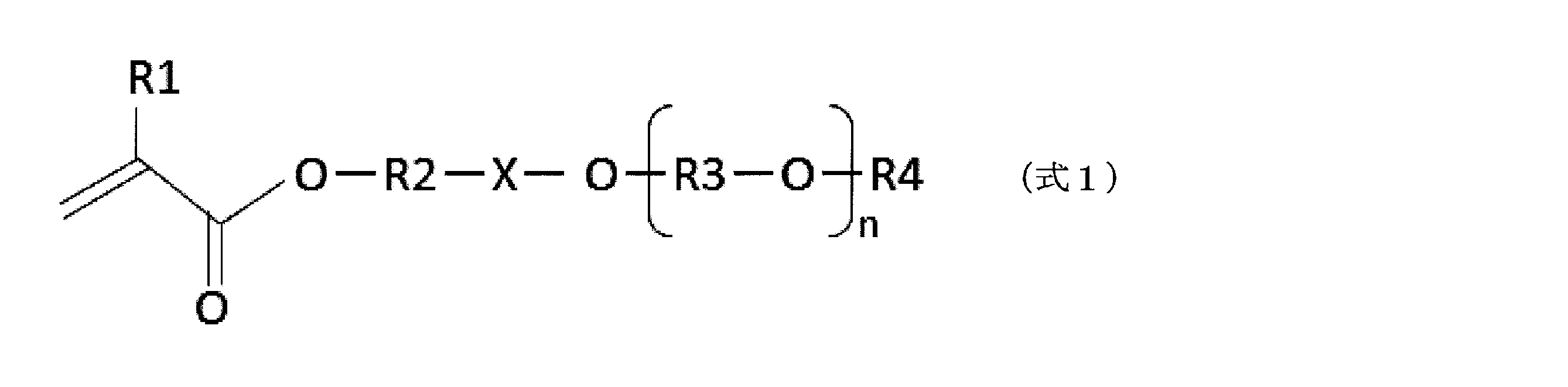
ただし、式1中のR1は水素又はメチル基、Xはウレタン結合、R2、R3及びR4はアルキル基をそれぞれ表し、nは2以上の整数である。
前記光硬化性化合物(B)は、前記ベースポリマー(A)100質量部に対して15質量部を超え75質量部未満の割合で含有されるのが好ましい。かかる割合で前記光硬化性化合物(B)を含有することで、本樹脂組成物から形成した粘着シートの接着力と耐屈曲性をバランスよく兼備することができる。
かかる観点から、前記光硬化性化合物(B)は、前記ベースポリマー(A)100質量部に対して15質量部を超え75質量部未満の割合で含有されるのが好ましく、中でも20質量部以上或いは70質量部以下、その中でも30質量部以上或いは65質量部以下の割合で含有されるのがさらに好ましい。
かかる観点から、前記光硬化性化合物(B)は、前記ベースポリマー(A)100質量部に対して15質量部を超え75質量部未満の割合で含有されるのが好ましく、中でも20質量部以上或いは70質量部以下、その中でも30質量部以上或いは65質量部以下の割合で含有されるのがさらに好ましい。
<光開始剤(C)>
前記光開始剤(C)は、例えば紫外線や可視光線等の光、より具体的には、波長200nm~780nmの光を照射することにより活性なラジカル種を発生する化合物を好ましい例として挙げることができる。
前記光開始剤(C)としては、開裂型光開始剤(C-1)及び水素引抜型開始剤(C-2)のいずれも使用することができ、また、両者を併用することも可能である。
前記光開始剤(C)は、例えば紫外線や可視光線等の光、より具体的には、波長200nm~780nmの光を照射することにより活性なラジカル種を発生する化合物を好ましい例として挙げることができる。
前記光開始剤(C)としては、開裂型光開始剤(C-1)及び水素引抜型開始剤(C-2)のいずれも使用することができ、また、両者を併用することも可能である。
前記開裂型光開始剤(C-1)としては、例えば2,2-ジメトキシ-1,2-ジフェニルエタン-1-オン、1-ヒドロキシシクロヘキシルフェニルケトン、2-ヒドロキシ-2-メチル-1-フェニル-プロパン-1-オン、1-(4-(2-ヒドロキシエトキシ)フェニル)-2-ヒドロキシ-2-メチル-1-プロパン-1-オン、2-ヒロドキシ-1-[4-{4-(2-ヒドロキシ-2-メチル-プロピオニル)ベンジル}フェニル]-2-メチル-プロパン-1-オン、オリゴ(2-ヒドロキシ-2-メチル-1-(4-(1-メチルビニル)フェニル)プロパノン)、フェニルグリオキシリック酸メチル、2-ベンジル-2-ジメチルアミノ-1-(4-モルフォリノフェニル)ブタン-1-オン、2-メチル-1-[4-(メチルチオ)フェニル]-2-モルフォリノプロパン-1-オン、2-(ジメチルアミノ)-2-[(4-メチルフェニル)メチル]-1-[4-(4-モルホリニル)フェニル]-1-ブタノン、ビス(2,4,6-トリメチルベンゾイル)-フェニルフォスフィンオキサイド、2,4,6-トリメチルベンゾイルジフェニルフォスフィンオキサイド、(2,4,6-トリメチルベンゾイル)エトキシフェニルホスフィンオキサイド、ビス(2,6-ジメトキシベンゾイル)2,4,4-トリメチルペンチルフォスフィンオキサイド、又はこれらの誘導体などを挙げることができる。
前記開裂型光開始剤(C-1)を使用すると、光反応終了後に光開始剤が構造変化して失活するため、硬化反応が終了した後の本樹脂組成物中に活性種として残存することがなく、本樹脂組成物に予期せぬ光劣化等をもたらすおそれがないため、好ましい。
前記開裂型光開始剤(C-1)を使用すると、光反応終了後に光開始剤が構造変化して失活するため、硬化反応が終了した後の本樹脂組成物中に活性種として残存することがなく、本樹脂組成物に予期せぬ光劣化等をもたらすおそれがないため、好ましい。
前記水素引抜型光開始剤(C-2)としては、例えばベンゾフェノン、4-メチル-ベンゾフェノン、2,4,6-トリメチルベンゾフェノン、4-フェニルベンゾフェノン、3,3’-ジメチル-4-メトキシベンゾフェノン、4-(メタ)アクリロイルオキシベンゾフェノン、2-ベンゾイル安息香酸メチル、ベンゾイル蟻酸メチル、ビス(2-フェニル-2-オキソ酢酸)オキシビスエチレン、4-(1,3-アクリロイル-1,4,7,10,13-ペンタオキソトリデシル)ベンゾフェノン、チオキサントン、2-クロロチオキサントン、3-メチルチオキサントン、2,4-ジメチルチオキサントン、2-メチルアントラキノン、2-エチルアントラキノン、2-tert-ブチルアントラキノン、2-アミノアントラキノン、又はこれらの誘導体などを挙げることができる。
前記水素引抜き型光開始剤(C-2)を使用すると、光開始剤がベースポリマー(A)からも水素引き抜き反応をし得ることから、硬化後の本樹脂組成物において、光硬化性化合物(B)のみならずベースポリマー(A)も架橋構造にとりこまれたネットワーク構造を形成することができるため好ましい。
また、水素引抜き型光開始剤(C-2)は、一度光硬化反応に用いた後であっても、再度光照射することで繰り返し活性種として機能し得ることから、後述する、いわゆる後硬化(ポストキュア)タイプとして本樹脂を使用する場合においては、後硬化時の光反応の起点となることができる点で好ましい。
また、水素引抜き型光開始剤(C-2)は、一度光硬化反応に用いた後であっても、再度光照射することで繰り返し活性種として機能し得ることから、後述する、いわゆる後硬化(ポストキュア)タイプとして本樹脂を使用する場合においては、後硬化時の光反応の起点となることができる点で好ましい。
前記開始剤(C)の含有量の下限値としては、前記ベースポリマー(A)100質量部に対して0.01質量部以上であることが好ましく、0.03質量部以上であることがより好ましく、0.05質量部以上であることが最も好ましい。
また、その上限値としては、前記ベースポリマー(A)100質量部に対して5質量部以下であることが好ましく、3質量部以下であることがより好ましく、2質量部以下であることが最も好ましい。
また、その上限値としては、前記ベースポリマー(A)100質量部に対して5質量部以下であることが好ましく、3質量部以下であることがより好ましく、2質量部以下であることが最も好ましい。
<その他の成分>
本樹脂組成物は、ベースポリマー(A)、光硬化性化合物(B)及び光開始剤(C)以外にも、必要に応じて、架橋剤(D)、防錆剤(E)及びシランカップリング剤(F)の何れか1つ以上を含有してもよい。
また、前記以外にも、必要に応じて、例えば粘着付与樹脂や、酸化防止剤、光安定化剤、金属不活性化剤、老化防止剤、吸湿剤、重合禁止剤、紫外線吸収剤、無機粒子などの各種の添加剤を適宜含有させることが可能である。
本樹脂組成物は、ベースポリマー(A)、光硬化性化合物(B)及び光開始剤(C)以外にも、必要に応じて、架橋剤(D)、防錆剤(E)及びシランカップリング剤(F)の何れか1つ以上を含有してもよい。
また、前記以外にも、必要に応じて、例えば粘着付与樹脂や、酸化防止剤、光安定化剤、金属不活性化剤、老化防止剤、吸湿剤、重合禁止剤、紫外線吸収剤、無機粒子などの各種の添加剤を適宜含有させることが可能である。
(架橋剤(D))
本樹脂組成物において、架橋剤(D)は必要に応じて含有すればよい任意の成分である。架橋剤(D)を含有しない本樹脂組成物とすることができる一方で、硬化後の高い耐発泡信頼性を得る観点からは、架橋剤(D)を含有する本樹脂組成物を使用して硬化させるのが好ましく、中でも、架橋剤(D)として、後述する多官能(メタ)アクリレート(d-1)を用いることが特に好ましい。
本樹脂組成物において、架橋剤(D)は必要に応じて含有すればよい任意の成分である。架橋剤(D)を含有しない本樹脂組成物とすることができる一方で、硬化後の高い耐発泡信頼性を得る観点からは、架橋剤(D)を含有する本樹脂組成物を使用して硬化させるのが好ましく、中でも、架橋剤(D)として、後述する多官能(メタ)アクリレート(d-1)を用いることが特に好ましい。
前記架橋剤(D)としては、多官能モノマーの他、2,4-トリレンジイソシアネート、2,6-トリレンジイソシアネート、水素化トリレンジイソシアネート、1,3-キシリレンジイソシアネート、1,4-キシリレンジイソシアネート、ヘキサメチレンジイソシアネート、ジフェニルメタン-4,4-ジイソシアネート、イソホロンジイソシアネート、1,3-ビス(イソシアナトメチル)シクロヘキサン、テトラメチルキシリレンジイソシアネート、1,5-ナフタレンジイソシアネート、トリフェニルメタントリイソシアネート等のイソシアネート系化合物及びこれらのイソシアネート系化合物とトリメチロールプロパン等のポリオール化合物とのアダクト体、これらポリイソシアネート化合物のビウレット体やイソシアヌレート体等のイソシアネート系架橋剤や、ポリエチレングリコールジグリシジルエーテル、ジグリシジルエーテル、トリメチロールプロパントリグリシジルエーテル等のエポキシ系架橋剤、メラミン樹脂系架橋剤、アジリジン系架橋剤、オキサゾリン系架橋剤、尿素系架橋剤、金属塩系架橋剤、金属キレート系架橋剤、アミノ樹脂系架橋剤、金属アルコキシド系架橋剤、過酸化物系架橋剤を挙げることができる。これらの架橋剤(D)は1種又は2種以上を併用して用いることができる。
また、グリシジル基、水酸基又はイソシアネート基等の有機官能基を有する(メタ)アクリレートモノマーを用いて、異なる架橋性反応基による架橋構造を併存させてもよい。
前記の中でも多官能モノマー(d-1)が好ましい。
該多官能モノマー(d-1)としては、例えば1,4-ブタンジオールジ(メタ)アクリレート、グリセリンジ(メタ)アクリレート、ネオペンチルグリコールジ(メタ)アクリレート、グリセリングリシジルエーテルジ(メタ)アクリレート、1,6-ヘキサンジオールジ(メタ)アクリレート、1,9-ノナンジオールジ(メタ)アクリレート、トリシクロデカンジメタクリレート、トリシクロデカンジメタノールジ(メタ)アクリレート、ビスフェノールAポリエトキシジ(メタ)アクリレート、ビスフェノールAポリプロポキシジ(メタ)アクリレート、ビスフェノールFポリエトキシジ(メタ)アクリレート、エチレングリコールジ(メタ)アクリレート、ネオペンチルグリコールジ(メタ)アクリレート、トリメチロールプロパントリオキシエチル(メタ)アクリレート、ε-カプロラクトン変性トリス(2-ヒドロキシエチル)イソシアヌレートトリ(メタ)アクリレート、ペンタエリスリトールトリ(メタ)アクリレート、プロポキシ化ペンタエリスリトールトリ(メタ)アクリレート、エトキシ化ペンタエリスリトールトリ(メタ)アクリレート、ペンタエリスリトールテトラ(メタ)アクリレート、プロポキシ化ペンタエリスリトールテトラ(メタ)アクリレート、エトキシ化ペンタエリスリトールテトラ(メタ)アクリレート、ジペンタエリスリトールヘキサ(メタ)アクリレート、ポリエチレングリコールジ(メタ)アクリレート、トリス(アクリロキシエチル)イソシアヌレート、ジペンタエリスリトールヘキサ(メタ)アクリレート、ジペンタエリスリトールペンタ(メタ)アクリレート、トリペンタエリスリトールヘキサ(メタ)アクリレート、トリペンタエリスリトールペンタ(メタ)アクリレート、ヒドロキシビバリン酸ネオペンチルグリコールジ(メタ)アクリレート、ヒドロキシビバリン酸ネオペングリコールのε-カプロラクトン付加物のジ(メタ)アクリレート、トリメチロールプロパントリ(メタ)アクリレート、トリメチロールプロパンポリエトキシトリ(メタ)アクリレート、ジトリメチロールプロパンテトラ(メタ)アクリレート等の紫外線硬化型の多官能(メタ)アクリル系モノマーの他、ポリエステル(メタ)アクリレート、エポキシ(メタ)アクリレート、ウレタン(メタ)アクリレート、ポリエーテル(メタ)アクリレート等の多官能(メタ)アクリル系オリゴマーを挙げることができる。これらは1種又は2種以上を組み合わせて使用してもよい。
該多官能モノマー(d-1)としては、例えば1,4-ブタンジオールジ(メタ)アクリレート、グリセリンジ(メタ)アクリレート、ネオペンチルグリコールジ(メタ)アクリレート、グリセリングリシジルエーテルジ(メタ)アクリレート、1,6-ヘキサンジオールジ(メタ)アクリレート、1,9-ノナンジオールジ(メタ)アクリレート、トリシクロデカンジメタクリレート、トリシクロデカンジメタノールジ(メタ)アクリレート、ビスフェノールAポリエトキシジ(メタ)アクリレート、ビスフェノールAポリプロポキシジ(メタ)アクリレート、ビスフェノールFポリエトキシジ(メタ)アクリレート、エチレングリコールジ(メタ)アクリレート、ネオペンチルグリコールジ(メタ)アクリレート、トリメチロールプロパントリオキシエチル(メタ)アクリレート、ε-カプロラクトン変性トリス(2-ヒドロキシエチル)イソシアヌレートトリ(メタ)アクリレート、ペンタエリスリトールトリ(メタ)アクリレート、プロポキシ化ペンタエリスリトールトリ(メタ)アクリレート、エトキシ化ペンタエリスリトールトリ(メタ)アクリレート、ペンタエリスリトールテトラ(メタ)アクリレート、プロポキシ化ペンタエリスリトールテトラ(メタ)アクリレート、エトキシ化ペンタエリスリトールテトラ(メタ)アクリレート、ジペンタエリスリトールヘキサ(メタ)アクリレート、ポリエチレングリコールジ(メタ)アクリレート、トリス(アクリロキシエチル)イソシアヌレート、ジペンタエリスリトールヘキサ(メタ)アクリレート、ジペンタエリスリトールペンタ(メタ)アクリレート、トリペンタエリスリトールヘキサ(メタ)アクリレート、トリペンタエリスリトールペンタ(メタ)アクリレート、ヒドロキシビバリン酸ネオペンチルグリコールジ(メタ)アクリレート、ヒドロキシビバリン酸ネオペングリコールのε-カプロラクトン付加物のジ(メタ)アクリレート、トリメチロールプロパントリ(メタ)アクリレート、トリメチロールプロパンポリエトキシトリ(メタ)アクリレート、ジトリメチロールプロパンテトラ(メタ)アクリレート等の紫外線硬化型の多官能(メタ)アクリル系モノマーの他、ポリエステル(メタ)アクリレート、エポキシ(メタ)アクリレート、ウレタン(メタ)アクリレート、ポリエーテル(メタ)アクリレート等の多官能(メタ)アクリル系オリゴマーを挙げることができる。これらは1種又は2種以上を組み合わせて使用してもよい。
前記架橋剤(D)の含有量は、前記ベースポリマー(A)100質量部に対して10質量部以下であるのが好ましく、中でも0.05質量部以上或いは5質量部以下、その中でも0.1質量部以上或いは3質量部以下の割合であるのさらに好ましい。
(防錆剤(E))
本樹脂組成物は、金属腐食を促進しない性質を高めるため、必要に応じて、防錆剤(E)を含有してもよい。
本樹脂組成物は、金属腐食を促進しない性質を高めるため、必要に応じて、防錆剤(E)を含有してもよい。
前記防錆剤(E)としては、トリアゾール系化合物であることが好ましい。中でも、ベンゾトリアゾール、1,2,3-トリアゾール及び1,2,4-トリアゾールから選択される1種又は2種以上の混合物であるのが特に好ましい。
前記ベンゾトリアゾールとしては、置換又は無置換のいずれのベンゾトリアゾールであってもよく、例えば1,2,3-ベンゾトリアゾール、メチル-1H-ベンゾトリアゾール等のアルキルベンゾトリアゾール、カルボキシベンゾトリアゾール、1-ヒドロキシベンゾトリアゾール、5-アミノベンゾトリアゾール、5-フェニルチオールベンゾトリアゾール、5-メトキシベンゾトリアゾール、ニトロベンゾトリアゾール、クロロベンゾトリアゾール、ブロモベンゾトリアゾール、フルオロベンゾトリアゾール等のハロゲノベンゾトリアゾール、銅ベンゾトリアゾール、銀ベンゾトリアゾール、ベンゾトリアゾールシラン化合物等を挙げることができる。これらの中でも、本樹脂組成物への分散性や添加しやすさ、金属腐食防止効果の観点から、1,2,3-ベンゾトリアゾール、1-[N,N-ビス(2-エチルヘキシル)アミノメチル]ベンゾトリアゾール、1-[N,N-ビス(2-エチルヘキシル)アミノメチル]メチルベンゾトリアゾール、2,2’-[[(メチル-1H-ベンゾトリアゾール-1-イル)メチル]イミノ]ビスエタノールからなる群より選択されるいずれか1種又は2種以上の混合物が好ましい。
さらに、1,2,4-トリアゾールは、融点が約120℃の固体である一方、1,2,3-トリアゾールは融点が約20℃と室温でほぼ液体状態である。よって、1,2,3-トリアゾールは、本樹脂組成物中に混合する際の分散性に優れ、均一に混合することができ、また、マスターバッチ化しやすい等の優れた利点がある。
さらに、1,2,4-トリアゾールは、融点が約120℃の固体である一方、1,2,3-トリアゾールは融点が約20℃と室温でほぼ液体状態である。よって、1,2,3-トリアゾールは、本樹脂組成物中に混合する際の分散性に優れ、均一に混合することができ、また、マスターバッチ化しやすい等の優れた利点がある。
前記防錆剤(E)の含有量は、前記ベースポリマー(A)100質量部に対して0.01~5質量部であることが好ましく、中でも0.1質量部以上或いは1質量部以下であることがより好ましく、その中でも0.2質量部以上或いは0.5質量部以下であることがさらに好ましい。
(シランカップリング剤(F))
本樹脂組成物は、耐久性の向上や、ガラスとの密着性向上の観点から、必要に応じて、シランカップリング剤(F)を含有してもよい。
当該シランカップリング剤(F)としては、例えば3-グリシドキシプロピルトリメトキシシラン、3-グリシドキシプロピルトリエトキシシラン、3-グリシドキシプロピルメチルジエトキシシラン、2-(3,4-エポキシシクロヘキシル)エチルトリメトキシシランなどのエポキシ基含有シランカップリング剤、3-アミノプロピルトリメトキシシラン、N-2-(アミノエチル)-3-アミノプロピルメチルジメトキシシラン、3-トリエトキシシリル-N-(1,3-ジメチルブチリデン)プロピルアミン、N-フェニル-γ-アミノプロピルトリメトキシシランなどのアミノ基含有シランカップリング剤、3-アクリロキシプロピルトリメトキシシラン、3-メタクリロキシプロピルトリエトキシシランなどの(メタ)アクリル基含有シランカップリング剤、3-イソシアネートプロピルトリエトキシシランなどのイソシアネート基含有シランカップリング剤などを挙げることができる。
シランカップリング剤(F)の市販品としては、例えばKBM-303、KBM-403、KBE-402、KBE-403、KBE-502、KBE-503、KBM-5103、KBM-573、KBM-802、KBM-803、KBE-846、KBE-9007(信越化学工業株式会社製)等を挙げることができる。
これらは1種又は2種以上を組み合わせて使用してもよい。
前記シランカップリング剤(F)の含有量は、ベースポリマー(A)100質量部に対して、0.001質量部以上5質量部以下であるのが好ましく、中でも0.01質量部以上或いは1質量部以下であるのがより好ましく、その中でも0.02質量部以上或いは1質量部以下であるのがもっとも好ましい。
<本樹脂組成物の調製方法>
本樹脂組成物は、前記ベースポリマー(A)、前記光硬化性化合物(B)及び光開始剤(C)、必要に応じて架橋剤(D)、必要に応じて防錆剤(E)、必要に応じてシランカップリング剤(F)、さらに必要に応じてその他の成分をそれぞれ所定量混合することにより得ることができる。
これらの混合方法としては、特に制限されず、各成分の混合順序も特に限定されない。
また、本樹脂組成物製造時に熱処理工程を追加してもよい。
この場合は、予め、本樹脂組成物の各成分を混合してから熱処理を行うことが望ましい。各種の混合成分を濃縮してマスターバッチ化したものを使用してもよい。
本樹脂組成物は、前記ベースポリマー(A)、前記光硬化性化合物(B)及び光開始剤(C)、必要に応じて架橋剤(D)、必要に応じて防錆剤(E)、必要に応じてシランカップリング剤(F)、さらに必要に応じてその他の成分をそれぞれ所定量混合することにより得ることができる。
これらの混合方法としては、特に制限されず、各成分の混合順序も特に限定されない。
また、本樹脂組成物製造時に熱処理工程を追加してもよい。
この場合は、予め、本樹脂組成物の各成分を混合してから熱処理を行うことが望ましい。各種の混合成分を濃縮してマスターバッチ化したものを使用してもよい。
また、混合する際の装置も特に制限されず、例えば万能混練機、プラネタリミキサー、バンバリーミキサー、ニーダー、ゲートミキサー、加圧ニーダー、三本ロール、二本ロールを用いることができる。必要に応じて溶剤を用いて混合してもよい。
なお、本樹脂組成物は、溶剤を含まない無溶剤系として使用することできる。
無溶剤系として使用することで溶剤が残存せず、耐熱性及び耐光性が高まるという利点を備えることができる。
なお、本樹脂組成物は、溶剤を含まない無溶剤系として使用することできる。
無溶剤系として使用することで溶剤が残存せず、耐熱性及び耐光性が高まるという利点を備えることができる。
<<本硬化物>>
本発明の実施形態の一例に係る粘着剤樹脂硬化物(以下「本硬化物」と称する)は、上述した本樹脂組成物を光硬化して得られるものである。
本硬化物は、被着部材の貼合後に、さらに光照射させて、本硬化物を本硬化させて使用する、いわゆる後硬化(ポストキュア)タイプとして使用することもできる。
また、部材貼合後に光照射をせずに使用する、いわゆるノンキュアタイプとして使用することができる。ノンキュアタイプとして使用することで、被着部材貼合後の後硬化の手間がないことや、光透過しない部材や、光劣化するため光照射ができない部材を積層した構成にも適用できる点で利点がある。
本発明の実施形態の一例に係る粘着剤樹脂硬化物(以下「本硬化物」と称する)は、上述した本樹脂組成物を光硬化して得られるものである。
本硬化物は、被着部材の貼合後に、さらに光照射させて、本硬化物を本硬化させて使用する、いわゆる後硬化(ポストキュア)タイプとして使用することもできる。
また、部材貼合後に光照射をせずに使用する、いわゆるノンキュアタイプとして使用することができる。ノンキュアタイプとして使用することで、被着部材貼合後の後硬化の手間がないことや、光透過しない部材や、光劣化するため光照射ができない部材を積層した構成にも適用できる点で利点がある。
本硬化物は、温度-40℃での損失正接(Tanδ)の値が0.1以上0.6未満であるのが好ましく、中でも0.11以上或いは0.55以下、その中でも0.15以上或いは0.5以下であるのがさらに好ましい。
同時に、本硬化物は、温度100℃での損失正接(Tanδ)の値が0.3以上1未満であることが好ましく、中でも0.35以上或いは0.95以下、その中でも0.38以上或いは0.92以下であるのがさらに好ましい。
本硬化物が、かかる性質を有することにより、優れた耐屈曲性が得られるなどの利点がある。
なお、本硬化物が、上記の性質を有するには、本樹脂組成物を使用して硬化させればよい。
同時に、本硬化物は、温度100℃での損失正接(Tanδ)の値が0.3以上1未満であることが好ましく、中でも0.35以上或いは0.95以下、その中でも0.38以上或いは0.92以下であるのがさらに好ましい。
本硬化物が、かかる性質を有することにより、優れた耐屈曲性が得られるなどの利点がある。
なお、本硬化物が、上記の性質を有するには、本樹脂組成物を使用して硬化させればよい。
本硬化物を形成する、ベースポリマー(A)のガラス転移温度(TgB)および光硬化性化合物のガラス転移温度(TgB)は、以下のFOXの式を用いて求めることができる。
FOXの式: 1/Tg=W1/T1+W2/T2+・・・Wn/Tn
式中、Tg:理論ガラス転移温度(K)であり、W1、W2・・・Wnは各モノマーの質量分率であり、T1、T2・・・Tnは各モノマーの実測ガラス転移温度(K)である。
FOXの式: 1/Tg=W1/T1+W2/T2+・・・Wn/Tn
式中、Tg:理論ガラス転移温度(K)であり、W1、W2・・・Wnは各モノマーの質量分率であり、T1、T2・・・Tnは各モノマーの実測ガラス転移温度(K)である。
また、本樹脂組成物及び本硬化物において、架橋剤(D)は任意の成分である。
本硬化物は、架橋剤(D)を含有しない本樹脂組成物を使用することができる一方で、硬化後の高い耐発泡信頼性を得る観点からは、架橋剤(D)を含有する本樹脂組成物を使用して硬化させるのが好ましく、中でも、架橋剤(D)として多官能(メタ)アクリレート(d-1)を用いることが特に好ましい。
本硬化物は、架橋剤(D)を含有しない本樹脂組成物を使用することができる一方で、硬化後の高い耐発泡信頼性を得る観点からは、架橋剤(D)を含有する本樹脂組成物を使用して硬化させるのが好ましく、中でも、架橋剤(D)として多官能(メタ)アクリレート(d-1)を用いることが特に好ましい。
本硬化物の形態は、シート状、層状、膜状、塊状など任意である。
<<本粘着シート>>
本発明の実施形態の一例に係る粘着シート(以下「本粘着シート」と称する)は、上述した本樹脂組成物から形成される粘着剤層(「本粘着剤層」と称する)を有するものである。
本発明の実施形態の一例に係る粘着シート(以下「本粘着シート」と称する)は、上述した本樹脂組成物から形成される粘着剤層(「本粘着剤層」と称する)を有するものである。
本粘着シートにおける本粘着剤層は、単層であっても多層であってもよく、また、多層の場合には、いわゆる基材層のような他の層が介在してもよい。
また、本粘着剤層が他の層を有する多層構成である場合は、本粘着シートの表面層が本樹脂組成物から形成される本粘着剤層であることが好ましい。
また、本粘着剤層は、被着部材の貼合後に、さらに光照射させて、本粘着剤層を本硬化させて使用する、いわゆる後硬化(ポストキュア)タイプとして使用することもできる。
また、部材貼合後に光照射をせずに使用する、いわゆるノンキュアタイプとして使用することができる。ノンキュアタイプとして使用することで、被着部材貼合後の後硬化が不要である等の利点がある。
また、本粘着剤層が他の層を有する多層構成である場合は、本粘着シートの表面層が本樹脂組成物から形成される本粘着剤層であることが好ましい。
また、本粘着剤層は、被着部材の貼合後に、さらに光照射させて、本粘着剤層を本硬化させて使用する、いわゆる後硬化(ポストキュア)タイプとして使用することもできる。
また、部材貼合後に光照射をせずに使用する、いわゆるノンキュアタイプとして使用することができる。ノンキュアタイプとして使用することで、被着部材貼合後の後硬化が不要である等の利点がある。
本粘着シートは、温度-40℃での損失正接(Tanδ)の値が0.1以上0.6未満であるのが好ましく、中でも0.11以上或いは0.55以下、その中でも0.15以上或いは0.5以下であるのがさらに好ましい。
同時に、本粘着シートは、温度100℃での損失正接(Tanδ)の値が0.3以上1未満であるのが好ましく、中でも0.35以上或いは0.95以下、その中でも0.38以上或いは0.92以下であるのがさらに好ましい。
本粘着シートが、かかる性質を有することにより、優れた耐屈曲性が得られるなどの利点がある。
なお、本粘着シートが、上記の性質を有するには、本樹脂組成物を使用して硬化させればよい。
同時に、本粘着シートは、温度100℃での損失正接(Tanδ)の値が0.3以上1未満であるのが好ましく、中でも0.35以上或いは0.95以下、その中でも0.38以上或いは0.92以下であるのがさらに好ましい。
本粘着シートが、かかる性質を有することにより、優れた耐屈曲性が得られるなどの利点がある。
なお、本粘着シートが、上記の性質を有するには、本樹脂組成物を使用して硬化させればよい。
また、本発明において、本粘着シートが、上記の性質を有するには、本樹脂組成物を使用して本粘着剤層を形成すればよい。
また、上述したように、本樹脂組成物において、架橋剤(D)は任意の成分であり、本硬化物は、架橋剤(D)を含有しない本樹脂組成物を使用することができる一方で、硬化後の高い耐発泡信頼性を得る観点からは、架橋剤(D)を含有する本樹脂組成物を使用して本粘着剤層を形成するのが好ましく、中でも、架橋剤(D)として多官能(メタ)アクリレート(d-1)を用いることが特に好ましい。
また、上述したように、本樹脂組成物において、架橋剤(D)は任意の成分であり、本硬化物は、架橋剤(D)を含有しない本樹脂組成物を使用することができる一方で、硬化後の高い耐発泡信頼性を得る観点からは、架橋剤(D)を含有する本樹脂組成物を使用して本粘着剤層を形成するのが好ましく、中でも、架橋剤(D)として多官能(メタ)アクリレート(d-1)を用いることが特に好ましい。
本粘着シートの厚さは、10μm~500μmであるのが好ましく、中でも15μm以上或いは400μm以下であるのがより好ましく、その中でも特に20μm以上或いは350μm以下であるのことがさらに好ましい。
<本粘着シートの使用形態>
本粘着シートは、粘着シート単体として用いることも可能である。例えば、被着体に本樹脂組成物を直接塗布してシート状に形成したり、本樹脂組成物を直接押出成形したり、型に注入したりして、本粘着シートを使用することができる。
更には、導電部材等の部材間に本樹脂組成物を直接充填することによって、本粘着シートを使用することもできる。
本粘着シートは、粘着シート単体として用いることも可能である。例えば、被着体に本樹脂組成物を直接塗布してシート状に形成したり、本樹脂組成物を直接押出成形したり、型に注入したりして、本粘着シートを使用することができる。
更には、導電部材等の部材間に本樹脂組成物を直接充填することによって、本粘着シートを使用することもできる。
他方、本粘着シートは、本樹脂組成物から形成される粘着剤層を備えた粘着シートとして使用することも可能である。例えば、本樹脂組成物を、離型フィルム上に単層又は多層のシート状に成型した離型フィルム付き粘着シートの形態とすることもできる。
前記離型フィルムの材質としては、例えばポリエステルフィルム、ポリオレフィンフィルム、ポリカーボネートフィルム、ポリスチレンフィルム、アクリルフィルム、トリアセチルセルロースフィルム、フッ素樹脂フィルム等を挙げることができる。これらの中でも、ポリエステルフィルム及びポリオレフィンフィルムが特に好ましい。
離型フィルムの厚みは特に制限されない。例えば加工性及びハンドリング性の観点からは、離型フィルムの厚みは25μm~500μmであるのが好ましく、その中でも38μm以上或いは250μm以下、その中でも50μm以上或いは200μm以下であるのがさらに好ましい。
<<本積層体>>
本発明の実施形態の一例に係る画像表示装置構成用積層体(以下、「本積層体」と称する)は、2つの画像表示装置用構成部材の間に、上述した本硬化物からなる粘着剤層又は本粘着シート(以下、これらを総括して「本粘着シート類」と称する)の何れかが介在してなる構成を備えるものである。
この際、前記2つの画像表示装置構成部材とは、そのうちの少なくとも一つが、偏光板、偏光フィルム、位相差フィルム、画像表示パネル、有機EL表示パネル、プラズマ表示パネル、タッチパネル、保護パネル及びタッチセンサーからなる群のうちの何れかを挙げることができる。
本発明の実施形態の一例に係る画像表示装置構成用積層体(以下、「本積層体」と称する)は、2つの画像表示装置用構成部材の間に、上述した本硬化物からなる粘着剤層又は本粘着シート(以下、これらを総括して「本粘着シート類」と称する)の何れかが介在してなる構成を備えるものである。
この際、前記2つの画像表示装置構成部材とは、そのうちの少なくとも一つが、偏光板、偏光フィルム、位相差フィルム、画像表示パネル、有機EL表示パネル、プラズマ表示パネル、タッチパネル、保護パネル及びタッチセンサーからなる群のうちの何れかを挙げることができる。
本積層体の具体例としては、例えば離型フィルム/本粘着シート類/タッチパネル、画像表示パネル/本粘着シート類/タッチパネル、画像表示パネル/本粘着シート類/タッチパネル/本粘着シート類/保護パネル、偏光フィルム/本粘着シート類/タッチパネル、偏光フィルム/本粘着シート類/タッチパネル/本粘着シート類/保護パネルなどの構成を備えたものを挙げることができる。
前記タッチパネルとしては、保護パネルにタッチパネル機能を内在させた構造体や、画像表示パネルにタッチパネル機能を内在させた構造体も含む。
よって、本積層体は、例えば離型フィルム/本粘着シート類/保護パネル、離型フィルム/本粘着シート類/画像表示パネル、画像表示パネル/本粘着シート類/保護パネルなどの構成であってもよい。
また、前記の構成において、本粘着シート類と、これと隣接するタッチパネル、保護パネル、画像表示パネル、偏光フィルム等の部材との間に前記の導電層を介入する全ての構成を挙げることができる。但し、これらの積層例に限定されるものではない。
よって、本積層体は、例えば離型フィルム/本粘着シート類/保護パネル、離型フィルム/本粘着シート類/画像表示パネル、画像表示パネル/本粘着シート類/保護パネルなどの構成であってもよい。
また、前記の構成において、本粘着シート類と、これと隣接するタッチパネル、保護パネル、画像表示パネル、偏光フィルム等の部材との間に前記の導電層を介入する全ての構成を挙げることができる。但し、これらの積層例に限定されるものではない。
なお、前記タッチパネルとしては、抵抗膜方式、静電容量方式、電磁誘導方式等の方式のものを挙げることができる。中でも静電容量方式であることが好ましい。
前記保護パネルの材質としては、ガラスの他、アクリル系樹脂、ポリカーボネート系樹脂、シクロオレフィンポリマー等の脂環式ポリオレフィン系樹脂、スチレン系樹脂、ポリ塩化ビニル系樹脂、フェノール系樹脂、メラミン系樹脂、エポキシ系樹脂等のプラスチックであってもよい。
画像表示パネルは、偏光フィルムその他位相差フィルム等の他の光学フィルム、液晶材料及びバックライトシステムから構成される(通常、粘着剤樹脂組成物又は粘着物品の画像表示パネルに対する被着面は光学フィルムとなる。)ものであり、液晶材料の制御方式によりSTN方式やVA方式やIPS方式等があり、何れの方式であってもよい。
本積層体は、例えば液晶ディスプレイ、有機ELディスプレイ、無機ELディスプレイ、電子ペーパー、プラズマディスプレイ及びマイクロエレクトロメカニカルシステム(MEMS)ディスプレイなどの画像表示装置の構成部材として使用することができる。
なお、本粘着シート類は、耐屈曲性を有することから、上述した、2つの画像表示装置用構成部材は、屈曲又は湾曲可能なフレキシブル部材であることが好ましい。
<本積層体の製造方法>
本積層体は、偏光板、偏光フィルム、位相差フィルム、画像表示パネル、有機EL表示パネル、プラズマ表示パネル、タッチパネル、保護パネル及びタッチセンサーからなる群より選択される何れかの画像表示装置構成部材と、本粘着シート類とを貼り合せて製造することができる。
本積層体は、偏光板、偏光フィルム、位相差フィルム、画像表示パネル、有機EL表示パネル、プラズマ表示パネル、タッチパネル、保護パネル及びタッチセンサーからなる群より選択される何れかの画像表示装置構成部材と、本粘着シート類とを貼り合せて製造することができる。
本積層体における上記本粘着シート類は、さらなる光硬化性(後硬化(ポストキュア)性)を有していてもよい。
上記本粘着シート類が当該光硬化性(後硬化性)を備える場合、上記画像表示装置構成部材と該本粘着シート類とを貼り合せた後、当該画像表示装置構成部材の外側から当該画像表示装置構成部材を介して、光を照射し、本粘着シート類を本硬化させて、2つの画像表示装置構成部材を貼合させることにより、本積層体を製造することもでき、優れた耐発泡信頼性を兼備させることができる。
なお、上記本粘着シート類は、上述したとおり、被着部材貼合後に、さらなる光照射による後硬化を行わない、ノンキュアタイプの形態として使用することができ、当該形態として使用すれば、被着部材貼合後の硬化が不要である等の利点がある。
上記本粘着シート類が当該光硬化性(後硬化性)を備える場合、上記画像表示装置構成部材と該本粘着シート類とを貼り合せた後、当該画像表示装置構成部材の外側から当該画像表示装置構成部材を介して、光を照射し、本粘着シート類を本硬化させて、2つの画像表示装置構成部材を貼合させることにより、本積層体を製造することもでき、優れた耐発泡信頼性を兼備させることができる。
なお、上記本粘着シート類は、上述したとおり、被着部材貼合後に、さらなる光照射による後硬化を行わない、ノンキュアタイプの形態として使用することができ、当該形態として使用すれば、被着部材貼合後の硬化が不要である等の利点がある。
前記本積層体に使用される本粘着シート類は、優れた耐屈曲性を得る観点から、温度-40℃での損失正接(Tanδ)の値が0.1以上0.6未満であり、かつ、温度100℃での損失正接(Tanδ)の値が0.3以上1未満であることが好ましい。
<<本表示装置>>
本発明の実施形態の一例に係る画像表示装置(以下「本表示装置」と称する)は、上述した本積層体を備えるものである。
本画像表示装置の具体例としては、本積層体を備えた液晶ディスプレイ、有機EL(エレクトロルミネッセンス)ディスプレイ、無機ELディスプレイ、電子ペーパー、プラズマディスプレイ及びマイクロエレクトロメカニカルシステム(MEMS)ディスプレイを挙げることができる。
本発明の実施形態の一例に係る画像表示装置(以下「本表示装置」と称する)は、上述した本積層体を備えるものである。
本画像表示装置の具体例としては、本積層体を備えた液晶ディスプレイ、有機EL(エレクトロルミネッセンス)ディスプレイ、無機ELディスプレイ、電子ペーパー、プラズマディスプレイ及びマイクロエレクトロメカニカルシステム(MEMS)ディスプレイを挙げることができる。
<<語句の説明>>
本発明において、「X~Y」(X,Yは任意の数字)と表現する場合、特にことわらない限り「X以上Y以下」の意と共に、「好ましくはXより大きい」或いは「好ましくはYより小さい」の意も包含する。
また、「X以上」(Xは任意の数字)或いは「Y以下」(Yは任意の数字)と表現した場合、「Xより大きいことが好ましい」或いは「Y未満であることが好ましい」旨の意図も包含する。
本発明において、「X~Y」(X,Yは任意の数字)と表現する場合、特にことわらない限り「X以上Y以下」の意と共に、「好ましくはXより大きい」或いは「好ましくはYより小さい」の意も包含する。
また、「X以上」(Xは任意の数字)或いは「Y以下」(Yは任意の数字)と表現した場合、「Xより大きいことが好ましい」或いは「Y未満であることが好ましい」旨の意図も包含する。
以下、実施例及び比較例によりさらに詳しく説明する。但し、本発明はこれら実施例に限定されるものではない。
[実施例1]
2-エチルヘキシルアクリレート64質量部、メチルアクリレート19質量部及びヒドロキシエチルアクリレート17質量部をランダム共重合してなる、(メタ)アクリル系共重合体としてのアクリル系グラフト共重合体(A-1、質量平均分子量:44万)1kgに対し、光硬化性化合物として、プロピレングリコール骨格含有単官能ウレタンアクリレート(B-1、AGC社製「PEM-X264」、質量平均分子量(Mw):10,000)300gと、光開始剤として、2,4,6-トリメチルベンゾフェノン及び4-メチルベンゾフェノンの混合物(C-1、IGM社製「Esacure TZT」)10gと、を添加し、均一混合して、粘着剤樹脂組成物1を得た。
光硬化性化合物(B-1)は、硬化物の動的粘弾性測定により得られる損失正接(Tanδ)のピークを2本以上有する化合物であり、末端のアクリロイル基の重合に由来するピーク(b1)は-53℃であり、グリコール骨格に由来するピーク(b2)は-24℃であった。
次に、前記粘着剤樹脂組成物1を、表面が剥離処理されている2枚のポリエチレンテレフタレートフィルム(三菱ケミカル社製「ダイアホイルMRV(V03)」、厚さ100μm、三菱ケミカル社製「ダイアホイルMRQ」、厚さ75μm)すなわち2枚の離型フィルムの間に挟んで、厚さ100μmのシート状にホットメルト成形した後、高圧水銀ランプを用いて、該離型フィルム越しに、波長365nmの積算光量が3000mJ/cm2となるよう紫外線を照射して、該粘着剤樹脂組成物1を硬化させて、離型フィルム/粘着シート/離型フィルムからなる両面粘着シート積層体1を得た。
[実施例2]
アクリル系グラフト共重合体(A-1)1kgに対し、光硬化性化合物として、プロピレングリコール骨格含有ウレタンアクリレート(B-1)300gと、光開始剤として、2,4,6-トリメチルベンゾフェノン及び4-メチルベンゾフェノンの混合物(C-1、IGM社製「Esacure TZT」)10gと、を添加し、さらにシランカップリング剤(信越シリコーン社製「KBM-403」)5gを均一混合して、粘着剤樹脂組成物2を得た。
アクリル系グラフト共重合体(A-1)1kgに対し、光硬化性化合物として、プロピレングリコール骨格含有ウレタンアクリレート(B-1)300gと、光開始剤として、2,4,6-トリメチルベンゾフェノン及び4-メチルベンゾフェノンの混合物(C-1、IGM社製「Esacure TZT」)10gと、を添加し、さらにシランカップリング剤(信越シリコーン社製「KBM-403」)5gを均一混合して、粘着剤樹脂組成物2を得た。
次に、前記粘着剤樹脂組成物2を、表面が剥離処理されている2枚のポリエチレンテレフタレートフィルム(三菱ケミカル社製「ダイアホイルMRV(V03)」、厚さ100μm、三菱ケミカル社製「ダイアホイルMRQ」、厚さ75μm)すなわち2枚の離型フィルムの間に挟んで、厚さ100μmのシート状にホットメルト成形した後、高圧水銀ランプを用いて、該離型フィルム越しに、波長365nmの積算光量が3000mJ/cm2となるよう紫外線を照射して粘着剤樹脂組成物2を硬化させて、離型フィルム/粘着シート/離型フィルムからなる両面粘着シート積層体2を得た。
[実施例3]
光硬化性化合物として、プロピレングリコール骨格含有ウレタンアクリレート(B-1)を500g添加した以外は、実施例1と同様にして粘着剤樹脂組成物3及び両面粘着シート積層体3を得た。
光硬化性化合物として、プロピレングリコール骨格含有ウレタンアクリレート(B-1)を500g添加した以外は、実施例1と同様にして粘着剤樹脂組成物3及び両面粘着シート積層体3を得た。
[比較例1]
アクリル系グラフト共重合体(A-1)1kgに対し、光開始剤として2,4,6-トリメチルベンゾフェノン及び4-メチルベンゾフェノンの混合物(C-1、IGM社製「Esacure TZT」)45gを添加し、均一混合して、粘着剤樹脂組成物4を得た。
アクリル系グラフト共重合体(A-1)1kgに対し、光開始剤として2,4,6-トリメチルベンゾフェノン及び4-メチルベンゾフェノンの混合物(C-1、IGM社製「Esacure TZT」)45gを添加し、均一混合して、粘着剤樹脂組成物4を得た。
次に、前記粘着剤樹脂組成物4を、表面が剥離処理されている2枚のポリエチレンテレフタレートフィルム(三菱ケミカル社製「ダイアホイルMRV(V03)」、厚さ100μm、三菱ケミカル社製「ダイアホイルMRQ」、厚さ75μm)すなわち2枚の離型フィルムの間に挟んで、厚さ100μmのシート状にホットメルト成形した後、高圧水銀ランプを用いて、該離型フィルム越しに、波長365nmの積算光量が3000mJ/cm2となるよう紫外線を照射して粘着剤樹脂組成物5を硬化させ、離型フィルム/粘着シート/離型フィルムからなる両面粘着シート積層体4を得た。
[比較例2]
ブチルアクリレート71質量部、2-エチルヘキシルアクリレート26.2質量部及びアクリルアミド2.8質量部をランダム共重合してなる、(メタ)アクリル系共重合体としてのアクリル系グラフト共重合体(A-2、質量平均分子量:47万)1kgに対し、光硬化性化合物として、ノナンジオールジアクリレート(B-2、大阪有機化学社製「ビスコート260」、質量平均分子量(Mw):268)60gと、光開始剤として、2,4,6-トリメチルベンゾフェノン及び4-メチルベンゾフェノンの混合物(C-1、IGM社製「Esacure TZT」)15gとを添加し、均一混合して、粘着剤樹脂組成物5を得た。
ブチルアクリレート71質量部、2-エチルヘキシルアクリレート26.2質量部及びアクリルアミド2.8質量部をランダム共重合してなる、(メタ)アクリル系共重合体としてのアクリル系グラフト共重合体(A-2、質量平均分子量:47万)1kgに対し、光硬化性化合物として、ノナンジオールジアクリレート(B-2、大阪有機化学社製「ビスコート260」、質量平均分子量(Mw):268)60gと、光開始剤として、2,4,6-トリメチルベンゾフェノン及び4-メチルベンゾフェノンの混合物(C-1、IGM社製「Esacure TZT」)15gとを添加し、均一混合して、粘着剤樹脂組成物5を得た。
次に、前記粘着剤樹脂組成物5を、表面が剥離処理されている2枚のポリエチレンテレフタレートフィルム(三菱ケミカル社製「ダイアホイルMRV(V03)」、厚さ100μm、三菱ケミカル社製「ダイアホイルMRQ」、厚さ75μm)すなわち2枚の離型フィルムの間に挟んで、厚さ100μmのシート状にホットメルト成形した後、高圧水銀ランプを用いて、該離型フィルム越しに、波長365nmの積算光量が1000mJ/cm2となるよう紫外線を照射して粘着剤樹脂組成物6を硬化させ、離型フィルム/粘着シート/離型フィルムからなる両面粘着シート積層体5を得た。
[比較例3]
ブチルアクリレート72質量部、2-エチルヘキシルアクリレート26質量部及びアクリル酸2質量部をランダム共重合してなる、(メタ)アクリル系共重合体としてのアクリル系グラフト共重合体(A-3、質量平均分子量:42万)を用いた以外は、比較例2と同様にして粘着剤樹脂組成物6及び両面粘着シート積層体6を得た。
ブチルアクリレート72質量部、2-エチルヘキシルアクリレート26質量部及びアクリル酸2質量部をランダム共重合してなる、(メタ)アクリル系共重合体としてのアクリル系グラフト共重合体(A-3、質量平均分子量:42万)を用いた以外は、比較例2と同様にして粘着剤樹脂組成物6及び両面粘着シート積層体6を得た。
[比較例4]
光硬化化合物としての、プロピレングリコール骨格含有ウレタンアクリレート(B-1)1kgに対し、光開始剤として、2,4,6-トリメチルベンゾフェノン及び4-メチルベンゾフェノンの混合物(C-1、IGM社製「Esacure TZT」)10gを添加し、均一混合して、粘着剤樹脂組成物7を得た。
光硬化化合物としての、プロピレングリコール骨格含有ウレタンアクリレート(B-1)1kgに対し、光開始剤として、2,4,6-トリメチルベンゾフェノン及び4-メチルベンゾフェノンの混合物(C-1、IGM社製「Esacure TZT」)10gを添加し、均一混合して、粘着剤樹脂組成物7を得た。
次に、前記粘着剤樹脂組成物7を、表面が剥離処理されているポリエチレンテレフタレートフィルム(三菱ケミカル社製「ダイアホイルMRV(V03)」、厚さ100μm)すなわち離型フィルム上に、厚さ100μmのシート状になるよう塗布した後、塗布面に表面が剥離処理されているポリエチレンテレフタレートフィルム(三菱ケミカル社製「ダイアホイルMRQ」、厚さ75μm)すなわち離型フィルムを被覆した。高圧水銀ランプを用いて、該離型フィルム越しに、波長365nmの積算光量が3000mJ/cm2となるよう紫外線を照射して粘着剤樹脂組成物7を硬化させ、離型フィルム/粘着シート/離型フィルムからなる両面粘着シート積層体7を得た。
[評価]
前記実施例・比較例で作製した両面粘着シート積層体について、以下の各種測定及び評価を行った。その評価結果は表1に纏めた。
前記実施例・比較例で作製した両面粘着シート積層体について、以下の各種測定及び評価を行った。その評価結果は表1に纏めた。
<粘弾性測定>
実施例及び比較例で作成した粘着シート積層体1~7の離型フィルムを剥がし、粘着シートを重ねて厚さを1mm以上とした。次に、レオメーター(英弘精機株式会社製「MARS」)を用いて、粘着治具:Φ20mmパラレルプレート、歪み:0.5%、周波数1Hz、昇温速度:3℃/min、測定温度:-70℃~130℃の条件で動的粘弾性測定を行った。
得られた粘弾性曲線から、Tanδのピーク温度を読み取り、ガラス転移温度(Tg)とした。また、-40℃及び100℃におけるTanδの値を読み取った。結果を表に示す。
実施例及び比較例で作成した粘着シート積層体1~7の離型フィルムを剥がし、粘着シートを重ねて厚さを1mm以上とした。次に、レオメーター(英弘精機株式会社製「MARS」)を用いて、粘着治具:Φ20mmパラレルプレート、歪み:0.5%、周波数1Hz、昇温速度:3℃/min、測定温度:-70℃~130℃の条件で動的粘弾性測定を行った。
得られた粘弾性曲線から、Tanδのピーク温度を読み取り、ガラス転移温度(Tg)とした。また、-40℃及び100℃におけるTanδの値を読み取った。結果を表に示す。
なお、光硬化性化合物の光硬化後のガラス転移温度については以下のようにして測定した。
光硬化性化合物100gに対し、光開始剤として、2,4,6-トリメチルベンゾフェノン及び4-メチルベンゾフェノンの混合物(IGM社製「Esacure TZT」)を1g添加し、均一混合したものを、表面が剥離処理されているポリエチレンテレフタレートフィルム(三菱ケミカル社製「ダイアホイルMRV(V03)」すなわち離型フィルム上に塗布した後、塗布面に表面が剥離処理されているポリエチレンテレフタレートフィルム(三菱ケミカル社製「ダイアホイルMRQ」、厚さ75μm)を被覆した。
高圧水銀ランプを用いて、該離型フィルム越しに、波長365nmの積算光量が3000mJ/cm2となるよう紫外線を照射して光硬化性化合物を光硬化させた。
そして、硬化した光硬化性化合物を重ねて厚さを1mm以上とした。
次に、レオメーター(英弘精機株式会社製「MARS」)を用いて、粘着治具:Φ20mmパラレルプレート、歪み:0.5%、周波数1Hz、昇温速度:3℃/min、測定温度:-70℃~100℃の条件で動的粘弾性測定を行った。
得られた粘弾性曲線から、Tanδのピーク温度を読み取り、光硬化性化合物のガラス転移温度とした。各光硬化性化合物の光硬硬化後のガラス転移温度を下記表に示した。
<ガラス接着力>
実施例及び比較例で作製した粘着シート積層体1~7について、一方の離型フィルムを剥がし、裏打ちフィルムとしてポリエチレンテレフタレートフィルム(東洋紡績社製「コスモシャインA4300」、厚み100μm)をハンドローラーにてロール圧着した。これを、10mm幅×150mm長の短冊状に裁断し、残る離型フィルムを剥がして露出した粘着面を、ソーダライムガラスにハンドローラーを用いてロール貼着して、離型フィルム/粘着シート/裏打ちフィルムからなる積層体を作成し、この積層体にオートクレーブ処理(60℃、ゲージ圧0.2MPa、20分)を施して仕上げ貼着し、ガラス接着力測定サンプルを作製した。
180°をなす角度に剥離速度60mm/分にて引っ張りながら、ガラスから裏打ちフィルムを剥離し、ロードセルで引張強度を測定して、光硬化前における粘着シートのガラスに対する180°剥離強度(N/cm)を測定した。
<湿熱ヘイズ>
実施例及び比較例で作製した粘着シート積層体1~7について、一方の離型フィルムを剥がし、露出した粘着面にCOPフィルム(日本ゼオン社製「ZF-14」、厚さ100μm)をハンドローラーにて圧着した。
残る離型フィルムを剥がして露出した粘着面に、82mm×53mm、厚さ0.55mmのソーダライムガラスをハンドローラーで貼り合せた後、60℃、0.2MPa、20minの条件でオートクレーブ処理を施し、ガラス/粘着シート/COPフィルムからなる湿熱ヘイズ評価用サンプルとした。
湿熱ヘイズ評価用サンプルを65℃90%RHの環境下で300時間保管した後、ヘーズメータ(日本電色工業社製「NDH5000」)を用いて、JIS K7136に準拠して、湿熱ヘイズ評価用サンプルのヘイズ値を測定した。
<耐腐食性>
(1)耐ITO基板腐食性
ガラス基板(60mm×45mm)上に、厚さ150~200Å、線巾70μm、線長さ46mm、線間隔30μmで10.5往復するように酸化インジウム(ITO)の往復線を形成すると共に、該往復線の両末端にITOからなる2mm角の正方形を形成してITOパターン(長さ約97cm)を形成し、耐腐食性評価用ITOガラス基板を作製した(図1(A)を参照)。
(1)耐ITO基板腐食性
ガラス基板(60mm×45mm)上に、厚さ150~200Å、線巾70μm、線長さ46mm、線間隔30μmで10.5往復するように酸化インジウム(ITO)の往復線を形成すると共に、該往復線の両末端にITOからなる2mm角の正方形を形成してITOパターン(長さ約97cm)を形成し、耐腐食性評価用ITOガラス基板を作製した(図1(A)を参照)。
上記実施例及び比較例で作製した粘着シート積層体1~7の片面の剥離フィルムを剥がし、その露出面にPETフィルム(東洋紡績社製、商品名「コスモシャインA4100」、125μm)をハンドローラーにて圧着した。次に、前記PETフィルム付き粘着シートを52mm×45mmに切り出した後、残る剥離フィルムを剥がして、図1(B)に示すように、ITOの往復線上を被覆するように、耐腐食性評価用ITOガラス基板に該粘着シートをハンドローラーにて貼着し、耐腐食性評価用サンプル(粘着シート付ITO配線)を作製した(図1(C)参照)。
この耐腐食性評価用サンプル(粘着シート付ITO配線)におけるITO配線の室温での抵抗値(Ω0)を予め測定した。
他方、当該耐腐食性評価用サンプル(粘着シート付ITO配線)を、65℃・90%RH環境下で500時間保管し、保管後、耐腐食性評価用サンプル(粘着シート付ITO配線)におけるITO配線の抵抗値(Ω)を測定した。
そして、ITO抵抗値すなわち線末端間抵抗値の変化率(%)[((Ω/Ω0)-1)×100]を算出し、表に「抵抗値変化」として示した。
他方、当該耐腐食性評価用サンプル(粘着シート付ITO配線)を、65℃・90%RH環境下で500時間保管し、保管後、耐腐食性評価用サンプル(粘着シート付ITO配線)におけるITO配線の抵抗値(Ω)を測定した。
そして、ITO抵抗値すなわち線末端間抵抗値の変化率(%)[((Ω/Ω0)-1)×100]を算出し、表に「抵抗値変化」として示した。
<折り曲げ試験>
(1)動的折り曲げ試験
実施例及び比較例で作成した粘着シート積層体1~7の離型フィルムを剥がして露出した粘着面に、PETフィルム(三菱ケミカル社製「ダイアホイルS-100」、厚さ38μm、東洋紡績社製「コスモシャインA4300」、厚さ100μm)をロール貼合して離型フィルム/粘着シート/PETフィルムからなる積層体を作成した後、50mm×100mmに裁断して動的折り曲げ試験用の評価用サンプルとした。
作製した評価用サンプルを、38μmPET貼合面が内側になるよう、折り曲げ試験機(ユアサシステム社製「DLDMLH-FS」)にセットし、24℃(常温)及び-20℃(低温)の試験環境下において、以下の試験条件で折り曲げ試験を行った。
・試験温度:24℃(常温)、-20℃(低温)
・曲率半径r:3mm
・試験速度:60rpm
・試験回数:30万回
24℃(常温)及び-20℃(低温)の試験環境下での試験後の評価用サンプルをそれぞれ目視観察し、粘着シートに折れ跡がついていたもの、及び、被着体と粘着シートとの界面で剥離がみられたものを「×(no good)」、目視観察で変化がなかったものを「〇(good)」と判定した。
(2)静的折り曲げ試験
実施例及び比較例で作成した粘着シート積層体1~7の離型フィルムを剥がして露出した粘着面に、PETフィルム(三菱ケミカル社製「ダイアホイルS-100」、厚さ38μm、東洋紡績社製「コスモシャインA4300」、厚さ100μm)をロール貼合して離型フィルム/粘着シート/PETフィルムからなる積層体を作成した後、40mm×100mmに裁断して静的折り曲げ試験用の評価用サンプルとした。
作製した評価用サンプルを、38μmPET貼合面が内側になるよう、曲率半径r:3mmにて折り曲げて固定し、65℃90%RHの環境下で48時間保管した。
試験後の評価用サンプルを目視観察し、粘着シートに折れ跡がついていたもの、及び、被着体と粘着シートとの界面で剥離がみられたものを「×(no good)」、目視観察で変化がなかったものを「〇(good)」と判定した。
<総合評価>
次の基準で総合評価した。
ガラス接着力が2N/cm以上であり、かつ全ての折り曲げ試験(動的折り曲げ試験;24℃30万回、-20℃30万回、及び静的折り曲げ試験;65℃90%48時間)において、目視観察で変化がみられなかったものを「very good」、ガラス接着力が2N/cm未満及び/又は常温での動的折り曲げ試験又は高温での静的折り曲げ試験で折れ跡や剥離があったものを「poor」と判定した。
次の基準で総合評価した。
ガラス接着力が2N/cm以上であり、かつ全ての折り曲げ試験(動的折り曲げ試験;24℃30万回、-20℃30万回、及び静的折り曲げ試験;65℃90%48時間)において、目視観察で変化がみられなかったものを「very good」、ガラス接着力が2N/cm未満及び/又は常温での動的折り曲げ試験又は高温での静的折り曲げ試験で折れ跡や剥離があったものを「poor」と判定した。

(評価結果)
実施例1~3で得られた粘着シートは、ガラス転移温度(TgA)が-30℃以上である(メタ)アクリル酸エステル共重合体からなるベースポリマー(A)と、光開始剤(C)と、ベースポリマー(A)よりガラス転移温度の低い光硬化性化合物(B)を含み、かつ、該組成物中に化合物(B)を所定量含む粘着剤樹脂組成物であり、接着特性、光学特性及び耐屈曲性に優れるものとなることが分かった。
実施例1~3で得られた粘着シートは、ガラス転移温度(TgA)が-30℃以上である(メタ)アクリル酸エステル共重合体からなるベースポリマー(A)と、光開始剤(C)と、ベースポリマー(A)よりガラス転移温度の低い光硬化性化合物(B)を含み、かつ、該組成物中に化合物(B)を所定量含む粘着剤樹脂組成物であり、接着特性、光学特性及び耐屈曲性に優れるものとなることが分かった。
比較例1は、光硬化性化合物を含有していないため、静的折り曲げ試験及び低温での耐屈曲性が乏しいものとなることが分かった。
比較例2及び比較例3は、ベースポリマー(A)よりガラス転移温度の高い光硬化性化合物を用いているため、静的折り曲げ試験での耐屈曲性が乏しいものとなることが分かった。
比較例4は、(メタ)アクリル酸エステルからなるベースポリマー(A)を含有していないため、被着体に接着せず、折り曲げ試験にて剥離が生じる結果となることが分かった。
比較例4は、(メタ)アクリル酸エステルからなるベースポリマー(A)を含有していないため、被着体に接着せず、折り曲げ試験にて剥離が生じる結果となることが分かった。
本発明の粘着剤樹脂組成物は、接着特性及び耐屈曲特性に優れるものであり、当該組成物から形成される粘着剤樹脂硬化物、粘着シート及び画像表示装置積層体は、画像表示装置の視認性を向上させるための空隙充填層としての用途に適用でき、とりわけ、フレキシブル部材を有する画像表示装置に好適に利用することができる。
Claims (15)
- (メタ)アクリル酸エステル共重合体からなるベースポリマー(A)と、光硬化性化合物(B)と、光開始剤(C)とを含む粘着剤樹脂組成物であって、
前記光硬化性化合物(B)は、光硬化後のガラス転移温度(TgB)が、前記ベースポリマー(A)のガラス転移温度(TgA)より低いことを特徴とする、粘着剤樹脂組成物。 - (メタ)アクリル酸エステル共重合体からなるベースポリマー(A)と、光硬化性化合物(B)と、光開始剤(C)とを含む粘着剤樹脂組成物であって、
前記光硬化性化合物(B)は、グリコール骨格を有する(メタ)アクリレート(b-1)であることを特徴とする、粘着剤樹脂組成物。 - 前記(メタ)アクリレート(b-1)は、質量平均分子量(Mw)が5,000以上のウレタン(メタ)アクリレートである、請求項2記載の粘着剤樹脂組成物。
- 前記ウレタン(メタ)アクリレートは、下記式2で表される単官能ウレタンアクリレートオリゴマーである、請求項3記載の粘着剤樹脂組成物。

- 前記光硬化性化合物は、前記ベースポリマー100質量部に対して15質量部を超え75質量部未満の割合で含有されることを特徴とする、請求項1~4の何れか一項記載の粘着剤樹脂組成物。
- 前記光硬化性化合物の光硬化後のガラス転移温度(TgB)が-40℃以下である、請求項1~5の何れか一項記載の粘着剤樹脂組成物。
- 前記ベースポリマー(A)のガラス転移温度(TgA)は、-30℃以上である、請求項1~6の何れか一項記載の粘着剤樹脂組成物。
- 前記ベースポリマー(A)は、少なくとも水酸基含有モノマー(a-1)に由来する構成単位を含み、かつ、カルボキシル基含有モノマー(a-2)に由来する構成単位を含まない共重合体であり、当該共重合体における、前記水酸基含有モノマー(a-1)に由来する構成単位の含有率が5~30質量%である、請求項1~7の何れか一項記載の粘着剤樹脂組成物。
- 請求項1~8の何れか一項記載の粘着剤樹脂組成物を硬化してなる粘着剤樹脂硬化物。
- 温度-40℃での損失正接(Tanδ)の値が0.1以上0.6未満であり、かつ、温度100℃での損失正接(Tanδ)の値が0.3以上1未満である、請求項9記載の粘着剤樹脂硬化物。
- 請求項1~8の何れか一項記載の粘着剤樹脂組成物から形成される粘着剤層を有する粘着シート。
- 温度-40℃での損失正接(Tanδ)の値が0.1以上0.6未満であり、かつ、温度100℃での損失正接(Tanδ)の値が0.3以上1未満である、請求項11記載の粘着シート。
- 請求項9記載の粘着剤樹脂硬化物からなる粘着剤層又は該粘着剤層を有する請求項11記載の粘着シートを介して、2つの画像表示装置用構成部材が積層されてなる構成を有し、
前記2つの画像表示装置用構成部材の少なくとも1つが、偏光板、偏光フィルム、位相差フィルム、画像表示パネル、有機EL表示パネル、プラズマ表示パネル、タッチパネル、保護パネル及びタッチセンサーからなる群より選択される何れかの部材であることを特徴とする、画像表示装置構成用積層体。 - 前記粘着剤層又は前記粘着シートは、温度-40℃での損失正接(Tanδ)の値が0.1以上0.6未満であり、かつ、温度100℃での損失正接(Tanδ)の値が0.3以上1未満である、請求項13記載の画像表示装置構成用積層体。
- 前記2つの画像表示装置用構成部材は、何れも屈曲又は湾曲可能なフレキシブル部材である、請求項13又は14記載の画像表示装置構成用積層体。
Priority Applications (2)
| Application Number | Priority Date | Filing Date | Title |
|---|---|---|---|
| CN201980081863.7A CN113242790A (zh) | 2018-12-14 | 2019-12-13 | 粘合剂树脂组合物、粘合剂树脂固化物、粘合片及图像显示装置层叠体 |
| KR1020217010242A KR102826561B1 (ko) | 2018-12-14 | 2019-12-13 | 점착제 수지 조성물, 점착제 수지 경화물, 점착 시트 및 화상 표시 장치 적층체 |
Applications Claiming Priority (2)
| Application Number | Priority Date | Filing Date | Title |
|---|---|---|---|
| JP2018234366 | 2018-12-14 | ||
| JP2018-234366 | 2018-12-14 |
Publications (1)
| Publication Number | Publication Date |
|---|---|
| WO2020122229A1 true WO2020122229A1 (ja) | 2020-06-18 |
Family
ID=71076926
Family Applications (1)
| Application Number | Title | Priority Date | Filing Date |
|---|---|---|---|
| PCT/JP2019/048943 Ceased WO2020122229A1 (ja) | 2018-12-14 | 2019-12-13 | 粘着剤樹脂組成物、粘着剤樹脂硬化物、粘着シート及び画像表示装置積層体 |
Country Status (5)
| Country | Link |
|---|---|
| JP (1) | JP7562946B2 (ja) |
| KR (1) | KR102826561B1 (ja) |
| CN (1) | CN113242790A (ja) |
| TW (1) | TWI826613B (ja) |
| WO (1) | WO2020122229A1 (ja) |
Cited By (5)
| Publication number | Priority date | Publication date | Assignee | Title |
|---|---|---|---|---|
| JPWO2023189573A1 (ja) * | 2022-03-30 | 2023-10-05 | ||
| CN117460801A (zh) * | 2021-05-26 | 2024-01-26 | 三洋化成工业株式会社 | 粘合剂用主剂、粘合剂组合物和粘合膜 |
| JP2024513301A (ja) * | 2021-03-26 | 2024-03-25 | コーロン インダストリーズ インク | 耐衝撃性及び屈曲特性に優れた光学フィルム及びこれを含む表示装置 |
| WO2024106096A1 (ja) * | 2022-11-15 | 2024-05-23 | 三菱ケミカル株式会社 | 粘着シート、これを用いた離型フィルム付き粘着シート、画像表示装置用積層体、フレキシブル画像表示装置、フレキシブル画像表示装置構成部材用粘着シート、及び粘着剤組成物 |
| US20240287358A1 (en) * | 2022-03-16 | 2024-08-29 | Mitsubishi Chemical Corporation | Adhesive sheet, flexible image display member, and flexible image display device |
Families Citing this family (5)
| Publication number | Priority date | Publication date | Assignee | Title |
|---|---|---|---|---|
| JP2022144651A (ja) * | 2021-03-19 | 2022-10-03 | 三菱ケミカル株式会社 | 粘着シート、積層シート、フレキシブル画像表示装置及びフレキシブル画像表示装置部材 |
| JP2022156356A (ja) * | 2021-03-31 | 2022-10-14 | リンテック株式会社 | 粘着シート、繰り返し屈曲積層部材および繰り返し屈曲デバイス |
| KR102871548B1 (ko) | 2021-05-27 | 2025-10-15 | 아티엔스 가부시키가이샤 | 플렉서블 디스플레이용 점착제, 점착시트, 적층체, 및 플렉서블 디스플레이 |
| JP7081715B1 (ja) * | 2021-12-03 | 2022-06-07 | 東洋インキScホールディングス株式会社 | フレキシブルディスプレイ用粘着シート、ならびに積層体およびフレキシブルディスプレイの製造方法 |
| JP2024016815A (ja) | 2022-07-26 | 2024-02-07 | artience株式会社 | フレキシブルディスプレイ用積層体、ならびにフレキシブルディスプレイ |
Citations (10)
| Publication number | Priority date | Publication date | Assignee | Title |
|---|---|---|---|---|
| JP2008013692A (ja) * | 2006-07-07 | 2008-01-24 | Denki Kagaku Kogyo Kk | 電子部品固定用粘着シート及びそれを用いた電子部品の製造方法。 |
| JP2009024160A (ja) * | 2007-06-19 | 2009-02-05 | Hitachi Chem Co Ltd | 光学用樹脂組成物及びそれを用いた光学用樹脂材料 |
| JP2009287016A (ja) * | 2008-04-30 | 2009-12-10 | Nippon Synthetic Chem Ind Co Ltd:The | 粘着剤、それを用いてなる粘着シート、一時表面保護用粘着剤、それを用いてなる一時表面保護用粘着シート、およびその一時表面保護用粘着シートの使用方法、ならびに活性エネルギー線硬化型樹脂組成物。 |
| JP2011063701A (ja) * | 2009-09-16 | 2011-03-31 | Fujimori Kogyo Co Ltd | 粘着剤組成物の製造方法、粘着フィルムの製造方法、粘着剤用原料組成物及び粘着フィルム |
| WO2012124389A1 (ja) * | 2011-03-17 | 2012-09-20 | リンテック株式会社 | エネルギー線硬化型粘着剤および粘着シート |
| JP2013119604A (ja) * | 2011-12-08 | 2013-06-17 | Hitachi Chemical Co Ltd | 画像表示装置用粘着性樹脂組成物、それを用いた画像表示装置用粘着シート及び画像表示装置 |
| WO2015141381A1 (ja) * | 2014-03-18 | 2015-09-24 | 綜研化学株式会社 | 偏光板用粘着剤組成物、粘着剤層、粘着シートおよび粘着剤層付き偏光板 |
| WO2016063673A1 (ja) * | 2014-10-20 | 2016-04-28 | 東レフィルム加工株式会社 | 組成物および積層体 |
| JP2019131681A (ja) * | 2018-01-30 | 2019-08-08 | 日東電工株式会社 | 粘着シートおよびその製造方法、ならびに粘着性フィルム |
| JP2019131680A (ja) * | 2018-01-30 | 2019-08-08 | 日東電工株式会社 | 粘着剤、硬化性粘着剤組成物、粘着シートおよびその製造方法 |
Family Cites Families (12)
| Publication number | Priority date | Publication date | Assignee | Title |
|---|---|---|---|---|
| US4520103A (en) * | 1982-10-27 | 1985-05-28 | Amgen | Microbial production of indigo |
| JP4369878B2 (ja) * | 2005-02-15 | 2009-11-25 | 日本化工塗料株式会社 | 親展葉書の紙基材の印刷面塗工用接着剤組成物 |
| JP5107637B2 (ja) | 2007-08-24 | 2012-12-26 | Dowaメタルマイン株式会社 | 砒酸鉄粉末 |
| JP5881708B2 (ja) | 2010-09-10 | 2016-03-09 | アビニシオ テクノロジー エルエルシー | 属性に基づくデータ選択管理 |
| KR101185356B1 (ko) | 2010-09-29 | 2012-09-21 | 현대제철 주식회사 | 방향성에 따른 재질 편차를 최소화한 고강도 열연강판 및 그 제조 방법 |
| JP5890405B2 (ja) * | 2011-05-19 | 2016-03-22 | デンカ株式会社 | 粘着シートおよび電子部品の製造方法 |
| KR102032006B1 (ko) * | 2012-01-12 | 2019-10-14 | 덴카 주식회사 | 점착 시트 및 전자 부품의 제조 방법 |
| KR101562088B1 (ko) * | 2012-06-26 | 2015-10-20 | 제일모직주식회사 | 점착 필름, 이를 위한 점착제 조성물 및 이를 포함하는 광학 부재 |
| JP6770799B2 (ja) | 2014-11-28 | 2020-10-21 | 三星エスディアイ株式会社Samsung SDI Co., Ltd. | 光学フィルム用粘着剤、光学フィルム用粘着剤層、光学部材および画像表示装置 |
| WO2016088697A1 (ja) * | 2014-12-03 | 2016-06-09 | 三菱樹脂株式会社 | 粘着シート積層体及び画像表示装置構成部材積層体 |
| WO2016167357A1 (ja) | 2015-04-16 | 2016-10-20 | 新日鐵住金株式会社 | 容器用鋼板及び容器用鋼板の製造方法 |
| CN107201180A (zh) * | 2017-06-09 | 2017-09-26 | 无锡市万力粘合材料股份有限公司 | 紫外光固化丙烯酸酯热熔压敏胶及其制备方法 |
-
2019
- 2019-12-13 TW TW108145881A patent/TWI826613B/zh active
- 2019-12-13 JP JP2019225307A patent/JP7562946B2/ja active Active
- 2019-12-13 KR KR1020217010242A patent/KR102826561B1/ko active Active
- 2019-12-13 CN CN201980081863.7A patent/CN113242790A/zh active Pending
- 2019-12-13 WO PCT/JP2019/048943 patent/WO2020122229A1/ja not_active Ceased
Patent Citations (10)
| Publication number | Priority date | Publication date | Assignee | Title |
|---|---|---|---|---|
| JP2008013692A (ja) * | 2006-07-07 | 2008-01-24 | Denki Kagaku Kogyo Kk | 電子部品固定用粘着シート及びそれを用いた電子部品の製造方法。 |
| JP2009024160A (ja) * | 2007-06-19 | 2009-02-05 | Hitachi Chem Co Ltd | 光学用樹脂組成物及びそれを用いた光学用樹脂材料 |
| JP2009287016A (ja) * | 2008-04-30 | 2009-12-10 | Nippon Synthetic Chem Ind Co Ltd:The | 粘着剤、それを用いてなる粘着シート、一時表面保護用粘着剤、それを用いてなる一時表面保護用粘着シート、およびその一時表面保護用粘着シートの使用方法、ならびに活性エネルギー線硬化型樹脂組成物。 |
| JP2011063701A (ja) * | 2009-09-16 | 2011-03-31 | Fujimori Kogyo Co Ltd | 粘着剤組成物の製造方法、粘着フィルムの製造方法、粘着剤用原料組成物及び粘着フィルム |
| WO2012124389A1 (ja) * | 2011-03-17 | 2012-09-20 | リンテック株式会社 | エネルギー線硬化型粘着剤および粘着シート |
| JP2013119604A (ja) * | 2011-12-08 | 2013-06-17 | Hitachi Chemical Co Ltd | 画像表示装置用粘着性樹脂組成物、それを用いた画像表示装置用粘着シート及び画像表示装置 |
| WO2015141381A1 (ja) * | 2014-03-18 | 2015-09-24 | 綜研化学株式会社 | 偏光板用粘着剤組成物、粘着剤層、粘着シートおよび粘着剤層付き偏光板 |
| WO2016063673A1 (ja) * | 2014-10-20 | 2016-04-28 | 東レフィルム加工株式会社 | 組成物および積層体 |
| JP2019131681A (ja) * | 2018-01-30 | 2019-08-08 | 日東電工株式会社 | 粘着シートおよびその製造方法、ならびに粘着性フィルム |
| JP2019131680A (ja) * | 2018-01-30 | 2019-08-08 | 日東電工株式会社 | 粘着剤、硬化性粘着剤組成物、粘着シートおよびその製造方法 |
Cited By (7)
| Publication number | Priority date | Publication date | Assignee | Title |
|---|---|---|---|---|
| JP2024513301A (ja) * | 2021-03-26 | 2024-03-25 | コーロン インダストリーズ インク | 耐衝撃性及び屈曲特性に優れた光学フィルム及びこれを含む表示装置 |
| JP7701462B2 (ja) | 2021-03-26 | 2025-07-01 | コーロン インダストリーズ インク | 耐衝撃性及び屈曲特性に優れた光学フィルム及びこれを含む表示装置 |
| CN117460801A (zh) * | 2021-05-26 | 2024-01-26 | 三洋化成工业株式会社 | 粘合剂用主剂、粘合剂组合物和粘合膜 |
| US20240287358A1 (en) * | 2022-03-16 | 2024-08-29 | Mitsubishi Chemical Corporation | Adhesive sheet, flexible image display member, and flexible image display device |
| JPWO2023189573A1 (ja) * | 2022-03-30 | 2023-10-05 | ||
| WO2023189573A1 (ja) * | 2022-03-30 | 2023-10-05 | 三菱ケミカル株式会社 | 粘着シート、離型フィルム付き粘着シート、及びフレキシブル画像表示装置構成部材用粘着シート |
| WO2024106096A1 (ja) * | 2022-11-15 | 2024-05-23 | 三菱ケミカル株式会社 | 粘着シート、これを用いた離型フィルム付き粘着シート、画像表示装置用積層体、フレキシブル画像表示装置、フレキシブル画像表示装置構成部材用粘着シート、及び粘着剤組成物 |
Also Published As
| Publication number | Publication date |
|---|---|
| TW202035627A (zh) | 2020-10-01 |
| KR102826561B1 (ko) | 2025-06-30 |
| TWI826613B (zh) | 2023-12-21 |
| KR20210104019A (ko) | 2021-08-24 |
| JP7562946B2 (ja) | 2024-10-08 |
| JP2020097737A (ja) | 2020-06-25 |
| CN113242790A (zh) | 2021-08-10 |
Similar Documents
| Publication | Publication Date | Title |
|---|---|---|
| JP7562946B2 (ja) | 粘着剤樹脂組成物、粘着剤樹脂硬化物、粘着シート及び画像表示装置積層体 | |
| JP7491342B2 (ja) | 両面粘着シート、画像表示装置構成用部材を有する積層体、積層体形成キット及び両面粘着シートの使用 | |
| JP6328871B2 (ja) | 画像表示装置構成用積層体の製造方法、及びこの積層体を用いてなる画像表示装置 | |
| JP7484104B2 (ja) | 光硬化性粘着シート、画像表示装置用積層体及び画像表示装置 | |
| JP7260033B2 (ja) | 粘着シート、画像表示装置構成用積層体及び画像表示装置 | |
| KR20220132017A (ko) | 광경화성 점착 시트, 광경화성 점착 시트 적층체, 광경화성 점착 시트 적층체의 제조 방법 및 화상 표시 패널 적층체의 제조 방법 | |
| JP2020076100A (ja) | 粘着剤樹脂組成物、粘着シート、活性エネルギー線硬化性粘着シート、光学部材、画像表示装置用積層体及び画像表示装置 | |
| JP7415366B2 (ja) | 光硬化性粘着シート、粘着シート積層体、画像表示装置用積層体及び画像表示装置 | |
| JP2019210445A (ja) | 光硬化性粘着シート | |
| JP2019210446A (ja) | 光硬化性粘着シート積層体、光硬化性粘着シート積層体の製造方法及び画像表示パネル積層体の製造方法 | |
| CN116829666A (zh) | 带脱模薄膜的粘合片、带脱模薄膜的图像显示装置用层叠体和图像显示装置用层叠体的制造方法 | |
| JP7800451B2 (ja) | 画像表示装置用粘着シート、離型フィルム付き粘着シート、画像表示装置用積層体および画像表示装置 | |
| JP2020164575A (ja) | 両面粘着シート、離型フィルム付積層体及び画像表示装置用積層体 | |
| JP2024139739A (ja) | 粘着シート、離型フィルム付き粘着シート、画像表示装置用積層体、画像表示装置、画像表示装置構成部材用粘着シート | |
| JP2024139738A (ja) | 粘着シート、離型フィルム付き粘着シート、画像表示装置用積層体、画像表示装置及び、画像表示装置構成部材用粘着シート | |
| JP7767920B2 (ja) | 両面粘着シート、画像表示装置用積層体及び画像表示装置 | |
| JP2025124517A (ja) | 離型フィルム付き粘着シート、画像表示装置用積層体、及び画像表示装置 | |
| TW202438625A (zh) | 黏著片材、附離型膜之黏著片材、圖像顯示裝置用積層體、圖像顯示裝置及圖像顯示裝置構成構件用黏著片材 | |
| WO2024203790A1 (ja) | 粘着シート、離型フィルム付き粘着シート、画像表示装置用積層体、画像表示装置及び、画像表示装置構成部材用粘着シート | |
| TW202432767A (zh) | 黏著片材、使用其之附有離型膜之黏著片材、圖像顯示裝置用積層體、可撓性圖像顯示裝置、可撓性圖像顯示裝置構成構件用黏著片材、及黏著劑組合物 |
Legal Events
| Date | Code | Title | Description |
|---|---|---|---|
| 121 | Ep: the epo has been informed by wipo that ep was designated in this application |
Ref document number: 19894492 Country of ref document: EP Kind code of ref document: A1 |
|
| ENP | Entry into the national phase |
Ref document number: 20217010242 Country of ref document: KR Kind code of ref document: A |
|
| NENP | Non-entry into the national phase |
Ref country code: DE |
|
| 122 | Ep: pct application non-entry in european phase |
Ref document number: 19894492 Country of ref document: EP Kind code of ref document: A1 |