WO2018074335A1 - 化学強化用ガラス、化学強化ガラスおよび化学強化ガラスの製造方法 - Google Patents
化学強化用ガラス、化学強化ガラスおよび化学強化ガラスの製造方法 Download PDFInfo
- Publication number
- WO2018074335A1 WO2018074335A1 PCT/JP2017/037087 JP2017037087W WO2018074335A1 WO 2018074335 A1 WO2018074335 A1 WO 2018074335A1 JP 2017037087 W JP2017037087 W JP 2017037087W WO 2018074335 A1 WO2018074335 A1 WO 2018074335A1
- Authority
- WO
- WIPO (PCT)
- Prior art keywords
- glass
- chemical strengthening
- chemically strengthened
- less
- temperature
- Prior art date
- Legal status (The legal status is an assumption and is not a legal conclusion. Google has not performed a legal analysis and makes no representation as to the accuracy of the status listed.)
- Ceased
Links
Images


Classifications
-
- C—CHEMISTRY; METALLURGY
- C03—GLASS; MINERAL OR SLAG WOOL
- C03C—CHEMICAL COMPOSITION OF GLASSES, GLAZES OR VITREOUS ENAMELS; SURFACE TREATMENT OF GLASS; SURFACE TREATMENT OF FIBRES OR FILAMENTS MADE FROM GLASS, MINERALS OR SLAGS; JOINING GLASS TO GLASS OR OTHER MATERIALS
- C03C3/00—Glass compositions
- C03C3/04—Glass compositions containing silica
- C03C3/076—Glass compositions containing silica with 40% to 90% silica, by weight
- C03C3/083—Glass compositions containing silica with 40% to 90% silica, by weight containing aluminium oxide or an iron compound
-
- C—CHEMISTRY; METALLURGY
- C03—GLASS; MINERAL OR SLAG WOOL
- C03B—MANUFACTURE, SHAPING, OR SUPPLEMENTARY PROCESSES
- C03B23/00—Re-forming shaped glass
- C03B23/02—Re-forming glass sheets
- C03B23/023—Re-forming glass sheets by bending
- C03B23/03—Re-forming glass sheets by bending by press-bending between shaping moulds
- C03B23/0302—Re-forming glass sheets by bending by press-bending between shaping moulds between opposing full-face shaping moulds
-
- C—CHEMISTRY; METALLURGY
- C03—GLASS; MINERAL OR SLAG WOOL
- C03C—CHEMICAL COMPOSITION OF GLASSES, GLAZES OR VITREOUS ENAMELS; SURFACE TREATMENT OF GLASS; SURFACE TREATMENT OF FIBRES OR FILAMENTS MADE FROM GLASS, MINERALS OR SLAGS; JOINING GLASS TO GLASS OR OTHER MATERIALS
- C03C21/00—Treatment of glass, not in the form of fibres or filaments, by diffusing ions or metals in the surface
-
- C—CHEMISTRY; METALLURGY
- C03—GLASS; MINERAL OR SLAG WOOL
- C03C—CHEMICAL COMPOSITION OF GLASSES, GLAZES OR VITREOUS ENAMELS; SURFACE TREATMENT OF GLASS; SURFACE TREATMENT OF FIBRES OR FILAMENTS MADE FROM GLASS, MINERALS OR SLAGS; JOINING GLASS TO GLASS OR OTHER MATERIALS
- C03C21/00—Treatment of glass, not in the form of fibres or filaments, by diffusing ions or metals in the surface
- C03C21/001—Treatment of glass, not in the form of fibres or filaments, by diffusing ions or metals in the surface in liquid phase, e.g. molten salts, solutions
- C03C21/002—Treatment of glass, not in the form of fibres or filaments, by diffusing ions or metals in the surface in liquid phase, e.g. molten salts, solutions to perform ion-exchange between alkali ions
-
- C—CHEMISTRY; METALLURGY
- C03—GLASS; MINERAL OR SLAG WOOL
- C03C—CHEMICAL COMPOSITION OF GLASSES, GLAZES OR VITREOUS ENAMELS; SURFACE TREATMENT OF GLASS; SURFACE TREATMENT OF FIBRES OR FILAMENTS MADE FROM GLASS, MINERALS OR SLAGS; JOINING GLASS TO GLASS OR OTHER MATERIALS
- C03C3/00—Glass compositions
- C03C3/04—Glass compositions containing silica
- C03C3/076—Glass compositions containing silica with 40% to 90% silica, by weight
- C03C3/083—Glass compositions containing silica with 40% to 90% silica, by weight containing aluminium oxide or an iron compound
- C03C3/085—Glass compositions containing silica with 40% to 90% silica, by weight containing aluminium oxide or an iron compound containing an oxide of a divalent metal
-
- C—CHEMISTRY; METALLURGY
- C03—GLASS; MINERAL OR SLAG WOOL
- C03C—CHEMICAL COMPOSITION OF GLASSES, GLAZES OR VITREOUS ENAMELS; SURFACE TREATMENT OF GLASS; SURFACE TREATMENT OF FIBRES OR FILAMENTS MADE FROM GLASS, MINERALS OR SLAGS; JOINING GLASS TO GLASS OR OTHER MATERIALS
- C03C3/00—Glass compositions
- C03C3/04—Glass compositions containing silica
- C03C3/076—Glass compositions containing silica with 40% to 90% silica, by weight
- C03C3/083—Glass compositions containing silica with 40% to 90% silica, by weight containing aluminium oxide or an iron compound
- C03C3/085—Glass compositions containing silica with 40% to 90% silica, by weight containing aluminium oxide or an iron compound containing an oxide of a divalent metal
- C03C3/087—Glass compositions containing silica with 40% to 90% silica, by weight containing aluminium oxide or an iron compound containing an oxide of a divalent metal containing calcium oxide, e.g. common sheet or container glass
-
- C—CHEMISTRY; METALLURGY
- C03—GLASS; MINERAL OR SLAG WOOL
- C03C—CHEMICAL COMPOSITION OF GLASSES, GLAZES OR VITREOUS ENAMELS; SURFACE TREATMENT OF GLASS; SURFACE TREATMENT OF FIBRES OR FILAMENTS MADE FROM GLASS, MINERALS OR SLAGS; JOINING GLASS TO GLASS OR OTHER MATERIALS
- C03C3/00—Glass compositions
- C03C3/04—Glass compositions containing silica
- C03C3/076—Glass compositions containing silica with 40% to 90% silica, by weight
- C03C3/089—Glass compositions containing silica with 40% to 90% silica, by weight containing boron
- C03C3/091—Glass compositions containing silica with 40% to 90% silica, by weight containing boron containing aluminium
-
- C—CHEMISTRY; METALLURGY
- C03—GLASS; MINERAL OR SLAG WOOL
- C03C—CHEMICAL COMPOSITION OF GLASSES, GLAZES OR VITREOUS ENAMELS; SURFACE TREATMENT OF GLASS; SURFACE TREATMENT OF FIBRES OR FILAMENTS MADE FROM GLASS, MINERALS OR SLAGS; JOINING GLASS TO GLASS OR OTHER MATERIALS
- C03C3/00—Glass compositions
- C03C3/04—Glass compositions containing silica
- C03C3/076—Glass compositions containing silica with 40% to 90% silica, by weight
- C03C3/089—Glass compositions containing silica with 40% to 90% silica, by weight containing boron
- C03C3/091—Glass compositions containing silica with 40% to 90% silica, by weight containing boron containing aluminium
- C03C3/093—Glass compositions containing silica with 40% to 90% silica, by weight containing boron containing aluminium containing zinc or zirconium
-
- C—CHEMISTRY; METALLURGY
- C03—GLASS; MINERAL OR SLAG WOOL
- C03C—CHEMICAL COMPOSITION OF GLASSES, GLAZES OR VITREOUS ENAMELS; SURFACE TREATMENT OF GLASS; SURFACE TREATMENT OF FIBRES OR FILAMENTS MADE FROM GLASS, MINERALS OR SLAGS; JOINING GLASS TO GLASS OR OTHER MATERIALS
- C03C3/00—Glass compositions
- C03C3/04—Glass compositions containing silica
- C03C3/076—Glass compositions containing silica with 40% to 90% silica, by weight
- C03C3/097—Glass compositions containing silica with 40% to 90% silica, by weight containing phosphorus, niobium or tantalum
-
- C—CHEMISTRY; METALLURGY
- C03—GLASS; MINERAL OR SLAG WOOL
- C03B—MANUFACTURE, SHAPING, OR SUPPLEMENTARY PROCESSES
- C03B23/00—Re-forming shaped glass
- C03B23/02—Re-forming glass sheets
- C03B23/023—Re-forming glass sheets by bending
- C03B23/025—Re-forming glass sheets by bending by gravity
- C03B23/0252—Re-forming glass sheets by bending by gravity by gravity only, e.g. sagging
-
- C—CHEMISTRY; METALLURGY
- C03—GLASS; MINERAL OR SLAG WOOL
- C03B—MANUFACTURE, SHAPING, OR SUPPLEMENTARY PROCESSES
- C03B23/00—Re-forming shaped glass
- C03B23/02—Re-forming glass sheets
- C03B23/023—Re-forming glass sheets by bending
- C03B23/035—Re-forming glass sheets by bending using a gas cushion or by changing gas pressure, e.g. by applying vacuum or blowing for supporting the glass while bending
- C03B23/0352—Re-forming glass sheets by bending using a gas cushion or by changing gas pressure, e.g. by applying vacuum or blowing for supporting the glass while bending by suction or blowing out for providing the deformation force to bend the glass sheet
- C03B23/0357—Re-forming glass sheets by bending using a gas cushion or by changing gas pressure, e.g. by applying vacuum or blowing for supporting the glass while bending by suction or blowing out for providing the deformation force to bend the glass sheet by suction without blowing, e.g. with vacuum or by venturi effect
Definitions
- the present invention relates to chemically strengthened glass and chemically strengthened glass, and also relates to a method for producing chemically strengthened glass.
- Thin, high-strength chemically strengthened glass is used as a cover glass for display devices of mobile devices such as mobile phones and smartphones, and as cover glass for in-vehicle display members such as instrument panels and head-up displays (HUD).
- a curved cover glass may be required in order to improve operability and visibility.
- the curved cover glass can be manufactured by a method in which a flat glass plate is heated and bent into a curved shape using a mold (also referred to as three-dimensional molding) (see Patent Document 1).
- Patent Document 2 discloses a lithium aluminosilicate glass having a glass transition point of 550 ° C. or lower and capable of three-dimensional molding and chemical strengthening.
- the glass described in Patent Document 2 can be three-dimensionally formed, but has a tendency to be easily broken during bending.
- higher display precision has been demanded and functions such as waterproofing have been demanded, so that higher molding accuracy than ever has been demanded, which is insufficient.
- An object of this invention is to provide the chemically strengthened glass which solved the subject of such a prior art.
- the inventors of the present invention have studied the bending of glass plates and found the characteristics of glass plates that are not easily damaged and that are less susceptible to cracking and inaccuracy problems during bending.
- one chemically strengthened glass of the present invention is a glass for chemical strengthening having a Young's modulus E of 70 GPa or more, and the Young's modulus E and 50 ° C.
- a value X 1 that is the same value as the value [unit: kPa / ° C.] multiplied by the average thermal expansion coefficient ⁇ at 350 ° C. and a value X that is the same value as the temperature Tf [unit: ° C.] at which the viscosity is 100 MPa ⁇ s.
- One embodiment of the chemically strengthened glass of the present invention may be lithium aluminosilicate glass.
- One embodiment of the glass for chemical strengthening of the present invention is expressed in terms of mass percentage on the basis of oxide, with SiO 2 being 56 to 73%, Al 2 O 3 being 10 to 24%, B 2 O 3 being 0 to 6%, P 2 O 5 0-6%, Li 2 O 2-7%, Na 2 O 3-11%, K 2 O 0-5%, MgO 0-8%, CaO 0-2%, SrO may be contained in 0 to 5%, BaO in 0 to 5%, ZnO in 0 to 5%, TiO 2 in 0 to 2%, and ZrO 2 in 0 to 4%.
- Another chemically strengthened glass of the present invention has a Young's modulus E of 80 to 90 GPa, an average coefficient of thermal expansion ⁇ from 50 ° C. to 350 ° C. of 60 ⁇ 10 ⁇ 7 to 85 ⁇ 10 ⁇ 7 / ° C., and an oxidation
- SiO 2 is 56 to 73%
- Al 2 O 3 is 10 to 24%
- B 2 O 3 is 0 to 6%
- P 2 O 5 is 0 to 6%
- Li 2 O is 2-7%, Na 2 O 3-11%
- the Tf may be 780 ° C. or lower.
- the crystallization peak temperature is not observed from the softening point. It may be high.
- the thermal conductivity at 500 ° C. may be 1.3 W / mK or more.
- the mirror constant may be 2.0 MPa ⁇ m 1/2 or more.
- One aspect of the glass for chemical strengthening of the present invention has an annealing mirror constant measured by holding at a temperature 30 ° C. higher than the glass transition point Tg for 1 hour and then cooling to room temperature at a cooling rate of 1 ° C./min. It may be 2.0 MPa ⁇ m 1/2 or more.
- the softening point may be 820 ° C. or less.
- any one of the above chemically strengthened glasses is heated and bent on a bending mold, and then chemically strengthened.
- the bending may be performed by a press molding method.
- the glass for chemical strengthening of the present invention is a chemically strengthened glass bent into a curved surface, and the matrix composition of the chemically strengthened glass is expressed in terms of mass percentage on the basis of oxide, with SiO 2 being 56 to 73%, Al 2. O 3 10-24%, B 2 O 3 0-6%, P 2 O 5 0-6%, Li 2 O 2-7%, Na 2 O 3-11%, K 2 O 0-5%, MgO 0-8%, CaO 0-2%, SrO 0-5%, BaO 0-5%, ZnO 0-5%, TiO 2 0-2%, and ZrO 2 is contained in an amount of 0 to 4%, and no devitrification is observed.
- FIG. 1 is a schematic view showing an example of an apparatus used for bending a glass plate.
- FIG. 2 is a diagram schematically showing how the glass around the fracture start point breaks when glass without residual stress is broken by a uniform tensile stress.
- chemically strengthened glass refers to glass after being subjected to chemical tempering treatment.
- chemically strengthened glass refers to glass before chemical strengthening treatment.
- chemical strengthening glass is glass that can be chemically strengthened.
- the mother composition of chemically strengthened glass is a glass composition of chemically strengthened glass.
- a compressive stress layer by ion exchange is usually formed on the glass surface portion, so that the glass composition of the portion not ion-exchanged matches the mother composition of chemically strengthened glass.
- “to” means not less than the lower limit value and not more than the upper limit value.
- mass percentage is synonymous with “weight percentage”.
- a 1st aspect is the glass for chemical strengthening whose Young's modulus E is 70 GPa or more.
- Chemically strengthened glass of the present embodiment the average thermal expansion coefficient ⁇ and the multiplied values [unit: kPa / ° C.] at 350 ° C. Young's modulus E and the 50 ° C. and the numerical X 1 are the same value, - viscosity 100 MPa s become temperature Tf [unit: ° C.] and the numerical X 2 are the same value, the difference between the viscosity eta +10 in viscosity (100 MPa ⁇ s) and 10 ° C. higher temperature than Tf in Tf [unit: 10 5 Pa ⁇ s] The sum X 1 + X 2 + X 3 of the numerical value X 3 that is the same value as 1 is 1760 or less.
- the Young's modulus E of the chemically strengthened glass is 70 GPa or more. Glass having a Young's modulus E of 70 GPa or more is hardly damaged.
- the Young's modulus E is preferably 78 GPa or more, more preferably 80 GPa or more.
- the Young's modulus E is preferably 90 GPa or less, more preferably 85 GPa or less, because cracking tends to occur during bending forming described later.
- the Young's modulus E can be measured by, for example, an ultrasonic pulse method.
- ⁇ X 1 + X 2 + X 3 Chemically strengthened glass of the present embodiment, the average thermal expansion coefficient ⁇ and the multiplied values [unit: kPa / ° C.] at 350 ° C. Young's modulus E and 50 ° C. and the numerical X 1 is the same numerical value, the viscosity of the glass is 100MPa The difference between the numerical value X 2 which is the same value as the temperature Tf [unit: ° C.] to be s and the viscosity (100 MPa ⁇ s) at Tf and the viscosity ⁇ +10 at a temperature 10 ° C.
- the sum X 1 + X 2 + X 3 of the numerical value X 3 which is the same numerical value as [s] is small.
- the numerical values X 1 to X 3 have a technical meaning in the size of each numerical value, and by comparing these numerical values between a certain glass and another glass, it can be determined whether or not it is suitable for bending. As will be described in detail below, X 1 to X 3 have a tendency to be suitable for 3D molding as the glass has a smaller value. As a result of studying various glasses, the present inventors have empirically found that a glass having a smaller total value X 1 + X 2 + X 3 is suitable for bending.
- the glass thermal expansion coefficient is very small, small X 1, bending but cracking during processing is preferred in that less likely, generally glass thermal expansion coefficient is small high viscosity of the glass, the molding temperature Tf is higher tendency since in, X 2 is increased. Therefore, it is important to reduce these values in a balanced manner.
- X 1 + X 2 + X 3 is 1760 or less, preferably 1670 or less, more preferably 1650 or less, and further preferably 1645 or less.
- X 1 + X 2 + X 3 is preferably as small as possible in terms of excellent moldability, but is usually 1000 or more in a chemically strengthened glass.
- Numerical X 1 the average thermal expansion coefficient ⁇ and the multiplied values [unit: kPa / ° C.] at 350 ° C. Young's modulus E and 50 ° C. because the same numerical value, the Young's modulus is large, the glass thermal expansion coefficient is large X 1 is large. Glass Numerical X 1 is large, cracking is likely to occur in the glass plate due to the contact between the mold and the glass plate, the efficiency of bending tends to become poor. Although X 1 of common glass is generally 900 or less, in order to suppress the cracking during bending is preferably 620 or less, more preferably 600 or less. X 1 is preferably smaller as it is less likely to break, but is usually 350 or more.
- ⁇ mean coefficient of thermal expansion of the glass plate is preferably 85 ⁇ 10 -7 / °C or less in order to ensure the cracking difficulty in molding, more preferably 82 ⁇ 10 -7 / °C less, 80 ⁇ 10 - 7 / ° C. or lower is more preferable, and 75 ⁇ 10 ⁇ 7 / ° C. or lower is particularly preferable.
- a glass having a small thermal expansion coefficient tends to have poor glass production efficiency due to a high melting temperature.
- the thermal expansion coefficient is preferably 50 ⁇ 10 ⁇ 7 / ° C. or higher, more preferably 60 ⁇ 10 ⁇ 7 / ° C. or higher, and further preferably 70 ⁇ 10 ⁇ 7 / ° C. or higher.
- X 2 is preferably as small as possible in that it can be bent at a low temperature, but it is usually 550 or more. That is, Tf is preferably 780 ° C. or lower, more preferably 750 ° C. or lower, further preferably 710 ° C. or lower, and is 550 ° C. or higher for ordinary chemical strengthening glass.
- the temperature Tf can be measured using a beam bending method (JIS R3103-2: 2001).
- X 3 is small enough to suppress the inconvenience as described above, but 100 or more in ordinary glass.
- the viscosity ⁇ +10 of glass at a temperature 10 ° C. higher than Tf can be measured using a beam bending method (JIS R3103-2: 2001).
- the softening point is preferably 820 ° C. or lower, more preferably 800 ° C. or lower, and further preferably 780 ° C. or lower. This is because the higher the softening point of the glass, the higher the heat treatment temperature in bending, which increases the energy consumption and the load on the equipment. In order to lower the bending temperature, the lower the softening point, the better. However, glass with a too low softening point tends to relax the stress introduced during the chemical strengthening treatment, and tends to be low strength.
- the softening point of the chemically strengthened glass of the invention is preferably 700 ° C. or higher. More preferably, it is 720 degreeC or more, More preferably, it is 740 degreeC or more.
- the thermal conductivity ⁇ 500 of the chemically strengthened glass of this embodiment at 500 ° C. is preferably 1.3 W / mK or more, more preferably 1.34 W / mK or more, More preferred are 1.38 W / mK or more, 1.42 W / mK or more, 1.46 W / mK or more, 1.5 W / mK or more.
- the thermal conductivity ⁇ 20 at room temperature is preferably 0.9 W / mK or more, more preferably 1.0 W / mK or more, and even more preferably 1.1 W / mK or more.
- ⁇ 500 is preferably 2.0 W / mK or less in order to make it possible to locally heat and mold a part of the glass plate.
- ⁇ 20 is preferably 3.0 W / mK or less.
- the thermal conductivity can be measured by a laser flash method or the like.
- the mirror constant In the glass for chemical strengthening, by setting the mirror constant to an appropriate range, it is possible to suppress the scattering of fragments when the glass is broken and to improve safety.
- the mirror constant will be described.
- FIG. 2 schematically shows how a glass having no residual stress, that is, a glass not chemically strengthened, breaks around the fracture starting point when it is broken by a uniform tensile stress (ASTM C-1678-). 10).
- a smooth surface called a mirror surface is generated around the fracture starting point indicated by a black circle.
- a slightly rough boundary surface called a mist is generated around the surface, and a rough surface called a hackle is generated at the tip.
- Mirror constant depends on glass composition and fictive temperature.
- the fictive temperature is an index representing the disorder of the glass structure. It is known that even if the glass composition is the same, the physical properties such as density and refractive index change because the glass structure is different when the fictive temperature is different. The relationship between the mirror constant and the glass composition will be described in detail later. Further, the mirror constant increases as the fictive temperature of the glass decreases. Further, the fictive temperature becomes lower as the cooling rate after heating the glass is slower. Therefore, the mirror constant becomes the largest when sufficiently cooled so that the fictive temperature is equal to or lower than the glass transition point Tg (hereinafter also simply referred to as Tg), and becomes smaller when rapidly cooled.
- Tg glass transition point
- Glass for chemical strengthening has a mirror constant A of 2.0 MPa ⁇ m 1/2 or more, so the number of fragments when broken is small, so even if the internal tensile stress CT increases due to strengthening, the fragments are less likely to scatter. It is preferable because of its high properties.
- the surface compressive stress CS after chemical strengthening (hereinafter also simply referred to as CS) can be increased.
- Chemically tempered glass having a large CS is hard to break even if scratches occur on the surface because it has the effect of narrowing the scratches due to surface compressive stress.
- Mirror constant A chemical strengthening glass of the present embodiment is more preferably 2.1 MPa ⁇ m 1/2 or more, more preferably 2.3 MPa ⁇ m 1/2 or more.
- the mirror constant measured by holding the glass at a temperature 30 ° C. higher than Tg for 1 hour and then precisely cooling it to room temperature at a slow cooling rate of 1 ° C./min is called “slow cooling mirror constant”.
- the mirror constant of glass depends on the glass composition and the fictive temperature, and the fictive temperature depends on the thermal history, it can be said that the slow cooling mirror constant is a characteristic value of the glass excluding the influence of the thermal history.
- Annealing mirror constants of chemically tempered glass of the present embodiment is preferably 2.0 MPa ⁇ m 1/2 or more, more preferably 2.1 MPa ⁇ m 1/2 or more, more preferably 2.3 MPa ⁇ m 1/2 or more .
- the chemically strengthening glass of this embodiment preferably has a glass composition suitable for ion exchange.
- Chemical strengthening is usually performed by performing an ion exchange treatment by exchanging alkali metal ions having a small ion radius in the glass with alkali metal ions having a large ion radius from the glass surface.
- alkali metal ions having a large ion radius are constrained to locations where alkali metal ions having a smaller ion radius are present, so that compressive stress is generated in the portion where ion exchange has occurred.
- compressive stress is generated on the glass surface, the glass surface is less likely to be scratched, and even when it is scratched, it is difficult to break.
- the chemically strengthening glass is preferably lithium aluminosilicate glass. Since lithium aluminosilicate glass contains lithium ions having a small ionic radius, it can be chemically strengthened using sodium salts or potassium salts. In addition, since lithium ions easily move by ion exchange treatment, it is easy to increase the compressive stress layer depth DOL (hereinafter also simply referred to as DOL). Furthermore, the surface compressive stress CS and DOL can be appropriately adjusted by chemically strengthening using sodium salt and potassium salt.
- SiO 2 is 56 to 73%
- Al 2 O 3 is 10 to 24%
- B 2 O 3 is 0 to 6%
- P 2 O 5 is 0 to 6%
- Li 2 O 2-7% Na 2 O 3-11%
- K 2 O 0-5% MgO 0-8%
- CaO 0-2% SrO 0-5%
- a glass composition containing 0-5% BaO, 0-5% ZnO, 0-2% TiO 2 and 0-4% ZrO 2 is preferred.
- SiO 2 is 63 to 72%
- Al 2 O 3 is 11 to 16%
- B 2 O 3 is 0 to 5%
- P 2 O 5 is 0 to 4%
- Li 2 O 2-5% Na 2 O 4-8%
- K 2 O 0-2% MgO 1-6.5%
- CaO 0-2% SrO 0-4%
- BaO More preferred is a glass composition containing 0 to 4% of Zn, 0 to 2% of ZnO, 0 to 2% of TiO 2 and 0 to 3% of ZrO 2 .
- Lithium aluminosilicate glass is known to easily precipitate crystals, and crystals may be precipitated by heat treatment for bending. Crystals precipitated from lithium aluminosilicate glass are, for example, spodumene. Depending on the glass composition, lithium silicate, quartz solid solution, etc. may be deposited. Since such crystals tend to be defects, it is preferable to suppress the precipitation as much as possible.
- the crystallization peak temperature of the chemically strengthened glass measured by the following measurement method is preferably higher than the softening point of the glass. More preferably, no crystallization peak is observed. (Measuring method) About 70 mg of glass is crushed, ground in an agate mortar, and measured from a room temperature to 1000 ° C. using a differential scanning calorimeter (DSC) at a heating rate of 10 ° C./min.
- DSC differential scanning calorimeter
- the thermal history received by the glass is preferably a thermal history in which crystals do not easily grow. This is because even if the glass composition is the same, the longer the time of exposure to the crystal nucleation temperature range, the easier it is for crystals to form. For example, a glass obtained by melting at a high temperature and then cooling may be easily crystallized by being reheated for the purpose of bending or the like.
- SiO 2 is a component constituting the skeleton of glass. Moreover, it is a component which raises chemical durability and is a component which reduces generation
- the SiO 2 content is preferably 56% or more, more preferably 63% or more, still more preferably 65% or more, and particularly preferably 68% or more.
- the SiO 2 content is preferably 73% or less, more preferably 72% or less, still more preferably 70% or less, and particularly preferably 68% or less.
- Al 2 O 3 is an effective component for improving the ion exchange performance during the chemical strengthening treatment and increasing the surface compressive stress CS after the chemical strengthening. Moreover, there exists an effect which improves the mirror constant A of glass. Moreover, it is a component which raises Tg of glass, and is also a component which raises Young's modulus.
- the Al 2 O 3 content is preferably 10% or more, more preferably 11% or more. In order to increase the mirror constant, 13% or more is more preferable.
- Al 2 O 3 content is too large acid resistance of the glass is reduced or devitrification temperature tends to increase. Therefore, the content of Al 2 O 3 is preferably 24% or less, more preferably 20% or less, and still more preferably 18% or less.
- Al 2 O 3 is a constituent component of the lithium aluminosilicate crystal.
- the content of Al 2 O 3 is preferably 16% or less, more preferably 14% or less, and even more preferably 13% or less.
- B 2 O 3 is a component that improves the meltability of the glass. Moreover, it is a component which improves the chipping resistance of glass.
- B 2 O 3 is not essential, but the content in the case of inclusion is preferably 0.5% or more, more preferably 1% or more, and further preferably 2% or more in order to improve the meltability.
- the content of B 2 O 3 is preferably 6% or less, more preferably 5% or less, still more preferably 3% or less, and particularly preferably 1% or less. In order to make acid resistance high, it is preferable not to contain substantially.
- substantially does not contain means that it is not contained except for inevitable impurities contained in raw materials and the like, that is, it is not intentionally contained. Specifically, it means that the content in the glass composition is less than 0.1%.
- P 2 O 5 is a component that improves ion exchange performance and chipping resistance during chemical strengthening treatment.
- P 2 O 5 is not essential, but the content in the case of inclusion is preferably 0.5% or more, more preferably 1% or more, and further preferably 2% or more.
- the content of P 2 O 5 is preferably 6% or less, more preferably 4% or less, still more preferably 3% or less, still more preferably 2% or less, and particularly preferably 1% or less.
- Li 2 O is a component that forms a surface compressive stress layer by a chemical strengthening treatment with a sodium salt such as sodium nitrate, and is an essential component of lithium aluminosilicate glass.
- the content of Li 2 O is preferably 2% or more because compressive stress generated by chemical strengthening is increased, more preferably 3% or more, and further preferably 5% or more.
- the Li 2 O content is too high, the weather resistance is lowered, so 7% or less is preferable.
- 6% or less is preferable and 5% or less is more preferable.
- Na 2 O is a component that forms a surface compressive stress layer in a chemical strengthening treatment using a potassium salt, and is a component that can improve the meltability of glass.
- the content of Na 2 O is preferably 2% or more, more preferably 3% or more, and further preferably 4% or more.
- 11% or less is preferable, 9% or less is more preferable, 8% or less is further preferable, and 6% or less is particularly preferable in order to avoid the surface compressive stress CS from being lowered by the sodium salt.
- K 2 O may be contained in order to improve the meltability of the glass.
- the content is preferably 0.5% or more, and more preferably 1% or more.
- the content of K 2 O is preferably 5% or less, more preferably 3% or less, and even more preferably 2% or less in order not to lower the friability of the chemically strengthened glass.
- MgO is not essential, but is preferably contained in order to increase the surface compressive stress CS of the chemically strengthened glass.
- the content of MgO is preferably 1% or more, more preferably 2% or more, and further preferably 3% or more.
- the content of MgO is preferably 8% or less, more preferably 6.5% or less, and even more preferably 5% or less.
- CaO is not essential, but is a component that improves the meltability of the glass, has the effect of improving the mirror constant A, and may be contained.
- the content when CaO is contained is preferably 0.1% or more, more preferably 0.15% or more, still more preferably 0.3% or more, and particularly preferably 1% or more.
- it is preferably 2% or less, more preferably 1% or less, and still more preferably substantially not contained.
- SrO is not essential, it is a component that improves the meltability of the glass, has the effect of improving the mirror constant A, and may be contained.
- the content is preferably 0.1% or more, more preferably 0.15% or more, still more preferably 0.3% or more, and particularly preferably 1% or more.
- the content of the SrO content is preferably 5% or less, more preferably 4% or less, still more preferably 2% or less, and substantially no content. Is particularly preferred.
- BaO is not essential, but is a component that improves the meltability of the glass, has the effect of improving the mirror constant A, and may be contained.
- the content is preferably 0.1% or more, more preferably 0.15% or more, still more preferably 0.3% or more, and particularly preferably 1% or more.
- the content of the BaO content is preferably 5% or less, more preferably 4% or less, still more preferably 2% or less, and substantially no content. Is more preferable.
- ZnO is a component that improves the meltability of the glass and may be contained. Content in the case of containing ZnO becomes like this. Preferably it is 0.25% or more, More preferably, it is 0.5% or more. On the other hand, if the ZnO content is 5% or less, the weather resistance of the glass can be increased, which is preferable.
- the content of ZnO is more preferably 2% or less, still more preferably 1% or less, and particularly preferably not contained.
- TiO 2 is a component that suppresses the color tone change of the glass due to solarization, and may be contained.
- the content in the case of containing TiO 2 is preferably 0.03% or more, more preferably 0.1% or more, further preferably 0.2% or more, and particularly preferably 0.3% or more.
- it is preferably 2% or less, more preferably 0.5% or less, and still more preferably 0.2% or less.
- ZrO 2 is a component that increases the surface compressive stress CS due to ion exchange during the chemical strengthening treatment, and may be contained. When these are contained, the content is preferably 0.5% or more, more preferably 0.75% or more, and further preferably 1% or more. On the other hand, in order to suppress devitrification at the time of melting and improve the quality of the chemically strengthened glass, 4% or less is preferable, more preferably 3% or less, and particularly preferably 2% or less.
- Fe 2 O 3 absorbs heat rays, it has an effect of improving the solubility of the glass, and it is preferably contained when the glass is mass-produced using a large melting furnace.
- the content is preferably 0.002% or more, more preferably 0.005% or more, still more preferably 0.007% or more, and particularly preferably 0.01% or more.
- coloring occurs when it is excessively contained, it is preferably 0.3% or less, more preferably 0.04% or less, still more preferably 0.025% or less, particularly preferably 0, in order to increase the transparency of the glass. .015% or less.
- Y 2 O 3 , La 2 O 3 , and Nb 2 O 5 may be included.
- the total content when these components are contained is preferably 0.5% or more, more preferably 1% or more, still more preferably 1.5% or more, particularly preferably 2% or more, most preferably Preferably it is 2.5% or more.
- the content of Y 2 O 3 , La 2 O 3 , and Nb 2 O 5 is too large, the glass tends to be devitrified at the time of melting and the quality of the chemically strengthened glass may be lowered.
- the total content is preferably 8% or less.
- the total content of Y 2 O 3 , La 2 O 3 and Nb 2 O 5 is more preferably 6% or less, further preferably 5% or less, particularly preferably 4% or less, and most preferably 3% or less. It is.
- Ta 2 O 5 and Gd 2 O 3 may be contained in a small amount in order to improve the crushability of chemically strengthened glass.
- the refractive index and the reflectance are increased, so 1% or less is preferable, and 0.5% or less. Is more preferable, and it is still more preferable not to contain.
- a coloring component may be added within a range that does not hinder achievement of desired chemical strengthening properties.
- the coloring component include Co 3 O 4 , MnO 2 , NiO, CuO, Cr 2 O 3 , V 2 O 5 , Bi 2 O 3 , SeO 2 , CeO 2 , Er 2 O 3 , and Nd 2 O 3.
- the total content of the coloring components is preferably 7% or less because problems such as devitrification hardly occur. This content is preferably 5% or less, more preferably 3% or less, and even more preferably 1% or less. When giving priority to the visible light transmittance of glass, it is preferable that these components are not substantially contained.
- SO 3 As a fining agent for melting the glass, SO 3 , chloride, fluoride and the like may be appropriately contained. Since As 2 O 3 has a large environmental load, it is preferable not to contain it. When containing Sb 2 O 3 content of preferably 0.3% or less, more preferably 0.1% or less, and most preferably not contained.
- beta-OH value is preferably equal to or greater than 0.1 mm -1, and more preferably 0.15 mm -1 or higher, 0.2 mm -1 or more preferably, 0.22 mm -1 or higher are particularly preferred, 0.25 mm Most preferred is ⁇ 1 or more.
- the ⁇ -OH value of the glass is increased, the value of the surface compressive stress CS after the chemical strengthening treatment is decreased and it is difficult to improve the strength.
- beta-OH value is preferably 0.5 mm -1 or less, more preferably 0.4 mm -1 or less, more preferably 0.3 mm -1 or less.
- “beta-OH value” is the minimum transmittance T 2 (%) transmittance at a reference wavelength 4000 cm -1 and T 1 in the vicinity of the hydroxyl group absorption wavelength 3570cm -1 measured by FT-IR method (the%) From the thickness t (unit: mm) of the glass plate, it is obtained by the formula (1).
- ⁇ -OH value (1 / t) log 10 (T 1 / T 2 ) (1)
- the ⁇ -OH value can be adjusted by the amount of water contained in the glass raw material and the dissolution conditions.
- a normal method can be appropriately used.
- a glass raw material is appropriately prepared, heated to about 1500-1700 ° C. and melted, and then homogenized by defoaming, stirring, etc., and then by a well-known float method, down draw method (fusion method, etc.), press method, etc. It is formed into a plate shape.
- the glass plate may be produced by casting, forming into a block shape, and cutting to a desired size after slow cooling.
- the chemical strengthening glass of this embodiment is subjected to a polishing process as necessary, but in addition to the polishing process or in place of the polishing process, the main surface of the chemical strengthening glass can be treated with a fluorine agent or the like. .
- a float method or a downdraw method is preferable, and in order to produce a particularly large glass for chemical strengthening, The float process is preferred. According to the float method, the fictive temperature is lowered and the mirror constant is likely to be increased.
- the glass plate for chemical strengthening of this aspect is cut into dimensions according to the application. For example, when it is used for display parts such as mobile phones and various types of window glass, it is generally cut into rectangles, but other shapes such as circles or polygons can be drilled without problems. May be.
- the glass plate for chemical strengthening of this aspect has plate
- ⁇ Bending molding> You may perform bending molding to the glass for chemical strengthening of this aspect. After the glass for chemical strengthening according to this embodiment is subjected to a bending molding, a chemical strengthening treatment described later is performed to obtain a high strength chemically strengthened glass that has been bent.
- a chemical strengthening treatment described later is performed to obtain a high strength chemically strengthened glass that has been bent.
- the bending forming of the glass plate will be described, the bending forming applied to the chemically strengthened glass of the present embodiment is not limited to this.
- the flat glass plate is usually cut and subjected to processing such as chamfering and then bending.
- an arbitrary method can be selected from existing bending methods such as a self-weight forming method, a vacuum forming method, and a press forming method. Two or more bending methods may be used in combination.
- the self-weight molding method is a method in which a glass plate is placed on a molding die, and then the glass plate is heated and is made to conform to the molding die by gravity, and is bent into a predetermined shape.
- the vacuum forming method a glass plate is placed on a mold, the periphery of the glass plate is sealed, the space between the mold and the glass plate is reduced, and a differential pressure is applied to the front and back surfaces of the glass plate to bend. This is a molding method.
- Press molding is a method in which a glass plate is placed between molds (lower mold and upper mold), the glass sheet is heated, a press load is applied between the upper and lower molds, and the glass is bent into a predetermined shape. .
- FIG. 1 shows an example of a bending apparatus using a press molding method.
- a bending apparatus 100 illustrated in FIG. 1 includes an atmosphere replacement chamber 10, a molding chamber 20, and an air replacement chamber 30.
- the molding chamber 20 has a heating zone 21, a molding zone 22, and a cooling zone 23, and a molding die 2, 3 and a press machine 4 are provided respectively.
- the material of the molds 2 and 3 is, for example, carbon.
- the molding chamber 20 is filled with an inert gas such as nitrogen.
- an atmosphere replacement chamber 10 and an air replacement chamber 30 are provided at both ends of the molding chamber 20.
- the glass plate 1 is first inserted into the atmosphere replacement chamber 10. Next, the glass plate 1 is conveyed to the heating zone 21 of the molding chamber 20 by a conveyance mechanism (not shown).
- the glass plate 1 is heated in contact with the molds 2 and 3.
- the glass plate 1 is sequentially transported from the heating zone 21 to the molding zone 22 and the cooling zone 23 by the transport mechanism, and is gradually heated and pressurized by the molds 2 and 3 and the press 4 provided in each zone, It is bent and cooled.
- the bent glass plate is sent to the atmosphere replacement chamber 30 and taken out.
- the molding dies 2, 3 and the press unit 4 are provided in each zone of the molding chamber 20, but using an apparatus in which a press unit having a heating mechanism is provided in the molding chamber, You may shape
- the glass plate when the heating balance is lost, the glass plate may be elastically deformed.
- the glass plate may be broken by contacting the mold in an elastically deformed state.
- the temperature difference between the surface of a glass plate and an inside may become large. In that case, the glass plate may be broken because thermal stress is generated inside the glass plate.
- the viscosity of the glass to be molded fluctuates. If the viscosity of the glass is too high, the glass plate is difficult to be viscously deformed and cannot be sufficiently molded. If the viscosity of the glass is too low, the glass plate may be excessively deformed in viscosity and a desired shape may not be obtained, and surface defects are likely to occur.
- the chemically strengthened glass of this embodiment is subjected to a chemical strengthening treatment to obtain a chemically strengthened glass.
- a chemical strengthening treatment Prior to the chemical strengthening treatment, it is preferable to perform shape processing according to the application, for example, mechanical processing such as cutting, end surface processing and drilling processing.
- the glass for chemical strengthening treatment for example, after the manufactured glass for chemical strengthening is cut to a desired size, the glass for chemical strengthening is preheated to about 400 ° C., and Li in the surface of the glass plate and Na in the molten salt in the molten salt Alternatively, it can be carried out by ion exchange between Na on the glass plate surface and K in the molten salt. Further, after ion exchange in a molten salt containing a specific salt, an acid treatment and an alkali treatment may be performed to obtain a chemically strengthened glass with higher strength.
- molten salt for performing the ion exchange treatment examples include alkali nitrates such as potassium nitrate, sodium nitrate, potassium sulfate and sodium sulfate, alkali sulfates and alkali chloride salts. These molten salts may be used alone or in combination of two or more. Further, other salts may be mixed in order to adjust the chemical strengthening characteristics.
- the surface compressive stress CS of the chemically strengthened glass can be adjusted, for example, by adjusting the Na concentration, the strengthening time, and the molten salt temperature in the molten potassium nitrate salt used for ion exchange.
- the DOL can be adjusted by adjusting the Na concentration, the strengthening time, and the molten salt temperature in the molten potassium nitrate salt used for ion exchange. In order to obtain a higher DOL, the temperature of the molten salt is increased.
- the internal tensile stress CT of the chemically strengthened glass can be adjusted by adjusting the above CS and DOL.
- the surface compression stress CS when the glass plate is immersed in sodium nitrate at 450 ° C. for 3 hours and then in potassium nitrate at 450 ° C. for 1.5 hours is preferably 600 MPa or more, more preferably 650 MPa or more, Preferably it is 700 MPa or more.
- the surface compressive stress CS when the glass plate is immersed in sodium nitrate at 450 ° C. for 3 hours and then in potassium nitrate at 450 ° C. for 1.5 hours is preferably 1100 MPa or less, more preferably 1000 MPa or less. Yes, more preferably 950 MPa or less.
- the surface compressive stress CS when the glass plate is immersed in sodium nitrate at 450 ° C. for 1 hour is preferably 250 MPa or more, more preferably 280 MPa or more, and further preferably 310 MPa or more.
- the DOL formed thereby is preferably 80 ⁇ m or more, more preferably 90 ⁇ m or more, and further preferably 100 ⁇ m or more.
- CS and DOL are too large, strengthening cracks frequently occur in the strengthening process, and the yield decreases. For this reason, the surface compressive stress CS when the glass plate is immersed in sodium nitrate at 450 ° C.
- the DOL is preferably 130 ⁇ m or less, more preferably 120 ⁇ m or less, and still more preferably 100 ⁇ m or less.
- Ion exchange treatment with sodium salt is an effective chemical strengthening treatment method when it is desired to increase the DOL while suppressing cracking due to excessive strengthening.
- ion exchange treatment with potassium salt is effective.
- the treatment with sodium salt and the treatment with potassium salt are used in combination, the compressive stress and DOL on the surface can be increased while suppressing cracking due to excessive strengthening.
- Chemically tempered glass can be cut after chemical tempering treatment.
- a cutting method scribing and breaking with a normal wheel tip cutter can be applied, and laser cutting is also possible.
- the cutting edge may be chamfered after cutting.
- the chamfering may be a mechanical grinding process or a method of treating with a chemical solution such as hydrofluoric acid.
- the second embodiment is a glass for chemical strengthening having a Young's modulus of 80 to 90 GPa and an average thermal expansion coefficient ⁇ at 50 to 350 ° C. of 60 ⁇ 10 ⁇ 7 to 85 ⁇ 10 ⁇ 7 / ° C.
- the glass for chemical strengthening of this embodiment is expressed in mass percentage on the basis of oxide, and is SiO 2 56 to 73%, Al 2 O 3 10 to 24%, B 2 O 3 0 to 6%, P 2 O 5 0-6%, Li 2 O 2-7%, Na 2 O 3-11%, K 2 O 0-5%, MgO 0-8%, CaO 0-2%, SrO 0 -5%, BaO 0-5%, ZnO 0-5%, TiO 2 0-2%, ZrO 2 0-4%.
- the Young's modulus is set to 80 to 90 GPa in order to secure resistance to scratching and resistance to cracking during bending molding.
- the Young's modulus is preferably 80 GPa or more, more preferably 81 GPa or more, more preferably 82 GPa or more from the viewpoint of improving the scratch resistance, and preferably 90 GPa or less from the viewpoint of improving the resistance to cracking during bending molding. More preferably, it is 88 GPa or less, More preferably, it is 86 GPa.
- the Young's modulus E can be measured by, for example, an ultrasonic pulse method.
- the average coefficient of thermal expansion ⁇ at 50 ° C. to 350 ° C. is set to 85 ⁇ 10 ⁇ 7 / ° C. or less because it is difficult to crack during molding.
- the temperature is preferably 80 ⁇ 10 ⁇ 7 / ° C. or less, more preferably 76 ⁇ 10 ⁇ 7 / ° C. or less.
- glass with a low coefficient of thermal expansion tends to have poor glass production efficiency due to high melting temperature, etc., so the average coefficient of thermal expansion ⁇ at 50 ° C. to 350 ° C. is set to 60 ⁇ 10 ⁇ 7 / ° C. or more.
- the temperature is preferably 64 ⁇ 10 ⁇ 7 / ° C. or more, more preferably 68 ⁇ 10 ⁇ 7 / ° C. or more.
- the chemically strengthened glass according to the present embodiment is expressed in terms of mass percentage based on oxide, and is SiO 2 56 to 73%, Al 2 O 3 10 to 24%, B 2 O 3 0 to 6%, P 2 O 5 to 0 to 6%, Li 2 O to 2 to 7%, Na 2 O to 3 to 11%, K 2 O to 0 to 5%, MgO to 0 to 8%, CaO to 0 to 2%, SrO to It contains 0-5%, BaO 0-5%, ZnO 0-5%, TiO 2 0-2% and ZrO 2 0-4%.
- the reason why each component is defined as described above is as described in the first embodiment.
- the preferred numerical range of the —OH value and the technical effect associated therewith are the same as in the first embodiment.
- the manufacturing method of the chemically strengthened glass which concerns on this aspect is not specifically limited, For example, it can manufacture by the method similar to a 1st aspect. Further, the chemically strengthened glass according to this embodiment can be bent and molded by the same method as in the first embodiment. Moreover, the chemically strengthened glass which concerns on this aspect can give a chemical strengthening process by the method similar to a 1st aspect.
- the chemically strengthened glass of this embodiment is chemically strengthened glass that is bent into a curved shape.
- the chemically tempered glass of this embodiment has a matrix composition expressed by mass percentage based on oxides, and is SiO 2 56 to 73%, Al 2 O 3 10 to 24%, B 2 O 3 0 to 6%, P 2 O 5 0-6%, Li 2 O 2-7%, Na 2 O 3-11%, K 2 O 0-5%, MgO 0-8%, CaO 0-2%, SrO 0-5%, BaO 0-5%, ZnO 0-5%, TiO 2 0-2% and ZrO 2 0-4%, and no devitrification is observed.
- the chemically tempered glass of this aspect is produced by, for example, subjecting the first aspect of the glass for chemical strengthening described above or the second aspect for chemical strengthening to bending and chemical strengthening by the above-described method. Can do.
- the reason why the mother composition of the chemically strengthened glass according to this embodiment is defined as described above is as described in the first embodiment.
- the chemically tempered glass of this aspect is excellent in quality because devitrification is not observed.
- devitrification is not observed means that no precipitation of crystals is observed on the surface and inside of the glass by observation with an optical microscope.
- chemically strengthened glass and chemically strengthened glass of the present invention is not particularly limited. Since chemically strengthened glass has high mechanical strength, it is suitable for use in places where impact due to dropping or contact with other substances is expected.
- a cover glass for a display part such as a mobile phone (including a multifunctional information terminal such as a smartphone), a PHS, a PDA, a tablet terminal, and a cover for a touch panel operation monitor of these devices.
- a display part such as a mobile phone (including a multifunctional information terminal such as a smartphone), a PHS, a PDA, a tablet terminal, and a cover for a touch panel operation monitor of these devices.
- a cover glass for a display part such as a mobile phone (including a multifunctional information terminal such as a smartphone), a PHS, a PDA, a tablet terminal, and a cover for a touch panel operation monitor of these devices.
- a cover glass for a display part such as a mobile phone (including a multifunctional information terminal such as a smartphone), a PHS, a PDA, a tablet terminal, and a cover for a touch panel operation monitor of these devices.
- a cover glass for a display part such as a mobile phone
- Examples 1 to 38 glass raw materials were prepared so as to have the compositions shown in molar ratios in Tables 1 to 4, put in a platinum crucible, melted at 1500 to 1700 ° C. for 3 hours, defoamed, homogenized, and about 1000 g of glass was obtained.
- nitrogen gas with a dew point adjusted to 50 ° C. was flowed into the glass melting furnace in order to adjust the moisture content ( ⁇ -OH value) in the glass to a high level. It is dissolved.
- the obtained molten glass was poured into a mold, held at a temperature about 50 ° C.
- Example 3A is an example in which a glass having almost the same composition as that of Example 3 was produced by the float process. However, since it contains a small amount of TiO 2 , it is easier to crystallize than Example 3.
- the physical property value of the obtained glass plate was measured by the following method.
- Tables 5 to 8 show the measurement results and X 1 , X 2 , X 3 obtained from the measurement results, and their totals together with the glass compositions in mass percentage. In Tables 5 to 8, those shown in ⁇ > are calculated values. Moreover, a blank means unmeasured.
- ⁇ 500 is the thermal conductivity at 500 ° C.
- ⁇ 20 is the thermal conductivity at 20 ° C.
- the thermal conductivity ⁇ 500 at 500 ° C. was determined by the Japan Institute of Metals Vol. 65, No. 8 (2001) 680-687 “Oxide Glass”.
- the thermal diffusivity, specific heat, and thermal conductivity were estimated by the method described in “Estimation Formulas”.
- ⁇ Slow cooling mirror constant [unit: MPa ⁇ m 1/2 ]>
- the slow cooling mirror constant was measured by carrying out glass processing, scratching, bending test, and fracture surface observation according to the following procedure.
- processing Processing to a size of 40 mm ⁇ 6 mm ⁇ 3 mm, the front and back surfaces and the end faces in the longitudinal direction (4 surfaces in total) were mirror-polished.
- injury Using a 110 ° diamond indenter with a Vickers hardness tester, the indenter was pushed in under different loads to be injured. The indentation load was set to 0.05 kgf, 0.1 kgf, 0.3 kgf, 0.5 kgf, 0.75 kgf, 1.0 kgf, 2.0 kgf, and 3.0 kgf.
- s ⁇ 3F (Ls ⁇ Ll) ⁇ / (2wh 2 )
- s is the stress during crushing (MPa)
- F is the load during crushing (N)
- Ls is the distance between lower fulcrums (mm)
- Ll is the distance between upper load points (mm)
- w is the sample width (mm)
- H is the sample thickness (mm).
- ⁇ Crystallization temperature Tc [unit: ° C.]> About 70 mg of glass was finely pulverized in an agate mortar, and measured with a differential scanning calorimeter (DSC) up to 1000 ° C. at a temperature rising rate of 10 ° C./min.
- DSC differential scanning calorimeter
- ⁇ Chemical strengthening characteristics by two-stage strengthening> For each glass of Examples 1 to 3 and 7 to 38, a glass plate having both surfaces mirror-polished to a thickness of 0.8 mm was immersed in a molten sodium nitrate salt at 450 ° C. for 3 hours, and then added to a molten potassium nitrate salt at 450 ° C. It was immersed for 5 hours to obtain chemically strengthened glass. According to this treatment, a deep compressive stress layer is first formed by ion exchange between lithium ions in the glass composition and sodium ions in the molten salt, and then by ion exchange between sodium ions in the glass and potassium ions in the molten salt. A large compressive stress is formed near the glass surface.
- Tables 5 to 8 show the surface compressive stress CS1 [unit: MPa] and the compressive stress layer depth DOL1 [unit: ⁇ m] of the obtained chemically strengthened glass measured by a stress measuring device FSM-6000.
- the compressive stress layer depth DOL2 [unit: ⁇ m] measured by a stress measuring device (ER1 mode of SLP1000 manufactured by Orihara Manufacturing Co., Ltd.) applying the surface stress meter scattered light photoelasticity manufactured by Orihara Manufacturing Co., Ltd. is shown.
- the stress measuring instrument FSM-6000 is an apparatus suitable for measuring the surface compressive stress, but it is difficult to accurately measure the depth of the compressive stress layer generated by ion exchange between lithium ions and sodium ions.
- Tables 5 to 8 show the surface compressive stress CS3 [unit: MPa] and the compressive stress layer depth DOL3 [unit: ⁇ m] measured by a photoelasticity applied stress measuring device (ER1 mode of SLP1000 manufactured by Orihara Seisakusho).
- the glass of Examples 2 and 3 and the glass of Example 4 were bent using the apparatus of FIG. In the glass of Example 4 in which the value of X 1 + X 2 + X 3 is more than 1760, many cracks occurred during bending. On the other hand, in the glasses of Examples 2 and 3 in which the value of X 1 + X 2 + X 3 was 1760 or less, bending molding was possible without a problem of cracking. Similarly, it is presumed that the glass of Example 1 and Examples 7 to 38 in which the value of X 1 + X 2 + X 3 is 1760 or less can be bent without cracking. However, with respect to the glass of Example 2, cloudiness may occur on the glass plate. The glass of Example 5 had a value of X 1 + X 2 + X 3 of 1760 or less, but had a Young's modulus of less than 70 GPa and was easily damaged when handled.
Landscapes
- Chemical & Material Sciences (AREA)
- Engineering & Computer Science (AREA)
- Materials Engineering (AREA)
- Organic Chemistry (AREA)
- Life Sciences & Earth Sciences (AREA)
- Chemical Kinetics & Catalysis (AREA)
- General Chemical & Material Sciences (AREA)
- Geochemistry & Mineralogy (AREA)
- Ceramic Engineering (AREA)
- Glass Compositions (AREA)
- Surface Treatment Of Glass (AREA)
- Re-Forming, After-Treatment, Cutting And Transporting Of Glass Products (AREA)
Abstract
本発明は、傷つきにくく、かつ曲げ成形時の割れや精度不良の問題が生じにくい化学強化用ガラスを提供することを目的とする。本発明の一態様に係る化学強化用ガラスは、ヤング率Eが70GPa以上であって、ヤング率Eと50℃から350℃における平均熱膨脹係数αとを乗じた値[単位:kPa/℃]と同じ値である数値X1と、粘度が100MPa・sとなる温度Tf[単位:℃]と同じ値である数値X2と、Tfにおける粘度とTfより10℃高い温度における粘度η+10との差[単位:105Pa・s]と同じ値である数値X3との合計X1+X2+X3が1760以下である化学強化用ガラスである。
Description
本発明は、化学強化用ガラスおよび化学強化ガラスに関し、また化学強化ガラスの製造方法に関する。
携帯電話、スマートフォン等のモバイル機器のディスプレイ装置のカバーガラス、インストルメントパネルやヘッドアップディスプレイ(HUD)等の車載表示部材のカバーガラスとして、薄くて強度の高い化学強化ガラスが用いられている。これらの表示装置では、操作性や視認性を高めるために、曲面形状のカバーガラスが求められることがある。曲面形状のカバーガラスは、平らなガラス板を加熱し、成形型を用いて曲面形状に曲げ成形する(3次元成形ともよばれる)方法で製造できる(特許文献1参照)。
特許文献2には、ガラス転移点が550℃以下で、3次元成形と化学強化が可能なリチウムアルミノシリケートガラスが開示されている。
ガラス板を曲げ成形する場合に、ガラス板を加熱することで熱応力が発生しガラス板が割れることがある。また、成形されたガラス板の形状が変動することがある。
たとえば特許文献2に記載されたガラスは3次元成形が可能であるが、曲げ成形時に割れやすい傾向があった。近年はディスプレイの高精細化のため、または防水性等の機能が求められるようになったために、従来よりも高い成形精度が求められるようになっており、その点でも不充分であった。
本発明は、このような従来技術の課題を解決した化学強化ガラスの提供を目的とする。
たとえば特許文献2に記載されたガラスは3次元成形が可能であるが、曲げ成形時に割れやすい傾向があった。近年はディスプレイの高精細化のため、または防水性等の機能が求められるようになったために、従来よりも高い成形精度が求められるようになっており、その点でも不充分であった。
本発明は、このような従来技術の課題を解決した化学強化ガラスの提供を目的とする。
本発明者らは、ガラス板の曲げ成形について研究し、傷つきにくく、かつ曲げ成形時の割れや精度不良の問題が生じにくいガラス板の特徴を見出した。
本発明は、上記の知見に基づいてなされたものであり、本発明の一の化学強化用ガラスは、ヤング率Eが70GPa以上の化学強化用ガラスであって、前記ヤング率Eと50℃から350℃における平均熱膨脹係数αとを乗じた値[単位:kPa/℃]と同じ値である数値X1と、粘度が100MPa・sとなる温度Tf[単位:℃]と同じ値である数値X2と、前記Tfにおける粘度(100MPa・s)とTfより10℃高い温度における粘度η+10との差[単位:105Pa・s]と同じ値である数値X3との合計X1+X2+X3が1760以下である。
本発明の化学強化用ガラスの一態様は、リチウムアルミノシリケートガラスであってもよい。
本発明の化学強化用ガラスの一態様は、酸化物基準の質量百分率表示で、SiO2を56~73%、Al2O3を10~24%、B2O3を0~6%、P2O5を0~6%、Li2Oを2~7%、Na2Oを3~11%、K2Oを0~5%、MgOを0~8%、CaOを0~2%、SrOを0~5%、BaOを0~5%、ZnOを0~5%、TiO2を0~2%、及びZrO2を0~4%含有してもよい。
本発明の他の化学強化用ガラスは、ヤング率Eが80~90GPaであり、50℃から350℃における平均熱膨張係数αが60×10-7~85×10-7/℃であり、酸化物基準の質量百分率表示で、SiO2を56~73%、Al2O3を10~24%、B2O3を0~6%、P2O5を0~6%、Li2Oを2~7%、Na2Oを3~11%、K2Oを0~5%、MgOを0~8%、CaOを0~2%、SrOを0~5%、BaOを0~5%、ZnOを0~5%、TiO2を0~2%、及びZrO2を0~4%含有する。
本発明の化学強化用ガラスの一態様は、前記Tfが780℃以下であってもよい。
本発明の化学強化用ガラスの一態様は、昇温速度を10℃/分として室温から1000℃まで示差走査熱量測定する場合に結晶化ピークが認められない、または結晶化ピーク温度が軟化点より高くてもよい。
本発明の化学強化用ガラスの一態様は、500℃における熱伝導率が1.3W/mK以上であってもよい。
本発明の化学強化用ガラスの一態様は、ミラー定数が2.0MPa・m1/2以上であってもよい。
本発明の化学強化用ガラスの一態様は、ガラス転移点Tgより30℃高い温度に1時間保持した後、1℃/分の冷却速度で室温まで徐冷して測定される徐冷ミラー定数が2.0MPa・m1/2以上であってもよい。
本発明の化学強化用ガラスの一態様は、軟化点が820℃以下であってもよい。
本発明の化学強化ガラスの製造方法は、上記いずれか1の化学強化用ガラスを曲げ成形型上で加熱して曲げ成形した後、化学強化する。
本発明の化学強化ガラスの製造方法の一態様において、曲げ成形は、プレス成形法によってされてもよい。
本発明の化学強化用ガラスは、曲面状に曲げ成形された化学強化ガラスであって、化学強化ガラスの母組成が、酸化物基準の質量百分率表示で、SiO2を56~73%、Al2O3を10~24%、B2O3を0~6%、P2O5を0~6%、Li2Oを2~7%、Na2Oを3~11%、K2Oを0~5%、MgOを0~8%、CaOを0~2%、SrOを0~5%、BaOを0~5%、ZnOを0~5%、TiO2を0~2%、及びZrO2を0~4%含有し、失透が認められない。
本発明の化学強化用ガラスによれば、曲げ成形された高強度の化学強化ガラスが得られる。
以下、本発明の化学強化用ガラス、および、化学強化ガラスについて説明する。
本明細書において、「化学強化ガラス」は、化学強化処理を施した後のガラスを指す。一方、「化学強化用ガラス」は、化学強化処理を施す前のガラスを指す。「化学強化用ガラス」は、化学強化可能なガラスである。
本明細書において、「化学強化ガラスの母組成」は、化学強化用ガラスのガラス組成である。化学強化ガラスでは通常、ガラス表面部分にイオン交換による圧縮応力層が形成されるので、イオン交換されていない部分のガラス組成は化学強化ガラスの母組成と一致する。
本明細書において、「~」とはその下限の値以上、その上限の値以下であることを意味する。
本明細書において、“質量百分率”は“重量百分率”と同義である。
本明細書において、「化学強化ガラス」は、化学強化処理を施した後のガラスを指す。一方、「化学強化用ガラス」は、化学強化処理を施す前のガラスを指す。「化学強化用ガラス」は、化学強化可能なガラスである。
本明細書において、「化学強化ガラスの母組成」は、化学強化用ガラスのガラス組成である。化学強化ガラスでは通常、ガラス表面部分にイオン交換による圧縮応力層が形成されるので、イオン交換されていない部分のガラス組成は化学強化ガラスの母組成と一致する。
本明細書において、「~」とはその下限の値以上、その上限の値以下であることを意味する。
本明細書において、“質量百分率”は“重量百分率”と同義である。
[化学強化用ガラスの第1の態様]
まず、化学強化用ガラスの第1の態様について説明する。
第1の態様は、ヤング率Eが70GPa以上の化学強化用ガラスである。
本態様の化学強化用ガラスは、ヤング率Eと50℃から350℃における平均熱膨脹係数αとを乗じた値[単位:kPa/℃]と同じ値である数値X1と、粘度が100MPa・sとなる温度Tf[単位:℃]と同じ値である数値X2と、Tfにおける粘度(100MPa・s)とTfより10℃高い温度における粘度η+10との差[単位:105Pa・s]と同じ値である数値X3と、の合計X1+X2+X3が1760以下である。
まず、化学強化用ガラスの第1の態様について説明する。
第1の態様は、ヤング率Eが70GPa以上の化学強化用ガラスである。
本態様の化学強化用ガラスは、ヤング率Eと50℃から350℃における平均熱膨脹係数αとを乗じた値[単位:kPa/℃]と同じ値である数値X1と、粘度が100MPa・sとなる温度Tf[単位:℃]と同じ値である数値X2と、Tfにおける粘度(100MPa・s)とTfより10℃高い温度における粘度η+10との差[単位:105Pa・s]と同じ値である数値X3と、の合計X1+X2+X3が1760以下である。
<ヤング率E>
本態様において、化学強化用ガラスのヤング率Eは70GPa以上である。ヤング率Eが70GPa以上のガラスは、傷付きにくい。ヤング率Eは、好ましくは78GPa以上、より好ましくは80GPa以上である。また、ヤング率Eが大きすぎると後述する曲げ成形時に割れやすくなってしまうため、ヤング率Eは、90GPa以下が好ましく、85GPa以下がより好ましい。ヤング率Eは、たとえば超音波パルス法で測定できる。
本態様において、化学強化用ガラスのヤング率Eは70GPa以上である。ヤング率Eが70GPa以上のガラスは、傷付きにくい。ヤング率Eは、好ましくは78GPa以上、より好ましくは80GPa以上である。また、ヤング率Eが大きすぎると後述する曲げ成形時に割れやすくなってしまうため、ヤング率Eは、90GPa以下が好ましく、85GPa以下がより好ましい。ヤング率Eは、たとえば超音波パルス法で測定できる。
<X1+X2+X3>
本態様の化学強化用ガラスは、ヤング率Eと50℃から350℃における平均熱膨脹係数αとを乗じた値[単位:kPa/℃]と同じ数値である数値X1と、ガラスの粘度が100MPa・sとなる温度Tf[単位:℃]と同じ数値である数値X2と、Tfにおける粘度(100MPa・s)とTfより10℃高い温度における粘度η+10との差[単位:105Pa・s]と同じ数値である数値X3と、の合計X1+X2+X3が小さい。
数値X1~X3は、各数値の大きさに技術的な意味をもち、あるガラスと他のガラスについてこれらの数値を比較することにより、曲げ成形に適しているか否かを判定できる。
下記にて詳述するようにX1~X3は、いずれもその値が小さいガラスほど3D成形に適する傾向がある。本発明者等は、種々のガラスについて検討した結果、経験的にその合計値X1+X2+X3が小さいガラスほど曲げ成形に適していることを見出した。
たとえば、熱膨張係数が非常に小さいガラスは、X1が小さく、曲げ加工時の割れが生じにくい点で好ましいが、一般に熱膨張係数が小さいガラスはガラスの粘性が高く、成形温度Tfが高い傾向にあるから、X2は大きくなる。したがって、これらの数値をバランスよく小さくすることが重要である。
本態様のガラスにおいてX1+X2+X3は、1760以下であり、1670以下が好ましく、1650以下がより好ましく、1645以下がさらに好ましい。X1+X2+X3は、小さいほど成形性に優れる点で好ましいが、化学強化用ガラスでは、通常は1000以上である。
本態様の化学強化用ガラスは、ヤング率Eと50℃から350℃における平均熱膨脹係数αとを乗じた値[単位:kPa/℃]と同じ数値である数値X1と、ガラスの粘度が100MPa・sとなる温度Tf[単位:℃]と同じ数値である数値X2と、Tfにおける粘度(100MPa・s)とTfより10℃高い温度における粘度η+10との差[単位:105Pa・s]と同じ数値である数値X3と、の合計X1+X2+X3が小さい。
数値X1~X3は、各数値の大きさに技術的な意味をもち、あるガラスと他のガラスについてこれらの数値を比較することにより、曲げ成形に適しているか否かを判定できる。
下記にて詳述するようにX1~X3は、いずれもその値が小さいガラスほど3D成形に適する傾向がある。本発明者等は、種々のガラスについて検討した結果、経験的にその合計値X1+X2+X3が小さいガラスほど曲げ成形に適していることを見出した。
たとえば、熱膨張係数が非常に小さいガラスは、X1が小さく、曲げ加工時の割れが生じにくい点で好ましいが、一般に熱膨張係数が小さいガラスはガラスの粘性が高く、成形温度Tfが高い傾向にあるから、X2は大きくなる。したがって、これらの数値をバランスよく小さくすることが重要である。
本態様のガラスにおいてX1+X2+X3は、1760以下であり、1670以下が好ましく、1650以下がより好ましく、1645以下がさらに好ましい。X1+X2+X3は、小さいほど成形性に優れる点で好ましいが、化学強化用ガラスでは、通常は1000以上である。
数値X1は、ヤング率Eと50℃から350℃における平均熱膨脹係数αとを乗じた値[単位:kPa/℃]と同じ数値であるから、ヤング率が大きく、熱膨張係数が大きいガラスはX1が大きい。数値X1が大きいガラスは、成形型とガラス板との接触によるガラス板の割れが起きやすく、曲げ成形の効率が悪くなる傾向がある。
一般的なガラスのX1は概ね900以下であるが、曲げ成形時の割れを抑制するためには、620以下が好ましく、600以下がより好ましい。X1は小さいほど割れにくいので好ましいが、通常は350以上である。
一般的なガラスのX1は概ね900以下であるが、曲げ成形時の割れを抑制するためには、620以下が好ましく、600以下がより好ましい。X1は小さいほど割れにくいので好ましいが、通常は350以上である。
なお、ガラス板の平均熱膨張係数αは、成形時の割れにくさを確保するために85×10-7/℃以下が好ましく、82×10-7/℃以下がより好ましく、80×10-7/℃以下がさらに好ましく、75×10-7/℃以下が特に好ましい。しかし、熱膨張係数が小さいガラスは溶融温度が高い等のためにガラス製造効率がよくない傾向がある。溶解効率の点では、熱膨張係数は50×10-7/℃以上が好ましく、60×10-7/℃以上がより好ましく、70×10-7/℃以上がさらに好ましい。
数値X2は、粘度が100MPa・sとなる温度Tf[単位:℃]と同じ値である。通常ガラスの曲げ成型は、粘度が100MPa・sとなる温度Tf付近の温度で行うのが好ましいことから、X2が大きいガラスほど、曲げ成形に適した温度が高い。したがって、X2が大きいガラスは、曲げ成形に要するエネルギーが大きい、曲げ加工に用いる成形型等が劣化しやすい等のために曲げ成形の効率が悪くなる傾向がある。
一般的なガラスのX2は概ね900以下であるが、曲げ成形の効率を高くするためには780以下が好ましく、750以下がより好ましい。X2は小さいほど低温で曲げ成形できる点で好ましいが、通常は550以上である。
すなわち、Tfは780℃以下が好ましく、750℃以下がより好ましく、710℃以下がさらに好ましく、通常の化学強化用ガラスでは550℃以上である。
温度Tfはビーム曲げ法(JIS R3103-2:2001)を用いて測定できる。
一般的なガラスのX2は概ね900以下であるが、曲げ成形の効率を高くするためには780以下が好ましく、750以下がより好ましい。X2は小さいほど低温で曲げ成形できる点で好ましいが、通常は550以上である。
すなわち、Tfは780℃以下が好ましく、750℃以下がより好ましく、710℃以下がさらに好ましく、通常の化学強化用ガラスでは550℃以上である。
温度Tfはビーム曲げ法(JIS R3103-2:2001)を用いて測定できる。
数値X3は、Tfにおけるガラスの粘度(100MPa・s)とTfより10℃高い温度におけるガラスの粘度η+10との差[単位:105Pa・s]と同じ値であるから、X3が大きいガラスほど、成形温度付近の粘性変化が大きい。したがって、X3が大きいガラスほど、曲げ成形時のわずかな温度変動によっても曲げ成形が不充分になったり、過剰に変形したりする不具合が生じやすい傾向がある。そのような不具合を抑制するために、数値X3は380以下が好ましく、360以下がより好ましく、350以下がさらに好ましい。X3は小さいほど前述のような不具合を抑制できるが、通常のガラスでは100以上である。
Tfより10℃高い温度におけるガラスの粘度η+10はビーム曲げ法(JIS R3103-2:2001)を用いて測定できる。
Tfより10℃高い温度におけるガラスの粘度η+10はビーム曲げ法(JIS R3103-2:2001)を用いて測定できる。
<その他の特性>
本態様の化学強化用ガラスにおいて、軟化点は820℃以下が好ましく、800℃以下がより好ましく、780℃以下がさらに好ましい。ガラスの軟化点が高いほど、曲げ成形における熱処理温度が高くなり、消費エネルギーが大きくなるのに加え、設備の負荷も大きくなるからである。曲げ成形温度を低くするためには、軟化点は低いほど好ましいが、軟化点が低すぎるガラスは、化学強化処理の際に導入する応力が緩和しやすく低強度になりやすい傾向にあるため、本発明の化学強化用ガラスの軟化点は700℃以上であることが好ましい。より好ましくは720℃以上、さらに好ましくは740℃以上である。
本態様の化学強化用ガラスにおいて、軟化点は820℃以下が好ましく、800℃以下がより好ましく、780℃以下がさらに好ましい。ガラスの軟化点が高いほど、曲げ成形における熱処理温度が高くなり、消費エネルギーが大きくなるのに加え、設備の負荷も大きくなるからである。曲げ成形温度を低くするためには、軟化点は低いほど好ましいが、軟化点が低すぎるガラスは、化学強化処理の際に導入する応力が緩和しやすく低強度になりやすい傾向にあるため、本発明の化学強化用ガラスの軟化点は700℃以上であることが好ましい。より好ましくは720℃以上、さらに好ましくは740℃以上である。
成形時にガラス板内部の温度分布を小さくするために、本態様の化学強化用ガラスの500℃における熱伝導率σ500は1.3W/mK以上が好ましく、1.34W/mK以上がより好ましく、1.38W/mK以上、1.42W/mK以上、1.46W/mK以上、1.5W/mK以上がさらに好ましい。
室温における熱伝導率σ20は、0.9W/mK以上が好ましく、1.0W/mK以上がより好ましく、1.1W/mK以上がさらに好ましい。
一方、ガラス板の一部分を局所的に加熱して成形することを可能にするために、σ500は、2.0W/mK以下が好ましい。σ20は、3.0W/mK以下が好ましい。
熱伝導率は、レーザーフラッシュ法等で測定できる。
室温における熱伝導率σ20は、0.9W/mK以上が好ましく、1.0W/mK以上がより好ましく、1.1W/mK以上がさらに好ましい。
一方、ガラス板の一部分を局所的に加熱して成形することを可能にするために、σ500は、2.0W/mK以下が好ましい。σ20は、3.0W/mK以下が好ましい。
熱伝導率は、レーザーフラッシュ法等で測定できる。
化学強化用ガラスにおいて、ミラー定数を適切な範囲とすることで、ガラスが割れたときの破片の飛び散りを抑制し、安全性を向上させることができる。以下、ミラー定数について説明する。
ガラスが割れた際、その破断面の形状は応力の大きさによって異なることが知られている。内部に残留応力のないガラス、すなわち、化学強化を施していないガラスが、一様な引っ張り応力によって破壊した場合の破壊起点周辺の割れ方を、図2に模式的に示す(ASTM C-1678-10参照)。
図2中、黒丸で示す破壊起点の周辺には、ミラー(mirror)面と呼ばれる平滑面が生じる。また、その周囲にはミスト(mist)と呼ばれるややざらざらした境界面が生じ、その先にはハックル(hackle)と呼ばれる粗い面が生じる。図2において、黒丸で示す破壊起点からミラー(mirror)面と、ミスト(mist)面と、の境界までの距離をRとし、破壊を生じさせた応力をsとすると、sはRの平方根の逆数に比例することが知られており、その比例定数がミラー定数Aである。すなわち、下記式に示す関係になる。
s=A/R1/2
ミラー定数Aは、破壊時の応力sと、破壊起点から、ミラー面とミストとの界面までの距離Rを測定することで、実験的に求められる。
図2中、黒丸で示す破壊起点の周辺には、ミラー(mirror)面と呼ばれる平滑面が生じる。また、その周囲にはミスト(mist)と呼ばれるややざらざらした境界面が生じ、その先にはハックル(hackle)と呼ばれる粗い面が生じる。図2において、黒丸で示す破壊起点からミラー(mirror)面と、ミスト(mist)面と、の境界までの距離をRとし、破壊を生じさせた応力をsとすると、sはRの平方根の逆数に比例することが知られており、その比例定数がミラー定数Aである。すなわち、下記式に示す関係になる。
s=A/R1/2
ミラー定数Aは、破壊時の応力sと、破壊起点から、ミラー面とミストとの界面までの距離Rを測定することで、実験的に求められる。
ミラー定数は、ガラス組成と仮想温度に依存する。仮想温度はガラス構造の無秩序さを表す指標である。同じガラス組成であっても、仮想温度が異なるとガラス構造が異なるので、密度、屈折率等の物性が変わることが知られている。ミラー定数とガラス組成の関係については後に詳しく説明する。また、ミラー定数は、ガラスの仮想温度が低い程大きくなる。また、仮想温度はガラスを加熱した後の冷却速度が遅い程低くなる。そこでミラー定数は、仮想温度がガラス転移点Tg(以下、単にTgとも表す)以下となるように、充分に徐冷した場合にもっとも大きくなり、急冷した場合には、小さくなる。
化学強化用ガラスは、ミラー定数Aが2.0MPa・m1/2以上であると、割れたときの破片数が少ないため、強化によって内部引張応力CTが大きくなっても、破片が飛び散りにくく安全性が高いので好ましい。この場合、化学強化後の表面圧縮応力CS(以下、単にCSとも表す)を大きくできる。CSが大きい化学強化ガラスは、表面に傷が生じても表面圧縮応力によって傷が狭くなる効果があるために割れにくい。
本態様の化学強化用ガラスのミラー定数Aは、2.1MPa・m1/2以上がより好ましく、2.3MPa・m1/2以上がさらに好ましい。
本態様の化学強化用ガラスのミラー定数Aは、2.1MPa・m1/2以上がより好ましく、2.3MPa・m1/2以上がさらに好ましい。
本明細書においては、ガラスをTgより30℃高い温度に1時間保持した後、1℃/分の徐冷速度で室温まで精密徐冷して測定するミラー定数を「徐冷ミラー定数」とよぶ。ガラスのミラー定数は、ガラス組成と仮想温度に依存し、仮想温度は熱履歴に依存するので、徐冷ミラー定数は、熱履歴の影響を除いたガラスの特性値であるともいえる。
本態様の化学強化ガラスの徐冷ミラー定数は、2.0MPa・m1/2以上が好ましく、2.1MPa・m1/2以上がより好ましく、2.3MPa・m1/2以上がさらに好ましい。
本態様の化学強化ガラスの徐冷ミラー定数は、2.0MPa・m1/2以上が好ましく、2.1MPa・m1/2以上がより好ましく、2.3MPa・m1/2以上がさらに好ましい。
<ガラス組成>
化学強化によって高い強度を得るために、本態様の化学強化用ガラスは、イオン交換に適したガラス組成を有することが好ましい。
化学強化は通常、ガラス表面から、ガラス中のイオン半径の小さいアルカリ金属イオンをイオン半径の大きいアルカリ金属イオンで交換する、イオン交換処理をすることで行われる。イオン交換によって、イオン半径の大きいアルカリ金属イオンが、イオン半径がより小さいアルカリ金属イオンが存在した箇所に拘束されることで、イオン交換が生じた部分に圧縮応力が発生する。ガラス表面に圧縮応力が生じることで、ガラス表面に傷が付きにくくなり、傷が付いた場合でも割れにくくなる。
化学強化によって高い強度を得るために、本態様の化学強化用ガラスは、イオン交換に適したガラス組成を有することが好ましい。
化学強化は通常、ガラス表面から、ガラス中のイオン半径の小さいアルカリ金属イオンをイオン半径の大きいアルカリ金属イオンで交換する、イオン交換処理をすることで行われる。イオン交換によって、イオン半径の大きいアルカリ金属イオンが、イオン半径がより小さいアルカリ金属イオンが存在した箇所に拘束されることで、イオン交換が生じた部分に圧縮応力が発生する。ガラス表面に圧縮応力が生じることで、ガラス表面に傷が付きにくくなり、傷が付いた場合でも割れにくくなる。
本態様において、化学強化用ガラスは、リチウムアルミノシリケートガラスであることが好ましい。リチウムアルミノシリケートガラスは、イオン半径が小さいリチウムイオンを含んでいるので、ナトリウム塩やカリウム塩を用いて化学強化できる。また、リチウムイオンはイオン交換処理によって移動しやすいので、圧縮応力層深さDOL(以下、単にDOLとも表す)を大きくすることが容易である。さらに、ナトリウム塩とカリウム塩を用いて化学強化をすることによって表面圧縮応力CSとDOLを適切に調整できる。
より具体的には、酸化物基準の質量百分率表示で、SiO2を56~73%、Al2O3を10~24%、B2O3を0~6%、P2O5を0~6%、Li2Oを2~7%、Na2Oを3~11%、K2Oを0~5%、MgOを0~8%、CaOを0~2%、SrOを0~5%、BaOを0~5%、ZnOを0~5%、TiO2を0~2%、及びZrO2を0~4%含有するガラス組成が好ましい。
また、酸化物基準の質量百分率表示で、SiO2を63~72%、Al2O3を11~16%、B2O3を0~5%、P2O5を0~4%、Li2Oを2~5%、Na2Oを4~8%、K2Oを0~2%、MgOを1~6.5%、CaOを0~2%、SrOを0~4%、BaOを0~4%、ZnOを0~2%、TiO2を0~2%、及びZrO2を0~3%含有するガラス組成がより好ましい。
リチウムアルミノシリケートガラスは、結晶が析出しやすいことが知られており、曲げ成形を施すための加熱処理によって結晶が析出する場合がある。リチウムアルミノシリケートガラスから析出する結晶は、たとえばスポジュメンである。ガラス組成によっては、ケイ酸リチウム、石英固溶体等が析出する場合もある。このような結晶は欠陥となりやすいため、その析出は極力抑えることが好ましい。
曲げ成形時の結晶の析出を抑えるためには、以下の測定方法で測定される化学強化用ガラスの結晶化ピーク温度は、そのガラスの軟化点より高いことが好ましい。また、結晶化ピークが認められないことがより好ましい。
(測定方法)
約70mgのガラスを砕いて、メノウ乳鉢ですりつぶし、昇温速度を10℃/分として室温から1000℃まで示差走査熱量計(DSC)を用いて測定する。
(測定方法)
約70mgのガラスを砕いて、メノウ乳鉢ですりつぶし、昇温速度を10℃/分として室温から1000℃まで示差走査熱量計(DSC)を用いて測定する。
また、上記測定方法で結晶化ピークが認められる場合に、当該温度で保持した時に析出する結晶がスポジュメンであると、曲げ成形のための加熱時にも結晶が大きく成長して欠点となりやすい。スポジュメンは、結晶成長速度が速いためである。
そこで、スポジュメンが析出しやすいガラス組成の場合には、特に結晶が生成しにくいことが好ましい。また、そのガラスが受けた熱履歴は、結晶が成長しにくい熱履歴が好ましい。同じガラス組成であっても、結晶核生成温度域に晒された時間が長いほど、結晶が生成しやすくなるからである。たとえば、高温で溶融した後、冷却して得られたガラスは、曲げ成形等の目的で再加熱されることによって、結晶化しやすくなる場合がある。
そこで、スポジュメンが析出しやすいガラス組成の場合には、特に結晶が生成しにくいことが好ましい。また、そのガラスが受けた熱履歴は、結晶が成長しにくい熱履歴が好ましい。同じガラス組成であっても、結晶核生成温度域に晒された時間が長いほど、結晶が生成しやすくなるからである。たとえば、高温で溶融した後、冷却して得られたガラスは、曲げ成形等の目的で再加熱されることによって、結晶化しやすくなる場合がある。
上述した好ましいガラス組成における各成分について、以下に説明する。
SiO2はガラスの骨格を構成する成分である。また、化学的耐久性を上げる成分であり、ガラス表面に傷(圧痕)がついた時のクラックの発生を低減させる成分である。クラックの発生を抑制するために、SiO2含有量は56%以上が好ましく、63%以上がより好ましく、65%以上がさらに好ましく、68%以上が特に好ましい。一方、ガラス製造工程における溶融性を向上させるため、SiO2含有量は73%以下が好ましく、より好ましくは72%以下、さらに好ましくは70%以下、特に好ましくは68%以下である。
Al2O3は化学強化処理の際のイオン交換性能を向上させ、化学強化後の表面圧縮応力CSを大きくするために有効な成分である。また、ガラスのミラー定数Aを向上する効果がある。また、ガラスのTgを高くする成分であり、ヤング率を高くする成分でもある。化学強化特性を高めるためには、Al2O3含有量は10%以上が好ましく、11%以上がより好ましい。またミラー定数を大きくするためには13%以上がさらに好ましい。一方、Al2O3含有量が多すぎるとガラスの耐酸性が低下し、または失透温度が高くなりやすい。そのためAl2O3の含有量は、好ましくは24%以下、より好ましくは20%以下、さらに好ましくは18%以下である。
また、Al2O3はリチウムアルミノシリケート結晶の構成成分である。曲げ成形時の結晶析出を抑制するためには、Al2O3の含有量は好ましくは16%以下、より好ましくは14%以下、さらに好ましくは13%以下である。
B2O3は、ガラスの溶融性を向上させる成分である。また、ガラスのチッピング耐性を向上させる成分である。B2O3は必須ではないが、含有させる場合の含有量は、溶融性を向上するために、好ましくは0.5%以上、より好ましくは1%以上、さらに好ましくは2%以上である。一方、B2O3の含有量が多すぎると溶融時に脈理が発生し化学強化ガラスの品質が低下しやすい。そのため、B2O3の含有量は好ましくは6%以下、より好ましくは5%以下、さらに好ましくは3%以下であり、特に好ましくは1%以下である。耐酸性を高くするためには実質的に含有しないことが好ましい。
なお、本明細書において「実質的に含有しない」とは、原材料等に含まれる不可避の不純物を除いて含有しない、すなわち、意図的に含有させたものではないことを意味する。具体的には、ガラス組成中の含有量が、0.1%未満であることを指す。
P2O5は、化学強化処理時のイオン交換性能、および、チッピング耐性を向上させる成分である。P2O5は必須ではないが、含有させる場合の含有量は、好ましくは0.5%以上、より好ましくは1%以上、さらに好ましくは2%以上である。一方、P2O5の含有量が多すぎると、耐酸性が著しく低下する。そこで、P2O5の含有量は好ましくは6%以下、より好ましくは4%以下、さらに好ましくは3%以下、さらに好ましくは2%以下、特に好ましくは1%以下である。耐酸性を高くするためには実質的に含有しないことが好ましい。
Li2Oは、硝酸ナトリウム等のナトリウム塩による化学強化処理で表面圧縮応力層を形成させる成分であり、リチウムアルミノシリケートガラスの必須成分である。
Li2Oの含有量は、2%以上であると化学強化によって生じる圧縮応力が大きくなるので好ましく、より好ましくは3%以上、さらに好ましくは5%以上である。一方、Li2Oの含有量が多すぎると耐候性が低下するので7%以下が好ましい。また、曲げ成形時の結晶析出を抑制するためには、6%以下が好ましく、5%以下がより好ましい。
Li2Oの含有量は、2%以上であると化学強化によって生じる圧縮応力が大きくなるので好ましく、より好ましくは3%以上、さらに好ましくは5%以上である。一方、Li2Oの含有量が多すぎると耐候性が低下するので7%以下が好ましい。また、曲げ成形時の結晶析出を抑制するためには、6%以下が好ましく、5%以下がより好ましい。
Na2Oは、カリウム塩を用いる化学強化処理において表面圧縮応力層を形成させる成分であり、またガラスの溶融性を向上させ得る成分である。
その効果を得るために、Na2Oの含有量は、2%以上が好ましく、より好ましくは3%以上、さらに好ましくは4%以上である。一方、ナトリウム塩により表面圧縮応力CSが低下するのを避けるためには、11%以下が好ましく、9%以下がより好ましく、8%以下がさらに好ましく、6%以下が特に好ましい。
その効果を得るために、Na2Oの含有量は、2%以上が好ましく、より好ましくは3%以上、さらに好ましくは4%以上である。一方、ナトリウム塩により表面圧縮応力CSが低下するのを避けるためには、11%以下が好ましく、9%以下がより好ましく、8%以下がさらに好ましく、6%以下が特に好ましい。
K2Oは、ガラスの溶融性を向上させる等のために含有させてもよい。K2Oを含有させる場合の含有量は、好ましくは0.5%以上であり、より好ましくは1%以上である。一方、化学強化ガラスの破砕性を低下させないために、K2Oの含有量は5%以下が好ましく、3%以下がより好ましく、2%以下がさらに好ましい。
MgOは必須ではないが、化学強化ガラスの表面圧縮応力CSを増大させるために、含有させることが好ましい。また、ミラー定数Aを向上する効果がある。そのため、MgOの含有量は、好ましくは1%以上であり、より好ましくは、2%以上、さらに好ましくは3%以上である。一方、ガラス溶融時の失透を抑制するために、MgOの含有量は8%以下が好ましく、6.5%以下がより好ましく、5%以下がさらに好ましい。
CaOは必須ではないが、ガラスの溶融性を向上させる成分であり、ミラー定数Aを向上する効果があり、含有させてもよい。CaOを含有させる場合の含有量は、好ましくは0.1%以上であり、より好ましくは0.15%以上、さらに好ましくは0.3%以上、特に好ましくは1%以上である。一方、CaO含有量が多いことで化学強化処理時のイオン交換性能が低下するおそれがある。そのため2%以下が好ましく、1%以下がより好ましく、実質的に含有しないことがさらに好ましい。
SrOは必須ではないが、ガラスの溶融性を向上させる成分であり、ミラー定数Aを向上する効果があり、含有させてもよい。含有させる場合の含有量は、好ましくは0.1%以上、より好ましくは0.15%以上、さらに好ましくは0.3%以上、特に好ましくは1%以上である。一方、化学強化処理時のイオン交換性能を高くするために、SrOの含有量の含有量は5%以下が好ましく、4%以下がより好ましく、2%以下がさらに好ましく、実質的に含有しないことが特に好ましい。
BaOは必須ではないがガラスの溶融性を向上させる成分であり、ミラー定数Aを向上する効果があり、含有させてもよい。含有させる場合の含有量は、好ましくは0.1%以上、より好ましくは0.15%以上、さらに好ましくは0.3%以上、特に好ましくは1%以上である。一方、化学強化処理時のイオン交換性能を高くするために、BaOの含有量の含有量は5%以下が好ましく、4%以下がより好ましく、2%以下がさらに好ましく、実質的に含有しないことがさらに好ましい。
ZnOはガラスの溶融性を向上させる成分であり、含有させてもよい。ZnOを含有させる場合の含有量は、好ましくは0.25%以上であり、より好ましくは0.5%以上である。一方、ZnO含有量が5%以下であるとガラスの耐候性を高くできるので好ましい。ZnOの含有量は2%以下がより好ましく、さらに好ましくは1%以下であり、実質的に含有しないことが特に好ましい。
TiO2は、ソラリゼーションによるガラスの色調変化を抑制する成分であり、含有させてもよい。TiO2を含有させる場合の含有量は、好ましくは0.03%以上であり、より好ましくは0.1%以上、さらに好ましくは0.2%以上、特に好ましくは0.3%以上である。一方、溶融時の失透を抑制するためには2%以下が好ましく、より好ましくは0.5%以下、さらに好ましくは0.2%以下である。
ZrO2は、化学強化処理時にイオン交換による表面圧縮応力CSを増大させる成分であり、含有させてもよい。これらを含有させる場合の含有量は、好ましくは0.5%以上であり、より好ましくは0.75%以上、さらに好ましくは1%以上である。一方、溶融時の失透を抑制し、化学強化ガラスの品質を高めるためには、4%以下が好ましく、より好ましくは3%以下であり、特に好ましくは2%以下である。
Fe2O3は熱線を吸収するのでガラスの溶解性を向上させる効果があり、大型の溶解窯を用いてガラスを大量生産する場合には、含有することが好ましい。その場合の含有量は好ましくは0.002%以上、より好ましくは0.005%以上、さらに好ましくは0.007%以上、特に好ましくは0.01%以上である。一方、過剰に含有すると着色が生じるので、ガラスの透明性を高めるためには0.3%以下が好ましく、より好ましくは0.04%以下、さらに好ましくは0.025%以下、特に好ましくは0.015%以下である。
なお、ここではガラス中の鉄酸化物をすべてFe2O3として説明したが、実際には、酸化状態のFe(III)と還元状態のFe(II)が混在しているのが普通である。このうちFe(III)は黄色の着色を生じ、Fe(II)は青色の着色を生じ、両者のバランスでガラスに緑色の着色が生じる。
なお、ここではガラス中の鉄酸化物をすべてFe2O3として説明したが、実際には、酸化状態のFe(III)と還元状態のFe(II)が混在しているのが普通である。このうちFe(III)は黄色の着色を生じ、Fe(II)は青色の着色を生じ、両者のバランスでガラスに緑色の着色が生じる。
Y2O3、La2O3、Nb2O5を含有させてもよい。これらの成分を含有させる場合の合計の含有量は、好ましくは0.5%以上であり、より好ましくは1%以上、さらに好ましくは1.5%以上であり、特に好ましくは2%以上、最も好ましくは2.5%以上である。一方、Y2O3、La2O3、Nb2O5の含有量が多すぎると溶融時にガラスが失透しやすくなり化学強化ガラスの品質が低下する恐れがあるため、これらの含有量は合計で8%以下とすることが好ましい。Y2O3、La2O3、Nb2O5の含有量の合計は、より好ましくは6%以下、さらに好ましくは5%以下、特に好ましくは4%以下であり、最も好ましくは3%以下である。
Ta2O5、Gd2O3は、化学強化ガラスの破砕性を改善するために少量含有してもよいが、屈折率や反射率が高くなるので1%以下が好ましく、0.5%以下がより好ましく、含有しないことがさらに好ましい。
さらに、ガラスに着色する場合は、所望の化学強化特性の達成を阻害しない範囲において着色成分を添加してもよい。着色成分としては、例えば、Co3O4、MnO2、NiO、CuO、Cr2O3、V2O5、Bi2O3、SeO2、CeO2、Er2O3、Nd2O3等が好適なものとして挙げられる。
着色成分の含有量は合計で7%以下であると失透等の問題が生じにくいので好ましい。この含量は好ましくは5%以下であり、より好ましくは3%以下であり、さらに好ましくは1%以下である。ガラスの可視光透過率を優先させる場合は、これらの成分は実質的に含有しないことが好ましい。
着色成分の含有量は合計で7%以下であると失透等の問題が生じにくいので好ましい。この含量は好ましくは5%以下であり、より好ましくは3%以下であり、さらに好ましくは1%以下である。ガラスの可視光透過率を優先させる場合は、これらの成分は実質的に含有しないことが好ましい。
ガラスの溶融の際の清澄剤として、SO3、塩化物、フッ化物などを適宜含有してもよい。As2O3は環境負荷が大きいので含有しないことが好ましい。Sb2O3を含有する場合は、0.3%以下が好ましく、0.1%以下がより好ましく、含有しないことが最も好ましい。
ガラス中の水分量の指標であるβ-OH値が大きいガラスはTfが低くなり曲げ加工しやすくなる傾向がある。そのために、β-OH値は0.1mm-1以上が好ましく、0.15mm-1以上がより好ましく、0.2mm-1以上がさらに好ましく、0.22mm-1以上が特に好ましく、0.25mm-1以上が最も好ましい。
一方、ガラスの化学強化による強度向上の観点からは、ガラスのβ-OH値が大きくなると、化学強化処理後の表面圧縮応力CSの値が小さくなり、強度向上が困難になる。そのために、β-OH値は、0.5mm-1以下が好ましく、0.4mm-1以下がより好ましく、0.3mm-1以下がさらに好ましい。
ここで、「β-OH値」は、FT-IR法によって測定された水酸基吸収波長3570cm-1付近における最小透過率T2(%)と参照波長4000cm-1における透過率T1(%)とガラス板の厚さt(単位:mm)とから、式(1)によって求められる。
β-OH値=(1/t)log10(T1/T2)・・・・・(1)
なお、β-OH値は、ガラス原料に含まれる水分量や溶解条件によって調節できる。
一方、ガラスの化学強化による強度向上の観点からは、ガラスのβ-OH値が大きくなると、化学強化処理後の表面圧縮応力CSの値が小さくなり、強度向上が困難になる。そのために、β-OH値は、0.5mm-1以下が好ましく、0.4mm-1以下がより好ましく、0.3mm-1以下がさらに好ましい。
ここで、「β-OH値」は、FT-IR法によって測定された水酸基吸収波長3570cm-1付近における最小透過率T2(%)と参照波長4000cm-1における透過率T1(%)とガラス板の厚さt(単位:mm)とから、式(1)によって求められる。
β-OH値=(1/t)log10(T1/T2)・・・・・(1)
なお、β-OH値は、ガラス原料に含まれる水分量や溶解条件によって調節できる。
<化学強化用ガラスの製造方法>
本態様の化学強化用ガラスの製造方法としては、通常の方法が適宜利用できる。例えば、ガラス原料を適宜調製し、約1500~1700℃に加熱して溶融した後、脱泡、攪拌等により均質化し、その後周知のフロート法、ダウンドロー法(フュージョン法等)、プレス法等によって板状に成形される。またはキャストしてブロック状に成形し、徐冷後所望のサイズに切断することによってガラス板を製造してもよい。
本態様の化学強化用ガラスは、必要に応じて研磨加工を施すが、研磨加工に加えてまたは研磨加工に代えて、化学強化用ガラスの主面をフッ素剤等で処理することも可能である。本発明の化学強化用ガラスを安定して生産することを考慮すると、板状に成形する方法としては、フロート法またはダウンドロー法が好ましく、特に大型の化学強化用ガラスを生産するためには、フロート法が好ましい。フロート法によれば、仮想温度が低くなってミラー定数が大きくなりやすい。
本態様の化学強化用ガラスの製造方法としては、通常の方法が適宜利用できる。例えば、ガラス原料を適宜調製し、約1500~1700℃に加熱して溶融した後、脱泡、攪拌等により均質化し、その後周知のフロート法、ダウンドロー法(フュージョン法等)、プレス法等によって板状に成形される。またはキャストしてブロック状に成形し、徐冷後所望のサイズに切断することによってガラス板を製造してもよい。
本態様の化学強化用ガラスは、必要に応じて研磨加工を施すが、研磨加工に加えてまたは研磨加工に代えて、化学強化用ガラスの主面をフッ素剤等で処理することも可能である。本発明の化学強化用ガラスを安定して生産することを考慮すると、板状に成形する方法としては、フロート法またはダウンドロー法が好ましく、特に大型の化学強化用ガラスを生産するためには、フロート法が好ましい。フロート法によれば、仮想温度が低くなってミラー定数が大きくなりやすい。
本態様の化学強化用ガラス板は、用途に応じた寸法に切断される。例えば、携帯電話機等のディスプレイ部分や、各種窓用ガラス等に使用する場合は、一般的には矩形に切断されるが、円形または多角形などの他の形状でも問題なく、孔あけ加工を施されていてもよい。
また、本態様の化学強化用ガラス板は用途に応じた板厚を有する。例えば、携帯電話機等のディスプレイ部分のカバーガラスとして使用する場合、板厚が2.0mm以下であることが好ましく、1.0mm以下であることがより好ましく、0.75mm以下であることがさらに好ましい。
また、本態様の化学強化用ガラス板は用途に応じた板厚を有する。例えば、携帯電話機等のディスプレイ部分のカバーガラスとして使用する場合、板厚が2.0mm以下であることが好ましく、1.0mm以下であることがより好ましく、0.75mm以下であることがさらに好ましい。
<曲げ成型>
本態様の化学強化用ガラスには、曲げ成型を施してもよい。本態様の化学強化用ガラスに曲げ成型を施したのちに後述の化学強化処理を施すことで、曲げ成形された高強度の化学強化ガラスが得られる。
以下、ガラス板の曲げ成形の一例を説明するが、本態様の化学強化用ガラスに施す曲げ成型はこれに限定されない。
ガラス板を曲げ成形する場合は、通常は、平らなガラス板を切断し、面取り等の加工を施した後に曲げ成形を行う。
本態様の化学強化用ガラスには、曲げ成型を施してもよい。本態様の化学強化用ガラスに曲げ成型を施したのちに後述の化学強化処理を施すことで、曲げ成形された高強度の化学強化ガラスが得られる。
以下、ガラス板の曲げ成形の一例を説明するが、本態様の化学強化用ガラスに施す曲げ成型はこれに限定されない。
ガラス板を曲げ成形する場合は、通常は、平らなガラス板を切断し、面取り等の加工を施した後に曲げ成形を行う。
曲げ成形法としては、自重成形法、真空成形法、プレス成形法等の既存の曲げ成形法から、任意の方法を選択できる。また、2種以上の曲げ成形法を併用してもよい。
自重成形法は、成形型上にガラス板を設置した後、該ガラス板を加熱し、重力により成形型になじませて、所定の形状に曲げ成形する方法である。
真空成形法は、成形型上にガラス板を設置し、該ガラス板の周辺をシールした後、成形型とガラス板との空間を減圧して、ガラス板の表裏面に差圧を与えて曲げ成形する方法である。この際に、補助的に、ガラス板の上面側を加圧してもよい。
プレス成形は、成形型(下型と上型)間にガラス板を設置し、ガラス板を加熱して、上下の成形型間にプレス荷重を加えて、所定の形状に曲げ成形する方法である。
自重成形法は、成形型上にガラス板を設置した後、該ガラス板を加熱し、重力により成形型になじませて、所定の形状に曲げ成形する方法である。
真空成形法は、成形型上にガラス板を設置し、該ガラス板の周辺をシールした後、成形型とガラス板との空間を減圧して、ガラス板の表裏面に差圧を与えて曲げ成形する方法である。この際に、補助的に、ガラス板の上面側を加圧してもよい。
プレス成形は、成形型(下型と上型)間にガラス板を設置し、ガラス板を加熱して、上下の成形型間にプレス荷重を加えて、所定の形状に曲げ成形する方法である。
図1は、プレス成形法による曲げ成形装置の一例を示している。本態様の化学強化用ガラスの曲げ成型方法の一例を説明するために、まず、図1を用いてガラス板の曲げ成形方法の一例を説明する。
図1に示す曲げ成形装置100は、雰囲気置換室10、成形室20、大気置換室30を有する。成形室20は加熱ゾーン21、成形ゾーン22、冷却ゾーン23を有し、それぞれに成形型2、3およびプレス機4が設けられている。成形型2、3の材質は、例えばカーボンである。成形型2、3の劣化を防ぐため、成形室20内には窒素等の不活性ガスが満たされる。成形室20内の雰囲気を不活性に保つために、成形室20の両端には、雰囲気置換室10と大気置換室30とが設けられる。
図1に示す曲げ成形装置100は、雰囲気置換室10、成形室20、大気置換室30を有する。成形室20は加熱ゾーン21、成形ゾーン22、冷却ゾーン23を有し、それぞれに成形型2、3およびプレス機4が設けられている。成形型2、3の材質は、例えばカーボンである。成形型2、3の劣化を防ぐため、成形室20内には窒素等の不活性ガスが満たされる。成形室20内の雰囲気を不活性に保つために、成形室20の両端には、雰囲気置換室10と大気置換室30とが設けられる。
ガラス板1は、まず、雰囲気置換室10に挿入される。次に、図示しない搬送機構によって、ガラス板1は成形室20の加熱ゾーン21に搬送される。
加熱ゾーン21において、ガラス板1は、成形型2、3に接触して加熱される。ガラス板1は、搬送機構によって加熱ゾーン21から成形ゾーン22、冷却ゾーン23へと順次搬送され、各ゾーンに設けられた成形型2、3とプレス器4とによって徐々に加熱および加圧され、曲げ成形されて冷却される。曲げ成形されたガラス板は、大気置換室30に送られ、取り出される。
図1の成形型2、3は下型2が凸形状であるが、下型が凹形状の曲げ成形型を用いてもよい。また、成形装置100では、成形型2、3とプレス器4とが成形室20の各ゾーンに設けられているが、成形室内に加熱機構を備えたプレス器が設けられた装置を用いて、ガラス板が載置された成形型を搬送しながら成形してもよい。
いずれにしても、加熱バランスが崩れた場合には、ガラス板が弾性変形することがある。ガラス板は、弾性変形した状態で成形型に接触することによって、割れることがある。
また、ガラス板は表面から加熱されるので、ガラス板の表面と内部との温度差が大きくなることがある。その場合は、ガラス板の内部に熱応力が発生するために、ガラス板が割れることがある。
また、ガラス板は表面から加熱されるので、ガラス板の表面と内部との温度差が大きくなることがある。その場合は、ガラス板の内部に熱応力が発生するために、ガラス板が割れることがある。
成形時に温度が変動すると、成形されるガラスの粘性が変動する。ガラスの粘性が高くなりすぎると、ガラス板が粘性変形しにくいので、充分に成形できなくなる。ガラスの粘性が低くなりすぎると、ガラス板が過度に粘性変形して、所望の形状が得られない場合があり、また、表面欠点が生じやすくなる。
ガラス板の曲げ成形に要する温度が高い程、エネルギー消費が大きくなるだけでなく、成形型が消耗しやすくなる。また、成形装置内部の温度勾配が大きくなるために、ガラス板の加熱ムラが発生しやすくなる。
<化学強化処理>
本態様の化学強化用ガラスに対し、化学強化処理を施して化学強化ガラスとする。化学強化処理の前に、用途に応じた形状加工、例えば、切断、端面加工および孔あけ加工などの機械的加工を行うことが好ましい。
本態様の化学強化用ガラスに対し、化学強化処理を施して化学強化ガラスとする。化学強化処理の前に、用途に応じた形状加工、例えば、切断、端面加工および孔あけ加工などの機械的加工を行うことが好ましい。
化学強化処理は、例えば、製造された化学強化用ガラスを所望のサイズに切断した後、化学強化用ガラスを400℃程度に予熱し、溶融塩内でガラス板表面のLiと溶融塩内のNa、またはガラス板表面のNaと溶融塩内のKとをイオン交換することにより行うことができる。
また、特定の塩を含む溶融塩内でイオン交換した後に、酸処理およびアルカリ処理を行うことで、さらに高強度の化学強化ガラスとしてもよい。
また、特定の塩を含む溶融塩内でイオン交換した後に、酸処理およびアルカリ処理を行うことで、さらに高強度の化学強化ガラスとしてもよい。
イオン交換処理を行うための溶融塩としては、例えば、硝酸カリウム、硝酸ナトリウム、硫酸カリウム、硫酸ナトリウム等のアルカリ硝酸塩、アルカリ硫酸塩およびアルカリ塩化物塩などが挙げられる。これらの溶融塩は単独で用いてもよいし、複数種を組み合わせて用いてもよい。また、化学強化特性を調整するために、その他の塩を混ぜてもよい。
化学強化ガラスの表面圧縮応力CSの調整は、たとえばイオン交換に用いる溶融硝酸カリウム塩中のNa濃度、強化時間および溶融塩温度を調整することにより可能である。
またDOLの調整は、イオン交換に用いる溶融硝酸カリウム塩中のNa濃度、強化時間および溶融塩温度を調整することにより可能である。より高いDOLを得るためには、溶融塩の温度を上げる。また、化学強化ガラスの内部引張応力CTの調整は、上記したCS、DOLの調整により可能である。
またDOLの調整は、イオン交換に用いる溶融硝酸カリウム塩中のNa濃度、強化時間および溶融塩温度を調整することにより可能である。より高いDOLを得るためには、溶融塩の温度を上げる。また、化学強化ガラスの内部引張応力CTの調整は、上記したCS、DOLの調整により可能である。
ガラス板を450℃の硝酸ナトリウムに3時間、次いで、450℃の硝酸カリウムに1.5時間浸漬させたときの表面圧縮応力CSは、好ましくは600MPa以上であり、より好ましくは650MPa以上であり、さらに好ましくは700MPa以上である。一方、CS、DOLが大きすぎると強化プロセスにおいて強化割れが多発し歩留まり低下の恐れがある。このため、ガラス板を450℃の硝酸ナトリウムに3時間、次いで、450℃の硝酸カリウムに1.5時間浸漬させたときの表面圧縮応力CSは、好ましくは1100MPa以下であり、より好ましくは1000MPa以下であり、さらに好ましくは950MPa以下である。
ガラス板を450℃の硝酸ナトリウムに1時間浸漬させたときの表面圧縮応力CSは、250MPa以上が好ましく、より好ましくは280MPa以上であり、さらに好ましくは310MPa以上である。また、これによって形成されるDOLは80μm以上が好ましく、より好ましくは90μm以上、さらに好ましくは100μm以上である。
一方、CSやDOLが大きすぎると強化プロセスにおいて強化割れが多発し歩留まりが低下する。このため、ガラス板を450℃の硝酸ナトリウムに1時間浸漬させたときの表面圧縮応力CSは、好ましくは400MPa以下であり、より好ましくは380MPa以下であり、さらに好ましくは360MPa以下である。また、DOLは好ましくは130μm以下、より好ましく120μm以下、さらに好ましくは100μm以下である。
一方、CSやDOLが大きすぎると強化プロセスにおいて強化割れが多発し歩留まりが低下する。このため、ガラス板を450℃の硝酸ナトリウムに1時間浸漬させたときの表面圧縮応力CSは、好ましくは400MPa以下であり、より好ましくは380MPa以下であり、さらに好ましくは360MPa以下である。また、DOLは好ましくは130μm以下、より好ましく120μm以下、さらに好ましくは100μm以下である。
ナトリウム塩によるイオン交換処理は、過剰な強化による割れを抑制しながらDOLを大きくしたいときに有効な化学強化処理方法である。一方、ガラス表面の圧縮応力を大きくしたいときには、カリウム塩によるイオン交換処理が有効である。ナトリウム塩による処理とカリウム塩による処理を併用すると、過剰な強化による割れを抑制しながら表面の圧縮応力とDOLを大きくできる。
化学強化ガラスは、化学強化処理後に切断することが可能である。切断方法は、通常のホイールチップカッターによるスクライブとブレイクを適用することが可能であり、レーザーによる切断も可能である。ガラス強度を維持するため、切断後に切断エッジの面取り加工を施しても良い。面取りは、機械的な研削加工でもよいし、フッ酸等の薬液で処理する方法を用いることもできる。
[化学強化用ガラスの第2の態様]
次に、化学強化用ガラスの第2の態様について説明する。
第2の態様は、ヤング率が80~90GPaであり、50℃から350℃における平均熱膨張係数αが60×10-7~85×10-7/℃である化学強化用ガラスである。
本態様の化学強化用ガラスは、酸化物基準の質量百分率表示で、SiO2を56~73%、Al2O3を10~24%、B2O3を0~6%、P2O5を0~6%、Li2Oを2~7%、Na2Oを3~11%、K2Oを0~5%、MgOを0~8%、CaOを0~2%、SrOを0~5%、BaOを0~5%、ZnOを0~5%、TiO2を0~2%、ZrO2を0~4%含有する。
次に、化学強化用ガラスの第2の態様について説明する。
第2の態様は、ヤング率が80~90GPaであり、50℃から350℃における平均熱膨張係数αが60×10-7~85×10-7/℃である化学強化用ガラスである。
本態様の化学強化用ガラスは、酸化物基準の質量百分率表示で、SiO2を56~73%、Al2O3を10~24%、B2O3を0~6%、P2O5を0~6%、Li2Oを2~7%、Na2Oを3~11%、K2Oを0~5%、MgOを0~8%、CaOを0~2%、SrOを0~5%、BaOを0~5%、ZnOを0~5%、TiO2を0~2%、ZrO2を0~4%含有する。
<ヤング率E>
本態様に係る化学強化用ガラスおいては、傷付きにくさ、及び曲げ成型時の割れにくさを確保するためヤング率を80~90GPaとする。ヤング率は傷付きにくさの向上の観点から好ましくは80GPa以上、より好ましくは81GPa以上、さらにこのましくは82GPa以上であり、曲げ成型時の割れにくさの向上の観点から、好ましくは90GPa以下、より好ましくは88GPa以下、さらに好ましくは86GPaである。ヤング率Eは、たとえば超音波パルス法で測定できる。
本態様に係る化学強化用ガラスおいては、傷付きにくさ、及び曲げ成型時の割れにくさを確保するためヤング率を80~90GPaとする。ヤング率は傷付きにくさの向上の観点から好ましくは80GPa以上、より好ましくは81GPa以上、さらにこのましくは82GPa以上であり、曲げ成型時の割れにくさの向上の観点から、好ましくは90GPa以下、より好ましくは88GPa以下、さらに好ましくは86GPaである。ヤング率Eは、たとえば超音波パルス法で測定できる。
<熱膨張係数>
本態様に係る化学強化用ガラスおいては、成形時の割れにくさのため50℃から350℃における平均熱膨張係数αを85×10-7/℃以下とする。なお、好ましくは80×10-7/℃以下、より好ましくは76×10-7/℃以下である。一方、熱膨張係数が小さいガラスは溶融温度が高い等のためにガラス製造効率がよくない傾向があるため、50℃から350℃における平均熱膨張係数αを60×10-7/℃以上とする。なお、好ましくは64×10-7/℃以上、より好ましくは68×10-7/℃以上である。
本態様に係る化学強化用ガラスおいては、成形時の割れにくさのため50℃から350℃における平均熱膨張係数αを85×10-7/℃以下とする。なお、好ましくは80×10-7/℃以下、より好ましくは76×10-7/℃以下である。一方、熱膨張係数が小さいガラスは溶融温度が高い等のためにガラス製造効率がよくない傾向があるため、50℃から350℃における平均熱膨張係数αを60×10-7/℃以上とする。なお、好ましくは64×10-7/℃以上、より好ましくは68×10-7/℃以上である。
<ガラス組成>
本態様に係る化学強化用ガラスは、酸化物基準の質量百分率表示で、SiO2を56~73%、Al2O3を10~24%、B2O3を0~6%、P2O5を0~6%、Li2Oを2~7%、Na2Oを3~11%、K2Oを0~5%、MgOを0~8%、CaOを0~2%、SrOを0~5%、BaOを0~5%、ZnOを0~5%、TiO2を0~2%、ZrO2を0~4%含有する。各成分を上記のよう規定した理由は、第1の態様において説明した通りである。
本態様に係る化学強化用ガラスは、酸化物基準の質量百分率表示で、SiO2を56~73%、Al2O3を10~24%、B2O3を0~6%、P2O5を0~6%、Li2Oを2~7%、Na2Oを3~11%、K2Oを0~5%、MgOを0~8%、CaOを0~2%、SrOを0~5%、BaOを0~5%、ZnOを0~5%、TiO2を0~2%、ZrO2を0~4%含有する。各成分を上記のよう規定した理由は、第1の態様において説明した通りである。
<その他の特性等>
本態様に係る化学強化ガラスにおける、ガラスの粘度が100MPa・sとなる温度Tf、軟化点、500℃における熱伝導率σ500、室温における熱伝導率σ20、ミラー定数、徐冷ミラー定数、β-OH値の好ましい数値範囲及びそれに付随する技術的効果は、第1の態様と同様である。
また、本態様に係る化学強化ガラスの製造方法は特に限定されず、例えば第1の態様と同様の方法により製造できる。
また、本態様に係る化学強化ガラスは第1の態様と同様の方法により曲げ成型することができる。
また、本態様に係る化学強化ガラスは第1の態様と同様の方法により化学強化処理を施すことができる。
本態様に係る化学強化ガラスにおける、ガラスの粘度が100MPa・sとなる温度Tf、軟化点、500℃における熱伝導率σ500、室温における熱伝導率σ20、ミラー定数、徐冷ミラー定数、β-OH値の好ましい数値範囲及びそれに付随する技術的効果は、第1の態様と同様である。
また、本態様に係る化学強化ガラスの製造方法は特に限定されず、例えば第1の態様と同様の方法により製造できる。
また、本態様に係る化学強化ガラスは第1の態様と同様の方法により曲げ成型することができる。
また、本態様に係る化学強化ガラスは第1の態様と同様の方法により化学強化処理を施すことができる。
[化学強化ガラス]
次に、本発明の化学強化ガラスの実施態様について説明する。
本態様の化学強化ガラスは、曲面状に曲げ成形された化学強化ガラスである。
本態様の化学強化ガラスは、母組成が酸化物基準の質量百分率表示で、SiO2を56~73%、Al2O3を10~24%、B2O3を0~6%、P2O5を0~6%、Li2Oを2~7%、Na2Oを3~11%、K2Oを0~5%、MgOを0~8%、CaOを0~2%、SrOを0~5%、BaOを0~5%、ZnOを0~5%、TiO2を0~2%、及びZrO2を0~4%含有し、失透が認められない。
次に、本発明の化学強化ガラスの実施態様について説明する。
本態様の化学強化ガラスは、曲面状に曲げ成形された化学強化ガラスである。
本態様の化学強化ガラスは、母組成が酸化物基準の質量百分率表示で、SiO2を56~73%、Al2O3を10~24%、B2O3を0~6%、P2O5を0~6%、Li2Oを2~7%、Na2Oを3~11%、K2Oを0~5%、MgOを0~8%、CaOを0~2%、SrOを0~5%、BaOを0~5%、ZnOを0~5%、TiO2を0~2%、及びZrO2を0~4%含有し、失透が認められない。
本態様の化学強化ガラスは、例えば先述した化学強化用ガラス第1の態様、又は化学強化用の第2の態様に対して、先述した方法により曲げ成形及び化学強化処理を施すことにより製造することができる。
本態様に係る化学強化ガラスの母組成を上記のよう規定した理由は、第1の態様において説明した通りである。
本態様に係る化学強化ガラスの母組成を上記のよう規定した理由は、第1の態様において説明した通りである。
本態様の化学強化ガラスは、失透が認められないため、品質が優れる。ここで、失透が認められないとは、光学顕微鏡観察によってガラスの表面及び内部に結晶の析出が観察されないことをいう。
本発明の化学強化用ガラス及び化学強化ガラスの用途は、特段限定されない。化学強化されたガラスは高い機械的強度を有することから、落下による衝撃や、他の物質との接触が予想される箇所への使用に好適である。
具体的には、例えば、携帯電話機(スマートフォン等の多機能情報端末を含む。)、PHS、PDA、タブレット型端末、等のディスプレイ部分用のカバーガラス、及びこれらの機器のタッチパネル操作用モニターのカバーガラス等の用途がある。
また、例えば、車両、船舶、航空機等の窓用ガラス、家庭用または産業用の照明機器、等に用いてもよい。
また、例えば、車両、船舶、航空機等の窓用ガラス、家庭用または産業用の照明機器、等に用いてもよい。
以下、実施例を用いて本発明をさらに説明する。本発明は以下に限定されるものではない。
例1~38について、表1~4にモル比で示した組成となるようにガラス原料を調合し、白金るつぼに入れて1500~1700℃で3時間溶融し、脱泡し、均質化して約1000gのガラスを得た。例2、3、8~19、24~38については、ガラス中の水分量(β-OH値)を高めに調整するため、ガラス溶融炉内に露点を50℃に調整した窒素ガスを流して溶解したものである。得られた溶融ガラスを型に流し込み、ガラス転移点より50℃程度高い温度に1時間保持した後、0.5℃/分の冷却速度で室温まで冷却してガラスブロックを得た。得られたガラスブロックを切断し、研削し、鏡面研磨して所望の形状のガラス板を得た。
例3Aは、例3とほぼ同じ組成のガラスをフロート法で製造した例であるが、微量のTiO2を含有するので例3より結晶化しやすくなっている。
例1~38について、表1~4にモル比で示した組成となるようにガラス原料を調合し、白金るつぼに入れて1500~1700℃で3時間溶融し、脱泡し、均質化して約1000gのガラスを得た。例2、3、8~19、24~38については、ガラス中の水分量(β-OH値)を高めに調整するため、ガラス溶融炉内に露点を50℃に調整した窒素ガスを流して溶解したものである。得られた溶融ガラスを型に流し込み、ガラス転移点より50℃程度高い温度に1時間保持した後、0.5℃/分の冷却速度で室温まで冷却してガラスブロックを得た。得られたガラスブロックを切断し、研削し、鏡面研磨して所望の形状のガラス板を得た。
例3Aは、例3とほぼ同じ組成のガラスをフロート法で製造した例であるが、微量のTiO2を含有するので例3より結晶化しやすくなっている。
得られたガラス板の物性値を以下の方法で測定した。測定結果および測定結果から求めたX1、X2、X3とその合計を、質量百分率表示のガラス組成とともに表5~8に示す。なお、表5~8において< >内に示したものは計算値である。また、空欄は未測定を意味する。
<密度[単位:g/cm3]>
アルキメデス法で測定した。
<平均熱膨張係数α[単位:10-7/℃]とガラス転移点Tg[単位:℃]>
JIS R3102:1995に記載の方法で測定し、50~350℃における平均熱膨張係数αとガラス転移点Tgを求めた。
<ヤング率E[単位:GPa]、剛性率G[単位:GPa]、ポアソン比>
超音波パルス法(JIS R1602:1995参照。)で測定した。
<密度[単位:g/cm3]>
アルキメデス法で測定した。
<平均熱膨張係数α[単位:10-7/℃]とガラス転移点Tg[単位:℃]>
JIS R3102:1995に記載の方法で測定し、50~350℃における平均熱膨張係数αとガラス転移点Tgを求めた。
<ヤング率E[単位:GPa]、剛性率G[単位:GPa]、ポアソン比>
超音波パルス法(JIS R1602:1995参照。)で測定した。
<軟化点Ts[単位:℃]>
JIS R3103-1:2001に記載の繊維引き伸ばし法で測定した。
<Tf[単位:℃]およびη+10[単位:105Pa・s]>
ビーム曲げ法(JIS R3103-2:2001)を用いて測定した。
<熱伝導率[単位:W/mK]>
レーザーフラッシュ法測定装置(アルバック理工社製 TC-9000)で500℃と20℃における熱拡散率を測定し、得られた値と断熱型比熱測定装置(真空理工社製 SH-3000)で測定した比熱とアルキメデス法で測定した密度とから、それぞれの温度における熱伝導率を求めた。表中のσ500は500℃における熱伝導率、σ20は20℃における熱伝導率である。
なお、例2、例5、例7~30、及び例32~38については500℃における熱伝導率σ500は、日本金属学会誌第65巻第8号(2001)680-687「酸化物ガラスの熱拡散率,比熱及び熱伝導率の推定式」に記載の方法により計算して求めた。
JIS R3103-1:2001に記載の繊維引き伸ばし法で測定した。
<Tf[単位:℃]およびη+10[単位:105Pa・s]>
ビーム曲げ法(JIS R3103-2:2001)を用いて測定した。
<熱伝導率[単位:W/mK]>
レーザーフラッシュ法測定装置(アルバック理工社製 TC-9000)で500℃と20℃における熱拡散率を測定し、得られた値と断熱型比熱測定装置(真空理工社製 SH-3000)で測定した比熱とアルキメデス法で測定した密度とから、それぞれの温度における熱伝導率を求めた。表中のσ500は500℃における熱伝導率、σ20は20℃における熱伝導率である。
なお、例2、例5、例7~30、及び例32~38については500℃における熱伝導率σ500は、日本金属学会誌第65巻第8号(2001)680-687「酸化物ガラスの熱拡散率,比熱及び熱伝導率の推定式」に記載の方法により計算して求めた。
<徐冷ミラー定数[単位:MPa・m1/2]>
下記手順でガラス加工、加傷、曲げ試験、破壊面観察の実施をすることにより、徐冷ミラー定数を測定した。
(加工)
40mm×6mm×3mmの大きさに加工し、表裏面と長手方向の端面(合わせて4面)を鏡面研磨した。
(加傷)
ビッカース硬度計を用いて110°のダイヤモンド圧子を使用し、異なる荷重で圧子を押し込み、加傷した。押し込み荷重は、0.05kgf、0.1kgf、0.3kgf、0.5kgf、0.75kgf、1.0kgf、2.0kgf、3.0kgfとした。
(熱処理)
加傷による歪の影響を除去するためにTgより30℃高い温度で1時間保持し、1℃/分で室温まで精密徐冷した。
(曲げ試験)
4点曲げ用冶具のスパンは、負荷側(上):10mm、支持側(下):30mmのものを用いた。加傷および熱処理後のガラスの、加傷面の反対の面にテープを貼り、加傷面を下(テープを貼った面を上)にして荷重を印加し、破砕した時の荷重を測定した。以下の式を用いて、測定した荷重から破砕時の応力を求めた。
s={3F(Ls-Ll)}/(2wh2)
ここで、sは破砕時の応力(MPa)、Fは破砕時の荷重(N)、Lsは下部支点間距離(mm)、Llは上部荷重点間距離(mm)、wはサンプル幅(mm)、hはサンプル厚さ(mm)である。
(破壊面観察)
破断面をKEYENCE デジタルマイクロスコープVHX-5000を用いて観察し、破壊起点から、ミラー面とミスト面との界面までの距離Rを計測した。観察時は、サンプルと顕微鏡のレンズとを平行にし、20×150倍の倍率で観察を行った。
上記の手順で得られた結果から、下記式を用いて徐冷ミラー定数Aを求めた。
s=A/R1/2
下記手順でガラス加工、加傷、曲げ試験、破壊面観察の実施をすることにより、徐冷ミラー定数を測定した。
(加工)
40mm×6mm×3mmの大きさに加工し、表裏面と長手方向の端面(合わせて4面)を鏡面研磨した。
(加傷)
ビッカース硬度計を用いて110°のダイヤモンド圧子を使用し、異なる荷重で圧子を押し込み、加傷した。押し込み荷重は、0.05kgf、0.1kgf、0.3kgf、0.5kgf、0.75kgf、1.0kgf、2.0kgf、3.0kgfとした。
(熱処理)
加傷による歪の影響を除去するためにTgより30℃高い温度で1時間保持し、1℃/分で室温まで精密徐冷した。
(曲げ試験)
4点曲げ用冶具のスパンは、負荷側(上):10mm、支持側(下):30mmのものを用いた。加傷および熱処理後のガラスの、加傷面の反対の面にテープを貼り、加傷面を下(テープを貼った面を上)にして荷重を印加し、破砕した時の荷重を測定した。以下の式を用いて、測定した荷重から破砕時の応力を求めた。
s={3F(Ls-Ll)}/(2wh2)
ここで、sは破砕時の応力(MPa)、Fは破砕時の荷重(N)、Lsは下部支点間距離(mm)、Llは上部荷重点間距離(mm)、wはサンプル幅(mm)、hはサンプル厚さ(mm)である。
(破壊面観察)
破断面をKEYENCE デジタルマイクロスコープVHX-5000を用いて観察し、破壊起点から、ミラー面とミスト面との界面までの距離Rを計測した。観察時は、サンプルと顕微鏡のレンズとを平行にし、20×150倍の倍率で観察を行った。
上記の手順で得られた結果から、下記式を用いて徐冷ミラー定数Aを求めた。
s=A/R1/2
<結晶化温度Tc[単位:℃]>
約70mgのガラスをメノウ乳鉢で細かく粉砕し、昇温速度を10℃/分として1000℃まで示差走査熱量計(DSC)を用いて測定した。
<β-OH値>
FT-IR測定により3570cm-1付近のOH基の吸収ピークにおける最小透過率と参照波長4000cm-1の透過率を測定し、β-OH値を算出した。
<2段強化による化学強化特性>
例1~3、7~38の各ガラスについて、0.8mmの厚さに両面を鏡面研磨したガラス板を450℃の硝酸ナトリウム溶融塩に3時間浸漬した後、450℃の硝酸カリウム溶融塩に1.5時間浸漬して化学強化ガラスを得た。この処理によれば、はじめにガラス組成中のリチウムイオンと溶融塩中のナトリウムイオンのイオン交換によって深い圧縮応力層が形成され、次にガラス中のナトリウムイオンと溶融塩中のカリウムイオンのイオン交換によって、ガラス表面付近に大きな圧縮応力が形成される。得られた化学強化ガラスについて応力測定器FSM-6000で測定した表面圧縮応力CS1[単位:MPa]と圧縮応力層深さDOL1[単位:μm]を表5~8に示す。また、同じ化学強化ガラスについて、折原製作所製の表面応力計散乱光光弾性を応用した応力測定器(折原製作所製SLP1000のER1モード)で測定した圧縮応力層深さDOL2[単位:μm]を表に示す。応力測定器FSM-6000は表面圧縮応力の測定に適した装置であるが、リチウムイオンとナトリウムイオンのイオン交換によって生じた圧縮応力層の深さを正確に測定することが困難である。一方、折原製作所製SLP1000のER1モードによればリチウムイオンとナトリウムイオンのイオン交換によって生じた圧縮応力層の深さを正確に測定できるので、2種類の装置を併用して評価した。
<ナトリウム塩による化学強化特性>
例1~3、7~38の各ガラスについて、0.8mmの厚さに両面を鏡面研磨したガラス板を450℃の硝酸ナトリウム溶融塩に1時間浸漬して得られた化学強化ガラスについて散乱光光弾性を応用した応力測定器(折原製作所製SLP1000のER1モード)で測定した表面圧縮応力CS3[単位:MPa]と圧縮応力層深さDOL3[単位:μm]を表5~8に示した。
約70mgのガラスをメノウ乳鉢で細かく粉砕し、昇温速度を10℃/分として1000℃まで示差走査熱量計(DSC)を用いて測定した。
<β-OH値>
FT-IR測定により3570cm-1付近のOH基の吸収ピークにおける最小透過率と参照波長4000cm-1の透過率を測定し、β-OH値を算出した。
<2段強化による化学強化特性>
例1~3、7~38の各ガラスについて、0.8mmの厚さに両面を鏡面研磨したガラス板を450℃の硝酸ナトリウム溶融塩に3時間浸漬した後、450℃の硝酸カリウム溶融塩に1.5時間浸漬して化学強化ガラスを得た。この処理によれば、はじめにガラス組成中のリチウムイオンと溶融塩中のナトリウムイオンのイオン交換によって深い圧縮応力層が形成され、次にガラス中のナトリウムイオンと溶融塩中のカリウムイオンのイオン交換によって、ガラス表面付近に大きな圧縮応力が形成される。得られた化学強化ガラスについて応力測定器FSM-6000で測定した表面圧縮応力CS1[単位:MPa]と圧縮応力層深さDOL1[単位:μm]を表5~8に示す。また、同じ化学強化ガラスについて、折原製作所製の表面応力計散乱光光弾性を応用した応力測定器(折原製作所製SLP1000のER1モード)で測定した圧縮応力層深さDOL2[単位:μm]を表に示す。応力測定器FSM-6000は表面圧縮応力の測定に適した装置であるが、リチウムイオンとナトリウムイオンのイオン交換によって生じた圧縮応力層の深さを正確に測定することが困難である。一方、折原製作所製SLP1000のER1モードによればリチウムイオンとナトリウムイオンのイオン交換によって生じた圧縮応力層の深さを正確に測定できるので、2種類の装置を併用して評価した。
<ナトリウム塩による化学強化特性>
例1~3、7~38の各ガラスについて、0.8mmの厚さに両面を鏡面研磨したガラス板を450℃の硝酸ナトリウム溶融塩に1時間浸漬して得られた化学強化ガラスについて散乱光光弾性を応用した応力測定器(折原製作所製SLP1000のER1モード)で測定した表面圧縮応力CS3[単位:MPa]と圧縮応力層深さDOL3[単位:μm]を表5~8に示した。

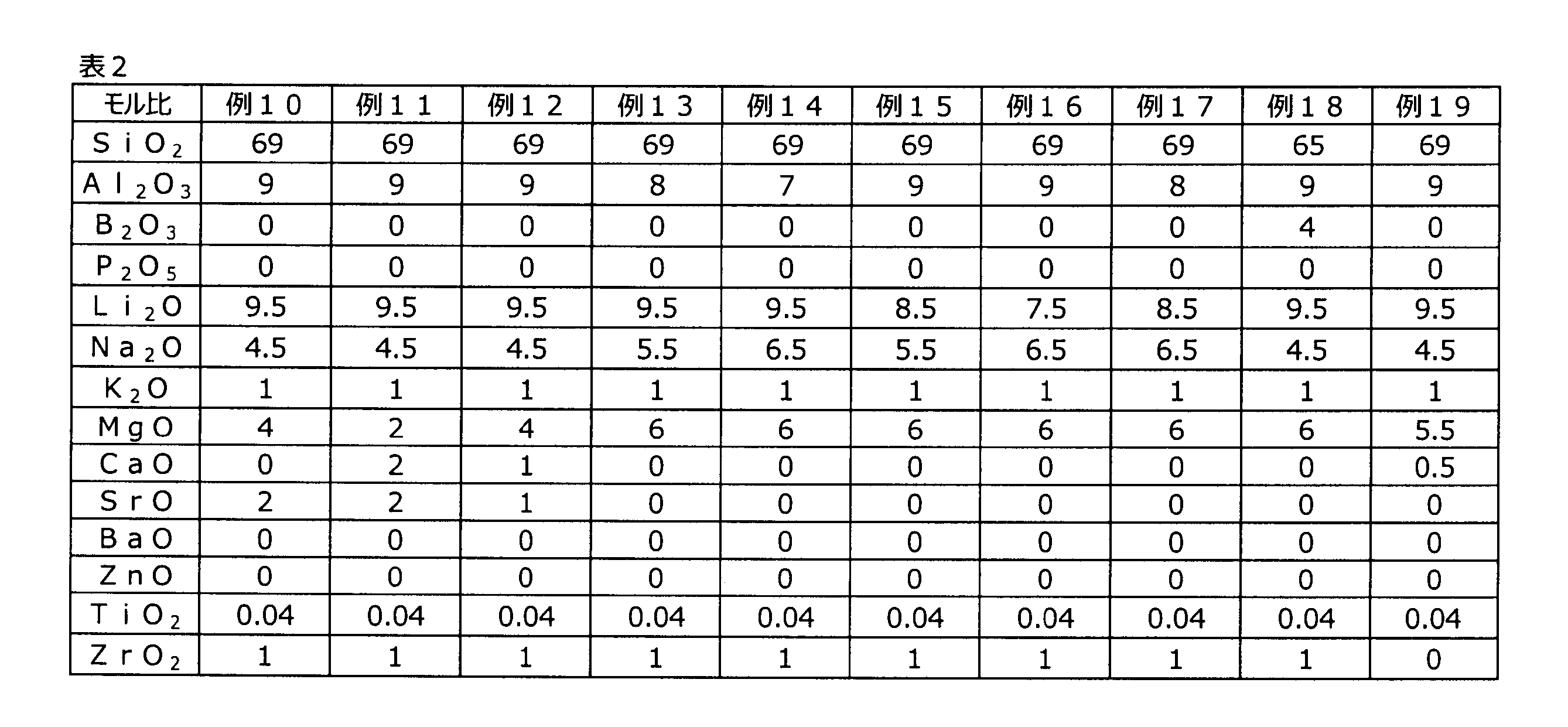


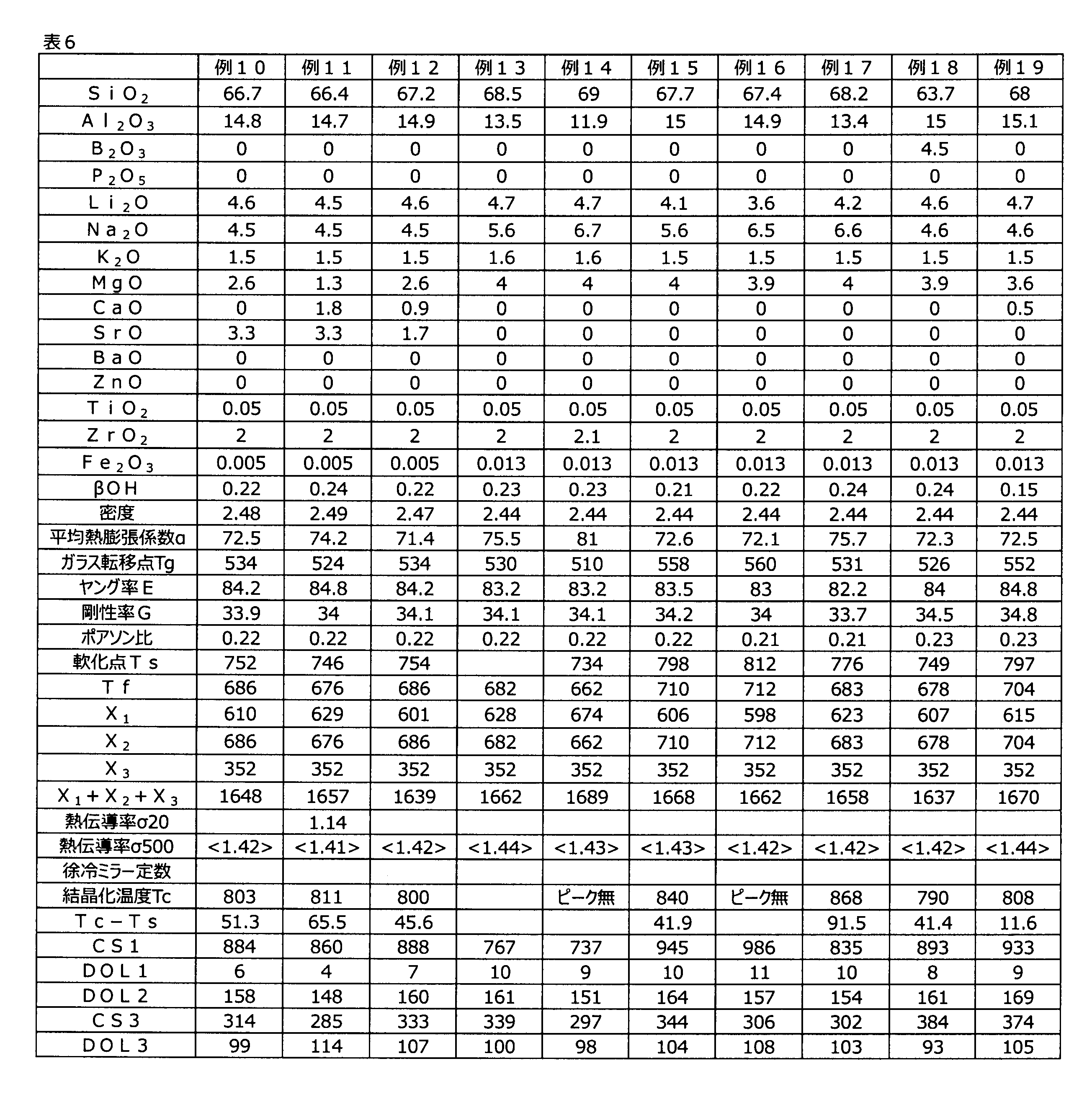
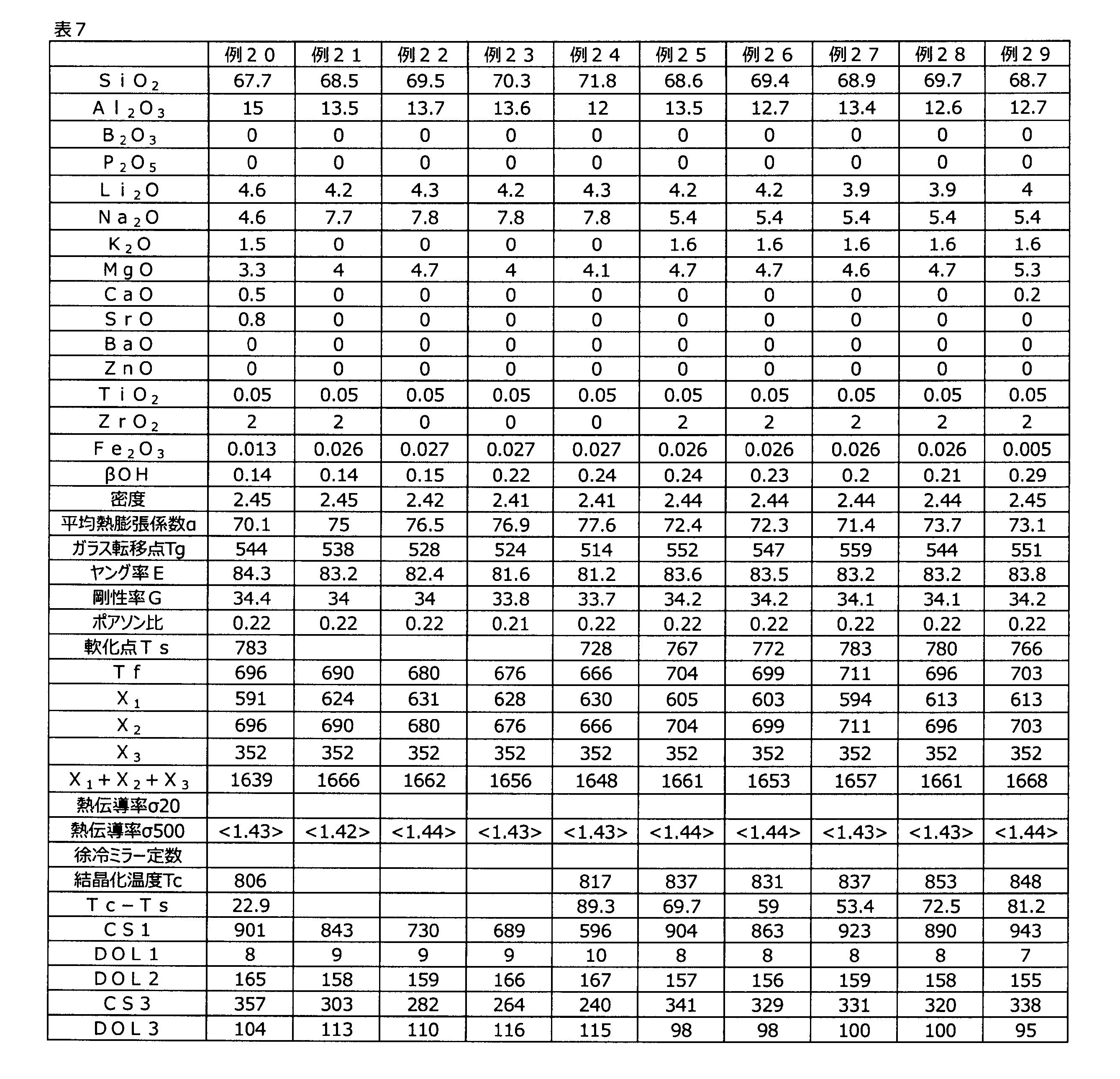
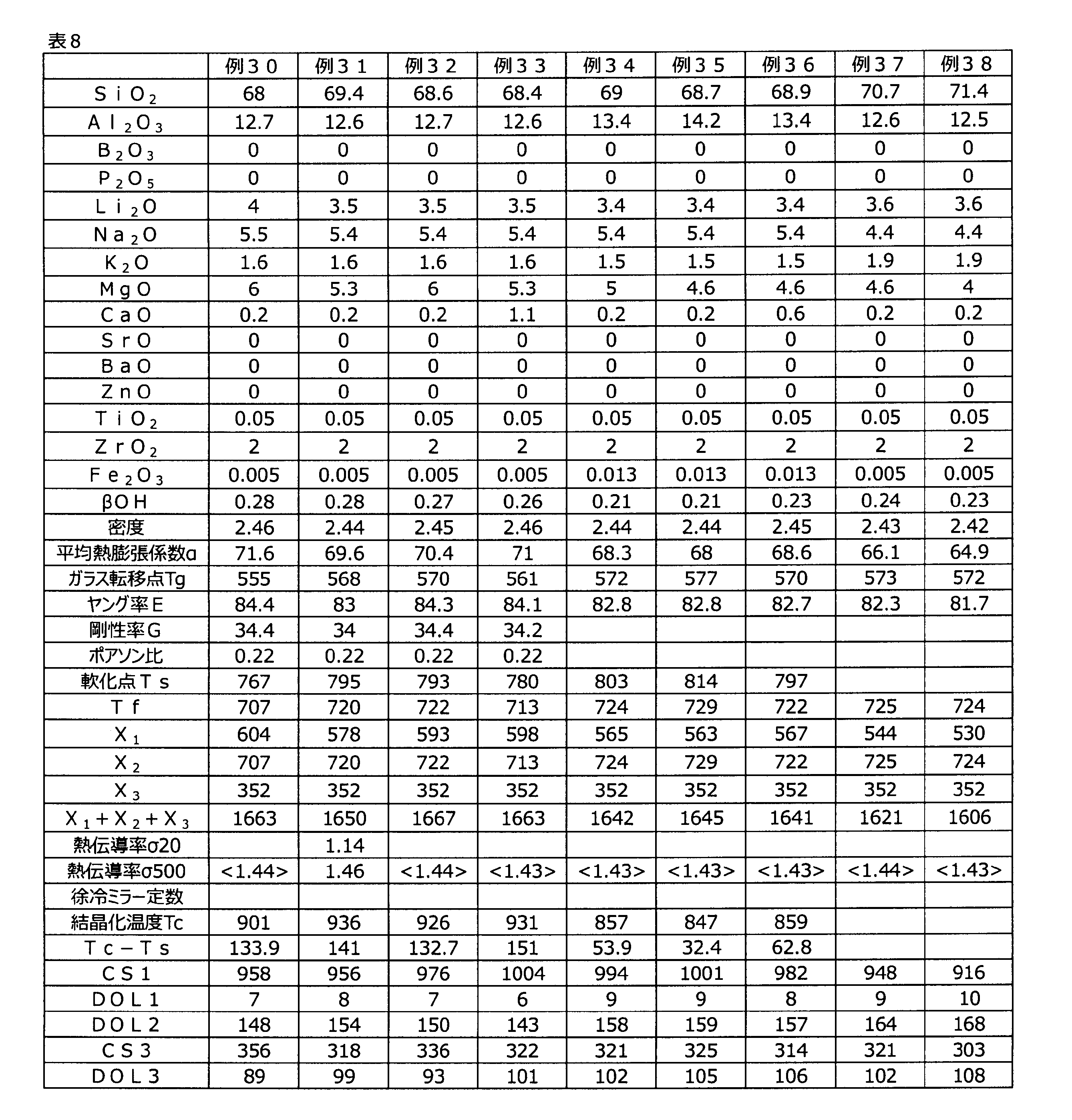
例2、例3のガラスと例4のガラスについて、図1の装置を用いて曲げ成形を行った。
X1+X2+X3の値が1760超である例4のガラスでは、曲げ成形時に割れが多発した。一方、X1+X2+X3の値が1760以下である例2及び3のガラスでは、割れの問題なく曲げ成形ができた。同様にX1+X2+X3の値が1760以下である例1、及び例7~38のガラスでは、割れの問題なく曲げ成形ができると推測される。ただし例2のガラスについては、ガラス板に白濁が生じることがあった。
例5のガラスは、X1+X2+X3の値は1760以下であるが、ヤング率が70GPa未満であり、取扱い時に傷つきやすかった。
X1+X2+X3の値が1760超である例4のガラスでは、曲げ成形時に割れが多発した。一方、X1+X2+X3の値が1760以下である例2及び3のガラスでは、割れの問題なく曲げ成形ができた。同様にX1+X2+X3の値が1760以下である例1、及び例7~38のガラスでは、割れの問題なく曲げ成形ができると推測される。ただし例2のガラスについては、ガラス板に白濁が生じることがあった。
例5のガラスは、X1+X2+X3の値は1760以下であるが、ヤング率が70GPa未満であり、取扱い時に傷つきやすかった。
本発明を特定の態様を参照して詳細に説明したが、本発明の精神と範囲を離れることなく様々な変更および修正が可能であることは、当業者にとって明らかである。なお、本出願は、2016年10月18日付けで出願された日本特許出願(特願2016-204745)、及び2017年7月20日付けで出願された日本特許出願(特願2017-141283)に基づいており、その全体が引用により援用される。また、ここに引用されるすべての参照は全体として取り込まれる。
1:ガラス板
2:曲げ成形型(下型)
3:曲げ成形型(上型)
4:プレス器
10:雰囲気置換室
20:成形室
21:加熱ゾーン
22:成形ゾーン
23:冷却ゾーン
30:大気置換室
2:曲げ成形型(下型)
3:曲げ成形型(上型)
4:プレス器
10:雰囲気置換室
20:成形室
21:加熱ゾーン
22:成形ゾーン
23:冷却ゾーン
30:大気置換室
Claims (13)
- ヤング率Eが70GPa以上の化学強化用ガラスであって、
前記ヤング率Eと50℃から350℃における平均熱膨脹係数αとを乗じた値[単位:kPa/℃]と同じ値である数値X1と、
粘度が100MPa・sとなる温度Tf[単位:℃]と同じ値である数値X2と、
前記Tfにおける粘度(100MPa・s)とTfより10℃高い温度における粘度η+10との差[単位:105Pa・s]と同じ値である数値X3と、
の合計X1+X2+X3が1760以下である化学強化用ガラス。 - リチウムアルミノシリケートガラスである、請求項1に記載の化学強化用ガラス。
- 酸化物基準の質量百分率表示で、SiO2を56~73%、Al2O3を10~24%、B2O3を0~6%、P2O5を0~6%、Li2Oを2~7%、Na2Oを3~11%、K2Oを0~5%、MgOを0~8%、CaOを0~2%、SrOを0~5%、BaOを0~5%、ZnOを0~5%、TiO2を0~2%、及びZrO2を0~4%含有する、請求項2に記載の化学強化用ガラス。
- ヤング率Eが80~90GPaであり、50℃から350℃における平均熱膨張係数αが60×10-7~85×10-7/℃であり、
酸化物基準の質量百分率表示で、SiO2を56~73%、Al2O3を10~24%、B2O3を0~6%、P2O5を0~6%、Li2Oを2~7%、Na2Oを3~11%、K2Oを0~5%、MgOを0~8%、CaOを0~2%、SrOを0~5%、BaOを0~5%、ZnOを0~5%、TiO2を0~2%、及びZrO2を0~4%含有する化学強化用ガラス。 - 前記Tfが780℃以下である、請求項4に記載の化学強化用ガラス。
- 昇温速度を10℃/分として室温から1000℃まで示差走査熱量測定する場合に結晶化ピークが認められない、または結晶化ピーク温度が軟化点より高い、請求項2~5のいずれか一項に記載の化学強化用ガラス。
- 500℃における熱伝導率が1.3W/mK以上である請求項1~6のいずれか一項に記載の化学強化用ガラス。
- ミラー定数が2.0MPa・m1/2以上である請求項1~7のいずれか一項に記載の化学強化用ガラス。
- ガラス転移点Tgより30℃高い温度に1時間保持した後、1℃/分の冷却速度で室温まで徐冷して測定される徐冷ミラー定数が2.0MPa・m1/2以上である請求項1~8のいずれか一項に記載の化学強化用ガラス。
- 軟化点が820℃以下である請求項1~9のいずれか一項に記載の化学強化用ガラス。
- 請求項1~10のいずれか一項に記載された化学強化用ガラスを曲げ成形型上で加熱して曲げ成形した後、化学強化する、化学強化ガラスの製造方法。
- 前記曲げ成形は、プレス成形法によってされる、請求項11に記載の化学強化ガラスの製造方法。
- 曲面状に曲げ成形された化学強化ガラスであって、
化学強化ガラスの母組成が、酸化物基準の質量百分率表示で、SiO2を56~73%、Al2O3を10~24%、B2O3を0~6%、P2O5を0~6%、Li2Oを2~7%、Na2Oを3~11%、K2Oを0~5%、MgOを0~8%、CaOを0~2%、SrOを0~5%、BaOを0~5%、ZnOを0~5%、TiO2を0~2%、及びZrO2を0~4%含有し、
失透が認められない化学強化ガラス。
Priority Applications (5)
| Application Number | Priority Date | Filing Date | Title |
|---|---|---|---|
| CN202211605053.7A CN116395986B (zh) | 2016-10-18 | 2017-10-12 | 化学强化用玻璃、化学强化玻璃以及化学强化玻璃的制造方法 |
| JP2018546287A JP7040456B2 (ja) | 2016-10-18 | 2017-10-12 | 化学強化用ガラス、化学強化ガラスおよび化学強化ガラスの製造方法 |
| CN201780063920.XA CN109843823B (zh) | 2016-10-18 | 2017-10-12 | 化学强化用玻璃、化学强化玻璃以及化学强化玻璃的制造方法 |
| US16/386,317 US11535548B2 (en) | 2016-10-18 | 2019-04-17 | Glass for chemical strengthening, chemically strengthened glass and method for manufacturing chemically strengthened glass |
| JP2022001742A JP7327533B2 (ja) | 2016-10-18 | 2022-01-07 | 化学強化用ガラス、化学強化ガラスおよび化学強化ガラスの製造方法 |
Applications Claiming Priority (4)
| Application Number | Priority Date | Filing Date | Title |
|---|---|---|---|
| JP2016204745 | 2016-10-18 | ||
| JP2016-204745 | 2016-10-18 | ||
| JP2017-141283 | 2017-07-20 | ||
| JP2017141283 | 2017-07-20 |
Related Child Applications (1)
| Application Number | Title | Priority Date | Filing Date |
|---|---|---|---|
| US16/386,317 Continuation US11535548B2 (en) | 2016-10-18 | 2019-04-17 | Glass for chemical strengthening, chemically strengthened glass and method for manufacturing chemically strengthened glass |
Publications (1)
| Publication Number | Publication Date |
|---|---|
| WO2018074335A1 true WO2018074335A1 (ja) | 2018-04-26 |
Family
ID=62018529
Family Applications (1)
| Application Number | Title | Priority Date | Filing Date |
|---|---|---|---|
| PCT/JP2017/037087 Ceased WO2018074335A1 (ja) | 2016-10-18 | 2017-10-12 | 化学強化用ガラス、化学強化ガラスおよび化学強化ガラスの製造方法 |
Country Status (4)
| Country | Link |
|---|---|
| US (1) | US11535548B2 (ja) |
| JP (2) | JP7040456B2 (ja) |
| CN (2) | CN116395986B (ja) |
| WO (1) | WO2018074335A1 (ja) |
Cited By (7)
| Publication number | Priority date | Publication date | Assignee | Title |
|---|---|---|---|---|
| CN109293234A (zh) * | 2018-09-25 | 2019-02-01 | 中国南玻集团股份有限公司 | 铝硅酸盐玻璃及制备方法、电子显示屏保护玻璃 |
| CN109574496A (zh) * | 2019-01-31 | 2019-04-05 | 田英良 | 基于网络结构调控的3d模压手机盖板玻璃 |
| WO2020095660A1 (ja) * | 2018-11-05 | 2020-05-14 | 日本板硝子株式会社 | 三次元形状を有するガラス物品とその製造方法、化学強化ガラス物品およびその製造方法 |
| JPWO2020261710A1 (ja) * | 2019-06-26 | 2020-12-30 | ||
| CN112399964A (zh) * | 2018-07-03 | 2021-02-23 | Agc株式会社 | 化学强化玻璃及其制造方法 |
| KR20210050551A (ko) * | 2018-08-30 | 2021-05-07 | 코닝 인코포레이티드 | 적층물용 연질의, 화학적-강화가능한 유리 |
| JP2022513157A (ja) * | 2018-11-30 | 2022-02-07 | コーニング インコーポレイテッド | 高い圧縮応力を示すガラス物品、そのようなガラス物品を含む自動車内装システムおよび同ガラス物品を製造するための方法 |
Families Citing this family (38)
| Publication number | Priority date | Publication date | Assignee | Title |
|---|---|---|---|---|
| MX2019004737A (es) | 2017-01-03 | 2019-06-17 | Corning Inc | Sistemas interiores de vehiculos que tienen una cubierta de vidrio curva y pantalla o panel tactil y metodos para formar los mismos. |
| JP7477296B2 (ja) * | 2017-02-27 | 2024-05-01 | ショット グラス テクノロジーズ (スゾウ) カンパニー リミテッド | 化学強化後に低膨張を示すリチウム含有アルミノケイ酸ガラス |
| CN111094050B (zh) | 2017-07-18 | 2023-11-07 | 康宁公司 | 复杂弯曲玻璃制品的冷成型 |
| WO2019055469A1 (en) | 2017-09-12 | 2019-03-21 | Corning Incorporated | INSULATING SCREEN FOR DISPLAY DEVICES COMPRISING A TOUCH PANEL ON DECORATIVE GLASS AND ASSOCIATED METHODS |
| US11065960B2 (en) | 2017-09-13 | 2021-07-20 | Corning Incorporated | Curved vehicle displays |
| TWI844520B (zh) | 2017-10-10 | 2024-06-11 | 美商康寧公司 | 具有改善可靠性的彎曲的覆蓋玻璃的車輛內部系統及其形成方法 |
| US11767250B2 (en) * | 2017-11-30 | 2023-09-26 | Corning Incorporated | Systems and methods for vacuum-forming aspheric mirrors |
| WO2019150654A1 (ja) | 2018-02-05 | 2019-08-08 | Agc株式会社 | 化学強化用ガラス |
| WO2019167850A1 (ja) | 2018-02-27 | 2019-09-06 | Agc株式会社 | 3次元形状の結晶化ガラス、3次元形状の化学強化ガラスおよびそれらの製造方法 |
| WO2019194110A1 (ja) | 2018-04-04 | 2019-10-10 | Agc株式会社 | 化学強化用ガラス |
| WO2020131400A1 (en) * | 2018-12-21 | 2020-06-25 | Corning Incorporated | Strengthened 3d printed surface features and methods of making the same |
| CN113302167B (zh) | 2019-01-18 | 2023-08-22 | Agc株式会社 | 化学强化玻璃及其制造方法 |
| CN117209156A (zh) | 2019-02-08 | 2023-12-12 | Agc株式会社 | 微晶玻璃、化学强化玻璃和半导体支撑基板 |
| CN113905992A (zh) | 2019-06-03 | 2022-01-07 | Agc株式会社 | 玻璃、化学强化玻璃及其制造方法 |
| WO2020263892A1 (en) * | 2019-06-25 | 2020-12-30 | Corning Incorporated | Methods of cooling glasses post-ion exchange |
| CN114096490B (zh) * | 2019-06-27 | 2023-12-19 | Agc株式会社 | 强化玻璃板及其制造方法 |
| EP3819268B1 (en) * | 2019-11-08 | 2021-09-29 | Schott AG | Toughenable glass with high hydrolytic resistance and reduced color tinge |
| CN111484245B (zh) * | 2020-04-30 | 2022-08-02 | 四川虹科创新科技有限公司 | 一种高强度、低介电常数低介电损耗玻璃及其制备和应用 |
| JP2021195278A (ja) | 2020-06-12 | 2021-12-27 | Agc株式会社 | 保護部材、及びこれを備える通信端末機器 |
| WO2022066408A1 (en) * | 2020-09-25 | 2022-03-31 | Corning Incorporated | Stress profiles of glass-based articles having improved drop performance |
| CN116529216B (zh) | 2020-12-04 | 2025-08-01 | Agc株式会社 | 化学强化玻璃和电子设备壳体 |
| CN112441740A (zh) * | 2020-12-22 | 2021-03-05 | 中国洛阳浮法玻璃集团有限责任公司 | 一种高透高强度超薄中铝玻璃的制备方法 |
| WO2022141273A1 (zh) * | 2020-12-30 | 2022-07-07 | 清远南玻节能新材料有限公司 | 锂铝硅酸盐玻璃、强化玻璃及其制备方法和电子产品 |
| KR20220106900A (ko) * | 2021-01-22 | 2022-08-01 | 삼성디스플레이 주식회사 | 기판 적재용 카세트 및 이를 이용한 기판 처리 방법 |
| CN113233759A (zh) * | 2021-04-30 | 2021-08-10 | 四川旭虹光电科技有限公司 | 一种3d曲面玻璃板及其成型方法 |
| CN115466039A (zh) * | 2021-06-11 | 2022-12-13 | 荣耀终端有限公司 | 曲面玻璃及其制备方法和电子设备 |
| JP7472326B2 (ja) | 2021-06-18 | 2024-04-22 | コーニング インコーポレイテッド | 機械的耐久性を向上させた着色ガラス物品 |
| US12454479B2 (en) | 2021-06-18 | 2025-10-28 | Corning Incorporated | Gold containing silicate glass |
| US11597674B2 (en) | 2021-06-18 | 2023-03-07 | Corning Incorporated | Colored glass articles having improved mechanical durability |
| US12378152B2 (en) | 2021-06-18 | 2025-08-05 | Corning Incorporated | Colored glass articles having improved mechanical durability |
| US12054422B2 (en) | 2021-06-18 | 2024-08-06 | Corning Incorporated | Colored glass articles having improved mechanical durability |
| US11634354B2 (en) | 2021-06-18 | 2023-04-25 | Corning Incorporated | Colored glass articles having improved mechanical durability |
| WO2022266273A1 (en) * | 2021-06-18 | 2022-12-22 | Corning Incorporated | Colored glass articles having improved mechanical durability |
| TW202328019A (zh) | 2021-11-29 | 2023-07-16 | 美商康寧公司 | 透明β鋰輝石玻璃陶瓷 |
| US12240782B2 (en) | 2022-05-31 | 2025-03-04 | Corning Incorporated | Ion exchangeable yellow glass articles |
| CN117342786A (zh) * | 2023-09-25 | 2024-01-05 | 四川虹科创新科技有限公司 | 一种玻璃及其制备方法 |
| CN118108411A (zh) * | 2024-02-08 | 2024-05-31 | 河北光兴半导体技术有限公司 | 强化玻璃及其制备方法与应用 |
| CN118993530B (zh) * | 2024-08-14 | 2025-07-11 | 上海理工大学 | 一种高强度稀土铝硅酸盐玻璃及其制备方法 |
Citations (6)
| Publication number | Priority date | Publication date | Assignee | Title |
|---|---|---|---|---|
| JP2008001590A (ja) * | 2006-05-25 | 2008-01-10 | Nippon Electric Glass Co Ltd | 強化ガラス及びその製造方法 |
| JP2010168233A (ja) * | 2009-01-21 | 2010-08-05 | Nippon Electric Glass Co Ltd | 強化ガラスおよびガラス |
| JP2012232882A (ja) * | 2011-04-18 | 2012-11-29 | Asahi Glass Co Ltd | 化学強化ガラスの製造方法および化学強化用ガラス |
| JP2013520388A (ja) * | 2010-02-26 | 2013-06-06 | ショット アクチエンゲゼルシャフト | 化学強化ガラス |
| JP2013520387A (ja) * | 2010-02-26 | 2013-06-06 | ショット アクチエンゲゼルシャフト | 高い弾性率を有するアルミノケイ酸リチウムガラス及びその製造方法 |
| WO2017126607A1 (ja) * | 2016-01-21 | 2017-07-27 | 旭硝子株式会社 | 化学強化ガラスおよび化学強化用ガラス |
Family Cites Families (31)
| Publication number | Priority date | Publication date | Assignee | Title |
|---|---|---|---|---|
| JPS60180936A (ja) | 1984-02-27 | 1985-09-14 | Nippon Electric Glass Co Ltd | 高強度耐熱ガラス製品の製造方法 |
| US5674790A (en) | 1995-12-15 | 1997-10-07 | Corning Incorporated | Strengthening glass by ion exchange |
| FR2761978B1 (fr) | 1997-04-11 | 1999-05-07 | Saint Gobain Vitrage | Composition de verre et substrat en verre trempe chimiquement |
| GB2335423A (en) | 1998-03-20 | 1999-09-22 | Pilkington Plc | Chemically toughenable glass |
| SG99350A1 (en) | 2000-02-17 | 2003-10-27 | Hoya Corp | Glass for cathode-ray tube, strengthened glass, method for the production thereof and use thereof |
| JP2001302278A (ja) | 2000-02-17 | 2001-10-31 | Hoya Corp | 陰極線管用ガラス、陰極線管用ガラスパネル、及び陰極線管、並びにそれらの製造方法 |
| JP2002174810A (ja) | 2000-12-08 | 2002-06-21 | Hoya Corp | ディスプレイ用ガラス基板及びその製造方法並びにこれを用いたディスプレイ |
| JP3995902B2 (ja) | 2001-05-31 | 2007-10-24 | Hoya株式会社 | 情報記録媒体用ガラス基板及びそれを用いた磁気情報記録媒体 |
| JP2004131314A (ja) | 2002-10-09 | 2004-04-30 | Asahi Glass Co Ltd | 透明導電膜付き化学強化ガラス基板、およびその製造方法 |
| US7727917B2 (en) | 2003-10-24 | 2010-06-01 | Schott Ag | Lithia-alumina-silica containing glass compositions and glasses suitable for chemical tempering and articles made using the chemically tempered glass |
| US7566673B2 (en) * | 2003-10-31 | 2009-07-28 | Konica Minolta Opto, Inc. | Glass substrate for an information recording medium and information recording medium employing it |
| JP2006083045A (ja) | 2004-09-17 | 2006-03-30 | Hitachi Ltd | ガラス部材 |
| US8304078B2 (en) | 2005-09-12 | 2012-11-06 | Saxon Glass Technologies, Inc. | Chemically strengthened lithium aluminosilicate glass having high strength effective to resist fracture upon flexing |
| CN101454252A (zh) | 2006-05-25 | 2009-06-10 | 日本电气硝子株式会社 | 强化玻璃及其制造方法 |
| EP2036867B1 (en) | 2006-06-08 | 2016-10-05 | Hoya Corporation | Glass for use as substrate for information recording medium, substrate for information recording medium, information recording medium, and their production methods |
| JP5589252B2 (ja) * | 2006-10-10 | 2014-09-17 | 日本電気硝子株式会社 | 強化ガラス基板 |
| JP5393974B2 (ja) | 2007-09-28 | 2014-01-22 | Hoya株式会社 | 磁気ディスク用ガラス基板の製造方法および磁気ディスク |
| JP5429684B2 (ja) | 2008-11-11 | 2014-02-26 | 日本電気硝子株式会社 | 強化ガラス基板及びその製造方法 |
| JP5483262B2 (ja) | 2009-12-04 | 2014-05-07 | 日本電気硝子株式会社 | 合わせガラス |
| CN102167509A (zh) * | 2010-02-26 | 2011-08-31 | 肖特玻璃科技(苏州)有限公司 | 能进行后续切割的化学钢化玻璃 |
| CN102167507B (zh) | 2010-02-26 | 2016-03-16 | 肖特玻璃科技(苏州)有限公司 | 用于3d紧密模压的薄锂铝硅玻璃 |
| JP2010202514A (ja) | 2010-06-10 | 2010-09-16 | Hoya Corp | 携帯型液晶ディスプレイ用のガラス基板及びその製造方法並びにこれを用いた携帯型液晶ディスプレイ |
| JP2012020921A (ja) | 2010-06-18 | 2012-02-02 | Asahi Glass Co Ltd | ディスプレイ装置用のガラスおよびガラス板 |
| US20120052271A1 (en) | 2010-08-26 | 2012-03-01 | Sinue Gomez | Two-step method for strengthening glass |
| FR2964655B1 (fr) | 2010-09-13 | 2017-05-19 | Saint Gobain | Feuille de verre |
| US9156725B2 (en) | 2012-05-30 | 2015-10-13 | Corning Incorporated | Down-drawable chemically strengthened glass for information storage devices |
| WO2014167894A1 (ja) | 2013-04-10 | 2014-10-16 | 日本電気硝子株式会社 | 曲面形状を有するガラス板の製造方法及び曲面形状を有するガラス板 |
| US11079309B2 (en) | 2013-07-26 | 2021-08-03 | Corning Incorporated | Strengthened glass articles having improved survivability |
| US10118858B2 (en) | 2014-02-24 | 2018-11-06 | Corning Incorporated | Strengthened glass with deep depth of compression |
| US10579106B2 (en) * | 2015-07-21 | 2020-03-03 | Corning Incorporated | Glass articles exhibiting improved fracture performance |
| WO2017126605A1 (ja) | 2016-01-21 | 2017-07-27 | 旭硝子株式会社 | 化学強化ガラス及び化学強化ガラスの製造方法 |
-
2017
- 2017-10-12 CN CN202211605053.7A patent/CN116395986B/zh active Active
- 2017-10-12 WO PCT/JP2017/037087 patent/WO2018074335A1/ja not_active Ceased
- 2017-10-12 CN CN201780063920.XA patent/CN109843823B/zh active Active
- 2017-10-12 JP JP2018546287A patent/JP7040456B2/ja active Active
-
2019
- 2019-04-17 US US16/386,317 patent/US11535548B2/en active Active
-
2022
- 2022-01-07 JP JP2022001742A patent/JP7327533B2/ja active Active
Patent Citations (6)
| Publication number | Priority date | Publication date | Assignee | Title |
|---|---|---|---|---|
| JP2008001590A (ja) * | 2006-05-25 | 2008-01-10 | Nippon Electric Glass Co Ltd | 強化ガラス及びその製造方法 |
| JP2010168233A (ja) * | 2009-01-21 | 2010-08-05 | Nippon Electric Glass Co Ltd | 強化ガラスおよびガラス |
| JP2013520388A (ja) * | 2010-02-26 | 2013-06-06 | ショット アクチエンゲゼルシャフト | 化学強化ガラス |
| JP2013520387A (ja) * | 2010-02-26 | 2013-06-06 | ショット アクチエンゲゼルシャフト | 高い弾性率を有するアルミノケイ酸リチウムガラス及びその製造方法 |
| JP2012232882A (ja) * | 2011-04-18 | 2012-11-29 | Asahi Glass Co Ltd | 化学強化ガラスの製造方法および化学強化用ガラス |
| WO2017126607A1 (ja) * | 2016-01-21 | 2017-07-27 | 旭硝子株式会社 | 化学強化ガラスおよび化学強化用ガラス |
Cited By (17)
| Publication number | Priority date | Publication date | Assignee | Title |
|---|---|---|---|---|
| CN112399964B (zh) * | 2018-07-03 | 2022-11-15 | Agc株式会社 | 化学强化玻璃及其制造方法 |
| CN112399964A (zh) * | 2018-07-03 | 2021-02-23 | Agc株式会社 | 化学强化玻璃及其制造方法 |
| US12291483B2 (en) | 2018-08-30 | 2025-05-06 | Corning Incorporated | Soft, chemically-strengthenable glasses for laminates |
| KR102716148B1 (ko) | 2018-08-30 | 2024-10-15 | 코닝 인코포레이티드 | 적층물용 연질의, 화학적-강화가능한 유리 |
| JP7439054B2 (ja) | 2018-08-30 | 2024-02-27 | コーニング インコーポレイテッド | 積層体用の軟質で化学強化可能なガラス |
| KR20210050551A (ko) * | 2018-08-30 | 2021-05-07 | 코닝 인코포레이티드 | 적층물용 연질의, 화학적-강화가능한 유리 |
| JP2021536412A (ja) * | 2018-08-30 | 2021-12-27 | コーニング インコーポレイテッド | 積層体用の軟質で化学強化可能なガラス |
| CN109293234A (zh) * | 2018-09-25 | 2019-02-01 | 中国南玻集团股份有限公司 | 铝硅酸盐玻璃及制备方法、电子显示屏保护玻璃 |
| JPWO2020095660A1 (ja) * | 2018-11-05 | 2021-09-30 | 日本板硝子株式会社 | 三次元形状を有するガラス物品とその製造方法、化学強化ガラス物品およびその製造方法 |
| CN112969667A (zh) * | 2018-11-05 | 2021-06-15 | 日本板硝子株式会社 | 具有三维形状的玻璃物品及其制造方法、化学强化玻璃物品及其制造方法 |
| WO2020095660A1 (ja) * | 2018-11-05 | 2020-05-14 | 日本板硝子株式会社 | 三次元形状を有するガラス物品とその製造方法、化学強化ガラス物品およびその製造方法 |
| JP2022513157A (ja) * | 2018-11-30 | 2022-02-07 | コーニング インコーポレイテッド | 高い圧縮応力を示すガラス物品、そのようなガラス物品を含む自動車内装システムおよび同ガラス物品を製造するための方法 |
| US12559410B2 (en) | 2018-11-30 | 2026-02-24 | Corning Incorporated | Glass articles exhibiting high compressive stress, automotive interior systems that include such glass articles and methods for making the same |
| CN109574496A (zh) * | 2019-01-31 | 2019-04-05 | 田英良 | 基于网络结构调控的3d模压手机盖板玻璃 |
| WO2020261710A1 (ja) * | 2019-06-26 | 2020-12-30 | Agc株式会社 | 化学強化ガラスの製造方法および化学強化ガラス |
| JPWO2020261710A1 (ja) * | 2019-06-26 | 2020-12-30 | ||
| JP7548227B2 (ja) | 2019-06-26 | 2024-09-10 | Agc株式会社 | 化学強化ガラスの製造方法および化学強化ガラス |
Also Published As
| Publication number | Publication date |
|---|---|
| CN109843823A (zh) | 2019-06-04 |
| US20190263713A1 (en) | 2019-08-29 |
| CN116395986B (zh) | 2025-09-12 |
| CN116395986A (zh) | 2023-07-07 |
| US11535548B2 (en) | 2022-12-27 |
| JP2022033356A (ja) | 2022-02-28 |
| CN109843823B (zh) | 2022-12-30 |
| JP7040456B2 (ja) | 2022-03-23 |
| JP7327533B2 (ja) | 2023-08-16 |
| JPWO2018074335A1 (ja) | 2019-08-08 |
Similar Documents
| Publication | Publication Date | Title |
|---|---|---|
| JP7327533B2 (ja) | 化学強化用ガラス、化学強化ガラスおよび化学強化ガラスの製造方法 | |
| JP7184073B2 (ja) | 化学強化用ガラス | |
| JP7136096B2 (ja) | 化学強化ガラス、その製造方法および化学強化用ガラス | |
| CN115231820B (zh) | 化学强化用玻璃及化学强化玻璃 | |
| CN102701587B (zh) | 强化玻璃基板及其制造方法 | |
| JP2024096285A (ja) | 化学強化ガラスおよび化学強化用ガラス | |
| JP5621239B2 (ja) | ディスプレイ装置用ガラス板、ディスプレイ装置用板ガラスおよびその製造方法 | |
| WO2019167850A1 (ja) | 3次元形状の結晶化ガラス、3次元形状の化学強化ガラスおよびそれらの製造方法 | |
| WO2019230889A1 (ja) | 強化ガラス及び強化用ガラス | |
| CN110944954A (zh) | 化学强化用玻璃、化学强化玻璃以及电子设备壳体 | |
| WO2011007785A1 (ja) | ディスプレイ装置用ガラス板 | |
| WO2015125584A1 (ja) | 強化ガラスの製造方法及び強化ガラス | |
| TW201630839A (zh) | 玻璃及化學強化玻璃 | |
| JPWO2019194110A1 (ja) | 化学強化用ガラス | |
| CN112399964B (zh) | 化学强化玻璃及其制造方法 | |
| TWI835766B (zh) | 蓋玻璃 | |
| US20230060972A1 (en) | Chemically strengthened glass article and manufacturing method thereof | |
| JP2017114718A (ja) | 化学強化用ガラス板及び化学強化ガラスの製造方法 | |
| WO2017068857A1 (ja) | 化学強化用ガラス板及び化学強化ガラス板の製造方法 | |
| WO2025121292A1 (ja) | 化学強化ガラス、カバーガラス、ディスプレイおよび太陽電池モジュール |
Legal Events
| Date | Code | Title | Description |
|---|---|---|---|
| 121 | Ep: the epo has been informed by wipo that ep was designated in this application |
Ref document number: 17861994 Country of ref document: EP Kind code of ref document: A1 |
|
| ENP | Entry into the national phase |
Ref document number: 2018546287 Country of ref document: JP Kind code of ref document: A |
|
| NENP | Non-entry into the national phase |
Ref country code: DE |
|
| 122 | Ep: pct application non-entry in european phase |
Ref document number: 17861994 Country of ref document: EP Kind code of ref document: A1 |