WO2017111165A1 - 化合物、樹脂、組成物、レジストパターン形成方法、及び、回路パターン形成方法 - Google Patents
化合物、樹脂、組成物、レジストパターン形成方法、及び、回路パターン形成方法 Download PDFInfo
- Publication number
- WO2017111165A1 WO2017111165A1 PCT/JP2016/088737 JP2016088737W WO2017111165A1 WO 2017111165 A1 WO2017111165 A1 WO 2017111165A1 JP 2016088737 W JP2016088737 W JP 2016088737W WO 2017111165 A1 WO2017111165 A1 WO 2017111165A1
- Authority
- WO
- WIPO (PCT)
- Prior art keywords
- group
- carbon atoms
- formula
- acid
- integer
- Prior art date
- Legal status (The legal status is an assumption and is not a legal conclusion. Google has not performed a legal analysis and makes no representation as to the accuracy of the status listed.)
- Ceased
Links
Classifications
-
- C—CHEMISTRY; METALLURGY
- C07—ORGANIC CHEMISTRY
- C07C—ACYCLIC OR CARBOCYCLIC COMPOUNDS
- C07C39/00—Compounds having at least one hydroxy or O-metal group bound to a carbon atom of a six-membered aromatic ring
- C07C39/12—Compounds having at least one hydroxy or O-metal group bound to a carbon atom of a six-membered aromatic ring polycyclic with no unsaturation outside the aromatic rings
- C07C39/14—Compounds having at least one hydroxy or O-metal group bound to a carbon atom of a six-membered aromatic ring polycyclic with no unsaturation outside the aromatic rings with at least one hydroxy group on a condensed ring system containing two rings
-
- C—CHEMISTRY; METALLURGY
- C07—ORGANIC CHEMISTRY
- C07C—ACYCLIC OR CARBOCYCLIC COMPOUNDS
- C07C39/00—Compounds having at least one hydroxy or O-metal group bound to a carbon atom of a six-membered aromatic ring
- C07C39/12—Compounds having at least one hydroxy or O-metal group bound to a carbon atom of a six-membered aromatic ring polycyclic with no unsaturation outside the aromatic rings
- C07C39/15—Compounds having at least one hydroxy or O-metal group bound to a carbon atom of a six-membered aromatic ring polycyclic with no unsaturation outside the aromatic rings with all hydroxy groups on non-condensed rings, e.g. phenylphenol
-
- C—CHEMISTRY; METALLURGY
- C08—ORGANIC MACROMOLECULAR COMPOUNDS; THEIR PREPARATION OR CHEMICAL WORKING-UP; COMPOSITIONS BASED THEREON
- C08G—MACROMOLECULAR COMPOUNDS OBTAINED OTHERWISE THAN BY REACTIONS ONLY INVOLVING UNSATURATED CARBON-TO-CARBON BONDS
- C08G8/00—Condensation polymers of aldehydes or ketones with phenols only
- C08G8/02—Condensation polymers of aldehydes or ketones with phenols only of ketones
-
- C—CHEMISTRY; METALLURGY
- C08—ORGANIC MACROMOLECULAR COMPOUNDS; THEIR PREPARATION OR CHEMICAL WORKING-UP; COMPOSITIONS BASED THEREON
- C08L—COMPOSITIONS OF MACROMOLECULAR COMPOUNDS
- C08L61/00—Compositions of condensation polymers of aldehydes or ketones; Compositions of derivatives of such polymers
- C08L61/04—Condensation polymers of aldehydes or ketones with phenols only
- C08L61/16—Condensation polymers of aldehydes or ketones with phenols only of ketones with phenols
-
- G—PHYSICS
- G03—PHOTOGRAPHY; CINEMATOGRAPHY; ANALOGOUS TECHNIQUES USING WAVES OTHER THAN OPTICAL WAVES; ELECTROGRAPHY; HOLOGRAPHY
- G03F—PHOTOMECHANICAL PRODUCTION OF TEXTURED OR PATTERNED SURFACES, e.g. FOR PRINTING, FOR PROCESSING OF SEMICONDUCTOR DEVICES; MATERIALS THEREFOR; ORIGINALS THEREFOR; APPARATUS SPECIALLY ADAPTED THEREFOR
- G03F7/00—Photomechanical, e.g. photolithographic, production of textured or patterned surfaces, e.g. printing surfaces; Materials therefor, e.g. comprising photoresists; Apparatus specially adapted therefor
- G03F7/004—Photosensitive materials
- G03F7/022—Quinonediazides
- G03F7/023—Macromolecular quinonediazides; Macromolecular additives, e.g. binders
-
- G—PHYSICS
- G03—PHOTOGRAPHY; CINEMATOGRAPHY; ANALOGOUS TECHNIQUES USING WAVES OTHER THAN OPTICAL WAVES; ELECTROGRAPHY; HOLOGRAPHY
- G03F—PHOTOMECHANICAL PRODUCTION OF TEXTURED OR PATTERNED SURFACES, e.g. FOR PRINTING, FOR PROCESSING OF SEMICONDUCTOR DEVICES; MATERIALS THEREFOR; ORIGINALS THEREFOR; APPARATUS SPECIALLY ADAPTED THEREFOR
- G03F7/00—Photomechanical, e.g. photolithographic, production of textured or patterned surfaces, e.g. printing surfaces; Materials therefor, e.g. comprising photoresists; Apparatus specially adapted therefor
- G03F7/004—Photosensitive materials
- G03F7/038—Macromolecular compounds which are rendered insoluble or differentially wettable
-
- G—PHYSICS
- G03—PHOTOGRAPHY; CINEMATOGRAPHY; ANALOGOUS TECHNIQUES USING WAVES OTHER THAN OPTICAL WAVES; ELECTROGRAPHY; HOLOGRAPHY
- G03F—PHOTOMECHANICAL PRODUCTION OF TEXTURED OR PATTERNED SURFACES, e.g. FOR PRINTING, FOR PROCESSING OF SEMICONDUCTOR DEVICES; MATERIALS THEREFOR; ORIGINALS THEREFOR; APPARATUS SPECIALLY ADAPTED THEREFOR
- G03F7/00—Photomechanical, e.g. photolithographic, production of textured or patterned surfaces, e.g. printing surfaces; Materials therefor, e.g. comprising photoresists; Apparatus specially adapted therefor
- G03F7/004—Photosensitive materials
- G03F7/039—Macromolecular compounds which are photodegradable, e.g. positive electron resists
-
- G—PHYSICS
- G03—PHOTOGRAPHY; CINEMATOGRAPHY; ANALOGOUS TECHNIQUES USING WAVES OTHER THAN OPTICAL WAVES; ELECTROGRAPHY; HOLOGRAPHY
- G03F—PHOTOMECHANICAL PRODUCTION OF TEXTURED OR PATTERNED SURFACES, e.g. FOR PRINTING, FOR PROCESSING OF SEMICONDUCTOR DEVICES; MATERIALS THEREFOR; ORIGINALS THEREFOR; APPARATUS SPECIALLY ADAPTED THEREFOR
- G03F7/00—Photomechanical, e.g. photolithographic, production of textured or patterned surfaces, e.g. printing surfaces; Materials therefor, e.g. comprising photoresists; Apparatus specially adapted therefor
- G03F7/004—Photosensitive materials
- G03F7/09—Photosensitive materials characterised by structural details, e.g. supports, auxiliary layers
- G03F7/091—Photosensitive materials characterised by structural details, e.g. supports, auxiliary layers characterised by antireflection means or light filtering or absorbing means, e.g. anti-halation, contrast enhancement
-
- G—PHYSICS
- G03—PHOTOGRAPHY; CINEMATOGRAPHY; ANALOGOUS TECHNIQUES USING WAVES OTHER THAN OPTICAL WAVES; ELECTROGRAPHY; HOLOGRAPHY
- G03F—PHOTOMECHANICAL PRODUCTION OF TEXTURED OR PATTERNED SURFACES, e.g. FOR PRINTING, FOR PROCESSING OF SEMICONDUCTOR DEVICES; MATERIALS THEREFOR; ORIGINALS THEREFOR; APPARATUS SPECIALLY ADAPTED THEREFOR
- G03F7/00—Photomechanical, e.g. photolithographic, production of textured or patterned surfaces, e.g. printing surfaces; Materials therefor, e.g. comprising photoresists; Apparatus specially adapted therefor
- G03F7/004—Photosensitive materials
- G03F7/09—Photosensitive materials characterised by structural details, e.g. supports, auxiliary layers
- G03F7/094—Multilayer resist systems, e.g. planarising layers
-
- G—PHYSICS
- G03—PHOTOGRAPHY; CINEMATOGRAPHY; ANALOGOUS TECHNIQUES USING WAVES OTHER THAN OPTICAL WAVES; ELECTROGRAPHY; HOLOGRAPHY
- G03F—PHOTOMECHANICAL PRODUCTION OF TEXTURED OR PATTERNED SURFACES, e.g. FOR PRINTING, FOR PROCESSING OF SEMICONDUCTOR DEVICES; MATERIALS THEREFOR; ORIGINALS THEREFOR; APPARATUS SPECIALLY ADAPTED THEREFOR
- G03F7/00—Photomechanical, e.g. photolithographic, production of textured or patterned surfaces, e.g. printing surfaces; Materials therefor, e.g. comprising photoresists; Apparatus specially adapted therefor
- G03F7/004—Photosensitive materials
- G03F7/09—Photosensitive materials characterised by structural details, e.g. supports, auxiliary layers
- G03F7/11—Photosensitive materials characterised by structural details, e.g. supports, auxiliary layers having cover layers or intermediate layers, e.g. subbing layers
-
- G—PHYSICS
- G03—PHOTOGRAPHY; CINEMATOGRAPHY; ANALOGOUS TECHNIQUES USING WAVES OTHER THAN OPTICAL WAVES; ELECTROGRAPHY; HOLOGRAPHY
- G03F—PHOTOMECHANICAL PRODUCTION OF TEXTURED OR PATTERNED SURFACES, e.g. FOR PRINTING, FOR PROCESSING OF SEMICONDUCTOR DEVICES; MATERIALS THEREFOR; ORIGINALS THEREFOR; APPARATUS SPECIALLY ADAPTED THEREFOR
- G03F7/00—Photomechanical, e.g. photolithographic, production of textured or patterned surfaces, e.g. printing surfaces; Materials therefor, e.g. comprising photoresists; Apparatus specially adapted therefor
- G03F7/20—Exposure; Apparatus therefor
-
- G—PHYSICS
- G03—PHOTOGRAPHY; CINEMATOGRAPHY; ANALOGOUS TECHNIQUES USING WAVES OTHER THAN OPTICAL WAVES; ELECTROGRAPHY; HOLOGRAPHY
- G03F—PHOTOMECHANICAL PRODUCTION OF TEXTURED OR PATTERNED SURFACES, e.g. FOR PRINTING, FOR PROCESSING OF SEMICONDUCTOR DEVICES; MATERIALS THEREFOR; ORIGINALS THEREFOR; APPARATUS SPECIALLY ADAPTED THEREFOR
- G03F7/00—Photomechanical, e.g. photolithographic, production of textured or patterned surfaces, e.g. printing surfaces; Materials therefor, e.g. comprising photoresists; Apparatus specially adapted therefor
- G03F7/20—Exposure; Apparatus therefor
- G03F7/2002—Exposure; Apparatus therefor with visible light or UV light, through an original having an opaque pattern on a transparent support, e.g. film printing, projection printing; by reflection of visible or UV light from an original such as a printed image
-
- G—PHYSICS
- G03—PHOTOGRAPHY; CINEMATOGRAPHY; ANALOGOUS TECHNIQUES USING WAVES OTHER THAN OPTICAL WAVES; ELECTROGRAPHY; HOLOGRAPHY
- G03F—PHOTOMECHANICAL PRODUCTION OF TEXTURED OR PATTERNED SURFACES, e.g. FOR PRINTING, FOR PROCESSING OF SEMICONDUCTOR DEVICES; MATERIALS THEREFOR; ORIGINALS THEREFOR; APPARATUS SPECIALLY ADAPTED THEREFOR
- G03F7/00—Photomechanical, e.g. photolithographic, production of textured or patterned surfaces, e.g. printing surfaces; Materials therefor, e.g. comprising photoresists; Apparatus specially adapted therefor
- G03F7/26—Processing photosensitive materials; Apparatus therefor
-
- G—PHYSICS
- G03—PHOTOGRAPHY; CINEMATOGRAPHY; ANALOGOUS TECHNIQUES USING WAVES OTHER THAN OPTICAL WAVES; ELECTROGRAPHY; HOLOGRAPHY
- G03F—PHOTOMECHANICAL PRODUCTION OF TEXTURED OR PATTERNED SURFACES, e.g. FOR PRINTING, FOR PROCESSING OF SEMICONDUCTOR DEVICES; MATERIALS THEREFOR; ORIGINALS THEREFOR; APPARATUS SPECIALLY ADAPTED THEREFOR
- G03F7/00—Photomechanical, e.g. photolithographic, production of textured or patterned surfaces, e.g. printing surfaces; Materials therefor, e.g. comprising photoresists; Apparatus specially adapted therefor
- G03F7/26—Processing photosensitive materials; Apparatus therefor
- G03F7/34—Imagewise removal by selective transfer, e.g. peeling away
- G03F7/343—Lamination or delamination methods or apparatus for photolitographic photosensitive material
-
- C—CHEMISTRY; METALLURGY
- C08—ORGANIC MACROMOLECULAR COMPOUNDS; THEIR PREPARATION OR CHEMICAL WORKING-UP; COMPOSITIONS BASED THEREON
- C08L—COMPOSITIONS OF MACROMOLECULAR COMPOUNDS
- C08L2203/00—Applications
- C08L2203/16—Applications used for films
-
- C—CHEMISTRY; METALLURGY
- C08—ORGANIC MACROMOLECULAR COMPOUNDS; THEIR PREPARATION OR CHEMICAL WORKING-UP; COMPOSITIONS BASED THEREON
- C08L—COMPOSITIONS OF MACROMOLECULAR COMPOUNDS
- C08L2312/00—Crosslinking
Definitions
- the present invention relates to a compound having a specific structure, a resin, and a composition containing these.
- the present invention also relates to a pattern forming method (resist pattern forming method and circuit pattern forming method) using the composition.
- the molecular weight is as large as about 10,000 to 100,000, and the molecular weight distribution is wide, resulting in roughness on the pattern surface, making it difficult to control the pattern size, and limiting the miniaturization.
- various low molecular weight resist materials have been proposed so far in order to provide resist patterns with higher resolution. Since the low molecular weight resist material has a small molecular size, it is expected to provide a resist pattern with high resolution and low roughness.
- an alkali development type negative radiation sensitive composition for example, see Patent Document 1 and Patent Document 2 using a low molecular weight polynuclear polyphenol compound as a main component
- a low molecular weight resist material having high heat resistance As candidates, an alkali development negative radiation-sensitive composition using a low molecular weight cyclic polyphenol compound as a main component (see, for example, Patent Document 3 and Non-Patent Document 1) has also been proposed.
- Non-Patent Document 2 a polyphenol compound as a base compound for a resist material can impart high heat resistance despite its low molecular weight, and is useful for improving the resolution and roughness of a resist pattern (for example, Non-Patent Document 2). reference).
- the present inventors have proposed a resist composition (see Patent Document 4) containing a compound having a specific structure and an organic solvent as a material excellent in etching resistance and soluble in a solvent and applicable to a wet process. is doing.
- a terminal layer is removed by applying a predetermined energy as a resist underlayer film for lithography having a dry etching rate selection ratio close to that of a resist.
- a material for forming a lower layer film for a multilayer resist process has been proposed which contains at least a resin component having a substituent that generates a sulfonic acid residue and a solvent (see Patent Document 5).
- a resist underlayer film material containing a polymer having a specific repeating unit has been proposed as a material for realizing a resist underlayer film for lithography having a lower dry etching rate selection ratio than a resist (see Patent Document 6). ). Furthermore, in order to realize a resist underlayer film for lithography having a low dry etching rate selection ratio compared with a semiconductor substrate, a repeating unit of acenaphthylenes and a repeating unit having a substituted or unsubstituted hydroxy group are copolymerized. A resist underlayer film material containing a polymer is proposed (see Patent Document 7).
- an amorphous carbon underlayer film formed by CVD using methane gas, ethane gas, acetylene gas or the like as a raw material is well known.
- a resist underlayer film material capable of forming a resist underlayer film by a wet process such as spin coating or screen printing is required.
- the present inventors have a composition for forming an underlayer film for lithography containing a compound having a specific structure and an organic solvent as a material having excellent etching resistance, high heat resistance, soluble in a solvent and applicable to a wet process.
- the thing (refer patent document 8) is proposed.
- the formation method of the intermediate layer used in the formation of the resist underlayer film in the three-layer process for example, a silicon nitride film formation method (see Patent Document 9) or a silicon nitride film CVD formation method (see Patent Document 10).
- a silicon nitride film formation method for example, a silicon nitride film formation method (see Patent Document 9) or a silicon nitride film CVD formation method (see Patent Document 10).
- an intermediate layer material for a three-layer process a material containing a silsesquioxane-based silicon compound is known (see Patent Documents 11 and 12).
- the present invention has been made in order to solve the above-mentioned problems, and an object of the present invention is to form a photoresist and an underlayer film for photoresist that can be applied with a wet process and have excellent heat resistance, solubility, and etching resistance.
- Compounds, resins, compositions for example, compositions used for film formation for lithography or optical component formation
- pattern forming methods resist pattern forming methods and circuit pattern forming methods
- a compound represented by the following formula (0) is a linear, branched or cyclic alkyl group having 1 to 30 carbon atoms or an aryl group having 6 to 30 carbon atoms
- R Z is an N-valent group having 1 to 60 carbon atoms or a single bond
- R T each independently represents an optionally substituted alkyl group having 1 to 30 carbon atoms, an optionally substituted aryl group having 6 to 40 carbon atoms, or a substituent.
- An alkenyl group having 2 to 30 carbon atoms which may have, an alkoxy group having 1 to 30 carbon atoms which may have a substituent, a halogen atom, a nitro group, an amino group, a cyano group, a thiol group, a hydroxyl group Or a hydrogen atom of a hydroxyl group is substituted with an acid dissociable group, wherein the alkyl group, the alkenyl group and the aryl group may contain an ether bond, a ketone bond or an ester bond, And at least one of RT is a hydroxyl group or a group in which a hydrogen atom of the hydroxyl group is substituted with an acid dissociable group, X represents an oxygen atom, a sulfur atom or no bridge, m is each independently an integer of 0 to 9, wherein at least one of m is an integer of 1 to 9, N is an integer of 1 to 4, where, when N is an integer of 2 or more, the structural formulas in N [
- R 0 has the same meaning as R Y
- R 1 is an n-valent group having 1 to 60 carbon atoms or a single bond
- R 2 to R 5 are each independently a linear, branched or cyclic alkyl group having 1 to 30 carbon atoms, an aryl group having 6 to 30 carbon atoms, an alkenyl group having 2 to 30 carbon atoms, 1 to 30 alkoxy groups, a halogen atom, a cyano group, a thiol group, a hydroxyl group or a group in which a hydrogen atom of the hydroxyl group is substituted with an acid dissociable group, wherein at least one of R 2 to R 5 is a hydroxyl group or A hydrogen atom of the hydroxyl group is substituted with an acid dissociable group
- m 2 and m 3 are each independently an integer of 0
- n A has the same meaning as N above.
- n A is an integer of 2 or more, the structural formulas in n A [] may be the same or different, X A represents an oxygen atom, a sulfur atom, or no bridge, m 2A is each independently an integer of 0 to 7, provided that at least one m 2A is an integer of 1 to 7; q A is each independently 0 or 1.
- R 6 to R 7 are each independently a linear, branched or cyclic alkyl group having 1 to 30 carbon atoms, an aryl group having 6 to 30 carbon atoms, an alkenyl group having 2 to 30 carbon atoms, 1 to 30 alkoxy groups, halogen atoms, thiol groups, R 10 to R 11 are each independently a hydrogen atom or an acid dissociable group, m 6 and m 7 are each independently an integer of 0 to 7, However, m 4 , m 5 , m 6 and m 7 are not 0 at the same time. ) [5] The compound according to [4], wherein the compound represented by the formula (1-1) is a compound represented by the following formula (1-2).
- R 0 , R 1 , R 6 , R 7 , R 10 , R 11 , n, p 2 to p 5 , m 6 and m 7 are as defined above.
- R 8 to R 9 have the same meanings as R 6 to R 7
- R 12 to R 13 have the same meanings as R 10 to R 11
- m 8 and m 9 are each independently an integer of 0 to 8, However, m 6 , m 7 , m 8 and m 9 are not 0 at the same time.
- [6] The compound according to [3], wherein the compound represented by the formula (2) is a compound represented by the following formula (2-1).
- R 0A , R 1A , n A , q A and X A are as defined in the formula (2).
- R 3A is each independently a halogen atom, a linear, branched or cyclic alkyl group having 1 to 30 carbon atoms, an aryl group having 6 to 30 carbon atoms, or an alkenyl group having 2 to 30 carbon atoms.
- R 4A is each independently a hydrogen atom or an acid dissociable group
- m 6A is each independently an integer of 0 to 5.
- L is a linear or branched alkylene group having 1 to 30 carbon atoms or a single bond
- R 0 has the same meaning as R Y
- R 1 is an n-valent group having 1 to 60 carbon atoms or a single bond
- L is a linear or branched alkylene group having 1 to 30 carbon atoms or a single bond
- R 0A has the same meaning as R Y
- R 1A is an n A valent group having 1 to 60 carbon atoms or a single bond
- R 2A each independently represents a linear, branched or cyclic alkyl group having 1 to 30 carbon atoms, an aryl group having 6 to 30 carbon atoms, an alkenyl group having 2 to 30 carbon atoms, a halogen atom, or a cyano group.
- n A has the same meaning as N above.
- n A is an integer of 2 or more, the structural formulas in n A [] may be the same or different, X A represents an oxygen atom, a sulfur atom, or no bridge, m 2A is each independently an integer of 0 to 7, provided that at least one m 2A is an integer of 1 to 6; q A is each independently 0 or 1.
- a composition comprising at least one selected from the group consisting of the compound according to any one of [1] to [6] and the resin according to any one of [7] to [9]. object.
- the composition according to any one of [10] to [13] which is used for forming a film for lithography.
- a resist pattern including a step of forming a photoresist layer on the substrate using the composition described in [14], irradiating a predetermined region of the photoresist layer with radiation, and performing development. Forming method.
- a lower layer film is formed on the substrate using the composition described in [14], and at least one photoresist layer is formed on the lower layer film, and then a predetermined layer of the photoresist layer is formed.
- a resist pattern forming method including a step of irradiating a region with radiation and performing development.
- a lower layer film is formed on the substrate using the composition described in [14], an intermediate layer film is formed on the lower layer film using a resist intermediate layer film material, and the intermediate layer film is formed.
- a wet process is applicable, and a compound, resin, composition (for example, lithography) useful for forming a photoresist and an underlayer film for photoresist excellent in heat resistance, solubility, and etching resistance. And a pattern forming method (resist pattern forming method and circuit pattern forming method) using the composition.
- the compound and resin of the present embodiment have high solubility in a safe solvent, good heat resistance and etching resistance, and the resist composition of the present embodiment gives a good resist pattern shape.
- the compound and resin of the present embodiment can be applied to a wet process, and a compound, resin, and film forming composition for lithography that are useful for forming a photoresist underlayer film having excellent heat resistance and etching resistance are realized. Can do. And since this film-forming composition for lithography uses a compound or resin having a specific structure that has high heat resistance and high solvent solubility, deterioration of the film during high-temperature baking is suppressed, oxygen plasma etching, etc.
- R Y is a linear, branched or cyclic alkyl group having 1 to 30 carbon atoms or an aryl group having 6 to 30 carbon atoms
- R Z is an N-valent group having 1 to 60 carbon atoms or a single bond
- R T each independently represents an optionally substituted alkyl group having 1 to 30 carbon atoms, an optionally substituted aryl group having 6 to 40 carbon atoms, or a substituent.
- An alkenyl group having 2 to 30 carbon atoms which may have, an alkoxy group having 1 to 30 carbon atoms which may have a substituent, a halogen atom, a nitro group, an amino group, a cyano group, a thiol group, a hydroxyl group Or a hydrogen atom of a hydroxyl group is substituted with an acid dissociable group, wherein the alkyl group, the alkenyl group and the aryl group may contain an ether bond, a ketone bond or an ester bond, And at least one of RT is a hydroxyl group or a group in which a hydrogen atom of the hydroxyl group is substituted with an acid dissociable group, X represents an oxygen atom, a sulfur atom or no bridge, m is each independently an integer of 0 to 9, wherein at least one of m is an integer of 1 to 9, N is an integer of 1 to 4, where, when N is an integer of 2 or more, the structural formulas in N [
- the “optionally substituted alkyl group having 6 to 30 carbon atoms” is not particularly limited, but is an unsubstituted methyl group, ethyl group, n-propyl group, i-propyl group, It may be an n-butyl group, i-butyl group, t-butyl group, cyclopropyl group, cyclobutyl group, etc., and a halogen atom, a nitro group, an amino group, a thiol group, a hydroxyl group, or a hydrogen atom of a hydroxyl group is acid dissociated Methyl group, ethyl group, n-propyl group, i-propyl group, n-butyl group, i-butyl group, t-butyl group, cyclopropyl group, cyclobutyl group having a substituent such as a group substituted with a functional group Etc.
- aryl group having 6 to 40 carbon atoms is not particularly limited, but may be an unsubstituted phenyl group, naphthalene group, biphenyl group or the like,
- a phenyl group having a substituent such as a halogen atom, a nitro group, an amino group, a thiol group, a hydroxyl group or a group in which a hydrogen atom of the hydroxyl group is substituted with an acid dissociable group, a naphthalene group, a biphenyl group, and the like may be used.
- the “optionally substituted alkenyl group having 2 to 30 carbon atoms” is not particularly limited, but may be an unsubstituted propenyl group, a butenyl group, a halogen atom, It may be a propenyl group having a substituent such as a nitro group, an amino group, a thiol group, a hydroxyl group or a group in which a hydrogen atom of the hydroxyl group is substituted with an acid dissociable group, a butenyl group, or the like.
- the “optionally substituted alkoxy group having 1 to 30 carbon atoms” is not particularly limited, but may be an unsubstituted methoxy group, ethoxy group, propoxy group, cyclohexyloxy group, phenoxy group, It may be a naphthaleneoxy group biphenyl group or the like, a methoxy group having a substituent such as a halogen atom, a nitro group, an amino group, a thiol group, a hydroxyl group or a group in which a hydrogen atom of a hydroxyl group is substituted with an acid dissociable group, It may be an ethoxy group, a propoxy group, a cyclohexyloxy group, a phenoxy group, a naphthaleneoxy group, or the like.
- the “acid-dissociable group” refers to a characteristic group that cleaves in the presence of an acid to generate a functional group that changes the solubility of an alkali-soluble group or the like.
- the alkali-soluble group include a phenolic hydroxyl group, a carboxyl group, a sulfonic acid group, and a hexafluoroisopropanol group.
- a phenolic hydroxyl group and a carboxyl group are preferable, and a phenolic hydroxyl group is particularly preferable.
- the compound represented by the formula (0) is not particularly limited, but each of the following (a) to (e) or a combination thereof may be used from the viewpoint of suppression of colorability and decomposability of the compound.
- r in the structural formula in [] it is preferable that r in the structural formula in [] is the same, that is, the sites represented by the two aryl structures in the structural formula in [] have the same structure.
- R T bonded to the site represented by each aryl structure in the structural formula in [] is preferably the same, and the bond at the site represented by each aryl structure More preferably, the sites are the same.
- N is preferably 1 to 2, and more preferably 1.
- R Y is preferably a linear alkyl group having 1 to 30 carbon atoms or a phenyl group, and more preferably a methyl group or a phenyl group.
- R Z is preferably an N-valent group having 1 to 60 carbon atoms.
- the compound represented by the formula (0) is preferably a compound represented by the following formula (0-1) from the viewpoint of easy crosslinking and solubility in an organic solvent.
- R Y ′ is a linear, branched or cyclic alkyl group having 1 to 30 carbon atoms or an aryl group having 6 to 30 carbon atoms;
- R Z is an N-valent group having 1 to 60 carbon atoms or a single bond,
- R T ′ is each independently a linear, branched or cyclic alkyl group having 1 to 30 carbon atoms, an aryl group having 6 to 30 carbon atoms which may have a substituent, or 2 to A alkenyl group having 30 carbon atoms, an alkoxy group having 1 to 30 carbon atoms, a halogen atom, a cyano group, a thiol group, a hydroxyl group, or a hydroxyl group-substituted hydrogen atom,
- at least one of R T ′ is a
- the compound represented by Formula (0) and the compound represented by Formula (0-1) will be described with a focus on the compound represented by Formula (1) and the compound represented by Formula (2).
- the compound represented by the formula (0) and the compound represented by the formula (0-1) are not limited to the following description.
- R 0 has the same meaning as R Y and is a linear, branched or cyclic alkyl group having 1 to 30 carbon atoms or an aryl group having 6 to 30 carbon atoms. Since R 0 is a linear, branched or cyclic alkyl group having 1 to 30 carbon atoms, or an aryl group having 6 to 30 carbon atoms, it suppresses oxidative decomposition of this compound, suppresses coloring, and has high heat resistance. The solvent solubility can be improved.
- R 1 is an n-valent group having 1 to 60 carbon atoms or a single bond, and each aromatic ring is bonded through R 1 .
- R 2 to R 5 are each independently a linear, branched or cyclic alkyl group having 1 to 30 carbon atoms, an aryl group having 6 to 30 carbon atoms, an alkenyl group having 2 to 30 carbon atoms, 1 to 30 alkoxy groups, a halogen atom, a cyano group, a thiol group, a hydroxyl group, or a group in which a hydrogen atom of a hydroxyl group is substituted with an acid dissociable group.
- at least one of R 2 to R 5 is a hydroxyl group or a group in which a hydrogen atom of the hydroxyl group is substituted with an acid dissociable group.
- n is an integer of 1 to 4.
- p 2 to p 5 are each independently an integer of 0 to 2. Incidentally, sites shown by the naphthalene structure in the formula (1) when p 2 ⁇ p 5 is zero, it represents a benzene structure, when p 2 ⁇ p 5 is 1 is a naphthalene structure, p 2 ⁇ When p 5 is 2, it represents a tricyclic structure such as anthracene or phenanthrene.
- n is synonymous with N, and when n is an integer of 2 or more, the structural formulas in n [] may be the same or different.
- Examples of the n-valent group include those having a linear hydrocarbon group, a branched hydrocarbon group, or an alicyclic hydrocarbon group.
- the alicyclic hydrocarbon group includes a bridged alicyclic hydrocarbon group.
- the n-valent group may have an aromatic group having 6 to 60 carbon atoms.
- the n-valent hydrocarbon group may have an alicyclic hydrocarbon group, a double bond, a hetero atom, or an aromatic group having 6 to 60 carbon atoms.
- the alicyclic hydrocarbon group includes a bridged alicyclic hydrocarbon group.
- the compound represented by the formula (1) has a relatively low molecular weight, but has high heat resistance due to the rigidity of its structure, and therefore can be used under high temperature baking conditions. Moreover, it has a quaternary carbon in the molecule, the crystallinity is suppressed, and it is suitably used as a film-forming composition for lithography that can be used for manufacturing a film for lithography.
- the solubility in a safe solvent is high, the heat resistance and the etching resistance are good, and the resist forming composition for lithography according to this embodiment gives a good resist pattern shape.
- the compound represented by the formula (1) has a relatively low molecular weight and low viscosity, even a substrate having a step (particularly, a fine space or a hole pattern) has a corner of the step. It is easy to improve the flatness of the film while uniformly filling the film, and as a result, the embedding and planarization properties of the composition for forming a lower layer film for lithography using the same can be relatively advantageously enhanced. Moreover, since it is a compound having a relatively high carbon concentration, high etching resistance is also imparted.
- the compound represented by the formula (1) has a high refractive index and is also useful as a composition for forming various optical parts because coloring is suppressed by a wide range of heat treatments from a low temperature to a high temperature.
- Optical parts are used in the form of films and sheets, as well as plastic lenses (prism lenses, lenticular lenses, micro lenses, Fresnel lenses, viewing angle control lenses, contrast enhancement lenses, etc.), retardation films, electromagnetic wave shielding films, prisms It is useful as an optical fiber, a solder resist for flexible printed wiring, a plating resist, an interlayer insulating film for multilayer printed wiring boards, and a photosensitive optical waveguide.
- the compound represented by the formula (1) is preferably a compound represented by the following formula (1-1) from the viewpoint of easy crosslinking and solubility in an organic solvent.
- R 0 , R 1 , R 4 , R 5 , n, p 2 to p 5 , m 4 and m 5 are as defined above
- R 6 to R 7 are each independently a linear, branched or cyclic alkyl group having 1 to 30 carbon atoms, an aryl group having 6 to 30 carbon atoms, an alkenyl group having 2 to 30 carbon atoms, 1 to 30 alkoxy groups, halogen atoms, thiol groups
- R 10 to R 11 are each independently a hydrogen atom or an acid dissociable group
- m 6 and m 7 are each independently an integer of 0 to 7, However, m 4 , m 5 , m 6 and m 7 are not 0 at the same time.
- R 10 to R 11 is an acid dissociable group.
- R 10 to R 11 At least one of is a hydrogen atom.
- the compound represented by the formula (1-1) is preferably a compound represented by the following formula (1-2) from the viewpoint of further crosslinkability and solubility in an organic solvent.
- R 0 , R 1 , R 6 , R 7 , R 10 , R 11 , n, p 2 to p 5 , m 6 and m 7 are as defined above
- R 8 to R 9 have the same meanings as R 6 to R 7
- R 12 to R 13 have the same meanings as R 10 to R 11
- m 8 and m 9 are each independently an integer of 0 to 8.
- m 6 , m 7 , m 8 and m 9 are not 0 at the same time.
- R 0 to R 5 , m 2 to m 5 and n have the same meaning as described in the formula (1).
- the compound represented by the formula (1a) is more preferably a compound represented by the following formula (1b) from the viewpoint of solubility in an organic solvent.
- R 0 , R 1 , R 4 , R 5 , R 10 , R 11 , m 4 , m 5 , and n are as defined in the formula (1), and R 6 , R 7 , R 10 , R 11 m 6 and m 7 have the same meanings as described in the formula (1-1).
- the compound represented by the formula (a) is more preferably a compound represented by the following formula (1b ′) from the viewpoint of reactivity.
- R 0 , R 1 , R 4 , R 5 , m 4 , m 5 , and n are as defined in the formula (1), and R 6 , R 7 , R 10 , R 11 , m 6 and m 7 have the same meanings as described in the formula (1-1).
- the compound represented by the formula (1b) is more preferably a compound represented by the following formula (1c) from the viewpoint of solubility in an organic solvent.
- R 0 , R 1 , R 6 to R 13 , m 6 to m 9 , and n are as defined in the formula (1-2).
- the compound represented by the formula (1b ′) is more preferably a compound represented by the following formula (1c ′) from the viewpoint of reactivity.
- R 0 , R 1 , R 6 to R 13 , m 6 to m 9 , and n are as defined in the formula (1-2).
- the compound represented by the formula (1) is particularly preferably a compound represented by the following formulas (1d-1) to (1d-2) from the viewpoint of further solubility in an organic solvent.
- R 0 , R 1 and n are as defined above, and R 4 ′ and R 5 ′ are each independently a linear, branched or cyclic group having 1 to 30 carbon atoms.
- An alkyl group having 6 to 30 carbon atoms, an alkenyl group having 2 to 30 carbon atoms, an alkoxy group having 1 to 30 carbon atoms, a halogen atom, and a thiol group, and R 10 ′ and R 11 ′ are a hydrogen atom or It is an acid dissociable group.
- n 4 ′ and m 5 ′ are integers of 0 to 8
- m 10 ′ and m 11 ′ are integers of 1 to 9
- m 4 ′ + m 10 ′ and m 4 ′ + m 11 ′ are independent of each other. It is an integer from 1 to 9.
- R 0 is, for example, methyl group, ethyl group, propyl group, butyl group, pentyl group, hexyl group, heptyl group, octyl group, nonyl group, decyl group, undecyl group, dodecyl group, triacontyl group, phenyl group, naphthyl group , Anthracene group, pyrenyl group, biphenyl group and heptacene group.
- R 4 ′ and R 5 ′ are, for example, methyl group, ethyl group, propyl group, butyl group, pentyl group, hexyl group, heptyl group, octyl group, nonyl group, decyl group, undecyl group, dodecyl group, triacontyl group, Cyclopropyl group, cyclobutyl group, cyclopentyl group, cyclohexyl group, cycloheptyl group, cyclooctyl group, cyclononyl group, cyclodecyl group, cycloundecyl group, cyclododecyl group, cyclotriacontyl group, norbornyl group, adamantyl group, phenyl group , Naphthyl group, anthracene group, pyrenyl group, biphenyl group, heptacene group, vinyl group
- each of the examples of R 0 , R 4 ′ and R 5 ′ includes an isomer.
- the butyl group includes n-butyl group, isobutyl group, sec-butyl group, and tert-butyl group.
- R 0 , n, R 4 ′ , R 5 ′ , m 4 ′ , m 5 ′ , m 10 ′ and m 11 ′ are as defined above, and R 1 ′ is carbon.
- R 10 to R 13 have the same meanings as described in the formula (1-2), and each R 14 is independently a linear, branched or cyclic alkyl group having 1 to 30 carbon atoms.
- m 14 is an integer of 0 to 5; 14 ′ is an integer from 0 to 4, and m 14 ′′ is an integer from 0 to 3.
- R 14 is, for example, methyl group, ethyl group, propyl group, butyl group, pentyl group, hexyl group, heptyl group, octyl group, nonyl group, decyl group, undecyl group, dodecyl group, triacontyl group, cyclopropyl group, cyclobutyl.
- R 14 includes an isomer.
- the butyl group includes n-butyl group, isobutyl group, sec-butyl group, and tert-butyl
- R 10 to R 13 have the same meanings as those described in the formula (1-2),
- R 15 represents a linear, branched or cyclic alkyl group having 1 to 30 carbon atoms, An aryl group having 6 to 30 carbon atoms, an alkenyl group having 2 to 30 carbon atoms, an alkoxy group having 1 to 30 carbon atoms, a halogen atom, and a thiol group.
- R 15 is, for example, methyl group, ethyl group, propyl group, butyl group, pentyl group, hexyl group, heptyl group, octyl group, nonyl group, decyl group, undecyl group, dodecyl group, triacontyl group, cyclopropyl group, cyclobutyl.
- R 15 includes an isomer.
- the butyl group includes n-butyl group, isobutyl group, sec-butyl group, and tert-butyl
- R 10 to R 13 have the same meanings as described in the formula (1-2),
- R 16 represents a linear, branched or cyclic alkylene group having 1 to 30 carbon atoms, carbon number A bivalent aryl group having 6 to 30 carbon atoms or a divalent alkenyl group having 2 to 30 carbon atoms.
- R 16 is, for example, a methylene group, ethylene group, propene group, butene group, pentene group, hexene group, heptene group, octene group, nonene group, decene group, undecene group, dodecene group, triacontene group, cyclopropene group, Cyclobutene group, cyclopentene group, cyclohexene group, cycloheptene group, cyclooctene group, cyclononene group, cyclodecene group, cycloundecene group, cyclododecene group, cyclotriacontene group, divalent norbornyl group, divalent adamantyl group, divalent Phenyl group, divalent naphthyl group, divalent anthracene group, divalent pyrene group, divalent biphenyl group, divalent heptacene group, divalent
- R 10 to R 13 have the same meanings as described in the formula (1-2), and each R 14 is independently a linear, branched or cyclic group having 1 to 30 carbon atoms.
- R 14 is, for example, methyl group, ethyl group, propyl group, butyl group, pentyl group, hexyl group, heptyl group, octyl group, nonyl group, decyl group, undecyl group, dodecyl group, triacontyl group, cyclopropyl group, cyclobutyl.
- R 14 includes an isomer.
- the butyl group includes n-butyl group, isobutyl group, sec-butyl group, and tert-butyl
- R 10 to R 13 have the same meanings as described in the formula (1-2).
- R 10 to R 13 have the same meanings as described in the formula (1-2).
- the compound represented by the formula (1) used in the present embodiment can be appropriately synthesized by applying a known technique, and the synthesis technique is not particularly limited.
- the synthesis technique is not particularly limited.
- (i) a method of polycondensation reaction of biphenols, binaphthols or bianthraceneol with a corresponding ketone in the presence of an acid catalyst (ii) biphenols, binaphthols or bianthraceneol, and a corresponding aldehyde
- a polycondensation reaction of biphenols, binaphthols or bianthracenol and the corresponding ketones in the presence of an acid catalyst includes (a) a method performed in an organic solvent, and (b) a water solvent. There are a method of performing the method and (c) a method of performing the method without solvent.
- Biphenols can be used as a method for polycondensation reaction of biphenols, binaphthols or bianthracenol and corresponding ketones in the presence of an acid catalyst in an aqueous solvent or (c) without solvent.
- the compound represented by the formula (1) can be obtained by polycondensation reaction of binaphthols or bianthraceneol with the corresponding ketones in the presence of an acid and a mercapto catalyst.
- an acid dissociable group can be introduced into at least one phenolic hydroxyl group of the compound by a known method. Moreover, this reaction can be performed under reduced pressure, normal pressure, or increased pressure.
- biphenols examples include, but are not limited to, biphenol, methyl biphenol, methoxy biphenol, and the like. These can be used individually by 1 type or in combination of 2 or more types. Among these, it is more preferable to use biphenol from the viewpoint of stable supply of raw materials.
- binaphthols examples include, but are not limited to, binaphthol, methyl binaphthol, methoxy binaphthol, and the like. These can be used alone or in combination of two or more. Among these, it is more preferable to use binaphthol in terms of increasing the carbon atom concentration and improving heat resistance.
- bianthraceneols examples include, but are not particularly limited to, bianthraceneol, methylbianthracenol, methoxybianthracenol, and the like. These can be used alone or in combination of two or more. Among these, it is more preferable to use bianthraceneol in terms of increasing the carbon atom concentration and improving heat resistance.
- ketones examples include acetone, methyl ethyl ketone, acetophenone, diacetylbenzene, triacetylbenzene, acetonaphthone, diphenylcarbonylnaphthalene, phenylcarbonylbiphenyl, diphenylcarbonylbiphenyl, benzophenone, diphenylcarbonylbenzene, triphenylcarbonylbenzene, benzonaphthone, and diphenylcarbonyl.
- Naphthalene, phenylcarbonylbiphenyl, diphenylcarbonylbiphenyl and the like can be mentioned, but not limited thereto.
- the acid catalyst used in the reaction can be appropriately selected from known ones and is not particularly limited.
- inorganic acids and organic acids are widely known.
- inorganic acids such as hydrochloric acid, sulfuric acid, phosphoric acid, hydrobromic acid, hydrofluoric acid, oxalic acid, malonic acid, and succinic acid.
- Adipic acid sebacic acid, citric acid, fumaric acid, maleic acid, formic acid, p-toluenesulfonic acid, methanesulfonic acid, trifluoroacetic acid, dichloroacetic acid, trichloroacetic acid, trifluoromethanesulfonic acid, benzenesulfonic acid, naphthalenesulfonic acid Organic acids such as naphthalenedisulfonic acid, Lewis acids such as zinc chloride, aluminum chloride, iron chloride, boron trifluoride, or solid acids such as silicotungstic acid, phosphotungstic acid, silicomolybdic acid or phosphomolybdic acid Although it is mentioned, it is not specifically limited to these.
- an organic acid and a solid acid are preferable from the viewpoint of production, and hydrochloric acid or sulfuric acid is preferably used from the viewpoint of production such as availability and ease of handling.
- an acid catalyst 1 type can be used individually or in combination of 2 or more types.
- the amount of the acid catalyst used can be appropriately set according to the raw material used, the type of catalyst used, and the reaction conditions, and is not particularly limited, but is 0.01 to 100 per 100 parts by mass of the reactive raw material. It is preferable that it is a mass part.
- the mercapto catalyst used in the reaction can be appropriately selected from known ones and is not particularly limited.
- Alkyl thiols and mercaptocarboxylic acids are widely known as such acid catalysts.
- alkyl thiols include alkyl mercaptans having 1 to 12 carbon atoms, preferably n-octyl mercaptan, n-decyl mercaptan, n- Examples include dodecyl mercaptan, and examples of the mercaptocarboxylic acid include 2-mercaptopropionic acid and 3-mercaptopropionic acid, but are not particularly limited thereto.
- n-octyl mercaptan, n-decyl mercaptan, and n-dodecyl mercaptan are preferable from the viewpoint of production.
- 1 type can be used individually or in combination of 2 or more types.
- the amount of the mercapto catalyst used can be appropriately set according to the raw material used, the type of catalyst used, and the reaction conditions, and is not particularly limited, but is 0.01 to 100 with respect to 100 parts by mass of the reactive raw material. It is preferable that it is a mass part.
- a reaction solvent may be used.
- the reaction solvent is not particularly limited as long as the reaction between the ketones to be used and biphenols, binaphthols, or bianthracenediol proceeds, and can be appropriately selected from known ones. Examples thereof include water, methanol, ethanol, propanol, butanol, tetrahydrofuran, dioxane, ethylene glycol dimethyl ether, ethylene glycol diethyl ether, or a mixed solvent thereof.
- a solvent can be used individually by 1 type or in combination of 2 or more types.
- the amount of these solvents used can be appropriately set according to the raw material used, the type of catalyst used, and the reaction conditions, and is not particularly limited, but is 0 to 2000 parts by mass with respect to 100 parts by mass of the reaction raw material. It is preferable that it is the range of these.
- the reaction temperature in the reaction can be appropriately selected according to the reactivity of the reaction raw material, and is not particularly limited, but is usually in the range of 10 to 200 ° C.
- the reaction temperature is preferably higher, and specifically in the range of 60 to 200 ° C.
- the reaction method can be appropriately selected from known methods, and is not particularly limited.
- the reaction method is a method in which biphenols, binaphthols or bianthracenediol, ketones, and a catalyst are charged all together, or biphenols and binaphthols.
- the obtained compound can be isolated according to a conventional method, and is not particularly limited. For example, in order to remove unreacted raw materials, catalysts, etc. existing in the system, a general method is adopted such as raising the temperature of the reaction vessel to 130-230 ° C. and removing volatile matter at about 1-50 mmHg.
- the target compound can be obtained.
- reaction conditions 1.0 mol to excess of biphenols, binaphthols or bianthracenediol and 0.001 to 1 mol of an acid catalyst are used with respect to 1 mol of ketones, and 50 to 50 at normal pressure.
- the reaction proceeds at 150 ° C. for about 20 minutes to 100 hours.
- the target product can be isolated by a known method.
- the reaction solution is concentrated, pure water is added to precipitate the reaction product, cooled to room temperature, filtered and separated, and the resulting solid is filtered and dried, followed by column chromatography.
- the compound represented by the above formula (1), which is the target product can be obtained by separating and purifying from the by-product, and performing solvent distillation, filtration and drying.
- Biphenols, binaphthols or bianthraceneol and the corresponding aldehydes are polycondensed in the presence of an acid catalyst, and the resulting triarylmethane or xanthenes are substituted with a methine moiety by biphenol.
- a hydrogen atom corresponding to the RY portion of the compound represented by the formula (1) is placed under a base catalyst.
- an alkylating agent an alkyl group corresponding to the R Y portion of the compound represented by the formula (1) is introduced.
- the said Formula (1) is obtained by deprotecting the protecting group which substituted the hydroxyl group with the said compound (B) after that.
- an acid dissociable group can be introduced into at least one phenolic hydroxyl group of the compound by a known method. Moreover, it can also carry out under pressure as needed.
- the alkylating agent can be appropriately selected from known ones and is not particularly limited. For example, alkyl chloride, alkyl bromide, alkyl iodide and the like can be mentioned.
- a hydrogen atom corresponding to the RY portion of the compound represented by the formula (1) of the compound (B) is substituted with an alkyl group corresponding to the RY portion of the compound represented by the formula (1).
- the compound (B) is reacted with a halogenating agent in place of the method of reacting with an alkylating agent under a base catalyst in the above production method.
- the above formula (1) can also be obtained by substituting a halogen atom for the hydrogen atom corresponding to the RY moiety of the above and then reacting with an alkylating agent.
- the alkylating agent can be appropriately selected from known ones and is not particularly limited. For example, a Grignard reagent, an alkyl lithium, etc. are mentioned.
- biphenols examples include, but are not limited to, biphenol, methyl biphenol, methoxy biphenol, and the like. These can be used individually by 1 type or in combination of 2 or more types. Among these, it is more preferable to use biphenol from the viewpoint of stable supply of raw materials.
- binaphthols examples include, but are not limited to, binaphthol, methyl binaphthol, methoxy binaphthol, and the like. These can be used alone or in combination of two or more. Among these, it is more preferable to use binaphthol in terms of increasing the carbon atom concentration and improving heat resistance.
- bianthraceneols examples include, but are not particularly limited to, bianthraceneol, methylbianthracenol, methoxybianthracenol, and the like. These can be used alone or in combination of two or more. Among these, it is more preferable to use bianthraceneol in terms of increasing the carbon atom concentration and improving heat resistance.
- aldehydes examples include paraformaldehyde, benzaldehyde, acetaldehyde, propylaldehyde, phenylacetaldehyde, phenylpropylaldehyde, hydroxybenzaldehyde, chlorobenzaldehyde, nitrobenzaldehyde, methylbenzaldehyde, ethylbenzaldehyde, butylbenzaldehyde, biphenylaldehyde, naphthaldehyde, anthracene.
- Carbaldehyde, phenanthrenecarbaldehyde, pyrenecarbaldehyde, furfural and the like can be mentioned, but not limited thereto.
- a method for introducing an acid dissociable group into at least one phenolic hydroxyl group of a polyphenol compound is known.
- an acid dissociable group can be introduced into at least one phenolic hydroxyl group of the compound as follows.
- a compound for introducing an acid dissociable group can be synthesized or easily obtained by a known method, for example, an active carboxylic acid derivative compound such as acid chloride, acid anhydride, dicarbonate, alkyl halide, vinyl alkyl ether, dihydro Although pyran, halocarboxylic acid alkyl ester, etc. are mentioned, it does not specifically limit.
- the compound is dissolved or suspended in an aprotic solvent such as acetone, tetrahydrofuran (THF), propylene glycol monomethyl ether acetate or the like.
- an aprotic solvent such as acetone, tetrahydrofuran (THF), propylene glycol monomethyl ether acetate or the like.
- a vinyl alkyl ether such as ethyl vinyl ether or dihydropyran is added, and the mixture is reacted at 20 to 60 ° C. for 6 to 72 hours at atmospheric pressure in the presence of an acid catalyst such as pyridinium-p-toluenesulfonate.
- the reaction solution is neutralized with an alkali compound and added to distilled water to precipitate a white solid.
- the separated white solid is washed with distilled water and dried to replace the hydrogen atom of the hydroxyl group with an acid dissociable group. Can be obtained.
- the compound having a hydroxyl group is dissolved or suspended in an aprotic solvent such as acetone, THF, propylene glycol monomethyl ether acetate or the like.
- an alkyl halide such as ethyl chloromethyl ether or a halocarboxylic acid alkyl ester such as methyl adamantyl bromoacetate is added, and the reaction is carried out in the presence of an alkali catalyst such as potassium carbonate at 20 to 110 ° C. for 6 to 72 hours. .
- the reaction solution is neutralized with an acid such as hydrochloric acid and added to distilled water to precipitate a white solid.
- the separated white solid is washed with distilled water and dried, so that the hydrogen atom of the hydroxyl group becomes an acid-dissociable group. Substituted compounds can be obtained.
- transduces an acid dissociable group not only after the condensation reaction of binaphthol and ketones but the stage before a condensation reaction may be sufficient. Moreover, you may carry out after manufacturing resin mentioned later.
- an acid-dissociable group refers to a characteristic group that is cleaved in the presence of an acid to generate a functional group that changes the solubility of an alkali-soluble group or the like.
- the alkali-soluble group include a phenolic hydroxyl group, a carboxyl group, a sulfonic acid group, and a hexafluoroisopropanol group.
- a phenolic hydroxyl group and a carboxyl group are preferable, and a phenolic hydroxyl group is particularly preferable.
- the acid dissociable group preferably has a property of causing a chain cleavage reaction in the presence of an acid in order to enable pattern formation with higher sensitivity and higher resolution.
- the compound represented by the formula (1) can be used as it is as a film-forming composition for lithography. Moreover, it can be used also as resin obtained by using the compound represented by said Formula (1) as a monomer. For example, it can also be used as a resin obtained by reacting a compound represented by the formula (1) with a compound having crosslinking reactivity. Examples of the resin obtained using the compound represented by the formula (1) as a monomer include those having a structure represented by the following formula (3). That is, the film forming composition for lithography of the present embodiment may contain a resin having a structure represented by the following formula (3).
- L is a linear or branched alkylene group having 1 to 30 carbon atoms or a single bond.
- R 0 , R 1 , R 2 to R 5 , m 2 and m 3 , m 4 and m 5 , p 2 to p 5 , n are as defined in the above formula (1), provided that m 2 , m 3 , m 4 and m 5 are not 0 simultaneously, and at least one of R 2 to R 5 is a hydroxyl group or a group in which a hydrogen atom of a hydroxyl group is substituted with an acid dissociable group.
- the resin of the present embodiment can be obtained by reacting the compound represented by the formula (1) with a compound having crosslinking reactivity.
- a compound having a crosslinking reactivity a known compound can be used without particular limitation as long as the compound represented by the formula (1) can be oligomerized or polymerized. Specific examples thereof include, but are not particularly limited to, aldehydes, ketones, carboxylic acids, carboxylic acid halides, halogen-containing compounds, amino compounds, imino compounds, isocyanates, unsaturated hydrocarbon group-containing compounds, and the like.
- the resin having a structure represented by the formula (1) include, for example, a condensation reaction of the compound represented by the formula (1) with an aldehyde and / or a ketone having a crosslinking reactivity, etc. And a novolak resin.
- aldehyde for example, formaldehyde, trioxane, paraformaldehyde, benzaldehyde, acetaldehyde, propylaldehyde, phenylacetaldehyde, phenylpropylaldehyde, hydroxybenzaldehyde
- examples thereof include, but are not limited to, chlorobenzaldehyde, nitrobenzaldehyde, methylbenzaldehyde, ethylbenzaldehyde, butylbenzaldehyde, biphenylaldehyde, naphthaldehyde, anthracenecarbaldehyde, phenanthrenecarbaldehyde, pyrenecarbaldehyde, and furfural.
- ketones include acetone, methyl ethyl ketone, cyclobutanone, cyclopentanone, cyclohexanone, norbornanone, tricyclohexanone, tricyclodecanone, adamantanone, fluorenone, benzofluorenone, acenaphthenequinone, acenaphthenone, anthraquinone, acetophenone, diacetylbenzene, triacetyl.
- Examples include benzene, acetonaphthone, diphenylcarbonylnaphthalene, phenylcarbonylbiphenyl, diphenylcarbonylbiphenyl, benzophenone, diphenylcarbonylbenzene, triphenylcarbonylbenzene, benzonaphthone, diphenylcarbonylnaphthalene, phenylcarbonylbiphenyl, diphenylcarbonylbiphenyl, and the like. Not. These can be used alone or in combination of two or more. Among these, formaldehyde is more preferable.
- aldehydes and / or ketones can be used individually by 1 type or in combination of 2 or more types.
- the amount of the aldehyde and / or ketone used is not particularly limited, but is preferably 0.2 to 5 mol, more preferably 0.5 mol, relative to 1 mol of the compound represented by the formula (1). ⁇ 2 moles.
- a catalyst may be used.
- the acid catalyst used here can be appropriately selected from known ones and is not particularly limited.
- inorganic acids and organic acids are widely known.
- inorganic acids such as hydrochloric acid, sulfuric acid, phosphoric acid, hydrobromic acid, hydrofluoric acid, oxalic acid, malonic acid, and succinic acid.
- Adipic acid sebacic acid, citric acid, fumaric acid, maleic acid, formic acid, p-toluenesulfonic acid, methanesulfonic acid, trifluoroacetic acid, dichloroacetic acid, trichloroacetic acid, trifluoromethanesulfonic acid, benzenesulfonic acid, naphthalenesulfonic acid Organic acids such as naphthalenedisulfonic acid, Lewis acids such as zinc chloride, aluminum chloride, iron chloride, boron trifluoride, or solid acids such as silicotungstic acid, phosphotungstic acid, silicomolybdic acid or phosphomolybdic acid Although it is mentioned, it is not specifically limited to these.
- organic acids and solid acids are preferred from the viewpoint of production, and hydrochloric acid or sulfuric acid is preferred from the viewpoint of production such as availability and ease of handling.
- hydrochloric acid or sulfuric acid is preferred from the viewpoint of production such as availability and ease of handling.
- 1 type can be used individually or in combination of 2 or more types.
- the amount of the acid catalyst used can be appropriately set according to the raw material used, the type of catalyst used, and the reaction conditions, and is not particularly limited, but is 0.01 to 100 per 100 parts by mass of the reactive raw material. It is preferable that it is a mass part.
- indene hydroxyindene, benzofuran, hydroxyanthracene, acenaphthylene, biphenyl, bisphenol, trisphenol, dicyclopentadiene, tetrahydroindene, 4-vinylcyclohexene, norbornadiene, 5-vinylnorborna-2-ene, ⁇ -pinene, ⁇ -pinene
- aldehydes are not necessarily required.
- a reaction solvent can be used in the condensation reaction between the compound represented by the formula (1) and the aldehyde and / or ketone.
- the reaction solvent in this polycondensation can be appropriately selected from known solvents and is not particularly limited. Examples thereof include water, methanol, ethanol, propanol, butanol, tetrahydrofuran, dioxane, and mixed solvents thereof. Illustrated.
- a solvent can be used individually by 1 type or in combination of 2 or more types.
- the amount of these solvents used can be appropriately set according to the raw material used, the type of catalyst used, and the reaction conditions, and is not particularly limited, but is 0 to 2000 parts by mass with respect to 100 parts by mass of the reaction raw material. It is preferable that it is the range of these.
- the reaction temperature can be appropriately selected according to the reactivity of the reaction raw material, and is not particularly limited, but is usually in the range of 10 to 200 ° C.
- reaction method can be used by appropriately selecting a known method, and is not particularly limited, but a method in which the compound represented by the formula (1), the aldehyde and / or ketones, and the catalyst are collectively charged, There is a method in which the compound represented by the formula (1), aldehyde and / or ketone are dropped in the presence of a catalyst.
- the obtained compound can be isolated according to a conventional method, and is not particularly limited.
- a general method is adopted such as raising the temperature of the reaction vessel to 130-230 ° C. and removing volatile matter at about 1-50 mmHg.
- a novolak resin as the target product can be obtained.
- the resin having the structure represented by the formula (3) may be a homopolymer of the compound represented by the formula (1), but is a copolymer with other phenols. May be.
- the copolymerizable phenols include phenol, cresol, dimethylphenol, trimethylphenol, butylphenol, phenylphenol, diphenylphenol, naphthylphenol, resorcinol, methylresorcinol, catechol, butylcatechol, methoxyphenol, methoxyphenol, Although propylphenol, pyrogallol, thymol, etc. are mentioned, it is not specifically limited to these.
- the resin having the structure represented by the formula (3) may be copolymerized with a polymerizable monomer other than the above-described phenols.
- the copolymerization monomer include naphthol, methylnaphthol, methoxynaphthol, dihydroxynaphthalene, indene, hydroxyindene, benzofuran, hydroxyanthracene, acenaphthylene, biphenyl, bisphenol, trisphenol, dicyclopentadiene, tetrahydroindene, 4-vinylcyclohexene.
- the resin having the structure represented by the above formula (2) is a binary or more (for example, 2-4 quaternary) copolymer of the compound represented by the above formula (1) and the above-described phenols. Even if it is a binary or more (for example, 2-4 quaternary) copolymer of the compound represented by the formula (1) and the above-mentioned copolymerization monomer, it is represented by the formula (1). It may be a ternary or more (for example, ternary to quaternary) copolymer of the above compound, the above-mentioned phenols, and the above-mentioned copolymerization monomer.
- the molecular weight of the resin having the structure represented by the formula (3) is not particularly limited, but the polystyrene equivalent weight average molecular weight (Mw) is preferably 500 to 30,000, more preferably 750 to 20,000. Further, from the viewpoint of enhancing the crosslinking efficiency and suppressing the volatile components in the baking, the resin having the structure represented by the formula (3) has a dispersity (weight average molecular weight Mw / number average molecular weight Mn) of 1.2. Those within the range of ⁇ 7 are preferred. The Mn can be obtained by the method described in Examples described later.
- the resin having the structure represented by the formula (3) is preferably one having high solubility in a solvent from the viewpoint of easier application of a wet process. More specifically, when these compounds and / or resins use 1-methoxy-2-propanol (PGME) and / or propylene glycol monomethyl ether acetate (PGMEA) as a solvent, the solubility in the solvent is 10% by mass or more. It is preferable that Here, the solubility in PGM and / or PGMEA is defined as “resin mass ⁇ (resin mass + solvent mass) ⁇ 100 (mass%)”. For example, when 10 g of the resin is dissolved in 90 g of PGMEA, the solubility of the resin in PGMEA is “10 mass% or more”, and when it is not dissolved, it is “less than 10 mass%”.
- R 0A has the same meaning as R Y and is a linear, branched or cyclic alkyl group having 1 to 30 carbon atoms or an aryl group having 6 to 30 carbon atoms.
- R 1A is an n A valent group having 1 to 60 carbon atoms or a single bond
- R 2A each independently represents a linear, branched or cyclic alkyl group having 1 to 30 carbon atoms, an aryl group having 6 to 30 carbon atoms, an alkenyl group having 2 to 30 carbon atoms, a halogen atom, or a cyano group.
- a hydroxyl group or a group in which a hydrogen atom of a hydroxyl group is substituted with an acid dissociable group may be the same or different in the same naphthalene ring or benzene ring.
- at least one of R 2A is a hydroxyl group or a group in which a hydrogen atom of the hydroxyl group is substituted with an acid dissociable group.
- n A is an integer of 1 to 4.
- the structural formulas in n A [] may be the same or different.
- X A each independently represents an oxygen atom, a sulfur atom or non-bridged.
- X A is an oxygen atom or a sulfur atom, preferably because of the tendency to exhibit high heat resistance, and more preferably an oxygen atom.
- X A in terms of solubility, it is preferable that the non-crosslinked.
- m 2A is each independently an integer of 0 to 6. However, at least one m 2A is an integer of 1 to 6.
- q A is each independently 0 or 1.
- a portion represented by naphthalene structure in formula (2) when q A is 0, represents a benzene structure, showing the naphthalene structure when q A is 1.
- Examples of the n A- valent group include those having a linear hydrocarbon group, a branched hydrocarbon group, or an alicyclic hydrocarbon group.
- the alicyclic hydrocarbon group includes a bridged alicyclic hydrocarbon group.
- the n A valent group may have an aromatic group having 6 to 60 carbon atoms.
- a valent hydrocarbon group may have an alicyclic hydrocarbon group, a double bond, a hetero atom, or an aromatic group having 6 to 60 carbon atoms.
- the alicyclic hydrocarbon group includes a bridged alicyclic hydrocarbon group.
- a valent hydrocarbon group may have an alicyclic hydrocarbon group, a double bond, a hetero atom, or an aromatic group having 6 to 30 carbon atoms.
- the alicyclic hydrocarbon group includes a bridged alicyclic hydrocarbon group.
- the compound represented by the formula (2) has a relatively low molecular weight, but has high heat resistance due to the rigidity of its structure, and therefore can be used under high temperature baking conditions. Moreover, it has a quaternary carbon in the molecule, the crystallinity is suppressed, and it is suitably used as a film-forming composition for lithography that can be used for manufacturing a film for lithography.
- the solubility in a safe solvent is high, the heat resistance and the etching resistance are good, and the resist forming composition for lithography according to this embodiment gives a good resist pattern shape.
- the film has a relatively low molecular weight and low viscosity, even a substrate having a step (particularly, a fine space or a hole pattern) can be uniformly filled to every corner of the step and the film can be flattened.
- the composition for forming an underlayer film for lithography using the same can be relatively advantageously enhanced in embedding and planarization characteristics.
- it is a compound having a relatively high carbon concentration, high etching resistance is also imparted.
- Optical parts are used in the form of films and sheets, as well as plastic lenses (prism lenses, lenticular lenses, micro lenses, Fresnel lenses, viewing angle control lenses, contrast enhancement lenses, etc.), retardation films, electromagnetic wave shielding films, prisms It is useful as an optical fiber, a solder resist for flexible printed wiring, a plating resist, an interlayer insulating film for multilayer printed wiring boards, and a photosensitive optical waveguide.
- the compound represented by the formula (2) is preferably a compound represented by the following formula (2-1) from the viewpoint of easy crosslinking and solubility in an organic solvent.
- R 0A , R 1A , n A and q A and X A have the same meaning as described in the formula (2).
- R 3A is each independently a halogen atom, a linear, branched or cyclic alkyl group having 1 to 30 carbon atoms, an aryl group having 6 to 30 carbon atoms, or an alkenyl group having 2 to 30 carbon atoms. The same naphthalene ring or benzene ring may be the same or different.
- R 4A is each independently a hydrogen atom or an acid dissociable group.
- m 6A is each independently an integer of 0 to 5.
- R 4A is an acid dissociable group.
- R 4A At least one of is a hydrogen atom.
- X A , R 0A to R 2A , m 2A and n A are as defined in the formula (2).
- X A , R 0A , R 1A , R 3A , R 4A , m 6A and n A are as defined in the formula (2-1).
- X A , R 0A , R 1A , R 3A , R 4A , m 6A and n A are as defined in the formula (2-1).
- the compound represented by the formula (2) is particularly preferably a compound represented by the following formulas (2d-1) to (2d-2) from the viewpoint of further solubility in an organic solvent.
- R 0A , R 1A , n A , q A , and X A are as defined above, and R 3A ′ is independently a linear or branched group having 1 to 30 carbon atoms. Or a cyclic alkyl group, an aryl group having 6 to 30 carbon atoms, an alkenyl group having 2 to 30 carbon atoms, an alkoxy group having 1 to 30 carbon atoms, or a halogen atom, and R 4A ′ is a hydrogen atom or an acid dissociable group It is.
- m 3A ′ is an integer of 0 to 6
- m 4A ′ is an integer of 1 to 7
- m 3A ′ + m 4A ′ are each independently an integer of 1 to 7.
- R 0A is, for example, methyl group, ethyl group, propyl group, butyl group, pentyl group, hexyl group, heptyl group, octyl group, nonyl group, decyl group, undecyl group, dodecyl group, triacontyl group, phenyl group, naphthyl group , Anthracene group, pyrenyl group, biphenyl group and heptacene group.
- R 3A ′ is, for example, methyl group, ethyl group, propyl group, butyl group, pentyl group, hexyl group, heptyl group, octyl group, nonyl group, decyl group, undecyl group, dodecyl group, triacontyl group, cyclopropyl group, Cyclobutyl group, cyclopentyl group, cyclohexyl group, cycloheptyl group, cyclooctyl group, cyclononyl group, cyclodecyl group, cycloundecyl group, cyclododecyl group, cyclotriacontyl group, norbornyl group, adamantyl group, phenyl group, naphthyl group, Anthracene group, pyrenyl group, biphenyl group, heptacene group, vinyl group, allyl group,
- R 0A , R 3A ′ , R 4A ′ , m 3A ′ , m 4A ′ , q A and X A are as defined above, and R 1A ′ has 1 to 60 carbon atoms. It is the basis of.
- the compound represented by the formula (2) preferably has the following structure from the viewpoint of raw material availability.
- R 0A and R 1A ′ R 10 to R 13 are as defined above.
- the compound preferably has a xanthene skeleton from the viewpoint of heat resistance.
- the following structure is preferable from the viewpoint of etching resistance.
- R 0A and R 1A ′ R 10 to R 13 are as defined above.
- the compound preferably has a dibenzoxanthene skeleton from the viewpoint of heat resistance.
- Examples of the compound represented by the formula (2) include the following structures.
- the compound preferably has a xanthene skeleton from the viewpoint of heat resistance.
- the compound represented by the formula (2) preferably has the following structure from the viewpoint of etching resistance.
- R 10 to R 13 have the same meanings as described in the formula (1-2), and each R 14 is independently a linear, branched or cyclic alkyl group having 1 to 30 carbon atoms.
- R 14 is, for example, methyl group, ethyl group, propyl group, butyl group, pentyl group, hexyl group, heptyl group, octyl group, nonyl group, decyl group, undecyl group, dodecyl group, triacontyl group, cyclopropyl group, cyclobutyl.
- R 14 includes an isomer.
- the butyl group includes n-butyl group, isobutyl group, sec-butyl group, and tert-butyl group.
- Examples of the compound represented by the formula (2) include the following structures.
- R 10 to R 13 have the same meanings as described in the formula (1-2),
- R 15 represents a linear, branched or cyclic alkyl group having 1 to 30 carbon atoms, carbon number An aryl group having 6 to 30 carbon atoms, an alkenyl group having 2 to 30 carbon atoms, an alkoxy group having 1 to 30 carbon atoms, a halogen atom, and a thiol group.
- R 15 is, for example, methyl group, ethyl group, propyl group, butyl group, pentyl group, hexyl group, heptyl group, octyl group, nonyl group, decyl group, undecyl group, dodecyl group, triacontyl group, cyclopropyl group, cyclobutyl.
- R 15 includes an isomer.
- the butyl group includes n-butyl group, isobutyl group, sec-butyl group, and tert-butyl group.
- Examples of the compound represented by the formula (2) include the following structures.
- R 10 to R 13 have the same meanings as described in the formula (1-2),
- R 16 represents a linear, branched or cyclic alkylene group having 1 to 30 carbon atoms, carbon number A bivalent aryl group having 6 to 30 carbon atoms or a divalent alkenyl group having 2 to 30 carbon atoms.
- R 16 is, for example, a methylene group, ethylene group, propene group, butene group, pentene group, hexene group, heptene group, octene group, nonene group, decene group, undecene group, dodecene group, triacontene group, cyclopropene group, Cyclobutene group, cyclopentene group, cyclohexene group, cycloheptene group, cyclooctene group, cyclononene group, cyclodecene group, cycloundecene group, cyclododecene group, cyclotriacontene group, divalent norbornyl group, divalent adamantyl group, divalent Examples thereof include a phenyl group, a divalent naphthyl group, a divalent anthracene group, a divalent heptacene group, a divalent vinyl group,
- Examples of the compound represented by the formula (2) include the following structures.
- R 10 to R 13 have the same meanings as described in the formula (1-2), and each R 14 is independently a linear, branched or cyclic alkyl group having 1 to 30 carbon atoms.
- R 14 is, for example, methyl group, ethyl group, propyl group, butyl group, pentyl group, hexyl group, heptyl group, octyl group, nonyl group, decyl group, undecyl group, dodecyl group, triacontyl group, cyclopropyl group, cyclobutyl.
- R 14 includes an isomer.
- the butyl group includes n-butyl group, isobutyl group, sec-butyl group, and tert-butyl group.
- Examples of the compound represented by the formula (2) include the following structures.
- R 10 to R 13 have the same meanings as described in the formula (1-2), and each R 14 is independently a linear, branched or cyclic alkyl group having 1 to 30 carbon atoms.
- m 14 is an integer of 0 to 5.
- R 14 is, for example, methyl group, ethyl group, propyl group, butyl group, pentyl group, hexyl group, heptyl group, octyl group, nonyl group, decyl group, undecyl group, dodecyl group, triacontyl group, cyclopropyl group, cyclobutyl.
- R 14 includes an isomer.
- the butyl group includes n-butyl group, isobutyl group, sec-butyl group, and tert-butyl group.
- Examples of the compound represented by the formula (2) include the following structures.
- R 10 to R 13 have the same meanings as described in the formula (1-2).
- Examples of the compound represented by the formula (2) include the following structures.
- the compound preferably has a dibenzoxanthene skeleton from the viewpoint of heat resistance.
- the compound represented by the formula (2) is more preferably a compound represented by the following from the viewpoint of availability of raw materials.
- R 10 to R 13 have the same meanings as described in the formula (1-2).
- the compound preferably has a dibenzoxanthene skeleton from the viewpoint of heat resistance.
- the compounds not represented by the above formula (2) for example, the following compounds have no radiation sensitivity and are used, for example, as a solubility control agent for the composition.
- the compound represented by the formula (2) used in the present embodiment can be appropriately synthesized by applying a known technique, and the synthesis technique is not particularly limited.
- the synthesis technique is not particularly limited.
- (i) a method of polycondensation reaction of phenols, naphthols or anthraceneol with the corresponding ketones in the presence of an acid catalyst (ii) phenols, naphthols or anthraceneol and the corresponding aldehydes
- polycondensation is carried out in the presence of an acid catalyst and the methine moiety of the resulting triarylmethane or xanthenes is substituted.
- a method of polycondensation reaction of phenols, naphthols or anthraceneol with the corresponding ketones under an acid catalyst is (a) a method performed in an organic solvent, and (b) a method performed in an aqueous solvent. A method, (c) a method without solvent, and the like.
- a method of polycondensation reaction of phenols, naphthols or anthraceneol and corresponding ketones in an organic solvent in the presence of an acid catalyst includes phenols, naphthols or anthracene at normal pressure.
- a compound represented by the above formula (2) can be obtained by polycondensation reaction between all and a corresponding ketone under an acid catalyst. Moreover, it can also carry out under pressure as needed. Further, an acid dissociable group can be introduced into at least one phenolic hydroxyl group of the compound by a known method.
- the naphthols are not particularly limited, and examples thereof include naphthol, methyl naphthol, methoxy naphthol, naphthalene diol, and the like. It is more preferable to use naphthalene diol because a xanthene structure can be easily formed.
- the phenols are not particularly limited, and examples thereof include phenol, methylphenol, methoxybenzene, catechol, resorcinol, hydroquinone, and trimethylhydroquinone.
- anthraceneols examples include, but are not limited to, anthraceneol, methylanthraceneol, methoxyanthraceneol, and the like. These can be used alone or in combination of two or more. Among these, it is more preferable to use anthraceneol in terms of increasing the carbon atom concentration and improving heat resistance.
- ketones examples include acetone, methyl ethyl ketone acetophenone, diacetylbenzene, triacetylbenzene, acetonaphthone, diphenylcarbonylnaphthalene, phenylcarbonylbiphenyl, diphenylcarbonylbiphenyl, benzophenone, diphenylcarbonylbenzene, triphenylcarbonylbenzene, benzonaphthone, diphenylcarbonylnaphthalene. , Phenylcarbonylbiphenyl, diphenylcarbonylbiphenyl and the like, but are not particularly limited thereto.
- the acid catalyst is not particularly limited, and can be appropriately selected from known inorganic acids and organic acids.
- inorganic acids such as hydrochloric acid, sulfuric acid, phosphoric acid, hydrobromic acid, hydrofluoric acid; oxalic acid, formic acid, p-toluenesulfonic acid, methanesulfonic acid, trifluoroacetic acid, trifluoromethanesulfonic acid, benzenesulfonic acid, naphthalene
- Organic acids such as sulfonic acid and naphthalenedisulfonic acid; Lewis acids such as zinc chloride, aluminum chloride, iron chloride, and boron trifluoride; or solid acids such as silicotungstic acid, phosphotungstic acid, silicomolybdic acid, and phosphomolybdic acid Can be mentioned.
- hydrochloric acid or sulfuric acid from the viewpoint of production such as availability and ease of handling.
- an acid catalyst 1 type or 2 types or more can be used.
- the amount of the acid catalyst used can be appropriately set according to the raw material used, the type of catalyst used, and the reaction conditions, and is not particularly limited, but is 0.01 to 100 per 100 parts by mass of the reactive raw material. It is preferable that it is a mass part.
- the mercapto catalyst used in the reaction can be appropriately selected from known ones and is not particularly limited.
- Alkyl thiols and mercaptocarboxylic acids are widely known as such acid catalysts.
- alkyl thiols include alkyl mercaptans having 1 to 12 carbon atoms, preferably n-octyl mercaptan, n-decyl mercaptan, n- Examples include dodecyl mercaptan, and examples of the mercaptocarboxylic acid include 2-mercaptopropionic acid and 3-mercaptopropionic acid, but are not particularly limited thereto.
- n-octyl mercaptan, n-decyl mercaptan, and n-dodecyl mercaptan are preferable from the viewpoint of production.
- 1 type can be used individually or in combination of 2 or more types.
- the amount of the mercapto catalyst used can be appropriately set according to the raw material used, the type of catalyst used, and the reaction conditions, and is not particularly limited, but is 0.01 to 100 with respect to 100 parts by mass of the reactive raw material. It is preferable that it is a mass part.
- a reaction solvent When producing the compound represented by the formula (2), a reaction solvent may be used.
- the reaction solvent is not particularly limited as long as the reaction between the ketones to be used and naphthols proceeds.
- water, methanol, ethanol, propanol, butanol, tetrahydrofuran, dioxane, or a mixed solvent thereof can be used.
- the amount of the solvent is not particularly limited, and is, for example, in the range of 0 to 2000 parts by mass with respect to 100 parts by mass of the reaction raw material.
- the reaction temperature is not particularly limited and can be appropriately selected according to the reactivity of the reaction raw material, but is preferably in the range of 10 to 200 ° C.
- the lower the temperature, the higher the effect and the more preferable the range is 10 to 60 ° C.
- the method for producing the compound represented by the formula (2) is not particularly limited. For example, naphthols and the like, a method of charging ketones and a catalyst at once, or a naphthol and ketones are dropped in the presence of a catalyst. There is a way. After the polycondensation reaction, in order to remove unreacted raw materials, catalysts, etc. existing in the system, the temperature of the reaction vessel can be raised to 130 to 230 ° C., and volatile components can be removed at about 1 to 50 mmHg. .
- the amount of the raw material for producing the compound represented by the formula (2) is not particularly limited, but for example, 2 moles to an excess amount of naphthols and the acid catalyst is 0.1% relative to 1 mole of ketones.
- the reaction proceeds by using 001 to 1 mol and reacting at 20 to 60 ° C. for 20 minutes to 100 hours at normal pressure.
- the target product is isolated by a known method after the completion of the reaction.
- the method for isolating the target product is not particularly limited.
- the reaction solution is concentrated, pure water is added to precipitate the reaction product, the solution is cooled to room temperature, filtered, and separated to obtain a solid product. After filtering and drying, a method of separating and purifying from by-products by column chromatography, evaporating the solvent, filtering and drying to obtain the target compound can be mentioned.
- the hydrogen atom corresponding to the RY portion of the compound represented by the formula (2) is converted into a base catalyst.
- an alkylating agent below, an alkyl group corresponding to the R Y portion of the compound represented by the formula (2) is introduced.
- the said Formula (2) is obtained by deprotecting the protecting group which substituted the hydroxyl group with the said compound (B ') after that.
- an acid dissociable group can be introduced into at least one phenolic hydroxyl group of the compound by a known method. Moreover, it can also carry out under pressure as needed.
- the alkylating agent can be appropriately selected from known ones and is not particularly limited. For example, alkyl chloride, alkyl bromide, alkyl iodide and the like can be mentioned.
- an alkyl group corresponding to R Y portion of the formula hydrogen atoms corresponding to the RY parts of the compound represented by (2), the formula (2) compounds represented by the compound (B ') As a method for introducing the compound, in place of the method of reacting with an alkylating agent under a base catalyst in the above production method, the compound (B ′) is reacted with a halogenating agent, and represented by the formula (2).
- the above formula (1) can also be obtained by substituting a halogen atom for a hydrogen atom corresponding to the R Y portion of the compound and then reacting with an alkylating agent.
- the alkylating agent can be appropriately selected from known ones and is not particularly limited. For example, a Grignard reagent, an alkyl lithium, etc. are mentioned.
- phenols examples include, but are not limited to, phenol, methylphenol, methoxyphenol, and the like. These can be used individually by 1 type or in combination of 2 or more types. Among these, it is more preferable to use phenol from the viewpoint of stable supply of raw materials.
- naphthols examples include, but are not limited to, naphthol, methyl naphthol, methoxy naphthol, and the like. These can be used alone or in combination of two or more. Among these, it is more preferable to use naphthol in terms of increasing the carbon atom concentration and improving heat resistance.
- anthraceneols examples include, but are not limited to, anthraceneol, methylanthraceneol, methoxyanthraceneol, and the like. These can be used alone or in combination of two or more. Among these, it is more preferable to use anthraceneol in terms of increasing the carbon atom concentration and improving heat resistance.
- aldehydes examples include paraformaldehyde, benzaldehyde, acetaldehyde, propylaldehyde, phenylacetaldehyde, phenylpropylaldehyde, hydroxybenzaldehyde, chlorobenzaldehyde, nitrobenzaldehyde, methylbenzaldehyde, ethylbenzaldehyde, butylbenzaldehyde, biphenylaldehyde, naphthaldehyde, anthracene.
- Carbaldehyde, phenanthrenecarbaldehyde, pyrenecarbaldehyde, furfural and the like can be mentioned, but not limited thereto.
- a method for introducing an acid dissociable group into at least one phenolic hydroxyl group of a polyphenol compound is known.
- an acid dissociable group can be introduced into at least one phenolic hydroxyl group of the compound as follows.
- a compound for introducing an acid dissociable group can be synthesized or easily obtained by a known method, for example, an active carboxylic acid derivative compound such as acid chloride, acid anhydride, dicarbonate, alkyl halide, vinyl alkyl ether, dihydro Although pyran, halocarboxylic acid alkyl ester, etc. are mentioned, it does not specifically limit.
- the compound is dissolved or suspended in an aprotic solvent such as acetone, tetrahydrofuran (THF), propylene glycol monomethyl ether acetate or the like.
- an aprotic solvent such as acetone, tetrahydrofuran (THF), propylene glycol monomethyl ether acetate or the like.
- a vinyl alkyl ether such as ethyl vinyl ether or dihydropyran is added, and the mixture is reacted at 20 to 60 ° C. for 6 to 72 hours at atmospheric pressure in the presence of an acid catalyst such as pyridinium-p-toluenesulfonate.
- the reaction solution is neutralized with an alkali compound and added to distilled water to precipitate a white solid.
- the separated white solid is washed with distilled water and dried to replace the hydrogen atom of the hydroxyl group with an acid dissociable group. Can be obtained.
- the compound having a hydroxyl group is dissolved or suspended in an aprotic solvent such as acetone, THF, propylene glycol monomethyl ether acetate or the like.
- an alkyl halide such as ethyl chloromethyl ether or a halocarboxylic acid alkyl ester such as methyl adamantyl bromoacetate is added, and the reaction is carried out in the presence of an alkali catalyst such as potassium carbonate at 20 to 110 ° C. for 6 to 72 hours. .
- the reaction solution is neutralized with an acid such as hydrochloric acid and added to distilled water to precipitate a white solid.
- the separated white solid is washed with distilled water and dried, so that the hydrogen atom of the hydroxyl group becomes an acid-dissociable group. Substituted compounds can be obtained.
- transduces an acid dissociable group not only after the condensation reaction of binaphthol and ketones but the stage before a condensation reaction may be sufficient. Moreover, you may carry out after manufacturing resin mentioned later.
- an acid-dissociable group refers to a characteristic group that is cleaved in the presence of an acid to generate a functional group that changes the solubility of an alkali-soluble group or the like.
- the alkali-soluble group include a phenolic hydroxyl group, a carboxyl group, a sulfonic acid group, and a hexafluoroisopropanol group.
- a phenolic hydroxyl group and a carboxyl group are preferable, and a phenolic hydroxyl group is particularly preferable.
- the acid dissociable group preferably has a property of causing a chain cleavage reaction in the presence of an acid in order to enable pattern formation with higher sensitivity and higher resolution.
- the compound represented by the formula (2) can be used as it is as a film-forming composition for lithography. Moreover, it can be used also as resin obtained by using the compound represented by the said Formula (2) as a monomer. For example, it can also be used as a resin obtained by reacting a compound represented by the formula (2) with a compound having crosslinking reactivity. Examples of the resin obtained using the compound represented by the formula (2) as a monomer include those having a structure represented by the following formula (4). That is, the film forming composition for lithography of the present embodiment may contain a resin having a structure represented by the following formula (4).
- L is a linear or branched alkylene group having 1 to 30 carbon atoms or a single bond.
- R 0A , R 1A , R 2A , m 2A , n A , q A and X A are the same as those in the formula (2), When n A is an integer of 2 or more, the structural formulas in the n A [] may be the same or different. However, at least one of R 2A is a hydroxyl group or a group in which a hydrogen atom of the hydroxyl group is substituted with an acid dissociable group.
- the resin of this embodiment can be obtained by reacting the compound represented by the formula (2) with a compound having a crosslinking reactivity.
- a known compound can be used without particular limitation as long as the compound represented by the formula (2) can be oligomerized or polymerized.
- Specific examples thereof include, but are not limited to, aldehydes, ketones, carboxylic acids, carboxylic acid halides, halogen-containing compounds, amino compounds, imino compounds, isocyanates, unsaturated hydrocarbon group-containing compounds, and the like.
- the resin having the structure represented by the formula (2) include, for example, a condensation reaction of the compound represented by the formula (2) with an aldehyde and / or a ketone having a crosslinking reaction. And a novolak resin.
- aldehyde for example, formaldehyde, trioxane, paraformaldehyde, benzaldehyde, acetaldehyde, propylaldehyde, phenylacetaldehyde, phenylpropylaldehyde, hydroxybenzaldehyde
- examples thereof include, but are not limited to, chlorobenzaldehyde, nitrobenzaldehyde, methylbenzaldehyde, ethylbenzaldehyde, butylbenzaldehyde, biphenylaldehyde, naphthaldehyde, anthracenecarbaldehyde, phenanthrenecarbaldehyde, pyrenecarbaldehyde, and furfural.
- ketones include acetone, methyl ethyl ketone, cyclobutanone, cyclopentanone, cyclohexanone, norbornanone, tricyclohexanone, tricyclodecanone, adamantanone, fluorenone, benzofluorenone, acenaphthenequinone, acenaphthenone, anthraquinone, acetophenone, diacetylbenzene, triacetyl.
- Examples include benzene, acetonaphthone, diphenylcarbonylnaphthalene, phenylcarbonylbiphenyl, diphenylcarbonylbiphenyl, benzophenone, diphenylcarbonylbenzene, triphenylcarbonylbenzene, benzonaphthone, diphenylcarbonylnaphthalene, phenylcarbonylbiphenyl, diphenylcarbonylbiphenyl, and the like. Not. These can be used alone or in combination of two or more. Among these, formaldehyde is more preferable.
- aldehydes and / or ketones can be used individually by 1 type or in combination of 2 or more types.
- the amount of the aldehyde and / or ketone used is not particularly limited, but is preferably 0.2 to 5 mol, more preferably 0.5 mol, relative to 1 mol of the compound represented by the formula (2). ⁇ 2 moles.
- a catalyst may be used.
- the acid catalyst used here can be appropriately selected from known ones and is not particularly limited.
- inorganic acids and organic acids are widely known.
- inorganic acids such as hydrochloric acid, sulfuric acid, phosphoric acid, hydrobromic acid, hydrofluoric acid, oxalic acid, malonic acid, and succinic acid.
- Adipic acid sebacic acid, citric acid, fumaric acid, maleic acid, formic acid, p-toluenesulfonic acid, methanesulfonic acid, trifluoroacetic acid, dichloroacetic acid, trichloroacetic acid, trifluoromethanesulfonic acid, benzenesulfonic acid, naphthalenesulfonic acid Organic acids such as naphthalenedisulfonic acid, Lewis acids such as zinc chloride, aluminum chloride, iron chloride, boron trifluoride, or solid acids such as silicotungstic acid, phosphotungstic acid, silicomolybdic acid or phosphomolybdic acid Although it is mentioned, it is not specifically limited to these.
- an organic acid or a solid acid is preferable from the viewpoint of manufacturing, and hydrochloric acid or sulfuric acid is preferable from the viewpoint of manufacturing such as availability and ease of handling.
- an acid catalyst 1 type can be used individually or in combination of 2 or more types.
- the amount of the acid catalyst used can be appropriately set according to the raw material used, the type of catalyst used, and the reaction conditions, and is not particularly limited, but is 0.01 to 100 per 100 parts by mass of the reactive raw material. It is preferable that it is a mass part.
- indene hydroxyindene, benzofuran, hydroxyanthracene, acenaphthylene, biphenyl, bisphenol, trisphenol, dicyclopentadiene, tetrahydroindene, 4-vinylcyclohexene, norbornadiene, 5-vinylnorborna-2-ene, ⁇ -pinene, ⁇ -pinene
- aldehydes are not necessarily required.
- a reaction solvent can be used in the condensation reaction between the compound represented by the formula (2) and the aldehyde and / or ketone.
- the reaction solvent in this polycondensation can be appropriately selected from known solvents and is not particularly limited. Examples thereof include water, methanol, ethanol, propanol, butanol, tetrahydrofuran, dioxane, and mixed solvents thereof. Illustrated.
- a solvent can be used individually by 1 type or in combination of 2 or more types.
- the amount of these solvents used can be appropriately set according to the raw material used, the type of catalyst used, and the reaction conditions, and is not particularly limited, but is 0 to 2000 parts by mass with respect to 100 parts by mass of the reaction raw material. It is preferable that it is the range of these.
- the reaction temperature can be appropriately selected according to the reactivity of the reaction raw material, and is not particularly limited, but is usually in the range of 10 to 200 ° C.
- the reaction method can be appropriately selected from known methods and is not particularly limited.
- the reaction method may be a method in which the compound represented by the formula (2), the aldehyde and / or ketone, and a catalyst are charged all together, There is a method in which a compound represented by the formula (2), an aldehyde and / or a ketone are added dropwise in the presence of a catalyst.
- the obtained compound can be isolated according to a conventional method, and is not particularly limited.
- a general method is adopted such as raising the temperature of the reaction vessel to 130-230 ° C. and removing volatile matter at about 1-50 mmHg.
- a novolak resin as the target product can be obtained.
- the resin having the structure represented by the formula (4) may be a homopolymer of the compound represented by the formula (2), but is a copolymer with other phenols. May be.
- the copolymerizable phenols include phenol, cresol, dimethylphenol, trimethylphenol, butylphenol, phenylphenol, diphenylphenol, naphthylphenol, resorcinol, methylresorcinol, catechol, butylcatechol, methoxyphenol, methoxyphenol, Although propylphenol, pyrogallol, thymol, etc. are mentioned, it is not specifically limited to these.
- the resin having the structure represented by the formula (4) may be copolymerized with a polymerizable monomer other than the above-described phenols.
- the copolymerization monomer include naphthol, methylnaphthol, methoxynaphthol, dihydroxynaphthalene, indene, hydroxyindene, benzofuran, hydroxyanthracene, acenaphthylene, biphenyl, bisphenol, trisphenol, dicyclopentadiene, tetrahydroindene, 4-vinylcyclohexene.
- the resin having the structure represented by the formula (2) is a binary or more (for example, 2-4 quaternary) copolymer of the compound represented by the formula (2) and the above-described phenols. Even in the case of a binary or more (for example, 2-4 quaternary) copolymer of the compound represented by the formula (2) and the above-described copolymerization monomer, it is represented by the formula (2). It may be a ternary or more (for example, ternary to quaternary) copolymer of the above compound, the above-mentioned phenols, and the above-mentioned copolymerization monomer.
- the molecular weight of the resin having the structure represented by the formula (4) is not particularly limited, but the polystyrene-equivalent weight average molecular weight (Mw) is preferably 500 to 30,000, more preferably 750 to 20,000. Further, from the viewpoint of increasing the crosslinking efficiency and suppressing the volatile components in the baking, the resin having the structure represented by the formula (4) has a dispersity (weight average molecular weight Mw / number average molecular weight Mn) of 1.2. Those within the range of ⁇ 7 are preferred. The Mn can be obtained by the method described in Examples described later.
- the resin having the structure represented by the formula (4) is preferably highly soluble in a solvent from the viewpoint of easier application of a wet process. More specifically, when these compounds and / or resins use 1-methoxy-2-propanol (PGME) and / or propylene glycol monomethyl ether acetate (PGMEA) as a solvent, the solubility in the solvent is 10% by mass or more. It is preferable that Here, the solubility in PGM and / or PGMEA is defined as “resin mass ⁇ (resin mass + solvent mass) ⁇ 100 (mass%)”. For example, when 10 g of the resin is dissolved in 90 g of PGMEA, the solubility of the resin in PGMEA is “10 mass% or more”, and when it is not dissolved, it is “less than 10 mass%”.
- the compound and / or resin purification method of this embodiment is represented by the compound represented by the formula (1), the resin obtained by using the compound represented by the formula (1) as a monomer, and the formula (2). And a step of obtaining a solution (S) by dissolving in a solvent one or more selected from a compound obtained by using the compound represented by formula (2) and the compound represented by the formula (2) as a monomer, and the obtained solution (S) and acidity
- a solvent used in the step of obtaining the solution (S) is optionally mixed with water.
- the step of extracting the impurities in the resin and / or the resin Does not contain organic solvents.
- the resin is a resin obtained by a reaction between the compound represented by the formula (1) and / or the compound represented by the formula (2) and a compound having a crosslinking reaction. Is preferred.
- the purification method of this embodiment the content of various metals that can be contained as impurities in the compound or resin having the specific structure described above can be reduced. More specifically, in the purification method of the present embodiment, the compound and / or the resin is dissolved in an organic solvent that is arbitrarily immiscible with water to obtain a solution (S), and the solution (S) is further obtained.
- the extraction treatment can be performed in contact with an acidic aqueous solution. Thereby, after transferring the metal content contained in the solution (S) to the aqueous phase, the organic phase and the aqueous phase can be separated to obtain a compound and / or resin having a reduced metal content.
- the compound and resin used in the purification method of the present embodiment may be used alone or in combination of two or more.
- the said compound and resin may contain various surfactant, various crosslinking agents, various acid generators, various stabilizers, etc.
- the solvent that is not arbitrarily miscible with water used in the present embodiment is not particularly limited, but an organic solvent that can be safely applied to a semiconductor manufacturing process is preferable. Specifically, the solubility in water at room temperature is 30%.
- the organic solvent is less than 20%, more preferably less than 20%, particularly preferably less than 10%.
- the amount of the organic solvent used is preferably 1 to 100 times by mass with respect to the total amount of the compound to be used and the resin.
- ethers such as diethyl ether and diisopropyl ether
- esters such as ethyl acetate, n-butyl acetate, and isoamyl acetate, methyl ethyl ketone, and methyl isobutyl.
- Ketones such as ketone, ethyl isobutyl ketone, cyclohexanone, cyclopentanone, 2-heptanone, 2-pentanone; ethylene glycol monoethyl ether acetate, ethylene glycol monobutyl ether acetate, propylene glycol monomethyl ether acetate (PGMEA), propylene glycol monoethyl Glycol ether acetates such as ether acetate; Aliphatic hydrocarbons such as n-hexane and n-heptane; Aromatic hydrocarbons such as toluene and xylene Methylene chloride, halogenated hydrocarbons such as chloroform and the like.
- toluene, 2-heptanone, cyclohexanone, cyclopentanone, methyl isobutyl ketone, propylene glycol monomethyl ether acetate, ethyl acetate and the like are preferable, methyl isobutyl ketone, ethyl acetate, cyclohexanone, propylene glycol monomethyl ether acetate are more preferable, More preferred are methyl isobutyl ketone and ethyl acetate. Methyl isobutyl ketone, ethyl acetate, etc.
- solvents are removed when the solvent is industrially distilled off or dried because the compound and the resin containing the compound as a constituent component have a relatively high saturation solubility and a relatively low boiling point. It is possible to reduce the load in the process.
- These solvents can be used alone or in combination of two or more.
- the acidic aqueous solution used in the purification method of the present embodiment is appropriately selected from aqueous solutions in which generally known organic compounds or inorganic compounds are dissolved in water.
- a mineral acid aqueous solution in which a mineral acid such as hydrochloric acid, sulfuric acid, nitric acid, phosphoric acid or the like is dissolved in water, or acetic acid, propionic acid, succinic acid, malonic acid, succinic acid, fumaric acid, maleic acid
- acidic aqueous solutions can be used alone or in combination of two or more.
- one or more mineral acid aqueous solutions selected from the group consisting of hydrochloric acid, sulfuric acid, nitric acid and phosphoric acid, or acetic acid, propionic acid, succinic acid, malonic acid, succinic acid, fumaric acid, maleic acid,
- One or more organic acid aqueous solutions selected from the group consisting of tartaric acid, citric acid, methanesulfonic acid, phenolsulfonic acid, p-toluenesulfonic acid and trifluoroacetic acid are preferred, and sulfuric acid, nitric acid, acetic acid, oxalic acid,
- An aqueous solution of carboxylic acid such as tartaric acid and citric acid is more preferable
- an aqueous solution of sulfuric acid, succinic acid, tartaric acid and citric acid is more preferable, and
- the pH of the acidic aqueous solution used in the purification method of the present embodiment is not particularly limited, but it is preferable to adjust the acidity of the aqueous solution in consideration of the influence on the compound and the resin.
- the pH range is about 0 to 5, preferably about pH 0 to 3.
- the amount of acidic aqueous solution used in the purification method of the present embodiment is not particularly limited, but from the viewpoint of reducing the number of extractions for metal removal and securing the operability in consideration of the total liquid amount, It is preferable to adjust the amount used. From the above viewpoint, the amount of the acidic aqueous solution used is preferably 10 to 200% by mass, and more preferably 20 to 100% by mass with respect to 100% by mass of the solution (S).
- the metal component can be extracted from the compound or the resin in the solution (S) by bringing the acidic aqueous solution into contact with the solution (S).
- the solution (S) further contains an organic solvent arbitrarily mixed with water.
- an organic solvent arbitrarily mixed with water is included, the amount of the compound and / or resin charged can be increased, the liquid separation property is improved, and purification can be performed with high pot efficiency.
- the method for adding an organic solvent arbitrarily mixed with water is not particularly limited.
- any of a method of adding to a solution containing an organic solvent in advance, a method of adding to water or an acidic aqueous solution in advance, and a method of adding after bringing a solution containing an organic solvent into contact with water or an acidic aqueous solution may be used.
- the method of adding to the solution containing an organic solvent in advance is preferable from the viewpoint of the workability of the operation and the ease of management of the charged amount.
- the organic solvent arbitrarily mixed with water used in the purification method of the present embodiment is not particularly limited, but an organic solvent that can be safely applied to a semiconductor manufacturing process is preferable.
- the amount of the organic solvent arbitrarily mixed with water is not particularly limited as long as the solution phase and the aqueous phase are separated from each other, but is 0.1 to 100 times by mass with respect to the total amount of the compound and the resin to be used. It is preferably 0.1 to 50 times by mass, more preferably 0.1 to 20 times by mass.
- organic solvent arbitrarily mixed with water used in the purification method of the present embodiment include, but are not limited to, ethers such as tetrahydrofuran and 1,3-dioxolane; alcohols such as methanol, ethanol and isopropanol Ketones such as acetone and N-methylpyrrolidone; aliphatic hydrocarbons such as glycol ethers such as ethylene glycol monoethyl ether, ethylene glycol monobutyl ether, propylene glycol monomethyl ether (PGME) and propylene glycol monoethyl ether Can be mentioned.
- ethers such as tetrahydrofuran and 1,3-dioxolane
- alcohols such as methanol, ethanol and isopropanol Ketones such as acetone and N-methylpyrrolidone
- aliphatic hydrocarbons such as glycol ethers such as ethylene glycol monoethyl ether, ethylene glycol monobutyl
- N-methylpyrrolidone, propylene glycol monomethyl ether and the like are preferable, and N-methylpyrrolidone and propylene glycol monomethyl ether are more preferable.
- These solvents can be used alone or in combination of two or more.
- the temperature at the time of the extraction treatment is usually 20 to 90 ° C, preferably 30 to 80 ° C.
- the extraction operation is performed, for example, by mixing the mixture well by stirring or the like and then allowing it to stand. Thereby, the metal part contained in solution (S) transfers to an aqueous phase. Moreover, the acidity of a solution falls by this operation and the quality change of a compound and / or resin can be suppressed.
- the solution phase is recovered by decantation or the like.
- the standing time is not particularly limited, but it is preferable to adjust the standing time from the viewpoint of improving the separation between the solvent-containing solution phase and the aqueous phase.
- the time for standing is 1 minute or longer, preferably 10 minutes or longer, more preferably 30 minutes or longer.
- the extraction process may be performed only once, but it is also effective to repeat the operations of mixing, standing, and separation a plurality of times.
- the solution phase containing the compound or the resin is further brought into contact with water to extract impurities in the compound or the resin (second extraction step).
- second extraction step Is preferably included.
- the solution phase containing the compound and / or resin and solvent extracted and recovered from the aqueous solution is further subjected to an extraction treatment with water. It is preferable.
- the above-described extraction treatment with water is not particularly limited. For example, after the solution phase and water are mixed well by stirring or the like, the obtained mixed solution can be left still.
- the solution phase can be recovered by decantation or the like.
- the water used here is water with a small metal content, for example, ion-exchanged water or the like in accordance with the purpose of the present embodiment.
- the extraction process may be performed only once, but it is also effective to repeat the operations of mixing, standing, and separation a plurality of times. Further, the use ratio of both in the extraction process, conditions such as temperature and time are not particularly limited, but they may be the same as those in the contact process with the acidic aqueous solution.
- the water that can be mixed into the solution containing the compound and / or resin and solvent thus obtained can be easily removed by performing an operation such as vacuum distillation. Moreover, a solvent can be added to the said solution as needed, and the density
- the method for isolating the compound and / or resin from the solution containing the obtained compound and / or resin and solvent is not particularly limited, and known methods such as removal under reduced pressure, separation by reprecipitation, and combinations thereof. Can be done. If necessary, known processes such as a concentration operation, a filtration operation, a centrifugal separation operation, and a drying operation can be performed.
- the film-forming composition for lithography includes a compound represented by the formula (1), a resin obtained using the compound represented by the formula (1) as a monomer, and a compound represented by the formula (2). And 1 or more types chosen from the group which consists of resin obtained by using the compound represented by said Formula (2) as a monomer are contained.
- a film forming composition for lithography (hereinafter also referred to as a resist composition) for use in a chemically amplified resist is a monomer represented by the compound represented by the formula (1) and the compound represented by the formula (1). And at least one selected from the group consisting of a resin obtained by using a compound represented by the formula (2) and a compound represented by the formula (2) as monomers.
- the resist composition of the present embodiment preferably contains a solvent.
- the solvent include, but are not limited to, ethylene glycol monoalkyl ether acetates such as ethylene glycol monomethyl ether acetate, ethylene glycol monoethyl ether acetate, ethylene glycol mono-n-propyl ether acetate, and ethylene glycol mono-n-butyl ether acetate.
- Ethylene glycol monoalkyl ethers such as ethylene glycol monomethyl ether and ethylene glycol monoethyl ether; propylene glycol monomethyl ether acetate (PGMEA), propylene glycol monoethyl ether acetate, propylene glycol mono-n-propyl ether acetate, propylene glycol mono -Propylene glycol such as n-butyl ether acetate Cole monoalkyl ether acetates; propylene glycol monoalkyl ethers such as propylene glycol monomethyl ether (PGME) and propylene glycol monoethyl ether; methyl lactate, ethyl lactate, n-propyl lactate, n-butyl lactate, n-amyl lactate, etc.
- PGMEA propylene glycol monomethyl ether acetate
- PGMEA propylene glycol monoethyl ether acetate
- Lactate esters aliphatic carboxylic acid esters such as methyl acetate, ethyl acetate, n-propyl acetate, n-butyl acetate, n-amyl acetate, n-hexyl acetate, methyl propionate, ethyl propionate; Methyl propionate, ethyl 3-methoxypropionate, methyl 3-ethoxypropionate, ethyl 3-ethoxypropionate, methyl 3-methoxy-2-methylpropionate, 3-methoxybutyl acetate, 3-methyl-3-methoxybutyrate Other esters such as acetate, butyl 3-methoxy-3-methylpropionate, butyl 3-methoxy-3-methylbutyrate, methyl acetoacetate, methyl pyruvate and ethyl pyruvate; aromatic hydrocarbons such as toluene and xylene Ketones such as 2-heptan
- the solvent used in this embodiment is preferably a safe solvent, more preferably at least one selected from PGMEA, PGME, CHN, CPN, 2-heptanone, anisole, butyl acetate, ethyl propionate and ethyl lactate.
- a seed more preferably at least one selected from PGMEA, PGME and CHN.
- the amount of the solid component and the amount of the solvent are not particularly limited, but 1 to 80% by weight of the solid component and 20 to 99% of the solvent with respect to 100% by weight of the total amount of the solid component and the solvent.
- the solid component is preferably 1 to 50% by mass, more preferably 1 to 50% by mass of the solid component and 50 to 99% by mass of the solvent, further preferably 2 to 40% by mass of the solid component and 60 to 98% by mass of the solvent, and particularly preferably solid
- the component is 2 to 10% by mass and the solvent is 90 to 98% by mass.
- the resist composition of the present embodiment is at least selected from the group consisting of an acid generator (C), an acid crosslinking agent (G), an acid diffusion controller (E), and other components (F) as other solid components. You may contain 1 type.
- a solid component means components other than a solvent.
- the acid generator (C), the acid crosslinking agent (G), the acid diffusion controller (E) and other components (F) may be known ones, and are not particularly limited. Those described in 2013/024778 are preferred.
- the content of the compound and / or resin used as the resist base material is not particularly limited, but the total mass of the solid component (resist base material, acid generator (C), acid crosslinking agent ( 50) to 50) of G), the acid diffusion controller (E), and other components (F) (also referred to as “optional component (F)”) and other solid components including optionally used components;
- the content is preferably 99.4% by mass, more preferably 55 to 90% by mass, still more preferably 60 to 80% by mass, and particularly preferably 60 to 70% by mass. In the case of the content, the resolution is further improved and the line edge roughness (LER) is further reduced.
- the said content is the total amount of both components.
- a resist base material (hereinafter also referred to as component (A)), an acid generator (C), an acid crosslinking agent (G), an acid diffusion controller (E), and an optional component (F ) Content
- component (A) / acid generator (C) / acid cross-linking agent (G) / acid diffusion controller (E) / optional component (F)) is mass% based on solids, Preferably 50 to 99.4 / 0.001 to 49 / 0.5 to 49 / 0.001 to 49/0 to 49, More preferably 55 to 90/1 to 40 / 0.5 to 40 / 0.01 to 10/0 to 5, More preferably 60 to 80/3 to 30/1 to 30 / 0.01 to 5/0 to 1, Particularly preferred is 60 to 70/10 to 25/2 to 20 / 0.01 to 3/0.
- the blending ratio of each component is selected from each range so that the sum is 100% by mass. When the above composition is used, the performance such as sensitivity, resolution and developability is excellent.
- the resist composition of this embodiment is usually prepared by dissolving each component in a solvent at the time of use to make a uniform solution, and then filtering with a filter having a pore size of about 0.2 ⁇ m, for example, as necessary.
- the resist composition of the present embodiment can contain a resin other than the resin of the present embodiment as long as the object of the present invention is not impaired.
- the resin is not particularly limited, and for example, a novolac resin, polyvinylphenols, polyacrylic acid, polyvinyl alcohol, styrene-maleic anhydride resin, and a polymer containing acrylic acid, vinyl alcohol, or vinylphenol as monomer units. A combination or a derivative thereof may be used.
- the content of the resin is not particularly limited and is appropriately adjusted according to the type of the component (A) to be used, but is preferably 30 parts by mass or less, more preferably 100 parts by mass of the component (A). It is 10 parts by mass or less, more preferably 5 parts by mass or less, and particularly preferably 0 part by mass.
- the resist composition of this embodiment can form an amorphous film by spin coating. Further, it can be applied to a general semiconductor manufacturing process. Depending on the compound represented by the formula (1) and / or formula (2), the type of resin obtained using these as monomers and / or the type of developer used, either a positive resist pattern or a negative resist pattern may be used. Can be made separately.
- the dissolution rate of the amorphous film formed by spin-coating the resist composition of this embodiment with respect to the developer at 23 ° C. is preferably 5 ⁇ / sec or less, more preferably 0.05 to 5 ⁇ / sec. Preferably, 0.0005 to 5 cm / sec is more preferable.
- the dissolution rate is 5 kg / sec or less, the resist is insoluble in the developer and can be a resist.
- the dissolution rate is 0.0005 kg / sec or more, the resolution may be improved.
- the dissolution rate of the amorphous film formed by spin coating the resist composition of the present embodiment with respect to the developer at 23 ° C. is preferably 10 ⁇ / sec or more. When the dissolution rate is 10 ⁇ / sec or more, it is easily dissolved in a developer and more suitable for a resist.
- the dissolution rate when the dissolution rate is 10 ⁇ / sec or more, the resolution may be improved. This is presumably because the compound represented by the formula (1) and / or the micro surface portion of the resin containing the compound as a constituent component dissolves to reduce LER. There is also an effect of reducing defects.
- the dissolution rate can be determined by immersing the amorphous film in a developer at a temperature of 23 ° C. for a predetermined time, and measuring the film thickness before and after the immersion by a known method such as visual observation, an ellipsometer, or a QCM method.
- a portion exposed to radiation such as KrF excimer laser, extreme ultraviolet light, electron beam or X-ray of an amorphous film formed by spin-coating the resist composition of this embodiment is applied to a developer at 23 ° C.
- the dissolution rate is preferably 10 ⁇ / sec or more.
- the dissolution rate is 10 ⁇ / sec or more, it is easily dissolved in a developer and more suitable for a resist.
- the dissolution rate is 10 ⁇ / sec or more, the resolution may be improved. This is presumably because the compound represented by the formula (1) and / or the micro surface portion of the resin containing the compound as a constituent component dissolves to reduce LER. There is also an effect of reducing defects.
- the amorphous film formed by spin-coating the resist composition of this embodiment is exposed to a developing solution at 23 ° C. at a portion exposed by radiation such as KrF excimer laser, extreme ultraviolet light, electron beam or X-ray.
- the dissolution rate is preferably 5 ⁇ / sec or less, more preferably 0.05 to 5 ⁇ / sec, and further preferably 0.0005 to 5 ⁇ / sec.
- the dissolution rate is 5 kg / sec or less, the resist is insoluble in the developer and can be a resist.
- the dissolution rate is 0.0005 kg / sec or more, the resolution may be improved.
- the component (A) contained in the film-forming composition for lithography for non-chemically amplified resist applications of the present embodiment (hereinafter also referred to as radiation-sensitive composition) is used in combination with the diazonaphthoquinone photoactive compound (B) described later.
- the diazonaphthoquinone photoactive compound (B) described later G-line, h-line, i-line, KrF excimer laser, ArF excimer laser, extreme ultraviolet ray, electron beam or X-ray irradiation, useful as a positive resist substrate that becomes a compound that is easily soluble in a developer. is there.
- the component (A) contained in the radiation-sensitive composition of the present embodiment is a compound having a relatively low molecular weight, the roughness of the obtained resist pattern is very small.
- at least one selected from the group consisting of R 0 to R 5 is preferably a group containing an iodine atom.
- R 0A , R 1A and R 2A It is preferable that at least one selected from the group consisting of is a group containing an iodine atom.
- the component (A) having a group containing an iodine atom which is such a preferable aspect, is applied to the radiation-sensitive composition of the present embodiment, it is resistant to radiation such as electron beams, extreme ultraviolet rays (EUV), and X-rays. It is preferable because the absorption capacity can be increased, and as a result, the sensitivity can be increased.
- EUV extreme ultraviolet rays
- the glass transition temperature of the component (A) contained in the radiation-sensitive composition of the present embodiment is preferably 100 ° C. or higher, more preferably 120 ° C. or higher, further preferably 140 ° C. or higher, and particularly preferably 150 ° C. or higher.
- the upper limit of the glass transition temperature of a component (A) is not specifically limited, For example, it is 400 degreeC.
- the semiconductor lithography process has heat resistance capable of maintaining the pattern shape, and performance such as high resolution is improved.
- the crystallization calorific value obtained by differential scanning calorimetry analysis of the glass transition temperature of the component (A) contained in the radiation-sensitive composition of the present embodiment is preferably less than 20 J / g.
- (crystallization temperature) ⁇ glass transition temperature is preferably 70 ° C. or higher, more preferably 80 ° C. or higher, still more preferably 100 ° C. or higher, and particularly preferably 130 ° C. or higher.
- crystallization heat generation amount is less than 20 J / g, or (crystallization temperature) ⁇ (glass transition temperature) is in the above range, an amorphous film can be easily formed by spin-coating the radiation-sensitive composition, and The film formability required for the resist can be maintained for a long time, and the resolution can be improved.
- the crystallization heat generation amount, the crystallization temperature, and the glass transition temperature can be obtained by differential scanning calorimetry using DSC / TA-50WS manufactured by Shimadzu Corporation.
- About 10 mg of a sample is put into an aluminum non-sealed container and heated to a melting point or higher at a temperature rising rate of 20 ° C./min in a nitrogen gas stream (50 mL / min).
- the temperature is raised again to the melting point or higher at a temperature rising rate of 20 ° C./min in a nitrogen gas stream (30 mL / min). Further, after rapid cooling, the temperature is increased again to 400 ° C.
- the temperature at the midpoint of the step difference of the baseline that has changed in a step shape is the glass transition temperature (Tg), and the temperature of the exothermic peak that appears thereafter is the crystallization temperature.
- Tg glass transition temperature
- the calorific value is obtained from the area of the region surrounded by the exothermic peak and the baseline, and is defined as the crystallization calorific value.
- the component (A) contained in the radiation-sensitive composition of the present embodiment is 100 or less, preferably 120 ° C. or less, more preferably 130 ° C. or less, further preferably 140 ° C. or less, and particularly preferably 150 ° C. or less under normal pressure. It is preferable that sublimability is low.
- the low sublimation property means that in thermogravimetric analysis, the weight loss when held at a predetermined temperature for 10 minutes is 10% or less, preferably 5% or less, more preferably 3% or less, still more preferably 1% or less, particularly preferably. Indicates 0.1% or less. Since the sublimation property is low, it is possible to prevent exposure apparatus from being contaminated by outgas during exposure. In addition, a good pattern shape can be obtained with low roughness.
- Component (A) contained in the radiation-sensitive composition of the present embodiment is propylene glycol monomethyl ether acetate (PGMEA), propylene glycol monomethyl ether (PGME), cyclohexanone (CHN), cyclopentanone (CPN), 2-heptanone , Anisole, butyl acetate, ethyl propionate and ethyl lactate, and a solvent exhibiting the highest solubility in component (A) at 23 ° C., preferably 1% by mass or more, more preferably 5% by mass % Or more, more preferably 10% by mass or more, and particularly preferably 20% by mass at 23 ° C.
- the semiconductor manufacturing process can be used in actual production.
- the diazonaphthoquinone photoactive compound (B) to be contained in the radiation-sensitive composition of the present embodiment is a diazonaphthoquinone substance containing a polymeric and non-polymeric diazonaphthoquinone photoactive compound, and in general in a positive resist composition, As long as it is used as a photosensitive component (photosensitive agent), one type or two or more types can be arbitrarily selected and used without any limitation.
- a photosensitizer it was obtained by reacting naphthoquinone diazide sulfonic acid chloride, benzoquinone diazide sulfonic acid chloride, etc. with a low molecular compound or a high molecular compound having a functional group capable of condensation reaction with these acid chlorides.
- Compounds are preferred.
- the functional group capable of condensing with acid chloride is not particularly limited, and examples thereof include a hydroxyl group and an amino group, and a hydroxyl group is particularly preferable.
- the compound capable of condensing with an acid chloride containing a hydroxyl group is not particularly limited.
- hydroquinone, resorcin, 2,4-dihydroxybenzophenone, 2,3,4-trihydroxybenzophenone, 2,4,6-trihydroxybenzophenone, 2,4,4′-trihydroxybenzophenone, 2,3,4,4′-tetrahydroxybenzophenone, 2,2 ′, 4,4′-tetrahydroxybenzophenone, 2,2 ′, 3,4,6′- Hydroxybenzophenones such as pentahydroxybenzophenone, hydroxyphenylalkanes such as bis (2,4-dihydroxyphenyl) methane, bis (2,3,4-trihydroxyphenyl) methane, bis (2,4-dihydroxyphenyl) propane 4,4 ', 3 ", 4" -tetrahydroxy-3,5, Hydroxytriphenylmethanes such as', 5'-tetramethyltriphenylmethane, 4,4 ', 2 ", 3", 4 "-pentahydroxy-3,5,3', 5'-tetramethyl
- acid chlorides such as naphthoquinone diazide sulfonic acid chloride and benzoquinone diazide sulfonic acid chloride, for example, 1,2-naphthoquinone diazide-5-sulfonyl chloride, 1,2-naphthoquinone diazide-4-sulfonyl chloride and the like are preferable.
- 1,2-naphthoquinone diazide-5-sulfonyl chloride 1,2-naphthoquinone diazide-4-sulfonyl chloride and the like are preferable.
- 1,2-naphthoquinone diazide-5-sulfonyl chloride 1,2-naphthoquinone diazide-4-sulfonyl chloride and the like are preferable.
- the radiation-sensitive composition of the present embodiment is prepared by, for example, dissolving each component in a solvent at the time of use to obtain a uniform solution, and then filtering by, for example, a filter having a pore size of about 0.2 ⁇ m as necessary. It is preferred that
- the radiation sensitive composition of this embodiment can form an amorphous film by spin coating. Further, it can be applied to a general semiconductor manufacturing process. Depending on the type of developer used, either a positive resist pattern or a negative resist pattern can be created.
- the dissolution rate of the amorphous film formed by spin-coating the radiation-sensitive composition of the present embodiment in a developing solution at 23 ° C. is preferably 5 ⁇ / sec or less, and 0.05 to 5 ⁇ / sec. Is more preferable, and 0.0005 to 5 kg / sec is further more preferable. When the dissolution rate is 5 kg / sec or less, the resist is insoluble in the developer and can be a resist.
- the dissolution rate when the dissolution rate is 0.0005 kg / sec or more, the resolution may be improved. This is because the compound represented by the formula (1) and / or the resin containing the compound as a constituent component changes in solubility before and after exposure, an exposed portion that dissolves in the developer, and unexposed that does not dissolve in the developer. It is presumed that the contrast at the interface with the portion increases. Further, there is an effect of reducing LER and reducing defects.
- the dissolution rate of the amorphous film formed by spin-coating the radiation-sensitive composition of this embodiment in a developer at 23 ° C. is preferably 10 ⁇ / sec or more.
- the dissolution rate When the dissolution rate is 10 ⁇ / sec or more, it is easily dissolved in a developer and more suitable for a resist. Further, when the dissolution rate is 10 ⁇ / sec or more, the resolution may be improved. This is presumably because the compound represented by the formula (1) and / or the micro surface portion of the resin containing the compound as a constituent component dissolves to reduce LER. There is also an effect of reducing defects.
- the dissolution rate can be determined by immersing the amorphous film in a developer at a temperature of 23 ° C. for a predetermined time, and measuring the film thickness before and after the immersion by a known method such as visual observation, an ellipsometer, or a QCM method.
- the amorphous film formed by spin-coating the radiation-sensitive composition of this embodiment is irradiated with radiation such as KrF excimer laser, extreme ultraviolet light, electron beam or X-ray, or 20 to
- the dissolution rate of the exposed portion after heating at 500 ° C. in the developer at 23 ° C. is preferably 10 ⁇ / sec or more, more preferably 10 to 10000 ⁇ / sec, and even more preferably 100 to 1000 ⁇ / sec.
- the dissolution rate is 10 ⁇ / sec or more, it is easily dissolved in a developer and more suitable for a resist.
- the dissolution rate is 10000 kg / sec or less, the resolution may be improved.
- the amorphous film formed by spin-coating the radiation-sensitive composition of the present embodiment is irradiated with radiation such as KrF excimer laser, extreme ultraviolet light, electron beam or X-ray, or 20 to
- the dissolution rate of the exposed portion after heating at 500 ° C. in the developer at 23 ° C. is preferably 5 ⁇ / sec or less, more preferably 0.05 to 5 ⁇ / sec, and even more preferably 0.0005 to 5 ⁇ / sec. .
- the resist When the dissolution rate is 5 kg / sec or less, the resist is insoluble in the developer and can be a resist. In addition, when the dissolution rate is 0.0005 kg / sec or more, the resolution may be improved. This is because the compound represented by the formula (1) and / or the resin containing the compound as a constituent component changes in solubility before and after the exposure, and the unexposed portion that dissolves in the developer and the exposure that does not dissolve in the developer. It is presumed that the contrast at the interface with the portion increases. Further, there is an effect of reducing LER and reducing defects.
- the content of the component (A) is arbitrarily selected from the total weight of the solid component (component (A), diazonaphthoquinone photoactive compound (B), and other components (D)).
- the total of the solid components to be used is preferably 1 to 99% by mass, more preferably 5 to 95% by mass, still more preferably 10 to 90% by mass, and particularly preferably 25 to 75% by mass. %.
- the radiation-sensitive composition of this embodiment can obtain a pattern with high sensitivity and small roughness.
- the content of the diazonaphthoquinone photoactive compound (B) is the total weight of the solid component (component (A), diazonaphthoquinone photoactive compound (B) and other components (D), etc.).
- the total of solid components optionally used in the following, the same shall apply hereinafter) is preferably 1 to 99% by mass, more preferably 5 to 95% by mass, still more preferably 10 to 90% by mass, and particularly preferably. 25 to 75% by mass.
- the radiation-sensitive composition of the present embodiment can obtain a highly sensitive and small roughness pattern.
- an acid generator, an acid, and a component other than the component (A) and the diazonaphthoquinone photoactive compound (B) are included as necessary, as long as the object of the present invention is not impaired.
- One or more additives such as a crosslinking agent, an acid diffusion controller, a dissolution accelerator, a dissolution controller, a sensitizer, a surfactant, an organic carboxylic acid or an oxo acid of phosphorus or a derivative thereof are added. Can do.
- another component (D) may be called arbitrary component (D).
- the blending ratio of each component is mass% based on the solid component, Preferably 1 to 99/99 to 1/0 to 98, More preferably 5 to 95/95 to 5/0 to 49, More preferably, 10 to 90/90 to 10/0 to 10, Particularly preferably 20 to 80/80 to 20/0 to 5, Most preferably, it is 25 to 75/75 to 25/0.
- the blending ratio of each component is selected from each range so that the sum is 100% by mass.
- the radiation-sensitive composition of this embodiment is excellent in performance such as sensitivity and resolution in addition to roughness when the blending ratio of each component is in the above range.
- the radiation-sensitive composition of the present embodiment may contain a resin other than the present embodiment as long as the object of the present invention is not impaired.
- resins include novolak resins, polyvinylphenols, polyacrylic acid, polyvinyl alcohol, styrene-maleic anhydride resins, and polymers containing acrylic acid, vinyl alcohol, or vinylphenol as monomer units, or these resins. Derivatives and the like.
- the compounding quantity of these resin is suitably adjusted according to the kind of component (A) to be used, 30 mass parts or less are preferable with respect to 100 mass parts of components (A), More preferably, 10 mass parts or less More preferably, it is 5 parts by mass or less, and particularly preferably 0 part by mass.
- the resist pattern forming method includes a step of forming a resist film on a substrate using the resist composition or radiation sensitive composition of the present embodiment described above, and a step of exposing the formed resist film. And a step of developing the resist film to form a resist pattern.
- the resist pattern in this embodiment can also be formed as an upper layer resist in a multilayer process.
- the method for forming the resist pattern is not particularly limited, and examples thereof include the following methods.
- a resist film is formed by applying the resist composition or radiation-sensitive composition of the present embodiment on a conventionally known substrate by a coating means such as spin coating, cast coating, or roll coating.
- the conventionally known substrate is not particularly limited, and examples thereof include a substrate for electronic components and a substrate on which a predetermined wiring pattern is formed. More specifically, a silicon substrate, a metal substrate such as copper, chromium, iron, and aluminum, a glass substrate, and the like can be given. Examples of the wiring pattern material include copper, aluminum, nickel, and gold. Further, if necessary, an inorganic and / or organic film may be provided on the substrate.
- inorganic BARC inorganic antireflection film
- organic BARC organic antireflection film
- Surface treatment with hexamethylene disilazane or the like may be performed.
- the coated substrate is heated as necessary.
- the heating conditions vary depending on the composition of the resist composition, but are preferably 20 to 250 ° C., more preferably 20 to 150 ° C. Heating may improve the adhesion of the resist to the substrate, which is preferable.
- the resist film is exposed to a desired pattern with any radiation selected from the group consisting of visible light, ultraviolet light, excimer laser, electron beam, extreme ultraviolet light (EUV), X-ray, and ion beam.
- the exposure conditions and the like are appropriately selected according to the composition of the resist composition or the radiation sensitive composition.
- heating is preferably performed after radiation irradiation.
- the heating conditions vary depending on the composition of the resist composition or the radiation-sensitive composition, but are preferably 20 to 250 ° C, more preferably 20 to 150 ° C.
- a predetermined resist pattern is formed by developing the exposed resist film with a developer.
- a solubility parameter (SP) for the compound obtained by using the compound represented by formula (1) or formula (2) or the compound represented by formula (1) or formula (2) as a monomer is used. It is preferable to select a solvent having a close value), and polar solvents such as ketone solvents, ester solvents, alcohol solvents, amide solvents, ether solvents, etc., hydrocarbon solvents or alkaline aqueous solutions can be used.
- ketone solvent examples include 1-octanone, 2-octanone, 1-nonanone, 2-nonanone, acetone, 4-heptanone, 1-hexanone, 2-hexanone, diisobutyl ketone, cyclohexanone, methylcyclohexanone, phenylacetone, methyl ethyl ketone.
- ester solvents include methyl acetate, butyl acetate, ethyl acetate, isopropyl acetate, amyl acetate, propylene glycol monomethyl ether acetate, ethylene glycol monoethyl ether acetate, diethylene glycol monobutyl ether acetate, diethylene glycol monoethyl ether acetate, ethyl-3 -Ethoxypropionate, 3-methoxybutyl acetate, 3-methyl-3-methoxybutyl acetate, methyl formate, ethyl formate, butyl formate, propyl formate, ethyl lactate, butyl lactate, propyl lactate and the like.
- the alcohol solvent examples include methyl alcohol, ethyl alcohol, n-propyl alcohol, isopropyl alcohol (2-propanol), n-butyl alcohol, sec-butyl alcohol, tert-butyl alcohol, isobutyl alcohol, n-hexyl alcohol, Alcohols such as 4-methyl-2-pentanol, n-heptyl alcohol, n-octyl alcohol, n-decanol, glycol solvents such as ethylene glycol, diethylene glycol, triethylene glycol, ethylene glycol monomethyl ether, propylene glycol monomethyl Ether, ethylene glycol monoethyl ether, propylene glycol monoethyl ether, diethylene glycol monomethyl ether, triethylene Glycol monoethyl ether, and triethylene glycol monoethyl ether and methoxymethyl butanol.
- Alcohols such as 4-methyl-2-pentanol, n-heptyl alcohol, n
- ether solvent examples include dioxane, tetrahydrofuran and the like in addition to the glycol ether solvent.
- amide solvents include N-methyl-2-pyrrolidone, N, N-dimethylacetamide, N, N-dimethylformamide, hexamethylphosphoric triamide, 1,3-dimethyl-2-imidazolidinone and the like. Can be used.
- hydrocarbon solvent examples include aromatic hydrocarbon solvents such as toluene and xylene, and aliphatic hydrocarbon solvents such as pentane, hexane, octane and decane.
- the water content of the developer as a whole is less than 70% by mass, preferably less than 50% by mass, and more preferably less than 30% by mass.
- it is more preferably less than 10% by mass, and it is particularly preferable that it contains substantially no water.
- the content of the organic solvent with respect to the developer is 30% by mass to 100% by mass, preferably 50% by mass to 100% by mass, and preferably 70% by mass to 100% by mass with respect to the total amount of the developer. More preferably, it is 90 mass% or less, More preferably, it is 90 mass% or more and 100 mass% or less, It is especially preferable that it is 95 mass% or more and 100 mass% or less.
- alkaline aqueous solution examples include alkaline compounds such as mono-, di- or trialkylamines, mono-, di- or trialkanolamines, heterocyclic amines, tetramethylammonium hydroxide (TMAH), and choline. Can be mentioned.
- alkaline compounds such as mono-, di- or trialkylamines, mono-, di- or trialkanolamines, heterocyclic amines, tetramethylammonium hydroxide (TMAH), and choline. Can be mentioned.
- the developer is a developer containing at least one solvent selected from ketone solvents, ester solvents, alcohol solvents, amide solvents and ether solvents, such as resist pattern resolution and roughness. It is preferable for improving the resist performance.
- the vapor pressure of the developer is preferably 5 kPa or less, more preferably 3 kPa or less, and particularly preferably 2 kPa or less at 20 ° C.
- vapor pressure of 5 kPa or less examples having a vapor pressure of 5 kPa or less include 1-octanone, 2-octanone, 1-nonanone, 2-nonanone, 4-heptanone, 2-hexanone, diisobutyl ketone, cyclohexanone, methylcyclohexanone, phenylacetone, methyl Ketone solvents such as isobutyl ketone, butyl acetate, amyl acetate, propylene glycol monomethyl ether acetate, ethylene glycol monoethyl ether acetate, diethylene glycol monobutyl ether acetate, diethylene glycol monoethyl ether acetate, ethyl-3-ethoxypropionate, 3-methoxy Esters such as butyl acetate, 3-methyl-3-methoxybutyl acetate, butyl formate, propyl formate, ethyl lactate, butyl lactate
- Specific examples having a vapor pressure of 2 kPa or less, which is a particularly preferable range, include 1-octanone, 2-octanone, 1-nonanone, 2-nonanone, 4-heptanone, 2-hexanone, diisobutyl ketone, cyclohexanone, methylcyclohexanone.
- Ketone solvents such as phenylacetone, butyl acetate, amyl acetate, propylene glycol monomethyl ether acetate, ethylene glycol monoethyl ether acetate, diethylene glycol monobutyl ether acetate, diethylene glycol monoethyl ether acetate, ethyl-3-ethoxypropionate, 3- Methoxybutyl acetate, 3-methyl-3-methoxybutyl acetate, ester solvents such as ethyl lactate, butyl lactate and propyl lactate, n-butyl alcohol alcohol solvents such as sec-butyl alcohol, tert-butyl alcohol, isobutyl alcohol, n-hexyl alcohol, 4-methyl-2-pentanol, n-heptyl alcohol, n-octyl alcohol, n-decanol, ethylene glycol, diethylene glycol , Glycol solvents such as triethylene glycol, and
- the surfactant is not particularly limited, and for example, ionic or nonionic fluorine-based and / or silicon-based surfactants can be used.
- fluorine and / or silicon surfactants include, for example, JP-A-62-36663, JP-A-61-226746, JP-A-61-226745, JP-A-62-170950.
- Nonionic surfactant it is a nonionic surfactant.
- a fluorochemical surfactant or a silicon-type surfactant is more preferable to use.
- the amount of the surfactant used is usually 0.001 to 5% by mass, preferably 0.005 to 2% by mass, and more preferably 0.01 to 0.5% by mass with respect to the total amount of the developer.
- a developing method for example, a method in which a substrate is immersed in a tank filled with a developer for a certain period of time (dip method), a method in which the developer is raised on the surface of the substrate by surface tension and is left stationary for a certain time (paddle) Method), a method of spraying the developer on the substrate surface (spray method), a method of continuously applying the developer while scanning the developer application nozzle at a constant speed on a substrate rotating at a constant speed (dynamic dispensing method) ) Etc.
- the time for developing the pattern is not particularly limited, but is preferably 10 seconds to 90 seconds.
- a step of stopping development may be performed while substituting with another solvent.
- the rinsing liquid used in the rinsing step after development is not particularly limited as long as the resist pattern cured by crosslinking is not dissolved, and a solution or water containing a general organic solvent can be used.
- a rinsing liquid containing at least one organic solvent selected from hydrocarbon solvents, ketone solvents, ester solvents, alcohol solvents, amide solvents and ether solvents.
- a cleaning step is performed using a rinse solution containing at least one organic solvent selected from the group consisting of ketone solvents, ester solvents, alcohol solvents, and amide solvents.
- a washing step is performed using a rinse solution containing an alcohol solvent or an ester solvent. Even more preferably, after the development, a step of washing with a rinsing solution containing a monohydric alcohol is performed. Particularly preferably, after the development, a washing step is performed using a rinsing liquid containing a monohydric alcohol having 5 or more carbon atoms.
- the time for rinsing the pattern is not particularly limited, but is preferably 10 seconds to 90 seconds.
- examples of the monohydric alcohol used in the rinsing step after development include linear, branched, and cyclic monohydric alcohols, and specifically, 1-butanol, 2-butanol, 3-methyl- 1-butanol, tert-butyl alcohol, 1-pentanol, 2-pentanol, 1-hexanol, 4-methyl-2-pentanol, 1-heptanol, 1-octanol, 2-hexanol, cyclopentanol, 2- Heptanol, 2-octanol, 3-hexanol, 3-heptanol, 3-octanol, 4-octanol and the like can be used.
- Particularly preferable monohydric alcohols having 5 or more carbon atoms include 1-hexanol, 2-hexanol, 4 -Methyl-2-pentanol, 1-pentanol, 3-methyl-1-butanol, etc. It is possible to have.
- a plurality of the above components may be mixed, or may be used by mixing with an organic solvent other than the above.
- the water content in the rinse liquid is preferably 10% by mass or less, more preferably 5% by mass or less, and particularly preferably 3% by mass or less. By setting the water content to 10% by mass or less, better development characteristics can be obtained.
- the vapor pressure of the rinsing liquid used after development is preferably 0.05 kPa or more and 5 kPa or less at 20 ° C., more preferably 0.1 kPa or more and 5 kPa or less, and most preferably 0.12 kPa or more and 3 kPa or less.
- An appropriate amount of a surfactant can be added to the rinse solution.
- the developed wafer is cleaned using a rinsing solution containing the organic solvent described above.
- the method of the cleaning treatment is not particularly limited.
- a method of continuously applying the rinse liquid onto the substrate rotating at a constant speed (rotary coating method), or immersing the substrate in a tank filled with the rinse liquid for a certain period of time.
- a method (dip method), a method of spraying a rinsing liquid onto the substrate surface (spray method), etc. can be applied.
- a cleaning process is performed by a spin coating method, and after cleaning, the substrate is rotated at a speed of 2000 rpm to 4000 rpm. It is preferable to rotate and remove the rinse liquid from the substrate.
- the pattern wiring board is obtained by etching.
- the etching can be performed by a known method such as dry etching using plasma gas and wet etching using an alkali solution, a cupric chloride solution, a ferric chloride solution, or the like.
- Plating can be performed after forming the resist pattern.
- Examples of the plating method include copper plating, solder plating, nickel plating, and gold plating.
- the residual resist pattern after etching can be peeled off with an organic solvent.
- organic solvent include PGMEA (propylene glycol monomethyl ether acetate), PGME (propylene glycol monomethyl ether), EL (ethyl lactate), and the like.
- peeling method include a dipping method and a spray method.
- the wiring board on which the resist pattern is formed may be a multilayer wiring board or may have a small diameter through hole.
- the wiring substrate obtained in this embodiment can also be formed by a method of depositing a metal in a vacuum after forming a resist pattern and then dissolving the resist pattern with a solution, that is, a lift-off method.
- the film forming composition for lithography (hereinafter also referred to as a lower layer film forming material) for use in an underlayer film of the present embodiment is obtained using the compound represented by the formula (1) and the compound represented by the formula (1) as monomers. And at least one substance selected from the group consisting of a resin obtained by using a resin represented by formula (2) and a compound represented by formula (2) as a monomer.
- the substance is preferably 1 to 100% by mass, more preferably 10 to 100% by mass, and more preferably 50 to 100% by mass in the lower layer film-forming material from the viewpoints of coatability and quality stability. % Is more preferable, and 100% by mass is particularly preferable.
- the underlayer film forming material of this embodiment can be applied to a wet process and has excellent heat resistance and etching resistance. Furthermore, since the material for forming the lower layer film of the present embodiment uses the aforementioned substance, it is possible to form a lower layer film that suppresses deterioration of the film during high-temperature baking and has excellent etching resistance against oxygen plasma etching and the like. Furthermore, since the lower layer film forming material of this embodiment is also excellent in adhesion to the resist layer, an excellent resist pattern can be obtained. In addition, the lower layer film forming material of the present embodiment may include a known lower layer film forming material for lithography and the like as long as the effects of the present invention are not impaired.
- the lower layer film forming material of the present embodiment may contain a solvent.
- a solvent used for the lower layer film forming material of the present embodiment a known one can be appropriately used as long as it can dissolve at least the above-described substances.
- the solvent include, but are not limited to, ketone solvents such as acetone, methyl ethyl ketone, methyl isobutyl ketone, and cyclohexanone; cellosolv solvents such as propylene glycol monomethyl ether and propylene glycol monomethyl ether acetate; ethyl lactate and methyl acetate Ester solvents such as ethyl acetate, butyl acetate, isoamyl acetate, ethyl lactate, methyl methoxypropionate, methyl hydroxyisobutyrate; alcohol solvents such as methanol, ethanol, isopropanol, 1-ethoxy-2-propanol; toluene, xylene And aromatic hydrocarbons such as anisole. These solvents can be used alone or in combination of two or more.
- ketone solvents such as acetone, methyl ethyl ketone, methyl isobutyl ketone, and
- cyclohexanone propylene glycol monomethyl ether
- propylene glycol monomethyl ether acetate propylene glycol monomethyl ether acetate
- ethyl lactate methyl hydroxyisobutyrate
- anisole is particularly preferable from the viewpoint of safety.
- the content of the solvent is not particularly limited, but from the viewpoint of solubility and film formation, it is preferably 100 to 10,000 parts by mass with respect to 100 parts by mass of the lower layer film-forming material, and 200 to 5, The amount is more preferably 000 parts by mass, and even more preferably 200 to 1,000 parts by mass.
- the lower layer film-forming material of the present embodiment may contain a crosslinking agent as necessary from the viewpoint of suppressing intermixing.
- a crosslinking agent which can be used in this embodiment is not specifically limited, For example, the thing of international publication 2013/024779 can be used.
- the content of the crosslinking agent is not particularly limited, but is preferably 5 to 50 parts by mass, more preferably 10 to 40 parts by mass with respect to 100 parts by mass of the lower layer film forming material. Part by mass.
- the content of the crosslinking agent is not particularly limited, but is preferably 5 to 50 parts by mass, more preferably 10 to 40 parts by mass with respect to 100 parts by mass of the lower layer film forming material. Part by mass.
- the lower layer film-forming material of this embodiment may contain an acid generator as necessary from the viewpoint of further promoting the crosslinking reaction by heat.
- an acid generator those that generate an acid by thermal decomposition and those that generate an acid by light irradiation are known, and any of them can be used. For example, those described in International Publication No. 2013/024779 can be used.
- the content of the acid generator is not particularly limited, but is preferably 0.1 to 50 parts by weight, more preferably 100 parts by weight of the lower layer film forming material. 0.5 to 40 parts by mass.
- the lower layer film-forming material of the present embodiment may contain a basic compound from the viewpoint of improving storage stability.
- the basic compound serves as a quencher for the acid to prevent the acid generated in a trace amount from the acid generator from causing the crosslinking reaction to proceed.
- a basic compound is not particularly limited, and examples thereof include those described in International Publication No. 2013/024779.
- the content of the basic compound is not particularly limited, but is preferably 0.001 to 2 parts by mass, more preferably 100 parts by mass of the lower layer film forming material. 0.01 to 1 part by mass.
- the lower layer film-forming material in the present embodiment may contain other resins and / or compounds for the purpose of imparting thermosetting properties and controlling absorbance.
- other resins and / or compounds include naphthol resins, xylene resins, naphthol-modified resins, phenol-modified resins of naphthalene resins, polyhydroxystyrene, dicyclopentadiene resins, (meth) acrylates, dimethacrylates, trimethacrylates, tetra Resins containing no heterocyclic ring or aromatic ring such as methacrylate, vinyl naphthalene, polyacenaphthylene and other naphthalene rings, phenanthrenequinone, biphenyl rings such as fluorene, hetero rings having hetero atoms such as thiophene and indene; rosin resins; Examples thereof include resins or compounds containing an alicyclic structure such as cyclo
- the lower layer film for lithography in this embodiment is formed from the lower layer film forming material.
- the pattern forming method of the present embodiment includes a step (A-1) of forming a lower layer film on a substrate using the lower layer film forming material of the present embodiment, and at least one photo layer on the lower layer film.
- another pattern forming method of this embodiment includes a step (B-1) of forming a lower layer film on a substrate using the lower layer film forming material of this embodiment, and silicon atoms on the lower layer film.
- a predetermined region of the photoresist layer is irradiated with radiation and developed to form a resist pattern (B-4), and after the step (B-4),
- the intermediate layer film is etched using the resist pattern as a mask, the lower layer film is etched using the obtained intermediate layer film pattern as an etching mask, and the substrate is etched using the obtained lower layer film pattern as an etching mask.
- the formation method of the lower layer film for lithography in the present embodiment is not particularly limited as long as it is formed from the lower layer film forming material of the present embodiment, and a known method can be applied.
- a known method can be applied.
- the lower layer film is formed by removing the organic solvent by volatilization or the like. can do.
- the baking temperature is not particularly limited, but is preferably in the range of 80 to 450 ° C., more preferably 200 to 400 ° C.
- the baking time is not particularly limited, but is preferably within the range of 10 to 300 seconds.
- the thickness of the lower layer film can be appropriately selected according to the required performance and is not particularly limited, but is usually preferably about 30 to 20,000 nm, more preferably 50 to 15,000 nm. It is preferable.
- a silicon-containing resist layer is formed thereon, or a single-layer resist made of ordinary hydrocarbons.
- a silicon-containing intermediate layer is formed thereon, and further thereon. It is preferable to produce a single-layer resist layer that does not contain silicon. In this case, a well-known thing can be used as a photoresist material for forming this resist layer.
- a silicon-containing resist layer or a single layer resist made of ordinary hydrocarbon can be formed on the lower layer film.
- a silicon-containing intermediate layer can be formed on the lower layer film, and a single-layer resist layer not containing silicon can be formed on the silicon-containing intermediate layer.
- the photoresist material for forming the resist layer can be appropriately selected from known materials and is not particularly limited.
- a silicon-containing resist material for a two-layer process from the viewpoint of oxygen gas etching resistance, a silicon atom-containing polymer such as a polysilsesquioxane derivative or a vinylsilane derivative is used as a base polymer, and an organic solvent, an acid generator, If necessary, a positive photoresist material containing a basic compound or the like is preferably used.
- a silicon atom-containing polymer a known polymer used in this type of resist material can be used.
- a polysilsesquioxane-based intermediate layer is preferably used as the silicon-containing intermediate layer for the three-layer process.
- the intermediate layer By giving the intermediate layer an effect as an antireflection film, reflection tends to be effectively suppressed.
- the k value increases and the substrate reflection tends to increase, but the reflection is suppressed in the intermediate layer.
- the substrate reflection can be reduced to 0.5% or less.
- the intermediate layer having such an antireflection effect is not limited to the following, but for 193 nm exposure, a polysilsesquioxy crosslinked with acid or heat into which a light absorbing group having a phenyl group or a silicon-silicon bond is introduced. Sun is preferably used.
- an intermediate layer formed by a Chemical-Vapor-deposition (CVD) method can be used.
- the intermediate layer having a high effect as an antireflection film produced by the CVD method is not limited to the following, but for example, a SiON film is known.
- the formation of the intermediate layer by a wet process such as spin coating or screen printing has a simpler and more cost-effective advantage than the CVD method.
- the upper layer resist in the three-layer process may be either a positive type or a negative type, and the same one as a commonly used single layer resist can be used.
- the lower layer film in this embodiment can also be used as an antireflection film for a normal single layer resist or a base material for suppressing pattern collapse. Since the lower layer film of this embodiment is excellent in etching resistance for the base processing, it can be expected to function as a hard mask for the base processing.
- a wet process such as spin coating or screen printing is preferably used as in the case of forming the lower layer film.
- prebaking is usually performed, but this prebaking is preferably performed at 80 to 180 ° C. for 10 to 300 seconds.
- a resist pattern can be obtained by performing exposure, post-exposure baking (PEB), and development.
- the thickness of the resist film is not particularly limited, but is generally preferably 30 to 500 nm, more preferably 50 to 400 nm.
- the exposure light may be appropriately selected and used according to the photoresist material to be used.
- high energy rays having a wavelength of 300 nm or less, specifically, 248 nm, 193 nm, 157 nm excimer laser, 3 to 20 nm soft X-ray, electron beam, X-ray and the like can be mentioned.
- the resist pattern formed by the above-described method is one in which pattern collapse is suppressed by the lower layer film in the present embodiment. Therefore, by using the lower layer film in the present embodiment, a finer pattern can be obtained, and the exposure amount necessary for obtaining the resist pattern can be reduced.
- gas etching is preferably used as the etching of the lower layer film in the two-layer process.
- gas etching etching using oxygen gas is suitable.
- an inert gas such as He or Ar, or CO, CO 2 , NH 3 , SO 2 , N 2 , NO 2 or H 2 gas can be added.
- the latter gas is preferably used for side wall protection for preventing undercut of the pattern side wall.
- gas etching is also preferably used for etching the intermediate layer in the three-layer process.
- the gas etching the same gas etching as described in the above two-layer process can be applied.
- the processing of the intermediate layer in the three-layer process is preferably performed using a fluorocarbon gas and a resist pattern as a mask.
- the lower layer film can be processed by, for example, oxygen gas etching using the intermediate layer pattern as a mask.
- a silicon oxide film, a silicon nitride film, or a silicon oxynitride film is formed by a CVD method, an ALD method, or the like.
- the method for forming the nitride film is not limited to the following, but for example, a method described in Japanese Patent Application Laid-Open No. 2002-334869 (Patent Document 6) and WO 2004/066377 (Patent Document 7) can be used.
- a photoresist film can be formed directly on such an intermediate film, but an organic antireflection film (BARC) is formed on the intermediate film by spin coating, and a photoresist film is formed thereon. May be.
- BARC organic antireflection film
- an intermediate layer based on polysilsesquioxane is also preferably used.
- the resist intermediate layer film By providing the resist intermediate layer film with an effect as an antireflection film, reflection tends to be effectively suppressed.
- Specific materials of the polysilsesquioxane-based intermediate layer are not limited to the following, but are described, for example, in JP-A-2007-226170 (Patent Document 8) and JP-A-2007-226204 (Patent Document 9). Can be used.
- Etching of the next substrate can also be performed by a conventional method.
- the substrate is SiO 2 or SiN
- Etching mainly with gas can be performed.
- the substrate is etched with a chlorofluorocarbon gas, the silicon-containing resist of the two-layer resist process and the silicon-containing intermediate layer of the three-layer process are peeled off simultaneously with the substrate processing.
- the silicon-containing resist layer or the silicon-containing intermediate layer is separately peeled, and generally, dry etching peeling with a chlorofluorocarbon-based gas is performed after the substrate is processed. .
- the lower layer film in this embodiment is characterized by excellent etching resistance of these substrates.
- a known substrate can be appropriately selected and used, and is not particularly limited. Examples thereof include Si, ⁇ -Si, p-Si, SiO 2 , SiN, SiON, W, TiN, and Al. .
- the substrate may be a laminate having a film to be processed (substrate to be processed) on a base material (support). Examples of such processed films include various low-k films such as Si, SiO 2 , SiON, SiN, p-Si, ⁇ -Si, W, W-Si, Al, Cu, and Al-Si, and their stopper films. In general, a material different from the base material (support) is used.
- the thickness of the substrate to be processed or the film to be processed is not particularly limited, but it is usually preferably about 1,000,000 nm, more preferably 75 to 500,000 nm.
- Carbon concentration and oxygen concentration Carbon concentration and oxygen concentration (mass%) were measured by organic elemental analysis.
- Apparatus CHN coder MT-6 (manufactured by Yanaco Analytical Co., Ltd.) (Molecular weight)
- LC-MS analysis measurement was performed using Water UPLC / MALDI-Synpt HDMS. (Solubility) At 23 ° C., the compound was dissolved in propylene glycol monomethyl ether (PGME) so as to be a 5 mass% solution, then allowed to stand at 5 ° C. for 30 days, and the results were evaluated according to the following criteria.
- Evaluation C Visually confirmed presence of deposit
- the obtained crystals were separated and dried to obtain 13 g of a compound (XbiN-1) represented by the following formula.
- the obtained compound (XbiN-1) was measured to have a molecular weight of 480 by the above method. Moreover, carbon concentration was 85.0 mass% and oxygen concentration was 10.0 mass%.
- a four-necked flask having an internal volume of 0.5 L equipped with a Dimroth condenser, a thermometer, and a stirring blade was prepared.
- This four-necked flask was charged with 100 g (0.51 mol) of the dimethylnaphthalene formaldehyde resin obtained as described above and 0.05 g of paratoluenesulfonic acid in a nitrogen stream, and the temperature was raised to 190 ° C. Stir after heating for hours. Thereafter, 52.0 g (0.36 mol) of 1-naphthol was further added, and the temperature was further raised to 220 ° C. to react for 2 hours.
- the obtained resin (CR-1) was Mn: 885, Mw: 2220, and Mw / Mn: 4.17.
- the carbon concentration was 89.1% by mass, and the oxygen concentration was 4.5% by mass.
- Acid generator Ditertiary butyl diphenyliodonium nonafluoromethanesulfonate (DTDPI) manufactured by Midori Chemical Co., Ltd.
- Cross-linking agent Nikalac MX270 (Nikalac) manufactured by Sanwa Chemical Co., Ltd.
- Organic solvent Propylene glycol monomethyl ether acetate acetate (PGMEA)
- PSM4357 manufactured by Gunei Chemical Co., Ltd.
- etching test was done on the conditions shown below, and etching tolerance was evaluated. The evaluation results are shown in Table 1.
- Etching resistance was evaluated according to the following procedure. First, a novolac underlayer film was produced under the same conditions as in Example 1 except that novolak (PSM4357 manufactured by Gunei Chemical Co., Ltd.) was used instead of the compound (BiN-1) used in Example 1. And the above-mentioned etching test was done for the lower layer film of this novolak, and the etching rate at that time was measured.
- novolak PSM4357 manufactured by Gunei Chemical Co., Ltd.
- each solution of a material for forming a lower layer film for lithography is applied onto a 300 nm-thick SiO 2 substrate and is heated at 240 ° C. for 60 seconds and further at 400 ° C. for 120 seconds. By baking, a lower layer film having a thickness of 70 nm was formed. On this lower layer film, an ArF resist solution was applied and baked at 130 ° C.
- a compound of the following formula (11) 5 parts by mass, triphenylsulfonium nonafluoromethanesulfonate: 1 part by mass, tributylamine: 2 parts by mass, and PGMEA: 92 parts by mass are blended. The prepared one was used.
- the compound of the formula (11) is 4.15 g of 2-methyl-2-methacryloyloxyadamantane, 3.00 g of methacryloyloxy- ⁇ -butyrolactone, 2.08 g of 3-hydroxy-1-adamantyl methacrylate, azobisisobutyronitrile.
- reaction solution 0.38 g was dissolved in 80 mL of tetrahydrofuran to obtain a reaction solution. This reaction solution was polymerized for 22 hours under a nitrogen atmosphere while maintaining the reaction temperature at 63 ° C., and then the reaction solution was dropped into 400 mL of n-hexane. The product resin thus obtained was coagulated and purified, and the resulting white powder was filtered and obtained by drying overnight at 40 ° C. under reduced pressure.
- 40, 40 and 20 indicate the ratio of each structural unit, and do not indicate a block copolymer.
- the photoresist layer was exposed using an electron beam drawing apparatus (ELIONX, ELS-7500, 50 keV), baked at 115 ° C. for 90 seconds (PEB), and 2.38 mass% tetramethylammonium hydroxide (A positive resist pattern was obtained by developing with an aqueous solution of TMAH for 60 seconds.
- ELIONX electron beam drawing apparatus
- ELS-7500 ELS-7500, 50 keV
- PEB baked at 115 ° C. for 90 seconds
- TMAH 2.38 mass% tetramethylammonium hydroxide
- Table 8 shows the results of observing the shapes and defects of the obtained 55 nm L / S (1: 1) and 80 nm L / S (1: 1) resist patterns.
- the compounds of this embodiment are BiN-1, BiP-1, BiN-2, BiN-3, BiN-4, BiP-2, BiP-3, BiP-4, P-1
- Examples 1 to 15 using P-2, XBiN-1, XBiN-2, XBiN-3, P-3, and P-4 it was confirmed that both the solubility and the etching resistance were good. It was.
- Comparative Example 1 using CR-1 (phenol-modified dimethylnaphthalene formaldehyde resin) had poor etching resistance.
- Examples 16 to 30 it was confirmed that the resist pattern shape after development was good and no defects were observed.
- Examples 31 to 45 The lower layer film forming material solution for lithography of Examples 1 to 15 was applied onto a 300 nm thick SiO 2 substrate and baked at 240 ° C. for 60 seconds and further at 400 ° C. for 120 seconds to form a lower layer film having a thickness of 80 nm. A film was formed. On this lower layer film, a silicon-containing intermediate layer material was applied and baked at 200 ° C. for 60 seconds to form an intermediate layer film having a thickness of 35 nm. Further, the ArF resist solution was applied on this intermediate layer film and baked at 130 ° C. for 60 seconds to form a 150 nm-thick photoresist layer.
- the silicon-containing intermediate layer material As the silicon-containing intermediate layer material, a silicon atom-containing polymer described in JP-A-2007-226170 ⁇ Synthesis Example 1> was used. Next, the photoresist layer was subjected to mask exposure using an electron beam lithography apparatus (ELIONX, ELS-7500, 50 keV), baked at 115 ° C. for 90 seconds (PEB), and 2.38 mass% tetramethylammonium hydroxide. By developing with (TMAH) aqueous solution for 60 seconds, a positive resist pattern of 55 nm L / S (1: 1) was obtained.
- ELIONX electron beam lithography apparatus
- the silicon-containing intermediate layer film (SOG) was dry-etched using the obtained resist pattern as a mask, and then the obtained silicon-containing intermediate layer film pattern was A dry etching process for the lower layer film using the mask and a dry etching process for the SiO 2 film using the obtained lower layer film pattern as a mask were sequentially performed.
- Example 46 to 60 An optical component forming composition solution having the same composition as the lithography lower layer film forming materials of Examples 1 to 15 was applied on a 300 nm thick SiO 2 substrate and baked at 260 ° C. for 300 seconds to obtain a 100 nm thick film. An optical component forming film was formed. Next, using a vacuum ultraviolet multi-incidence spectroscopic ellipsometer (VUV-VASE) manufactured by JA Woollam Japan, a refractive index and transparency test at a wavelength of 633 nm were conducted. Sex was evaluated.
- VUV-VASE vacuum ultraviolet multi-incidence spectroscopic ellipsometer
- the compound and resin of the present embodiment have high solubility in a safe solvent, good heat resistance and etching resistance, and the resist composition of the present embodiment gives a good resist pattern shape.
- a wet process can be applied, and a compound, a resin, and a film forming composition for lithography useful for forming a photoresist underlayer film having excellent heat resistance and etching resistance can be realized.
- this film-forming composition for lithography uses a compound or resin having a specific structure that has high heat resistance and high solvent solubility, deterioration of the film during high-temperature baking is suppressed, oxygen plasma etching, etc. It is possible to form a resist and an underlayer film that are also excellent in etching resistance to.
- the adhesion with the resist layer is also excellent, so that an excellent resist pattern can be formed. Furthermore, since the refractive index is high and coloring is suppressed by low-temperature to high-temperature treatment, it is useful as various optical component-forming compositions.
- the present invention provides, for example, an electrical insulating material, a resist resin, a semiconductor sealing resin, an adhesive for a printed wiring board, an electrical laminate mounted on an electrical device / electronic device / industrial device, etc. ⁇ Matrix resin for prepregs, built-up laminate materials, resin for fiber reinforced plastics, sealing resin for liquid crystal display panels, paints, various coating agents, adhesives, and coatings for semiconductors installed in electronic equipment and industrial equipment
- resin resist resin for semiconductors, resin for forming lower layer film, film and sheet, plastic lens (prism lens, lenticular lens, micro lens, Fresnel lens, viewing angle control lens, contrast enhancement lens, etc.) , Retardation film, electromagnetic shielding film, prism, optical fiber, flexible Solder resist printed wiring, plating resist, multilayer printed wiring boards interlayer insulating film, the optical component such as a photosensitive optical waveguide, it is widely and effectively available.
- the present invention can be used particularly effectively in the fields of lithography resists, lithography resists,
Landscapes
- Physics & Mathematics (AREA)
- Chemical & Material Sciences (AREA)
- Organic Chemistry (AREA)
- General Physics & Mathematics (AREA)
- Spectroscopy & Molecular Physics (AREA)
- Engineering & Computer Science (AREA)
- Architecture (AREA)
- Structural Engineering (AREA)
- Health & Medical Sciences (AREA)
- Chemical Kinetics & Catalysis (AREA)
- Medicinal Chemistry (AREA)
- Polymers & Plastics (AREA)
- Materials For Photolithography (AREA)
- Exposure Of Semiconductors, Excluding Electron Or Ion Beam Exposure (AREA)
- Exposure And Positioning Against Photoresist Photosensitive Materials (AREA)
- Pyrane Compounds (AREA)
- Organic Low-Molecular-Weight Compounds And Preparation Thereof (AREA)
- Compositions Of Macromolecular Compounds (AREA)
- Phenolic Resins Or Amino Resins (AREA)
Abstract
Description
そこで、これまでに、より解像性の高いレジストパターンを与えるために、種々の低分子量レジスト材料が提案されている。低分子量レジスト材料は分子サイズが小さいことから、解像性が高く、ラフネスが小さいレジストパターンを与えることが期待される。
また、従来数多くの光学部材向け組成物が提案されているが、耐熱性、透明性及び屈折率を高い次元で両立させたものはなく、新たな材料の開発が求められている。
すなわち、本発明は、次のとおりである。
[1]下記式(0)で表される、化合物。

RZは、炭素数1~60のN価の基又は単結合であり、
RTは、各々独立して、置換基を有していてもよい炭素原子数1~30のアルキル基、置換基を有していてもよい炭素原子数6~40のアリール基、置換基を有していてもよい炭素原子数2~30のアルケニル基、置換基を有していてもよい炭素数1~30のアルコキシ基、ハロゲン原子、ニトロ基、アミノ基、シアノ基、チオール基、水酸基又は水酸基の水素原子が酸解離性基で置換された基であり、ここで、前記アルキル基、前記アルケニル基及び前記アリール基は、エーテル結合、ケトン結合又はエステル結合を含んでいてもよく、ここで、RTの少なくとも1つは水酸基又は水酸基の水素原子が酸解離性基で置換された基であり、
Xは、酸素原子、硫黄原子又は無架橋であることを表し、
mは、各々独立して0~9の整数であり、ここで、mの少なくとも1つは1~9の整数であり、
Nは、1~4の整数であり、ここで、Nが2以上の整数の場合、N個の[ ]内の構造式は同一であっても異なっていてもよく、
rは、各々独立して0~2の整数である。)
[2]前記式(0)で表される化合物が下記式(1)で表される化合物である、前記[1]に記載の化合物。

R1は、炭素数1~60のn価の基又は単結合であり、
R2~R5は、各々独立して、炭素数1~30の直鎖状、分岐状若しくは環状のアルキル基、炭素数6~30のアリール基、炭素数2~30のアルケニル基、炭素数1~30のアルコキシ基、ハロゲン原子、シアノ基、チオール基、水酸基又は水酸基の水素原子が酸解離性基で置換された基であり、ここで、R2~R5の少なくとも1つは水酸基又は水酸基の水素原子が酸解離性基で置換された基であり、
m2及びm3は、各々独立して、0~8の整数であり、
m4及びm5は、各々独立して、0~9の整数であり、
但し、m2、m3、m4及びm5は同時に0となることはなく、
nは前記Nと同義であり、ここで、nが2以上の整数の場合、n個の[ ]内の構造式は同一であっても異なっていてもよく、
p2~p5は、前記rと同義である。)
[3]前記式(0)で表される化合物が下記式(2)で表される化合物である、前記[1]に記載の化合物。

R1Aは、炭素数1~60のnA価の基又は単結合であり、
R2Aは、各々独立して、炭素数1~30の直鎖状、分岐状若しくは環状のアルキル基、炭素数6~30のアリール基、炭素数2~30のアルケニル基、ハロゲン原子、シアノ基、水酸基又は水酸基の水素原子が酸解離性基で置換された基であり、ここで、R2Aの少なくとも1つは水酸基又は水酸基の水素原子が酸解離性基で置換された基であり、
nAは、前記Nと同義であり、ここで、nAが2以上の整数の場合、nA個の[ ]内の構造式は同一であっても異なっていてもよく、
XAは、酸素原子、硫黄原子又は無架橋であることを表し、
m2Aは、各々独立して、0~7の整数であり、但し、少なくとも1つのm2Aは1~7の整数であり、
qAは、各々独立して、0又は1である。)
[4]前記式(1)で表される化合物が下記式(1-1)で表される化合物である、前記[2]に記載の化合物。

R6~R7は、各々独立して、炭素数1~30の直鎖状、分岐状若しくは環状のアルキル基、炭素数6~30のアリール基、炭素数2~30のアルケニル基、炭素数1~30のアルコキシ基、ハロゲン原子、チオール基であり、
R10~R11は、各々独立して、水素原子又は酸解離性基であり、
m6及びm7は、各々独立して、0~7の整数であり、
但し、m4、m5、m6及びm7は同時に0となることはない。)
[5]前記式(1-1)で表される化合物が下記式(1-2)で表される化合物である、前記[4]に記載の化合物。
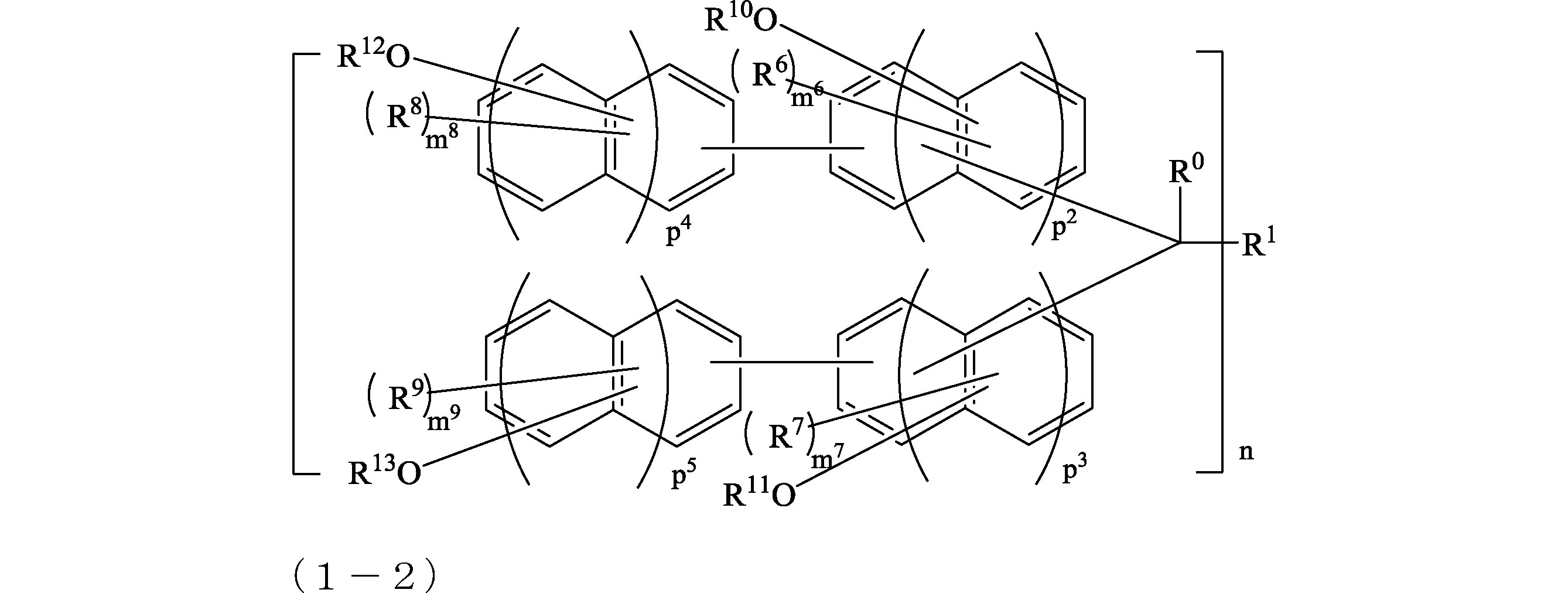
R8~R9は、前記R6~R7と同義であり、
R12~R13は、前記R10~R11と同義であり、
m8及びm9は、各々独立して、0~8の整数であり、
但し、m6、m7、m8及びm9は同時に0となることはない。)
[6]前記式(2)で表される化合物が下記式(2-1)で表される化合物である、前記[3]に記載の化合物。

R3Aは、各々独立して、ハロゲン原子、炭素数1~30の直鎖状、分岐状若しくは環状のアルキル基、炭素数6~30のアリール基、又は炭素数2~30のアルケニル基であり、
R4Aは、各々独立して、水素原子又は酸解離性基であり、
m6Aは、各々独立して、0~5の整数である。)
[7]前記[1]に記載の化合物をモノマーとして得られる、樹脂。
[8]下記式(3)で表される構造を有する、前記[7]に記載の樹脂。

R0は、前記RYと同義であり、
R1は、炭素数1~60のn価の基又は単結合であり、
R2~R5は、各々独立して、炭素数1~30の直鎖状、分岐状若しくは環状のアルキル基、炭素数6~30のアリール基、炭素数2~30のアルケニル基、炭素数1~30のアルコキシ基、ハロゲン原子、シアノ基、チオール基、水酸基又は水酸基の水素原子が酸解離性基で置換された基であり、ここで、R2~R5の少なくとも1つは水酸基又は水酸基の水素原子が酸解離性基で置換された基であり、
m2及びm3は、各々独立して、0~8の整数であり、
m4及びm5は、各々独立して、0~9の整数であり、
但し、m2、m3、m4及びm5は同時に0となることはなく、
nは前記Nと同義であり、ここで、nが2以上の整数の場合、n個の[ ]内の構造式は同一であっても異なっていてもよく、
p2~p5は、前記rと同義である。)
[9]下記式(4)で表される構造を有する、前記[7]に記載の樹脂。
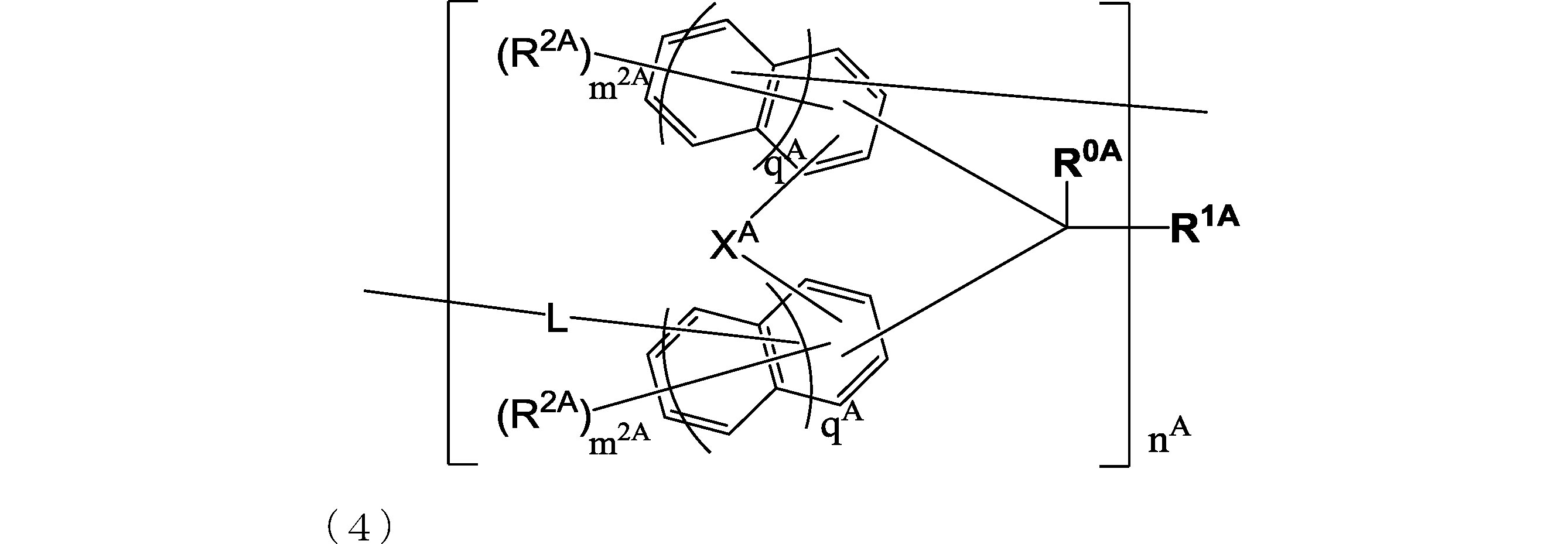
R0Aは、前記RYと同義であり、
R1Aは、炭素数1~60のnA価の基又は単結合であり、
R2Aは、各々独立して、炭素数1~30の直鎖状、分岐状若しくは環状のアルキル基、炭素数6~30のアリール基、炭素数2~30のアルケニル基、ハロゲン原子、シアノ基、水酸基又は水酸基の水素原子が酸解離性基で置換された基であり、ここで、R2Aの少なくとも1つは水酸基又は水酸基の水素原子が酸解離性基で置換された基であり、
nAは、前記Nと同義であり、ここで、nAが2以上の整数の場合、nA個の[ ]内の構造式は同一であっても異なっていてもよく、
XAは、酸素原子、硫黄原子又は無架橋であることを表し、
m2Aは、各々独立して、0~7の整数であり、但し、少なくとも1つのm2Aは1~6の整数であり、
qAは、各々独立して、0又は1である。)
[10]前記[1]~前記[6]のいずれかに記載の化合物及び前記[7]~前記[9]のいずれかに記載の樹脂からなる群より選ばれる1種以上を含有する、組成物。
[11]溶媒をさらに含有する、前記[10]に記載の組成物。
[12]酸発生剤をさらに含有する、前記[10]又は前記[11]に記載の組成物。
[13]酸架橋剤をさらに含有する、前記[10]~前記[12]のいずれかに記載の組成物。
[14]リソグラフィー用膜形成に用いられる、前記[10]~前記[13]のいずれかに記載の組成物。
[15]光学部品形成に用いられる、前記[10]~前記[13]のいずれかに記載の組成物。
[16]基板上に、前記[14]に記載の組成物を用いてフォトレジスト層を形成した後、前記フォトレジスト層の所定の領域に放射線を照射し、現像を行う工程を含む、レジストパターン形成方法。
[17]基板上に、前記[14]に記載の組成物を用いて下層膜を形成し、前記下層膜上に、少なくとも1層のフォトレジスト層を形成した後、前記フォトレジスト層の所定の領域に放射線を照射し、現像を行う工程を含む、レジストパターン形成方法。
[18]基板上に、前記[14]に記載の組成物を用いて下層膜を形成し、前記下層膜上に、レジスト中間層膜材料を用いて中間層膜を形成し、前記中間層膜上に、少なくとも1層のフォトレジスト層を形成した後、前記フォトレジスト層の所定の領域に放射線を照射し、現像してレジストパターンを形成し、その後、前記レジストパターンをマスクとして前記中間層膜をエッチングし、得られた中間層膜パターンをエッチングマスクとして前記下層膜をエッチングし、得られた下層膜パターンをエッチングマスクとして基板をエッチングすることにより基板にパターンを形成する工程を含む、回路パターン形成方法。
また、本実施形態の化合物及び樹脂は湿式プロセスが適用可能であり、耐熱性及びエッチング耐性に優れるフォトレジスト下層膜を形成するために有用な化合物、樹脂及びリソグラフィー用膜形成組成物を実現することができる。そして、このリソグラフィー用膜形成組成物は、耐熱性が高く、溶媒溶解性も高い、特定構造を有する化合物又は樹脂を用いているため、高温ベーク時の膜の劣化が抑制され、酸素プラズマエッチング等に対するエッチング耐性にも優れたレジスト及び下層膜を形成することができる。加えて、下層膜を形成した場合、レジスト層との密着性にも優れるので、優れたレジストパターンを形成することができる。さらには、屈折率が高く、また低温から高温までの広範囲の熱処理によって着色が抑制されることから、各種光学形成組成物としても有用である。
本実施形態の化合物は、下記式(0)で表される。
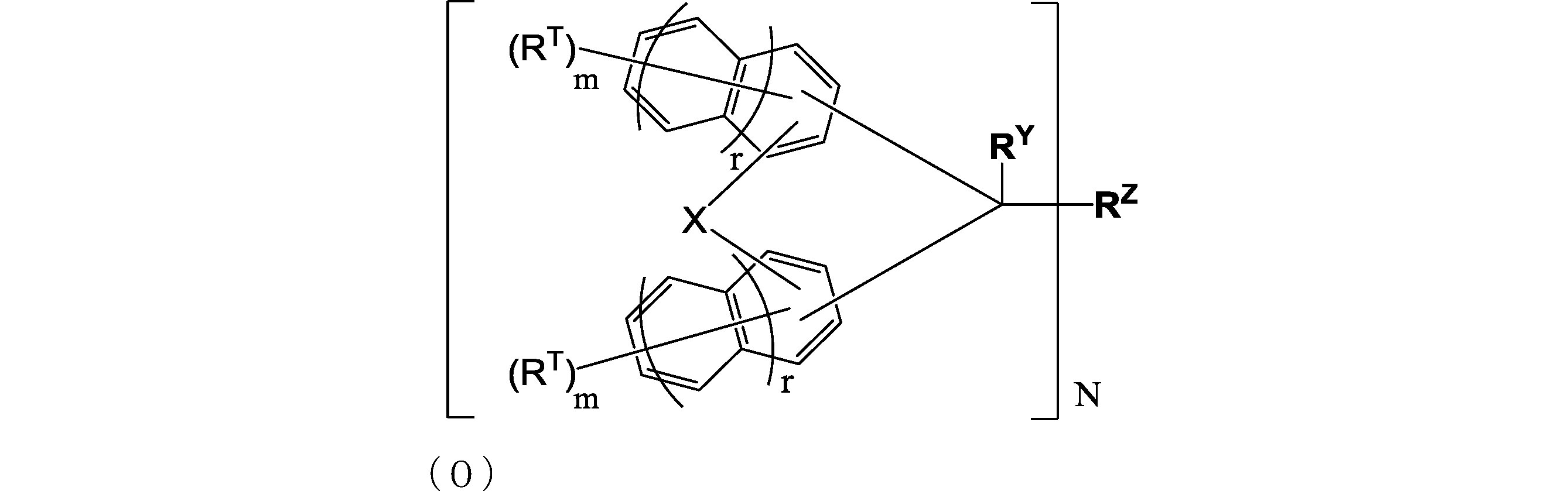
RZは、炭素数1~60のN価の基又は単結合であり、
RTは、各々独立して、置換基を有していてもよい炭素原子数1~30のアルキル基、置換基を有していてもよい炭素原子数6~40のアリール基、置換基を有していてもよい炭素原子数2~30のアルケニル基、置換基を有していてもよい炭素数1~30のアルコキシ基、ハロゲン原子、ニトロ基、アミノ基、シアノ基、チオール基、水酸基又は水酸基の水素原子が酸解離性基で置換された基であり、ここで、前記アルキル基、前記アルケニル基及び前記アリール基は、エーテル結合、ケトン結合又はエステル結合を含んでいてもよく、ここで、RTの少なくとも1つは水酸基又は水酸基の水素原子が酸解離性基で置換された基であり、
Xは、酸素原子、硫黄原子又は無架橋であることを表し、
mは、各々独立して0~9の整数であり、ここで、mの少なくとも1つは1~9の整数であり、
Nは、1~4の整数であり、ここで、Nが2以上の整数の場合、N個の[ ]内の構造式は同一であっても異なっていてもよく、
rは、各々独立して0~2の整数である。)
前記「置換基を有していてもよい炭素数6~40のアリール基」は、特に限定されるものではないが、無置換のフェニル基、ナフタレン基、ビフェニル基等であってもよいし、ハロゲン原子、ニトロ基、アミノ基、チオール基、水酸基又は水酸基の水素原子が酸解離性基で置換された基等の置換基を有するフェニル基、ナフタレン基、ビフェニル基等であってもよい。
前記「置換基を有していてもよい炭素数2~30のアルケニル基」は、特に限定されるものではないが、無置換のプロペニル基、ブテニル基等であってもよいし、ハロゲン原子、ニトロ基、アミノ基、チオール基、水酸基又は水酸基の水素原子が酸解離性基で置換された基等の置換基を有するプロペニル基、ブテニル基等であってもよい。
前記「置換基を有していてもよい炭素数1~30のアルコキシ基」は、特に限定されるものではないが、無置換のメトキシ基、エトキシ基、プロポキシ基、シクロヘキシロキシ基、フェノキシ基、ナフタレンオキシ基ビフェニル基等であってもよいし、ハロゲン原子、ニトロ基、アミノ基、チオール基、水酸基又は水酸基の水素原子が酸解離性基で置換された基等の置換基を有するメトキシ基、エトキシ基、プロポキシ基、シクロヘキシロキシ基、フェノキシ基、ナフタレンオキシ基等であってもよい。
なお、後述するように「酸解離性基」とは、酸の存在下で開裂して、アルカリ可溶性基等の溶解性を変化させる官能基を生じる特性基をいう。アルカリ可溶性基としては、フェノール性水酸基、カルボキシル基、スルホン酸基、ヘキサフルオロイソプロパノール基などが挙げられ、フェノール性水酸基及びカルボキシル基が好ましく、フェノール性水酸基が特に好ましい。
(a):式(0)中、[ ]内の構造式におけるrが同じであること、即ち、[ ]内の構造式における2つのアリール構造で示される部位が同じ構造であることが好ましい。
(b):式(0)中、[ ]内の構造式において各アリール構造で示される部位に結合されるRTは、同一のものであることが好ましく、各アリール構造で示される部位における結合部位が同一であることが更に好ましい。
(c):式(0)において、Nが1~2であることが好ましく、1であることが更に好ましい。
(d):式(0)において、RYは、炭素数1~30の直鎖状のアルキル基、又はフェニル基が好ましく、メチル基又はフェニル基であることが更に好ましい。
(e):式(0)において、RZは、炭素数1~60のN価の基であることが好ましい。
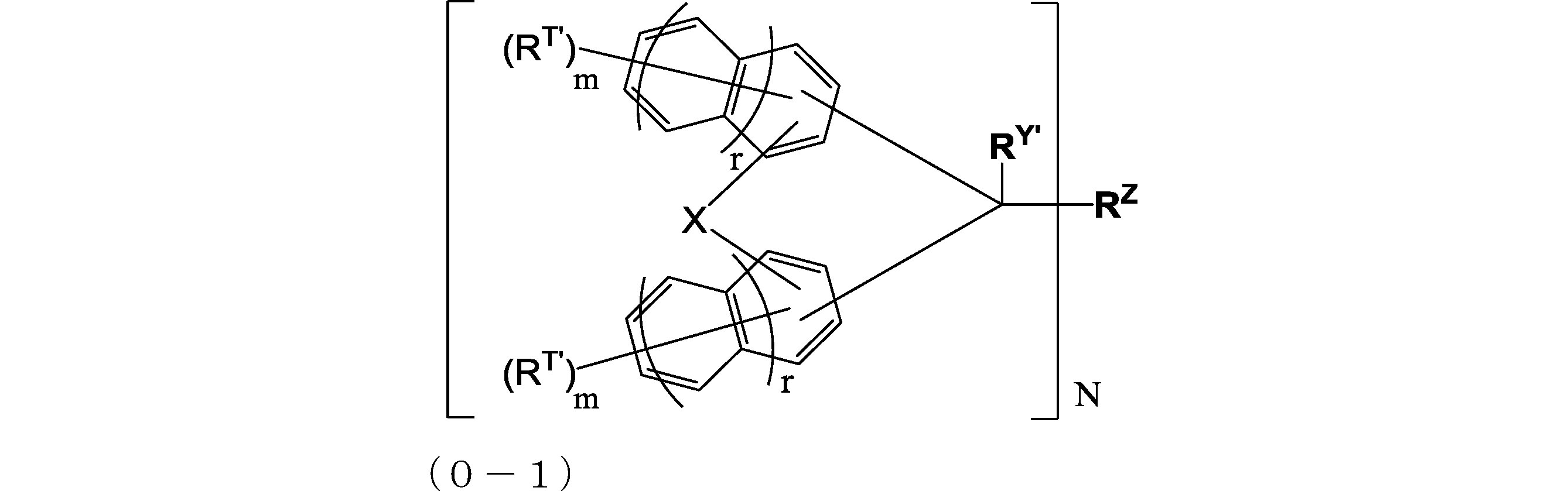
RZは、炭素数1~60のN価の基又は単結合であり、
RT'は、各々独立して、炭素数1~30の直鎖状、分岐状若しくは環状のアルキル基、置換基を有していてもよい炭素数6~30のアリール基、炭素数2~30のアルケニル基、炭素数1~30のアルコキシ基、ハロゲン原子、シアノ基、チオール基、水酸基又は水酸基の水素原子が酸解離性基で置換された基であり、
ここで、RT'の少なくとも1つは水酸基又は水酸基の水素原子が酸解離性基で置換された基であり、
Xは、酸素原子、硫黄原子又は無架橋であることを表し、
mは、各々独立して0~9の整数であり、ここで、mの少なくとも1つは1~9の整数であり、
Nは、1~4の整数であり、ここで、Nが2以上の整数の場合、N個の[ ]内の構造式は同一であっても異なっていてもよく、
rは、各々独立して0~2の整数である。)
本実施形態の化合物は、下記式(1)で表されることが好ましい。本実施形態の化合物は、下記構造を有するため、さらに耐熱性が高く、溶媒溶解性も高い。
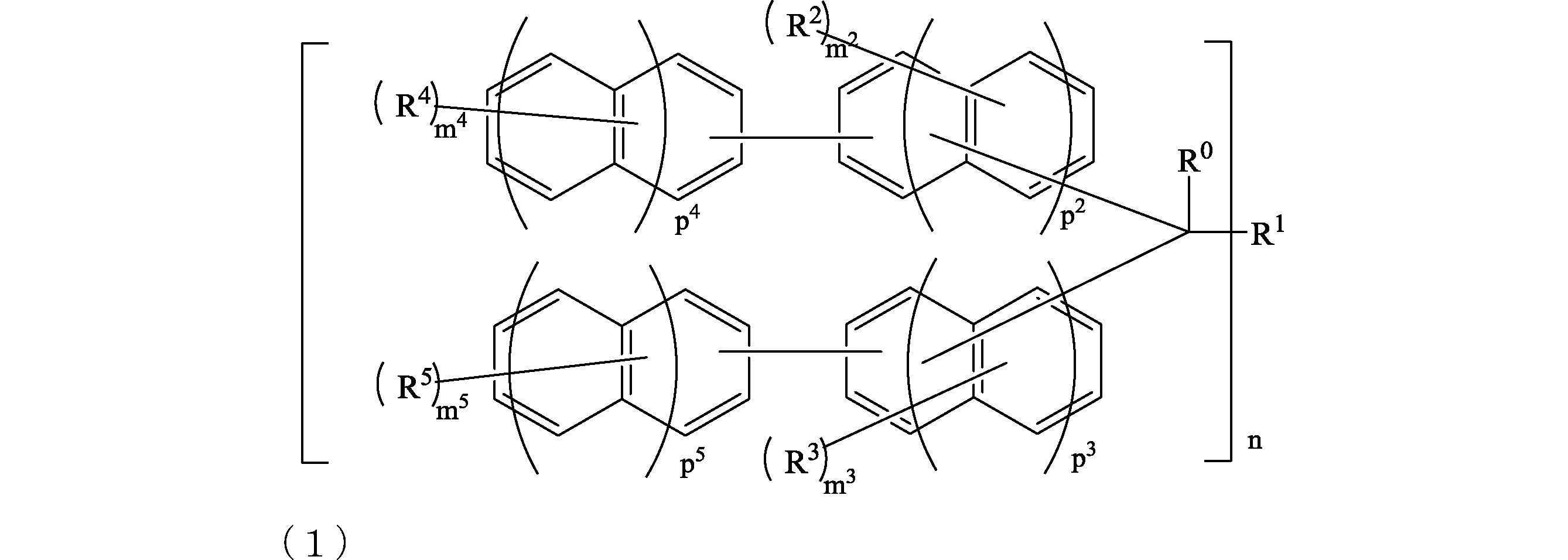
R1は炭素数1~60のn価の基又は単結合であり、このR1を介して各々の芳香環が結合している。
R2~R5は、各々独立して、炭素数1~30の直鎖状、分岐状若しくは環状のアルキル基、炭素数6~30のアリール基、炭素数2~30のアルケニル基、炭素数1~30のアルコキシ基、ハロゲン原子、シアノ基、チオール基、水酸基又は水酸基の水素原子が酸解離性基で置換された基である。但し、式(1)中、R2~R5の少なくとも1つは、水酸基又は水酸基の水素原子が酸解離性基で置換された基である。
m2及びm3は、各々独立して、0~8の整数であり、m4及びm5は、各々独立して、0~9の整数である。但し、m2、m3、m4及びm5は同時に0となることはない。
nは1~4の整数である。
p2~p5は各々独立して0~2の整数である。なお、p2~p5が0の場合には式(1)でナフタレン構造で示される部位は、ベンゼン構造を示し、p2~p5が1の場合にはナフタレン構造を示し、p2~p5が2の場合にはアントラセン又はフェナントレン等の三環構造を示す。
nは前記Nと同義であり、nが2以上の整数の場合、n個の[ ]内の構造式は同一であっても異なっていてもよい。
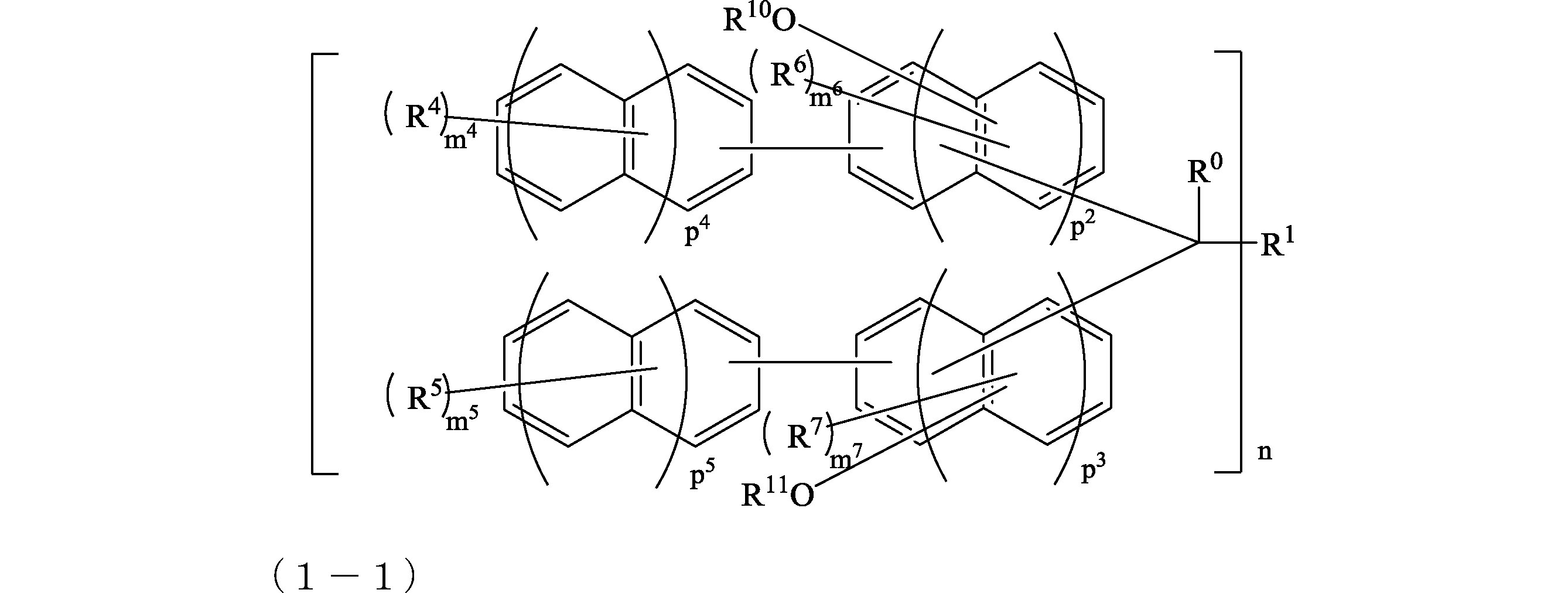
R0、R1、R4、R5、n、p2~p5、m4及びm5は、前記と同義であり、
R6~R7は、各々独立して、炭素数1~30の直鎖状、分岐状若しくは環状のアルキル基、炭素数6~30のアリール基、炭素数2~30のアルケニル基、炭素数1~30のアルコキシ基、ハロゲン原子、チオール基であり、
R10~R11は、各々独立して、水素原子又は酸解離性基であり、
m6及びm7は、各々独立して0~7の整数であり、
但し、m4、m5、m6及びm7は同時に0となることはない。
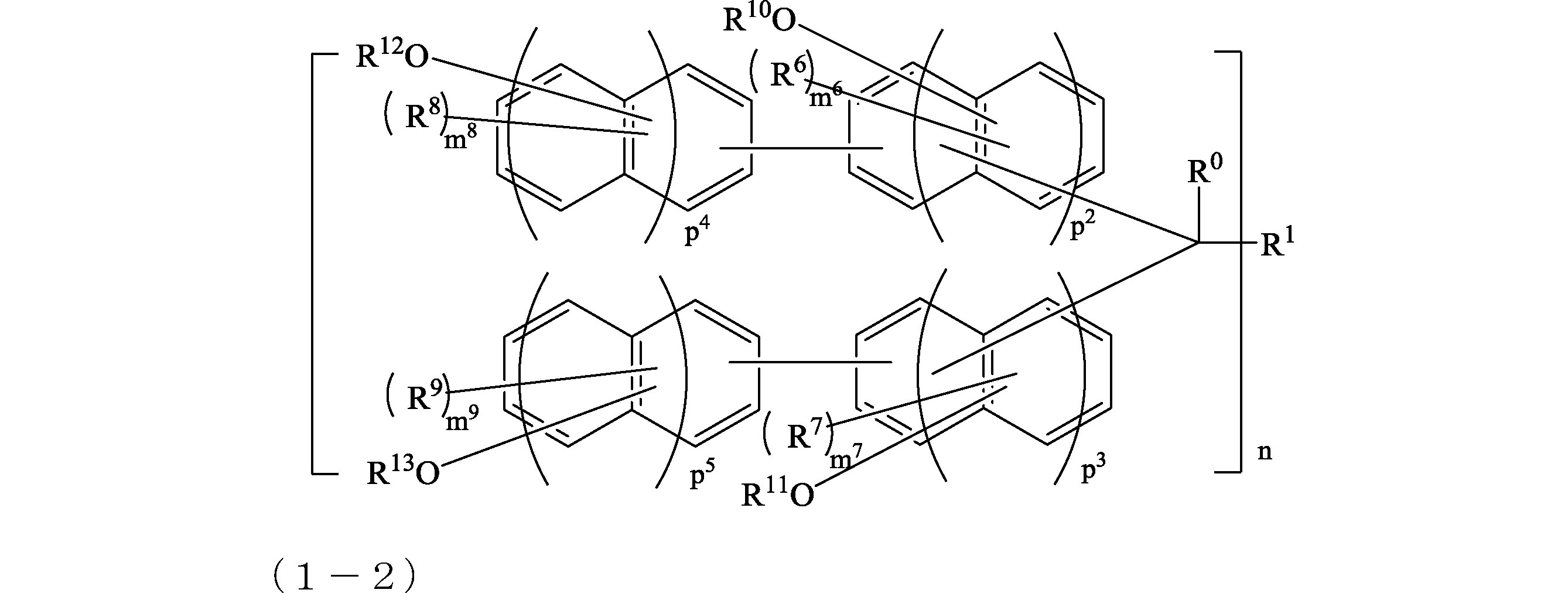
R0、R1、R6、R7、R10、R11、n、p2~p5、m6及びm7は、前記と同義であり、
R8~R9は、前記R6~R7と同義であり、
R12~R13は、前記R10~R11と同義であり、
m8及びm9は、各々独立して、0~8の整数である。但し、m6、m7、m8及びm9は同時に0となることはない。


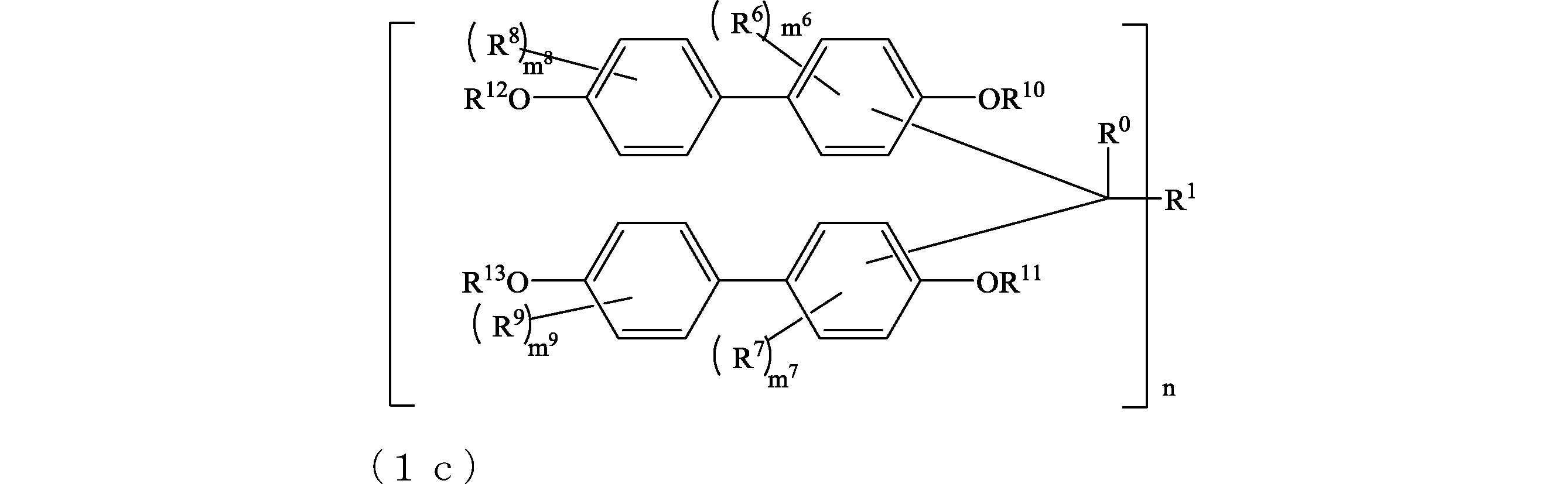
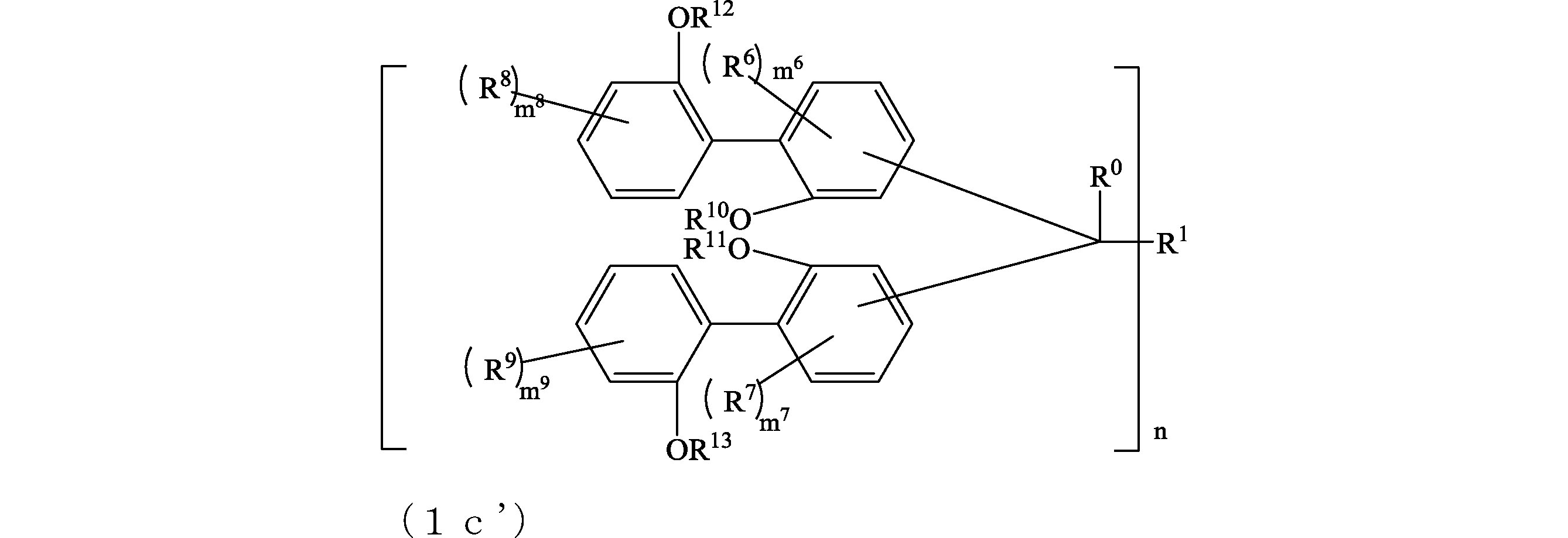

R0は、例えば、メチル基、エチル基、プロピル基、ブチル基、ペンチル基、ヘキシル基、ヘプチル基、オクチル基、ノニル基、デシル基、ウンデシル基、ドデシル基、トリアコンチル基、フェニル基、ナフチル基、アントラセン基、ピレニル基、ビフェニル基、ヘプタセン基が挙げられる。
R4'及びR5'は、例えば、メチル基、エチル基、プロピル基、ブチル基、ペンチル基、ヘキシル基、ヘプチル基、オクチル基、ノニル基、デシル基、ウンデシル基、ドデシル基、トリアコンチル基、シクロプロピル基、シクロブチル基、シクロペンチル基、シクロヘキシル基、シクロヘプチル基、シクロオクチル基、シクロノニル基、シクロデシル基、シクロウンデシル基、シクロドデシル基、シクロトリアコンチル基、ノルボルニル基、アダマンチル基、フェニル基、ナフチル基、アントラセン基、ピレニル基、ビフェニル基、ヘプタセン基、ビニル基、アリル基、トリアコンテニル基、メトキシ基、エトキシ基、トリアコンチキシ基、フッ素原子、塩素原子、臭素原子、ヨウ素原子、チオール基が挙げられる。
前記R0、R4'、R5'の各例示は、異性体を含んでいる。例えば、ブチル基には、n-ブチル基、イソブチル基、sec-ブチル基、tert-ブチル基を含んでいる。

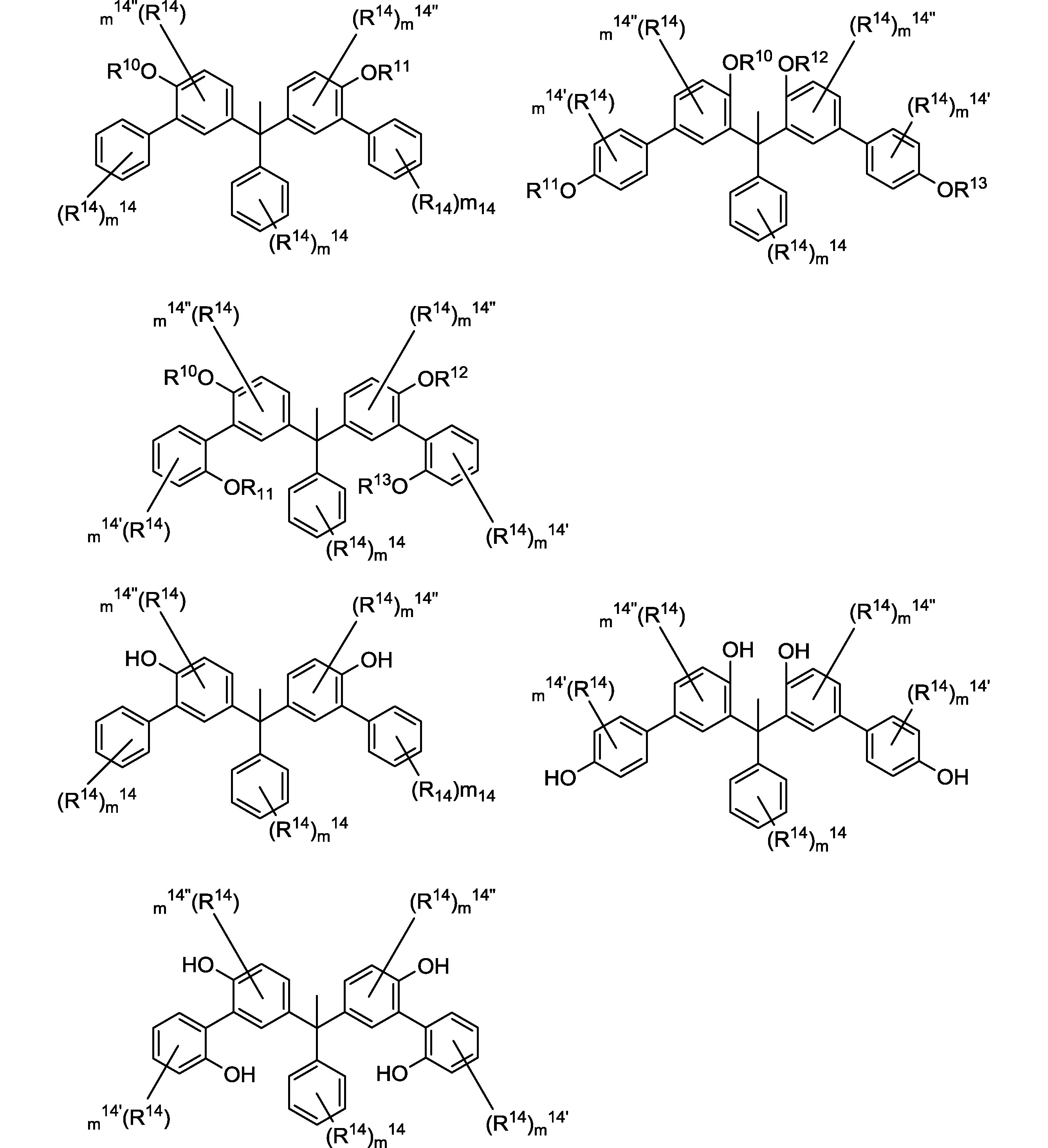
R14は、例えば、メチル基、エチル基、プロピル基、ブチル基、ペンチル基、ヘキシル基、ヘプチル基、オクチル基、ノニル基、デシル基、ウンデシル基、ドデシル基、トリアコンチル基、シクロプロピル基、シクロブチル基、シクロペンチル基、シクロヘキシル基、シクロヘプチル基、シクロオクチル基、シクロノニル基、シクロデシル基、シクロウンデシル基、シクロドデシル基、シクロトリアコンチル基、ノルボルニル基、アダマンチル基、フェニル基、ナフチル基、アントラセン基、ピレニル基、ビフェニル基、ヘプタセン基、ビニル基、アリル基、トリアコンテニル基、メトキシ基、エトキシ基、トリアコンチキシ基、フッ素原子、塩素原子、臭素原子、ヨウ素原子、チオール基が挙げられる。
前記R14の各例示は、異性体を含んでいる。例えば、ブチル基には、n-ブチル基、イソブチル基、sec-ブチル基、tert-ブチル基を含んでいる。

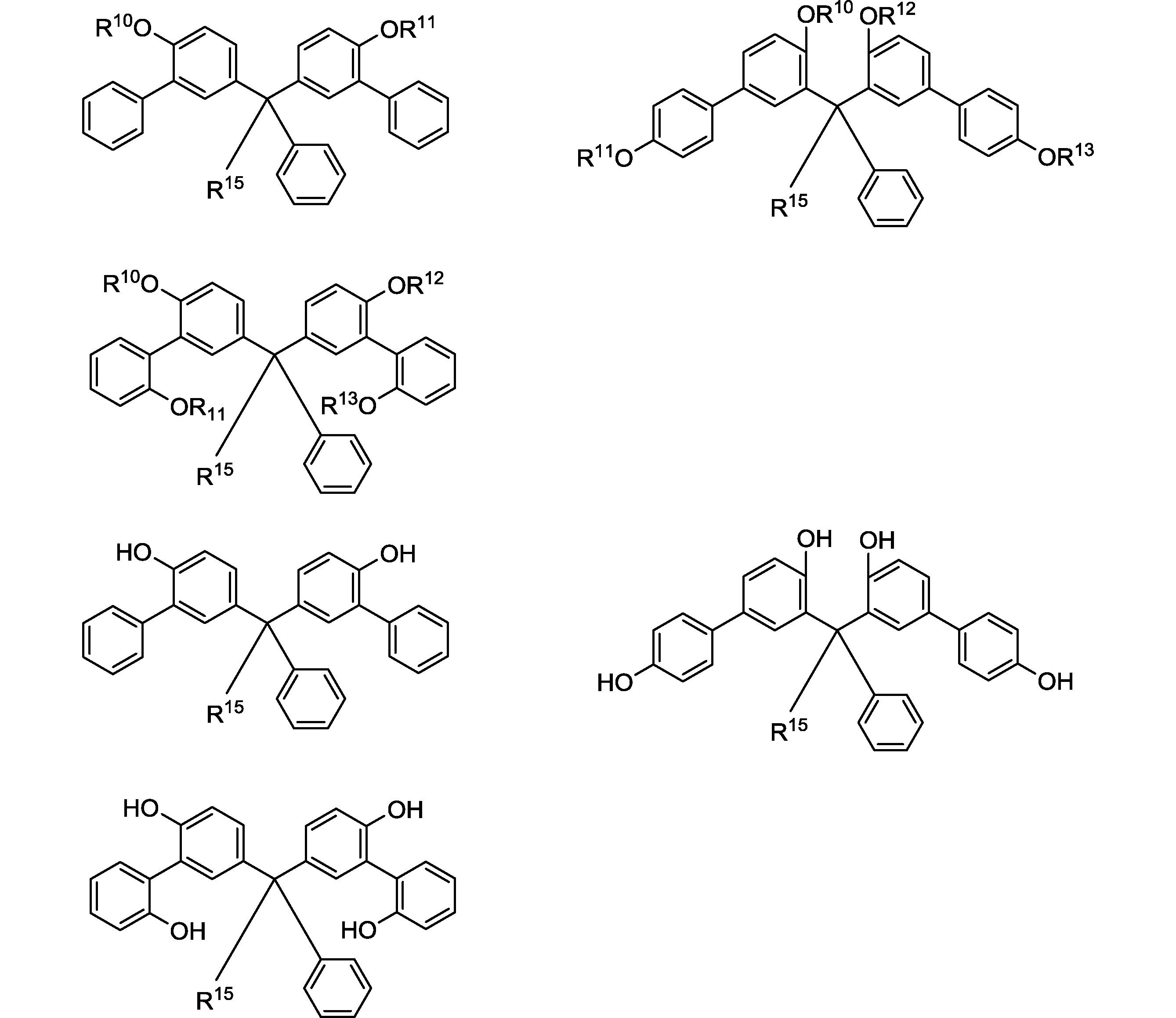
R15は、例えば、メチル基、エチル基、プロピル基、ブチル基、ペンチル基、ヘキシル基、ヘプチル基、オクチル基、ノニル基、デシル基、ウンデシル基、ドデシル基、トリアコンチル基、シクロプロピル基、シクロブチル基、シクロペンチル基、シクロヘキシル基、シクロヘプチル基、シクロオクチル基、シクロノニル基、シクロデシル基、シクロウンデシル基、シクロドデシル基、シクロトリアコンチル基、ノルボルニル基、アダマンチル基、フェニル基、ナフチル基、アントラセン基、ピレニル基、ビフェニル基、ヘプタセン基、ビニル基、アリル基、トリアコンテニル基、メトキシ基、エトキシ基、トリアコンチキシ基、フッ素原子、塩素原子、臭素原子、ヨウ素原子、チオール基が挙げられる。
前記R15の各例示は、異性体を含んでいる。例えば、ブチル基には、n-ブチル基、イソブチル基、sec-ブチル基、tert-ブチル基を含んでいる。


R16は、例えば、メチレン基、エチレン基、プロペン基、ブテン基、ペンテン基、ヘキセン基、ヘプテン基、オクテン基、ノネン基、デセン基、ウンデセン基、ドデセン基、トリアコンテン基、シクロプロペン基、シクロブテン基、シクロペンテン基、シクロヘキセン基、シクロヘプテン基、シクロオクテン基、シクロノネン基、シクロデセン基、シクロウンデセン基、シクロドデセン基、シクロトリアコンテン基、2価のノルボルニル基、2価のアダマンチル基、2価のフェニル基、2価のナフチル基、2価のアントラセン基、2価のピレン基、2価のビフェニル基、2価のヘプタセン基、2価のビニル基、2価のアリル基、2価のトリアコンテニル基が挙げられる。
前記R16の各例示は、異性体を含んでいる。例えば、ブチル基には、n-ブチル基、イソブチル基、sec-ブチル基、tert-ブチル基を含んでいる。


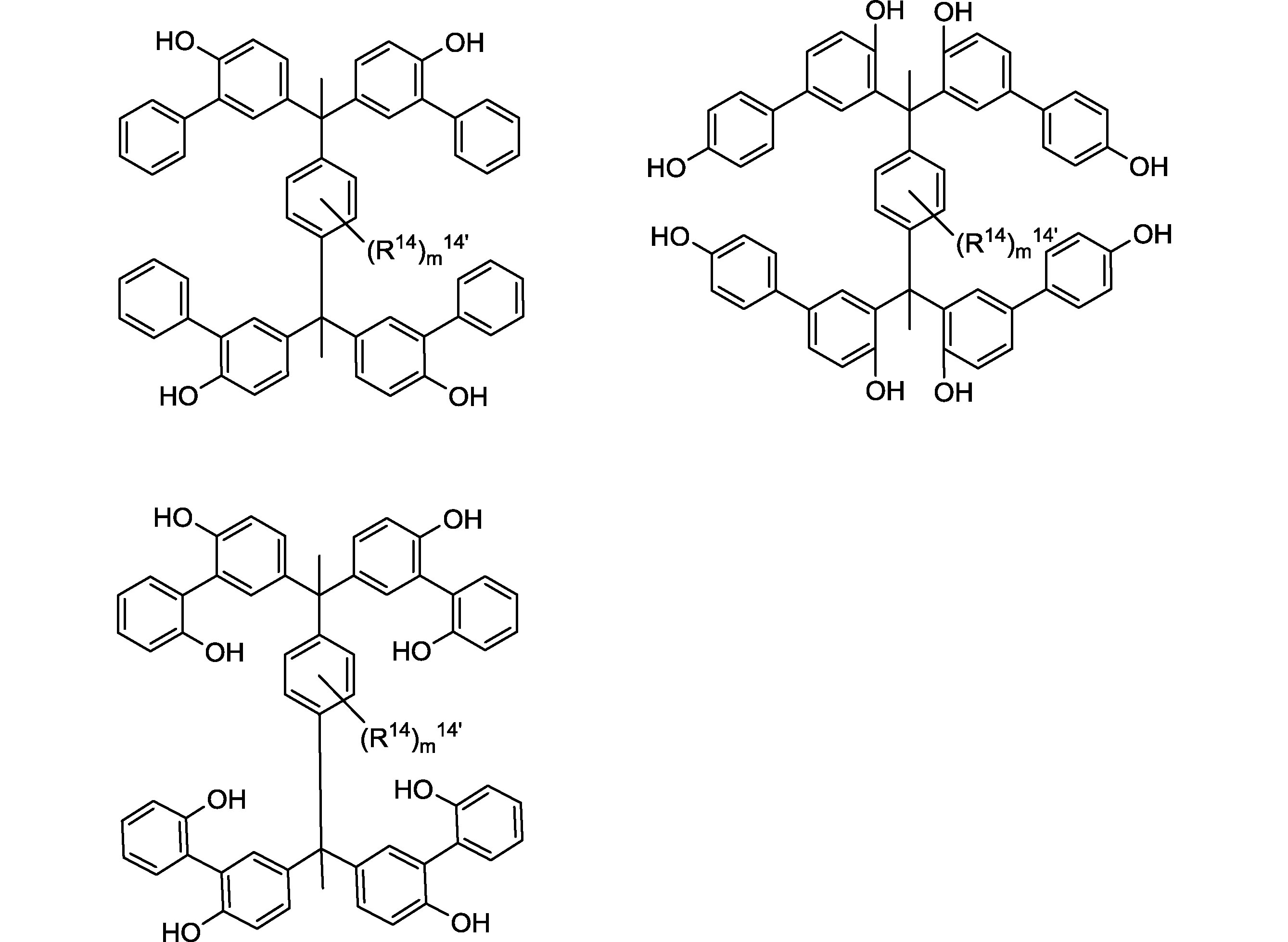

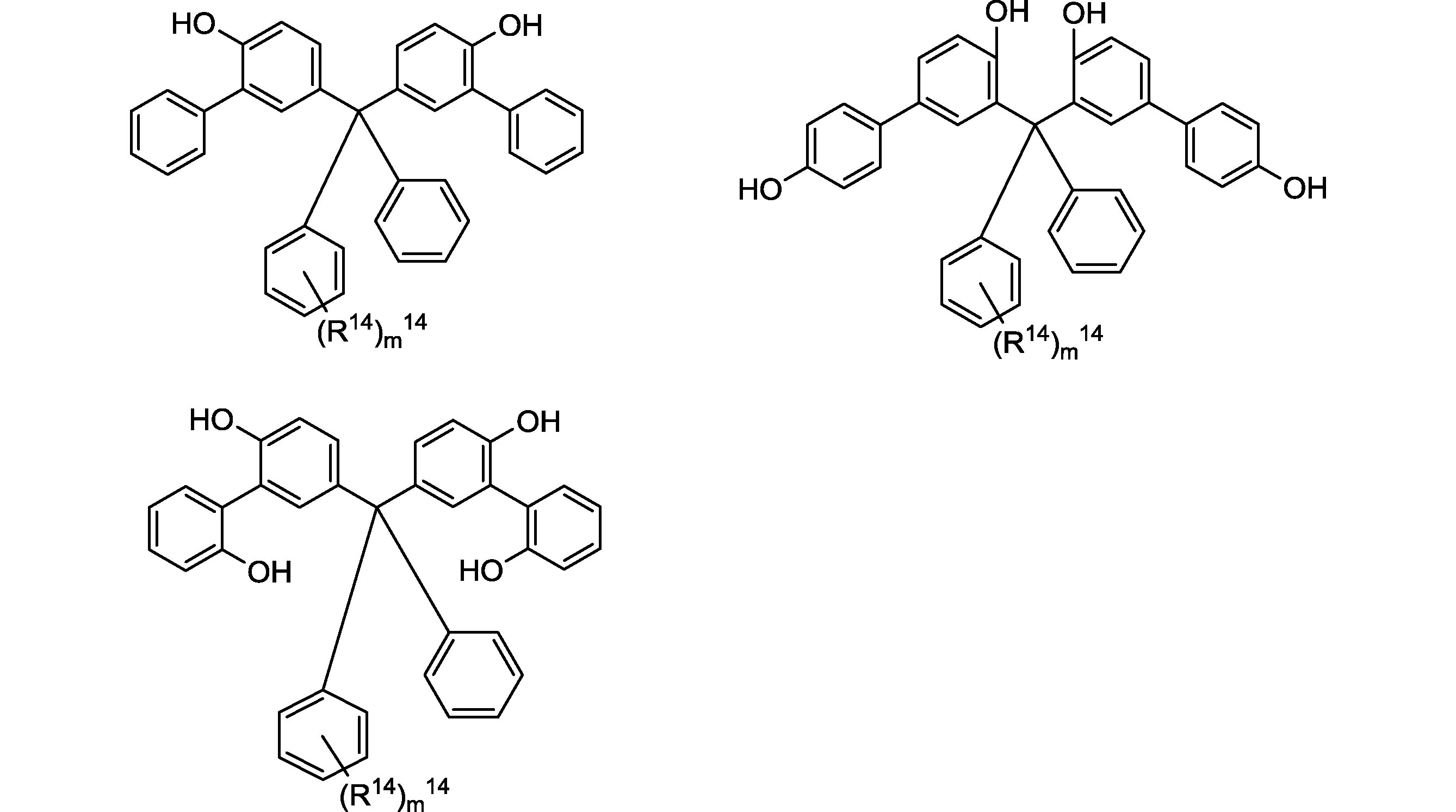
R14は、例えば、メチル基、エチル基、プロピル基、ブチル基、ペンチル基、ヘキシル基、ヘプチル基、オクチル基、ノニル基、デシル基、ウンデシル基、ドデシル基、トリアコンチル基、シクロプロピル基、シクロブチル基、シクロペンチル基、シクロヘキシル基、シクロヘプチル基、シクロオクチル基、シクロノニル基、シクロデシル基、シクロウンデシル基、シクロドデシル基、シクロトリアコンチル基、ノルボルニル基、アダマンチル基、フェニル基、ナフチル基、アントラセン基、ピレニル基、ビフェニル基、ヘプタセン基、ビニル基、アリル基、トリアコンテニル基、メトキシ基、エトキシ基、トリアコンチキシ基、フッ素原子、塩素原子、臭素原子、ヨウ素原子、チオール基が挙げられる。
前記R14の各例示は、異性体を含んでいる。例えば、ブチル基には、n-ブチル基、イソブチル基、sec-ブチル基、tert-ブチル基を含んでいる。

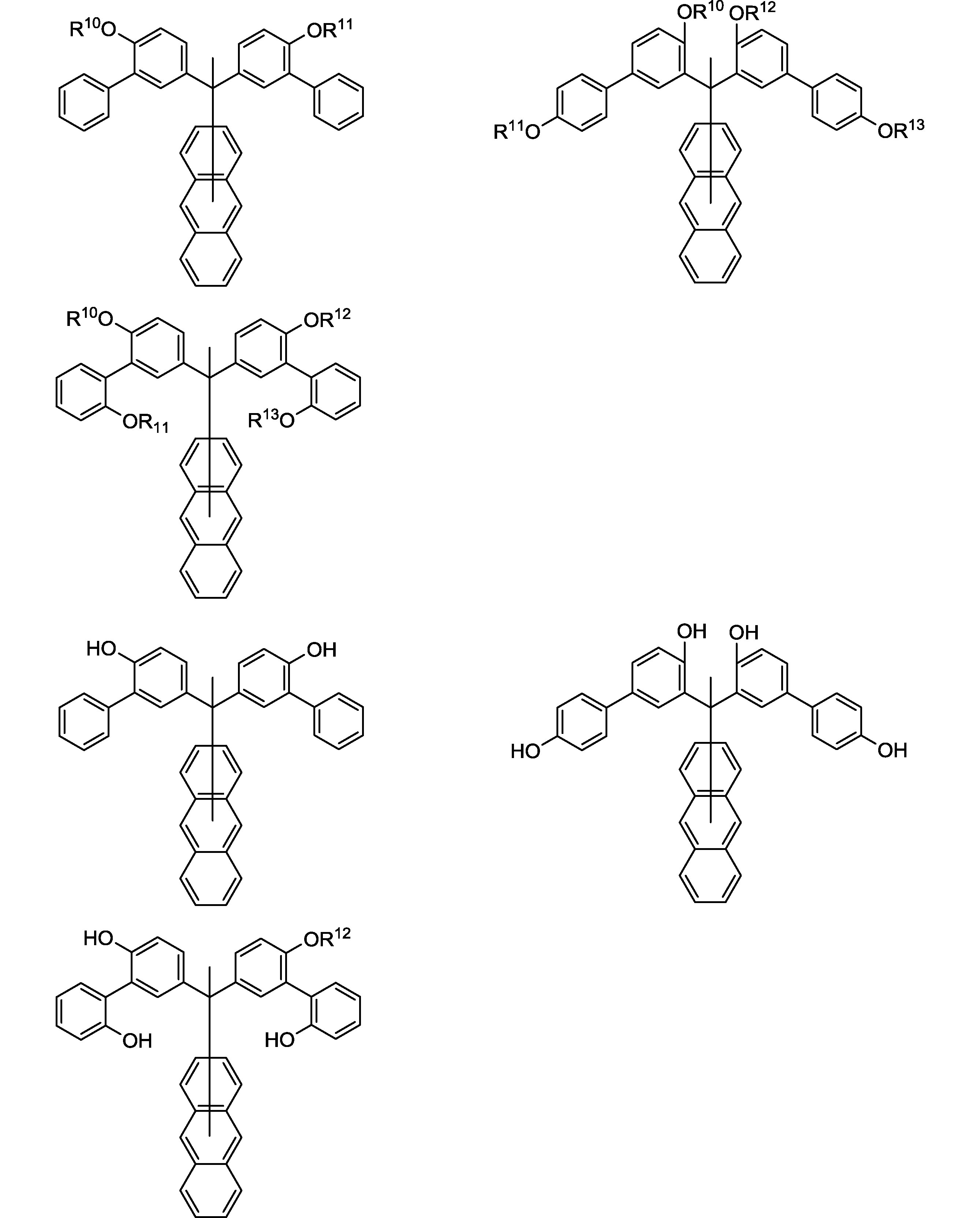
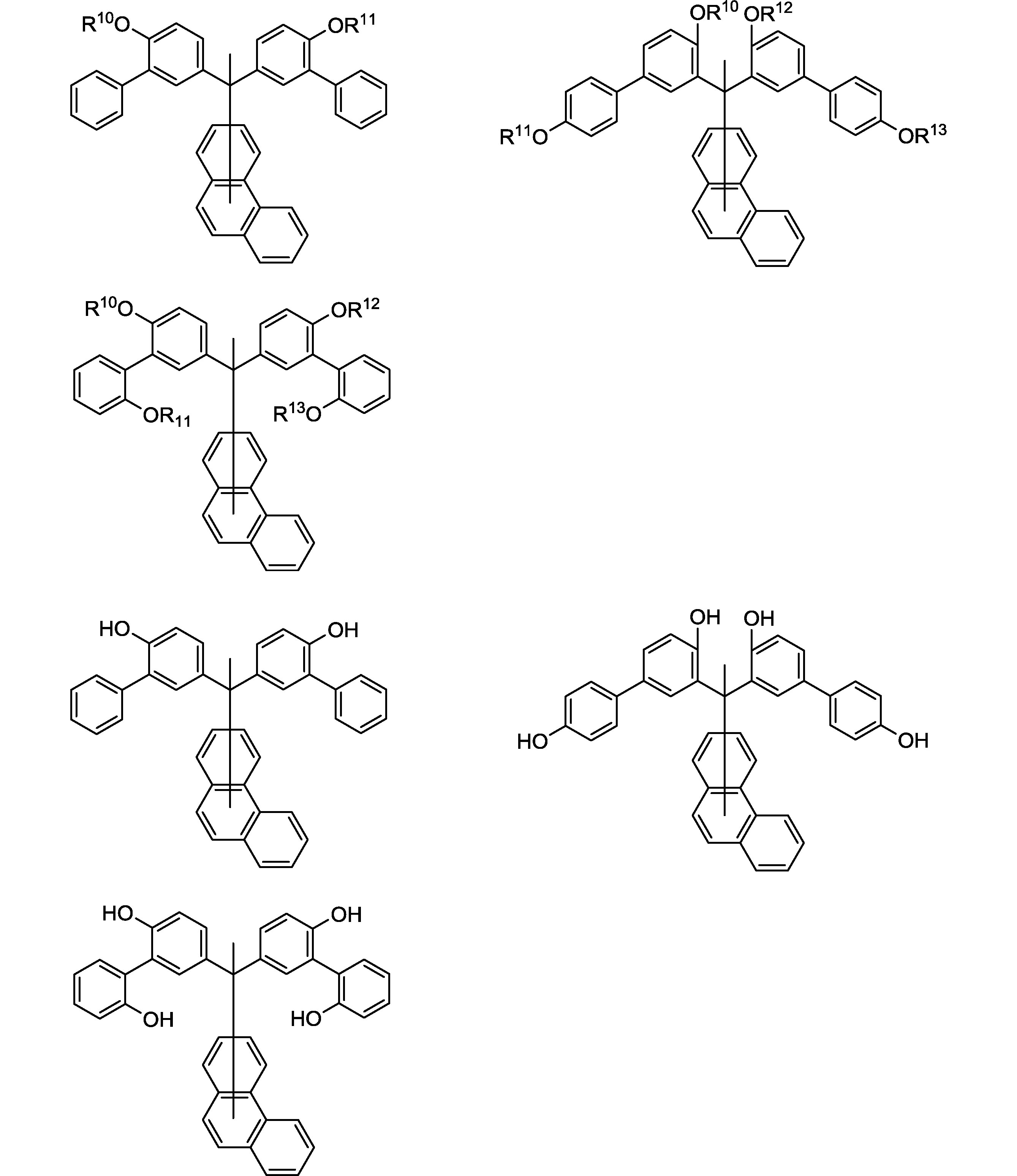
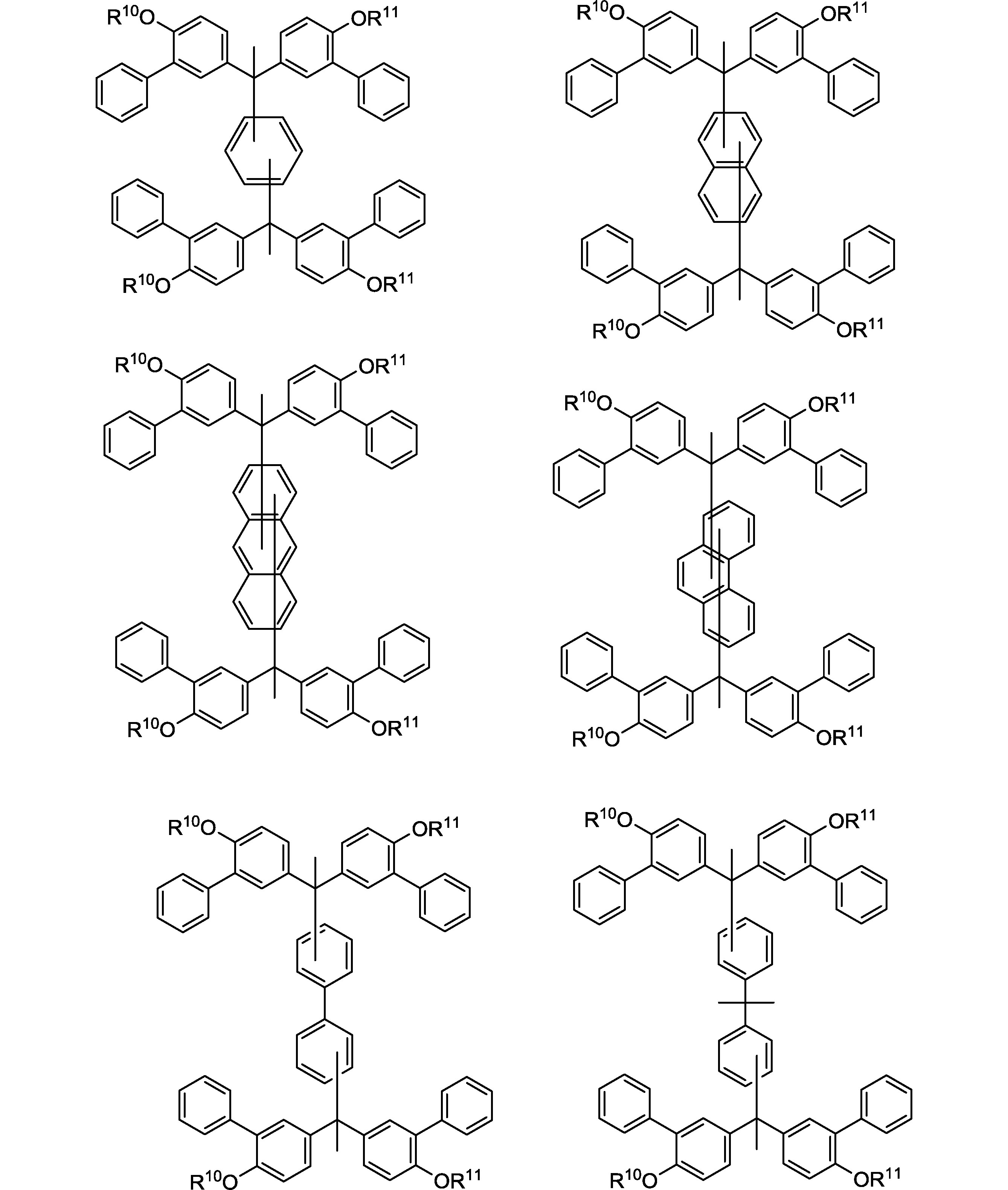
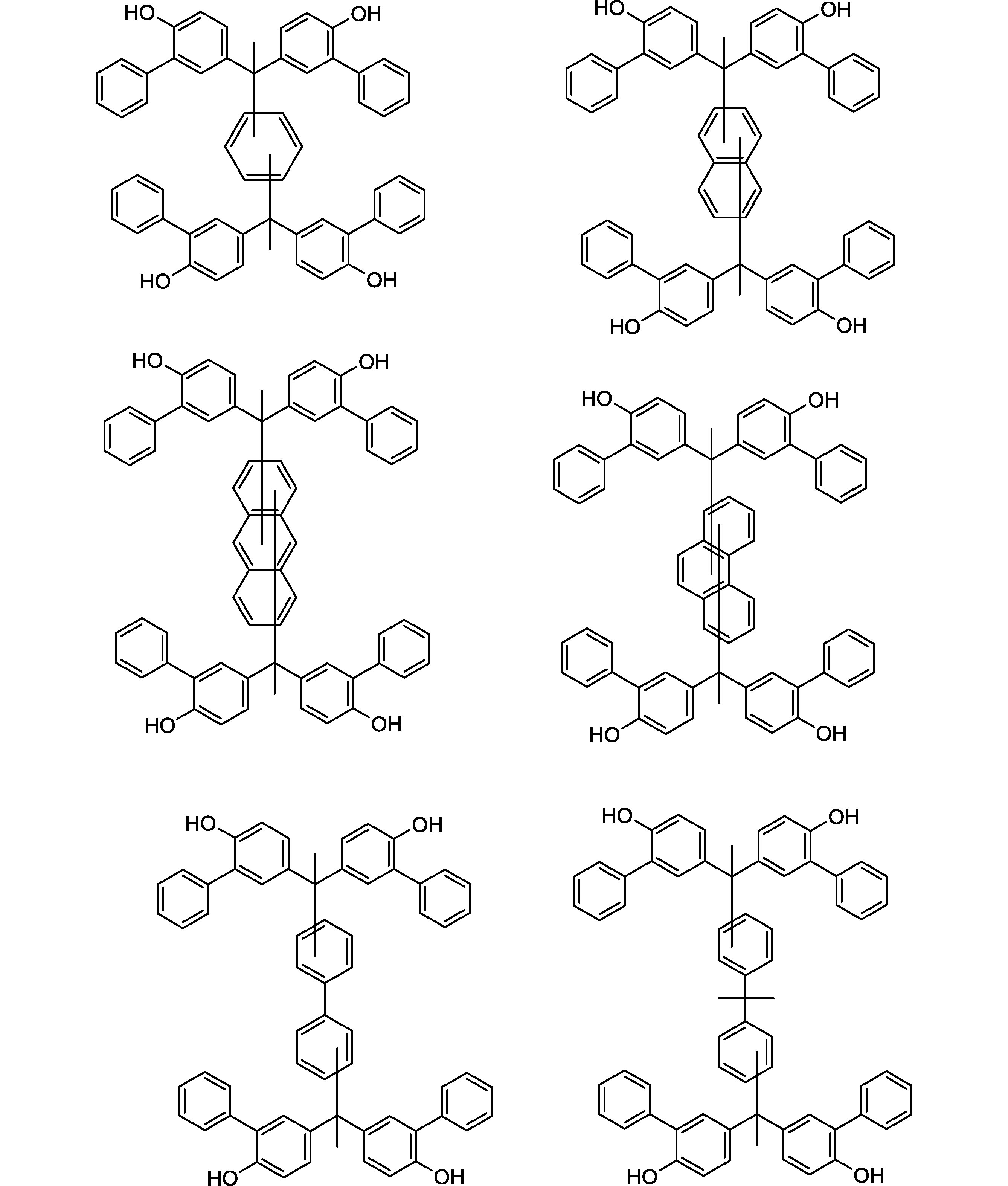

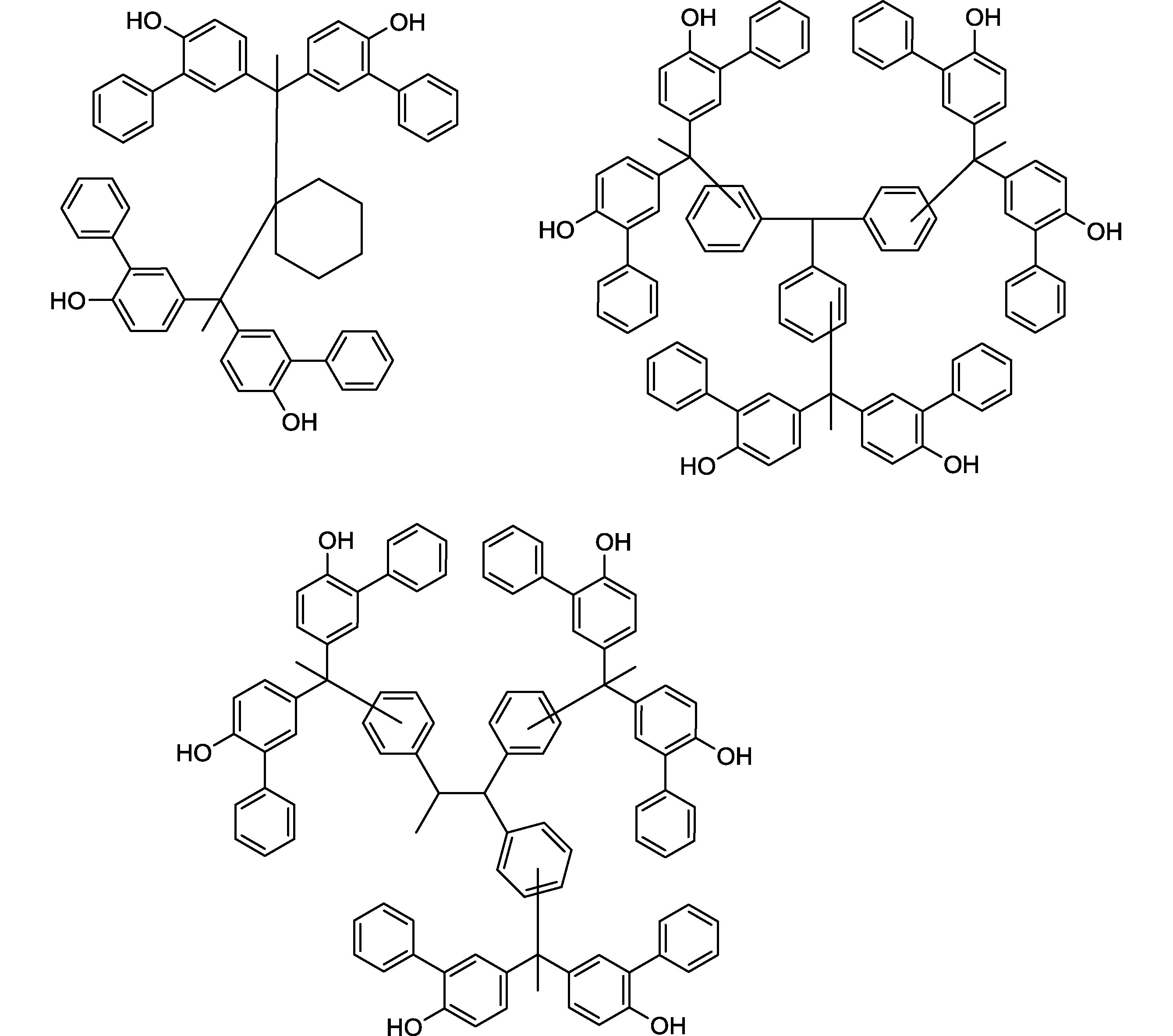



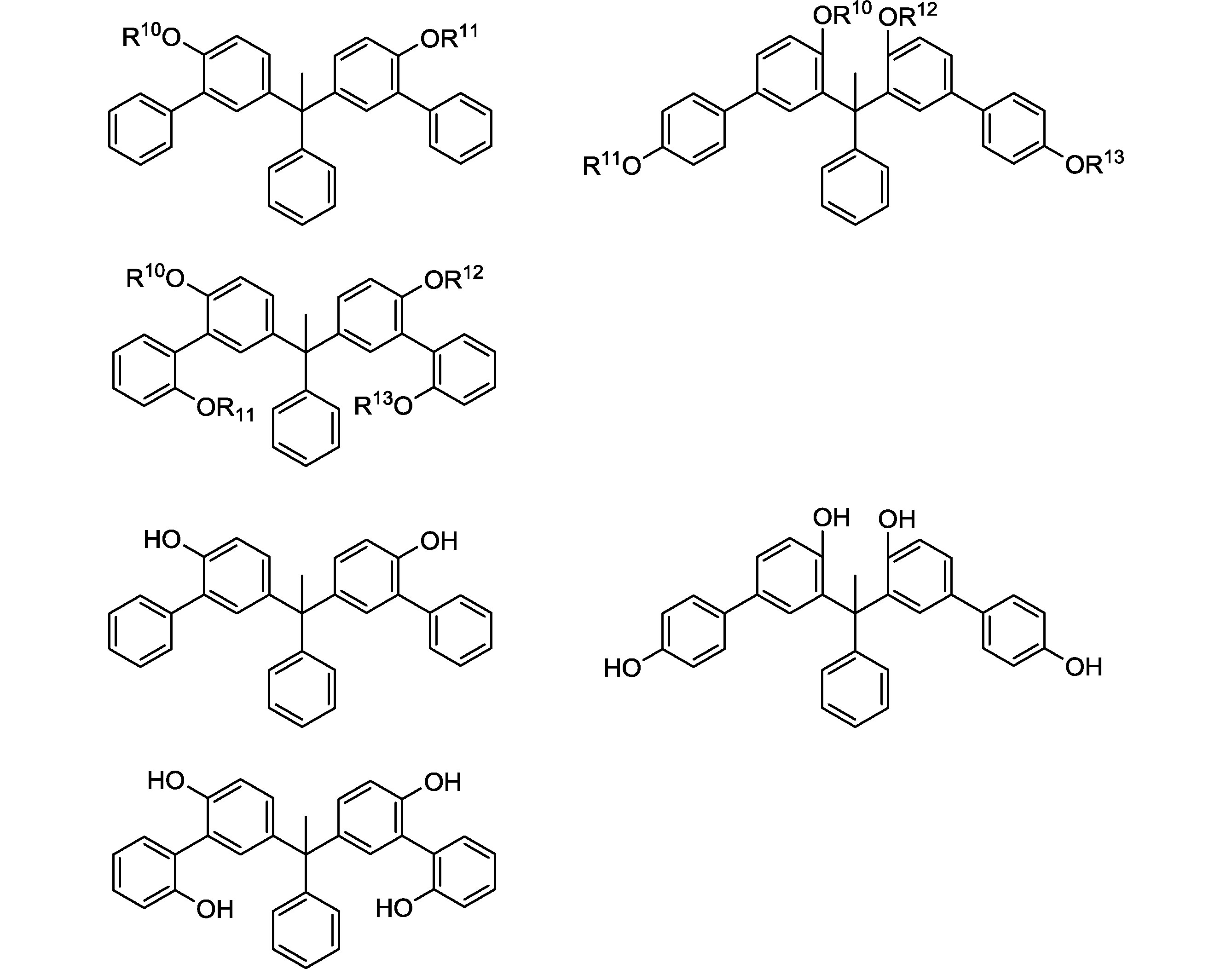
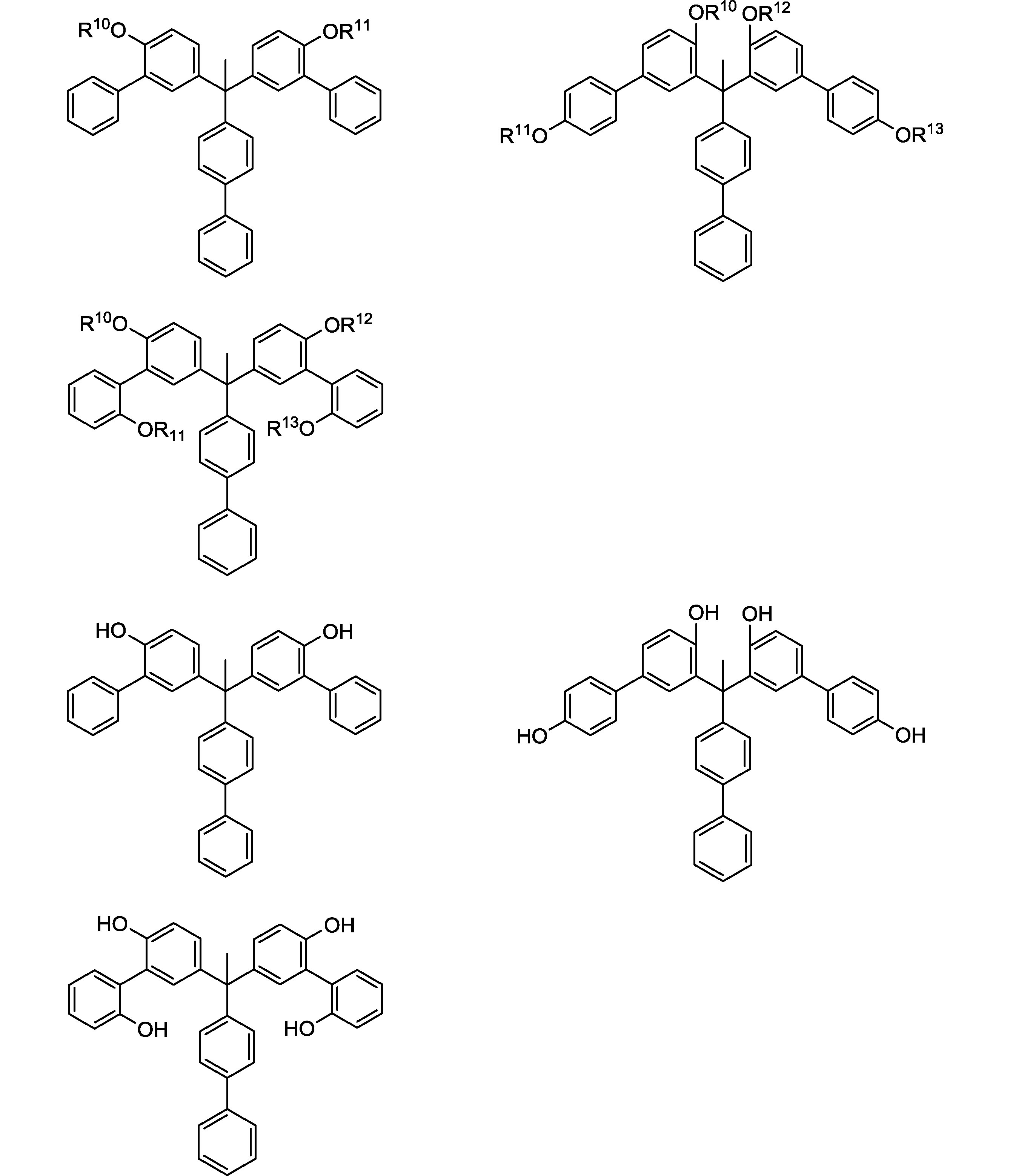

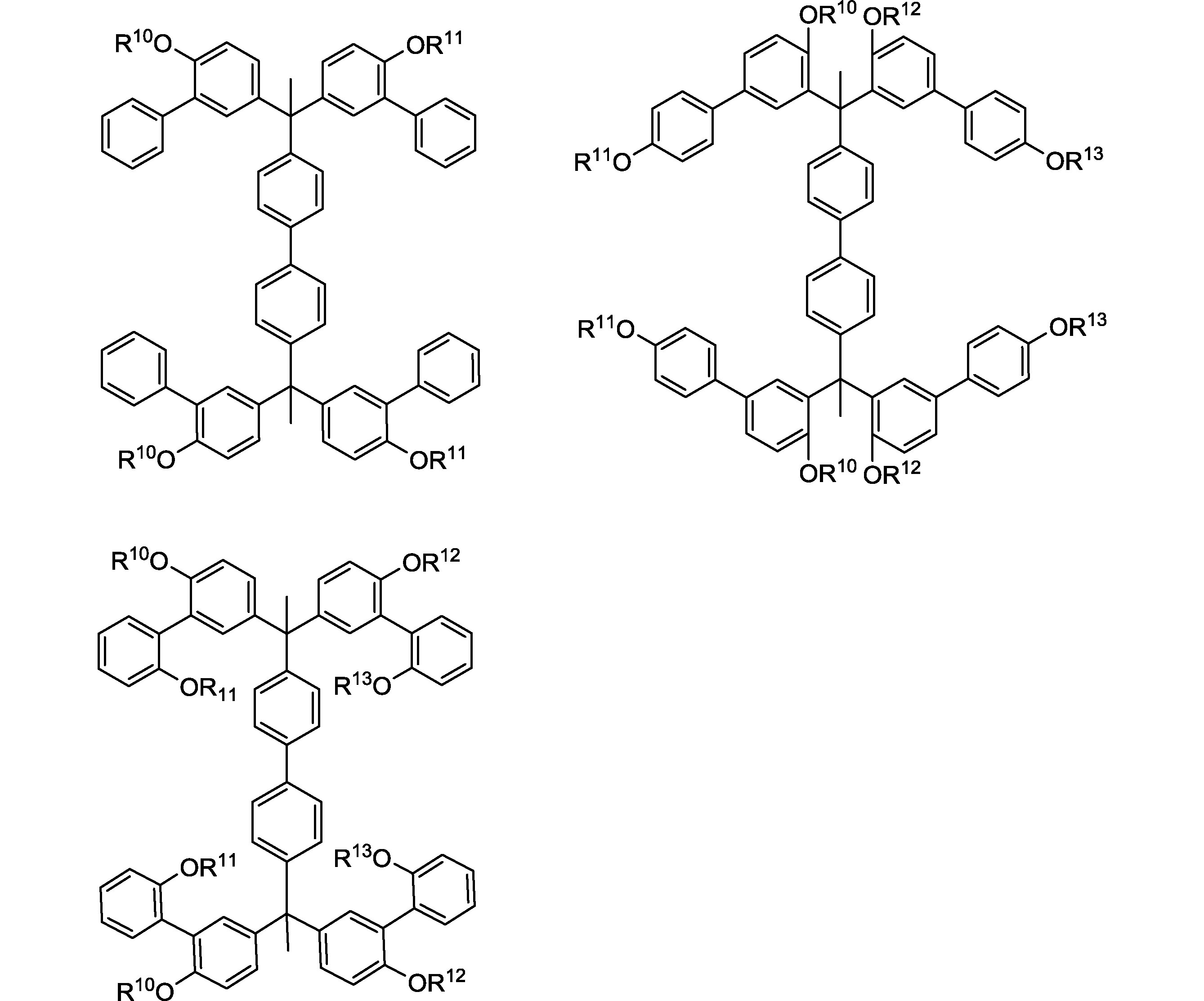

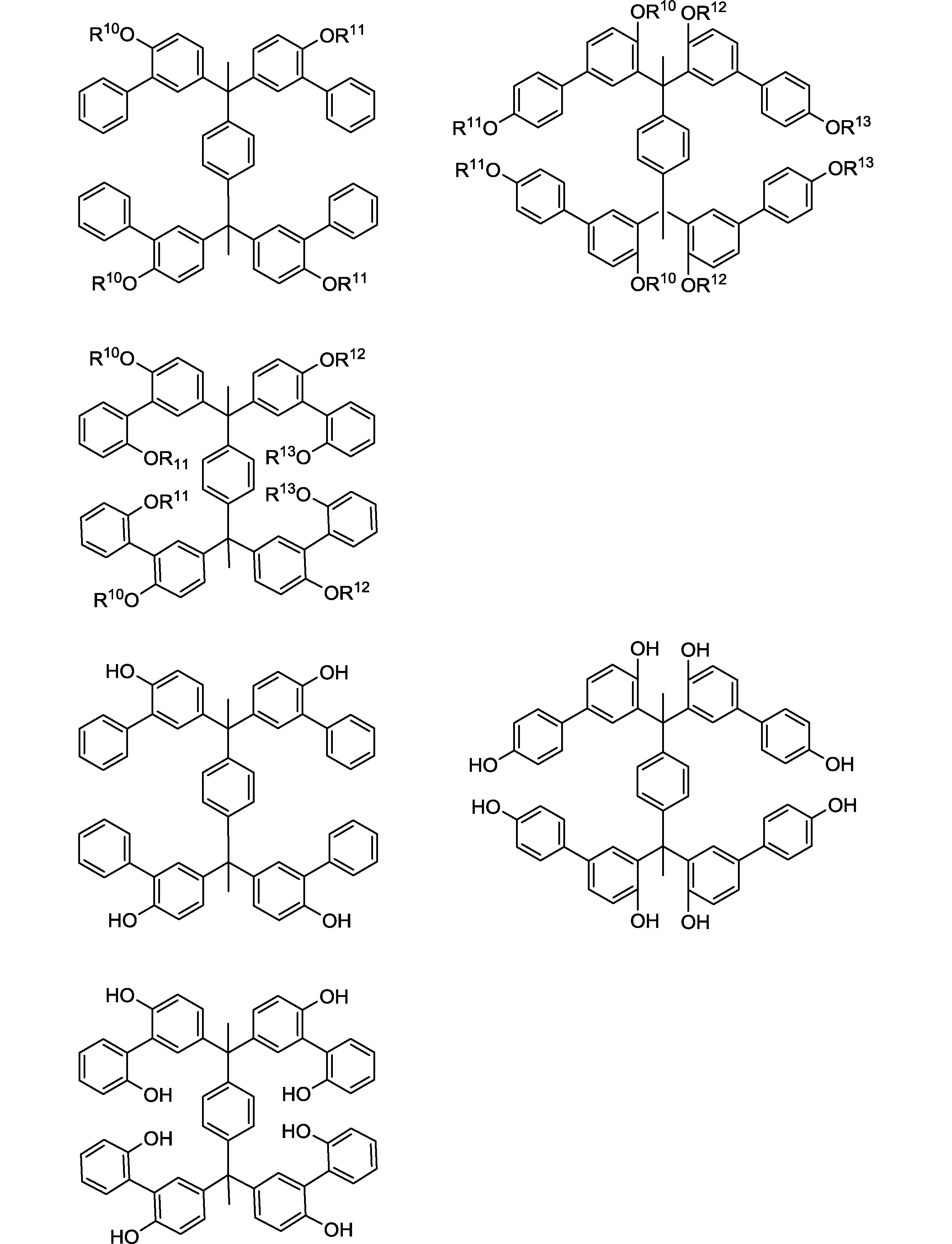


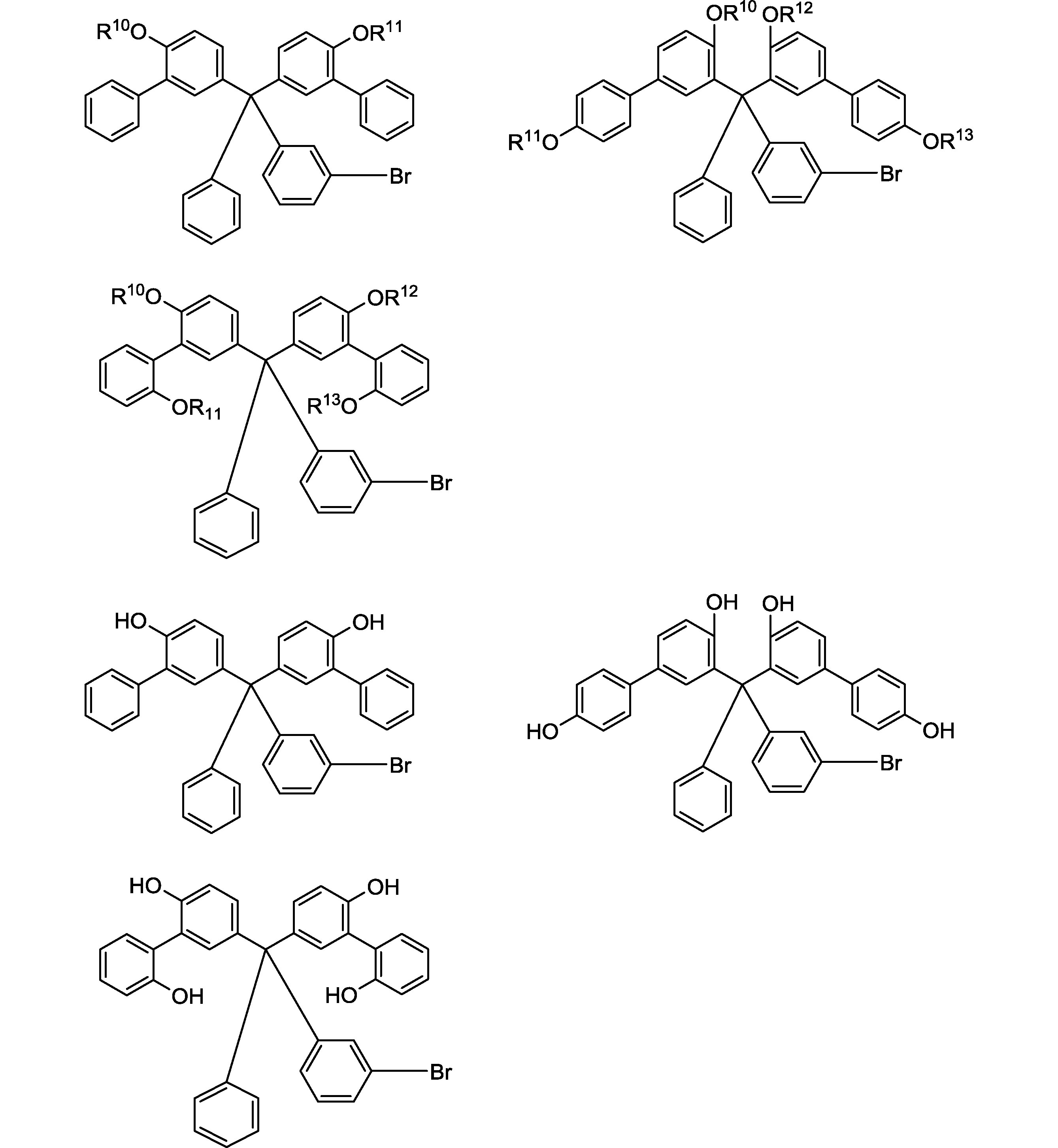
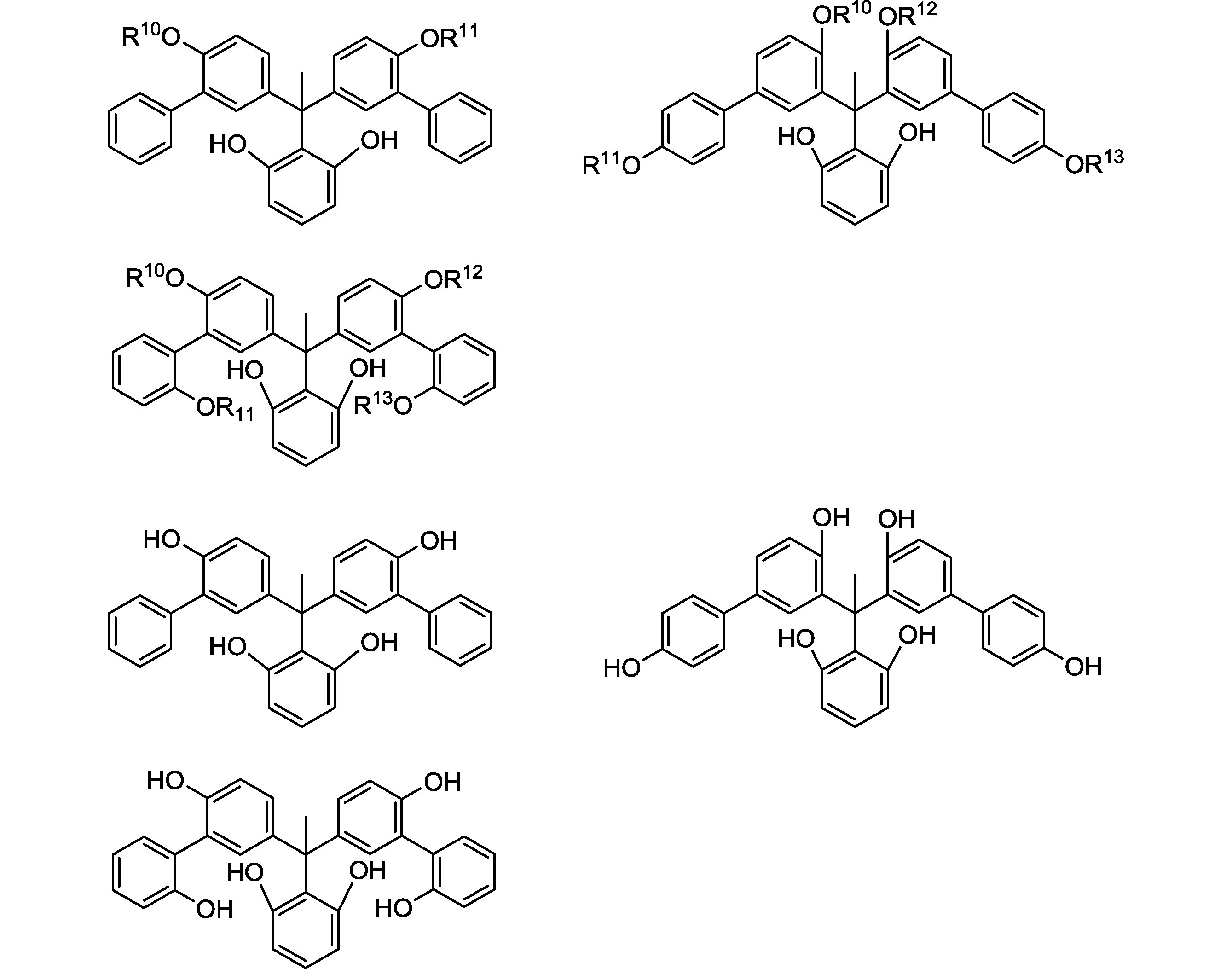

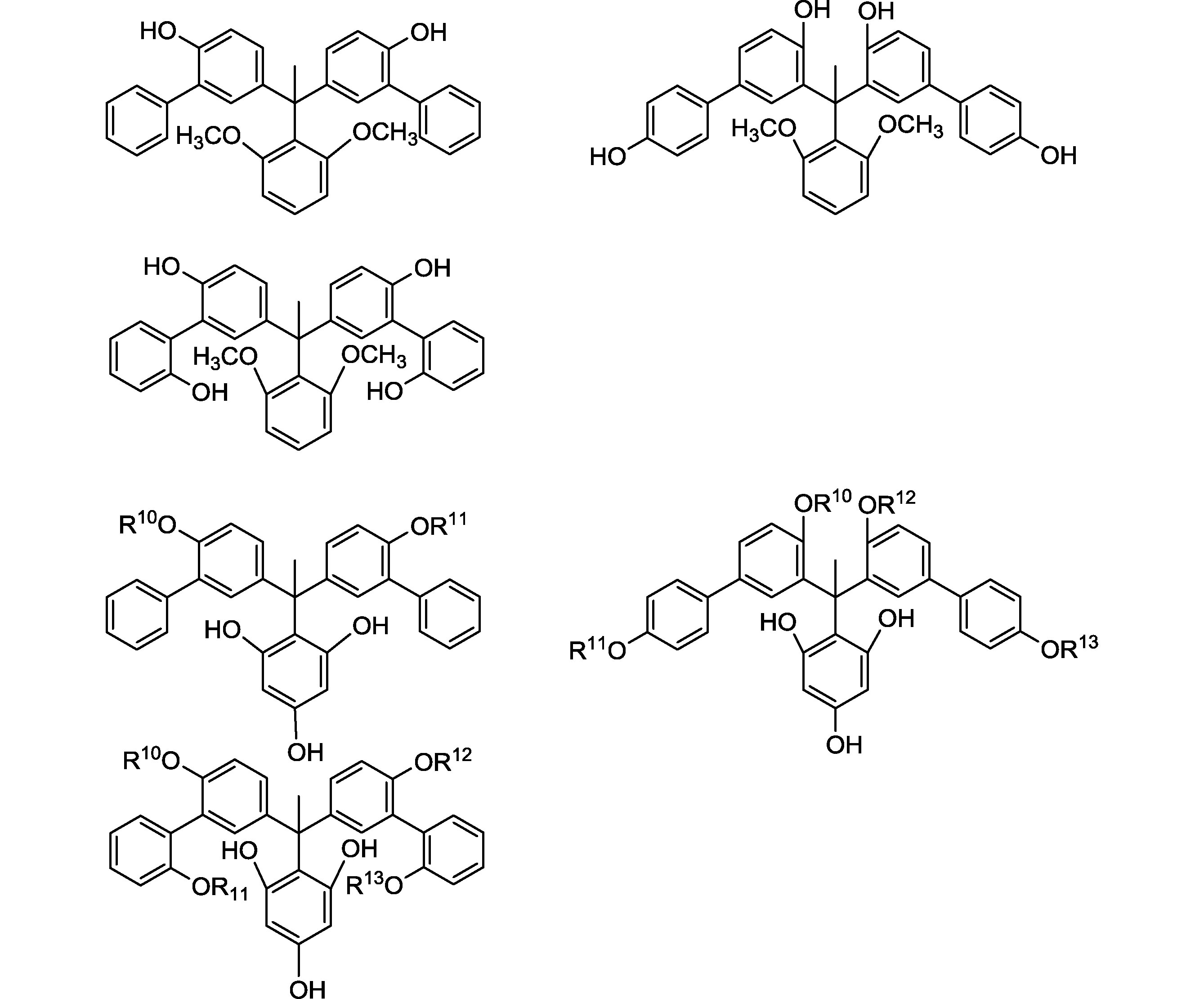

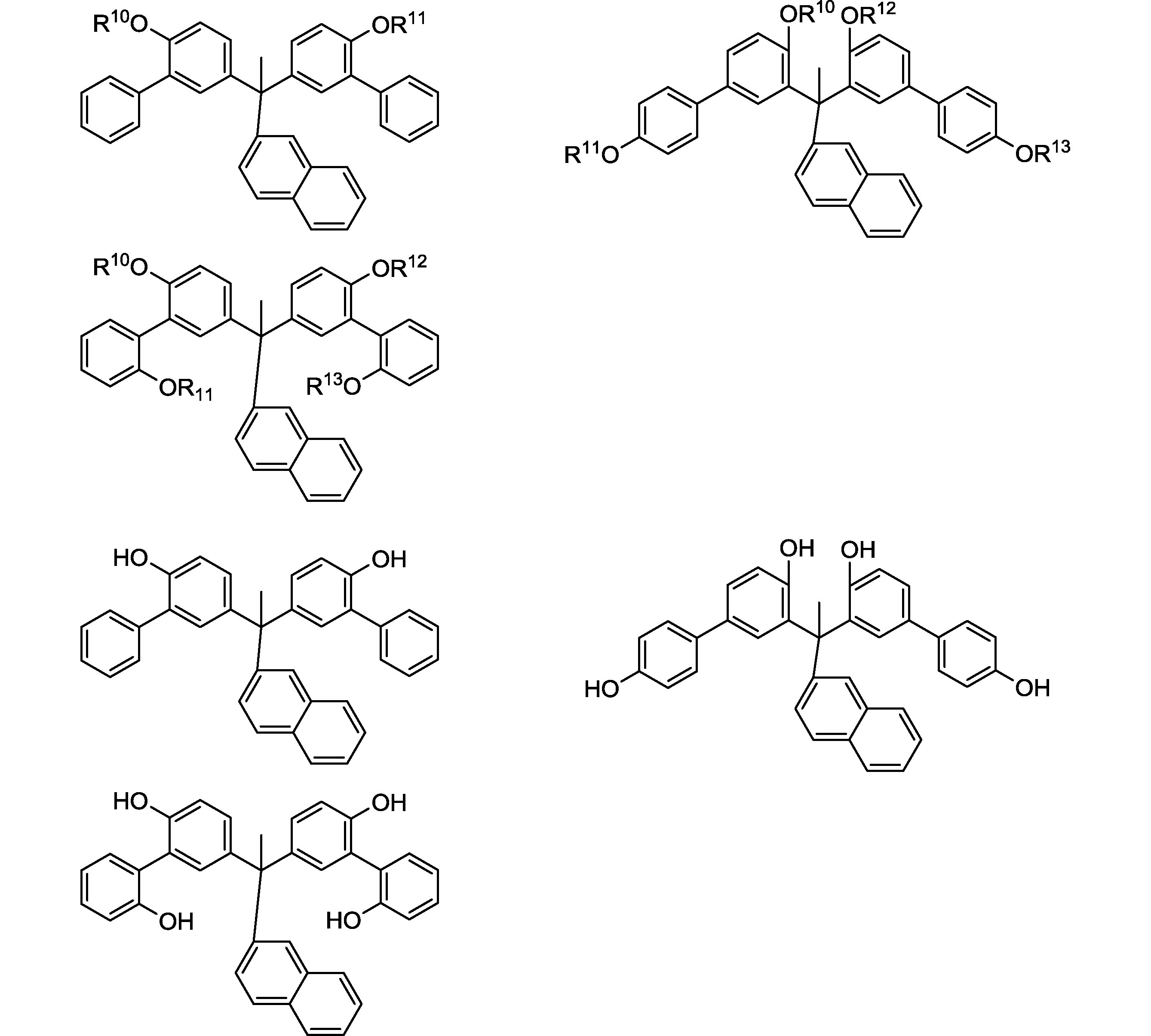


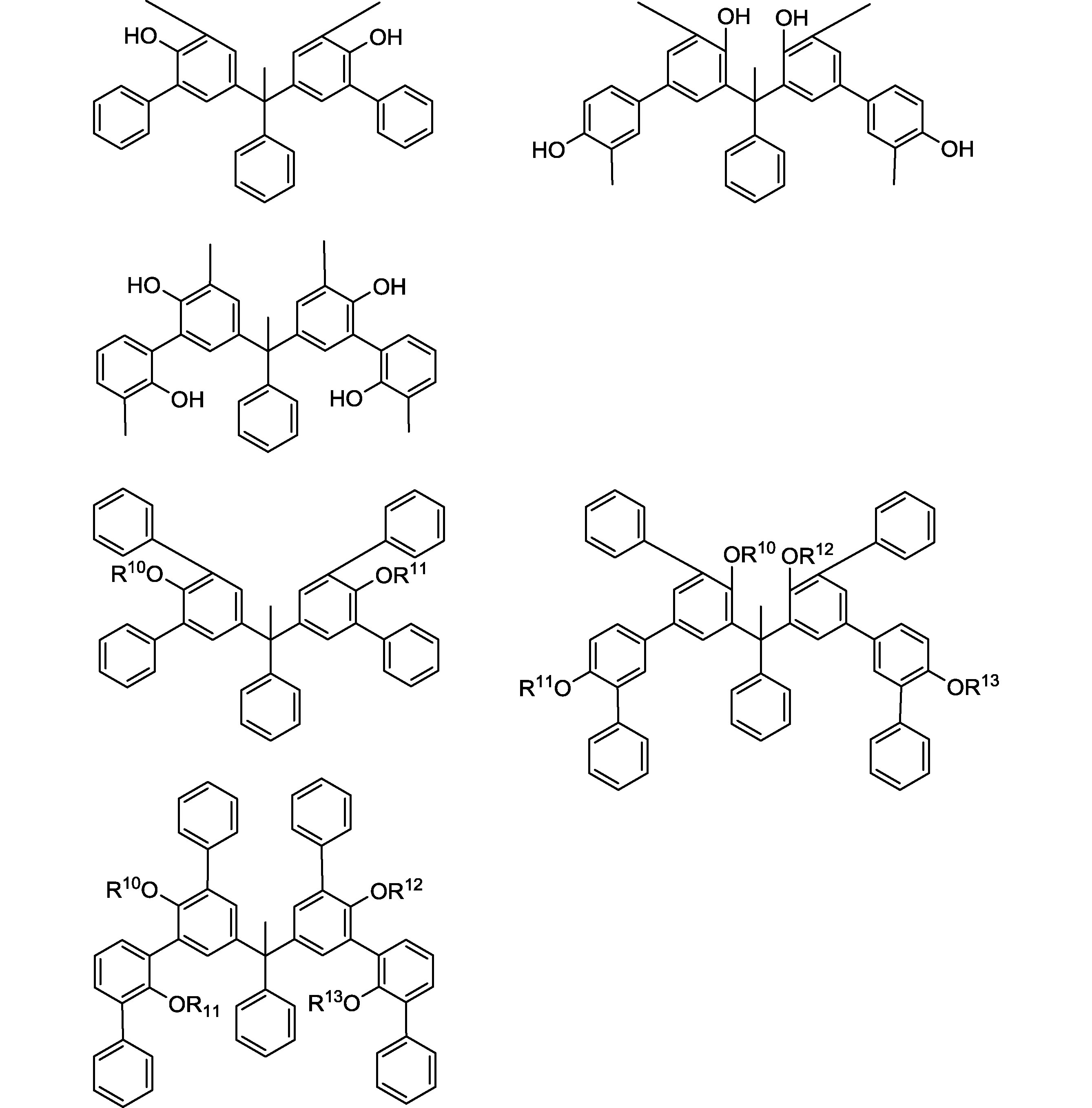


本実施形態で使用される式(1)で表される化合物は、公知の手法を応用して適宜合成することができ、その合成手法は特に限定されない。例えば、(i)ビフェノール類、ビナフトール類又はビアントラセンオールと、対応するケトン類とを酸触媒下にて重縮合反応させる方法、(ii)ビフェノール類、ビナフトール類又はビアントラセンオールと、対応するアルデヒド類とを酸触媒下にて重縮合し、得られたトリアリールメタン、又はキサンテン類のメチン部位を置換する方法がある。
ケトン類として、芳香環を有するケトンを用いることが、高い耐熱性及び高いエッチング耐性を兼備し好ましい。
なお、酸解離性基を導入するタイミングについては、ビナフトール類とケトン類との縮合反応後のみならず、縮合反応の前段階でもよい。また、後述する樹脂の製造を行ったのちに行ってもよい。
前記式(1)で表される化合物は、リソグラフィー用膜形成組成物として、そのまま使用することができる。また、前記式(1)で表される化合物をモノマーとして得られる樹脂としても使用することができる。例えば、前記式(1)で表される化合物と架橋反応性のある化合物とを反応させて得られる樹脂としても使用することができる。
前記式(1)で表される化合物をモノマーとして得られる樹脂としては、例えば、以下の式(3)に表される構造を有するものが挙げられる。すなわち、本実施形態のリソグラフィー用膜形成組成物は、下記式(3)に表される構造を有する樹脂を含有するものであってもよい。
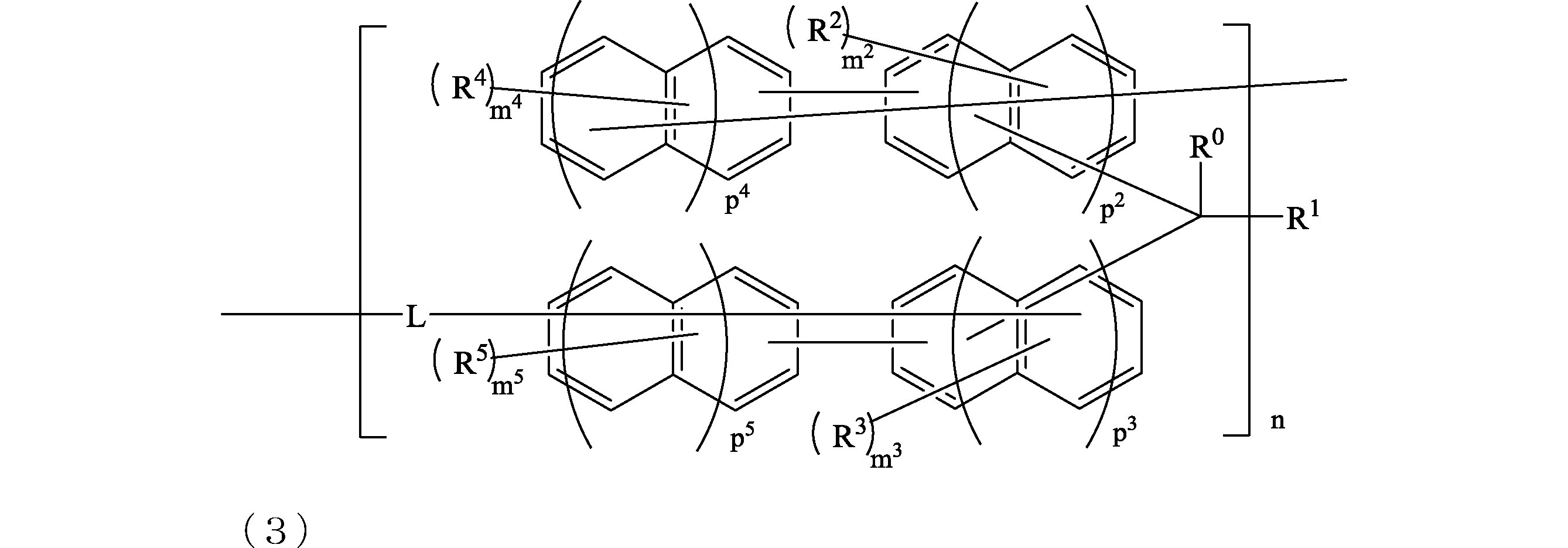
本実施形態の樹脂は、前記式(1)で表される化合物を架橋反応性のある化合物と反応させることにより得られる。架橋反応性のある化合物としては、前記式(1)で表される化合物をオリゴマー化又はポリマー化し得るものである限り、公知のものを特に制限なく使用することができる。その具体例としては、例えば、アルデヒド、ケトン、カルボン酸、カルボン酸ハライド、ハロゲン含有化合物、アミノ化合物、イミノ化合物、イソシアネート、不飽和炭化水素基含有化合物等が挙げられるが、これらに特に限定されない。
本実施形態の化合物は、下記式(2)で表されることが好ましい。本実施形態の化合物は、下記構造を有するため、さらに耐熱性が高く、溶媒溶解性も高い。
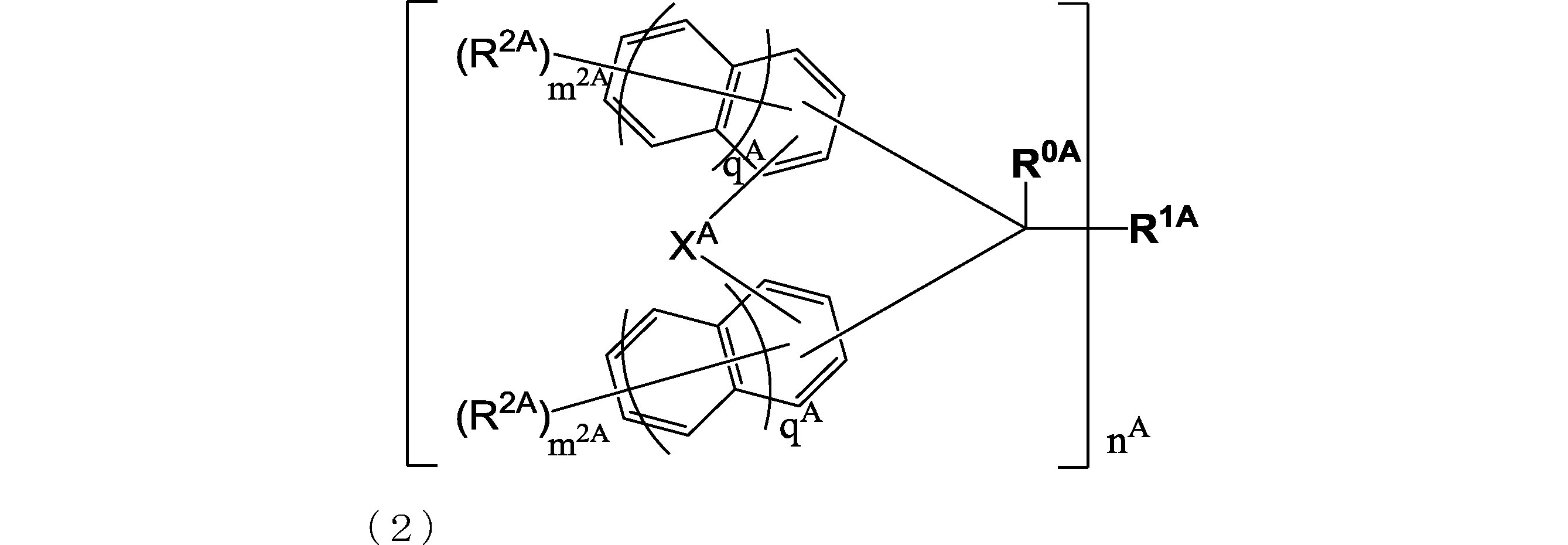
R1Aは、炭素数1~60のnA価の基又は単結合であり、
R2Aは、各々独立して、炭素数1~30の直鎖状、分岐状若しくは環状のアルキル基、炭素数6~30のアリール基、炭素数2~30のアルケニル基、ハロゲン原子、シアノ基、水酸基又は水酸基の水素原子が酸解離性基で置換された基であり、同一のナフタレン環又はベンゼン環において同一であっても異なっていてもよい。但し、式(2)中、R2Aの少なくとも1つは水酸基又は水酸基の水素原子が酸解離性基で置換された基である。
nAは1~4の整数であり、ここで、式(2)中、nAが2以上の整数の場合、nA個の[ ]内の構造式は同一であっても異なっていてもよい。
XAは、各々独立して、酸素原子、硫黄原子又は無架橋であることを表す。ここで、XAが酸素原子又は硫黄原子である場合、高い耐熱性を発現する傾向にあるため好ましく、酸素原子であることがより好ましい。XAは、溶解性の観点からは、無架橋であることが好ましい。
m2Aは、各々独立して、0~6の整数である。但し、少なくとも1つのm2Aは1~6の整数である。
qAは、各々独立して、0又は1である。なお、qAが0の場合には式(2)でナフタレン構造で示される部位は、ベンゼン構造を示し、qAが1の場合にはナフタレン構造を示す。
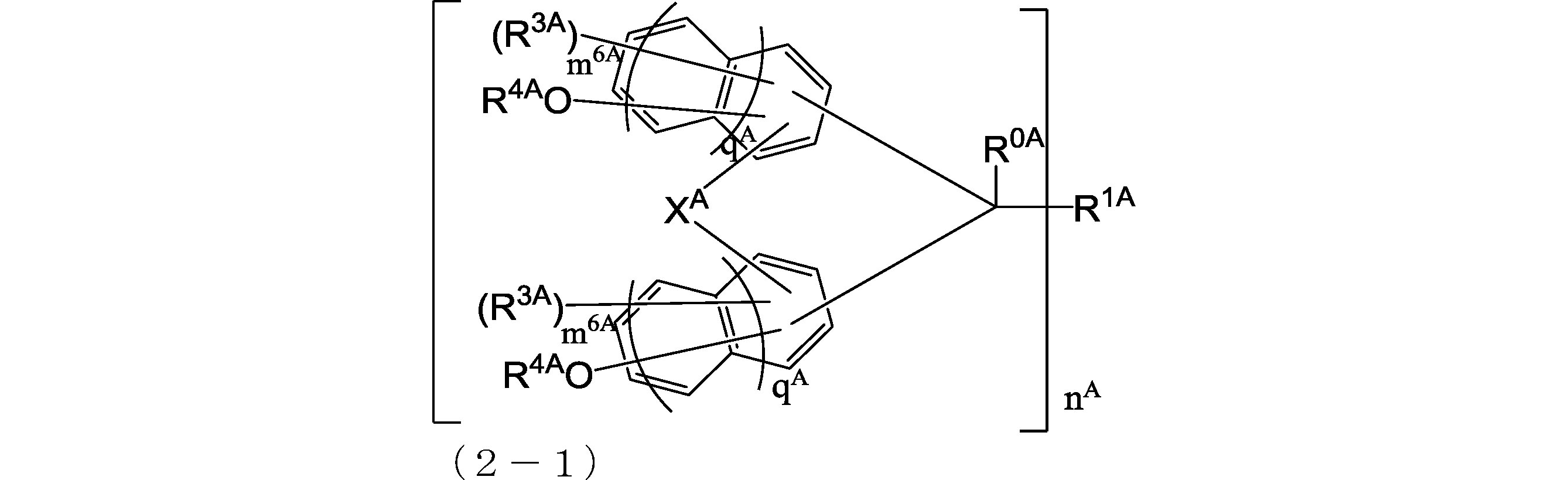
R3Aは、各々独立して、ハロゲン原子、炭素数1~30の直鎖状、分岐状若しくは環状のアルキル基、炭素数6~30のアリール基、又は炭素数2~30のアルケニル基であり、同一のナフタレン環又はベンゼン環において同一であっても異なっていてもよい。
R4Aは、各々独立して、水素原子又は酸解離性基である。
m6Aは、各々独立して、0~5の整数である。
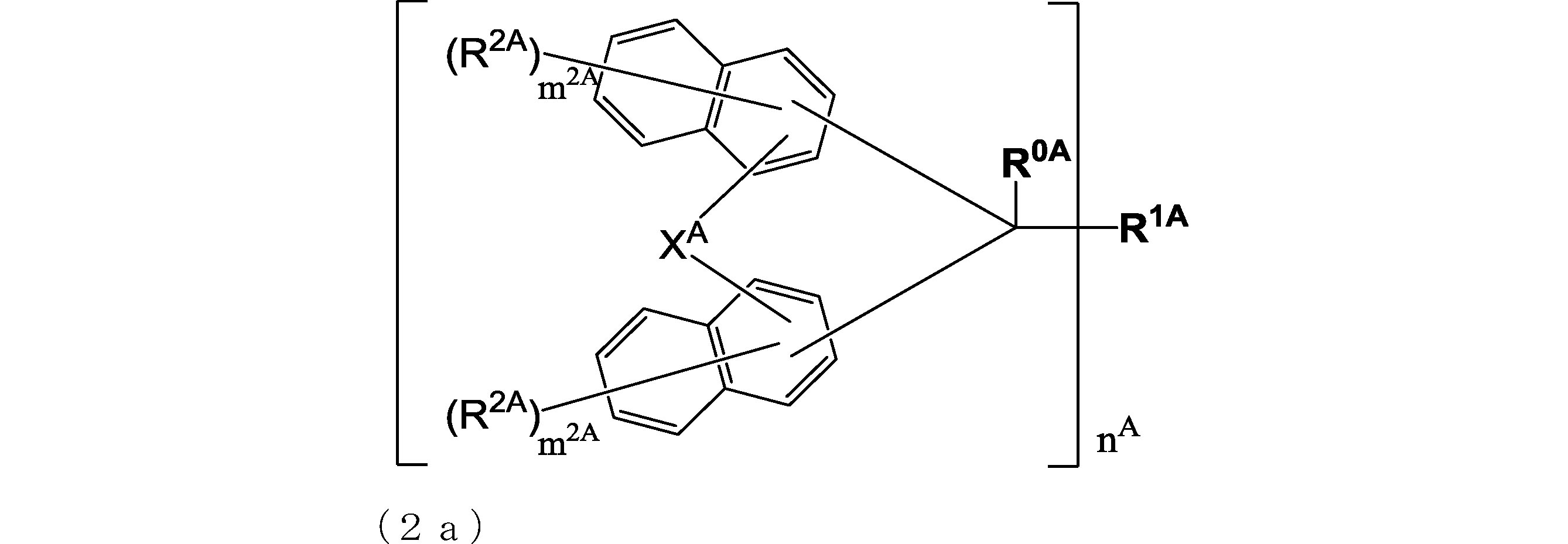
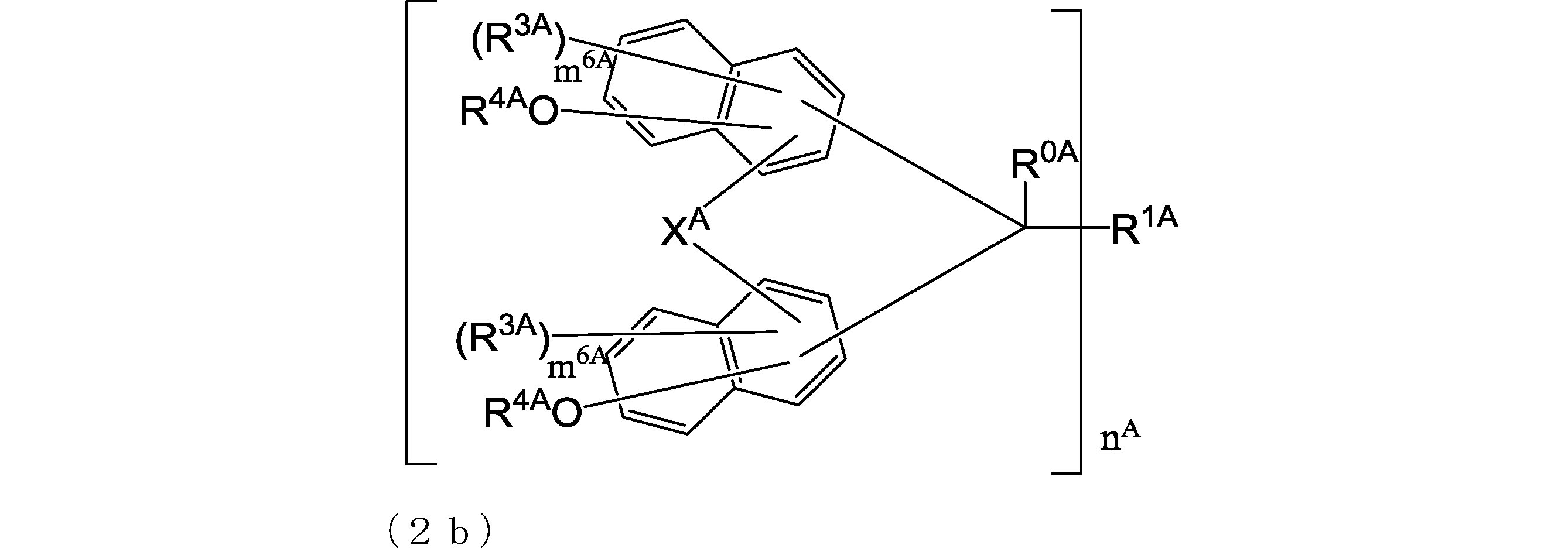
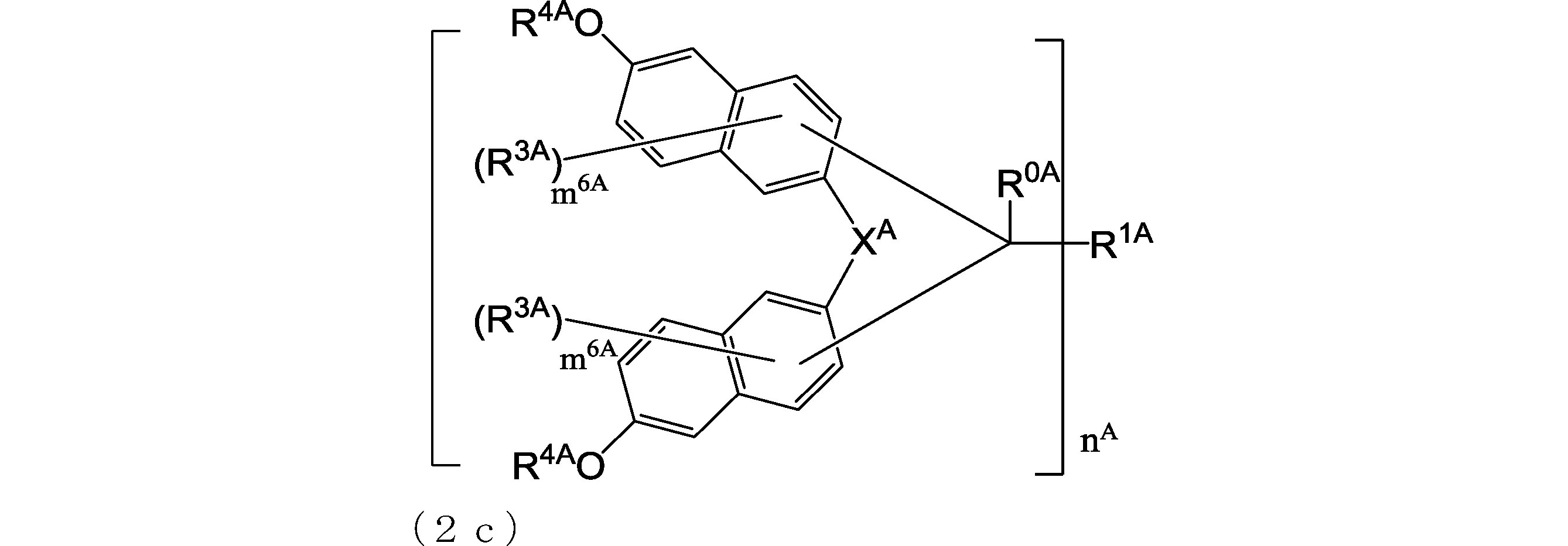

R0Aは、例えば、メチル基、エチル基、プロピル基、ブチル基、ペンチル基、ヘキシル基、ヘプチル基、オクチル基、ノニル基、デシル基、ウンデシル基、ドデシル基、トリアコンチル基、フェニル基、ナフチル基、アントラセン基、ピレニル基、ビフェニル基、ヘプタセン基が挙げられる。
R3A'は、例えば、メチル基、エチル基、プロピル基、ブチル基、ペンチル基、ヘキシル基、ヘプチル基、オクチル基、ノニル基、デシル基、ウンデシル基、ドデシル基、トリアコンチル基、シクロプロピル基、シクロブチル基、シクロペンチル基、シクロヘキシル基、シクロヘプチル基、シクロオクチル基、シクロノニル基、シクロデシル基、シクロウンデシル基、シクロドデシル基、シクロトリアコンチル基、ノルボルニル基、アダマンチル基、フェニル基、ナフチル基、アントラセン基、ピレニル基、ビフェニル基、ヘプタセン基、ビニル基、アリル基、トリアコンテニル基、メトキシ基、エトキシ基、トリアコンチキシ基、フッ素原子、塩素原子、臭素原子、ヨウ素原子が挙げられる。
前記R0A、R3A'の各例示は、異性体を含んでいる。例えば、ブチル基には、n-ブチル基、イソブチル基、sec-ブチル基、tert-ブチル基を含んでいる。
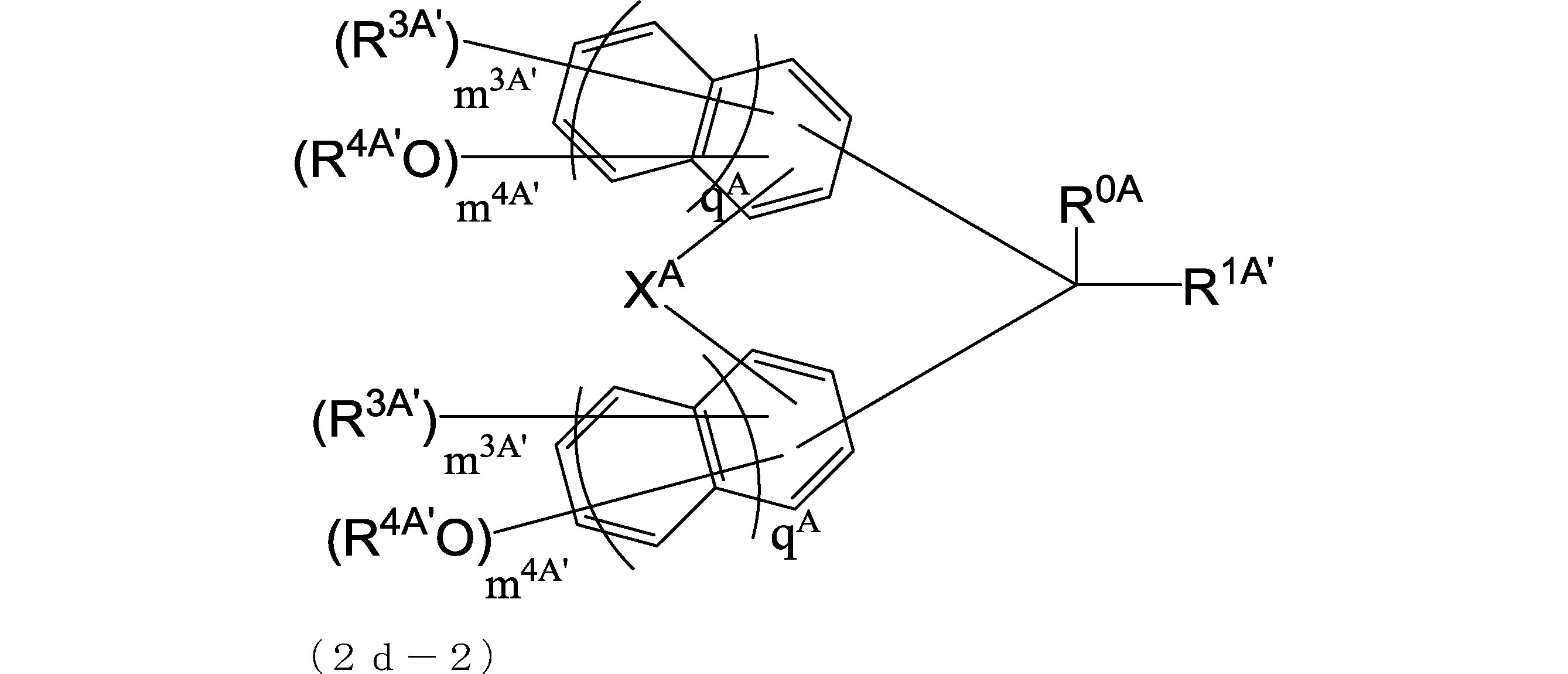
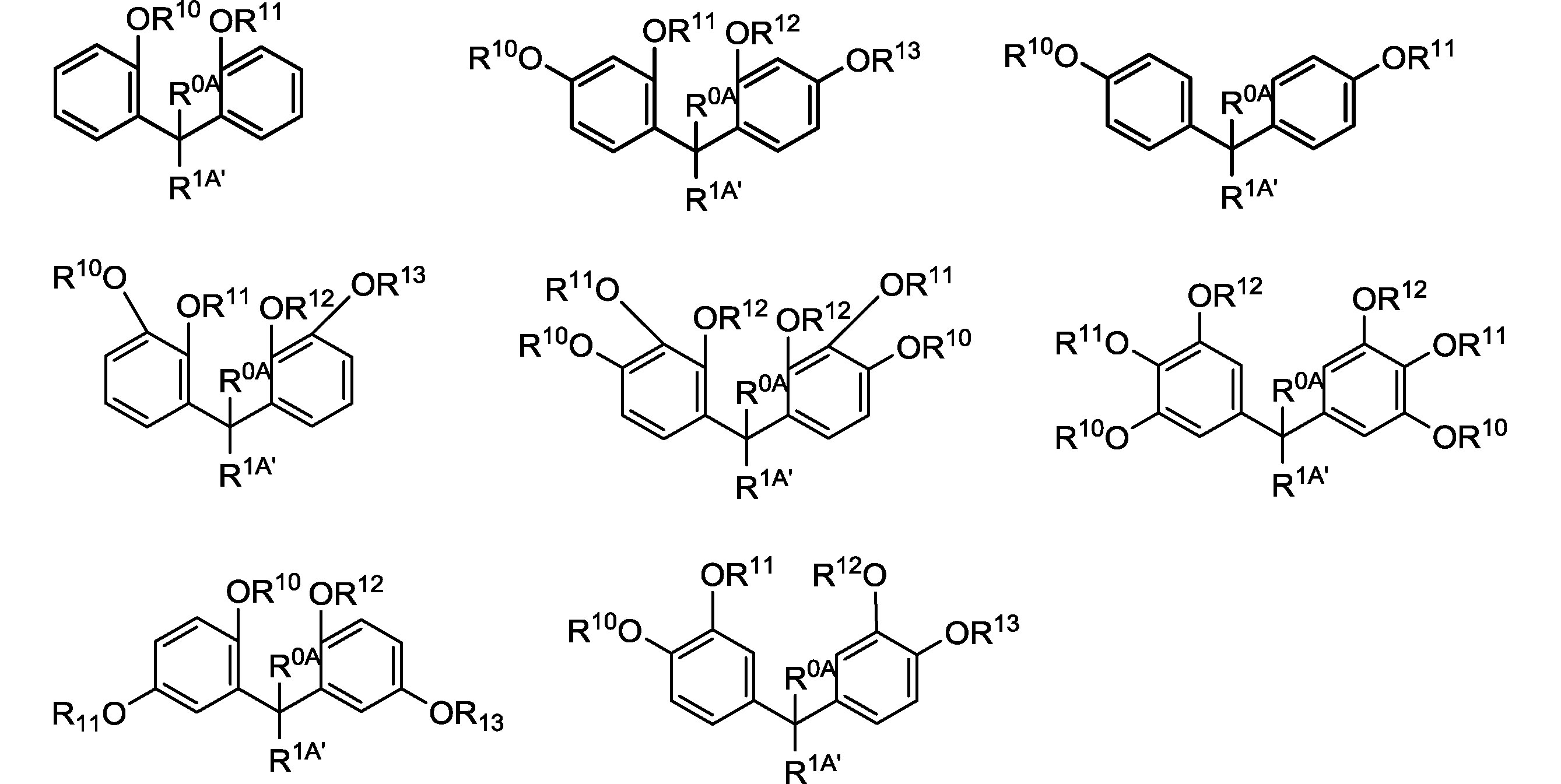
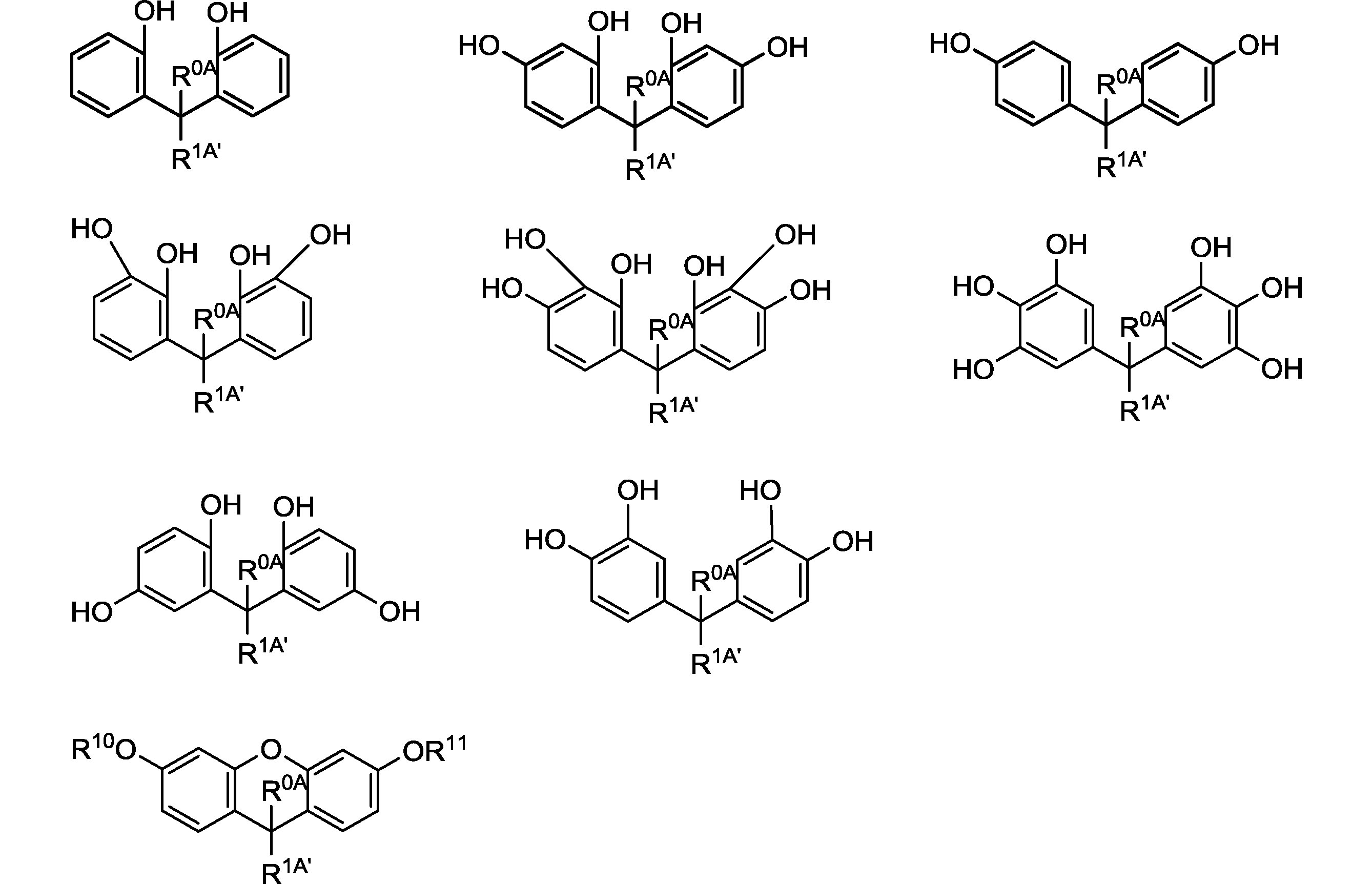

前記化合物は、キサンテン骨格を有する方が耐熱性の観点から好ましい。
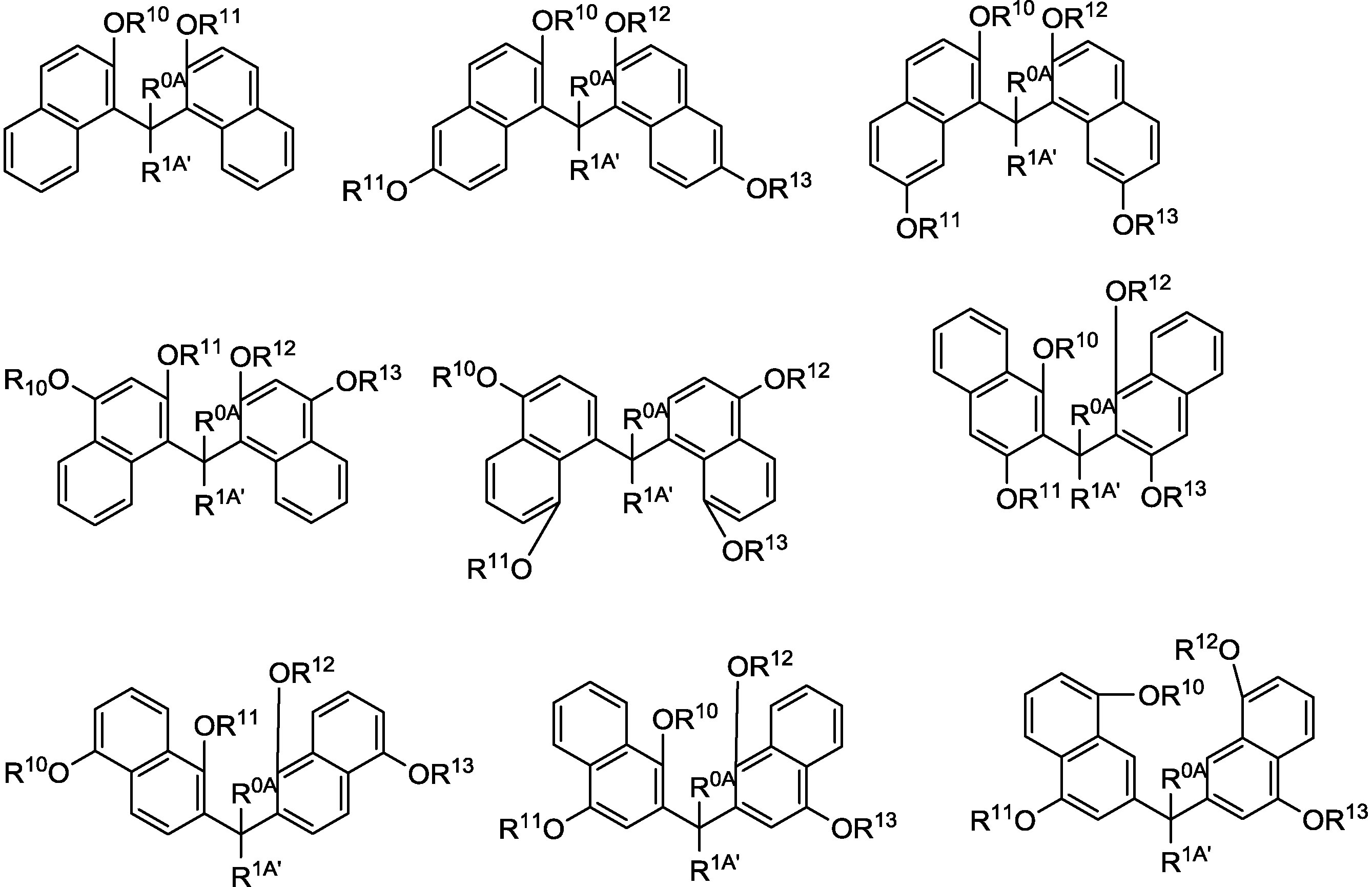
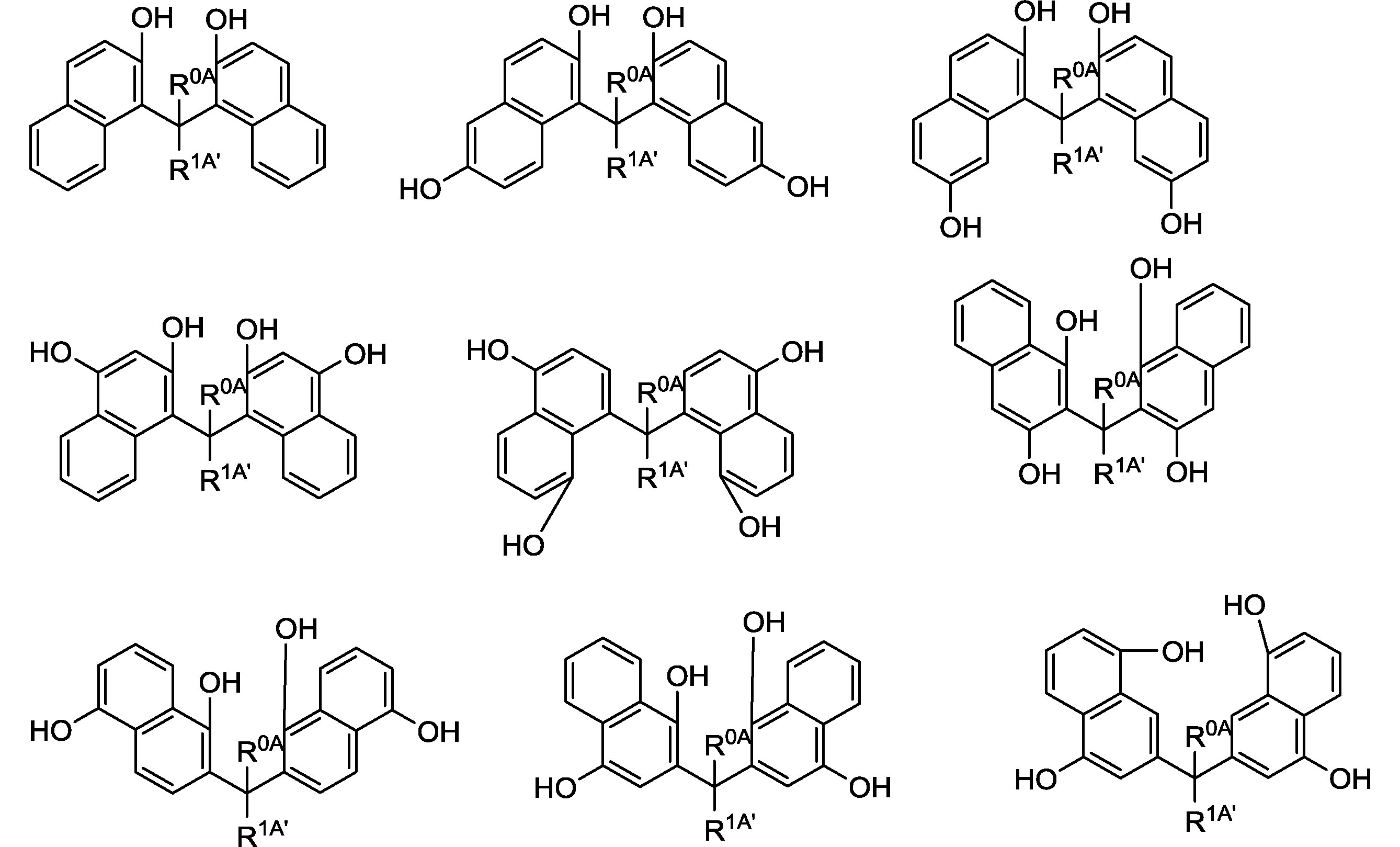


前記化合物は、ジベンゾキサンテン骨格を有する方が耐熱性の観点から好ましい。
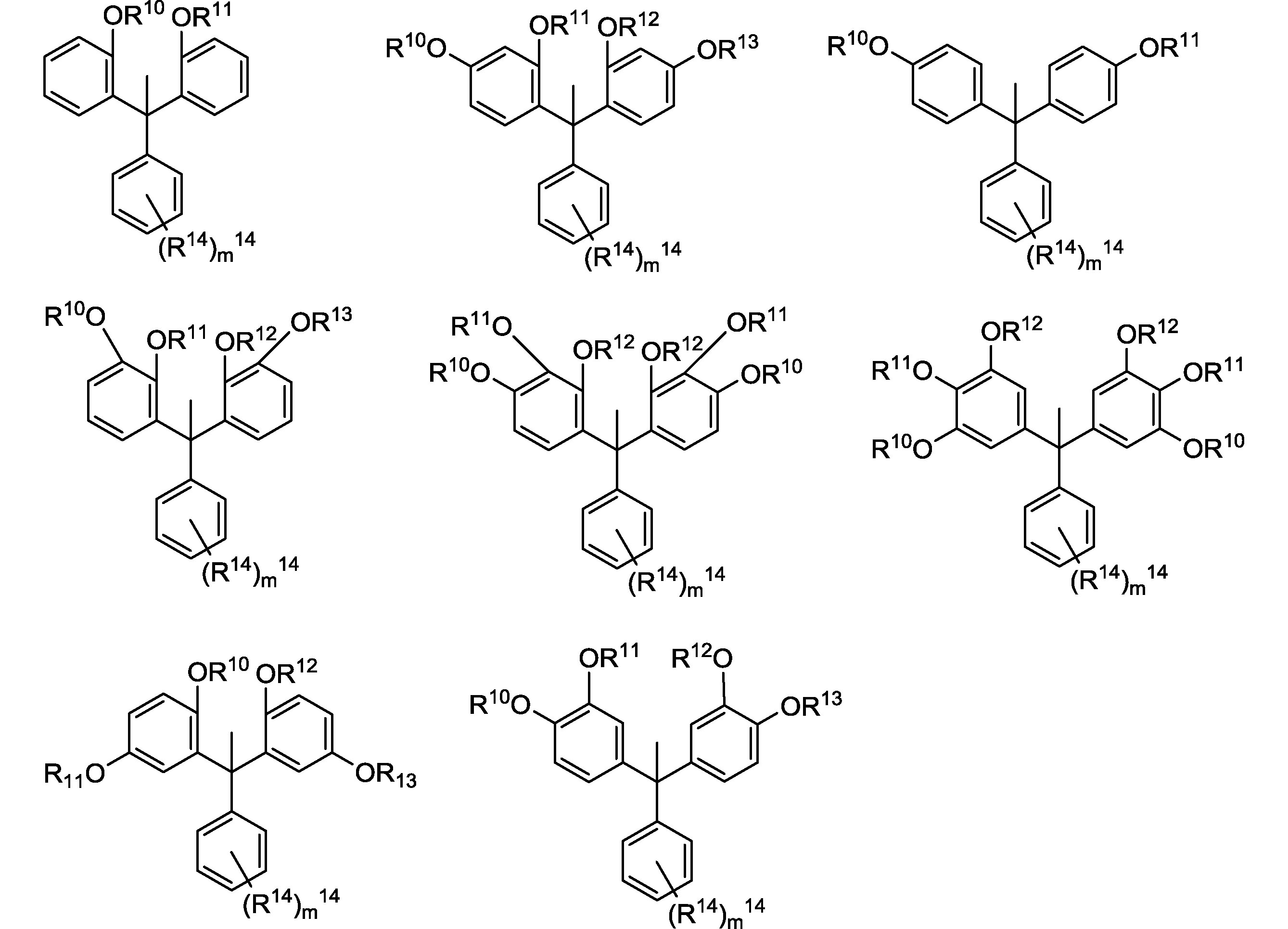
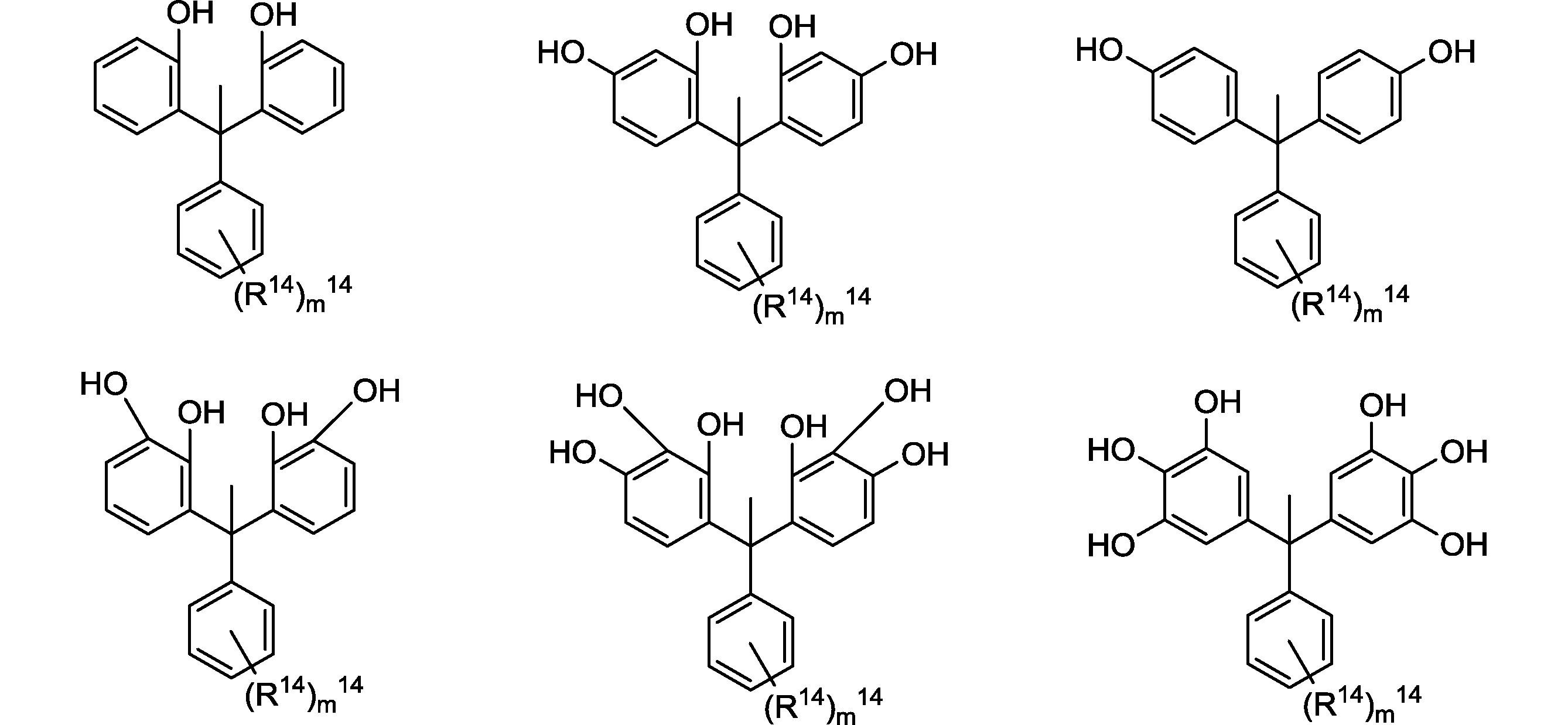


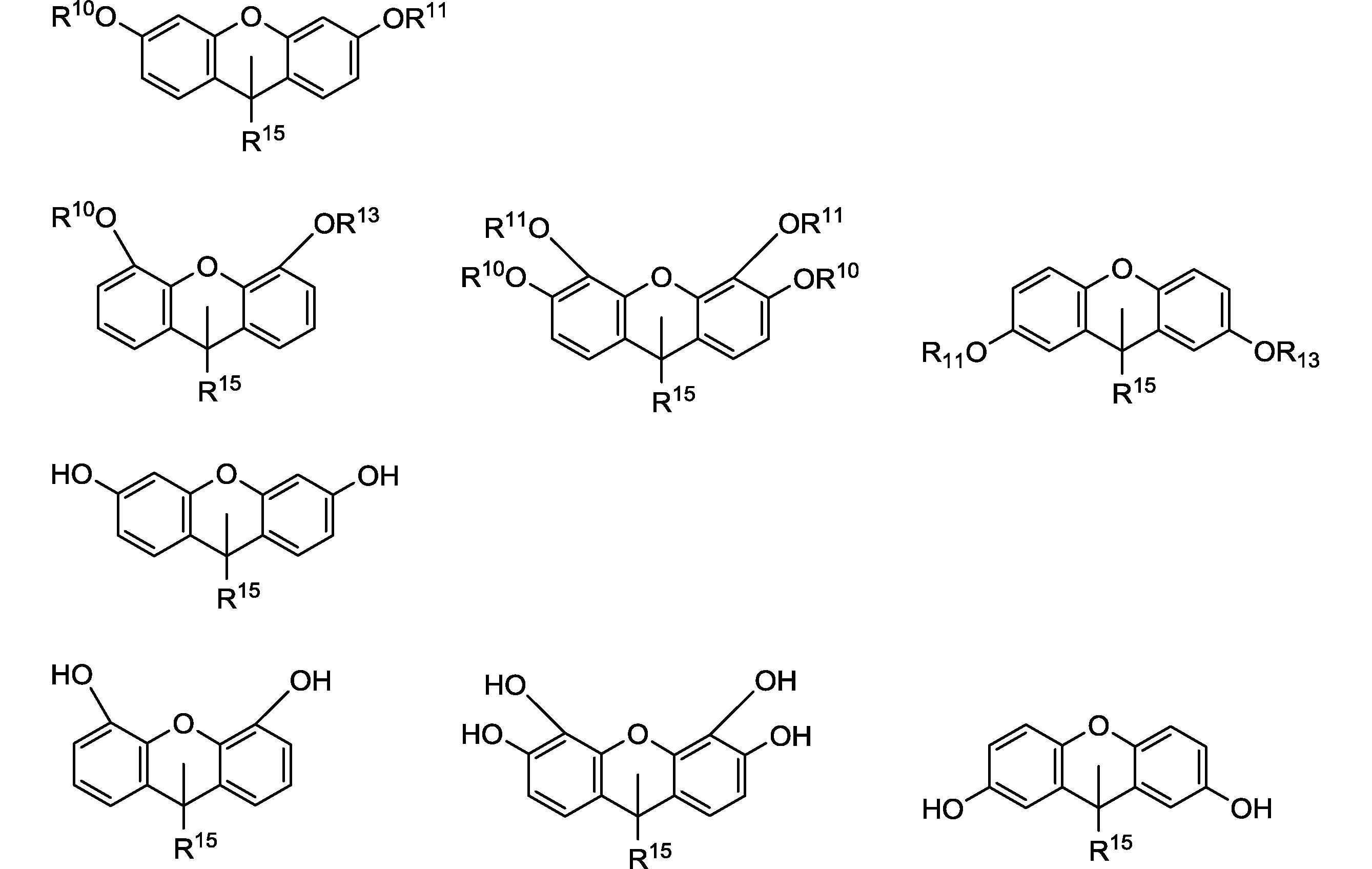


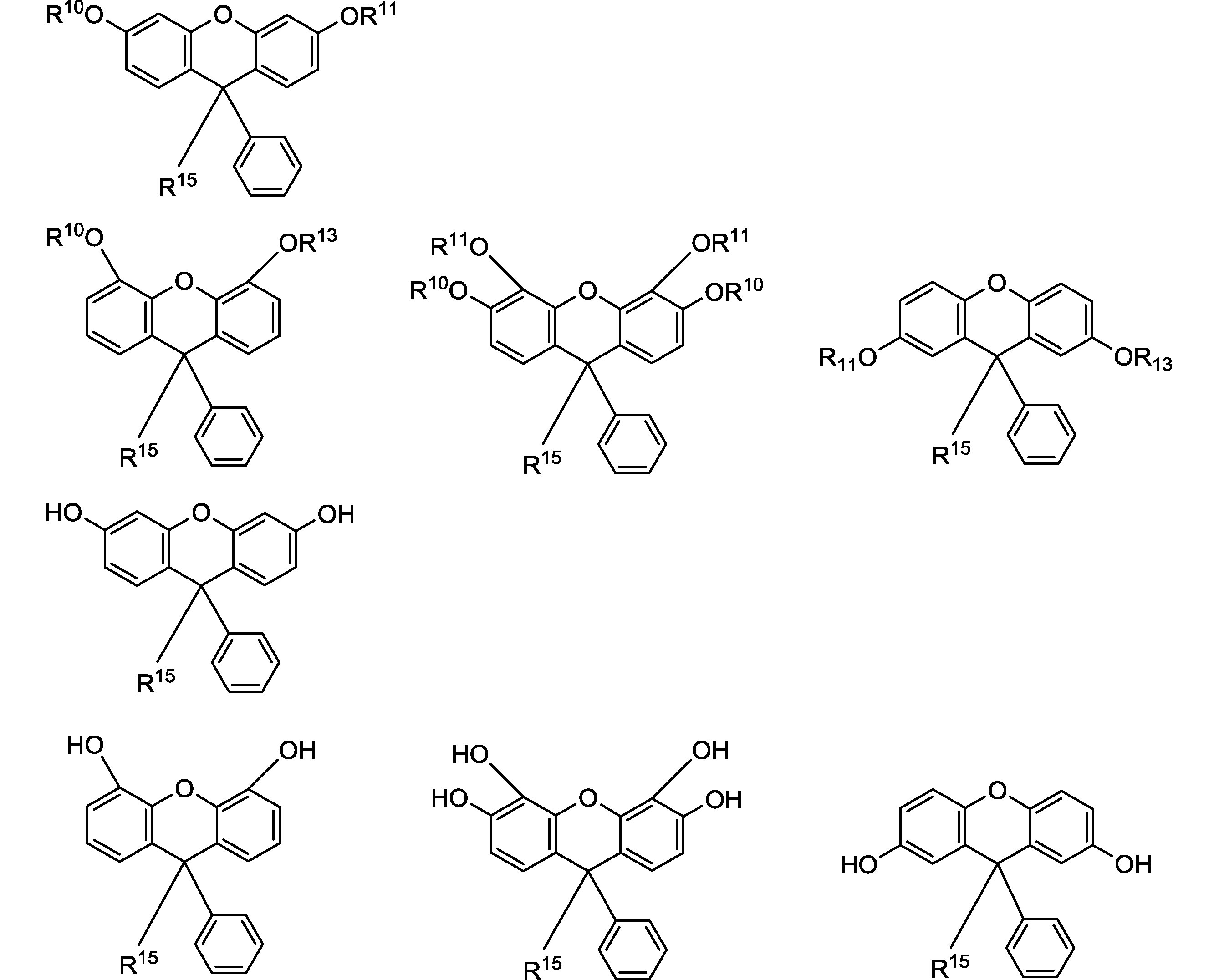
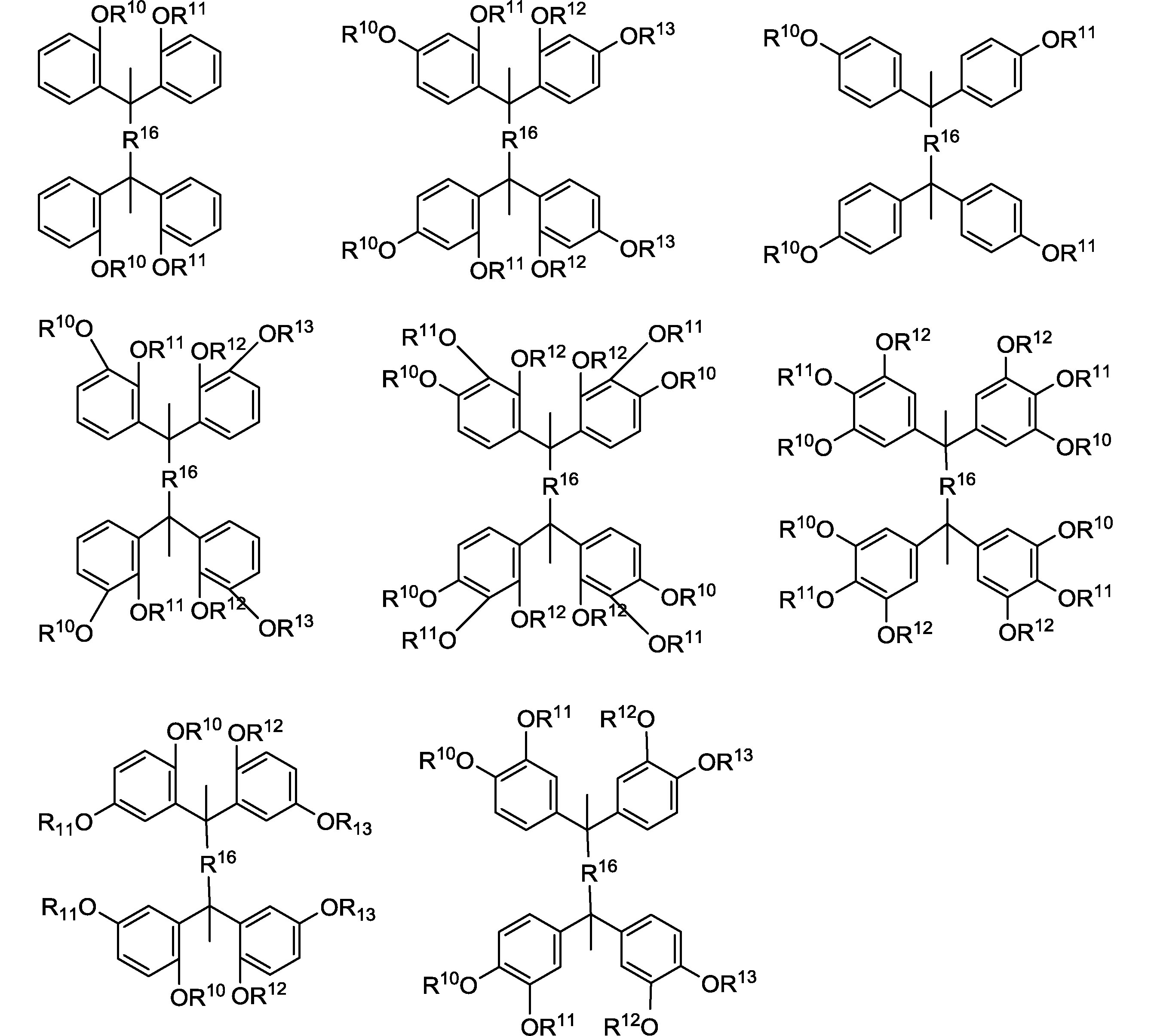
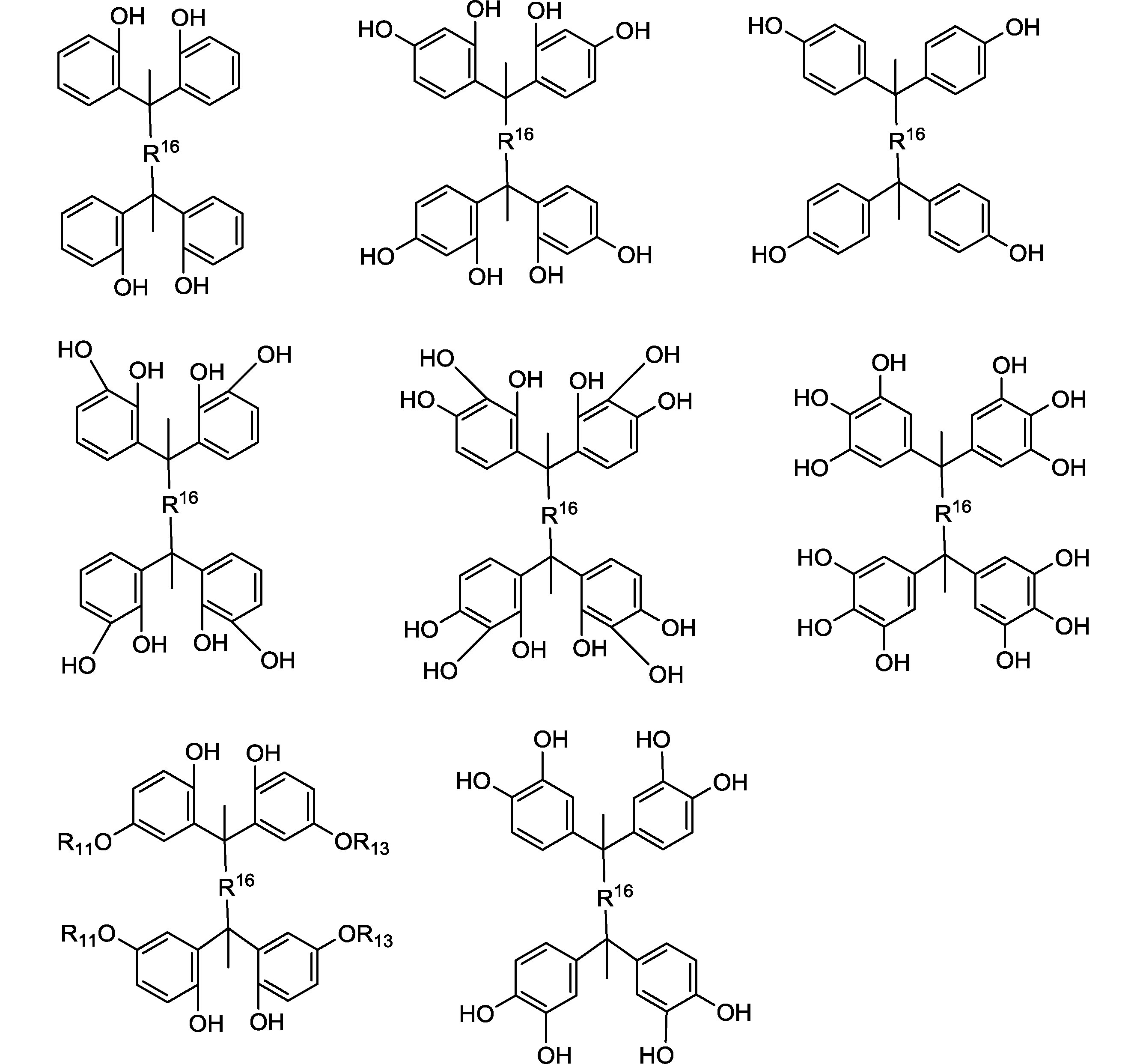
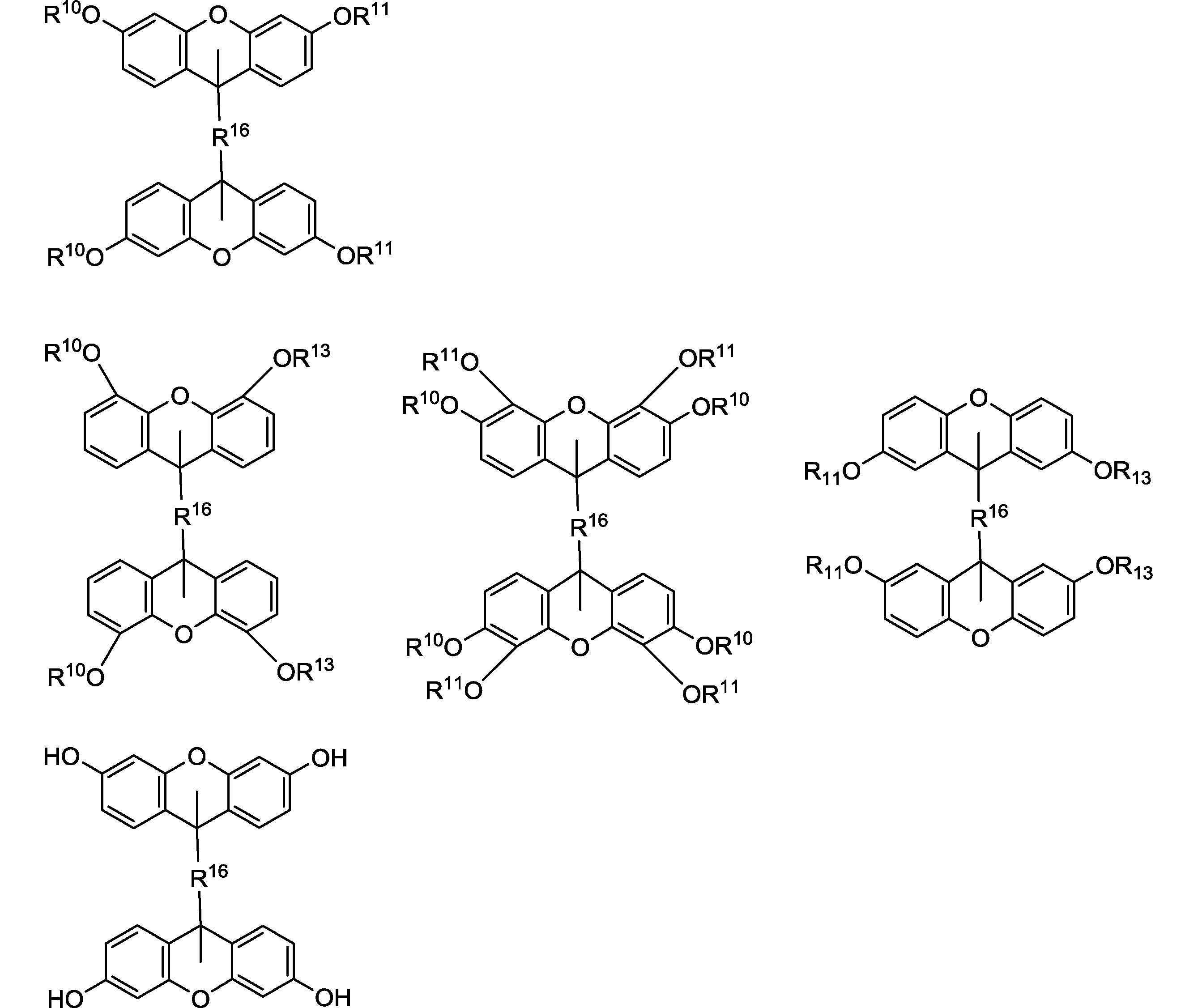
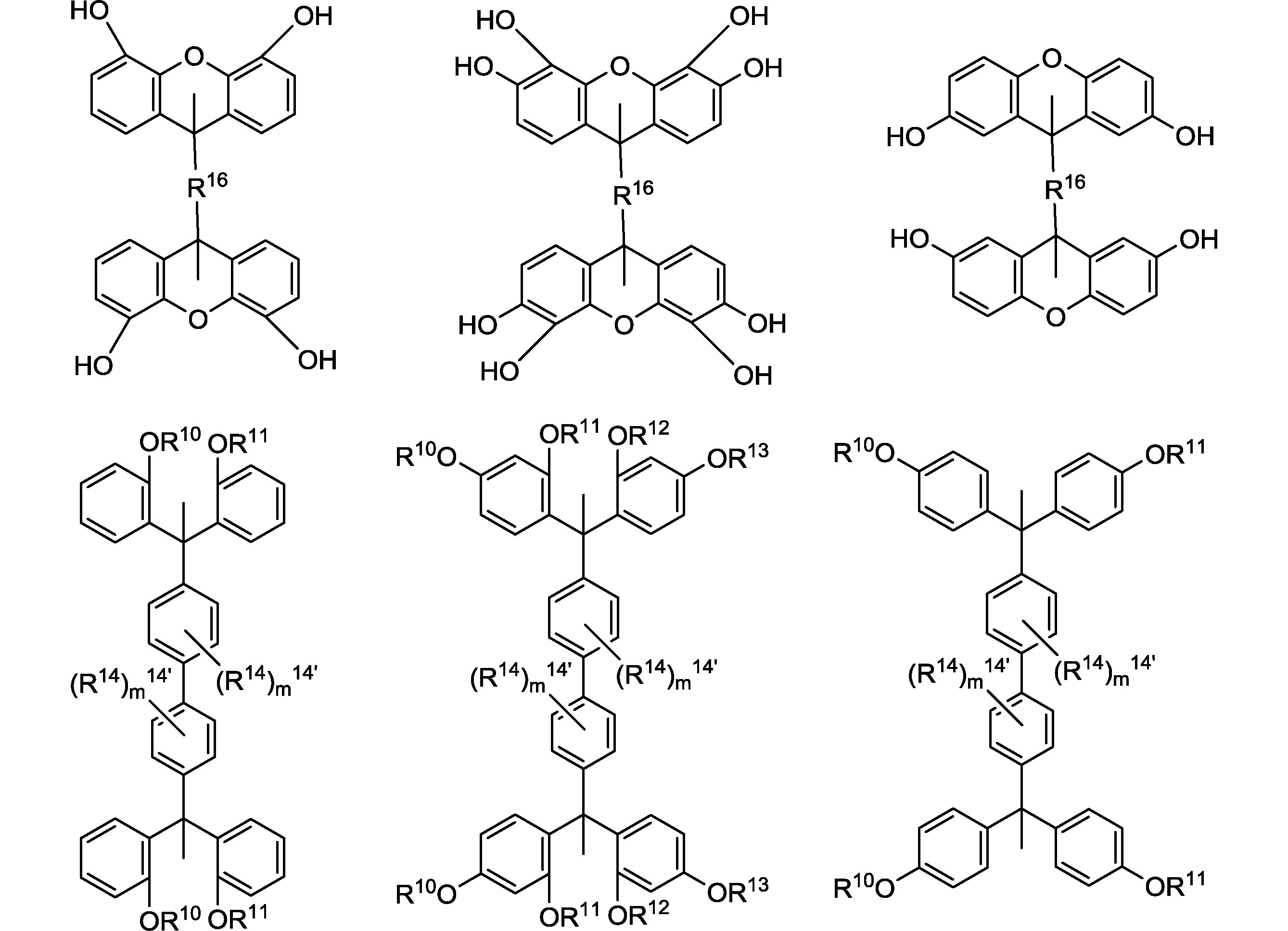


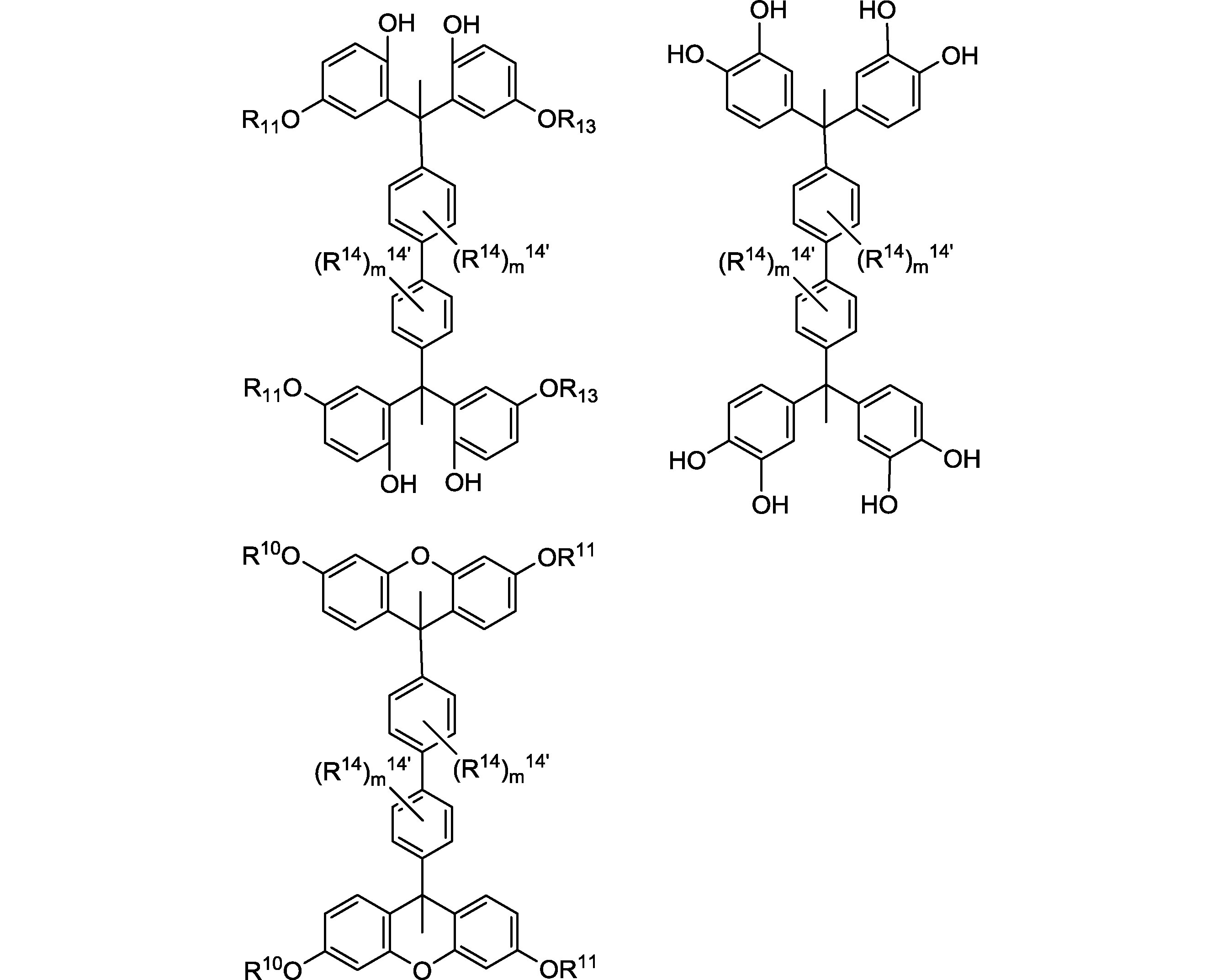

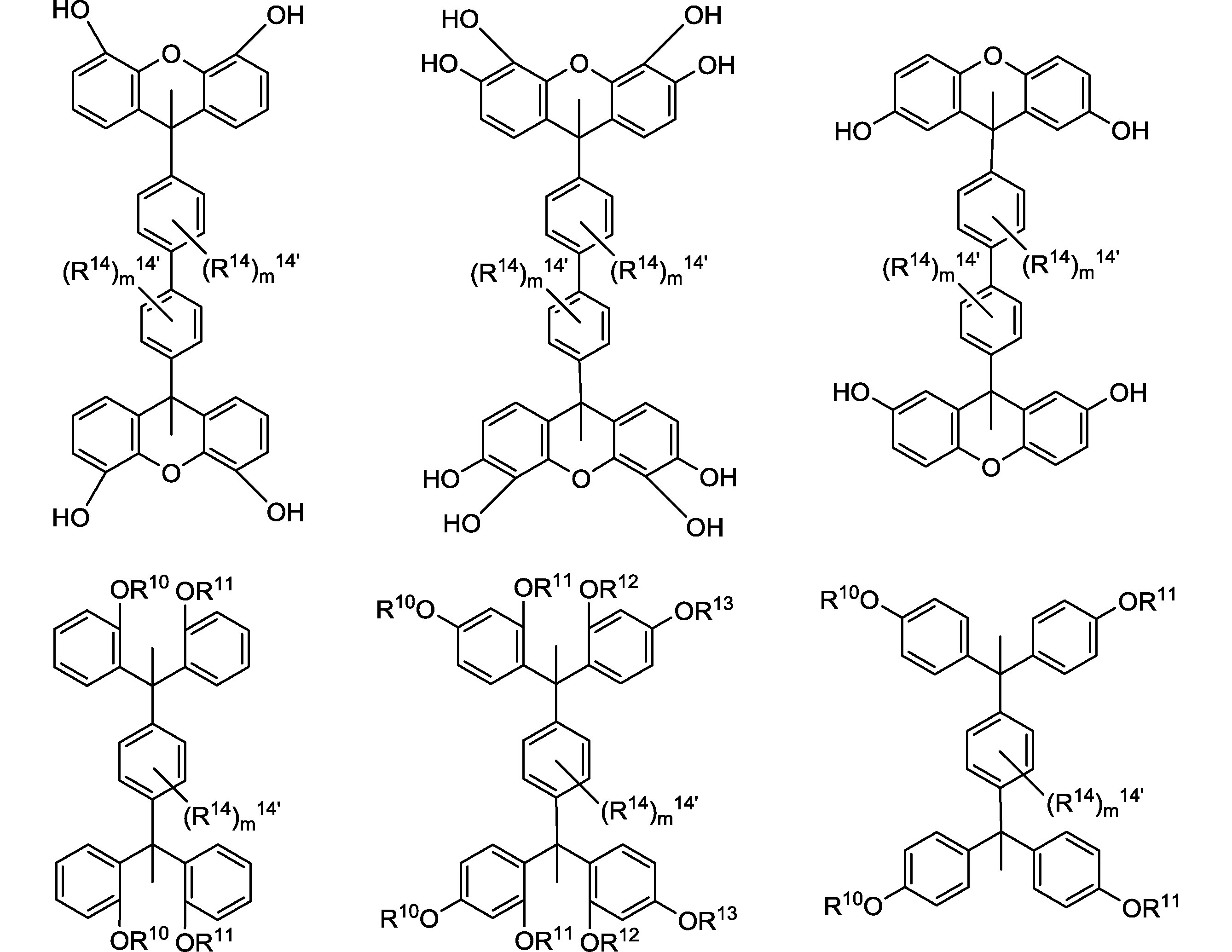


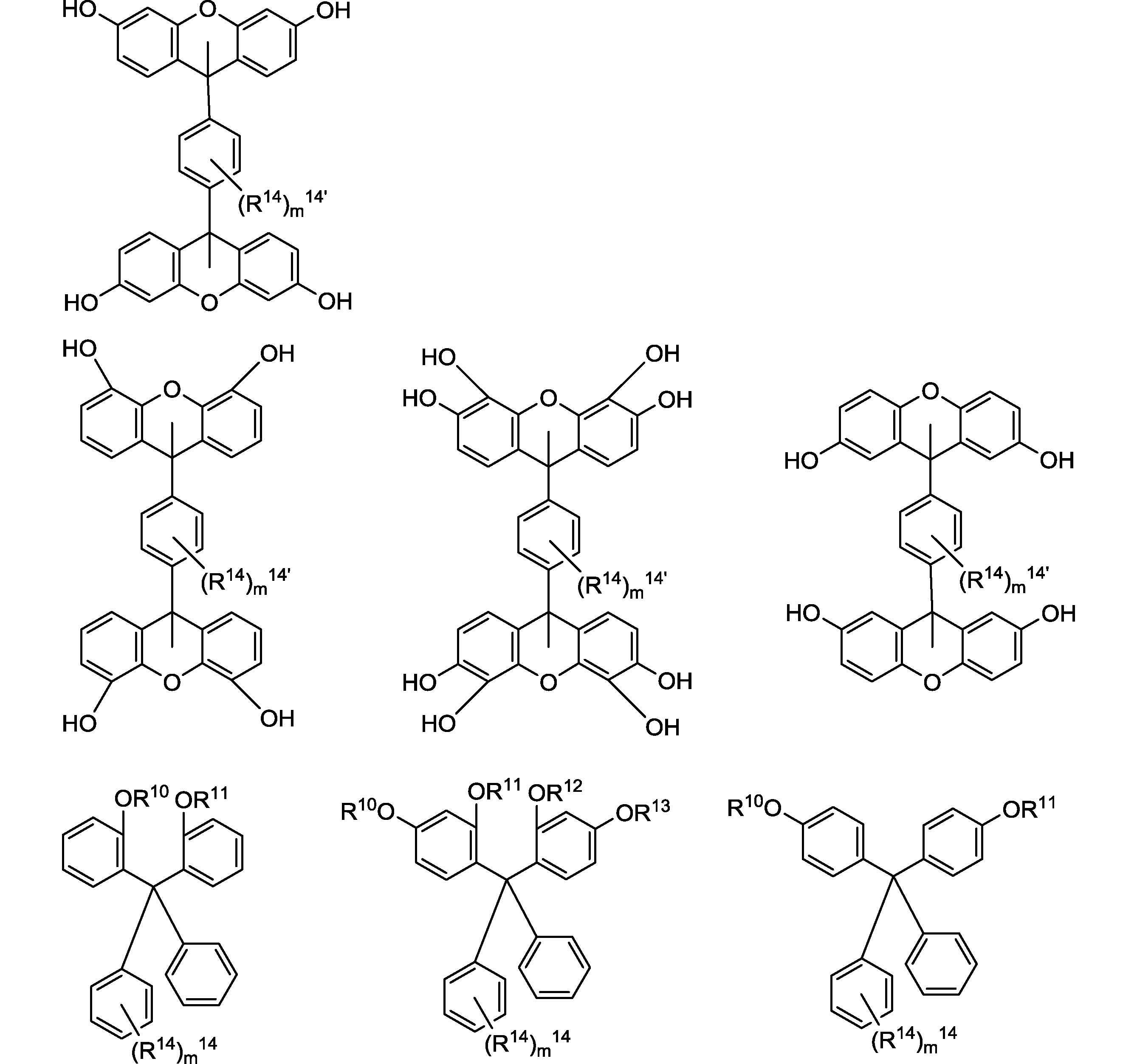
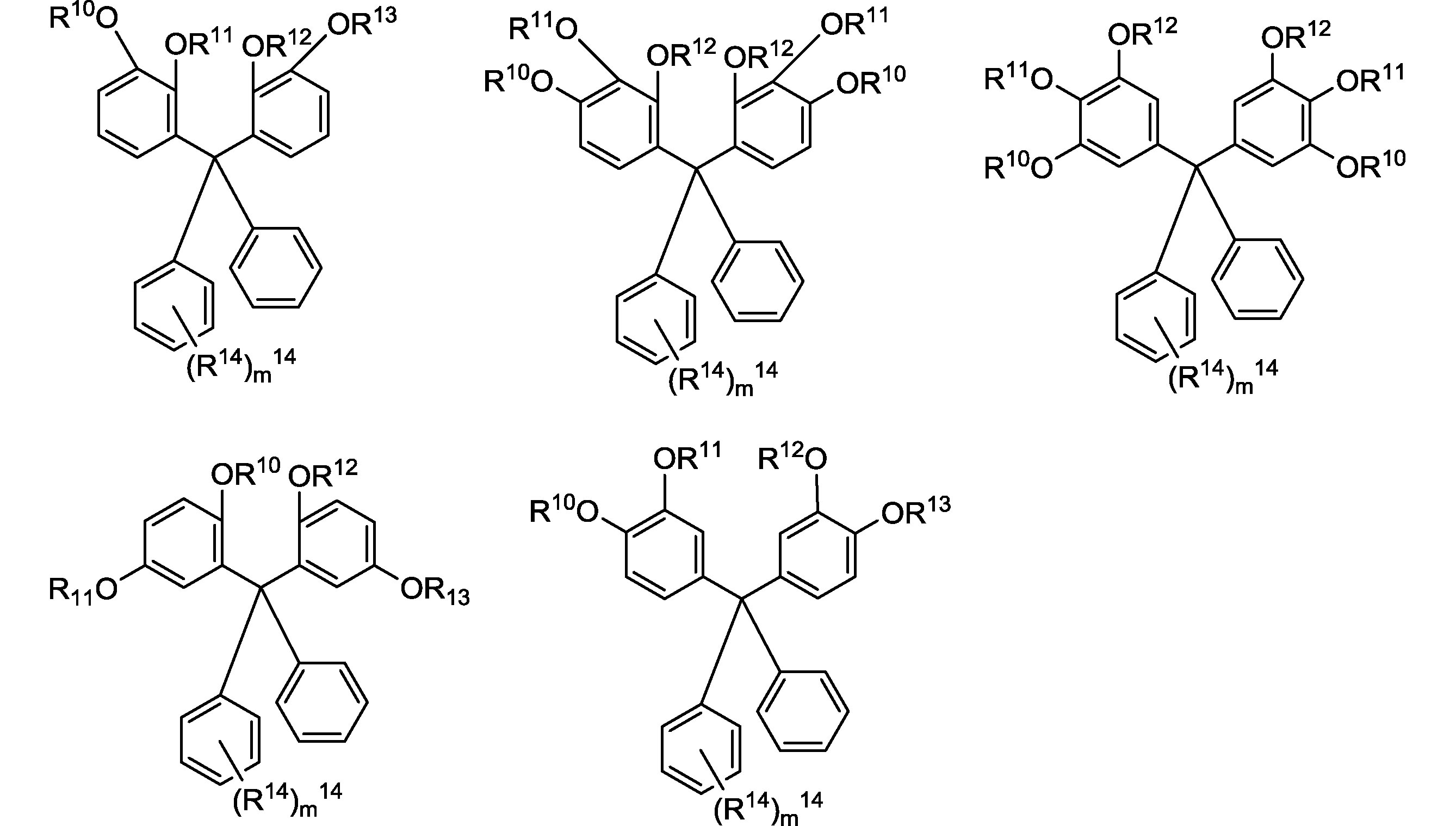


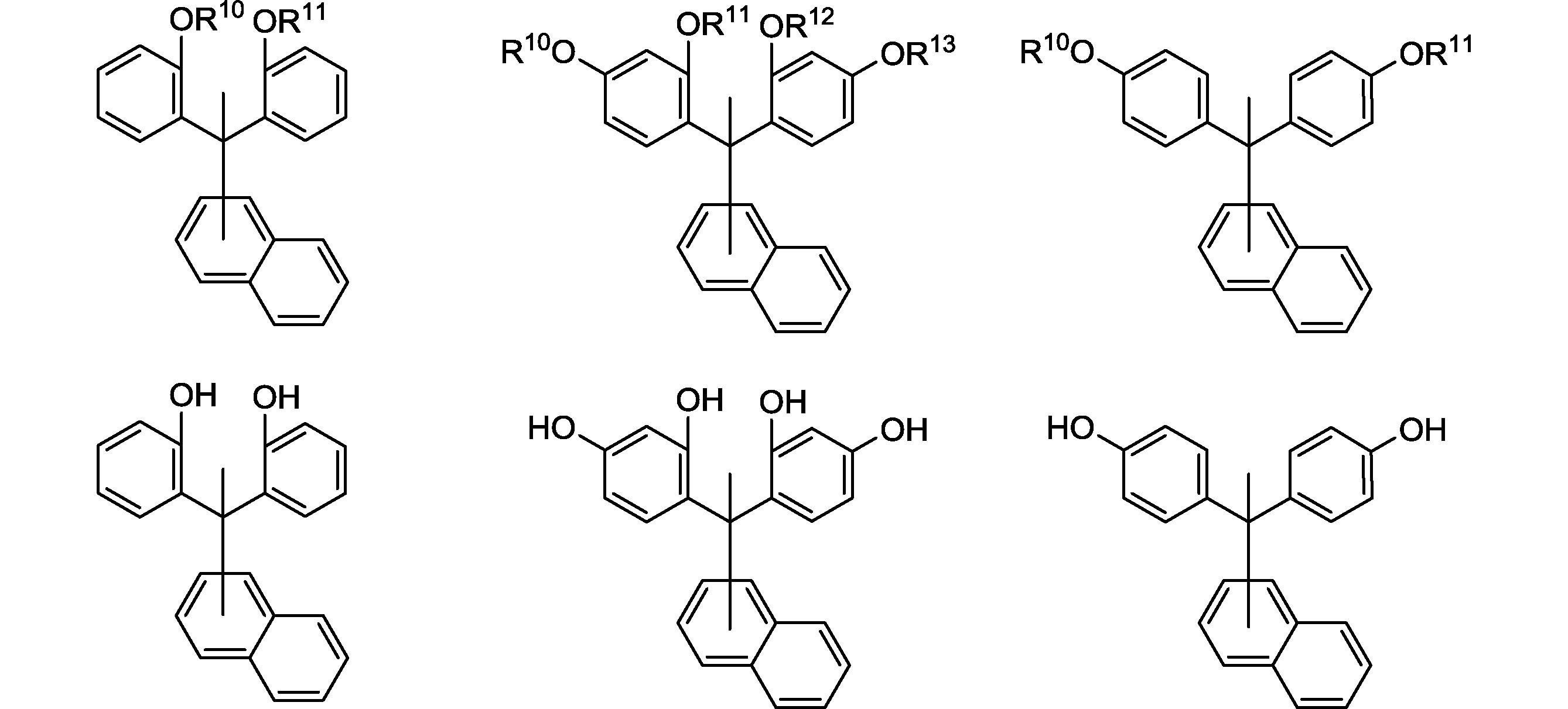


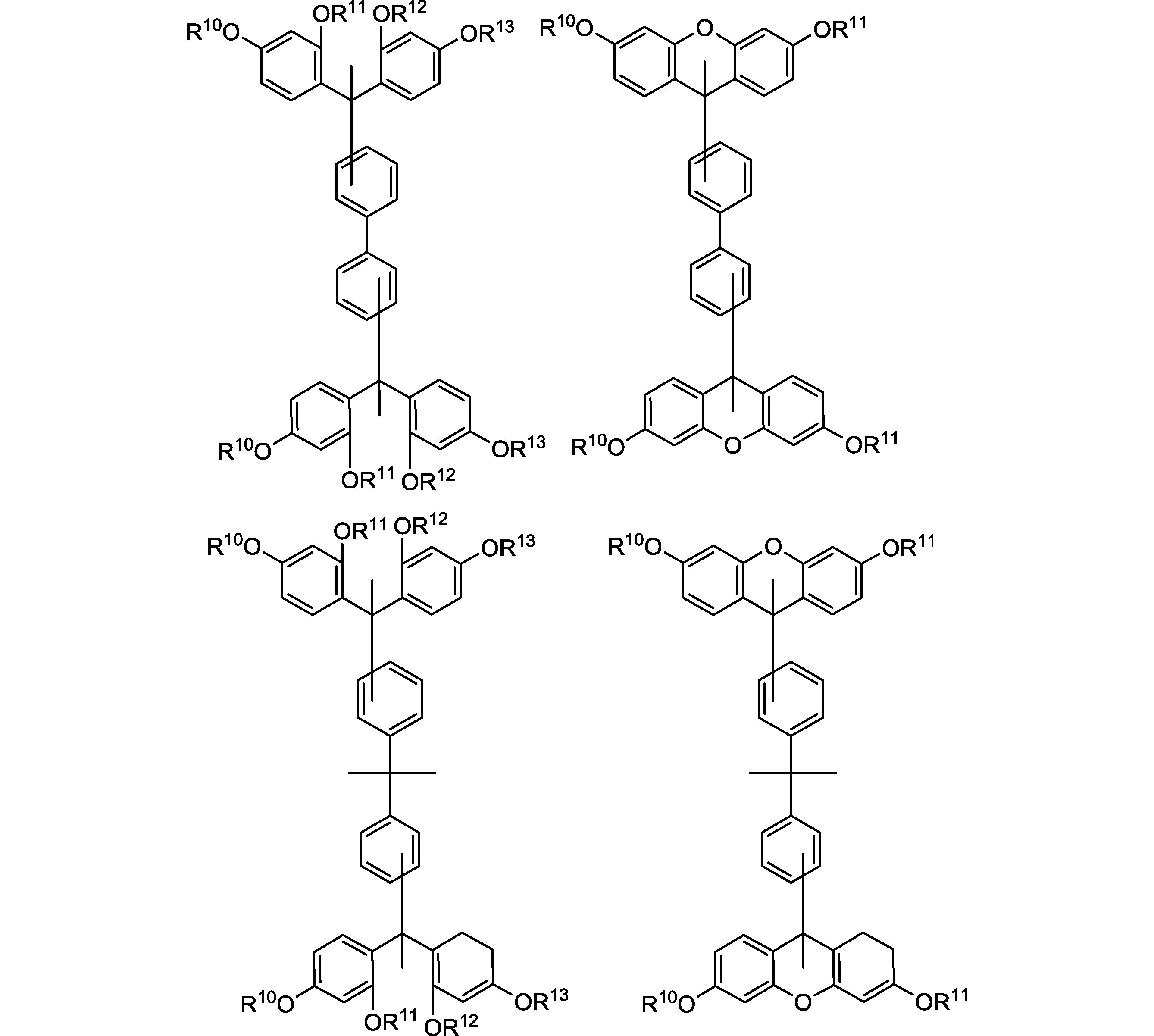
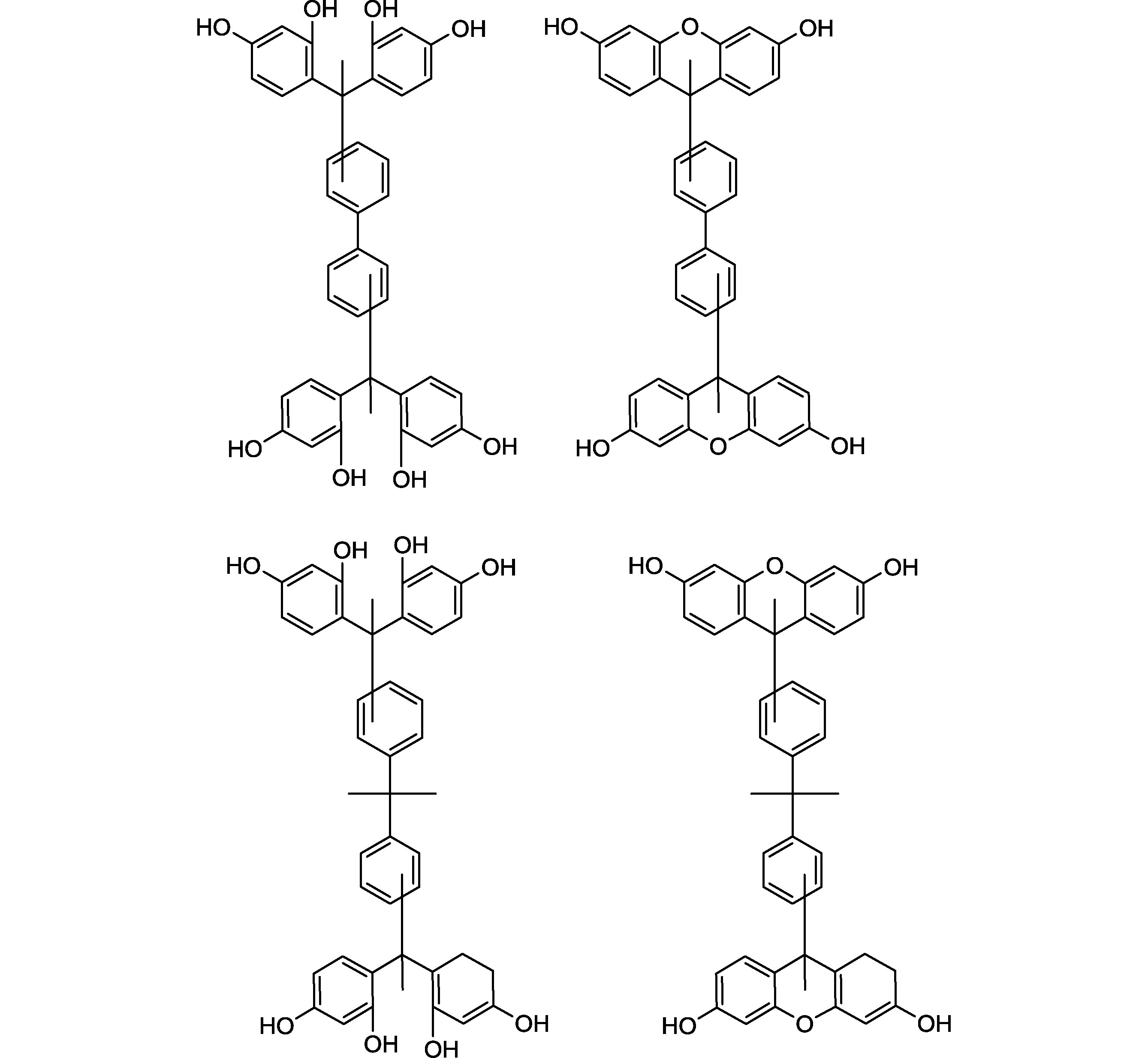


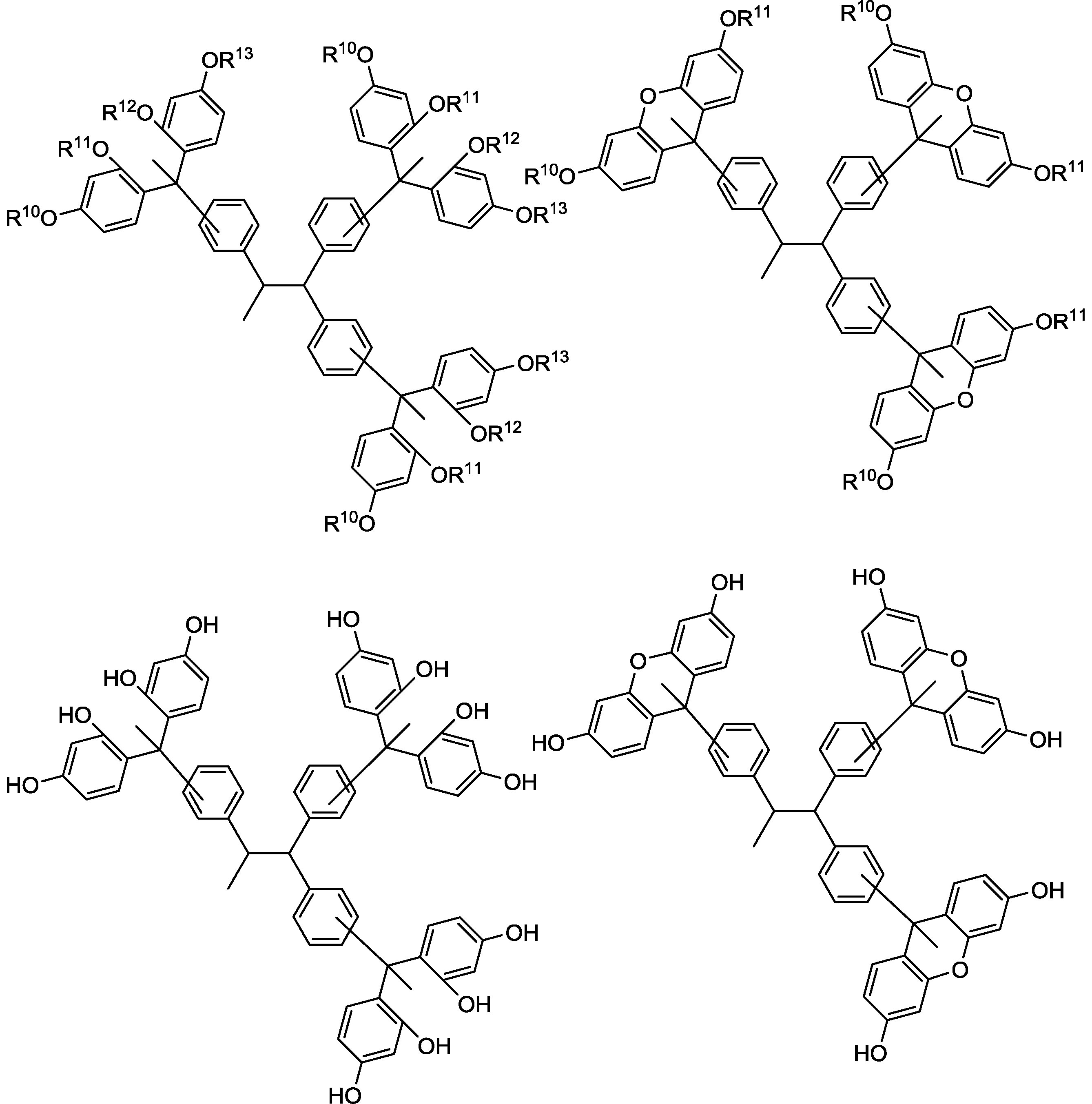

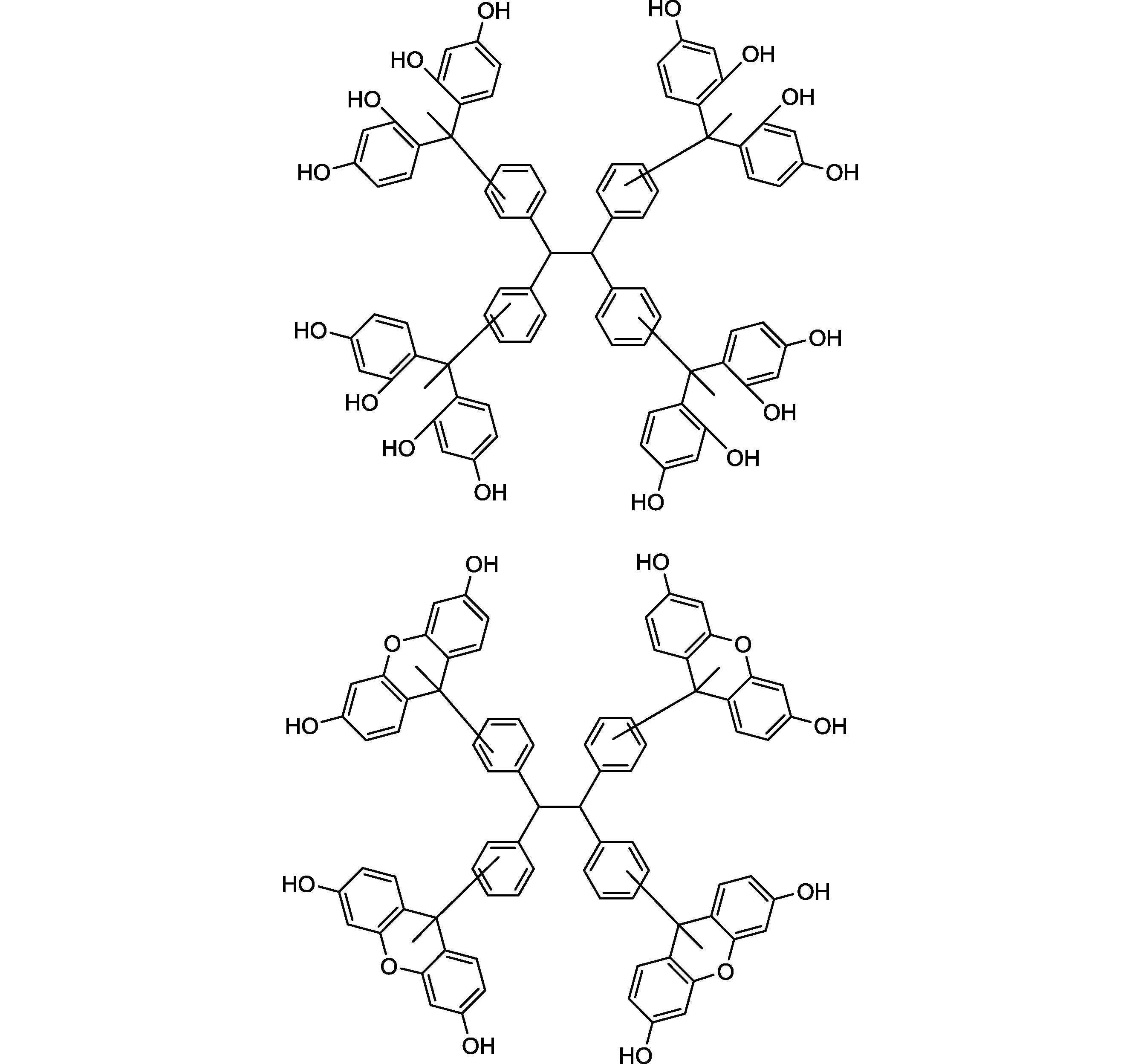

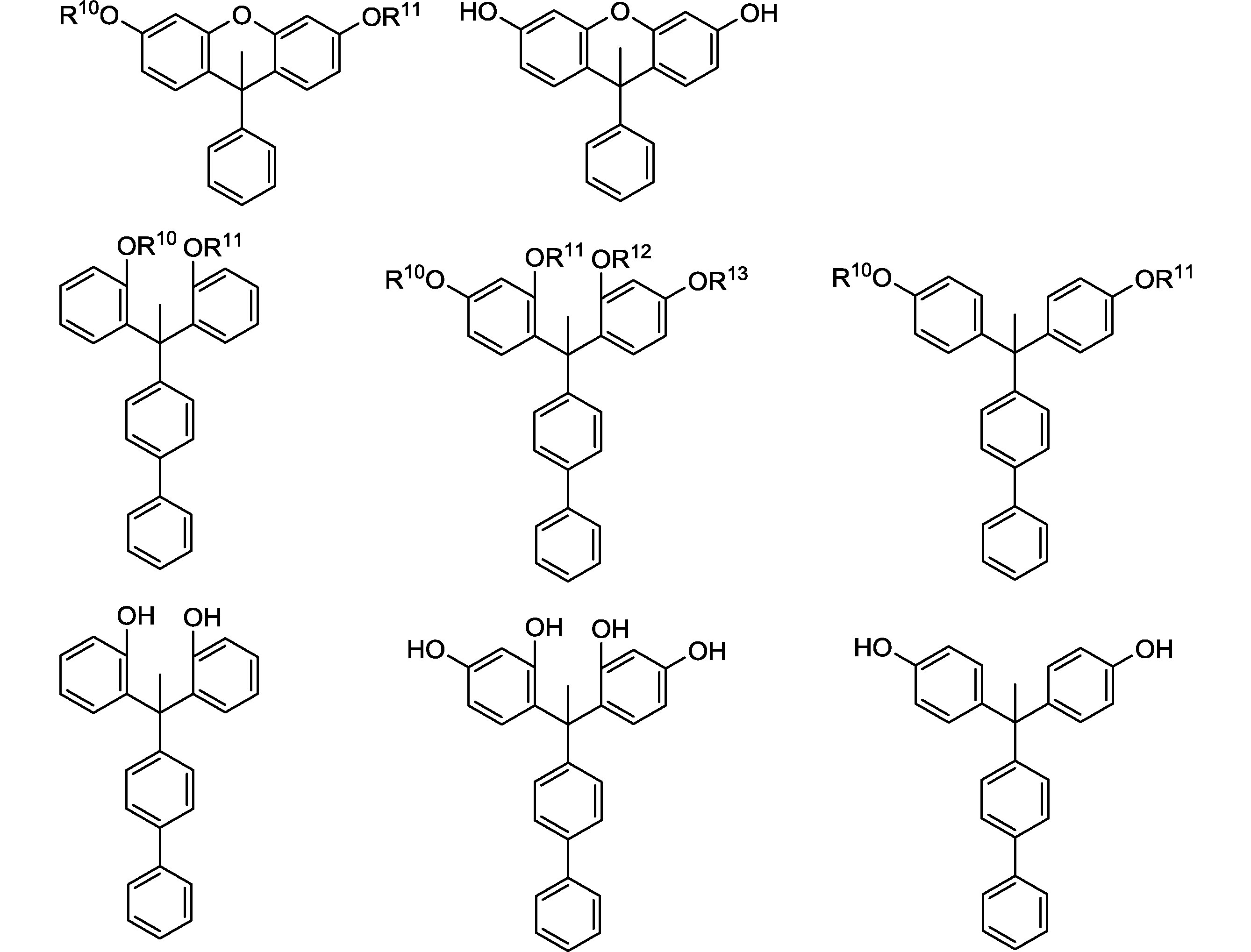

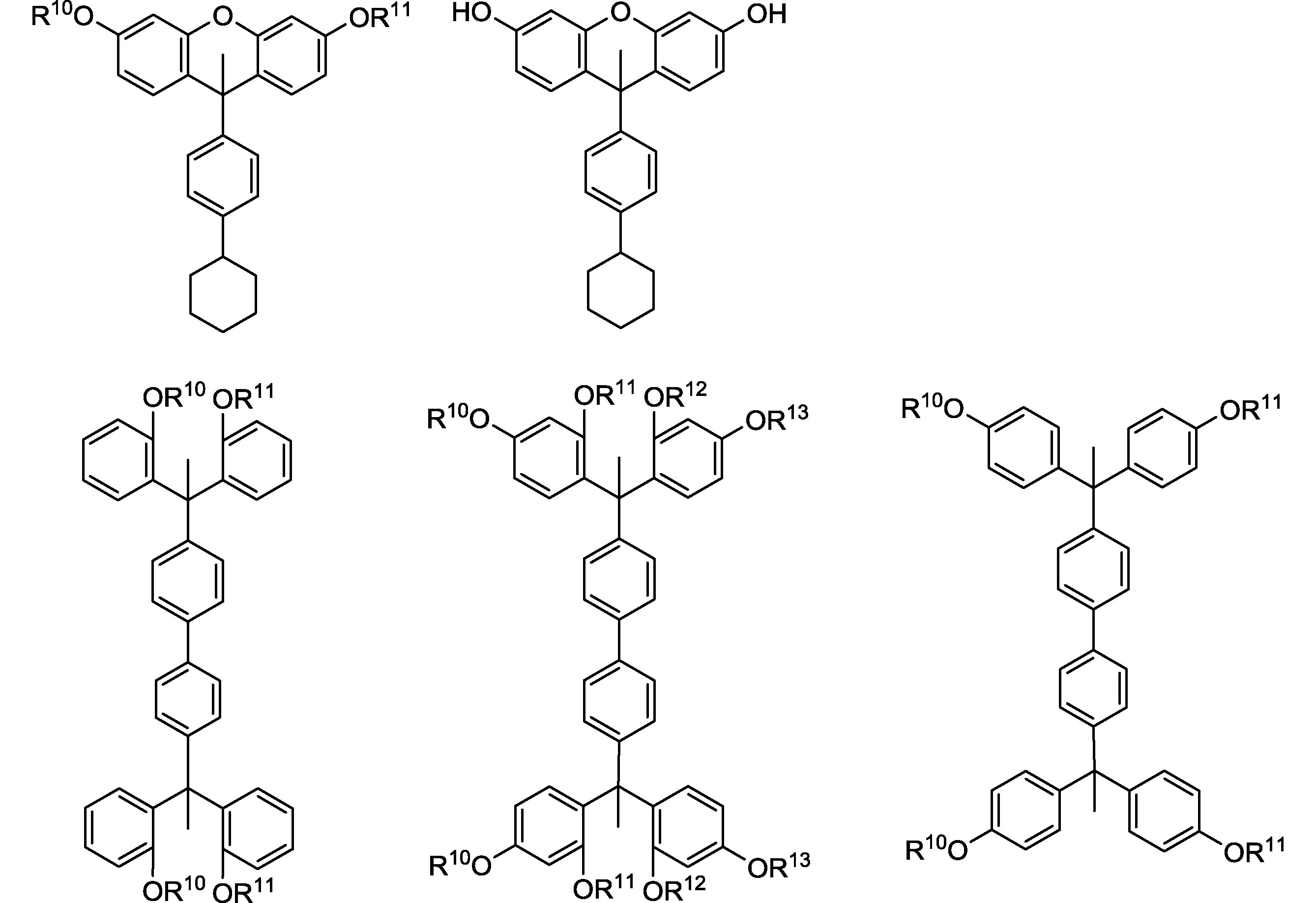


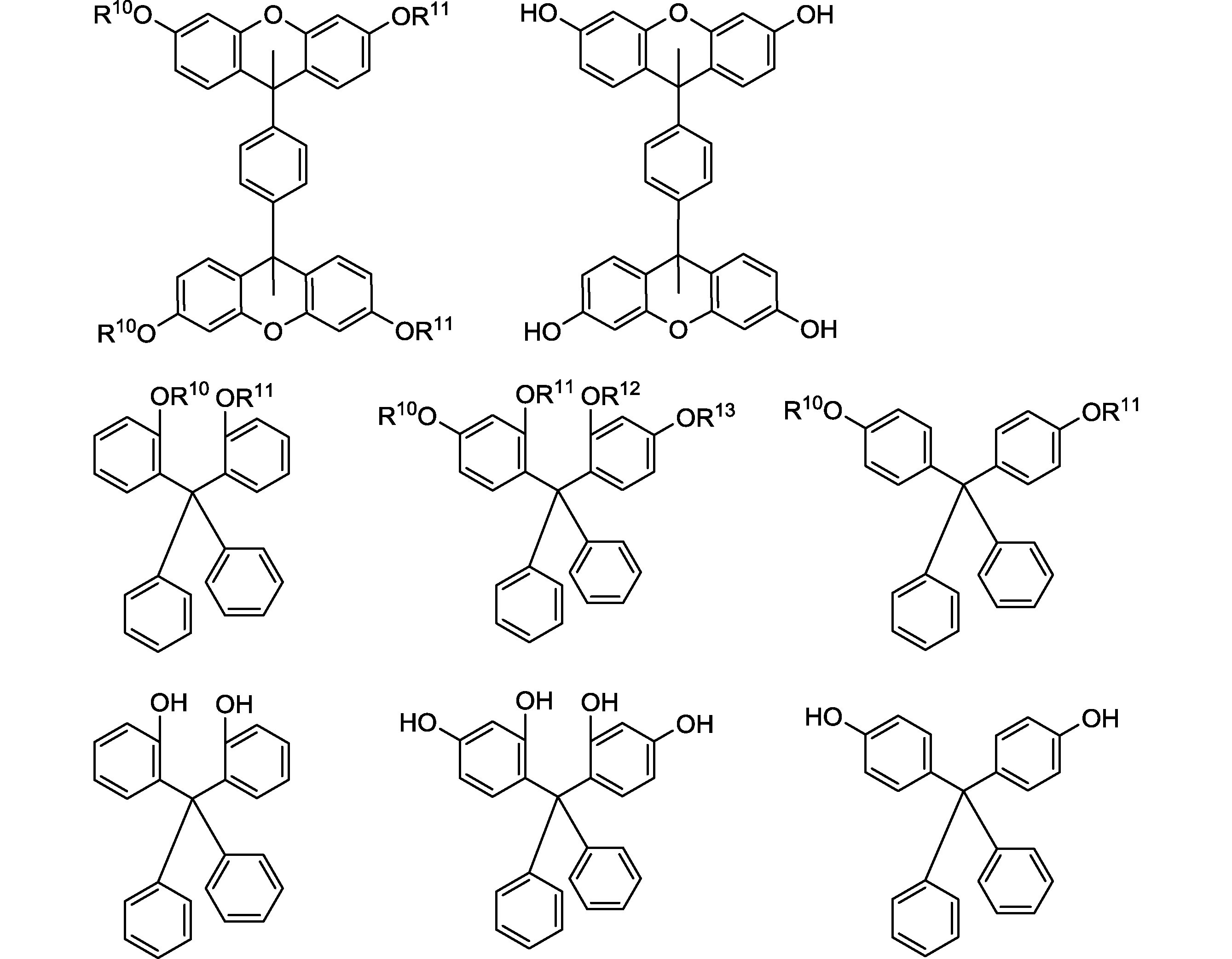
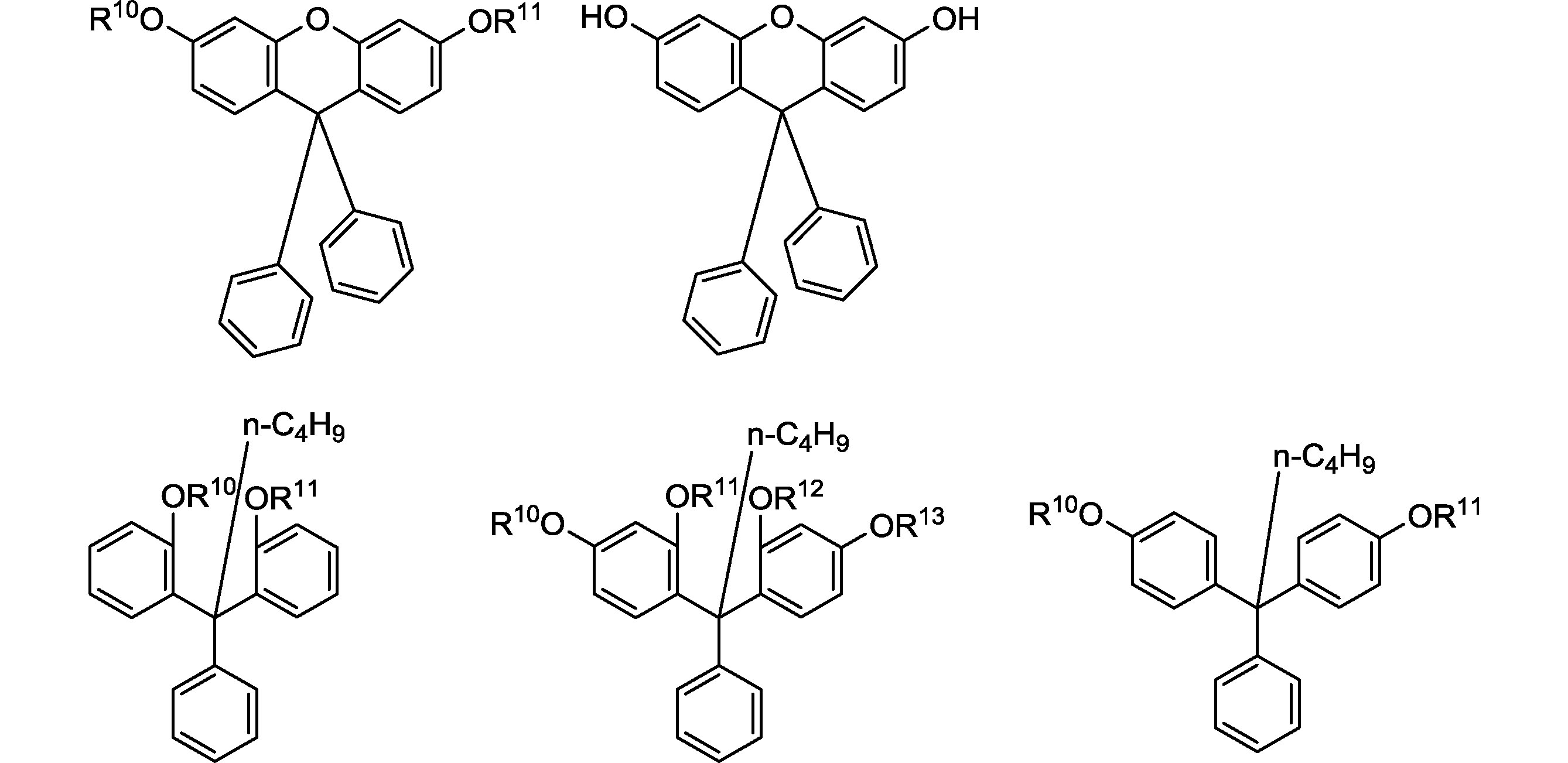
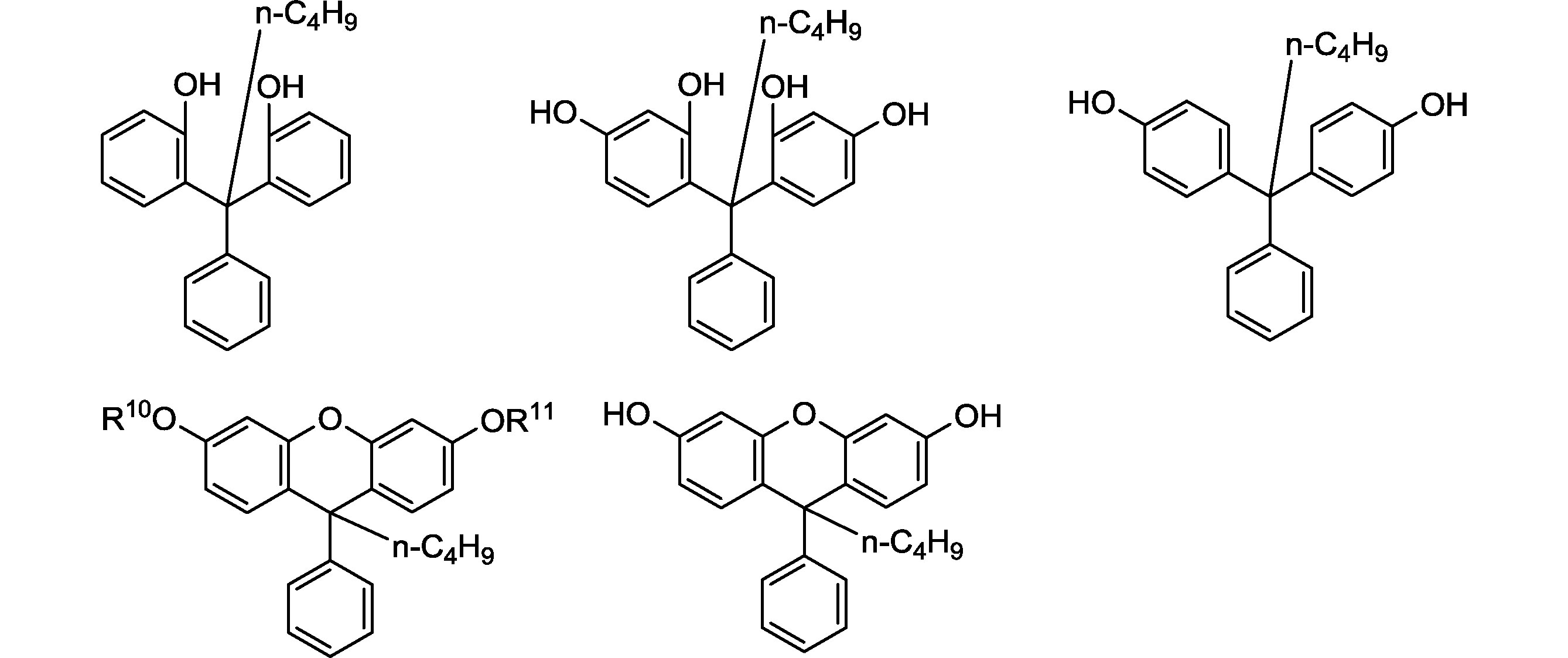


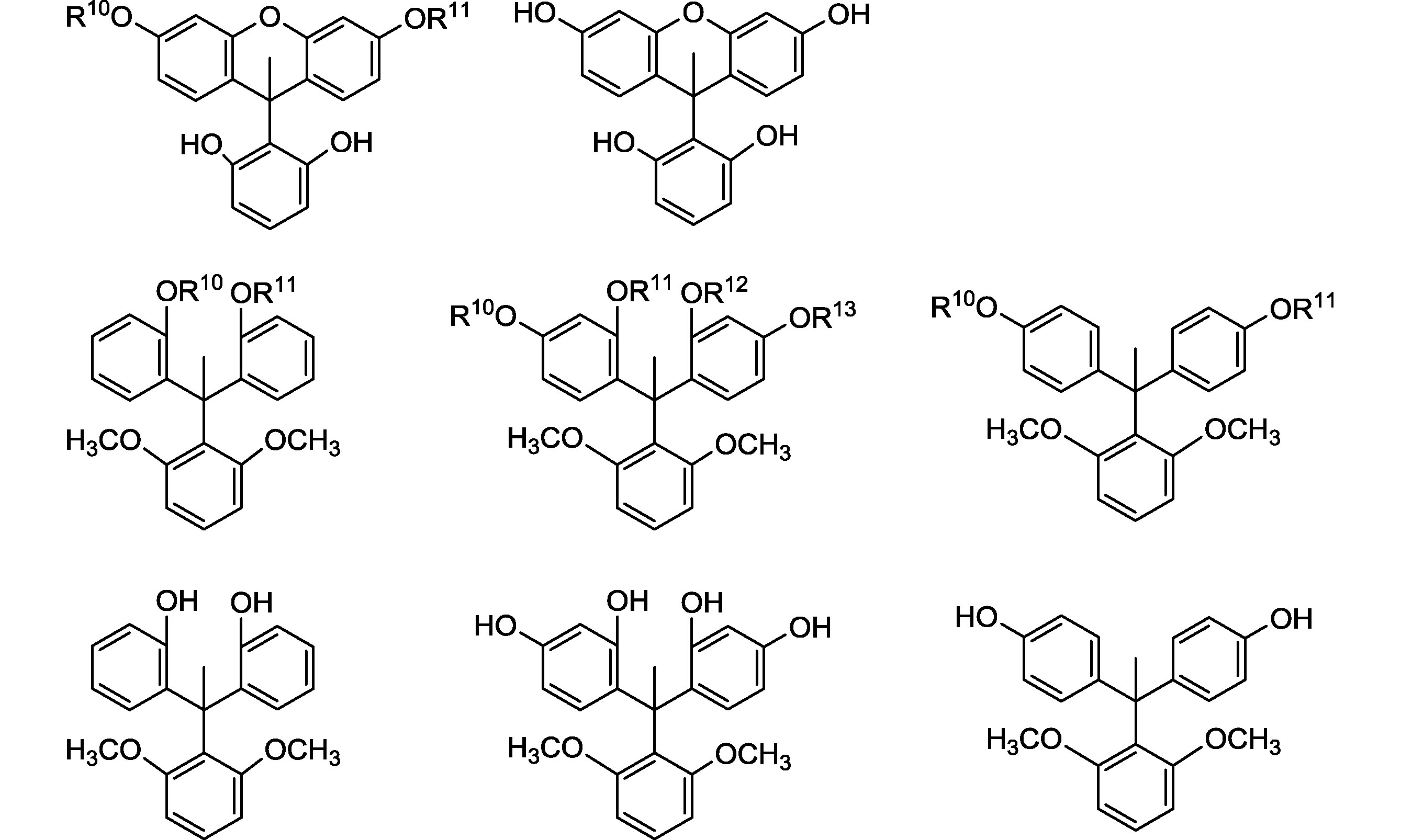
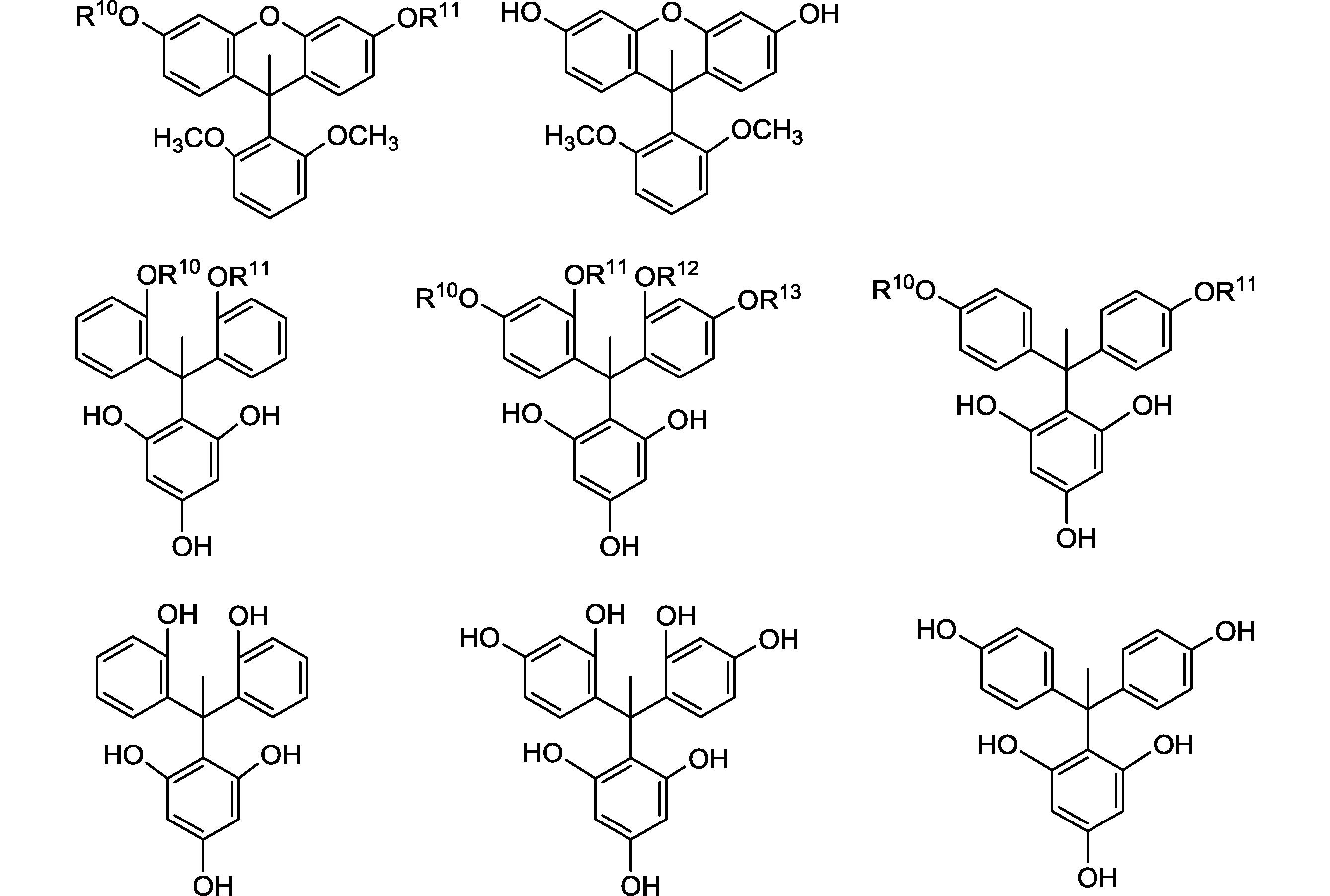


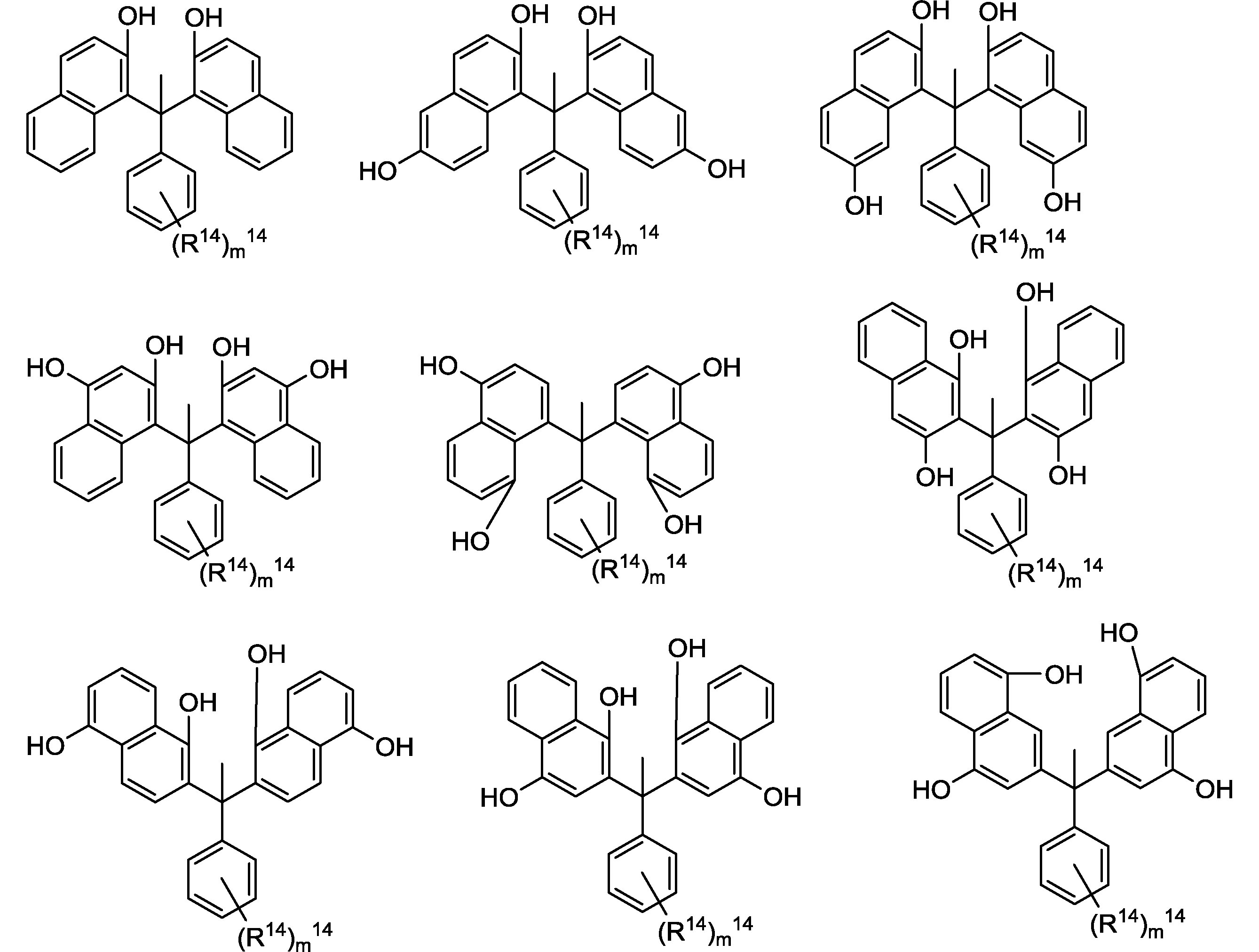

R14は、例えば、メチル基、エチル基、プロピル基、ブチル基、ペンチル基、ヘキシル基、ヘプチル基、オクチル基、ノニル基、デシル基、ウンデシル基、ドデシル基、トリアコンチル基、シクロプロピル基、シクロブチル基、シクロペンチル基、シクロヘキシル基、シクロヘプチル基、シクロオクチル基、シクロノニル基、シクロデシル基、シクロウンデシル基、シクロドデシル基、シクロトリアコンチル基、ノルボニル基、アダマンチル基、フェニル基、ナフチル基、アントラセン基、ヘプタセン基、ビニル基、アリル基、トリアコンテニル基、メトキシ基、エトキシ基、トリアコンチキシ基、フッ素原子、塩素原子、臭素原子、ヨウ素原子、チオール基が挙げられる。
前記R14の各例示は、異性体を含んでいる。例えば、ブチル基には、n-ブチル基、イソブチル基、sec-ブチル基、tert-ブチル基を含んでいる。

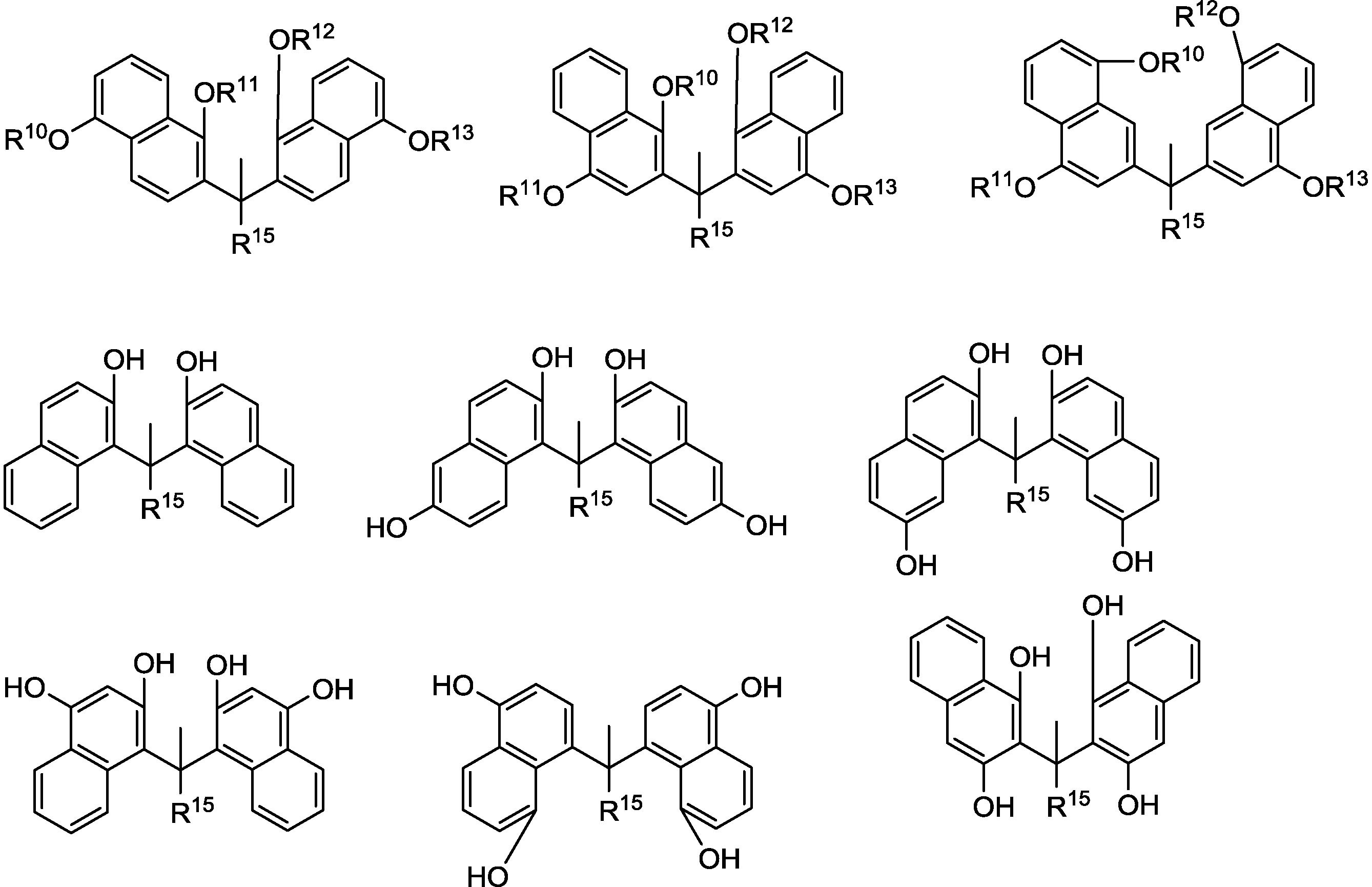


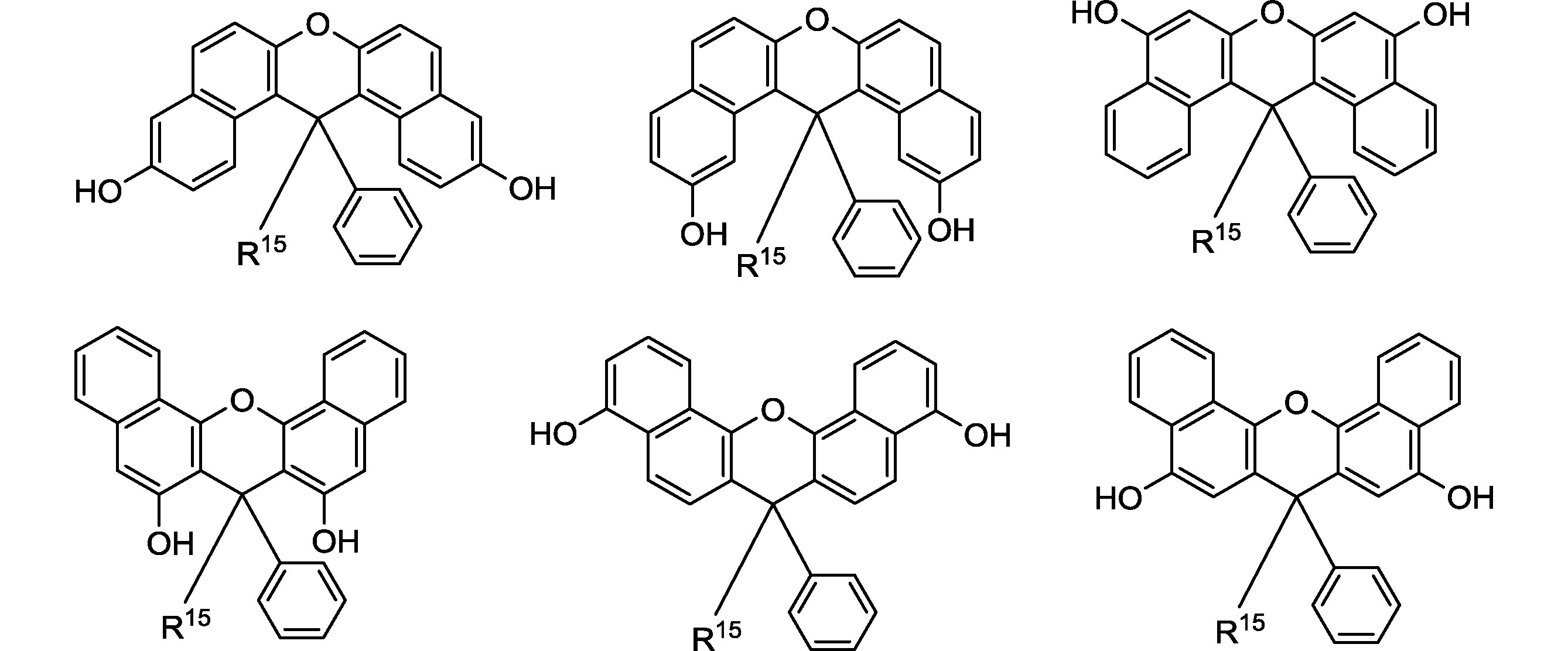
R15は、例えば、メチル基、エチル基、プロピル基、ブチル基、ペンチル基、ヘキシル基、ヘプチル基、オクチル基、ノニル基、デシル基、ウンデシル基、ドデシル基、トリアコンチル基、シクロプロピル基、シクロブチル基、シクロペンチル基、シクロヘキシル基、シクロヘプチル基、シクロオクチル基、シクロノニル基、シクロデシル基、シクロウンデシル基、シクロドデシル基、シクロトリアコンチル基、ノルボニル基、アダマンチル基、フェニル基、ナフチル基、アントラセン基、ヘプタセン基、ビニル基、アリル基、トリアコンテニル基、メトキシ基、エトキシ基、トリアコンチキシ基、フッ素原子、塩素原子、臭素原子、ヨウ素原子、チオール基が挙げられる。
前記R15の各例示は、異性体を含んでいる。例えば、ブチル基には、n-ブチル基、イソブチル基、sec-ブチル基、tert-ブチル基を含んでいる。
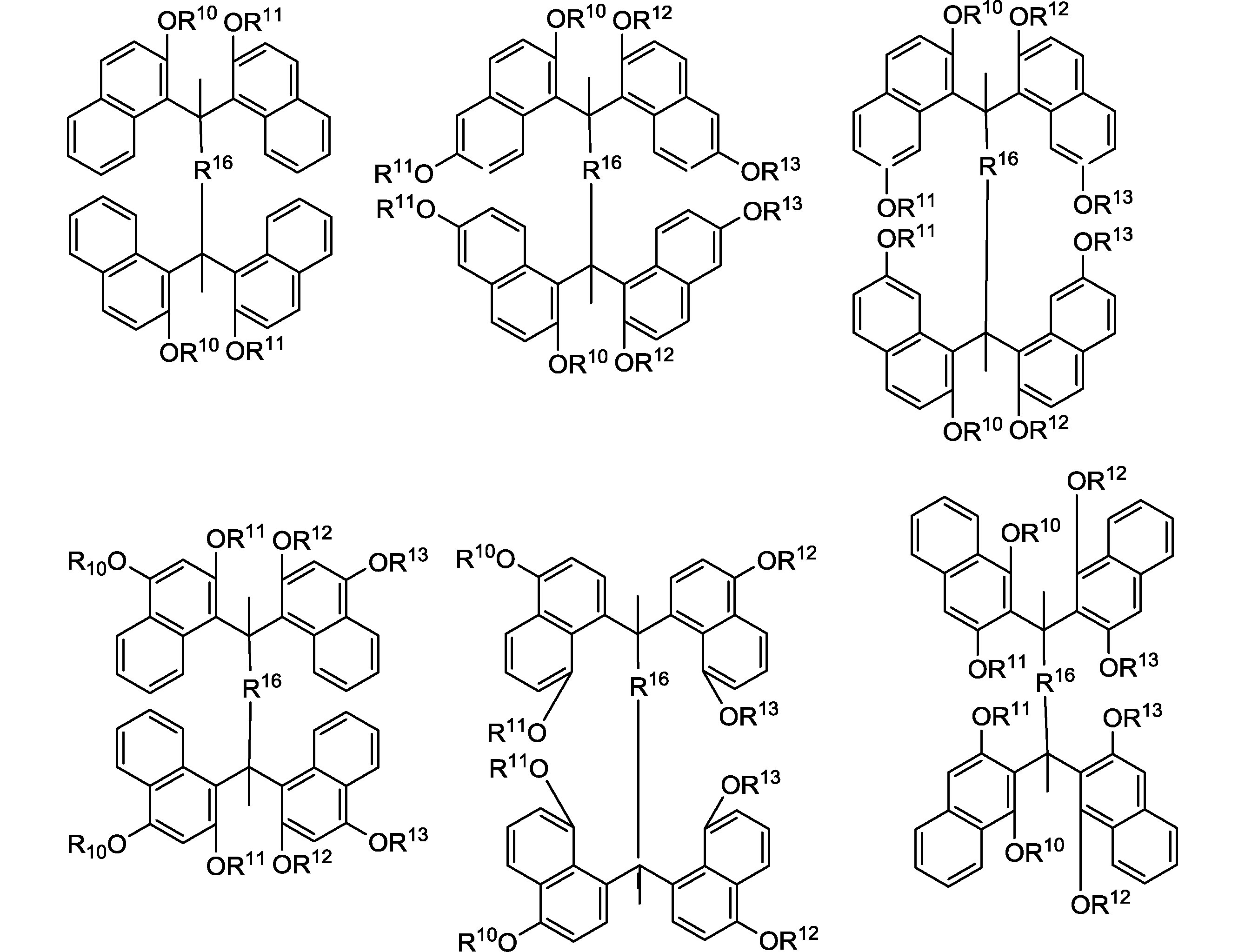
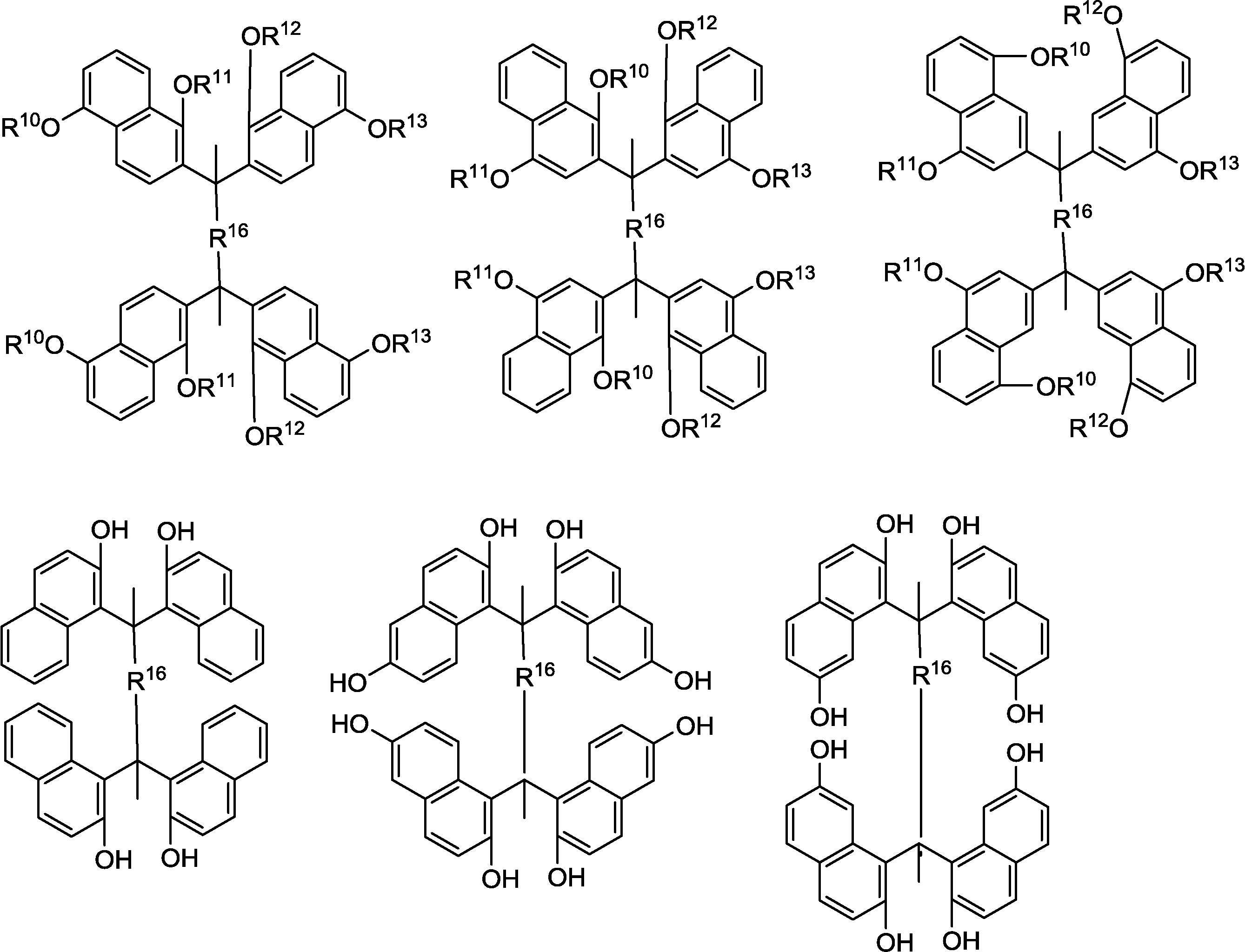


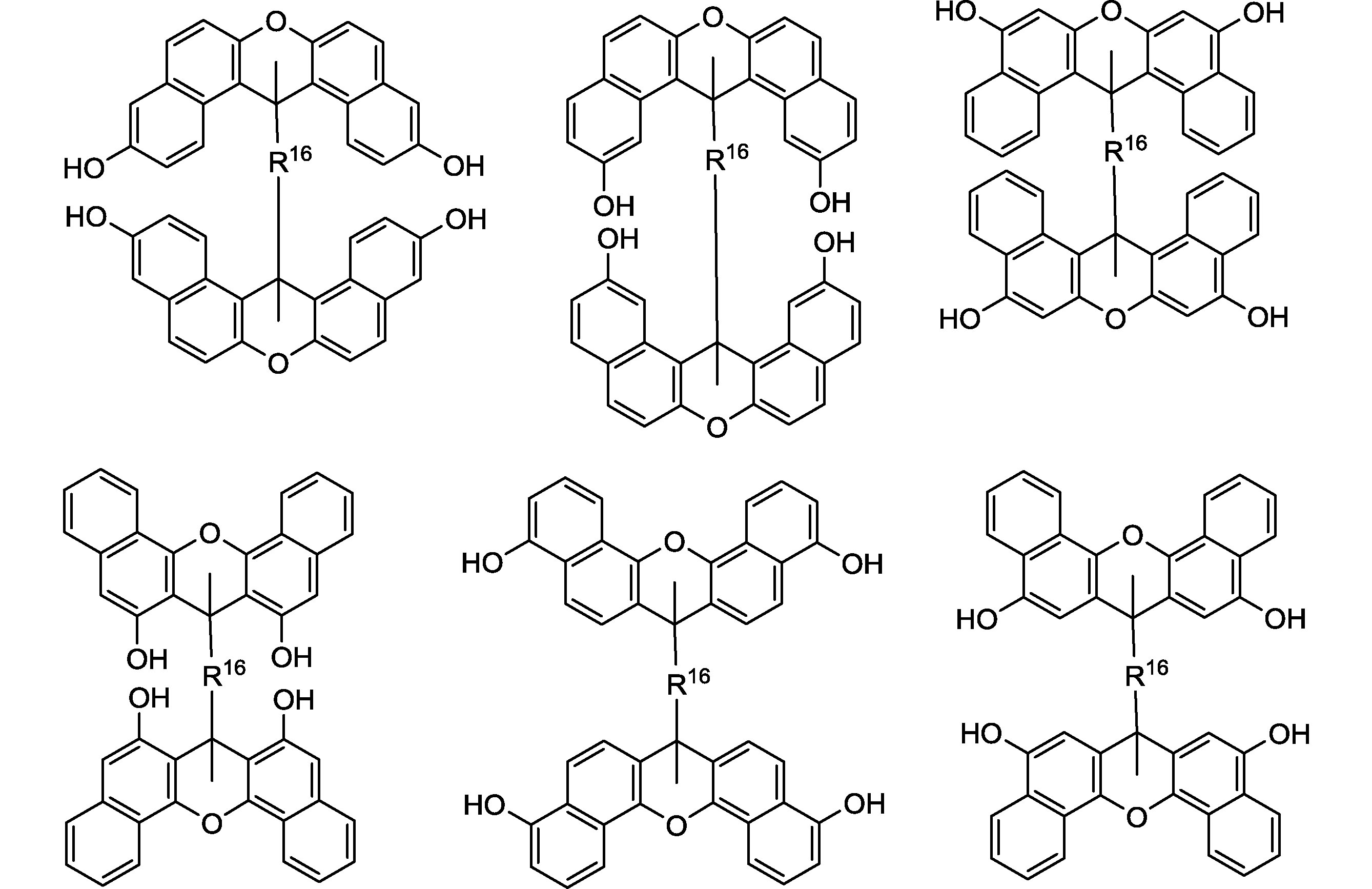
R16は、例えば、メチレン基、エチレン基、プロペン基、ブテン基、ペンテン基、ヘキセン基、ヘプテン基、オクテン基、ノネン基、デセン基、ウンデセン基、ドデセン基、トリアコンテン基、シクロプロペン基、シクロブテン基、シクロペンテン基、シクロヘキセン基、シクロヘプテン基、シクロオクテン基、シクロノネン基、シクロデセン基、シクロウンデセン基、シクロドデセン基、シクロトリアコンテン基、2価のノルボニル基、2価のアダマンチル基、2価のフェニル基、2価のナフチル基、2価のアントラセン基、2価のヘプタセン基、2価のビニル基、2価のアリル基、2価のトリアコンテニル基が挙げられる。
前記R16の各例示は、異性体を含んでいる。例えば、ブチル基には、n-ブチル基、イソブチル基、sec-ブチル基、tert-ブチル基を含んでいる。

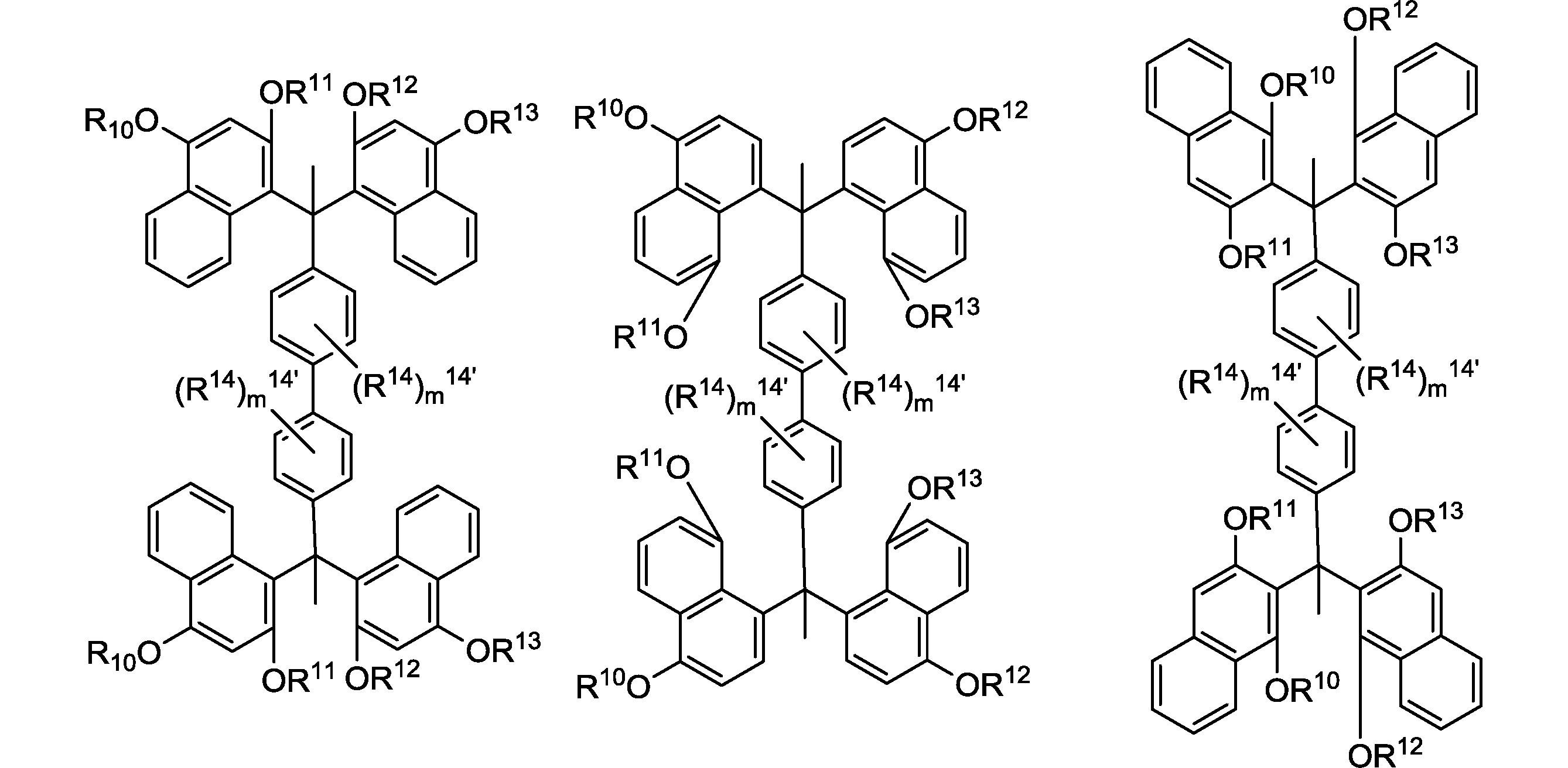
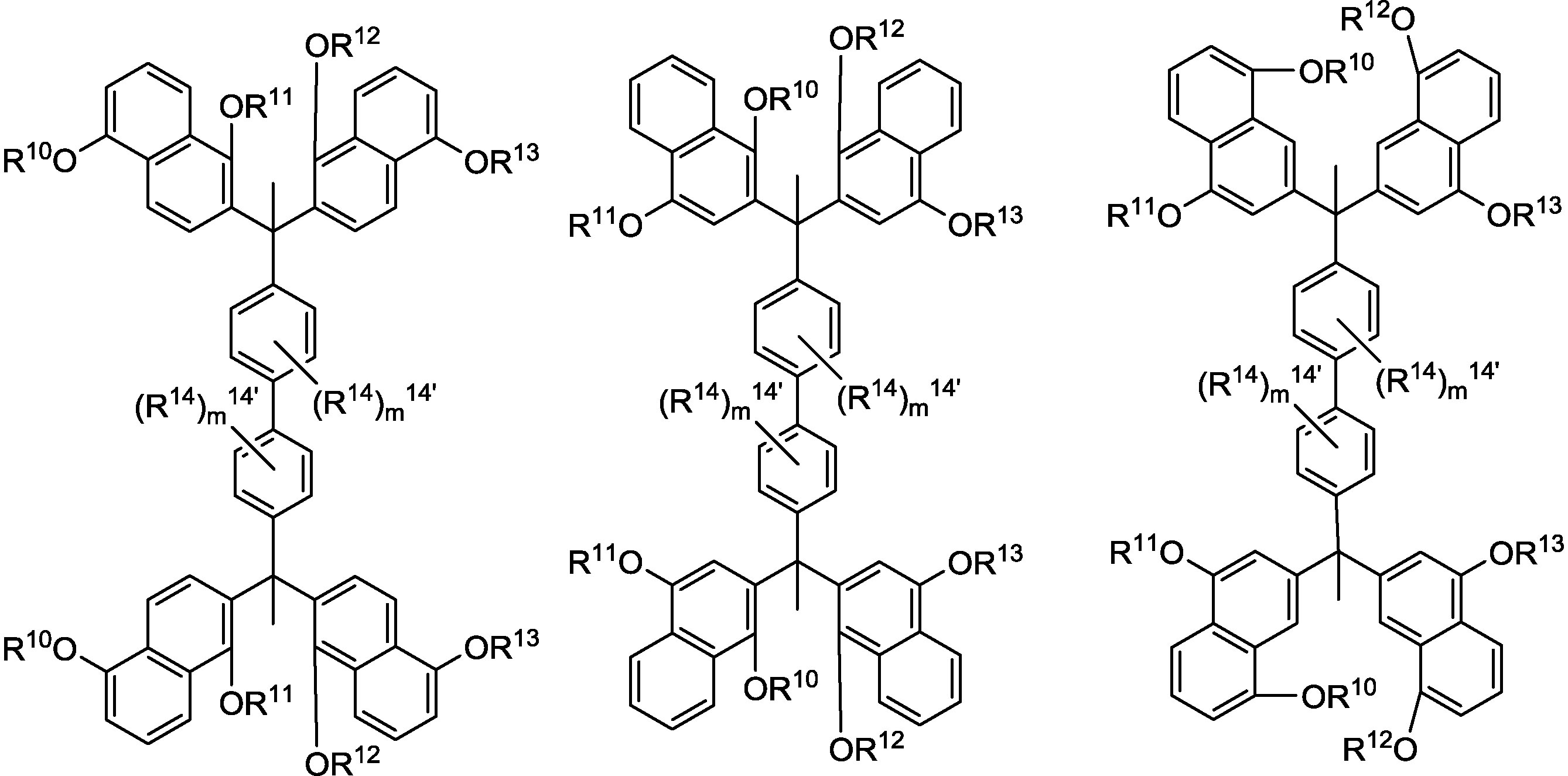


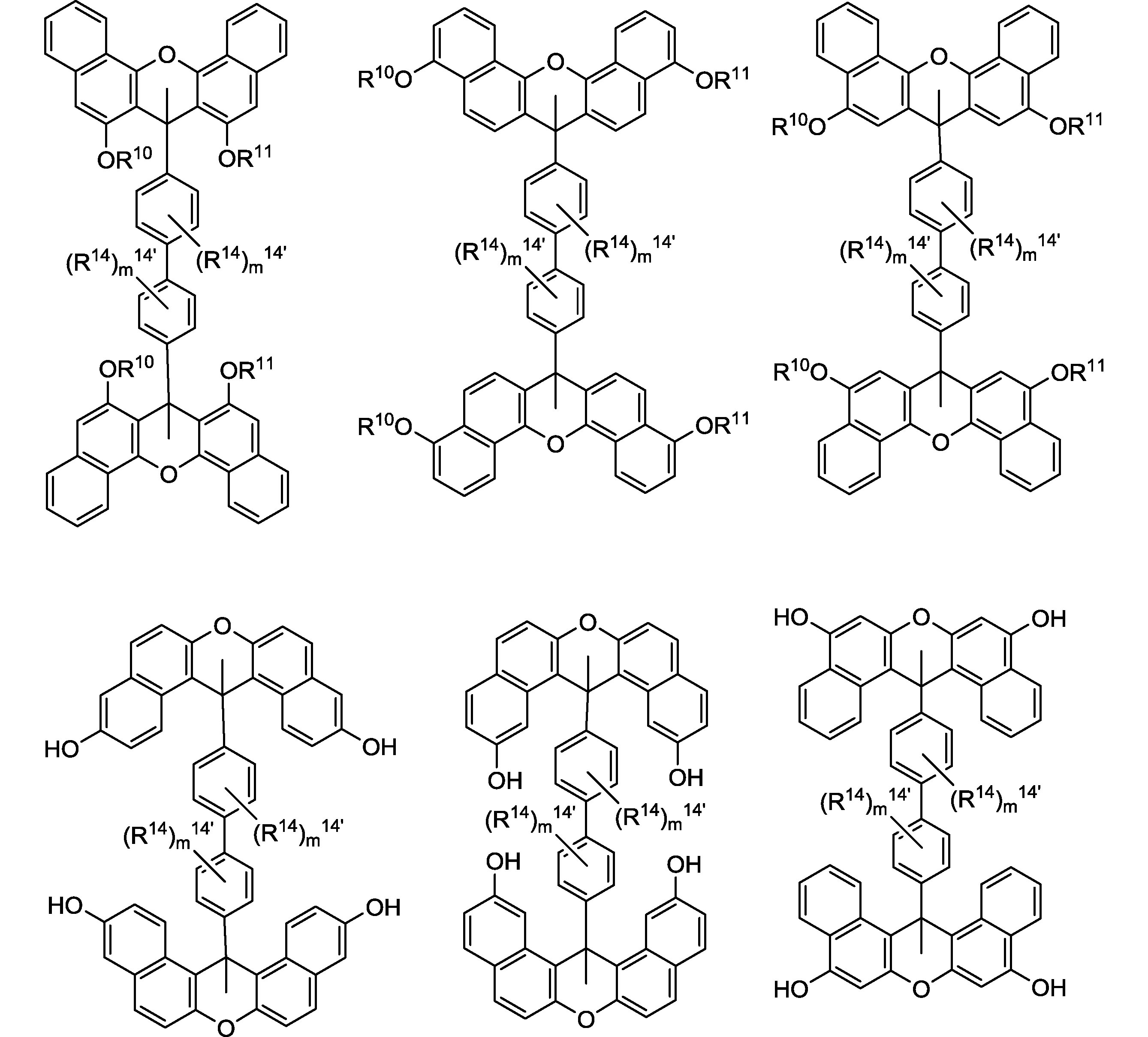


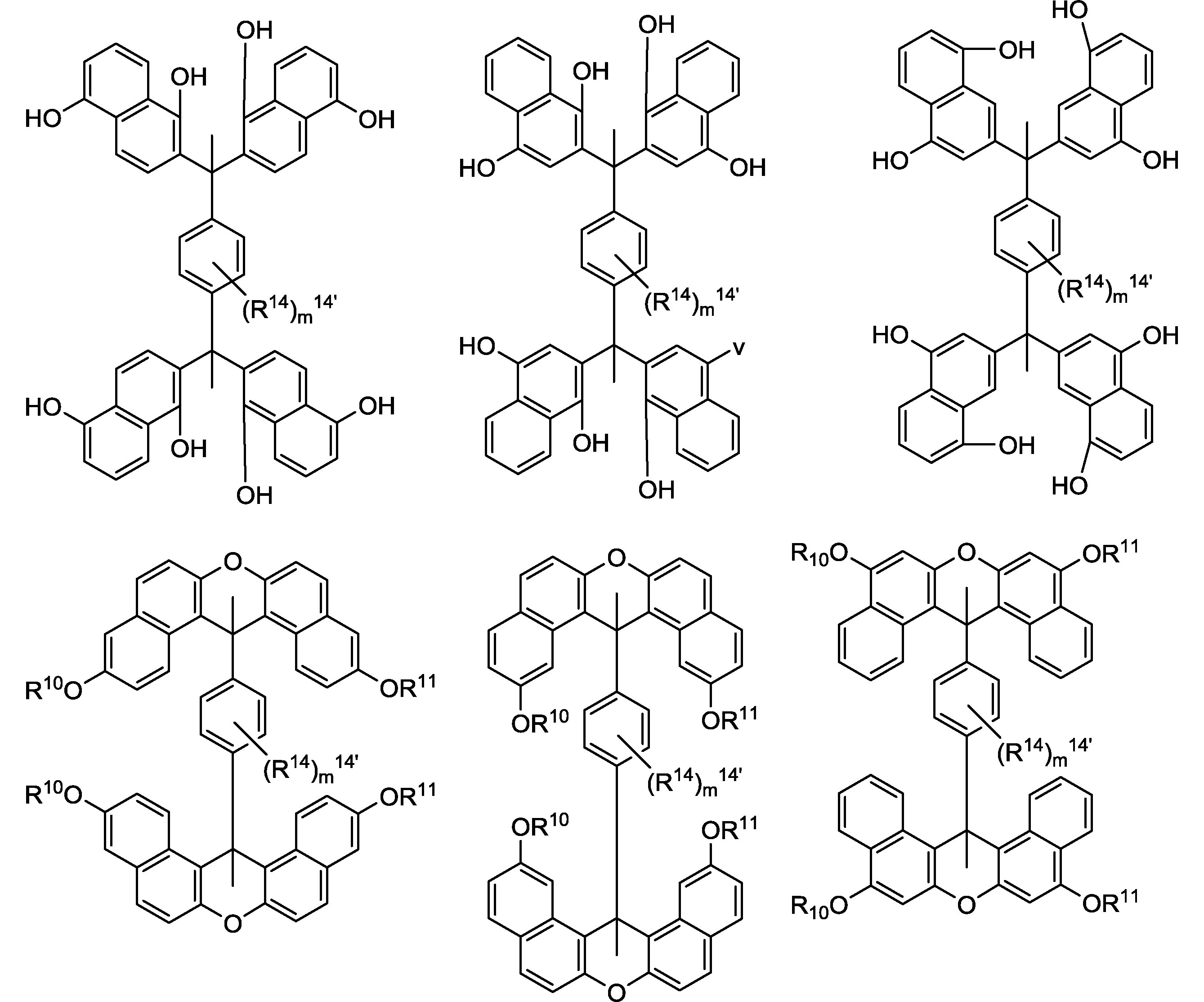

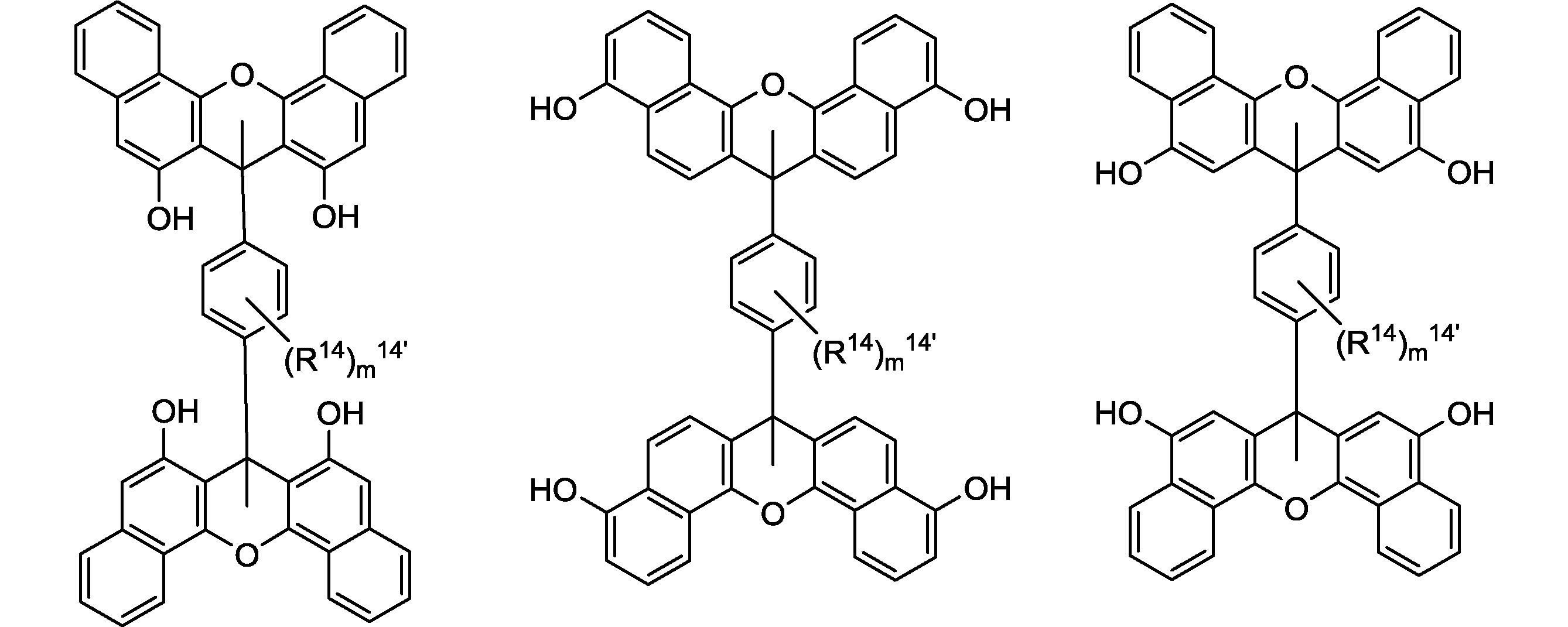
R14は、例えば、メチル基、エチル基、プロピル基、ブチル基、ペンチル基、ヘキシル基、ヘプチル基、オクチル基、ノニル基、デシル基、ウンデシル基、ドデシル基、トリアコンチル基、シクロプロピル基、シクロブチル基、シクロペンチル基、シクロヘキシル基、シクロヘプチル基、シクロオクチル基、シクロノニル基、シクロデシル基、シクロウンデシル基、シクロドデシル基、シクロトリアコンチル基、ノルボニル基、アダマンチル基、フェニル基、ナフチル基、アントラセン基、ヘプタセン基、ビニル基、アリル基、トリアコンテニル基、メトキシ基、エトキシ基、トリアコンチキシ基、フッ素原子、塩素原子、臭素原子、ヨウ素原子、チオール基が挙げられる。
前記R14の各例示は、異性体を含んでいる。例えば、ブチル基には、n-ブチル基、イソブチル基、sec-ブチル基、tert-ブチル基を含んでいる。


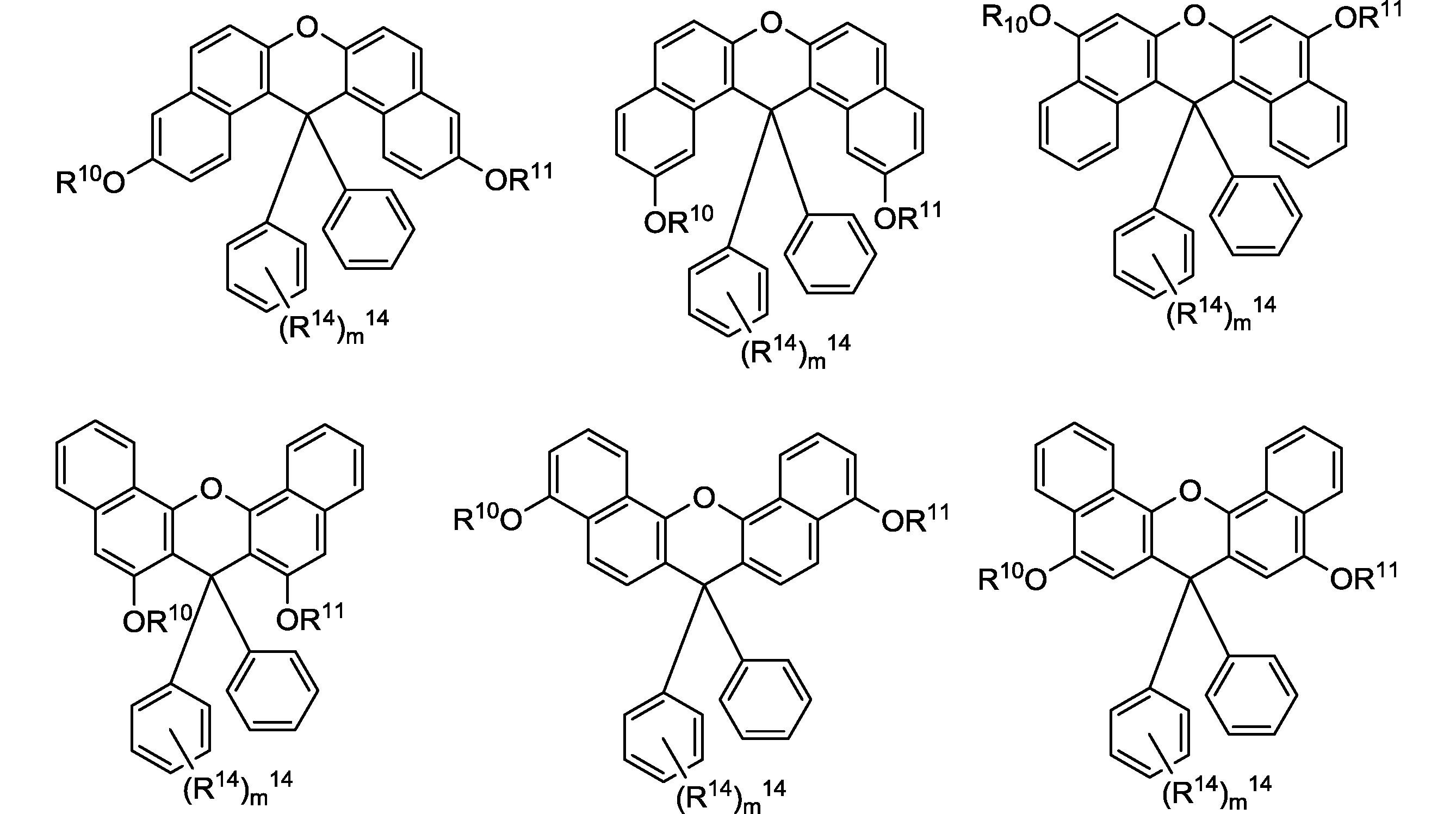

R14は、例えば、メチル基、エチル基、プロピル基、ブチル基、ペンチル基、ヘキシル基、ヘプチル基、オクチル基、ノニル基、デシル基、ウンデシル基、ドデシル基、トリアコンチル基、シクロプロピル基、シクロブチル基、シクロペンチル基、シクロヘキシル基、シクロヘプチル基、シクロオクチル基、シクロノニル基、シクロデシル基、シクロウンデシル基、シクロドデシル基、シクロトリアコンチル基、ノルボニル基、アダマンチル基、フェニル基、ナフチル基、アントラセン基、ヘプタセン基、ビニル基、アリル基、トリアコンテニル基、メトキシ基、エトキシ基、トリアコンチキシ基、フッ素原子、塩素原子、臭素原子、ヨウ素原子、チオール基が挙げられる。
前記R14の各例示は、異性体を含んでいる。例えば、ブチル基には、n-ブチル基、イソブチル基、sec-ブチル基、tert-ブチル基を含んでいる。

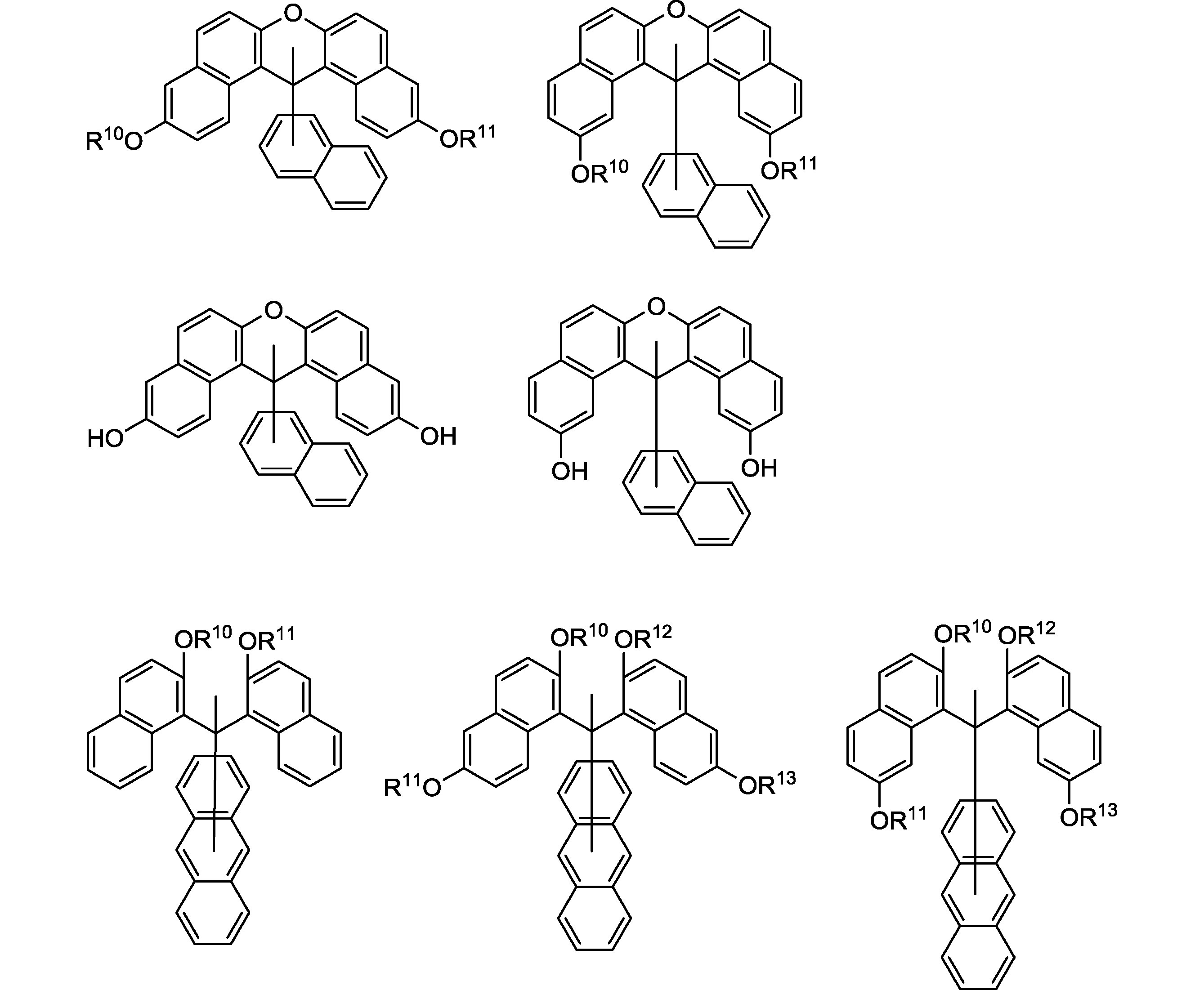


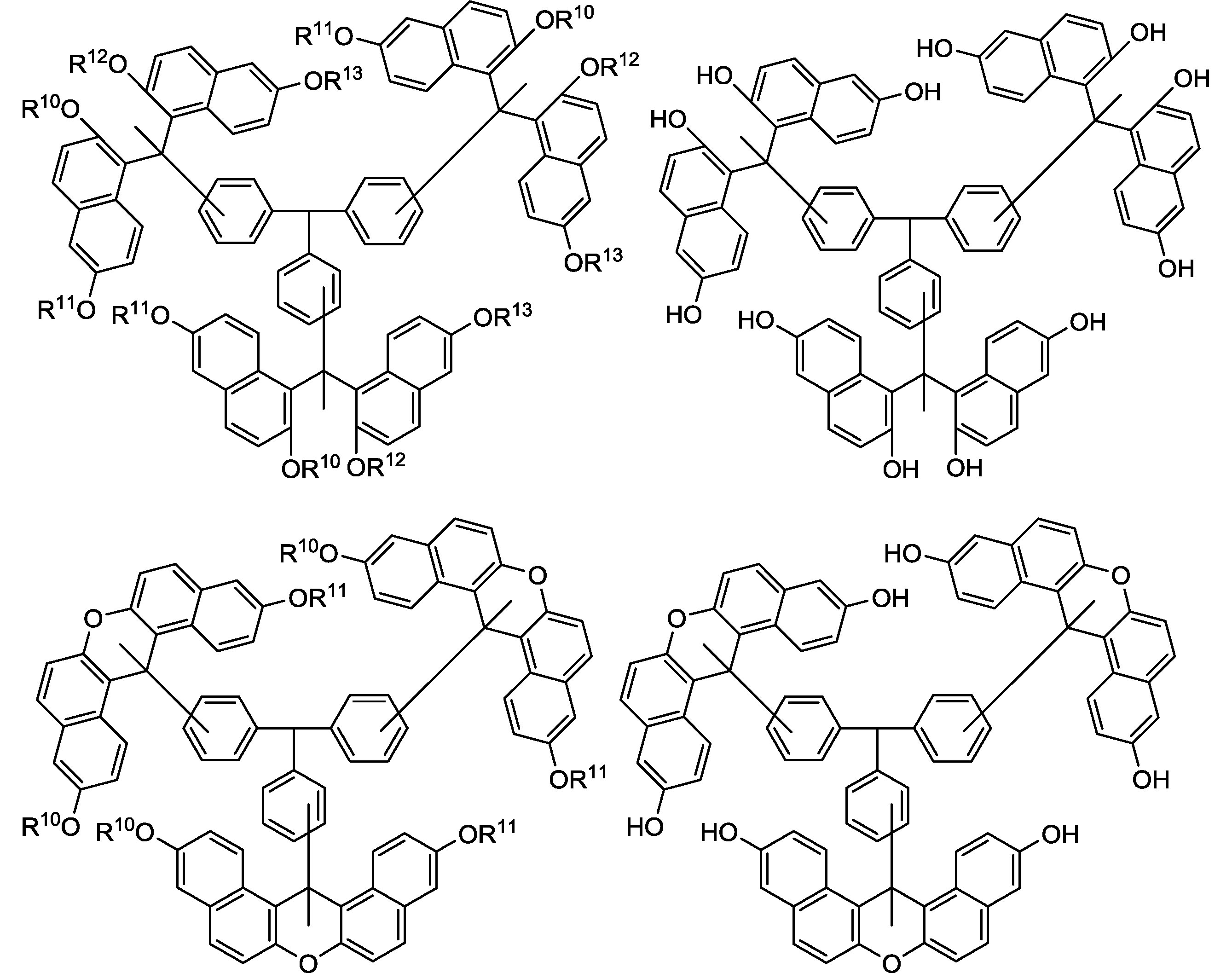


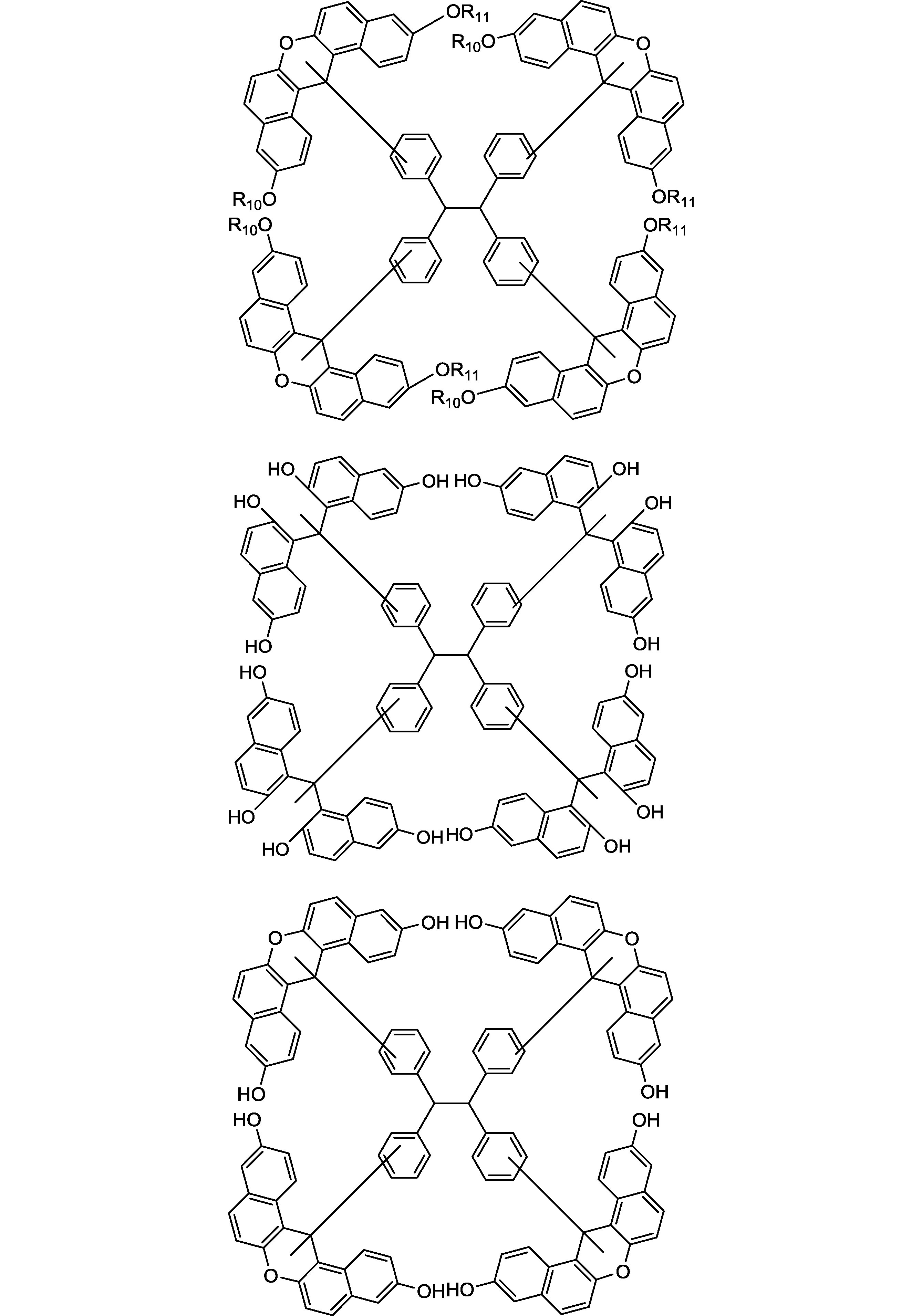
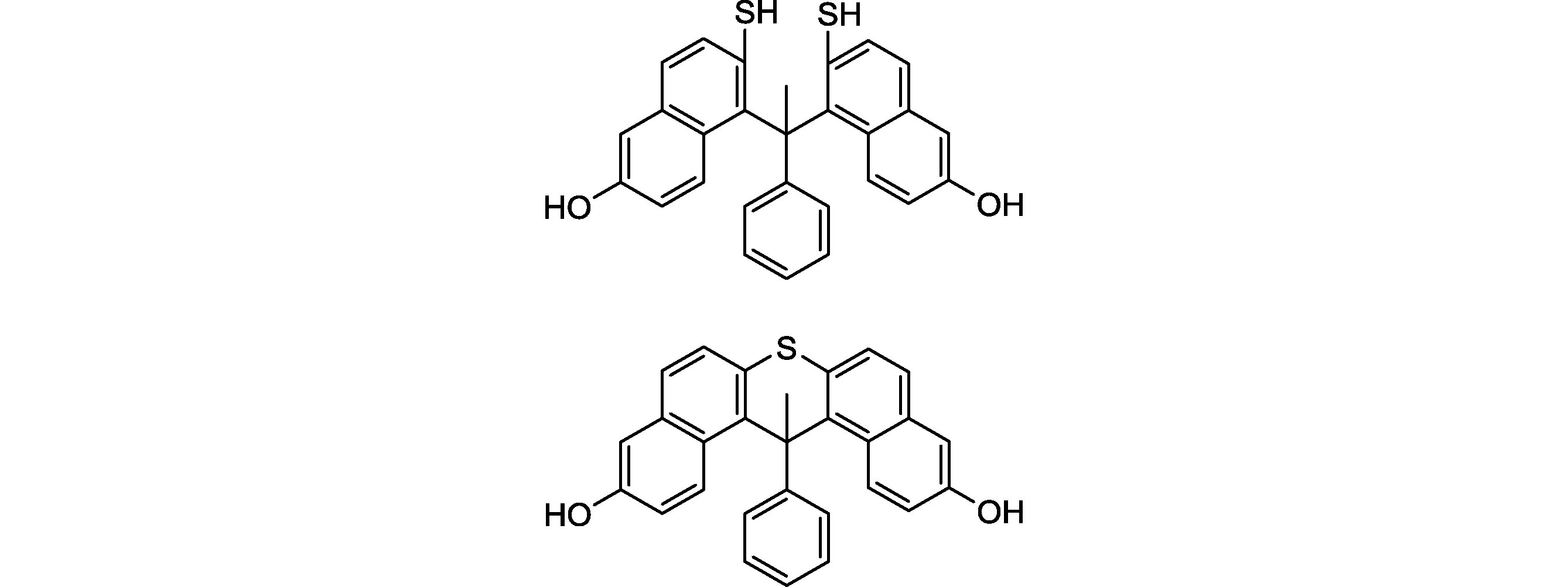

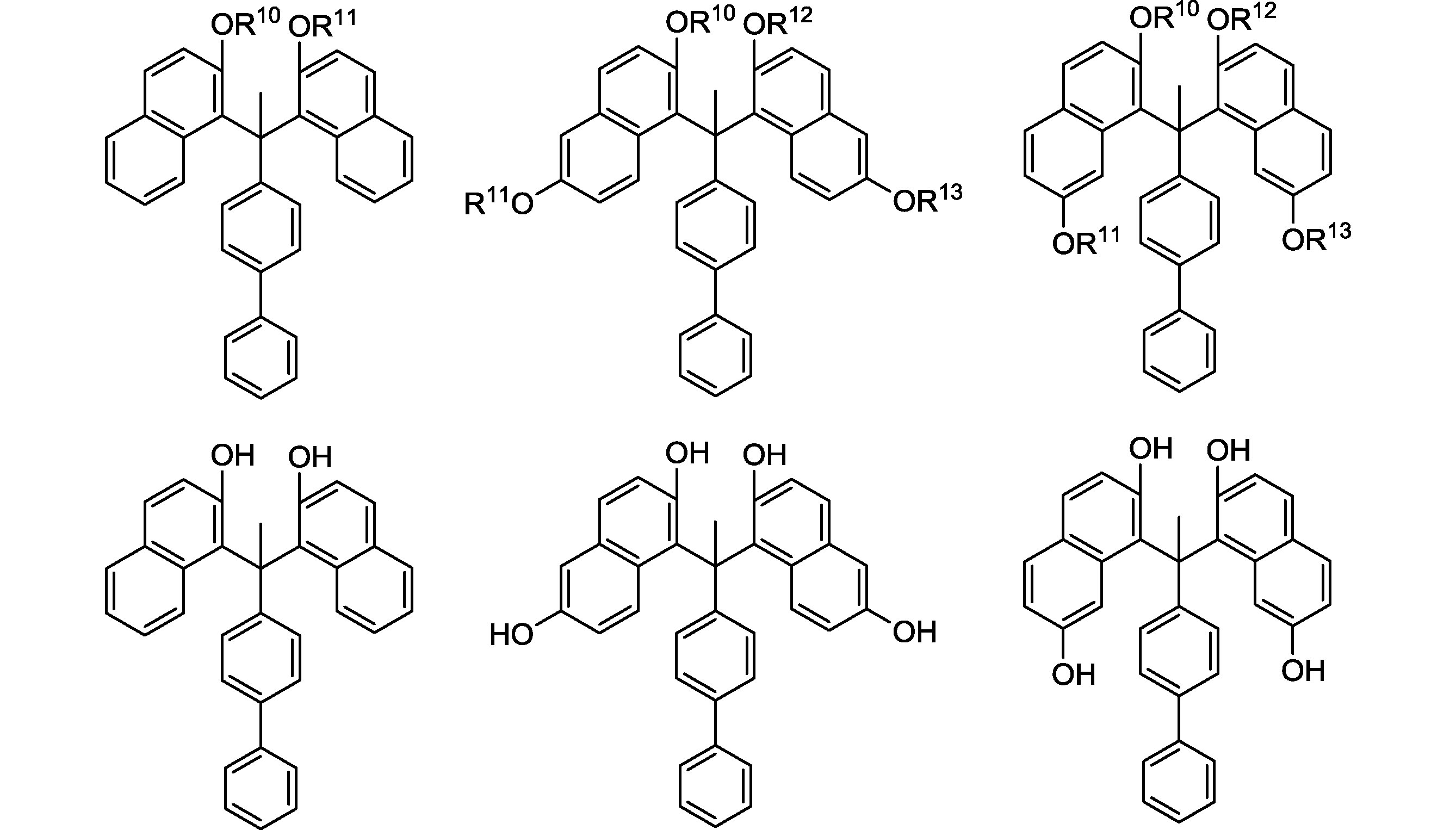
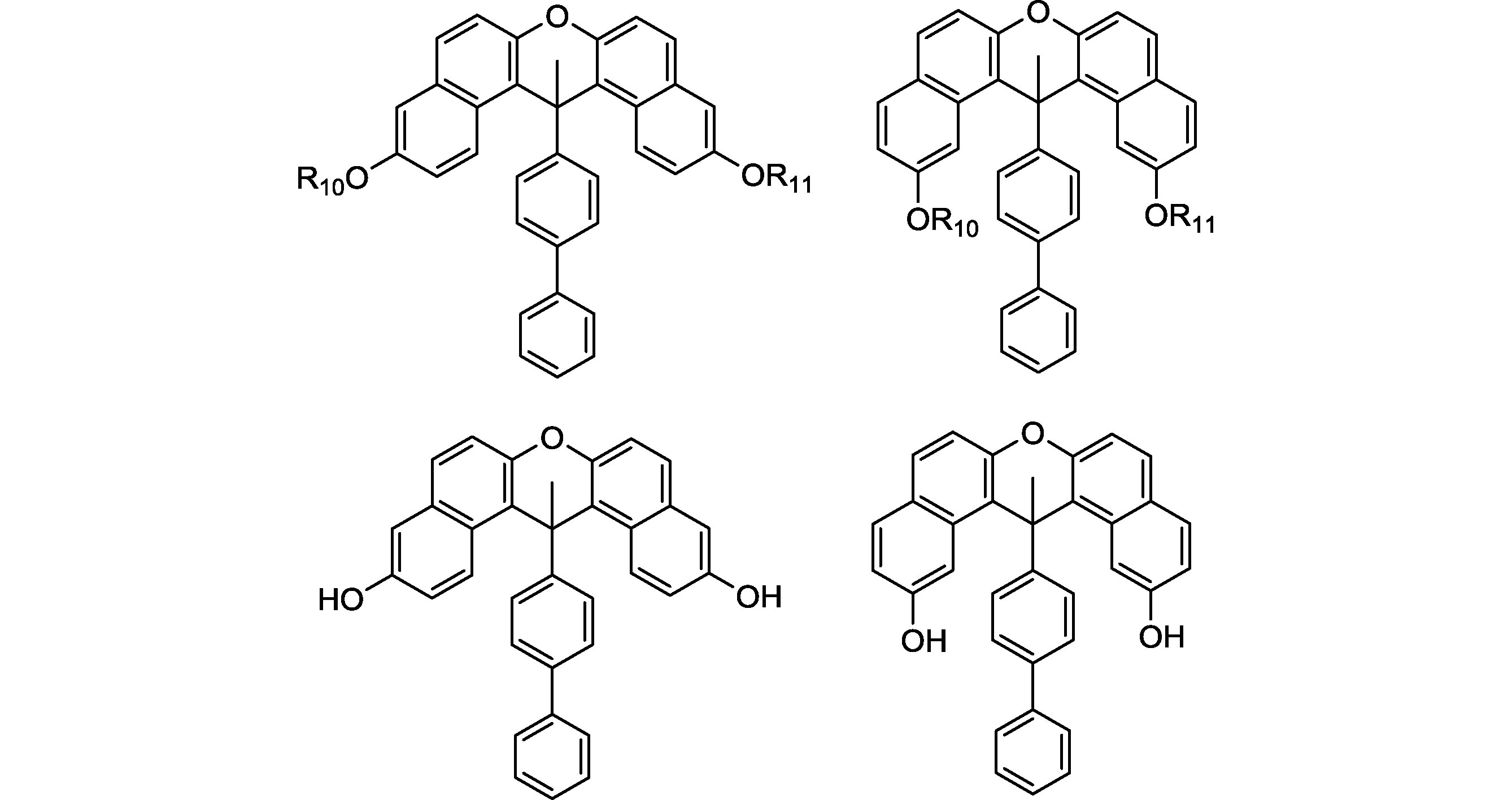
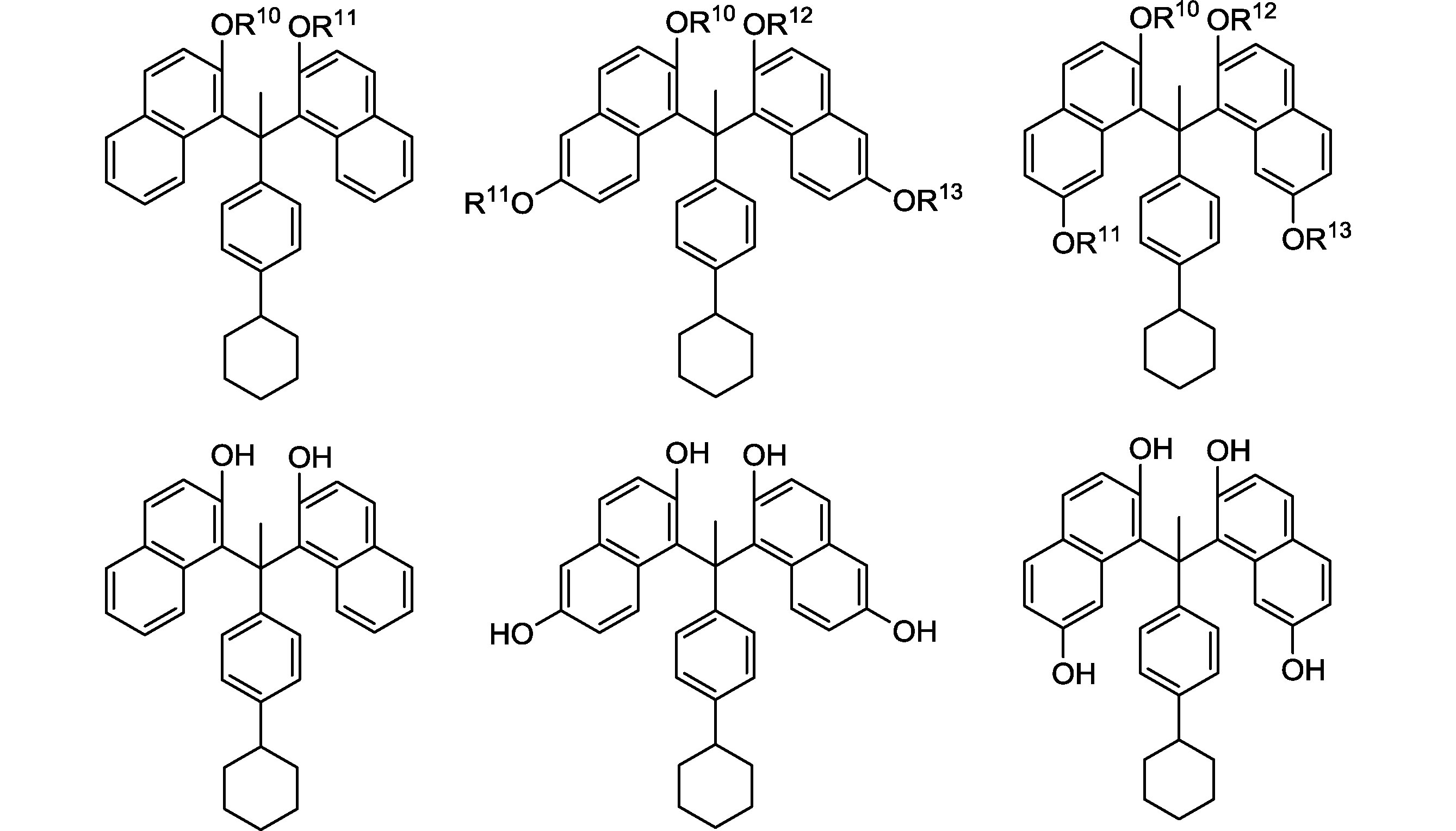

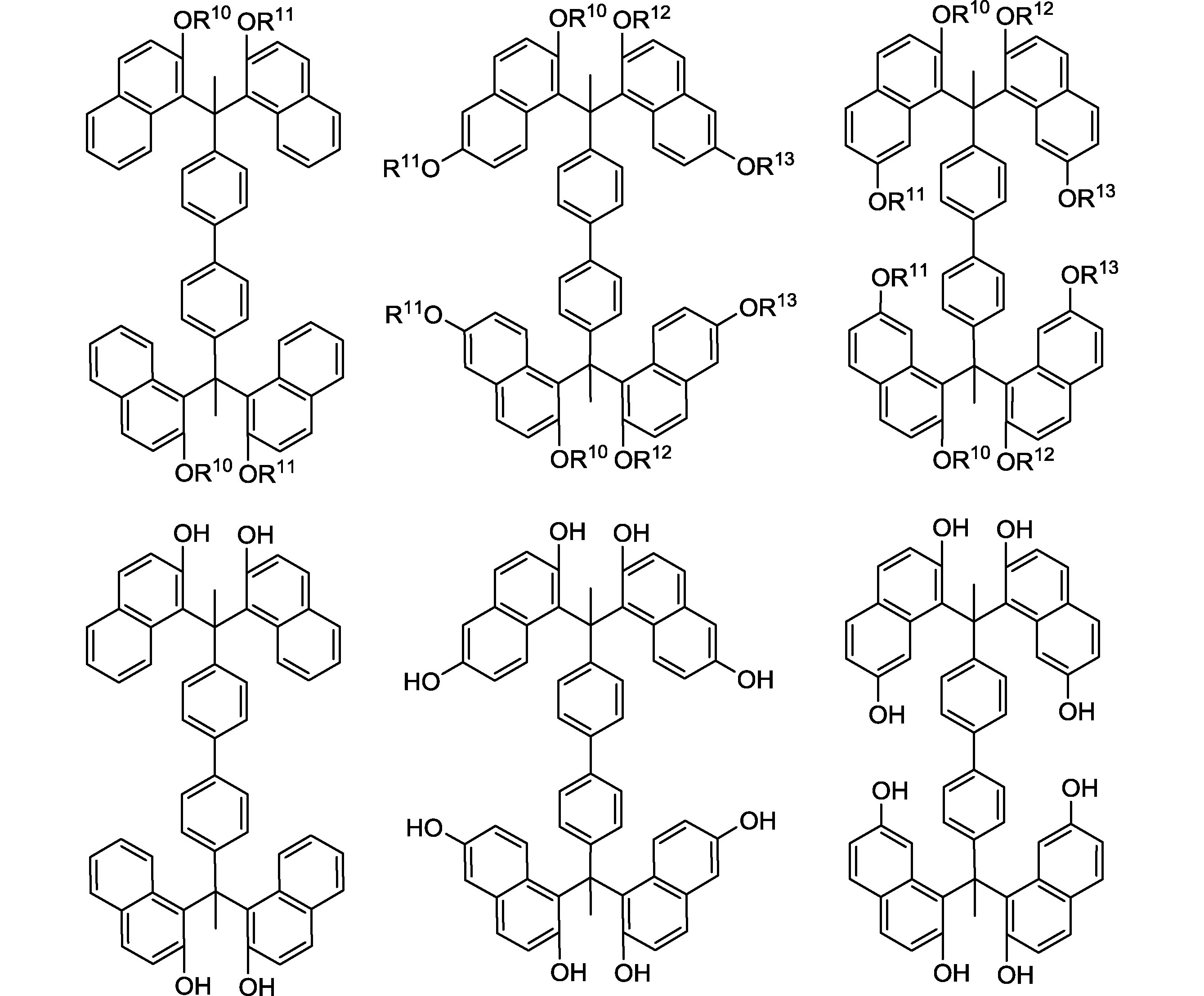
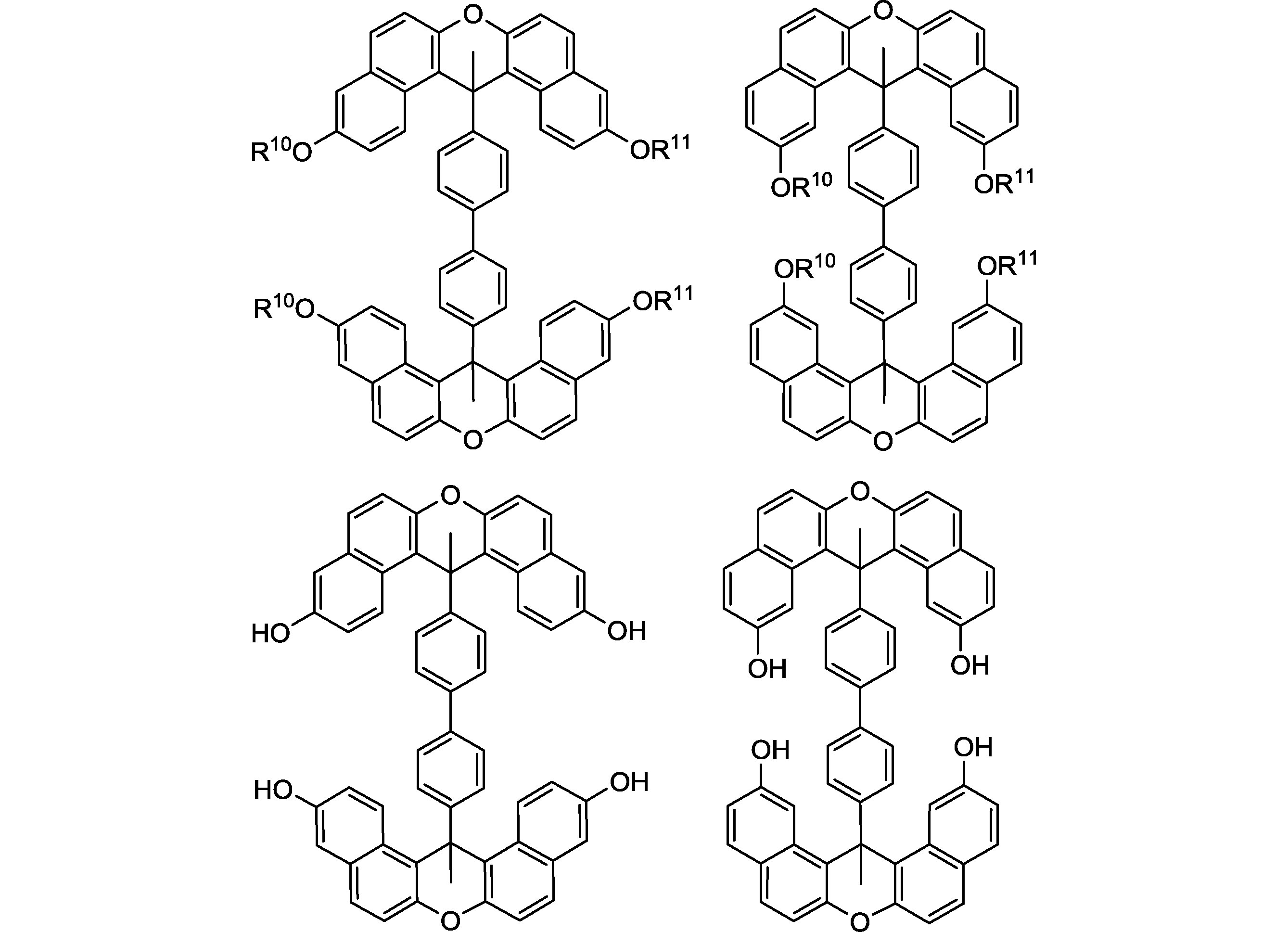

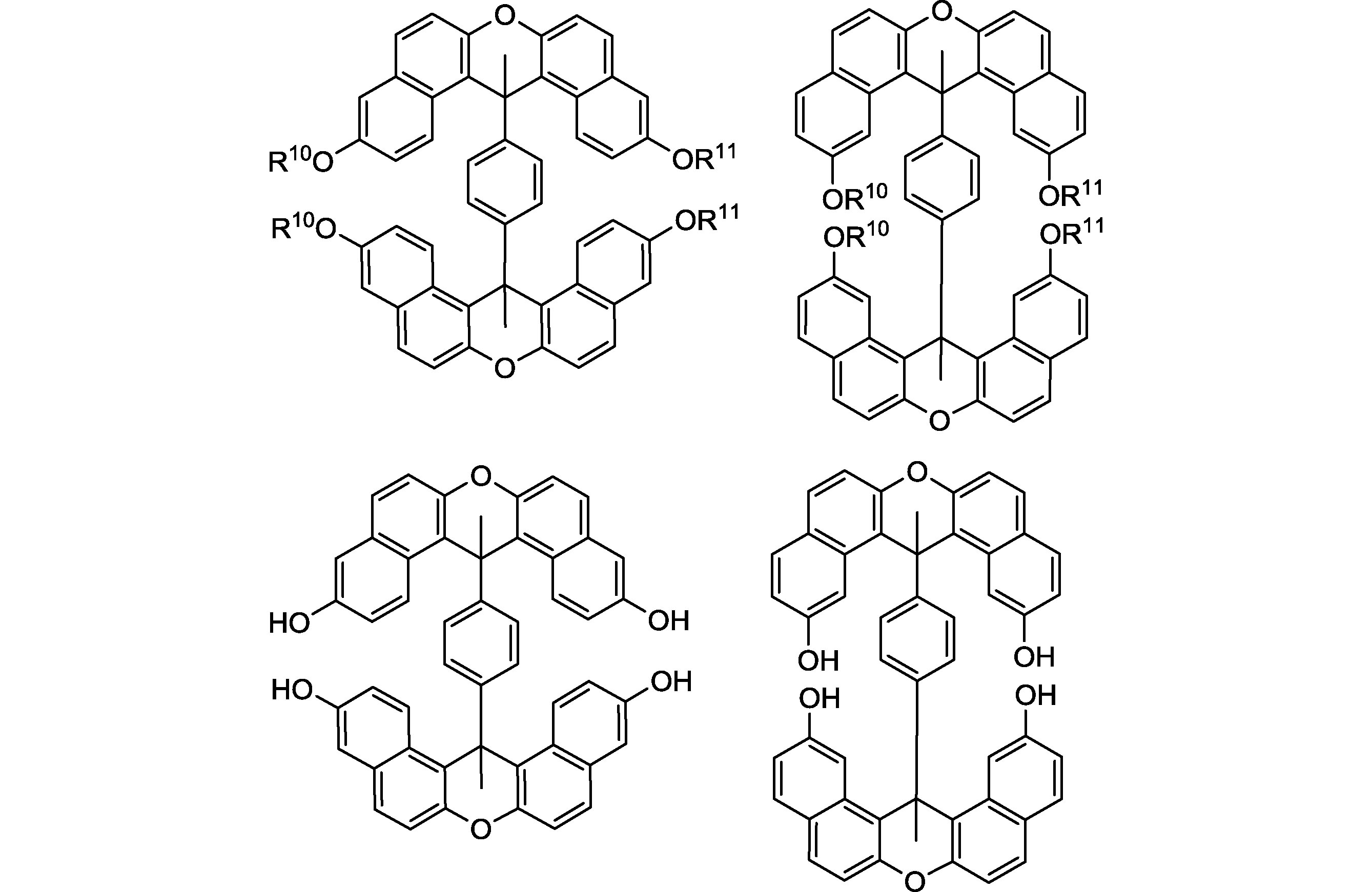
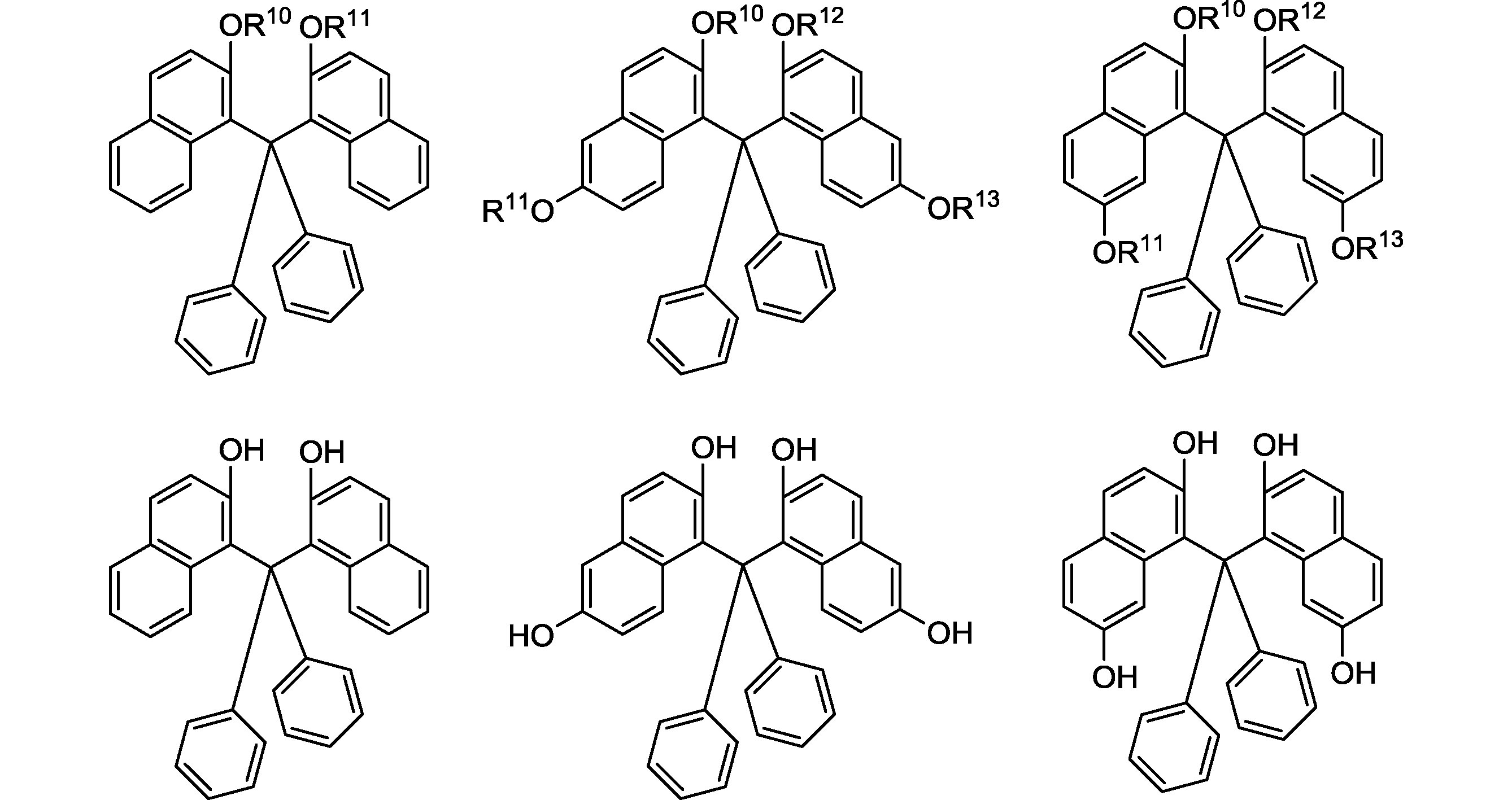
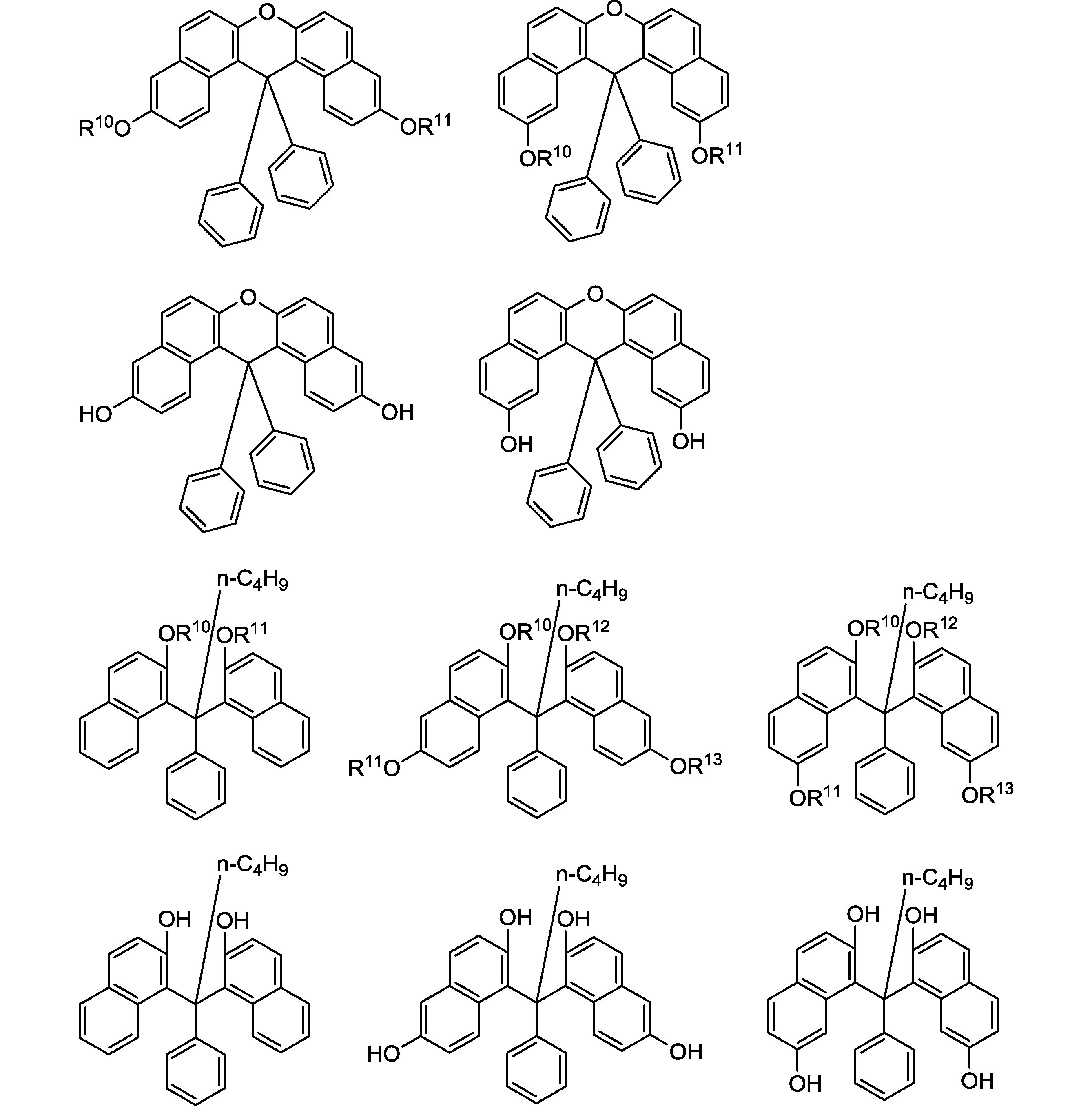
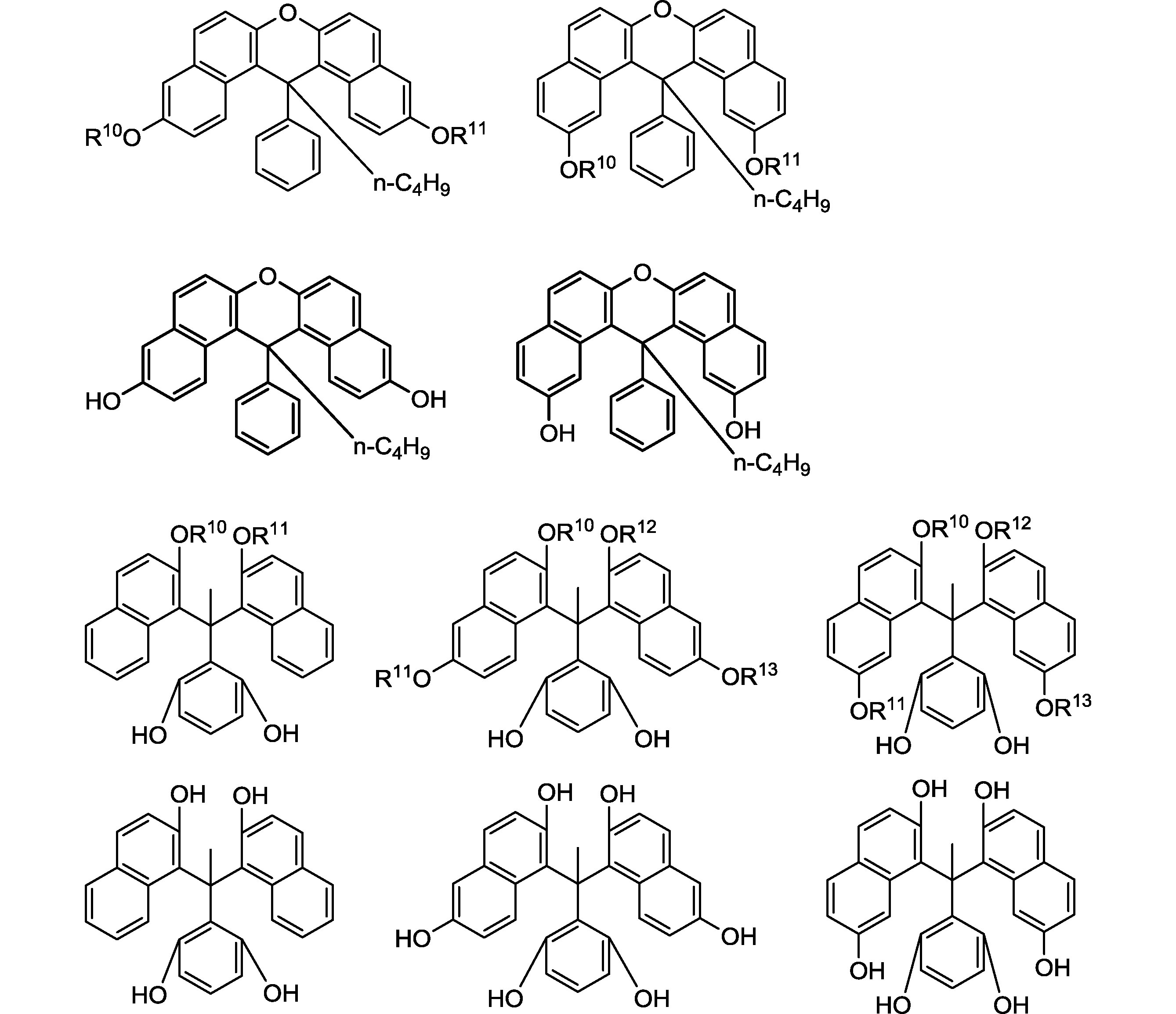


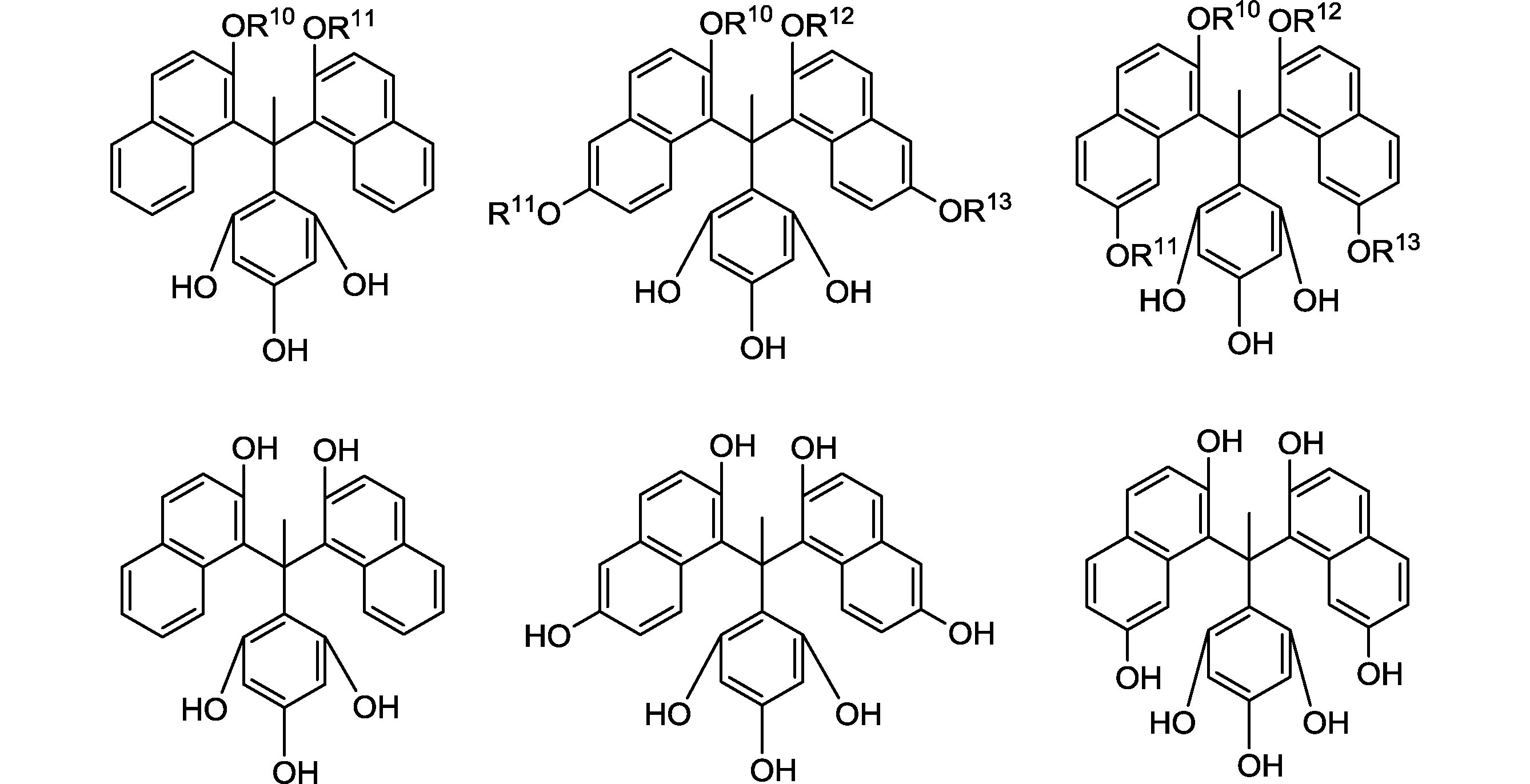
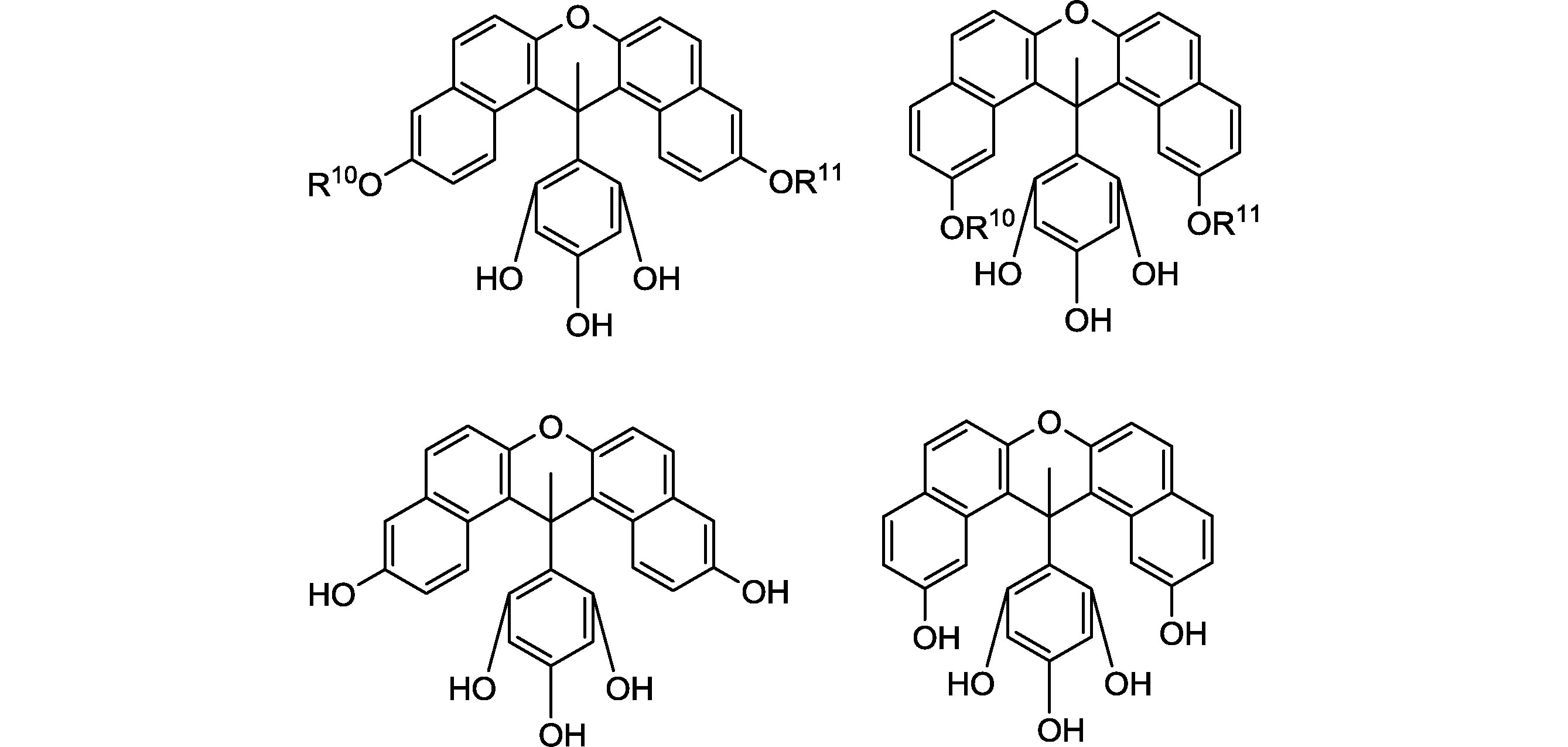


前記化合物は、ジベンゾキサンテン骨格を有する方が耐熱性の観点から好ましい。

本実施形態で使用される式(2)で表される化合物は、公知の手法を応用して適宜合成することができ、その合成手法は特に限定されない。例えば、(i)フェノール類、ナフトール類又はアントラセンオールと、対応するケトン類とを酸触媒下にて重縮合反応させる方法、(ii)フェノール類、ナフトール類又はアントラセンオールと、対応するアルデヒド類とを酸触媒下にて重縮合し、得られたトリアリールメタン、又はキサンテン類のメチン部位を置換する方法がある。
ケトン類として、芳香環を有するケトンを用いることが、高い耐熱性及び高いエッチング耐性を兼備し好ましい。
前記ポリフェノール化合物を製造する際、反応温度は、特に限定されず、反応原料の反応性に応じて適宜選択することができるが、10~200℃の範囲であることが好ましい。本実施形態の式(2)で表される化合物を選択性良く合成するには、温度が低い方が、効果が高く10~60℃の範囲がより好ましい。
前記式(2)で表される化合物の製造方法は、特に限定されないが、例えば、ナフトール類等、ケトン類、触媒を一括で仕込む方法や、触媒存在下ナフトール類やケトン類を滴下していく方法がある。重縮合反応終了後、系内に存在する未反応原料、触媒等を除去するために、反応釜の温度を130~230℃ にまで上昇させ、1~50mmHg程度で揮発分を除去することもできる。
なお、酸解離性基を導入するタイミングについては、ビナフトール類とケトン類との縮合反応後のみならず、縮合反応の前段階でもよい。また、後述する樹脂の製造を行ったのちに行ってもよい。
前記式(2)で表される化合物は、リソグラフィー用膜形成組成物として、そのまま使用することができる。また、前記式(2)で表される化合物をモノマーとして得られる樹脂としても使用することができる。例えば、前記式(2)で表される化合物と架橋反応性のある化合物とを反応させて得られる樹脂としても使用することができる。
前記式(2)で表される化合物をモノマーとして得られる樹脂としては、例えば、以下の式(4)に表される構造を有するものが挙げられる。すなわち、本実施形態のリソグラフィー用膜形成組成物は、下記式(4)に表される構造を有する樹脂を含有するものであってもよい。

R0A、R1A、R2A、m2A、nA、qA及びXAは前記式(2)におけるものと同義であり、
nAが2以上の整数の場合、nA個の[ ]内の構造式は同一であっても異なっていてもよい。
但し、R2Aの少なくとも1つは水酸基又は水酸基の水素原子が酸解離性基で置換された基である。
本実施形態の化合物及び/又は樹脂の精製方法は、前記式(1)で表される化合物、前記式(1)で表される化合物をモノマーとして得られる樹脂、前記式(2)で表される化合物及び前記式(2)で表される化合物をモノマーとして得られる樹脂から選ばれる1種以上を、溶媒に溶解させて溶液(S)を得る工程と、得られた溶液(S)と酸性の水溶液とを接触させて、前記化合物及び/又は前記樹脂中の不純物を抽出する工程(第一抽出工程)とを含み、前記溶液(S)を得る工程で用いる溶媒が、水と任意に混和しない有機溶媒を含む。
当該第一抽出工程において、前記樹脂は、前記式(1)で表される化合物及び/又は式(2)で表される化合物と架橋反応性のある化合物との反応によって得られる樹脂であることが好ましい。本実施形態の精製方法によれば、上述した特定の構造を有する化合物又は樹脂に不純物として含まれうる種々の金属の含有量を低減することができる。
より詳細には、本実施形態の精製方法においては、前記化合物及び/又は前記樹脂を、水と任意に混和しない有機溶媒に溶解させて溶液(S)を得て、さらにその溶液(S)を酸性水溶液と接触させて抽出処理を行うことができる。これにより、前記溶液(S)に含まれる金属分を水相に移行させたのち、有機相と水相とを分離して金属含有量の低減された化合物及び/又は樹脂を得ることができる。
また、ここで用いる水は、本実施の形態の目的に沿って、金属含有量の少ない水、例えば、イオン交換水等であることが好ましい。抽出処理は1回だけでもかまわないが、混合、静置、分離という操作を複数回繰り返して行うのも有効である。また、抽出処理における両者の使用割合や、温度、時間等の条件は特に限定されないが、先の酸性の水溶液との接触処理の場合と同様で構わない。
本実施形態のリソグラフィー用膜形成組成物は、前記式(1)で表される化合物、前記式(1)で表される化合物をモノマーとして得られる樹脂、前記式(2)で表される化合物及び前記式(2)で表される化合物をモノマーとして得られる樹脂からなる群より選ばれる1種以上を含有する。
本実施形態における化学増幅型レジスト用途向けリソグラフィー用膜形成組成物(以下、レジスト組成物とも称す)は、前記式(1)で表される化合物、前記式(1)で表される化合物をモノマーとして得られる樹脂、前記式(2)で表される化合物及び前記式(2)で表される化合物をモノマーとして得られる樹脂からなる群より選ばれる1種以上を含有する。
本実施形態のレジスト組成物において、レジスト基材として用いる化合物及び/又は樹脂の含有量は、特に限定されないが、固形成分の全質量(レジスト基材、酸発生剤(C)、酸架橋剤(G)、酸拡散制御剤(E)及びその他の成分(F)(「任意成分(F)」とも称す)などの任意に使用される成分を含む固形成分の総和、以下同様。)の50~99.4質量%であることが好ましく、より好ましくは55~90質量%、さらに好ましくは60~80質量%、特に好ましくは60~70質量%である。前記含有量の場合、解像度が一層向上し、ラインエッジラフネス(LER)が一層小さくなる。
なお、レジスト基材として化合物と樹脂の両方を含有する場合、前記含有量は、両成分の合計量である。
好ましくは50~99.4/0.001~49/0.5~49/0.001~49/0~49、
より好ましくは55~90/1~40/0.5~40/0.01~10/0~5、
さらに好ましくは60~80/3~30/1~30/0.01~5/0~1、
特に好ましくは60~70/10~25/2~20/0.01~3/0、である。
各成分の配合割合は、その総和が100質量%になるように各範囲から選ばれる。前記配合にすると、感度、解像度、現像性等の性能に優れる。
本実施形態のレジスト組成物は、スピンコートによりアモルファス膜を形成することができる。また、一般的な半導体製造プロセスに適用することができる。前記式(1)及び/又は式(2)で表される化合物、これらをモノマーとして得られる樹脂の種類及び/又は用いる現像液の種類によって、ポジ型レジストパターン及びネガ型レジストパターンのいずれかを作り分けることができる。
ネガ型レジストパターンの場合、本実施形態のレジスト組成物をスピンコートして形成したアモルファス膜の23℃における現像液に対する溶解速度は、10Å/sec以上であることが好ましい。当該溶解速度が10Å/sec以上であると現像液に易溶で、レジストに一層向いている。また、10Å/sec以上の溶解速度を有すると、解像性が向上する場合もある。これは、前記式(1)で表される化合物及び/又は該化合物を構成成分として含む樹脂のミクロの表面部位が溶解し、LERを低減するからと推測される。またディフェクトの低減効果がある。
前記溶解速度は、23℃にて、アモルファス膜を所定時間現像液に浸漬させ、その浸漬前後の膜厚を、目視、エリプソメーター又はQCM法等の公知の方法によって測定し決定できる。
ネガ型レジストパターンの場合、本実施形態のレジスト組成物をスピンコートして形成したアモルファス膜のKrFエキシマレーザー、極端紫外線、電子線又はX線等の放射線により露光した部分の23℃における現像液に対する溶解速度は、5Å/sec以下が好ましく、0.05~5Å/secがより好ましく、0.0005~5Å/secがさらに好ましい。当該溶解速度が5Å/sec以下であると現像液に不溶で、レジストとすることができる。また、0.0005Å/sec以上の溶解速度を有すると、解像性が向上する場合もある。これは、前記式(1)で表される化合物及び/又は該化合物を構成成分として含む樹脂の露光前後の溶解性の変化により、現像液に溶解する未露光部と、現像液に溶解しない露光部との界面のコントラストが大きくなるからと推測される。またLERの低減、ディフェクトの低減効果がある。
本実施形態の非化学増幅型レジスト用途向けリソグラフィー用膜形成組成物(以下、感放射線性組成物とも称す)に含有させる成分(A)は、後述するジアゾナフトキノン光活性化合物(B)と併用し、g線、h線、i線、KrFエキシマレーザー、ArFエキシマレーザー、極端紫外線、電子線又はX線を照射することにより、現像液に易溶な化合物となるポジ型レジスト用基材として有用である。g線、h線、i線、KrFエキシマレーザー、ArFエキシマレーザー、極端紫外線、電子線又はX線により、成分(A)の性質は大きくは変化しないが、現像液に難溶なジアゾナフトキノン光活性化合物(B)が易溶な化合物に変化することで、現像工程によってレジストパターンを作り得る。
本実施形態の感放射線性組成物に含有させる成分(A)は、比較的低分子量の化合物であることから、得られたレジストパターンのラフネスは非常に小さい。また、前記式(1)中、R0~R5からなる群より選択される少なくとも1つがヨウ素原子を含む基であることが好ましく、前記式(2)中、R0A、R1A及びR2Aからなる群より選択される少なくとも1つがヨウ素原子を含む基であることが好ましい。本実施形態の感放射線性組成物は、このような好ましい態様であるヨウ素原子を含む基を有する成分(A)を適用した場合は、電子線、極端紫外線(EUV)、X線などの放射線に対する吸収能を増加させ、その結果、感度を高めることが可能となり好ましい。
本実施形態の感放射線性組成物に含有させるジアゾナフトキノン光活性化合物(B)は、ポリマー性及び非ポリマー性ジアゾナフトキノン光活性化合物を含む、ジアゾナフトキノン物質であり、一般にポジ型レジスト組成物において、感光性成分(感光剤)として用いられているものであれば特に制限なく、1種又は2種以上任意に選択して用いることができる。
また、ナフトキノンジアジドスルホン酸クロライドやベンゾキノンジアジドスルホン酸クロライドなどの酸クロライドとしては、例えば、1,2-ナフトキノンジアジド-5-スルフォニルクロライド、1,2-ナフトキノンジアジド-4-スルフォニルクロライドなどが好ましいものとして挙げられる。
本実施形態の感放射線性組成物は、スピンコートによりアモルファス膜を形成することができる。また、一般的な半導体製造プロセスに適用することができる。用いる現像液の種類によって、ポジ型レジストパターン及びネガ型レジストパターンのいずれかを作り分けることができる。
ポジ型レジストパターンの場合、本実施形態の感放射線性組成物をスピンコートして形成したアモルファス膜の23℃における現像液に対する溶解速度は、5Å/sec以下が好ましく、0.05~5Å/secがより好ましく、0.0005~5Å/secがさらに好ましい。当該溶解速度が5Å/sec以下であると現像液に不溶で、レジストとすることができる。また、0.0005Å/sec以上の溶解速度を有すると、解像性が向上する場合もある。これは、前記式(1)で表される化合物及び/又は該化合物を構成成分として含む樹脂の露光前後の溶解性の変化により、現像液に溶解する露光部と、現像液に溶解しない未露光部との界面のコントラストが大きくなるからと推測される。またLERの低減、ディフェクトの低減効果がある。
ネガ型レジストパターンの場合、本実施形態の感放射線性組成物をスピンコートして形成したアモルファス膜の23℃における現像液に対する溶解速度は、10Å/sec以上であることが好ましい。当該溶解速度が10Å/sec以上であると現像液に易溶で、レジストに一層向いている。また、10Å/sec以上の溶解速度を有すると、解像性が向上する場合もある。これは、前記式(1)で表される化合物及び/又は該化合物を構成成分として含む樹脂のミクロの表面部位が溶解し、LERを低減するからと推測される。またディフェクトの低減効果がある。
前記溶解速度は、23℃にて、アモルファス膜を所定時間現像液に浸漬させ、その浸漬前後の膜厚を、目視、エリプソメーター又はQCM法等の公知の方法によって測定し決定できる。
ネガ型レジストパターンの場合、本実施形態の感放射線性組成物をスピンコートして形成したアモルファス膜のKrFエキシマレーザー、極端紫外線、電子線又はX線等の放射線により照射した後、又は、20~500℃で加熱した後の露光した部分の、23℃における現像液に対する溶解速度は、5Å/sec以下が好ましく、0.05~5Å/secがより好ましく、0.0005~5Å/secがさらに好ましい。当該溶解速度が5Å/sec以下であると現像液に不溶で、レジストとすることができる。また、0.0005Å/sec以上の溶解速度を有すると、解像性が向上する場合もある。これは、前記式(1)で表される化合物及び/又は該化合物を構成成分として含む樹脂の露光前後の溶解性の変化により、現像液に溶解する未露光部と、現像液に溶解しない露光部との界面のコントラストが大きくなるからと推測される。またLERの低減、ディフェクトの低減効果がある。
本実施形態の感放射線性組成物において、成分(A)の含有量は、固形成分全重量(成分(A)、ジアゾナフトキノン光活性化合物(B)及びその他の成分(D)などの任意に使用される固形成分の総和、以下同様。)に対して、好ましくは1~99質量%であり、より好ましくは5~95質量%、さらに好ましくは10~90質量%、特に好ましくは25~75質量%である。本実施形態の感放射線性組成物は、成分(A)の含有量が前記範囲内であると、高感度でラフネスの小さなパターンを得ることができる。
本実施形態の感放射線性組成物には、本発明の目的を阻害しない範囲で、必要に応じて、成分(A)及びジアゾナフトキノン光活性化合物(B)以外の成分として、酸発生剤、酸架橋剤、酸拡散制御剤、溶解促進剤、溶解制御剤、増感剤、界面活性剤、有機カルボン酸又はリンのオキソ酸若しくはその誘導体等の各種添加剤を1種又は2種以上添加することができる。なお、本明細書において、その他の成分(D)を任意成分(D)ということがある。
好ましくは1~99/99~1/0~98、
より好ましくは5~95/95~5/0~49、
さらに好ましくは10~90/90~10/0~10、
特に好ましくは20~80/80~20/0~5、
最も好ましくは25~75/75~25/0、である。
各成分の配合割合は、その総和が100質量%になるように各範囲から選ばれる。本実施形態の感放射線性組成物は、各成分の配合割合を前記範囲にすると、ラフネスに加え、感度、解像度等の性能に優れる。
本実施形態によるレジストパターンの形成方法は、上述した本実施形態のレジスト組成物又は感放射線性組成物を用いて基板上にレジスト膜を形成する工程と、形成されたレジスト膜を露光する工程と、前記レジスト膜を現像してレジストパターンを形成する工程とを備える。本実施形態におけるレジストパターンは多層プロセスにおける上層レジストとして形成することもできる。
界面活性剤としては特に限定されないが、例えば、イオン性や非イオン性のフッ素系及び/又はシリコン系界面活性剤等を用いることができる。これらのフッ素及び/又はシリコン系界面活性剤として、例えば、特開昭62-36663号公報、特開昭61-226746号公報、特開昭61-226745号公報、特開昭62-170950号公報、特開昭63-34540号公報、特開平7-230165号公報、特開平8-62834号公報、特開平9-54432号公報、特開平9-5988号公報、米国特許第5405720号明細書、同5360692号明細書、同5529881号明細書、同5296330号明細書、同5436098号明細書、同5576143号明細書、同5294511号明細書、同5824451号明細書記載の界面活性剤を挙げることができ、好ましくは、非イオン性の界面活性剤である。非イオン性の界面活性剤としては特に限定されないが、フッ素系界面活性剤又はシリコン系界面活性剤を用いることがさらに好ましい。
本実施形態の下層膜用途向けリソグラフィー用膜形成組成物(以下、下層膜形成材料とも称す。)は、前記式(1)表される化合物、前記式(1)表される化合物をモノマーとして得られる樹脂、式(2)で表される化合物及び式(2)で表される化合物をモノマーとして得られる樹脂からなる群より選ばれる少なくとも1種の物質を含有する。本実施形態において前記物質は塗布性及び品質安定性の点から、下層膜形成材料中、1~100質量%であることが好ましく、10~100質量%であることがより好ましく、50~100質量%であることがさらに好ましく、100質量%であることが特に好ましい。
本実施形態の下層膜形成材料は、溶媒を含有してもよい。本実施形態の下層膜形成材料に用いられる溶媒としては、上述した物質が少なくとも溶解するものであれば、公知のものを適宜用いることができる。
本実施形態の下層膜形成材料は、インターミキシングを抑制する等の観点から、必要に応じて架橋剤を含有していてもよい。本実施形態で使用可能な架橋剤は特に限定されないが、例えば、国際公開第2013/024779号に記載のものを用いることができる。
本実施形態の下層膜形成材料は、熱による架橋反応をさらに促進させるなどの観点から、必要に応じて酸発生剤を含有していてもよい。酸発生剤としては、熱分解によって酸を発生するもの、光照射によって酸を発生するものなどが知られているが、いずれのものも使用することができる。例えば、国際公開第2013/024779号に記載のものを用いることができる。
さらに、本実施形態の下層膜形成材料は、保存安定性を向上させる等の観点から、塩基性化合物を含有していてもよい。
また、本実施形態における下層膜形成材料は、熱硬化性の付与や吸光度をコントロールする目的で、他の樹脂及び/又は化合物を含有していてもよい。このような他の樹脂及び/又は化合物としては、ナフトール樹脂、キシレン樹脂ナフトール変性樹脂、ナフタレン樹脂のフェノール変性樹脂、ポリヒドロキシスチレン、ジシクロペンタジエン樹脂、(メタ)アクリレート、ジメタクリレート、トリメタクリレート、テトラメタクリレート、ビニルナフタレン、ポリアセナフチレンなどのナフタレン環、フェナントレンキノン、フルオレンなどのビフェニル環、チオフェン、インデンなどのヘテロ原子を有する複素環を含む樹脂や芳香族環を含まない樹脂;ロジン系樹脂、シクロデキストリン、アダマンタン(ポリ)オール、トリシクロデカン(ポリ)オール及びそれらの誘導体等の脂環構造を含む樹脂又は化合物等が挙げられるが、これらに特に限定されない。さらに、本実施形態における下層膜形成材料は、公知の添加剤を含有していてもよい。前記公知の添加剤としては、以下に限定されないが、例えば、紫外線吸収剤、界面活性剤、着色剤、ノニオン系界面活性剤等が挙げられる。
本実施形態におけるリソグラフィー用下層膜は、前記下層膜形成材料から形成される。
有機元素分析により炭素濃度及び酸素濃度(質量%)を測定した。
装置:CHNコーダーMT-6(ヤナコ分析工業(株)製)
(分子量)
LC-MS分析により、Water社製Acquity UPLC/MALDI-Synapt HDMSを用いて測定した。
(溶解性)
23℃にて、化合物をプロピレングリコールモノメチルエーテル(PGME)に対して5質量%溶液になるよう溶解させ、その後、5℃にて30日間静置し、結果を以下の基準で評価した。
評価A:目視にて析出物なしを確認
評価C:目視にて析出物ありを確認
攪拌機、冷却管及びビュレットを備えた内容積300mLの容器において、2-ナフトール(シグマ-アルドリッチ社製試薬)10g(69.0mmol)を120℃で溶融後、硫酸0.27gを仕込み、4-アセチルビフェニル(シグマ-アルドリッチ社製試薬)2.7g(13.8mmol)を加えて、内容物を120℃で6時間撹拌して反応を行って反応液を得た。次に反応液にN-メチル-2-ピロリドン(関東化学株式会社製)100mL、純水50mLを加えたあと、酢酸エチルにより抽出した。次に純水を加えて中性になるまで分液後、濃縮を行って溶液を得た。
得られた溶液を、カラムクロマトによる分離後、下記式(BiN-1)で表される目的化合物(BiN-1)が1.0g得られた。
得られた化合物(BiN-1)について、前記方法により分子量を測定した結果、466であった。また、炭素濃度は87.5質量%、酸素濃度は6.9質量%であった。
得られた化合物(BiN-1)について、前記測定条件で、NMR測定を行ったところ、以下のピークが見出され、下記式(BiN-1)の化学構造を有することを確認した。
δ(ppm)9.69(2H,O-H)、7.01~7.67(21H,Ph-H)、2.28(3H,C-H)

攪拌機、冷却管及びビュレットを備えた内容積300mLの容器において、o-フェニルフェノール(シグマ-アルドリッチ社製試薬)12g(69.0mmol)を120℃で溶融後、硫酸0.27gを仕込み、4-アセチルビフェニル(シグマ-アルドリッチ社製試薬)2.7g(13.8mmol)を加えて、内容物を120℃で6時間撹拌して反応を行って反応液を得た。次に反応液にN-メチル-2-ピロリドン(関東化学株式会社製)100mL、純水50mLを加えたあと、酢酸エチルにより抽出した。次に純水を加えて中性になるまで分液後、濃縮を行って溶液を得た。
得られた溶液を、カラムクロマトによる分離後、下記式(BiP-1)で表される目的化合物(BiP-1)が5.0g得られた。
得られた化合物(BiP-1)について、前記方法により分子量を測定した結果、518であった。また、炭素濃度は88.0質量%、酸素濃度は6.2質量%であった。
得られた化合物(BiP-1)について、前記測定条件で、NMR測定を行ったところ、以下のピークが見出され、下記式(BiP-1)の化学構造を有することを確認した。
δ(ppm)9.48(2H,O-H)、6.88~7.61(25H,Ph-H)、3.36(3H,C-H)

合成実施例1において、原料である2-ナフトール及び4-アセチルビフェニルを下記表1のように変更した以外は合成実施例1と同様にして、各目的物を得た。
また、合成実施例3~10にて得られた化合物についてそれぞれ、1H-NMRで同定した。結果を表2に示す。

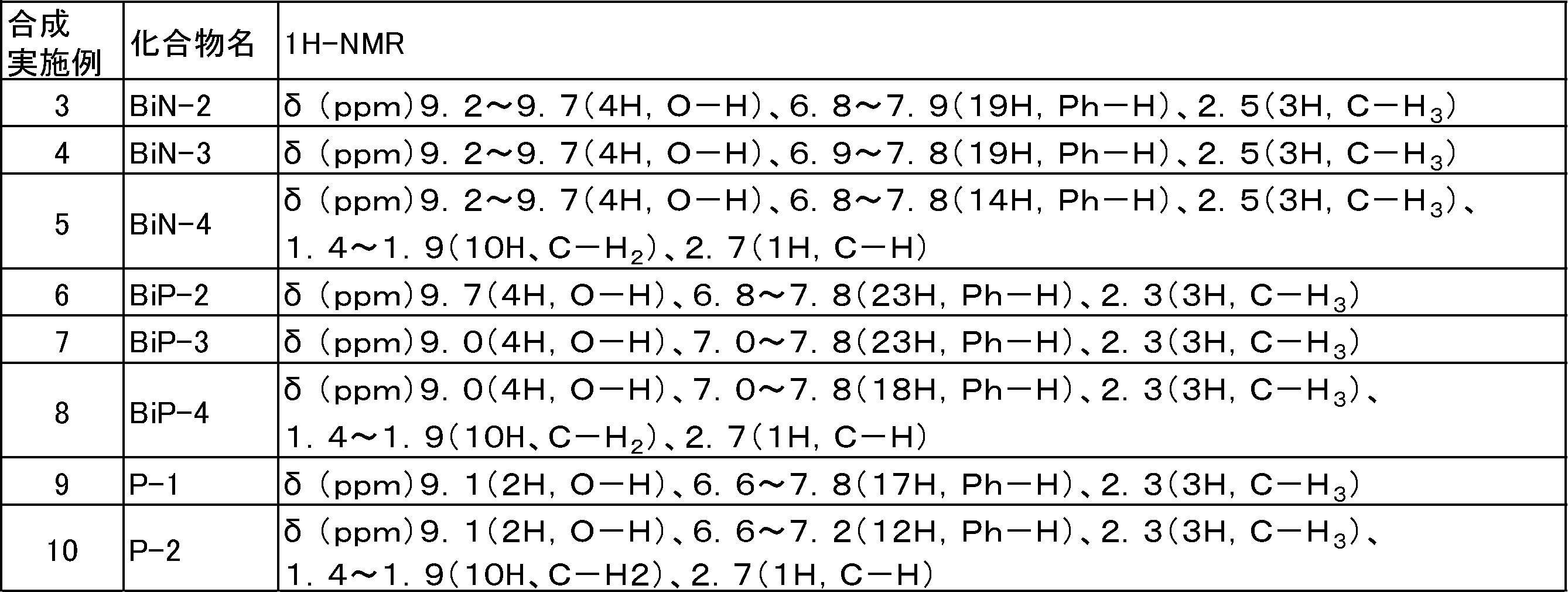
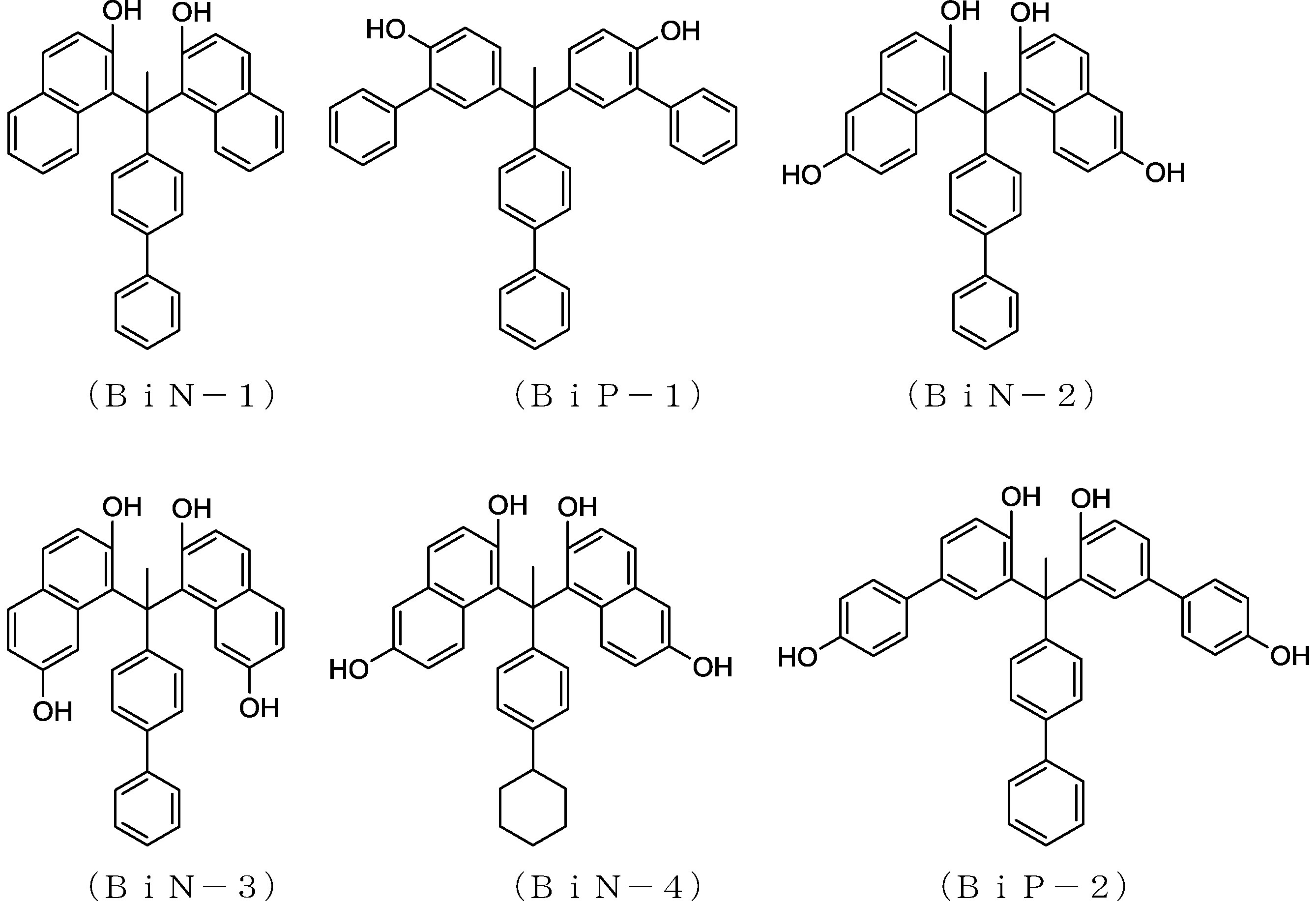

[BisN-1の合成]
攪拌機、冷却管及びビュレットを備えた内容積100mLの容器に、2,6-ジヒドロキシナフタレン(シグマ-アルドリッチ社製試薬)1.60g(10mmol)と、4-ビフェニルアルデヒド(三菱瓦斯化学社製)1.82g(10mmol)と、メチルイソブチルケトン30mLとを仕込み、95%の硫酸5mLを加えて、反応液を100℃で6時間撹拌して反応を行った。次に、反応液を濃縮し、純水50gを加えて反応生成物を析出させ、室温まで冷却した後、濾過を行って分離した。得られた固形物を濾過し、乾燥させた後、カラムクロマトによる分離精製を行うことにより、下記式で表される化合物(BisN-1)3.05gを得た。
1H-NMRにより以下のピークが見出され、下記式の化学構造を有することを確認した。
1H-NMR:(d-DMSO、内部標準TMS)
δ(ppm)9.7(2H,O-H)、7.2~8.5(19H,Ph-H)、6.6(1H,C-H)

攪拌機、冷却管及びビュレットを備えた内容積200mLの容器に、BisN-1を10g(21.4mmol)と、炭酸カリウム(関東化学製)7.4g(53.5mmol)、N,N-ジメチルホルムアミド(関東化学製)50mLとを仕込み、5℃にてヨウ化メチル(関東化学製)7.6g(53.5mmol)を5分間かけて加えたのち、室温にて6時間撹拌して反応を行った。次に、反応液に純水200mLを加えて反応性生物を析出させ、濾過を行って分離した。得られた固形分を洗浄、乾燥し、下記式で表される化合物(Me-BisN-1)を10g得た。

攪拌機、冷却管及びビュレットを備えた内容積200mLの容器に、Me-BisN-1を2.5g(5.1mmol)と、ジメチルスルホキシド50mL(関東化学製)50mLとを仕込み、2.6mol/Lのn-ブチルリチウム(関東化学製)n-ヘキサン溶液2.2mL(n-ブチルリチウムとして5.61mmol)を加え、室温で30分間撹拌したのち、室温にてヨウ化メチル(関東化学製)2.1g(14.5mmol)を加えて室温で30分間攪拌して反応を行った。次に、反応液に純水200mLを加えて反応性生物を析出させ、濾過を行って分離した。得られた固形分を洗浄、乾燥し、下記式で表される化合物(Me-XBiN-1)2.2gを得た。

攪拌機、冷却管及びビュレットを備えた内容積500mLの容器に、Me-XBiN-1を15g(29mmol)と、ピリジン塩酸塩(関東化学製)80gを加え、190℃で溶融後、2時間撹拌し反応した。反応終了後、90℃に冷却し、90℃の純水を160mL加え結晶を析出させた。結晶を酢酸エチル/純水=250mL/100mLで洗浄し、次いで酢酸エチル100mLに溶解後、酢酸エチル/ヘキサン=150mL/150mLを加えて結晶を得た。得られた結晶を分離、乾燥し、下記式で表される化合物(XbiN-1)13gを得た。
得られた化合物(XbiN-1)について、前記方法により分子量を測定した結果、480であった。また、炭素濃度は85.0質量%、酸素濃度は10.0質量%であった。
前記測定条件で、NMR測定を行ったところ、以下のピークが見出され、下記式(XBiN-1)の化学構造を有することを確認した。
δ(ppm)9.2(2H,O-H)、6.8~7.9(19H,Ph-H)、2.5(3H,C-H)

合成実施例11において原料である2,6-ジヒドロキシナフタレン及び4-ビフェニルアルデヒドを下記表3のように変更した以外は合成実施例11と同様にして、各目的物を得た。
また、合成実施例12~13にて得られた化合物についてそれぞれ、1H-NMRで同定した。結果を表4に示す。



合成実施例1において、原料である2-ナフトール及び4-アセチルビフェニルを下記表5のように変更し、水1.5mL、ドデシルメルカプタン73mg(0.35mmol)、37%塩酸2.3g(22mmol)を加え、反応温度を55℃に変更した以外は合成実施例1と同様にして、各目的物を得た。
また、合成実施例14~15にて得られた化合物についてそれぞれ、1H-NMRで同定した。結果を表6に示す。



ジムロート冷却管、温度計及び攪拌翼を備えた、底抜きが可能な内容積10Lの四つ口フラスコを準備した。この四つ口フラスコに、窒素気流中、1,5-ジメチルナフタレン1.09kg(7mol、三菱ガス化学(株)製)、40質量%ホルマリン水溶液2.1kg(ホルムアルデヒドとして28mol、三菱ガス化学(株)製)及び98質量%硫酸(関東化学(株)製)0.97mLを仕込み、常圧下、100℃で還流させながら7時間反応させた。その後、希釈溶媒としてエチルベンゼン(和光純薬工業(株)製試薬特級)1.8kgを反応液に加え、静置後、下相の水相を除去した。さらに、中和及び水洗を行い、エチルベンゼン及び未反応の1,5-ジメチルナフタレンを減圧下で留去することにより、淡褐色固体のジメチルナフタレンホルムアルデヒド樹脂1.25kgを得た。
得られたジメチルナフタレンホルムアルデヒドの分子量は、Mn:562、であった。
得られた樹脂(CR-1)は、Mn:885、Mw:2220、Mw/Mn:4.17であった。また、炭素濃度は89.1質量%、酸素濃度は4.5質量%であった。
前記BiN-1、BiP-1、BiN-2、BiN-3、BiN-4、BiP-2、BiP-3、BiP-4、P-1、P-2、XBiN-1、XBiN-2、XBiN-3、P-3、P-4、CR-1につき、溶解度試験を行った。結果を第1表に示す。
また、表1に示す組成のリソグラフィー用下層膜形成材料を各々調製した。次に、これらのリソグラフィー用下層膜形成材料をシリコン基板上に回転塗布し、その後、240℃で60秒間、さらに400℃で120秒間ベークして、膜厚200nmの下層膜を各々作製した。酸発生剤、架橋剤及び有機溶媒については次のものを用いた。
酸発生剤:みどり化学社製 ジターシャリーブチルジフェニルヨードニウムノナフルオロメタンスルホナート(DTDPI)
架橋剤:三和ケミカル社製 ニカラックMX270(ニカラック)
有機溶媒:プロピレングリコールモノメチルエーテルアセテートアセテート(PGMEA)
ノボラック:群栄化学社製 PSM4357
そして、下記に示す条件でエッチング試験を行い、エッチング耐性を評価した。評価結果を第1表に示す。
エッチング装置:サムコインターナショナル社製 RIE-10NR
出力:50W
圧力:20Pa
時間:2min
エッチングガス
Arガス流量:CF4ガス流量:O2ガス流量=50:5:5(sccm)
[エッチング耐性の評価]
エッチング耐性の評価は、以下の手順で行った。
まず、実施例1において用いる化合物(BiN-1)に代えてノボラック(群栄化学社製 PSM4357)を用いること以外は、実施例1と同様の条件で、ノボラックの下層膜を作製した。そして、このノボラックの下層膜を対象として、上述のエッチング試験を行い、そのときのエッチングレートを測定した。
次に、実施例1及び比較例1の下層膜を対象として、前記エッチング試験を同様に行い、そのときのエッチングレートを測定した。
そして、ノボラックの下層膜のエッチングレートを基準として、以下の評価基準でエッチング耐性を評価した。
[評価基準]
S:ノボラックの下層膜に比べてエッチングレートが、-15%未満
A:ノボラックの下層膜に比べてエッチングレートが、-15%~-10%未満
B:ノボラックの下層膜に比べてエッチングレートが、-10%~+5%
C:ノボラックの下層膜に比べてエッチングレートが、+5%超
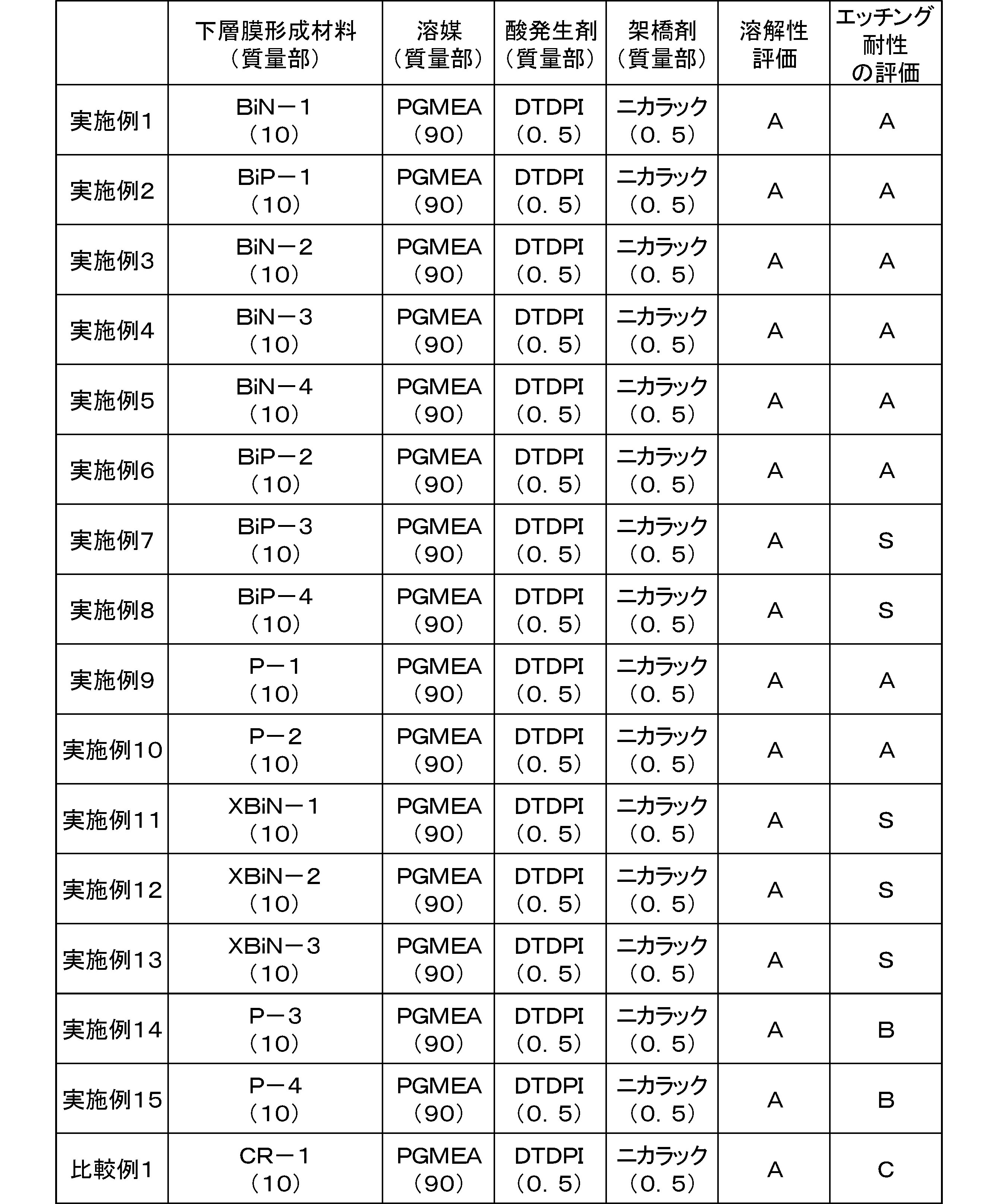
次に、BiN-1、BiP-1、BiN-2、BiN-3、BiN-4、BiP-2、BiP-3、BiP-4、P-1、P-2、XBiN-1、XBiN-2、XBiN-3、P-3又は、P-4を含むリソグラフィー用下層膜形成材料の各溶液を膜厚300nmのSiO2基板上に塗布して、240℃で60秒間、さらに400℃で120秒間ベークすることにより、膜厚70nmの下層膜を形成した。この下層膜上に、ArF用レジスト溶液を塗布し、130℃で60秒間ベークすることにより、膜厚140nmのフォトレジスト層を形成した。なお、ArFレジスト溶液としては、下記式(11)の化合物:5質量部、トリフェニルスルホニウムノナフルオロメタンスルホナート:1質量部、トリブチルアミン:2質量部、及びPGMEA:92質量部を配合して調製したものを用いた。
式(11)の化合物は、2-メチル-2-メタクリロイルオキシアダマンタン4.15g、メタクリルロイルオキシ-γ-ブチロラクトン3.00g、3-ヒドロキシ-1-アダマンチルメタクリレート2.08g、アゾビスイソブチロニトリル0.38gを、テトラヒドロフラン80mLに溶解させて反応溶液とした。この反応溶液を、窒素雰囲気下、反応温度を63℃に保持して、22時間重合させた後、反応溶液を400mLのn-ヘキサン中に滴下した。このようにして得られる生成樹脂を凝固精製させ、生成した白色粉末をろ過し、減圧下40℃で一晩乾燥させて得た。

下層膜の形成を行わないこと以外は、実施例16と同様にして、フォトレジスト層をSiO2基板上に直接形成し、ポジ型のレジストパターンを得た。結果を表8に示す。
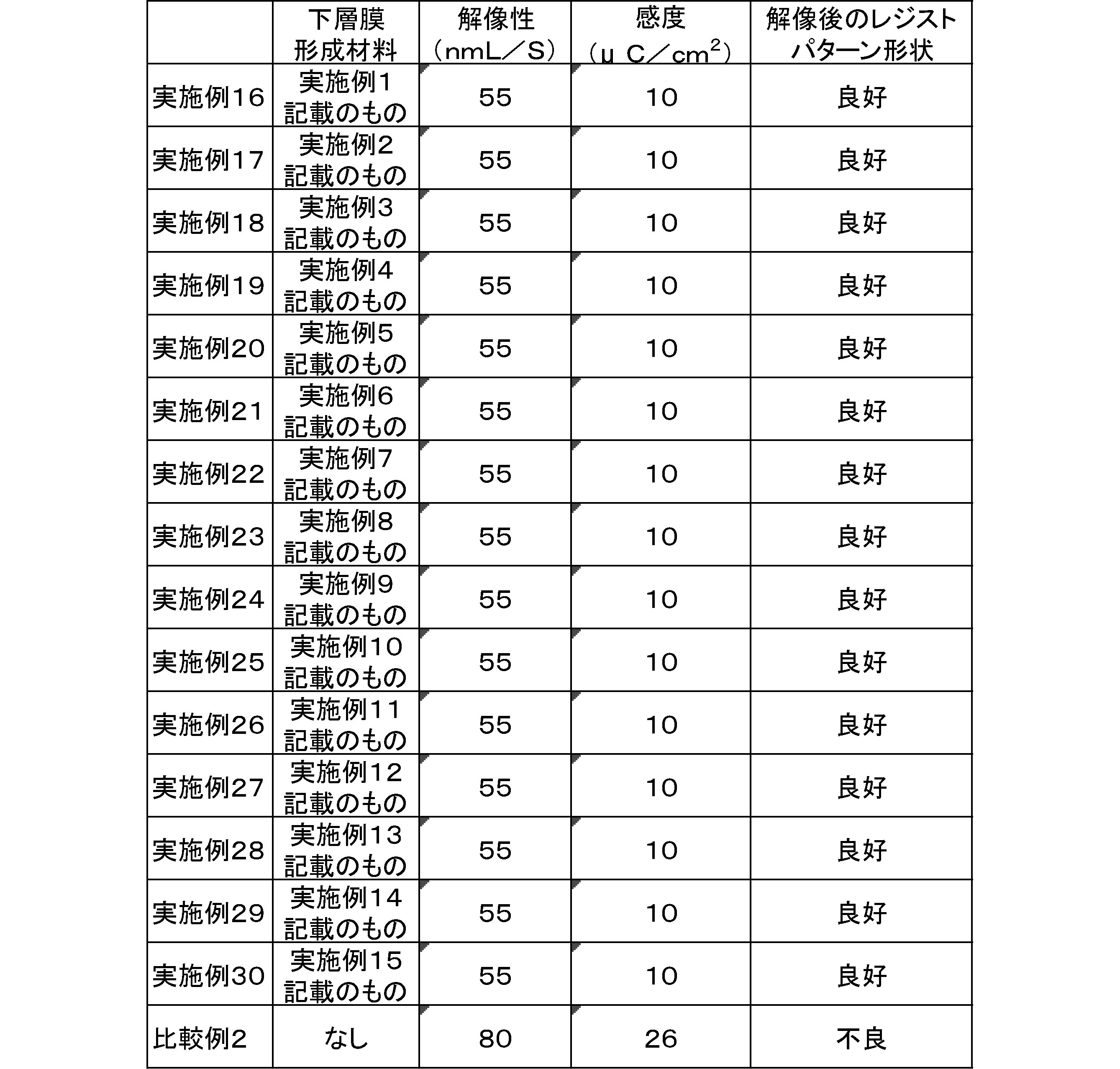
また、実施例16~30では、現像後のレジストパターン形状が良好であり、欠陥も見られないことが確認された。下層膜の形成を省略した比較例2に比して、解像性及び感度ともに有意に優れていることが確認された。
現像後のレジストパターン形状の相違から、実施例16~30において用いたリソグラフィー用下層膜形成材料は、レジスト材料との密着性がよいことが示された。
実施例1~15のリソグラフィー用下層膜形成材料の溶液を膜厚300nmのSiO2基板上に塗布して、240℃で60秒間、さらに400℃で120秒間ベークすることにより、膜厚80nmの下層膜を形成した。この下層膜上に、珪素含有中間層材料を塗布し、200℃で60秒間ベークすることにより、膜厚35nmの中間層膜を形成した。さらに、この中間層膜上に、前記ArF用レジスト溶液を塗布し、130℃で60秒間ベークすることにより、膜厚150nmのフォトレジスト層を形成した。なお、珪素含有中間層材料としては、特開2007-226170号公報<合成例1>に記載の珪素原子含有ポリマーを用いた。
次いで、電子線描画装置(エリオニクス社製;ELS-7500,50keV)を用いて、フォトレジスト層をマスク露光し、115℃で90秒間ベーク(PEB)し、2.38質量%テトラメチルアンモニウムヒドロキシド(TMAH)水溶液で60秒間現像することにより、55nmL/S(1:1)のポジ型のレジストパターンを得た。
その後、サムコインターナショナル社製 RIE-10NRを用いて、得られたレジストパターンをマスクにして珪素含有中間層膜(SOG)のドライエッチング加工を行い、続いて、得られた珪素含有中間層膜パターンをマスクにした下層膜のドライエッチング加工と、得られた下層膜パターンをマスクにしたSiO2膜のドライエッチング加工とを順次行った。
レジストパターンのレジスト中間層膜へのエッチング条件
出力:50W
圧力:20Pa
時間:1min
エッチングガス
Arガス流量:CF4ガス流量:O2ガス流量=50:8:2(sccm)
レジスト中間膜パターンのレジスト下層膜へのエッチング条件
出力:50W
圧力:20Pa
時間:2min
エッチングガス
Arガス流量:CF4ガス流量:O2ガス流量=50:5:5(sccm)
レジスト下層膜パターンのSiO2膜へのエッチング条件
出力:50W
圧力:20Pa
時間:2min
エッチングガス
Arガス流量:C5F12ガス流量:C2F6ガス流量:O2ガス流量
=50:4:3:1(sccm)
上述のようにして得られたパターン断面(エッチング後のSiO2膜の形状)を、(株)日立製作所製電子顕微鏡(S-4800)を用いて観察したところ、本実施形態の下層膜を用いた実施例は、多層レジスト加工におけるエッチング後のSiO2膜の形状は矩形であり、欠陥も認められず良好であることが確認された。
実施例1~15のリソグラフィー用下層膜形成材料と同組成の光学部品形成組成物溶液を膜厚300nmのSiO2基板上に塗布して、260℃で300秒間ベークすることにより、膜厚100nmの光学部品形成膜を形成した。
次いで、ジェー・エー・ウーラム・ジャパン社製 真空紫外域多入射角分光エリプソメーター(VUV-VASE)を用いて、633nmの波長における屈折率及び透明性試験を行い、以下の基準に従って屈折率及び透明性を評価した。
[屈折率の評価基準]
A:屈折率が1.60以上
C:屈折率が1.60未満
[透明性の評価基準]
A:吸光定数が0.03未満
C:吸光定数が0.03以上
その結果、実施例46~60のいずれも屈折率がAの評価、透明性がAの評価であり、光学部品形成組成物として有用であることが確認された。
また、湿式プロセスが適用可能であり、耐熱性及びエッチング耐性に優れるフォトレジスト下層膜を形成するために有用な化合物、樹脂及びリソグラフィー用膜形成組成物を実現することができる。そして、このリソグラフィー用膜形成組成物は、耐熱性が高く、溶媒溶解性も高い、特定構造を有する化合物又は樹脂を用いているため、高温ベーク時の膜の劣化が抑制され、酸素プラズマエッチング等に対するエッチング耐性にも優れたレジスト及び下層膜を形成することができる。さらには、下層膜を形成した場合、レジスト層との密着性にも優れるので、優れたレジストパターンを形成することができる。
さらには屈折率が高く、また低温~高温処理によって着色が抑制されることから、各種光学部品形成組成物としても有用である。
したがって、本発明は、例えば、電気用絶縁材料、レジスト用樹脂、半導体用封止樹脂、プリント配線板用接着剤、電気機器・電子機器・産業機器等に搭載される電気用積層板、電気機器・電子機器・産業機器等に搭載されるプリプレグのマトリックス樹脂、ビルドアップ積層板材料、繊維強化プラスチック用樹脂、液晶表示パネルの封止用樹脂、塗料、各種コーティング剤、接着剤、半導体用のコーティング剤、半導体用のレジスト用樹脂、下層膜形成用樹脂、フィルム状、シート状で使われるほか、プラスチックレンズ(プリズムレンズ、レンチキュラーレンズ、マイクロレンズ、フレネルレンズ、視野角制御レンズ、コントラスト向上レンズ等)、位相差フィルム、電磁波シールド用フィルム、プリズム、光ファイバー、フレキシブルプリント配線用ソルダーレジスト、メッキレジスト、多層プリント配線板用層間絶縁膜、感光性光導波路等の光学部品等において、広く且つ有効に利用可能である。
特に、本発明はリソグラフィー用レジスト、リソグラフィー用下層膜及び多層レジスト用下層膜及び光学部品の分野において、特に有効に利用可能である。
また、明細書に記載された全ての文献、特許出願、及び技術規格は、個々の文献、特許出願、及び技術規格が参照により取り込まれることが具体的かつ個々に記された場合と同程度に、本明細書中に参照により取り込まれる。
Claims (18)
- 下記式(0)で表される、化合物。

RZは、炭素数1~60のN価の基又は単結合であり、
RTは、各々独立して、置換基を有していてもよい炭素原子数1~30のアルキル基、置換基を有していてもよい炭素原子数6~40のアリール基、置換基を有していてもよい炭素原子数2~30のアルケニル基、置換基を有していてもよい炭素数1~30のアルコキシ基、ハロゲン原子、ニトロ基、アミノ基、シアノ基、チオール基、水酸基又は水酸基の水素原子が酸解離性基で置換された基であり、ここで、前記アルキル基、前記アルケニル基及び前記アリール基は、エーテル結合、ケトン結合又はエステル結合を含んでいてもよく、ここで、RTの少なくとも1つは水酸基又は水酸基の水素原子が酸解離性基で置換された基であり、
Xは、酸素原子、硫黄原子又は無架橋であることを表し、
mは、各々独立して0~9の整数であり、ここで、mの少なくとも1つは1~9の整数であり、
Nは、1~4の整数であり、ここで、Nが2以上の整数の場合、N個の[ ]内の構造式は同一であっても異なっていてもよく、
rは、各々独立して0~2の整数である。) - 前記式(0)で表される化合物が下記式(1)で表される化合物である、請求項1に記載の化合物。
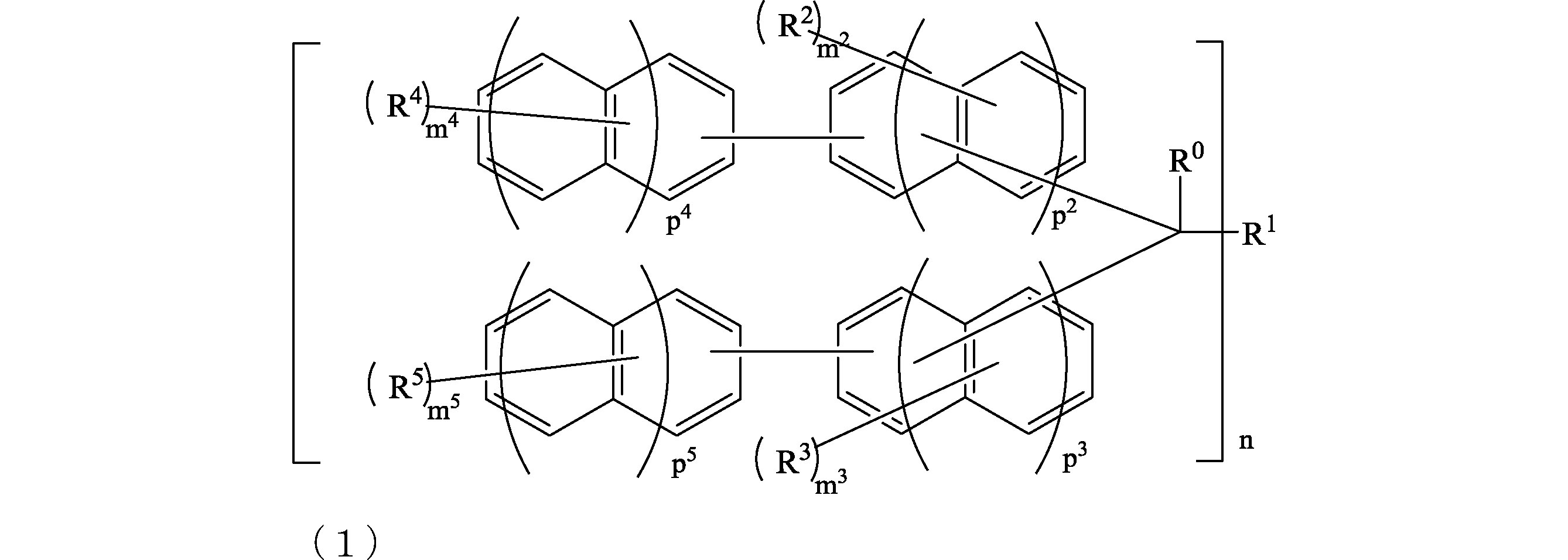
R1は、炭素数1~60のn価の基又は単結合であり、
R2~R5は、各々独立して、炭素数1~30の直鎖状、分岐状若しくは環状のアルキル基、炭素数6~30のアリール基、炭素数2~30のアルケニル基、炭素数1~30のアルコキシ基、ハロゲン原子、シアノ基、チオール基、水酸基又は水酸基の水素原子が酸解離性基で置換された基であり、ここで、R2~R5の少なくとも1つは水酸基又は水酸基の水素原子が酸解離性基で置換された基であり、
m2及びm3は、各々独立して、0~8の整数であり、
m4及びm5は、各々独立して、0~9の整数であり、
但し、m2、m3、m4及びm5は同時に0となることはなく、
nは前記Nと同義であり、ここで、nが2以上の整数の場合、n個の[ ]内の構造式は同一であっても異なっていてもよく、
p2~p5は、前記rと同義である。) - 前記式(0)で表される化合物が下記式(2)で表される化合物である、請求項1に記載の化合物。
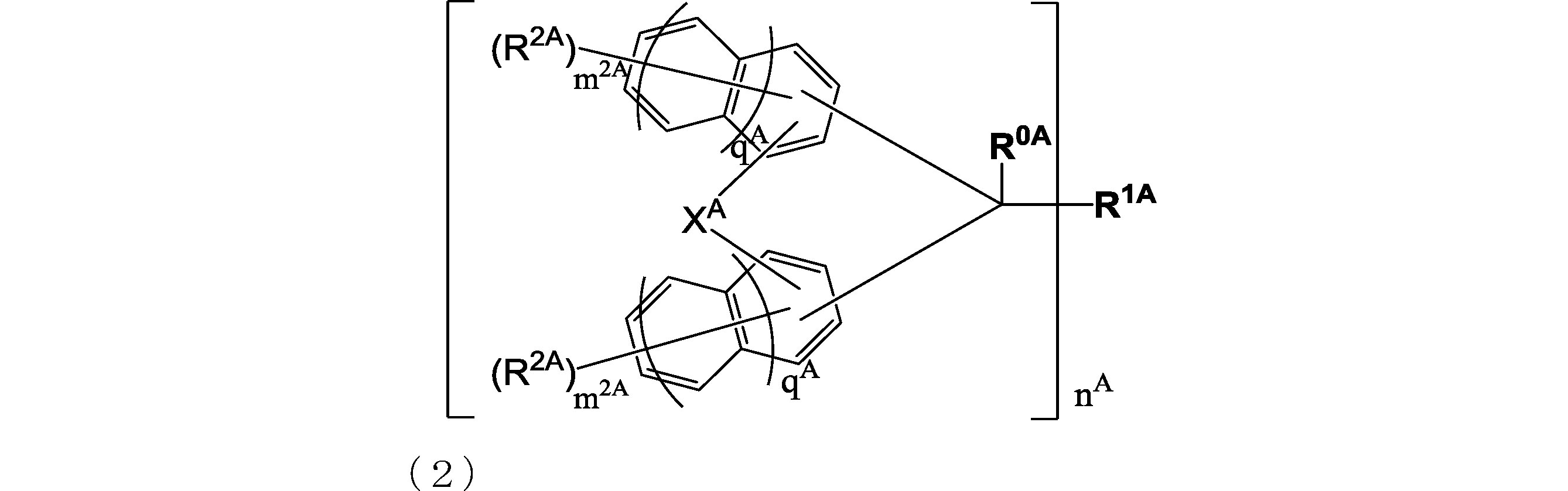
R1Aは、炭素数1~60のnA価の基又は単結合であり、
R2Aは、各々独立して、炭素数1~30の直鎖状、分岐状若しくは環状のアルキル基、炭素数6~30のアリール基、炭素数2~30のアルケニル基、ハロゲン原子、シアノ基、水酸基又は水酸基の水素原子が酸解離性基で置換された基であり、ここで、R2Aの少なくとも1つは水酸基又は水酸基の水素原子が酸解離性基で置換された基であり、
nAは、前記Nと同義であり、ここで、nAが2以上の整数の場合、nA個の[ ]内の構造式は同一であっても異なっていてもよく、
XAは、酸素原子、硫黄原子又は無架橋であることを表し、
m2Aは、各々独立して、0~7の整数であり、但し、少なくとも1つのm2Aは1~7の整数であり、
qAは、各々独立して、0又は1である。) - 前記式(1)で表される化合物が下記式(1-1)で表される化合物である、請求項2に記載の化合物。
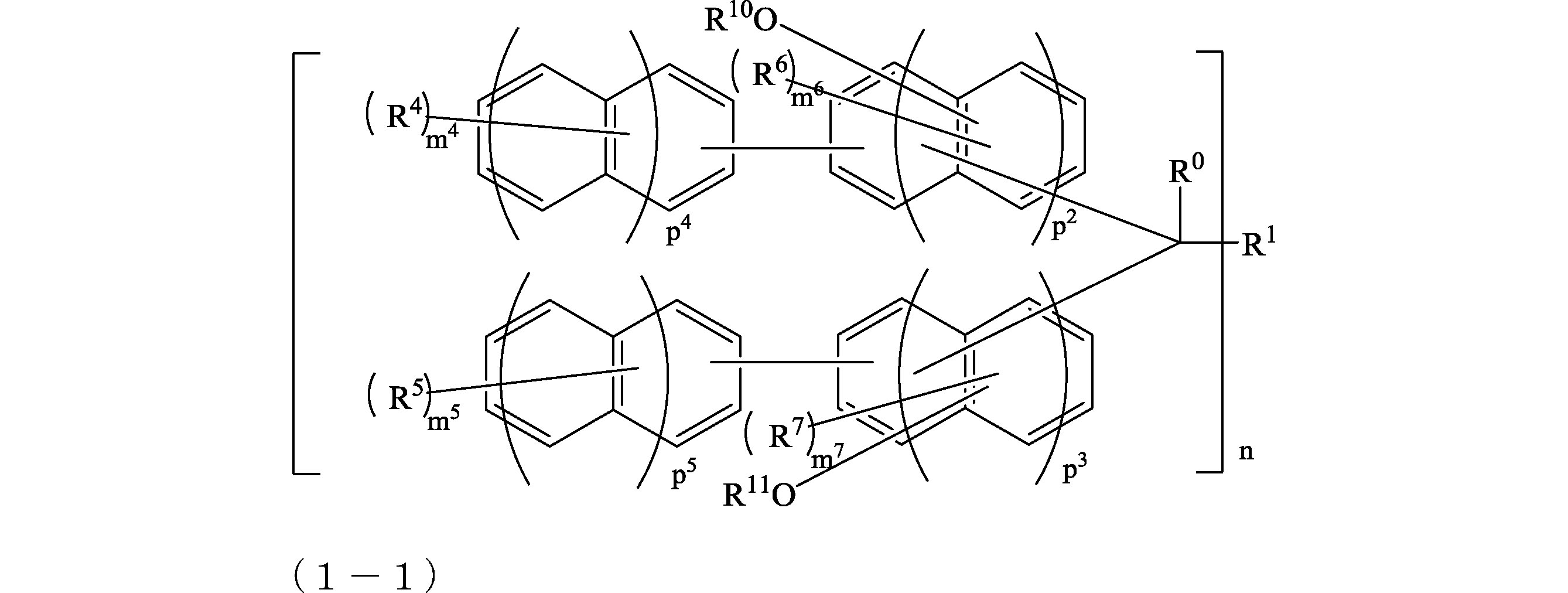
R6~R7は、各々独立して、炭素数1~30の直鎖状、分岐状若しくは環状のアルキル基、炭素数6~30のアリール基、炭素数2~30のアルケニル基、炭素数1~30のアルコキシ基、ハロゲン原子、チオール基であり、
R10~R11は、各々独立して、水素原子又は酸解離性基であり、
m6及びm7は、各々独立して、0~7の整数であり、
但し、m4、m5、m6及びm7は同時に0となることはない。) - 前記式(1-1)で表される化合物が下記式(1-2)で表される化合物である、請求項4に記載の化合物。
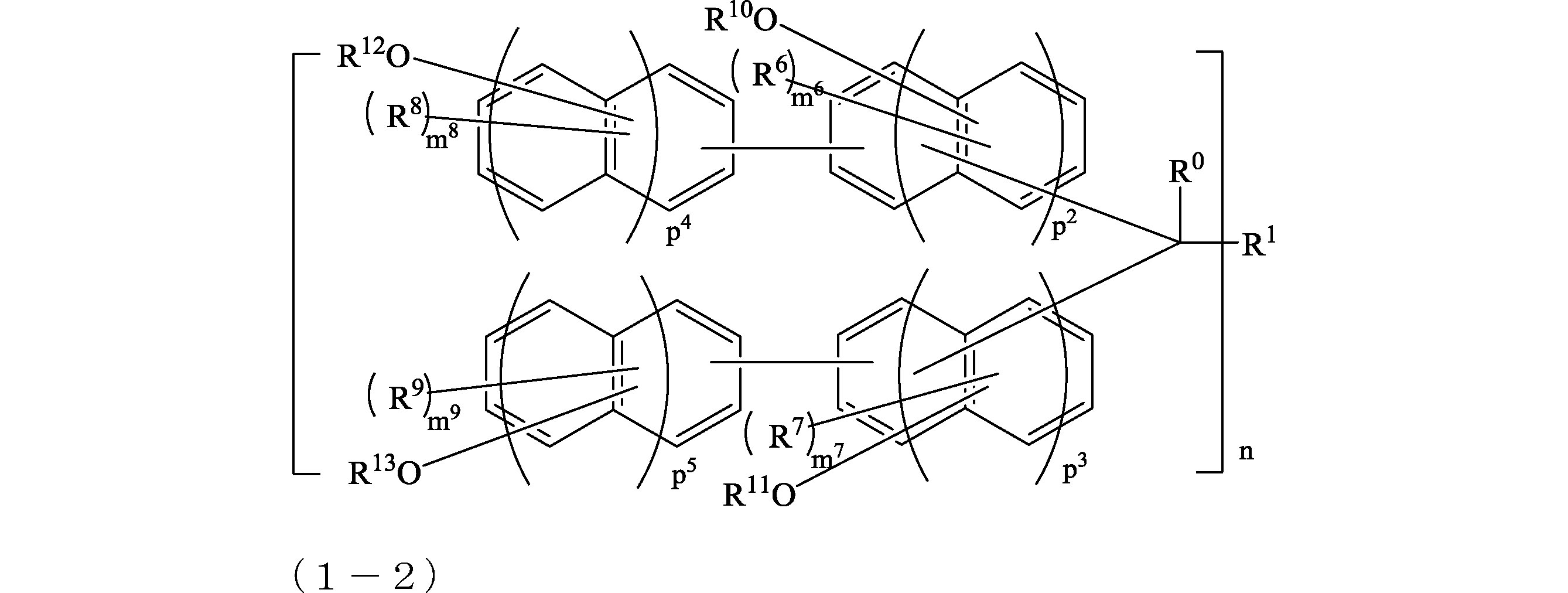
R8~R9は、前記R6~R7と同義であり、
R12~R13は、前記R10~R11と同義であり、
m8及びm9は、各々独立して、0~8の整数であり、
但し、m6、m7、m8及びm9は同時に0となることはない。) - 前記式(2)で表される化合物が下記式(2-1)で表される化合物である、請求項3に記載の化合物。
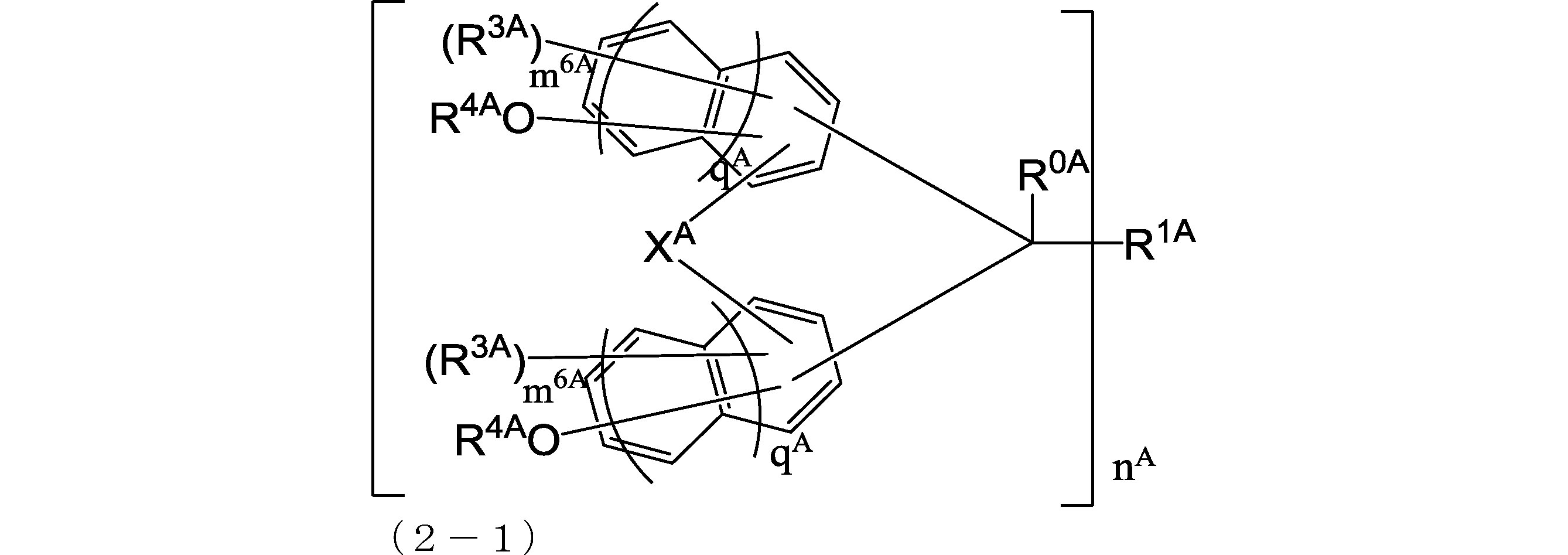
R3Aは、各々独立して、ハロゲン原子、炭素数1~30の直鎖状、分岐状若しくは環状のアルキル基、炭素数6~30のアリール基、又は炭素数2~30のアルケニル基であり、
R4Aは、各々独立して、水素原子又は酸解離性基であり、
m6Aは、各々独立して、0~5の整数である。) - 請求項1に記載の化合物をモノマーとして得られる、樹脂。
- 下記式(3)で表される構造を有する、請求項7に記載の樹脂。
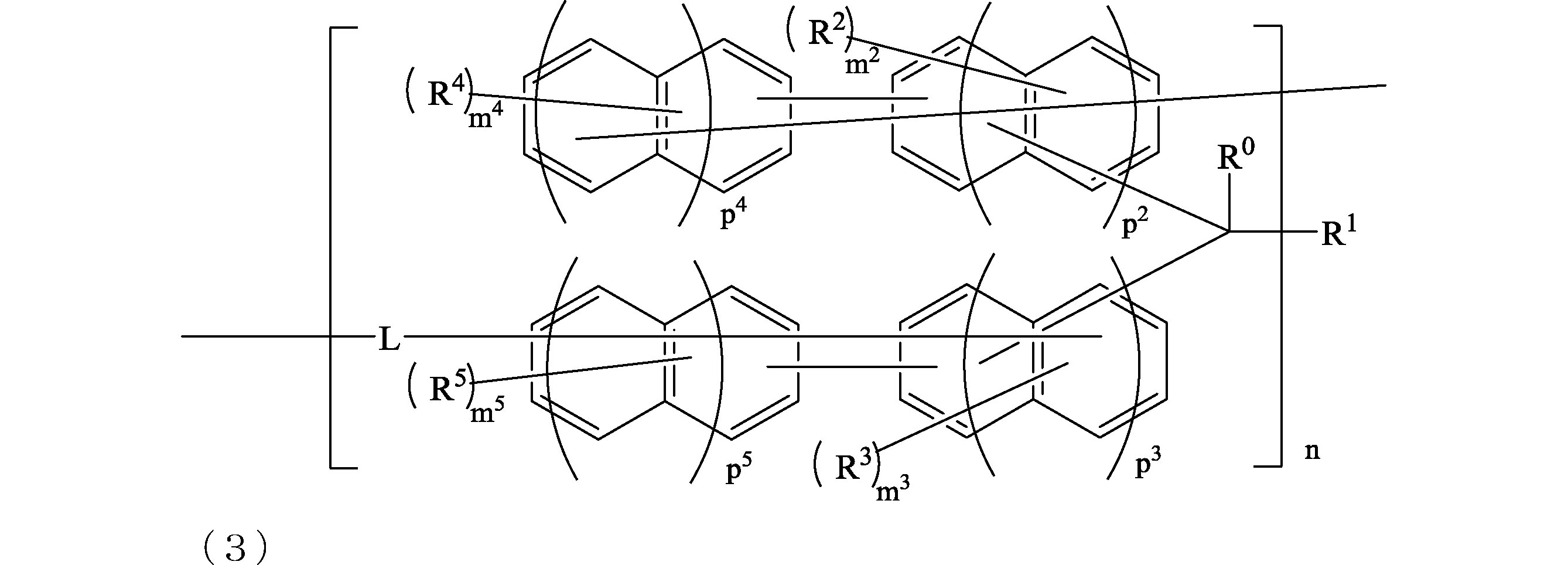
R0は、前記RYと同義であり、
R1は、炭素数1~60のn価の基又は単結合であり、
R2~R5は、各々独立して、炭素数1~30の直鎖状、分岐状若しくは環状のアルキル基、炭素数6~30のアリール基、炭素数2~30のアルケニル基、炭素数1~30のアルコキシ基、ハロゲン原子、シアノ基、チオール基、水酸基又は水酸基の水素原子が酸解離性基で置換された基であり、ここで、R2~R5の少なくとも1つは水酸基又は水酸基の水素原子が酸解離性基で置換された基であり、
m2及びm3は、各々独立して、0~8の整数であり、
m4及びm5は、各々独立して、0~9の整数であり、
但し、m2、m3、m4及びm5は同時に0となることはなく、
nは前記Nと同義であり、ここで、nが2以上の整数の場合、n個の[ ]内の構造式は同一であっても異なっていてもよく、
p2~p5は、前記rと同義である。) - 下記式(4)で表される構造を有する、請求項7に記載の樹脂。
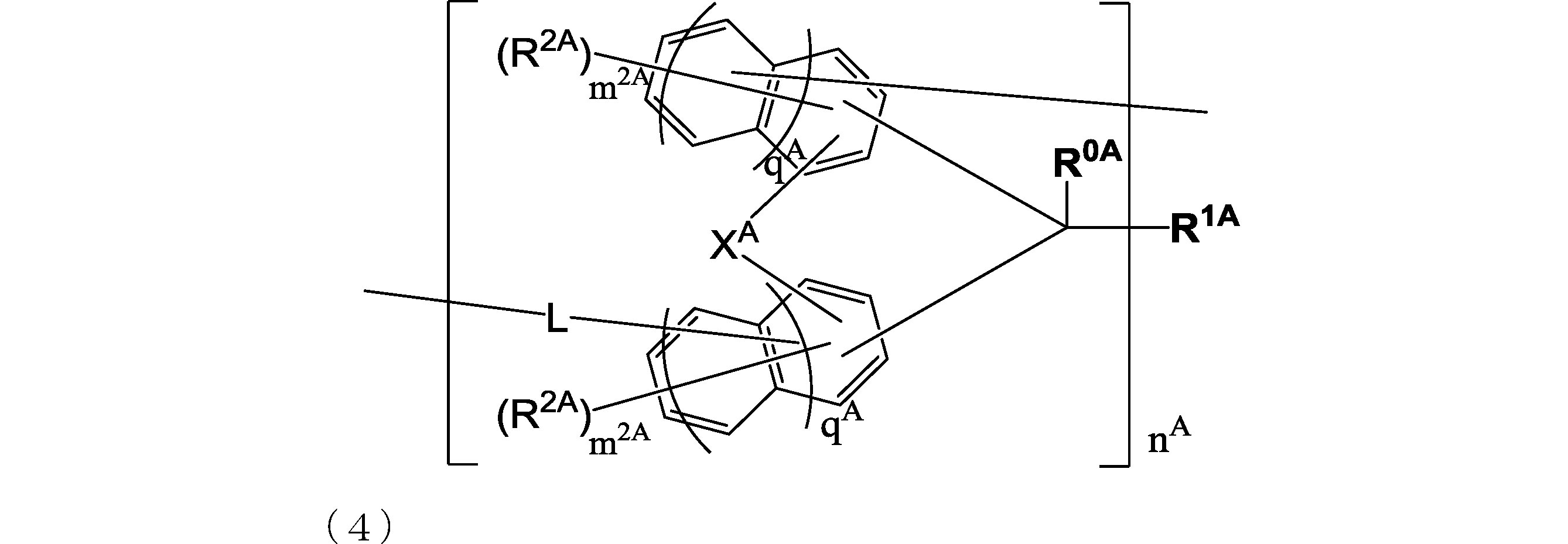
R0Aは、前記RYと同義であり、
R1Aは、炭素数1~60のnA価の基又は単結合であり、
R2Aは、各々独立して、炭素数1~30の直鎖状、分岐状若しくは環状のアルキル基、炭素数6~30のアリール基、炭素数2~30のアルケニル基、ハロゲン原子、シアノ基、水酸基又は水酸基の水素原子が酸解離性基で置換された基であり、ここで、R2Aの少なくとも1つは水酸基又は水酸基の水素原子が酸解離性基で置換された基であり、
nAは、前記Nと同義であり、ここで、nAが2以上の整数の場合、nA個の[ ]内の構造式は同一であっても異なっていてもよく、
XAは、酸素原子、硫黄原子又は無架橋であることを表し、
m2Aは、各々独立して、0~7の整数であり、但し、少なくとも1つのm2Aは1~6の整数であり、
qAは、各々独立して、0又は1である。) - 請求項1~6のいずれかに記載の化合物及び請求項7~9のいずれかに記載の樹脂からなる群より選ばれる1種以上を含有する、組成物。
- 溶媒をさらに含有する、請求項10に記載の組成物。
- 酸発生剤をさらに含有する、請求項10又は11に記載の組成物。
- 酸架橋剤をさらに含有する、請求項10~12のいずれか一項に記載の組成物。
- リソグラフィー用膜形成に用いられる、請求項10~13のいずれか一項に記載の組成物。
- 光学部品形成に用いられる、請求項10~13のいずれか一項に記載の組成物。
- 基板上に、請求項14に記載の組成物を用いてフォトレジスト層を形成した後、前記フォトレジスト層の所定の領域に放射線を照射し、現像を行う工程を含む、レジストパターン形成方法。
- 基板上に、請求項14に記載の組成物を用いて下層膜を形成し、前記下層膜上に、少なくとも1層のフォトレジスト層を形成した後、前記フォトレジスト層の所定の領域に放射線を照射し、現像を行う工程を含む、レジストパターン形成方法。
- 基板上に、請求項14に記載の組成物を用いて下層膜を形成し、前記下層膜上に、レジスト中間層膜材料を用いて中間層膜を形成し、前記中間層膜上に、少なくとも1層のフォトレジスト層を形成した後、前記フォトレジスト層の所定の領域に放射線を照射し、現像してレジストパターンを形成し、その後、前記レジストパターンをマスクとして前記中間層膜をエッチングし、得られた中間層膜パターンをエッチングマスクとして前記下層膜をエッチングし、得られた下層膜パターンをエッチングマスクとして基板をエッチングすることにより基板にパターンを形成する工程を含む、回路パターン形成方法。
Priority Applications (5)
| Application Number | Priority Date | Filing Date | Title |
|---|---|---|---|
| JP2017558330A JP6877696B2 (ja) | 2015-12-25 | 2016-12-26 | 化合物、樹脂、組成物、レジストパターン形成方法、及び、回路パターン形成方法 |
| CN201680076151.2A CN108473639A (zh) | 2015-12-25 | 2016-12-26 | 化合物、树脂、组合物、抗蚀图案形成方法和电路图案形成方法 |
| EP16879049.1A EP3395845A4 (en) | 2015-12-25 | 2016-12-26 | COMPOUND, RESIN, COMPOSITION, METHOD FOR FORMING A RESIST PATTERN, AND METHOD FOR FORMING A SWITCH PATTERN |
| KR1020187017877A KR20180099681A (ko) | 2015-12-25 | 2016-12-26 | 화합물, 수지, 조성물, 레지스트 패턴 형성방법, 및, 회로 패턴 형성방법 |
| US16/065,714 US11130724B2 (en) | 2015-12-25 | 2016-12-26 | Compound, resin, composition, resist pattern formation method, and circuit pattern formation method |
Applications Claiming Priority (2)
| Application Number | Priority Date | Filing Date | Title |
|---|---|---|---|
| JP2015254433 | 2015-12-25 | ||
| JP2015-254433 | 2015-12-25 |
Publications (1)
| Publication Number | Publication Date |
|---|---|
| WO2017111165A1 true WO2017111165A1 (ja) | 2017-06-29 |
Family
ID=59090595
Family Applications (1)
| Application Number | Title | Priority Date | Filing Date |
|---|---|---|---|
| PCT/JP2016/088737 Ceased WO2017111165A1 (ja) | 2015-12-25 | 2016-12-26 | 化合物、樹脂、組成物、レジストパターン形成方法、及び、回路パターン形成方法 |
Country Status (7)
| Country | Link |
|---|---|
| US (1) | US11130724B2 (ja) |
| EP (1) | EP3395845A4 (ja) |
| JP (1) | JP6877696B2 (ja) |
| KR (1) | KR20180099681A (ja) |
| CN (1) | CN108473639A (ja) |
| TW (1) | TWI752001B (ja) |
| WO (1) | WO2017111165A1 (ja) |
Cited By (11)
| Publication number | Priority date | Publication date | Assignee | Title |
|---|---|---|---|---|
| WO2018056277A1 (ja) * | 2016-09-20 | 2018-03-29 | 三菱瓦斯化学株式会社 | 化合物、樹脂、組成物、並びにレジストパターン形成方法及び回路パターン形成方法 |
| WO2018097215A1 (ja) * | 2016-11-24 | 2018-05-31 | 三菱瓦斯化学株式会社 | 化合物、樹脂、組成物、パターン形成方法及び精製方法 |
| WO2019082541A1 (ja) * | 2017-10-25 | 2019-05-02 | 田岡化学工業株式会社 | ナフタレン骨格を有するビスアリールアルコール類及びその製造方法 |
| WO2019151403A1 (ja) | 2018-01-31 | 2019-08-08 | 三菱瓦斯化学株式会社 | 組成物、並びに、レジストパターンの形成方法及び絶縁膜の形成方法 |
| WO2019239784A1 (ja) * | 2018-06-13 | 2019-12-19 | Dic株式会社 | ノボラック型フェノール樹脂、その製造方法、感光性組成物、レジスト材及びレジスト膜 |
| WO2020027206A1 (ja) * | 2018-07-31 | 2020-02-06 | 三菱瓦斯化学株式会社 | 光学部品形成用組成物及び光学部品、並びに、化合物及び樹脂 |
| US11130724B2 (en) | 2015-12-25 | 2021-09-28 | Mitsubishi Gas Chemical Company, Inc. | Compound, resin, composition, resist pattern formation method, and circuit pattern formation method |
| US20210331994A1 (en) * | 2018-08-24 | 2021-10-28 | Mitsubishi Gas Chemical Company, Inc. | Compound, composition containing the same, method for forming resist pattern and method for forming insulating film |
| JPWO2020145407A1 (ja) * | 2019-01-11 | 2021-11-18 | 三菱瓦斯化学株式会社 | 多環ポリフェノール樹脂、及び多環ポリフェノール樹脂の製造方法 |
| KR20220032581A (ko) * | 2019-07-08 | 2022-03-15 | 메르크 파텐트 게엠베하 | 에지 보호층 및 잔류 금속 하드마스크 성분을 제거하기 위한 린스 및 이의 사용 방법 |
| WO2024253198A1 (ja) * | 2023-06-09 | 2024-12-12 | 旭有機材株式会社 | 耐熱性重合体 |
Families Citing this family (8)
| Publication number | Priority date | Publication date | Assignee | Title |
|---|---|---|---|---|
| KR20190034149A (ko) * | 2016-07-21 | 2019-04-01 | 미쯔비시 가스 케미칼 컴파니, 인코포레이티드 | 화합물, 수지 및 조성물, 그리고 레지스트패턴 형성방법 및 회로패턴 형성방법 |
| TW201817722A (zh) * | 2016-07-21 | 2018-05-16 | 日商三菱瓦斯化學股份有限公司 | 化合物、樹脂、組成物及圖型形成方法 |
| JP7646117B2 (ja) * | 2018-08-24 | 2025-03-17 | 三菱瓦斯化学株式会社 | 化合物、及びそれを含む組成物、並びに、レジストパターンの形成方法及び絶縁膜の形成方法 |
| CN113302223A (zh) * | 2019-01-11 | 2021-08-24 | 三菱瓦斯化学株式会社 | 膜形成用组合物、抗蚀剂组合物、辐射线敏感性组合物、非晶膜的制造方法、抗蚀图案形成方法、光刻用下层膜形成用组合物、光刻用下层膜的制造方法和电路图案形成方法 |
| KR102029127B1 (ko) * | 2019-02-08 | 2019-10-07 | 영창케미칼 주식회사 | 반도체 제조 공정에 있어서 실리콘 또는 실리콘 화합물 패턴을 형성하기 위한 신규 방법 |
| JPWO2021039843A1 (ja) * | 2019-08-27 | 2021-03-04 | ||
| JP7331793B2 (ja) * | 2020-06-30 | 2023-08-23 | 信越化学工業株式会社 | フォトマスクの製造方法及びフォトマスクブランク |
| JP7611785B2 (ja) | 2021-07-06 | 2025-01-10 | 信越化学工業株式会社 | 密着膜形成材料、これを用いた密着膜の形成方法、及び密着膜形成材料を用いたパターン形成方法 |
Citations (9)
| Publication number | Priority date | Publication date | Assignee | Title |
|---|---|---|---|---|
| JPH06202320A (ja) * | 1992-12-28 | 1994-07-22 | Japan Synthetic Rubber Co Ltd | 感放射線性樹脂組成物 |
| JP2005326838A (ja) * | 2004-04-15 | 2005-11-24 | Mitsubishi Gas Chem Co Inc | レジスト組成物 |
| JP2007206371A (ja) * | 2006-02-01 | 2007-08-16 | Mitsubishi Gas Chem Co Inc | 感放射線性組成物 |
| JP2008145539A (ja) * | 2006-12-06 | 2008-06-26 | Mitsubishi Gas Chem Co Inc | 感放射線性レジスト組成物 |
| JP2008208312A (ja) * | 2007-02-28 | 2008-09-11 | Adeka Corp | フェノール樹脂、エポキシ樹脂、アルカリ現像性樹脂組成物及びアルカリ現像性感光性樹脂組成物 |
| JP2009173623A (ja) * | 2007-04-23 | 2009-08-06 | Mitsubishi Gas Chem Co Inc | 感放射線性組成物 |
| WO2014030579A1 (ja) * | 2012-08-21 | 2014-02-27 | 日産化学工業株式会社 | 多核フェノール類を有するノボラック樹脂を含むレジスト下層膜形成組成物 |
| JP2014106263A (ja) * | 2012-11-26 | 2014-06-09 | Shin Etsu Chem Co Ltd | レジスト下層膜材料及びパターン形成方法 |
| JP2015514691A (ja) * | 2012-03-16 | 2015-05-21 | 中国科学院化学研究所 | ビスフェノールa骨格構造含有の分子性ガラスフォトレジスト及びその製造方法並びに応用 |
Family Cites Families (53)
| Publication number | Priority date | Publication date | Assignee | Title |
|---|---|---|---|---|
| US4108665A (en) | 1976-10-07 | 1978-08-22 | Minnesota Mining And Manufacturing Company | Stabilizers for photothermographic constructions |
| JPS58134631A (ja) * | 1982-01-08 | 1983-08-10 | Konishiroku Photo Ind Co Ltd | 感光性組成物 |
| JPS61138614A (ja) * | 1984-12-10 | 1986-06-26 | Matsushita Electric Works Ltd | フエノ−ルノボラツクの製造方法 |
| JPS62289536A (ja) | 1986-06-09 | 1987-12-16 | Idemitsu Kosan Co Ltd | 1−(p−ビフエニリル)−1,1−ビス(4′−ヒドロキシフエニル)メタン誘導体 |
| US5310619A (en) * | 1986-06-13 | 1994-05-10 | Microsi, Inc. | Resist compositions comprising a phenolic resin, an acid forming onium salt and a tert-butyl ester or tert-butyl carbonate which is acid-cleavable |
| DE59107712D1 (de) * | 1990-09-13 | 1996-05-30 | Ocg Microelectronic Materials | Säurelabile Lösungsinhibitoren und darauf basierende positiv und negativ arbeitende strahlungsempfindliche Zusammensetzung |
| JPH051127A (ja) * | 1991-02-18 | 1993-01-08 | Yuka Shell Epoxy Kk | ノボラツク型フエノール樹脂の製造方法 |
| DE4405108A1 (de) * | 1993-02-18 | 1994-08-25 | Fuji Photo Film Co Ltd | Positiv arbeitende lichtempfindliche Zusammensetzung |
| JPH06301210A (ja) * | 1993-04-15 | 1994-10-28 | Fuji Photo Film Co Ltd | ポジ型感光性組成物 |
| EP0720052A1 (en) * | 1994-12-27 | 1996-07-03 | Mitsubishi Chemical Corporation | Photosensitive composition and photosensitive lithographic printing plate |
| JP3591547B2 (ja) * | 1995-09-18 | 2004-11-24 | 信越化学工業株式会社 | ビスフェノールカルボン酸第三級エステル誘導体及び化学増幅ポジ型レジスト材料 |
| JP3774668B2 (ja) | 2001-02-07 | 2006-05-17 | 東京エレクトロン株式会社 | シリコン窒化膜形成装置の洗浄前処理方法 |
| US6844273B2 (en) | 2001-02-07 | 2005-01-18 | Tokyo Electron Limited | Precleaning method of precleaning a silicon nitride film forming system |
| WO2002079131A1 (en) * | 2001-03-29 | 2002-10-10 | Kansai Research Institute, Inc. | Optically active compound and photosensitive resin composition |
| JP3944134B2 (ja) * | 2002-07-15 | 2007-07-11 | キヤノン株式会社 | 電子写真感光体、プロセスカートリッジおよび電子写真装置 |
| TWI264440B (en) | 2002-07-25 | 2006-10-21 | Mitsubishi Gas Chemical Co | (Meth)acrylate compound and cured product thereof |
| US7238462B2 (en) | 2002-11-27 | 2007-07-03 | Tokyo Ohka Kogyo Co., Ltd. | Undercoating material for wiring, embedded material, and wiring formation method |
| JP3914493B2 (ja) | 2002-11-27 | 2007-05-16 | 東京応化工業株式会社 | 多層レジストプロセス用下層膜形成材料およびこれを用いた配線形成方法 |
| KR100771800B1 (ko) | 2003-01-24 | 2007-10-30 | 도쿄 엘렉트론 가부시키가이샤 | 피처리 기판 상에 실리콘 질화막을 형성하는 cvd 방법 |
| JP3981030B2 (ja) | 2003-03-07 | 2007-09-26 | 信越化学工業株式会社 | レジスト下層膜材料ならびにパターン形成方法 |
| CN1853141A (zh) | 2003-09-18 | 2006-10-25 | 三菱瓦斯化学株式会社 | 抗蚀化合物和辐射敏感组合物 |
| WO2005029189A1 (ja) * | 2003-09-18 | 2005-03-31 | Mitsubishi Gas Chemical Company, Inc. | レジスト用化合物および感放射線性組成物 |
| JP2005222573A (ja) | 2004-02-03 | 2005-08-18 | Konica Minolta Opto Inc | プラスチック製光学素子及び光ピックアップ装置 |
| JP4388429B2 (ja) | 2004-02-04 | 2009-12-24 | 信越化学工業株式会社 | レジスト下層膜材料ならびにパターン形成方法 |
| TWI495632B (zh) * | 2004-12-24 | 2015-08-11 | Mitsubishi Gas Chemical Co | 光阻用化合物 |
| TWI390347B (zh) | 2005-10-14 | 2013-03-21 | Mitsubishi Gas Chemical Co | 光阻組成物 |
| JP4659678B2 (ja) | 2005-12-27 | 2011-03-30 | 信越化学工業株式会社 | フォトレジスト下層膜形成材料及びパターン形成方法 |
| JP4781280B2 (ja) | 2006-01-25 | 2011-09-28 | 信越化学工業株式会社 | 反射防止膜材料、基板、及びパターン形成方法 |
| US7585613B2 (en) | 2006-01-25 | 2009-09-08 | Shin-Etsu Chemical Co., Ltd. | Antireflection film composition, substrate, and patterning process |
| JP4638380B2 (ja) | 2006-01-27 | 2011-02-23 | 信越化学工業株式会社 | 反射防止膜材料、反射防止膜を有する基板及びパターン形成方法 |
| EP2080750B1 (en) | 2006-11-02 | 2020-07-29 | Mitsubishi Gas Chemical Company, Inc. | Radiation-sensitive composition |
| US8592134B2 (en) * | 2007-12-07 | 2013-11-26 | Mitsubishi Gas Chemical Company, Inc. | Composition for forming base film for lithography and method for forming multilayer resist pattern |
| KR100964642B1 (ko) * | 2008-02-22 | 2010-06-21 | 에스화인켐 주식회사 | 고굴절, 고탄성의 프리즘 시트와 이를 위한 조성물 및 그제조 방법 |
| JP2010138393A (ja) | 2008-11-13 | 2010-06-24 | Nippon Kayaku Co Ltd | 光学レンズシート用エネルギー線硬化型樹脂組成物及びその硬化物 |
| CN102596873B (zh) * | 2009-09-09 | 2014-11-12 | 本州化学工业株式会社 | 三苯酚化合物 |
| JP5707779B2 (ja) * | 2010-08-24 | 2015-04-30 | 日立化成株式会社 | 感光性樹脂組成物、感光性フィルム、リブパターンの形成方法、中空構造の形成方法及び電子部品 |
| WO2012090408A1 (ja) * | 2010-12-28 | 2012-07-05 | 三菱瓦斯化学株式会社 | 芳香族炭化水素樹脂、リソグラフィー用下層膜形成組成物及び多層レジストパターンの形成方法 |
| US9316913B2 (en) * | 2011-08-12 | 2016-04-19 | Mitsubishi Gas Chemical Company, Inc. | Underlayer film-forming material for lithography, underlayer film for lithography, and pattern formation method |
| KR102082839B1 (ko) | 2011-08-12 | 2020-02-28 | 미쯔비시 가스 케미칼 컴파니, 인코포레이티드 | 레지스트 조성물, 레지스트 패턴 형성방법, 이에 이용되는 폴리페놀 화합물 및 이로부터 유도될 수 있는 알코올 화합물 |
| JP2014073986A (ja) | 2012-10-03 | 2014-04-24 | Asahi Organic Chemicals Industry Co Ltd | アントラセン誘導体及びその製造方法、化合物、組成物、硬化物並びに蛍光素子 |
| WO2014123005A1 (ja) | 2013-02-08 | 2014-08-14 | 三菱瓦斯化学株式会社 | 新規アリル化合物及びその製造方法 |
| US9828355B2 (en) * | 2013-02-08 | 2017-11-28 | Mitsubishi Gas Chemical Company, Inc. | Compound, material for forming underlayer film for lithography, underlayer film for lithography and pattern forming method |
| CN104995559B (zh) | 2013-02-08 | 2020-04-07 | 三菱瓦斯化学株式会社 | 抗蚀剂组合物、抗蚀图案形成方法和用于其的多元酚衍生物 |
| US9252359B2 (en) | 2013-03-03 | 2016-02-02 | Adesto Technologies Corporation | Resistive switching devices having a switching layer and an intermediate electrode layer and methods of formation thereof |
| CN106103396B (zh) * | 2014-03-13 | 2021-11-30 | 三菱瓦斯化学株式会社 | 化合物、树脂、光刻用下层膜形成材料、光刻用下层膜、图案形成方法、及化合物或树脂的纯化方法 |
| CN106133604B (zh) | 2014-03-13 | 2019-09-06 | 三菱瓦斯化学株式会社 | 保护剂组合物和保护剂图案形成方法 |
| JP2015174877A (ja) | 2014-03-13 | 2015-10-05 | 日産化学工業株式会社 | 特定の硬化促進触媒を含む樹脂組成物 |
| US9274426B2 (en) | 2014-04-29 | 2016-03-01 | Az Electronic Materials (Luxembourg) S.A.R.L. | Antireflective coating compositions and processes thereof |
| JP6381318B2 (ja) | 2014-06-30 | 2018-08-29 | 新日鉄住金化学株式会社 | 光学レンズ用活性エネルギー線硬化性樹脂組成物 |
| JP2017088675A (ja) | 2015-11-05 | 2017-05-25 | Dic株式会社 | ノボラック型フェノール性水酸基含有樹脂及びレジスト材料 |
| WO2017111165A1 (ja) | 2015-12-25 | 2017-06-29 | 三菱瓦斯化学株式会社 | 化合物、樹脂、組成物、レジストパターン形成方法、及び、回路パターン形成方法 |
| US20190359756A1 (en) * | 2016-09-13 | 2019-11-28 | Mitsubishi Gas Chemical Company, Inc. | Optical member forming composition |
| TW201827389A (zh) * | 2016-09-20 | 2018-08-01 | 日商三菱瓦斯化學股份有限公司 | 化合物、樹脂、組成物,以及阻劑圖型形成方法及電路圖型形成方法 |
-
2016
- 2016-12-26 WO PCT/JP2016/088737 patent/WO2017111165A1/ja not_active Ceased
- 2016-12-26 EP EP16879049.1A patent/EP3395845A4/en not_active Withdrawn
- 2016-12-26 CN CN201680076151.2A patent/CN108473639A/zh active Pending
- 2016-12-26 KR KR1020187017877A patent/KR20180099681A/ko not_active Ceased
- 2016-12-26 US US16/065,714 patent/US11130724B2/en not_active Expired - Fee Related
- 2016-12-26 TW TW105143199A patent/TWI752001B/zh not_active IP Right Cessation
- 2016-12-26 JP JP2017558330A patent/JP6877696B2/ja active Active
Patent Citations (9)
| Publication number | Priority date | Publication date | Assignee | Title |
|---|---|---|---|---|
| JPH06202320A (ja) * | 1992-12-28 | 1994-07-22 | Japan Synthetic Rubber Co Ltd | 感放射線性樹脂組成物 |
| JP2005326838A (ja) * | 2004-04-15 | 2005-11-24 | Mitsubishi Gas Chem Co Inc | レジスト組成物 |
| JP2007206371A (ja) * | 2006-02-01 | 2007-08-16 | Mitsubishi Gas Chem Co Inc | 感放射線性組成物 |
| JP2008145539A (ja) * | 2006-12-06 | 2008-06-26 | Mitsubishi Gas Chem Co Inc | 感放射線性レジスト組成物 |
| JP2008208312A (ja) * | 2007-02-28 | 2008-09-11 | Adeka Corp | フェノール樹脂、エポキシ樹脂、アルカリ現像性樹脂組成物及びアルカリ現像性感光性樹脂組成物 |
| JP2009173623A (ja) * | 2007-04-23 | 2009-08-06 | Mitsubishi Gas Chem Co Inc | 感放射線性組成物 |
| JP2015514691A (ja) * | 2012-03-16 | 2015-05-21 | 中国科学院化学研究所 | ビスフェノールa骨格構造含有の分子性ガラスフォトレジスト及びその製造方法並びに応用 |
| WO2014030579A1 (ja) * | 2012-08-21 | 2014-02-27 | 日産化学工業株式会社 | 多核フェノール類を有するノボラック樹脂を含むレジスト下層膜形成組成物 |
| JP2014106263A (ja) * | 2012-11-26 | 2014-06-09 | Shin Etsu Chem Co Ltd | レジスト下層膜材料及びパターン形成方法 |
Non-Patent Citations (1)
| Title |
|---|
| See also references of EP3395845A4 * |
Cited By (15)
| Publication number | Priority date | Publication date | Assignee | Title |
|---|---|---|---|---|
| US11130724B2 (en) | 2015-12-25 | 2021-09-28 | Mitsubishi Gas Chemical Company, Inc. | Compound, resin, composition, resist pattern formation method, and circuit pattern formation method |
| WO2018056277A1 (ja) * | 2016-09-20 | 2018-03-29 | 三菱瓦斯化学株式会社 | 化合物、樹脂、組成物、並びにレジストパターン形成方法及び回路パターン形成方法 |
| WO2018097215A1 (ja) * | 2016-11-24 | 2018-05-31 | 三菱瓦斯化学株式会社 | 化合物、樹脂、組成物、パターン形成方法及び精製方法 |
| WO2019082541A1 (ja) * | 2017-10-25 | 2019-05-02 | 田岡化学工業株式会社 | ナフタレン骨格を有するビスアリールアルコール類及びその製造方法 |
| CN111630111A (zh) * | 2018-01-31 | 2020-09-04 | 三菱瓦斯化学株式会社 | 组合物、以及抗蚀剂图案的形成方法和绝缘膜的形成方法 |
| WO2019151403A1 (ja) | 2018-01-31 | 2019-08-08 | 三菱瓦斯化学株式会社 | 組成物、並びに、レジストパターンの形成方法及び絶縁膜の形成方法 |
| WO2019239784A1 (ja) * | 2018-06-13 | 2019-12-19 | Dic株式会社 | ノボラック型フェノール樹脂、その製造方法、感光性組成物、レジスト材及びレジスト膜 |
| WO2020027206A1 (ja) * | 2018-07-31 | 2020-02-06 | 三菱瓦斯化学株式会社 | 光学部品形成用組成物及び光学部品、並びに、化合物及び樹脂 |
| JPWO2020027206A1 (ja) * | 2018-07-31 | 2021-08-12 | 三菱瓦斯化学株式会社 | 光学部品形成用組成物及び光学部品、並びに、化合物及び樹脂 |
| US20210331994A1 (en) * | 2018-08-24 | 2021-10-28 | Mitsubishi Gas Chemical Company, Inc. | Compound, composition containing the same, method for forming resist pattern and method for forming insulating film |
| JPWO2020145407A1 (ja) * | 2019-01-11 | 2021-11-18 | 三菱瓦斯化学株式会社 | 多環ポリフェノール樹脂、及び多環ポリフェノール樹脂の製造方法 |
| JP7814101B2 (ja) | 2019-01-11 | 2026-02-16 | 三菱瓦斯化学株式会社 | 多環ポリフェノール樹脂、及び多環ポリフェノール樹脂の製造方法 |
| KR20220032581A (ko) * | 2019-07-08 | 2022-03-15 | 메르크 파텐트 게엠베하 | 에지 보호층 및 잔류 금속 하드마스크 성분을 제거하기 위한 린스 및 이의 사용 방법 |
| KR102626153B1 (ko) | 2019-07-08 | 2024-01-16 | 메르크 파텐트 게엠베하 | 에지 보호층 및 잔류 금속 하드마스크 성분을 제거하기 위한 린스 및 이의 사용 방법 |
| WO2024253198A1 (ja) * | 2023-06-09 | 2024-12-12 | 旭有機材株式会社 | 耐熱性重合体 |
Also Published As
| Publication number | Publication date |
|---|---|
| TWI752001B (zh) | 2022-01-11 |
| EP3395845A1 (en) | 2018-10-31 |
| US20190010108A1 (en) | 2019-01-10 |
| EP3395845A4 (en) | 2019-08-14 |
| CN108473639A (zh) | 2018-08-31 |
| JP6877696B2 (ja) | 2021-05-26 |
| TW201736329A (zh) | 2017-10-16 |
| KR20180099681A (ko) | 2018-09-05 |
| US11130724B2 (en) | 2021-09-28 |
| JPWO2017111165A1 (ja) | 2018-10-18 |
Similar Documents
| Publication | Publication Date | Title |
|---|---|---|
| JP6877696B2 (ja) | 化合物、樹脂、組成物、レジストパターン形成方法、及び、回路パターン形成方法 | |
| JP7212449B2 (ja) | 化合物及びその製造方法、並びに、組成物、光学部品形成用組成物、リソグラフィー用膜形成組成物、レジスト組成物、レジストパターンの形成方法、感放射線性組成物、アモルファス膜の製造方法、リソグラフィー用下層膜形成材料、リソグラフィー用下層膜形成用組成物、リソグラフィー用下層膜の製造方法、レジストパターン形成方法、回路パターン形成方法、及び、精製方法 | |
| JP6861950B2 (ja) | 新規化合物及びその製造方法 | |
| WO2018016640A1 (ja) | 化合物、樹脂、組成物並びにレジストパターン形成方法及び回路パターン形成方法 | |
| WO2018016614A1 (ja) | 化合物、樹脂、組成物及びパターン形成方法 | |
| JP6853957B2 (ja) | 新規(メタ)アクリロイル化合物及びその製造方法 | |
| WO2018016615A1 (ja) | 化合物、樹脂、組成物並びにレジストパターン形成方法及び回路パターン形成方法 | |
| JP2022130463A (ja) | 化合物、樹脂、組成物、並びにレジストパターン形成方法及び回路パターン形成方法 | |
| WO2018016634A1 (ja) | 化合物、樹脂及び組成物、並びにレジストパターン形成方法及び回路パターン形成方法 | |
| WO2018016648A1 (ja) | 化合物、樹脂、組成物及びパターン形成方法 | |
| JPWO2019142897A1 (ja) | 化合物、樹脂、組成物及びパターン形成方法 | |
| WO2018101377A1 (ja) | 化合物、樹脂、組成物並びにレジストパターン形成方法及び回路パターン形成方法 | |
| WO2018101376A1 (ja) | 化合物、樹脂、組成物並びにレジストパターン形成方法及び回路パターン形成方法 | |
| TWI797246B (zh) | 化合物、樹脂、組成物、抗蝕圖型形成方法、電路圖型形成方法及樹脂之純化方法 | |
| WO2018101463A1 (ja) | 化合物、樹脂、組成物、パターン形成方法及び精製方法 | |
| JPWO2018056277A1 (ja) | 化合物、樹脂、組成物、並びにレジストパターン形成方法及び回路パターン形成方法 | |
| JP7083455B2 (ja) | 化合物、樹脂、組成物及びパターン形成方法 | |
| WO2018052028A1 (ja) | 化合物、樹脂、組成物及びパターン形成方法 | |
| JP2018154600A (ja) | 化合物、樹脂、組成物、パターン形成方法及び精製方法 | |
| WO2018097215A1 (ja) | 化合物、樹脂、組成物、パターン形成方法及び精製方法 |
Legal Events
| Date | Code | Title | Description |
|---|---|---|---|
| 121 | Ep: the epo has been informed by wipo that ep was designated in this application |
Ref document number: 16879049 Country of ref document: EP Kind code of ref document: A1 |
|
| ENP | Entry into the national phase |
Ref document number: 2017558330 Country of ref document: JP Kind code of ref document: A |
|
| ENP | Entry into the national phase |
Ref document number: 20187017877 Country of ref document: KR Kind code of ref document: A |
|
| NENP | Non-entry into the national phase |
Ref country code: DE |
|
| WWE | Wipo information: entry into national phase |
Ref document number: 2016879049 Country of ref document: EP |
|
| ENP | Entry into the national phase |
Ref document number: 2016879049 Country of ref document: EP Effective date: 20180725 |