WO2012008441A1 - 無機酸化物粒子とシリコーン樹脂との複合組成物およびその製造方法、ならびに透明複合体およびその製造方法 - Google Patents
無機酸化物粒子とシリコーン樹脂との複合組成物およびその製造方法、ならびに透明複合体およびその製造方法 Download PDFInfo
- Publication number
- WO2012008441A1 WO2012008441A1 PCT/JP2011/065871 JP2011065871W WO2012008441A1 WO 2012008441 A1 WO2012008441 A1 WO 2012008441A1 JP 2011065871 W JP2011065871 W JP 2011065871W WO 2012008441 A1 WO2012008441 A1 WO 2012008441A1
- Authority
- WO
- WIPO (PCT)
- Prior art keywords
- inorganic oxide
- oxide particles
- silicone resin
- composite
- composite composition
- Prior art date
- Legal status (The legal status is an assumption and is not a legal conclusion. Google has not performed a legal analysis and makes no representation as to the accuracy of the status listed.)
- Ceased
Links
Classifications
-
- C—CHEMISTRY; METALLURGY
- C08—ORGANIC MACROMOLECULAR COMPOUNDS; THEIR PREPARATION OR CHEMICAL WORKING-UP; COMPOSITIONS BASED THEREON
- C08L—COMPOSITIONS OF MACROMOLECULAR COMPOUNDS
- C08L83/00—Compositions of macromolecular compounds obtained by reactions forming in the main chain of the macromolecule a linkage containing silicon with or without sulfur, nitrogen, oxygen or carbon only; Compositions of derivatives of such polymers
- C08L83/04—Polysiloxanes
-
- C—CHEMISTRY; METALLURGY
- C08—ORGANIC MACROMOLECULAR COMPOUNDS; THEIR PREPARATION OR CHEMICAL WORKING-UP; COMPOSITIONS BASED THEREON
- C08G—MACROMOLECULAR COMPOUNDS OBTAINED OTHERWISE THAN BY REACTIONS ONLY INVOLVING UNSATURATED CARBON-TO-CARBON BONDS
- C08G77/00—Macromolecular compounds obtained by reactions forming a linkage containing silicon with or without sulfur, nitrogen, oxygen or carbon in the main chain of the macromolecule
- C08G77/04—Polysiloxanes
- C08G77/38—Polysiloxanes modified by chemical after-treatment
- C08G77/382—Polysiloxanes modified by chemical after-treatment containing atoms other than carbon, hydrogen, oxygen or silicon
- C08G77/398—Polysiloxanes modified by chemical after-treatment containing atoms other than carbon, hydrogen, oxygen or silicon containing boron or metal atoms
-
- B—PERFORMING OPERATIONS; TRANSPORTING
- B82—NANOTECHNOLOGY
- B82Y—SPECIFIC USES OR APPLICATIONS OF NANOSTRUCTURES; MEASUREMENT OR ANALYSIS OF NANOSTRUCTURES; MANUFACTURE OR TREATMENT OF NANOSTRUCTURES
- B82Y30/00—Nanotechnology for materials or surface science, e.g. nanocomposites
-
- C—CHEMISTRY; METALLURGY
- C01—INORGANIC CHEMISTRY
- C01G—COMPOUNDS CONTAINING METALS NOT COVERED BY SUBCLASSES C01D OR C01F
- C01G25/00—Compounds of zirconium
- C01G25/02—Oxides
-
- C—CHEMISTRY; METALLURGY
- C08—ORGANIC MACROMOLECULAR COMPOUNDS; THEIR PREPARATION OR CHEMICAL WORKING-UP; COMPOSITIONS BASED THEREON
- C08G—MACROMOLECULAR COMPOUNDS OBTAINED OTHERWISE THAN BY REACTIONS ONLY INVOLVING UNSATURATED CARBON-TO-CARBON BONDS
- C08G77/00—Macromolecular compounds obtained by reactions forming a linkage containing silicon with or without sulfur, nitrogen, oxygen or carbon in the main chain of the macromolecule
- C08G77/42—Block-or graft-polymers containing polysiloxane sequences
- C08G77/44—Block-or graft-polymers containing polysiloxane sequences containing only polysiloxane sequences
-
- C—CHEMISTRY; METALLURGY
- C08—ORGANIC MACROMOLECULAR COMPOUNDS; THEIR PREPARATION OR CHEMICAL WORKING-UP; COMPOSITIONS BASED THEREON
- C08K—Use of inorganic or non-macromolecular organic substances as compounding ingredients
- C08K9/00—Use of pretreated ingredients
- C08K9/04—Ingredients treated with organic substances
- C08K9/06—Ingredients treated with organic substances with silicon-containing compounds
-
- C—CHEMISTRY; METALLURGY
- C08—ORGANIC MACROMOLECULAR COMPOUNDS; THEIR PREPARATION OR CHEMICAL WORKING-UP; COMPOSITIONS BASED THEREON
- C08L—COMPOSITIONS OF MACROMOLECULAR COMPOUNDS
- C08L83/00—Compositions of macromolecular compounds obtained by reactions forming in the main chain of the macromolecule a linkage containing silicon with or without sulfur, nitrogen, oxygen or carbon only; Compositions of derivatives of such polymers
- C08L83/04—Polysiloxanes
- C08L83/08—Polysiloxanes containing silicon bound to organic groups containing atoms other than carbon, hydrogen and oxygen
-
- C—CHEMISTRY; METALLURGY
- C09—DYES; PAINTS; POLISHES; NATURAL RESINS; ADHESIVES; COMPOSITIONS NOT OTHERWISE PROVIDED FOR; APPLICATIONS OF MATERIALS NOT OTHERWISE PROVIDED FOR
- C09C—TREATMENT OF INORGANIC MATERIALS, OTHER THAN FIBROUS FILLERS, TO ENHANCE THEIR PIGMENTING OR FILLING PROPERTIES ; PREPARATION OF CARBON BLACK ; PREPARATION OF INORGANIC MATERIALS WHICH ARE NO SINGLE CHEMICAL COMPOUNDS AND WHICH ARE MAINLY USED AS PIGMENTS OR FILLERS
- C09C1/00—Treatment of specific inorganic materials other than fibrous fillers; Preparation of carbon black
-
- C—CHEMISTRY; METALLURGY
- C09—DYES; PAINTS; POLISHES; NATURAL RESINS; ADHESIVES; COMPOSITIONS NOT OTHERWISE PROVIDED FOR; APPLICATIONS OF MATERIALS NOT OTHERWISE PROVIDED FOR
- C09C—TREATMENT OF INORGANIC MATERIALS, OTHER THAN FIBROUS FILLERS, TO ENHANCE THEIR PIGMENTING OR FILLING PROPERTIES ; PREPARATION OF CARBON BLACK ; PREPARATION OF INORGANIC MATERIALS WHICH ARE NO SINGLE CHEMICAL COMPOUNDS AND WHICH ARE MAINLY USED AS PIGMENTS OR FILLERS
- C09C1/00—Treatment of specific inorganic materials other than fibrous fillers; Preparation of carbon black
- C09C1/28—Compounds of silicon
- C09C1/30—Silicic acid
- C09C1/3063—Treatment with low-molecular organic compounds
-
- C—CHEMISTRY; METALLURGY
- C09—DYES; PAINTS; POLISHES; NATURAL RESINS; ADHESIVES; COMPOSITIONS NOT OTHERWISE PROVIDED FOR; APPLICATIONS OF MATERIALS NOT OTHERWISE PROVIDED FOR
- C09C—TREATMENT OF INORGANIC MATERIALS, OTHER THAN FIBROUS FILLERS, TO ENHANCE THEIR PIGMENTING OR FILLING PROPERTIES ; PREPARATION OF CARBON BLACK ; PREPARATION OF INORGANIC MATERIALS WHICH ARE NO SINGLE CHEMICAL COMPOUNDS AND WHICH ARE MAINLY USED AS PIGMENTS OR FILLERS
- C09C1/00—Treatment of specific inorganic materials other than fibrous fillers; Preparation of carbon black
- C09C1/28—Compounds of silicon
- C09C1/30—Silicic acid
- C09C1/3081—Treatment with organo-silicon compounds
-
- C—CHEMISTRY; METALLURGY
- C09—DYES; PAINTS; POLISHES; NATURAL RESINS; ADHESIVES; COMPOSITIONS NOT OTHERWISE PROVIDED FOR; APPLICATIONS OF MATERIALS NOT OTHERWISE PROVIDED FOR
- C09C—TREATMENT OF INORGANIC MATERIALS, OTHER THAN FIBROUS FILLERS, TO ENHANCE THEIR PIGMENTING OR FILLING PROPERTIES ; PREPARATION OF CARBON BLACK ; PREPARATION OF INORGANIC MATERIALS WHICH ARE NO SINGLE CHEMICAL COMPOUNDS AND WHICH ARE MAINLY USED AS PIGMENTS OR FILLERS
- C09C1/00—Treatment of specific inorganic materials other than fibrous fillers; Preparation of carbon black
- C09C1/28—Compounds of silicon
- C09C1/30—Silicic acid
- C09C1/309—Combinations of treatments provided for in groups C09C1/3009 - C09C1/3081
-
- C—CHEMISTRY; METALLURGY
- C09—DYES; PAINTS; POLISHES; NATURAL RESINS; ADHESIVES; COMPOSITIONS NOT OTHERWISE PROVIDED FOR; APPLICATIONS OF MATERIALS NOT OTHERWISE PROVIDED FOR
- C09C—TREATMENT OF INORGANIC MATERIALS, OTHER THAN FIBROUS FILLERS, TO ENHANCE THEIR PIGMENTING OR FILLING PROPERTIES ; PREPARATION OF CARBON BLACK ; PREPARATION OF INORGANIC MATERIALS WHICH ARE NO SINGLE CHEMICAL COMPOUNDS AND WHICH ARE MAINLY USED AS PIGMENTS OR FILLERS
- C09C3/00—Treatment in general of inorganic materials, other than fibrous fillers, to enhance their pigmenting or filling properties
- C09C3/10—Treatment with macromolecular organic compounds
-
- C—CHEMISTRY; METALLURGY
- C09—DYES; PAINTS; POLISHES; NATURAL RESINS; ADHESIVES; COMPOSITIONS NOT OTHERWISE PROVIDED FOR; APPLICATIONS OF MATERIALS NOT OTHERWISE PROVIDED FOR
- C09C—TREATMENT OF INORGANIC MATERIALS, OTHER THAN FIBROUS FILLERS, TO ENHANCE THEIR PIGMENTING OR FILLING PROPERTIES ; PREPARATION OF CARBON BLACK ; PREPARATION OF INORGANIC MATERIALS WHICH ARE NO SINGLE CHEMICAL COMPOUNDS AND WHICH ARE MAINLY USED AS PIGMENTS OR FILLERS
- C09C3/00—Treatment in general of inorganic materials, other than fibrous fillers, to enhance their pigmenting or filling properties
- C09C3/12—Treatment with organosilicon compounds
-
- C—CHEMISTRY; METALLURGY
- C09—DYES; PAINTS; POLISHES; NATURAL RESINS; ADHESIVES; COMPOSITIONS NOT OTHERWISE PROVIDED FOR; APPLICATIONS OF MATERIALS NOT OTHERWISE PROVIDED FOR
- C09D—COATING COMPOSITIONS, e.g. PAINTS, VARNISHES OR LACQUERS; FILLING PASTES; CHEMICAL PAINT OR INK REMOVERS; INKS; CORRECTING FLUIDS; WOODSTAINS; PASTES OR SOLIDS FOR COLOURING OR PRINTING; USE OF MATERIALS THEREFOR
- C09D183/00—Coating compositions based on macromolecular compounds obtained by reactions forming in the main chain of the macromolecule a linkage containing silicon, with or without sulfur, nitrogen, oxygen, or carbon only; Coating compositions based on derivatives of such polymers
- C09D183/04—Polysiloxanes
- C09D183/06—Polysiloxanes containing silicon bound to oxygen-containing groups
-
- C—CHEMISTRY; METALLURGY
- C01—INORGANIC CHEMISTRY
- C01P—INDEXING SCHEME RELATING TO STRUCTURAL AND PHYSICAL ASPECTS OF SOLID INORGANIC COMPOUNDS
- C01P2004/00—Particle morphology
- C01P2004/60—Particles characterised by their size
- C01P2004/64—Nanometer sized, i.e. from 1-100 nanometer
-
- C—CHEMISTRY; METALLURGY
- C08—ORGANIC MACROMOLECULAR COMPOUNDS; THEIR PREPARATION OR CHEMICAL WORKING-UP; COMPOSITIONS BASED THEREON
- C08G—MACROMOLECULAR COMPOUNDS OBTAINED OTHERWISE THAN BY REACTIONS ONLY INVOLVING UNSATURATED CARBON-TO-CARBON BONDS
- C08G77/00—Macromolecular compounds obtained by reactions forming a linkage containing silicon with or without sulfur, nitrogen, oxygen or carbon in the main chain of the macromolecule
- C08G77/04—Polysiloxanes
- C08G77/14—Polysiloxanes containing silicon bound to oxygen-containing groups
-
- C—CHEMISTRY; METALLURGY
- C08—ORGANIC MACROMOLECULAR COMPOUNDS; THEIR PREPARATION OR CHEMICAL WORKING-UP; COMPOSITIONS BASED THEREON
- C08G—MACROMOLECULAR COMPOUNDS OBTAINED OTHERWISE THAN BY REACTIONS ONLY INVOLVING UNSATURATED CARBON-TO-CARBON BONDS
- C08G77/00—Macromolecular compounds obtained by reactions forming a linkage containing silicon with or without sulfur, nitrogen, oxygen or carbon in the main chain of the macromolecule
- C08G77/04—Polysiloxanes
- C08G77/38—Polysiloxanes modified by chemical after-treatment
Definitions
- the present invention relates to inorganic oxide particles and a silicone resin composite composition and a method for producing the same, and a transparent composite and a method for producing the same.
- silicone resins have excellent weather resistance such as heat resistance and cold resistance, as well as excellent electrical properties and low toxicity, so they range from cosmetic materials and medical materials to electrical and electronic materials. in use.
- optical application members such as a transparent sealing material of a light emitting diode.
- Properties required for such an optical application member include optical properties such as transparency and refractive index, mechanical properties such as hardness, and thermal stability such as heat resistance.
- the compatibility between the inorganic material and the resin is improved by modifying the surface of the inorganic material, or Various methods have been used, such as polymerizing raw materials that have been combined in advance to obtain a composite.
- an inorganic oxide particle is to be combined with a hydrophobic resin
- the surface of the inorganic oxide particle is usually hydrophilic, so that there is a problem that the inorganic oxide particle is difficult to disperse in the hydrophobic resin. there were.
- the surface of the inorganic oxide particles is hydrophobized so that the resin and the inorganic oxide particles The device which raises the compatibility of is made.
- Patent Document 3 when polyfunctional polysiloxane is used, there are restrictions on the blending of inorganic oxide particles and polysiloxane from the viewpoint of compatibility and the amount of inorganic oxide particles is particularly large. In such a case, there is a problem that pores and cracks are prominently generated in the composite plastic.
- the silicone resin and the inorganic oxide particles are favorably combined, that is, the inorganic oxide particles are uniformly dispersed and integrated in the silicone resin without any problem, thereby generating phase separation, pores,
- a composite composition of a silicone resin and inorganic oxide particles, which is free from cracks and prevented from being colored, and has excellent optical properties, mechanical properties, and thermal stability, a transparent composite, and a method for producing the same For the purpose.
- the present inventors modified the surface of inorganic oxide particles with a surface modifier comprising a polydimethylsiloxane skeleton polymer having one functional group at one end.
- a surface modifier comprising a polydimethylsiloxane skeleton polymer having one functional group at one end.
- a surface modifier made of a polydimethylsiloxane skeleton polymer having one functional group at one end on the surface of the inorganic oxide particles can be satisfactorily introduced. I found it. Further, it has been found that an excellent composite composition can be obtained by combining an inorganic oxide particle having an average dispersed particle diameter of 1 nm or more and 20 nm or less, into which a surface modifier has been introduced by the above method, and a silicone resin. It was.
- a silicone resin is obtained. It has been found that the compatibility of the inorganic oxide particles with respect to the resin is greatly improved, and a good composite composition of the silicone resin and the inorganic oxide particles can be obtained.
- the transparent composite which is a composite plastic formed by curing the composite composition, not only maintains the heat resistance and light resistance of the silicone resin, but also has optical properties due to the composite with inorganic oxide particles. It was found that a transparent composite excellent in mechanical properties and thermal stability can be obtained.
- a dispersion agent is bonded to the surface of the inorganic oxide particles in advance to impart dispersibility in a hydrophobic solvent, and then the inorganic oxide particles are dispersed in the hydrophobic solvent.
- the dispersant previously bonded to the surface of the inorganic oxide particles, and a surface modifier made of a polydimethylsiloxane skeleton polymer having one functional group at one end.
- the surface modifier preferably contains one or two selected from monoglycidyl ether-terminated polydimethylsiloxane and monohydroxy ether-terminated polydimethylsiloxane. It is preferable that the specific dispersant bonded in advance to the surface of the inorganic oxide particles is an organic acid compound or an organic base compound.
- the silicone resin is preferably a straight silicone resin or a modified silicone resin.
- the second aspect of the present invention is a composite composition comprising inorganic oxide particles having an average dispersed particle diameter of 1 nm or more and 20 nm or less, and a silicone resin, wherein the inorganic oxide particles have a surface thereof.
- a composite composition in which the monofunctional group of a surface modifier comprising a polydimethylsiloxane skeleton polymer having a monofunctional group at one end is modified by bonding to the surface.
- a third aspect of the present invention is a transparent composite in which inorganic oxide particles having an average dispersed particle diameter of 1 nm or more and 20 nm or less are dispersed in a silicone resin, wherein the inorganic oxide particles have a surface thereof.
- the fourth aspect of the present invention is a method for producing a transparent composite, which is obtained by molding and solidifying the composite composition of the present invention.
- the composite composition contains inorganic oxide particles having an average dispersed particle diameter of 1 nm or more and 20 nm or less and a silicone resin, and the inorganic oxide particles are formed on the surface thereof. Since the one functional group of the surface modifier made of polydimethylsiloxane skeleton polymer having one functional group at one end is modified, the compatibility between the inorganic oxide particles and the silicone resin is high. The composite property is excellent and coloring is prevented. Furthermore, the transparent composite obtained by molding and solidifying the composite composition into a specific shape has high compatibility between the inorganic oxide particles and the silicone resin.
- the inorganic oxide particles are favorably dispersed without agglomerating in the silicone resin, a composite having excellent optical characteristics, mechanical characteristics, and thermal stability can be obtained. Moreover, since the average dispersed particle diameter of the inorganic oxide particles is made into nanoparticles as 1 nm or more and 20 nm or less, the transparency is particularly excellent. Therefore, in the transparent composite formed by molding and solidifying the composite composition into a specific shape, a composite excellent in transparency can be obtained.
- a specific dispersant is previously bonded to the surface of the inorganic oxide particles so as to have dispersibility in the hydrophobic solvent, and then the inorganic oxide particles are removed from the hydrophobic solvent. Disperse in. Next, in the hydrophobic solvent, a specific dispersant bonded in advance to the surface of the inorganic oxide particles and a surface modifier made of a polydimethylsiloxane skeleton polymer having one functional group at one end are replaced. By these steps, the monofunctional group of the surface modifier composed of a polydimethylsiloxane skeleton polymer having a monofunctional group at one end is bonded to the surface of the inorganic oxide particle.
- the surface-modified inorganic oxide particles obtained by the above-described step and bonded with the polydimethylsiloxane skeleton polymer having one functional group at one end are combined with the silicone resin. Since this method was adopted, the inorganic oxide particles having excellent compatibility with the silicone resin and substantially free of unreacted functional groups of the surface modifier were first obtained, and then the inorganic oxide particles and the silicone were used. Compounding with resin can be performed. Therefore, a composite having excellent composite properties between the inorganic oxide particles and the silicone resin and excellent optical properties, mechanical properties, and thermal stability can be obtained.
- the transparent composite of the present invention is a transparent composite having a specific shape in which inorganic oxide particles having an average dispersed particle diameter of 1 nm or more and 20 nm or less are dispersed in a silicone resin, the inorganic oxide particles
- the surface is modified by bonding of the above-mentioned monofunctional group of a surface modifier composed of a polydimethylsiloxane skeleton polymer having a monofunctional group at one end. Therefore, it is possible to obtain a transparent composite having excellent dispersibility of inorganic oxide particles in a silicone resin, no generation of pores and cracks, and excellent optical properties such as transparency, mechanical properties, and thermal stability. Can do.
- the present invention relates to inorganic oxide particles and a silicone resin composite composition and a method for producing the same, and a transparent composite and a method for producing the same. More specifically, the present invention is preferably used as a filler material for a silicone resin, and the inorganic oxide particles that are improved in refractive index and mechanical properties and capable of maintaining transparency are treated by a specific method.
- the present invention relates to a composite composition obtained by improving the compatibility of particles with a silicone resin and a method for producing the same, and a transparent composite and a method for producing the same.
- the composite composition of the present embodiment is a composite composition containing inorganic oxide particles having an average dispersed particle diameter of 1 nm or more and 20 nm or less, and a silicone resin, and the surface of the inorganic oxide particles is The surface modification agent composed of a polydimethylsiloxane skeleton polymer having one functional group at one end is modified by bonding with the one functional group.
- the “composite composition” is a composition having an irreversible deformability that does not have a specific shape and does not return to the original shape once deformed (changed). Represents the raw material. That is, for example, a gel-like composition having liquid or thixotropic properties is shown.
- the “transparent composite” described later means a material that can maintain a certain shape according to the purpose and method of use, such as a general solid material having almost no deformability, such as rubber. Those having elastic deformability (shape restoration property) are also included in the range.
- the inorganic oxide particles are not particularly limited.
- oxides of these elements include zirconium oxide (ZrO 2 ), titanium oxide (TiO 2 ), silicon oxide (SiO 2 ), aluminum oxide (Al 2 O 3 ), iron oxide (Fe 2 O 3 , FeO). , Fe 3 O 4 ), copper oxide (CuO, Cu 2 O), zinc oxide (ZnO), yttrium oxide (Y 2 O 3 ), niobium oxide (Nb 2 O 5 ), molybdenum oxide (MoO 3 ), indium oxide (In 2 O 3 , In 2 O), tin oxide (SnO 2 ), tantalum oxide (Ta 2 O 5 ), tungsten oxide (WO 3 , W 2 O 5 ), lead oxide (PbO, PbO 2 ), bismuth oxide (Bi 2 O 3 ), cerium oxide (CeO 2 , Ce 2 O 3 ), antimony oxide (Sb 2 O 3 , Sb 2 O 5 ) germanium oxide (GeO 2 , GeO) Etc.
- the inorganic oxide particles may be a composite oxide such as tin-doped indium oxide (ITO) or yttria stabilized zirconia (YSZ).
- ITO tin-doped indium oxide
- YSZ yttria stabilized zirconia
- ZrO 2 zirconium oxide
- TiO 2 titanium oxide
- the average dispersed particle size of the inorganic oxide particles in the composite composition or in the transparent composite obtained from the composite composition is preferably 1 nm or more and 20 nm or less.
- the reason why the average dispersed particle size is limited to 1 nm or more and 20 nm or less is that when the average dispersed particle size is less than 1 nm, the primary particle size of the particles constituting the particle is also less than 1 nm, so that the crystallinity is poor. This is because it becomes difficult to express particle characteristics such as refractive index.
- the average dispersed particle diameter exceeds 20 nm the influence of Rayleigh scattering becomes large, and the transparency of the composite composition or the transparent composite decreases.
- the inorganic oxide particles are nanometer-sized particles, even when the inorganic oxide particles are dispersed in a silicone resin to form a composite composition or a transparent composite, light scattering is small, It is possible to maintain the transparency of the composite composition or the transparent composite.
- the surface of the inorganic oxide particles is modified with a surface modifier made of a polydimethylsiloxane skeleton polymer having one functional group at one end.
- This surface modifier has a polydimethylsiloxane skeleton, particularly preferably a linear polydimethylsiloxane skeleton as a main chain skeleton, and a polar group which is a functional group at one end (one end side) of the main chain. Has only groups. That is, the other end (the other end side) of the main chain does not have a polar group.
- this functional group (polar group) is selectively bonded to the surface of the inorganic oxide particle, the other side, that is, the siloxane skeleton portion other than the functional group is aligned on the outer side of the particle (inorganic oxide particle). (The direction going away from the surface). Since the siloxane skeleton and the silicone resin have high compatibility and good affinity, the inorganic oxide particles can be uniformly dispersed in the silicone resin, and a good composite composition can be formed. it can.
- “linear” means that the polydimethylsiloxane skeleton has no branching (branching).
- the siloxane skeleton is branched (branched) or the functional group is located in the middle of the siloxane skeleton (the functional group is bonded to silicon located in the middle of the siloxane skeleton)
- the siloxane At least a part of the skeleton does not go in the direction away from the surface of the inorganic oxide particles, but tends to be in the direction of the particle surface or parallel to the particle surface.
- the amount of the siloxane skeleton directed to the outside of the inorganic oxide particles is reduced as compared with the case where a surface modifier composed of a linear polydimethylsiloxane skeleton polymer having one functional group at one end is used.
- the compatibility and affinity between the inorganic oxide particles and the silicone resin may be reduced. Furthermore, compared to the case of using a surface modifier made of a linear polydimethylsiloxane skeleton polymer having one functional group at one end, the uniformity of the direction of the siloxane skeleton is low, so An obstacle may occur, and the compatibility and affinity between the inorganic oxide particles and the silicone resin may also decrease.
- this surface modifier has one functional group and the functional group is used for bonding with the inorganic oxide particles, the surface modifier bonded to the inorganic oxide particles has no unreacted functional group. . Therefore, when a conventional polyfunctional polysiloxane is used, there is no possibility that deterioration of compatibility with the silicone resin caused by unreacted functional groups, for example, clouding, may occur. A stable composite composition can be obtained.
- Such a surface modifier preferably contains, for example, one or two selected from monoglycidyl ether-terminated polydimethylsiloxane and monohydroxy ether-terminated polydimethylsiloxane.
- the monoglycidyl ether end has an epoxide moiety that is a part of the glycidyl group, and the inorganic oxide Bonds to hydroxyl groups on the particle surface.
- the monohydroxy ether terminal is bonded by dehydration condensation between the terminal hydroxyl group and the hydroxyl group on the surface of the inorganic oxide particle.
- the transparent composite obtained in this way has a small shrinkage rate. Therefore, there is no generation of pores or cracks in the transparent composite, and the dispersibility of the inorganic oxide particles in the cured silicone resin is also kept good, so that a transparent composite without defects can be obtained.
- the surface of the inorganic oxide particles can be modified into a shape suitable for improving the compatibility and dispersibility with the silicone resin.
- the silicone resin itself is not particularly limited, and any ordinary silicone resin can be used without any problem.
- straight silicone resins or modified silicone resins can be suitably used.
- the “straight silicone resin” is a polymer (resin) in which a methyl group, a phenyl group, and / or a hydrogen atom is bonded as a substituent to a polysiloxane skeleton.
- “Modified silicone resin” is a polymer that is functionally imparted by secondarily bonding a functional group to a straight silicone resin.
- the reason why the straight silicone resin is preferably used is that the straight silicone resin has no side chain and has a straight shape, and therefore has excellent mixing properties with inorganic oxide particles.
- the reason why the modified silicone resin is preferable is that the introduction of a functional group is superior in reactivity and crosslinkability.
- problems such as a decrease in the transparency of the resulting transparent composite may occur due to the effects of by-products generated when the silicone resin is cured and the amount thereof. there is a possibility. Therefore, caution may be required in selecting the modified silicone.
- Examples of the straight silicone resin include methyl silicone resin and methylphenyl silicone resin.
- modified silicone resins include epoxy-modified silicone resins, epoxy-polyether-modified silicone resins, carbinol-modified silicone resins, methacryl-modified silicone resins, phenol-modified silicone resins, methylstyryl-modified silicone resins, acrylic-modified silicone resins, And methyl hydrogen silicone resin.
- One type of these silicone resins may be selected, or two or more types may be used in combination.
- the composite composition obtained by mixing the silicone resin and inorganic oxide particles does not have a specific shape, and once deformed, irreversible deformability that does not return to the original shape, for example,
- the silicone resin is a composite composition that has a property of being in a liquid state or a gel-like state having thixotropy and that is a raw material for a transparent composite described later. Therefore, the degree of polymerization of the silicone resin is not particularly limited. That is, if the composite composition has the above characteristics, the silicone resin may be any of a monomer (monomer), an oligomer (about 2 to several hundreds of polymers), and a polymer (several hundreds or more of polymers).
- the content of the inorganic oxide particles in the composite composition is preferably 1% by mass to 90% by mass, more preferably 5% by mass to 90% by mass, and more preferably 10% by mass to 85% by mass. % Or less is more preferable.
- the reason why the content of the inorganic oxide particles in the composite composition is limited to 1% by mass to 90% by mass is as follows. That is, when the content is less than 1% by mass, the amount of the inorganic oxide particles is too small, and thus the optical properties and mechanical properties of the silicone resin due to the composite of the inorganic oxide particles do not appear. . For this reason, there is substantially no effect of combining inorganic oxide particles. On the other hand, if the content exceeds 90% by mass, the dispersibility of the inorganic oxide particles cannot be secured sufficiently, the fluidity in the composite composition is lowered, and the moldability is deteriorated.
- a hydrophobic solvent can be added in addition to the inorganic oxide particles and the silicone resin.
- the reason for adding the hydrophobic solvent is as follows. First, when the mixture of the inorganic oxide particles and the silicone resin has a high viscosity, the fluidity is deteriorated, and there may be a problem that the moldability of the later-described transparent composite and the ease of handling are lowered. To solve the above problem, a hydrophobic solvent can be added to reduce the viscosity of the mixture. Further, as will be described later in the production method, the inorganic oxide particles modified with the surface modifier are redispersed in a hydrophobic solvent highly compatible with the silicone resin to be used, and the inorganic oxide particles are dispersed. The method of obtaining a composite composition by mixing and stirring a liquid and a silicone resin has a preferable reason for ease of mixing.
- a hydrophobic solvent as the solvent is that a solvent having high dispersibility of the surface-treated inorganic oxide and high compatibility with the silicone resin is suitable for the method of this embodiment.
- a hydrophobic solvent for example, aromatic hydrocarbons such as benzene, toluene, xylene, and ethylbenzene, and chlorine-containing solvents such as dichloromethane, chloroform, and carbon tetrachloride are preferably used.
- aromatic hydrocarbons such as benzene, toluene, xylene, and ethylbenzene
- chlorine-containing solvents such as dichloromethane, chloroform, and carbon tetrachloride
- Method for producing composite composition In the method for producing the composite composition of the present embodiment, a specific dispersant is previously bonded to the surface of the inorganic oxide particles so as to have dispersibility in the hydrophobic solvent, and then the inorganic oxide particles are removed from the hydrophobic solvent. Disperse in. And in this hydrophobic solvent, by replacing the specific dispersant bonded in advance to the surface of the inorganic oxide particles and the surface modifier composed of a polydimethylsiloxane skeleton polymer having one functional group at one end, The monofunctional group of the surface modifier composed of a polydimethylsiloxane skeleton polymer having a monofunctional group at one end is bonded to the surface of the inorganic oxide particle. Thereafter, the resulting polydimethylsiloxane skeleton polymer having one functional group is bonded to one end to form a composite of the surface-modified inorganic oxide particles and the silicone resin.
- the manufacturing procedure will be described.
- a specific dispersant is bonded to the surface of the inorganic oxide particles so as to have dispersibility in a hydrophobic solvent.
- the specific dispersant is a surface modifier comprising a polydimethylsiloxane skeleton polymer in which the inorganic oxide particles to which the specific dispersant is bonded can be easily dispersed in a hydrophobic solvent and has one functional group at one end.
- the specific dispersant already bonded to the particles and the surface modifier can easily be replaced on the surface of the inorganic oxide particles.
- organic acid compound or an organic base compound can be mentioned.
- examples of the organic acid compound include carboxylic acid, phosphoric acid, and sulfonic acid
- examples of the organic base compound include amine and phosphazene base.
- the organic acid compound is appropriately selected depending on the compatibility with the inorganic oxide particles.
- carboxylic acids and amines are particularly preferably used.
- the carboxylic acid is, for example, selected from saturated fatty acids such as formic acid, acetic acid, butyric acid, valeric acid, caproic acid, enanthic acid, caprylic acid, capric acid, lauric acid, and stearic acid, and unsaturated fatty acids such as oleic acid.
- one type or two or more types may be selected and used.
- the amine for example, one or more selected from aromatic amines such as pyridine and bipyridine, and aliphatic amines such as triethylamine, diethylamine, monoethylamine, and butylamine may be selected and used. Good.
- carboxylic acid and amine are preferably used as the dispersant.
- carboxylic acid and amine can form a hydrogen bond with the surface of the inorganic oxide particle, the carboxylic acid or amine is easily bonded to the inorganic oxide particle if only the carboxylic acid or amine exists.
- the inorganic oxide particles having a specific dispersant bonded to the surface are dispersed in a hydrophobic solvent.
- a hydrophobic solvent any solvent can be used as long as the inorganic oxide particles are stably dispersed.
- aromatic solvents such as benzene, toluene, xylene, ethylbenzene, dichloromethane, chloroform, carbon tetrachloride.
- a chlorine-containing solvent such as is preferably used.
- One or more of these solvents can be used.
- the reason for using the hydrophobic solvent is that in the next step, good results are obtained when a surface modifier made of a polydimethylsiloxane skeleton polymer having one functional group at one end is allowed to act on the inorganic oxide particles. Because it is.
- An example of a more specific method for binding a specific dispersant to the surface of the inorganic oxide particles to impart dispersibility in a hydrophobic solvent and dispersing the inorganic oxide particles in the hydrophobic solvent can be cited.
- tetragonal zirconia particles are used as inorganic oxide particles
- a hydrophobic solvent as a dispersion medium
- a carboxylic acid as a specific dispersant are added to and mixed with zirconia particles, and then 0.05 mm ⁇ to 1 mm ⁇ zirconia beads.
- a dispersion process using a wet mixing method such as a bead mill or a ball mill.
- tetragonal zirconia particles can be prepared by dispersing tetragonal zirconia particles in a hydrophobic solvent and simultaneously treating tetragonal zirconia particles with carboxylic acid to bond the carboxylic acid to the surface (hydrogen bond).
- silica silicon oxide
- a surface modifier composed of a polydimethylsiloxane skeleton polymer having one functional group at one end is added to a hydrophobic solvent in which inorganic oxide particles are dispersed, and the surface modifier is already applied to the surface of the inorganic oxide.
- the surface is modified by bonding the surface modifier to the surface of the inorganic oxide particles by substituting with a specific dispersing agent.
- the surface modifier preferably has one or two selected from monoglycidyl ether-terminated polydimethylsiloxane and monohydroxy ether-terminated polydimethylsiloxane.
- These surface modifiers have only one epoxy group or hydroxyl group which is a functional group at one end.
- This functional group is a polar group, has high affinity with the surface of the inorganic oxide particles having polarity, ie, hydrophilicity, and can be bonded to the surface of the inorganic oxide particles having polarity, ie, hydrophilicity.
- the dispersion medium of the inorganic oxide particles is a hydrophobic solvent and does not react with the functional group of the surface modifier with low affinity. Accordingly, the functional groups of the surface modifier can attract each other and selectively bind to the inorganic oxide surface.
- the opposite side of the functional group of the surface modifier (the other end of the surface modifier) Side), that is, the siloxane skeleton has no functional group.
- the siloxane skeleton portion has hydrophobicity and high affinity for the hydrophobic solvent, but has almost no affinity for the inorganic oxide particles.
- a surface modifier composed of a polydimethylsiloxane skeleton polymer having one functional group at one end, and reacting this surface treatment agent with inorganic oxide particles in a hydrophobic solvent, the functionality of the surface modifier is obtained.
- the groups (polar groups) are selectively oriented and bonded to the inorganic oxide particles, while the other end side is directed to the outside of the inorganic oxide particles so as to be dispersed in the hydrophobic solvent. Therefore, these surface treatment agents have a shape in which the functional group portion is bonded to the inorganic oxide particles, and the other end side is radially separated from the inorganic oxide particles.
- the surface modifier modifies the surface of the inorganic oxide particles in such a form
- the surface of the inorganic oxide particles may be modified with a sufficient amount of surface modifier to be compatible with the silicone resin. It becomes possible.
- skeleton part which is the other end side of a surface modifier, and exists in the position radially away with respect to the inorganic oxide particle has high compatibility with silicone resin, and its bondability is also good. From these facts, the inorganic oxide particles can be uniformly dispersed in the silicone resin, and a good composite composition can be formed. That is, the surface modification of an inorganic oxide particle can be realized only by using a surface modifier made of a polydimethylsiloxane skeleton polymer having one functional group at one end and using a hydrophobic solvent.
- the monoglycidyl ether terminal is inorganic because the epoxide part which is a part of the glycidyl group is opened. Bonds to hydroxyl groups on the surface of the oxide particles.
- the monohydroxy ether terminal is bonded to the surface of the inorganic oxide particle by dehydration condensation of the terminal hydroxyl group and the hydroxyl group on the surface of the inorganic oxide particle.
- a tin compound, a titanium compound, a zirconium compound, or the like can be selected as a catalyst for opening the epoxide moiety.
- a tin compound, a titanium compound, a zirconium compound, or the like can also be selected as a catalyst for dehydration condensation. These can be used alone or in combination of two or more.
- a catalyst is not used but this inorganic oxide particle is used instead of a catalyst. You can also
- water accompanying the dehydration reaction may be generated with the bonding between the functional group and the inorganic oxide particle surface.
- the water generated during the crosslinking reaction for curing the silicone resin is not preferable because it may remain in the resin and cause problems such as cloudiness. Bonding to the surface of the product particles is carried out in a hydrophobic solvent, and the generated water can be easily removed out of the system, so that there is no particular problem.
- monoglycidyl ether-terminated polydimethylsiloxane does not contain a hydroxyl group as well as monohydroxy ether-terminated polydimethylsiloxane, and the monohydroxy ether-terminated polydimethylsiloxane has a hydroxyl group only in the functional group that binds to the inorganic oxide particles. .
- any of the surface modifiers has a molecular structure having no hydroxyl group after being bonded to the surface of the inorganic oxide particles.
- a cross-linking reaction between the polysiloxane of the surface modifier and the silicone resin for example, a methyl group (—CH 3 ) bonded to Si of the polysiloxane and a methyl group bonded to Si of the silicone resin, and a peroxide as a catalyst.
- a reaction such as dehydrogenation and crosslinking
- the water associated with the dehydration reaction is not generated, and the resulting transparent composite has little shrinkage. For this reason, there is no generation of pores and cracks in the transparent composite, and the dispersibility of the inorganic oxide particles in the cured silicone resin is also kept good, so that a transparent composite without defects can be obtained.
- the polydimethylsiloxane skeleton polymer having one functional group at one end which is a surface modifier
- those having a number average molecular weight of 500 or more and 10,000 or less are suitable. More preferably, it is 1000 to 8000.
- the reason why the number average molecular weight of the polymer is limited to 500 or more and 10,000 or less is that when the number average molecular weight of the polymer is less than 500, the amount of the hydrophobic siloxane skeleton portion is small, so This is because compatibility with the silicone resin becomes difficult, and transparency is lost when it is combined with the silicone resin.
- the number average molecular weight of the polymer exceeds 10,000, the influence of the polymer on the silicone resin properties becomes large, and the composite properties such as the refractive index deteriorate.
- the mass ratio of the surface modifier to the inorganic oxide particles is preferably 5% by mass or more and 200% by mass or less, more preferably 5% by mass or more and 1500% by mass or less with respect to the inorganic oxide particles. More preferably, they are 10 mass% or more and 100 mass% or less, Most preferably, they are 20 mass% or more and 100 mass% or less.
- the reason why the mass ratio of the surface modifier is limited to 5% by weight or more and 200% by weight or less is that when the mass ratio of the surface modifier is less than 5% by mass, the amount of the surface modifier is too small. This is because it becomes difficult for the oxide particles to be compatible with the silicone resin, and the transparency is lost when the oxide particles are combined with the silicone resin.
- the inorganic oxide particles surface-modified by bonding with a surface modifier made of a polydimethylsiloxane skeleton polymer having one functional group at one end obtained as described above is hydrophobic as a treatment solvent.
- a solvent, an unreacted surface modifier, a specific dispersant removed from the inorganic oxide particles by substitution, carboxylic acid, amine, and the like coexist. Therefore, in order to obtain the desired product, the inorganic oxide particles are separated from the hydrophobic solvent and then washed with an appropriate organic solvent to remove the remaining surface modifier or specific dispersant.
- the organic solvent used for cleaning is a solvent used for the purpose of removing the remaining surface modifier, specific dispersant, and the like. Since the substance to be removed has a polar group, the organic solvent to be used is preferably not a completely hydrophobic solvent but a polar organic solvent having a certain degree of hydrophilicity.
- a surface modifier comprising a polydimethylsiloxane skeleton polymer having one functional group at one end is added to a hydrophobic solvent in which inorganic oxide particles to which a specific dispersant is bonded are dispersed
- a method for binding / modifying the surface modifier to the surface of the inorganic oxide particles by substituting a specific dispersant already bonded to the surface of the inorganic oxide has been described.
- a surface modifier comprising a polydimethylsiloxane skeleton polymer having one functional group at one end is added to a tetragonal zirconia dispersion in which the carboxylic acid is coordinated on the surface.
- the inorganic oxide particles modified with the surface modifier are washed with an organic solvent such as alcohol to remove the unreacted surface modifier and the carboxylic acid released from the inorganic oxide particles. Then, the inorganic oxide particle modified with the surface modifier can be obtained by drying under vacuum.
- inorganic oxide particles whose particle surfaces are modified by bonding with a surface modifier and silicone resin are mixed to obtain the composite composition of this embodiment.
- silicone resin itself, and any of the above-mentioned silicone resins can be used without any problem.
- a straight silicone resin or a modified silicone resin can be suitably used.
- the method of mixing the inorganic oxide particles modified with the surface modifier and the silicone resin is not particularly limited, and a conventionally known method such as a mixer, various mills, or application of ultrasonic waves may be selected and used.
- the inorganic oxide particles modified with the surface modifier can be mixed with the silicone resin in the state of the particles, but redispersed in a hydrophobic solvent highly compatible with the silicone resin to be used. It is preferable to obtain a composite composition by mixing and stirring the inorganic oxide particle dispersion and the silicone resin.
- the reason for this is that it is more labor-intensive to apply inorganic oxide particles directly to a silicone resin having a certain degree of viscosity and to disperse the particles in a state that is uniform and prevents particle aggregation, compared to a method using a solvent.
- it does not require much effort to disperse inorganic oxide particles in a low-viscosity hydrophobic solvent, and mixing of the obtained dispersion and silicone resin is also a mixing of liquids. Therefore, no labor is required.
- the mixture of the inorganic oxide particles modified with the surface modifier and the silicone resin has a high viscosity, due to the poor fluidity, the moldability of the transparent composite described later and ease of handling are reduced. In some cases, a problem such as lowering may occur. In order to prevent this problem, it is preferable to reduce the viscosity of the mixture by adding an appropriate solvent to the mixture of inorganic oxide particles and silicone resin.
- a hydrophobic solvent can be selected because it has a high dispersibility of the surface-treated inorganic oxide and is highly compatible with the silicone resin.
- hydrophobic solvent for example, aromatic hydrocarbons such as benzene, toluene, xylene, and ethylbenzene, and chlorine-containing solvents such as dichloromethane, chloroform, and carbon tetrachloride are preferably used. These solvents can be used alone or in combination of two or more.
- the hydrophobic solvent when mixing and stirring the inorganic oxide particles and the silicone resin, the hydrophobic solvent can be added simultaneously with the start of mixing and stirring of both components or after a certain amount of mixing and stirring.
- the washed and dried modified inorganic oxide particles are used.
- a silicone resin may be added and mixed and stirred.
- an appropriate hydrophobic solvent is added to the obtained composite composition, and the viscosity is adjusted by mixing using a mixer, etc., and suitable for molding to form a transparent composite, in an easily flowable state. It is good also as a composite composition.
- the composite composition of the present embodiment can be obtained.
- the average dispersion particle diameter of the inorganic oxide particle used for the manufacturing method of the composite composition of this embodiment is 1 nm or more. The reason is that if the average dispersed particle size is less than 1 nm, the primary particle size of the particles constituting this particle is also less than 1 nm, resulting in poor crystallinity and difficulty in expressing particle characteristics such as refractive index. Because.
- the average dispersed particle diameter of the inorganic oxide particles used is preferably 20 nm or less. The reason is that if the average dispersed particle diameter exceeds 20 nm, the influence of Rayleigh scattering becomes large, and the transparency of the composite composition may be lowered.
- the transparent composite of this embodiment is a transparent composite having a specific shape in which inorganic oxide particles having an average dispersed particle diameter of 1 nm or more and 20 nm or less are dispersed in a silicone resin.
- the inorganic oxide particles are modified by bonding the surface of the surface modifying agent composed of a polydimethylsiloxane skeleton polymer having one functional group at one end to the surface.
- “having a specific shape” means that the transparent composite does not have irreversible deformability such as liquid or gel, and can maintain a certain shape according to the purpose and method of use. Means.
- the transparent composite has a specific shape by increasing the degree of polymerization or crosslinking of the silicone resin in the composite composition, or the number of polymerizations or cross-linking between the silicone resin and the siloxane skeleton of the surface modifier.
- the state has been acquired.
- each component constituting the transparent composite that is, two components of inorganic oxide particles whose surface is modified with a surface modifier made of a polydimethylsiloxane skeleton polymer having one functional group at one end, and a silicone resin
- the hydrophobic solvent is basically not contained, and even if it is contained, the amount is very small.
- this transparent composite has high compatibility between the inorganic oxide particles constituting the silicone resin and the silicone resin and high affinity between the two components, the dispersibility of the inorganic oxide particles in the silicone resin is good. . Therefore, deterioration of optical characteristics, mechanical characteristics, thermal stability, etc. caused by phase separation between inorganic oxide particles and silicone resin or aggregation of inorganic oxide particles. Good characteristics can be maintained without causing it. Further, as described above, no hydroxyl groups remain in the surface modifier that modifies the inorganic oxide particles. For this reason, even when the composite composition is cured when forming the transparent composite, there is no generation of water associated with the dehydration reaction at the time of curing, and the shrinkage of the obtained transparent composite is small.
- the transparent composite does not generate pores or cracks.
- a chelating agent is not used in the composite composition that is a material for forming the transparent composite, there is no possibility that the transparent composite is colored.
- the average dispersed particle diameter of the inorganic oxide particles contained in this transparent composite is 20 nm or less. Therefore, the occurrence of Rayleigh scattering, which has a large influence when the average dispersed particle diameter exceeds 20 nm, is suppressed to a low level, and the transparency of the transparent composite is not lowered.
- the inorganic oxide particles are nanometer-sized particles of 20 nm or less, light scattering is small even when the inorganic oxide particles are dispersed in a silicone resin to form a composite composition or an optical material. It is possible to maintain the transparency of the composite composition and the optical material.
- the average dispersed particle size of the inorganic oxide particles contained in this transparent composite is 1 nm or more. From this, the primary particle diameter of the particles constituting the particles can be 1 nm or more. Therefore, a decrease in crystallinity of the particles is suppressed. Since the crystallinity of the inorganic oxide particles is maintained, the properties of the inorganic oxide itself, that is, the properties such as the refractive index, hardness, and heat resistance are not deteriorated. You can get enough.
- the refractive index control of a transparent composite is mentioned. Since the refractive index of the silicone resin is about 1.4, the refractive index of the transparent composite can be increased by combining high refractive index oxide particles having a refractive index of 1.8 or more. In particular, it is effective to combine high refractive index inorganic oxide particles such as tetragonal zirconium oxide having a refractive index of 2.15 and titanium oxide having a refractive index of about 2.6.
- the refractive index of the transparent composite is, for example, about 1.5 to 1.65, which is about 0.1 to 0.2 higher than that of the base silicone resin alone. It is possible to increase.
- about transparency since generation
- low refractive index particles such as hollow silica particles are combined, the refractive index of the transparent composite can be lowered.
- mechanical properties include an improvement in the hardness of the transparent composite. Since ordinary inorganic oxides are harder than silicone resins, the surface hardness of transparent composites can be increased by combining inorganic oxide particles, improving scratch resistance and improving the dimensional accuracy of the composite itself. Can be achieved. Zirconium oxide, in particular, has a high hardness among oxide-based ceramics, and thus exhibits a high effect in improving the surface hardness by compounding.
- the silicone resin itself contains silicon (Si) in the skeleton, it is superior in thermal stability and chemical stability such as heat resistance and chemical resistance compared to ordinary resins.
- the heat resistance of the inorganic oxide is higher than that of the silicone resin, and if the material of the inorganic oxide is selected, the chemical stability is also high. For this reason, the thermal stability and chemical stability of the transparent composite can be further enhanced by combining the inorganic oxide particles.
- the silicone resin is hydrophobic (water repellent), as can be seen from the high compatibility with the hydrophobic solvent. However, it is rich in flexibility and has a low water vapor gas barrier property compared to other resins.
- the transparent composite of this embodiment the inorganic oxide fine particles having high gas barrier properties are uniformly dispersed in the transparent composite, and the bondability between the inorganic oxide particles and the silicone resin is high. From these facts, the transparent composite is maintained not only with high hydrophobicity but also with high water vapor gas barrier properties due to the composite of inorganic oxide particles.
- the optical lens can be reduced in size, thickness, integration, improvement in light collection efficiency, reduction in refractive index wavelength dependency, and the like. Therefore, improvement in characteristics of a CCD or CMOS camera which is a device using such an optical element, for example, higher resolution and higher sensitivity can be expected.
- the transparent composite when this transparent composite is used as a sealing material for an LED, which is a light emitting element, the transparent composite has a higher refractive index than a single silicone resin that is a conventional sealing material component.
- a member having a high refractive index such as a light-emitting body or a substrate for forming the light-emitting body, which is covered with a stop material (a light-transmitting film for forming a semiconductor material, the refractive index of a semiconductor material which is an LED light-emitting body is about 2.5
- the refractive index matching with the substrate having a refractive index of about 1.76) can be improved. Therefore, internal reflection is reduced in the process of extracting emitted light from the LED light emitter.
- the transparent composite of this embodiment as an LED sealing material, it is expected that the light extraction efficiency from the LED can be improved by about 10% to 15%, and the luminance can be improved. Furthermore, this transparent composite has a high water vapor gas barrier property. For this reason, it is possible to suppress moisture permeation from the outside and suppress deterioration of the light emitting region, and it is expected that the lifetime of these light emitting elements is extended.
- this transparent composite when used as an organic EL sealing material, the water vapor gas barrier property is high, so that it is possible to suppress moisture penetration from the outside and to suppress deterioration of the light emitting region. Further, since the inorganic oxide particles in the transparent composite can effectively suppress the permeability of oxygen gas, it is possible to similarly suppress the deterioration of the light emitting region. Therefore, the lifetime of the light emitting element in organic EL can be expected to be increased by using the transparent composite of this embodiment as a sealing material for organic EL.
- the transparent composite of this embodiment can be obtained by molding and solidifying the composite composition of this embodiment, specifically by molding and solidifying it into a specific shape.
- “molding and solidifying into a specific shape” is not limited to the process of simply putting the composite composition of the present embodiment into a mold or the like and molding it, but also the silicone resin or surface in the molded composite composition. It means that the modifier is solidified by giving an action and conditions for increasing the degree of polymerization and the degree of crosslinking. That is, “molding and solidifying into a specific shape” means forming a composite that can be maintained even if a certain shape that matches the purpose and method of use is removed from the mold or the like. In addition, it means that a process and contents for forming this composite may be included, and is described separately from a process that is simply put in a mold or the like and molded.
- the composite composition of the present embodiment is molded into a shape desired to be obtained as a transparent composite by molding using a mold such as a mold or filling a mold-like container.
- a molded product (molded product and filler) is obtained.
- the composite composition to be used is preferably adjusted to have a viscosity suitable for molding, that is, suitable for being put into a mold, by adding a hydrophobic solvent or the like.
- this molded body is given an action and conditions for causing polymerization and crosslinking to the silicone resin and the surface modifier in the composite composition.
- the action and conditions may be selected as necessary. Examples include temperature, heat, irradiation with ultraviolet light and visible light. Due to these effects, the degree of bonding (degree of polymerization) between silicone resins or between the silicone resin and the surface modifier is increased. As a result, the molded body can be maintained in a certain shape even when an external force is applied after being removed from the mold or the container. This effect and action may be described as “curing” the composite composition.
- the silicone resin and the surface-modified inorganic oxide particles are simply mixed.
- polymerization and crosslinking proceed and the composite composition can be cured.
- a modified silicone resin having a polymerizable functional group is used as the silicone resin, and / or a polymerizable functional group is introduced in advance into a surface modifier bonded to the surface of the inorganic oxide particles (the surface modifier is a functional group).
- the surface modifier is a functional group.
- an acrylic-modified silicone resin or an acrylic-modified surface modifier in which an acrylic group that is polymerized by ultraviolet rays (UV light) is introduced as a functional group is used.
- the polymerization between the silicone resins and the bonding between the silicone resin and the surface modifier proceed by ultraviolet irradiation, and as a result, the composite composition can be cured.
- various methods can be selected depending on the type of the functional group to be introduced.
- a typical example is a method using a radical reaction initiated by heating or light irradiation.
- a composite composition using a heat (polymerization) reaction, a light (polymerization) reaction such as ultraviolet light, a gamma ( ⁇ ) ray (polymerization) reaction, or a combination of these methods is used.
- the object can be cured.
- a crosslinking reaction by radicals proceeds by adding a vulcanizing agent (crosslinking agent) such as peroxide.
- crosslinking agent such as peroxide.
- this reaction for example, a methyl group (—CH 3 ) bonded to Si of polysiloxane as a surface modifier and a methyl group bonded to Si of a silicone resin are bonded by dehydrogenation using a peroxide as a catalyst.
- To crosslink The same applies to the polymerization reaction between silicone resins. With this reaction, water accompanying the dehydration reaction is not generated during the reaction, and the shrinkage of the obtained transparent composite is small. For this reason, there is no generation of pores and cracks in the transparent composite, and the dispersibility of the inorganic oxide particles in the cured silicone resin can be kept good.
- the surface modifier used in the present embodiment is of a monofunctional group type, and since this functional group has already been consumed by bonding with the inorganic oxide particles, the inorganic oxide particles are used unless special treatment is performed. There is no functional group in the surface treatment agent bonded to the. Therefore, in the surface modifier used in the present embodiment, that is, monoglycidyl ether-terminated polydimethylsiloxane, monohydroxy ether-terminated polydimethylsiloxane, etc., a method called dehydrogenation reaction using this peroxide as a catalyst is used. It is preferable that curing of the composite composition is advanced by a crosslinking reaction between the resin and the surface treatment agent bonded to the inorganic oxide particles.
- vulcanizing agents used in this reaction include conventionally known organic peroxides. Examples thereof include benzoyl peroxide, 2,4-dichlorobenzoyl peroxide, dicumyl peroxide, parachlorobenzoyl peroxide, ditertiary butyl peroxide, and tertiary butyl perbenzoate. These can be used alone or in combination of two or more.
- the transparent composite of the present embodiment having no defects, excellent optical characteristics and mechanical characteristics, and having high thermal stability and chemical stability.
- the average dispersion particle diameter of the inorganic oxide particle to be used is 1 nm or more and 20 nm or less. It was. However, when it is not necessary to consider transparency, inorganic oxide particles having an average dispersed particle size outside such a range can be used. For example, when the objective is to improve the surface hardness of the molded body of the composite composition, inorganic oxide particles having an average dispersed particle size larger than 20 nm (for example, 100 nm) can also be used. Even in such a case, by using the method for producing a composite composition of the present invention, the dispersibility of inorganic oxide particles in the composite composition is increased, and a molded article having good physical properties can be produced. Possible composite compositions.
- Example 1 (Production of zirconium oxide particles) Zirconium oxychloride octahydrate (manufactured by Wako Pure Chemical Industries, Ltd.) 2615 g dissolved in pure water 40 L (liter) dissolved in zirconium salt solution, 28% ammonia water (Wako Pure Chemical Industries, Ltd.) 344 g dissolved in pure water 20 L The diluted aqueous ammonia was added with stirring to prepare a zirconia precursor slurry. Next, an aqueous sodium sulfate solution in which 300 g of sodium sulfate (manufactured by Wako Pure Chemical Industries, Ltd.) was dissolved in 5 L of pure water was added to this slurry while stirring. The amount of sodium sulfate added at this time was 30% by mass with respect to the zirconia-converted value of zirconium ions in the zirconium salt solution.
- this mixture was dried in the atmosphere at 130 ° C. for 24 hours using a dryer to obtain a solid.
- the solid was pulverized with an automatic mortar or the like, and then baked at 500 ° C. in the atmosphere for 1 hour using an electric furnace.
- the fired product is poured into pure water, stirred to form a slurry, and then washed by repeating the step of separating the supernatant using a centrifuge to sufficiently remove the added sodium sulfate. .
- the resulting precipitate was dried in a drier to prepare zirconium oxide particles.
- the primary particle diameter of the obtained zirconium oxide particles was measured using a field emission transmission electron microscope JEM-2100F (manufactured by JEOL Ltd.) and found to be 3 nm.
- zirconium oxide particles modified with the surface modifier of Example 1 were obtained.
- the obtained zirconium oxide particles modified with the surface modifier were 12 g.
- zirconium oxide-silicone resin composite composition 12 g of zirconium oxide particles modified with the obtained surface modifier were redispersed in 50 g of toluene, 4 g of dimethyl silicone (manufactured by Shin-Etsu Silicone Co., Ltd .: KF96-3000cS) as a straight silicone resin was added, mixed and stirred, and Example 1 zirconium oxide-silicone resin composite composition was obtained.
- the obtained zirconium oxide-silicone resin composite composition of Example 1 was applied on a glass substrate to a thickness of 1 mm to obtain a visible light transmittance measurement sample.
- the measurement was performed using a spectrophotometer V-570 (manufactured by JASCO Corporation), the measurement wavelength range was 400 nm to 800 nm, and the glass substrate itself to which the composite composition was not applied was used as a comparative control.
- the average value of the obtained transmittance was defined as the visible light transmittance. As a result, the visible light transmittance was 86%.
- the particle size distribution measuring apparatus (Microtrac 9340-UPA, manufactured by Nikkiso Co., Ltd.) to which the dynamic light scattering method was applied was used.
- the particle size distribution of zirconium oxide was measured. From the obtained distribution results, the volume average particle diameter (MV value) of zirconium oxide was determined by arithmetic average, and the value was defined as the average dispersed particle diameter. As a result, the average dispersed particle size was 4 nm.
- the cross section of the obtained zirconium oxide-silicone resin transparent composite of Example 1 was observed using a field emission transmission electron microscope JEM-2100F (manufactured by JEOL Ltd.), and 100 particles were randomly selected. The diameter was measured, and the average value was defined as the average dispersed particle diameter of zirconium oxide in the zirconium oxide-silicone resin transparent composite. As a result, the average dispersed particle size was 4 nm. Further, for the obtained zirconium oxide-silicone resin transparent composite of Example 1, using a spectrophotometer V-570 (manufactured by JASCO Corporation), in the thickness direction (1 mm), in the same manner as the composite composition.
- V-570 spectrophotometer
- the visible light transmittance of the zirconium oxide-silicone resin transparent composite of Example 1 was 83%.
- the obtained zirconium oxide-silicone resin transparent composite of Example 1 was kept in the atmosphere at 150 ° C. for 24 hours, and the presence or absence of yellowing was confirmed by visual observation. As a result, no yellowing was observed.
- Example 2 Example 1 except that the surface modifier of Example 1 was changed from monoglycidyl ether-terminated polydimethylsiloxane to monohydroxyether-terminated polydimethylsiloxane (manufactured by Aldrich: number average molecular weight 4600, the following formula (2)). Similarly, the zirconium oxide-silicone resin composite composition and transparent composite of Example 2 were obtained. (In the above formula, n represents an integer of 60 to 70.)
- the visible light transmittance and average dispersed particle size of the obtained zirconium oxide-silicone resin composite composition of Example 2 were measured in the same manner as in Example 1. As a result, the visible light transmittance was 81%, and the average dispersed particle size was 5 nm. In addition, the average dispersed particle size in the obtained zirconium oxide-silicone resin transparent composite of Example 2 was measured in the same manner as in Example 1. As a result, it was 6 nm. Further, the visible light transmittance was determined in the same manner as in Example 1, and as a result, it was 82%. Furthermore, as a result of confirming the presence or absence of yellowing in the same manner as in Example 1, no yellowing was observed.
- Example 3 The zirconium oxide-silicone resin composite composition of Example 3 in the same manner as in Example 1 except that the silicone resin of Example 1 was changed from dimethyl silicone to methylphenyl silicone (manufactured by Shin-Etsu Silicone Co., Ltd .: KF54-400cS). And a transparent composite was obtained.
- the visible light transmittance and average dispersed particle size of the obtained zirconium oxide-silicone resin composite composition of Example 3 were measured in the same manner as in Example 1. As a result, the visible light transmittance was 84%, and the average dispersed particle size was 4 nm.
- the average dispersed particle size of the obtained zirconium oxide-silicone resin transparent composite of Example 2 was measured in the same manner as in Example 1. As a result, it was 5 nm. Further, the visible light transmittance was determined in the same manner as in Example 1, and as a result, it was 82%. Furthermore, as a result of confirming the presence or absence of yellowing in the same manner as in Example 1, no yellowing was observed.
- Example 4 The zirconium oxide-silicone resin composite composition of Example 4 was the same as Example 1 except that the silicone resin of Example 1 was changed from dimethyl silicone to acrylic-modified silicone (Gelest: DMS-V22, 200 cS). And a transparent composite were obtained.
- the visible light transmittance and average dispersed particle size of the obtained zirconium oxide-silicone resin composite composition of Example 4 were measured in the same manner as in Example 1. As a result, the visible light transmittance was 88%, and the average dispersed particle size was 5 nm.
- the average dispersed particle size of the obtained zirconium oxide-silicone resin transparent composite of Example 2 was measured in the same manner as in Example 1. As a result, it was 5 nm. Further, the visible light transmittance was determined in the same manner as in Example 1, and as a result, it was 85%. Furthermore, as a result of confirming the presence or absence of yellowing in the same manner as in Example 1, no yellowing was observed.
- Example 5 The zirconium oxide-silicone resin composite composition of Example 5 was the same as Example 1 except that the silicone resin of Example 1 was changed from dimethyl silicone to methyl hydrogen silicone (manufactured by Shin-Etsu Silicone: KF99-20cS). And a transparent composite were obtained.
- the visible light transmittance and average dispersed particle size of the obtained zirconium oxide-silicone resin composite composition of Example 5 were measured in the same manner as in Example 1. As a result, the visible light transmittance was 82%, and the average dispersed particle size was 7 nm.
- the average dispersed particle size of the obtained zirconium oxide-silicone resin transparent composite of Example 5 was measured in the same manner as in Example 1. As a result, it was 9 nm. Further, the visible light transmittance was determined in the same manner as in Example 1, and as a result, it was 80%. Furthermore, as a result of confirming the presence or absence of yellowing in the same manner as in Example 1, no yellowing was observed.
- Example 6 Silicon dioxide (silica) particles (Alfa-Aesar, primary particle diameter 10 nm) were used as inorganic oxide particles. The same method as in Example 1 was used except that this silicon dioxide particle was used and that butylamine (Wako Pure Chemical Industries, Ltd.), which is an amine, was used as a specific dispersant. A silicon dioxide-silicone resin composite composition and a transparent composite were obtained.
- the visible light transmittance and average dispersed particle size of the obtained silicon dioxide-silicone resin composite composition of Example 6 were measured in the same manner as in Example 1. As a result, the visible light transmittance was 92%, and the average dispersed particle size was 13 nm. Further, the average dispersed particle size in the obtained zirconium oxide-silicone resin transparent composite of Example 5 was measured in the same manner as in Example 1. As a result, it was 16 nm. Further, the visible light transmittance was determined in the same manner as in Example 1, and as a result, it was 90%. Furthermore, as a result of confirming the presence or absence of yellowing in the same manner as in Example 1, no yellowing was observed.
- Example 7 In the same manner as in Example 6, except that the surface modifier of Example 6 was changed from monoglycidyl ether-terminated polydimethylsiloxane to monohydroxyether-terminated polydimethylsiloxane (manufactured by Aldrich: number average molecular weight 4600). No. 7 silicon dioxide-silicone resin composite composition and transparent composite were obtained.
- the visible light transmittance and average dispersed particle size of the obtained zirconium oxide-silicone resin composite composition of Example 7 were measured in the same manner as in Example 1. As a result, the visible light transmittance was 90%, and the average dispersed particle size was 12 nm. In addition, the average dispersed particle size in the obtained zirconium oxide-silicone resin transparent composite of Example 7 was measured in the same manner as in Example 1. As a result, it was 12 nm. Further, the visible light transmittance was determined in the same manner as in Example 1, and as a result, it was 88%. Furthermore, as a result of confirming the presence or absence of yellowing in the same manner as in Example 1, no yellowing was observed.
- Comparative Example 1 (Reference Example 1)
- zirconium oxide particles Aldrich having a primary particle diameter of 50 nm were used.
- the silicon dioxide-silicone resin composite composition and transparent composite of Comparative Example 1 (Reference Example 1) were used in the same manner as in Example 1, except that the zirconium oxide particles having a primary particle diameter of 50 nm were used.
- the visible light transmittance and average dispersed particle size of the obtained zirconium oxide-silicone resin composite composition of Comparative Example 1 were measured in the same manner as in Example 1. As a result, the visible light transmittance was 11%, which was slightly cloudy, and the average dispersed particle size was 78 nm. Further, the average dispersed particle size in the obtained zirconium oxide-silicone resin transparent composite of Comparative Example 1 (Reference Example 1) was measured in the same manner as in Example 1. As a result, it was 85 nm. Further, the visible light transmittance was determined in the same manner as in Example 1, and as a result, it was 12%. Furthermore, as a result of confirming the presence or absence of yellowing in the same manner as in Example 1, no yellowing was observed.
- Comparative Example 2 The surface modifier is changed from a monoglycidyl ether-terminated polydimethylsiloxane having only one functional group at one end to a bishydroxyether-terminated polydimethylsiloxane having one functional group at both ends (manufactured by Aldrich: number average molecular weight 5000).
- a zirconium oxide-silicone resin composite composition and a transparent composite of Comparative Example 2 were obtained in the same manner as Example 1 except for the change.
- the visible light transmittance and average dispersed particle size of the obtained zirconium oxide-silicone resin composite composition of Comparative Example 2 were measured in the same manner as in Example 1. As a result, the visible light transmittance was 18%, and the average dispersed particle size was 56 nm.
- the average dispersed particle size of the obtained zirconium oxide-silicone resin transparent composite of Comparative Example 2 was measured in the same manner as in Example 1. As a result, it was 61 nm. Further, the visible light transmittance was determined in the same manner as in Example 1, and as a result, it was 16%. Furthermore, as a result of confirming the presence or absence of yellowing in the same manner as in Example 1, no yellowing was observed.
- Comparative Example 3 The surface modifier is changed from monoglycidyl ether-terminated polydimethylsiloxane having only one functional group at one end to diglycidyl ether-terminated polydimethylsiloxane having one functional group at both ends (manufactured by Aldrich: number average molecular weight 5000).
- a zirconium oxide-silicone resin composite composition and a transparent composite of Comparative Example 3 were obtained in the same manner as Example 1 except for the change.
- the visible light transmittance and average dispersed particle size of the obtained zirconium oxide-silicone resin composite composition of Comparative Example 3 were measured in the same manner as in Example 1. As a result, the visible light transmittance was 23%, and the average dispersed particle size was 34 nm.
- the average dispersed particle size of the obtained zirconium oxide-silicone resin transparent composite of Comparative Example 3 was measured in the same manner as in Example 1. As a result, it was 42 nm. Further, the visible light transmittance was determined in the same manner as in Example 1, and as a result, it was 22%. Furthermore, the presence or absence of yellowing was confirmed in the same manner as in Example 1. As a result, the occurrence of yellowing was confirmed.
- Comparative Example 4 The surface modifier was changed from a monoglycidyl ether-terminated polydimethylsiloxane having only one functional group at one end to a disilanol-terminated polydimethylsiloxane having a single functional group at both ends (manufactured by Aldrich: number average molecular weight 5300). Except for this, the zirconium oxide-silicone resin composite composition and transparent composite of Comparative Example 2 were obtained in the same manner as in Example 1.
- the visible light transmittance and average dispersed particle size of the obtained zirconium oxide-silicone resin composite composition of Comparative Example 4 were measured in the same manner as in Example 1. As a result, the visible light transmittance was 21%, the average dispersed particle size was 51 nm, and it was considered that particles were aggregated.
- the average dispersed particle size of the obtained zirconium oxide-silicone resin transparent composite of Comparative Example 4 was measured in the same manner as in Example 1. As a result, it was 55 nm. Further, the visible light transmittance was determined in the same manner as in Example 1, and as a result, it was 15%. Furthermore, as a result of confirming the presence or absence of yellowing in the same manner as in Example 1, no yellowing was observed.
- “Comparative Example 5” As a simple silicone resin that does not contain inorganic oxide particles, dimethyl silicone (manufactured by Shin-Etsu Silicone Co., Ltd .: KF96-3000cS), which is a straight silicone resin, is selected. Measurement was performed in the same manner as in 1. As a result, the visible light transmittance was 93%.
- the average dispersed particle size of the inorganic oxide particles is 20 nm or less, and the visible light transmittance is 81% or more, which is a comparative example 5 (93%). It was found that there was no significant decrease compared to, and the film had good characteristics. Moreover, also in the transparent composite of each Example, the average dispersion particle diameter of inorganic oxide particles is 20 nm or less, and the visible light transmittance is 81% or more as compared with Comparative Example 5 (93%) which is a comparative control. It was found that there was no significant decrease, and there was no yellowing after the heat treatment, indicating good characteristics.
- Comparative Example 1 Comparative Example 1 (Reference Example 1)
- the average dispersed particle size in the composite composition and in the transparent composite was not so large compared to the primary particle size of the inorganic oxide particles.
- a decrease in visible light transmittance occurred. This is because the primary particle diameter of the inorganic oxide particles is as large as 50 nm, and the primary particle diameter itself is large, so that the particles are likely to aggregate compared to a small one, so in the composite composition and in the transparent composite This is probably because the average dispersed particle size of the inorganic oxide particles increased and light scattering occurred.
- the primary particle size of the inorganic oxide particles itself is as small as 3 nm, but in comparison with this, the average dispersed particle size in the composite composition and in the transparent composite is as extremely large as 30 nm or more. Is getting bigger. Therefore, the visible light transmittance has been reduced. This is due to the fact that a surface modifier having functional groups at both ends is used, so that sufficient surface modification cannot be performed on the inorganic oxide particles. Aggregation occurs to increase the average dispersed particle size, which is considered to have caused a decrease in visible light transmittance due to light scattering.
- the inorganic oxide particle-silicone resin composite composition of this embodiment has high compatibility between the inorganic oxide particles and the silicone resin, is excellent in the composite property of both, and prevents coloring. Furthermore, in a transparent composite formed by solidifying the composite composition into a specific shape, there is no occurrence of phase separation, pores or cracks, excellent transparency, optical properties, mechanical properties, heat A composite having excellent mechanical stability can be obtained. Furthermore, by selecting zirconium oxide or titanium oxide having a high refractive index as the inorganic oxide particles, a transparent composite having a high refractive index and high transparency can be obtained.
- the inorganic oxide particle-silicone resin composite composition and the transparent composite of the present embodiment include a light emitting diode (LED) sealing material, a liquid crystal display device substrate, an organic EL display device substrate, a color filter substrate, It can be suitably used in various industrial fields as well as optical sheets such as touch panel substrates and solar cell substrates, transparent plates, optical lenses, optical elements, optical waveguides, etc. Sex is great.
- LED light emitting diode
Landscapes
- Chemical & Material Sciences (AREA)
- Organic Chemistry (AREA)
- Engineering & Computer Science (AREA)
- Chemical Kinetics & Catalysis (AREA)
- Health & Medical Sciences (AREA)
- Medicinal Chemistry (AREA)
- Polymers & Plastics (AREA)
- Nanotechnology (AREA)
- Materials Engineering (AREA)
- Crystallography & Structural Chemistry (AREA)
- Composite Materials (AREA)
- Condensed Matter Physics & Semiconductors (AREA)
- General Physics & Mathematics (AREA)
- Inorganic Chemistry (AREA)
- Physics & Mathematics (AREA)
- Life Sciences & Earth Sciences (AREA)
- Wood Science & Technology (AREA)
- General Chemical & Material Sciences (AREA)
- Compositions Of Macromolecular Compounds (AREA)
- Pigments, Carbon Blacks, Or Wood Stains (AREA)
- Silicon Polymers (AREA)
Abstract
Description
本願は、2010年7月16日に、日本に出願された特願2010-161990号に基づき優先権を主張し、その内容をここに援用する。
例えば、無機酸化物粒子を疎水性の樹脂と複合化しようとした場合、この無機酸化物粒子の表面は通常親水性であるため、無機酸化物粒子が疎水性樹脂中に分散しにくいという問題があった。そこで、一般的な解決法として、有機高分子分散剤などの表面修飾剤を無機酸化物粒子の表面に付与することにより、無機酸化物粒子の表面を疎水化して、樹脂と無機酸化物粒子との相溶性を高める工夫がなされている。
そこで、シリコーン樹脂と無機酸化物粒子とを複合化し、良好な光学的特性や熱的安定性を有する複合化プラスチックを得るために、例えば、酸化ジルコニウム粒子をキレート化剤存在下で水酸基含有ポリシロキサンと複合化した組成物が提案されている(特許文献2)。
また、酸化ジルコニウム粒子と多官能ポリシロキサンとを複合化した発光素子コーティング用組成物も提案されている(特許文献3)。
また、水酸基含有ポリシロキサンを用いる場合、ポリシロキサンとシリコーン樹脂間の架橋の進行に伴い水が発生するため、場合によっては、水により無機酸化物粒子とポリシロキサンとが相分離する、または、脱水に伴う体積収縮により複合化プラスチック中にポア(細孔)やクラック(亀裂)が発生する、といった不具合が生じる可能性があった。
さらに、平均分散粒子径が1nm以上かつ20nm以下の、無機酸化物粒子の表面を、片末端に1官能基を有するポリジメチルシロキサン骨格ポリマーよりなる表面修飾剤を用いて修飾させることにより、シリコーン樹脂に対する無機酸化物粒子の相溶性が大幅に向上し、シリコーン樹脂と無機酸化物粒子との良好な複合組成物が得られることを見出した。また前記複合組成物を硬化して形成された複合化プラスチックである透明複合体は、シリコーン樹脂の耐熱性および耐光性が維持されるのみならず、無機酸化物粒子との複合化により光学的特性、機械的特性、熱的安定性に優れた透明複合体が得られることを見出した。これら発見により、本発明を完成するに至った。
前記無機酸化物粒子が分散した疎水性溶媒中で、無機酸化物粒子表面に予め結合している前記分散剤と、片末端に1官能基を有するポリジメチルシロキサン骨格ポリマーからなる表面修飾剤とを置換させることで、無機酸化物粒子の表面に、前記ポリジメチルシロキサン骨格ポリマーの前記1官能基を結合させる工程と、
前工程で得られた、片末端に1官能基を有するポリジメチルシロキサン骨格ポリマーが結合することにより表面修飾された無機酸化物粒子と、シリコーン樹脂とを複合化して複合組成物を得る工程と、を有することを特徴とする複合組成物の製造方法である。
前記無機酸化物粒子表面に予め結合させる特定の分散剤は、有機酸化合物または有機塩基化合物であることが好ましい。
前記シリコーン樹脂は、ストレートシリコーン樹脂、または変性シリコーン樹脂であることが好ましい。
さらに、前記複合組成物を特定の形状に成形固化した透明複合体は、無機酸化物粒子とシリコーン樹脂との相溶性が高い。このため、無機酸化物粒子がシリコーン樹脂中で凝集することなく良好に分散するため、光学的特性、機械的特性、及び熱的安定性に優れた複合体を得ることができる。
また、無機酸化物粒子の平均分散粒子径を1nm以上かつ20nm以下とナノ粒子化したので、特に透明性に優れる。よって、前記複合組成物を特定の形状に成形固化してなる透明複合体において、透明性に優れた複合体を得ることができる。
以下に、本発明の一実施形態である無機酸化物粒子とシリコーン樹脂との複合組成物、並びに本発明の一実施形態である無機酸化物粒子とシリコーン樹脂との複合組成物の製造方法を実施するための形態について説明する。
なお、この形態は、発明の趣旨をより良く理解させるために具体的に例を説明するものであり、特に指定のない限り、本発明を限定するものではない。本発明は趣旨を逸脱しない範囲で、付加、省略、置換、およびその他の変更が可能である。本発明は後述する説明によって限定されることはなく、添付のクレームの範囲によってのみ限定される。
本実施形態の複合組成物は、平均分散粒子径が1nm以上かつ20nm以下の無機酸化物粒子と、シリコーン樹脂とを含有する複合組成物であって、前記無機酸化物粒子は、その表面が、片末端に1官能基を有するポリジメチルシロキサン骨格ポリマーよりなる表面修飾剤の前記1官能基が結合することにより修飾されている。
ここで「複合組成物」とは、特定の形状を有さず、一度変形(変化)すると元の形状には戻らない不可逆的な変形性を有する組成物であって、後述の透明複合体の原料となるものを表す。すなわち、例えば液状やチクソトロピー性を有するゲル状の状態の組成物を示す。逆に後述の「透明複合体」は、使用の目的や方法に合わせた一定の形状を維持できるものを意味し、例えば一般的な変形性のほとんど無い固体状のもののほか、ゴム等のような弾性変形性(形状復元性)を有するものなども、その範囲に含む。
これらの元素の酸化物としては、例えば、酸化ジルコニウム(ZrO2)、酸化チタン(TiO2)、酸化ケイ素(SiO2)、酸化アルミニウム(Al2O3)、酸化鉄(Fe2O3、FeO、Fe3O4)、酸化銅(CuO、Cu2O)、酸化亜鉛(ZnO)、酸化イットリウム(Y2O3)、酸化ニオブ(Nb2O5)、酸化モリブデン(MoO3)、酸化インジウム(In2O3、In2O)、酸化スズ(SnO2)、酸化タンタル(Ta2O5)、酸化タングステン(WO3、W2O5)、酸化鉛(PbO、PbO2)、酸化ビスマス(Bi2O3)、酸化セリウム(CeO2、Ce2O3)、酸化アンチモン(Sb2O3、Sb2O5)酸化ゲルマニウム(GeO2、GeO)などが挙げられる。
また、無機酸化物粒子は、錫ドープ酸化インジウム(ITO)、イットリア安定化ジルコニア(YSZ)などの複合酸化物であっても良い。特に、シリコーン樹脂との複合組成物を高屈折率化する場合には、高い屈折率を有し、無色透明であり硬度も高い、酸化ジルコニウム(ZrO2)や酸化チタン(TiO2)を、好適に用いることができる。
ここで、平均分散粒子径を1nm以上かつ20nm以下と限定した理由は、平均分散粒子径が1nm未満であると、この粒子を構成する粒子の一次粒子径も1nm未満となるため結晶性が乏しくなり、屈折率等の粒子特性を発現することが難しくなるからである。一方、平均分散粒子径が20nmを超えると、レイリー散乱の影響が大きくなり、複合組成物や透明複合体の透明性が低下するからである。
このように、無機酸化物粒子は、ナノメートルサイズの粒子であるから、この無機酸化物粒子をシリコーン樹脂中に分散させて複合組成物や透明複合体とした場合においても、光散乱が小さく、複合組成物や透明複合体の透明性を維持することが可能である。
一方、シロキサン骨格に枝分れ(分岐)があったり、官能基がシロキサン骨格の中間に位置している(官能基がシロキサン骨格の中間に位置するケイ素に結合している)場合には、シロキサン骨格の少なくとも一部は、無機酸化物粒子の表面から遠ざかる方向に向かず、粒子表面方向を向いたり、粒子表面に平行な位置関係となりやすい。この場合、片末端に1官能基を有する直鎖状のポリジメチルシロキサン骨格ポリマーよりなる表面修飾剤を使用した場合と比較して、無機酸化物粒子の外側に向いたシロキサン骨格の量が減少し、この結果、無機酸化物粒子とシリコーン樹脂間の相溶性や親和性が低下する可能性がある。さらに、片末端に1官能基を有する直鎖状のポリジメチルシロキサン骨格ポリマーよりなる表面修飾剤を使用した場合と比較して、シロキサン骨格の方向の統一性が低く、シロキサン骨格同士の絡み合いや立体障害が生じる可能性があり、やはり無機酸化物粒子とシリコーン樹脂間の相溶性や親和性が低下する可能性がある。
すなわち、複合組成物が上記特性を有するものになれば、前記シリコーン樹脂はモノマー(単量体)、オリゴマー(2~数百程度の重合体)、ポリマー(数百以上の重合体)のいずれでもよく、またこれらを組み合わせることで重合度に幅を持たせたものを用いてもかまわない。
また、このシリコーン樹脂に対しては、その特性を損なわない範囲において、酸化防止剤、離型剤、カップリング剤、及び無機充填剤などを添加してもよい。
複合組成物中の無機酸化物粒子の含有率を1質量%以上かつ90質量%以下と限定した理由は次の通りである。すなわち、含有率が1質量%未満であると、無機酸化物粒子量が少なすぎるために、無機酸化物粒子を複合化させたことによるシリコーン樹脂の光学特性や機械的特性の変化が発現しなくなる。このために、実質的に無機酸化物粒子を複合化させる効果が無いためである。一方、含有率が90質量%を越えると、無機酸化物粒子の分散性が十分に確保できなくなったり、複合組成物における流動性が低下し、成形性が悪化するためである。
疎水性溶媒を添加する理由としては、以下の理由が挙げられる。まず、無機酸化物粒子とシリコーン樹脂との混合物が高粘度の場合、流動性が悪化し、後述の透明複合体の成形性の低下や取り扱いの容易性が低下するといった問題が生じる場合がある。上記問題を解決するために、混合物の粘度を低下させるために疎水性溶媒が加える事ができる。また、後述の製法において説明するように、表面修飾剤により修飾された無機酸化物粒子を、使用するシリコーン樹脂と相溶性の高い疎水性溶媒中に再分散させておき、この無機酸化物粒子分散液とシリコーン樹脂とを混合・攪拌することで複合組成物を得る方法は、混合容易性等で好ましい理由がある。
このような疎水性溶媒としては、例えば、ベンゼン、トルエン、キシレン、及びエチルベンゼンなどの芳香族炭化水素、ジクロロメタン、クロロホルム、及び四塩化炭素などの含塩素溶媒が好適に用いられる。これらの溶媒のうち1種または2種以上を用いることができる。
本実施形態の複合組成物の製造方法においては、無機酸化物粒子表面に予め特定の分散剤を結合させて疎水性溶媒への分散性を持たせた後、前記無機酸化物粒子を疎水性溶媒中に分散させる。そしてこの疎水性溶媒中で、無機酸化物粒子表面に予め結合している特定の分散剤と、片末端に1官能基を有するポリジメチルシロキサン骨格ポリマーからなる表面修飾剤とを置換させることで、無機酸化物粒子の表面に、片末端に1官能基を有するポリジメチルシロキサン骨格ポリマーよりなる表面修飾剤の前記1官能基を結合させる。この後、得られた片末端に1官能基を有するポリジメチルシロキサン骨格ポリマーが結合することにより表面修飾された無機酸化物粒子と、シリコーン樹脂とを複合化する。
以下、製造手順を追って説明する。
この特定の分散剤とは、前記特定の分散剤が結合した無機酸化物粒子が疎水性溶媒に容易に分散でき、かつ、片末端に1官能基を有するポリジメチルシロキサン骨格ポリマーよりなる表面修飾剤が前記特定の分散剤が結合した無機酸化物粒子と共存する場合に、無機酸化物粒子表面において、既に粒子に結合している特定の分散剤と表面修飾剤とが、容易に置換を起こすことができる分散剤である。特定の分散剤としては、上述の性質を有するものであれば特に限定はされないが、有機酸化合物または有機塩基化合物を挙げることができる。
ここで、有機酸化合物の例としてはカルボン酸、リン酸、スルホン酸等が、有機塩基化合物の例としてはアミン、フォスファゼン塩基等を挙げることができ、無機酸化物粒子との相性で適宜選択される。
まず、カルボン酸やアミンは無機酸化物粒子表面と水素結合が可能であるため、カルボン酸やアミンのみが存在する状態であれば、カルボン酸やアミンは無機酸化物粒子に容易に結合する。そして、得られたカルボン酸やアミンが表面に結合した無機酸化物粒子は、カルボン酸やアミンの存在により疎水性溶媒下での分散安定性を保持できる。
一方、無機酸化物粒子に対する結合性がカルボン酸やアミンよりも高い物質、すなわち片末端に1官能基を有するポリジメチルシロキサン骨格ポリマーよりなる表面修飾剤が存在する場合、無機酸化物粒子と分散剤との間の水素結合は弱い相互作用であるため、カルボン酸やアミンは速やかに無機酸化物粒子から脱離し、前記表面修飾剤と置換する。
これらの理由から、カルボン酸やアミンは、無機酸化物粒子を分散させる分散剤として機能し、かつ表面修飾剤との反応時には良好に脱離させることが可能であるため、本実施形態の特定の分散剤として好適に用いることができる。
疎水性溶媒としては、前記無機酸化物粒子が安定に分散するものであればいずれの溶媒でもよいが、例えば、ベンゼン、トルエン、キシレン、エチルベンゼンなどの芳香族炭化水素、ジクロロメタン、クロロホルム、四塩化炭素などの含塩素溶媒が好適に用いられる。これらの溶媒のうち1種または2種以上を用いることができる。
ここで、疎水性溶媒を使用する理由としては、次工程において片末端に1官能基を有するポリジメチルシロキサン骨格ポリマーからなる表面修飾剤を無機酸化物粒子に作用させる際に、良好な結果が得られるためである。
例えば、無機酸化物粒子として正方晶ジルコニア粒子を用い、分散媒として疎水性溶媒、さらには特定の分散剤となるカルボン酸をジルコニア粒子に加えて混合し、その後、0.05mmφ~1mmφのジルコニアビーズを用いたビーズミルやボールミルなどの湿式混合法を用いて分散処理を行う、という方法が挙げられる。この方法により疎水溶媒中への正方晶ジルコニア粒子の分散と同時に、カルボン酸による正方晶ジルコニア粒子の処理を行い、カルボン酸が表面に結合(水素結合)した正方晶ジルコニア分散液を調製できる。
また、無機酸化物粒子としてシリカ(酸化ケイ素)を使用する場合には、特定の分散剤としてアミン類、特にブチルアミンを選択することが好ましい。
表面修飾剤としては、モノグリシジルエーテル末端ポリジメチルシロキサン、モノヒドロキシエーテル末端ポリジメチルシロキサンから選択された1種または2種を有することが好ましい。
また、これらの表面修飾剤は1官能基のみを有し、前記官能基が無機酸化物粒子との結合に使用されているから、表面修飾剤の官能基の反対側(表面修飾剤の他端側)、すなわちシロキサン骨格部分、には官能基が存在しない。そして、シロキサン骨格部分は疎水性を有しており、疎水性溶媒に対する親和性は高いが、無機酸化物粒子に対する親和性はほとんど無い。
すなわち、片末端に1官能基を有するポリジメチルシロキサン骨格ポリマーからなる表面修飾剤を用いるとともに、疎水性溶媒を用いることによって、はじめて、効率的な無機酸化物粒子の表面修飾が実現可能となる。
また,1官能基ではなく多官能基がポリシロキサンの片末端に存在する場合には、そのすべての官能基が金属酸化物粒子の表面に確実に反応することが困難である。そのため、未反応の官能基、すなわち極性基の残留が、疎水性であるシリコーン樹脂との相溶に対して、ゲル化や白濁化の発生などの悪影響を与える可能性がある。
これらの結合反応は、表面修飾剤と無機酸化物粒子を共存させて加熱するだけでも進行するが、反応の進行を容易にするための触媒を添加することが好ましい。例えばモノグリシジルエーテル末端の場合には、エポキシド部分を開環させるための触媒として、スズ化合物、チタン化合物、又はジルコニウム化合物などを選択することができる。またモノヒドロキシエーテル末端の場合には、脱水縮合用の触媒として、やはりスズ化合物、チタン化合物又は、ジルコニウム化合物などを選択することができる。これらは1種または2種以上を組み合わせて使用することができる。なお、無機酸化物粒子として、スズ酸化物、チタン酸化物、ジルコニウム酸化物などの触媒作用を有するものを選択する場合には、触媒を使用せず、この無機酸化物粒子を触媒の代わりとして用いることもできる。
したがって、表面修飾剤のポリシロキサンとシリコーン樹脂間の架橋反応、例えばポリシロキサンのSiに結合するメチル基(-CH3)とシリコーン樹脂のSiに結合するメチル基同士を、過酸化物を触媒とする脱水素反応させて架橋させる、等の反応により、複合組成物の硬化を進行させても、脱水反応に伴う水が発生することがなく、また得られる透明複合体の収縮が小さい。このため、透明複合体におけるポアやクラックの発生が無く、また硬化したシリコーン樹脂中における無機酸化物粒子の分散性も良好に保たれることから、欠陥のない透明複合体を得ることができる。
ここで、ポリマーの数平均分子量を500以上かつ10000以下と限定した理由は、ポリマーの数平均分子量が500未満であると、疎水性であるシロキサン骨格部分の量が少ないために無機酸化物粒子のシリコーン樹脂への相溶が困難となり、シリコーン樹脂との複合化の際に透明性が失われるからである。一方、ポリマーの数平均分子量が10000を超えると、ポリマーがシリコーン樹脂特性へ及ぼす影響が大きくなり、屈折率等の複合体特性が低下するからである。
ここで、表面修飾剤の質量比を5重量%以上かつ200重量%以下と限定した理由は、表面修飾剤の質量比が5質量%未満であると、表面修飾剤量が少なすぎるために金属酸化物粒子のシリコーン樹脂への相溶が困難となり、シリコーン樹脂との複合化の際に透明性が失われるからである。一方、表面修飾剤の質量比が200質量%を超えると、複合組成物や透明複合体における表面修飾剤の割合が無視できなくなるために、複合組成物や透明複合体の特性に及ぼす影響が大きくなり、特性の低下を引き起こす可能性があるからである。
したがって目的物を得るためには、無機酸化物粒子を疎水性溶媒から分離後、適当な有機溶媒等を用いて洗浄し、残留している表面修飾剤や特定の分散剤等を除去すればよい。なお、洗浄に用いる有機溶媒としては、残留している表面修飾剤や特定の分散剤等を除去することを目的として使用される溶媒である。前記除去対象の物質は極性基を有していることから、用いる有機溶媒は完全な疎水性溶媒ではなく、ある程度の親水性を有する極性有機溶媒を用いることが好ましい。
ここで触媒としては、スズ化合物、チタン化合物、及びジルコニウム化合物などが挙げられ、適宜選択される。
環流処理後、表面修飾剤により修飾された無機酸化物粒子をアルコール等の有機溶媒によって洗浄し、未反応の表面修飾剤や、無機酸化物粒子から脱離したカルボン酸などを系外へ除去した後、真空下で乾燥させることにより、表面修飾剤により修飾された無機酸化物粒子を得ることができる。
このような疎水性溶媒としては、例えば、ベンゼン、トルエン、キシレン、及びエチルベンゼンなどの芳香族炭化水素、ジクロロメタン、クロロホルム、及び四塩化炭素などの含塩素溶媒が好適に用いられる。これらの溶媒は1種または2種以上を用いることができる。
さらに、得られた複合組成物に対して適宜疎水性溶媒を追加し、ミキサーなどを用いて混合することで粘度を調整し、透明複合体を形成するための成形に適した、流動し易い状態の複合組成物としてもよい。
なお、本実施形態の複合組成物の製造方法に用いられる無機酸化物粒子の平均分散粒子径は、1nm以上であることが好ましい。その理由として、平均分散粒子径が1nm未満であると、この粒子を構成する粒子の一次粒子径も1nm未満となるため結晶性が乏しくなり、屈折率等の粒子特性を発現することが難しくなるからである。
また、本実施形態の複合組成物の製造方法により得られる複合組成物に透明性が要求される場合には、用いられる無機酸化物粒子の平均分散粒子径は20nm以下であることが好ましい。その理由として、平均分散粒子径が20nmを超えると、レイリー散乱の影響が大きくなり、複合組成物の透明性が低下する可能性があるからである。
本実施形態の透明複合体は、シリコーン樹脂中に、平均分散粒子径が1nm以上かつ20nm以下の無機酸化物粒子が分散され、特定の形状を有する透明複合体である。前記無機酸化物粒子は、その表面が、片末端に1官能基を有するポリジメチルシロキサン骨格ポリマーよりなる表面修飾剤の前記1官能基が表面に結合することにより、修飾されていることを特徴とする。
なおここで、「特定の形状を有する」とは、透明複合体が液状、ゲル状などの不可逆的な変形性を有しておらず、使用の目的や方法に合わせた一定の形状を維持できることを意味する。すなわち流動的な特徴を有さない事を意味しており、通常のほとんど変形しない固体状のものであることを意味する他、ゴム状態等の弾性変形性(形状復元性)を有するものであることを意味している。形状自体の特定性を示すものではない。
なお、透明複合体においては、疎水性溶媒は基本的には含まれておらず、含まれていてもごく微量である。
また、上述したように無機酸化物粒子を修飾する表面修飾剤には水酸基が残存しない。このことから、透明複合体を形成する際に複合組成物を硬化させたとしても、硬化時の脱水反応に伴う水の発生がなく、さらに得られる透明複合体の収縮が小さい。そのため、透明複合体には、ポアやクラックの発生がない。加えて、透明複合体の形成材料である複合組成物にはキレート化剤を使用していないので、透明複合体に着色が発生する可能性もない。
また、この透明複合体に含まれる無機酸化物粒子の平均分散粒子径は20nm以下である。従って、平均分散粒子径が20nmを超えると影響が大きくなるレイリー散乱の発生も低く抑えられ、透明複合体の透明性が低下することもない。
一方、この透明複合体に含まれる無機酸化物粒子の平均分散粒子径を1nm以上としている。このことから、この粒子を構成する粒子の一次粒子径も1nm以上とすることができる。したがってこの粒子の結晶性の低下が抑止されている。無機酸化物粒子の結晶性が維持されることから、無機酸化物自体が有する特性、すなわち屈折率や硬度、耐熱性等の特性が劣化することがなく、したがって無機酸化物粒子を複合化させる効果を十分に得ることができる。
まず光学的特性としては、透明複合体の屈折率制御が挙げられる。シリコーン樹脂の屈折率は1.4程度であるから、屈折率が1.8以上の高屈折率酸化物粒子を複合化させることにより、透明複合体の屈折率を高めることができる。特に屈折率2.15の正方晶酸化ジルコニウムや、屈折率2.6程度の酸化チタン等、高屈折率の無機酸化物粒子を複合化させることが有効である。これらの高屈折率無機酸化物を用いることにより、透明複合体の屈折率を、例えばベース樹脂であるシリコーン樹脂単体に比べて0.1から0.2程度高い1.5から1.65程度まで高めることが可能である。なお、透明性については、前記のとおり無機酸化物粒子の平均分散粒子径を20nm以下とすることで、光散乱の発生を十分低く抑えられることから、十分な透明性が保たれている。
なお、中空シリカ粒子のような低屈折率粒子を複合化すれば、透明複合体の屈折率を低下させることも可能である。
したがって、本実施形態の透明複合体をLEDの封止材に用いることで、LEDからの光取り出し効率を10%ないし15%程度改善することが期待でき、輝度向上を図ることができる。
さらに、この透明複合体は水蒸気ガスバリア性が高い。このことから、外部からの水分滲入を抑え、発光領域の劣化を抑制することが可能であり、これら発光素子の長寿命化が期待できる。
また、透明複合体中の無機酸化物粒子は、酸素ガスの透過性を効果的に抑制できるので、同様に発光領域の劣化を抑制することが可能である。
したがって、本実施形態の透明複合体を有機ELの封止材として使用することにより、有機ELにおける発光素子の長寿命化が期待できる。
本実施形態の透明複合体は、本実施形態の複合組成物を成形固化することで、具体的には特定の形状に成形固化することで、得ることができる。ここで、「特定の形状に成形固化する」とは、本実施形態の複合組成物を単純に型等に入れて成形する工程だけではなく、単に成形された複合組成物中のシリコーン樹脂や表面修飾剤に対して重合度や架橋度を高めるための作用や条件を与えて固化することを意味する。すなわち、「特定の形状に成形固化する」とは、使用の目的や方法に合わせた一定の形状を型等から外しても維持できる複合体を形成することを意味する。またこの複合体を形成する為の工程や内容を含んで良いことを意味し、単純に型等に入れて成型するのみの工程とは区別して記載する。
この方法においては、加熱や光照射によりラジカルを発生させる化合物を添加することも好ましい。
このため、シリコーン樹脂や表面修飾剤に官能基を導入しておく方法は、官能基の種類や量に十分な注意を払う必要がある。
この反応であれば、反応時に脱水反応に伴う水が発生することがなく、また得られる透明複合体の収縮が小さい。このため、透明複合体におけるポアやクラックの発生が無く、また硬化したシリコーン樹脂中における無機酸化物粒子の分散性も良好に保つことができる。
(酸化ジルコニウム粒子の作製)
オキシ塩化ジルコニウム8水塩(和光純薬工業社製)2615gを純水40L(リットル)に溶解させたジルコニウム塩溶液に、28%アンモニア水(和光純薬工業社製)344gを純水20Lに溶解させた希アンモニア水を、攪拌しながら加え、ジルコニア前駆体スラリーを調整した。
次いで、このスラリーに、硫酸ナトリウム(和光純薬工業社製)300gを5Lの純水に溶解させた硫酸ナトリウム水溶液を攪拌しながら加えた。このときの硫酸ナトリウムの添加量は、ジルコニウム塩溶液中のジルコニウムイオンのジルコニア換算値に対して30質量%であった。
次いで、この固形物を自動乳鉢などにより粉砕した後、電気炉を用いて、大気中500℃にて1時間焼成した。
次いで、この焼成物を純水中に投入し、攪拌してスラリー状とした後、遠心分離機を用いて上澄み液を分離する工程を繰り返して洗浄を行い、添加した硫酸ナトリウムを十分に除去した。遠心分離後の上澄み液の導電率が1mS/cm以下となるまで洗浄後、得られた沈殿物を乾燥器にて乾燥させ、酸化ジルコニウム粒子を調製した。
得られた酸化ジルコニウム粒子の一次粒子径を電界放射型透過電子顕微鏡JEM-2100F(日本電子社製)を用いて測定したところ、3nmであった。
次いで、この酸化ジルコニウム粒子10gに、疎水溶媒としてトルエン(和光純薬工業社製)を85g、特定の分散剤としてカルボン酸であるカプロン酸(和光純薬工業社製)5gを加えて混合し、酸化ジルコニウム粒子の表面にカプロン酸を結合させた。その後分散処理を行い、酸化ジルコニウム透明分散液を調製した。
次いで、この酸化ジルコニウム透明分散液100gに、表面修飾剤である片末端に1官能基を有するポリジメチルシロキサン骨格ポリマーとしてモノグリシジルエーテル末端ポリジメチルシロキサン(Aldrich社製:数平均分子量5000、下記式(1))10g、ジブチルスズジラウレート(和光純薬工業社製)1000ppmを加え、加熱環流下で表面修飾処理を施した。

得られた表面修飾剤により修飾された酸化ジルコニウム粒子12gを、トルエン50gへ再分散し、ストレートシリコーンレジンであるジメチルシリコーン(信越シリコーン社製:KF96―3000cS)4gを加えて混合攪拌し、実施例1の酸化ジルコニウム-シリコーン樹脂複合組成物を得た。
得られた実施例1の酸化ジルコニウム-シリコーン樹脂複合組成物を、ガラス基板上に1mmの厚みに塗布し、可視光透過率測定試料とした。測定は、分光光度計V-570(日本分光社製)を用い、測定波長範囲は400nmから800nm、複合組成物を塗布していないガラス基板自体を比較対照として行った。得られた透過率の平均値を可視光透過率とした。
その結果、可視光透過率は86%であった。
また、得られた実施例1の酸化ジルコニウム-シリコーン樹脂複合組成物について、動的光散乱法を適用した粒度分布測定装置(Microtrac 9340-UPA、日機装社製)を用いて、この複合組成物内における酸化ジルコニウムの粒度分布を測定した。
得られた分布結果より酸化ジルコニウムの体積平均粒子径(MV値)を算術平均により求め、その値を平均分散粒子径とした。
その結果、平均分散粒子径は4nmであった。
得られた実施例1の酸化ジルコニウム-シリコーン樹脂複合組成物に、加硫剤であるベンゾイルパーオキサイド(Aldrich社製)0.2gを加え、攪拌溶解後、ガラス板で組み上げた型の中に厚みが1mmになるように流し込み、120℃にて30分加熱して硬化させ、実施例1の酸化ジルコニウム-シリコーン樹脂透明複合体を得た。
この透明複合体の酸化ジルコニウムの含有率は38重量%であった。
得られた実施例1の酸化ジルコニウム-シリコーン樹脂透明複合体の断面を、電界放射型透過電子顕微鏡JEM-2100F(日本電子社製)を用いて観察し、無作為に100個選び出した粒子の粒子径を測定し、その平均値を酸化ジルコニウム-シリコーン樹脂透明複合体内における酸化ジルコニウム平均分散粒子径とした。
その結果、平均分散粒子径は4nmであった。
また、得られた実施例1の酸化ジルコニウム-シリコーン樹脂透明複合体について、分光光度計V-570(日本分光社製)を用いて、厚さ方向(1mm)に、複合体組成物と同様に測定を行い、可視光透過率を求めた。
その結果、実施例1の酸化ジルコニウム-シリコーン樹脂透明複合体の可視光透過率は83%であった。
また、得られた実施例1の酸化ジルコニウム-シリコーン樹脂透明複合体を、大気中、150℃で24時間保持し、黄変の有無を目視観察により確認した。
その結果、黄変は見られなかった。
実施例1の表面修飾剤を、モノグリシジルエーテル末端ポリジメチルシロキサンからモノヒドロキシエーテル末端ポリジメチルシロキサン(Aldrich社製:数平均分子量4600、下記式(2))に変えたこと以外は実施例1と同様にして、実施例2の酸化ジルコニウム-シリコーン樹脂複合組成物および透明複
合体を得た。
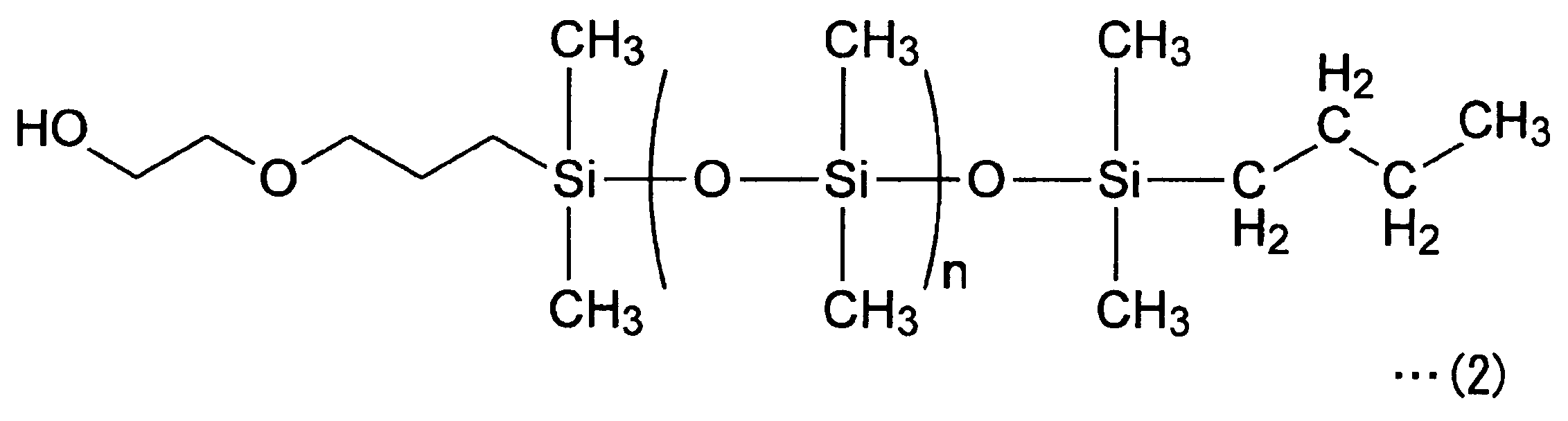
また、得られた実施例2の酸化ジルコニウム-シリコーン樹脂透明複合体における平均分散粒子径を、実施例1と同様に測定した結果、6nmであった。さらに,可視光透過率を実施例1と同様に求めた結果、82%であった。さらに、黄変の有無を、実施例1と同様に確認した結果、黄変は見られなかった。
実施例1のシリコーン樹脂を、ジメチルシリコーンからメチルフェニルシリコーン(信越シリコーン社製:KF54-400cS)に変えたこと以外は実施例1と同様にして、実施例3の酸化ジルコニウム-シリコーン樹脂複合組成物および透明複合体を得た。
また、得られた実施例2の酸化ジルコニウム-シリコーン樹脂透明複合体における平均分散粒子径を、実施例1と同様に測定した結果、5nmであった。さらに,可視光透過率を実施例1と同様に求めた結果、82%であった。さらに、黄変の有無を、実施例1と同様に確認した結果、黄変は見られなかった。
実施例1のシリコーン樹脂を、ジメチルシリコーンからアクリル変性シリコーン(Gelest社製:DMS-V22,200cS)に変えたこと以外は実施例1と同様にして、実施例4の酸化ジルコニウム-シリコーン樹脂複合組成物および透明複合体を得た。
また、得られた実施例2の酸化ジルコニウム-シリコーン樹脂透明複合体における平均分散粒子径を、実施例1と同様に測定した結果、5nmであった。さらに,可視光透過率を実施例1と同様に求めた結果、85%であった。さらに、黄変の有無を、実施例1と同様に確認した結果、黄変は見られなかった。
実施例1のシリコーン樹脂を、ジメチルシリコーンからメチルハイドロジェンシリコーン(信越シリコーン社製:KF99-20cS)に変えたこと以外は実施例1と同様にして、実施例5の酸化ジルコニウム-シリコーン樹脂複合組成物および透明複合体を得た。
また、得られた実施例5の酸化ジルコニウム-シリコーン樹脂透明複合体における平均分散粒子径を、実施例1と同様に測定した結果、9nmであった。さらに,可視光透過率を実施例1と同様に求めた結果、80%であった。さらに、黄変の有無を、実施例1と同様に確認した結果、黄変は見られなかった。
無機酸化物粒子として二酸化ケイ素(シリカ)粒子(Alfa-Aesar社製、一次粒子径10nm)を使用した。この二酸化ケイ素粒子を用いたこと、および特定の分散剤としてアミンであるブチルアミン(和光純薬工業社製)を用いたこと除いては、実施例1と同様の方法を用いて、実施例6の二酸化ケイ素-シリコーン樹脂複合組成物および透明複合体を得た。
また、得られた実施例5の酸化ジルコニウム-シリコーン樹脂透明複合体における平均分散粒子径を、実施例1と同様に測定した結果、16nmであった。さらに,可視光透過率を実施例1と同様に求めた結果、90%であった。さらに、黄変の有無を、実施例1と同様に確認した結果、黄変は見られなかった。
実施例6の表面修飾剤を、モノグリシジルエーテル末端ポリジメチルシロキサンからモノヒドロキシエーテル末端ポリジメチルシロキサン(Aldrich社製:数平均分子量4600)に変えたこと以外は実施例6と同様にして、実施例7の二酸化ケイ素-シリコーン樹脂複合組成物および透明複合体を得た。
また、得られた実施例7の酸化ジルコニウム-シリコーン樹脂透明複合体における平均分散粒子径を、実施例1と同様に測定した結果、12nmであった。さらに,可視光透過率を実施例1と同様に求めた結果、88%であった。さらに、黄変の有無を、実施例1と同様に確認した結果、黄変は見られなかった。
無機酸化物粒子として、一次粒子径50nmの酸化ジルコニウム粒子(Aldrich社製)を使用した。この一次粒子径50nmの酸化ジルコニウム粒子を用いたことを除いては、実施例1と同様の方法を用いて、比較例1(参考例1)の二酸化ケイ素-シリコーン樹脂複合組成物および透明複合体を得た。
また、得られた比較例1(参考例1)の酸化ジルコニウム-シリコーン樹脂透明複合体における平均分散粒子径を、実施例1と同様に測定した結果、85nmであった。さらに,可視光透過率を実施例1と同様に求めた結果、12%であった。さらに、黄変の有無を、実施例1と同様に確認した結果、黄変は見られなかった。
表面修飾剤を、片末端に1官能基のみを有するモノグリシジルエーテル末端ポリジメチルシロキサンから、両末端に各々1官能基を有するビスヒドロキシエーテル末端ポリジメチルシロキサン(Aldrich社製:数平均分子量5000)に変えたこと以外は実施例1と同様にして、比較例2の酸化ジルコニウム-シリコーン樹脂複合組成物および透明複合体を得た。
また、得られた比較例2の酸化ジルコニウム-シリコーン樹脂透明複合体における平均分散粒子径を、実施例1と同様に測定した結果、61nmであった。さらに,可視光透過率を実施例1と同様に求めた結果、16%であった。さらに、黄変の有無を、実施例1と同様に確認した結果、黄変は見られなかった。
表面修飾剤を、片末端に1官能基のみを有するモノグリシジルエーテル末端ポリジメチルシロキサンから、両末端に各々1官能基を有するジグリシジルエーテル末端ポリジメチルシロキサン(Aldrich社製:数平均分子量5000)に変えたこと以外は実施例1と同様にして、比較例3の酸化ジルコニウム-シリコーン樹脂複合組成物および透明複合体を得た。
また、得られた比較例3の酸化ジルコニウム-シリコーン樹脂透明複合体における平均分散粒子径を、実施例1と同様に測定した結果、42nmであった。さらに,可視光透過率を実施例1と同様に求めた結果、22%であった。さらに、黄変の有無を、実施例1と同様に確認した結果、黄変の発生が確認された。
表面修飾剤を、片末端に1官能基のみを有するモノグリシジルエーテル末端ポリジメチルシロキサンから、両末端に各々1官能基を有するジシラノール末端ポリジメチルシロキサン(Aldrich社製:数平均分子量5300)に変えたこと以外は実施例1と同様にして、比較例2の酸化ジルコニウム-シリコーン樹脂複合組成物および透明複合体を得た。
また、得られた比較例4の酸化ジルコニウム-シリコーン樹脂透明複合体における平均分散粒子径を、実施例1と同様に測定した結果、55nmであった。さらに,可視光透過率を実施例1と同様に求めた結果、15%であった。さらに,黄変の有無を、実施例1と同様に確認した結果、黄変は見られなかった。
無機酸化物粒子を含まないシリコーン樹脂単体として、ストレートシリコーンレジンであるジメチルシリコーン(信越シリコーン社製:KF96―3000cS)を選択し、このシリコーン樹脂(粘性液状)単体の可視光透過率を、実施例1と同様に測定した。
その結果、可視光透過率は93%であった。
なお黄変の評価については、黄変がないものを「○」、黄変したものを「×」とした。
また、各実施例の透明複合体においても、無機酸化物粒子の平均分散粒子径は20nm以下であり、可視光透過率も81%以上と比較対照である比較例5(93%)に比べて大幅な低下はなく、さらには加熱処理後の黄変もなく、良好な特性を示していることが分かった。
また、比較例2から4においては、無機酸化物粒子の一次粒子径自体は3nmと小さいが、これと比較して複合体組成物中および透明複合体中における平均分散粒子径は30nm以上と非常に大きくなっている。その為、可視光透過率の低下が発生していた。これは、表面修飾剤として両末端に官能基を有するものを用いた事に起因して、無機酸化物粒子に対して十分な表面修飾を行うことができず、シリコーン樹脂中で無機酸化物粒子の凝集が発生して平均分散粒子径が大きくなり、やはり光散乱に伴う可視光透過率の低下が発生したと考えられる。
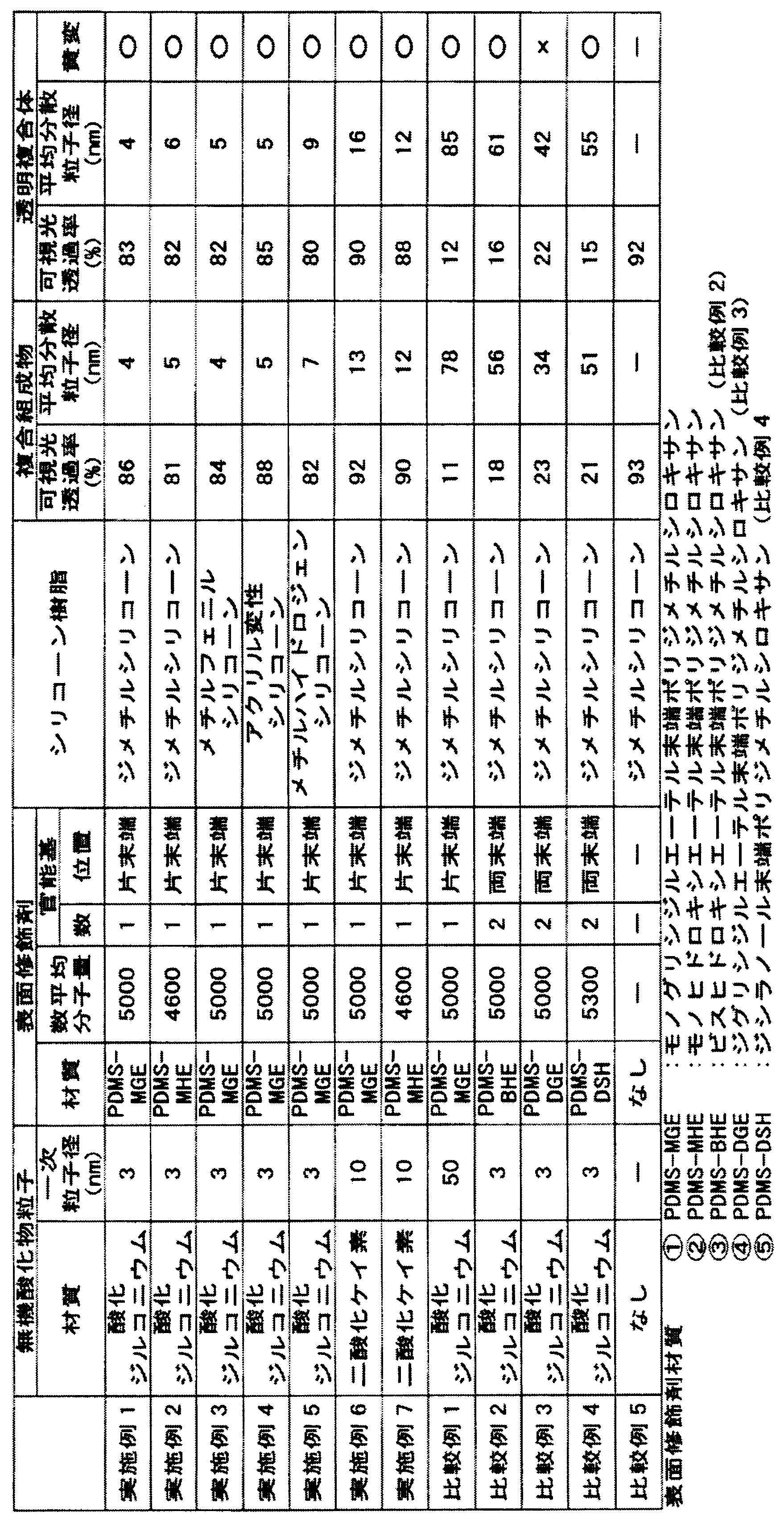
さらに、無機酸化物粒子として、高屈折率の酸化ジルコニウムや酸化チタン等を選択することにより、高屈折率で透明性の高い透明複合体を得ることができる。
したがって、本実施形態の無機酸化物粒子-シリコーン樹脂複合組成物および透明複合体は、発光ダイオード(LED)の封止材、液晶表示装置用基板、有機EL表示装置用基板、カラーフィルタ用基板、タッチパネル用基板、太陽電池用基板などの光学シート、透明板、光学レンズ、光学素子、光導波路等はもちろんのこと、これ以外の様々な工業分野においても好適に使用することができ、その利用可能性は大である。
Claims (7)
- 無機酸化物粒子表面に予め分散剤を結合させて疎水性溶媒への分散性を持たせた後、前記無機酸化物粒子を疎水性溶媒中に分散させる工程と、
前記無機酸化物粒子が分散した疎水性溶媒中で、無機酸化物粒子表面に予め結合している前記分散剤と、片末端に1官能基を有するポリジメチルシロキサン骨格ポリマーからなる表面修飾剤とを置換させることで、無機酸化物粒子の表面に、ポリジメチルシロキサン骨格ポリマーの前記1官能基を結合させる工程と、
前工程で得られた、片末端に1官能基を有するポリジメチルシロキサン骨格ポリマーが結合することにより表面修飾された無機酸化物粒子と、シリコーン樹脂とを複合化して複合組成物を得る工程と、を有することを特徴とする複合組成物の製造方法。 - 前記表面修飾剤は、モノグリシジルエーテル末端ポリジメチルシロキサン、モノヒドロキシエーテル末端ポリジメチルシロキサンから選択された1種または2種を有することを特徴とする請求項1に記載の複合組成物の製造方法。
- 前記無機酸化物粒子表面に予め結合させる前記分散剤は、有機酸化合物または有機塩基化合物であることを特徴とする請求項1または2に記載の複合組成物の製造方法。
- 前記シリコーン樹脂は、ストレートシリコーン樹脂、または変性シリコーン樹脂であることを特徴とする請求項1から3のいずれか1項に記載の複合組成物の製造方法。
- 平均分散粒子径が1nm以上かつ20nm以下の無機酸化物粒子と、シリコーン樹脂とを含有する複合組成物であって、前記無機酸化物粒子は、その表面が、片末端に1官能基を有するポリジメチルシロキサン骨格ポリマーよりなる表面修飾剤の前記1官能基が表面に結合することにより修飾されていることを特徴とする複合組成物。
- シリコーン樹脂中に、平均分散粒子径が1nm以上かつ20nm以下の無機酸化物粒子が分散された、透明複合体であって、前記無機酸化物粒子は、その表面が、片末端に1官能基を有するポリジメチルシロキサン骨格ポリマーよりなる表面修飾剤の前記1官能基が結合することにより修飾されていることを特徴とする透明複合体。
- 請求項5に記載の複合組成物を成形固化して透明複合体を得る工程を含むことを特徴とする透明複合体の製造方法。
Priority Applications (4)
| Application Number | Priority Date | Filing Date | Title |
|---|---|---|---|
| US13/809,560 US9006354B2 (en) | 2010-07-16 | 2011-07-12 | Composite composition of inorganic oxide particles and silicone resin, method of manufacturing the same, transparent composite, and method of manufacturing the same |
| CN201180035093.6A CN103003365B (zh) | 2010-07-16 | 2011-07-12 | 无机氧化物粒子与聚硅氧烷树脂的复合组合物及其制造方法以及透明复合物及其制造方法 |
| KR1020137001171A KR101496409B1 (ko) | 2010-07-16 | 2011-07-12 | 무기 산화물 입자와 실리콘 수지의 복합 조성물 및 그 제조 방법, 및 투명 복합체 및 그 제조 방법 |
| US14/576,945 US9150698B2 (en) | 2010-07-16 | 2014-12-19 | Composite composition of inorganic oxide particles and silicone resin, method of manufacturing the same, transparent composite, and method of manufacturing the same |
Applications Claiming Priority (2)
| Application Number | Priority Date | Filing Date | Title |
|---|---|---|---|
| JP2010-161990 | 2010-07-16 | ||
| JP2010161990A JP5273744B2 (ja) | 2010-07-16 | 2010-07-16 | 無機酸化物粒子とシリコーン樹脂との複合組成物の製造方法 |
Related Child Applications (2)
| Application Number | Title | Priority Date | Filing Date |
|---|---|---|---|
| US13/809,560 A-371-Of-International US9006354B2 (en) | 2010-07-16 | 2011-07-12 | Composite composition of inorganic oxide particles and silicone resin, method of manufacturing the same, transparent composite, and method of manufacturing the same |
| US14/576,945 Division US9150698B2 (en) | 2010-07-16 | 2014-12-19 | Composite composition of inorganic oxide particles and silicone resin, method of manufacturing the same, transparent composite, and method of manufacturing the same |
Publications (1)
| Publication Number | Publication Date |
|---|---|
| WO2012008441A1 true WO2012008441A1 (ja) | 2012-01-19 |
Family
ID=45469439
Family Applications (1)
| Application Number | Title | Priority Date | Filing Date |
|---|---|---|---|
| PCT/JP2011/065871 Ceased WO2012008441A1 (ja) | 2010-07-16 | 2011-07-12 | 無機酸化物粒子とシリコーン樹脂との複合組成物およびその製造方法、ならびに透明複合体およびその製造方法 |
Country Status (6)
| Country | Link |
|---|---|
| US (2) | US9006354B2 (ja) |
| JP (1) | JP5273744B2 (ja) |
| KR (1) | KR101496409B1 (ja) |
| CN (1) | CN103003365B (ja) |
| TW (1) | TWI541277B (ja) |
| WO (1) | WO2012008441A1 (ja) |
Cited By (5)
| Publication number | Priority date | Publication date | Assignee | Title |
|---|---|---|---|---|
| WO2014150128A1 (en) * | 2013-03-15 | 2014-09-25 | Tronox Llc | Titanium dioxide pigment and manufacturing method |
| TWI468443B (zh) * | 2012-03-09 | 2015-01-11 | 住友大阪水泥股份有限公司 | A surface-modified metal oxide particle material and an optical semiconductor element sealing composition, and an optical semiconductor device |
| JP2015120888A (ja) * | 2013-11-20 | 2015-07-02 | 三菱化学株式会社 | 半導体発光装置封止材用硬化性オルガノポリシロキサン組成物、該組成物を硬化させてなるオルガノポリシロキサン硬化物及びこれを用いて封止されてなる半導体発光装置 |
| US9745405B2 (en) | 2015-04-20 | 2017-08-29 | Tronox Llc | Polymer, polymer modified titanium dioxide pigment, and method of forming a pigmented paint formulation |
| US10125219B2 (en) | 2014-10-30 | 2018-11-13 | Tronox Llc | Titanium dioxide pigment and manufacturing method |
Families Citing this family (27)
| Publication number | Priority date | Publication date | Assignee | Title |
|---|---|---|---|---|
| TWI582150B (zh) * | 2012-05-18 | 2017-05-11 | Sumitomo Osaka Cement Co Ltd | Surface-modified metal oxide particle material, dispersion liquid, polysiloxane resin composition, polysiloxane resin composite, optical semiconductor light emitting device, lighting device and liquid crystal image device |
| KR101757786B1 (ko) | 2012-05-18 | 2017-07-14 | 스미토모 오사카 세멘토 가부시키가이샤 | 표면수식 금속산화물 입자재료, 분산액, 실리콘 수지 조성물, 실리콘 수지 복합체, 광반도체 발광 장치, 조명 기구 및 액정 화상 장치 |
| KR101542616B1 (ko) * | 2012-06-12 | 2015-08-06 | 제일모직주식회사 | 신규한 고리형 실록산 화합물, 그 제조방법, 이를 포함하는 복합시트 및 이를 이용한 디스플레이 기판 |
| CN106170872A (zh) | 2013-09-23 | 2016-11-30 | 皮瑟莱根特科技有限责任公司 | 高折射率有机硅纳米复合材料 |
| JP6110421B2 (ja) * | 2014-03-28 | 2017-04-05 | トヨタ自動車株式会社 | フォノン散乱材、ナノコンポジット熱電材料及びその製造方法 |
| KR20160148626A (ko) | 2014-04-24 | 2016-12-26 | 렌슬러 폴리테크닉 인스티튜트 | 매트릭스 부재 중합체 나노복합체 및 그의 관련 제품 및 방법 |
| KR102190051B1 (ko) * | 2015-03-06 | 2020-12-11 | 스미토모 오사카 세멘토 가부시키가이샤 | 광 산란 복합체 형성용 조성물, 광 산란 복합체 및 그 제조 방법 |
| JP6468020B2 (ja) * | 2015-03-20 | 2019-02-13 | 住友大阪セメント株式会社 | 無機酸化物粒子分散液、樹脂組成物、マスターバッチ、樹脂複合体、及び光半導体発光装置 |
| JP6489049B2 (ja) * | 2015-07-03 | 2019-03-27 | 住友大阪セメント株式会社 | 無機粒子含有組成物、塗膜、塗膜付きプラスチック基材、および表示装置 |
| KR102411541B1 (ko) * | 2015-08-07 | 2022-06-22 | 삼성디스플레이 주식회사 | 고분자 필름 형성용 조성물, 이로부터 제조된 고분자 필름 및 상기 고분자 필름을 포함한 전자 소자 |
| JP6524901B2 (ja) * | 2015-12-08 | 2019-06-05 | 信越化学工業株式会社 | シリコーンゴム組成物及びその硬化物 |
| US10106666B2 (en) * | 2016-03-02 | 2018-10-23 | Samsung Electronics Co., Ltd. | Curable silicone resin composition containing inorganic oxide and optical member using same |
| JP2017155136A (ja) * | 2016-03-02 | 2017-09-07 | サムスン エレクトロニクス カンパニー リミテッド | 無機酸化物含有硬化性シリコーン樹脂組成物及びそれを用いて形成される光学部材 |
| JP6510468B2 (ja) * | 2016-07-14 | 2019-05-08 | 信越化学工業株式会社 | 硬化性シリコーン樹脂組成物及び硬化性シリコーン樹脂組成物の調製方法 |
| JP2018053098A (ja) * | 2016-09-29 | 2018-04-05 | 住友大阪セメント株式会社 | 無機粒子含有組成物、塗膜、塗膜付きプラスチック基材、および表示装置 |
| CN107353870B (zh) * | 2017-07-26 | 2020-08-14 | 烟台德邦科技有限公司 | 一种具有高度气体阻隔性的高折led封装硅胶 |
| WO2019069535A1 (ja) * | 2017-10-04 | 2019-04-11 | 株式会社アドマテックス | シリコーン被覆フィラー及びその製造方法並びに樹脂組成物 |
| CN109517175A (zh) * | 2018-11-27 | 2019-03-26 | 湖北新四海化工股份有限公司 | Led封装用高品质苯基乙烯基mtq硅树脂及制备方法 |
| US20220033268A1 (en) * | 2019-02-25 | 2022-02-03 | Nissan Chemical Corporation | Inorganic oxide particle, inorganic oxide particle dispersion and preparation method thereof, and method for producing surface modifier |
| JP2020164678A (ja) | 2019-03-29 | 2020-10-08 | 日亜化学工業株式会社 | シリコーン樹脂組成物及びその製造方法 |
| US12466952B2 (en) * | 2020-06-25 | 2025-11-11 | Elkem Silicones France Sas | Thermally conductive silicone compositions |
| WO2022043805A1 (en) | 2020-08-27 | 2022-03-03 | 3M Innovative Properties Company | Surface-modified transition metal oxide nanoparticles, method of making the same, and curable composition and article including the same |
| CN112592498A (zh) * | 2020-11-05 | 2021-04-02 | 三峡大学 | 一种掺杂ZrO2粒子的PDMS辐射制冷薄膜的制备方法 |
| JP7389939B2 (ja) * | 2021-11-10 | 2023-11-30 | デンカ株式会社 | 窒化ホウ素粉末 |
| WO2023182037A1 (ja) * | 2022-03-23 | 2023-09-28 | ソニーグループ株式会社 | 構造体 |
| CN114736628B (zh) * | 2022-05-07 | 2024-01-26 | 山东国瓷功能材料股份有限公司 | 氧化锆树脂型分散液、uv固化胶水及其制备方法和应用 |
| CN117164246B (zh) * | 2023-09-05 | 2024-10-29 | 陕西科技大学 | 一种透明自清洁超滑移玻璃及其制备方法 |
Citations (7)
| Publication number | Priority date | Publication date | Assignee | Title |
|---|---|---|---|---|
| JPH02218723A (ja) * | 1989-02-20 | 1990-08-31 | Nippon Sheet Glass Co Ltd | ポリジメチルシロキサン被覆微粒子 |
| JPH0436370A (ja) * | 1990-05-31 | 1992-02-06 | Nippon Sheet Glass Co Ltd | ポリジメチルシロキサン被覆微粒子 |
| JP2004002887A (ja) * | 2003-07-28 | 2004-01-08 | Noevir Co Ltd | 顔料分散体および化粧料 |
| JP2008120848A (ja) * | 2006-11-08 | 2008-05-29 | Sumitomo Osaka Cement Co Ltd | 無機酸化物透明分散液と透明複合体およびその製造方法、発光素子封止用組成物並びに発光素子 |
| JP2008303299A (ja) * | 2007-06-07 | 2008-12-18 | Sumitomo Osaka Cement Co Ltd | ジルコニア含有シリコーン樹脂組成物 |
| JP2009024068A (ja) * | 2007-07-18 | 2009-02-05 | Nippon Shokubai Co Ltd | 酸化ジルコニウムナノ粒子を含む樹脂粒子の製造方法および樹脂粒子 |
| JP2010095392A (ja) * | 2008-10-14 | 2010-04-30 | Mitsui Chemicals Inc | 有機シロキサンオリゴマー修飾無機酸化物超微粒子 |
Family Cites Families (11)
| Publication number | Priority date | Publication date | Assignee | Title |
|---|---|---|---|---|
| JPS5232393B2 (ja) | 1972-11-22 | 1977-08-20 | ||
| JP3567335B2 (ja) | 1993-12-28 | 2004-09-22 | 三好化成株式会社 | 有機ケイ素化合物処理顔料または体質顔料、その製法および化粧料 |
| JPH0974787A (ja) | 1995-09-07 | 1997-03-18 | Sankyo Seiki Mfg Co Ltd | 交流電動機の電流検出方法 |
| JP2005097514A (ja) | 2003-08-27 | 2005-04-14 | Nsk Ltd | 転動装置用潤滑剤及び転動装置 |
| JP4273942B2 (ja) | 2003-11-28 | 2009-06-03 | Jsr株式会社 | ジルコニア粒子分散液、その製造方法及び光硬化性組成物 |
| JP5034301B2 (ja) | 2005-04-15 | 2012-09-26 | Jsr株式会社 | 高屈折材料形成用組成物およびその硬化体、ならびに高屈折材料形成用組成物の製造方法 |
| US7902304B2 (en) * | 2005-10-03 | 2011-03-08 | Dai-Ichi Kogyo Seiyaku Co., Ltd. | Functional filler and resin composition containing same |
| EP1950239B1 (en) * | 2005-10-28 | 2017-01-04 | Sumitomo Osaka Cement Co., Ltd. | Transparent inorganic-oxide dispersion, resin composition containing inorganic oxide particles, composition for encapsulating luminescent element, luminescent element, hard coat, optical functional film, optical part, and process for producing resin composition containing inorganic oxide particles |
| JP5167582B2 (ja) * | 2005-10-28 | 2013-03-21 | 住友大阪セメント株式会社 | ジルコニア透明分散液及び透明複合体並びに透明複合体の製造方法 |
| US7972691B2 (en) * | 2006-12-22 | 2011-07-05 | Nanogram Corporation | Composites of polymers and metal/metalloid oxide nanoparticles and methods for forming these composites |
| JP2009091380A (ja) | 2007-10-03 | 2009-04-30 | Jsr Corp | 発光素子コーティング用組成物および発光装置、ならびに発光素子コーティング用組成物の製造方法 |
-
2010
- 2010-07-16 JP JP2010161990A patent/JP5273744B2/ja not_active Expired - Fee Related
-
2011
- 2011-07-12 KR KR1020137001171A patent/KR101496409B1/ko not_active Expired - Fee Related
- 2011-07-12 WO PCT/JP2011/065871 patent/WO2012008441A1/ja not_active Ceased
- 2011-07-12 CN CN201180035093.6A patent/CN103003365B/zh active Active
- 2011-07-12 US US13/809,560 patent/US9006354B2/en active Active
- 2011-07-13 TW TW100124735A patent/TWI541277B/zh active
-
2014
- 2014-12-19 US US14/576,945 patent/US9150698B2/en active Active
Patent Citations (7)
| Publication number | Priority date | Publication date | Assignee | Title |
|---|---|---|---|---|
| JPH02218723A (ja) * | 1989-02-20 | 1990-08-31 | Nippon Sheet Glass Co Ltd | ポリジメチルシロキサン被覆微粒子 |
| JPH0436370A (ja) * | 1990-05-31 | 1992-02-06 | Nippon Sheet Glass Co Ltd | ポリジメチルシロキサン被覆微粒子 |
| JP2004002887A (ja) * | 2003-07-28 | 2004-01-08 | Noevir Co Ltd | 顔料分散体および化粧料 |
| JP2008120848A (ja) * | 2006-11-08 | 2008-05-29 | Sumitomo Osaka Cement Co Ltd | 無機酸化物透明分散液と透明複合体およびその製造方法、発光素子封止用組成物並びに発光素子 |
| JP2008303299A (ja) * | 2007-06-07 | 2008-12-18 | Sumitomo Osaka Cement Co Ltd | ジルコニア含有シリコーン樹脂組成物 |
| JP2009024068A (ja) * | 2007-07-18 | 2009-02-05 | Nippon Shokubai Co Ltd | 酸化ジルコニウムナノ粒子を含む樹脂粒子の製造方法および樹脂粒子 |
| JP2010095392A (ja) * | 2008-10-14 | 2010-04-30 | Mitsui Chemicals Inc | 有機シロキサンオリゴマー修飾無機酸化物超微粒子 |
Cited By (9)
| Publication number | Priority date | Publication date | Assignee | Title |
|---|---|---|---|---|
| TWI468443B (zh) * | 2012-03-09 | 2015-01-11 | 住友大阪水泥股份有限公司 | A surface-modified metal oxide particle material and an optical semiconductor element sealing composition, and an optical semiconductor device |
| WO2014150128A1 (en) * | 2013-03-15 | 2014-09-25 | Tronox Llc | Titanium dioxide pigment and manufacturing method |
| US9315615B2 (en) | 2013-03-15 | 2016-04-19 | Tronox Llc | Titanium dioxide pigment and manufacturing method |
| JP2016515156A (ja) * | 2013-03-15 | 2016-05-26 | トロノックス エルエルシー | 二酸化チタン顔料及びその製造方法 |
| JP2015120888A (ja) * | 2013-11-20 | 2015-07-02 | 三菱化学株式会社 | 半導体発光装置封止材用硬化性オルガノポリシロキサン組成物、該組成物を硬化させてなるオルガノポリシロキサン硬化物及びこれを用いて封止されてなる半導体発光装置 |
| US10125219B2 (en) | 2014-10-30 | 2018-11-13 | Tronox Llc | Titanium dioxide pigment and manufacturing method |
| US10407544B2 (en) | 2014-10-30 | 2019-09-10 | Tronox Llc | Titanium dioxide pigment and manufacturing method |
| US9745405B2 (en) | 2015-04-20 | 2017-08-29 | Tronox Llc | Polymer, polymer modified titanium dioxide pigment, and method of forming a pigmented paint formulation |
| US9902800B2 (en) | 2015-04-20 | 2018-02-27 | Tronox Llc | Polymer, polymer modified titanium dioxide pigment, and method of forming a pigmented paint formulation |
Also Published As
| Publication number | Publication date |
|---|---|
| KR20130041111A (ko) | 2013-04-24 |
| US9150698B2 (en) | 2015-10-06 |
| CN103003365A (zh) | 2013-03-27 |
| JP2012021117A (ja) | 2012-02-02 |
| TWI541277B (zh) | 2016-07-11 |
| JP5273744B2 (ja) | 2013-08-28 |
| US9006354B2 (en) | 2015-04-14 |
| US20150105522A1 (en) | 2015-04-16 |
| CN103003365B (zh) | 2015-03-04 |
| TW201211120A (en) | 2012-03-16 |
| US20130211016A1 (en) | 2013-08-15 |
| KR101496409B1 (ko) | 2015-02-26 |
Similar Documents
| Publication | Publication Date | Title |
|---|---|---|
| JP5273744B2 (ja) | 無機酸化物粒子とシリコーン樹脂との複合組成物の製造方法 | |
| TWI525140B (zh) | 無機氧化物粒子與聚矽氧樹脂之複合組成物及透明複合體 | |
| JP6565923B2 (ja) | 表面修飾金属酸化物粒子分散液及びその製造方法、表面修飾金属酸化物粒子−シリコーン樹脂複合組成物、表面修飾金属酸化物粒子−シリコーン樹脂複合体、光学部材、及び発光装置 | |
| CN104271495B (zh) | 表面修饰金属氧化物粒子材料、分散液、聚硅氧烷树脂组合物、聚硅氧烷树脂复合体、光半导体发光装置、照明器具及液晶图像装置 | |
| JP5393107B2 (ja) | シリコーン樹脂組成物 | |
| JP5540458B2 (ja) | 無機酸化物透明分散液と樹脂組成物、透明複合体、発光素子封止用組成物及び発光素子並びに透明複合体の製造方法 | |
| JP2008120848A (ja) | 無機酸化物透明分散液と透明複合体およびその製造方法、発光素子封止用組成物並びに発光素子 | |
| JP5769154B2 (ja) | 無機酸化物粒子とシリコーン樹脂との複合組成物ならびに透明複合体およびその製造方法 | |
| CN108779334A (zh) | 用于封装led的材料 | |
| JP5176380B2 (ja) | 表面修飾ジルコニア粒子と表面修飾ジルコニア粒子分散液及び複合体並びに表面修飾ジルコニア粒子の製造方法 | |
| JP5082814B2 (ja) | 無機酸化物含有透明複合体及びその製造方法 | |
| JP5018025B2 (ja) | 表面修飾酸化ジルコニウム粒子分散液及び透明複合体、光学部材並びに発光素子封止用組成物、発光素子 | |
| JP5332101B2 (ja) | 無機酸化物透明分散液と透明複合体、発光素子封止用組成物および発光素子並びに透明複合体の製造方法 | |
| JP5162879B2 (ja) | 金属酸化物粒子−シリコーン樹脂複合体とそれを備えた光学部材及び発光装置並びに金属酸化物粒子−シリコーン樹脂複合体の製造方法 | |
| JP5573059B2 (ja) | アルカリ土類金属酸化物ドープジルコニアナノ粒子透明分散液及び透明複合体 | |
| JP6514148B2 (ja) | 縮合硬化型シリコーン樹脂組成物及び半導体装置 | |
| JP2023140678A (ja) | 熱硬化性樹脂組成物 |
Legal Events
| Date | Code | Title | Description |
|---|---|---|---|
| 121 | Ep: the epo has been informed by wipo that ep was designated in this application |
Ref document number: 11806771 Country of ref document: EP Kind code of ref document: A1 |
|
| ENP | Entry into the national phase |
Ref document number: 20137001171 Country of ref document: KR Kind code of ref document: A |
|
| NENP | Non-entry into the national phase |
Ref country code: DE |
|
| WWE | Wipo information: entry into national phase |
Ref document number: 13809560 Country of ref document: US |
|
| 122 | Ep: pct application non-entry in european phase |
Ref document number: 11806771 Country of ref document: EP Kind code of ref document: A1 |