WO2011049199A1 - 黒鉛材料、電池電極用炭素材料、及び電池 - Google Patents
黒鉛材料、電池電極用炭素材料、及び電池 Download PDFInfo
- Publication number
- WO2011049199A1 WO2011049199A1 PCT/JP2010/068690 JP2010068690W WO2011049199A1 WO 2011049199 A1 WO2011049199 A1 WO 2011049199A1 JP 2010068690 W JP2010068690 W JP 2010068690W WO 2011049199 A1 WO2011049199 A1 WO 2011049199A1
- Authority
- WO
- WIPO (PCT)
- Prior art keywords
- graphite
- graphite material
- mass
- carbon
- electrode
- Prior art date
- Legal status (The legal status is an assumption and is not a legal conclusion. Google has not performed a legal analysis and makes no representation as to the accuracy of the status listed.)
- Ceased
Links
Images


Classifications
-
- C—CHEMISTRY; METALLURGY
- C01—INORGANIC CHEMISTRY
- C01B—NON-METALLIC ELEMENTS; COMPOUNDS THEREOF; METALLOIDS OR COMPOUNDS THEREOF NOT COVERED BY SUBCLASS C01C
- C01B32/00—Carbon; Compounds thereof
- C01B32/20—Graphite
-
- C—CHEMISTRY; METALLURGY
- C01—INORGANIC CHEMISTRY
- C01B—NON-METALLIC ELEMENTS; COMPOUNDS THEREOF; METALLOIDS OR COMPOUNDS THEREOF NOT COVERED BY SUBCLASS C01C
- C01B32/00—Carbon; Compounds thereof
- C01B32/20—Graphite
- C01B32/205—Preparation
-
- C—CHEMISTRY; METALLURGY
- C01—INORGANIC CHEMISTRY
- C01B—NON-METALLIC ELEMENTS; COMPOUNDS THEREOF; METALLOIDS OR COMPOUNDS THEREOF NOT COVERED BY SUBCLASS C01C
- C01B32/00—Carbon; Compounds thereof
- C01B32/20—Graphite
- C01B32/21—After-treatment
-
- H—ELECTRICITY
- H01—ELECTRIC ELEMENTS
- H01M—PROCESSES OR MEANS, e.g. BATTERIES, FOR THE DIRECT CONVERSION OF CHEMICAL ENERGY INTO ELECTRICAL ENERGY
- H01M10/00—Secondary cells; Manufacture thereof
- H01M10/05—Accumulators with non-aqueous electrolyte
- H01M10/052—Li-accumulators
- H01M10/0525—Rocking-chair batteries, i.e. batteries with lithium insertion or intercalation in both electrodes; Lithium-ion batteries
-
- H—ELECTRICITY
- H01—ELECTRIC ELEMENTS
- H01M—PROCESSES OR MEANS, e.g. BATTERIES, FOR THE DIRECT CONVERSION OF CHEMICAL ENERGY INTO ELECTRICAL ENERGY
- H01M4/00—Electrodes
- H01M4/02—Electrodes composed of, or comprising, active material
- H01M4/13—Electrodes for accumulators with non-aqueous electrolyte, e.g. for lithium-accumulators; Processes of manufacture thereof
- H01M4/133—Electrodes based on carbonaceous material, e.g. graphite-intercalation compounds or CFx
-
- H—ELECTRICITY
- H01—ELECTRIC ELEMENTS
- H01M—PROCESSES OR MEANS, e.g. BATTERIES, FOR THE DIRECT CONVERSION OF CHEMICAL ENERGY INTO ELECTRICAL ENERGY
- H01M4/00—Electrodes
- H01M4/02—Electrodes composed of, or comprising, active material
- H01M4/13—Electrodes for accumulators with non-aqueous electrolyte, e.g. for lithium-accumulators; Processes of manufacture thereof
- H01M4/139—Processes of manufacture
- H01M4/1393—Processes of manufacture of electrodes based on carbonaceous material, e.g. graphite-intercalation compounds or CFx
-
- H—ELECTRICITY
- H01—ELECTRIC ELEMENTS
- H01M—PROCESSES OR MEANS, e.g. BATTERIES, FOR THE DIRECT CONVERSION OF CHEMICAL ENERGY INTO ELECTRICAL ENERGY
- H01M4/00—Electrodes
- H01M4/02—Electrodes composed of, or comprising, active material
- H01M4/36—Selection of substances as active materials, active masses, active liquids
- H01M4/362—Composites
- H01M4/364—Composites as mixtures
-
- H—ELECTRICITY
- H01—ELECTRIC ELEMENTS
- H01M—PROCESSES OR MEANS, e.g. BATTERIES, FOR THE DIRECT CONVERSION OF CHEMICAL ENERGY INTO ELECTRICAL ENERGY
- H01M4/00—Electrodes
- H01M4/02—Electrodes composed of, or comprising, active material
- H01M4/36—Selection of substances as active materials, active masses, active liquids
- H01M4/58—Selection of substances as active materials, active masses, active liquids of inorganic compounds other than oxides or hydroxides, e.g. sulfides, selenides, tellurides, halogenides or LiCoFy; of polyanionic structures, e.g. phosphates, silicates or borates
- H01M4/583—Carbonaceous material, e.g. graphite-intercalation compounds or CFx
- H01M4/587—Carbonaceous material, e.g. graphite-intercalation compounds or CFx for inserting or intercalating light metals
-
- C—CHEMISTRY; METALLURGY
- C01—INORGANIC CHEMISTRY
- C01B—NON-METALLIC ELEMENTS; COMPOUNDS THEREOF; METALLOIDS OR COMPOUNDS THEREOF NOT COVERED BY SUBCLASS C01C
- C01B32/00—Carbon; Compounds thereof
- C01B32/20—Graphite
- C01B32/21—After-treatment
- C01B32/215—Purification; Recovery or purification of graphite formed in iron making, e.g. kish graphite
-
- C—CHEMISTRY; METALLURGY
- C01—INORGANIC CHEMISTRY
- C01P—INDEXING SCHEME RELATING TO STRUCTURAL AND PHYSICAL ASPECTS OF SOLID INORGANIC COMPOUNDS
- C01P2002/00—Crystal-structural characteristics
- C01P2002/70—Crystal-structural characteristics defined by measured X-ray, neutron or electron diffraction data
- C01P2002/78—Crystal-structural characteristics defined by measured X-ray, neutron or electron diffraction data by stacking-plane distances or stacking sequences
-
- C—CHEMISTRY; METALLURGY
- C01—INORGANIC CHEMISTRY
- C01P—INDEXING SCHEME RELATING TO STRUCTURAL AND PHYSICAL ASPECTS OF SOLID INORGANIC COMPOUNDS
- C01P2004/00—Particle morphology
- C01P2004/54—Particles characterised by their aspect ratio, i.e. the ratio of sizes in the longest to the shortest dimension
-
- C—CHEMISTRY; METALLURGY
- C01—INORGANIC CHEMISTRY
- C01P—INDEXING SCHEME RELATING TO STRUCTURAL AND PHYSICAL ASPECTS OF SOLID INORGANIC COMPOUNDS
- C01P2006/00—Physical properties of inorganic compounds
- C01P2006/40—Electric properties
-
- H—ELECTRICITY
- H01—ELECTRIC ELEMENTS
- H01M—PROCESSES OR MEANS, e.g. BATTERIES, FOR THE DIRECT CONVERSION OF CHEMICAL ENERGY INTO ELECTRICAL ENERGY
- H01M4/00—Electrodes
- H01M4/02—Electrodes composed of, or comprising, active material
- H01M2004/021—Physical characteristics, e.g. porosity, surface area
-
- Y—GENERAL TAGGING OF NEW TECHNOLOGICAL DEVELOPMENTS; GENERAL TAGGING OF CROSS-SECTIONAL TECHNOLOGIES SPANNING OVER SEVERAL SECTIONS OF THE IPC; TECHNICAL SUBJECTS COVERED BY FORMER USPC CROSS-REFERENCE ART COLLECTIONS [XRACs] AND DIGESTS
- Y02—TECHNOLOGIES OR APPLICATIONS FOR MITIGATION OR ADAPTATION AGAINST CLIMATE CHANGE
- Y02E—REDUCTION OF GREENHOUSE GAS [GHG] EMISSIONS, RELATED TO ENERGY GENERATION, TRANSMISSION OR DISTRIBUTION
- Y02E60/00—Enabling technologies; Technologies with a potential or indirect contribution to GHG emissions mitigation
- Y02E60/10—Energy storage using batteries
-
- Y—GENERAL TAGGING OF NEW TECHNOLOGICAL DEVELOPMENTS; GENERAL TAGGING OF CROSS-SECTIONAL TECHNOLOGIES SPANNING OVER SEVERAL SECTIONS OF THE IPC; TECHNICAL SUBJECTS COVERED BY FORMER USPC CROSS-REFERENCE ART COLLECTIONS [XRACs] AND DIGESTS
- Y02—TECHNOLOGIES OR APPLICATIONS FOR MITIGATION OR ADAPTATION AGAINST CLIMATE CHANGE
- Y02T—CLIMATE CHANGE MITIGATION TECHNOLOGIES RELATED TO TRANSPORTATION
- Y02T10/00—Road transport of goods or passengers
- Y02T10/60—Other road transportation technologies with climate change mitigation effect
- Y02T10/70—Energy storage systems for electromobility, e.g. batteries
-
- Y—GENERAL TAGGING OF NEW TECHNOLOGICAL DEVELOPMENTS; GENERAL TAGGING OF CROSS-SECTIONAL TECHNOLOGIES SPANNING OVER SEVERAL SECTIONS OF THE IPC; TECHNICAL SUBJECTS COVERED BY FORMER USPC CROSS-REFERENCE ART COLLECTIONS [XRACs] AND DIGESTS
- Y10—TECHNICAL SUBJECTS COVERED BY FORMER USPC
- Y10T—TECHNICAL SUBJECTS COVERED BY FORMER US CLASSIFICATION
- Y10T428/00—Stock material or miscellaneous articles
- Y10T428/29—Coated or structually defined flake, particle, cell, strand, strand portion, rod, filament, macroscopic fiber or mass thereof
- Y10T428/2913—Rod, strand, filament or fiber
- Y10T428/2918—Rod, strand, filament or fiber including free carbon or carbide or therewith [not as steel]
-
- Y—GENERAL TAGGING OF NEW TECHNOLOGICAL DEVELOPMENTS; GENERAL TAGGING OF CROSS-SECTIONAL TECHNOLOGIES SPANNING OVER SEVERAL SECTIONS OF THE IPC; TECHNICAL SUBJECTS COVERED BY FORMER USPC CROSS-REFERENCE ART COLLECTIONS [XRACs] AND DIGESTS
- Y10—TECHNICAL SUBJECTS COVERED BY FORMER USPC
- Y10T—TECHNICAL SUBJECTS COVERED BY FORMER US CLASSIFICATION
- Y10T428/00—Stock material or miscellaneous articles
- Y10T428/29—Coated or structually defined flake, particle, cell, strand, strand portion, rod, filament, macroscopic fiber or mass thereof
- Y10T428/2982—Particulate matter [e.g., sphere, flake, etc.]
Definitions
- the present invention relates to a graphite material, a carbon material for battery electrodes, and a battery. More specifically, the present invention relates to a graphite material and a carbon material for a battery electrode suitable as an electrode material for a non-aqueous electrolyte secondary battery, and a secondary battery excellent in charge / discharge cycle characteristics and large current load characteristics.
- Lithium ion secondary batteries are mainly used as power sources for portable devices. Mobile devices and the like have diversified functions and have increased power consumption. Therefore, the lithium ion secondary battery is required to increase its battery capacity and simultaneously improve the charge / discharge cycle characteristics. Furthermore, there is an increasing demand for high-power and large-capacity secondary batteries such as electric tools such as electric drills and hybrid vehicles. Conventionally, lead secondary batteries, nickel cadmium secondary batteries, and nickel metal hydride secondary batteries have been mainly used in this field. However, expectations for high-density lithium-ion secondary batteries that are small and light are high. A lithium ion secondary battery having excellent current load characteristics is demanded.
- the main required characteristics are long-term cycle characteristics over 10 years and large current load characteristics for driving high-power motors.
- a high volumetric energy density is required to extend the cruising range, which is harsh compared to mobile applications.
- a lithium salt such as lithium cobaltate is generally used for the positive electrode active material
- a carbonaceous material such as graphite is used for the negative electrode active material.
- Graphite includes natural graphite and artificial graphite. Of these, natural graphite is available at low cost. However, since natural graphite has a scaly shape, when it is made into a paste together with a binder and applied to a current collector, the natural graphite is oriented in one direction. When charging with such an electrode, the electrode expands in only one direction, and the performance as an electrode is reduced. Although natural graphite granulated has been proposed, spherical natural graphite is crushed and oriented by pressing during electrode production. Moreover, since the surface of natural graphite was active, a large amount of gas was generated during the initial charge, the initial efficiency was low, and the cycle characteristics were not good. In order to solve these problems, Japanese Patent No.
- Patent Document 1 proposes a method of coating artificial carbon on the surface of natural graphite processed into a spherical shape.
- the material produced by this method can meet the high capacity, low current, and medium cycle characteristics required by mobile applications, etc., but it requires the large current and ultra long cycle characteristics of the large battery as described above. It is very difficult to meet.
- a negative electrode material using so-called hard carbon or amorphous carbon described in Japanese Patent Application Laid-Open No. 7-320740 (US Pat. No. 5,587,255, Patent Document 4) has excellent characteristics against a large current. Also, the cycle characteristics are relatively good. However, since the volumetric energy density is too low and the price is very expensive, it is used only for some special large batteries.
- Japanese Patent No. 3534391 Japanese Unexamined Patent Publication No. 4-190555 Japanese Patent No. 3361510 Japanese Unexamined Patent Publication No. 7-320740
- the object of the present invention is suitable for a negative electrode carbon material for a lithium ion secondary battery and the like capable of producing an electrode having a high energy density while maintaining the ultra-long cycle characteristics and large current load characteristics required by large batteries. It is to provide a graphite material. Another object of the present invention is to provide the graphite material at a low cost.
- each particle of the graphite material paid attention to the internal structure of each particle of the graphite material.
- particles that are a composite of a domain with a graphite network surface which is an important factor for high energy density, and a hard carbon domain that has high current load characteristics and cycle characteristics. Went. That is, detailed examination was made on the influence of other structures such as the size, ratio, orientation direction, and voids of the two types of domains.
- Japanese Laid-Open Patent Publication No. 2002-124255 and Japanese Laid-Open Patent Publication No. 2000-149946 employ a graphite material having a mosaic structure, and the surface of a granular or powdery mesophase pitch heat treated product (return medium).
- the raw material mesophase pitch is heated and polymerized while flowing in order to solidify while receiving shearing force due to flow to form a mosaic structure.
- a polymerization reaction that does not perform a crosslinking treatment such as using nitric acid, the optically anisotropic structure continues to grow, and thus the mosaic structure itself becomes large in the polymerization method as described above.
- the isotropic part remains crimson, but when the wavelength is slightly increased, it approaches purple from blue, and conversely from orange when the wavelength decreases. Approaching yellow. Therefore, when the optical anisotropy domain is rotated from 0 degree to 45 degrees, the interference color changes in yellow (yellow), red (magenta), blue (blue), etc. depending on the arrangement direction of the graphite mesh surface. Thus, the direction of domain arrangement can be easily determined.
- the present inventors have found that graphite materials having the following specific internal structure are not present in the carbon materials of negative electrodes for lithium ion secondary batteries so far. It was found that high energy density, long cycle characteristics, and high current load characteristics are balanced at a high level.
- the inventors have found a method for producing a carbon material having the present internal structure from a coke raw material, and have obtained a goal of solving the problem of economic efficiency, thereby completing the present invention.
- (A) represents the area value ( ⁇ m 2 ) of the maximum domain when reaching n1%
- Db (n2) is the sum of the numbers when the optically anisotropic texture domains are arranged in ascending order of area.
- the cross section of the molded body made of a graphite material when 10 square regions each having a side of 100 ⁇ m are arbitrarily selected, the cross section of the graphite particles appearing in the region is any one of items 1 to 3 that satisfy the following conditions:
- a graphite material comprising particles having the surface of the graphite particles according to any one of 1 to 5 coated with another carbon material.
- a battery electrode carbon material comprising the graphite material as described in any one of 1 to 7 above.
- Natural graphite or artificial graphite having an average interplanar spacing (d 002 ) of 0.3370 nm or less and an aspect ratio of 2 to 100 and 100 parts by mass of the graphite material according to any one of 1 to 7 above 9.
- the carbon material for battery electrodes as described in 8 above which comprises ⁇ 120 parts by mass.
- An electrode paste comprising the battery electrode carbon material as described in any one of 8 to 10 above and a binder.
- An electrode comprising a molded body of the electrode paste as described in 11 above.
- a battery comprising the electrode according to 12 as a constituent element.
- the graphite material of the present invention When used as a carbon material for battery electrodes, a battery electrode having a high energy density can be obtained while maintaining high capacity, high coulomb efficiency, and high cycle characteristics. Moreover, the graphite material of the present invention is excellent in economy and mass productivity, and can be produced by a method with improved safety.
- the “cross section of the molded body made of graphite material” in the present invention is prepared as follows. A double-sided tape is affixed to the bottom of a plastic sample container having an internal volume of 30 cm 3 , and about 2 cups of spatula (about 2 g) are placed on the sample.
- Cold embedding resin (trade name: cold embedding resin # 105, manufacturing company: Japan Composite Co., Ltd., sales company: Marumoto Struers Co., Ltd.) and curing agent (trade name: curing agent (M agent), (Manufacturing company: Nippon Oil & Fats Co., Ltd., sales company: Marumoto Struers Co., Ltd.) and knead for 30 seconds.
- the obtained mixture (about 5 ml) is slowly poured into the sample container until it reaches a height of about 1 cm, and allowed to stand for 1 day to solidify.
- the solidified sample is taken out and the double-sided tape is peeled off.
- the surface to be measured is polished using a polishing plate rotating type polishing machine.
- Polishing is performed such that the polishing surface is pressed against the rotating surface.
- the polishing plate is rotated at 1000 rpm.
- the counts of the polishing plates are # 500, # 1000, and # 2000 in this order, and the last is alumina (trade name: Baikalox type 0.3CR, particle size 0.3 ⁇ m, manufacturer: Baikowski, sales company: Baikow Mirror polishing using Ski Japan).
- the polished sample is fixed with clay on a preparation and observed using a polarizing microscope (BX51, manufactured by OLYMPAS).
- magnification image a square region (100 ⁇ m square) was cut out from the same point at an observation angle of 0 ° and 45 °, respectively, and the following analysis was performed on all particles within the range to obtain an average.
- color extraction is performed for blue, yellow, magenta, black, and pure magenta, and the respective area ratios are counted.
- the optical anisotropy domain changes in color depending on the orientation of the crystallite, since the probability of facing the front is very low, even if magenta is shown, the wavelength is almost different from that of pure magenta.
- the optical isotropic domain always indicates the wavelength of pure magenta. Therefore, in the present invention, all pure magenta is recognized as an optically isotropic region.
- the color extraction is performed using a LUZEX AP command, and the extraction width of each color is set by setting IHP data as shown in Table 1 below.
- the W-1 command of Eliminate 1 of the logical filter is used to remove an area of 1 dot or less.
- the number of pixels is used to calculate the total number of pixels of the image and the number of corresponding color pixels.
- the area ratio of the portion where the color changed when rotated by 0 °, 45 °, and 90 ° is calculated as shown in Table 2.
- the graphite material of the present invention has an optical anisotropy domain (domain where crystals are developed and the graphite network surface is aligned) and an optical isotropy domain (crystals are not yet developed or hard carbon) in each particle.
- the domain indicates a minimum unit structure of an optically anisotropic structure or an optically isotropic structure that is substantially connected.
- the area of the optically anisotropic structure in the cross section of the graphite particles appearing in the region. (X), the total area (y) of the optically isotropic structure, and the total area (z) of the voids satisfy the following relationship.
- the cross section of the graphite particles appearing in a square region having an arbitrarily selected one side of 100 ⁇ m does not include voids between the particles, but only the cross section of the particles.
- x, y, and z are the total ratios of the respective structures with respect to the total of the cross-sectional portions of the particles, and the voids indicated by z are voids appearing in the particle cross-section (hereinafter referred to as voids unless otherwise specified). ).
- the amount of optically anisotropic domains is preferable because the domains contribute to insertion / extraction of lithium ions, etc., and as a general rule, the larger the number, the greater the capacity. If the area of the sex domain is less than 3% of the total area, the current load characteristics and the cycle characteristics are extremely deteriorated and the balance of the materials cannot be maintained.
- voids themselves cannot contribute to the charge / discharge capacity, they are preferably as small as possible, and z is preferably 3% or less, more preferably 2% or less.
- x: y: z 70 to 97: 3 to 30: 0 to 3
- x + y + z 100
- the particles are not occupied by large optical anisotropic domains.
- Lmax / Lave is 0.5 or less, preferably 0.4 or less, and more preferably 0.3 or less.
- Lmax / Lave is in this range, the optical anisotropy domain is sufficiently small, and the direction of the carbon network in each domain is not oriented in one direction, but in any direction.
- This Lmax / Lave is the largest of the Lmax of each particle in the cross section of the graphite particles appearing in the cross section of the graphite particle that appears in the cross section of the molded body made of the graphite material when arbitrarily selected 10 square areas having a side of 100 ⁇ m. Can be calculated by measuring.
- the measurement of Lave which is a volume-based average particle diameter (D50) by a laser diffraction method, can be performed using a laser diffraction particle size distribution measuring instrument such as Malvern Mastersizer.
- the graphite material is an aggregate of graphite particles, and the graphite particles are not completely homogeneous. Therefore, the graphite material of the present invention does not satisfy the above Lmax / Lave condition. Particles may also be included, but the amount is less than 10%, preferably less than 5% on a number basis. That is, 90% or more of graphite particles, preferably 95% or more of graphite particles on the basis of the number satisfies the above conditions.
- the size (ratio) of the optically anisotropic domain in the particles is as described above, but the following relationship is also preferable from the viewpoint of the absolute value of the size.
- the absolute value of the size is influenced by the particle diameter, it cannot be generally stated, but in the cross section of the molded body made of graphite material, it appears in the area when 10 square areas with sides of 100 ⁇ m are arbitrarily selected.
- the number of those having an area of 25 ⁇ m 2 or less out of the number of optically anisotropic tissue domains having an area of 0.1 ⁇ m 2 or more is preferably 80% or more.
- the number of those having an area of 15 ⁇ m 2 or less is 80% or more, and more preferably the number of those having an area of 10 ⁇ m 2 or less is 80% or more.
- the number is preferably 90% or more. If the area of one domain is too large, the expansion and contraction directions of the particles during charge / discharge tend to concentrate and the cycle characteristics deteriorate.
- the optically isotropic domain cannot be generally described, but the number of optically isotropic tissue domains having an area of 0.1 ⁇ m 2 or more in the cross section in any one particle has an area of 25 ⁇ m 2 or less. Is preferably 80% or more.
- the number of those having an area of 15 ⁇ m 2 or less is 80% or more, and more preferably the number of those having an area of 10 ⁇ m 2 or less is 80% or more.
- the number is preferably 90% or more. If the area of one domain is too large, the overall performance balance of the particles is lost and the current load characteristics are excellent, but the discharge capacity is extremely reduced.
- the following prescribed ranges are preferable.
- Da (n1) is optical anisotropy in the cross section of the graphite particles appearing in the area.
- the area of the tissue domain is accumulated in ascending order, the total value of the domain when the total value reaches n1% of the total area of the optically anisotropic tissue domain ( ⁇ m 2 ) ( ⁇ m In the case of 2 ), it is preferable that the following conditions are satisfied.
- Db (n2) is arranged in the order of increasing area of the optically anisotropic tissue domains, the total number thereof reaches n2% of the total number (B) of the optically anisotropic tissue domains.
- the area value of the maximum domain of ( ⁇ m 2 ) it is preferable that the following condition is satisfied. 0.75 ⁇ Db (99.5) / Da (100) ⁇ 0.995 If this condition is not satisfied, the variation of the domain area distribution in relatively large particles becomes large, and the balance of discharge capacity, current load characteristics, and cycle characteristics becomes poor.
- Dc (n3) when Dc (n3) is accumulated in the order of the optical isotropic tissue domain in ascending order, the sum of the accumulated values is n3% of the total area ( ⁇ m 2 ) of the optical isotropic tissue domain.
- the maximum domain area value ( ⁇ m 2 ) it is preferable to satisfy the following conditions. 0.5 ⁇ m 2 ⁇ Dc (10) ⁇ 2 ⁇ m 2 0.6 ⁇ m 2 ⁇ Dc (50) ⁇ 10 ⁇ m 2 0.7 ⁇ m 2 ⁇ Dc (90) ⁇ 40 ⁇ m 2 If each Dc is out of this range, it becomes difficult to balance the three of discharge capacity, current load characteristics, and cycle characteristics.
- the crystal orientation (direction of the graphite network surface) in each optically anisotropic domain in the particles is preferably random.
- the crystal orientation of the optically anisotropic structure can be confirmed by changing the interference color of the domain when rotated from 0 to 45 degrees. In this case, the interference colors of blue, yellow, and magenta are shown depending on the orientation of the crystal, but the area value of the smallest of the total area of each color is substantially 12% or more of the cross-sectional area of one particle. It is preferable.
- substantially means that the ratio of the measured particle cross-sectional area with respect to the color having the smallest area value regardless of each color is performed for 100 particles and the average value is calculated. More preferably, it is 20% or more. Most preferably each color is 32%.
- Graphite material of the present invention preferably has an average spacing d 002 of the X-ray diffraction (002) plane is 0.3356 nm ⁇ 0.3375 nm.
- the thickness Lc in the C-axis direction of the crystal is preferably 30 to 1000 nm, more preferably 100 nm or less, and particularly preferably 50 nm or more and 100 nm or less.
- d 002 and Lc can be measured by a known method using a powder X-ray diffraction (XRD) method (Inayoshi Noda, Michio Inagaki, Japan Society for the Promotion of Science, 117th Committee Sample, 117-71-A- 1 (1963), Michio Inagaki et al., Japan Society for the Promotion of Science, 117th Committee Sample, 117-121-C-5 (1972), Michio Inagaki, “Carbon”, 1963, No. 36, pages 25-34) .
- XRD powder X-ray diffraction
- the rhombohedral peak ratio is 5% or less, more preferably 1% or less.
- the average interplanar spacing d 002 of the optically anisotropic portion in the graphite particles of the present invention is preferably 0.3354 nm to 0.3370 nm. If it is larger than this, the discharge capacity becomes small, and it becomes difficult to satisfy the energy density required for a large battery.
- the average interplanar spacing of the optically anisotropic portion can be calculated as follows. First, tungsten is vapor-deposited on the sample surface by sputtering, and is sliced with a microtome of a transmission electron microscope (for TEM). This is magnified with a TEM at a magnification of 8 million times or more and printed or printed on photographic paper. From this, 100 points are measured with a caliper for the portion where the crystal network surface of graphite is clearly photographed, and converted to nm with reference to the scale bar on the TEM photograph, and the average is obtained.
- Aspect ratio of particles of the graphite material of the present invention maximum length Dmax / maximum length vertical length DNmax (Dmax: maximum length at two points on the contour of the particle image; DNmax: image with two straight lines parallel to the maximum length
- the shortest length connecting the two straight lines when the pin is sandwiched is preferably 1.00 to 1.32. More preferably, it is 1.00 to 1.20.
- the aspect ratio of the particles can be measured by image analysis using an FPIA 3000 manufactured by Sysmex.
- the number of measurement points is at least 3000 points, preferably 30000 points or more, more preferably 50000 points or more, and the calculated average value is used.
- the graphite particles of the present invention preferably have a D50 of 3 to 20 ⁇ m in a volume-based particle size distribution measured by a laser diffraction method.
- a Malvern master sizer or the like can be used for the laser diffraction particle size distribution measuring instrument.
- the graphite material of the present invention does not substantially contain particles having a particle size of 0.5 ⁇ m or less. Particles of 0.5 ⁇ m or less have a large active point on the surface and reduce the initial efficiency of the battery.
- the content of particles of 0.5 ⁇ m or less can be measured with a laser diffraction particle size distribution analyzer. Further, the substantial minimum particle diameter can be obtained by measuring D0.
- the graphite material of the present invention has a loose bulk density (0 tapping) of 0.7 g / cm 3 or more and a powder density (tap density) of 0.8 to 1.6 g / tap after 400 times tapping.
- a loose bulk density is a density obtained by dropping 100 g of a sample from a height of 20 cm onto a measuring cylinder and measuring the volume and mass without applying vibration.
- the tap density is a density obtained by measuring the volume and mass of 100 g of powder tapped 400 times using a cantachrome auto tap.
- the method for producing a graphite material of the present invention can be produced, for example, by pulverizing a carbon raw material obtained by the following method and then performing a heat treatment at 2000 ° C. or higher.
- the carbon raw material for example, a residue obtained by subjecting crude oil to atmospheric distillation under reduced pressure in a petroleum refining process, or a pyrolysis tar or the like can be preferably used.
- the crude oil that is the source of the carbon raw material is preferably one that contains a large amount of naphthenic hydrocarbons. When the amount of paraffinic and olefinic hydrocarbons increases, the progress of carbonization becomes slow during coking, and the optically anisotropic domain or the like develops too much.
- the ratio of the following components of the carbon raw material is important because it greatly affects the subsequent composition, particularly the area and distribution of domains, optical anisotropy, and the ratio of optically isotropic structures.
- asphaltenes, resin components and saturated hydrocarbon components contained therein are high.
- Asphalten is a black-brown brittle solid with a small H / C condensed polycyclic structure, soluble in benzene, carbon tetrachloride, etc., insoluble in pentane, alcohol, etc. and having a molecular weight of 1000 or more. is there.
- the resin component is a brown resinous substance and is a compound having a large amount of oxygen and nitrogen.
- the composition of the carbon raw material is such that the total composition of asphaltenes and resins is 20% by mass to 60% by mass, preferably 25% by mass to 40% by mass. If the sum of the asphaltene and the resin is small, the optical anisotropy domain develops greatly because the crystal development proceeds too slowly during the coking process by the delayed coker. When the optically anisotropic domain is greatly developed, the discharge capacity increases as the characteristics of the negative electrode material after the graphitization treatment, but the current load characteristics and the cycle characteristics are greatly deteriorated. If the sum of the asphaltenes and the resin is too large, the proportion of the optically isotropic structure becomes too large, so that the development of crystals is suppressed.
- the asphaltene content and the resin content in the carbon raw material mean the content measured based on “Asphalt composition analysis by column chromatography (JPI-5S-22-83)” prescribed by JPI (Japan Petroleum Institute). To do.
- This method uses alumina as a filler and separates and quantifies the asphaltene component together with the saturated component, aromatic component and resin component from the sample oil.
- the sulfur compound component mainly composed of polycyclic compounds such as thiophene ring, naphthene ring, and aromatic ring is preferably 0.3% by mass to 6% by mass, more preferably 0.4% by mass to 6% by mass. .
- the sulfur compound component is small, the optical anisotropy domain develops greatly because the crystal development proceeds too slowly during the coking process by the delayed coker.
- the optically anisotropic domain is greatly developed, the discharge capacity increases as the characteristics of the negative electrode material after the graphitization treatment, but the current load characteristics and the cycle characteristics are greatly deteriorated.
- the sulfur compound component in this invention is the value of the sulfur content analyzed according to JISK2541.
- FCC bottom oil is not preferable because the domain develops too much.
- the outlet temperature of the heating furnace heater before the coke drum is normally controlled at 480 to 500 ° C., but the present carbon material is operated by raising it to 560 to 570 ° C., which is about 10% up.
- the internal pressure of the drum is normally controlled at 100 to 280 kPa (about 15 psig to 40 psig), but this is increased by about 10% to 115 to 305 kPa (about 17 psig to 44 psig). Since coke is usually produced as a lump, it is common to discharge it while cutting it in water. However, when the raw material is specified and the operation in which the coking conditions are also specified is performed, particulate coke different from usual can be obtained.
- the particulate special coke obtained in this way has an internal structure when graphitized later within the range of the present invention, and a favorable situation is achieved by balancing discharge capacity, current load characteristics, and cycle characteristics. It is not always clear why the graphite material produced from the carbon material in the form of particles shows such characteristics, but the heavy tar of such components exists in a spherical shape due to the viscosity relationship, and this spherical tar is Due to the presence of sulfur, it is thought to be due to abrupt carbonization by heat of reaction due to the crosslinking reaction of asphaltenes.
- the obtained carbon raw material preferably has a weight loss of heating (for example, a volatile content of hydrocarbon accompanying carbonization) of 5 to 20% by mass when heated from 300 ° C. to 1200 ° C. in an inert atmosphere. . If the weight loss by heating is less than 5% by mass, the particle shape after pulverization tends to be plate-like. Further, the pulverized surface (edge portion) is exposed, the specific surface area is increased, and side reactions are increased. Conversely, if it exceeds 20% by mass, the particles after graphitization will increase the binding between the particles, which will affect the yield.
- a weight loss of heating for example, a volatile content of hydrocarbon accompanying carbonization
- this carbon raw material is pulverized.
- a known jet mill, hammer mill, roller mill, pin mill, vibration mill or the like is used for pulverizing the carbon raw material.
- the pulverization of the carbon raw material is preferably performed with a thermal history as low as possible. The lower the heat history, the lower the hardness and the easier the pulverization, and the random crack direction at the time of crushing tends to make the aspect ratio small.
- the probability that the edge portion exposed to the pulverized surface is repaired in the subsequent heating process is increased, and there is an effect that side reactions during charging and discharging can be reduced.
- the pulverized carbon raw material is preferably classified so that the volume-based average particle diameter (D50) measured by a laser diffraction method is 3 to 20 ⁇ m. If the average particle size is large, the electrode density tends to be difficult to increase. Conversely, if the average particle size is small, side reactions tend to occur during charge and discharge.
- the particle size is a value measured by a laser diffraction type master sizer (manufactured by Malvern).
- the pulverized carbon raw material may be fired at a low temperature of about 500 to 1200 ° C. in a non-oxidizing atmosphere before graphitization.
- gas generation in the next graphitization treatment can be reduced, and since the bulk density can be lowered, the graphitization treatment cost can also be reduced.
- the graphitization treatment of the pulverized carbon raw material is desirably performed in an atmosphere in which the carbon raw material is not easily oxidized.
- a method of heat treatment in an atmosphere such as argon gas, a method of heat treatment in an Atchison furnace (non-oxidation graphitization process), and the like can be mentioned, and among these, the non-oxidation graphitization process is preferable from the viewpoint of cost.
- the lower limit of the graphitization temperature is usually 2000 ° C., preferably 2500 ° C., more preferably 2900 ° C., and most preferably 3000 ° C.
- the upper limit of the graphitization temperature is not particularly limited, but is preferably 3300 ° C. from the viewpoint that a high discharge capacity is easily obtained. It is preferable not to crush or grind the graphite material after the graphitization treatment. When pulverizing or pulverizing after the graphite treatment, the smooth surface may be damaged and the performance may be deteriorated.
- the graphite material of the present invention can be used by being coated with another carbon material.
- the graphite particles constituting the graphite material of the present invention can be coated with optical isotropic carbon on the surface.
- the coating can improve the input characteristics during charging and improve the characteristics required for large batteries.
- the coating amount is not particularly limited, but is preferably 0.1 to 10 parts by mass with respect to 100 parts by mass of the core material.
- a known technique can be used for the coating method and is not particularly limited.
- graphite particles with a coal tar pitch with a diameter of 0.1 to 1 ⁇ m and a graphite material by a mechanochemical method using a mechanofusion made by Hosokawa Micron, and heating at 800 ° C. to 3300 ° C. in a non-oxidizing atmosphere.
- a method of forming optically isotropic carbon on the surface, or a composition containing a polymer is attached to at least a part of the surface of graphite particles, and heat-treated at 800 ° C. to 3300 ° C. in a non-oxidizing atmosphere. Examples thereof include a method of forming optically isotropic carbon.
- composition containing the polymer for example, a composition containing a drying oil or a fatty acid thereof and a phenol resin can be used.
- the latter method is described in, for example, Japanese Patent Application Laid-Open Nos. 2003-100293 and 2005-019397.
- a part of carbon fiber can also be made to adhere to the said particle
- the carbon fibers in the electrode can be easily dispersed, and the cycle characteristics and current load characteristics are further enhanced by a synergistic effect with the characteristics of the graphite particles as the core material.
- the adhesion amount of the carbon fiber is not particularly limited, but is preferably 0.1 to 5 parts by mass with respect to 100 parts by mass of the graphite material as the core material.
- a known method can be used as the bonding method, and is not particularly limited.
- carbon fiber is bonded simultaneously with a graphite particle coating by mechanochemical method using a coal tar pitch with a diameter of 0.1 to 1 ⁇ m, graphite material and carbon fiber using a mechano-fusion made by Hosokawa Micron, and 800 in a non-oxidizing atmosphere. It can be carried out by heating at from 3 to 3300 ° C.
- a composition containing a polymer is attached to at least a part of the surface of the graphite particles, mixed with fibrous carbon, and then the fibrous carbon is attached to the graphite particles through the composition containing the polymer,
- the graphite particles can be heat treated at 800 ° C. to 3300 ° C. in a non-oxidizing atmosphere.
- composition containing the polymer for example, a composition containing a drying oil or a fatty acid thereof and a phenol resin can be used.
- the latter method is described in, for example, Japanese Unexamined Patent Publication No. 2003-1000029 and Japanese Unexamined Patent Publication No. 2005-019397 (WO2004 / 109825).
- the carbon fiber examples include organic carbon fibers such as PAN-based carbon fibers, pitch-based carbon fibers, and rayon-based carbon fibers, and vapor grown carbon fibers.
- organic carbon fibers such as PAN-based carbon fibers, pitch-based carbon fibers, and rayon-based carbon fibers
- vapor grown carbon fibers having high crystallinity and high thermal conductivity is particularly preferable.
- carbon fibers are bonded to the surface of graphite particles, vapor grown carbon fibers are particularly preferable.
- Vapor-grown carbon fiber is produced, for example, by using an organic compound as a raw material, introducing an organic transition metal compound as a catalyst into a high-temperature reactor together with a carrier gas, and subsequently heat-treating it (Japanese Patent Laid-Open No. No. 60-54998, Japanese Patent No. 2778434, etc.).
- the fiber diameter is 2 to 1000 nm, preferably 10 to 500 ⁇ m, and the aspect ratio is preferably 10 to 15000.
- the organic compound used as a raw material for carbon fiber include gases such as toluene, benzene, naphthalene, ethylene, acetylene, ethane, natural gas, carbon monoxide, and mixtures thereof. Of these, aromatic hydrocarbons such as toluene and benzene are preferred.
- the organic transition metal compound contains a transition metal serving as a catalyst. Examples of the transition metal include metals of groups IVa, Va, VIa, VIIa, and VIII of the periodic table. As the organic transition metal compound, compounds such as ferrocene and nickelocene are preferable.
- the carbon fiber may be one obtained by pulverizing or pulverizing long fibers obtained by a vapor phase method or the like.
- the carbon fiber may be aggregated on the floc.
- the carbon fiber used in the present invention is preferably one having no thermal decomposition product derived from an organic compound or the like on its surface, or one having a high carbon structure crystallinity.
- Carbon fibers to which no pyrolyzate is attached or carbon fibers having a high carbon structure crystallinity are obtained by, for example, firing (heat treatment) carbon fibers, preferably vapor grown carbon fibers, in an inert gas atmosphere. It is done.
- carbon fibers to which no pyrolyzate is attached can be obtained by heat treatment at about 800 to 1500 ° C. in an inert gas such as argon.
- the carbon fiber having high carbon structure crystallinity is preferably obtained by heat treatment in an inert gas such as argon at 2000 ° C. or higher, more preferably 2000 to 3000 ° C
- the carbon fiber preferably contains a branched fiber. Further, there may be a portion where the entire fiber has a hollow structure communicating with each other. Therefore, the carbon layer which comprises the cylindrical part of a fiber is continuing.
- a hollow structure is a structure in which a carbon layer is wound in a cylindrical shape, and includes a structure that is not a complete cylinder, a structure that has a partial cut portion, and a structure in which two stacked carbon layers are bonded to one layer. .
- the cross section of the cylinder is not limited to a perfect circle, but includes an ellipse or a polygon.
- the average spacing d 002 of the X-ray diffraction (002) plane is preferably 0.344nm or less, more preferably 0.339nm or less, particularly preferably not more than 0.338nm . Further, it is preferable that the thickness of the crystal in the C-axis direction (Lc) is 40 nm or less.
- the carbon material for battery electrodes of the present invention comprises the above graphite material.
- the graphite material is used as a carbon material for battery electrodes, a battery electrode with high energy density can be obtained while maintaining high capacity, high coulomb efficiency, and high cycle characteristics.
- a carbon material for battery electrodes it can use, for example as a negative electrode active material and negative electrode electroconductivity imparting material of a lithium ion secondary battery.
- the carbon material for battery electrodes of the present invention only the above graphite material can be used, but spherical natural graphite or artificial graphite having a d 002 of 0.3370 nm or less with respect to 100 parts by mass of the graphite material is 0.01.
- MCMB mesocarbon microbeads
- the mixing can be performed by appropriately selecting a mixed material according to the required battery characteristics and determining the mixing amount.
- carbon fiber can also be mix
- the blending amount is 0.01 to 20 parts by mass, preferably 0.5 to 5 parts by mass with respect to 100 parts by mass of the graphite material.
- the electrode paste of the present invention comprises the battery electrode carbon material and a binder.
- This electrode paste is obtained by kneading the carbon material for battery electrodes and a binder.
- known apparatuses such as a ribbon mixer, a screw kneader, a Spartan rewinder, a ladyge mixer, a planetary mixer, and a universal mixer can be used.
- the electrode paste can be formed into a sheet shape, a pellet shape, or the like.
- binder used for the electrode paste examples include fluorine-based polymers such as polyvinylidene fluoride and polytetrafluoroethylene, and rubber-based materials such as SBR (styrene butadiene rubber).
- the amount of the binder used is suitably 1 to 30 parts by mass with respect to 100 parts by mass of the carbon material for battery electrodes, but about 3 to 20 parts by mass is particularly preferable.
- a solvent can be used when kneading.
- the solvent include known solvents suitable for each binder, such as toluene and N-methylpyrrolidone in the case of a fluoropolymer; water in the case of SBR; and dimethylformamide and isopropanol.
- a binder using water as a solvent it is preferable to use a thickener together. The amount of the solvent is adjusted so that the viscosity is easy to apply to the current collector.
- the electrode of the present invention comprises a molded body of the electrode paste.
- the electrode of the present invention can be obtained, for example, by applying the electrode paste on a current collector, drying, and press-molding.
- the current collector include foils such as aluminum, nickel, copper, and stainless steel, and meshes.
- the coating thickness of the paste is usually 50 to 200 ⁇ m. If the coating thickness becomes too large, the negative electrode may not be accommodated in a standardized battery container.
- the method for applying the paste is not particularly limited, and examples thereof include a method in which the paste is applied with a doctor blade or a bar coater and then molded with a roll press or the like.
- Examples of the pressure molding method include molding methods such as roll pressing and press pressing.
- the pressure during pressure molding is preferably about 1 to 3 t / cm 2 .
- the battery capacity per volume usually increases.
- the electrode density is too high, the cycle characteristics usually deteriorate.
- the maximum value of the electrode density of the electrode obtained using the electrode paste of the present invention is usually 1.7 to 1.9 g / cm 3 .
- the electrode thus obtained is suitable for a negative electrode of a battery, particularly a negative electrode of a secondary battery.
- a battery or a secondary battery can be formed using the electrode as a component (preferably a negative electrode).
- the battery or secondary battery of the present invention will be described by taking a lithium ion secondary battery as a specific example.
- a lithium ion secondary battery has a structure in which a positive electrode and a negative electrode are immersed in an electrolytic solution or an electrolyte.
- the electrode of the present invention is used for the negative electrode.
- a lithium-containing transition metal oxide is usually used as the positive electrode active material, preferably at least selected from Ti, V, Cr, Mn, Fe, Co, Ni, Mo and W.
- An oxide mainly containing one kind of transition metal element and lithium wherein a compound having a molar ratio of lithium to transition metal element of 0.3 to 2.2 is used, and more preferably V, Cr, Mn,
- An oxide mainly containing at least one transition metal element selected from Fe, Co, and Ni and lithium and having a molar ratio of lithium to transition metal of 0.3 to 2.2 is used.
- Al, Ga, In, Ge, Sn, Pb, Sb, Bi, Si, P, B, or the like may be contained within a range of less than 30 mol% with respect to the transition metal present mainly.
- Li x MO 2 (M is at least one of Co, Ni, Fe, and Mn, 0 ⁇ x ⁇ 1.2), or LiyN 2 O 4 (N is at least Mn). It is preferable to use at least one material having a spinel structure represented by 0 ⁇ y ⁇ 2).
- the value of x is a value before the start of charging / discharging and increases / decreases by charging / discharging.
- the average particle size of the positive electrode active material is not particularly limited, but is preferably 0.1 to 50 ⁇ m.
- the volume of particles of 0.5 to 30 ⁇ m is preferably 95% or more. More preferably, the volume occupied by a particle group having a particle size of 3 ⁇ m or less is 18% or less of the total volume, and the volume occupied by a particle group of 15 ⁇ m or more and 25 ⁇ m or less is 18% or less of the total volume.
- the specific surface area is not particularly limited, but is preferably 0.01 ⁇ 50m 2 / g by BET method, particularly preferably 0.2m 2 / g ⁇ 1m 2 / g.
- the pH of the supernatant when 5 g of the positive electrode active material is dissolved in 100 ml of distilled water is preferably 7 or more and 12 or less.
- a separator may be provided between the positive electrode and the negative electrode.
- the separator include non-woven fabric, cloth, microporous film, or a combination thereof, mainly composed of polyolefin such as polyethylene and polypropylene.
- organic electrolytes As the electrolyte and electrolyte constituting the lithium ion secondary battery of the present invention, known organic electrolytes, inorganic solid electrolytes, and polymer solid electrolytes can be used, but organic electrolytes are preferred from the viewpoint of electrical conductivity.
- organic electrolytes examples include diethyl ether, dibutyl ether, ethylene glycol monomethyl ether, ethylene glycol monoethyl ether, ethylene glycol monobutyl ether, diethylene glycol monomethyl ether, diethylene glycol monoethyl ether, diethyl 5 glycol monobutyl ether, diethylene glycol dimethyl ether, and ethylene glycol phenyl ether.
- Ethers such as formamide, N-methylformamide, N, N-dimethylformamide, N-ethylformamide, N, N-diethylformamide, N-methylacetamide, N, N-dimethylacetamide, N-ethylacetamide, N, N -Diethylacetamide, N, N-dimethylpropionamide, hexamethylphosphoryl
- Amides such as sulfoxides; sulfur-containing compounds such as dimethyl sulfoxide and sulfolane; dialkyl ketones such as methyl ethyl ketone and methyl isobutyl ketone; ethylene oxide, propylene oxide, tetrahydrofuran, 2-methoxytetrahydrofuran, 1,2-dimethoxyethane, 1,3-dioxolane, etc.
- Cyclic ethers of: carbonates such as ethylene carbonate and propylene carbonate; ⁇ -butyrolactone; N-methylpyrrolidone; solutions of organic solvents such as acetonitrile and nitromethane are preferred.
- esters such as ethylene carbonate, butylene carbonate, diethyl carbonate, dimethyl carbonate, propylene carbonate, vinylene carbonate, ⁇ -butyrolactone, ethers such as dioxolane, diethyl ether, diethoxyethane, dimethyl sulfoxide, acetonitrile, tetrahydrofuran, etc.
- Particularly preferred are carbonate-based non-aqueous solvents such as ethylene carbonate and propylene carbonate. These solvents can be used alone or in admixture of two or more.
- Lithium salts are used as solutes (electrolytes) for these solvents.
- Commonly known lithium salts include LiClO 4 , LiBF 4 , LiPF 6 , LiAlCl 4 , LiSbF 6 , LiSCN, LiCl, LiCF 3 SO 3 , LiCF 3 CO 2 , LiN (CF 3 SO 2 ) 2 and the like. is there.
- polymer solid electrolyte examples include a polyethylene oxide derivative and a polymer containing the derivative, a polypropylene oxide derivative and a polymer containing the derivative, a phosphate ester polymer, a polycarbonate derivative and a polymer containing the derivative. There are no restrictions on the selection of members other than those described above necessary for the battery configuration.
- Specific surface area Using a specific surface area measuring apparatus NOVA-1200 (manufactured by Yuasa Ionics Co., Ltd.), measurement is performed by the BET method, which is a general method for measuring the specific surface area.
- Paste preparation Add 0.1 part by mass of KF polymer L1320 (N-methylpyrrolidone (NMP) solution containing 12% by mass of polyvinylidene fluoride (PVDF)) to 1 part by mass of graphite material, and use a planetary mixer. Knead to make the stock solution.
- KF polymer L1320 N-methylpyrrolidone (NMP) solution containing 12% by mass of polyvinylidene fluoride (PVDF)
- NMP is added to the main agent stock solution to adjust the viscosity, and then applied onto a high-purity copper foil to a thickness of 250 ⁇ m using a doctor blade. This is vacuum-dried at 120 ° C. for 1 hour and punched out to 18 mm ⁇ . The punched electrode is sandwiched between super steel press plates, and the press pressure is about 1 ⁇ 10 2 to 3 ⁇ 10 2 N / mm 2 (1 ⁇ 10 3 to 3 ⁇ 10 3 kg / cm 2 ) with respect to the electrode. Press like so. Then, it dries at 120 degreeC with a vacuum dryer for 12 hours, and is set as the electrode for evaluation.
- a triode cell is produced as follows. The following operation is carried out in a dry argon atmosphere with a dew point of -80 ° C or lower.
- a cell with a screw-in lid made of polypropylene inner diameter of about 18 mm
- the carbon electrode with copper foil prepared in (2) above and a metal lithium foil are sandwiched by a separator (polypropylene microporous film (Cell Guard 2400)) and laminated.
- separator polypropylene microporous film (Cell Guard 2400)
- reference metallic lithium is laminated in the same manner. An electrolytic solution is added to this to obtain a test cell.
- LiPF 6 is dissolved in an amount of 1 mol / liter as an electrolyte in a mixed solution of 8 parts by mass of EC (ethylene carbonate) and 12 parts by mass of DEC (diethyl carbonate).
- High rate charge / discharge cycle capacity maintenance rate measurement test A constant current low voltage charge / discharge test is performed at a current density of 2 mA / cm 2 (equivalent to 1 C). Charging (insertion of lithium into carbon) is performed by CC (Constant Current) at 0.2 mA / cm 2 from the rest potential to 0.002V. Next, it switches to CV (constant volt: constant voltage) charging at 0.002 V, and stops when the current value drops to 25.4 ⁇ A. As for discharge (release from carbon), CC discharge is performed at a predetermined current density and cut off at a voltage of 1.5V. Moreover, a measurement is performed in the thermostat set to 60 degreeC, and charging / discharging is repeated 200 cycles.
- Example 1 Residue obtained by vacuum distillation of Venezuelan crude oil is used as a raw material.
- the properties of this raw material are a specific gravity of 3.4 ° API, an asphaltene content of 21% by mass, a resin content of 11% by mass, and a sulfur content of 3.3% by mass.
- This raw material is put into a delayed coking process.
- the furnace heater outlet temperature before the coke drum is operated at 570 ° C.
- the internal pressure is about 138 kPa (20 psig).
- the coke is granulated into particles having a particle size of about 3 to 8 mm. This is cooled with water and discharged from the caulking drum. This is heated at 120 ° C.
- Example 2 Residue obtained by atmospheric distillation of Mexican crude oil is used as a raw material.
- the components of this raw material are a specific gravity of 0.7 ° API, an asphaltene content of 15% by mass, a resin content of 14% by mass, and a sulfur content of 5.3% by mass.
- This raw material is put into a delayed coking process. At this time, the operation is performed in a state where the furnace heater outlet temperature before the coke drum is 560 ° C. and the internal pressure of the drum is about 207 kPa (30 psig). Then, unlike normal, the coke is granulated into particles having a particle size of about 3 to 8 mm. This is cooled with water and discharged from the caulking drum.
- the obtained coke is heated at 120 ° C. and dried to a water content of 0.5% by mass or less. At this time, the heating loss in the argon atmosphere from 300 ° C. to 1200 ° C. is 13.1% by mass.
- This is pulverized with a bantam mill manufactured by Hosokawa Micron.
- the pulverized carbon material is filled in a graphite crucible with a screw lid, and is heat-treated at 3100 ° C. in an Atchison furnace to obtain a graphite material. After measuring various physical properties of the obtained material in the same manner as in Example 1, electrodes are prepared and cycle characteristics and the like are measured. The results are shown in Table 3.
- Example 3 Residue obtained by vacuum distillation of Californian crude oil is used as a raw material.
- the raw material has a specific gravity of 3.0 ° API, an asphaltene content of 28% by mass, a resin content of 11% by mass, and a sulfur content of 3.5% by mass.
- This raw material is put into a delayed coking process.
- the furnace heater outlet temperature before the coke drum is operated at 570 ° C.
- the internal pressure is about 214 kPa (31 psig).
- the coke is granulated into particles having a particle size of about 3 to 8 mm. This is cooled with water and discharged from the caulking drum. This is heated at 120 ° C.
- Example 4 30 parts by weight of Osaka Gas MCMB2528 (graphitization temperature 2800 ° C.) is added to 70 parts by weight of the graphite powder obtained in Example 3, and the mixture is stirred and mixed in a Henschel mixer for 2 minutes at a chopper speed of 2000 rpm. After measuring various physical properties of the obtained powder in the same manner as in Example 1, an electrode is prepared and cycle characteristics and the like are measured. The results are shown in Table 3.
- Example 5 To 93 parts by weight of the graphite powder obtained in Example 3, 5 parts by weight of coal tar pitch (average particle size 0.5 ⁇ m) was added, and 2 parts by weight of Showa Denko VGCF was further added, and Hosokawa Micron Mechano-Fusion was used. Stir and mix for 5 minutes at a chopper speed of 2000 rpm. The obtained powder is heat-treated at 1200 ° C. under an argon atmosphere to obtain a sample. In the same manner as in Example 1, after measuring various physical properties, an electrode is prepared, and cycle characteristics and the like are measured. The results are shown in Table 4.
- Comparative Example 1 A phenolic resin (“Bellpearl C-800”; manufactured by Kanebo Co., Ltd.) is precured at 170 ° C. for 3 minutes and then cured at 130 ° C. for 8 hours. Next, the temperature is raised to 1200 ° C. at a rate of 250 ° C./h in a nitrogen atmosphere, held at 1200 ° C. for 1 hour, and then cooled to obtain a phenol resin calcined charcoal. About the obtained phenol resin calcination charcoal, after measuring various physical properties similarly to Example 1, an electrode is produced and cycling characteristics etc. are measured. The results are shown in Table 3.
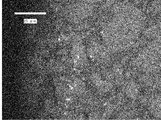
- Comparative Example 2 MCMB2528 (graphitization temperature: 2800 ° C.) manufactured by Osaka Gas is purchased, and after measuring various physical properties in the same manner as in Example 1, an electrode is prepared and cycle characteristics and the like are measured. The results are shown in Table 4. Moreover, a polarizing microscope image photograph is shown in FIG.
- Comparative Example 3 Residues obtained by vacuum distillation of Arabian crude oil are used as raw materials.
- the raw material has a specific gravity of 3.4 ° API, an asphaltene content of 7% by mass, a resin content of 7% by mass, and a sulfur content of 6.3% by mass.
- This raw material is put into a delayed coking process.
- the furnace heater outlet temperature before the coke drum is operated at 570 ° C.
- the coke becomes a lump. This is cut out with a water jet, cooled and discharged from the caulking drum. This is heated at 120 ° C. and dried to a moisture content of 0.5% by mass or less.
- the heating loss in the argon atmosphere between 300 ° C. and 1200 ° C.
- Comparative Example 4 600 g of Chinese natural graphite having an average particle diameter of 7 ⁇ m is charged into a hybridizer NHS1 manufactured by Nara Machinery Co., Ltd. and treated at a rotor peripheral speed of 60 / m / sec for 3 minutes to obtain spherical particles having an average particle diameter of 15 ⁇ m. This operation is performed several times, and 3 kg of the obtained carbon material and 1 kg of petroleum-based tar are put into an M20-type readyge mixer (internal volume 20 liters) manufactured by Matsubo Co., Ltd. and kneaded. Subsequently, the temperature is raised to 700 ° C. in a nitrogen atmosphere and the detarring process is performed, and then the temperature is raised to 1300 ° C.
- the obtained heat-treated product is crushed with a pin mill, and subjected to a classification treatment for the purpose of removing coarse particles to prepare a multi-layer structure carbon material for an electrode.
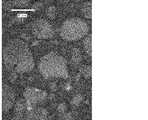
- electrodes are prepared and cycle characteristics and the like are measured. The results are shown in Table 4. Moreover, a polarizing microscope image photograph is shown in FIG.
- a graphite material having a variety of optical anisotropy and optical isotropic structures in size, abundance ratio, and crystal orientation it can be used as an additive for lithium ion secondary batteries.
- a negative electrode material for a lithium ion secondary battery having a large discharge capacity and a small irreversible capacity can be obtained while maintaining current load characteristics and cycle characteristics at a high level.
- the method for producing a graphite material of the present invention is excellent in economy and mass productivity, and exhibits excellent performance for a large-sized lithium ion secondary battery expected in the future.
- the battery or secondary battery of the present invention is a field in which conventional lead secondary batteries, nickel cadmium secondary batteries, nickel hydride secondary batteries are mainly used, for example, electric tools such as electric drills, hybrid electric vehicles, etc. It can be applied to (HEV), electric vehicle (EV) and the like.
Landscapes
- Chemical & Material Sciences (AREA)
- Organic Chemistry (AREA)
- Chemical Kinetics & Catalysis (AREA)
- Electrochemistry (AREA)
- General Chemical & Material Sciences (AREA)
- Inorganic Chemistry (AREA)
- Engineering & Computer Science (AREA)
- Geology (AREA)
- General Life Sciences & Earth Sciences (AREA)
- Life Sciences & Earth Sciences (AREA)
- Materials Engineering (AREA)
- Manufacturing & Machinery (AREA)
- Composite Materials (AREA)
- Battery Electrode And Active Subsutance (AREA)
- Carbon And Carbon Compounds (AREA)
Priority Applications (5)
| Application Number | Priority Date | Filing Date | Title |
|---|---|---|---|
| US13/266,068 US8372373B2 (en) | 2009-10-22 | 2010-10-22 | Graphite material, carbonaceous material for battery electrodes, and batteries |
| KR1020117007139A KR101071176B1 (ko) | 2009-10-22 | 2010-10-22 | 흑연재료, 전지전극용 탄소재료 및 전지 |
| EP10825048.1A EP2418172B1 (en) | 2009-10-22 | 2010-10-22 | Graphite material, carbonaceous material for battery electrodes, and batteries |
| JP2011505294A JP4738553B2 (ja) | 2009-10-22 | 2010-10-22 | 黒鉛材料、電池電極用炭素材料、及び電池 |
| CN2010800029796A CN102196994B (zh) | 2009-10-22 | 2010-10-22 | 石墨材料、电池电极用碳材料和电池 |
Applications Claiming Priority (2)
| Application Number | Priority Date | Filing Date | Title |
|---|---|---|---|
| JP2009-243381 | 2009-10-22 | ||
| JP2009243381 | 2009-10-22 |
Publications (1)
| Publication Number | Publication Date |
|---|---|
| WO2011049199A1 true WO2011049199A1 (ja) | 2011-04-28 |
Family
ID=43900422
Family Applications (1)
| Application Number | Title | Priority Date | Filing Date |
|---|---|---|---|
| PCT/JP2010/068690 Ceased WO2011049199A1 (ja) | 2009-10-22 | 2010-10-22 | 黒鉛材料、電池電極用炭素材料、及び電池 |
Country Status (6)
| Country | Link |
|---|---|
| US (1) | US8372373B2 (https=) |
| EP (1) | EP2418172B1 (https=) |
| JP (2) | JP4738553B2 (https=) |
| KR (1) | KR101071176B1 (https=) |
| CN (1) | CN102196994B (https=) |
| WO (1) | WO2011049199A1 (https=) |
Cited By (20)
| Publication number | Priority date | Publication date | Assignee | Title |
|---|---|---|---|---|
| JP2013004307A (ja) * | 2011-06-16 | 2013-01-07 | Toyota Motor Corp | 二次電池 |
| JP2013008654A (ja) * | 2011-05-26 | 2013-01-10 | Shin Etsu Chem Co Ltd | 非水電解質二次電池用負極活物質の製造方法、非水電解質二次電池用負極活物質、リチウムイオン二次電池及び電気化学キャパシタ |
| JP2013179074A (ja) * | 2011-12-09 | 2013-09-09 | Showa Denko Kk | 複合黒鉛粒子およびその用途 |
| WO2013171985A1 (ja) * | 2012-05-14 | 2013-11-21 | Jfeケミカル株式会社 | 複合黒鉛質材料及びその製造方法、リチウムイオン二次電池用負極材料、リチウムイオン二次電池用負極並びにリチウムイオン二次電池 |
| US8790824B2 (en) | 2010-08-05 | 2014-07-29 | Showa Denko K.K. | Graphite anode active material for use in lithium secondary battery |
| US9196899B2 (en) | 2010-08-05 | 2015-11-24 | Showa Denko K.K. | Anode active material for use in lithium secondary battery |
| KR20160023845A (ko) | 2013-07-29 | 2016-03-03 | 쇼와 덴코 가부시키가이샤 | 탄소 재료, 전지 전극용 재료, 및 전지 |
| US9368796B2 (en) | 2011-10-21 | 2016-06-14 | Show A Denko K.K. | Graphite material, carbon material for battery electrode, and battery |
| US9406936B2 (en) | 2012-10-12 | 2016-08-02 | Showa Denko K.K. | Carbon material, carbon material for battery electrode, and battery |
| KR20160145678A (ko) | 2014-05-30 | 2016-12-20 | 쇼와 덴코 가부시키가이샤 | 탄소재료, 그 제조 방법 및 그 용도 |
| JPWO2015019994A1 (ja) * | 2013-08-05 | 2017-03-02 | 昭和電工株式会社 | リチウムイオン電池用負極材及びその用途 |
| JP2017062991A (ja) * | 2015-09-25 | 2017-03-30 | 日立化成株式会社 | リチウムイオン二次電池用負極材、リチウムイオン二次電池用負極材スラリー、リチウムイオン二次電池用負極、及びリチウムイオン二次電池 |
| KR20170100606A (ko) | 2015-02-09 | 2017-09-04 | 쇼와 덴코 가부시키가이샤 | 탄소 재료, 그 제조방법 및 그 용도 |
| JP2018088425A (ja) * | 2018-02-22 | 2018-06-07 | 株式会社東芝 | 非水電解質二次電池、電池パック及び車 |
| US9997769B2 (en) | 2013-02-04 | 2018-06-12 | Showa Denko K.K. | Graphite power for negative electrode active material of lithium-ion secondary battery |
| JP2018166106A (ja) * | 2011-10-21 | 2018-10-25 | 昭和電工株式会社 | リチウムイオン電池用電極材料用黒鉛材料の製造方法 |
| JP2018166107A (ja) * | 2011-10-21 | 2018-10-25 | 昭和電工株式会社 | リチウムイオン電池用電極材料用黒鉛材料の製造方法 |
| WO2019151201A1 (ja) * | 2018-01-30 | 2019-08-08 | 昭和電工株式会社 | 黒鉛材料、その製造方法及びその用途 |
| US10535866B2 (en) | 2012-06-29 | 2020-01-14 | Showa Denko K.K. | Carbon material, carbonaceous material for battery electrode, and battery |
| WO2020137909A1 (ja) * | 2018-12-26 | 2020-07-02 | 昭和電工株式会社 | リチウムイオン二次電池負極用黒鉛材料 |
Families Citing this family (23)
| Publication number | Priority date | Publication date | Assignee | Title |
|---|---|---|---|---|
| CN101796669B (zh) | 2008-01-29 | 2013-05-08 | 日立麦克赛尔株式会社 | 绝缘层形成用浆料、电化学元件用隔板及其制造方法、以及电化学元件 |
| PL2595220T3 (pl) * | 2010-07-16 | 2019-09-30 | Lg Chem, Ltd. | Elektroda ujemna dla baterii akumulatorowej |
| US9099745B2 (en) | 2011-04-21 | 2015-08-04 | Showa Denko K.K. | Graphite carbon composite material, carbon material for battery electrodes, and batteries |
| WO2012144617A1 (ja) * | 2011-04-21 | 2012-10-26 | 昭和電工株式会社 | 黒鉛材料、電池電極用炭素材料、及び電池 |
| JP6273201B2 (ja) * | 2011-07-29 | 2018-01-31 | サウジ アラビアン オイル カンパニー | 選択的シリーズフロー水素化系およびその方法 |
| US9145521B2 (en) * | 2011-07-29 | 2015-09-29 | Saudi Arabian Oil Company | Selective two-stage hydroprocessing system and method |
| JP6054964B2 (ja) * | 2011-07-29 | 2016-12-27 | サウジ アラビアン オイル カンパニー | 選択的2段階水素化処理システムおよび方法 |
| JP5670854B2 (ja) * | 2011-09-29 | 2015-02-18 | 株式会社東芝 | 二次電池の製造方法 |
| JP6229320B2 (ja) * | 2012-06-13 | 2017-11-15 | 三菱ケミカル株式会社 | 試料の組織構造分類方法 |
| JP5269231B1 (ja) | 2012-06-29 | 2013-08-21 | エム・ティー・カーボン株式会社 | リチウムイオン二次電池負極用の黒鉛材料、それを用いたリチウムイオン二次電池及びリチウムイオン二次電池用の黒鉛材料の製造方法 |
| US20150255793A1 (en) * | 2012-09-27 | 2015-09-10 | Showa Denko K.K. | Carbon material for negative electrode for lithium ion secondary battery, manufacturing process therefor and use thereof |
| JP5567232B1 (ja) * | 2012-10-12 | 2014-08-06 | 昭和電工株式会社 | 複合炭素粒子およびそれを用いたリチウムイオン二次電池 |
| CN104919629B (zh) | 2013-01-11 | 2018-02-02 | 日本电气株式会社 | 锂离子二次电池 |
| KR101790400B1 (ko) | 2013-12-20 | 2017-10-25 | 주식회사 엘지화학 | 음극 활물질 및 이를 포함하는 리튬 이차전지 |
| EP3125339B1 (en) * | 2014-03-27 | 2019-03-13 | Nissan Motor Co., Ltd | Non-aqueous electrolyte secondary battery |
| JP6625336B2 (ja) * | 2015-03-26 | 2019-12-25 | 三菱ケミカル株式会社 | 非水系二次電池負極用炭素材及び非水系二次電池 |
| US10388984B2 (en) | 2015-05-11 | 2019-08-20 | Showa Denko K.K | Method for producing graphite powder for negative electrode materials for lithium ion secondary batteries |
| KR102036665B1 (ko) * | 2015-05-13 | 2019-10-28 | 주식회사 엘지화학 | 음극, 이의 제조방법 및 이를 포함하는 리튬 이차전지 |
| WO2017221895A1 (ja) | 2016-06-23 | 2017-12-28 | 昭和電工株式会社 | 黒鉛材およびそれを用いた二次電池用電極 |
| US10651464B2 (en) * | 2017-02-13 | 2020-05-12 | Global Graphene Group, Inc. | Alkali metal-sulfur secondary battery containing a nano sulfur-loaded cathode and manufacturing method |
| US11196036B2 (en) | 2017-04-10 | 2021-12-07 | Nano And Advanced Materials Institute Limited | High energy density fast charge Li ion battery and the method of preparing the same |
| CN109777041B (zh) * | 2019-01-22 | 2021-07-02 | 丽水市长新电器制造有限公司 | 一种球形树脂基电刷复合材料及其制备方法 |
| US12351462B1 (en) | 2024-10-25 | 2025-07-08 | Urbix, Inc. | Graphite shaping and coating devices, systems, and methods |
Citations (16)
| Publication number | Priority date | Publication date | Assignee | Title |
|---|---|---|---|---|
| JPS6054998A (ja) | 1983-09-06 | 1985-03-29 | Nikkiso Co Ltd | 気相成長炭素繊維の製造方法 |
| JPH04190555A (ja) | 1990-11-22 | 1992-07-08 | Osaka Gas Co Ltd | リチウム二次電池 |
| JPH07320740A (ja) | 1993-02-25 | 1995-12-08 | Kureha Chem Ind Co Ltd | 二次電池電極用炭素質材料 |
| JPH1095982A (ja) * | 1996-09-26 | 1998-04-14 | Osaka Gas Co Ltd | 炭素質小球体の製造方法 |
| JP2778434B2 (ja) | 1993-11-30 | 1998-07-23 | 昭和電工株式会社 | 気相法炭素繊維の製造方法 |
| JP2000149946A (ja) | 1998-11-12 | 2000-05-30 | Mitsubishi Gas Chem Co Inc | 非水溶媒二次電池負極用炭素材料およびその製造法 |
| JP2002124255A (ja) | 2000-10-12 | 2002-04-26 | Mitsubishi Gas Chem Co Inc | 非水溶媒二次電池 |
| JP3361510B2 (ja) | 1996-10-30 | 2003-01-07 | 日立化成工業株式会社 | リチウム二次電池用負極及びその製造法並びにリチウム二次電池 |
| JP2003100293A (ja) | 2001-09-25 | 2003-04-04 | Showa Denko Kk | 炭素材料及びその製造方法並びにその用途 |
| US6632569B1 (en) | 1998-11-27 | 2003-10-14 | Mitsubishi Chemical Corporation | Carbonaceous material for electrode and non-aqueous solvent secondary battery using this material |
| JP2004507426A (ja) * | 2000-09-01 | 2004-03-11 | ウエストバージニア ユニバーシティ | カーボンフォームの製造方法 |
| JP3534391B2 (ja) | 1998-11-27 | 2004-06-07 | 三菱化学株式会社 | 電極用炭素材料及びそれを使用した非水系二次電池 |
| WO2004109825A2 (en) | 2003-06-05 | 2004-12-16 | Showa Denko K.K. | Carbon material for battery electrode and production method and use thereof |
| JP2005019397A (ja) | 2003-06-05 | 2005-01-20 | Showa Denko Kk | 電池電極用炭素材料、その製造方法及び用途 |
| JP2006312578A (ja) * | 2004-08-27 | 2006-11-16 | Jfe Chemical Corp | 黒鉛質材料とその製造方法、リチウムイオン二次電池用負極材料、リチウムイオン二次電池用負極およびリチウムイオン二次電池 |
| JP2007172901A (ja) * | 2005-12-20 | 2007-07-05 | Showa Denko Kk | 黒鉛材料、電池電極用炭素材料、及び電池 |
Family Cites Families (13)
| Publication number | Priority date | Publication date | Assignee | Title |
|---|---|---|---|---|
| JPH0663966B2 (ja) * | 1989-02-15 | 1994-08-22 | 新日本製鐵株式会社 | 光学的異方性物質の組織の測定方法 |
| JPH0831419A (ja) * | 1994-07-14 | 1996-02-02 | Osaka Gas Co Ltd | リチウム二次電池用負極材料およびリチウム二次電池 |
| US6506354B1 (en) | 1995-05-31 | 2003-01-14 | West Virginia University | Method of making a carbon foam material and resultant product |
| US5888469A (en) | 1995-05-31 | 1999-03-30 | West Virginia University | Method of making a carbon foam material and resultant product |
| JPH10149830A (ja) * | 1996-11-18 | 1998-06-02 | Mitsubishi Gas Chem Co Inc | 非水溶媒二次電池負極用炭素材料 |
| KR100350535B1 (ko) * | 1999-12-10 | 2002-08-28 | 삼성에스디아이 주식회사 | 리튬 이차 전지용 음극 활물질 및 그의 제조 방법 |
| JP2002083595A (ja) * | 2000-09-06 | 2002-03-22 | Mitsubishi Gas Chem Co Inc | コークス、人造黒鉛および非水溶媒二次電池負極用炭素材料の製造法とピッチ組成物 |
| JP2002175810A (ja) * | 2000-09-26 | 2002-06-21 | Mitsubishi Chemicals Corp | リチウム二次電池及び負極 |
| TW583153B (en) * | 2001-09-25 | 2004-04-11 | Showa Denko Kk | Carbon material, production method and use thereof |
| JP4313029B2 (ja) * | 2002-11-22 | 2009-08-12 | パナソニック株式会社 | 負極およびそれを含む非水電解質二次電池 |
| WO2007066673A1 (ja) | 2005-12-05 | 2007-06-14 | Showa Denko K.K. | 黒鉛材料、電池電極用炭素材料、及び電池 |
| JP5162093B2 (ja) * | 2005-12-21 | 2013-03-13 | 昭和電工株式会社 | 黒鉛材料、電池電極用炭素材料、及び電池 |
| JP2010228962A (ja) * | 2009-03-27 | 2010-10-14 | Institute Of National Colleges Of Technology Japan | 炭素粒子およびその製造方法 |
-
2010
- 2010-10-22 CN CN2010800029796A patent/CN102196994B/zh not_active Expired - Fee Related
- 2010-10-22 JP JP2011505294A patent/JP4738553B2/ja not_active Expired - Fee Related
- 2010-10-22 KR KR1020117007139A patent/KR101071176B1/ko not_active Expired - Fee Related
- 2010-10-22 WO PCT/JP2010/068690 patent/WO2011049199A1/ja not_active Ceased
- 2010-10-22 US US13/266,068 patent/US8372373B2/en not_active Expired - Fee Related
- 2010-10-22 EP EP10825048.1A patent/EP2418172B1/en not_active Not-in-force
-
2011
- 2011-04-26 JP JP2011097829A patent/JP5641613B2/ja not_active Expired - Fee Related
Patent Citations (17)
| Publication number | Priority date | Publication date | Assignee | Title |
|---|---|---|---|---|
| JPS6054998A (ja) | 1983-09-06 | 1985-03-29 | Nikkiso Co Ltd | 気相成長炭素繊維の製造方法 |
| JPH04190555A (ja) | 1990-11-22 | 1992-07-08 | Osaka Gas Co Ltd | リチウム二次電池 |
| JPH07320740A (ja) | 1993-02-25 | 1995-12-08 | Kureha Chem Ind Co Ltd | 二次電池電極用炭素質材料 |
| US5587255A (en) | 1993-02-25 | 1996-12-24 | Kureha Kagaku Kogyo Kabushiki Kaisha | Carbonaceous electrode material for secondary battery |
| JP2778434B2 (ja) | 1993-11-30 | 1998-07-23 | 昭和電工株式会社 | 気相法炭素繊維の製造方法 |
| JPH1095982A (ja) * | 1996-09-26 | 1998-04-14 | Osaka Gas Co Ltd | 炭素質小球体の製造方法 |
| JP3361510B2 (ja) | 1996-10-30 | 2003-01-07 | 日立化成工業株式会社 | リチウム二次電池用負極及びその製造法並びにリチウム二次電池 |
| JP2000149946A (ja) | 1998-11-12 | 2000-05-30 | Mitsubishi Gas Chem Co Inc | 非水溶媒二次電池負極用炭素材料およびその製造法 |
| US6632569B1 (en) | 1998-11-27 | 2003-10-14 | Mitsubishi Chemical Corporation | Carbonaceous material for electrode and non-aqueous solvent secondary battery using this material |
| JP3534391B2 (ja) | 1998-11-27 | 2004-06-07 | 三菱化学株式会社 | 電極用炭素材料及びそれを使用した非水系二次電池 |
| JP2004507426A (ja) * | 2000-09-01 | 2004-03-11 | ウエストバージニア ユニバーシティ | カーボンフォームの製造方法 |
| JP2002124255A (ja) | 2000-10-12 | 2002-04-26 | Mitsubishi Gas Chem Co Inc | 非水溶媒二次電池 |
| JP2003100293A (ja) | 2001-09-25 | 2003-04-04 | Showa Denko Kk | 炭素材料及びその製造方法並びにその用途 |
| WO2004109825A2 (en) | 2003-06-05 | 2004-12-16 | Showa Denko K.K. | Carbon material for battery electrode and production method and use thereof |
| JP2005019397A (ja) | 2003-06-05 | 2005-01-20 | Showa Denko Kk | 電池電極用炭素材料、その製造方法及び用途 |
| JP2006312578A (ja) * | 2004-08-27 | 2006-11-16 | Jfe Chemical Corp | 黒鉛質材料とその製造方法、リチウムイオン二次電池用負極材料、リチウムイオン二次電池用負極およびリチウムイオン二次電池 |
| JP2007172901A (ja) * | 2005-12-20 | 2007-07-05 | Showa Denko Kk | 黒鉛材料、電池電極用炭素材料、及び電池 |
Non-Patent Citations (5)
| Title |
|---|
| "Modern Carbon Material Experimental Technology (Analysis part", 2001, SIPEC CORPORATION, pages: 1 - 8 |
| I. NODA, M. INAGAKI: "Japan Society for the Promotion of Science", 117TH COMMITTEE SAMPLE, 1963, pages 117 - 71,A-1 |
| M. INAGAKI, CARBON, 1963, pages 25 - 34 |
| M. INAGAKIETAL.: "Japan Society for the Promotion of Science", 117TH COMMITTEE SAMPLE, 1972, pages 117 - 121,C-5 |
| See also references of EP2418172A4 |
Cited By (26)
| Publication number | Priority date | Publication date | Assignee | Title |
|---|---|---|---|---|
| US8790824B2 (en) | 2010-08-05 | 2014-07-29 | Showa Denko K.K. | Graphite anode active material for use in lithium secondary battery |
| US9196899B2 (en) | 2010-08-05 | 2015-11-24 | Showa Denko K.K. | Anode active material for use in lithium secondary battery |
| JP2013008654A (ja) * | 2011-05-26 | 2013-01-10 | Shin Etsu Chem Co Ltd | 非水電解質二次電池用負極活物質の製造方法、非水電解質二次電池用負極活物質、リチウムイオン二次電池及び電気化学キャパシタ |
| JP2013004307A (ja) * | 2011-06-16 | 2013-01-07 | Toyota Motor Corp | 二次電池 |
| JP2018166106A (ja) * | 2011-10-21 | 2018-10-25 | 昭和電工株式会社 | リチウムイオン電池用電極材料用黒鉛材料の製造方法 |
| US9368796B2 (en) | 2011-10-21 | 2016-06-14 | Show A Denko K.K. | Graphite material, carbon material for battery electrode, and battery |
| JP2018166107A (ja) * | 2011-10-21 | 2018-10-25 | 昭和電工株式会社 | リチウムイオン電池用電極材料用黒鉛材料の製造方法 |
| JP2013179074A (ja) * | 2011-12-09 | 2013-09-09 | Showa Denko Kk | 複合黒鉛粒子およびその用途 |
| WO2013171985A1 (ja) * | 2012-05-14 | 2013-11-21 | Jfeケミカル株式会社 | 複合黒鉛質材料及びその製造方法、リチウムイオン二次電池用負極材料、リチウムイオン二次電池用負極並びにリチウムイオン二次電池 |
| US10535866B2 (en) | 2012-06-29 | 2020-01-14 | Showa Denko K.K. | Carbon material, carbonaceous material for battery electrode, and battery |
| US9406936B2 (en) | 2012-10-12 | 2016-08-02 | Showa Denko K.K. | Carbon material, carbon material for battery electrode, and battery |
| US10522821B2 (en) | 2013-02-04 | 2019-12-31 | Showa Denko K.K. | Graphite power for negative electrode active material of lithium-ion secondary battery |
| US9997769B2 (en) | 2013-02-04 | 2018-06-12 | Showa Denko K.K. | Graphite power for negative electrode active material of lithium-ion secondary battery |
| US10144646B2 (en) | 2013-07-29 | 2018-12-04 | Showa Denko K.K. | Carbon material, material for a battery electrode, and battery |
| KR20180088497A (ko) | 2013-07-29 | 2018-08-03 | 쇼와 덴코 가부시키가이샤 | 탄소 재료, 전지 전극용 재료, 및 전지 |
| US10377634B2 (en) | 2013-07-29 | 2019-08-13 | Showa Denko K.K. | Carbon material, material for a battery electrode, and battery |
| KR20160023845A (ko) | 2013-07-29 | 2016-03-03 | 쇼와 덴코 가부시키가이샤 | 탄소 재료, 전지 전극용 재료, 및 전지 |
| JPWO2015019994A1 (ja) * | 2013-08-05 | 2017-03-02 | 昭和電工株式会社 | リチウムイオン電池用負極材及びその用途 |
| KR20190014110A (ko) | 2014-05-30 | 2019-02-11 | 쇼와 덴코 가부시키가이샤 | 탄소재료, 그 제조 방법 및 그 용도 |
| KR20160145678A (ko) | 2014-05-30 | 2016-12-20 | 쇼와 덴코 가부시키가이샤 | 탄소재료, 그 제조 방법 및 그 용도 |
| KR20170100606A (ko) | 2015-02-09 | 2017-09-04 | 쇼와 덴코 가부시키가이샤 | 탄소 재료, 그 제조방법 및 그 용도 |
| US10377633B2 (en) | 2015-02-09 | 2019-08-13 | Showa Denko K.K. | Carbon material, method for producing same, and use for same |
| JP2017062991A (ja) * | 2015-09-25 | 2017-03-30 | 日立化成株式会社 | リチウムイオン二次電池用負極材、リチウムイオン二次電池用負極材スラリー、リチウムイオン二次電池用負極、及びリチウムイオン二次電池 |
| WO2019151201A1 (ja) * | 2018-01-30 | 2019-08-08 | 昭和電工株式会社 | 黒鉛材料、その製造方法及びその用途 |
| JP2018088425A (ja) * | 2018-02-22 | 2018-06-07 | 株式会社東芝 | 非水電解質二次電池、電池パック及び車 |
| WO2020137909A1 (ja) * | 2018-12-26 | 2020-07-02 | 昭和電工株式会社 | リチウムイオン二次電池負極用黒鉛材料 |
Also Published As
| Publication number | Publication date |
|---|---|
| CN102196994B (zh) | 2013-09-11 |
| EP2418172A4 (en) | 2015-07-29 |
| US8372373B2 (en) | 2013-02-12 |
| KR101071176B1 (ko) | 2011-10-10 |
| EP2418172A1 (en) | 2012-02-15 |
| JP2011184293A (ja) | 2011-09-22 |
| KR20110053464A (ko) | 2011-05-23 |
| JP5641613B2 (ja) | 2014-12-17 |
| JP4738553B2 (ja) | 2011-08-03 |
| JPWO2011049199A1 (ja) | 2013-03-14 |
| EP2418172B1 (en) | 2018-09-05 |
| US20120045642A1 (en) | 2012-02-23 |
| CN102196994A (zh) | 2011-09-21 |
Similar Documents
| Publication | Publication Date | Title |
|---|---|---|
| JP4738553B2 (ja) | 黒鉛材料、電池電極用炭素材料、及び電池 | |
| JP5140781B2 (ja) | 黒鉛・炭素混合材料、電池電極用炭素材料、及び電池 | |
| JP5081335B1 (ja) | 黒鉛材料、電池電極用炭素材料、及び電池 | |
| US10377634B2 (en) | Carbon material, material for a battery electrode, and battery | |
| US10377633B2 (en) | Carbon material, method for producing same, and use for same | |
| US9406936B2 (en) | Carbon material, carbon material for battery electrode, and battery | |
| US20190237763A1 (en) | Graphite material and secondary battery electrode using same | |
| WO2019151201A1 (ja) | 黒鉛材料、その製造方法及びその用途 | |
| US20170155149A1 (en) | Carbon material, method for manufacturing same, and application of same |
Legal Events
| Date | Code | Title | Description |
|---|---|---|---|
| WWE | Wipo information: entry into national phase |
Ref document number: 201080002979.6 Country of ref document: CN |
|
| WWE | Wipo information: entry into national phase |
Ref document number: 2011505294 Country of ref document: JP |
|
| ENP | Entry into the national phase |
Ref document number: 20117007139 Country of ref document: KR Kind code of ref document: A |
|
| 121 | Ep: the epo has been informed by wipo that ep was designated in this application |
Ref document number: 10825048 Country of ref document: EP Kind code of ref document: A1 |
|
| WWE | Wipo information: entry into national phase |
Ref document number: 2010825048 Country of ref document: EP |
|
| WWE | Wipo information: entry into national phase |
Ref document number: 13266068 Country of ref document: US |