WO2011027707A1 - 光学部材用放射線硬化型粘着剤組成物および粘着型光学部材 - Google Patents
光学部材用放射線硬化型粘着剤組成物および粘着型光学部材 Download PDFInfo
- Publication number
- WO2011027707A1 WO2011027707A1 PCT/JP2010/064462 JP2010064462W WO2011027707A1 WO 2011027707 A1 WO2011027707 A1 WO 2011027707A1 JP 2010064462 W JP2010064462 W JP 2010064462W WO 2011027707 A1 WO2011027707 A1 WO 2011027707A1
- Authority
- WO
- WIPO (PCT)
- Prior art keywords
- group
- sensitive adhesive
- pressure
- adhesive composition
- component
- Prior art date
- Legal status (The legal status is an assumption and is not a legal conclusion. Google has not performed a legal analysis and makes no representation as to the accuracy of the status listed.)
- Ceased
Links
- 0 CCC(*)(CC)N Chemical compound CCC(*)(CC)N 0.000 description 5
- FJZKADZLSJRAQF-UHFFFAOYSA-N CC(C)(C1)N(C)C(C)(C)CC1OC(C)=O Chemical compound CC(C)(C1)N(C)C(C)(C)CC1OC(C)=O FJZKADZLSJRAQF-UHFFFAOYSA-N 0.000 description 1
Classifications
-
- C—CHEMISTRY; METALLURGY
- C09—DYES; PAINTS; POLISHES; NATURAL RESINS; ADHESIVES; COMPOSITIONS NOT OTHERWISE PROVIDED FOR; APPLICATIONS OF MATERIALS NOT OTHERWISE PROVIDED FOR
- C09J—ADHESIVES; NON-MECHANICAL ASPECTS OF ADHESIVE PROCESSES IN GENERAL; ADHESIVE PROCESSES NOT PROVIDED FOR ELSEWHERE; USE OF MATERIALS AS ADHESIVES
- C09J175/00—Adhesives based on polyureas or polyurethanes; Adhesives based on derivatives of such polymers
- C09J175/04—Polyurethanes
-
- C—CHEMISTRY; METALLURGY
- C09—DYES; PAINTS; POLISHES; NATURAL RESINS; ADHESIVES; COMPOSITIONS NOT OTHERWISE PROVIDED FOR; APPLICATIONS OF MATERIALS NOT OTHERWISE PROVIDED FOR
- C09J—ADHESIVES; NON-MECHANICAL ASPECTS OF ADHESIVE PROCESSES IN GENERAL; ADHESIVE PROCESSES NOT PROVIDED FOR ELSEWHERE; USE OF MATERIALS AS ADHESIVES
- C09J4/00—Adhesives based on organic non-macromolecular compounds having at least one polymerisable carbon-to-carbon unsaturated bond ; adhesives, based on monomers of macromolecular compounds of groups C09J183/00 - C09J183/16
- C09J4/06—Organic non-macromolecular compounds having at least one polymerisable carbon-to-carbon unsaturated bond in combination with a macromolecular compound other than an unsaturated polymer of groups C09J159/00 - C09J187/00
-
- C—CHEMISTRY; METALLURGY
- C08—ORGANIC MACROMOLECULAR COMPOUNDS; THEIR PREPARATION OR CHEMICAL WORKING-UP; COMPOSITIONS BASED THEREON
- C08G—MACROMOLECULAR COMPOUNDS OBTAINED OTHERWISE THAN BY REACTIONS ONLY INVOLVING UNSATURATED CARBON-TO-CARBON BONDS
- C08G18/00—Polymeric products of isocyanates or isothiocyanates
- C08G18/06—Polymeric products of isocyanates or isothiocyanates with compounds having active hydrogen
- C08G18/28—Polymeric products of isocyanates or isothiocyanates with compounds having active hydrogen characterised by the compounds used containing active hydrogen
- C08G18/40—High-molecular-weight compounds
- C08G18/62—Polymers of compounds having carbon-to-carbon double bonds
- C08G18/6216—Polymers of alpha-beta ethylenically unsaturated carboxylic acids or of derivatives thereof
- C08G18/625—Polymers of alpha-beta ethylenically unsaturated carboxylic acids; hydrolyzed polymers of esters of these acids
- C08G18/6254—Polymers of alpha-beta ethylenically unsaturated carboxylic acids and of esters of these acids containing hydroxy groups
-
- C—CHEMISTRY; METALLURGY
- C09—DYES; PAINTS; POLISHES; NATURAL RESINS; ADHESIVES; COMPOSITIONS NOT OTHERWISE PROVIDED FOR; APPLICATIONS OF MATERIALS NOT OTHERWISE PROVIDED FOR
- C09J—ADHESIVES; NON-MECHANICAL ASPECTS OF ADHESIVE PROCESSES IN GENERAL; ADHESIVE PROCESSES NOT PROVIDED FOR ELSEWHERE; USE OF MATERIALS AS ADHESIVES
- C09J133/00—Adhesives based on homopolymers or copolymers of compounds having one or more unsaturated aliphatic radicals, each having only one carbon-to-carbon double bond, and at least one being terminated by only one carboxyl radical, or of salts, anhydrides, esters, amides, imides, or nitriles thereof; Adhesives based on derivatives of such polymers
- C09J133/04—Homopolymers or copolymers of esters
-
- C—CHEMISTRY; METALLURGY
- C09—DYES; PAINTS; POLISHES; NATURAL RESINS; ADHESIVES; COMPOSITIONS NOT OTHERWISE PROVIDED FOR; APPLICATIONS OF MATERIALS NOT OTHERWISE PROVIDED FOR
- C09J—ADHESIVES; NON-MECHANICAL ASPECTS OF ADHESIVE PROCESSES IN GENERAL; ADHESIVE PROCESSES NOT PROVIDED FOR ELSEWHERE; USE OF MATERIALS AS ADHESIVES
- C09J133/00—Adhesives based on homopolymers or copolymers of compounds having one or more unsaturated aliphatic radicals, each having only one carbon-to-carbon double bond, and at least one being terminated by only one carboxyl radical, or of salts, anhydrides, esters, amides, imides, or nitriles thereof; Adhesives based on derivatives of such polymers
- C09J133/04—Homopolymers or copolymers of esters
- C09J133/06—Homopolymers or copolymers of esters of esters containing only carbon, hydrogen and oxygen, the oxygen atom being present only as part of the carboxyl radical
- C09J133/062—Copolymers with monomers not covered by C09J133/06
- C09J133/064—Copolymers with monomers not covered by C09J133/06 containing anhydride, COOH or COOM groups, with M being metal or onium-cation
-
- C—CHEMISTRY; METALLURGY
- C09—DYES; PAINTS; POLISHES; NATURAL RESINS; ADHESIVES; COMPOSITIONS NOT OTHERWISE PROVIDED FOR; APPLICATIONS OF MATERIALS NOT OTHERWISE PROVIDED FOR
- C09J—ADHESIVES; NON-MECHANICAL ASPECTS OF ADHESIVE PROCESSES IN GENERAL; ADHESIVE PROCESSES NOT PROVIDED FOR ELSEWHERE; USE OF MATERIALS AS ADHESIVES
- C09J7/00—Adhesives in the form of films or foils
- C09J7/30—Adhesives in the form of films or foils characterised by the adhesive composition
- C09J7/38—Pressure-sensitive adhesives [PSA]
- C09J7/381—Pressure-sensitive adhesives [PSA] based on macromolecular compounds obtained by reactions involving only carbon-to-carbon unsaturated bonds
- C09J7/385—Acrylic polymers
-
- G—PHYSICS
- G02—OPTICS
- G02B—OPTICAL ELEMENTS, SYSTEMS OR APPARATUS
- G02B5/00—Optical elements other than lenses
- G02B5/30—Polarising elements
- G02B5/3025—Polarisers, i.e. arrangements capable of producing a definite output polarisation state from an unpolarised input state
-
- G—PHYSICS
- G02—OPTICS
- G02B—OPTICAL ELEMENTS, SYSTEMS OR APPARATUS
- G02B5/00—Optical elements other than lenses
- G02B5/30—Polarising elements
- G02B5/3025—Polarisers, i.e. arrangements capable of producing a definite output polarisation state from an unpolarised input state
- G02B5/3033—Polarisers, i.e. arrangements capable of producing a definite output polarisation state from an unpolarised input state in the form of a thin sheet or foil, e.g. Polaroid
- G02B5/3041—Polarisers, i.e. arrangements capable of producing a definite output polarisation state from an unpolarised input state in the form of a thin sheet or foil, e.g. Polaroid comprising multiple thin layers, e.g. multilayer stacks
- G02B5/305—Polarisers, i.e. arrangements capable of producing a definite output polarisation state from an unpolarised input state in the form of a thin sheet or foil, e.g. Polaroid comprising multiple thin layers, e.g. multilayer stacks including organic materials, e.g. polymeric layers
-
- C—CHEMISTRY; METALLURGY
- C08—ORGANIC MACROMOLECULAR COMPOUNDS; THEIR PREPARATION OR CHEMICAL WORKING-UP; COMPOSITIONS BASED THEREON
- C08G—MACROMOLECULAR COMPOUNDS OBTAINED OTHERWISE THAN BY REACTIONS ONLY INVOLVING UNSATURATED CARBON-TO-CARBON BONDS
- C08G2170/00—Compositions for adhesives
- C08G2170/40—Compositions for pressure-sensitive adhesives
-
- C—CHEMISTRY; METALLURGY
- C09—DYES; PAINTS; POLISHES; NATURAL RESINS; ADHESIVES; COMPOSITIONS NOT OTHERWISE PROVIDED FOR; APPLICATIONS OF MATERIALS NOT OTHERWISE PROVIDED FOR
- C09J—ADHESIVES; NON-MECHANICAL ASPECTS OF ADHESIVE PROCESSES IN GENERAL; ADHESIVE PROCESSES NOT PROVIDED FOR ELSEWHERE; USE OF MATERIALS AS ADHESIVES
- C09J2203/00—Applications of adhesives in processes or use of adhesives in the form of films or foils
- C09J2203/318—Applications of adhesives in processes or use of adhesives in the form of films or foils for the production of liquid crystal displays
-
- C—CHEMISTRY; METALLURGY
- C09—DYES; PAINTS; POLISHES; NATURAL RESINS; ADHESIVES; COMPOSITIONS NOT OTHERWISE PROVIDED FOR; APPLICATIONS OF MATERIALS NOT OTHERWISE PROVIDED FOR
- C09J—ADHESIVES; NON-MECHANICAL ASPECTS OF ADHESIVE PROCESSES IN GENERAL; ADHESIVE PROCESSES NOT PROVIDED FOR ELSEWHERE; USE OF MATERIALS AS ADHESIVES
- C09J2301/00—Additional features of adhesives in the form of films or foils
- C09J2301/30—Additional features of adhesives in the form of films or foils characterized by the chemical, physicochemical or physical properties of the adhesive or the carrier
- C09J2301/302—Additional features of adhesives in the form of films or foils characterized by the chemical, physicochemical or physical properties of the adhesive or the carrier the adhesive being pressure-sensitive, i.e. tacky at temperatures inferior to 30°C
-
- C—CHEMISTRY; METALLURGY
- C09—DYES; PAINTS; POLISHES; NATURAL RESINS; ADHESIVES; COMPOSITIONS NOT OTHERWISE PROVIDED FOR; APPLICATIONS OF MATERIALS NOT OTHERWISE PROVIDED FOR
- C09J—ADHESIVES; NON-MECHANICAL ASPECTS OF ADHESIVE PROCESSES IN GENERAL; ADHESIVE PROCESSES NOT PROVIDED FOR ELSEWHERE; USE OF MATERIALS AS ADHESIVES
- C09J2301/00—Additional features of adhesives in the form of films or foils
- C09J2301/40—Additional features of adhesives in the form of films or foils characterized by the presence of essential components
- C09J2301/408—Additional features of adhesives in the form of films or foils characterized by the presence of essential components additives as essential feature of the adhesive layer
-
- G—PHYSICS
- G02—OPTICS
- G02B—OPTICAL ELEMENTS, SYSTEMS OR APPARATUS
- G02B5/00—Optical elements other than lenses
- G02B5/30—Polarising elements
Definitions
- the present invention relates to a radiation curable pressure-sensitive adhesive composition for optical members, and more particularly, to a radiation curable pressure-sensitive adhesive composition for optical members used for bonding optical members to each other or an optical member and an image display device. About.
- the present invention also relates to an adhesive optical member using the adhesive composition.
- image display devices flat panel display devices
- LCD liquid crystal display device
- organic EL display device organic EL display device
- PDP Plasma Display Panel
- various optical members are attached to these image display devices depending on applications and purposes.
- the optical member used here usually has a multilayer structure in which an optical film such as a polarizing film, a substrate, and the like are bonded and laminated via an acrylic adhesive (adhesive composition for optical members). ing.
- an adhesive composition for adhering optical members or optical members to an image display device is required to have excellent light leakage resistance and durability as well as appropriate adhesiveness as basic characteristics.
- a radiation-curable acrylic pressure-sensitive adhesive composition may be used as the pressure-sensitive adhesive composition for optical members.
- acrylic pressure-sensitive adhesive compositions are disclosed, for example, in Patent Documents 1 and 2.
- Patent Document 1 discloses a pressure-sensitive adhesive sheet having a pressure-sensitive adhesive layer containing a pressure-sensitive adhesive component and a curable component, and a base material.
- the pressure-sensitive adhesive component and the curable component include (meth) acrylic acid alkyl ester having a specific molecular weight and glass transition point, and a reactive monomer or oligomer having two or more acryloyl groups.
- Patent Document 2 discloses an adhesive sheet for laminating optical members having specific tensile strength and strain recovery rate.
- the pressure-sensitive adhesive composition forming the pressure-sensitive adhesive layer of the sheet include a base polymer, a bifunctional or trifunctional acrylate monomer as a crosslinking monomer, and a pressure sensitive adhesive containing a photoinitiator.
- pressure-sensitive adhesives for optical members are required to have characteristics (durability) that can prevent appearance changes such as peeling and squeezing even under harsh conditions such as high temperature and high humidity, and light leakage resistance that does not change the optical characteristics. ing.
- the optical member especially an optical member made of polyvinyl alcohol
- expansion / deformation dimensional deformation
- the original dimensions cannot be completely restored, so that the optical member is distorted (birefringence) and light leakage occurs.
- the stress generated by the dimensional deformation is not sufficiently absorbed and relaxed by the pressure-sensitive adhesive composition in which the optical members or the optical member and the adherend (liquid crystal cell or the like) are adhered, Detachment and excitement occur and quality reliability decreases.
- the extensional deformation (dimensional deformation) of the optical member is further increased, and such a decrease in quality reliability is remarkable.
- Patent Document 3 a polymer (A) having a (meth) acryloyloxy group and having a specific molecular weight and glass transition temperature and a polymer (B) having a specific molecular weight and glass transition temperature are contained under specific blending conditions.
- a pressure-sensitive adhesive composition is disclosed.
- an active energy ray is irradiated to an adhesive material containing an acrylic polymer in which a monomer containing a carboxyl group exceeds 0.5% by mass in a monomer composition ratio and an active energy ray-curable compound.
- An optical functional film laminating pressure-sensitive adhesive satisfying a specific maximum shear load and storage elastic modulus (G ′) is disclosed.
- Patent Document 5 a polymer mainly composed of (meth) acrylic acid ester and a crosslinking agent, the gel fraction, the weight average molecular weight and molecular weight distribution of the sol, and the molecular weight of 50,000 or less are within a specific range.
- An adhesive for optical members having a limited adhesive is disclosed.
- This radical reacts with the remaining curing component (unreacted radiation-curable acrylic compound) (crosslinking reaction), increases the crosslinking degree of the pressure-sensitive adhesive immediately after sticking, and decreases the adhesive force over time. End up (photoaging). Note that light that causes photoaging includes natural light, room light, and the like in addition to light derived from the backlight device of the display device.
- Patent Document 6 A pressure-sensitive adhesive composition for an optical member whose problem is suppression of photoaging is disclosed in Patent Document 6, for example.
- a double-sided adhesive tape containing an adhesive component such as an acrylic adhesive, an ultraviolet absorber, and a hindered amine light stabilizer is disclosed (Patent Document 6).
- PSA compositions for optical members that satisfy various required characteristics are disclosed in Patent Documents 1 to 6.
- Patent Documents 1 and 2 show good performance immediately after application, there is a risk of deterioration over time.
- the pressure-sensitive adhesive compositions of Patent Documents 3 to 5 have improved durability, this durability and light leakage resistance are required for display devices with a large screen, high image quality and high quality. It does not meet the high standards, and there is still room for improvement.
- the pressure-sensitive adhesive composition of Patent Document 6 has improved photoaging resistance, it cannot exhibit sufficient durability and light leakage resistance.
- the radiation curable pressure-sensitive adhesive since the added light stabilizer inhibits the curing reaction, it has been difficult to add the light stabilizer to a normal radiation curable pressure-sensitive adhesive composition.
- the pressure-sensitive adhesive compositions disclosed in Patent Documents 1 to 6 do not have sufficient durability, light leakage resistance, and light aging resistance as well as basic properties such as transparency.
- the present invention solves the above-mentioned problems of the prior art. That is, the present invention exhibits excellent durability under high temperature conditions and high temperature and high humidity conditions, suppresses light leakage, and reduces adhesive strength over time (photoaging) due to light exposure from a backlight device or the like. It aims at providing the radiation-curing-type adhesive composition for optical members which can suppress the malfunction resulting from it. Another object of the present invention is to provide an adhesive optical member using the radiation curable adhesive composition for optical members.
- the tensile strength increases and the flexibility decreases due to an increase in cohesive force.
- the present inventor has excessive cohesive strength and tensile strength in the pressure-sensitive adhesive composition containing two kinds of radiation-curable acrylic compounds having a specific structure as described later, despite a high degree of crosslinking. It has been found that the increase is suppressed, and appropriate cohesive strength and tensile strength are compatible with appropriate flexibility.
- this pressure-sensitive adhesive composition when cross-linked, it exhibits a strong tensile strength that restores the dimensional deformation after the stress is relaxed as well as moderate flexibility that can temporarily relieve the stress derived from the dimensional deformation of the optical member. And because of this characteristic, when the optical members or the optical member and the image display device are attached with the crosslinked adhesive composition, excellent durability and light leakage resistance are compatible.
- the present invention has been completed based on the above findings found by the present inventors.
- the radiation curable adhesive composition for optical members according to the present invention and the adhesive optical member using the same are as follows.
- the radiation curable pressure-sensitive adhesive composition for optical members of the present invention is (Meth) acrylic acid alkyl ester (a1) 80-99.8% by mass, carboxyl group-containing (meth) acrylic monomer (a2) 0.1-10% by mass and hydroxyl group-containing (meth) acrylic monomer (a3) 0 (Meth) acrylic copolymer (A) composed of 1 to 10% by mass (wherein the total amount of (a1) to (a3) is 100% by mass), 100 parts by weight; 0.01 to 20 parts by weight of a radiation curable acrylic compound (B) having two (meth) acryloyl groups in the molecule; 1 to 50 parts by weight of a radiation curable acrylic compound (C) having 3 to 10 (meth) acryloyl groups in the molecule; 0.1 to 10 parts by weight of a hydrogen abstraction type photopolymerizable initiator (D); 0.01 to 10 parts by weight of an isocyanate-based crosslinking agent (E) having two or more isocyanate groups in the molecule;
- R 1 and R 2 each independently represent a direct bond, a divalent hydrocarbon group, a divalent nitrogen-containing functional group, or a divalent oxygen-containing functional group.
- the radiation curable acrylic compound (B) is represented by the following general formula (2)
- the radiation curable acrylic compound (C) is represented by the following general formula. (3) or represented by the general formula (4)
- the blending amount of the component (B) is 0.01 to 10 parts by weight
- the blending amount of the component (C) is 1 to 30 parts by weight
- 100 parts by weight of the component (A) It is preferable that the total amount of component (C) and component (C) is 3 to 40 parts by weight, and the amount of component (C) is greater than the amount of component (B).
- R a represents hydrogen or an alkyl group having 1 to 5 carbon atoms
- R b represents an alkyl group having 2 to 4 carbon atoms
- R c represents hydrogen or a methyl group.
- P and q are Each represents an integer, and the sum of p and q is 4 to 12.
- n is an integer of 1-5.
- the radiation curable acrylic compound (B) is bisphenol A polyethylene glycol diacrylate, ⁇ -phenyl- ⁇ -acryloyloxypolyoxyethylene formaldehyde polycondensate, It is preferably at least one selected from the group consisting of bisphenol A polypropylene glycol diacrylate and bisphenol A diglycidyl ether acrylic acid adduct.
- the radiation curable acrylic compound (C) is pentaerythritol triacrylate toluene diisocyanate urethane polymer, dipentaerythritol hexaacrylate, pentaerythritol tetraacrylate, pentaerythritol tris. It is preferably at least one selected from the group consisting of acrylate and ditrimethylolpropane tetraacrylate.
- the radiation curable acrylic compound (B) is represented by the following general formula (5), and the radiation curable acrylic compound (B) is represented by the following general formula. (6) or the general formula (7)
- the amount of component (B) is 2 to 20 parts by weight, the amount of component (C) is 3 to 50 parts by weight with respect to 100 parts by weight of component (A), and
- the total blending amount with the component (C) is preferably 5 to 60 parts by weight.
- n1 and n2 each independently represents an integer of 0 to 10.
- R 1 and R 2 each independently represents a hydrogen atom or a methyl group.
- X represents a carbon number of 1 to 20)
- n represents an integer of 1 to 20
- m represents an integer of 1 to 10.
- n represents an integer of 1 to 20, and Ar represents an aryl group which may have a substituent.
- m is an integer of 1 to 5.
- a is 1 or more
- b is 0 or more
- c is an integer of 0 or more
- the sum of a and b is 3 to 10
- n is an integer of 2 to 6.
- R 1 represents an optionally substituted alkyl group having 2 to 4 carbon atoms
- R 2 represents a hydrogen atom or a methyl group
- R 3 represents a hydrogen atom, a hydrocarbon group that may have a substituent, an oxygen-containing functional group that may have a substituent, or a nitrogen-containing functional group that may have a substituent.
- n is an integer of 2 to 6.
- R 1 represents an optionally substituted alkyl group having 2 to 4 carbon atoms
- R 2 represents hydrogen or methyl
- R 3 and R 4 each independently have a hydrogen atom, a hydrocarbon group that may have a substituent, an oxygen-containing functional group that may have a substituent, or a substituent.
- the radiation curable acrylic compound (B) is neopentyl glycol diacrylate, 1,9 nonanediol diacrylate, dimethylol tricyclodecane diacrylate, polypropylene. It is preferably at least one compound selected from the group consisting of glycol diacrylate, polyethylene glycol diacrylate, bisphenol A polyethylene glycol diacrylate, and ⁇ -phenyl- ⁇ -acryloyloxypolyoxyethylene formaldehyde polycondensate.
- the radiation curable acrylic compound (C) comprises dipentaerythritol caprolactone acrylate ester, pentaerythritol ethylene oxide acrylate ester and trimethylolpropane ethylene oxide. It is preferable that it is at least one compound selected from the group consisting of acrylic acid esters.
- the light stabilizer (F) is preferably represented by the following general formula (8) or (9).
- R a represents an H, OH group, a substituted or unsubstituted alkyl group, or a substituted or unsubstituted alkoxy group.
- R b and R c each independently represent: A direct bond, a divalent hydrocarbon group, a divalent nitrogen-containing functional group, a divalent oxygen-containing functional group, R d represents a direct bond, a divalent hydrocarbon group, R e is H, A substituted or unsubstituted alkyl group, a piperidine ring represented by the following general formula (iii) or (iv), and n represents an integer of 1 to 7.
- R f represents a direct bond, a divalent hydrocarbon group, a divalent nitrogen-containing functional group, a divalent oxygen-containing functional group
- R g represents H, OH
- a substituted or unsubstituted alkyl group or a substituted or unsubstituted alkoxy group is shown.
- the light stabilizer (F) is preferably at least one compound selected from the group consisting of compounds represented by the following chemical formulas 10 to 16.
- the light stabilizer (F) preferably has a molecular weight in the range of 200 to 4000.
- the radiation curable pressure-sensitive adhesive composition for optical members includes a silane compound (F) having an organic functional group reactive with a carboxyl group with respect to 100 parts by weight of the (meth) acrylic copolymer (A). ) It is preferable that 0.01 to 3 parts by weight is further contained.
- the pressure-sensitive adhesive optical member of the present invention is characterized in that a pressure-sensitive adhesive layer made of the above pressure-sensitive adhesive composition is formed on one side or both sides of the optical member.
- the optical member is preferably an optical film selected from the group consisting of a polarizing film, a retardation film, an elliptical polarizing film, an antireflection film, a brightness enhancement film, and a light diffusion film.
- the radiation curable pressure-sensitive adhesive composition for optical members of the present invention is cross-linked by light irradiation, and when the optical members are bonded to each other or between the optical members and the image display device, even under high temperature conditions and high temperature and high humidity conditions. Excellent durability and light leakage resistance can be achieved at the same time.
- the radiation curable pressure-sensitive adhesive composition for optical members of the present invention does not trap radicals excessively during curing (crosslinking reaction), and thus sufficiently proceeds with a crosslinking reaction without causing reaction inhibition.
- the pressure-sensitive adhesive optical member of the present invention has a pressure-sensitive adhesive layer made of the above-mentioned radiation-curable pressure-sensitive adhesive composition for optical members, it can exhibit excellent durability, light leakage resistance and light aging resistance.
- the radiation curable pressure-sensitive adhesive composition for optical members comprises a (meth) acrylic copolymer (A) 100 parts by weight and a radiation curable acrylic compound having two (meth) acryloyl groups in the molecule.
- the pressure-sensitive adhesive composition may contain other components as necessary.
- the photopolymerizable initiator (D), the crosslinking agent (E) having an isocyanate group, and the light stabilizer (F) having a predetermined piperidyl ring for convenience, the components (A), (B), (C ) Component, (D) component, (E) component, and (F) component.
- the radiation curable pressure-sensitive adhesive composition for optical members may be simply referred to as a pressure-sensitive adhesive composition.
- the (meth) acrylic copolymer A (component (A)) used in the pressure-sensitive adhesive composition of the present invention is a (meth) acrylic acid alkyl ester (a1), a carboxyl group-containing (meth) acrylic monomer (a2). ) And a hydroxyl group-containing (meth) acrylic monomer (a3).
- the (meth) acrylic acid alkyl ester monomer (a1) is not particularly limited as long as it is a methacrylic acid alkyl ester and / or an acrylic acid alkyl ester.
- the carboxyl group-containing (meth) acrylic monomer (a2) is not particularly limited as long as it is a (meth) acrylic monomer monomer monomer having a carboxyl group.
- (meth) acrylic acid, ⁇ -ethylacrylic acid, crotonic acid , ⁇ -methylcrotonic acid, ⁇ -ethylcrotonic acid, isocrotonic acid, tiglic acid and ungericic acid, etc. addition-polymerizable unsaturated aliphatic monocarboxylic acids; maleic acid, fumaric acid, itaconic acid, citraconic acid, mesaconic acid, glutaconic Examples thereof include addition polymerizable unsaturated aliphatic dicarboxylic acids such as acid and dihydromuconic acid, and these can be used alone or in combination.
- the hydroxyl group-containing (meth) acrylic monomer (a3) is not particularly limited as long as it is a (meth) acrylic monomer having a hydroxyl group.
- (meth) acrylamides such as N-hydroxyethyl (meth) acrylamide, N-hydroxypropyl (meth) acrylamide and the like, and these can be used alone or in combination.
- 4-hydroxybutyl (meth) acrylate and 2-hydroxyethyl (meth) acrylate are preferable.
- the blending amounts of the monomer components (a1) to (a3) are as follows: (a1) component 80 to 99.8% by mass, (a2) component 0.1 to 10% by mass, (a3) component 0.1 to 10% by mass, preferably (a1) component 84-99.8% by mass, (a2) component 0.1-8% by mass, (a3) component 0.1-8% by mass, more preferably
- the component (a1) is 90 to 99.8% by mass
- the component (a2) is 0.1 to 5% by mass
- the component (a3) is 0.1 to 5% by mass.
- (A) may contain other monomers (a4) as necessary in addition to the monomer components (a1) to (a3).
- Other monomers (a4) include alkoxyalkyl (meth) acrylates such as methoxyethyl (meth) acrylate and ethoxyethyl (meth) acrylate; epoxy group-containing (meth) acrylates such as glycidyl (meth) acrylate; acetoacetoxy Acetacetyl group-containing (meth) acrylates such as ethyl (meth) acrylate; aromatic monomers such as styrene, methylstyrene and vinyltoluene; methacryloxypropylmethoxysilane, vinyl acetate, vinyl chloride and (meth) acrylonitrile be able to.
- the mixing ratio of the other monomer is preferably 0.1 to 10 parts by weight, more preferably 0.1 to 5 parts by weight with respect to 100 parts by weight of the component (a
- the weight average molecular weight (Mw) of the (meth) acrylic copolymer (A) by gel permeation chromatography (GPC) is preferably 500,000 to 2,000,000, more preferably 500,000 to 1,800,000. It is.
- the Tg (glass transition point) of the (meth) acrylic copolymer (A) is preferably ⁇ 20 ° C. or lower, more preferably ⁇ 80 to ⁇ 30 ° C., and further preferably ⁇ 70 to ⁇ 50 ° C. It is.
- Tg of a component (A) is prescribed
- the adhesion type optical member which has an adhesive layer which consists of an adhesive composition of this invention is affixed on an adherend, it will adhere to an adherend. Can be made constant.
- Tg (glass transition point) is calculated by the Fox equation.
- the polymerization method of the (meth) acrylic copolymer (A) used in the present invention is not particularly limited and can be polymerized by a known method such as solution polymerization, emulsion polymerization, suspension polymerization, etc.
- polymerization is performed by solution polymerization because the treatment process is relatively simple and can be performed in a short time. It is preferable.
- a predetermined organic solvent, a monomer, a polymerization initiator, and a chain transfer agent used as needed are charged in a polymerization tank, and stirred in a nitrogen stream or at the reflux temperature of the organic solvent.
- the polymerization method is carried out by heating reaction for several hours.
- an organic solvent, a monomer and / or a polymerization initiator may be added sequentially.
- organic solvent for polymerization examples include aromatics such as benzene, toluene, ethylbenzene, n-propylbenzene, t-butylbenzene, o-xylene, m-xylene, p-xylene, tetralin, decalin, and aromatic naphtha.
- aromatics such as benzene, toluene, ethylbenzene, n-propylbenzene, t-butylbenzene, o-xylene, m-xylene, p-xylene, tetralin, decalin, and aromatic naphtha.
- Hydrocarbons for example, aliphatic or alicyclic hydrocarbons such as n-hexane, n-heptane, n-octane, i-octane, n-decane, dipentene, petroleum spirit, petroleum naphtha, turpentine oil; Esters such as ethyl acetate, n-butyl acetate, n-amyl acetate, 2-hydroxyethyl acetate, 2-butoxyethyl acetate, 3-methoxybutyl acetate, methyl benzoate; for example, acetone, methyl ethyl ketone, methyl-i- Cases such as butyl ketone, isophorone, cyclohexanone, methylcyclohexanone
- glycol ethers such as ethylene glycol monomethyl ether, ethylene glycol monoethyl ether, ethylene glycol monobutyl ether, diethylene glycol mono
- organic solvents for polymerization when the (meth) acrylic copolymer (A) is polymerized, it is preferable to use an organic solvent that hardly causes chain transfer during the polymerization reaction, such as esters and ketones.
- an organic solvent that hardly causes chain transfer during the polymerization reaction such as esters and ketones.
- use of ethyl acetate, methyl ethyl ketone, acetone or the like is preferable.
- polymerization initiator it is possible to use organic peroxides and azo compounds that can be used in ordinary solution polymerization.
- organic peroxides examples include t-butyl hydroperoxide, cumene hydroxide, dicumyl peroxide, benzoyl peroxide, lauroyl peroxide, caproyl peroxide, and di-i-propyl peroxydicarbonate.
- a polymerization initiator that does not cause a graft reaction during the polymerization reaction is preferable, and an azo type is particularly preferable.
- the blending amount is usually 0.01 to 2 parts by weight, preferably 0.1 to 1.0 part by weight based on 100 parts by weight of the total amount of monomers.
- chain transfer agents examples include cyanoacetic acid; alkyl esters having 1 to 8 carbon atoms of cyanoacetic acid; bromoacetic acid; alkyl esters having 1 to 8 carbon atoms of bromoacetic acid; anthracene, phenanthrene, fluorene, 9
- Aromatic compounds such as phenylfluorene; aromatic nitro compounds such as p-nitroaniline, nitrobenzene, dinitrobenzene, p-nitrobenzoic acid, p-nitrophenol, p-nitrotoluene; benzoquinone, 2, 3, 5, Benzoquinone derivatives such as 6-tetramethyl-p-benzoquinone; borane derivatives such as tributylborane; carbon tetrabromide, carbon tetrachloride, 1,1,2,2-tetrabromoethane, tribromoethylene, trichloroethylene, bromotrichloro Methane, tribromomethane
- the polymerization temperature is generally in the range of about 30 to 180 ° C, preferably 40 to 150 ° C, more preferably 50 to 90 ° C.
- an unreacted monomer when contained in a polymer obtained by a solution polymerization method or the like, it can be purified by a reprecipitation method using methanol or the like in order to remove the monomer.
- the pressure-sensitive adhesive composition of the present invention contains 0.01 to 20 parts by weight of component (B) and 1 to 50 parts by weight of component (C) with respect to 100 parts by weight of component (A).
- the radiation curable acrylic compound (B) is not particularly limited as long as it is a compound having two (meth) acryloyl groups in the molecule.
- the radiation-curable acrylic compound (C) is not particularly limited as long as it is a compound having 3 to 10 (meth) acryloyl groups in the molecule, but has 3 to 6 (meth) acryloyl groups in the molecule.
- a compound is preferred.
- the pressure-sensitive adhesive composition of the present invention contains the component (B) and the component (C)
- a radical chain reaction occurs when the pressure-sensitive adhesive composition is irradiated with radiation.
- a crosslinked structure is formed between the component (A) and the component (B) or the component (C), or between the component (B) and the component (C), and has a very high crosslinking density.
- a dimensional polymer structure is built. Such a three-dimensional polymer structure has good tensile strength even under conditions of high temperature or high temperature and humidity, thereby contributing to the development of excellent durability.
- Blending condition (1) The blending amount of component (B) is 0.01 to 10 parts by weight with respect to 100 parts by weight of component (A), and the blending amount of component (C) is 1 to 30 parts by weight.
- the total amount of component (B) and component (C) is 3 to 40 parts by weight, and the amount of component (C) is greater than the amount of component (B).
- Blending condition (2) The blending amount of the component (B) is 2 to 20 parts by weight and the blending amount of the component (C) is 3 to 50 parts by weight with respect to 100 parts by weight of the component (A). In addition, the total blending amount of the component (B) and the component (C) is 5 to 60 parts by weight, and the blending amount of the component (C) is larger than the blending amount of the component (B).
- (B) component is a compound ((B1) component) shown by following General formula (2)
- (C) component is the following general formula (3) or general It is preferable that it is a compound ((C1) component, (C2) component) shown by Formula (4).
- the pressure-sensitive adhesive composition of the present invention satisfies the blending condition (1) and contains the component (B1) and the component (C1) or (C2), the pressure-sensitive adhesive composition is cured by light irradiation (crosslinking reaction). ),
- the following special crosslinked structure is constructed.
- the (C1) component and the (C2) component form a three-dimensional crosslinked structure with a high degree of crosslinking.
- the crosslinked structure also includes a bisphenol structure (hard segment) derived from the component (B1). In this three-dimensional cross-linked structure and hard segment, the degree of freedom of molecular motion (rotation, vibration, etc.) is low, so the cohesive force is improved and the tensile strength of the pressure-sensitive adhesive composition between adherends is increased.
- the cross-linked structure also includes an alkylene oxide structure (soft segment) derived from the component (B1).
- This soft segment has a higher degree of freedom of molecular motion (rotation, vibration, etc.) than a hard segment. That is, since the cohesive force is low in the soft segment in the crosslinked structure, the wettability between the pressure-sensitive adhesive composition and the adherend and the flexibility of the pressure-sensitive adhesive composition after curing are improved.
- the pressure-sensitive adhesive composition of the present invention satisfies the blending condition (1) and includes the component (B1) and the component (C1) or (C2), even under high temperature and high humidity or high temperature conditions.
- Adhesive composition that achieves both excellent durability with little change in appearance (development, cracking, foaming) and adhesive strength, and good light leakage resistance with minimal light leakage area and contrast, and -The wettability between adherends is improved.
- the blending amount of the component (B) is 0.01 to 10 parts by weight, preferably 100 parts by weight of the component (A). Is from 0.01 to 8 parts by weight, more preferably from 0.01 to 6 parts by weight.
- the amount of component (C) is 1 to 30 parts by weight, preferably 1 to 25 parts by weight, based on 100 parts by weight of component (A). More preferably, it is 1 to 20 parts by weight.
- the total amount of the component (B) and the component (C) in the pressure-sensitive adhesive composition of the present invention satisfying the blending condition (1) is 3 to 40 parts by weight with respect to 100 parts by weight of the component (A). Yes, preferably 3 to 35 parts by weight, more preferably 5 to 30 parts by weight.
- fills the said compounding condition (1) is larger than the compounding quantity of (B) component, and the compounding quantity of (C) component and (B) component
- the blending ratio with the blending amount (blending amount of component (C) / blending amount of component (B)) is preferably 3.5 to 200, more preferably 4 to 150.
- the blending amount of the component (B) and the component (C), the total amount of the component (B) and the component (C), and the amount ratio of the component (B) to the component (C) are set in the above range.
- the pressure-sensitive adhesive composition after crosslinking is given a strong tensile strength that restores dimensional deformation after the stress has been relieved. can do.
- the component (B1) is represented by the following general formula (2).
- R a represents hydrogen or an alkyl group having 1 to 5 carbon atoms.
- R b represents an alkyl group having 2 to 4 carbon atoms.
- R c represents hydrogen or a methyl group.
- p and q each represent an integer, and the sum of p and q is 4 to 12.
- Examples of the compound represented by the general formula (2) (component (B1)) include bisphenol A polyethylene glycol diacrylate (chemical formula (16)), ⁇ -phenyl- ⁇ -acryloyloxypoly, as represented by the following chemical formula: Examples thereof include oxyethylene formaldehyde polycondensate (chemical formula (17)), bisphenol A polypropylene glycol diacrylate (chemical formula (18)) and the like, and these can be used alone or in combination.
- n is an integer of 1 to 5
- a and b are integers
- a is an integer of 3 to 10
- R 1 is hydrogen
- R 2 represents a hydrogen atom, a hydrocarbon group which may have a substituent, an oxygen-containing functional group which may have a substituent, or a nitrogen-containing functional group which may have a substituent Is shown.
- n is an integer of 1 to 5
- a and b are integers
- a is an integer of 3 to 10
- R 1 is hydrogen Or a methyl group
- R 2 and R 3 each independently have a hydrogen atom, a hydrocarbon group that may have a substituent, an oxygen-containing functional group that may have a substituent, or a substituent.
- the hydrocarbon group is not particularly limited as long as it is a functional group composed of carbon and hydrogen atoms, for example, alkyl Group, alkenyl group, alkynyl group and other aliphatic hydrocarbon groups, cycloalkyl group, cycloalkenyl group, cycloalkynyl group and other alicyclic hydrocarbon groups, phenyl group, naphthyl group, anthryl group, phenanthryl group and other aromatic groups A hydrocarbon group is mentioned.
- R 3 in the general formula (3) R 2 and general formula in (4) in an oxygen-containing functional group is not particularly limited as long as it is a functional group containing an oxygen atom, specifically, Examples include carboxyl group, hydroxyl group, alcohol group, carbonyl group, quinone group, lactone group, epoxy group, ketone group, acrylic acid, nitro group, sulfone group, phosphoric acid, etc. Products, ester bonds and alkali salts.
- R 3 in the general formula (3) R 2 and general formula in (4) in a nitrogen-containing functional group is not particularly limited as long as it is a functional group containing a nitrogen atom, an amino group, an amide group , Imino group, imidazole group, nitrile group, pyridyl group and the like.
- Examples of the compound represented by the general formula (3) or the general formula (4) include pentaerythritol triacrylate toluene diisocyanate urethane prepolymer (chemical formula (20)), dipentaerythritol hexaacrylate (chemical formula (21) )), Pentaerythritol tetraacrylate (chemical formula (22)), pentaerythritol triacrylate (chemical formula (23)), ditrimethylolpropane tetraacrylate (chemical formula (24)), trimethylolpropane acrylate (chemical formula (25)), dipenta Erythritol triacrylate (Chemical Formula (26)), Dipentaerythritol Triacrylate (Chemical Formula (27)), Trimethyloolpropane Propylene Oxide Acrylate (Chemical Formula (28) , (29)), pentaerythritol triacrylate isophorone diisocyanate urethane acrylate (Formula (30)
- R 2 has a hydrogen atom, a hydrocarbon group which may have a substituent, an oxygen-containing functional group which may have a substituent, and a substituent. Also shows good nitrogen-containing functional groups.
- (B) component is a compound ((B2) component) shown by the following general formula (5)
- (C) component is the said general formula (6) or
- the pressure-sensitive adhesive composition of the present invention satisfies the blending condition (2) and contains the component (B2) and the component (C3) or (C4)
- the pressure-sensitive adhesive composition is cured by light irradiation.
- the reaction crosslinking reaction
- a highly three-dimensional crosslinked structure is formed by the component (C3) and the component (C4).
- the degree of freedom of molecular motion is low, the cohesive force is improved, and the tensile strength of the pressure-sensitive adhesive composition between adherends is increased.
- the crosslinked structure includes an alkylene oxide structure (soft segment) derived from the component (B2).
- This soft segment has a relatively high degree of freedom in molecular motion (rotation, vibration, etc.). That is, since the cohesive force is low in the soft segment in the crosslinked structure, the wettability between the pressure-sensitive adhesive composition and the adherend and the flexibility of the pressure-sensitive adhesive composition after curing are improved.
- the blending ratio of the component (B2) and the component (C3) or the component (C4) satisfies the blending condition (2), the above-described strong tensile strength and flexibility are compatible. As a result, the wettability between the pressure-sensitive adhesive composition and the adherend is improved.
- the pressure-sensitive adhesive composition of the present invention satisfies the blending condition (2) and includes the component (B2) and the component (C3) or the component (C4), even under high temperature and high humidity or high temperature conditions.
- Adhesive composition with both excellent durability such as appearance change (occurrence of peeling, foaming, foaming) and less change in adhesive force and good light leakage resistance with minimized light leakage area and contrast The wettability between the object and the adherend is improved.
- the blending amount of the component (B) is 2 to 20 parts by weight, preferably 100 parts by weight of the component (A).
- the amount is 2 to 18 parts by weight, and more preferably 2 to 16 parts by weight.
- the amount of component (C) is 3 to 50 parts by weight, preferably 3 to 40 parts by weight, based on 100 parts by weight of component (A). More preferably, it is 3 to 30 parts by weight.
- the total amount of the component (B) and the component (C) in the pressure-sensitive adhesive composition of the present invention satisfying the blending condition (2) is 5 to 60 parts by weight with respect to 100 parts by weight of the component (A). Yes, preferably 5 to 50 parts by weight, more preferably 5 to 40 parts by weight.
- fills the said compounding condition (2) is larger than the compounding quantity of (B) component, and the compounding quantity of (C) component and (B) component
- the ratio of the amount to the blending amount is preferably 3.5 to 200, and more preferably 4 to 150.
- the blending amount of the component (B) and the component (C), the total amount of the component (B) and the component (C), and the amount ratio of the component (B) to the component (C) are set in the above range.
- the pressure-sensitive adhesive composition after crosslinking is given a strong tensile strength that restores dimensional deformation after the stress has been relieved. can do.
- the component (B2) is represented by the following general formula (5).
- n1 and n2 each independently represents an integer of 0 to 10.
- R 1 and R 2 each independently represents a hydrogen atom or a methyl group.
- X represents a carbon number of 1 to 20)
- n represents an integer of 1 to 20
- m represents an integer of 1 to 10.
- n represents an integer of 1 to 20
- Ar represents an aryl group which may have a substituent.
- X in the formula (5) is a linear or branched divalent alkyl group having 1 to 20 carbon atoms
- the number of carbon atoms in the alkyl group is preferably 1 to 16, and preferably 1 to 12 More preferred.
- the alkyl group may be linear or branched.
- neopentyl glycol diacrylate as shown by the following chemical formula (31), 1,9 nonanediol diacrylate as shown by the following chemical formula (32), and the like can be given.
- X in the formula (5) is a linear or branched divalent cycloalkyl group having 3 to 20 carbon atoms
- the alkyl group preferably has 3 to 18 carbon atoms. Is more preferable.
- the cycloalkyl group may be linear or branched.
- dimethylol tricyclodecanediacrylate as represented by the following chemical formula (33) is exemplified.
- n in the alkyl group is preferably an integer of 1 to 14, more preferably an integer of 1 to 10, and m is preferably Represents an integer of 1 to 8, more preferably 1 to 6.
- polypropylene glycol diacrylate represented by the following chemical formula (34), polyethylene glycol diacrylate represented by the following chemical formula (35), and the like can be given.
- n in the diphenylalkyl group is preferably 1 to 12, and more preferably 1 to 6.
- bisphenol A polyethylene glycol diacrylate represented by the following chemical formula (36)
- ⁇ -phenyl- ⁇ -acryloyloxypolyoxyethylene formaldehyde polycondensate represented by the following structural formula (37). These can be used alone or in combination.
- n is an integer of 1 to 5
- a and b are integers
- a is an integer of 3 to 10
- R 1 is hydrogen
- R 2 represents a hydrogen atom, a hydrocarbon group which may have a substituent, an oxygen-containing functional group which may have a substituent, or a nitrogen-containing functional group which may have a substituent Is shown.
- n is an integer of 1 to 5
- a and b are integers
- a is an integer of 3 to 10
- R 1 is hydrogen Or a methyl group
- R 2 and R 3 each independently have a hydrogen atom, a hydrocarbon group that may have a substituent, an oxygen-containing functional group that may have a substituent, or a substituent.
- the hydrocarbon group is not particularly limited as long as it is a functional group composed of carbon and hydrogen atoms, for example, alkyl Group, alkenyl group, alkynyl group and other aliphatic hydrocarbon groups, cycloalkyl group, cycloalkenyl group, cycloalkynyl group and other alicyclic hydrocarbon groups, phenyl group, naphthyl group, anthryl group, phenanthryl group and other aromatic groups A hydrocarbon group is mentioned.
- the hydrocarbon group is not particularly limited as long as it is a functional group composed of carbon and hydrogen atoms, for example, alkyl Group, alkenyl group, alkynyl group and other aliphatic hydrocarbon groups, cycloalkyl group, cycloalkenyl group, cycloalkynyl group and other alicyclic hydrocarbon groups, phenyl group, naphthyl group, anthryl group, phenanthryl group and other aromatic groups A hydrocarbon group is mentioned.
- R 3 in the general formula (6) R 2 and general formula in (7) in an oxygen-containing functional group is not particularly limited as long as it is a functional group containing an oxygen atom, specifically, Examples include carboxyl group, hydroxyl group, alcohol group, carbonyl group, quinone group, lactone group, epoxy group, ketone group, acrylic acid, nitro group, sulfone group, phosphoric acid, etc. Products, ester bonds and alkali salts.
- R 3 in the general formula (6) R 2 and general formula in (7) in a nitrogen-containing functional group is not particularly limited as long as it is a functional group containing a nitrogen atom, an amino group, an amide group , Imino group, imidazole group, nitrile group, pyridyl group and the like.
- component (C3) and component (C4) include acrylic acid esters of dipentaerythritol caprolactone as shown in the following chemical formula (38), and pentaerythritol ethylene oxide as shown in the following structural formula (39).
- acrylic acid esters and acrylic acid esters of trimethylolpropane ethylene oxide as shown in the following structural formula (40).
- the hydrogen abstraction type photopolymerizable initiator (D) is added to 100 parts by weight of the component (A). 1 to 10 parts by weight are included.
- component (D) examples include acetophenone, methoxyacetophenone, 2,2-diethoxyacetophenone, p-dimethylaminoacetophenone, 2,2-dimethoxy-2-phenylacetophenone, ⁇ -hydroxy- ⁇ , ⁇ '-dimethylacetophenone.
- Acetophenones such as 2-hydroxy-2-cyclohexylacetophenone, 2-methyl-1 [4- (methylthio) phenyl] -2-montforinopropanone-1, benzoin, benzoin methyl ether, benzoin ethyl ether, benzoin isopropyl Benzoin ethers such as butyl ether, benzophenone, 2-chlorobenzophenone, p, p'-dichlorobenzophenone, N, N'-tetramethyl-4,4'-diaminobenzophenone, 4- (2-hydroxyethone B) Ketones such as phenyl (2-hydroxy-2-propyl) ketone, thioxanthones such as thioxanthone, 2-chlorothioxanthone, 2-methylthioxanthone, phosphine oxides such as bisacylphosphine oxide and benzoylphosphine oxide And ketals such as benzo
- the blending amount of the component (D) in the pressure-sensitive adhesive composition of the present invention is 0.1 to 10 parts by weight, preferably 0.1 to 8 parts by weight with respect to 100 parts by weight of the component (A). More preferably, it is 0.1-6.
- the pressure-sensitive adhesive composition of the present invention contains 0.01 to 10 parts by weight of an isocyanate-based crosslinking agent (E) having two or more isocyanate groups in the molecule.
- E isocyanate-based crosslinking agent
- an isocyanate type crosslinking agent (E) it is an isocyanate type crosslinking agent which has two or more isocyanate groups in a molecule
- isocyanate monomers such as tolylene diisocyanate, chlorophenylene diisocyanate, hexamethylene diisocyanate, tetramethylene diisocyanate, isophorone diisocyanate, diphenylmethane diisocyanate, hydrogenated diphenylmethane diisocyanate, and trimethylolpropane.
- isocyanate monomers such as tolylene diisocyanate, chlorophenylene diisocyanate, hexamethylene diisocyanate, tetramethylene diisocyanate, isophorone diisocyanate, diphenylmethane diisocyanate, hydrogenated diphenylmethane diisocyanate, and trimethylolpropane.
- isocyanate monomers such as tolylene diisocyanate, chlorophenylene diisocyanate, hexamethylene diisocyanate, tetramethylene diisocyanate, isophor
- urethane prepolymer type isocyanates obtained by addition reaction of isocyanate compounds with known polyether polyols, polyester polyols, acrylic polyols, polybutadiene polyols, polyisoprene polyols, and the like can be mentioned.
- the amount of component (E) in the pressure-sensitive adhesive composition of the present invention is 0.1 to 10 parts by weight, preferably 0.1 to 8 parts by weight, per 100 parts by weight of component (A). More preferably, it is 0.1 to 6 parts by weight. By containing in such a range, it becomes easy to adjust the gel fraction after bridge
- the light stabilizer (F) has a function of capturing radicals generated by light from a backlight device or the like when the optical member or the optical member and the adherend are bonded with the pressure-sensitive adhesive composition of the present invention. It is a compound which has a piperidyl ring shown by the following general formula (1).
- R 1 and R 2 each independently represent a direct bond, a divalent hydrocarbon group, a divalent nitrogen-containing functional group, or a divalent oxygen-containing functional group.
- the divalent hydrocarbon group is not particularly limited as long as it is a hydrocarbon having two bonds, and may be an unsaturated hydrocarbon or a saturated hydrocarbon.
- the divalent hydrocarbon group include, for example, an alkylene group having 1 to 20 carbon atoms, an arylene group having 6 to 20 carbon atoms, and a group formed by bonding thereof.
- An alkylene group is preferable, and an alkylene group having 1 to 5 carbon atoms is more preferable.
- the divalent nitrogen-containing functional group is not particularly limited as long as it has two bonds and contains a nitrogen.
- a functional group represented by —NH—, —N (R) —, etc. (Wherein R represents a substituted or unsubstituted alkyl group, aryl group, or alkylaryl group).
- the divalent oxygen-containing functional group is not particularly limited as long as it is a functional group containing oxygen having two bonds, such as —O—, —O (R) —, —OC (O) —, etc.
- R represents a substituted or unsubstituted alkyl group, aryl group, or alkylaryl group.
- R 2 is a divalent nitrogen-containing functional group (F), for example, TINUVIN 111FDL (trade name), TINUVIN 152 (product) manufactured by Ciba Japan Co., Ltd. Name), CHIMASSORB 119FL (trade name), CHIMASSORB 2020FL (trade name), and CHIMASSORB 944FL (trade name).
- the light stabilizer (F) it is represented by the following general formula (8) or (9) from the viewpoint that it is difficult to capture radicals during the curing reaction by radiation irradiation and exhibits a delayed radical scavenging effect at the time of sticking. are preferred.
- R a represents an H, OH group, a substituted or unsubstituted alkyl group, or a substituted or unsubstituted alkoxy group.
- R b and R c are each independently , A direct bond, a divalent hydrocarbon group, a divalent nitrogen-containing functional group, a divalent oxygen-containing functional group, R d represents a direct bond, a divalent hydrocarbon group, and R e is H A substituted or unsubstituted alkyl group, a piperidine ring represented by the following general formula (iii) or (iv), and n represents an integer of 1 to 7.
- R f is a direct bond, a divalent hydrocarbon group, a divalent nitrogen-containing functional group, a divalent oxygen-containing functional group
- R g is H
- OH represents a substituted or unsubstituted alkyl group or a substituted or unsubstituted alkoxy group.
- the “divalent hydrocarbon group”, “divalent nitrogen-containing functional group”, and “divalent oxygen-containing functional group” in the general formulas (8) and (9) are respectively represented by the general formula (7 ) And (9) have the same definition as “divalent hydrocarbon group”, “divalent nitrogen-containing functional group”, and “divalent oxygen-containing functional group”.
- the light stabilizers represented by the above formulas (7) and (8) (F ) Is preferably a compound represented by the following chemical formulas 15-20.
- the light stabilizer (F) compounds represented by the following chemical formulas 10 to 16 (compounds 10 to 16) may be used alone or in combination of two or more kinds. Also good.
- the compounds represented by the following chemical formulas 10 to 16 are commercially available.
- Examples of commercially available products include TINUVIN 292 (mixture of compound 10 and compound 11) and TINUVIN 765 (mixture of compound 10 and compound 11). ), TINUVIN 770DF (compound 12), TINUVIN 123 (compound 13), TINUVIN 144 (compound 14), TINUVIN 622LD (compound 20), TINUVIN 111FDL (compound 21), and SANOL LS-2626.
- the molecular weight of the light stabilizer (F) is preferably less than 5000, more preferably 200 to 4000, and 200 More preferably, it is ⁇ 2000.
- the pressure-sensitive adhesive composition preferably contains 0.01 to 3 parts by weight of a silane compound (G) having an organic functional group reactive with a carboxyl group with respect to 100 parts by weight of component (A).
- examples of the organic functional group capable of reacting (coupling) with the carboxyl group in the molecule of the (meth) acrylic copolymer (A) include an epoxy group, an amino group, a vinyl group, and an oxazoline group. .
- component (G) examples include vinyltrimethoxysilane, vinyltriethoxysilane, ⁇ - (3,4 epoxy cyclohexyl) ethyltrimethoxysilane, ⁇ -glycidoxypropyltrimethoxysilane, ⁇ -glycidoxypropyltri Examples include methoxysilane and ⁇ -glycidoxypropylmethyldiethoxysilane.
- the blending amount of the component (G) in the radiation curable pressure-sensitive adhesive composition for optical members of the present invention is 0.01 to 3 parts by weight, preferably 0, per 100 parts by weight of the component (A). 0.01 to 2 parts by weight, more preferably 0.01 to 1.5 parts by weight. By containing in such a range, it becomes easy to adjust the gel fraction after bridge
- the gel fraction of the radiation curable pressure-sensitive adhesive composition for optical members of the present invention is preferably 80 to 99%. If it is a gel fraction of the said range, the high tensile strength required for durability improvement can be provided.
- the gel fraction was determined by collecting 0.1 g of the pressure-sensitive adhesive composition in a sample bottle, adding 30 cc of ethyl acetate and shaking for 24 hours, and then filtering the contents of the sample bottle with a 200-mesh stainless steel wire mesh. Then, the residue on the wire mesh is dried at 100 ° C. for 2 hours, the dry weight is measured, and it can be obtained by the following formula [I].
- Gel fraction (%) (Dry weight / Adhesive sampling weight) ⁇ 100...
- the pressure-sensitive adhesive optical member of the present invention is formed by forming a pressure-sensitive adhesive layer made of the above-described radiation-curable pressure-sensitive adhesive composition for optical members on one or both surfaces of the optical member.
- the optical member is used in various image display devices such as a liquid crystal display, a plasma display, and an organic EL display.
- a polarizing film, a retardation film, a brightness enhancement film, a hard coat film, an elliptically polarizing film, and an antireflection film for example, a polarizing film, a retardation film, a brightness enhancement film, a hard coat film, an elliptically polarizing film, and an antireflection film.
- Optical films such as films, light diffusion films, antiglare films, antistatic films, optical compensation films, polarizing plates, retardation plates, brightness enhancement plates, elliptical polarizing plates, antireflection plates, light diffusion plates, antiglare plates, Examples thereof include an optical plate such as an antistatic plate and an optical compensation plate.
- the adhesive optical member is formed by applying the radiation curable adhesive composition for an optical member on one side or both sides of the optical member with a gravure coater, Mayer bar coater, air knife coater, roll coater, etc.
- the pressure-sensitive adhesive composition applied to the film may be produced by exposure to radiation, drying and crosslinking at room temperature or heating, and a pressure-sensitive adhesive layer is provided on a release film, which is transferred to the optical member. Later, it may be produced by irradiation, drying and crosslinking.
- examples of the radiation include ultraviolet rays, visible rays, laser rays, ⁇ rays, ⁇ rays, ⁇ rays, X rays, electron rays, etc., but ultraviolet rays are preferred from the viewpoints of controllability, ease of handling, and cost. Are preferably used.
- ultraviolet light sources include high-pressure mercury lamps, microwave excitation lamps, and chemical lamps.
- the irradiation time of ultraviolet rays varies depending on the thickness of the applied pressure-sensitive adhesive composition, but is usually 10 seconds to 5 minutes, preferably 10 seconds to 3 minutes.
- a release film may be laminated on the upper surface of the pressure-sensitive adhesive layer in order to protect the pressure-sensitive adhesive layer before using the pressure-sensitive adhesive optical member.
- the thickness of the pressure-sensitive adhesive layer is not particularly limited, but is usually 1 to 500 ⁇ m, preferably about 5 to 300 ⁇ m.
- A Constituent monomer component of acrylic polymer A (a1) n-butyl acrylate (BA) (A2) Acrylic acid (AA) (A3) 2-hydroxyethyl acrylate (HEA) (B) Radiation curable acrylic compound (2 (meth) acrylic groups / 1 molecule) (B1) KAYARAD R-551 (Bisphenol A polyethylene glycol diacrylate; Nippon Kayaku Co., Ltd., chemical formula (41)) (B2) BP-4PA (Bisphenol A polypropylene glycol diacrylate, manufactured by Kyoeisha Chemical Co., Ltd., chemical formula (42)) (B3) KAYARAD R-712 ( ⁇ -phenyl- ⁇ -acryloyloxypolyoxyethylene formaldehyde polycondensate, chemical formula (43)) (B4) KAYARAD NPGDA (Neopentyl glycol diacrylate, manufactured by Nippon Kayaku Co., Ltd., chemical formula (44))
- n is an integer of 10 to 14
- (G) Silane compound (having an organic functional group having reactivity with a carboxyl group) (G1) KBM-403 ( ⁇ -glycidoxypropyltrimethoxysilane; manufactured by Shin-Etsu Chemical Co., Ltd.).
- the reaction vessel was heated to 60 ° C. and reacted for 4 hours to synthesize acrylic polymer A.
- the reaction mixture was diluted with ethyl acetate to obtain an acrylic polymer A solution (acrylic polymer concentration: 40% by mass).
- the resulting acrylic polymer A had a weight average molecular weight of 1,500,000 and a glass transition point of ⁇ 33 ° C.
- the weight average molecular weight of the acrylic polymer A is obtained by gel permeation chromatography (GPC).
- Example 1 As shown in Table 1, KAYARAD R-551 1 part, UA-306T 10 parts, IRGACURE 500 4 parts, TINUVIN 292 1 part per 100 parts by weight of acrylic polymer A contained in acrylic polymer solution A Part, Coronate L 0.5 part by weight and KBM-403 0.4 part by weight were added and mixed to obtain an adhesive composition 1.
- the obtained pressure-sensitive adhesive composition 1 is coated on a release-treated polyester film (PET3811, manufactured by Lintec Corporation) to form a pressure-sensitive adhesive layer, and further dried in a drying furnace at 80 ° C. for 2 minutes, followed by drying.
- the pressure-sensitive adhesive sheet 1 having a thickness of the subsequent pressure-sensitive adhesive layer of 25 ⁇ m was obtained.
- the obtained pressure-sensitive adhesive sheet 1 is attached to one side of a polarizing film (made of polyvinyl alcohol), and the integrated light quantity is 200 mJ / cm 2 at a lamp output of 160 W and an irradiation distance of 10 cm with a UV irradiator with a conveyor (light source: high-pressure mercury lamp). Then, UV irradiation was performed from the pressure-sensitive adhesive layer side of the pressure-sensitive adhesive sheet 1 while adjusting the conveyor speed. After UV irradiation, the polarizing film to which the pressure-sensitive adhesive sheet 1 was stuck was aged in a dark place at 23 ° C./humidity 50% RH (relative humidity) for 7 days to obtain a pressure-sensitive polarizing film 1.
- a polarizing film made of polyvinyl alcohol
- the integrated light quantity is 200 mJ / cm 2 at a lamp output of 160 W and an irradiation distance of 10 cm with a UV irradiator with a conveyor (light source: high-pressure
- Example 2 A pressure-sensitive adhesive was prepared in the same manner as in Example 1 except that the amount of KAYARAD R-551 was changed from 1 part by weight to 5 parts by weight, and 10 parts by weight of UA-306T was changed to 20 parts by weight of KAYARAD DPHA. Composition 2 and adhesive polarizing film 2 were obtained. Moreover, it carried out similarly to Example 1, and evaluated each physical property of the obtained adhesive polarizing film 2. FIG. The obtained results are shown in Table 2.
- Example 3 A pressure-sensitive adhesive composition 3 and a pressure-sensitive adhesive polarizing film 3 were obtained in the same manner as in Example 1 except that KAYARAD R-551 was changed to BP-4PA and UA-306T was changed to EBECRYL140. Moreover, each physical property of the obtained pressure-sensitive adhesive polarizing film 3 was evaluated in the same manner as in Example 1. The obtained results are shown in Table 2.
- Example 4 A pressure-sensitive adhesive composition 4 and a pressure-sensitive adhesive polarizing film 4 were obtained in the same manner as in Example 3 except that the amount of IRGACURE 500 was changed from 4 parts by weight to 6 parts by weight. Further, in the same manner as in Example 1, each physical property of the obtained pressure-sensitive adhesive polarizing film 4 was evaluated. The obtained results are shown in Table 2.
- Example 5 A pressure-sensitive adhesive composition 5 and a pressure-sensitive adhesive polarizing film 5 were obtained in the same manner as in Example 3 except that the amount of Coronate L was changed from 0.5 parts by weight to 6.0 parts by weight. Moreover, each physical property of the obtained adhesive polarizing film 5 was evaluated in the same manner as in Example 1. The obtained results are shown in Table 2.
- Example 6 A pressure-sensitive adhesive composition 6 and a pressure-sensitive adhesive polarizing film 6 were obtained in the same manner as in Example 3 except that the amount of KBM-403 was changed from 0.4 parts by weight to 1.0 parts by weight. Moreover, each physical property of the obtained adhesive polarizing film 6 was evaluated in the same manner as in Example 1. The obtained results are shown in Table 2.
- Example 7 A pressure-sensitive adhesive composition 7 and a pressure-sensitive adhesive polarizing film 7 were obtained in the same manner as in Example 3 except that TINUVIN 292 was changed to TINUVIN 144. Moreover, each physical property of the obtained adhesive polarizing film 7 was evaluated in the same manner as in Example 1. The obtained results are shown in Table 2.
- Example 8 A pressure-sensitive adhesive composition 8 and a pressure-sensitive adhesive polarizing film 8 were obtained in the same manner as in Example 3 except that TINUVIN 292 was changed to TINUVIN 622LD. Further, in the same manner as in Example 1, each physical property of the obtained pressure-sensitive adhesive polarizing film 8 was evaluated. The obtained results are shown in Table 2.
- Example 9 A pressure-sensitive adhesive composition 9 and a pressure-sensitive adhesive polarizing film 9 were obtained in the same manner as in Example 3 except that KBM-403 was not included. Further, in the same manner as in Example 1, each physical property of the obtained pressure-sensitive adhesive polarizing film 9 was evaluated. The obtained results are shown in Table 2.
- Example 10 KAYARAD R-551 prepared in the same manner as in Example 1 except that 1 part by weight was changed to 10 parts by weight KAYARAD R-712 and 10 parts by weight UA-306T to 20 parts by weight DPCA-60. Agent composition 10 and adhesive polarizing film 10 were obtained. Moreover, each physical property of the obtained pressure-sensitive adhesive polarizing film 10 was evaluated in the same manner as in Example 1. The obtained results are shown in Table 2.
- Example 11 A pressure-sensitive adhesive composition 11 and a pressure-sensitive adhesive polarizing film 11 were obtained in the same manner as in Example 10 except that KAYARAD R-712 was changed to NPGDA. Further, in the same manner as in Example 1, each physical property of the obtained pressure-sensitive adhesive polarizing film 11 was evaluated. The obtained results are shown in Table 2.
- Example 12 A pressure-sensitive adhesive composition 12 and a pressure-sensitive adhesive polarizing film 12 were obtained in the same manner as in Example 10 except that DPCA-60 was changed to THE-330. Further, in the same manner as in Example 1, each physical property of the obtained pressure-sensitive adhesive polarizing film 12 was evaluated. The obtained results are shown in Table 2.
- Example 13 A pressure-sensitive adhesive composition 13 and a pressure-sensitive adhesive polarizing film 13 were obtained in the same manner as in Example 10 except that KAYARAD R-712 was changed to NPGDA and DPCA-60 was changed to THE-330. Further, in the same manner as in Example 1, each physical property of the obtained pressure-sensitive adhesive polarizing film 13 was evaluated. The obtained results are shown in Table 2.
- Example 14 A pressure-sensitive adhesive composition 14 and a pressure-sensitive adhesive polarizing film 14 were obtained in the same manner as in Example 10 except that KBM-403 was not included. Further, in the same manner as in Example 1, each physical property of the obtained pressure-sensitive adhesive polarizing film 14 was evaluated. The obtained results are shown in Table 2.
- Example 1 A pressure-sensitive adhesive composition 15 and a pressure-sensitive adhesive polarizing film 15 were obtained in the same manner as in Example 1 except that TINUVIN 292 was not included. Further, in the same manner as in Example 1, each physical property of the obtained pressure-sensitive adhesive polarizing film 15 was evaluated. The obtained results are shown in Table 2.
- Example 2 A pressure-sensitive adhesive composition 16 and a pressure-sensitive adhesive polarizing film 16 were obtained in the same manner as in Example 1 except that TINUVIN 292 and KBM-403 were not included. Further, in the same manner as in Example 1, each physical property of the obtained pressure-sensitive adhesive polarizing film 16 was evaluated. The obtained results are shown in Table 2.
- Example 3 A pressure-sensitive adhesive composition 17 and a pressure-sensitive adhesive polarizing film 17 were obtained in the same manner as in Example 2 except that TINUVIN 292 was not included. Further, in the same manner as in Example 1, each physical property of the obtained pressure-sensitive adhesive polarizing film 17 was evaluated. The obtained results are shown in Table 2.
- Example 4 A pressure-sensitive adhesive composition 18 and a pressure-sensitive adhesive polarizing film 18 were obtained in the same manner as in Example 3 except that TINUVIN 292 was not included. Moreover, each physical property of the obtained adhesive polarizing film 18 was evaluated in the same manner as in Example 1. The obtained results are shown in Table 2.
- Example 5 A pressure-sensitive adhesive composition 19 and a pressure-sensitive adhesive polarizing film 19 were obtained in the same manner as in Example 4 except that TINUVIN 292 was not included. Further, in the same manner as in Example 1, each physical property of the obtained pressure-sensitive adhesive polarizing film 19 was evaluated. The obtained results are shown in Table 2.
- Example 6 A pressure-sensitive adhesive composition 20 and a pressure-sensitive adhesive polarizing film 20 were obtained in the same manner as in Example 5 except that TINUVIN 292 was not included. Further, in the same manner as in Example 1, each physical property of the obtained pressure-sensitive adhesive polarizing film 20 was evaluated. The obtained results are shown in Table 2.
- Example 7 A pressure-sensitive adhesive composition 21 and a pressure-sensitive adhesive polarizing film 21 were obtained in the same manner as in Example 6 except that TINUVIN 292 was not included. Further, in the same manner as in Example 1, each physical property of the obtained pressure-sensitive adhesive polarizing film 21 was evaluated. The obtained results are shown in Table 2.
- Example 8 A pressure-sensitive adhesive composition 22 and a pressure-sensitive adhesive polarizing film 22 were obtained in the same manner as in Example 3 except that TINUVIN 292 was changed to MEHQ. Further, in the same manner as in Example 1, each physical property of the obtained adhesive polarizing film 22 was evaluated. The obtained results are shown in Table 2.
- Example 9 A pressure-sensitive adhesive composition 22 and a pressure-sensitive adhesive polarizing film 22 were obtained in the same manner as in Example 3 except that TINUVIN 292 was changed to IRGANOX1010. Further, in the same manner as in Example 1, each physical property of the obtained adhesive polarizing film 22 was evaluated. The obtained results are shown in Table 2.
- Example 10 A pressure-sensitive adhesive composition 24 and a pressure-sensitive adhesive polarizing film 24 were obtained in the same manner as in Example 10 except that TINUVIN 292 was not included. Further, in the same manner as in Example 1, each physical property of the obtained pressure-sensitive adhesive polarizing film 24 was evaluated. The obtained results are shown in Table 2.
- Example 11 A pressure-sensitive adhesive composition 25 and a pressure-sensitive adhesive polarizing film 25 were obtained in the same manner as in Example 10 except that TINUVIN 292 and KBM-403 were not included. Further, in the same manner as in Example 1, each physical property of the obtained pressure-sensitive adhesive polarizing film 25 was evaluated. The obtained results are shown in Table 2.
- Example 12 A pressure-sensitive adhesive composition 26 and a pressure-sensitive adhesive polarizing film 26 were obtained in the same manner as in Example 11 except that TINUVIN 292 was not included. Further, in the same manner as in Example 1, each physical property of the obtained pressure-sensitive adhesive polarizing film 26 was evaluated. The obtained results are shown in Table 2.
- Example 13 A pressure-sensitive adhesive composition 27 and a pressure-sensitive adhesive polarizing film 27 were obtained in the same manner as in Example 12 except that TINUVIN 292 was not included. Further, in the same manner as in Example 1, each physical property of the obtained adhesive polarizing film 27 was evaluated. The obtained results are shown in Table 2.
- Example 14 A pressure-sensitive adhesive composition 28 and a pressure-sensitive adhesive polarizing film 28 were obtained in the same manner as in Example 13 except that TINUVIN 292 was not included. Further, in the same manner as in Example 1, each physical property of the obtained pressure-sensitive adhesive polarizing film 28 was evaluated. The obtained results are shown in Table 2.
- Example 15 A pressure-sensitive adhesive composition 29 and a pressure-sensitive adhesive polarizing film 29 were obtained in the same manner as in Example 10 except that TINUVIN 292 was changed to MEHQ. Further, in the same manner as in Example 1, each physical property of the obtained adhesive polarizing film 29 was evaluated. The obtained results are shown in Table 2.
- Example 16 A pressure-sensitive adhesive composition 30 and a pressure-sensitive adhesive polarizing film 30 were obtained in the same manner as in Example 10 except that TINUVIN 292 was changed to IRGANOX1010. Further, in the same manner as in Example 1, each physical property of the obtained pressure-sensitive adhesive polarizing film 30 was evaluated. The obtained results are shown in Table 2.
- Adhesive polarizing film (310 x 385 mm) is bonded to 19-inch non-alkali treated glass for 240 hours in an atmosphere of 60 ° C and 95% RH (relative humidity), and further 23 ° C and 50% RH. It was left for 2 hours in an atmosphere of (relative humidity). Thereafter, the alkali-free treated glass on which the adhesive polarizing film was laminated was taken out indoors, and appearance changes such as peeling and foaming of the adhesive polarizing film were visually observed, and evaluated based on the following four evaluation criteria.
- ⁇ There is almost no peeling and no appearance change such as foaming.
- ⁇ It can be seen that there are some appearance changes such as peeling and foaming.
- X Obviously, there are appearance changes such as peeling and foaming.
- ⁇ Photo-aging test> The pressure-sensitive adhesive surface of the pressure-sensitive adhesive polarizing film is exposed to a fluorescent lamp for indoor use (color temperature: 6500 K, illuminance: 3000 lux, wavelength: 250 nm to 530 nm) under a condition of 23 ° C./50% RH (relative humidity) for 2 weeks. Thus, an adhesive polarizing film (after exposure) was obtained. The following evaluation tests were performed on the pressure-sensitive adhesive polarizing film (adhesive polarizing film (before exposure)) and the pressure-sensitive adhesive polarizing film (after exposure) before being exposed under the above conditions.
- the pressure-sensitive adhesive polarizing films 1 to 14 are produced using pressure-sensitive adhesive compositions (pressure-sensitive adhesive compositions 1 to 14) containing a light stabilizer having a specific structure (the above general formula (1)). (Table 1). As is clear from Table 2, the adhesive polarizing films 1 to 15 have little light leakage and little change in appearance under high temperature conditions (85 ° C.) and high temperature and high humidity conditions (60 ° C./95% RH). Moreover, in these pressure-sensitive adhesive polarizing films, even after exposure with a fluorescent lamp in a photoaging test, the change in gel fraction before and after that is extremely small, so that the crosslinking reaction has progressed too much. I understand that there is no. Further, before and after the exposure, the adhesive polarizing films 1 to 14 have a very small change in the glass adhesive strength.
- the pressure-sensitive adhesive polarizing films 1 to 14 exhibit excellent light leakage resistance and durability (high temperature conditions, high temperature and high humidity conditions), and the progress of the crosslinking reaction is reduced even after the exposure. It was confirmed that excellent photoaging resistance was exhibited because there was almost no change in adhesive strength.
- the adhesive polarizing films 15 to 21 and 24 to 28 are produced using an adhesive composition containing no light stabilizer (adhesive compositions 15 to 21 and 24 to 28) (Table 1). 1). As can be seen from Table 2, these adhesive polarizing films show little light leakage and small changes in appearance under high temperature conditions (85 ° C.) and high temperature and high humidity conditions (60 ° C./95% RH). . That is, it was confirmed that these pressure-sensitive adhesive polarizing films can exhibit excellent light leakage resistance and durability (high temperature conditions, high temperature and high humidity conditions).
- the adhesive polarizing films 15 to 21 and 24 to 28 in the photoaging test, the change in gel fraction before and after exposure is extremely large compared to the adhesive polarizing films 1 to 14, and the cross-linking reaction occurs. It has progressed. Moreover, the change in the glass adhesive strength before and after the exposure was large, and the adhesive strength was remarkably reduced over time. In other words, the adhesive polarizing films 15 to 21 and 24 to 28 show excellent light leakage resistance and durability (high temperature conditions, high temperature and high humidity conditions), but light resistant compared to the adhesive polarizing films 1 to 14. It was confirmed that the aging property was inferior. This is considered to be because a radical was generated from the remaining photopolymerization initiator due to the absence of the light stabilizer in the pressure-sensitive adhesive composition, and the crosslinking reaction proceeded in the pressure-sensitive adhesive composition.
- the pressure-sensitive polarizing films 22 to 23 and 29 to 30 are pressure-sensitive adhesive compositions (pressure-sensitive adhesive compositions 22 to 23 and 29 to 30) containing a light stabilizer having no specific structure (the above general formula (1)). ) (Table 1).
- the adhesive polarizing films 22 to 23 and 29 to 30 exhibit light leakage resistance and durability in the photoaging test, although the change in gel fraction before and after exposure is relatively small. Was not.
- these adhesive polarizing films had a remarkably low gel fraction before exposure as compared with other adhesive polarizing films. This is because radicals generated by UV irradiation are excessively captured by the light stabilizer in the pressure-sensitive adhesive compositions 22 to 23 and 29 to 30 during UV irradiation in the production process of the pressure-sensitive adhesive polarizing film, It is considered that the crosslinking reaction was remarkably inhibited and a highly crosslinked structure was not constructed. Therefore, it is considered that sufficient light leakage resistance and durability were not exhibited in the pressure-sensitive adhesive polarizing film using these pressure-sensitive adhesive compositions.
- the crosslinking reaction can sufficiently proceed without causing reaction inhibition due to excessive trapping of radicals.
- Radiation curable pressure-sensitive adhesive composition for optical members that exhibits excellent durability and light leakage resistance even under conditions of high temperature and high humidity, and that can suppress the occurrence of photoaging and defects caused thereby, and such An adhesive optical member having an adhesive layer made of an adhesive composition can be provided.
Landscapes
- Chemical & Material Sciences (AREA)
- Organic Chemistry (AREA)
- Physics & Mathematics (AREA)
- Chemical Kinetics & Catalysis (AREA)
- General Physics & Mathematics (AREA)
- Optics & Photonics (AREA)
- Health & Medical Sciences (AREA)
- Medicinal Chemistry (AREA)
- Polymers & Plastics (AREA)
- Adhesives Or Adhesive Processes (AREA)
- Polymerisation Methods In General (AREA)
- Polarising Elements (AREA)
Abstract
Description
(i)光学部材同士あるいは光学部材と画像表示装置とを貼着している光学部材用粘着剤が、ハガレ、ウキ、発泡などの外観変化や接着力の変化等が少ない、安定的な貼着を維持すること(耐久性の向上)および、
(ii)光学部材の歪み(複屈折)を抑制して、光漏れの面積を低減し(漏光面積の極小化)、光漏れ部分と光漏れしていない部分との照度の差異を最小化(コントラストの極小化)すること(耐光漏れ性の向上)
が要求される。
(メタ)アクリル酸アルキルエステル(a1)80~99.8質量%、カルボキシル基含有(メタ)アクリル系モノマー(a2)0.1~10質量%および水酸基含有(メタ)アクリル系モノマー(a3)0.1~10質量%から構成される(メタ)アクリル系共重合体(A)(ただし、(a1)~(a3)の合計量が100質量%である。) 100重量部と、
分子内に(メタ)アクリロイル基を2個有する放射線硬化性アクリル系化合物(B) 0.01~20重量部と、
分子内に(メタ)アクリロイル基を3~10個有する放射線硬化性アクリル系化合物(C) 1~50重量部と、
水素引抜型光重合性開始剤(D) 0.1~10重量部と、
分子内にイソシアネート基を2個以上有するイソシアネート系架橋剤(E) 0.01~10重量部と、
下記一般式(1)に示されるピペリジル環を有する光安定剤(F)0.01~5重量部とを含むことを特徴とする。

また、上記光学部材用放射線硬化型粘着剤組成物において、前記放射線硬化性アクリル系化合物(B)が下記一般式(2)で示され、前記放射線硬化性アクリル系化合物(C)が下記一般式(3)または一般式(4)で示され、
前記(A)成分100重量部に対して、(B)成分の配合量が0.01~10重量部で、前記(C)成分の配合量が1~30重量部であり、(B)成分と(C)成分との合計配合量が3~40重量部であり、かつ(C)成分の配合量が(B)成分の配合量よりも大きいことが好ましい。


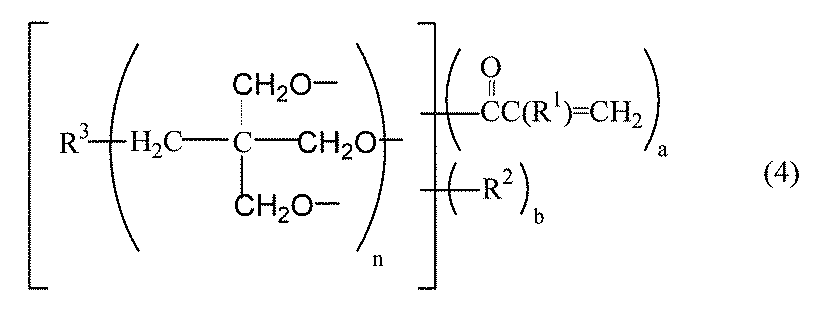
また、上記光学部材用放射線硬化型粘着剤組成物において、上記放射線硬化性アクリル系化合物(B)が、ビスフェノールAポリエチレングリコールジアクリレート、α-フェニル-ω-アクリロイルオキシポリオキシエチレンホルムアルデヒド重縮合物、ビスフェノールAポリプロピレングリコールジアクリレートおよびビスフェノールAジグリシジルエーテルアクリル酸付加物からなる群から選択される少なくとも一つであることが好ましい。
前記(A)成分100重量部に対して、(B)成分の配合量が2~20重量部で、前記(C)成分の配合量が3~50重量部であり、かつ(B)成分と(C)成分との合計配合量が5~60重量部であることが好ましい。

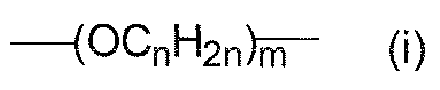



また、上記光学部材用放射線硬化型粘着剤組成物において、上記放射線硬化性アクリル系化合物(B)が、ネオペンチルグリコールジアクリレート、1,9ノナンジオールジアクリレート、ジメチロールトリシクロデカンジアクリレート、ポリプロピレングリコールジアクリレート、ポリエチレングリコールジアクリレート、ビスフェノールAポリエチレングリコールジアクリレートおよびα-フェニル-ω-アクリロイルオキシポリオキシエチレンホルムアルデヒド重縮合物からなる群から選択される少なくとも1つの化合物であることが好ましい。


また、上記光学部材用放射線硬化型粘着剤組成物において、光安定剤(F)が、下記化学式10~16で示される化合物からなる群より選択される少なくとも1つの化合物であることが好ましい。
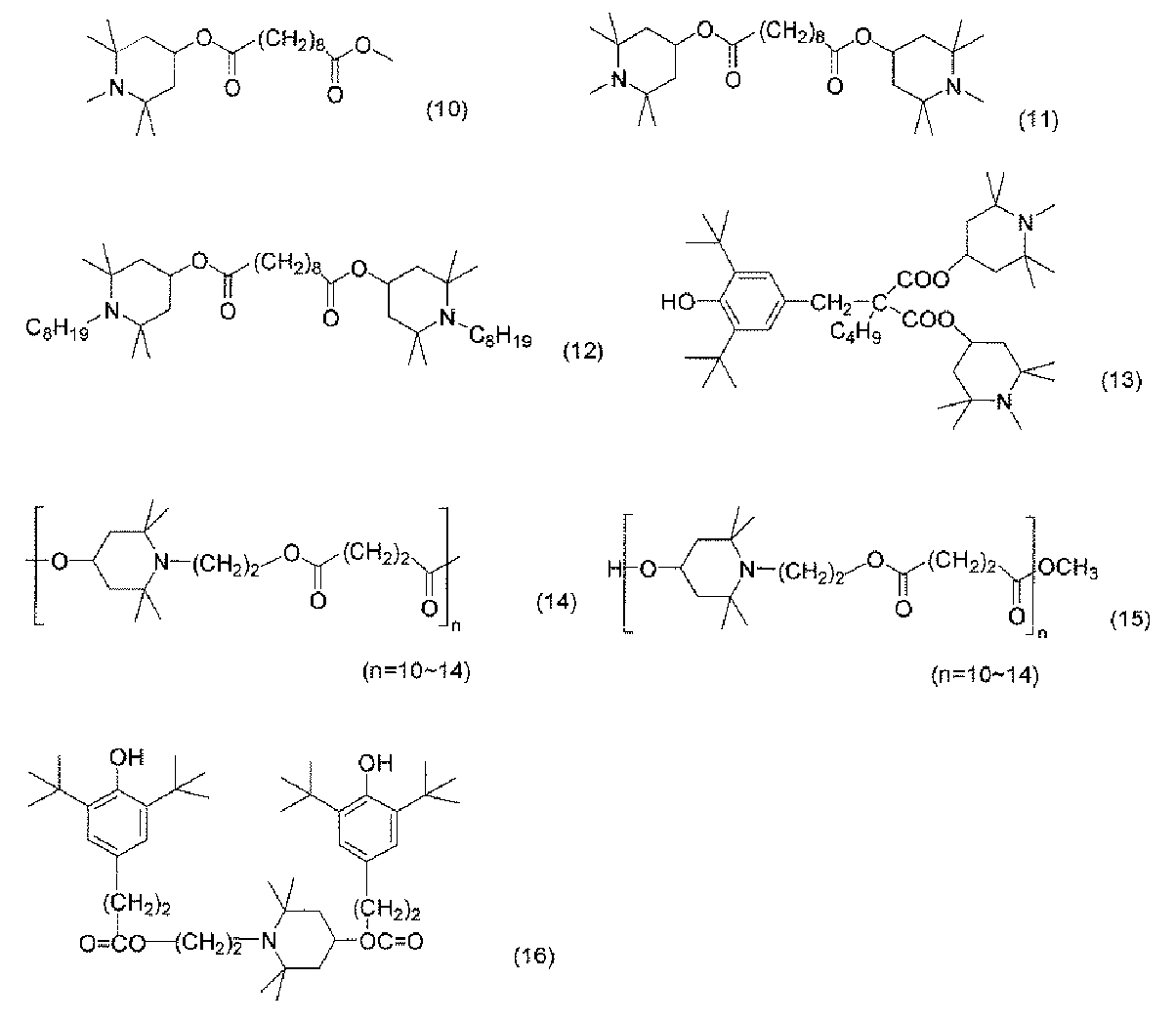

上記一般式(2)で示される化合物((B1)成分)としては、下記化学式にて示されるような、ビスフェノールAポリエチレングリコールジアクリレート(化学式(16))、α-フェニル-ω-アクリロイルオキシポリオキシエチレンホルムアルデヒド重縮合物(化学式(17))、ビスフェノールAポリプロピレングリコールジアクリレート(化学式(18))等が挙げられ、これらは単独で、または組み合わせて使用できる。

上記(C1)成分、(C2)成分は、それぞれ下記一般式(3)、(4)で示される。
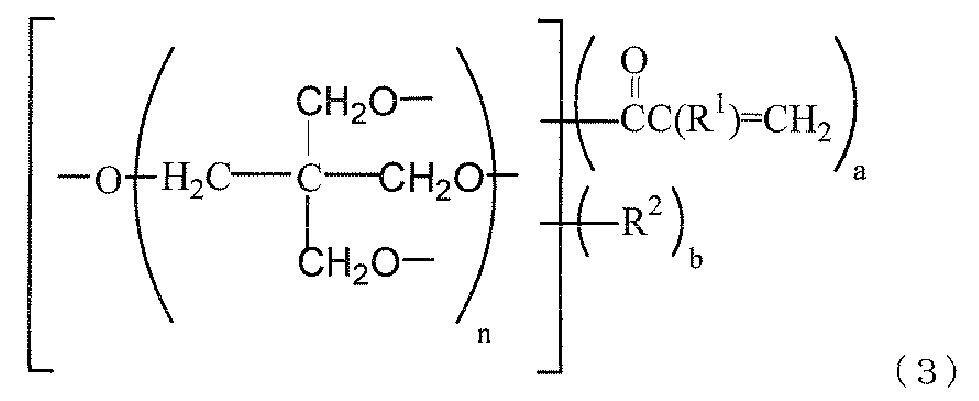

上記一般式(3)中のR2および一般式(4)中のR2、R3において、炭化水素基は、炭素原子と水素原子からなる官能基であれば特に限定されないが、例えば、アルキル基、アルケニル基、アルキニル基などの脂肪族炭化水素基、シクロアルキル基、シクロアルケニル基、シクロアルキニル基などの脂環式炭化水素基、フェニル基、ナフチル基、アントリル基、フェナントリル基などの芳香族炭化水素基が挙げられる。
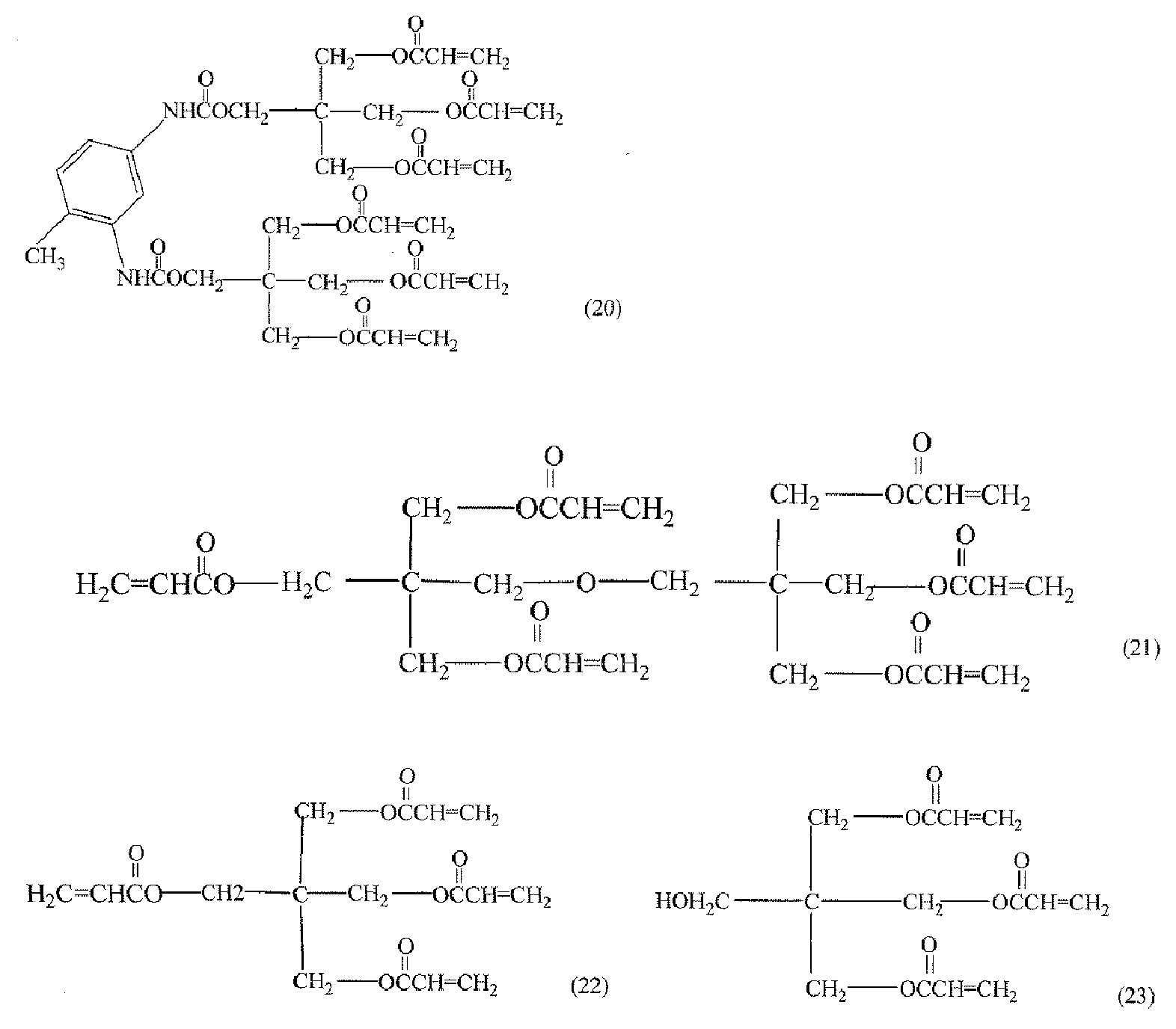
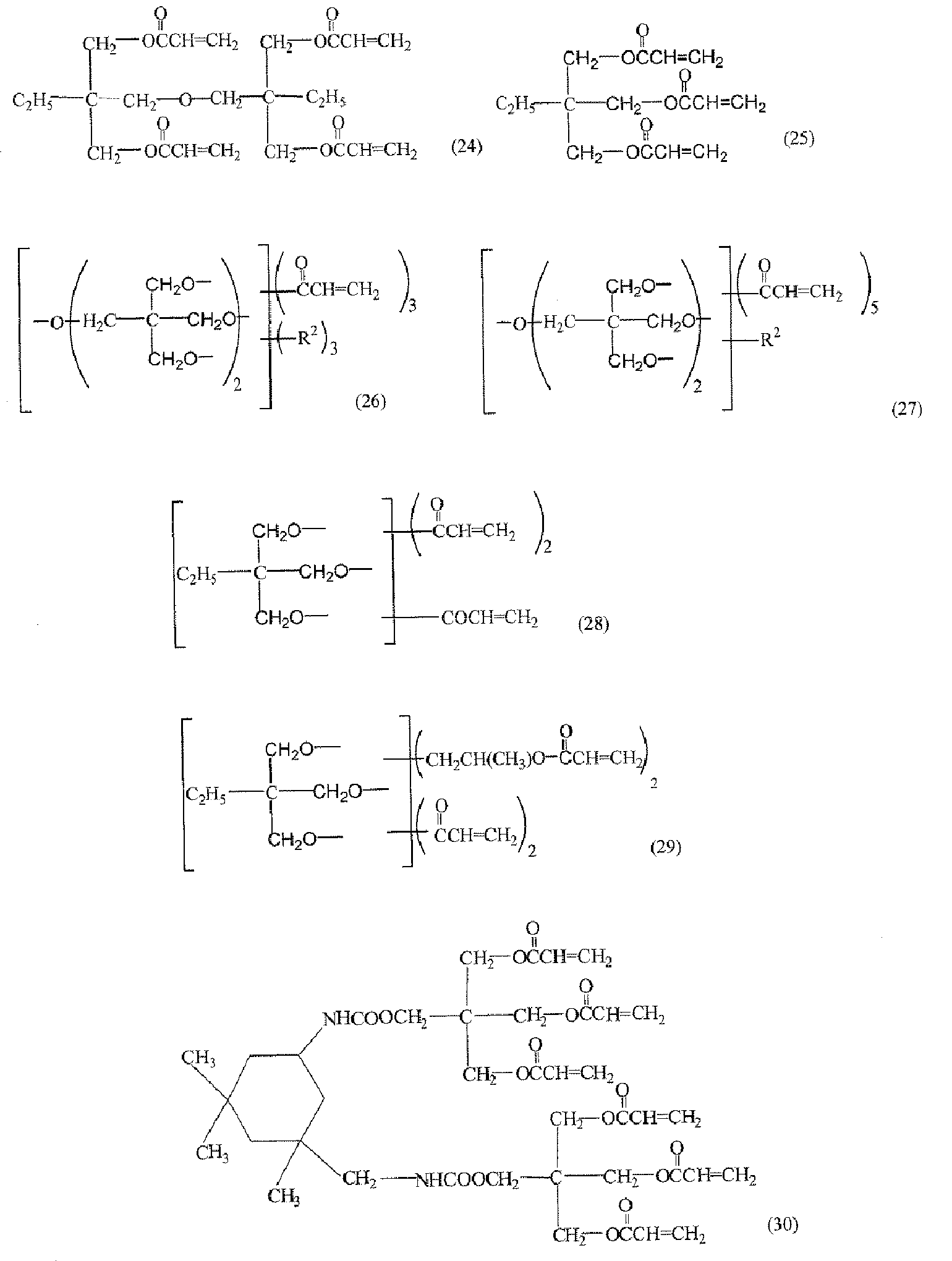
さらに、上記配合条件(2)を満たす場合、(B)成分が下記一般式(5)で示される化合物((B2)成分)であり、かつ(C)成分が上記一般式(6)または(C7)で示される化合物((C3)成分、(C4)成分)であることが好ましい。さらに好ましくは、ペンタエリスリトールとアクリル酸との反応により得られる多官能アクリレートとイソシアネート化合物との反応により得られる化合物である。



上記式(5)中のXが、炭素数1~20の直鎖型または分岐型の2価のアルキル基である場合、該アルキル基の炭素数は、1~16が好ましく、1~12がより好ましい。なお、該アルキル基は、直鎖型であっても、分岐型であってもよい。
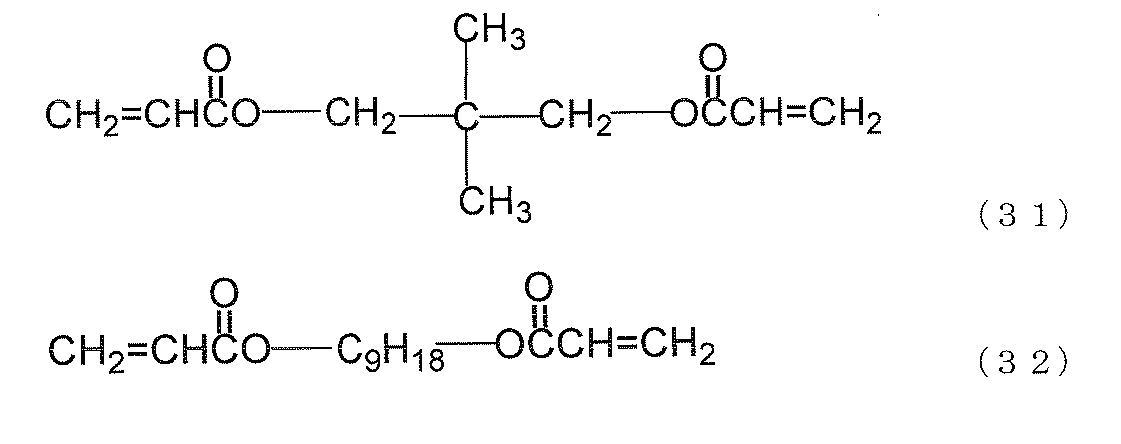


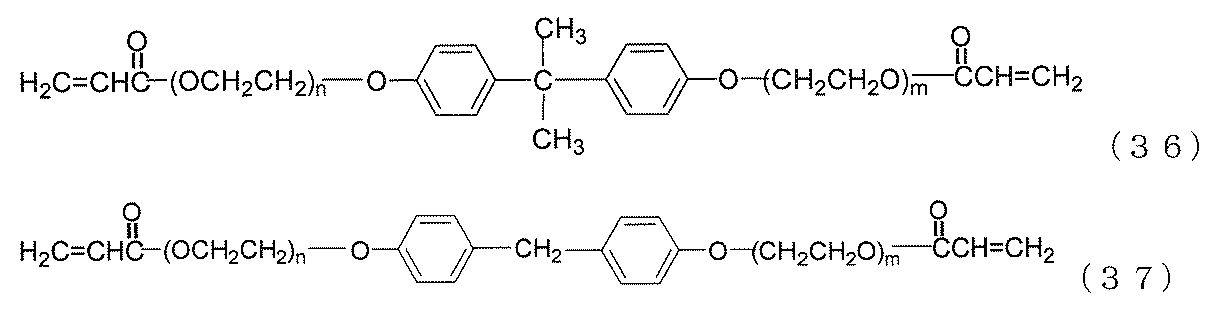
上記(C3)成分、(C4)成分は、それぞれ、下記一般式(6)、(7)で示される。


上記一般式(6)中のR2および一般式(7)中のR2、R3において、炭化水素基は、炭素原子と水素原子からなる官能基であれば特に限定されないが、例えば、アルキル基、アルケニル基、アルキニル基などの脂肪族炭化水素基、シクロアルキル基、シクロアルケニル基、シクロアルキニル基などの脂環式炭化水素基、フェニル基、ナフチル基、アントリル基、フェナントリル基などの芳香族炭化水素基が挙げられる。
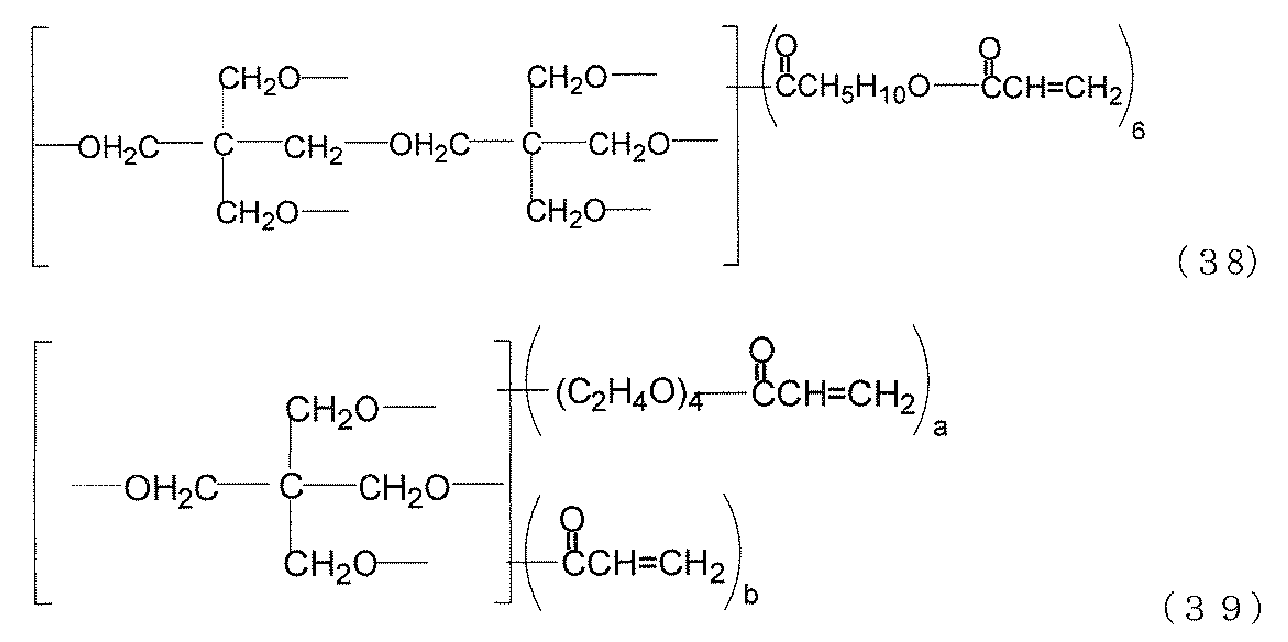

本発明の粘着剤組成物には、紫外線等の放射線により該粘着剤組成物を硬化するために、(A)成分100重量部に対して、水素引抜型光重合性開始剤(D) 0.1~10重量部が含まれる。
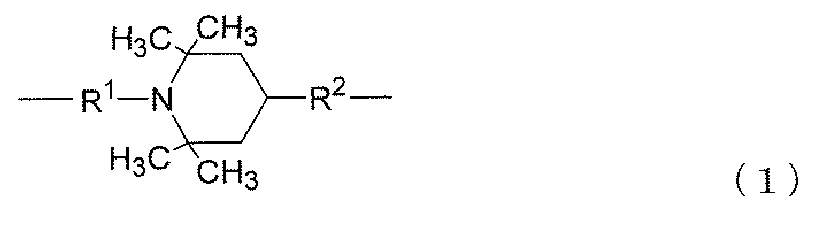
ここで、2価の炭化水素基とは、2つの結合手を有する炭化水素であれば特に限定されず、不飽和炭化水素であっても飽和炭化水素であってもよい。2価の炭化水素基としては、例えば、炭素数1~20のアルキレン基、炭素数6~20のアリーレン基、およびこれらが結合してなる基が挙げられ、この中でも、炭素数1~20のアルキレン基が好ましく、炭素数1~5のアルキレン基がより好ましい。
上記一般式(1)中で、R2が2価の窒素含有官能基である光安定剤(F)は、例えば、日本チバ・ジャパン株式会社製のTINUVIN 111FDL(商品名)、TINUVIN 152(商品名)、CHIMASSORB 119FL(商品名)、CHIMASSORB 2020FL(商品名)、CHIMASSORB 944FL(商品名)として市販されている。


また、上記一般式(8)および(9)における「2価の炭化水素基」、「2価の窒素含有官能基」、「2価の酸素含有官能基」は、それぞれ、上記一般式(7)および(9)における「2価の炭化水素基」、「2価の窒素含有官能基」、「2価の酸素含有官能基」と同一の定義内容を示す。


また、粘着剤組成物への分散性および相溶性が良好であるという観点から、光安定剤(F)の分子量が、5000未満であることが好ましく、200~4000であることがより好ましく、200~2000であることがさらに好ましい。
ゲル分率(%)=(乾燥重量/粘着剤採取重量)×100・・・・[I]
本発明の粘着型光学部材は、上述した光学部材用放射線硬化型粘着剤組成物からなる粘着剤層が、光学部材の片面あるいは両面に形成されてなる。
各実施例および各比較例の粘着型偏光フィルムに使用した光学部材用放射線硬化型粘着剤組成物(以下、単に「粘着剤組成物」と称する。)を構成する各成分は下記の通りであり、成分比率は表1に示す。なお、表中、数値は固形分(不揮発分)換算の重量部を示す。
(a1) n-ブチルアクリレート(BA)
(a2) アクリル酸(AA)
(a3) 2-ヒドロキシエチルアクリレート(HEA)
(B)放射線硬化性アクリル系化合物((メタ)アクリル基2個/1分子)
(B1) KAYARAD R-551(ビスフェノールAポリエチレングリコールジアクリレート;日本化薬株式会社製、化学式(41))
(B2) BP-4PA(ビスフェノールAポリプロピレングリコールジアクリレート、共栄社化学株式会社製、化学式(42))
(B3)KAYARAD R-712(α-フェニル-ω-アクリロイルオキシポリオキシエチレンホルムアルデヒド重縮合物、化学式(43))
(B4) KAYARAD NPGDA(ネオペンチルグリコールジアクリレート、日本化薬株式会社製、化学式(44))



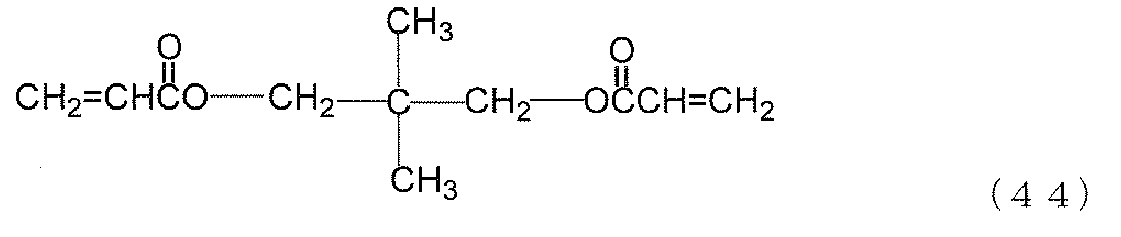
(C1) UA-306T(ペンタエリスリトールトリアクリレートトルエンジイソシアネートウレタンポリマー;共栄社化学株式会社製、化学式(45))
(C2) KAYARAD DPHA(ジペンタエリスリトールヘキサアクリレート;日本化薬株式会社製、化学式(46))
(C3) EBECRYL140(ジトリメチロールプロパンテトラアクリレート;ダイセル・ユーシービー株式会社製、化学式(47))
(C4) KAYARAD DPCA-60(ジペンタエリスリトールカプロラクトンのアクリル酸エステル;日本化薬株式会社製、化学式(48))
(C5) KAYARAD THE-330(トリメチロールプロパンエチレンオキサイドのアクリル酸エステル;日本化薬株式会社製、化学式(49))
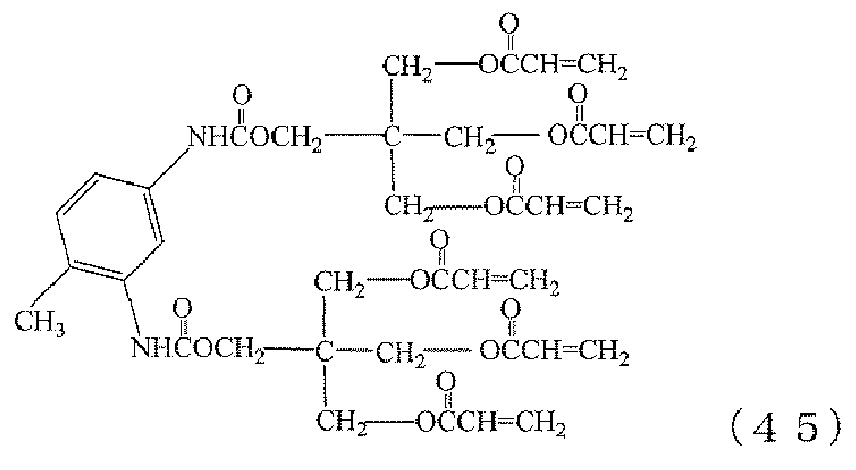
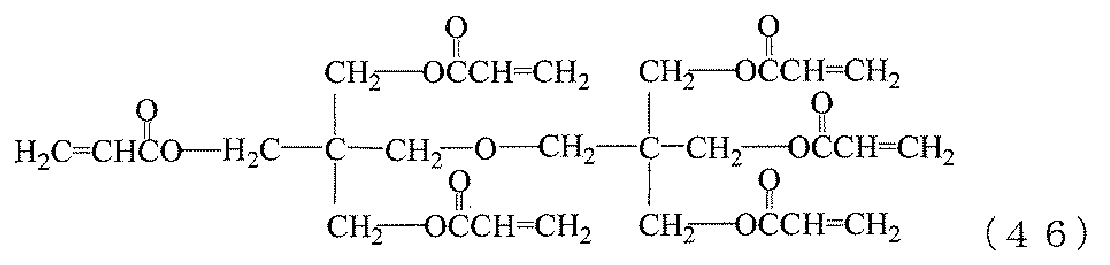


(D)水素引抜型光重合性開始剤
(D1) IRGACURE 500(1-ヒドロキシ-シクロヘキシルーフェニルケトン:ベンゾフェノン=1:1(モル比)、チバ・ジャパン株式会社製)
(E)イソシアネート系架橋剤(イソシアネート基2個以上/1分子)
(E1) コロネートL(ポリイソシアネート化合物;日本ポリウレタン工業株式会社製)
(F)光安定剤
(F1)TINUVIN292(ビス(1,2,2,6,6-ペンタメチル-4-ピペリジル)セバケート:メチル1,2,2,6,6-ペンタメチル-4-ピペリジルセバケート=70~80%:20~30%(重量%)、日本チバ・ジャパン株式会社製、化学式(50)、(51))
(F2)TINUVIN144(ビス(1,2,2,6,6-ペンタメチル-4-ピペリジル)[[3,5-ビス(1,1-ジメチルエチル)-4-ヒドロキシフェニル]メチル]ブチルマロネート、日本チバ・ジャパン株式会社製、化学式(52))
(F3)TINUVIN622LD(コハク酸ジメチル-1-(2-ヒドロキシエチル)-4-ヒドロキシ-2,2,6,6-テトラメチル-4-ピペリジン重縮合物、日本チバ・ジャパン株式会社製、化学式(53))
(f1)MEHQ(ヒドロキノンモノメチルエーテル、化学式(54))
(f2)IRGANOX1010(ペンタエリスリチル・テトラキス[3-(3,5-ジ-t-ブチル-4-ヒドロキシフェニル)プロピオネート]、日本チバ・ジャパン株式会社製、化学式(55))

(G1)KBM-403(γ-グリシドキシプロピルトリメトキシシラン;信越化学工業(株)製)。
ブチルアクリレート(BA)281.4重量部、アクリル酸(AA)18重量部、2-ヒドロキシエチルアクリレート(2-HEA)0.6重量部および酢酸エチル300重量部を、攪拌機、管流冷却器、温度系および窒素導入管を備えた反応容器に仕込み、さらにアゾビスイソブチロニトリル(AIBN)0.1重量部を該反応容器に加え、この反応容器内の空気を窒素ガスで置換した。
[実施例1]
表1で示されるように、アクリル系ポリマー溶液Aに含まれるアクリル系ポリマーA 100重量部に対して、KAYARAD R-551 1重量部、UA-306T 10重量部、IRGACURE500 4重量部、TINUVIN292 1重量部、コロネートL 0.5重量部および、KBM-403 0.4重量部を添加し、これを混合して、粘着剤組成物1を得た。
KAYARAD R-551の配合量を1重量部から5重量部に変更し、UA-306T 10重量部をKAYARAD DPHA 20重量部に変更したこと以外は、実施例1と同様に調製して、粘着剤組成物2および粘着型偏光フィルム2を得た。また、実施例1と同様にして、得られた粘着型偏光フィルム2の各物性を評価した。得られた結果を表2に示す。
KAYARAD R-551をBP-4PAに、UA-306TをEBECRYL140にそれぞれ変更したこと以外は、実施例1と同様に調製して、粘着剤組成物3および粘着型偏光フィルム3を得た。また、実施例1と同様にして、得られた粘着型偏光フィルム3の各物性を評価した。得られた結果を表2に示す。
IRGACURE500の配合量を4重量部から6重量部に変更したこと以外は、実施例3と同様に調製して、粘着剤組成物4および粘着型偏光フィルム4を得た。また、実施例1と同様にして、得られた粘着型偏光フィルム4の各物性を評価した。得られた結果を表2に示す。
コロネートLの配合量を0.5重量部から6.0重量部に変更したこと以外は、実施例3と同様に調製して、粘着剤組成物5および粘着型偏光フィルム5を得た。また、実施例1と同様にして、得られた粘着型偏光フィルム5の各物性を評価した。得られた結果を表2に示す。
KBM-403の配合量を0.4重量部から1.0重量部に変更したこと以外は、実施例3と同様に調製して、粘着剤組成物6および粘着型偏光フィルム6を得た。また、実施例1と同様にして、得られた粘着型偏光フィルム6の各物性を評価した。得られた結果を表2に示す。
TINUVIN292をTINUVIN144に変更したこと以外は、実施例3と同様に調製して、粘着剤組成物7および粘着型偏光フィルム7を得た。また、実施例1と同様にして、得られた粘着型偏光フィルム7の各物性を評価した。得られた結果を表2に示す。
TINUVIN292をTINUVIN622LDに変更したこと以外は、実施例3と同様に調製して、粘着剤組成物8および粘着型偏光フィルム8を得た。また、実施例1と同様にして、得られた粘着型偏光フィルム8の各物性を評価した。得られた結果を表2に示す。
KBM-403を含まないこと以外は、実施例3と同様に調製して、粘着剤組成物9および粘着型偏光フィルム9を得た。また、実施例1と同様にして、得られた粘着型偏光フィルム9の各物性を評価した。得られた結果を表2に示す。
KAYARAD R-551 1重量部をKAYARAD R-712 10重量部に、UA-306T 10重量部をDPCA-60 20重量部に、それぞれ変更したこと以外は、実施例1と同様に調製して、粘着剤組成物10および粘着型偏光フィルム10を得た。また、実施例1と同様にして、得られた粘着型偏光フィルム10の各物性を評価した。得られた結果を表2に示す。
KAYARAD R-712をNPGDAに変更したこと以外は、実施例10と同様に調製して、粘着剤組成物11および粘着型偏光フィルム11を得た。また、実施例1と同様にして、得られた粘着型偏光フィルム11の各物性を評価した。得られた結果を表2に示す。
DPCA-60をTHE-330に、変更したこと以外は、実施例10と同様に調製して、粘着剤組成物12および粘着型偏光フィルム12を得た。また、実施例1と同様にして、得られた粘着型偏光フィルム12の各物性を評価した。得られた結果を表2に示す。
KAYARAD R-712をNPGDAに、DPCA-60をTHE-330に、それぞれ変更したこと以外は、実施例10と同様に調製して、粘着剤組成物13および粘着型偏光フィルム13を得た。また、実施例1と同様にして、得られた粘着型偏光フィルム13の各物性を評価した。得られた結果を表2に示す。
KBM-403を含まないこと以外は、実施例10と同様に調製して、粘着剤組成物14および粘着型偏光フィルム14を得た。また、実施例1と同様にして、得られた粘着型偏光フィルム14の各物性を評価した。得られた結果を表2に示す。
TINUVIN292を含まないこと以外は、実施例1と同様に調製して、粘着剤組成物15および粘着型偏光フィルム15を得た。また、実施例1と同様にして、得られた粘着型偏光フィルム15の各物性を評価した。得られた結果を表2に示す。
TINUVIN292およびKBM-403を含まないこと以外は、実施例1と同様に調製して、粘着剤組成物16および粘着型偏光フィルム16を得た。また、実施例1と同様にして、得られた粘着型偏光フィルム16の各物性を評価した。得られた結果を表2に示す。
TINUVIN292を含まないこと以外は、実施例2と同様に調製して、粘着剤組成物17および粘着型偏光フィルム17を得た。また、実施例1と同様にして、得られた粘着型偏光フィルム17の各物性を評価した。得られた結果を表2に示す。
TINUVIN292を含まないこと以外は、実施例3と同様に調製して、粘着剤組成物18および粘着型偏光フィルム18を得た。また、実施例1と同様にして、得られた粘着型偏光フィルム18の各物性を評価した。得られた結果を表2に示す。
TINUVIN292を含まないこと以外は、実施例4と同様に調製して、粘着剤組成物19および粘着型偏光フィルム19を得た。また、実施例1と同様にして、得られた粘着型偏光フィルム19の各物性を評価した。得られた結果を表2に示す。
TINUVIN292を含まないこと以外は、実施例5と同様に調製して、粘着剤組成物20および粘着型偏光フィルム20を得た。また、実施例1と同様にして、得られた粘着型偏光フィルム20の各物性を評価した。得られた結果を表2に示す。
TINUVIN292を含まないこと以外は、実施例6と同様に調製して、粘着剤組成物21および粘着型偏光フィルム21を得た。また、実施例1と同様にして、得られた粘着型偏光フィルム21の各物性を評価した。得られた結果を表2に示す。
TINUVIN292をMEHQに変更したこと以外は、実施例3と同様に調製して、粘着剤組成物22および粘着型偏光フィルム22を得た。また、実施例1と同様にして、得られた粘着型偏光フィルム22の各物性を評価した。得られた結果を表2に示す。
TINUVIN292をIRGANOX1010に変更したこと以外は、実施例3と同様に調製して、粘着剤組成物22および粘着型偏光フィルム22を得た。また、実施例1と同様にして、得られた粘着型偏光フィルム22の各物性を評価した。得られた結果を表2に示す。
TINUVIN292を含まないこと以外は、実施例10と同様に調製して、粘着剤組成物24および粘着型偏光フィルム24を得た。また、実施例1と同様にして、得られた粘着型偏光フィルム24の各物性を評価した。得られた結果を表2に示す。
TINUVIN292およびKBM-403を含まないこと以外は、実施例10と同様に調製して、粘着剤組成物25および粘着型偏光フィルム25を得た。また、実施例1と同様にして、得られた粘着型偏光フィルム25の各物性を評価した。得られた結果を表2に示す。
TINUVIN292を含まないこと以外は、実施例11と同様に調製して、粘着剤組成物26および粘着型偏光フィルム26を得た。また、実施例1と同様にして、得られた粘着型偏光フィルム26の各物性を評価した。得られた結果を表2に示す。
TINUVIN292を含まないこと以外は、実施例12と同様に調製して、粘着剤組成物27および粘着型偏光フィルム27を得た。また、実施例1と同様にして、得られた粘着型偏光フィルム27の各物性を評価した。得られた結果を表2に示す。
TINUVIN292を含まないこと以外は、実施例13と同様に調製して、粘着剤組成物28および粘着型偏光フィルム28を得た。また、実施例1と同様にして、得られた粘着型偏光フィルム28の各物性を評価した。得られた結果を表2に示す。
TINUVIN292をMEHQに変更したこと以外は、実施例10と同様に調製して、粘着剤組成物29および粘着型偏光フィルム29を得た。また、実施例1と同様にして、得られた粘着型偏光フィルム29の各物性を評価した。得られた結果を表2に示す。
TINUVIN292をIRGANOX1010に変更したこと以外は、実施例10と同様に調製して、粘着剤組成物30および粘着型偏光フィルム30を得た。また、実施例1と同様にして、得られた粘着型偏光フィルム30の各物性を評価した。得られた結果を表2に示す。

<耐光漏れ試験>
(評価方法)
19インチサイズの液晶パネルに、粘着型偏光フィルム(310×385mm)を、クロスニコルになるように貼り付け、60℃、95%RH(相対湿度)の雰囲気下で240時間、さらに、23℃、50%RH(相対湿度)の雰囲気下で2時間放置した後、色温度5000Kのライトボックスに入れ、目視およびデジタルカメラにより液晶パネルに貼着された粘着型偏光フィルムの光漏れの状態を観察し、以下の評価基準に基づいて評価した。
(評価基準)
◎:全く光漏れが見られない。
○:ほとんど光漏れがない。
△:若干の光漏れがあることが分かる。
×:明らかに光漏れがあることが分かる。
(評価方法)
19インチサイズの無アルカリ処理ガラスに、粘着型偏光フィルム(310×385mm)を、貼り合わせて、85℃の雰囲気下で240時間、さらに、23℃、50%RH(相対湿度)の雰囲気下で2時間放置した。その後、粘着型偏光フィルムが張り合わされた無アルカリ処理ガラスを室内に取り出し、目視により粘着型偏光フィルムの発泡等の外観変化を観察し、以下の評価基準に基づいて評価した。
(評価基準)
◎:全く発泡などの外観変化がない。
○:ほとんど発泡などの外観変化がない。
△:若干、発泡などの外観変化があることが分かる。
×:明らかに、発泡などの外観変化があることが分かる。
(評価方法)
19インチサイズの無アルカリ処理ガラスに、粘着型偏光フィルム(310×385mm)を、貼り合わせて、60℃、95%RH(相対湿度)の雰囲気下で240時間、さらに、23℃、50%RH(相対湿度)の雰囲気下で2時間放置した。その後、粘着型偏光フィルムが張り合わされた無アルカリ処理ガラスを室内に取り出し、目視により粘着型偏光フィルムの剥がれ、発泡等の外観変化を観察し、以下の4段階の評価基準に基づいて評価した。
(評価基準)
◎:全く剥がれ、発泡などの外観変化がない。
○:ほとんど剥がれ、発泡などの外観変化がない。
△:若干、剥がれ、発泡などの外観変化があることが分かる。
×:明らかに、剥がれ、発泡などの外観変化があることが分かる。
粘着型偏光フィルムの粘着剤面を、23℃/50%RH(相対湿度)の条件下で、室内用蛍光灯(色温度:6500K、照度:3000ルクス、波長:250nm~530nm)に2週間露光させて、粘着型偏光フィルム(露光後)を得た。
上記条件で露光させる前の粘着型偏光フィルム(粘着型偏光フィルム(露光前))と、粘着型偏光フィルム(露光後)について以下の評価試験を実施した。
粘着型偏光フィルムから粘着剤組成物0.1gをサンプル瓶に採取し、酢酸エチル30ccを加えて24時間振とうした。その後、該サンプル瓶の内容物を200メッシュのステンレス製金網でろ別し、金網上の残留物を100℃で2時間乾燥して乾燥重量を測定し、次式[I]により求めた。
ゲル分率(%)=(乾燥重量/粘着剤採取重量)×100・・・・[I]
(ii)対ガラス粘着力の変化
無アルカリ処理のガラス板(90×130mm)に、粘着型偏光フィルム(長さ:75mm×幅:25mm)を貼り合わせ、2kgのローラーで3往復圧着させた。その後、23℃、50%RH(相対湿度)の雰囲気下で2時間放置し、90°剥離(剥離速度:300mm/min)にて対ガラス粘着力(単位;N/25mm)を測定した。同一の粘着型偏光フィルム2枚について本測定を実施し、得られた2つの測定値の平均値を、粘着型偏光フィルムの対ガラス粘着力とした。

Claims (13)
- (メタ)アクリル酸アルキルエステル(a1)80~99.8質量%、カルボキシル基含有(メタ)アクリル系モノマー(a2)0.1~10質量%および水酸基含有(メタ)アクリル系モノマー(a3)0.1~10質量%から構成される(メタ)アクリル系共重合体(A)(ただし、(a1)~(a3)の合計量が100質量%である。) 100重量部と、
分子内に(メタ)アクリロイル基を2個有する放射線硬化性アクリル系化合物(B) 0.01~20重量部と、
分子内に(メタ)アクリロイル基を3~10個有する放射線硬化性アクリル系化合物(C) 1~50重量部と、
水素引抜型光重合性開始剤(D) 0.1~10重量部と、
分子内にイソシアネート基を2個以上有するイソシアネート系架橋剤(E) 0.01~10重量部と、
下記一般式(1)に示されるピペリジル環を有する光安定剤(F)0.01~5重量部とを含むことを特徴とする光学部材用放射線硬化型粘着剤組成物。

(式(1)中、R1、R2は、それぞれ独立して、直接結合、2価の炭化水素基、2価の窒素含有官能基、2価の酸素含有官能基を示す。) - 前記放射線硬化性アクリル系化合物(B)が下記一般式(2)で示され、前記放射線硬化性アクリル系化合物(C)が下記一般式(3)または(4)で示され、
前記(A)成分100重量部に対して、(B)成分の配合量が0.01~10重量部で、前記(C)成分の配合量が1~30重量部であり、(B)成分と(C)成分との合計配合量が3~40重量部であり、かつ(C)成分の配合量が(B)成分の配合量よりも大きいことを特徴とする請求項1に記載の光学部材用放射線硬化型粘着剤組成物。

(式(2)中、Raは、水素または炭素数1~5のアルキル基、Rbは、炭素数2~4のアルキル基、Rcは、水素またはメチル基を示す。p、qは、それぞれ整数を示し、pとqとの合計が4~12である。)
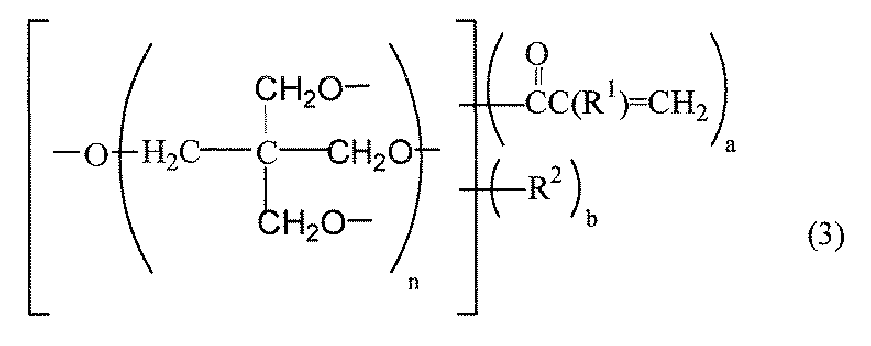
(式(3)中、nは、1~5の整数である。また、aおよびbは整数を示し、aが3~10の整数を示すとともに、a+b=2n+2を満足する。R1は、水素またはメチル基を示す。R2は、水素原子、置換基を有しても良い炭化水素基、置換基を有しても良い酸素含有官能基、置換基を有しても良い窒素含有官能基を示す。)

(式(4)中、nは、1~5の整数である。aおよびbは整数を示し、aが3~10の整数を示すとともに、a+b=2n+1を満足する。R1は、水素またはメチル基を示す。R2、R3は、それぞれ独立して、水素原子、置換基を有しても良い炭化水素基、置換基を有しても良い酸素含有官能基、置換基を有しても良い窒素含有官能基を示す。) - 前記放射線硬化性アクリル系化合物(B)が、ビスフェノールAポリエチレングリコールジアクリレート、α-フェニル-ω-アクリロイルオキシポリオキシエチレンホルムアルデヒド重縮合物、ビスフェノールAポリプロピレングリコールジアクリレートおよびビスフェノールAジグリシジルエーテルアクリル酸付加物からなる群から選択される少なくとも一つであることを特徴とする請求項2に記載の光学部材用放射線硬化型粘着剤組成物。
- 前記放射線硬化性アクリル系化合物(C)が、ペンタエリスリトールトリアクリレートトルエンジイソシアネートウレタンポリマー、ジペンタエリスリトールヘキサアクリレート、ペンタエリスリトールテトラアクリレート、ペンタエリスリトールトリアクリレートおよびジトリメチロールプロパンテトラアクリレートからなる群から選択される少なくとも一つであることを特徴とする請求項2に記載の光学部材用放射線硬化型粘着剤組成物。
- 前記放射線硬化性アクリル系化合物(B)が下記一般式(5)で示され、前記放射線硬化性アクリル系化合物(B)が下記一般式(6)または一般式(7)で示され、
前記(A)成分100重量部に対して、(B)成分の配合量が2~20重量部で、前記(C)成分の配合量が3~50重量部であり、(B)成分と(C)成分との合計配合量が5~60重量部であり、かつ(C)成分の配合量が(B)成分の配合量より大きいことを特徴とする請求項1に記載の光学部材用放射線硬化型粘着剤組成物。

(式(5)中、n1,n2はそれぞれ独立して0~10の整数を示す。R1、R2はそれぞれ独立して、水素原子またはメチル基を示す。Xは、炭素数1~20の直鎖型または分岐型の2価のアルキル基、炭素数3~20の直鎖型または分岐型の2価のシクロアルキル基、下記一般式(i)で示されるアルコキシル基または下記一般式(ii)で示されるジフェニルアルキル基を示す。

(式(i)中、nは1~20の整数、mは1~10の整数を示す。)

(式(ii)中、nは、1~20の整数を示し、Arは置換基を有してもよいアリール基を示す。)

(式(6)中、mは1~5の整数である。aは1以上、bは0以上、cは0以上の整数であって、aとbとの合計が3~10であり、a+b+c=2m+2を満足する。nは、2~6の整数である。R1は、置換基を有してもよい炭素数2~4のアルキル基を示す。R2は、水素またはメチル基を示す。R3は、水素原子、置換基を有しても良い炭化水素基、置換基を有しても良い酸素含有官能基、置換基を有しても良い窒素含有官能基を示す。)
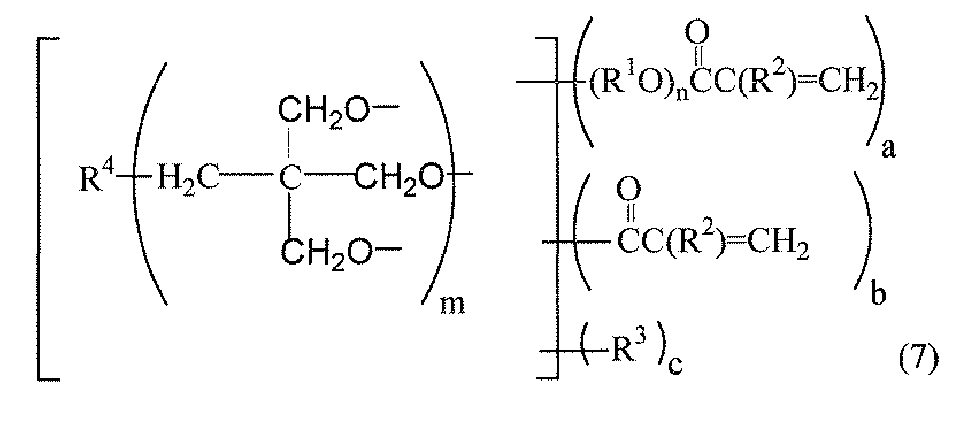
(式(7)中、mは1~5の整数である。aは1以上、bは0以上、cは0以上の整数であって、aとbとの合計が3~10であり、a+b+c=2m+1の条件を満足する。nは、2~6の整数である。R1は、置換基を有してもよい炭素数2~4のアルキル基を示す。R2は、水素またはメチル基を示す。R3、R4は、それぞれ独立して、水素原子、置換基を有しても良い炭化水素基、置換基を有しても良い酸素含有官能基、置換基を有しても良い窒素含有官能基を示す。) - 前記放射線硬化性アクリル系化合物(B)が、ネオペンチルグリコールジアクリレート、1,9ノナンジオールジアクリレート、ジメチロールトリシクロデカンジアクリレート、ポリプロピレングリコールジアクリレート、ポリエチレングリコールジアクリレート、ビスフェノールAポリエチレングリコールジアクリレートおよびα-フェニル-ω-アクリロイルオキシポリオキシエチレンホルムアルデヒド重縮合物からなる群から選択される少なくとも1つの化合物であることを特徴とする請求項5に記載の光学部材用放射線硬化型粘着剤組成物。
- 前記放射線硬化性アクリル系化合物(C)が、ジペンタエリスリトールカプロラクトンのアクリル酸エステル、ペンタエリスリトールエチレンオキサイドのアクリル酸エステルおよびトリメチロールプロパンエチレンオキサイドのアクリル酸エステルからなる群から選択される少なくとも1つの化合物であることを特徴とする請求項5に記載の光学部材用放射線硬化型粘着剤組成物。
- 前記光安定剤(F)が、下記一般式(8)または(9)で示されることを特徴とする請求項1~7の何れか一項に記載の光学部材用放射線硬化型粘着剤組成物。
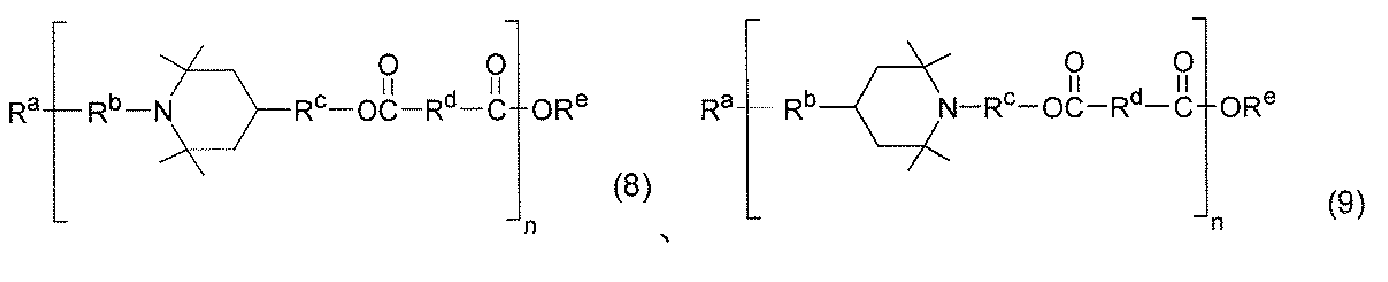
(式(8)および(9)中、Raは、H,OH基、置換または無置換のアルキル基、置換または無置換のアルコキシ基を示す。Rb、Rcは、それぞれ独立して、直接結合、2価の炭化水素基、2価の窒素含有官能基、2価の酸素含有官能基を示す。Rdは、直接結合、2価の炭化水素基を示す。Reは、H、置換または無置換のアルキル基、下記一般式(iii)または(iv)で示されるピペリジン環を示す。また、nは1~7の整数を示す。)

(式(iii)および(iv)中、Rfは、直接結合、2価の炭化水素基、2価の窒素含有官能基、2価の酸素含有官能基を、Rgは、H、OH、置換または無置換のアルキル基、置換または無置換のアルコキシ基を示す。) - 前記光安定剤(F)が、下記化学式(10)~(15)で示される化合物からなる群より選択される少なくとも1つであることを特徴とする請求項8に記載の光学部材用放射線硬化型粘着剤組成物。
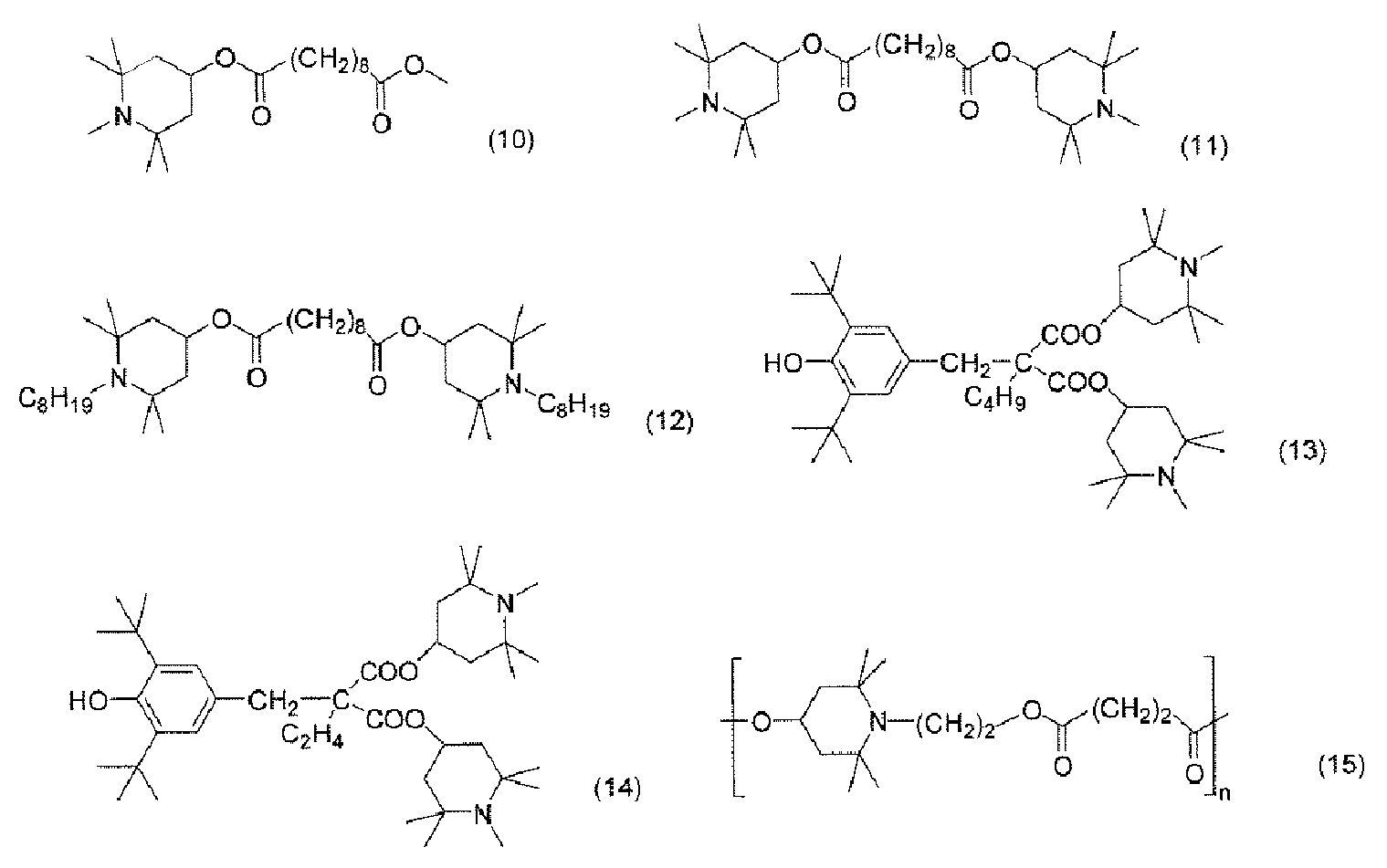
(式(15)中、nは10~14の整数を示す。) - 前記光安定剤(F)の分子量が、200~4000の範囲であることを特徴とする請求項1~9の何れか一項に記載の光学部材用放射線硬化型粘着剤組成物。
- 前記(メタ)アクリル系共重合体(A) 100重量部に対して、カルボキシル基と反応性を有する有機官能基を有するシラン化合物(F) 0.01~3重量部をさらに含むことを特徴とする請求項1~10の何れか1項に記載の光学部材用放射線硬化型粘着剤組成物。
- 請求項1~11の何れか一項に記載の粘着剤組成物からなる粘着剤層が、光学部材の片面あるいは両面に形成されてなることを特徴とする粘着型光学部材。
- 前記光学部材が偏光フィルム、位相差フィルム、楕円偏光フィルム、反射防止フィルム、輝度向上フィルムおよび光拡散フィルムからなる群から選択される光学フィルムであることを特徴とする請求項12記載の粘着型光学部材。
Priority Applications (3)
| Application Number | Priority Date | Filing Date | Title |
|---|---|---|---|
| JP2011529883A JP5715955B2 (ja) | 2009-09-01 | 2010-08-26 | 光学部材用放射線硬化型粘着剤組成物および粘着型光学部材 |
| CN2010800387635A CN102482550B (zh) | 2009-09-01 | 2010-08-26 | 用于光学部件的放射线固化型压敏粘合剂组合物及压敏粘合型光学部件 |
| KR1020117029281A KR20120060782A (ko) | 2009-09-01 | 2010-08-26 | 광학 부재용 방사선 경화형 점착제 조성물 및 점착형 광학 부재 |
Applications Claiming Priority (2)
| Application Number | Priority Date | Filing Date | Title |
|---|---|---|---|
| JP2009-201651 | 2009-09-01 | ||
| JP2009201651 | 2009-09-01 |
Publications (1)
| Publication Number | Publication Date |
|---|---|
| WO2011027707A1 true WO2011027707A1 (ja) | 2011-03-10 |
Family
ID=43649245
Family Applications (1)
| Application Number | Title | Priority Date | Filing Date |
|---|---|---|---|
| PCT/JP2010/064462 Ceased WO2011027707A1 (ja) | 2009-09-01 | 2010-08-26 | 光学部材用放射線硬化型粘着剤組成物および粘着型光学部材 |
Country Status (5)
| Country | Link |
|---|---|
| JP (1) | JP5715955B2 (ja) |
| KR (1) | KR20120060782A (ja) |
| CN (1) | CN102482550B (ja) |
| TW (1) | TW201127926A (ja) |
| WO (1) | WO2011027707A1 (ja) |
Cited By (18)
| Publication number | Priority date | Publication date | Assignee | Title |
|---|---|---|---|---|
| KR20120105361A (ko) * | 2011-03-15 | 2012-09-25 | 토요켐주식회사 | 점착제, 점착 시트 및 전자 디바이스 |
| JP2014015573A (ja) * | 2012-07-11 | 2014-01-30 | Dic Corp | 紫外線硬化型粘着剤用樹脂組成物及び粘着剤 |
| WO2014175306A1 (ja) * | 2013-04-24 | 2014-10-30 | 王子ホールディングス株式会社 | 粘着シート及び積層体とその製造方法 |
| WO2015198775A1 (ja) * | 2014-06-27 | 2015-12-30 | Dic株式会社 | 紫外線硬化型粘着剤組成物、粘着フィルム、及び、粘着フィルムの製造方法 |
| WO2016002910A1 (ja) * | 2014-07-02 | 2016-01-07 | 三菱瓦斯化学株式会社 | ジアクリレート化合物を含む組成物およびその硬化物 |
| JP2016500722A (ja) * | 2013-06-19 | 2016-01-14 | エルジー・ケム・リミテッド | 粘着剤組成物 |
| JP2016502578A (ja) * | 2013-06-19 | 2016-01-28 | エルジー・ケム・リミテッド | 粘着剤組成物 |
| JP2016504430A (ja) * | 2013-06-19 | 2016-02-12 | エルジー・ケム・リミテッド | 粘着剤組成物 |
| EP3012305A4 (en) * | 2013-06-19 | 2016-11-23 | Lg Chemical Ltd | ADHESIVE COMPOSITION |
| WO2017010501A1 (ja) * | 2015-07-13 | 2017-01-19 | 王子ホールディングス株式会社 | 粘着シート及び積層体とその製造方法 |
| WO2017116079A1 (ko) * | 2015-12-29 | 2017-07-06 | 삼성에스디아이 주식회사 | 점착제 조성물, 점착필름 및 화상표시장치 |
| JPWO2017010502A1 (ja) * | 2015-07-13 | 2018-05-31 | 王子ホールディングス株式会社 | 粘着シート及び積層体とその製造方法 |
| JP2019123814A (ja) * | 2018-01-17 | 2019-07-25 | 日本カーバイド工業株式会社 | 粘着剤組成物及び粘着フィルム |
| JP2019123815A (ja) * | 2018-01-17 | 2019-07-25 | 日本カーバイド工業株式会社 | フッ素系樹脂基材用粘着剤組成物及び粘着フィルム |
| JP2019131663A (ja) * | 2018-01-30 | 2019-08-08 | リンテック株式会社 | 粘着シート、構成体およびその製造方法 |
| WO2020241619A1 (ja) * | 2019-05-28 | 2020-12-03 | 王子ホールディングス株式会社 | 粘着シート、積層体の製造方法および積層体 |
| JP2020193279A (ja) * | 2019-05-28 | 2020-12-03 | 王子ホールディングス株式会社 | 粘着シート、積層体の製造方法および積層体 |
| JP2020193278A (ja) * | 2019-05-28 | 2020-12-03 | 王子ホールディングス株式会社 | 粘着シート、積層体の製造方法および積層体 |
Families Citing this family (8)
| Publication number | Priority date | Publication date | Assignee | Title |
|---|---|---|---|---|
| JP5921986B2 (ja) * | 2012-08-10 | 2016-05-24 | ハリマ化成株式会社 | 二液硬化型被覆剤 |
| CN103666362B (zh) * | 2012-09-19 | 2015-06-10 | 广东恒大新材料科技有限公司 | 一种液体组合物及其在印刷有油墨面板的粘接中的应用 |
| KR101566061B1 (ko) | 2012-12-27 | 2015-11-04 | 제일모직주식회사 | 점착 필름, 이를 위한 점착제 조성물 및 이를 포함하는 디스플레이 부재 |
| JP6100060B2 (ja) * | 2013-03-29 | 2017-03-22 | リンテック株式会社 | 積層体 |
| JP6325777B2 (ja) * | 2013-06-28 | 2018-05-16 | リンテック株式会社 | 粘着シートおよび積層体 |
| KR101642555B1 (ko) * | 2013-11-22 | 2016-07-25 | 주식회사 엘지화학 | 점착제 조성물 |
| JP5858347B2 (ja) * | 2014-02-05 | 2016-02-10 | 大日本印刷株式会社 | 粘着剤組成物およびそれを用いた粘着フィルム |
| WO2018180999A1 (ja) * | 2017-03-29 | 2018-10-04 | 日東電工株式会社 | 粘着剤層付片保護偏光フィルム、画像表示装置およびその連続製造方法 |
Citations (5)
| Publication number | Priority date | Publication date | Assignee | Title |
|---|---|---|---|---|
| JPS63210182A (ja) * | 1987-02-26 | 1988-08-31 | Sanyo Chem Ind Ltd | 感圧接着剤組成物 |
| JP2002030264A (ja) * | 2000-07-18 | 2002-01-31 | Lintec Corp | 粘着剤組成物及びそれを用いた粘着性光学部材 |
| JP2006512442A (ja) * | 2002-12-30 | 2006-04-13 | スリーエム イノベイティブ プロパティズ カンパニー | 硬化性の感圧接着剤組成物 |
| JP2009227851A (ja) * | 2008-03-24 | 2009-10-08 | Dainippon Printing Co Ltd | 光学フィルタ用粘着剤組成物及び光学フィルタ |
| WO2010092995A1 (ja) * | 2009-02-16 | 2010-08-19 | 綜研化学株式会社 | 光学部材用放射線硬化型粘着剤組成物および粘着型光学部材 |
Family Cites Families (8)
| Publication number | Priority date | Publication date | Assignee | Title |
|---|---|---|---|---|
| JPH0756334A (ja) * | 1993-08-18 | 1995-03-03 | Hitachi Chem Co Ltd | 感光性樹脂組成物及びこれを用いた感光性エレメント |
| JPH09236916A (ja) * | 1995-12-27 | 1997-09-09 | Mitsubishi Rayon Co Ltd | 架橋硬化型樹脂組成物、積層体及び硬化方法 |
| JP3618192B2 (ja) * | 1997-04-08 | 2005-02-09 | リンテック株式会社 | 粘着シート |
| JP2004303404A (ja) * | 2003-03-20 | 2004-10-28 | Emulsion Technology Co Ltd | 光学記録媒体用粘接着剤組成物、および光学記録媒体の製造方法 |
| KR100839631B1 (ko) * | 2004-07-22 | 2008-06-20 | 소켄 케미칼 앤드 엔지니어링 캄파니, 리미티드 | 편광판 |
| JP4515357B2 (ja) * | 2005-01-27 | 2010-07-28 | リンテック株式会社 | 偏光板用粘着剤、粘着剤付き偏光板及びその製造方法 |
| JP4369878B2 (ja) * | 2005-02-15 | 2009-11-25 | 日本化工塗料株式会社 | 親展葉書の紙基材の印刷面塗工用接着剤組成物 |
| JP3997270B2 (ja) * | 2005-11-21 | 2007-10-24 | 綜研化学株式会社 | 光学フィルム用粘着剤組成物および粘着シート、ならびにこれを用いた光学部材 |
-
2010
- 2010-08-26 CN CN2010800387635A patent/CN102482550B/zh not_active Expired - Fee Related
- 2010-08-26 KR KR1020117029281A patent/KR20120060782A/ko not_active Ceased
- 2010-08-26 JP JP2011529883A patent/JP5715955B2/ja not_active Expired - Fee Related
- 2010-08-26 WO PCT/JP2010/064462 patent/WO2011027707A1/ja not_active Ceased
- 2010-08-31 TW TW099129229A patent/TW201127926A/zh unknown
Patent Citations (5)
| Publication number | Priority date | Publication date | Assignee | Title |
|---|---|---|---|---|
| JPS63210182A (ja) * | 1987-02-26 | 1988-08-31 | Sanyo Chem Ind Ltd | 感圧接着剤組成物 |
| JP2002030264A (ja) * | 2000-07-18 | 2002-01-31 | Lintec Corp | 粘着剤組成物及びそれを用いた粘着性光学部材 |
| JP2006512442A (ja) * | 2002-12-30 | 2006-04-13 | スリーエム イノベイティブ プロパティズ カンパニー | 硬化性の感圧接着剤組成物 |
| JP2009227851A (ja) * | 2008-03-24 | 2009-10-08 | Dainippon Printing Co Ltd | 光学フィルタ用粘着剤組成物及び光学フィルタ |
| WO2010092995A1 (ja) * | 2009-02-16 | 2010-08-19 | 綜研化学株式会社 | 光学部材用放射線硬化型粘着剤組成物および粘着型光学部材 |
Cited By (31)
| Publication number | Priority date | Publication date | Assignee | Title |
|---|---|---|---|---|
| KR101890713B1 (ko) | 2011-03-15 | 2018-08-22 | 토요잉크Sc홀딩스주식회사 | 점착제, 점착 시트 및 전자 디바이스 |
| KR20120105361A (ko) * | 2011-03-15 | 2012-09-25 | 토요켐주식회사 | 점착제, 점착 시트 및 전자 디바이스 |
| JP2014015573A (ja) * | 2012-07-11 | 2014-01-30 | Dic Corp | 紫外線硬化型粘着剤用樹脂組成物及び粘着剤 |
| JPWO2014175306A1 (ja) * | 2013-04-24 | 2017-02-23 | 王子ホールディングス株式会社 | 粘着シート及び積層体とその製造方法 |
| WO2014175306A1 (ja) * | 2013-04-24 | 2014-10-30 | 王子ホールディングス株式会社 | 粘着シート及び積層体とその製造方法 |
| CN105143378A (zh) * | 2013-04-24 | 2015-12-09 | 王子控股株式会社 | 粘着片材及层叠体与其制造方法 |
| CN105143378B (zh) * | 2013-04-24 | 2021-08-24 | 王子控股株式会社 | 粘着片材及层叠体与其制造方法 |
| US9738819B2 (en) | 2013-06-19 | 2017-08-22 | Lg Chem, Ltd. | Pressure-sensitive adhesive composition |
| JP2016500722A (ja) * | 2013-06-19 | 2016-01-14 | エルジー・ケム・リミテッド | 粘着剤組成物 |
| EP3012305A4 (en) * | 2013-06-19 | 2016-11-23 | Lg Chemical Ltd | ADHESIVE COMPOSITION |
| US10239981B2 (en) | 2013-06-19 | 2019-03-26 | Lg Chem, Ltd. | Pressure-sensitive adhesive composition |
| JP2016502578A (ja) * | 2013-06-19 | 2016-01-28 | エルジー・ケム・リミテッド | 粘着剤組成物 |
| US10227508B2 (en) | 2013-06-19 | 2019-03-12 | Lg Chem, Ltd. | Pressure-sensitive adhesive composition |
| JP2016504430A (ja) * | 2013-06-19 | 2016-02-12 | エルジー・ケム・リミテッド | 粘着剤組成物 |
| US10066130B2 (en) | 2013-06-19 | 2018-09-04 | Lg Chem, Ltd. | Pressure-sensitive adhesive composition |
| US10066133B2 (en) | 2013-06-19 | 2018-09-04 | Lg Chem, Ltd. | Pressure-sensitive adhesive composition |
| WO2015198775A1 (ja) * | 2014-06-27 | 2015-12-30 | Dic株式会社 | 紫外線硬化型粘着剤組成物、粘着フィルム、及び、粘着フィルムの製造方法 |
| WO2016002910A1 (ja) * | 2014-07-02 | 2016-01-07 | 三菱瓦斯化学株式会社 | ジアクリレート化合物を含む組成物およびその硬化物 |
| US10125259B2 (en) | 2014-07-02 | 2018-11-13 | Mitsubishi Gas Chemical Company, Inc. | Diacrylate-compound-containing composition and cured product thereof |
| JPWO2016002910A1 (ja) * | 2014-07-02 | 2017-04-27 | 三菱瓦斯化学株式会社 | ジアクリレート化合物を含む組成物およびその硬化物 |
| JPWO2017010502A1 (ja) * | 2015-07-13 | 2018-05-31 | 王子ホールディングス株式会社 | 粘着シート及び積層体とその製造方法 |
| JPWO2017010501A1 (ja) * | 2015-07-13 | 2018-05-24 | 王子ホールディングス株式会社 | 粘着シート及び積層体とその製造方法 |
| WO2017010501A1 (ja) * | 2015-07-13 | 2017-01-19 | 王子ホールディングス株式会社 | 粘着シート及び積層体とその製造方法 |
| WO2017116079A1 (ko) * | 2015-12-29 | 2017-07-06 | 삼성에스디아이 주식회사 | 점착제 조성물, 점착필름 및 화상표시장치 |
| JP2019123815A (ja) * | 2018-01-17 | 2019-07-25 | 日本カーバイド工業株式会社 | フッ素系樹脂基材用粘着剤組成物及び粘着フィルム |
| JP2019123814A (ja) * | 2018-01-17 | 2019-07-25 | 日本カーバイド工業株式会社 | 粘着剤組成物及び粘着フィルム |
| JP2019131663A (ja) * | 2018-01-30 | 2019-08-08 | リンテック株式会社 | 粘着シート、構成体およびその製造方法 |
| JP7054348B2 (ja) | 2018-01-30 | 2022-04-13 | リンテック株式会社 | 粘着シート、構成体およびその製造方法 |
| WO2020241619A1 (ja) * | 2019-05-28 | 2020-12-03 | 王子ホールディングス株式会社 | 粘着シート、積層体の製造方法および積層体 |
| JP2020193279A (ja) * | 2019-05-28 | 2020-12-03 | 王子ホールディングス株式会社 | 粘着シート、積層体の製造方法および積層体 |
| JP2020193278A (ja) * | 2019-05-28 | 2020-12-03 | 王子ホールディングス株式会社 | 粘着シート、積層体の製造方法および積層体 |
Also Published As
| Publication number | Publication date |
|---|---|
| CN102482550B (zh) | 2013-12-18 |
| TW201127926A (en) | 2011-08-16 |
| CN102482550A (zh) | 2012-05-30 |
| JPWO2011027707A1 (ja) | 2013-02-04 |
| JP5715955B2 (ja) | 2015-05-13 |
| KR20120060782A (ko) | 2012-06-12 |
Similar Documents
| Publication | Publication Date | Title |
|---|---|---|
| JP5715955B2 (ja) | 光学部材用放射線硬化型粘着剤組成物および粘着型光学部材 | |
| JP5540221B2 (ja) | 光学部材用放射線硬化型粘着剤組成物および粘着型光学部材 | |
| JP5540220B2 (ja) | 光学部材用放射線硬化型粘着剤組成物および粘着型光学部材 | |
| CN102015950B (zh) | 压敏粘合剂组合物,以及包括该压敏粘合剂组合物的偏振片和液晶显示器 | |
| JP5900804B2 (ja) | 粘着剤組成物、それを含む偏光板及び液晶表示装置 | |
| CN102361947B (zh) | 保护粘着膜、屏板及携带电子终端 | |
| CN113383052A (zh) | 光学膜粘合剂、粘合层、光学元件和图像显示装置 | |
| JP2010132755A (ja) | 電離放射線硬化性再剥離粘着剤組成物 | |
| CN101120070B (zh) | 光学部件用粘合剂、光学部件用粘合剂的制造方法 | |
| CN102725372A (zh) | 压敏粘合剂组合物 | |
| CN109971410A (zh) | 粘合剂组合物、其溶液、粘合剂层及表面保护膜 | |
| CN103459536B (zh) | 压敏粘合剂组合物 | |
| JP2005298724A (ja) | 光学部材用粘着剤組成物および光学部材用粘着フィルム、ならびにこれらを用いた光学部材 | |
| JP5991833B2 (ja) | アクリル系粘着剤、光学部材用粘着剤、およびそれを用いてなる粘着剤層付き光学部材、画像表示装置、ならびにアクリル系粘着剤の製造方法、アクリル系粘着剤組成物 | |
| WO2023022185A1 (ja) | 粘着シート | |
| WO2024195441A1 (ja) | 粘着シート、離型フィルム付き粘着シート、フレキシブル画像表示装置構成部材用粘着シート、画像表示装置用積層体、フレキシブル画像表示装置、光硬化性粘着シート、及び粘着剤組成物 | |
| WO2024157790A1 (ja) | 粘着シート、離型フィルム付き粘着シート、画像表示装置用積層体、及びフレキシブル画像表示装置 | |
| WO2024203789A1 (ja) | 粘着シート、離型フィルム付き粘着シート、画像表示装置用積層体、画像表示装置及び、画像表示装置構成部材用粘着シート | |
| WO2025205254A1 (ja) | 光学フィルム用粘着剤組成物 | |
| WO2024157791A1 (ja) | 光硬化性粘着シート、離型フィルム付き光硬化性粘着シート、画像表示装置用積層体、及びフレキシブル画像表示装置 | |
| WO2024247999A1 (ja) | 粘着剤組成物、粘着剤及び粘着シート |
Legal Events
| Date | Code | Title | Description |
|---|---|---|---|
| WWE | Wipo information: entry into national phase |
Ref document number: 201080038763.5 Country of ref document: CN |
|
| 121 | Ep: the epo has been informed by wipo that ep was designated in this application |
Ref document number: 10813656 Country of ref document: EP Kind code of ref document: A1 |
|
| ENP | Entry into the national phase |
Ref document number: 20117029281 Country of ref document: KR Kind code of ref document: A |
|
| WWE | Wipo information: entry into national phase |
Ref document number: 2011529883 Country of ref document: JP |
|
| NENP | Non-entry into the national phase |
Ref country code: DE |
|
| 122 | Ep: pct application non-entry in european phase |
Ref document number: 10813656 Country of ref document: EP Kind code of ref document: A1 |