WO2008013285A1 - Liquid crystal aligning agent and liquid crystal displays made by using the same - Google Patents
Liquid crystal aligning agent and liquid crystal displays made by using the same Download PDFInfo
- Publication number
- WO2008013285A1 WO2008013285A1 PCT/JP2007/064814 JP2007064814W WO2008013285A1 WO 2008013285 A1 WO2008013285 A1 WO 2008013285A1 JP 2007064814 W JP2007064814 W JP 2007064814W WO 2008013285 A1 WO2008013285 A1 WO 2008013285A1
- Authority
- WO
- WIPO (PCT)
- Prior art keywords
- ring
- liquid crystal
- group
- polyimide
- component
- Prior art date
- Legal status (The legal status is an assumption and is not a legal conclusion. Google has not performed a legal analysis and makes no representation as to the accuracy of the status listed.)
- Ceased
Links
Classifications
-
- G—PHYSICS
- G02—OPTICS
- G02F—OPTICAL DEVICES OR ARRANGEMENTS FOR THE CONTROL OF LIGHT BY MODIFICATION OF THE OPTICAL PROPERTIES OF THE MEDIA OF THE ELEMENTS INVOLVED THEREIN; NON-LINEAR OPTICS; FREQUENCY-CHANGING OF LIGHT; OPTICAL LOGIC ELEMENTS; OPTICAL ANALOGUE/DIGITAL CONVERTERS
- G02F1/00—Devices or arrangements for the control of the intensity, colour, phase, polarisation or direction of light arriving from an independent light source, e.g. switching, gating or modulating; Non-linear optics
- G02F1/01—Devices or arrangements for the control of the intensity, colour, phase, polarisation or direction of light arriving from an independent light source, e.g. switching, gating or modulating; Non-linear optics for the control of the intensity, phase, polarisation or colour
- G02F1/13—Devices or arrangements for the control of the intensity, colour, phase, polarisation or direction of light arriving from an independent light source, e.g. switching, gating or modulating; Non-linear optics for the control of the intensity, phase, polarisation or colour based on liquid crystals, e.g. single liquid crystal display cells
- G02F1/133—Constructional arrangements; Operation of liquid crystal cells; Circuit arrangements
- G02F1/1333—Constructional arrangements; Manufacturing methods
- G02F1/1335—Structural association of cells with optical devices, e.g. polarisers or reflectors
-
- C—CHEMISTRY; METALLURGY
- C08—ORGANIC MACROMOLECULAR COMPOUNDS; THEIR PREPARATION OR CHEMICAL WORKING-UP; COMPOSITIONS BASED THEREON
- C08G—MACROMOLECULAR COMPOUNDS OBTAINED OTHERWISE THAN BY REACTIONS ONLY INVOLVING UNSATURATED CARBON-TO-CARBON BONDS
- C08G73/00—Macromolecular compounds obtained by reactions forming a linkage containing nitrogen with or without oxygen or carbon in the main chain of the macromolecule, not provided for in groups C08G12/00 - C08G71/00
- C08G73/06—Polycondensates having nitrogen-containing heterocyclic rings in the main chain of the macromolecule
- C08G73/10—Polyimides; Polyester-imides; Polyamide-imides; Polyamide acids or similar polyimide precursors
-
- C—CHEMISTRY; METALLURGY
- C08—ORGANIC MACROMOLECULAR COMPOUNDS; THEIR PREPARATION OR CHEMICAL WORKING-UP; COMPOSITIONS BASED THEREON
- C08K—Use of inorganic or non-macromolecular organic substances as compounding ingredients
- C08K5/00—Use of organic ingredients
- C08K5/16—Nitrogen-containing compounds
- C08K5/34—Heterocyclic compounds having nitrogen in the ring
-
- C—CHEMISTRY; METALLURGY
- C09—DYES; PAINTS; POLISHES; NATURAL RESINS; ADHESIVES; COMPOSITIONS NOT OTHERWISE PROVIDED FOR; APPLICATIONS OF MATERIALS NOT OTHERWISE PROVIDED FOR
- C09K—MATERIALS FOR MISCELLANEOUS APPLICATIONS, NOT PROVIDED FOR ELSEWHERE
- C09K19/00—Liquid crystal materials
- C09K19/52—Liquid crystal materials characterised by components which are not liquid crystals, e.g. additives with special physical aspect: solvents, solid particles
- C09K19/54—Additives having no specific mesophase characterised by their chemical composition
- C09K19/56—Aligning agents
-
- G—PHYSICS
- G02—OPTICS
- G02F—OPTICAL DEVICES OR ARRANGEMENTS FOR THE CONTROL OF LIGHT BY MODIFICATION OF THE OPTICAL PROPERTIES OF THE MEDIA OF THE ELEMENTS INVOLVED THEREIN; NON-LINEAR OPTICS; FREQUENCY-CHANGING OF LIGHT; OPTICAL LOGIC ELEMENTS; OPTICAL ANALOGUE/DIGITAL CONVERTERS
- G02F1/00—Devices or arrangements for the control of the intensity, colour, phase, polarisation or direction of light arriving from an independent light source, e.g. switching, gating or modulating; Non-linear optics
- G02F1/01—Devices or arrangements for the control of the intensity, colour, phase, polarisation or direction of light arriving from an independent light source, e.g. switching, gating or modulating; Non-linear optics for the control of the intensity, phase, polarisation or colour
- G02F1/13—Devices or arrangements for the control of the intensity, colour, phase, polarisation or direction of light arriving from an independent light source, e.g. switching, gating or modulating; Non-linear optics for the control of the intensity, phase, polarisation or colour based on liquid crystals, e.g. single liquid crystal display cells
- G02F1/133—Constructional arrangements; Operation of liquid crystal cells; Circuit arrangements
- G02F1/1333—Constructional arrangements; Manufacturing methods
- G02F1/1337—Surface-induced orientation of the liquid crystal molecules, e.g. by alignment layers
- G02F1/133711—Surface-induced orientation of the liquid crystal molecules, e.g. by alignment layers by organic films, e.g. polymeric films
- G02F1/133723—Polyimide, polyamide-imide
Definitions
- the present invention relates to a liquid crystal alignment treatment agent used for producing a liquid crystal alignment film and a liquid crystal display element using the same.
- a liquid crystal alignment treatment agent (also referred to as a liquid crystal alignment agent) mainly composed of a polyimide precursor such as polyamic acid or a soluble polyimide solution is applied to a glass substrate or the like.
- a so-called polyimide-based liquid crystal alignment film that has been fired and baked is mainly used.
- the liquid crystal alignment film is used for the purpose of controlling the alignment state of the liquid crystal.
- the liquid crystal alignment film used in the liquid crystal alignment film has a high voltage holding ratio due to demands for suppressing the decrease in contrast and reducing the afterimage phenomenon.
- the characteristics that the residual charge when applying a DC voltage is small and / or the residual charge accumulated by the DC voltage is relaxed are becoming increasingly important.
- a polyimide-based liquid crystal alignment film the time until the afterimage generated by the direct current voltage disappears is short, and it includes a tertiary amine having a specific structure in addition to polyamic acid and imide group-containing polyamic acid.
- a liquid crystal aligning agent for example, see Patent Document 1
- those using a liquid crystal aligning agent containing a soluble polyimide using a specific diamine having a pyridine skeleton or the like as a raw material for example, see Patent Document 2 It has been known.
- a polyamic acid and its imidized polymer contains one carboxylic acid group in the molecule, assuming that the voltage retention rate is high and the time until the afterimage generated by the DC voltage disappears is short.
- a liquid crystal aligning agent containing a very small amount of a compound selected from a compound containing one carboxylic anhydride group in the molecule and a compound containing one tertiary amino group in the molecule (For example, see Patent Document 3) is known!
- liquid crystal display elements for such applications mainly display characters and still images up to that point.
- demands for afterimages are becoming stricter, and characteristics that can withstand long-term use in harsh usage environments are required. Therefore, the liquid crystal alignment film used there is required to be more reliable than before, and the electrical characteristics of the liquid crystal alignment film are not only good in initial characteristics, but also, for example, at high temperatures. It is required to maintain good characteristics even after long-term exposure.
- Patent Document 1 Japanese Patent Application Laid-Open No. 9 316200
- Patent Document 2 JP-A-10-104633
- Patent Document 3 JP-A-8-76128
- the present invention has been made in view of the above circumstances. That is, the problem to be solved by the present invention is to obtain a liquid crystal alignment film that has a high voltage holding ratio and has a fast relaxation of residual charges accumulated by a DC voltage even after being exposed to a high temperature for a long time. It is in providing the liquid-crystal aligning agent which can be performed. It is another object of the present invention to provide a highly reliable liquid crystal display device that can withstand long-term use in harsh usage environments.
- the present inventors have found that a liquid crystal alignment treatment agent containing a specific polyimide and a specific amine compound, more specifically, a specific polyimide and The present inventors have found that the above problems can be solved by using a liquid crystal aligning agent obtained by mixing a specific amine compound in an organic solvent, and have completed the present invention. That is, the present invention has the following characteristics.
- a liquid crystal aligning agent containing the following component (A) and component (B).
- Component (A) a polyimide having a carboxyl group in the molecule.
- Component (B) has one primary amino group and a nitrogen-containing aromatic heterocyclic ring in the molecule, and the primary amino group is bonded to an aliphatic hydrocarbon group or a non-aromatic cyclic hydrocarbon group. Amine compound.
- the component (A) is a polymer obtained by imidizing a polyamic acid having a structural formula of a repeating unit represented by the following formula [1], and the amount of carboxyl groups in the polymer is Combined repetition
- R is a tetravalent organic group, R is a divalent organic group, and n represents a positive integer
- R is a tetravalent organic group
- R is a divalent organic group
- at least R or R is
- X is a divalent organic group having an aliphatic hydrocarbon group or a non-aromatic cyclic hydrocarbon group, and X is a nitrogen-containing aromatic heterocyclic ring
- X is an aliphatic hydrocarbon group having 10 to 10 carbon atoms or a non-aromatic cyclic hydrocarbon group
- X is a single bond, ⁇ , —NH—, —S—, —SO or divalent having 1 to 19 carbon atoms
- the total number of carbon atoms in X and X is 1-20.
- X is replacement
- the component (B) is a group represented by the following formulas [4], X, X, and X force:
- the liquid crystal alignment treatment agent according to the above (5) which is an amine compound comprising a combination selected from rings.
- X is a straight chain or branched alkyl group having carbon number;! -10, carbon number;
- Alkyl group cyclopropane ring, cyclobutane ring, cyclopentane ring, cyclohexane ring, cycloheptane ring, cyclooctane ring, cyclononane ring, cyclodecane ring, cycloundecane ring, cyclododecane ring, cyclotridecane ring, cyclotetradecane ring, Cyclopentadecane ring, cyclohexadecane ring, cycloheptadecane ring, cyclooctadecane ring, cyclononadecane ring, cycloicosane ring, tricycloeicosan ring, tricyclodecosan ring, bicycloheptane ring, decahydronaphthalene ring, A group consisting of a calebornene ring and an adamantane
- the liquid crystal aligning agent of the present invention can be obtained by a relatively simple method.
- This liquid crystal alignment treatment agent can provide a liquid crystal alignment film that has a high voltage holding ratio and has a fast relaxation of residual charges accumulated by a DC voltage even after being exposed to a high temperature for a long time. Therefore, a liquid crystal display element having a liquid crystal alignment film obtained from the liquid crystal alignment treatment agent of the present invention has excellent reliability, and can be suitably used for a large-screen, high-definition liquid crystal television or the like.
- FIG. 1 is a graph showing a change in potential when a relaxation evaluation of residual charge is performed in Example 1.
- the liquid crystal aligning agent of the present invention comprises (A) component, a polyimide having a carboxyl group in the molecule (hereinafter also referred to as a specific polyimide), and (B) component, in the molecule.
- a component a polyimide having a carboxyl group in the molecule
- B component in the molecule.
- An amino group (one NH) and a nitrogen-containing aromatic heterocycle, and the amino group is aliphatic
- a liquid crystal aligning agent containing a amine compound (hereinafter sometimes referred to as a specific amine compound) bonded to a hydrocarbon group or a non-aromatic cyclic hydrocarbon group.
- a specific amine compound bonded to a hydrocarbon group or a non-aromatic cyclic hydrocarbon group.
- it is a liquid crystal aligning agent obtained by mixing a specific polyimide as the component (A) and a specific amine compound as the component (B) in an organic solvent.
- amino group (one NH 3) is synonymous with the primary amino group, and the following 1
- the primary amino group in the specific amine compound has the ability to form a salt with the carboxyl group in the specific polyimide, and the carboxyl group or carboxy ester group in the specific polyimide. It is considered that a bonding reaction accompanied by ring opening of an imide group is carried out with respect to an amide bond with elimination of water or alcohol and an imide group in a specific polyimide. Furthermore, it is considered that the primary amino group that forms a salt with the carboxyl group in the specific polyimide forms an amide bond by elimination of water by the baking step in producing the liquid crystal alignment film. As a result, the liquid crystal aligning agent of the present invention is efficiently combined with the specific amine compound and the specific polyimide in the liquid crystal alignment film obtained from the simple alignment means of mixing in an organic solvent. I think.
- the nitrogen-containing aromatic heterocycle in the specific amine compound has an electron due to its conjugated structure. Since it functions as a hopping site, the movement of charges in the liquid crystal alignment film is promoted.
- the nitrogen-containing aromatic heterocyclic ring and the carboxyl group in the specific polyimide are linked by salt formation, hydrogen bonding,! /, And electrostatic interaction. A charge transfer occurs between the carboxyl group in the cage and the nitrogen-containing aromatic heterocycle in the specific amine compound.
- the specific amine compound is chemically bonded to the specific polyimide, the charge transferred to the nitrogen-containing aromatic heterocyclic moiety can efficiently move within and between the polyimide molecules.
- the liquid crystal alignment film obtained from the liquid crystal alignment treatment agent of the present invention is able to accelerate the relaxation of the residual charges accumulated by the DC voltage, and after being exposed to a high temperature for a long time. Also maintain this property.
- the specific polyimide as the component (A) is not particularly limited as long as it is a polyimide having a carboxyl group in the molecule.
- a polyimide is composed of a structural unit of a repeating unit represented by the following formula [1] because it can be obtained relatively easily by using tetraforce rubonic acid dianhydride and diamine as raw materials.
- a polymer obtained by imidizing polyamic acid is preferred.
- R is a tetravalent organic group, R is a divalent organic group, and n represents a positive integer
- R and R are different even if they are one kind each.
- a combination of a plurality of different types having R and R as repeating units may be used.
- the specific polyimide can be obtained by limiting the imidation ratio when imidizing the polyamic acid to usually less than 100%.
- the specific polyimide has a repeating unit in the structural formula of the repeating unit represented by the formula [1]. It can also be obtained by imidizing a polyamic acid containing a structural unit represented by the following formula [2].
- R is a tetravalent organic group
- R is a divalent organic group
- the imidization rate may be 100%.
- the imidization ratio of the specific polyimide is preferably 20% or more for the reason that a high voltage holding ratio can be obtained.
- S is preferably 40% or more.
- the amount of the carboxyl group in the specific polyimide (average value with respect to the repeating unit of the structural formula as polyimide) is 0 as the average value with respect to the repeating unit of the structural formula as polyimide because the effect of the present invention can be obtained efficiently. ! ⁇ 3 is more preferable, 0.3 to 2.0 is more preferable, and 0.5 to 1.8 is particularly preferable.
- the repeating unit at this time is a combination of units containing a non-imidized amic acid group.
- a polyimide obtained by imidizing a polyamic acid composed of a repeating unit represented by the formula [1] a combination of the structures of the following formulas [5a] to [5d] when the imidization rate is less than 100%.
- the repeating unit for calculating the amount of carboxynole group includes all of the formulas [5a] to [5d].
- the amount of the carboxyl group in the specific polyimide (also referred to as the average value of the carboxyl group) is obtained as the sum of P in (i) below and Q in (ii) below. .
- P in the above (i) can be calculated from the following (formula 1) using the imidization ratio (z).
- the imidization rate (z) can be obtained from, for example, measurement of imidization rate described later.
- Average value for repeating unit of structural formula as polyimide It is obtained by summing with Q.
- Each of the above R and R is a part or all of the raw material used to obtain the specific polyimide.
- the above Q is tetracarboxylic dianhydride used to obtain specific polyimide Is calculated from the following formula (3) using the molar fraction of the tetracarboxylic dianhydride represented by the following formula [VI] in the total molar amount.
- W is the total mole of tetracarboxylic dianhydride
- the above Q is the total molar amount of diamine used for obtaining the specific polyimide.
- the amount of the carboxyl group can be obtained by the following (formula 5). Amount of carboxyl group in specific imide
- the amount of the carboxyl group in the specific polyimide is adjusted by (1) means for adjusting by controlling the imidization rate, (2) R in the formula [2] or the carboxyl group contained in R
- the means (2) is preferable.
- the means (2) is preferable.
- R and R in the formula [1] are not particularly limited. R and R are in the formula [1]
- a combination of a plurality of different types of positions may be used.
- A-6, A-16, A-18 to A-22, A-25, A-37, A-38, and A46 are soluble in organic solvents even if they have a high imidization ratio. It is preferable because of its high properties.
- a force of 10 mol% or more of R A- ;! to A-25 and A-46 having an alicyclic structure or an aliphatic structure is preferable because the voltage holding ratio is improved.
- R it is preferable to use R in combination of two types selected from A-1, A-16, and A-19 because a liquid crystal alignment film can be obtained in which charge relaxation is faster.
- Q represents one of COO—, one OCO—, one CONH—, one NH CO—, —CH—O—, —CO—, —NH—
- the retilt angle can be increased.
- R is preferably 5
- the structure is not particularly limited as long as R or R has a carboxyl group! ⁇
- the number of carboxyl groups is 0 to 2 for R and R (however, R or R Either one has at least one carboxyl group).
- R has a carboxyl group
- the structure of R is particularly
- the method for producing the specific polyimide as the component (A) used in the present invention is not particularly limited! /, But in general, a tetracarboxylic acid component composed of one or more selected from tetracarboxylic acids and derivatives thereof And a diamine component composed of one or more diamine compounds to obtain a polyamic acid having a structural formula of a repeating unit represented by the formula [1], and imidating the polyamic acid to obtain a polyimide and Is used.
- the polyamic acid obtained is controlled by the force S to make a homopolymer or copolymer (copolymer) by appropriately selecting a tetracarboxylic acid component and a diamine component as raw materials.
- tetracarboxylic acid and its derivatives as used herein refers to tetracarboxylic acid, tetra force sulfonic acid dihalide, and tetracarboxylic dianhydride. Of these, tetracarboxylic dianhydride is preferred because of its high reactivity with diamine compounds! /.
- a tetracarboxylic acid component containing at least one selected from tetracarboxylic dianhydrides represented by the formula [6] and a diamine component containing at least one selected from diamines represented by the formula [7] Can be subjected to a polycondensation reaction in an organic solvent such as N-methylpyrrolidone, N, N, -dimethylacetamide, N, N'-dimethylformamide, or ⁇ _butyllatataton to obtain a polyamic acid.
- an organic solvent such as N-methylpyrrolidone, N, N, -dimethylacetamide, N, N'-dimethylformamide, or ⁇ _butyllatataton
- R has the same meaning as defined in the formula [1], and specific examples of R are as follows:
- the reaction temperature is a force capable of selecting any temperature from 20 ° C to 150 ° C, preferably in the range of 5 ° C to 100 ° C.
- the ratio between the total number of moles of the compound constituting the tetracarboxylic acid component and the total number of moles of the diamine compound constituting the diamine component is from 0.8 to 1.2; The closer this molar ratio is to 1.0, the greater the degree of polymerization of the polymer produced.
- Catalytic imidation can be carried out by stirring the polyamic acid in an organic solvent in the presence of a basic catalyst and an acid anhydride.
- the reaction temperature at this time is 120 to 250 ° C, preferably 0 to 180 ° C. The higher the reaction temperature, the faster the imidization proceeds, but it is too high And the molecular weight of polyimide may decrease.
- the amount of the basic catalyst is 0.5 to 30 mol times, preferably 2 to 20 mol times that of the amic acid group, and the amount of the acid anhydride is !! to 50 mol times, preferably 3 to 30 mole times. If the amount of the basic catalyst or acid anhydride is small, the reaction does not proceed sufficiently.
- Examples of the basic catalyst used at this time include pyridine, triethylamine, trimethylamine, triptynoleamine, trioctylamine and the like. Among them, pyridine is preferable because it has an appropriate basicity for proceeding with the reaction.
- Examples of the acid anhydride include acetic anhydride, trimellitic anhydride, pyromellitic anhydride, and the like. Among them, use of acetic anhydride is preferable because purification after completion of the reaction is facilitated.
- the organic solvent is not limited as long as it can dissolve polyamic acid.
- the imidization rate by catalytic imidation can be controlled by adjusting the amount of catalyst, reaction temperature, and reaction time.
- the produced polyimide can be obtained by charging the reaction solution into a poor solvent and collecting the produced precipitate.
- the poor solvent to be used is not particularly limited, and examples thereof include methanol, acetone, hexane, butyl cellosolve, heptane, methyl ethyl ketone, methyl isobutyl ketone, ethanol, toluene, benzene, and water.
- the polyimide deposited in a poor solvent and filtered can be powdered by filtering at normal temperature or reduced pressure at room temperature or by heating.
- the polyimide powder can also be purified by repeating the steps of dissolving the polyimide powder in an organic solvent and reprecipitating 2 to 10 times. It is preferable to carry out this purification process when impurities cannot be removed by a single precipitation recovery operation!
- the molecular weight of the specific polyimide used in the present invention is not particularly limited! /, But is easy to handle! /, And the weight average molecular weight is 2,000 to 200,000 from the viewpoint of the stability of characteristics when the film is formed. Preferably, it is 4,000-50, 000. It is determined by molecular weight (also GPC (generome chromatography).
- the specific amine compound as component (B) used in the present invention has an amino group (one NH) in the molecule.
- An amine compound having one and a nitrogen-containing aromatic heterocyclic ring, and wherein the amino group (primary amino group) is bonded to an aliphatic hydrocarbon group or a non-aromatic cyclic hydrocarbon group.
- this specific amine compound is only the primary amino group contained in the molecule, polymer precipitation or gelation may occur during preparation of the liquid crystal alignment treatment agent or during storage of the liquid crystal alignment agent.
- the primary amine group contained in the specific amine compound does not contain an aliphatic hydrocarbon group or aromatic hydrocarbon in the molecule from the viewpoint of salt formation with a specific polyimide and ease of bonding reaction. It must be bonded to an aromatic cyclic hydrocarbon group!
- aliphatic hydrocarbon group examples include a linear alkyl group, an alkyl group having a branched structure, and a hydrocarbon group having an unsaturated bond.
- the carbon number is preferably S;! To 20, more preferably 1 to 15 carbon atoms, and still more preferably 1 to 10 carbon atoms.
- non-aromatic cyclic hydrocarbon group examples include cyclopropane ring, cyclobutane ring, cyclopentane ring, cyclohexane ring, cycloheptane ring, cyclooctane ring, cyclononane ring, cyclodecane ring, cycloundecane ring, Cyclododecane ring, cyclotridecane ring, cyclotetradecane ring, cyclopentadecane ring, cyclohexadecane ring, cycloheptadecane ring, cyclooctadecane ring, cyclononadecane ring, cycloicosane ring, tricycloeicosan ring, tricyclodecosan Ring, bicycloheptane ring, decahydronaphthalene ring, norbornene ring, a
- it is a ring having 3 to 20 carbon atoms, more preferably a ring having 3 to 15 carbon atoms, more preferably a non-aromatic cyclic hydrocarbon group having a ring having 3 to 10 carbon atoms. It is.
- the nitrogen-containing aromatic heterocycle contained in the specific amine compound is an aromatic cyclic carbonization containing at least one structure selected from the group consisting of the following formulas [8a], [8b] and [8c]. Hydrogen, more preferably 1 to 4.
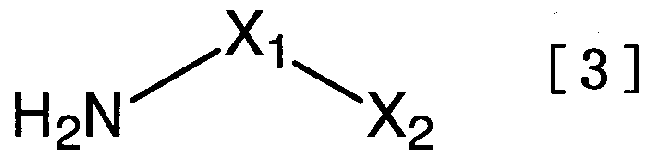
- More preferred specific amine compounds are amine compounds represented by the following formula [3]: [0056] [Chemical Formula 21] H 2 N ZZ Xl ⁇ , ⁇ 2 [3]
- X is a divalent organic group having an aliphatic hydrocarbon group or a non-aromatic cyclic hydrocarbon group, and X is a nitrogen-containing aromatic heterocyclic ring
- X is not particularly limited as long as X is a divalent organic group having an aliphatic hydrocarbon group or a non-aromatic cyclic hydrocarbon group! /.
- Preferred X in the formula [3] is a divalent divalent having one type selected from an aliphatic hydrocarbon group having a carbon number of !-20 and a non-aromatic cyclic hydrocarbon group having a carbon number of 3-20. It is an organic group.
- the non-aromatic cyclic hydrocarbon group the above-described structure can be cited. More preferably, it is an aliphatic hydrocarbon group having 1 to 15 carbon atoms such as a cyclopropane ring and a cyclobutane ring.
- Cyclopentane ring cyclohexane ring, cycloheptane ring, cyclooctane ring, cyclononane ring, cyclodecane ring, cycloundecane ring, cyclododecane ring, cyclotridecane ring, cyclotetradecane ring, norbornene ring, adamantane ring, etc. It is done. Particularly preferred is a linear or branched alkyl group having 1 to 10 carbon atoms.
- X is not adjacent to the amino group! /, —CH— in any aliphatic hydrocarbon group or non-aromatic cyclic hydrocarbon group is —O— —NH— —CO — O— -0-CO-
- Si (CH 2) O— may be replaced by a cyclic hydrocarbon group and a heterocyclic ring
- a hydrogen atom bonded to an arbitrary carbon atom is a linear or branched alkyl group having 120 carbon atoms, a cyclic hydrocarbon group, a fluorine-containing alkyl group having 1 to 10 carbon atoms, a heterocyclic ring, or fluorine.
- An atom or a hydroxyl group may be substituted.
- cyclic hydrocarbon group examples include a benzene ring, a naphthalene ring, a tetrahydronaphthalene ring, an azulene ring, an indene ring, a funolene ring, an anthracene ring, a phenanthrene ring, a phenalene ring, a cyclopropane ring, a cyclobutane ring, Cyclopentane ring, cyclohexane ring, cycloheptane ring, cyclooctane ring, cyclononane ring, cyclodecane ring, cycloundecane ring, cyclododecane ring, cyclotridecane ring, cyclotetradecane ring, cyclopentadecane ring, cyclohexadecane ring, Examples include cycloheptade
- heterocyclic ring examples include pyrrole ring, imidazole ring, oxazole ring, thiazole ring, pyrazole ring, pyridine ring, pyrimidine ring, quinoline ring, pyrazoline ring, isoquinoline ring, force rubazole ring, purine ring.
- Thiadiazole ring pyridazine ring, pyrazoline ring, triazine ring, virazolidine ring, triazole ring, pyrazine ring, benzimidazole ring, benzimidazole ring, thionoline ring, phenanthorin ring, indole ring, quinoxaline ring, benzothiazole ring, Examples include phenothiazine ring, oxadiazole ring, and atrazine ring.
- X in the formula [3] is a nitrogen-containing aromatic heterocycle, and in the same manner as described above, the formula [8a] An aromatic cyclic hydrocarbon containing at least one structure selected from the group consisting of formula [8b] and formula [8c]. Specific examples thereof include the structure described above.
- pyrrole ring imidazole ring, pyrazole ring, pyridine ring, pyrimidine ring, pyridazine ring, triazine ring, triazole ring, pyrazine ring, benzimidazole ring, benzimidazole ring, quinoxaline ring, azepine ring, diazepine ring, A naphthyridine ring, a phenazine ring and a phthalazine ring are preferred.
- X is a formula included in X from the viewpoint of the weakness of electrostatic interaction such as salt formation and hydrogen bonding between the nitrogen-containing aromatic heterocycle and the carboxyl group in the specific polyimide [8a]
- the carbon atom of the nitrogen-containing aromatic heterocycle represented by X in the formula [3] is a halogen atom and
- Organic group may have a substituent such as an oxygen atom, a sulfur atom, or a nitrogen atom.
- a preferable combination of X and X in the formula [3] is X, an aliphatic group having from 20 to 20 carbon atoms;
- the carbon atom may have a halogen atom and / or a substituent of an organic group, and the organic group may contain a hetero atom such as an oxygen atom, a sulfur atom, or a nitrogen atom.
- a more preferred specific amine compound is an amine compound represented by the following formula [4].
- X is an aliphatic hydrocarbon group having 10 to 10 carbon atoms or a non-aromatic cyclic hydrocarbon group
- X is a single bond, ⁇ — ⁇ — —S— — SO one or divalent with 1 to 19 carbon atoms
- the total number of carbon atoms X and X have is 120.
- X is nitrogen Containing aromatic heterocycle
- X in the formula [4] is an aliphatic hydrocarbon group having 1 to 10 carbon atoms or a non-aromatic cyclic carbon.
- Specific examples thereof include straight-chain or branched alkyl groups having from 10 to 10 carbon atoms, unsaturated alkyl groups having from 1 to 10 carbon atoms, cyclopropane ring, cyclobutane ring, cyclopentane ring, cyclohexane ring, cyclohexane Heptane ring, cyclooctane ring, cyclononane ring, cyclodecane ring, cycloundecane ring, cyclododecane ring, cyclotridecane ring, cyclotetradecane ring, cyclopentadecane ring, cyclohexadecane ring, cycloheptadecane ring, cyclodecane ring, And cyclononadecane ring, cycloicosane ring, tricycloeicosane ring, tricycl
- it is a C1-C10 linear or branched alkyl group, cyclopropane ring, cyclobutane ring, cyclopentane ring, cyclohexane ring, cycloheptane ring, cyclooctane ring, cyclononane ring, cyclodecane ring, cyclo Examples include an undecane ring, a cyclododecane ring, a cyclotridecane ring, a cyclotetradecane ring, a calebornene ring, and an adamantane ring. Particularly preferred is a linear or branched alkyl group having 1 to 10 carbon atoms.
- CH— in the hydrocarbon group is: 01, NH C 0101, 0 1 C 0 1,-C
- the hydrogen atom bonded to any carbon atom is a straight or branched alkyl group having 120 carbon atoms, a cyclic hydrocarbon group, a fluorine-containing alkyl group having 1 to 10 carbon atoms, a heterocyclic ring, a fluorine atom, It may be replaced with a hydroxyl group.
- the cyclic hydrocarbon group and the heterocycle mentioned here have the same meaning as defined for X in the formula [1].
- X in Formula [4] is a single bond, —O— —NH— —S— — SO, or one carbon number;! ⁇ 1
- the divalent organic group having 1 to 19 carbon atoms is a divalent organic group having! To 19 carbon atoms, and may contain an oxygen atom, a nitrogen atom, a sulfur atom, a silicon atom, or the like. . Specific examples of such X are given below.
- X may contain two or more of these.
- X in the formula [4] is a nitrogen-containing aromatic heterocyclic ring, and is the same as X in the formula [3].
- X is equivalent to the definition of X.
- a specific example is the same as X described above.
- pyrrole ring imidazole ring, pyrazole ring, pyridine ring, pyrimidine ring, pyridazine ring, triazine ring, triazole ring, pyrazine ring, benzimidazole ring, benzimidazole ring, quinoxaline ring, azepine ring, diazepine ring, A naphthyridine ring, a phenazine ring and a phthalazine ring are preferred.
- X is a formula included in X from the viewpoint of the weakness of electrostatic interaction such as salt formation and hydrogen bonding between the nitrogen-containing aromatic heterocycle and the carboxyl group in the specific polyimide [8a]
- the carbon atom of the nitrogen-containing aromatic heterocycle represented by X in the formula [4] is a halogen atom and
- the organic group which may have a substituent of the organic group may contain a hetero atom such as an oxygen atom, a sulfur atom or a nitrogen atom! /.
- a preferable combination of X X and X in the formula [4] is X, the number of carbons;
- Chain or branched alkyl group cyclopropane ring, cyclobutane ring, cyclopentane ring, cyclohexane ring, cycloheptane ring, cyclooctane ring, cyclononane ring, cyclodecane ring, cycloundecane ring, cyclododecane ring, cyclotridecane ring, Cyclotetradecane ring, norbornene ring, adamantane ring, X force single bond, 1 to 10 carbon atoms;
- These carbon atoms may have a halogen atom and / or a substituent of an organic group, and the organic group may contain a hetero atom such as an oxygen atom, a sulfur atom, or a nitrogen atom.
- a more preferable combination of X X and X in the formula [4] is X 1 carbon number
- the organic group which may have a substituent of the organic group may contain a hetero atom such as an oxygen atom, a sulfur atom or a nitrogen atom! /.
- Cyclopentane ring Cyclopentane ring, cyclohexane ring, cycloheptane ring, norbornene ring, adamantane ring, benzene ring, naphthalene ring, tetrahydronaphthalene ring, fluorene ring, anthracene ring, X force pyrrole ring, imidazole ring, pyrazole ring, pyridine Ring, pyrimidine ring,
- the organic group which may have a substituent of an atom and / or an organic group is an oxygen atom
- it may contain a hetero atom such as a sulfur atom or a nitrogen atom.
- a particularly preferred combination of X X and X in formula [4] is X 1 carbon number
- X contains nitrogen.
- the carbon atom of the aromatic heterocyclic ring may have a halogen atom and / or a substituent of an organic group, and the organic group contains a hetero atom such as an oxygen atom, a sulfur atom, or a nitrogen atom. Also good.
- Specific examples of the specific amine compound used in the present invention include the compound of M1 M156. [0075] [Chemical 23]
- M152 M153 M154 M155 156 More preferred compounds include M6 to M8, M10, M16 to M21, M31 to M36, M40 to M45, M47 to M57, M59 to M63, M68, M69, M72 to M82, M95 to M98, M100-M103, M108-M125, M128-M137, M139-M143, M149-M156 are mentioned.
- M6 to M8 M16 to M20, M32 to M36, M40, M41, M44, M49 to M54, M59 to M62, M68, M69, M75 to M82, MlOO -M103, M108-M112, M114-M116, M118-M121, M125, M134-M136, M139, M140, M143, M150, M152-M156.
- the liquid crystal aligning agent of the present invention is usually obtained by mixing the specific polyimide as the component (A) and the specific amine compound as the component (B) in an organic solvent.
- the specific amine compound to be mixed may be one type or a combination of two or more types.
- a reaction solution (a solution of a specific polyimide) obtained by imidizing a polyamic acid that is a precursor of a specific polyimide may be used.
- a powder of a specific polyimide obtained by purification is organically used.
- a method of adding a specific amine compound to a solution dissolved in a solvent is mentioned.
- the organic solvent used in that case is not particularly limited as long as it is a solvent that dissolves the specific polyimide. Specific examples are given below.
- the specific polyimide When the specific polyimide is dissolved in the organic solvent, calorific heat may be used for the purpose of promoting the dissolution of the specific polyimide. If the heating temperature is too high, the molecular weight of the polyimide may decrease. Therefore, the temperature is preferably 30 to 100 ° C, more preferably 50 to 90 ° C.
- the concentration of the specific polyimide solution is not particularly limited, it is easy to uniformly mix with the specific amine compound. Therefore, the specific polyimide concentration in the solution is preferably 20 to 20% by mass, more preferably 3 to 15 mass. %, Particularly preferably 3 to 10% by mass.
- the specific amine compound may be added directly to the solvent-soluble polyimide solution! /, But in a suitable solvent, the solution has a concentration of 0.;! To 10% by mass, preferably 1 to 7% by mass. It is preferable to add it afterwards.
- the solvent include the solvent of the solvent-soluble polyimide described above. It is done.
- the specific polyimide and the specific amine compound are mixed with heating in an organic solvent or heated after mixing.
- heating the ratio of the specific amine compound and the specific polyimide that are already bonded in the state of the liquid crystal alignment treatment agent increases, and it becomes possible to move charges more efficiently when the liquid crystal alignment film is formed.
- the temperature in the case of heating described above is preferably 10 to 100 ° C. force, more preferably (or 20 to 80 ° C.).
- the addition amount of the specific amine compound is 0 with respect to 1 mol amount of the carboxyl group contained in the specific polyimide because the effect of the present invention can be obtained efficiently and the stability of the liquid crystal alignment treatment agent is not impaired. 0;! To 2 mole boost S preferred, more preferably 0.05 to;! Mole times, particularly preferred (or 0.0.08-0.8 monolayer times).
- the liquid crystal aligning agent of the present invention includes a solvent and a compound that improve film thickness uniformity and surface smoothness when a liquid crystal aligning agent is applied as a component other than the specific polyimide and the specific amine compound, You may contain the compound etc. which improve the adhesiveness of a liquid crystal aligning film and a board
- solvents that improve film thickness uniformity and surface smoothness include the following:
- solvents may be used alone or in combination of two or more.
- it is preferably 5 to 80% by mass, more preferably 20 to 60% by mass, based on the entire solvent contained in the liquid crystal alignment treatment agent.
- Examples of compounds that improve film thickness uniformity and surface smoothness include fluorine-based surfactants, silicone-based surfactants, and nonionic surfactants.
- Ftop EF301, EF303, EF352 manufactured by Tochem Products
- MegaFuck F171, F173, R-30 manufactured by Dainippon Ink
- Florard FC430, FC431 Suditomo 3
- Asahi Guard AG710 Surflon S-382, SC101, SC102, SC103, SC104, SC105, SC106 (manufactured by Asahi Shishiko).
- the proportion of these surfactants used is 100% of component (A) contained in the liquid crystal aligning agent.
- it is 0.0;! ⁇ 2 parts by mass, more preferably 0.01 ⁇ ;
- Specific examples of the compound that improves the adhesion between the liquid crystal alignment film and the substrate include the following functional silane-containing compounds and epoxy group-containing compounds.
- the amount is 0.;! To 30 parts by mass, more preferably 1 to 20 with respect to 100 parts by mass of the specific polyimide component contained in the liquid crystal aligning agent. Part by mass. If the amount is less than 1 part by mass, the effect of improving the adhesion cannot be expected, and if it exceeds 30 parts by mass, the orientation of the liquid crystal may deteriorate.
- liquid crystal alignment treatment agent of the present invention in addition to the above, as long as the effects of the present invention are not impaired, polymer components other than the specific polyimide, and the electrical properties such as dielectric constant and conductivity of the liquid crystal alignment film A dielectric material or conductive material whose properties are to be changed, and a crosslinkable compound which is intended to increase the hardness or density of the liquid crystal alignment film may be added.
- the concentration of the solid content in the liquid crystal alignment treatment agent of the present invention can be appropriately changed depending on the film thickness of the target liquid crystal alignment film, a film having no defect, and suitable as a liquid crystal alignment film From the reason that a thickness can be obtained; it is preferably 20 to 20% by mass, more preferably 2 to 10% by mass.
- the liquid crystal alignment treatment agent of the present invention can be used as a liquid crystal alignment film without applying an alignment treatment after being applied and baked on a substrate and then subjected to an alignment treatment by rubbing treatment, light irradiation, or the like.
- the substrate to be used is not particularly limited as long as it is a highly transparent substrate, and a glass substrate, a plastic substrate such as an acrylic substrate or a polycarbonate substrate, or the like can be used.
- the reflective liquid crystal display element can use an opaque material such as a silicon wafer as long as it is only on one side of the substrate, and the electrode in this case can be made of a material that reflects light such as aluminum.
- the method for applying the liquid crystal aligning agent is not particularly limited, but industrially, methods such as screen printing, offset printing, flexographic printing, and inkjet are generally used. Other coating methods include dip, roll coater, slit coater, spinner and the like, and these may be used according to the purpose.
- Firing after applying the liquid crystal aligning agent on the substrate may form a coating film by evaporating the solvent at 50 to 200 ° C, preferably 80 to 150 ° C, by a heating means such as a hot plate. it can. If the thickness of the coating film after baking is too thick, it will be disadvantageous in terms of power consumption of the liquid crystal display element, and if it is too thin, the reliability of the liquid crystal display element may be lowered, so it is preferably 5 to 300 nm, more preferably 10 ⁇ ;! OOnm. When liquid crystal is aligned horizontally or tilted In this case, the coating film after baking is treated with rubbing or irradiation with polarized ultraviolet rays.
- the liquid crystal display element of the present invention is a liquid crystal display element obtained by obtaining a substrate with a liquid crystal alignment film from the liquid crystal aligning agent of the present invention by the method described above, and then producing a liquid crystal cell by a known method.
- a pair of substrates on which a liquid crystal alignment film is formed is prepared, a spacer is dispersed on the liquid crystal alignment film of one substrate, and the liquid crystal alignment film surface is on the inside. Then, the other substrate is bonded together, and the liquid crystal is injected under reduced pressure to seal, or the liquid crystal is dropped on the surface of the liquid crystal alignment film on which the spacer is dispersed, and then the substrate is bonded and sealed.
- the method etc. which perform can be illustrated.
- the thickness of the spacer at this time is preferably;! -30 m, more preferably 2--10 ⁇ m.
- the liquid crystal display device manufactured using the liquid crystal alignment treatment agent of the present invention has excellent reliability and can be suitably used for a large-screen high-definition liquid crystal television and the like.
- the present invention will be described in more detail with reference to examples, but the present invention is not limited thereto.
- CBDA 1, 2, 3, 4 cyclobutane tetracarboxylic dianhydride
- TDA 3,4-dicarboxy-1, 1,2,3,4-tetrahydro-1-naphthalene succinic acid dihydrate
- DADPA 4, 4'-diaminodiphenylamine
- API 1 (3-Aminopropyl) imidazole
- NMP N—Methyl-2— BCS: Butyl sorb GBL: y Butyro Rataton
- the molecular weight of the polyimide in the synthesis example was measured as follows using a room temperature gel permeation chromatography (GPC) apparatus (SSC-7200) manufactured by Senshi Kagaku Co., Ltd. and columns (KD-803, KD-805) manufactured by Shodex.
- GPC room temperature gel permeation chromatography
- N N'-dimethylformamide (as additives, lithium bromide-hydrate (LiBr-H20) 30mmol / L, phosphoric acid.
- Anhydrous crystals (ophosphoric acid) 30mmol / L, tetrahydrofuran) (THF) is 10ml / U
- Standard sample for preparing calibration curve TSK standard polyethylene oxide (molecular weight: approx. 9000,000, 150,000, 100,000, 30,000) manufactured by Tosoh Corporation; Posimer Laboratories !; polyethylene glycol (molecular weight: approx. 12,000, 4,000, 1,000) ).
- the imidation ratio of polyimide in the synthesis example was measured as follows. Put 20 mg of polyimide powder in an NMR sample tube (NMR sampling tube standard ⁇ 5, manufactured by Kusano Kagaku Co., Ltd.), deuterated dimethyl sulfoxide (DMSO-d, 0.05% TMS mixture) 0.5
- X is the accumulated proton peak value derived from the NH group of the amic acid
- y is the accumulated peak value of the reference proton
- ⁇ is the proton of the anchor group of the amic acid in the case of polyamic acid (imidation rate is 0%) It is the number ratio of the reference proton to one.
- BODA (16.9 g, 68 mmol), p-PDA (6.8 g, 63 mmol) and PCH (10.3 g, 27 mmol) were mixed in NMP (100. lg) and reacted at 40 ° C for 3 hours. Thereafter, CBDA (4. lg, 21 mmol) and NMP (52.2 g) were added and reacted at 40 ° C. for 3 hours to obtain a polyamic acid solution. After adding NMP to this polyamic acid solution (130.3 g) and diluting to 6% by mass, acetic anhydride (15.6 g) and pyridine (12. lg) were added as an imidization catalyst and reacted at 80 ° C for 3 hours. I let you.
- This reaction solution was put into methanol (1600 ml), and the resulting precipitate was separated by filtration. This deposit was washed with methanol and dried under reduced pressure at 100 ° C. to obtain a polyimide powder (A).
- the imidation ratio of this polyimide was 54%, the number average molecular weight was 18,300, and the weight average molecular weight was 45,300.
- the amount of carboxyl groups in this polyimide is 0.92 with respect to the repeating unit.
- BODA (16.9 g, 68 mmol), p-PDA (6.8 g, 63 mmol) and PCH (10.3 g, 27 mmol) were mixed in NMP (lOO.Og) and reacted at 40 ° C for 3 hours.
- CBDA (4. lg, 2 lmmol) and NMP (52.2 g) were added and reacted at 40 ° C for 3 hours to obtain a polyamic acid solution.
- acetic anhydride (2.7 g) and pyridine (2. lg) were added as imidization catalysts and reacted at 70 ° C for 1 hour. It was.
- This reaction solution was poured into methanol (660 ml), and the resulting precipitate was filtered off. This precipitate was washed with methanol and dried under reduced pressure at 100 ° C. to obtain a polyimide powder (B).
- the imidation ratio of this polyimide was 25%, the number average molecular weight was 19,500, and the weight average molecular weight was 47,800.
- the amount of carboxyl groups in this polyimide is 1.50 per repeating unit.
- BODA 150.lg, 600mmol
- DBA (60.9g, 400mmol)
- PCH 152.2g, 4OOmmol
- NMP 1290g
- CBDA 38. 8g, 198mmol
- NMP 320g
- acetic anhydride 39.g
- pyridine 49.6 g
- This reaction solution was poured into methanol (7700 ml), and the resulting precipitate was filtered off. This precipitate was washed with methanol and dried under reduced pressure at 100 ° C. to obtain a polyimide powder (C).
- the imidation ratio of this polyimide was 57%, the number average molecular weight was 23,000, and the weight average molecular weight was 80,200.
- the amount of carboxyl groups in this polyimide is 1.36 per repeating unit.
- BODA 50.lg, 600mmol
- DBA 60.9g, 400mmol
- PCH 152.2g, 40Ommol
- NMP 1290g
- CBDA 38.8 g, 198 mmol
- NMP 320 g
- acetic anhydride 32. Og
- pyridine 24.8 g
- This reaction solution was poured into methanol (3900 ml), and the resulting precipitate was separated by filtration. This precipitate was washed with methanol and dried under reduced pressure at 100 ° C. to obtain a polyimide powder (D).
- the imidation ratio of this polyimide was 69%, the number average molecular weight was 22,700, and the weight average molecular weight was 69,300.
- the amount of carboxyl groups in this polyimide is 1.12 per repeating unit.
- BODA 150.lg, 600mmol
- DBA (60.9g, 400mmol)
- PCH 152.2g, 4OOmmol
- NMP 1290g
- CBDA 38. 8g, 198mmol
- NMP 320g
- acetic anhydride 21.3 g
- pyridine 16.5 g
- This reaction solution was poured into methanol (1300 ml), and the resulting precipitate was separated by filtration. This precipitate was washed with methanol and dried under reduced pressure at 100 ° C. to obtain a polyimide powder (E).
- the imidation ratio of this polyimide was 81%, the number average molecular weight was 20,400, and the weight average molecular weight was 63,000.
- the amount of carboxyl groups in this polyimide is 0.88 with respect to the repeating unit.
- This reaction solution was poured into methanol (910 ml), and the resulting precipitate was filtered off. This precipitate was washed with methanol and dried under reduced pressure at 100 ° C. to obtain a polyimide powder (F).
- the imidization ratio of this polyimide was 25%, the number average molecular weight was 22,200, and the weight average molecular weight was 69,000.
- the amount of carboxyl groups in this polyimide is 1.50 per repeating unit.
- BODA (7.5 g, 30 mmol), DADPA (1.6 g, 8. Ommol), DBA (2.4 g, 16 mmol), PCH (6.lg, 16 mmol) are mixed in NMP (53.2 g), After reacting at 40 ° C for 3 hours, CBDA (1.9 g, 10 mmol) and NMP (25 g) were mixed and reacted at 40 ° C for 3 hours to obtain a polyamic acid solution. After adding NMP to this polyamic acid solution (60.4 g) and diluting to 5% by mass, acetic anhydride (6.3 g) and pyridine (4.9 g) were added as imidization catalysts and reacted at 90 ° C for 2 hours. It was.
- This reaction solution was poured into methanol (880 ml), and the resulting precipitate was filtered off. This precipitate was washed with methanol and dried under reduced pressure at 100 ° C. to obtain a polyimide powder (G).
- the imidation ratio of this polyimide was 51%, the number average molecular weight was 21,100, and the weight average molecular weight was 64,000.
- the amount of carboxyl groups in this polyimide is 1.38 per repeating unit.
- This precipitate was washed with methanol and dried under reduced pressure at 100 ° C. to obtain a polyimide powder (H).
- This polyimi The imidation ratio of the catalyst was 91%, the number average molecular weight was 11,300, and the weight average molecular weight was 20,700.
- the amount of carboxyl groups in this polyimide is 0.88 with respect to the repeating unit.
- the liquid crystal alignment treatment agent (1) obtained above is spin-coated on a glass substrate with an ITO electrode, dried on an 80 ° C hot plate for 5 minutes, and then baked in a 210 ° C hot-air circulating oven for 1 hour.
- a liquid crystal alignment film having a thickness of lOOnm was prepared. Prepare two substrates with this liquid crystal alignment film, spray a 6 m spacer on the surface of one liquid crystal alignment film, print and seal the sealant on it, and seal The agent was cured to produce an empty cell.
- Liquid crystal MLC-6608 manufactured by Merck & Japan
- was injected into this empty cell by a reduced pressure injection method was sealed to obtain a nematic liquid crystal cell.
- the measurement was carried out using a VHR-1 voltage holding ratio measuring device manufactured by Toyo Tech Niriki Co., Ltd., with settings of Voltage: ⁇ 4 V, Pulse Width: 60 s, Flame Period: 16. 67 ms or 1667 ms.
- a DC voltage of 10V is applied to the liquid crystal cell after measuring the voltage holding ratio for 30 minutes and shorted for 1 second. After that, the potential generated in the liquid crystal cell was measured for 1800 seconds. Figure 1 shows the potential change at this time. As a result, the residual charge 50 seconds after the short circuit was 3.19V, and the residual charge 1000 seconds later was 0.25V.
- a 6254 type liquid crystal physical property evaluation apparatus manufactured by Toyo Tech Niki Co., Ltd. was used.
- Liquid crystal aligning agents (2) to (; 18) were prepared as described below, and liquid crystal cells were prepared and evaluated in the same manner as in Example 1. In all the liquid crystal cells, the liquid crystal was uniformly vertically aligned and no alignment defects were observed. The evaluation results are shown in Tables 1 and 2 below. (Example 2)
- a liquid crystal aligning agent (2) was obtained in the same manner as in Example 1 except that the polyimide powder (B) obtained in Synthesis Example 2 was used.
- a liquid crystal aligning agent (3) was obtained in the same manner as in Example 1 except that the polyimide powder (C) obtained in Synthesis Example 3 was used and dissolved by stirring at 70 ° C for 40 hours. .
- NMP (57.8 g) was added to the polyimide powder (D) (10.2 g) obtained in Synthesis Example 4 and dissolved by stirring at 70 ° C. for 40 hours.
- 3C AMP lC®i% NMP solution (10.2g) (1.0g as 3 AMP), NMP (6.8g), BCS (85.0g) was added.
- a liquid crystal aligning agent (12) was obtained by stirring for 15 days at C in C.
- the liquid crystal cell for which the above measurement was completed was allowed to stand in a thermostat set at 100 ° C. for 7 days in the same manner as in Example 1, and then evaluated for the voltage holding ratio and the relaxation of residual charges. That As a result, the voltage holding ratio at 16.67 ms is 97.2%, the voltage holding ratio at 1667 ms is 57.7%, the residual charge after 50 seconds is 4.33 V, and the residual voltage after 1000 seconds. The charge was 2.62V.
- Liquid crystal alignment agents (20) to (26) were prepared as described below, and liquid crystal cells were produced in the same manner as in Example 1.
- liquid crystal In all liquid crystal cells, the liquid crystal was uniformly vertically aligned, and no alignment defects were observed.
- the liquid crystal aligning agent (21) was prepared in the same manner as in Example 3 except that Py was used instead of AMP, and Py (0.81 g) was mixed with polyimide powder (C) (7.4 g). Obtained.
- a liquid crystal aligning agent (22) was obtained in the same manner as in Example 3 except that APMA was used instead of AMP.
- a liquid crystal aligning agent (23) was obtained in the same manner as in Example 3 except that Ml was used instead of 3-AMP.
- a liquid crystal aligning agent (24) was obtained in the same manner as in Example 3 except that VPy was used instead of 3-AMP.
- Example 4 C 3— AMP 97. 8 64. 6 97. 9 64. 3
- Example 5 C 3— AMP 97. 8 64. 1 97. 9
- Example 6 C 3—AMP 97. 8 64. 8 97. 8 60.9
- Example C AEP 97. 5 61. 0 97. 4
- Example 8 C API 97. 3 62. 5 97. 3 68. 6
- Example 9 D 3—AMP 98. 1 68- 3 98. 0 68.2
- Example 10 D 3—AMP 98. 1 68. 2 98 1 68. 1
- Example 11 D 3—AMP 98. 0 68. 0 98. 0 68. 1
- Example 12 D 3—AMP 98. 1 68. 0 98. 1
- Example 13 E 3—AMP 98. 0 68. 2 98. 1 68.3
- Example 14 E 3—AMP 97. 8 67. 8 98. 0 67. 8
- Example 15 F 3—AMP 97. 5 54. 1 97 7 56. 3
- Example 16 G 3—AMP 97. 8 67. 8 98. 1
- Example 18 E 2AMMP 98. 1 67. 2 98. 0 6 inch 7.4 Comparative example 1 A-97.4 4 64. 1 97.2 ⁇
- Example 1 A 3— AMP 3. 19 0. 25 3. 41 0. 46 Example 2 B 3 — AMP 2. 96 0. 17 1. 4 19 Example 3 C 3—AMP 2. 61 0. 25 1. 28 0. 30 Example 4 C 3—AMP 1. 54 0. 15 1. 39 0. 24 Example 5 C 3—AMP 2. 94 0 17 2. 21 0. 48 Example 6 C 3— AMP 3. 05 0. 17 2. 01 0. 41 Example 7 C AEP 1. 47 0. 14 1. 13 0. 23 Example 8 C API 2 99 0. 17 1. 26 0. 28 Example 9 D 3—AMP 3. 04 0. 34 2. F 6 1. 13 Example 10 D 3—AMP 3. 02 0. 25 2. 29 0. 64 Example 11 D 3— AMP 2. 77 0. 20 2. F 5 0. 62 Example 12 D 3— AMP 2. 87 0. 25 2. 54 0.
- the liquid crystal alignment treatment agent of the present invention can provide a liquid crystal alignment film that has a high voltage holding ratio and can quickly relieve residual charges accumulated by a DC voltage even after being exposed to a high temperature for a long time. .
- the liquid crystal display device obtained by this method can suppress display defects such as screen burn-in and display unevenness even when used for a long period of time, and has excellent reliability. It can utilize suitably for. Further, this liquid crystal display element can be suitably used for various display devices.
Landscapes
- Physics & Mathematics (AREA)
- Chemical & Material Sciences (AREA)
- Nonlinear Science (AREA)
- Organic Chemistry (AREA)
- Crystallography & Structural Chemistry (AREA)
- Chemical Kinetics & Catalysis (AREA)
- General Physics & Mathematics (AREA)
- Optics & Photonics (AREA)
- Mathematical Physics (AREA)
- Health & Medical Sciences (AREA)
- Medicinal Chemistry (AREA)
- Polymers & Plastics (AREA)
- Engineering & Computer Science (AREA)
- Materials Engineering (AREA)
- Spectroscopy & Molecular Physics (AREA)
- Macromolecular Compounds Obtained By Forming Nitrogen-Containing Linkages In General (AREA)
- Liquid Crystal (AREA)
Description





Claims


Priority Applications (3)
| Application Number | Priority Date | Filing Date | Title |
|---|---|---|---|
| CN2007800285377A CN101495915B (zh) | 2006-07-28 | 2007-07-27 | 液晶定向处理剂及使用了该处理剂的液晶显示元件 |
| KR1020097001401A KR101426102B1 (ko) | 2006-07-28 | 2007-07-27 | 액정 배향 처리제 및 그것을 사용한 액정 표시 소자 |
| JP2008526840A JP5003682B2 (ja) | 2006-07-28 | 2007-07-27 | 液晶配向処理剤及びそれを用いた液晶表示素子 |
Applications Claiming Priority (2)
| Application Number | Priority Date | Filing Date | Title |
|---|---|---|---|
| JP2006-206617 | 2006-07-28 | ||
| JP2006206617 | 2006-07-28 |
Publications (1)
| Publication Number | Publication Date |
|---|---|
| WO2008013285A1 true WO2008013285A1 (en) | 2008-01-31 |
Family
ID=38981595
Family Applications (1)
| Application Number | Title | Priority Date | Filing Date |
|---|---|---|---|
| PCT/JP2007/064814 Ceased WO2008013285A1 (en) | 2006-07-28 | 2007-07-27 | Liquid crystal aligning agent and liquid crystal displays made by using the same |
Country Status (5)
| Country | Link |
|---|---|
| JP (1) | JP5003682B2 (ja) |
| KR (1) | KR101426102B1 (ja) |
| CN (1) | CN101495915B (ja) |
| TW (1) | TWI437045B (ja) |
| WO (1) | WO2008013285A1 (ja) |
Cited By (18)
| Publication number | Priority date | Publication date | Assignee | Title |
|---|---|---|---|---|
| JP2009157351A (ja) * | 2007-12-06 | 2009-07-16 | Jsr Corp | 液晶配向剤および液晶表示素子 |
| WO2012008464A1 (ja) * | 2010-07-13 | 2012-01-19 | 日産化学工業株式会社 | 液晶配向処理剤、液晶配向膜及び液晶表示素子 |
| JP2012098715A (ja) * | 2010-10-06 | 2012-05-24 | Hitachi Displays Ltd | 配向膜、配向膜形成用組成物、および液晶表示装置 |
| WO2013008822A1 (ja) * | 2011-07-12 | 2013-01-17 | 日産化学工業株式会社 | 液晶配向剤、液晶配向膜及び液晶表示素子 |
| KR20140035806A (ko) * | 2012-09-14 | 2014-03-24 | 제이에스알 가부시끼가이샤 | 액정 배향제, 액정 배향막 및 액정 표시 소자 |
| WO2014077253A1 (ja) * | 2012-11-16 | 2014-05-22 | 日産化学工業株式会社 | ポリイミド樹脂フィルム及びポリイミド樹脂フィルムからなる電子デバイス用基板 |
| WO2014119682A1 (ja) * | 2013-02-01 | 2014-08-07 | 日産化学工業株式会社 | 液晶配向処理剤、液晶配向膜及び液晶表示素子 |
| KR20140128228A (ko) | 2013-04-26 | 2014-11-05 | 제이에스알 가부시끼가이샤 | 액정 배향제, 액정 배향막 및 액정 표시 소자 |
| TWI477533B (zh) * | 2008-11-06 | 2015-03-21 | Nissan Chemical Ind Ltd | Liquid crystal alignment agent |
| JP2016117861A (ja) * | 2014-12-23 | 2016-06-30 | Jsr株式会社 | 重合体組成物、樹脂膜、液晶配向剤、液晶配向膜、液晶配向膜の製造方法及び液晶表示素子 |
| JP5998931B2 (ja) * | 2010-06-10 | 2016-09-28 | 日産化学工業株式会社 | 液晶配向処理剤、液晶配向膜、及び液晶表示素子 |
| KR20170072223A (ko) * | 2014-11-13 | 2017-06-26 | 닛산 가가쿠 고교 가부시키 가이샤 | 액정 배향 처리제, 액정 배향막 및 액정 표시 소자 |
| KR101778094B1 (ko) * | 2010-11-01 | 2017-09-13 | 제이에스알 가부시끼가이샤 | 액정 배향제, 액정 배향막 및 액정 표시 소자 |
| WO2018070398A1 (ja) * | 2016-10-12 | 2018-04-19 | コニカミノルタ株式会社 | 透明ポリイミド樹脂、透明ポリイミド樹脂組成物、透明ポリイミド樹脂フィルム、赤外線吸収組成物、赤外線カットフィルター及び透明ポリイミド樹脂フィルムの製造方法 |
| KR101878518B1 (ko) * | 2010-10-19 | 2018-07-13 | 닛산 가가쿠 고교 가부시키 가이샤 | 광 배향 처리법에 적합한 액정 배향제, 및 그것을 사용한 액정 배향막 |
| KR101878519B1 (ko) * | 2010-10-28 | 2018-07-13 | 닛산 가가쿠 고교 가부시키 가이샤 | 액정 배향제, 및 액정 배향막 |
| WO2021182267A1 (ja) * | 2020-03-13 | 2021-09-16 | 日産化学株式会社 | ポリイミドワニス |
| US11345856B2 (en) | 2017-06-30 | 2022-05-31 | Lg Chem, Ltd. | Liquid crystal aligning agent composition, method for producing liquid crystal alignment film using same, and liquid crystal alignment film using same |
Families Citing this family (8)
| Publication number | Priority date | Publication date | Assignee | Title |
|---|---|---|---|---|
| JP5655583B2 (ja) * | 2011-01-19 | 2015-01-21 | Jsr株式会社 | 液晶配向剤、液晶配向膜及び液晶表示素子 |
| JP5962381B2 (ja) * | 2011-12-27 | 2016-08-03 | Jsr株式会社 | 液晶配向剤、液晶配向膜、液晶表示素子及び重合体 |
| KR101595457B1 (ko) * | 2012-05-03 | 2016-02-18 | 주식회사 엘지화학 | 신규한 폴리아믹산, 감광성 수지 조성물, 드라이 필름 및 회로 기판 |
| TWI626259B (zh) * | 2012-08-06 | 2018-06-11 | Nissan Chemical Ind Ltd | Liquid crystal alignment agent, and liquid crystal alignment film using the same |
| CN104838311B (zh) * | 2012-11-30 | 2017-12-19 | 日产化学工业株式会社 | 液晶取向膜的制造方法、液晶取向膜和液晶显示元件 |
| JP6349726B2 (ja) * | 2013-04-26 | 2018-07-04 | Jsr株式会社 | 液晶配向剤、液晶配向膜、液晶表示素子、位相差フィルム、位相差フィルムの製造方法、重合体及び化合物 |
| CN110476114B (zh) * | 2017-03-30 | 2022-04-19 | 日产化学株式会社 | 液晶取向剂、液晶取向膜和液晶表示元件 |
| KR102273687B1 (ko) * | 2018-05-17 | 2021-07-05 | 주식회사 엘지화학 | 액정 배향제 조성물, 이를 이용한 액정 배향막의 제조 방법, 및 이를 이용한 액정 배향막 |
Citations (3)
| Publication number | Priority date | Publication date | Assignee | Title |
|---|---|---|---|---|
| JPH01242631A (ja) * | 1988-03-24 | 1989-09-27 | Japan Synthetic Rubber Co Ltd | ポリイミド前駆体膜の製造方法 |
| JPH10186659A (ja) * | 1996-10-31 | 1998-07-14 | Toshiba Corp | ポジ型感光性ポリマー樹脂組成物、これを用いたパターン形成方法、および電子部品 |
| JPH10212484A (ja) * | 1997-01-30 | 1998-08-11 | Jsr Corp | 液晶配向剤 |
Family Cites Families (1)
| Publication number | Priority date | Publication date | Assignee | Title |
|---|---|---|---|---|
| JP4045595B2 (ja) * | 2003-04-22 | 2008-02-13 | Jsr株式会社 | 液晶配向剤 |
-
2007
- 2007-07-27 JP JP2008526840A patent/JP5003682B2/ja active Active
- 2007-07-27 KR KR1020097001401A patent/KR101426102B1/ko active Active
- 2007-07-27 CN CN2007800285377A patent/CN101495915B/zh active Active
- 2007-07-27 WO PCT/JP2007/064814 patent/WO2008013285A1/ja not_active Ceased
- 2007-07-27 TW TW096127599A patent/TWI437045B/zh active
Patent Citations (3)
| Publication number | Priority date | Publication date | Assignee | Title |
|---|---|---|---|---|
| JPH01242631A (ja) * | 1988-03-24 | 1989-09-27 | Japan Synthetic Rubber Co Ltd | ポリイミド前駆体膜の製造方法 |
| JPH10186659A (ja) * | 1996-10-31 | 1998-07-14 | Toshiba Corp | ポジ型感光性ポリマー樹脂組成物、これを用いたパターン形成方法、および電子部品 |
| JPH10212484A (ja) * | 1997-01-30 | 1998-08-11 | Jsr Corp | 液晶配向剤 |
Cited By (37)
| Publication number | Priority date | Publication date | Assignee | Title |
|---|---|---|---|---|
| JP2009157351A (ja) * | 2007-12-06 | 2009-07-16 | Jsr Corp | 液晶配向剤および液晶表示素子 |
| TWI477533B (zh) * | 2008-11-06 | 2015-03-21 | Nissan Chemical Ind Ltd | Liquid crystal alignment agent |
| JP5998931B2 (ja) * | 2010-06-10 | 2016-09-28 | 日産化学工業株式会社 | 液晶配向処理剤、液晶配向膜、及び液晶表示素子 |
| KR101829939B1 (ko) * | 2010-06-10 | 2018-02-19 | 닛산 가가쿠 고교 가부시키 가이샤 | 액정 배향 처리제, 액정 배향막, 및 액정 표시 소자 |
| KR101824283B1 (ko) | 2010-07-13 | 2018-01-31 | 닛산 가가쿠 고교 가부시키 가이샤 | 액정 배향 처리제, 액정 배향막 및 액정 표시 소자 |
| WO2012008464A1 (ja) * | 2010-07-13 | 2012-01-19 | 日産化学工業株式会社 | 液晶配向処理剤、液晶配向膜及び液晶表示素子 |
| JP5900337B2 (ja) * | 2010-07-13 | 2016-04-06 | 日産化学工業株式会社 | 液晶配向処理剤、液晶配向膜及び液晶表示素子 |
| JP2012098715A (ja) * | 2010-10-06 | 2012-05-24 | Hitachi Displays Ltd | 配向膜、配向膜形成用組成物、および液晶表示装置 |
| US8906474B2 (en) | 2010-10-06 | 2014-12-09 | Japan Display Inc. | Alignment film, composition for forming alignment film and liquid crystal display device |
| JP2015111304A (ja) * | 2010-10-06 | 2015-06-18 | 株式会社ジャパンディスプレイ | 配向膜、配向膜形成用組成物、および液晶表示装置 |
| KR101878518B1 (ko) * | 2010-10-19 | 2018-07-13 | 닛산 가가쿠 고교 가부시키 가이샤 | 광 배향 처리법에 적합한 액정 배향제, 및 그것을 사용한 액정 배향막 |
| KR101878519B1 (ko) * | 2010-10-28 | 2018-07-13 | 닛산 가가쿠 고교 가부시키 가이샤 | 액정 배향제, 및 액정 배향막 |
| KR101778094B1 (ko) * | 2010-11-01 | 2017-09-13 | 제이에스알 가부시끼가이샤 | 액정 배향제, 액정 배향막 및 액정 표시 소자 |
| WO2013008822A1 (ja) * | 2011-07-12 | 2013-01-17 | 日産化学工業株式会社 | 液晶配向剤、液晶配向膜及び液晶表示素子 |
| JPWO2013008822A1 (ja) * | 2011-07-12 | 2015-02-23 | 日産化学工業株式会社 | 液晶配向剤、液晶配向膜及び液晶表示素子 |
| KR101610558B1 (ko) * | 2011-07-12 | 2016-04-07 | 닛산 가가쿠 고교 가부시키 가이샤 | 액정 배향제, 액정 배향막 및 액정 표시 소자 |
| KR101985261B1 (ko) | 2012-09-14 | 2019-06-03 | 제이에스알 가부시끼가이샤 | 액정 배향제, 액정 배향막 및 액정 표시 소자 |
| KR20140035806A (ko) * | 2012-09-14 | 2014-03-24 | 제이에스알 가부시끼가이샤 | 액정 배향제, 액정 배향막 및 액정 표시 소자 |
| JP2014074886A (ja) * | 2012-09-14 | 2014-04-24 | Jsr Corp | 液晶配向剤、液晶配向膜及び液晶表示素子 |
| WO2014077253A1 (ja) * | 2012-11-16 | 2014-05-22 | 日産化学工業株式会社 | ポリイミド樹脂フィルム及びポリイミド樹脂フィルムからなる電子デバイス用基板 |
| JPWO2014077253A1 (ja) * | 2012-11-16 | 2017-01-05 | 日産化学工業株式会社 | ポリイミド樹脂フィルム及びポリイミド樹脂フィルムからなる電子デバイス用基板 |
| WO2014119682A1 (ja) * | 2013-02-01 | 2014-08-07 | 日産化学工業株式会社 | 液晶配向処理剤、液晶配向膜及び液晶表示素子 |
| JPWO2014119682A1 (ja) * | 2013-02-01 | 2017-01-26 | 日産化学工業株式会社 | 液晶配向処理剤、液晶配向膜及び液晶表示素子 |
| KR20140128228A (ko) | 2013-04-26 | 2014-11-05 | 제이에스알 가부시끼가이샤 | 액정 배향제, 액정 배향막 및 액정 표시 소자 |
| CN107003566A (zh) * | 2014-11-13 | 2017-08-01 | 日产化学工业株式会社 | 液晶取向处理剂、液晶取向膜和液晶表示元件 |
| KR20170072223A (ko) * | 2014-11-13 | 2017-06-26 | 닛산 가가쿠 고교 가부시키 가이샤 | 액정 배향 처리제, 액정 배향막 및 액정 표시 소자 |
| KR102482056B1 (ko) | 2014-11-13 | 2022-12-27 | 닛산 가가쿠 가부시키가이샤 | 액정 배향 처리제, 액정 배향막 및 액정 표시 소자 |
| JP2016117861A (ja) * | 2014-12-23 | 2016-06-30 | Jsr株式会社 | 重合体組成物、樹脂膜、液晶配向剤、液晶配向膜、液晶配向膜の製造方法及び液晶表示素子 |
| JPWO2018070398A1 (ja) * | 2016-10-12 | 2019-07-25 | コニカミノルタ株式会社 | 透明ポリイミド樹脂、透明ポリイミド樹脂組成物、透明ポリイミド樹脂フィルム、赤外線吸収組成物、赤外線カットフィルター及び透明ポリイミド樹脂フィルムの製造方法 |
| WO2018070398A1 (ja) * | 2016-10-12 | 2018-04-19 | コニカミノルタ株式会社 | 透明ポリイミド樹脂、透明ポリイミド樹脂組成物、透明ポリイミド樹脂フィルム、赤外線吸収組成物、赤外線カットフィルター及び透明ポリイミド樹脂フィルムの製造方法 |
| JP7036021B2 (ja) | 2016-10-12 | 2022-03-15 | コニカミノルタ株式会社 | 透明ポリイミド樹脂、透明ポリイミド樹脂組成物、透明ポリイミド樹脂フィルム、赤外線吸収組成物、赤外線カットフィルター及び透明ポリイミド樹脂フィルムの製造方法 |
| US11345856B2 (en) | 2017-06-30 | 2022-05-31 | Lg Chem, Ltd. | Liquid crystal aligning agent composition, method for producing liquid crystal alignment film using same, and liquid crystal alignment film using same |
| JPWO2021182267A1 (ja) * | 2020-03-13 | 2021-09-16 | ||
| CN115244105A (zh) * | 2020-03-13 | 2022-10-25 | 日产化学株式会社 | 聚酰亚胺清漆 |
| WO2021182267A1 (ja) * | 2020-03-13 | 2021-09-16 | 日産化学株式会社 | ポリイミドワニス |
| CN115244105B (zh) * | 2020-03-13 | 2024-11-12 | 日产化学株式会社 | 聚酰亚胺清漆 |
| JP7786366B2 (ja) | 2020-03-13 | 2025-12-16 | 日産化学株式会社 | ポリイミドワニス |
Also Published As
| Publication number | Publication date |
|---|---|
| JP5003682B2 (ja) | 2012-08-15 |
| CN101495915A (zh) | 2009-07-29 |
| CN101495915B (zh) | 2010-12-15 |
| TW200831611A (en) | 2008-08-01 |
| TWI437045B (zh) | 2014-05-11 |
| JPWO2008013285A1 (ja) | 2009-12-17 |
| KR101426102B1 (ko) | 2014-08-05 |
| KR20090052317A (ko) | 2009-05-25 |
Similar Documents
| Publication | Publication Date | Title |
|---|---|---|
| WO2008013285A1 (en) | Liquid crystal aligning agent and liquid crystal displays made by using the same | |
| TWI471655B (zh) | Liquid crystal alignment agent, liquid crystal alignment film and liquid crystal display element | |
| KR101536028B1 (ko) | 액정 배향 처리제, 및 그것을 사용한 액정 표시 소자 | |
| KR101656541B1 (ko) | 액정 배향제, 액정 배향막 및 액정 표시 소자 | |
| TWI534179B (zh) | A polyimide precursor modified with a dicarboxylic anhydride, an imidized polyimide and a liquid crystal alignment treatment agent using the same | |
| CN107338058B (zh) | 液晶取向剂、液晶取向膜及其制造方法、液晶元件、聚合物以及化合物 | |
| JP6179076B2 (ja) | 液晶配向剤 | |
| TW201118062A (en) | Diamine compound, polyamic acid, polyimide, and liquid crystal aligning agent | |
| JP2014059545A (ja) | 液晶配向剤、液晶配向膜及び液晶表示素子 | |
| CN111542779B (zh) | 液晶取向剂、液晶取向膜及液晶元件 | |
| JPWO2014142168A1 (ja) | 光反応性基を有する架橋性化合物を含有する液晶配向剤 | |
| TWI582147B (zh) | 液晶配向劑、液晶配向膜及液晶顯示元件 | |
| JP5541454B2 (ja) | 液晶配向剤および液晶表示素子 | |
| WO2020148953A1 (ja) | 液晶配向剤、液晶配向膜及び液晶素子 | |
| WO2019106952A1 (ja) | 液晶配向剤、液晶配向膜及び液晶素子 | |
| TW201940539A (zh) | 液晶配向劑、為了獲得此液晶配向劑之聚合物、液晶配向膜、及使用此液晶配向膜之液晶顯示元件 | |
| JP7694561B2 (ja) | 新規ジアミン、重合体、液晶配向剤、液晶配向膜、及びそれを用いた液晶表示素子 | |
| WO2021182267A1 (ja) | ポリイミドワニス |
Legal Events
| Date | Code | Title | Description |
|---|---|---|---|
| WWE | Wipo information: entry into national phase |
Ref document number: 200780028537.7 Country of ref document: CN |
|
| 121 | Ep: the epo has been informed by wipo that ep was designated in this application |
Ref document number: 07791508 Country of ref document: EP Kind code of ref document: A1 |
|
| WWE | Wipo information: entry into national phase |
Ref document number: 2008526840 Country of ref document: JP |
|
| WWE | Wipo information: entry into national phase |
Ref document number: 1020097001401 Country of ref document: KR |
|
| NENP | Non-entry into the national phase |
Ref country code: DE |
|
| NENP | Non-entry into the national phase |
Ref country code: RU |
|
| 122 | Ep: pct application non-entry in european phase |
Ref document number: 07791508 Country of ref document: EP Kind code of ref document: A1 |